Cambridge IGCSE Physics 0625 — 2025 Feb/March Paper 2 · Variant 2
0625/22/F/M/25 · 40 questions · 40 marks · ≈45 min
The question paper and its mark scheme, free to read here and free to download. This is Cambridge’s own paper, exactly as it was sat.
Question paper16 pages
Mark scheme3 pages
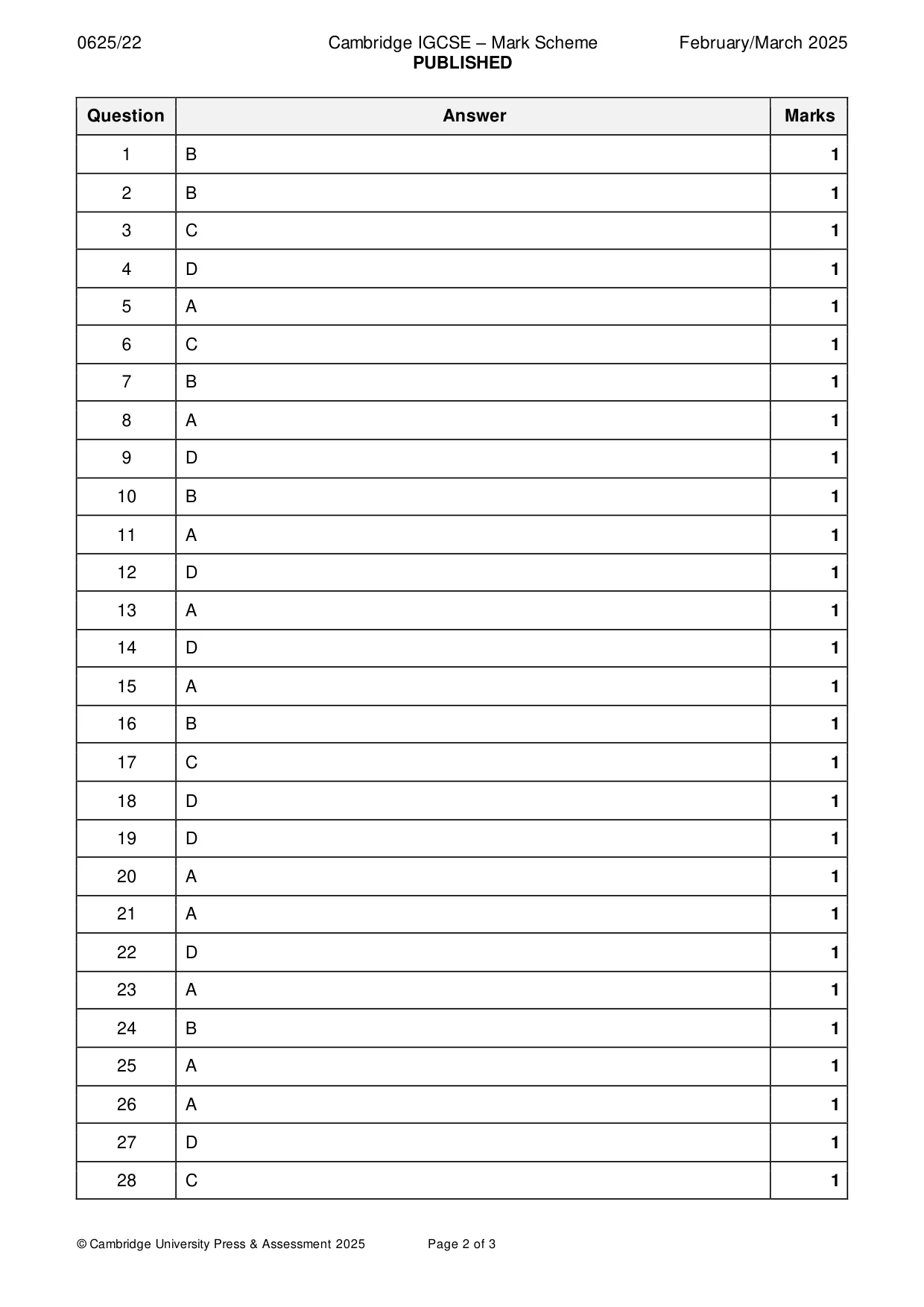
Answers below. Sit the paper first if you are practising.
Questions as text
Q1 · The diagram shows three forces acting on an object
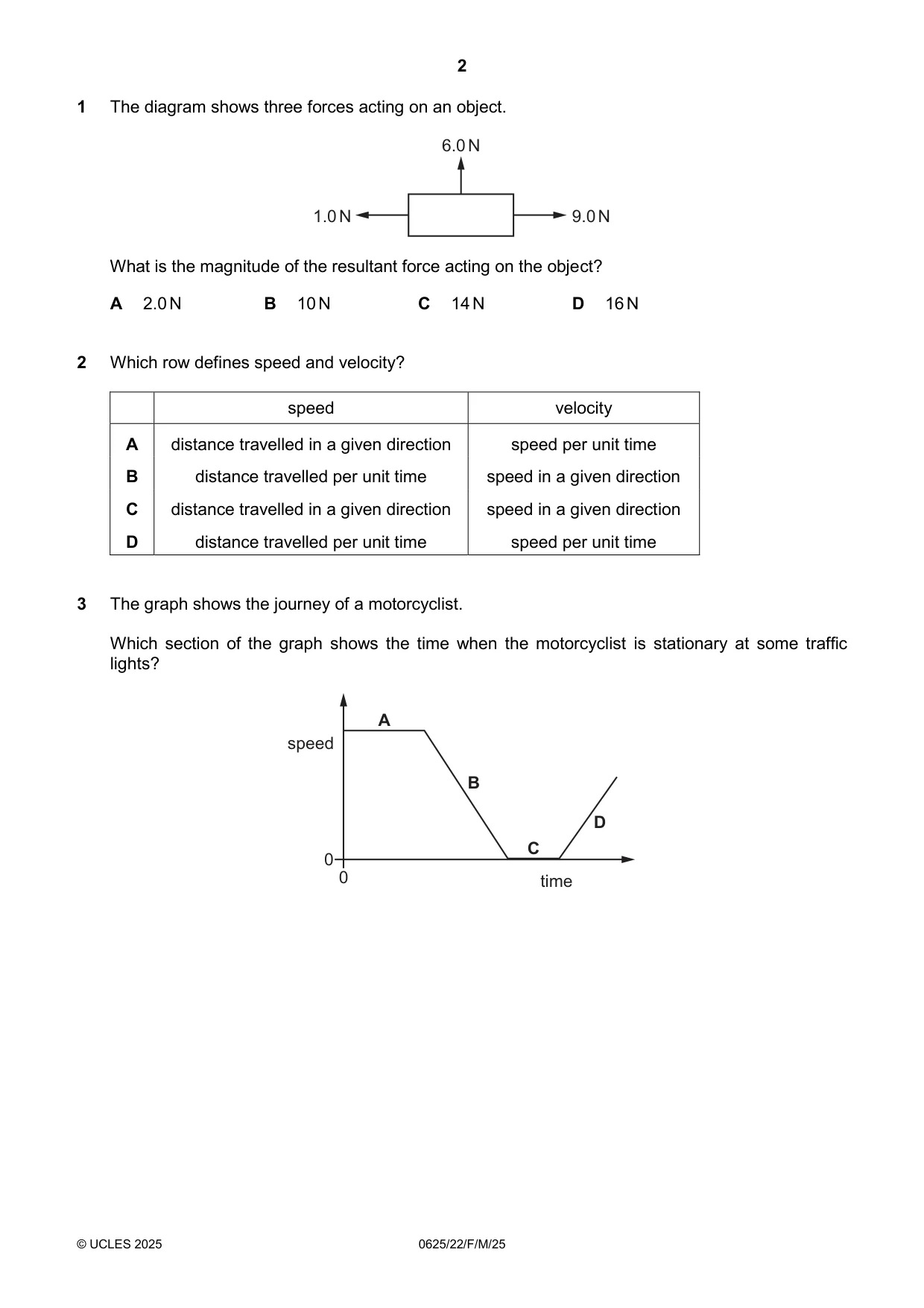
1 The diagram shows three forces acting on an object. 6.0 N 1.0 N 9.0 N What is the magnitude of the resultant force acting on the object? A 2.0 N B 10 N C 14 N D 16 N
Mark scheme: B
Q2 · Which row defines speed and velocity?
2 Which row defines speed and velocity? speed velocity A distance travelled in a given direction speed per unit time B distance travelled per unit time speed in a given direction C distance travelled in a given direction speed in a given direction D distance travelled per unit time speed per unit time
Mark scheme: B
Q3 · The graph shows the journey of a motorcyclist
3 The graph shows the journey of a motorcyclist. Which section of the graph shows the time when the motorcyclist is stationary at some traffic lights? A speed B D C 0 0 time
Mark scheme: C
Q4 · The acceleration of free fall on the Moon has one sixth of its value on the Earth
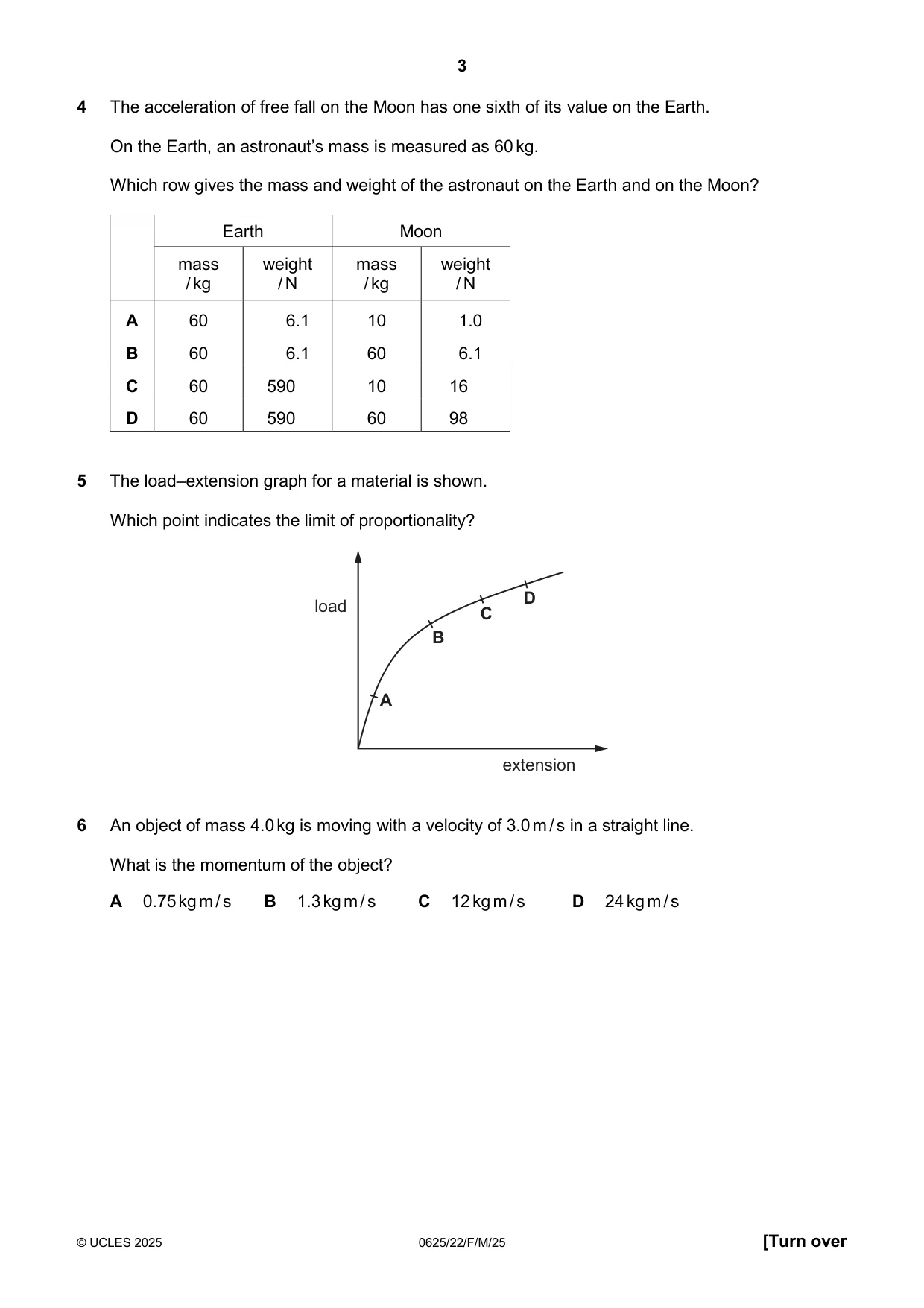
4 The acceleration of free fall on the Moon has one sixth of its value on the Earth. On the Earth, an astronaut’s mass is measured as 60 kg. Which row gives the mass and weight of the astronaut on the Earth and on the Moon? Earth Moon mass weight mass weight / kg / N / kg / N A 60 6.1 10 1.0 B 60 6.1 60 6.1 C 60 590 10 16 D 60 590 60 98
Mark scheme: D
Q5 · The load–extension graph for a material is shown
5 The load–extension graph for a material is shown. Which point indicates the limit of proportionality? D load C B A extension
Mark scheme: A
Q6 · An object of mass 4.0 kg is moving with a velocity of 3.0 m / s in a straight line
6 An object of mass 4.0 kg is moving with a velocity of 3.0 m / s in a straight line. What is the momentum of the object? A 0.75 kg m / s B 1.3 kg m / s C 12 kg m / s D 24 kg m / s
Mark scheme: C
Q7 · A tall cylinder is partly filled with two liquids, which do not mix
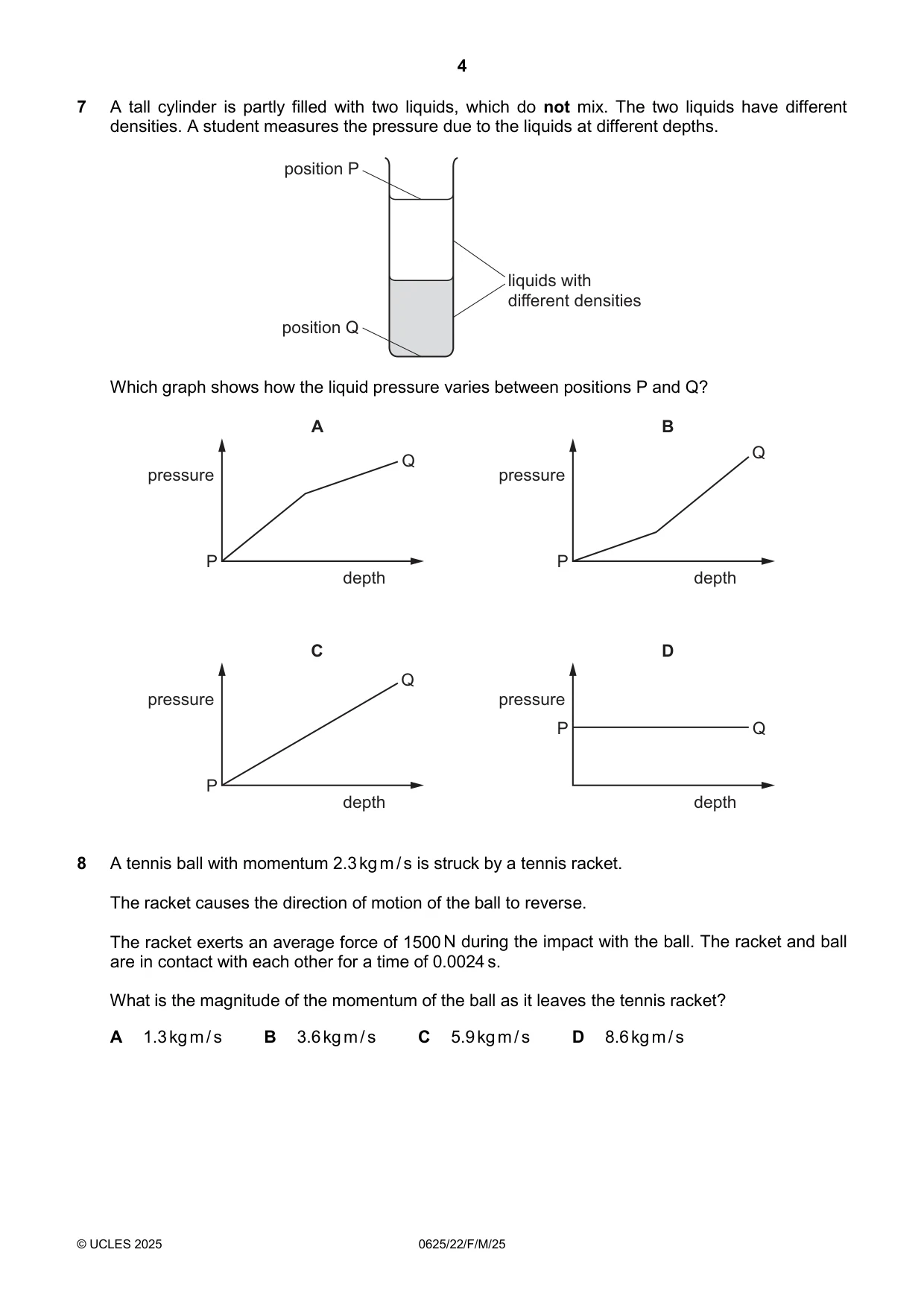
7 A tall cylinder is partly filled with two liquids, which do not mix. The two liquids have different densities. A student measures the pressure due to the liquids at different depths. position P liquids with different densities position Q Which graph shows how the liquid pressure varies between positions P and Q? A B Q Q pressure pressure P P depth depth C D Q pressure pressure P Q P depth depth
Mark scheme: B
Q8 · A tennis ball with momentum 2.3 kg m / s is struck by a tennis racket
8 A tennis ball with momentum 2.3 kg m / s is struck by a tennis racket. The racket causes the direction of motion of the ball to reverse. The racket exerts an average force of 1500 N during the impact with the ball. The racket and ball are in contact with each other for a time of 0.0024 s. What is the magnitude of the momentum of the ball as it leaves the tennis racket? A 1.3 kg m / s B 3.6 kg m / s C 5.9 kg m / s D 8.6 kg m / s
Mark scheme: A
Q9 · A car is travelling at a speed of 8.0 m / s
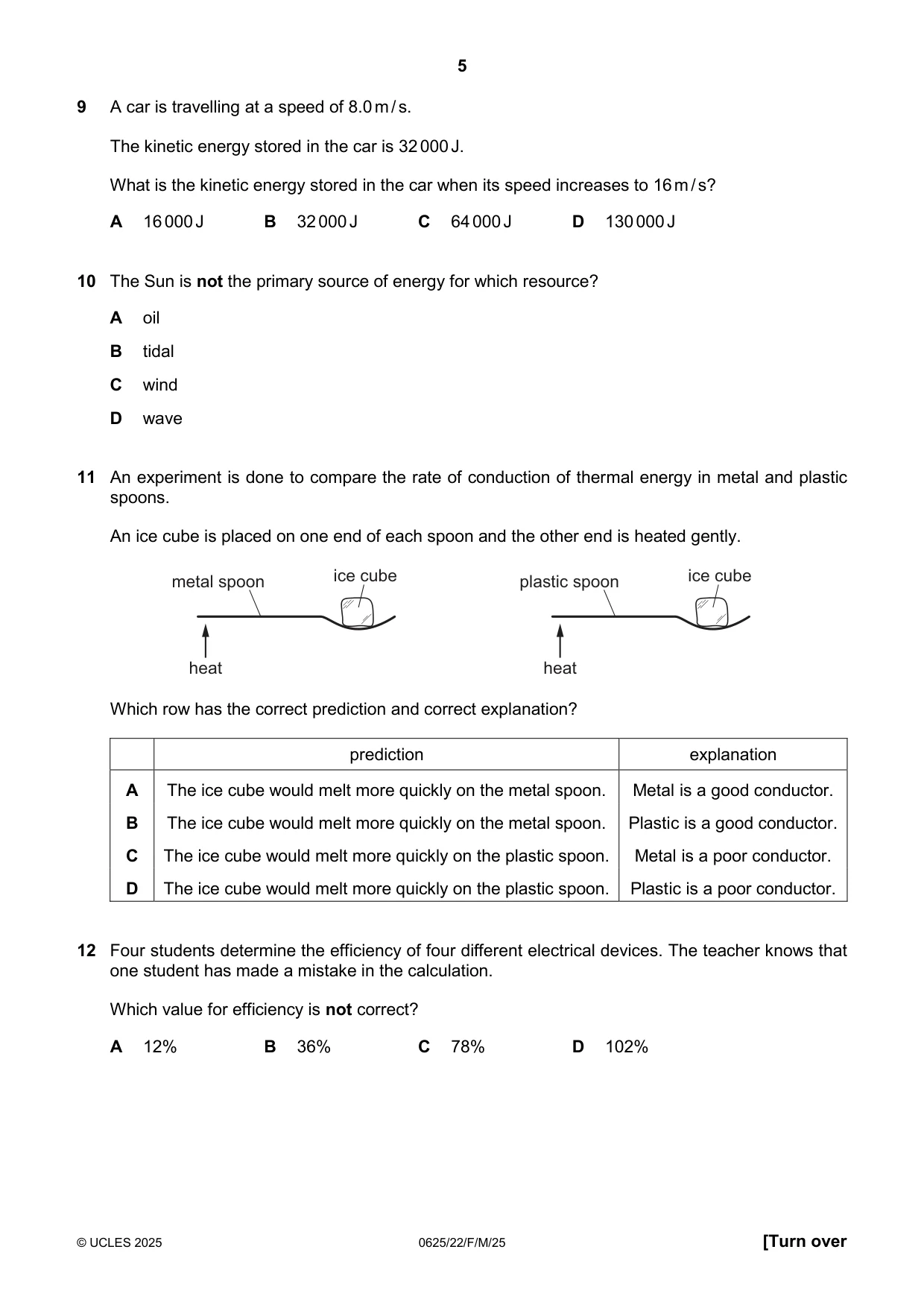
9 A car is travelling at a speed of 8.0 m / s. The kinetic energy stored in the car is 32 000 J. What is the kinetic energy stored in the car when its speed increases to 16 m / s? A 16 000 J B 32 000 J C 64 000 J D 130 000 J
Mark scheme: D
Q10 · The Sun is not the primary source of energy for which resource?
10 The Sun is not the primary source of energy for which resource? A oil B tidal C wind D wave
Mark scheme: B
Q11 · An experiment is done to compare the rate of conduction of thermal energy in metal and…
11 An experiment is done to compare the rate of conduction of thermal energy in metal and plastic spoons. An ice cube is placed on one end of each spoon and the other end is heated gently. metal spoon ice cube plastic spoon ice cube heat heat Which row has the correct prediction and correct explanation? prediction explanation A The ice cube would melt more quickly on the metal spoon. Metal is a good conductor. B The ice cube would melt more quickly on the metal spoon. Plastic is a good conductor. C The ice cube would melt more quickly on the plastic spoon. Metal is a poor conductor. D The ice cube would melt more quickly on the plastic spoon. Plastic is a poor conductor.
Mark scheme: A
Q12 · Four students determine the efficiency of four different electrical devices
12 Four students determine the efficiency of four different electrical devices. The teacher knows that one student has made a mistake in the calculation. Which value for efficiency is not correct? A 12% B 36% C 78% D 102%
Mark scheme: D
Q13 · A sample of gas is sealed inside a container of fixed volume
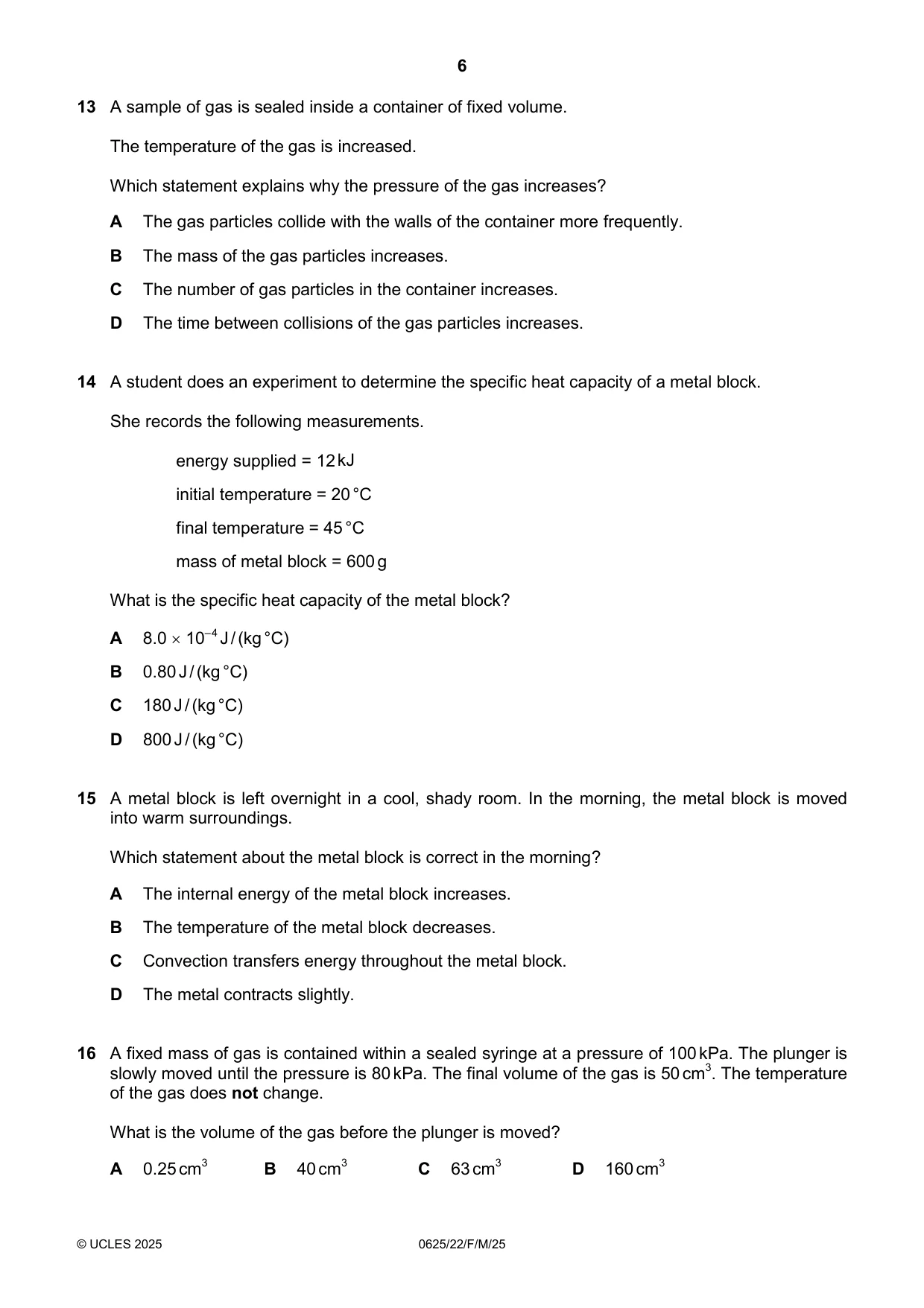
13 A sample of gas is sealed inside a container of fixed volume. The temperature of the gas is increased. Which statement explains why the pressure of the gas increases? A The gas particles collide with the walls of the container more frequently. B The mass of the gas particles increases. C The number of gas particles in the container increases. D The time between collisions of the gas particles increases.
Mark scheme: A
Q14 · A student does an experiment to determine the specific heat capacity of a metal block
14 A student does an experiment to determine the specific heat capacity of a metal block. She records the following measurements. energy supplied = 12 kJ initial temperature = 20 °C final temperature = 45 °C mass of metal block = 600 g What is the specific heat capacity of the metal block? A 8.0 10– 4 J / (kg °C) B 0.80 J / (kg °C) C 180 J / (kg °C) D 800 J / (kg °C)
Mark scheme: D
Q15 · A metal block is left overnight in a cool, shady room
15 A metal block is left overnight in a cool, shady room. In the morning, the metal block is moved into warm surroundings. Which statement about the metal block is correct in the morning? A The internal energy of the metal block increases. B The temperature of the metal block decreases. C Convection transfers energy throughout the metal block. D The metal contracts slightly.
Mark scheme: A
Q16 · A fixed mass of gas is contained within a sealed syringe at a pressure of 100 kPa
16 A fixed mass of gas is contained within a sealed syringe at a pressure of 100 kPa. The plunger is slowly moved until the pressure is 80 kPa. The final volume of the gas is 50 cm3. The temperature of the gas does not change. What is the volume of the gas before the plunger is moved? A 0.25 cm3 B 40 cm3 C 63 cm3 D 160 cm3
Mark scheme: B
Q17 · The diagram shows the more energetic water molecules escaping from the surface of liquid…
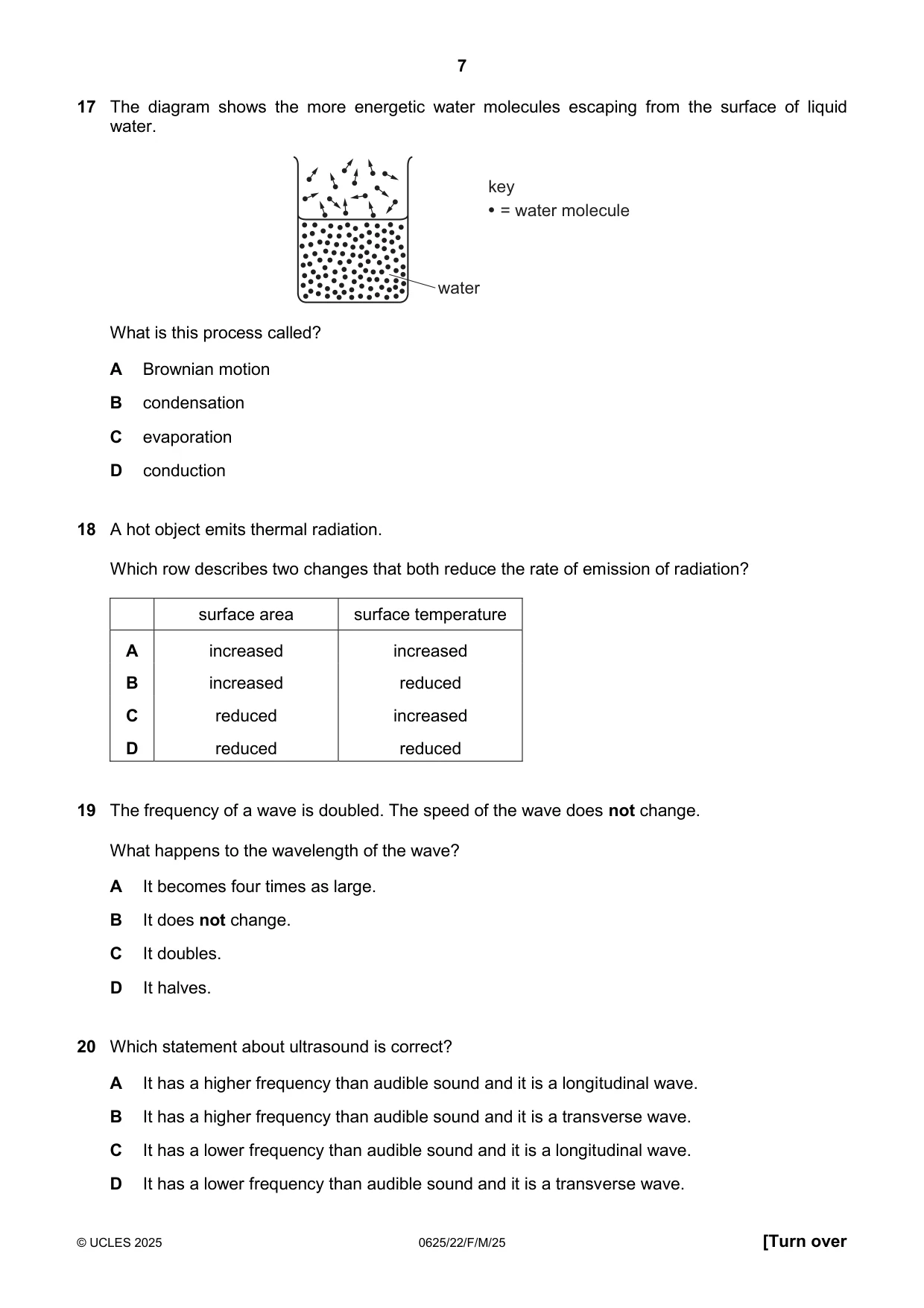
17 The diagram shows the more energetic water molecules escaping from the surface of liquid water. key = water molecule water What is this process called? A Brownian motion B condensation C evaporation D conduction
Mark scheme: C
Q18 · A hot object emits thermal radiation
18 A hot object emits thermal radiation. Which row describes two changes that both reduce the rate of emission of radiation? surface area surface temperature A increased increased B increased reduced C reduced increased D reduced reduced
Mark scheme: D
Q19 · The frequency of a wave is doubled
19 The frequency of a wave is doubled. The speed of the wave does not change. What happens to the wavelength of the wave? A It becomes four times as large. B It does not change. C It doubles. D It halves.
Mark scheme: D
Q20 · Which statement about ultrasound is correct?
20 Which statement about ultrasound is correct? A It has a higher frequency than audible sound and it is a longitudinal wave. B It has a higher frequency than audible sound and it is a transverse wave. C It has a lower frequency than audible sound and it is a longitudinal wave. D It has a lower frequency than audible sound and it is a transverse wave.
Mark scheme: A
Q21 · Which statement about the image produced by a plane mirror is not correct?
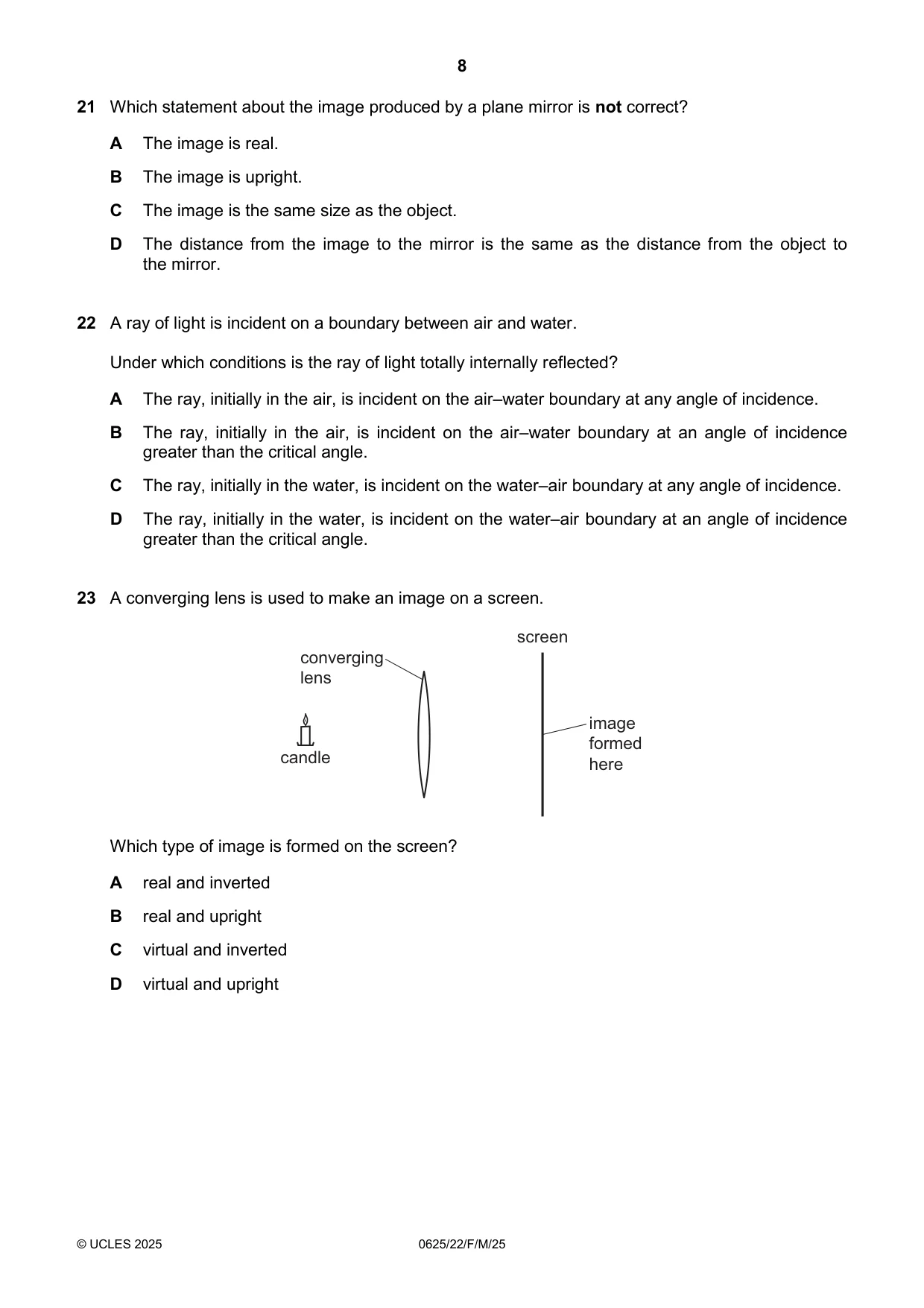
21 Which statement about the image produced by a plane mirror is not correct? A The image is real. B The image is upright. C The image is the same size as the object. D The distance from the image to the mirror is the same as the distance from the object to the mirror.
Mark scheme: A
Q22 · A ray of light is incident on a boundary between air and water
22 A ray of light is incident on a boundary between air and water. Under which conditions is the ray of light totally internally reflected? A The ray, initially in the air, is incident on the air–water boundary at any angle of incidence. B The ray, initially in the air, is incident on the air–water boundary at an angle of incidence greater than the critical angle. C The ray, initially in the water, is incident on the water–air boundary at any angle of incidence. D The ray, initially in the water, is incident on the water–air boundary at an angle of incidence greater than the critical angle.
Mark scheme: D
Q23 · A converging lens is used to make an image on a screen
23 A converging lens is used to make an image on a screen. screen converging lens image formed candle here Which type of image is formed on the screen? A real and inverted B real and upright C virtual and inverted D virtual and upright
Mark scheme: A
Q24 · A negatively charged rod is brought near to a metal sphere
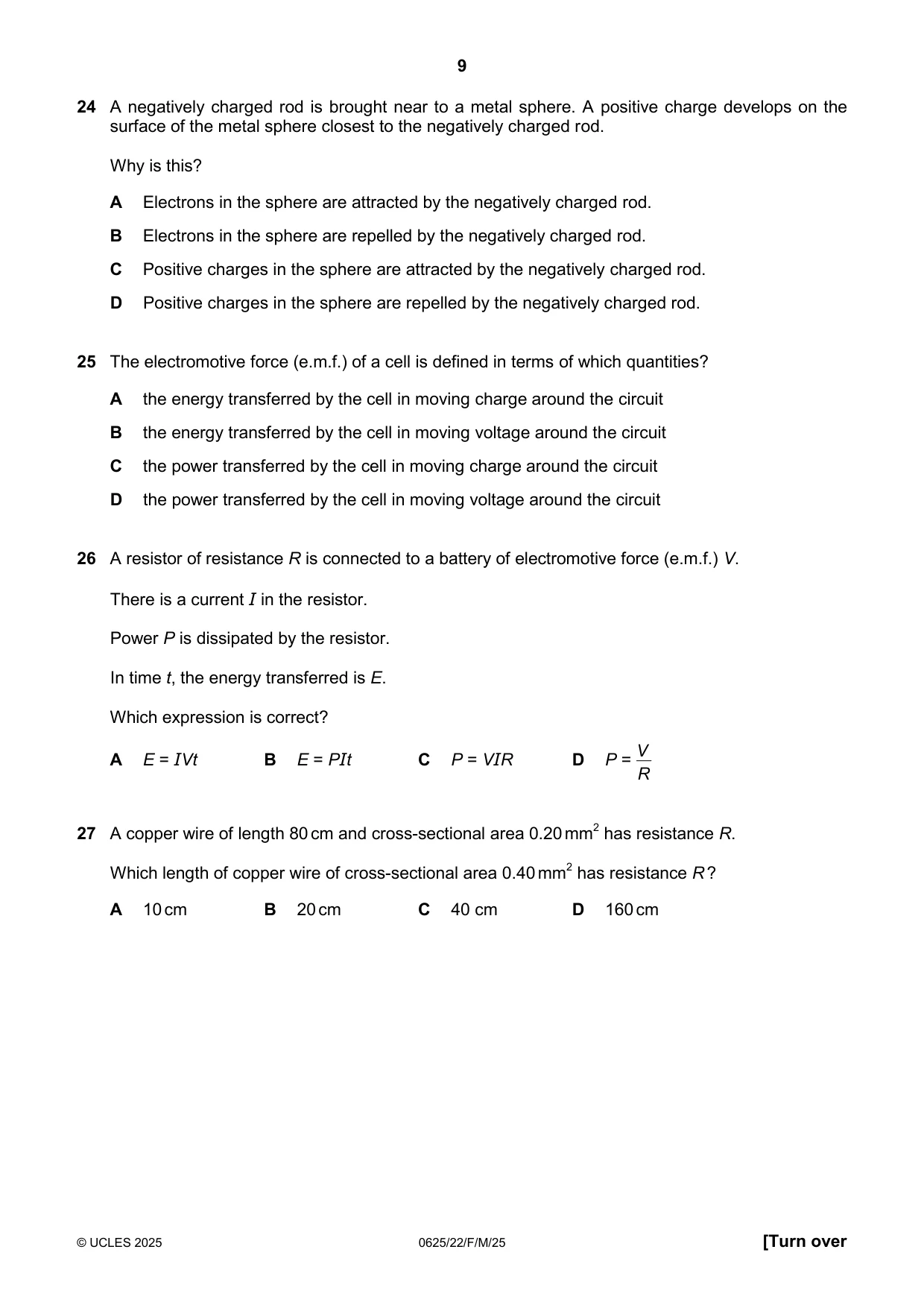
24 A negatively charged rod is brought near to a metal sphere. A positive charge develops on the surface of the metal sphere closest to the negatively charged rod. Why is this? A Electrons in the sphere are attracted by the negatively charged rod. B Electrons in the sphere are repelled by the negatively charged rod. C Positive charges in the sphere are attracted by the negatively charged rod. D Positive charges in the sphere are repelled by the negatively charged rod.
Mark scheme: B
Q25 · The electromotive force (e.m.f.) of a cell is defined in terms of which quantities?
25 The electromotive force (e.m.f.) of a cell is defined in terms of which quantities? A the energy transferred by the cell in moving charge around the circuit B the energy transferred by the cell in moving voltage around the circuit C the power transferred by the cell in moving charge around the circuit D the power transferred by the cell in moving voltage around the circuit
Mark scheme: A
Q26 · A resistor of resistance R is connected to a battery of electromotive force (e.m.f.) V
26 A resistor of resistance R is connected to a battery of electromotive force (e.m.f.) V. There is a current I in the resistor. Power P is dissipated by the resistor. In time t, the energy transferred is E. Which expression is correct? E = IVt E = PIt P = VIR V A B C D P = R
Mark scheme: A
Q27 · A copper wire of length 80 cm and cross-sectional area 0.20 mm2 has resistance R
27 A copper wire of length 80 cm and cross-sectional area 0.20 mm2 has resistance R. Which length of copper wire of cross-sectional area 0.40 mm2 has resistance R ? A 10 cm B 20 cm C 40 cm D 160 cm
Mark scheme: D
Q28 · Four identical resistors are connected to a battery as shown
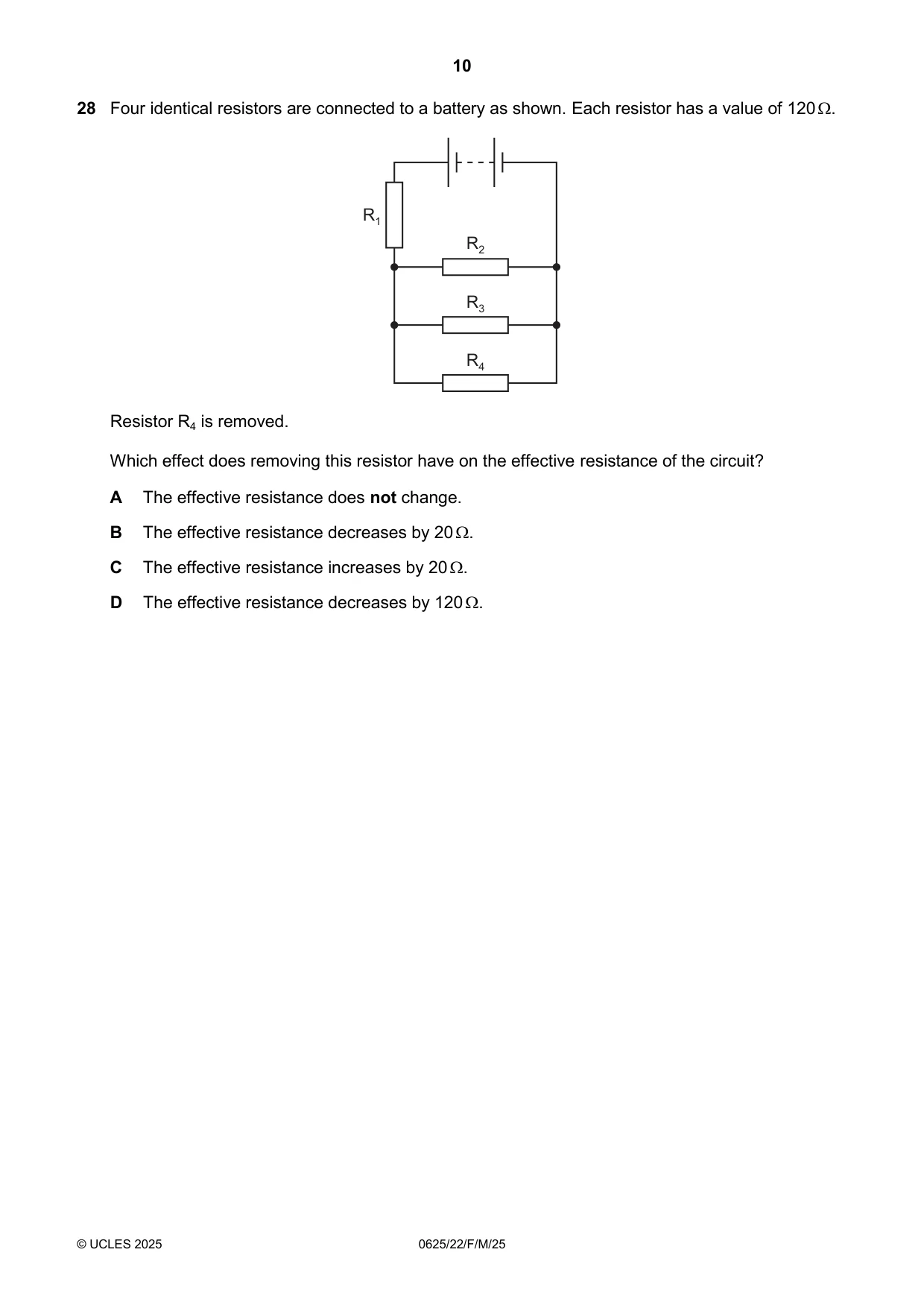
28 Four identical resistors are connected to a battery as shown. Each resistor has a value of 120 . R1 R2 R3 R4 Resistor R4 is removed. Which effect does removing this resistor have on the effective resistance of the circuit? A The effective resistance does not change. B The effective resistance decreases by 20 . C The effective resistance increases by 20 . D The effective resistance decreases by 120 .
Mark scheme: C
Q29 · The resistors in the circuit shown are identical
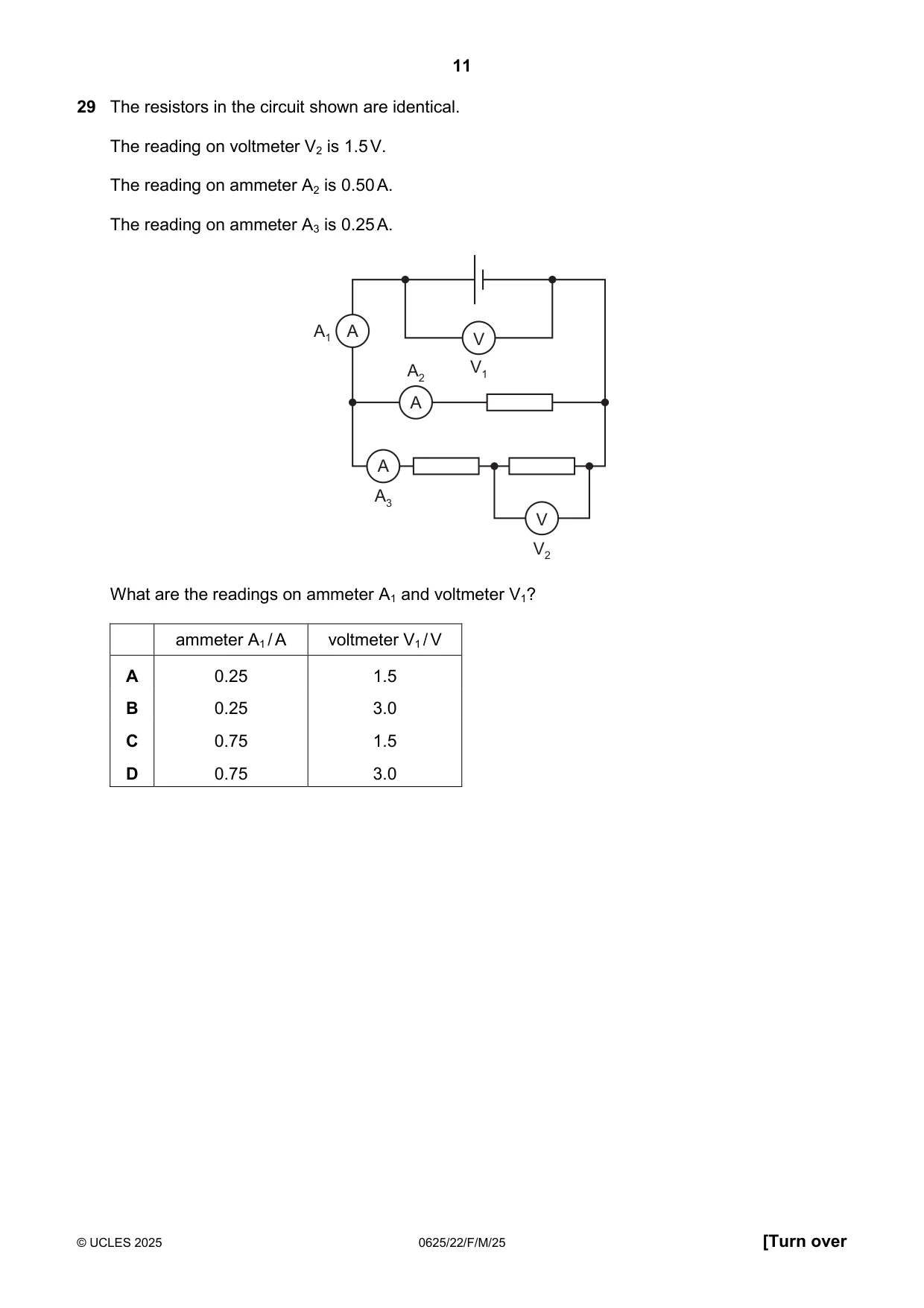
29 The resistors in the circuit shown are identical. The reading on voltmeter V2 is 1.5 V. The reading on ammeter A2 is 0.50 A. The reading on ammeter A3 is 0.25 A. A1 A V A2 V1 A A A3 V V2 What are the readings on ammeter A1 and voltmeter V1? ammeter A1 / A voltmeter V1 / V A 0.25 1.5 B 0.25 3.0 C 0.75 1.5 D 0.75 3.0
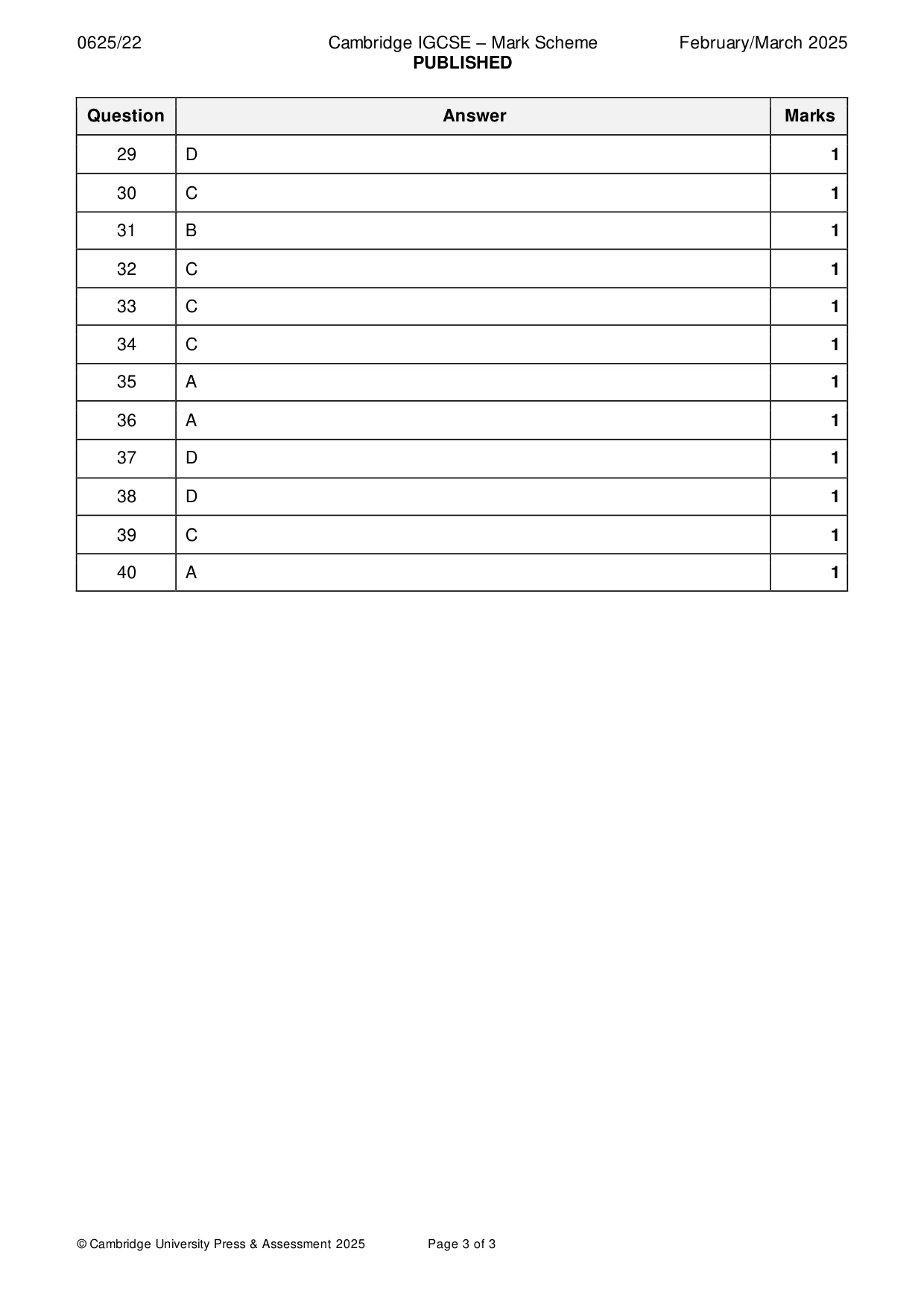
Mark scheme: D
Q30 · A wire is moved in the region between the poles of a magnet
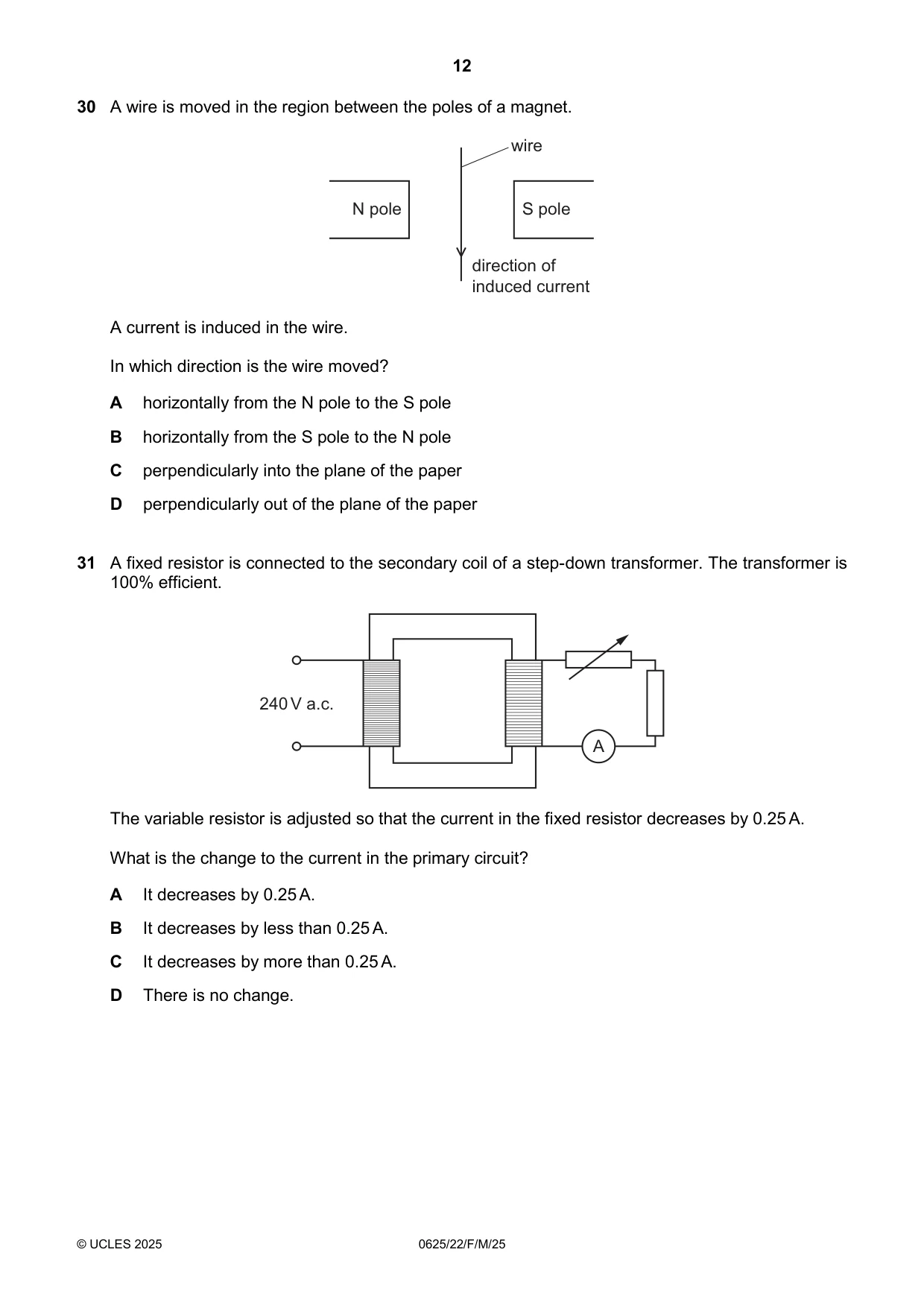
30 A wire is moved in the region between the poles of a magnet. wire N pole S pole direction of induced current A current is induced in the wire. In which direction is the wire moved? A horizontally from the N pole to the S pole B horizontally from the S pole to the N pole C perpendicularly into the plane of the paper D perpendicularly out of the plane of the paper
Mark scheme: C
Q31 · A fixed resistor is connected to the secondary coil of a step-down transformer
31 A fixed resistor is connected to the secondary coil of a step-down transformer. The transformer is 100% efficient. 240 V a.c. A The variable resistor is adjusted so that the current in the fixed resistor decreases by 0.25 A. What is the change to the current in the primary circuit? A It decreases by 0.25 A. B It decreases by less than 0.25 A. C It decreases by more than 0.25 A. D There is no change.
Mark scheme: B
Q32 · An electrical device changes the voltage of an electrical supply from 240 V a.c
32 An electrical device changes the voltage of an electrical supply from 240 V a.c. to 20 V a.c. What is this device? A a generator B a relay C a transformer D a voltmeter
Mark scheme: C
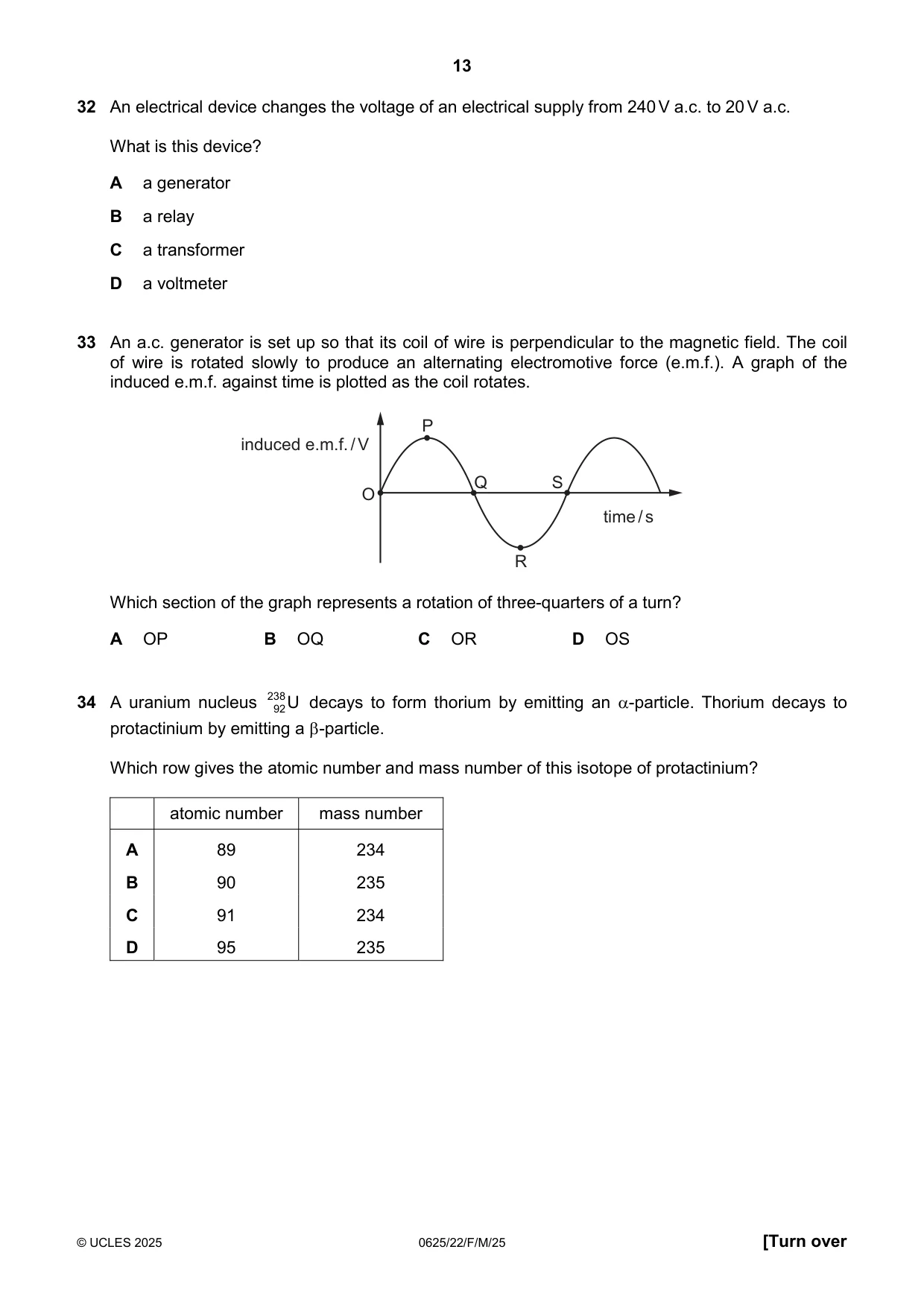
Question 33
33 An a.c. generator is set up so that its coil of wire is perpendicular to the magnetic field. The coil of wire is rotated slowly to produce an alternating electromotive force (e.m.f.). A graph of the induced e.m.f. against time is plotted as the coil rotates. P induced e.m.f. / V Q S O time / s R Which section of the graph represents a rotation of three-quarters of a turn? A OP B OQ C OR D OS
Mark scheme: C
Q34 · A uranium nucleus 238 U decays to form thorium by emitting an -particle
34 A uranium nucleus 238 U decays to form thorium by emitting an -particle. Thorium decays to 92 protactinium by emitting a -particle. Which row gives the atomic number and mass number of this isotope of protactinium? atomic number mass number A 89 234 B 90 235 C 91 234 D 95 235
Mark scheme: C
Q35 · Which row shows what happens when a nucleus decays by emitting a -particle?
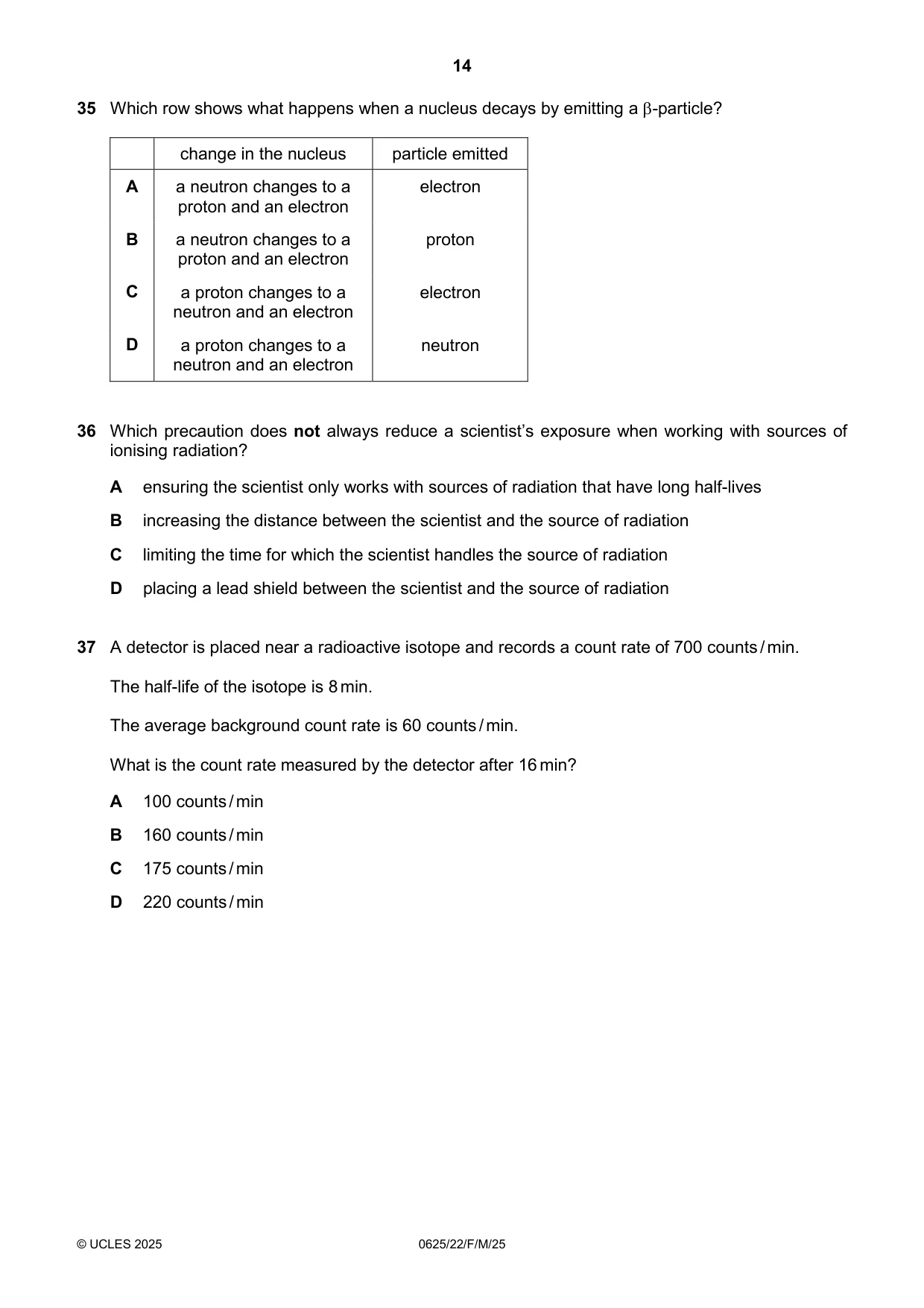
35 Which row shows what happens when a nucleus decays by emitting a -particle? change in the nucleus particle emitted A a neutron changes to a electron proton and an electron B a neutron changes to a proton proton and an electron C a proton changes to a electron neutron and an electron D a proton changes to a neutron neutron and an electron
Mark scheme: A
Q36 · Which precaution does not always reduce a scientist’s exposure when working with sources…
36 Which precaution does not always reduce a scientist’s exposure when working with sources of ionising radiation? A ensuring the scientist only works with sources of radiation that have long half-lives B increasing the distance between the scientist and the source of radiation C limiting the time for which the scientist handles the source of radiation D placing a lead shield between the scientist and the source of radiation
Mark scheme: A
Q37 · A detector is placed near a radioactive isotope and records a count rate of 700 counts /…
37 A detector is placed near a radioactive isotope and records a count rate of 700 counts / min. The half-life of the isotope is 8 min. The average background count rate is 60 counts / min. What is the count rate measured by the detector after 16 min? A 100 counts / min B 160 counts / min C 175 counts / min D 220 counts / min
Mark scheme: D
Q38 · The nucleus of an isotope of nitrogen, N, absorbs a neutron
38 The nucleus of an isotope of nitrogen, N, absorbs a neutron. It then decays into an isotope of carbon, C, and emits x. 1 n + 14 N 14 C + x 0 7 6 What is x? A -particle B -particle C -radiation D proton
Mark scheme: D
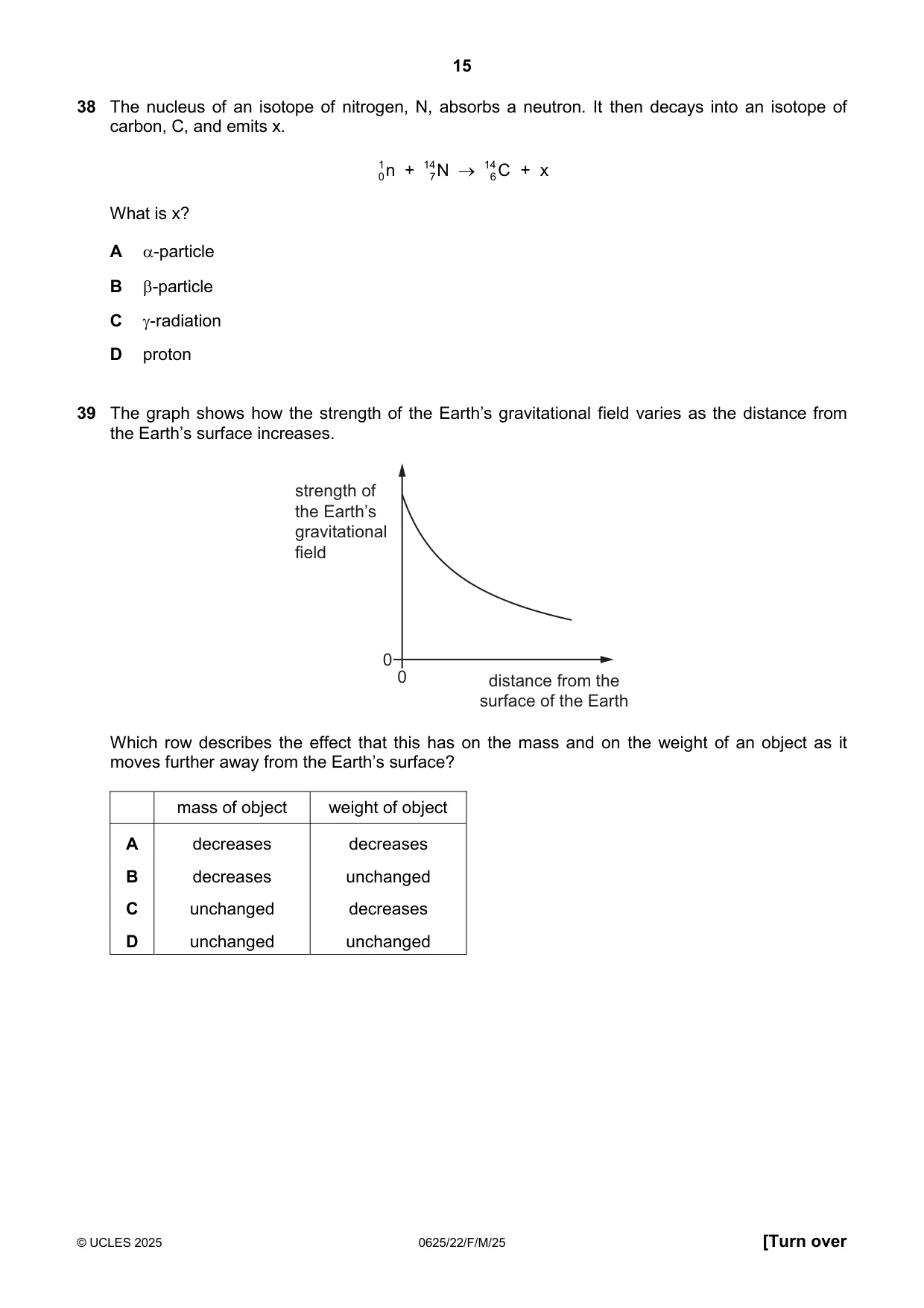
Q39 · The graph shows how the strength of the Earth’s gravitational field varies as the…
39 The graph shows how the strength of the Earth’s gravitational field varies as the distance from the Earth’s surface increases. strength of the Earth’s gravitational field 0 0 distance from the surface of the Earth Which row describes the effect that this has on the mass and on the weight of an object as it moves further away from the Earth’s surface? mass of object weight of object A decreases decreases B decreases unchanged C unchanged decreases D unchanged unchanged
Mark scheme: C
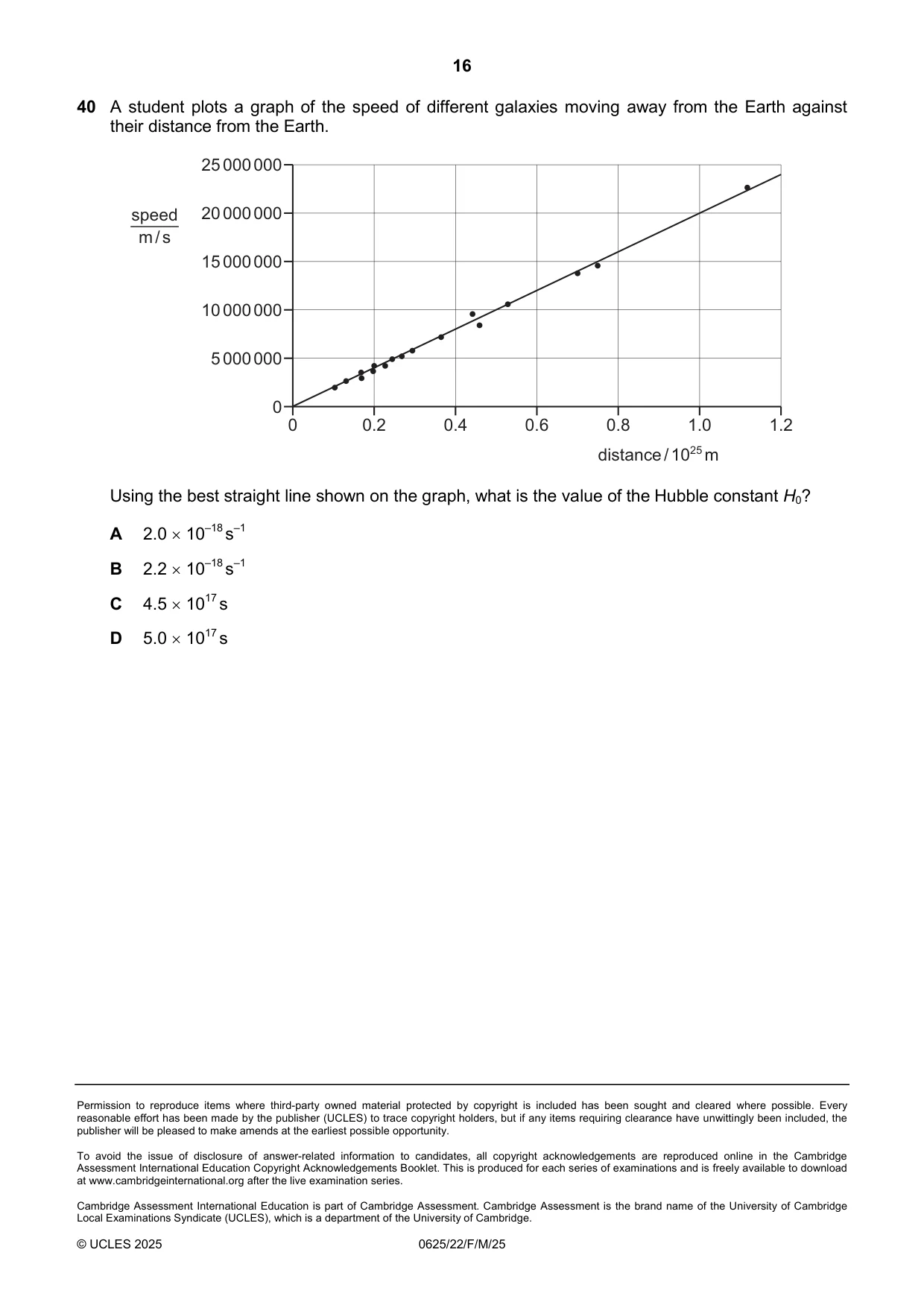
Q40 · A student plots a graph of the speed of different galaxies moving away from the Earth…
40 A student plots a graph of the speed of different galaxies moving away from the Earth against their distance from the Earth. 25 000 000 speed 20 000 000 m / s 15 000 000 10 000 000 5 000 000 0 0 0.2 0.4 0.6 0.8 1.0 1.2 distance / 1025 m Using the best straight line shown on the graph, what is the value of the Hubble constant H0? A 2.0 10–18 s–1 B 2.2 10–18 s–1 C 4.5 1017 s D 5.0 1017 s
Mark scheme: A
What was in this paper
The subtopics covered by these 40 questions, and how many questions each got. Open one in a new tab to see every Cambridge question on it.
5Electromagnetic effects4Electrical quantities3Energy, work and power3Light3Electric circuits2Forces2Kinetic particle model of matter2Mass and weight2Momentum2Motion2Pressure2Thermal properties and temperature2Transfer of thermal energy2General properties of waves1Simple phenomena of magnetism1Sound1Stars and the Universe1What you needed in this session
Cambridge’s own grade thresholds for 2025 Feb/March, Paper 2 · Variant 2. A higher threshold means an easier paper — the bar moves with how the cohort did.