Cambridge IGCSE Physics 0625 — 2021 Feb/March Paper 2 · Variant 2
0625/22/F/M/21 · 40 questions · 40 marks · ≈45 min
The question paper and its mark scheme, free to read here and free to download. This is Cambridge’s own paper, exactly as it was sat.
Question paper16 pages
Mark scheme3 pages
Answers below. Sit the paper first if you are practising.
Questions as text
Q1 · A student has a measuring cylinder containing water and also has a balance
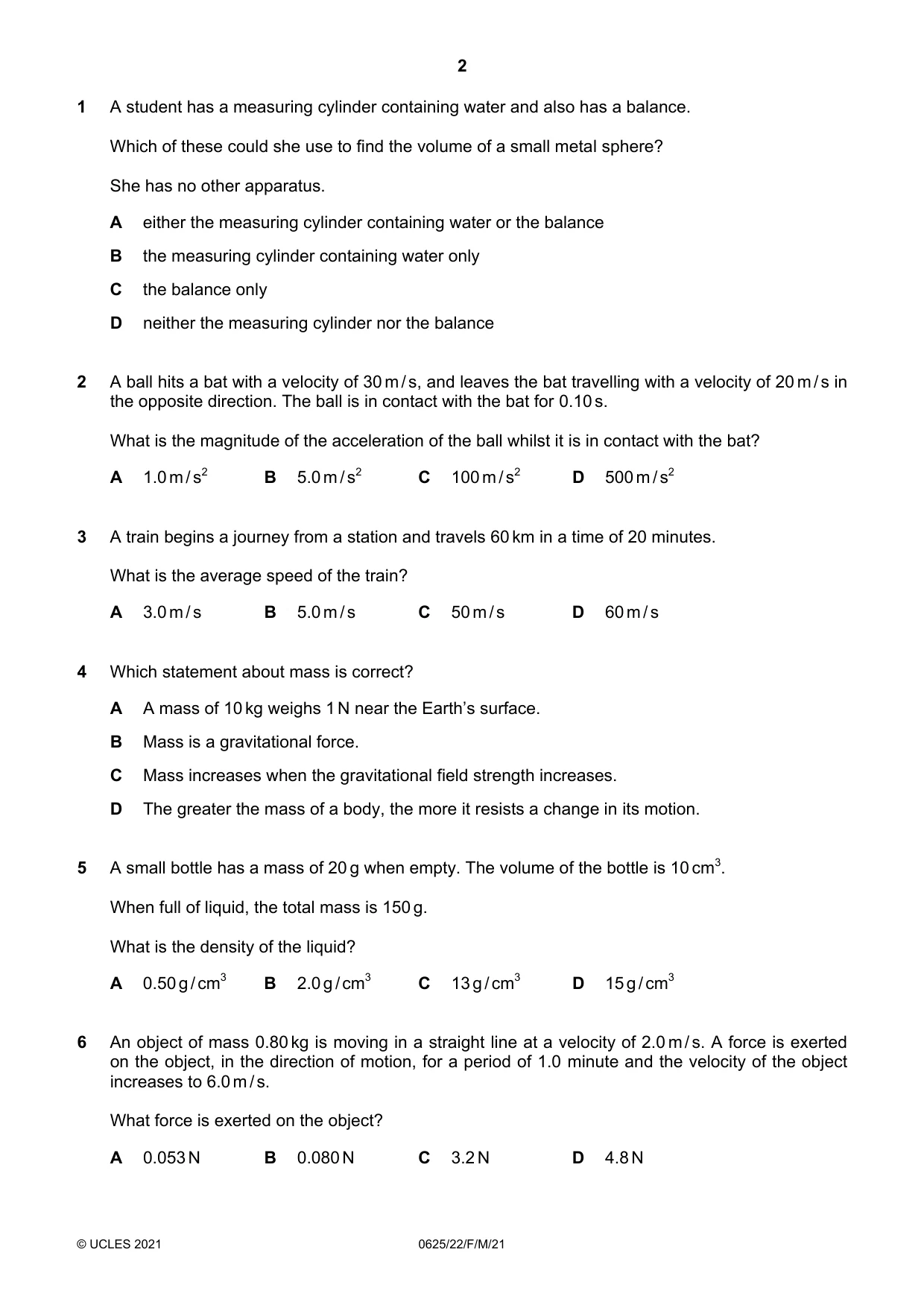
1 A student has a measuring cylinder containing water and also has a balance. Which of these could she use to find the volume of a small metal sphere? She has no other apparatus. A either the measuring cylinder containing water or the balance B the measuring cylinder containing water only C the balance only D neither the measuring cylinder nor the balance
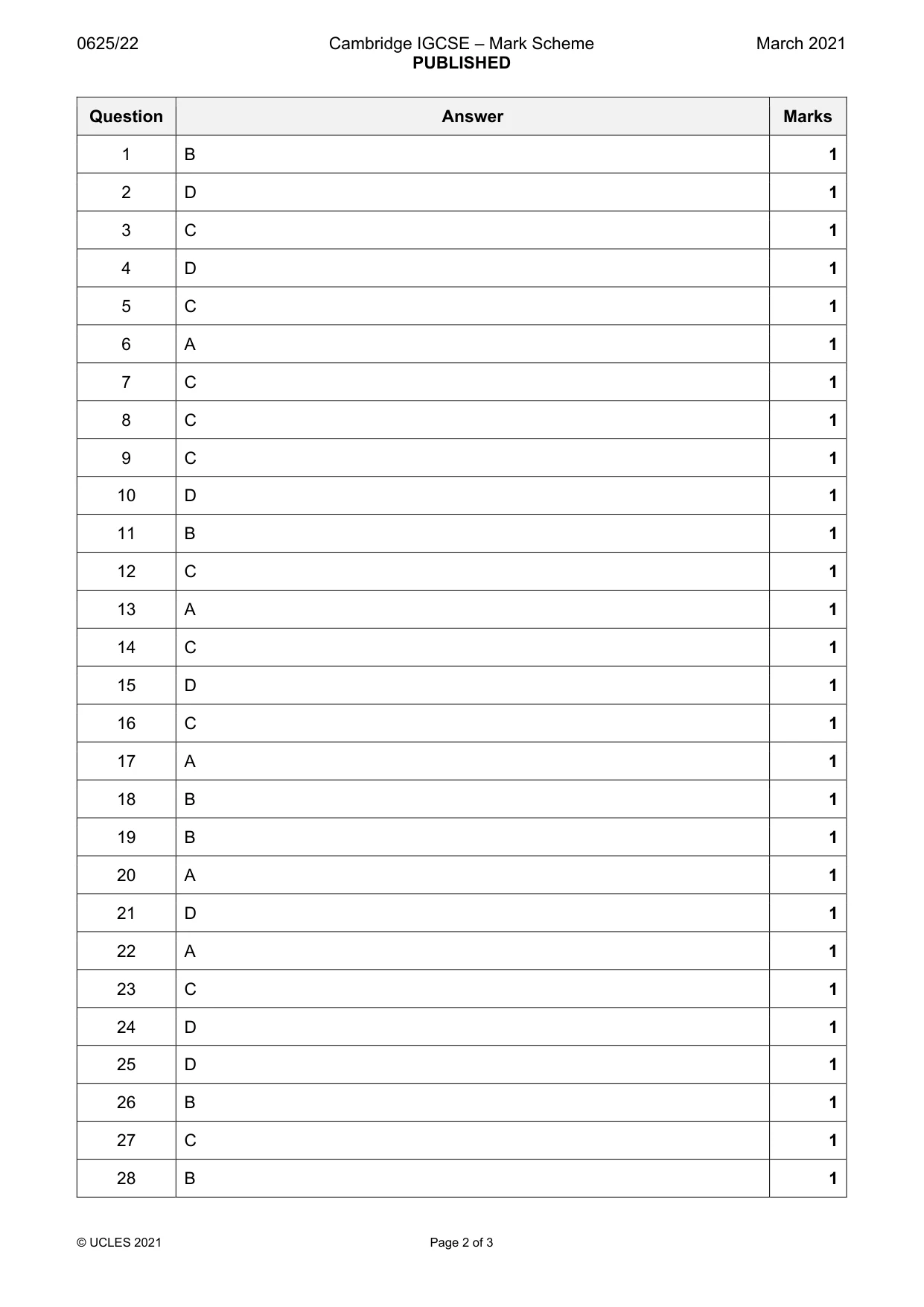
Mark scheme: B
More questions on Physical quantities and measurement techniques
Q2 · A ball hits a bat with a velocity of 30 m / s, and leaves the bat travelling with a…
2 A ball hits a bat with a velocity of 30 m / s, and leaves the bat travelling with a velocity of 20 m / s in the opposite direction. The ball is in contact with the bat for 0.10 s. What is the magnitude of the acceleration of the ball whilst it is in contact with the bat? A 1.0 m / s2 B 5.0 m / s2 C 100 m / s2 D 500 m / s2
Mark scheme: D
Q3 · A train begins a journey from a station and travels 60 km in a time of 20 minutes
3 A train begins a journey from a station and travels 60 km in a time of 20 minutes. What is the average speed of the train? A 3.0 m / s B 5.0 m / s C 50 m / s D 60 m / s
Mark scheme: C
Q4 · Which statement about mass is correct?
4 Which statement about mass is correct? A A mass of 10 kg weighs 1 N near the Earth’s surface. B Mass is a gravitational force. C Mass increases when the gravitational field strength increases. D The greater the mass of a body, the more it resists a change in its motion.
Mark scheme: D
Q5 · A small bottle has a mass of 20 g when empty
5 A small bottle has a mass of 20 g when empty. The volume of the bottle is 10 cm3. When full of liquid, the total mass is 150 g. What is the density of the liquid? A 0.50 g / cm3 B 2.0 g / cm3 C 13 g / cm3 D 15 g / cm3
Mark scheme: C
Q6 · An object of mass 0.80 kg is moving in a straight line at a velocity of 2.0 m / s
6 An object of mass 0.80 kg is moving in a straight line at a velocity of 2.0 m / s. A force is exerted on the object, in the direction of motion, for a period of 1.0 minute and the velocity of the object increases to 6.0 m / s. What force is exerted on the object? A 0.053 N B 0.080 N C 3.2 N D 4.8 N
Mark scheme: A
Q7 · An object moves at constant speed in the circular path shown
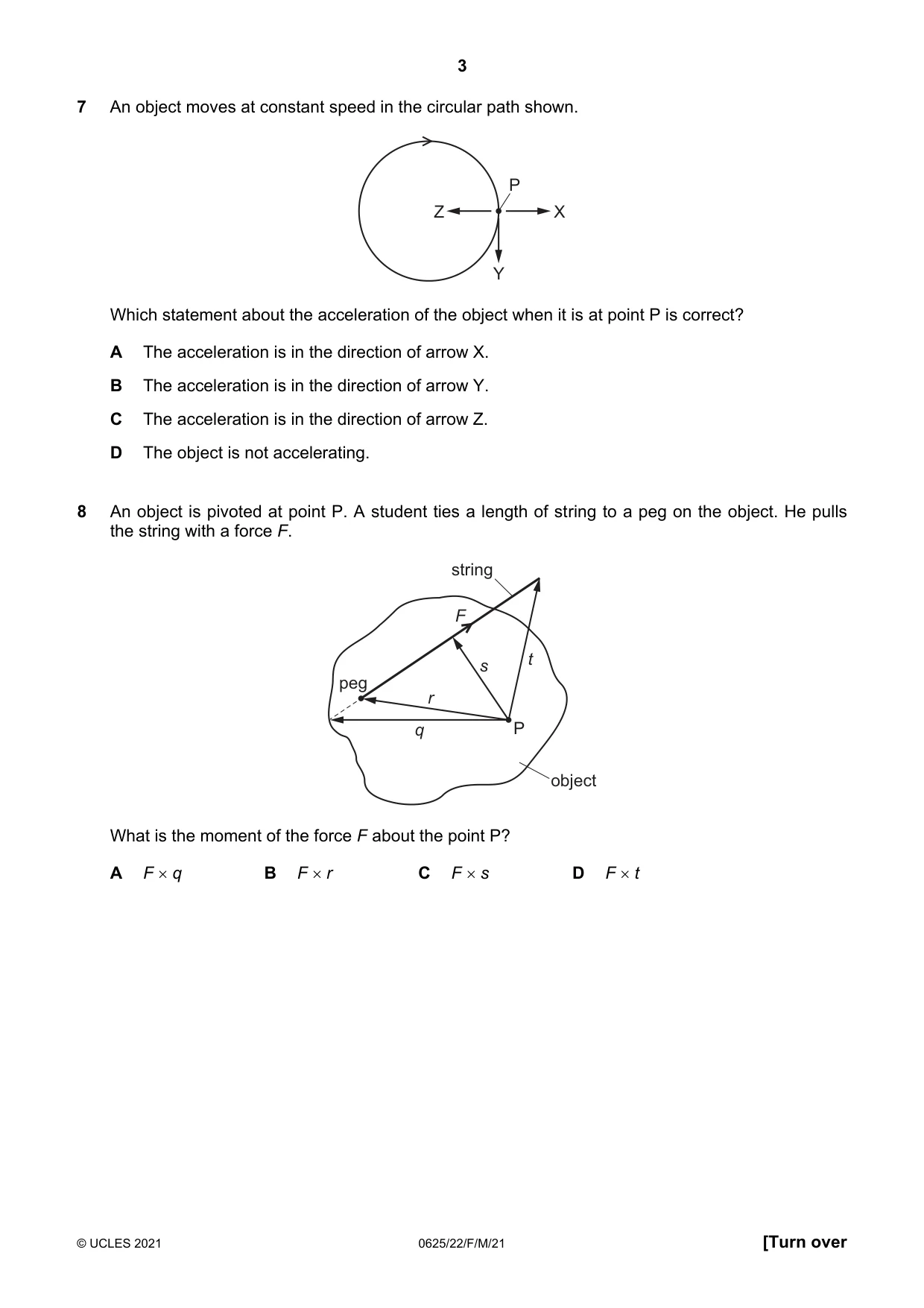
7 An object moves at constant speed in the circular path shown. P Z X Y Which statement about the acceleration of the object when it is at point P is correct? A The acceleration is in the direction of arrow X. B The acceleration is in the direction of arrow Y. C The acceleration is in the direction of arrow Z. D The object is not accelerating.
Mark scheme: C
Q8 · An object is pivoted at point P
8 An object is pivoted at point P. A student ties a length of string to a peg on the object. He pulls the string with a force F. string F s t peg r q P object What is the moment of the force F about the point P? A F q B F r C F s D F t
Mark scheme: C
Q9 · A gas molecule strikes the wall of a container
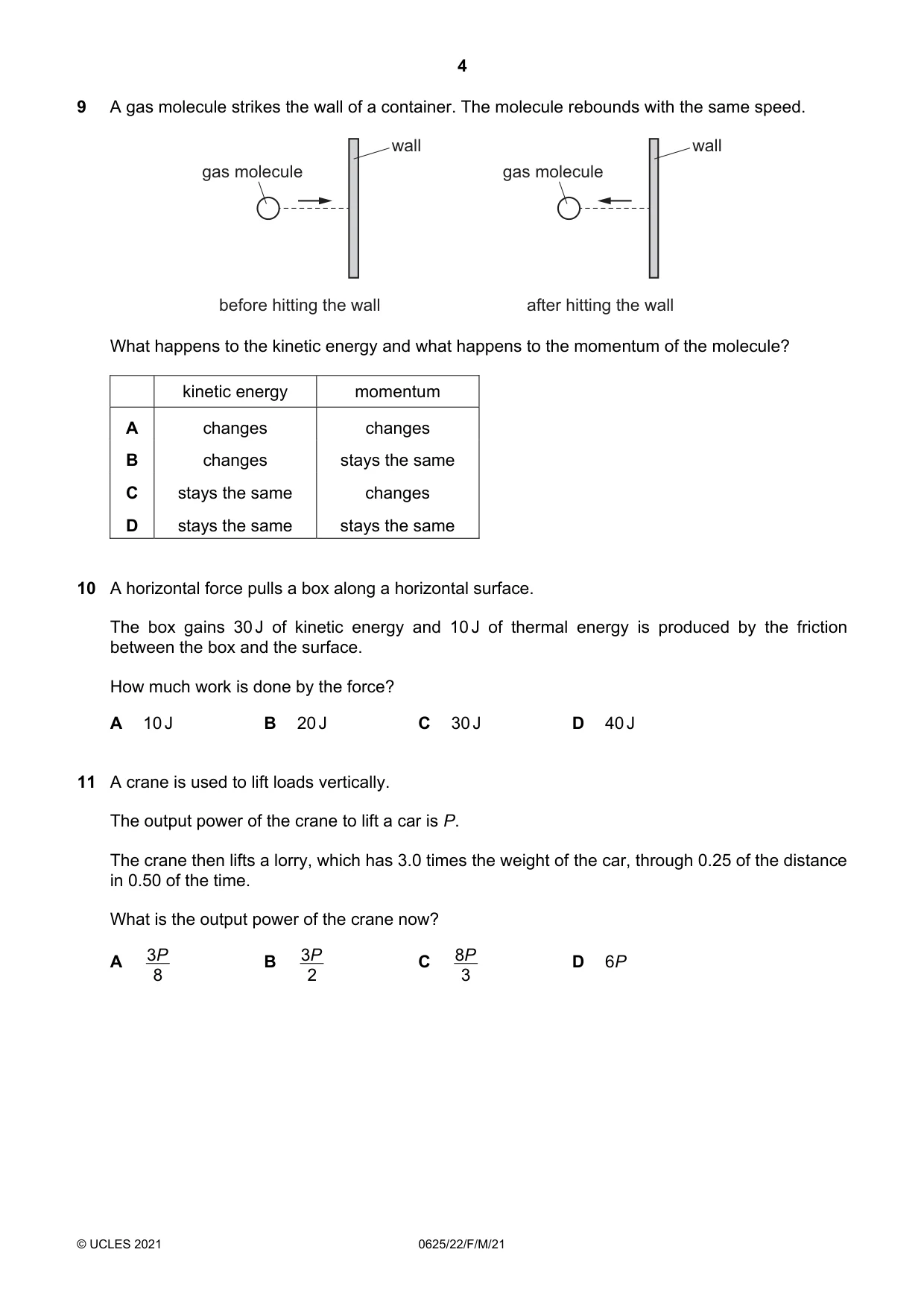
9 A gas molecule strikes the wall of a container. The molecule rebounds with the same speed. wall wall gas molecule gas molecule before hitting the wall after hitting the wall What happens to the kinetic energy and what happens to the momentum of the molecule? kinetic energy momentum A changes changes B changes stays the same C stays the same changes D stays the same stays the same
Mark scheme: C
Q10 · A horizontal force pulls a box along a horizontal surface
10 A horizontal force pulls a box along a horizontal surface. The box gains 30 J of kinetic energy and 10 J of thermal energy is produced by the friction between the box and the surface. How much work is done by the force? A 10 J B 20 J C 30 J D 40 J
Mark scheme: D
Q11 · A crane is used to lift loads vertically
11 A crane is used to lift loads vertically. The output power of the crane to lift a car is P. The crane then lifts a lorry, which has 3.0 times the weight of the car, through 0.25 of the distance in 0.50 of the time. What is the output power of the crane now? A 3 P B 3 P C 8 P D 6P 8 2 3
Mark scheme: B
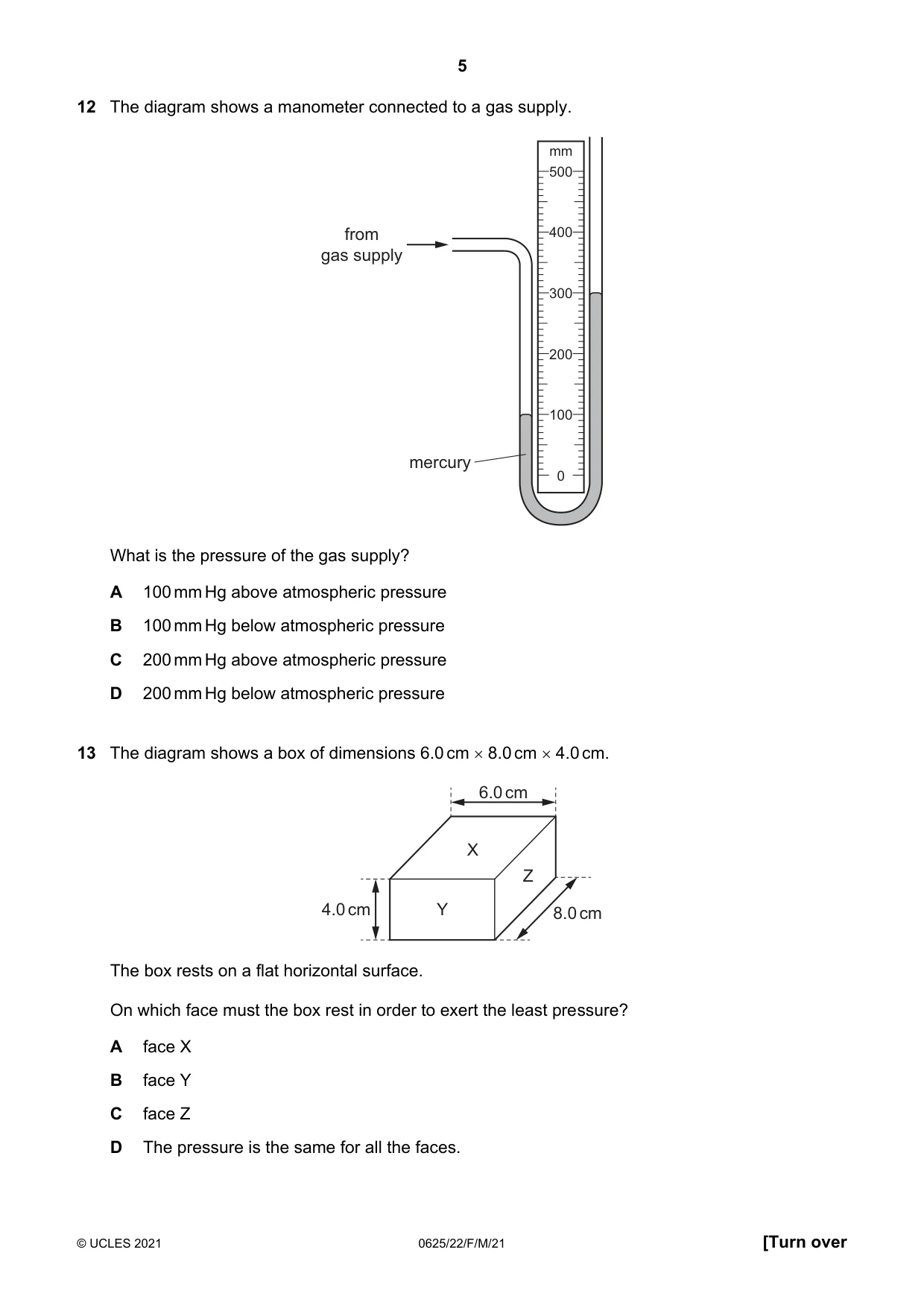
Q12 · The diagram shows a manometer connected to a gas supply
12 The diagram shows a manometer connected to a gas supply. mm 500 from 400 gas supply 300 200 100 mercury 0 What is the pressure of the gas supply? A 100 mm Hg above atmospheric pressure B 100 mm Hg below atmospheric pressure C 200 mm Hg above atmospheric pressure D 200 mm Hg below atmospheric pressure
Mark scheme: C
Q13 · The diagram shows a box of dimensions 6.0 cm 8.0 cm 4.0 cm
13 The diagram shows a box of dimensions 6.0 cm 8.0 cm 4.0 cm. 6.0 cm X Z 4.0 cm Y 8.0 cm The box rests on a flat horizontal surface. On which face must the box rest in order to exert the least pressure? A face X B face Y C face Z D The pressure is the same for all the faces.
Mark scheme: A
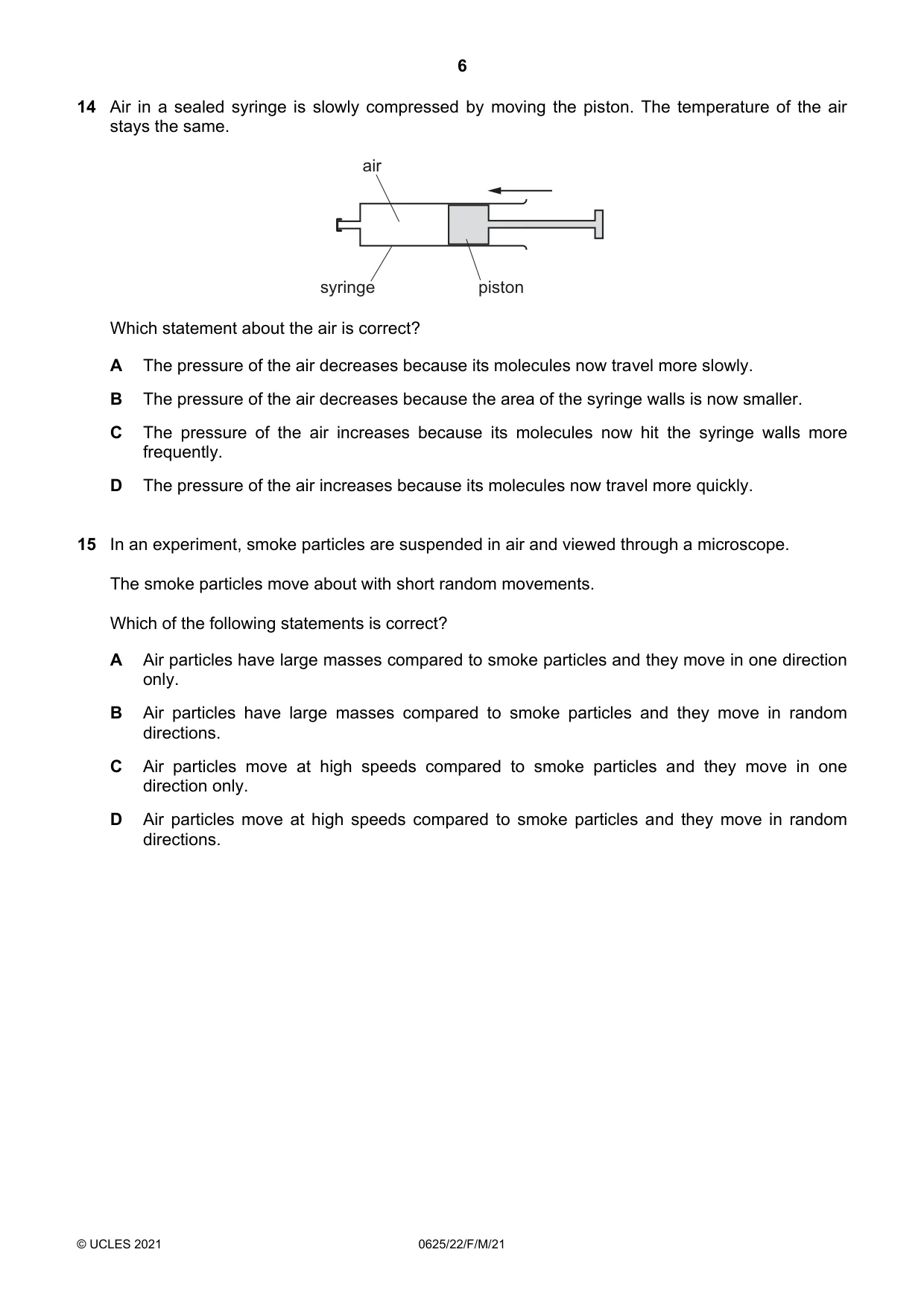
Q14 · Air in a sealed syringe is slowly compressed by moving the piston
14 Air in a sealed syringe is slowly compressed by moving the piston. The temperature of the air stays the same. air syringe piston Which statement about the air is correct? A The pressure of the air decreases because its molecules now travel more slowly. B The pressure of the air decreases because the area of the syringe walls is now smaller. C The pressure of the air increases because its molecules now hit the syringe walls more frequently. D The pressure of the air increases because its molecules now travel more quickly.
Mark scheme: C
Q15 · In an experiment, smoke particles are suspended in air and viewed through a microscope
15 In an experiment, smoke particles are suspended in air and viewed through a microscope. The smoke particles move about with short random movements. Which of the following statements is correct? A Air particles have large masses compared to smoke particles and they move in one direction only. B Air particles have large masses compared to smoke particles and they move in random directions. C Air particles move at high speeds compared to smoke particles and they move in one direction only. D Air particles move at high speeds compared to smoke particles and they move in random directions.
Mark scheme: D
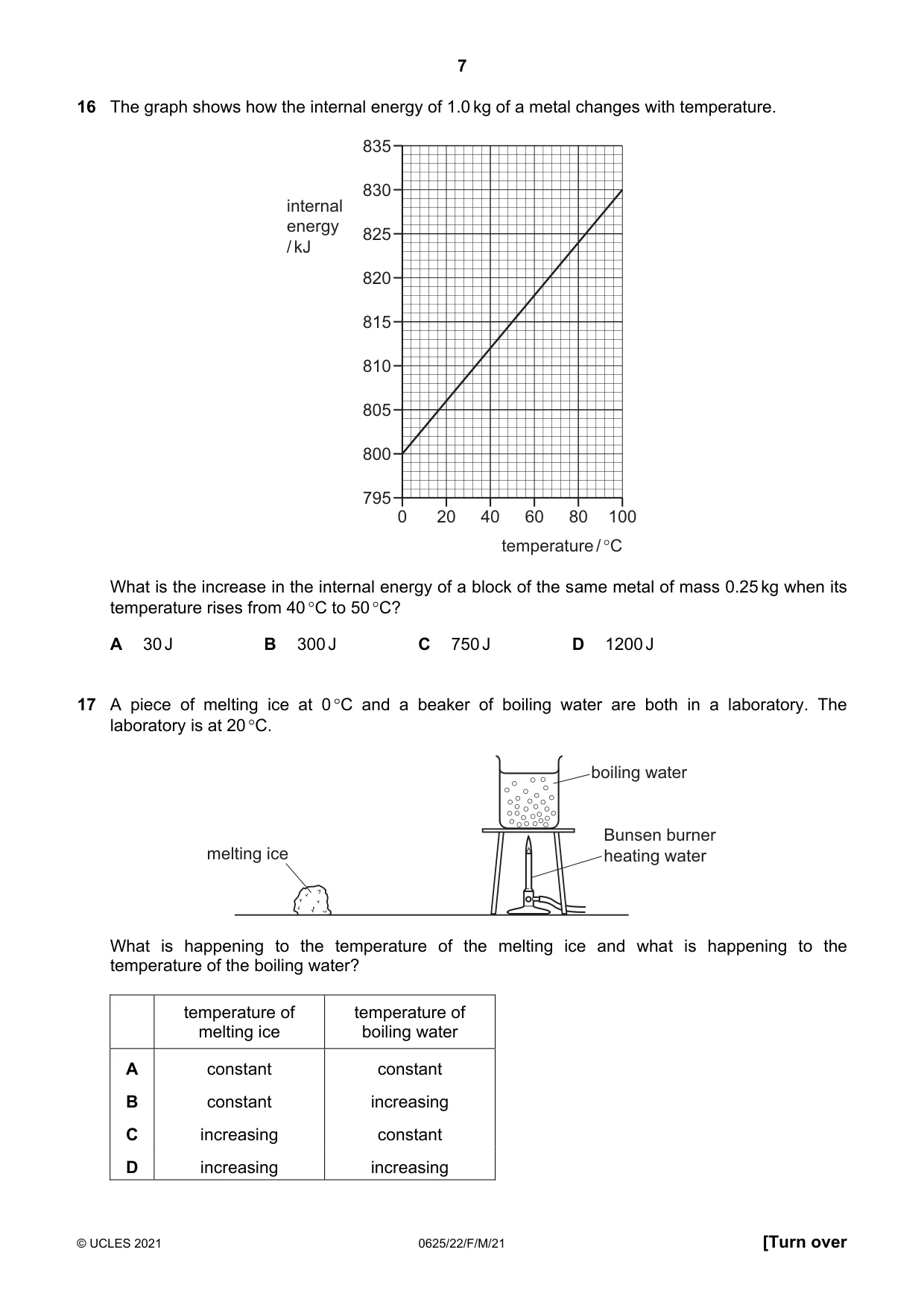
Q16 · The graph shows how the internal energy of 1.0 kg of a metal changes with temperature
16 The graph shows how the internal energy of 1.0 kg of a metal changes with temperature. 835 830 internal energy 825 / kJ 820 815 810 805 800 795 0 20 40 60 80 100 temperature / °C What is the increase in the internal energy of a block of the same metal of mass 0.25 kg when its temperature rises from 40 C to 50 C? A 30 J B 300 J C 750 J D 1200 J
Mark scheme: C
Q17 · A piece of melting ice at 0 C and a beaker of boiling water are both in a laboratory
17 A piece of melting ice at 0 C and a beaker of boiling water are both in a laboratory. The laboratory is at 20 C. boiling water Bunsen burner melting ice heating water What is happening to the temperature of the melting ice and what is happening to the temperature of the boiling water? temperature of temperature of melting ice boiling water A constant constant B constant increasing C increasing constant D increasing increasing
Mark scheme: A
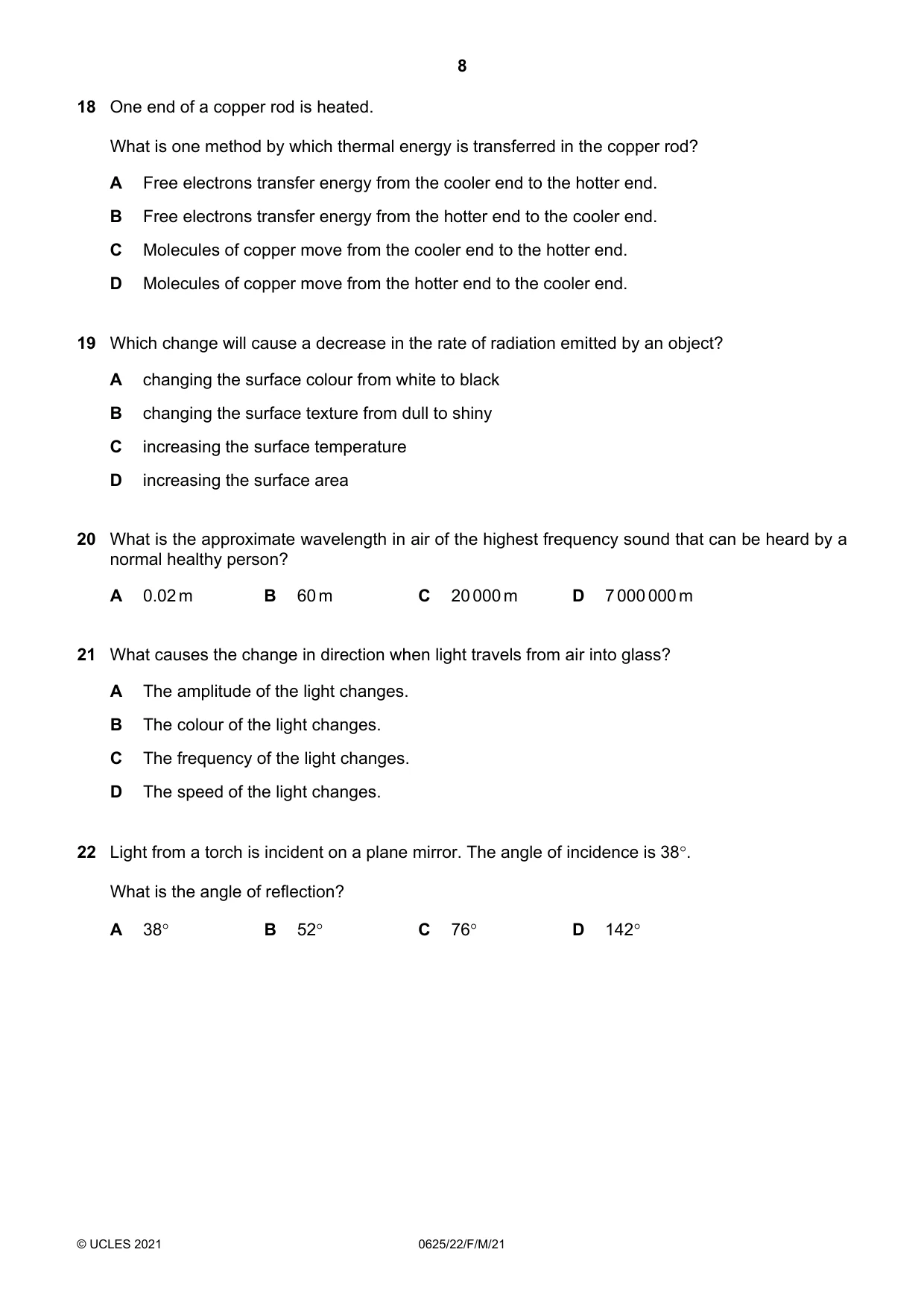
Q18 · One end of a copper rod is heated
18 One end of a copper rod is heated. What is one method by which thermal energy is transferred in the copper rod? A Free electrons transfer energy from the cooler end to the hotter end. B Free electrons transfer energy from the hotter end to the cooler end. C Molecules of copper move from the cooler end to the hotter end. D Molecules of copper move from the hotter end to the cooler end.
Mark scheme: B
Q19 · Which change will cause a decrease in the rate of radiation emitted by an object?
19 Which change will cause a decrease in the rate of radiation emitted by an object? A changing the surface colour from white to black B changing the surface texture from dull to shiny C increasing the surface temperature D increasing the surface area
Mark scheme: B
Q20 · What is the approximate wavelength in air of the highest frequency sound that can be…
20 What is the approximate wavelength in air of the highest frequency sound that can be heard by a normal healthy person? A 0.02 m B 60 m C 20 000 m D 7 000 000 m
Mark scheme: A
Q21 · What causes the change in direction when light travels from air into glass?
21 What causes the change in direction when light travels from air into glass? A The amplitude of the light changes. B The colour of the light changes. C The frequency of the light changes. D The speed of the light changes.
Mark scheme: D
Q22 · Light from a torch is incident on a plane mirror
22 Light from a torch is incident on a plane mirror. The angle of incidence is 38. What is the angle of reflection? A 38 B 52 C 76 D 142
Mark scheme: A
Q23 · Two rays with an angle of incidence of 60° pass into dilute and concentrated sugar-water…
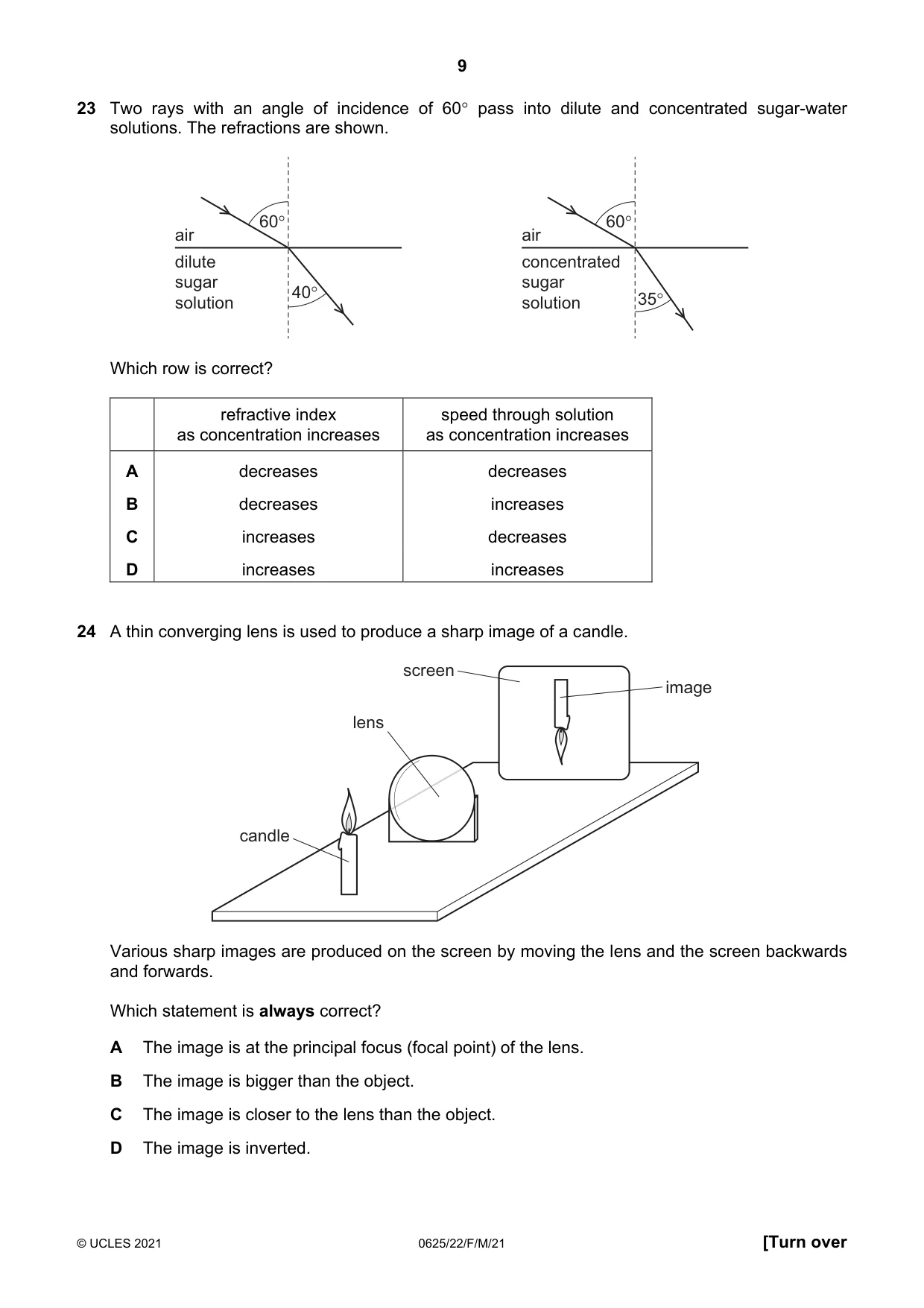
23 Two rays with an angle of incidence of 60° pass into dilute and concentrated sugar-water solutions. The refractions are shown. ; 1 i} I i} I 60°! 60°: . i} . I air air dilute concentrated | sugar A> sugar solution solution 135° i} I i} I i} I Which row is correct? refractive index speed through solution as concentration increases as concentration increases A decreases decreases B decreases increases Cc increases decreases D increases increases
Mark scheme: C
Q24 · A thin converging lens is used to produce a sharp image of a candle
24 A thin converging lens is used to produce a sharp image of a candle. screen image lens candle Various sharp images are produced on the screen by moving the lens and the screen backwards and forwards. Which statement is always correct? A The image is at the principal focus (focal point) of the lens. B The image is bigger than the object. C The image is closer to the lens than the object. D The image is inverted.
Mark scheme: D
Q25 · Which row gives the approximate speeds at which ultraviolet waves travel in air and in a…
25 Which row gives the approximate speeds at which ultraviolet waves travel in air and in a vacuum? speed in air speed in a vacuum m /s m /s A 340 3.0 108 B 340 340 C 3.0 108 340 D 3.0 108 3.0 108
Mark scheme: D
Q26 · The diagram represents a sound wave
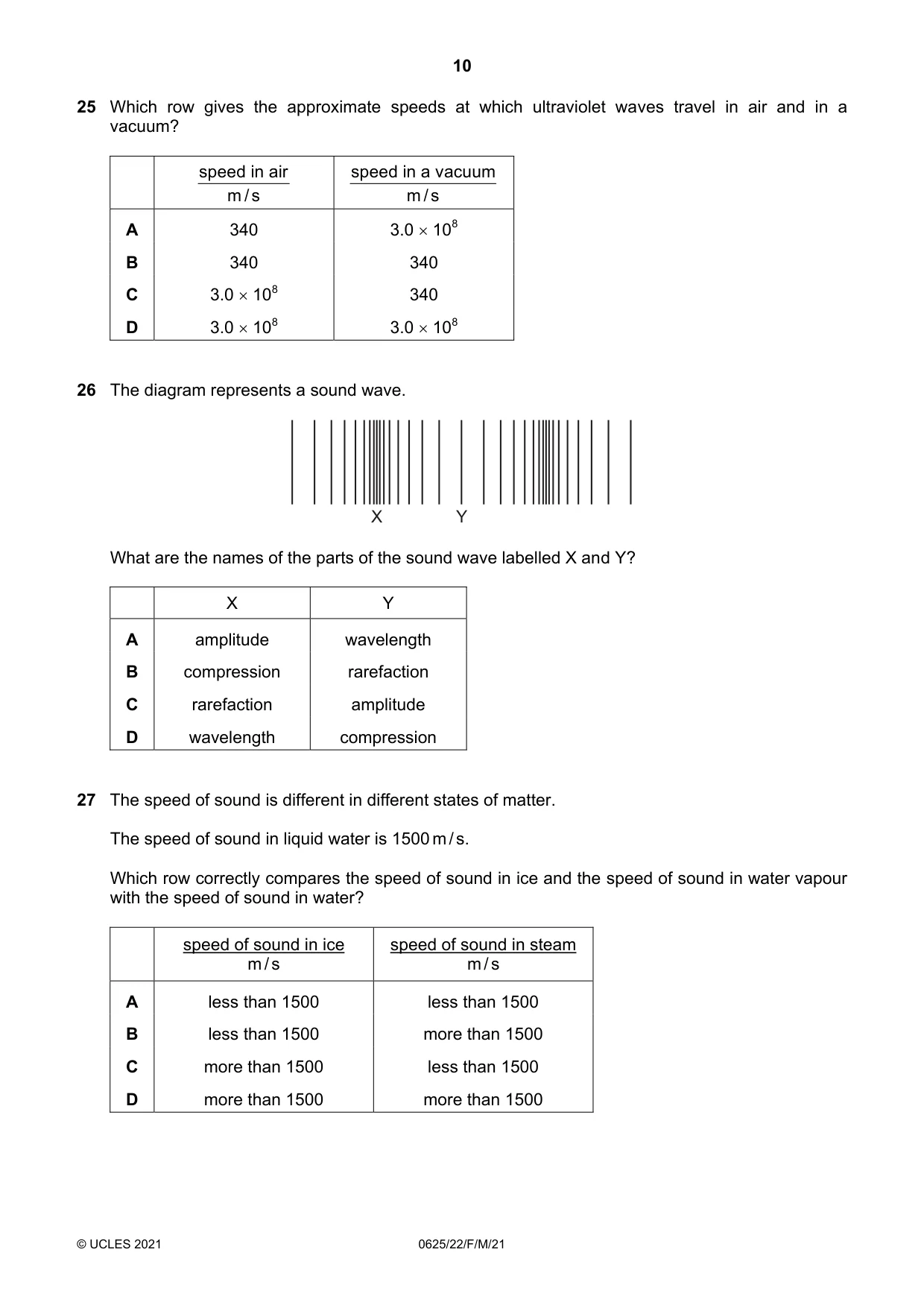
26 The diagram represents a sound wave. X Y What are the names of the parts of the sound wave labelled X and Y? X Y A amplitude wavelength B compression rarefaction C rarefaction amplitude D wavelength compression
Mark scheme: B
Q27 · The speed of sound is different in different states of matter
27 The speed of sound is different in different states of matter. The speed of sound in liquid water is 1500 m / s. Which row correctly compares the speed of sound in ice and the speed of sound in water vapour with the speed of sound in water? speed of sound in ice speed of sound in steam m / s m / s A less than 1500 less than 1500 B less than 1500 more than 1500 C more than 1500 less than 1500 D more than 1500 more than 1500
Mark scheme: C
Q28 · Three methods to demagnetise a magnet are suggested
28 Three methods to demagnetise a magnet are suggested. The magnet is in an east-west direction. 1 hitting the magnet repeatedly with a hammer 2 heating the magnet until red hot 3 withdrawing the magnet from a coil which has a direct current (d.c.) in it Which methods demagnetise the magnet? A 1, 2 and 3 B 1 and 2 only C 1 and 3 only D 2 and 3 only
Mark scheme: B
Q29 · Three cores of different metals P, Q and R are placed inside identical coils of wire
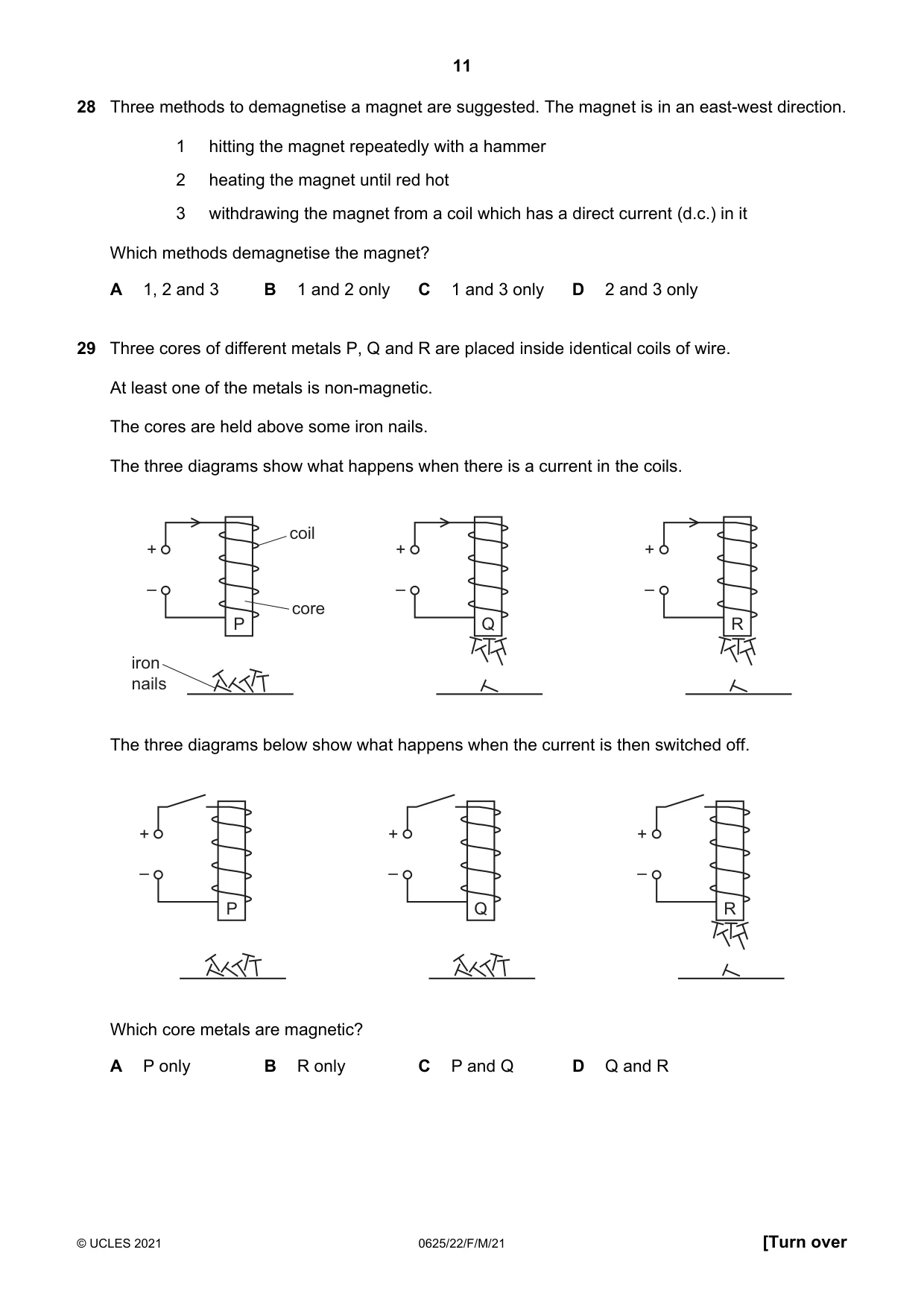
29 Three cores of different metals P, Q and R are placed inside identical coils of wire. At least one of the metals is non-magnetic. The cores are held above some iron nails. The three diagrams show what happens when there is a current in the coils. coil + + + – – – core P Q R iron nails The three diagrams below show what happens when the current is then switched off. + + + – – – P Q R Which core metals are magnetic? A P only B R only C P and Q D Q and R
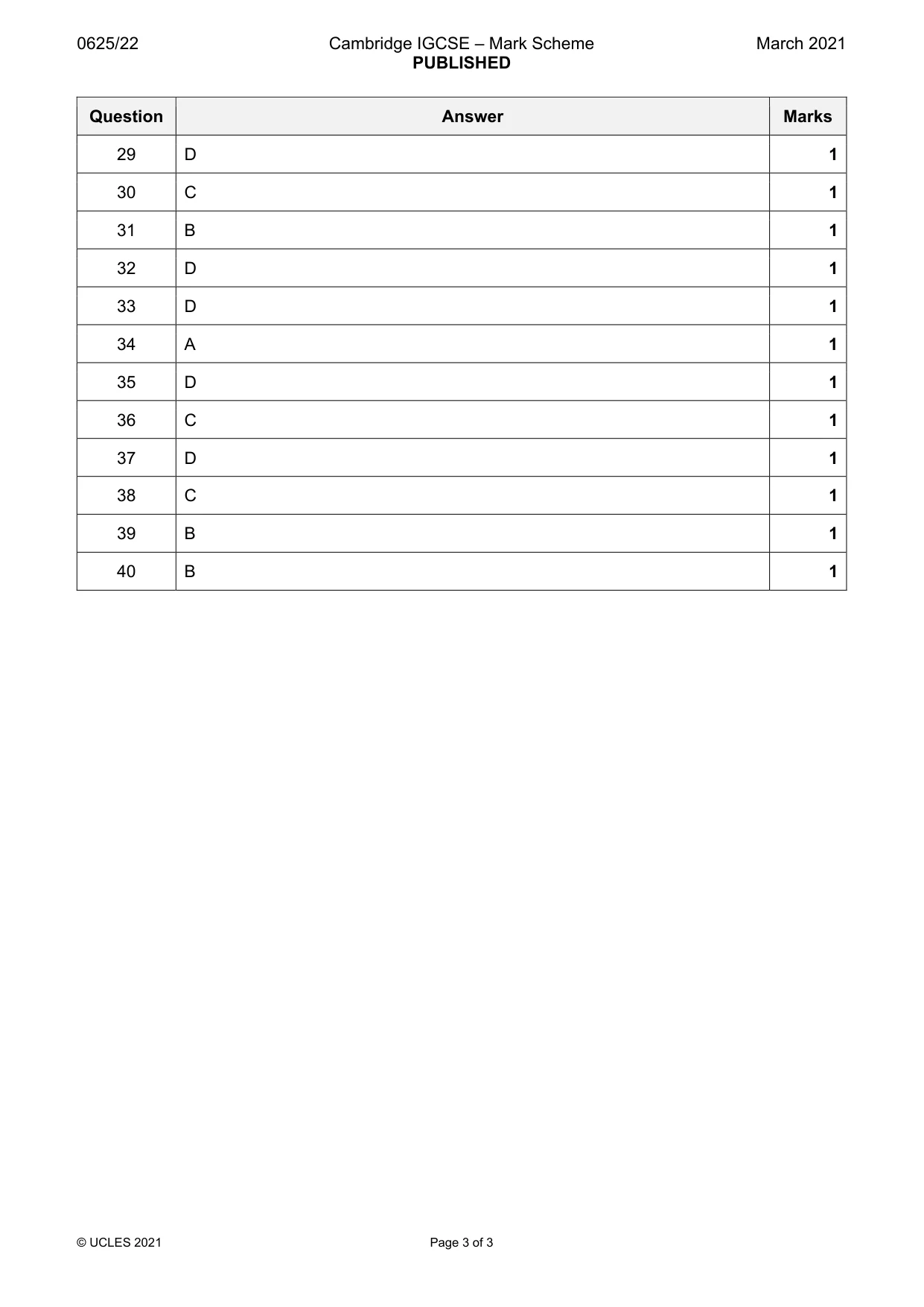
Mark scheme: D
Q30 · Two uncharged metal spheres X and Y rest on insulating stands and touch each other
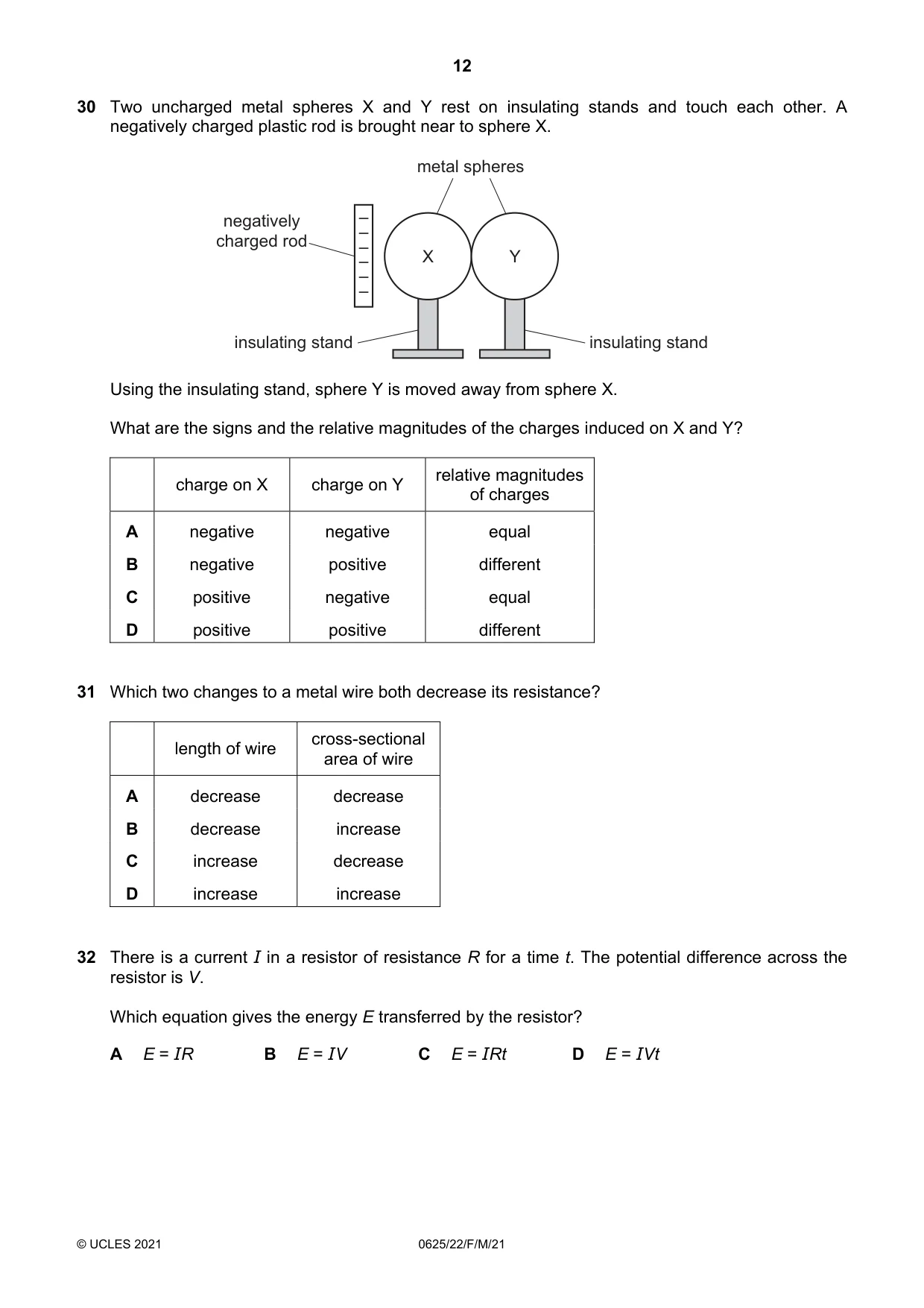
30 Two uncharged metal spheres X and Y rest on insulating stands and touch each other. A negatively charged plastic rod is brought near to sphere X. metal spheres negatively – – charged rod – – X Y – – insulating stand insulating stand Using the insulating stand, sphere Y is moved away from sphere X. What are the signs and the relative magnitudes of the charges induced on X and Y? relative magnitudes charge on X charge on Y of charges A negative negative equal B negative positive different C positive negative equal D positive positive different
Mark scheme: C
Q31 · Which two changes to a metal wire both decrease its resistance?
31 Which two changes to a metal wire both decrease its resistance? cross-sectional length of wire area of wire A decrease decrease B decrease increase C increase decrease D increase increase
Mark scheme: B
Q32 · There is a current I in a resistor of resistance R for a time t
32 There is a current I in a resistor of resistance R for a time t. The potential difference across the resistor is V. Which equation gives the energy E transferred by the resistor? A E = IR B E = IV C E = IRt D E = IVt
Mark scheme: D
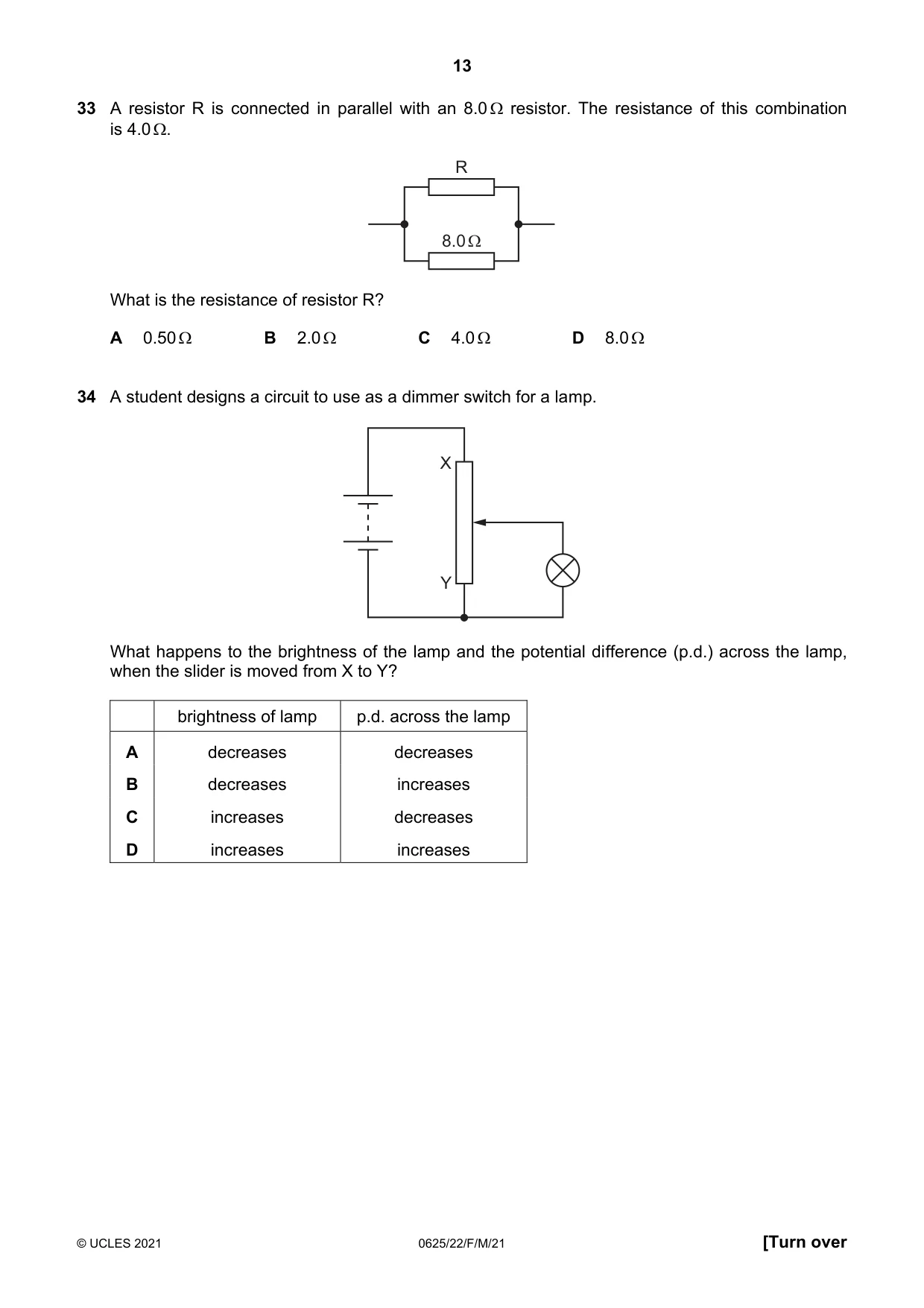
Q33 · A resistor R is connected in parallel with an 8.0 resistor
33 A resistor R is connected in parallel with an 8.0 resistor. The resistance of this combination is 4.0 . R 8.0 Ω What is the resistance of resistor R? A 0.50 B 2.0 C 4.0 D 8.0
Mark scheme: D
Q34 · A student designs a circuit to use as a dimmer switch for a lamp
34 A student designs a circuit to use as a dimmer switch for a lamp. X Y What happens to the brightness of the lamp and the potential difference (p.d.) across the lamp, when the slider is moved from X to Y? brightness of lamp p.d. across the lamp A decreases decreases B decreases increases C increases decreases D increases increases
Mark scheme: A
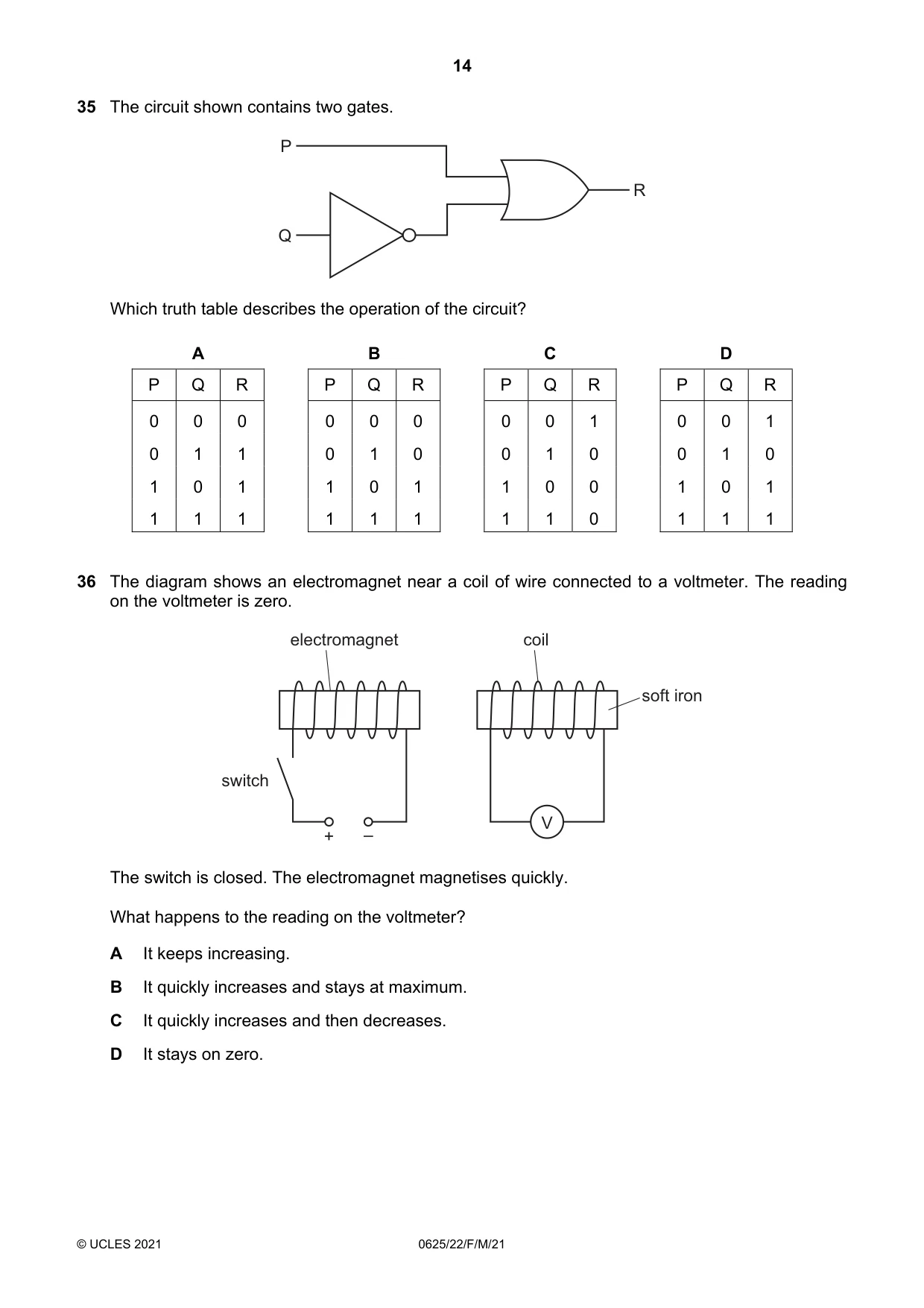
Q35 · The circuit shown contains two gates
35 The circuit shown contains two gates. P R Q Which truth table describes the operation of the circuit? A B C D P Q R P Q R P Q R P Q R 0 0 0 0 0 0 0 0 1 0 0 1 0 1 1 0 1 0 0 1 0 0 1 0 1 0 1 1 0 1 1 0 0 1 0 1 1 1 1 1 1 1 1 1 0 1 1 1
Mark scheme: D
Q36 · The diagram shows an electromagnet near a coil of wire connected to a voltmeter
36 The diagram shows an electromagnet near a coil of wire connected to a voltmeter. The reading on the voltmeter is zero. electromagnet coil soft iron switch V + – The switch is closed. The electromagnet magnetises quickly. What happens to the reading on the voltmeter? A It keeps increasing. B It quickly increases and stays at maximum. C It quickly increases and then decreases. D It stays on zero.
Mark scheme: C
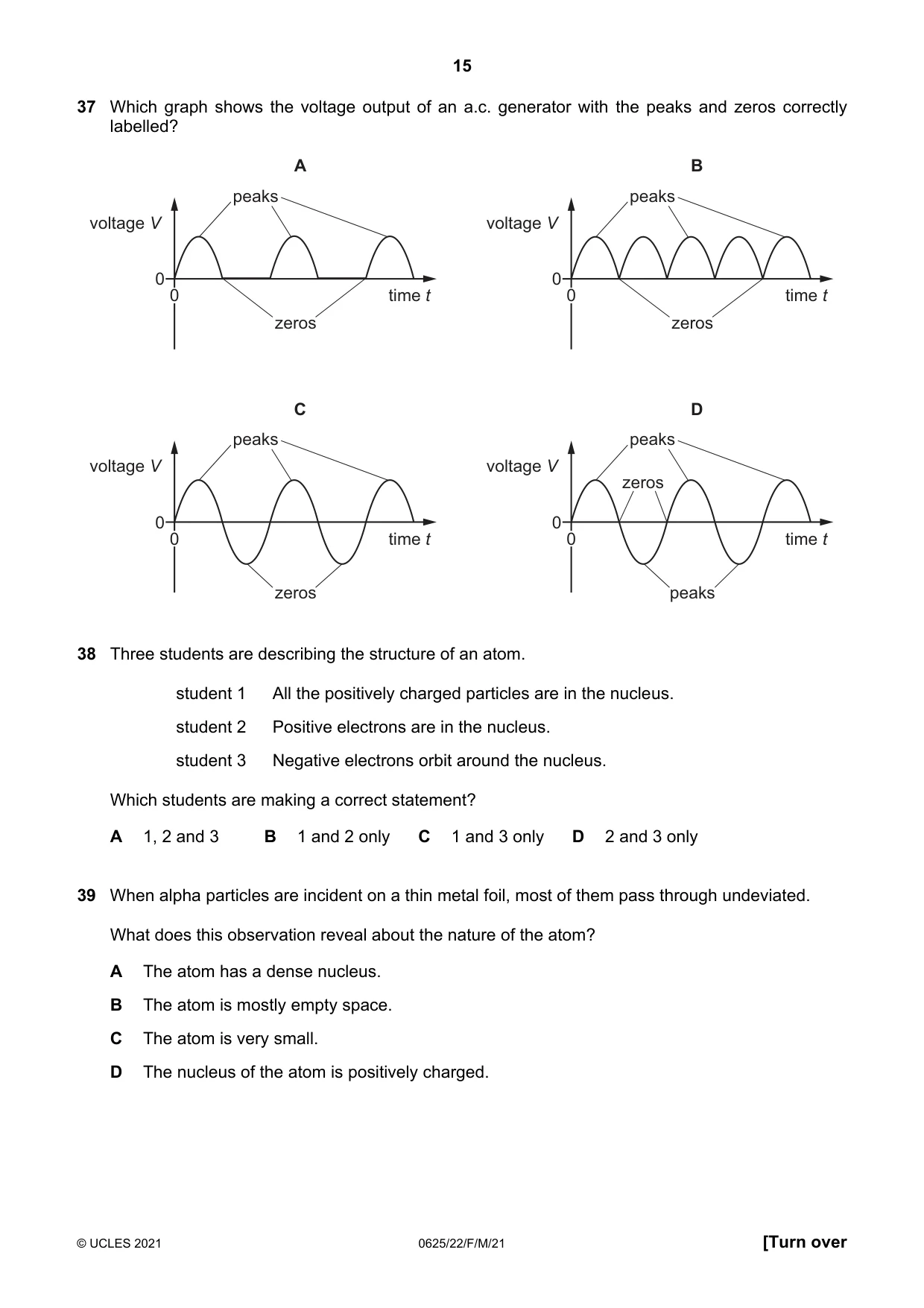
Q37 · Which graph shows the voltage output of an a.c
37 Which graph shows the voltage output of an a.c. generator with the peaks and zeros correctly labelled? A B peaks peaks voltage V voltage V 0 0 0 time t 0 time t zeros zeros C D peaks peaks voltage V voltage V zeros 0 0 0 time t 0 time t zeros peaks
Mark scheme: D
Q38 · Three students are describing the structure of an atom
38 Three students are describing the structure of an atom. student 1 All the positively charged particles are in the nucleus. student 2 Positive electrons are in the nucleus. student 3 Negative electrons orbit around the nucleus. Which students are making a correct statement? A 1, 2 and 3 B 1 and 2 only C 1 and 3 only D 2 and 3 only
Mark scheme: C
Q39 · When alpha particles are incident on a thin metal foil, most of them pass through…
39 When alpha particles are incident on a thin metal foil, most of them pass through undeviated. What does this observation reveal about the nature of the atom? A The atom has a dense nucleus. B The atom is mostly empty space. C The atom is very small. D The nucleus of the atom is positively charged.
Mark scheme: B
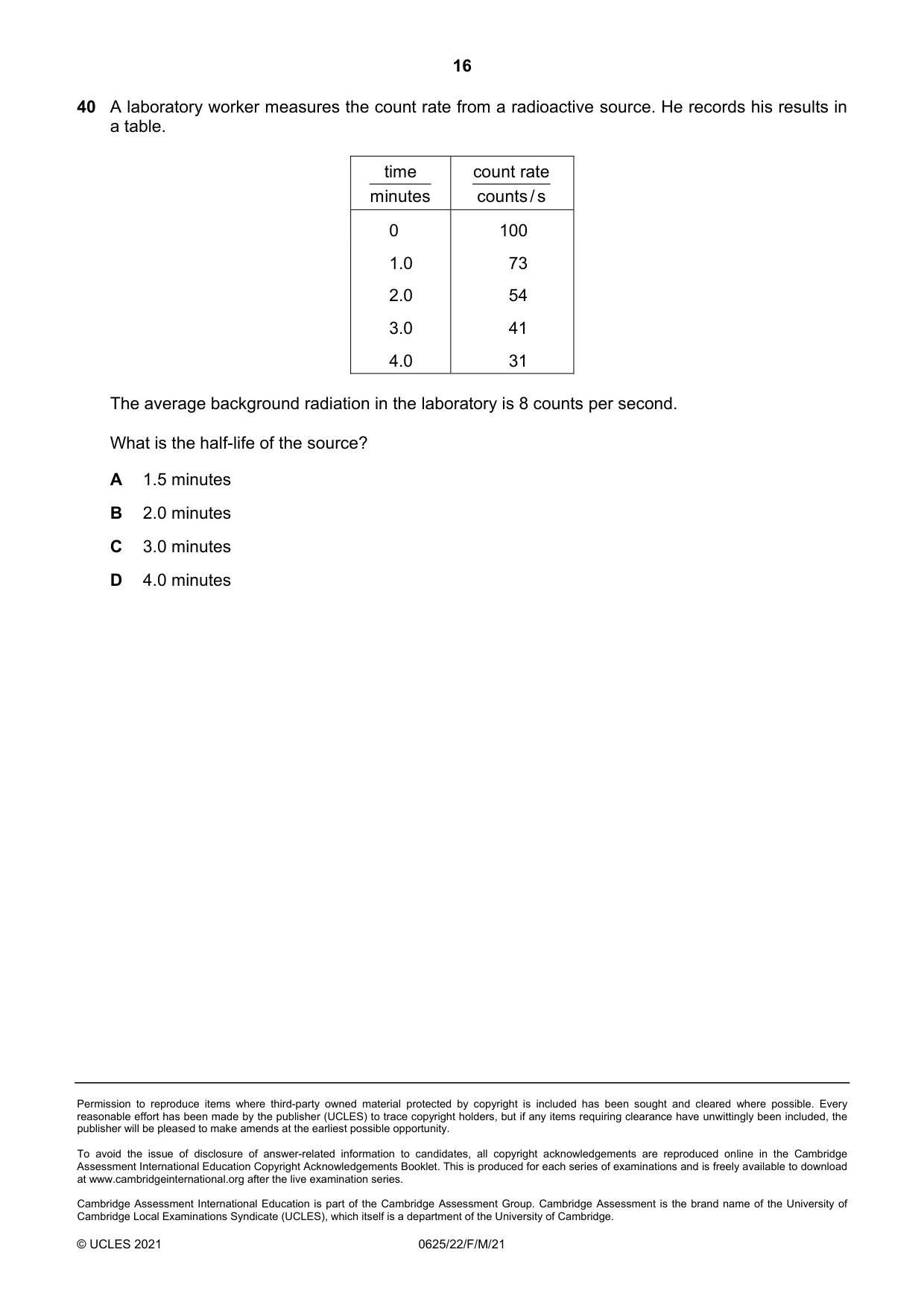
Q40 · A laboratory worker measures the count rate from a radioactive source
40 A laboratory worker measures the count rate from a radioactive source. He records his results in a table. time count rate minutes counts/s 0 100 1.0 73 2.0 54 3.0 41 4.0 31 The average background radiation in the laboratory is 8 counts per second. What is the half-life of the source? A 1.5 minutes B 2.0 minutes C 3.0 minutes D 4.0 minutes
Mark scheme: B
What was in this paper
The subtopics covered by these 40 questions, and how many questions each got. Open one in a new tab to see every Cambridge question on it.
4Electric circuits3Motion3Simple phenomena of magnetism3Sound3Electrical quantities2Electromagnetic effects2Energy, work and power2Forces2Kinetic particle model of matter2Pressure2The nuclear model of the atom2Thermal properties and temperature2Transfer of thermal energy2Density1Electromagnetic spectrum1Mass and weight1Momentum1Physical quantities and measurement techniques1Radioactivity1What you needed in this session
Cambridge’s own grade thresholds for 2021 Feb/March, Paper 2 · Variant 2. A higher threshold means an easier paper — the bar moves with how the cohort did.