Cambridge IGCSE Physics 0625 — 2023 Oct/Nov Paper 2 · Variant 3
0625/23/O/N/23 · 40 questions · 40 marks · ≈45 min
The question paper and its mark scheme, free to read here and free to download. This is Cambridge’s own paper, exactly as it was sat.
Question paper20 pages
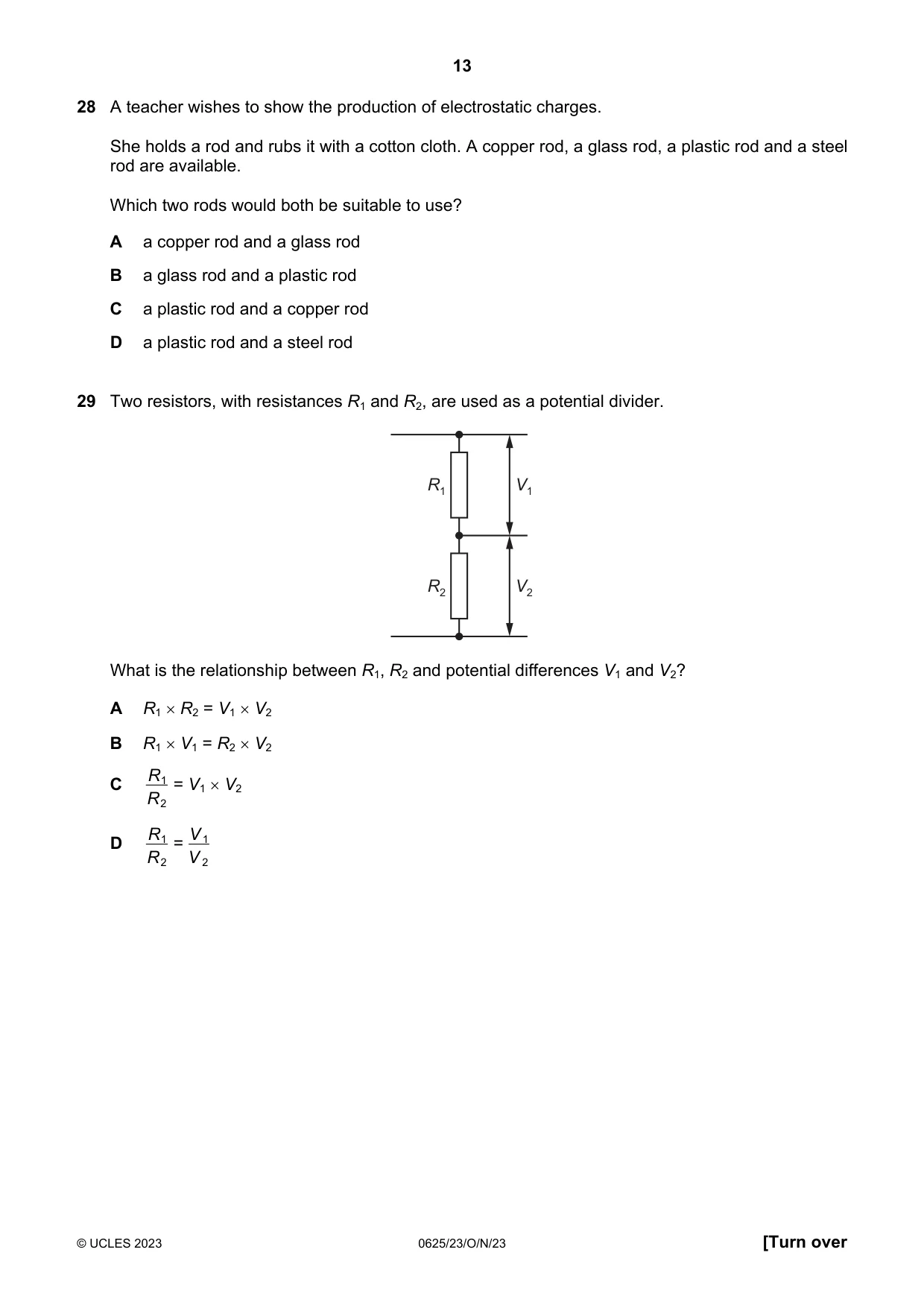
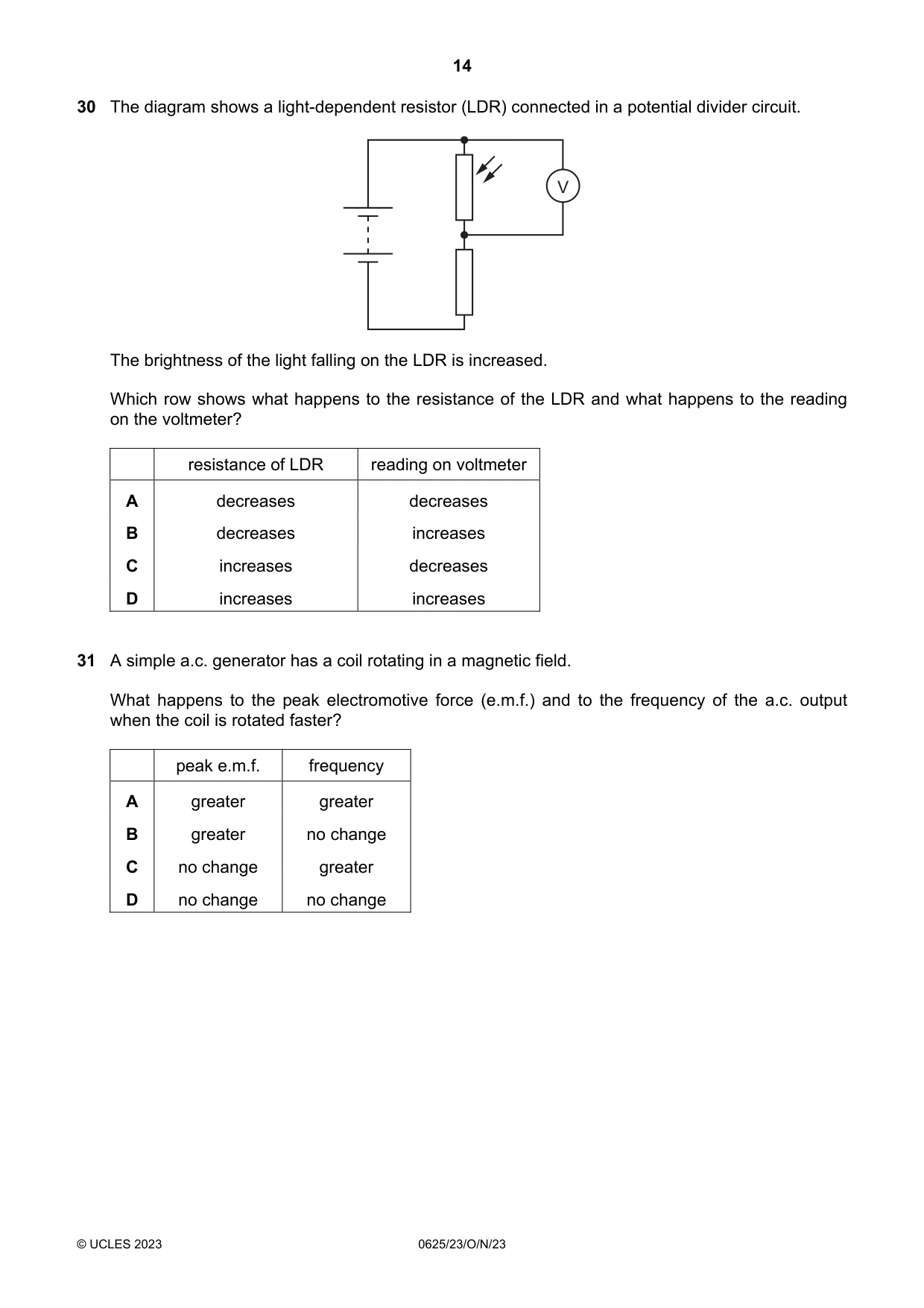
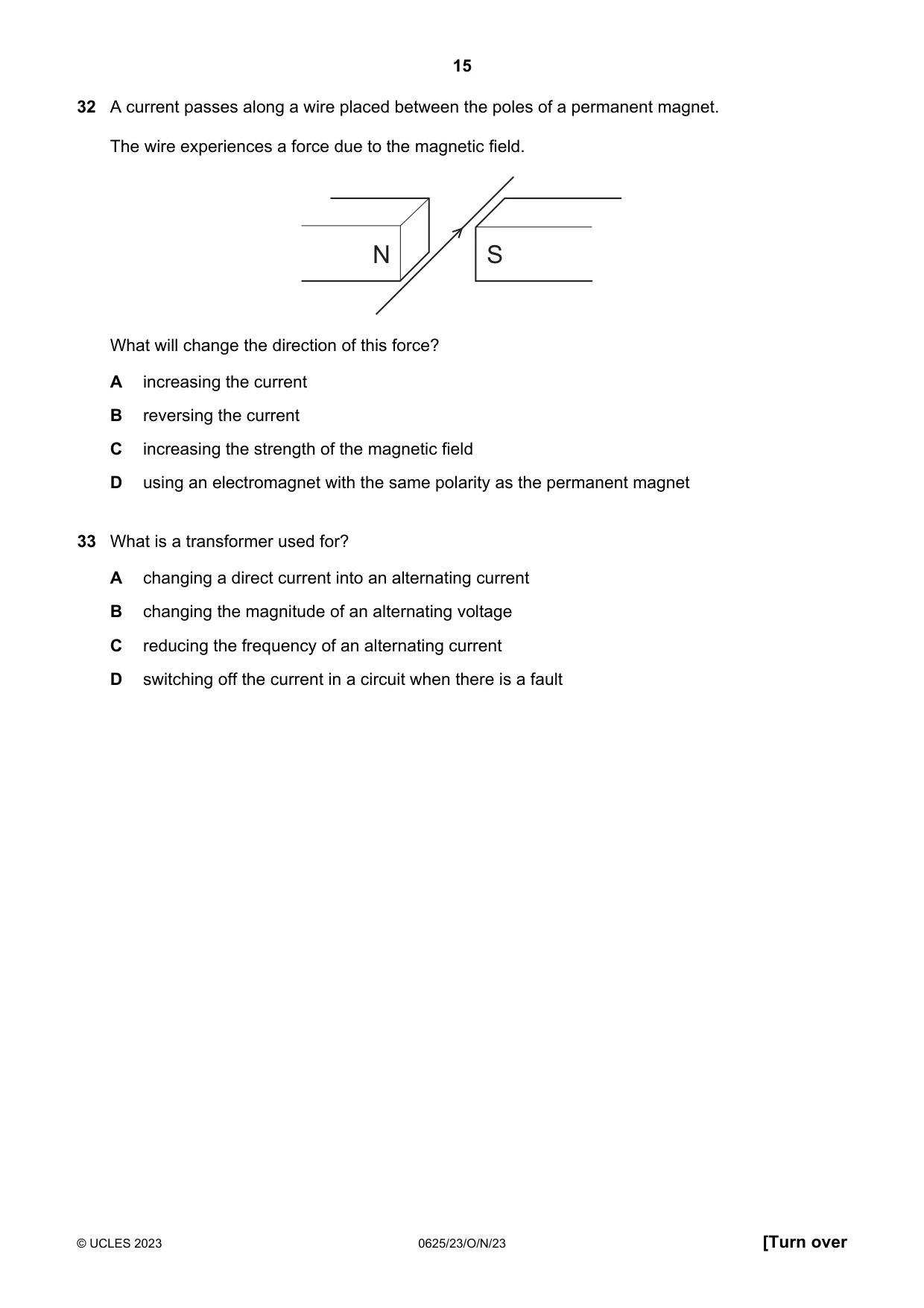
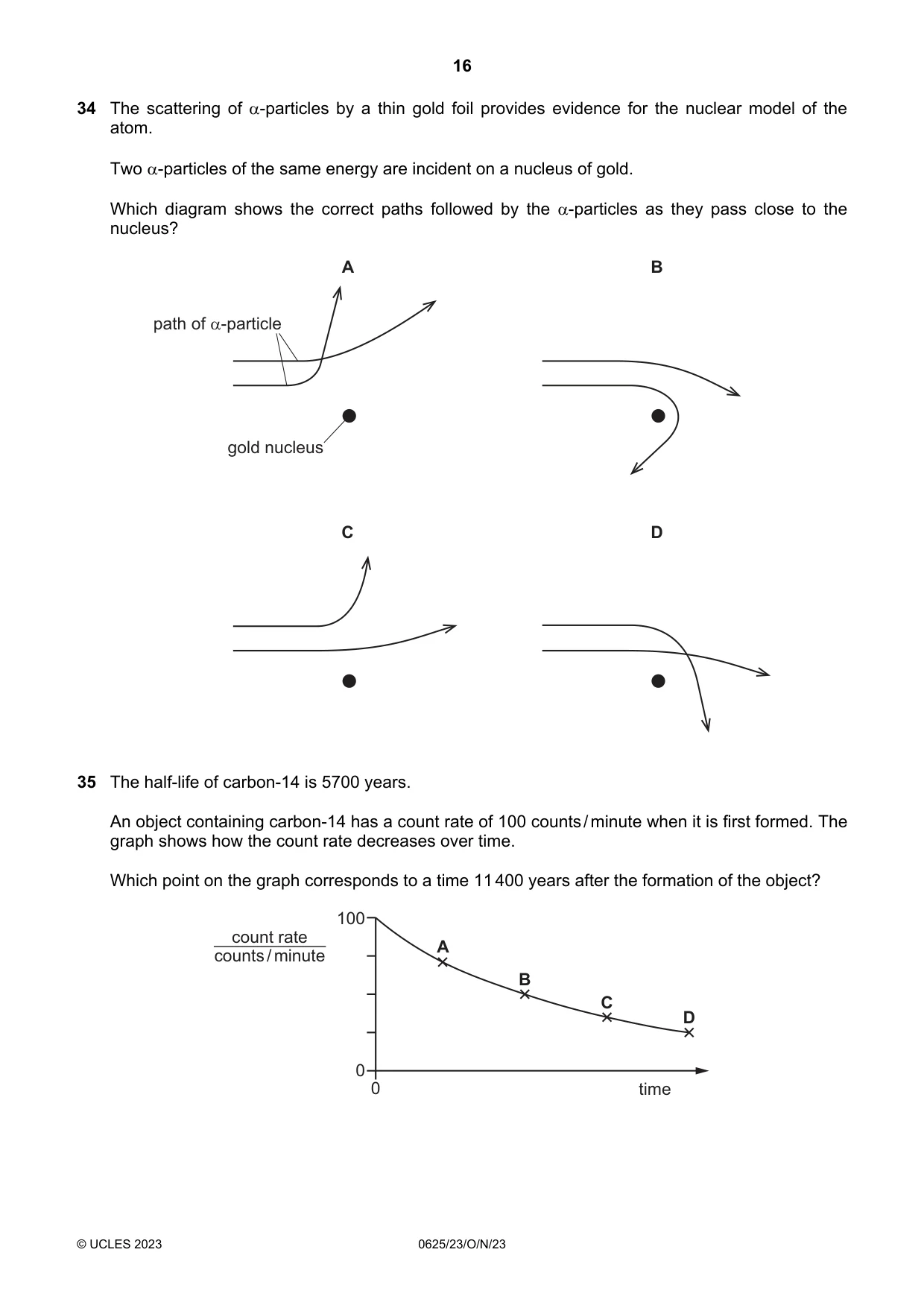

Mark scheme3 pages
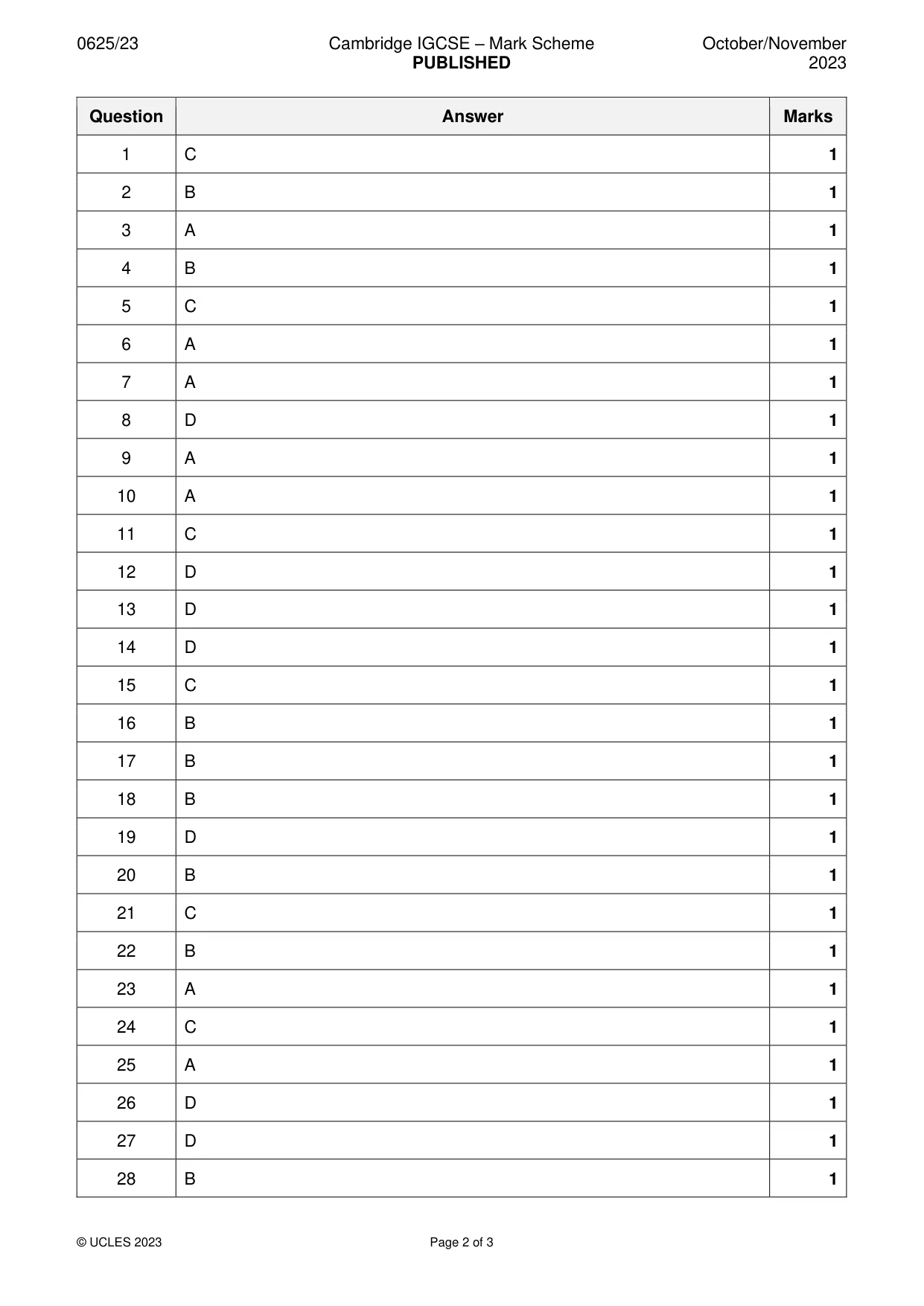
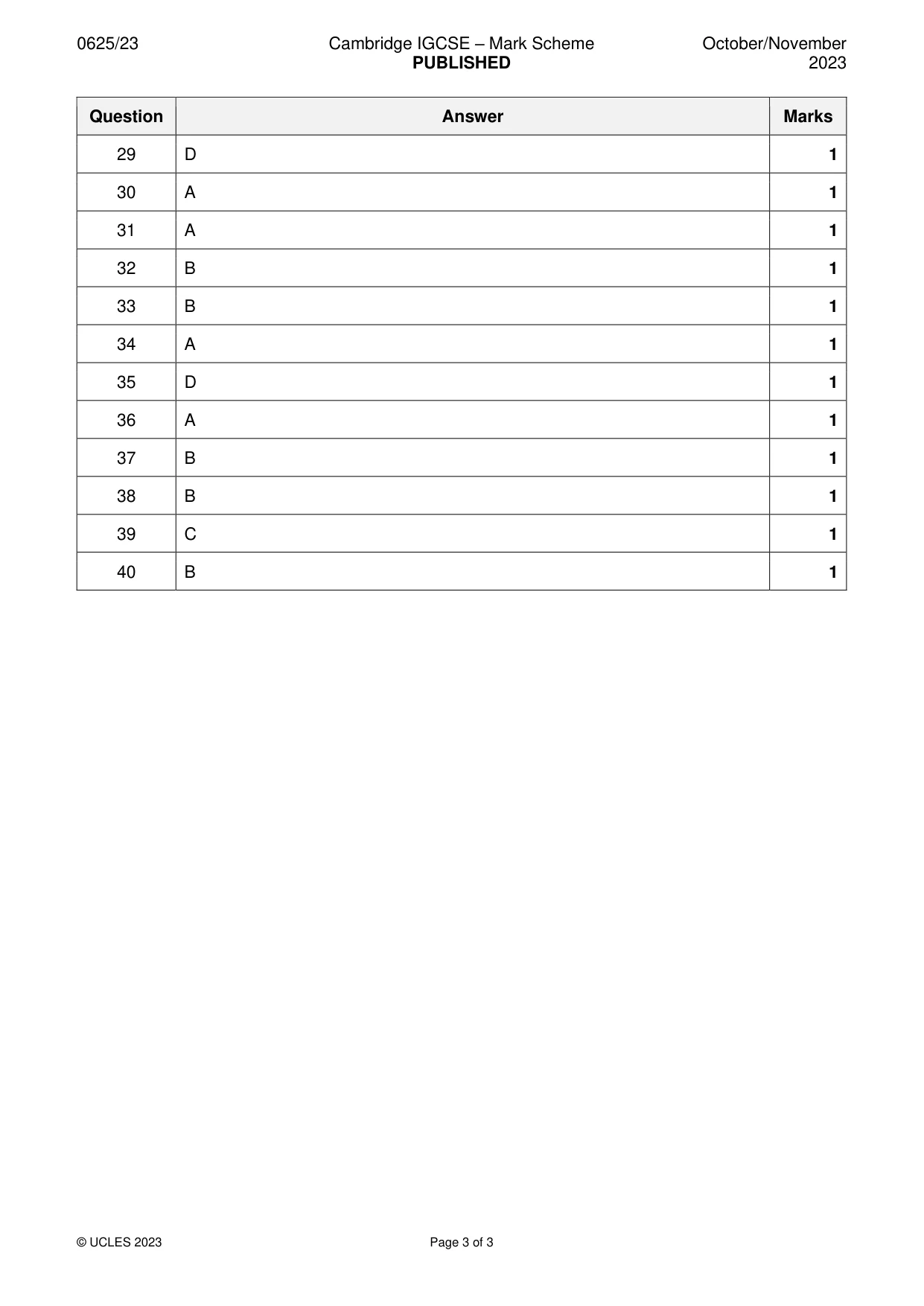
Answers below. Sit the paper first if you are practising.
Questions as text
Q1 · How many of the quantities shown are scalars?
1 How many of the quantities shown are scalars? mass momentum density energy A 1 B 2 C 3 D 4
Mark scheme: C
More questions on Physical quantities and measurement techniques
Q2 · A train is on a straight track
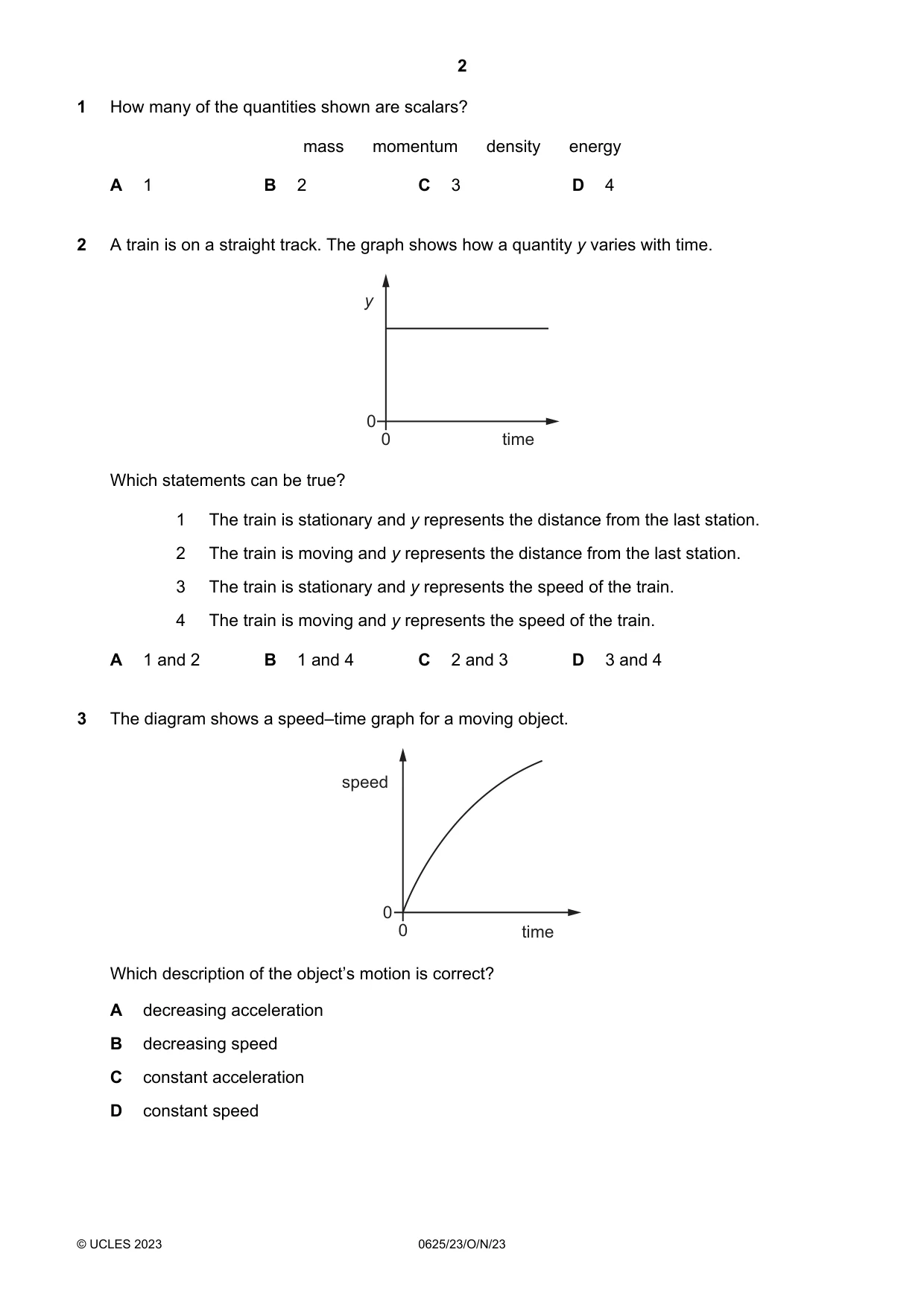
2 A train is on a straight track. The graph shows how a quantity y varies with time. y 0 0 time Which statements can be true? 1 The train is stationary and y represents the distance from the last station. 2 The train is moving and y represents the distance from the last station. 3 The train is stationary and y represents the speed of the train. 4 The train is moving and y represents the speed of the train. A 1 and 2 B 1 and 4 C 2 and 3 D 3 and 4
Mark scheme: B
Q3 · The diagram shows a speed–time graph for a moving object
3 The diagram shows a speed–time graph for a moving object. speed 0 0 time Which description of the object’s motion is correct? A decreasing acceleration B decreasing speed C constant acceleration D constant speed
Mark scheme: A
Q4 · The mass of air hitting the blades of a wind turbine each second is 1.5 × 10⁴ kg
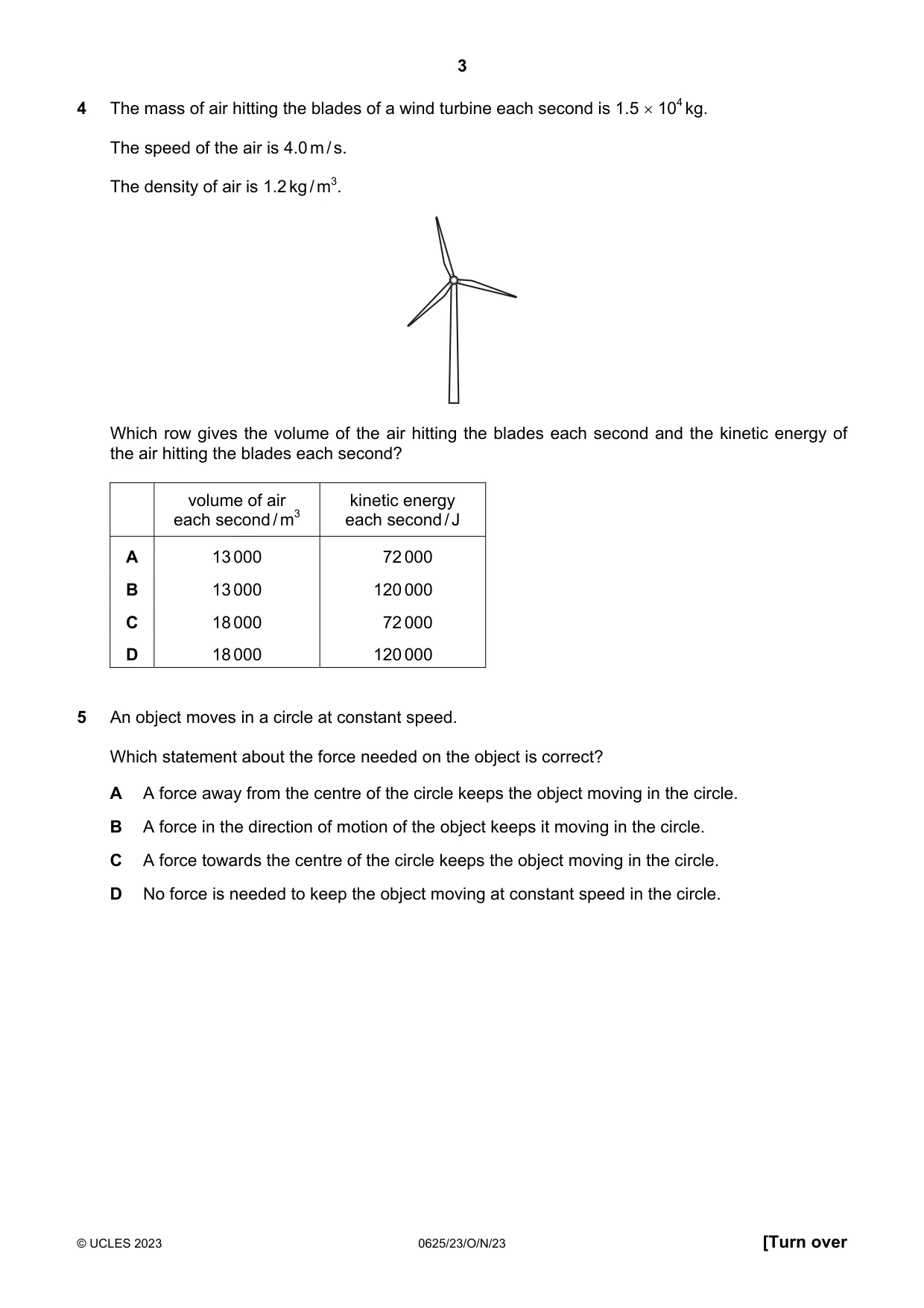
4 The mass of air hitting the blades of a wind turbine each second is 1.5 × 10⁴ kg. The speed of the air is 4.0 m / s. The density of air is 1.2 kg / m3. Which row gives the volume of the air hitting the blades each second and the kinetic energy of the air hitting the blades each second? volume of air kinetic energy each second / m3 each second / J A 13 000 72 000 B 13 000 120 000 C 18 000 72 000 D 18 000 120 000
Mark scheme: B
Q5 · An object moves in a circle at constant speed
5 An object moves in a circle at constant speed. Which statement about the force needed on the object is correct? A A force away from the centre of the circle keeps the object moving in the circle. B A force in the direction of motion of the object keeps it moving in the circle. C A force towards the centre of the circle keeps the object moving in the circle. D No force is needed to keep the object moving at constant speed in the circle.
Mark scheme: C
Q6 · A uniform rod rests on a pivot at its centre
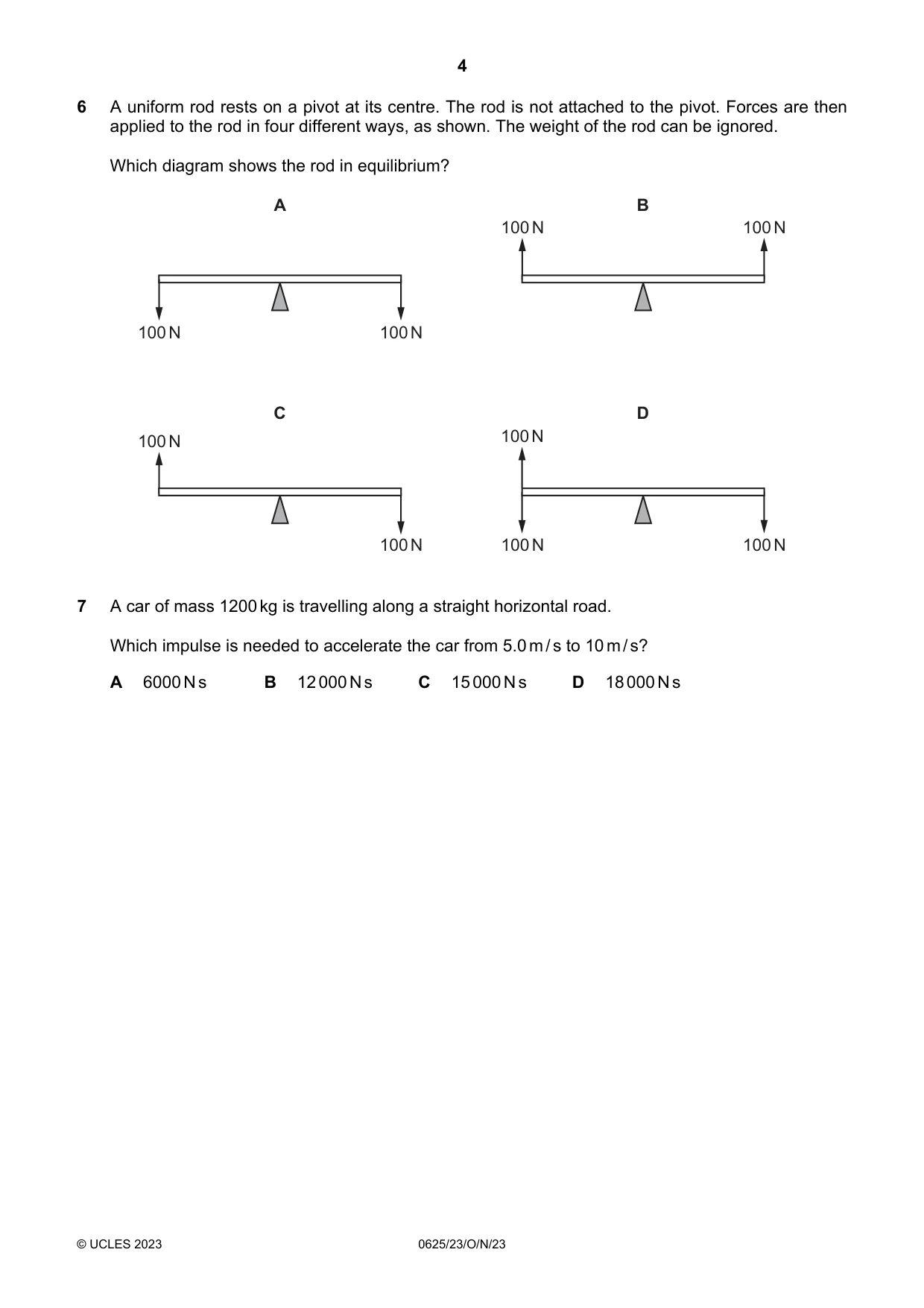
6 A uniform rod rests on a pivot at its centre. The rod is not attached to the pivot. Forces are then applied to the rod in four different ways, as shown. The weight of the rod can be ignored. Which diagram shows the rod in equilibrium? A B 100 N 100 N 100 N 100 N C D 100 N 100 N 100 N 100 N 100 N
Mark scheme: A
Q7 · A car of mass 1200 kg is travelling along a straight horizontal road
7 A car of mass 1200 kg is travelling along a straight horizontal road. Which impulse is needed to accelerate the car from 5.0 m / s to 10 m / s? A 6000 N s B 12 000 N s C 15 000 N s D 18 000 N s
Mark scheme: A
Q8 · A mass bounces up and down on a steel spring
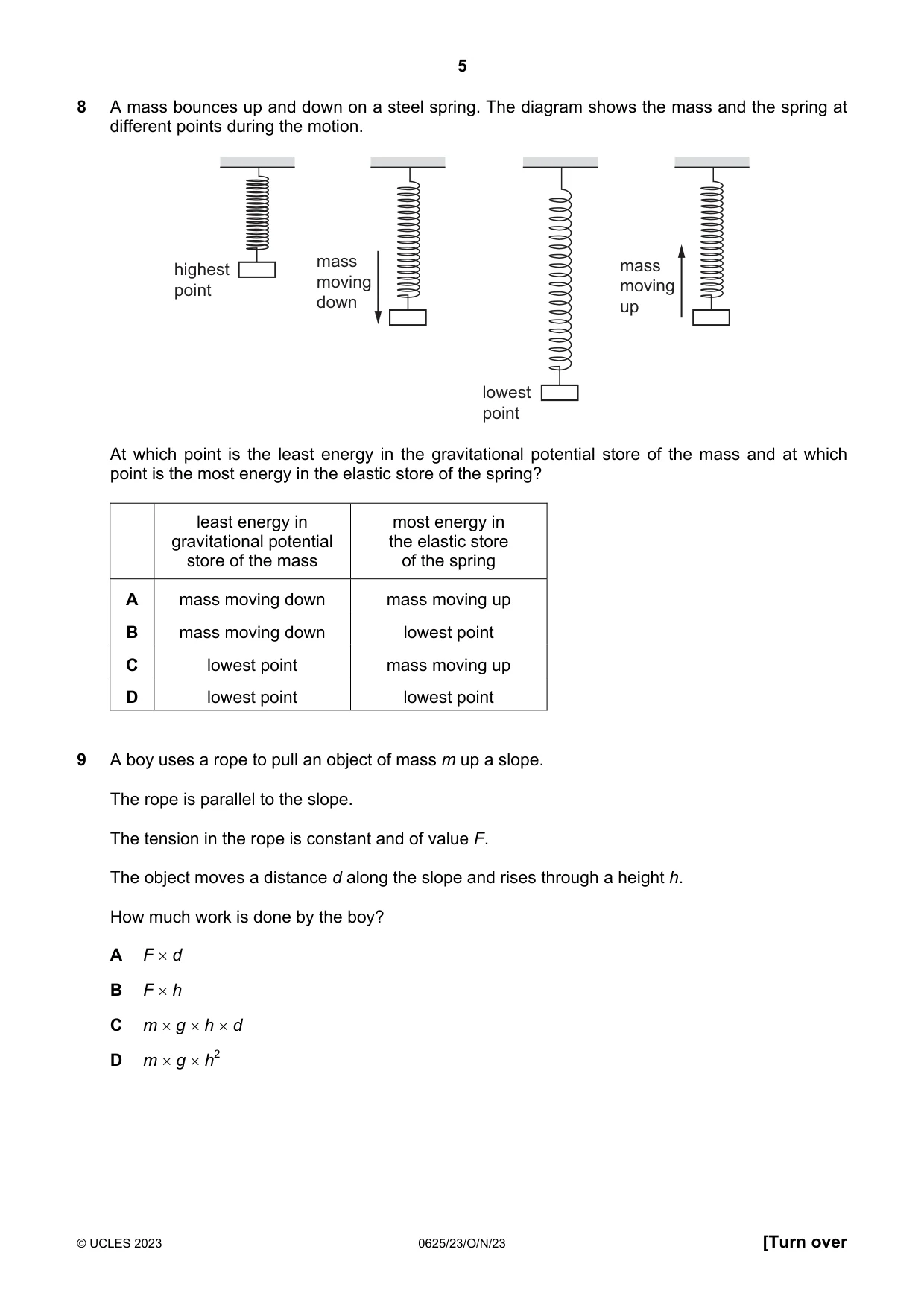
8 A mass bounces up and down on a steel spring. The diagram shows the mass and the spring at different points during the motion. mass mass highest moving moving point down up lowest point At which point is the least energy in the gravitational potential store of the mass and at which point is the most energy in the elastic store of the spring? least energy in most energy in gravitational potential the elastic store store of the mass of the spring A mass moving down mass moving up B mass moving down lowest point C lowest point mass moving up D lowest point lowest point
Mark scheme: D
Q9 · A boy uses a rope to pull an object of mass m up a slope
9 A boy uses a rope to pull an object of mass m up a slope. The rope is parallel to the slope. The tension in the rope is constant and of value F. The object moves a distance d along the slope and rises through a height h. How much work is done by the boy? A F × d B F × h C m × g × h × d D m × g × h2
Mark scheme: A
Q10 · A microwave oven is rated at 900 watts
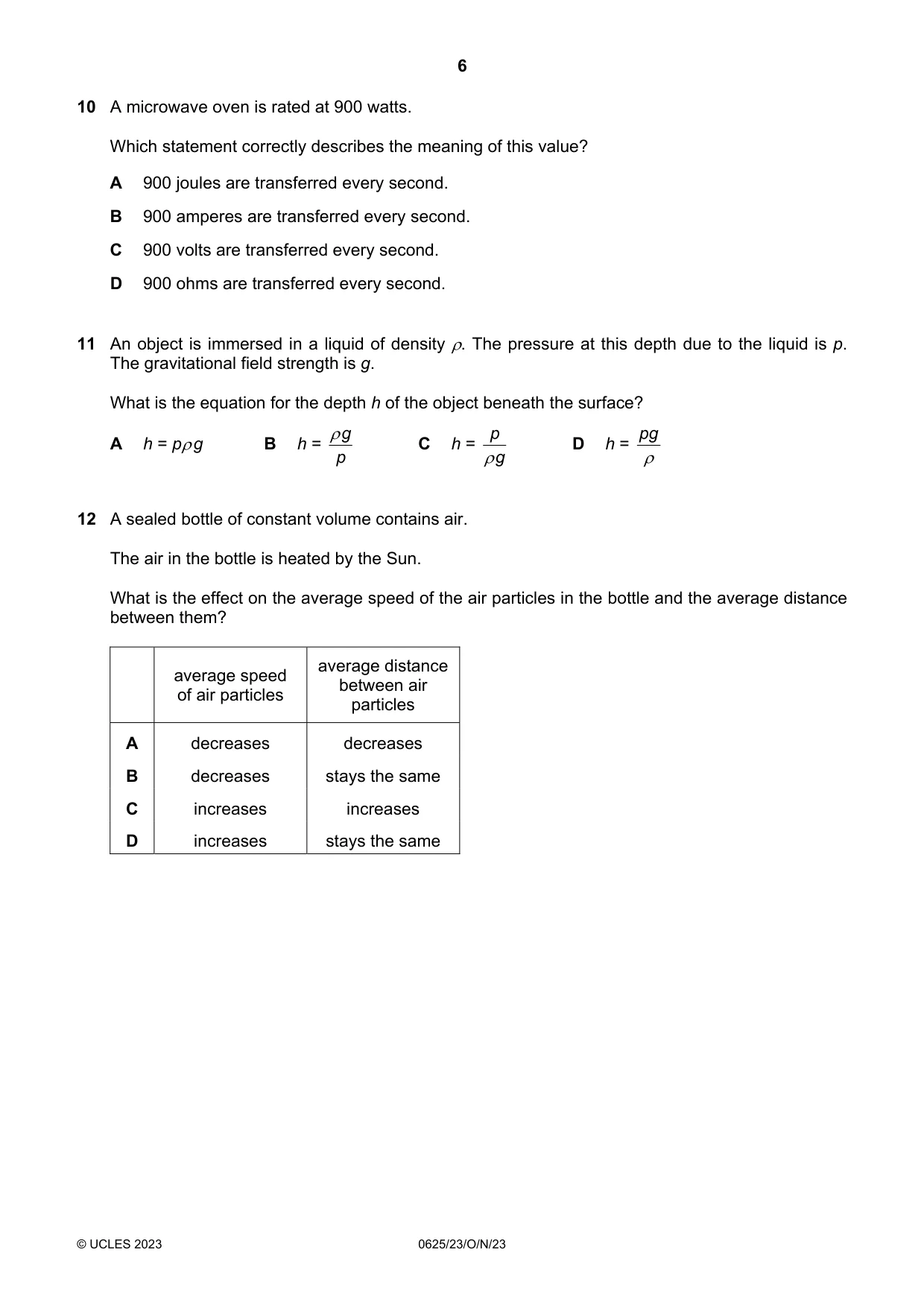
10 A microwave oven is rated at 900 watts. Which statement correctly describes the meaning of this value? A 900 joules are transferred every second. B 900 amperes are transferred every second. C 900 volts are transferred every second. D 900 ohms are transferred every second.
Mark scheme: A
Q11 · An object is immersed in a liquid of density ρ
11 An object is immersed in a liquid of density ρ. The pressure at this depth due to the liquid is p. The gravitational field strength is g. What is the equation for the depth h of the object beneath the surface? ρ g p pg A h = pρ g B h = p C h = D h = ρ ρ g
Mark scheme: C
Q12 · A sealed bottle of constant volume contains air
12 A sealed bottle of constant volume contains air. The air in the bottle is heated by the Sun. What is the effect on the average speed of the air particles in the bottle and the average distance between them? average distance average speed between air of air particles particles A decreases decreases B decreases stays the same C increases increases D increases stays the same
Mark scheme: D
Q13 · In an experiment to investigate the relationship between the volume of a sample of air…
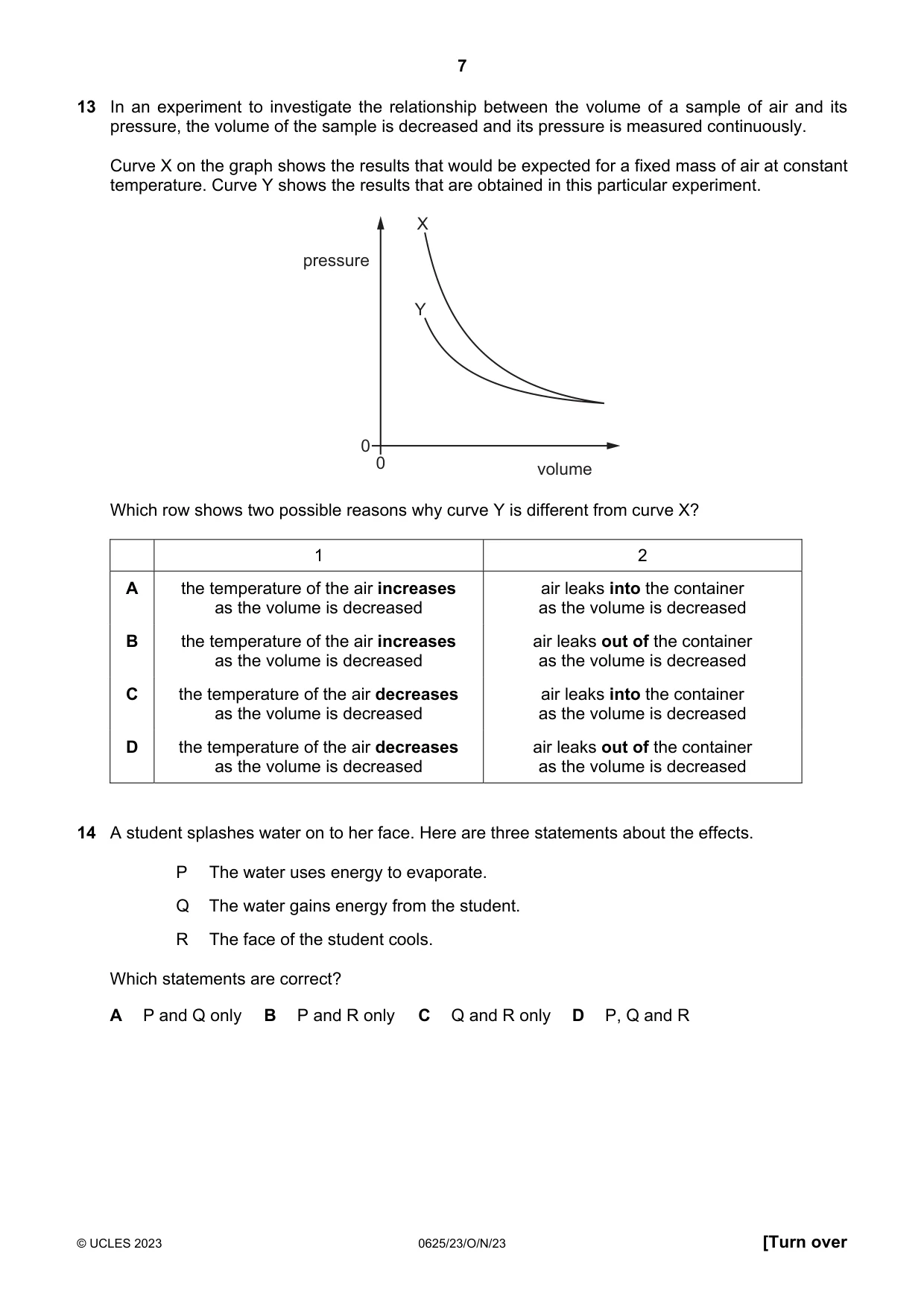
13 In an experiment to investigate the relationship between the volume of a sample of air and its pressure, the volume of the sample is decreased and its pressure is measured continuously. Curve X on the graph shows the results that would be expected for a fixed mass of air at constant temperature. Curve Y shows the results that are obtained in this particular experiment. X pressure Y 0 0 volume Which row shows two possible reasons why curve Y is different from curve X? 1 2 A the temperature of the air increases air leaks into the container as the volume is decreased as the volume is decreased B the temperature of the air increases air leaks out of the container as the volume is decreased as the volume is decreased C the temperature of the air decreases air leaks into the container as the volume is decreased as the volume is decreased D the temperature of the air decreases air leaks out of the container as the volume is decreased as the volume is decreased
Mark scheme: D
Q14 · A student splashes water on to her face
14 A student splashes water on to her face. Here are three statements about the effects. P The water uses energy to evaporate. Q The water gains energy from the student. R The face of the student cools. Which statements are correct? A P and Q only B P and R only C Q and R only D P, Q and R
Mark scheme: D
Q15 · Four containers each contain water
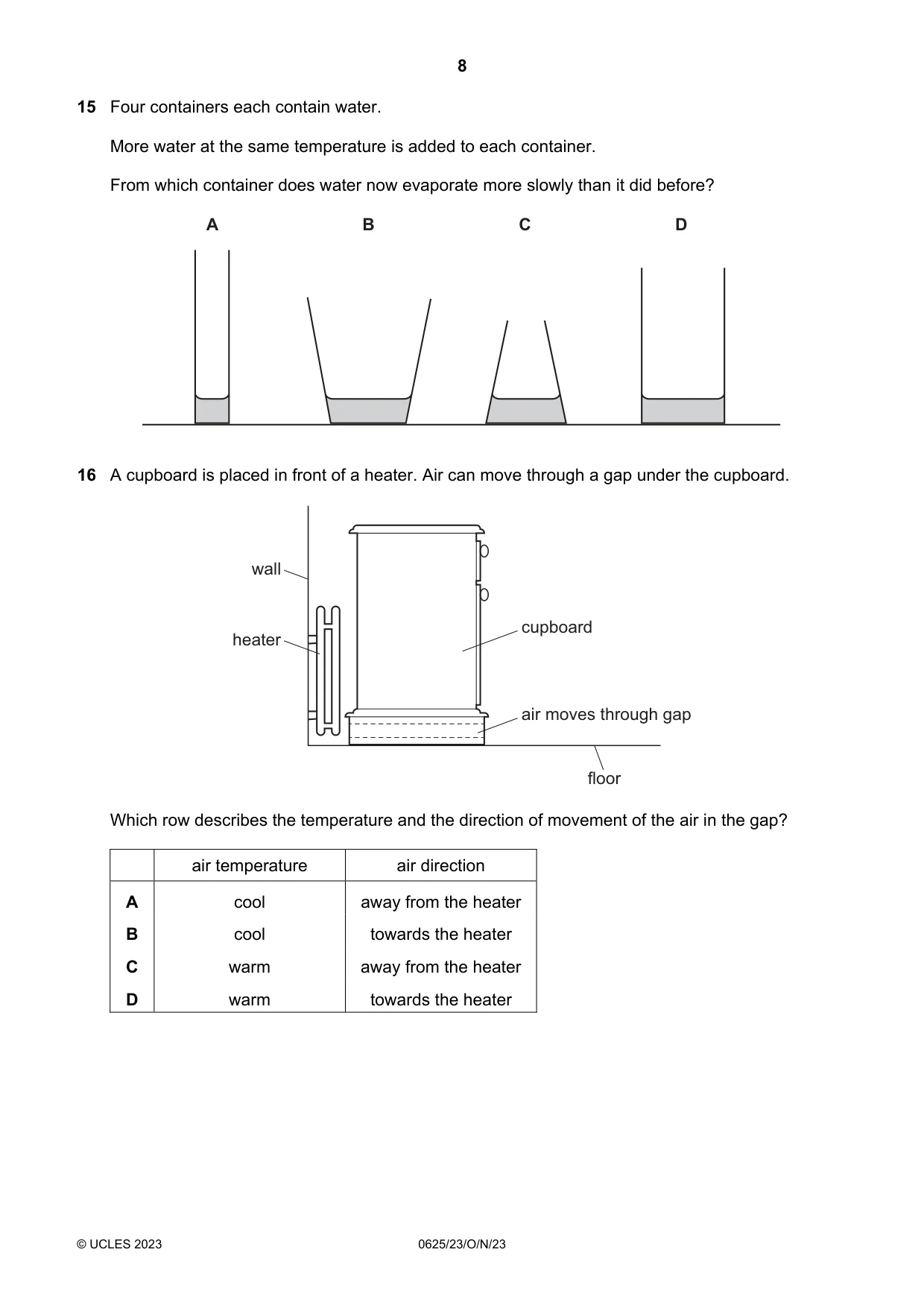
15 Four containers each contain water. More water at the same temperature is added to each container. From which container does water now evaporate more slowly than it did before? A B C D
Mark scheme: C
Q16 · A cupboard is placed in front of a heater
16 A cupboard is placed in front of a heater. Air can move through a gap under the cupboard. wall cupboard heater air moves through gap floor Which row describes the temperature and the direction of movement of the air in the gap? air temperature air direction A cool away from the heater B cool towards the heater C warm away from the heater D warm towards the heater
Mark scheme: B
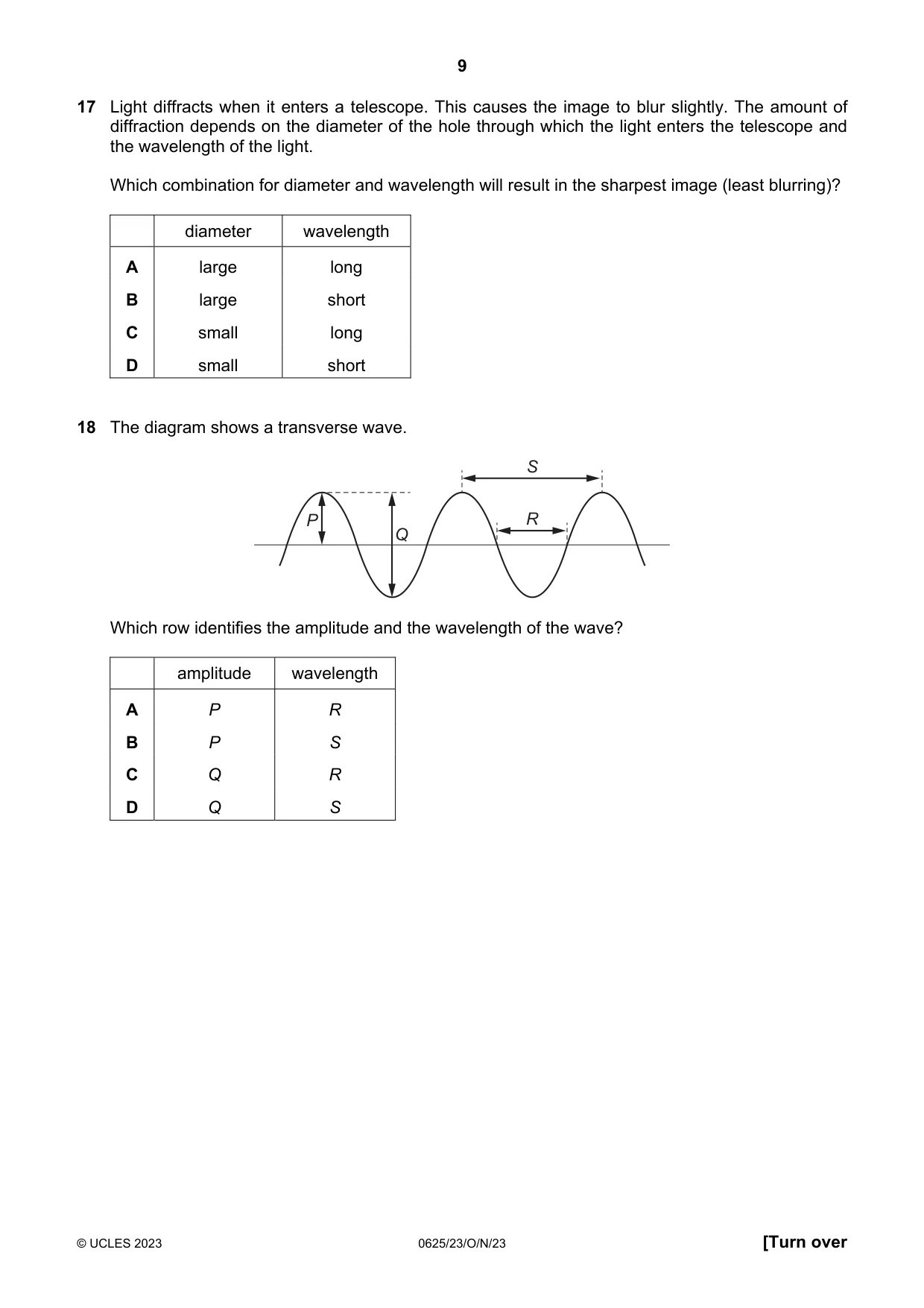
Q17 · Light diffracts when it enters a telescope
17 Light diffracts when it enters a telescope. This causes the image to blur slightly. The amount of diffraction depends on the diameter of the hole through which the light enters the telescope and the wavelength of the light. Which combination for diameter and wavelength will result in the sharpest image (least blurring)? diameter wavelength A large long B large short C small long D small short
Mark scheme: B
Q18 · The diagram shows a transverse wave
18 The diagram shows a transverse wave. S P R Q Which row identifies the amplitude and the wavelength of the wave? amplitude wavelength A P R B P S C Q R D Q S
Mark scheme: B
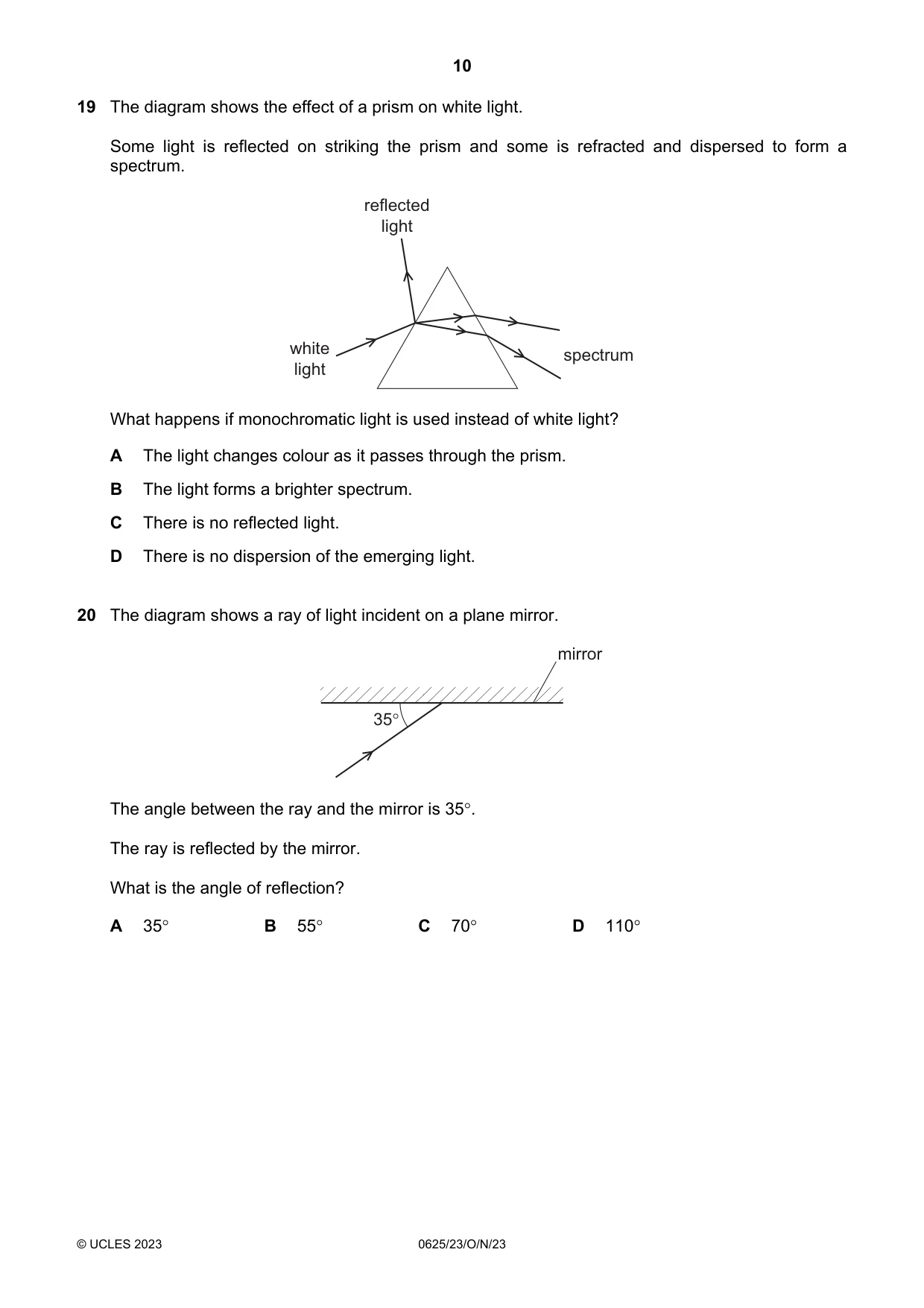
Q19 · The diagram shows the effect of a prism on white light
19 The diagram shows the effect of a prism on white light. Some light is reflected on striking the prism and some is refracted and dispersed to form a spectrum. reflected light white spectrum light What happens if monochromatic light is used instead of white light? A The light changes colour as it passes through the prism. B The light forms a brighter spectrum. C There is no reflected light. D There is no dispersion of the emerging light.
Mark scheme: D
Q20 · The diagram shows a ray of light incident on a plane mirror
20 The diagram shows a ray of light incident on a plane mirror. mirror 35° The angle between the ray and the mirror is 35°. The ray is reflected by the mirror. What is the angle of reflection? A 35° B 55° C 70° D 110°
Mark scheme: B
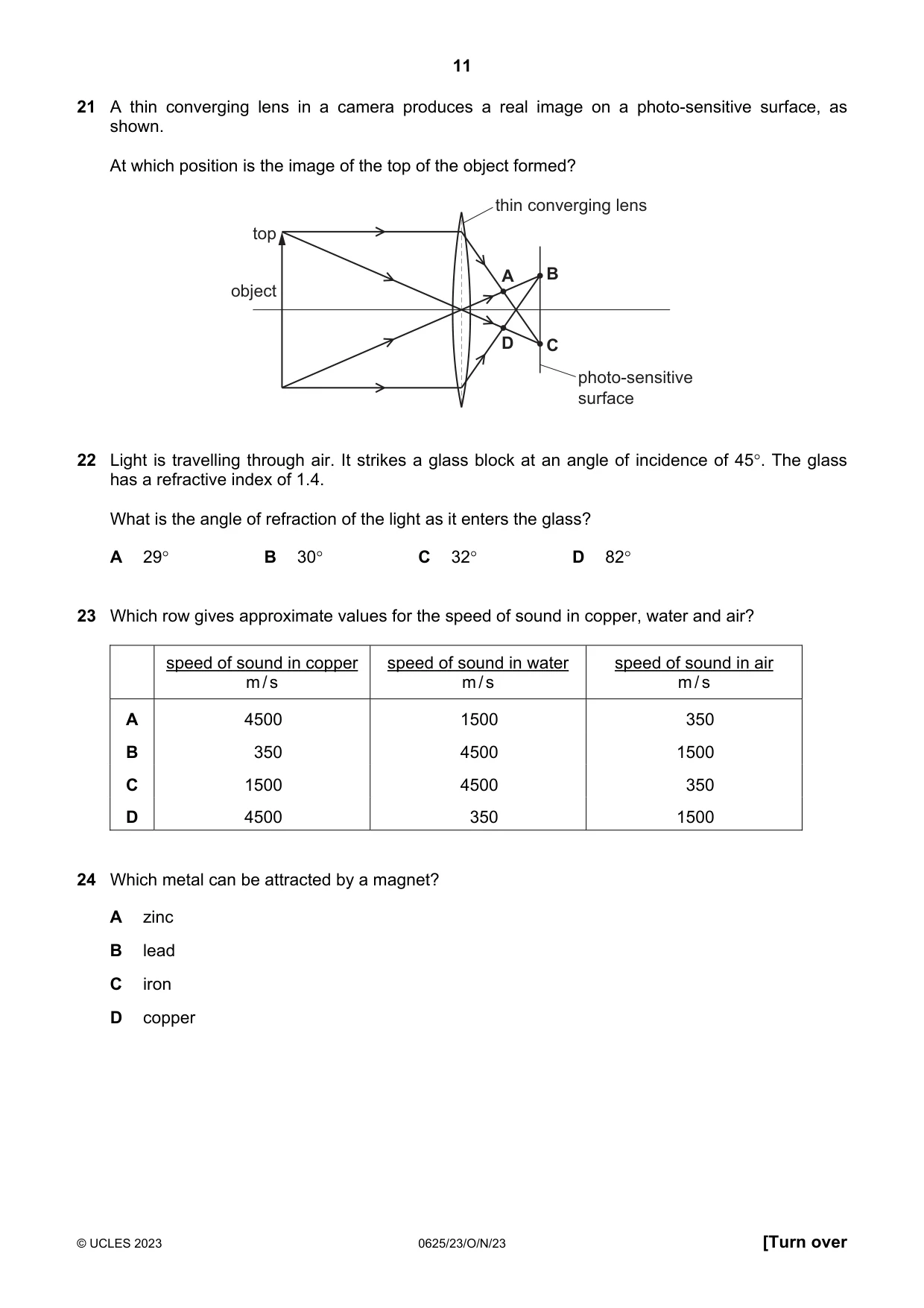
Q21 · A thin converging lens in a camera produces a real image on a photo-sensitive surface, as…
21 A thin converging lens in a camera produces a real image on a photo-sensitive surface, as shown. At which position is the image of the top of the object formed? thin converging lens top A B object D C photo-sensitive surface
Mark scheme: C
Q22 · Light is travelling through air
22 Light is travelling through air. It strikes a glass block at an angle of incidence of 45°. The glass has a refractive index of 1.4. What is the angle of refraction of the light as it enters the glass? A 29° B 30° C 32° D 82°
Mark scheme: B
Q23 · Which row gives approximate values for the speed of sound in copper, water and air?
23 Which row gives approximate values for the speed of sound in copper, water and air? speed of sound in copper speed of sound in water speed of sound in air m / s m / s m / s A 4500 1500 350 B 350 4500 1500 C 1500 4500 350 D 4500 350 1500
Mark scheme: A
Q24 · Which metal can be attracted by a magnet?
24 Which metal can be attracted by a magnet? A zinc B lead C iron D copper
Mark scheme: C
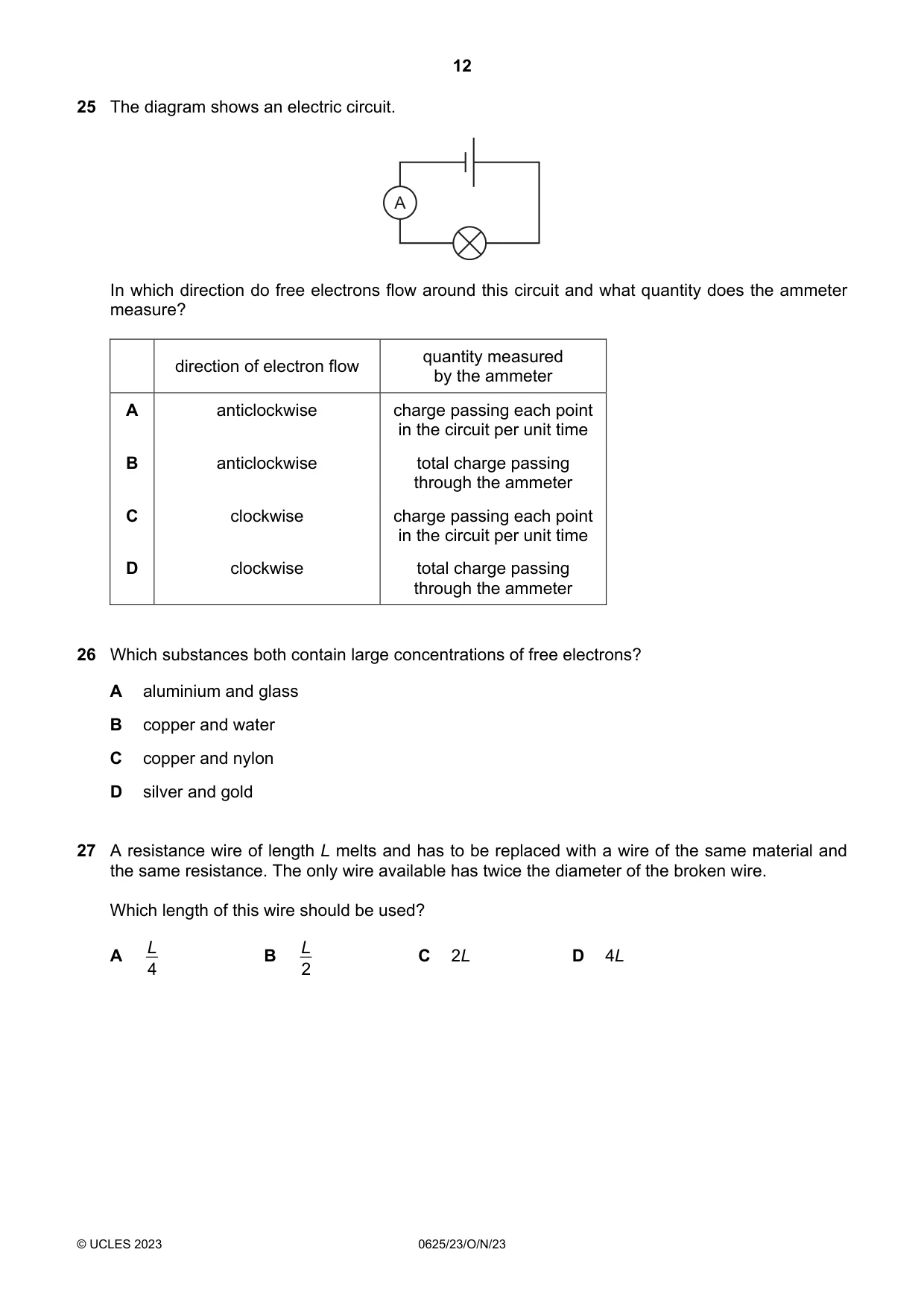
Q25 · The diagram shows an electric circuit
25 The diagram shows an electric circuit. A In which direction do free electrons flow around this circuit and what quantity does the ammeter measure? quantity measured direction of electron flow by the ammeter A anticlockwise charge passing each point in the circuit per unit time B anticlockwise total charge passing through the ammeter C clockwise charge passing each point in the circuit per unit time D clockwise total charge passing through the ammeter
Mark scheme: A
Q26 · Which substances both contain large concentrations of free electrons?
26 Which substances both contain large concentrations of free electrons? A aluminium and glass B copper and water C copper and nylon D silver and gold
Mark scheme: D
Q27 · A resistance wire of length L melts and has to be replaced with a wire of the same…
27 A resistance wire of length L melts and has to be replaced with a wire of the same material and the same resistance. The only wire available has twice the diameter of the broken wire. Which length of this wire should be used? L L A B C 2L D 4L 4 2
Mark scheme: D
Q28 · A teacher wishes to show the production of electrostatic charges
28 A teacher wishes to show the production of electrostatic charges. She holds a rod and rubs it with a cotton cloth. A copper rod, a glass rod, a plastic rod and a steel rod are available. Which two rods would both be suitable to use? A a copper rod and a glass rod B a glass rod and a plastic rod C a plastic rod and a copper rod D a plastic rod and a steel rod
Mark scheme: B
Q29 · Two resistors, with resistances R1 and R2, are used as a potential divider
29 Two resistors, with resistances R1 and R2, are used as a potential divider. R1 V1 R2 V2 What is the relationship between R1, R2 and potential differences V1 and V2? A R1 × R2 = V1 × V2 B R1 × V1 = R2 × V2 R = V1 × V2 C 1 R 2 R V D 1 = 1 R V 2 2
Mark scheme: D
Q30 · The diagram shows a light-dependent resistor (LDR) connected in a potential divider…
30 The diagram shows a light-dependent resistor (LDR) connected in a potential divider circuit. V The brightness of the light falling on the LDR is increased. Which row shows what happens to the resistance of the LDR and what happens to the reading on the voltmeter? resistance of LDR reading on voltmeter A decreases decreases B decreases increases C increases decreases D increases increases
Mark scheme: A
Question 31
31 A simple a.c. generator has a coil rotating in a magnetic field. What happens to the peak electromotive force (e.m.f.) and to the frequency of the a.c. output when the coil is rotated faster? peak e.m.f. frequency A greater greater B greater no change C no change greater D no change no change
Mark scheme: A
Q32 · A current passes along a wire placed between the poles of a permanent magnet
32 A current passes along a wire placed between the poles of a permanent magnet. The wire experiences a force due to the magnetic field. N S What will change the direction of this force? A increasing the current B reversing the current C increasing the strength of the magnetic field D using an electromagnet with the same polarity as the permanent magnet
Mark scheme: B
Q33 · What is a transformer used for?
33 What is a transformer used for? A changing a direct current into an alternating current B changing the magnitude of an alternating voltage C reducing the frequency of an alternating current D switching off the current in a circuit when there is a fault
Mark scheme: B
Q34 · The scattering of a-particles by a thin gold foil provides evidence for the nuclear model…
34 The scattering of a-particles by a thin gold foil provides evidence for the nuclear model of the atom. Two a-particles of the same energy are incident on a nucleus of gold. Which diagram shows the correct paths followed by the a-particles as they pass close to the nucleus? A B path of a-particle @ gold nucleus Cc D @ @
Mark scheme: A
Q35 · The half-life of carbon-14 is 5700 years
35 The half-life of carbon-14 is 5700 years. An object containing carbon-14 has a count rate of 100 counts / minute when it is first formed. The graph shows how the count rate decreases over time. Which point on the graph corresponds to a time 11 400 years after the formation of the object? 100 count rate A counts / minute B C D 0 0 time
Mark scheme: D
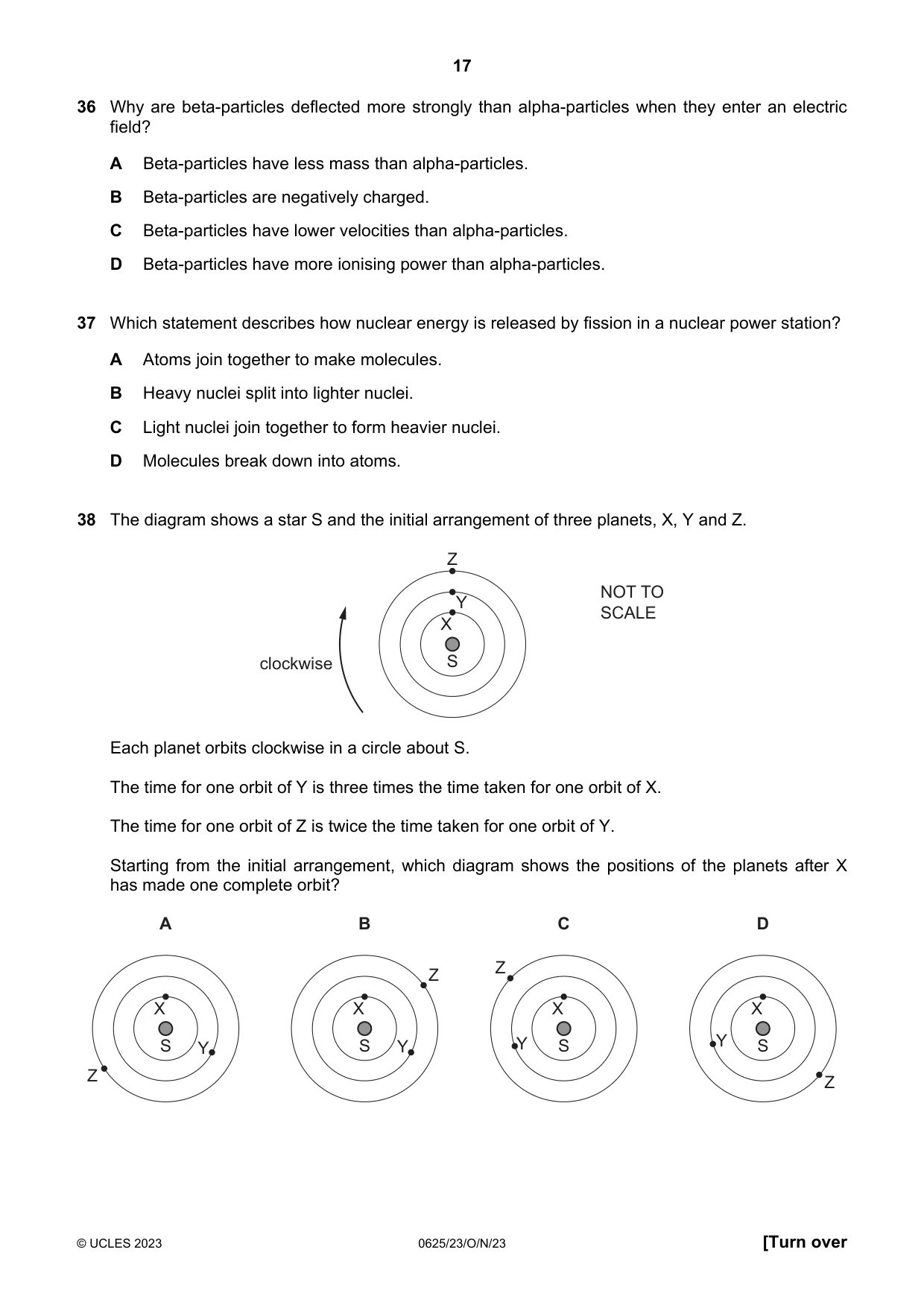
Q36 · Why are beta-particles deflected more strongly than alpha-particles when they enter an…
36 Why are beta-particles deflected more strongly than alpha-particles when they enter an electric field? A Beta-particles have less mass than alpha-particles. B Beta-particles are negatively charged. C Beta-particles have lower velocities than alpha-particles. D Beta-particles have more ionising power than alpha-particles.
Mark scheme: A
Q37 · Which statement describes how nuclear energy is released by fission in a nuclear power…
37 Which statement describes how nuclear energy is released by fission in a nuclear power station? A Atoms join together to make molecules. B Heavy nuclei split into lighter nuclei. C Light nuclei join together to form heavier nuclei. D Molecules break down into atoms.
Mark scheme: B
Q38 · The diagram shows a star S and the initial arrangement of three planets, X, Y and Z
38 The diagram shows a star S and the initial arrangement of three planets, X, Y and Z. Z NOT TO Y SCALE X clockwise S Each planet orbits clockwise in a circle about S. The time for one orbit of Y is three times the time taken for one orbit of X. The time for one orbit of Z is twice the time taken for one orbit of Y. Starting from the initial arrangement, which diagram shows the positions of the planets after X has made one complete orbit? A B C D Z Z X X X X S Y S Y Y S Y S Z Z
Mark scheme: B
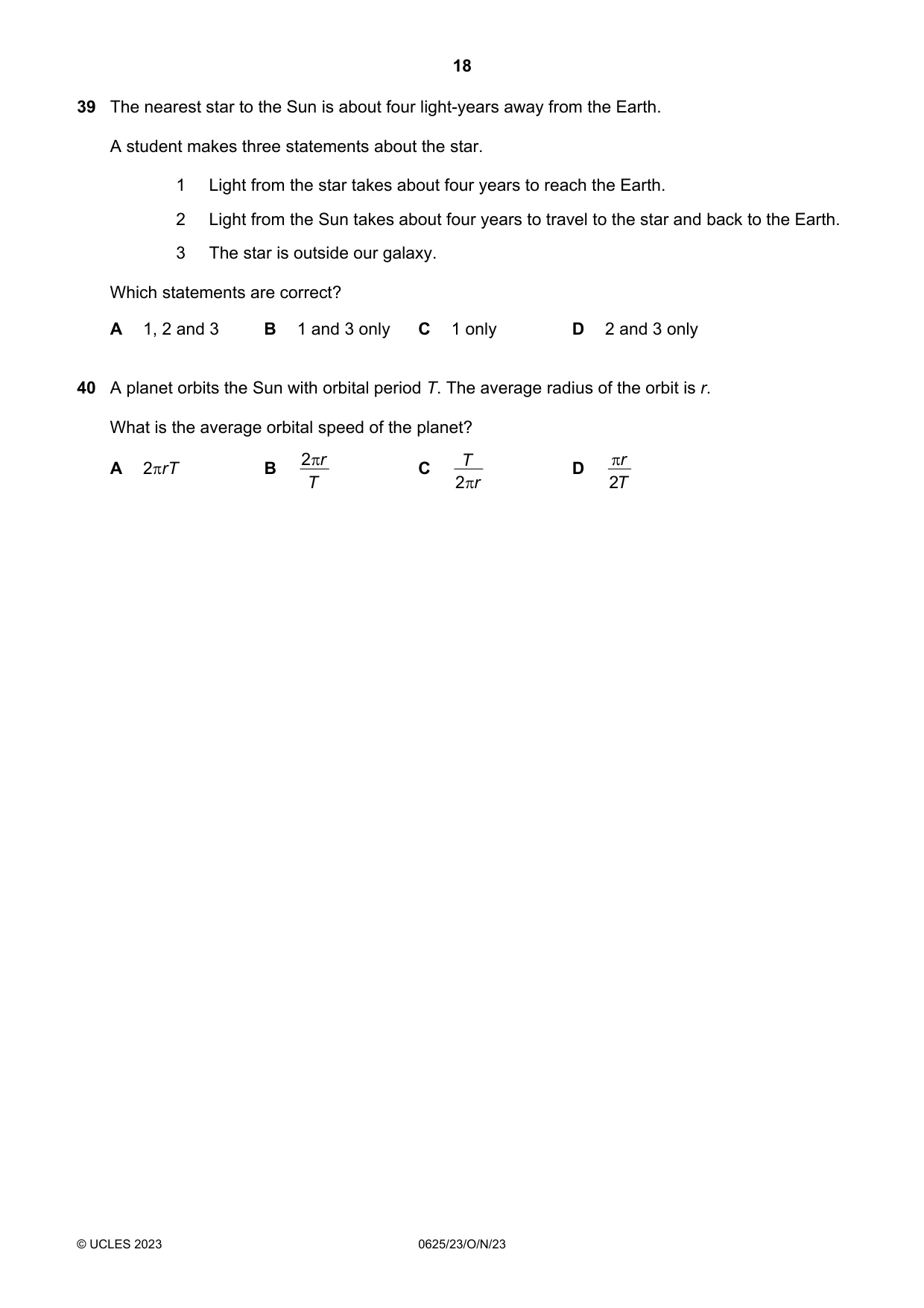
Q39 · The nearest star to the Sun is about four light-years away from the Earth
39 The nearest star to the Sun is about four light-years away from the Earth. A student makes three statements about the star. 1 Light from the star takes about four years to reach the Earth. 2 Light from the Sun takes about four years to travel to the star and back to the Earth. 3 The star is outside our galaxy. Which statements are correct? A 1, 2 and 3 B 1 and 3 only C 1 only D 2 and 3 only
Mark scheme: C
Q40 · A planet orbits the Sun with orbital period T
40 A planet orbits the Sun with orbital period T. The average radius of the orbit is r. What is the average orbital speed of the planet? 2 π r T π r A 2πrT B C D T 2 π r 2 T
Mark scheme: B
What was in this paper
The subtopics covered by these 40 questions, and how many questions each got. Open one in a new tab to see every Cambridge question on it.
4Electrical quantities3Electromagnetic effects3Energy, work and power3Kinetic particle model of matter3Electric circuits2Forces2General properties of waves2Motion2Radioactivity2Simple phenomena of magnetism2The Earth and the Solar System2The nuclear model of the atom2Density1Momentum1Physical quantities and measurement techniques1Pressure1Sound1Stars and the Universe1Thermal properties and temperature1Transfer of thermal energy1What you needed in this session
Cambridge’s own grade thresholds for 2023 Oct/Nov, Paper 2 · Variant 3. A higher threshold means an easier paper — the bar moves with how the cohort did.