Cambridge IGCSE Physics 0625 — 2019 Oct/Nov Paper 2 · Variant 3
0625/23/O/N/19 · 40 questions · 40 marks · ≈45 min
The question paper and its mark scheme, free to read here and free to download. This is Cambridge’s own paper, exactly as it was sat.
Question paper16 pages

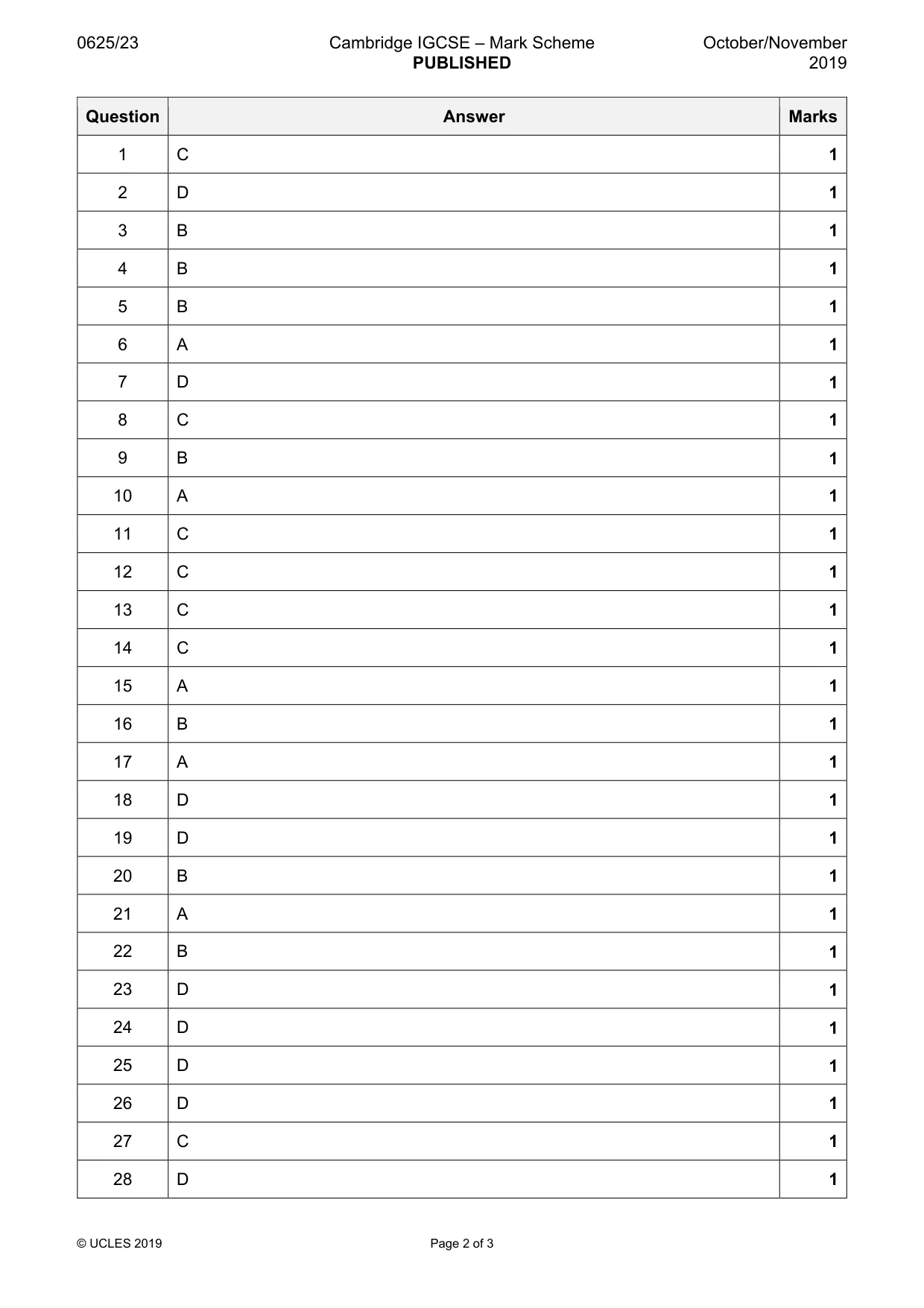
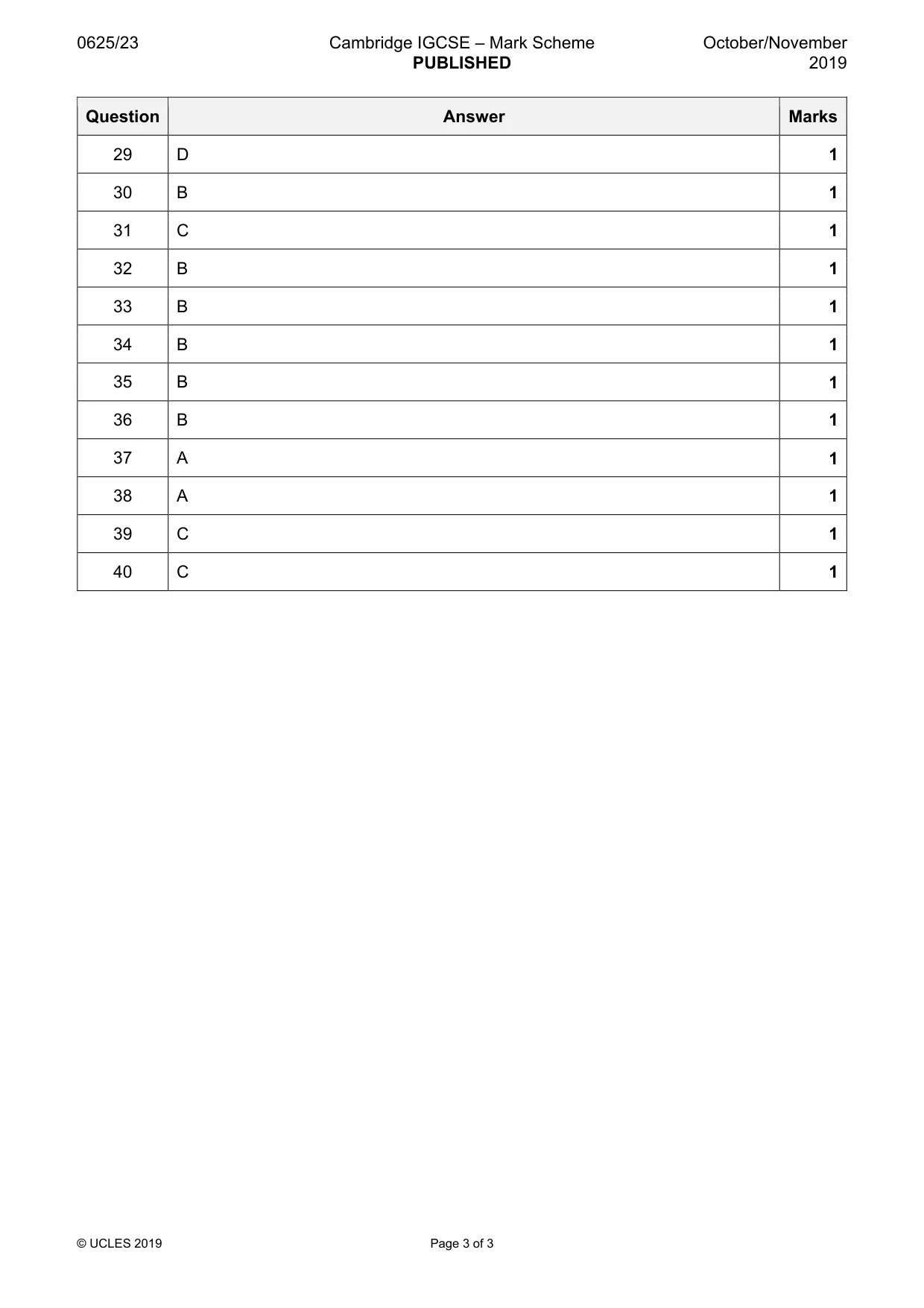
Mark scheme3 pages
Answers below. Sit the paper first if you are practising.
Questions as text
Q1 · Which is the best apparatus to use to measure the thickness of a coin?
1 Which is the best apparatus to use to measure the thickness of a coin? A balance B ruler with a millimetre scale C micrometer screw gauge D pressure gauge
Mark scheme: C
More questions on Physical quantities and measurement techniques
Q2 · The graph shows how the speed of an object varies with time
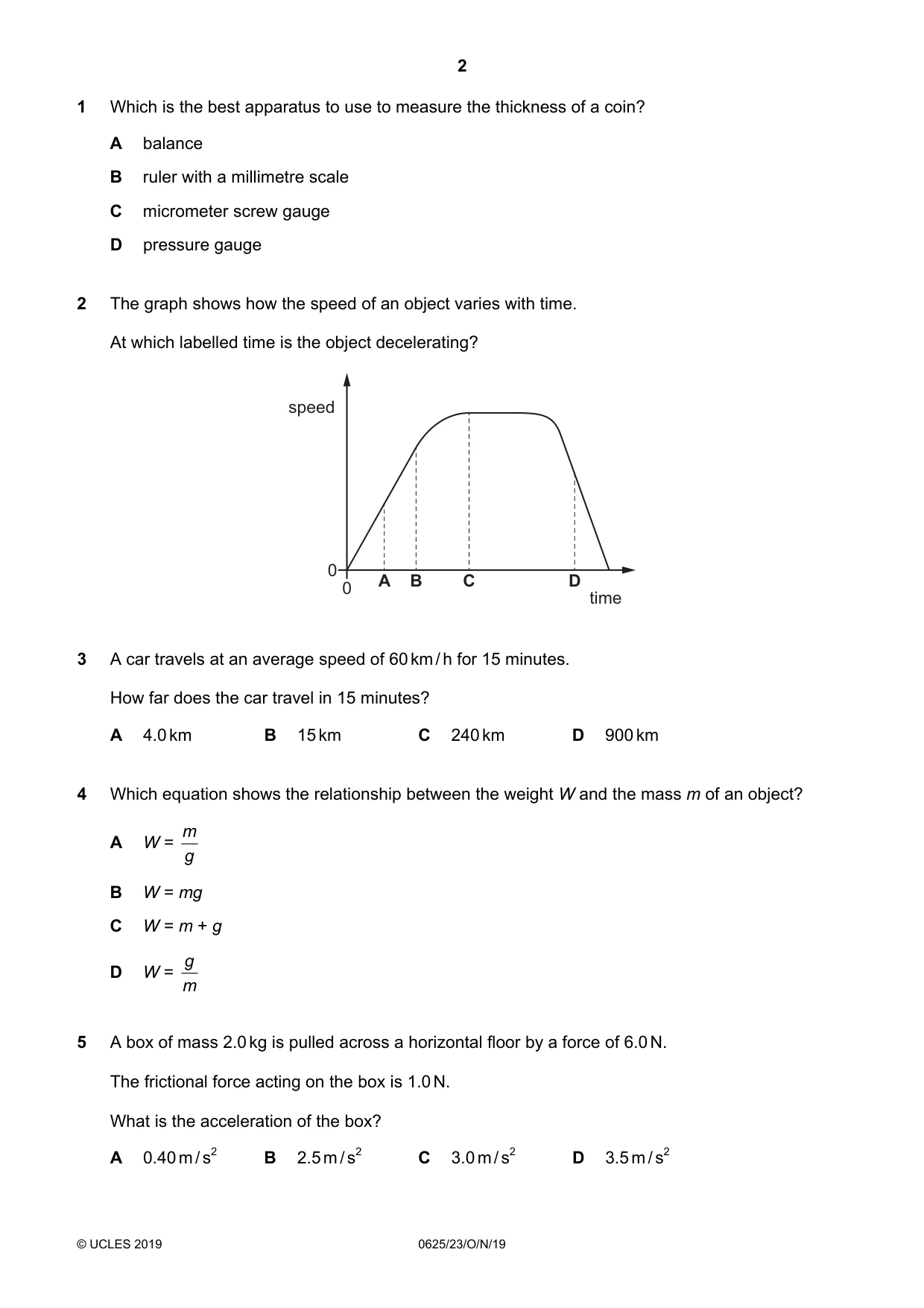
2 The graph shows how the speed of an object varies with time. At which labelled time is the object decelerating? speed 0 0 A B C D time
Mark scheme: D
Q3 · A car travels at an average speed of 60 km / h for 15 minutes
3 A car travels at an average speed of 60 km / h for 15 minutes. How far does the car travel in 15 minutes? A 4.0 km B 15 km C 240 km D 900 km
Mark scheme: B
Q4 · Which equation shows the relationship between the weight W and the mass m of an object?
4 Which equation shows the relationship between the weight W and the mass m of an object? W = m A g B W = mg C W = m + g W = g D m
Mark scheme: B
Q5 · A box of mass 2.0 kg is pulled across a horizontal floor by a force of 6.0 N
5 A box of mass 2.0 kg is pulled across a horizontal floor by a force of 6.0 N. The frictional force acting on the box is 1.0 N. What is the acceleration of the box? A 0.40 m / s2 B 2.5 m / s2 C 3.0 m / s2 D 3.5 m / s2
Mark scheme: B
Q6 · Four hollow glass spheres P, Q, R and S each have a mass of 72 g
6 Four hollow glass spheres P, Q, R and S each have a mass of 72 g. Their volumes are given in the table. volume / cm3 P 55 Q 65 R 75 S 85 Which spheres sink in a liquid of density 0.9 g / cm3? A P, Q and R B Q, R and S C R and S only D S only
Mark scheme: A
Q7 · The diagram shows a uniform metre rule
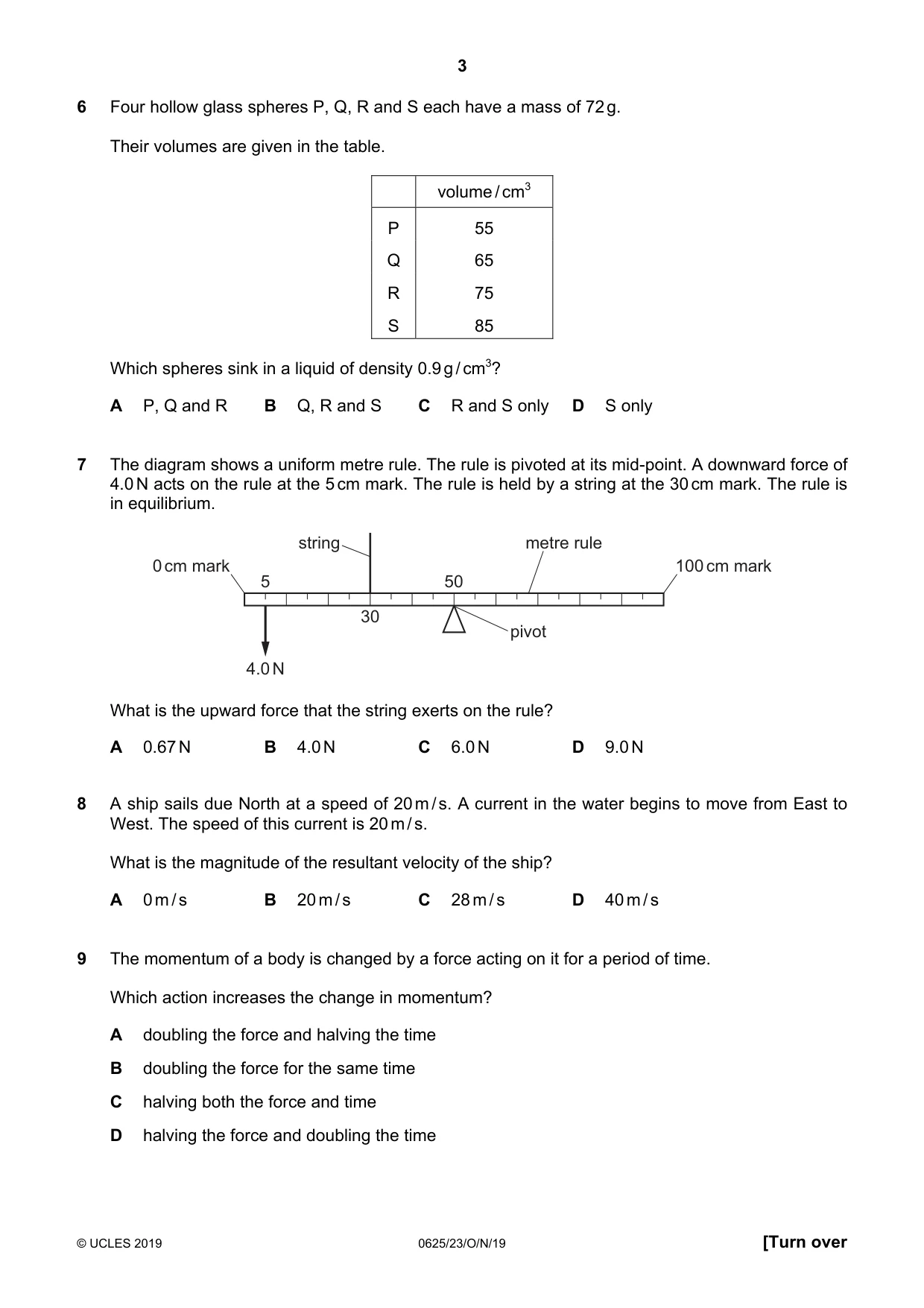
7 The diagram shows a uniform metre rule. The rule is pivoted at its mid-point. A downward force of 4.0 N acts on the rule at the 5 cm mark. The rule is held by a string at the 30 cm mark. The rule is in equilibrium. string metre rule 0 cm mark 100 cm mark 5 50 30 pivot 4.0 N What is the upward force that the string exerts on the rule? A 0.67 N B 4.0 N C 6.0 N D 9.0 N
Mark scheme: D
Q8 · A ship sails due North at a speed of 20 m / s
8 A ship sails due North at a speed of 20 m / s. A current in the water begins to move from East to West. The speed of this current is 20 m / s. What is the magnitude of the resultant velocity of the ship? A 0 m / s B 20 m / s C 28 m / s D 40 m / s
Mark scheme: C
Q9 · The momentum of a body is changed by a force acting on it for a period of time
9 The momentum of a body is changed by a force acting on it for a period of time. Which action increases the change in momentum? A doubling the force and halving the time B doubling the force for the same time C halving both the force and time D halving the force and doubling the time
Mark scheme: B
Q10 · A toy train P of mass 0.50 kg is travelling along a straight track with a velocity of 3.0…
10 A toy train P of mass 0.50 kg is travelling along a straight track with a velocity of 3.0 m / s. It collides with a stationary train Q of mass 1.0 kg. The two trains then stick together. What is the velocity of the combined trains? A 1.0 m / s in the same direction as P was travelling originally B 1.0 m / s in the reverse direction to that in which P was travelling originally C 1.5 m / s in the same direction as P was travelling originally D 1.5 m / s in the reverse direction to that in which P was travelling originally
Mark scheme: A
Q11 · Brakes are used to slow down a moving car
11 Brakes are used to slow down a moving car. Into which form of energy is most of the kinetic energy converted as the car slows down? A chemical B elastic C thermal D sound
Mark scheme: C
Q12 · A force of 25 N acts on an object
12 A force of 25 N acts on an object. The work done by the force is 400 J. How far does the object move in the direction of the force? A 6.3 cm B 16 cm C 16 m D 10 km
Mark scheme: C
Q13 · A car is moving along a straight horizontal road
13 A car is moving along a straight horizontal road. The car has 1.6 MJ of kinetic energy. The car accelerates for 20 s until the kinetic energy of the car increases to 2.5 MJ. What is the minimum average power developed by the car engine for this acceleration? A 45 W B 205 W C 45 kW D 205 kW
Mark scheme: C
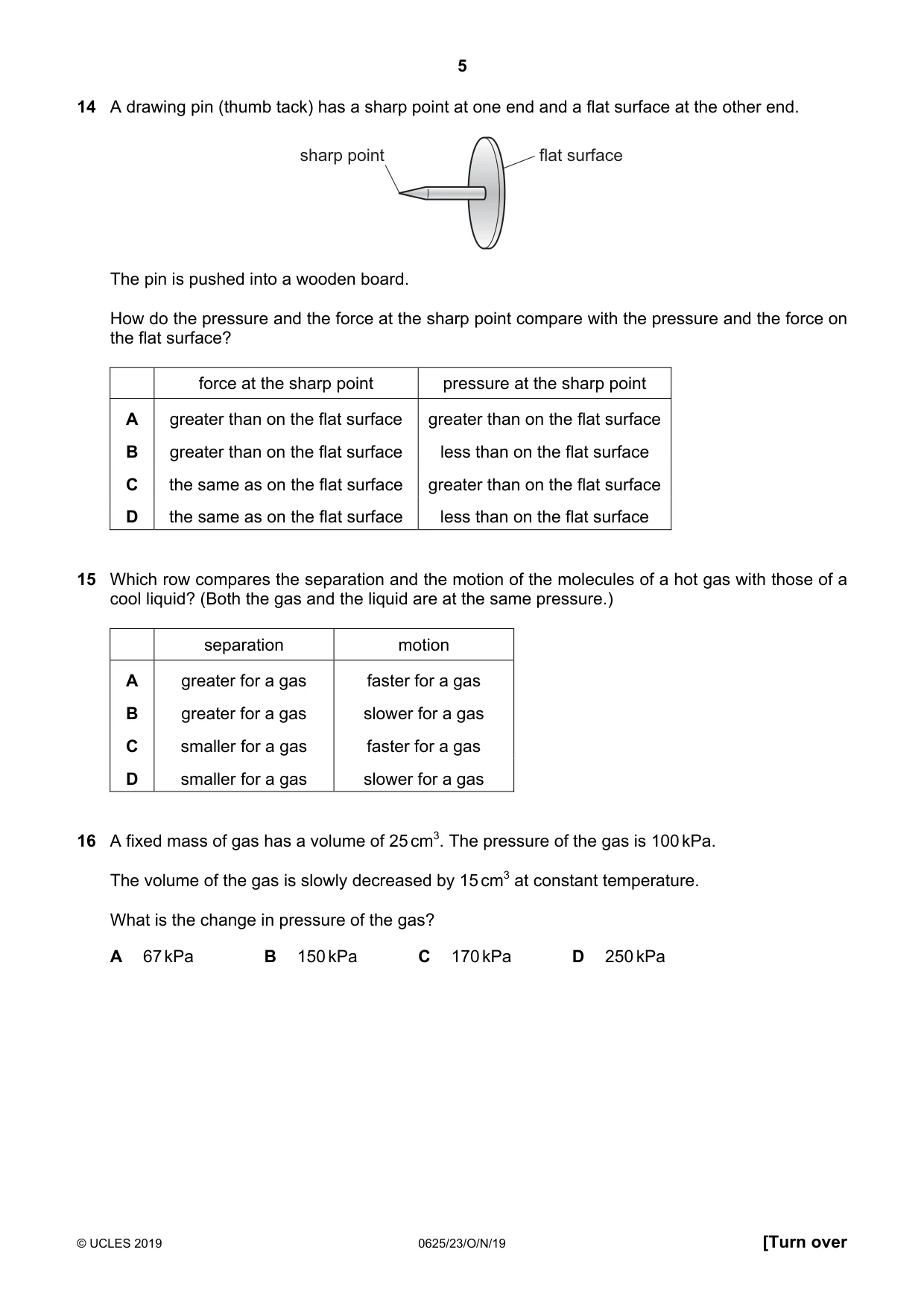
Q14 · A drawing pin (thumb tack) has a sharp point at one end and a flat surface at the other…
14 A drawing pin (thumb tack) has a sharp point at one end and a flat surface at the other end. sharp point flat surface The pin is pushed into a wooden board. How do the pressure and the force at the sharp point compare with the pressure and the force on the flat surface? force at the sharp point pressure at the sharp point A greater than on the flat surface greater than on the flat surface B greater than on the flat surface less than on the flat surface C the same as on the flat surface greater than on the flat surface D the same as on the flat surface less than on the flat surface
Mark scheme: C
Q15 · Which row compares the separation and the motion of the molecules of a hot gas with those…
15 Which row compares the separation and the motion of the molecules of a hot gas with those of a cool liquid? (Both the gas and the liquid are at the same pressure.) separation motion A greater for a gas faster for a gas B greater for a gas slower for a gas C smaller for a gas faster for a gas D smaller for a gas slower for a gas
Mark scheme: A
Q16 · A fixed mass of gas has a volume of 25 cm3
16 A fixed mass of gas has a volume of 25 cm3. The pressure of the gas is 100 kPa. The volume of the gas is slowly decreased by 15 cm3 at constant temperature. What is the change in pressure of the gas? A 67 kPa B 150 kPa C 170 kPa D 250 kPa
Mark scheme: B
Q17 · A liquid turns into a gas
17 A liquid turns into a gas. This occurs only at one particular temperature, and the change happens throughout the liquid. What is this process called? A boiling B condensation C evaporation D fusion
Mark scheme: A
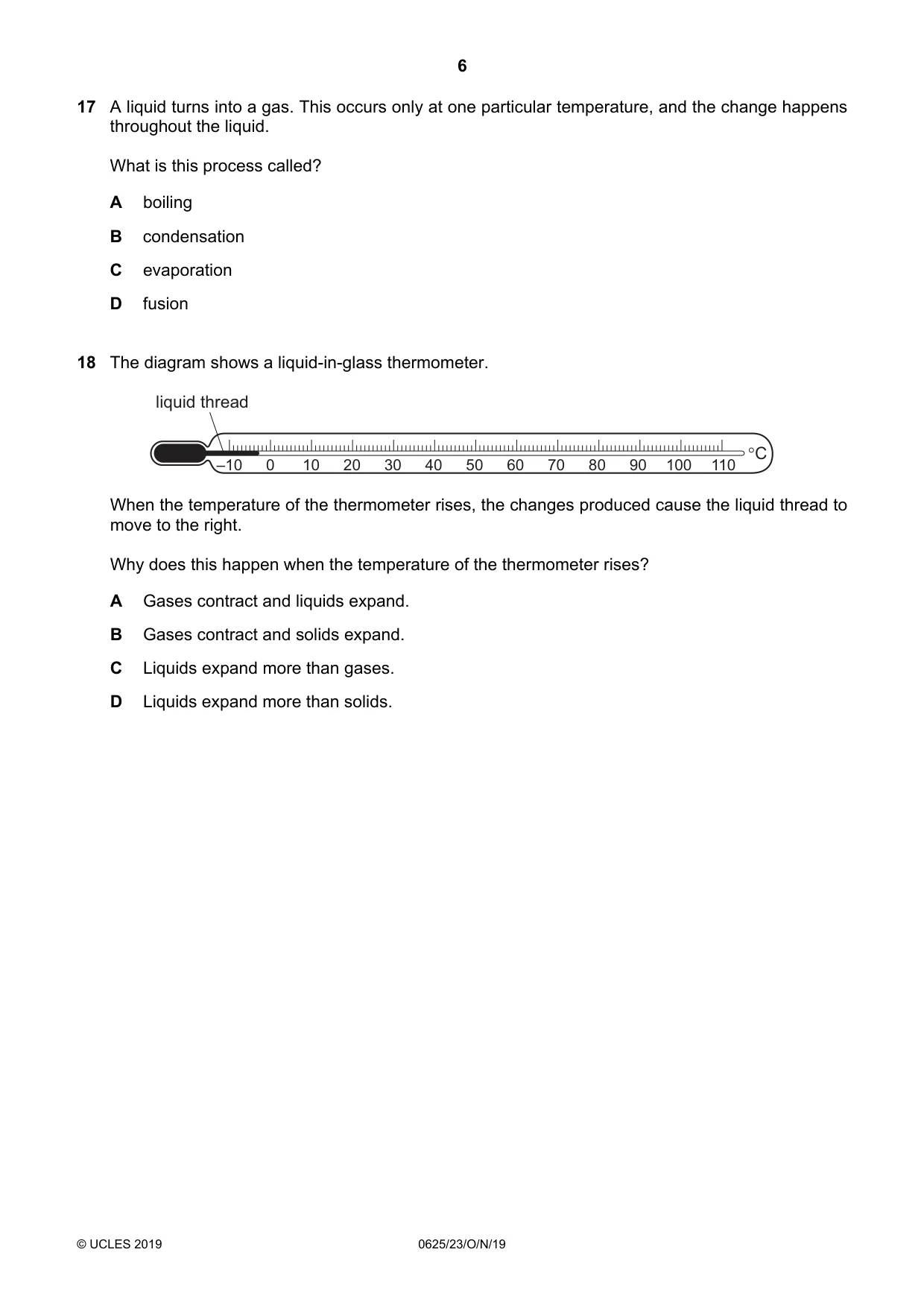
Q18 · The diagram shows a liquid-in-glass thermometer
18 The diagram shows a liquid-in-glass thermometer. liquid thread 110 °C –10 0 10 20 30 40 50 60 70 80 90 100 When the temperature of the thermometer rises, the changes produced cause the liquid thread to move to the right. Why does this happen when the temperature of the thermometer rises? A Gases contract and liquids expand. B Gases contract and solids expand. C Liquids expand more than gases. D Liquids expand more than solids.
Mark scheme: D
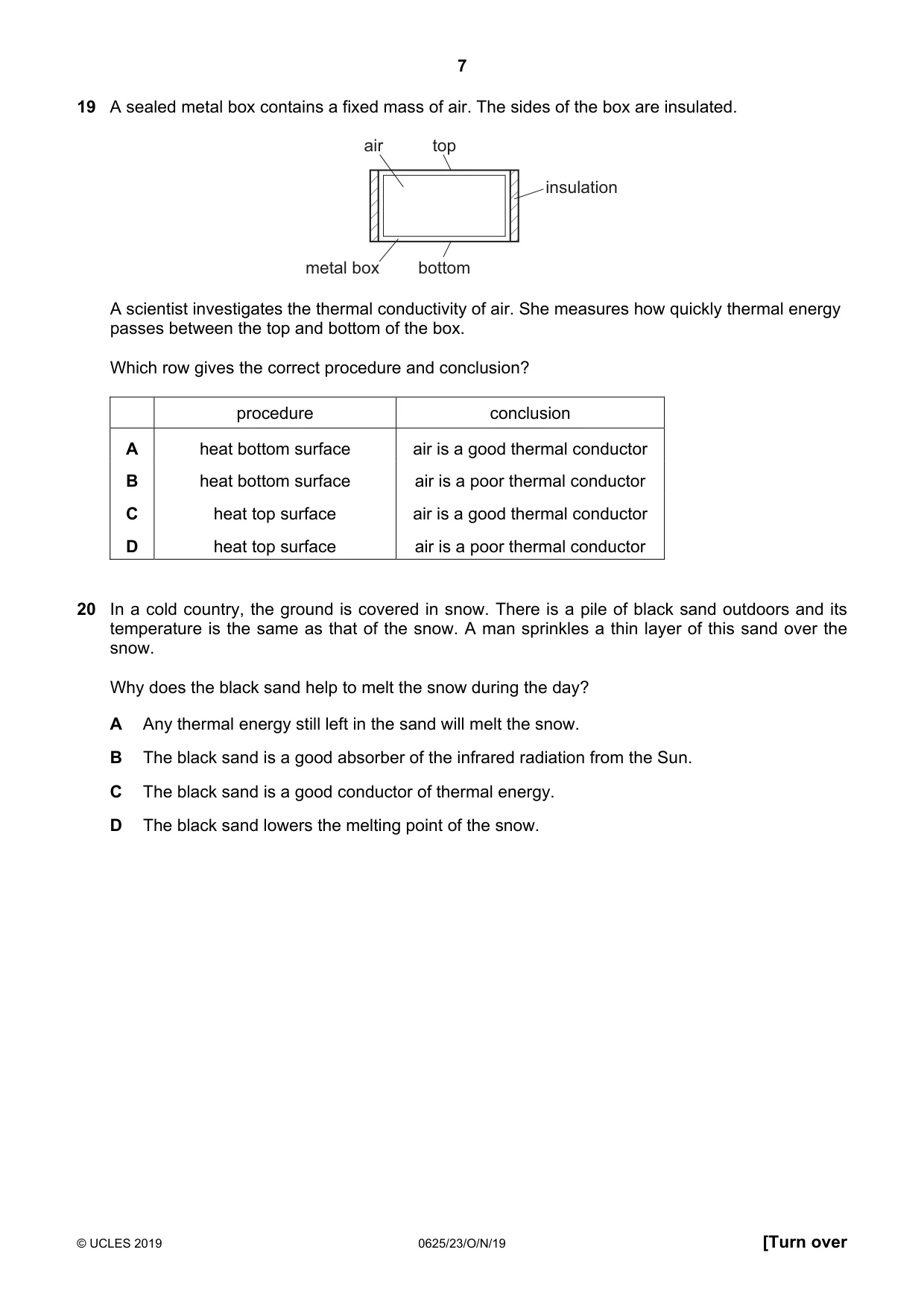
Q19 · A sealed metal box contains a fixed mass of air
19 A sealed metal box contains a fixed mass of air. The sides of the box are insulated. air top insulation metal box bottom A scientist investigates the thermal conductivity of air. She measures how quickly thermal energy passes between the top and bottom of the box. Which row gives the correct procedure and conclusion? procedure conclusion A heat bottom surface air is a good thermal conductor B heat bottom surface air is a poor thermal conductor C heat top surface air is a good thermal conductor D heat top surface air is a poor thermal conductor
Mark scheme: D
Q20 · In a cold country, the ground is covered in snow
20 In a cold country, the ground is covered in snow. There is a pile of black sand outdoors and its temperature is the same as that of the snow. A man sprinkles a thin layer of this sand over the snow. Why does the black sand help to melt the snow during the day? A Any thermal energy still left in the sand will melt the snow. B The black sand is a good absorber of the infrared radiation from the Sun. C The black sand is a good conductor of thermal energy. D The black sand lowers the melting point of the snow.
Mark scheme: B
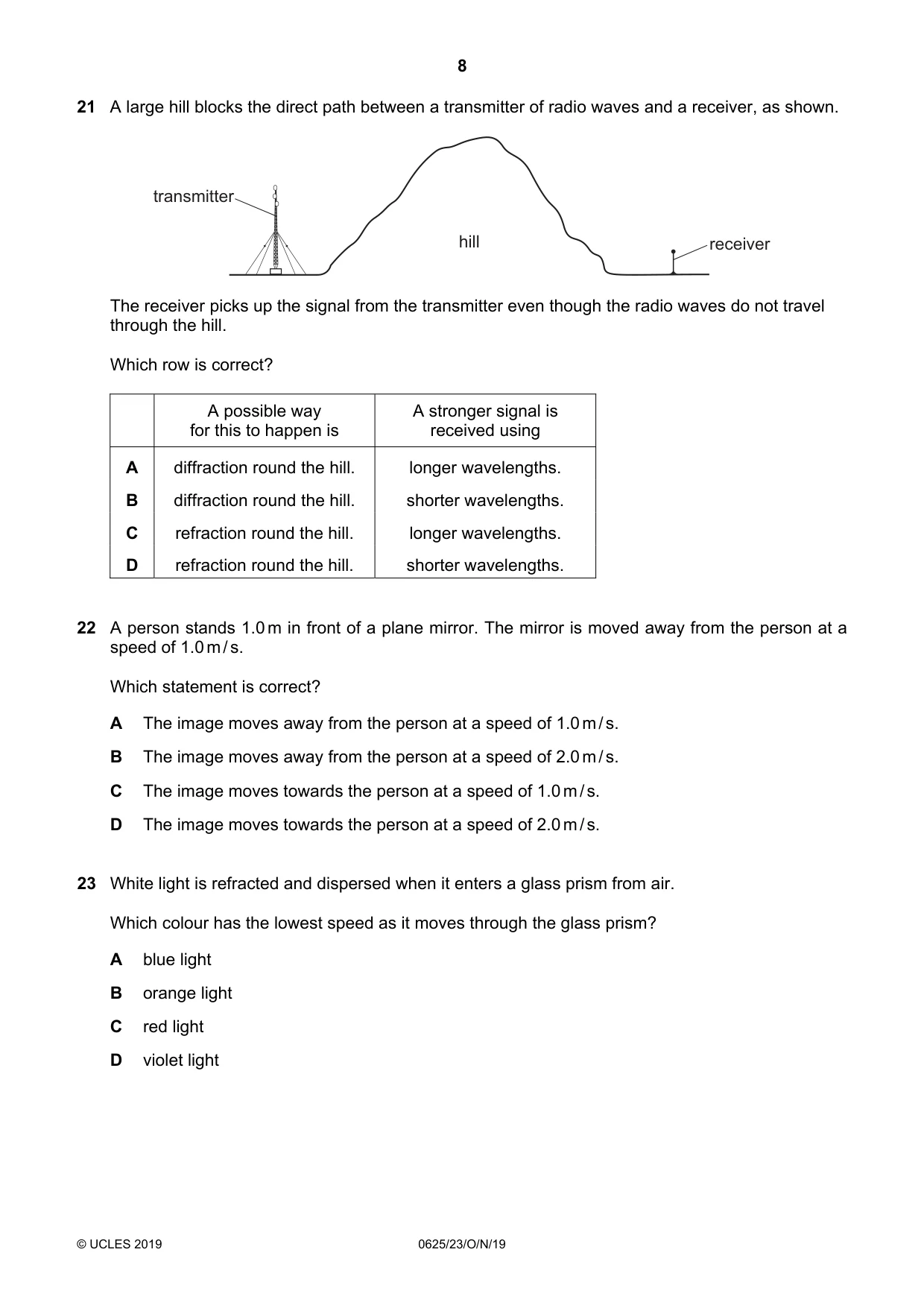
Q21 · A large hill blocks the direct path between a transmitter of radio waves and a receiver…
21 A large hill blocks the direct path between a transmitter of radio waves and a receiver, as shown. transmitter hill receiver The receiver picks up the signal from the transmitter even though the radio waves do not travel through the hill. Which row is correct? A possible way A stronger signal is for this to happen is received using A diffraction round the hill. longer wavelengths. B diffraction round the hill. shorter wavelengths. C refraction round the hill. longer wavelengths. D refraction round the hill. shorter wavelengths.
Mark scheme: A
Q22 · A person stands 1.0 m in front of a plane mirror
22 A person stands 1.0 m in front of a plane mirror. The mirror is moved away from the person at a speed of 1.0 m / s. Which statement is correct? A The image moves away from the person at a speed of 1.0 m / s. B The image moves away from the person at a speed of 2.0 m / s. C The image moves towards the person at a speed of 1.0 m / s. D The image moves towards the person at a speed of 2.0 m / s.
Mark scheme: B
Q23 · White light is refracted and dispersed when it enters a glass prism from air
23 White light is refracted and dispersed when it enters a glass prism from air. Which colour has the lowest speed as it moves through the glass prism? A blue light B orange light C red light D violet light
Mark scheme: D
Q24 · The diagram shows the electromagnetic spectrum
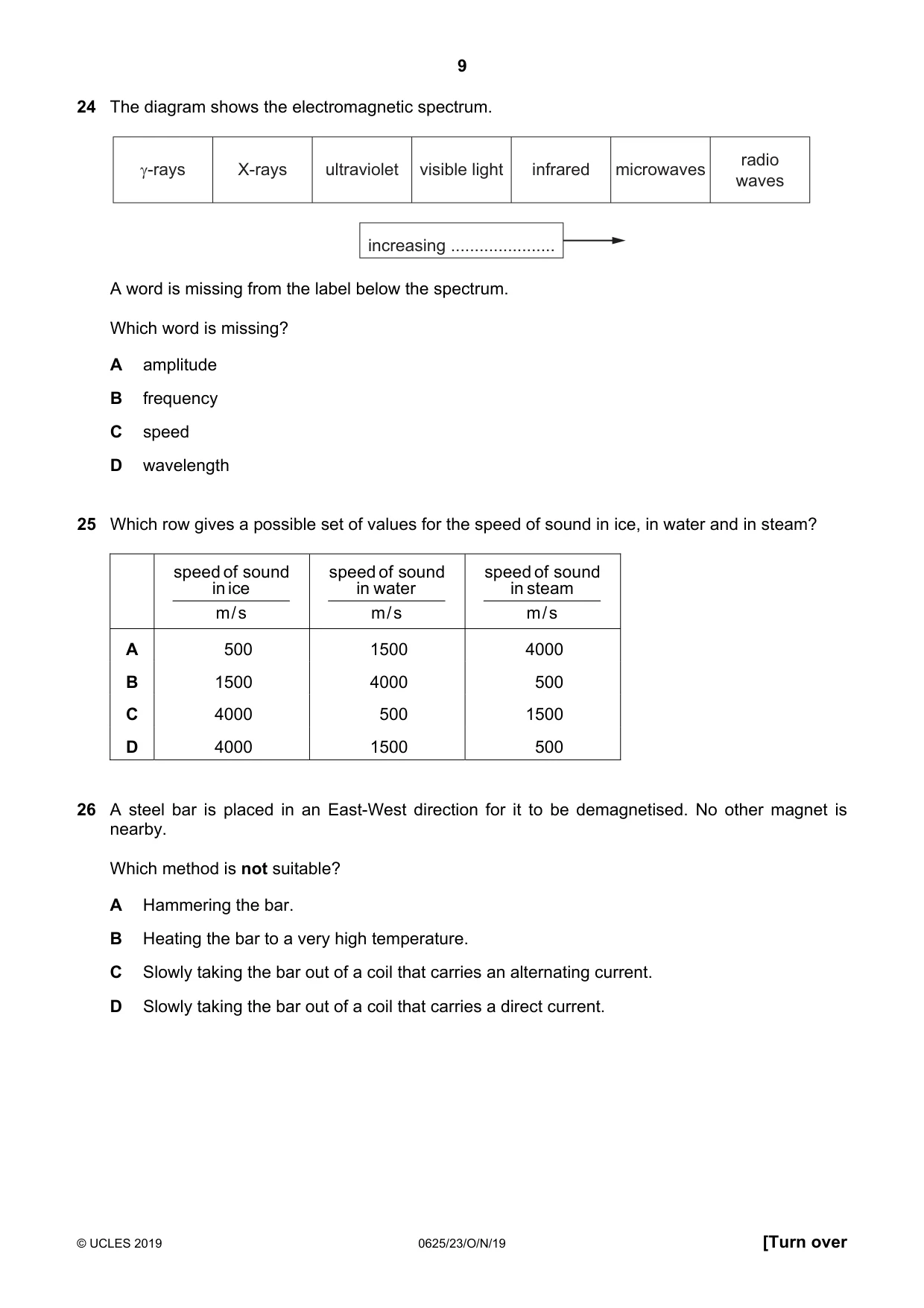
24 The diagram shows the electromagnetic spectrum. radio γ-rays X-rays ultraviolet visible light infrared microwaves waves increasing ...................... A word is missing from the label below the spectrum. Which word is missing? A amplitude B frequency C speed D wavelength
Mark scheme: D
Q25 · Which row gives a possible set of values for the speed of sound in ice, in water and in…
25 Which row gives a possible set of values for the speed of sound in ice, in water and in steam? speed of sound speed of sound speed of sound in ice in water in steam m/s m/s m/s A 500 1500 4000 B 1500 4000 500 C 4000 500 1500 D 4000 1500 500
Mark scheme: D
Q26 · A steel bar is placed in an East-West direction for it to be demagnetised
26 A steel bar is placed in an East-West direction for it to be demagnetised. No other magnet is nearby. Which method is not suitable? A Hammering the bar. B Heating the bar to a very high temperature. C Slowly taking the bar out of a coil that carries an alternating current. D Slowly taking the bar out of a coil that carries a direct current.
Mark scheme: D
Q27 · A plastic rod is rubbed with a dry cloth
27 A plastic rod is rubbed with a dry cloth. The rod becomes positively charged. Why has the rod become positively charged? A It has gained electrons. B It has gained neutrons. C It has lost electrons. D It has lost neutrons.
Mark scheme: C
Q28 · There is a current of 3.0 A in a resistor for time t
28 There is a current of 3.0 A in a resistor for time t. During time t, a charge of 120 C flows through the resistor. What is time t ? A 0.025 minutes B 0.025 s C 40 minutes D 40 s
Mark scheme: D
Q29 · Identical resistors are connected together to form arrangements X, Y and Z
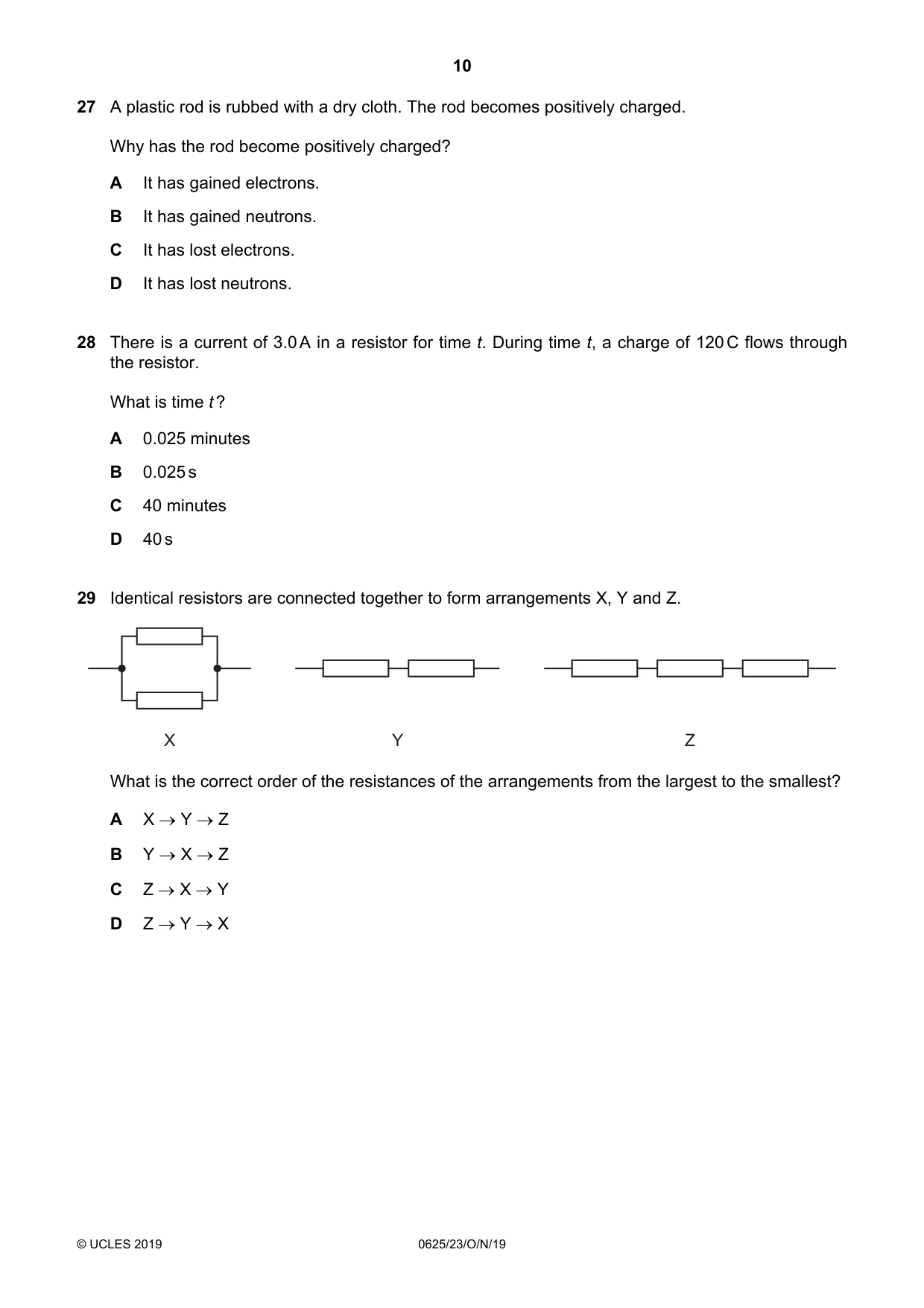
29 Identical resistors are connected together to form arrangements X, Y and Z. X Y Z What is the correct order of the resistances of the arrangements from the largest to the smallest? A X → Y → Z B Y → X → Z C Z → X → Y D Z → Y → X
Mark scheme: D
Q30 · Resistors of resistance 1.0 Ω, 2.0 Ω and 3.0 Ω are connected in parallel across the…
30 Resistors of resistance 1.0 Ω, 2.0 Ω and 3.0 Ω are connected in parallel across the terminals of a cell. Which statement is correct? A The currents in the resistors are equal. B The sum of the currents in the three resistors is equal to the current in the cell. C The sum of the potential differences (p.d.’s) across the resistors is equal to the electromotive force (e.m.f.) of the cell. D The potential difference across the 3.0 Ω resistor is greater than the potential difference across the other two resistors.
Mark scheme: B
Q31 · A circuit containing an a.c
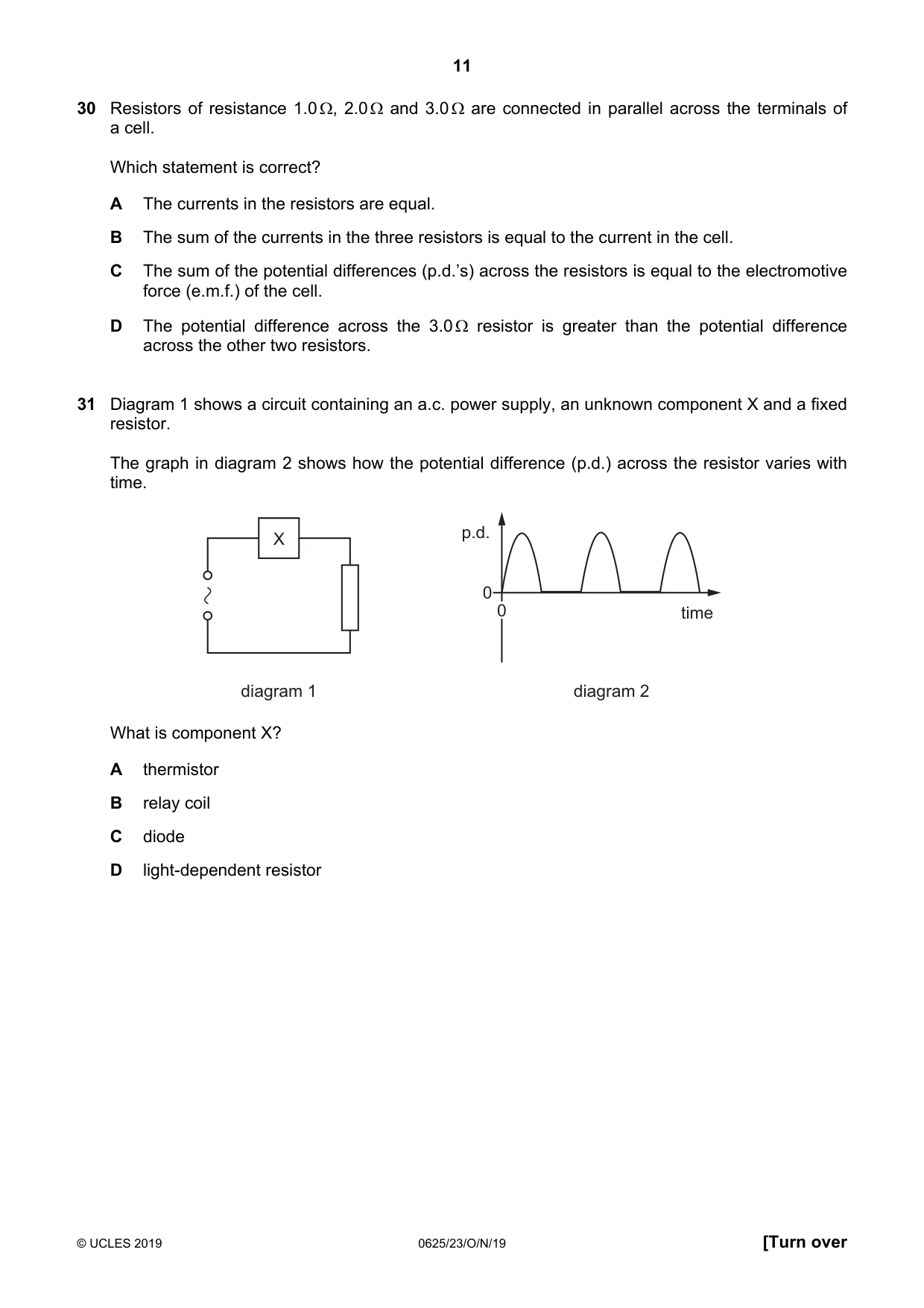
31 Diagram 1 shows a circuit containing an a.c. power supply, an unknown component X and a fixed resistor. The graph in diagram 2 shows how the potential difference (p.d.) across the resistor varies with time. X p.d. 0 0 time diagram 1 diagram 2 What is component X? A thermistor B relay coil C diode D light-dependent resistor
Mark scheme: C
Q32 · An AND gate has two inputs and one output
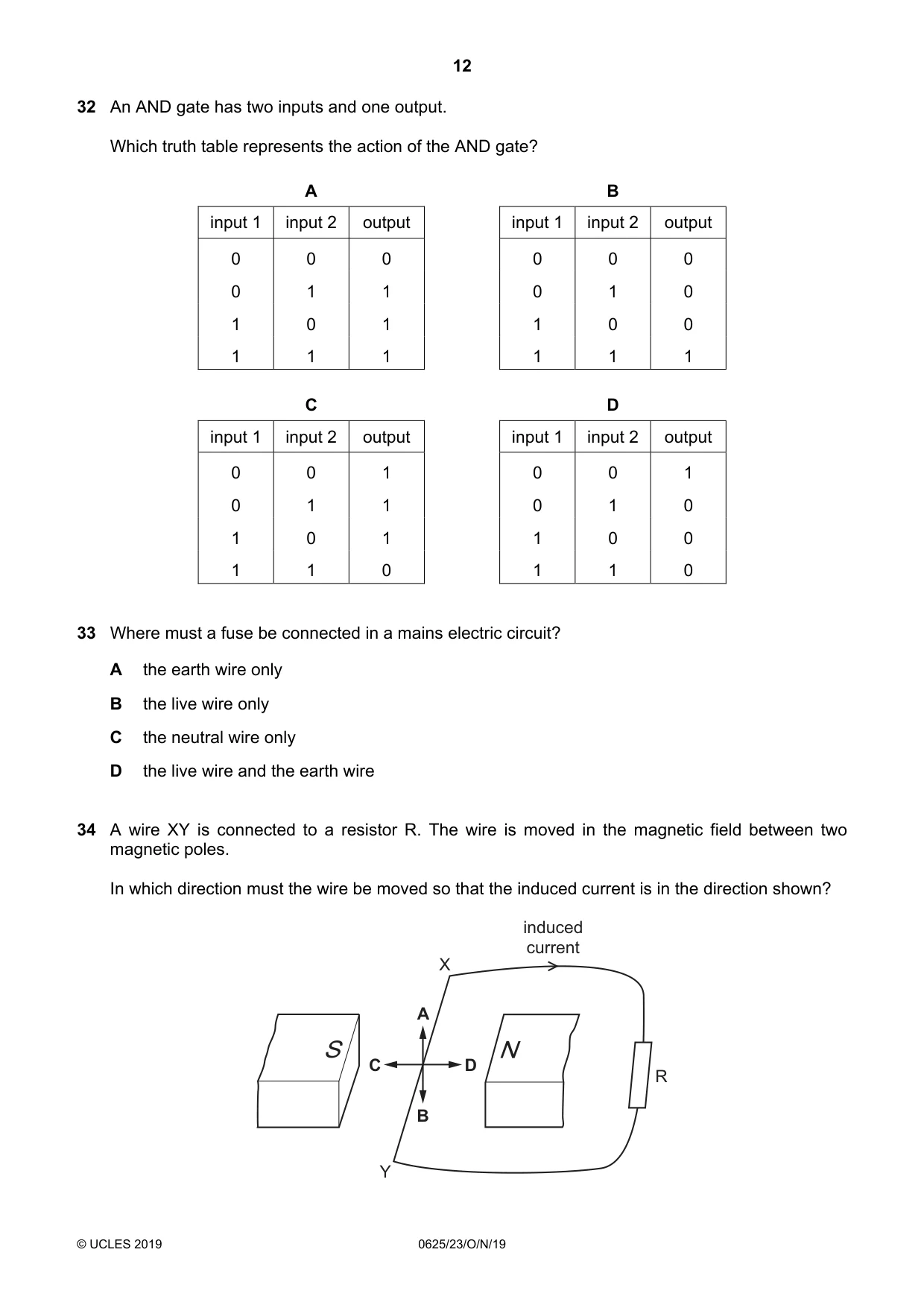
32 An AND gate has two inputs and one output. Which truth table represents the action of the AND gate? A B input 1 input 2 output input 1 input 2 output 0 0 0 0 0 0 0 1 1 0 1 0 1 0 1 1 0 0 1 1 1 1 1 1 C D input 1 input 2 output input 1 input 2 output 0 0 1 0 0 1 0 1 1 0 1 0 1 0 1 1 0 0 1 1 0 1 1 0
Mark scheme: B
Q33 · Where must a fuse be connected in a mains electric circuit?
33 Where must a fuse be connected in a mains electric circuit? A the earth wire only B the live wire only C the neutral wire only D the live wire and the earth wire
Mark scheme: B
Q34 · A wire XY is connected to a resistor R
34 A wire XY is connected to a resistor R. The wire is moved in the magnetic field between two magnetic poles. In which direction must the wire be moved so that the induced current is in the direction shown? induced current X A S N C D R B Y
Mark scheme: B
Q35 · A step-up transformer produces a 60 V a.c
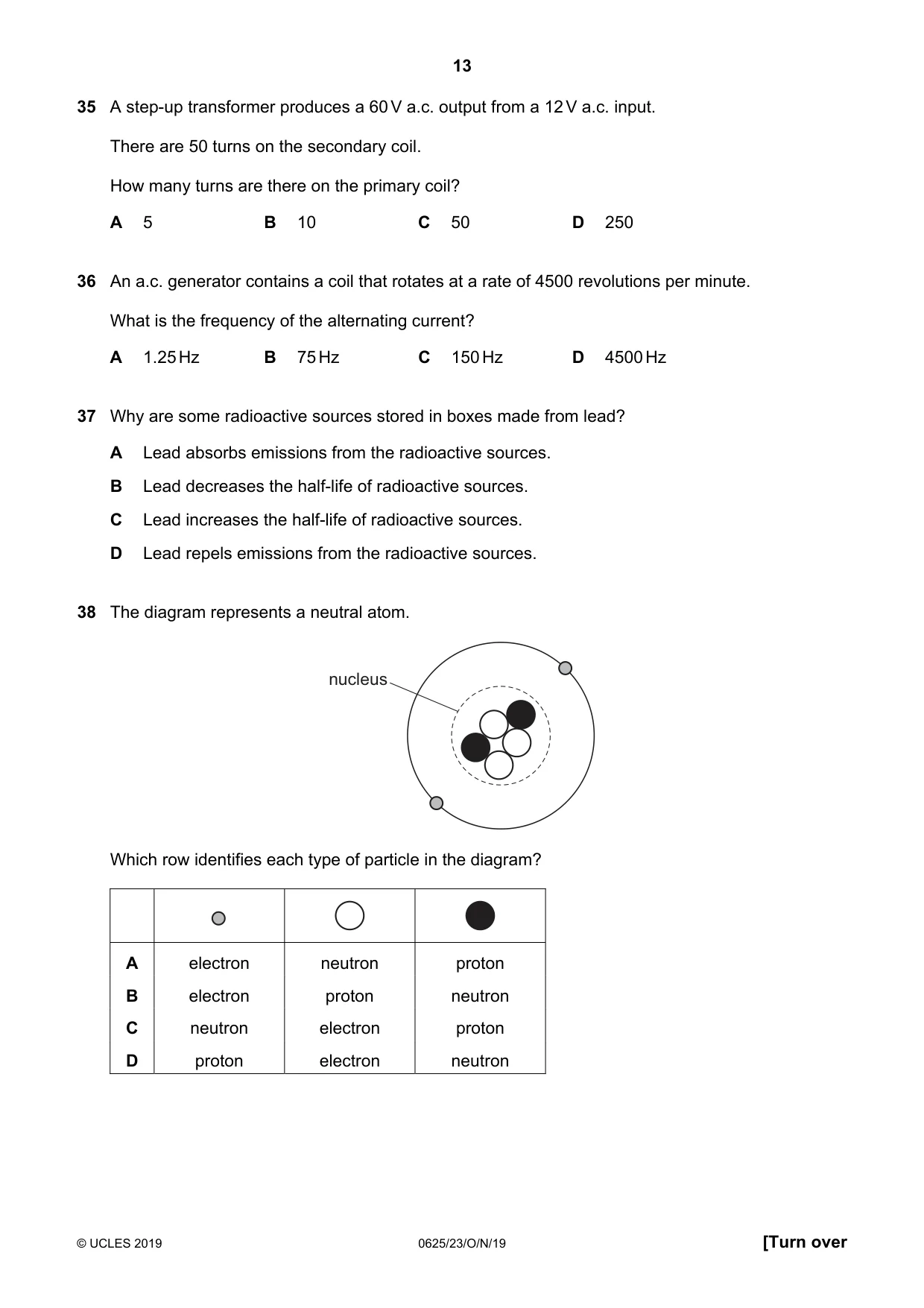
35 A step-up transformer produces a 60 V a.c. output from a 12 V a.c. input. There are 50 turns on the secondary coil. How many turns are there on the primary coil? A 5 B 10 C 50 D 250
Mark scheme: B
Question 36
36 An a.c. generator contains a coil that rotates at a rate of 4500 revolutions per minute. What is the frequency of the alternating current? A 1.25 Hz B 75 Hz C 150 Hz D 4500 Hz
Mark scheme: B
Q37 · Why are some radioactive sources stored in boxes made from lead?
37 Why are some radioactive sources stored in boxes made from lead? A Lead absorbs emissions from the radioactive sources. B Lead decreases the half-life of radioactive sources. C Lead increases the half-life of radioactive sources. D Lead repels emissions from the radioactive sources.
Mark scheme: A
Q38 · The diagram represents a neutral atom
38 The diagram represents a neutral atom. nucleus Which row identifies each type of particle in the diagram? A electron neutron proton B electron proton neutron C neutron electron proton D proton electron neutron
Mark scheme: A
Q39 · A thin metal foil is placed in a vacuum
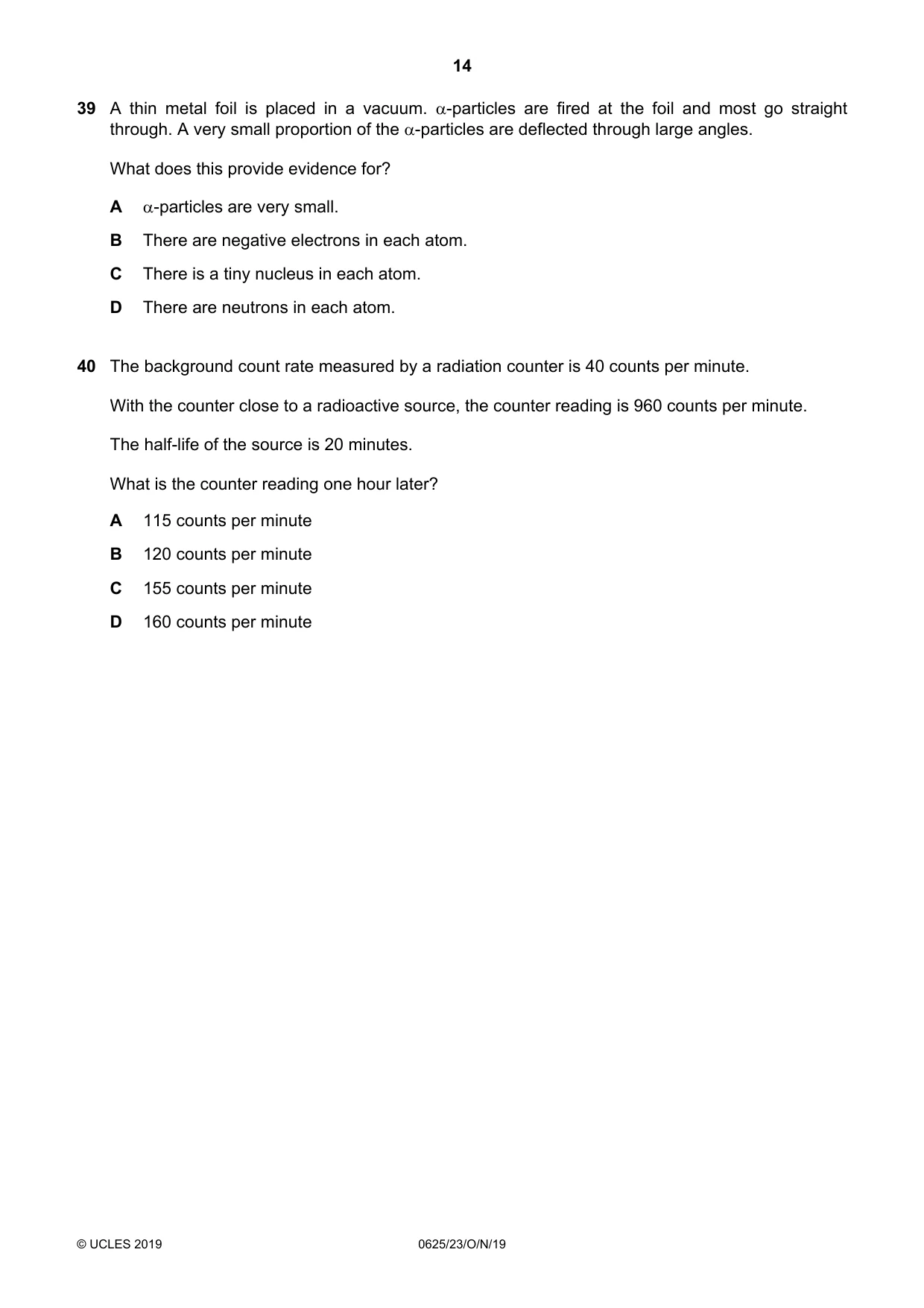
39 A thin metal foil is placed in a vacuum. α-particles are fired at the foil and most go straight through. A very small proportion of the α-particles are deflected through large angles. What does this provide evidence for? A α-particles are very small. B There are negative electrons in each atom. C There is a tiny nucleus in each atom. D There are neutrons in each atom.
Mark scheme: C
Q40 · The background count rate measured by a radiation counter is 40 counts per minute
40 The background count rate measured by a radiation counter is 40 counts per minute. With the counter close to a radioactive source, the counter reading is 960 counts per minute. The half-life of the source is 20 minutes. What is the counter reading one hour later? A 115 counts per minute B 120 counts per minute C 155 counts per minute D 160 counts per minute
Mark scheme: C
What was in this paper
The subtopics covered by these 40 questions, and how many questions each got. Open one in a new tab to see every Cambridge question on it.
4Electromagnetic effects3Energy, work and power3Motion3Forces2Kinetic particle model of matter2Light2Momentum2Radioactivity2Simple phenomena of magnetism2The nuclear model of the atom2Thermal properties and temperature2Transfer of thermal energy2Density1Electrical quantities1Electrical safety1Electromagnetic spectrum1General properties of waves1Mass and weight1Physical quantities and measurement techniques1Pressure1Sound1What you needed in this session
Cambridge’s own grade thresholds for 2019 Oct/Nov, Paper 2 · Variant 3. A higher threshold means an easier paper — the bar moves with how the cohort did.