Cambridge IGCSE Physics 0625 — 2023 May/June Paper 2 · Variant 2
0625/22/M/J/23 · 40 questions · 40 marks · ≈45 min
The question paper and its mark scheme, free to read here and free to download. This is Cambridge’s own paper, exactly as it was sat.
Question paper16 pages
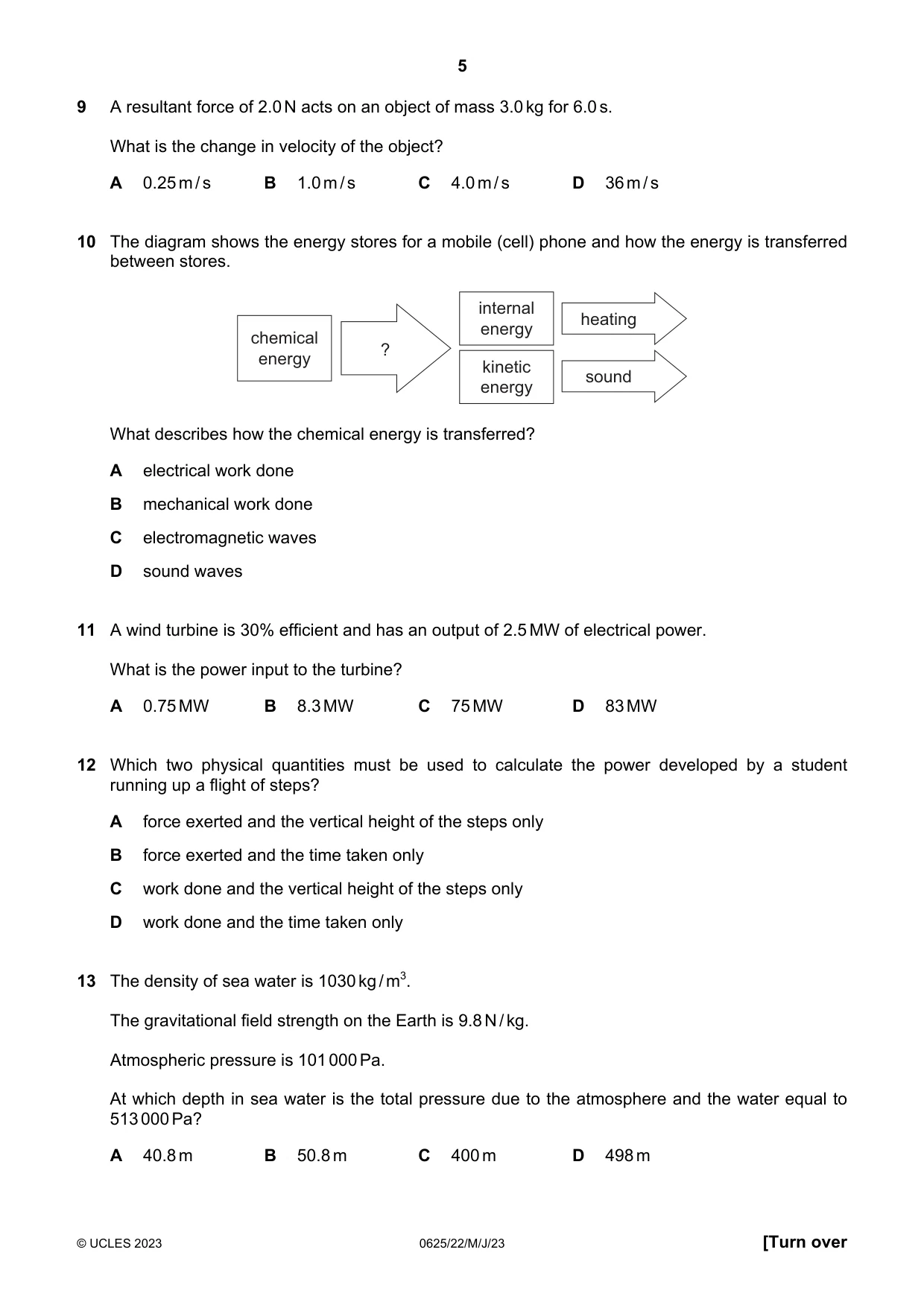
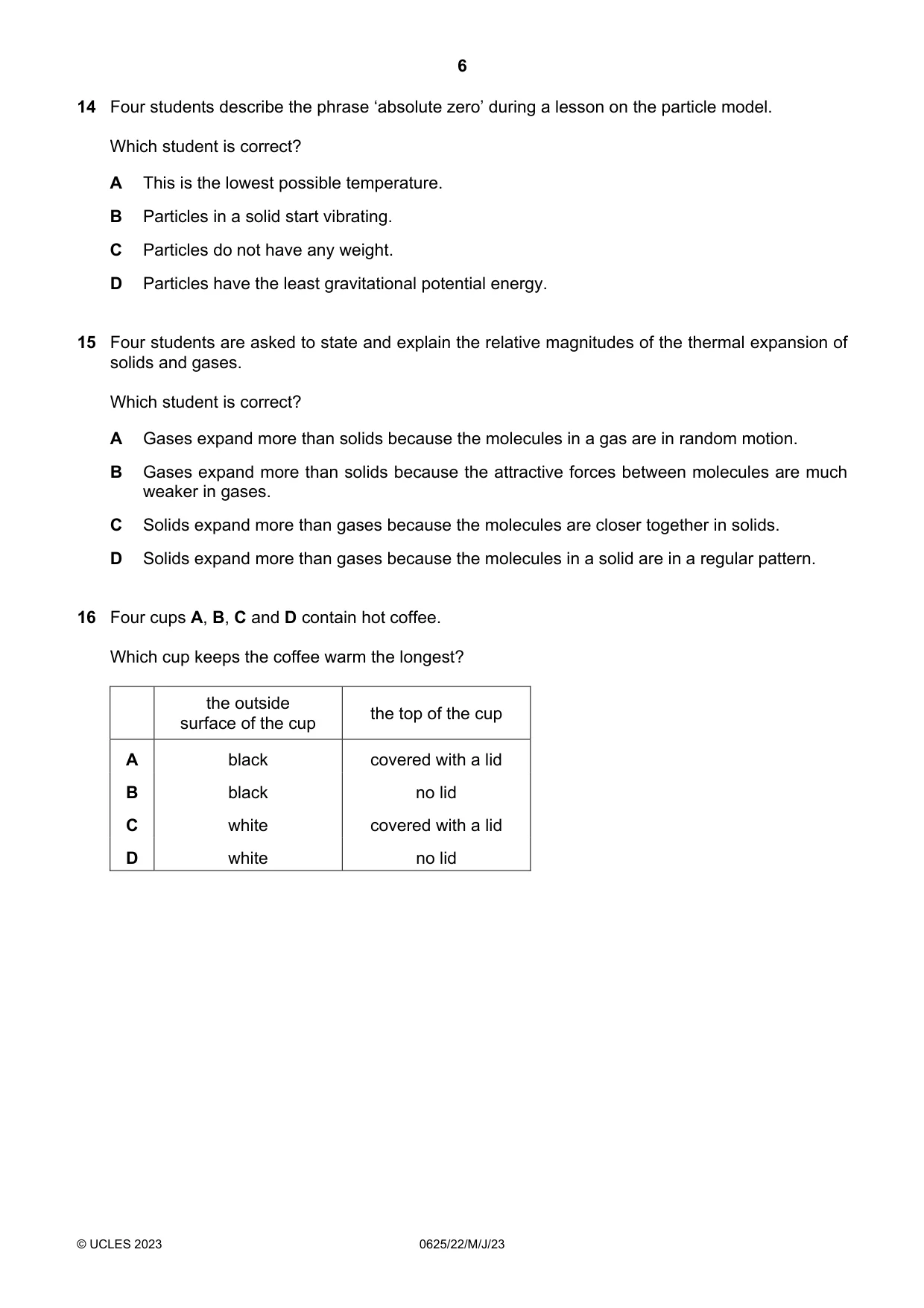
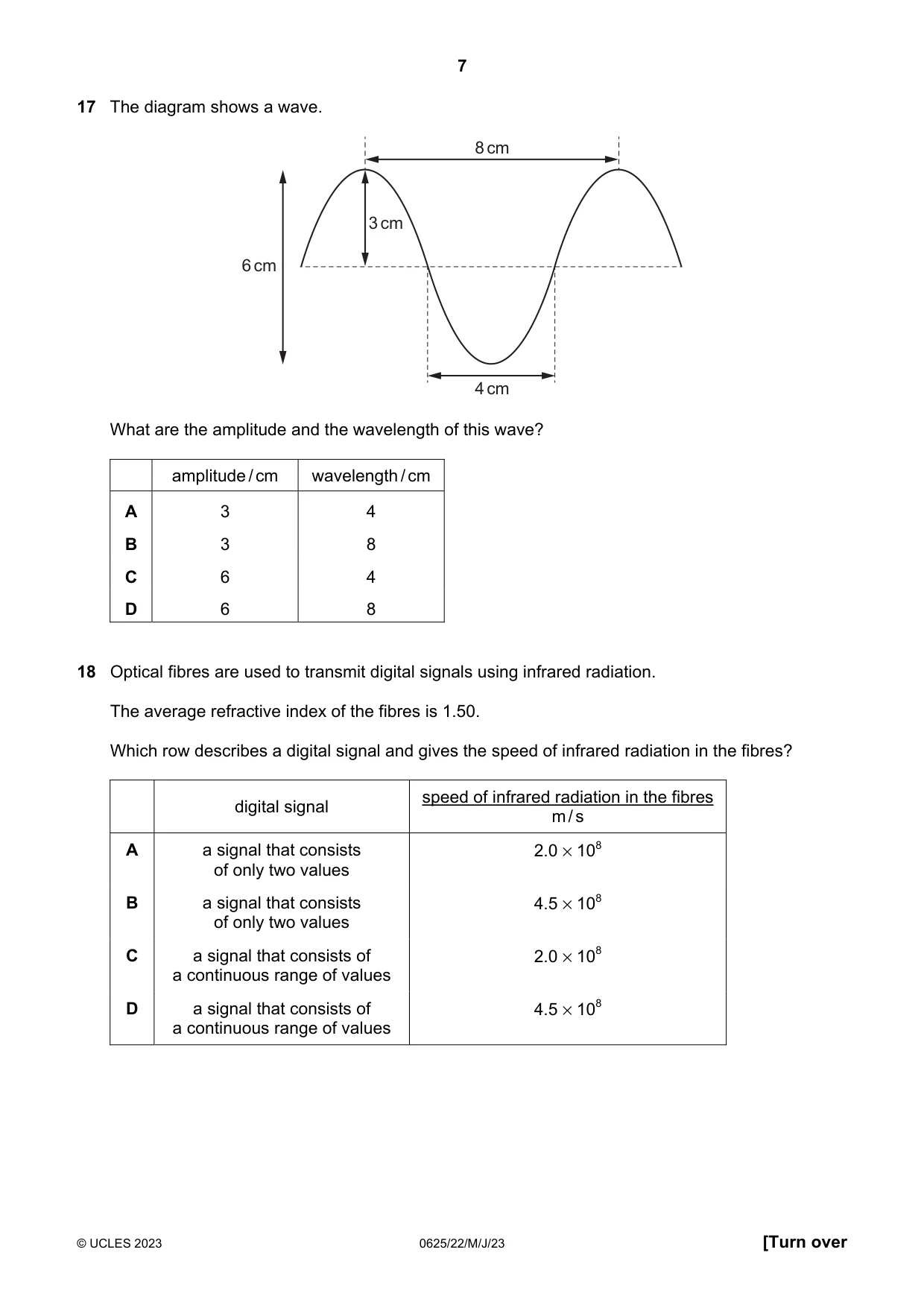
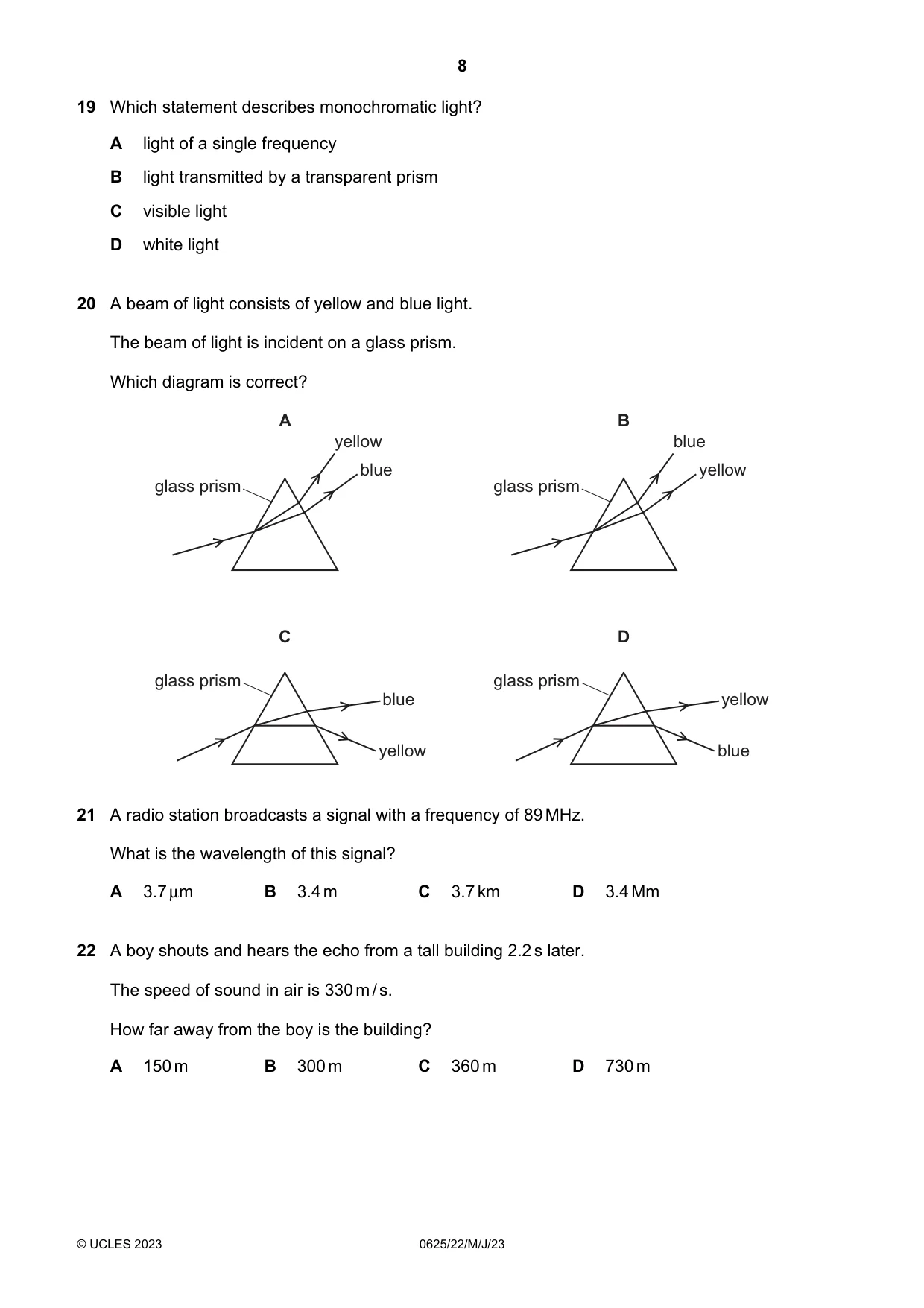
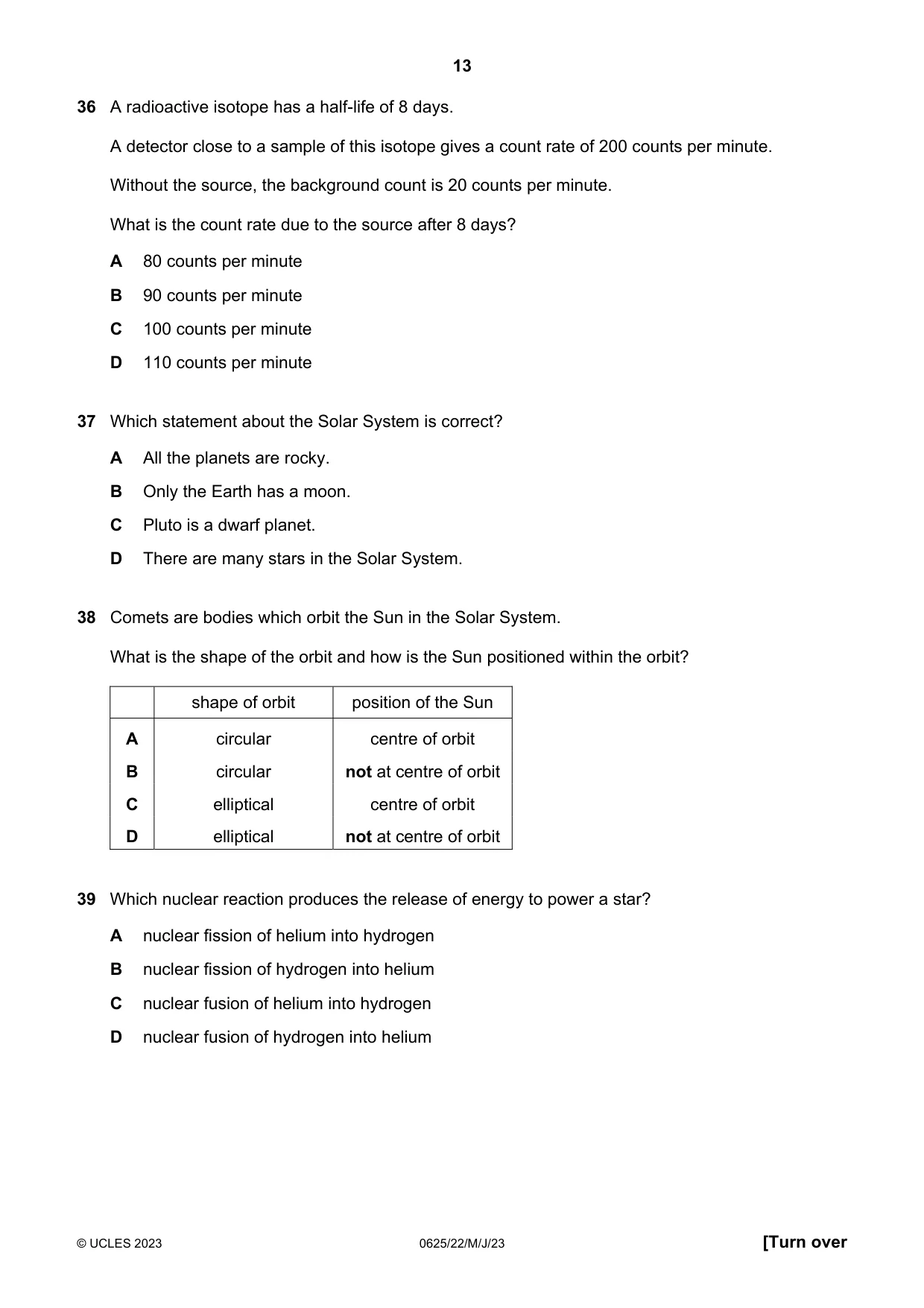
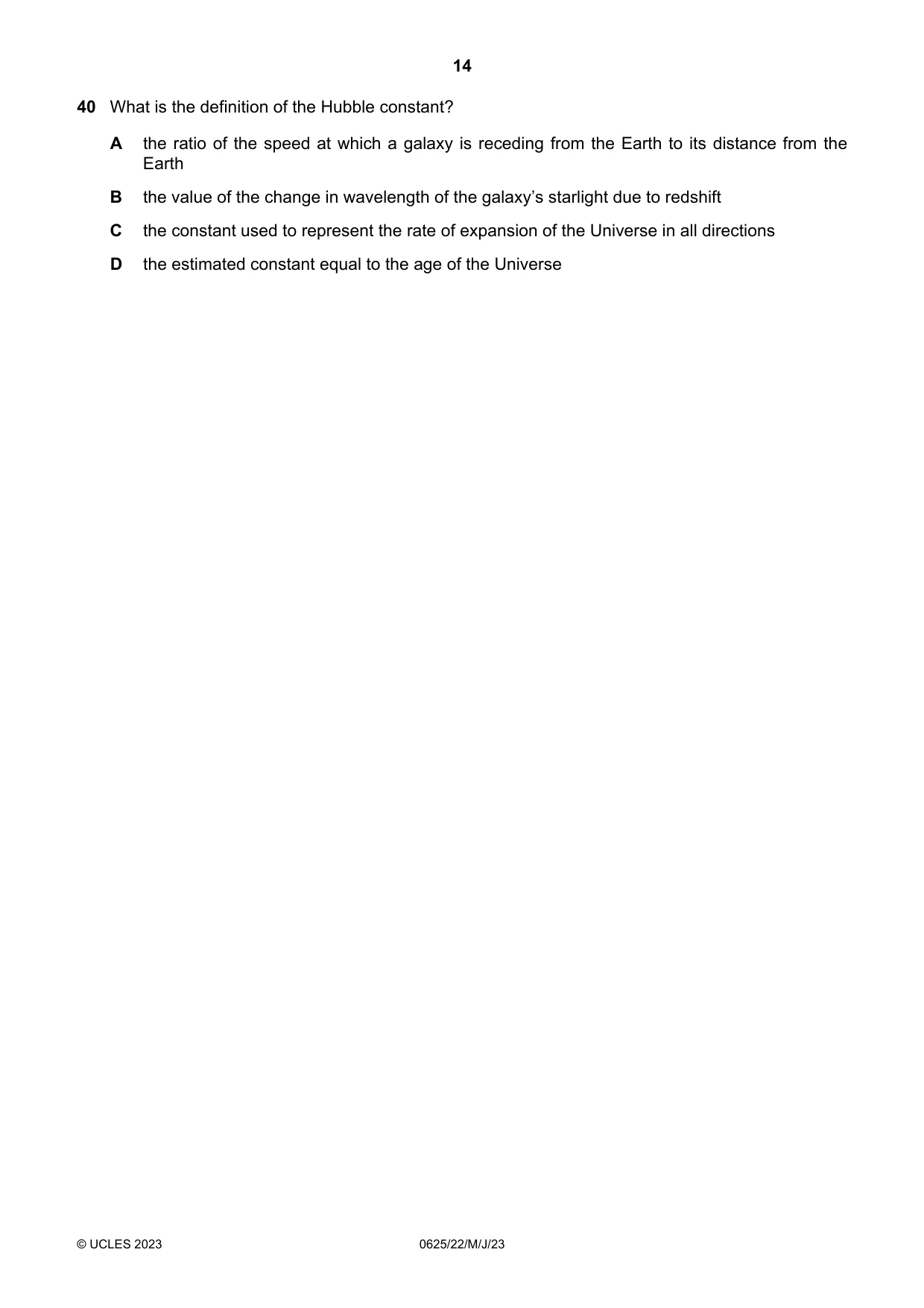

Mark scheme3 pages
Answers below. Sit the paper first if you are practising.
Questions as text
Q1 · Forces of 3 N and 4 N act at right angles, as shown
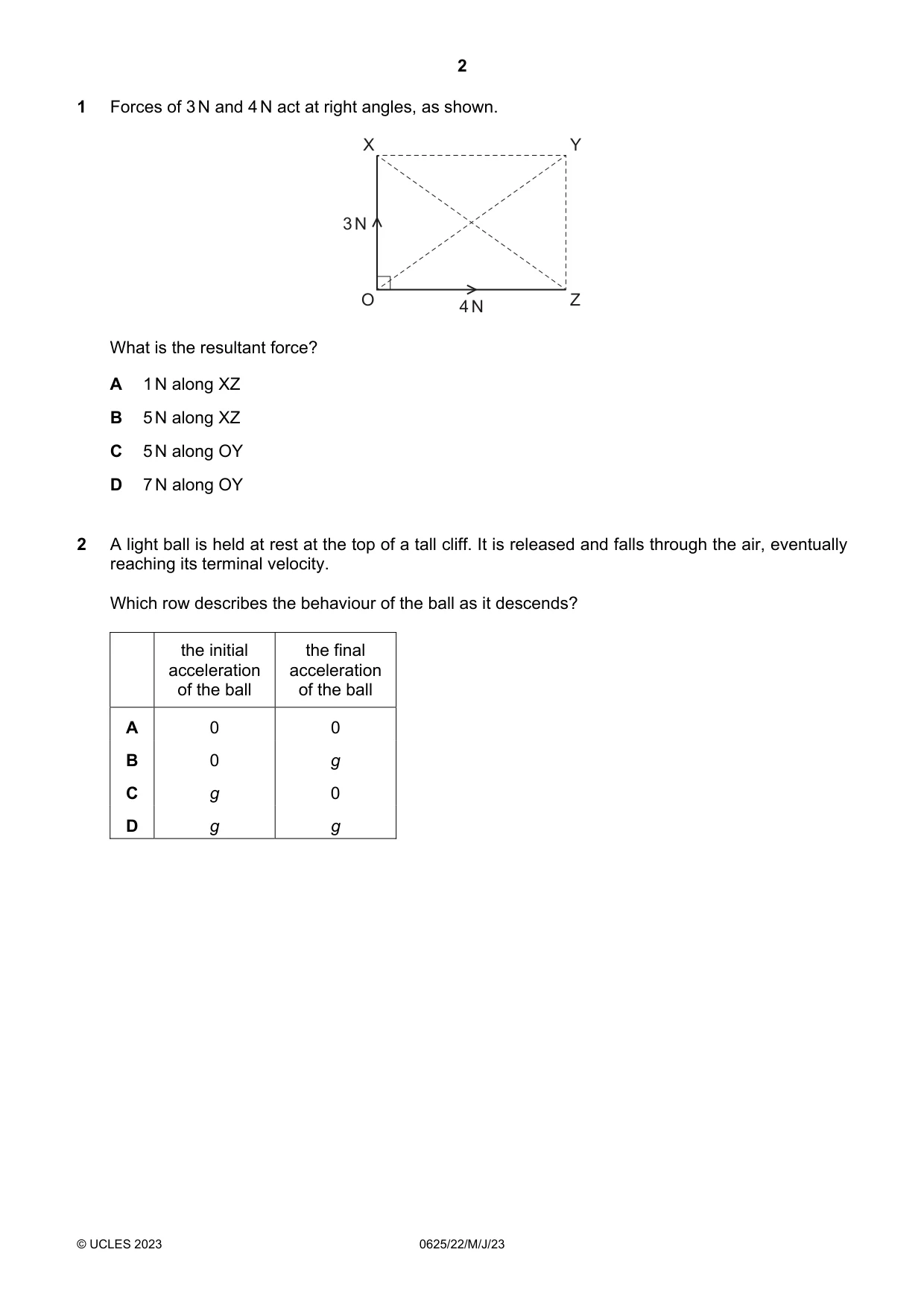
1 Forces of 3 N and 4 N act at right angles, as shown. X Y 3 N O 4 N Z What is the resultant force? A 1 N along XZ B 5 N along XZ C 5 N along OY D 7 N along OY
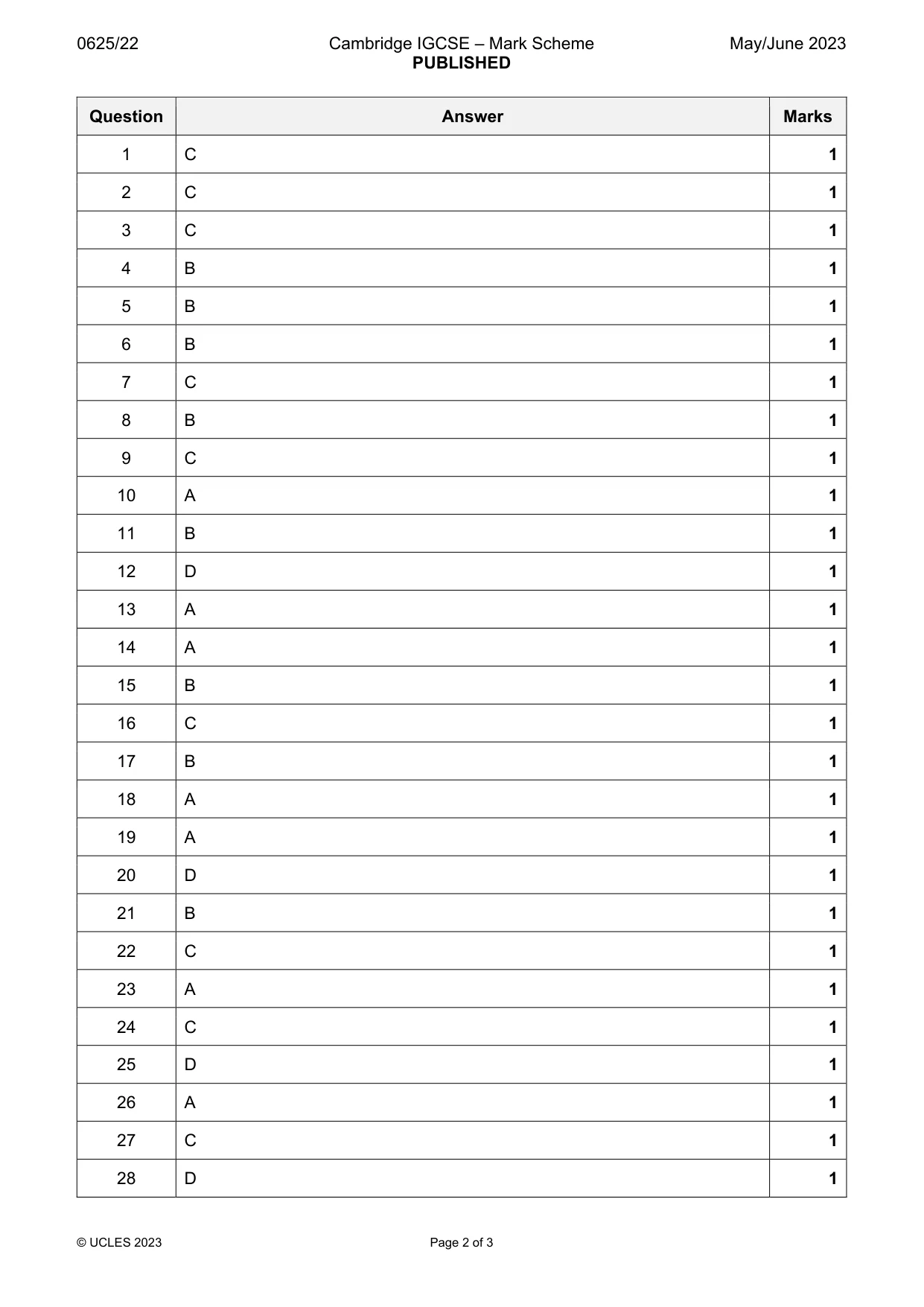
Mark scheme: C
Q2 · A light ball is held at rest at the top of a tall cliff
2 A light ball is held at rest at the top of a tall cliff. It is released and falls through the air, eventually reaching its terminal velocity. Which row describes the behaviour of the ball as it descends? the initial the final acceleration acceleration of the ball of the ball A 0 0 B 0 g C g 0 D g g
Mark scheme: C
Q3 · The graph represents the motion of a car
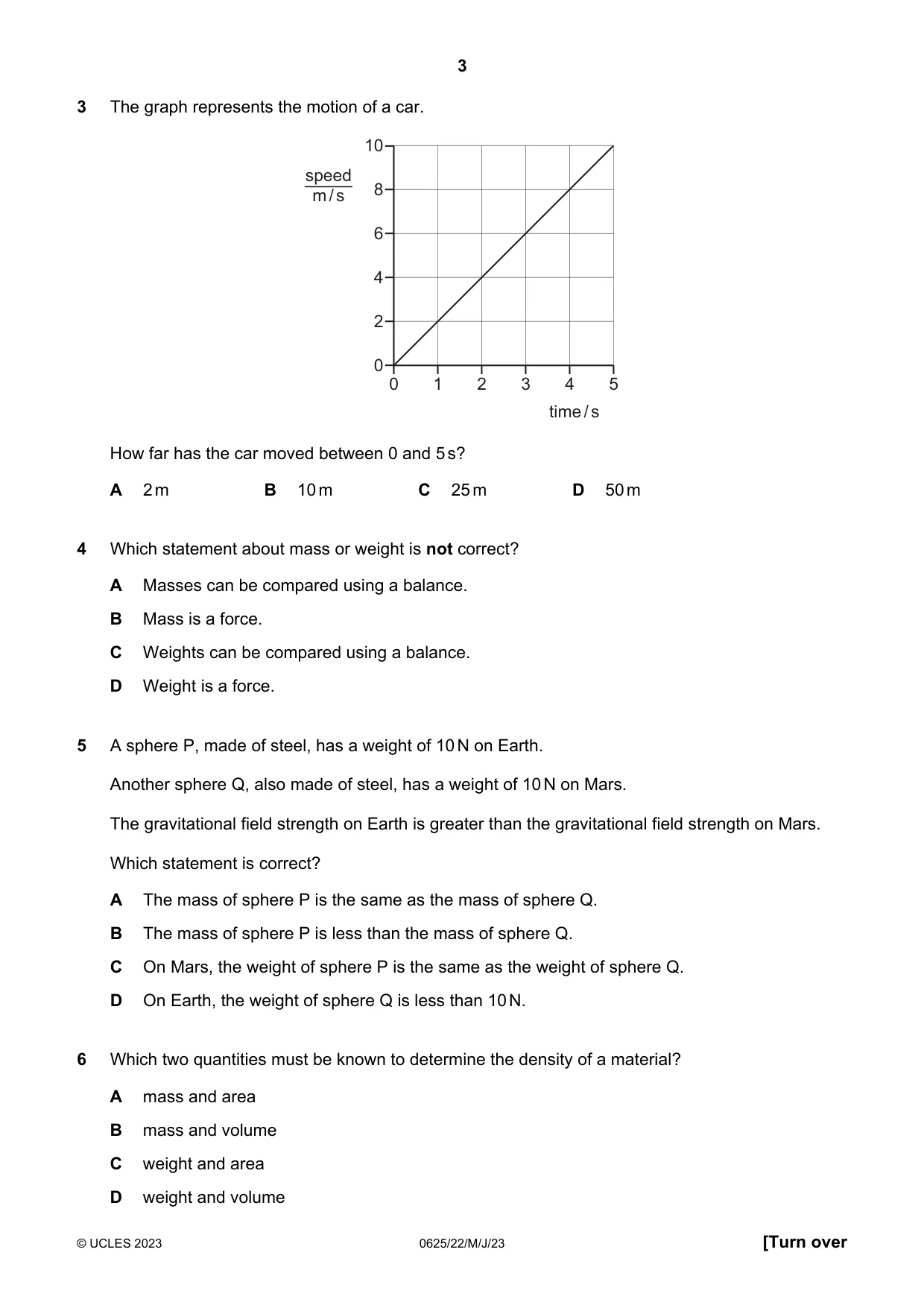
3 The graph represents the motion of a car. 10 speed m / s 8 6 4 2 0 0 1 2 3 4 5 time / s How far has the car moved between 0 and 5 s? A 2 m B 10 m C 25 m D 50 m
Mark scheme: C
Q4 · Which statement about mass or weight is not correct?
4 Which statement about mass or weight is not correct? A Masses can be compared using a balance. B Mass is a force. C Weights can be compared using a balance. D Weight is a force.
Mark scheme: B
Q5 · A sphere P, made of steel, has a weight of 10 N on Earth
5 A sphere P, made of steel, has a weight of 10 N on Earth. Another sphere Q, also made of steel, has a weight of 10 N on Mars. The gravitational field strength on Earth is greater than the gravitational field strength on Mars. Which statement is correct? A The mass of sphere P is the same as the mass of sphere Q. B The mass of sphere P is less than the mass of sphere Q. C On Mars, the weight of sphere P is the same as the weight of sphere Q. D On Earth, the weight of sphere Q is less than 10 N.
Mark scheme: B
Q6 · Which two quantities must be known to determine the density of a material?
6 Which two quantities must be known to determine the density of a material? A mass and area B mass and volume C weight and area D weight and volume
Mark scheme: B
Q7 · A truck is towing a car along a straight horizontal road at a constant speed
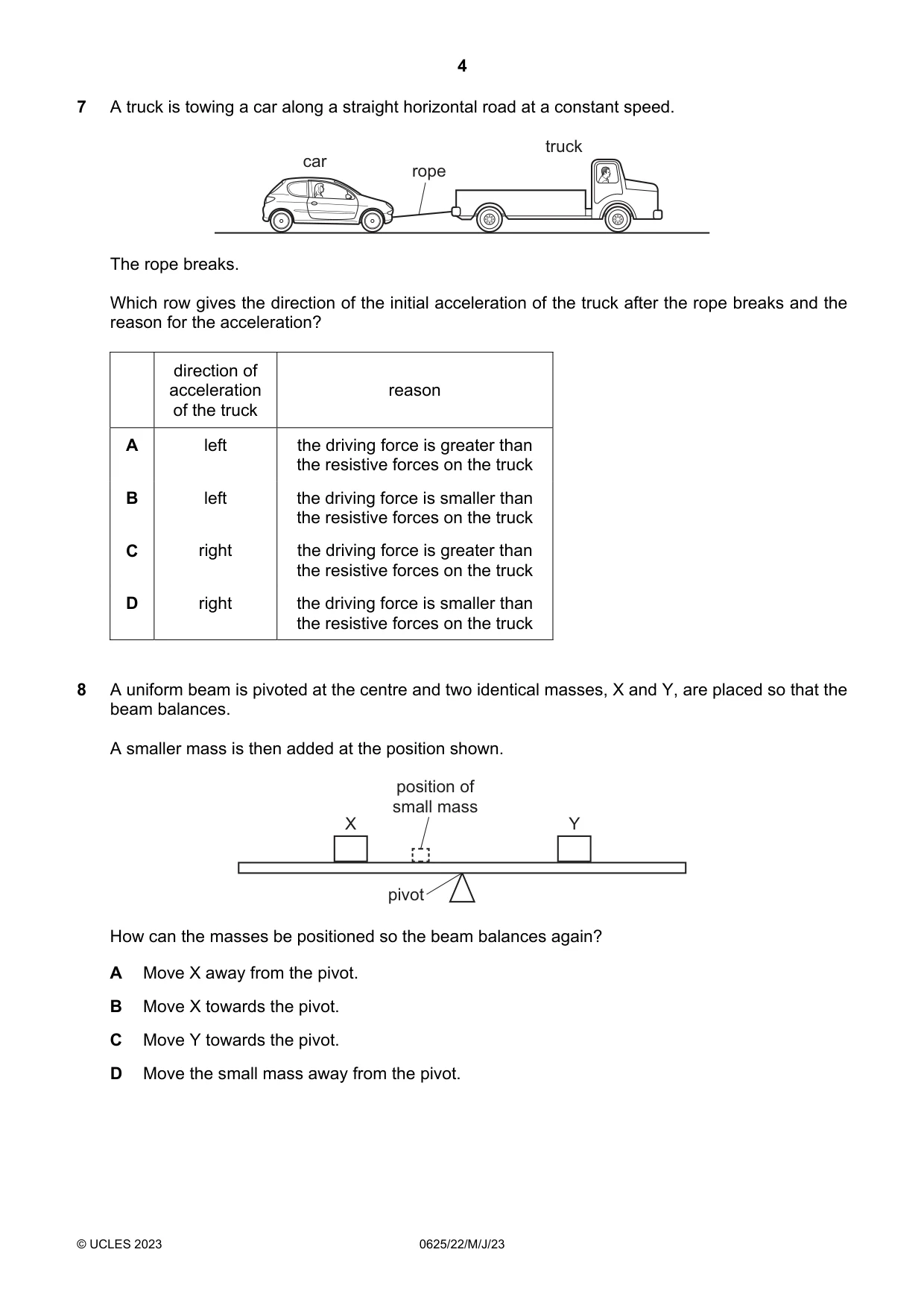
7 A truck is towing a car along a straight horizontal road at a constant speed. truck car rope The rope breaks. Which row gives the direction of the initial acceleration of the truck after the rope breaks and the reason for the acceleration? direction of acceleration reason of the truck A left the driving force is greater than the resistive forces on the truck B left the driving force is smaller than the resistive forces on the truck C right the driving force is greater than the resistive forces on the truck D right the driving force is smaller than the resistive forces on the truck
Mark scheme: C
Q8 · A uniform beam is pivoted at the centre and two identical masses, X and Y, are placed so…
8 A uniform beam is pivoted at the centre and two identical masses, X and Y, are placed so that the beam balances. A smaller mass is then added at the position shown. position of small mass X Y pivot How can the masses be positioned so the beam balances again? A Move X away from the pivot. B Move X towards the pivot. C Move Y towards the pivot. D Move the small mass away from the pivot.
Mark scheme: B
Q9 · A resultant force of 2.0 N acts on an object of mass 3.0 kg for 6.0 s
9 A resultant force of 2.0 N acts on an object of mass 3.0 kg for 6.0 s. What is the change in velocity of the object? A 0.25 m / s B 1.0 m / s C 4.0 m / s D 36 m / s
Mark scheme: C
Q10 · The diagram shows the energy stores for a mobile (cell) phone and how the energy is…
10 The diagram shows the energy stores for a mobile (cell) phone and how the energy is transferred between stores. internal heating energy chemical ? energy kinetic sound energy What describes how the chemical energy is transferred? A electrical work done B mechanical work done C electromagnetic waves D sound waves
Mark scheme: A
Q11 · A wind turbine is 30% efficient and has an output of 2.5 MW of electrical power
11 A wind turbine is 30% efficient and has an output of 2.5 MW of electrical power. What is the power input to the turbine? A 0.75 MW B 8.3 MW C 75 MW D 83 MW
Mark scheme: B
Q12 · Which two physical quantities must be used to calculate the power developed by a student…
12 Which two physical quantities must be used to calculate the power developed by a student running up a flight of steps? A force exerted and the vertical height of the steps only B force exerted and the time taken only C work done and the vertical height of the steps only D work done and the time taken only
Mark scheme: D
Q13 · The density of sea water is 1030 kg / m3
13 The density of sea water is 1030 kg / m3. The gravitational field strength on the Earth is 9.8 N / kg. Atmospheric pressure is 101 000 Pa. At which depth in sea water is the total pressure due to the atmosphere and the water equal to 513 000 Pa? A 40.8 m B 50.8 m C 400 m D 498 m
Mark scheme: A
Q14 · Four students describe the phrase ‘absolute zero’ during a lesson on the particle model
14 Four students describe the phrase ‘absolute zero’ during a lesson on the particle model. Which student is correct? A This is the lowest possible temperature. B Particles in a solid start vibrating. C Particles do not have any weight. D Particles have the least gravitational potential energy.
Mark scheme: A
Q15 · Four students are asked to state and explain the relative magnitudes of the thermal…
15 Four students are asked to state and explain the relative magnitudes of the thermal expansion of solids and gases. Which student is correct? A Gases expand more than solids because the molecules in a gas are in random motion. B Gases expand more than solids because the attractive forces between molecules are much weaker in gases. C Solids expand more than gases because the molecules are closer together in solids. D Solids expand more than gases because the molecules in a solid are in a regular pattern.
Mark scheme: B
Q16 · Four cups A, B, C and D contain hot coffee
16 Four cups A, B, C and D contain hot coffee. Which cup keeps the coffee warm the longest? the outside the top of the cup surface of the cup A black covered with a lid B black no lid C white covered with a lid D white no lid
Mark scheme: C
Q17 · The diagram shows a wave
17 The diagram shows a wave. 8 cm 3 cm 6 cm 4 cm What are the amplitude and the wavelength of this wave? amplitude / cm wavelength / cm A 3 4 B 3 8 C 6 4 D 6 8
Mark scheme: B
Q18 · Optical fibres are used to transmit digital signals using infrared radiation
18 Optical fibres are used to transmit digital signals using infrared radiation. The average refractive index of the fibres is 1.50. Which row describes a digital signal and gives the speed of infrared radiation in the fibres? speed of infrared radiation in the fibres digital signal m / s A a signal that consists 2.0 × 10⁸ of only two values B a signal that consists 4.5 × 10⁸ of only two values C a signal that consists of 2.0 × 10⁸ a continuous range of values D a signal that consists of 4.5 × 10⁸ a continuous range of values
Mark scheme: A
Q19 · Which statement describes monochromatic light?
19 Which statement describes monochromatic light? A light of a single frequency B light transmitted by a transparent prism C visible light D white light
Mark scheme: A
Q20 · A beam of light consists of yellow and blue light
20 A beam of light consists of yellow and blue light. The beam of light is incident on a glass prism. Which diagram is correct? A B yellow blue blue yellow glass prism glass prism C D glass prism glass prism blue yellow yellow blue
Mark scheme: D
Q21 · A radio station broadcasts a signal with a frequency of 89 MHz
21 A radio station broadcasts a signal with a frequency of 89 MHz. What is the wavelength of this signal? A 3.7 µm B 3.4 m C 3.7 km D 3.4 Mm
Mark scheme: B
Q22 · A boy shouts and hears the echo from a tall building 2.2 s later
22 A boy shouts and hears the echo from a tall building 2.2 s later. The speed of sound in air is 330 m / s. How far away from the boy is the building? A 150 m B 300 m C 360 m D 730 m
Mark scheme: C
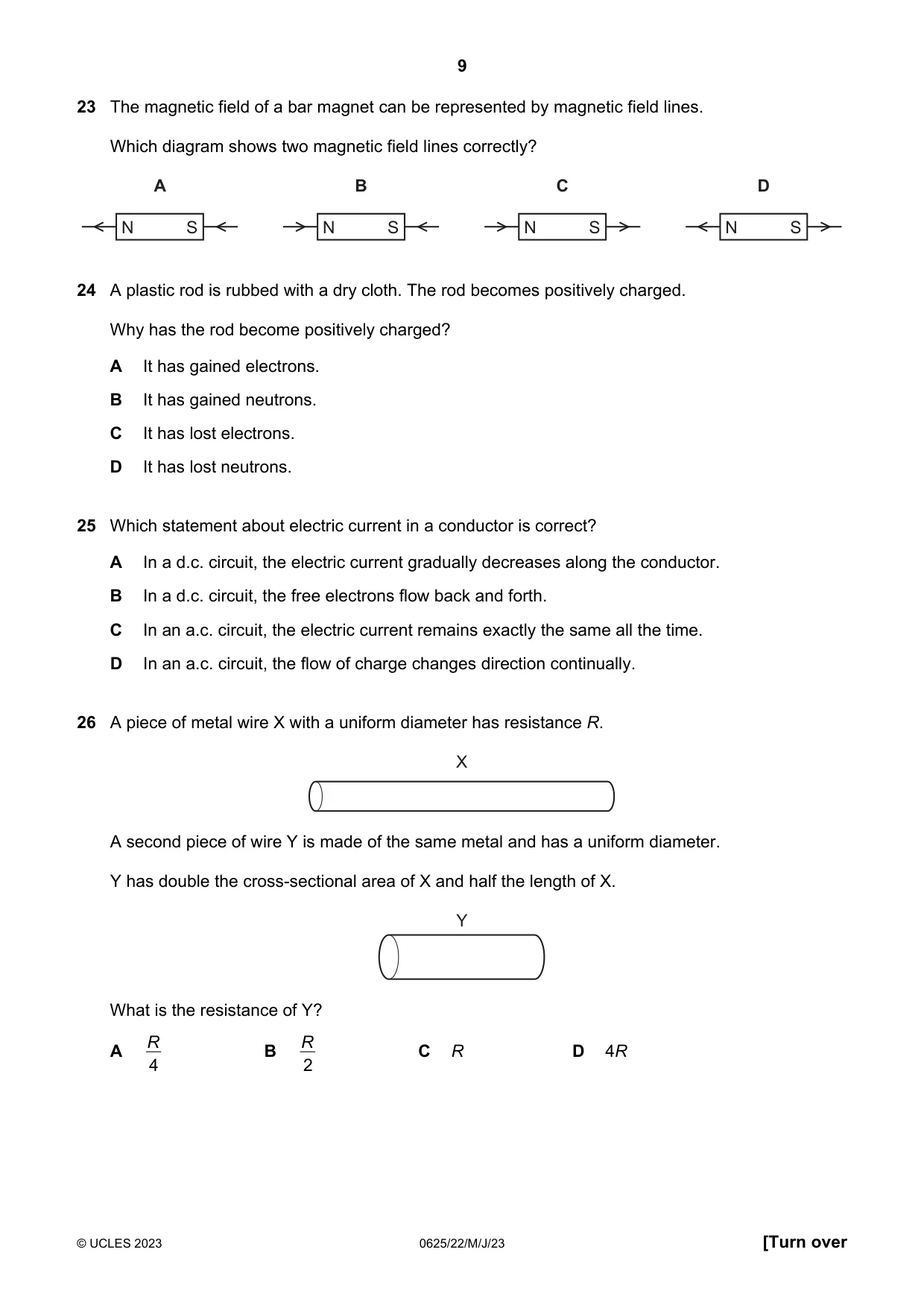
Q23 · The magnetic field of a bar magnet can be represented by magnetic field lines
23 The magnetic field of a bar magnet can be represented by magnetic field lines. Which diagram shows two magnetic field lines correctly? A B C D N S N S N S N S
Mark scheme: A
Q24 · A plastic rod is rubbed with a dry cloth
24 A plastic rod is rubbed with a dry cloth. The rod becomes positively charged. Why has the rod become positively charged? A It has gained electrons. B It has gained neutrons. C It has lost electrons. D It has lost neutrons.
Mark scheme: C
Q25 · Which statement about electric current in a conductor is correct?
25 Which statement about electric current in a conductor is correct? A In a d.c. circuit, the electric current gradually decreases along the conductor. B In a d.c. circuit, the free electrons flow back and forth. C In an a.c. circuit, the electric current remains exactly the same all the time. D In an a.c. circuit, the flow of charge changes direction continually.
Mark scheme: D
Q26 · A piece of metal wire X with a uniform diameter has resistance R
26 A piece of metal wire X with a uniform diameter has resistance R. X A second piece of wire Y is made of the same metal and has a uniform diameter. Y has double the cross-sectional area of X and half the length of X. Y What is the resistance of Y? R R A B C R D 4R 4 2
Mark scheme: A
Q27 · An electric fire is connected to a 240 V supply and transfers energy at a rate of 1.0 kW
27 An electric fire is connected to a 240 V supply and transfers energy at a rate of 1.0 kW. How much charge passes through the fire in 1.0 h? A 42 C B 250 C C 1.5 × 10⁴ C D 2.4 × 10⁵ C
Mark scheme: C
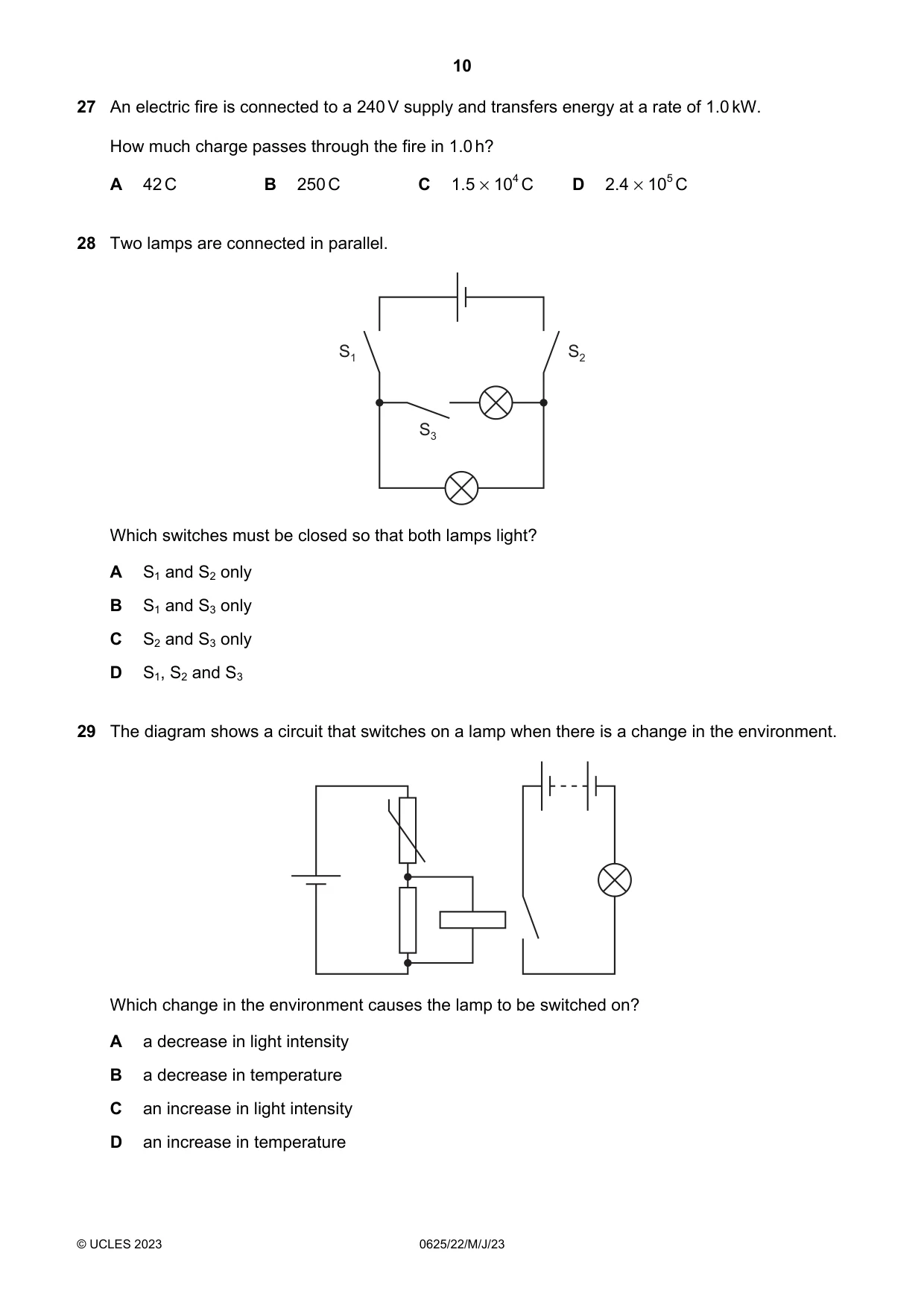
Q28 · Two lamps are connected in parallel
28 Two lamps are connected in parallel. S1 S2 S3 Which switches must be closed so that both lamps light? A S1 and S2 only B S1 and S3 only C S2 and S3 only D S1, S2 and S3
Mark scheme: D
Q29 · The diagram shows a circuit that switches on a lamp when there is a change in the…
29 The diagram shows a circuit that switches on a lamp when there is a change in the environment. Which change in the environment causes the lamp to be switched on? A a decrease in light intensity B a decrease in temperature C an increase in light intensity D an increase in temperature
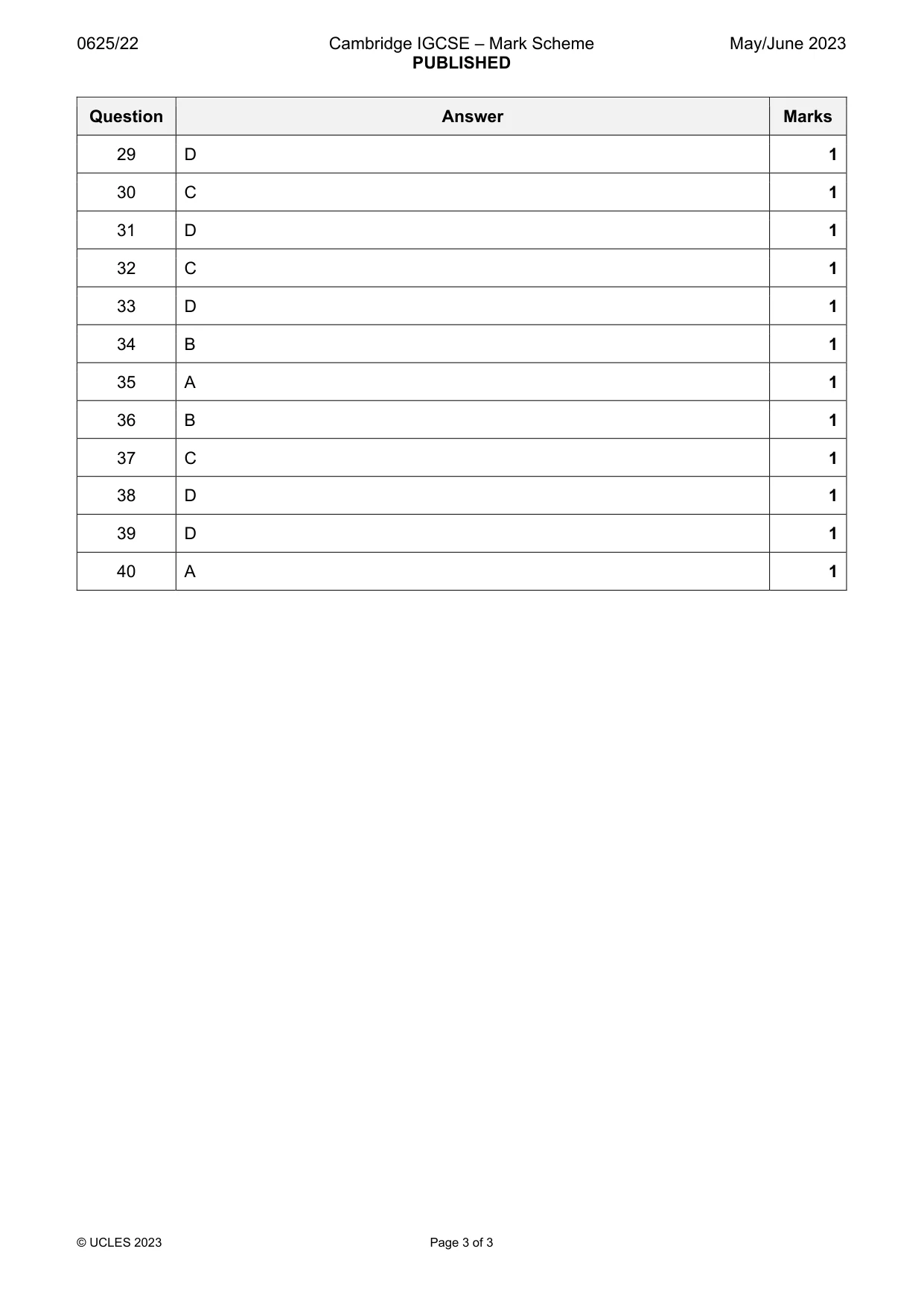
Mark scheme: D
Q30 · A step-down transformer is 100% efficient
30 A step-down transformer is 100% efficient. It has an input voltage of 240 V a.c. and an output voltage of 60 V a.c. The current in the primary coil is 0.50 A. What is the current in the secondary coil? A 0.13 A B 0.50 A C 2.0 A D 8.0 A
Mark scheme: C
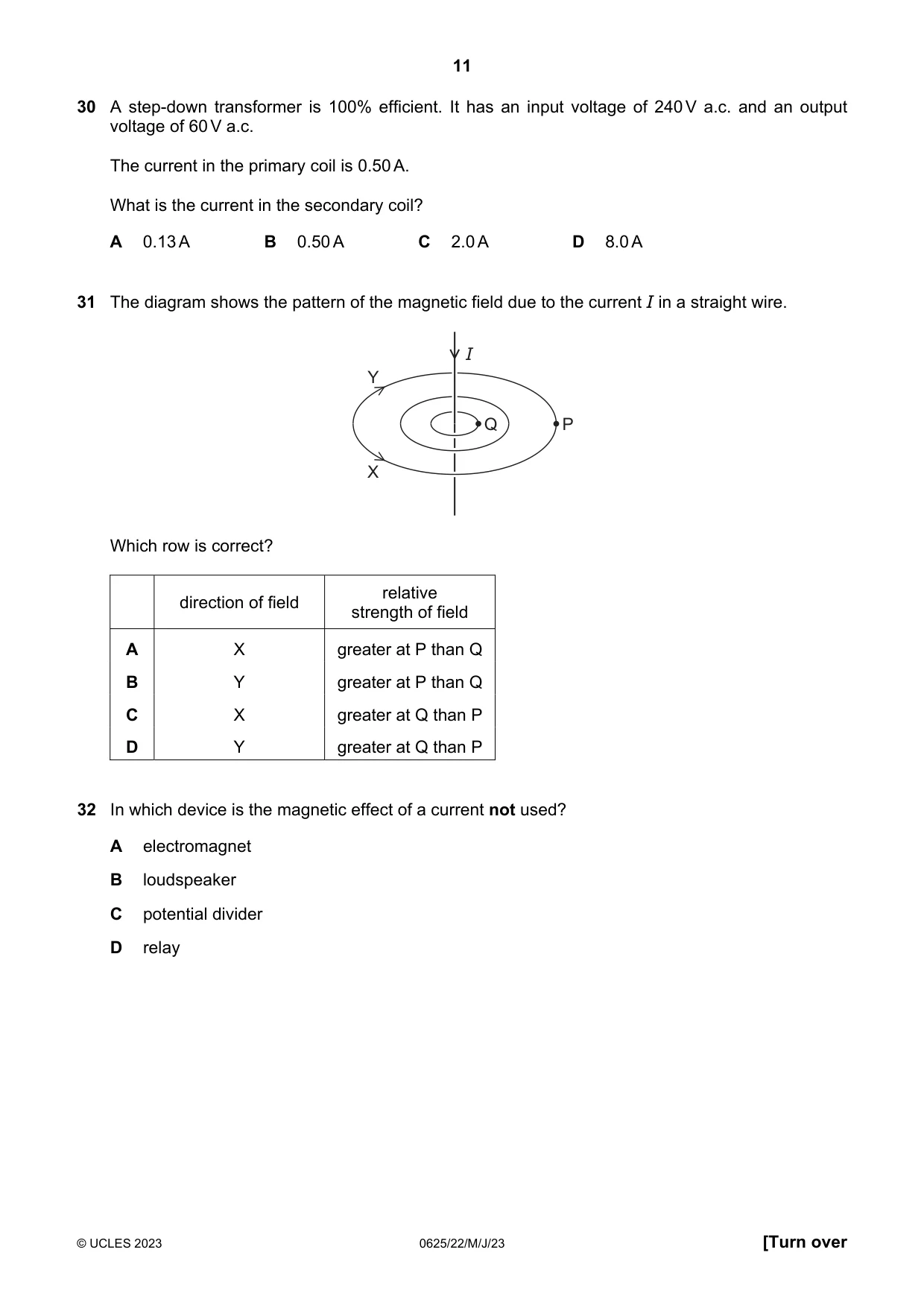
Q31 · The diagram shows the pattern of the magnetic field due to the current I in a straight…
31 The diagram shows the pattern of the magnetic field due to the current I in a straight wire. I Y Q P X Which row is correct? relative direction of field strength of field A X greater at P than Q B Y greater at P than Q C X greater at Q than P D Y greater at Q than P
Mark scheme: D
Q32 · In which device is the magnetic effect of a current not used?
32 In which device is the magnetic effect of a current not used? A electromagnet B loudspeaker C potential divider D relay
Mark scheme: C
Q33 · Fission and fusion are two types of nuclear process
33 Fission and fusion are two types of nuclear process. How does the total mass of the nuclides produced compare with the total mass of the original nuclide or nuclides in these nuclear processes? total mass of fission total mass of fusion products compared products compared to original nuclide to original nuclides A same same B more less C less more D less less
Mark scheme: D
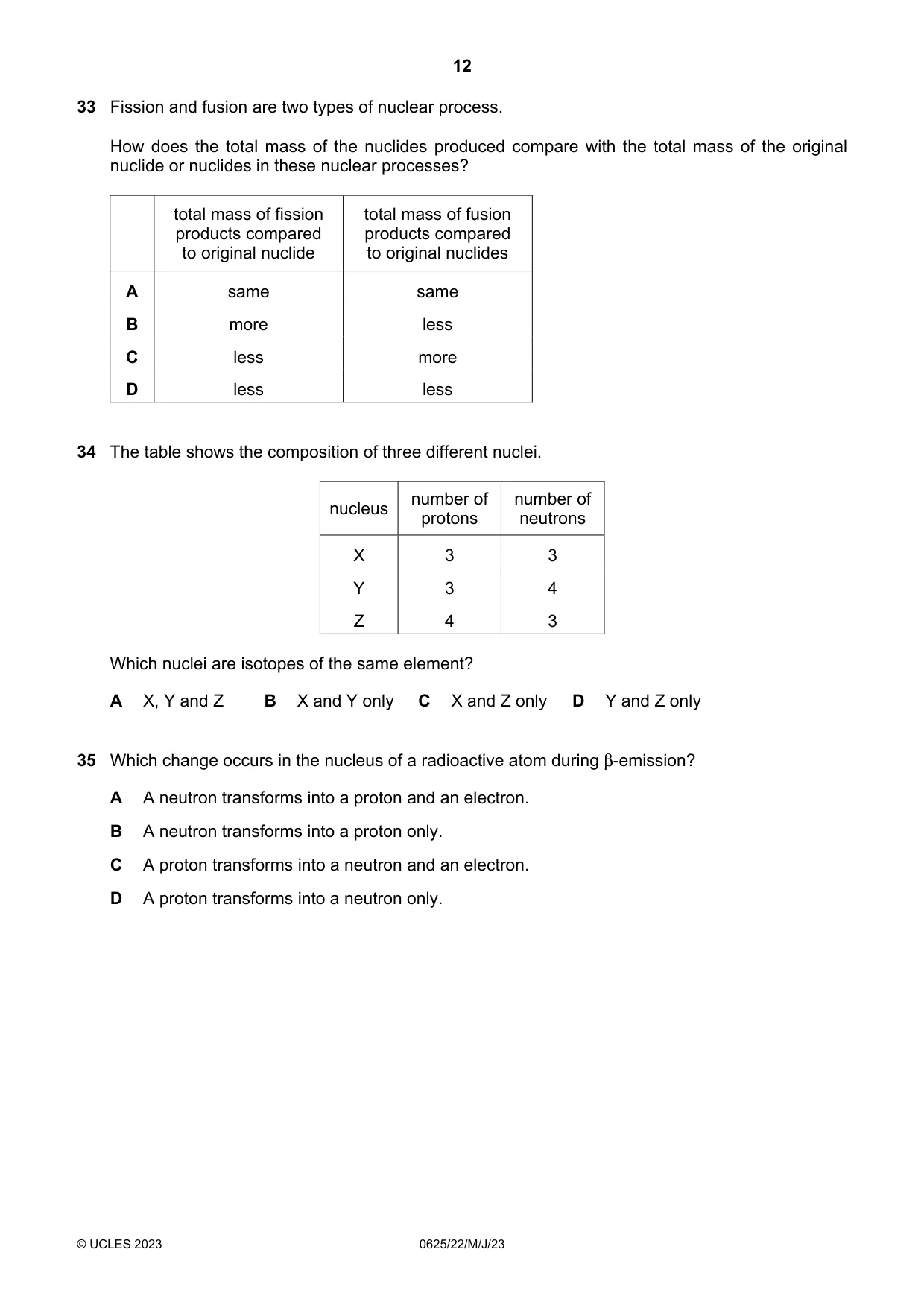
Q34 · The table shows the composition of three different nuclei
34 The table shows the composition of three different nuclei. number of number of nucleus protons neutrons X 3 3 Y 3 4 Z 4 3 Which nuclei are isotopes of the same element? A X, Y and Z B X and Y only C X and Z only D Y and Z only
Mark scheme: B
Q35 · Which change occurs in the nucleus of a radioactive atom during β-emission?
35 Which change occurs in the nucleus of a radioactive atom during β-emission? A A neutron transforms into a proton and an electron. B A neutron transforms into a proton only. C A proton transforms into a neutron and an electron. D A proton transforms into a neutron only.
Mark scheme: A
Q36 · A radioactive isotope has a half-life of 8 days
36 A radioactive isotope has a half-life of 8 days. A detector close to a sample of this isotope gives a count rate of 200 counts per minute. Without the source, the background count is 20 counts per minute. What is the count rate due to the source after 8 days? A 80 counts per minute B 90 counts per minute C 100 counts per minute D 110 counts per minute
Mark scheme: B
Q37 · Which statement about the Solar System is correct?
37 Which statement about the Solar System is correct? A All the planets are rocky. B Only the Earth has a moon. C Pluto is a dwarf planet. D There are many stars in the Solar System.
Mark scheme: C
Q38 · Comets are bodies which orbit the Sun in the Solar System
38 Comets are bodies which orbit the Sun in the Solar System. What is the shape of the orbit and how is the Sun positioned within the orbit? shape of orbit position of the Sun A circular centre of orbit B circular not at centre of orbit C elliptical centre of orbit D elliptical not at centre of orbit
Mark scheme: D
Q39 · Which nuclear reaction produces the release of energy to power a star?
39 Which nuclear reaction produces the release of energy to power a star? A nuclear fission of helium into hydrogen B nuclear fission of hydrogen into helium C nuclear fusion of helium into hydrogen D nuclear fusion of hydrogen into helium
Mark scheme: D
Q40 · What is the definition of the Hubble constant?
40 What is the definition of the Hubble constant? A the ratio of the speed at which a galaxy is receding from the Earth to its distance from the Earth B the value of the change in wavelength of the galaxy’s starlight due to redshift C the constant used to represent the rate of expansion of the Universe in all directions D the estimated constant equal to the age of the Universe
Mark scheme: A
What was in this paper
The subtopics covered by these 40 questions, and how many questions each got. Open one in a new tab to see every Cambridge question on it.
5Electrical quantities4Electromagnetic effects3Energy, work and power3Light3Electric circuits2Mass and weight2Radioactivity2Stars and the Universe2The Earth and the Solar System2The nuclear model of the atom2Density1Electromagnetic spectrum1General properties of waves1Kinetic particle model of matter1Motion1Pressure1Simple phenomena of magnetism1Sound1Thermal properties and temperature1Transfer of thermal energy1What you needed in this session
Cambridge’s own grade thresholds for 2023 May/June, Paper 2 · Variant 2. A higher threshold means an easier paper — the bar moves with how the cohort did.