Cambridge IGCSE Physics 0625 — 2020 Feb/March Paper 2 · Variant 2
0625/22/F/M/20 · 40 questions · 40 marks · ≈45 min
The question paper and its mark scheme, free to read here and free to download. This is Cambridge’s own paper, exactly as it was sat.
Question paper20 pages
Mark scheme3 pages
Answers below. Sit the paper first if you are practising.
Questions as text
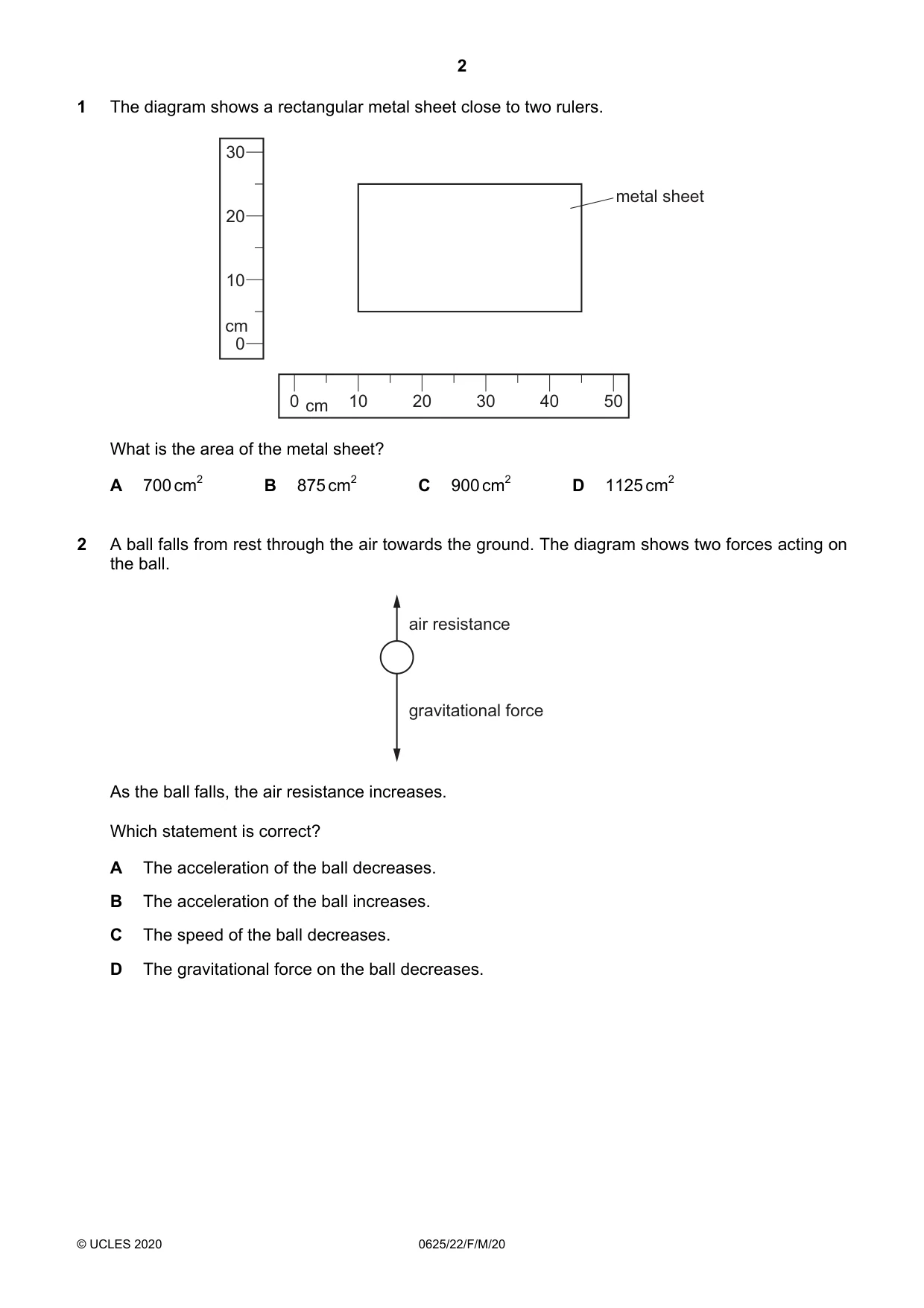
Q1 · The diagram shows a rectangular metal sheet close to two rulers
1 The diagram shows a rectangular metal sheet close to two rulers. 30 metal sheet 20 10 cm 0 0 cm 10 20 30 40 50 What is the area of the metal sheet? A 700 cm2 B 875 cm2 C 900 cm2 D 1125 cm2
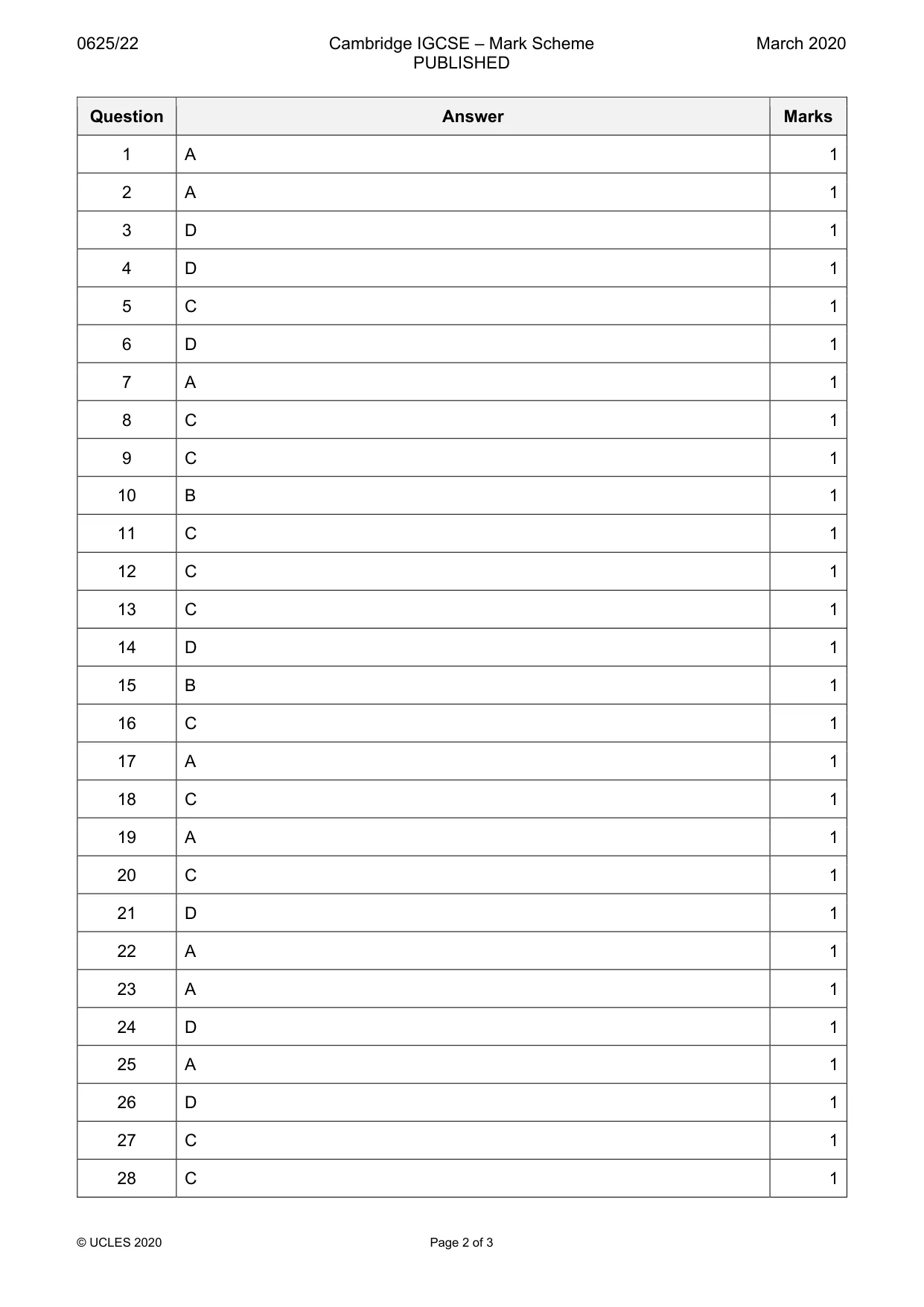
Mark scheme: A
More questions on Physical quantities and measurement techniques
Q2 · A ball falls from rest through the air towards the ground
2 A ball falls from rest through the air towards the ground. The diagram shows two forces acting on the ball. air resistance gravitational force As the ball falls, the air resistance increases. Which statement is correct? A The acceleration of the ball decreases. B The acceleration of the ball increases. C The speed of the ball decreases. D The gravitational force on the ball decreases.
Mark scheme: A
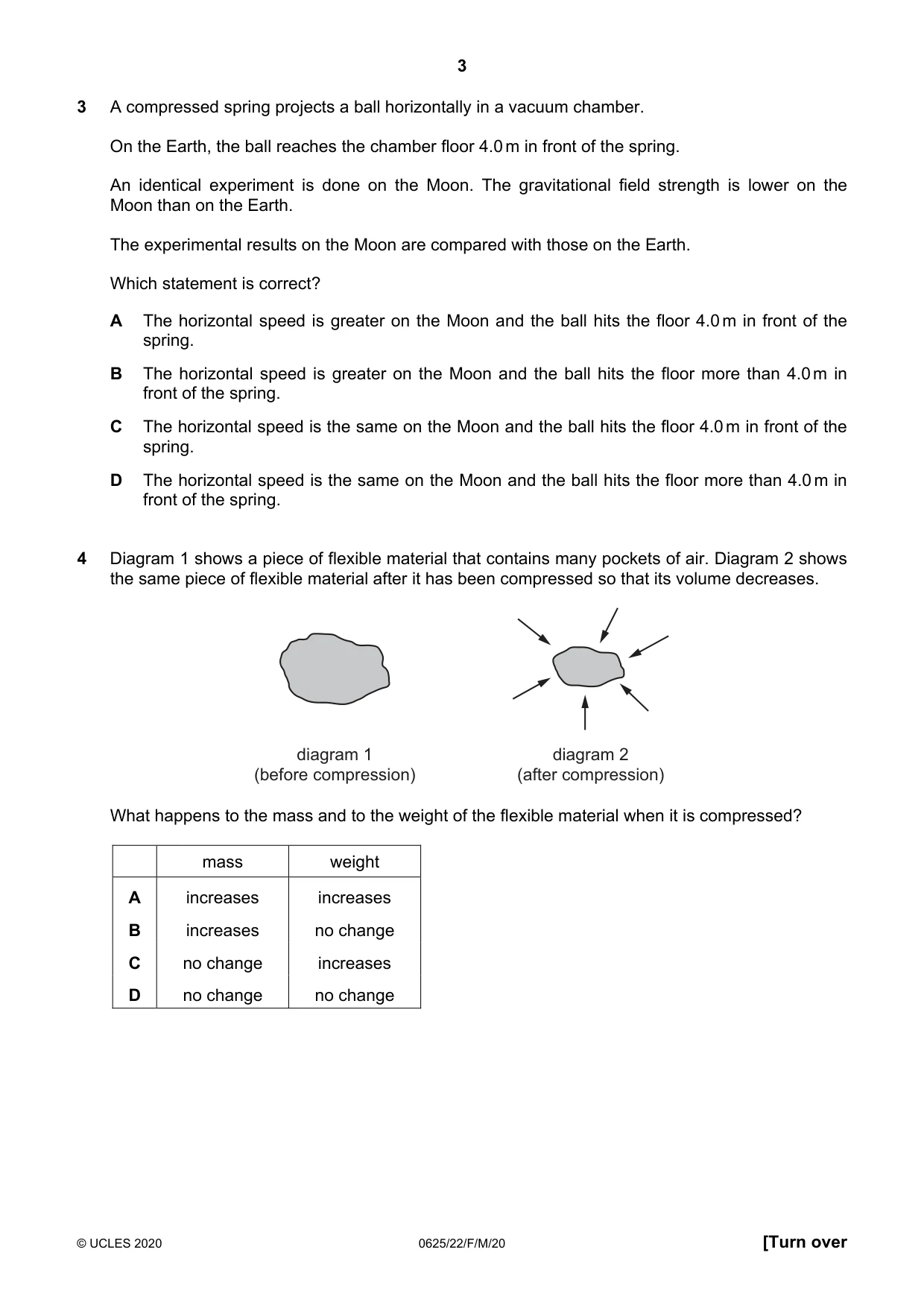
Q3 · A compressed spring projects a ball horizontally in a vacuum chamber
3 A compressed spring projects a ball horizontally in a vacuum chamber. On the Earth, the ball reaches the chamber floor 4.0 m in front of the spring. An identical experiment is done on the Moon. The gravitational field strength is lower on the Moon than on the Earth. The experimental results on the Moon are compared with those on the Earth. Which statement is correct? A The horizontal speed is greater on the Moon and the ball hits the floor 4.0 m in front of the spring. B The horizontal speed is greater on the Moon and the ball hits the floor more than 4.0 m in front of the spring. C The horizontal speed is the same on the Moon and the ball hits the floor 4.0 m in front of the spring. D The horizontal speed is the same on the Moon and the ball hits the floor more than 4.0 m in front of the spring.
Mark scheme: D
Q4 · A piece of flexible material that contains many pockets of air
4 Diagram 1 shows a piece of flexible material that contains many pockets of air. Diagram 2 shows the same piece of flexible material after it has been compressed so that its volume decreases. diagram 1 diagram 2 (before compression) (after compression) What happens to the mass and to the weight of the flexible material when it is compressed? mass weight A increases increases B increases no change C no change increases D no change no change
Mark scheme: D
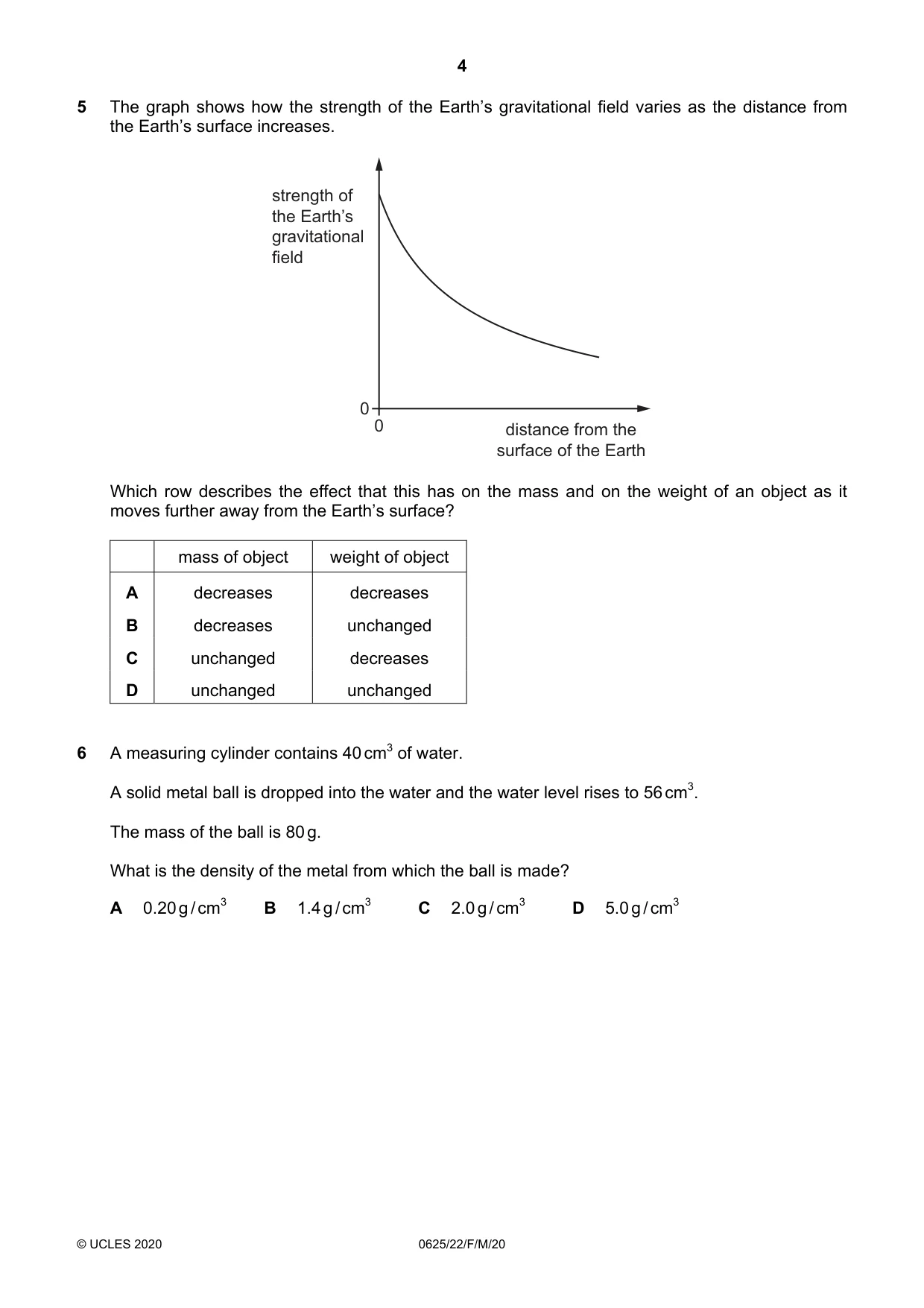
Q5 · The graph shows how the strength of the Earth’s gravitational field varies as the…
5 The graph shows how the strength of the Earth’s gravitational field varies as the distance from the Earth’s surface increases. strength of the Earth’s gravitational field 0 0 distance from the surface of the Earth Which row describes the effect that this has on the mass and on the weight of an object as it moves further away from the Earth’s surface? mass of object weight of object A decreases decreases B decreases unchanged C unchanged decreases D unchanged unchanged
Mark scheme: C
Q6 · A measuring cylinder contains 40 cm3 of water
6 A measuring cylinder contains 40 cm3 of water. A solid metal ball is dropped into the water and the water level rises to 56 cm3. The mass of the ball is 80 g. What is the density of the metal from which the ball is made? A 0.20 g / cm3 B 1.4 g / cm3 C 2.0 g / cm3 D 5.0 g / cm3
Mark scheme: D
Q7 · A car travels along a horizontal road at constant speed
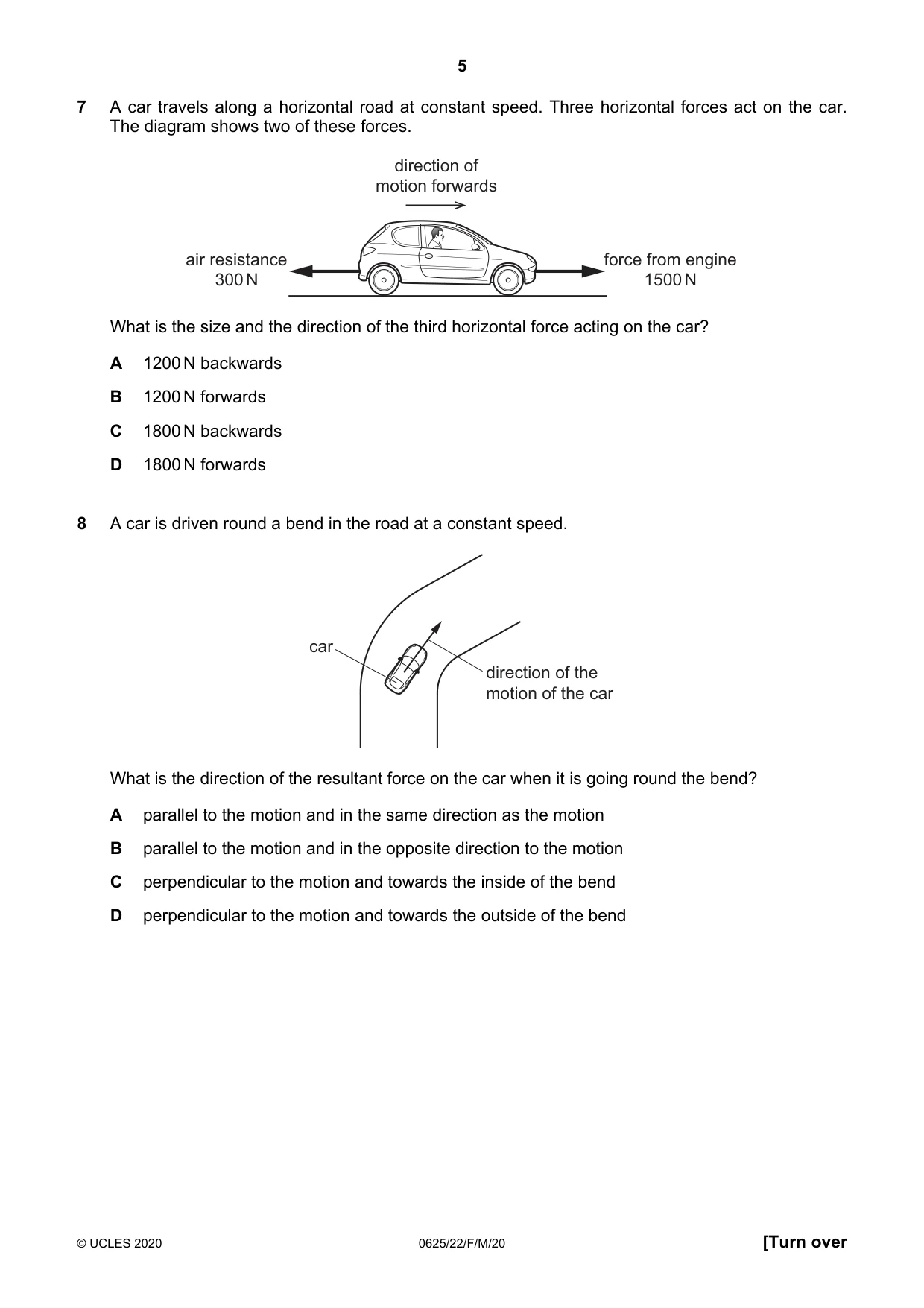
7 A car travels along a horizontal road at constant speed. Three horizontal forces act on the car. The diagram shows two of these forces. direction of motion forwards air resistance force from engine 300 N 1500 N What is the size and the direction of the third horizontal force acting on the car? A 1200 N backwards B 1200 N forwards C 1800 N backwards D 1800 N forwards
Mark scheme: A
Q8 · A car is driven round a bend in the road at a constant speed
8 A car is driven round a bend in the road at a constant speed. car direction of the motion of the car What is the direction of the resultant force on the car when it is going round the bend? A parallel to the motion and in the same direction as the motion B parallel to the motion and in the opposite direction to the motion C perpendicular to the motion and towards the inside of the bend D perpendicular to the motion and towards the outside of the bend
Mark scheme: C
Q9 · An athlete with mass 70 kg trains by performing press-ups with a load on his back
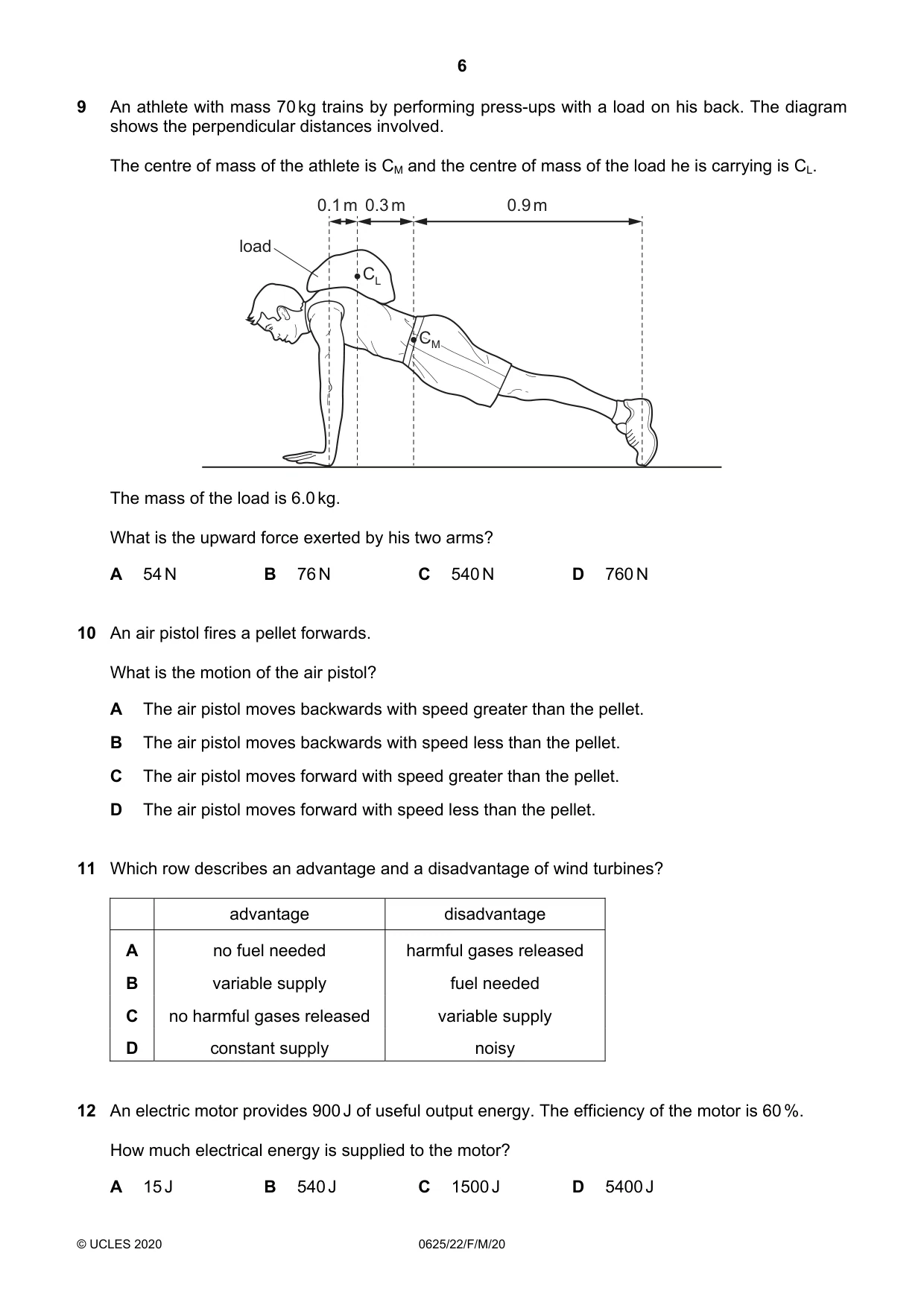
9 An athlete with mass 70 kg trains by performing press-ups with a load on his back. The diagram shows the perpendicular distances involved. The centre of mass of the athlete is CM and the centre of mass of the load he is carrying is CL. 0.1 m 0.3 m 0.9 m load CL CL CM CM The mass of the load is 6.0 kg. What is the upward force exerted by his two arms? A 54 N B 76 N C 540 N D 760 N
Mark scheme: C
Q10 · An air pistol fires a pellet forwards
10 An air pistol fires a pellet forwards. What is the motion of the air pistol? A The air pistol moves backwards with speed greater than the pellet. B The air pistol moves backwards with speed less than the pellet. C The air pistol moves forward with speed greater than the pellet. D The air pistol moves forward with speed less than the pellet.
Mark scheme: B
Q11 · Which row describes an advantage and a disadvantage of wind turbines?
11 Which row describes an advantage and a disadvantage of wind turbines? advantage disadvantage A no fuel needed harmful gases released B variable supply fuel needed C no harmful gases released variable supply D constant supply noisy
Mark scheme: C
Q12 · An electric motor provides 900 J of useful output energy
12 An electric motor provides 900 J of useful output energy. The efficiency of the motor is 60 %. How much electrical energy is supplied to the motor? A 15 J B 540 J C 1500 J D 5400 J
Mark scheme: C
Q13 · A crane takes 2.0 minutes to lift a 500 kg load to the top of a building that is 12 m high
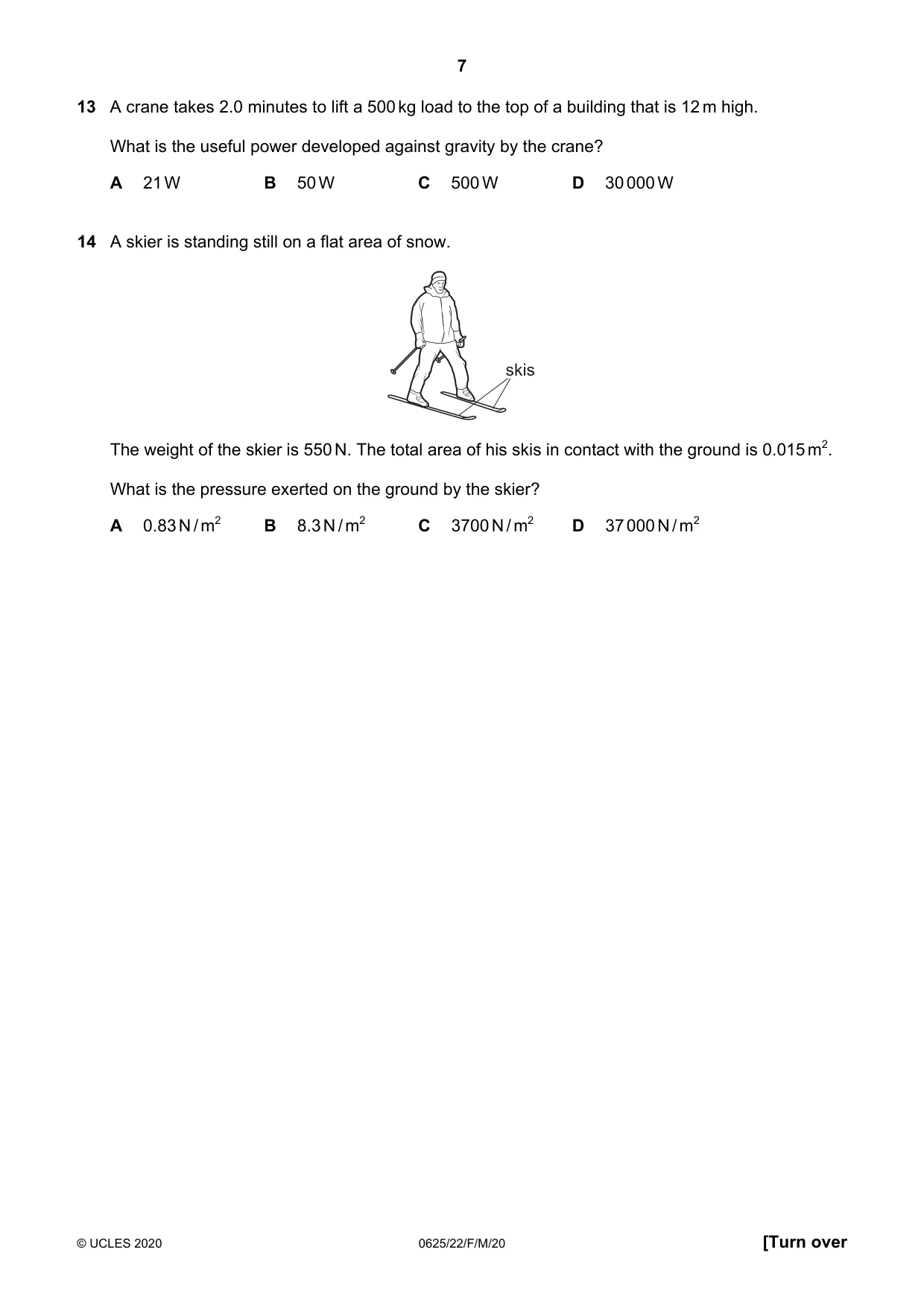
13 A crane takes 2.0 minutes to lift a 500 kg load to the top of a building that is 12 m high. What is the useful power developed against gravity by the crane? A 21 W B 50 W C 500 W D 30 000 W
Mark scheme: C
Q14 · A skier is standing still on a flat area of snow
14 A skier is standing still on a flat area of snow. skis The weight of the skier is 550 N. The total area of his skis in contact with the ground is 0.015 m2. What is the pressure exerted on the ground by the skier? A 0.83 N / m2 B 8.3 N / m2 C 3700 N / m2 D 37 000 N / m2
Mark scheme: D
Q15 · A tall cylinder is partly filled with two liquids which do not mix
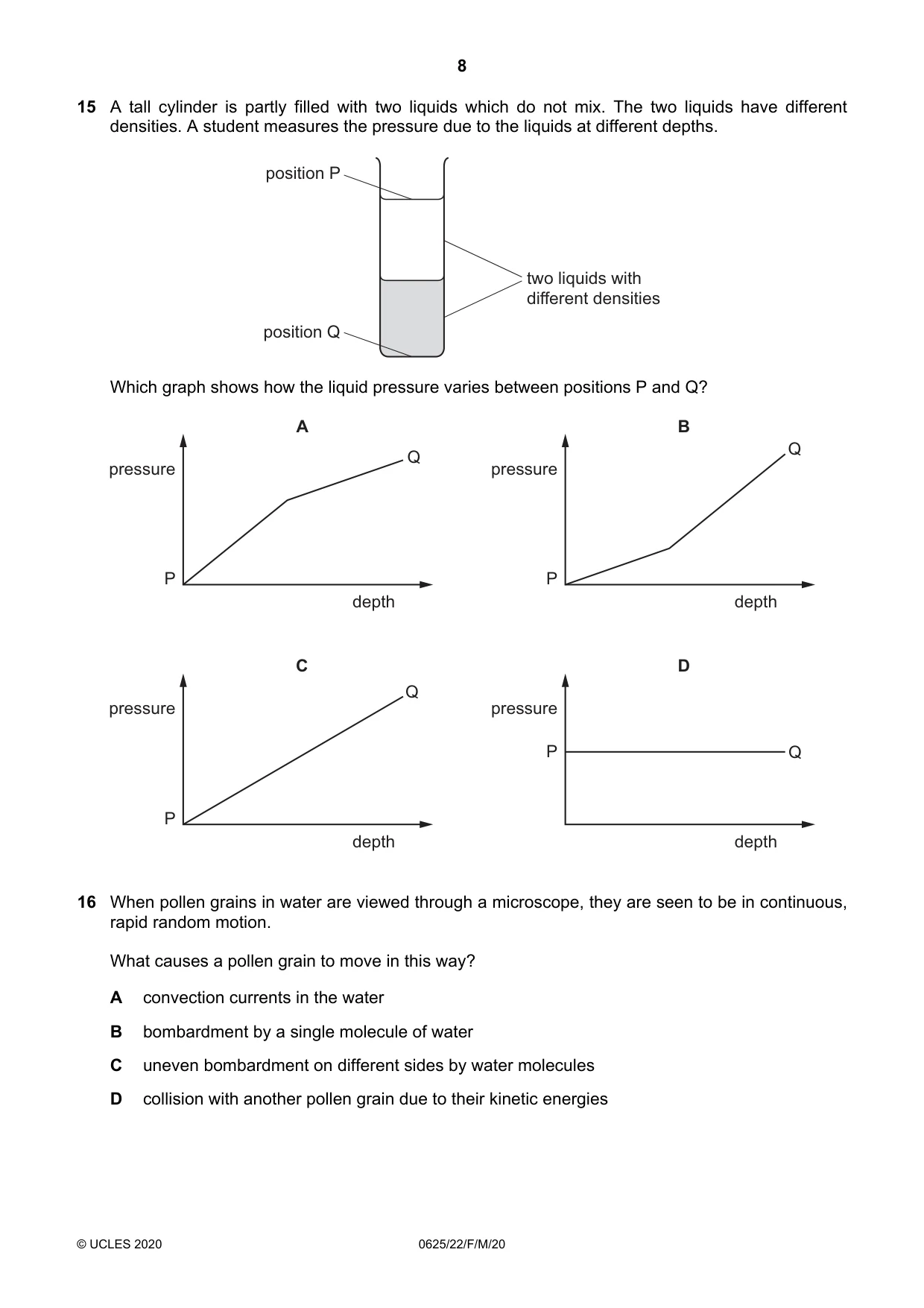
15 A tall cylinder is partly filled with two liquids which do not mix. The two liquids have different densities. A student measures the pressure due to the liquids at different depths. position P two liquids with different densities position Q Which graph shows how the liquid pressure varies between positions P and Q? A B Q Q pressure pressure P P depth depth C D Q pressure pressure P Q P depth depth
Mark scheme: B
Q16 · When pollen grains in water are viewed through a microscope, they are seen to be in…
16 When pollen grains in water are viewed through a microscope, they are seen to be in continuous, rapid random motion. What causes a pollen grain to move in this way? A convection currents in the water B bombardment by a single molecule of water C uneven bombardment on different sides by water molecules D collision with another pollen grain due to their kinetic energies
Mark scheme: C
Q17 · A student measures the mass of warm water in an open container over two minutes
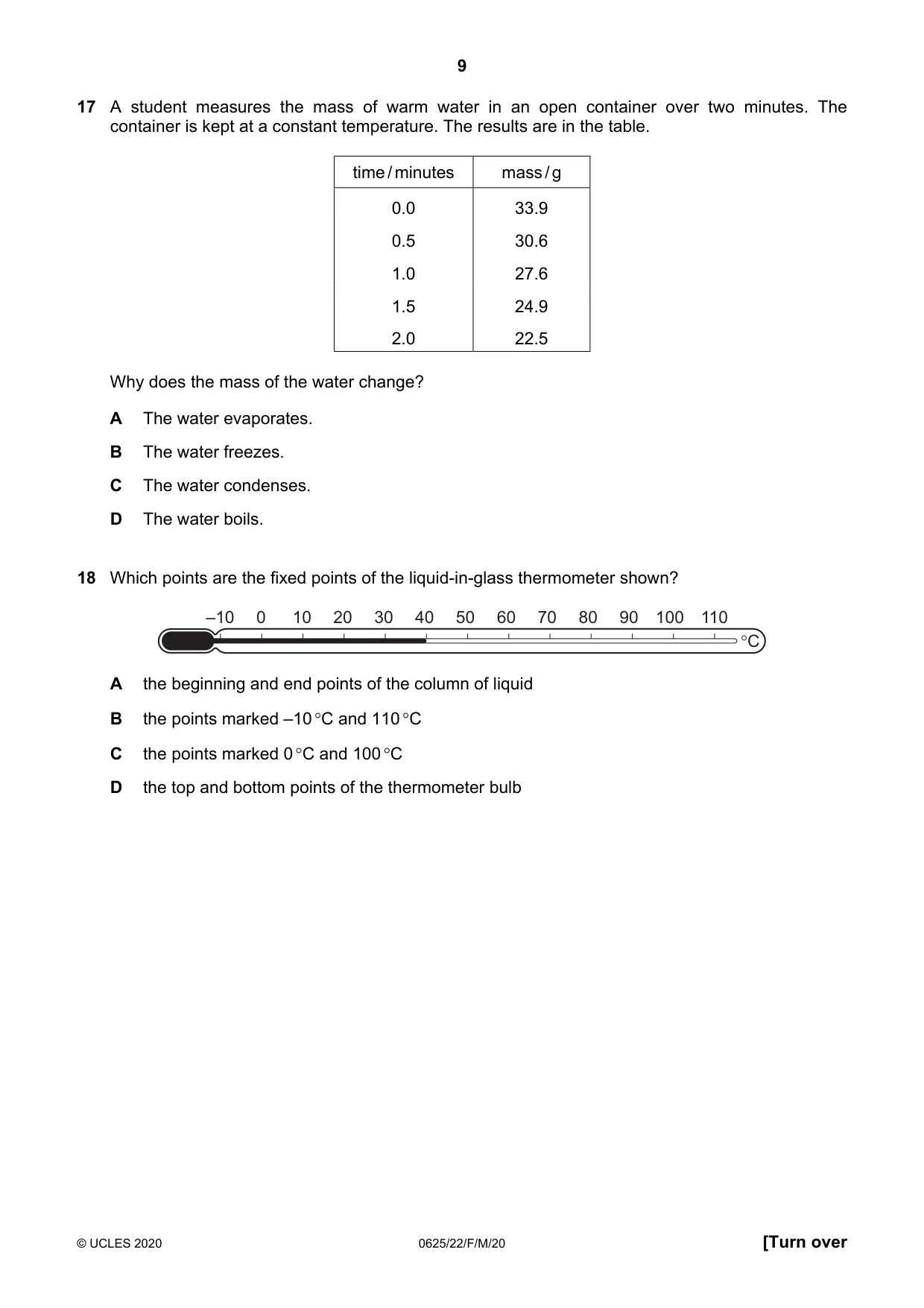
17 A student measures the mass of warm water in an open container over two minutes. The container is kept at a constant temperature. The results are in the table. time / minutes mass / g 0.0 33.9 0.5 30.6 1.0 27.6 1.5 24.9 2.0 22.5 Why does the mass of the water change? A The water evaporates. B The water freezes. C The water condenses. D The water boils.
Mark scheme: A
Q18 · Which points are the fixed points of the liquid-in-glass thermometer shown?
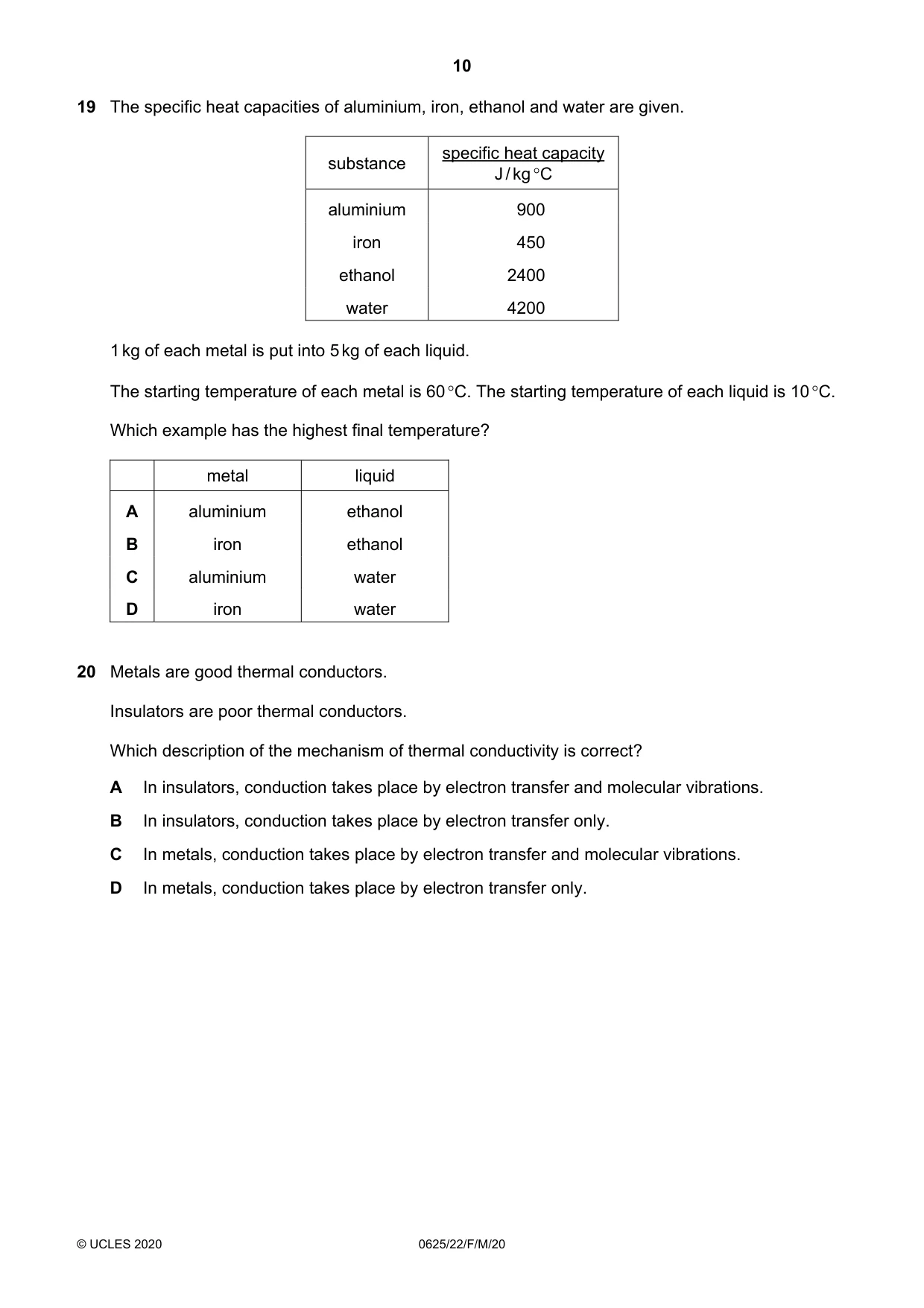
18 Which points are the fixed points of the liquid-in-glass thermometer shown? –10 0 10 20 30 40 50 60 70 80 90 100 110 °C A the beginning and end points of the column of liquid B the points marked –10 °C and 110 °C C the points marked 0 °C and 100 °C D the top and bottom points of the thermometer bulb
Mark scheme: C
Q19 · The specific heat capacities of aluminium, iron, ethanol and water are given
19 The specific heat capacities of aluminium, iron, ethanol and water are given. specific heat capacity substance J / kg °C aluminium 900 iron 450 ethanol 2400 water 4200 1 kg of each metal is put into 5 kg of each liquid. The starting temperature of each metal is 60 °C. The starting temperature of each liquid is 10 °C. Which example has the highest final temperature? metal liquid A aluminium ethanol B iron ethanol C aluminium water D iron water
Mark scheme: A
Q20 · Metals are good thermal conductors
20 Metals are good thermal conductors. Insulators are poor thermal conductors. Which description of the mechanism of thermal conductivity is correct? A In insulators, conduction takes place by electron transfer and molecular vibrations. B In insulators, conduction takes place by electron transfer only. C In metals, conduction takes place by electron transfer and molecular vibrations. D In metals, conduction takes place by electron transfer only.
Mark scheme: C
Q21 · A teacher shows his class a polystyrene cup
21 A teacher shows his class a polystyrene cup. The cup is made from thick plastic with lots of tiny air bubbles in it. He asks the class why the cup is so good at keeping a hot drink warm. Three suggestions are made. 1 It contains air which is a poor thermal conductor. 2 The air is trapped in tiny bubbles so very little convection is possible. 3 The plastic is a poor thermal conductor. Which suggestions are correct? A 1 and 2 only B 1 and 3 only C 2 and 3 only D 1, 2 and 3
Mark scheme: D
Q22 · A boy jumps into an indoor swimming pool
22 A boy jumps into an indoor swimming pool. He notices that the water appears to get colder as he goes deeper underwater. This is due to convection. Which statement is correct? A Cold water is more dense than warm water so it sinks to the bottom of the pool. B Warm water is more dense than cold water so it rises to the surface of the pool. C The molecules in cold water have more kinetic energy than the molecules in warm water so they move to the bottom of the pool faster. D The molecules in warm water are closer together than the molecules in cold water so they rise to the surface of the pool.
Mark scheme: A
Q23 · Four students A, B, C and D, investigate the diffraction of water waves through a gap
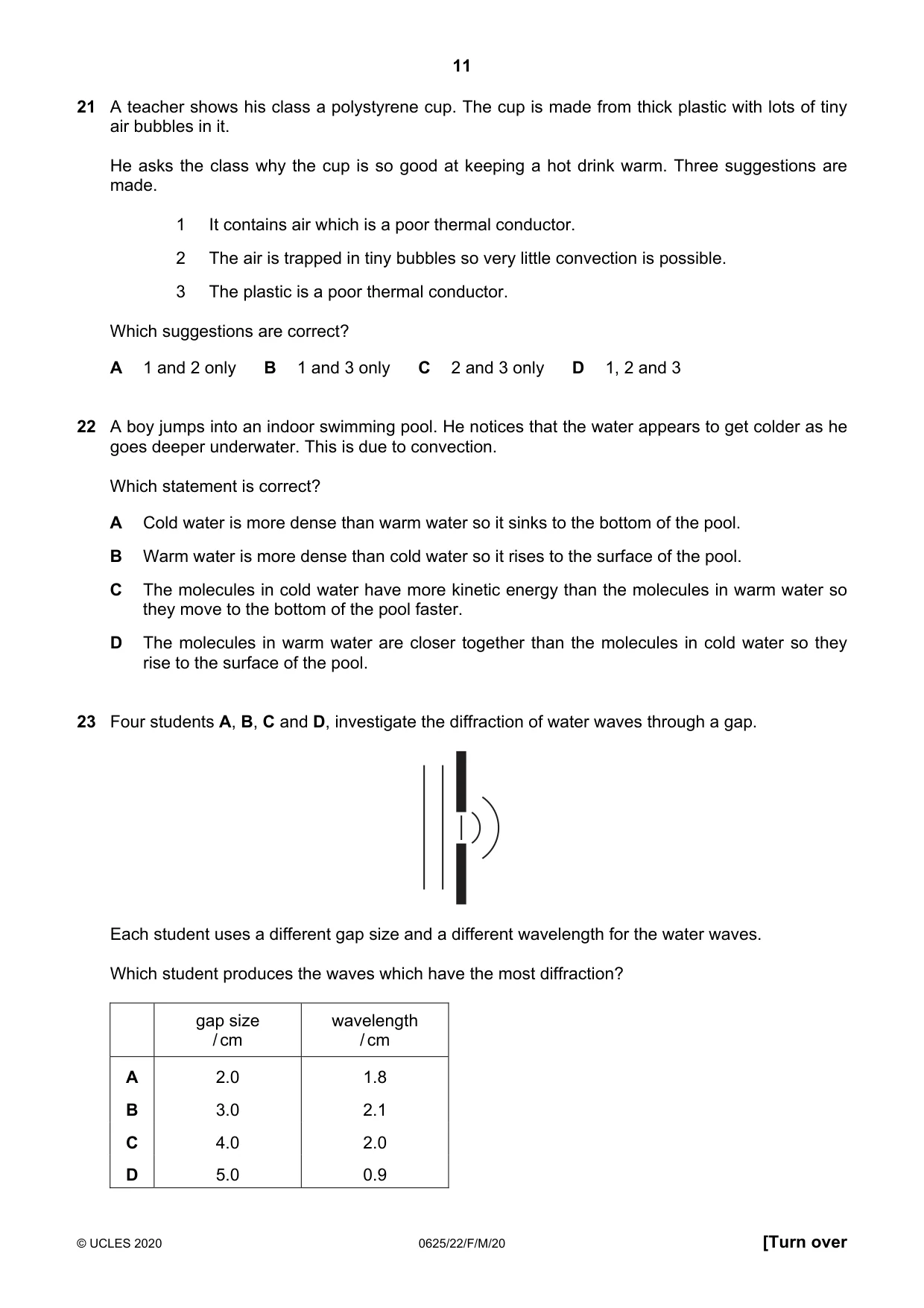
23 Four students A, B, C and D, investigate the diffraction of water waves through a gap. Each student uses a different gap size and a different wavelength for the water waves. Which student produces the waves which have the most diffraction? gap size wavelength / cm / cm A 2.0 1.8 B 3.0 2.1 C 4.0 2.0 D 5.0 0.9
Mark scheme: A
Q24 · The diagrams show examples of wave motion
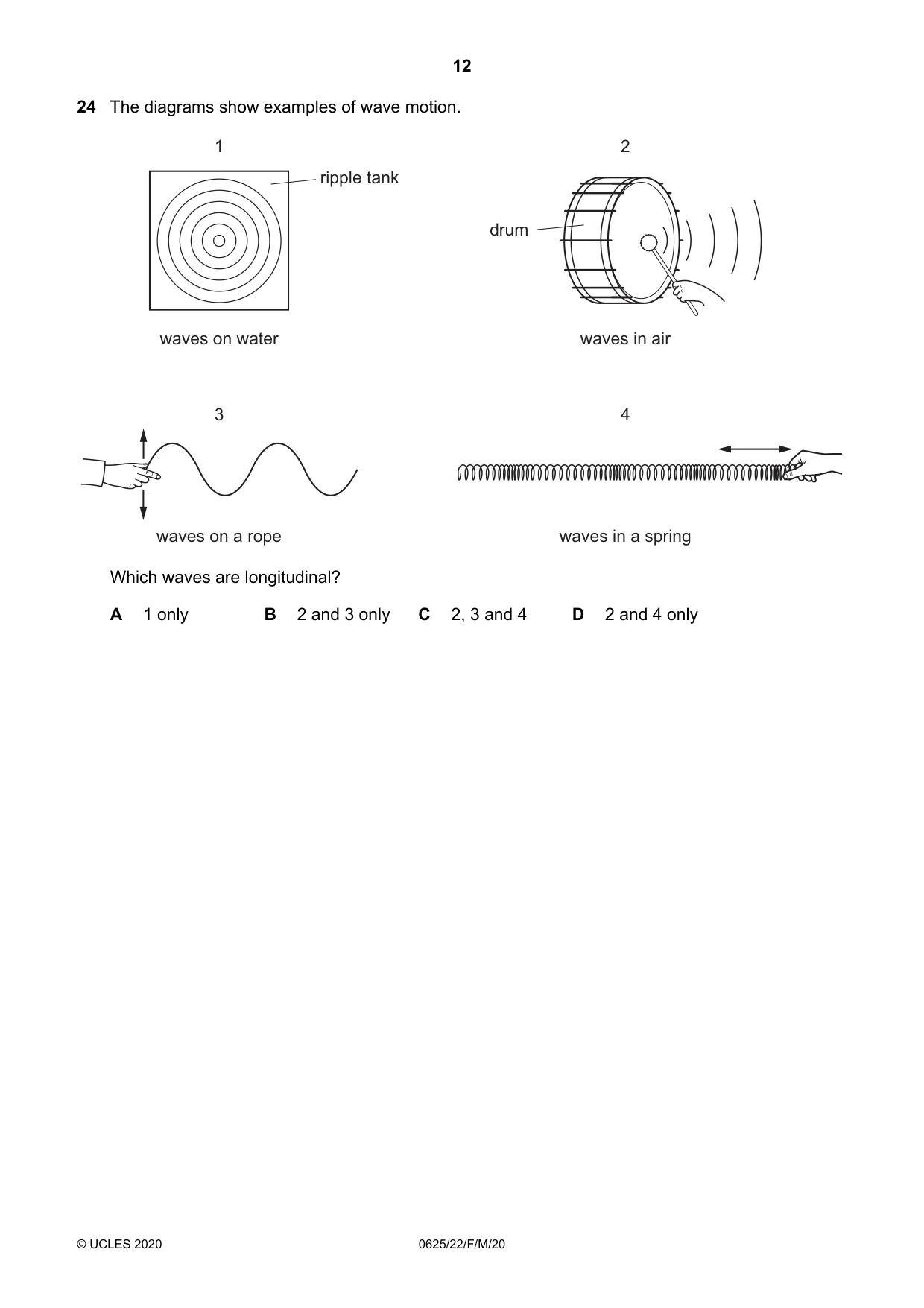
24 The diagrams show examples of wave motion. 1 2 ripple tank drum waves on water waves in air 3 4 waves on a rope waves in a spring Which waves are longitudinal? A 1 only B 2 and 3 only C 2, 3 and 4 D 2 and 4 only
Mark scheme: D
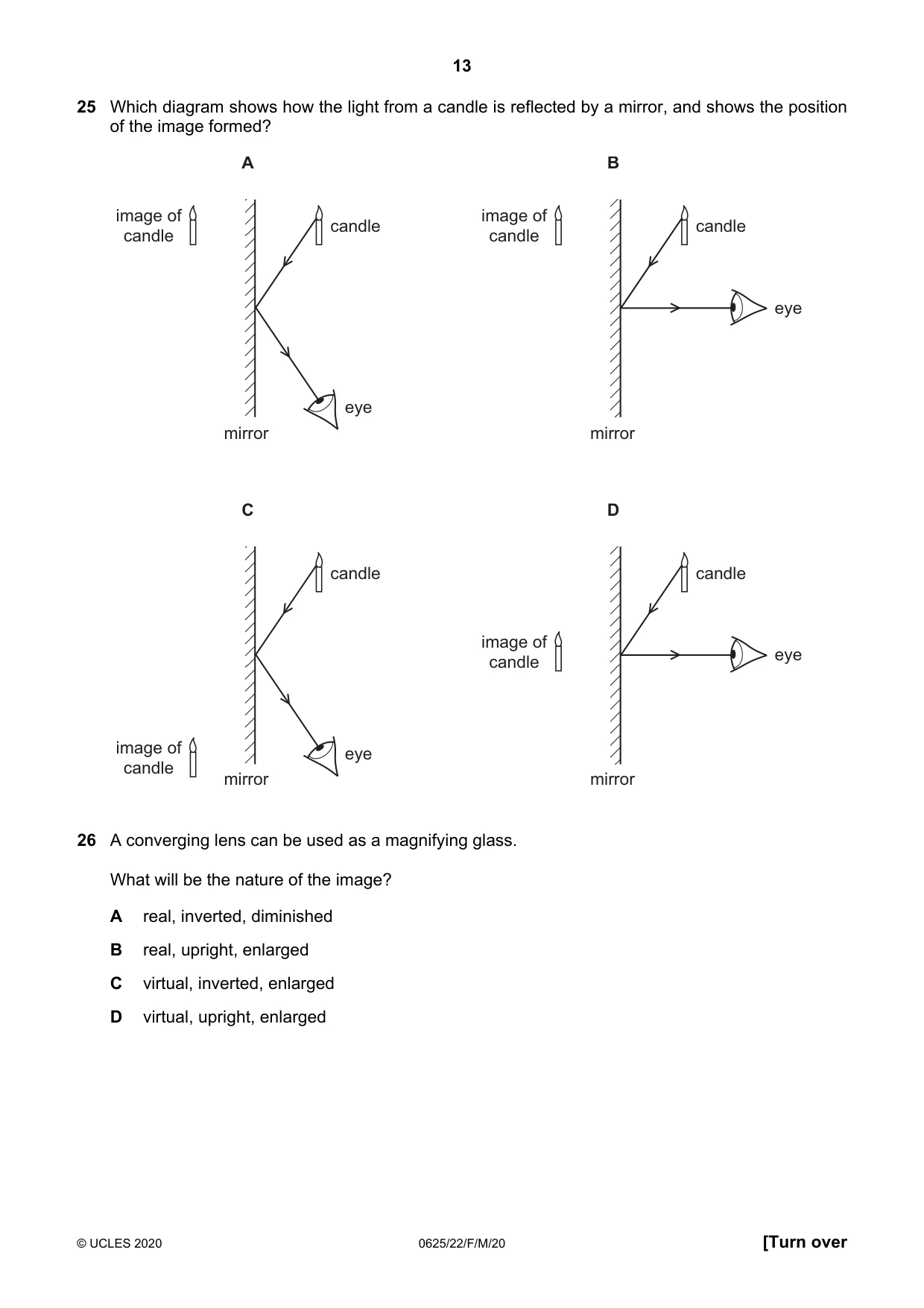
Q25 · Which diagram shows how the light from a candle is reflected by a mirror, and shows the…
25 Which diagram shows how the light from a candle is reflected by a mirror, and shows the position of the image formed? A B image of image of candle candle candle candle eye eye mirror mirror C D candle candle image of candle eye image of eye candle mirror mirror
Mark scheme: A
Q26 · A converging lens can be used as a magnifying glass
26 A converging lens can be used as a magnifying glass. What will be the nature of the image? A real, inverted, diminished B real, upright, enlarged C virtual, inverted, enlarged D virtual, upright, enlarged
Mark scheme: D
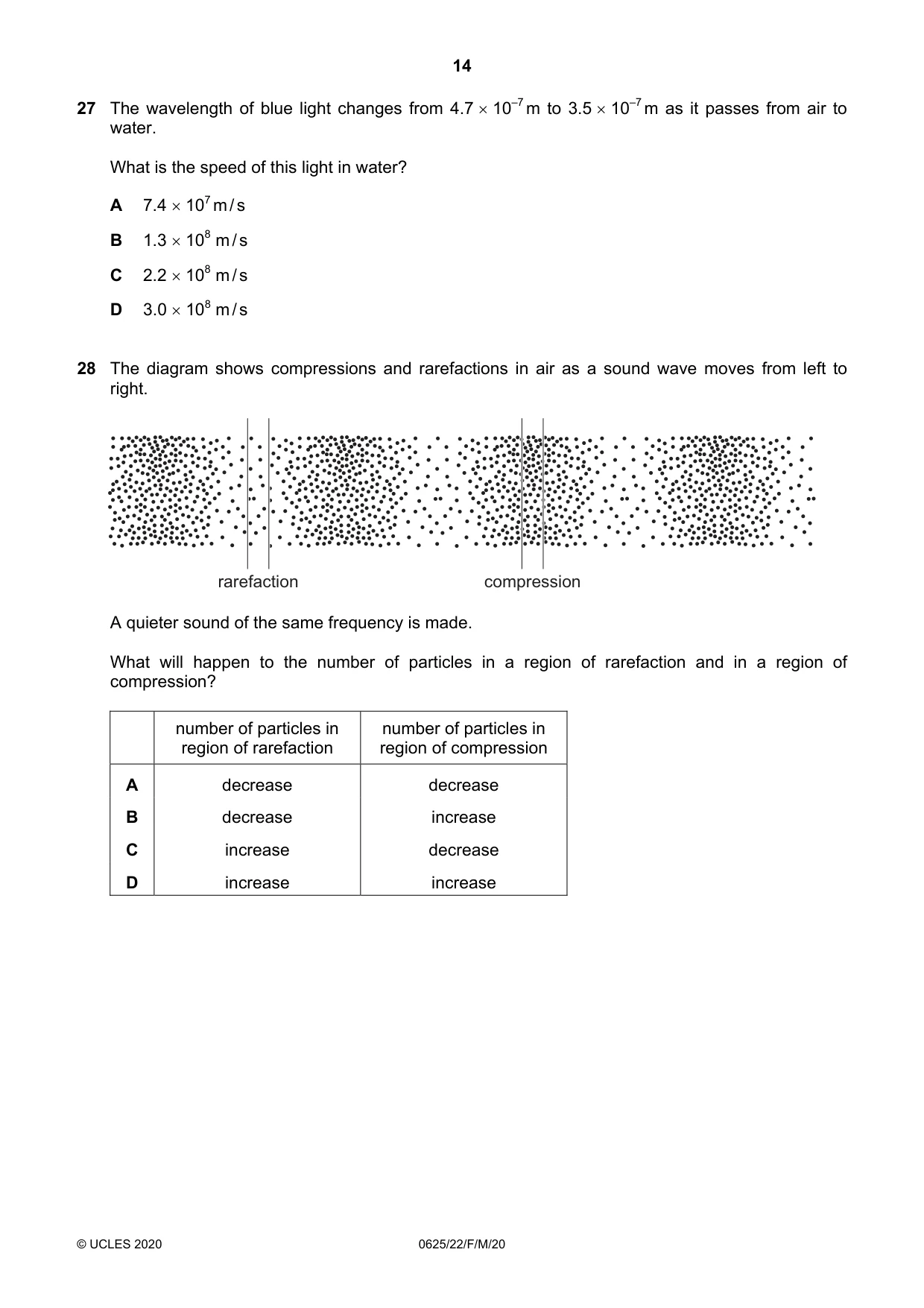
Q27 · The wavelength of blue light changes from 4.7 × 10⁻⁷ m to 3.5 × 10⁻⁷ m as it passes from…
27 The wavelength of blue light changes from 4.7 × 10⁻⁷ m to 3.5 × 10⁻⁷ m as it passes from air to water. What is the speed of this light in water? A 7.4 × 10⁷ m / s B 1.3 × 10⁸ m / s C 2.2 × 10⁸ m / s D 3.0 × 10⁸ m / s
Mark scheme: C
Q28 · The diagram shows compressions and rarefactions in air as a sound wave moves from left to…
28 The diagram shows compressions and rarefactions in air as a sound wave moves from left to right. rarefaction compression A quieter sound of the same frequency is made. What will happen to the number of particles in a region of rarefaction and in a region of compression? number of particles in number of particles in region of rarefaction region of compression A decrease decrease B decrease increase C increase decrease D increase increase
Mark scheme: C
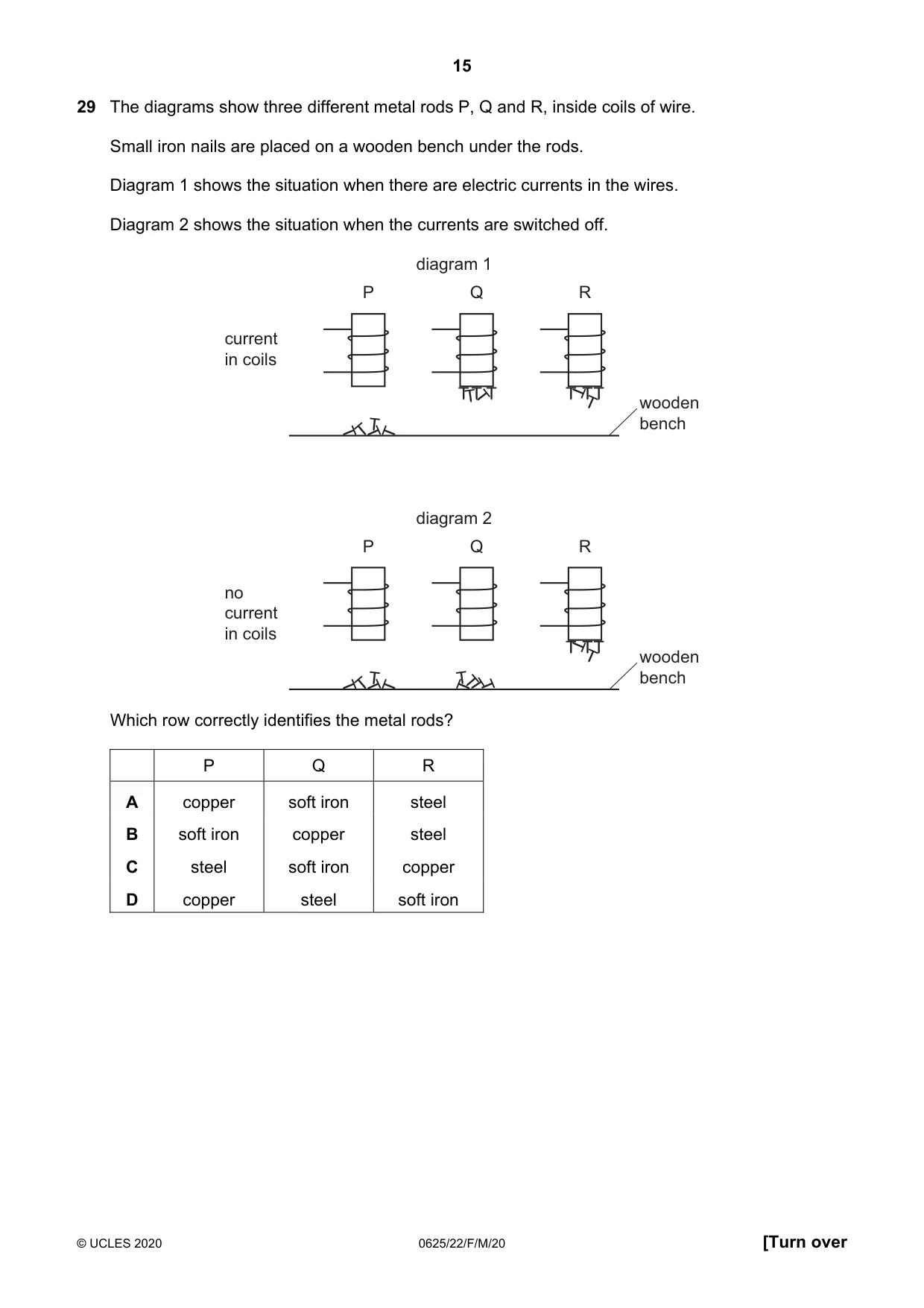
Q29 · The diagrams show three different metal rods P, Q and R, inside coils of wire
29 The diagrams show three different metal rods P, Q and R, inside coils of wire. Small iron nails are placed on a wooden bench under the rods. Diagram 1 shows the situation when there are electric currents in the wires. Diagram 2 shows the situation when the currents are switched off. diagram 1 P Q R current in coils wooden bench diagram 2 P Q R no current in coils wooden bench Which row correctly identifies the metal rods? P Q R A copper soft iron steel B soft iron copper steel C steel soft iron copper D copper steel soft iron
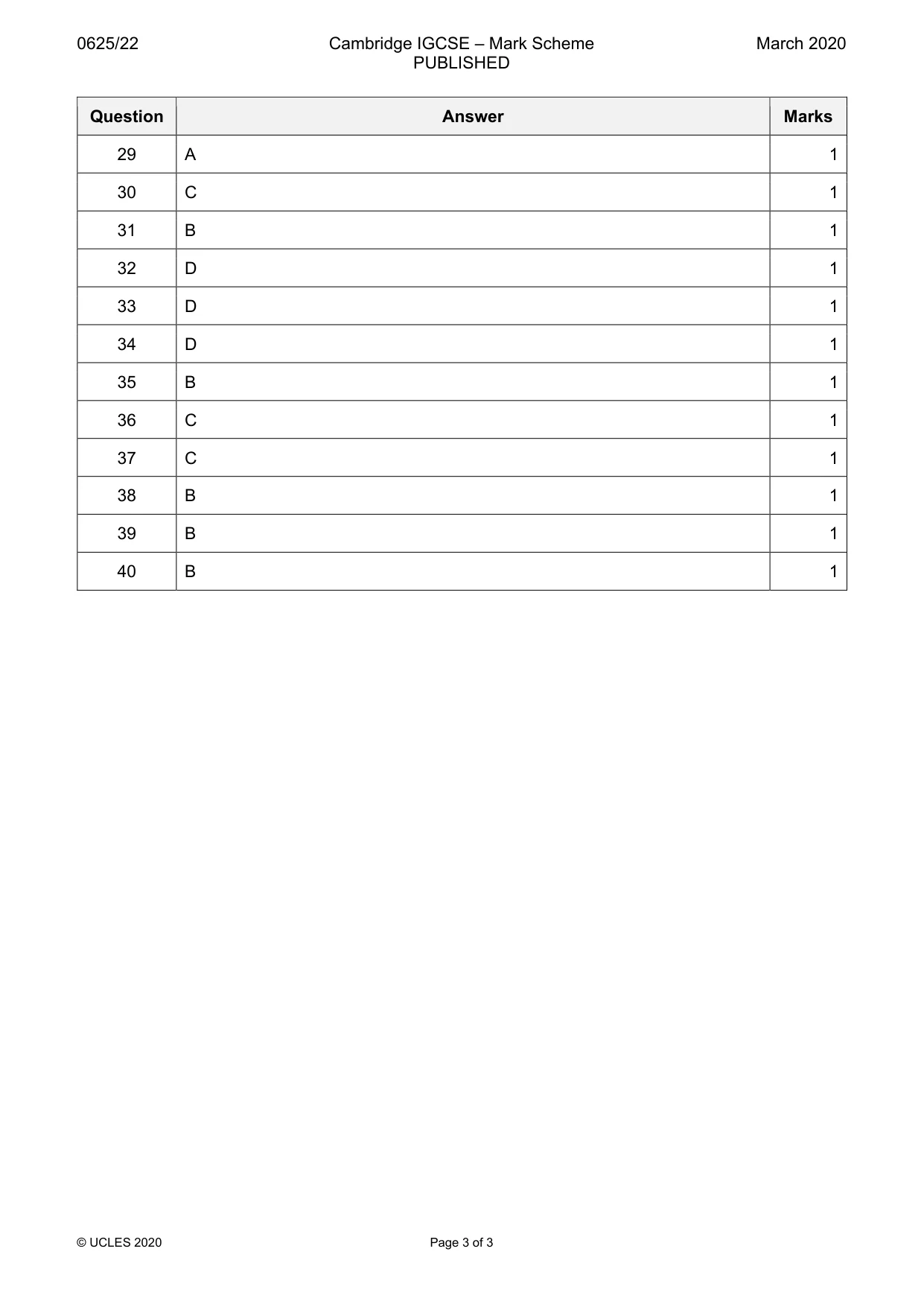
Mark scheme: A
Q30 · Which row describes conventional current and electron flow in a circuit containing a cell?
30 Which row describes conventional current and electron flow in a circuit containing a cell? conventional current electron flow A from the negative terminal of the cell from the negative terminal of the cell to the positive terminal of the cell to the positive terminal of the cell B from the negative terminal of the cell from the positive terminal of the cell to to the positive terminal of the cell the negative terminal of the cell C from the positive terminal of the cell to from the negative terminal of the cell the negative terminal of the cell to the positive terminal of the cell D from the positive terminal of the cell to from the positive terminal of the cell to the negative terminal of the cell the negative terminal of the cell
Mark scheme: C
Q31 · A student makes four resistors using different pieces of wire
31 A student makes four resistors using different pieces of wire. The wires have different diameters and lengths. All the pieces of wire are made of the same material. Which piece of wire will make the resistor with the largest resistance? diameter / mm length / cm A 0.8 10 B 0.8 17 C 2.0 10 D 2.0 17
Mark scheme: B
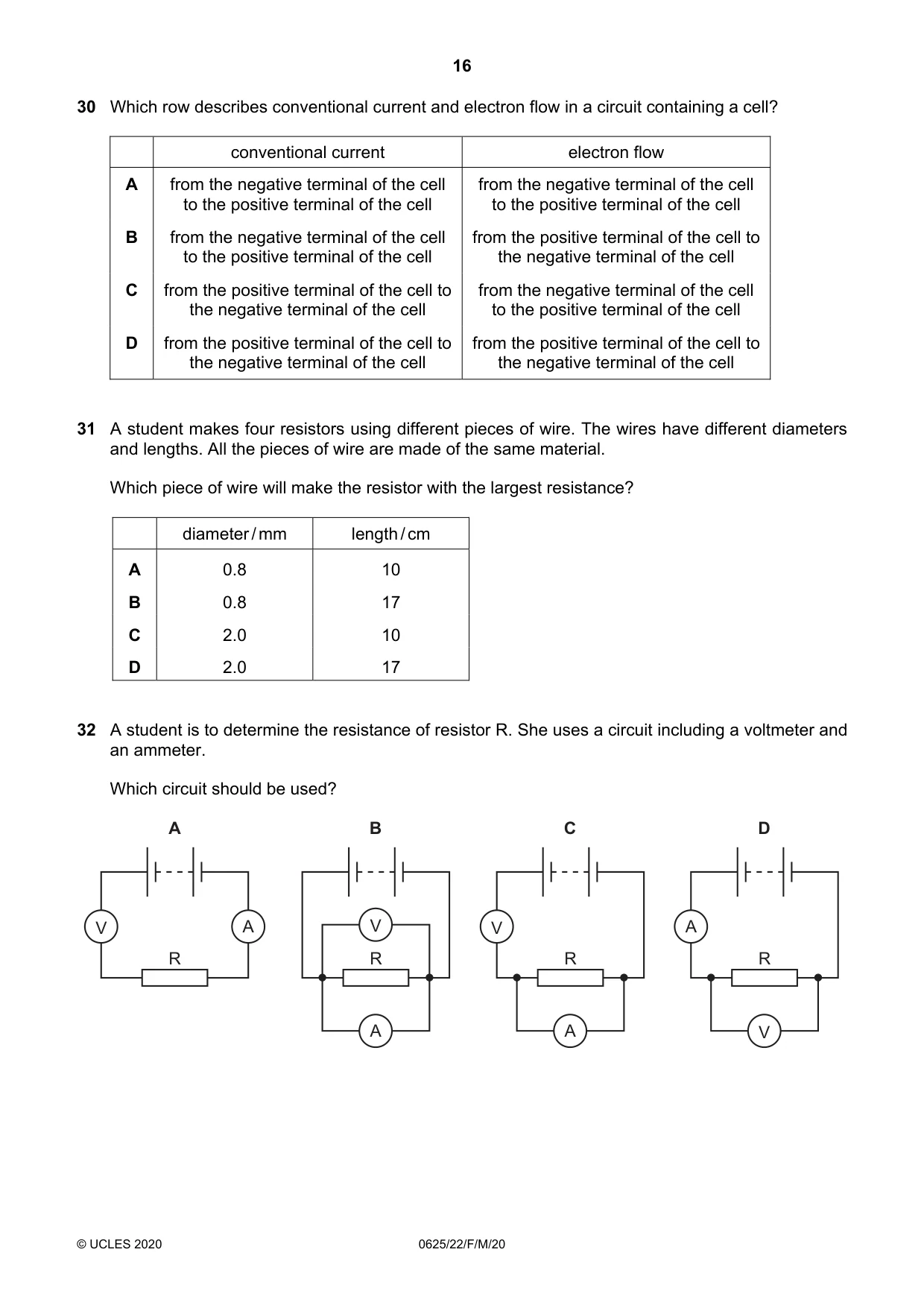
Q32 · A student is to determine the resistance of resistor R
32 A student is to determine the resistance of resistor R. She uses a circuit including a voltmeter and an ammeter. Which circuit should be used? A B C D V A V V A R R R R A A V
Mark scheme: D
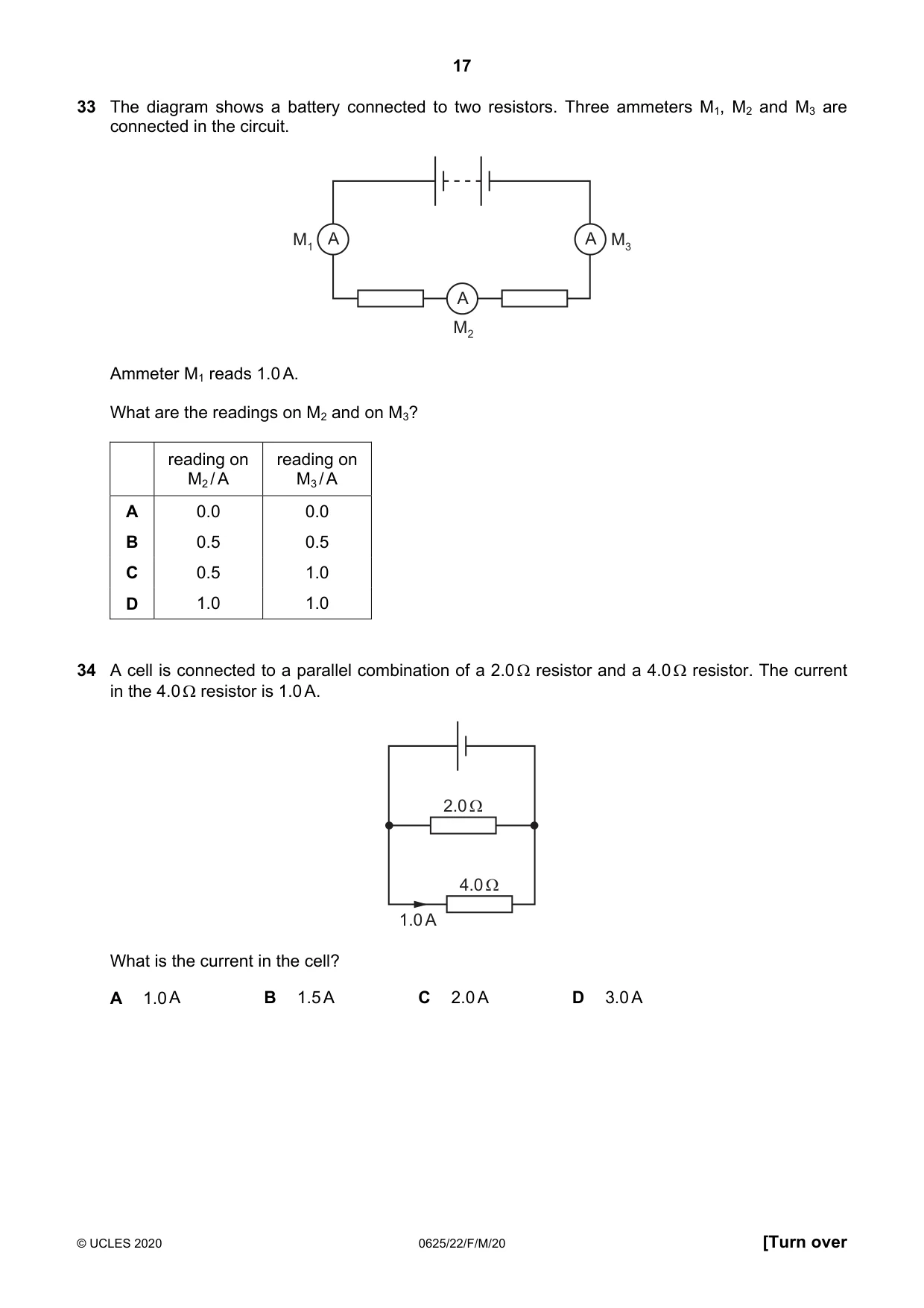
Q33 · The diagram shows a battery connected to two resistors
33 The diagram shows a battery connected to two resistors. Three ammeters M1, M2 and M3 are connected in the circuit. M1 A A M3 A M2 Ammeter M1 reads 1.0 A. What are the readings on M2 and on M3? reading on reading on M2 / A M3 / A A 0.0 0.0 B 0.5 0.5 C 0.5 1.0 D 1.0 1.0
Mark scheme: D
Q34 · A cell is connected to a parallel combination of a 2.0 Ω resistor and a 4.0 Ω resistor
34 A cell is connected to a parallel combination of a 2.0 Ω resistor and a 4.0 Ω resistor. The current in the 4.0 Ω resistor is 1.0 A. 2.0 Ω 4.0 Ω 1.0 A What is the current in the cell? A 1.0 A B 1.5 A C 2.0 A D 3.0 A
Mark scheme: D
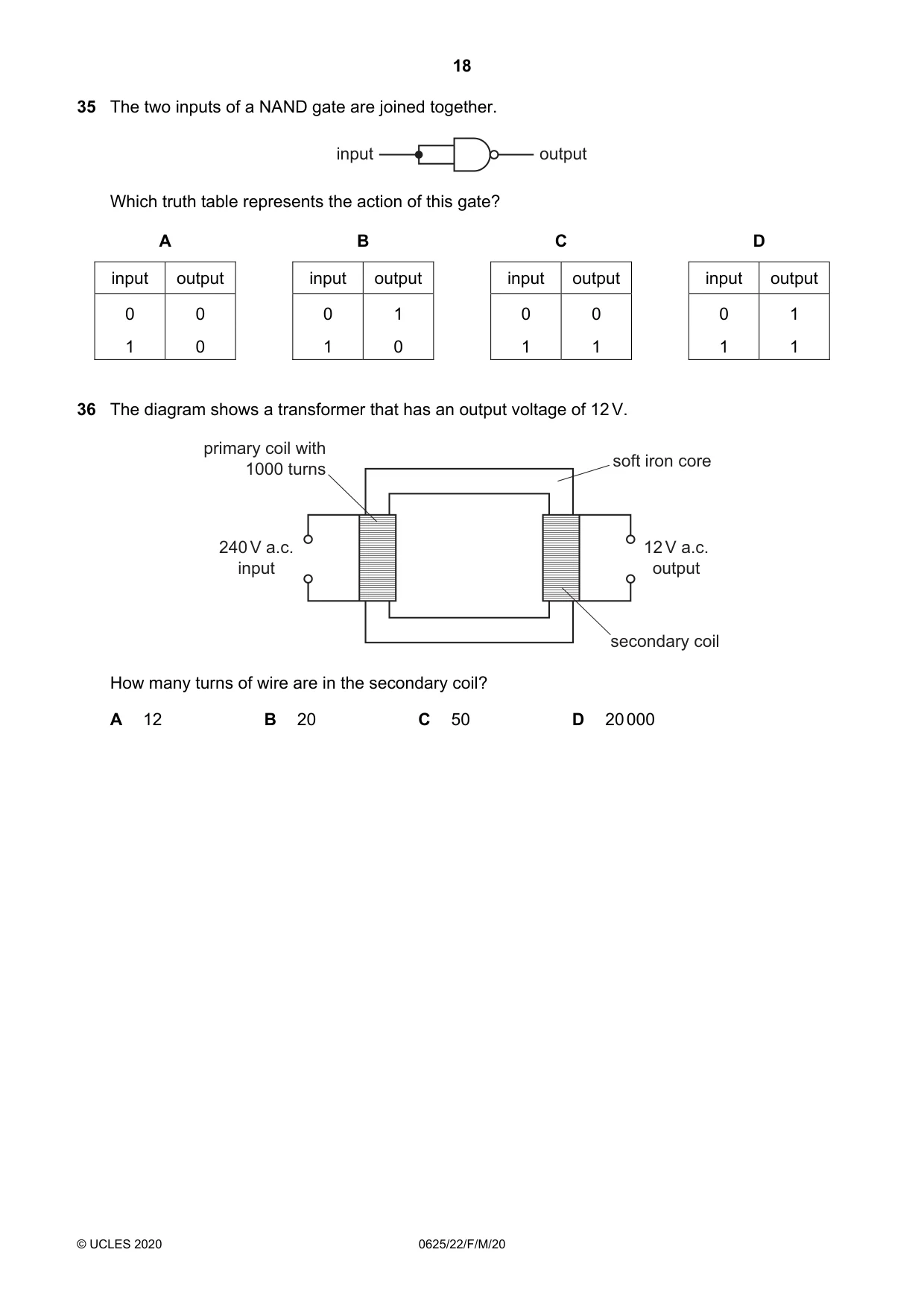
Q35 · The two inputs of a NAND gate are joined together
35 The two inputs of a NAND gate are joined together. input output Which truth table represents the action of this gate? A B C D input output input output input output input output 0 0 0 1 0 0 0 1 1 0 1 0 1 1 1 1
Mark scheme: B
Q36 · The diagram shows a transformer that has an output voltage of 12 V
36 The diagram shows a transformer that has an output voltage of 12 V. primary coil with soft iron core 1000 turns 240 V a.c. 12 V a.c. input output secondary coil How many turns of wire are in the secondary coil? A 12 B 20 C 50 D 20 000
Mark scheme: C
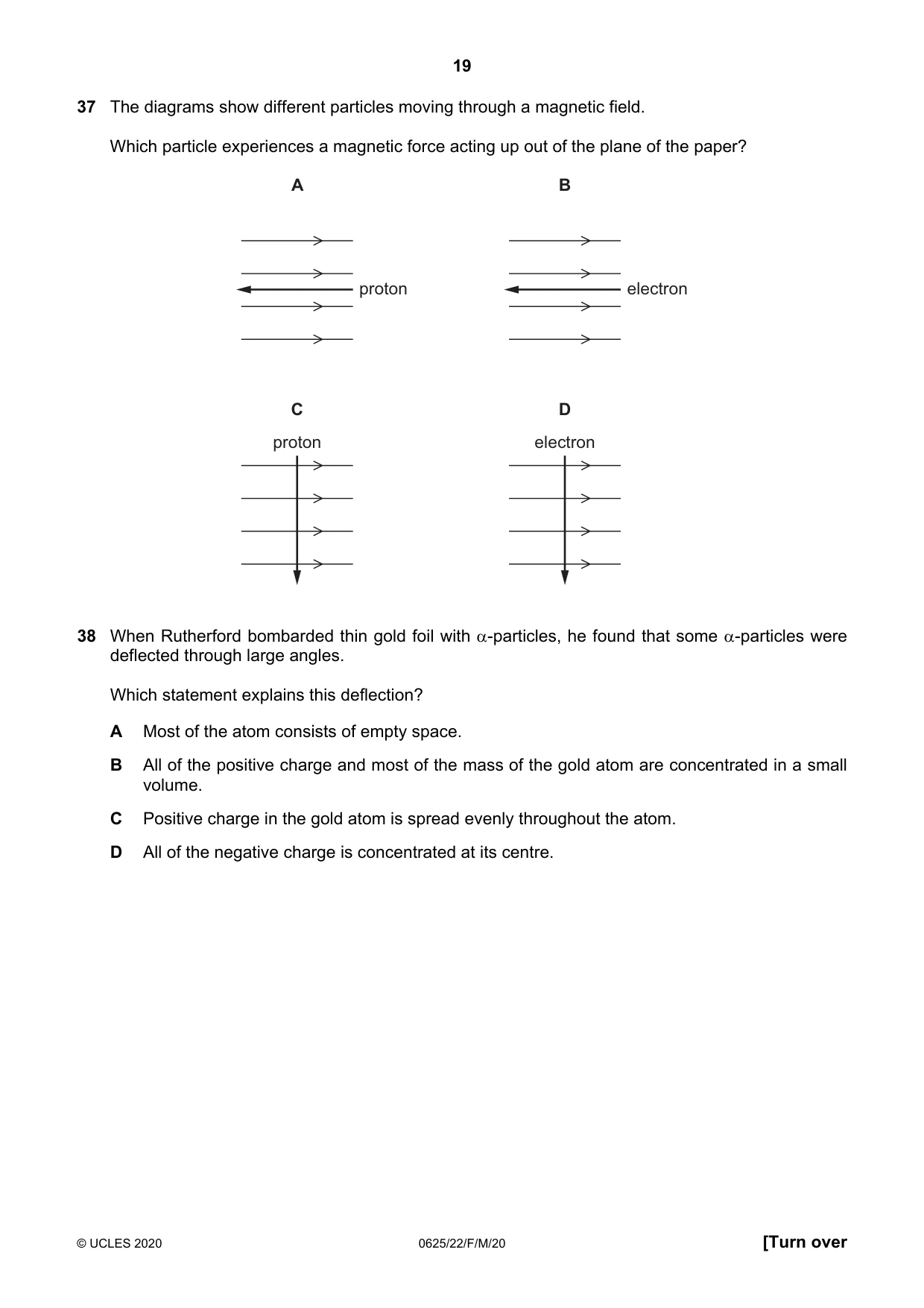
Q37 · The diagrams show different particles moving through a magnetic field
37 The diagrams show different particles moving through a magnetic field. Which particle experiences a magnetic force acting up out of the plane of the paper? A B proton electron C D proton electron
Mark scheme: C
Q38 · When Rutherford bombarded thin gold foil with α-particles, he found that some α-particles…
38 When Rutherford bombarded thin gold foil with α-particles, he found that some α-particles were deflected through large angles. Which statement explains this deflection? A Most of the atom consists of empty space. B All of the positive charge and most of the mass of the gold atom are concentrated in a small volume. C Positive charge in the gold atom is spread evenly throughout the atom. D All of the negative charge is concentrated at its centre.
Mark scheme: B
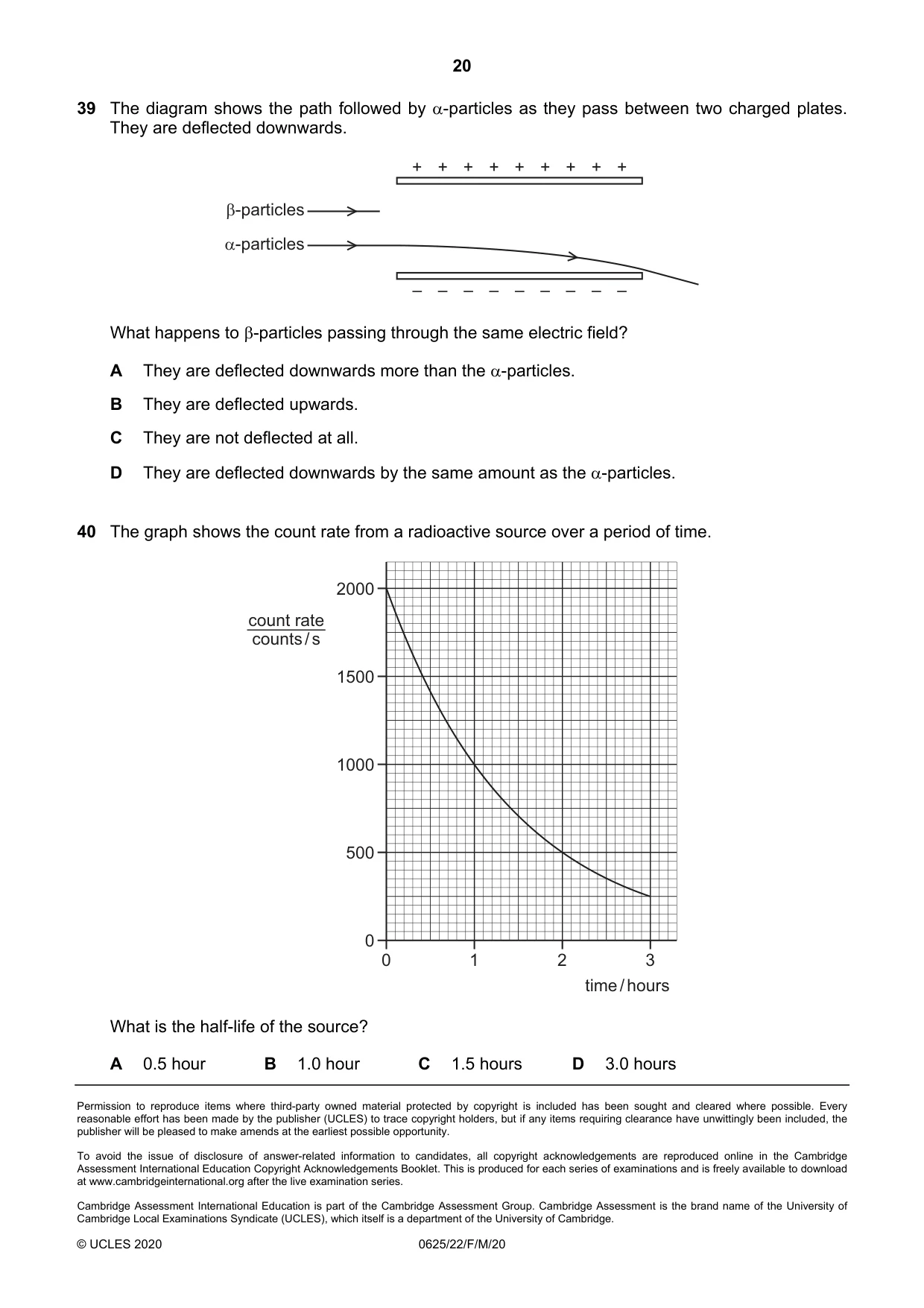
Q39 · The diagram shows the path followed by α-particles as they pass between two charged plates
39 The diagram shows the path followed by α-particles as they pass between two charged plates. They are deflected downwards. + + + + + + + + + β-particles α-particles – – – – – – – – – What happens to β-particles passing through the same electric field? A They are deflected downwards more than the α-particles. B They are deflected upwards. C They are not deflected at all. D They are deflected downwards by the same amount as the α-particles.
Mark scheme: B
Q40 · The graph shows the count rate from a radioactive source over a period of time
40 The graph shows the count rate from a radioactive source over a period of time. 2000 count rate counts / s 1500 1000 500 0 0 1 2 3 time / hours What is the half-life of the source? A 0.5 hour B 1.0 hour C 1.5 hours D 3.0 hours
Mark scheme: B
What was in this paper
The subtopics covered by these 40 questions, and how many questions each got. Open one in a new tab to see every Cambridge question on it.
5Forces5Energy, work and power3Light3Thermal properties and temperature3Transfer of thermal energy3Electromagnetic effects2General properties of waves2Mass and weight2Pressure2Radioactivity2Density1Electrical quantities1Kinetic particle model of matter1Motion1Physical quantities and measurement techniques1Simple phenomena of magnetism1Sound1The nuclear model of the atom1What you needed in this session
Cambridge’s own grade thresholds for 2020 Feb/March, Paper 2 · Variant 2. A higher threshold means an easier paper — the bar moves with how the cohort did.