Cambridge IGCSE Physics 0625 — 2022 Feb/March Paper 2 · Variant 2
0625/22/F/M/22 · 40 questions · 40 marks · ≈45 min
The question paper and its mark scheme, free to read here and free to download. This is Cambridge’s own paper, exactly as it was sat.
Question paper16 pages
Mark scheme3 pages
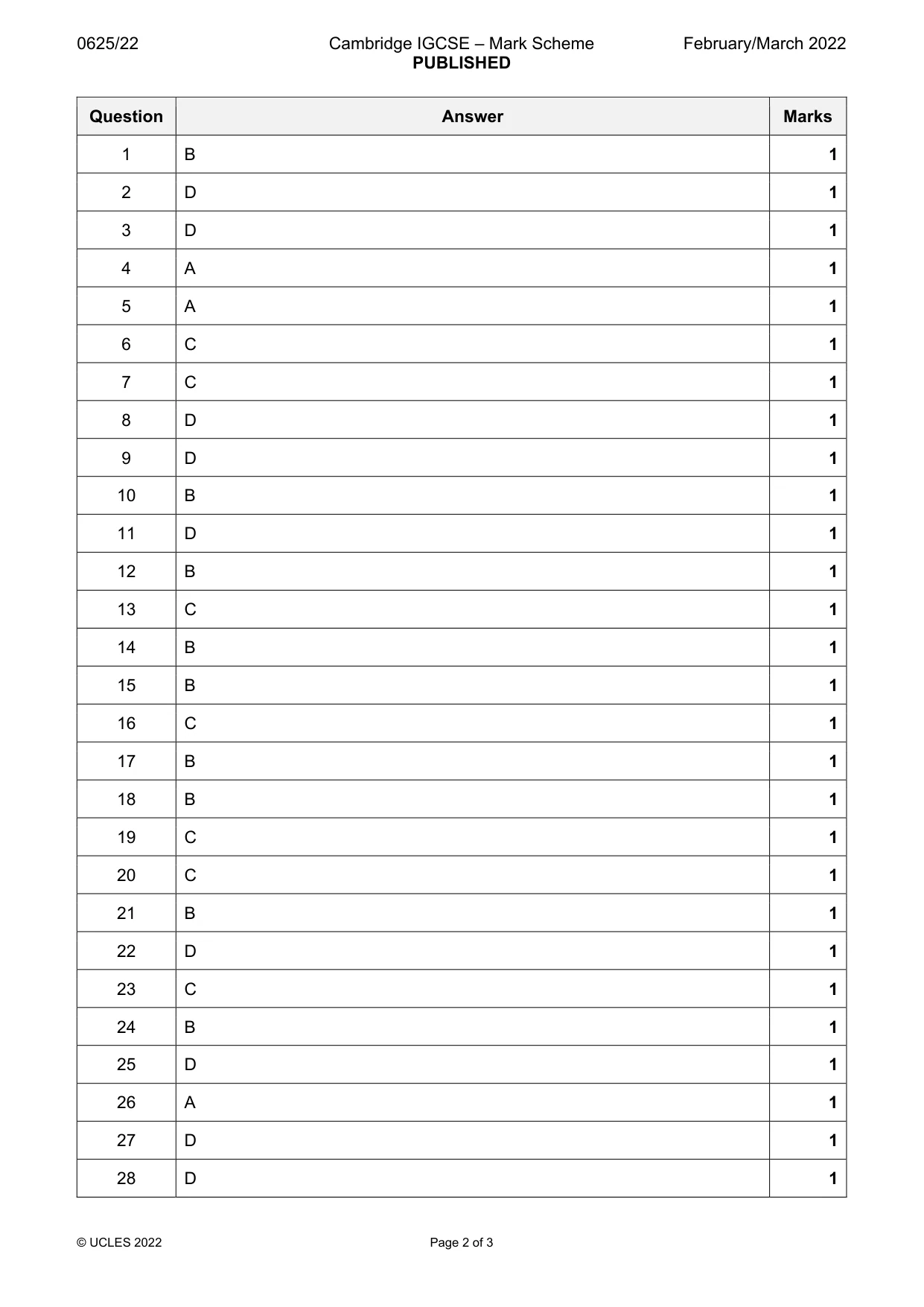
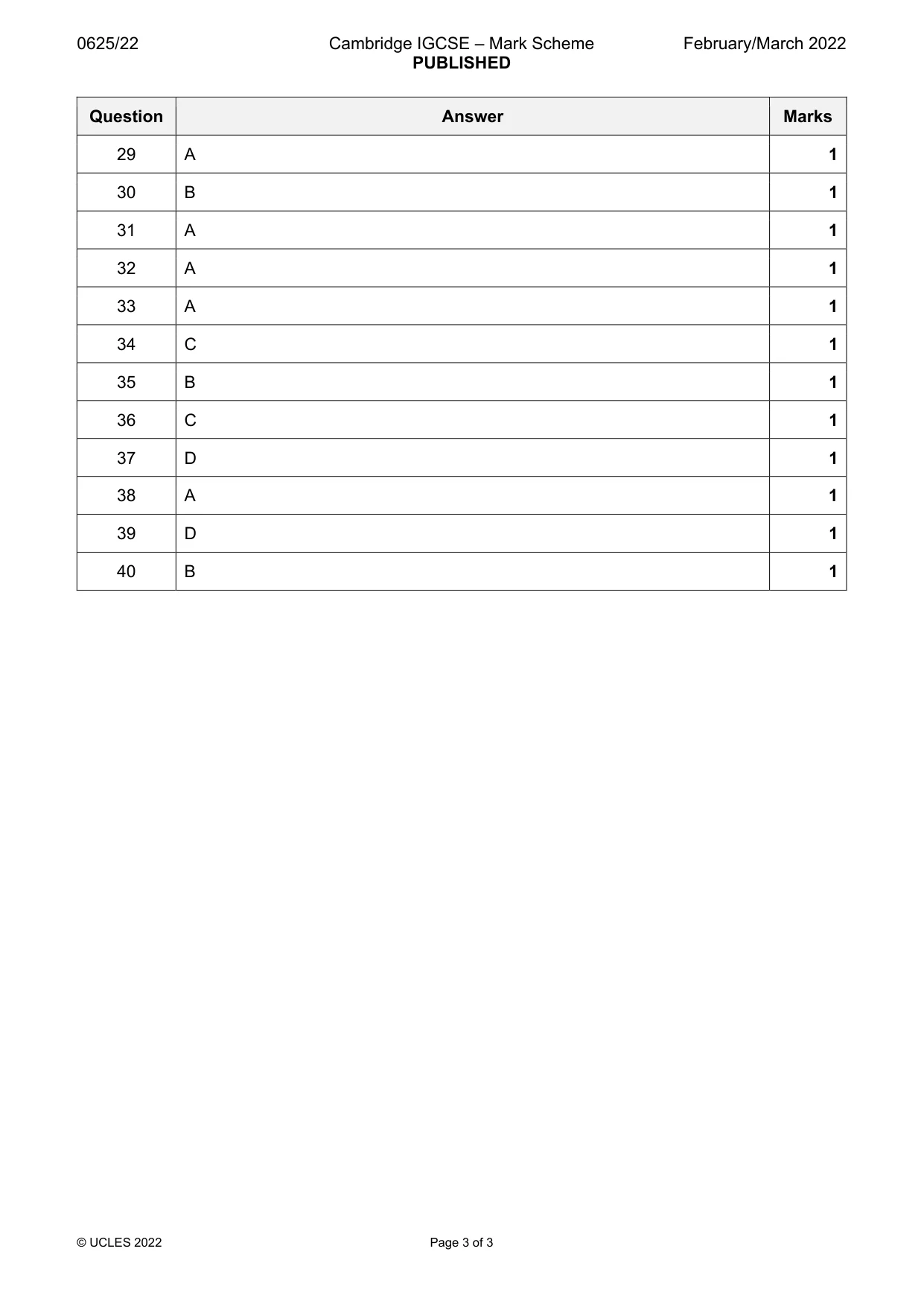
Answers below. Sit the paper first if you are practising.
Questions as text
Q1 · A student investigates a pendulum
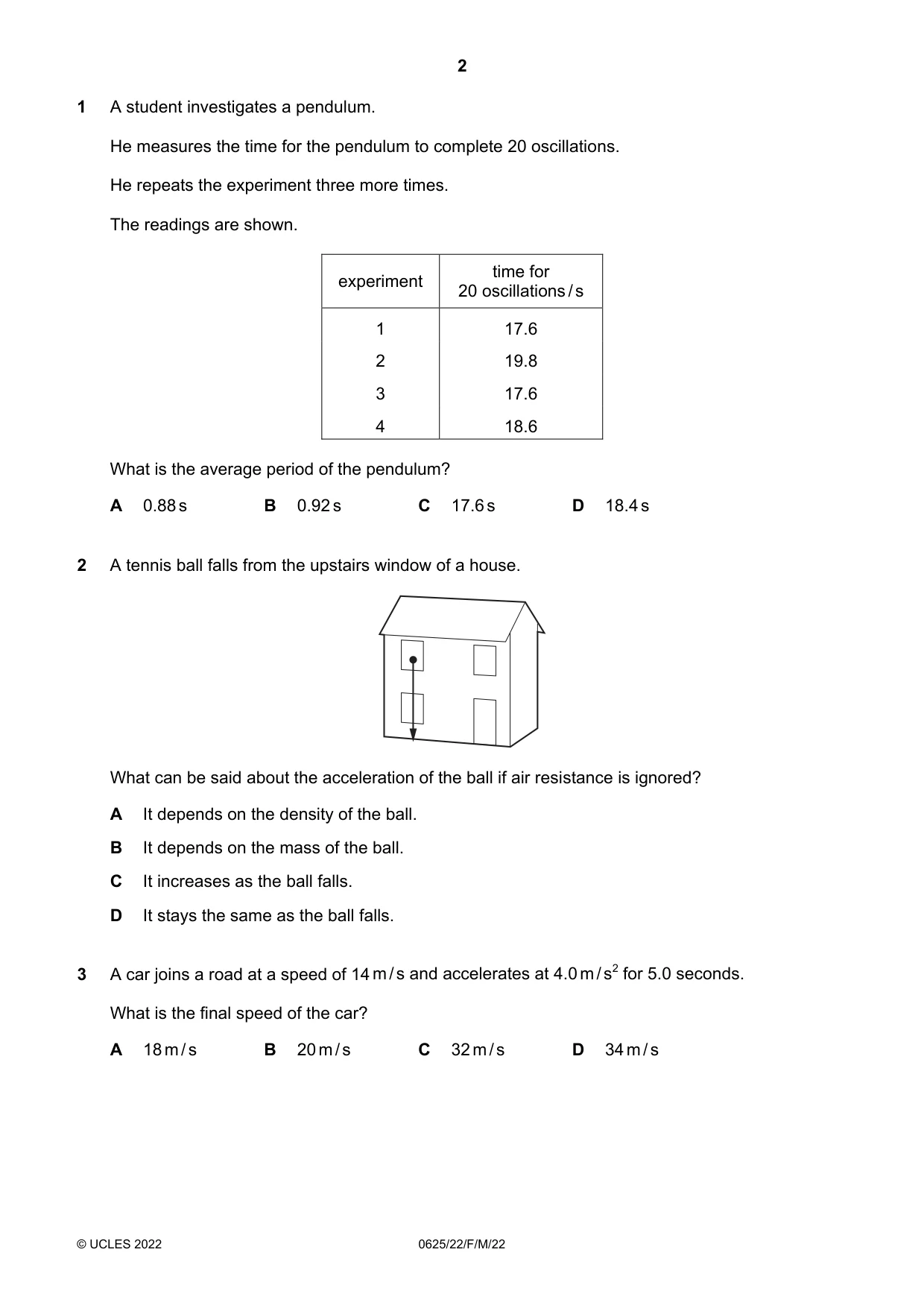
1 A student investigates a pendulum. He measures the time for the pendulum to complete 20 oscillations. He repeats the experiment three more times. The readings are shown. time for experiment 20 oscillations / s 1 17.6 2 19.8 3 17.6 4 18.6 What is the average period of the pendulum? A 0.88 s B 0.92 s C 17.6 s D 18.4 s
Mark scheme: B
More questions on Physical quantities and measurement techniques
Q2 · A tennis ball falls from the upstairs window of a house
2 A tennis ball falls from the upstairs window of a house. What can be said about the acceleration of the ball if air resistance is ignored? A It depends on the density of the ball. B It depends on the mass of the ball. C It increases as the ball falls. D It stays the same as the ball falls.
Mark scheme: D
Q3 · A car joins a road at a speed of 14 m / s and accelerates at 4.0 m / s2 for 5.0 seconds
3 A car joins a road at a speed of 14 m / s and accelerates at 4.0 m / s2 for 5.0 seconds. What is the final speed of the car? A 18 m / s B 20 m / s C 32 m / s D 34 m / s
Mark scheme: D
Q4 · The gravitational field strength is 8.8 N / kg on Venus and 3.8 N / kg on Mars
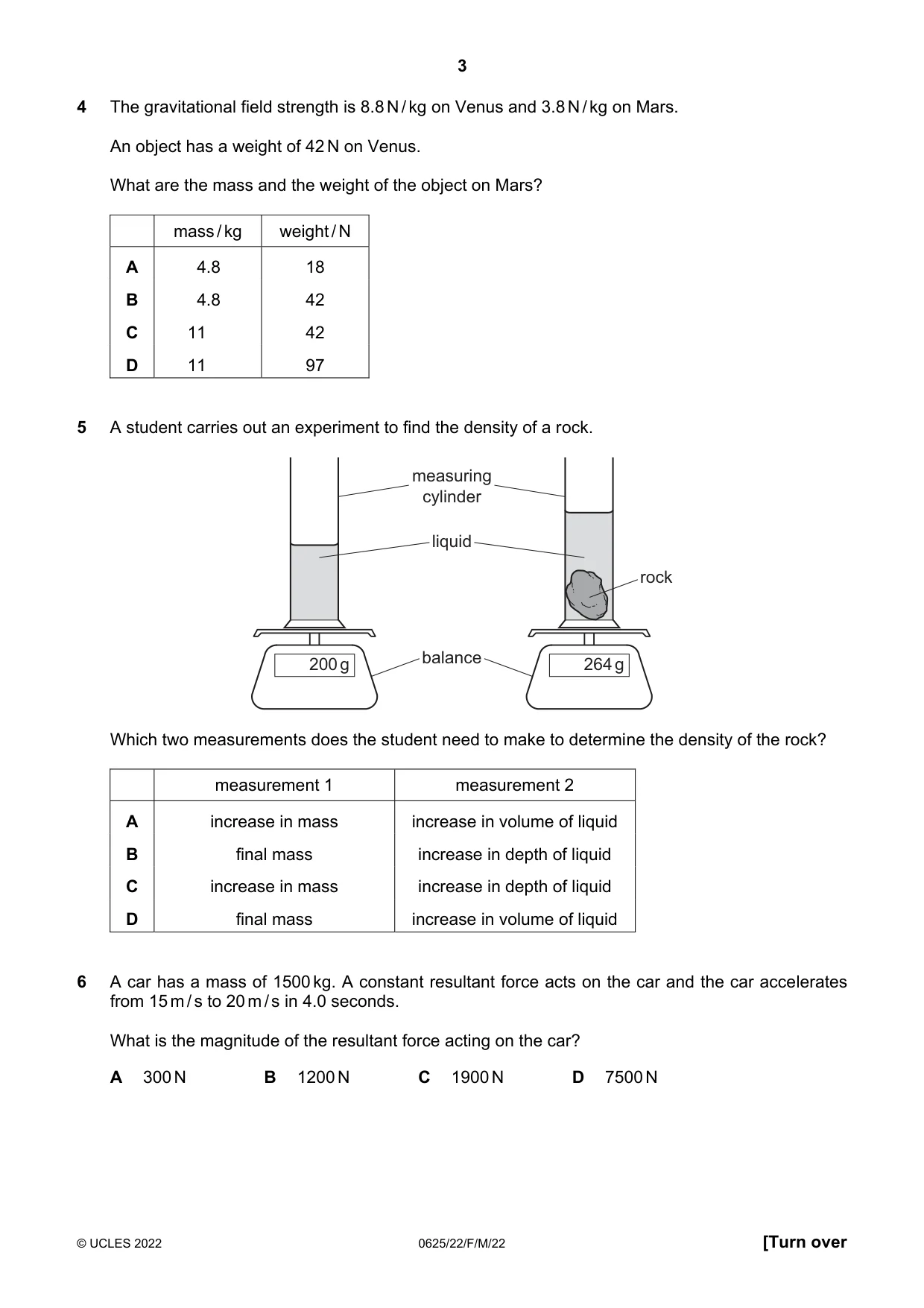
4 The gravitational field strength is 8.8 N / kg on Venus and 3.8 N / kg on Mars. An object has a weight of 42 N on Venus. What are the mass and the weight of the object on Mars? mass / kg weight / N A 4.8 18 B 4.8 42 C 11 42 D 11 97
Mark scheme: A
Q5 · A student carries out an experiment to find the density of a rock
5 A student carries out an experiment to find the density of a rock. measuring cylinder liquid rock 200 g balance 264 g Which two measurements does the student need to make to determine the density of the rock? measurement 1 measurement 2 A increase in mass increase in volume of liquid B final mass increase in depth of liquid C increase in mass increase in depth of liquid D final mass increase in volume of liquid
Mark scheme: A
Q6 · A car has a mass of 1500 kg
6 A car has a mass of 1500 kg. A constant resultant force acts on the car and the car accelerates from 15 m / s to 20 m / s in 4.0 seconds. What is the magnitude of the resultant force acting on the car? A 300 N B 1200 N C 1900 N D 7500 N
Mark scheme: C
Q7 · A metal wire is loaded up to the limit of proportionality
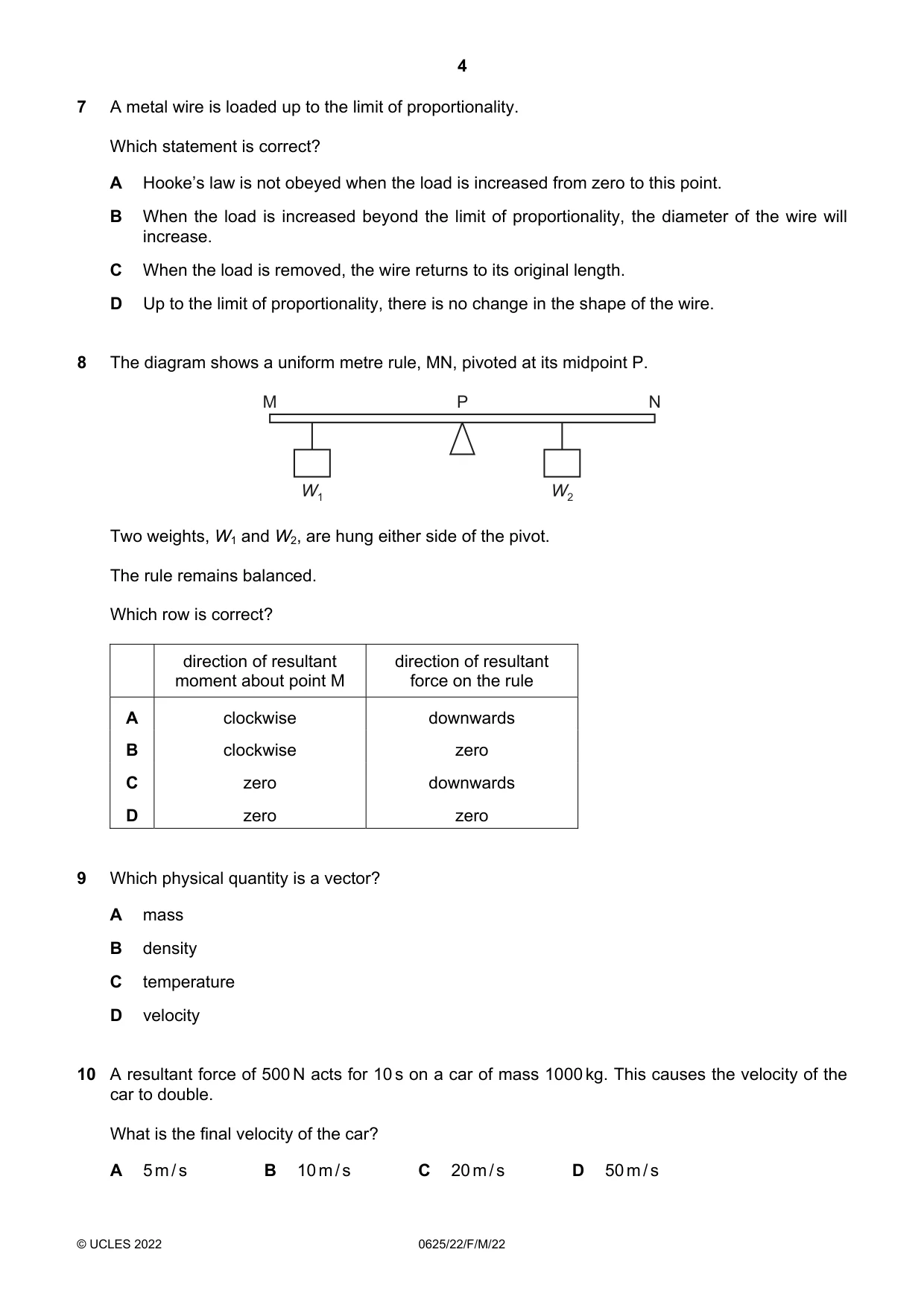
7 A metal wire is loaded up to the limit of proportionality. Which statement is correct? A Hooke’s law is not obeyed when the load is increased from zero to this point. B When the load is increased beyond the limit of proportionality, the diameter of the wire will increase. C When the load is removed, the wire returns to its original length. D Up to the limit of proportionality, there is no change in the shape of the wire.
Mark scheme: C
Q8 · The diagram shows a uniform metre rule, MN, pivoted at its midpoint P
8 The diagram shows a uniform metre rule, MN, pivoted at its midpoint P. M P N W1 W2 Two weights, W1 and W2, are hung either side of the pivot. The rule remains balanced. Which row is correct? direction of resultant direction of resultant moment about point M force on the rule A clockwise downwards B clockwise zero C zero downwards D zero zero
Mark scheme: D
Q9 · Which physical quantity is a vector?
9 Which physical quantity is a vector? A mass B density C temperature D velocity
Mark scheme: D
More questions on Physical quantities and measurement techniques
Q10 · A resultant force of 500 N acts for 10 s on a car of mass 1000 kg
10 A resultant force of 500 N acts for 10 s on a car of mass 1000 kg. This causes the velocity of the car to double. What is the final velocity of the car? A 5 m / s B 10 m / s C 20 m / s D 50 m / s
Mark scheme: B
Q11 · A child pushes a toy car along a horizontal surface and then releases it
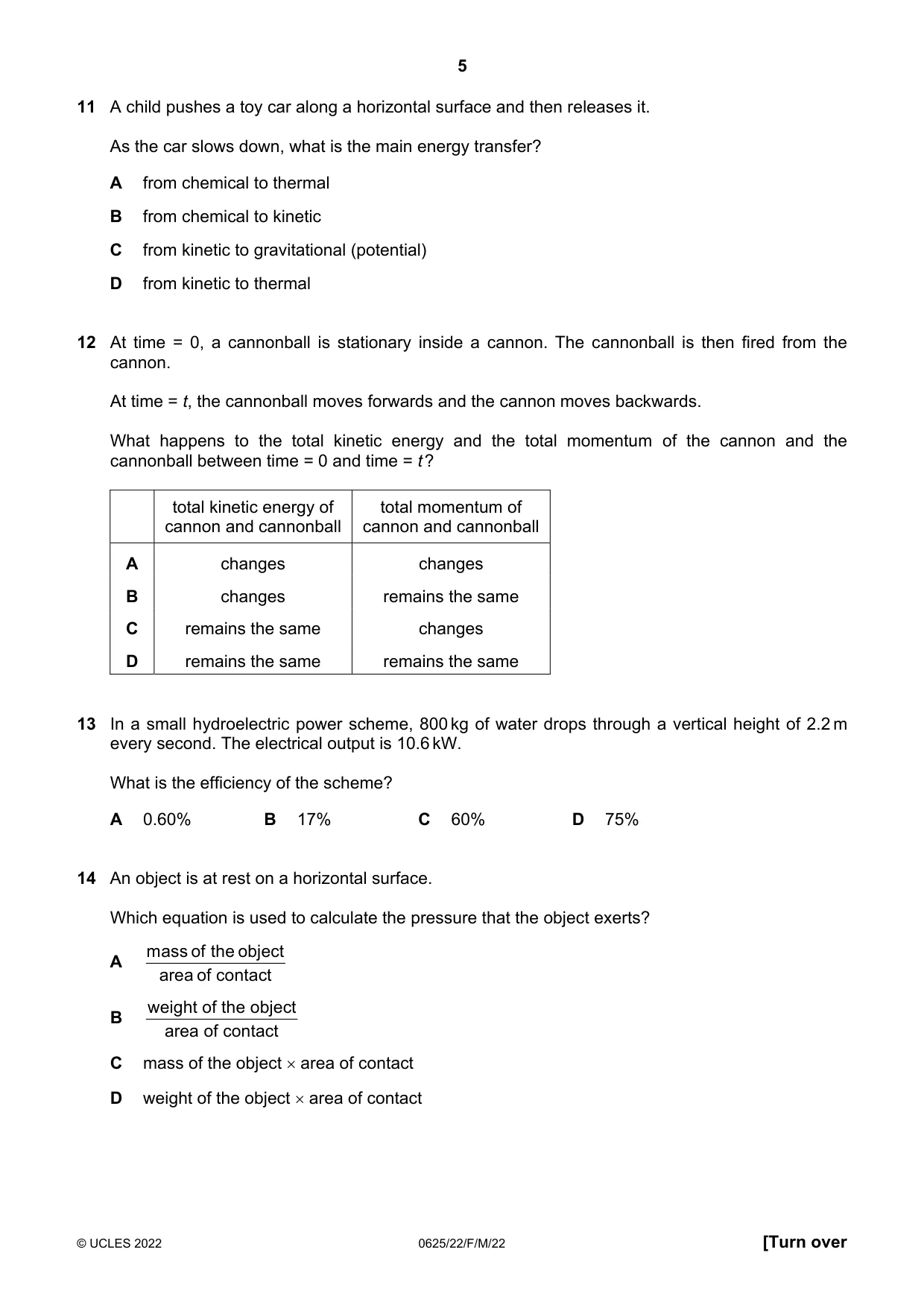
11 A child pushes a toy car along a horizontal surface and then releases it. As the car slows down, what is the main energy transfer? A from chemical to thermal B from chemical to kinetic C from kinetic to gravitational (potential) D from kinetic to thermal
Mark scheme: D
Q12 · At time = 0, a cannonball is stationary inside a cannon
12 At time = 0, a cannonball is stationary inside a cannon. The cannonball is then fired from the cannon. At time = t, the cannonball moves forwards and the cannon moves backwards. What happens to the total kinetic energy and the total momentum of the cannon and the cannonball between time = 0 and time = t ? total kinetic energy of total momentum of cannon and cannonball cannon and cannonball A changes changes B changes remains the same C remains the same changes D remains the same remains the same
Mark scheme: B
Q13 · In a small hydroelectric power scheme, 800 kg of water drops through a vertical height of…
13 In a small hydroelectric power scheme, 800 kg of water drops through a vertical height of 2.2 m every second. The electrical output is 10.6 kW. What is the efficiency of the scheme? A 0.60% B 17% C 60% D 75%
Mark scheme: C
Q14 · An object is at rest on a horizontal surface
14 An object is at rest on a horizontal surface. Which equation is used to calculate the pressure that the object exerts? mass of the object A area of contact weight of the object B area of contact C mass of the object area of contact D weight of the object area of contact
Mark scheme: B
Q15 · Smoke particles, illuminated by a bright lamp, are seen through a microscope
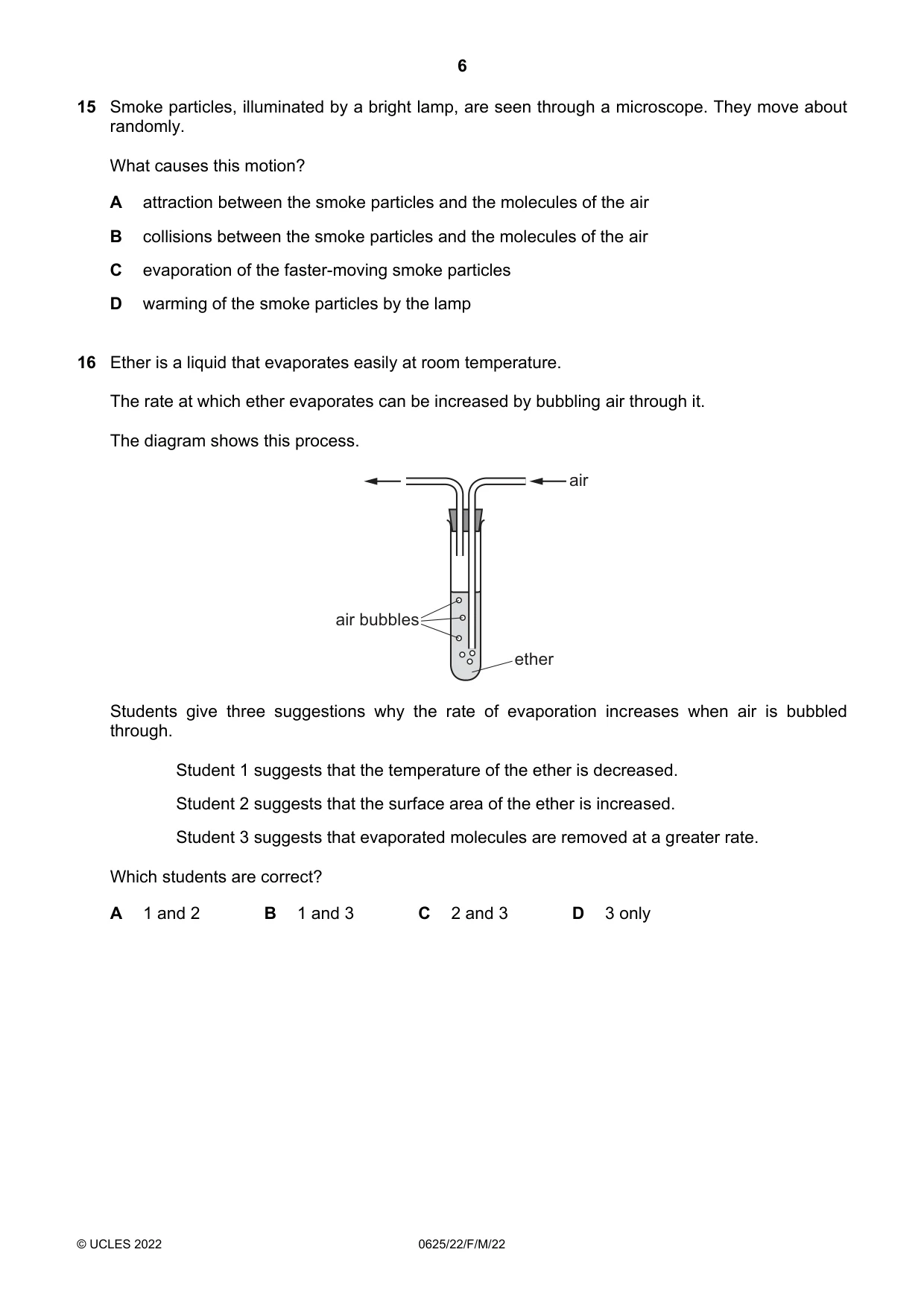
15 Smoke particles, illuminated by a bright lamp, are seen through a microscope. They move about randomly. What causes this motion? A attraction between the smoke particles and the molecules of the air B collisions between the smoke particles and the molecules of the air C evaporation of the faster-moving smoke particles D warming of the smoke particles by the lamp
Mark scheme: B
Q16 · Ether is a liquid that evaporates easily at room temperature
16 Ether is a liquid that evaporates easily at room temperature. The rate at which ether evaporates can be increased by bubbling air through it. The diagram shows this process. air air bubbles ether Students give three suggestions why the rate of evaporation increases when air is bubbled through. Student 1 suggests that the temperature of the ether is decreased. Student 2 suggests that the surface area of the ether is increased. Student 3 suggests that evaporated molecules are removed at a greater rate. Which students are correct? A 1 and 2 B 1 and 3 C 2 and 3 D 3 only
Mark scheme: C
Q17 · Some ice is slowly heated and its temperature is measured
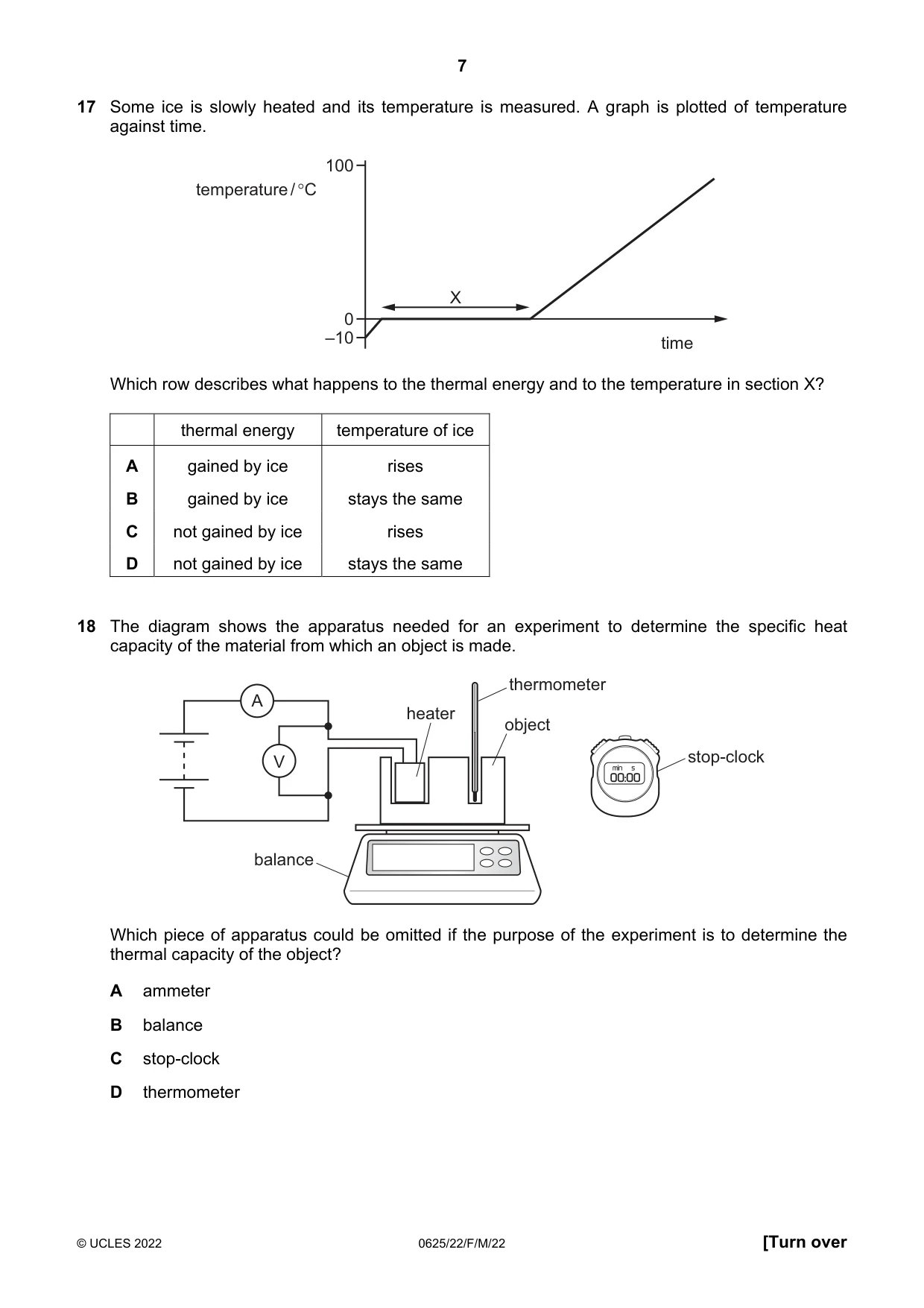
17 Some ice is slowly heated and its temperature is measured. A graph is plotted of temperature against time. 100 temperature /°C «xX , 0 —10 time Which row describes what happens to the thermal energy and to the temperature in section X? thermal energy temperature of ice A gained by ice rises B gained by ice stays the same Cc not gained by ice rises D not gained by ice stays the same
Mark scheme: B
Q18 · The diagram shows the apparatus needed for an experiment to determine the specific heat…
18 The diagram shows the apparatus needed for an experiment to determine the specific heat capacity of the material from which an object is made. thermometer A heater object V stop-clock balance Which piece of apparatus could be omitted if the purpose of the experiment is to determine the thermal capacity of the object? A ammeter B balance C stop-clock D thermometer
Mark scheme: B
Q19 · Both boiling and evaporation involve a change of state from liquid to gas
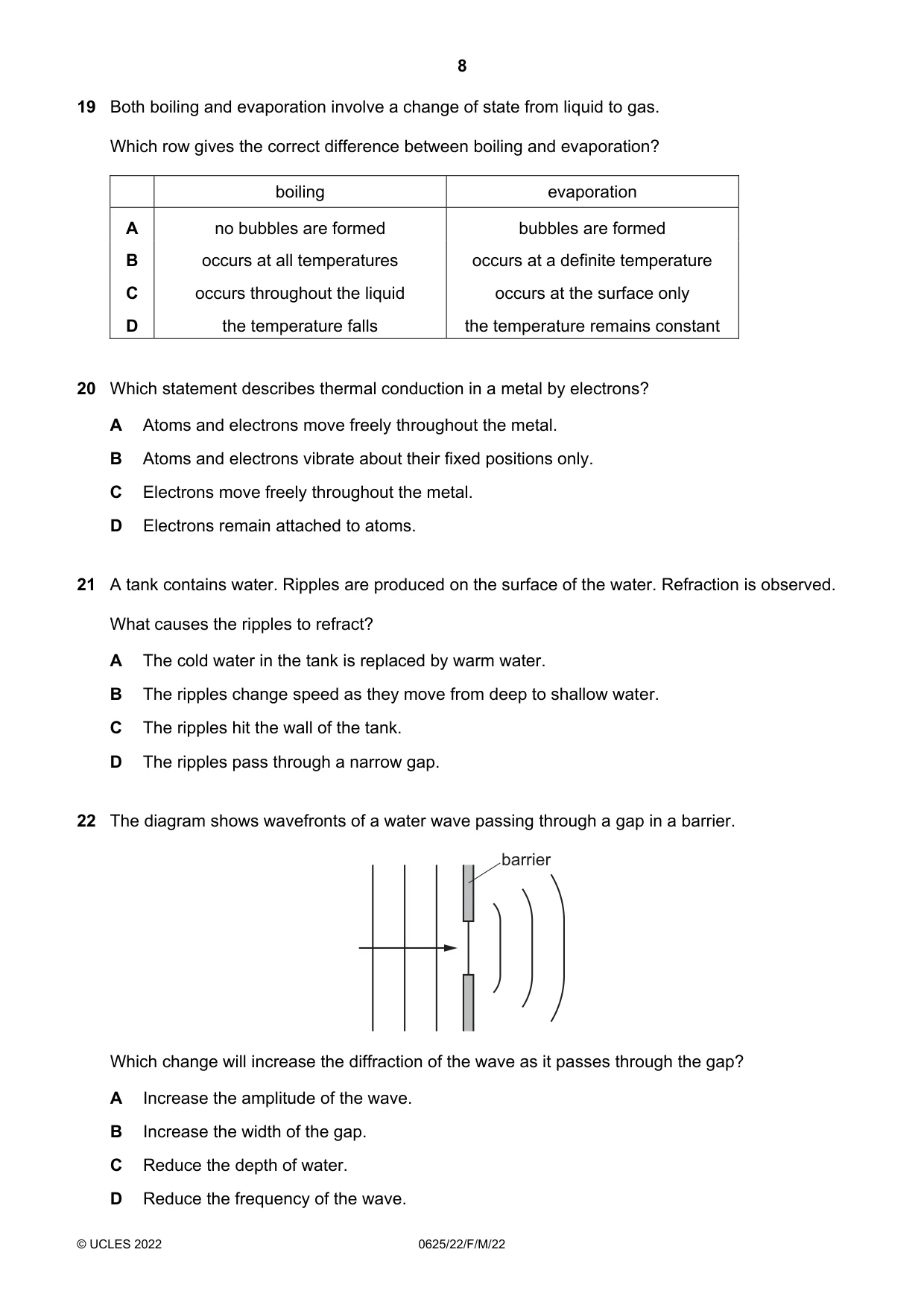
19 Both boiling and evaporation involve a change of state from liquid to gas. Which row gives the correct difference between boiling and evaporation? boiling evaporation A no bubbles are formed bubbles are formed B occurs at all temperatures occurs at a definite temperature C occurs throughout the liquid occurs at the surface only D the temperature falls the temperature remains constant
Mark scheme: C
Q20 · Which statement describes thermal conduction in a metal by electrons?
20 Which statement describes thermal conduction in a metal by electrons? A Atoms and electrons move freely throughout the metal. B Atoms and electrons vibrate about their fixed positions only. C Electrons move freely throughout the metal. D Electrons remain attached to atoms.
Mark scheme: C
Q21 · A tank contains water
21 A tank contains water. Ripples are produced on the surface of the water. Refraction is observed. What causes the ripples to refract? A The cold water in the tank is replaced by warm water. B The ripples change speed as they move from deep to shallow water. C The ripples hit the wall of the tank. D The ripples pass through a narrow gap.
Mark scheme: B
Q22 · The diagram shows wavefronts of a water wave passing through a gap in a barrier
22 The diagram shows wavefronts of a water wave passing through a gap in a barrier. barrier Which change will increase the diffraction of the wave as it passes through the gap? A Increase the amplitude of the wave. B Increase the width of the gap. C Reduce the depth of water. D Reduce the frequency of the wave.
Mark scheme: D
Q23 · The diagrams each show a ray of light from an object O passing through a thin converging…
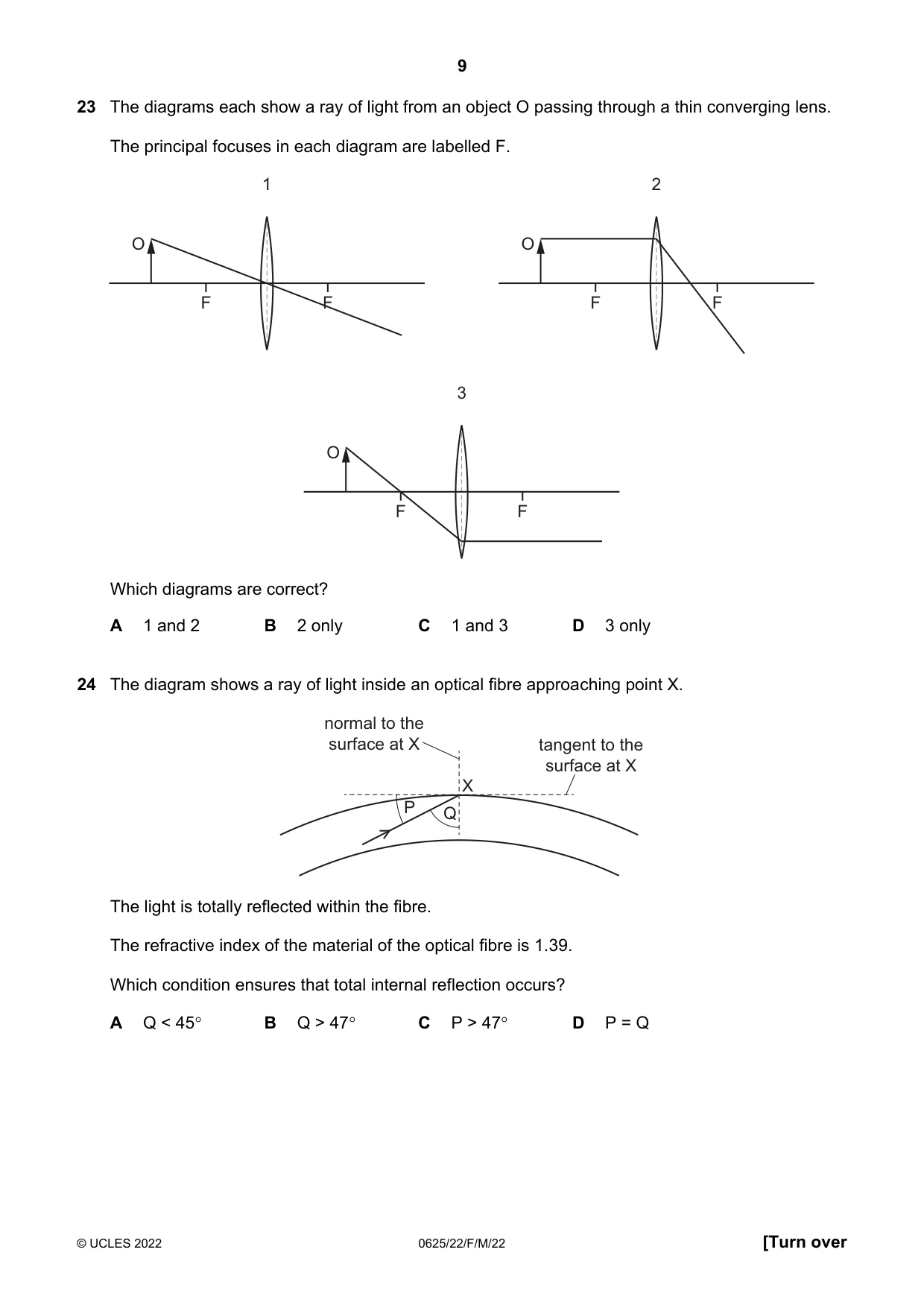
23 The diagrams each show a ray of light from an object O passing through a thin converging lens. The principal focuses in each diagram are labelled F. 1 2 O O F F F F 3 O F F Which diagrams are correct? A 1 and 2 B 2 only C 1 and 3 D 3 only
Mark scheme: C
Q24 · The diagram shows a ray of light inside an optical fibre approaching point X
24 The diagram shows a ray of light inside an optical fibre approaching point X. normal to the surface at X tangent to the surface at X X P Q The light is totally reflected within the fibre. The refractive index of the material of the optical fibre is 1.39. Which condition ensures that total internal reflection occurs? A Q < 45 B Q > 47 C P > 47 D P = Q
Mark scheme: B
Q25 · An eclipse of the Sun happens when the Moon comes between the Earth and the Sun
25 An eclipse of the Sun happens when the Moon comes between the Earth and the Sun. Which statement is correct? A Infrared radiation from the Sun disappears before visible light and ultraviolet radiation. B Ultraviolet radiation from the Sun disappears before visible light and infrared radiation. C Visible light from the Sun disappears before ultraviolet radiation and infrared radiation. D Infrared radiation, ultraviolet radiation and visible light from the Sun all disappear at the same moment.
Mark scheme: D
Q26 · The diagram shows air particles in a sound wave
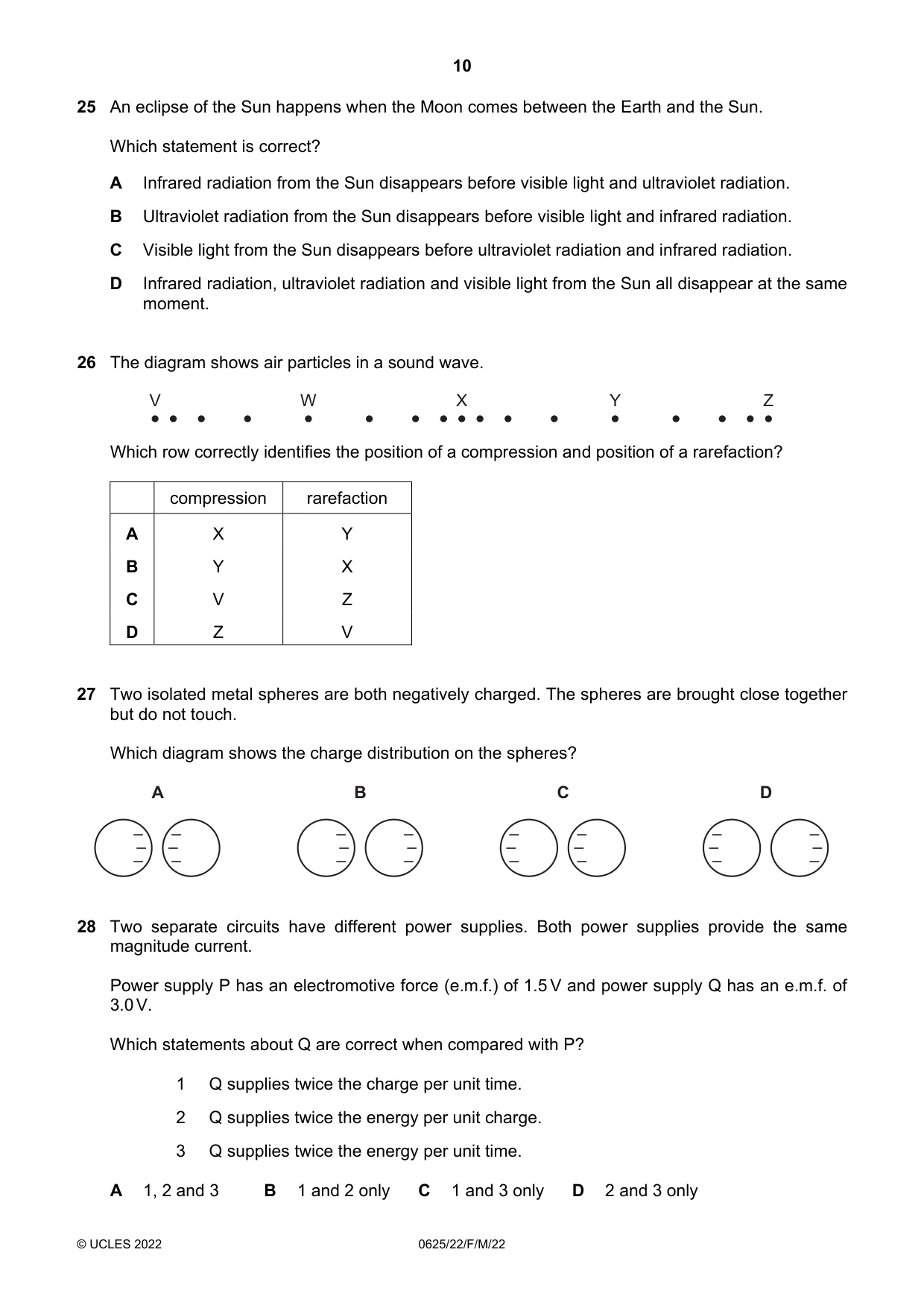
26 The diagram shows air particles in a sound wave. V W X Y Z Which row correctly identifies the position of a compression and position of a rarefaction? compression rarefaction A X Y B Y X C V Z D Z V
Mark scheme: A
Q27 · Two isolated metal spheres are both negatively charged
27 Two isolated metal spheres are both negatively charged. The spheres are brought close together but do not touch. Which diagram shows the charge distribution on the spheres? A B C D – – – – – – – – – – – – – – – – – – – – – – – –
Mark scheme: D
Q28 · Two separate circuits have different power supplies
28 Two separate circuits have different power supplies. Both power supplies provide the same magnitude current. Power supply P has an electromotive force (e.m.f.) of 1.5 V and power supply Q has an e.m.f. of 3.0 V. Which statements about Q are correct when compared with P? 1 Q supplies twice the charge per unit time. 2 Q supplies twice the energy per unit charge. 3 Q supplies twice the energy per unit time. A 1, 2 and 3 B 1 and 2 only C 1 and 3 only D 2 and 3 only
Mark scheme: D
Q29 · The diagram shows a piece of metal resistance wire
29 The diagram shows a piece of metal resistance wire. Which wire, made of the same metal, has a smaller resistance? A a wire of the same length with a larger diameter B a wire of the same length with a smaller diameter C a wire of greater length with the same diameter D a wire of greater length with a smaller diameter
Mark scheme: A
Q30 · Which labelled component in the circuit shown controls the brightness of lamp X?
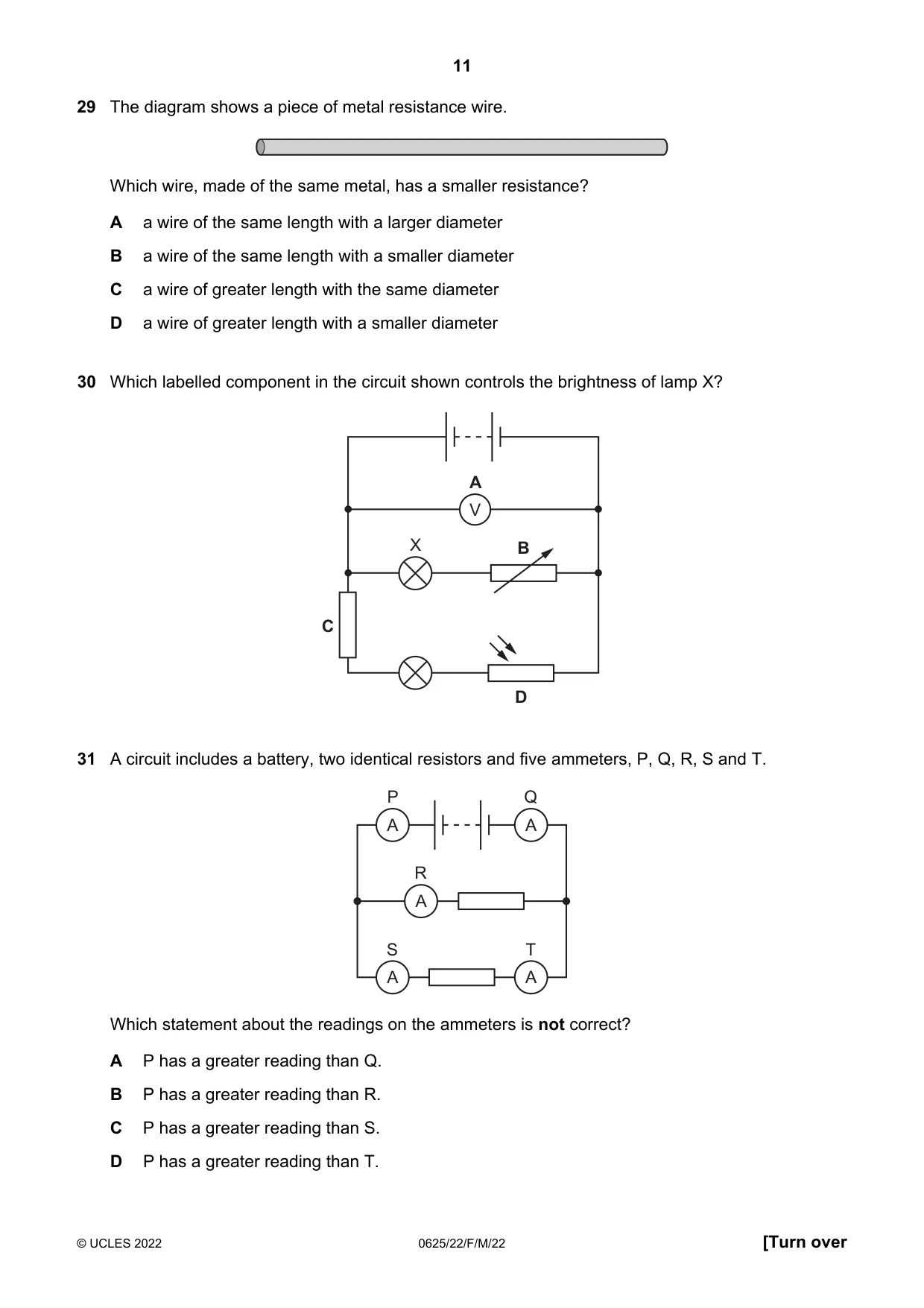
30 Which labelled component in the circuit shown controls the brightness of lamp X? A V X B C D
Mark scheme: B
Q31 · A circuit includes a battery, two identical resistors and five ammeters, P, Q, R, S and T
31 A circuit includes a battery, two identical resistors and five ammeters, P, Q, R, S and T. P Q A A R A S T A A Which statement about the readings on the ammeters is not correct? A P has a greater reading than Q. B P has a greater reading than R. C P has a greater reading than S. D P has a greater reading than T.
Mark scheme: A
Q32 · An electrician sets up a potential divider circuit in a fridge so that when the fridge…
32 An electrician sets up a potential divider circuit in a fridge so that when the fridge door is open and light from the room enters the fridge, a warning light turns on. Which component does the electrician need to use in addition to a variable resistor? A light-dependent resistor B relay C thermistor D variable resistor
Mark scheme: A
Q33 · Two NAND gates are joined together as shown
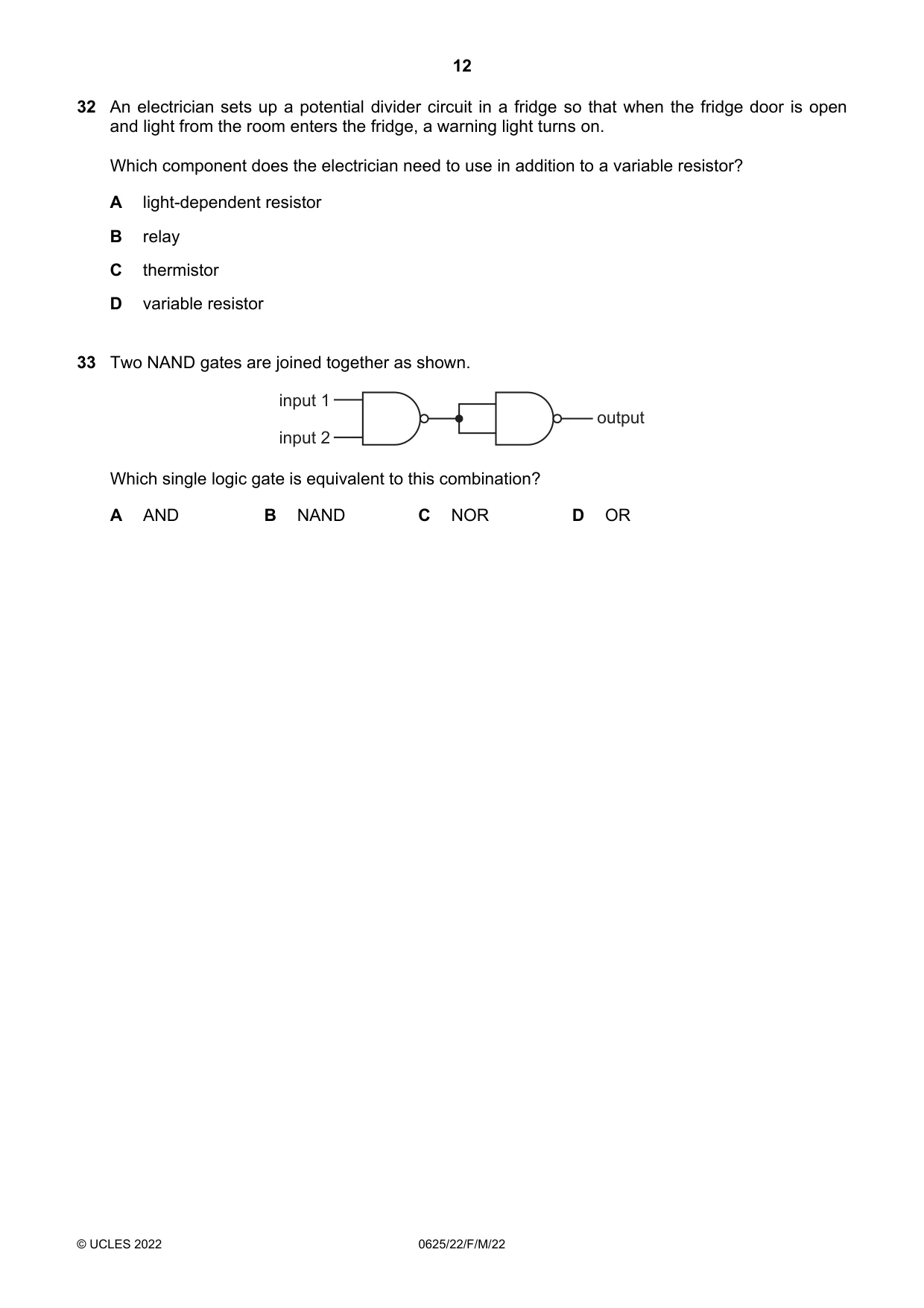
33 Two NAND gates are joined together as shown. input 1 output input 2 Which single logic gate is equivalent to this combination? A AND B NAND C NOR D OR
Mark scheme: A
Q34 · The diagram shows an electric drill and safety guard
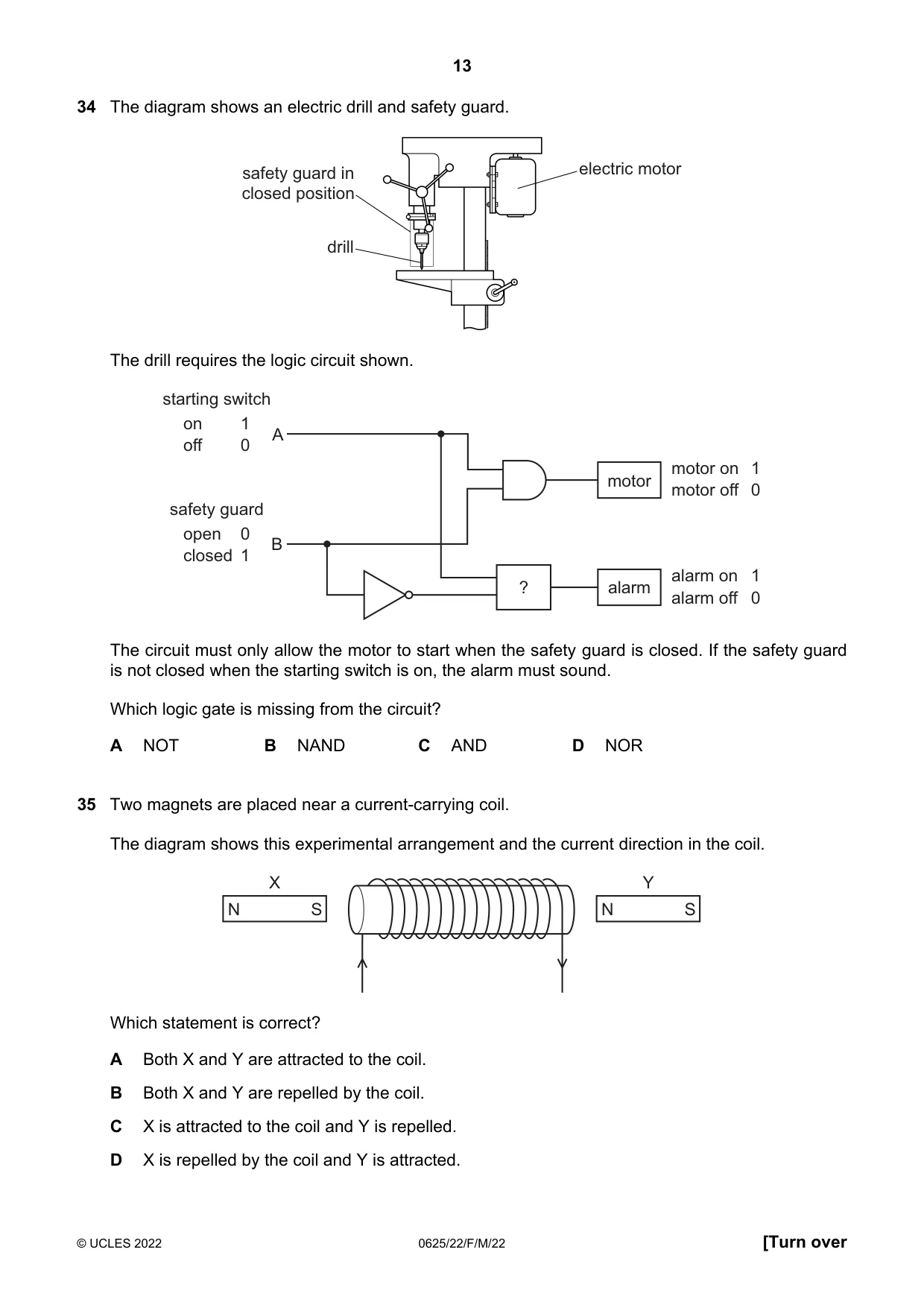
34 The diagram shows an electric drill and safety guard. safety guard in electric motor closed position drill The drill requires the logic circuit shown. starting switch on 1 A off 0 motor on 1 motor motor off 0 safety guard open 0 B closed 1 alarm on 1 ? alarm alarm off 0 The circuit must only allow the motor to start when the safety guard is closed. If the safety guard is not closed when the starting switch is on, the alarm must sound. Which logic gate is missing from the circuit? A NOT B NAND C AND D NOR
Mark scheme: C
Q35 · Two magnets are placed near a current-carrying coil
35 Two magnets are placed near a current-carrying coil. The diagram shows this experimental arrangement and the current direction in the coil. X Y N S N S Which statement is correct? A Both X and Y are attracted to the coil. B Both X and Y are repelled by the coil. C X is attracted to the coil and Y is repelled. D X is repelled by the coil and Y is attracted.
Mark scheme: B
Q36 · Two circuits are set up as shown
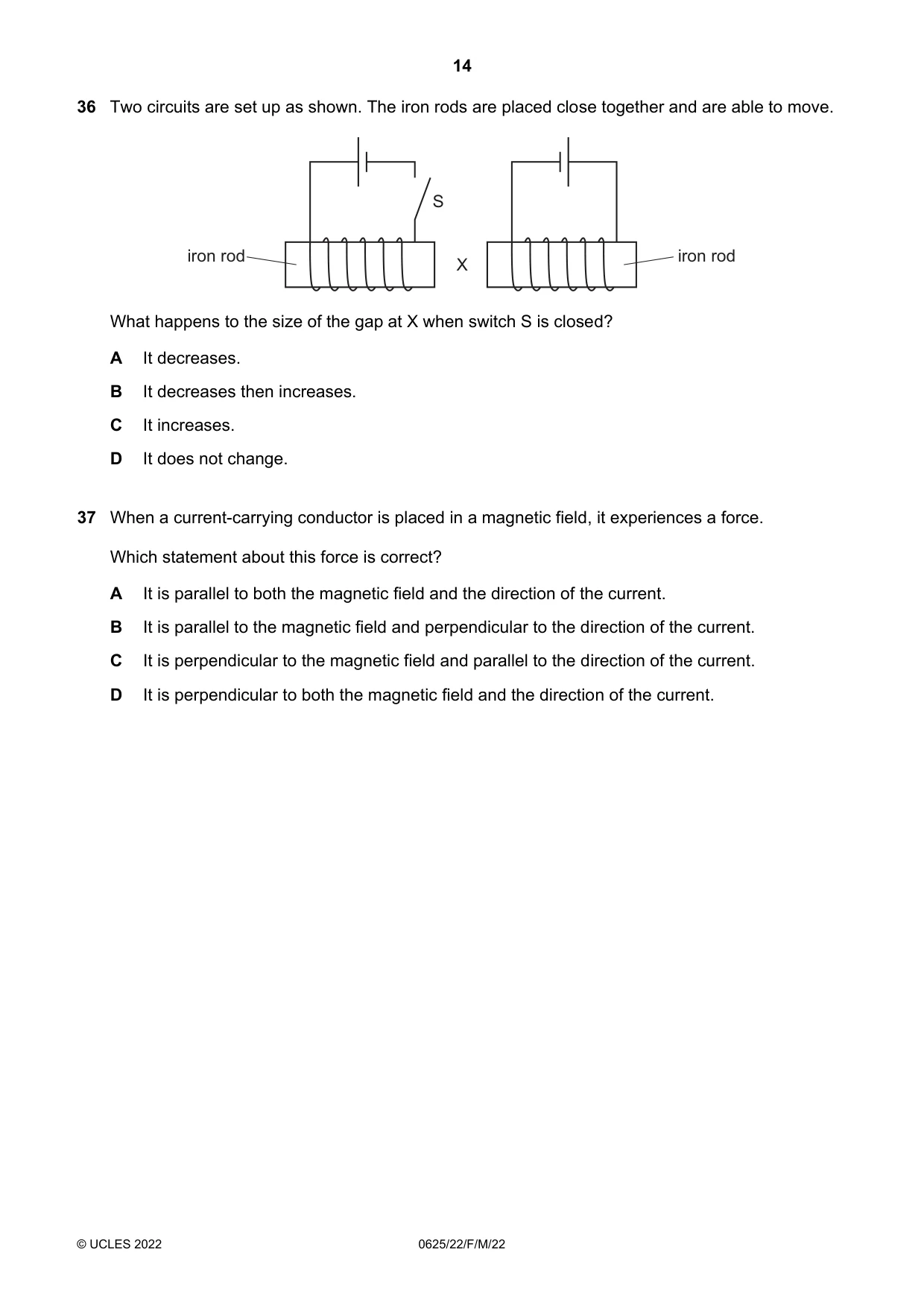
36 Two circuits are set up as shown. The iron rods are placed close together and are able to move. S iron rod iron rod X What happens to the size of the gap at X when switch S is closed? A It decreases. B It decreases then increases. C It increases. D It does not change.
Mark scheme: C
Q37 · When a current-carrying conductor is placed in a magnetic field, it experiences a force
37 When a current-carrying conductor is placed in a magnetic field, it experiences a force. Which statement about this force is correct? A It is parallel to both the magnetic field and the direction of the current. B It is parallel to the magnetic field and perpendicular to the direction of the current. C It is perpendicular to the magnetic field and parallel to the direction of the current. D It is perpendicular to both the magnetic field and the direction of the current.
Mark scheme: D
Q38 · When a beam of -particles is incident on a thin metal foil, most of them follow a path…
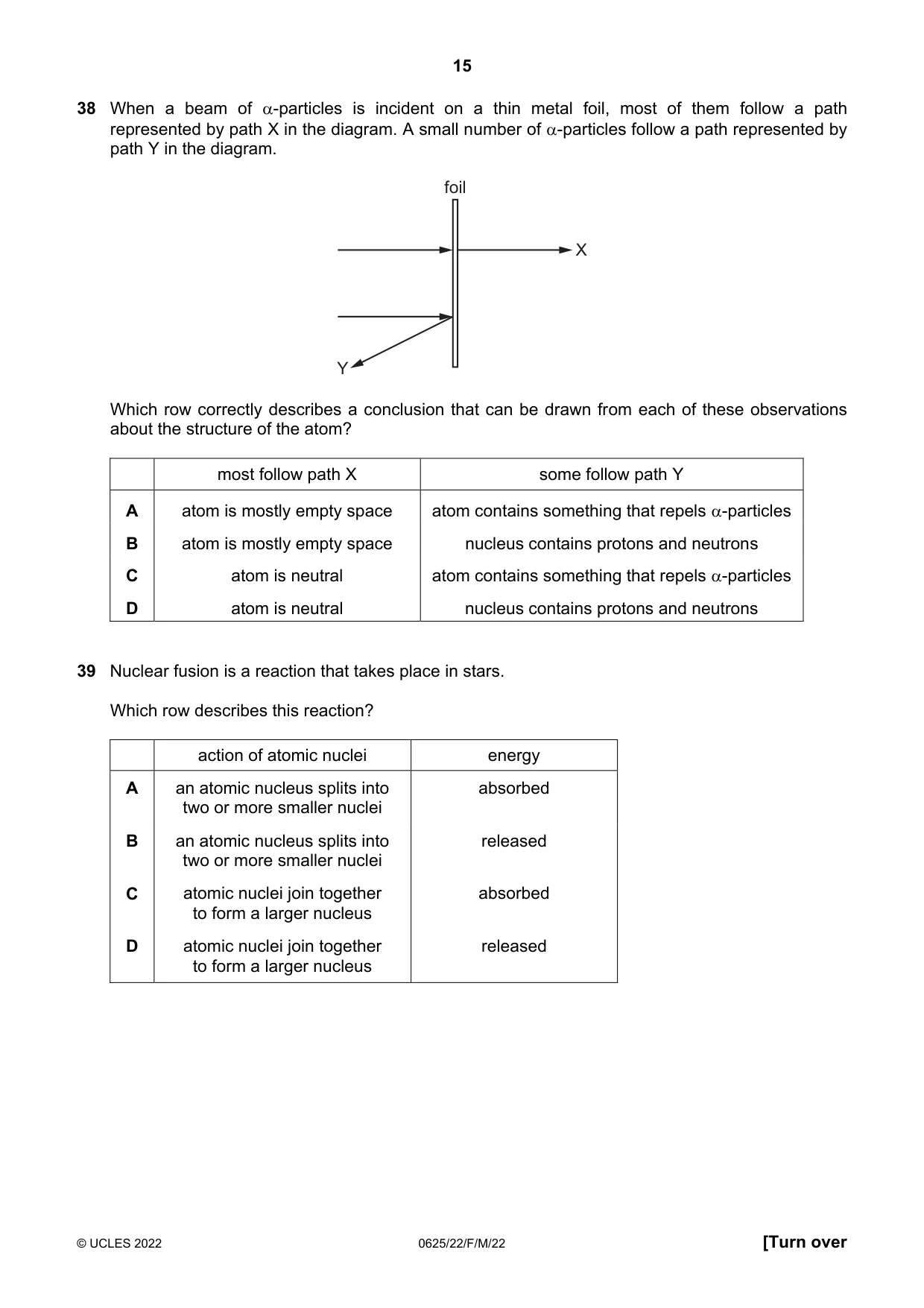
38 When a beam of -particles is incident on a thin metal foil, most of them follow a path represented by path X in the diagram. A small number of -particles follow a path represented by path Y in the diagram. foil X Y Which row correctly describes a conclusion that can be drawn from each of these observations about the structure of the atom? most follow path X some follow path Y A atom is mostly empty space atom contains something that repels -particles B atom is mostly empty space nucleus contains protons and neutrons C atom is neutral atom contains something that repels -particles D atom is neutral nucleus contains protons and neutrons
Mark scheme: A
Q39 · Nuclear fusion is a reaction that takes place in stars
39 Nuclear fusion is a reaction that takes place in stars. Which row describes this reaction? action of atomic nuclei energy A an atomic nucleus splits into absorbed two or more smaller nuclei B an atomic nucleus splits into released two or more smaller nuclei C atomic nuclei join together absorbed to form a larger nucleus D atomic nuclei join together released to form a larger nucleus
Mark scheme: D
Q40 · When a radioactive isotope is set up close to a counter, a count rate of 38 000 counts /…
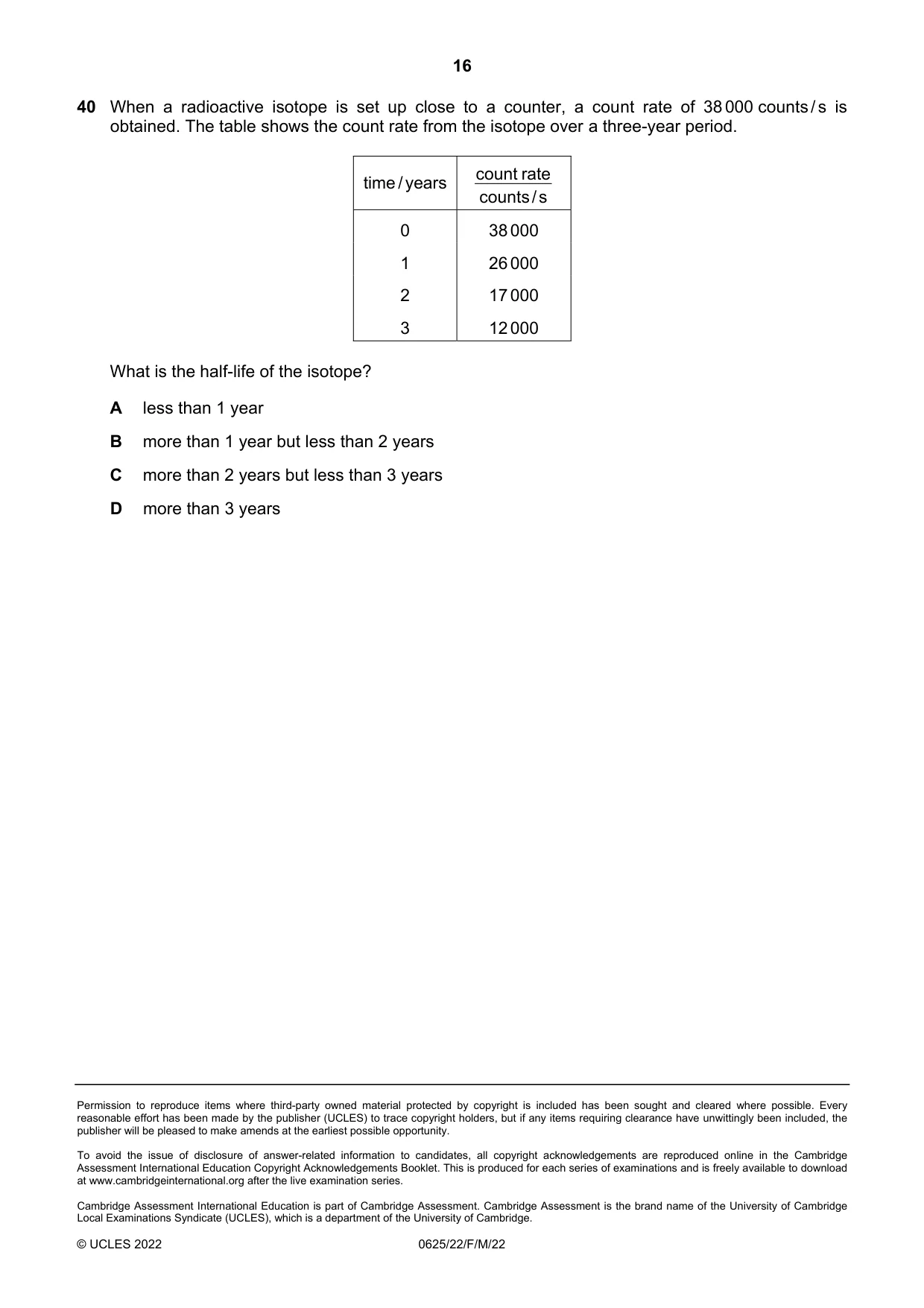
40 When a radioactive isotope is set up close to a counter, a count rate of 38 000 counts / s is obtained. The table shows the count rate from the isotope over a three-year period. count rate time / years counts / s 0 38 000 1 26 000 2 17 000 3 12 000 What is the half-life of the isotope? A less than 1 year B more than 1 year but less than 2 years C more than 2 years but less than 3 years D more than 3 years
Mark scheme: B
What was in this paper
The subtopics covered by these 40 questions, and how many questions each got. Open one in a new tab to see every Cambridge question on it.
6Thermal properties and temperature4Electromagnetic effects3Forces3Energy, work and power2General properties of waves2Light2Momentum2Motion2Physical quantities and measurement techniques2The nuclear model of the atom2Density1Electrical quantities1Electromagnetic spectrum1Kinetic particle model of matter1Mass and weight1Pressure1Radioactivity1Simple phenomena of magnetism1Sound1Transfer of thermal energy1What you needed in this session
Cambridge’s own grade thresholds for 2022 Feb/March, Paper 2 · Variant 2. A higher threshold means an easier paper — the bar moves with how the cohort did.