Cambridge IGCSE Physics 0625 — 2020 May/June Paper 2 · Variant 1
0625/21/M/J/20 · 40 questions · 40 marks · ≈45 min
The question paper and its mark scheme, free to read here and free to download. This is Cambridge’s own paper, exactly as it was sat.
Question paper16 pages
Mark scheme3 pages
Answers below. Sit the paper first if you are practising.
Questions as text
Q1 · A pendulum makes 50 complete swings in 2 min 40 s
1 A pendulum makes 50 complete swings in 2 min 40 s. What is the time period for 1 complete swing? A 1.6 s B 3.2 s C 4.8 s D 6.4 s
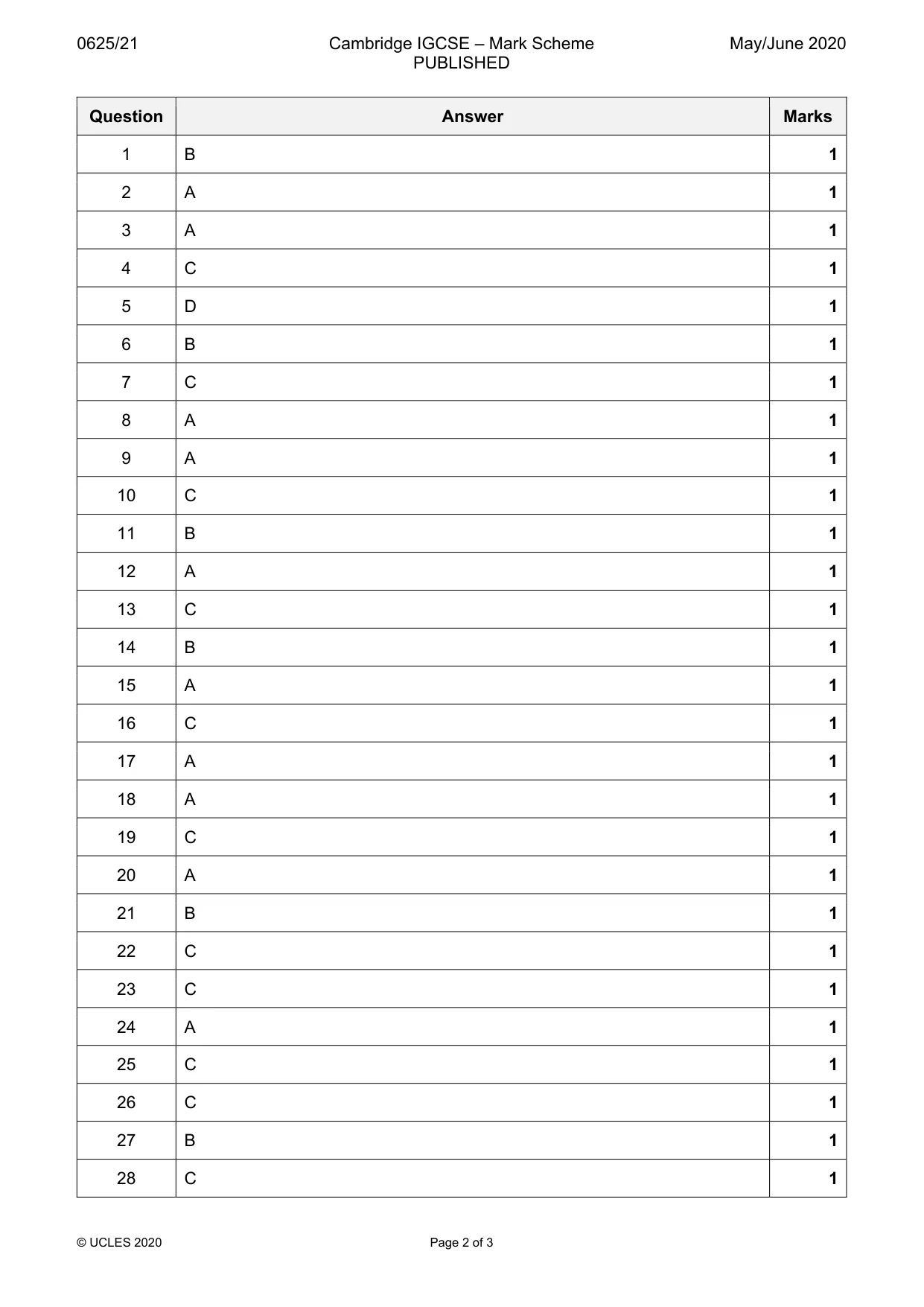
Mark scheme: B
More questions on Physical quantities and measurement techniques
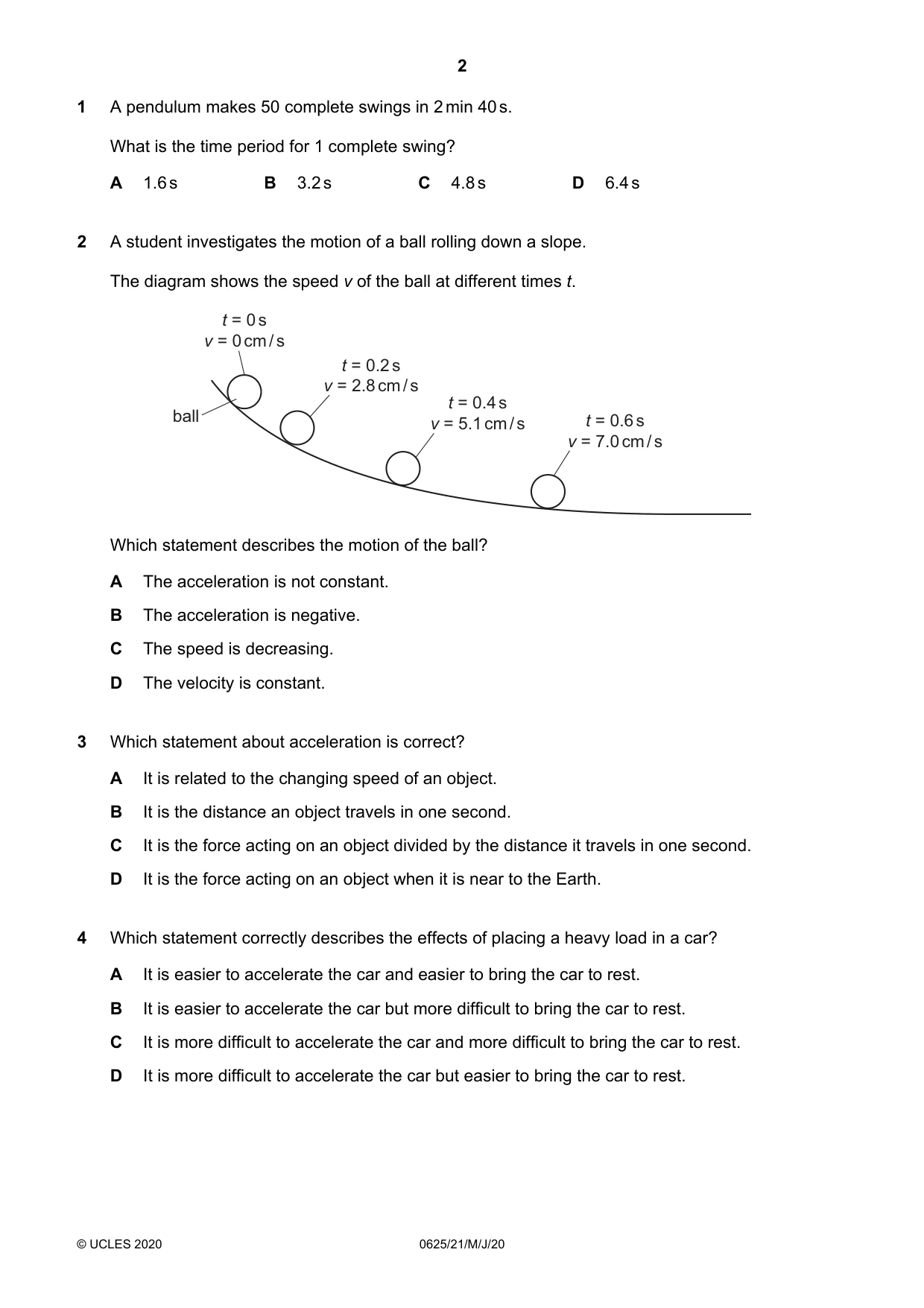
Q2 · A student investigates the motion of a ball rolling down a slope
2 A student investigates the motion of a ball rolling down a slope. The diagram shows the speed v of the ball at different times t. t = 0 s v = 0 cm / s t = 0.2 s v = 2.8 cm / s t = 0.4 s ball v = 5.1 cm / s t = 0.6 s v = 7.0 cm / s Which statement describes the motion of the ball? A The acceleration is not constant. B The acceleration is negative. C The speed is decreasing. D The velocity is constant.
Mark scheme: A
Q3 · Which statement about acceleration is correct?
3 Which statement about acceleration is correct? A It is related to the changing speed of an object. B It is the distance an object travels in one second. C It is the force acting on an object divided by the distance it travels in one second. D It is the force acting on an object when it is near to the Earth.
Mark scheme: A
Q4 · Which statement correctly describes the effects of placing a heavy load in a car?
4 Which statement correctly describes the effects of placing a heavy load in a car? A It is easier to accelerate the car and easier to bring the car to rest. B It is easier to accelerate the car but more difficult to bring the car to rest. C It is more difficult to accelerate the car and more difficult to bring the car to rest. D It is more difficult to accelerate the car but easier to bring the car to rest.
Mark scheme: C
Q5 · A mass of 6.0 kg rests on the surface of a planet
5 A mass of 6.0 kg rests on the surface of a planet. On this planet, g = 20 N / kg. What is the weight of the object? A 0.30 N B 0.60 N C 60 N D 120 N
Mark scheme: D
Q6 · The mass of a measuring cylinder is 190 g
6 The mass of a measuring cylinder is 190 g. 400 cm3 of liquid is put into the measuring cylinder. The total mass of the measuring cylinder and the liquid is 560 g. Four solid objects are lowered in turn into the liquid. The densities of the objects are shown. 1 0.40 g / cm3 2 0.90 g / cm3 3 1.2 g / cm3 4 2.7 g / cm3 Which objects will float in the liquid? A 1 only B 1 and 2 only C 1, 2 and 3 D 3 and 4 only
Mark scheme: B
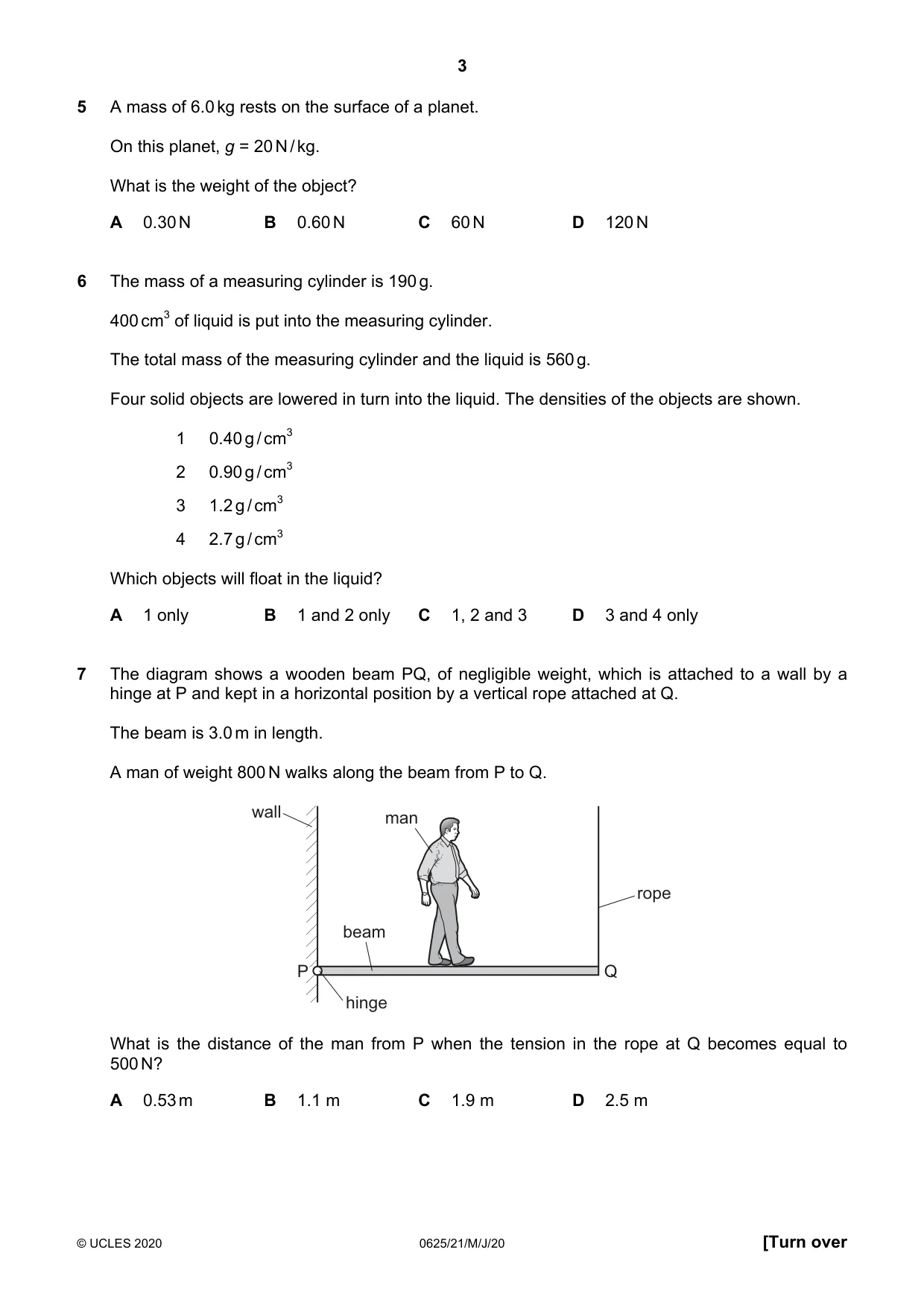
Q7 · The diagram shows a wooden beam PQ, of negligible weight, which is attached to a wall by…
7 The diagram shows a wooden beam PQ, of negligible weight, which is attached to a wall by a hinge at P and kept in a horizontal position by a vertical rope attached at Q. The beam is 3.0 m in length. A man of weight 800 N walks along the beam from P to Q. wall man rope beam P Q hinge What is the distance of the man from P when the tension in the rope at Q becomes equal to 500 N? A 0.53 m B 1.1 m C 1.9 m D 2.5 m
Mark scheme: C
Q8 · Which quantity is a vector?
8 Which quantity is a vector? A acceleration B distance C speed D mass
Mark scheme: A
More questions on Physical quantities and measurement techniques
Q9 · An object of mass 1.2 kg is moving with a velocity of 2.0 m / s when it is acted on by a…
9 An object of mass 1.2 kg is moving with a velocity of 2.0 m / s when it is acted on by a force of 4.0 N. The velocity of the object increases to 5.0 m / s. For what period of time does the force act on the object? A 0.90 s B 1.1 s C 1.5 s D 3.6 s
Mark scheme: A
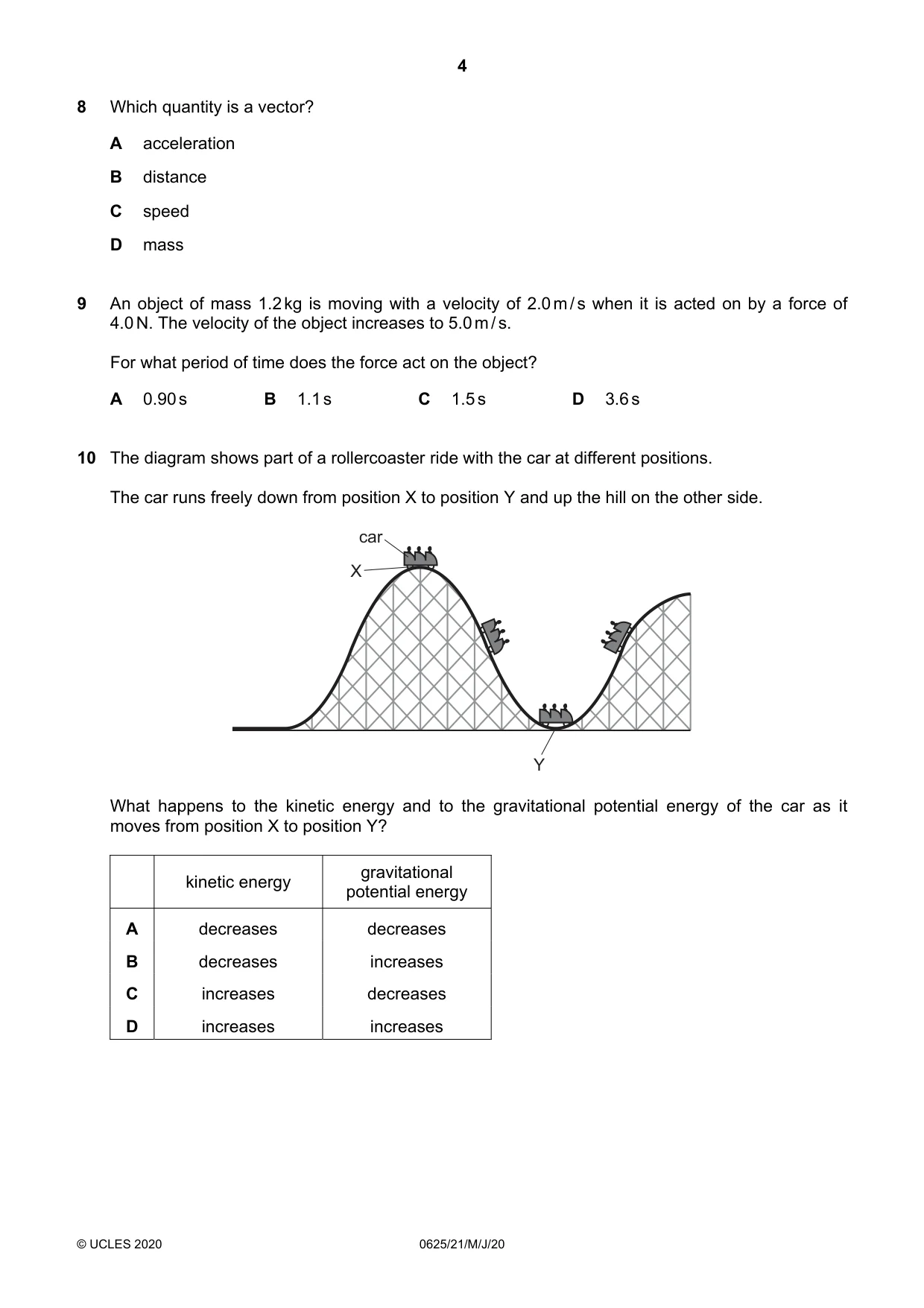
Q10 · The diagram shows part of a rollercoaster ride with the car at different positions
10 The diagram shows part of a rollercoaster ride with the car at different positions. The car runs freely down from position X to position Y and up the hill on the other side. car X Y What happens to the kinetic energy and to the gravitational potential energy of the car as it moves from position X to position Y? gravitational kinetic energy potential energy A decreases decreases B decreases increases C increases decreases D increases increases
Mark scheme: C
Q11 · Which energy resource does not have the Sun as the original source?
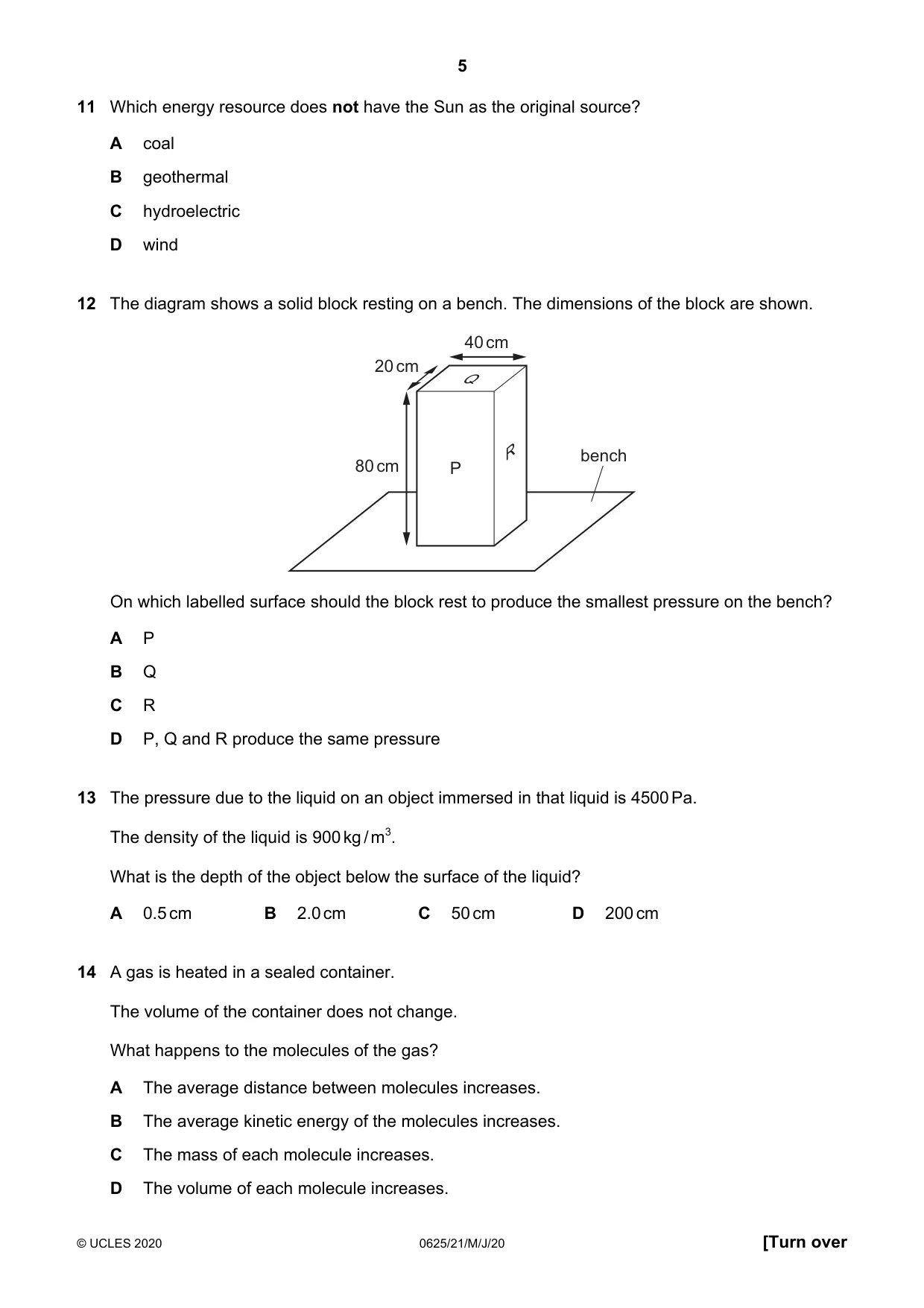
11 Which energy resource does not have the Sun as the original source? A coal B geothermal C hydroelectric D wind
Mark scheme: B
Q12 · The diagram shows a solid block resting on a bench
12 The diagram shows a solid block resting on a bench. The dimensions of the block are shown. 40 cm 20 cm Q R bench 80 cm P On which labelled surface should the block rest to produce the smallest pressure on the bench? A P B Q C R D P, Q and R produce the same pressure
Mark scheme: A
Q13 · The pressure due to the liquid on an object immersed in that liquid is 4500 Pa
13 The pressure due to the liquid on an object immersed in that liquid is 4500 Pa. The density of the liquid is 900 kg / m3. What is the depth of the object below the surface of the liquid? A 0.5 cm B 2.0 cm C 50 cm D 200 cm
Mark scheme: C
Q14 · A gas is heated in a sealed container
14 A gas is heated in a sealed container. The volume of the container does not change. What happens to the molecules of the gas? A The average distance between molecules increases. B The average kinetic energy of the molecules increases. C The mass of each molecule increases. D The volume of each molecule increases.
Mark scheme: B
Q15 · Water in a beaker evaporates when left on a bench for a period of time
15 Water in a beaker evaporates when left on a bench for a period of time. Which three factors all affect the rate of evaporation of the water? A wind speed, surface area, temperature B wind speed, temperature, volume C wind speed, surface area, volume D surface area, temperature, volume
Mark scheme: A
Q16 · A solid is heated causing it to expand
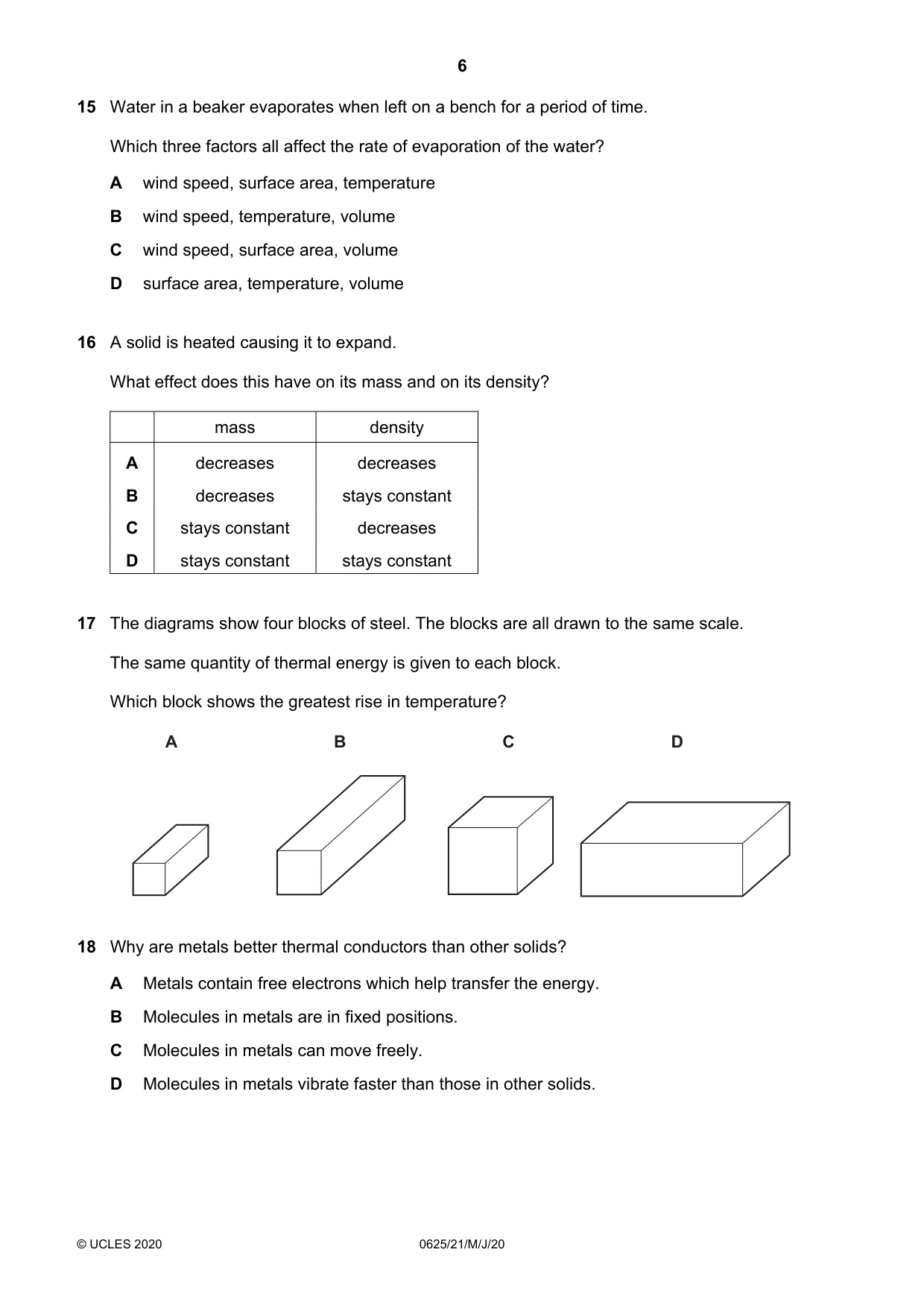
16 A solid is heated causing it to expand. What effect does this have on its mass and on its density? mass density A decreases decreases B decreases stays constant C stays constant decreases D stays constant stays constant
Mark scheme: C
Q17 · The diagrams show four blocks of steel
17 The diagrams show four blocks of steel. The blocks are all drawn to the same scale. The same quantity of thermal energy is given to each block. Which block shows the greatest rise in temperature? A B C D
Mark scheme: A
Q18 · Why are metals better thermal conductors than other solids?
18 Why are metals better thermal conductors than other solids? A Metals contain free electrons which help transfer the energy. B Molecules in metals are in fixed positions. C Molecules in metals can move freely. D Molecules in metals vibrate faster than those in other solids.
Mark scheme: A
Q19 · Two freezers X and Y are identical except that one has a door opening at the front and…
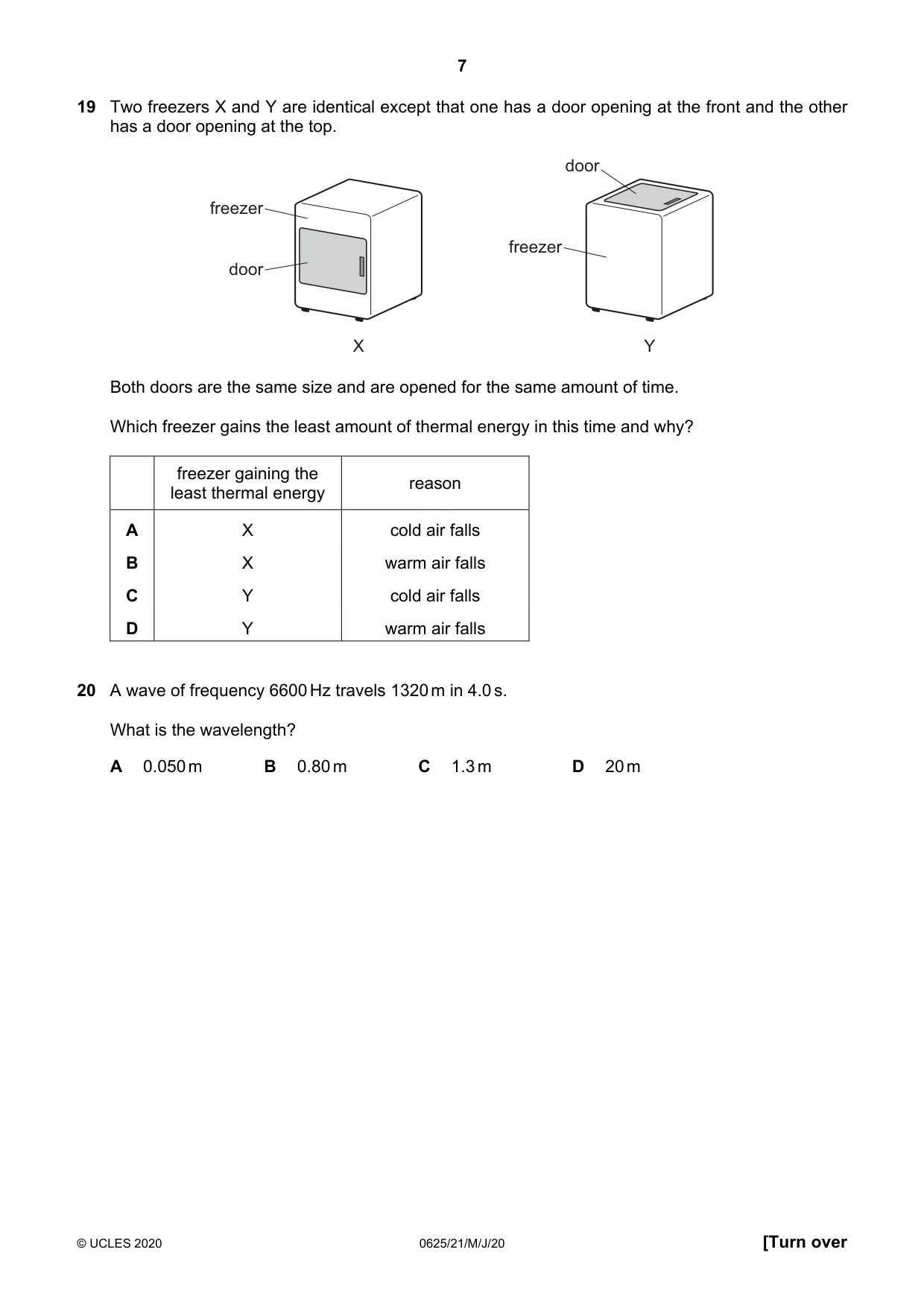
19 Two freezers X and Y are identical except that one has a door opening at the front and the other has a door opening at the top. door freezer freezer door X Y Both doors are the same size and are opened for the same amount of time. Which freezer gains the least amount of thermal energy in this time and why? freezer gaining the reason least thermal energy A X cold air falls B X warm air falls C Y cold air falls D Y warm air falls
Mark scheme: C
Q20 · A wave of frequency 6600 Hz travels 1320 m in 4.0 s
20 A wave of frequency 6600 Hz travels 1320 m in 4.0 s. What is the wavelength? A 0.050 m B 0.80 m C 1.3 m D 20 m
Mark scheme: A
Q21 · The diagram shows a wave
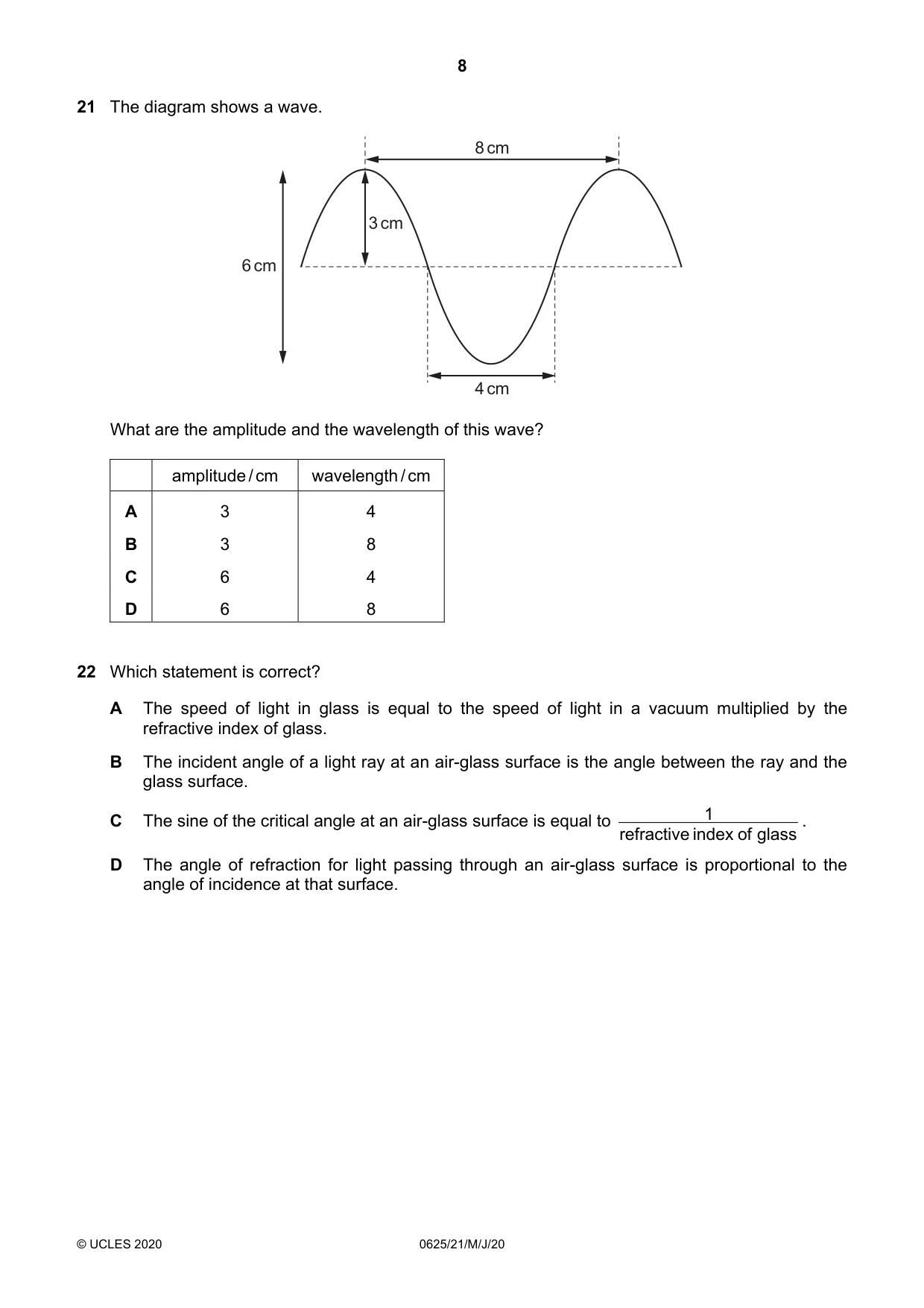
21 The diagram shows a wave. 8 cm 3 cm 6 cm 4 cm What are the amplitude and the wavelength of this wave? amplitude / cm wavelength / cm A 3 4 B 3 8 C 6 4 D 6 8
Mark scheme: B
Q22 · Which statement is correct?
22 Which statement is correct? A The speed of light in glass is equal to the speed of light in a vacuum multiplied by the refractive index of glass. B The incident angle of a light ray at an air-glass surface is the angle between the ray and the glass surface. C The sine of the critical angle at an air-glass surface is equal to 1 . refractive index of glass D The angle of refraction for light passing through an air-glass surface is proportional to the angle of incidence at that surface.
Mark scheme: C
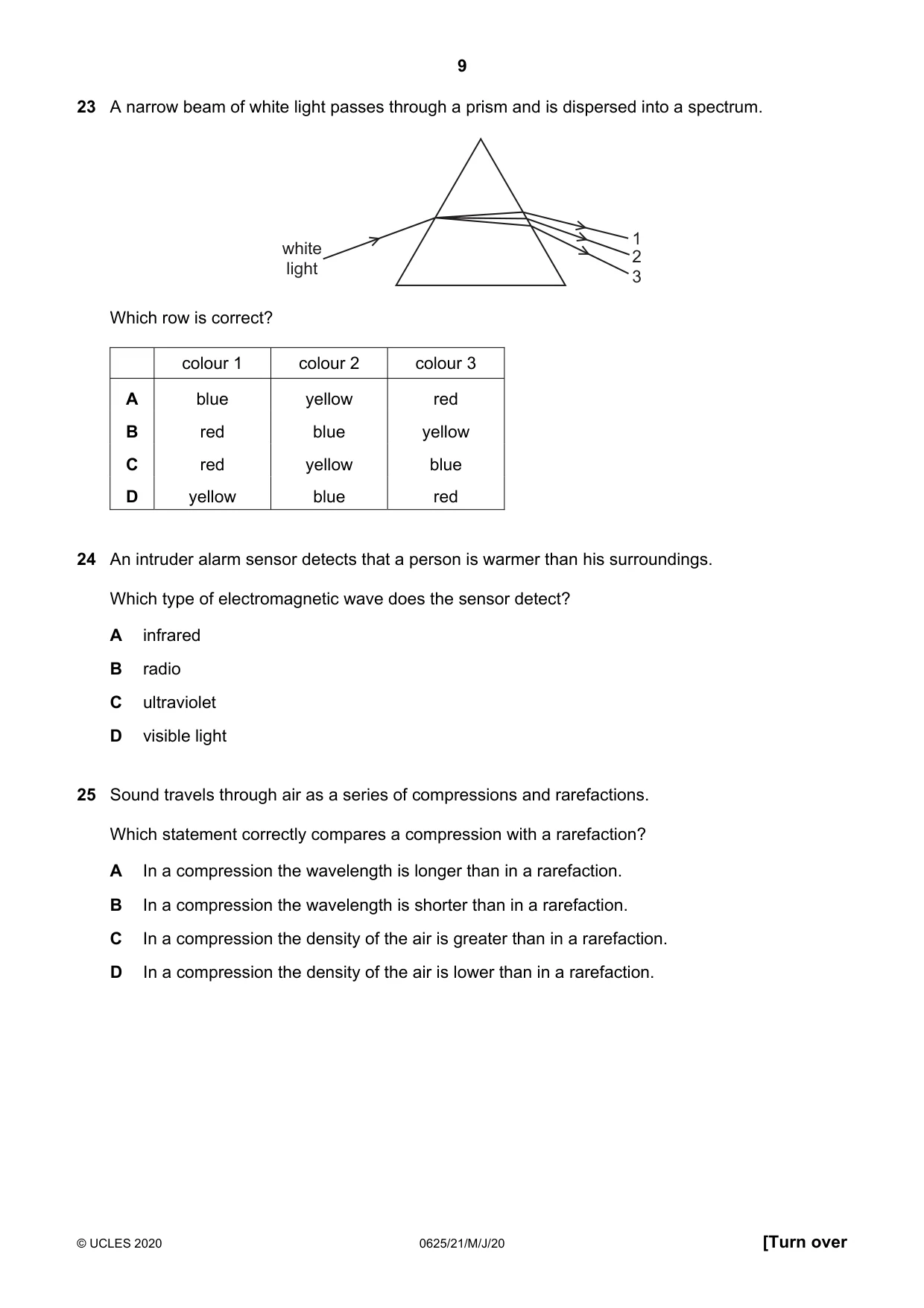
Q23 · A narrow beam of white light passes through a prism and is dispersed into a spectrum
23 A narrow beam of white light passes through a prism and is dispersed into a spectrum. 1 white 2 light 3 Which row is correct? colour 1 colour 2 colour 3 A blue yellow red B red blue yellow C red yellow blue D yellow blue red
Mark scheme: C
Q24 · An intruder alarm sensor detects that a person is warmer than his surroundings
24 An intruder alarm sensor detects that a person is warmer than his surroundings. Which type of electromagnetic wave does the sensor detect? A infrared B radio C ultraviolet D visible light
Mark scheme: A
Q25 · Sound travels through air as a series of compressions and rarefactions
25 Sound travels through air as a series of compressions and rarefactions. Which statement correctly compares a compression with a rarefaction? A In a compression the wavelength is longer than in a rarefaction. B In a compression the wavelength is shorter than in a rarefaction. C In a compression the density of the air is greater than in a rarefaction. D In a compression the density of the air is lower than in a rarefaction.
Mark scheme: C
Q26 · Four nails A, B, C and D are tested to find which makes the strongest permanent magnet
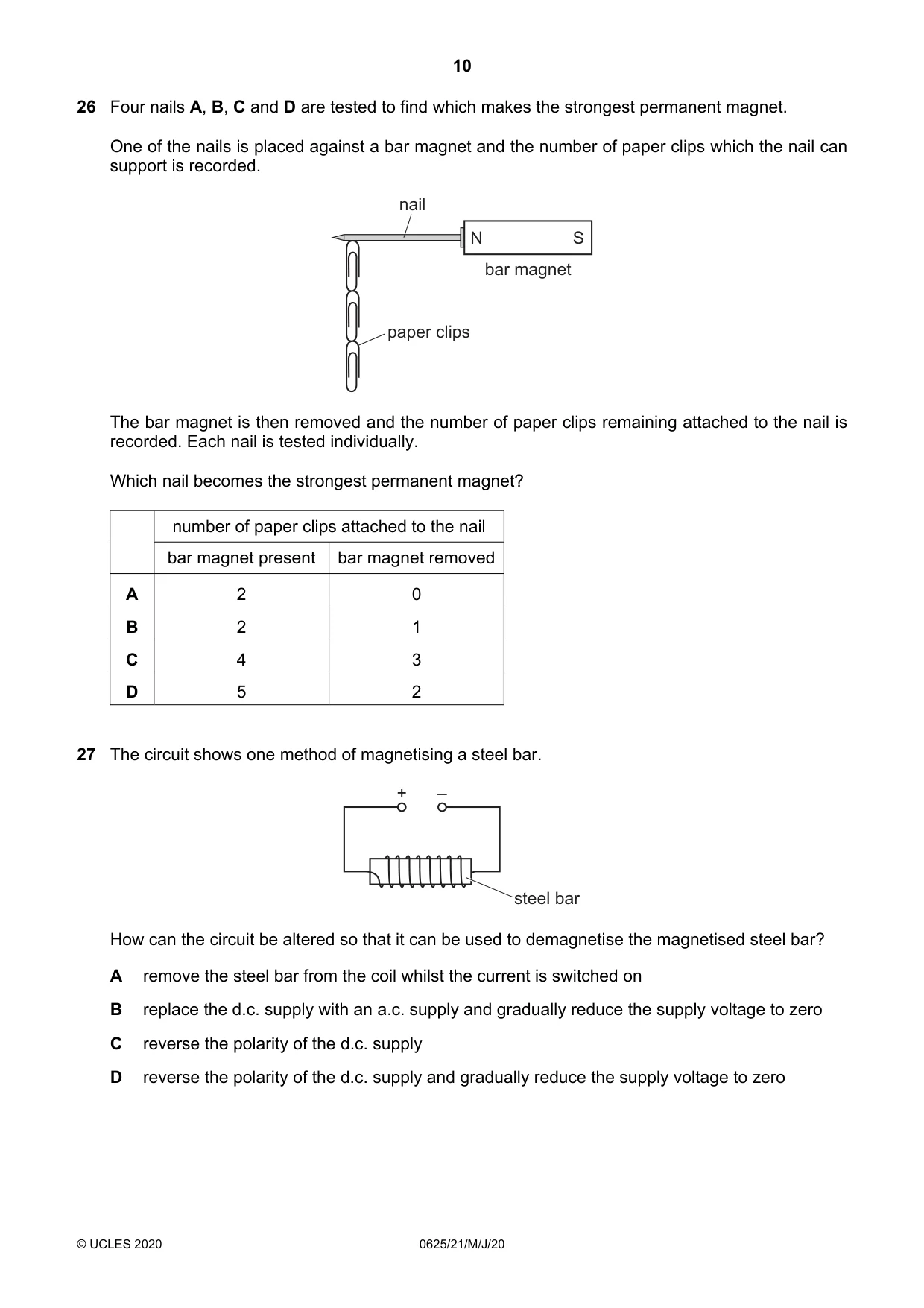
26 Four nails A, B, C and D are tested to find which makes the strongest permanent magnet. One of the nails is placed against a bar magnet and the number of paper clips which the nail can support is recorded. nail N S bar magnet paper clips The bar magnet is then removed and the number of paper clips remaining attached to the nail is recorded. Each nail is tested individually. Which nail becomes the strongest permanent magnet? number of paper clips attached to the nail bar magnet present bar magnet removed A 2 0 B 2 1 C 4 3 D 5 2
Mark scheme: C
Q27 · The circuit shows one method of magnetising a steel bar
27 The circuit shows one method of magnetising a steel bar. + – steel bar How can the circuit be altered so that it can be used to demagnetise the magnetised steel bar? A remove the steel bar from the coil whilst the current is switched on B replace the d.c. supply with an a.c. supply and gradually reduce the supply voltage to zero C reverse the polarity of the d.c. supply D reverse the polarity of the d.c. supply and gradually reduce the supply voltage to zero
Mark scheme: B
Q28 · A student uses the circuit shown to determine the resistance of two identical resistors
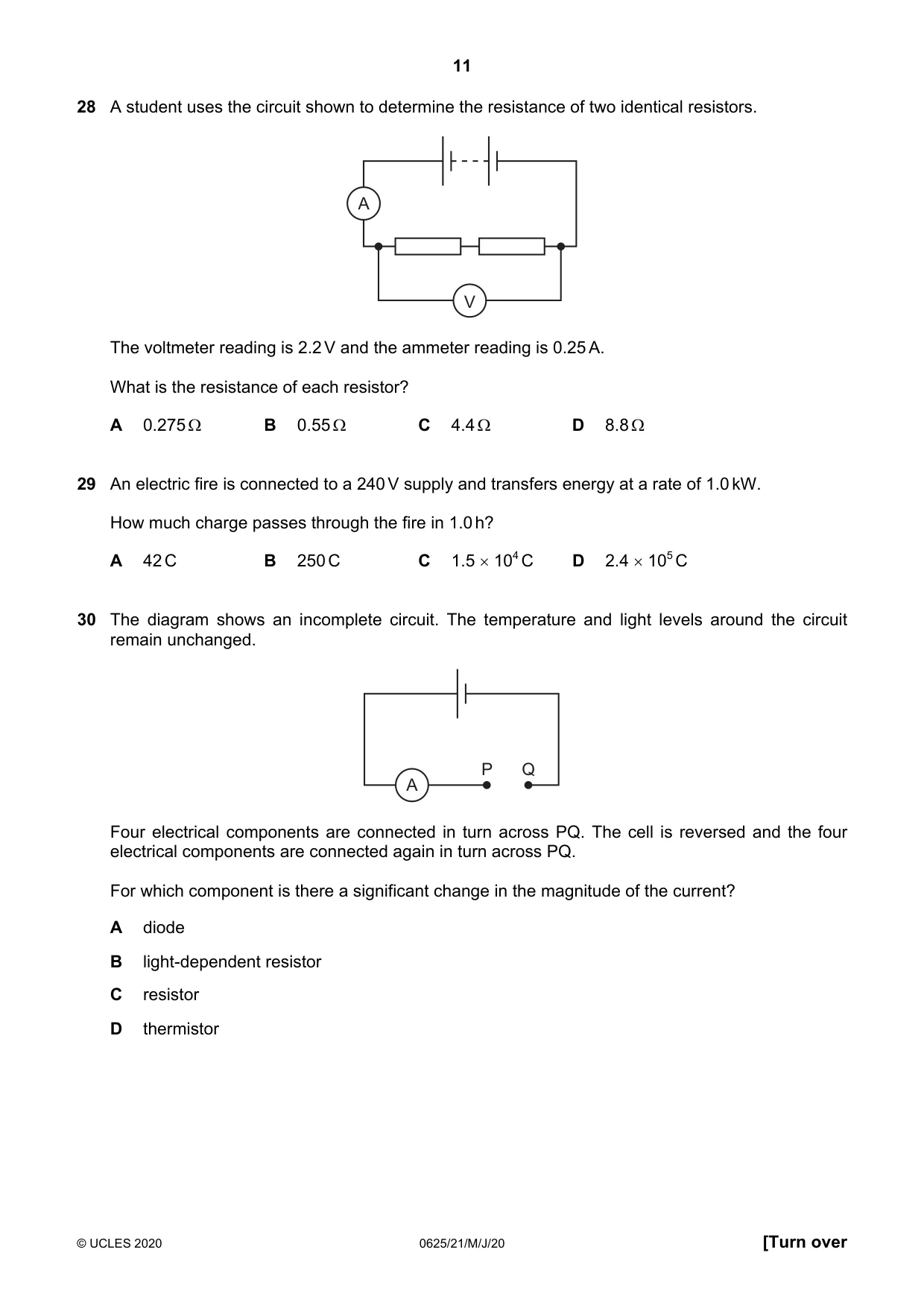
28 A student uses the circuit shown to determine the resistance of two identical resistors. A V The voltmeter reading is 2.2 V and the ammeter reading is 0.25 A. What is the resistance of each resistor? A 0.275 Ω B 0.55 Ω C 4.4 Ω D 8.8 Ω
Mark scheme: C
Q29 · An electric fire is connected to a 240 V supply and transfers energy at a rate of 1.0 kW
29 An electric fire is connected to a 240 V supply and transfers energy at a rate of 1.0 kW. How much charge passes through the fire in 1.0 h? A 42 C B 250 C C 1.5 × 10⁴ C D 2.4 × 10⁵ C
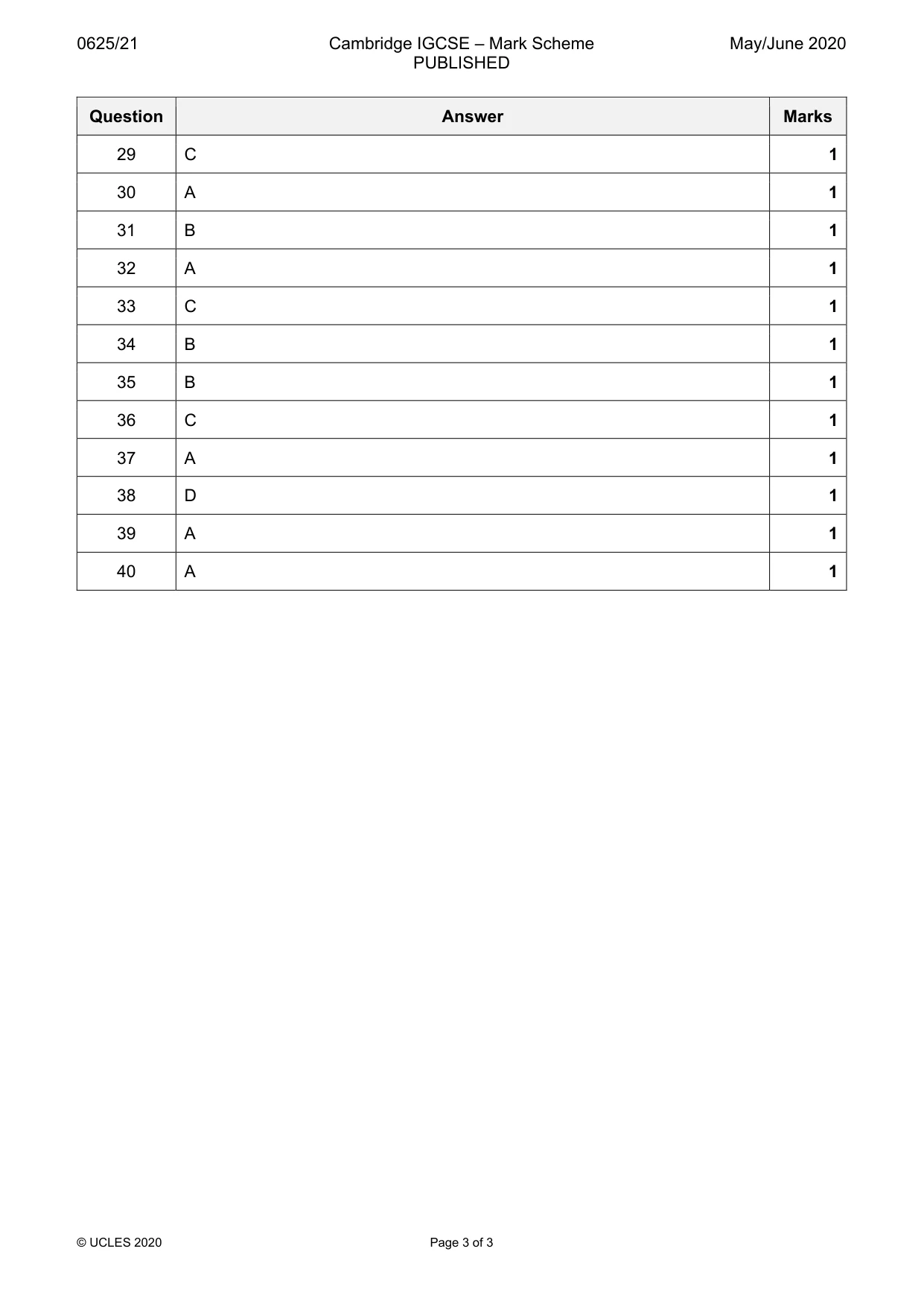
Mark scheme: C
Q30 · The diagram shows an incomplete circuit
30 The diagram shows an incomplete circuit. The temperature and light levels around the circuit remain unchanged. P Q A Four electrical components are connected in turn across PQ. The cell is reversed and the four electrical components are connected again in turn across PQ. For which component is there a significant change in the magnitude of the current? A diode B light-dependent resistor C resistor D thermistor
Mark scheme: A
Q31 · In the circuit shown, A1 and A2 are ammeters
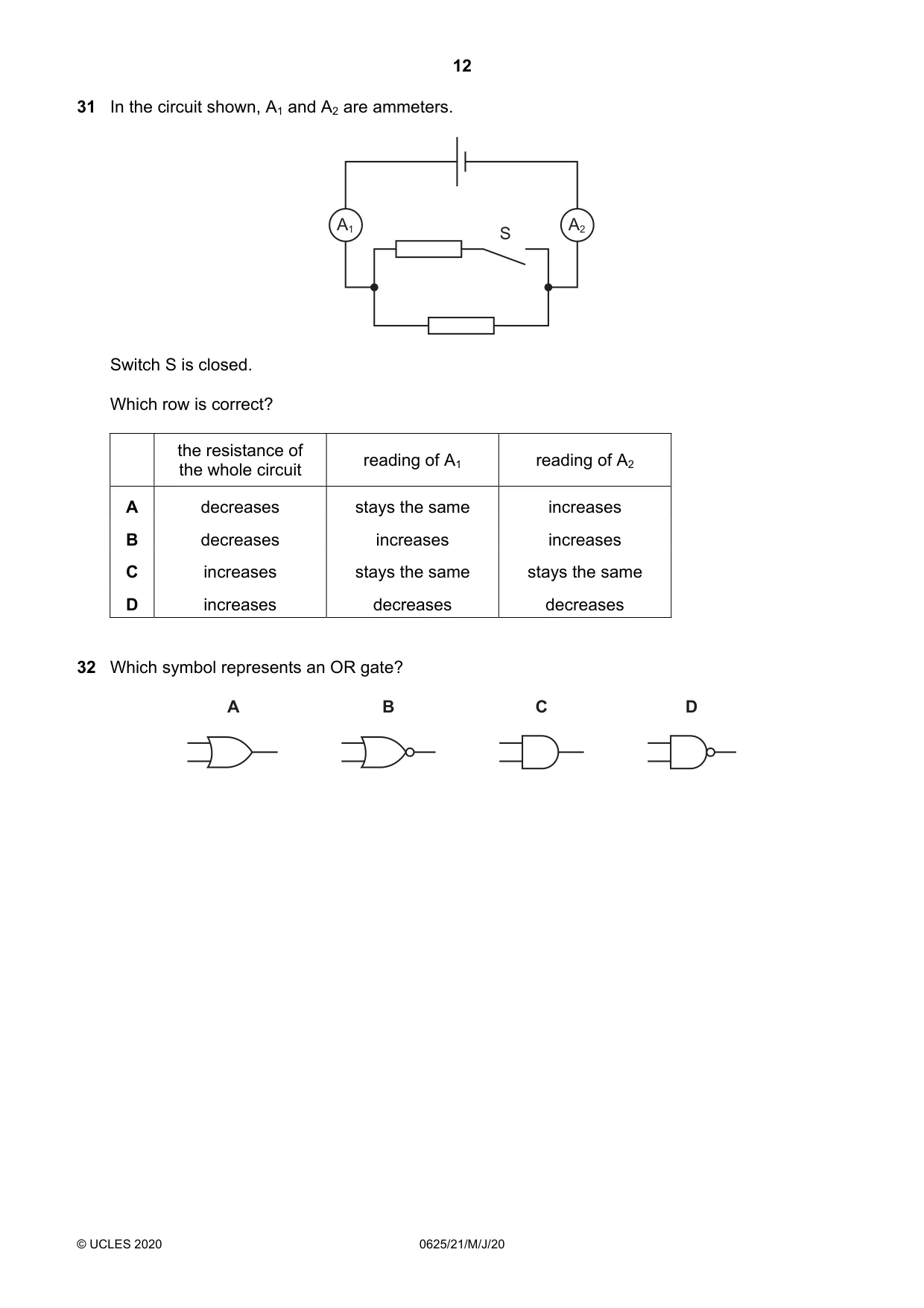
31 In the circuit shown, A1 and A2 are ammeters. A1 A2 S Switch S is closed. Which row is correct? the resistance of reading of A1 reading of A2 the whole circuit A decreases stays the same increases B decreases increases increases C increases stays the same stays the same D increases decreases decreases
Mark scheme: B
Q32 · Which symbol represents an OR gate?
32 Which symbol represents an OR gate? A B C D
Mark scheme: A
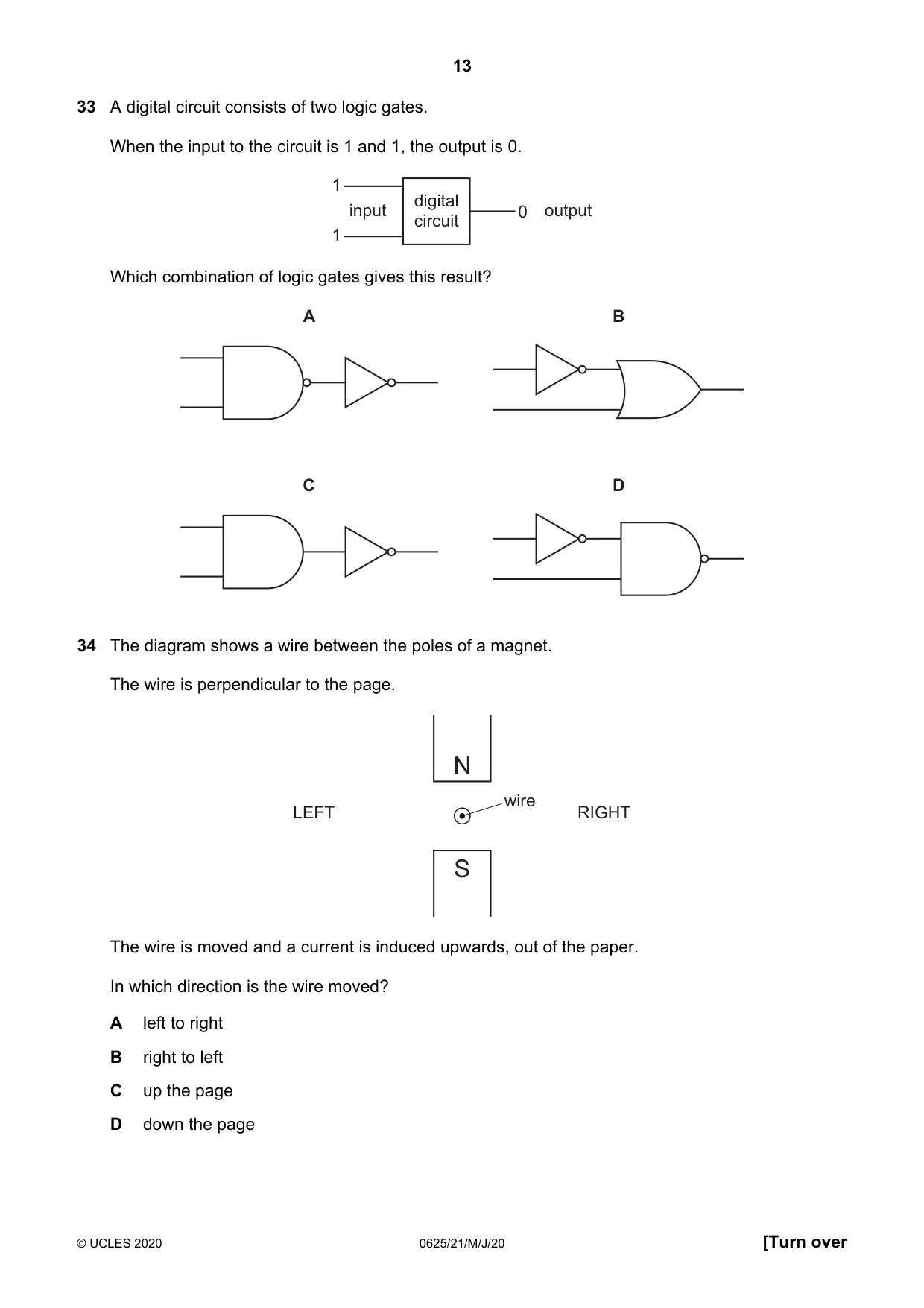
Q33 · A digital circuit consists of two logic gates
33 A digital circuit consists of two logic gates. When the input to the circuit is 1 and 1, the output is 0. 1 digital input 0 output circuit 1 Which combination of logic gates gives this result? A B C D
Mark scheme: C
Q34 · The diagram shows a wire between the poles of a magnet
34 The diagram shows a wire between the poles of a magnet. The wire is perpendicular to the page. N wire LEFT RIGHT S The wire is moved and a current is induced upwards, out of the paper. In which direction is the wire moved? A left to right B right to left C up the page D down the page
Mark scheme: B
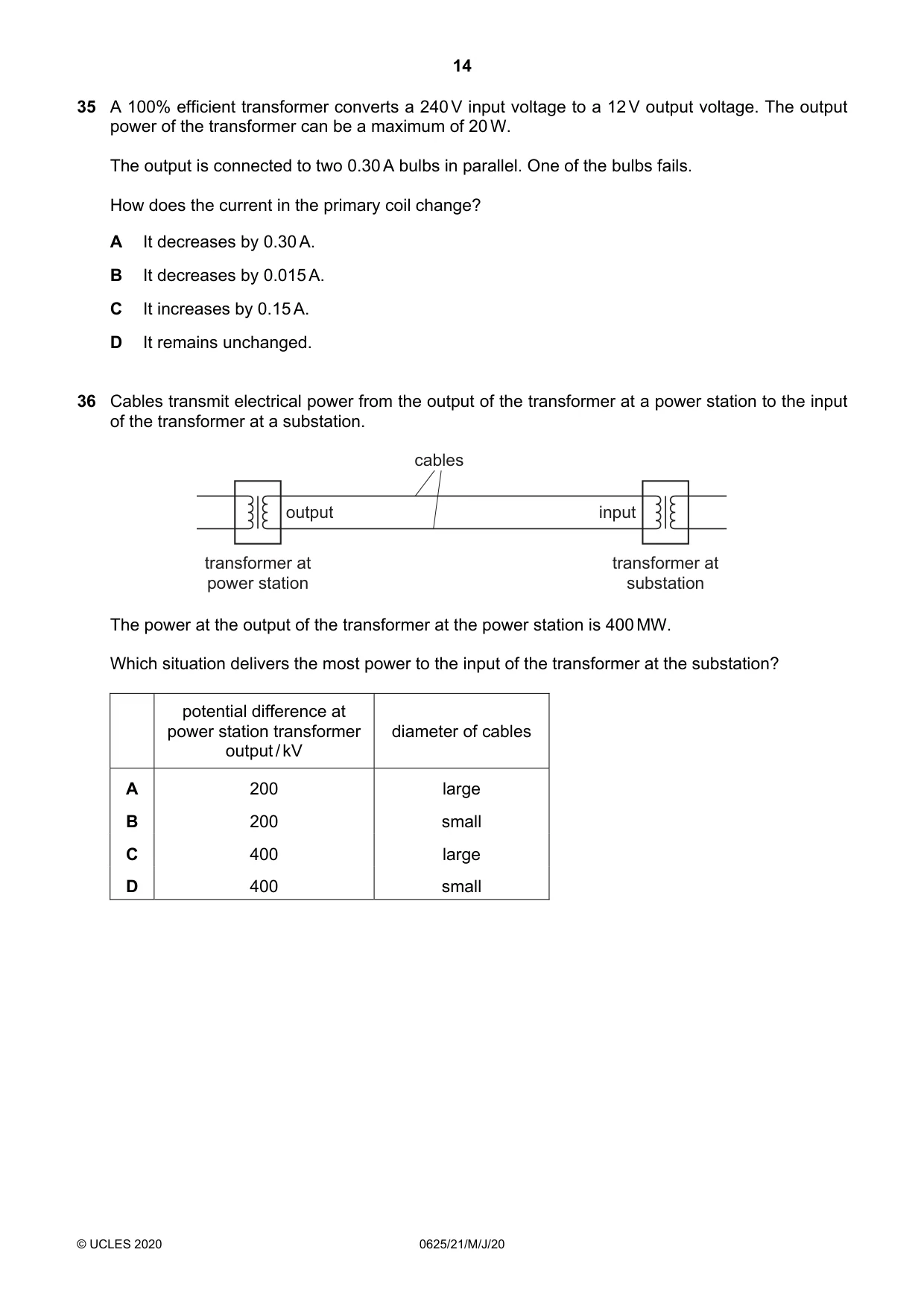
Q35 · A 100% efficient transformer converts a 240 V input voltage to a 12 V output voltage
35 A 100% efficient transformer converts a 240 V input voltage to a 12 V output voltage. The output power of the transformer can be a maximum of 20 W. The output is connected to two 0.30 A bulbs in parallel. One of the bulbs fails. How does the current in the primary coil change? A It decreases by 0.30 A. B It decreases by 0.015 A. C It increases by 0.15 A. D It remains unchanged.
Mark scheme: B
Q36 · Cables transmit electrical power from the output of the transformer at a power station to…
36 Cables transmit electrical power from the output of the transformer at a power station to the input of the transformer at a substation. cables output input transformer at transformer at power station substation The power at the output of the transformer at the power station is 400 MW. Which situation delivers the most power to the input of the transformer at the substation? potential difference at power station transformer diameter of cables output / kV A 200 large B 200 small C 400 large D 400 small
Mark scheme: C
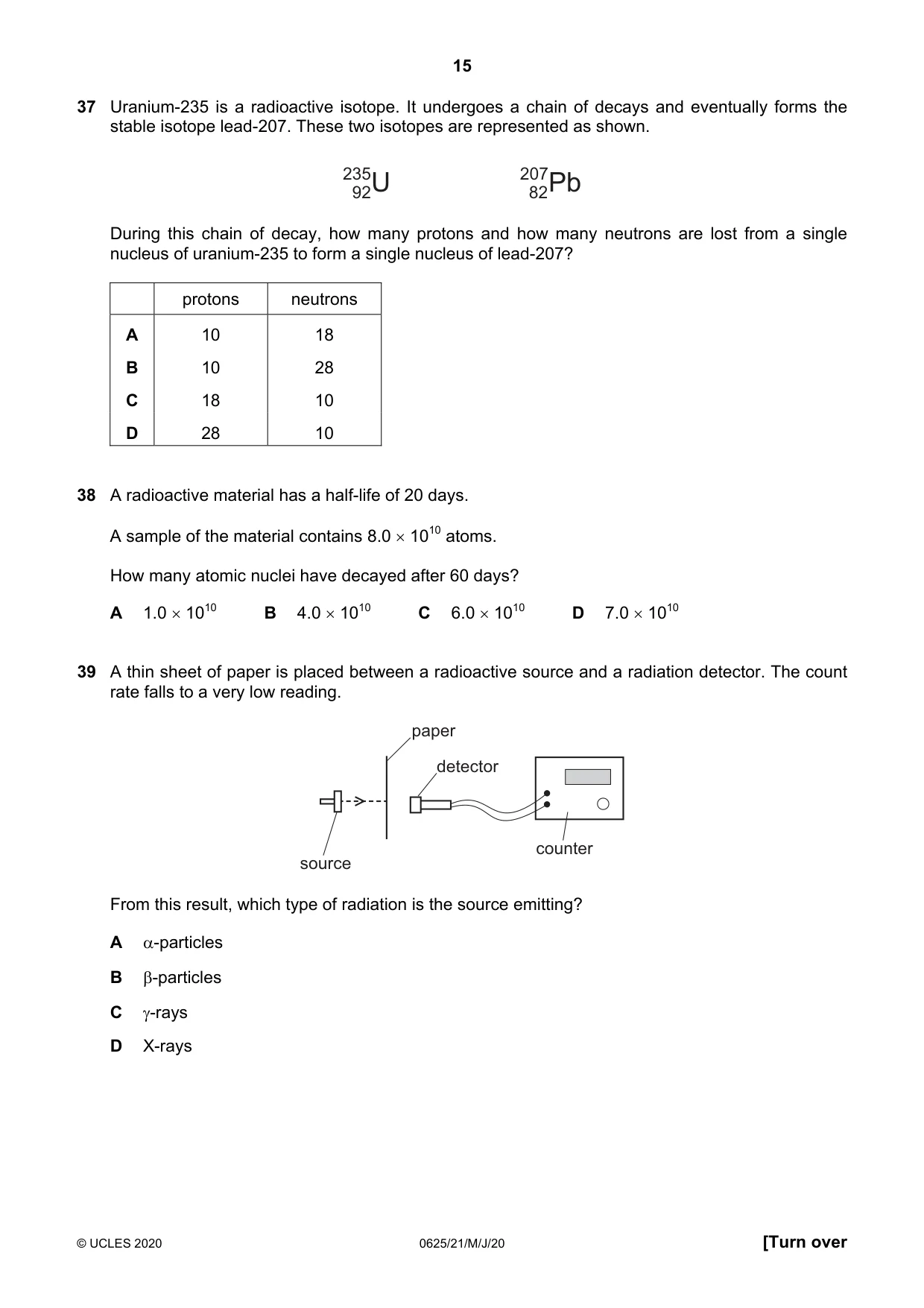
Q37 · Uranium-235 is a radioactive isotope
37 Uranium-235 is a radioactive isotope. It undergoes a chain of decays and eventually forms the stable isotope lead-207. These two isotopes are represented as shown. 235U 207Pb 92 82 During this chain of decay, how many protons and how many neutrons are lost from a single nucleus of uranium-235 to form a single nucleus of lead-207? protons neutrons A 10 18 B 10 28 C 18 10 D 28 10
Mark scheme: A
Q38 · A radioactive material has a half-life of 20 days
38 A radioactive material has a half-life of 20 days. A sample of the material contains 8.0 × 10¹⁰ atoms. How many atomic nuclei have decayed after 60 days? A 1.0 × 10¹⁰ B 4.0 × 10¹⁰ C 6.0 × 10¹⁰ D 7.0 × 10¹⁰
Mark scheme: D
Q39 · A thin sheet of paper is placed between a radioactive source and a radiation detector
39 A thin sheet of paper is placed between a radioactive source and a radiation detector. The count rate falls to a very low reading. paper detector counter source From this result, which type of radiation is the source emitting? A α-particles B β-particles C γ-rays D X-rays
Mark scheme: A
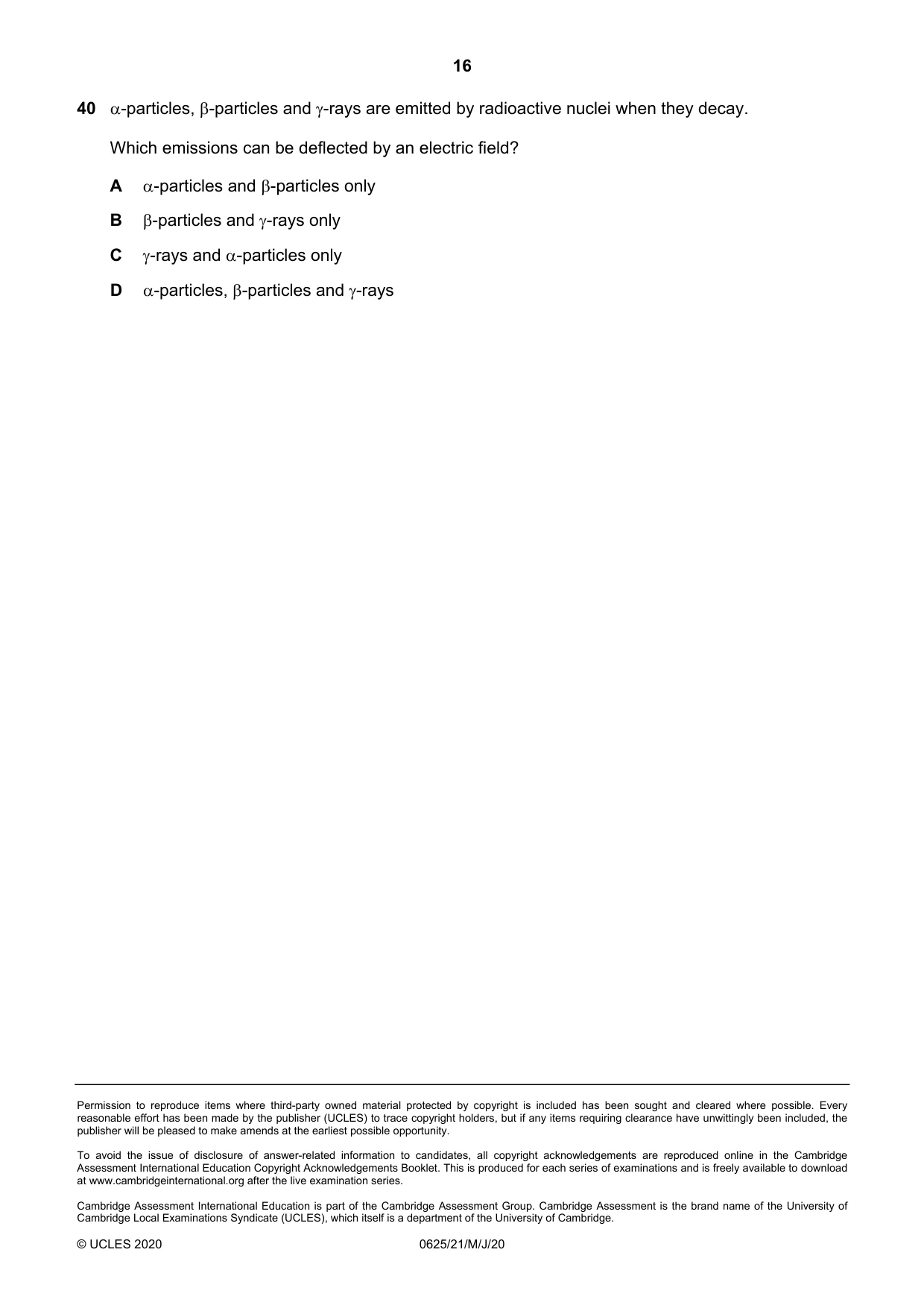
Q40 · Α-particles, β-particles and γ-rays are emitted by radioactive nuclei when they decay
40 α-particles, β-particles and γ-rays are emitted by radioactive nuclei when they decay. Which emissions can be deflected by an electric field? A α-particles and β-particles only B β-particles and γ-rays only C γ-rays and α-particles only D α-particles, β-particles and γ-rays
Mark scheme: A
What was in this paper
The subtopics covered by these 40 questions, and how many questions each got. Open one in a new tab to see every Cambridge question on it.
5Radioactivity4Electromagnetic effects3Density2Energy, work and power2General properties of waves2Kinetic particle model of matter2Light2Mass and weight2Motion2Physical quantities and measurement techniques2Pressure2Simple phenomena of magnetism2Transfer of thermal energy2Electrical quantities1Electromagnetic spectrum1Forces1Momentum1Sound1Thermal properties and temperature1