Cambridge IGCSE Physics 0625 — 2019 May/June Paper 2 · Variant 2
0625/22/M/J/19 · 40 questions · 40 marks · ≈45 min
The question paper and its mark scheme, free to read here and free to download. This is Cambridge’s own paper, exactly as it was sat.
Question paper16 pages
Mark scheme3 pages
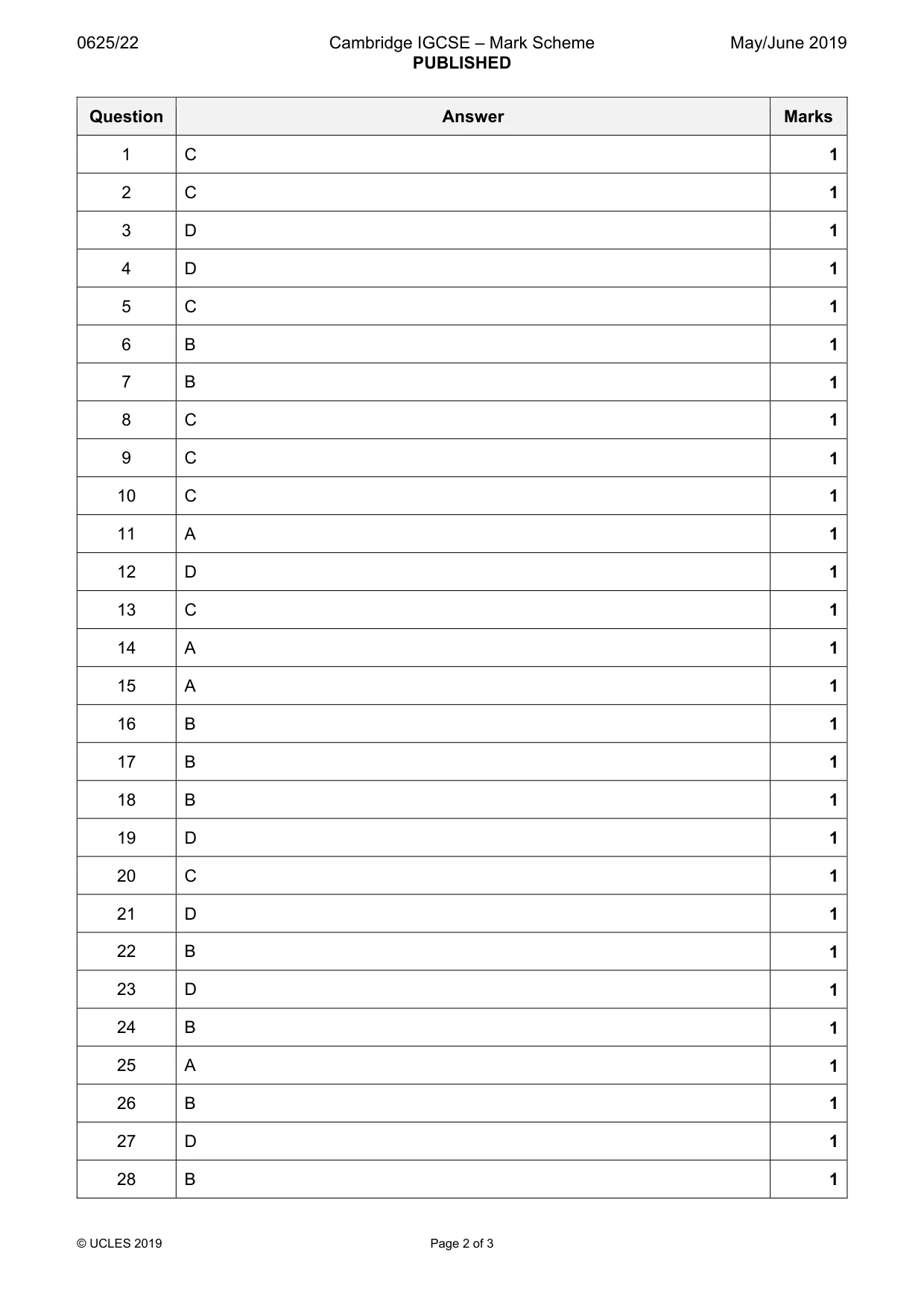
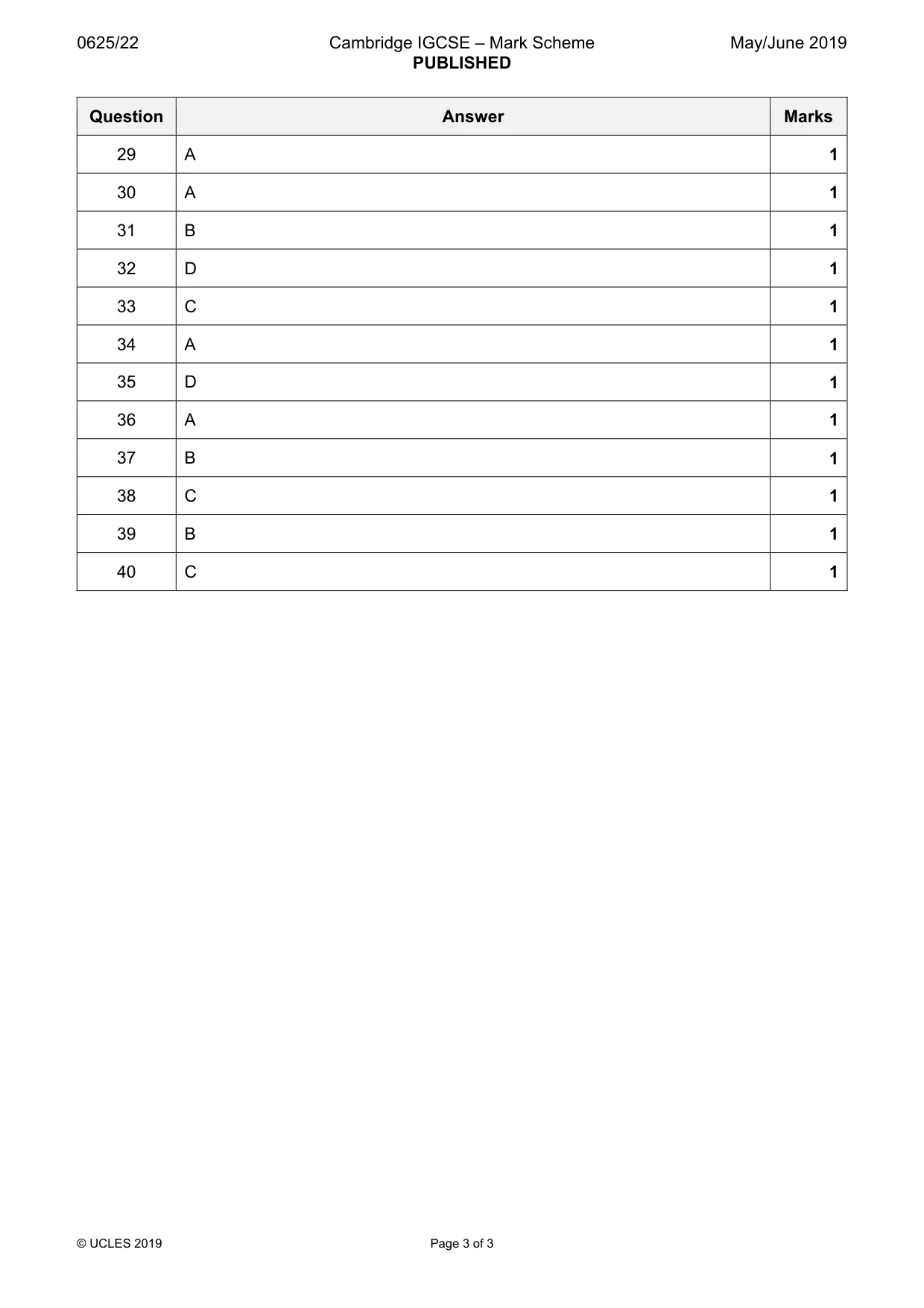
Answers below. Sit the paper first if you are practising.
Questions as text
Q1 · Which quantity can be measured directly using a micrometer screw gauge?
1 Which quantity can be measured directly using a micrometer screw gauge? A the area of a sheet of paper B the mass of a sheet of paper C the thickness of a sheet of paper D the volume of a sheet of paper
Mark scheme: C
More questions on Physical quantities and measurement techniques
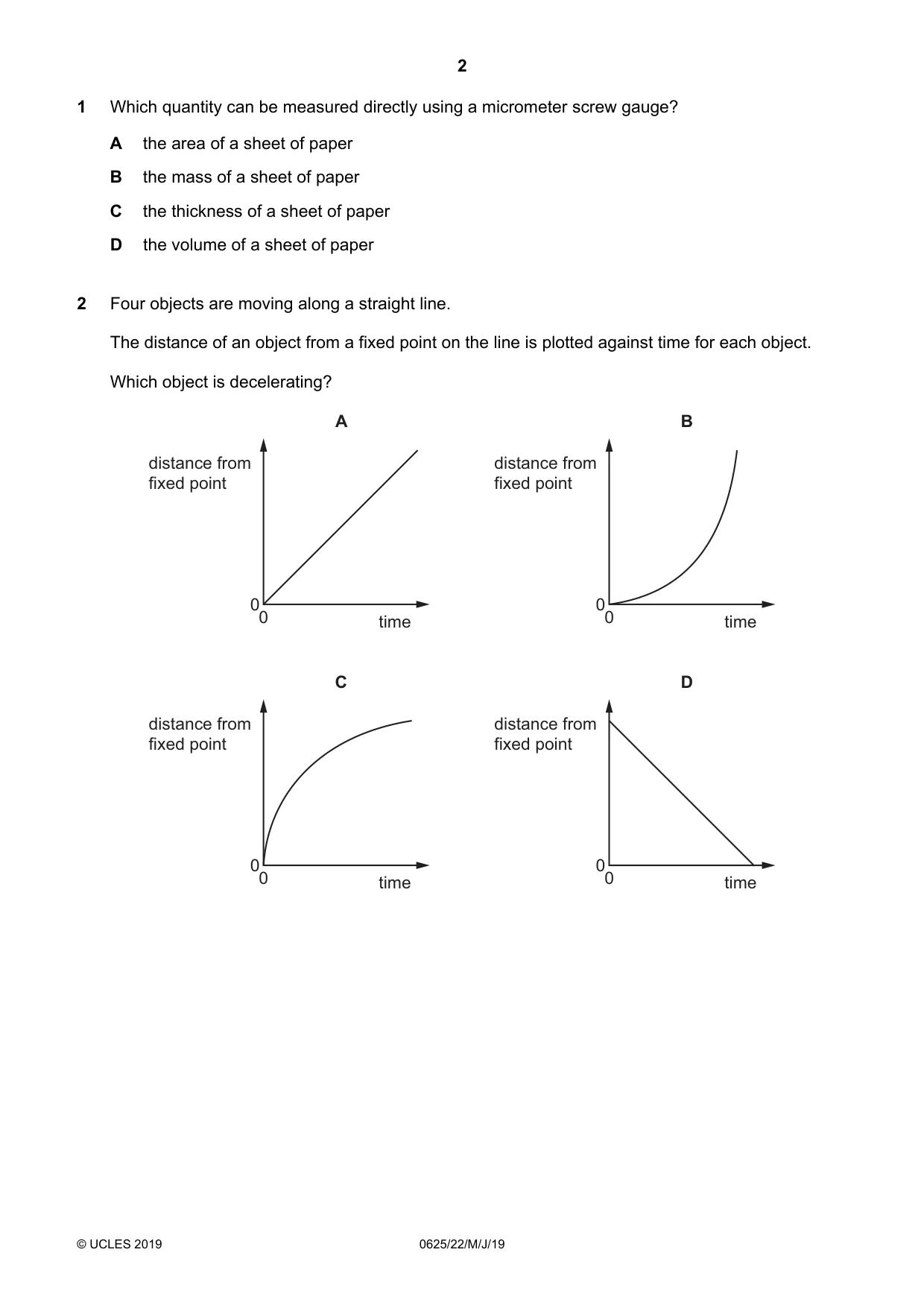
Q2 · Four objects are moving along a straight line
2 Four objects are moving along a straight line. The distance of an object from a fixed point on the line is plotted against time for each object. Which object is decelerating? A B distance from distance from fixed point fixed point 00 00 time time C D distance from distance from fixed point fixed point 00 00 time time
Mark scheme: C
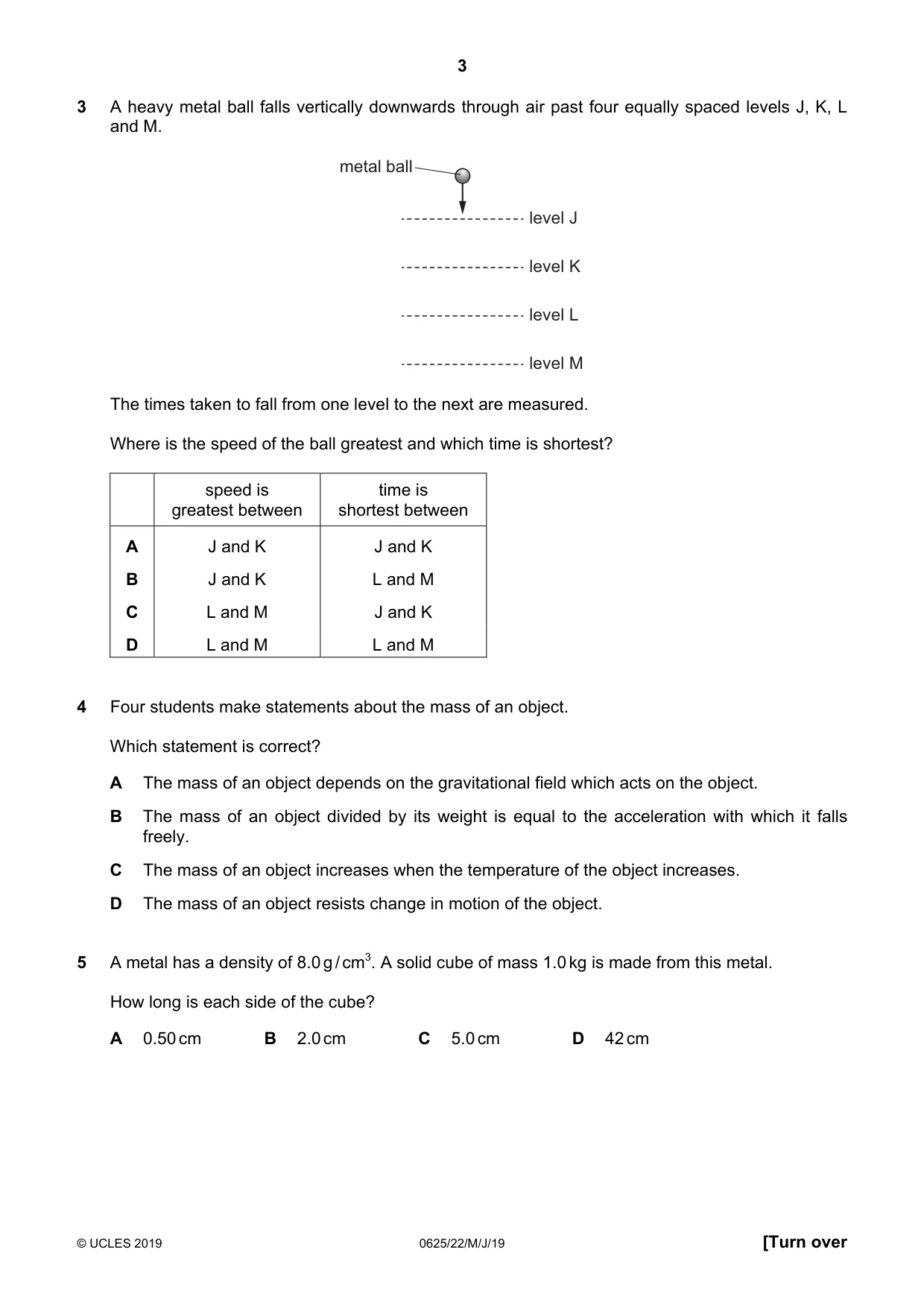
Q3 · A heavy metal ball falls vertically downwards through air past four equally spaced levels…
3 A heavy metal ball falls vertically downwards through air past four equally spaced levels J, K, L and M. metal ball level J level K level L level M The times taken to fall from one level to the next are measured. Where is the speed of the ball greatest and which time is shortest? speed is time is greatest between shortest between A J and K J and K B J and K L and M C L and M J and K D L and M L and M
Mark scheme: D
Q4 · Four students make statements about the mass of an object
4 Four students make statements about the mass of an object. Which statement is correct? A The mass of an object depends on the gravitational field which acts on the object. B The mass of an object divided by its weight is equal to the acceleration with which it falls freely. C The mass of an object increases when the temperature of the object increases. D The mass of an object resists change in motion of the object.
Mark scheme: D
Q5 · A metal has a density of 8.0 g / cm3
5 A metal has a density of 8.0 g / cm3. A solid cube of mass 1.0 kg is made from this metal. How long is each side of the cube? A 0.50 cm B 2.0 cm C 5.0 cm D 42 cm
Mark scheme: C
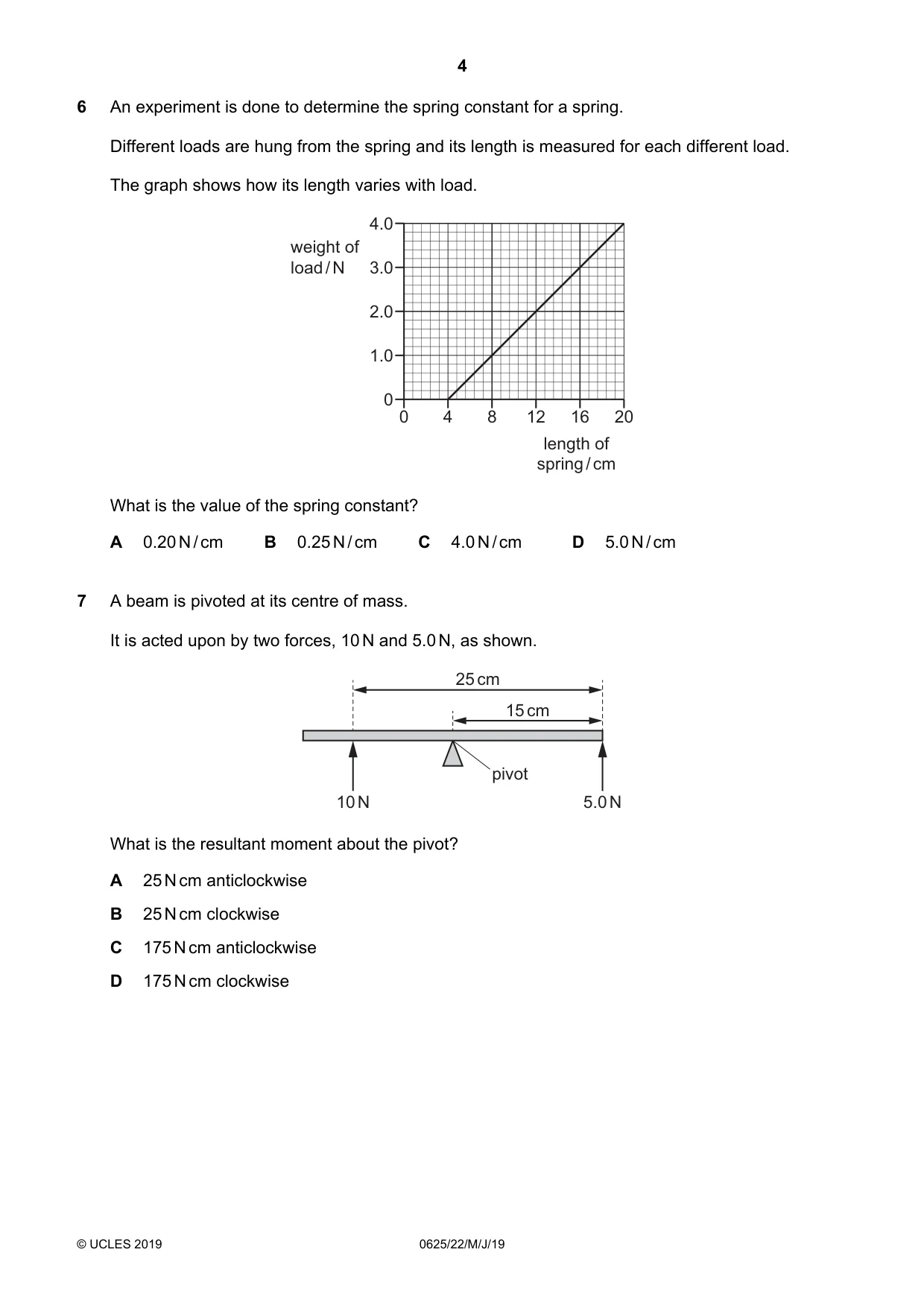
Q6 · An experiment is done to determine the spring constant for a spring
6 An experiment is done to determine the spring constant for a spring. Different loads are hung from the spring and its length is measured for each different load. The graph shows how its length varies with load. 4.0 weight of load / N 3.0 2.0 1.0 0 0 4 8 12 16 20 length of spring / cm What is the value of the spring constant? A 0.20 N / cm B 0.25 N / cm C 4.0 N / cm D 5.0 N / cm
Mark scheme: B
Q7 · A beam is pivoted at its centre of mass
7 A beam is pivoted at its centre of mass. It is acted upon by two forces, 10 N and 5.0 N, as shown. 25 cm 15 cm pivot 10 N 5.0 N What is the resultant moment about the pivot? A 25 N cm anticlockwise B 25 N cm clockwise C 175 N cm anticlockwise D 175 N cm clockwise
Mark scheme: B
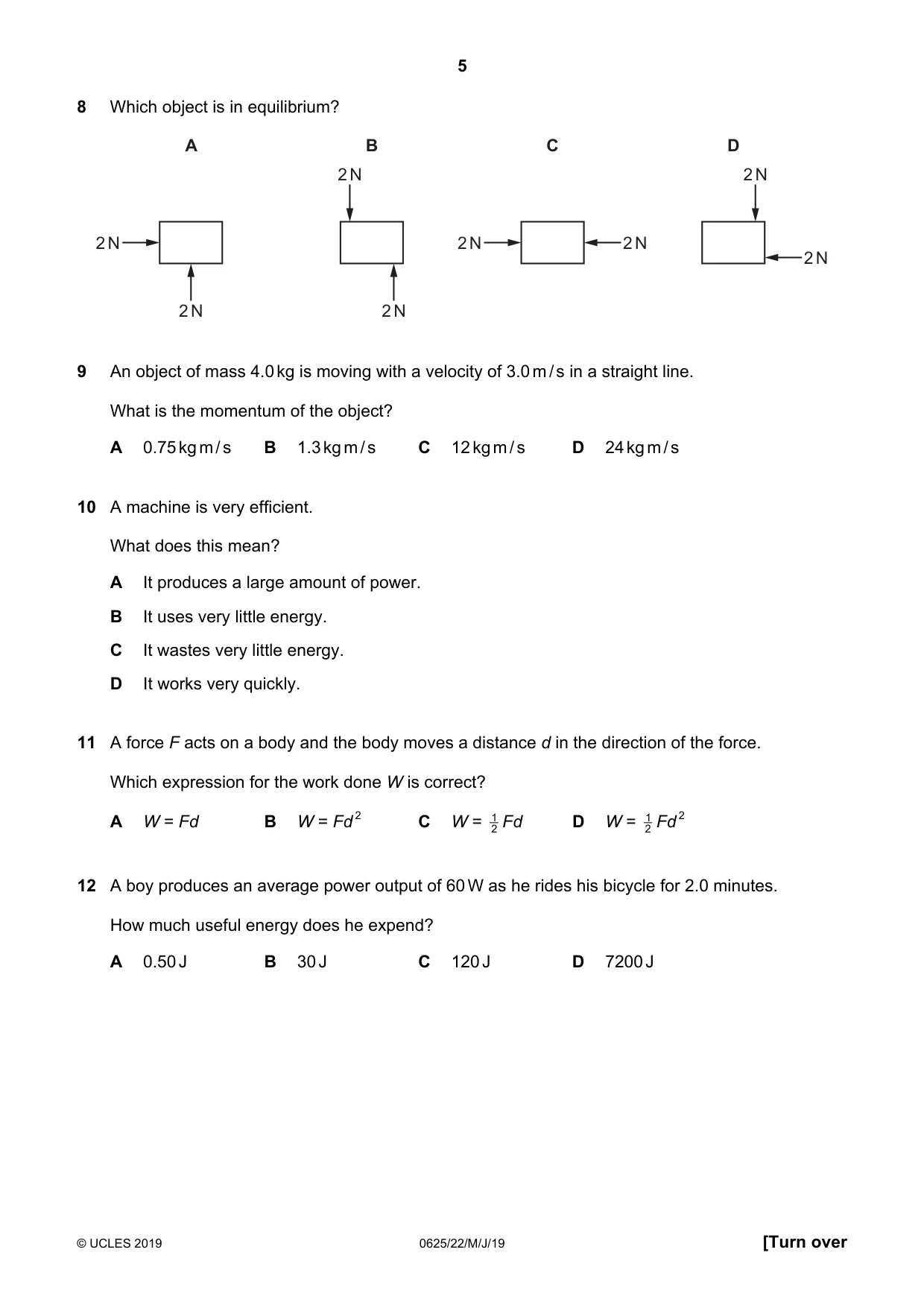
Q8 · Which object is in equilibrium?
8 Which object is in equilibrium? A B C D 2 N 2 N 2 N 2 N 2 N 2 N 2 N 2 N
Mark scheme: C
Q9 · An object of mass 4.0 kg is moving with a velocity of 3.0 m / s in a straight line
9 An object of mass 4.0 kg is moving with a velocity of 3.0 m / s in a straight line. What is the momentum of the object? A 0.75 kg m / s B 1.3 kg m / s C 12 kg m / s D 24 kg m / s
Mark scheme: C
Q10 · A machine is very efficient
10 A machine is very efficient. What does this mean? A It produces a large amount of power. B It uses very little energy. C It wastes very little energy. D It works very quickly.
Mark scheme: C
Q11 · A force F acts on a body and the body moves a distance d in the direction of the force
11 A force F acts on a body and the body moves a distance d in the direction of the force. Which expression for the work done W is correct? A W = Fd B W = Fd 2 C W = 2 1 Fd D W = 2 1 Fd 2
Mark scheme: A
Q12 · A boy produces an average power output of 60 W as he rides his bicycle for 2.0 minutes
12 A boy produces an average power output of 60 W as he rides his bicycle for 2.0 minutes. How much useful energy does he expend? A 0.50 J B 30 J C 120 J D 7200 J
Mark scheme: D
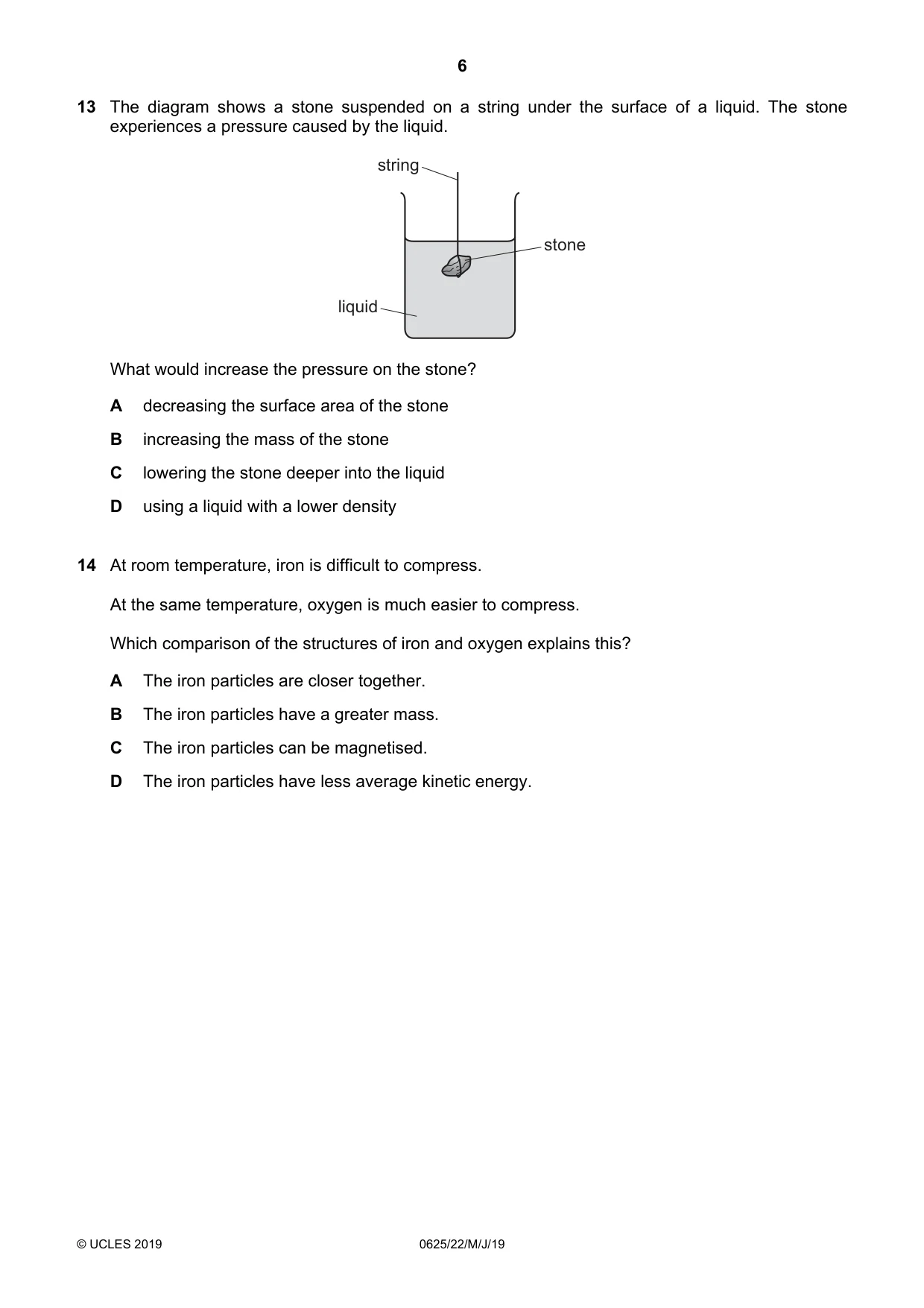
Q13 · The diagram shows a stone suspended on a string under the surface of a liquid
13 The diagram shows a stone suspended on a string under the surface of a liquid. The stone experiences a pressure caused by the liquid. string stone liquid What would increase the pressure on the stone? A decreasing the surface area of the stone B increasing the mass of the stone C lowering the stone deeper into the liquid D using a liquid with a lower density
Mark scheme: C
Q14 · At room temperature, iron is difficult to compress
14 At room temperature, iron is difficult to compress. At the same temperature, oxygen is much easier to compress. Which comparison of the structures of iron and oxygen explains this? A The iron particles are closer together. B The iron particles have a greater mass. C The iron particles can be magnetised. D The iron particles have less average kinetic energy.
Mark scheme: A
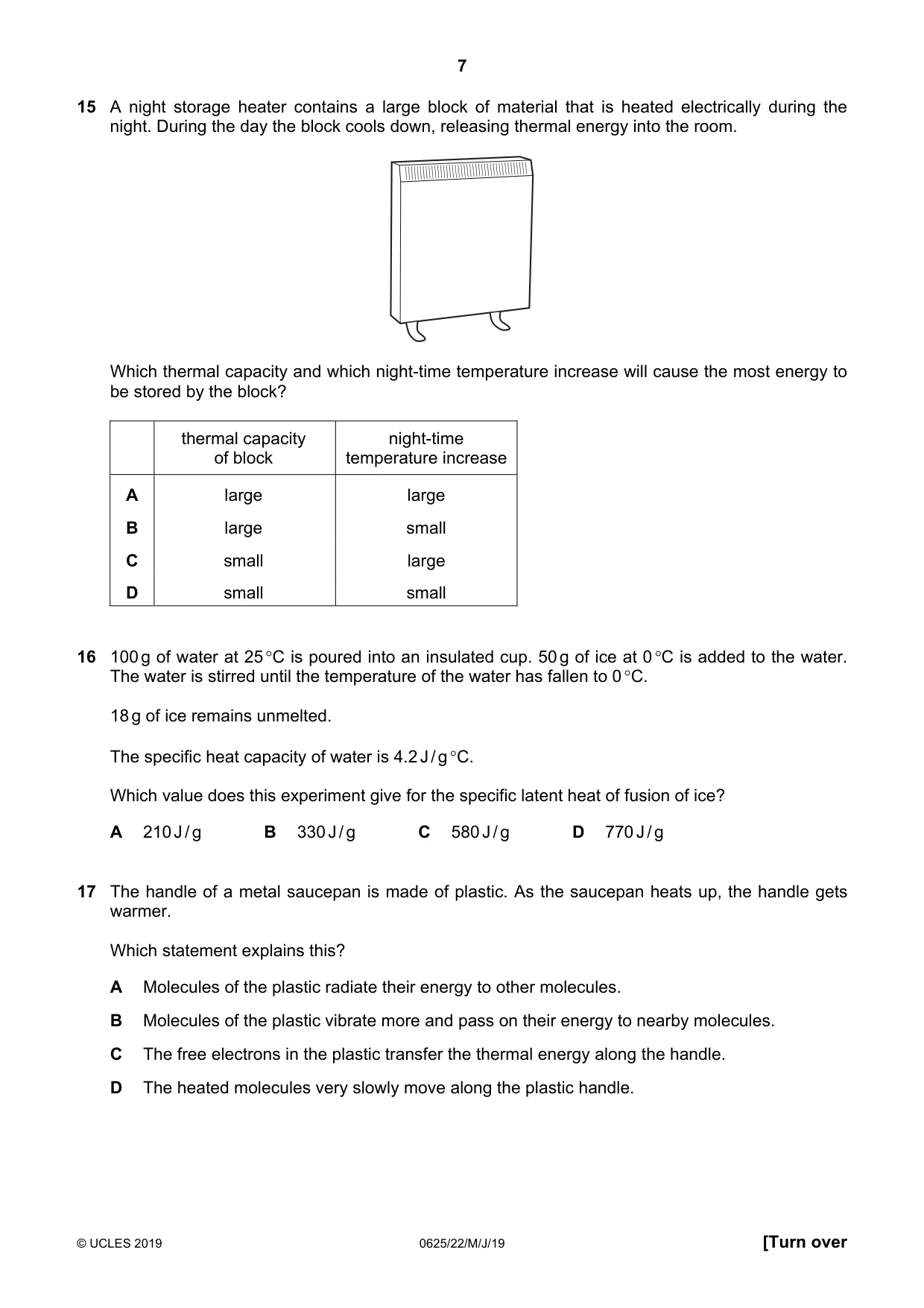
Q15 · A night storage heater contains a large block of material that is heated electrically…
15 A night storage heater contains a large block of material that is heated electrically during the night. During the day the block cools down, releasing thermal energy into the room. Which thermal capacity and which night-time temperature increase will cause the most energy to be stored by the block? thermal capacity night-time of block temperature increase A large large B large small C small large D small small
Mark scheme: A
Q16 · 100 g of water at 25 °C is poured into an insulated cup
16 100 g of water at 25 °C is poured into an insulated cup. 50 g of ice at 0 °C is added to the water. The water is stirred until the temperature of the water has fallen to 0 °C. 18 g of ice remains unmelted. The specific heat capacity of water is 4.2 J / g °C. Which value does this experiment give for the specific latent heat of fusion of ice? A 210 J / g B 330 J / g C 580 J / g D 770 J / g
Mark scheme: B
Q17 · The handle of a metal saucepan is made of plastic
17 The handle of a metal saucepan is made of plastic. As the saucepan heats up, the handle gets warmer. Which statement explains this? A Molecules of the plastic radiate their energy to other molecules. B Molecules of the plastic vibrate more and pass on their energy to nearby molecules. C The free electrons in the plastic transfer the thermal energy along the handle. D The heated molecules very slowly move along the plastic handle.
Mark scheme: B
Q18 · The metal surface of a kettle is hot
18 The metal surface of a kettle is hot. What happens to the cool air outside the kettle when it comes into contact with the hot kettle? A The density of the air decreases and the air falls. B The density of the air decreases and the air rises. C The density of the air increases and the air falls. D The density of the air increases and the air rises.
Mark scheme: B
Q19 · Vacuum flasks usually have silvered walls that help to keep the contents of the flask hot
19 Vacuum flasks usually have silvered walls that help to keep the contents of the flask hot. Why are the walls silvered? A to absorb thermal energy from the air around the flask B to increase the rate of convection inside the flask C to reduce energy loss to the surroundings by conduction D to reflect thermal radiation back into the flask
Mark scheme: D
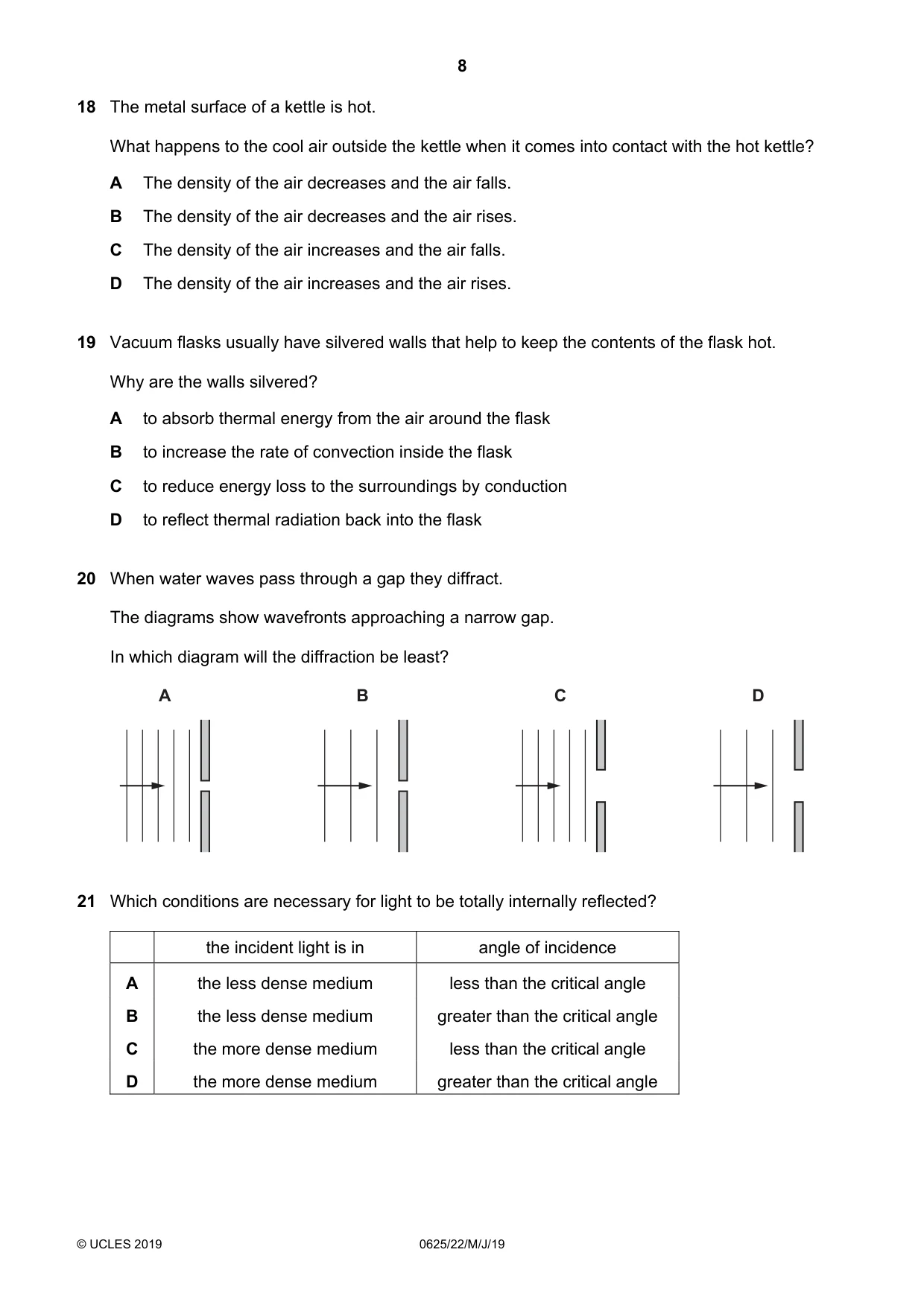
Q20 · When water waves pass through a gap they diffract
20 When water waves pass through a gap they diffract. The diagrams show wavefronts approaching a narrow gap. In which diagram will the diffraction be least? A B C D
Mark scheme: C
Q21 · Which conditions are necessary for light to be totally internally reflected?
21 Which conditions are necessary for light to be totally internally reflected? the incident light is in angle of incidence A the less dense medium less than the critical angle B the less dense medium greater than the critical angle C the more dense medium less than the critical angle D the more dense medium greater than the critical angle
Mark scheme: D
Q22 · Light is travelling through air
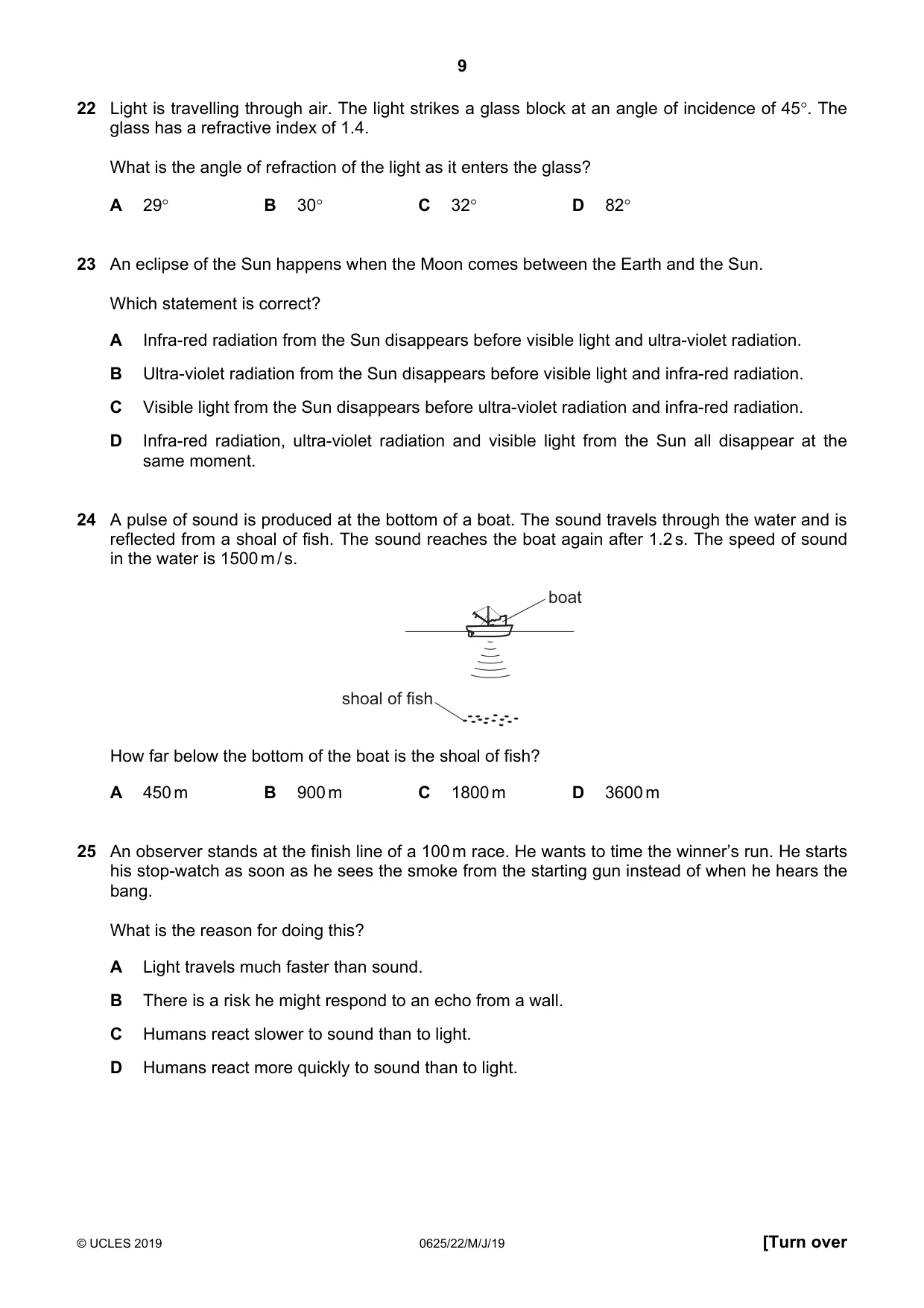
22 Light is travelling through air. The light strikes a glass block at an angle of incidence of 45°. The glass has a refractive index of 1.4. What is the angle of refraction of the light as it enters the glass? A 29° B 30° C 32° D 82°
Mark scheme: B
Q23 · An eclipse of the Sun happens when the Moon comes between the Earth and the Sun
23 An eclipse of the Sun happens when the Moon comes between the Earth and the Sun. Which statement is correct? A Infra-red radiation from the Sun disappears before visible light and ultra-violet radiation. B Ultra-violet radiation from the Sun disappears before visible light and infra-red radiation. C Visible light from the Sun disappears before ultra-violet radiation and infra-red radiation. D Infra-red radiation, ultra-violet radiation and visible light from the Sun all disappear at the same moment.
Mark scheme: D
Q24 · A pulse of sound is produced at the bottom of a boat
24 A pulse of sound is produced at the bottom of a boat. The sound travels through the water and is reflected from a shoal of fish. The sound reaches the boat again after 1.2 s. The speed of sound in the water is 1500 m / s. boat shoal of fish How far below the bottom of the boat is the shoal of fish? A 450 m B 900 m C 1800 m D 3600 m
Mark scheme: B
Q25 · An observer stands at the finish line of a 100 m race
25 An observer stands at the finish line of a 100 m race. He wants to time the winner’s run. He starts his stop-watch as soon as he sees the smoke from the starting gun instead of when he hears the bang. What is the reason for doing this? A Light travels much faster than sound. B There is a risk he might respond to an echo from a wall. C Humans react slower to sound than to light. D Humans react more quickly to sound than to light.
Mark scheme: A
Q26 · A soft iron bar is a long way from any magnetic field
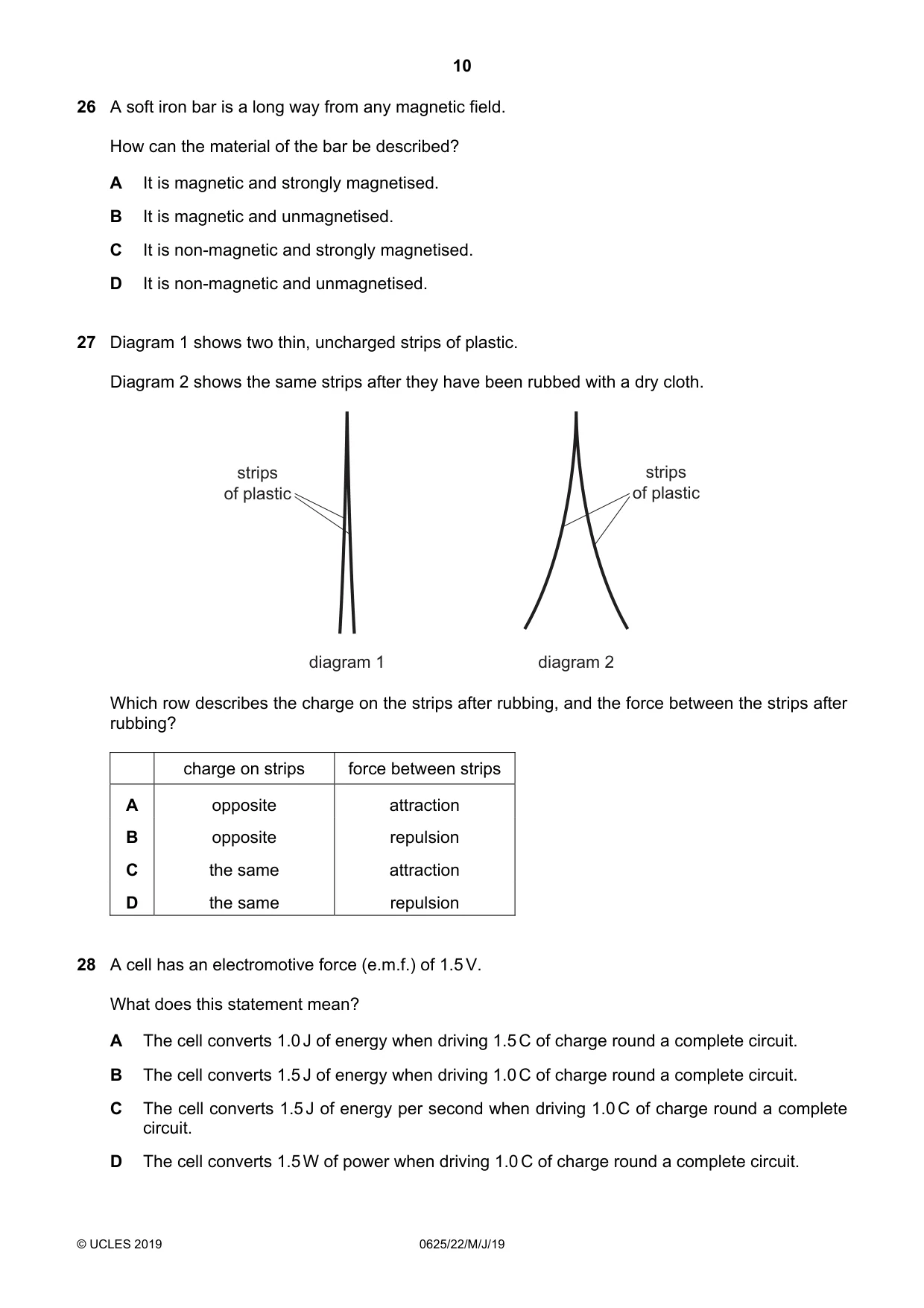
26 A soft iron bar is a long way from any magnetic field. How can the material of the bar be described? A It is magnetic and strongly magnetised. B It is magnetic and unmagnetised. C It is non-magnetic and strongly magnetised. D It is non-magnetic and unmagnetised.
Mark scheme: B
Q27 · Two thin, uncharged strips of plastic
27 Diagram 1 shows two thin, uncharged strips of plastic. Diagram 2 shows the same strips after they have been rubbed with a dry cloth. strips strips of plastic of plastic diagram 1 diagram 2 Which row describes the charge on the strips after rubbing, and the force between the strips after rubbing? charge on strips force between strips A opposite attraction B opposite repulsion C the same attraction D the same repulsion
Mark scheme: D
Q28 · A cell has an electromotive force (e.m.f.) of 1.5 V
28 A cell has an electromotive force (e.m.f.) of 1.5 V. What does this statement mean? A The cell converts 1.0 J of energy when driving 1.5 C of charge round a complete circuit. B The cell converts 1.5 J of energy when driving 1.0 C of charge round a complete circuit. C The cell converts 1.5 J of energy per second when driving 1.0 C of charge round a complete circuit. D The cell converts 1.5 W of power when driving 1.0 C of charge round a complete circuit.
Mark scheme: B
Q29 · A metal wire of length 100 cm and cross-sectional area 0.20 mm2 has a resistance of 8.0 Ω
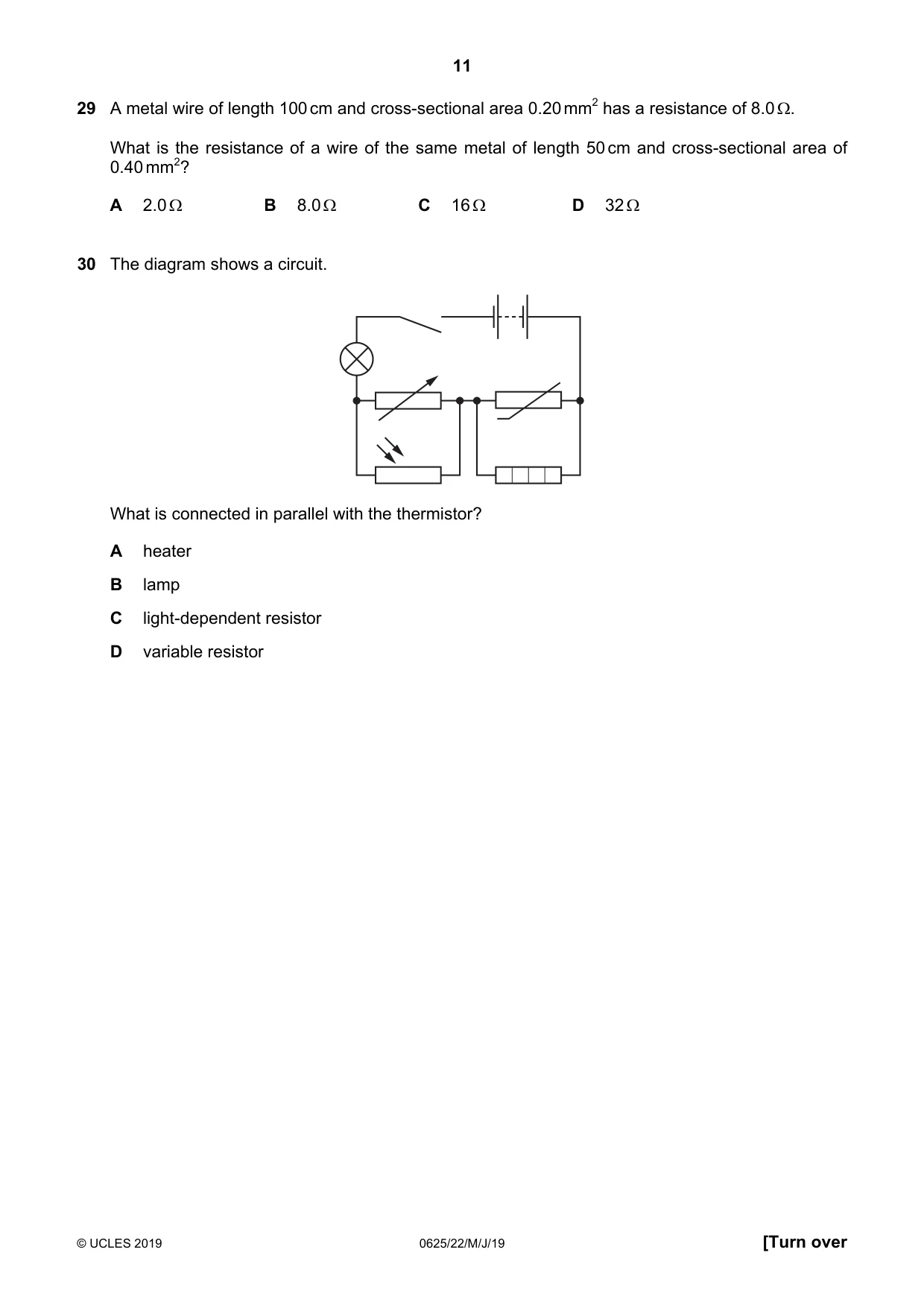
29 A metal wire of length 100 cm and cross-sectional area 0.20 mm2 has a resistance of 8.0 Ω. What is the resistance of a wire of the same metal of length 50 cm and cross-sectional area of 0.40 mm2? A 2.0 Ω B 8.0 Ω C 16 Ω D 32 Ω
Mark scheme: A
Q30 · The diagram shows a circuit
30 The diagram shows a circuit. What is connected in parallel with the thermistor? A heater B lamp C light-dependent resistor D variable resistor
Mark scheme: A
Q31 · A lamp is to be connected in a circuit so that the potential difference (p.d.) across it…
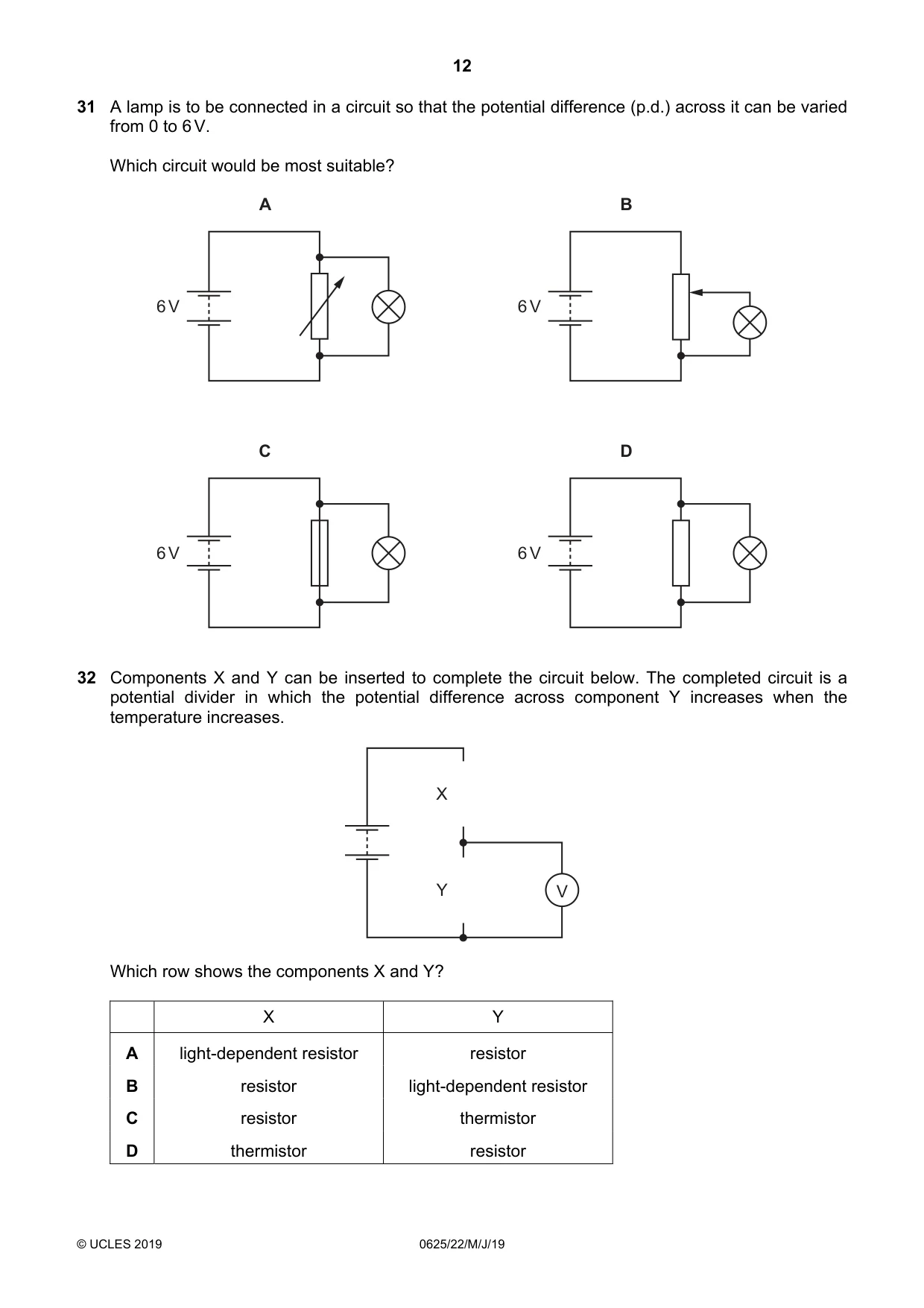
31 A lamp is to be connected in a circuit so that the potential difference (p.d.) across it can be varied from 0 to 6 V. Which circuit would be most suitable? A B 6 V 6 V C D 6 V 6 V
Mark scheme: B
Q32 · Components X and Y can be inserted to complete the circuit below
32 Components X and Y can be inserted to complete the circuit below. The completed circuit is a potential divider in which the potential difference across component Y increases when the temperature increases. X Y V Which row shows the components X and Y? X Y A light-dependent resistor resistor B resistor light-dependent resistor C resistor thermistor D thermistor resistor
Mark scheme: D
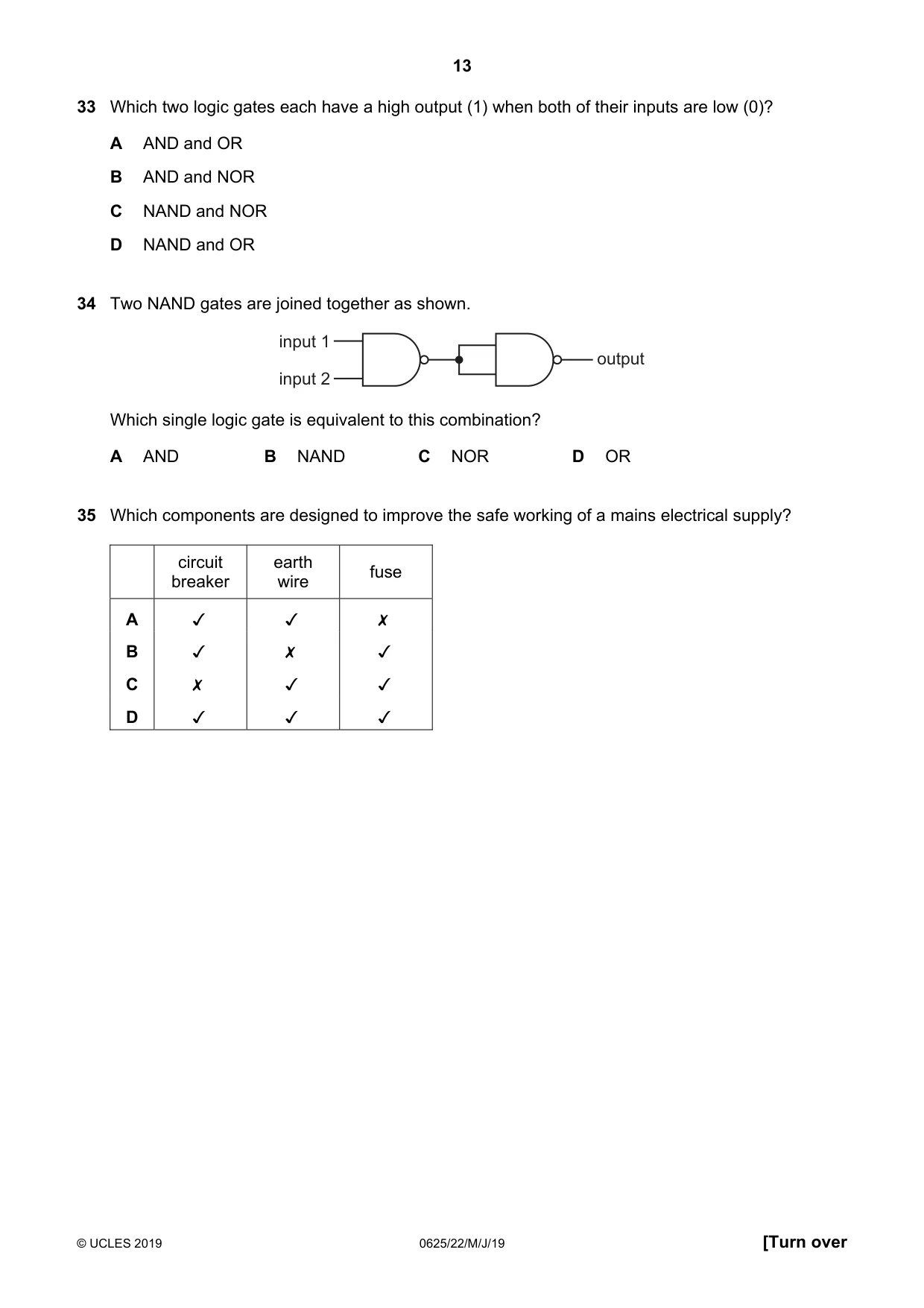
Q33 · Which two logic gates each have a high output (1) when both of their inputs are low (0)?
33 Which two logic gates each have a high output (1) when both of their inputs are low (0)? A AND and OR B AND and NOR C NAND and NOR D NAND and OR
Mark scheme: C
Q34 · Two NAND gates are joined together as shown
34 Two NAND gates are joined together as shown. input 1 output input 2 Which single logic gate is equivalent to this combination? A AND B NAND C NOR D OR
Mark scheme: A
Q35 · Which components are designed to improve the safe working of a mains electrical supply?
35 Which components are designed to improve the safe working of a mains electrical supply? circuit earth ; fuse breaker wire Jv Jv 0 OO WwW PY << x <4 x v x v
Mark scheme: D
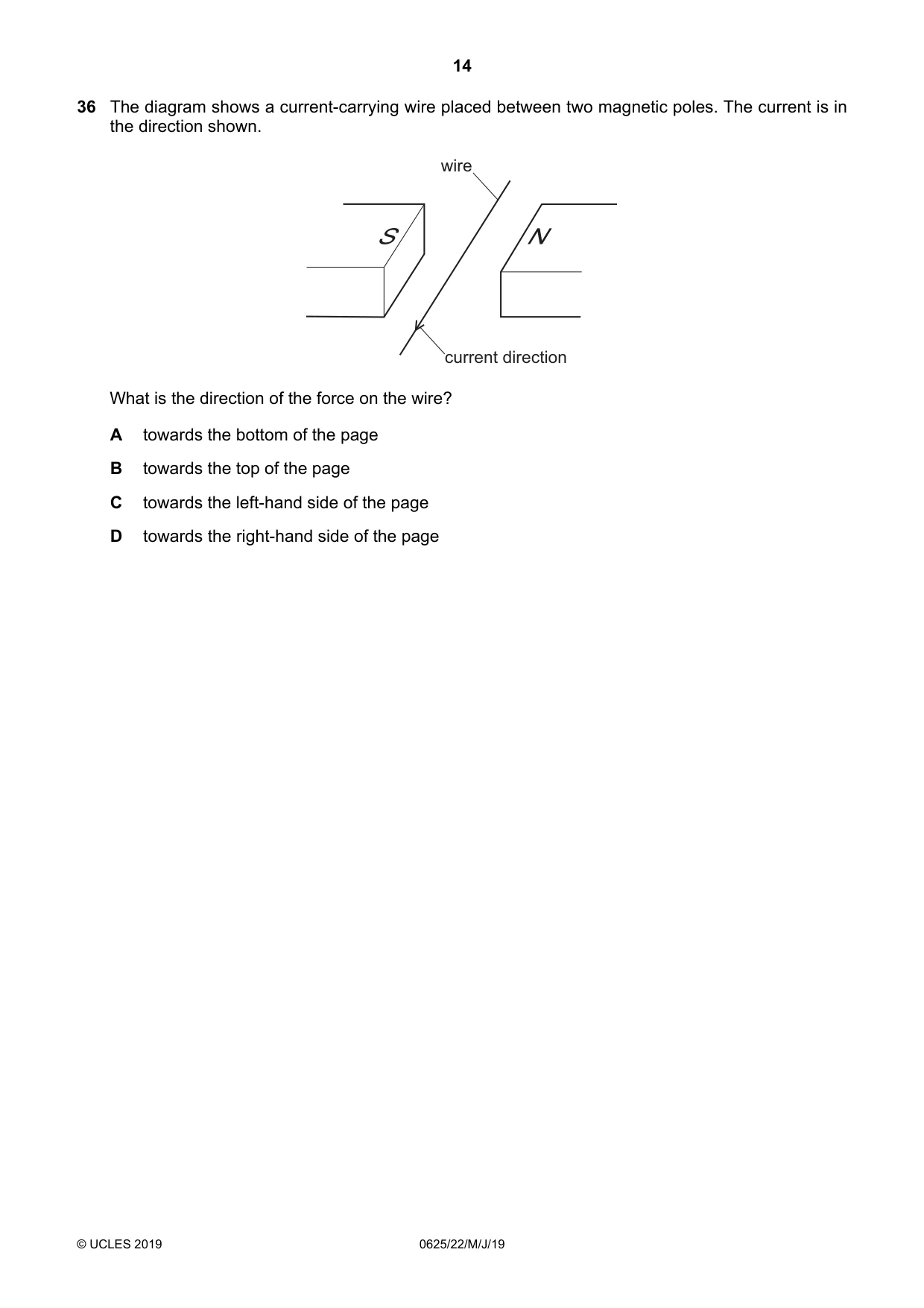
Q36 · The diagram shows a current-carrying wire placed between two magnetic poles
36 The diagram shows a current-carrying wire placed between two magnetic poles. The current is in the direction shown. wire S N current direction What is the direction of the force on the wire? A towards the bottom of the page B towards the top of the page C towards the left-hand side of the page D towards the right-hand side of the page
Mark scheme: A
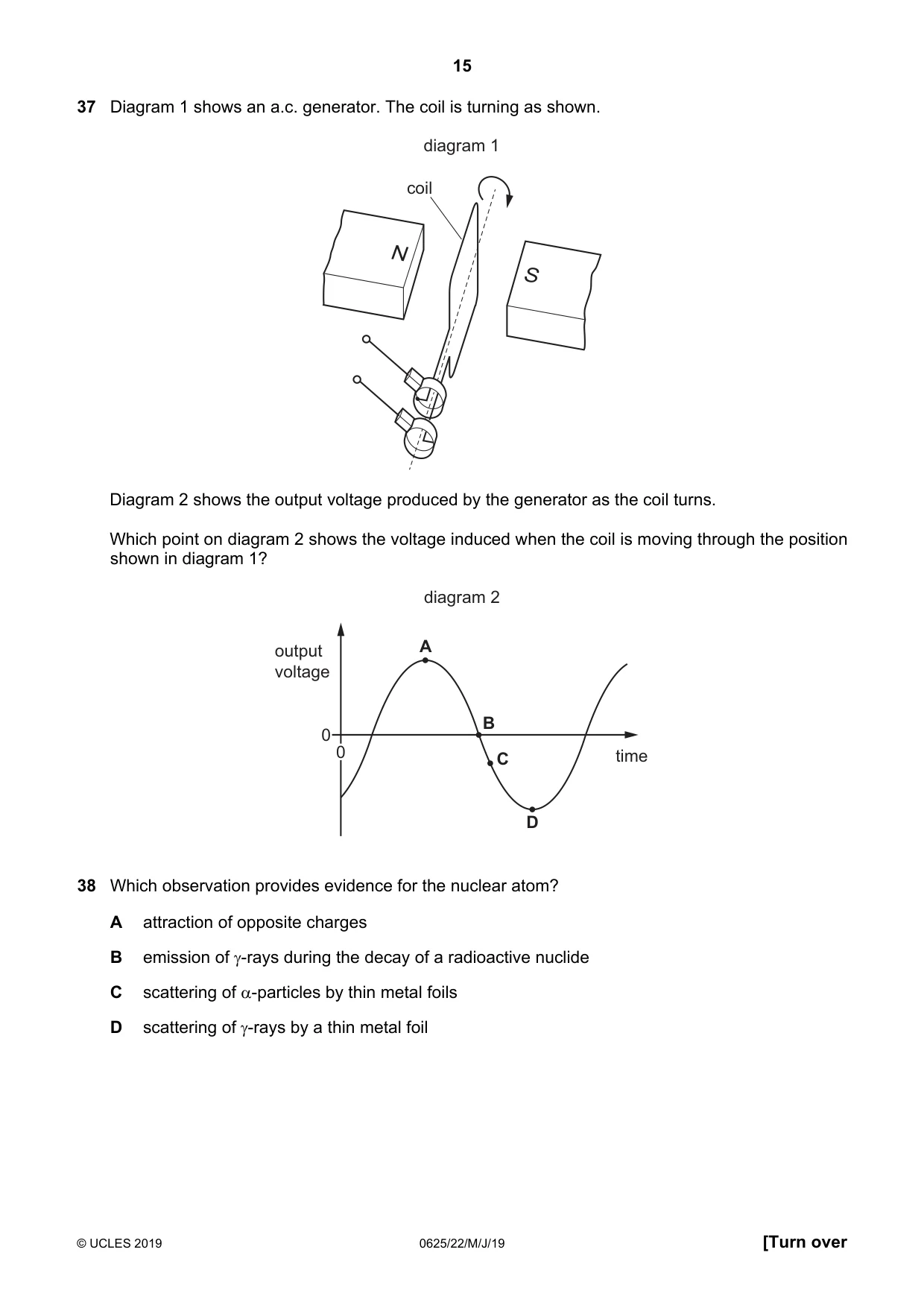
Question 37
37 Diagram 1 shows an a.c. generator. The coil is turning as shown. diagram 1 coil N S Diagram 2 shows the output voltage produced by the generator as the coil turns. Which point on diagram 2 shows the voltage induced when the coil is moving through the position shown in diagram 1? diagram 2 output A voltage B 0 0 C time D
Mark scheme: B
Q38 · Which observation provides evidence for the nuclear atom?
38 Which observation provides evidence for the nuclear atom? A attraction of opposite charges B emission of γ-rays during the decay of a radioactive nuclide C scattering of α-particles by thin metal foils D scattering of γ-rays by a thin metal foil
Mark scheme: C
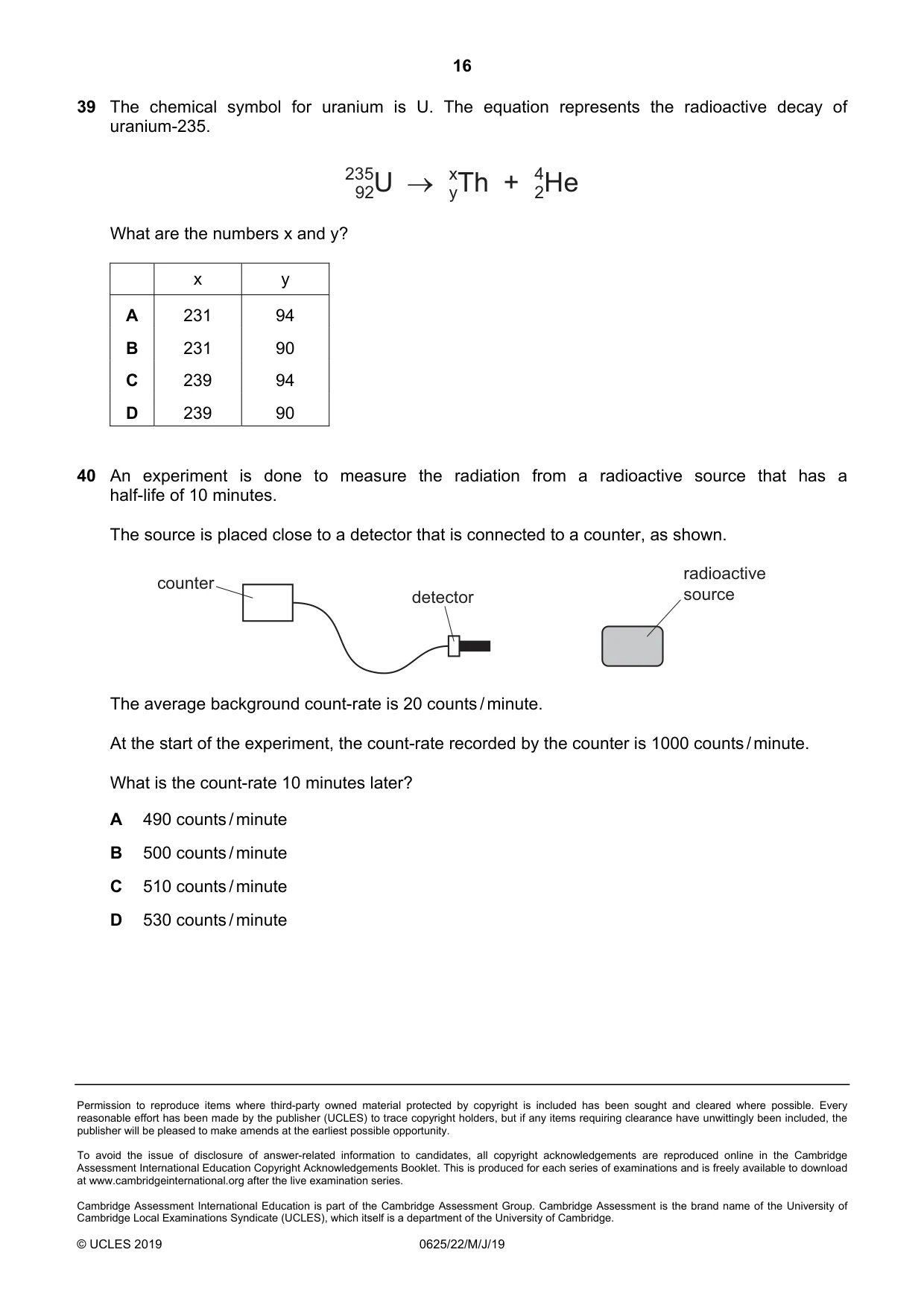
Q39 · The chemical symbol for uranium is U
39 The chemical symbol for uranium is U. The equation represents the radioactive decay of uranium-235. 235U → xTh + 4He 92 y 2 What are the numbers x and y? x y A 231 94 B 231 90 C 239 94 D 239 90
Mark scheme: B
Q40 · An experiment is done to measure the radiation from a radioactive source that has a…
40 An experiment is done to measure the radiation from a radioactive source that has a half-life of 10 minutes. The source is placed close to a detector that is connected to a counter, as shown. radioactive counter detector source The average background count-rate is 20 counts / minute. At the start of the experiment, the count-rate recorded by the counter is 1000 counts / minute. What is the count-rate 10 minutes later? A 490 counts / minute B 500 counts / minute C 510 counts / minute D 530 counts / minute
Mark scheme: C
What was in this paper
The subtopics covered by these 40 questions, and how many questions each got. Open one in a new tab to see every Cambridge question on it.
5Electrical quantities3Energy, work and power3Forces3Transfer of thermal energy3Electromagnetic effects2Light2Motion2Radioactivity2Sound2Thermal properties and temperature2Density1Electrical safety1Electromagnetic spectrum1General properties of waves1Kinetic particle model of matter1Mass and weight1Momentum1Physical quantities and measurement techniques1Pressure1Simple phenomena of magnetism1The nuclear model of the atom1What you needed in this session
Cambridge’s own grade thresholds for 2019 May/June, Paper 2 · Variant 2. A higher threshold means an easier paper — the bar moves with how the cohort did.