Cambridge IGCSE Physics 0625 — 2022 May/June Paper 2 · Variant 3
0625/23/M/J/22 · 40 questions · 40 marks · ≈45 min
The question paper and its mark scheme, free to read here and free to download. This is Cambridge’s own paper, exactly as it was sat.
Question paper20 pages


Mark scheme3 pages
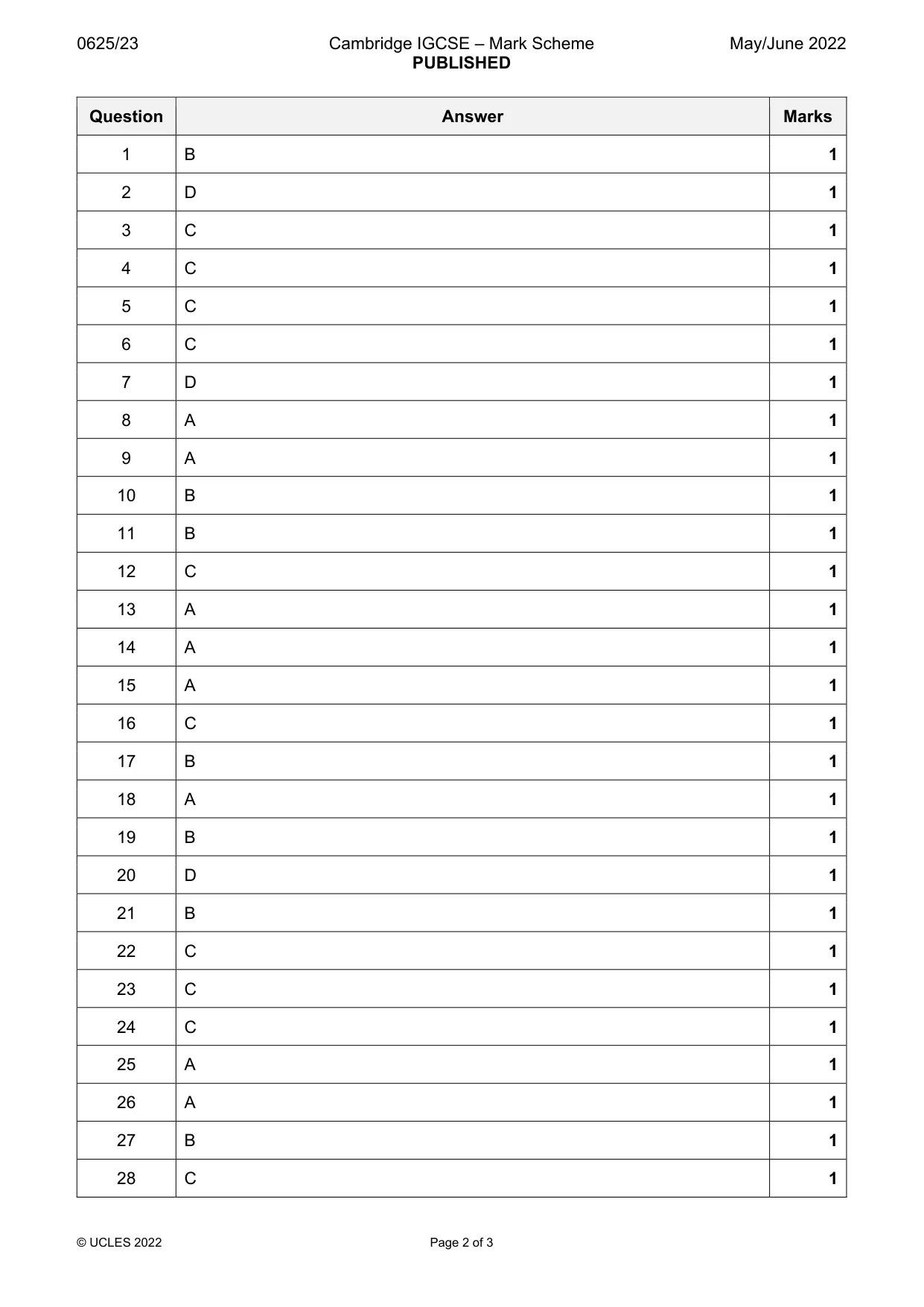
Answers below. Sit the paper first if you are practising.
Questions as text
Q1 · What is a micrometer screw gauge used to measure?
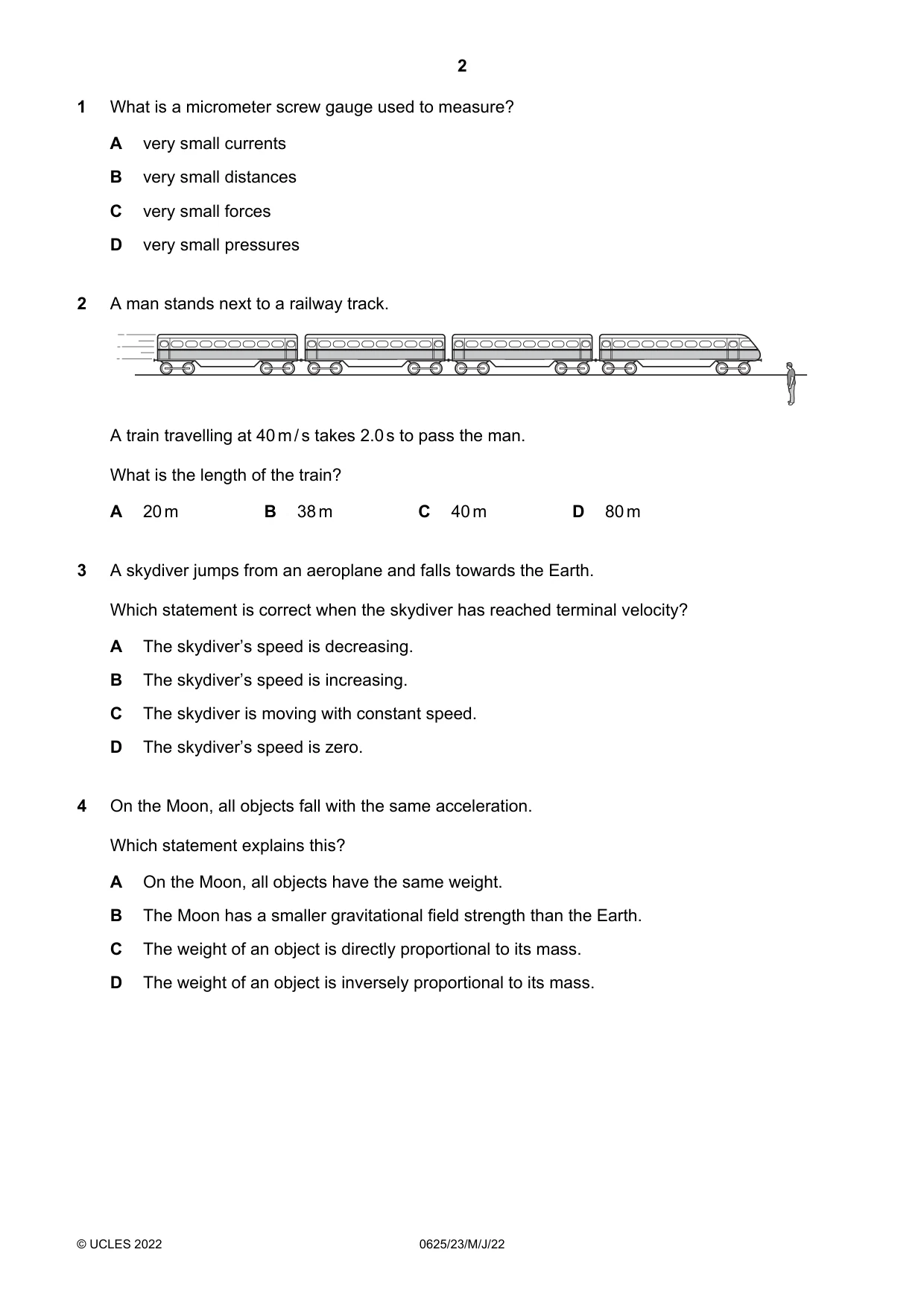
1 What is a micrometer screw gauge used to measure? A very small currents B very small distances C very small forces D very small pressures
Mark scheme: B
More questions on Physical quantities and measurement techniques
Q2 · A man stands next to a railway track
2 A man stands next to a railway track. A train travelling at 40 m / s takes 2.0 s to pass the man. What is the length of the train? A 20 m B 38 m C 40 m D 80 m
Mark scheme: D
Q3 · A skydiver jumps from an aeroplane and falls towards the Earth
3 A skydiver jumps from an aeroplane and falls towards the Earth. Which statement is correct when the skydiver has reached terminal velocity? A The skydiver’s speed is decreasing. B The skydiver’s speed is increasing. C The skydiver is moving with constant speed. D The skydiver’s speed is zero.
Mark scheme: C
Q4 · On the Moon, all objects fall with the same acceleration
4 On the Moon, all objects fall with the same acceleration. Which statement explains this? A On the Moon, all objects have the same weight. B The Moon has a smaller gravitational field strength than the Earth. C The weight of an object is directly proportional to its mass. D The weight of an object is inversely proportional to its mass.
Mark scheme: C
Q5 · A measuring cylinder contains 30 cm3 of a liquid
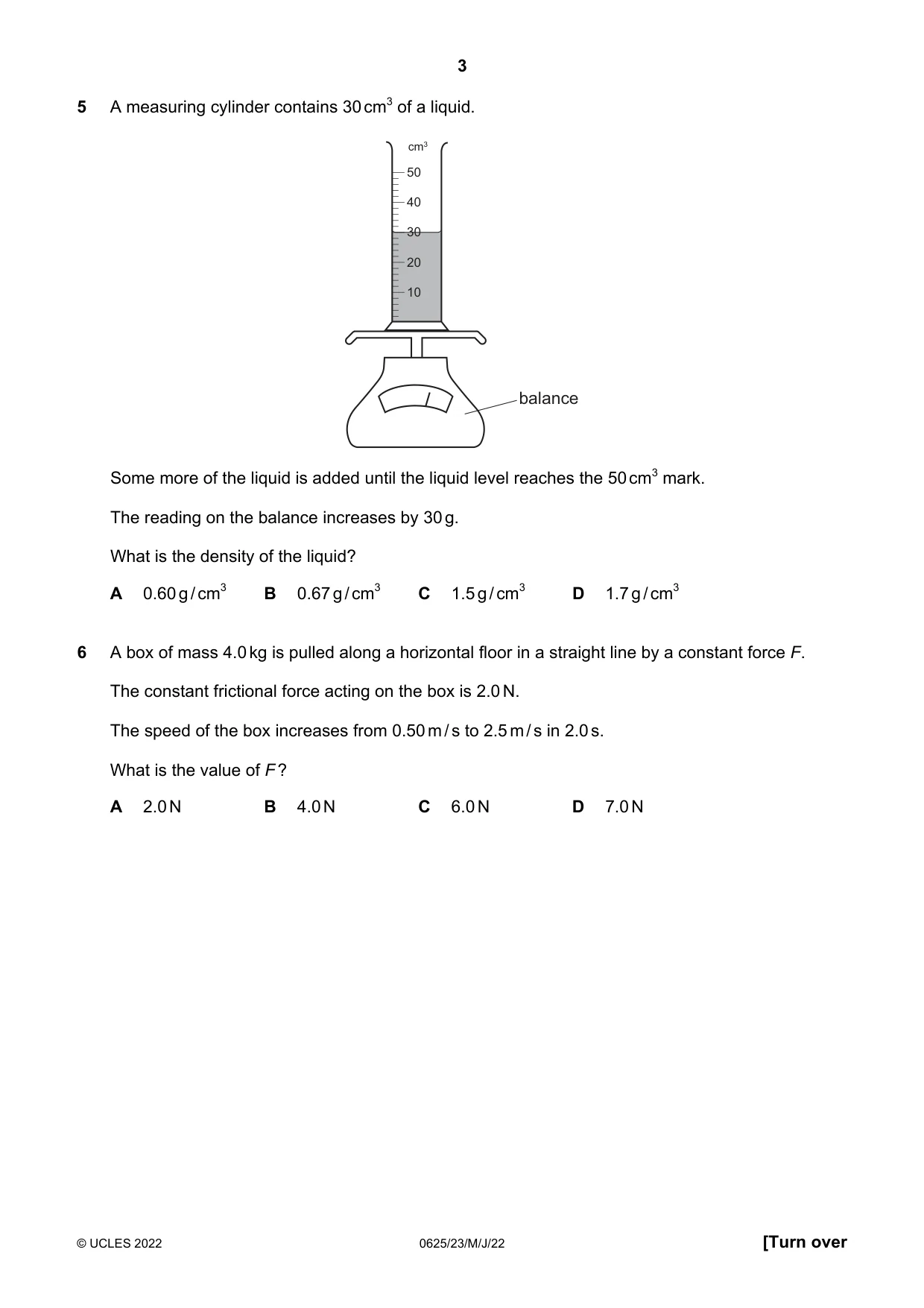
5 A measuring cylinder contains 30 cm3 of a liquid. cm3 50 40 30 20 10 balance Some more of the liquid is added until the liquid level reaches the 50 cm3 mark. The reading on the balance increases by 30 g. What is the density of the liquid? A 0.60 g / cm3 B 0.67 g / cm3 C 1.5 g / cm3 D 1.7 g / cm3
Mark scheme: C
Q6 · A box of mass 4.0 kg is pulled along a horizontal floor in a straight line by a constant…
6 A box of mass 4.0 kg is pulled along a horizontal floor in a straight line by a constant force F. The constant frictional force acting on the box is 2.0 N. The speed of the box increases from 0.50 m / s to 2.5 m / s in 2.0 s. What is the value of F ? A 2.0 N B 4.0 N C 6.0 N D 7.0 N
Mark scheme: C
Q7 · A beam is pivoted at one end, as shown
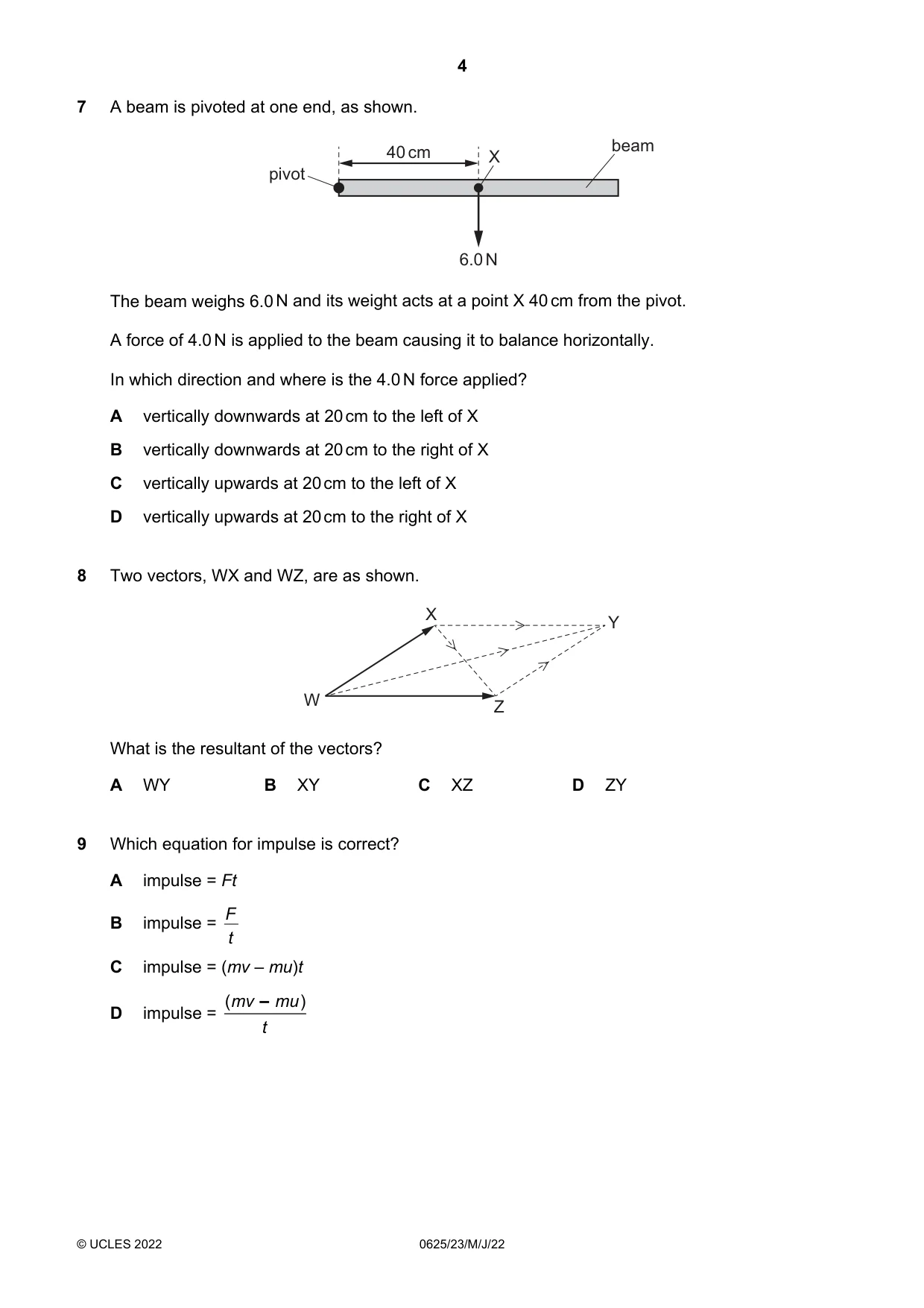
7 A beam is pivoted at one end, as shown. 40 cm beam X pivot 6.0 N The beam weighs 6.0 N and its weight acts at a point X 40 cm from the pivot. A force of 4.0 N is applied to the beam causing it to balance horizontally. In which direction and where is the 4.0 N force applied? A vertically downwards at 20 cm to the left of X B vertically downwards at 20 cm to the right of X C vertically upwards at 20 cm to the left of X D vertically upwards at 20 cm to the right of X
Mark scheme: D
Q8 · Two vectors, WX and WZ, are as shown
8 Two vectors, WX and WZ, are as shown. X Y W Z What is the resultant of the vectors? A WY B XY C XZ D ZY
Mark scheme: A
Q9 · Which equation for impulse is correct?
9 Which equation for impulse is correct? A impulse = Ft F B impulse = t C impulse = (mv – mu)t ( mv – mu ) D impulse = t
Mark scheme: A
Q10 · A ball of mass 0.16 kg is moving forwards at a speed of 0.50 m / s
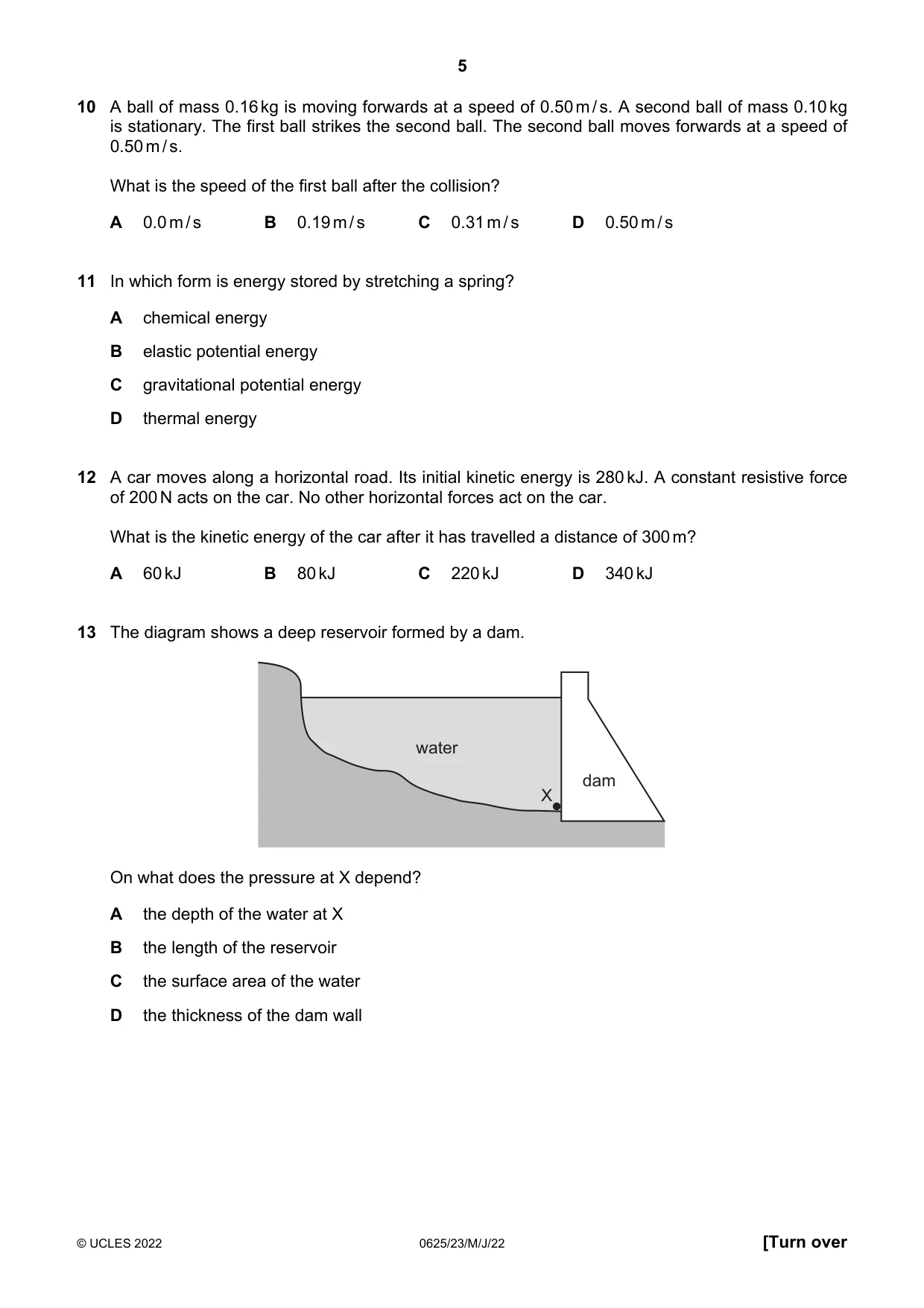
10 A ball of mass 0.16 kg is moving forwards at a speed of 0.50 m / s. A second ball of mass 0.10 kg is stationary. The first ball strikes the second ball. The second ball moves forwards at a speed of 0.50 m / s. What is the speed of the first ball after the collision? A 0.0 m / s B 0.19 m / s C 0.31 m / s D 0.50 m / s
Mark scheme: B
Q11 · In which form is energy stored by stretching a spring?
11 In which form is energy stored by stretching a spring? A chemical energy B elastic potential energy C gravitational potential energy D thermal energy
Mark scheme: B
Q12 · A car moves along a horizontal road
12 A car moves along a horizontal road. Its initial kinetic energy is 280 kJ. A constant resistive force of 200 N acts on the car. No other horizontal forces act on the car. What is the kinetic energy of the car after it has travelled a distance of 300 m? A 60 kJ B 80 kJ C 220 kJ D 340 kJ
Mark scheme: C
Q13 · The diagram shows a deep reservoir formed by a dam
13 The diagram shows a deep reservoir formed by a dam. water dam X On what does the pressure at X depend? A the depth of the water at X B the length of the reservoir C the surface area of the water D the thickness of the dam wall
Mark scheme: A
Q14 · The diagram shows gas particles hitting the wall of a container
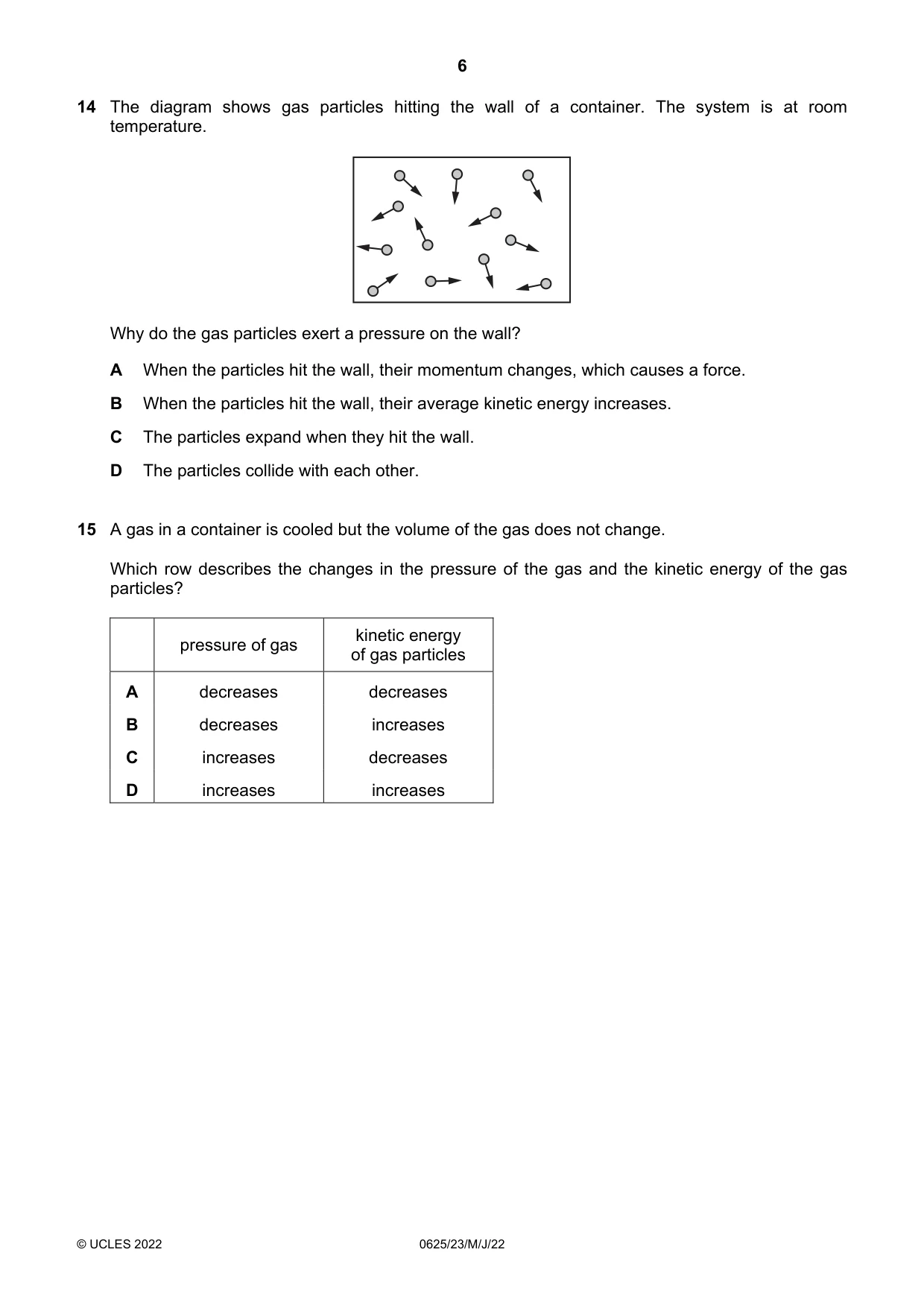
14 The diagram shows gas particles hitting the wall of a container. The system is at room temperature. Why do the gas particles exert a pressure on the wall? A When the particles hit the wall, their momentum changes, which causes a force. B When the particles hit the wall, their average kinetic energy increases. C The particles expand when they hit the wall. D The particles collide with each other.
Mark scheme: A
Q15 · A gas in a container is cooled but the volume of the gas does not change
15 A gas in a container is cooled but the volume of the gas does not change. Which row describes the changes in the pressure of the gas and the kinetic energy of the gas particles? kinetic energy pressure of gas of gas particles A decreases decreases B decreases increases C increases decreases D increases increases
Mark scheme: A
Q16 · The iron cylinder of an engine is to be fitted into a piece of aluminium
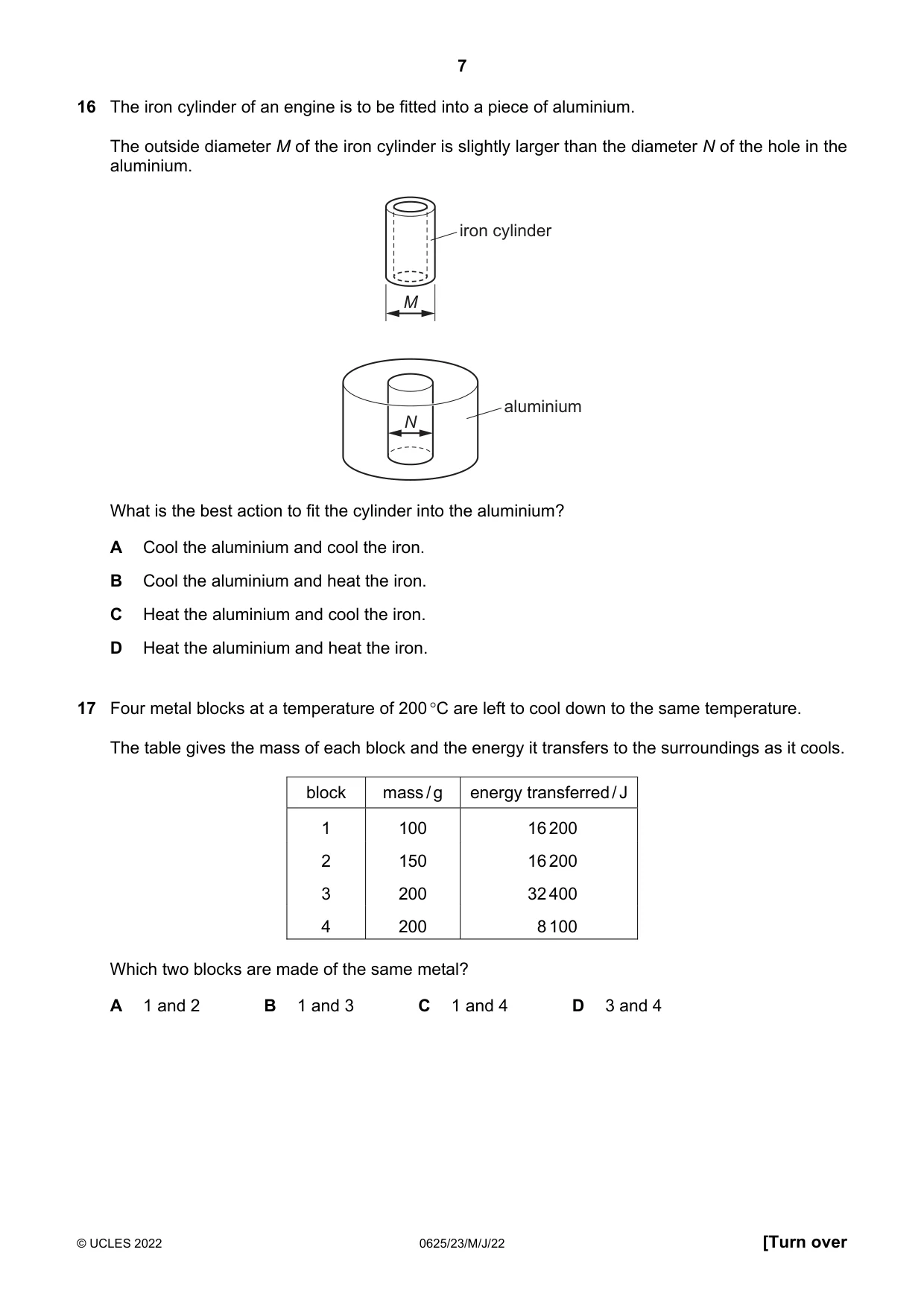
16 The iron cylinder of an engine is to be fitted into a piece of aluminium. The outside diameter M of the iron cylinder is slightly larger than the diameter N of the hole in the aluminium. iron cylinder M aluminium N What is the best action to fit the cylinder into the aluminium? A Cool the aluminium and cool the iron. B Cool the aluminium and heat the iron. C Heat the aluminium and cool the iron. D Heat the aluminium and heat the iron.
Mark scheme: C
Q17 · Four metal blocks at a temperature of 200 °C are left to cool down to the same temperature
17 Four metal blocks at a temperature of 200 °C are left to cool down to the same temperature. The table gives the mass of each block and the energy it transfers to the surroundings as it cools. block mass / g energy transferred / J 1 100 16 200 2 150 16 200 3 200 32 400 4 200 8 100 Which two blocks are made of the same metal? A 1 and 2 B 1 and 3 C 1 and 4 D 3 and 4
Mark scheme: B
Q18 · A glass contains an iced drink on a warm and humid day
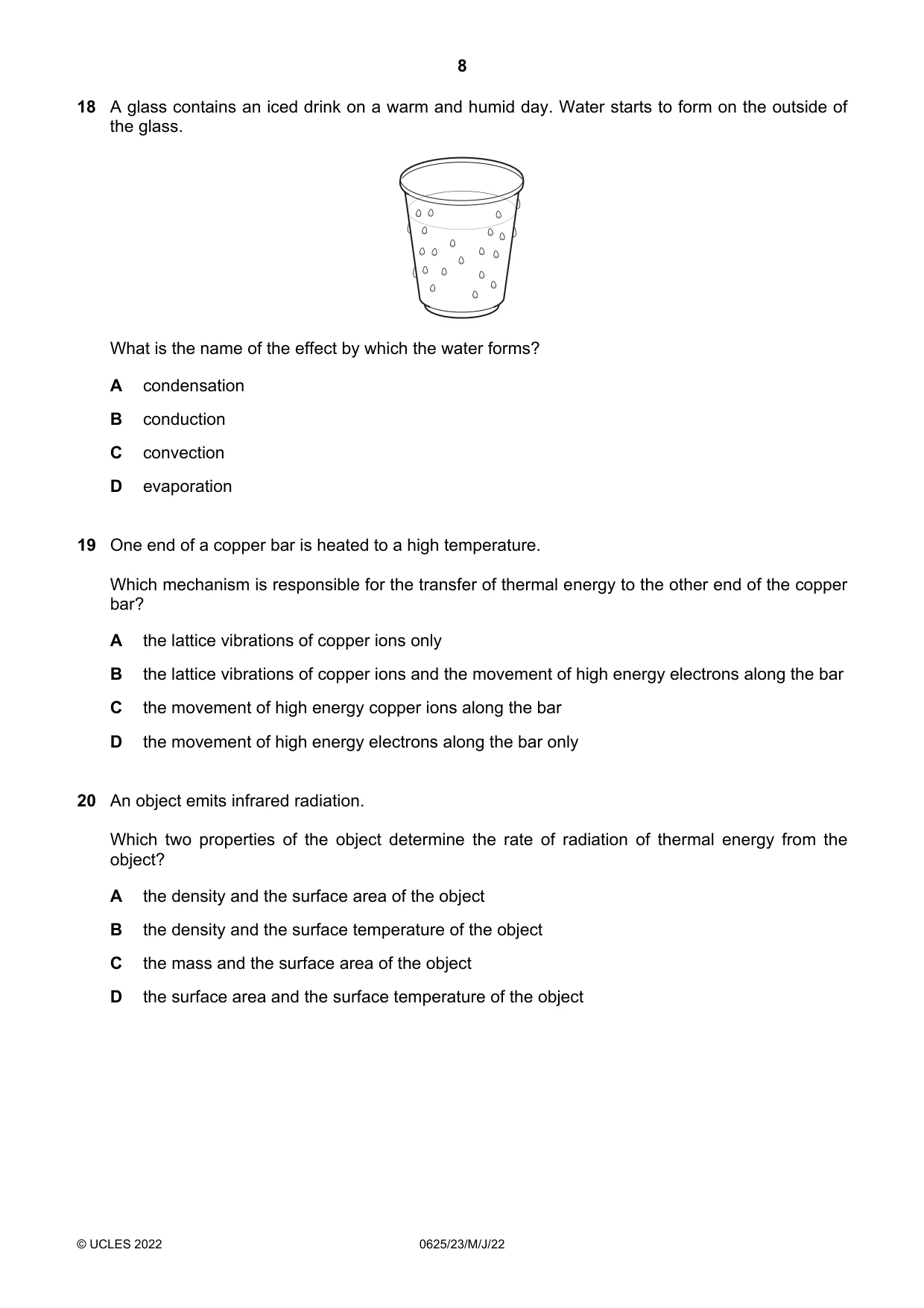
18 A glass contains an iced drink on a warm and humid day. Water starts to form on the outside of the glass. What is the name of the effect by which the water forms? A condensation B conduction C convection D evaporation
Mark scheme: A
Q19 · One end of a copper bar is heated to a high temperature
19 One end of a copper bar is heated to a high temperature. Which mechanism is responsible for the transfer of thermal energy to the other end of the copper bar? A the lattice vibrations of copper ions only B the lattice vibrations of copper ions and the movement of high energy electrons along the bar C the movement of high energy copper ions along the bar D the movement of high energy electrons along the bar only
Mark scheme: B
Q20 · An object emits infrared radiation
20 An object emits infrared radiation. Which two properties of the object determine the rate of radiation of thermal energy from the object? A the density and the surface area of the object B the density and the surface temperature of the object C the mass and the surface area of the object D the surface area and the surface temperature of the object
Mark scheme: D
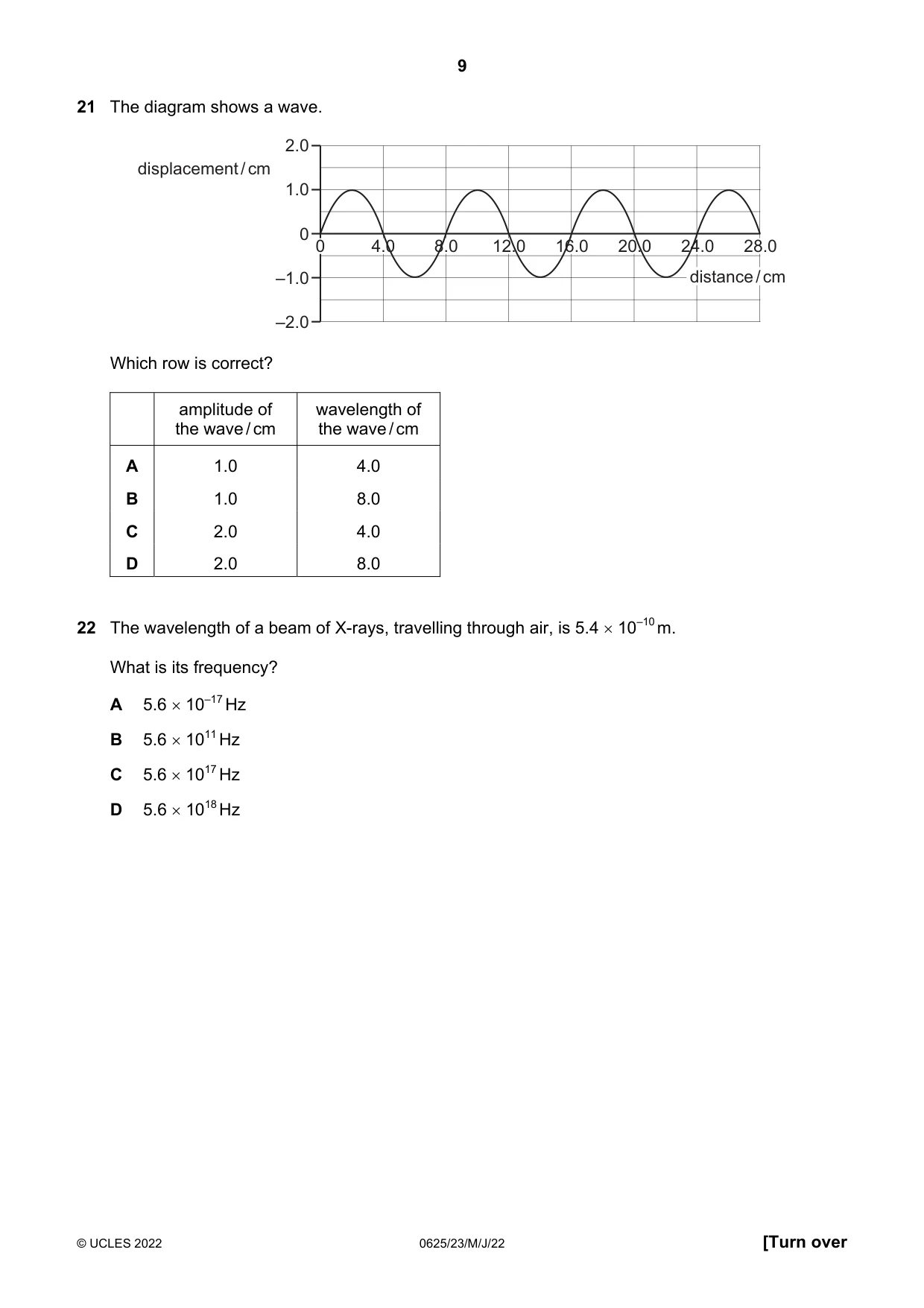
Q21 · The diagram shows a wave
21 The diagram shows a wave. 2.0 displacement / cm 1.0 0 0 4.0 8.0 12.0 16.0 20.0 24.0 28.0 –1.0 distance / cm –2.0 Which row is correct? amplitude of wavelength of the wave / cm the wave / cm A 1.0 4.0 B 1.0 8.0 C 2.0 4.0 D 2.0 8.0
Mark scheme: B
Q22 · The wavelength of a beam of X-rays, travelling through air, is 5.4 × 10⁻¹⁰ m
22 The wavelength of a beam of X-rays, travelling through air, is 5.4 × 10⁻¹⁰ m. What is its frequency? A 5.6 × 10⁻¹⁷ Hz B 5.6 × 10¹¹ Hz C 5.6 × 10¹⁷ Hz D 5.6 × 10¹⁸ Hz
Mark scheme: C
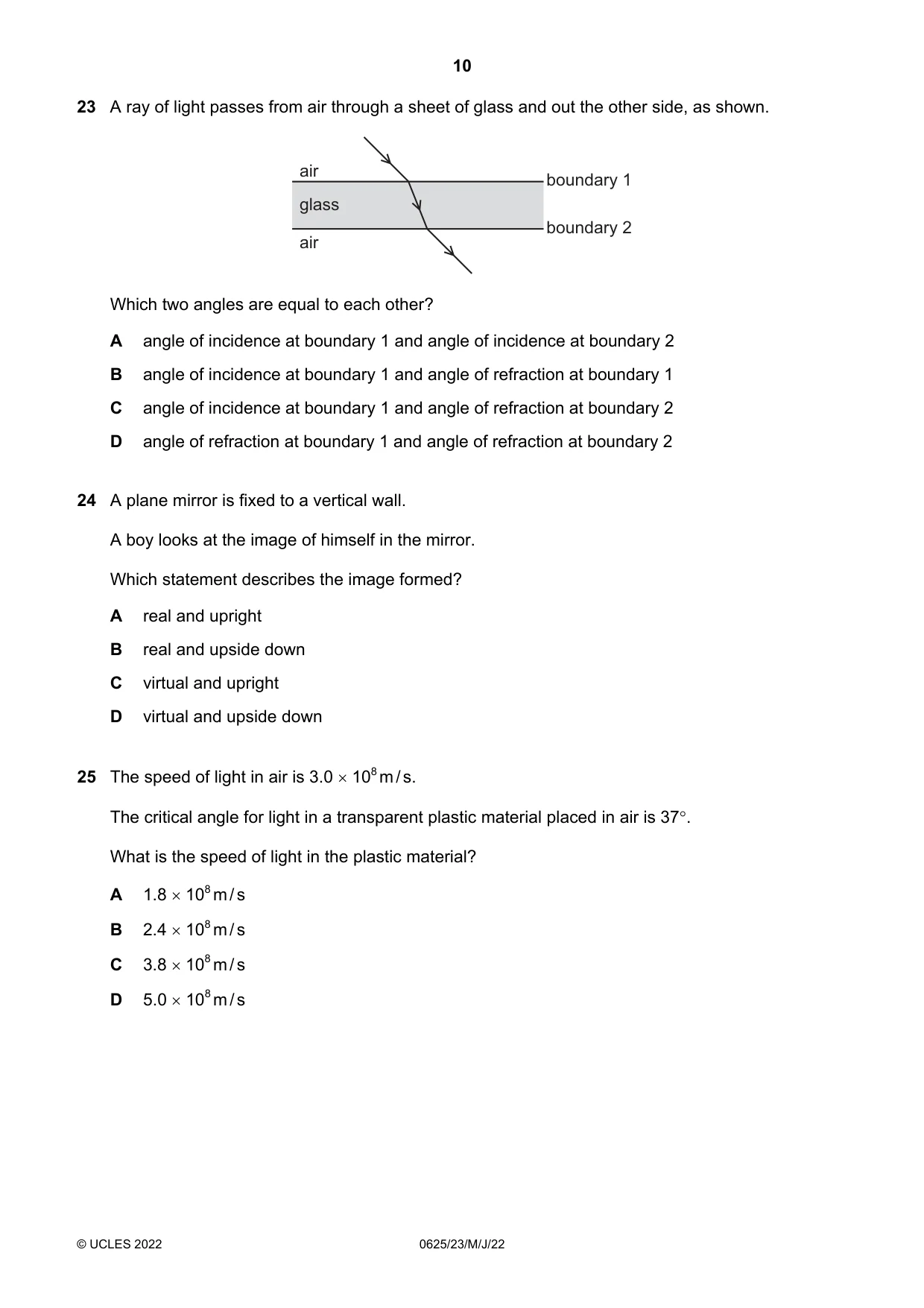
Q23 · A ray of light passes from air through a sheet of glass and out the other side, as shown
23 A ray of light passes from air through a sheet of glass and out the other side, as shown. air boundary 1 glass boundary 2 air Which two angles are equal to each other? A angle of incidence at boundary 1 and angle of incidence at boundary 2 B angle of incidence at boundary 1 and angle of refraction at boundary 1 C angle of incidence at boundary 1 and angle of refraction at boundary 2 D angle of refraction at boundary 1 and angle of refraction at boundary 2
Mark scheme: C
Q24 · A plane mirror is fixed to a vertical wall
24 A plane mirror is fixed to a vertical wall. A boy looks at the image of himself in the mirror. Which statement describes the image formed? A real and upright B real and upside down C virtual and upright D virtual and upside down
Mark scheme: C
Q25 · The speed of light in air is 3.0 × 10⁸ m / s
25 The speed of light in air is 3.0 × 10⁸ m / s. The critical angle for light in a transparent plastic material placed in air is 37°. What is the speed of light in the plastic material? A 1.8 × 10⁸ m / s B 2.4 × 10⁸ m / s C 3.8 × 10⁸ m / s D 5.0 × 10⁸ m / s
Mark scheme: A
Q26 · A resistor and a battery are connected in series
26 A resistor and a battery are connected in series. The value of the resistor is 20 Ω. The potential difference (p.d.) of the battery is 4.0 V. What is the current in the resistor? A 0.20 A B 4.0 A C 5.0 A D 80 A
Mark scheme: A
Q27 · Which statement correctly compares radio waves and X-rays?
27 Which statement correctly compares radio waves and X-rays? A Radio waves have a longer wavelength and a greater speed in a vacuum. B Radio waves have a longer wavelength and the same speed in a vacuum. C Radio waves have a shorter wavelength and a greater speed in a vacuum. D Radio waves have a shorter wavelength and the same speed in a vacuum.
Mark scheme: B
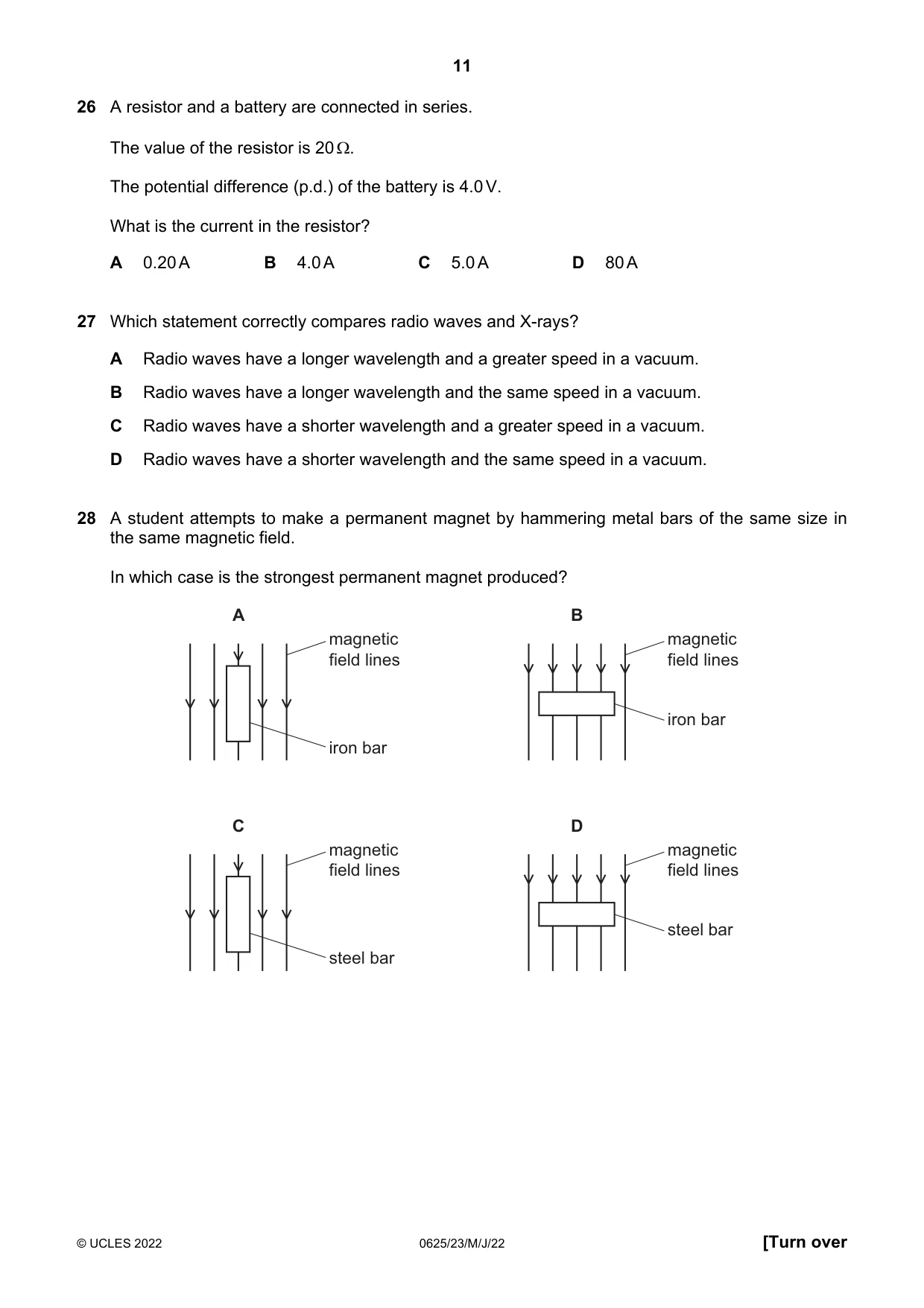
Q28 · A student attempts to make a permanent magnet by hammering metal bars of the same size in…
28 A student attempts to make a permanent magnet by hammering metal bars of the same size in the same magnetic field. In which case is the strongest permanent magnet produced? A B magnetic magnetic field lines field lines iron bar iron bar C D magnetic magnetic field lines field lines steel bar steel bar
Mark scheme: C
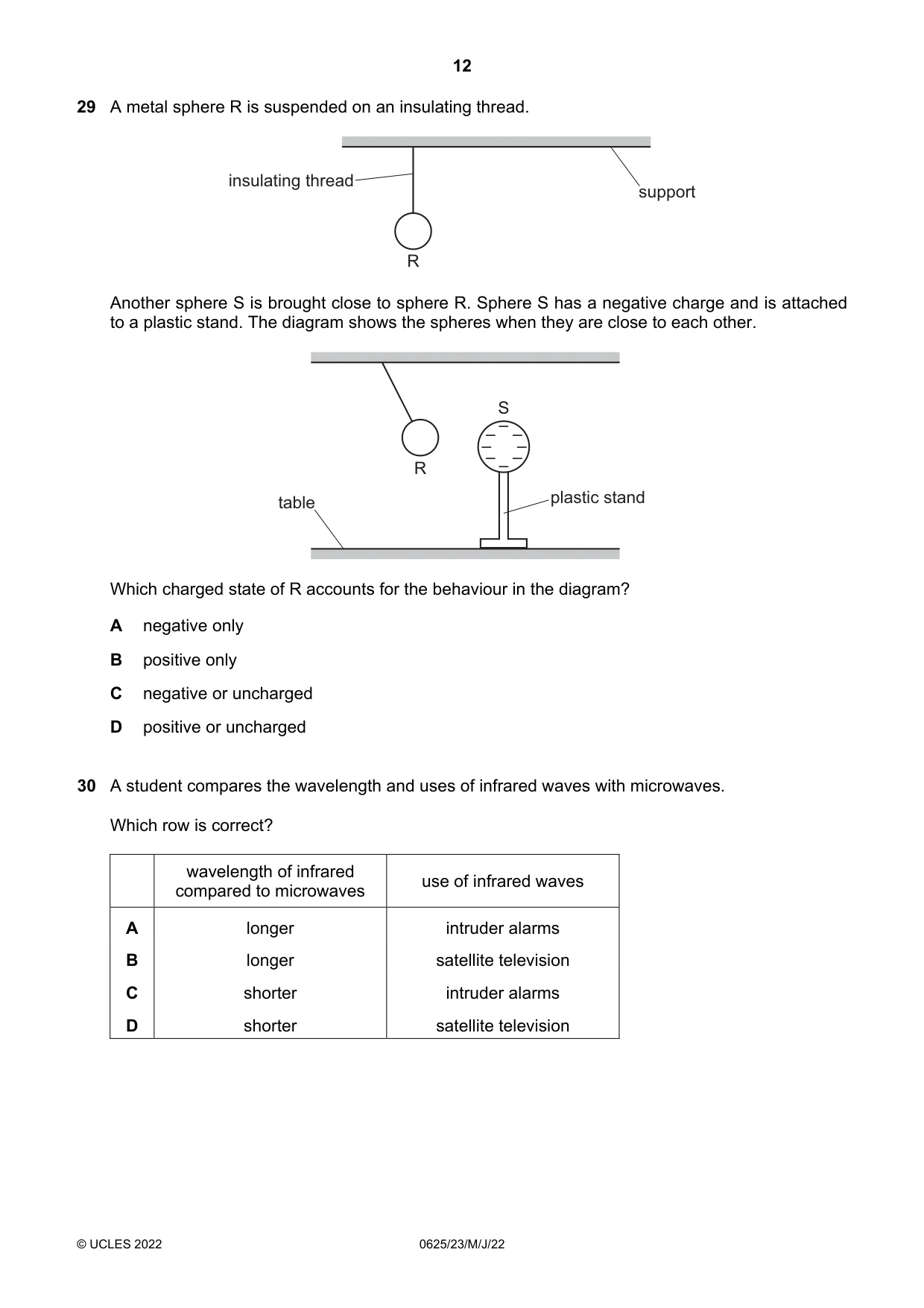
Q29 · A metal sphere R is suspended on an insulating thread
29 A metal sphere R is suspended on an insulating thread. insulating thread support R Another sphere S is brought close to sphere R. Sphere S has a negative charge and is attached to a plastic stand. The diagram shows the spheres when they are close to each other. S – – – – – – – R – table plastic stand Which charged state of R accounts for the behaviour in the diagram? A negative only B positive only C negative or uncharged D positive or uncharged
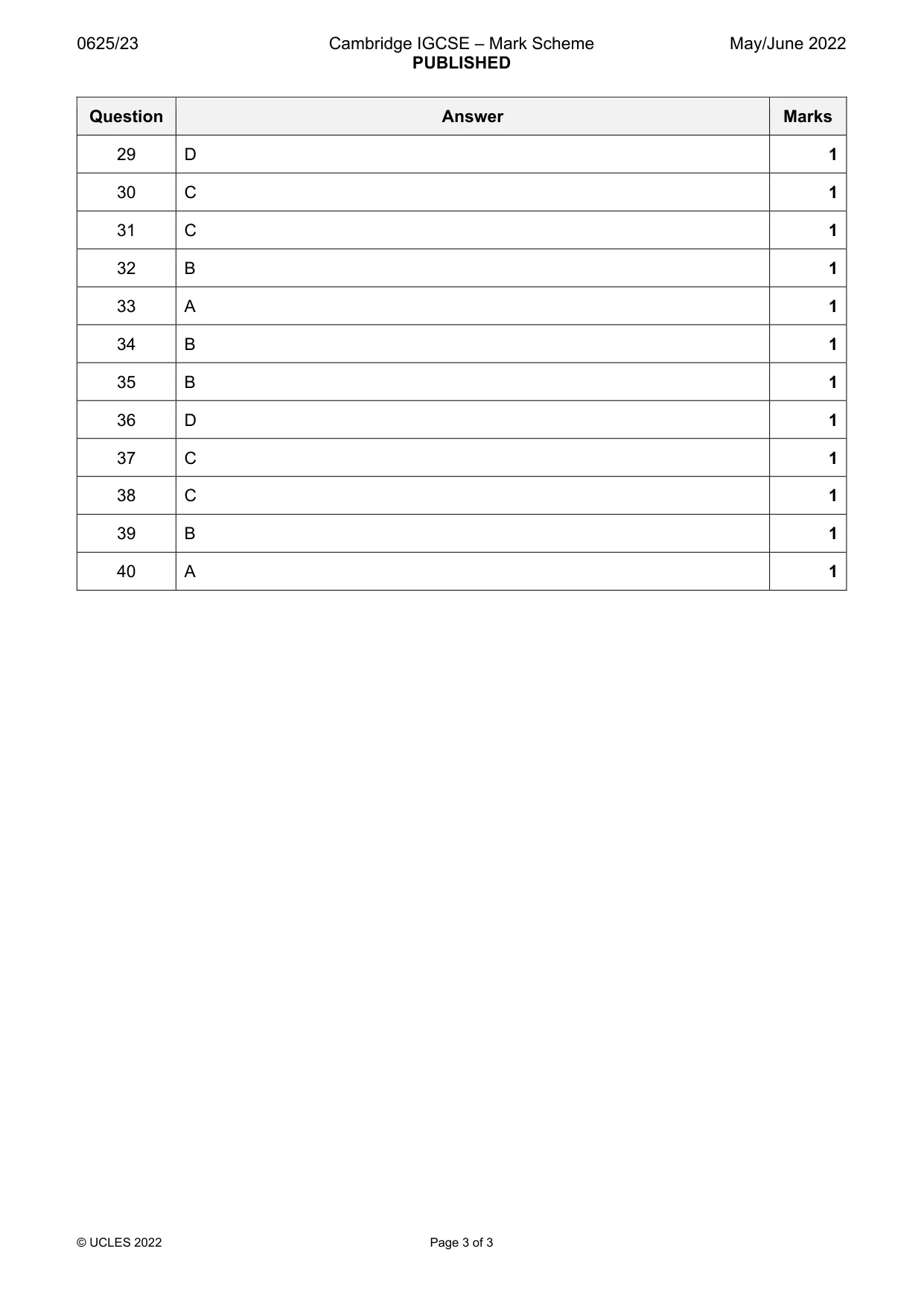
Mark scheme: D
Q30 · A student compares the wavelength and uses of infrared waves with microwaves
30 A student compares the wavelength and uses of infrared waves with microwaves. Which row is correct? wavelength of infrared use of infrared waves compared to microwaves A longer intruder alarms B longer satellite television C shorter intruder alarms D shorter satellite television
Mark scheme: C
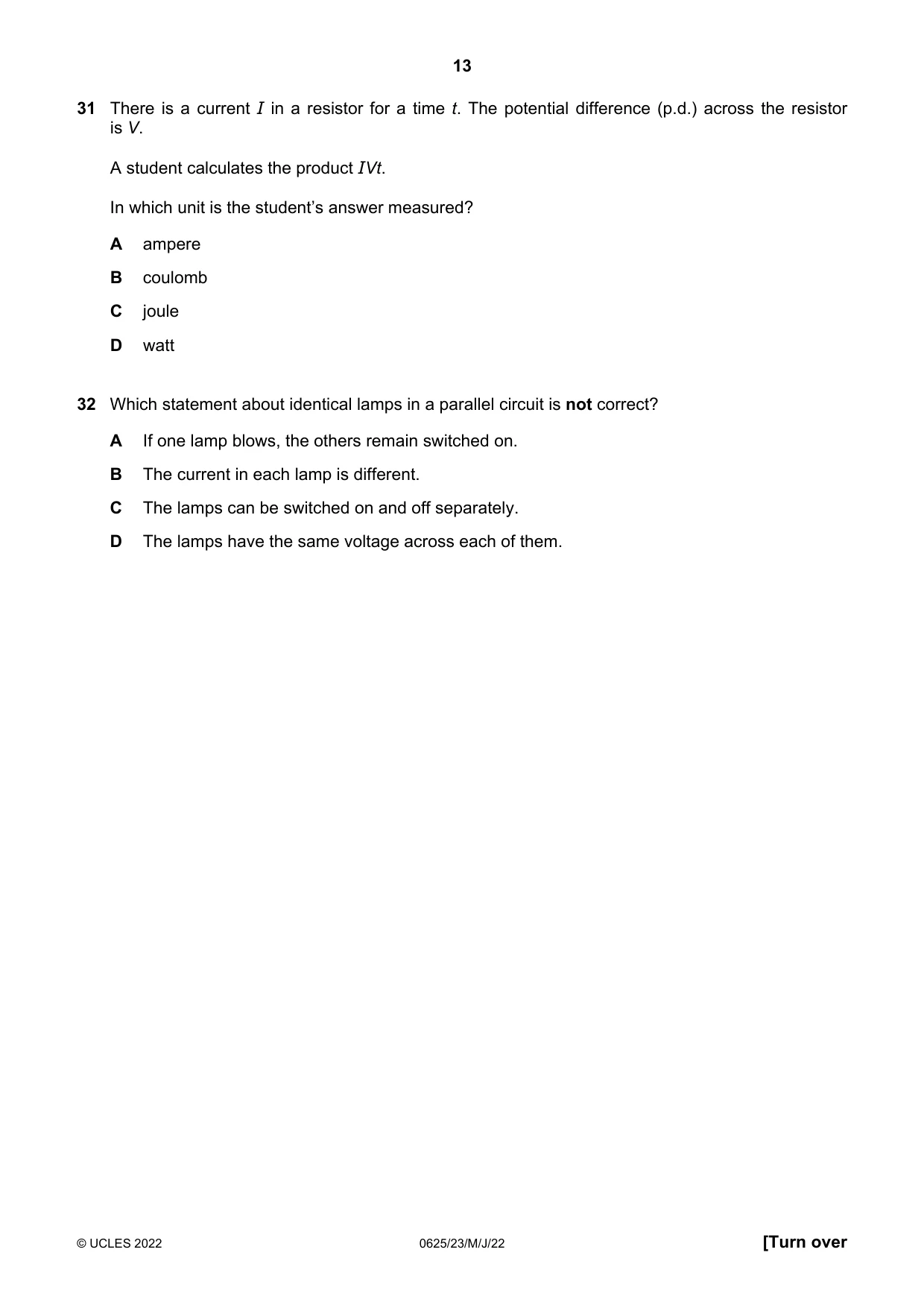
Q31 · There is a current I in a resistor for a time t
31 There is a current I in a resistor for a time t. The potential difference (p.d.) across the resistor is V. A student calculates the product IVt. In which unit is the student’s answer measured? A ampere B coulomb C joule D watt
Mark scheme: C
Q32 · Which statement about identical lamps in a parallel circuit is not correct?
32 Which statement about identical lamps in a parallel circuit is not correct? A If one lamp blows, the others remain switched on. B The current in each lamp is different. C The lamps can be switched on and off separately. D The lamps have the same voltage across each of them.
Mark scheme: B
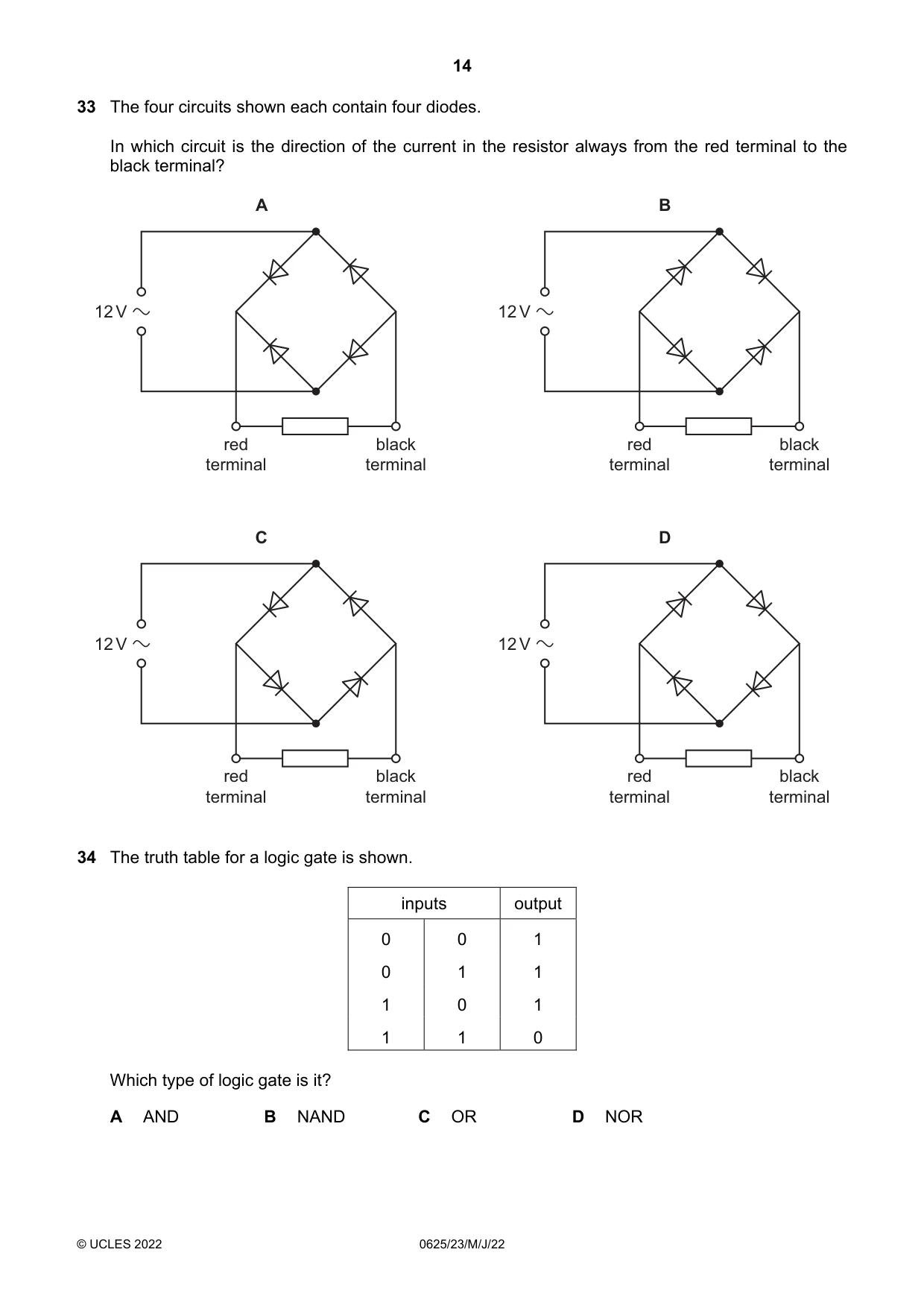
Q33 · The four circuits shown each contain four diodes
33 The four circuits shown each contain four diodes. In which circuit is the direction of the current in the resistor always from the red terminal to the black terminal? A B 12 V 12 V red black red black terminal terminal terminal terminal C D 12 V 12 V red black red black terminal terminal terminal terminal
Mark scheme: A
Q34 · The truth table for a logic gate is shown
34 The truth table for a logic gate is shown. inputs output 0 0 1 0 1 1 1 0 1 1 1 0 Which type of logic gate is it? A AND B NAND C OR D NOR
Mark scheme: B
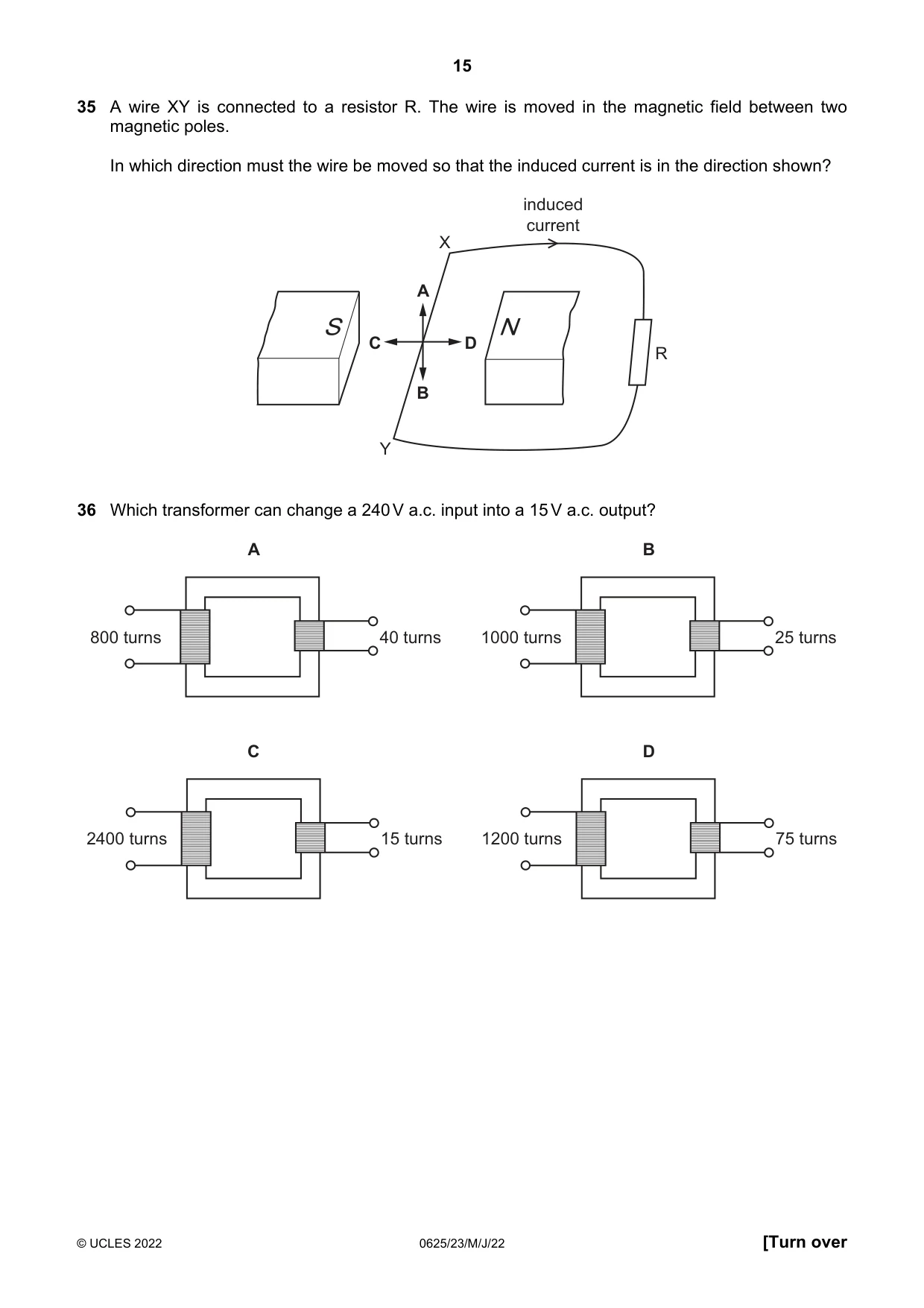
Q35 · A wire XY is connected to a resistor R
35 A wire XY is connected to a resistor R. The wire is moved in the magnetic field between two magnetic poles. In which direction must the wire be moved so that the induced current is in the direction shown? induced current X A S N C D R B Y
Mark scheme: B
Q36 · Which transformer can change a 240 V a.c
36 Which transformer can change a 240 V a.c. input into a 15 V a.c. output? A B 800 turns 40 turns 1000 turns 25 turns C D 2400 turns 15 turns 1200 turns 75 turns
Mark scheme: D
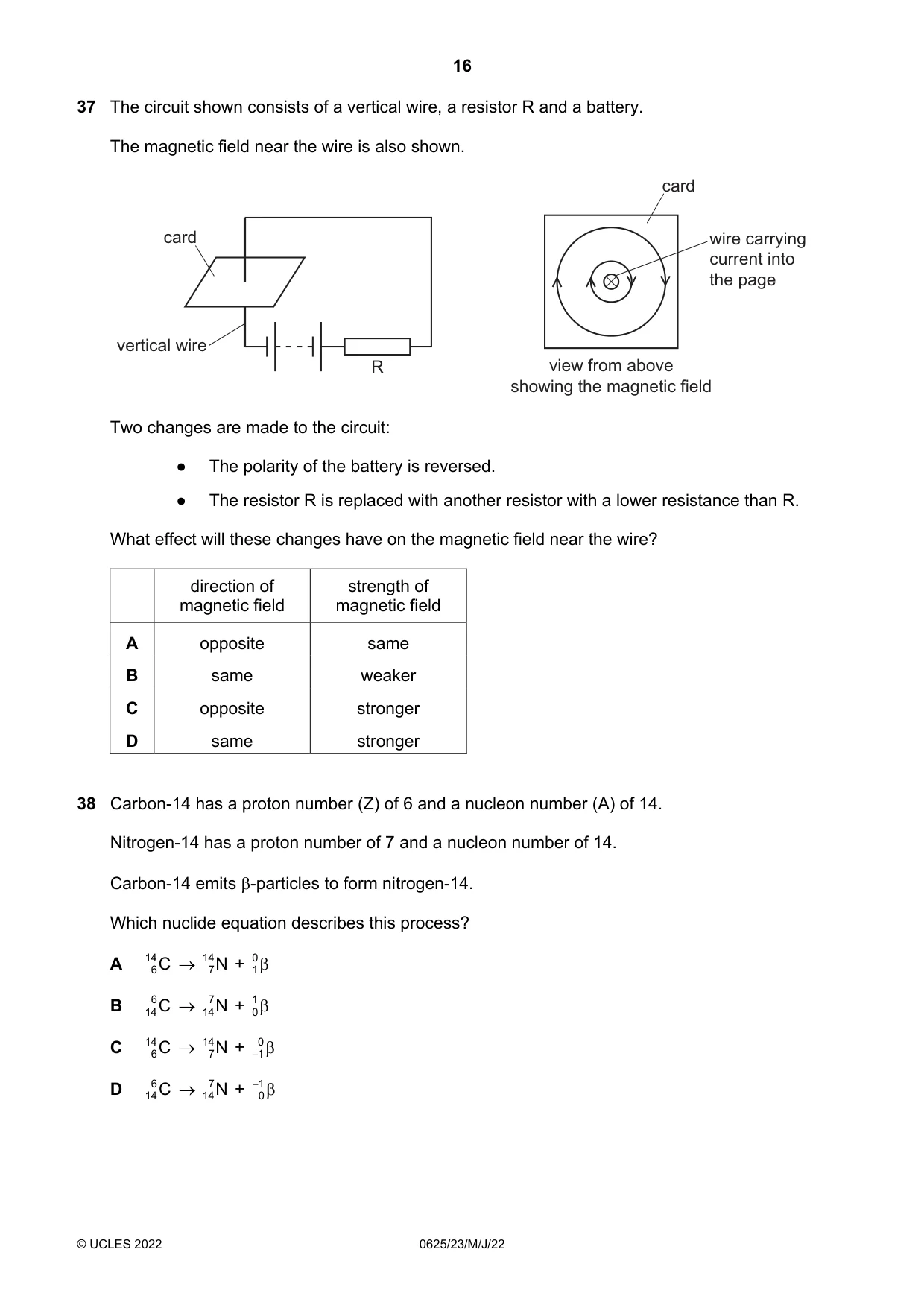
Q37 · The circuit shown consists of a vertical wire, a resistor R and a battery
37 The circuit shown consists of a vertical wire, a resistor R and a battery. The magnetic field near the wire is also shown. card card wire carrying current into the page vertical wire R view from above showing the magnetic field Two changes are made to the circuit: ● The polarity of the battery is reversed. ● The resistor R is replaced with another resistor with a lower resistance than R. What effect will these changes have on the magnetic field near the wire? direction of strength of magnetic field magnetic field A opposite same B same weaker C opposite stronger D same stronger
Mark scheme: C
Q38 · Carbon-14 has a proton number (Z) of 6 and a nucleon number (A) of 14
38 Carbon-14 has a proton number (Z) of 6 and a nucleon number (A) of 14. Nitrogen-14 has a proton number of 7 and a nucleon number of 14. Carbon-14 emits β-particles to form nitrogen-14. Which nuclide equation describes this process? A 14 C → 14 N + β 0 1 6 7 B 6 C → 7 N + β 1 0 14 14 C 14 C → 14 N + 1 0 β 6 7 − D 6 C → 7 N + −1 β 14 14 0
Mark scheme: C
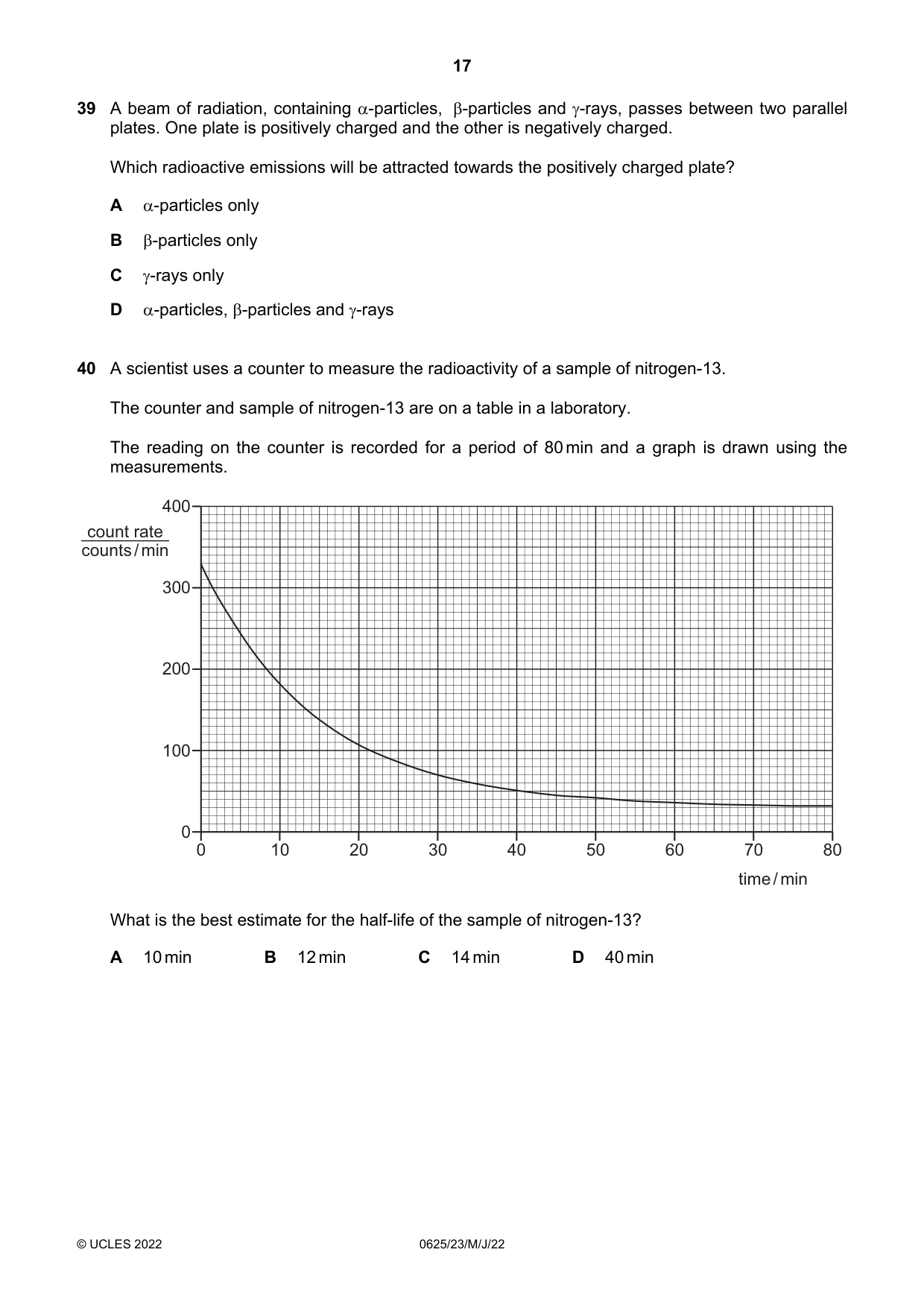
Q39 · A beam of radiation, containing α-particles, β-particles and γ-rays, passes between two…
39 A beam of radiation, containing α-particles, β-particles and γ-rays, passes between two parallel plates. One plate is positively charged and the other is negatively charged. Which radioactive emissions will be attracted towards the positively charged plate? A α-particles only B β-particles only C γ-rays only D α-particles, β-particles and γ-rays
Mark scheme: B
Q40 · A scientist uses a counter to measure the radioactivity of a sample of nitrogen-13
40 A scientist uses a counter to measure the radioactivity of a sample of nitrogen-13. The counter and sample of nitrogen-13 are on a table in a laboratory. The reading on the counter is recorded for a period of 80 min and a graph is drawn using the measurements. 400 count rate counts / min 300 200 100 0 0 10 20 30 40 50 60 70 80 time / min What is the best estimate for the half-life of the sample of nitrogen-13? A 10 min B 12 min C 14 min D 40 min
Mark scheme: A
What was in this paper
The subtopics covered by these 40 questions, and how many questions each got. Open one in a new tab to see every Cambridge question on it.
4Electric circuits3Electromagnetic effects3Light3Transfer of thermal energy3Electrical quantities2Electromagnetic spectrum2Energy, work and power2General properties of waves2Kinetic particle model of matter2Momentum2Radioactivity2Simple phenomena of magnetism2Thermal properties and temperature2Density1Mass and weight1Motion1Physical quantities and measurement techniques1Pressure1The nuclear model of the atom1What you needed in this session
Cambridge’s own grade thresholds for 2022 May/June, Paper 2 · Variant 3. A higher threshold means an easier paper — the bar moves with how the cohort did.