Cambridge IGCSE Physics 0625 — 2019 Feb/March Paper 2 · Variant 2
0625/22/F/M/19 · 40 questions · 40 marks · ≈45 min
The question paper and its mark scheme, free to read here and free to download. This is Cambridge’s own paper, exactly as it was sat.
Question paper16 pages
Mark scheme3 pages
Answers below. Sit the paper first if you are practising.
Questions as text
Q1 · Which row shows the best choice of measuring instruments to obtain accurate values for…
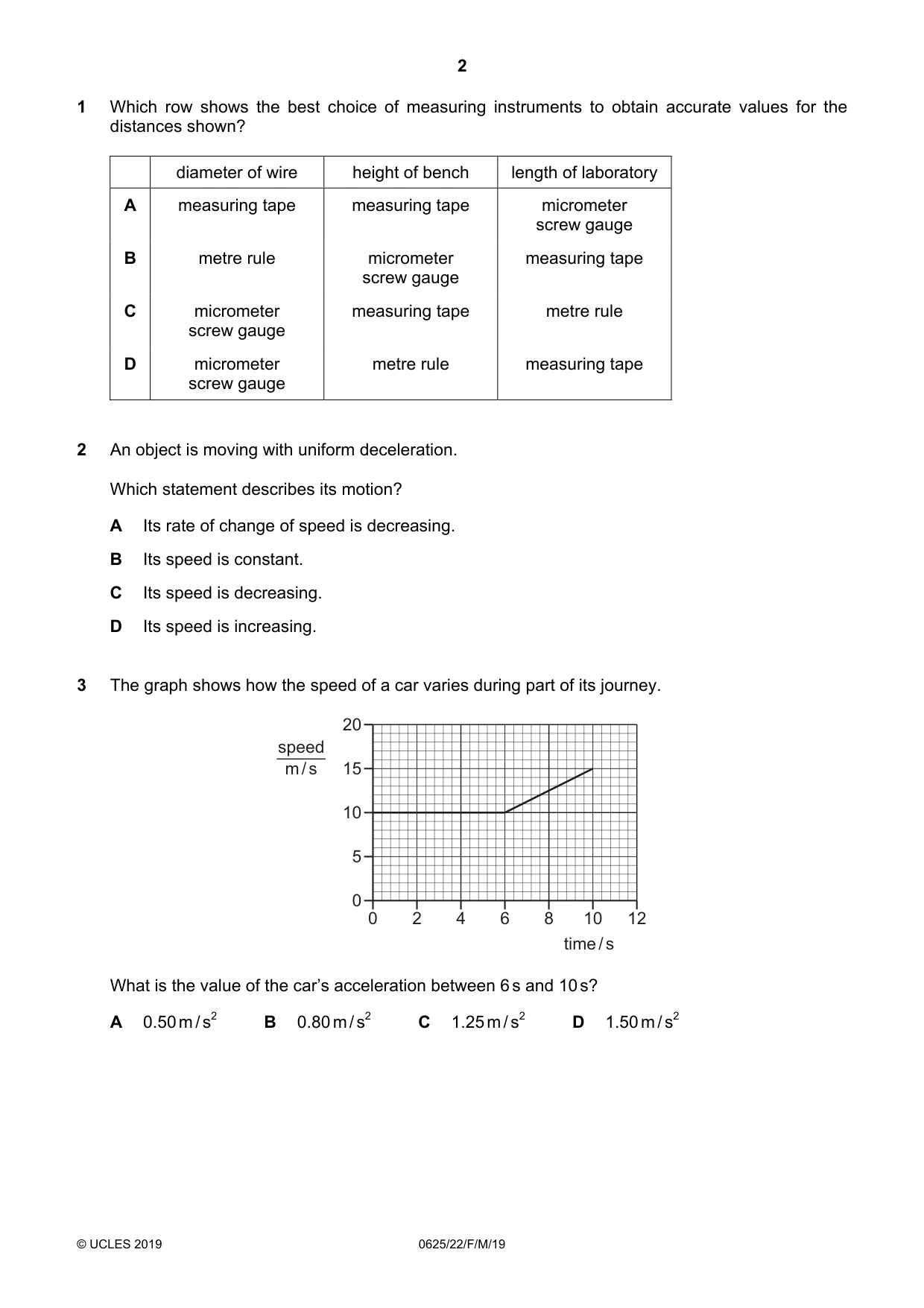
1 Which row shows the best choice of measuring instruments to obtain accurate values for the distances shown? diameter of wire height of bench length of laboratory A measuring tape measuring tape micrometer screw gauge B metre rule micrometer measuring tape screw gauge C micrometer measuring tape metre rule screw gauge D micrometer metre rule measuring tape screw gauge
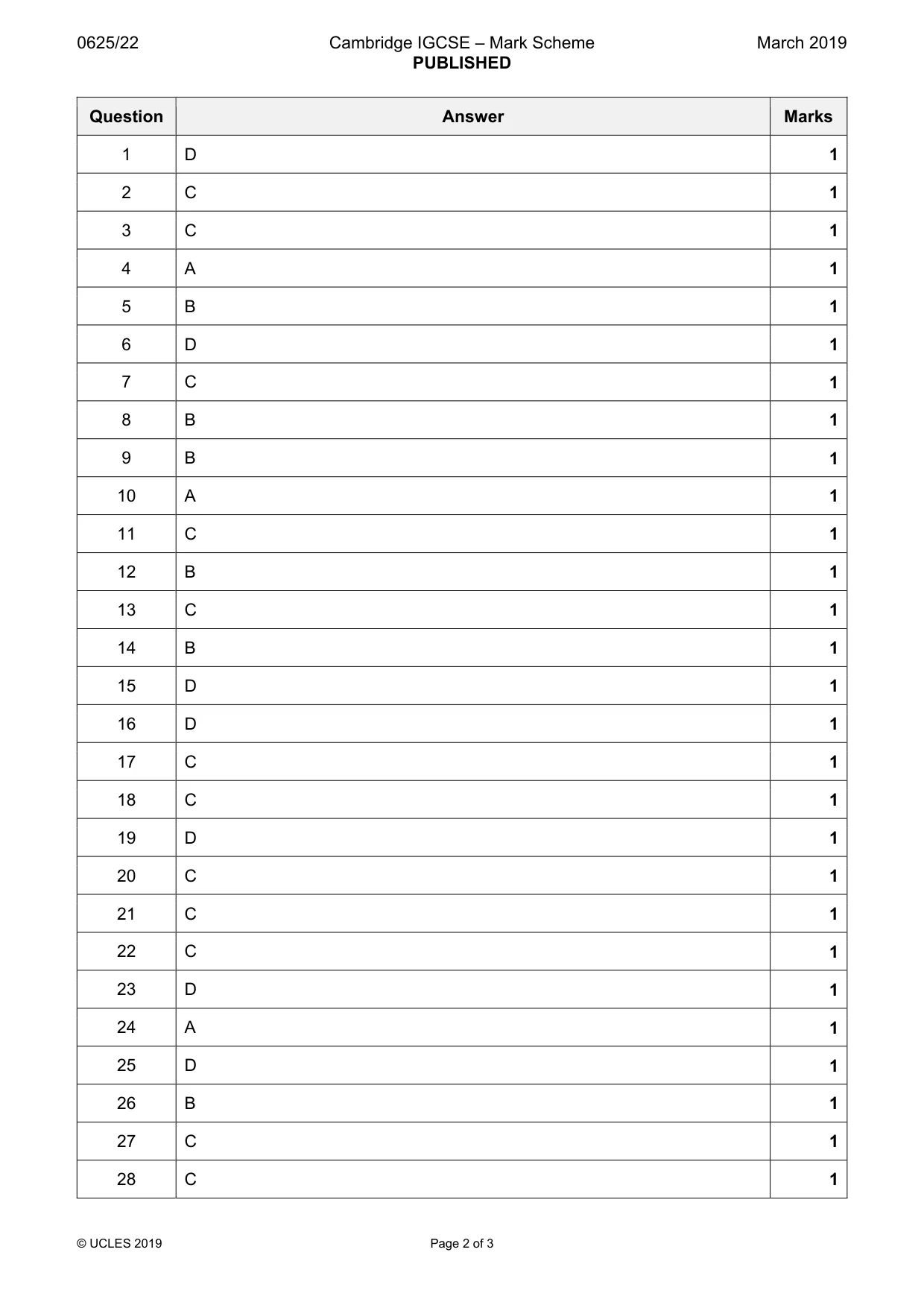
Mark scheme: D
More questions on Physical quantities and measurement techniques
Q2 · An object is moving with uniform deceleration
2 An object is moving with uniform deceleration. Which statement describes its motion? A Its rate of change of speed is decreasing. B Its speed is constant. C Its speed is decreasing. D Its speed is increasing.
Mark scheme: C
Q3 · The graph shows how the speed of a car varies during part of its journey
3 The graph shows how the speed of a car varies during part of its journey. 20 speed m / s 15 10 5 0 0 2 4 6 8 10 12 time / s What is the value of the car’s acceleration between 6 s and 10 s? A 0.50 m / s2 B 0.80 m / s2 C 1.25 m / s2 D 1.50 m / s2
Mark scheme: C
Q4 · The gravitational field strength on the Moon is less than on the Earth
4 The gravitational field strength on the Moon is less than on the Earth. Which of these is different when done on the Moon compared with when done on the Earth? A the gravitational potential energy gained by a stone lifted through the same vertical height B the kinetic energy gained by a ball when hit with the same force for the same period of time C the momentum gained by a bullet when fired from the same gun D the work done in accelerating a stone from rest to the same speed
Mark scheme: A
Q5 · The mass of a full bottle of cooking oil is 1.30 kg
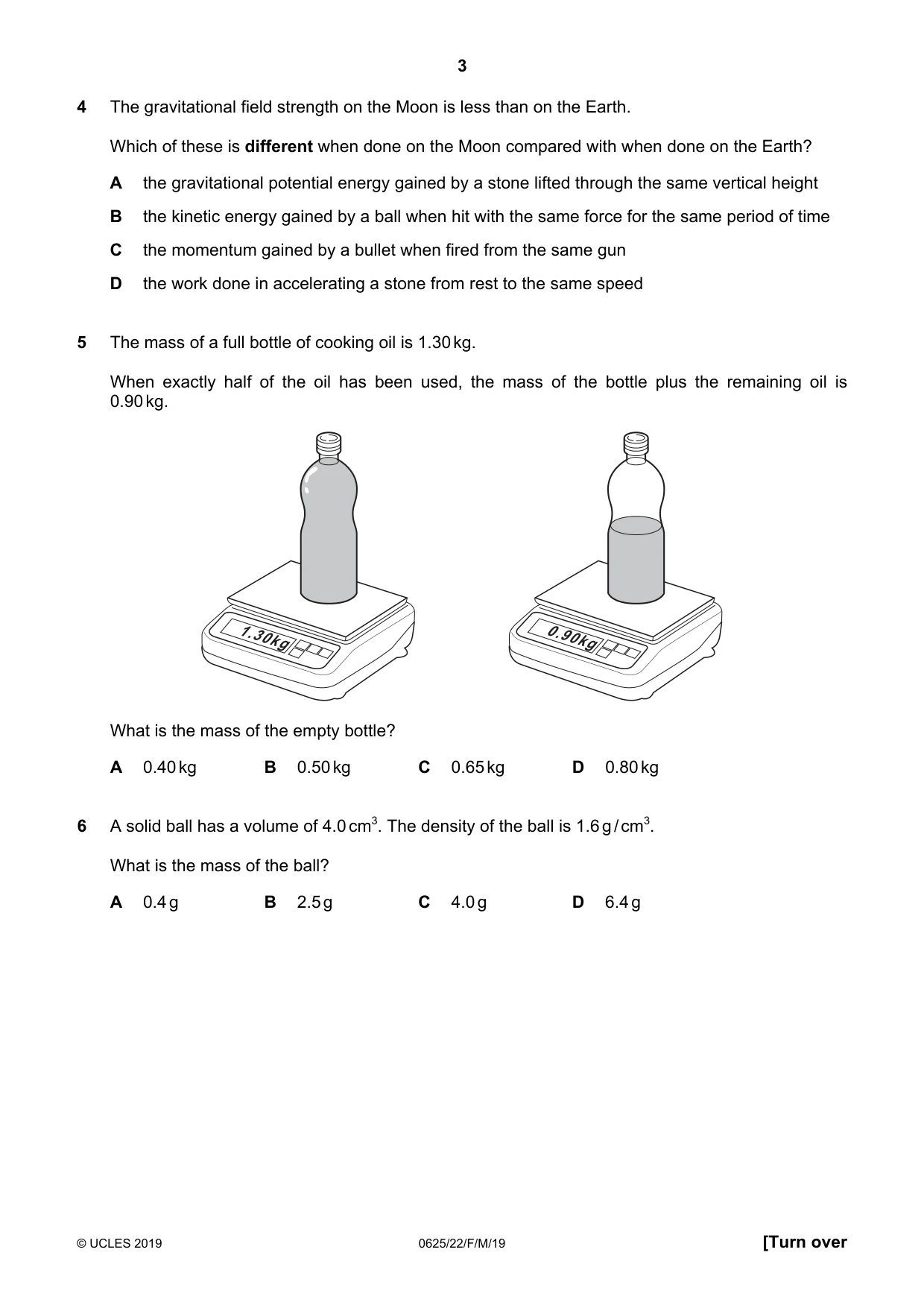
5 The mass of a full bottle of cooking oil is 1.30 kg. When exactly half of the oil has been used, the mass of the bottle plus the remaining oil is 0.90 kg. 1.30kg 0.90kg What is the mass of the empty bottle? A 0.40 kg B 0.50 kg C 0.65 kg D 0.80 kg
Mark scheme: B
Q6 · A solid ball has a volume of 4.0 cm3
6 A solid ball has a volume of 4.0 cm3. The density of the ball is 1.6 g / cm3. What is the mass of the ball? A 0.4 g B 2.5 g C 4.0 g D 6.4 g
Mark scheme: D
Q7 · The extension / load graph for a spring is shown
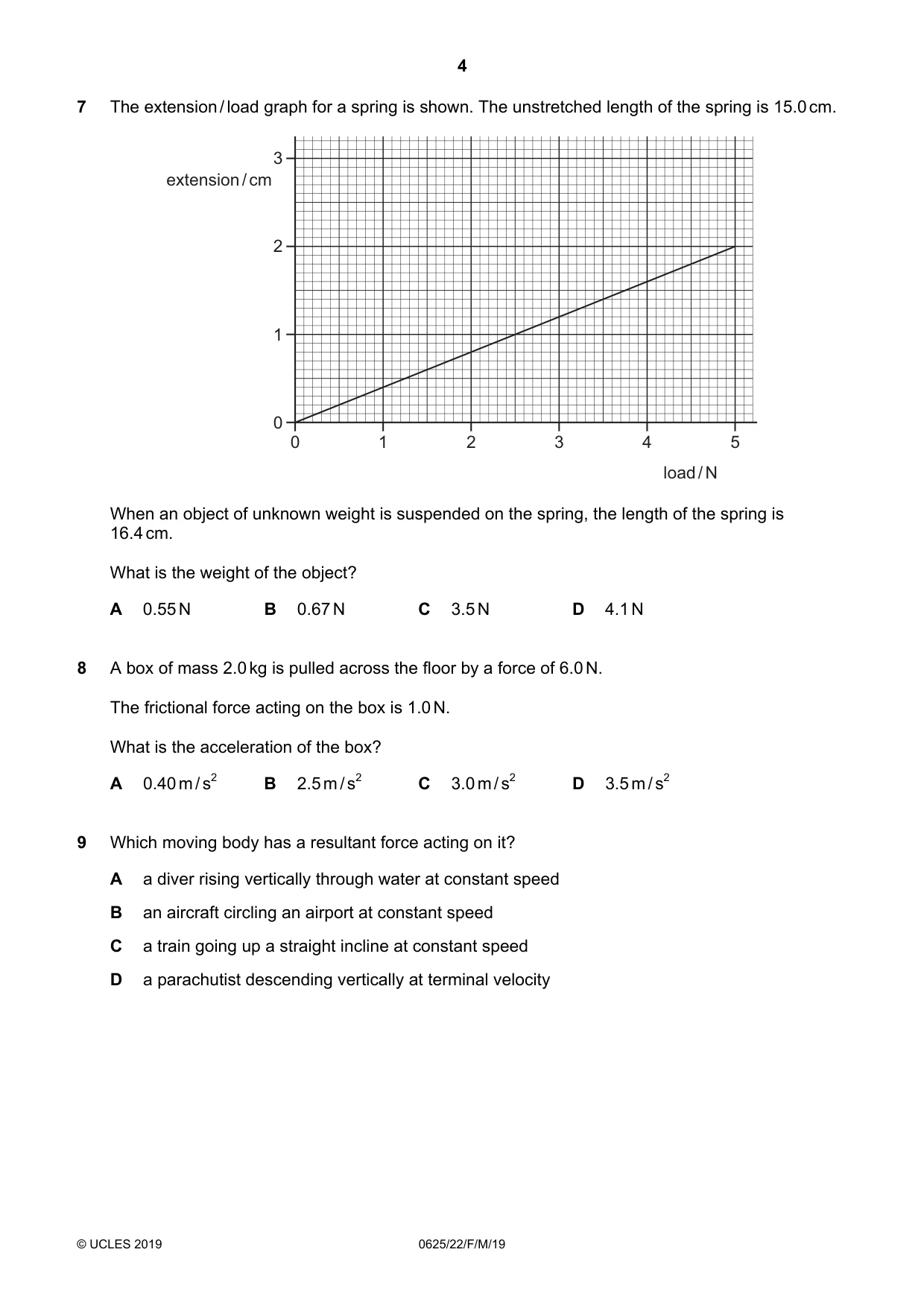
7 The extension / load graph for a spring is shown. The unstretched length of the spring is 15.0 cm. 3 extension / cm 2 1 0 0 1 2 3 4 5 load / N When an object of unknown weight is suspended on the spring, the length of the spring is 16.4 cm. What is the weight of the object? A 0.55 N B 0.67 N C 3.5 N D 4.1 N
Mark scheme: C
Q8 · A box of mass 2.0 kg is pulled across the floor by a force of 6.0 N
8 A box of mass 2.0 kg is pulled across the floor by a force of 6.0 N. The frictional force acting on the box is 1.0 N. What is the acceleration of the box? A 0.40 m / s2 B 2.5 m / s2 C 3.0 m / s2 D 3.5 m / s2
Mark scheme: B
Q9 · Which moving body has a resultant force acting on it?
9 Which moving body has a resultant force acting on it? A a diver rising vertically through water at constant speed B an aircraft circling an airport at constant speed C a train going up a straight incline at constant speed D a parachutist descending vertically at terminal velocity
Mark scheme: B
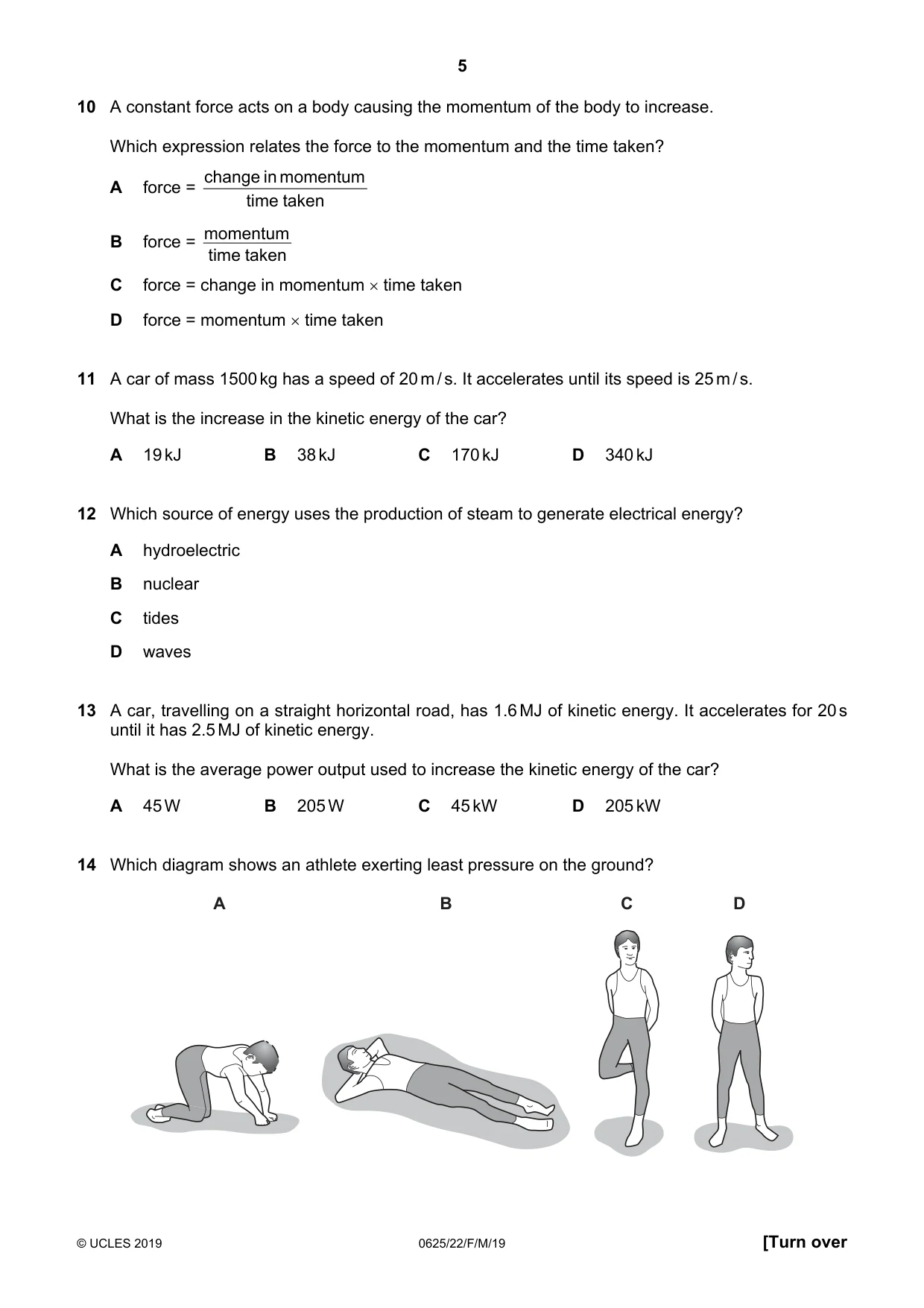
Q10 · A constant force acts on a body causing the momentum of the body to increase
10 A constant force acts on a body causing the momentum of the body to increase. Which expression relates the force to the momentum and the time taken? change in momentum A force = time taken momentum B force = time taken C force = change in momentum × time taken D force = momentum × time taken
Mark scheme: A
Q11 · A car of mass 1500 kg has a speed of 20 m / s
11 A car of mass 1500 kg has a speed of 20 m / s. It accelerates until its speed is 25 m / s. What is the increase in the kinetic energy of the car? A 19 kJ B 38 kJ C 170 kJ D 340 kJ
Mark scheme: C
Q12 · Which source of energy uses the production of steam to generate electrical energy?
12 Which source of energy uses the production of steam to generate electrical energy? A hydroelectric B nuclear C tides D waves
Mark scheme: B
Q13 · A car, travelling on a straight horizontal road, has 1.6 MJ of kinetic energy
13 A car, travelling on a straight horizontal road, has 1.6 MJ of kinetic energy. It accelerates for 20 s until it has 2.5 MJ of kinetic energy. What is the average power output used to increase the kinetic energy of the car? A 45 W B 205 W C 45 kW D 205 kW
Mark scheme: C
Q14 · Which diagram shows an athlete exerting least pressure on the ground?
14 Which diagram shows an athlete exerting least pressure on the ground? A B C D
Mark scheme: B
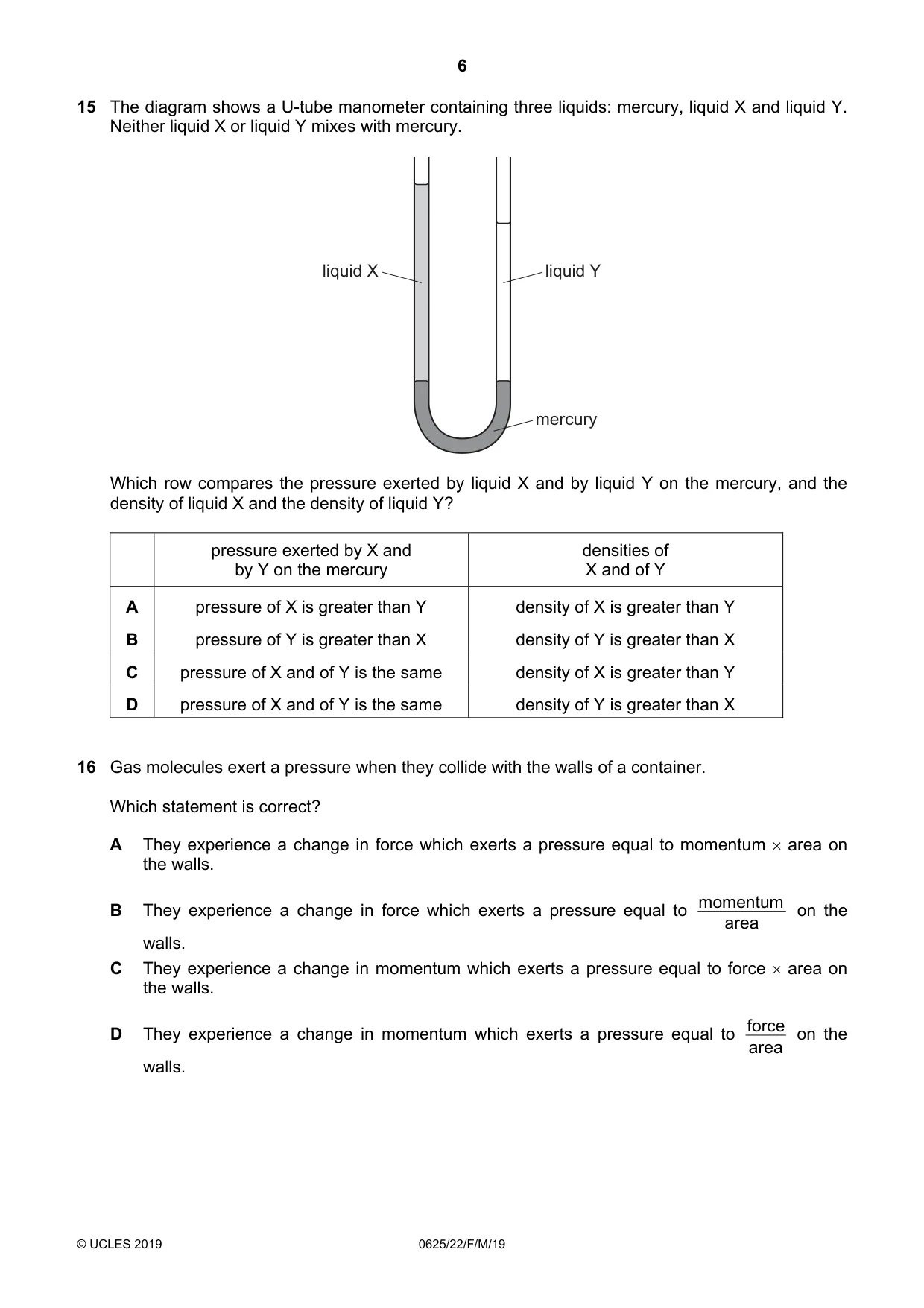
Q15 · The diagram shows a U-tube manometer containing three liquids: mercury, liquid X and…
15 The diagram shows a U-tube manometer containing three liquids: mercury, liquid X and liquid Y. Neither liquid X or liquid Y mixes with mercury. liquid X liquid Y mercury Which row compares the pressure exerted by liquid X and by liquid Y on the mercury, and the density of liquid X and the density of liquid Y? pressure exerted by X and densities of by Y on the mercury X and of Y A pressure of X is greater than Y density of X is greater than Y B pressure of Y is greater than X density of Y is greater than X C pressure of X and of Y is the same density of X is greater than Y D pressure of X and of Y is the same density of Y is greater than X
Mark scheme: D
Q16 · Gas molecules exert a pressure when they collide with the walls of a container
16 Gas molecules exert a pressure when they collide with the walls of a container. Which statement is correct? A They experience a change in force which exerts a pressure equal to momentum × area on the walls. momentum on the B They experience a change in force which exerts a pressure equal to area walls. C They experience a change in momentum which exerts a pressure equal to force × area on the walls. force on the D They experience a change in momentum which exerts a pressure equal to area walls.
Mark scheme: D
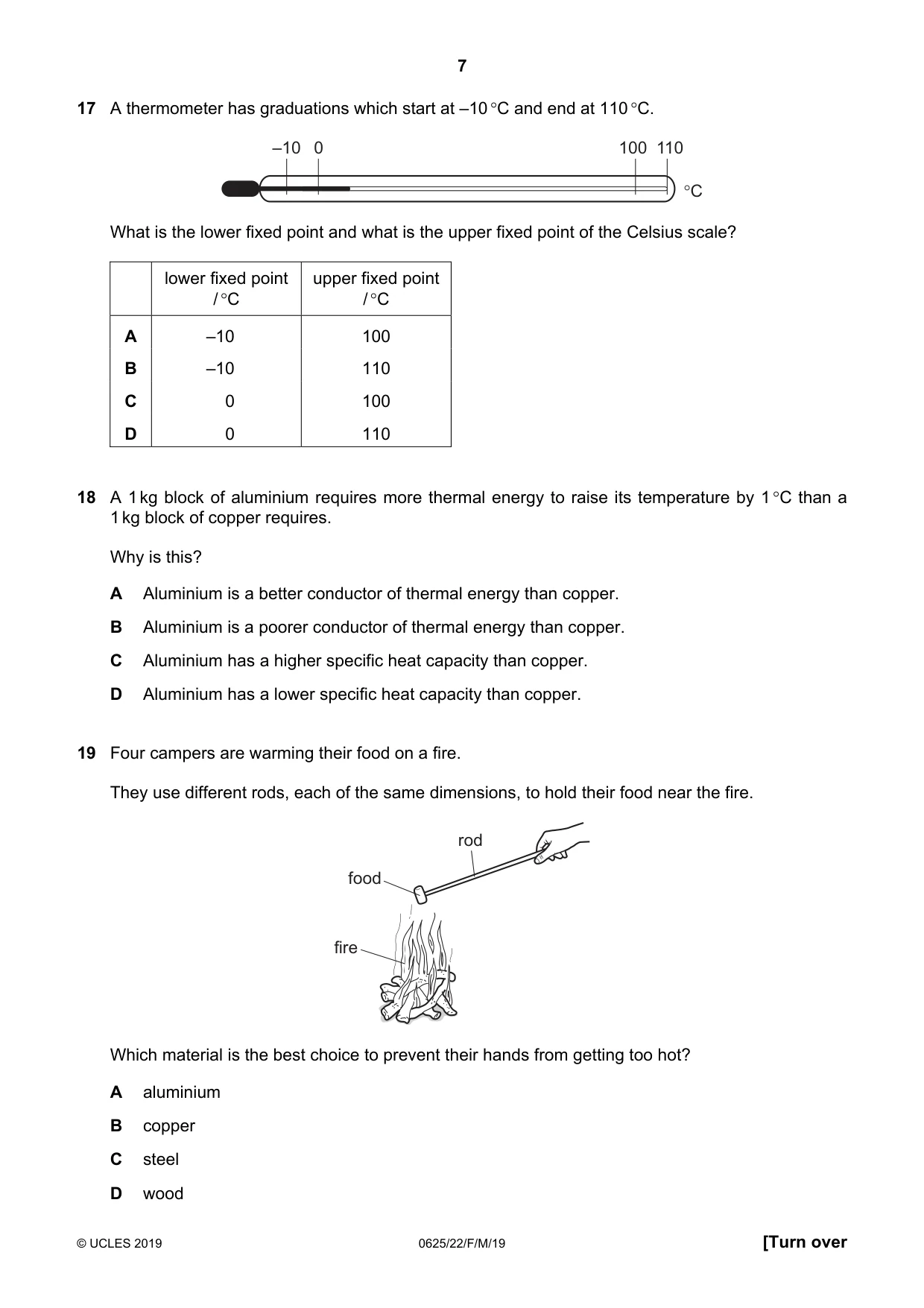
Q17 · A thermometer has graduations which start at –10 °C and end at 110 °C
17 A thermometer has graduations which start at –10 °C and end at 110 °C. –10 0 100 110 °C What is the lower fixed point and what is the upper fixed point of the Celsius scale? lower fixed point upper fixed point / °C / °C A –10 100 B –10 110 C 0 100 D 0 110
Mark scheme: C
Q18 · A 1 kg block of aluminium requires more thermal energy to raise its temperature by 1 °C…
18 A 1 kg block of aluminium requires more thermal energy to raise its temperature by 1 °C than a 1 kg block of copper requires. Why is this? A Aluminium is a better conductor of thermal energy than copper. B Aluminium is a poorer conductor of thermal energy than copper. C Aluminium has a higher specific heat capacity than copper. D Aluminium has a lower specific heat capacity than copper.
Mark scheme: C
Q19 · Four campers are warming their food on a fire
19 Four campers are warming their food on a fire. They use different rods, each of the same dimensions, to hold their food near the fire. rod food fire Which material is the best choice to prevent their hands from getting too hot? A aluminium B copper C steel D wood
Mark scheme: D
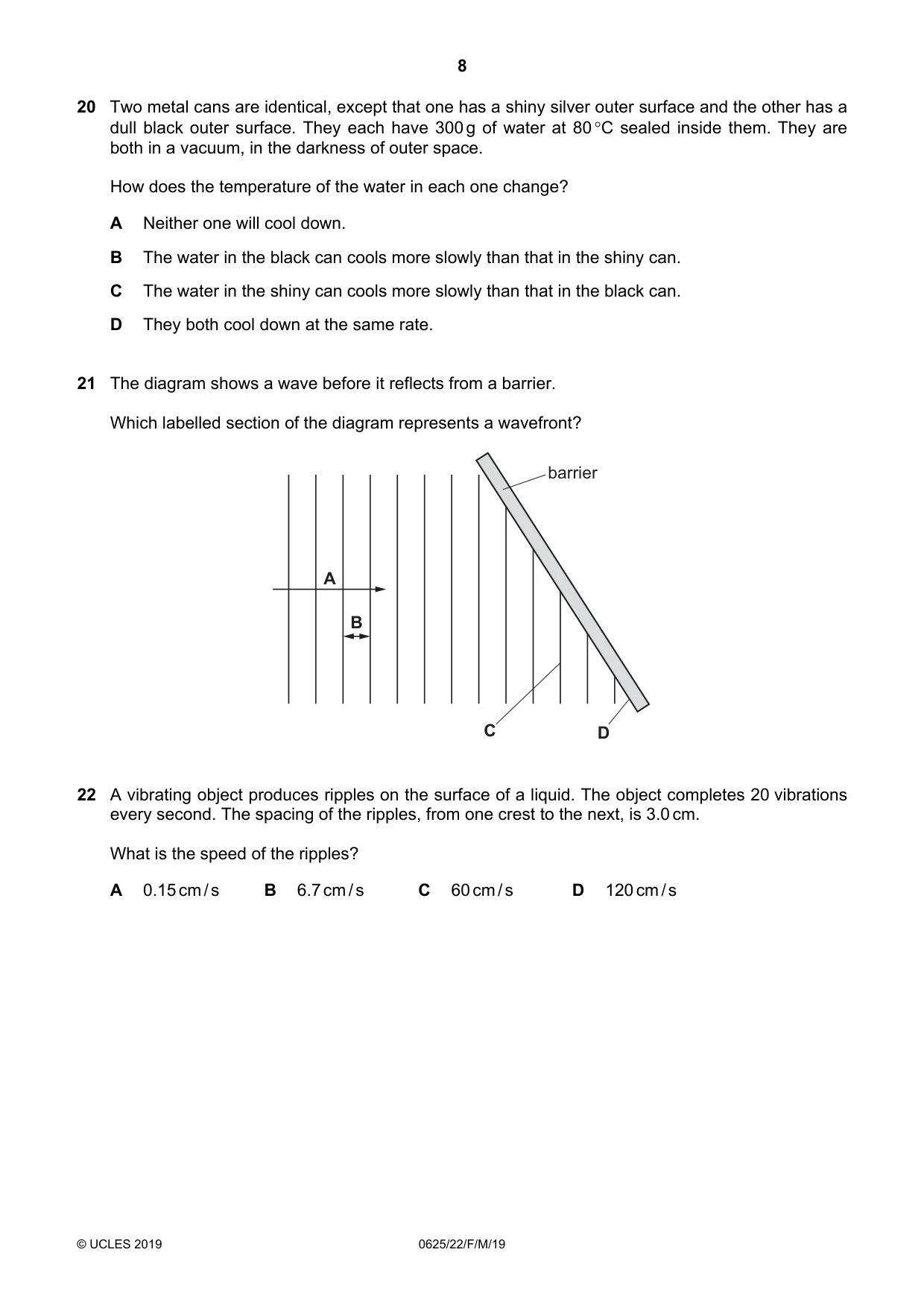
Q20 · Two metal cans are identical, except that one has a shiny silver outer surface and the…
20 Two metal cans are identical, except that one has a shiny silver outer surface and the other has a dull black outer surface. They each have 300 g of water at 80 °C sealed inside them. They are both in a vacuum, in the darkness of outer space. How does the temperature of the water in each one change? A Neither one will cool down. B The water in the black can cools more slowly than that in the shiny can. C The water in the shiny can cools more slowly than that in the black can. D They both cool down at the same rate.
Mark scheme: C
Q21 · The diagram shows a wave before it reflects from a barrier
21 The diagram shows a wave before it reflects from a barrier. Which labelled section of the diagram represents a wavefront? barrier A B C D
Mark scheme: C
Q22 · A vibrating object produces ripples on the surface of a liquid
22 A vibrating object produces ripples on the surface of a liquid. The object completes 20 vibrations every second. The spacing of the ripples, from one crest to the next, is 3.0 cm. What is the speed of the ripples? A 0.15 cm / s B 6.7 cm / s C 60 cm / s D 120 cm / s
Mark scheme: C
Q23 · A narrow beam of light is travelling through a transparent liquid
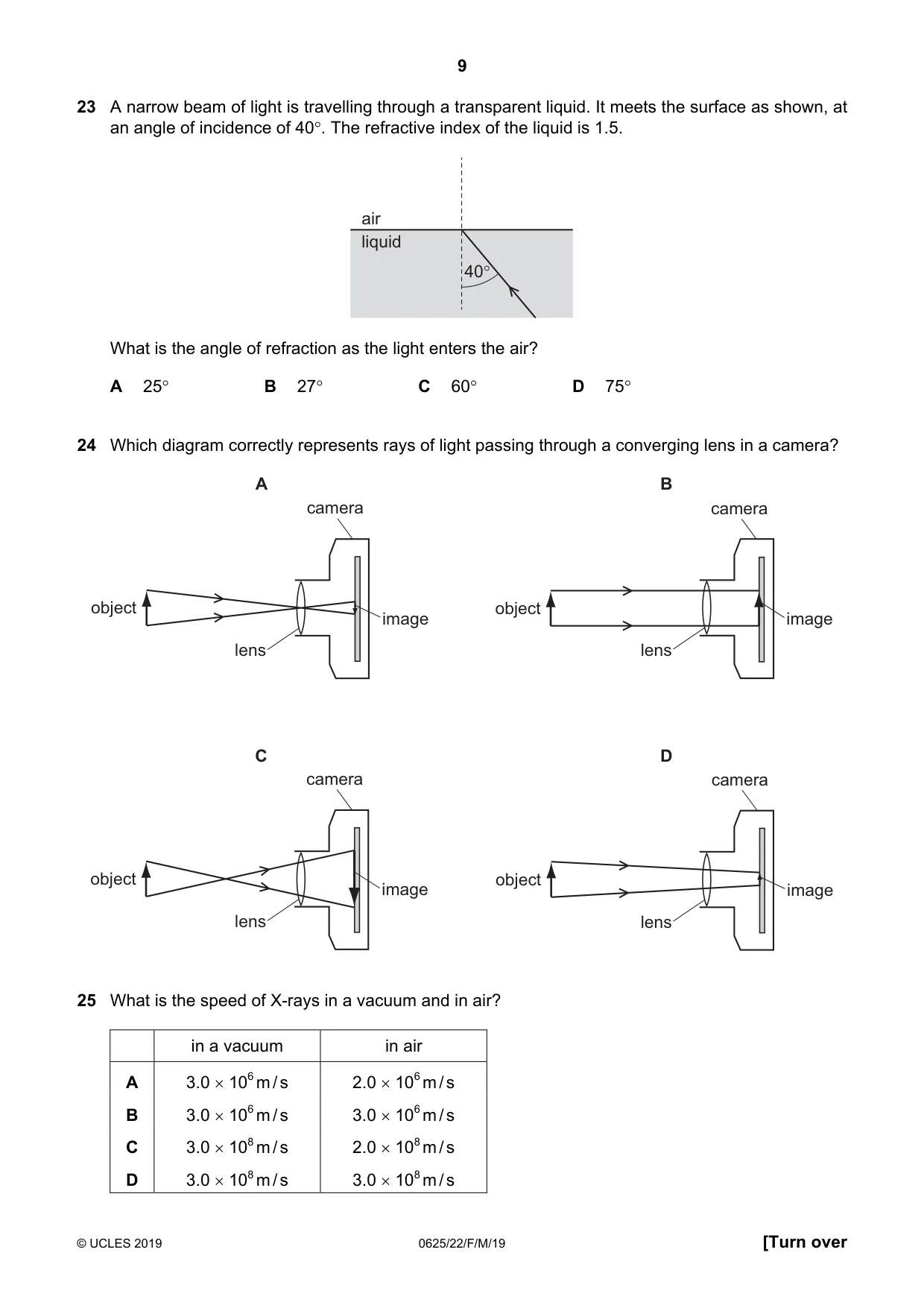
23 A narrow beam of light is travelling through a transparent liquid. It meets the surface as shown, at an angle of incidence of 40°. The refractive index of the liquid is 1.5. air liquid 40° What is the angle of refraction as the light enters the air? A 25° B 27° C 60° D 75°
Mark scheme: D
Q24 · Which diagram correctly represents rays of light passing through a converging lens in a…
24 Which diagram correctly represents rays of light passing through a converging lens in a camera? A B camera camera object object image image lens lens C D camera camera object object image image lens lens
Mark scheme: A
Q25 · What is the speed of X-rays in a vacuum and in air?
25 What is the speed of X-rays in a vacuum and in air? in a vacuum in air A 3.0 × 10⁶ m / s 2.0 × 10⁶ m / s B 3.0 × 10⁶ m / s 3.0 × 10⁶ m / s C 3.0 × 10⁸ m / s 2.0 × 10⁸ m / s D 3.0 × 10⁸ m / s 3.0 × 10⁸ m / s
Mark scheme: D
Q26 · A sound wave passes a point
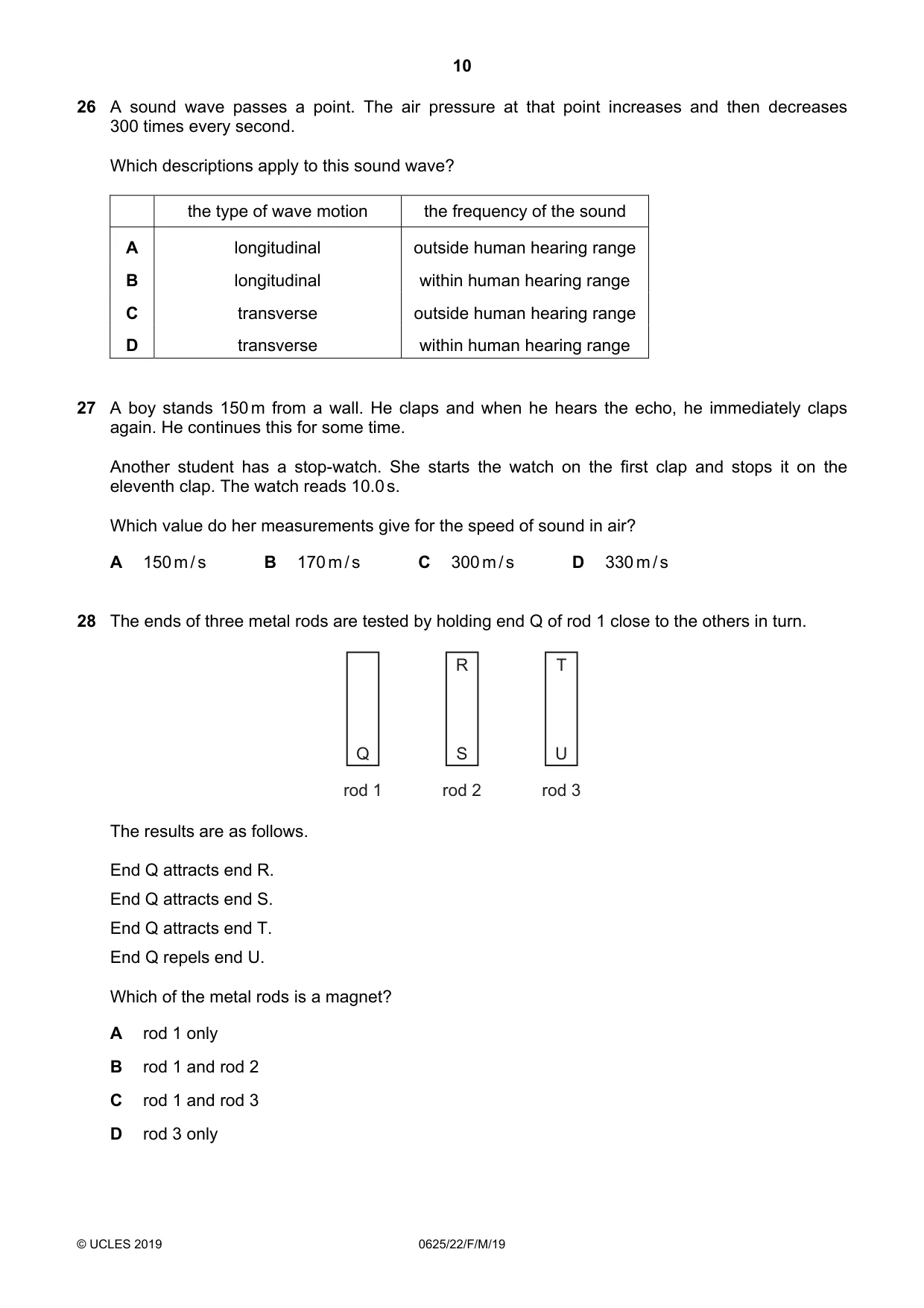
26 A sound wave passes a point. The air pressure at that point increases and then decreases 300 times every second. Which descriptions apply to this sound wave? the type of wave motion the frequency of the sound A longitudinal outside human hearing range B longitudinal within human hearing range C transverse outside human hearing range D transverse within human hearing range
Mark scheme: B
Q27 · A boy stands 150 m from a wall
27 A boy stands 150 m from a wall. He claps and when he hears the echo, he immediately claps again. He continues this for some time. Another student has a stop-watch. She starts the watch on the first clap and stops it on the eleventh clap. The watch reads 10.0 s. Which value do her measurements give for the speed of sound in air? A 150 m / s B 170 m / s C 300 m / s D 330 m / s
Mark scheme: C
Q28 · The ends of three metal rods are tested by holding end Q of rod 1 close to the others in…
28 The ends of three metal rods are tested by holding end Q of rod 1 close to the others in turn. R T Q S U rod 1 rod 2 rod 3 The results are as follows. End Q attracts end R. End Q attracts end S. End Q attracts end T. End Q repels end U. Which of the metal rods is a magnet? A rod 1 only B rod 1 and rod 2 C rod 1 and rod 3 D rod 3 only
Mark scheme: C
Q29 · A metal sphere is charged by induction
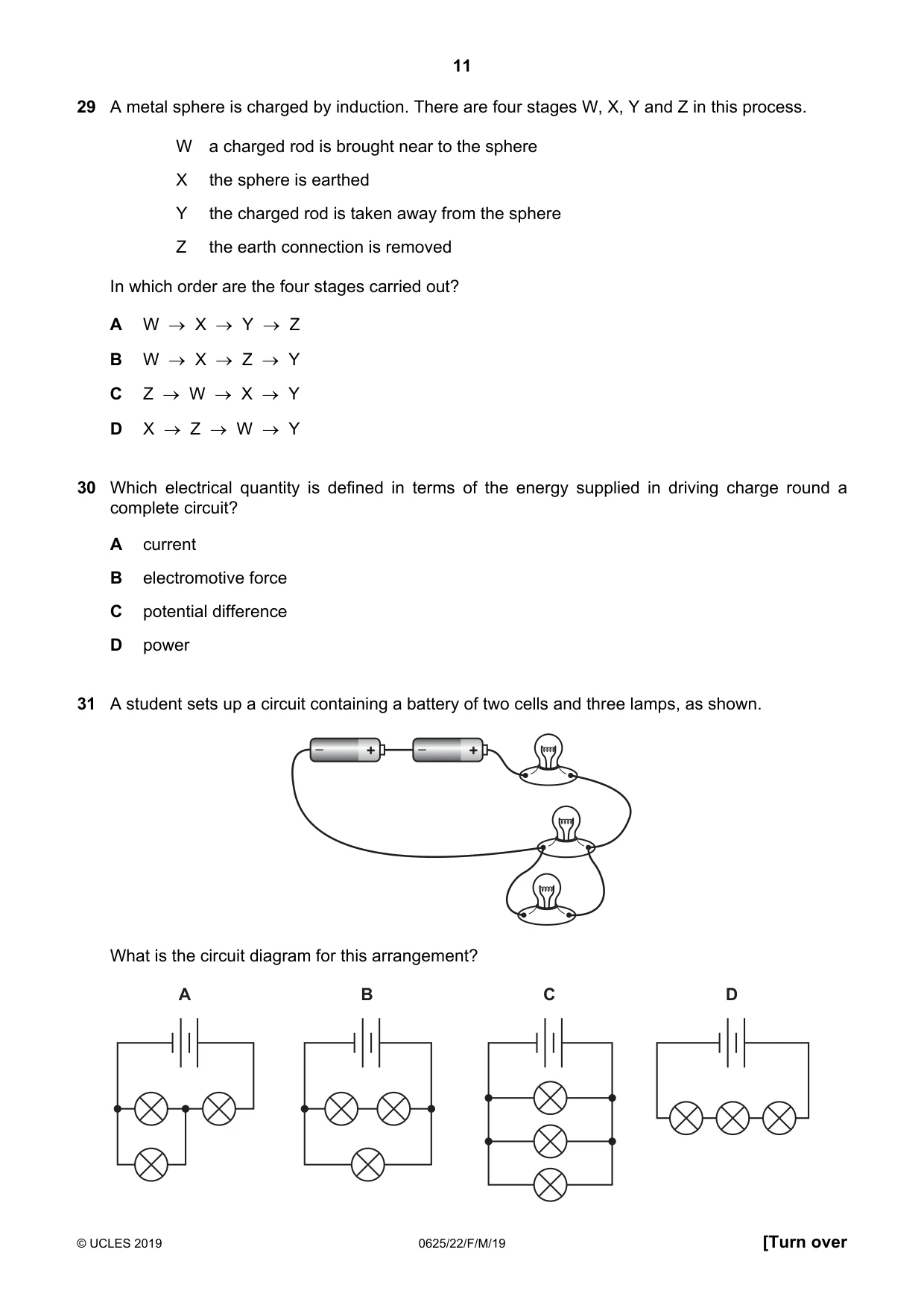
29 A metal sphere is charged by induction. There are four stages W, X, Y and Z in this process. W a charged rod is brought near to the sphere X the sphere is earthed Y the charged rod is taken away from the sphere Z the earth connection is removed In which order are the four stages carried out? A W → X → Y → Z B W → X → Z → Y C Z → W → X → Y D X → Z → W → Y
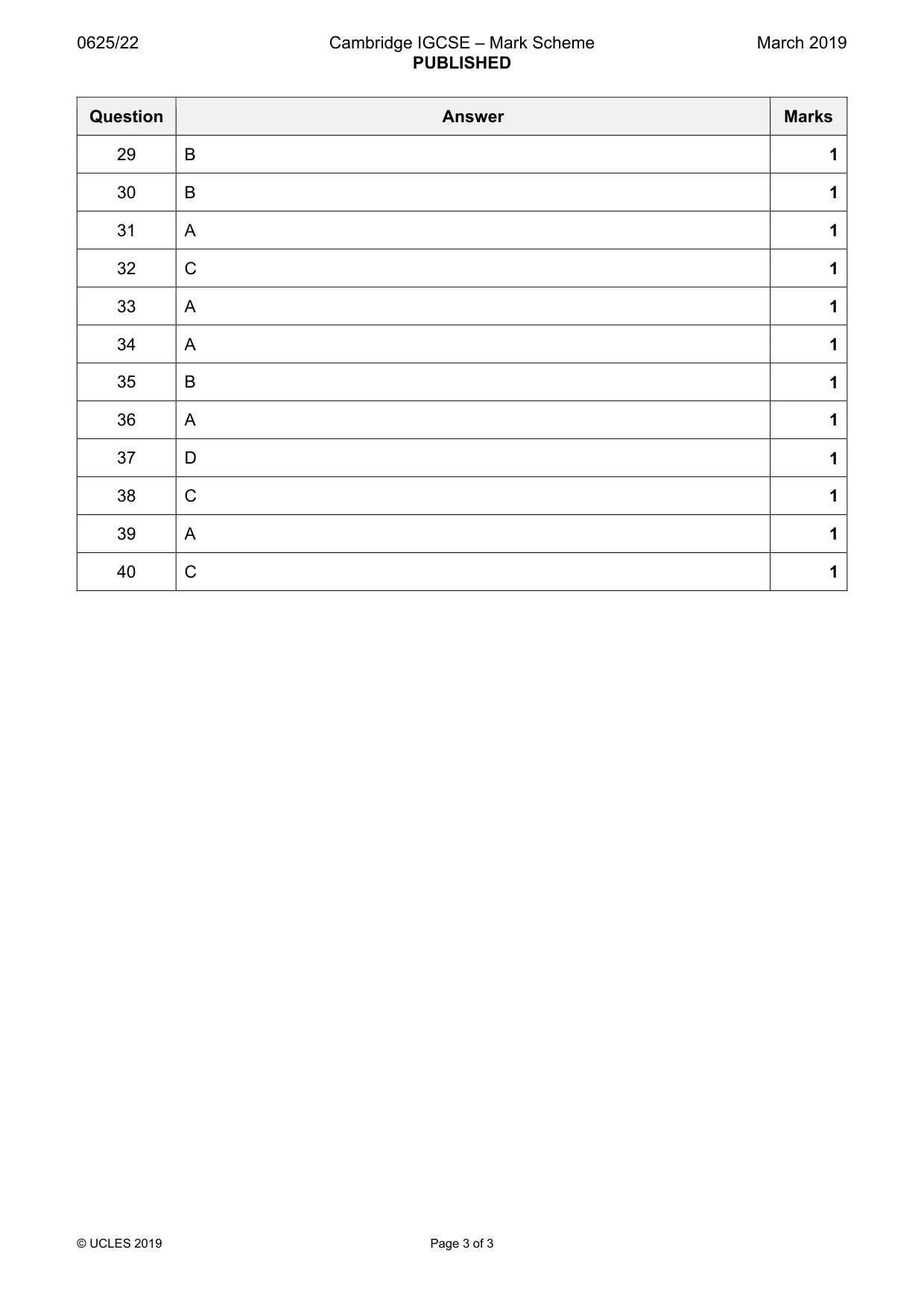
Mark scheme: B
Q30 · Which electrical quantity is defined in terms of the energy supplied in driving charge…
30 Which electrical quantity is defined in terms of the energy supplied in driving charge round a complete circuit? A current B electromotive force C potential difference D power
Mark scheme: B
Q31 · A student sets up a circuit containing a battery of two cells and three lamps, as shown
31 A student sets up a circuit containing a battery of two cells and three lamps, as shown. – + – + What is the circuit diagram for this arrangement? A B C D
Mark scheme: A
Q32 · In which circuit does the lamp light?
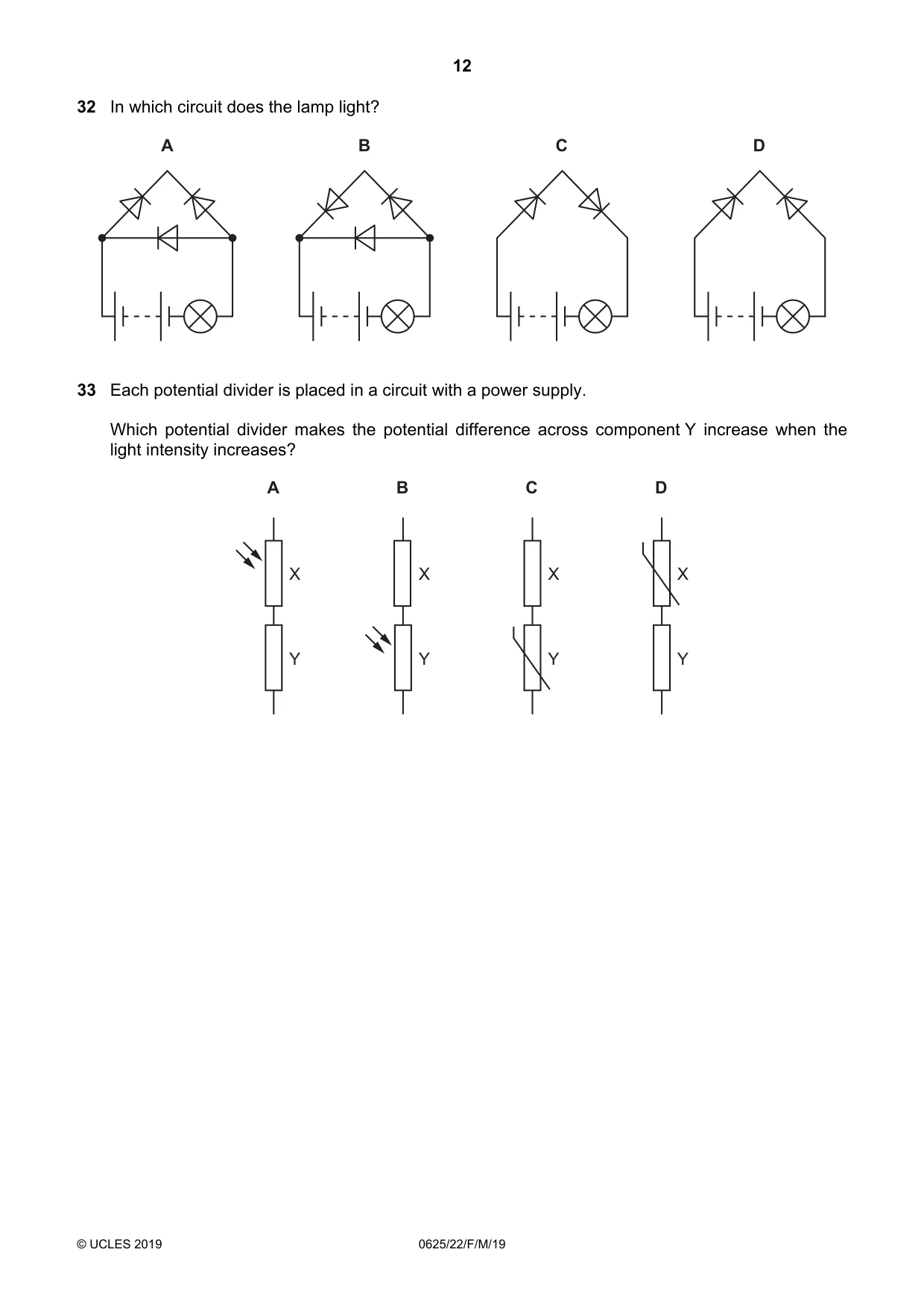
32 In which circuit does the lamp light? A B C D
Mark scheme: C
Q33 · Each potential divider is placed in a circuit with a power supply
33 Each potential divider is placed in a circuit with a power supply. Which potential divider makes the potential difference across component Y increase when the light intensity increases? A B C D X X X X Y Y Y Y
Mark scheme: A
Q34 · There are two inputs to the combination of logic gates shown, and one output
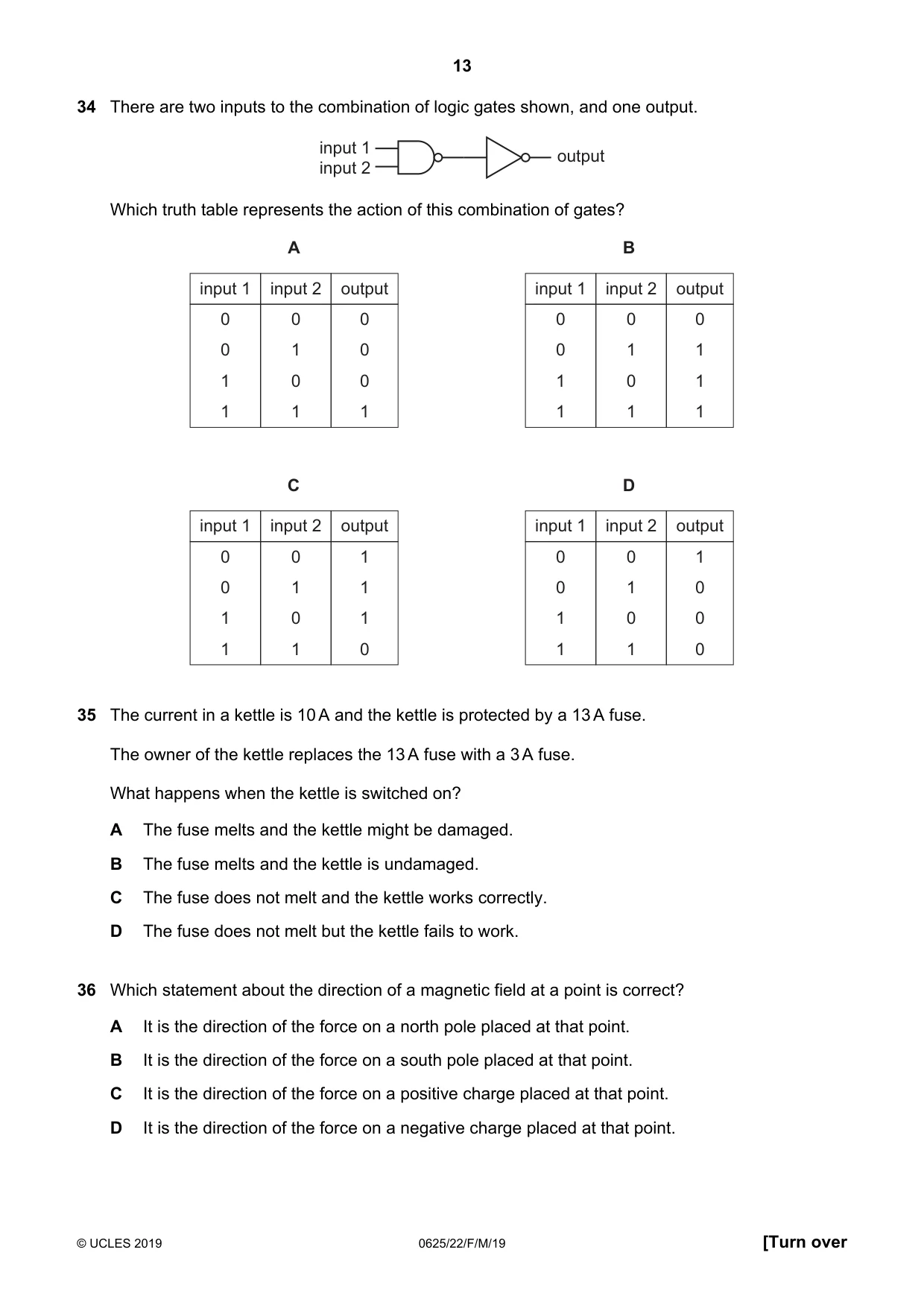
34 There are two inputs to the combination of logic gates shown, and one output. input 1 output input 2 Which truth table represents the action of this combination of gates? A B input 1 input 2 output input 1 input 2 output 0 0 0 0 0 0 0 1 0 0 1 1 1 0 0 1 0 1 1 1 1 1 1 1 C D input 1 input 2 output input 1 input 2 output 0 0 1 0 0 1 0 1 1 0 1 0 1 0 1 1 0 0 1 1 0 1 1 0
Mark scheme: A
Q35 · The current in a kettle is 10 A and the kettle is protected by a 13 A fuse
35 The current in a kettle is 10 A and the kettle is protected by a 13 A fuse. The owner of the kettle replaces the 13 A fuse with a 3 A fuse. What happens when the kettle is switched on? A The fuse melts and the kettle might be damaged. B The fuse melts and the kettle is undamaged. C The fuse does not melt and the kettle works correctly. D The fuse does not melt but the kettle fails to work.
Mark scheme: B
Q36 · Which statement about the direction of a magnetic field at a point is correct?
36 Which statement about the direction of a magnetic field at a point is correct? A It is the direction of the force on a north pole placed at that point. B It is the direction of the force on a south pole placed at that point. C It is the direction of the force on a positive charge placed at that point. D It is the direction of the force on a negative charge placed at that point.
Mark scheme: A
Q37 · A current-carrying coil is placed in a magnetic field
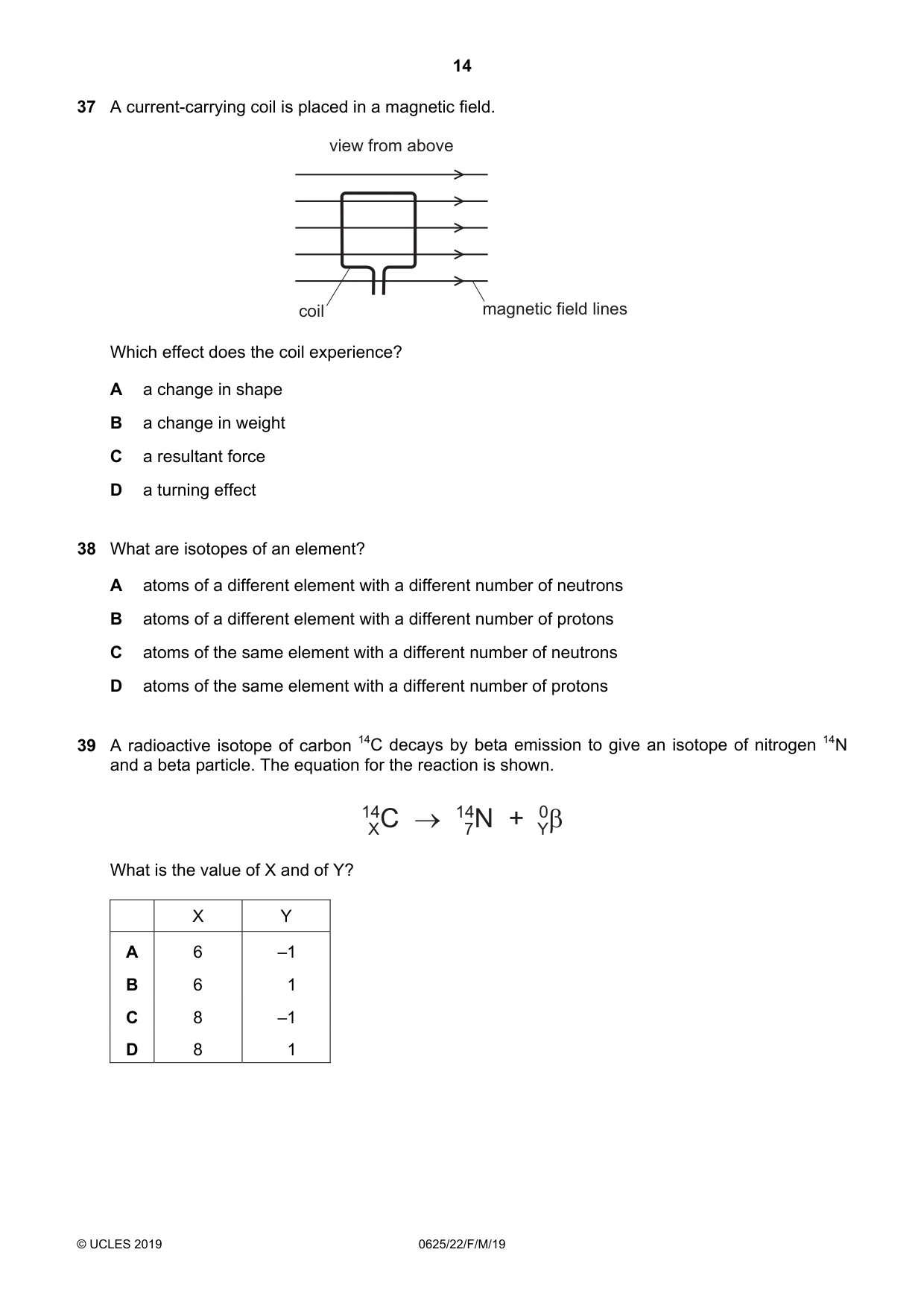
37 A current-carrying coil is placed in a magnetic field. view from above coil magnetic field lines Which effect does the coil experience? A a change in shape B a change in weight C a resultant force D a turning effect
Mark scheme: D
Q38 · What are isotopes of an element?
38 What are isotopes of an element? A atoms of a different element with a different number of neutrons B atoms of a different element with a different number of protons C atoms of the same element with a different number of neutrons D atoms of the same element with a different number of protons
Mark scheme: C
Q39 · A radioactive isotope of carbon 14C decays by beta emission to give an isotope of…
39 A radioactive isotope of carbon 14C decays by beta emission to give an isotope of nitrogen 14N and a beta particle. The equation for the reaction is shown. 14C → 14N + 0β X 7 Y What is the value of X and of Y? X Y A 6 –1 B 6 1 C 8 –1 D 8 1
Mark scheme: A
Q40 · A beta particle is a fast moving electron
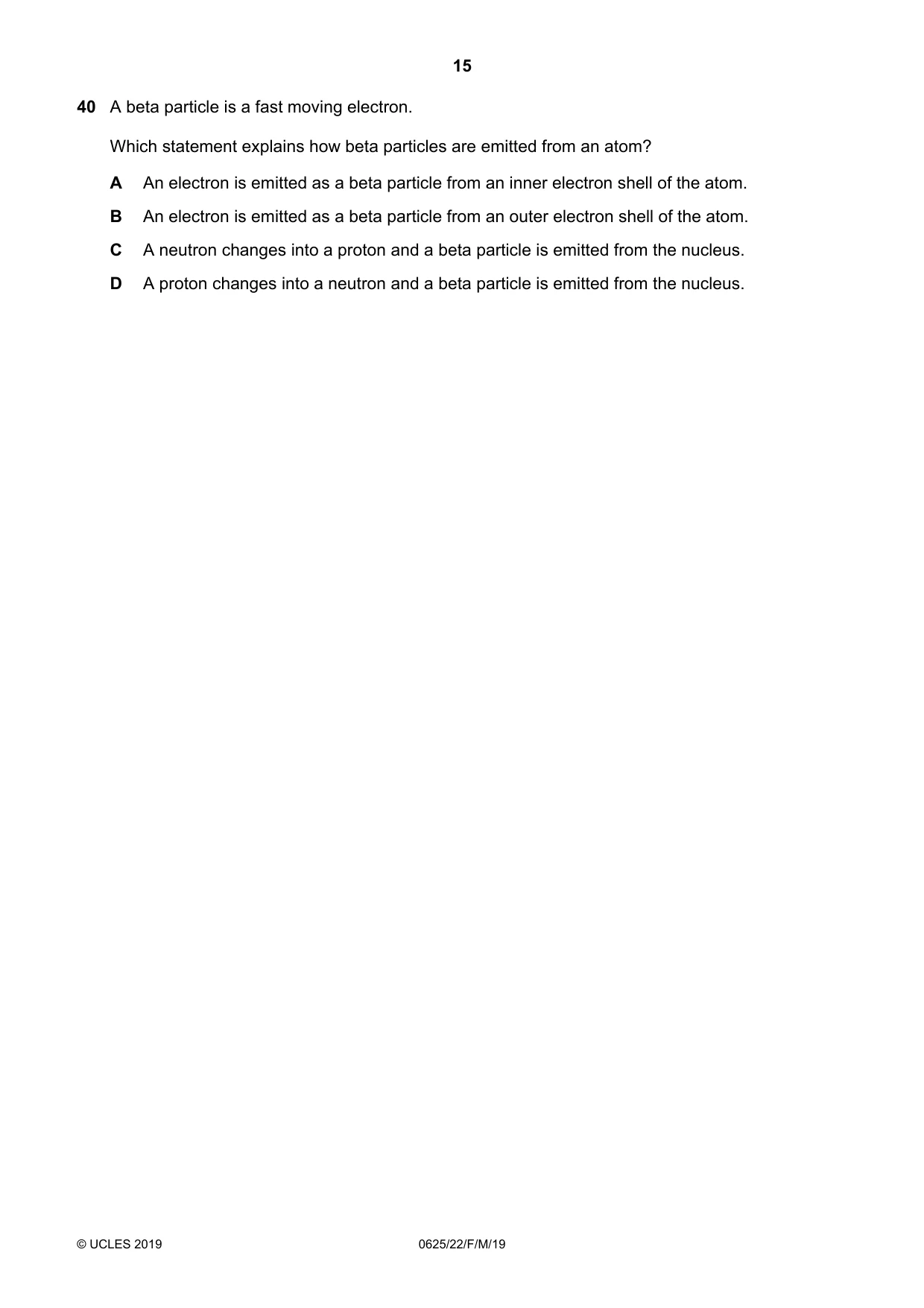
40 A beta particle is a fast moving electron. Which statement explains how beta particles are emitted from an atom? A An electron is emitted as a beta particle from an inner electron shell of the atom. B An electron is emitted as a beta particle from an outer electron shell of the atom. C A neutron changes into a proton and a beta particle is emitted from the nucleus. D A proton changes into a neutron and a beta particle is emitted from the nucleus.
Mark scheme: C
What was in this paper
The subtopics covered by these 40 questions, and how many questions each got. Open one in a new tab to see every Cambridge question on it.
4Energy, work and power3Forces3Simple phenomena of magnetism3Density2General properties of waves2Light2Motion2Pressure2Radioactivity2Sound2Thermal properties and temperature2Transfer of thermal energy2Electrical quantities1Electrical safety1Electromagnetic effects1Electromagnetic spectrum1Kinetic particle model of matter1Mass and weight1Momentum1Physical quantities and measurement techniques1The nuclear model of the atom1What you needed in this session
Cambridge’s own grade thresholds for 2019 Feb/March, Paper 2 · Variant 2. A higher threshold means an easier paper — the bar moves with how the cohort did.