Cambridge IGCSE Physics 0625 — 2016 May/June Paper 2 · Variant 2
0625/22/M/J/16 · 40 questions · 40 marks · ≈45 min
The question paper and its mark scheme, free to read here and free to download. This is Cambridge’s own paper, exactly as it was sat.
Question paper16 pages
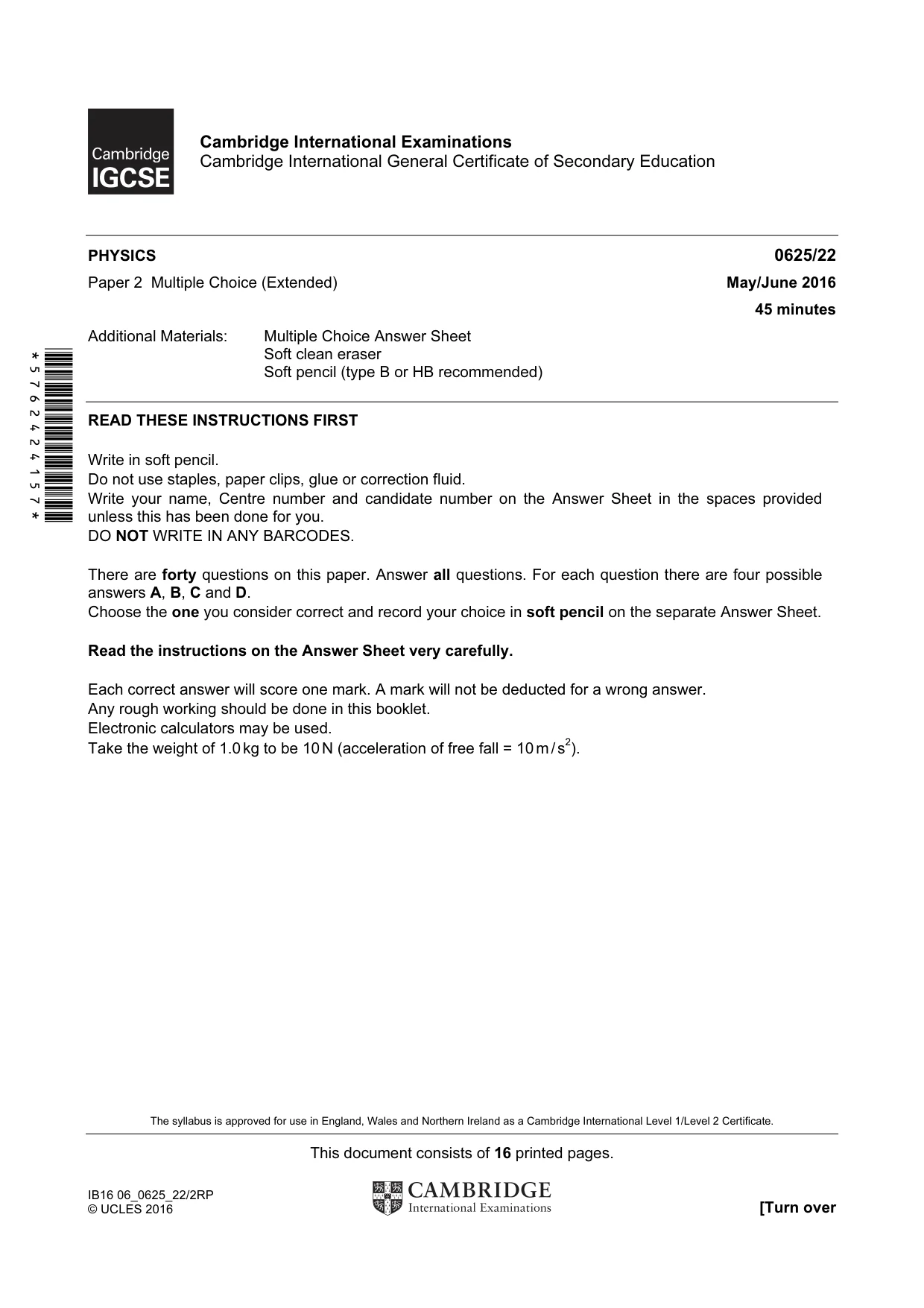
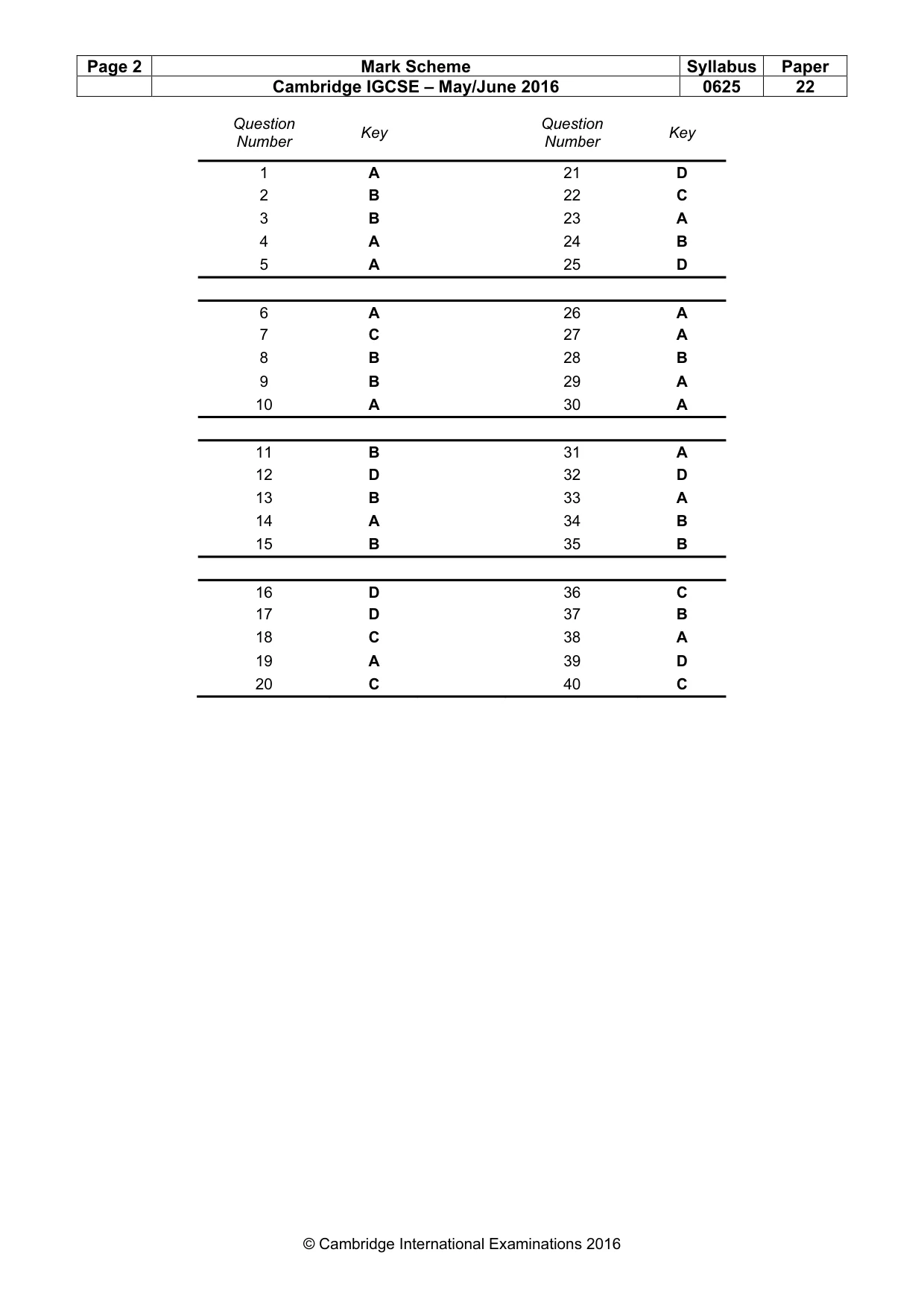
Mark scheme2 pages
Answers below. Sit the paper first if you are practising.
Questions as text
Q1 · The diagram shows an enlarged drawing of the end of a metre rule
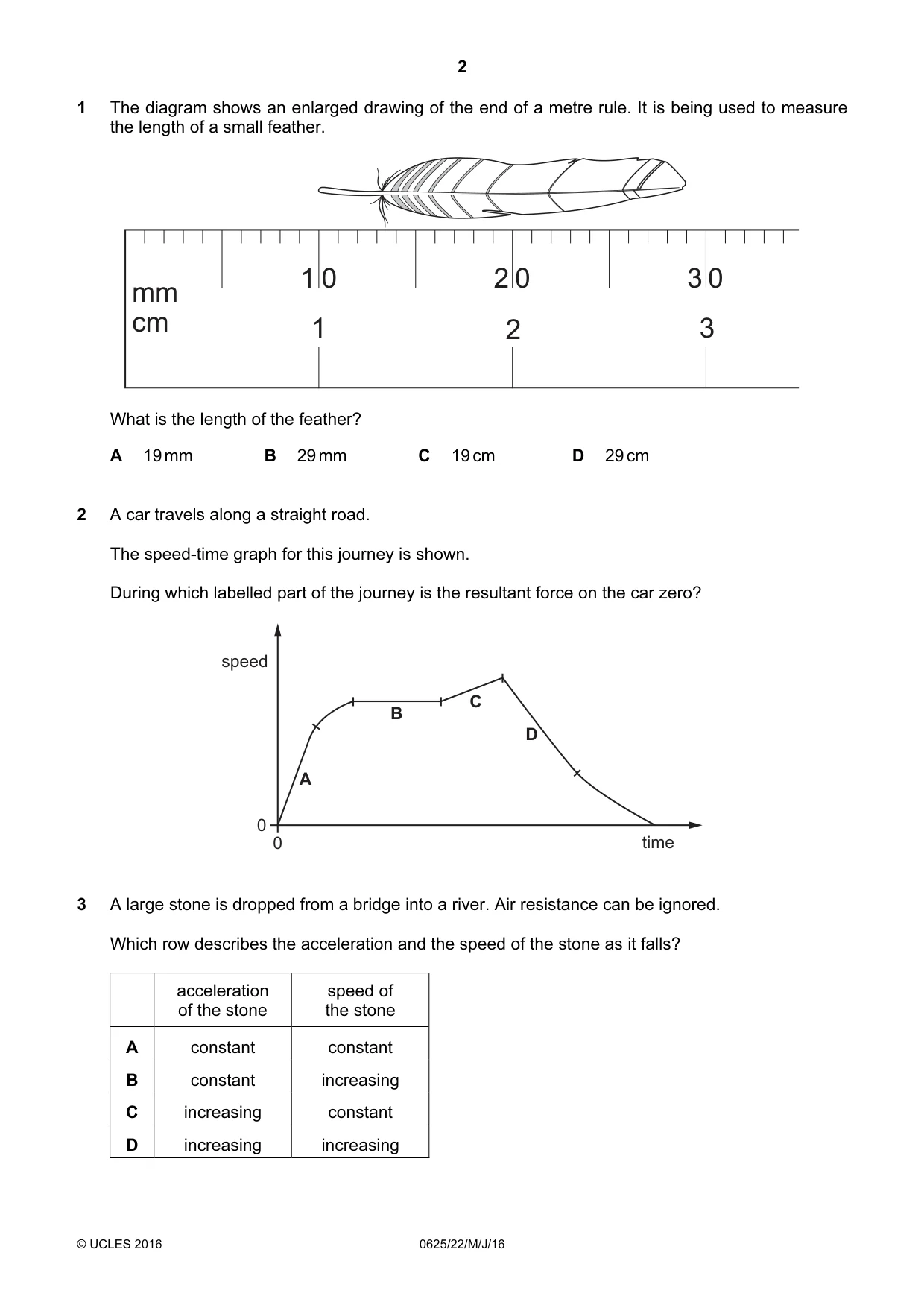
1 The diagram shows an enlarged drawing of the end of a metre rule. It is being used to measure the length of a small feather. 1 0 2 0 3 0 mm cm 1 2 3 What is the length of the feather? A 19 mm B 29 mm C 19 cm D 29 cm
Mark scheme: A
More questions on Physical quantities and measurement techniques
Q2 · A car travels along a straight road
2 A car travels along a straight road. The speed-time graph for this journey is shown. During which labelled part of the journey is the resultant force on the car zero? speed C B D A 0 0 time
Mark scheme: B
Q3 · A large stone is dropped from a bridge into a river
3 A large stone is dropped from a bridge into a river. Air resistance can be ignored. Which row describes the acceleration and the speed of the stone as it falls? acceleration speed of of the stone the stone A constant constant B constant increasing C increasing constant D increasing increasing
Mark scheme: B
Q4 · A cup contains hot liquid
4 A cup contains hot liquid. Some of the liquid evaporates. What happens to the mass and what happens to the weight of the liquid in the cup? mass weight A decreases decreases B decreases stays the same C stays the same decreases D stays the same stays the same
Mark scheme: A
Q5 · Below are four statements about acceleration
5 Below are four statements about acceleration. Which statement is not correct? A Acceleration always involves changing speed. B Changing direction always involves acceleration. C Changing speed always involves acceleration. D Circular motion always involves acceleration.
Mark scheme: A
Q6 · The diagram shows a non-uniform beam of weight 120 N, pivoted at one end
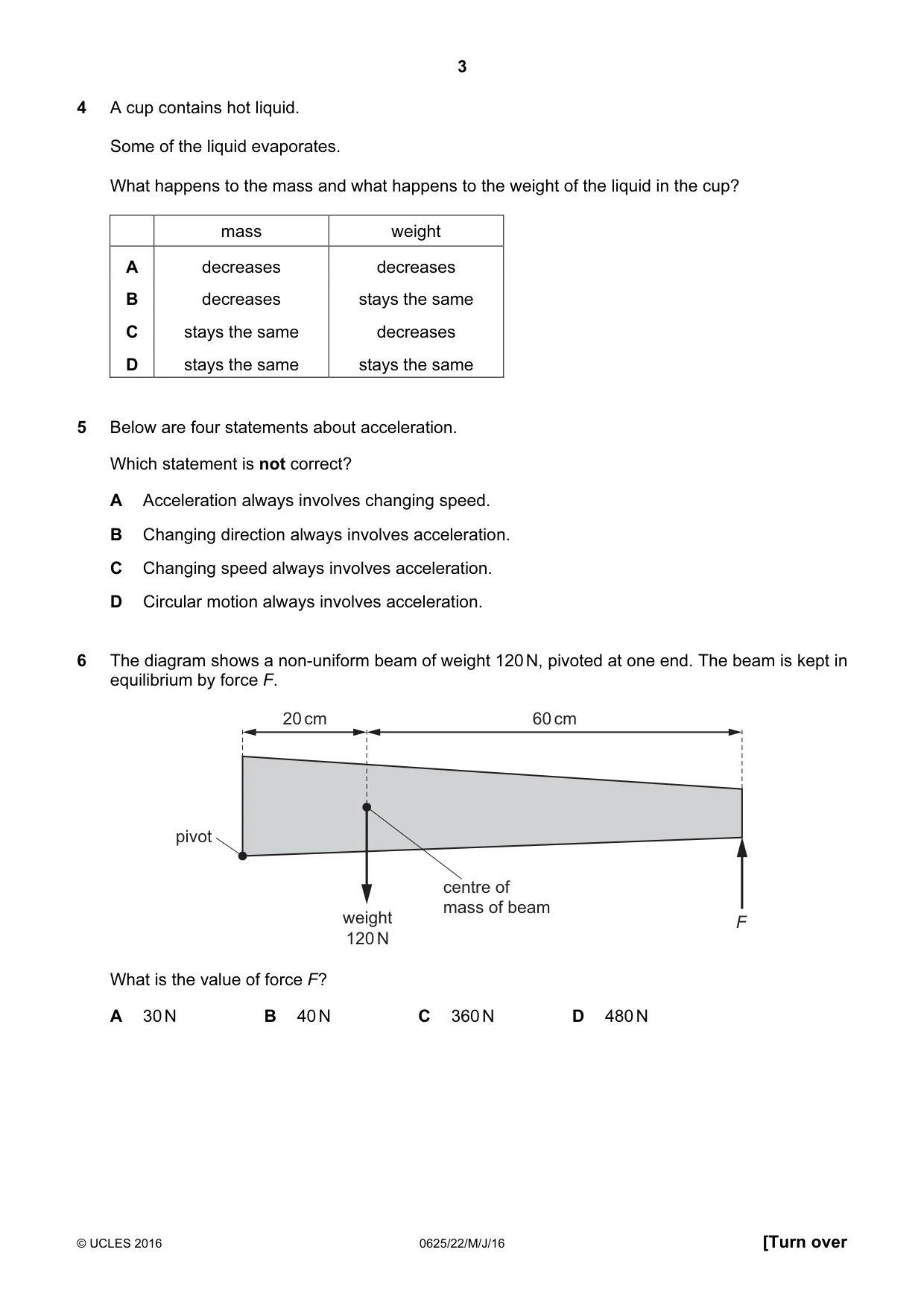
6 The diagram shows a non-uniform beam of weight 120 N, pivoted at one end. The beam is kept in equilibrium by force F. 20 cm 60 cm pivot centre of mass of beam weight F 120 N What is the value of force F? A 30 N B 40 N C 360 N D 480 N
Mark scheme: A
Q7 · An object is acted upon by a 3 N force and by a 4 N force
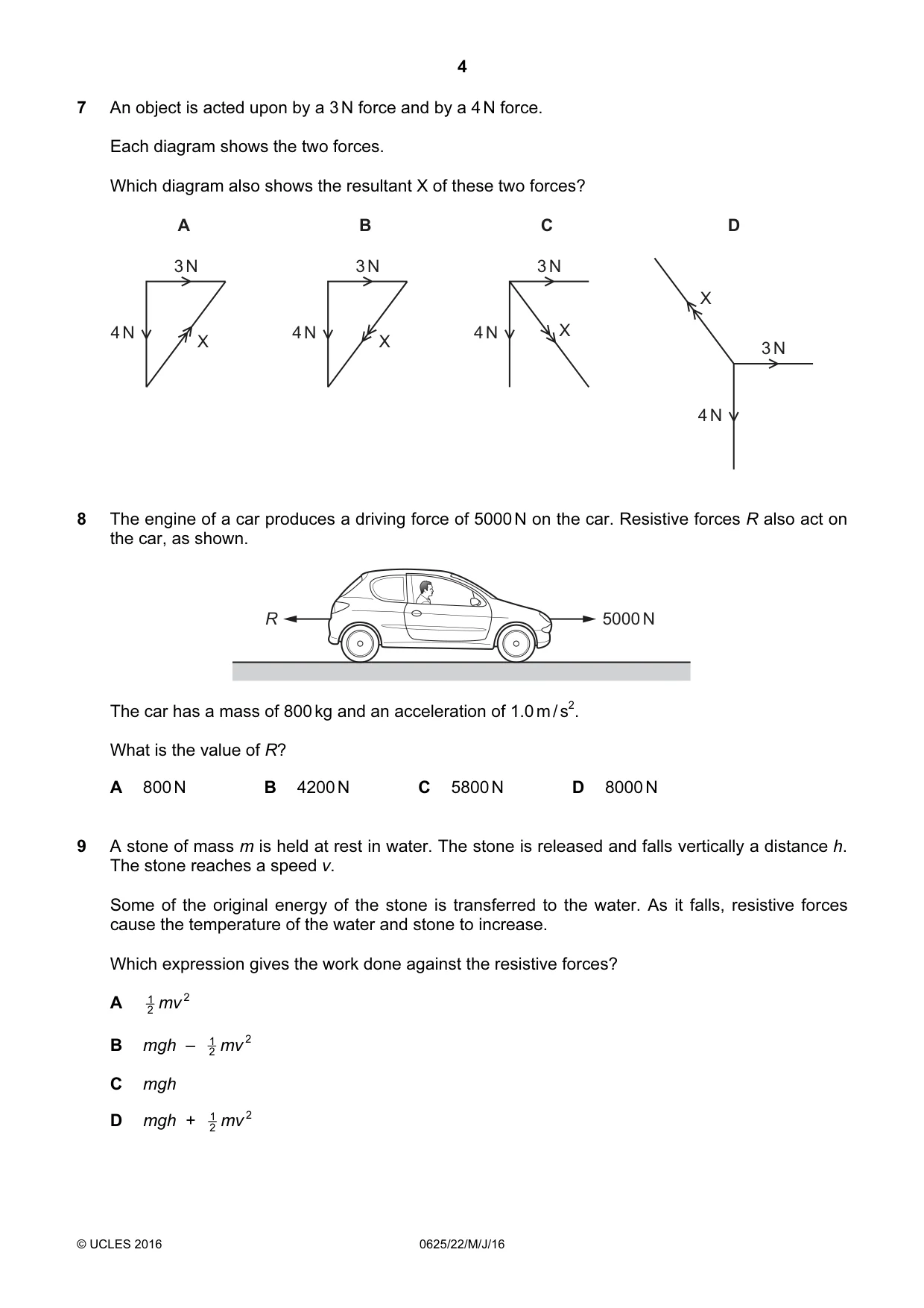
7 An object is acted upon by a 3 N force and by a 4 N force. Each diagram shows the two forces. Which diagram also shows the resultant X of these two forces? A B C D 3 N 3 N 3 N X 4 N 4 N 4 N X X X 3 N 4 N
Mark scheme: C
Q8 · The engine of a car produces a driving force of 5000 N on the car
8 The engine of a car produces a driving force of 5000 N on the car. Resistive forces R also act on the car, as shown. R 5000 N The car has a mass of 800 kg and an acceleration of 1.0 m / s2. What is the value of R? A 800 N B 4200 N C 5800 N D 8000 N
Mark scheme: B
Q9 · A stone of mass m is held at rest in water
9 A stone of mass m is held at rest in water. The stone is released and falls vertically a distance h. The stone reaches a speed v. Some of the original energy of the stone is transferred to the water. As it falls, resistive forces cause the temperature of the water and stone to increase. Which expression gives the work done against the resistive forces? A 1 mv 2 2 B mgh – 2 1 mv 2 C mgh D mgh + 2 1 mv 2
Mark scheme: B
Q10 · Which energy resource does not derive its energy from the Sun?
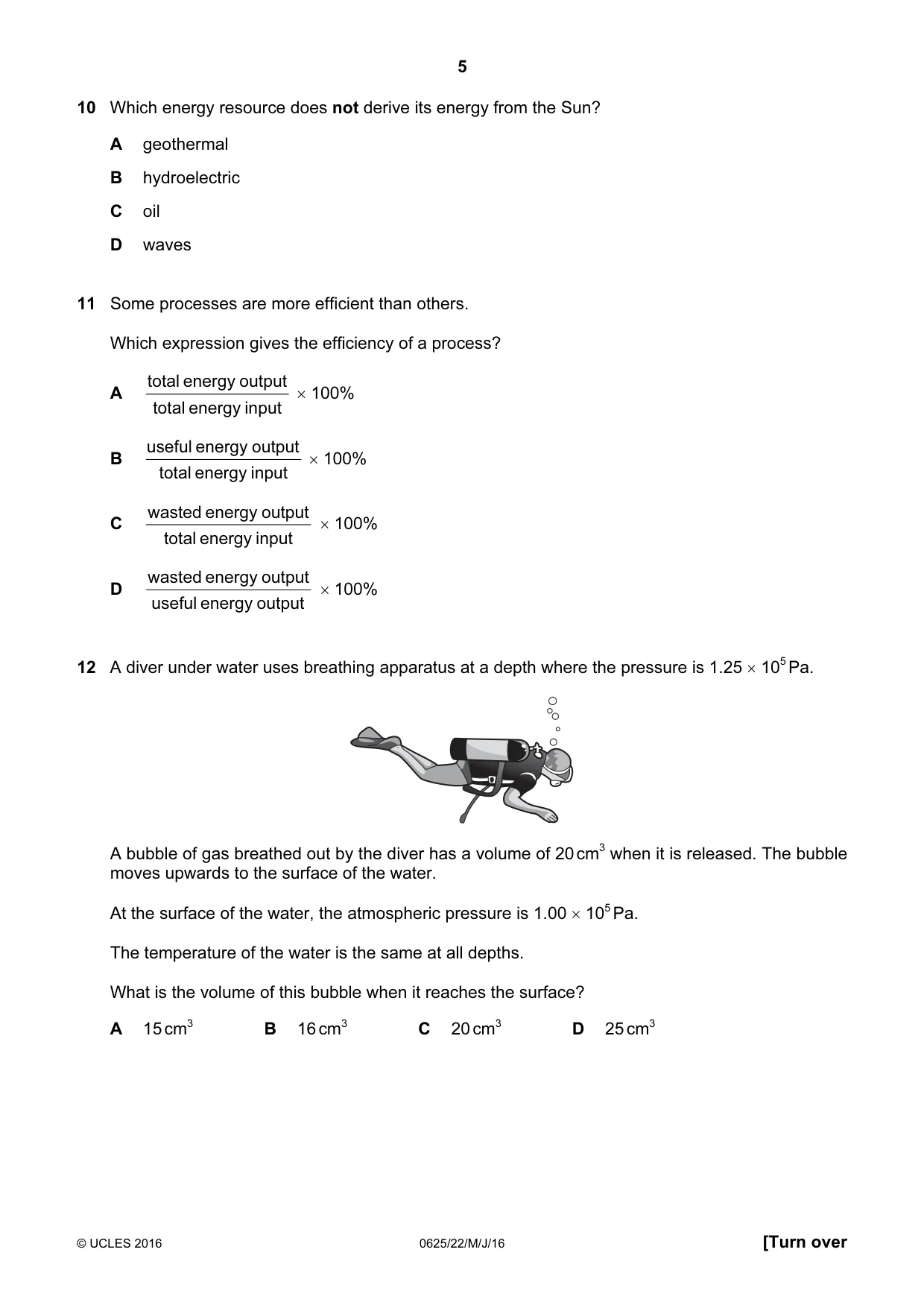
10 Which energy resource does not derive its energy from the Sun? A geothermal B hydroelectric C oil D waves
Mark scheme: A
Q11 · Some processes are more efficient than others
11 Some processes are more efficient than others. Which expression gives the efficiency of a process? total energy output A × 100% total energy input useful energy output B × 100% total energy input wasted energy output C × 100% total energy input wasted energy output D × 100% useful energy output
Mark scheme: B
Q12 · A diver under water uses breathing apparatus at a depth where the pressure is 1.25 × 10⁵…
12 A diver under water uses breathing apparatus at a depth where the pressure is 1.25 × 10⁵ Pa. A bubble of gas breathed out by the diver has a volume of 20 cm3 when it is released. The bubble moves upwards to the surface of the water. At the surface of the water, the atmospheric pressure is 1.00 × 10⁵ Pa. The temperature of the water is the same at all depths. What is the volume of this bubble when it reaches the surface? A 15 cm3 B 16 cm3 C 20 cm3 D 25 cm3
Mark scheme: D
Q13 · The diagram shows a simple mercury barometer
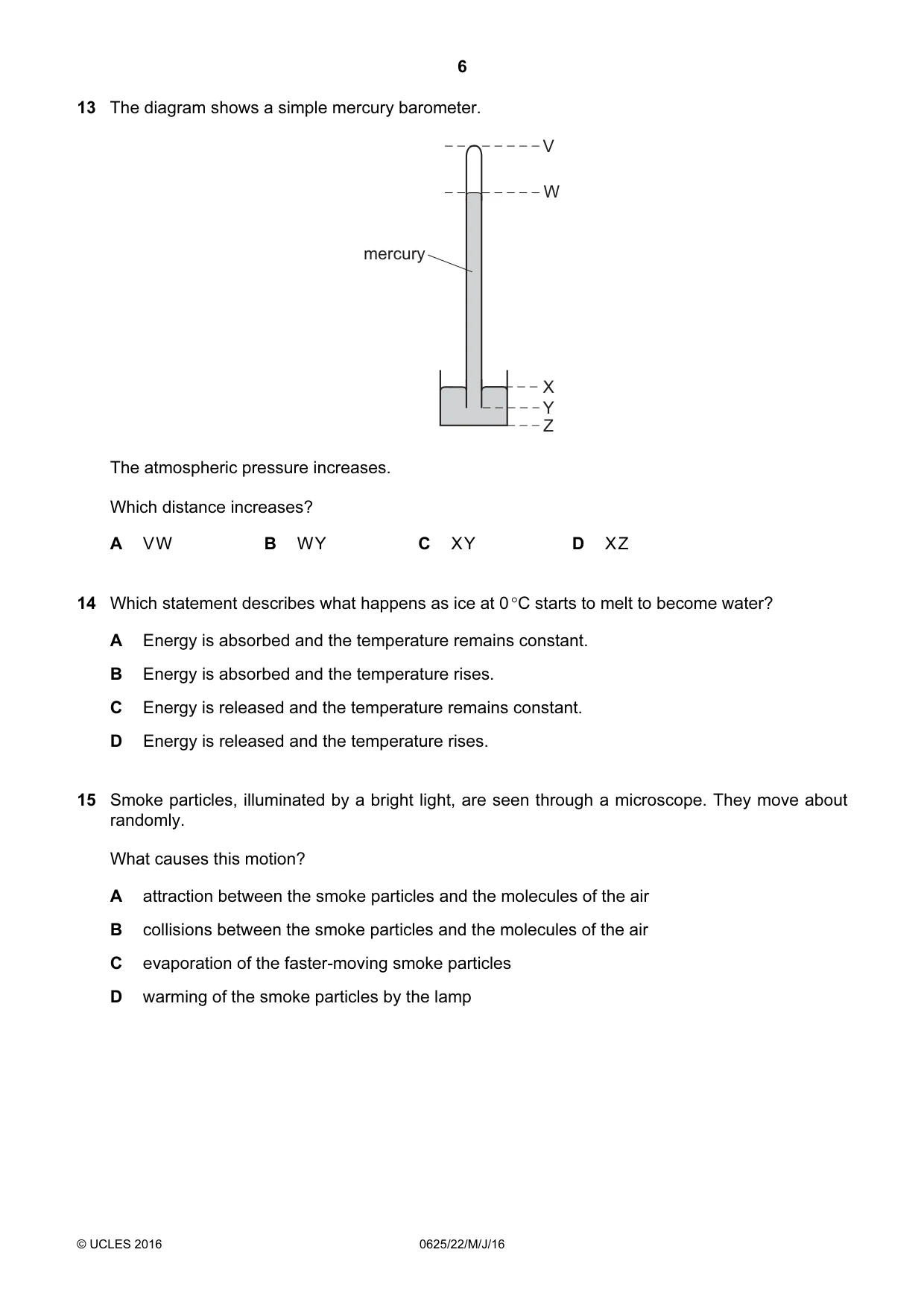
13 The diagram shows a simple mercury barometer. V W mercury X Y Z The atmospheric pressure increases. Which distance increases? A VW B WY C XY D XZ
Mark scheme: B
Q14 · Which statement describes what happens as ice at 0 °C starts to melt to become water?
14 Which statement describes what happens as ice at 0 °C starts to melt to become water? A Energy is absorbed and the temperature remains constant. B Energy is absorbed and the temperature rises. C Energy is released and the temperature remains constant. D Energy is released and the temperature rises.
Mark scheme: A
Q15 · Smoke particles, illuminated by a bright light, are seen through a microscope
15 Smoke particles, illuminated by a bright light, are seen through a microscope. They move about randomly. What causes this motion? A attraction between the smoke particles and the molecules of the air B collisions between the smoke particles and the molecules of the air C evaporation of the faster-moving smoke particles D warming of the smoke particles by the lamp
Mark scheme: B
Q16 · A liquid is at a temperature below its boiling point
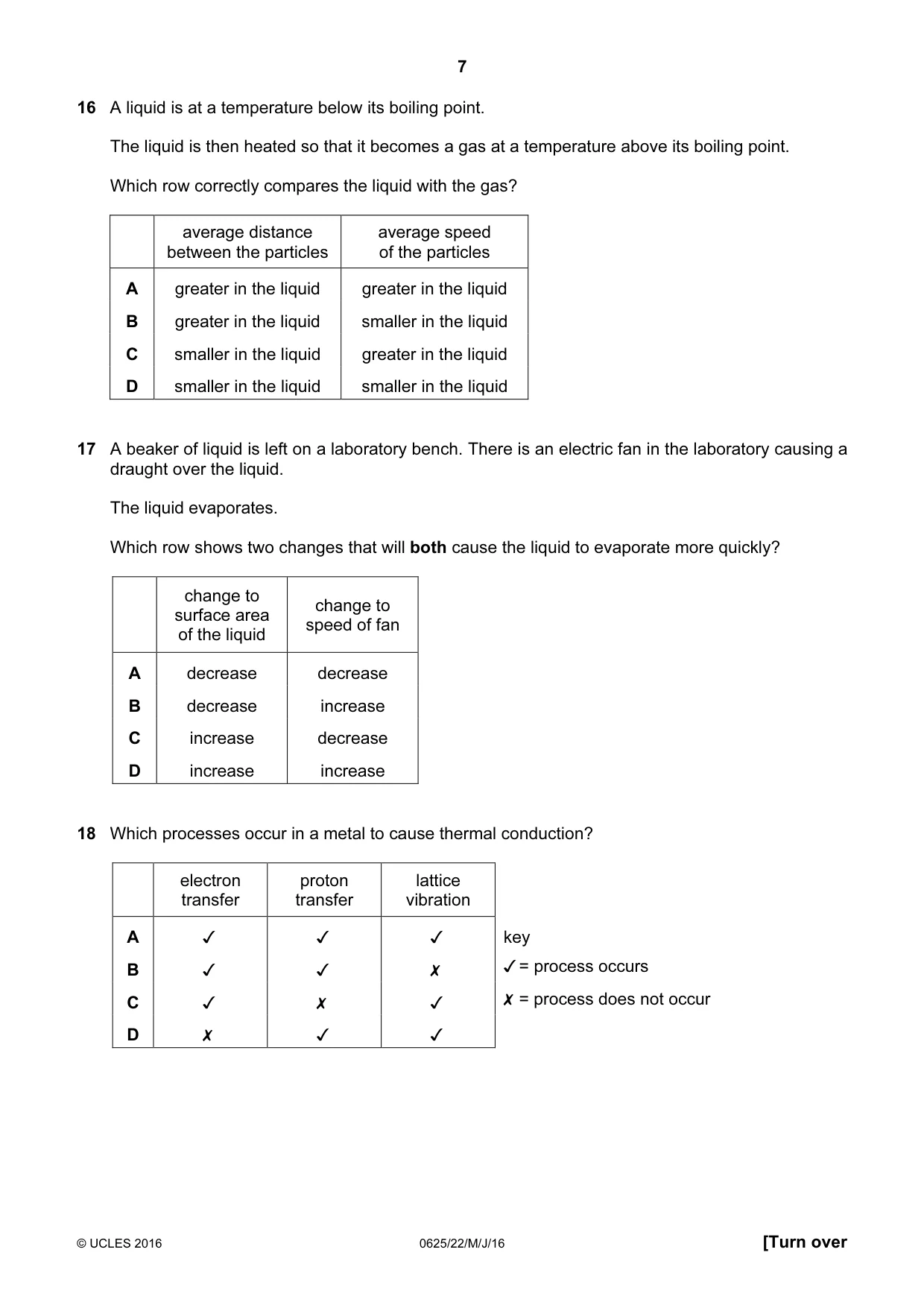
16 A liquid is at a temperature below its boiling point. The liquid is then heated so that it becomes a gas at a temperature above its boiling point. Which row correctly compares the liquid with the gas? average distance average speed between the particles of the particles A greater in the liquid greater in the liquid B greater in the liquid smaller in the liquid C smaller in the liquid greater in the liquid D smaller in the liquid smaller in the liquid
Mark scheme: D
Q17 · A beaker of liquid is left on a laboratory bench
17 A beaker of liquid is left on a laboratory bench. There is an electric fan in the laboratory causing a draught over the liquid. The liquid evaporates. Which row shows two changes that will both cause the liquid to evaporate more quickly? change to change to surface area speed of fan of the liquid A decrease decrease B decrease increase C increase decrease D increase increase
Mark scheme: D
Q18 · Which processes occur in a metal to cause thermal conduction?
18 Which processes occur in a metal to cause thermal conduction? electron proton lattice transfer transfer vibration A v v v B v v x Cc v x v D x v v key / = process occurs X = process does not occur
Mark scheme: C
Q19 · A wooden beam is painted part black and part white
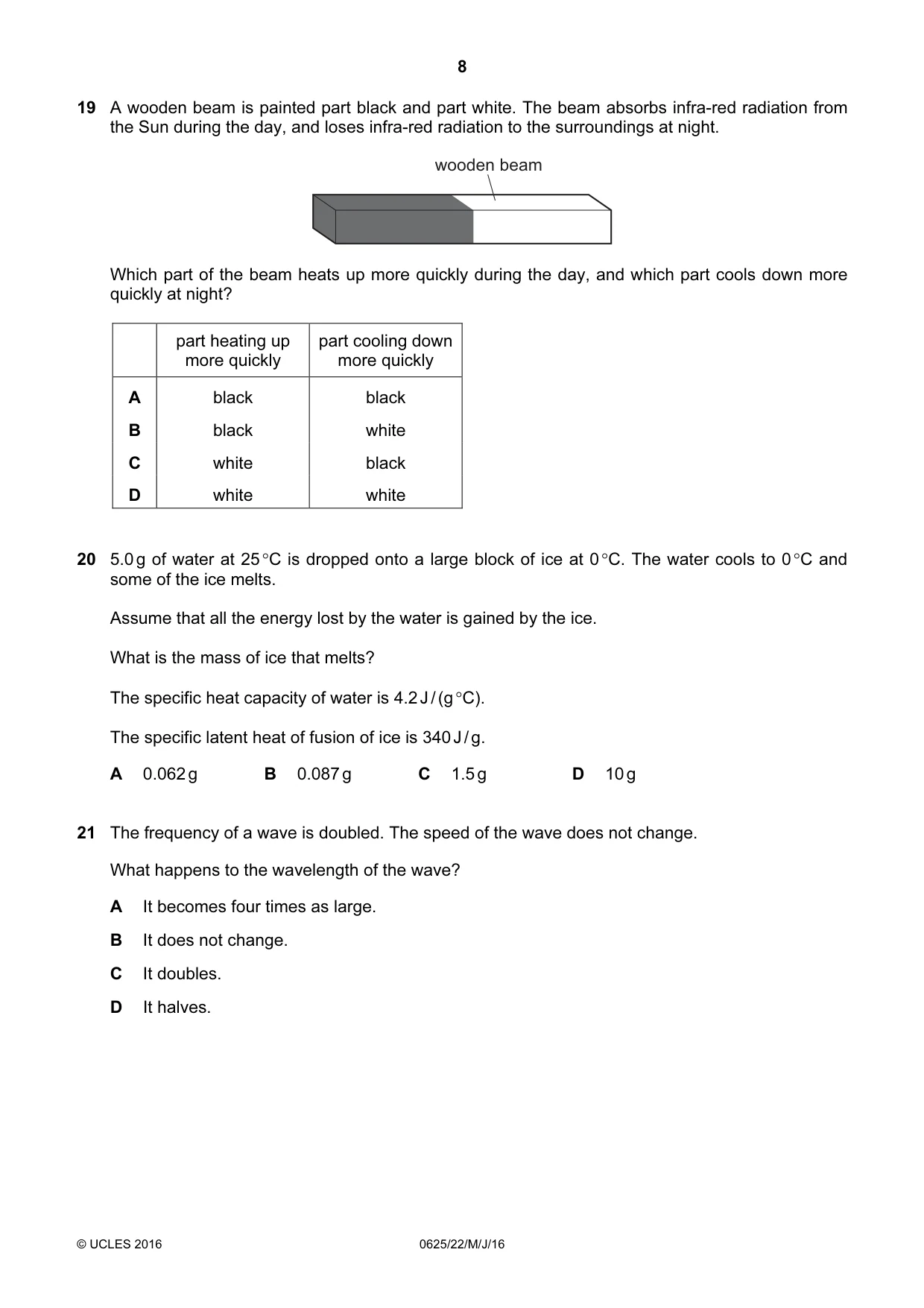
19 A wooden beam is painted part black and part white. The beam absorbs infra-red radiation from the Sun during the day, and loses infra-red radiation to the surroundings at night. wooden beam Which part of the beam heats up more quickly during the day, and which part cools down more quickly at night? part heating up part cooling down more quickly more quickly A black black B black white C white black D white white
Mark scheme: A
Q20 · 5.0 g of water at 25 °C is dropped onto a large block of ice at 0 °C
20 5.0 g of water at 25 °C is dropped onto a large block of ice at 0 °C. The water cools to 0 °C and some of the ice melts. Assume that all the energy lost by the water is gained by the ice. What is the mass of ice that melts? The specific heat capacity of water is 4.2 J / (g °C). The specific latent heat of fusion of ice is 340 J / g. A 0.062 g B 0.087 g C 1.5 g D 10 g
Mark scheme: C
Q21 · The frequency of a wave is doubled
21 The frequency of a wave is doubled. The speed of the wave does not change. What happens to the wavelength of the wave? A It becomes four times as large. B It does not change. C It doubles. D It halves.
Mark scheme: D
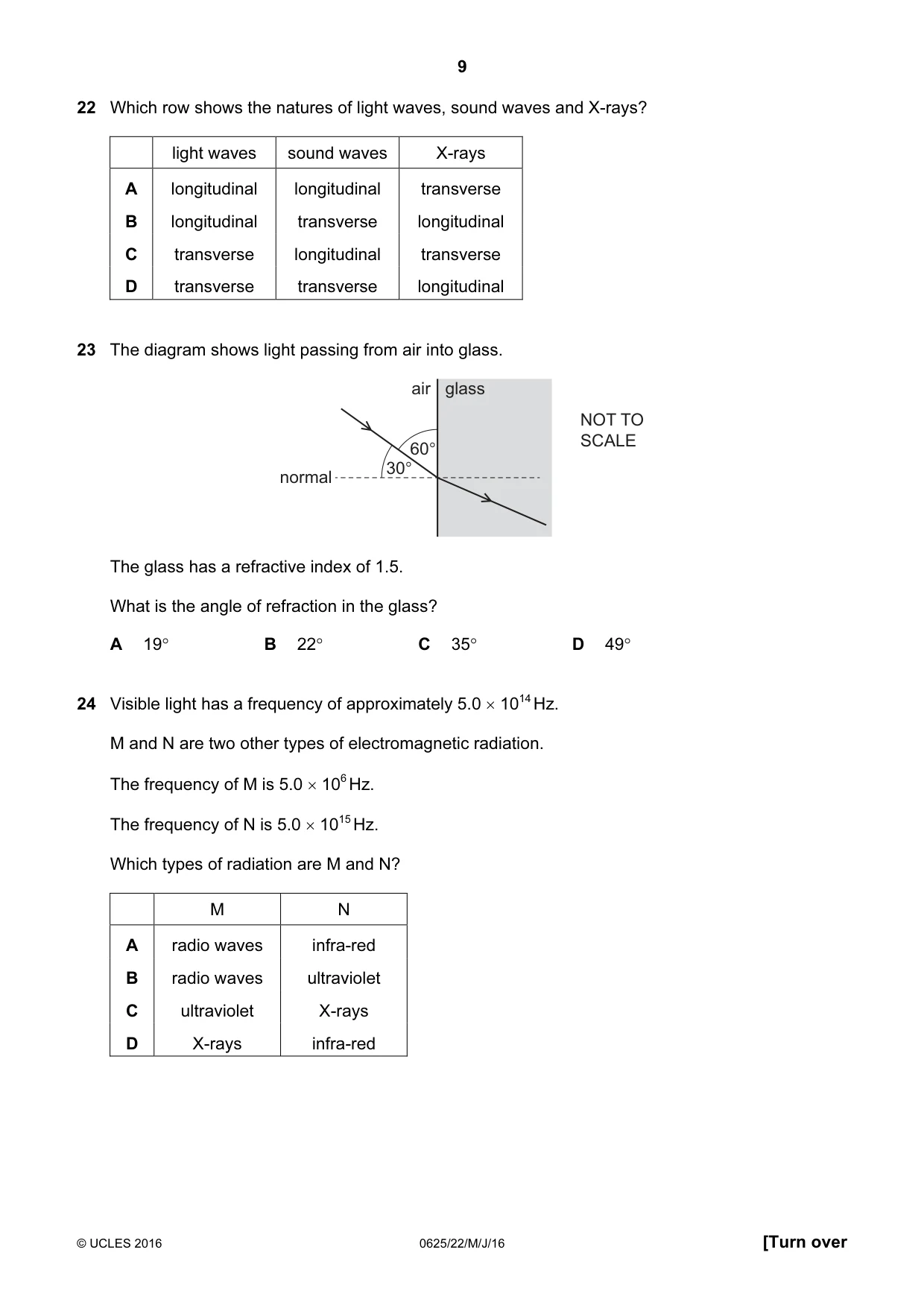
Q22 · Which row shows the natures of light waves, sound waves and X-rays?
22 Which row shows the natures of light waves, sound waves and X-rays? light waves sound waves X-rays A longitudinal longitudinal transverse B longitudinal transverse longitudinal C transverse longitudinal transverse D transverse transverse longitudinal
Mark scheme: C
Q23 · The diagram shows light passing from air into glass
23 The diagram shows light passing from air into glass. air glass NOT TO SCALE 60° 30° normal The glass has a refractive index of 1.5. What is the angle of refraction in the glass? A 19° B 22° C 35° D 49°
Mark scheme: A
Q24 · Visible light has a frequency of approximately 5.0 × 10¹⁴ Hz
24 Visible light has a frequency of approximately 5.0 × 10¹⁴ Hz. M and N are two other types of electromagnetic radiation. The frequency of M is 5.0 × 10⁶ Hz. The frequency of N is 5.0 × 10¹⁵ Hz. Which types of radiation are M and N? M N A radio waves infra-red B radio waves ultraviolet C ultraviolet X-rays D X-rays infra-red
Mark scheme: B
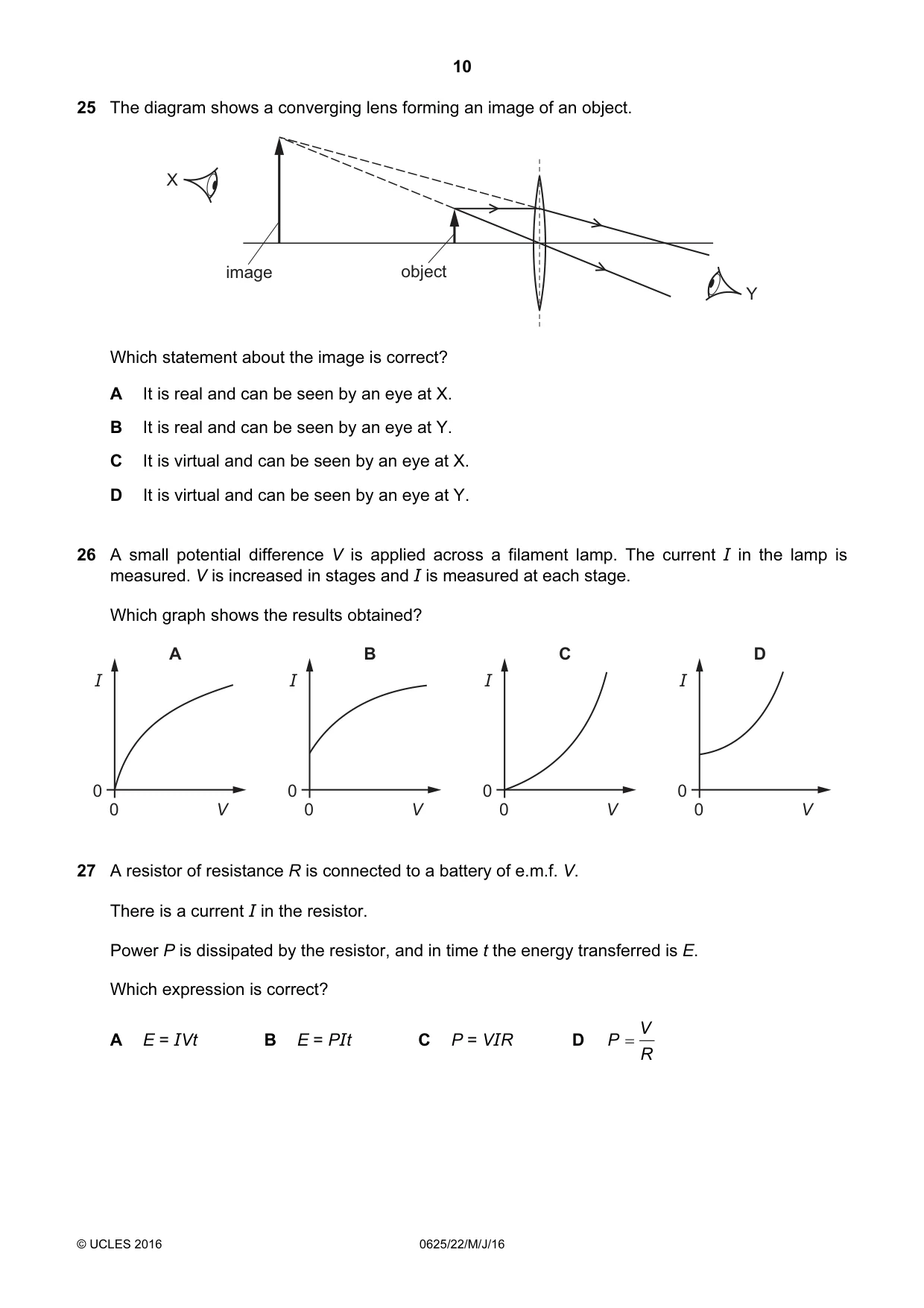
Q25 · The diagram shows a converging lens forming an image of an object
25 The diagram shows a converging lens forming an image of an object. X image object Y Which statement about the image is correct? A It is real and can be seen by an eye at X. B It is real and can be seen by an eye at Y. C It is virtual and can be seen by an eye at X. D It is virtual and can be seen by an eye at Y.
Mark scheme: D
Q26 · A small potential difference V is applied across a filament lamp
26 A small potential difference V is applied across a filament lamp. The current I in the lamp is measured. V is increased in stages and I is measured at each stage. Which graph shows the results obtained? A B C D I I I I 0 0 0 0 0 V 0 V 0 V 0 V
Mark scheme: A
Q27 · A resistor of resistance R is connected to a battery of e.m.f
27 A resistor of resistance R is connected to a battery of e.m.f. V. There is a current I in the resistor. Power P is dissipated by the resistor, and in time t the energy transferred is E. Which expression is correct? V A E = IVt B E = PIt C P = VIR D P = R
Mark scheme: A
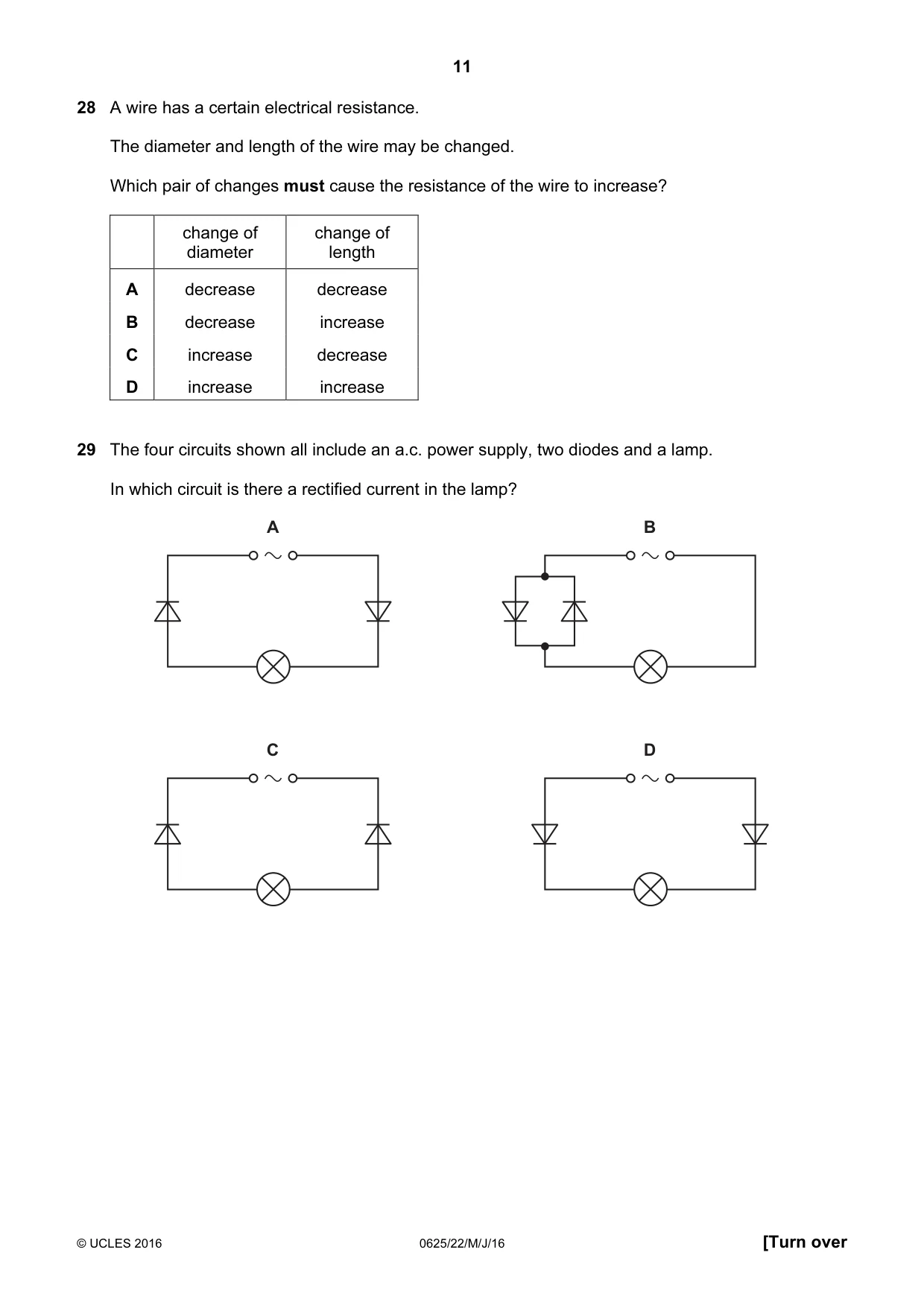
Q28 · A wire has a certain electrical resistance
28 A wire has a certain electrical resistance. The diameter and length of the wire may be changed. Which pair of changes must cause the resistance of the wire to increase? change of change of diameter length A decrease decrease B decrease increase C increase decrease D increase increase
Mark scheme: B
Q29 · The four circuits shown all include an a.c
29 The four circuits shown all include an a.c. power supply, two diodes and a lamp. In which circuit is there a rectified current in the lamp? A B C D
Mark scheme: A
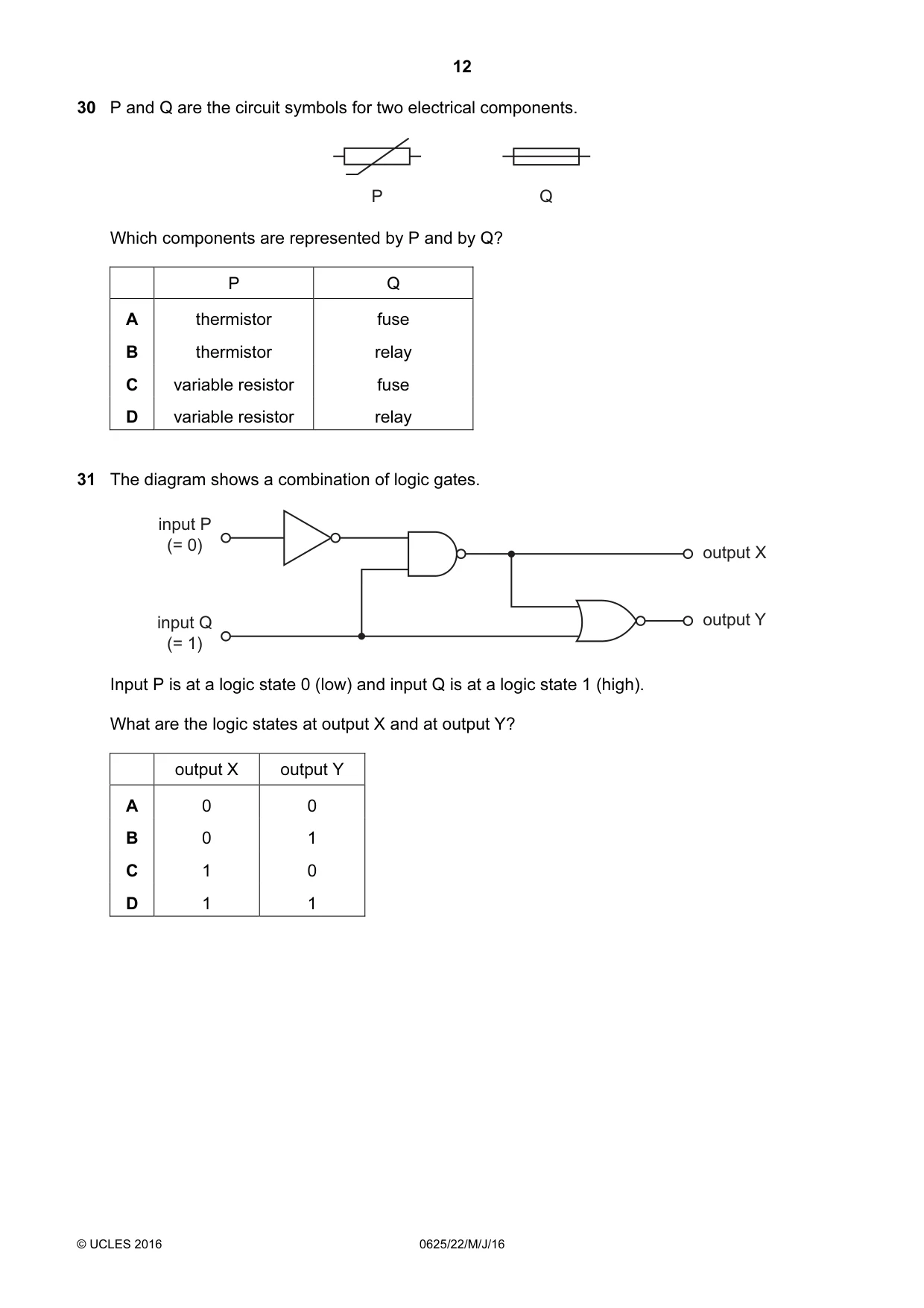
Q30 · P and Q are the circuit symbols for two electrical components
30 P and Q are the circuit symbols for two electrical components. P Q Which components are represented by P and by Q? P Q A thermistor fuse B thermistor relay C variable resistor fuse D variable resistor relay
Mark scheme: A
Q31 · The diagram shows a combination of logic gates
31 The diagram shows a combination of logic gates. input P (= 0) output X input Q output Y (= 1) Input P is at a logic state 0 (low) and input Q is at a logic state 1 (high). What are the logic states at output X and at output Y? output X output Y A 0 0 B 0 1 C 1 0 D 1 1
Mark scheme: A
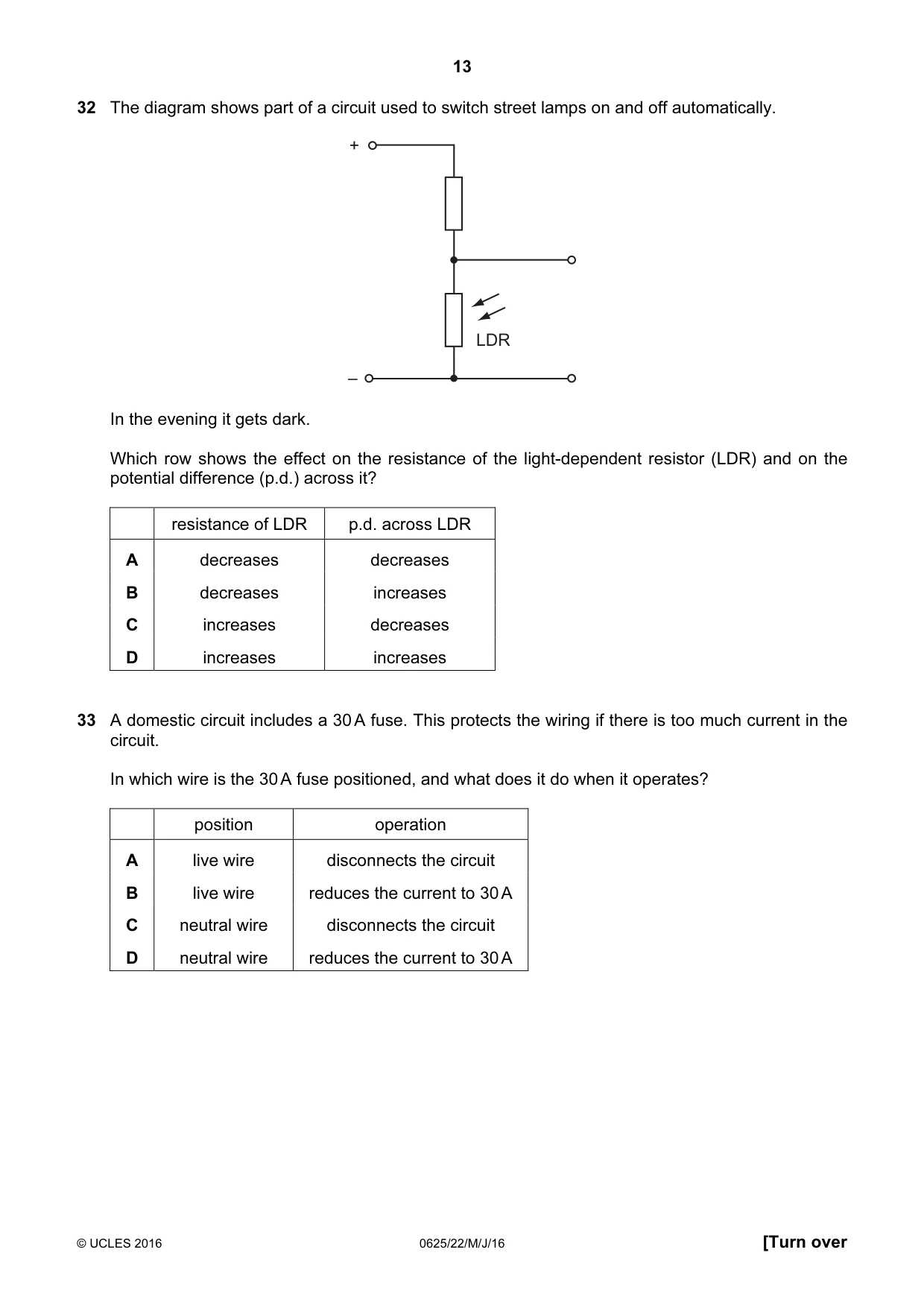
Q32 · The diagram shows part of a circuit used to switch street lamps on and off automatically
32 The diagram shows part of a circuit used to switch street lamps on and off automatically. + LDR – In the evening it gets dark. Which row shows the effect on the resistance of the light-dependent resistor (LDR) and on the potential difference (p.d.) across it? resistance of LDR p.d. across LDR A decreases decreases B decreases increases C increases decreases D increases increases
Mark scheme: D
Q33 · A domestic circuit includes a 30 A fuse
33 A domestic circuit includes a 30 A fuse. This protects the wiring if there is too much current in the circuit. In which wire is the 30 A fuse positioned, and what does it do when it operates? position operation A live wire disconnects the circuit B live wire reduces the current to 30 A C neutral wire disconnects the circuit D neutral wire reduces the current to 30 A
Mark scheme: A
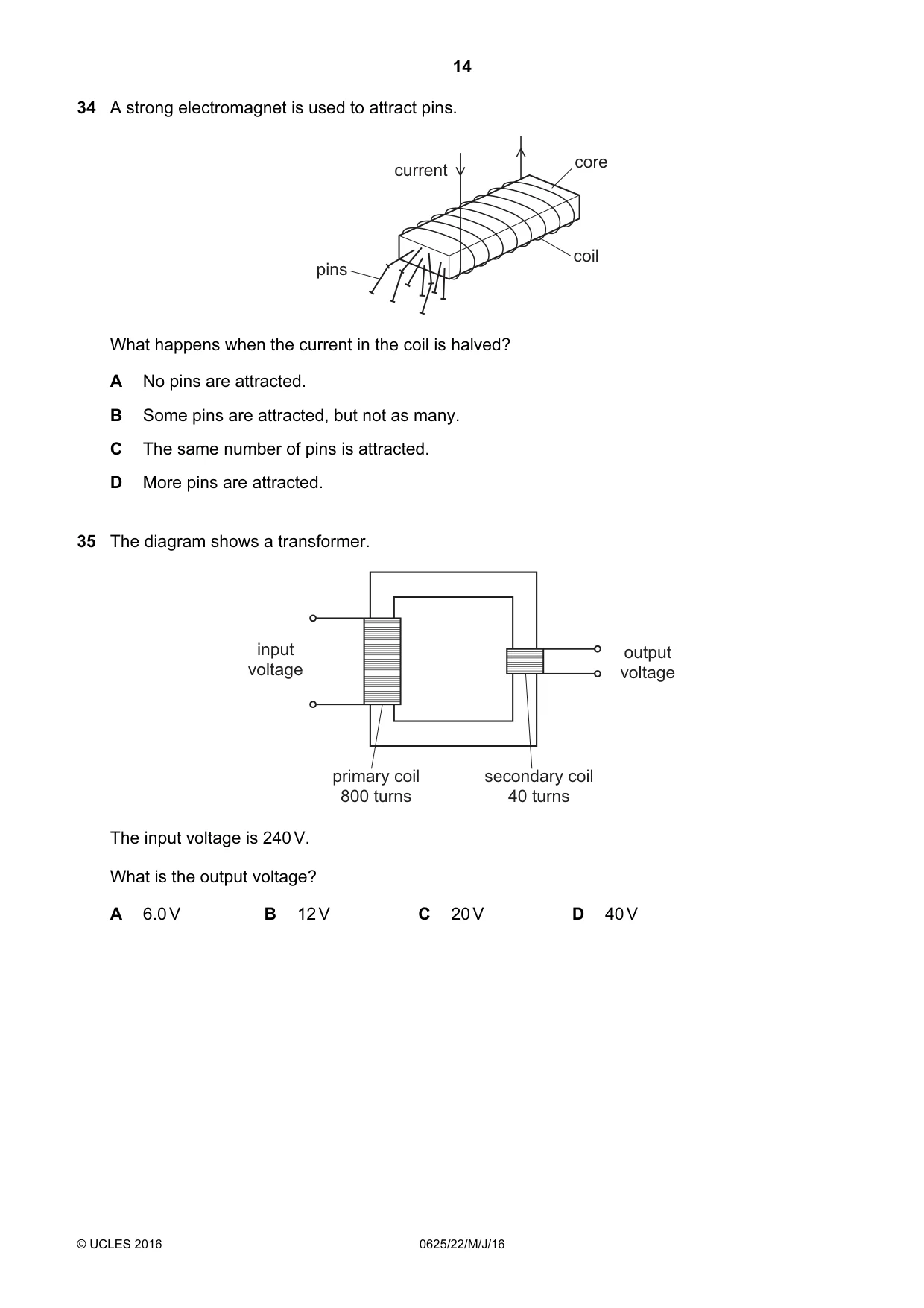
Q34 · A strong electromagnet is used to attract pins
34 A strong electromagnet is used to attract pins. core current coil pins What happens when the current in the coil is halved? A No pins are attracted. B Some pins are attracted, but not as many. C The same number of pins is attracted. D More pins are attracted.
Mark scheme: B
Q35 · The diagram shows a transformer
35 The diagram shows a transformer. input output voltage voltage primary coil secondary coil 800 turns 40 turns The input voltage is 240 V. What is the output voltage? A 6.0 V B 12 V C 20 V D 40 V
Mark scheme: B
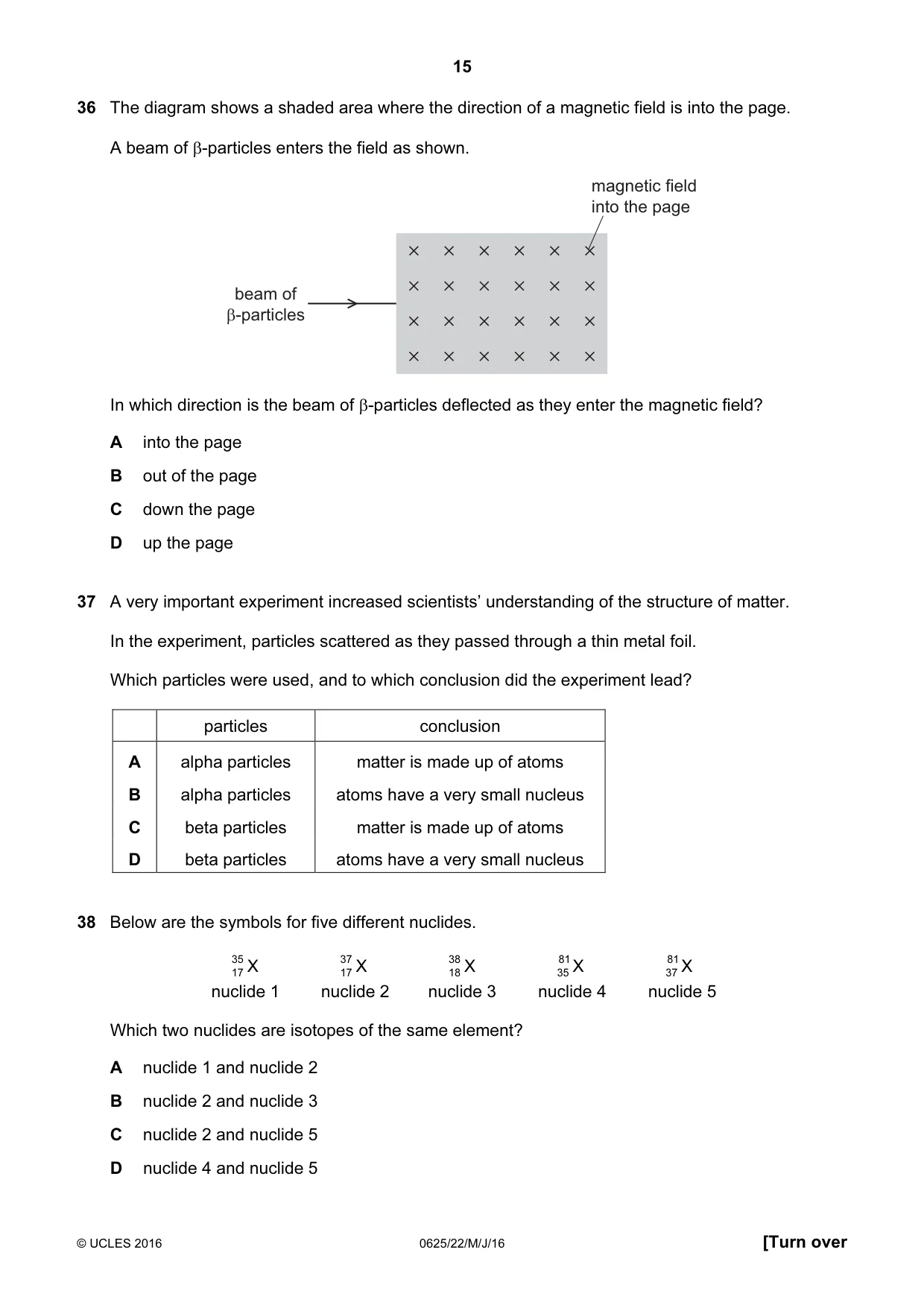
Q36 · The diagram shows a shaded area where the direction of a magnetic field is into the page
36 The diagram shows a shaded area where the direction of a magnetic field is into the page. A beam of β-particles enters the field as shown. magnetic field into the page beam of β-particles In which direction is the beam of β-particles deflected as they enter the magnetic field? A into the page B out of the page C down the page D up the page
Mark scheme: C
Q37 · A very important experiment increased scientists’ understanding of the structure of matter
37 A very important experiment increased scientists’ understanding of the structure of matter. In the experiment, particles scattered as they passed through a thin metal foil. Which particles were used, and to which conclusion did the experiment lead? particles conclusion A alpha particles matter is made up of atoms B alpha particles atoms have a very small nucleus C beta particles matter is made up of atoms D beta particles atoms have a very small nucleus
Mark scheme: B
Q38 · Below are the symbols for five different nuclides
38 Below are the symbols for five different nuclides. 35 X 37 X 38 X 81 X 81 X 17 17 18 35 37 nuclide 1 nuclide 2 nuclide 3 nuclide 4 nuclide 5 Which two nuclides are isotopes of the same element? A nuclide 1 and nuclide 2 B nuclide 2 and nuclide 3 C nuclide 2 and nuclide 5 D nuclide 4 and nuclide 5
Mark scheme: A
Q39 · A radioactive decay can be represented as shown
39 A radioactive decay can be represented as shown. 233 Pa → 233 U 91 92 The equation is incomplete. In this decay, the nucleus changes by A absorbing a neutron. B absorbing a proton. C emitting an α-particle. D emitting a β-particle.
Mark scheme: D
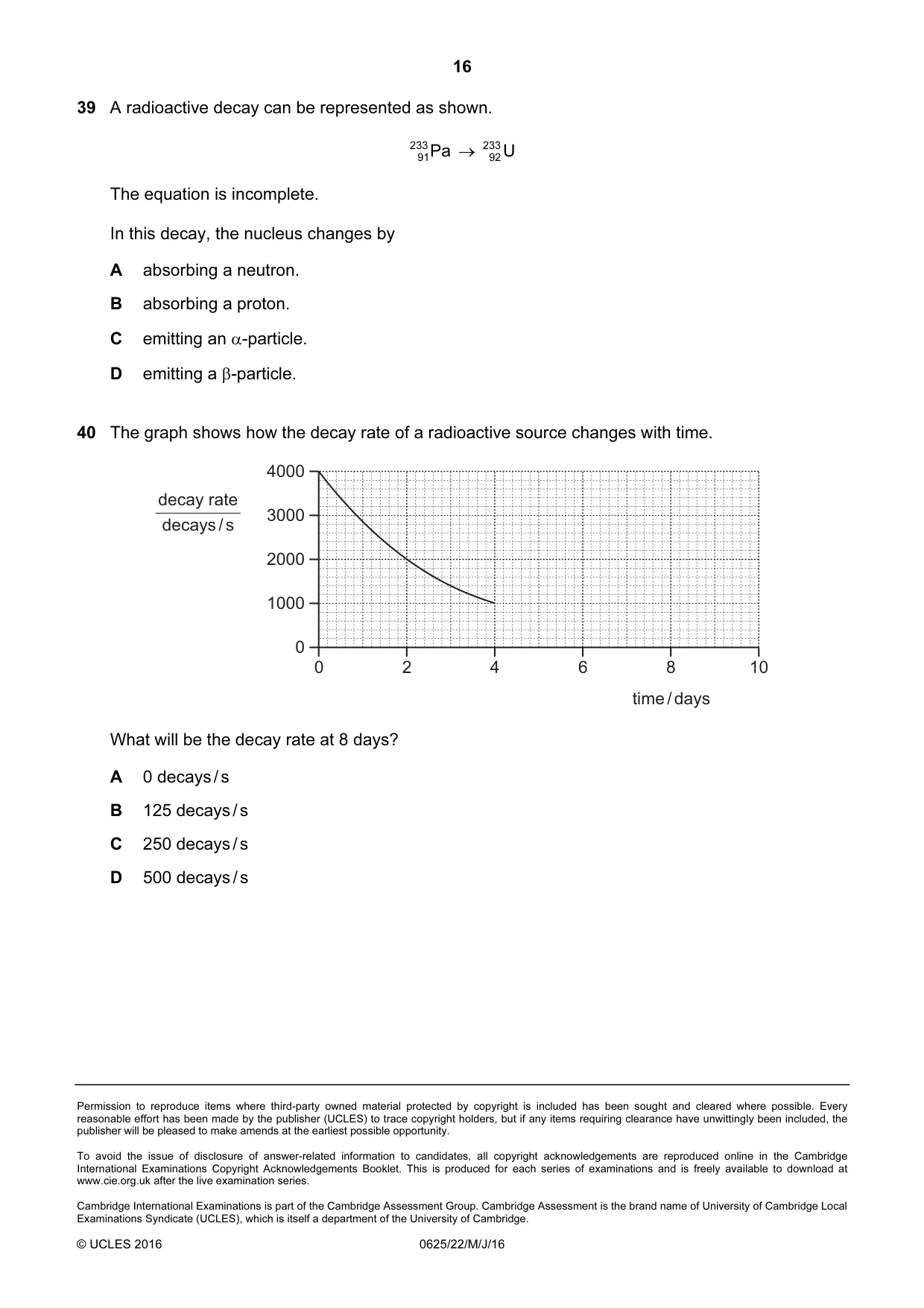
Q40 · The graph shows how the decay rate of a radioactive source changes with time
40 The graph shows how the decay rate of a radioactive source changes with time. 4000 decay rate 3000 decays / s 2000 1000 0 0 2 4 6 8 10 time / days What will be the decay rate at 8 days? A 0 decays / s B 125 decays / s C 250 decays / s D 500 decays / s
Mark scheme: C
What was in this paper
The subtopics covered by these 40 questions, and how many questions each got. Open one in a new tab to see every Cambridge question on it.
4Kinetic particle model of matter4Electrical quantities3Energy, work and power3Forces3Motion3Radioactivity3General properties of waves2Light2The nuclear model of the atom2Thermal properties and temperature2Transfer of thermal energy2Electrical safety1Electromagnetic effects1Electromagnetic spectrum1Mass and weight1Physical quantities and measurement techniques1Pressure1Simple phenomena of magnetism1What you needed in this session
Cambridge’s own grade thresholds for 2016 May/June, Paper 2 · Variant 2. A higher threshold means an easier paper — the bar moves with how the cohort did.