Cambridge IGCSE Physics 0625 — 2024 Oct/Nov Paper 2 · Variant 2
0625/22/O/N/24 · 40 questions · 40 marks · ≈45 min
The question paper and its mark scheme, free to read here and free to download. This is Cambridge’s own paper, exactly as it was sat.
Question paper20 pages

Mark scheme3 pages
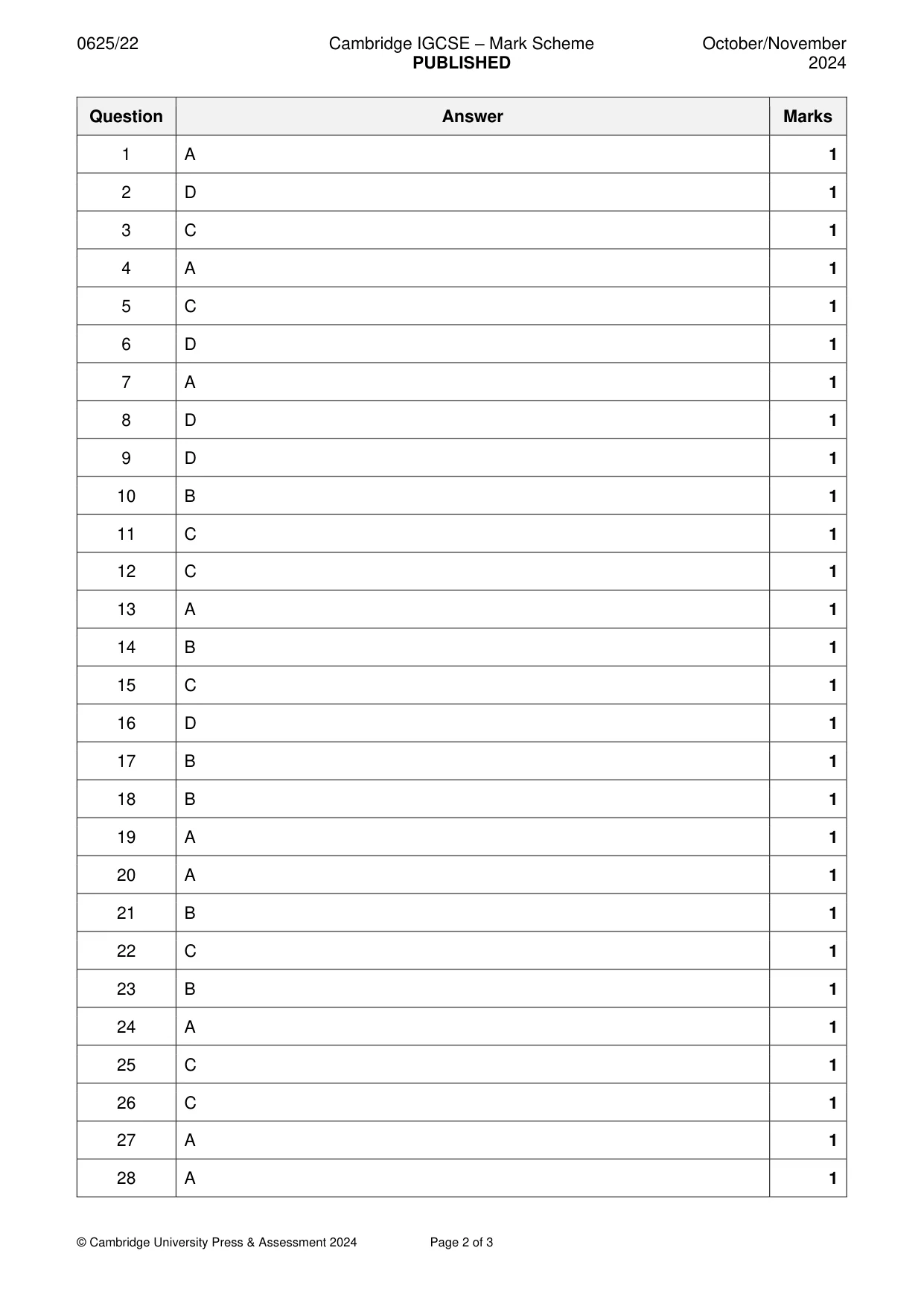
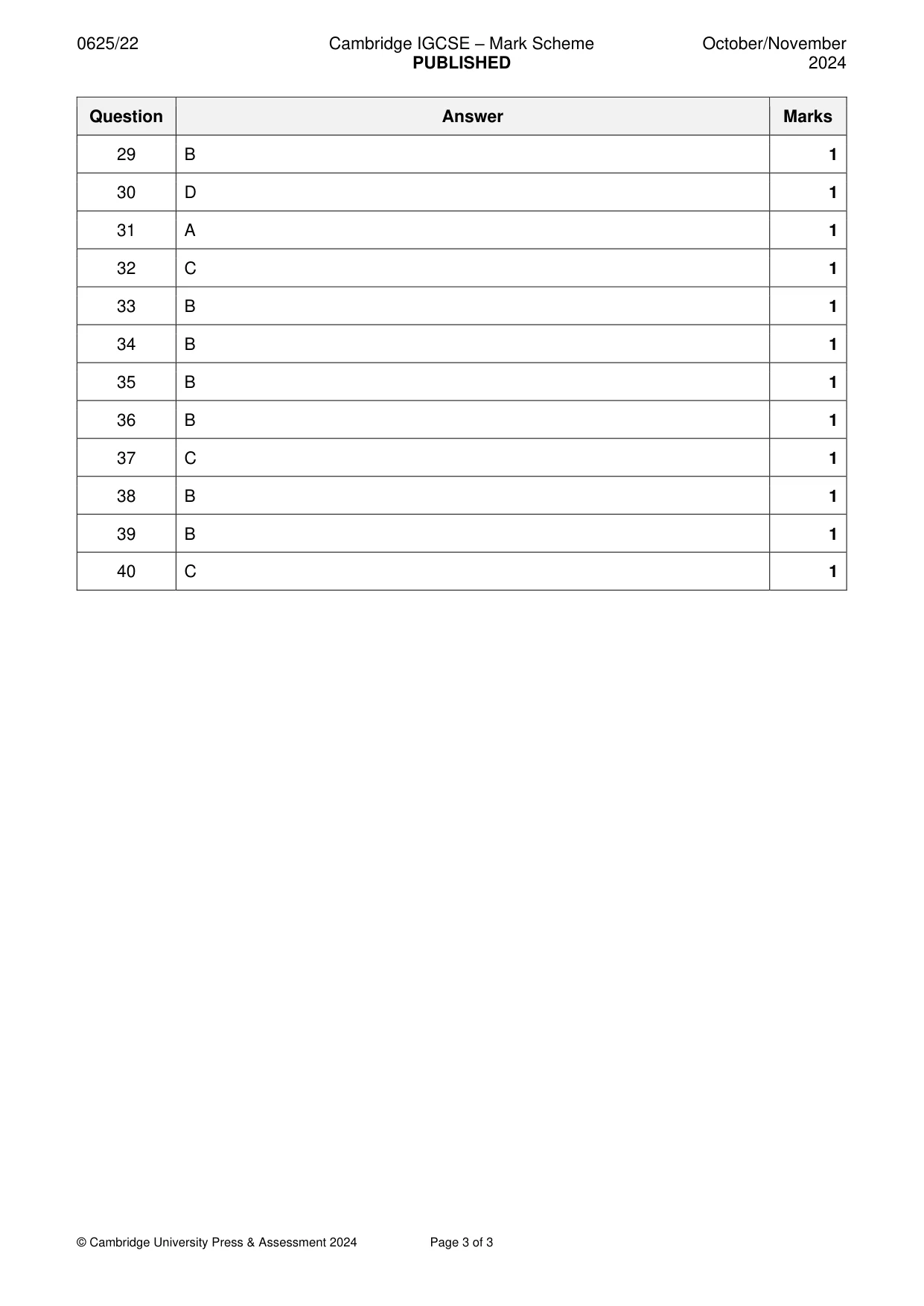
Answers below. Sit the paper first if you are practising.
Questions as text
Q1 · Two forces with magnitudes F1 and F2 act on an object at right angles to each other
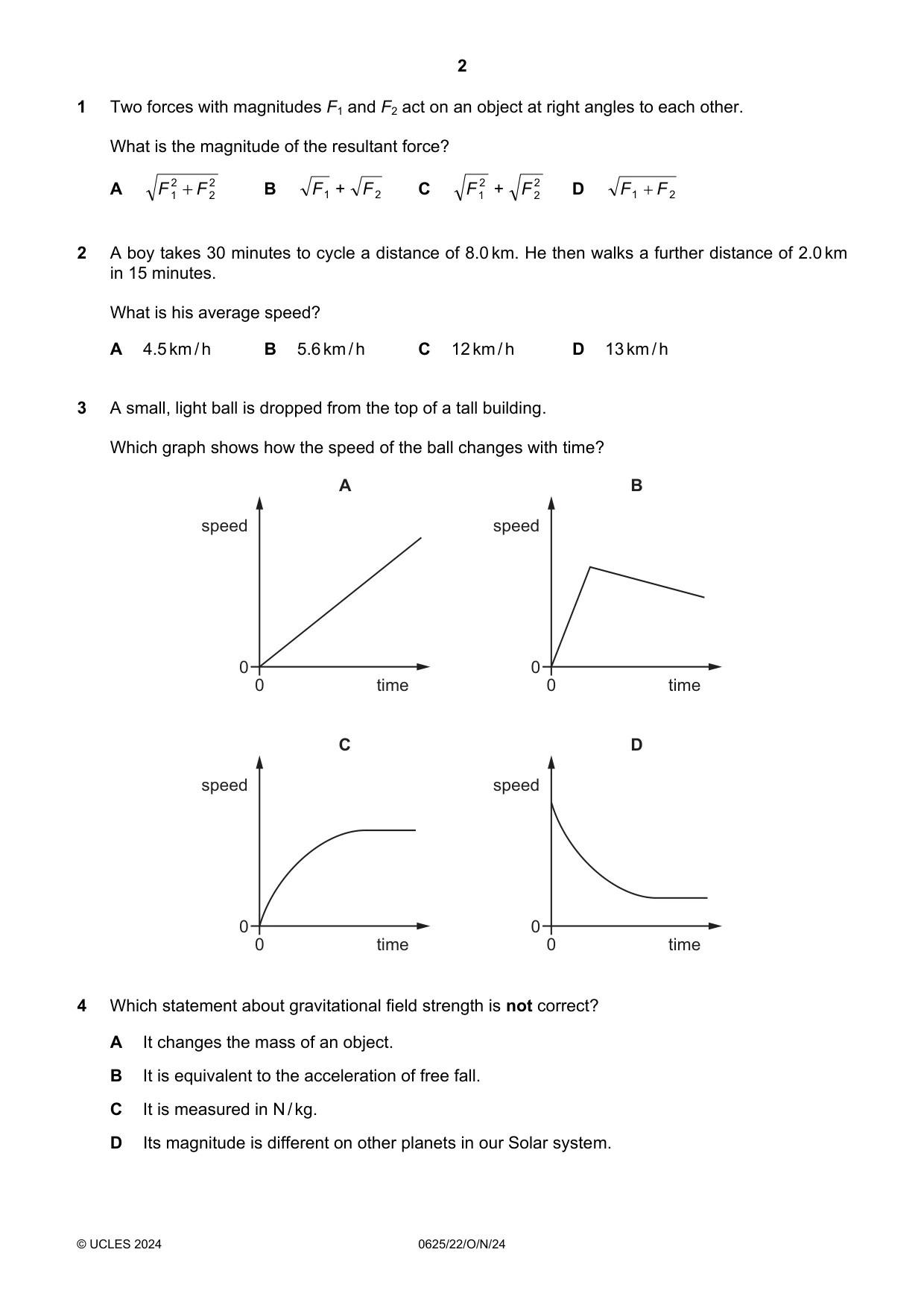
1 Two forces with magnitudes F1 and F2 act on an object at right angles to each other. What is the magnitude of the resultant force? A F 2 F 2 B F + F C F 2 + F 2 D F F 1 2 1 2 1 2 1 2
Mark scheme: A
Q2 · A boy takes 30 minutes to cycle a distance of 8.0 km
2 A boy takes 30 minutes to cycle a distance of 8.0 km. He then walks a further distance of 2.0 km in 15 minutes. What is his average speed? A 4.5 km / h B 5.6 km / h C 12 km / h D 13 km / h
Mark scheme: D
Q3 · A small, light ball is dropped from the top of a tall building
3 A small, light ball is dropped from the top of a tall building. Which graph shows how the speed of the ball changes with time? A B speed speed 0 0 0 time 0 time C D speed speed 0 0 0 time 0 time
Mark scheme: C
Q4 · Which statement about gravitational field strength is not correct?
4 Which statement about gravitational field strength is not correct? A It changes the mass of an object. B It is equivalent to the acceleration of free fall. C It is measured in N / kg. D Its magnitude is different on other planets in our Solar system.
Mark scheme: A
Q5 · Three liquids P, Q and R have different densities and do not mix
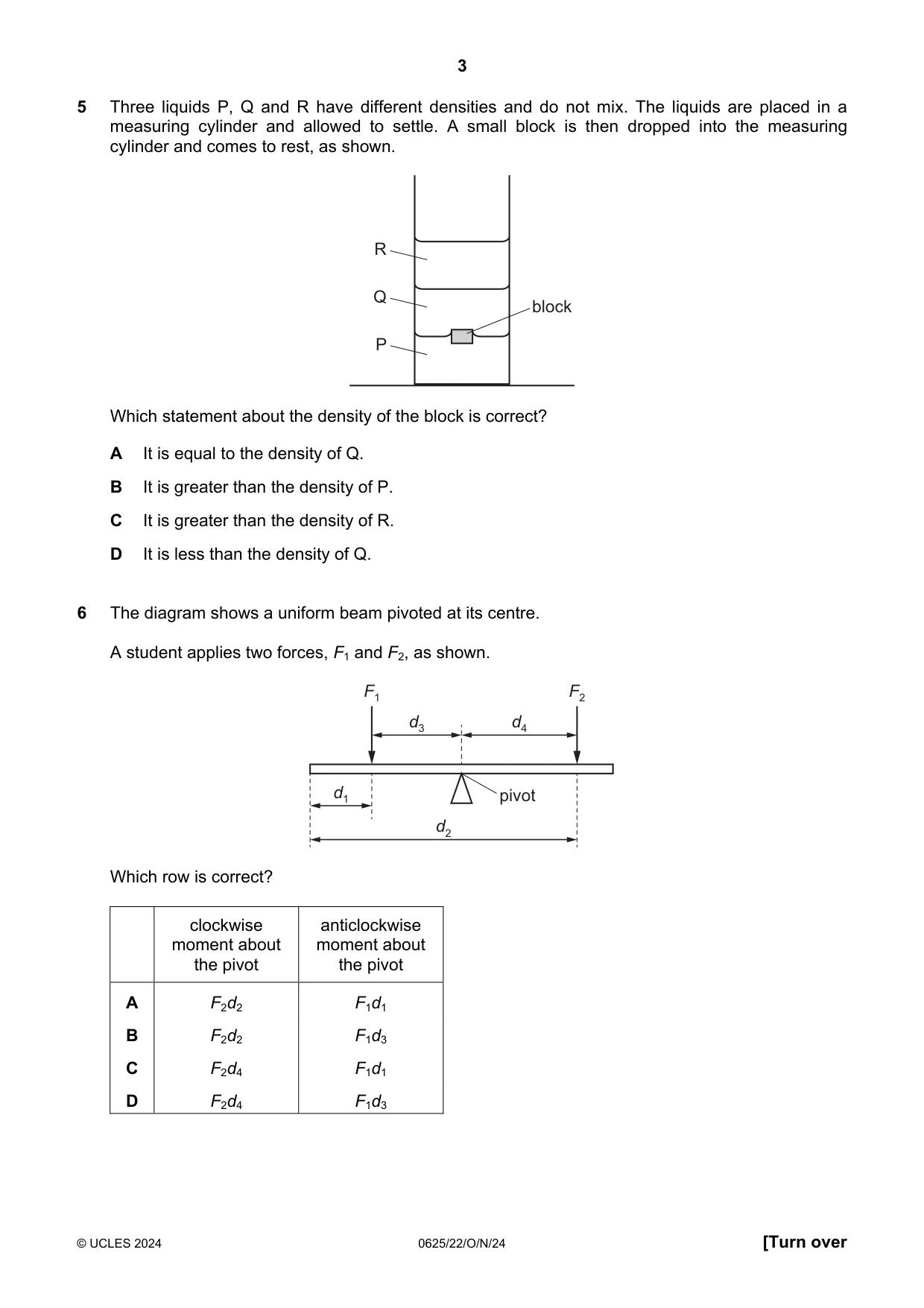
5 Three liquids P, Q and R have different densities and do not mix. The liquids are placed in a measuring cylinder and allowed to settle. A small block is then dropped into the measuring cylinder and comes to rest, as shown. R Q block P Which statement about the density of the block is correct? A It is equal to the density of Q. B It is greater than the density of P. C It is greater than the density of R. D It is less than the density of Q.
Mark scheme: C
Q6 · The diagram shows a uniform beam pivoted at its centre
6 The diagram shows a uniform beam pivoted at its centre. A student applies two forces, F1 and F2, as shown. F1 F2 d3 d4 d1 pivot d2 Which row is correct? clockwise anticlockwise moment about moment about the pivot the pivot A F2d2 F1d1 B F2d2 F1d3 C F2d4 F1d1 D F2d4 F1d3
Mark scheme: D
Q7 · Which expression can be used to determine the impulse on a tennis ball?
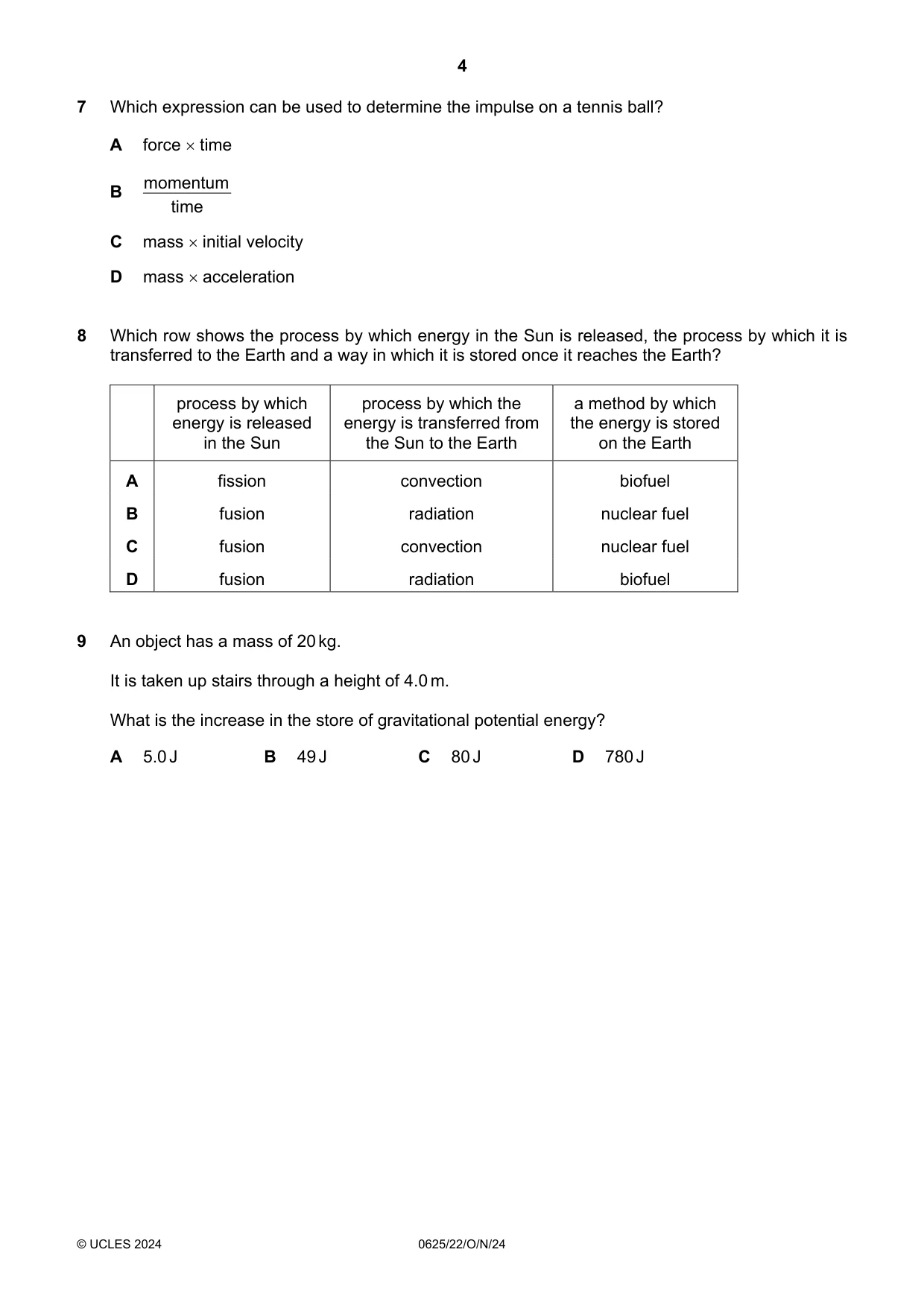
7 Which expression can be used to determine the impulse on a tennis ball? A force time momentum B time C mass initial velocity D mass acceleration
Mark scheme: A
Q8 · Which row shows the process by which energy in the Sun is released, the process by which…
8 Which row shows the process by which energy in the Sun is released, the process by which it is transferred to the Earth and a way in which it is stored once it reaches the Earth? process by which process by which the a method by which energy is released energy is transferred from the energy is stored in the Sun the Sun to the Earth on the Earth A fission convection biofuel B fusion radiation nuclear fuel C fusion convection nuclear fuel D fusion radiation biofuel
Mark scheme: D
Q9 · An object has a mass of 20 kg
9 An object has a mass of 20 kg. It is taken up stairs through a height of 4.0 m. What is the increase in the store of gravitational potential energy? A 5.0 J B 49 J C 80 J D 780 J
Mark scheme: D
Q10 · An electrician uses a lifting machine, as shown
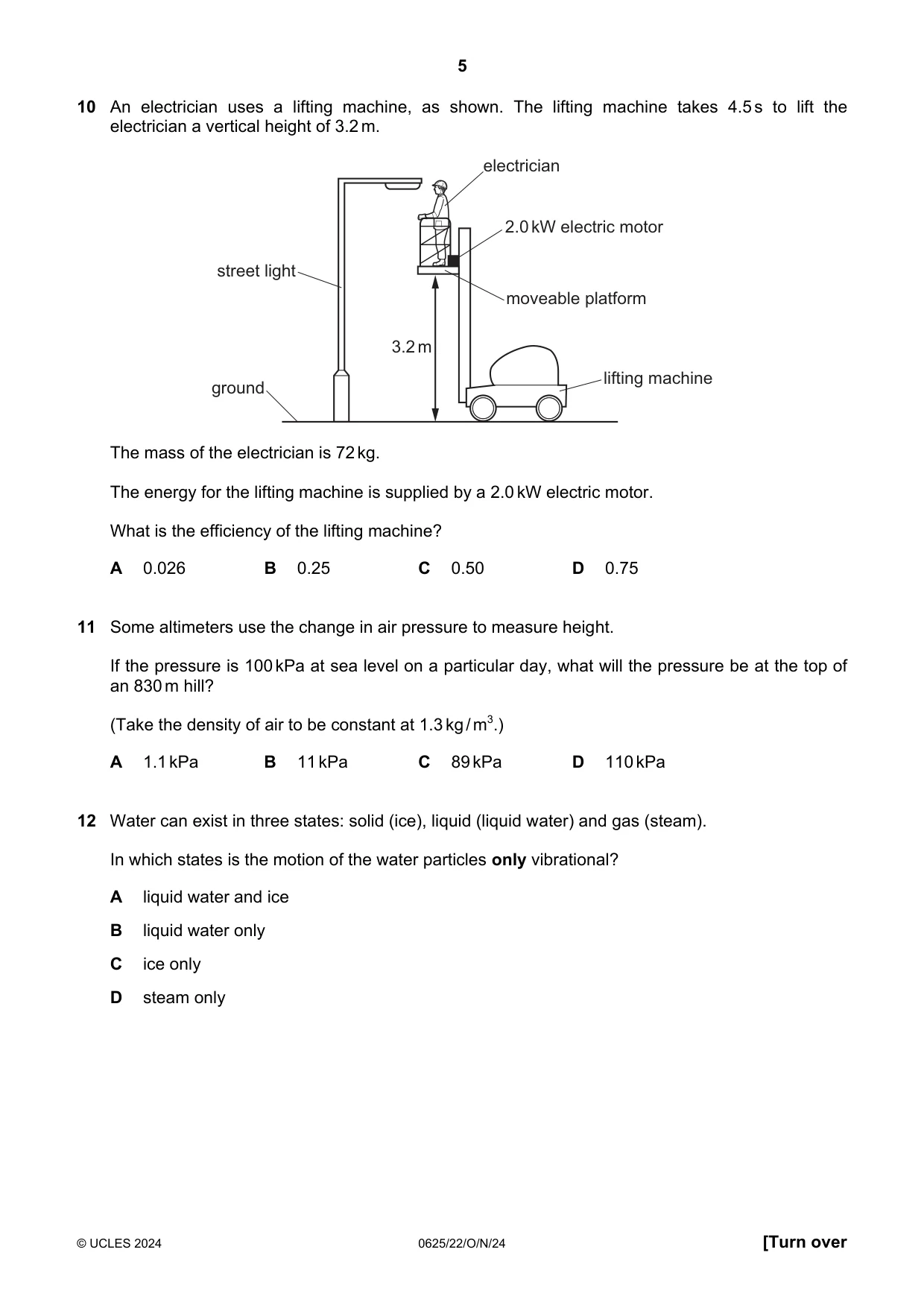
10 An electrician uses a lifting machine, as shown. The lifting machine takes 4.5 s to lift the electrician a vertical height of 3.2 m. electrician 2.0 kW electric motor street light moveable platform 3.2 m lifting machine ground The mass of the electrician is 72 kg. The energy for the lifting machine is supplied by a 2.0 kW electric motor. What is the efficiency of the lifting machine? A 0.026 B 0.25 C 0.50 D 0.75
Mark scheme: B
Q11 · Some altimeters use the change in air pressure to measure height
11 Some altimeters use the change in air pressure to measure height. If the pressure is 100 kPa at sea level on a particular day, what will the pressure be at the top of an 830 m hill? (Take the density of air to be constant at 1.3 kg / m3.) A 1.1 kPa B 11 kPa C 89 kPa D 110 kPa
Mark scheme: C
Q12 · Water can exist in three states: solid (ice), liquid (liquid water) and gas (steam)
12 Water can exist in three states: solid (ice), liquid (liquid water) and gas (steam). In which states is the motion of the water particles only vibrational? A liquid water and ice B liquid water only C ice only D steam only
Mark scheme: C
Q13 · A cube has sides 2.0 m long
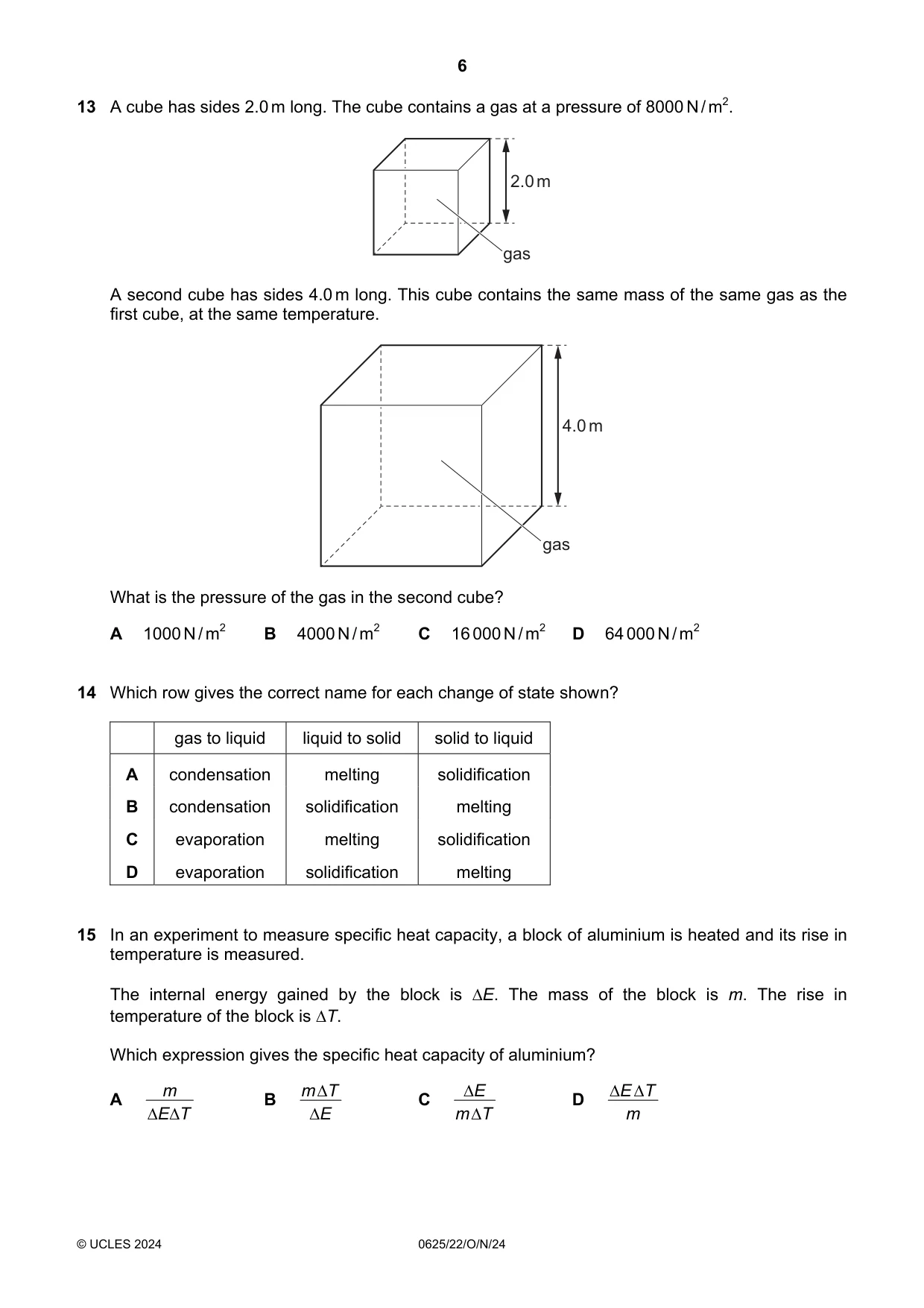
13 A cube has sides 2.0 m long. The cube contains a gas at a pressure of 8000 N / m2. 2.0 m gas A second cube has sides 4.0 m long. This cube contains the same mass of the same gas as the first cube, at the same temperature. 4.0 m gas What is the pressure of the gas in the second cube? A 1000 N / m2 B 4000 N / m2 C 16 000 N / m2 D 64 000 N / m2
Mark scheme: A
Q14 · Which row gives the correct name for each change of state shown?
14 Which row gives the correct name for each change of state shown? gas to liquid liquid to solid solid to liquid A condensation melting solidification B condensation solidification melting C evaporation melting solidification D evaporation solidification melting
Mark scheme: B
Q15 · In an experiment to measure specific heat capacity, a block of aluminium is heated and…
15 In an experiment to measure specific heat capacity, a block of aluminium is heated and its rise in temperature is measured. The internal energy gained by the block is E. The mass of the block is m. The rise in temperature of the block is T. Which expression gives the specific heat capacity of aluminium? m m T E E T A B C D E T E m T m
Mark scheme: C
Q16 · Which statement about the transfer of thermal energy is correct?
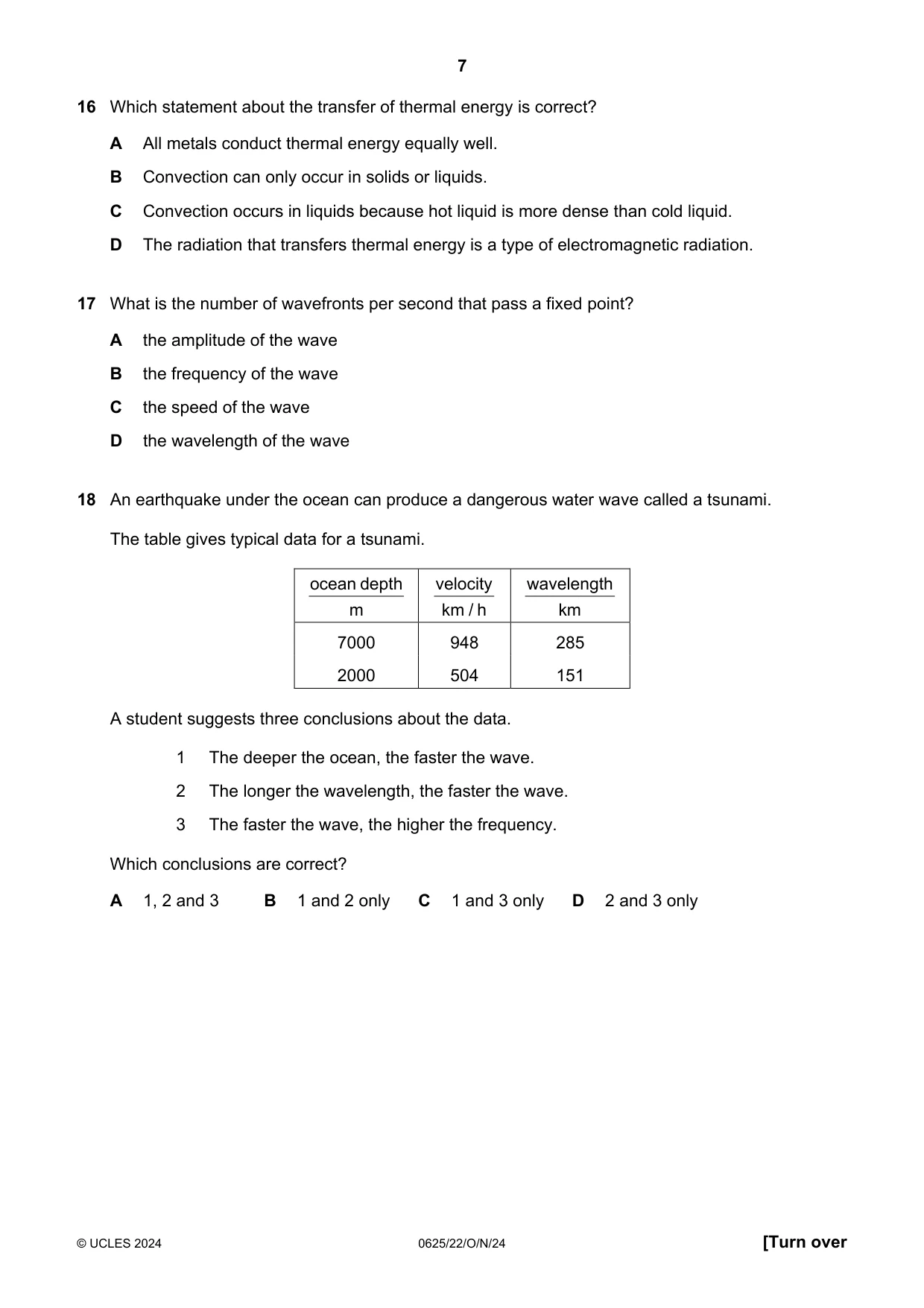
16 Which statement about the transfer of thermal energy is correct? A All metals conduct thermal energy equally well. B Convection can only occur in solids or liquids. C Convection occurs in liquids because hot liquid is more dense than cold liquid. D The radiation that transfers thermal energy is a type of electromagnetic radiation.
Mark scheme: D
Q17 · What is the number of wavefronts per second that pass a fixed point?
17 What is the number of wavefronts per second that pass a fixed point? A the amplitude of the wave B the frequency of the wave C the speed of the wave D the wavelength of the wave
Mark scheme: B
Q18 · An earthquake under the ocean can produce a dangerous water wave called a tsunami
18 An earthquake under the ocean can produce a dangerous water wave called a tsunami. The table gives typical data for a tsunami. ocean depth velocity wavelength m km / h km 7000 948 285 2000 504 151 A student suggests three conclusions about the data. 1 The deeper the ocean, the faster the wave. 2 The longer the wavelength, the faster the wave. 3 The faster the wave, the higher the frequency. Which conclusions are correct? A 1, 2 and 3 B 1 and 2 only C 1 and 3 only D 2 and 3 only
Mark scheme: B
Q19 · The diagram shows what happens to wavefronts at sea when they enter a harbour
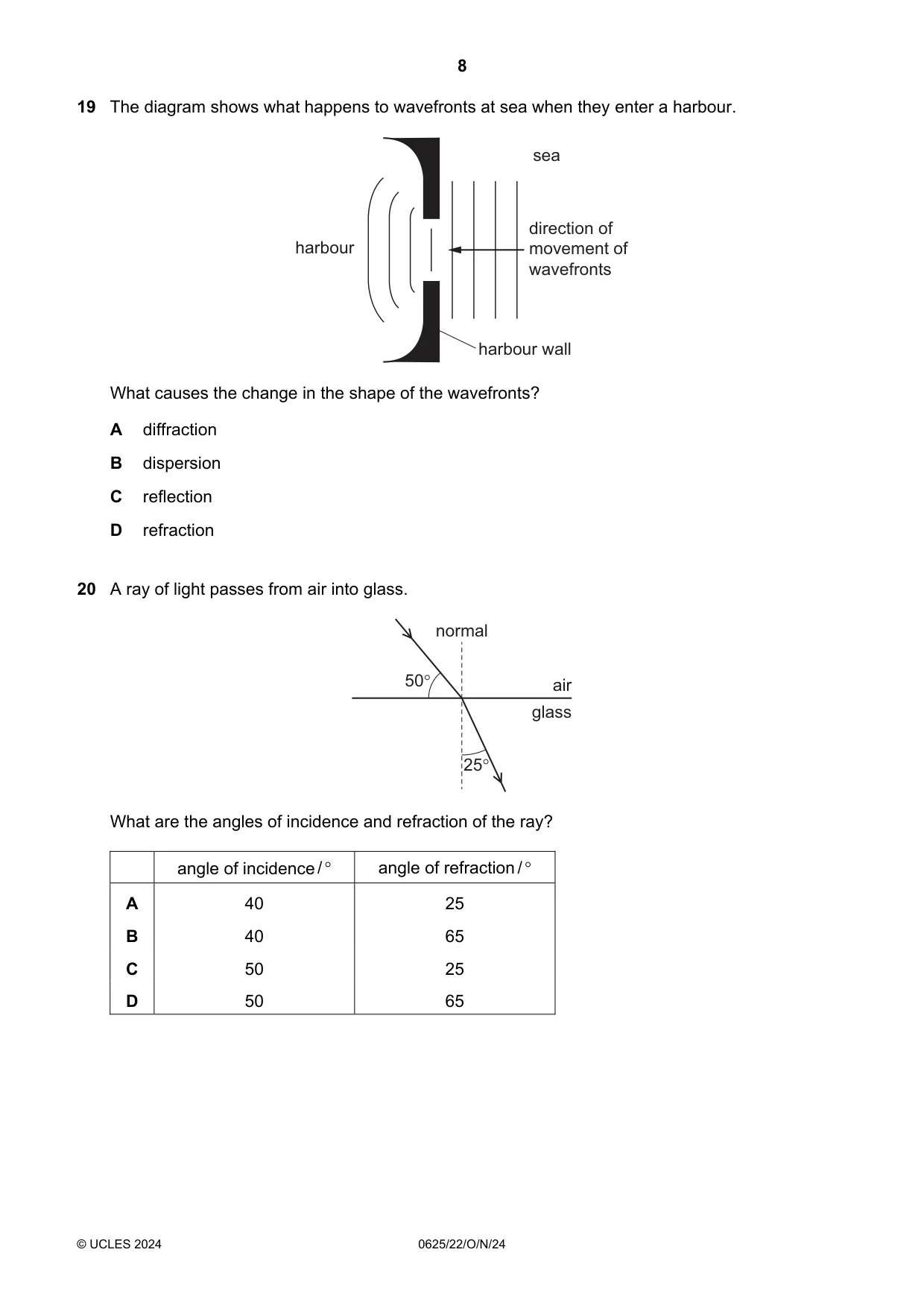
19 The diagram shows what happens to wavefronts at sea when they enter a harbour. sea direction of harbour movement of wavefronts harbour wall What causes the change in the shape of the wavefronts? A diffraction B dispersion C reflection D refraction
Mark scheme: A
Q20 · Aray of light passes from air into glass
20 Aray of light passes from air into glass. normal 50° air glass What are the angles of incidence and refraction of the ray? 0 0O WwW D> angle of incidence/° 40 40 50 50 angle of refraction /° 25 65 25 65
Mark scheme: A
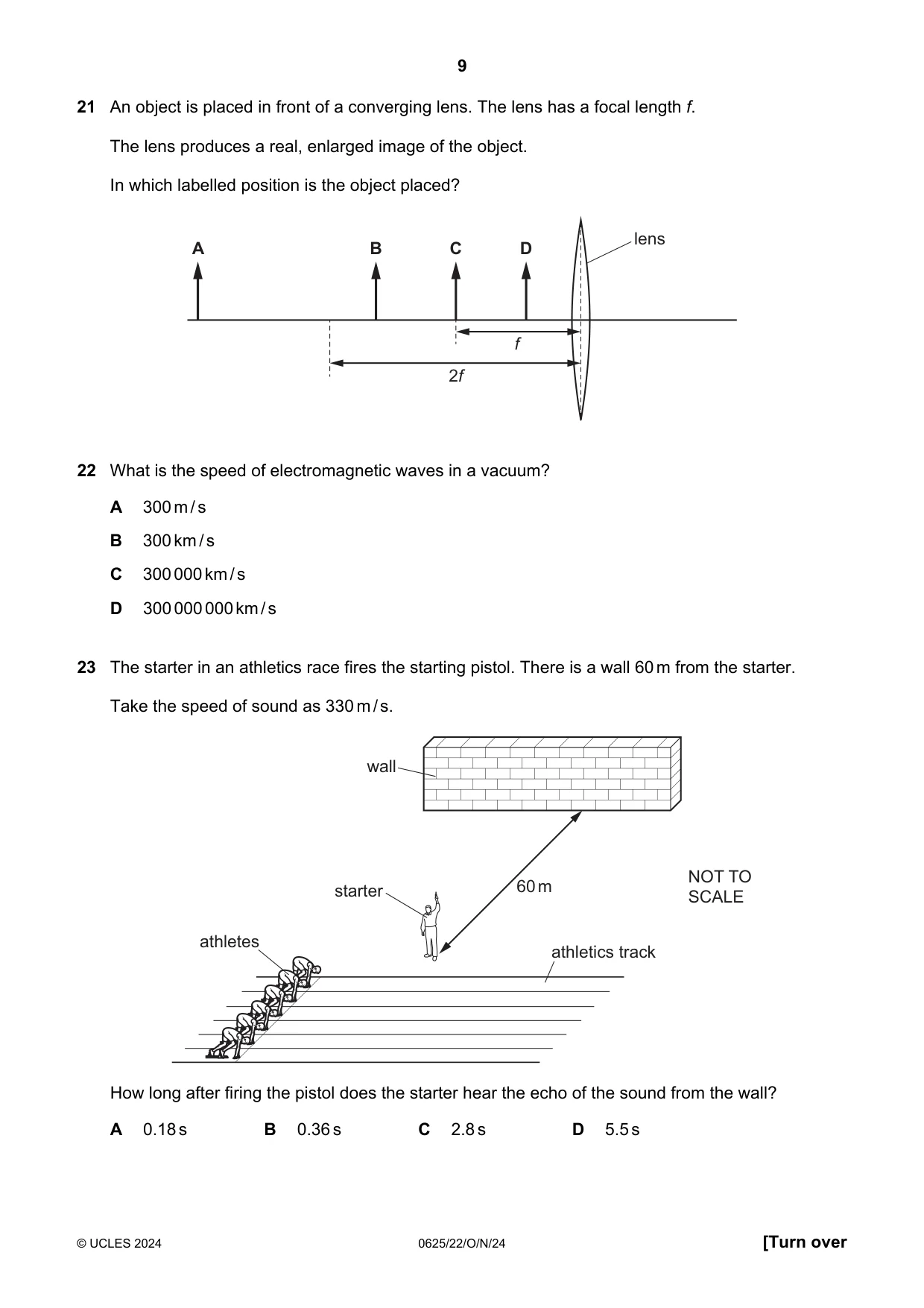
Q21 · An object is placed in front of a converging lens
21 An object is placed in front of a converging lens. The lens has a focal length f. The lens produces a real, enlarged image of the object. In which labelled position is the object placed? lens A B C D f 2f
Mark scheme: B
Q22 · What is the speed of electromagnetic waves in a vacuum?
22 What is the speed of electromagnetic waves in a vacuum? A 300 m / s B 300 km / s C 300 000 km / s D 300 000 000 km / s
Mark scheme: C
Q23 · The starter in an athletics race fires the starting pistol
23 The starter in an athletics race fires the starting pistol. There is a wall 60 m from the starter. Take the speed of sound as 330 m / s. wall NOT TO starter 60 m SCALE athletes athletics track How long after firing the pistol does the starter hear the echo of the sound from the wall? A 0.18 s B 0.36 s C 2.8 s D 5.5 s
Mark scheme: B
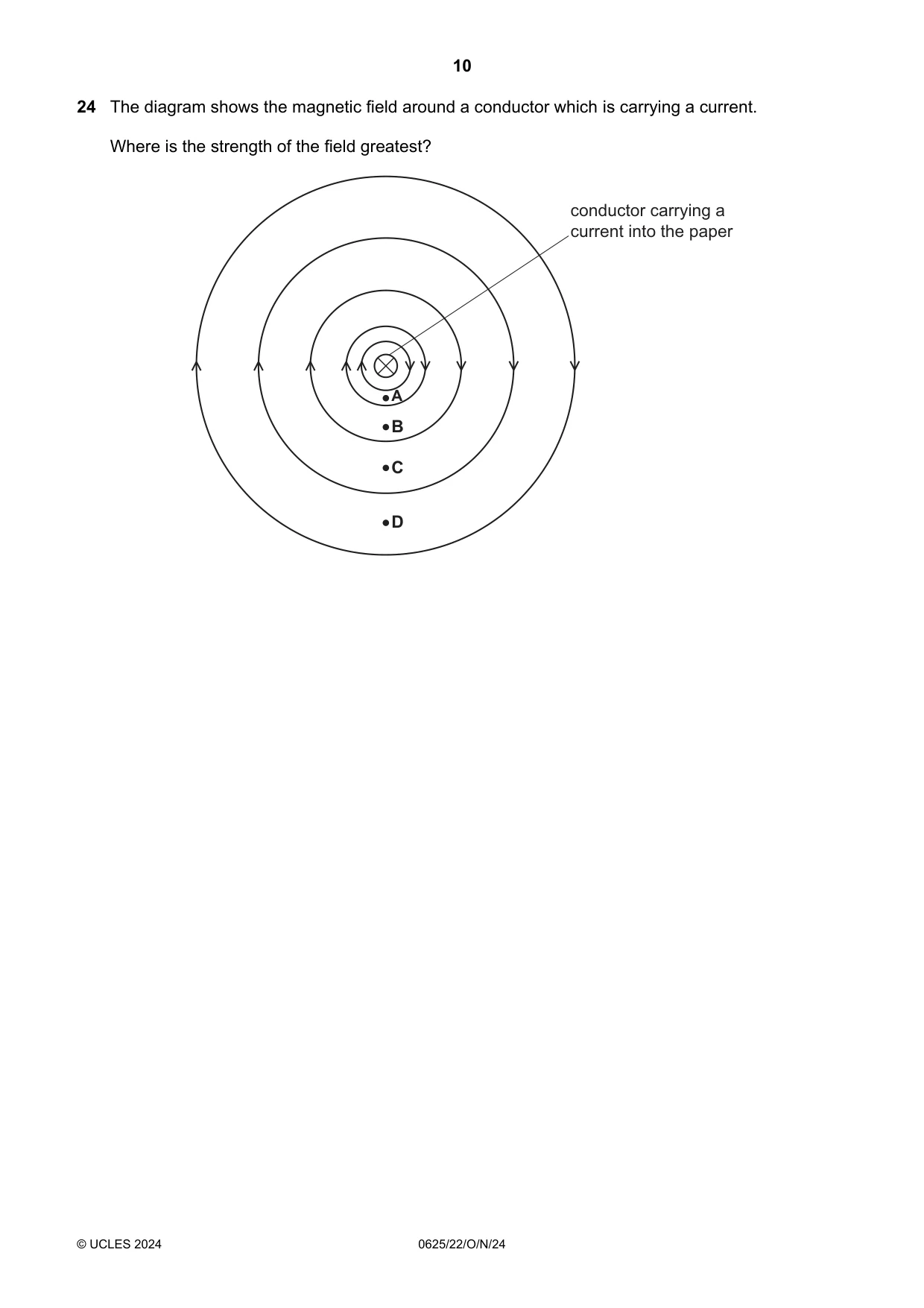
Q24 · The diagram shows the magnetic field around a conductor which is carrying a current
24 The diagram shows the magnetic field around a conductor which is carrying a current. Where is the strength of the field greatest? conductor carrying a current into the paper A B C D
Mark scheme: A
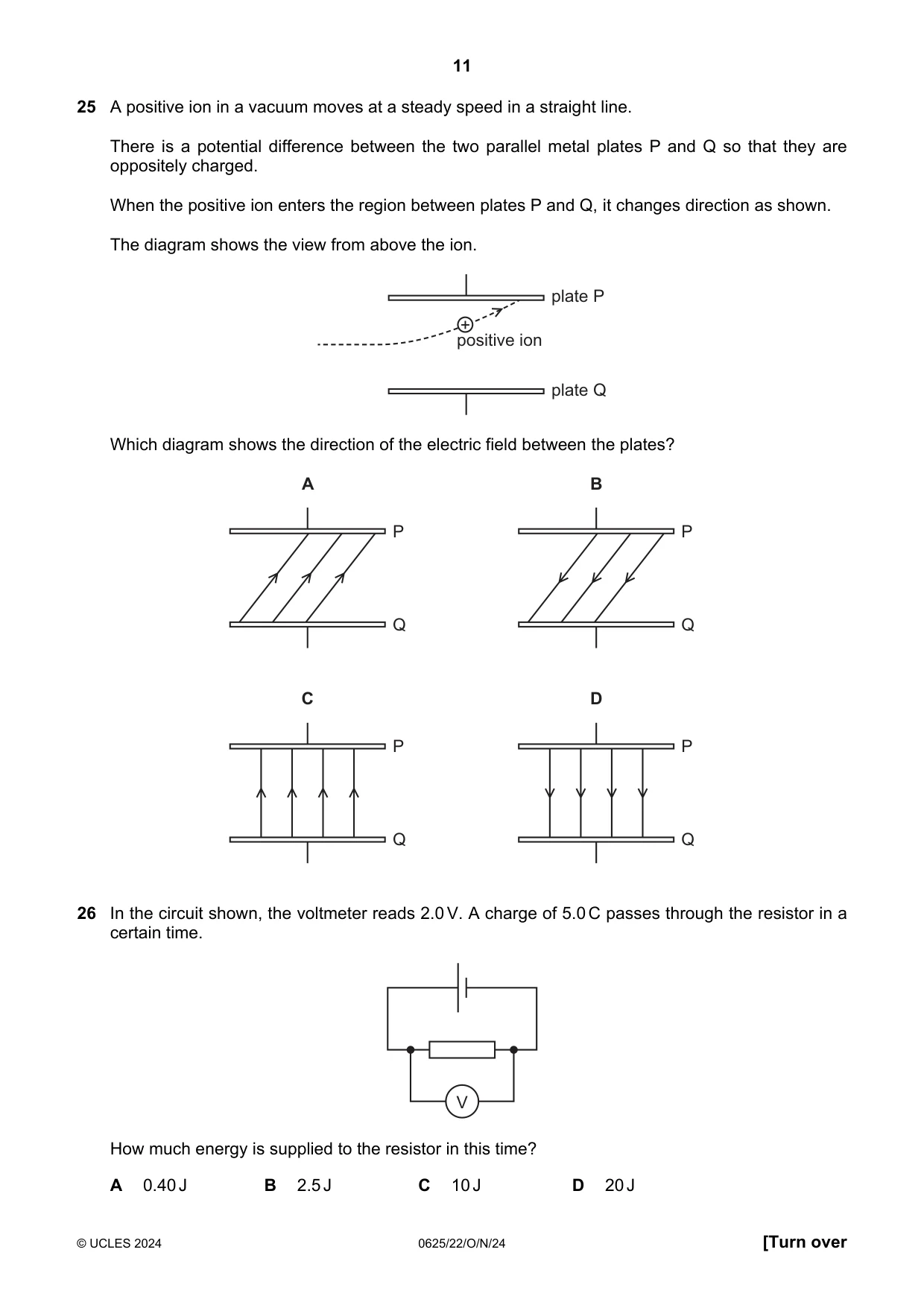
Q25 · A positive ion in a vacuum moves at a steady speed in a straight line
25 A positive ion in a vacuum moves at a steady speed in a straight line. There is a potential difference between the two parallel metal plates P and Q so that they are oppositely charged. When the positive ion enters the region between plates P and Q, it changes direction as shown. The diagram shows the view from above the ion. plate P + positive ion plate Q Which diagram shows the direction of the electric field between the plates? A B P P Q Q C D P P Q Q
Mark scheme: C
Q26 · In the circuit shown, the voltmeter reads 2.0 V
26 In the circuit shown, the voltmeter reads 2.0 V. A charge of 5.0 C passes through the resistor in a certain time. V How much energy is supplied to the resistor in this time? A 0.40 J B 2.5 J C 10 J D 20 J
Mark scheme: C
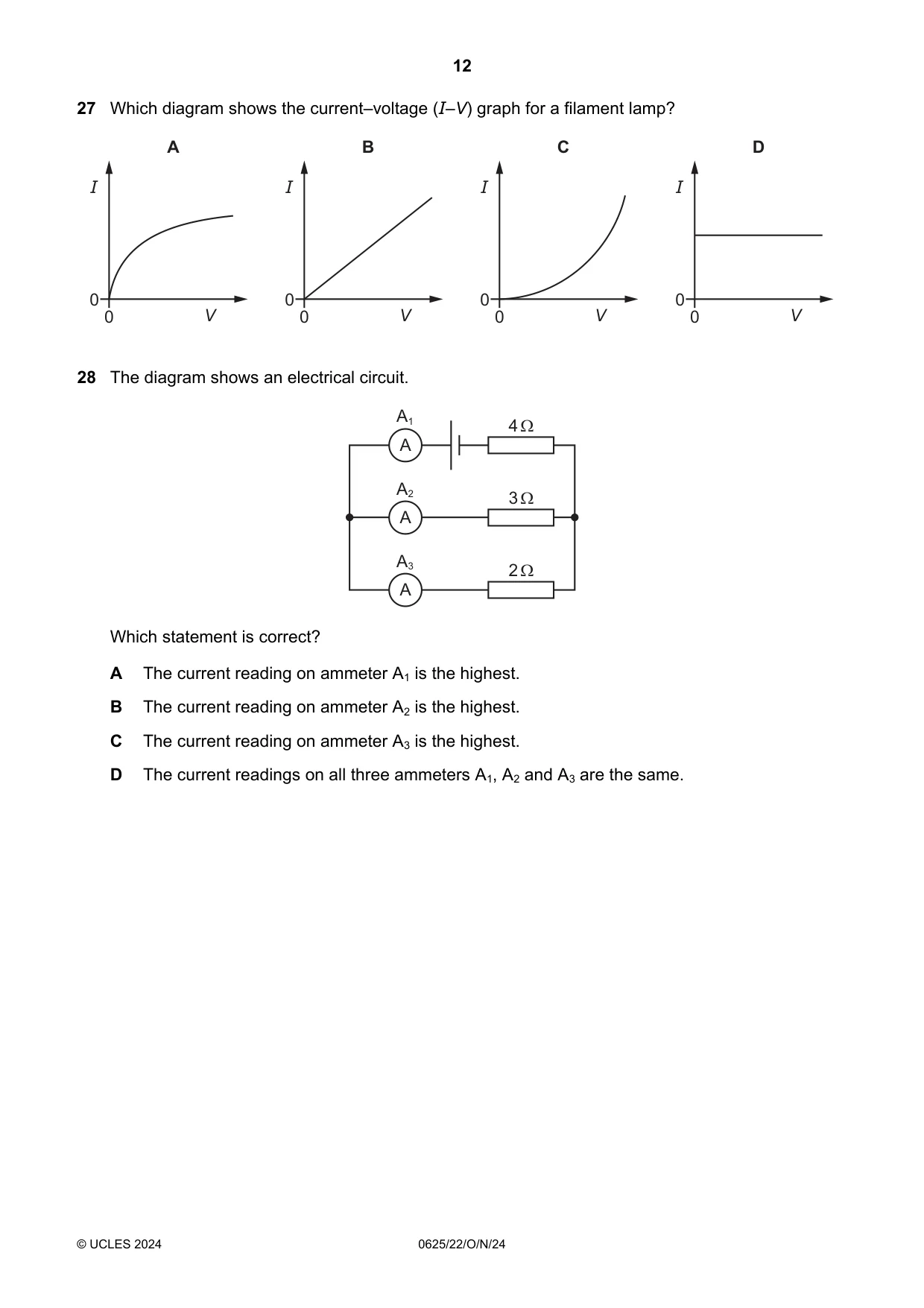
Q27 · Which diagram shows the current–voltage (I–V) graph for a filament lamp?
27 Which diagram shows the current–voltage (I–V) graph for a filament lamp? A B C D I I I I 0 0 0 0 0 V 0 V 0 V 0 V
Mark scheme: A
Q28 · The diagram shows an electrical circuit
28 The diagram shows an electrical circuit. A1 4 Ω A A2 3 Ω A A3 2 Ω A Which statement is correct? A The current reading on ammeter A1 is the highest. B The current reading on ammeter A2 is the highest. C The current reading on ammeter A3 is the highest. D The current readings on all three ammeters A1, A2 and A3 are the same.
Mark scheme: A
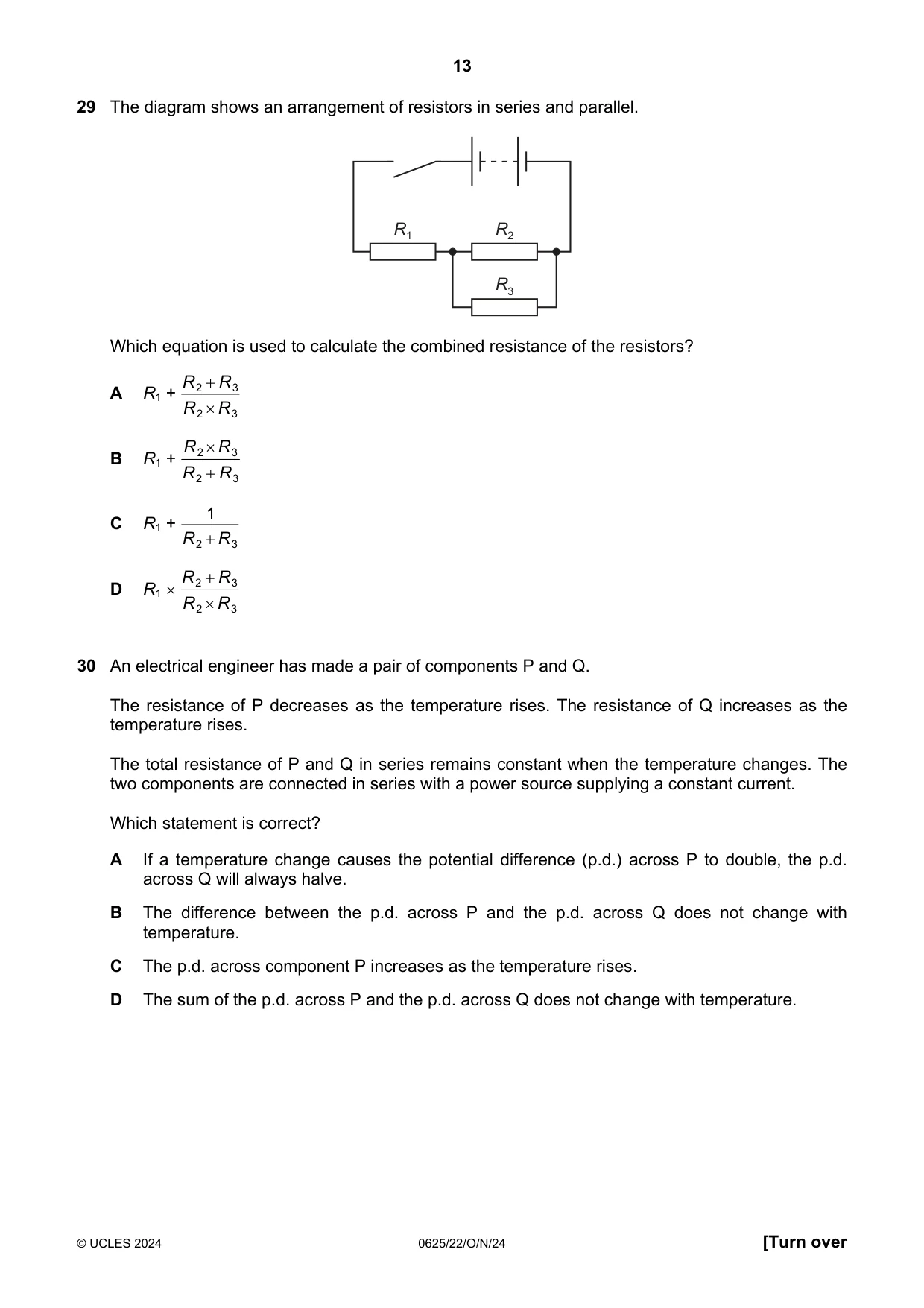
Q29 · The diagram shows an arrangement of resistors in series and parallel
29 The diagram shows an arrangement of resistors in series and parallel. R1 R2 R3 Which equation is used to calculate the combined resistance of the resistors? R R A R1 + 2 3 R R 2 3 R R B R1 + 2 3 R R 2 3 1 C R1 + R R 2 3 R R D R1 2 3 R R 2 3
Mark scheme: B
Q30 · An electrical engineer has made a pair of components P and Q
30 An electrical engineer has made a pair of components P and Q. The resistance of P decreases as the temperature rises. The resistance of Q increases as the temperature rises. The total resistance of P and Q in series remains constant when the temperature changes. The two components are connected in series with a power source supplying a constant current. Which statement is correct? A If a temperature change causes the potential difference (p.d.) across P to double, the p.d. across Q will always halve. B The difference between the p.d. across P and the p.d. across Q does not change with temperature. C The p.d. across component P increases as the temperature rises. D The sum of the p.d. across P and the p.d. across Q does not change with temperature.
Mark scheme: D
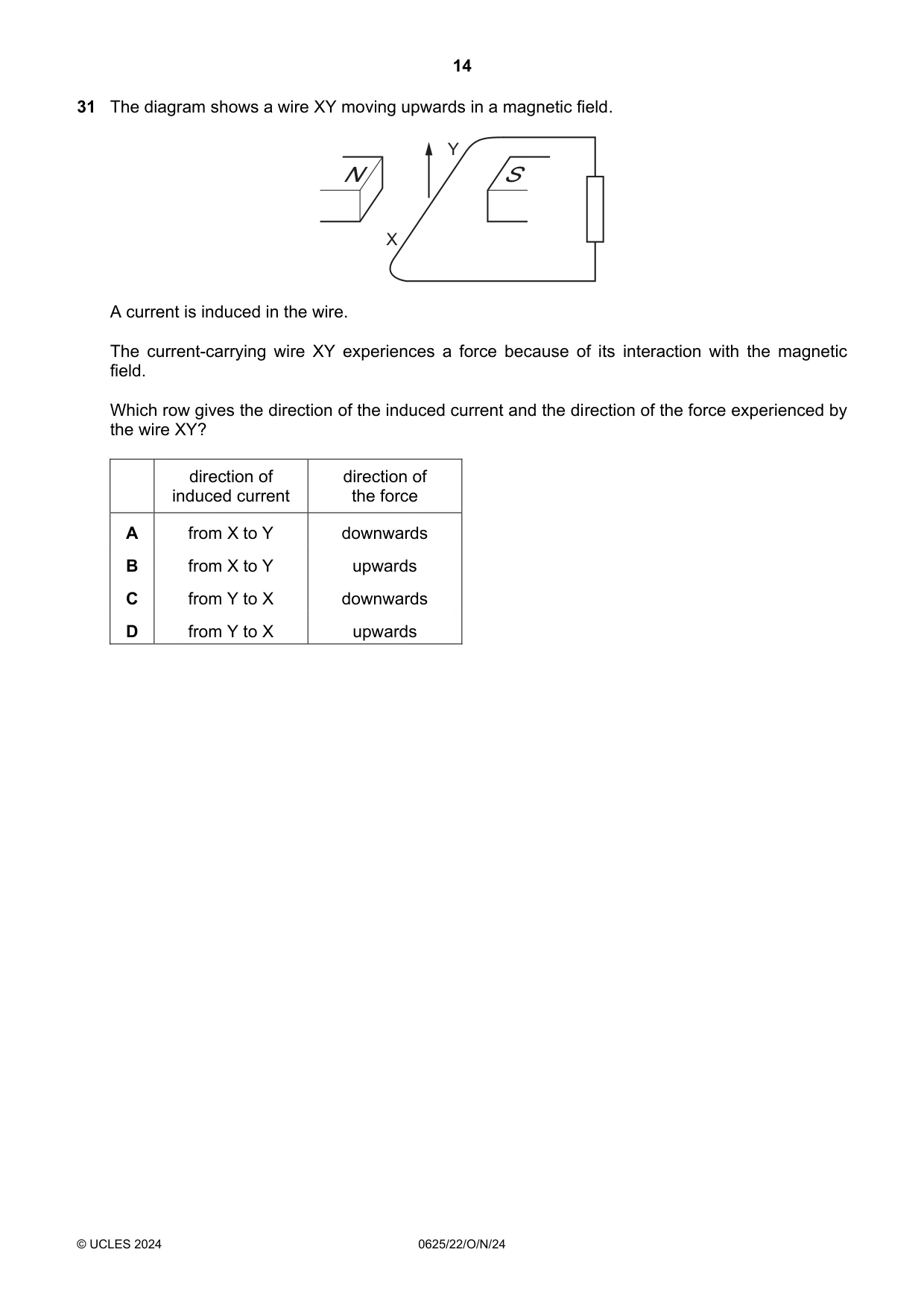
Q31 · The diagram shows a wire XY moving upwards in a magnetic field
31 The diagram shows a wire XY moving upwards in a magnetic field. Y N S X A current is induced in the wire. The current-carrying wire XY experiences a force because of its interaction with the magnetic field. Which row gives the direction of the induced current and the direction of the force experienced by the wire XY? direction of direction of induced current the force A from X to Y downwards B from X to Y upwards C from Y to X downwards D from Y to X upwards
Mark scheme: A
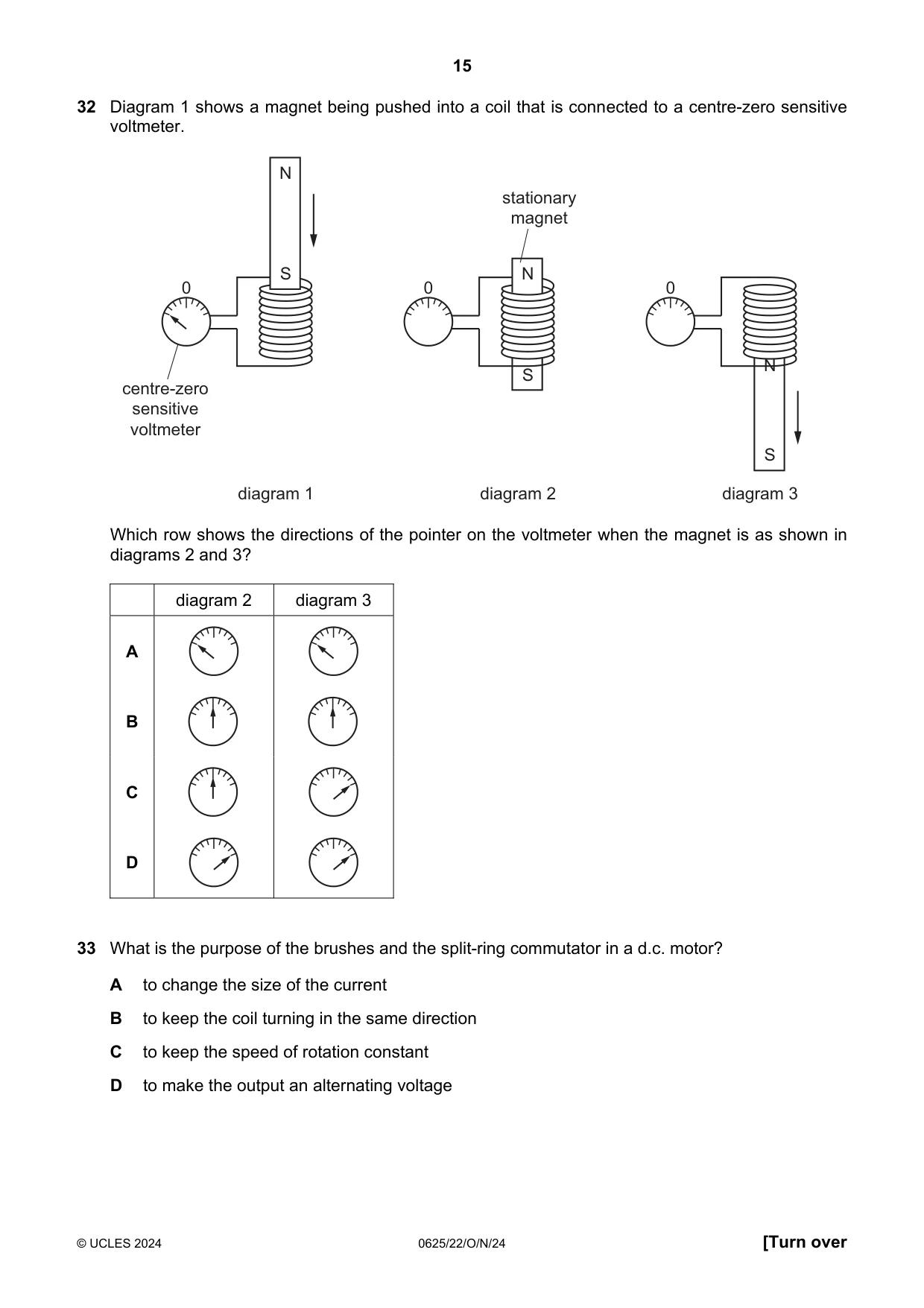
Q32 · A magnet being pushed into a coil that is connected to a centre-zero sensitive voltmeter
32 Diagram 1 shows a magnet being pushed into a coil that is connected to a centre-zero sensitive voltmeter. N stationary magnet S N 0 0 0 N S centre-zero sensitive voltmeter S diagram 1 diagram 2 diagram 3 Which row shows the directions of the pointer on the voltmeter when the magnet is as shown in diagrams 2 and 3? diagram 2 diagram 3 A B C D
Mark scheme: C
Q33 · What is the purpose of the brushes and the split-ring commutator in a d.c
33 What is the purpose of the brushes and the split-ring commutator in a d.c. motor? A to change the size of the current B to keep the coil turning in the same direction C to keep the speed of rotation constant D to make the output an alternating voltage
Mark scheme: B
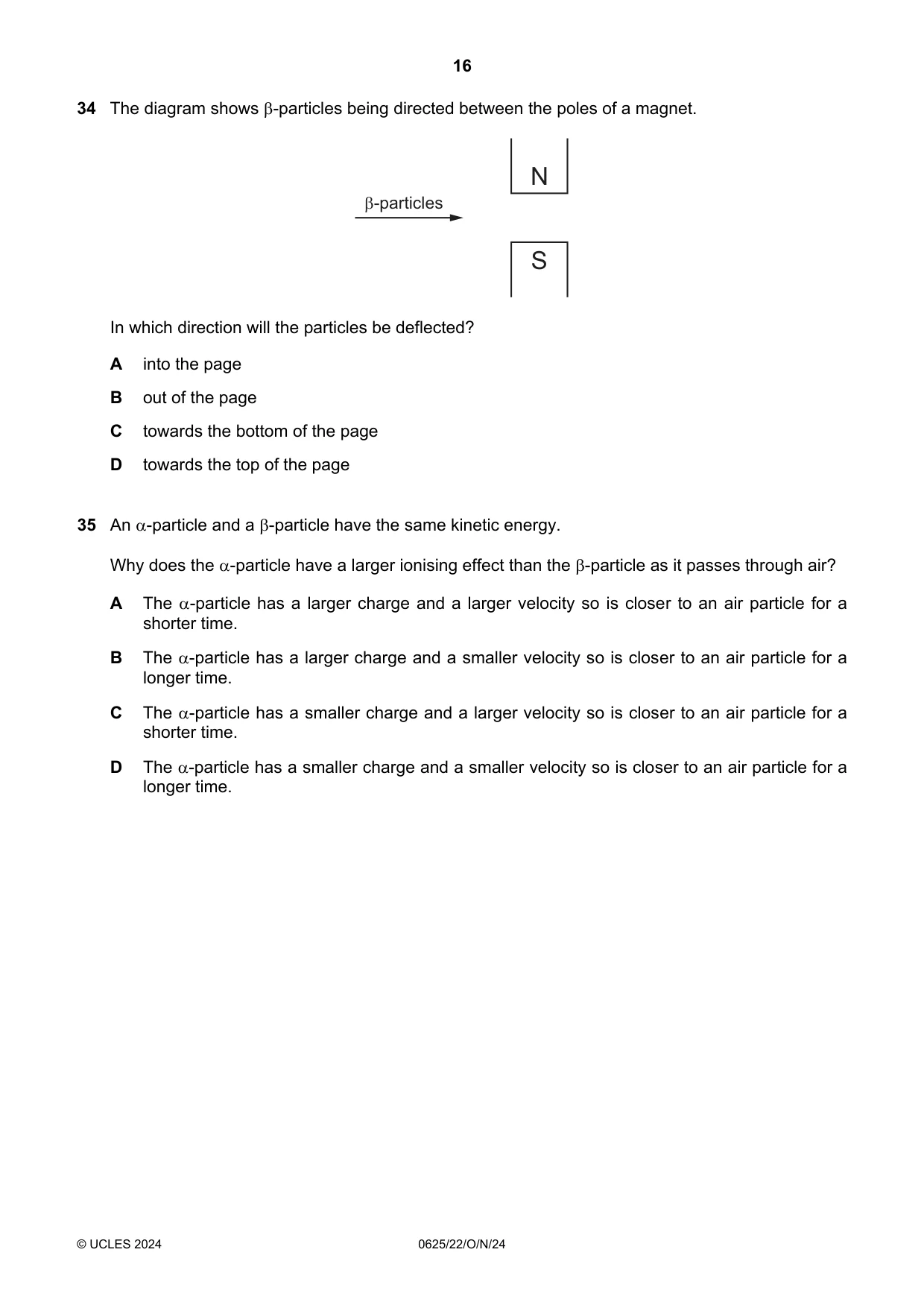
Q34 · The diagram shows f-particles being directed between the poles of a magnet
34 The diagram shows f-particles being directed between the poles of a magnet. B-particles no ) In which direction will the particles be deflected? A into the page Bout of the page C_ towards the bottom of the page D___ towards the top of the page
Mark scheme: B
Q35 · An -particle and a -particle have the same kinetic energy
35 An -particle and a -particle have the same kinetic energy. Why does the -particle have a larger ionising effect than the -particle as it passes through air? A The -particle has a larger charge and a larger velocity so is closer to an air particle for a shorter time. B The -particle has a larger charge and a smaller velocity so is closer to an air particle for a longer time. C The -particle has a smaller charge and a larger velocity so is closer to an air particle for a shorter time. D The -particle has a smaller charge and a smaller velocity so is closer to an air particle for a longer time.
Mark scheme: B
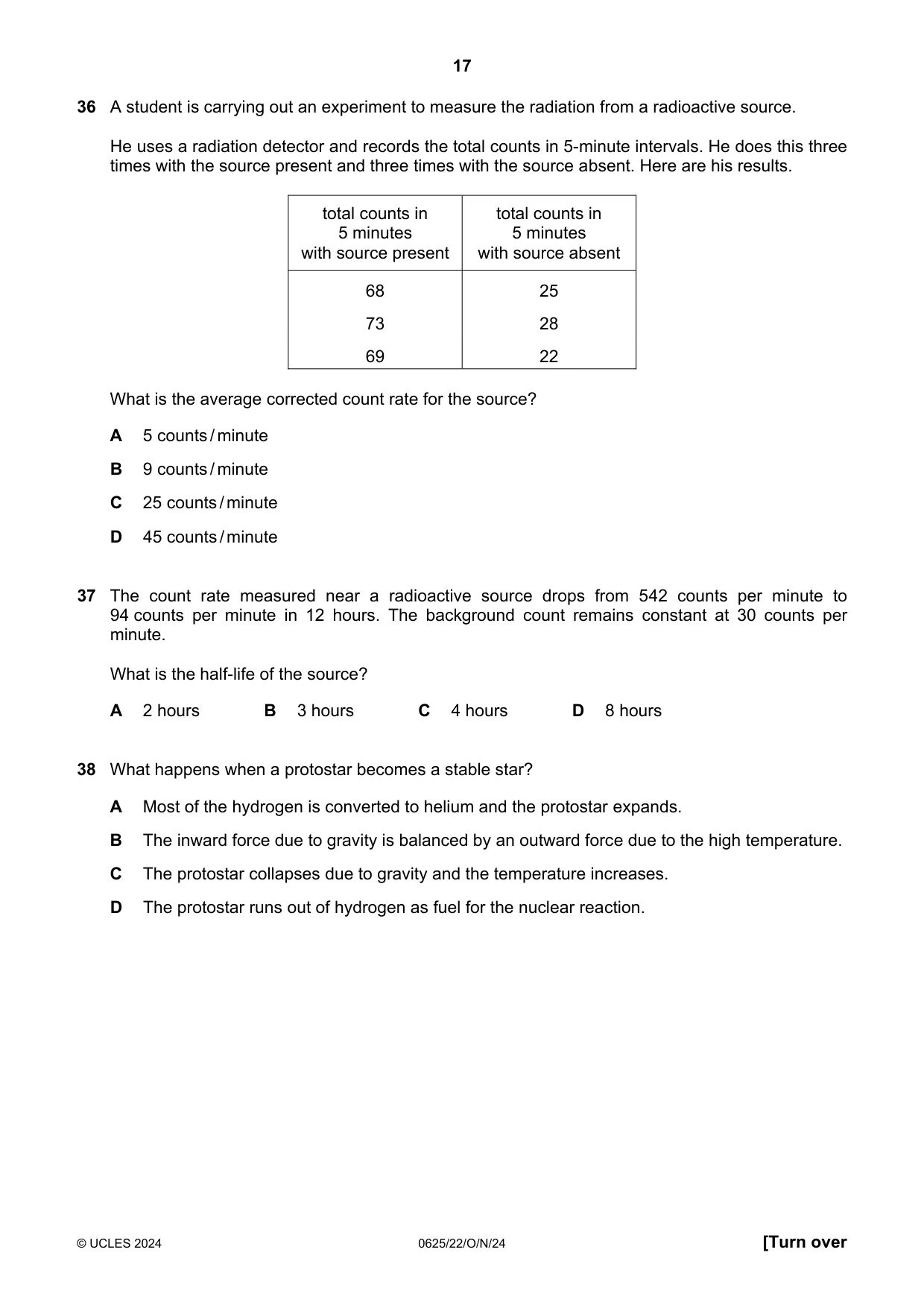
Q36 · A student is carrying out an experiment to measure the radiation from a radioactive source
36 A student is carrying out an experiment to measure the radiation from a radioactive source. He uses a radiation detector and records the total counts in 5-minute intervals. He does this three times with the source present and three times with the source absent. Here are his results. total counts in total counts in 5 minutes 5 minutes with source present with source absent 68 25 73 28 69 22 What is the average corrected count rate for the source? A 5 counts / minute B 9 counts / minute C 25 counts / minute D 45 counts / minute
Mark scheme: B
Q37 · The count rate measured near a radioactive source drops from 542 counts per minute to 94…
37 The count rate measured near a radioactive source drops from 542 counts per minute to 94 counts per minute in 12 hours. The background count remains constant at 30 counts per minute. What is the half-life of the source? A 2 hours B 3 hours C 4 hours D 8 hours
Mark scheme: C
Q38 · What happens when a protostar becomes a stable star?
38 What happens when a protostar becomes a stable star? A Most of the hydrogen is converted to helium and the protostar expands. B The inward force due to gravity is balanced by an outward force due to the high temperature. C The protostar collapses due to gravity and the temperature increases. D The protostar runs out of hydrogen as fuel for the nuclear reaction.
Mark scheme: B
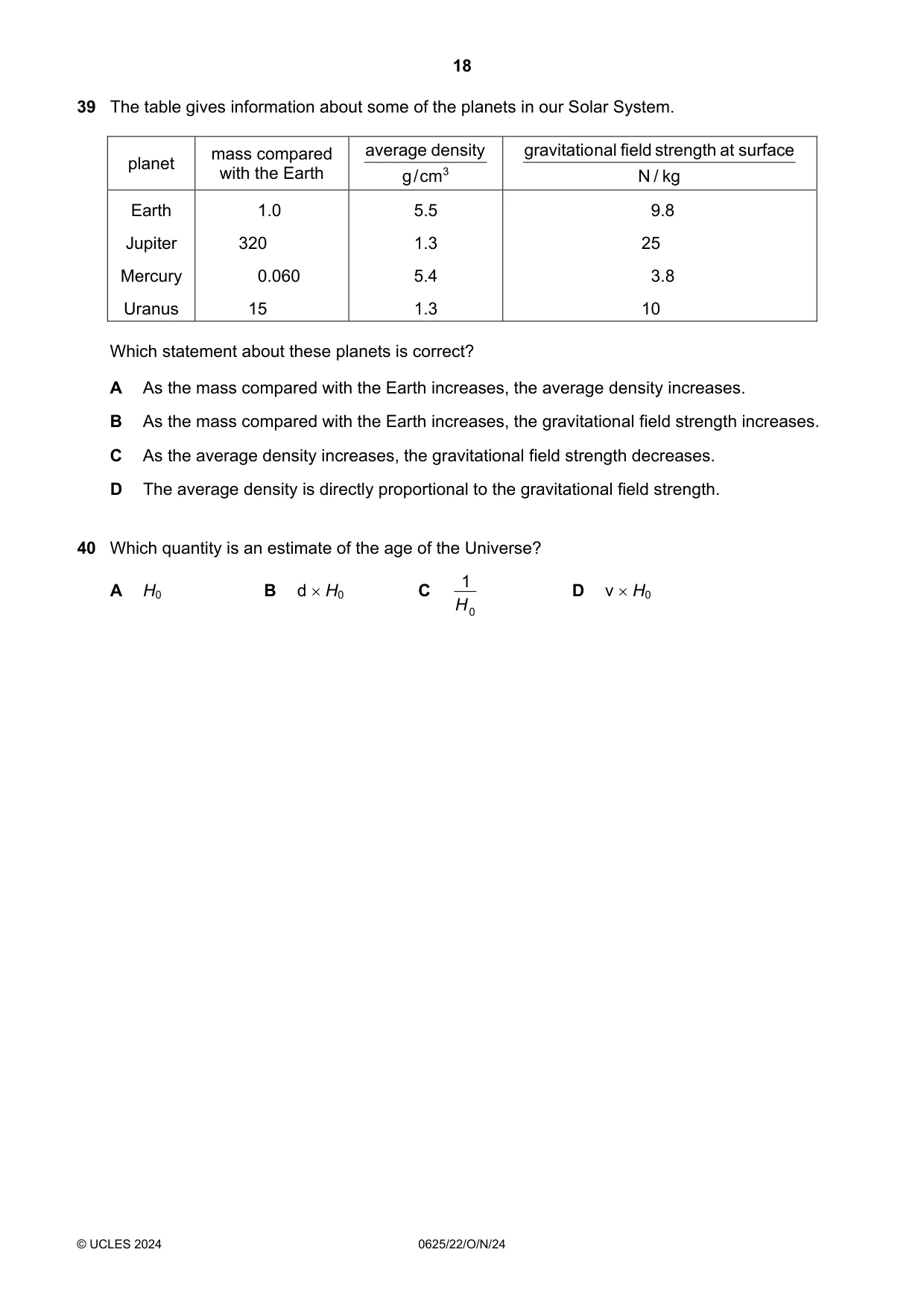
Q39 · The table gives information about some of the planets in our Solar System
39 The table gives information about some of the planets in our Solar System. mass compared average density gravitatio nal field strength at surface planet with the Earth g cm / 3 N / kg Earth 1.0 5.5 9.8 Jupiter 320 1.3 25 Mercury 0.060 5.4 3.8 Uranus 15 1.3 10 Which statement about these planets is correct? A As the mass compared with the Earth increases, the average density increases. B As the mass compared with the Earth increases, the gravitational field strength increases. C As the average density increases, the gravitational field strength decreases. D The average density is directly proportional to the gravitational field strength.
Mark scheme: B
Q40 · Which quantity is an estimate of the age of the Universe?
40 Which quantity is an estimate of the age of the Universe? d H0 1 v H0 A H0 B C D H 0
Mark scheme: C
What was in this paper
The subtopics covered by these 40 questions, and how many questions each got. Open one in a new tab to see every Cambridge question on it.
4Electromagnetic effects4Energy, work and power3General properties of waves3Kinetic particle model of matter3Radioactivity3Electrical quantities2Forces2Light2Motion2Stars and the Universe2Density1Electromagnetic spectrum1Mass and weight1Momentum1Pressure1Simple phenomena of magnetism1Sound1The Earth and the Solar System1Thermal properties and temperature1Transfer of thermal energy1What you needed in this session
Cambridge’s own grade thresholds for 2024 Oct/Nov, Paper 2 · Variant 2. A higher threshold means an easier paper — the bar moves with how the cohort did.