Cambridge IGCSE Physics 0625 — 2020 May/June Paper 2 · Variant 3
0625/23/M/J/20 · 40 questions · 40 marks · ≈45 min
The question paper and its mark scheme, free to read here and free to download. This is Cambridge’s own paper, exactly as it was sat.
Question paper20 pages
Mark scheme3 pages
Answers below. Sit the paper first if you are practising.
Questions as text
Q1 · A solid, rectangular-sided block
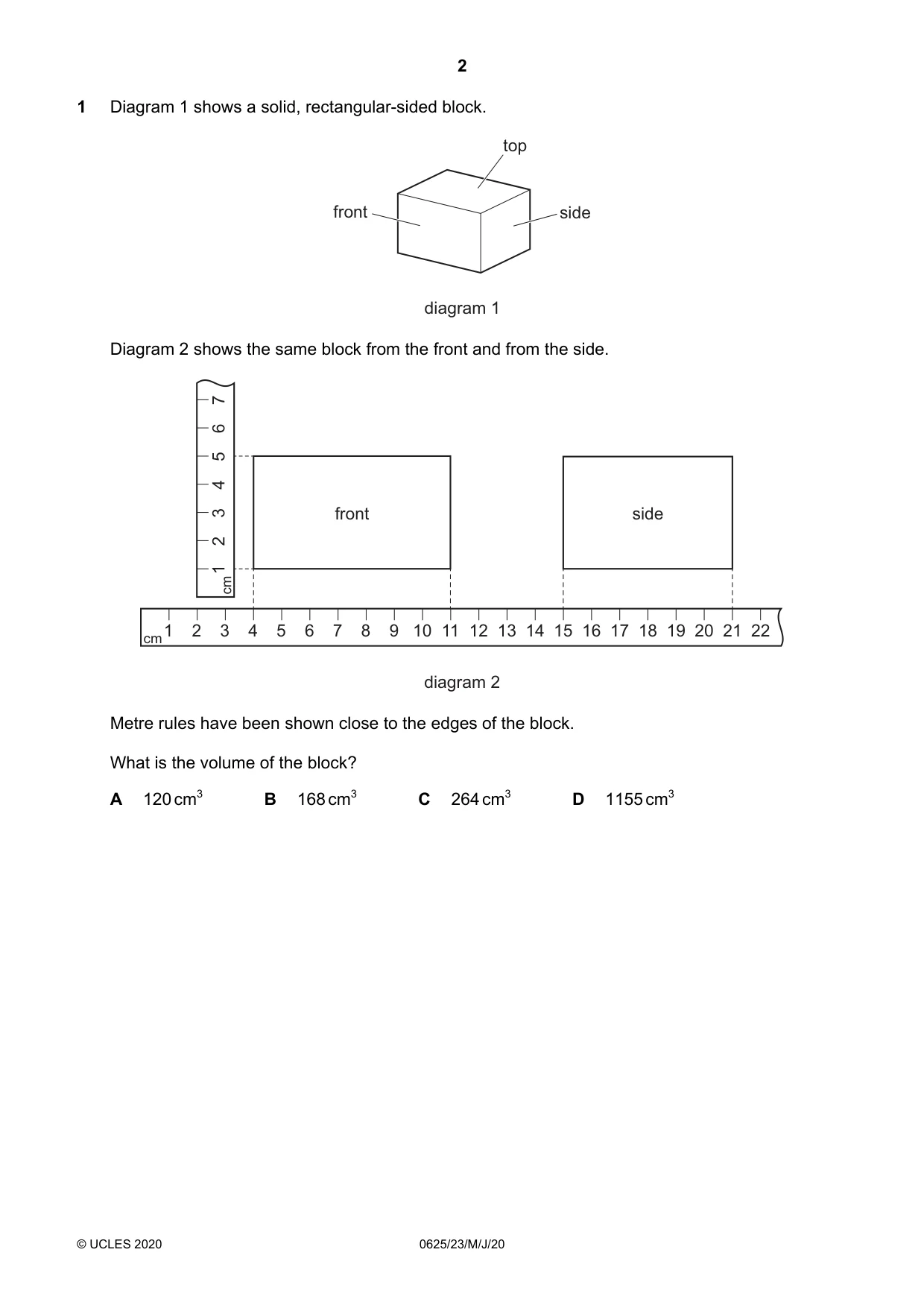
1 Diagram 1 shows a solid, rectangular-sided block. top front side diagram 1 Diagram 2 shows the same block from the front and from the side. 7 6 5 4 3 front side 2 1 cm 1 2 3 4 5 6 7 8 9 10 11 12 13 14 15 16 17 18 19 20 21 22 cm diagram 2 Metre rules have been shown close to the edges of the block. What is the volume of the block? A 120 cm3 B 168 cm3 C 264 cm3 D 1155 cm3
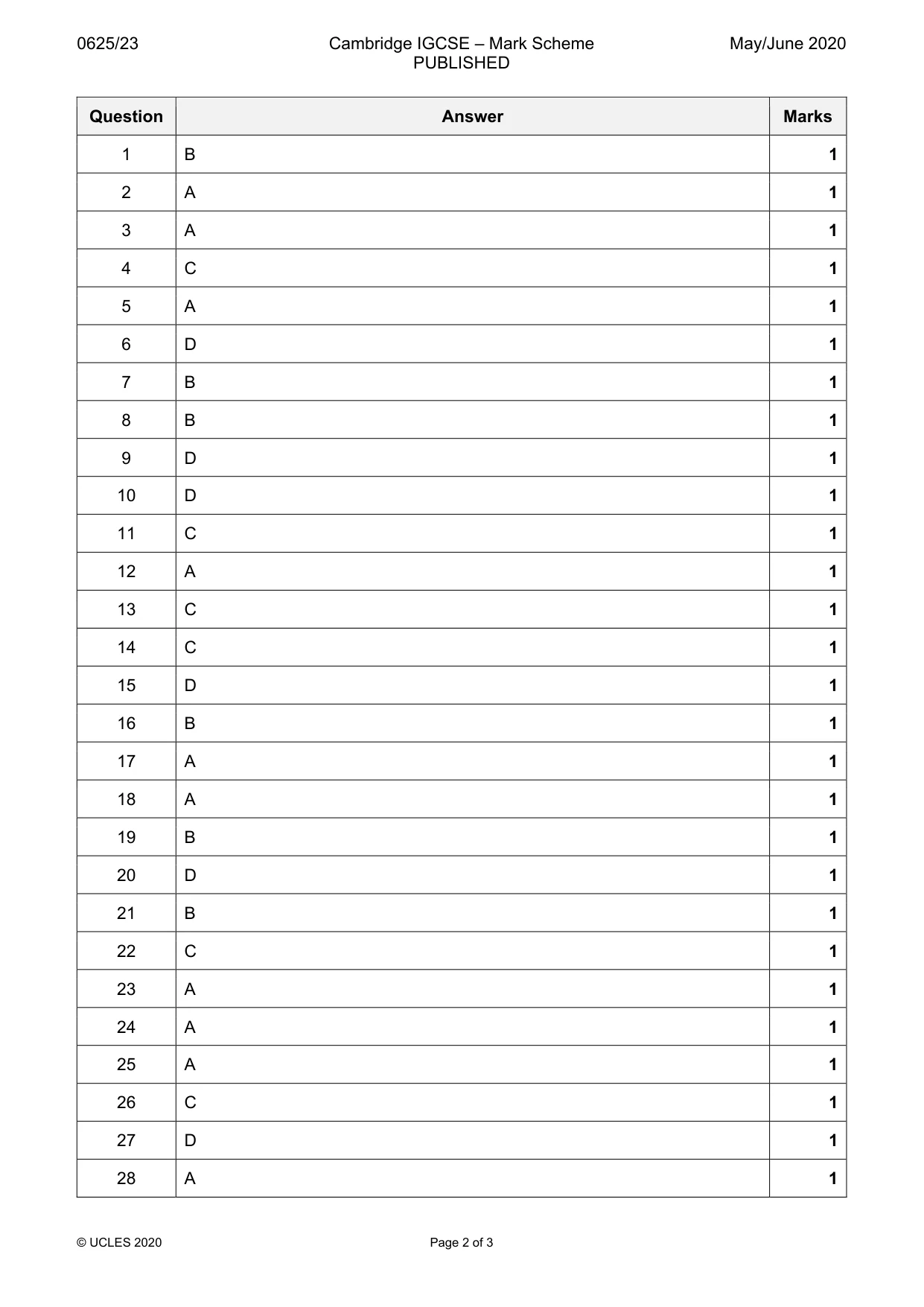
Mark scheme: B
More questions on Physical quantities and measurement techniques
Q2 · A student investigates the motion of a ball rolling down a slope
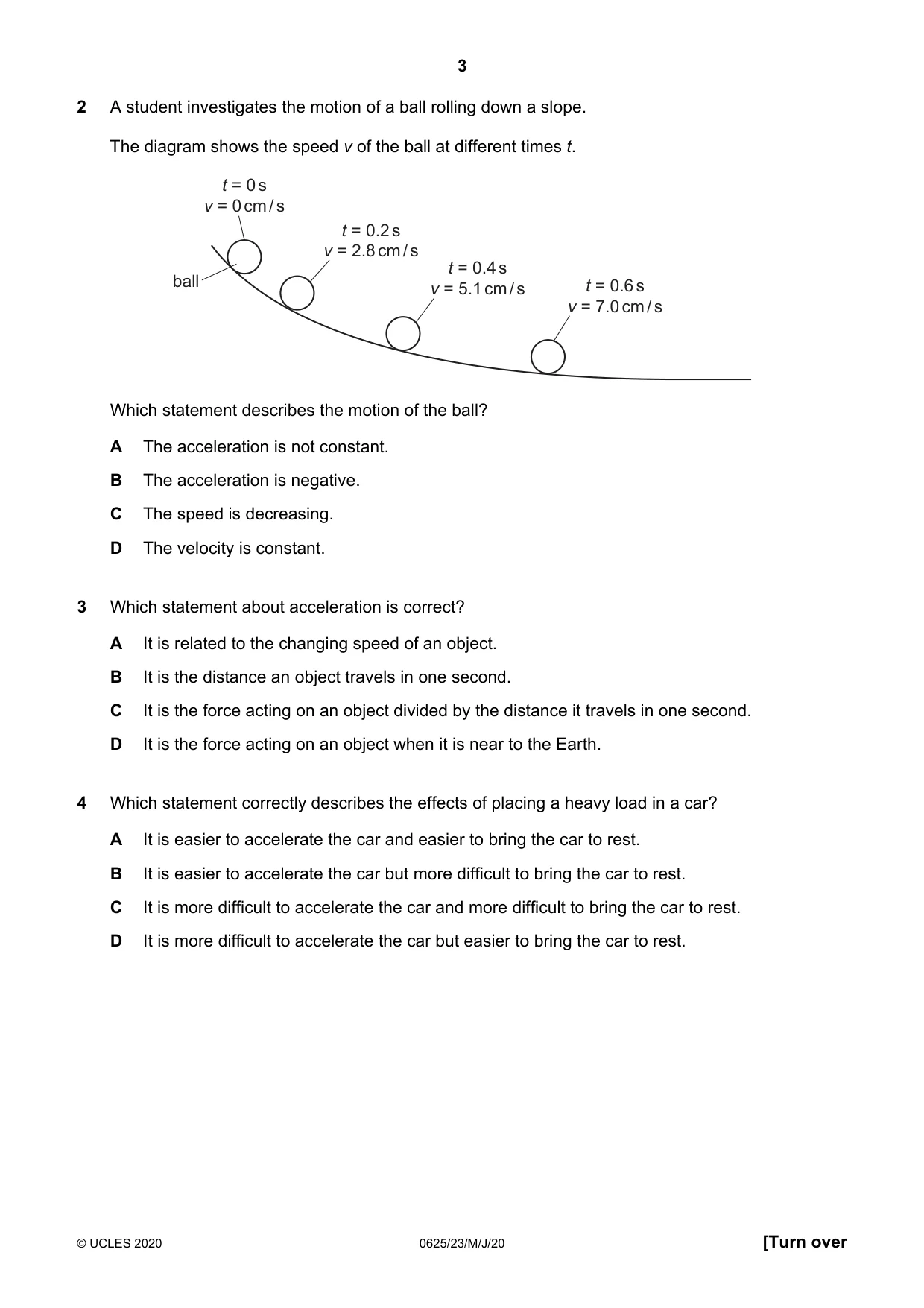
2 A student investigates the motion of a ball rolling down a slope. The diagram shows the speed v of the ball at different times t. t = 0 s v = 0 cm / s t = 0.2 s v = 2.8 cm / s t = 0.4 s ball v = 5.1 cm / s t = 0.6 s v = 7.0 cm / s Which statement describes the motion of the ball? A The acceleration is not constant. B The acceleration is negative. C The speed is decreasing. D The velocity is constant.
Mark scheme: A
Q3 · Which statement about acceleration is correct?
3 Which statement about acceleration is correct? A It is related to the changing speed of an object. B It is the distance an object travels in one second. C It is the force acting on an object divided by the distance it travels in one second. D It is the force acting on an object when it is near to the Earth.
Mark scheme: A
Q4 · Which statement correctly describes the effects of placing a heavy load in a car?
4 Which statement correctly describes the effects of placing a heavy load in a car? A It is easier to accelerate the car and easier to bring the car to rest. B It is easier to accelerate the car but more difficult to bring the car to rest. C It is more difficult to accelerate the car and more difficult to bring the car to rest. D It is more difficult to accelerate the car but easier to bring the car to rest.
Mark scheme: C
Q5 · Which row gives the correct weight for the mass shown?
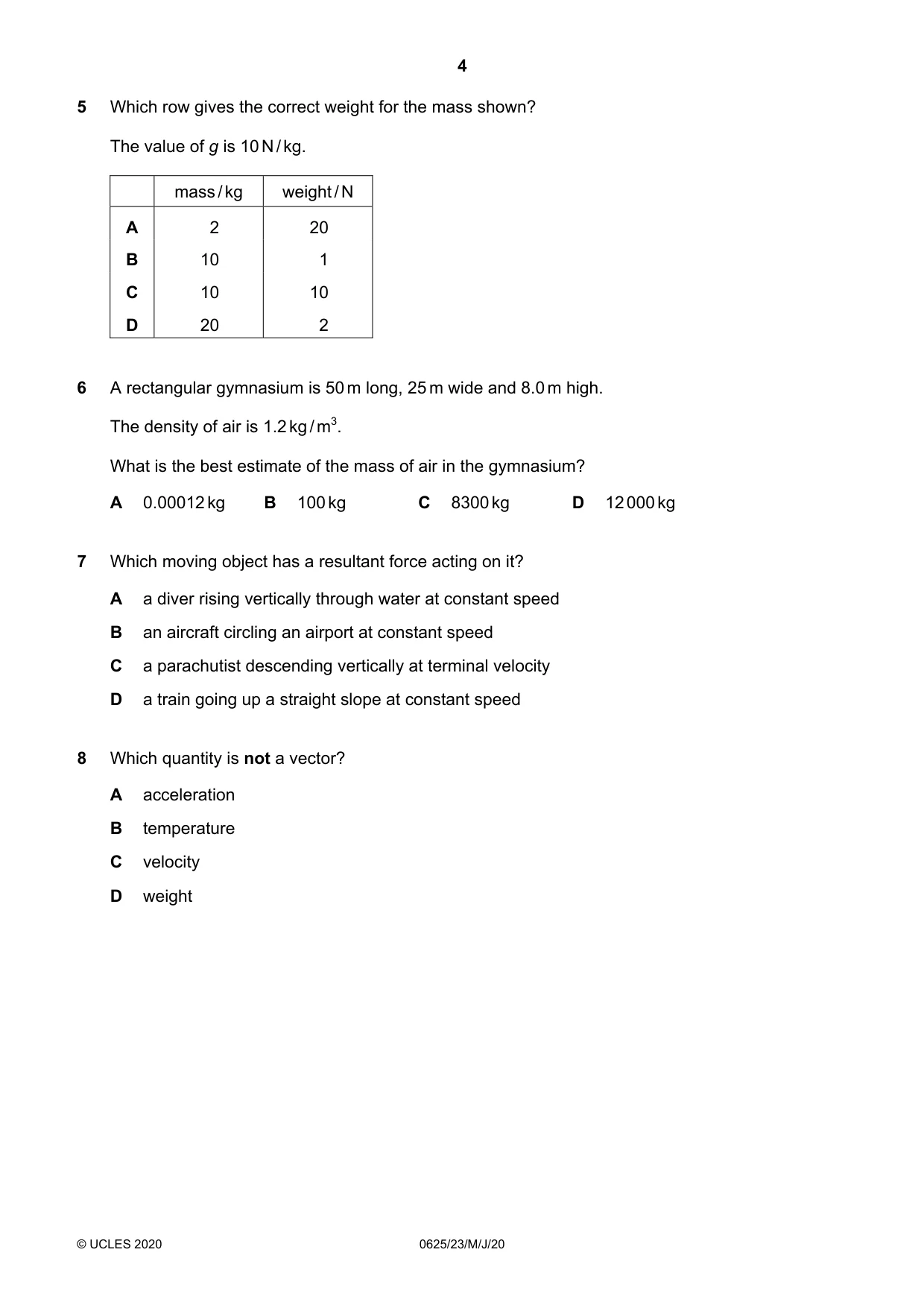
5 Which row gives the correct weight for the mass shown? The value of g is 10 N / kg. mass / kg weight / N A 2 20 B 10 1 C 10 10 D 20 2
Mark scheme: A
Q6 · A rectangular gymnasium is 50 m long, 25 m wide and 8.0 m high
6 A rectangular gymnasium is 50 m long, 25 m wide and 8.0 m high. The density of air is 1.2 kg / m3. What is the best estimate of the mass of air in the gymnasium? A 0.00012 kg B 100 kg C 8300 kg D 12 000 kg
Mark scheme: D
Q7 · Which moving object has a resultant force acting on it?
7 Which moving object has a resultant force acting on it? A a diver rising vertically through water at constant speed B an aircraft circling an airport at constant speed C a parachutist descending vertically at terminal velocity D a train going up a straight slope at constant speed
Mark scheme: B
Q8 · Which quantity is not a vector?
8 Which quantity is not a vector? A acceleration B temperature C velocity D weight
Mark scheme: B
More questions on Physical quantities and measurement techniques
Q9 · A ball falls vertically to the floor and rebounds vertically upwards
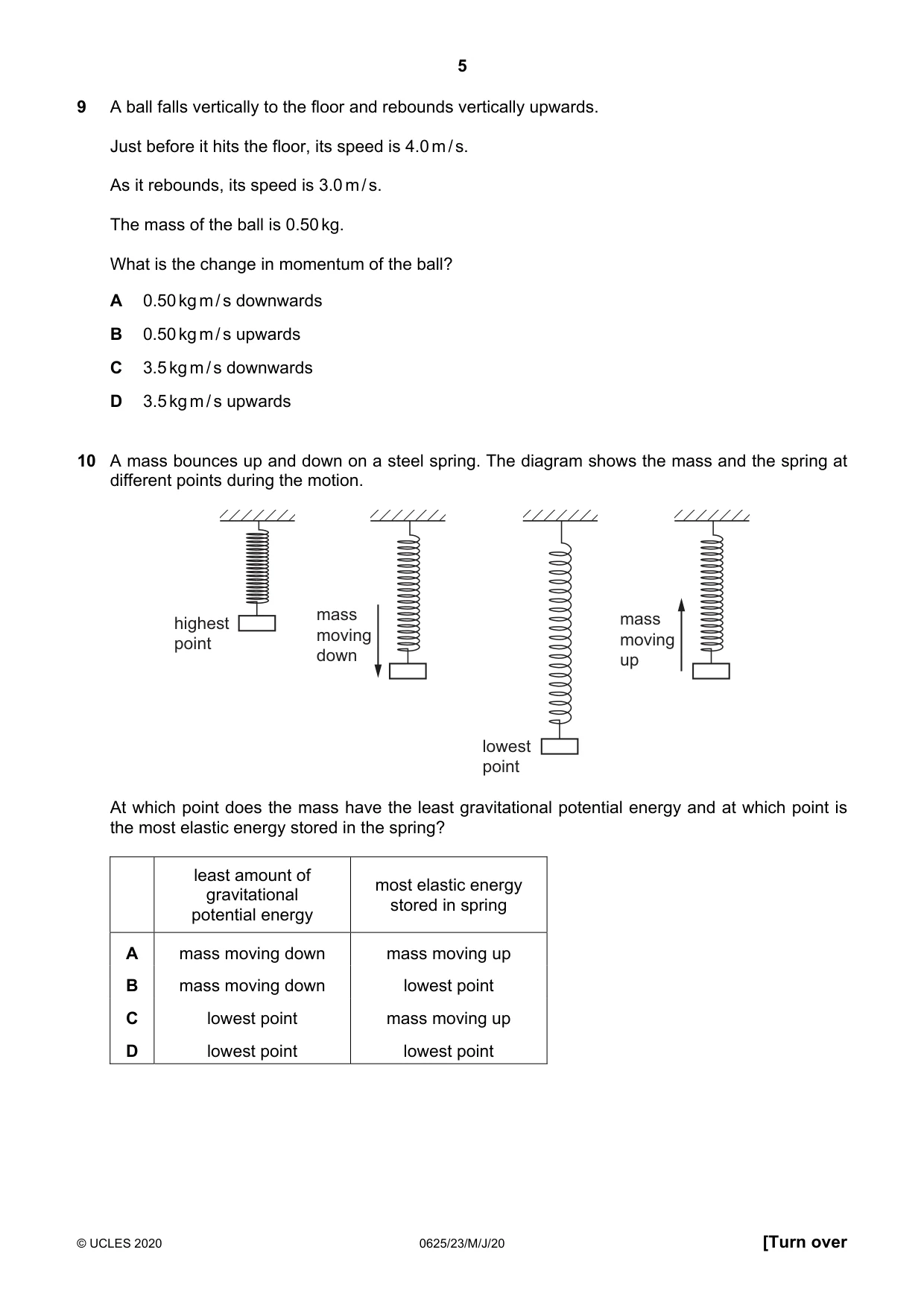
9 A ball falls vertically to the floor and rebounds vertically upwards. Just before it hits the floor, its speed is 4.0 m / s. As it rebounds, its speed is 3.0 m / s. The mass of the ball is 0.50 kg. What is the change in momentum of the ball? A 0.50 kg m / s downwards B 0.50 kg m / s upwards C 3.5 kg m / s downwards D 3.5 kg m / s upwards
Mark scheme: D
Q10 · A mass bounces up and down on a steel spring
10 A mass bounces up and down on a steel spring. The diagram shows the mass and the spring at different points during the motion. mass mass highest moving moving point down up lowest point At which point does the mass have the least gravitational potential energy and at which point is the most elastic energy stored in the spring? least amount of most elastic energy gravitational stored in spring potential energy A mass moving down mass moving up B mass moving down lowest point C lowest point mass moving up D lowest point lowest point
Mark scheme: D
Q11 · The velocity v of an object increases as it falls towards the ground
11 The velocity v of an object increases as it falls towards the ground. Which quantity is directly proportional to v2? A the speed of the object B the gravitational potential energy of the object C the kinetic energy of the object D the momentum of the object
Mark scheme: C
Q12 · The diagram shows a solid block resting on a bench
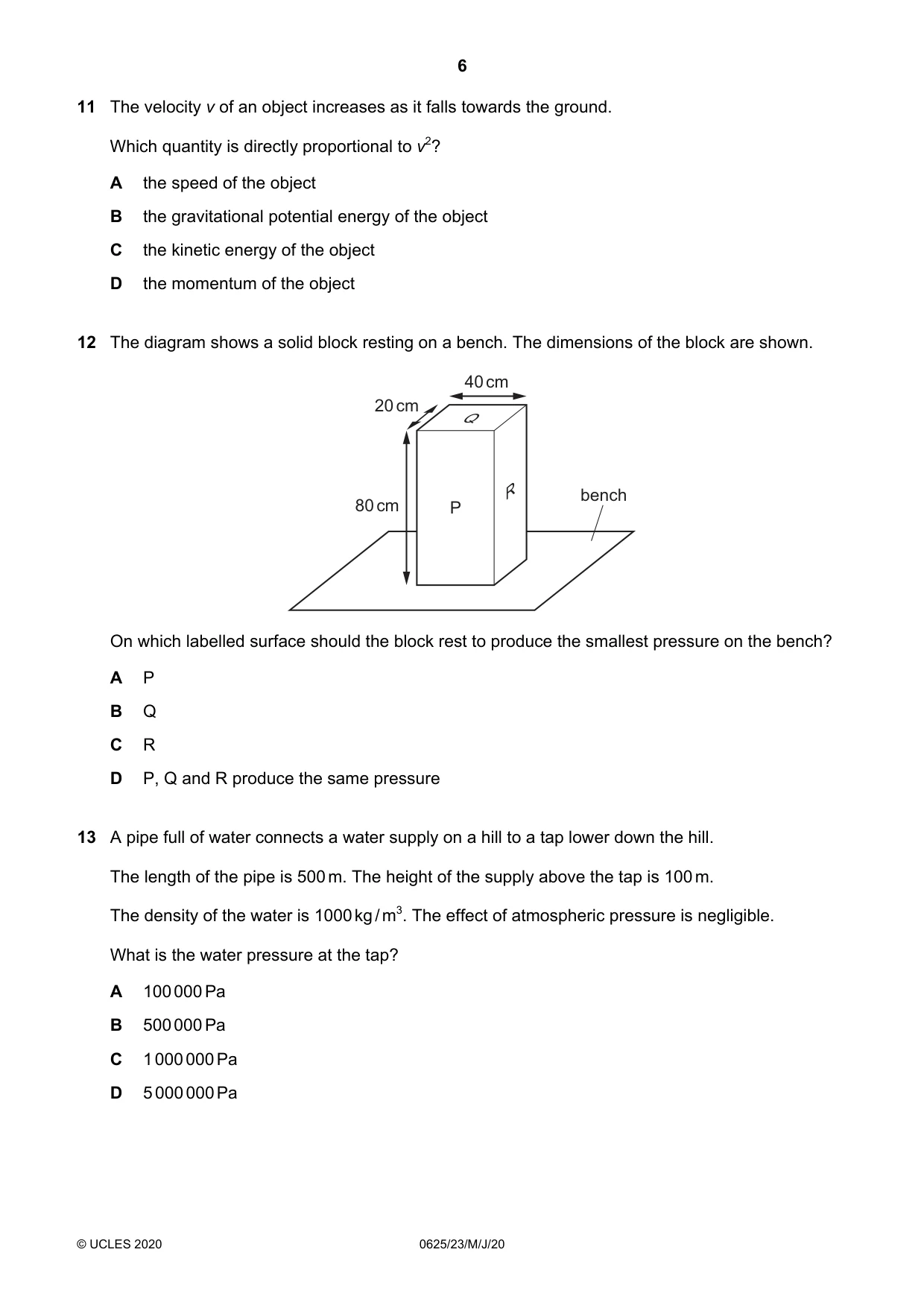
12 The diagram shows a solid block resting on a bench. The dimensions of the block are shown. 40 cm 20 cm Q R bench 80 cm P On which labelled surface should the block rest to produce the smallest pressure on the bench? A P B Q C R D P, Q and R produce the same pressure
Mark scheme: A
Q13 · A pipe full of water connects a water supply on a hill to a tap lower down the hill
13 A pipe full of water connects a water supply on a hill to a tap lower down the hill. The length of the pipe is 500 m. The height of the supply above the tap is 100 m. The density of the water is 1000 kg / m3. The effect of atmospheric pressure is negligible. What is the water pressure at the tap? A 100 000 Pa B 500 000 Pa C 1 000 000 Pa D 5 000 000 Pa
Mark scheme: C
Q14 · When a molecule rebounds from a wall, a force is exerted on the wall
14 When a molecule rebounds from a wall, a force is exerted on the wall. What causes this force? A the kinetic energy gained by the molecule B the kinetic energy lost by the molecule C the change of momentum of the molecule D the change of speed of the molecule
Mark scheme: C
Q15 · The relationship between pressure p and volume V of a gas is given as pV = constant
15 The relationship between pressure p and volume V of a gas is given as pV = constant. Under which conditions for the mass of a gas and for its temperature does the equation hold? mass temperature A changing changing B changing constant C constant changing D constant constant
Mark scheme: D
Q16 · The diagram shows a liquid-in-glass thermometer
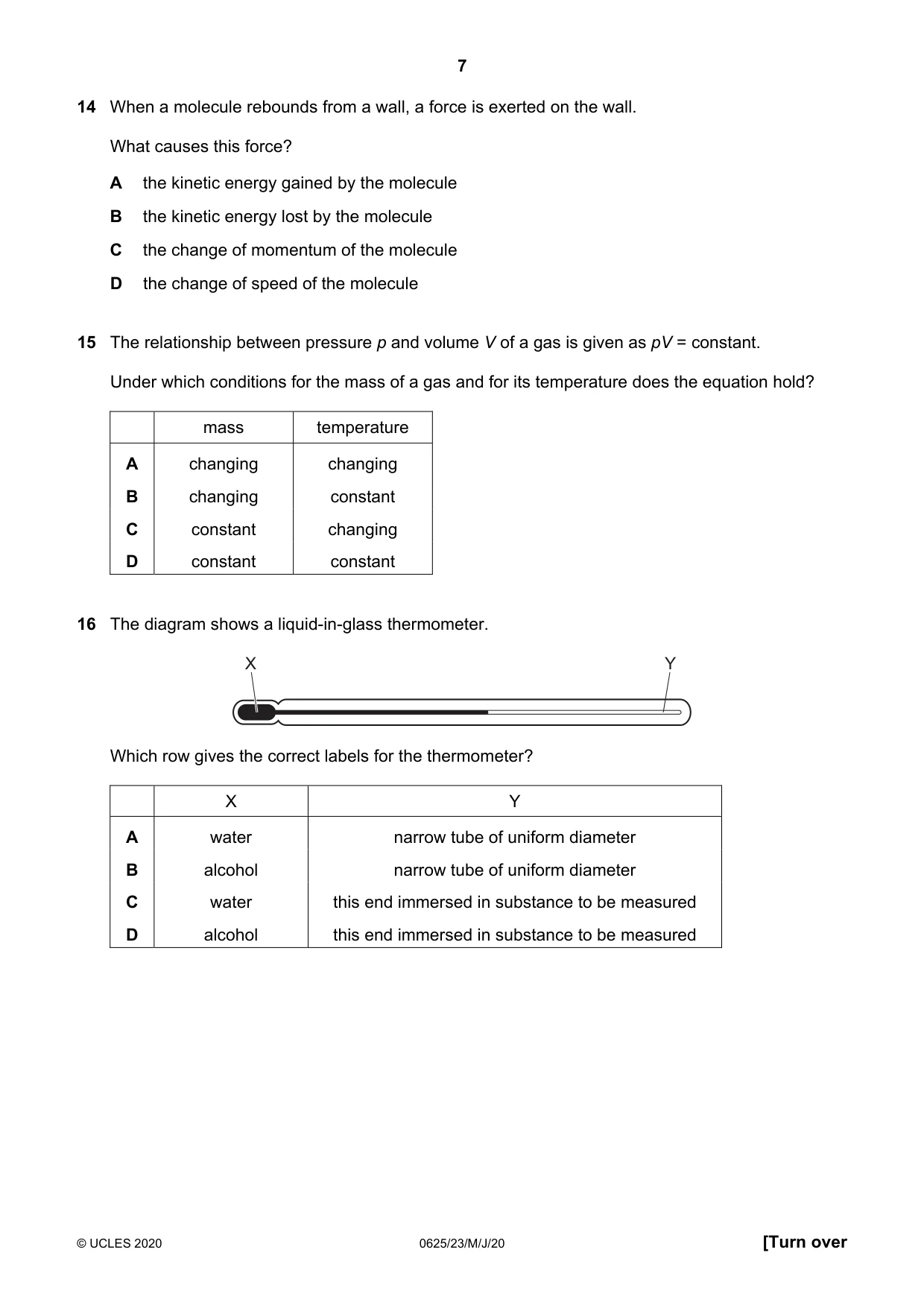
16 The diagram shows a liquid-in-glass thermometer. X Y Which row gives the correct labels for the thermometer? X Y A water narrow tube of uniform diameter B alcohol narrow tube of uniform diameter C water this end immersed in substance to be measured D alcohol this end immersed in substance to be measured
Mark scheme: B
Q17 · The diagrams show four blocks of steel
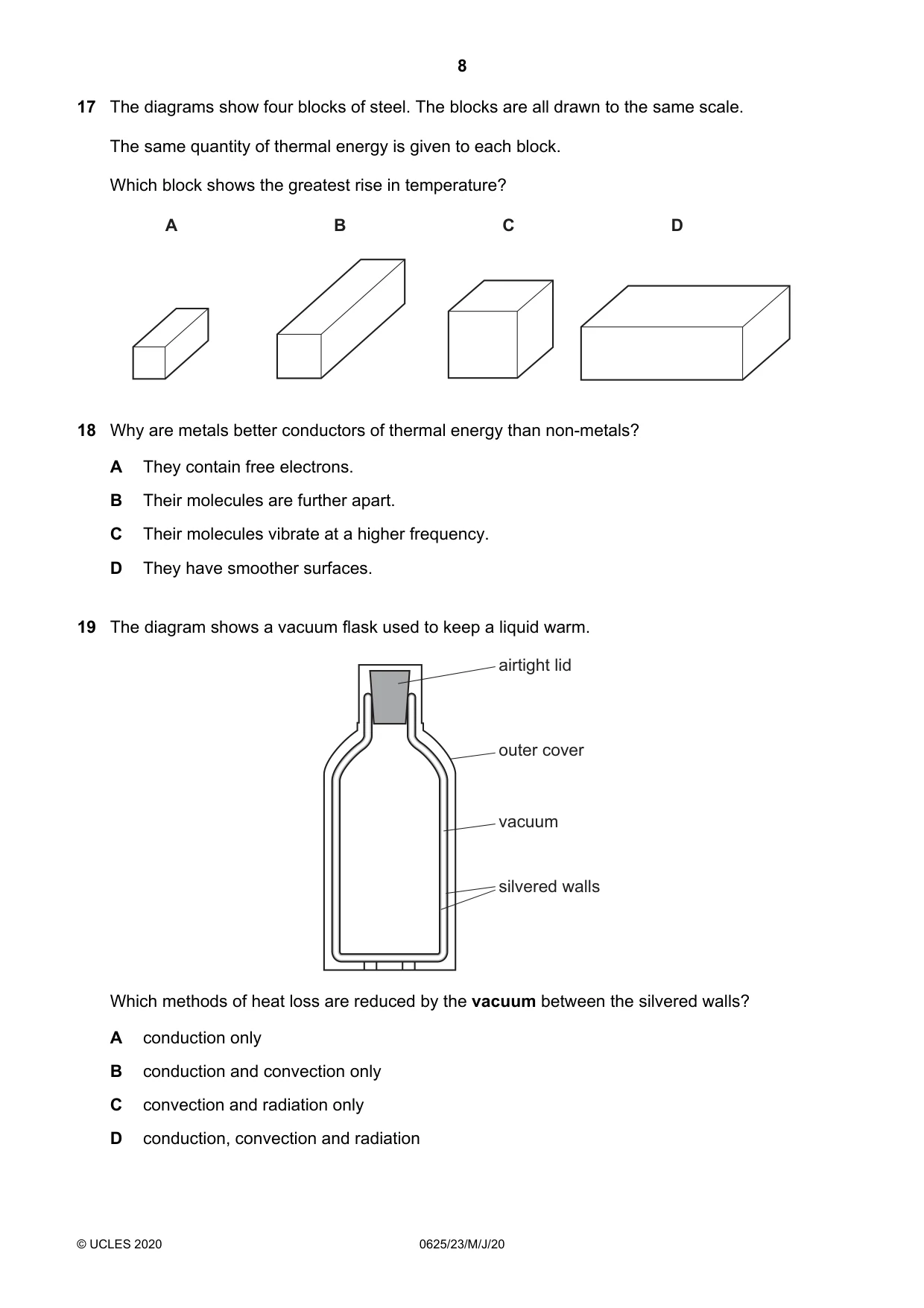
17 The diagrams show four blocks of steel. The blocks are all drawn to the same scale. The same quantity of thermal energy is given to each block. Which block shows the greatest rise in temperature? A B C D
Mark scheme: A
Q18 · Why are metals better conductors of thermal energy than non-metals?
18 Why are metals better conductors of thermal energy than non-metals? A They contain free electrons. B Their molecules are further apart. C Their molecules vibrate at a higher frequency. D They have smoother surfaces.
Mark scheme: A
Q19 · The diagram shows a vacuum flask used to keep a liquid warm
19 The diagram shows a vacuum flask used to keep a liquid warm. airtight lid outer cover vacuum silvered walls Which methods of heat loss are reduced by the vacuum between the silvered walls? A conduction only B conduction and convection only C convection and radiation only D conduction, convection and radiation
Mark scheme: B
Q20 · An earthquake-monitoring station records the arrival of 16 complete waves of an…
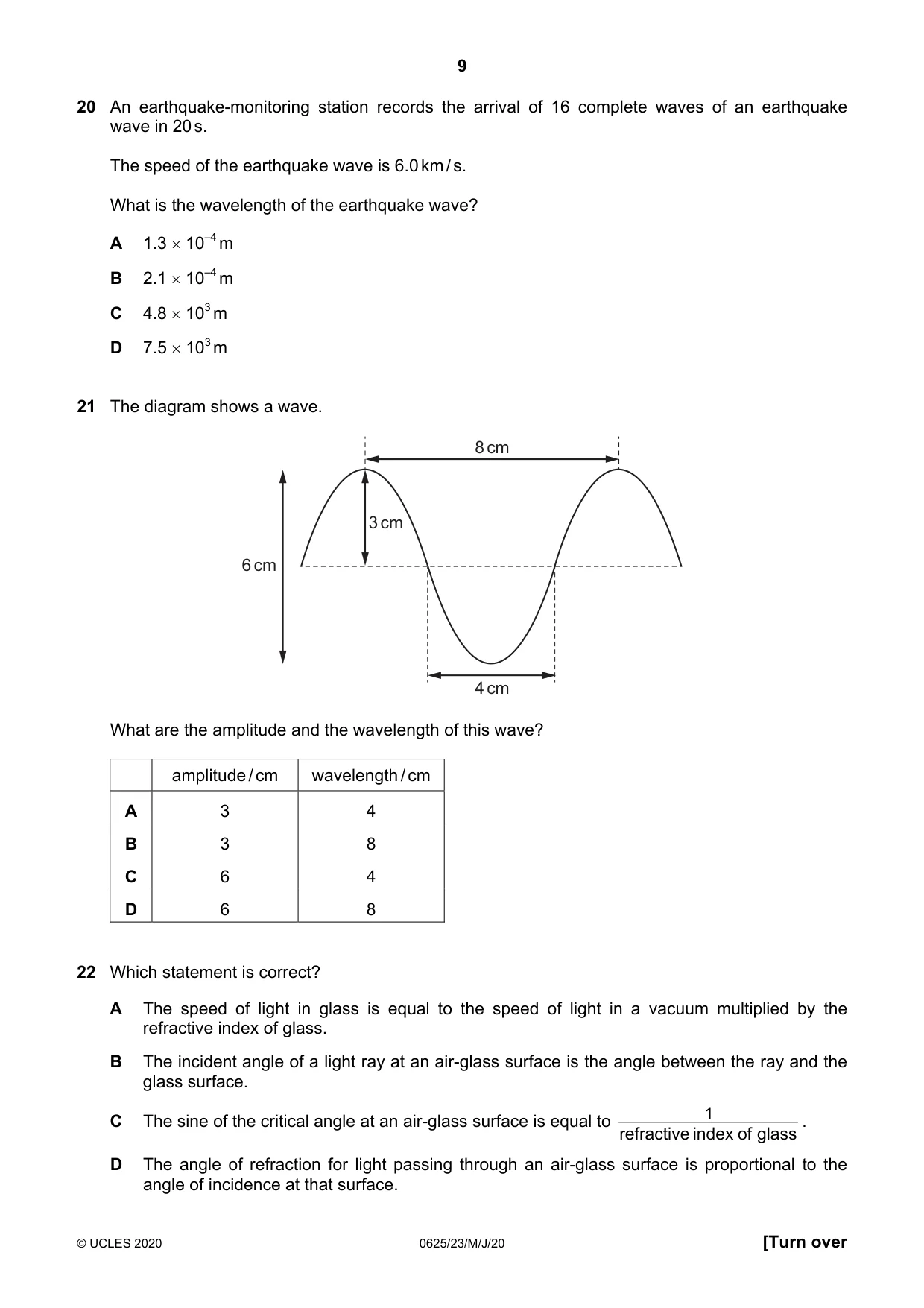
20 An earthquake-monitoring station records the arrival of 16 complete waves of an earthquake wave in 20 s. The speed of the earthquake wave is 6.0 km / s. What is the wavelength of the earthquake wave? A 1.3 × 10⁻⁴ m B 2.1 × 10⁻⁴ m C 4.8 × 10³ m D 7.5 × 10³ m
Mark scheme: D
Q21 · The diagram shows a wave
21 The diagram shows a wave. 8 cm 3 cm 6 cm 4 cm What are the amplitude and the wavelength of this wave? amplitude / cm wavelength / cm A 3 4 B 3 8 C 6 4 D 6 8
Mark scheme: B
Q22 · Which statement is correct?
22 Which statement is correct? A The speed of light in glass is equal to the speed of light in a vacuum multiplied by the refractive index of glass. B The incident angle of a light ray at an air-glass surface is the angle between the ray and the glass surface. C The sine of the critical angle at an air-glass surface is equal to 1 . refractive index of glass D The angle of refraction for light passing through an air-glass surface is proportional to the angle of incidence at that surface.
Mark scheme: C
Q23 · Which statement about converging lenses is correct?
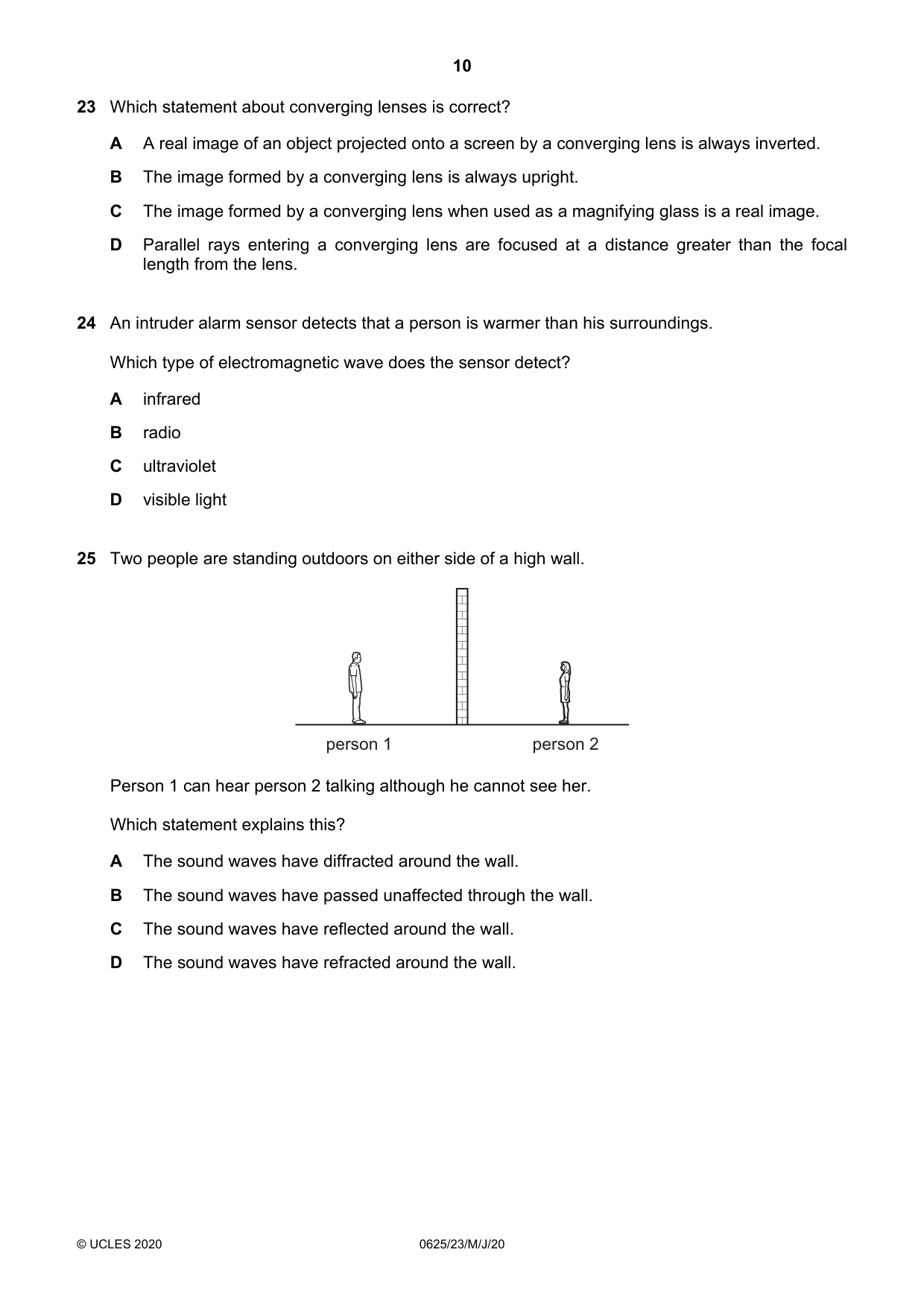
23 Which statement about converging lenses is correct? A A real image of an object projected onto a screen by a converging lens is always inverted. B The image formed by a converging lens is always upright. C The image formed by a converging lens when used as a magnifying glass is a real image. D Parallel rays entering a converging lens are focused at a distance greater than the focal length from the lens.
Mark scheme: A
Q24 · An intruder alarm sensor detects that a person is warmer than his surroundings
24 An intruder alarm sensor detects that a person is warmer than his surroundings. Which type of electromagnetic wave does the sensor detect? A infrared B radio C ultraviolet D visible light
Mark scheme: A
Q25 · Two people are standing outdoors on either side of a high wall
25 Two people are standing outdoors on either side of a high wall. person 1 person 2 Person 1 can hear person 2 talking although he cannot see her. Which statement explains this? A The sound waves have diffracted around the wall. B The sound waves have passed unaffected through the wall. C The sound waves have reflected around the wall. D The sound waves have refracted around the wall.
Mark scheme: A
Q26 · Four nails A, B, C and D are tested to find which makes the strongest permanent magnet
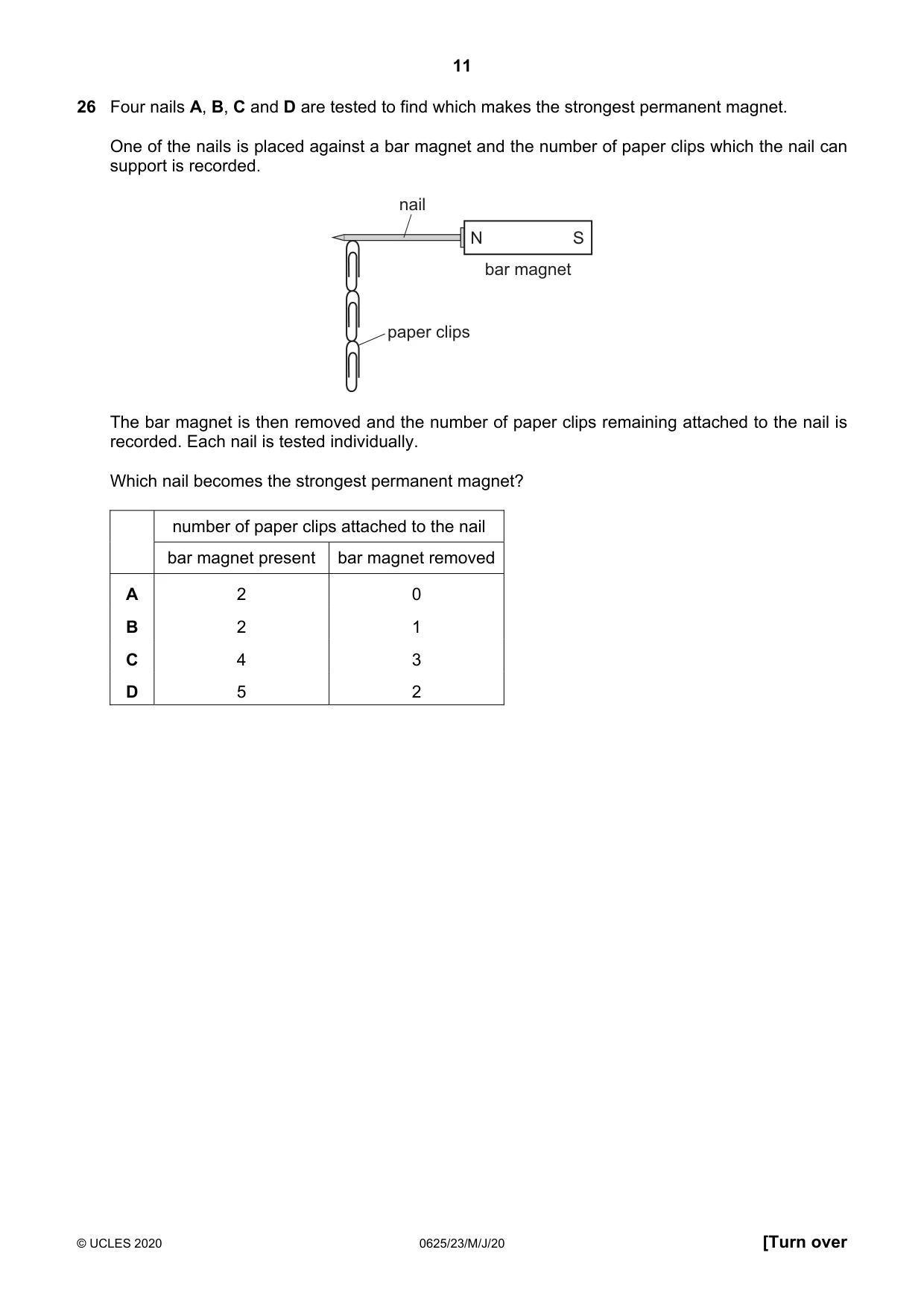
26 Four nails A, B, C and D are tested to find which makes the strongest permanent magnet. One of the nails is placed against a bar magnet and the number of paper clips which the nail can support is recorded. nail N S bar magnet paper clips The bar magnet is then removed and the number of paper clips remaining attached to the nail is recorded. Each nail is tested individually. Which nail becomes the strongest permanent magnet? number of paper clips attached to the nail bar magnet present bar magnet removed A 2 0 B 2 1 C 4 3 D 5 2
Mark scheme: C
Q27 · The diagrams show a magnetised steel rod inside a solenoid connected to a potentiometer
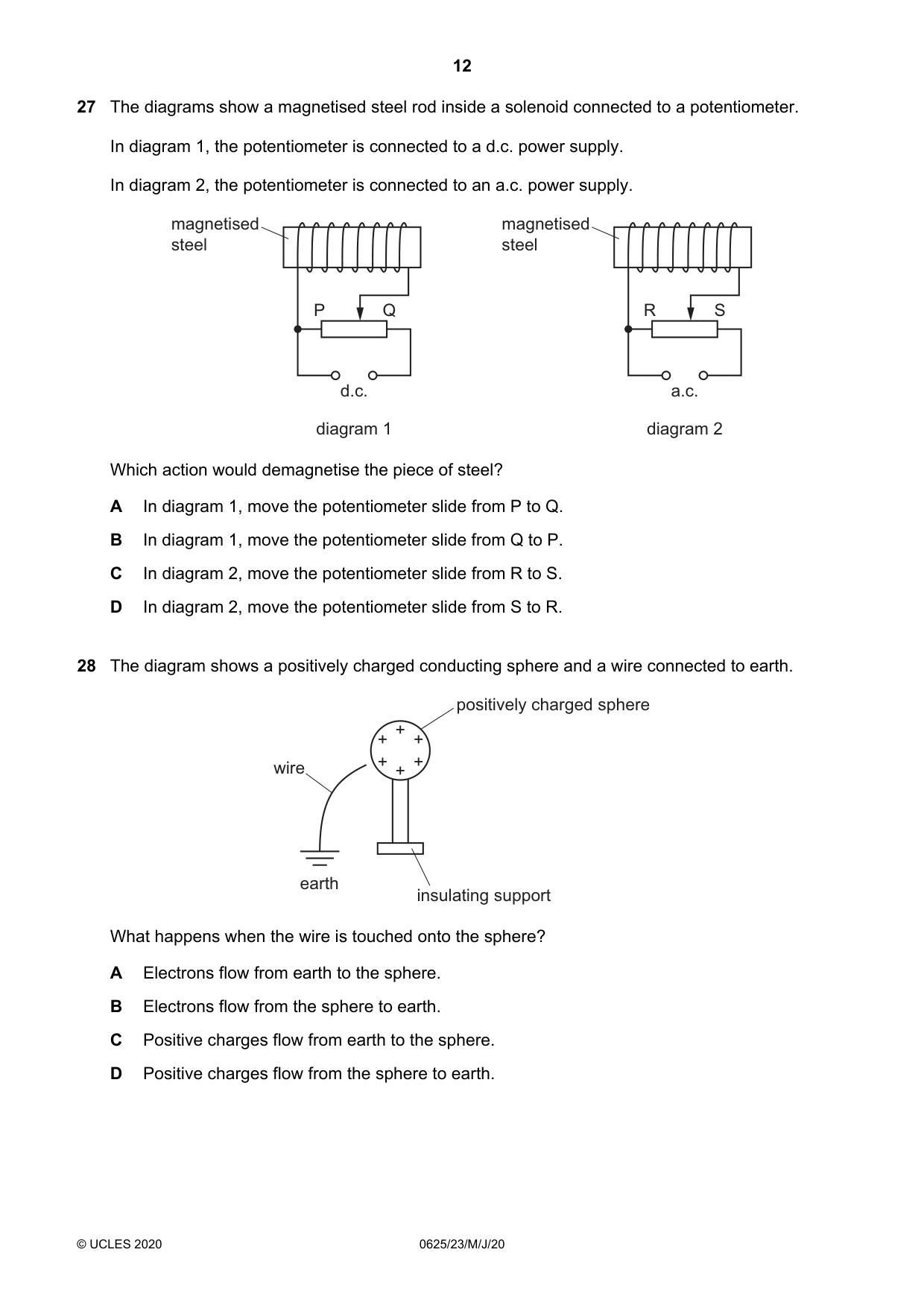
27 The diagrams show a magnetised steel rod inside a solenoid connected to a potentiometer. In diagram 1, the potentiometer is connected to a d.c. power supply. In diagram 2, the potentiometer is connected to an a.c. power supply. magnetised magnetised steel steel P Q R S d.c. a.c. diagram 1 diagram 2 Which action would demagnetise the piece of steel? A In diagram 1, move the potentiometer slide from P to Q. B In diagram 1, move the potentiometer slide from Q to P. C In diagram 2, move the potentiometer slide from R to S. D In diagram 2, move the potentiometer slide from S to R.
Mark scheme: D
Q28 · The diagram shows a positively charged conducting sphere and a wire connected to earth
28 The diagram shows a positively charged conducting sphere and a wire connected to earth. positively charged sphere + + + wire + + + earth insulating support What happens when the wire is touched onto the sphere? A Electrons flow from earth to the sphere. B Electrons flow from the sphere to earth. C Positive charges flow from earth to the sphere. D Positive charges flow from the sphere to earth.
Mark scheme: A
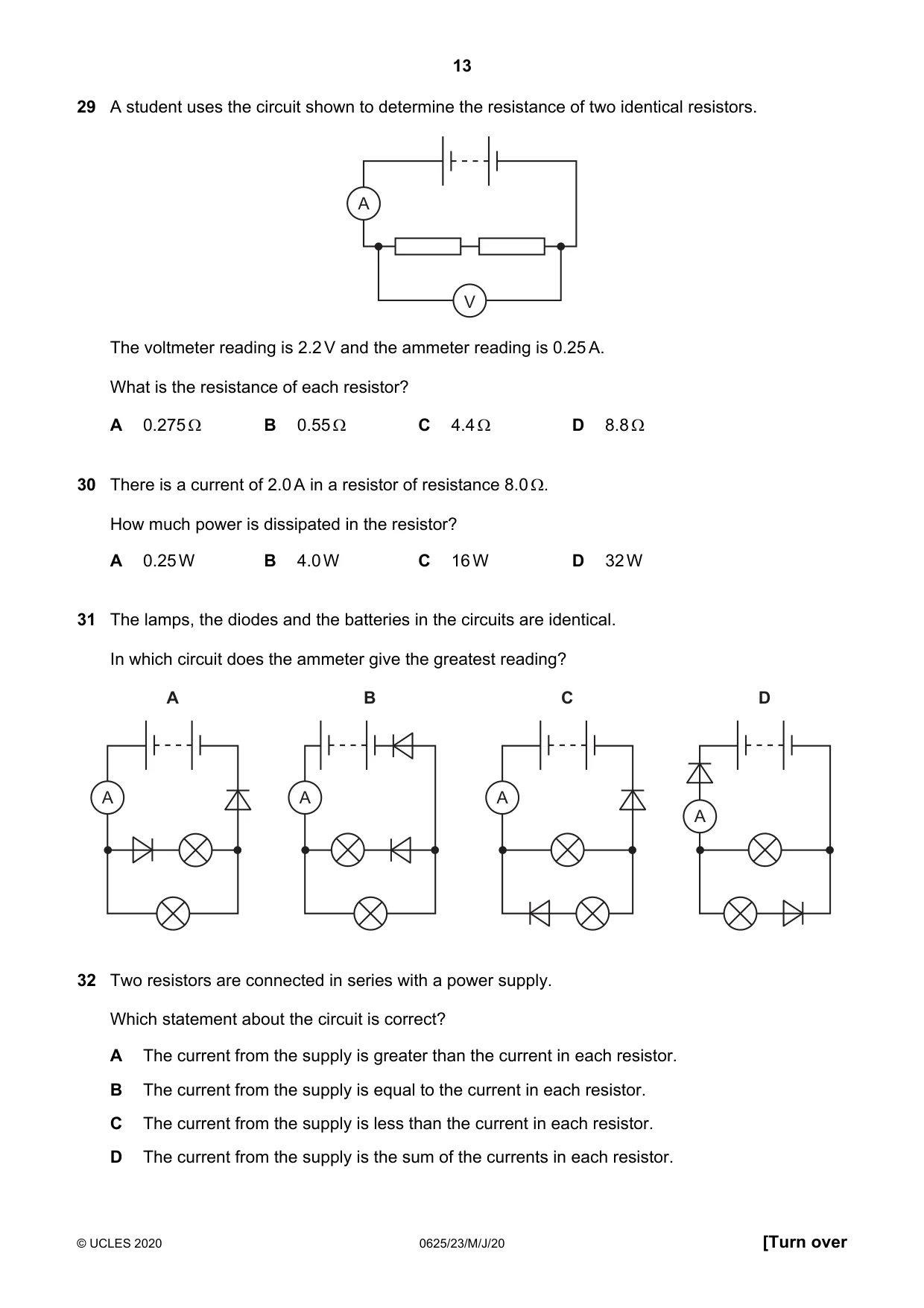
Q29 · A student uses the circuit shown to determine the resistance of two identical resistors
29 A student uses the circuit shown to determine the resistance of two identical resistors. A V The voltmeter reading is 2.2 V and the ammeter reading is 0.25 A. What is the resistance of each resistor? A 0.275 Ω B 0.55 Ω C 4.4 Ω D 8.8 Ω
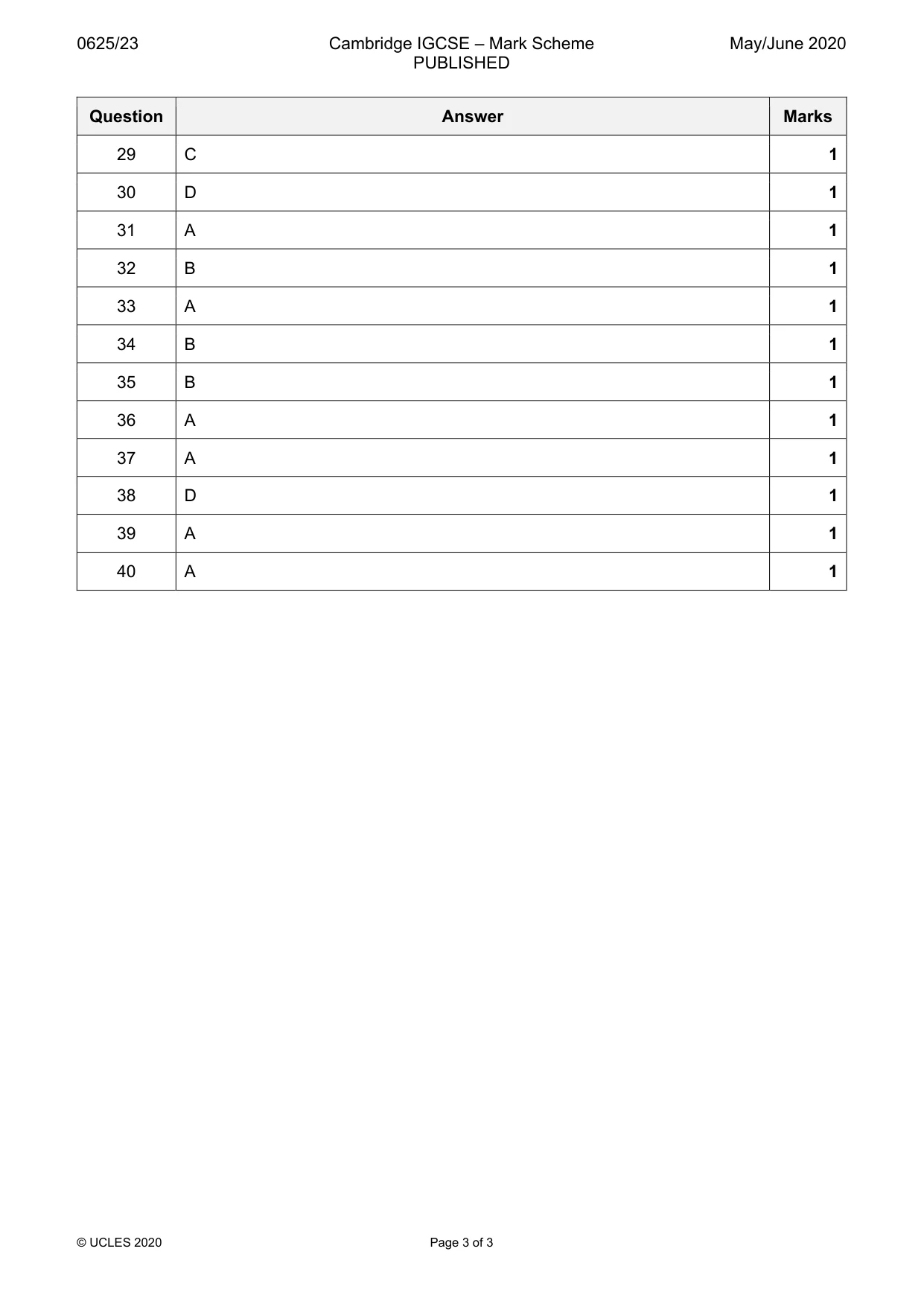
Mark scheme: C
Q30 · There is a current of 2.0 A in a resistor of resistance 8.0 Ω
30 There is a current of 2.0 A in a resistor of resistance 8.0 Ω. How much power is dissipated in the resistor? A 0.25 W B 4.0 W C 16 W D 32 W
Mark scheme: D
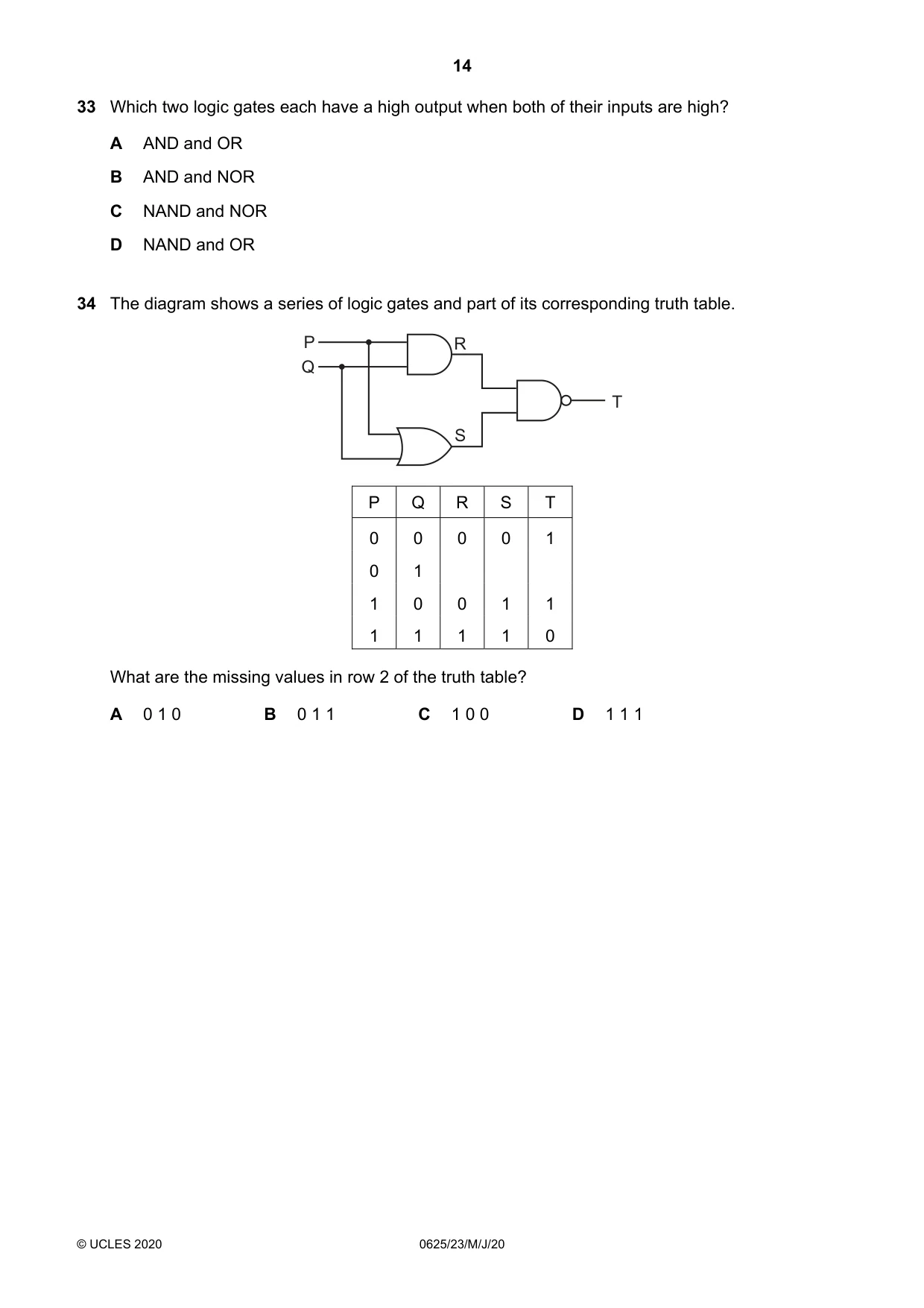
Q31 · The lamps, the diodes and the batteries in the circuits are identical
31 The lamps, the diodes and the batteries in the circuits are identical. In which circuit does the ammeter give the greatest reading? A B C D A A A A
Mark scheme: A
Q32 · Two resistors are connected in series with a power supply
32 Two resistors are connected in series with a power supply. Which statement about the circuit is correct? A The current from the supply is greater than the current in each resistor. B The current from the supply is equal to the current in each resistor. C The current from the supply is less than the current in each resistor. D The current from the supply is the sum of the currents in each resistor.
Mark scheme: B
Q33 · Which two logic gates each have a high output when both of their inputs are high?
33 Which two logic gates each have a high output when both of their inputs are high? A AND and OR B AND and NOR C NAND and NOR D NAND and OR
Mark scheme: A
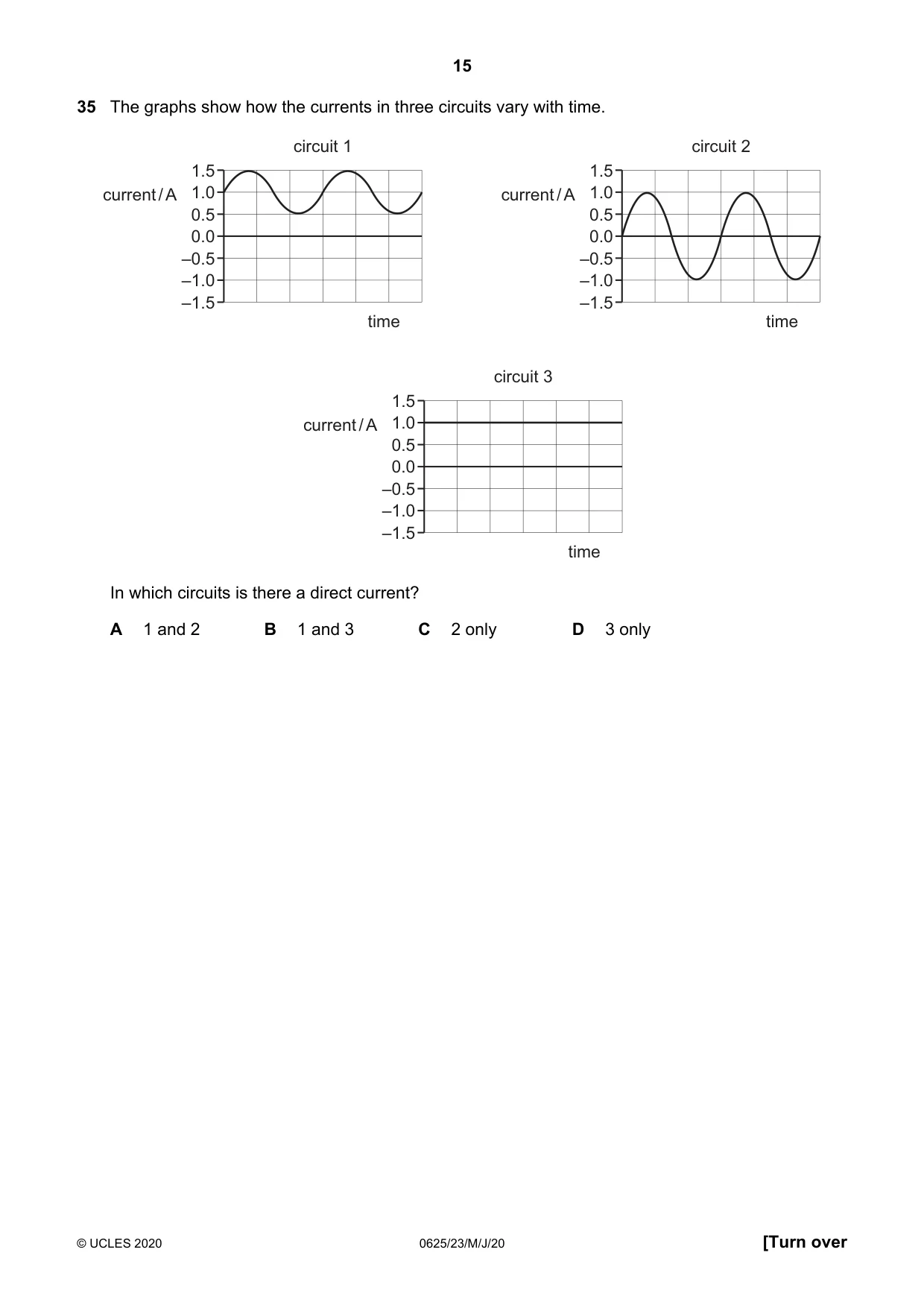
Q34 · The diagram shows a series of logic gates and part of its corresponding truth table
34 The diagram shows a series of logic gates and part of its corresponding truth table. P R Q T S P Q R S T 0 0 0 0 1 0 1 1 0 0 1 1 1 1 1 1 0 What are the missing values in row 2 of the truth table? A 0 1 0 B 0 1 1 C 1 0 0 D 1 1 1
Mark scheme: B
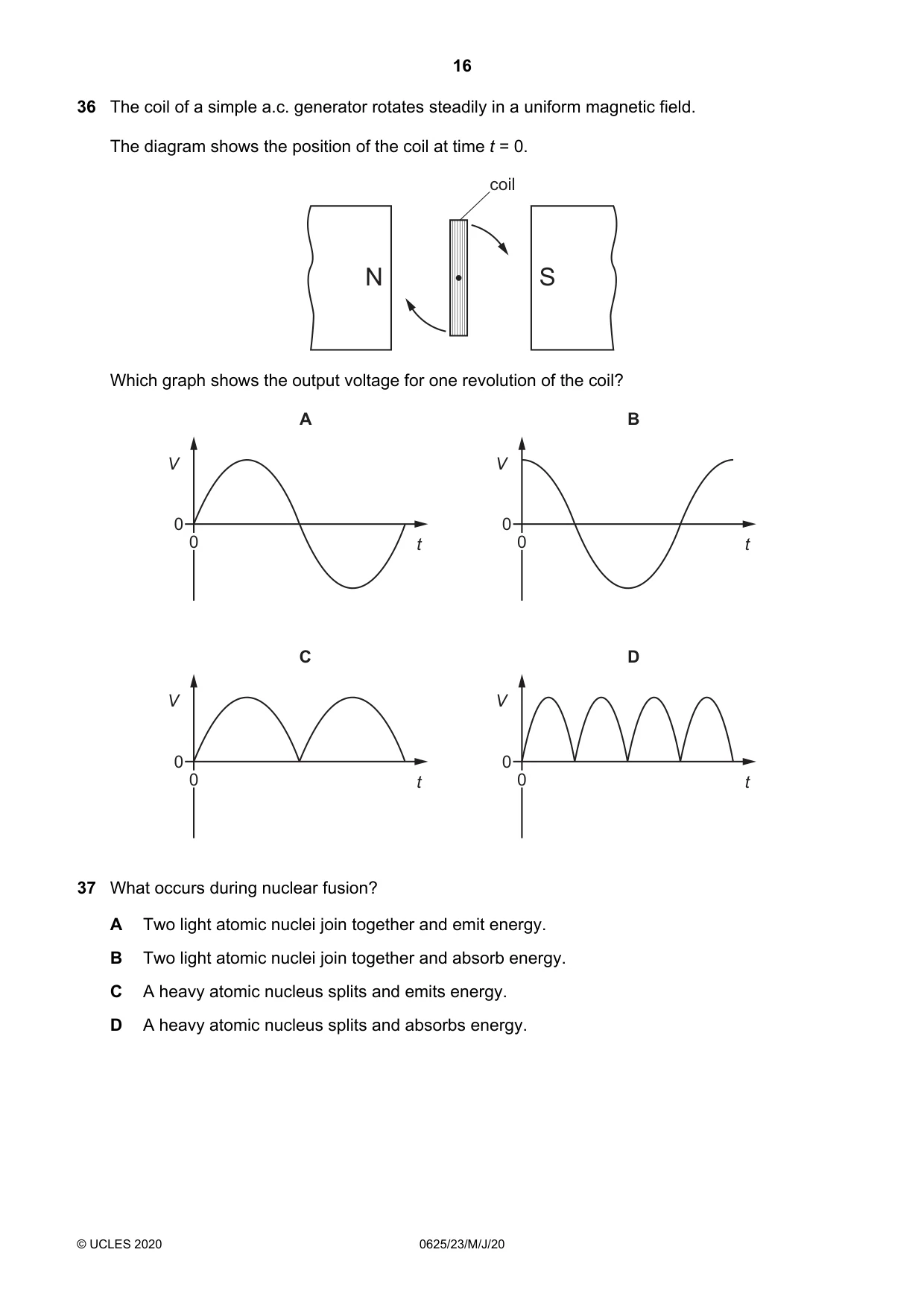
Q35 · The graphs show how the currents in three circuits vary with time
35 The graphs show how the currents in three circuits vary with time. circuit 1 circuit 2 1.5 1.5 current / A 1.0 current / A 1.0 0.5 0.5 0.0 0.0 –0.5 –0.5 –1.0 –1.0 –1.5 –1.5 time time circuit 3 1.5 current / A 1.0 0.5 0.0 –0.5 –1.0 –1.5 time In which circuits is there a direct current? A 1 and 2 B 1 and 3 C 2 only D 3 only
Mark scheme: B
Q36 · The coil of a simple a.c
36 The coil of a simple a.c. generator rotates steadily in a uniform magnetic field. The diagram shows the position of the coil at time t = 0. coil N S Which graph shows the output voltage for one revolution of the coil? A B V V 0 0 0 t 0 t C D V V 0 0 0 t 0 t
Mark scheme: A
Q37 · What occurs during nuclear fusion?
37 What occurs during nuclear fusion? A Two light atomic nuclei join together and emit energy. B Two light atomic nuclei join together and absorb energy. C A heavy atomic nucleus splits and emits energy. D A heavy atomic nucleus splits and absorbs energy.
Mark scheme: A
Q38 · A radioactive material has a half-life of 20 days
38 A radioactive material has a half-life of 20 days. A sample of the material contains 8.0 × 10¹⁰ atoms. How many atomic nuclei have decayed after 60 days? A 1.0 × 10¹⁰ B 4.0 × 10¹⁰ C 6.0 × 10¹⁰ D 7.0 × 10¹⁰
Mark scheme: D
Q39 · A thin sheet of paper is placed between a radioactive source and a radiation detector
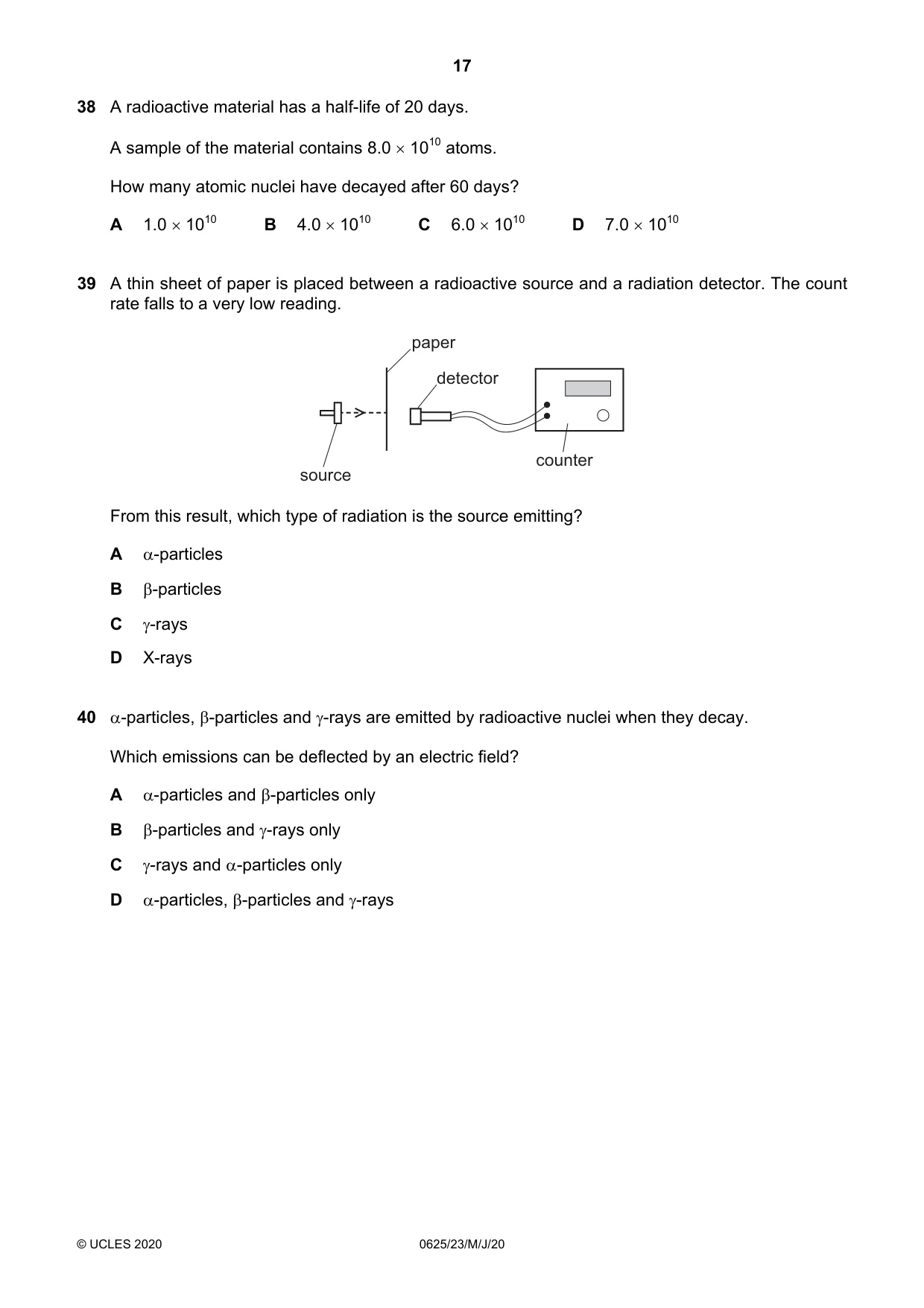
39 A thin sheet of paper is placed between a radioactive source and a radiation detector. The count rate falls to a very low reading. paper detector counter source From this result, which type of radiation is the source emitting? A α-particles B β-particles C γ-rays D X-rays
Mark scheme: A
Q40 · Α-particles, β-particles and γ-rays are emitted by radioactive nuclei when they decay
40 α-particles, β-particles and γ-rays are emitted by radioactive nuclei when they decay. Which emissions can be deflected by an electric field? A α-particles and β-particles only B β-particles and γ-rays only C γ-rays and α-particles only D α-particles, β-particles and γ-rays
Mark scheme: A
What was in this paper
The subtopics covered by these 40 questions, and how many questions each got. Open one in a new tab to see every Cambridge question on it.
5Radioactivity4Electrical quantities3Energy, work and power2Forces2General properties of waves2Kinetic particle model of matter2Light2Motion2Physical quantities and measurement techniques2Pressure2Simple phenomena of magnetism2Thermal properties and temperature2Transfer of thermal energy2Density1Electromagnetic effects1Electromagnetic spectrum1Mass and weight1Momentum1Sound1