Cambridge IGCSE Physics 0625 — 2021 May/June Paper 2 · Variant 2
0625/22/M/J/21 · 40 questions · 40 marks · ≈45 min
The question paper and its mark scheme, free to read here and free to download. This is Cambridge’s own paper, exactly as it was sat.
Question paper16 pages
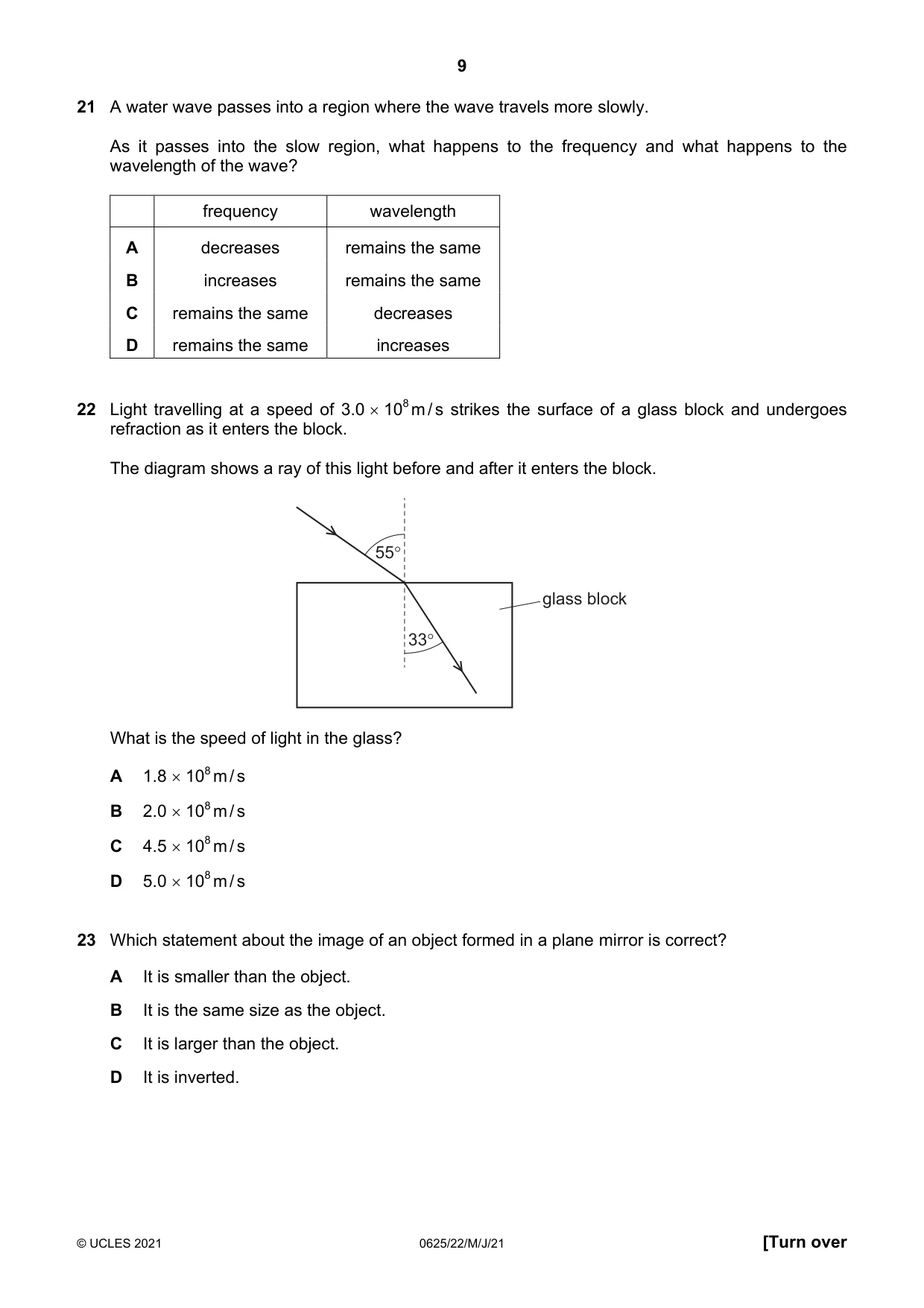
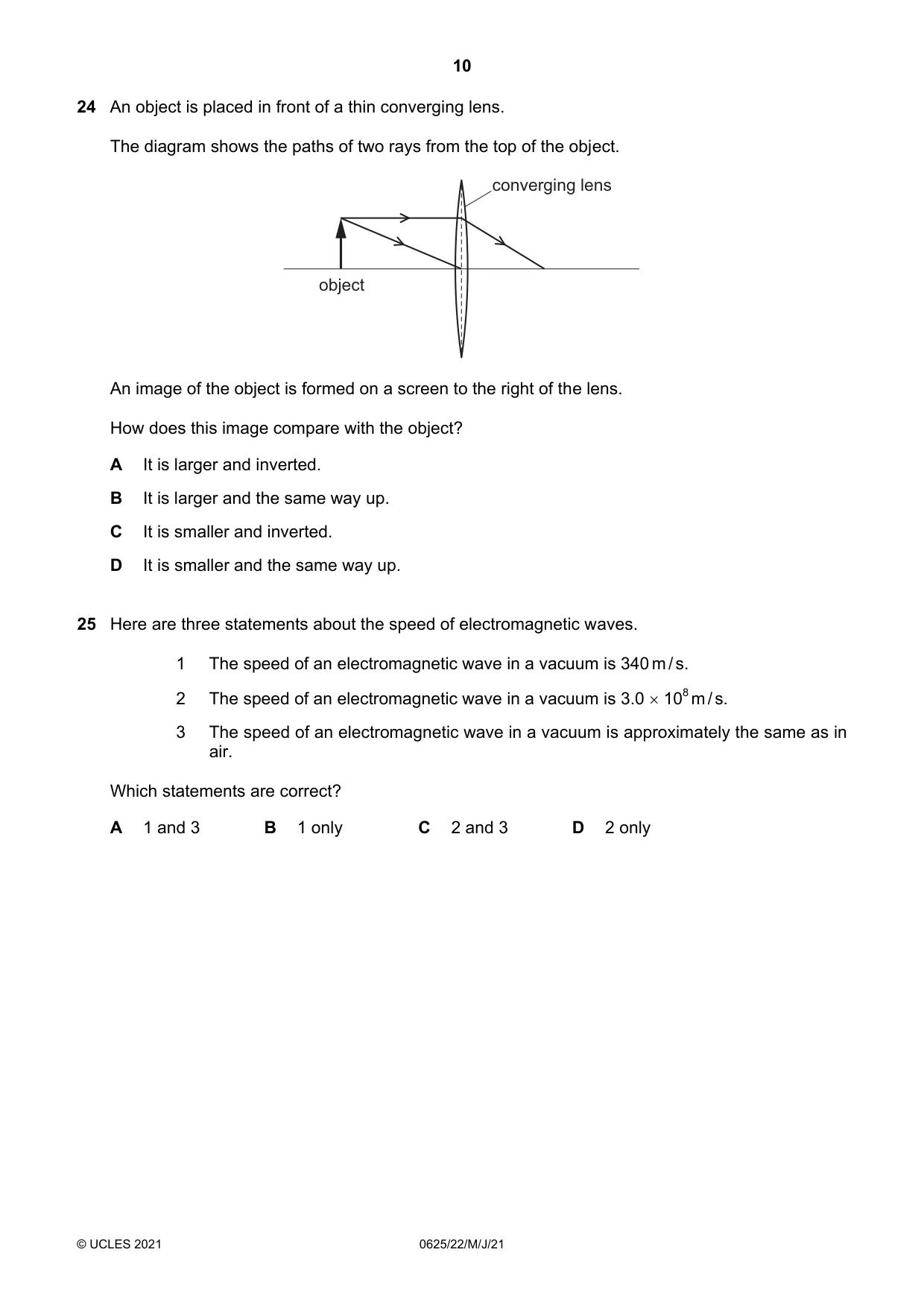
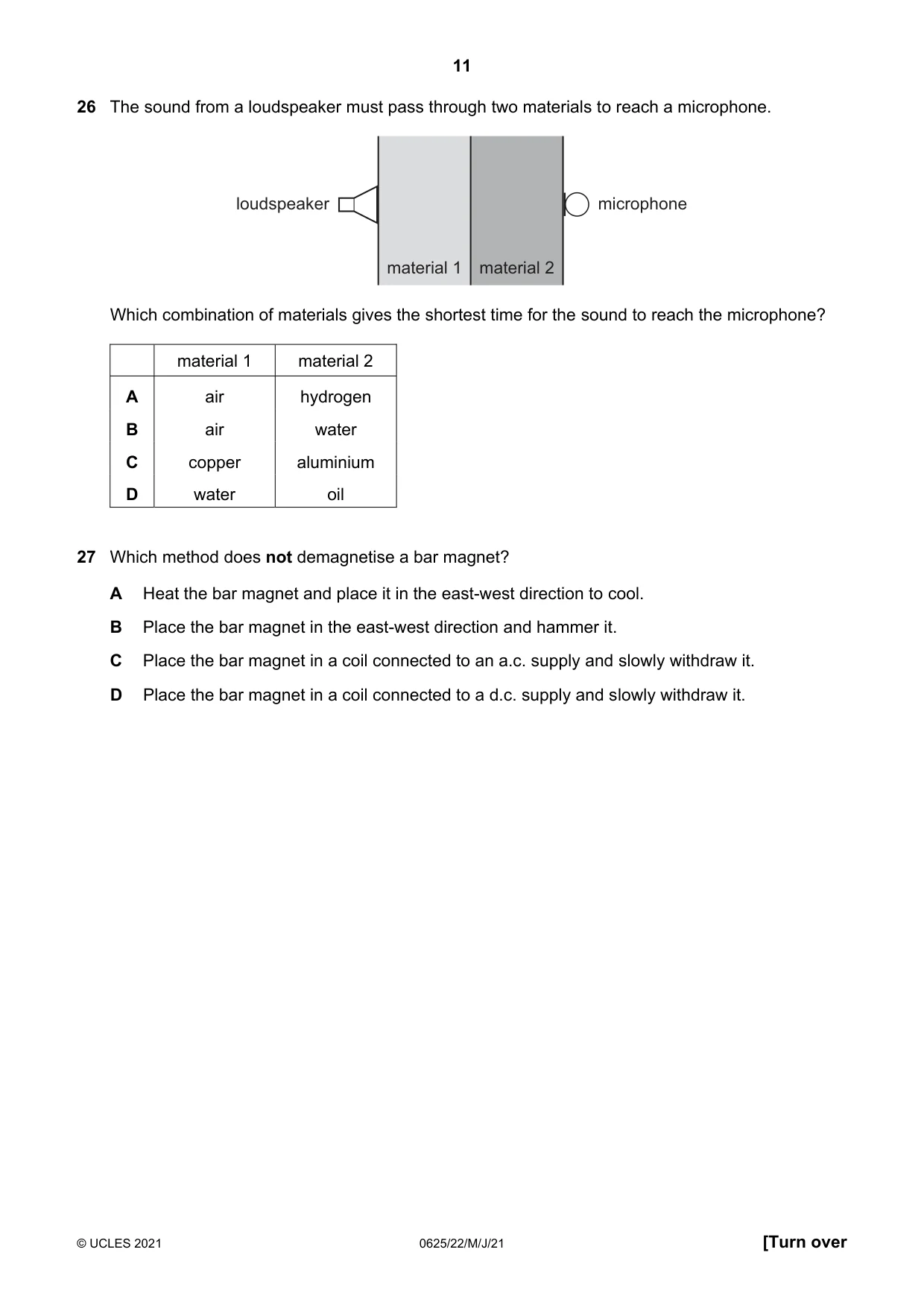
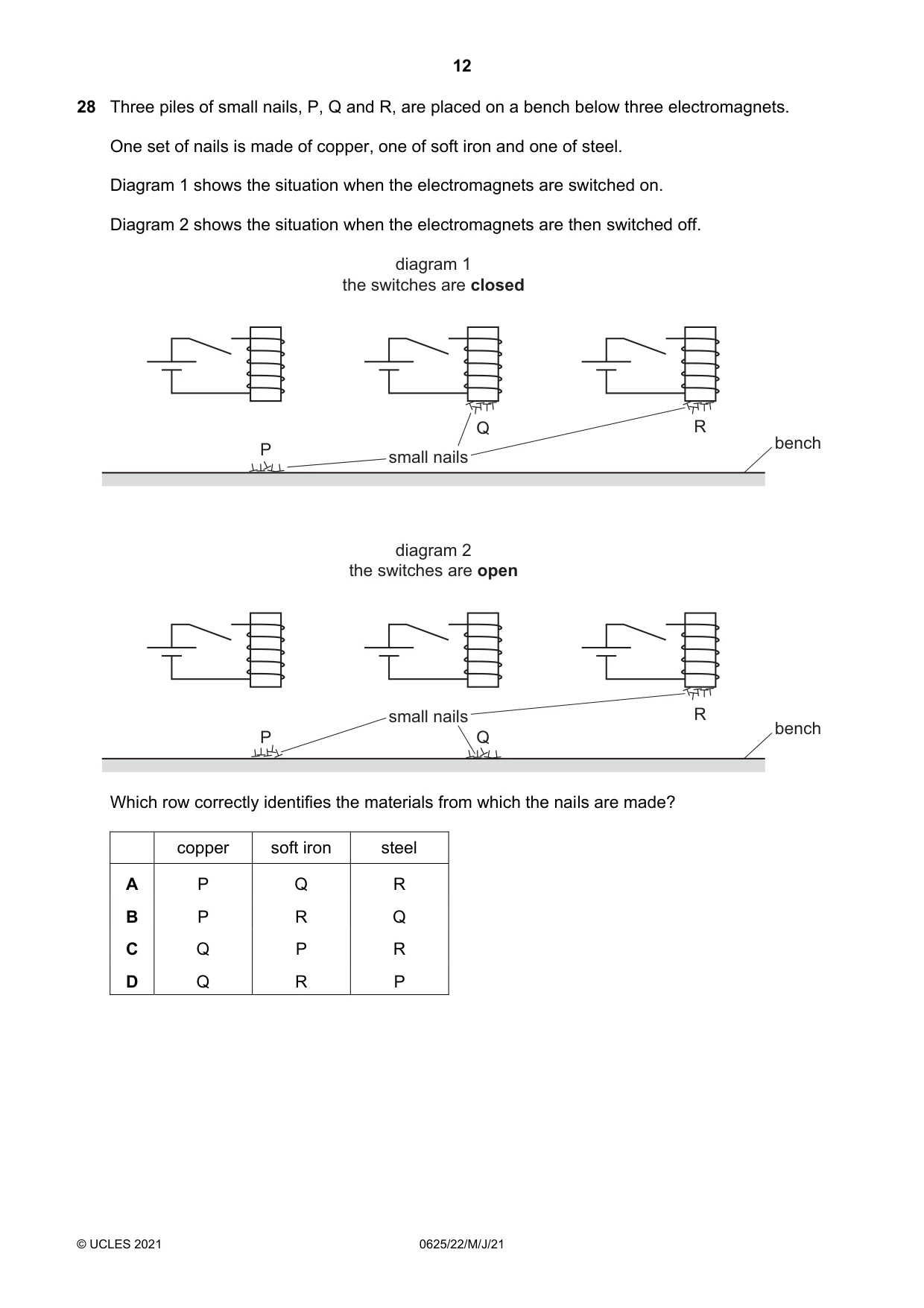
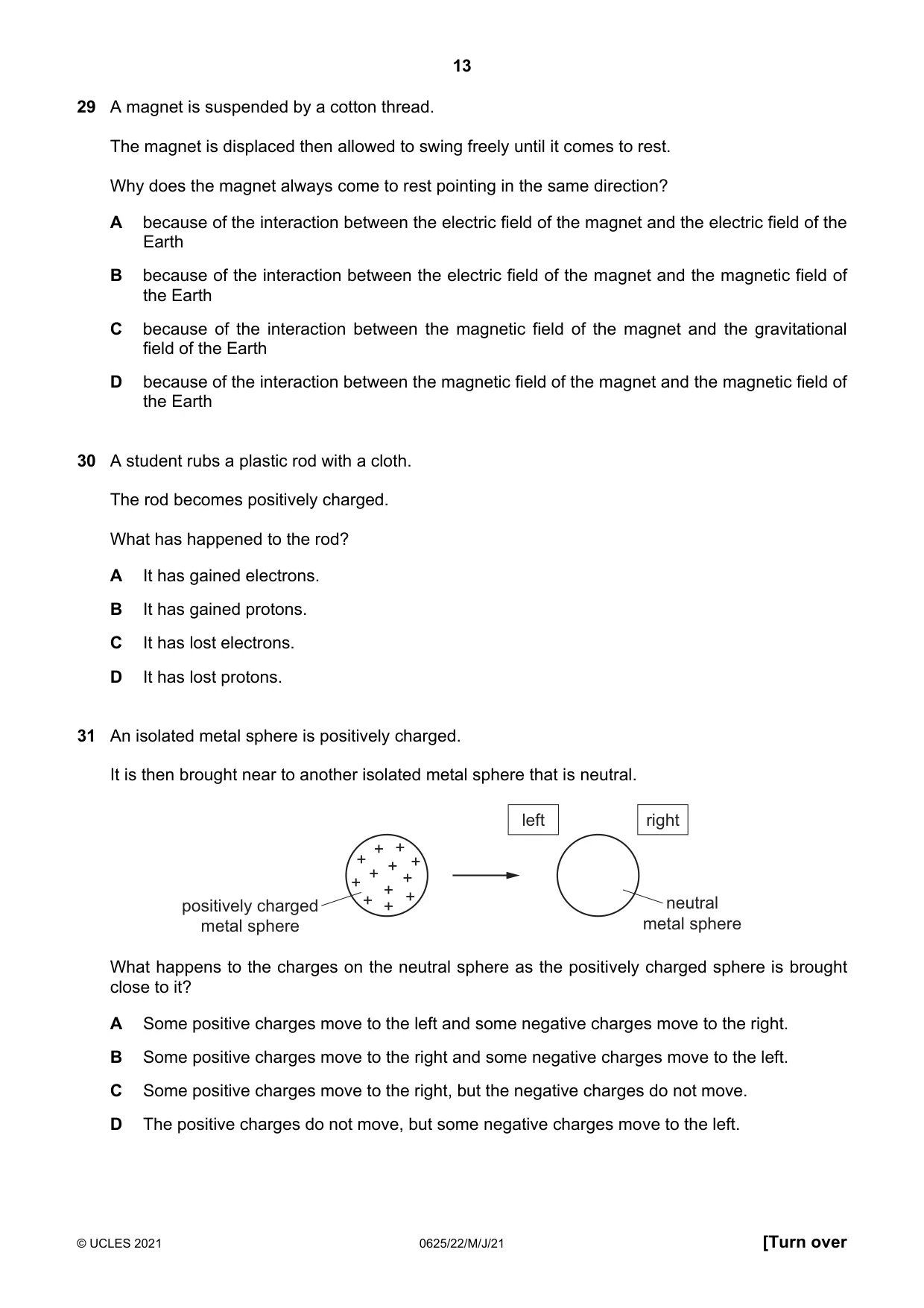
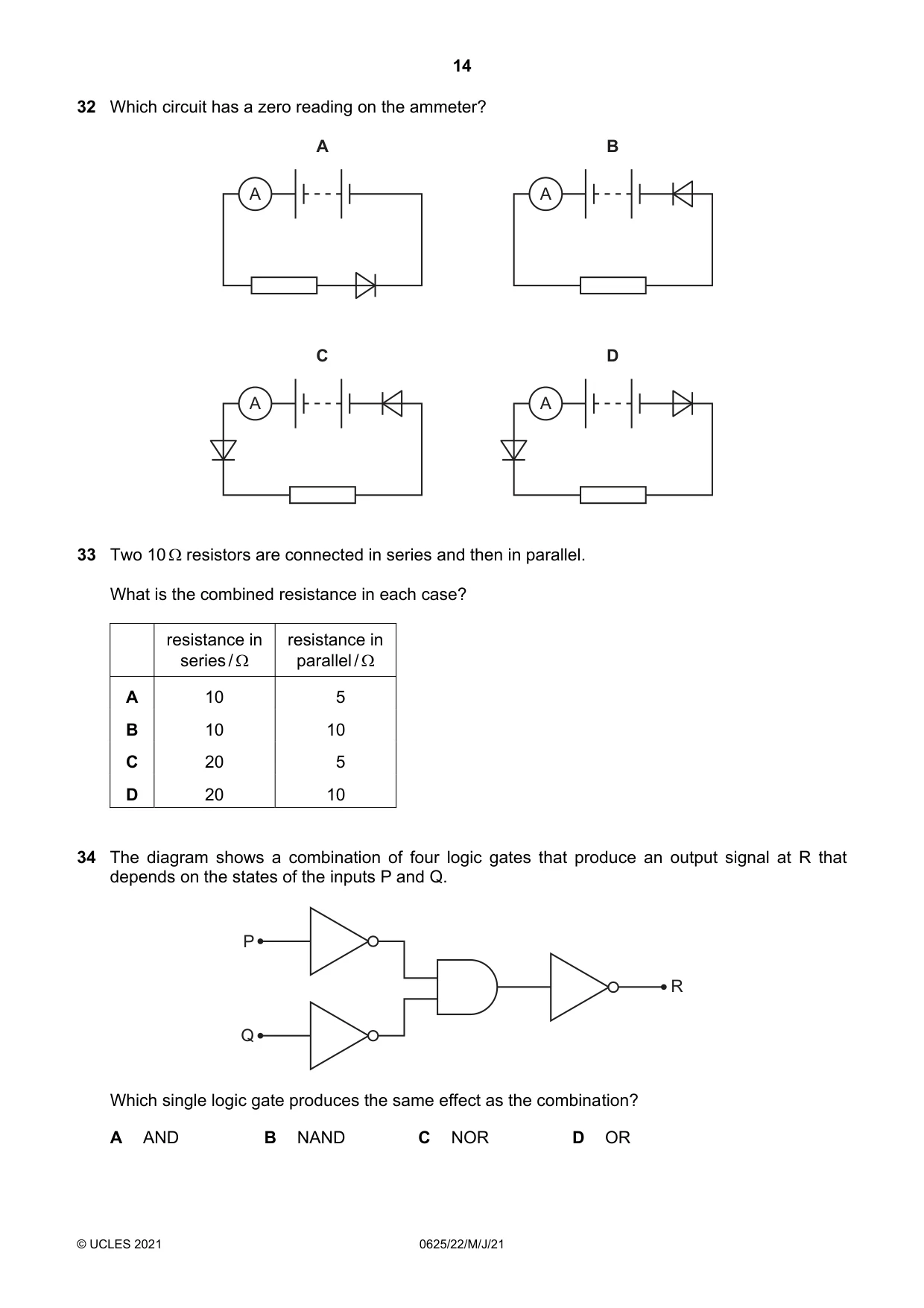
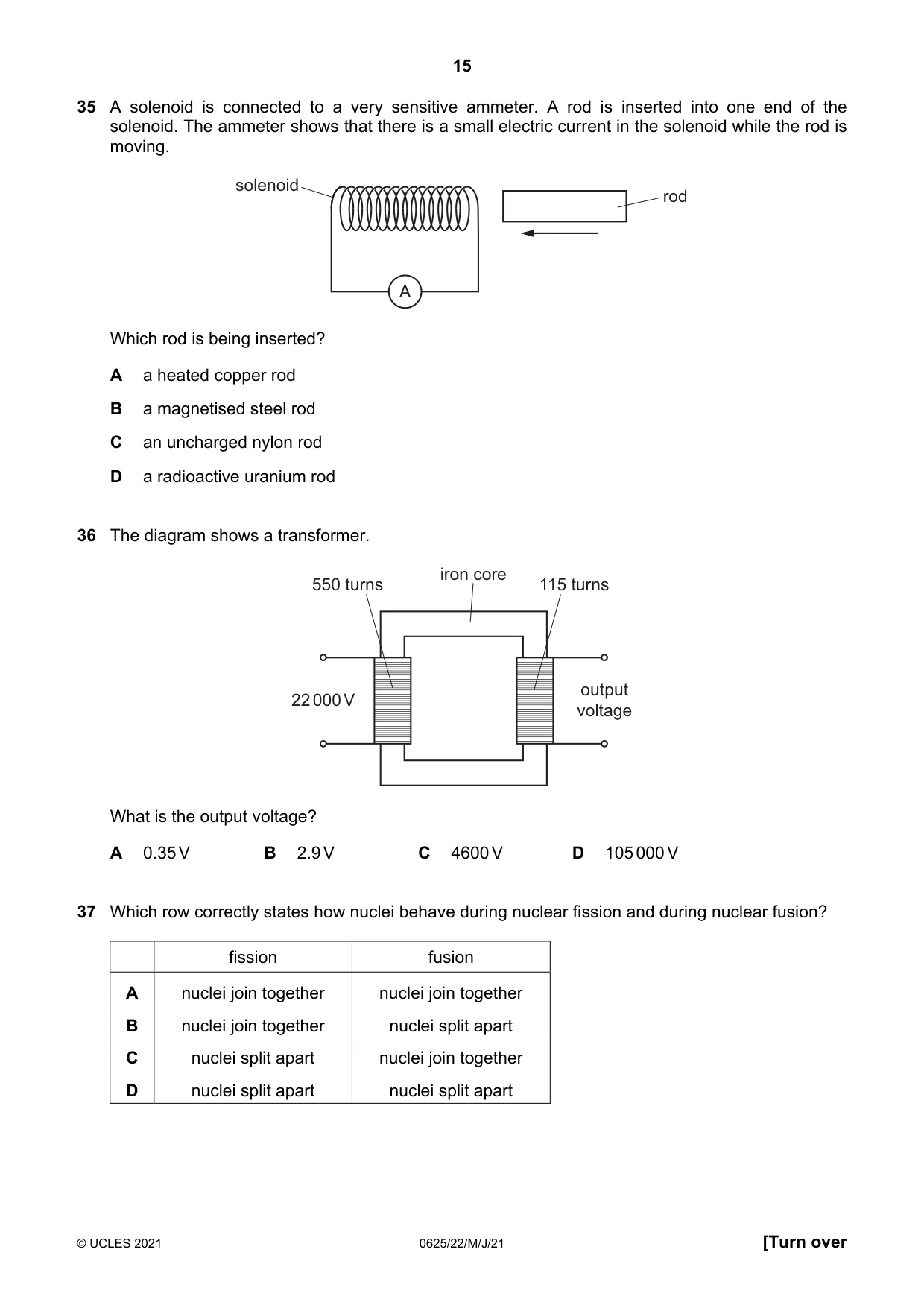
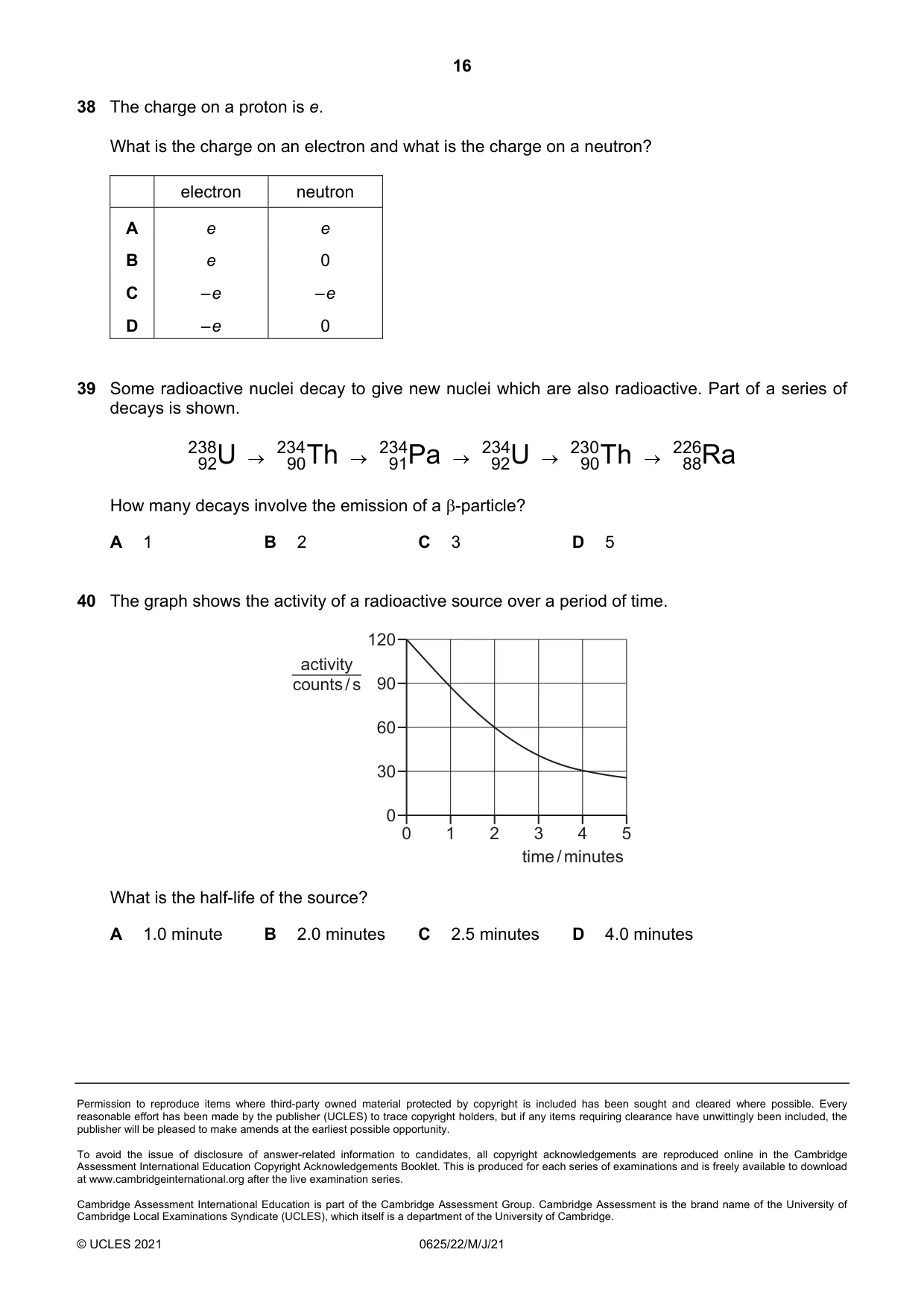
Mark scheme3 pages
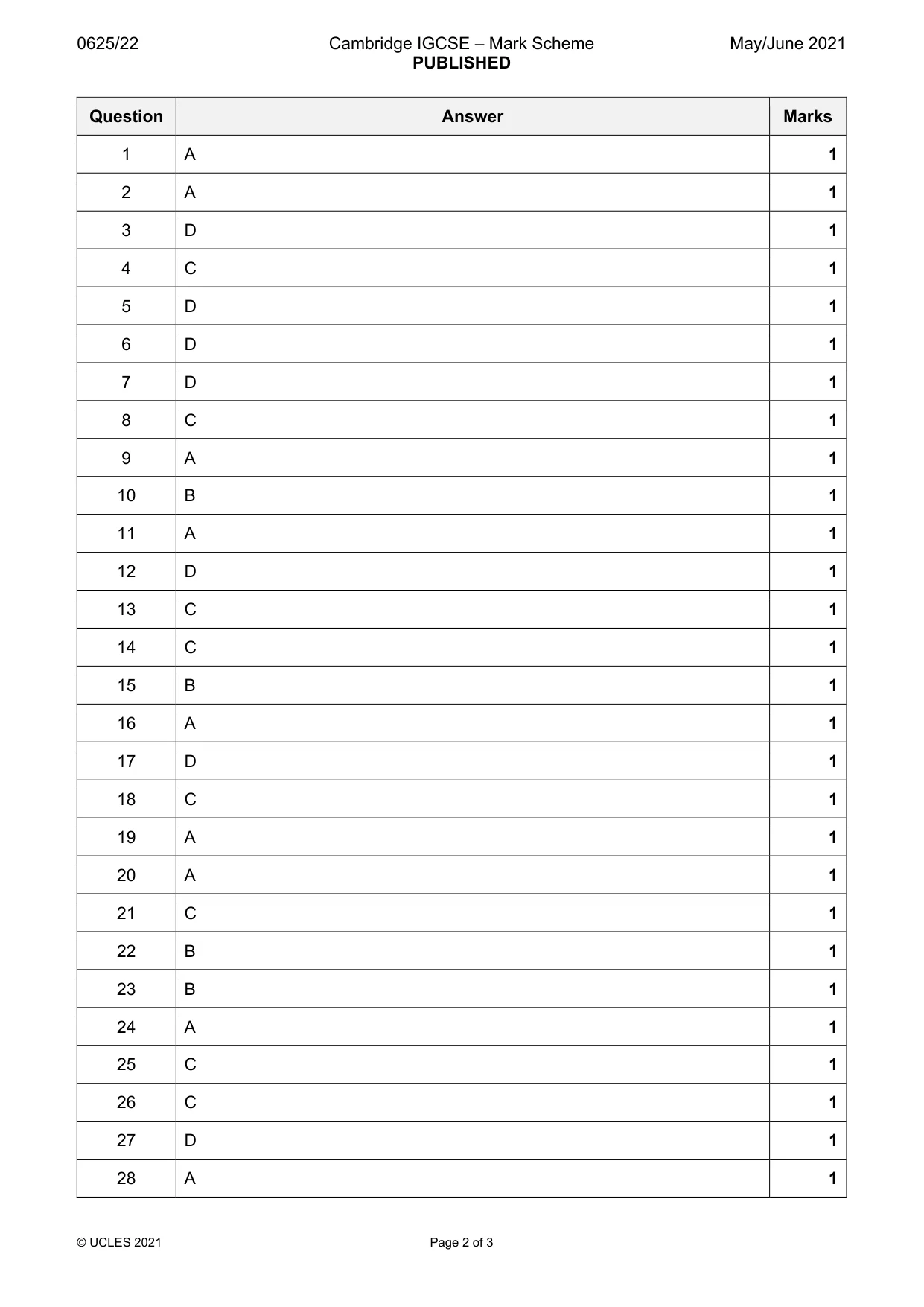
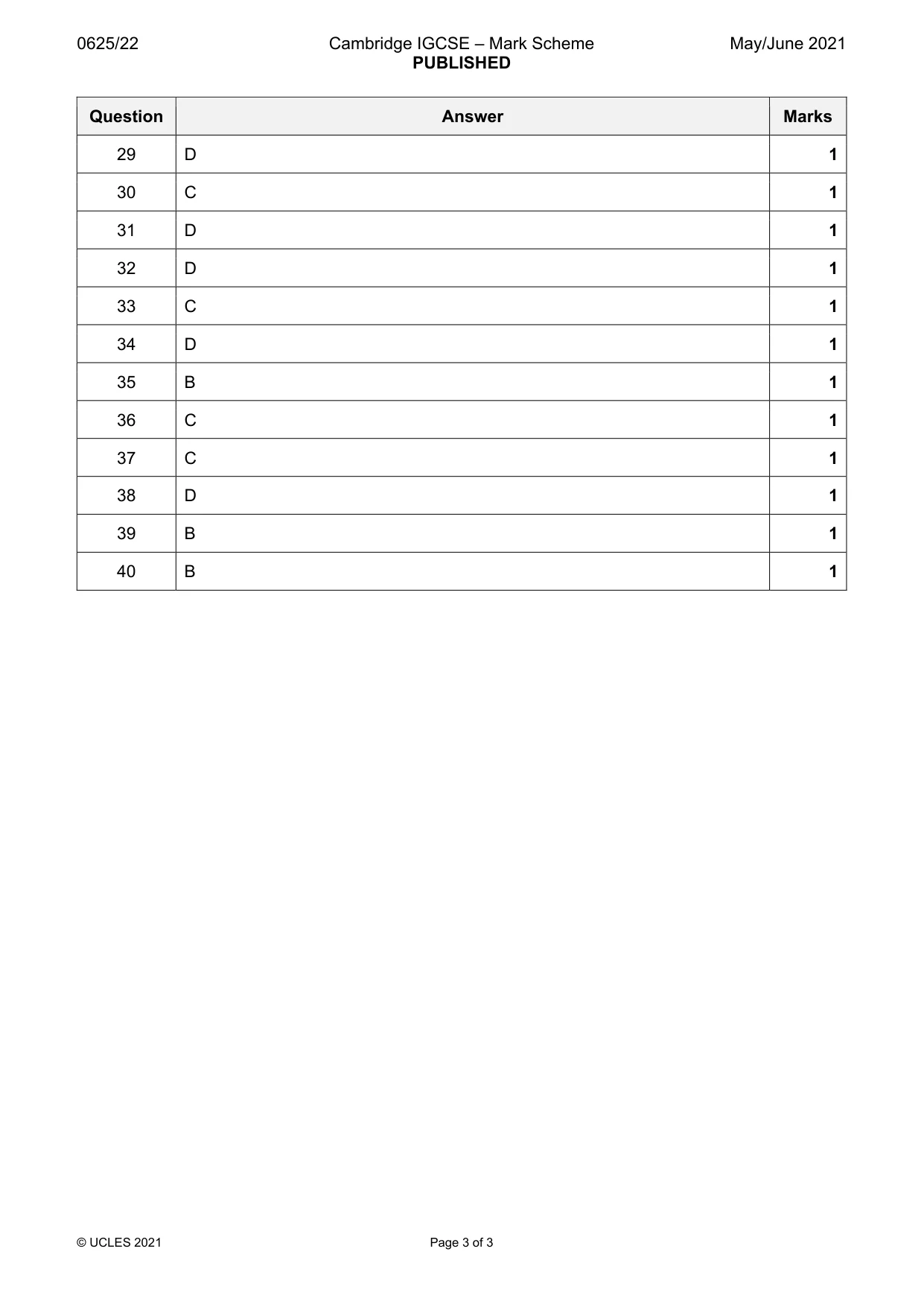
Answers below. Sit the paper first if you are practising.
Questions as text
Q1 · Which piece of apparatus is the most suitable for measuring the mass of a pencil…
1 Which piece of apparatus is the most suitable for measuring the mass of a pencil sharpener? A digital balance B measuring cylinder C newton meter D ruler
Mark scheme: A
More questions on Physical quantities and measurement techniques
Q2 · Four balls with different masses are dropped from the heights shown
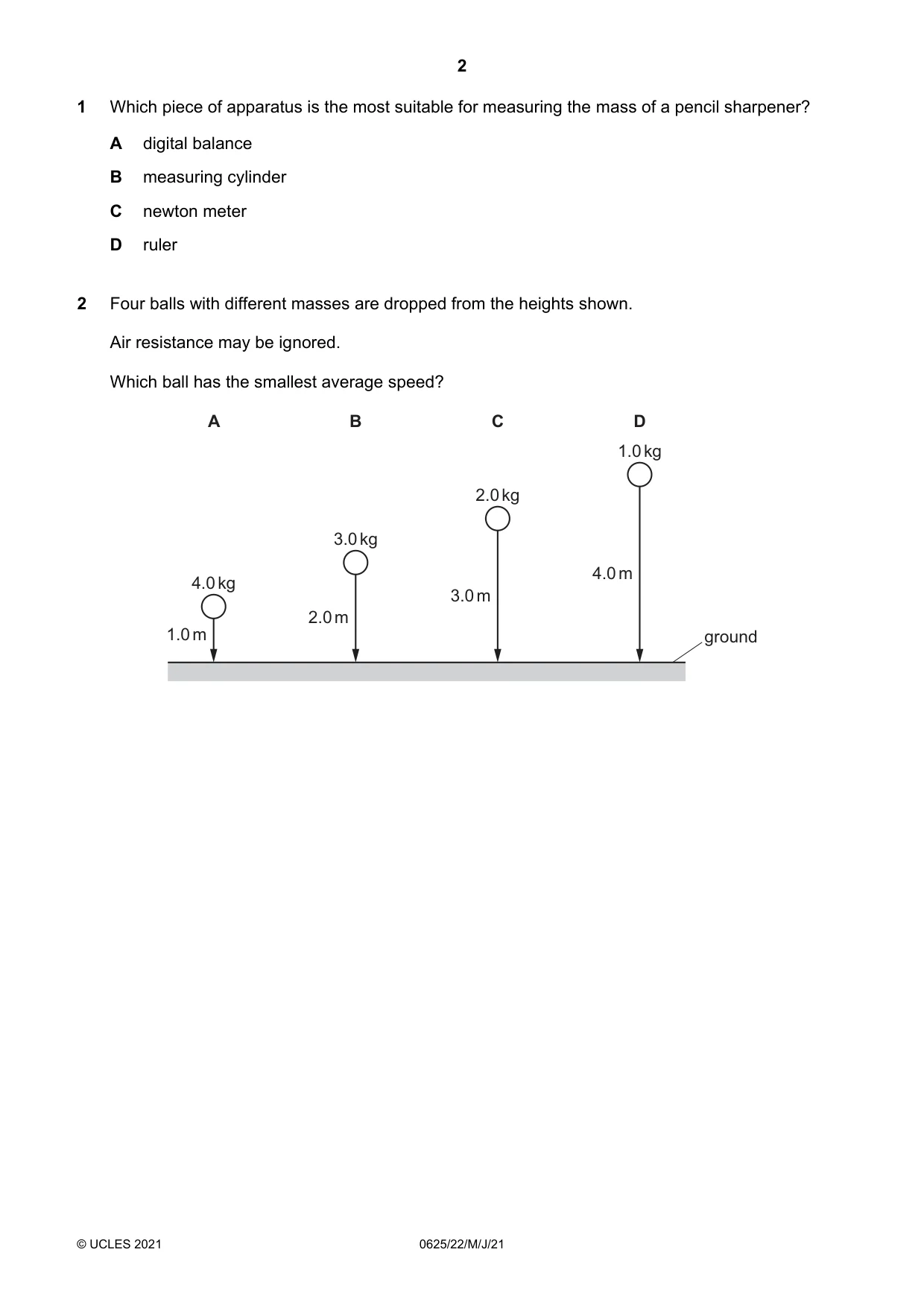
2 Four balls with different masses are dropped from the heights shown. Air resistance may be ignored. Which ball has the smallest average speed? A B C D 1.0 kg 2.0 kg 3.0 kg 4.0 m 4.0 kg 3.0 m 2.0 m 1.0 m ground
Mark scheme: A
Q3 · A ball is thrown vertically upwards through the air
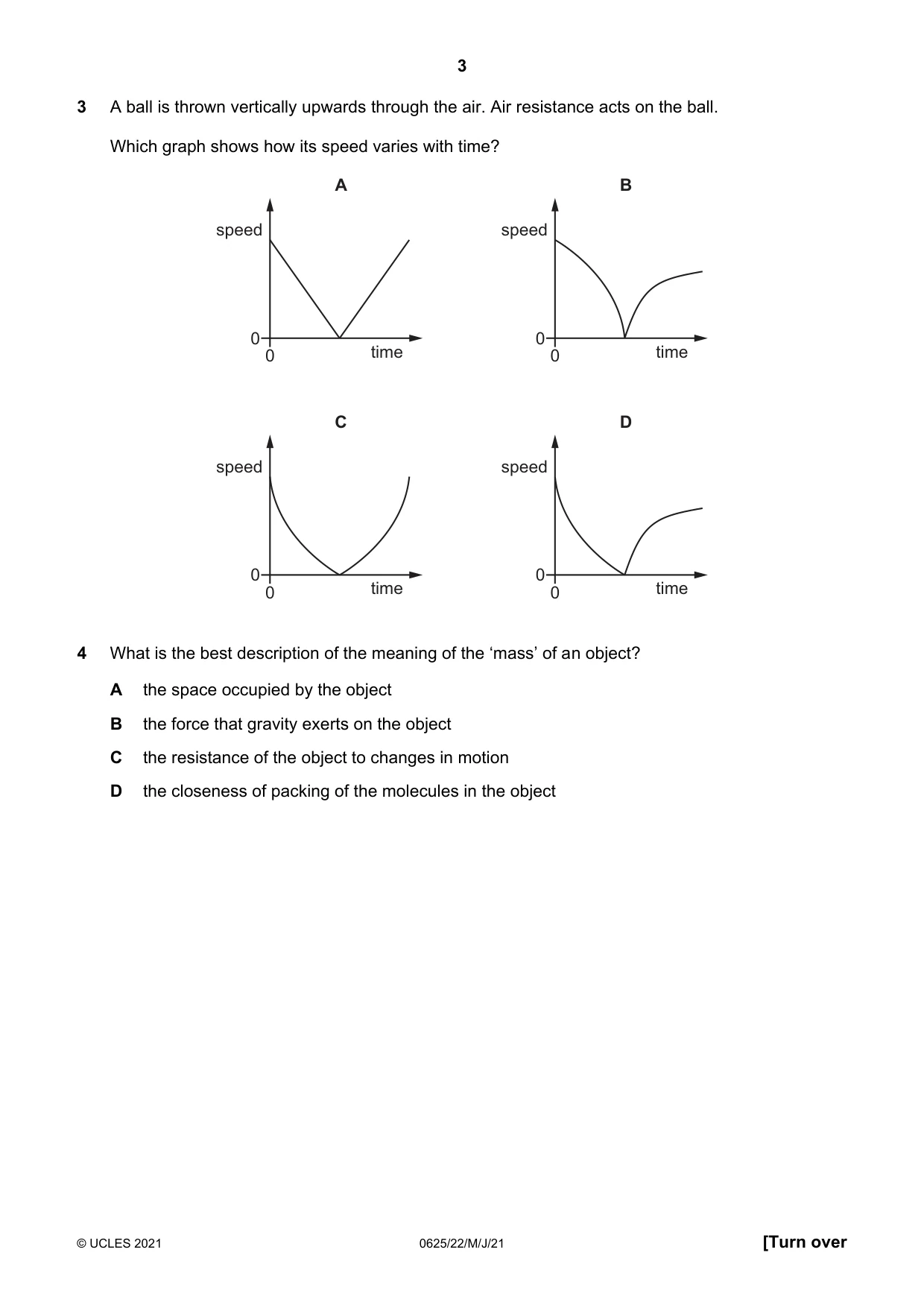
3 A ball is thrown vertically upwards through the air. Air resistance acts on the ball. Which graph shows how its speed varies with time? A B speed speed 0 0 0 time 0 time C D speed speed 0 0 0 time 0 time
Mark scheme: D
Q4 · What is the best description of the meaning of the ‘mass’ of an object?
4 What is the best description of the meaning of the ‘mass’ of an object? A the space occupied by the object B the force that gravity exerts on the object C the resistance of the object to changes in motion D the closeness of packing of the molecules in the object
Mark scheme: C
Q5 · A measuring cylinder contains 40 cm3 of water
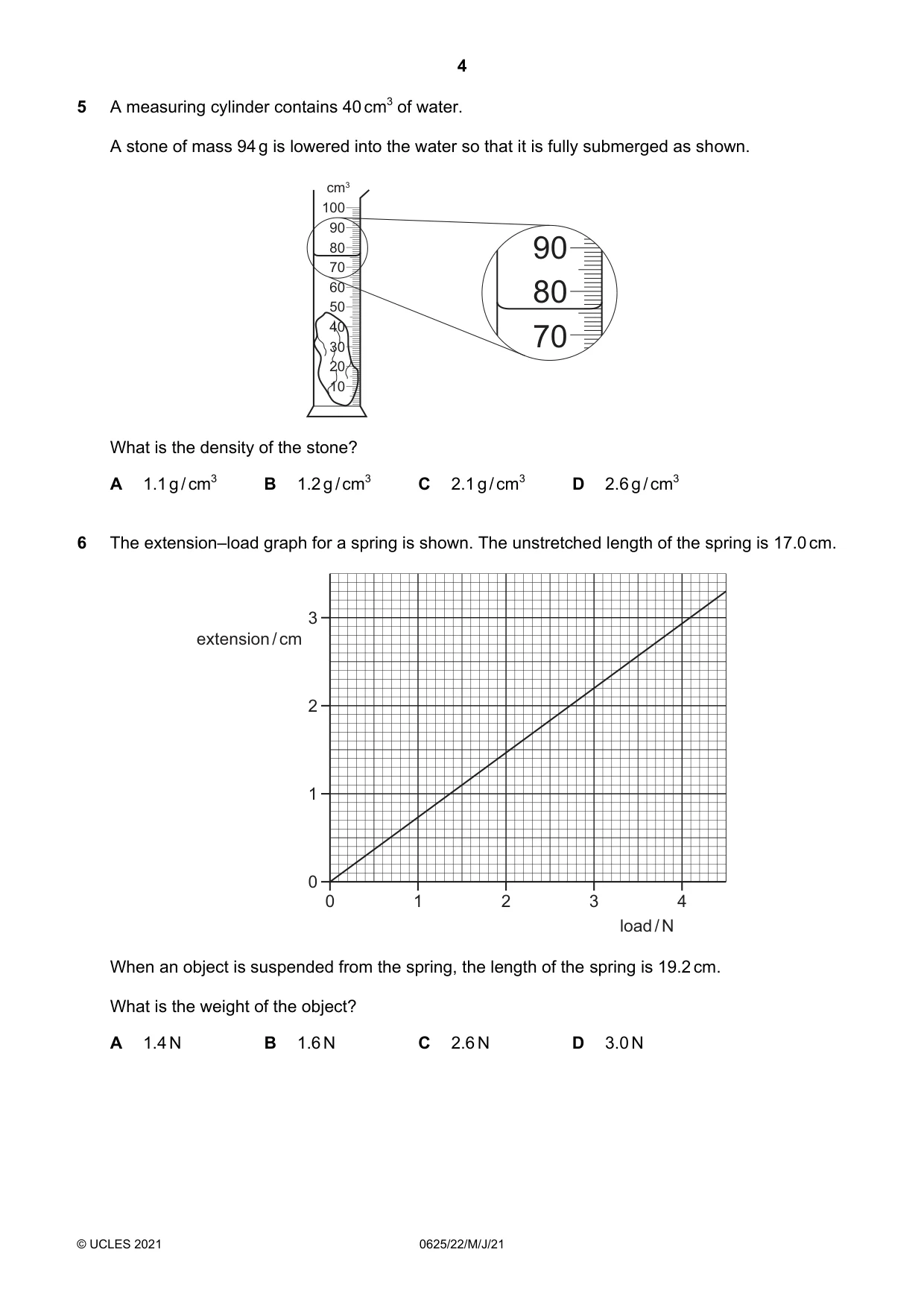
5 A measuring cylinder contains 40 cm3 of water. A stone of mass 94 g is lowered into the water so that it is fully submerged as shown. cm3 100 90 80 90 70 60 80 50 40 70 30 20 10 What is the density of the stone? A 1.1 g / cm3 B 1.2 g / cm3 C 2.1 g / cm3 D 2.6 g / cm3
Mark scheme: D
Q6 · The extension–load graph for a spring is shown
6 The extension–load graph for a spring is shown. The unstretched length of the spring is 17.0 cm. 3 extension / cm 2 1 0 0 1 2 3 4 load / N When an object is suspended from the spring, the length of the spring is 19.2 cm. What is the weight of the object? A 1.4 N B 1.6 N C 2.6 N D 3.0 N
Mark scheme: D
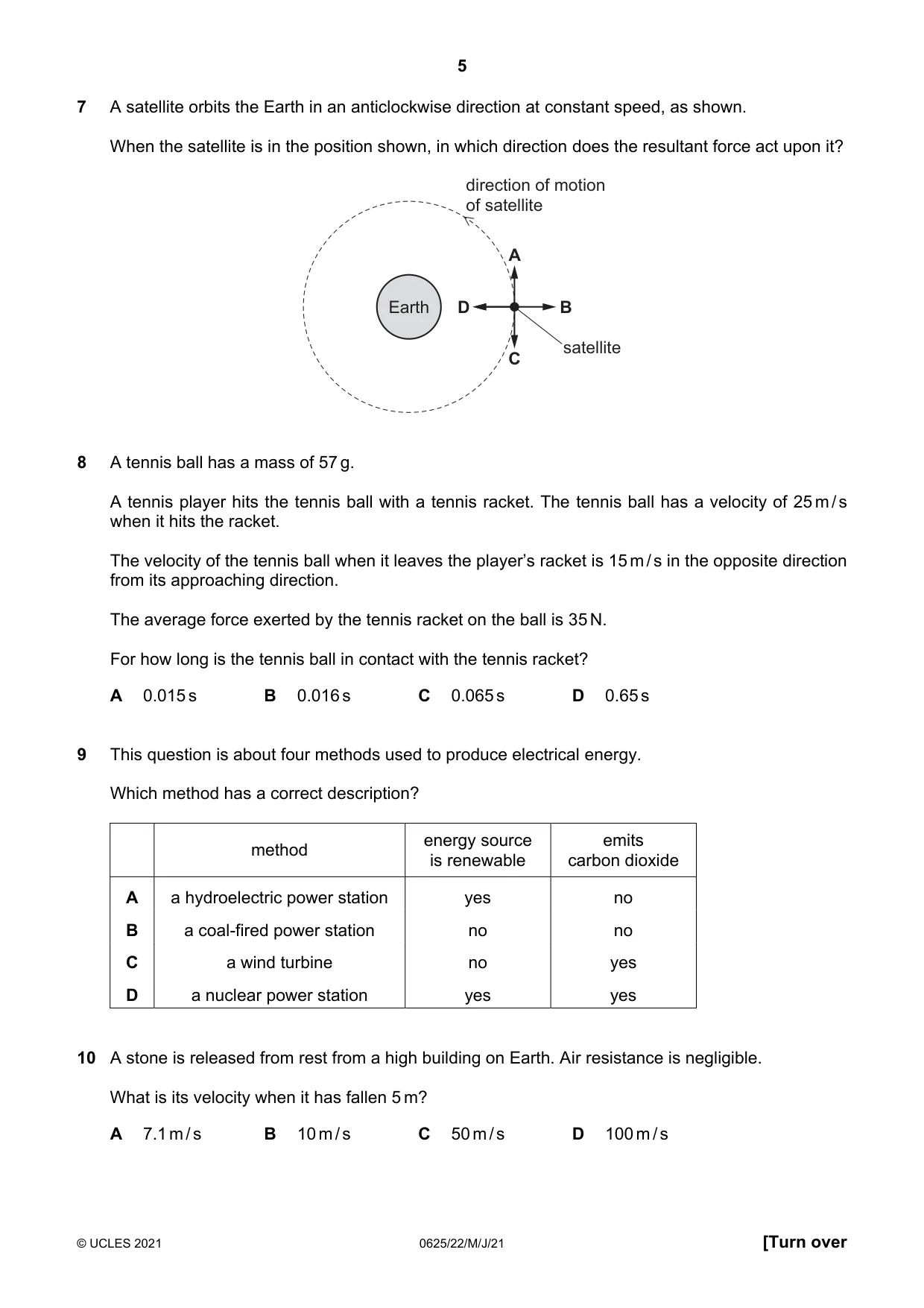
Q7 · A satellite orbits the Earth in an anticlockwise direction at constant speed, as shown
7 A satellite orbits the Earth in an anticlockwise direction at constant speed, as shown. When the satellite is in the position shown, in which direction does the resultant force act upon it? direction of motion of satellite A Earth D B C satellite
Mark scheme: D
Q8 · A tennis ball has a mass of 57 g
8 A tennis ball has a mass of 57 g. A tennis player hits the tennis ball with a tennis racket. The tennis ball has a velocity of 25 m / s when it hits the racket. The velocity of the tennis ball when it leaves the player’s racket is 15 m / s in the opposite direction from its approaching direction. The average force exerted by the tennis racket on the ball is 35 N. For how long is the tennis ball in contact with the tennis racket? A 0.015 s B 0.016 s C 0.065 s D 0.65 s
Mark scheme: C
Q9 · This question is about four methods used to produce electrical energy
9 This question is about four methods used to produce electrical energy. Which method has a correct description? energy source emits method is renewable carbon dioxide A a hydroelectric power station yes no B a coal-fired power station no no C a wind turbine no yes D a nuclear power station yes yes
Mark scheme: A
Q10 · A stone is released from rest from a high building on Earth
10 A stone is released from rest from a high building on Earth. Air resistance is negligible. What is its velocity when it has fallen 5 m? A 7.1 m / s B 10 m / s C 50 m / s D 100 m / s
Mark scheme: B
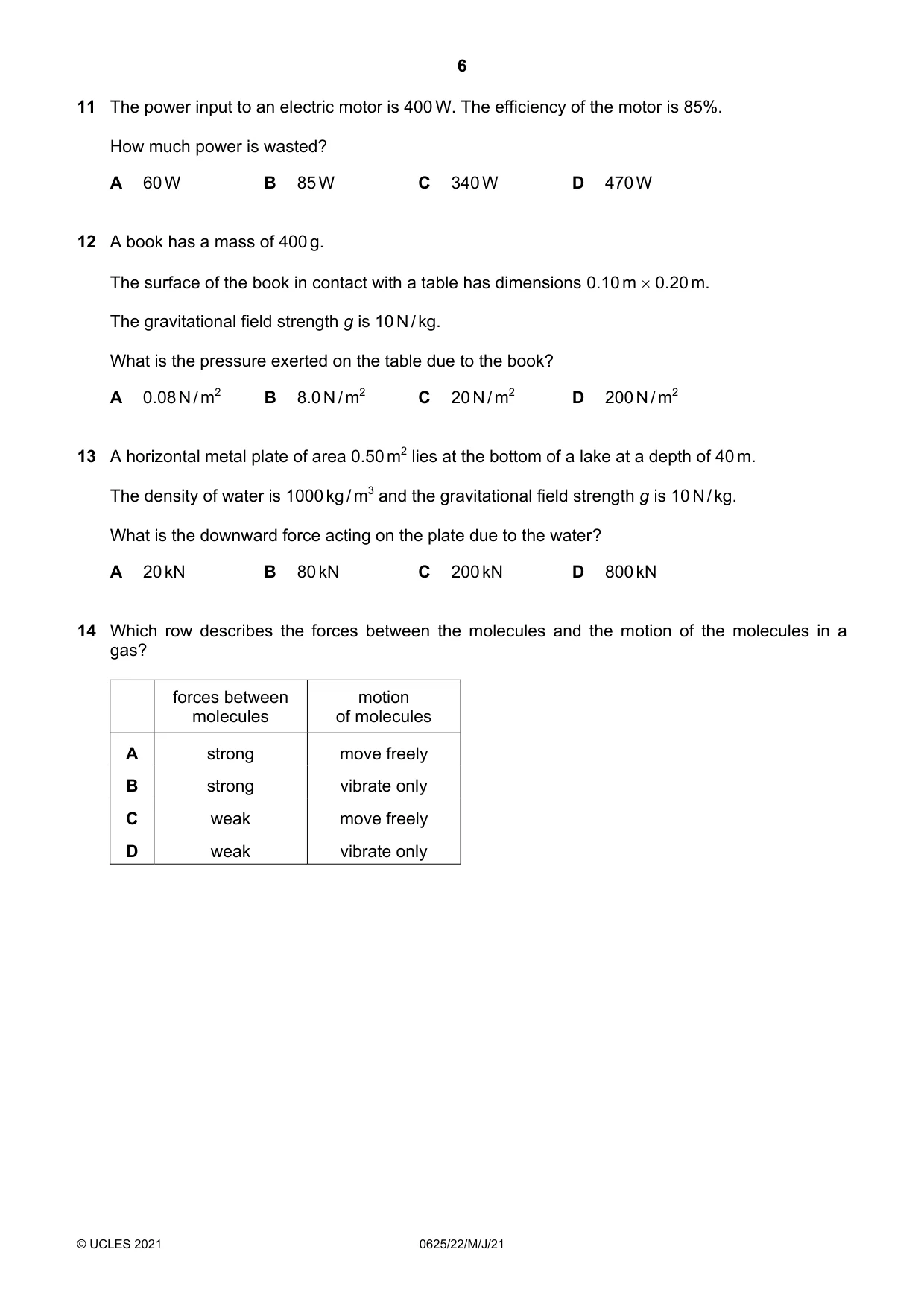
Q11 · The power input to an electric motor is 400 W
11 The power input to an electric motor is 400 W. The efficiency of the motor is 85%. How much power is wasted? A 60 W B 85 W C 340 W D 470 W
Mark scheme: A
Q12 · A book has a mass of 400 g
12 A book has a mass of 400 g. The surface of the book in contact with a table has dimensions 0.10 m 0.20 m. The gravitational field strength g is 10 N / kg. What is the pressure exerted on the table due to the book? A 0.08 N / m2 B 8.0 N / m2 C 20 N / m2 D 200 N / m2
Mark scheme: D
Q13 · A horizontal metal plate of area 0.50 m2 lies at the bottom of a lake at a depth of 40 m
13 A horizontal metal plate of area 0.50 m2 lies at the bottom of a lake at a depth of 40 m. The density of water is 1000 kg / m3 and the gravitational field strength g is 10 N / kg. What is the downward force acting on the plate due to the water? A 20 kN B 80 kN C 200 kN D 800 kN
Mark scheme: C
Q14 · Which row describes the forces between the molecules and the motion of the molecules in a…
14 Which row describes the forces between the molecules and the motion of the molecules in a gas? forces between motion molecules of molecules A strong move freely B strong vibrate only C weak move freely D weak vibrate only
Mark scheme: C
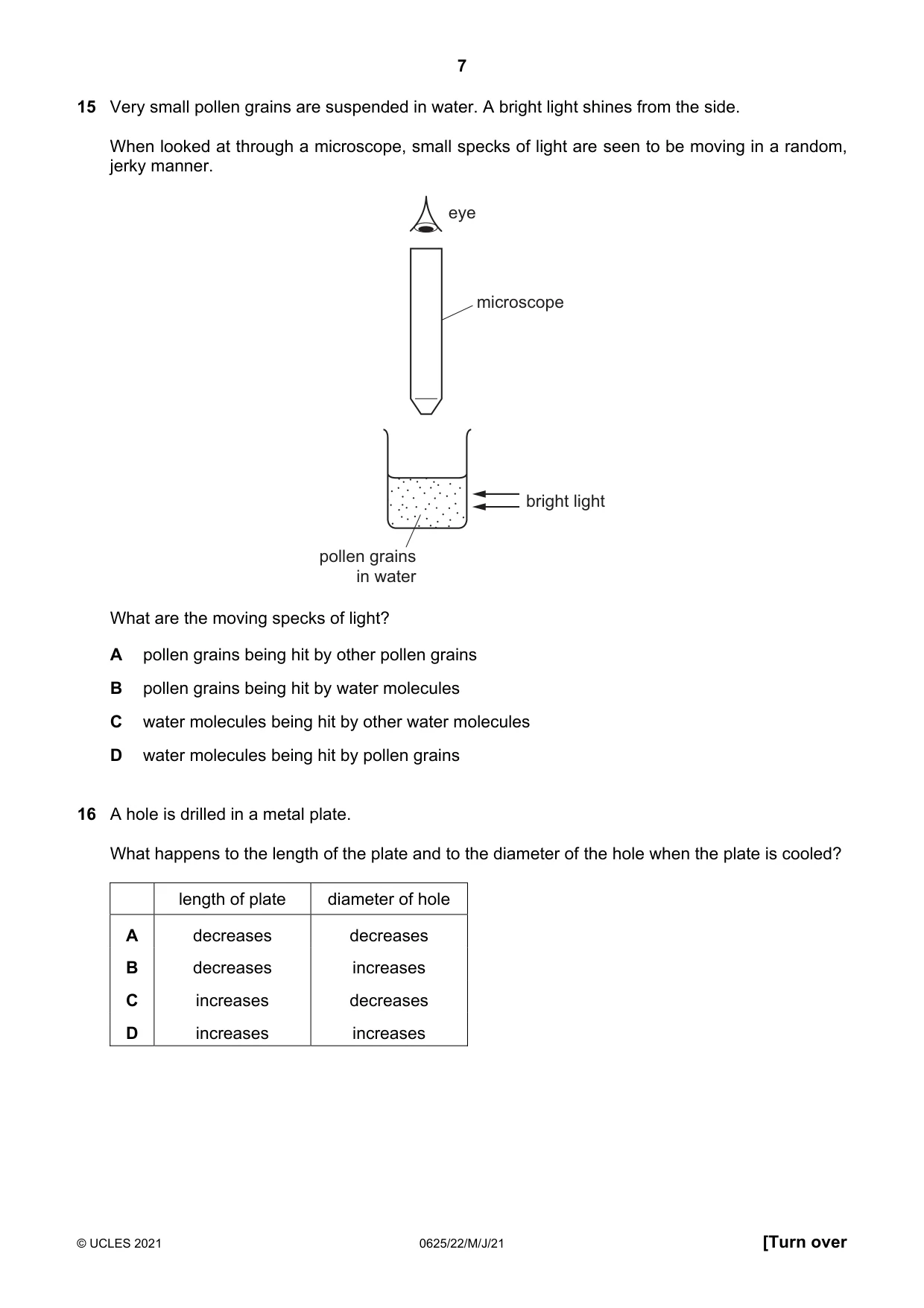
Q15 · Very small pollen grains are suspended in water
15 Very small pollen grains are suspended in water. A bright light shines from the side. When looked at through a microscope, small specks of light are seen to be moving in a random, jerky manner. eye microscope bright light pollen grains in water What are the moving specks of light? A pollen grains being hit by other pollen grains B pollen grains being hit by water molecules C water molecules being hit by other water molecules D water molecules being hit by pollen grains
Mark scheme: B
Q16 · A hole is drilled in a metal plate
16 A hole is drilled in a metal plate. What happens to the length of the plate and to the diameter of the hole when the plate is cooled? length of plate diameter of hole A decreases decreases B decreases increases C increases decreases D increases increases
Mark scheme: A
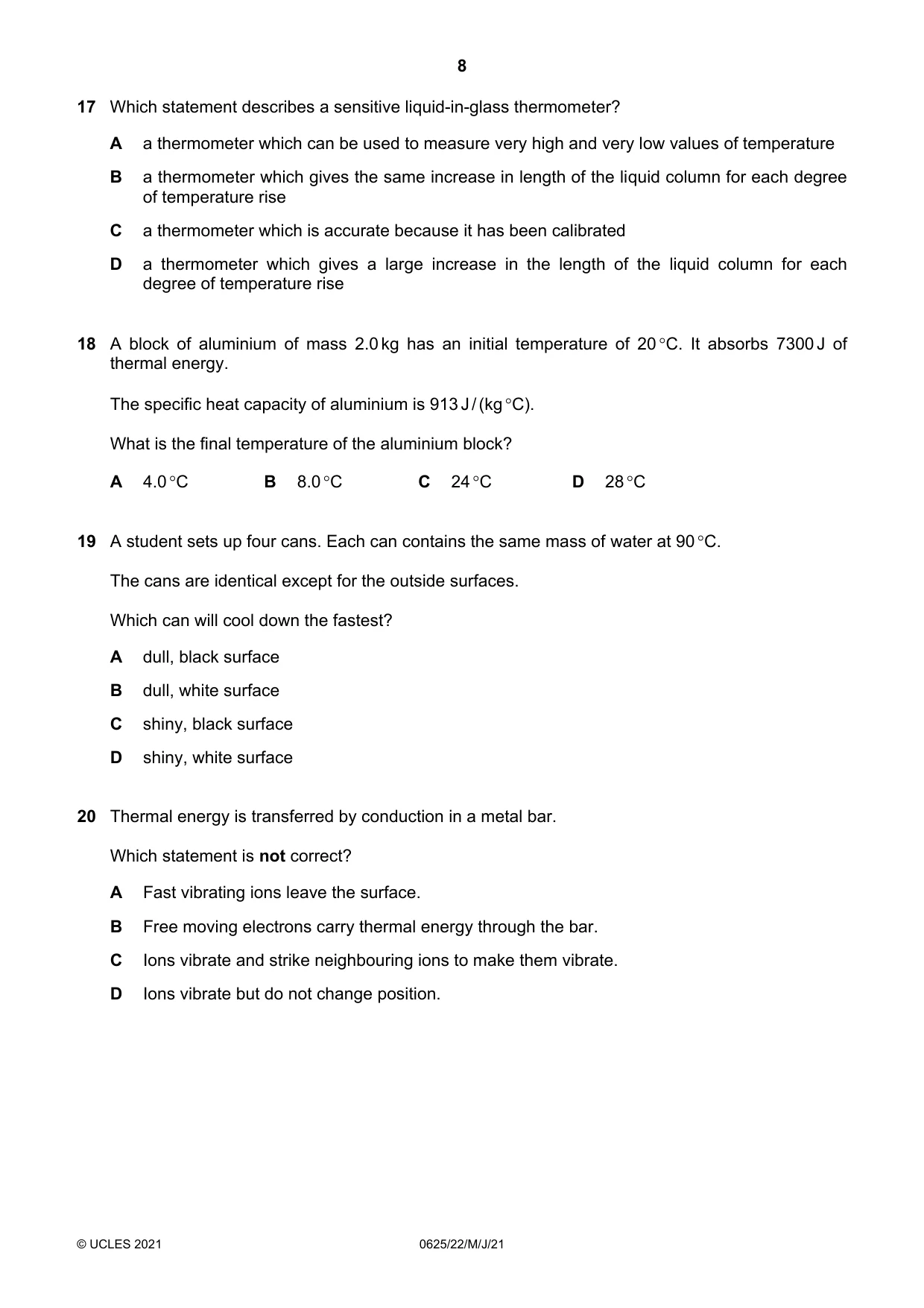
Q17 · Which statement describes a sensitive liquid-in-glass thermometer?
17 Which statement describes a sensitive liquid-in-glass thermometer? A a thermometer which can be used to measure very high and very low values of temperature B a thermometer which gives the same increase in length of the liquid column for each degree of temperature rise C a thermometer which is accurate because it has been calibrated D a thermometer which gives a large increase in the length of the liquid column for each degree of temperature rise
Mark scheme: D
Q18 · A block of aluminium of mass 2.0 kg has an initial temperature of 20 C
18 A block of aluminium of mass 2.0 kg has an initial temperature of 20 C. It absorbs 7300 J of thermal energy. The specific heat capacity of aluminium is 913 J / (kg C). What is the final temperature of the aluminium block? A 4.0 C B 8.0 C C 24 C D 28 C
Mark scheme: C
Q19 · A student sets up four cans
19 A student sets up four cans. Each can contains the same mass of water at 90 C. The cans are identical except for the outside surfaces. Which can will cool down the fastest? A dull, black surface B dull, white surface C shiny, black surface D shiny, white surface
Mark scheme: A
Q20 · Thermal energy is transferred by conduction in a metal bar
20 Thermal energy is transferred by conduction in a metal bar. Which statement is not correct? A Fast vibrating ions leave the surface. B Free moving electrons carry thermal energy through the bar. C Ions vibrate and strike neighbouring ions to make them vibrate. D Ions vibrate but do not change position.
Mark scheme: A
Q21 · A water wave passes into a region where the wave travels more slowly
21 A water wave passes into a region where the wave travels more slowly. As it passes into the slow region, what happens to the frequency and what happens to the wavelength of the wave? frequency wavelength A decreases remains the same B increases remains the same C remains the same decreases D remains the same increases
Mark scheme: C
Q22 · Light travelling at a speed of 3.0 x 10°m/s strikes the surface of a glass block and…
22 Light travelling at a speed of 3.0 x 10°m/s strikes the surface of a glass block and undergoes refraction as it enters the block. The diagram shows a ray of this light before and after it enters the block. 55° glass block What is the speed of light in the glass? A 1.8x10®m/s B 2.0x10°m/s C 45x 10°m/s D 5.0x10°m/s
Mark scheme: B
Q23 · Which statement about the image of an object formed in a plane mirror is correct?
23 Which statement about the image of an object formed in a plane mirror is correct? A It is smaller than the object. B It is the same size as the object. C It is larger than the object. D It is inverted.
Mark scheme: B
Q24 · An object is placed in front of a thin converging lens
24 An object is placed in front of a thin converging lens. The diagram shows the paths of two rays from the top of the object. converging lens object An image of the object is formed on a screen to the right of the lens. How does this image compare with the object? A It is larger and inverted. B It is larger and the same way up. C It is smaller and inverted. D It is smaller and the same way up.
Mark scheme: A
Q25 · Here are three statements about the speed of electromagnetic waves
25 Here are three statements about the speed of electromagnetic waves. 1 The speed of an electromagnetic wave in a vacuum is 340 m / s. 2 The speed of an electromagnetic wave in a vacuum is 3.0 108 m / s. 3 The speed of an electromagnetic wave in a vacuum is approximately the same as in air. Which statements are correct? A 1 and 3 B 1 only C 2 and 3 D 2 only
Mark scheme: C
Q26 · The sound from a loudspeaker must pass through two materials to reach a microphone
26 The sound from a loudspeaker must pass through two materials to reach a microphone. loudspeaker microphone material 1 material 2 Which combination of materials gives the shortest time for the sound to reach the microphone? material 1 material 2 A air hydrogen B air water C copper aluminium D water oil
Mark scheme: C
Q27 · Which method does not demagnetise a bar magnet?
27 Which method does not demagnetise a bar magnet? A Heat the bar magnet and place it in the east-west direction to cool. B Place the bar magnet in the east-west direction and hammer it. C Place the bar magnet in a coil connected to an a.c. supply and slowly withdraw it. D Place the bar magnet in a coil connected to a d.c. supply and slowly withdraw it.
Mark scheme: D
Q28 · Three piles of small nails, P, Q and R, are placed on a bench below three electromagnets
28 Three piles of small nails, P, Q and R, are placed on a bench below three electromagnets. One set of nails is made of copper, one of soft iron and one of steel. Diagram 1 shows the situation when the electromagnets are switched on. Diagram 2 shows the situation when the electromagnets are then switched off. diagram 1 the switches are closed Q R P bench small nails diagram 2 the switches are open small nails R bench P Q Which row correctly identifies the materials from which the nails are made? copper soft iron steel A P Q R B P R Q C Q P R D Q R P
Mark scheme: A
Q29 · A magnet is suspended by a cotton thread
29 A magnet is suspended by a cotton thread. The magnet is displaced then allowed to swing freely until it comes to rest. Why does the magnet always come to rest pointing in the same direction? A because of the interaction between the electric field of the magnet and the electric field of the Earth B because of the interaction between the electric field of the magnet and the magnetic field of the Earth C because of the interaction between the magnetic field of the magnet and the gravitational field of the Earth D because of the interaction between the magnetic field of the magnet and the magnetic field of the Earth
Mark scheme: D
Q30 · A student rubs a plastic rod with a cloth
30 A student rubs a plastic rod with a cloth. The rod becomes positively charged. What has happened to the rod? A It has gained electrons. B It has gained protons. C It has lost electrons. D It has lost protons.
Mark scheme: C
Q31 · An isolated metal sphere is positively charged
31 An isolated metal sphere is positively charged. It is then brought near to another isolated metal sphere that is neutral. left right + + + + + + + + + + positively charged + + neutral metal sphere metal sphere What happens to the charges on the neutral sphere as the positively charged sphere is brought close to it? A Some positive charges move to the left and some negative charges move to the right. B Some positive charges move to the right and some negative charges move to the left. C Some positive charges move to the right, but the negative charges do not move. D The positive charges do not move, but some negative charges move to the left.
Mark scheme: D
Q32 · Which circuit has a zero reading on the ammeter?
32 Which circuit has a zero reading on the ammeter? A B A A C D A A
Mark scheme: D
Q33 · Two 10 resistors are connected in series and then in parallel
33 Two 10 resistors are connected in series and then in parallel. What is the combined resistance in each case? resistance in resistance in series / parallel / A 10 5 B 10 10 C 20 5 D 20 10
Mark scheme: C
Q34 · The diagram shows a combination of four logic gates that produce an output signal at R…
34 The diagram shows a combination of four logic gates that produce an output signal at R that depends on the states of the inputs P and Q. P R Q Which single logic gate produces the same effect as the combination? A AND B NAND C NOR D OR
Mark scheme: D
Q35 · A solenoid is connected to a very sensitive ammeter
35 A solenoid is connected to a very sensitive ammeter. A rod is inserted into one end of the solenoid. The ammeter shows that there is a small electric current in the solenoid while the rod is moving. solenoid rod A Which rod is being inserted? A a heated copper rod B a magnetised steel rod C an uncharged nylon rod D a radioactive uranium rod
Mark scheme: B
Q36 · The diagram shows a transformer
36 The diagram shows a transformer. iron core 550 turns 115 turns output 22 000 V voltage What is the output voltage? A 0.35 V B 2.9 V C 4600 V D 105 000 V
Mark scheme: C
Q37 · Which row correctly states how nuclei behave during nuclear fission and during nuclear…
37 Which row correctly states how nuclei behave during nuclear fission and during nuclear fusion? fission fusion A nuclei join together nuclei join together B nuclei join together nuclei split apart C nuclei split apart nuclei join together D nuclei split apart nuclei split apart
Mark scheme: C
Q38 · The charge on a proton is e
38 The charge on a proton is e. What is the charge on an electron and what is the charge on a neutron? electron neutron A e e B e 0 C – e – e D – e 0
Mark scheme: D
Q39 · Some radioactive nuclei decay to give new nuclei which are also radioactive
39 Some radioactive nuclei decay to give new nuclei which are also radioactive. Part of a series of decays is shown. 238 92U 234 90Th 234 91Pa 234 92U 230 90Th 226 88Ra How many decays involve the emission of a -particle? A 1 B 2 C 3 D 5
Mark scheme: B
Q40 · The graph shows the activity of a radioactive source over a period of time
40 The graph shows the activity of a radioactive source over a period of time. 120 activity counts / s 90 60 30 0 0 1 2 3 4 5 time / minutes What is the half-life of the source? A 1.0 minute B 2.0 minutes C 2.5 minutes D 4.0 minutes
Mark scheme: B
What was in this paper
The subtopics covered by these 40 questions, and how many questions each got. Open one in a new tab to see every Cambridge question on it.
3Energy, work and power3Light3Simple phenomena of magnetism3Thermal properties and temperature3Electrical quantities2Electromagnetic effects2Forces2Kinetic particle model of matter2Motion2Pressure2Radioactivity2The nuclear model of the atom2Transfer of thermal energy2Density1Electromagnetic spectrum1General properties of waves1Mass and weight1Momentum1Physical quantities and measurement techniques1Sound1What you needed in this session
Cambridge’s own grade thresholds for 2021 May/June, Paper 2 · Variant 2. A higher threshold means an easier paper — the bar moves with how the cohort did.