Cambridge IGCSE Physics 0625 — 2020 Oct/Nov Paper 2 · Variant 1
0625/21/O/N/20 · 40 questions · 40 marks · ≈45 min
The question paper and its mark scheme, free to read here and free to download. This is Cambridge’s own paper, exactly as it was sat.
Question paper16 pages
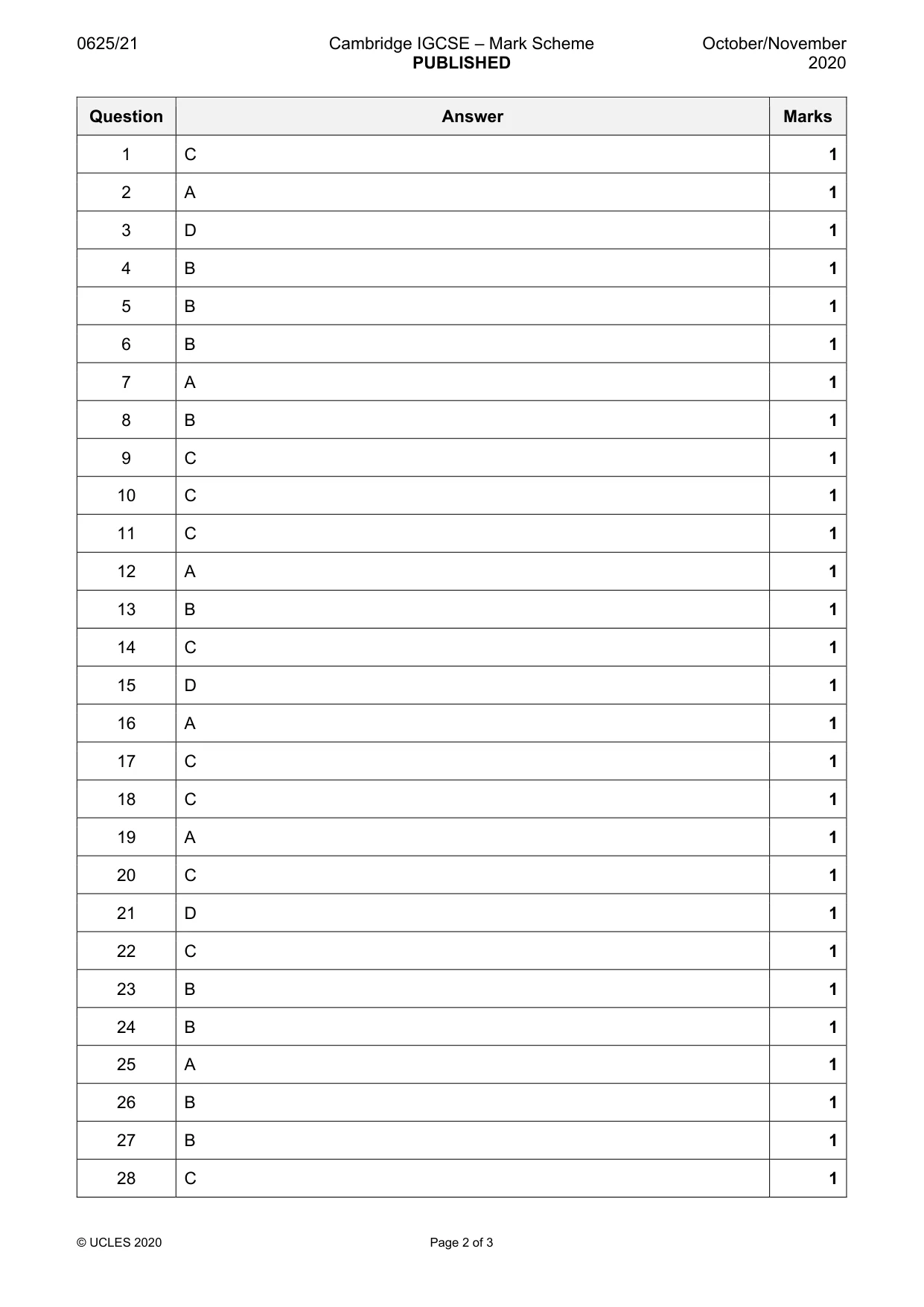
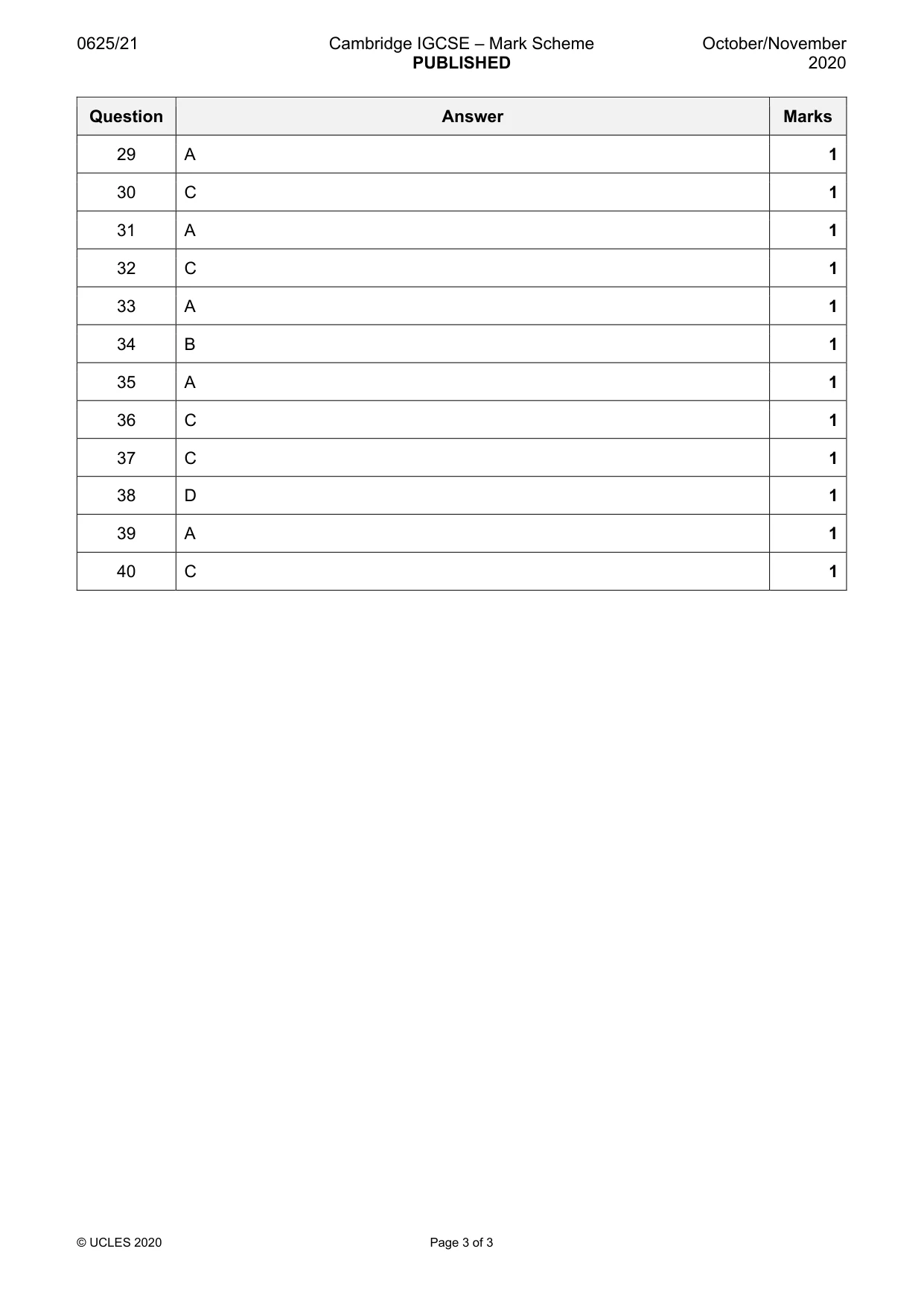
Mark scheme3 pages
Answers below. Sit the paper first if you are practising.
Questions as text
Q1 · For which one of the following measurements would a micrometer screw gauge be most…
1 For which one of the following measurements would a micrometer screw gauge be most suitable? A length of this page B length of a pencil C diameter of a wire D diameter of an atom
Mark scheme: C
More questions on Physical quantities and measurement techniques
Q2 · The speed–time graph represents a journey
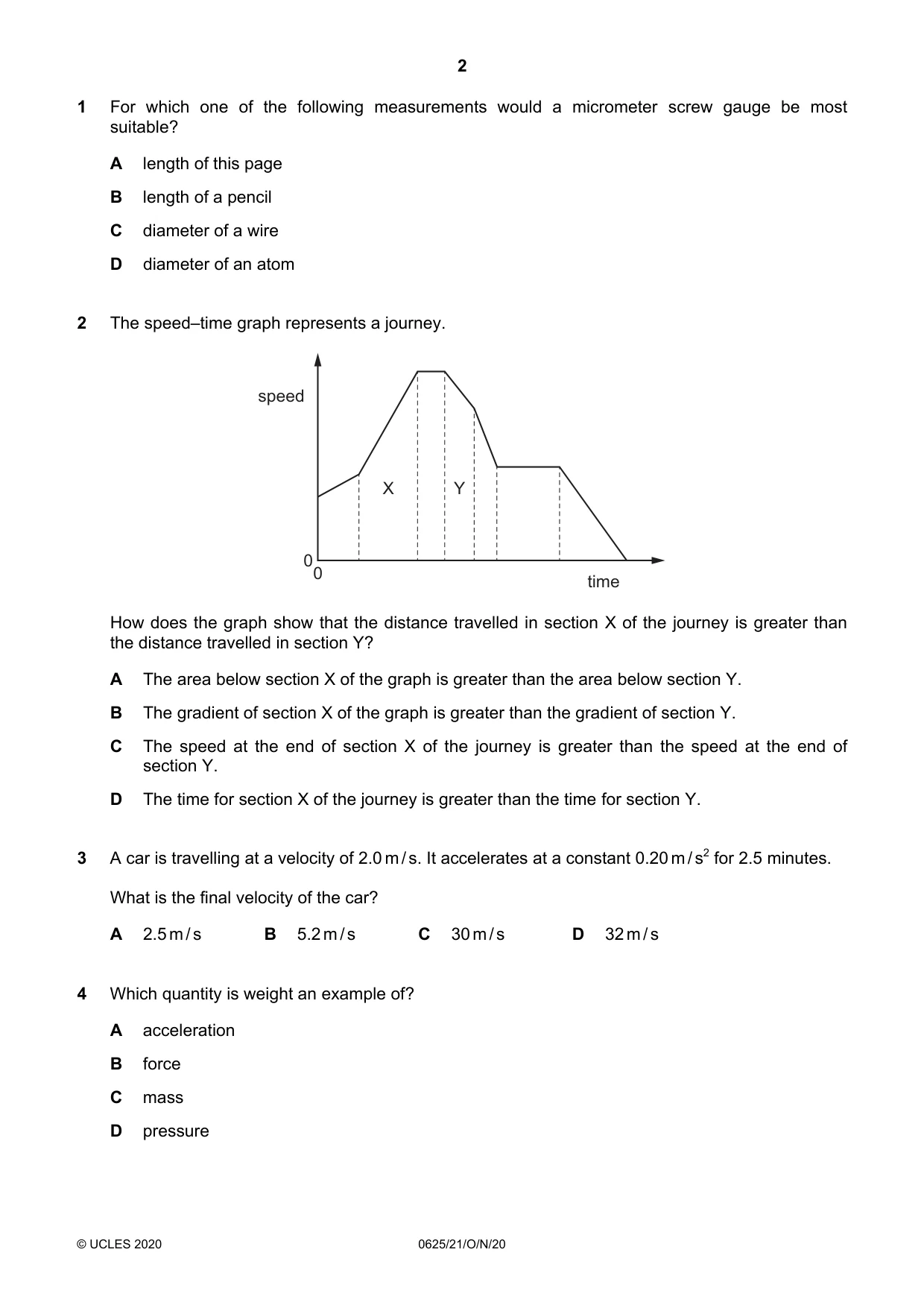
2 The speed–time graph represents a journey. speed X Y 00 time How does the graph show that the distance travelled in section X of the journey is greater than the distance travelled in section Y? A The area below section X of the graph is greater than the area below section Y. B The gradient of section X of the graph is greater than the gradient of section Y. C The speed at the end of section X of the journey is greater than the speed at the end of section Y. D The time for section X of the journey is greater than the time for section Y.
Mark scheme: A
Q3 · A car is travelling at a velocity of 2.0 m / s
3 A car is travelling at a velocity of 2.0 m / s. It accelerates at a constant 0.20 m / s2 for 2.5 minutes. What is the final velocity of the car? A 2.5 m / s B 5.2 m / s C 30 m / s D 32 m / s
Mark scheme: D
Q4 · Which quantity is weight an example of?
4 Which quantity is weight an example of? A acceleration B force C mass D pressure
Mark scheme: B
Q5 · A sphere P, made of steel, has a weight of 10 N on Earth
5 A sphere P, made of steel, has a weight of 10 N on Earth. Another sphere Q, also made of steel, has a weight of 10 N on Mars. The gravitational field strength on Earth is greater than the gravitational field strength on Mars. Which statement is correct? A The mass of sphere P is the same as the mass of sphere Q. B The mass of sphere P is less than the mass of sphere Q. C On Mars, the weight of sphere P is more than 10 N. D On Earth, the weight of sphere Q is less than 10 N.
Mark scheme: B
Q6 · A metal ball is attached to a cork and is lowered into a measuring cylinder, pulling the…
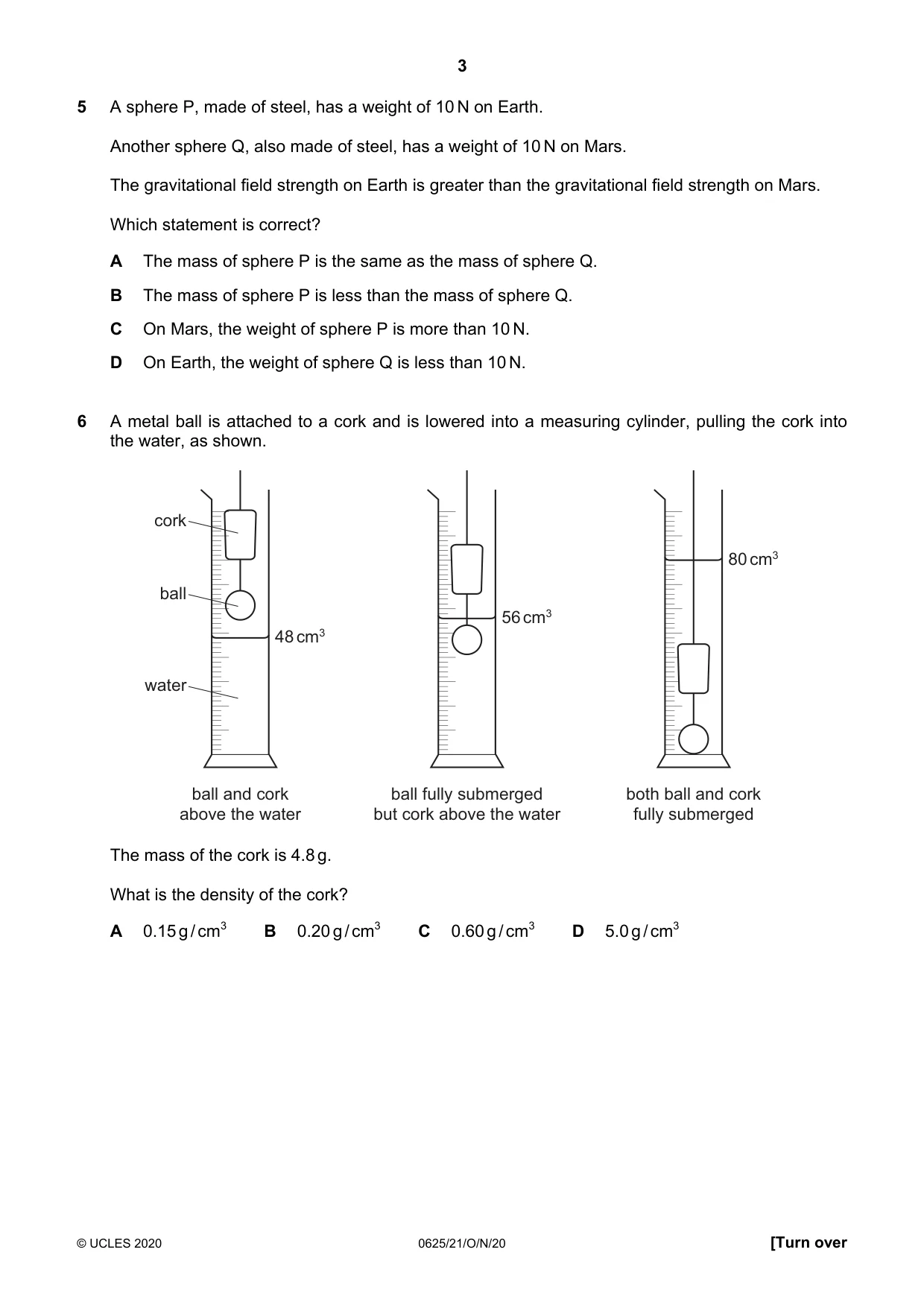
6 A metal ball is attached to a cork and is lowered into a measuring cylinder, pulling the cork into the water, as shown. cork 80 cm3 ball 56 cm3 48 cm3 water ball and cork ball fully submerged both ball and cork above the water but cork above the water fully submerged The mass of the cork is 4.8 g. What is the density of the cork? A 0.15 g / cm3 B 0.20 g / cm3 C 0.60 g / cm3 D 5.0 g / cm3
Mark scheme: B
Q7 · A uniform plank rests on a pivot at its centre
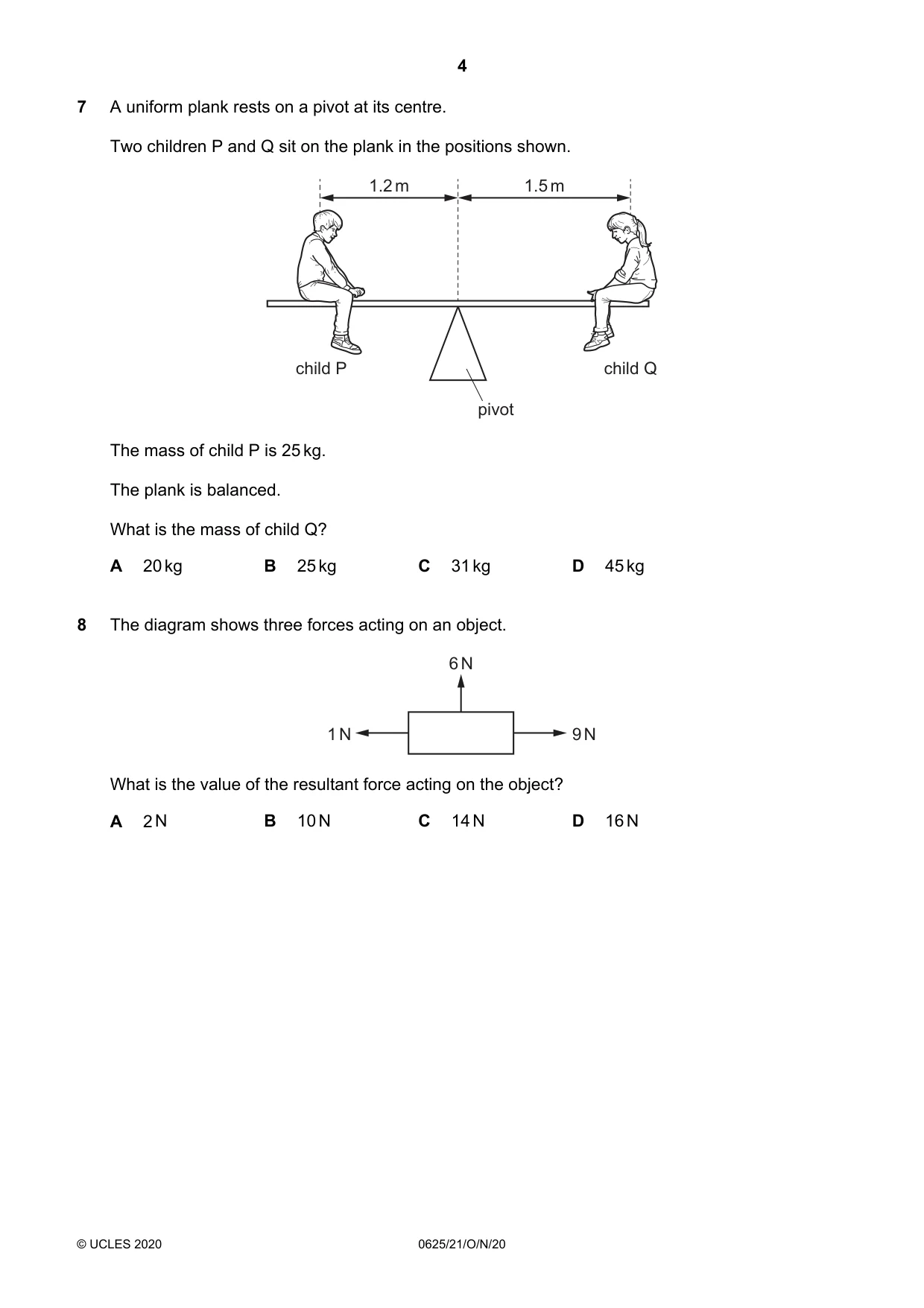
7 A uniform plank rests on a pivot at its centre. Two children P and Q sit on the plank in the positions shown. 1.2 m 1.5 m child P child Q pivot The mass of child P is 25 kg. The plank is balanced. What is the mass of child Q? A 20 kg B 25 kg C 31 kg D 45 kg
Mark scheme: A
Q8 · The diagram shows three forces acting on an object
8 The diagram shows three forces acting on an object. 6 N 1 N 9 N What is the value of the resultant force acting on the object? A 2 N B 10 N C 14 N D 16 N
Mark scheme: B
Q9 · An object with a mass of 0.20 kg moves at 0.20 m / s, as shown
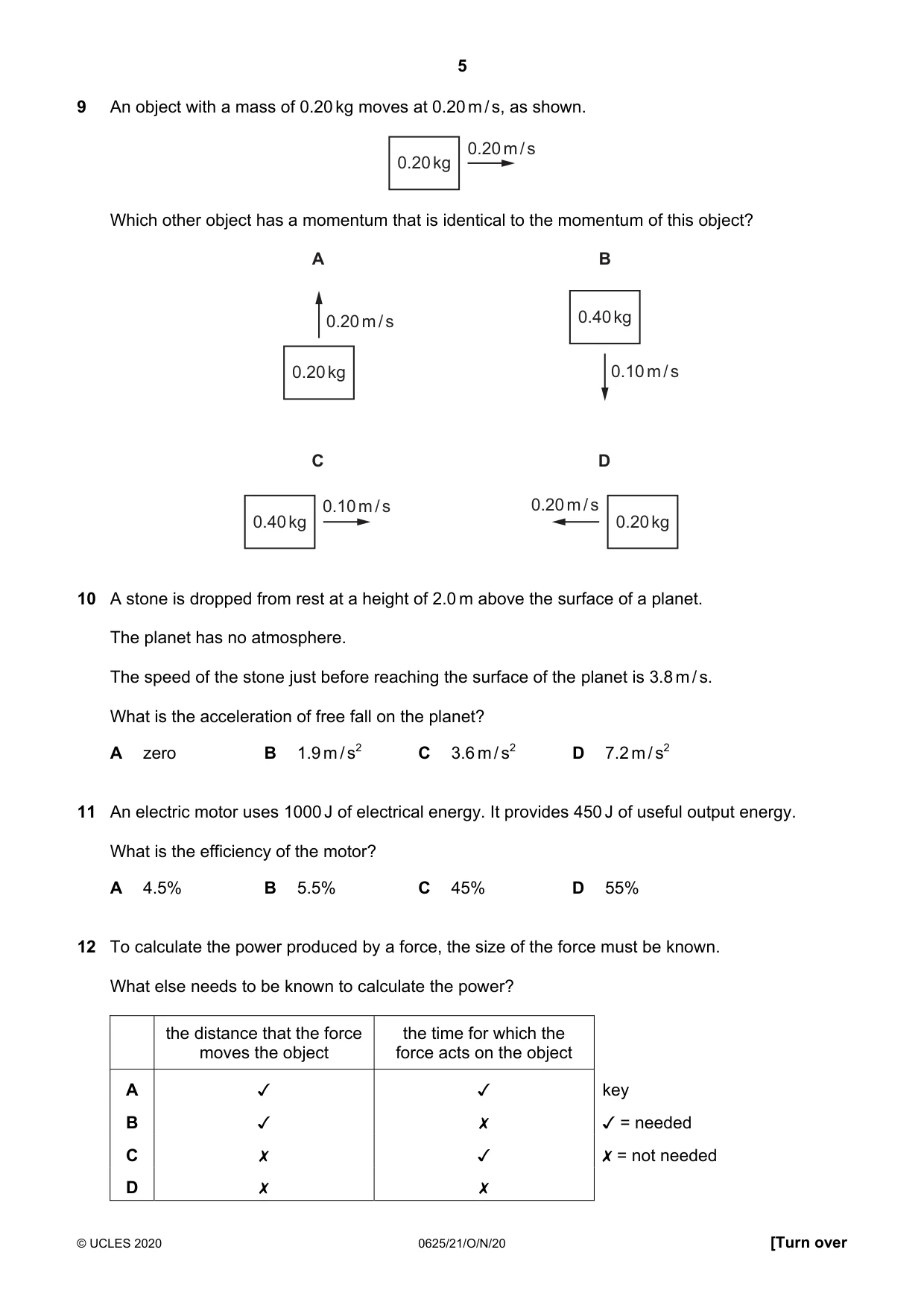
9 An object with a mass of 0.20 kg moves at 0.20 m / s, as shown. 0.20 m / s 0.20 kg Which other object has a momentum that is identical to the momentum of this object? A B 0.20 m / s 0.40 kg 0.20 kg 0.10 m / s C D 0.10 m / s 0.20 m / s 0.40 kg 0.20 kg
Mark scheme: C
Q10 · A stone is dropped from rest at a height of 2.0 m above the surface of a planet
10 A stone is dropped from rest at a height of 2.0 m above the surface of a planet. The planet has no atmosphere. The speed of the stone just before reaching the surface of the planet is 3.8 m / s. What is the acceleration of free fall on the planet? A zero B 1.9 m / s2 C 3.6 m / s2 D 7.2 m / s2
Mark scheme: C
Q11 · An electric motor uses 1000 J of electrical energy
11 An electric motor uses 1000 J of electrical energy. It provides 450 J of useful output energy. What is the efficiency of the motor? A 4.5% B 5.5% C 45% D 55%
Mark scheme: C
Q12 · To calculate the power produced by a force, the size of the force must be known
12 To calculate the power produced by a force, the size of the force must be known. What else needs to be known to calculate the power? the distance that the force moves the object the time for which the force acts on the object 0 0O WwW D> v v x x v x v x key Jv = needed X = not needed
Mark scheme: A
Q13 · A barometer reads 780 mm Hg
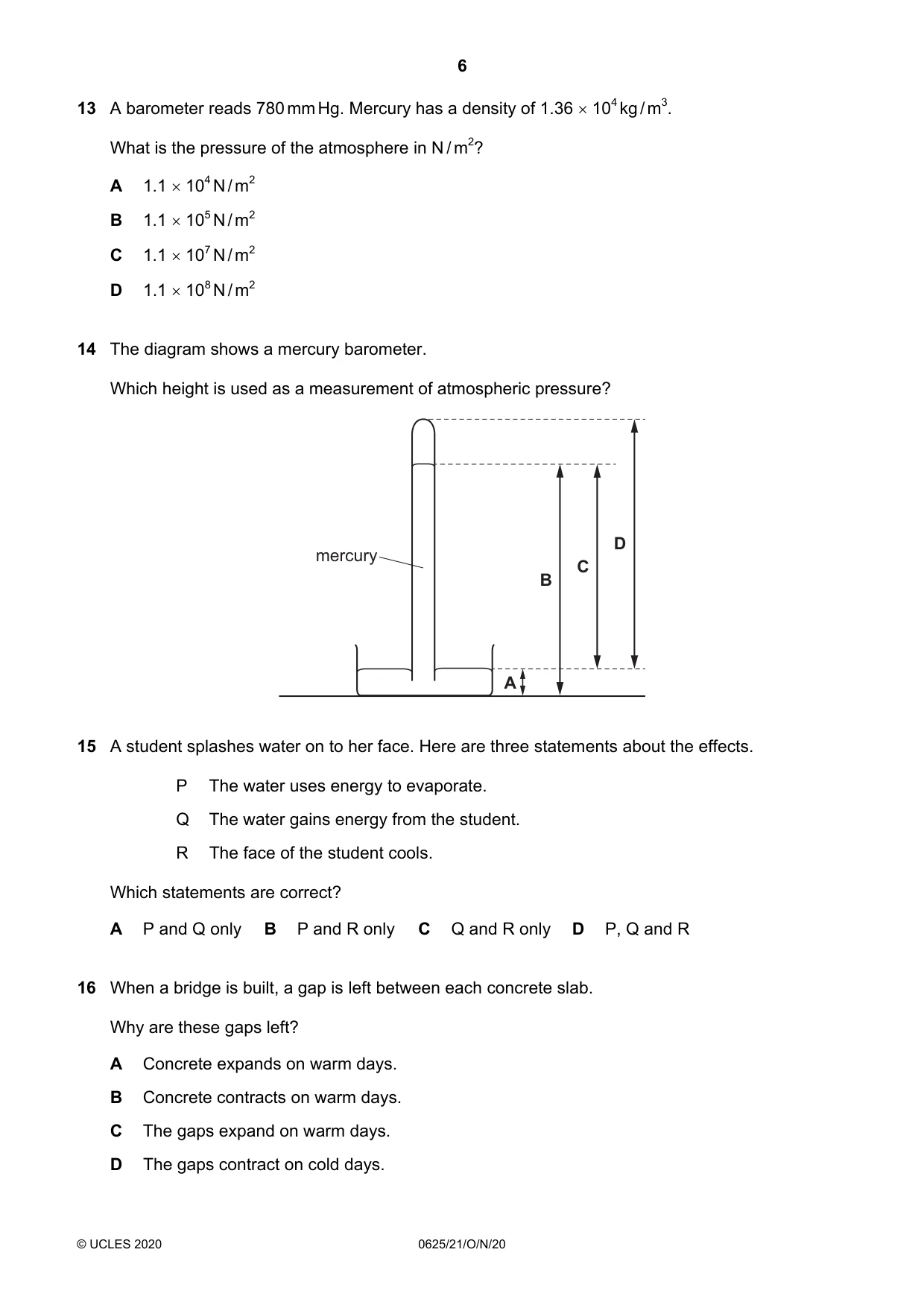
13 A barometer reads 780 mm Hg. Mercury has a density of 1.36 104 kg / m3. What is the pressure of the atmosphere in N / m2? A 1.1 104 N / m2 B 1.1 105 N / m2 C 1.1 107 N / m2 D 1.1 108 N / m2
Mark scheme: B
Q14 · The diagram shows a mercury barometer
14 The diagram shows a mercury barometer. Which height is used as a measurement of atmospheric pressure? D mercury C B A
Mark scheme: C
Q15 · A student splashes water on to her face
15 A student splashes water on to her face. Here are three statements about the effects. P The water uses energy to evaporate. Q The water gains energy from the student. R The face of the student cools. Which statements are correct? A P and Q only B P and R only C Q and R only D P, Q and R
Mark scheme: D
Q16 · When a bridge is built, a gap is left between each concrete slab
16 When a bridge is built, a gap is left between each concrete slab. Why are these gaps left? A Concrete expands on warm days. B Concrete contracts on warm days. C The gaps expand on warm days. D The gaps contract on cold days.
Mark scheme: A
Q17 · The specific heat capacity of solid P is greater than that of solid Q
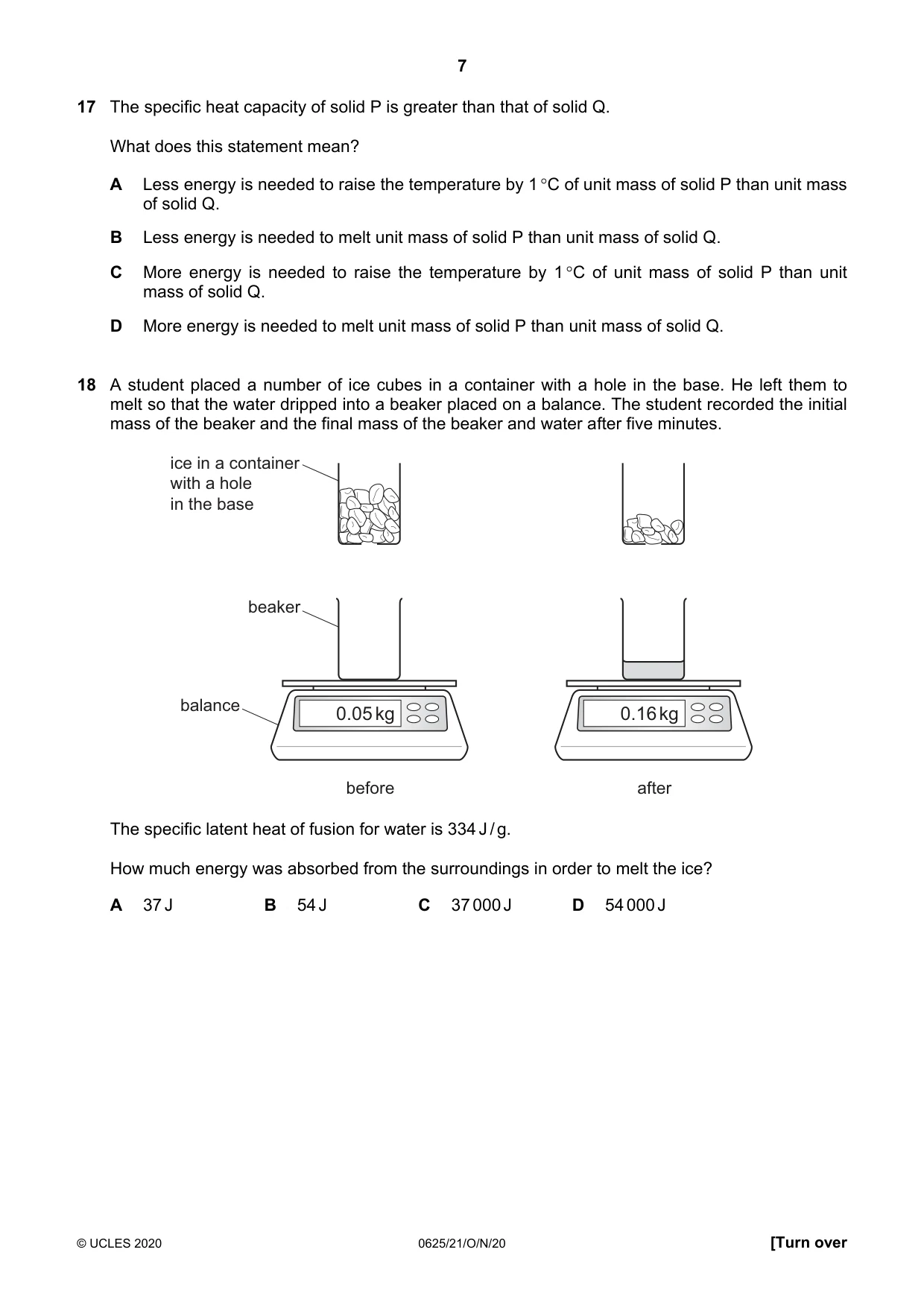
17 The specific heat capacity of solid P is greater than that of solid Q. What does this statement mean? A Less energy is needed to raise the temperature by 1 C of unit mass of solid P than unit mass of solid Q. B Less energy is needed to melt unit mass of solid P than unit mass of solid Q. C More energy is needed to raise the temperature by 1 C of unit mass of solid P than unit mass of solid Q. D More energy is needed to melt unit mass of solid P than unit mass of solid Q.
Mark scheme: C
Q18 · A student placed a number of ice cubes in a container with a hole in the base
18 A student placed a number of ice cubes in a container with a hole in the base. He left them to melt so that the water dripped into a beaker placed on a balance. The student recorded the initial mass of the beaker and the final mass of the beaker and water after five minutes. ice in a container with a hole in the base beaker balance 0.05 kg 0.16 kg before after The specific latent heat of fusion for water is 334 J / g. How much energy was absorbed from the surroundings in order to melt the ice? A 37 J B 54 J C 37 000 J D 54 000 J
Mark scheme: C
Q19 · The diagram shows four rods
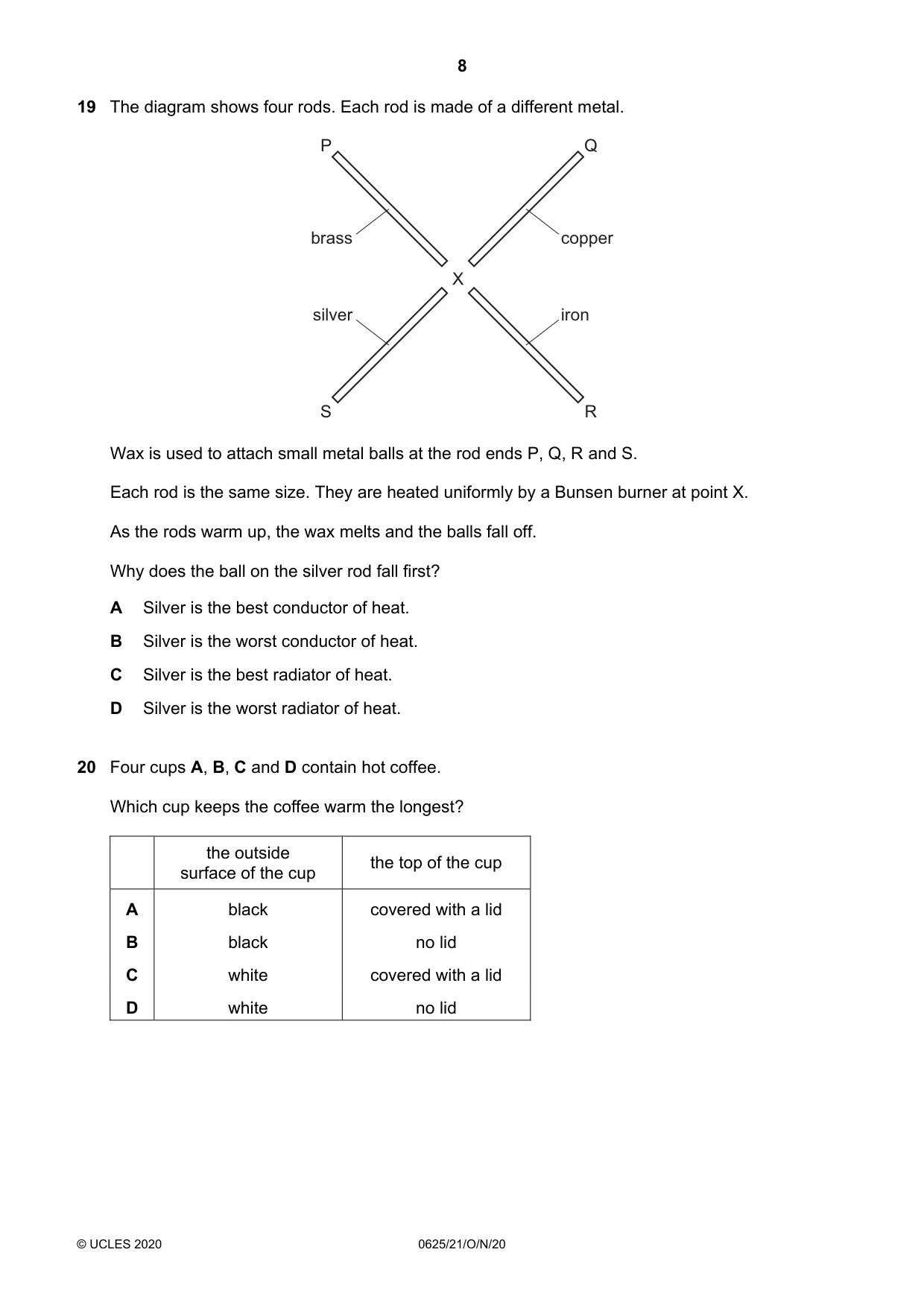
19 The diagram shows four rods. Each rod is made of a different metal. P Q brass copper X silver iron S R Wax is used to attach small metal balls at the rod ends P, Q, R and S. Each rod is the same size. They are heated uniformly by a Bunsen burner at point X. As the rods warm up, the wax melts and the balls fall off. Why does the ball on the silver rod fall first? A Silver is the best conductor of heat. B Silver is the worst conductor of heat. C Silver is the best radiator of heat. D Silver is the worst radiator of heat.
Mark scheme: A
Q20 · Four cups A, B, C and D contain hot coffee
20 Four cups A, B, C and D contain hot coffee. Which cup keeps the coffee warm the longest? the outside the top of the cup surface of the cup A black covered with a lid B black no lid C white covered with a lid D white no lid
Mark scheme: C
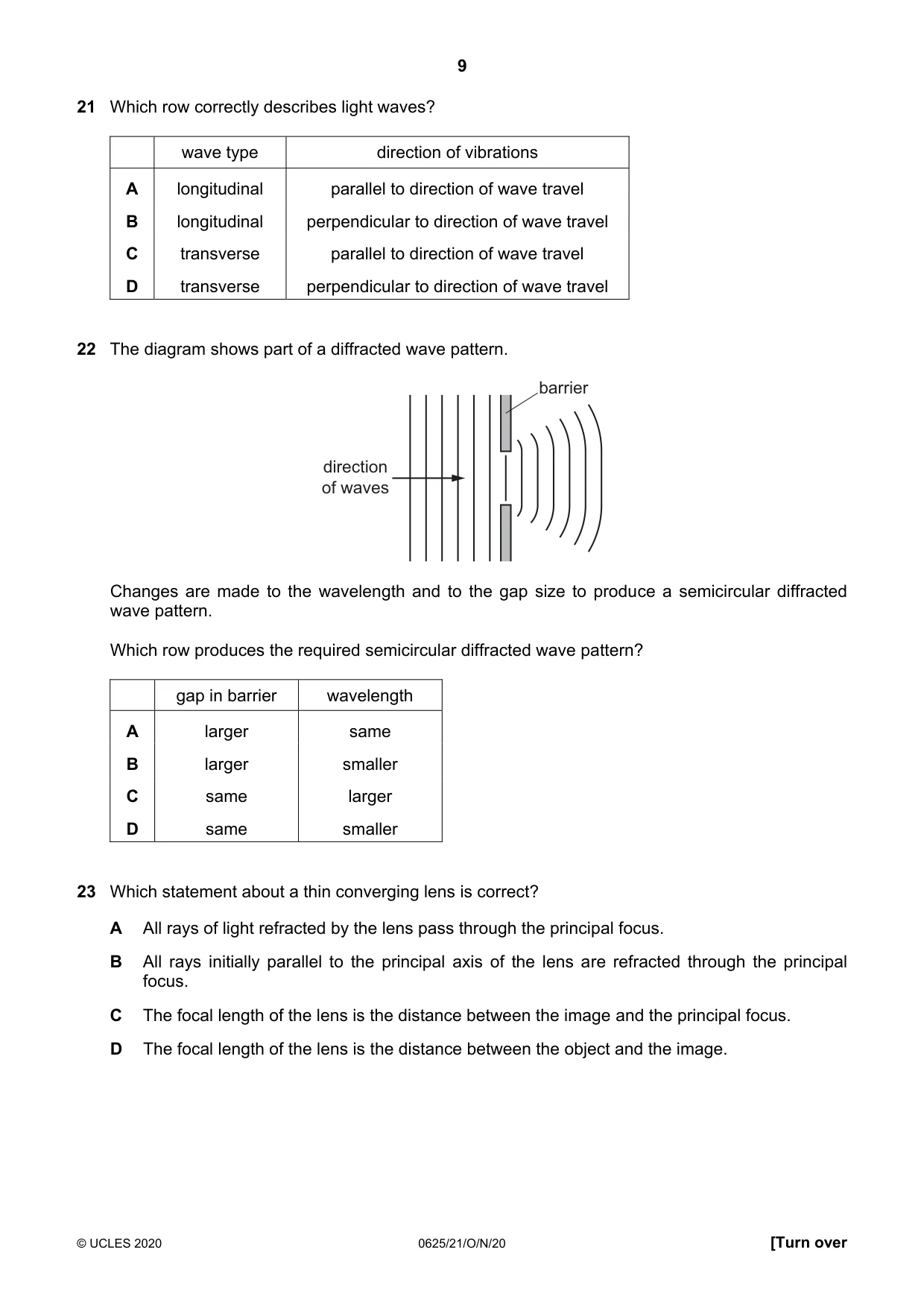
Q21 · Which row correctly describes light waves?
21 Which row correctly describes light waves? wave type direction of vibrations A longitudinal parallel to direction of wave travel B longitudinal perpendicular to direction of wave travel C transverse parallel to direction of wave travel D transverse perpendicular to direction of wave travel
Mark scheme: D
Q22 · The diagram shows part of a diffracted wave pattern
22 The diagram shows part of a diffracted wave pattern. barrier direction of waves Changes are made to the wavelength and to the gap size to produce a semicircular diffracted wave pattern. Which row produces the required semicircular diffracted wave pattern? gap in barrier wavelength A larger same B larger smaller C same larger D same smaller
Mark scheme: C
Q23 · Which statement about a thin converging lens is correct?
23 Which statement about a thin converging lens is correct? A All rays of light refracted by the lens pass through the principal focus. B All rays initially parallel to the principal axis of the lens are refracted through the principal focus. C The focal length of the lens is the distance between the image and the principal focus. D The focal length of the lens is the distance between the object and the image.
Mark scheme: B
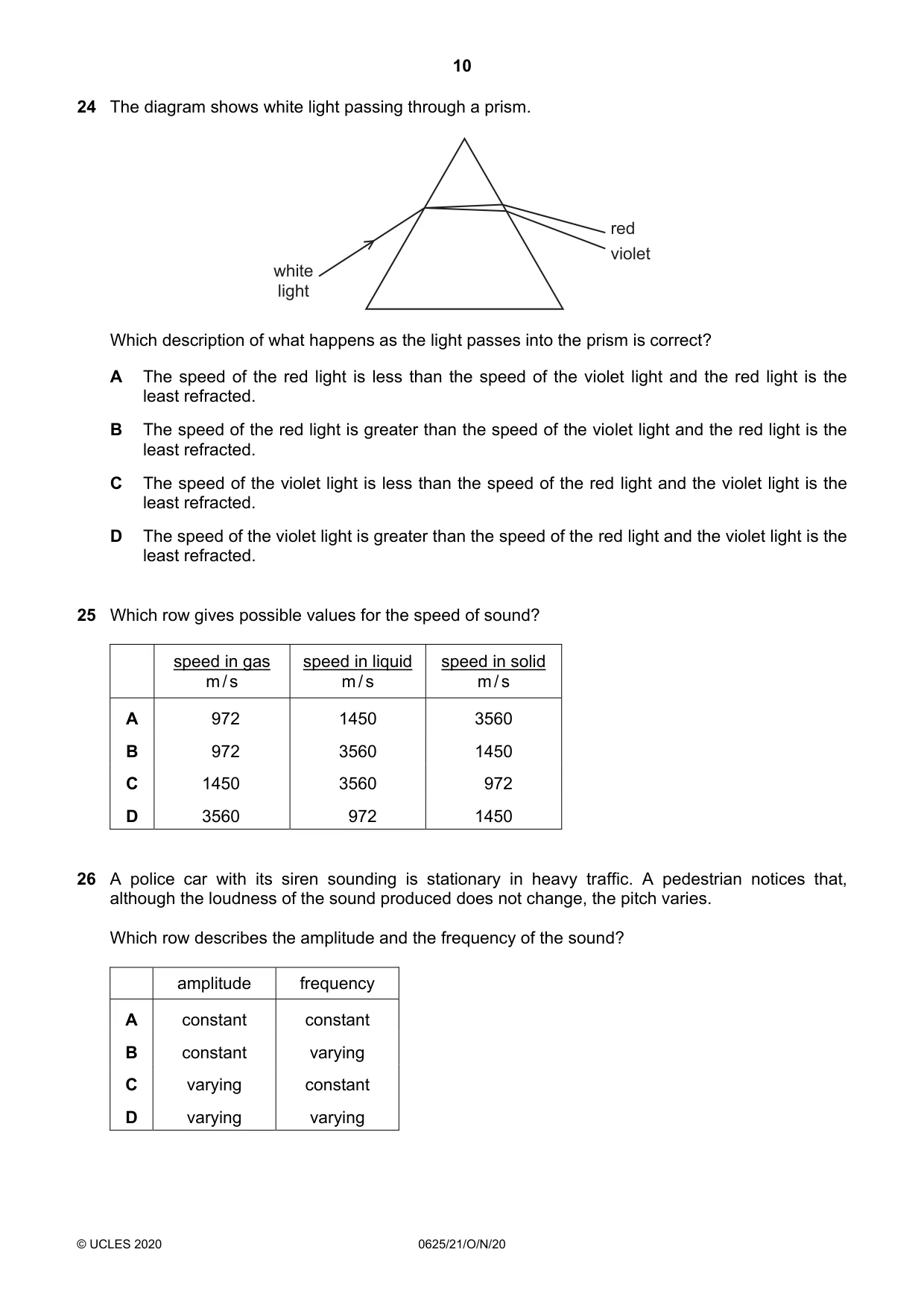
Q24 · The diagram shows white light passing through a prism
24 The diagram shows white light passing through a prism. red violet white light Which description of what happens as the light passes into the prism is correct? A The speed of the red light is less than the speed of the violet light and the red light is the least refracted. B The speed of the red light is greater than the speed of the violet light and the red light is the least refracted. C The speed of the violet light is less than the speed of the red light and the violet light is the least refracted. D The speed of the violet light is greater than the speed of the red light and the violet light is the least refracted.
Mark scheme: B
Q25 · Which row gives possible values for the speed of sound?
25 Which row gives possible values for the speed of sound? speed in gas speed in liquid speed in solid m / s m / s m / s A 972 1450 3560 B 972 3560 1450 C 1450 3560 972 D 3560 972 1450
Mark scheme: A
Q26 · A police car with its siren sounding is stationary in heavy traffic
26 A police car with its siren sounding is stationary in heavy traffic. A pedestrian notices that, although the loudness of the sound produced does not change, the pitch varies. Which row describes the amplitude and the frequency of the sound? amplitude frequency A constant constant B constant varying C varying constant D varying varying
Mark scheme: B
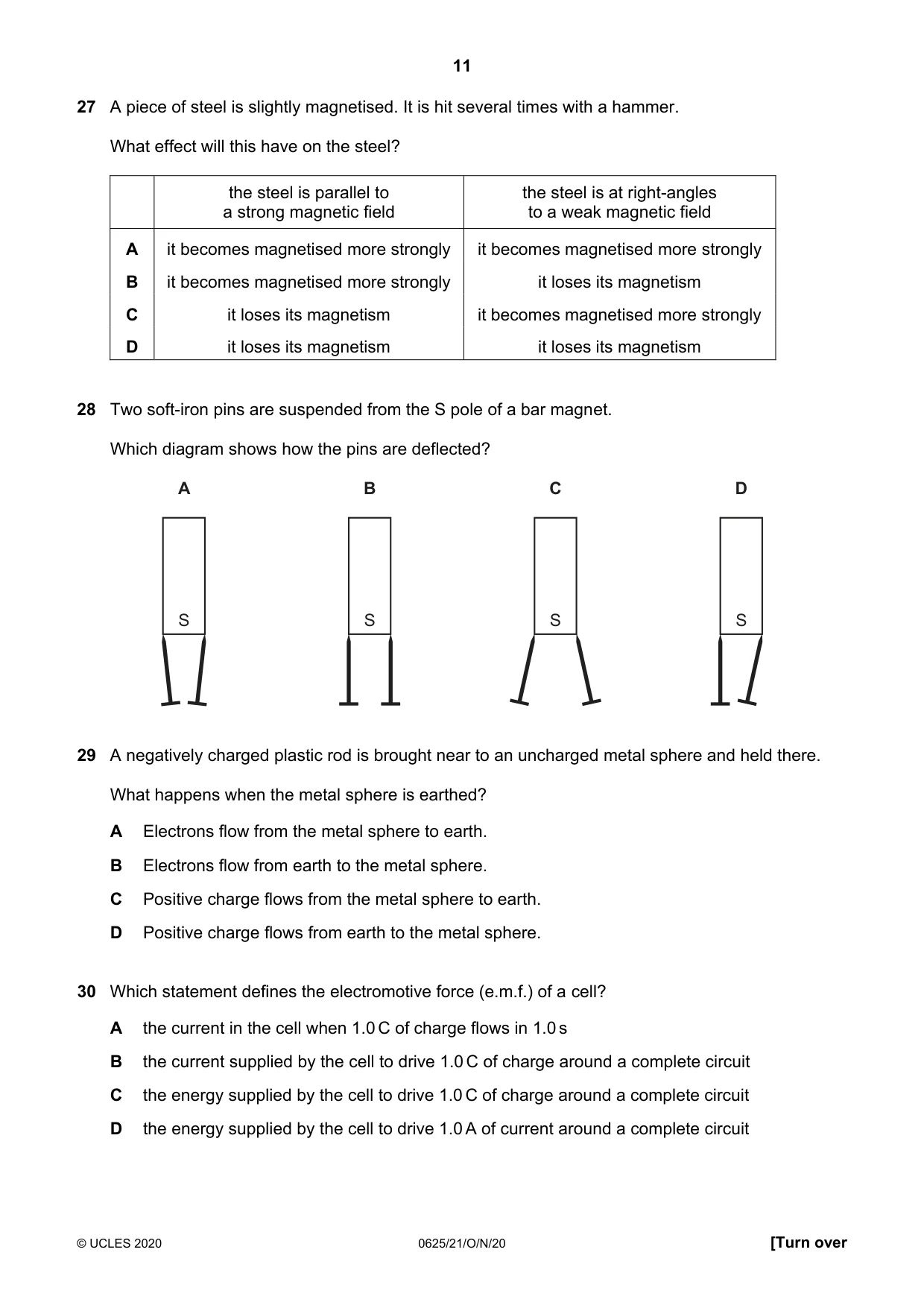
Q27 · A piece of steel is slightly magnetised
27 A piece of steel is slightly magnetised. It is hit several times with a hammer. What effect will this have on the steel? the steel is parallel to the steel is at right-angles a strong magnetic field to a weak magnetic field A it becomes magnetised more strongly it becomes magnetised more strongly B it becomes magnetised more strongly it loses its magnetism C it loses its magnetism it becomes magnetised more strongly D it loses its magnetism it loses its magnetism
Mark scheme: B
Q28 · Two soft-iron pins are suspended from the S pole of a bar magnet
28 Two soft-iron pins are suspended from the S pole of a bar magnet. Which diagram shows how the pins are deflected? A B C D S S S S
Mark scheme: C
Q29 · A negatively charged plastic rod is brought near to an uncharged metal sphere and held…
29 A negatively charged plastic rod is brought near to an uncharged metal sphere and held there. What happens when the metal sphere is earthed? A Electrons flow from the metal sphere to earth. B Electrons flow from earth to the metal sphere. C Positive charge flows from the metal sphere to earth. D Positive charge flows from earth to the metal sphere.
Mark scheme: A
Q30 · Which statement defines the electromotive force (e.m.f.) of a cell?
30 Which statement defines the electromotive force (e.m.f.) of a cell? A the current in the cell when 1.0 C of charge flows in 1.0 s B the current supplied by the cell to drive 1.0 C of charge around a complete circuit C the energy supplied by the cell to drive 1.0 C of charge around a complete circuit D the energy supplied by the cell to drive 1.0 A of current around a complete circuit
Mark scheme: C
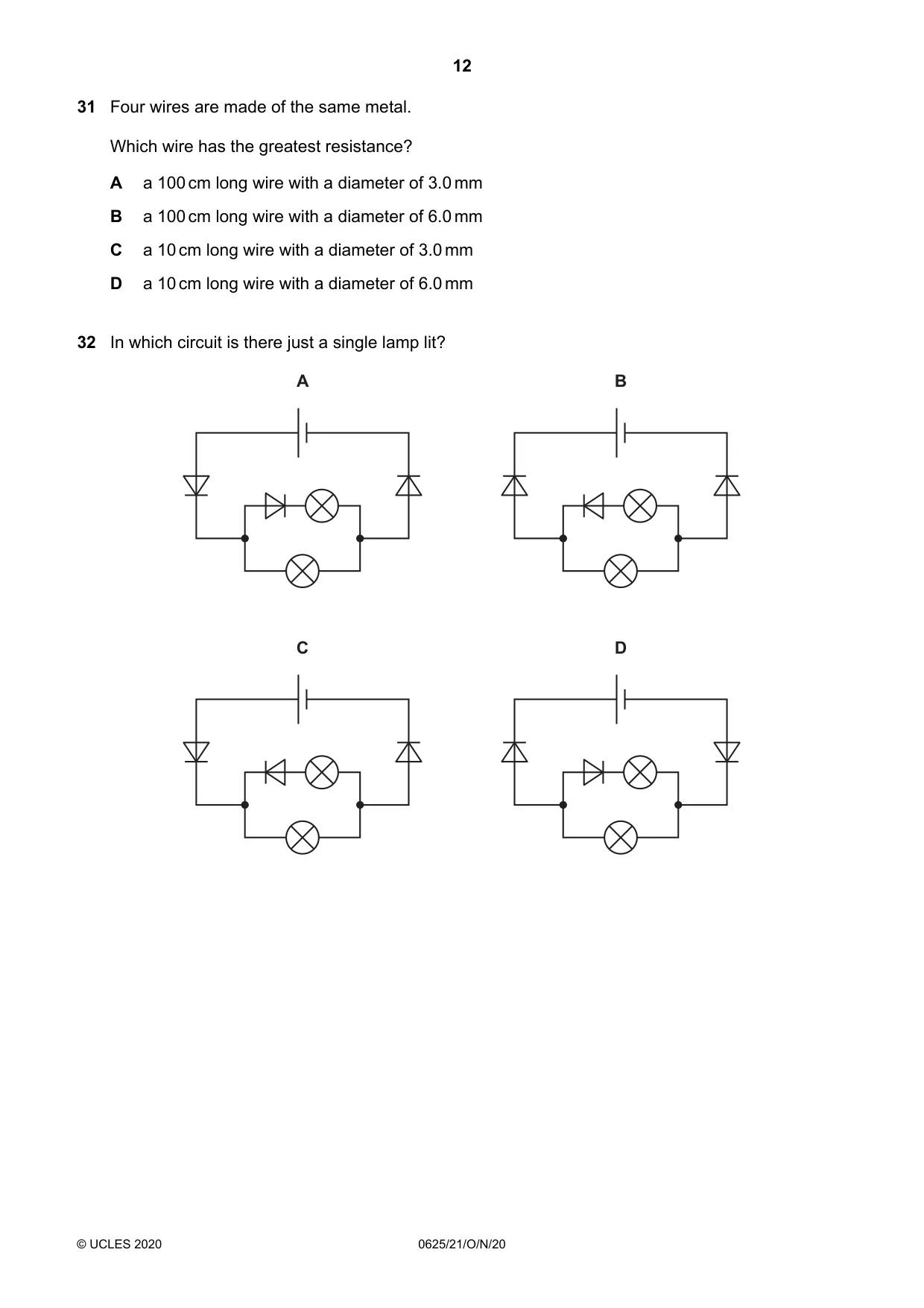
Q31 · Four wires are made of the same metal
31 Four wires are made of the same metal. Which wire has the greatest resistance? A a 100 cm long wire with a diameter of 3.0 mm B a 100 cm long wire with a diameter of 6.0 mm C a 10 cm long wire with a diameter of 3.0 mm D a 10 cm long wire with a diameter of 6.0 mm
Mark scheme: A
Q32 · In which circuit is there just a single lamp lit?
32 In which circuit is there just a single lamp lit? A B C D
Mark scheme: C
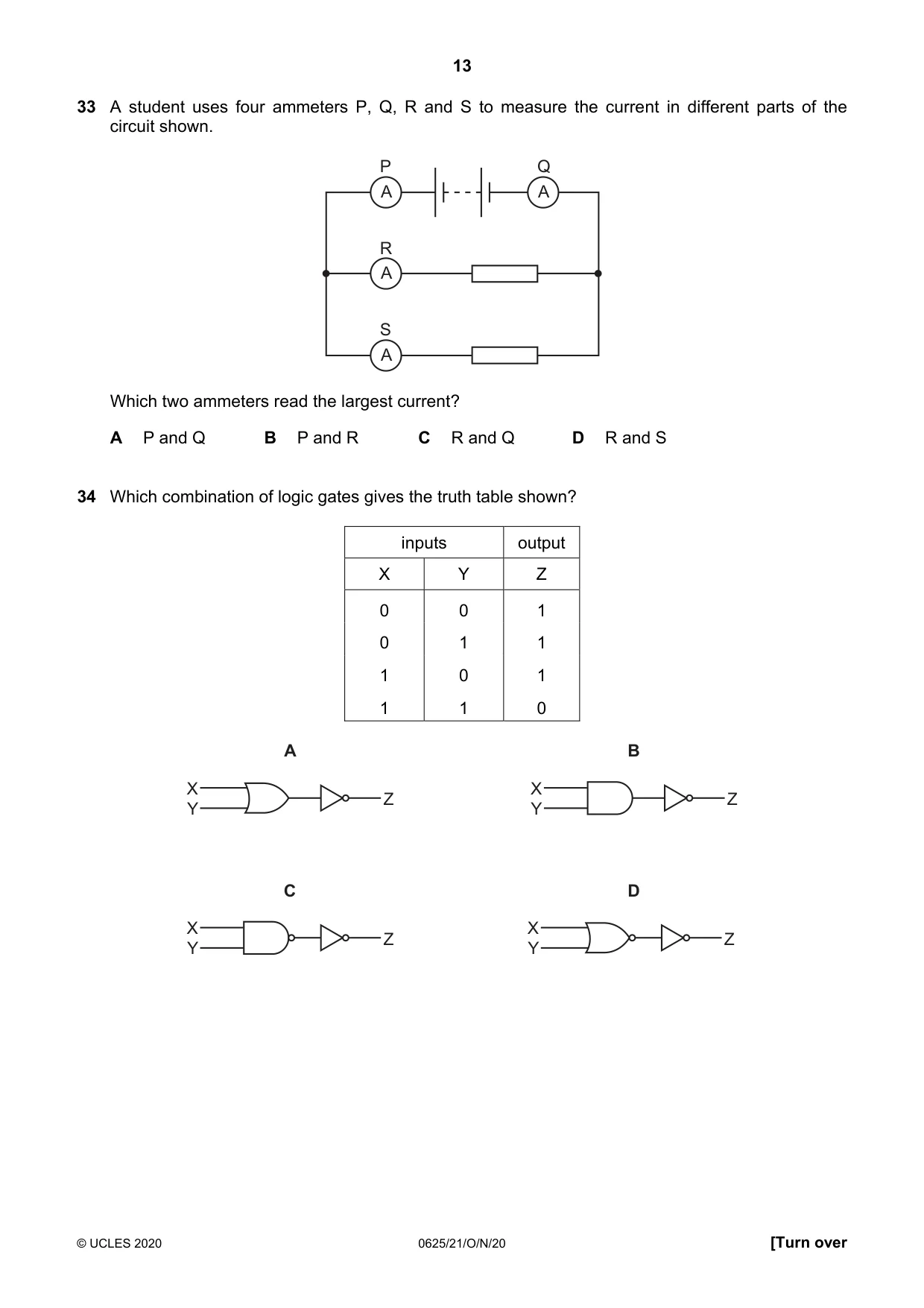
Q33 · A student uses four ammeters P, Q, R and S to measure the current in different parts of…
33 A student uses four ammeters P, Q, R and S to measure the current in different parts of the circuit shown. P Q A A R A S A Which two ammeters read the largest current? A P and Q B P and R C R and Q D R and S
Mark scheme: A
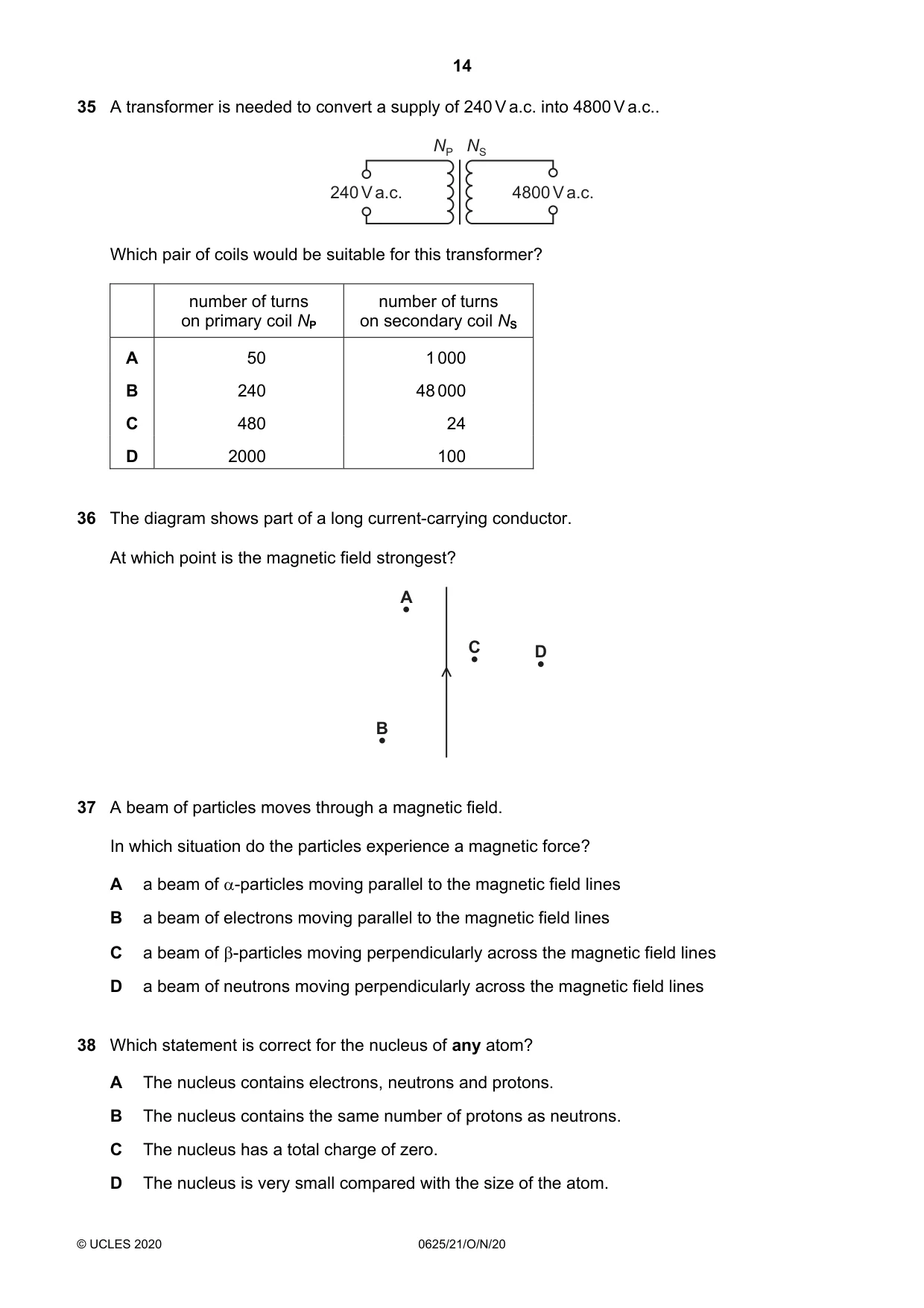
Q34 · Which combination of logic gates gives the truth table shown?
34 Which combination of logic gates gives the truth table shown? inputs output X Y Z 0 0 1 0 1 1 1 0 1 1 1 0 A B X X Z Z Y Y C D X X Z Z Y Y
Mark scheme: B
Q35 · A transformer is needed to convert a supply of 240 V a.c
35 A transformer is needed to convert a supply of 240 V a.c. into 4800 V a.c.. NP NS 240 V a.c. 4800 V a.c. Which pair of coils would be suitable for this transformer? number of turns number of turns on primary coil NP on secondary coil NS A 50 1 000 B 240 48 000 C 480 24 D 2000 100
Mark scheme: A
Q36 · The diagram shows part of a long current-carrying conductor
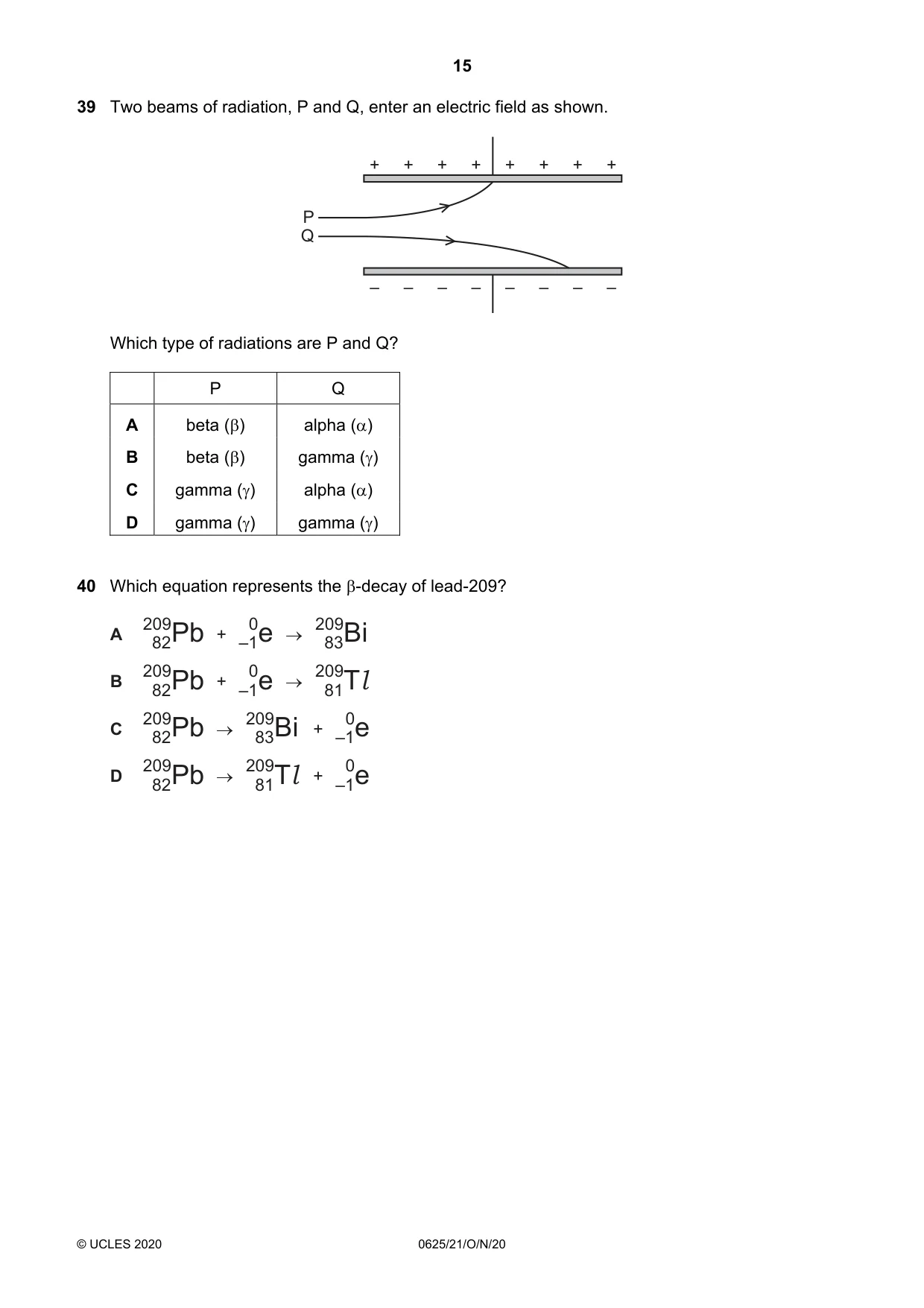
36 The diagram shows part of a long current-carrying conductor. At which point is the magnetic field strongest? A C D B
Mark scheme: C
Q37 · A beam of particles moves through a magnetic field
37 A beam of particles moves through a magnetic field. In which situation do the particles experience a magnetic force? A a beam of -particles moving parallel to the magnetic field lines B a beam of electrons moving parallel to the magnetic field lines C a beam of -particles moving perpendicularly across the magnetic field lines D a beam of neutrons moving perpendicularly across the magnetic field lines
Mark scheme: C
Q38 · Which statement is correct for the nucleus of any atom?
38 Which statement is correct for the nucleus of any atom? A The nucleus contains electrons, neutrons and protons. B The nucleus contains the same number of protons as neutrons. C The nucleus has a total charge of zero. D The nucleus is very small compared with the size of the atom.
Mark scheme: D
Q39 · Two beams of radiation, P and Q, enter an electric field as shown
39 Two beams of radiation, P and Q, enter an electric field as shown. + + + + + + + + P Q – – – – – – – – Which type of radiations are P and Q? P Q A beta () alpha () B beta () gamma () C gamma () alpha () D gamma () gamma ()
Mark scheme: A
Q40 · Which equation represents the B-decay of lead-209?
40 Which equation represents the B-decay of lead-209? A B “ePb + Se > “3,8 “ePb + Je 5 Tl “aePb > “3,Bi + Je oe 2P b > onl 1 + Je
Mark scheme: C
What was in this paper
The subtopics covered by these 40 questions, and how many questions each got. Open one in a new tab to see every Cambridge question on it.
4Thermal properties and temperature4Electromagnetic effects3Motion3Electrical quantities2Energy, work and power2Forces2General properties of waves2Light2Mass and weight2Pressure2Radioactivity2Simple phenomena of magnetism2Sound2Transfer of thermal energy2Density1Momentum1Physical quantities and measurement techniques1The nuclear model of the atom1What you needed in this session
Cambridge’s own grade thresholds for 2020 Oct/Nov, Paper 2 · Variant 1. A higher threshold means an easier paper — the bar moves with how the cohort did.