Cambridge IGCSE Physics 0625 — 2025 May/June Paper 2 · Variant 3
0625/23/M/J/25 · 40 questions · 40 marks · ≈45 min
The question paper and its mark scheme, free to read here and free to download. This is Cambridge’s own paper, exactly as it was sat.
Question paper16 pages
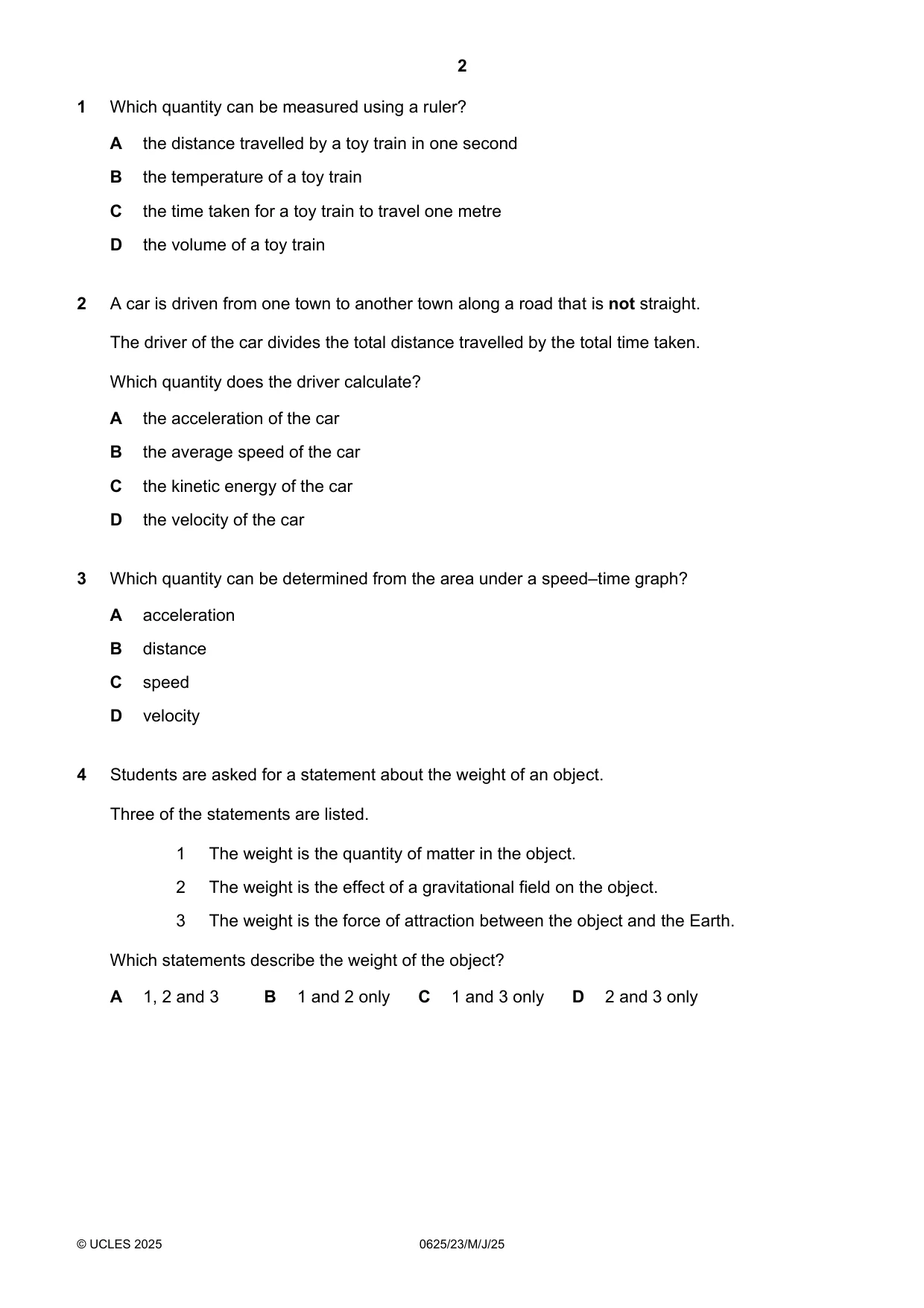

Mark scheme3 pages
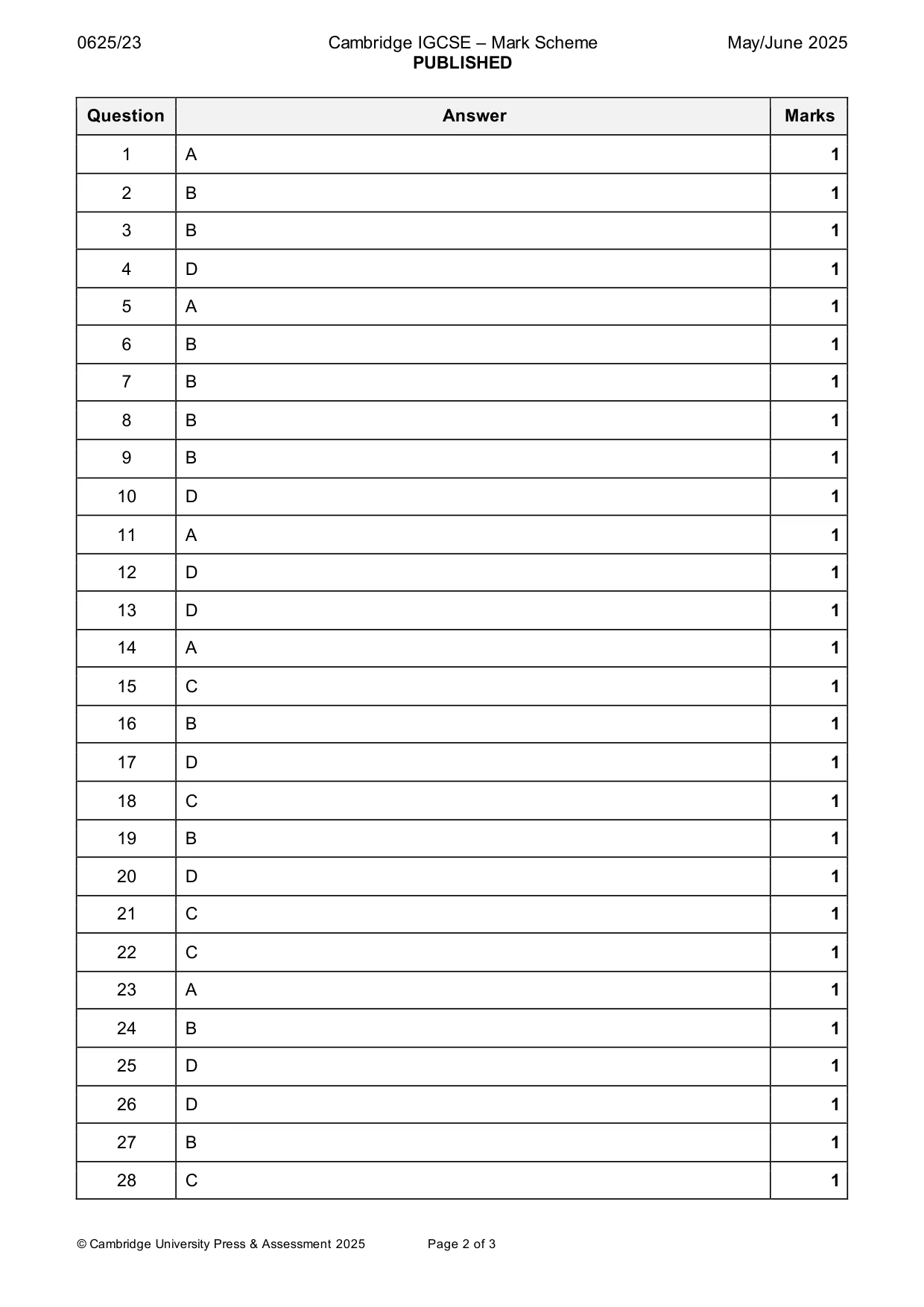
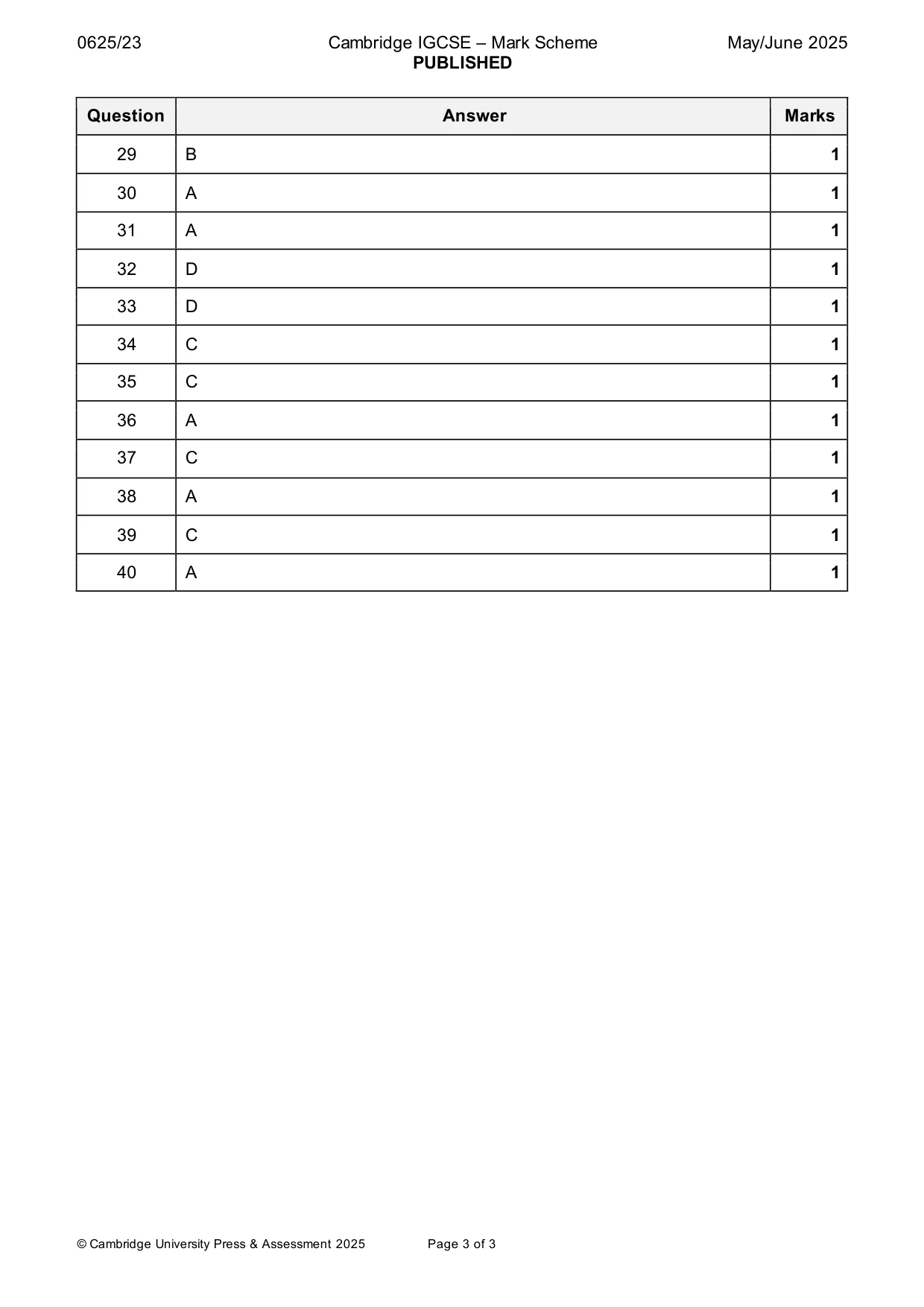
Answers below. Sit the paper first if you are practising.
Questions as text
Q1 · Which quantity can be measured using a ruler?
1 Which quantity can be measured using a ruler? A the distance travelled by a toy train in one second B the temperature of a toy train C the time taken for a toy train to travel one metre D the volume of a toy train
Mark scheme: A
More questions on Physical quantities and measurement techniques
Q2 · A car is driven from one town to another town along a road that is not straight
2 A car is driven from one town to another town along a road that is not straight. The driver of the car divides the total distance travelled by the total time taken. Which quantity does the driver calculate? A the acceleration of the car B the average speed of the car C the kinetic energy of the car D the velocity of the car
Mark scheme: B
Q3 · Which quantity can be determined from the area under a speed–time graph?
3 Which quantity can be determined from the area under a speed–time graph? A acceleration B distance C speed D velocity
Mark scheme: B
Q4 · Students are asked for a statement about the weight of an object
4 Students are asked for a statement about the weight of an object. Three of the statements are listed. 1 The weight is the quantity of matter in the object. 2 The weight is the effect of a gravitational field on the object. 3 The weight is the force of attraction between the object and the Earth. Which statements describe the weight of the object? A 1, 2 and 3 B 1 and 2 only C 1 and 3 only D 2 and 3 only
Mark scheme: D
Q5 · Samples of three different liquids have equal masses
5 Samples of three different liquids have equal masses. The volumes of the samples are 190 cm3, 200 cm3 and 235 cm3. The liquids are poured into a large measuring cylinder and the liquids form three separate layers because they do not mix. What are the readings on the measuring cylinder at the two boundaries between the samples? A 190 cm3 and 390 cm3 B 190 cm3 and 425 cm3 C 235 cm3 and 425 cm3 D 235 cm3 and 435 cm3
Mark scheme: A
Q6 · A car moves along a level road
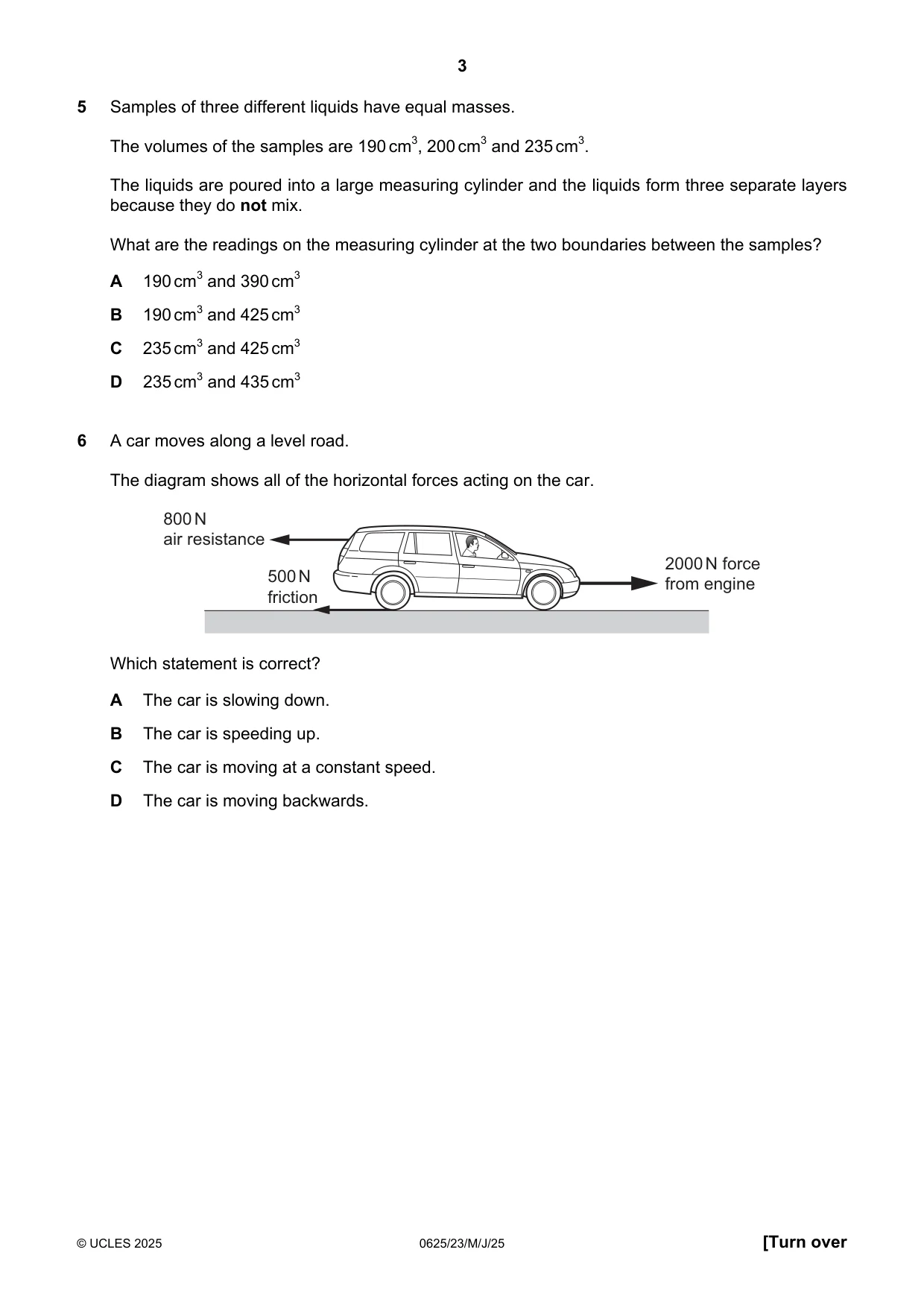
6 A car moves along a level road. The diagram shows all of the horizontal forces acting on the car. 800 N air resistance 2000 N force 500 N from engine friction Which statement is correct? A The car is slowing down. B The car is speeding up. C The car is moving at a constant speed. D The car is moving backwards.
Mark scheme: B
Q7 · A car is travelling around a circular track at a constant speed, as shown
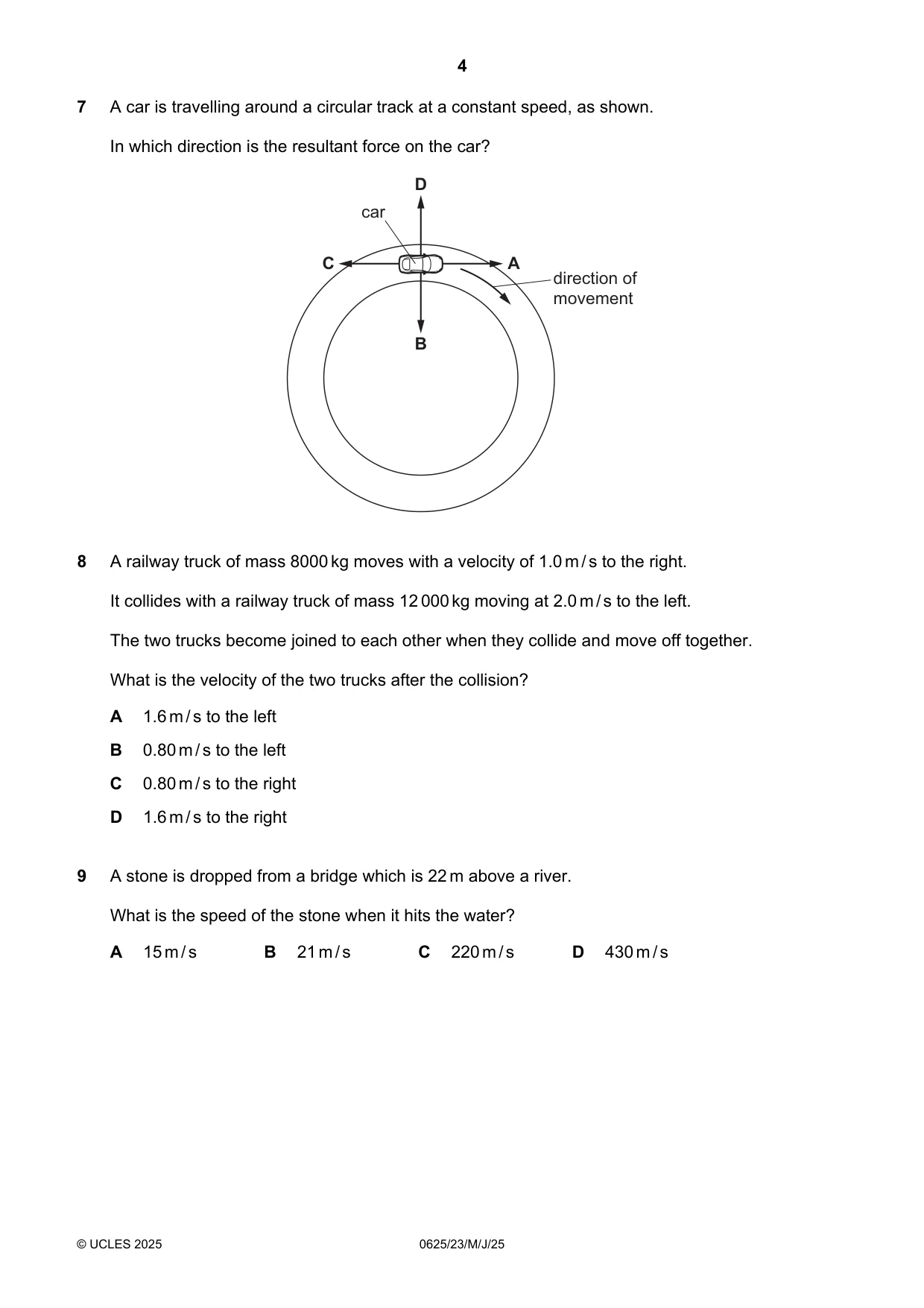
7 A car is travelling around a circular track at a constant speed, as shown. In which direction is the resultant force on the car? D car C A direction of movement B
Mark scheme: B
Q8 · A railway truck of mass 8000 kg moves with a velocity of 1.0 m / s to the right
8 A railway truck of mass 8000 kg moves with a velocity of 1.0 m / s to the right. It collides with a railway truck of mass 12 000 kg moving at 2.0 m / s to the left. The two trucks become joined to each other when they collide and move off together. What is the velocity of the two trucks after the collision? A 1.6 m / s to the left B 0.80 m / s to the left C 0.80 m / s to the right D 1.6 m / s to the right
Mark scheme: B
Q9 · A stone is dropped from a bridge which is 22 m above a river
9 A stone is dropped from a bridge which is 22 m above a river. What is the speed of the stone when it hits the water? A 15 m / s B 21 m / s C 220 m / s D 430 m / s
Mark scheme: B
Q10 · Which row describes the particle structure of a gas?
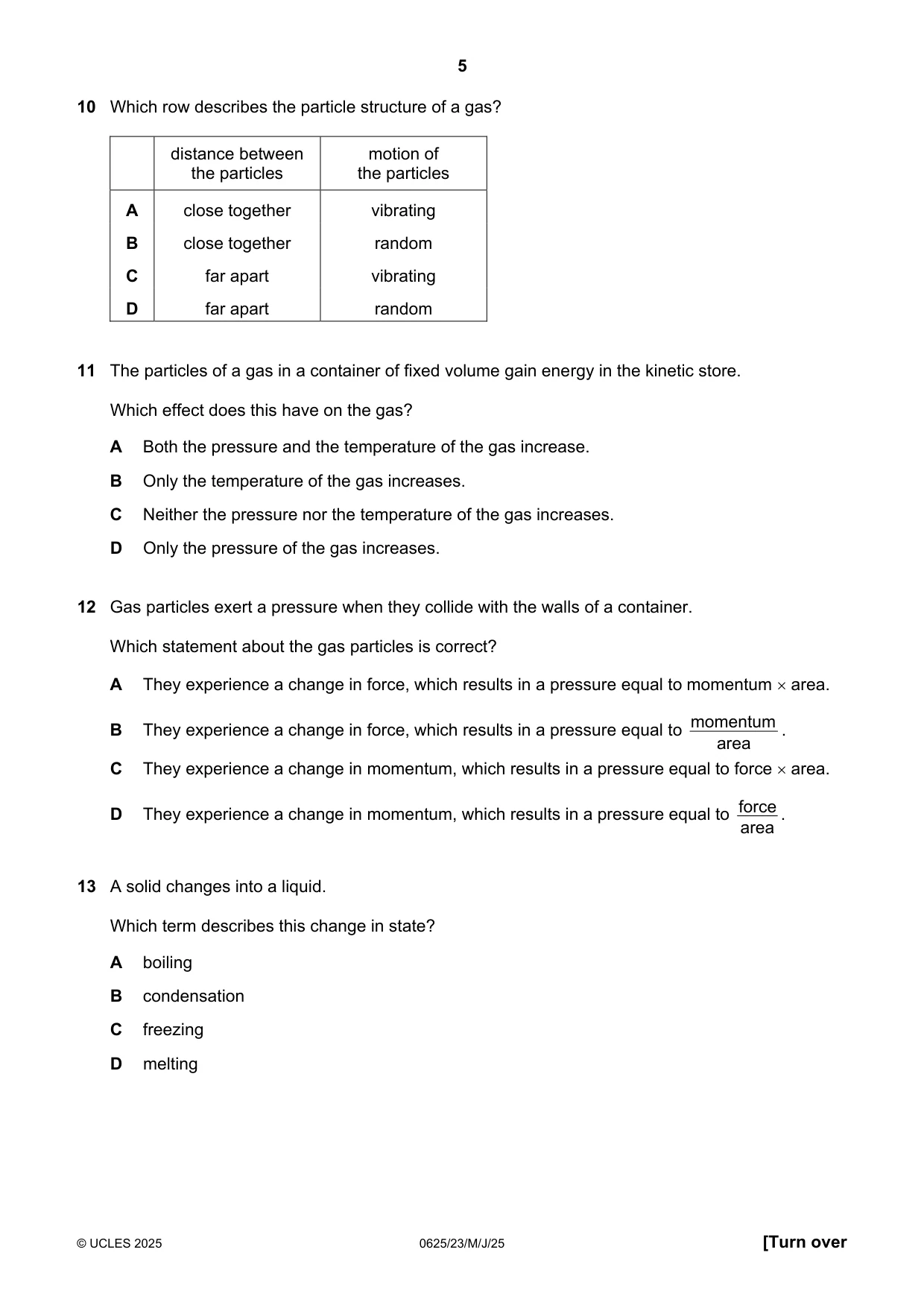
10 Which row describes the particle structure of a gas? distance between motion of the particles the particles A close together vibrating B close together random C far apart vibrating D far apart random
Mark scheme: D
Q11 · The particles of a gas in a container of fixed volume gain energy in the kinetic store
11 The particles of a gas in a container of fixed volume gain energy in the kinetic store. Which effect does this have on the gas? A Both the pressure and the temperature of the gas increase. B Only the temperature of the gas increases. C Neither the pressure nor the temperature of the gas increases. D Only the pressure of the gas increases.
Mark scheme: A
Q12 · Gas particles exert a pressure when they collide with the walls of a container
12 Gas particles exert a pressure when they collide with the walls of a container. Which statement about the gas particles is correct? A They experience a change in force, which results in a pressure equal to momentum area. momentum . B They experience a change in force, which results in a pressure equal to area C They experience a change in momentum, which results in a pressure equal to force area. force . D They experience a change in momentum, which results in a pressure equal to area
Mark scheme: D
Q13 · A solid changes into a liquid
13 A solid changes into a liquid. Which term describes this change in state? A boiling B condensation C freezing D melting
Mark scheme: D
Q14 · The diagram shows some of the apparatus used to determine the specific heat capacity of a…
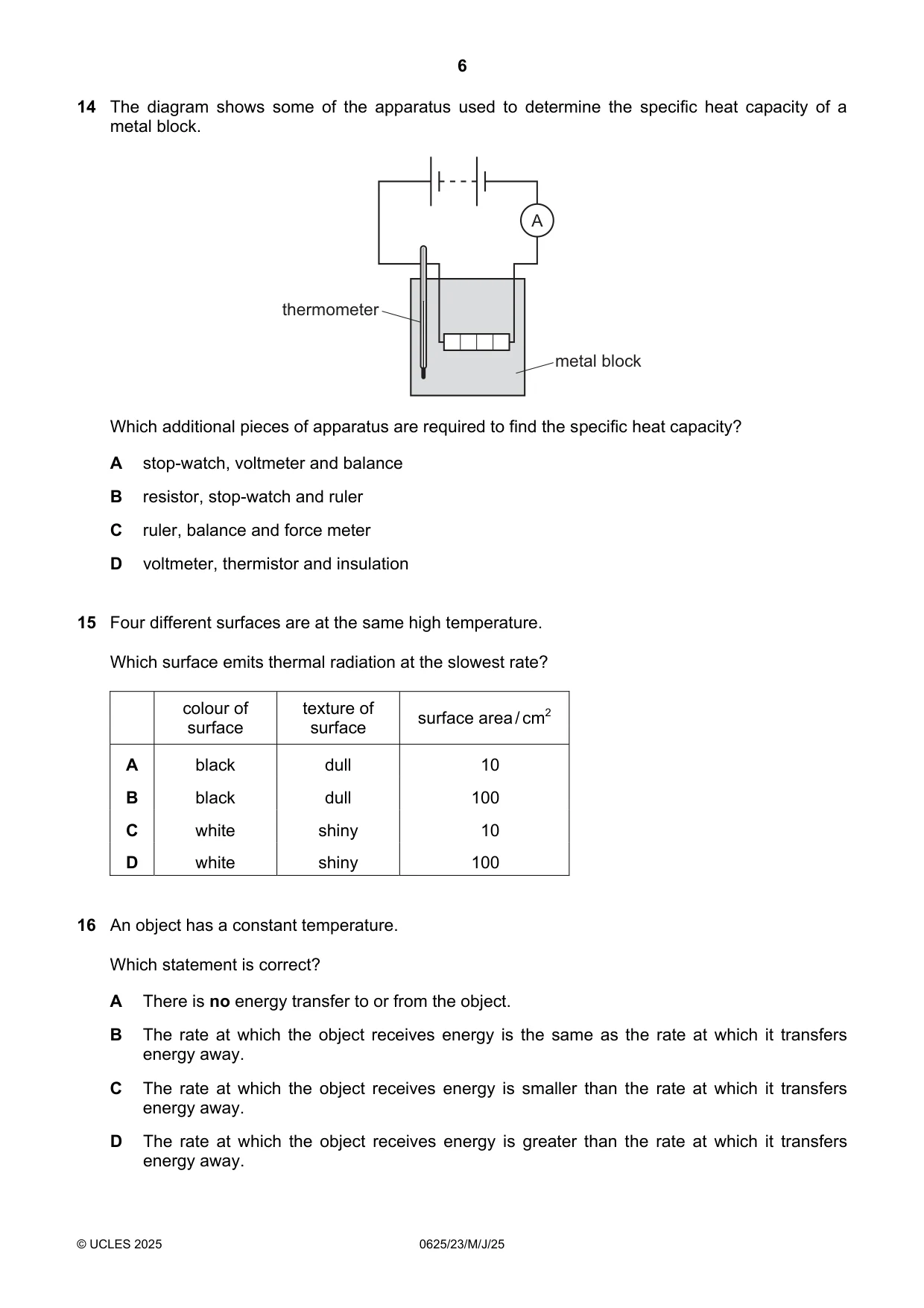
14 The diagram shows some of the apparatus used to determine the specific heat capacity of a metal block. A thermometer metal block Which additional pieces of apparatus are required to find the specific heat capacity? A stop-watch, voltmeter and balance B resistor, stop-watch and ruler C ruler, balance and force meter D voltmeter, thermistor and insulation
Mark scheme: A
Q15 · Four different surfaces are at the same high temperature
15 Four different surfaces are at the same high temperature. Which surface emits thermal radiation at the slowest rate? colour of texture of surface area / cm2 surface surface A black dull 10 B black dull 100 C white shiny 10 D white shiny 100
Mark scheme: C
Q16 · An object has a constant temperature
16 An object has a constant temperature. Which statement is correct? A There is no energy transfer to or from the object. B The rate at which the object receives energy is the same as the rate at which it transfers energy away. C The rate at which the object receives energy is smaller than the rate at which it transfers energy away. D The rate at which the object receives energy is greater than the rate at which it transfers energy away.
Mark scheme: B
Q17 · Which row correctly describes light waves?
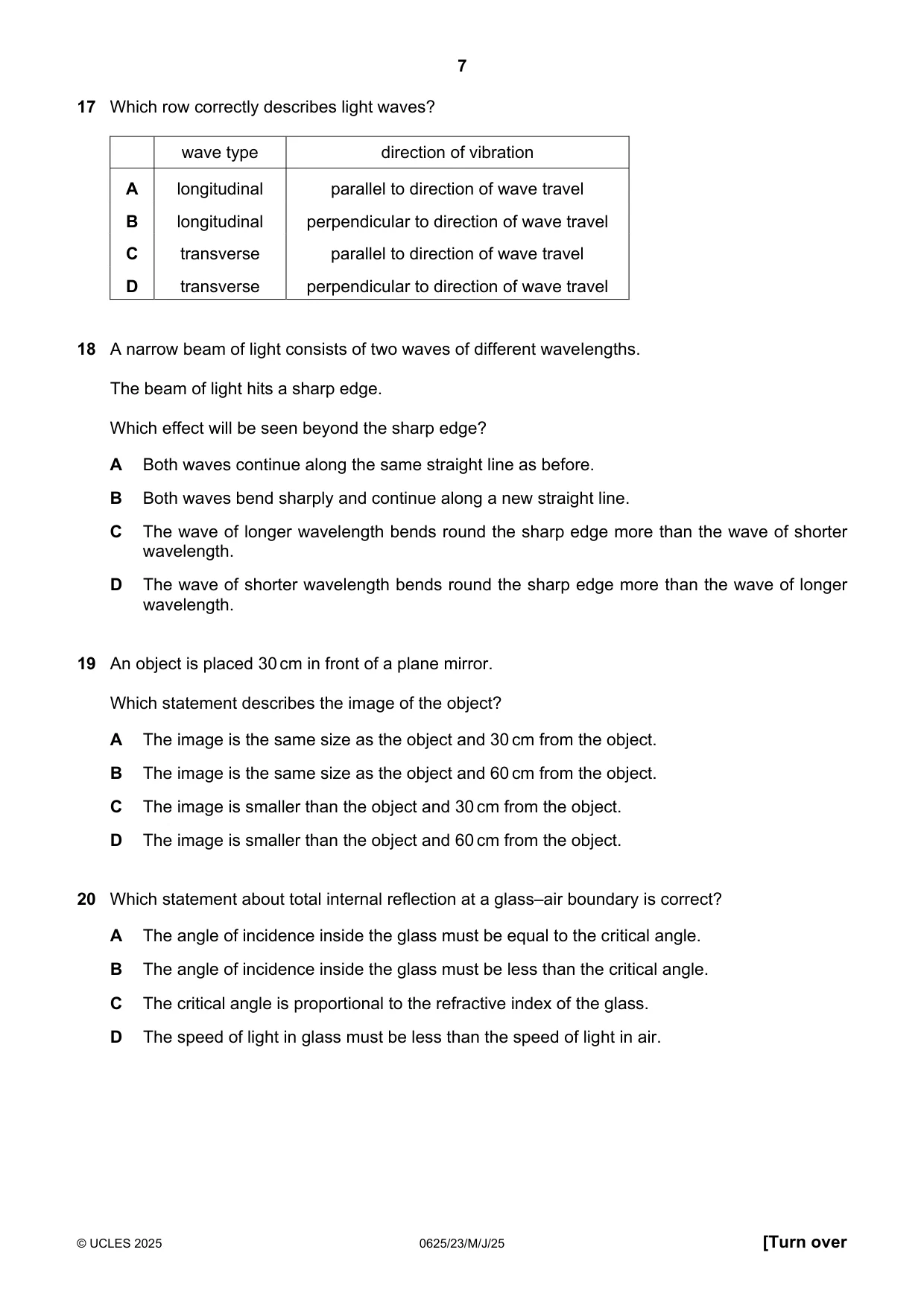
17 Which row correctly describes light waves? wave type direction of vibration A longitudinal parallel to direction of wave travel B longitudinal perpendicular to direction of wave travel C transverse parallel to direction of wave travel D transverse perpendicular to direction of wave travel
Mark scheme: D
Q18 · A narrow beam of light consists of two waves of different wavelengths
18 A narrow beam of light consists of two waves of different wavelengths. The beam of light hits a sharp edge. Which effect will be seen beyond the sharp edge? A Both waves continue along the same straight line as before. B Both waves bend sharply and continue along a new straight line. C The wave of longer wavelength bends round the sharp edge more than the wave of shorter wavelength. D The wave of shorter wavelength bends round the sharp edge more than the wave of longer wavelength.
Mark scheme: C
Q19 · An object is placed 30 cm in front of a plane mirror
19 An object is placed 30 cm in front of a plane mirror. Which statement describes the image of the object? A The image is the same size as the object and 30 cm from the object. B The image is the same size as the object and 60 cm from the object. C The image is smaller than the object and 30 cm from the object. D The image is smaller than the object and 60 cm from the object.
Mark scheme: B
Q20 · Which statement about total internal reflection at a glass–air boundary is correct?
20 Which statement about total internal reflection at a glass–air boundary is correct? A The angle of incidence inside the glass must be equal to the critical angle. B The angle of incidence inside the glass must be less than the critical angle. C The critical angle is proportional to the refractive index of the glass. D The speed of light in glass must be less than the speed of light in air.
Mark scheme: D
Q21 · What is the speed of radio waves in a vacuum and what is the speed of gamma rays in a…
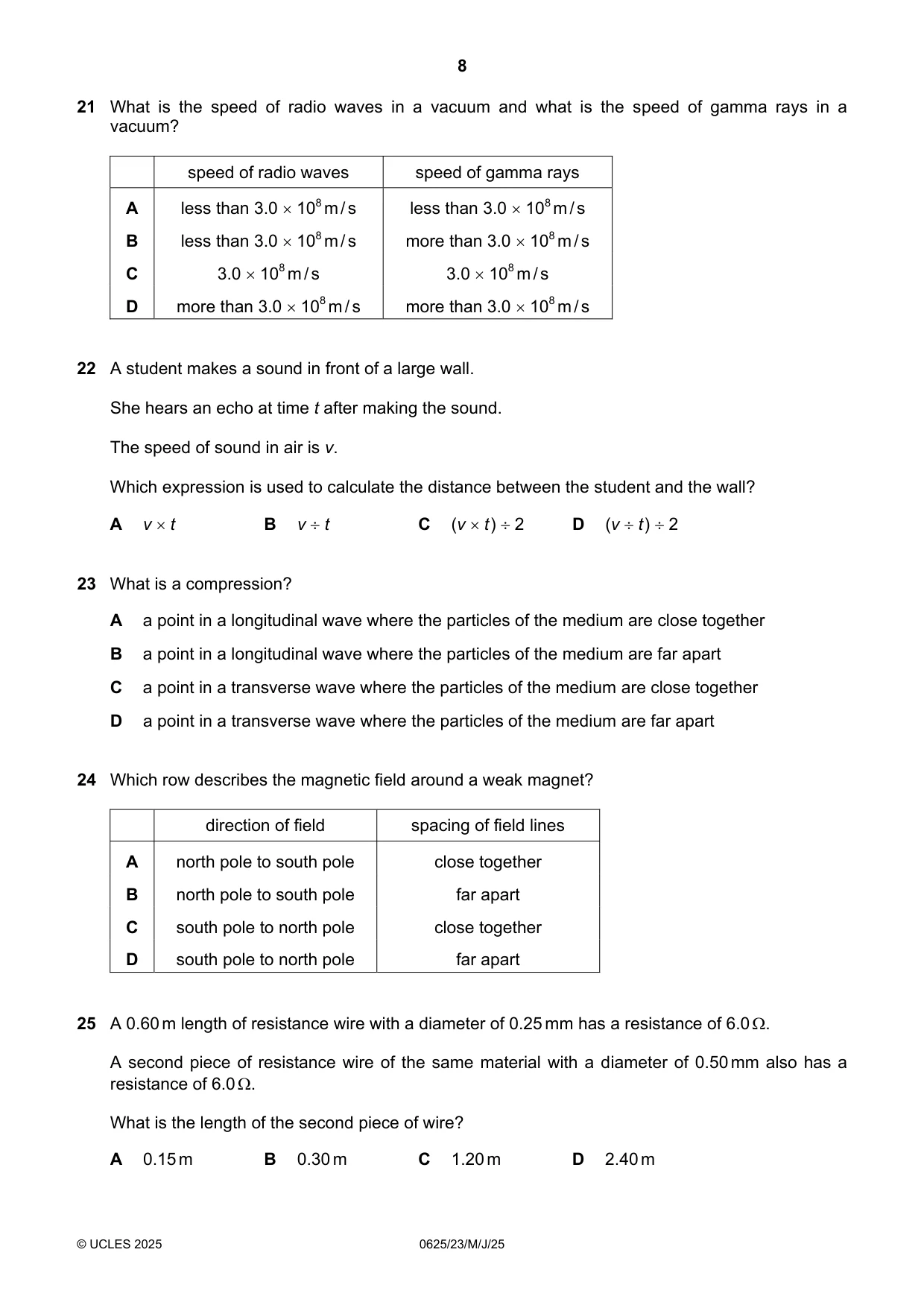
21 What is the speed of radio waves in a vacuum and what is the speed of gamma rays in a vacuum? speed of radio waves speed of gamma rays A less than 3.0 108 m / s less than 3.0 108 m / s B less than 3.0 108 m / s more than 3.0 108 m / s C 3.0 108 m / s 3.0 108 m / s D more than 3.0 108 m / s more than 3.0 108 m / s
Mark scheme: C
Q22 · A student makes a sound in front of a large wall
22 A student makes a sound in front of a large wall. She hears an echo at time t after making the sound. The speed of sound in air is v. Which expression is used to calculate the distance between the student and the wall? A v t B v t C (v t ) 2 D (v t ) 2
Mark scheme: C
Q23 · What is a compression?
23 What is a compression? A a point in a longitudinal wave where the particles of the medium are close together B a point in a longitudinal wave where the particles of the medium are far apart C a point in a transverse wave where the particles of the medium are close together D a point in a transverse wave where the particles of the medium are far apart
Mark scheme: A
Q24 · Which row describes the magnetic field around a weak magnet?
24 Which row describes the magnetic field around a weak magnet? direction of field spacing of field lines A north pole to south pole close together B north pole to south pole far apart C south pole to north pole close together D south pole to north pole far apart
Mark scheme: B
Q25 · A 0.60 m length of resistance wire with a diameter of 0.25 mm has a resistance of 6.0
25 A 0.60 m length of resistance wire with a diameter of 0.25 mm has a resistance of 6.0 . A second piece of resistance wire of the same material with a diameter of 0.50 mm also has a resistance of 6.0 . What is the length of the second piece of wire? A 0.15 m B 0.30 m C 1.20 m D 2.40 m
Mark scheme: D
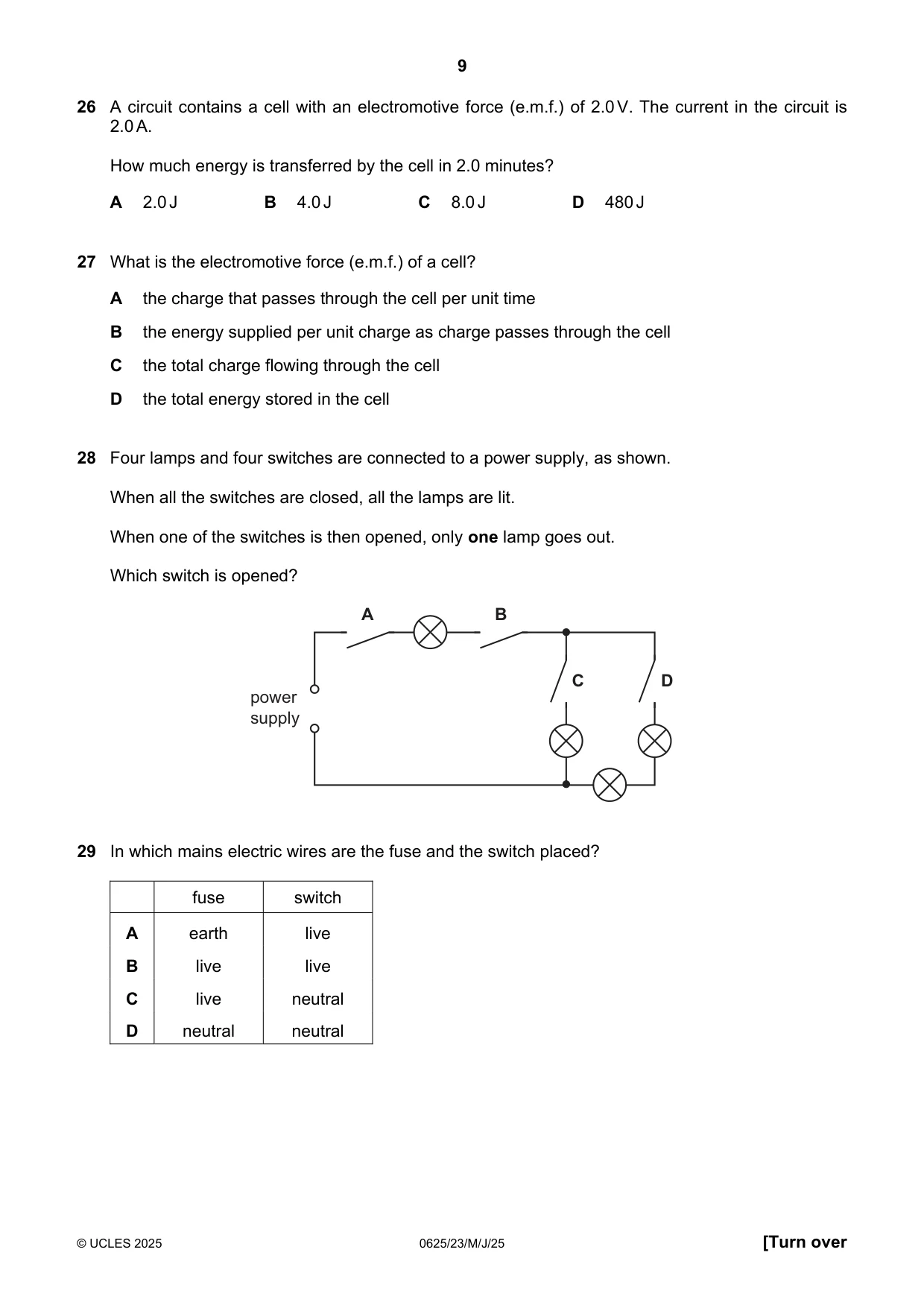
Q26 · A circuit contains a cell with an electromotive force (e.m.f.) of 2.0 V
26 A circuit contains a cell with an electromotive force (e.m.f.) of 2.0 V. The current in the circuit is 2.0 A. How much energy is transferred by the cell in 2.0 minutes? A 2.0 J B 4.0 J C 8.0 J D 480 J
Mark scheme: D
Q27 · What is the electromotive force (e.m.f.) of a cell?
27 What is the electromotive force (e.m.f.) of a cell? A the charge that passes through the cell per unit time B the energy supplied per unit charge as charge passes through the cell C the total charge flowing through the cell D the total energy stored in the cell
Mark scheme: B
Q28 · Four lamps and four switches are connected to a power supply, as shown
28 Four lamps and four switches are connected to a power supply, as shown. When all the switches are closed, all the lamps are lit. When one of the switches is then opened, only one lamp goes out. Which switch is opened? A B C D power supply
Mark scheme: C
Q29 · In which mains electric wires are the fuse and the switch placed?
29 In which mains electric wires are the fuse and the switch placed? fuse switch A earth live B live live C live neutral D neutral neutral
Mark scheme: B
Q30 · The diagram shows a wire moving downwards in a magnetic field between two magnetic poles
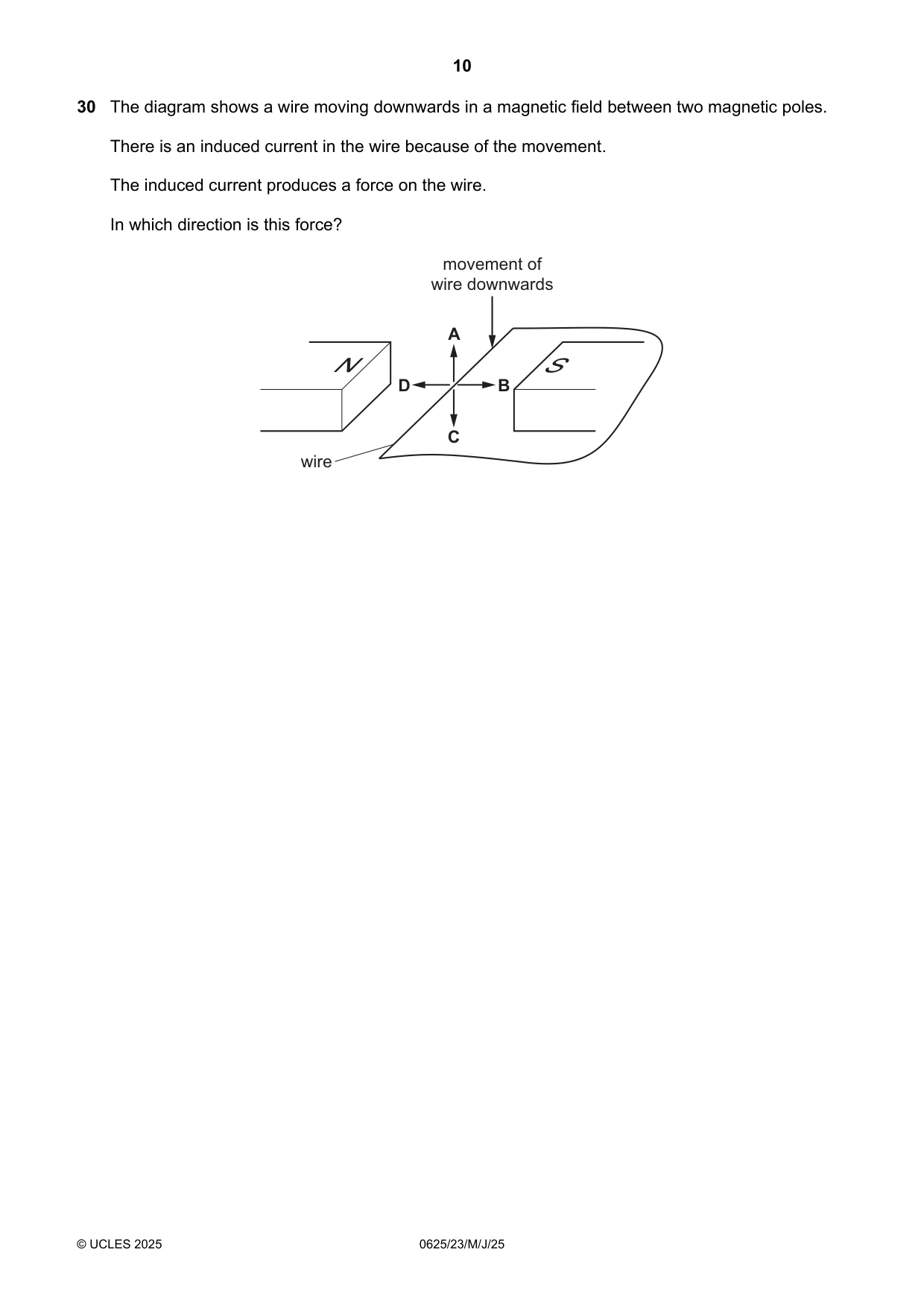
30 The diagram shows a wire moving downwards in a magnetic field between two magnetic poles. There is an induced current in the wire because of the movement. The induced current produces a force on the wire. In which direction is this force? movement of wire downwards A N S D B C wire
Mark scheme: A
Q31 · When the generator shown rotates, there is an a.c
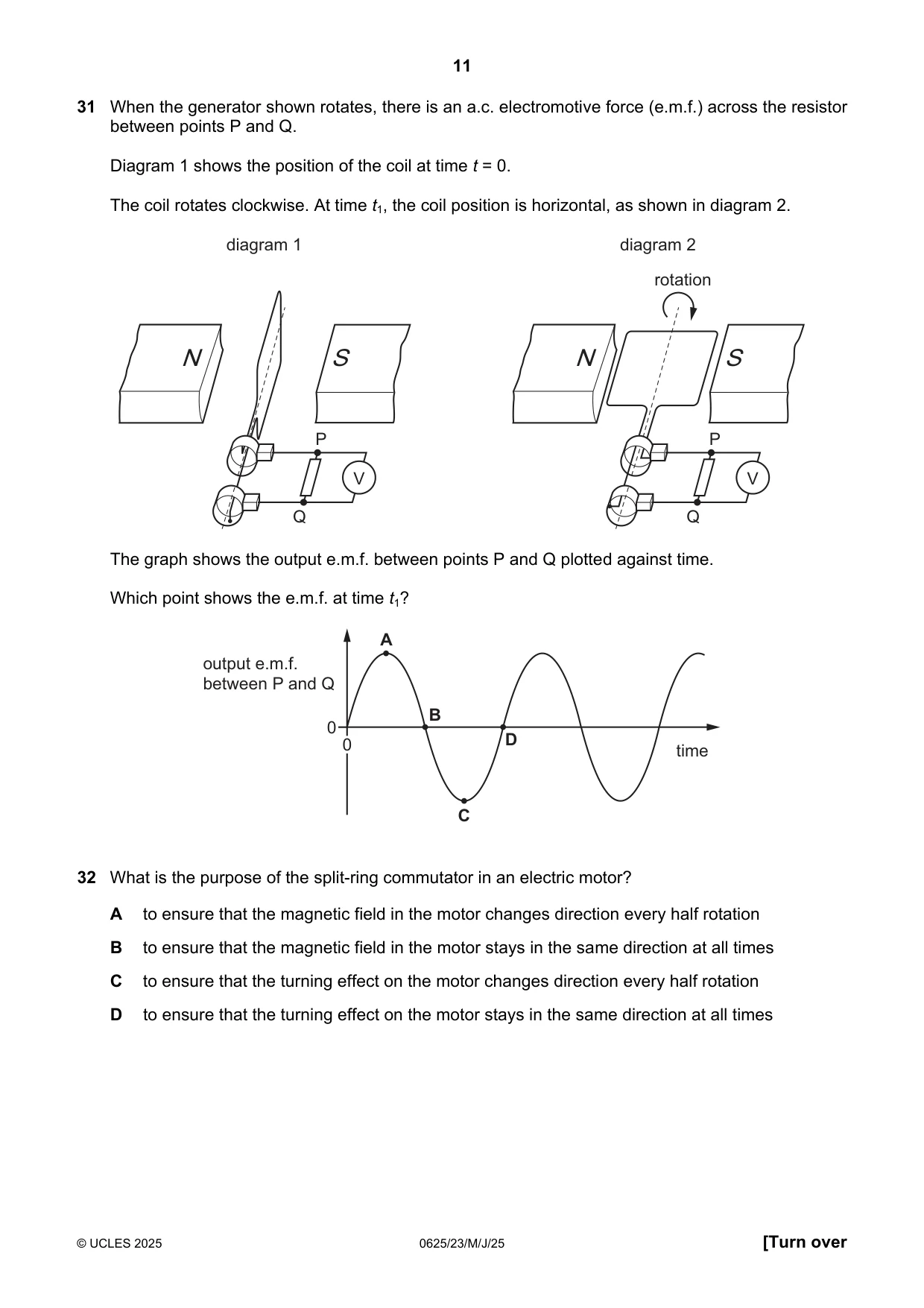
31 When the generator shown rotates, there is an a.c. electromotive force (e.m.f.) across the resistor between points P and Q. Diagram 1 shows the position of the coil at time t = 0. The coil rotates clockwise. At time t1, the coil position is horizontal, as shown in diagram 2. diagram 1 diagram 2 rotation N S N S P P V V Q Q The graph shows the output e.m.f. between points P and Q plotted against time. Which point shows the e.m.f. at time t1? A output e.m.f. between P and Q B 0 0 D time C
Mark scheme: A
Q32 · What is the purpose of the split-ring commutator in an electric motor?
32 What is the purpose of the split-ring commutator in an electric motor? A to ensure that the magnetic field in the motor changes direction every half rotation B to ensure that the magnetic field in the motor stays in the same direction at all times C to ensure that the turning effect on the motor changes direction every half rotation D to ensure that the turning effect on the motor stays in the same direction at all times
Mark scheme: D
Q33 · A beta particle has less mass than an alpha particle, but the speed of a beta particle…
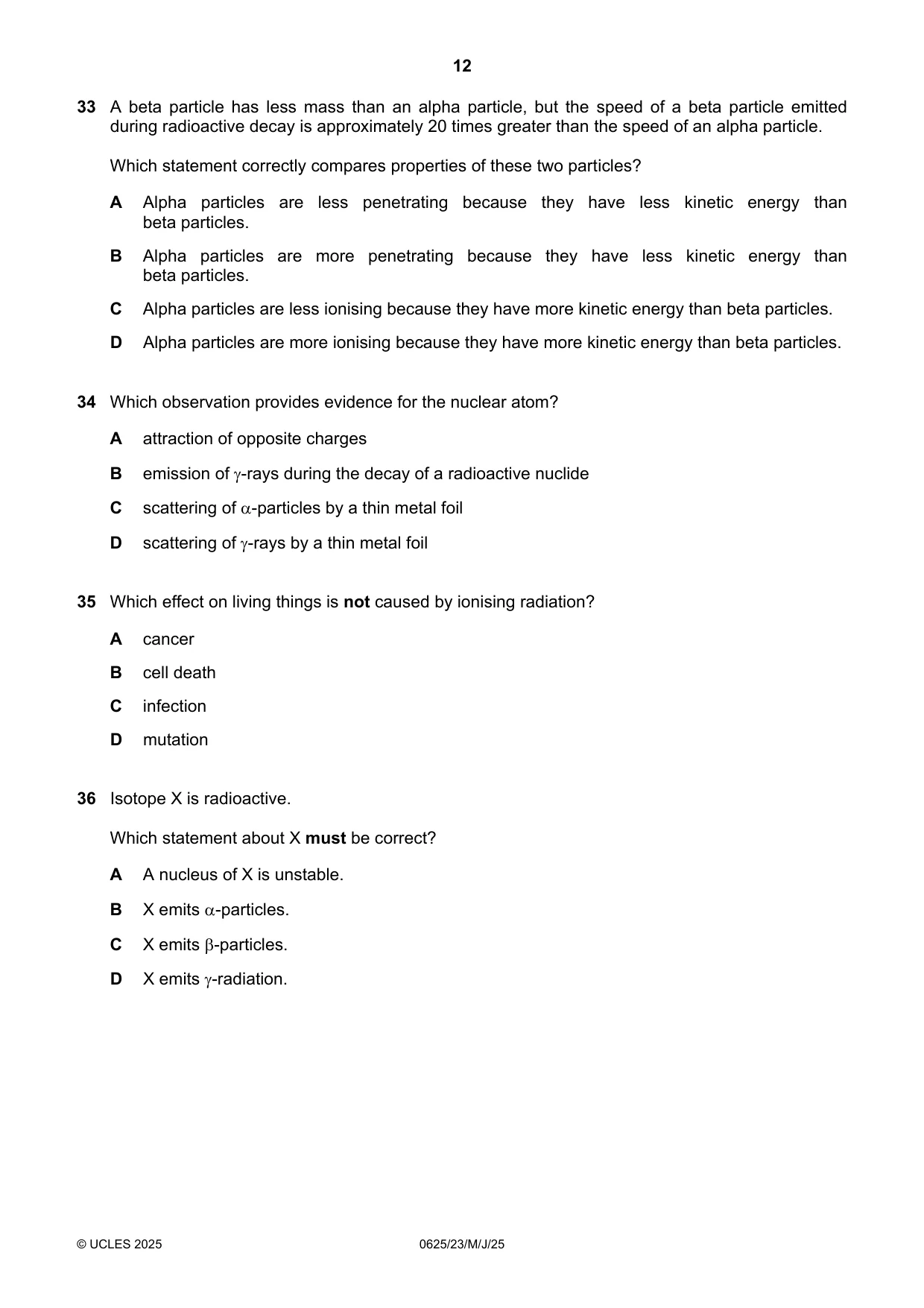
33 A beta particle has less mass than an alpha particle, but the speed of a beta particle emitted during radioactive decay is approximately 20 times greater than the speed of an alpha particle. Which statement correctly compares properties of these two particles? A Alpha particles are less penetrating because they have less kinetic energy than beta particles. B Alpha particles are more penetrating because they have less kinetic energy than beta particles. C Alpha particles are less ionising because they have more kinetic energy than beta particles. D Alpha particles are more ionising because they have more kinetic energy than beta particles.
Mark scheme: D
Q34 · Which observation provides evidence for the nuclear atom?
34 Which observation provides evidence for the nuclear atom? A attraction of opposite charges B emission of -rays during the decay of a radioactive nuclide C scattering of -particles by a thin metal foil D scattering of -rays by a thin metal foil
Mark scheme: C
Q35 · Which effect on living things is not caused by ionising radiation?
35 Which effect on living things is not caused by ionising radiation? A cancer B cell death C infection D mutation
Mark scheme: C
Q36 · Isotope X is radioactive
36 Isotope X is radioactive. Which statement about X must be correct? A A nucleus of X is unstable. B X emits -particles. C X emits -particles. D X emits -radiation.
Mark scheme: A
Q37 · An experiment is done to measure the radiation from a radioactive source
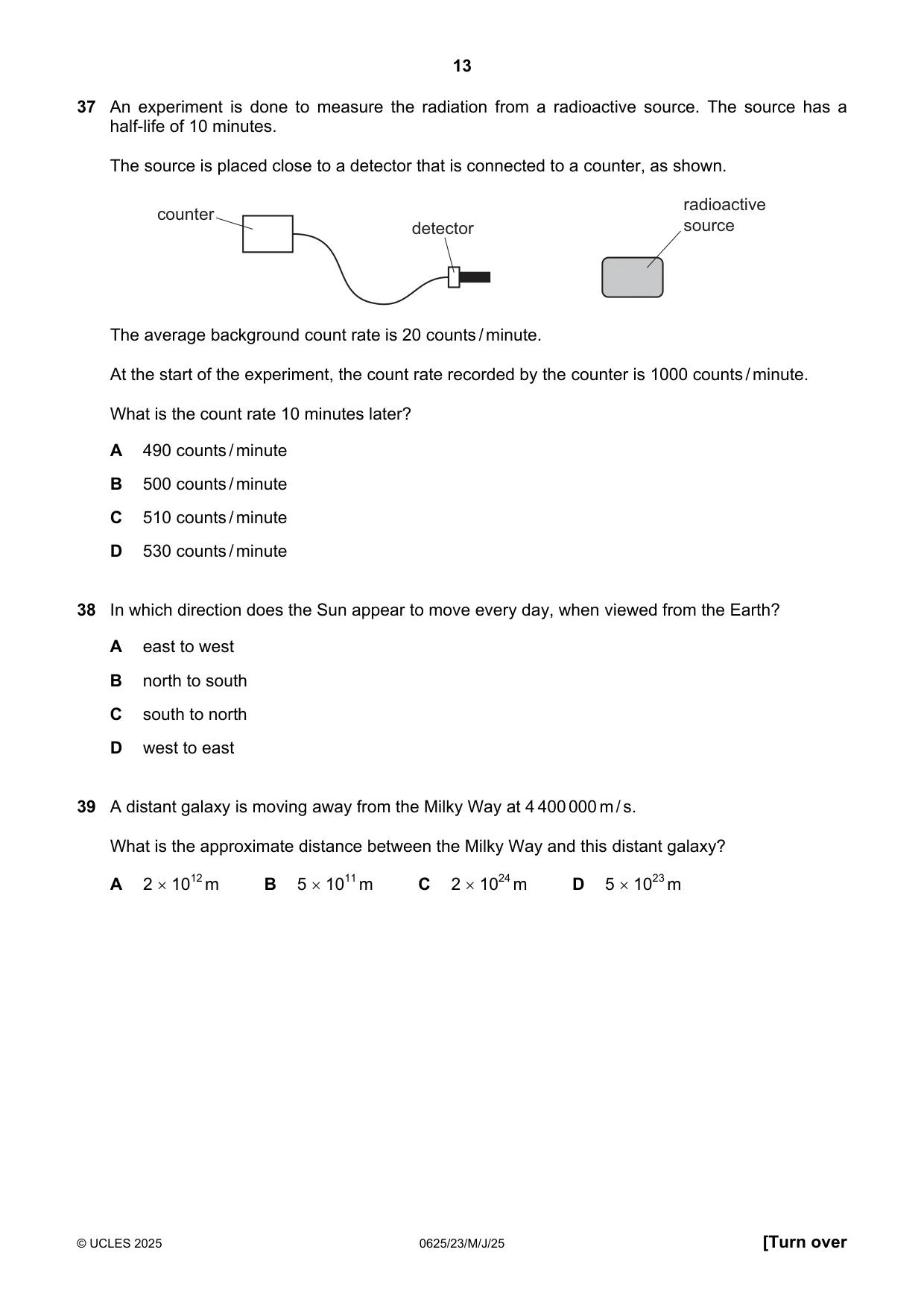
37 An experiment is done to measure the radiation from a radioactive source. The source has a half-life of 10 minutes. The source is placed close to a detector that is connected to a counter, as shown. radioactive counter detector source The average background count rate is 20 counts / minute. At the start of the experiment, the count rate recorded by the counter is 1000 counts / minute. What is the count rate 10 minutes later? A 490 counts / minute B 500 counts / minute C 510 counts / minute D 530 counts / minute
Mark scheme: C
Q38 · In which direction does the Sun appear to move every day, when viewed from the Earth?
38 In which direction does the Sun appear to move every day, when viewed from the Earth? A east to west B north to south C south to north D west to east
Mark scheme: A
Q39 · A distant galaxy is moving away from the Milky Way at 4 400 000 m / s
39 A distant galaxy is moving away from the Milky Way at 4 400 000 m / s. What is the approximate distance between the Milky Way and this distant galaxy? A 2 1012 m B 5 1011 m C 2 1024 m D 5 1023 m
Mark scheme: C
Q40 · The orbit of Mercury is closer to the Sun than the orbit of the Earth is to the Sun
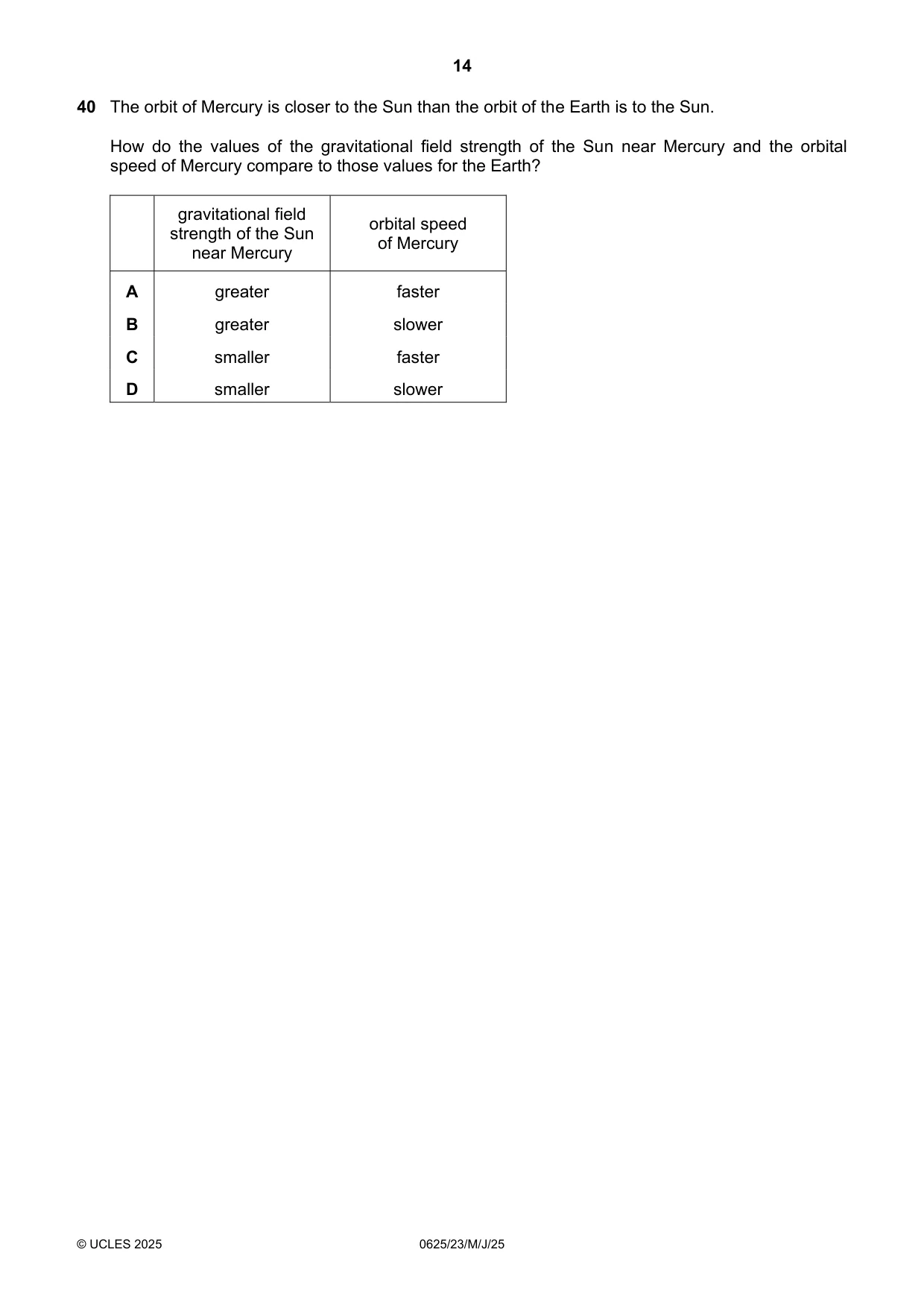
40 The orbit of Mercury is closer to the Sun than the orbit of the Earth is to the Sun. How do the values of the gravitational field strength of the Sun near Mercury and the orbital speed of Mercury compare to those values for the Earth? gravitational field orbital speed strength of the Sun of Mercury near Mercury A greater faster B greater slower C smaller faster D smaller slower
Mark scheme: A
What was in this paper
The subtopics covered by these 40 questions, and how many questions each got. Open one in a new tab to see every Cambridge question on it.
4Electrical quantities3Electromagnetic effects3Kinetic particle model of matter3Forces2General properties of waves2Light2Motion2Sound2The Earth and the Solar System2Thermal properties and temperature2Transfer of thermal energy2Density1Electric circuits1Electrical safety1Electromagnetic spectrum1Energy, work and power1Mass and weight1Momentum1Physical quantities and measurement techniques1Simple phenomena of magnetism1Stars and the Universe1The nuclear model of the atom1What you needed in this session
Cambridge’s own grade thresholds for 2025 May/June, Paper 2 · Variant 3. A higher threshold means an easier paper — the bar moves with how the cohort did.