Cambridge IGCSE Physics 0625 — 2016 Oct/Nov Paper 2 · Variant 2
0625/22/O/N/16 · 40 questions · 40 marks · ≈45 min
The question paper and its mark scheme, free to read here and free to download. This is Cambridge’s own paper, exactly as it was sat.
Question paper16 pages
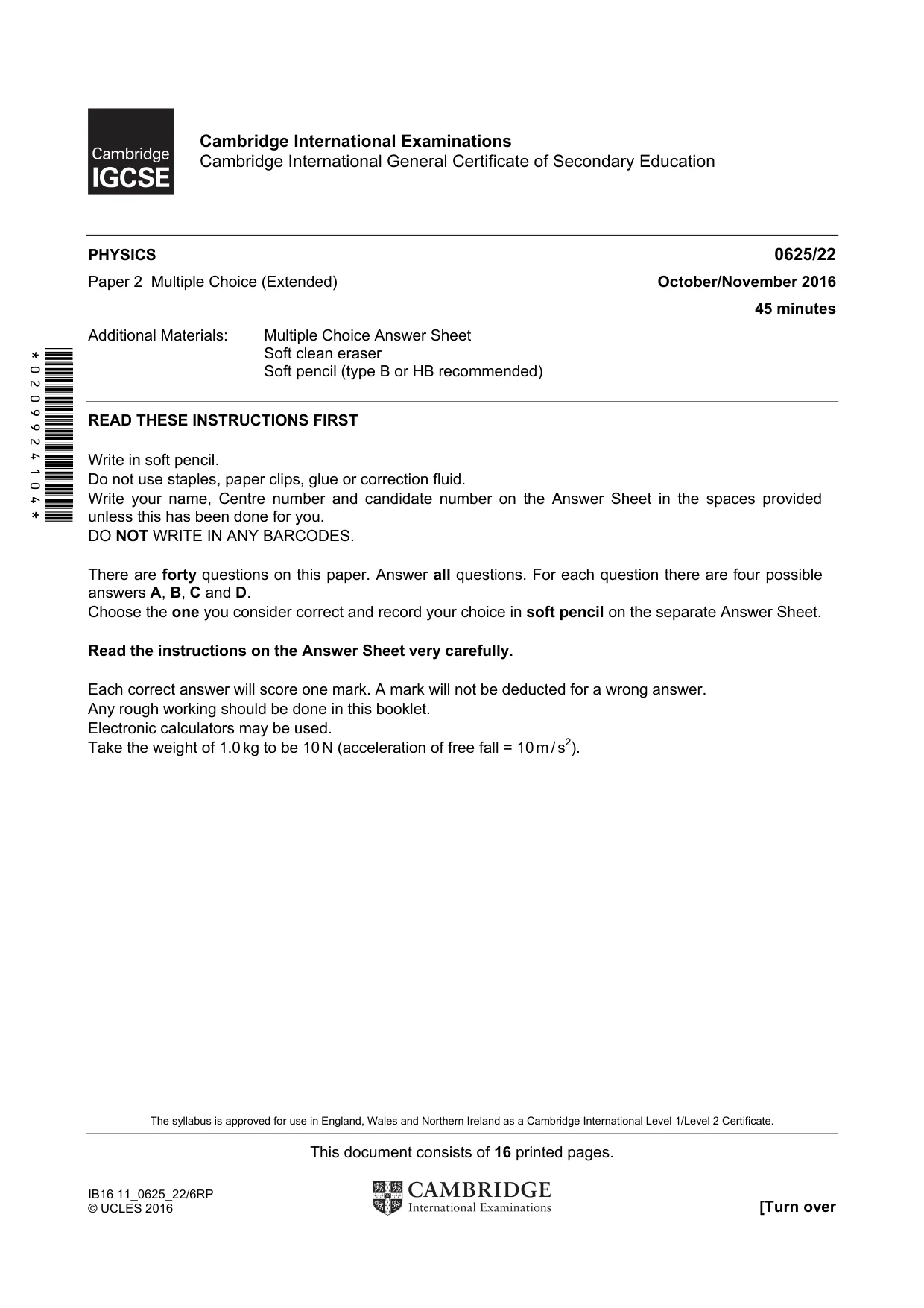
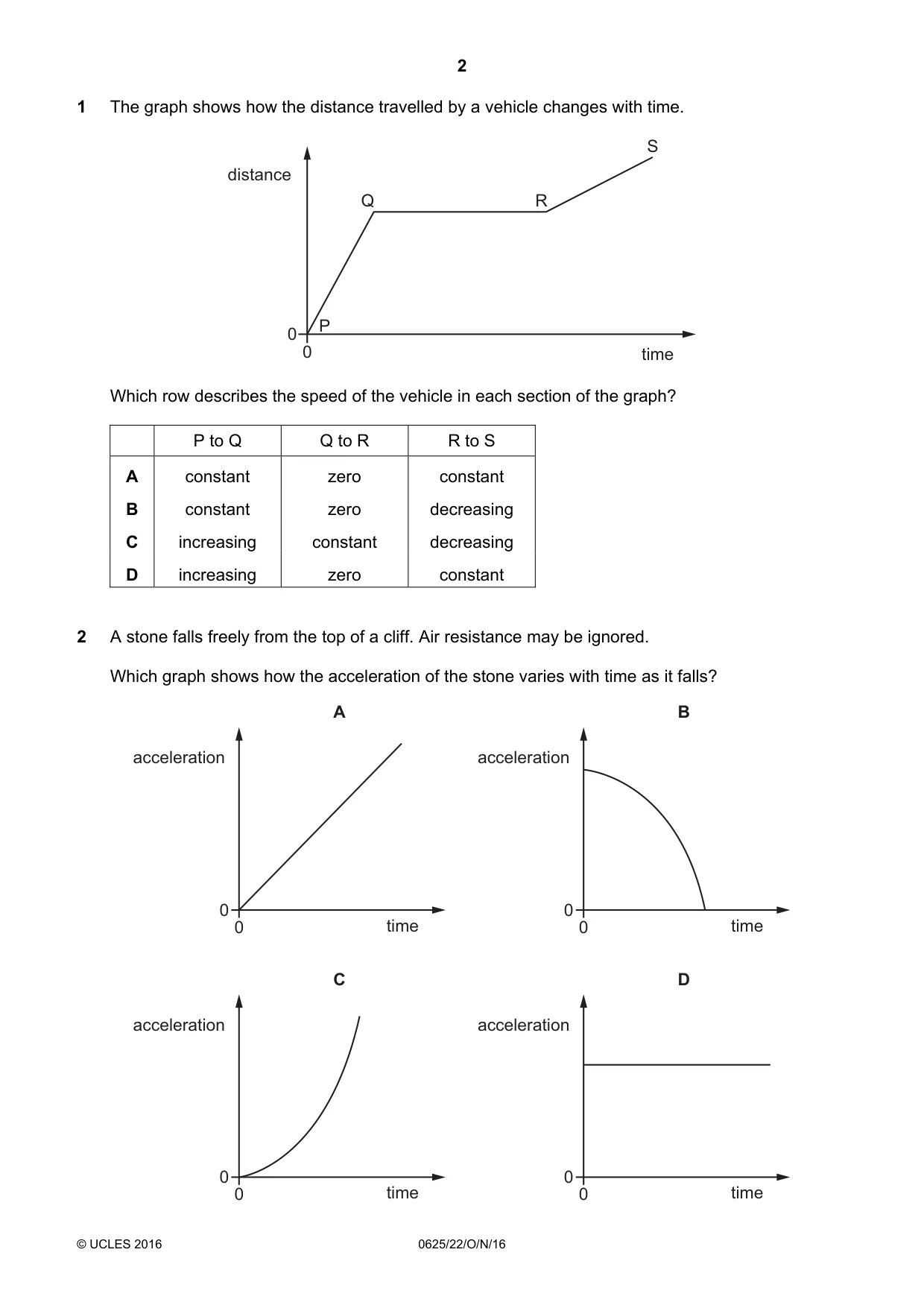
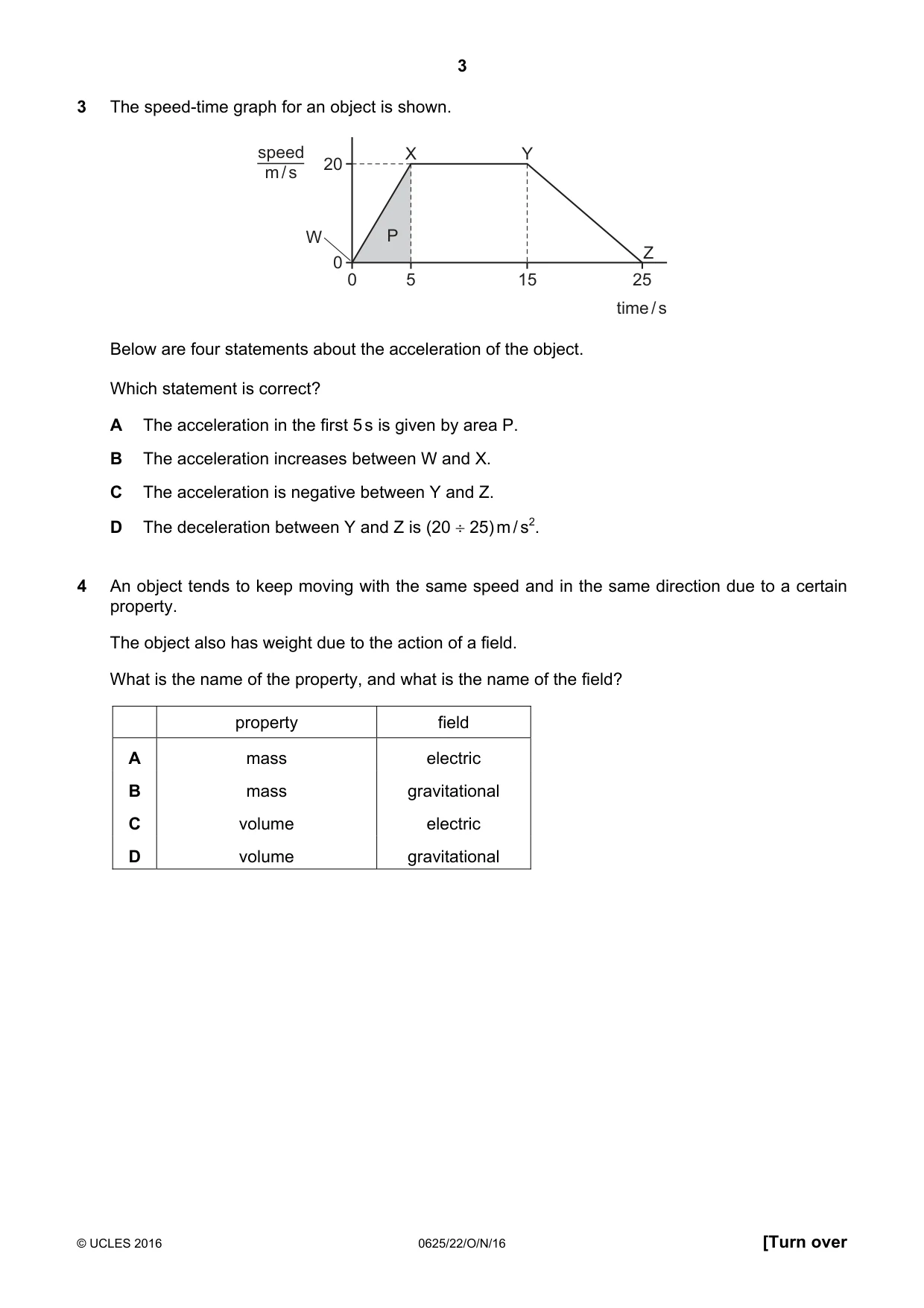
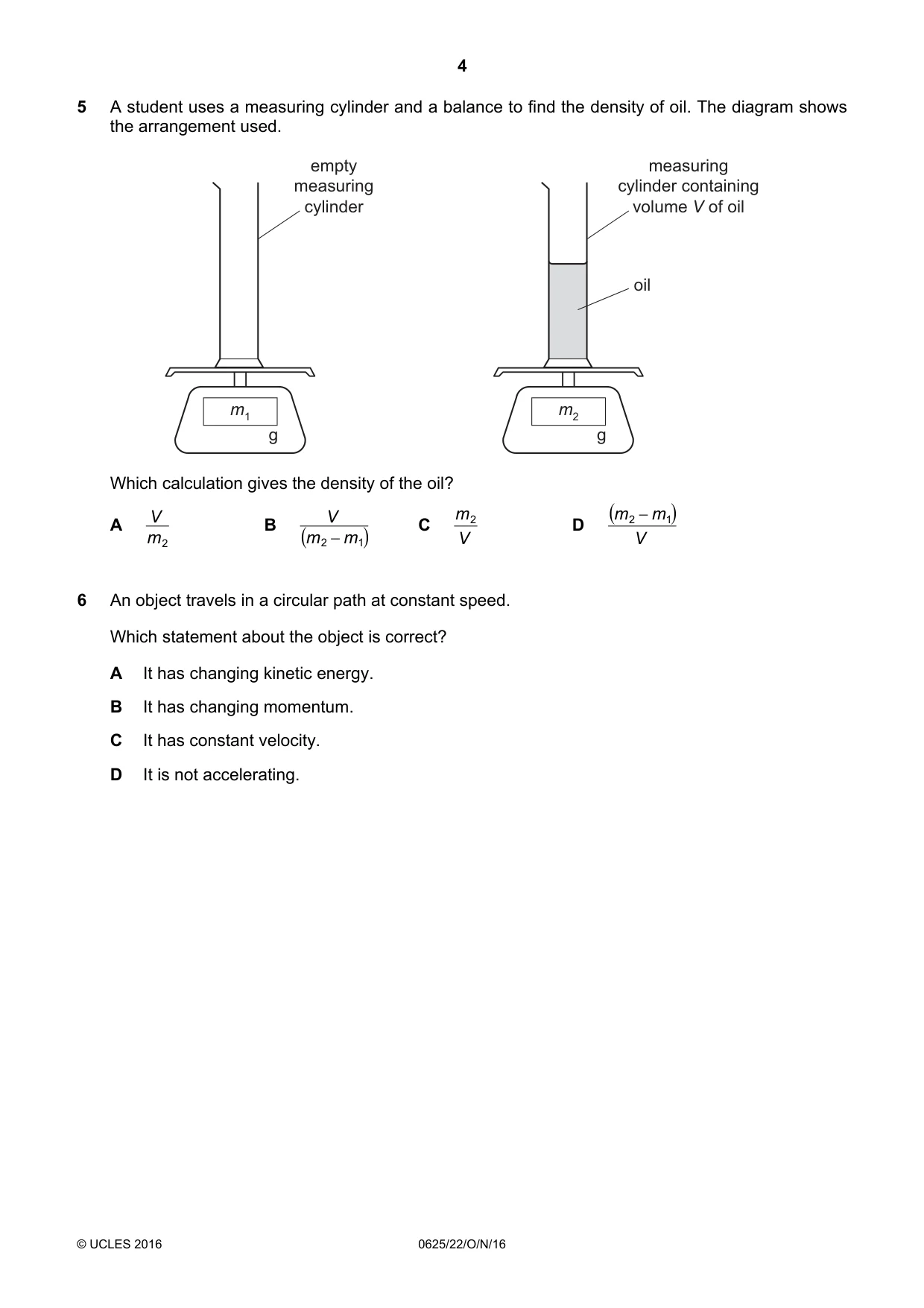
Mark scheme2 pages
Answers below. Sit the paper first if you are practising.
Questions as text
Q1 · The graph shows how the distance travelled by a vehicle changes with time
1 The graph shows how the distance travelled by a vehicle changes with time. S distance Q R P 0 0 time Which row describes the speed of the vehicle in each section of the graph? P to Q Q to R R to S A constant zero constant B constant zero decreasing C increasing constant decreasing D increasing zero constant
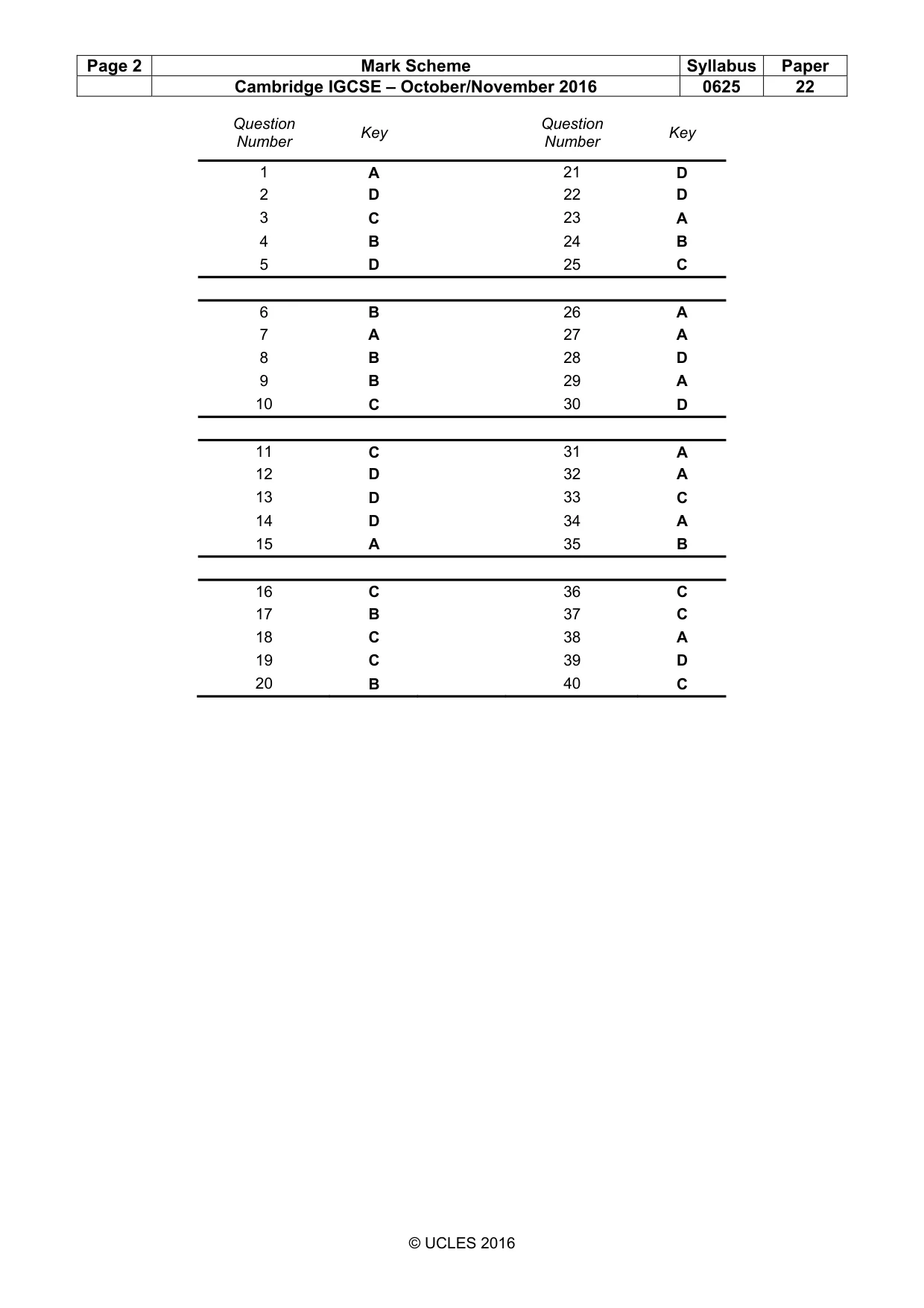
Mark scheme: A
Q2 · A stone falls freely from the top of a cliff
2 A stone falls freely from the top of a cliff. Air resistance may be ignored. Which graph shows how the acceleration of the stone varies with time as it falls? A B acceleration acceleration 0 0 0 time 0 time C D acceleration acceleration 0 0 0 time 0 time
Mark scheme: D
Q3 · The speed-time graph for an object is shown
3 The speed-time graph for an object is shown. speed X Y 20 m / s W P Z 0 0 5 15 25 time / s Below are four statements about the acceleration of the object. Which statement is correct? A The acceleration in the first 5 s is given by area P. B The acceleration increases between W and X. C The acceleration is negative between Y and Z. D The deceleration between Y and Z is (20 ÷ 25) m / s2.
Mark scheme: C
Q4 · An object tends to keep moving with the same speed and in the same direction due to a…
4 An object tends to keep moving with the same speed and in the same direction due to a certain property. The object also has weight due to the action of a field. What is the name of the property, and what is the name of the field? property field A mass electric B mass gravitational C volume electric D volume gravitational
Mark scheme: B
Q5 · A student uses a measuring cylinder and a balance to find the density of oil
5 A student uses a measuring cylinder and a balance to find the density of oil. The diagram shows the arrangement used. empty measuring measuring cylinder containing cylinder volume V of oil oil m1 m2 g g Which calculation gives the density of the oil? ( 2 − ) V V m2 m m A B ( ) C D 1 m m − m V V 2 2 1
Mark scheme: D
Q6 · An object travels in a circular path at constant speed
6 An object travels in a circular path at constant speed. Which statement about the object is correct? A It has changing kinetic energy. B It has changing momentum. C It has constant velocity. D It is not accelerating.
Mark scheme: B
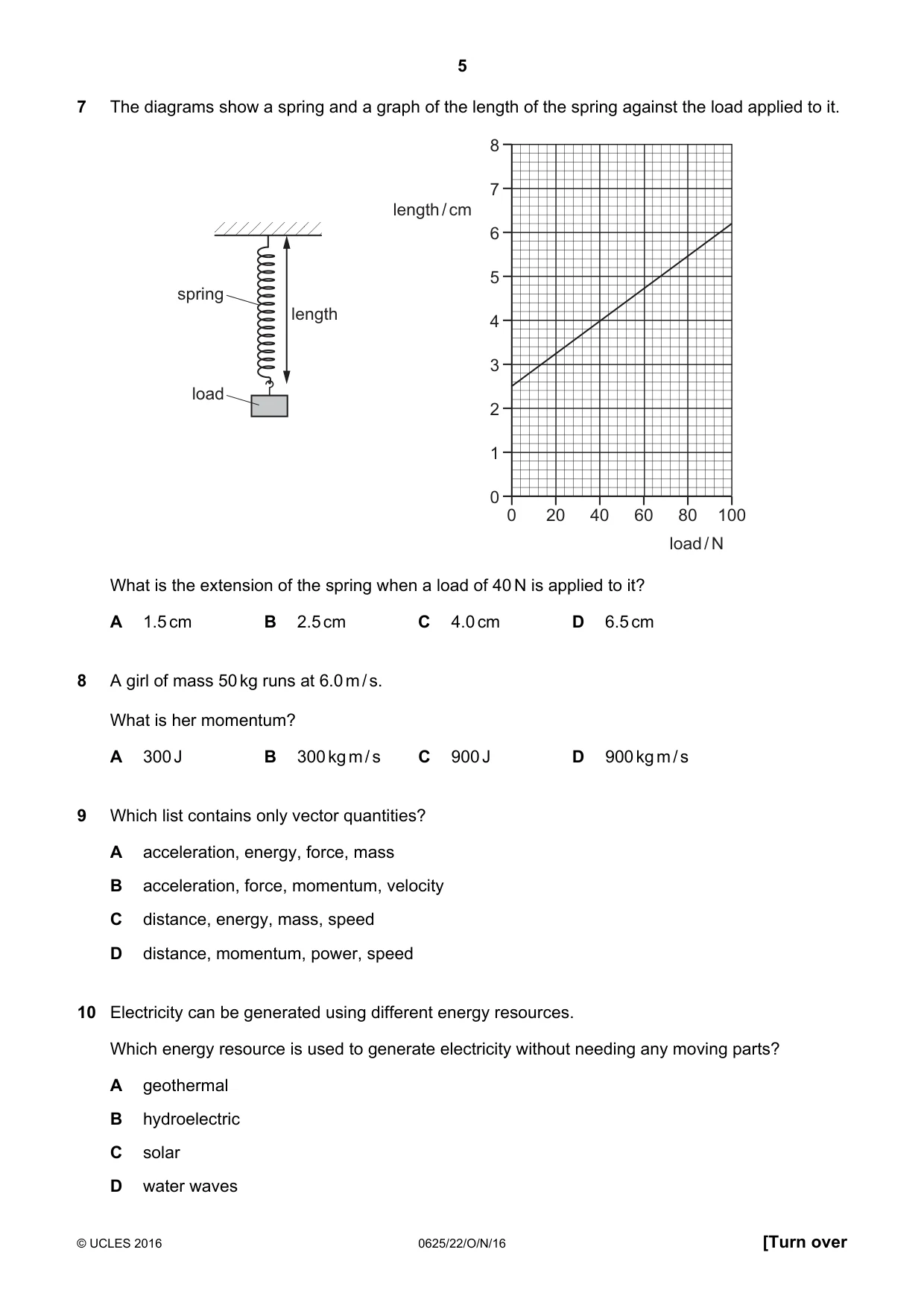
Q7 · The diagrams show a spring and a graph of the length of the spring against the load…
7 The diagrams show a spring and a graph of the length of the spring against the load applied to it. 8 7 length / cm 6 5 spring length 4 3 load 2 1 0 0 20 40 60 80 100 load / N What is the extension of the spring when a load of 40 N is applied to it? A 1.5 cm B 2.5 cm C 4.0 cm D 6.5 cm
Mark scheme: A
Q8 · A girl of mass 50 kg runs at 6.0 m / s
8 A girl of mass 50 kg runs at 6.0 m / s. What is her momentum? A 300 J B 300 kg m / s C 900 J D 900 kg m / s
Mark scheme: B
Q9 · Which list contains only vector quantities?
9 Which list contains only vector quantities? A acceleration, energy, force, mass B acceleration, force, momentum, velocity C distance, energy, mass, speed D distance, momentum, power, speed
Mark scheme: B
More questions on Physical quantities and measurement techniques
Q10 · Electricity can be generated using different energy resources
10 Electricity can be generated using different energy resources. Which energy resource is used to generate electricity without needing any moving parts? A geothermal B hydroelectric C solar D water waves
Mark scheme: C
Q11 · A lamp has a power input of 5.0 W
11 A lamp has a power input of 5.0 W. It wastes 1.0 W of power heating the surroundings. What is the efficiency of the lamp? A 20% B 50% C 80% D 120%
Mark scheme: C
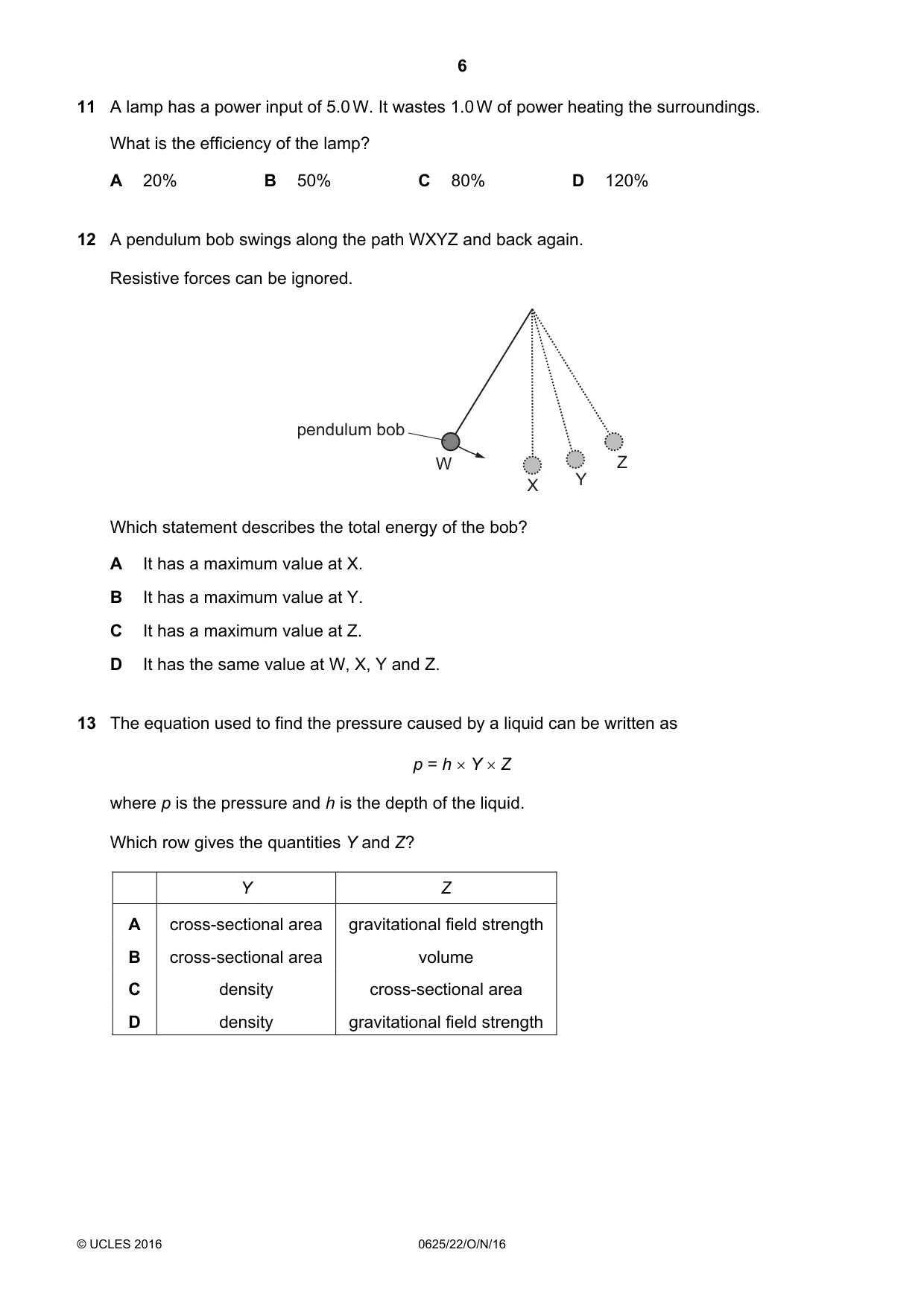
Q12 · A pendulum bob swings along the path WXYZ and back again
12 A pendulum bob swings along the path WXYZ and back again. Resistive forces can be ignored. pendulum bob W Z X Y Which statement describes the total energy of the bob? A It has a maximum value at X. B It has a maximum value at Y. C It has a maximum value at Z. D It has the same value at W, X, Y and Z.
Mark scheme: D
Q13 · The equation used to find the pressure caused by a liquid can be written as p = h × Y × Z…
13 The equation used to find the pressure caused by a liquid can be written as p = h × Y × Z where p is the pressure and h is the depth of the liquid. Which row gives the quantities Y and Z? Y Z A cross-sectional area gravitational field strength B cross-sectional area volume C density cross-sectional area D density gravitational field strength
Mark scheme: D
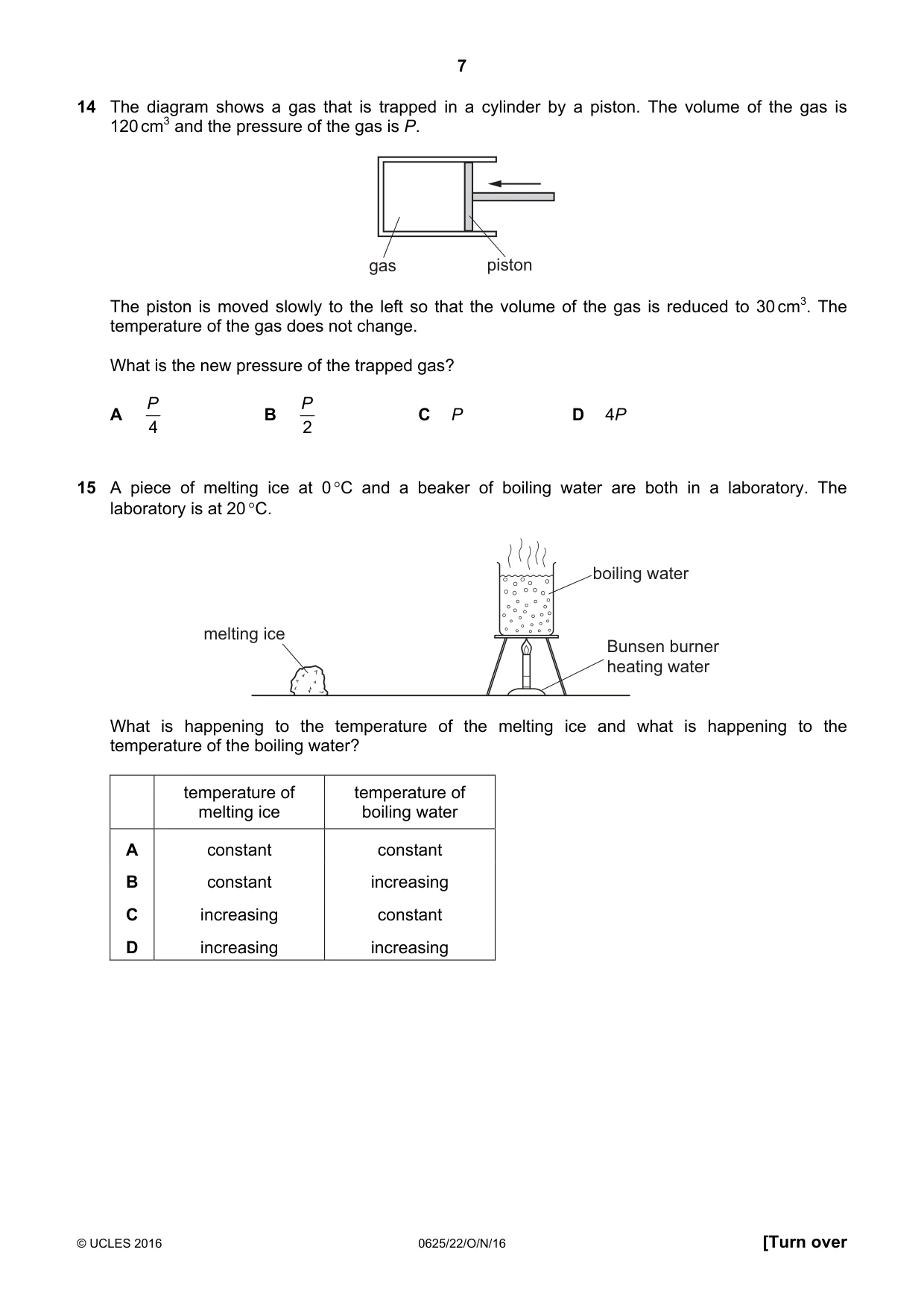
Q14 · The diagram shows a gas that is trapped in a cylinder by a piston
14 The diagram shows a gas that is trapped in a cylinder by a piston. The volume of the gas is 120 cm3 and the pressure of the gas is P. gas piston The piston is moved slowly to the left so that the volume of the gas is reduced to 30 cm3. The temperature of the gas does not change. What is the new pressure of the trapped gas? P P A B C P D 4P 4 2
Mark scheme: D
Q15 · A piece of melting ice at 0 °C and a beaker of boiling water are both in a laboratory
15 A piece of melting ice at 0 °C and a beaker of boiling water are both in a laboratory. The laboratory is at 20 °C. boiling water melting ice Bunsen burner heating water What is happening to the temperature of the melting ice and what is happening to the temperature of the boiling water? temperature of temperature of melting ice boiling water A constant constant B constant increasing C increasing constant D increasing increasing
Mark scheme: A
Q16 · A puddle of water is formed after a rain shower on a windy day
16 A puddle of water is formed after a rain shower on a windy day. Which statement explains the effect of the wind on the rate of evaporation of the water in the puddle? A The wind gives molecules in the water extra kinetic energy and so increases the rate of evaporation. B The wind removes evaporated water from near the surface and so decreases the rate of evaporation. C The wind removes evaporated water from near the surface and so increases the rate of evaporation. D The wind takes energy from molecules near the surface and so decreases the rate of evaporation.
Mark scheme: C
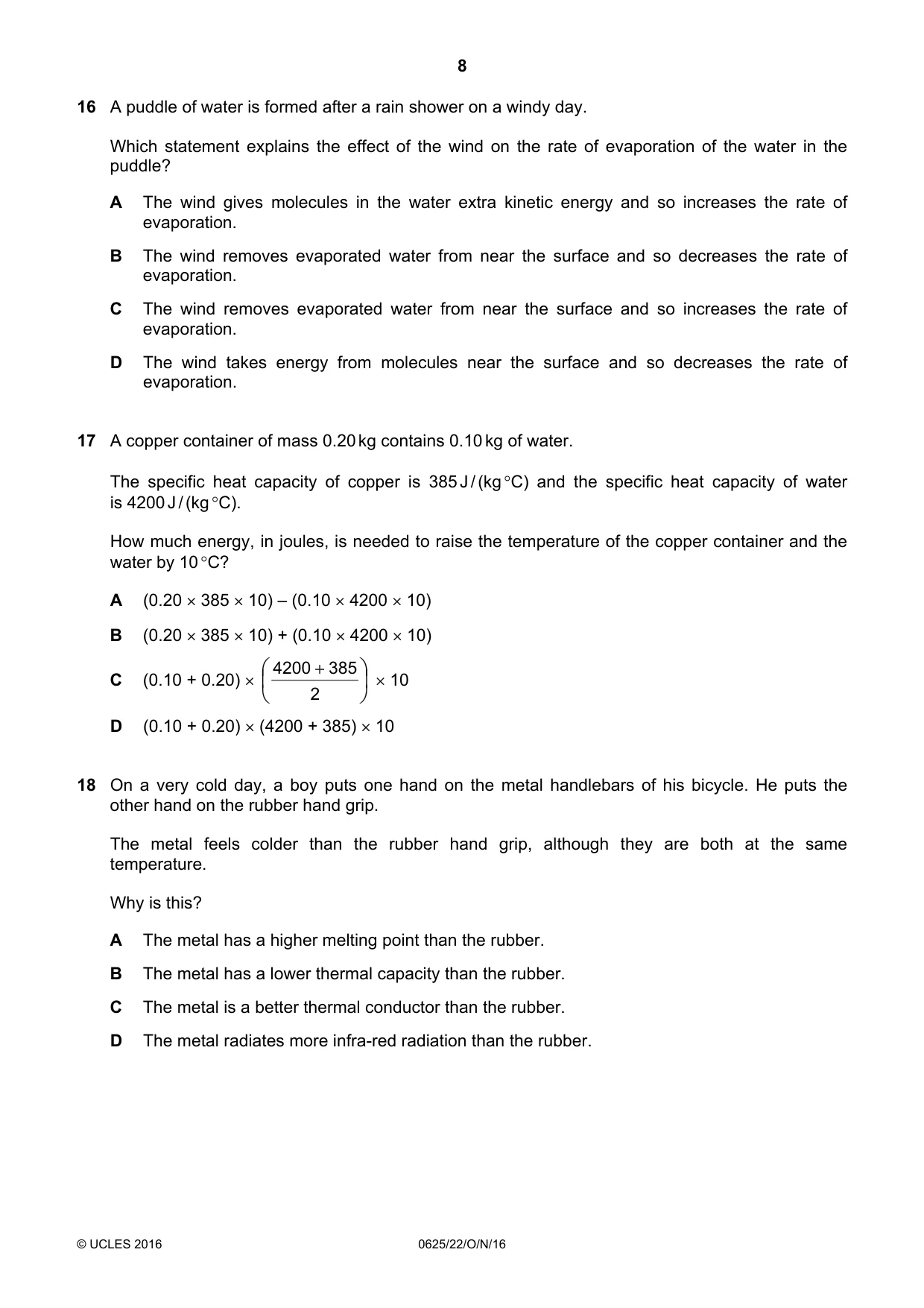
Q17 · A copper container of mass 0.20 kg contains 0.10 kg of water
17 A copper container of mass 0.20 kg contains 0.10 kg of water. The specific heat capacity of copper is 385 J / (kg °C) and the specific heat capacity of water is 4200 J / (kg °C). How much energy, in joules, is needed to raise the temperature of the copper container and the water by 10 °C? A (0.20 × 385 × 10) – (0.10 × 4200 × 10) B (0.20 × 385 × 10) + (0.10 × 4200 × 10) 4200 + 385 C (0.10 + 0.20) × × 10 2 D (0.10 + 0.20) × (4200 + 385) × 10
Mark scheme: B
Q18 · On a very cold day, a boy puts one hand on the metal handlebars of his bicycle
18 On a very cold day, a boy puts one hand on the metal handlebars of his bicycle. He puts the other hand on the rubber hand grip. The metal feels colder than the rubber hand grip, although they are both at the same temperature. Why is this? A The metal has a higher melting point than the rubber. B The metal has a lower thermal capacity than the rubber. C The metal is a better thermal conductor than the rubber. D The metal radiates more infra-red radiation than the rubber.
Mark scheme: C
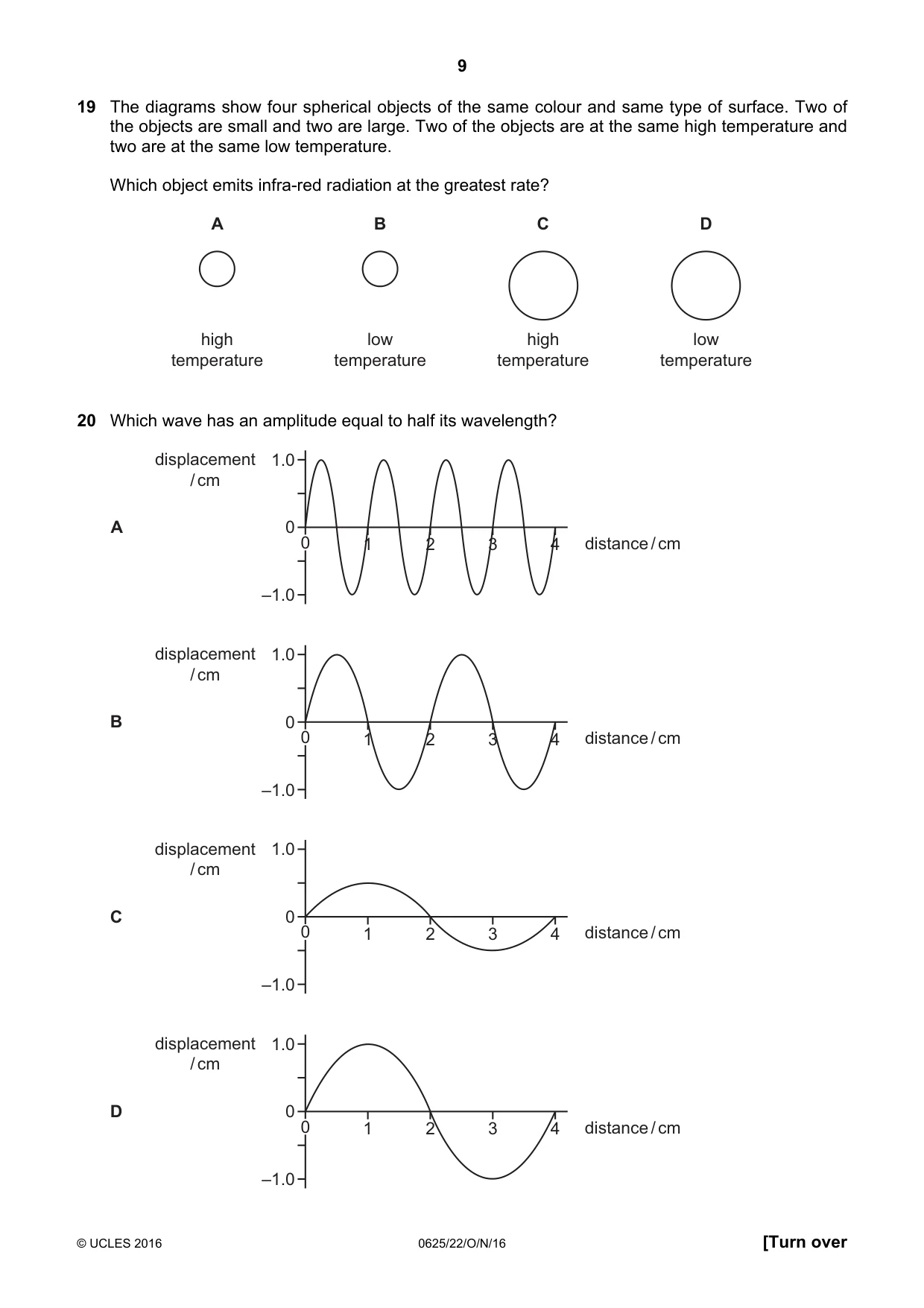
Q19 · The diagrams show four spherical objects of the same colour and same type of surface
19 The diagrams show four spherical objects of the same colour and same type of surface. Two of the objects are small and two are large. Two of the objects are at the same high temperature and two are at the same low temperature. Which object emits infra-red radiation at the greatest rate? A B C D high low high low temperature temperature temperature temperature
Mark scheme: C
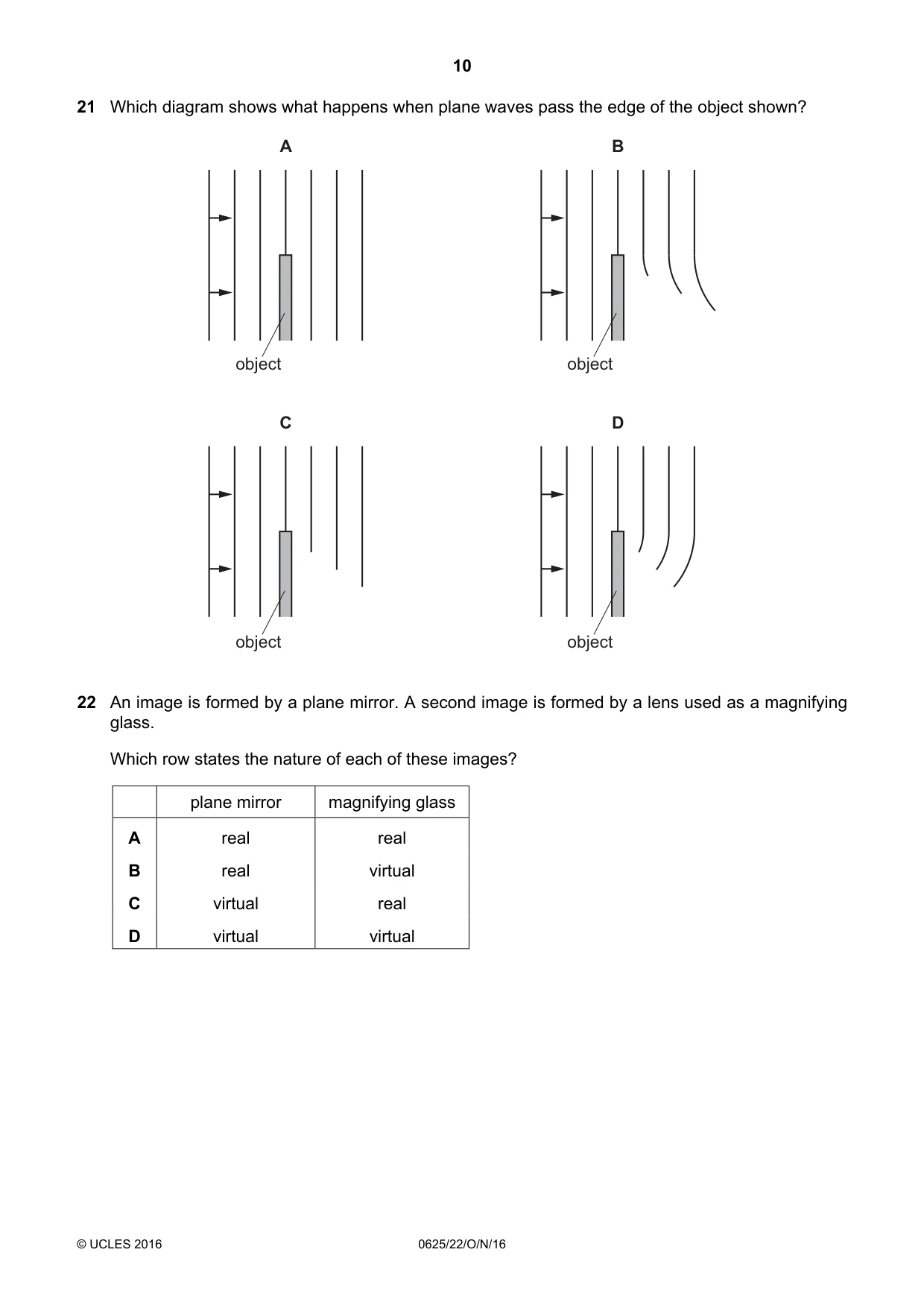
Q20 · Which wave has an amplitude equal to half its wavelength?
20 Which wave has an amplitude equal to half its wavelength? displacement 1.0 / cm A 0 0 1 2 3 4 distance / cm –1.0 displacement 1.0 / cm B 0 0 1 2 3 4 distance / cm –1.0 displacement 1.0 / cm C 0 0 1 2 3 4 distance / cm –1.0 displacement 1.0 / cm D 0 0 1 2 3 4 distance / cm –1.0
Mark scheme: B
Q21 · Which diagram shows what happens when plane waves pass the edge of the object shown?
21 Which diagram shows what happens when plane waves pass the edge of the object shown? A B object object C D object object
Mark scheme: D
Q22 · An image is formed by a plane mirror
22 An image is formed by a plane mirror. A second image is formed by a lens used as a magnifying glass. Which row states the nature of each of these images? plane mirror magnifying glass A real real B real virtual C virtual real D virtual virtual
Mark scheme: D
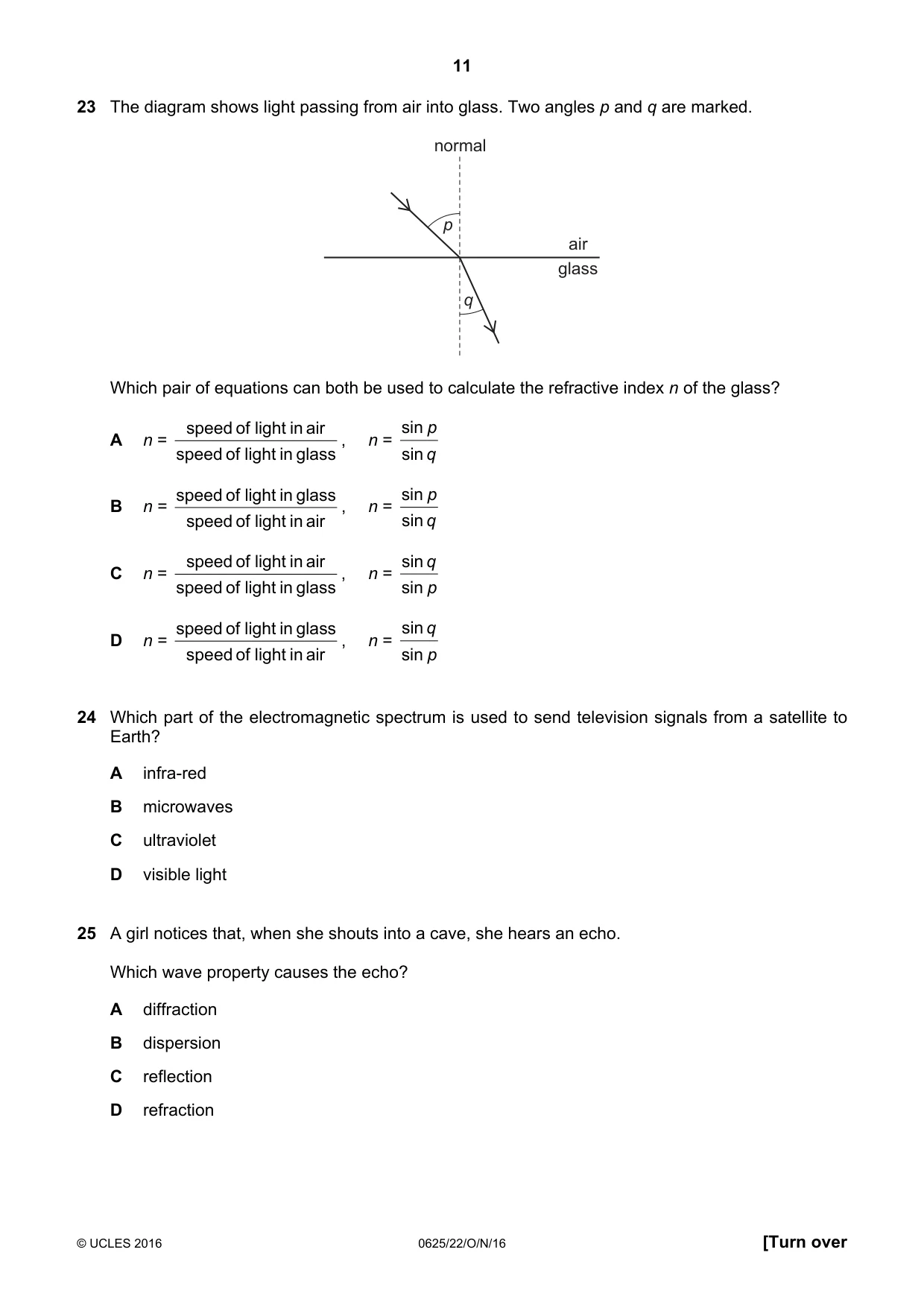
Q23 · The diagram shows light passing from air into glass
23 The diagram shows light passing from air into glass. Two angles p and q are marked. normal p air glass q Which pair of equations can both be used to calculate the refractive index n of the glass? speed of light in air sin p A n = , n = speed of light in glass sin q speed of light in glass sin p B n = , n = speed of light in air sin q speed of light in air sin q C n = , n = speed of light in glass sin p speed of light in glass sin q D n = , n = speed of light in air sin p
Mark scheme: A
Q24 · Which part of the electromagnetic spectrum is used to send television signals from a…
24 Which part of the electromagnetic spectrum is used to send television signals from a satellite to Earth? A infra-red B microwaves C ultraviolet D visible light
Mark scheme: B
Q25 · A girl notices that, when she shouts into a cave, she hears an echo
25 A girl notices that, when she shouts into a cave, she hears an echo. Which wave property causes the echo? A diffraction B dispersion C reflection D refraction
Mark scheme: C
Q26 · Which property of a sound wave affects the loudness of the sound?
26 Which property of a sound wave affects the loudness of the sound? A amplitude B frequency C speed D wavelength
Mark scheme: A
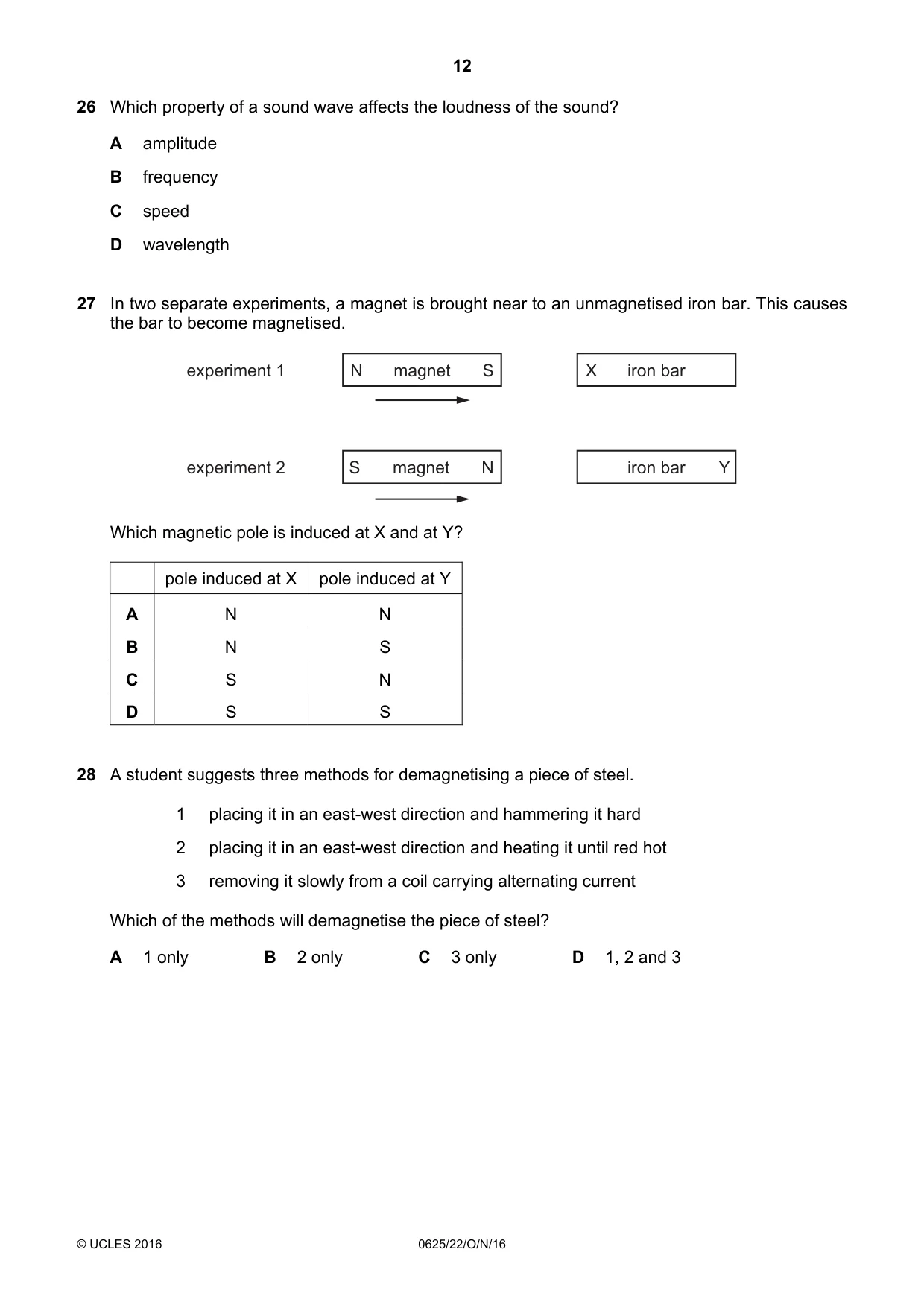
Q27 · In two separate experiments, a magnet is brought near to an unmagnetised iron bar
27 In two separate experiments, a magnet is brought near to an unmagnetised iron bar. This causes the bar to become magnetised. experiment 1 N magnet S X iron bar experiment 2 S magnet N iron bar Y Which magnetic pole is induced at X and at Y? pole induced at X pole induced at Y A N N B N S C S N D S S
Mark scheme: A
Q28 · A student suggests three methods for demagnetising a piece of steel
28 A student suggests three methods for demagnetising a piece of steel. 1 placing it in an east-west direction and hammering it hard 2 placing it in an east-west direction and heating it until red hot 3 removing it slowly from a coil carrying alternating current Which of the methods will demagnetise the piece of steel? A 1 only B 2 only C 3 only D 1, 2 and 3
Mark scheme: D
Q29 · The diagram shows a lamp in a circuit
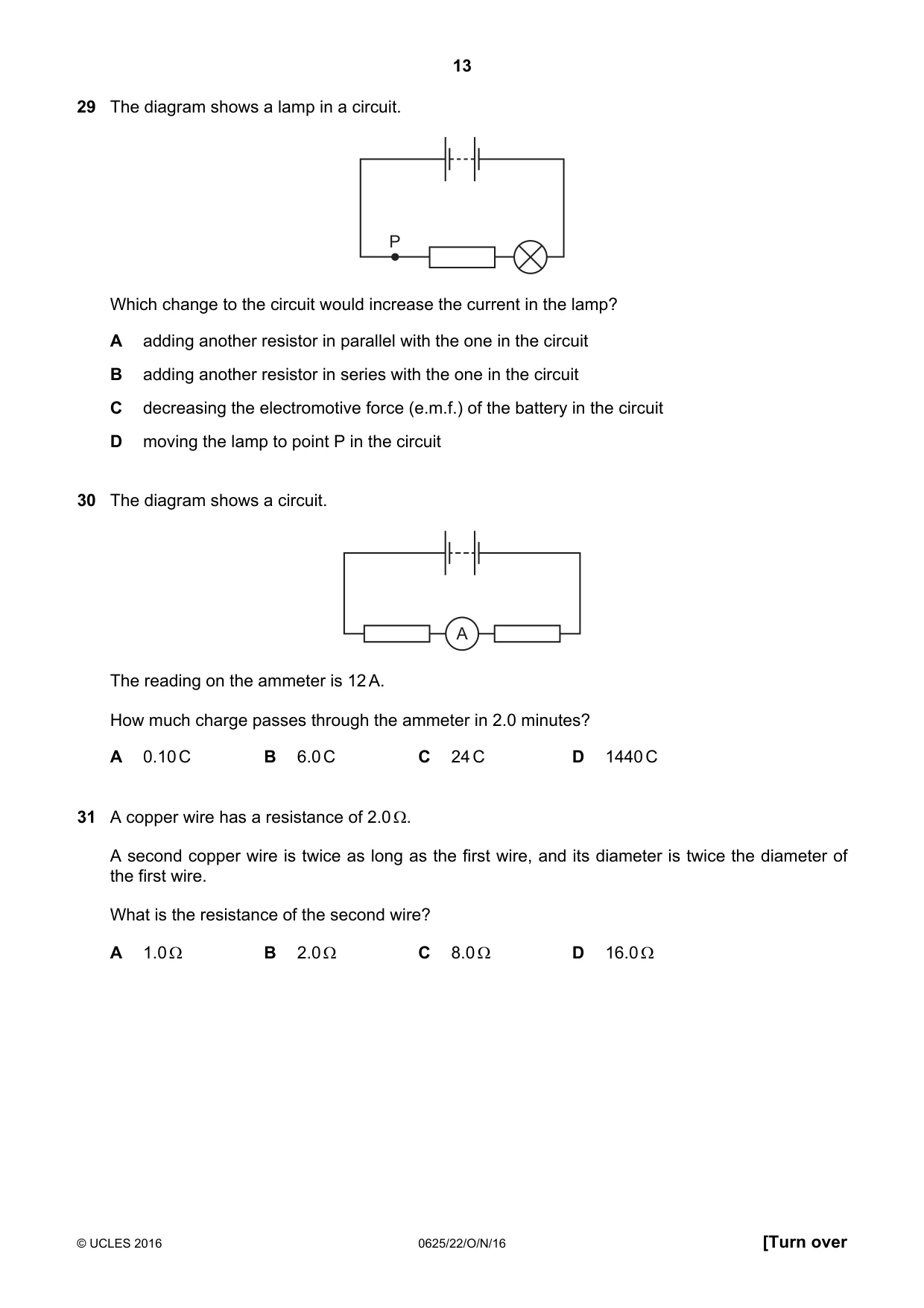
29 The diagram shows a lamp in a circuit. P Which change to the circuit would increase the current in the lamp? A adding another resistor in parallel with the one in the circuit B adding another resistor in series with the one in the circuit C decreasing the electromotive force (e.m.f.) of the battery in the circuit D moving the lamp to point P in the circuit
Mark scheme: A
Q30 · The diagram shows a circuit
30 The diagram shows a circuit. A The reading on the ammeter is 12 A. How much charge passes through the ammeter in 2.0 minutes? A 0.10 C B 6.0 C C 24 C D 1440 C
Mark scheme: D
Q31 · A copper wire has a resistance of 2.0 Ω
31 A copper wire has a resistance of 2.0 Ω. A second copper wire is twice as long as the first wire, and its diameter is twice the diameter of the first wire. What is the resistance of the second wire? A 1.0 Ω B 2.0 Ω C 8.0 Ω D 16.0 Ω
Mark scheme: A
Q32 · Which combination of resistors in parallel has an effective resistance of 0.50 Ω?
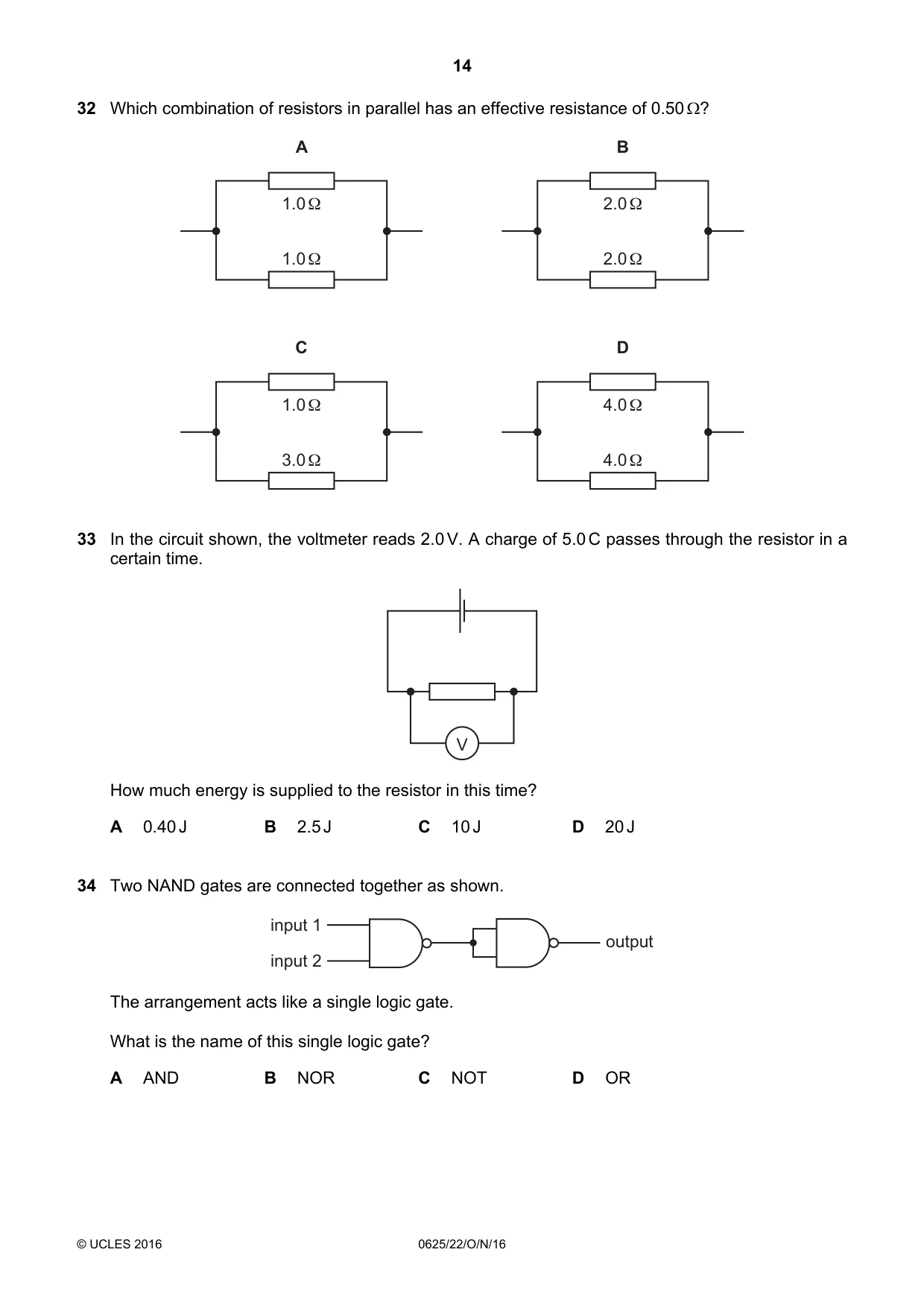
32 Which combination of resistors in parallel has an effective resistance of 0.50 Ω? A B 1.0 Ω 2.0 Ω 1.0 Ω 2.0 Ω C D 1.0 Ω 4.0 Ω 3.0 Ω 4.0 Ω
Mark scheme: A
Q33 · In the circuit shown, the voltmeter reads 2.0 V
33 In the circuit shown, the voltmeter reads 2.0 V. A charge of 5.0 C passes through the resistor in a certain time. V How much energy is supplied to the resistor in this time? A 0.40 J B 2.5 J C 10 J D 20 J
Mark scheme: C
Q34 · Two NAND gates are connected together as shown
34 Two NAND gates are connected together as shown. input 1 output input 2 The arrangement acts like a single logic gate. What is the name of this single logic gate? A AND B NOR C NOT D OR
Mark scheme: A
Q35 · An electric kettle has a metal casing
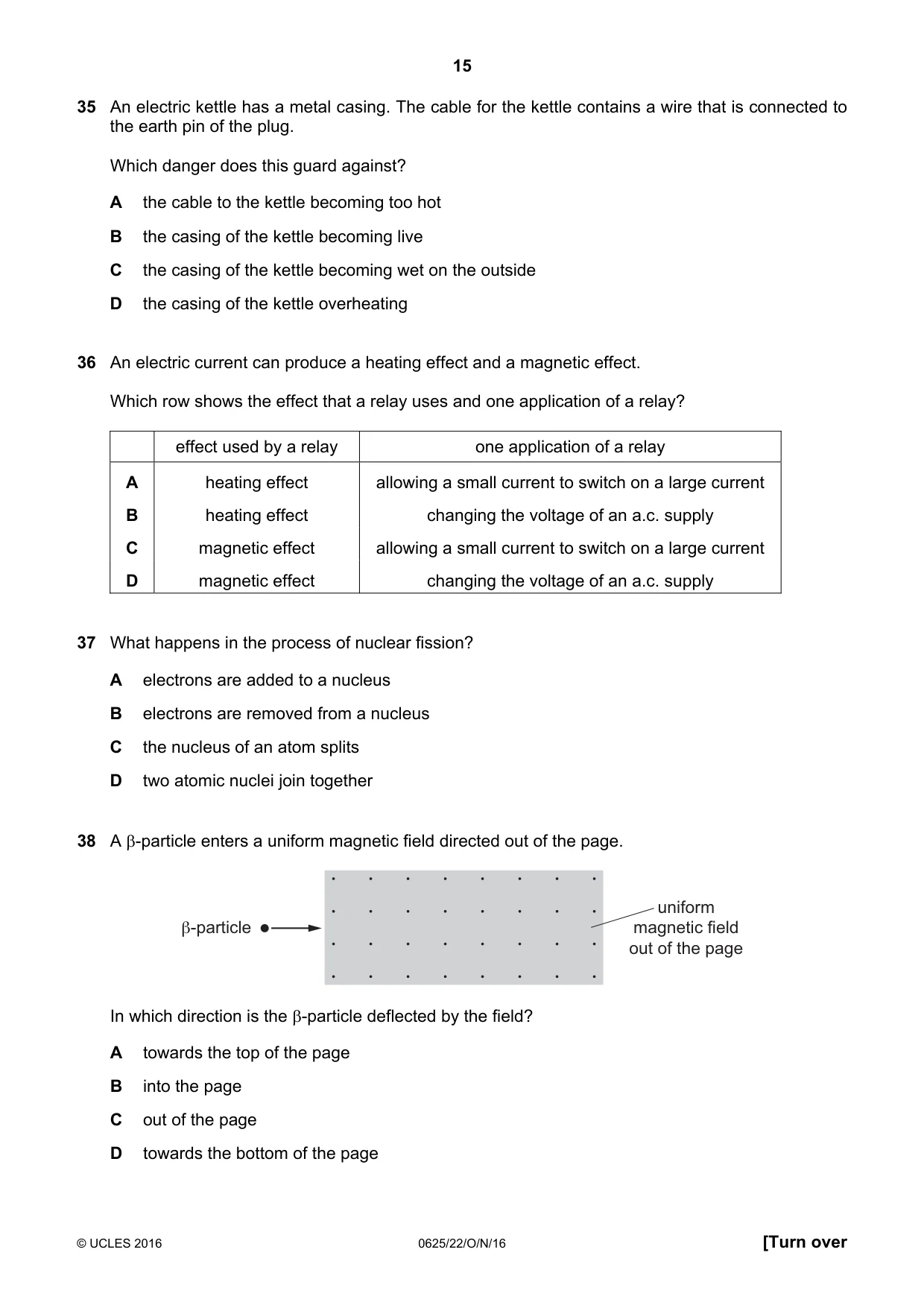
35 An electric kettle has a metal casing. The cable for the kettle contains a wire that is connected to the earth pin of the plug. Which danger does this guard against? A the cable to the kettle becoming too hot B the casing of the kettle becoming live C the casing of the kettle becoming wet on the outside D the casing of the kettle overheating
Mark scheme: B
Q36 · An electric current can produce a heating effect and a magnetic effect
36 An electric current can produce a heating effect and a magnetic effect. Which row shows the effect that a relay uses and one application of a relay? effect used by a relay one application of a relay A heating effect allowing a small current to switch on a large current B heating effect changing the voltage of an a.c. supply C magnetic effect allowing a small current to switch on a large current D magnetic effect changing the voltage of an a.c. supply
Mark scheme: C
Q37 · What happens in the process of nuclear fission?
37 What happens in the process of nuclear fission? A electrons are added to a nucleus B electrons are removed from a nucleus C the nucleus of an atom splits D two atomic nuclei join together
Mark scheme: C
Q38 · A β-particle enters a uniform magnetic field directed out of the page
38 A β-particle enters a uniform magnetic field directed out of the page. uniform β-particle magnetic field out of the page In which direction is the β-particle deflected by the field? A towards the top of the page B into the page C out of the page D towards the bottom of the page
Mark scheme: A
Q39 · The radioactive nucleus 214 Bi decays to another nucleus by the emission of a β-particle
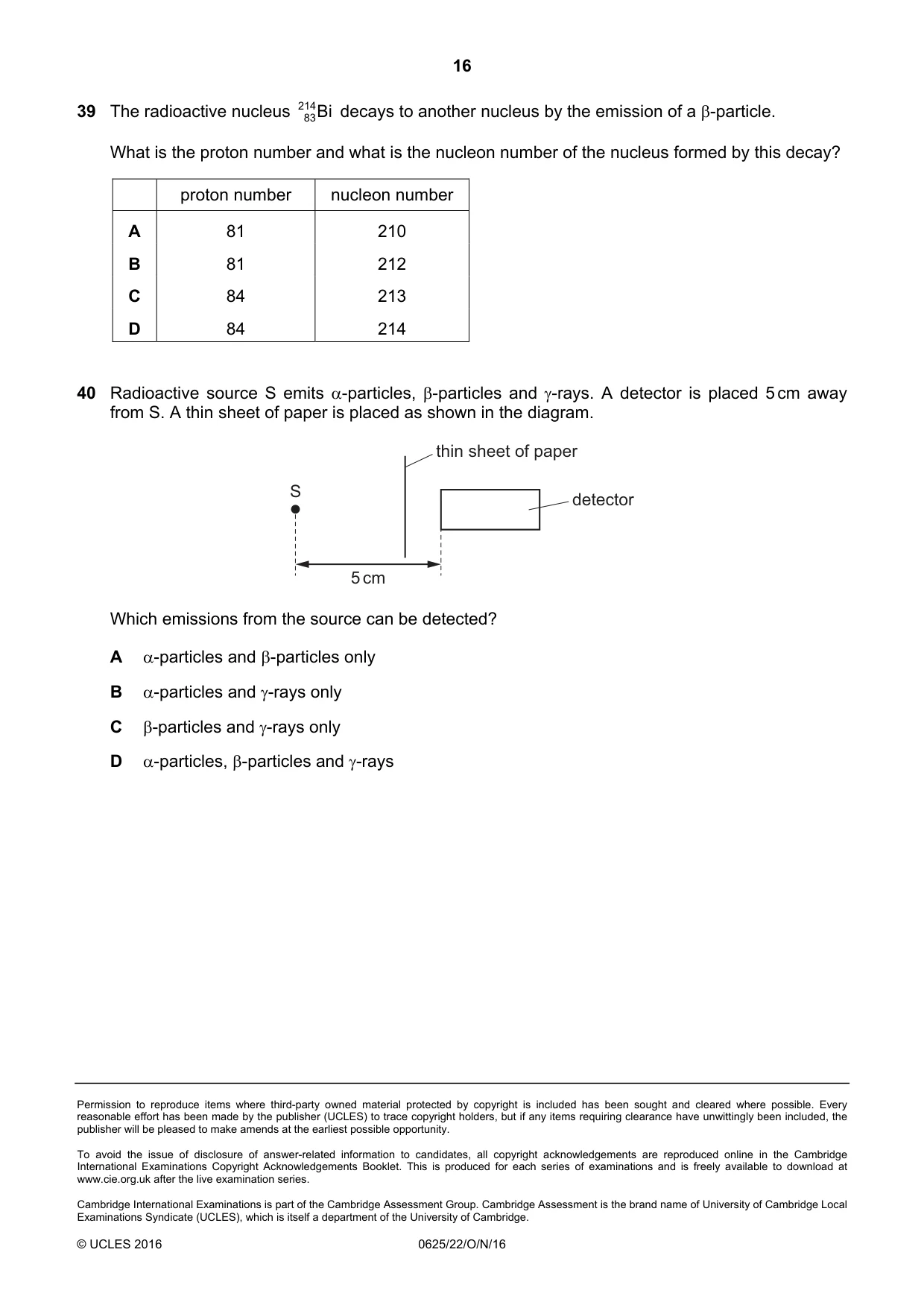
39 The radioactive nucleus 214 Bi decays to another nucleus by the emission of a β-particle. 83 What is the proton number and what is the nucleon number of the nucleus formed by this decay? proton number nucleon number A 81 210 B 81 212 C 84 213 D 84 214
Mark scheme: D
Q40 · Radioactive source S emits α-particles, β-particles and γ-rays
40 Radioactive source S emits α-particles, β-particles and γ-rays. A detector is placed 5 cm away from S. A thin sheet of paper is placed as shown in the diagram. thin sheet of paper S detector 5 cm Which emissions from the source can be detected? A α-particles and β-particles only B α-particles and γ-rays only C β-particles and γ-rays only D α-particles, β-particles and γ-rays
Mark scheme: C
What was in this paper
The subtopics covered by these 40 questions, and how many questions each got. Open one in a new tab to see every Cambridge question on it.
3Electrical quantities3Energy, work and power3Motion3Radioactivity3Forces2General properties of waves2Kinetic particle model of matter2Light2Simple phenomena of magnetism2Sound2Thermal properties and temperature2Transfer of thermal energy2Density1Electrical safety1Electromagnetic effects1Electromagnetic spectrum1Mass and weight1Momentum1Physical quantities and measurement techniques1Pressure1The nuclear model of the atom1What you needed in this session
Cambridge’s own grade thresholds for 2016 Oct/Nov, Paper 2 · Variant 2. A higher threshold means an easier paper — the bar moves with how the cohort did.