Cambridge IGCSE Physics 0625 — 2023 Feb/March Paper 2 · Variant 2
0625/22/F/M/23 · 40 questions · 40 marks · ≈45 min
The question paper and its mark scheme, free to read here and free to download. This is Cambridge’s own paper, exactly as it was sat.
Question paper16 pages

Mark scheme3 pages
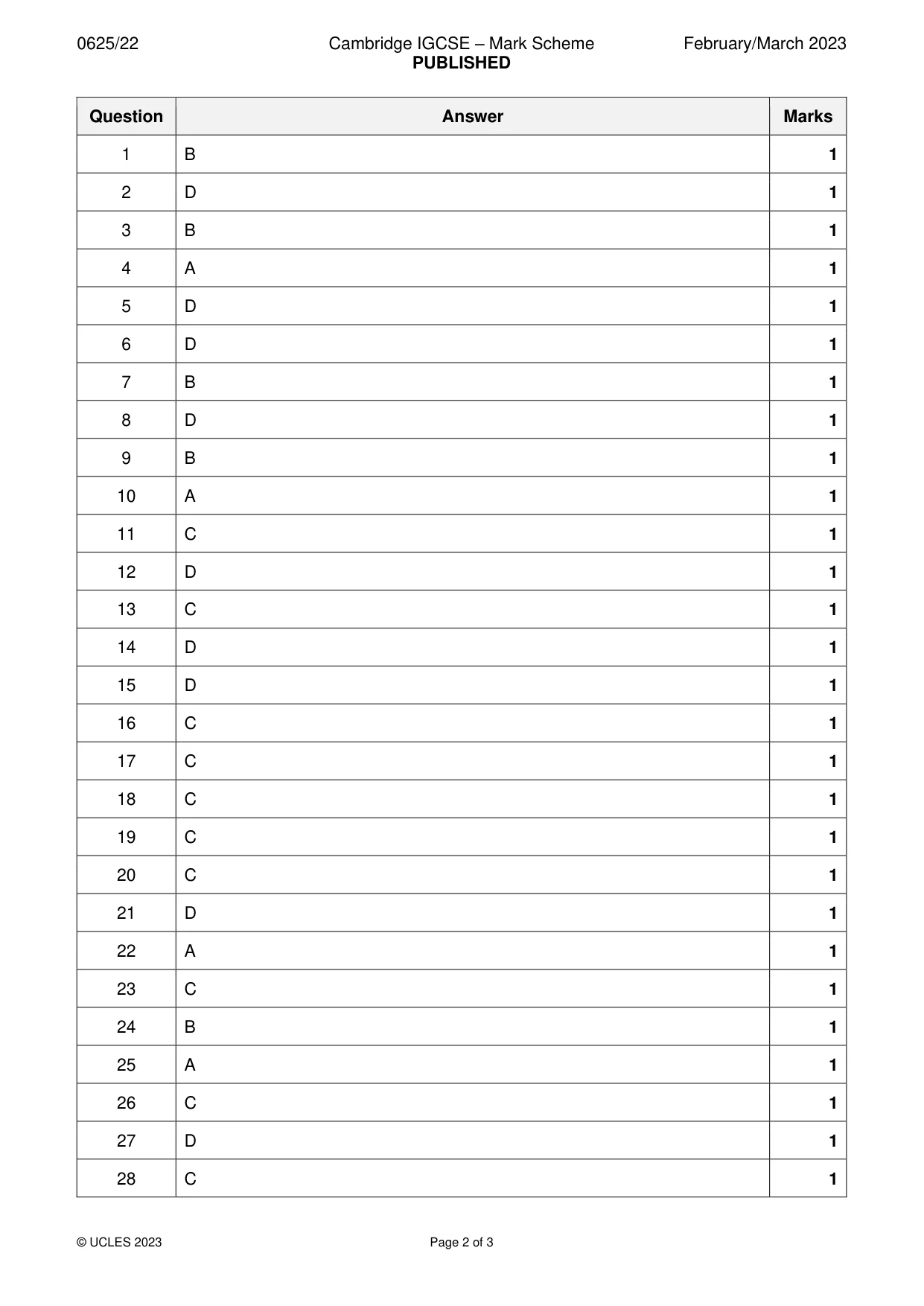
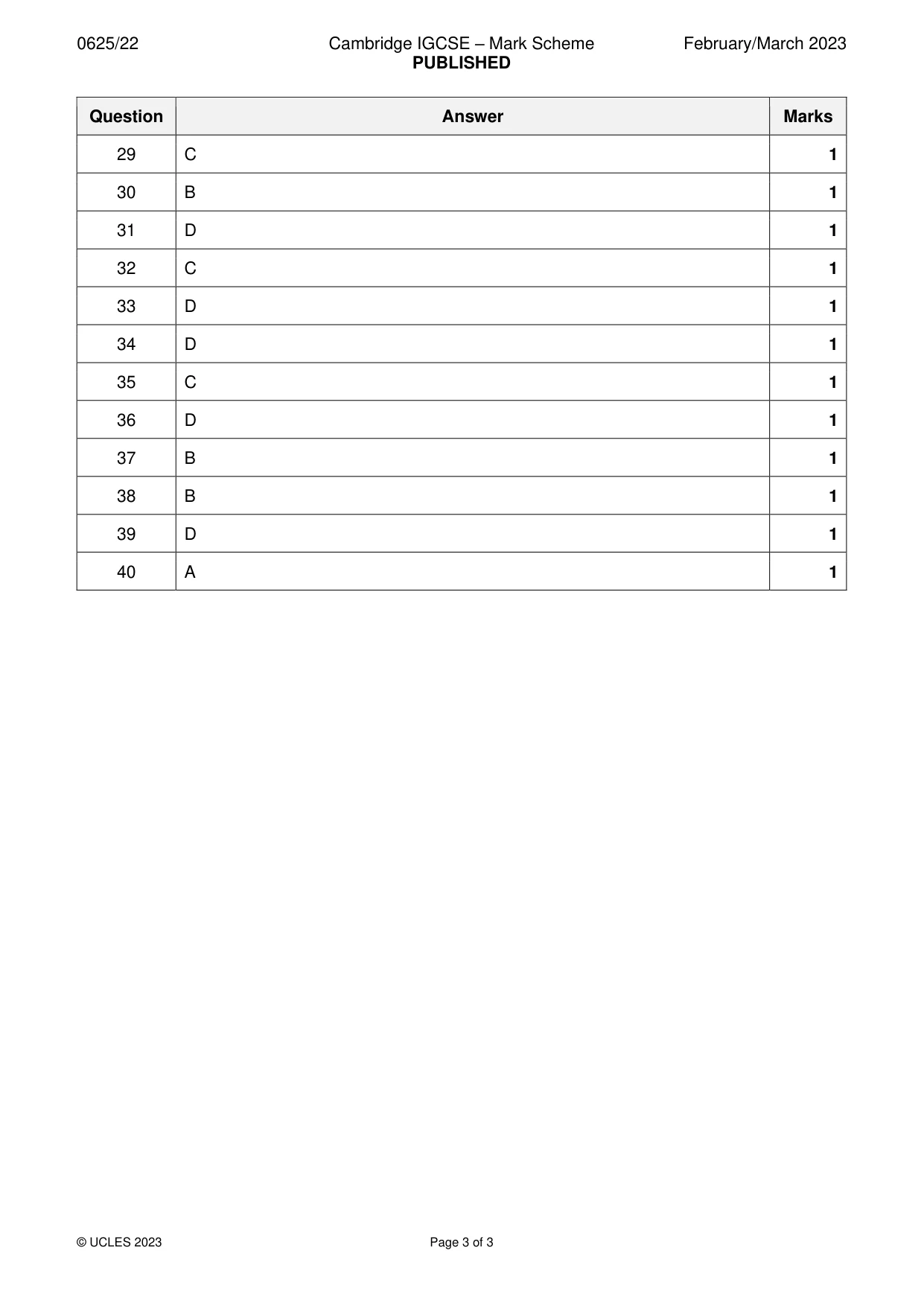
Answers below. Sit the paper first if you are practising.
Questions as text
Q1 · Which list contains two scalar quantities and two vector quantities?
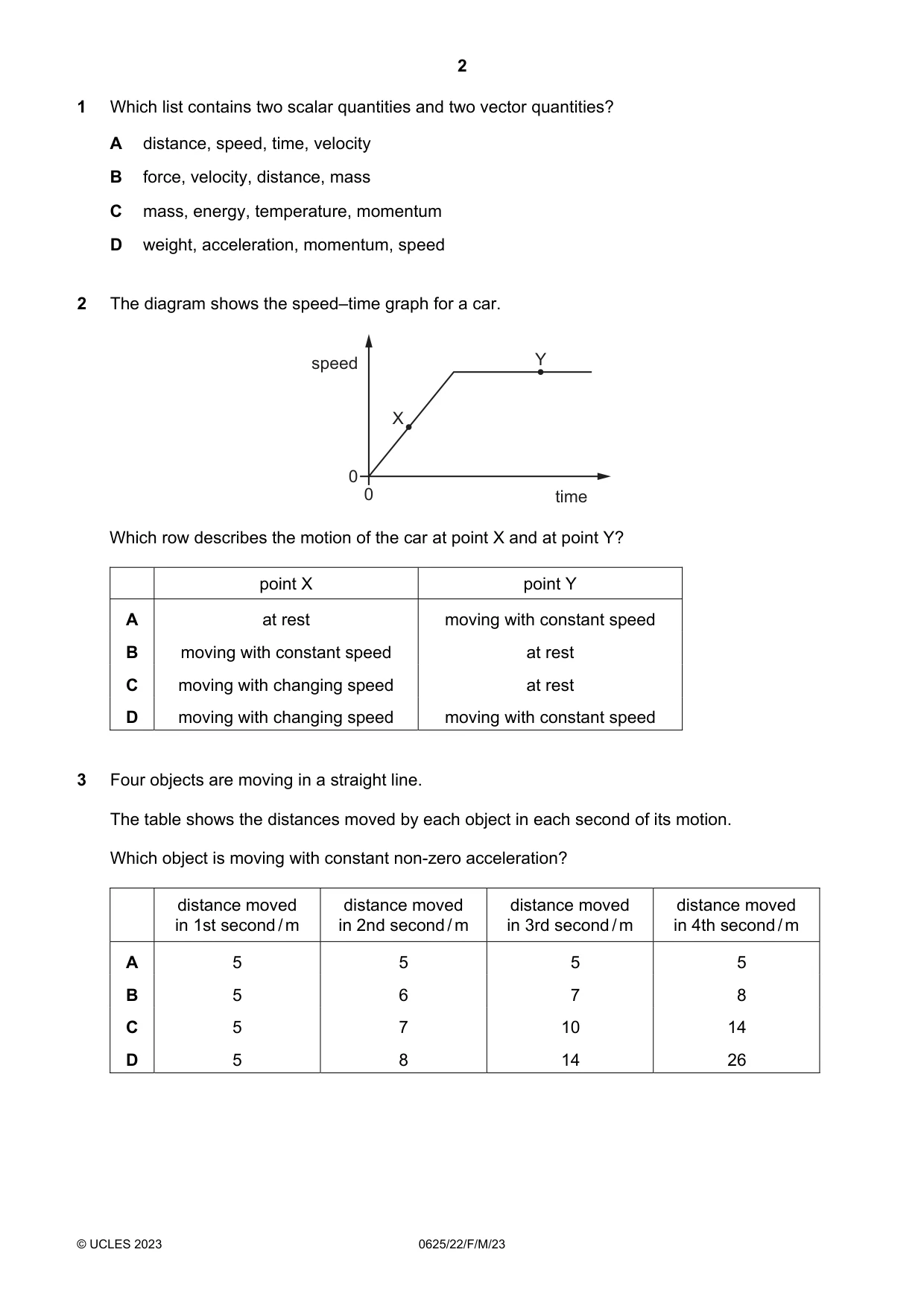
1 Which list contains two scalar quantities and two vector quantities? A distance, speed, time, velocity B force, velocity, distance, mass C mass, energy, temperature, momentum D weight, acceleration, momentum, speed
Mark scheme: B
More questions on Physical quantities and measurement techniques
Q2 · The diagram shows the speed–time graph for a car
2 The diagram shows the speed–time graph for a car. speed Y X 0 0 time Which row describes the motion of the car at point X and at point Y? point X point Y A at rest moving with constant speed B moving with constant speed at rest C moving with changing speed at rest D moving with changing speed moving with constant speed
Mark scheme: D
Q3 · Four objects are moving in a straight line
3 Four objects are moving in a straight line. The table shows the distances moved by each object in each second of its motion. Which object is moving with constant non-zero acceleration? distance moved distance moved distance moved distance moved in 1st second / m in 2nd second / m in 3rd second / m in 4th second / m A 5 5 5 5 B 5 6 7 8 C 5 7 10 14 D 5 8 14 26
Mark scheme: B
Q4 · The drag force on a car increases with speed
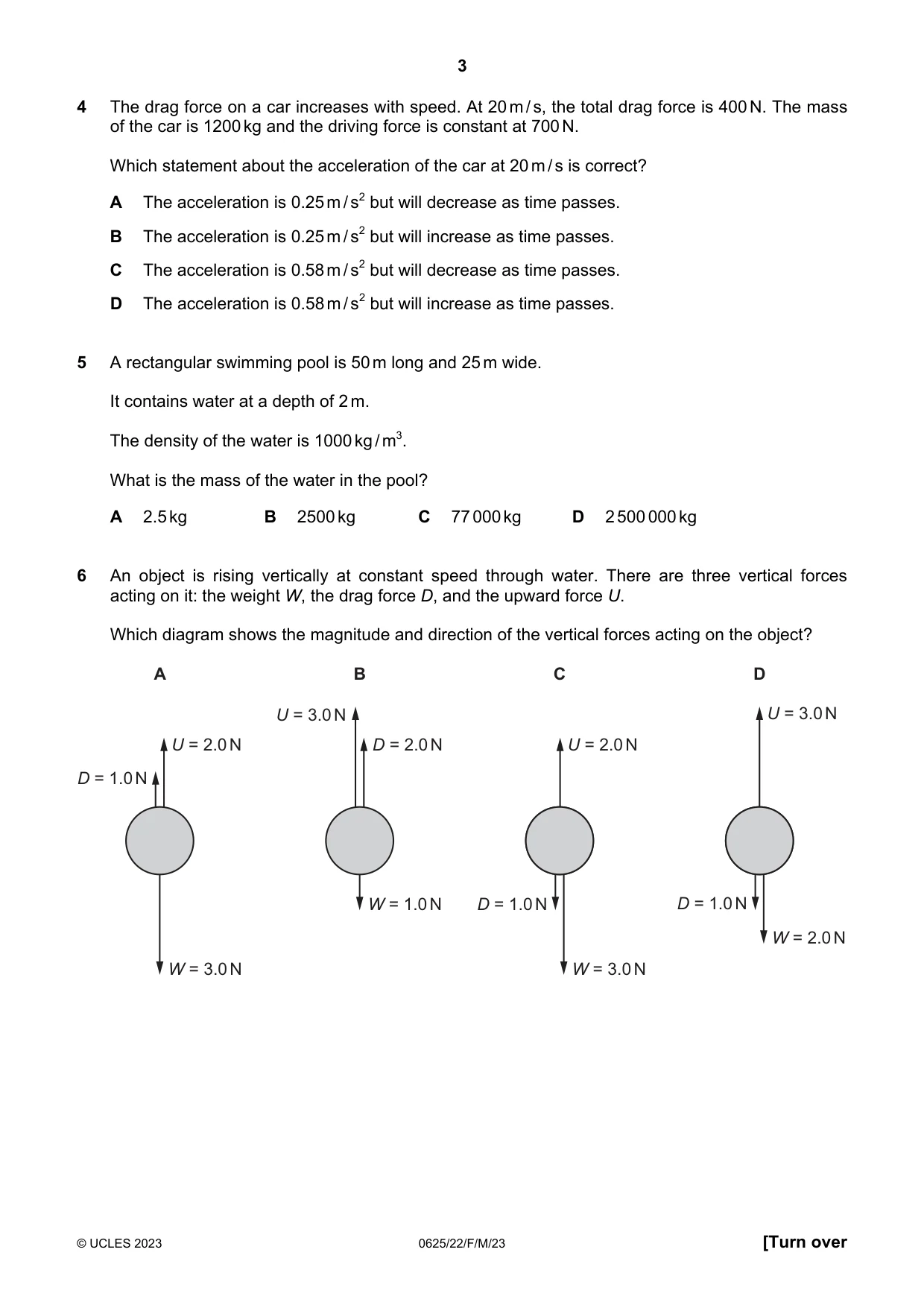
4 The drag force on a car increases with speed. At 20 m / s, the total drag force is 400 N. The mass of the car is 1200 kg and the driving force is constant at 700 N. Which statement about the acceleration of the car at 20 m / s is correct? A The acceleration is 0.25 m / s2 but will decrease as time passes. B The acceleration is 0.25 m / s2 but will increase as time passes. C The acceleration is 0.58 m / s2 but will decrease as time passes. D The acceleration is 0.58 m / s2 but will increase as time passes.
Mark scheme: A
Q5 · A rectangular swimming pool is 50 m long and 25 m wide
5 A rectangular swimming pool is 50 m long and 25 m wide. It contains water at a depth of 2 m. The density of the water is 1000 kg / m3. What is the mass of the water in the pool? A 2.5 kg B 2500 kg C 77 000 kg D 2 500 000 kg
Mark scheme: D
Q6 · An object is rising vertically at constant speed through water
6 An object is rising vertically at constant speed through water. There are three vertical forces acting on it: the weight W, the drag force D, and the upward force U. Which diagram shows the magnitude and direction of the vertical forces acting on the object? A B C D U = 3.0 N U = 3.0 N U = 2.0 N D = 2.0 N U = 2.0 N D = 1.0 N W = 1.0 N D = 1.0 N D = 1.0 N W = 2.0 N W = 3.0 N W = 3.0 N
Mark scheme: D
Q7 · Two boys of equal weight sit on one side of a see-saw, as shown
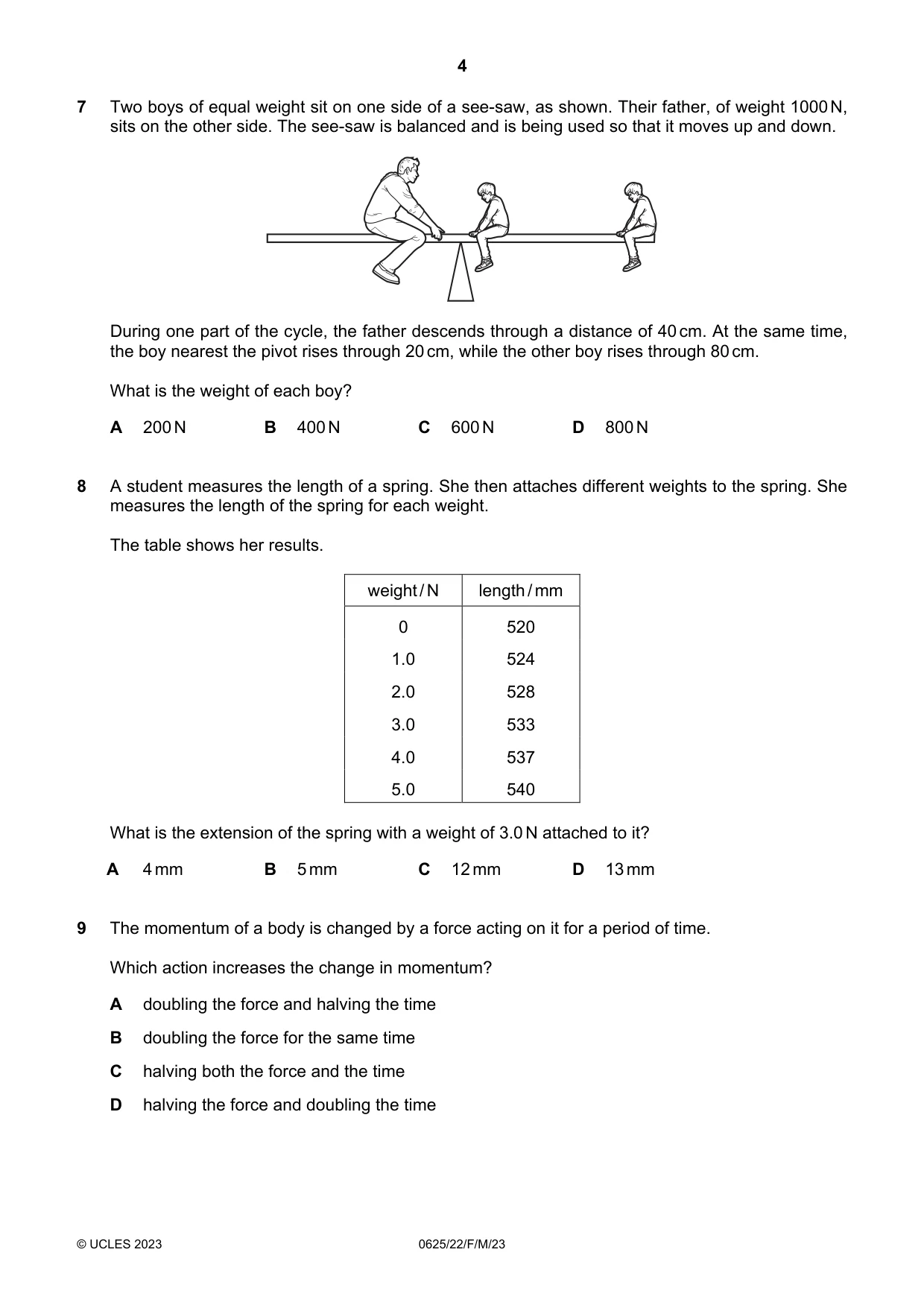
7 Two boys of equal weight sit on one side of a see-saw, as shown. Their father, of weight 1000 N, sits on the other side. The see-saw is balanced and is being used so that it moves up and down. During one part of the cycle, the father descends through a distance of 40 cm. At the same time, the boy nearest the pivot rises through 20 cm, while the other boy rises through 80 cm. What is the weight of each boy? A 200 N B 400 N C 600 N D 800 N
Mark scheme: B
Q8 · A student measures the length of a spring
8 A student measures the length of a spring. She then attaches different weights to the spring. She measures the length of the spring for each weight. The table shows her results. weight / N length / mm 0 520 1.0 524 2.0 528 3.0 533 4.0 537 5.0 540 What is the extension of the spring with a weight of 3.0 N attached to it? A 4 mm B 5 mm C 12 mm D 13 mm
Mark scheme: D
Q9 · The momentum of a body is changed by a force acting on it for a period of time
9 The momentum of a body is changed by a force acting on it for a period of time. Which action increases the change in momentum? A doubling the force and halving the time B doubling the force for the same time C halving both the force and the time D halving the force and doubling the time
Mark scheme: B
Q10 · The equation used to find the change in gravitational potential energy of an object can…
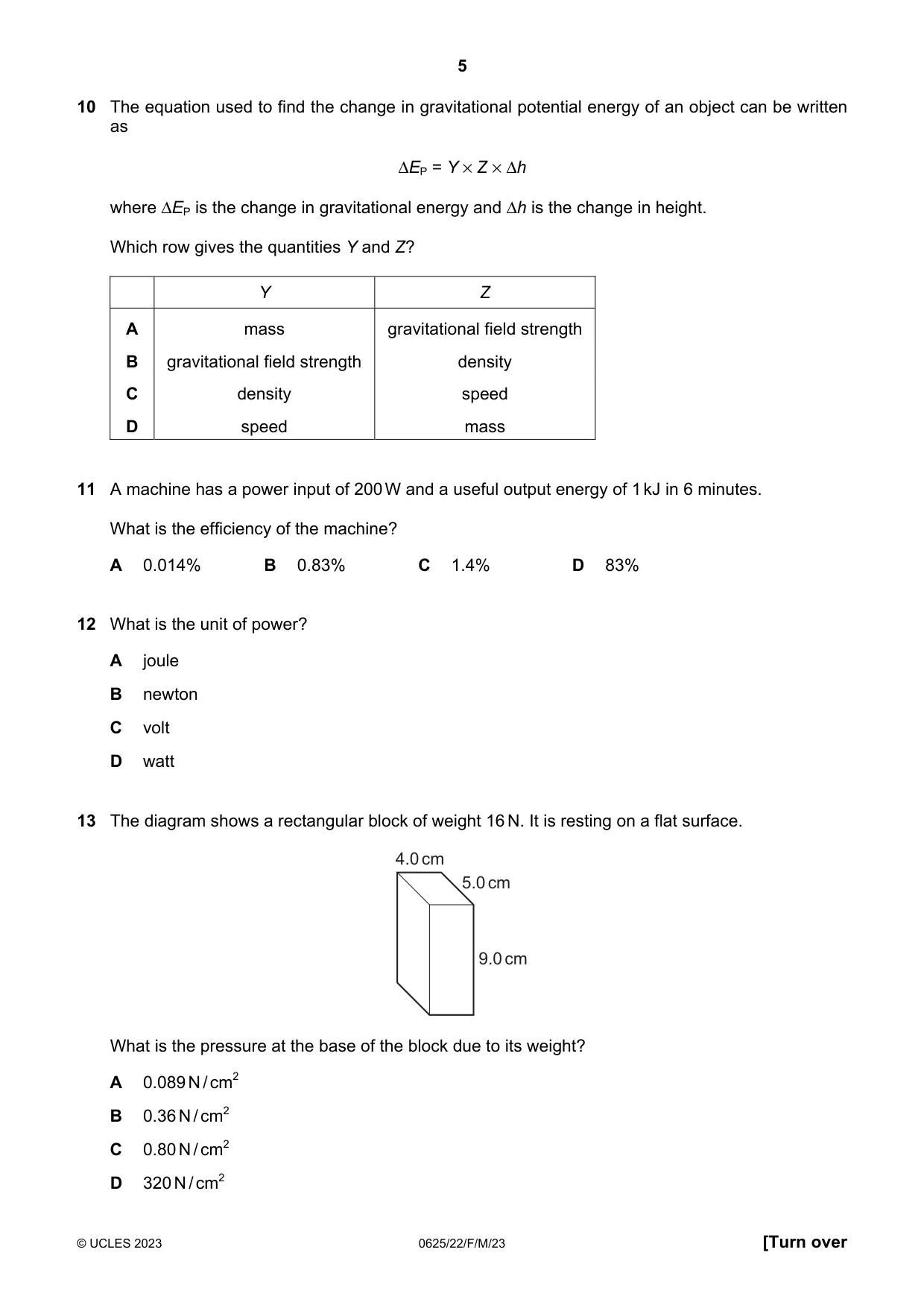
10 The equation used to find the change in gravitational potential energy of an object can be written as ∆EP = Y × Z × ∆h where ∆EP is the change in gravitational energy and ∆h is the change in height. Which row gives the quantities Y and Z? Y Z A mass gravitational field strength B gravitational field strength density C density speed D speed mass
Mark scheme: A
Q11 · A machine has a power input of 200 W and a useful output energy of 1 kJ in 6 minutes
11 A machine has a power input of 200 W and a useful output energy of 1 kJ in 6 minutes. What is the efficiency of the machine? A 0.014% B 0.83% C 1.4% D 83%
Mark scheme: C
Q12 · What is the unit of power?
12 What is the unit of power? A joule B newton C volt D watt
Mark scheme: D
Q13 · The diagram shows a rectangular block of weight 16 N
13 The diagram shows a rectangular block of weight 16 N. It is resting on a flat surface. 4.0 cm 5.0 cm 9.0 cm What is the pressure at the base of the block due to its weight? A 0.089 N / cm2 B 0.36 N / cm2 C 0.80 N / cm2 D 320 N / cm2
Mark scheme: C
Q14 · An oil tank has a base of area 2.5 m2 and is filled with oil to a depth of 1.2 m
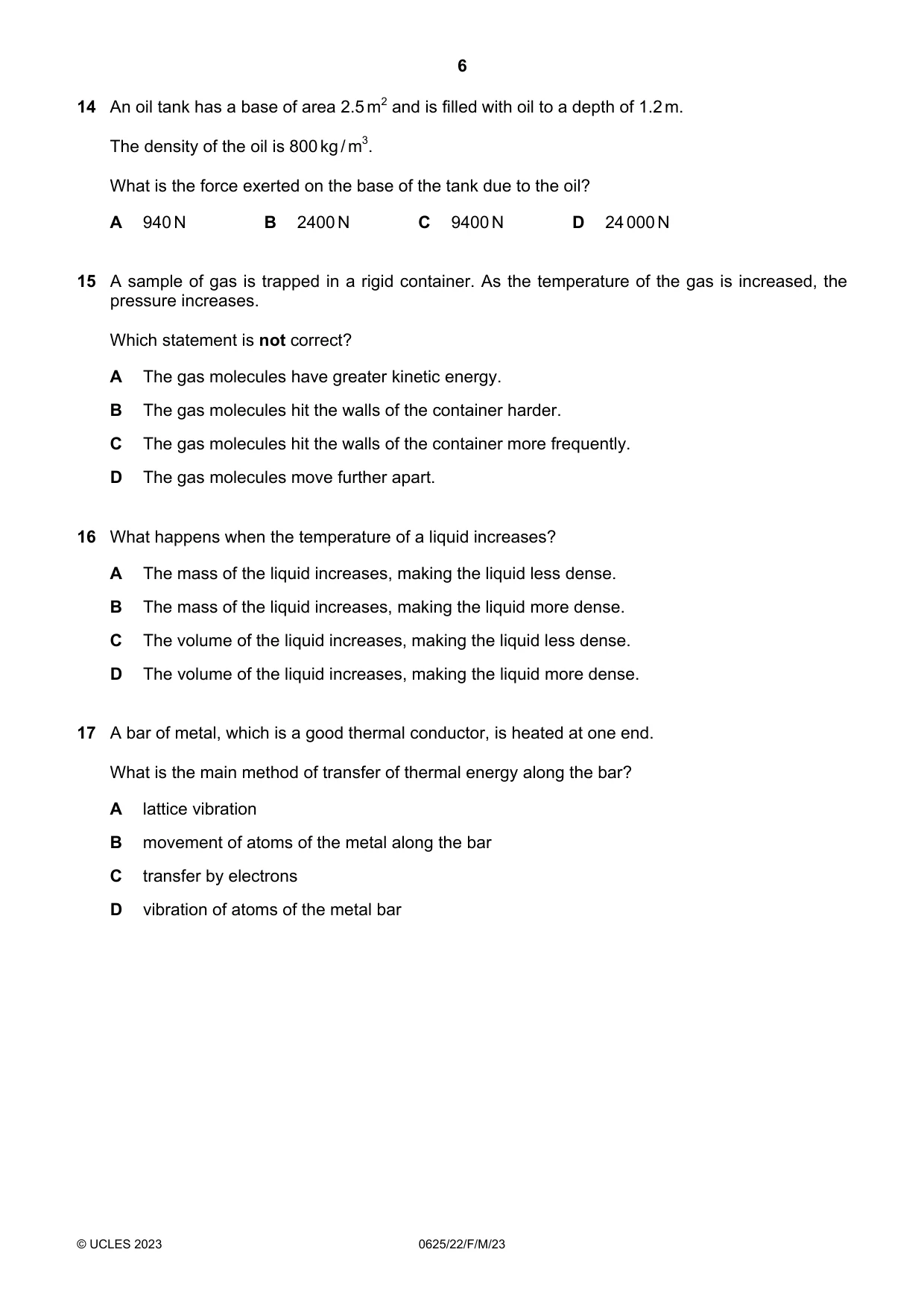
14 An oil tank has a base of area 2.5 m2 and is filled with oil to a depth of 1.2 m. The density of the oil is 800 kg / m3. What is the force exerted on the base of the tank due to the oil? A 940 N B 2400 N C 9400 N D 24 000 N
Mark scheme: D
Q15 · A sample of gas is trapped in a rigid container
15 A sample of gas is trapped in a rigid container. As the temperature of the gas is increased, the pressure increases. Which statement is not correct? A The gas molecules have greater kinetic energy. B The gas molecules hit the walls of the container harder. C The gas molecules hit the walls of the container more frequently. D The gas molecules move further apart.
Mark scheme: D
Q16 · What happens when the temperature of a liquid increases?
16 What happens when the temperature of a liquid increases? A The mass of the liquid increases, making the liquid less dense. B The mass of the liquid increases, making the liquid more dense. C The volume of the liquid increases, making the liquid less dense. D The volume of the liquid increases, making the liquid more dense.
Mark scheme: C
Q17 · A bar of metal, which is a good thermal conductor, is heated at one end
17 A bar of metal, which is a good thermal conductor, is heated at one end. What is the main method of transfer of thermal energy along the bar? A lattice vibration B movement of atoms of the metal along the bar C transfer by electrons D vibration of atoms of the metal bar
Mark scheme: C
Q18 · A transverse wave moves along a rope
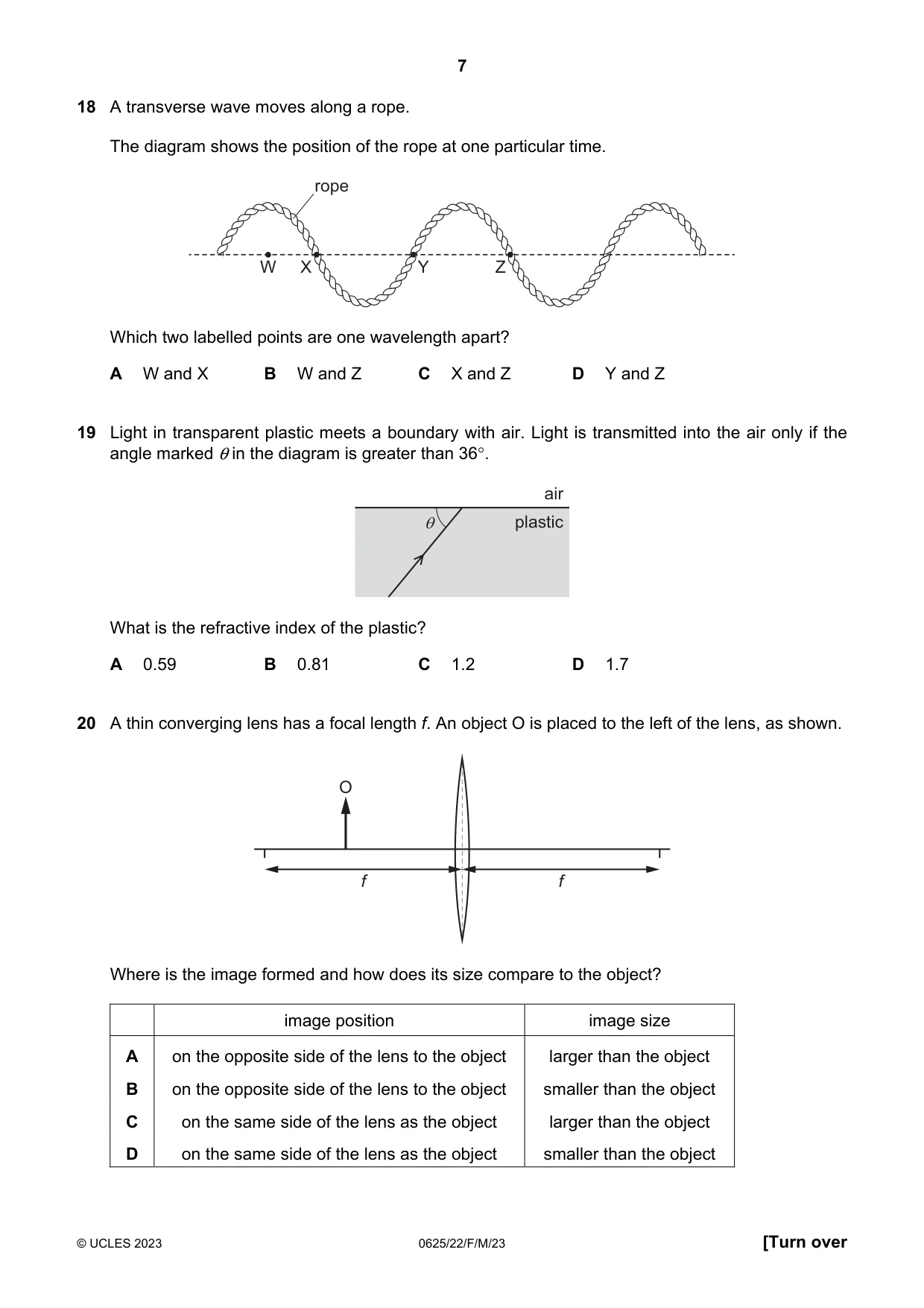
18 A transverse wave moves along a rope. The diagram shows the position of the rope at one particular time. rope W X Y Z Which two labelled points are one wavelength apart? A W and X B W and Z C X and Z D Y and Z
Mark scheme: C
Q19 · Light in transparent plastic meets a boundary with air
19 Light in transparent plastic meets a boundary with air. Light is transmitted into the air only if the angle marked @in the diagram is greater than 36°. air 0 plastic What is the refractive index of the plastic? A 0.59 B 0.81 C 1.2 D 1.7
Mark scheme: C
Q20 · A thin converging lens has a focal length f
20 A thin converging lens has a focal length f. An object O is placed to the left of the lens, as shown. O f f Where is the image formed and how does its size compare to the object? image position image size A on the opposite side of the lens to the object larger than the object B on the opposite side of the lens to the object smaller than the object C on the same side of the lens as the object larger than the object D on the same side of the lens as the object smaller than the object
Mark scheme: C
Q21 · Which diagram shows what happens when a ray of white light passes through a prism?
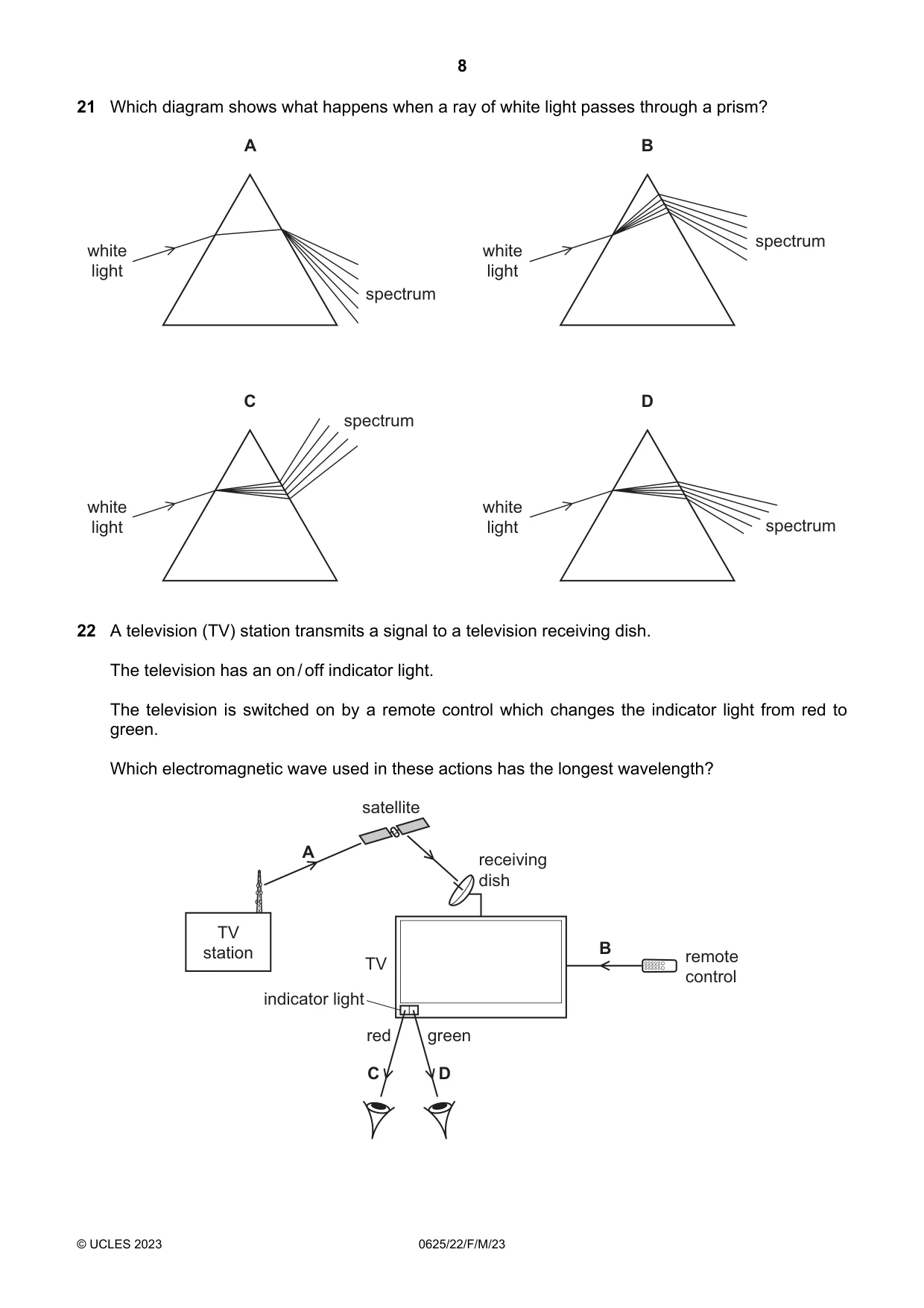
21 Which diagram shows what happens when a ray of white light passes through a prism? A B spectrum white white light light spectrum C D spectrum white white light light spectrum
Mark scheme: D
Q22 · A television (TV) station transmits a signal to a television receiving dish
22 A television (TV) station transmits a signal to a television receiving dish. The television has an on / off indicator light. The television is switched on by a remote control which changes the indicator light from red to green. Which electromagnetic wave used in these actions has the longest wavelength? satellite A receiving dish TV station B TV remote control indicator light red green C D
Mark scheme: A
Q23 · A student makes a list of some applications of waves
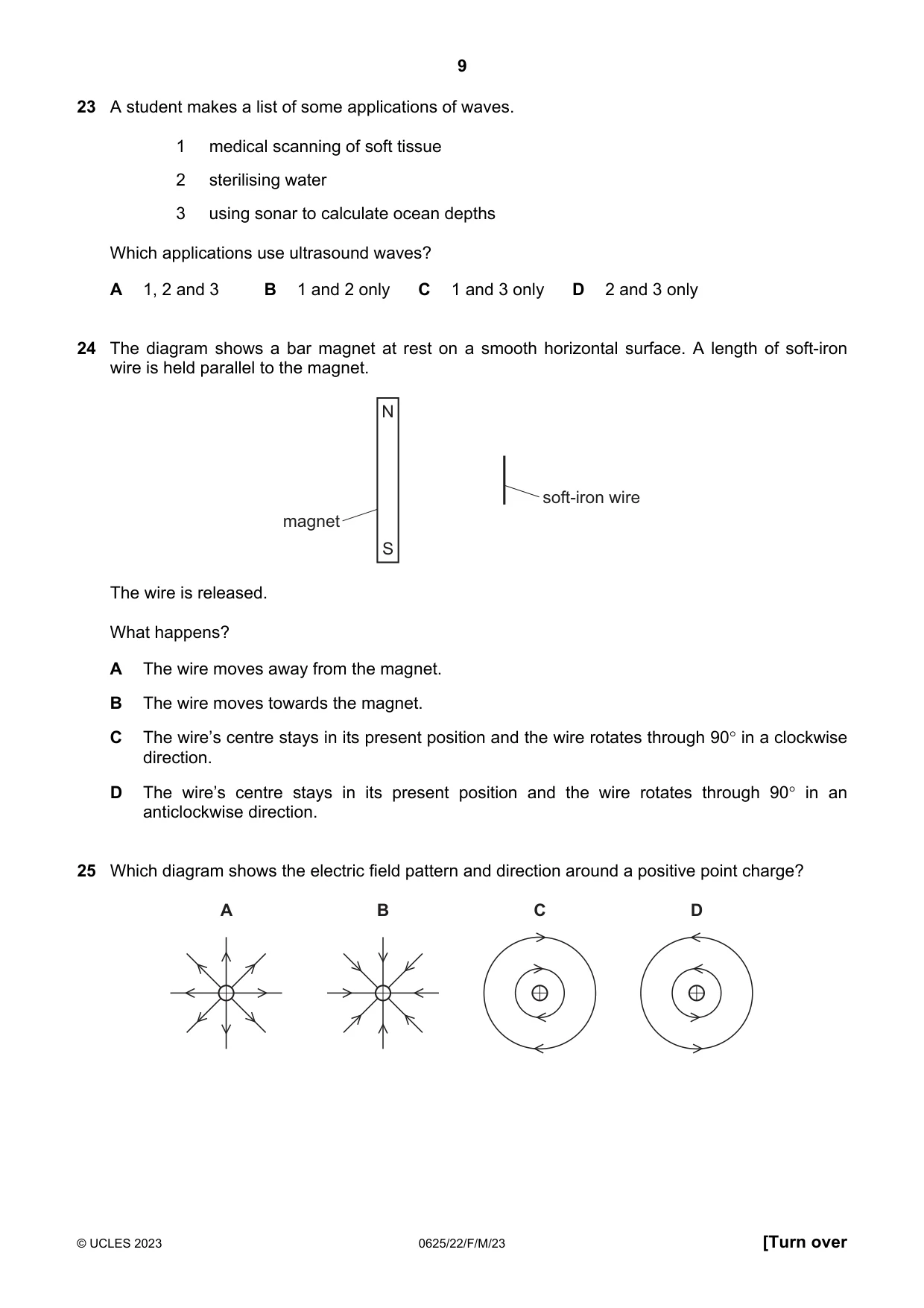
23 A student makes a list of some applications of waves. 1 medical scanning of soft tissue 2 sterilising water 3 using sonar to calculate ocean depths Which applications use ultrasound waves? A 1, 2 and 3 B 1 and 2 only C 1 and 3 only D 2 and 3 only
Mark scheme: C
Q24 · The diagram shows a bar magnet at rest on a smooth horizontal surface
24 The diagram shows a bar magnet at rest on a smooth horizontal surface. A length of soft-iron wire is held parallel to the magnet. N soft-iron wire magnet S The wire is released. What happens? A The wire moves away from the magnet. B The wire moves towards the magnet. C The wire’s centre stays in its present position and the wire rotates through 90° in a clockwise direction. D The wire’s centre stays in its present position and the wire rotates through 90° in an anticlockwise direction.
Mark scheme: B
Q25 · Which diagram shows the electric field pattern and direction around a positive point…
25 Which diagram shows the electric field pattern and direction around a positive point charge? A B C D
Mark scheme: A
Q26 · A laboratory has a standard wire of known resistance
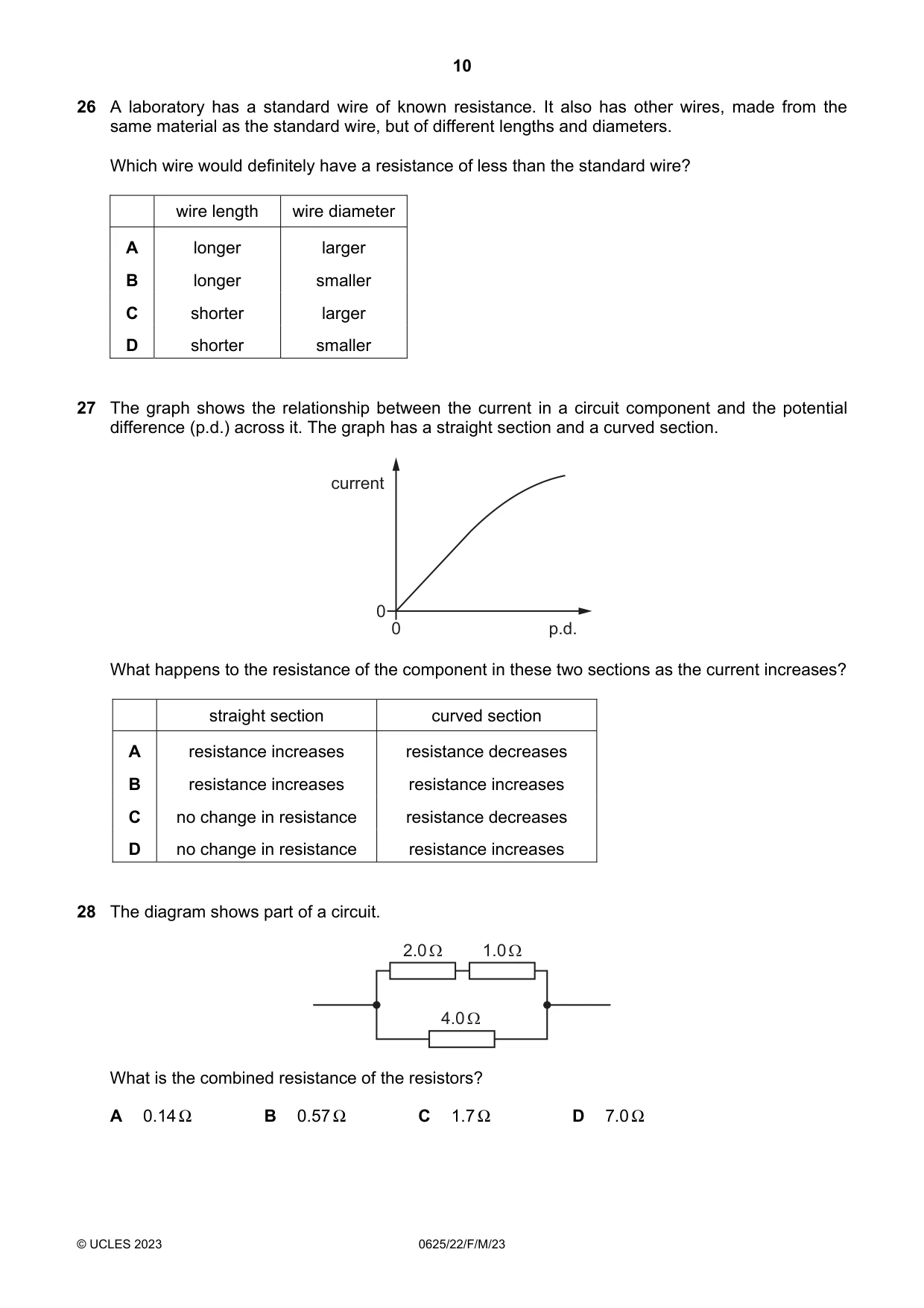
26 A laboratory has a standard wire of known resistance. It also has other wires, made from the same material as the standard wire, but of different lengths and diameters. Which wire would definitely have a resistance of less than the standard wire? wire length wire diameter A longer larger B longer smaller C shorter larger D shorter smaller
Mark scheme: C
Q27 · The graph shows the relationship between the current in a circuit component and the…
27 The graph shows the relationship between the current in a circuit component and the potential difference (p.d.) across it. The graph has a straight section and a curved section. current 0 0 p.d. What happens to the resistance of the component in these two sections as the current increases? straight section curved section A resistance increases resistance decreases B resistance increases resistance increases C no change in resistance resistance decreases D no change in resistance resistance increases
Mark scheme: D
Q28 · The diagram shows part of a circuit
28 The diagram shows part of a circuit. 2.02 1.00 ae . | What is the combined resistance of the resistors? A 0.142 B 0.57 C 1.70 D 7.02
Mark scheme: C
Q29 · The diagram shows a circuit which includes two resistors and a battery
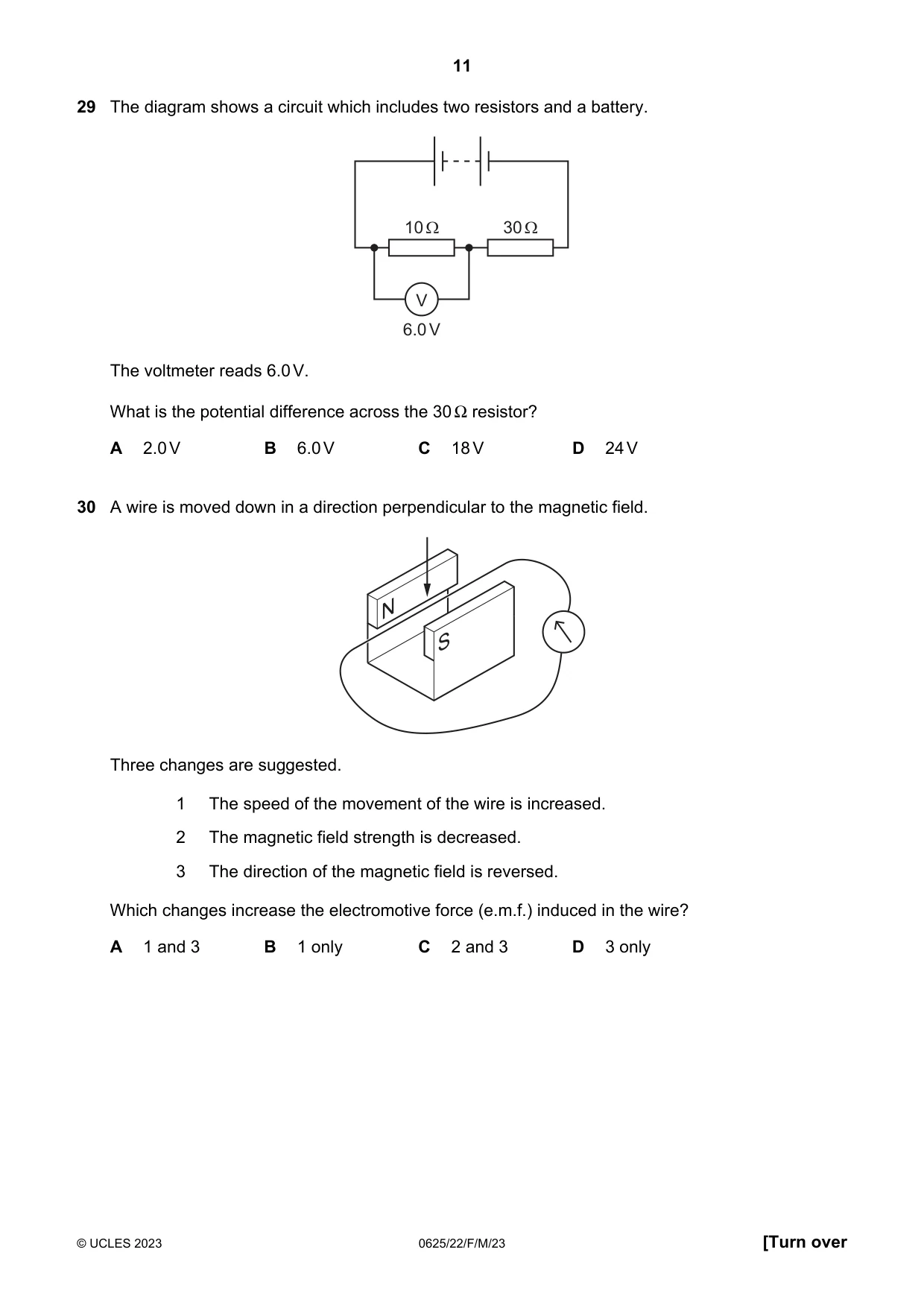
29 The diagram shows a circuit which includes two resistors and a battery. 10Q 30Q 6.0V The voltmeter reads 6.0V. What is the potential difference across the 30Q resistor? A 2.0V B 6.0V C 18V D 24V
Mark scheme: C
Q30 · A wire is moved down in a direction perpendicular to the magnetic field
30 A wire is moved down in a direction perpendicular to the magnetic field. N S Three changes are suggested. 1 The speed of the movement of the wire is increased. 2 The magnetic field strength is decreased. 3 The direction of the magnetic field is reversed. Which changes increase the electromotive force (e.m.f.) induced in the wire? A 1 and 3 B 1 only C 2 and 3 D 3 only
Mark scheme: B
Q31 · A wire is moved across a magnetic field
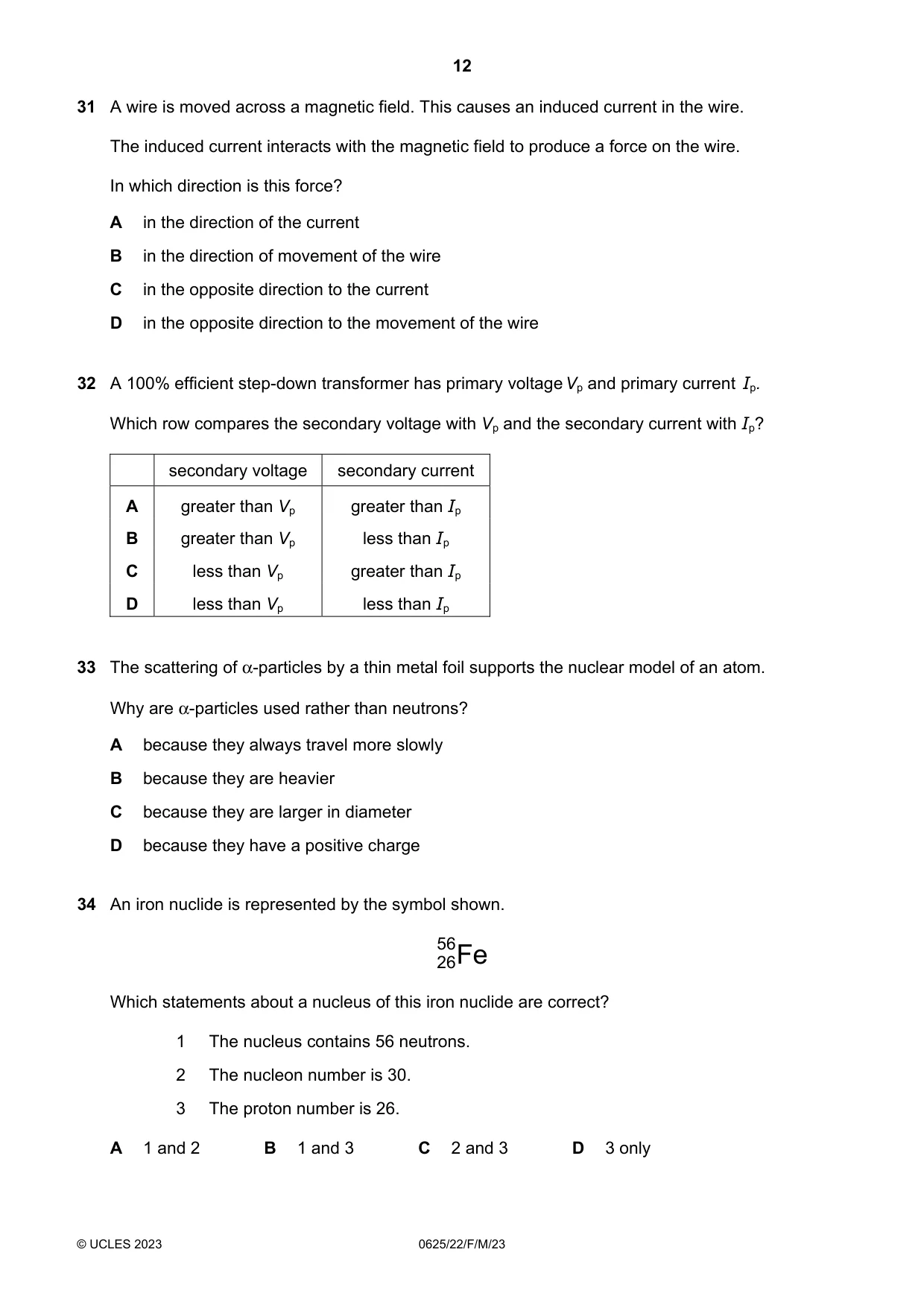
31 A wire is moved across a magnetic field. This causes an induced current in the wire. The induced current interacts with the magnetic field to produce a force on the wire. In which direction is this force? A in the direction of the current B in the direction of movement of the wire C in the opposite direction to the current D in the opposite direction to the movement of the wire
Mark scheme: D
Q32 · A 100% efficient step-down transformer has primary voltage Vp and primary current Ip
32 A 100% efficient step-down transformer has primary voltage Vp and primary current Ip. Which row compares the secondary voltage with Vp and the secondary current with Ip? secondary voltage secondary current A greater than Vp greater than Ip B greater than Vp less than Ip C less than Vp greater than Ip D less than Vp less than Ip
Mark scheme: C
Q33 · The scattering of α-particles by a thin metal foil supports the nuclear model of an atom
33 The scattering of α-particles by a thin metal foil supports the nuclear model of an atom. Why are α-particles used rather than neutrons? A because they always travel more slowly B because they are heavier C because they are larger in diameter D because they have a positive charge
Mark scheme: D
Q34 · An iron nuclide is represented by the symbol shown
34 An iron nuclide is represented by the symbol shown. 56 26Fe Which statements about a nucleus of this iron nuclide are correct? 1 The nucleus contains 56 neutrons. 2 The nucleon number is 30. 3 The proton number is 26. A 1 and 2 B 1 and 3 C 2 and 3 D 3 only
Mark scheme: D
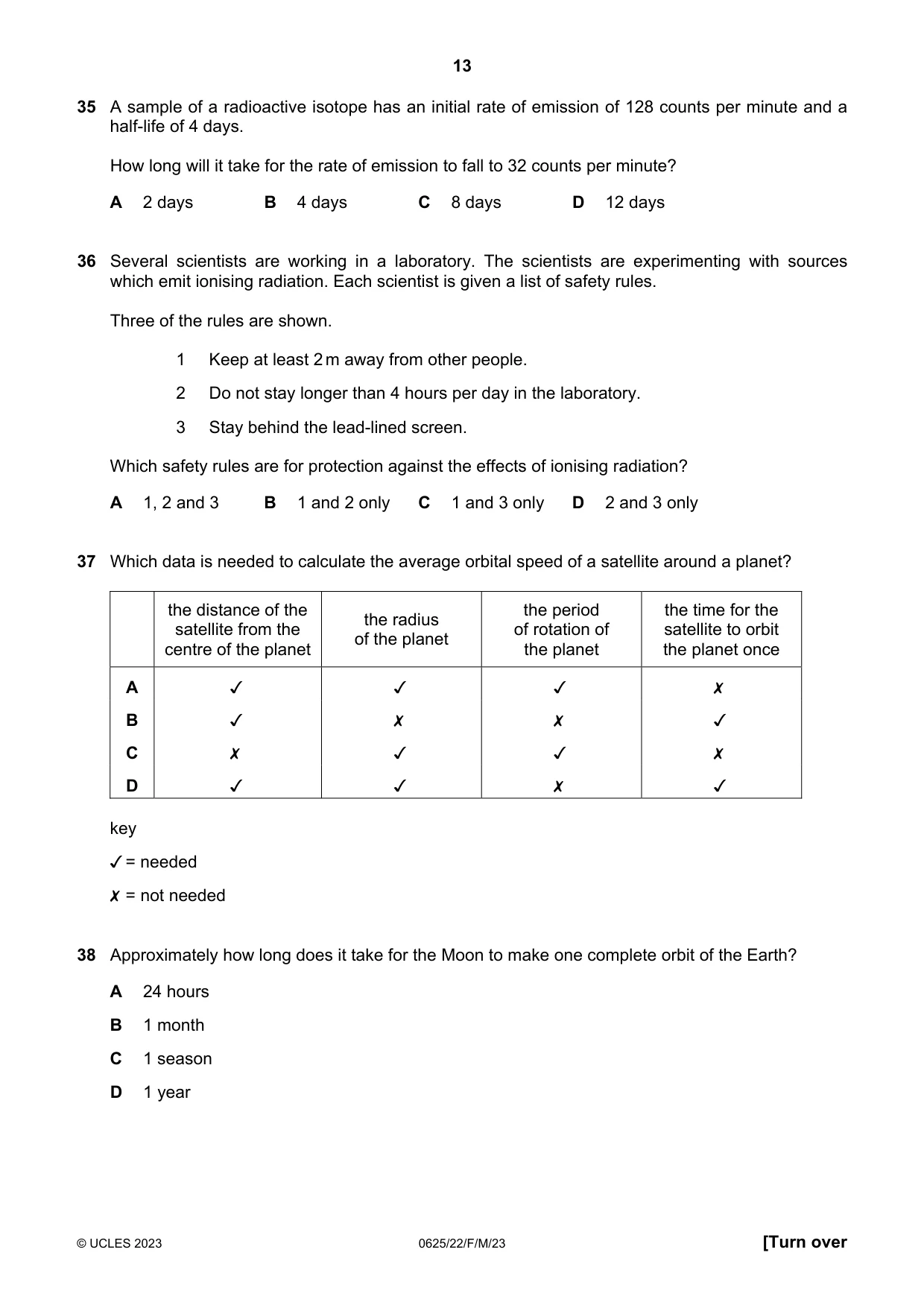
Q35 · A sample of a radioactive isotope has an initial rate of emission of 128 counts per…
35 A sample of a radioactive isotope has an initial rate of emission of 128 counts per minute and a half-life of 4 days. How long will it take for the rate of emission to fall to 32 counts per minute? A 2 days B 4 days C 8 days D 12 days
Mark scheme: C
Q36 · Several scientists are working in a laboratory
36 Several scientists are working in a laboratory. The scientists are experimenting with sources which emit ionising radiation. Each scientist is given a list of safety rules. Three of the rules are shown. 1 Keep at least 2 m away from other people. 2 Do not stay longer than 4 hours per day in the laboratory. 3 Stay behind the lead-lined screen. Which safety rules are for protection against the effects of ionising radiation? A 1, 2 and 3 B 1 and 2 only C 1 and 3 only D 2 and 3 only
Mark scheme: D
Q37 · Which data is needed to calculate the average orbital speed of a satellite around a…
37 Which data is needed to calculate the average orbital speed of a satellite around a planet? the distance of the the radius the period the time for the satellite from the of the planet of rotation of satellite to orbit centre of the planet P the planet the planet once A v v Jv x B v x x v Cc x Jv Jv x D v Jv x v key / = needed X = not needed
Mark scheme: B
Q38 · Approximately how long does it take for the Moon to make one complete orbit of the Earth?
38 Approximately how long does it take for the Moon to make one complete orbit of the Earth? A 24 hours B 1 month C 1 season D 1 year
Mark scheme: B
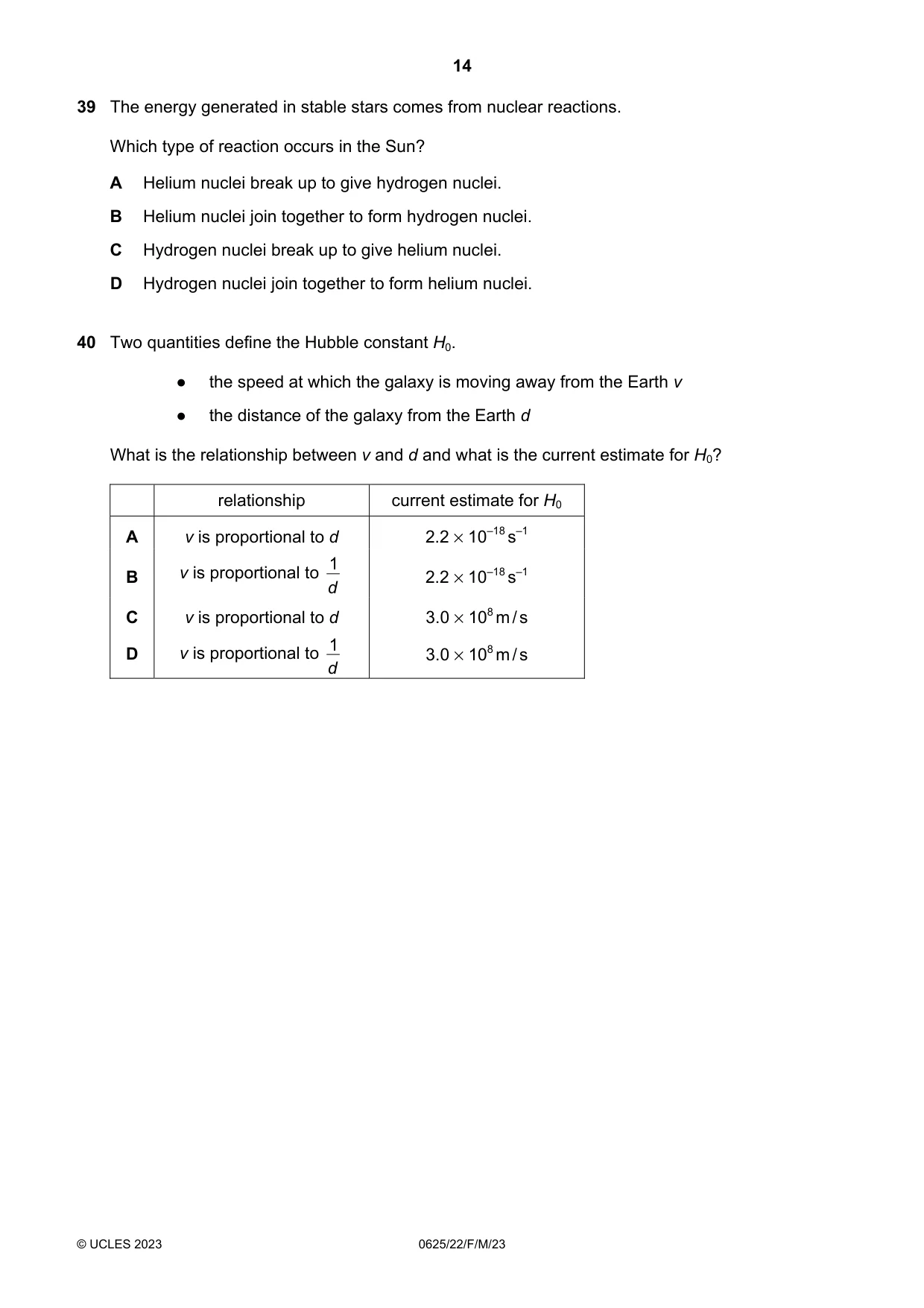
Q39 · The energy generated in stable stars comes from nuclear reactions
39 The energy generated in stable stars comes from nuclear reactions. Which type of reaction occurs in the Sun? A Helium nuclei break up to give hydrogen nuclei. B Helium nuclei join together to form hydrogen nuclei. C Hydrogen nuclei break up to give helium nuclei. D Hydrogen nuclei join together to form helium nuclei.
Mark scheme: D
Q40 · Two quantities define the Hubble constant H0
40 Two quantities define the Hubble constant H0. ● the speed at which the galaxy is moving away from the Earth v ● the distance of the galaxy from the Earth d What is the relationship between v and d and what is the current estimate for H0? relationship current estimate for H0 A v is proportional to d 2.2 × 10⁻¹⁸ s–1 1 B v is proportional to 2.2 × 10⁻¹⁸ s–1 d C v is proportional to d 3.0 × 10⁸ m / s 1 D v is proportional to 3.0 × 10⁸ m / s d
Mark scheme: A
What was in this paper
The subtopics covered by these 40 questions, and how many questions each got. Open one in a new tab to see every Cambridge question on it.
4Forces4Electromagnetic effects3Energy, work and power3Light3Motion2Pressure2Radioactivity2Stars and the Universe2The Earth and the Solar System2The nuclear model of the atom2Density1Electrical quantities1Electromagnetic spectrum1General properties of waves1Kinetic particle model of matter1Momentum1Physical quantities and measurement techniques1Simple phenomena of magnetism1Sound1Thermal properties and temperature1Transfer of thermal energy1What you needed in this session
Cambridge’s own grade thresholds for 2023 Feb/March, Paper 2 · Variant 2. A higher threshold means an easier paper — the bar moves with how the cohort did.