Cambridge IGCSE Physics 0625 — 2022 May/June Paper 2 · Variant 1
0625/21/M/J/22 · 40 questions · 40 marks · ≈45 min
The question paper and its mark scheme, free to read here and free to download. This is Cambridge’s own paper, exactly as it was sat.
Question paper16 pages
Mark scheme3 pages
Answers below. Sit the paper first if you are practising.
Questions as text
Q1 · Which measuring devices are most suitable for determining the length of a swimming pool…
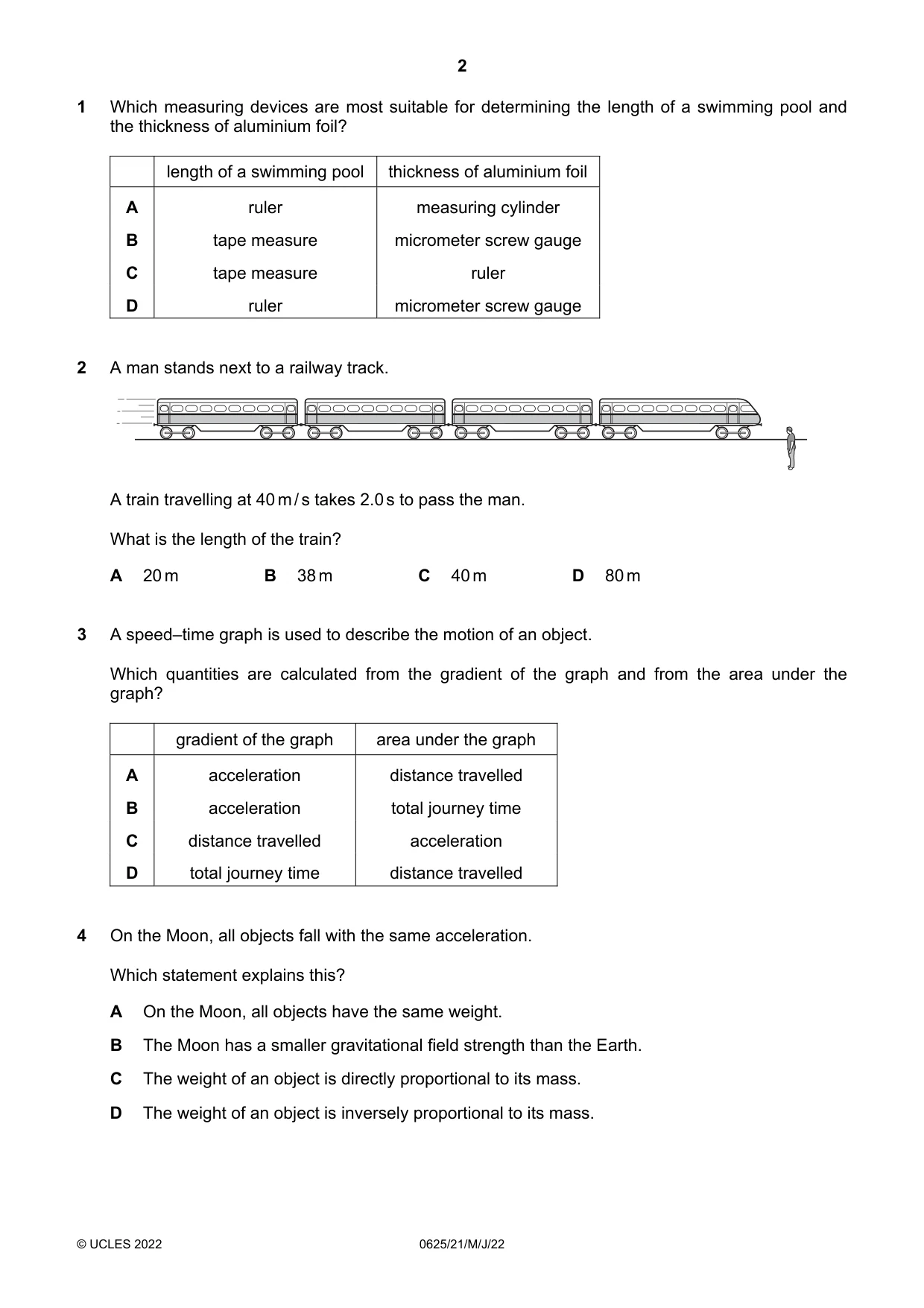
1 Which measuring devices are most suitable for determining the length of a swimming pool and the thickness of aluminium foil? length of a swimming pool thickness of aluminium foil A ruler measuring cylinder B tape measure micrometer screw gauge C tape measure ruler D ruler micrometer screw gauge
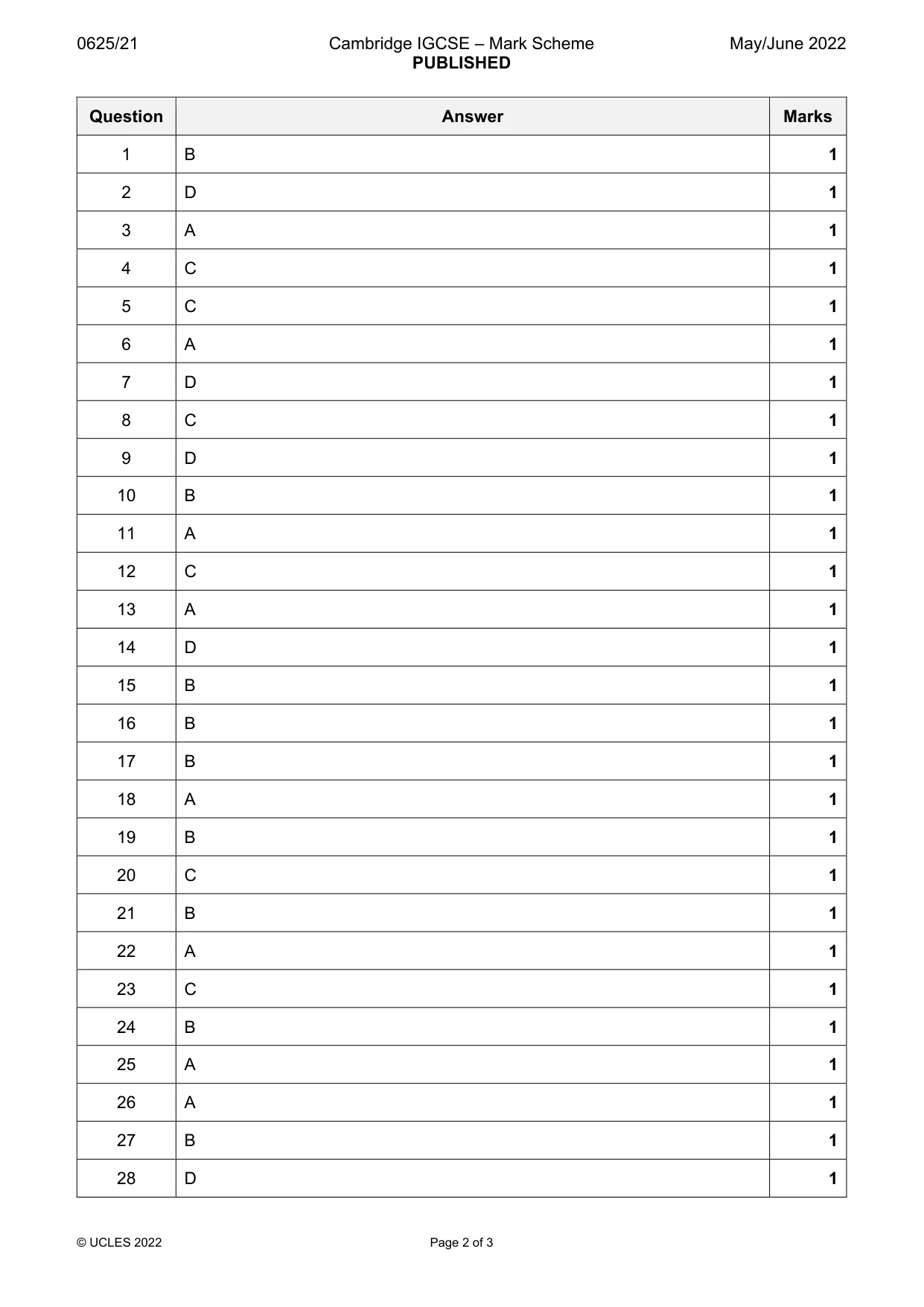
Mark scheme: B
More questions on Physical quantities and measurement techniques
Q2 · A man stands next to a railway track
2 A man stands next to a railway track. A train travelling at 40 m / s takes 2.0 s to pass the man. What is the length of the train? A 20 m B 38 m C 40 m D 80 m
Mark scheme: D
Q3 · A speed–time graph is used to describe the motion of an object
3 A speed–time graph is used to describe the motion of an object. Which quantities are calculated from the gradient of the graph and from the area under the graph? gradient of the graph area under the graph A acceleration distance travelled B acceleration total journey time C distance travelled acceleration D total journey time distance travelled
Mark scheme: A
Q4 · On the Moon, all objects fall with the same acceleration
4 On the Moon, all objects fall with the same acceleration. Which statement explains this? A On the Moon, all objects have the same weight. B The Moon has a smaller gravitational field strength than the Earth. C The weight of an object is directly proportional to its mass. D The weight of an object is inversely proportional to its mass.
Mark scheme: C
Q5 · A measuring cylinder contains 30 cm3 of a liquid
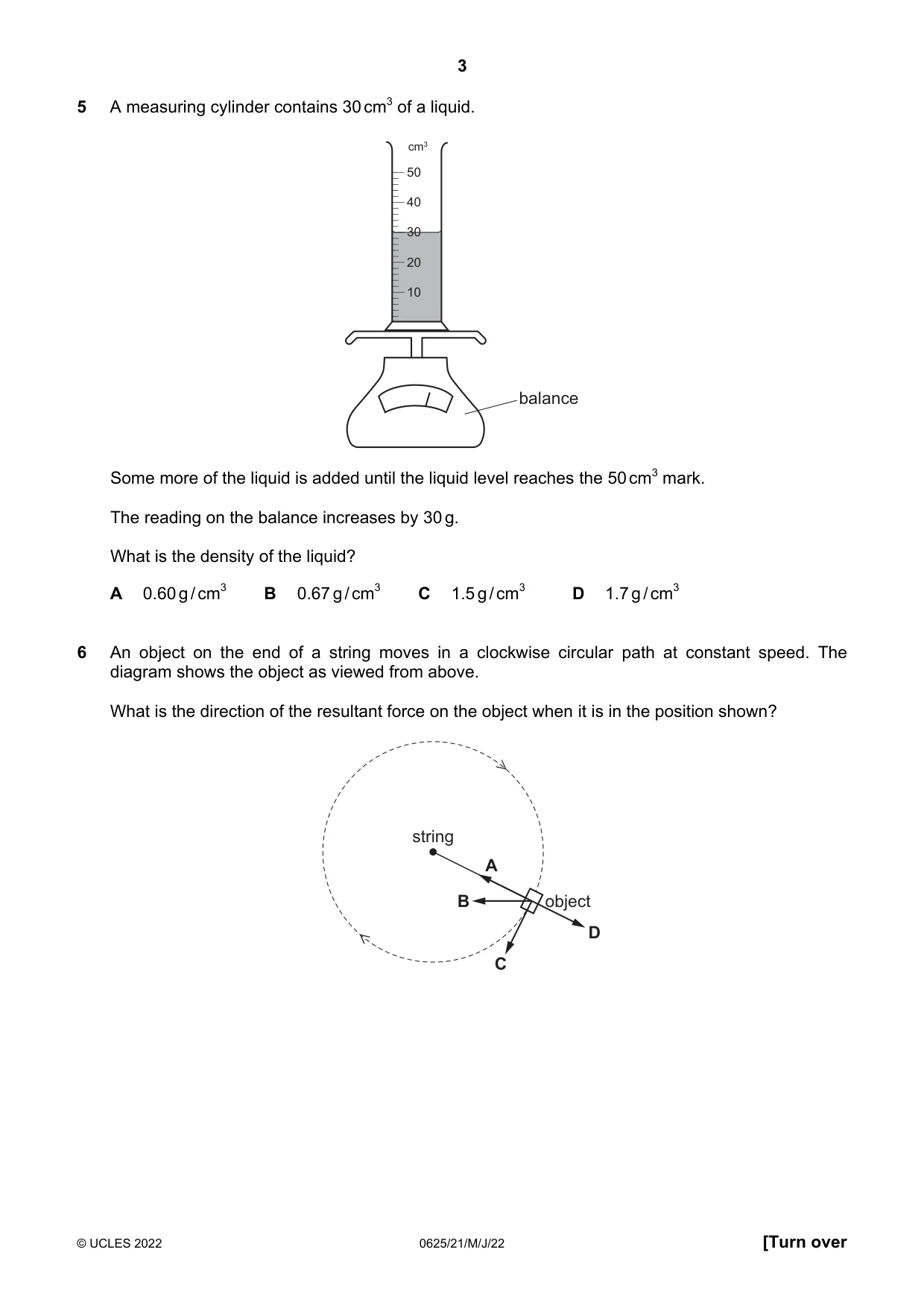
5 A measuring cylinder contains 30 cm3 of a liquid. cm3 50 40 30 20 10 balance Some more of the liquid is added until the liquid level reaches the 50 cm3 mark. The reading on the balance increases by 30 g. What is the density of the liquid? A 0.60 g / cm3 B 0.67 g / cm3 C 1.5 g / cm3 D 1.7 g / cm3
Mark scheme: C
Q6 · An object on the end of a string moves in a clockwise circular path at constant speed
6 An object on the end of a string moves in a clockwise circular path at constant speed. The diagram shows the object as viewed from above. What is the direction of the resultant force on the object when it is in the position shown? string A B object D C
Mark scheme: A
Q7 · A beam is pivoted at one end, as shown
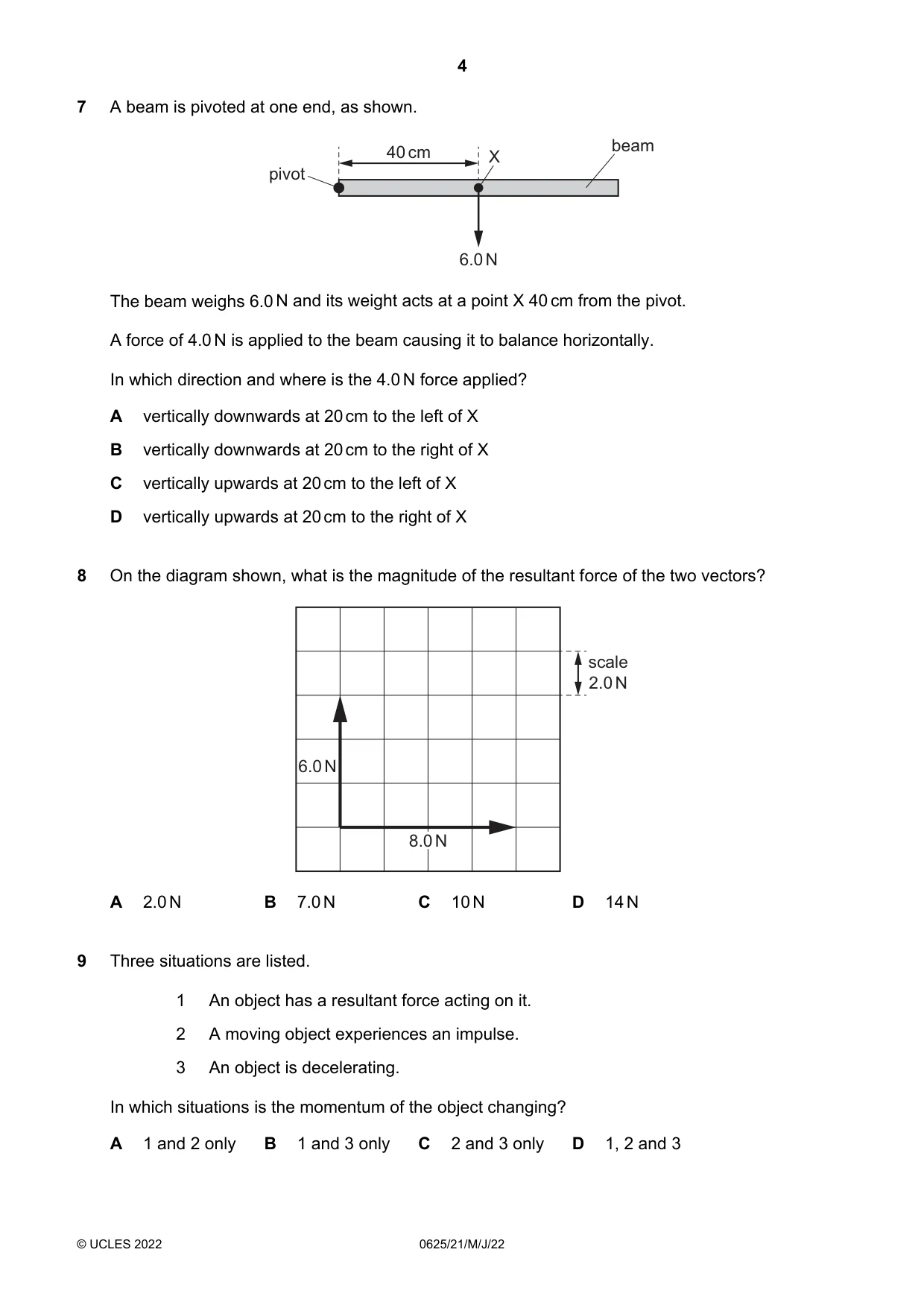
7 A beam is pivoted at one end, as shown. 40 cm beam X pivot 6.0 N The beam weighs 6.0 N and its weight acts at a point X 40 cm from the pivot. A force of 4.0 N is applied to the beam causing it to balance horizontally. In which direction and where is the 4.0 N force applied? A vertically downwards at 20 cm to the left of X B vertically downwards at 20 cm to the right of X C vertically upwards at 20 cm to the left of X D vertically upwards at 20 cm to the right of X
Mark scheme: D
Q8 · On the diagram shown, what is the magnitude of the resultant force of the two vectors?
8 On the diagram shown, what is the magnitude of the resultant force of the two vectors? scale 2.0 N 6.0 N 8.0 N A 2.0 N B 7.0 N C 10 N D 14 N
Mark scheme: C
Q9 · Three situations are listed
9 Three situations are listed. 1 An object has a resultant force acting on it. 2 A moving object experiences an impulse. 3 An object is decelerating. In which situations is the momentum of the object changing? A 1 and 2 only B 1 and 3 only C 2 and 3 only D 1, 2 and 3
Mark scheme: D
Q10 · A ball of mass 0.16 kg is moving forwards at a speed of 0.50 m / s
10 A ball of mass 0.16 kg is moving forwards at a speed of 0.50 m / s. A second ball of mass 0.10 kg is stationary. The first ball strikes the second ball. The second ball moves forwards at a speed of 0.50 m / s. What is the speed of the first ball after the collision? A 0.0 m / s B 0.19 m / s C 0.31 m / s D 0.50 m / s
Mark scheme: B
Q11 · A mass hangs vertically from a spring
11 A mass hangs vertically from a spring. The mass is raised to a point P and is then released. The mass oscillates repeatedly between point P and a lower point Q. Which energies alternately increase and decrease throughout the oscillations? A gravitational potential energy, kinetic energy and elastic energy B gravitational potential energy and kinetic energy only C gravitational potential energy, kinetic energy and internal energy D internal energy and elastic energy
Mark scheme: A
Q12 · A car has 620 kJ of kinetic energy
12 A car has 620 kJ of kinetic energy. The car brakes and stops in a distance of 91 m. What is the average braking force acting on the car? A 0.15 N B 6.8 N C 6800 N D 56 000 N
Mark scheme: C
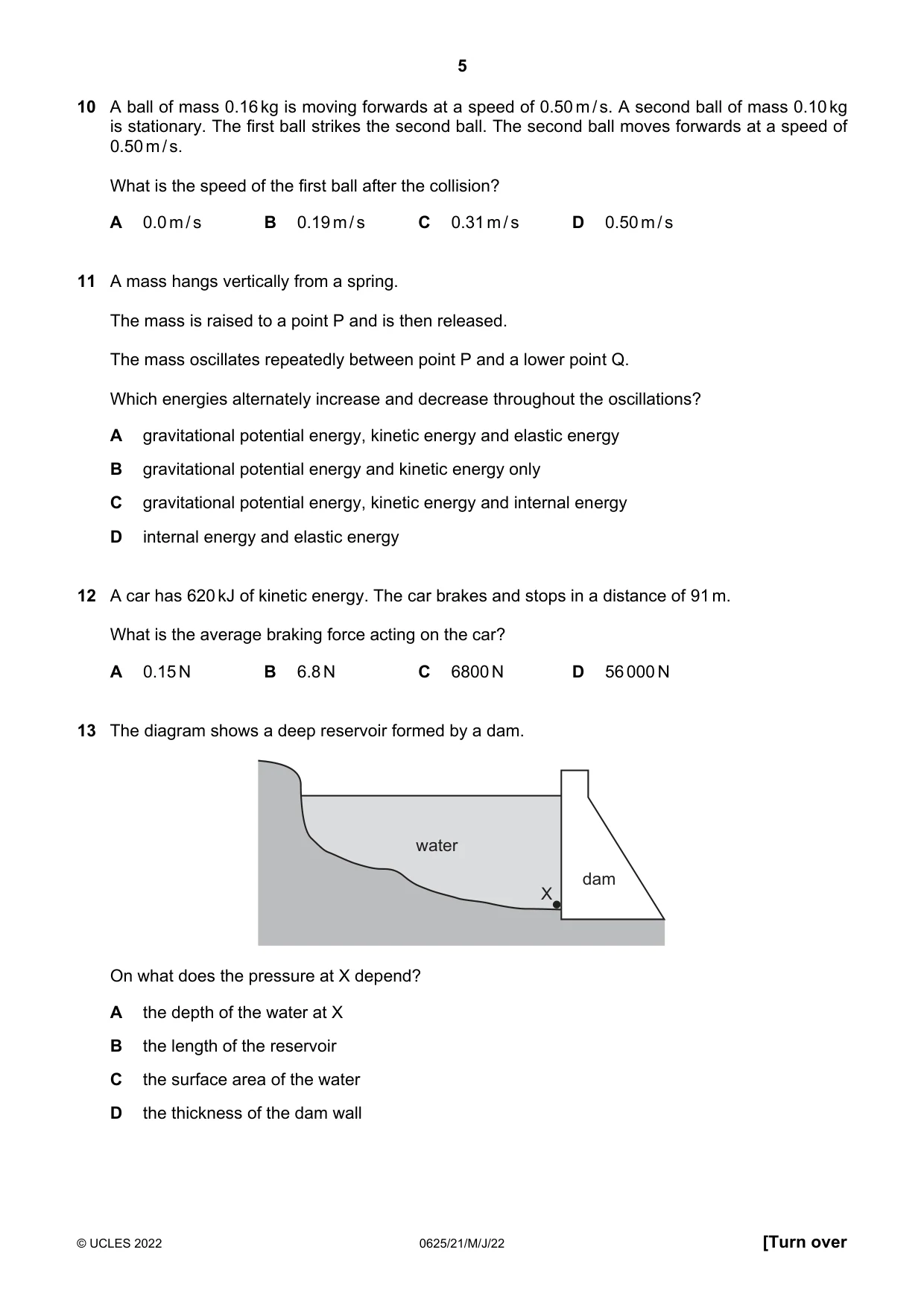
Q13 · The diagram shows a deep reservoir formed by a dam
13 The diagram shows a deep reservoir formed by a dam. water dam X On what does the pressure at X depend? A the depth of the water at X B the length of the reservoir C the surface area of the water D the thickness of the dam wall
Mark scheme: A
Q14 · A sealed rigid container has a fixed volume
14 A sealed rigid container has a fixed volume. The container is filled with air. The container is placed in a freezer cabinet and the temperature of the air in the container decreases. Which row correctly describes what happens to the air in the container? average distance average speed between air particles of air particles A decreases increases B decreases decreases C no change increases D no change decreases
Mark scheme: D
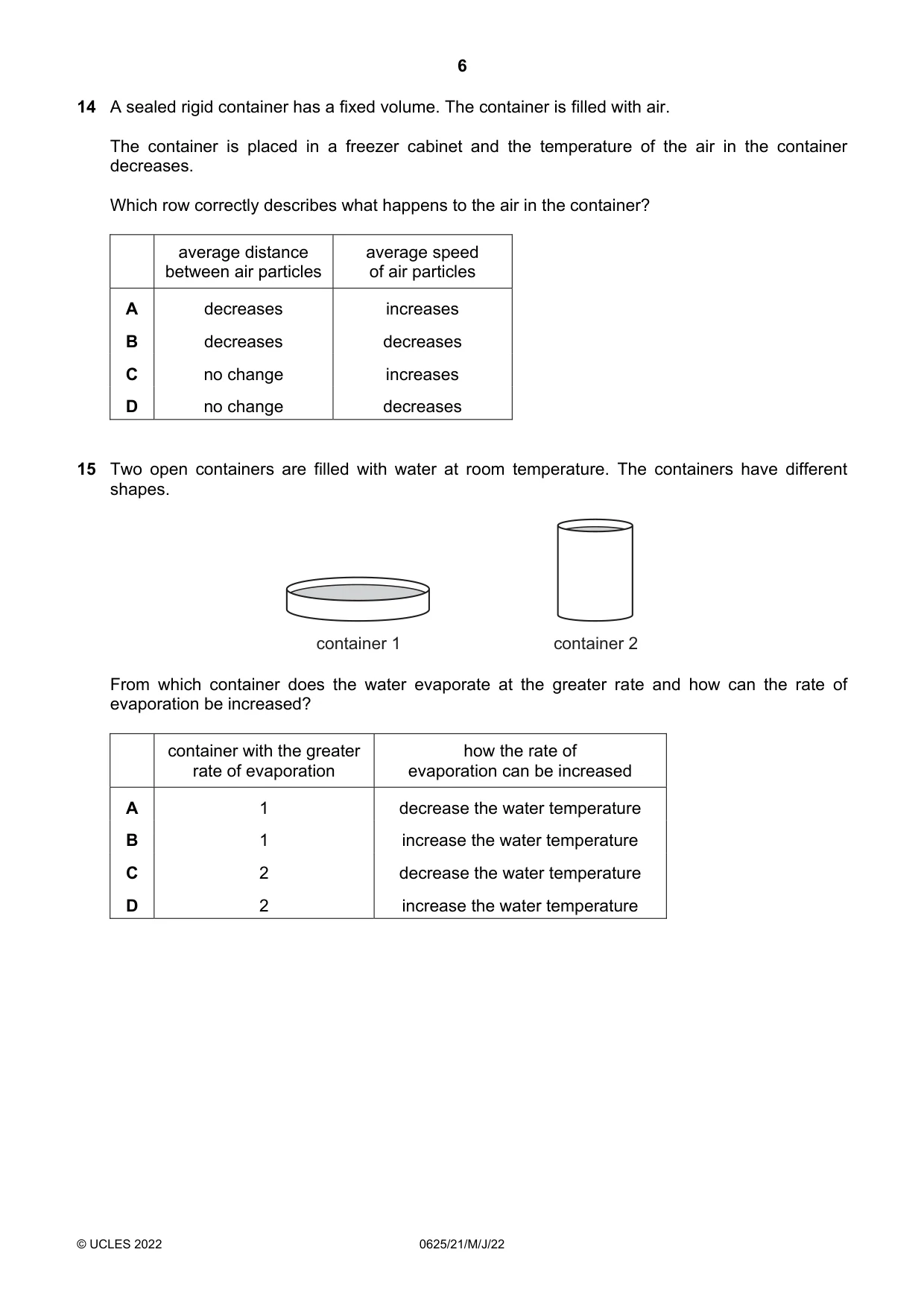
Q15 · Two open containers are filled with water at room temperature
15 Two open containers are filled with water at room temperature. The containers have different shapes. container 1 container 2 From which container does the water evaporate at the greater rate and how can the rate of evaporation be increased? container with the greater how the rate of rate of evaporation evaporation can be increased A 1 decrease the water temperature B 1 increase the water temperature C 2 decrease the water temperature D 2 increase the water temperature
Mark scheme: B
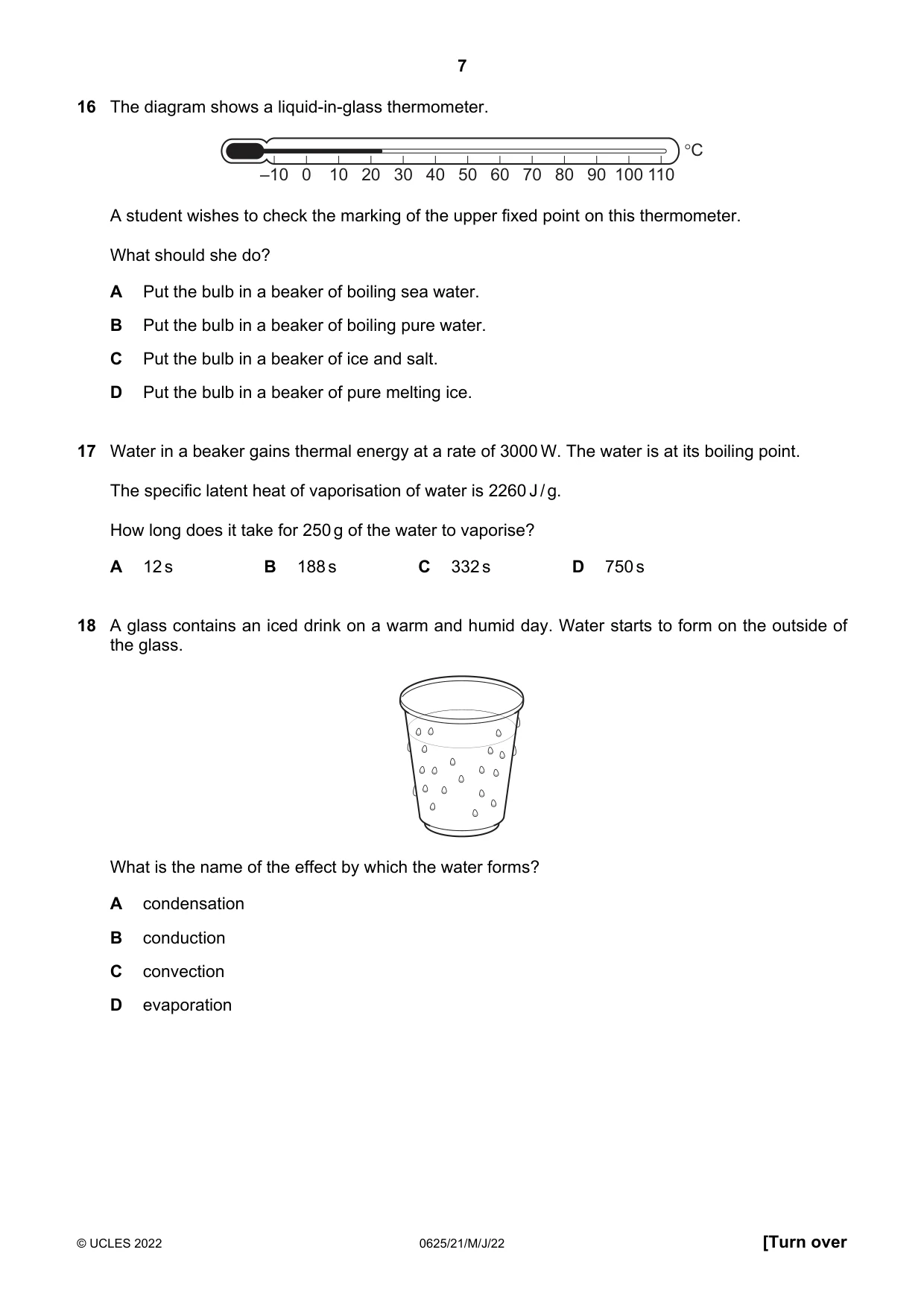
Q16 · The diagram shows a liquid-in-glass thermometer
16 The diagram shows a liquid-in-glass thermometer. °C –10 0 10 20 30 40 50 60 70 80 90 100 110 A student wishes to check the marking of the upper fixed point on this thermometer. What should she do? A Put the bulb in a beaker of boiling sea water. B Put the bulb in a beaker of boiling pure water. C Put the bulb in a beaker of ice and salt. D Put the bulb in a beaker of pure melting ice.
Mark scheme: B
Q17 · Water in a beaker gains thermal energy at a rate of 3000 W
17 Water in a beaker gains thermal energy at a rate of 3000 W. The water is at its boiling point. The specific latent heat of vaporisation of water is 2260 J / g. How long does it take for 250 g of the water to vaporise? A 12 s B 188 s C 332 s D 750 s
Mark scheme: B
Q18 · A glass contains an iced drink on a warm and humid day
18 A glass contains an iced drink on a warm and humid day. Water starts to form on the outside of the glass. What is the name of the effect by which the water forms? A condensation B conduction C convection D evaporation
Mark scheme: A
Q19 · One end of a copper bar is heated to a high temperature
19 One end of a copper bar is heated to a high temperature. Which mechanism is responsible for the transfer of thermal energy to the other end of the copper bar? A the lattice vibrations of copper ions only B the lattice vibrations of copper ions and the movement of high energy electrons along the bar C the movement of high energy copper ions along the bar D the movement of high energy electrons along the bar only
Mark scheme: B
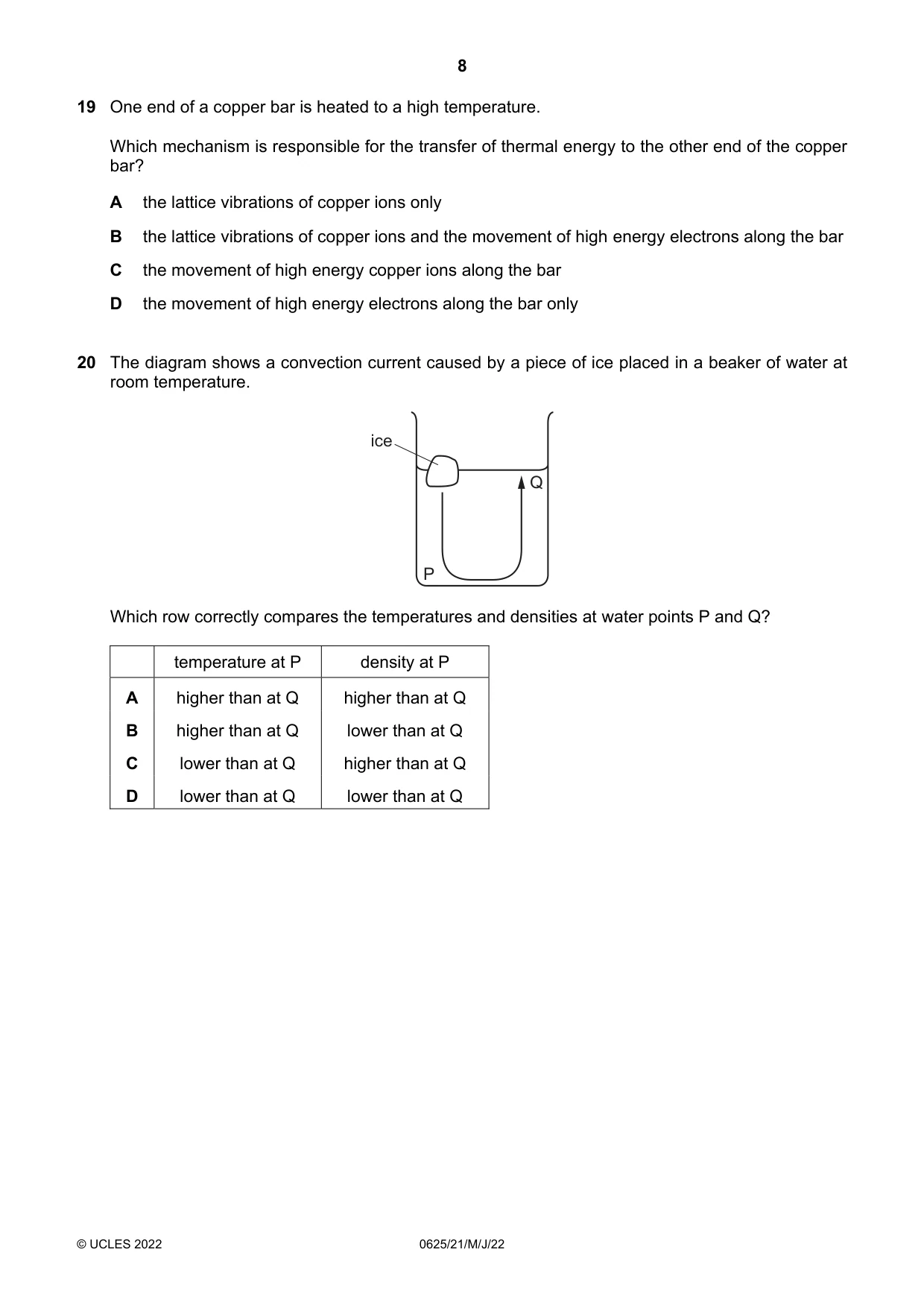
Q20 · The diagram shows a convection current caused by a piece of ice placed in a beaker of…
20 The diagram shows a convection current caused by a piece of ice placed in a beaker of water at room temperature. ice Q P Which row correctly compares the temperatures and densities at water points P and Q? temperature at P density at P A higher than at Q higher than at Q B higher than at Q lower than at Q C lower than at Q higher than at Q D lower than at Q lower than at Q
Mark scheme: C
Q21 · The diagram shows a wave
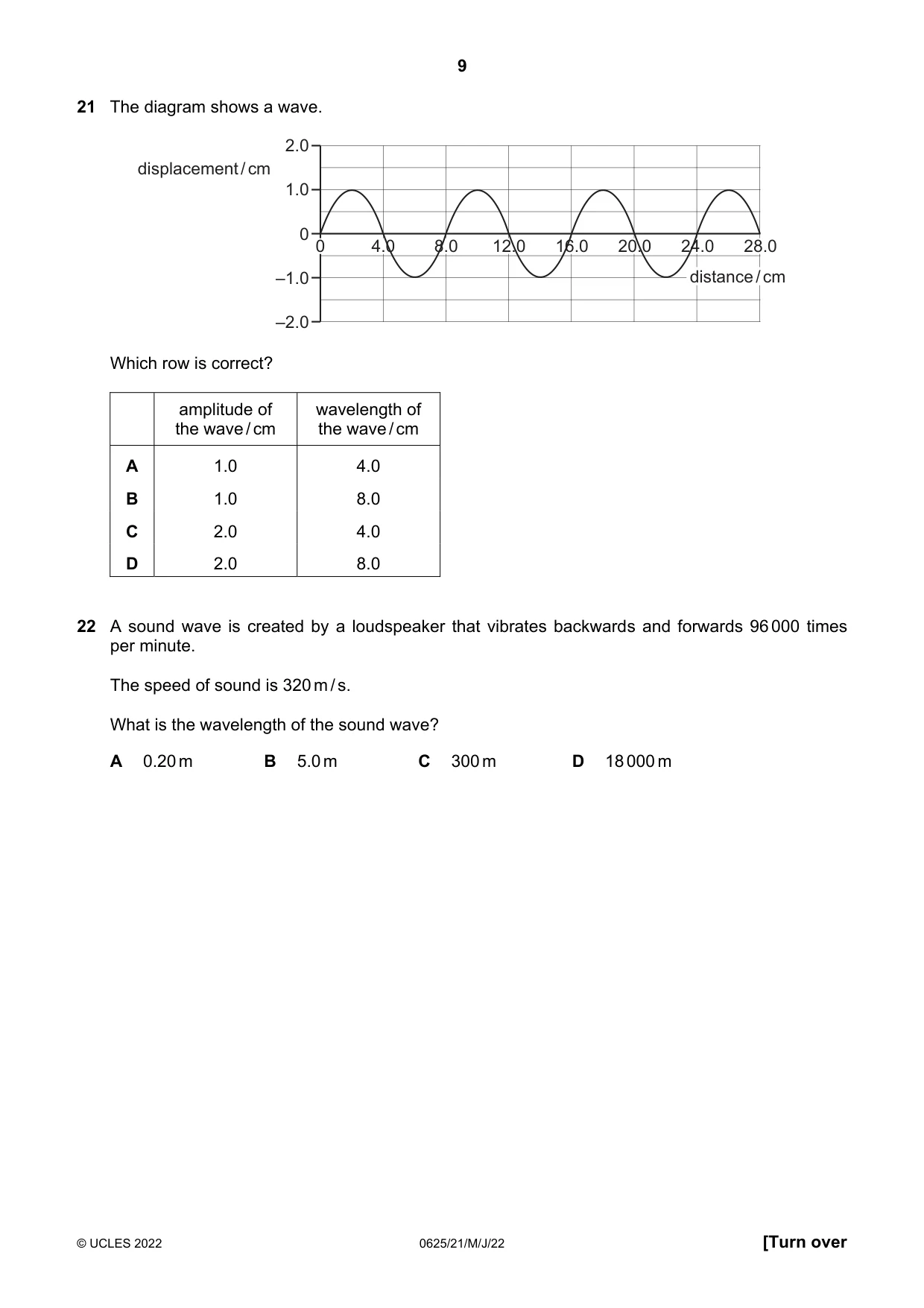
21 The diagram shows a wave. 2.0 displacement / cm 1.0 0 0 4.0 8.0 12.0 16.0 20.0 24.0 28.0 –1.0 distance / cm –2.0 Which row is correct? amplitude of wavelength of the wave / cm the wave / cm A 1.0 4.0 B 1.0 8.0 C 2.0 4.0 D 2.0 8.0
Mark scheme: B
Q22 · A sound wave is created by a loudspeaker that vibrates backwards and forwards 96 000…
22 A sound wave is created by a loudspeaker that vibrates backwards and forwards 96 000 times per minute. The speed of sound is 320 m / s. What is the wavelength of the sound wave? A 0.20 m B 5.0 m C 300 m D 18 000 m
Mark scheme: A
Q23 · A card is placed in front of a plane mirror so that its label is facing the mirror, as…
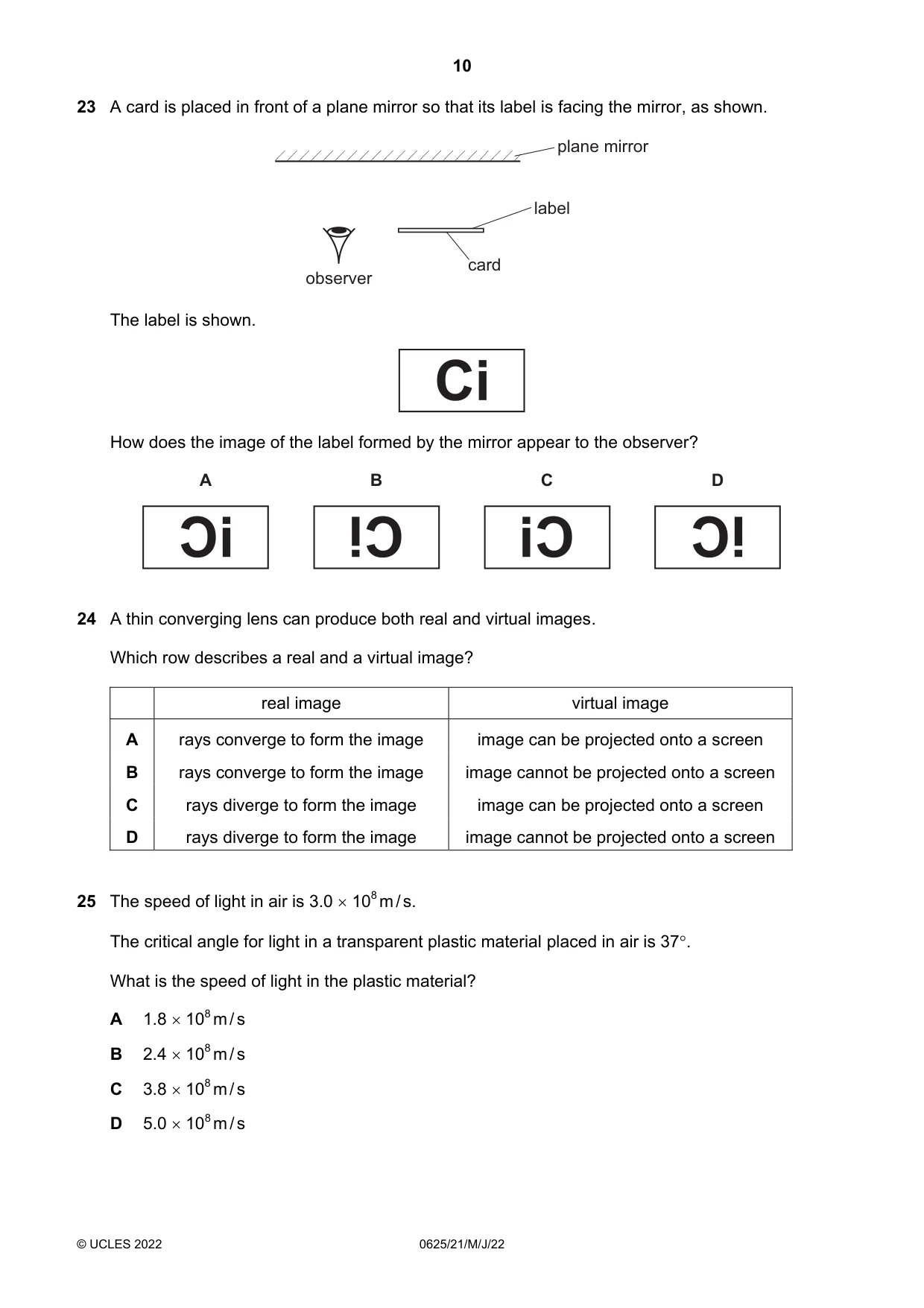
23 A card is placed in front of a plane mirror so that its label is facing the mirror, as shown. plane mirror label card observer The label is shown. How does the image of the label formed by the mirror appear to the observer? A B C D
Mark scheme: C
Q24 · A thin converging lens can produce both real and virtual images
24 A thin converging lens can produce both real and virtual images. Which row describes a real and a virtual image? real image virtual image A rays converge to form the image image can be projected onto a screen B rays converge to form the image image cannot be projected onto a screen C rays diverge to form the image image can be projected onto a screen D rays diverge to form the image image cannot be projected onto a screen
Mark scheme: B
Q25 · The speed of light in air is 3.0 108 m / s
25 The speed of light in air is 3.0 108 m / s. The critical angle for light in a transparent plastic material placed in air is 37. What is the speed of light in the plastic material? A 1.8 108 m / s B 2.4 108 m / s C 3.8 108 m / s D 5.0 108 m / s
Mark scheme: A
Q26 · Which part of the electromagnetic spectrum is used by a remote controller for a…
26 Which part of the electromagnetic spectrum is used by a remote controller for a television? A infrared waves B microwaves C radio waves D visible light
Mark scheme: A
Q27 · Which statement correctly compares radio waves and X-rays?
27 Which statement correctly compares radio waves and X-rays? A Radio waves have a longer wavelength and a greater speed in a vacuum. B Radio waves have a longer wavelength and the same speed in a vacuum. C Radio waves have a shorter wavelength and a greater speed in a vacuum. D Radio waves have a shorter wavelength and the same speed in a vacuum.
Mark scheme: B
Q28 · A student counts how many iron pins an electromagnet picks up when its power supply is…
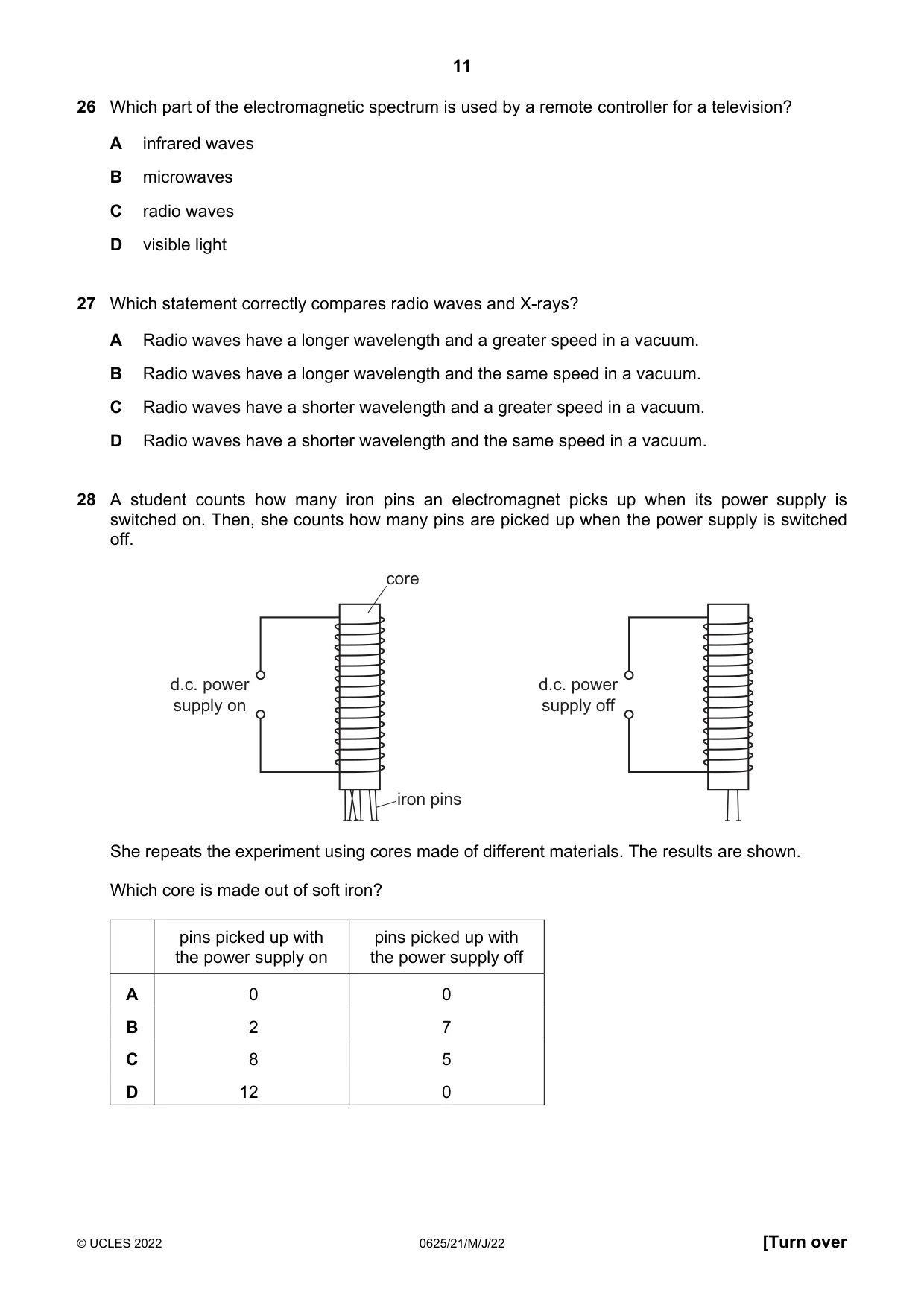
28 A student counts how many iron pins an electromagnet picks up when its power supply is switched on. Then, she counts how many pins are picked up when the power supply is switched off. core d.c. power d.c. power supply on supply off iron pins She repeats the experiment using cores made of different materials. The results are shown. Which core is made out of soft iron? pins picked up with pins picked up with the power supply on the power supply off A 0 0 B 2 7 C 8 5 D 12 0
Mark scheme: D
Q29 · A plastic rod is brought near to a small plastic sphere suspended from a stand
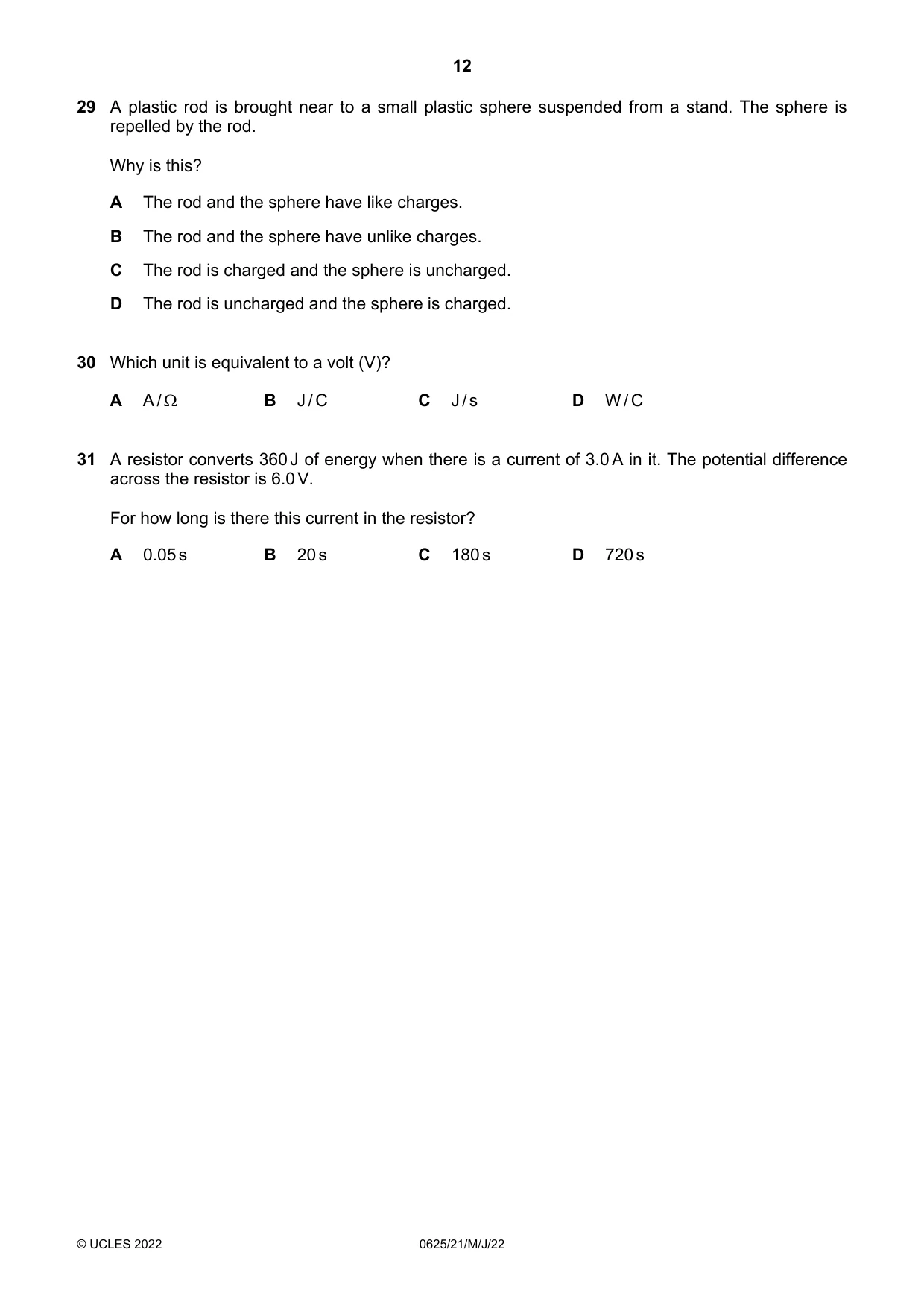
29 A plastic rod is brought near to a small plastic sphere suspended from a stand. The sphere is repelled by the rod. Why is this? A The rod and the sphere have like charges. B The rod and the sphere have unlike charges. C The rod is charged and the sphere is uncharged. D The rod is uncharged and the sphere is charged.
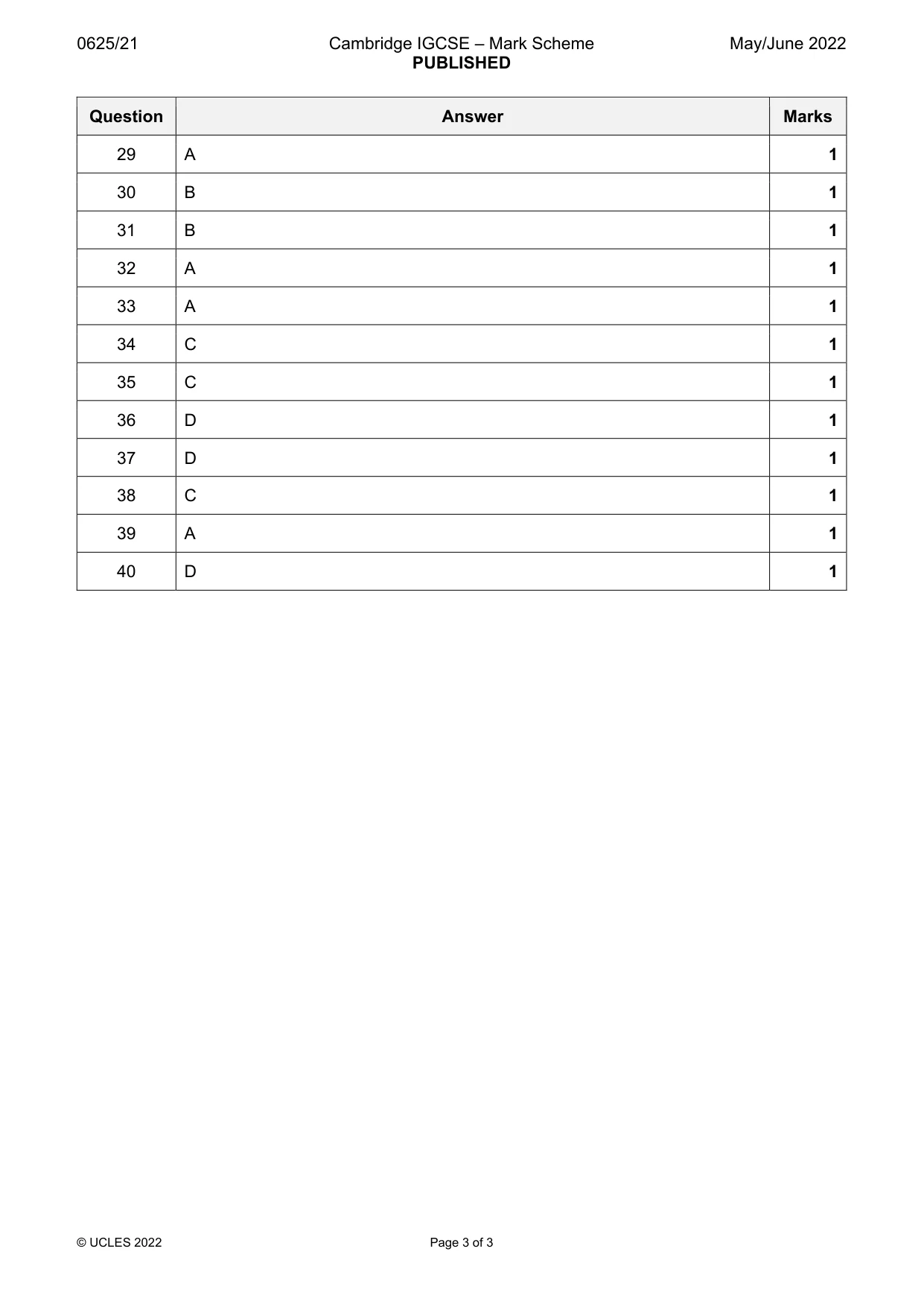
Mark scheme: A
Q30 · Which unit is equivalent to a volt (V)?
30 Which unit is equivalent to a volt (V)? A A / B J / C C J / s D W / C
Mark scheme: B
Q31 · A resistor converts 360 J of energy when there is a current of 3.0 A in it
31 A resistor converts 360 J of energy when there is a current of 3.0 A in it. The potential difference across the resistor is 6.0 V. For how long is there this current in the resistor? A 0.05 s B 20 s C 180 s D 720 s
Mark scheme: B
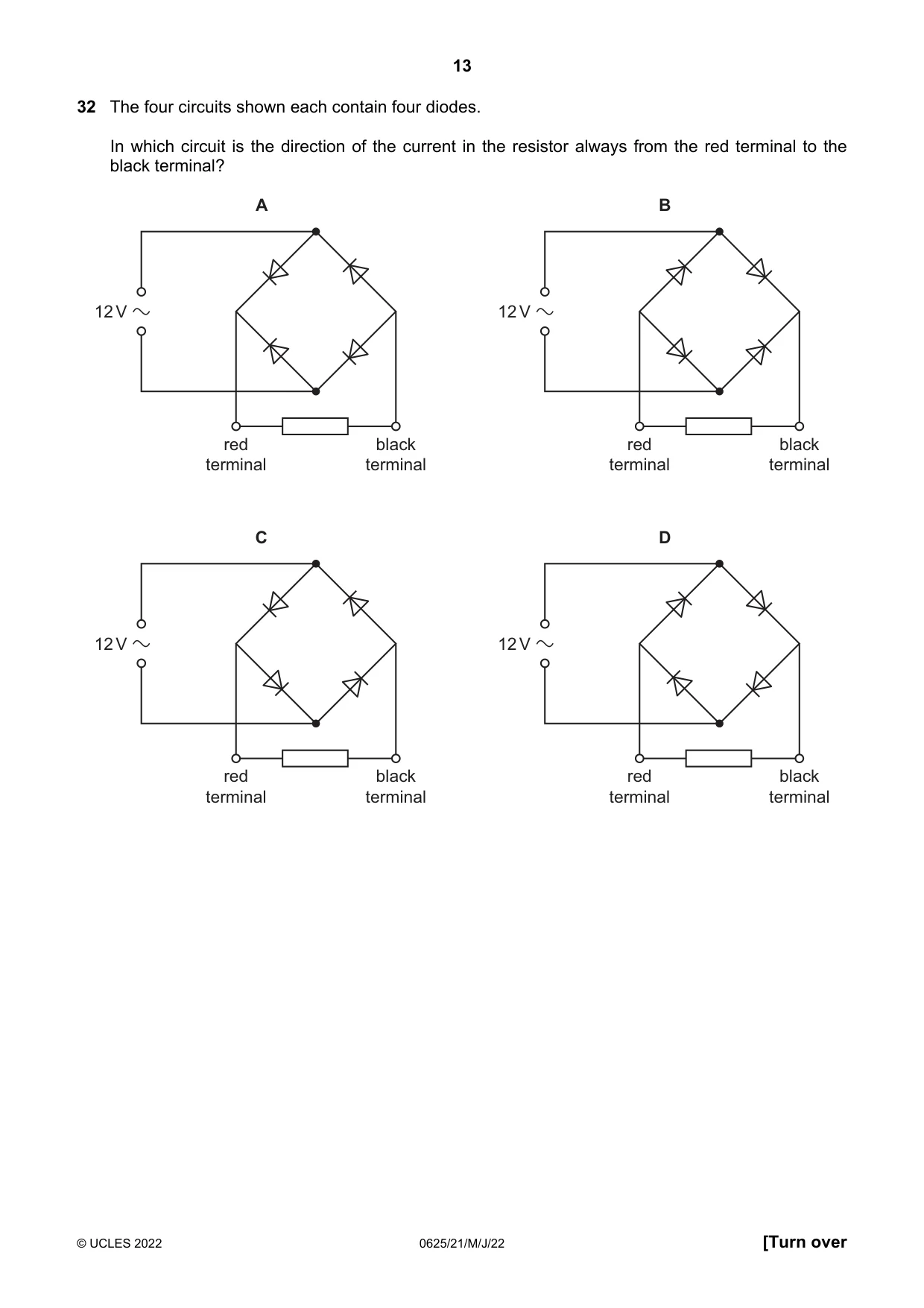
Q32 · The four circuits shown each contain four diodes
32 The four circuits shown each contain four diodes. In which circuit is the direction of the current in the resistor always from the red terminal to the black terminal? A B 12 V 12 V red black red black terminal terminal terminal terminal C D 12 V 12 V red black red black terminal terminal terminal terminal
Mark scheme: A
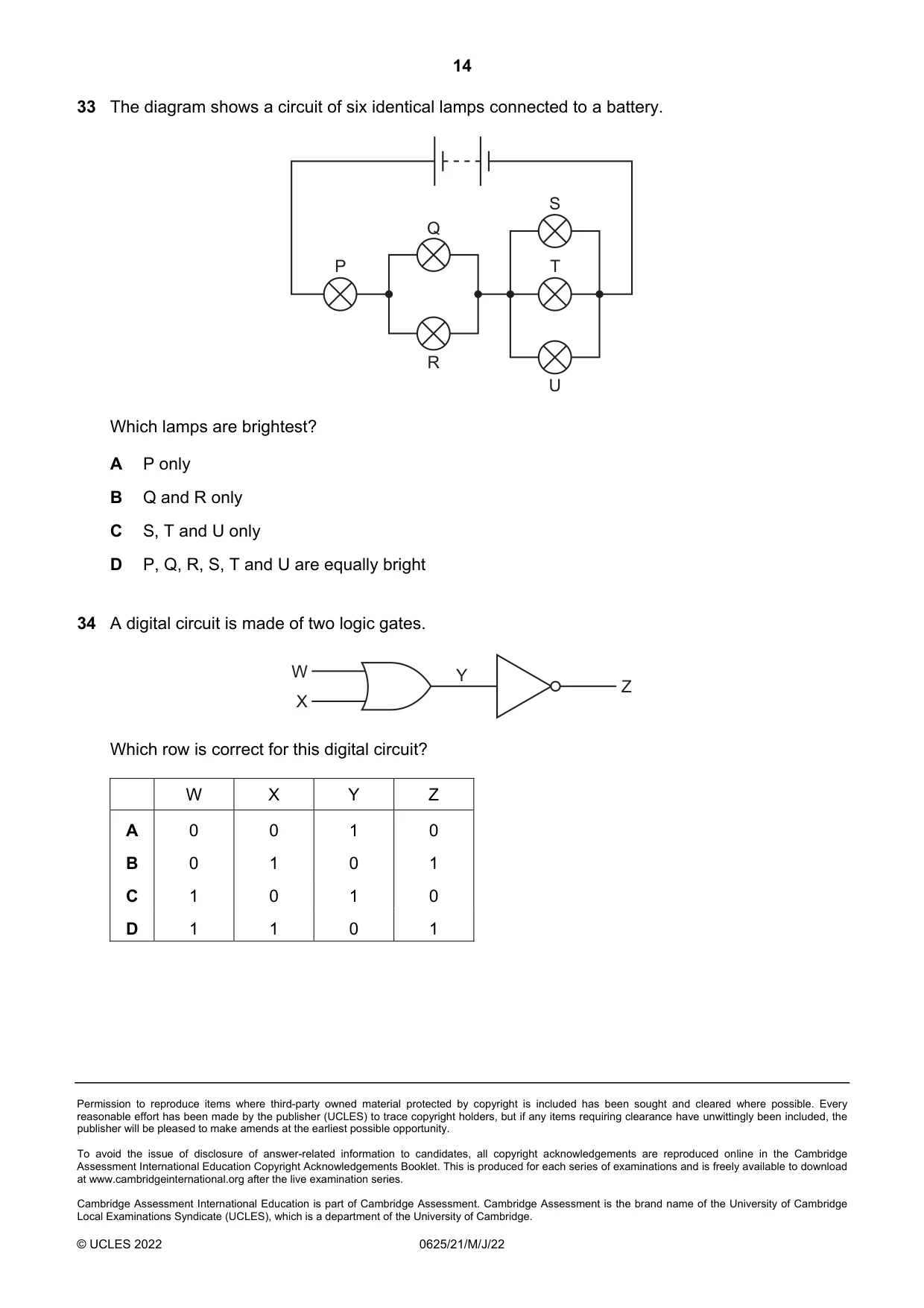
Q33 · The diagram shows a circuit of six identical lamps connected to a battery
33 The diagram shows a circuit of six identical lamps connected to a battery. S Q P T R U Which lamps are brightest? A P only B Q and R only C S, T and U only D P, Q, R, S, T and U are equally bright
Mark scheme: A
Q34 · A digital circuit is made of two logic gates
34 A digital circuit is made of two logic gates. W Y Z X Which row is correct for this digital circuit? W X Y Z A 0 0 1 0 B 0 1 0 1 C 1 0 1 0 D 1 1 0 1
Mark scheme: C
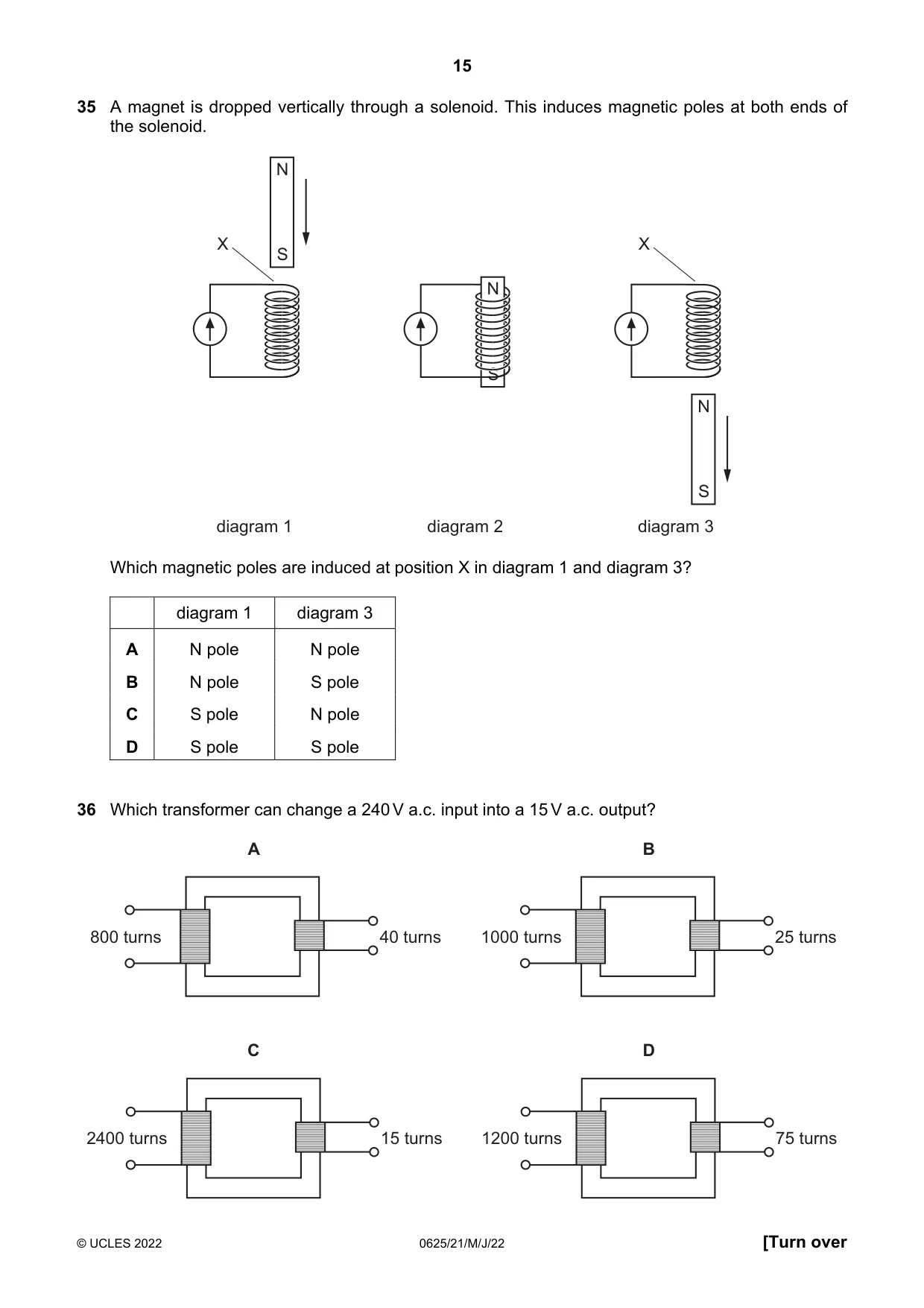
Q35 · A magnet is dropped vertically through a solenoid
35 A magnet is dropped vertically through a solenoid. This induces magnetic poles at both ends of the solenoid. N X X S N S N S diagram 1 diagram 2 diagram 3 Which magnetic poles are induced at position X in diagram 1 and diagram 3? diagram 1 diagram 3 A N pole N pole B N pole S pole C S pole N pole D S pole S pole
Mark scheme: C
Q36 · Which transformer can change a 240 V a.c
36 Which transformer can change a 240 V a.c. input into a 15 V a.c. output? A B 800 turns 40 turns 1000 turns 25 turns C D 2400 turns 15 turns 1200 turns 75 turns
Mark scheme: D
Q37 · What is the purpose of the split-ring commutator in an electric motor?
37 What is the purpose of the split-ring commutator in an electric motor? A to ensure that the magnetic field in the motor changes direction every half rotation B to ensure that the magnetic field in the motor stays in the same direction at all times C to ensure that the turning effect on the motor changes direction every half rotation D to ensure that the turning effect on the motor stays in the same direction at all times
Mark scheme: D
Q38 · How do the sizes of the two nuclei produced in a nuclear fission reaction compare to the…
38 How do the sizes of the two nuclei produced in a nuclear fission reaction compare to the size of the original nucleus? A both larger than the original nucleus B one larger and one smaller than the original nucleus C both smaller than the original nucleus D one smaller and one the same size as the original nucleus
Mark scheme: C
Q39 · Which statement about the radioactive decay of a substance is correct?
39 Which statement about the radioactive decay of a substance is correct? A It cannot be predicted when a particular nucleus will decay. B Placing a radioactive substance inside a lead-lined box prevents it from decaying. C The decay always produces poisonous gases. D The rate of decay increases if the substance is dissolved in water.
Mark scheme: A
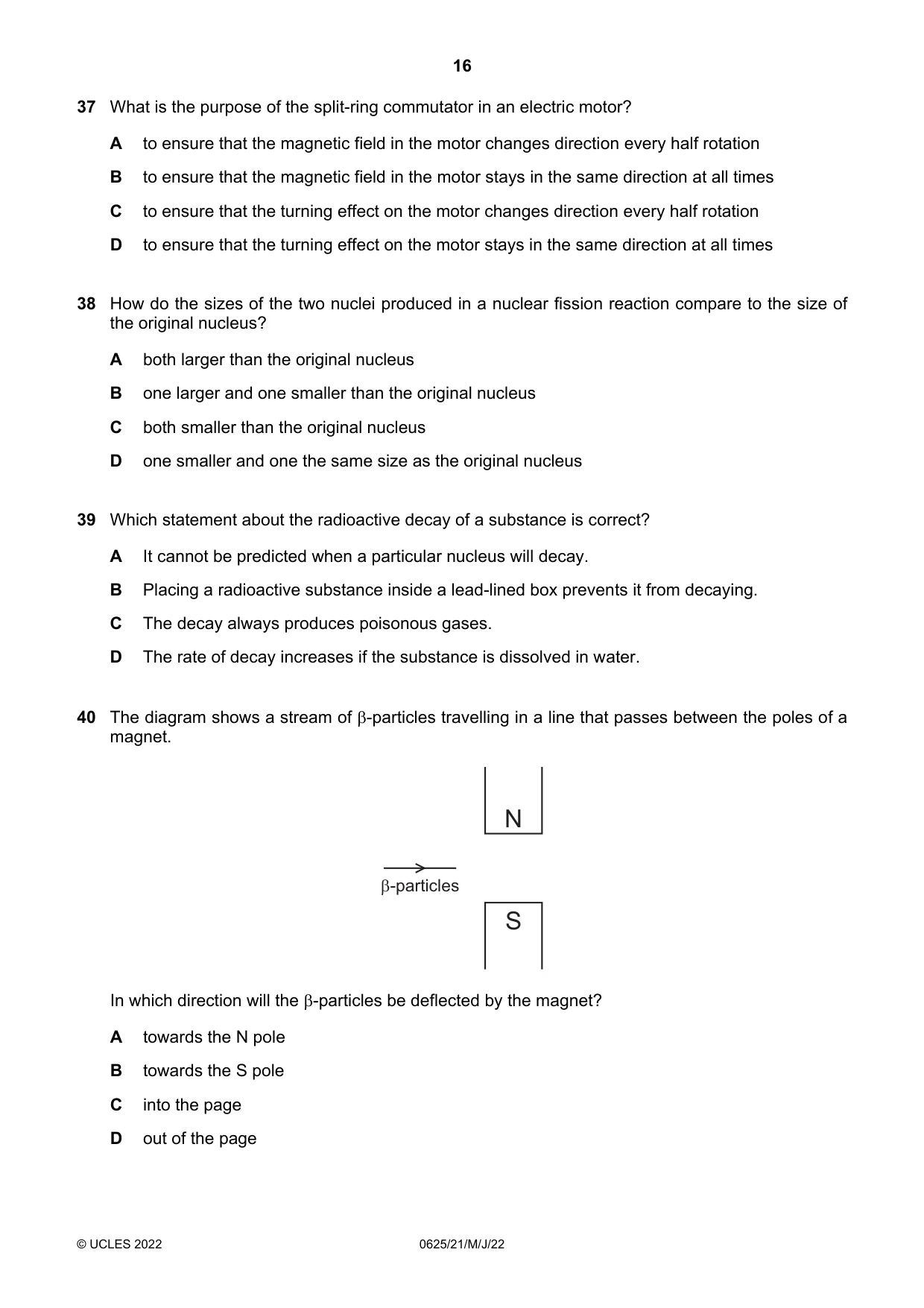
Q40 · The diagram shows a stream of B-particles travelling in a line that passes between the…
40 The diagram shows a stream of B-particles travelling in a line that passes between the poles of a magnet. Oo B-particles In which direction will the B-particles be deflected by the magnet? A __ towards the N pole B_ towards the S pole C into the page D out of the page
Mark scheme: D
What was in this paper
The subtopics covered by these 40 questions, and how many questions each got. Open one in a new tab to see every Cambridge question on it.
4Electric circuits3Forces3Kinetic particle model of matter3Light3Electrical quantities2Electromagnetic spectrum2Energy, work and power2Momentum2Motion2Simple phenomena of magnetism2Thermal properties and temperature2Transfer of thermal energy2Density1General properties of waves1Mass and weight1Physical quantities and measurement techniques1Pressure1Radioactivity1Sound1The nuclear model of the atom1What you needed in this session
Cambridge’s own grade thresholds for 2022 May/June, Paper 2 · Variant 1. A higher threshold means an easier paper — the bar moves with how the cohort did.