Cambridge IGCSE Physics 0625 — 2019 May/June Paper 2 · Variant 1
0625/21/M/J/19 · 40 questions · 40 marks · ≈45 min
The question paper and its mark scheme, free to read here and free to download. This is Cambridge’s own paper, exactly as it was sat.
Question paper16 pages
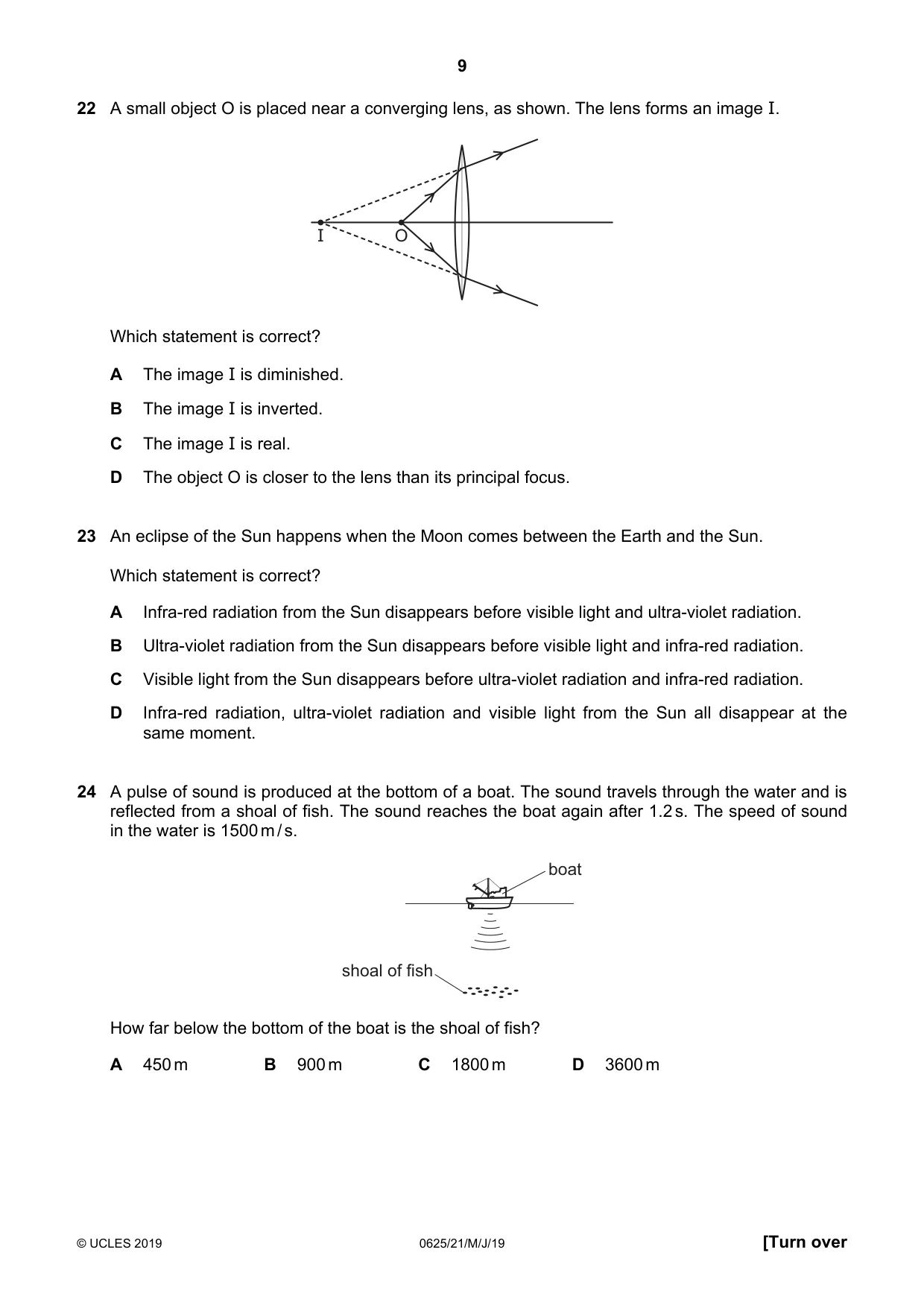
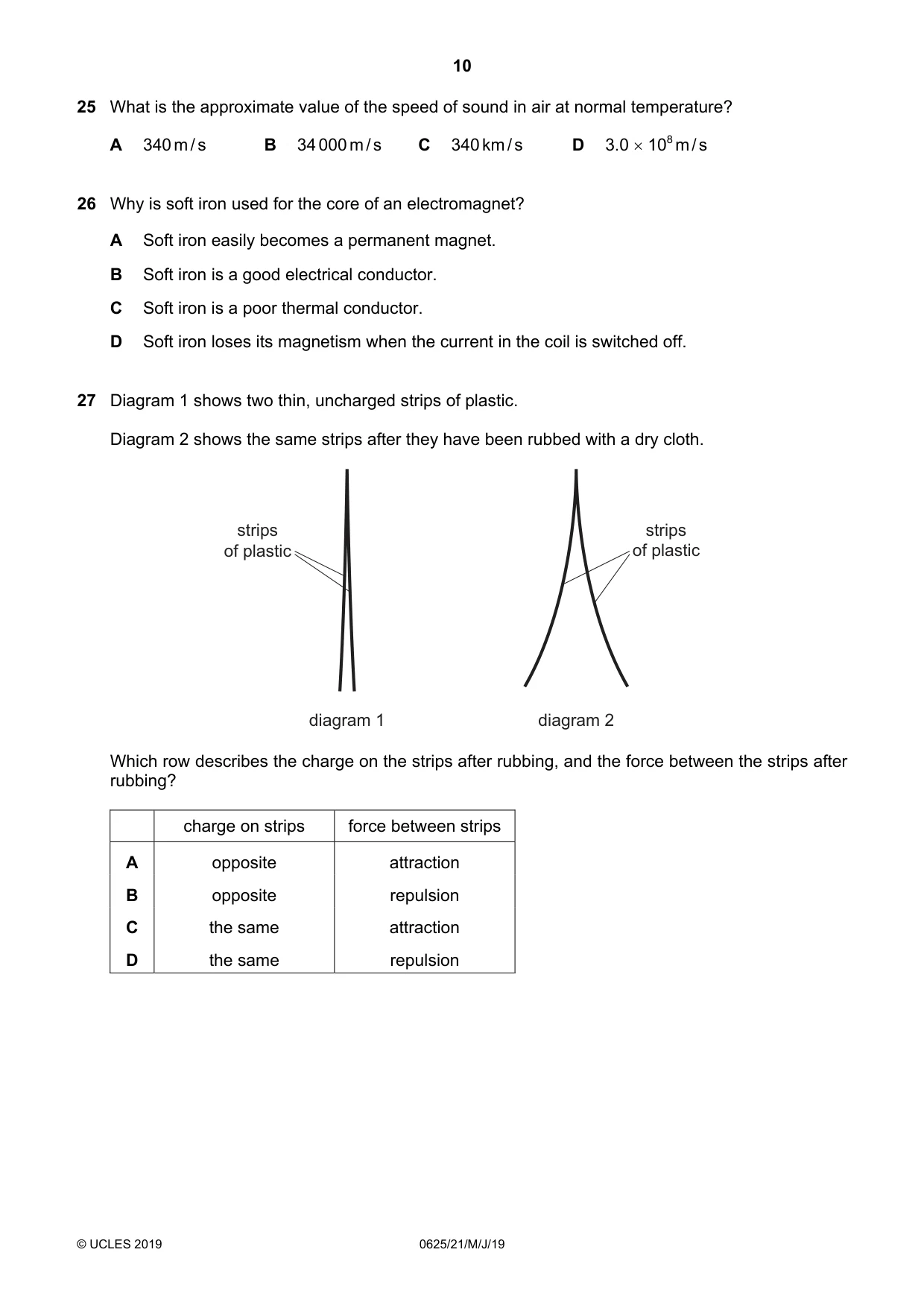
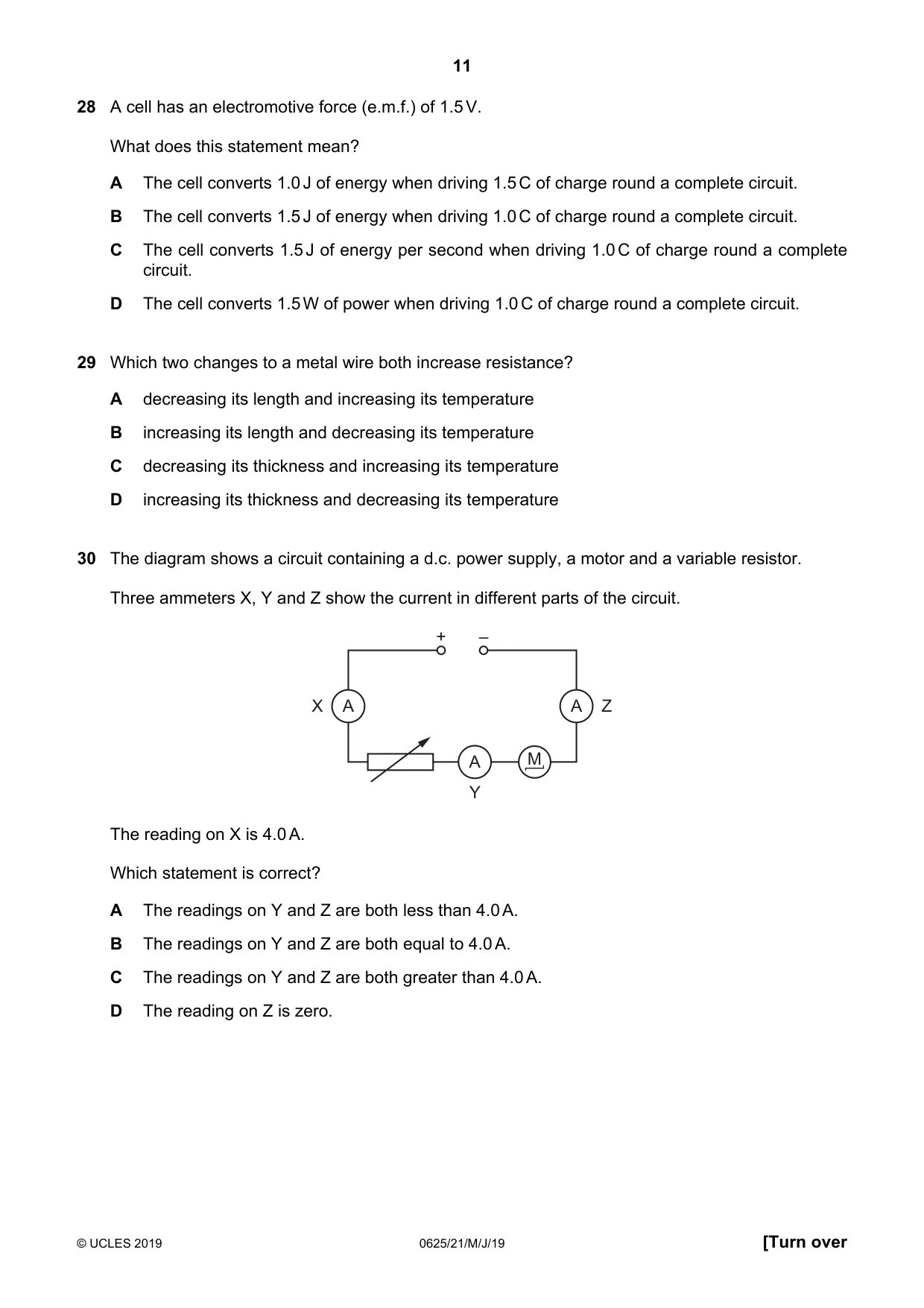
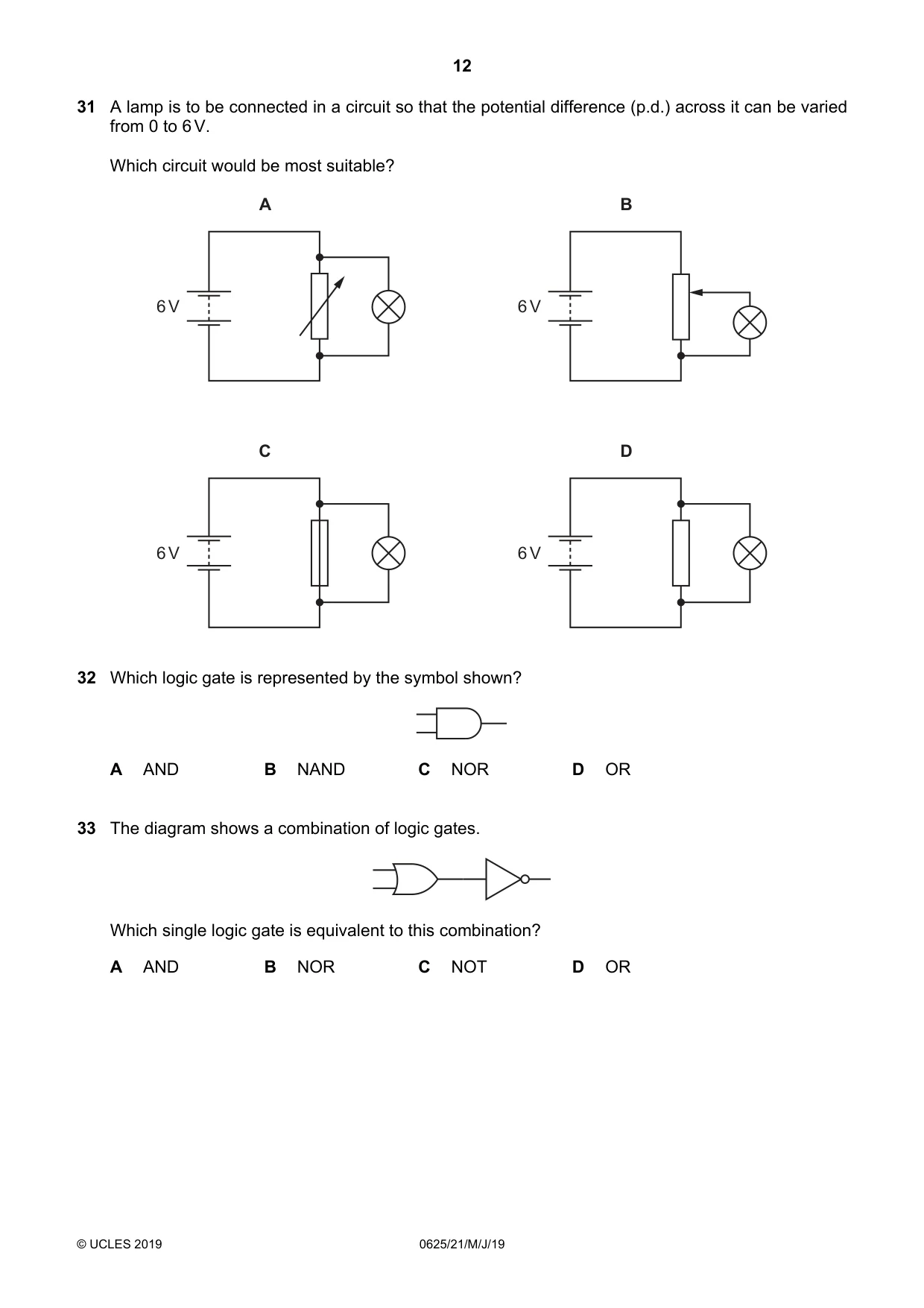
Mark scheme3 pages
Answers below. Sit the paper first if you are practising.
Questions as text
Q1 · Which quantity can be measured directly using a micrometer screw gauge?
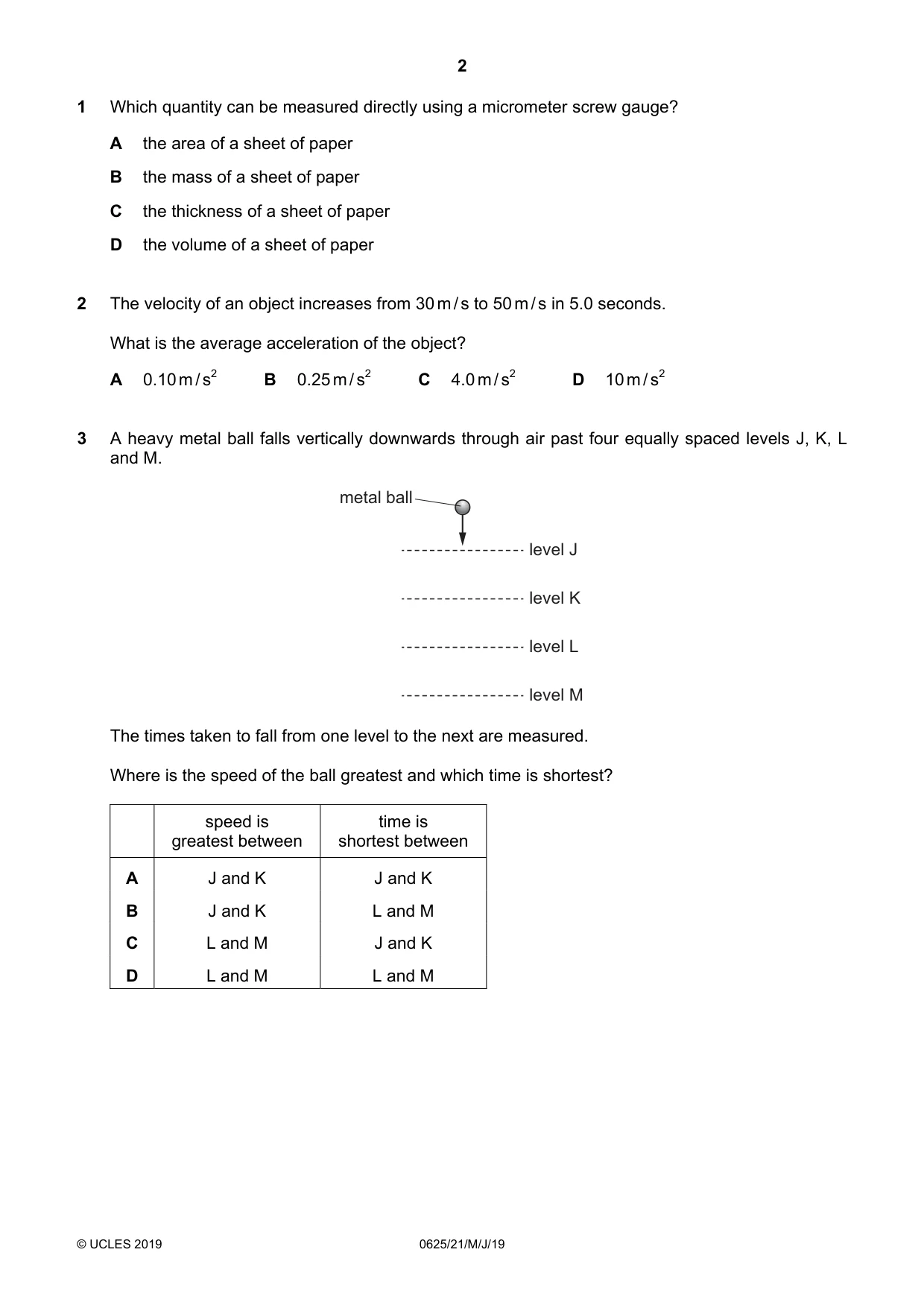
1 Which quantity can be measured directly using a micrometer screw gauge? A the area of a sheet of paper B the mass of a sheet of paper C the thickness of a sheet of paper D the volume of a sheet of paper
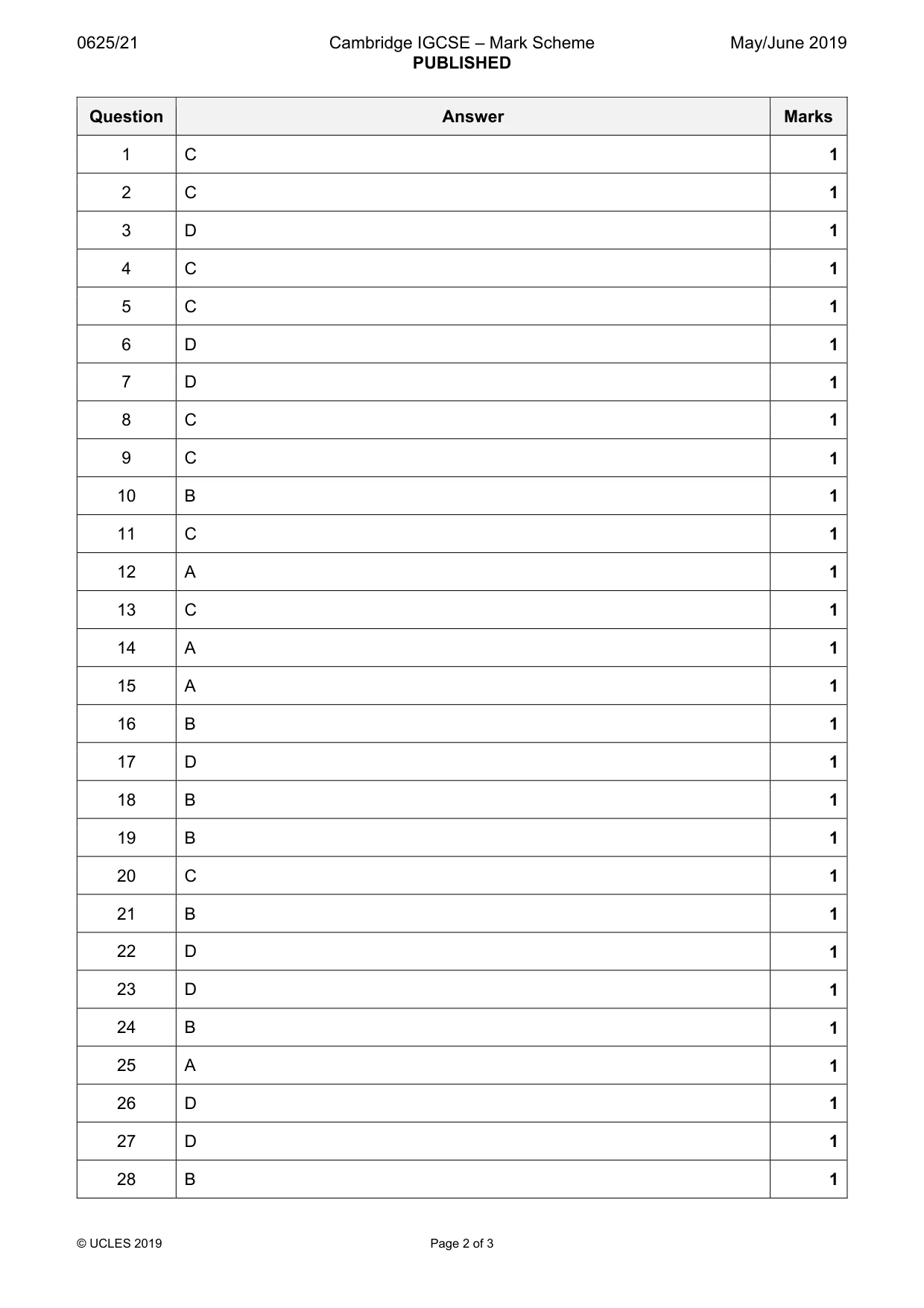
Mark scheme: C
More questions on Physical quantities and measurement techniques
Q2 · The velocity of an object increases from 30 m / s to 50 m / s in 5.0 seconds
2 The velocity of an object increases from 30 m / s to 50 m / s in 5.0 seconds. What is the average acceleration of the object? A 0.10 m / s2 B 0.25 m / s2 C 4.0 m / s2 D 10 m / s2
Mark scheme: C
Q3 · A heavy metal ball falls vertically downwards through air past four equally spaced levels…
3 A heavy metal ball falls vertically downwards through air past four equally spaced levels J, K, L and M. metal ball level J level K level L level M The times taken to fall from one level to the next are measured. Where is the speed of the ball greatest and which time is shortest? speed is time is greatest between shortest between A J and K J and K B J and K L and M C L and M J and K D L and M L and M
Mark scheme: D
Q4 · A body is moved from place X to place Y where the gravitational field strength is…
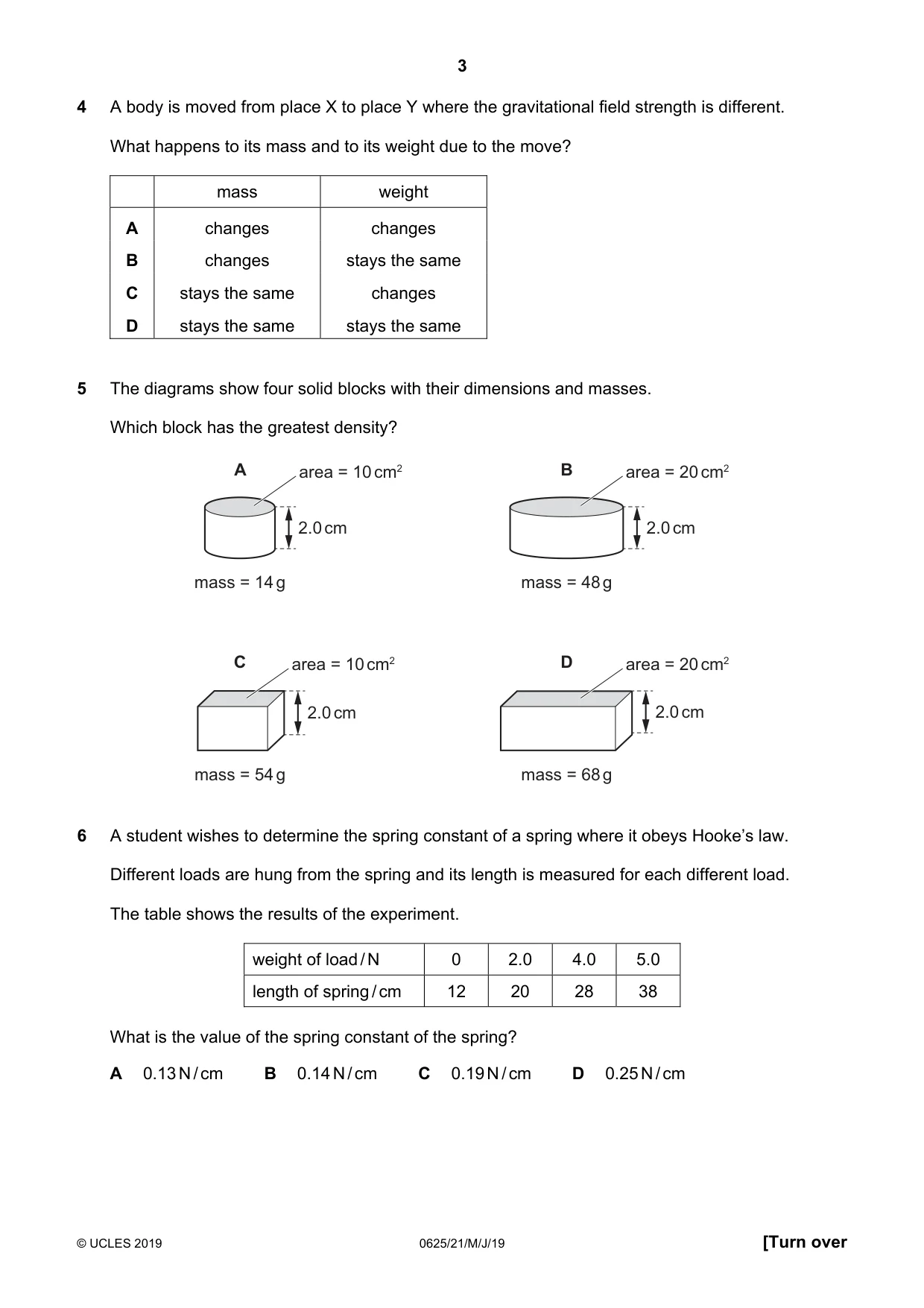
4 A body is moved from place X to place Y where the gravitational field strength is different. What happens to its mass and to its weight due to the move? mass weight A changes changes B changes stays the same C stays the same changes D stays the same stays the same
Mark scheme: C
Q5 · The diagrams show four solid blocks with their dimensions and masses
5 The diagrams show four solid blocks with their dimensions and masses. Which block has the greatest density? A area = 10 cm2 B area = 20 cm2 2.0 cm 2.0 cm mass = 14 g mass = 48 g C area = 10 cm2 D area = 20 cm2 2.0 cm 2.0 cm mass = 54 g mass = 68 g
Mark scheme: C
Q6 · A student wishes to determine the spring constant of a spring where it obeys Hooke’s law
6 A student wishes to determine the spring constant of a spring where it obeys Hooke’s law. Different loads are hung from the spring and its length is measured for each different load. The table shows the results of the experiment. weight of load / N 0 2.0 4.0 5.0 length of spring / cm 12 20 28 38 What is the value of the spring constant of the spring? A 0.13 N / cm B 0.14 N / cm C 0.19 N / cm D 0.25 N / cm
Mark scheme: D
Q7 · A mass of 20 kg is held stationary by a rope passing over a frictionless pulley
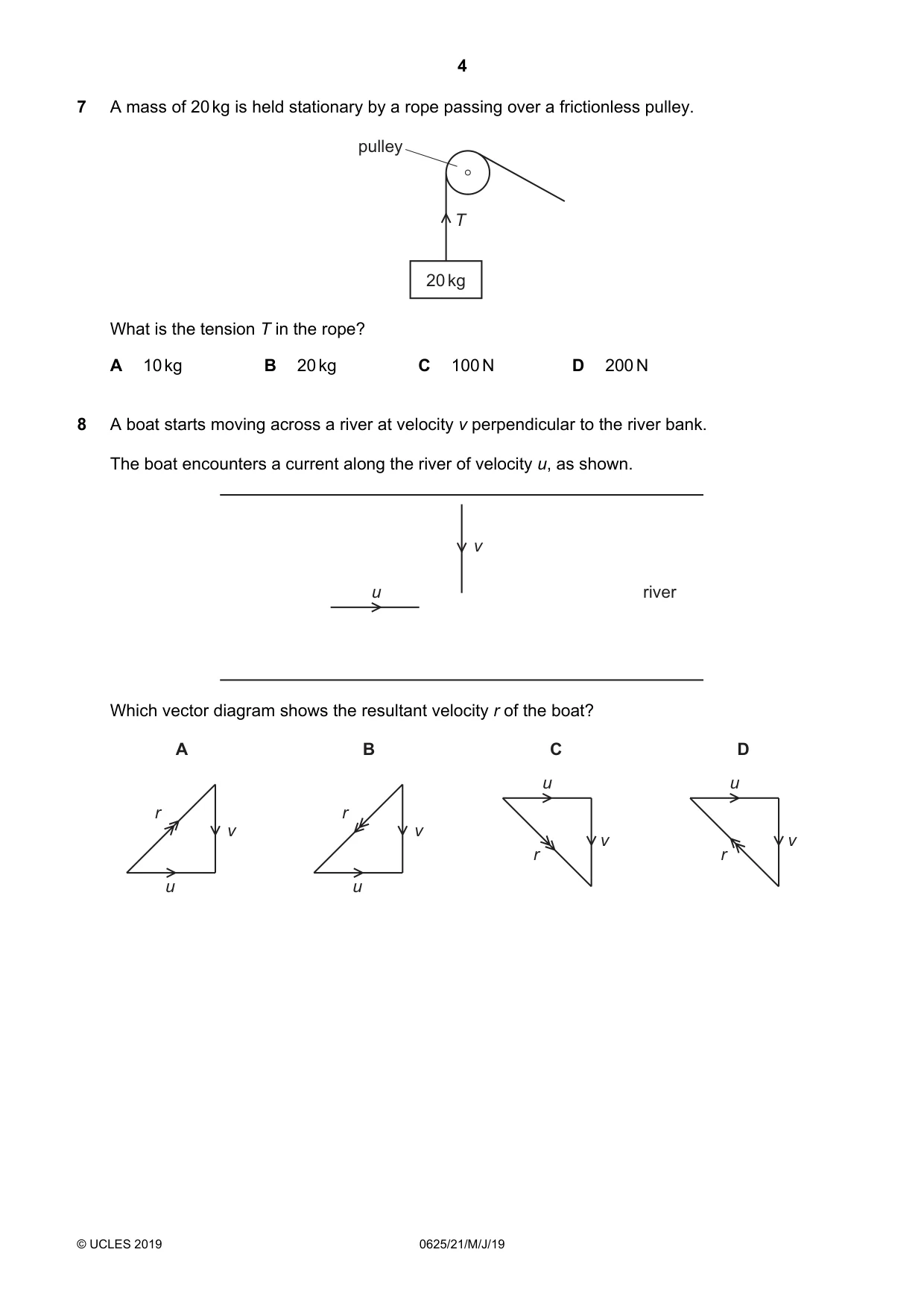
7 A mass of 20 kg is held stationary by a rope passing over a frictionless pulley. pulley T 20 kg What is the tension T in the rope? A 10 kg B 20 kg C 100 N D 200 N
Mark scheme: D
Q8 · A boat starts moving across a river at velocity v perpendicular to the river bank
8 A boat starts moving across a river at velocity v perpendicular to the river bank. The boat encounters a current along the river of velocity u, as shown. v u river Which vector diagram shows the resultant velocity r of the boat? A B C D u u r r v v v v r r u u
Mark scheme: C
Q9 · A ball of mass 0.50 kg falls and hits the floor at 10 m / s
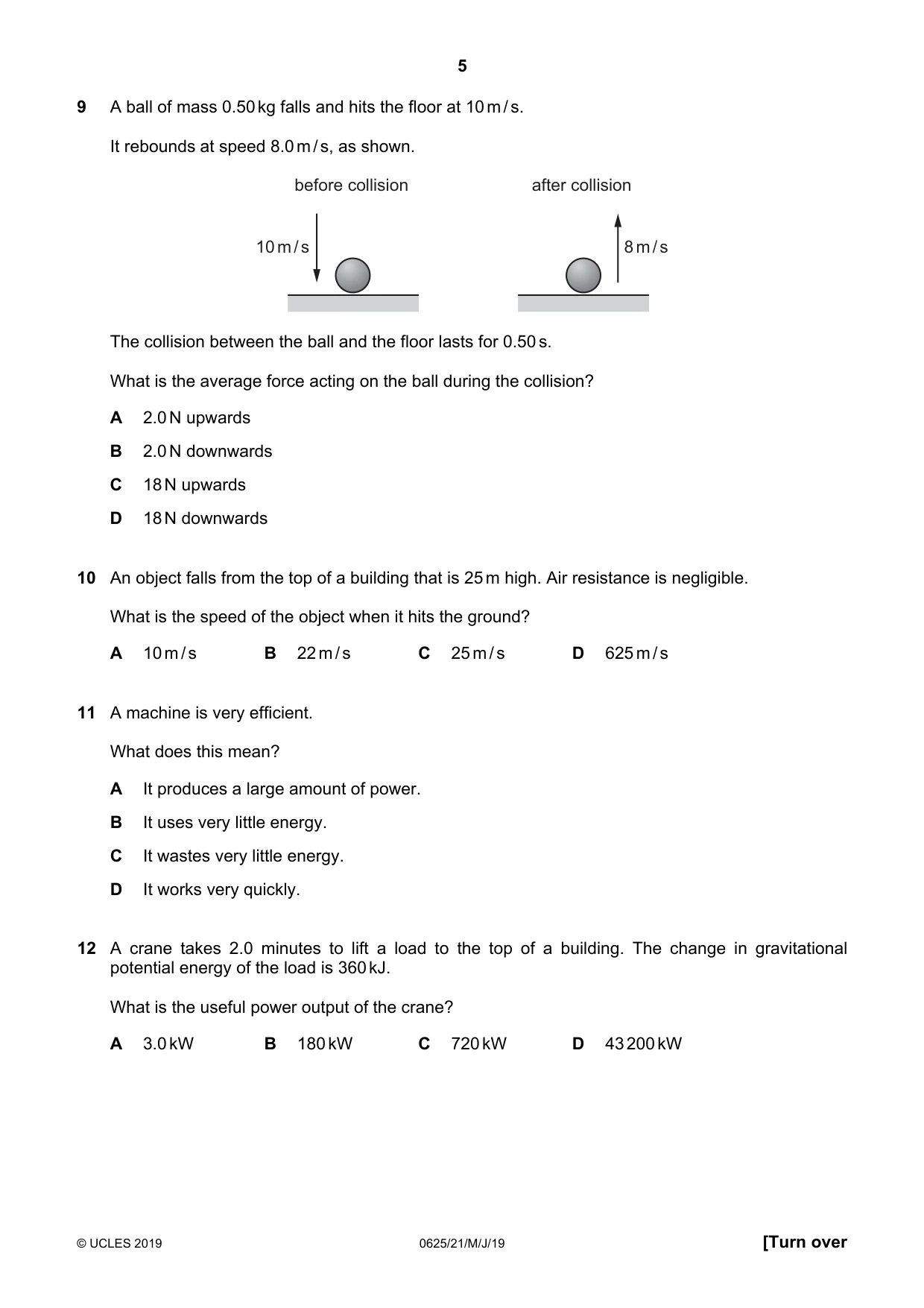
9 A ball of mass 0.50 kg falls and hits the floor at 10 m / s. It rebounds at speed 8.0 m / s, as shown. before collision after collision 10 m / s 8 m / s The collision between the ball and the floor lasts for 0.50 s. What is the average force acting on the ball during the collision? A 2.0 N upwards B 2.0 N downwards C 18 N upwards D 18 N downwards
Mark scheme: C
Q10 · An object falls from the top of a building that is 25 m high
10 An object falls from the top of a building that is 25 m high. Air resistance is negligible. What is the speed of the object when it hits the ground? A 10 m / s B 22 m / s C 25 m / s D 625 m / s
Mark scheme: B
Q11 · A machine is very efficient
11 A machine is very efficient. What does this mean? A It produces a large amount of power. B It uses very little energy. C It wastes very little energy. D It works very quickly.
Mark scheme: C
Q12 · A crane takes 2.0 minutes to lift a load to the top of a building
12 A crane takes 2.0 minutes to lift a load to the top of a building. The change in gravitational potential energy of the load is 360 kJ. What is the useful power output of the crane? A 3.0 kW B 180 kW C 720 kW D 43 200 kW
Mark scheme: A
Q13 · The diagram shows a stone suspended on a string under the surface of a liquid
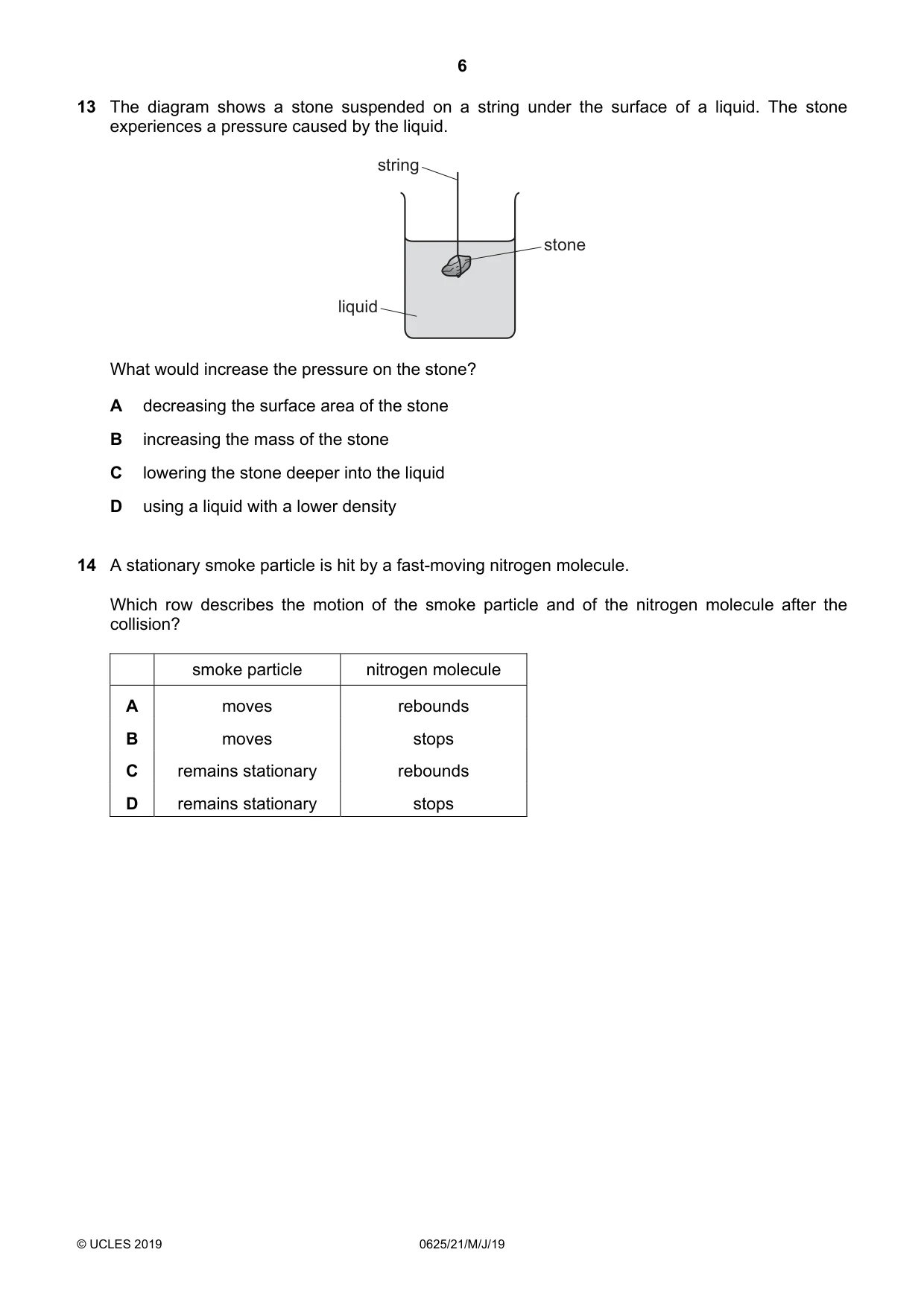
13 The diagram shows a stone suspended on a string under the surface of a liquid. The stone experiences a pressure caused by the liquid. string stone liquid What would increase the pressure on the stone? A decreasing the surface area of the stone B increasing the mass of the stone C lowering the stone deeper into the liquid D using a liquid with a lower density
Mark scheme: C
Q14 · A stationary smoke particle is hit by a fast-moving nitrogen molecule
14 A stationary smoke particle is hit by a fast-moving nitrogen molecule. Which row describes the motion of the smoke particle and of the nitrogen molecule after the collision? smoke particle nitrogen molecule A moves rebounds B moves stops C remains stationary rebounds D remains stationary stops
Mark scheme: A
Q15 · A night storage heater contains a large block of material that is heated electrically…
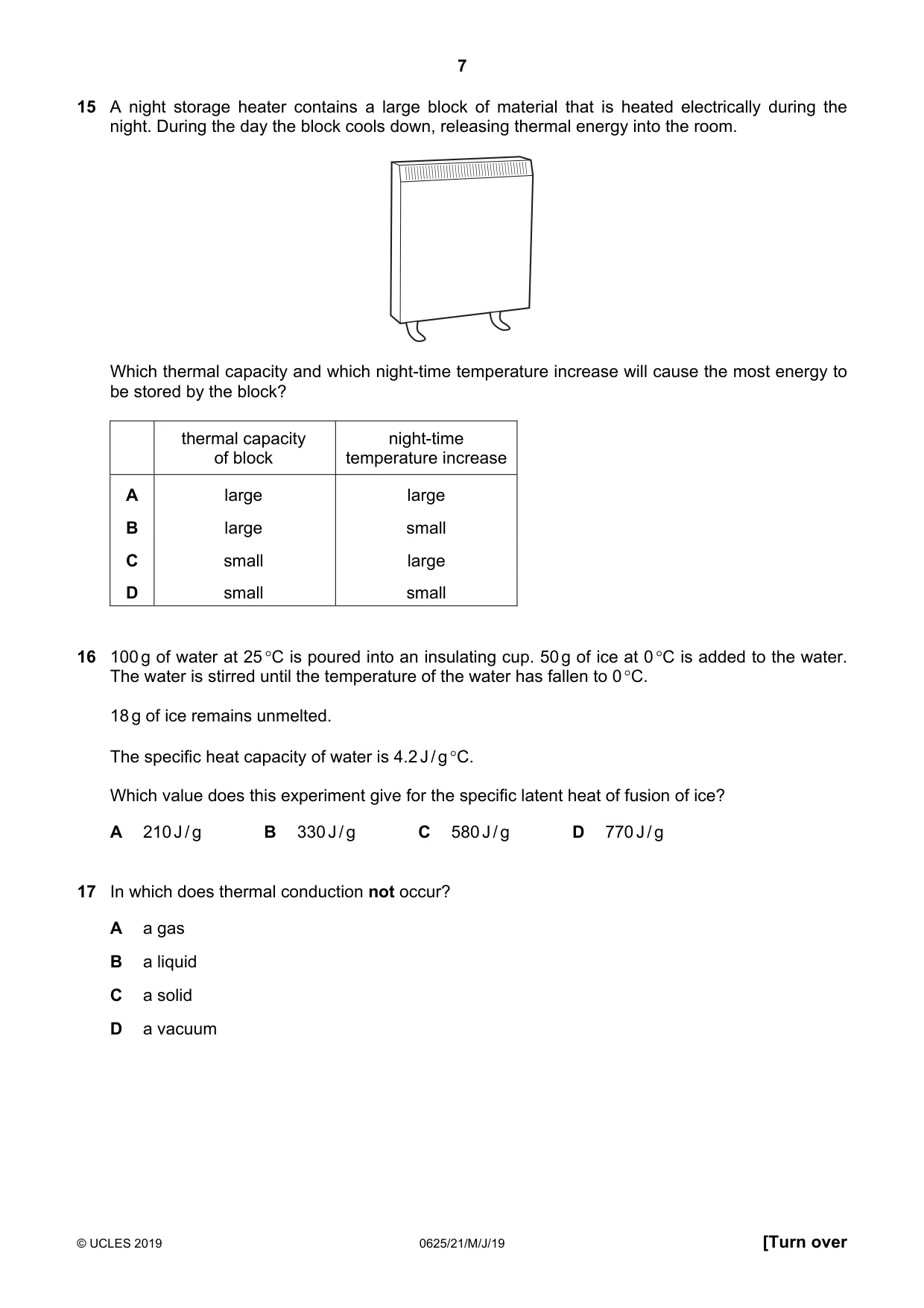
15 A night storage heater contains a large block of material that is heated electrically during the night. During the day the block cools down, releasing thermal energy into the room. Which thermal capacity and which night-time temperature increase will cause the most energy to be stored by the block? thermal capacity night-time of block temperature increase A large large B large small C small large D small small
Mark scheme: A
Q16 · 100 g of water at 25 °C is poured into an insulating cup
16 100 g of water at 25 °C is poured into an insulating cup. 50 g of ice at 0 °C is added to the water. The water is stirred until the temperature of the water has fallen to 0 °C. 18 g of ice remains unmelted. The specific heat capacity of water is 4.2 J / g °C. Which value does this experiment give for the specific latent heat of fusion of ice? A 210 J / g B 330 J / g C 580 J / g D 770 J / g
Mark scheme: B
Q17 · In which does thermal conduction not occur?
17 In which does thermal conduction not occur? A a gas B a liquid C a solid D a vacuum
Mark scheme: D
Q18 · The metal surface of a kettle is hot
18 The metal surface of a kettle is hot. What happens to the cool air outside the kettle when it comes into contact with the hot kettle? A The density of the air decreases and the air falls. B The density of the air decreases and the air rises. C The density of the air increases and the air falls. D The density of the air increases and the air rises.
Mark scheme: B
Q19 · Some hot water is sealed inside a metal can
19 Some hot water is sealed inside a metal can. The can is in a vacuum in outer space. The hot water slowly cools down. How does the thermal energy escape into space? A by conduction then convection B by conduction then radiation C by evaporation then convection D by evaporation then radiation
Mark scheme: B
Q20 · When water waves pass through a gap they diffract
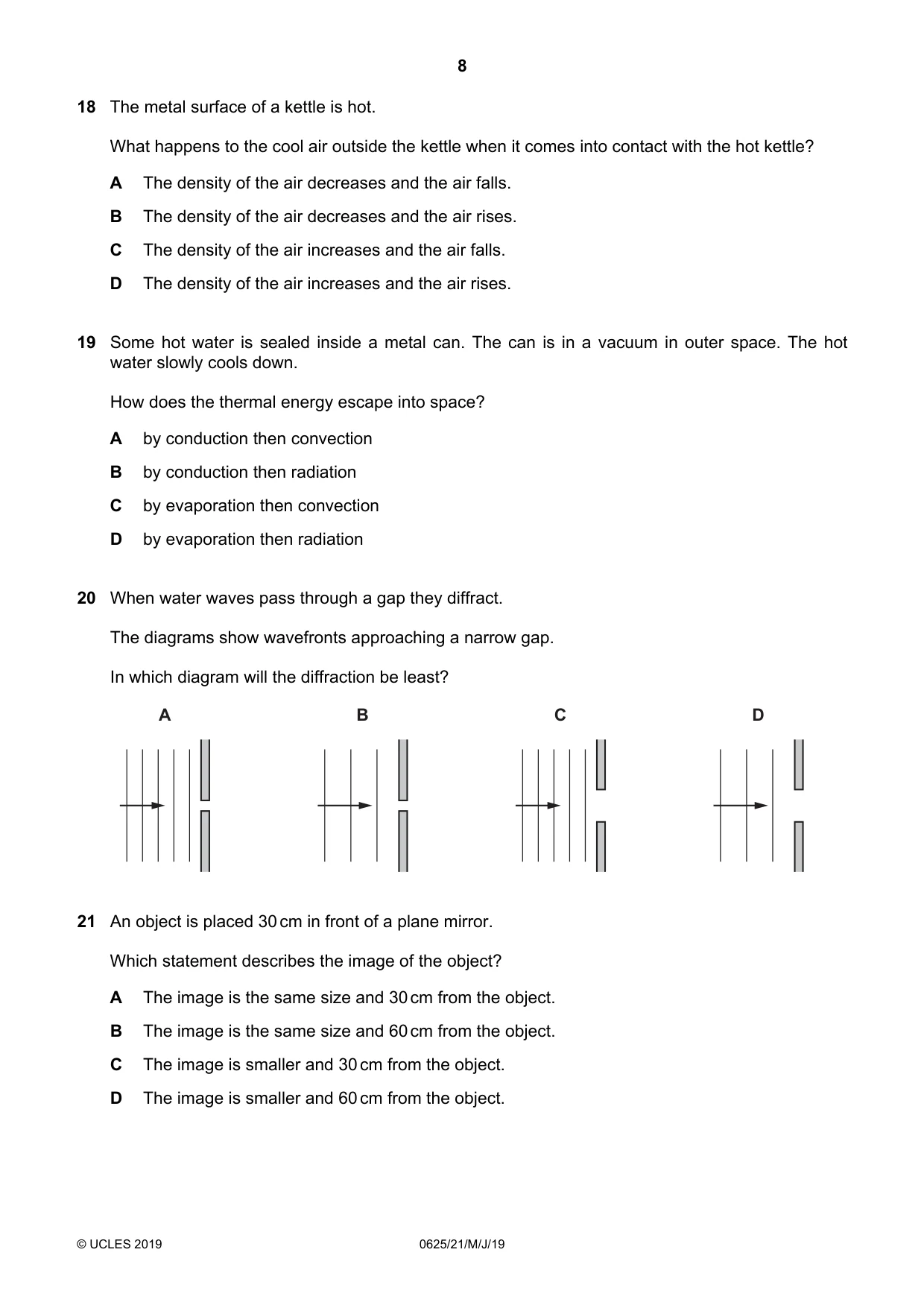
20 When water waves pass through a gap they diffract. The diagrams show wavefronts approaching a narrow gap. In which diagram will the diffraction be least? A B C D
Mark scheme: C
Q21 · An object is placed 30 cm in front of a plane mirror
21 An object is placed 30 cm in front of a plane mirror. Which statement describes the image of the object? A The image is the same size and 30 cm from the object. B The image is the same size and 60 cm from the object. C The image is smaller and 30 cm from the object. D The image is smaller and 60 cm from the object.
Mark scheme: B
Q22 · A small object O is placed near a converging lens, as shown
22 A small object O is placed near a converging lens, as shown. The lens forms an image I. I O Which statement is correct? A The image I is diminished. B The image I is inverted. C The image I is real. D The object O is closer to the lens than its principal focus.
Mark scheme: D
Q23 · An eclipse of the Sun happens when the Moon comes between the Earth and the Sun
23 An eclipse of the Sun happens when the Moon comes between the Earth and the Sun. Which statement is correct? A Infra-red radiation from the Sun disappears before visible light and ultra-violet radiation. B Ultra-violet radiation from the Sun disappears before visible light and infra-red radiation. C Visible light from the Sun disappears before ultra-violet radiation and infra-red radiation. D Infra-red radiation, ultra-violet radiation and visible light from the Sun all disappear at the same moment.
Mark scheme: D
Q24 · A pulse of sound is produced at the bottom of a boat
24 A pulse of sound is produced at the bottom of a boat. The sound travels through the water and is reflected from a shoal of fish. The sound reaches the boat again after 1.2 s. The speed of sound in the water is 1500 m / s. boat shoal of fish How far below the bottom of the boat is the shoal of fish? A 450 m B 900 m C 1800 m D 3600 m
Mark scheme: B
Q25 · What is the approximate value of the speed of sound in air at normal temperature?
25 What is the approximate value of the speed of sound in air at normal temperature? A 340 m / s B 34 000 m / s C 340 km / s D 3.0 × 10⁸ m / s
Mark scheme: A
Q26 · Why is soft iron used for the core of an electromagnet?
26 Why is soft iron used for the core of an electromagnet? A Soft iron easily becomes a permanent magnet. B Soft iron is a good electrical conductor. C Soft iron is a poor thermal conductor. D Soft iron loses its magnetism when the current in the coil is switched off.
Mark scheme: D
Q27 · Two thin, uncharged strips of plastic
27 Diagram 1 shows two thin, uncharged strips of plastic. Diagram 2 shows the same strips after they have been rubbed with a dry cloth. strips strips of plastic of plastic diagram 1 diagram 2 Which row describes the charge on the strips after rubbing, and the force between the strips after rubbing? charge on strips force between strips A opposite attraction B opposite repulsion C the same attraction D the same repulsion
Mark scheme: D
Q28 · A cell has an electromotive force (e.m.f.) of 1.5 V
28 A cell has an electromotive force (e.m.f.) of 1.5 V. What does this statement mean? A The cell converts 1.0 J of energy when driving 1.5 C of charge round a complete circuit. B The cell converts 1.5 J of energy when driving 1.0 C of charge round a complete circuit. C The cell converts 1.5 J of energy per second when driving 1.0 C of charge round a complete circuit. D The cell converts 1.5 W of power when driving 1.0 C of charge round a complete circuit.
Mark scheme: B
Q29 · Which two changes to a metal wire both increase resistance?
29 Which two changes to a metal wire both increase resistance? A decreasing its length and increasing its temperature B increasing its length and decreasing its temperature C decreasing its thickness and increasing its temperature D increasing its thickness and decreasing its temperature
Mark scheme: C
Q30 · The diagram shows a circuit containing a d.c
30 The diagram shows a circuit containing a d.c. power supply, a motor and a variable resistor. Three ammeters X, Y and Z show the current in different parts of the circuit. + – X A A Z A M Y The reading on X is 4.0 A. Which statement is correct? A The readings on Y and Z are both less than 4.0 A. B The readings on Y and Z are both equal to 4.0 A. C The readings on Y and Z are both greater than 4.0 A. D The reading on Z is zero.
Mark scheme: B
Q31 · A lamp is to be connected in a circuit so that the potential difference (p.d.) across it…
31 A lamp is to be connected in a circuit so that the potential difference (p.d.) across it can be varied from 0 to 6 V. Which circuit would be most suitable? A B 6 V 6 V C D 6 V 6 V
Mark scheme: B
Q32 · Which logic gate is represented by the symbol shown?
32 Which logic gate is represented by the symbol shown? A AND B NAND C NOR D OR
Mark scheme: A
Q33 · The diagram shows a combination of logic gates
33 The diagram shows a combination of logic gates. Which single logic gate is equivalent to this combination? A AND B NOR C NOT D OR
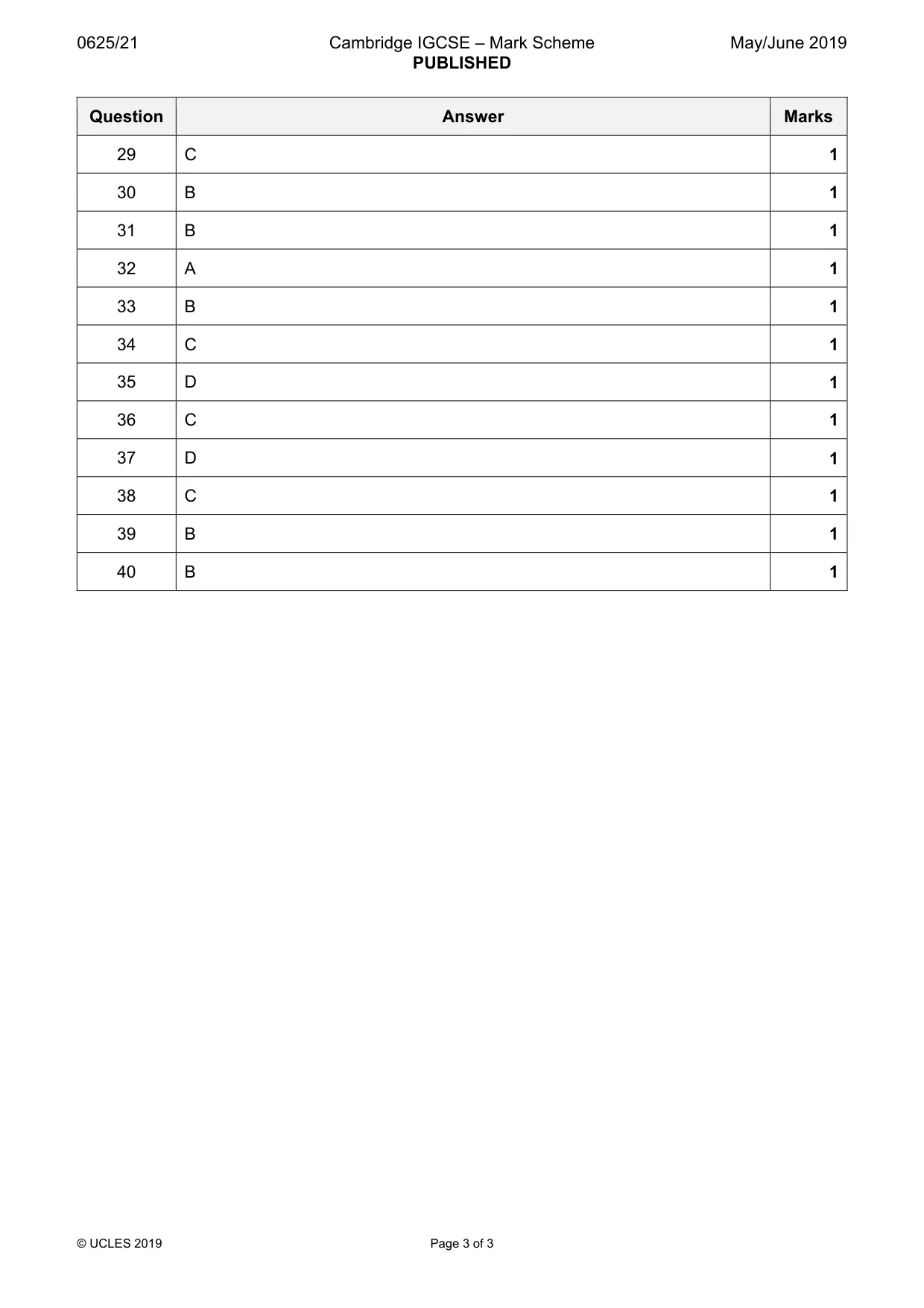
Mark scheme: B
Q34 · An alternating current (a.c.) power supply is connected in series with a resistor R and a…
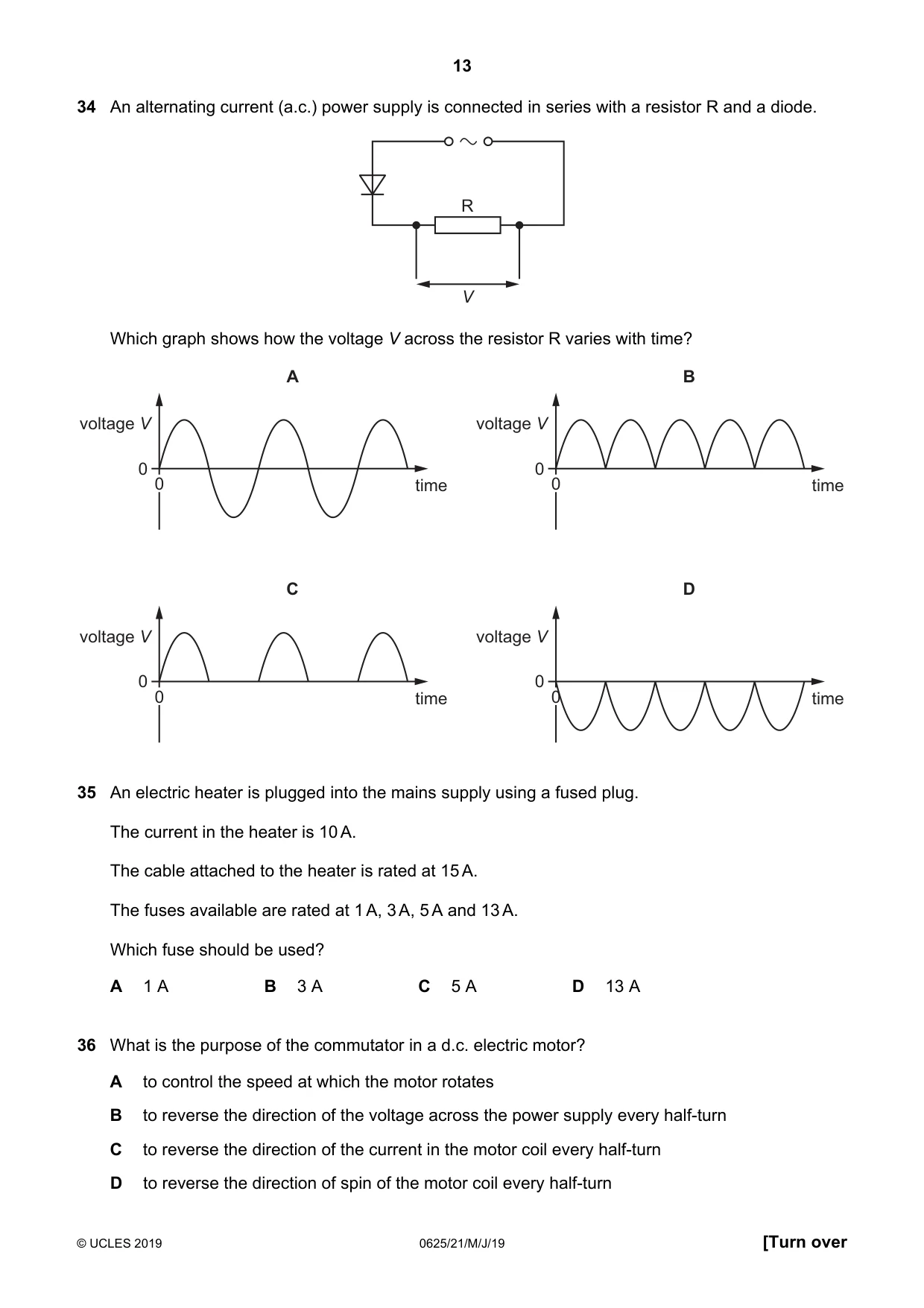
34 An alternating current (a.c.) power supply is connected in series with a resistor R and a diode. R V Which graph shows how the voltage V across the resistor R varies with time? A B voltage V voltage V 0 0 0 time 0 time C D voltage V voltage V 0 0 0 time 0 time
Mark scheme: C
Q35 · An electric heater is plugged into the mains supply using a fused plug
35 An electric heater is plugged into the mains supply using a fused plug. The current in the heater is 10 A. The cable attached to the heater is rated at 15 A. The fuses available are rated at 1 A, 3 A, 5 A and 13 A. Which fuse should be used? A 1 A B 3 A C 5 A D 13 A
Mark scheme: D
Q36 · What is the purpose of the commutator in a d.c
36 What is the purpose of the commutator in a d.c. electric motor? A to control the speed at which the motor rotates B to reverse the direction of the voltage across the power supply every half-turn C to reverse the direction of the current in the motor coil every half-turn D to reverse the direction of spin of the motor coil every half-turn
Mark scheme: C
Q37 · The diagram shows a wire between two magnetic poles
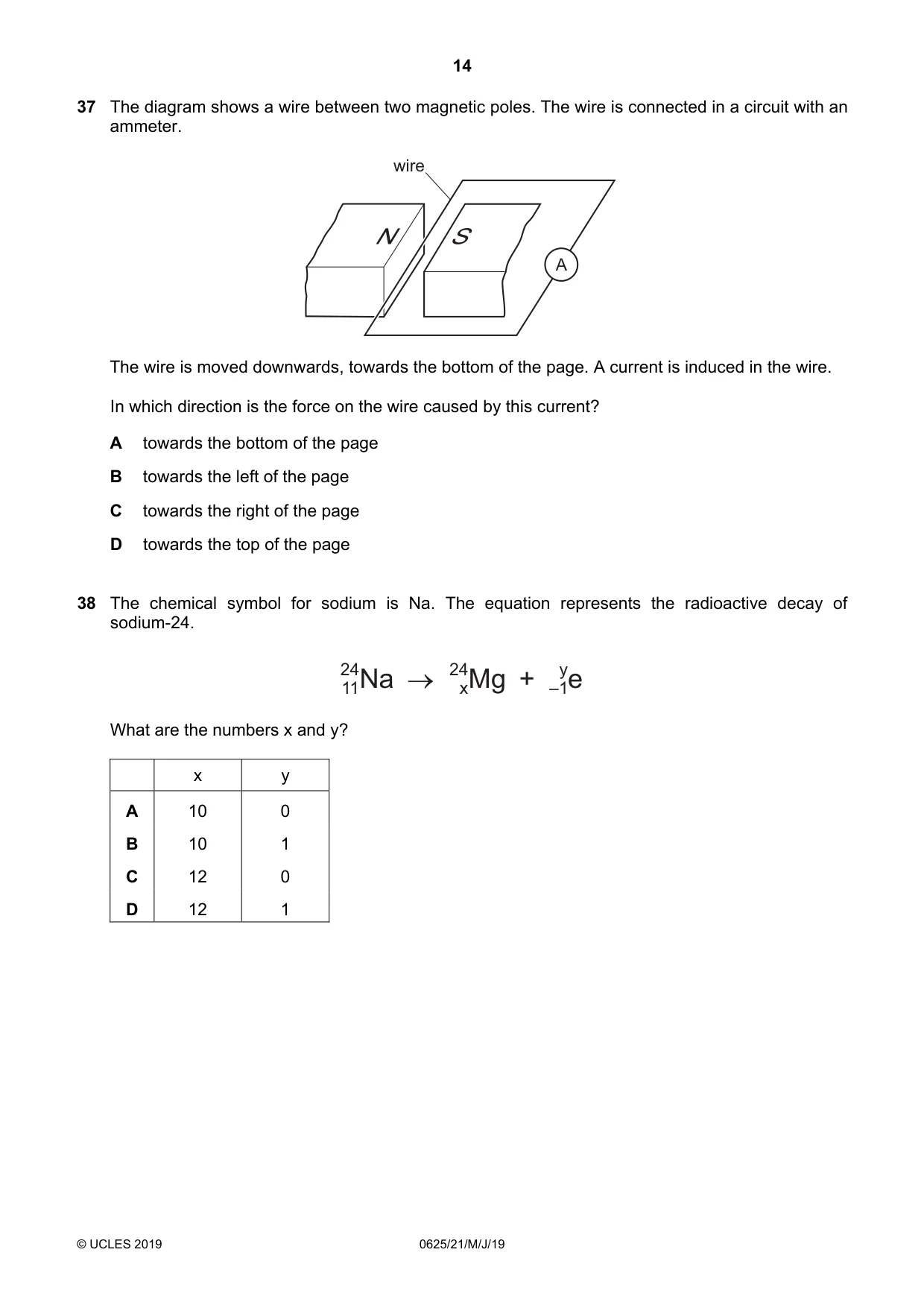
37 The diagram shows a wire between two magnetic poles. The wire is connected in a circuit with an ammeter. wire N S A The wire is moved downwards, towards the bottom of the page. A current is induced in the wire. In which direction is the force on the wire caused by this current? A towards the bottom of the page B towards the left of the page C towards the right of the page D towards the top of the page
Mark scheme: D
Q38 · The chemical symbol for sodium is Na
38 The chemical symbol for sodium is Na. The equation represents the radioactive decay of sodium-24. 24Na → 24Mg + ye 11 x –1 What are the numbers x and y? x y A 10 0 B 10 1 C 12 0 D 12 1
Mark scheme: C
Q39 · A radioactive source emits α-particles, β-particles and γ-rays into a vacuum where there…
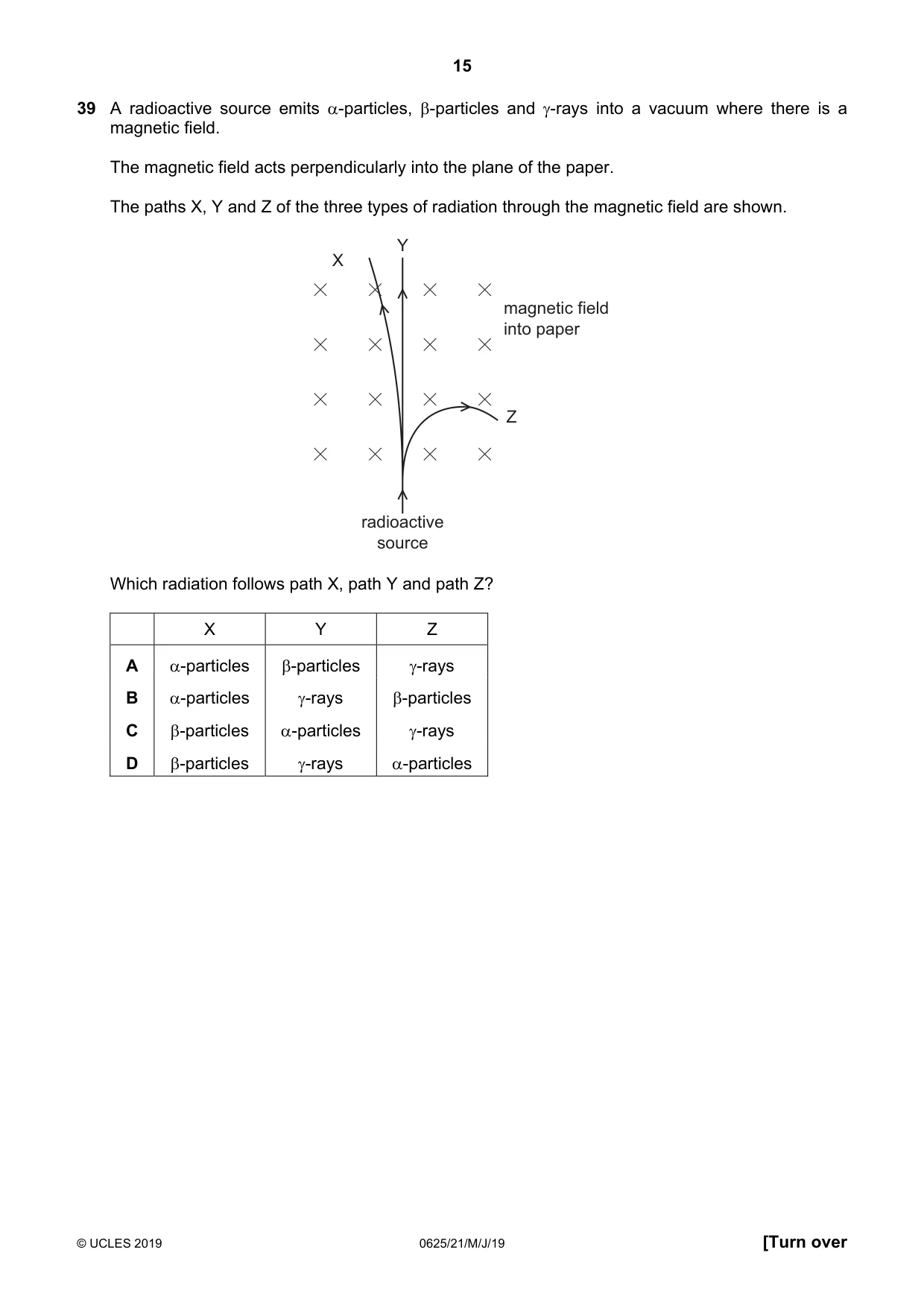
39 A radioactive source emits α-particles, β-particles and γ-rays into a vacuum where there is a magnetic field. The magnetic field acts perpendicularly into the plane of the paper. The paths X, Y and Z of the three types of radiation through the magnetic field are shown. Y X magnetic field into paper Z radioactive source Which radiation follows path X, path Y and path Z? X Y Z A α-particles β-particles γ-rays B α-particles γ-rays β-particles C β-particles α-particles γ-rays D β-particles γ-rays α-particles
Mark scheme: B
Q40 · A student measures the level of radiation emitted from a radioactive substance
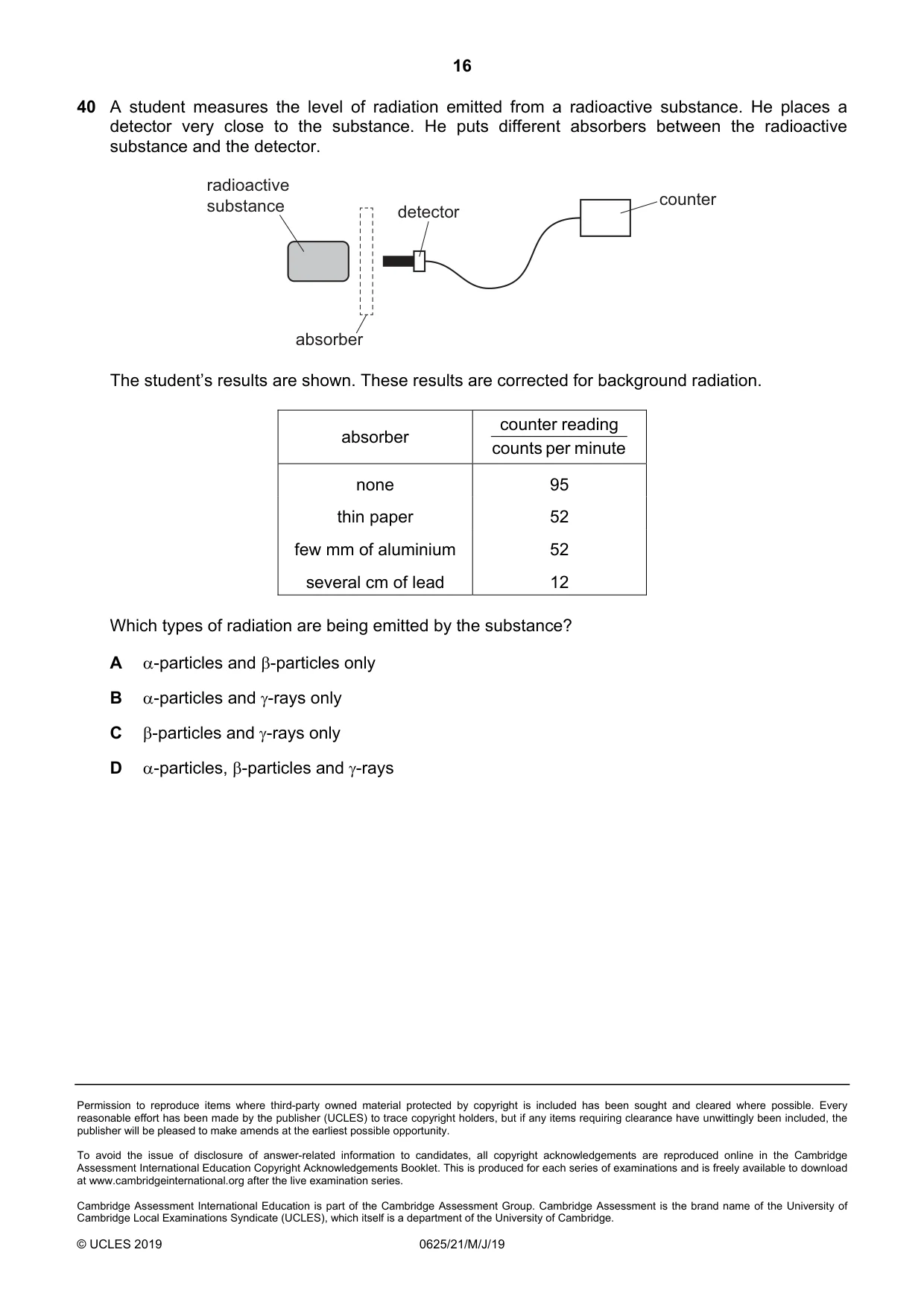
40 A student measures the level of radiation emitted from a radioactive substance. He places a detector very close to the substance. He puts different absorbers between the radioactive substance and the detector. radioactive substance counter detector absorber The student’s results are shown. These results are corrected for background radiation. counter reading absorber counts per minute none 95 thin paper 52 few mm of aluminium 52 several cm of lead 12 Which types of radiation are being emitted by the substance? A α-particles and β-particles only B α-particles and γ-rays only C β-particles and γ-rays only D α-particles, β-particles and γ-rays
Mark scheme: B
What was in this paper
The subtopics covered by these 40 questions, and how many questions each got. Open one in a new tab to see every Cambridge question on it.
5Electrical quantities3Energy, work and power3Motion3Transfer of thermal energy3Electromagnetic effects2Forces2Light2Radioactivity2Sound2Thermal properties and temperature2Density1Electrical safety1Electromagnetic spectrum1General properties of waves1Kinetic particle model of matter1Mass and weight1Momentum1Physical quantities and measurement techniques1Pressure1Simple phenomena of magnetism1The nuclear model of the atom1What you needed in this session
Cambridge’s own grade thresholds for 2019 May/June, Paper 2 · Variant 1. A higher threshold means an easier paper — the bar moves with how the cohort did.