Cambridge IGCSE Physics 0625 — 2024 Feb/March Paper 2 · Variant 2
0625/22/F/M/24 · 40 questions · 40 marks · ≈45 min
The question paper and its mark scheme, free to read here and free to download. This is Cambridge’s own paper, exactly as it was sat.
Question paper16 pages
Mark scheme3 pages
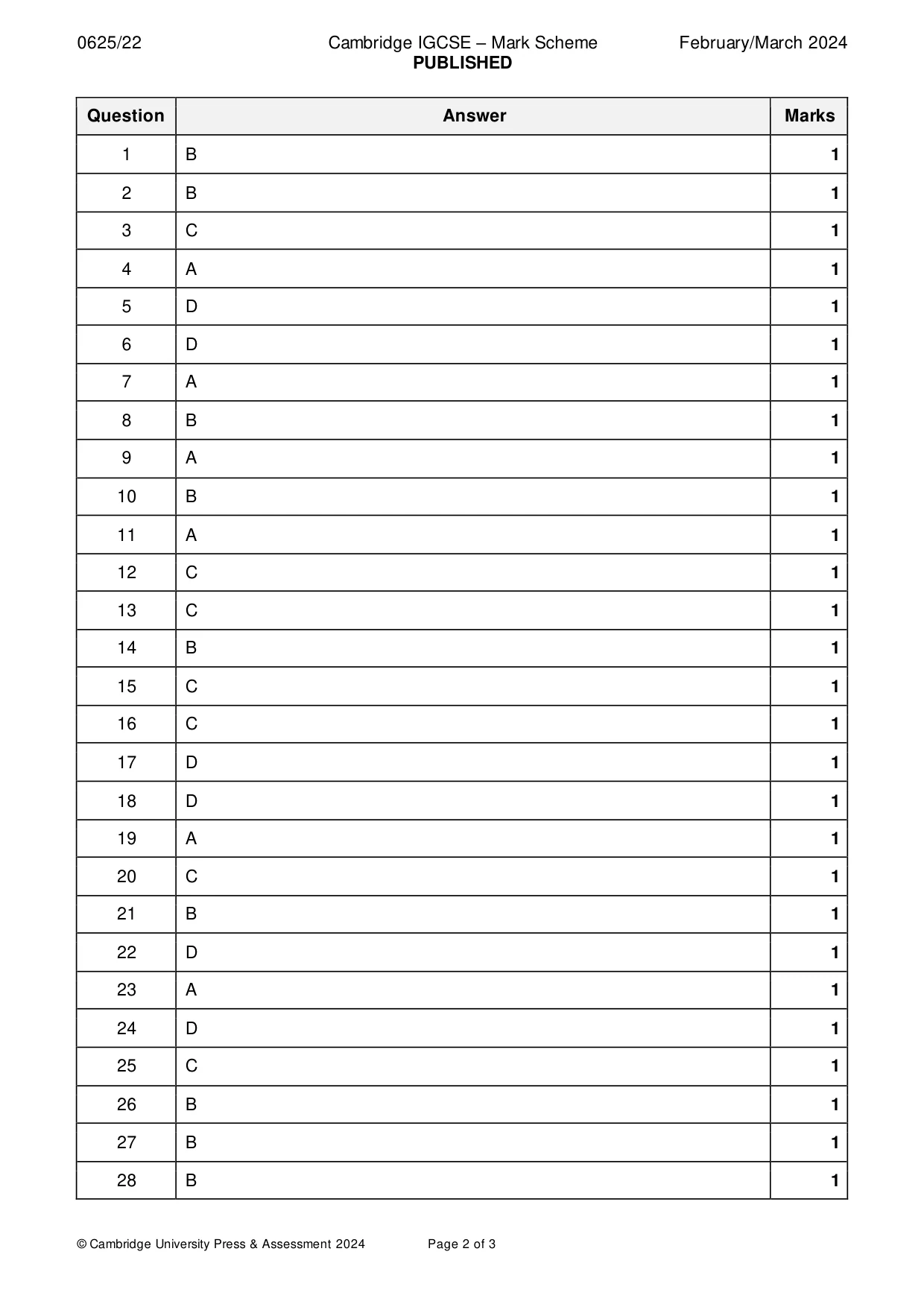
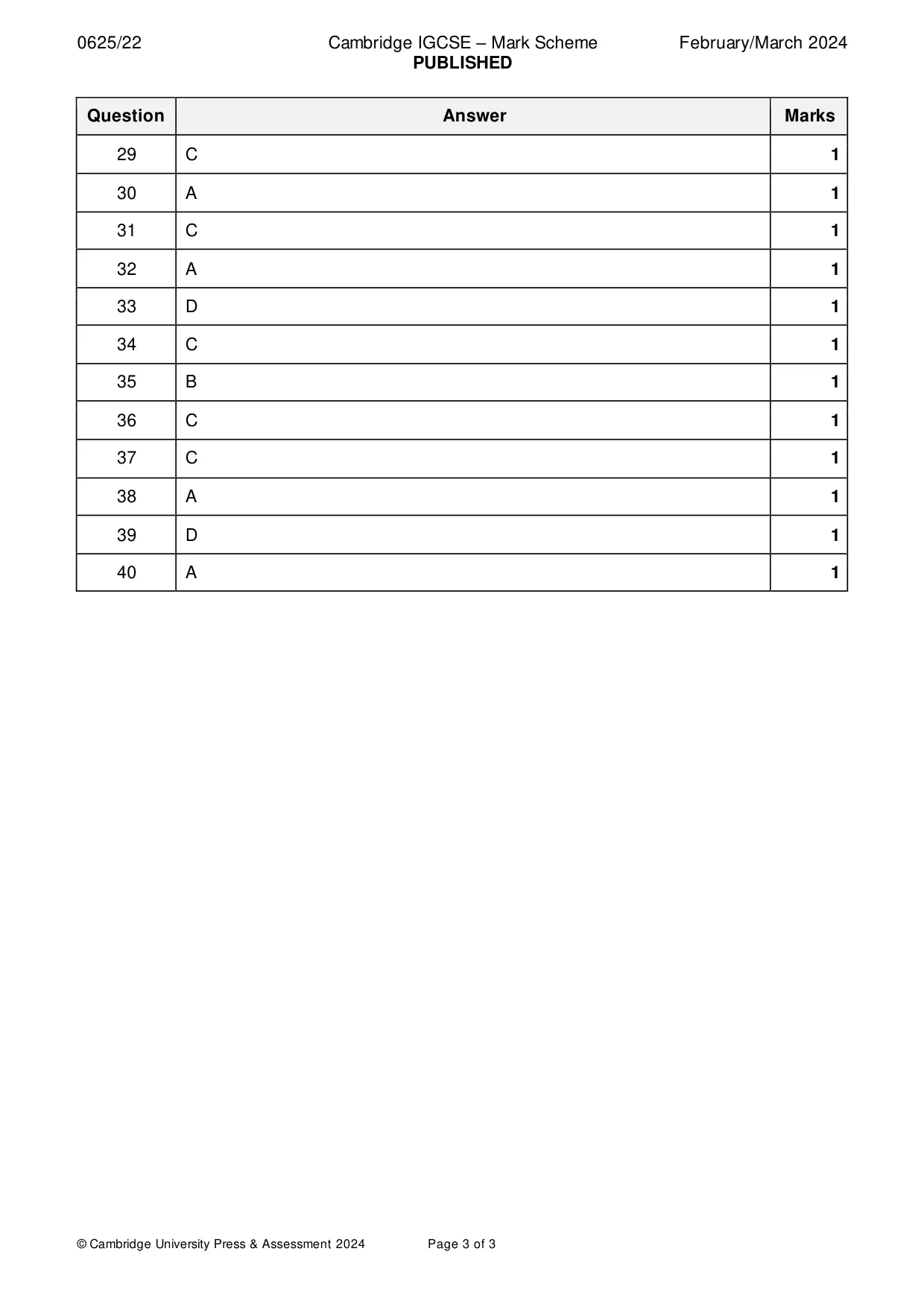
Answers below. Sit the paper first if you are practising.
Questions as text
Q1 · A student has a measuring cylinder containing water and also has a balance
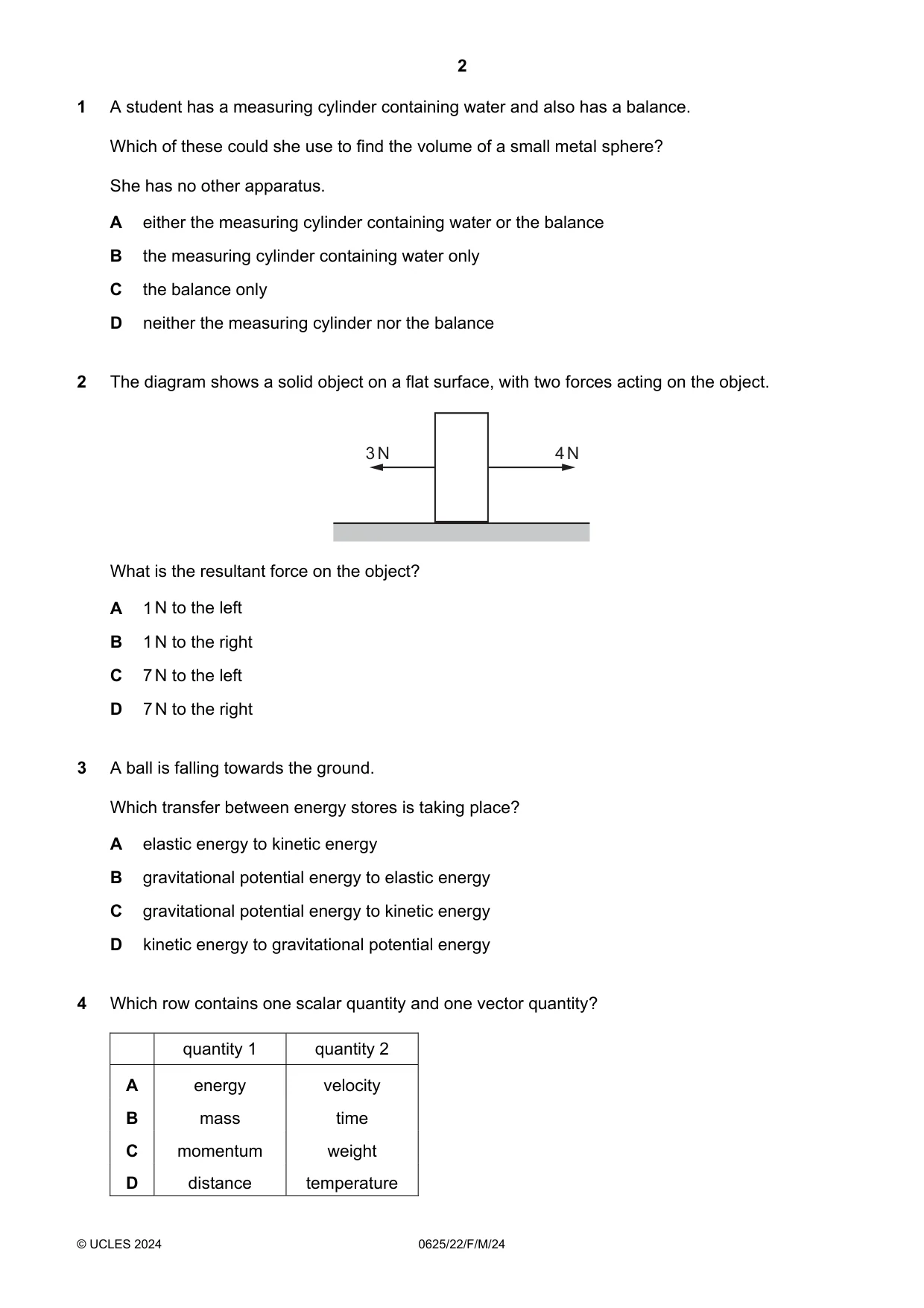
1 A student has a measuring cylinder containing water and also has a balance. Which of these could she use to find the volume of a small metal sphere? She has no other apparatus. A either the measuring cylinder containing water or the balance B the measuring cylinder containing water only C the balance only D neither the measuring cylinder nor the balance
Mark scheme: B
More questions on Physical quantities and measurement techniques
Q2 · The diagram shows a solid object on a flat surface, with two forces acting on the object
2 The diagram shows a solid object on a flat surface, with two forces acting on the object. 3 N 4 N What is the resultant force on the object? A 1 N to the left B 1 N to the right C 7 N to the left D 7 N to the right
Mark scheme: B
Q3 · A ball is falling towards the ground
3 A ball is falling towards the ground. Which transfer between energy stores is taking place? A elastic energy to kinetic energy B gravitational potential energy to elastic energy C gravitational potential energy to kinetic energy D kinetic energy to gravitational potential energy
Mark scheme: C
Q4 · Which row contains one scalar quantity and one vector quantity?
4 Which row contains one scalar quantity and one vector quantity? quantity 1 quantity 2 A energy velocity B mass time C momentum weight D distance temperature
Mark scheme: A
More questions on Physical quantities and measurement techniques
Q5 · The table gives data about four liquids, W, X, Y and Z
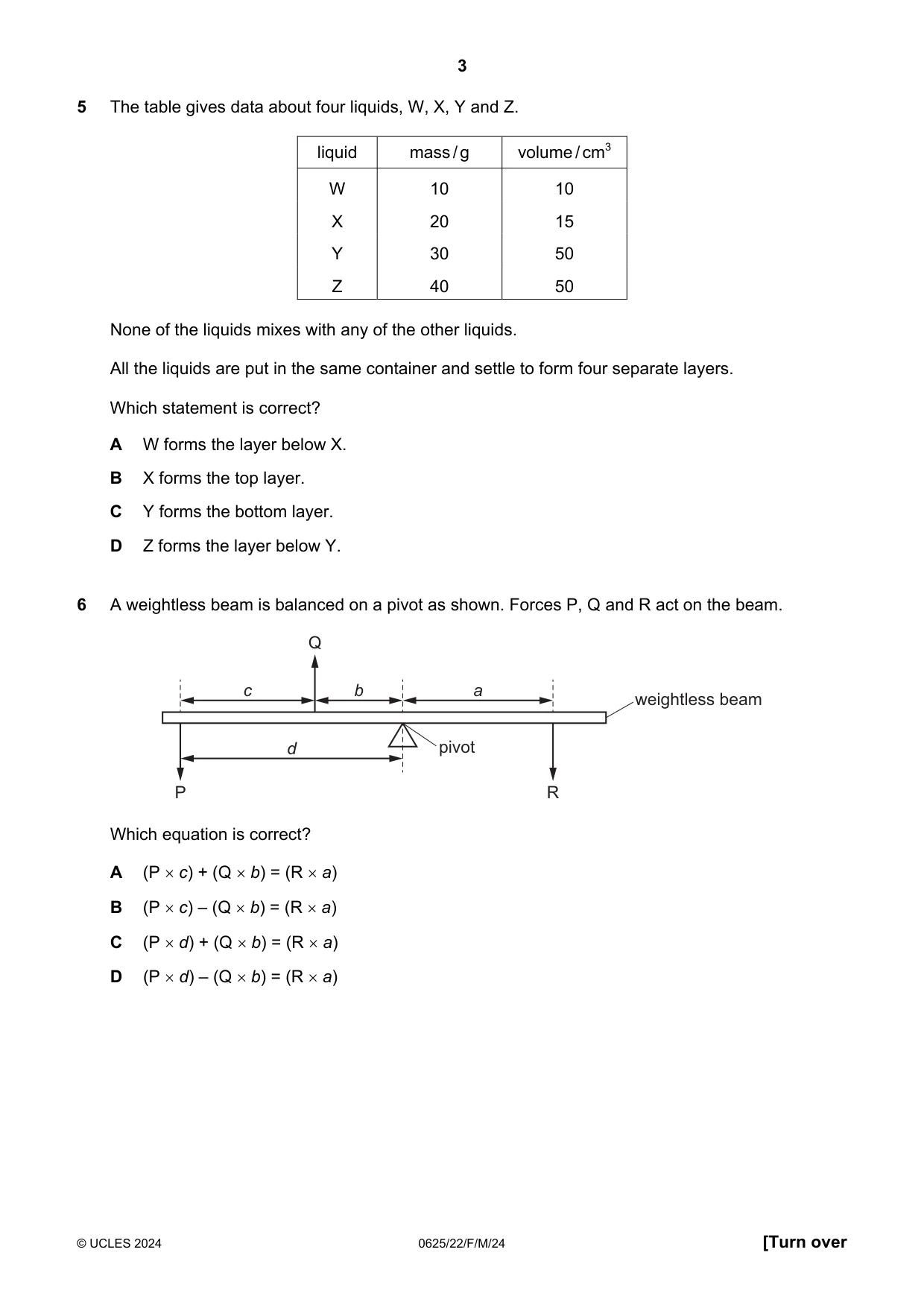
5 The table gives data about four liquids, W, X, Y and Z. liquid mass / g volume / cm3 W 10 10 X 20 15 Y 30 50 Z 40 50 None of the liquids mixes with any of the other liquids. All the liquids are put in the same container and settle to form four separate layers. Which statement is correct? A W forms the layer below X. B X forms the top layer. C Y forms the bottom layer. D Z forms the layer below Y.
Mark scheme: D
Q6 · A weightless beam is balanced on a pivot as shown
6 A weightless beam is balanced on a pivot as shown. Forces P, Q and R act on the beam. Q c b a weightless beam d pivot P R Which equation is correct? A (P c) + (Q b) = (R a) B (P c) – (Q b) = (R a) C (P d) + (Q b) = (R a) D (P d) – (Q b) = (R a)
Mark scheme: D
Q7 · An object is moving at +3.0 m / s
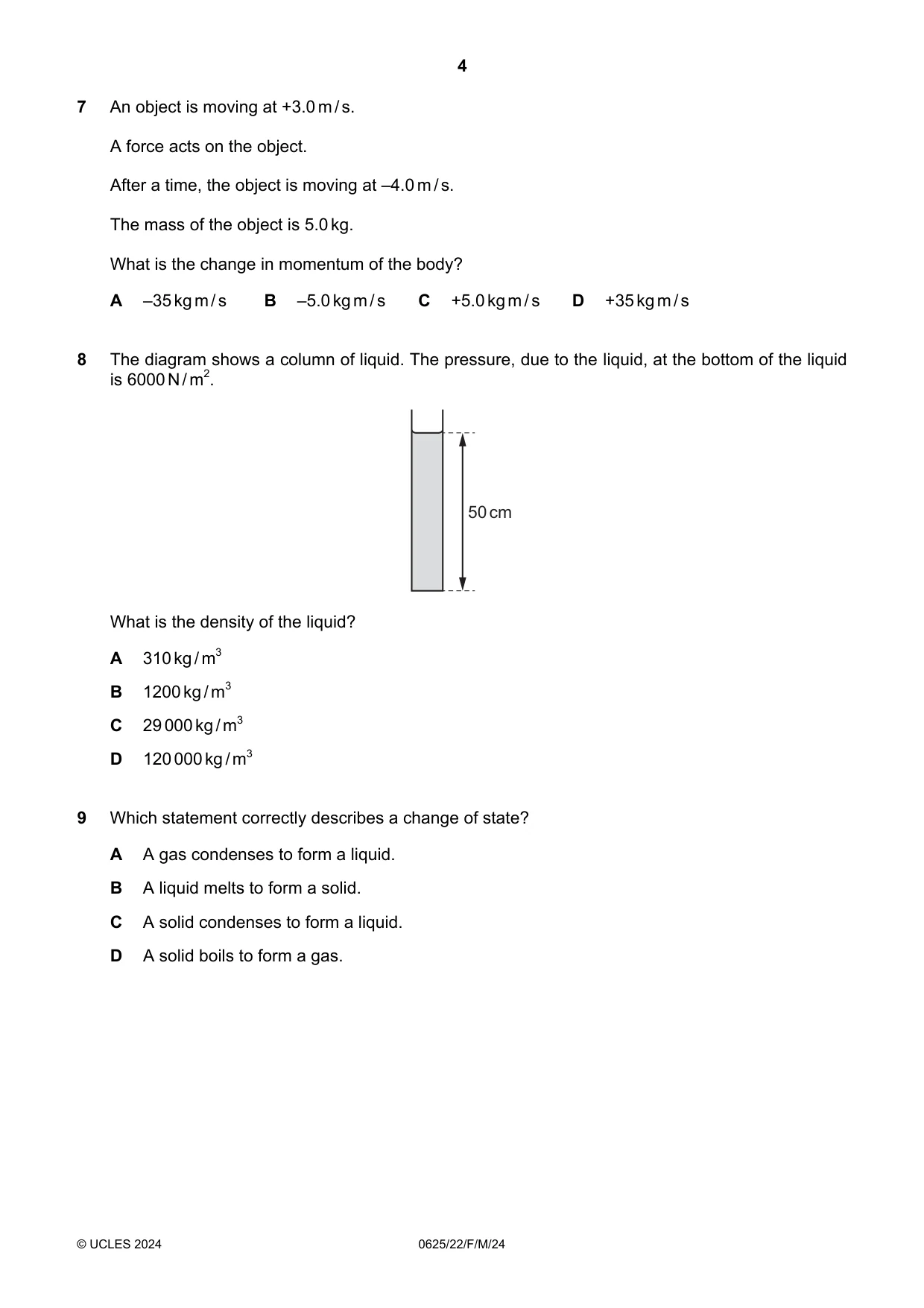
7 An object is moving at +3.0 m / s. A force acts on the object. After a time, the object is moving at –4.0 m / s. The mass of the object is 5.0 kg. What is the change in momentum of the body? A –35 kg m / s B –5.0 kg m / s C +5.0 kg m / s D +35 kg m / s
Mark scheme: A
Q8 · The diagram shows a column of liquid
8 The diagram shows a column of liquid. The pressure, due to the liquid, at the bottom of the liquid is 6000 N / m2. 50 cm What is the density of the liquid? A 310 kg / m3 B 1200 kg / m3 C 29 000 kg / m3 D 120 000 kg / m3
Mark scheme: B
Q9 · Which statement correctly describes a change of state?
9 Which statement correctly describes a change of state? A A gas condenses to form a liquid. B A liquid melts to form a solid. C A solid condenses to form a liquid. D A solid boils to form a gas.
Mark scheme: A
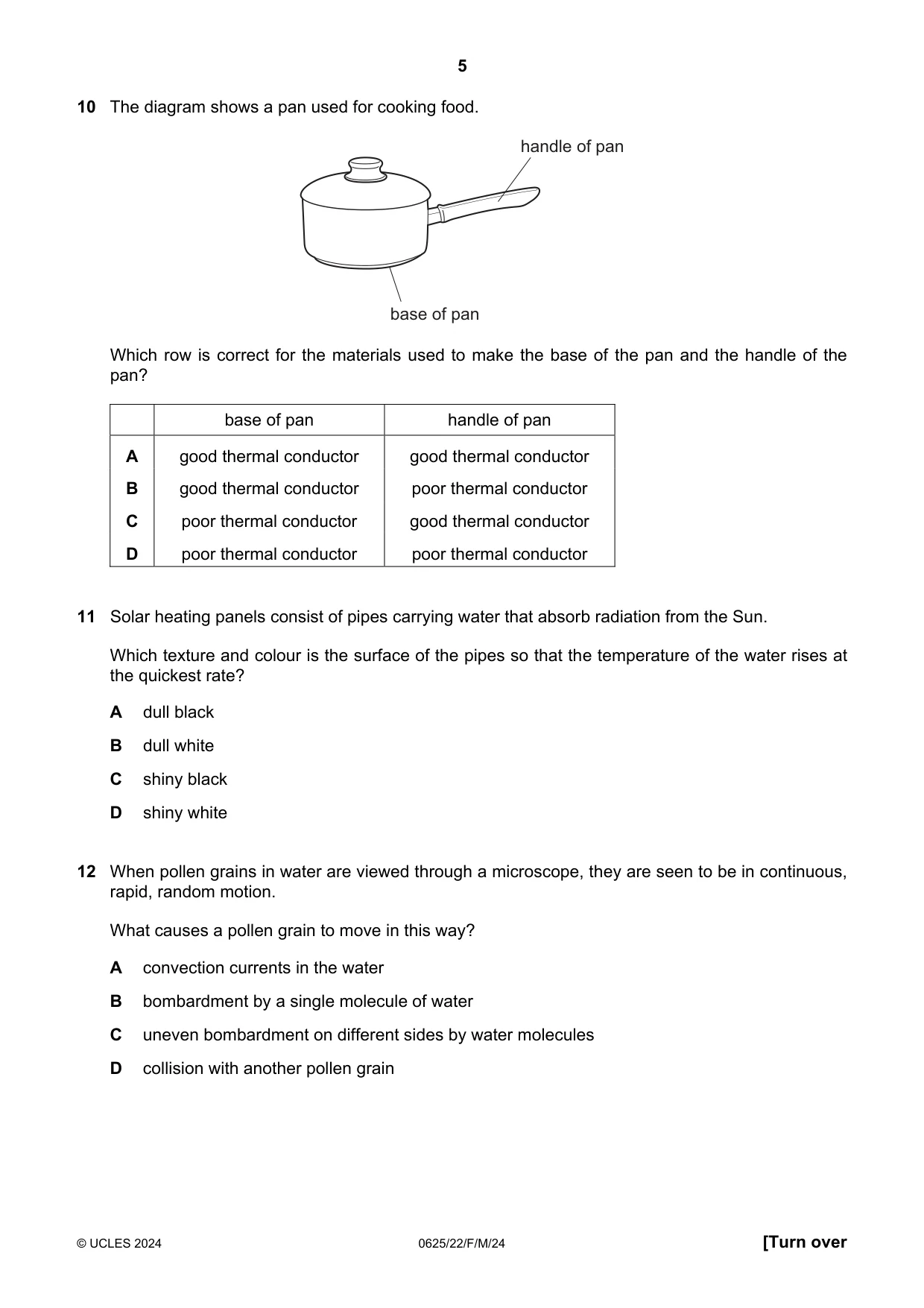
Q10 · The diagram shows a pan used for cooking food
10 The diagram shows a pan used for cooking food. handle of pan base of pan Which row is correct for the materials used to make the base of the pan and the handle of the pan? base of pan handle of pan A good thermal conductor good thermal conductor B good thermal conductor poor thermal conductor C poor thermal conductor good thermal conductor D poor thermal conductor poor thermal conductor
Mark scheme: B
Q11 · Solar heating panels consist of pipes carrying water that absorb radiation from the Sun
11 Solar heating panels consist of pipes carrying water that absorb radiation from the Sun. Which texture and colour is the surface of the pipes so that the temperature of the water rises at the quickest rate? A dull black B dull white C shiny black D shiny white
Mark scheme: A
Q12 · When pollen grains in water are viewed through a microscope, they are seen to be in…
12 When pollen grains in water are viewed through a microscope, they are seen to be in continuous, rapid, random motion. What causes a pollen grain to move in this way? A convection currents in the water B bombardment by a single molecule of water C uneven bombardment on different sides by water molecules D collision with another pollen grain
Mark scheme: C
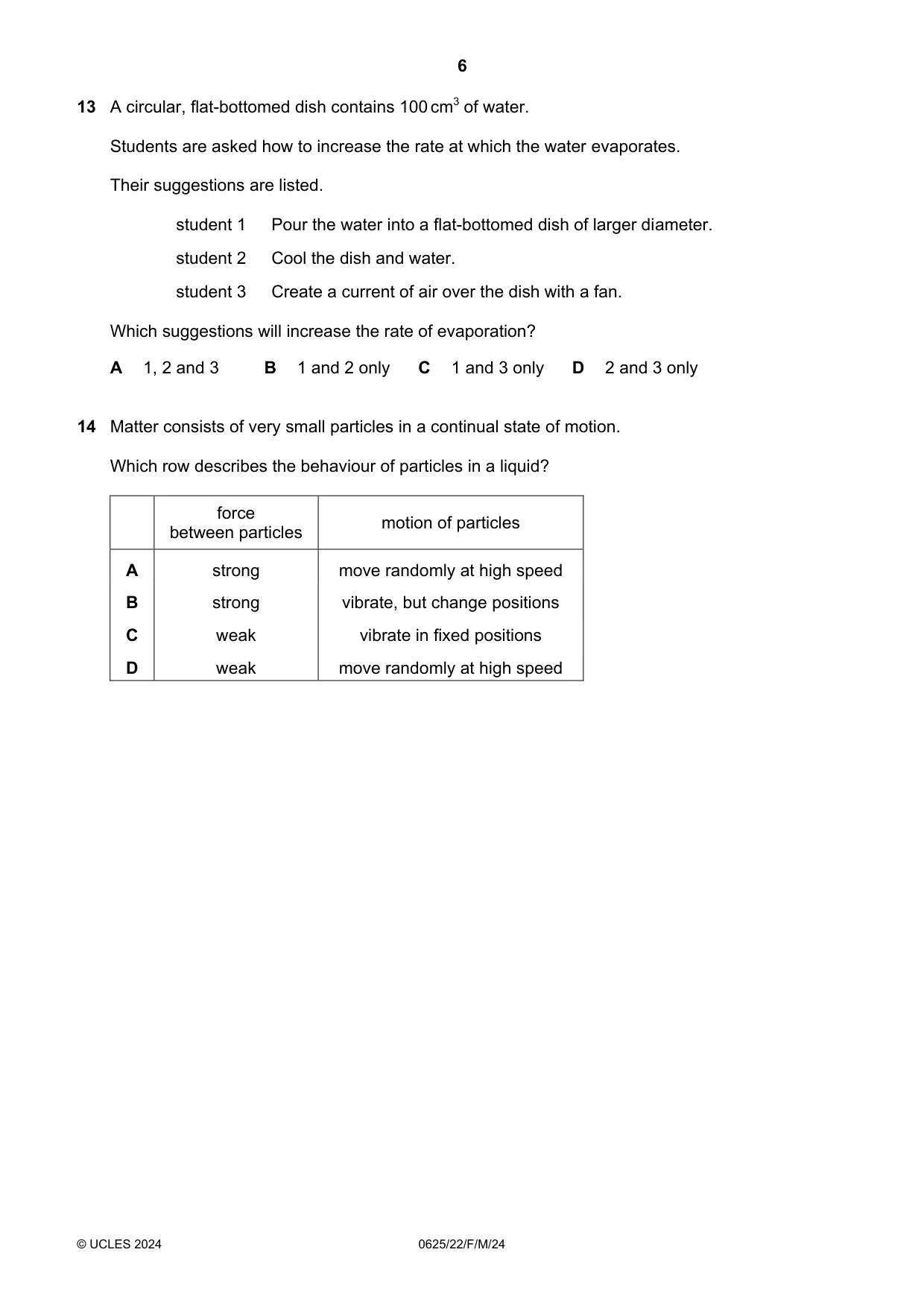
Q13 · A circular, flat-bottomed dish contains 100 cm3 of water
13 A circular, flat-bottomed dish contains 100 cm3 of water. Students are asked how to increase the rate at which the water evaporates. Their suggestions are listed. student 1 Pour the water into a flat-bottomed dish of larger diameter. student 2 Cool the dish and water. student 3 Create a current of air over the dish with a fan. Which suggestions will increase the rate of evaporation? A 1, 2 and 3 B 1 and 2 only C 1 and 3 only D 2 and 3 only
Mark scheme: C
Q14 · Matter consists of very small particles in a continual state of motion
14 Matter consists of very small particles in a continual state of motion. Which row describes the behaviour of particles in a liquid? force motion of particles between particles A strong move randomly at high speed B strong vibrate, but change positions C weak vibrate in fixed positions D weak move randomly at high speed
Mark scheme: B
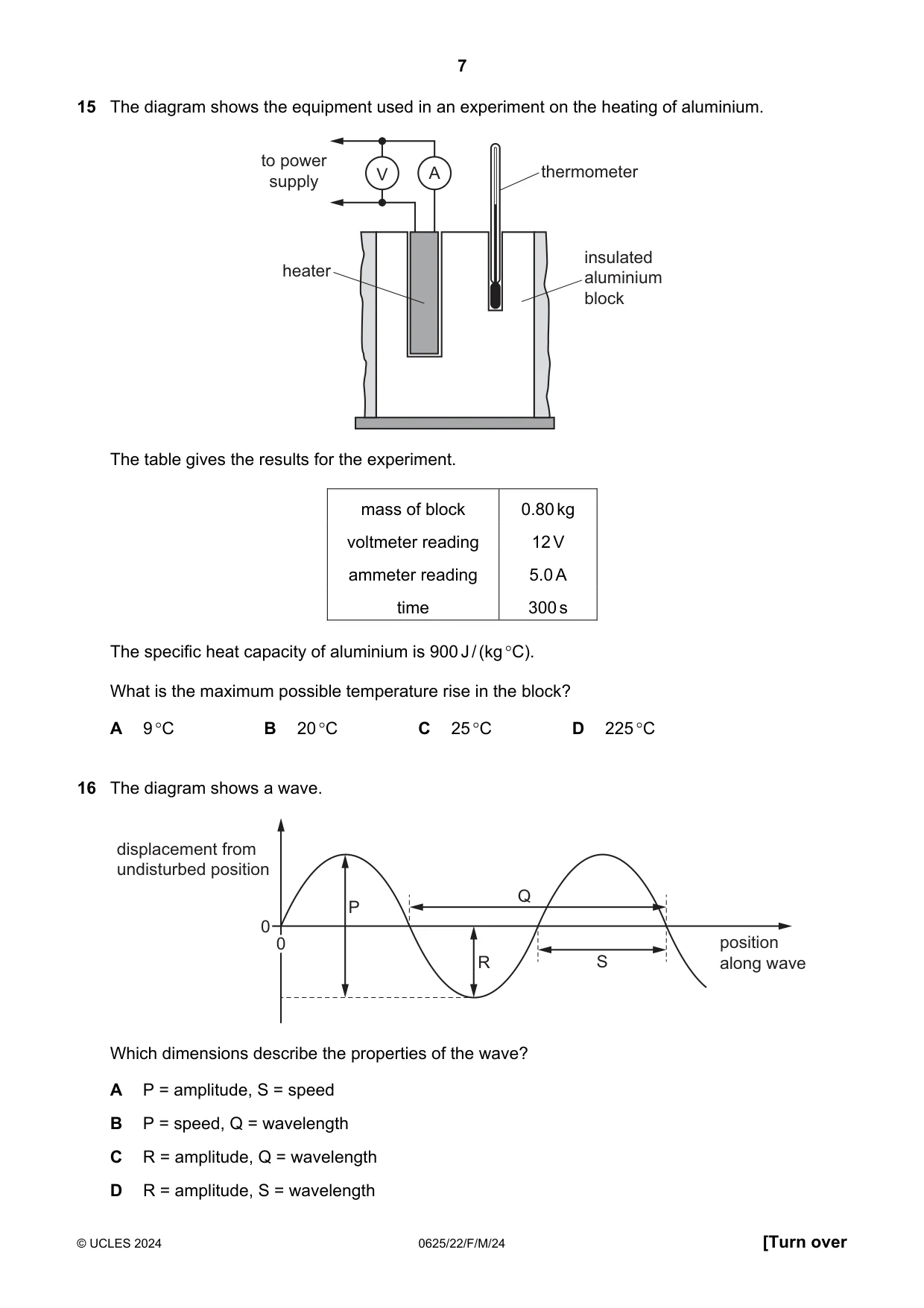
Q15 · The diagram shows the equipment used in an experiment on the heating of aluminium
15 The diagram shows the equipment used in an experiment on the heating of aluminium. to power V A thermometer supply insulated heater aluminium block The table gives the results for the experiment. mass of block 0.80 kg voltmeter reading 12 V ammeter reading 5.0 A time 300 s The specific heat capacity of aluminium is 900 J / (kg C). What is the maximum possible temperature rise in the block? A 9 C B 20 C C 25 C D 225 C
Mark scheme: C
Q16 · The diagram shows a wave
16 The diagram shows a wave. displacement from undisturbed position Q P 0 0 position R S along wave Which dimensions describe the properties of the wave? A P = amplitude, S = speed B P = speed, Q = wavelength C R = amplitude, Q = wavelength D R = amplitude, S = wavelength
Mark scheme: C
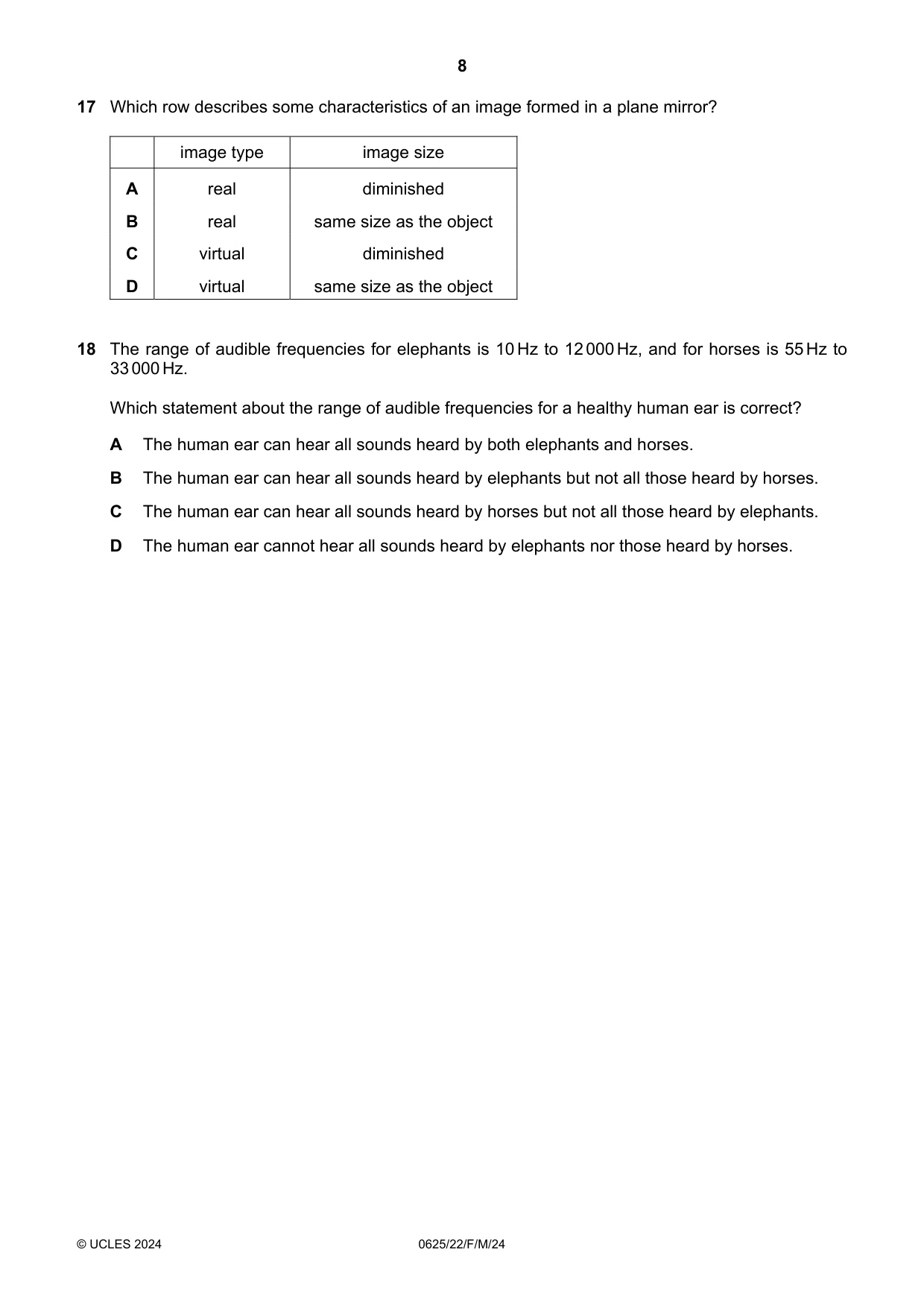
Q17 · Which row describes some characteristics of an image formed in a plane mirror?
17 Which row describes some characteristics of an image formed in a plane mirror? image type image size A real diminished B real same size as the object C virtual diminished D virtual same size as the object
Mark scheme: D
Q18 · The range of audible frequencies for elephants is 10 Hz to 12 000 Hz, and for horses is…
18 The range of audible frequencies for elephants is 10 Hz to 12 000 Hz, and for horses is 55 Hz to 33 000 Hz. Which statement about the range of audible frequencies for a healthy human ear is correct? A The human ear can hear all sounds heard by both elephants and horses. B The human ear can hear all sounds heard by elephants but not all those heard by horses. C The human ear can hear all sounds heard by horses but not all those heard by elephants. D The human ear cannot hear all sounds heard by elephants nor those heard by horses.
Mark scheme: D
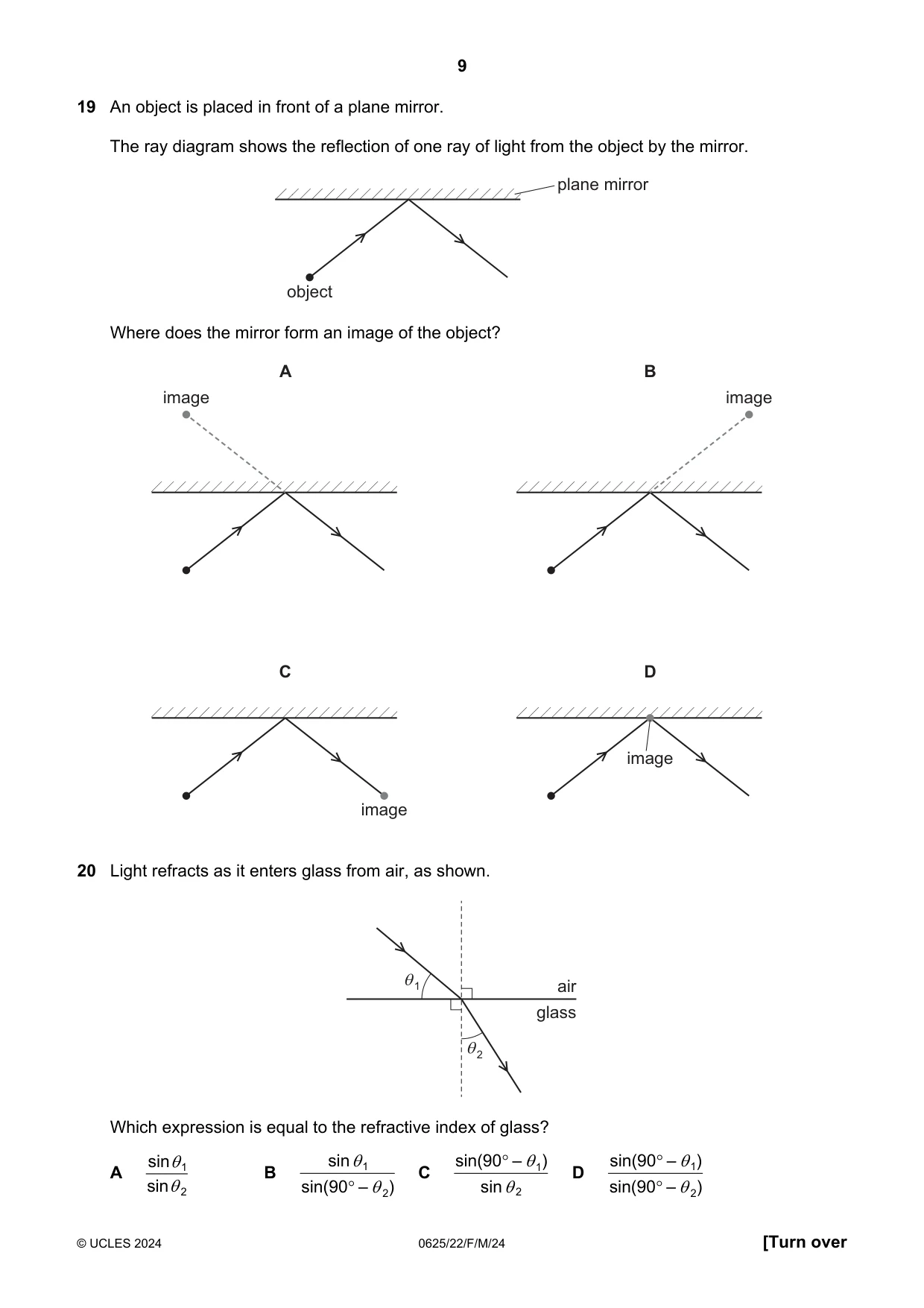
Q19 · An object is placed in front of a plane mirror
19 An object is placed in front of a plane mirror. The ray diagram shows the reflection of one ray of light from the object by the mirror. plane mirror object Where does the mirror form an image of the object? A B image image C D image image
Mark scheme: A
Q20 · Light refracts as it enters glass from air, as shown
20 Light refracts as it enters glass from air, as shown. air glass Which expression is equal to the refractive index of glass? sind, B sin 0, Cc sin(90° — 6,) D sin(90° — 6,) sin, sin(90° — 6.) sin 02 sin(90° — 6.)
Mark scheme: C
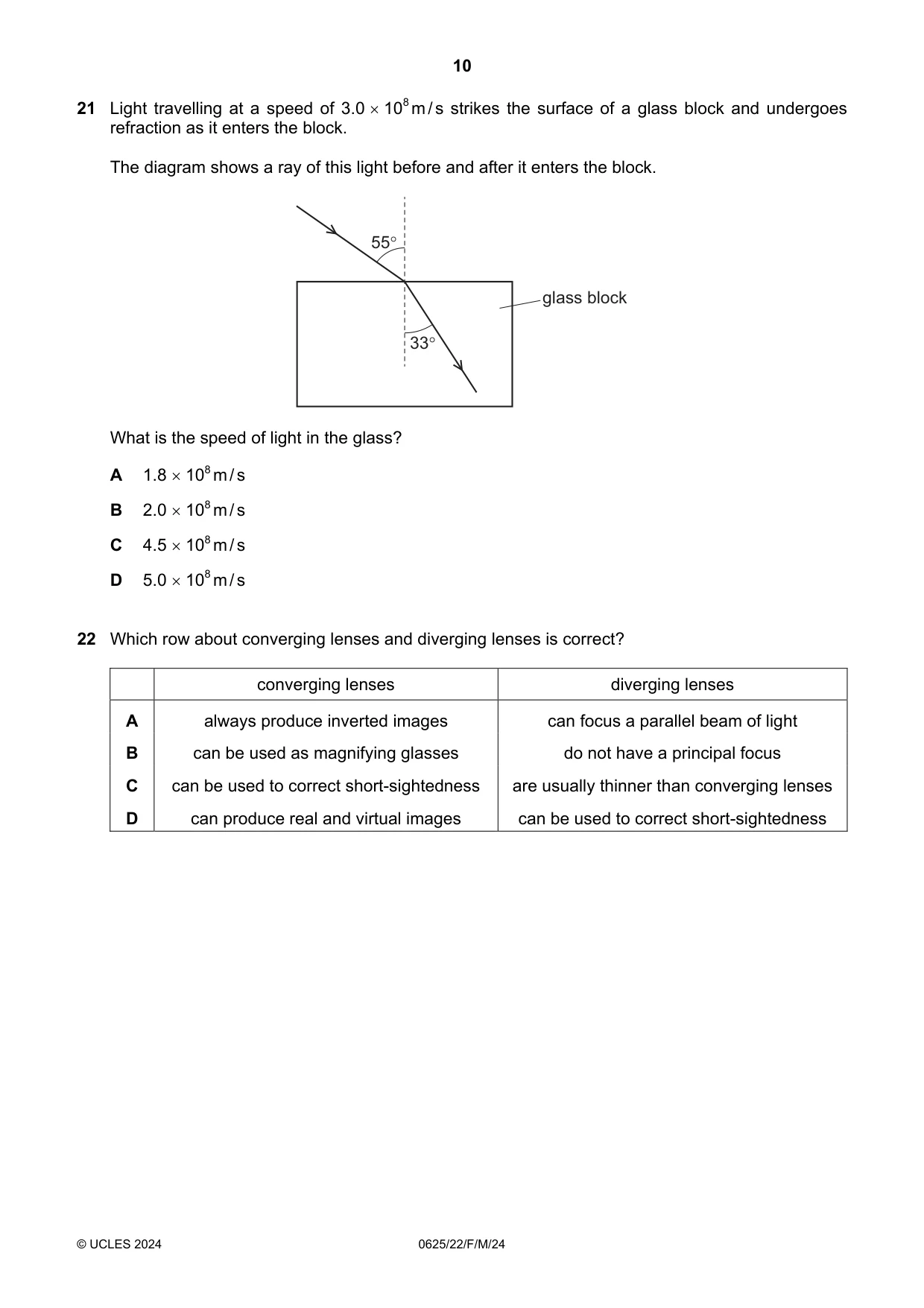
Q21 · Light travelling at a speed of 3.0 x 10°m/s strikes the surface of a glass block and…
21 Light travelling at a speed of 3.0 x 10°m/s strikes the surface of a glass block and undergoes refraction as it enters the block. The diagram shows a ray of this light before and after it enters the block. 55° glass block What is the speed of light in the glass? A 1.8x10°m/s B 2.0x10°m/s C 45x 10°m/s D 5.0x10°m/s
Mark scheme: B
Q22 · Which row about converging lenses and diverging lenses is correct?
22 Which row about converging lenses and diverging lenses is correct? converging lenses diverging lenses A always produce inverted images can focus a parallel beam of light B can be used as magnifying glasses do not have a principal focus C can be used to correct short-sightedness are usually thinner than converging lenses D can produce real and virtual images can be used to correct short-sightedness
Mark scheme: D
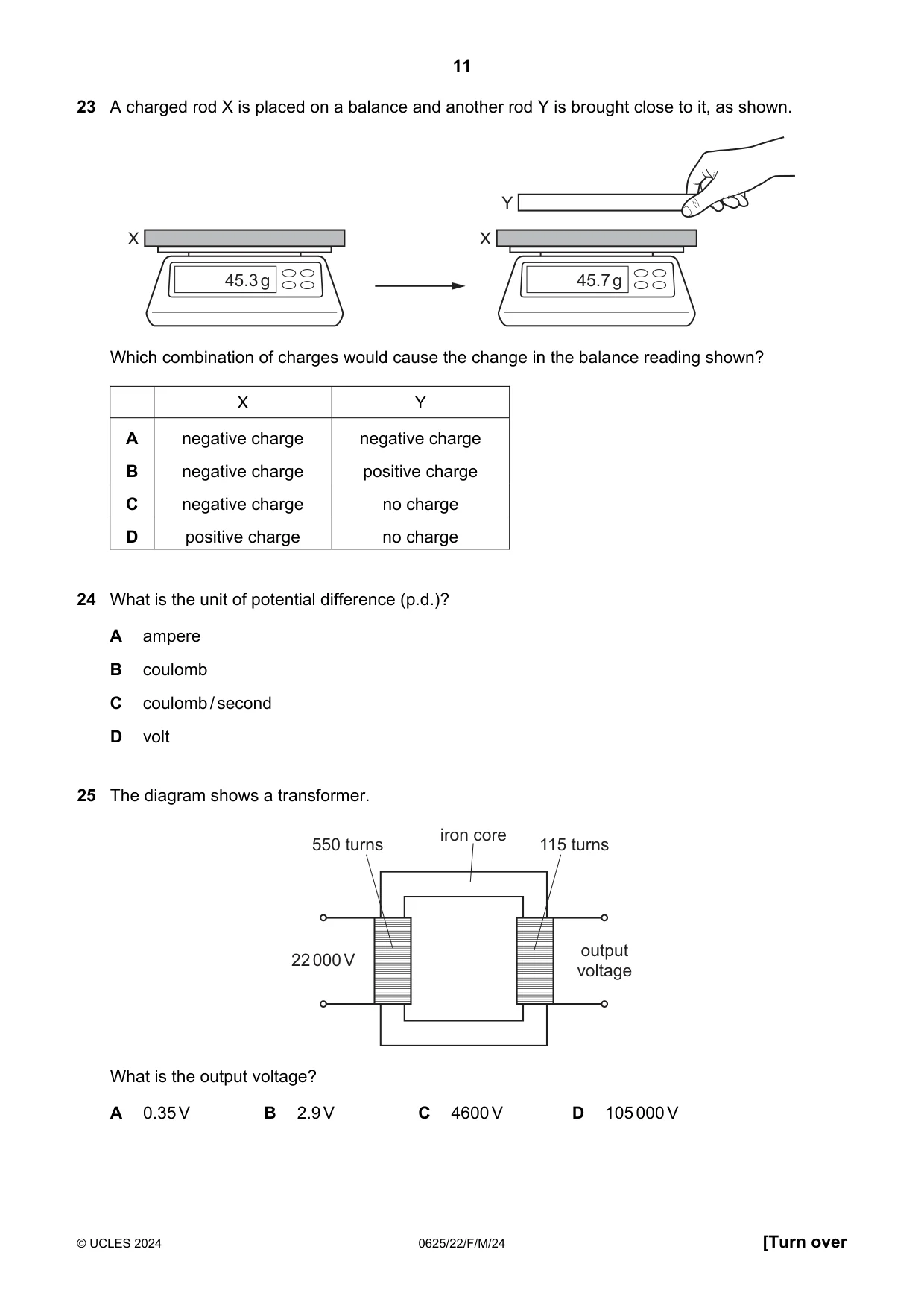
Q23 · A charged rod X is placed on a balance and another rod Y is brought close to it, as shown
23 A charged rod X is placed on a balance and another rod Y is brought close to it, as shown. Y X X 45.3 g 45.7 g Which combination of charges would cause the change in the balance reading shown? X Y A negative charge negative charge B negative charge positive charge C negative charge no charge D positive charge no charge
Mark scheme: A
Q24 · What is the unit of potential difference (p.d.)?
24 What is the unit of potential difference (p.d.)? A ampere B coulomb C coulomb / second D volt
Mark scheme: D
Q25 · The diagram shows a transformer
25 The diagram shows a transformer. iron core 550 turns 115 turns output 22 000 V voltage What is the output voltage? A 0.35 V B 2.9 V C 4600 V D 105 000 V
Mark scheme: C
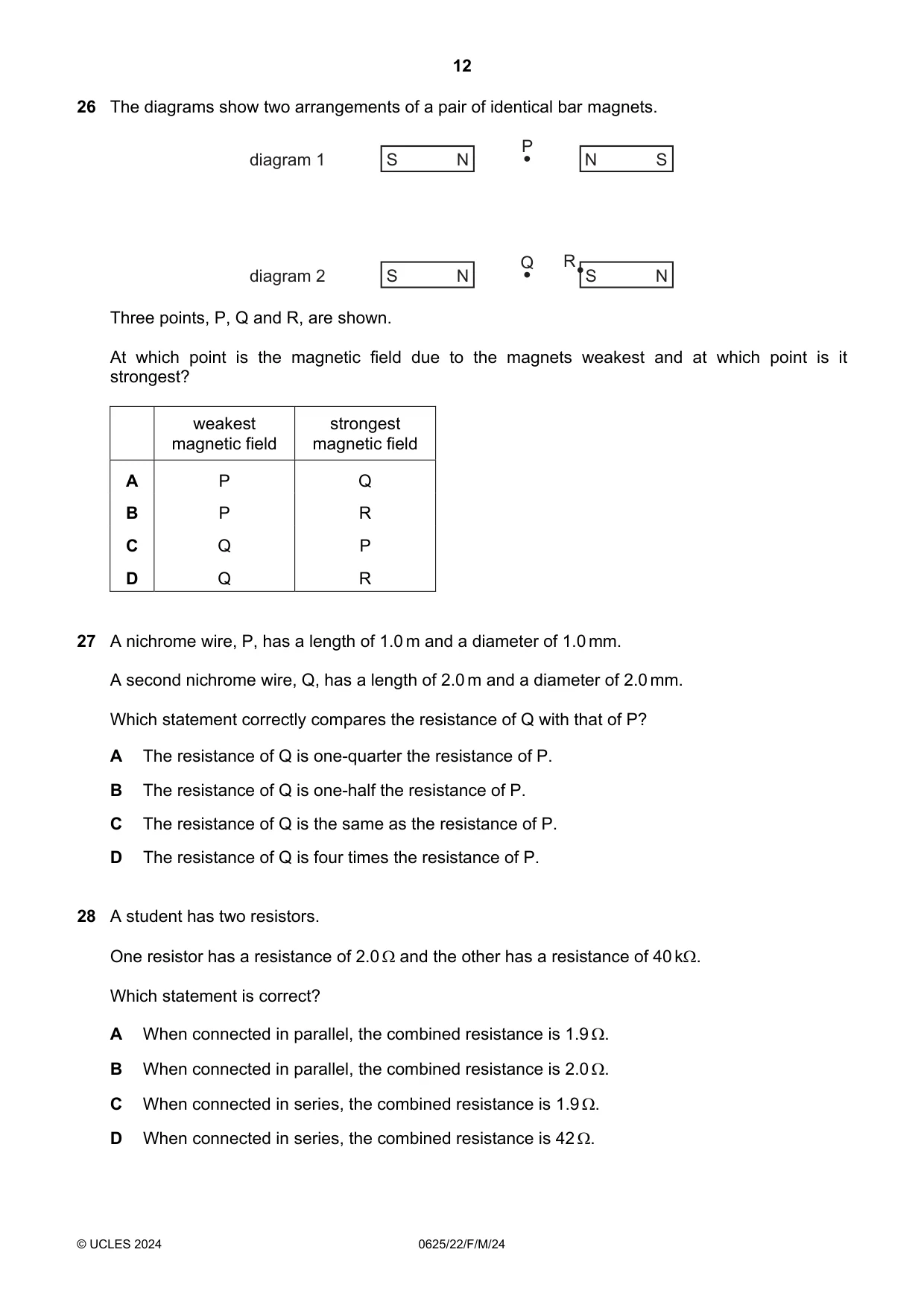
Q26 · The diagrams show two arrangements of a pair of identical bar magnets
26 The diagrams show two arrangements of a pair of identical bar magnets. P diagram 1 S N N S Q R diagram 2 S N S N Three points, P, Q and R, are shown. At which point is the magnetic field due to the magnets weakest and at which point is it strongest? weakest strongest magnetic field magnetic field A P Q B P R C Q P D Q R
Mark scheme: B
Q27 · A nichrome wire, P, has a length of 1.0 m and a diameter of 1.0 mm
27 A nichrome wire, P, has a length of 1.0 m and a diameter of 1.0 mm. A second nichrome wire, Q, has a length of 2.0 m and a diameter of 2.0 mm. Which statement correctly compares the resistance of Q with that of P? A The resistance of Q is one-quarter the resistance of P. B The resistance of Q is one-half the resistance of P. C The resistance of Q is the same as the resistance of P. D The resistance of Q is four times the resistance of P.
Mark scheme: B
Q28 · A student has two resistors
28 A student has two resistors. One resistor has a resistance of 2.0 and the other has a resistance of 40 k. Which statement is correct? A When connected in parallel, the combined resistance is 1.9 . B When connected in parallel, the combined resistance is 2.0 . C When connected in series, the combined resistance is 1.9 . D When connected in series, the combined resistance is 42 .
Mark scheme: B
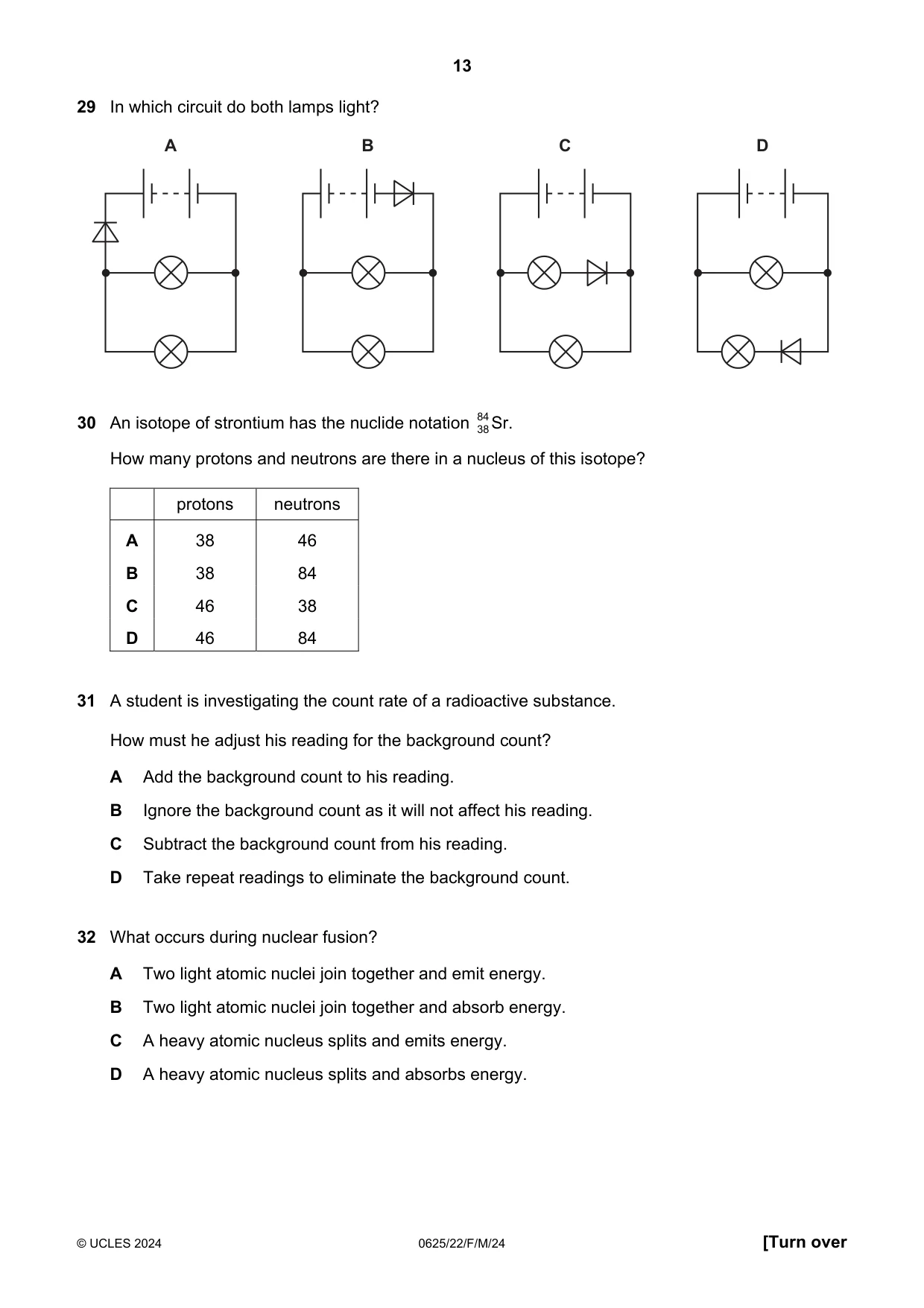
Q29 · In which circuit do both lamps light?
29 In which circuit do both lamps light? A B C D
Mark scheme: C
Q30 · An isotope of strontium has the nuclide notation 84 Sr
30 An isotope of strontium has the nuclide notation 84 Sr. 38 How many protons and neutrons are there in a nucleus of this isotope? protons neutrons A 38 46 B 38 84 C 46 38 D 46 84
Mark scheme: A
Q31 · A student is investigating the count rate of a radioactive substance
31 A student is investigating the count rate of a radioactive substance. How must he adjust his reading for the background count? A Add the background count to his reading. B Ignore the background count as it will not affect his reading. C Subtract the background count from his reading. D Take repeat readings to eliminate the background count.
Mark scheme: C
Q32 · What occurs during nuclear fusion?
32 What occurs during nuclear fusion? A Two light atomic nuclei join together and emit energy. B Two light atomic nuclei join together and absorb energy. C A heavy atomic nucleus splits and emits energy. D A heavy atomic nucleus splits and absorbs energy.
Mark scheme: A
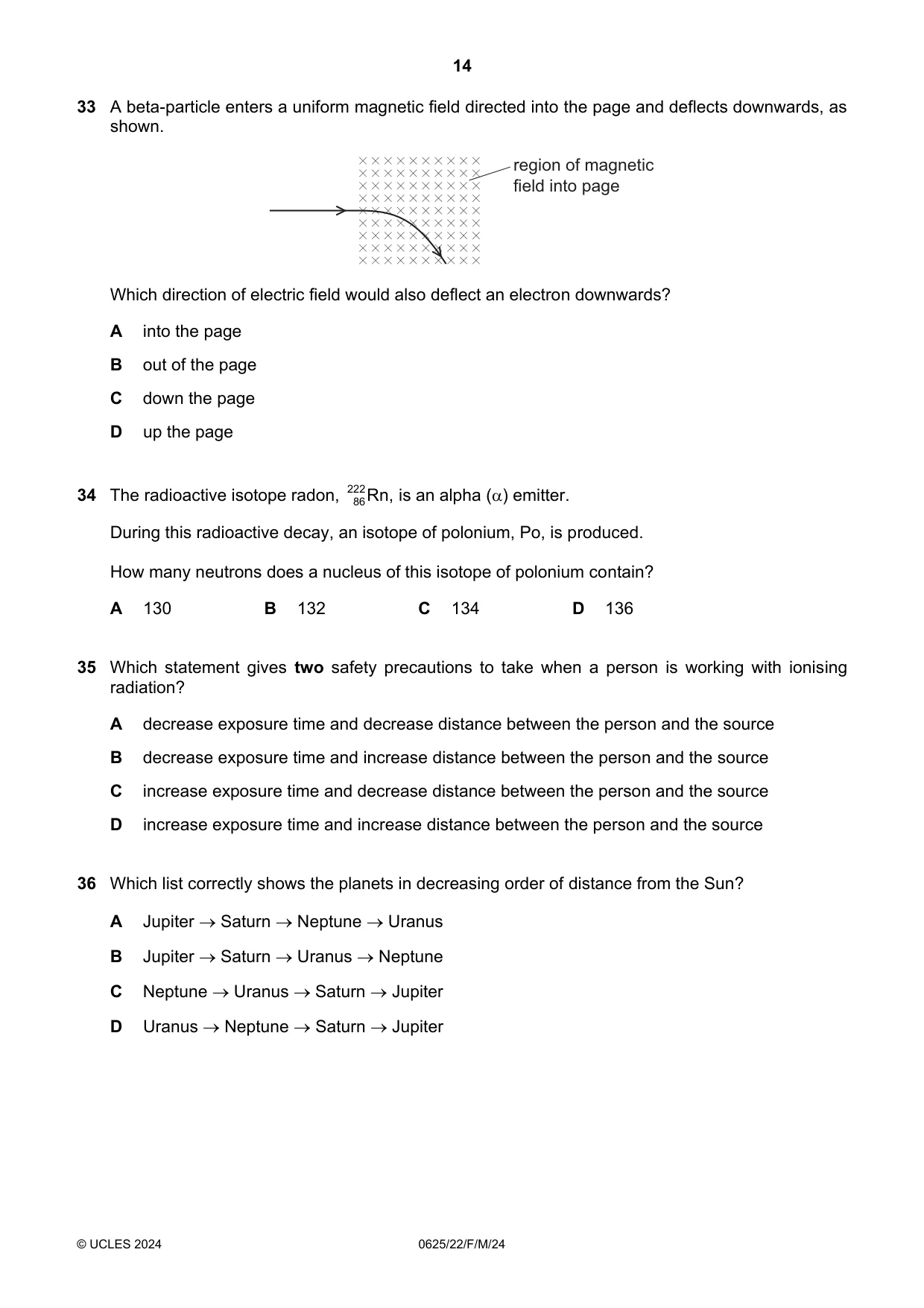
Q33 · A beta-particle enters a uniform magnetic field directed into the page and deflects…
33 A beta-particle enters a uniform magnetic field directed into the page and deflects downwards, as shown. region of magnetic field into page Which direction of electric field would also deflect an electron downwards? A into the page B out of the page C down the page D up the page
Mark scheme: D
Q34 · The radioactive isotope radon, 222 Rn, is an alpha () emitter
34 The radioactive isotope radon, 222 Rn, is an alpha () emitter. 86 During this radioactive decay, an isotope of polonium, Po, is produced. How many neutrons does a nucleus of this isotope of polonium contain? A 130 B 132 C 134 D 136
Mark scheme: C
Q35 · Which statement gives two safety precautions to take when a person is working with…
35 Which statement gives two safety precautions to take when a person is working with ionising radiation? A decrease exposure time and decrease distance between the person and the source B decrease exposure time and increase distance between the person and the source C increase exposure time and decrease distance between the person and the source D increase exposure time and increase distance between the person and the source
Mark scheme: B
Q36 · Which list correctly shows the planets in decreasing order of distance from the Sun?
36 Which list correctly shows the planets in decreasing order of distance from the Sun? A Jupiter Saturn Neptune Uranus B Jupiter Saturn Uranus Neptune C Neptune Uranus Saturn Jupiter D Uranus Neptune Saturn Jupiter
Mark scheme: C
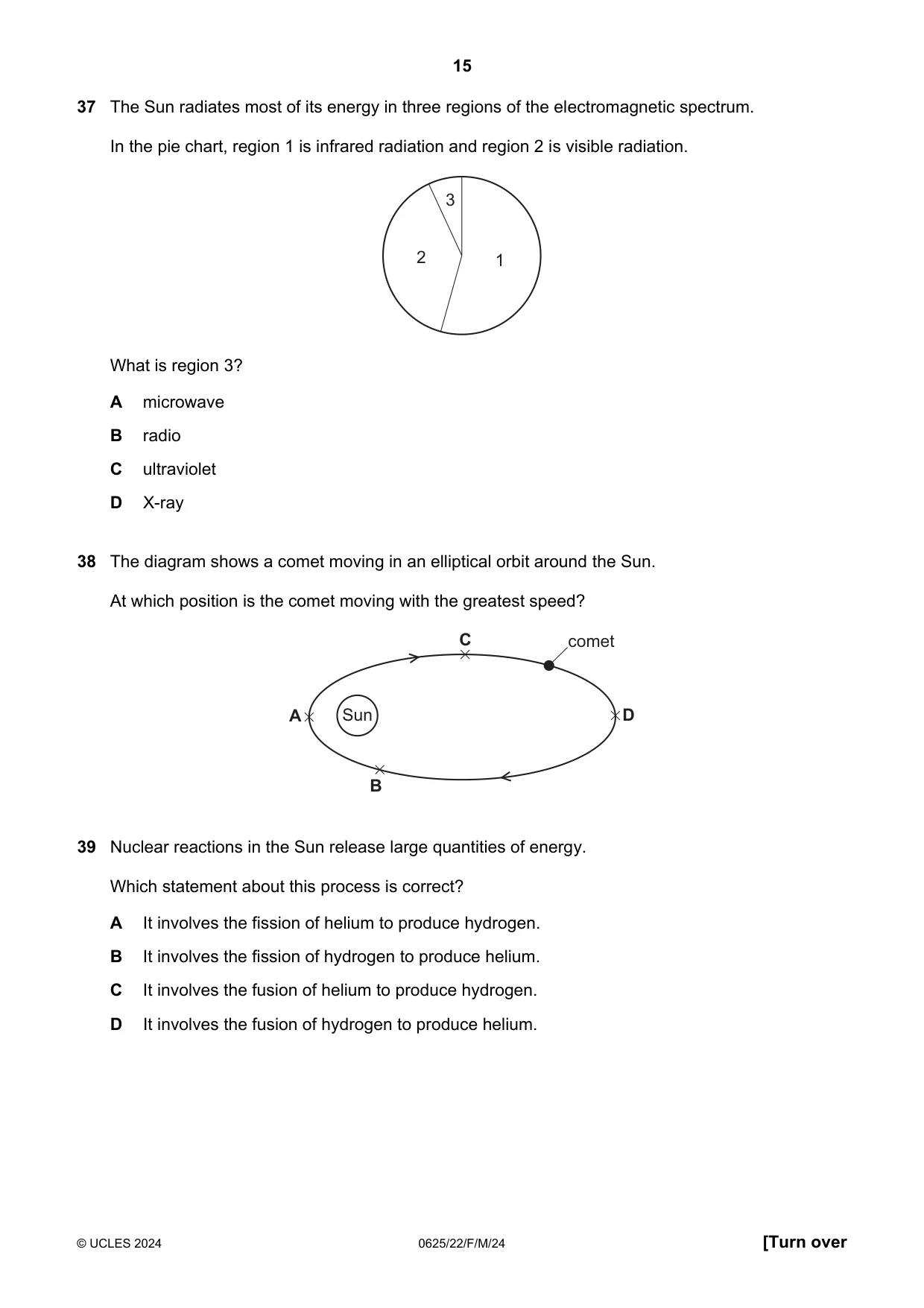
Q37 · The Sun radiates most of its energy in three regions of the electromagnetic spectrum
37 The Sun radiates most of its energy in three regions of the electromagnetic spectrum. In the pie chart, region 1 is infrared radiation and region 2 is visible radiation. 3 2 1 What is region 3? A microwave B radio C ultraviolet D X-ray
Mark scheme: C
Q38 · The diagram shows a comet moving in an elliptical orbit around the Sun
38 The diagram shows a comet moving in an elliptical orbit around the Sun. At which position is the comet moving with the greatest speed? C comet A Sun D B
Mark scheme: A
Q39 · Nuclear reactions in the Sun release large quantities of energy
39 Nuclear reactions in the Sun release large quantities of energy. Which statement about this process is correct? A It involves the fission of helium to produce hydrogen. B It involves the fission of hydrogen to produce helium. C It involves the fusion of helium to produce hydrogen. D It involves the fusion of hydrogen to produce helium.
Mark scheme: D
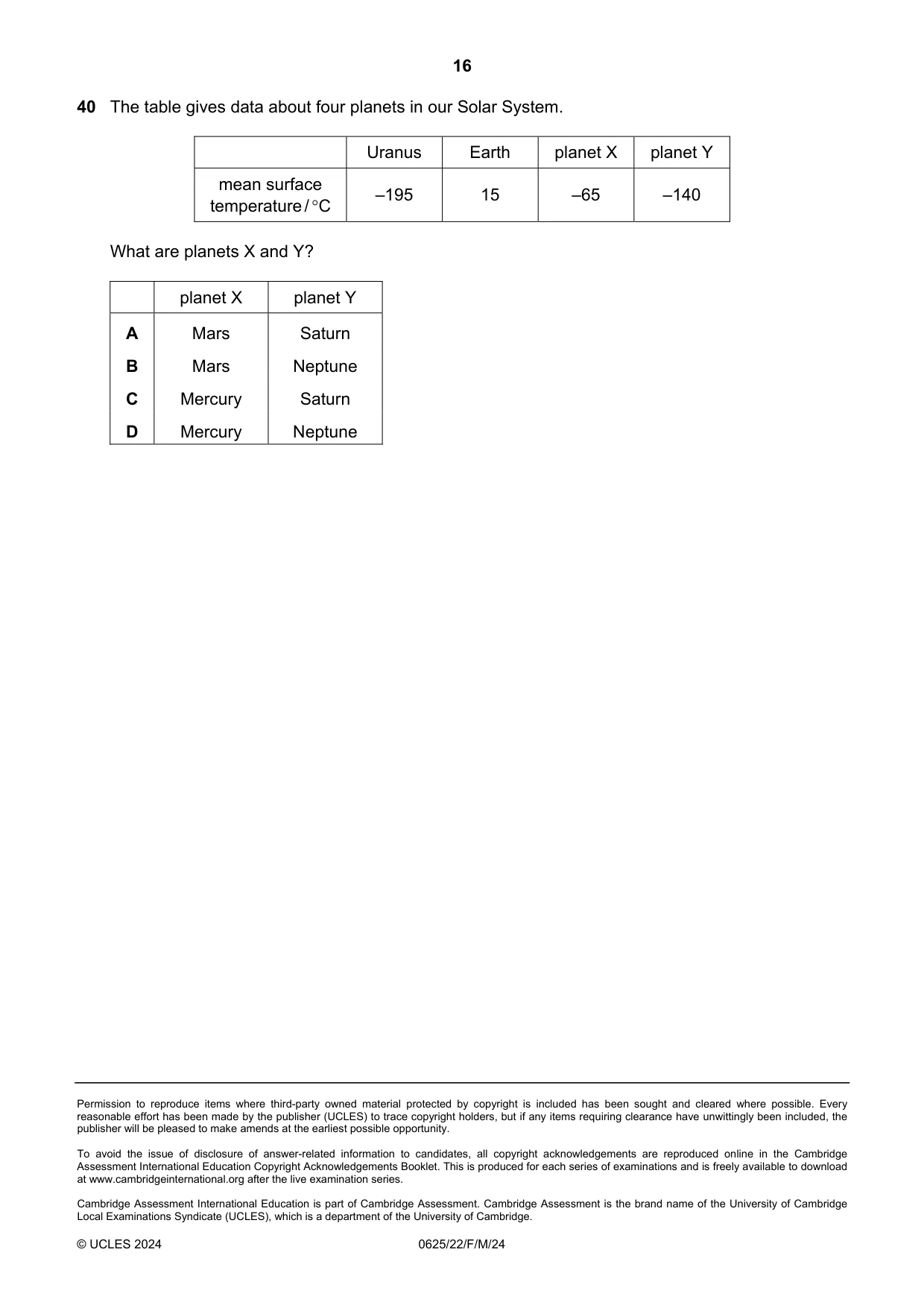
Q40 · The table gives data about four planets in our Solar System
40 The table gives data about four planets in our Solar System. Uranus Earth planet X planet Y mean surface –195 15 –65 –140 temperature / C What are planets X and Y? planet X planet Y A Mars Saturn B Mars Neptune C Mercury Saturn D Mercury Neptune
Mark scheme: A
What was in this paper
The subtopics covered by these 40 questions, and how many questions each got. Open one in a new tab to see every Cambridge question on it.
5Kinetic particle model of matter4The Earth and the Solar System3The nuclear model of the atom3Electric circuits2Electrical quantities2Electromagnetic effects2Forces2Physical quantities and measurement techniques2Radioactivity2Simple phenomena of magnetism2Thermal properties and temperature2Density1Electrical safety1Electromagnetic spectrum1Energy, work and power1General properties of waves1Momentum1Pressure1Sound1Transfer of thermal energy1What you needed in this session
Cambridge’s own grade thresholds for 2024 Feb/March, Paper 2 · Variant 2. A higher threshold means an easier paper — the bar moves with how the cohort did.