Cambridge IGCSE Physics 0625 — 2019 May/June Paper 2 · Variant 3
0625/23/M/J/19 · 40 questions · 40 marks · ≈45 min
The question paper and its mark scheme, free to read here and free to download. This is Cambridge’s own paper, exactly as it was sat.
Question paper16 pages
Mark scheme3 pages
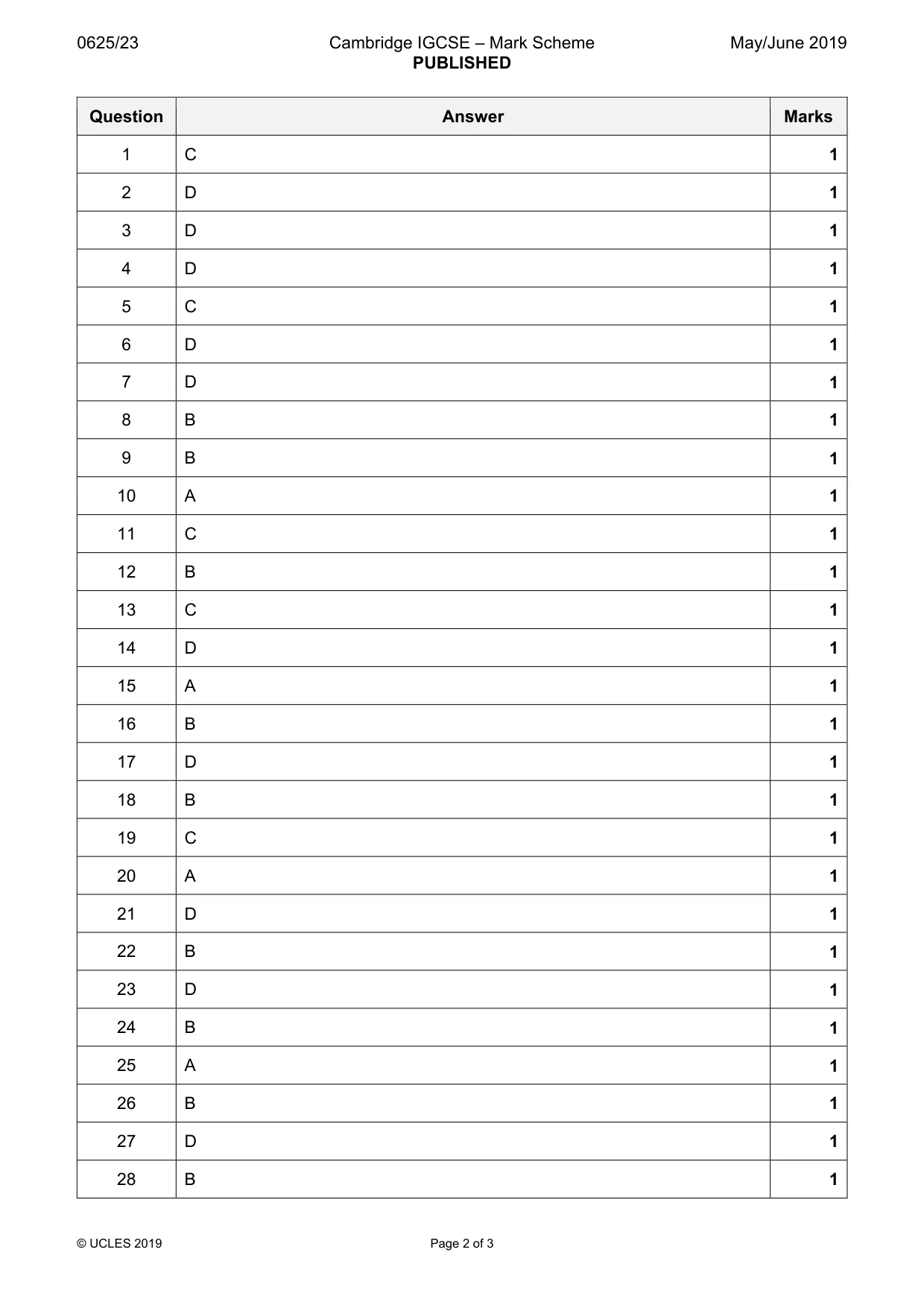
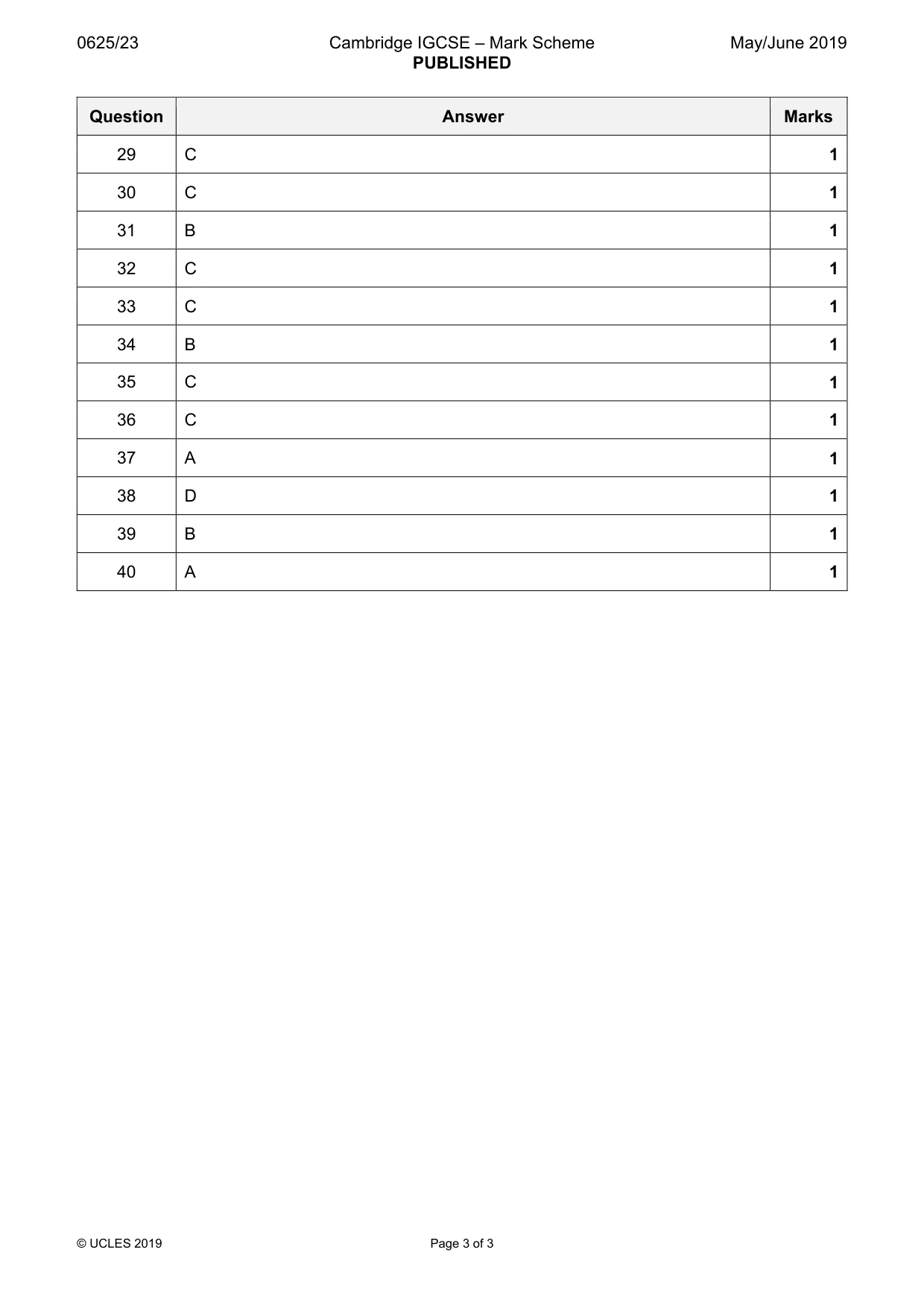
Answers below. Sit the paper first if you are practising.
Questions as text
Q1 · Which quantity can be measured directly using a micrometer screw gauge?
1 Which quantity can be measured directly using a micrometer screw gauge? A the area of a sheet of paper B the mass of a sheet of paper C the thickness of a sheet of paper D the volume of a sheet of paper
Mark scheme: C
More questions on Physical quantities and measurement techniques
Q2 · A brass ball and a feather are released at the same time
2 A brass ball and a feather are released at the same time. On Earth, the ball reaches the ground first. On the Moon, they reach the ground at the same time. What is the explanation for this? A Both weigh the same on the Moon. B Both weigh less on the Moon. C There is a greater air resistance on the Moon. D There is no air resistance on the Moon.
Mark scheme: D
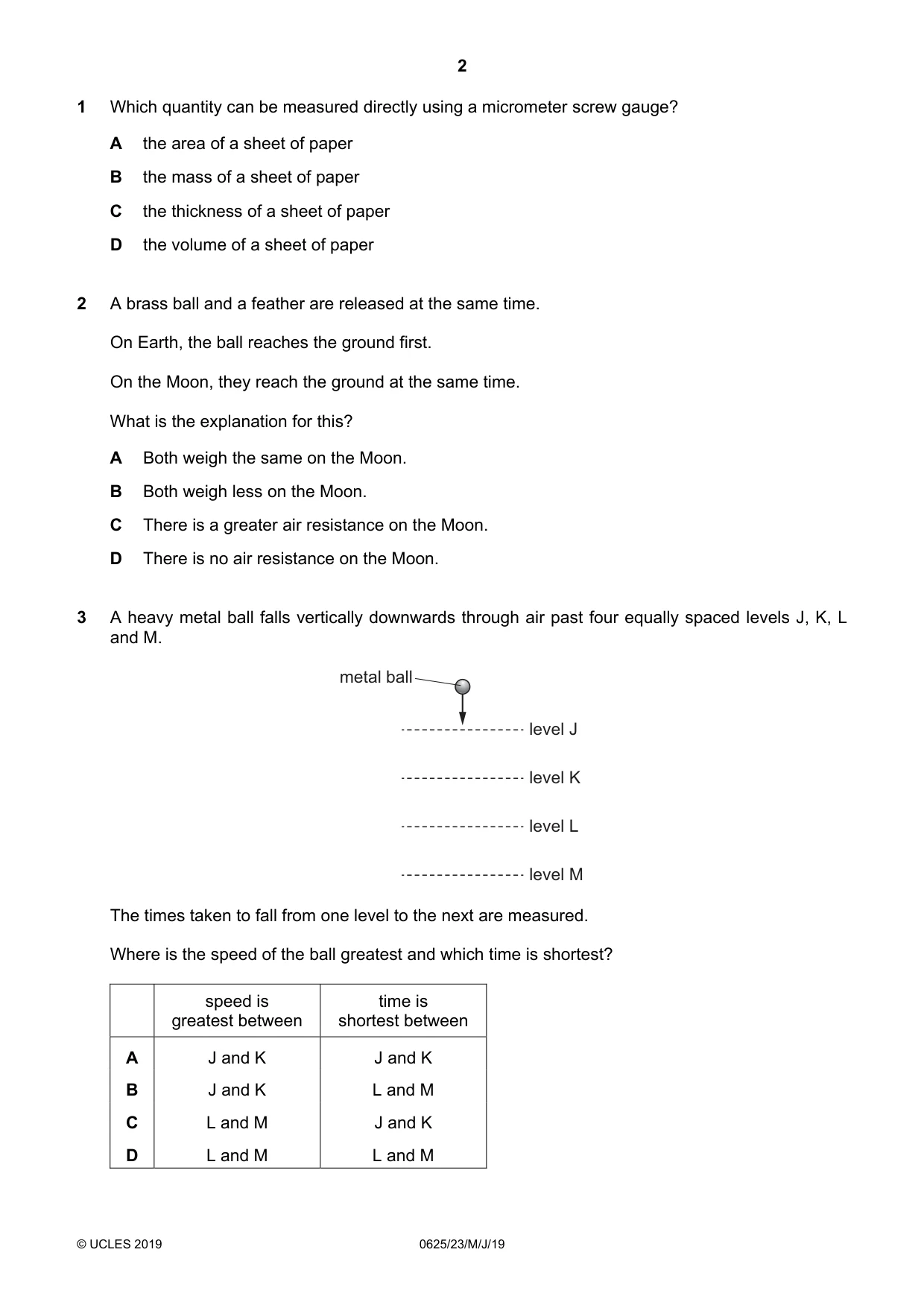
Q3 · A heavy metal ball falls vertically downwards through air past four equally spaced levels…
3 A heavy metal ball falls vertically downwards through air past four equally spaced levels J, K, L and M. metal ball level J level K level L level M The times taken to fall from one level to the next are measured. Where is the speed of the ball greatest and which time is shortest? speed is time is greatest between shortest between A J and K J and K B J and K L and M C L and M J and K D L and M L and M
Mark scheme: D
Q4 · On Earth, a spring stretches by 5.0 cm when a mass of 3.0 kg is suspended from one end
4 On Earth, a spring stretches by 5.0 cm when a mass of 3.0 kg is suspended from one end. The gravitational field strength on the Moon is 1 6 of that on Earth. Which mass, on the Moon, would stretch the spring by the same extension? A 0.50 kg B 3.0 kg C 5.0 kg D 18 kg
Mark scheme: D
Q5 · X, Y and Z are three regularly shaped solid objects
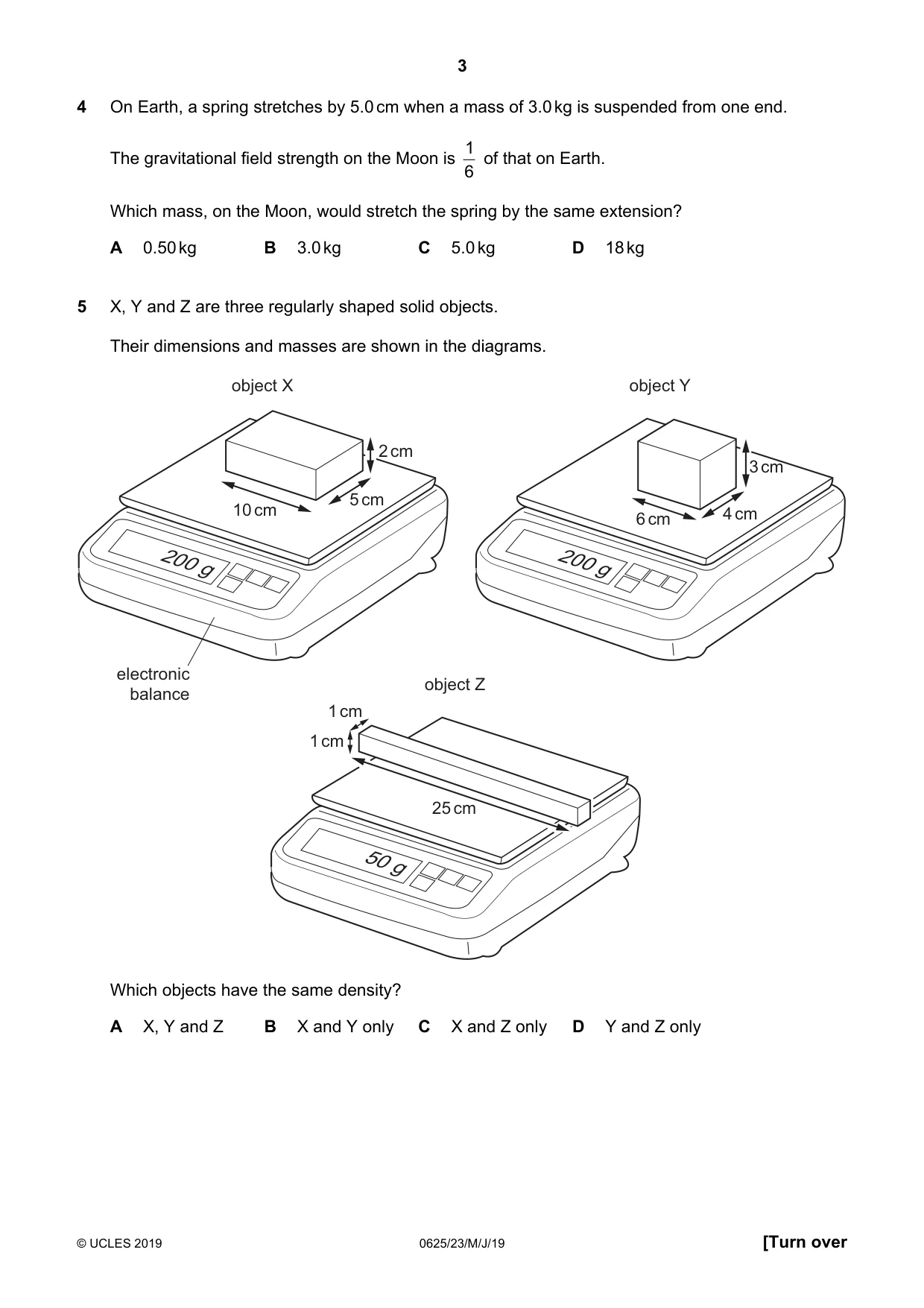
5 X, Y and Z are three regularly shaped solid objects. Their dimensions and masses are shown in the diagrams. object X object Y 2 cm 3 cm 5 cm 10 cm 4 cm 6 cm 200 g 200 g electronic object Z balance 1 cm 1 cm 25 cm 50 g Which objects have the same density? A X, Y and Z B X and Y only C X and Z only D Y and Z only
Mark scheme: C
Q6 · An experiment is carried out to determine the spring constant for a spring that obeys…
6 An experiment is carried out to determine the spring constant for a spring that obeys Hooke’s law. A load is hung from the spring and the extension of the spring is measured. Which calculation is used to calculate the spring constant? extension A mass of the load extension B weight of the load mas s of the load C extension weight of the load D extension
Mark scheme: D
Q7 · A car is driven from rest on a long straight road
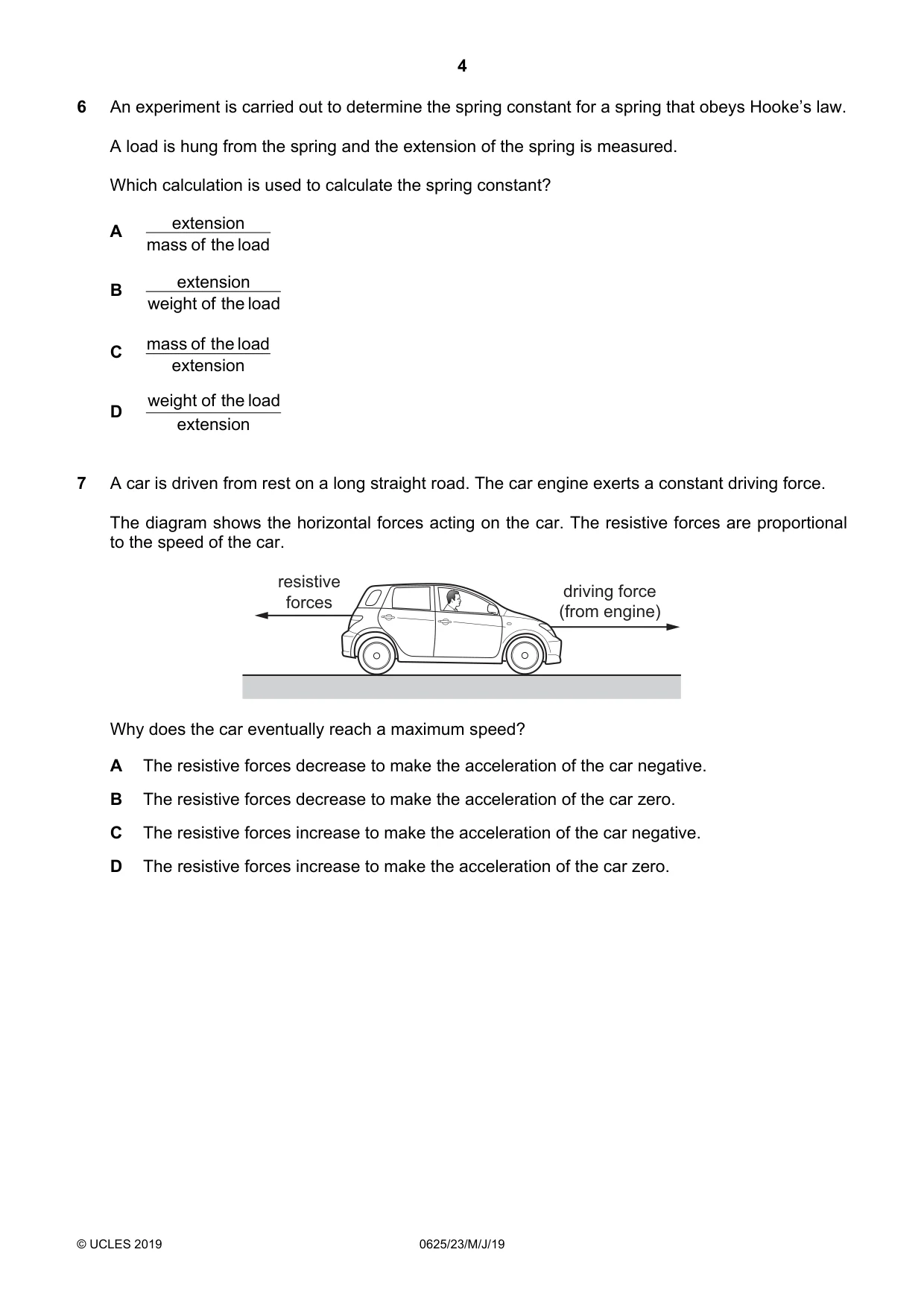
7 A car is driven from rest on a long straight road. The car engine exerts a constant driving force. The diagram shows the horizontal forces acting on the car. The resistive forces are proportional to the speed of the car. resistive driving force forces (from engine) Why does the car eventually reach a maximum speed? A The resistive forces decrease to make the acceleration of the car negative. B The resistive forces decrease to make the acceleration of the car zero. C The resistive forces increase to make the acceleration of the car negative. D The resistive forces increase to make the acceleration of the car zero.
Mark scheme: D
Q8 · A beam of weight 6.0 N is suspended from two strings P and Q
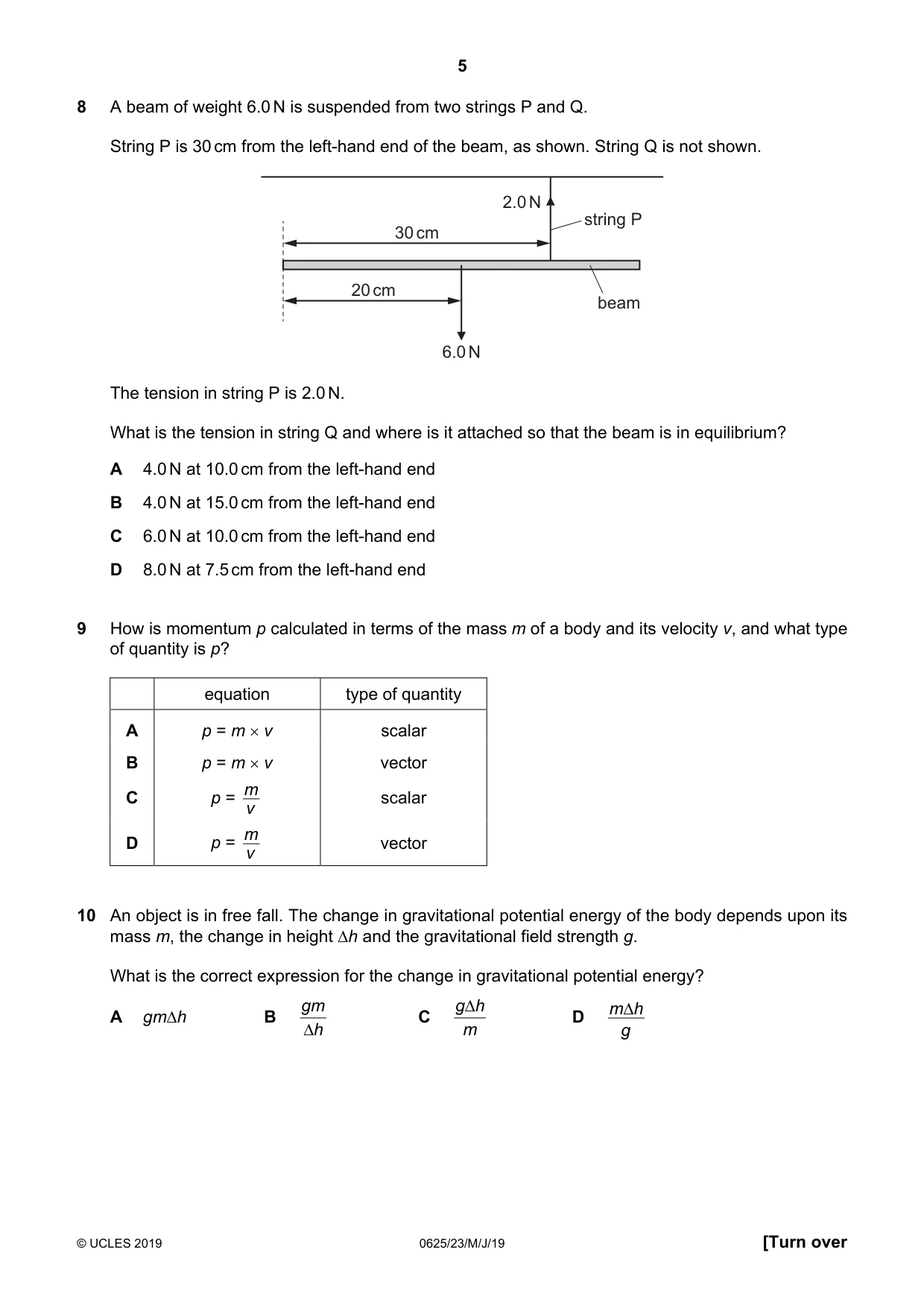
8 A beam of weight 6.0 N is suspended from two strings P and Q. String P is 30 cm from the left-hand end of the beam, as shown. String Q is not shown. 2.0 N string P 30 cm 20 cm beam 6.0 N The tension in string P is 2.0 N. What is the tension in string Q and where is it attached so that the beam is in equilibrium? A 4.0 N at 10.0 cm from the left-hand end B 4.0 N at 15.0 cm from the left-hand end C 6.0 N at 10.0 cm from the left-hand end D 8.0 N at 7.5 cm from the left-hand end
Mark scheme: B
Q9 · How is momentum p calculated in terms of the mass m of a body and its velocity v, and…
9 How is momentum p calculated in terms of the mass m of a body and its velocity v, and what type of quantity is p? equation type of quantity A p = m × v scalar B p = m × v vector m C p = v scalar m D p = v vector
Mark scheme: B
Q10 · An object is in free fall
10 An object is in free fall. The change in gravitational potential energy of the body depends upon its mass m, the change in height ∆h and the gravitational field strength g. What is the correct expression for the change in gravitational potential energy? gm g∆ h m∆ h A gm∆h B C D ∆ h m g
Mark scheme: A
Q11 · A machine is very efficient
11 A machine is very efficient. What does this mean? A It produces a large amount of power. B It uses very little energy. C It wastes very little energy. D It works very quickly.
Mark scheme: C
Q12 · A box is pulled along a floor by a force of 3.0 N
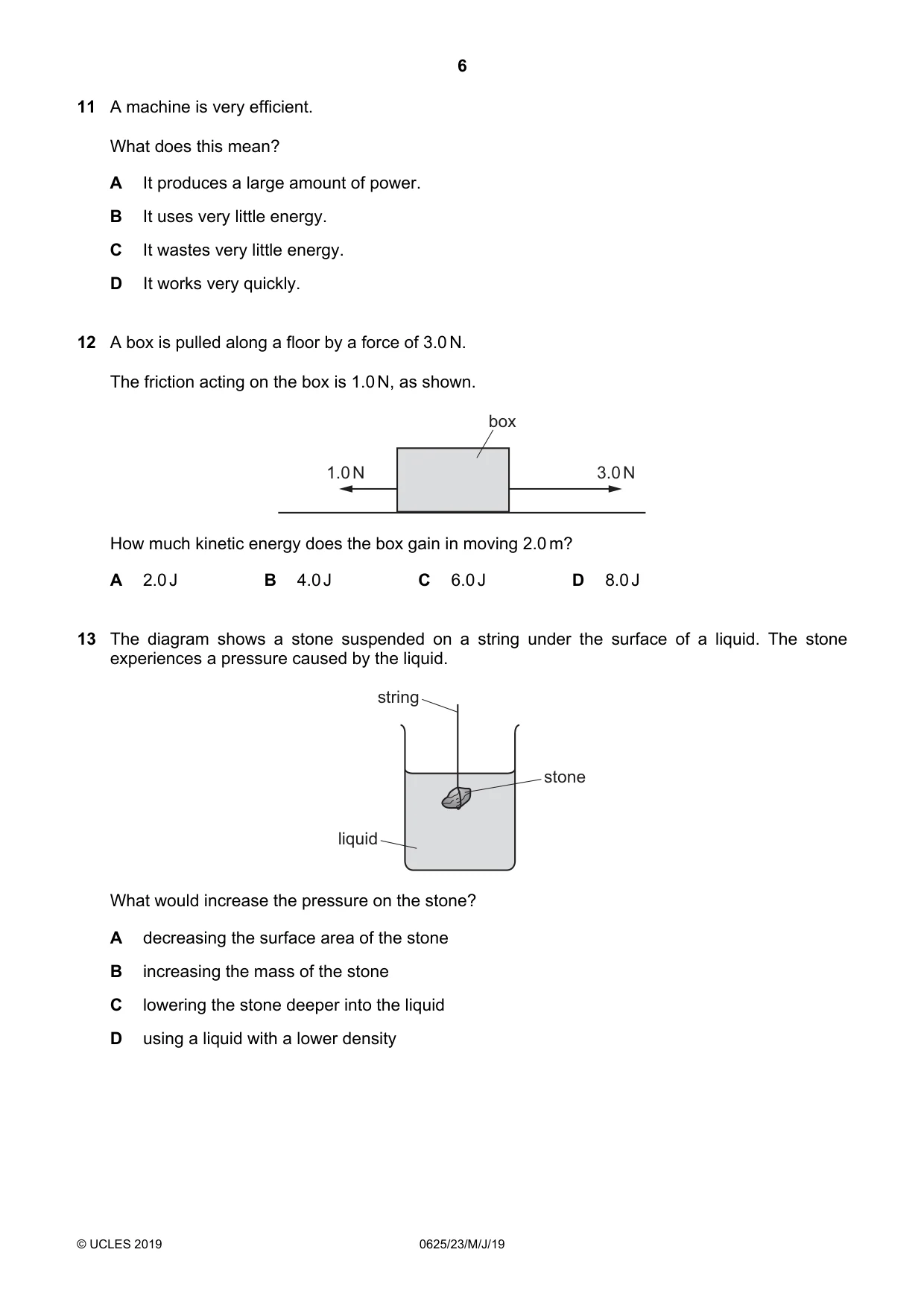
12 A box is pulled along a floor by a force of 3.0 N. The friction acting on the box is 1.0 N, as shown. box 1.0 N 3.0 N How much kinetic energy does the box gain in moving 2.0 m? A 2.0 J B 4.0 J C 6.0 J D 8.0 J
Mark scheme: B
Q13 · The diagram shows a stone suspended on a string under the surface of a liquid
13 The diagram shows a stone suspended on a string under the surface of a liquid. The stone experiences a pressure caused by the liquid. string stone liquid What would increase the pressure on the stone? A decreasing the surface area of the stone B increasing the mass of the stone C lowering the stone deeper into the liquid D using a liquid with a lower density
Mark scheme: C
Q14 · Water in a beaker evaporates when it is left on a bench for a period of time
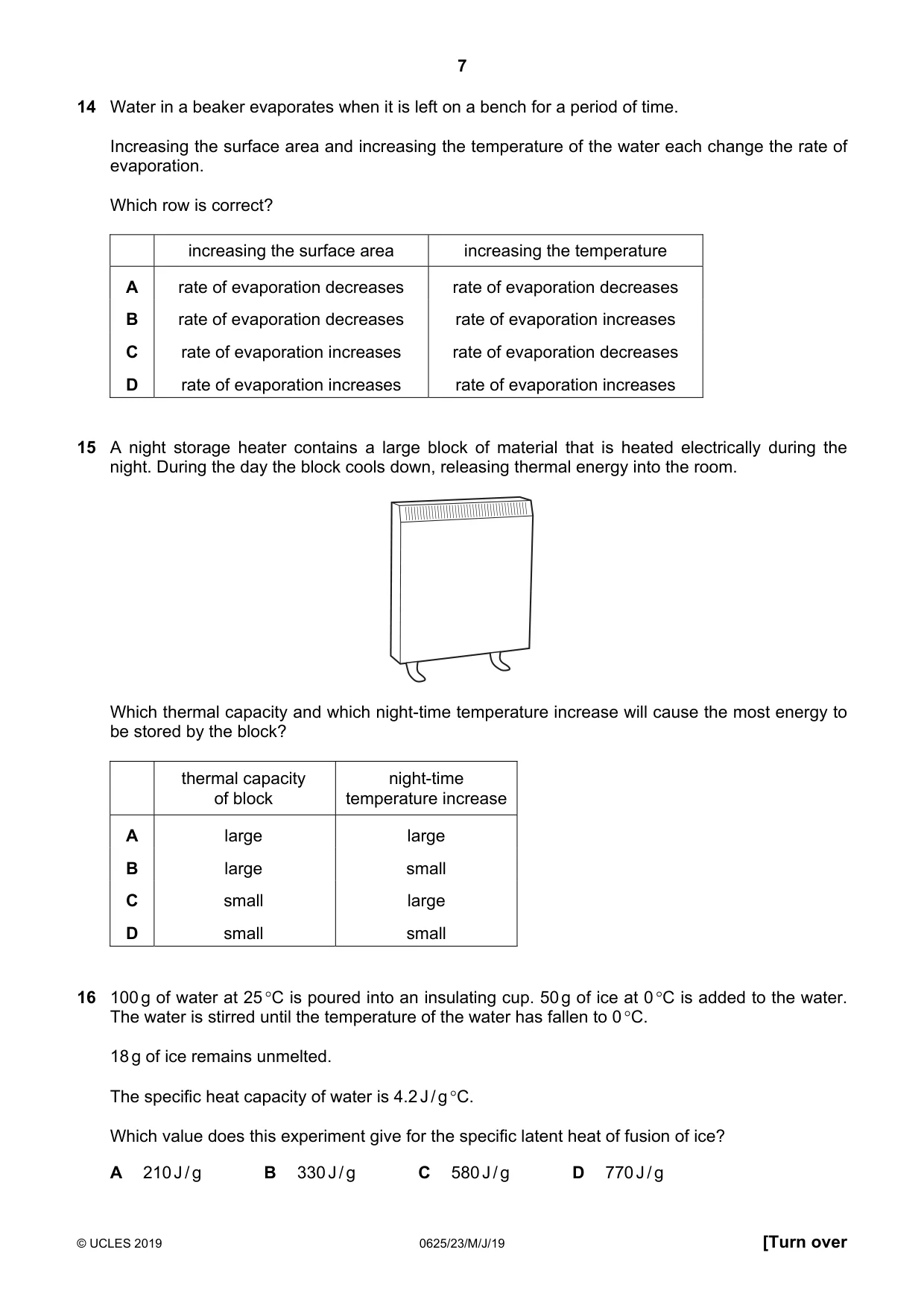
14 Water in a beaker evaporates when it is left on a bench for a period of time. Increasing the surface area and increasing the temperature of the water each change the rate of evaporation. Which row is correct? increasing the surface area increasing the temperature A rate of evaporation decreases rate of evaporation decreases B rate of evaporation decreases rate of evaporation increases C rate of evaporation increases rate of evaporation decreases D rate of evaporation increases rate of evaporation increases
Mark scheme: D
Q15 · A night storage heater contains a large block of material that is heated electrically…
15 A night storage heater contains a large block of material that is heated electrically during the night. During the day the block cools down, releasing thermal energy into the room. Which thermal capacity and which night-time temperature increase will cause the most energy to be stored by the block? thermal capacity night-time of block temperature increase A large large B large small C small large D small small
Mark scheme: A
Q16 · 100 g of water at 25 °C is poured into an insulating cup
16 100 g of water at 25 °C is poured into an insulating cup. 50 g of ice at 0 °C is added to the water. The water is stirred until the temperature of the water has fallen to 0 °C. 18 g of ice remains unmelted. The specific heat capacity of water is 4.2 J / g °C. Which value does this experiment give for the specific latent heat of fusion of ice? A 210 J / g B 330 J / g C 580 J / g D 770 J / g
Mark scheme: B
Q17 · Why does a metal rod conduct thermal energy much better than a similar-sized plastic rod?
17 Why does a metal rod conduct thermal energy much better than a similar-sized plastic rod? A The molecules in the plastic are much closer together than the atoms in the metal. B The molecules in the plastic are much larger than the atoms in the metal. C The molecules in the plastic are much more tightly held together than the atoms in the metal. D The molecular structure in the plastic contains no free electrons, but the metal has free electrons.
Mark scheme: D
Q18 · The metal surface of a kettle is hot
18 The metal surface of a kettle is hot. What happens to the cool air outside the kettle when it comes into contact with the hot kettle? A The density of the air decreases and the air falls. B The density of the air decreases and the air rises. C The density of the air increases and the air falls. D The density of the air increases and the air rises.
Mark scheme: B
Q19 · When water waves pass through a gap they diffract
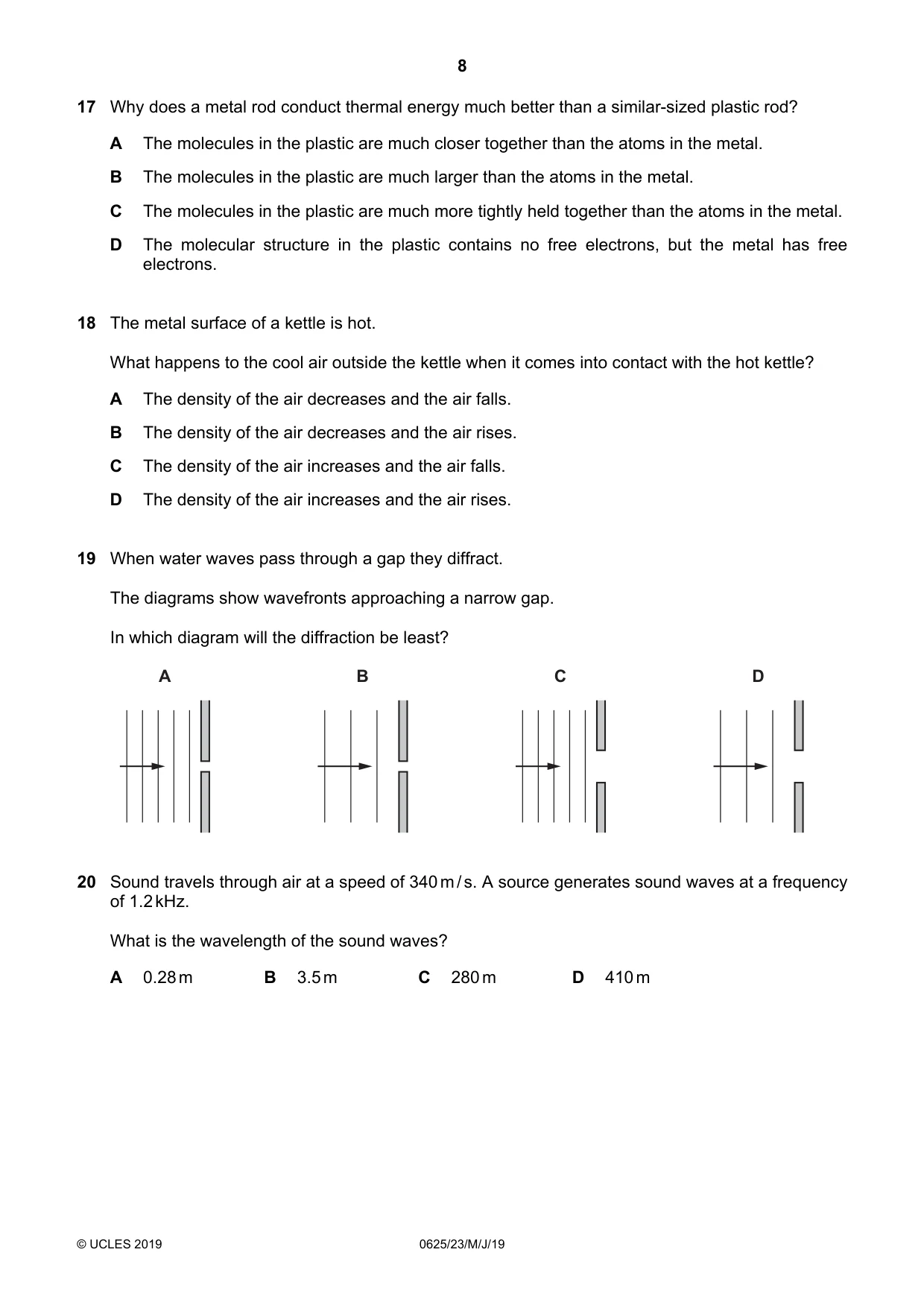
19 When water waves pass through a gap they diffract. The diagrams show wavefronts approaching a narrow gap. In which diagram will the diffraction be least? A B C D
Mark scheme: C
Q20 · Sound travels through air at a speed of 340 m / s
20 Sound travels through air at a speed of 340 m / s. A source generates sound waves at a frequency of 1.2 kHz. What is the wavelength of the sound waves? A 0.28 m B 3.5 m C 280 m D 410 m
Mark scheme: A
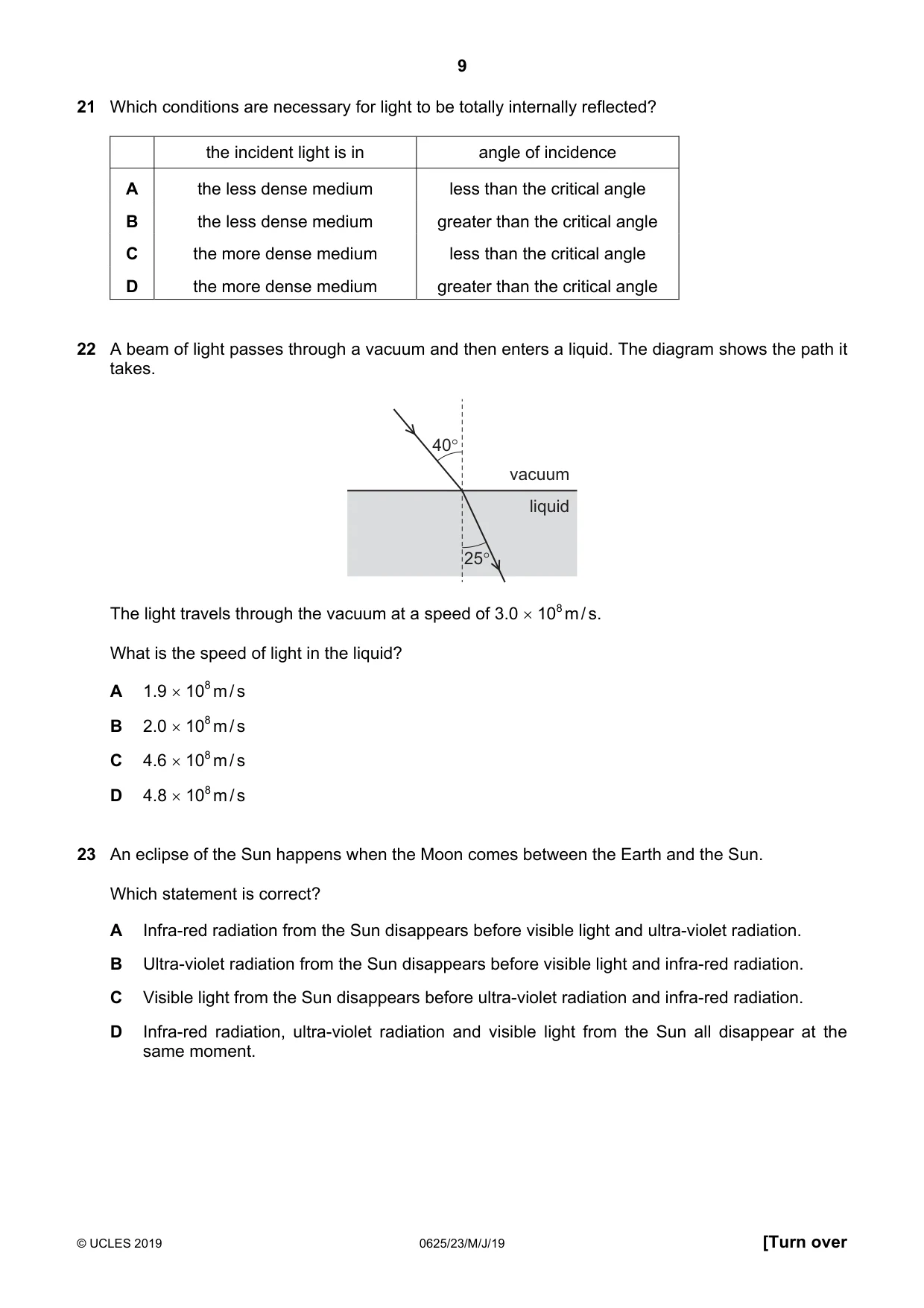
Q21 · Which conditions are necessary for light to be totally internally reflected?
21 Which conditions are necessary for light to be totally internally reflected? the incident light is in angle of incidence A the less dense medium less than the critical angle B the less dense medium greater than the critical angle C the more dense medium less than the critical angle D the more dense medium greater than the critical angle
Mark scheme: D
Q22 · A beam of light passes through a vacuum and then enters a liquid
22 A beam of light passes through a vacuum and then enters a liquid. The diagram shows the path it takes. 40° vacuum liquid 25° The light travels through the vacuum at a speed of 3.0 × 10⁸ m / s. What is the speed of light in the liquid? A 1.9 × 10⁸ m / s B 2.0 × 10⁸ m / s C 4.6 × 10⁸ m / s D 4.8 × 10⁸ m / s
Mark scheme: B
Q23 · An eclipse of the Sun happens when the Moon comes between the Earth and the Sun
23 An eclipse of the Sun happens when the Moon comes between the Earth and the Sun. Which statement is correct? A Infra-red radiation from the Sun disappears before visible light and ultra-violet radiation. B Ultra-violet radiation from the Sun disappears before visible light and infra-red radiation. C Visible light from the Sun disappears before ultra-violet radiation and infra-red radiation. D Infra-red radiation, ultra-violet radiation and visible light from the Sun all disappear at the same moment.
Mark scheme: D
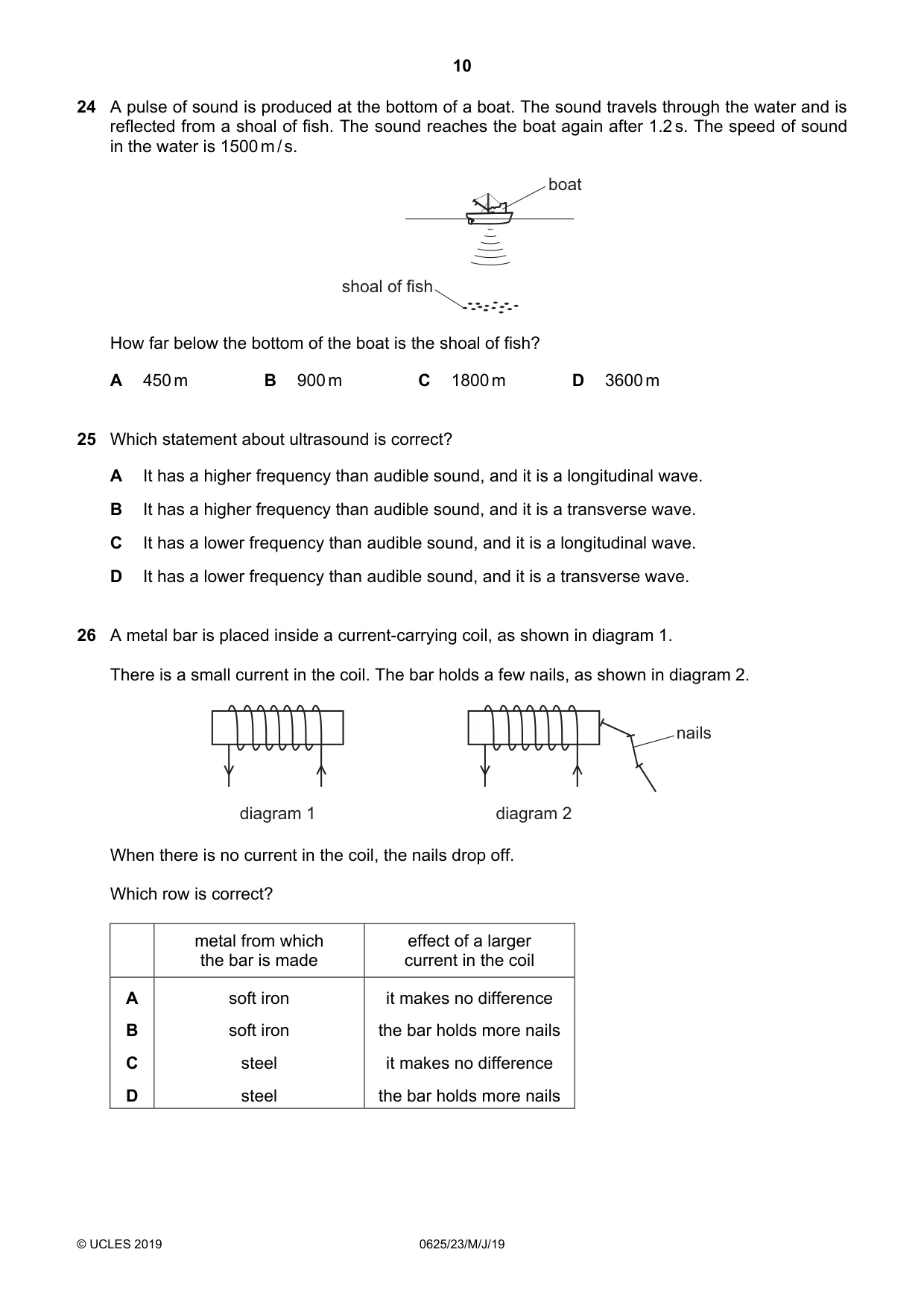
Q24 · A pulse of sound is produced at the bottom of a boat
24 A pulse of sound is produced at the bottom of a boat. The sound travels through the water and is reflected from a shoal of fish. The sound reaches the boat again after 1.2 s. The speed of sound in the water is 1500 m / s. boat shoal of fish How far below the bottom of the boat is the shoal of fish? A 450 m B 900 m C 1800 m D 3600 m
Mark scheme: B
Q25 · Which statement about ultrasound is correct?
25 Which statement about ultrasound is correct? A It has a higher frequency than audible sound, and it is a longitudinal wave. B It has a higher frequency than audible sound, and it is a transverse wave. C It has a lower frequency than audible sound, and it is a longitudinal wave. D It has a lower frequency than audible sound, and it is a transverse wave.
Mark scheme: A
Q26 · A metal bar is placed inside a current-carrying coil, as shown in diagram 1
26 A metal bar is placed inside a current-carrying coil, as shown in diagram 1. There is a small current in the coil. The bar holds a few nails, as shown in diagram 2. nails diagram 1 diagram 2 When there is no current in the coil, the nails drop off. Which row is correct? metal from which effect of a larger the bar is made current in the coil A soft iron it makes no difference B soft iron the bar holds more nails C steel it makes no difference D steel the bar holds more nails
Mark scheme: B
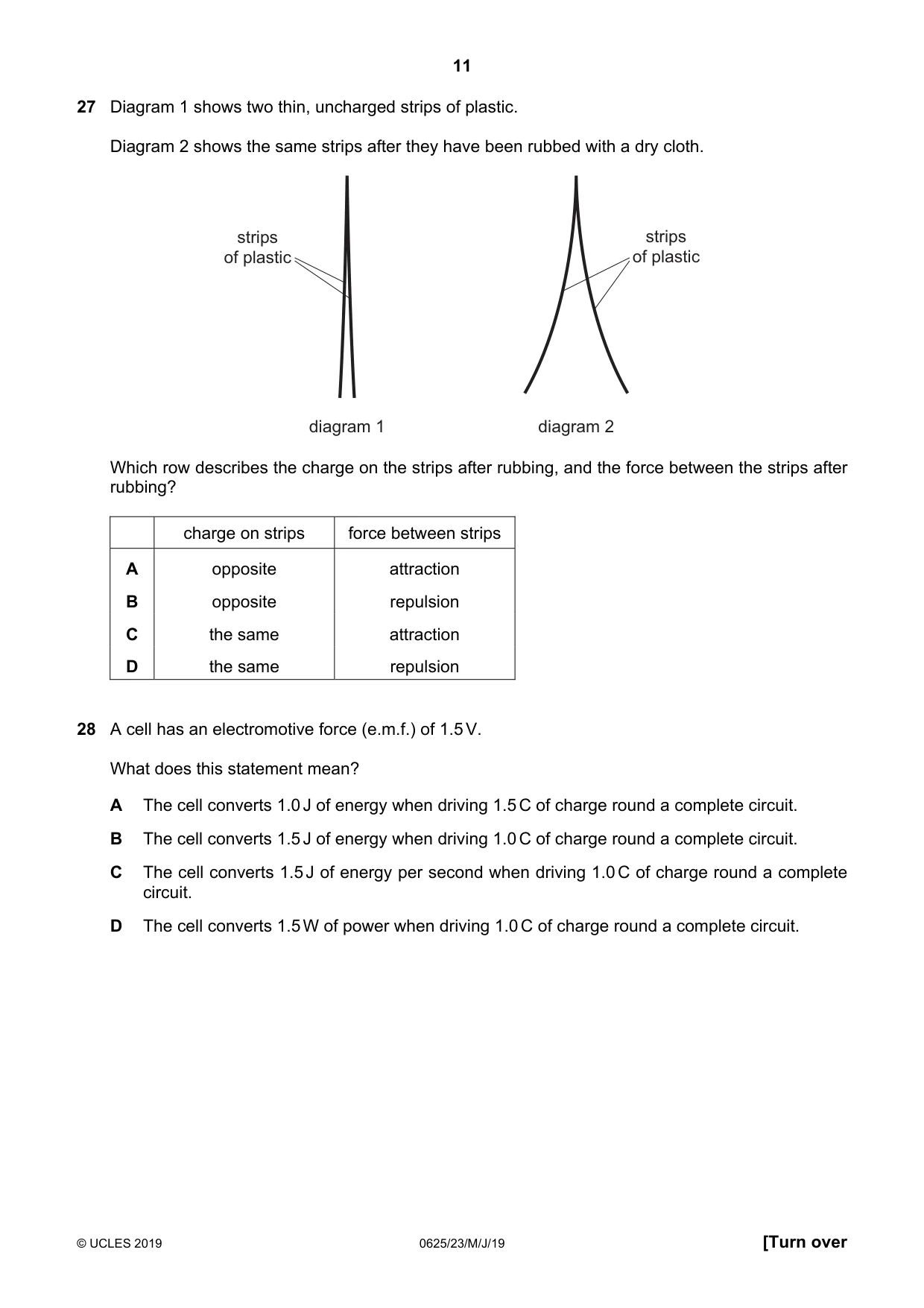
Q27 · Two thin, uncharged strips of plastic
27 Diagram 1 shows two thin, uncharged strips of plastic. Diagram 2 shows the same strips after they have been rubbed with a dry cloth. strips strips of plastic of plastic diagram 1 diagram 2 Which row describes the charge on the strips after rubbing, and the force between the strips after rubbing? charge on strips force between strips A opposite attraction B opposite repulsion C the same attraction D the same repulsion
Mark scheme: D
Q28 · A cell has an electromotive force (e.m.f.) of 1.5 V
28 A cell has an electromotive force (e.m.f.) of 1.5 V. What does this statement mean? A The cell converts 1.0 J of energy when driving 1.5 C of charge round a complete circuit. B The cell converts 1.5 J of energy when driving 1.0 C of charge round a complete circuit. C The cell converts 1.5 J of energy per second when driving 1.0 C of charge round a complete circuit. D The cell converts 1.5 W of power when driving 1.0 C of charge round a complete circuit.
Mark scheme: B
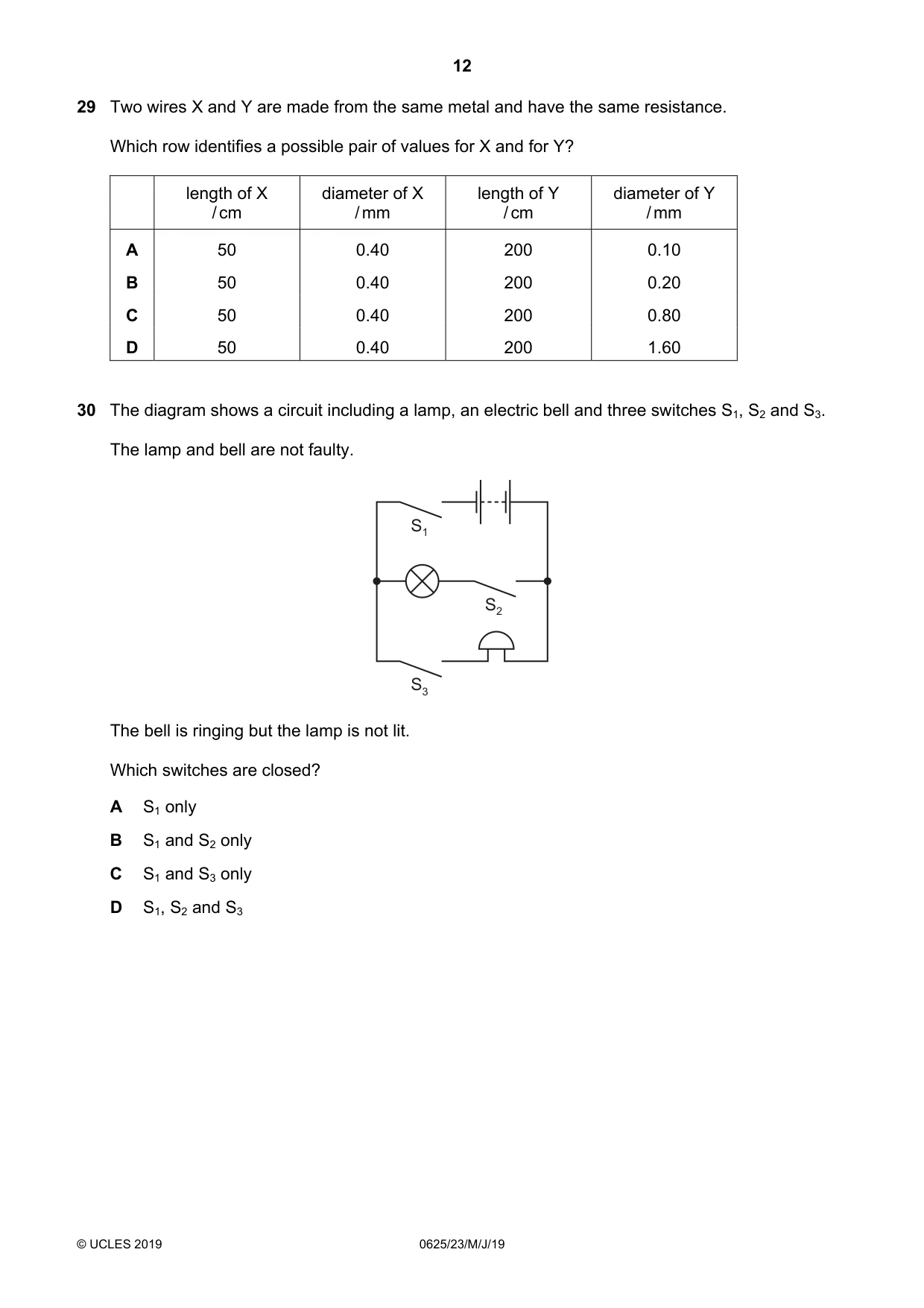
Q29 · Two wires X and Y are made from the same metal and have the same resistance
29 Two wires X and Y are made from the same metal and have the same resistance. Which row identifies a possible pair of values for X and for Y? length of X diameter of X length of Y diameter of Y / cm / mm / cm / mm A 50 0.40 200 0.10 B 50 0.40 200 0.20 C 50 0.40 200 0.80 D 50 0.40 200 1.60
Mark scheme: C
Q30 · The diagram shows a circuit including a lamp, an electric bell and three switches S1, S2…
30 The diagram shows a circuit including a lamp, an electric bell and three switches S1, S2 and S3. The lamp and bell are not faulty. S1 S2 S3 The bell is ringing but the lamp is not lit. Which switches are closed? A S1 only B S1 and S2 only C S1 and S3 only D S1, S2 and S3
Mark scheme: C
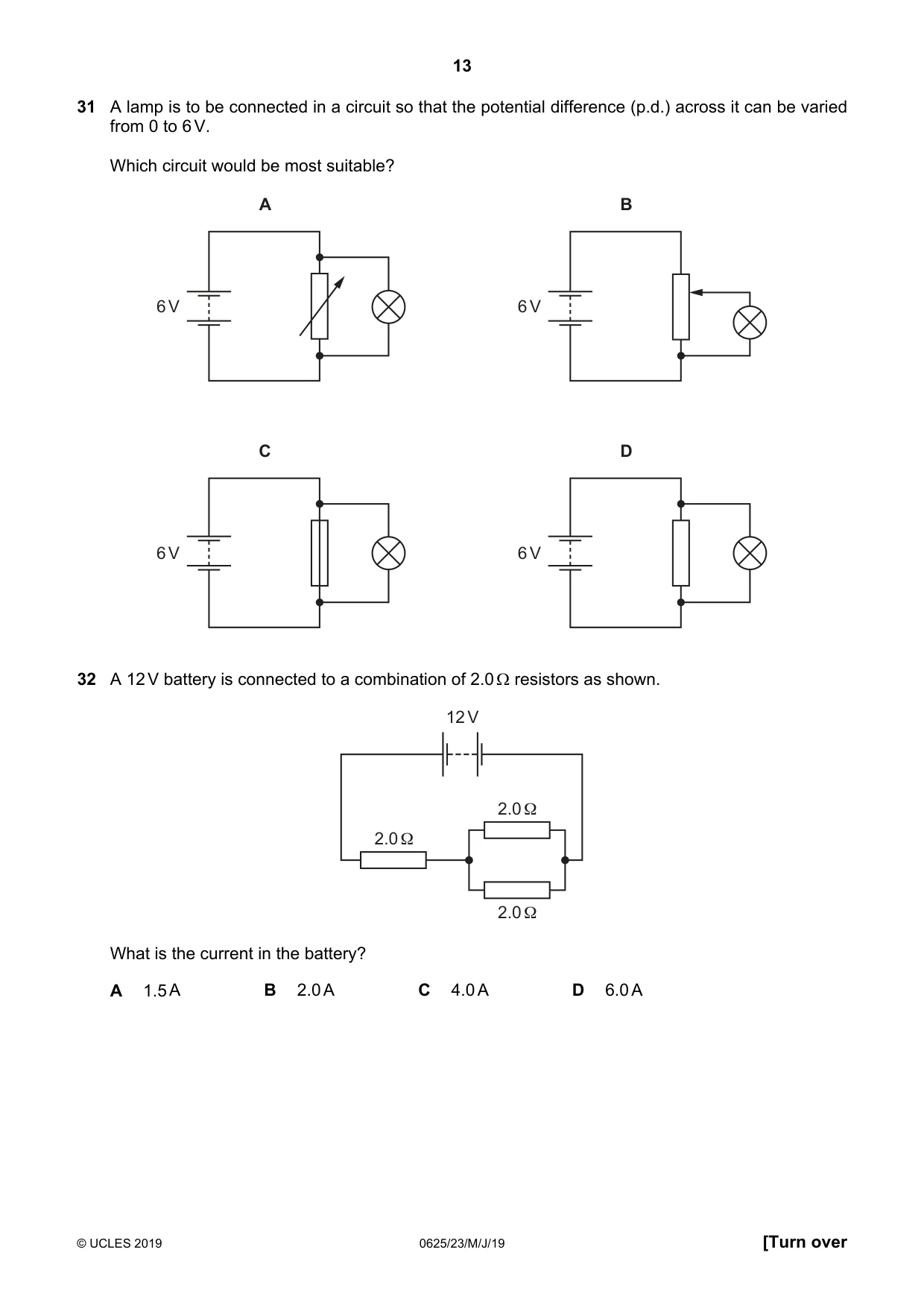
Q31 · A lamp is to be connected in a circuit so that the potential difference (p.d.) across it…
31 A lamp is to be connected in a circuit so that the potential difference (p.d.) across it can be varied from 0 to 6 V. Which circuit would be most suitable? A B 6 V 6 V C D 6 V 6 V
Mark scheme: B
Q32 · A 12 V battery is connected to a combination of 2.0 Ω resistors as shown
32 A 12 V battery is connected to a combination of 2.0 Ω resistors as shown. 12 V 2.0 Ω 2.0 Ω 2.0 Ω What is the current in the battery? A 1.5 A B 2.0 A C 4.0 A D 6.0 A
Mark scheme: C
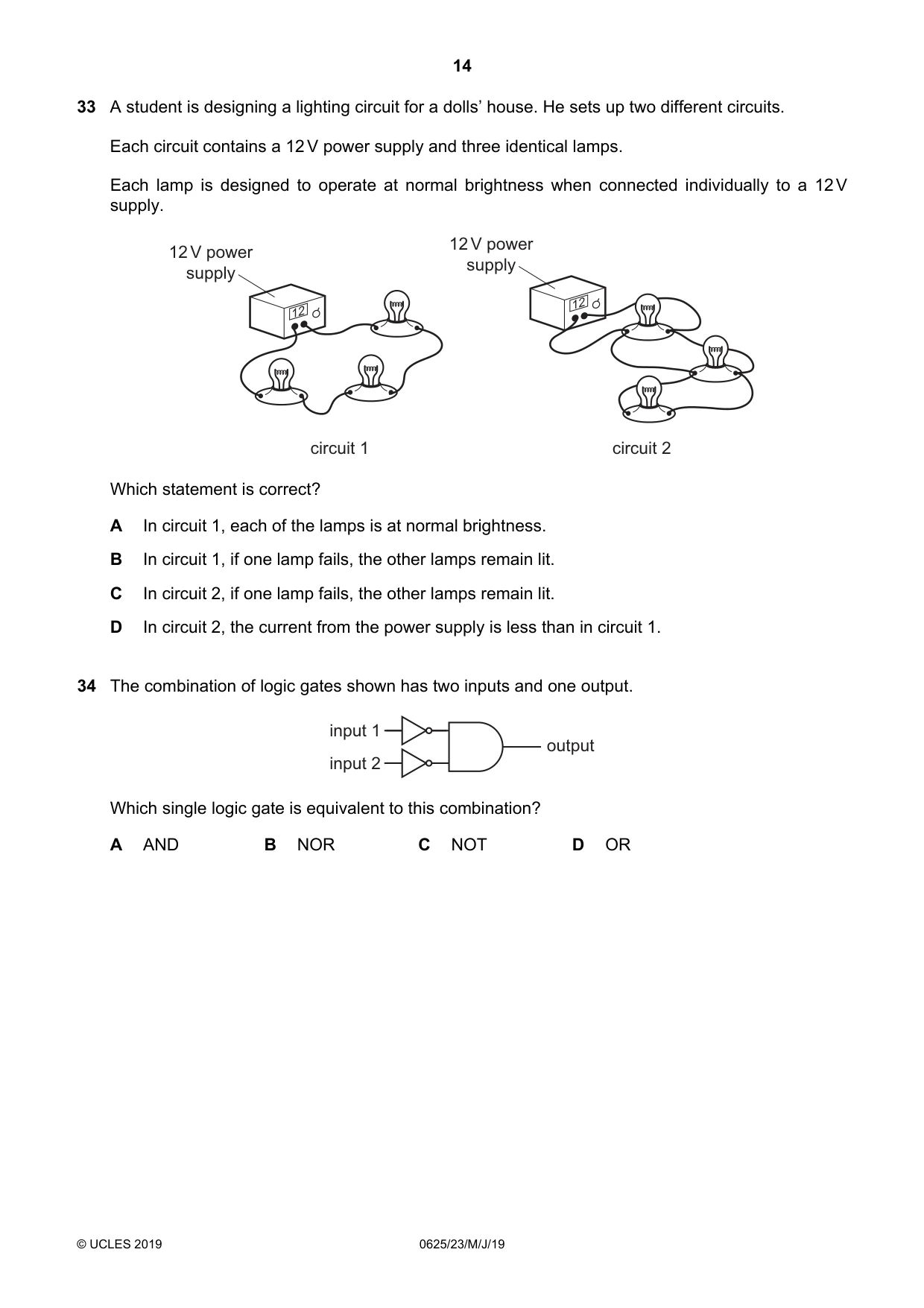
Q33 · A student is designing a lighting circuit for a dolls’ house
33 A student is designing a lighting circuit for a dolls’ house. He sets up two different circuits. Each circuit contains a 12 V power supply and three identical lamps. Each lamp is designed to operate at normal brightness when connected individually to a 12 V supply. 12 V power 12 V power supply supply 12 12 circuit 1 circuit 2 Which statement is correct? A In circuit 1, each of the lamps is at normal brightness. B In circuit 1, if one lamp fails, the other lamps remain lit. C In circuit 2, if one lamp fails, the other lamps remain lit. D In circuit 2, the current from the power supply is less than in circuit 1.
Mark scheme: C
Q34 · The combination of logic gates shown has two inputs and one output
34 The combination of logic gates shown has two inputs and one output. input 1 output input 2 Which single logic gate is equivalent to this combination? A AND B NOR C NOT D OR
Mark scheme: B
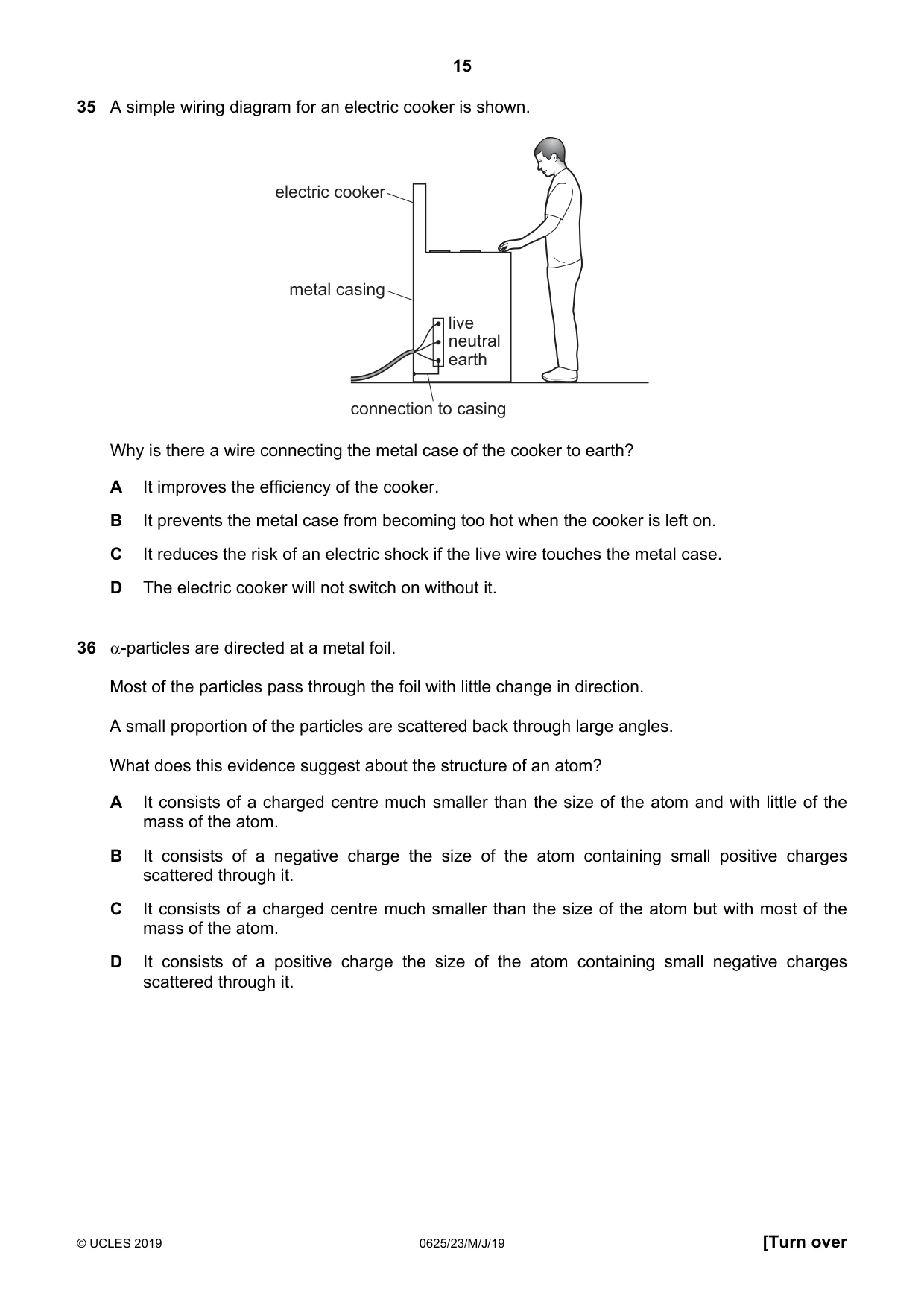
Q35 · A simple wiring diagram for an electric cooker is shown
35 A simple wiring diagram for an electric cooker is shown. electric cooker metal casing live neutral earth connection to casing Why is there a wire connecting the metal case of the cooker to earth? A It improves the efficiency of the cooker. B It prevents the metal case from becoming too hot when the cooker is left on. C It reduces the risk of an electric shock if the live wire touches the metal case. D The electric cooker will not switch on without it.
Mark scheme: C
Q36 · Α-particles are directed at a metal foil
36 α-particles are directed at a metal foil. Most of the particles pass through the foil with little change in direction. A small proportion of the particles are scattered back through large angles. What does this evidence suggest about the structure of an atom? A It consists of a charged centre much smaller than the size of the atom and with little of the mass of the atom. B It consists of a negative charge the size of the atom containing small positive charges scattered through it. C It consists of a charged centre much smaller than the size of the atom but with most of the mass of the atom. D It consists of a positive charge the size of the atom containing small negative charges scattered through it.
Mark scheme: C
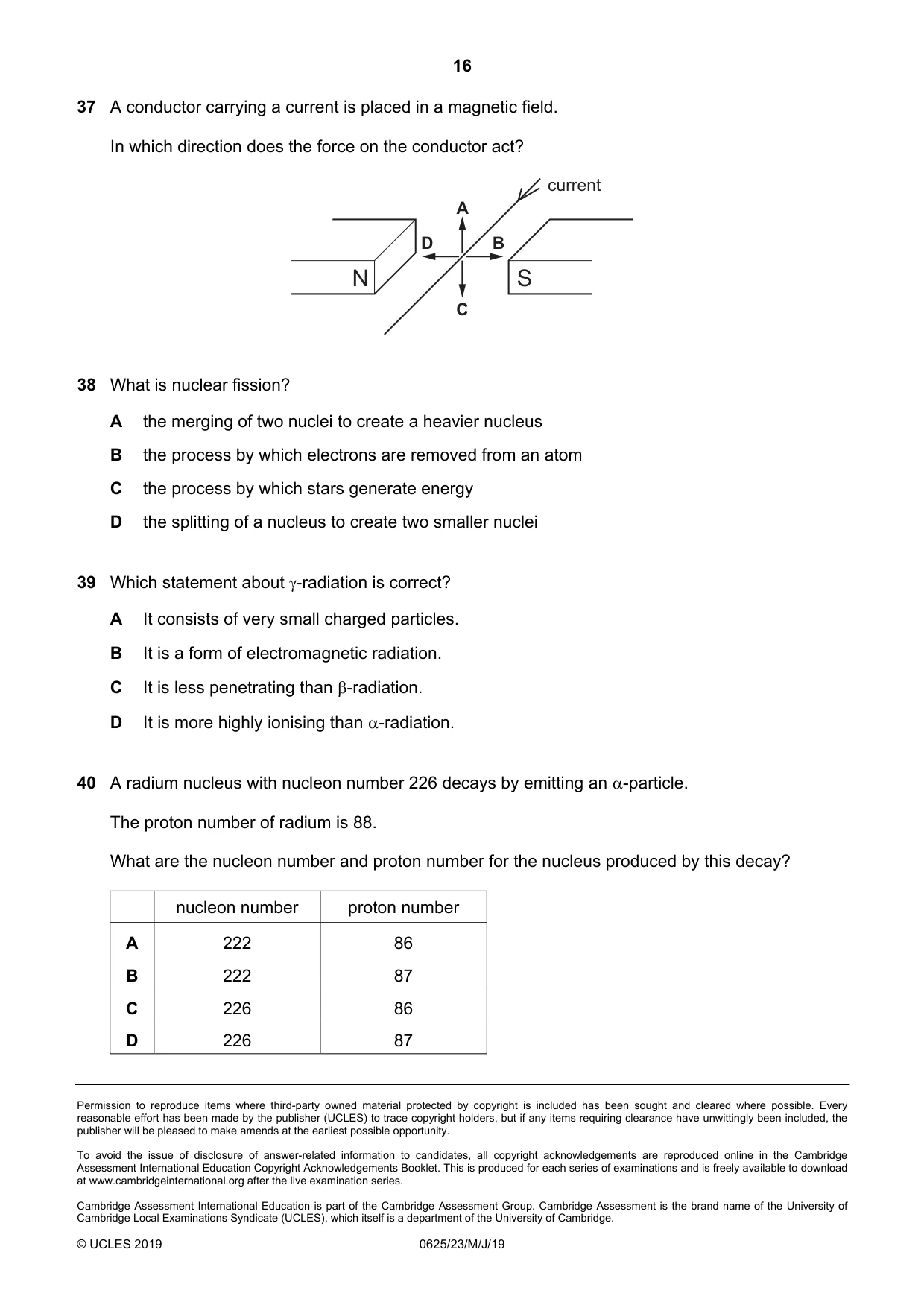
Q37 · A conductor carrying a current is placed in a magnetic field
37 A conductor carrying a current is placed in a magnetic field. In which direction does the force on the conductor act? current A D B N S C
Mark scheme: A
Q38 · What is nuclear fission?
38 What is nuclear fission? A the merging of two nuclei to create a heavier nucleus B the process by which electrons are removed from an atom C the process by which stars generate energy D the splitting of a nucleus to create two smaller nuclei
Mark scheme: D
Q39 · Which statement about γ-radiation is correct?
39 Which statement about γ-radiation is correct? A It consists of very small charged particles. B It is a form of electromagnetic radiation. C It is less penetrating than β-radiation. D It is more highly ionising than α-radiation.
Mark scheme: B
Q40 · A radium nucleus with nucleon number 226 decays by emitting an α-particle
40 A radium nucleus with nucleon number 226 decays by emitting an α-particle. The proton number of radium is 88. What are the nucleon number and proton number for the nucleus produced by this decay? nucleon number proton number A 222 86 B 222 87 C 226 86 D 226 87
Mark scheme: A
What was in this paper
The subtopics covered by these 40 questions, and how many questions each got. Open one in a new tab to see every Cambridge question on it.
5Energy, work and power3Forces3Sound3Electrical quantities2Light2Mass and weight2Radioactivity2Simple phenomena of magnetism2The nuclear model of the atom2Thermal properties and temperature2Transfer of thermal energy2Density1Electrical safety1Electromagnetic effects1Electromagnetic spectrum1General properties of waves1Kinetic particle model of matter1Momentum1Motion1Physical quantities and measurement techniques1Pressure1What you needed in this session
Cambridge’s own grade thresholds for 2019 May/June, Paper 2 · Variant 3. A higher threshold means an easier paper — the bar moves with how the cohort did.