Cambridge IGCSE Physics 0625 — 2017 Feb/March Paper 2 · Variant 2
0625/22/F/M/17 · 40 questions · 40 marks · ≈45 min
The question paper and its mark scheme, free to read here and free to download. This is Cambridge’s own paper, exactly as it was sat.
Question paper16 pages
Mark scheme3 pages
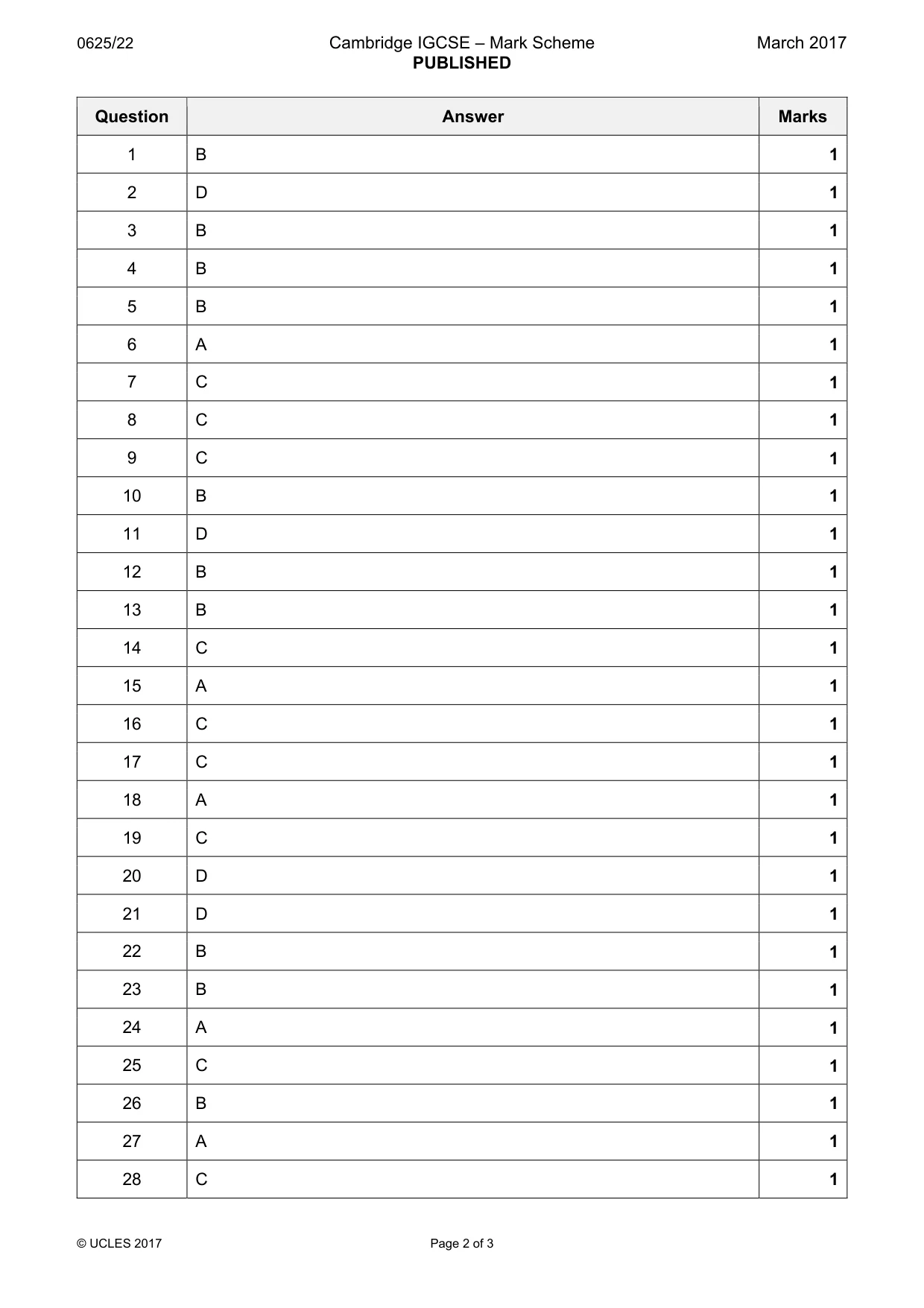
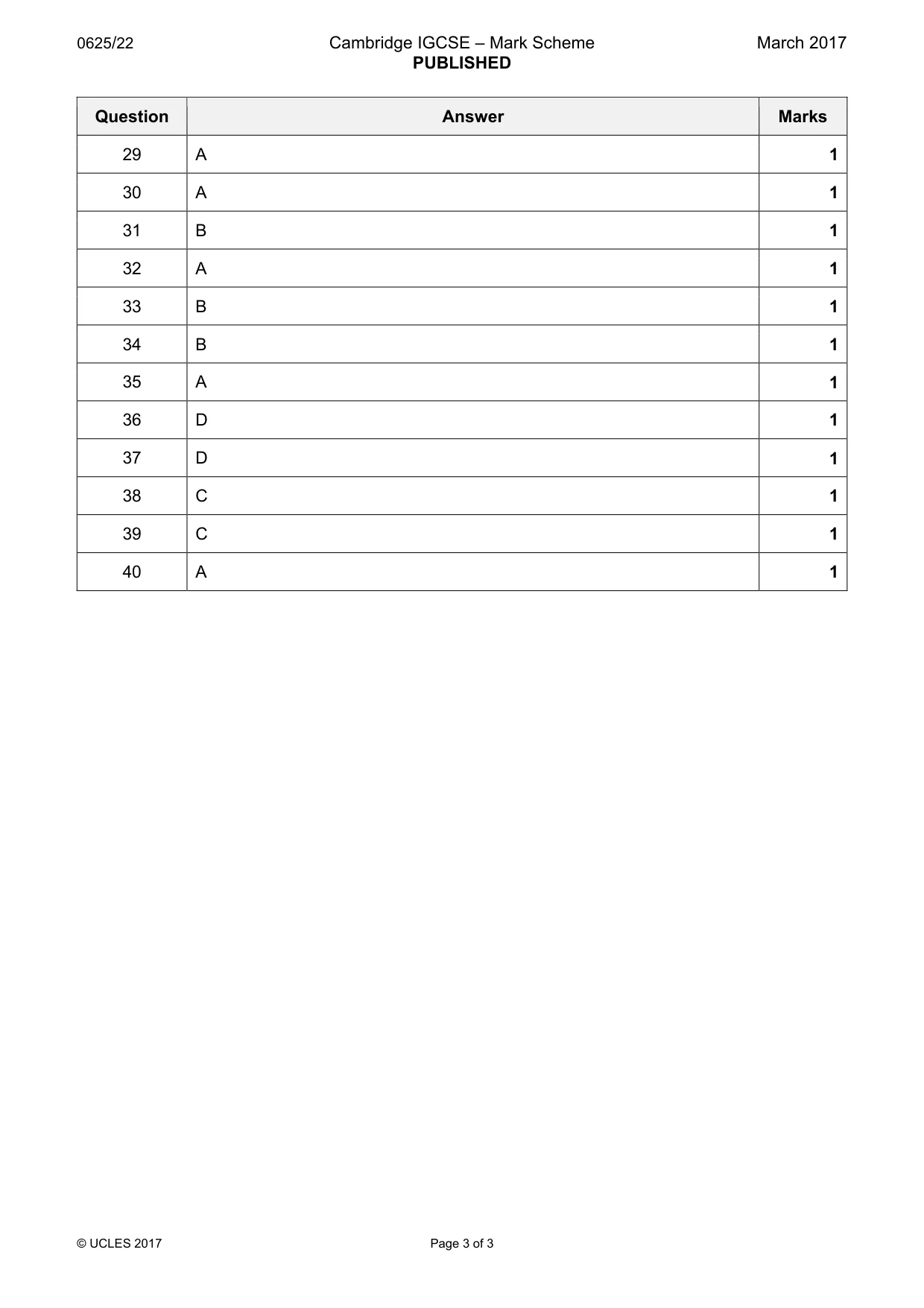
Answers below. Sit the paper first if you are practising.
Questions as text
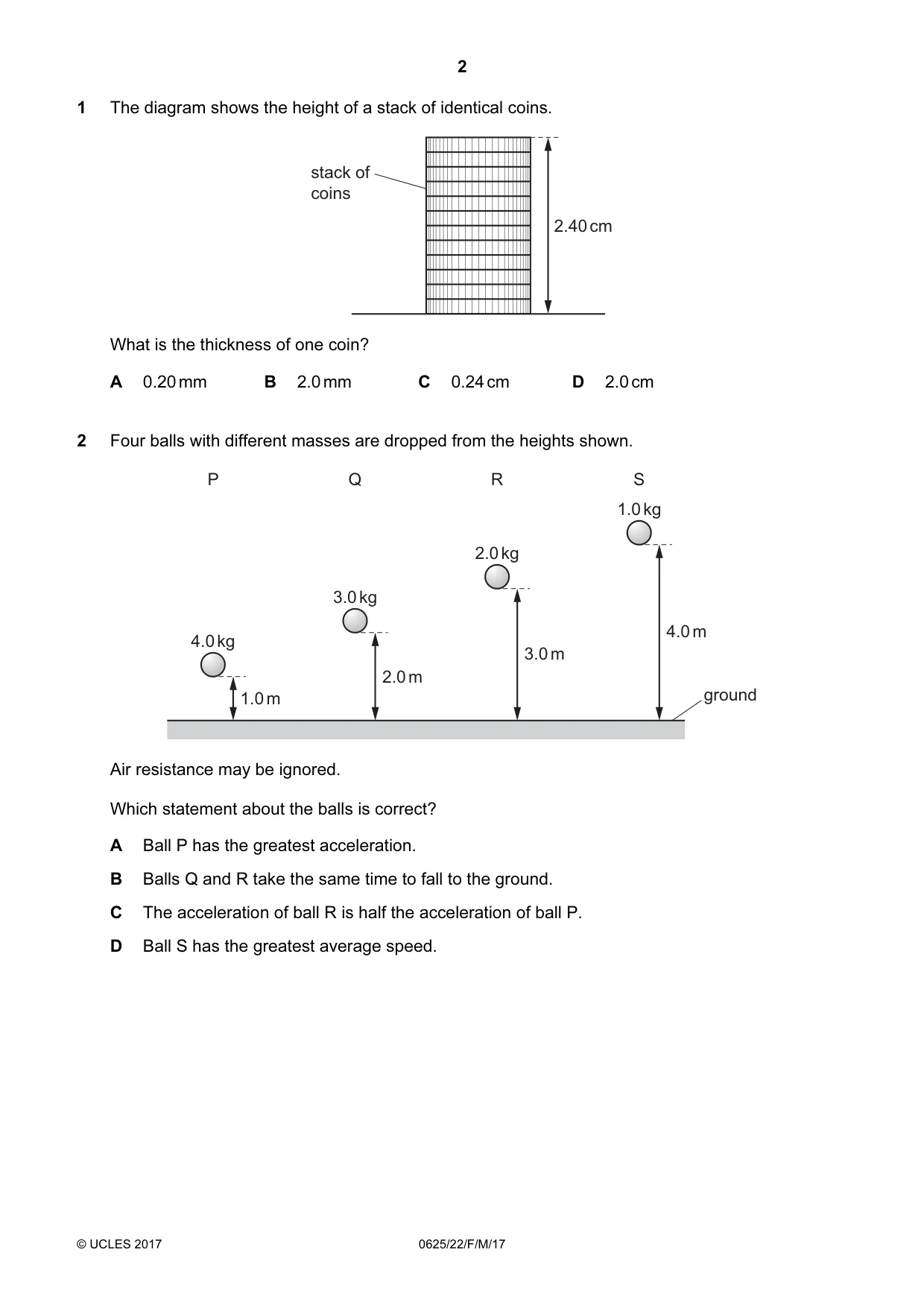
Q1 · The diagram shows the height of a stack of identical coins
1 The diagram shows the height of a stack of identical coins. stack of coins 2.40 cm What is the thickness of one coin? A 0.20 mm B 2.0 mm C 0.24 cm D 2.0 cm
Mark scheme: B
More questions on Physical quantities and measurement techniques
Q2 · Four balls with different masses are dropped from the heights shown
2 Four balls with different masses are dropped from the heights shown. P Q R S 1.0 kg 2.0 kg 3.0 kg 4.0 m 4.0 kg 3.0 m 2.0 m 1.0 m ground Air resistance may be ignored. Which statement about the balls is correct? A Ball P has the greatest acceleration. B Balls Q and R take the same time to fall to the ground. C The acceleration of ball R is half the acceleration of ball P. D Ball S has the greatest average speed.
Mark scheme: D
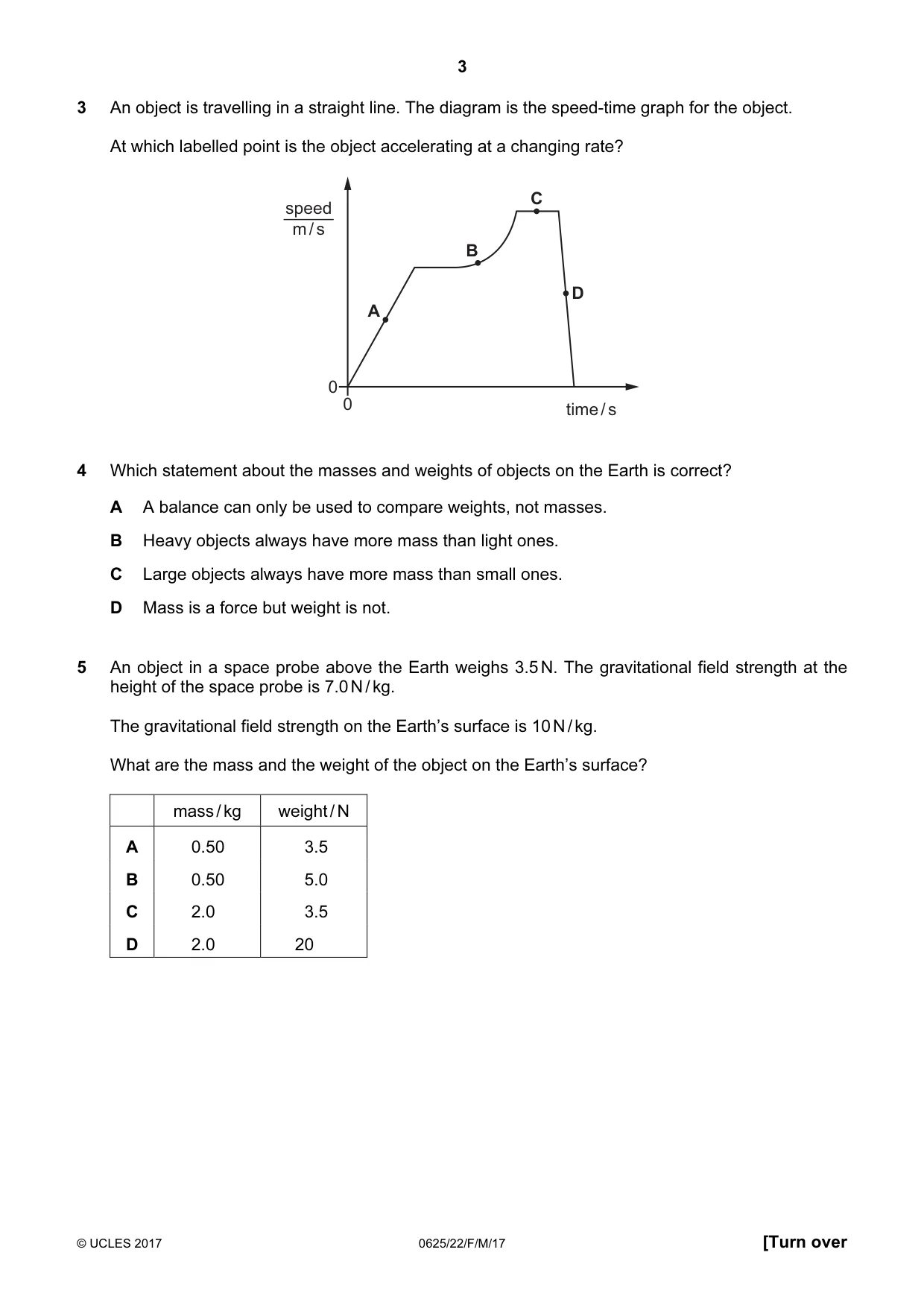
Q3 · An object is travelling in a straight line
3 An object is travelling in a straight line. The diagram is the speed-time graph for the object. At which labelled point is the object accelerating at a changing rate? C speed m / s B D A 0 0 time / s
Mark scheme: B
Q4 · Which statement about the masses and weights of objects on the Earth is correct?
4 Which statement about the masses and weights of objects on the Earth is correct? A A balance can only be used to compare weights, not masses. B Heavy objects always have more mass than light ones. C Large objects always have more mass than small ones. D Mass is a force but weight is not.
Mark scheme: B
Q5 · An object in a space probe above the Earth weighs 3.5 N
5 An object in a space probe above the Earth weighs 3.5 N. The gravitational field strength at the height of the space probe is 7.0 N / kg. The gravitational field strength on the Earth’s surface is 10 N / kg. What are the mass and the weight of the object on the Earth’s surface? mass / kg weight / N A 0.50 3.5 B 0.50 5.0 C 2.0 3.5 D 2.0 20
Mark scheme: B
Q6 · A skydiver jumps from a stationary helicopter and reaches a steady vertical speed
6 A skydiver jumps from a stationary helicopter and reaches a steady vertical speed. She then opens her parachute. Which statement about the falling skydiver is correct? A As her parachute opens, her acceleration is upwards. B As she falls at a steady speed with her parachute open, her weight is zero. C When she accelerates, the resultant force on her is zero. D When she falls at a steady speed, air resistance is zero.
Mark scheme: A
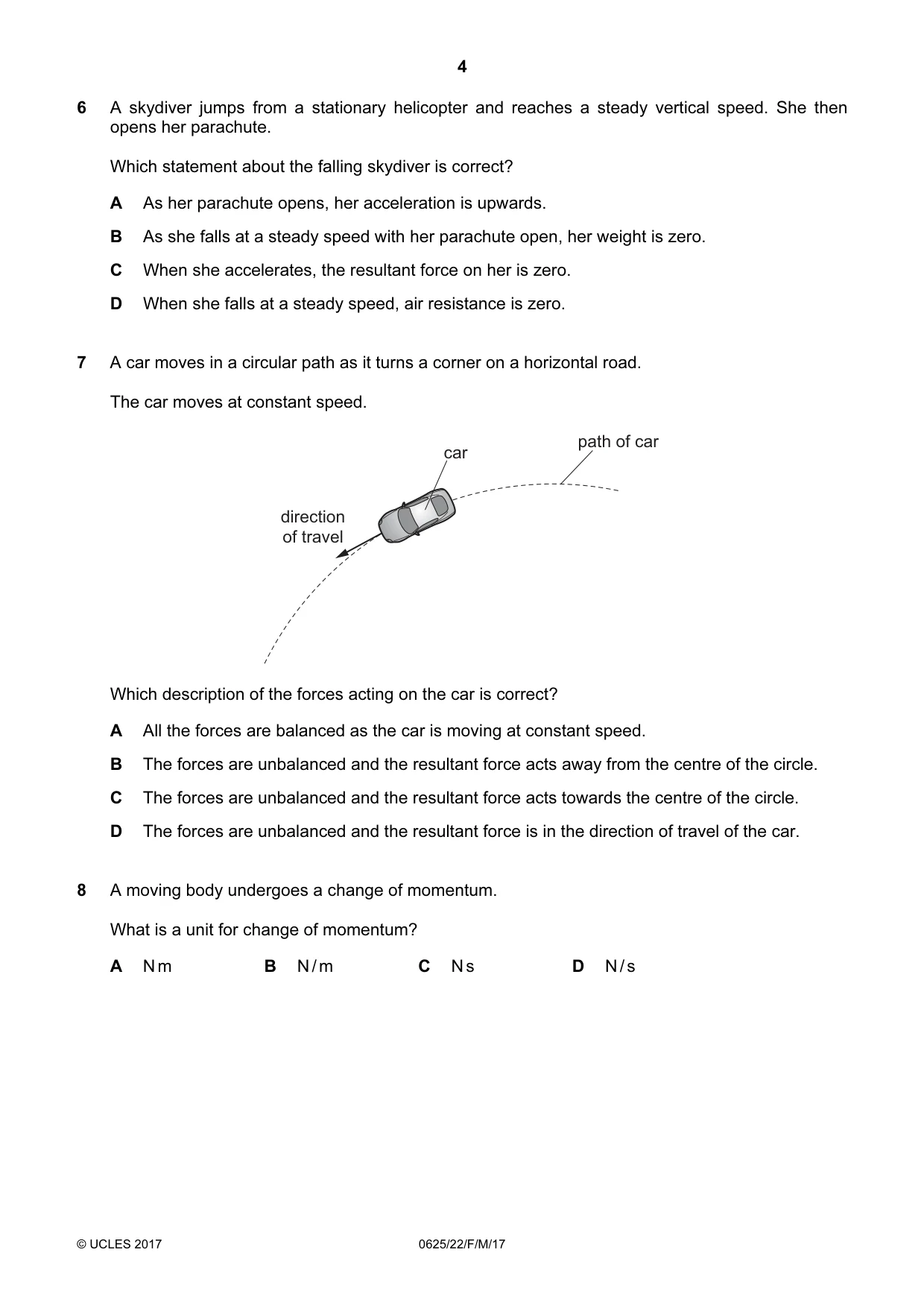
Q7 · A car moves in a circular path as it turns a corner on a horizontal road
7 A car moves in a circular path as it turns a corner on a horizontal road. The car moves at constant speed. path of car car direction of travel Which description of the forces acting on the car is correct? A All the forces are balanced as the car is moving at constant speed. B The forces are unbalanced and the resultant force acts away from the centre of the circle. C The forces are unbalanced and the resultant force acts towards the centre of the circle. D The forces are unbalanced and the resultant force is in the direction of travel of the car.
Mark scheme: C
Q8 · A moving body undergoes a change of momentum
8 A moving body undergoes a change of momentum. What is a unit for change of momentum? A N m B N / m C N s D N / s
Mark scheme: C
Q9 · A man can either take an escalator or a lift to travel up between two floors in a hotel
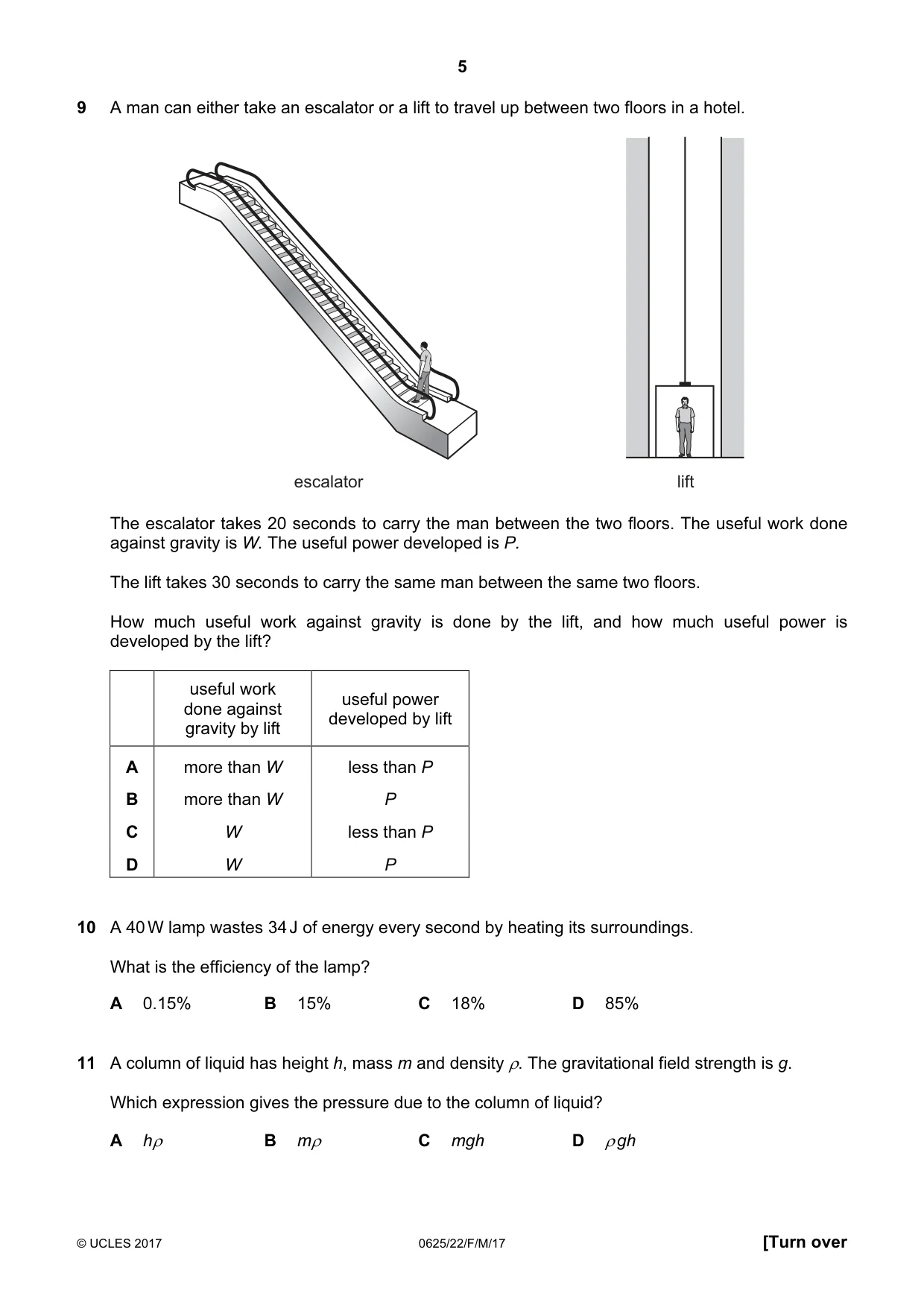
9 A man can either take an escalator or a lift to travel up between two floors in a hotel. escalator lift The escalator takes 20 seconds to carry the man between the two floors. The useful work done against gravity is W. The useful power developed is P. The lift takes 30 seconds to carry the same man between the same two floors. How much useful work against gravity is done by the lift, and how much useful power is developed by the lift? useful work useful power done against developed by lift gravity by lift A more than W less than P B more than W P C W less than P D W P
Mark scheme: C
Q10 · A 40 W lamp wastes 34 J of energy every second by heating its surroundings
10 A 40 W lamp wastes 34 J of energy every second by heating its surroundings. What is the efficiency of the lamp? A 0.15% B 15% C 18% D 85%
Mark scheme: B
Q11 · A column of liquid has height h, mass m and density ρ
11 A column of liquid has height h, mass m and density ρ. The gravitational field strength is g. Which expression gives the pressure due to the column of liquid? A hρ B mρ C mgh D ρ gh
Mark scheme: D
Q12 · The diagrams show two mercury barometers
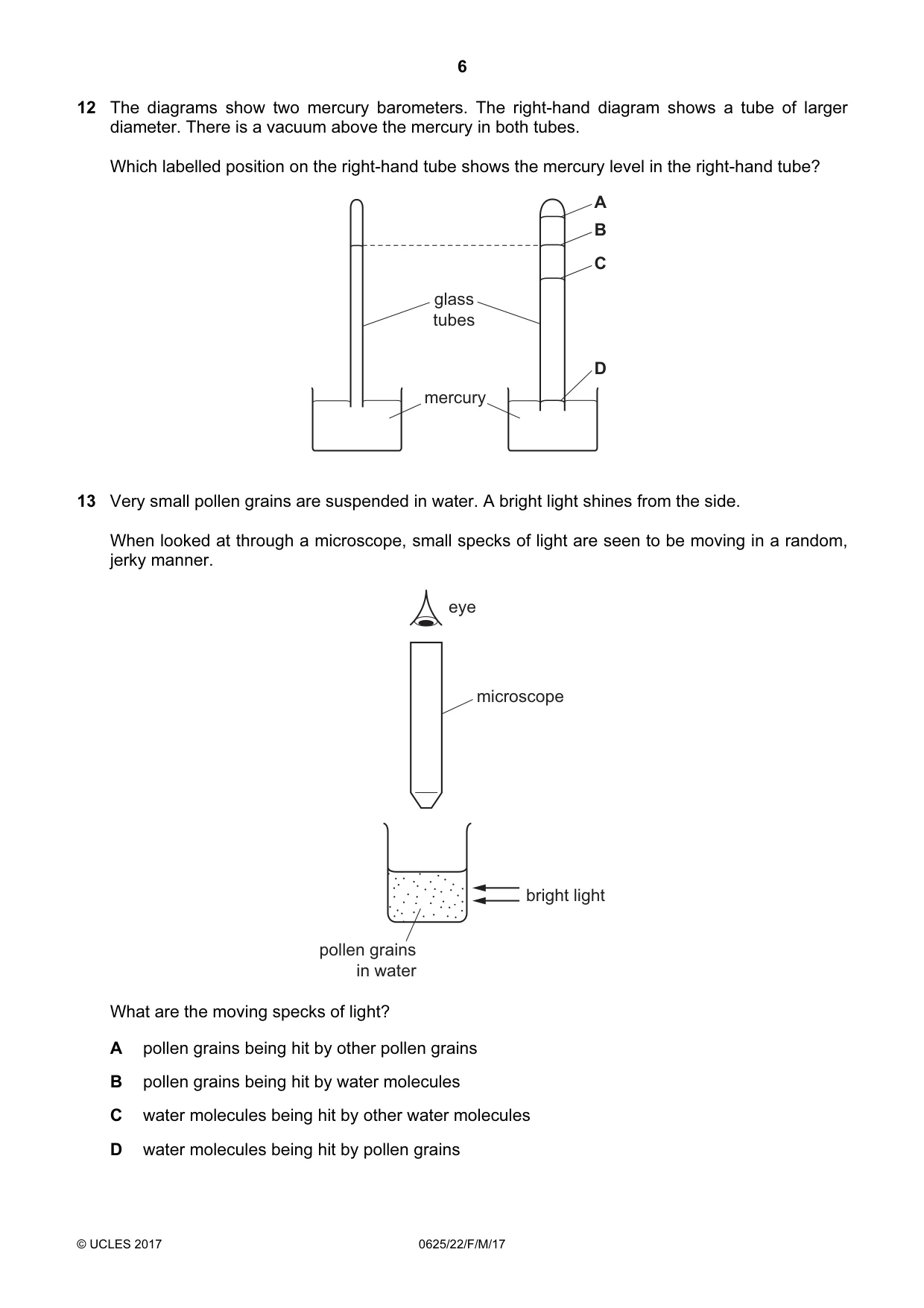
12 The diagrams show two mercury barometers. The right-hand diagram shows a tube of larger diameter. There is a vacuum above the mercury in both tubes. Which labelled position on the right-hand tube shows the mercury level in the right-hand tube? A B C glass tubes D mercury
Mark scheme: B
Q13 · Very small pollen grains are suspended in water
13 Very small pollen grains are suspended in water. A bright light shines from the side. When looked at through a microscope, small specks of light are seen to be moving in a random, jerky manner. eye microscope bright light pollen grains in water What are the moving specks of light? A pollen grains being hit by other pollen grains B pollen grains being hit by water molecules C water molecules being hit by other water molecules D water molecules being hit by pollen grains
Mark scheme: B
Q14 · At –39 °C, liquid mercury solidifies without a change of temperature
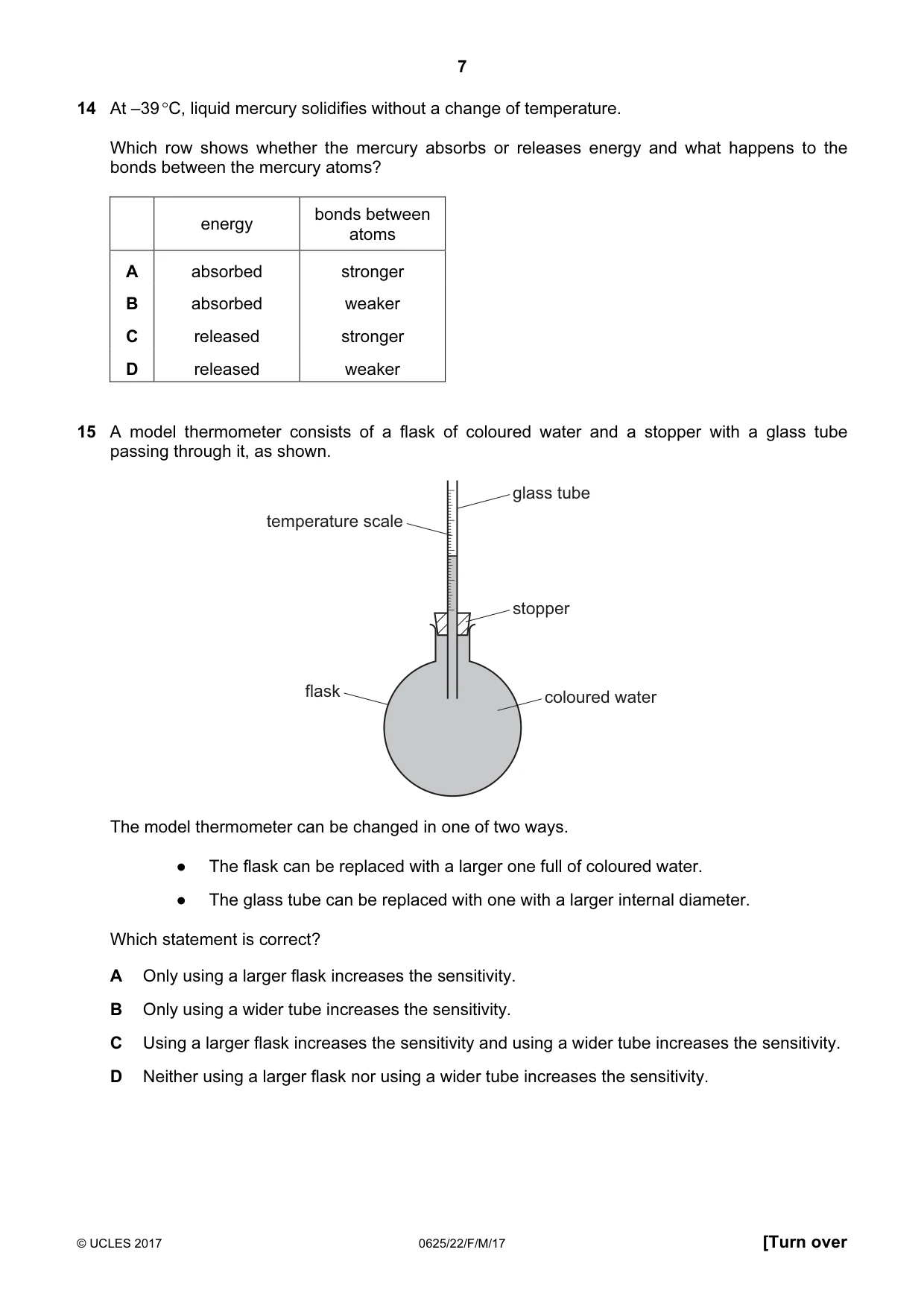
14 At –39 °C, liquid mercury solidifies without a change of temperature. Which row shows whether the mercury absorbs or releases energy and what happens to the bonds between the mercury atoms? bonds between energy atoms A absorbed stronger B absorbed weaker C released stronger D released weaker
Mark scheme: C
Q15 · A model thermometer consists of a flask of coloured water and a stopper with a glass tube…
15 A model thermometer consists of a flask of coloured water and a stopper with a glass tube passing through it, as shown. glass tube temperature scale stopper flask coloured water The model thermometer can be changed in one of two ways. ● The flask can be replaced with a larger one full of coloured water. ● The glass tube can be replaced with one with a larger internal diameter. Which statement is correct? A Only using a larger flask increases the sensitivity. B Only using a wider tube increases the sensitivity. C Using a larger flask increases the sensitivity and using a wider tube increases the sensitivity. D Neither using a larger flask nor using a wider tube increases the sensitivity.
Mark scheme: A
Q16 · A metal has a specific heat capacity of 360 J / (kg °C)
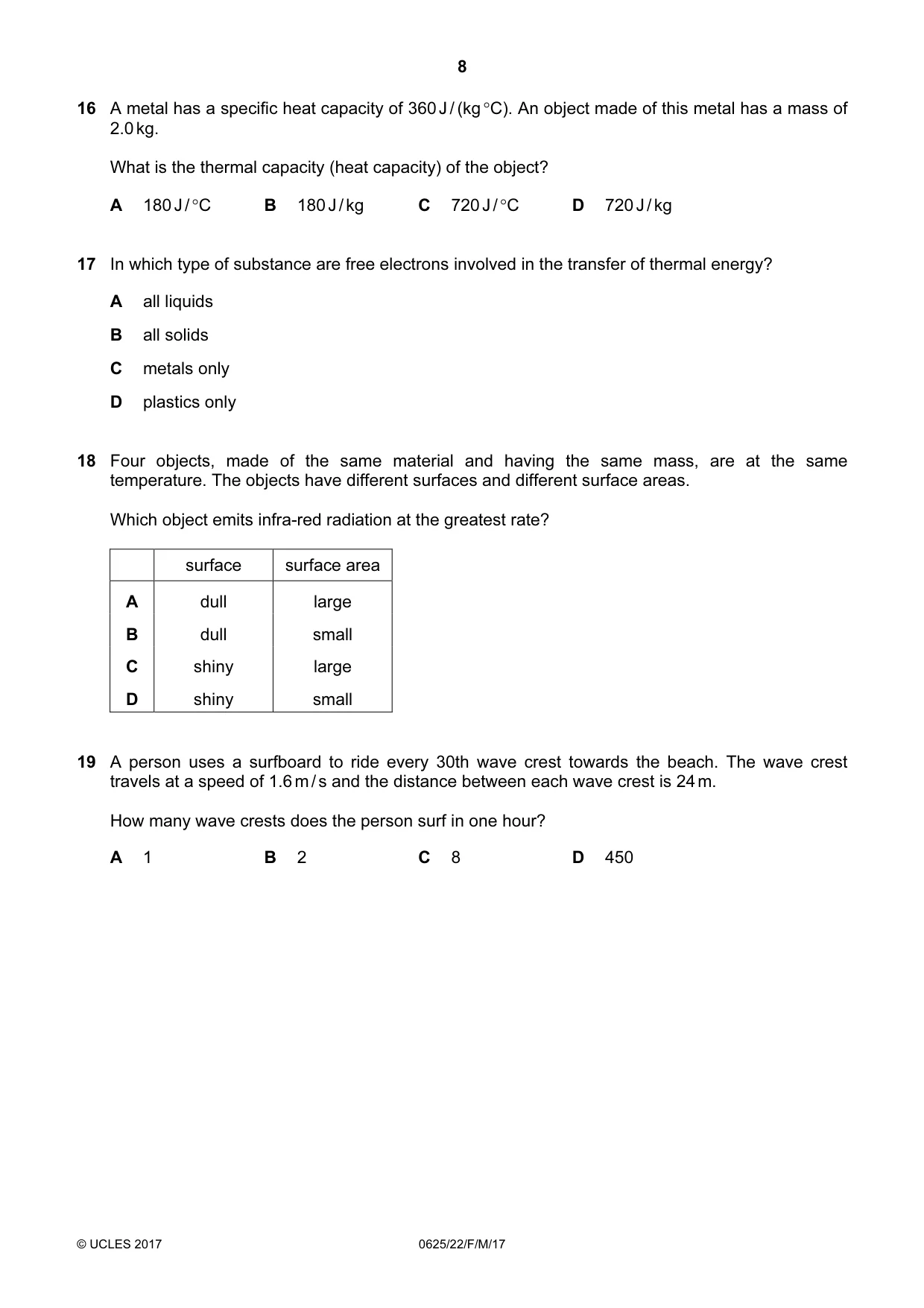
16 A metal has a specific heat capacity of 360 J / (kg °C). An object made of this metal has a mass of 2.0 kg. What is the thermal capacity (heat capacity) of the object? A 180 J / °C B 180 J / kg C 720 J / °C D 720 J / kg
Mark scheme: C
Q17 · In which type of substance are free electrons involved in the transfer of thermal energy?
17 In which type of substance are free electrons involved in the transfer of thermal energy? A all liquids B all solids C metals only D plastics only
Mark scheme: C
Q18 · Four objects, made of the same material and having the same mass, are at the same…
18 Four objects, made of the same material and having the same mass, are at the same temperature. The objects have different surfaces and different surface areas. Which object emits infra-red radiation at the greatest rate? surface surface area A dull large B dull small C shiny large D shiny small
Mark scheme: A
Q19 · A person uses a surfboard to ride every 30th wave crest towards the beach
19 A person uses a surfboard to ride every 30th wave crest towards the beach. The wave crest travels at a speed of 1.6 m / s and the distance between each wave crest is 24 m. How many wave crests does the person surf in one hour? A 1 B 2 C 8 D 450
Mark scheme: C
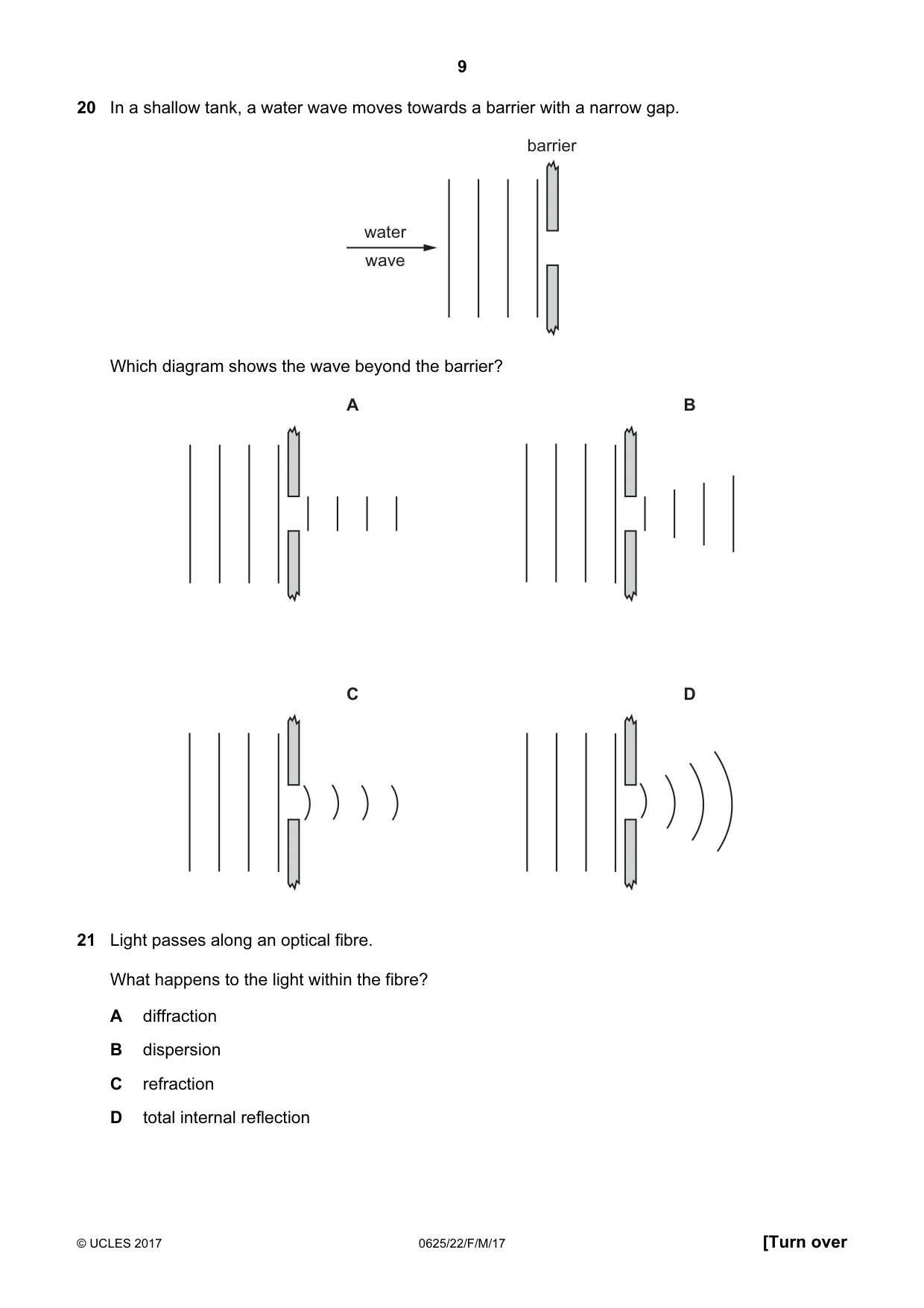
Q20 · In a shallow tank, a water wave moves towards a barrier with a narrow gap
20 In a shallow tank, a water wave moves towards a barrier with a narrow gap. barrier water wave Which diagram shows the wave beyond the barrier? A B C D
Mark scheme: D
Q21 · Light passes along an optical fibre
21 Light passes along an optical fibre. What happens to the light within the fibre? A diffraction B dispersion C refraction D total internal reflection
Mark scheme: D
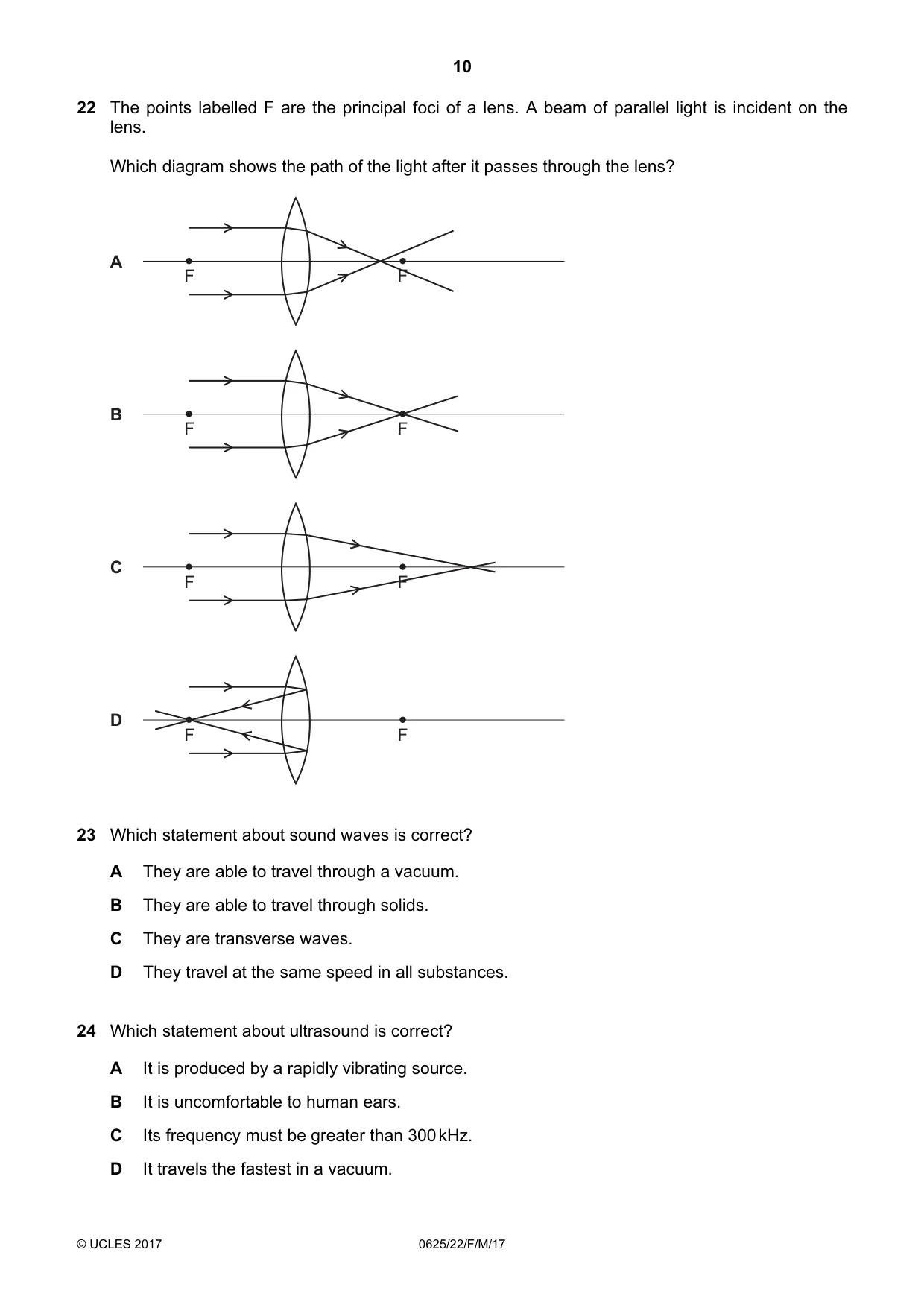
Q22 · The points labelled F are the principal foci of a lens
22 The points labelled F are the principal foci of a lens. A beam of parallel light is incident on the lens. Which diagram shows the path of the light after it passes through the lens? A F F B F F C F F D F F
Mark scheme: B
Q23 · Which statement about sound waves is correct?
23 Which statement about sound waves is correct? A They are able to travel through a vacuum. B They are able to travel through solids. C They are transverse waves. D They travel at the same speed in all substances.
Mark scheme: B
Q24 · Which statement about ultrasound is correct?
24 Which statement about ultrasound is correct? A It is produced by a rapidly vibrating source. B It is uncomfortable to human ears. C Its frequency must be greater than 300 kHz. D It travels the fastest in a vacuum.
Mark scheme: A
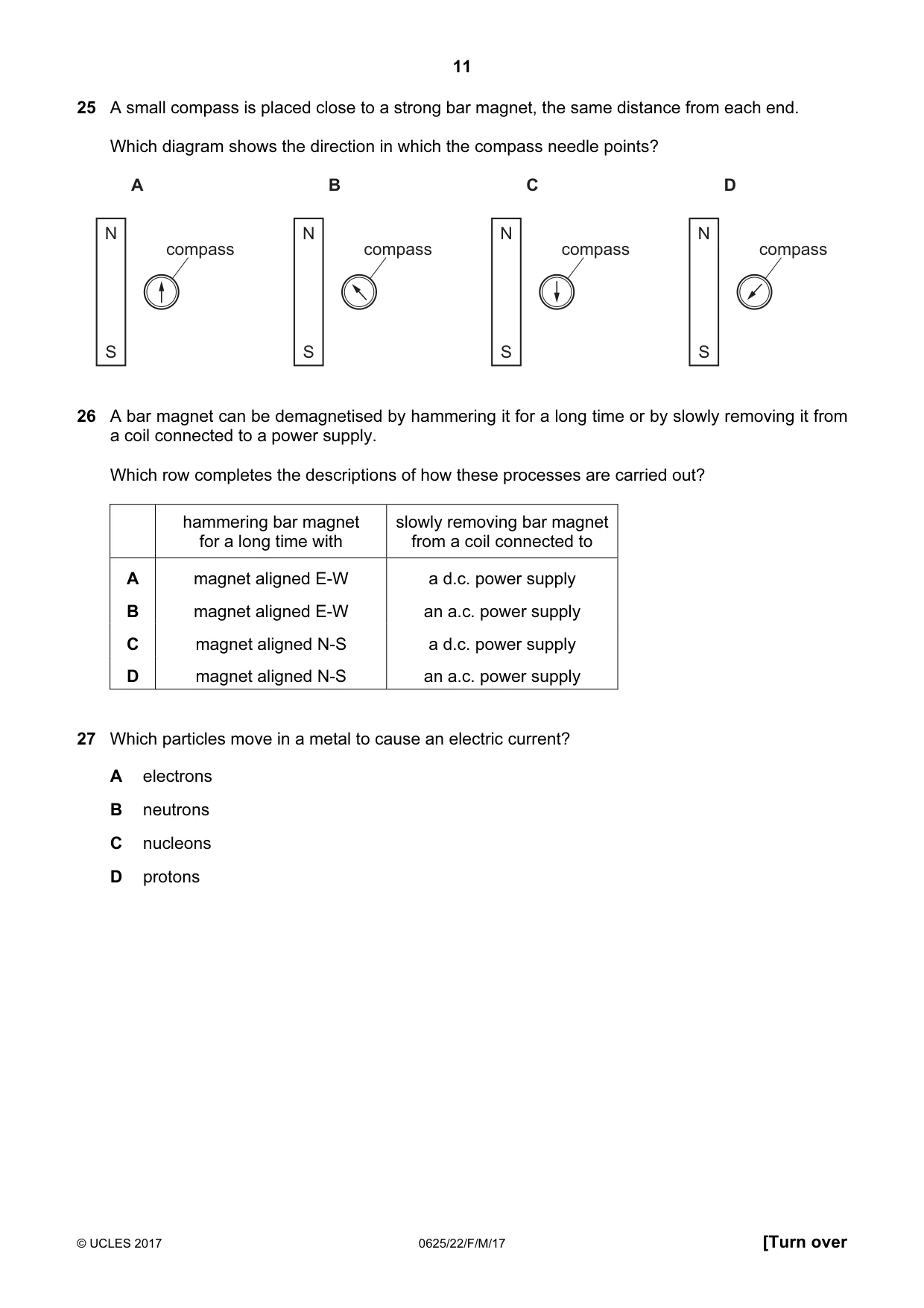
Q25 · A small compass is placed close to a strong bar magnet, the same distance from each end
25 A small compass is placed close to a strong bar magnet, the same distance from each end. Which diagram shows the direction in which the compass needle points? A B C D N N N N compass compass compass compass S S S S
Mark scheme: C
Q26 · A bar magnet can be demagnetised by hammering it for a long time or by slowly removing it…
26 A bar magnet can be demagnetised by hammering it for a long time or by slowly removing it from a coil connected to a power supply. Which row completes the descriptions of how these processes are carried out? hammering bar magnet slowly removing bar magnet for a long time with from a coil connected to A magnet aligned E-W a d.c. power supply B magnet aligned E-W an a.c. power supply C magnet aligned N-S a d.c. power supply D magnet aligned N-S an a.c. power supply
Mark scheme: B
Q27 · Which particles move in a metal to cause an electric current?
27 Which particles move in a metal to cause an electric current? A electrons B neutrons C nucleons D protons
Mark scheme: A
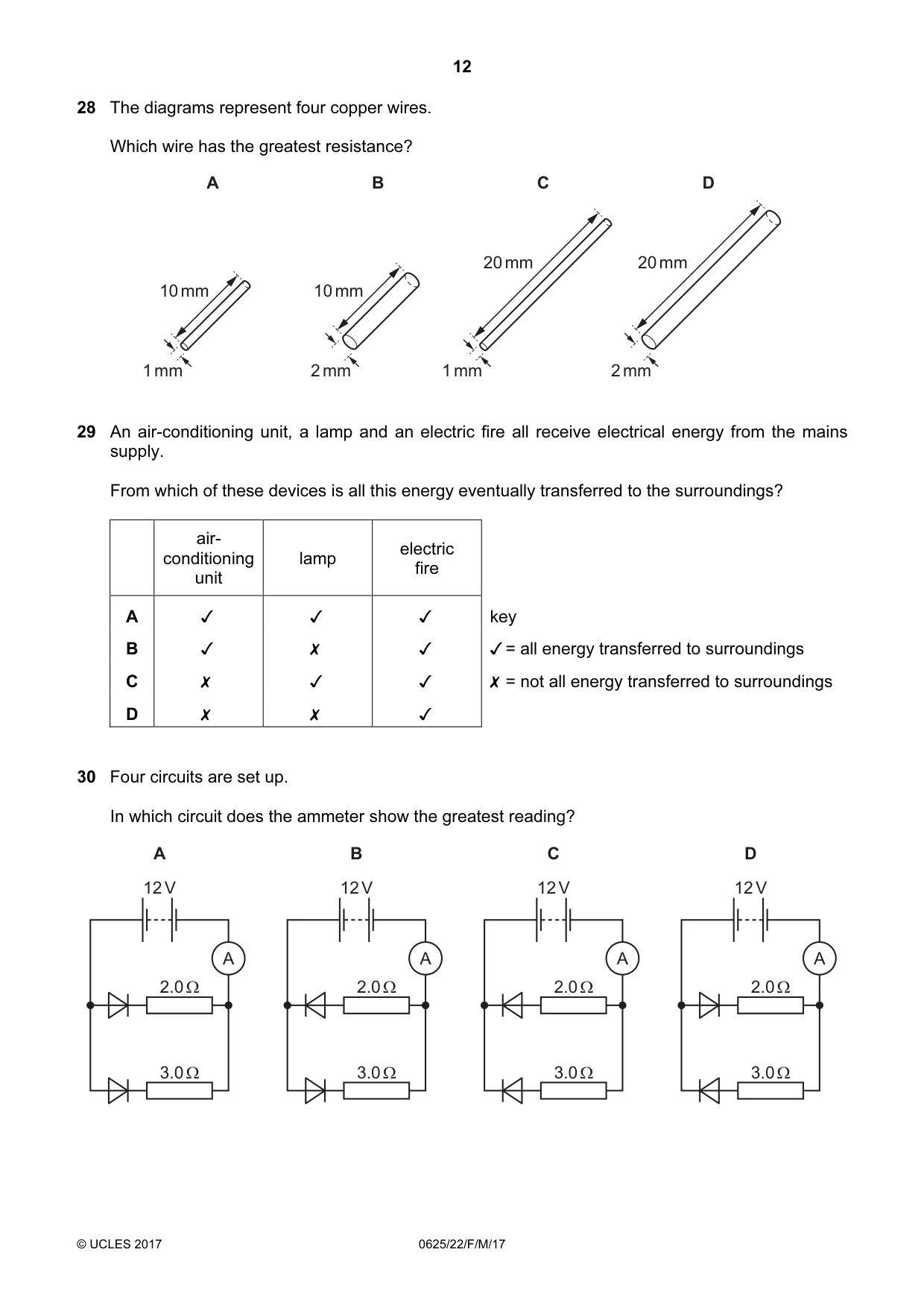
Q28 · The diagrams represent four copper wires
28 The diagrams represent four copper wires. Which wire has the greatest resistance? A B C D 20 mm 20 mm 10 mm 10 mm 1 mm 2 mm 1 mm 2 mm
Mark scheme: C
Q29 · An air-conditioning unit, a lamp and an electric fire all receive electrical energy from…
29 An air-conditioning unit, a lamp and an electric fire all receive electrical energy from the mains supply. From which of these devices is all this energy eventually transferred to the surroundings? air- va electric conditioning lamp fire unit A v v v B v x v Cc x v v D x x v key ¥ = all energy transferred to surroundings X = not all energy transferred to surroundings
Mark scheme: A
Q30 · Four circuits are set up
30 Four circuits are set up. In which circuit does the ammeter show the greatest reading? A B C D 12 V 12 V 12 V 12 V A A A A 2.0 Ω 2.0 Ω 2.0 Ω 2.0 Ω 3.0 Ω 3.0 Ω 3.0 Ω 3.0 Ω
Mark scheme: A
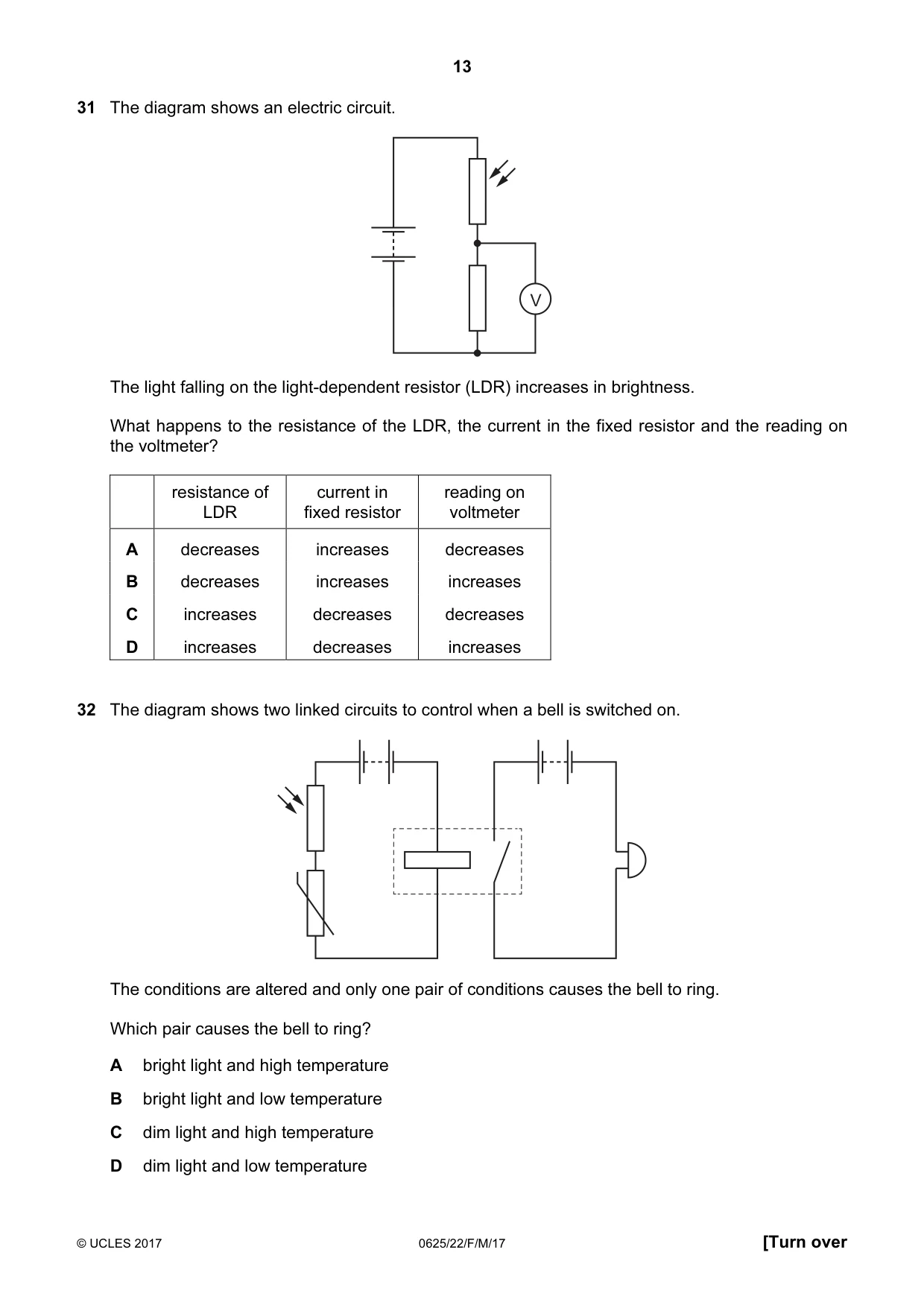
Q31 · The diagram shows an electric circuit
31 The diagram shows an electric circuit. V The light falling on the light-dependent resistor (LDR) increases in brightness. What happens to the resistance of the LDR, the current in the fixed resistor and the reading on the voltmeter? resistance of current in reading on LDR fixed resistor voltmeter A decreases increases decreases B decreases increases increases C increases decreases decreases D increases decreases increases
Mark scheme: B
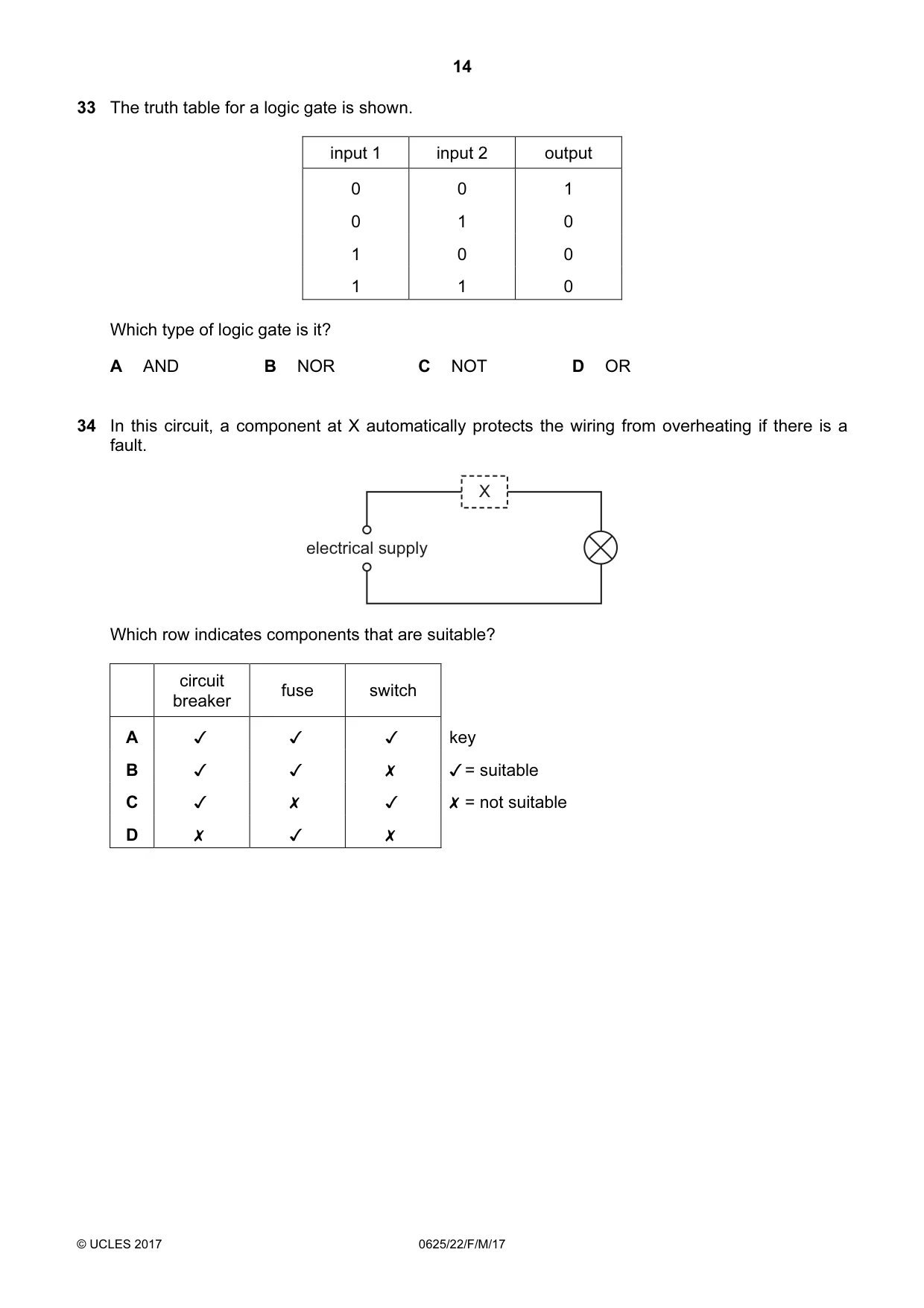
Q32 · The diagram shows two linked circuits to control when a bell is switched on
32 The diagram shows two linked circuits to control when a bell is switched on. The conditions are altered and only one pair of conditions causes the bell to ring. Which pair causes the bell to ring? A bright light and high temperature B bright light and low temperature C dim light and high temperature D dim light and low temperature
Mark scheme: A
Q33 · The truth table for a logic gate is shown
33 The truth table for a logic gate is shown. input 1 input 2 output 0 0 1 0 1 0 1 0 0 1 1 0 Which type of logic gate is it? A AND B NOR C NOT D OR
Mark scheme: B
Q34 · In this circuit, a component at X automatically protects the wiring from overheating if…
34 In this circuit, a component at X automatically protects the wiring from overheating if there is a fault. electrical supply Which row indicates components that are suitable? cron fuse switch A v Jv Jv key B v v x ¥ = suitable Cc v x v X = not suitable D x v x
Mark scheme: B
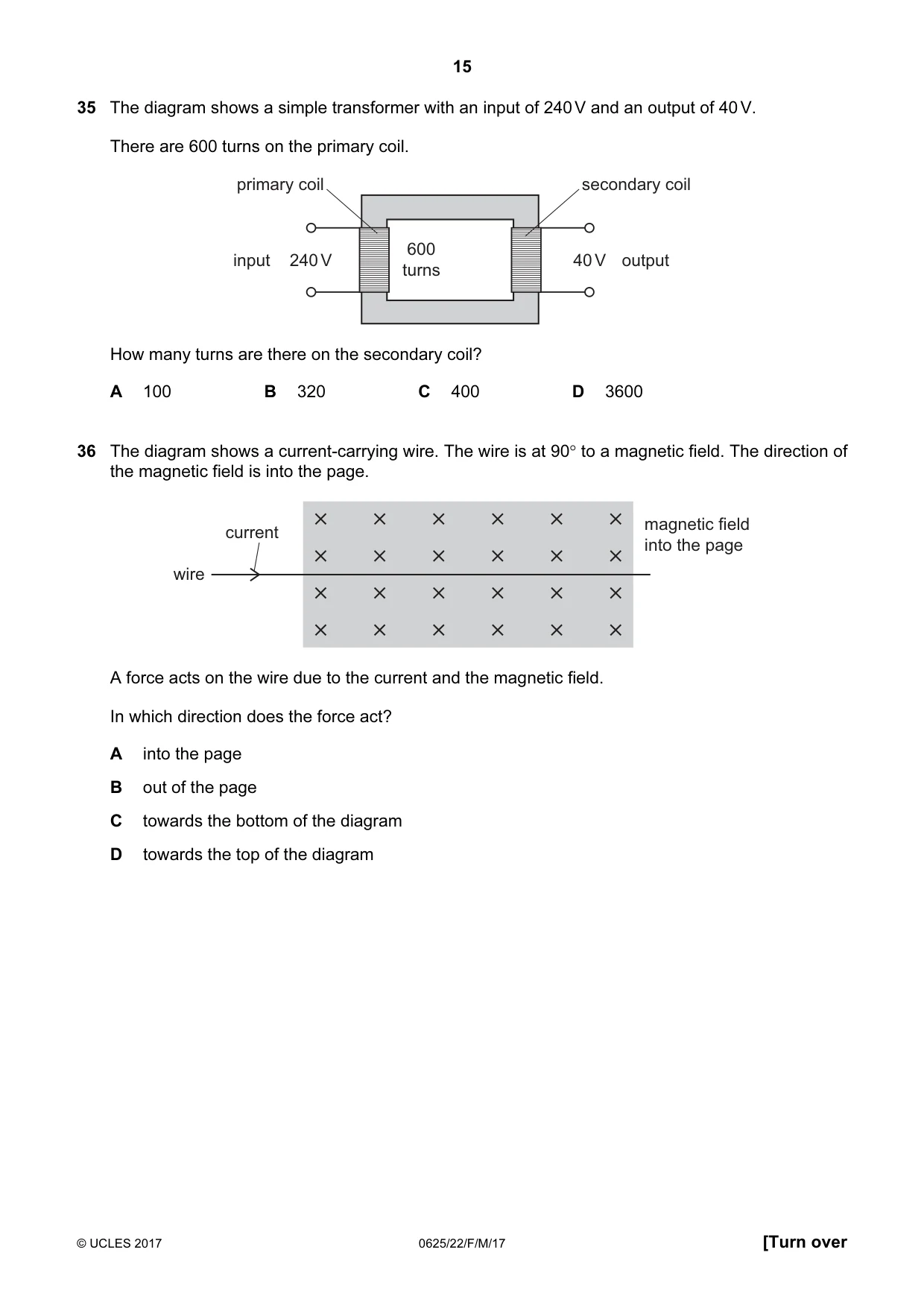
Q35 · The diagram shows a simple transformer with an input of 240 V and an output of 40 V
35 The diagram shows a simple transformer with an input of 240 V and an output of 40 V. There are 600 turns on the primary coil. primary coil secondary coil 600 input 240 V 40 V output turns How many turns are there on the secondary coil? A 100 B 320 C 400 D 3600
Mark scheme: A
Q36 · The diagram shows a current-carrying wire
36 The diagram shows a current-carrying wire. The wire is at 90° to a magnetic field. The direction of the magnetic field is into the page. magnetic field current into the page wire A force acts on the wire due to the current and the magnetic field. In which direction does the force act? A into the page B out of the page C towards the bottom of the diagram D towards the top of the diagram
Mark scheme: D
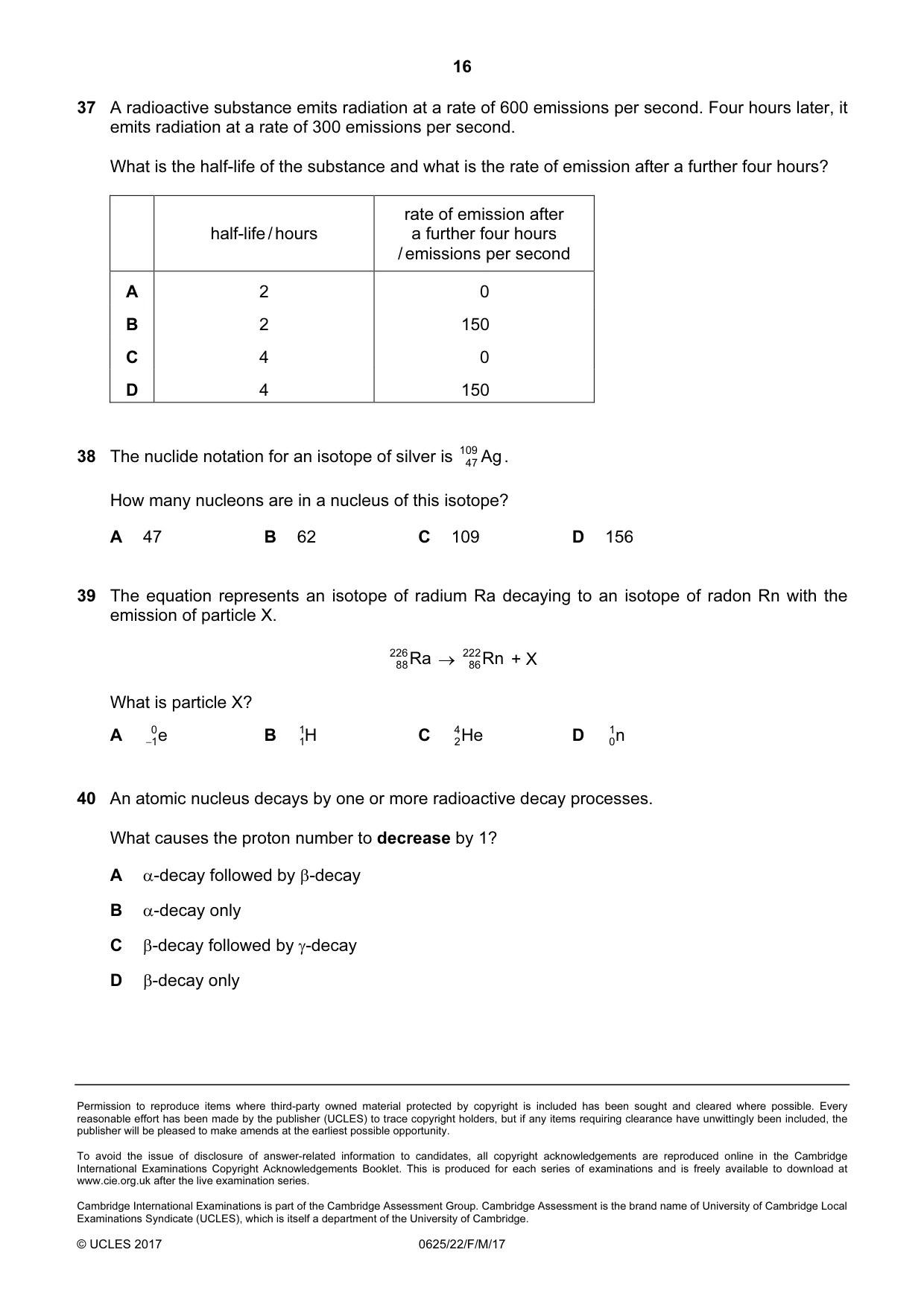
Q37 · A radioactive substance emits radiation at a rate of 600 emissions per second
37 A radioactive substance emits radiation at a rate of 600 emissions per second. Four hours later, it emits radiation at a rate of 300 emissions per second. What is the half-life of the substance and what is the rate of emission after a further four hours? rate of emission after half-life / hours a further four hours / emissions per second A 2 0 B 2 150 C 4 0 D 4 150
Mark scheme: D
Q38 · The nuclide notation for an isotope of silver is 109 Ag
38 The nuclide notation for an isotope of silver is 109 Ag . 47 How many nucleons are in a nucleus of this isotope? A 47 B 62 C 109 D 156
Mark scheme: C
Q39 · The equation represents an isotope of radium Ra decaying to an isotope of radon Rn with…
39 The equation represents an isotope of radium Ra decaying to an isotope of radon Rn with the emission of particle X. 226 Ra → 222 Rn + X 88 86 What is particle X? A 0 e B 1 H C 4 He D 0 1 n − 1 1 2
Mark scheme: C
Q40 · An atomic nucleus decays by one or more radioactive decay processes
40 An atomic nucleus decays by one or more radioactive decay processes. What causes the proton number to decrease by 1? A α-decay followed by β-decay B α-decay only C β-decay followed by γ-decay D β-decay only
Mark scheme: A
What was in this paper
The subtopics covered by these 40 questions, and how many questions each got. Open one in a new tab to see every Cambridge question on it.
5Radioactivity3Electrical quantities2Electromagnetic effects2Energy, work and power2Forces2General properties of waves2Kinetic particle model of matter2Light2Mass and weight2Motion2Pressure2Simple phenomena of magnetism2Sound2Thermal properties and temperature2Transfer of thermal energy2Electrical safety1Momentum1Physical quantities and measurement techniques1The nuclear model of the atom1What you needed in this session
Cambridge’s own grade thresholds for 2017 Feb/March, Paper 2 · Variant 2. A higher threshold means an easier paper — the bar moves with how the cohort did.