Cambridge IGCSE Physics 0625 — 2024 May/June Paper 2 · Variant 2
0625/22/M/J/24 · 40 questions · 40 marks · ≈45 min
The question paper and its mark scheme, free to read here and free to download. This is Cambridge’s own paper, exactly as it was sat.
Question paper16 pages
Mark scheme3 pages
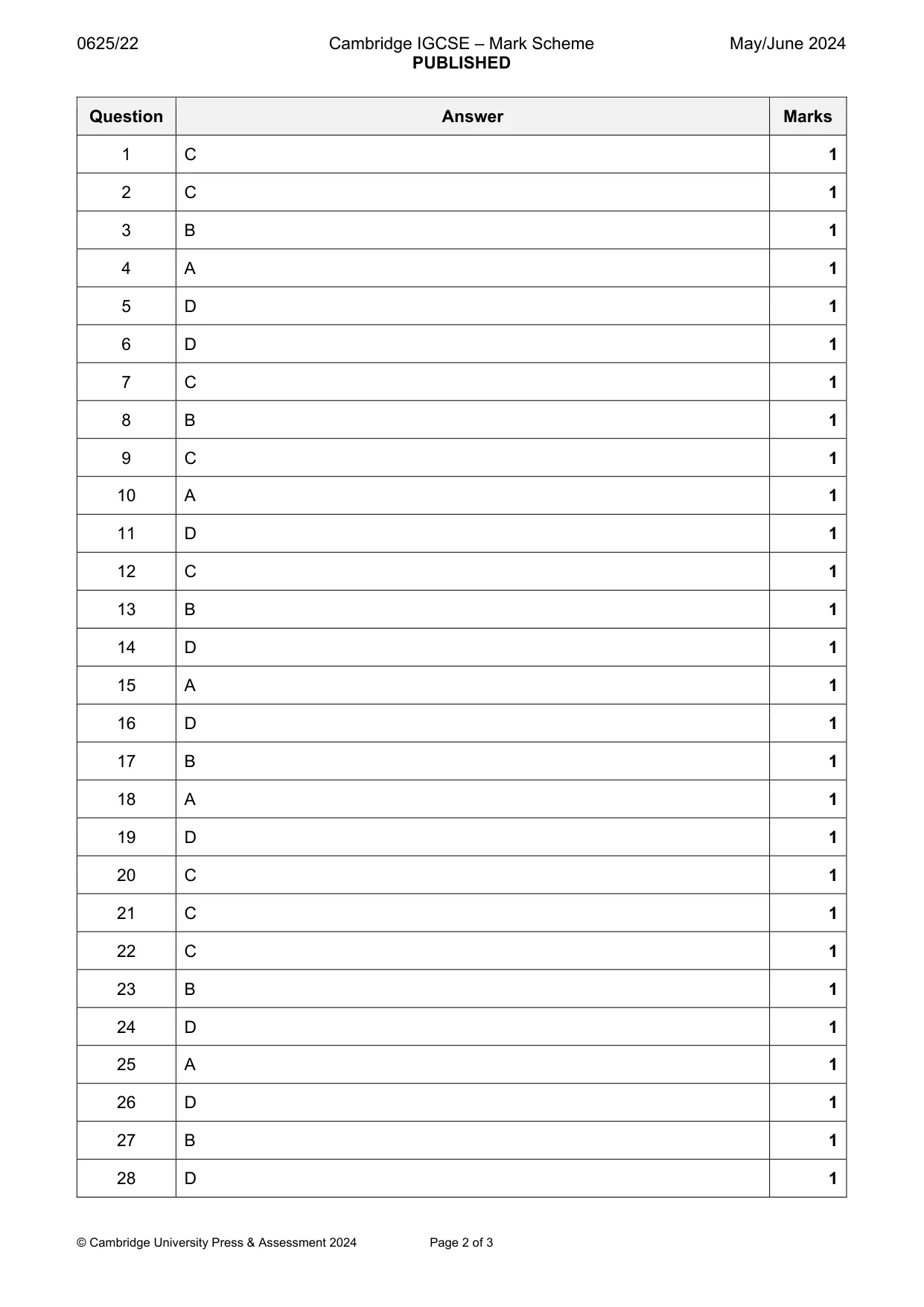
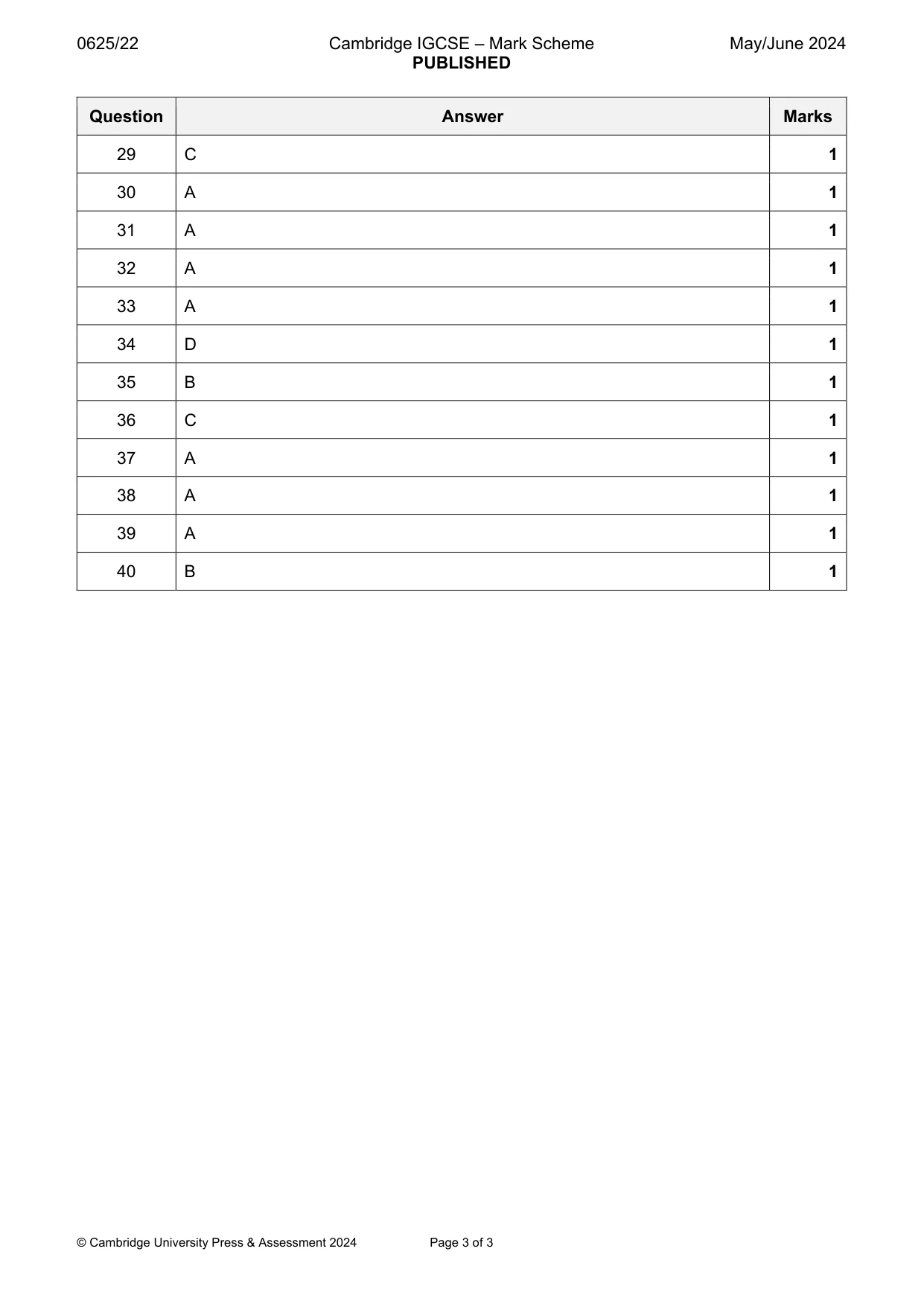
Answers below. Sit the paper first if you are practising.
Questions as text
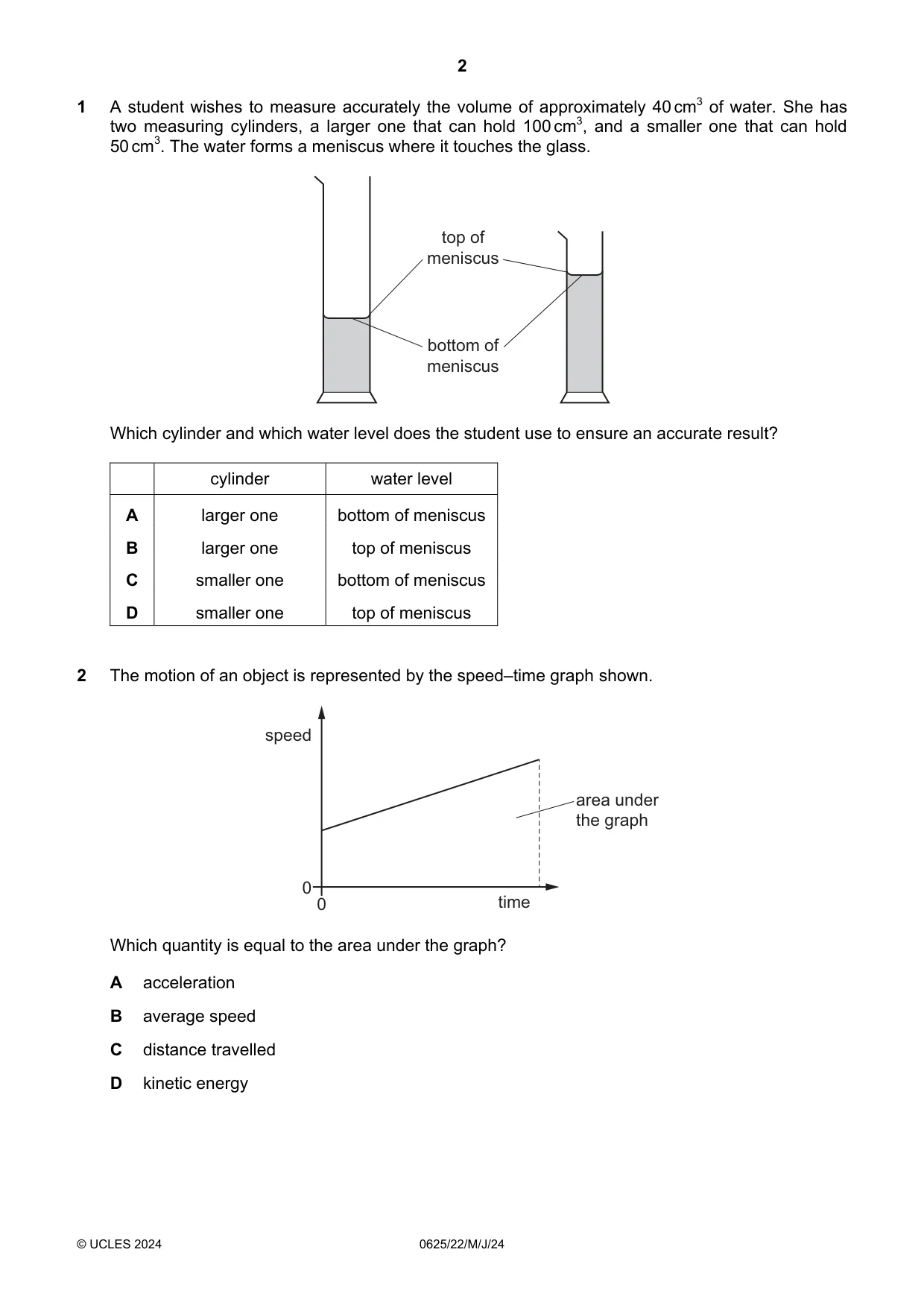
Q1 · A student wishes to measure accurately the volume of approximately 40 cm3 of water
1 A student wishes to measure accurately the volume of approximately 40 cm3 of water. She has two measuring cylinders, a larger one that can hold 100 cm3, and a smaller one that can hold 50 cm3. The water forms a meniscus where it touches the glass. top of meniscus bottom of meniscus Which cylinder and which water level does the student use to ensure an accurate result? cylinder water level A larger one bottom of meniscus B larger one top of meniscus C smaller one bottom of meniscus D smaller one top of meniscus
Mark scheme: C
More questions on Physical quantities and measurement techniques
Q2 · The motion of an object is represented by the speed–time graph shown
2 The motion of an object is represented by the speed–time graph shown. speed area under the graph 0 0 time Which quantity is equal to the area under the graph? A acceleration B average speed C distance travelled D kinetic energy
Mark scheme: C
Q3 · An astronaut of mass 80 kg is standing on a planet with gravitational field strength g =…
3 An astronaut of mass 80 kg is standing on a planet with gravitational field strength g = 3.8 N / kg. What is the weight of the astronaut on this planet? A 780 N B 300 N C 210 N D 21 N
Mark scheme: B
Q4 · A sealed container of volume 2000 cm3 contains air at high pressure
4 A sealed container of volume 2000 cm3 contains air at high pressure. The container is placed on a top-pan balance. The balance reads 200.00 g. All the air is removed by a vacuum pump and the balance reading changes to 196.00 g. What was the density of the pressurised air? A 0.00200 g / cm3 B 0.098 g / cm3 C 4.00 g / cm3 D 10.2 g / cm3
Mark scheme: A
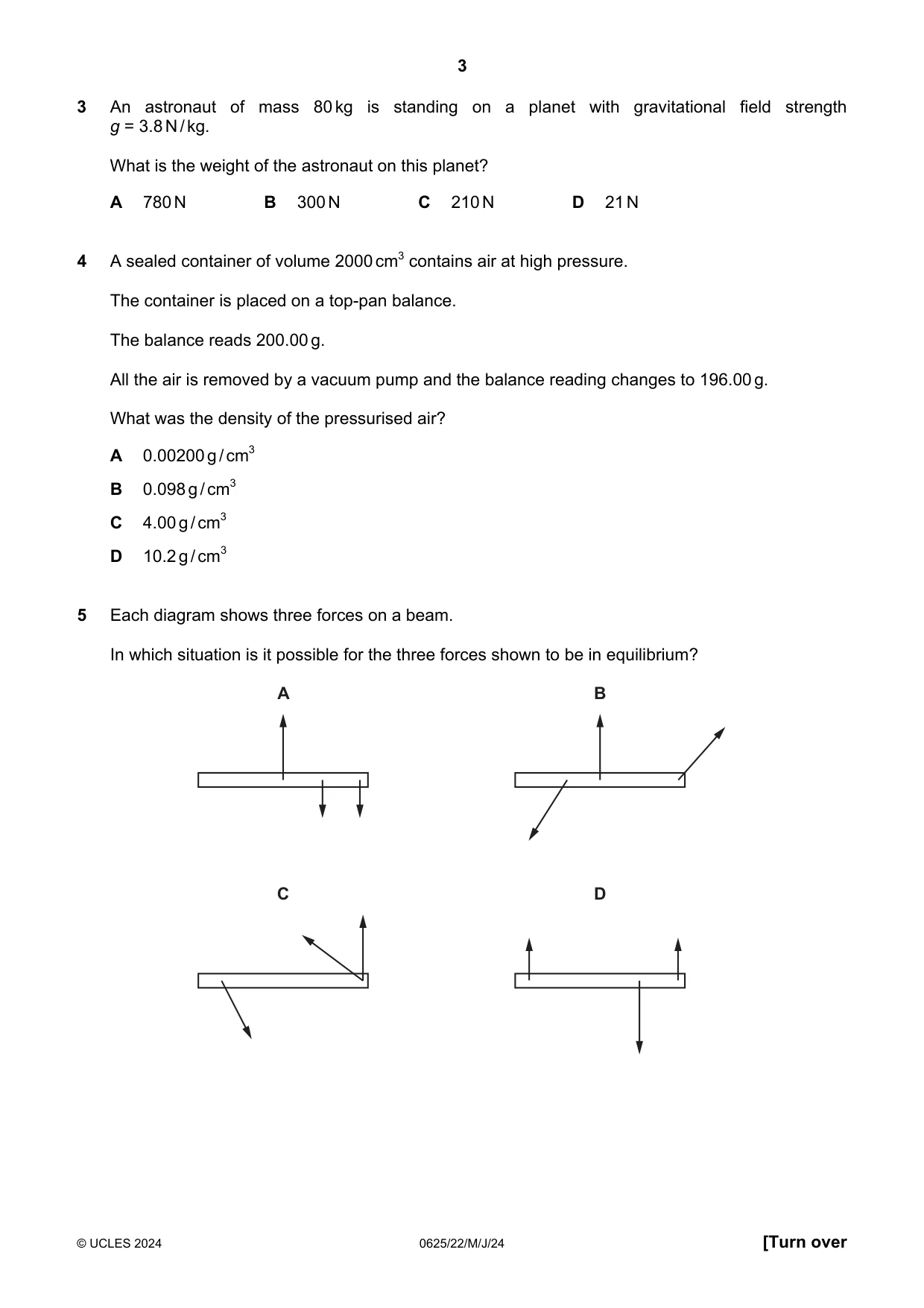
Q5 · Each diagram shows three forces on a beam
5 Each diagram shows three forces on a beam. In which situation is it possible for the three forces shown to be in equilibrium? A B C D
Mark scheme: D
Q6 · A gymnast jumps down from a high piece of apparatus
6 A gymnast jumps down from a high piece of apparatus. She gradually bends her knees as she lands. Which effect does this have? A She will have a smaller change of momentum as she lands. B She will lose less kinetic energy as she lands. C She will exert a smaller impulse on the ground as she lands. D She will experience a smaller force from the ground as she lands.
Mark scheme: D
Q7 · The table gives four energy resources and states whether the main source of energy for…
7 The table gives four energy resources and states whether the main source of energy for the resource is the Sun. Which row is correct? main source of energy resource energy is the Sun A geothermal yes B oil no C water held behind a dam yes D wind no
Mark scheme: C
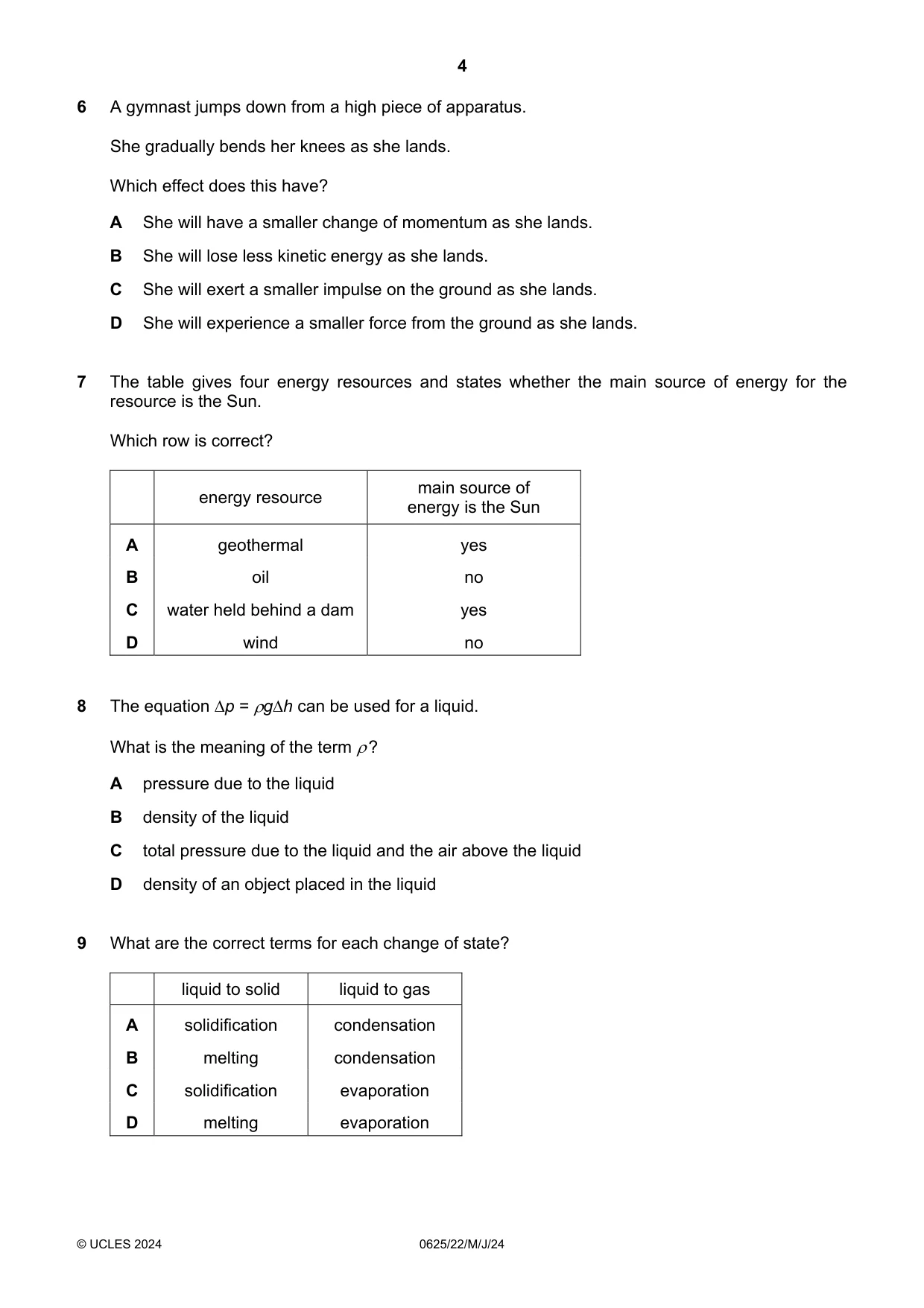
Q8 · The equation p = gh can be used for a liquid
8 The equation p = gh can be used for a liquid. What is the meaning of the term ? A pressure due to the liquid B density of the liquid C total pressure due to the liquid and the air above the liquid D density of an object placed in the liquid
Mark scheme: B
Q9 · What are the correct terms for each change of state?
9 What are the correct terms for each change of state? liquid to solid liquid to gas A solidification condensation B melting condensation C solidification evaporation D melting evaporation
Mark scheme: C
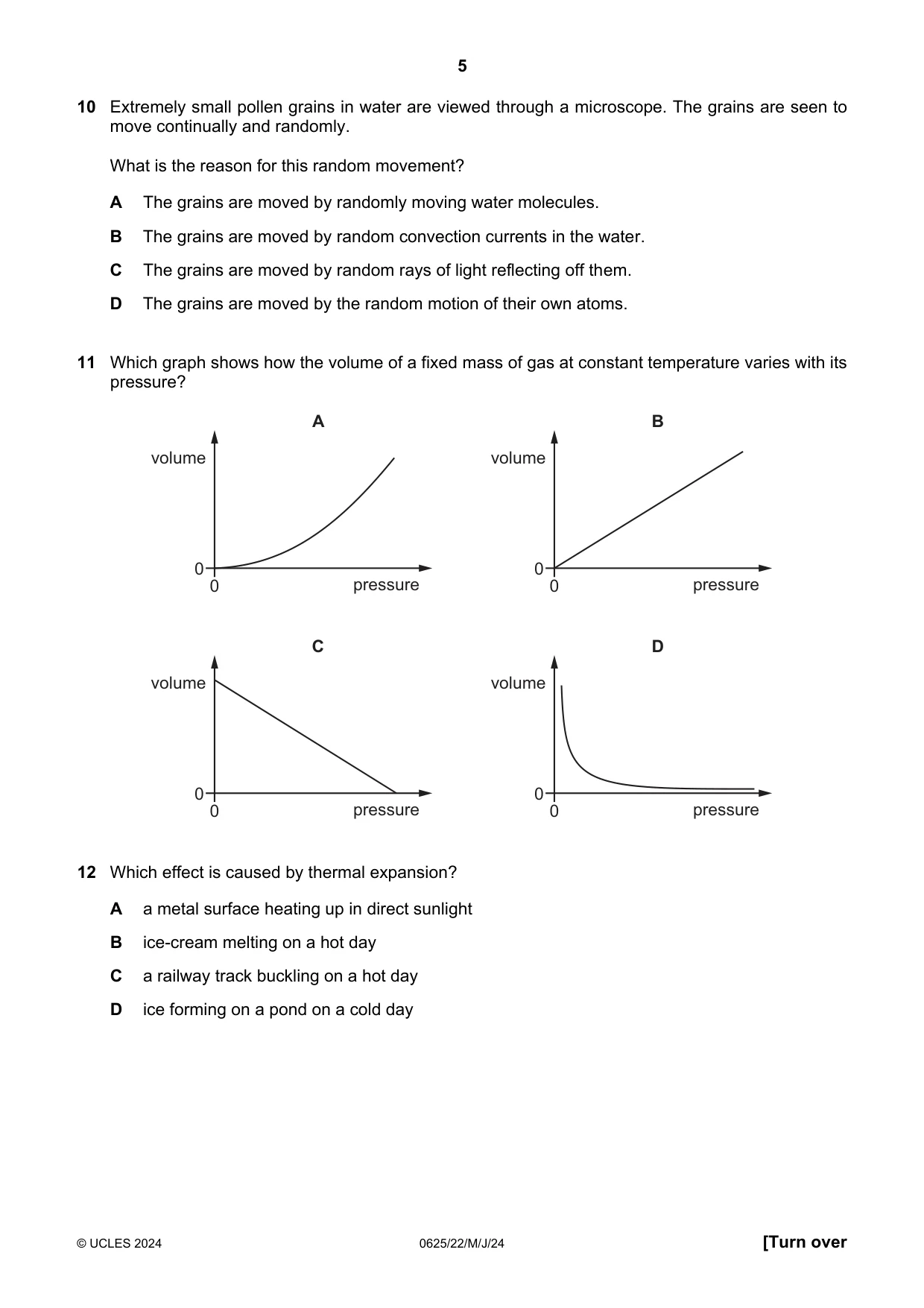
Q10 · Extremely small pollen grains in water are viewed through a microscope
10 Extremely small pollen grains in water are viewed through a microscope. The grains are seen to move continually and randomly. What is the reason for this random movement? A The grains are moved by randomly moving water molecules. B The grains are moved by random convection currents in the water. C The grains are moved by random rays of light reflecting off them. D The grains are moved by the random motion of their own atoms.
Mark scheme: A
Q11 · Which graph shows how the volume of a fixed mass of gas at constant temperature varies…
11 Which graph shows how the volume of a fixed mass of gas at constant temperature varies with its pressure? A B volume volume 0 0 0 pressure 0 pressure C D volume volume 0 0 0 pressure 0 pressure
Mark scheme: D
Q12 · Which effect is caused by thermal expansion?
12 Which effect is caused by thermal expansion? A a metal surface heating up in direct sunlight B ice-cream melting on a hot day C a railway track buckling on a hot day D ice forming on a pond on a cold day
Mark scheme: C
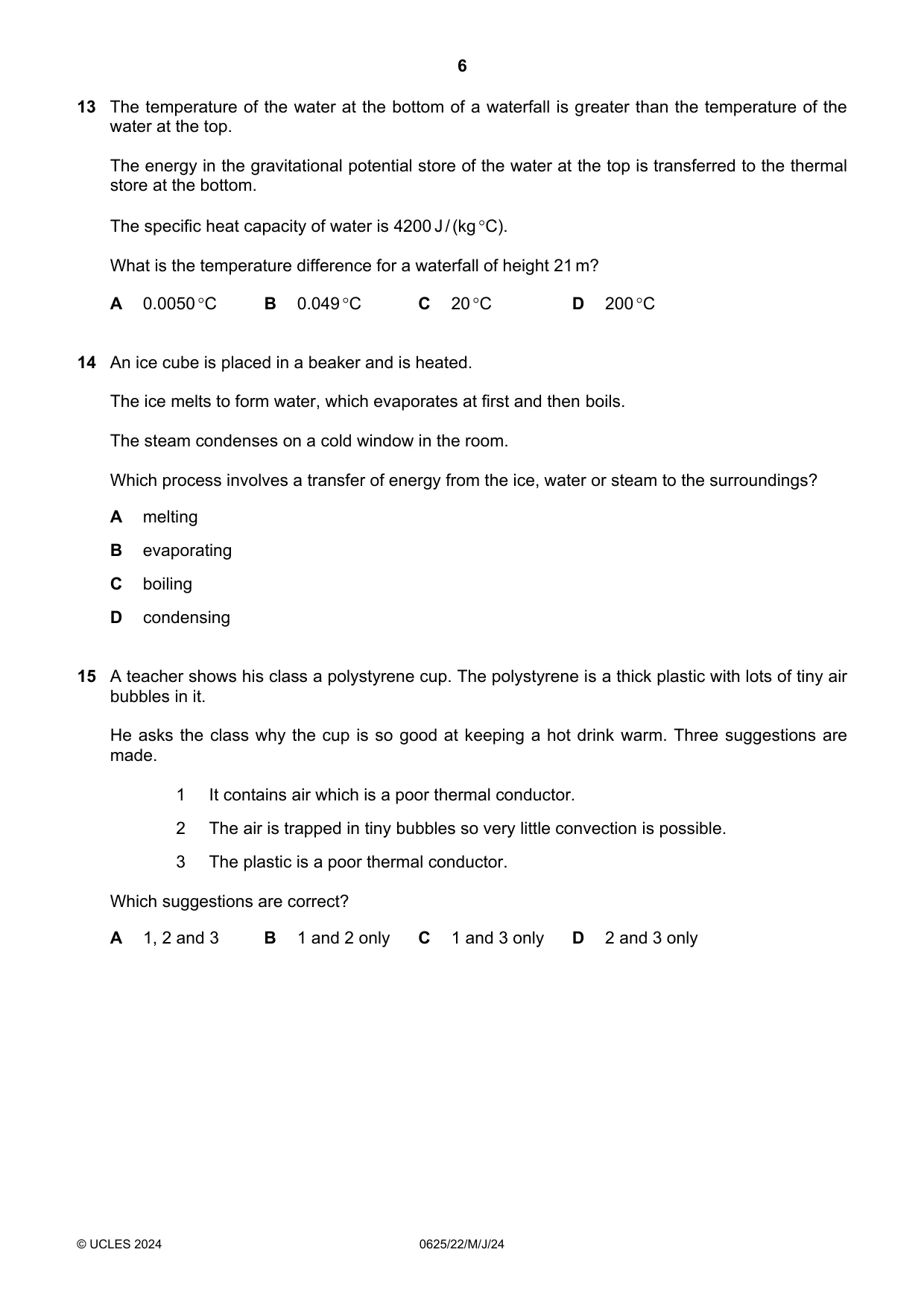
Q13 · The temperature of the water at the bottom of a waterfall is greater than the temperature…
13 The temperature of the water at the bottom of a waterfall is greater than the temperature of the water at the top. The energy in the gravitational potential store of the water at the top is transferred to the thermal store at the bottom. The specific heat capacity of water is 4200 J / (kg C). What is the temperature difference for a waterfall of height 21 m? A 0.0050 C B 0.049 C C 20 C D 200 C
Mark scheme: B
Q14 · An ice cube is placed in a beaker and is heated
14 An ice cube is placed in a beaker and is heated. The ice melts to form water, which evaporates at first and then boils. The steam condenses on a cold window in the room. Which process involves a transfer of energy from the ice, water or steam to the surroundings? A melting B evaporating C boiling D condensing
Mark scheme: D
Q15 · A teacher shows his class a polystyrene cup
15 A teacher shows his class a polystyrene cup. The polystyrene is a thick plastic with lots of tiny air bubbles in it. He asks the class why the cup is so good at keeping a hot drink warm. Three suggestions are made. 1 It contains air which is a poor thermal conductor. 2 The air is trapped in tiny bubbles so very little convection is possible. 3 The plastic is a poor thermal conductor. Which suggestions are correct? A 1, 2 and 3 B 1 and 2 only C 1 and 3 only D 2 and 3 only
Mark scheme: A
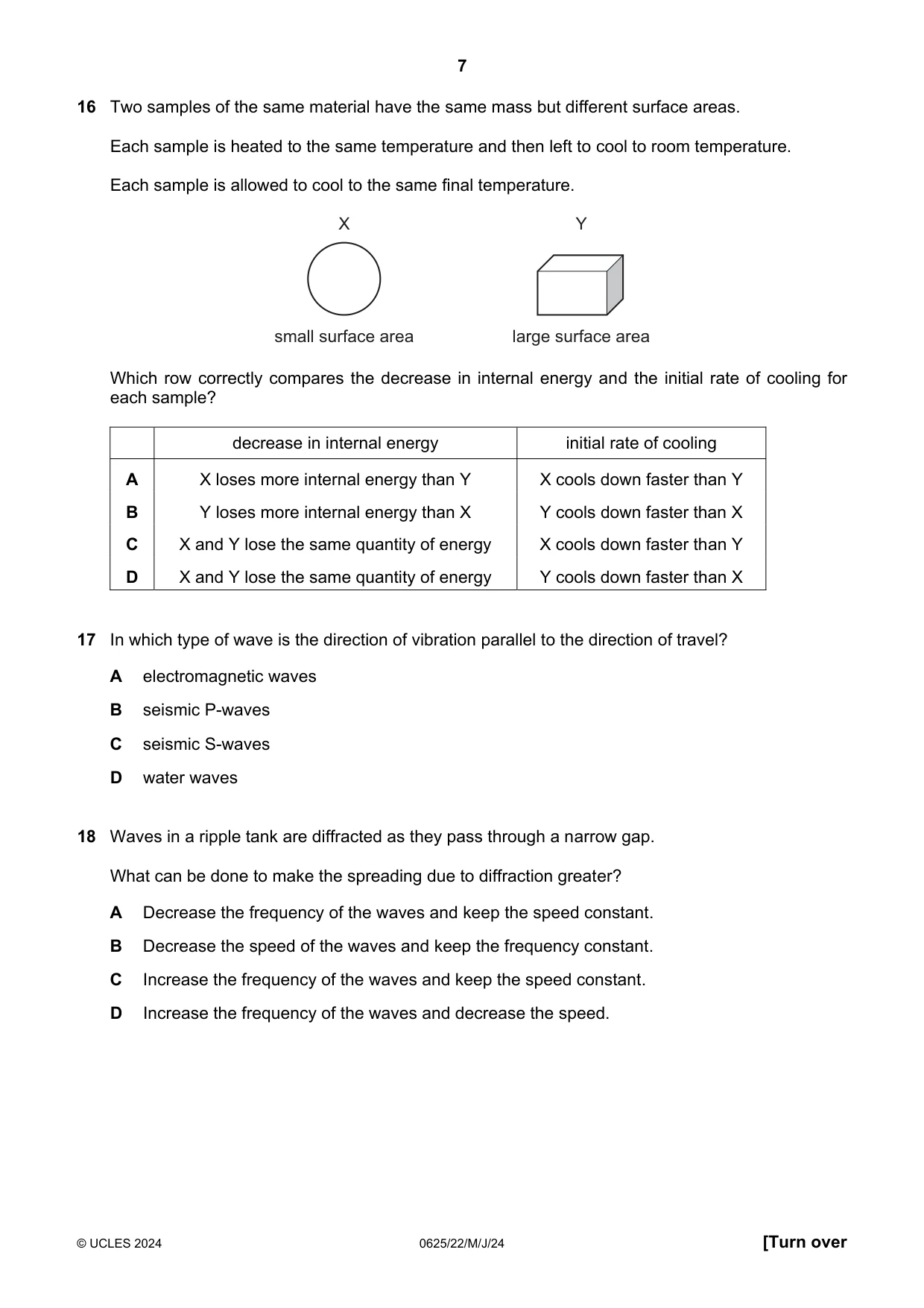
Q16 · Two samples of the same material have the same mass but different surface areas
16 Two samples of the same material have the same mass but different surface areas. Each sample is heated to the same temperature and then left to cool to room temperature. Each sample is allowed to cool to the same final temperature. X Y small surface area large surface area Which row correctly compares the decrease in internal energy and the initial rate of cooling for each sample? decrease in internal energy initial rate of cooling A X loses more internal energy than Y X cools down faster than Y B Y loses more internal energy than X Y cools down faster than X C X and Y lose the same quantity of energy X cools down faster than Y D X and Y lose the same quantity of energy Y cools down faster than X
Mark scheme: D
Q17 · In which type of wave is the direction of vibration parallel to the direction of travel?
17 In which type of wave is the direction of vibration parallel to the direction of travel? A electromagnetic waves B seismic P-waves C seismic S-waves D water waves
Mark scheme: B
Q18 · Waves in a ripple tank are diffracted as they pass through a narrow gap
18 Waves in a ripple tank are diffracted as they pass through a narrow gap. What can be done to make the spreading due to diffraction greater? A Decrease the frequency of the waves and keep the speed constant. B Decrease the speed of the waves and keep the frequency constant. C Increase the frequency of the waves and keep the speed constant. D Increase the frequency of the waves and decrease the speed.
Mark scheme: A
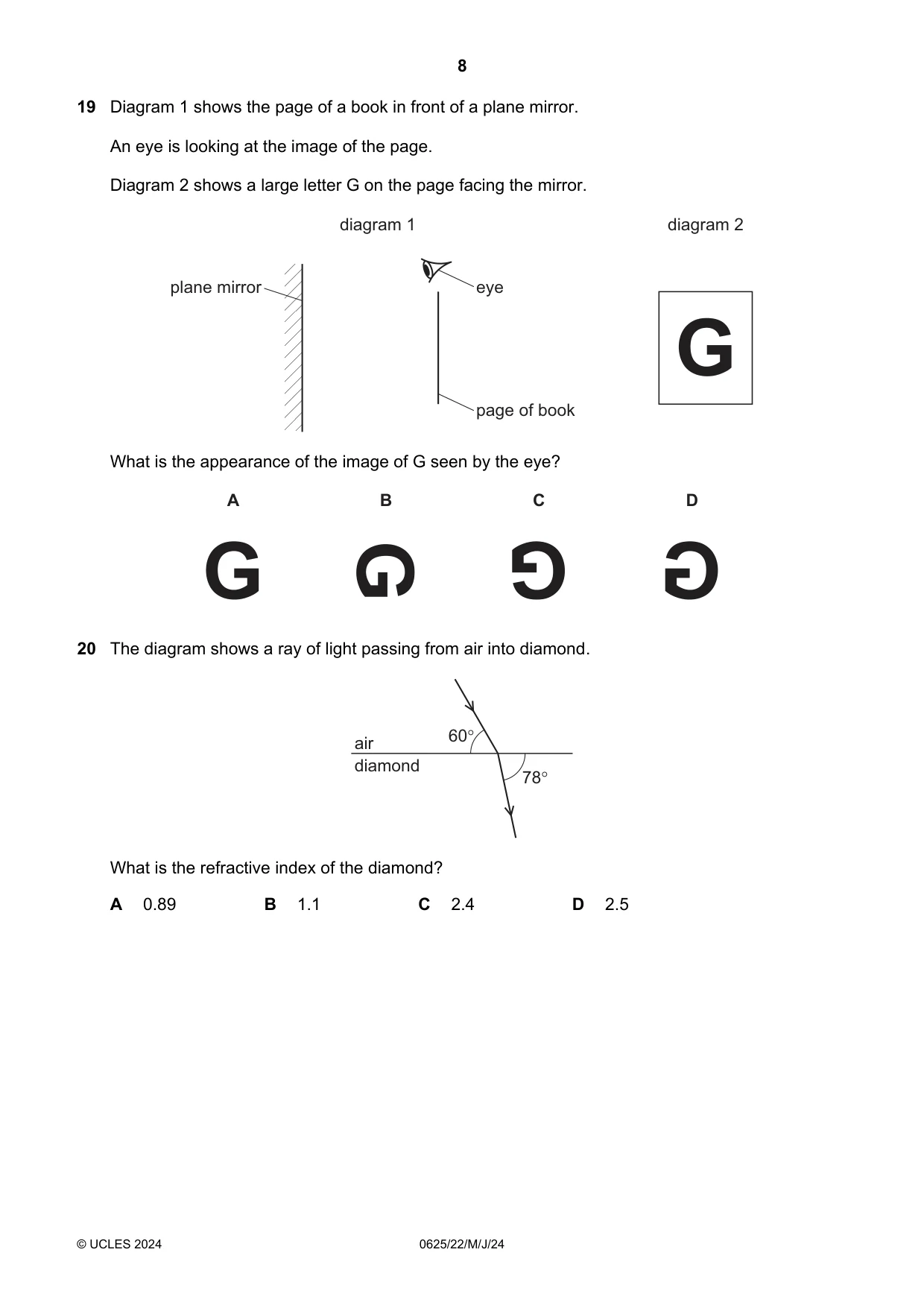
Q19 · The page of a book in front of a plane mirror
19 Diagram 1 shows the page of a book in front of a plane mirror. An eye is looking at the image of the page. Diagram 2 shows a large letter G on the page facing the mirror. diagram 1 diagram 2 plane mirror eye page of book What is the appearance of the image of G seen by the eye? A B C D
Mark scheme: D
Q20 · The diagram shows a ray of light passing from air into diamond
20 The diagram shows a ray of light passing from air into diamond. 60° air diamond 18° What is the refractive index of the diamond? A 0.89 B 1.1 C 24 D 2.5
Mark scheme: C
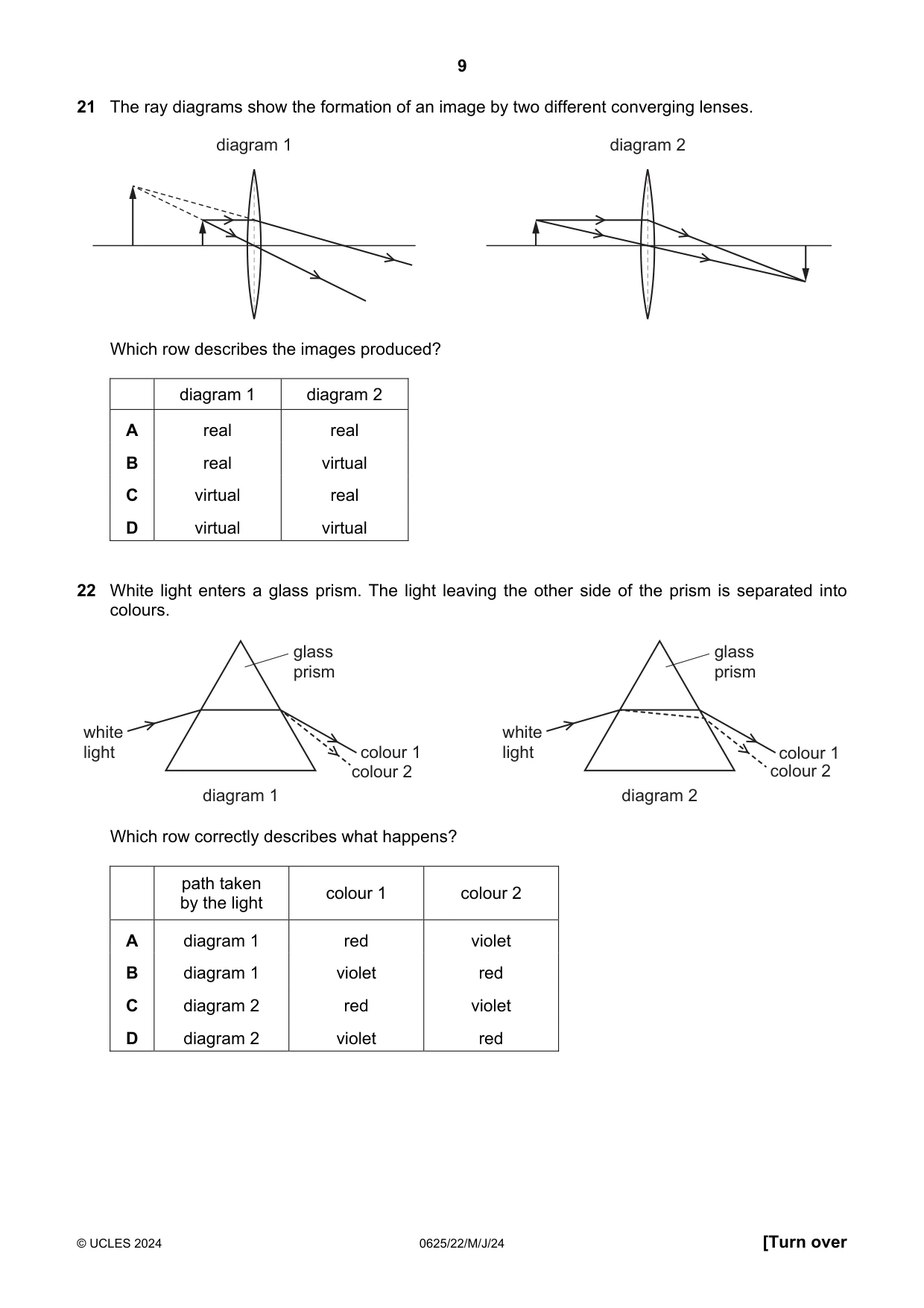
Q21 · The ray diagrams show the formation of an image by two different converging lenses
21 The ray diagrams show the formation of an image by two different converging lenses. diagram 1 diagram 2 Which row describes the images produced? diagram 1 diagram 2 A real real B real virtual C virtual real D virtual virtual
Mark scheme: C
Q22 · White light enters a glass prism
22 White light enters a glass prism. The light leaving the other side of the prism is separated into colours. glass glass prism prism white white light colour 1 light colour 1 colour 2 colour 2 diagram 1 diagram 2 Which row correctly describes what happens? path taken colour 1 colour 2 by the light A diagram 1 red violet B diagram 1 violet red C diagram 2 red violet D diagram 2 violet red
Mark scheme: C
Q23 · Thermal radiation is part of the electromagnetic spectrum
23 Thermal radiation is part of the electromagnetic spectrum. What is the name of this region of the spectrum? A gamma rays B infrared C ultraviolet D visible light
Mark scheme: B
Q24 · A remote-controlled vehicle is travelling on the surface of a planet
24 A remote-controlled vehicle is travelling on the surface of a planet. The vehicle senses an obstacle ahead. It sends a radio message to the control room from where it is being controlled. The control room is 2.4 106 km away from the vehicle. The control room sends a message back to the vehicle telling it to stop. What is the minimum time that elapses between the vehicle sensing the obstacle and receiving the message back from the control room? A 8.0 ms B 16 ms C 8.0 s D 16 s
Mark scheme: D
Q25 · Which statement about the direction of a magnetic field at a point is correct?
25 Which statement about the direction of a magnetic field at a point is correct? A It is the direction of the force on an N pole placed at that point. B It is the direction of the force on an S pole placed at that point. C It is the direction of the force on a positive charge placed at that point. D It is the direction of the force on a negative charge placed at that point.
Mark scheme: A
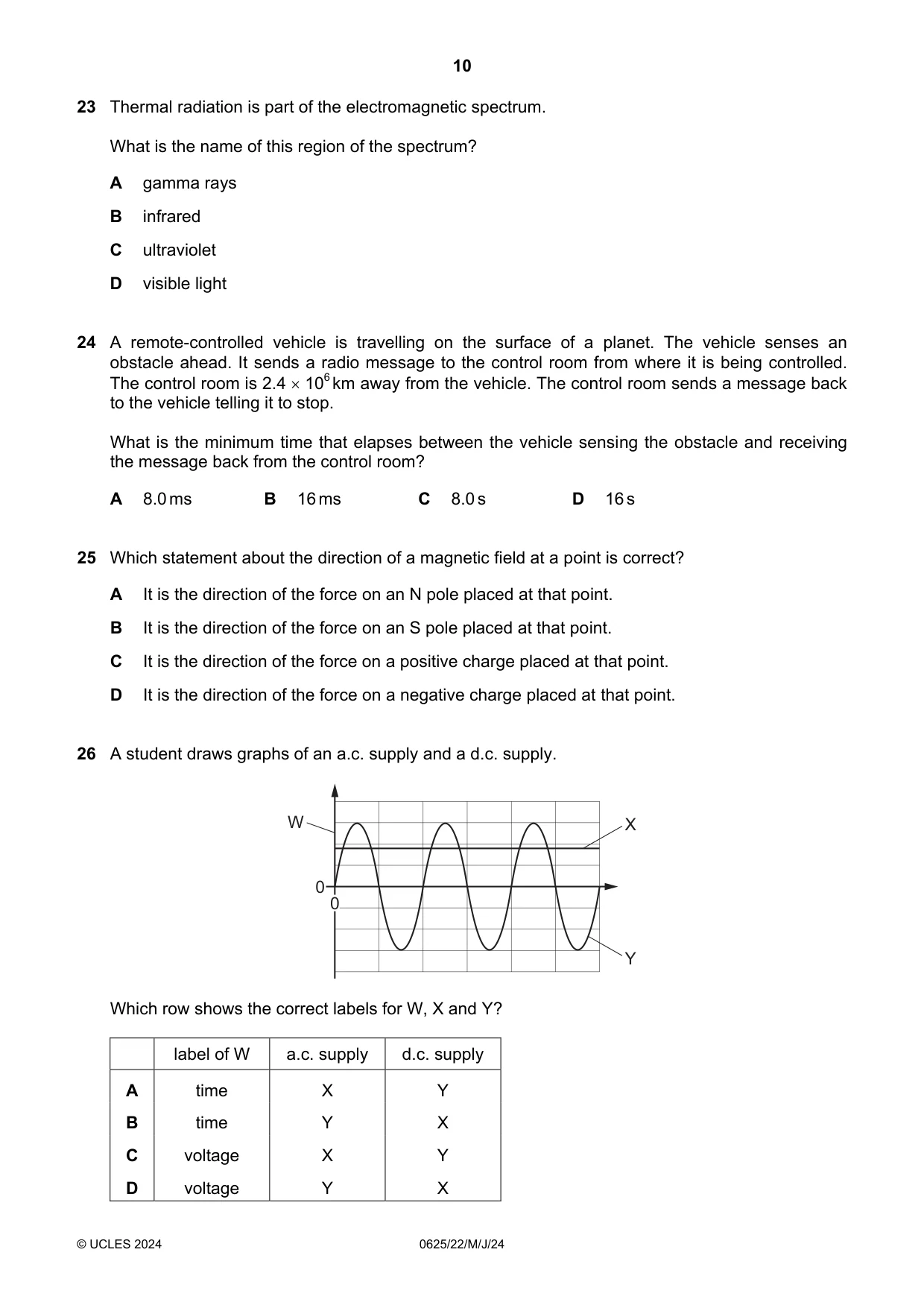
Q26 · A student draws graphs of an a.c
26 A student draws graphs of an a.c. supply and a d.c. supply. W X 0 0 Y Which row shows the correct labels for W, X and Y? label of W a.c. supply d.c. supply A time X Y B time Y X C voltage X Y D voltage Y X
Mark scheme: D
Q27 · A resistor transfers 100 J of energy when a charge of 10 C flows through it
27 A resistor transfers 100 J of energy when a charge of 10 C flows through it. What is the potential difference across the resistor? A 0.10 V B 10 V C 10 W D 1000 W
Mark scheme: B
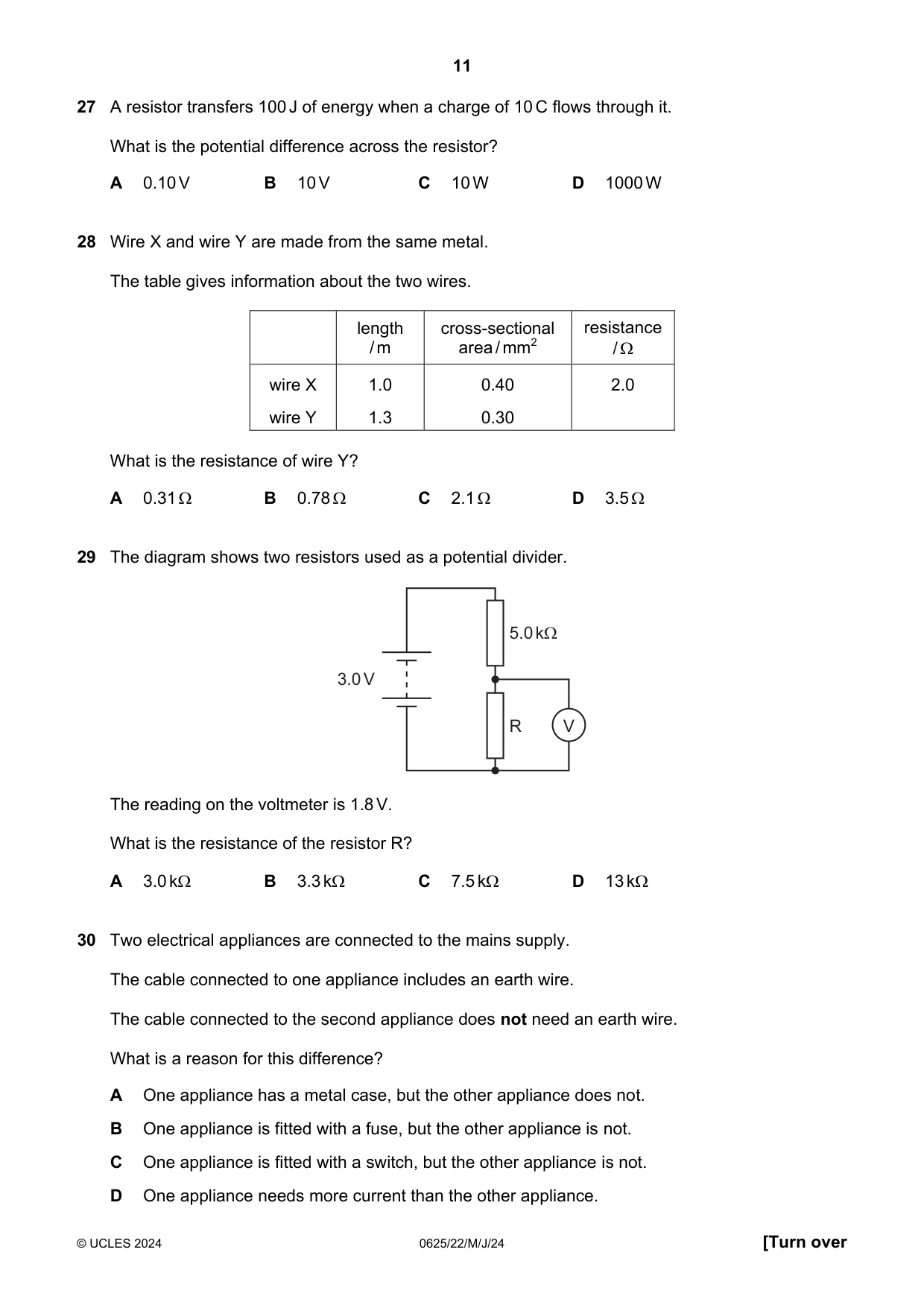
Q28 · Wire X and wire Y are made from the same metal
28 Wire X and wire Y are made from the same metal. The table gives information about the two wires. length cross-sectional resistance / m area / mm2 / wire X 1.0 0.40 2.0 wire Y 1.3 0.30 What is the resistance of wire Y? A 0.31 B 0.78 C 2.1 D 3.5
Mark scheme: D
Q29 · The diagram shows two resistors used as a potential divider
29 The diagram shows two resistors used as a potential divider. The reading on the voltmeter is 1.8 V. What is the resistance of the resistor R? A 3.0kQ B 3.3kQ C 7.5kQ D 13kQ
Mark scheme: C
Q30 · Two electrical appliances are connected to the mains supply
30 Two electrical appliances are connected to the mains supply. The cable connected to one appliance includes an earth wire. The cable connected to the second appliance does not need an earth wire. What is a reason for this difference? A One appliance has a metal case, but the other appliance does not. B One appliance is fitted with a fuse, but the other appliance is not. C One appliance is fitted with a switch, but the other appliance is not. D One appliance needs more current than the other appliance.
Mark scheme: A
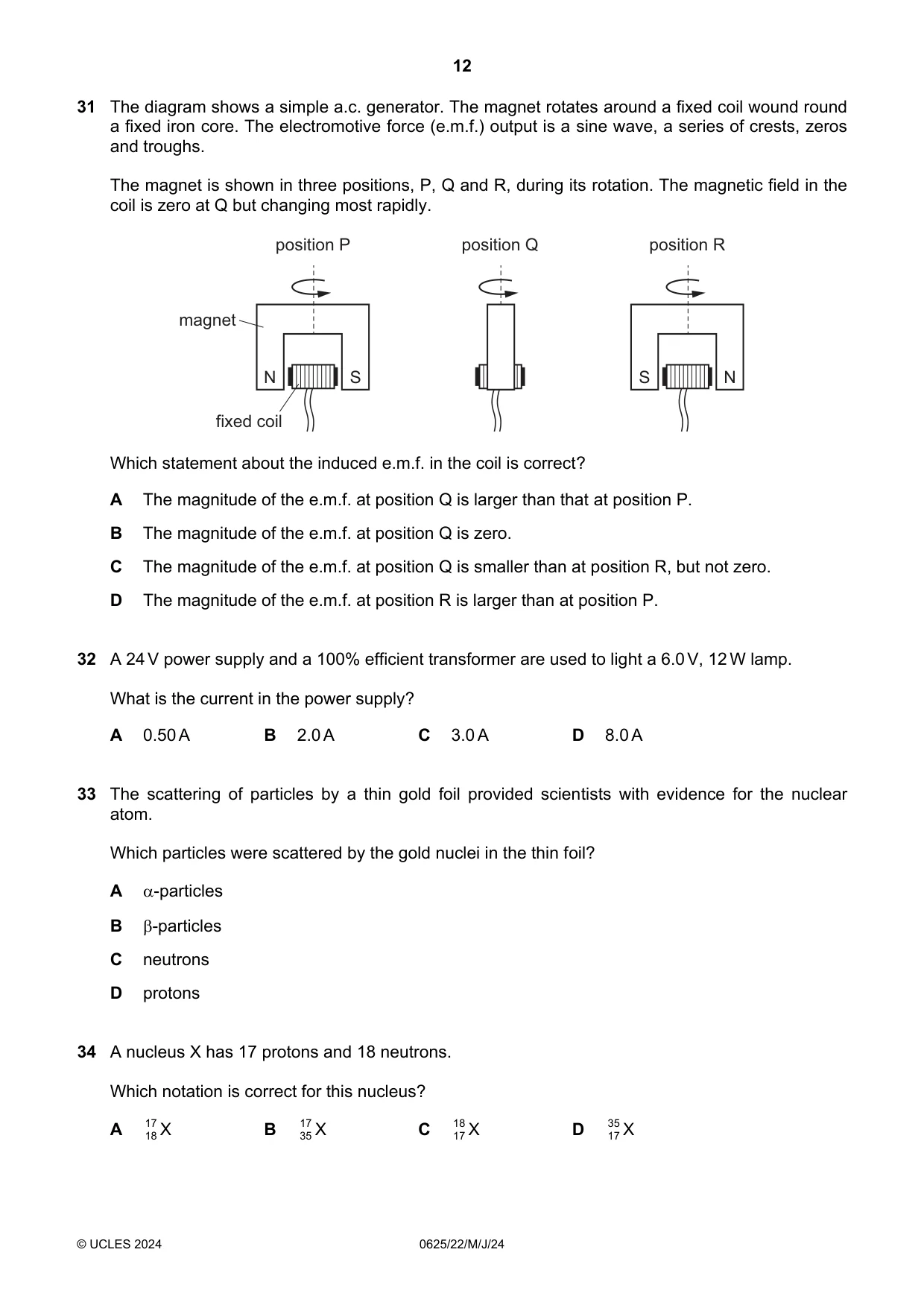
Q31 · The diagram shows a simple a.c
31 The diagram shows a simple a.c. generator. The magnet rotates around a fixed coil wound round a fixed iron core. The electromotive force (e.m.f.) output is a sine wave, a series of crests, zeros and troughs. The magnet is shown in three positions, P, Q and R, during its rotation. The magnetic field in the coil is zero at Q but changing most rapidly. position P position Q position R magnet N S S N fixed coil Which statement about the induced e.m.f. in the coil is correct? A The magnitude of the e.m.f. at position Q is larger than that at position P. B The magnitude of the e.m.f. at position Q is zero. C The magnitude of the e.m.f. at position Q is smaller than at position R, but not zero. D The magnitude of the e.m.f. at position R is larger than at position P.
Mark scheme: A
Q32 · A 24 V power supply and a 100% efficient transformer are used to light a 6.0 V, 12 W lamp
32 A 24 V power supply and a 100% efficient transformer are used to light a 6.0 V, 12 W lamp. What is the current in the power supply? A 0.50 A B 2.0 A C 3.0 A D 8.0 A
Mark scheme: A
Q33 · The scattering of particles by a thin gold foil provided scientists with evidence for the…
33 The scattering of particles by a thin gold foil provided scientists with evidence for the nuclear atom. Which particles were scattered by the gold nuclei in the thin foil? A -particles B -particles C neutrons D protons
Mark scheme: A
Q34 · A nucleus X has 17 protons and 18 neutrons
34 A nucleus X has 17 protons and 18 neutrons. Which notation is correct for this nucleus? A 17 X B 17 X C 18 X D 35 X 18 35 17 17
Mark scheme: D
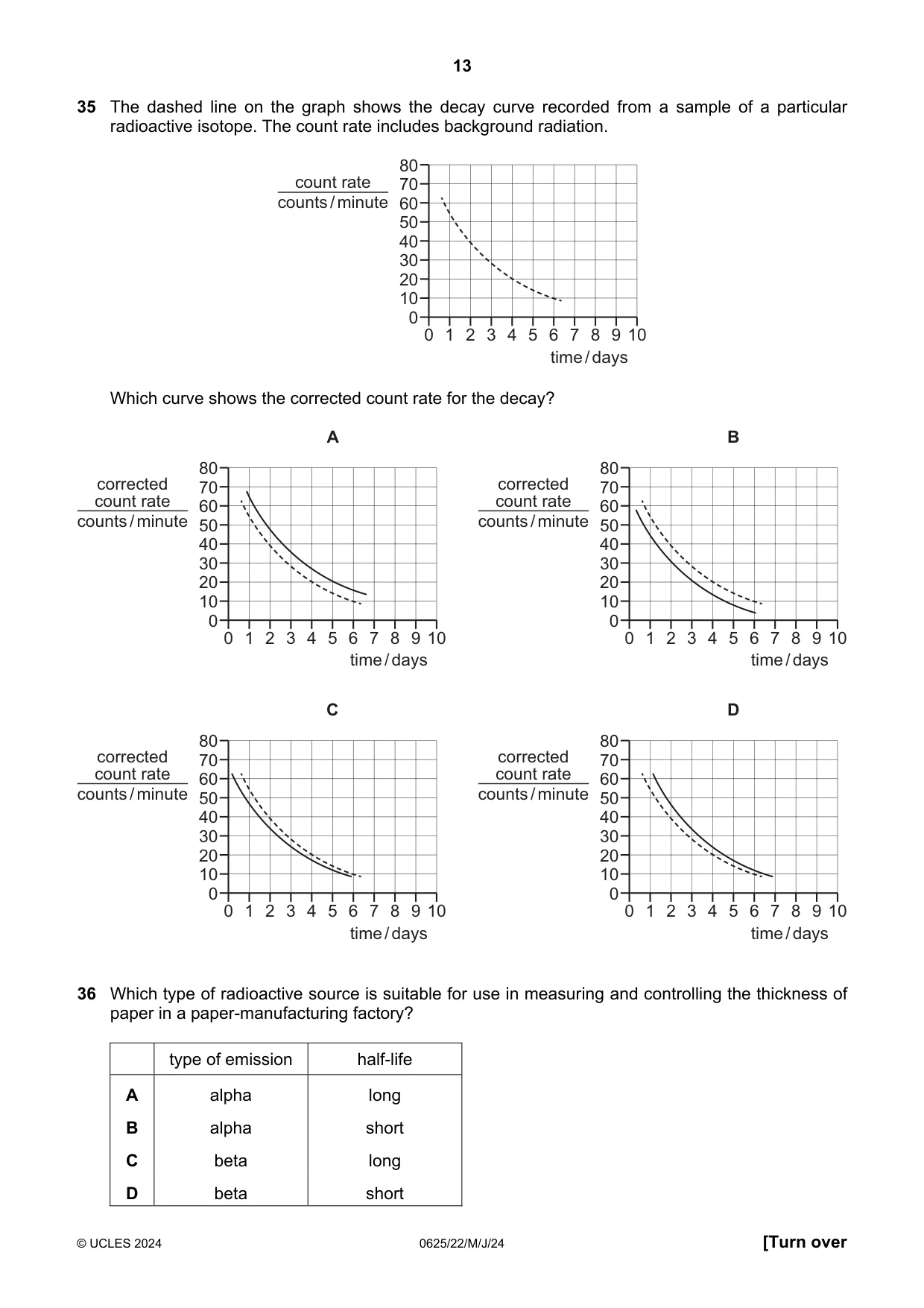
Q35 · The dashed line on the graph shows the decay curve recorded from a sample of a particular…
35 The dashed line on the graph shows the decay curve recorded from a sample of a particular radioactive isotope. The count rate includes background radiation. 80 count rate 70 counts / minute 60 50 40 30 20 10 0 0 1 2 3 4 5 6 7 8 9 10 time / days Which curve shows the corrected count rate for the decay? A B 80 80 corrected 70 corrected 70 count rate 60 count rate 60 counts / minute 50 counts / minute 50 40 40 30 30 20 20 10 10 0 0 0 1 2 3 4 5 6 7 8 9 10 0 1 2 3 4 5 6 7 8 9 10 time / days time / days C D 80 80 corrected 70 corrected 70 count rate 60 count rate 60 counts / minute 50 counts / minute 50 40 40 30 30 20 20 10 10 0 0 0 1 2 3 4 5 6 7 8 9 10 0 1 2 3 4 5 6 7 8 9 10 time / days time / days
Mark scheme: B
Q36 · Which type of radioactive source is suitable for use in measuring and controlling the…
36 Which type of radioactive source is suitable for use in measuring and controlling the thickness of paper in a paper-manufacturing factory? type of emission half-life A alpha long B alpha short C beta long D beta short
Mark scheme: C
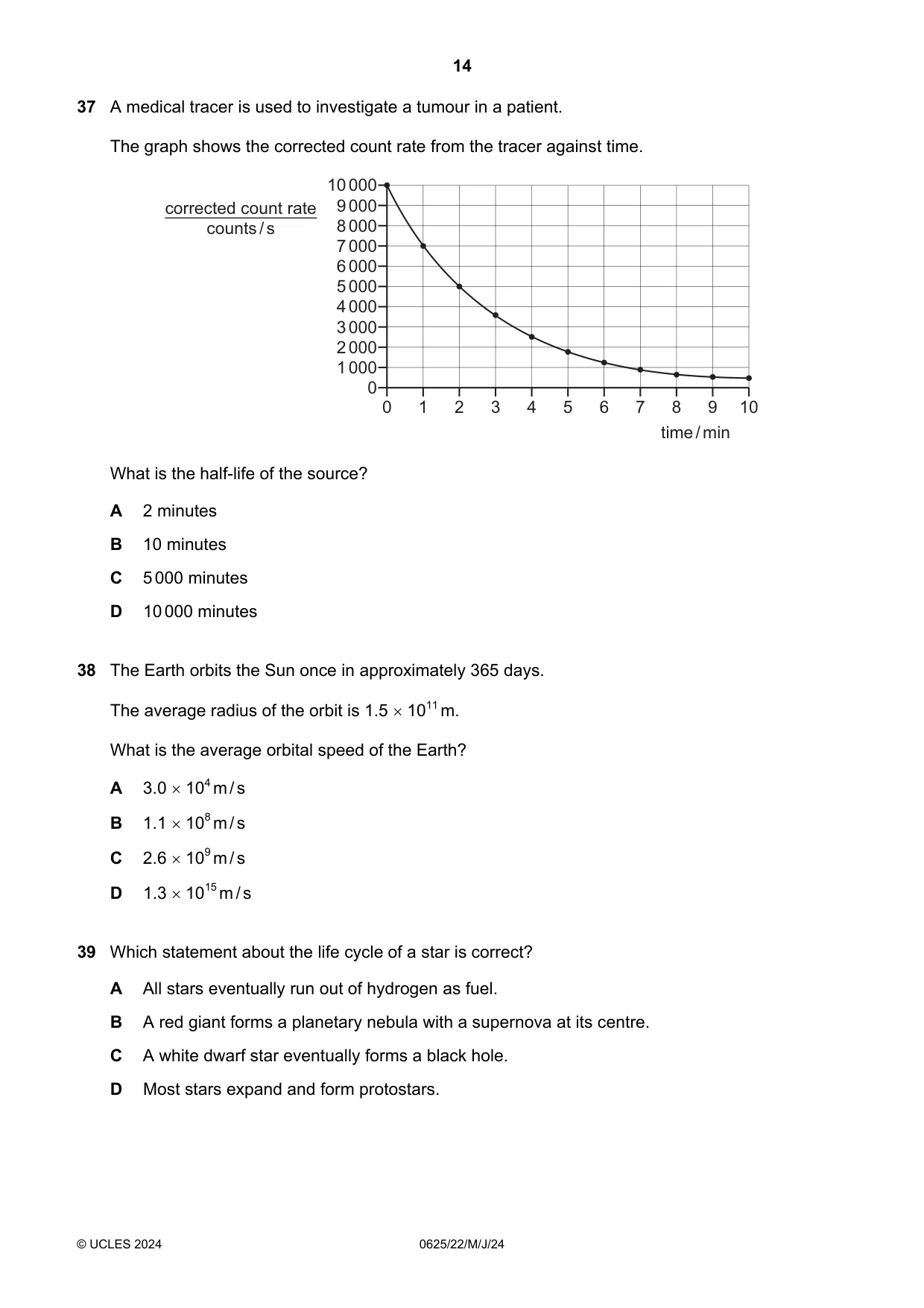
Q37 · A medical tracer is used to investigate a tumour in a patient
37 A medical tracer is used to investigate a tumour in a patient. The graph shows the corrected count rate from the tracer against time. 10 000 corrected count rate 9 000 counts / s 8 000 7 000 6 000 5 000 4 000 3 000 2 000 1 000 0 0 1 2 3 4 5 6 7 8 9 10 time / min What is the half-life of the source? A 2 minutes B 10 minutes C 5 000 minutes D 10 000 minutes
Mark scheme: A
Q38 · The Earth orbits the Sun once in approximately 365 days
38 The Earth orbits the Sun once in approximately 365 days. The average radius of the orbit is 1.5 1011 m. What is the average orbital speed of the Earth? A 3.0 104 m / s B 1.1 108 m / s C 2.6 109 m / s D 1.3 1015 m / s
Mark scheme: A
Q39 · Which statement about the life cycle of a star is correct?
39 Which statement about the life cycle of a star is correct? A All stars eventually run out of hydrogen as fuel. B A red giant forms a planetary nebula with a supernova at its centre. C A white dwarf star eventually forms a black hole. D Most stars expand and form protostars.
Mark scheme: A
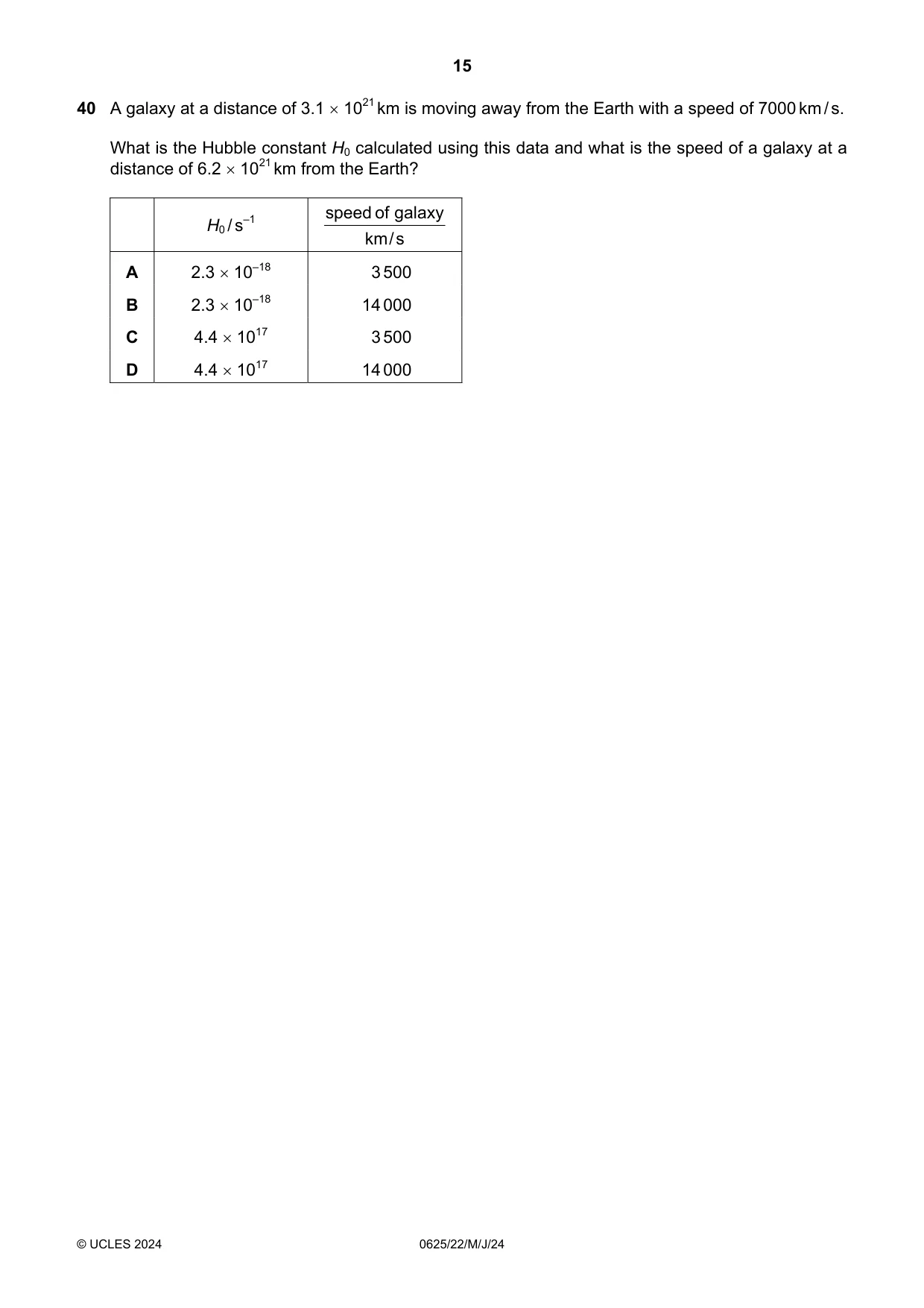
Q40 · A galaxy at a distance of 3.1 1021 km is moving away from the Earth with a speed of…
40 A galaxy at a distance of 3.1 1021 km is moving away from the Earth with a speed of 7000 km / s. What is the Hubble constant H0 calculated using this data and what is the speed of a galaxy at a distance of 6.2 1021 km from the Earth? speed of galaxy H0 / s–1 km / s A 2.3 10–18 3 500 B 2.3 10–18 14 000 C 4.4 1017 3 500 D 4.4 1017 14 000
Mark scheme: B
What was in this paper
The subtopics covered by these 40 questions, and how many questions each got. Open one in a new tab to see every Cambridge question on it.
4Light4Electrical quantities3Radioactivity3Thermal properties and temperature3Electromagnetic effects2Electromagnetic spectrum2General properties of waves2Stars and the Universe2The nuclear model of the atom2Density1Electric circuits1Electrical safety1Energy, work and power1Forces1Mass and weight1Momentum1Motion1Physical quantities and measurement techniques1Pressure1Simple phenomena of magnetism1The Earth and the Solar System1Transfer of thermal energy1What you needed in this session
Cambridge’s own grade thresholds for 2024 May/June, Paper 2 · Variant 2. A higher threshold means an easier paper — the bar moves with how the cohort did.