Cambridge IGCSE Physics 0625 — 2021 Oct/Nov Paper 2 · Variant 3
0625/23/O/N/21 · 40 questions · 40 marks · ≈45 min
The question paper and its mark scheme, free to read here and free to download. This is Cambridge’s own paper, exactly as it was sat.
Question paper20 pages
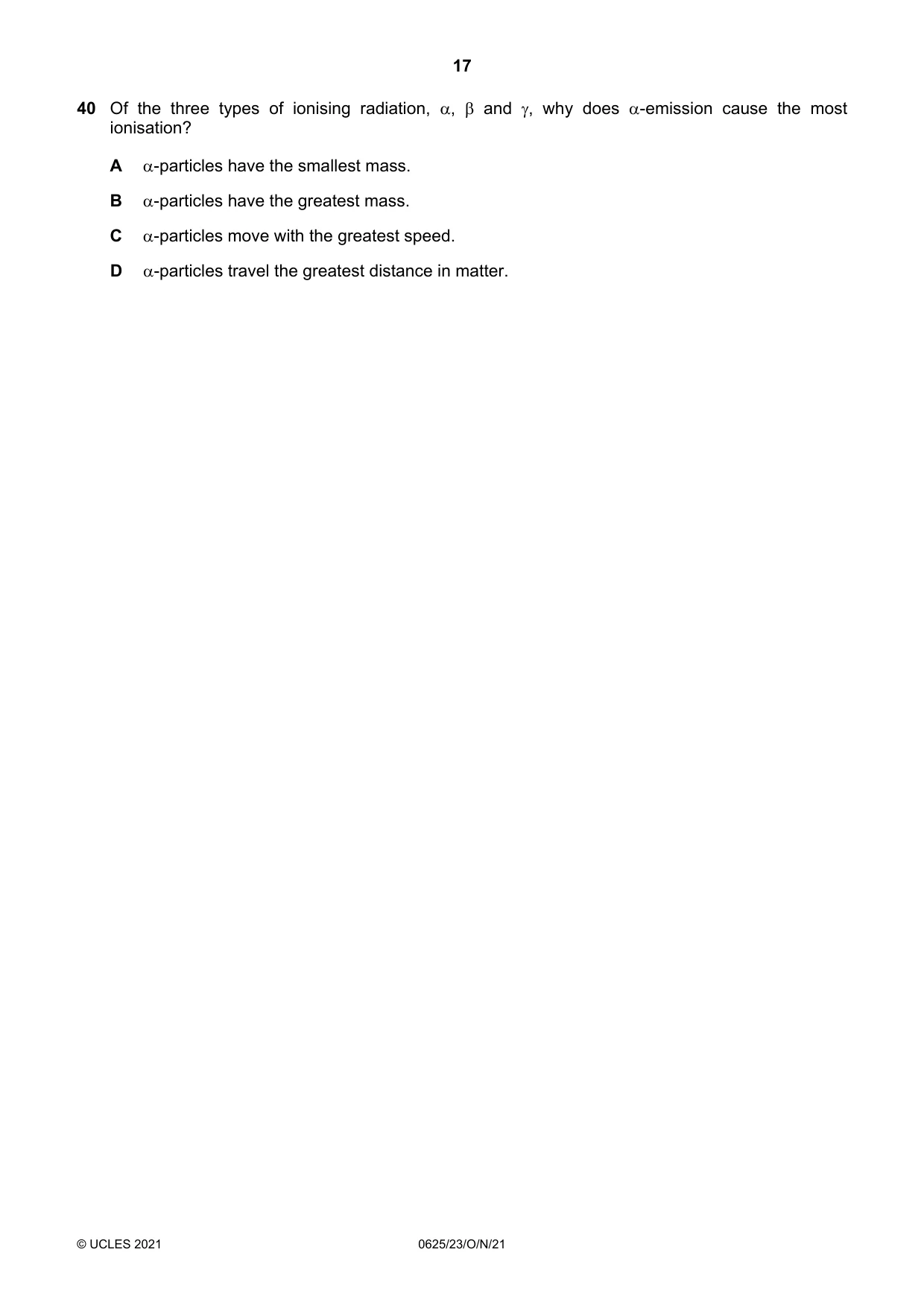


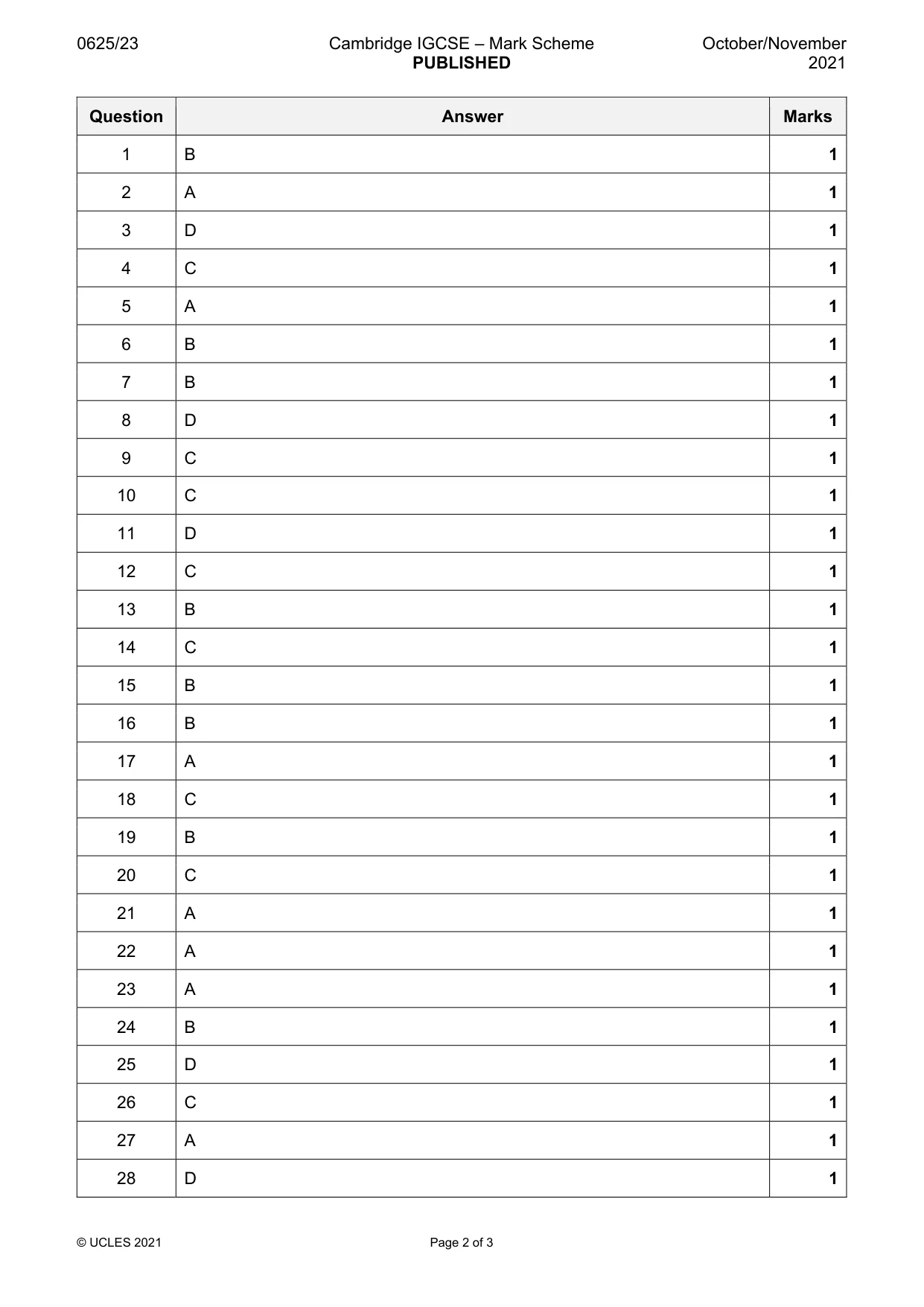
Mark scheme3 pages
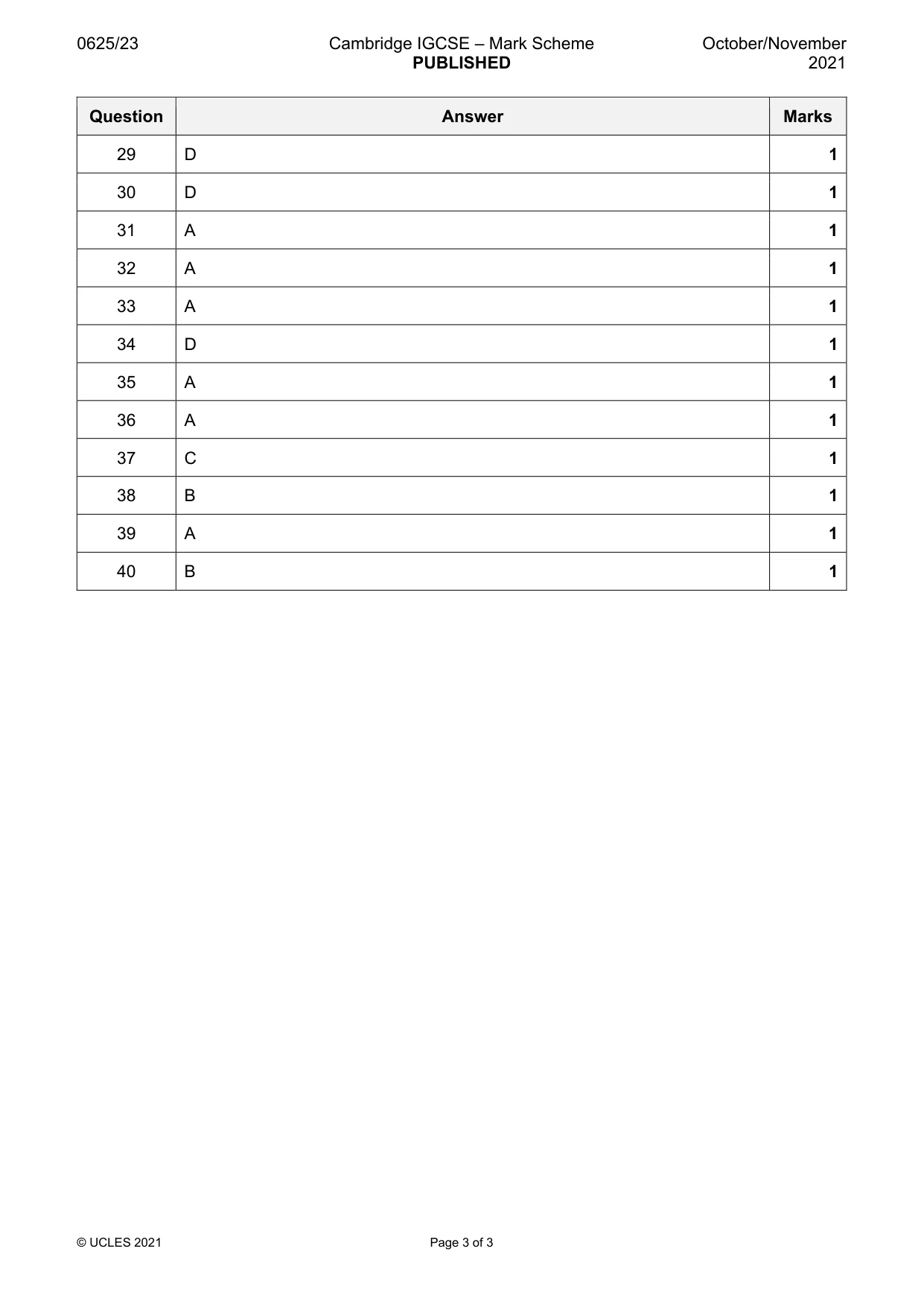
Answers below. Sit the paper first if you are practising.
Questions as text
Q1 · For which purpose is a micrometer screw gauge suitable?
1 For which purpose is a micrometer screw gauge suitable? A measuring the current in a coil that is known to be about 3 10–6 A B measuring the diameter of a ball bearing that is known to be about 3 10–3 m C measuring the mass of a grain of sand that is known to be about 3 10–3 g D measuring the moment used to turn a screw that is known to be about 3 10–6 N m
Mark scheme: B
More questions on Physical quantities and measurement techniques
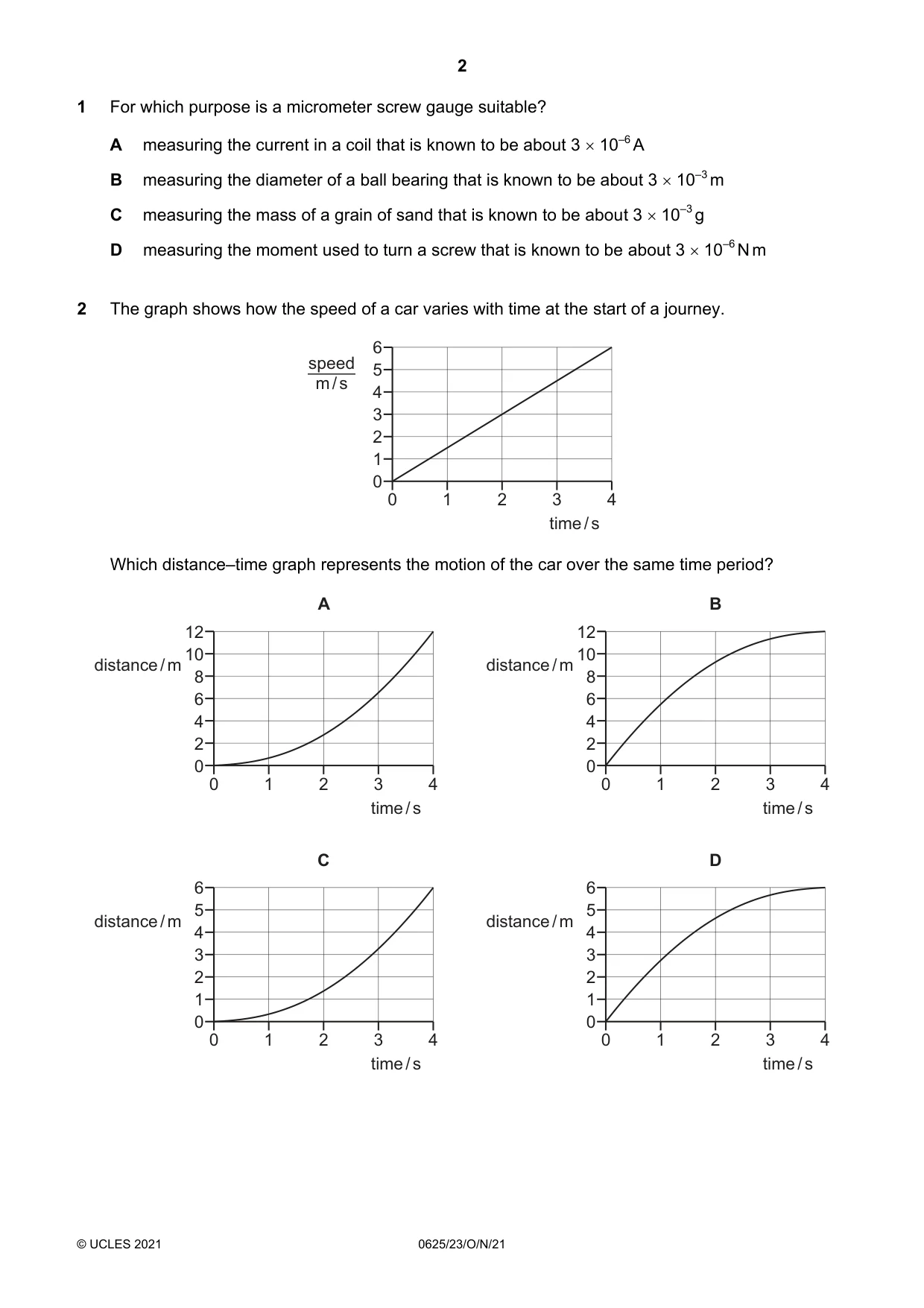
Q2 · The graph shows how the speed of a car varies with time at the start of a journey
2 The graph shows how the speed of a car varies with time at the start of a journey. 6 speed 5 m / s 4 3 2 1 0 0 1 2 3 4 time / s Which distance–time graph represents the motion of the car over the same time period? A B 12 12 10 10 distance / m distance / m 8 8 6 6 4 4 2 2 0 0 0 1 2 3 4 0 1 2 3 4 time / s time / s C D 6 6 5 5 distance / m distance / m 4 4 3 3 2 2 1 1 0 0 0 1 2 3 4 0 1 2 3 4 time / s time / s
Mark scheme: A
Q3 · Which statement about mass and weight is correct?
3 Which statement about mass and weight is correct? A Mass is a property that causes change in motion. B Mass is caused by a gravitational field acting on a weight. C Weight is a property that resists change in motion. D Weight is caused by a gravitational field acting on a mass.
Mark scheme: D
Q4 · Which substance in the table has the lowest density?
4 Which substance in the table has the lowest density? substance mass / g volume / cm3 A nylon 1.2 1.0 B cotton 1.5 1.0 C olive oil 1.8 2.0 D water 2.0 2.0
Mark scheme: C
Q5 · The diagram shows a uniform bar resting on two supports, P and Q
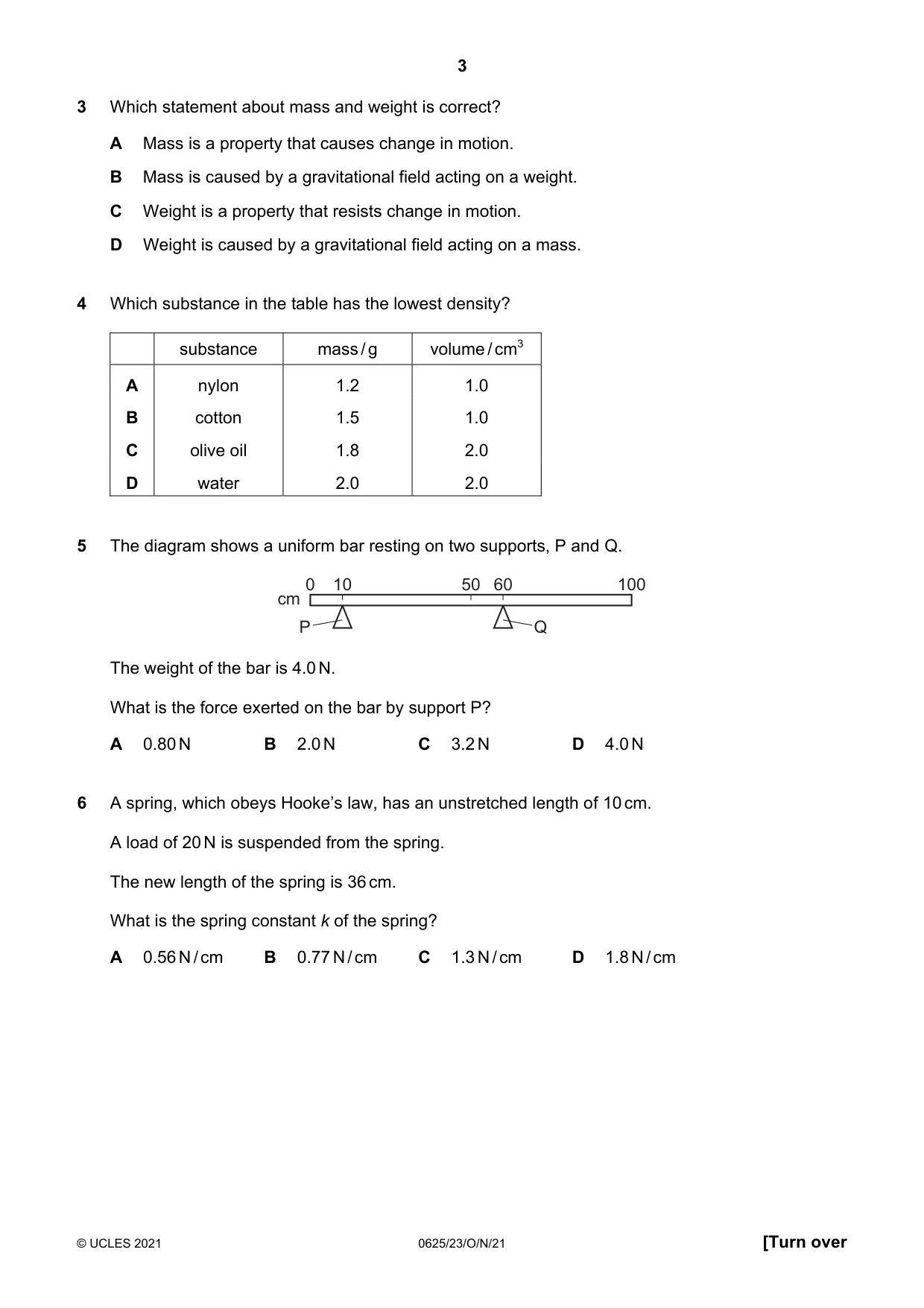
5 The diagram shows a uniform bar resting on two supports, P and Q. 0 10 50 60 100 cm P Q The weight of the bar is 4.0 N. What is the force exerted on the bar by support P? A 0.80 N B 2.0 N C 3.2 N D 4.0 N
Mark scheme: A
Q6 · A spring, which obeys Hooke’s law, has an unstretched length of 10 cm
6 A spring, which obeys Hooke’s law, has an unstretched length of 10 cm. A load of 20 N is suspended from the spring. The new length of the spring is 36 cm. What is the spring constant k of the spring? A 0.56 N / cm B 0.77 N / cm C 1.3 N / cm D 1.8 N / cm
Mark scheme: B
Q7 · A cricket ball has a mass of 0.16 kg
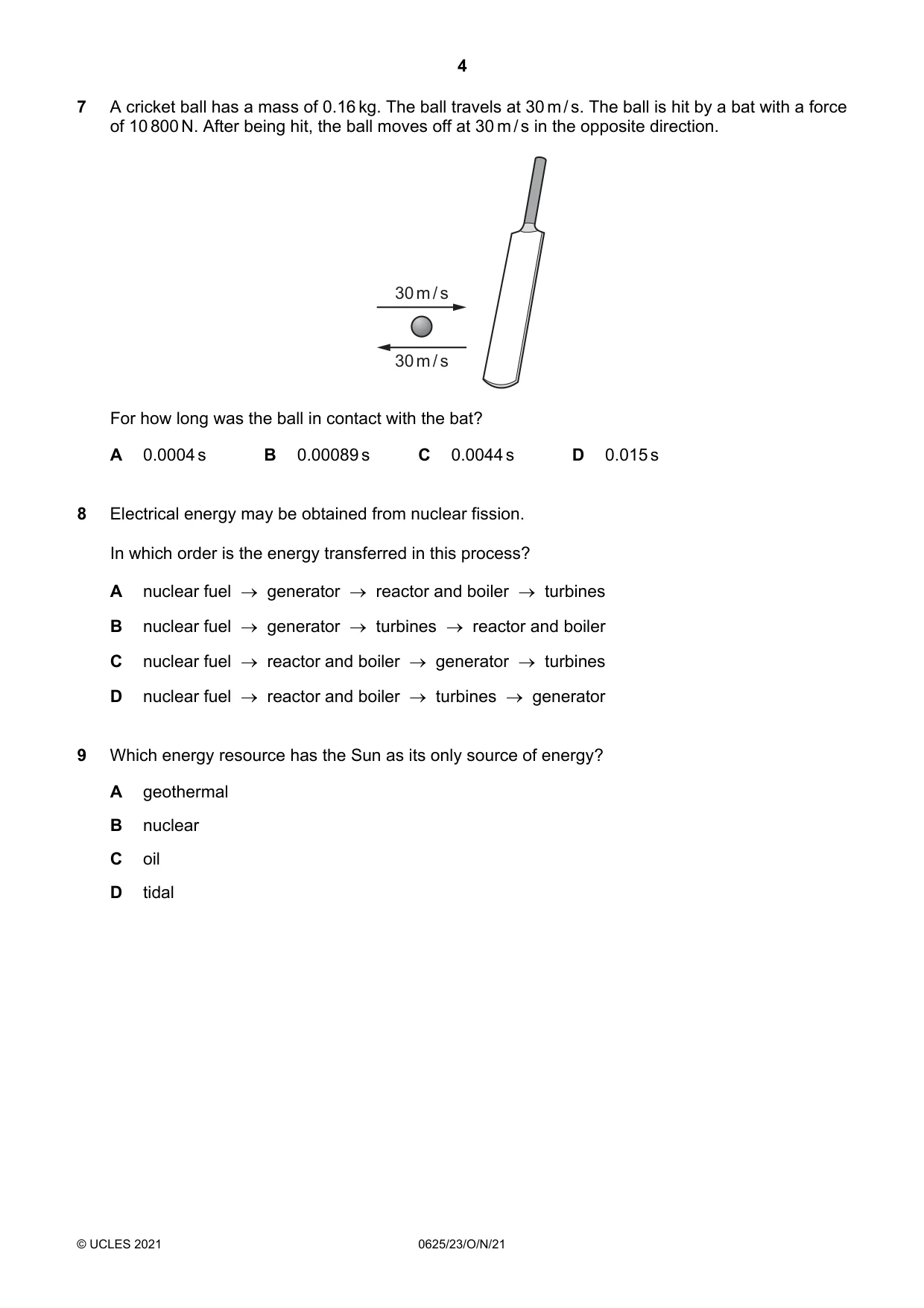
7 A cricket ball has a mass of 0.16 kg. The ball travels at 30 m / s. The ball is hit by a bat with a force of 10 800 N. After being hit, the ball moves off at 30 m / s in the opposite direction. 30 m / s 30 m / s For how long was the ball in contact with the bat? A 0.0004 s B 0.00089 s C 0.0044 s D 0.015 s
Mark scheme: B
Q8 · Electrical energy may be obtained from nuclear fission
8 Electrical energy may be obtained from nuclear fission. In which order is the energy transferred in this process? A nuclear fuel generator reactor and boiler turbines B nuclear fuel generator turbines reactor and boiler C nuclear fuel reactor and boiler generator turbines D nuclear fuel reactor and boiler turbines generator
Mark scheme: D
Q9 · Which energy resource has the Sun as its only source of energy?
9 Which energy resource has the Sun as its only source of energy? A geothermal B nuclear C oil D tidal
Mark scheme: C
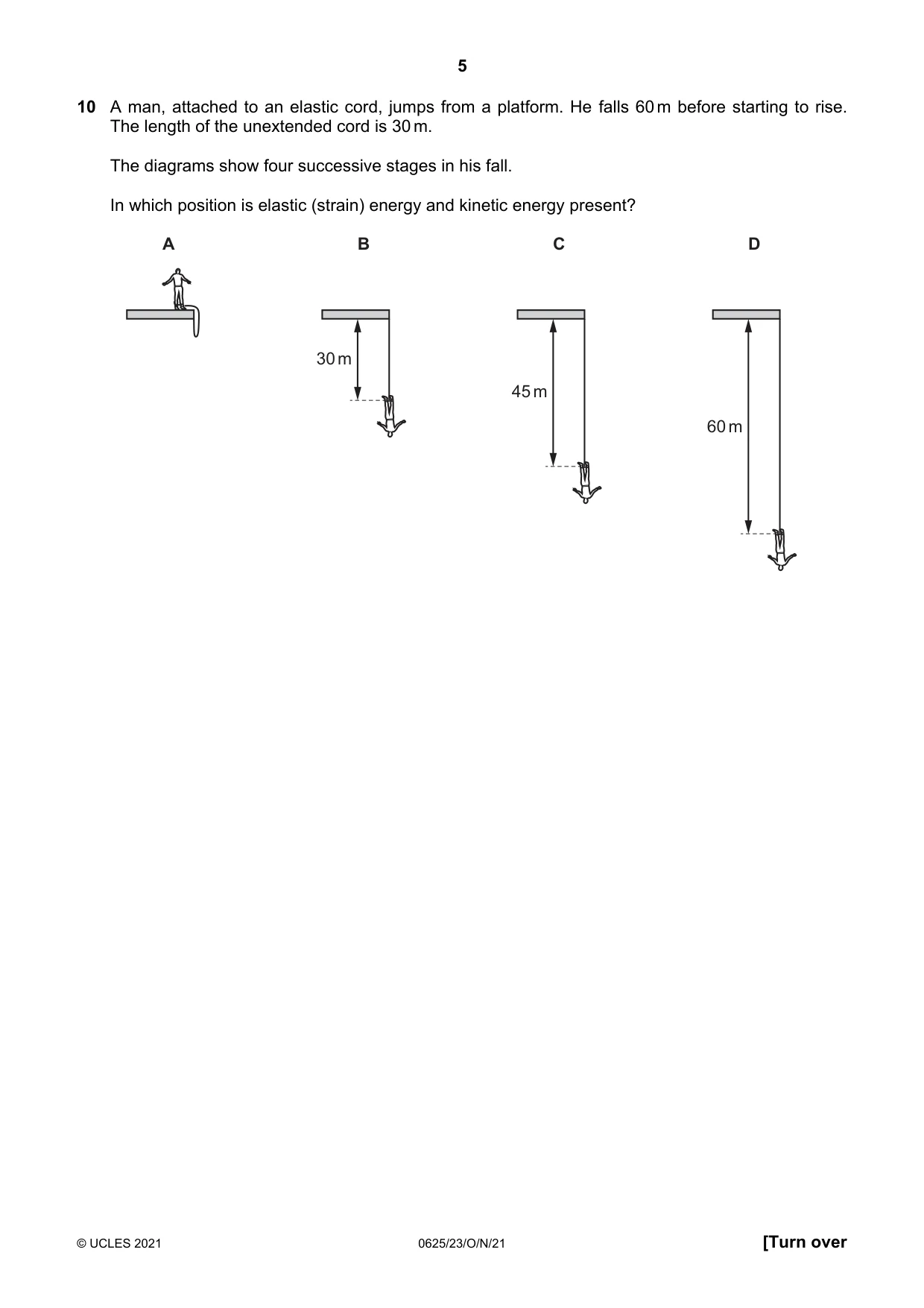
Q10 · A man, attached to an elastic cord, jumps from a platform
10 A man, attached to an elastic cord, jumps from a platform. He falls 60 m before starting to rise. The length of the unextended cord is 30 m. The diagrams show four successive stages in his fall. In which position is elastic (strain) energy and kinetic energy present? A B C D 30 m 45 m 60 m
Mark scheme: C
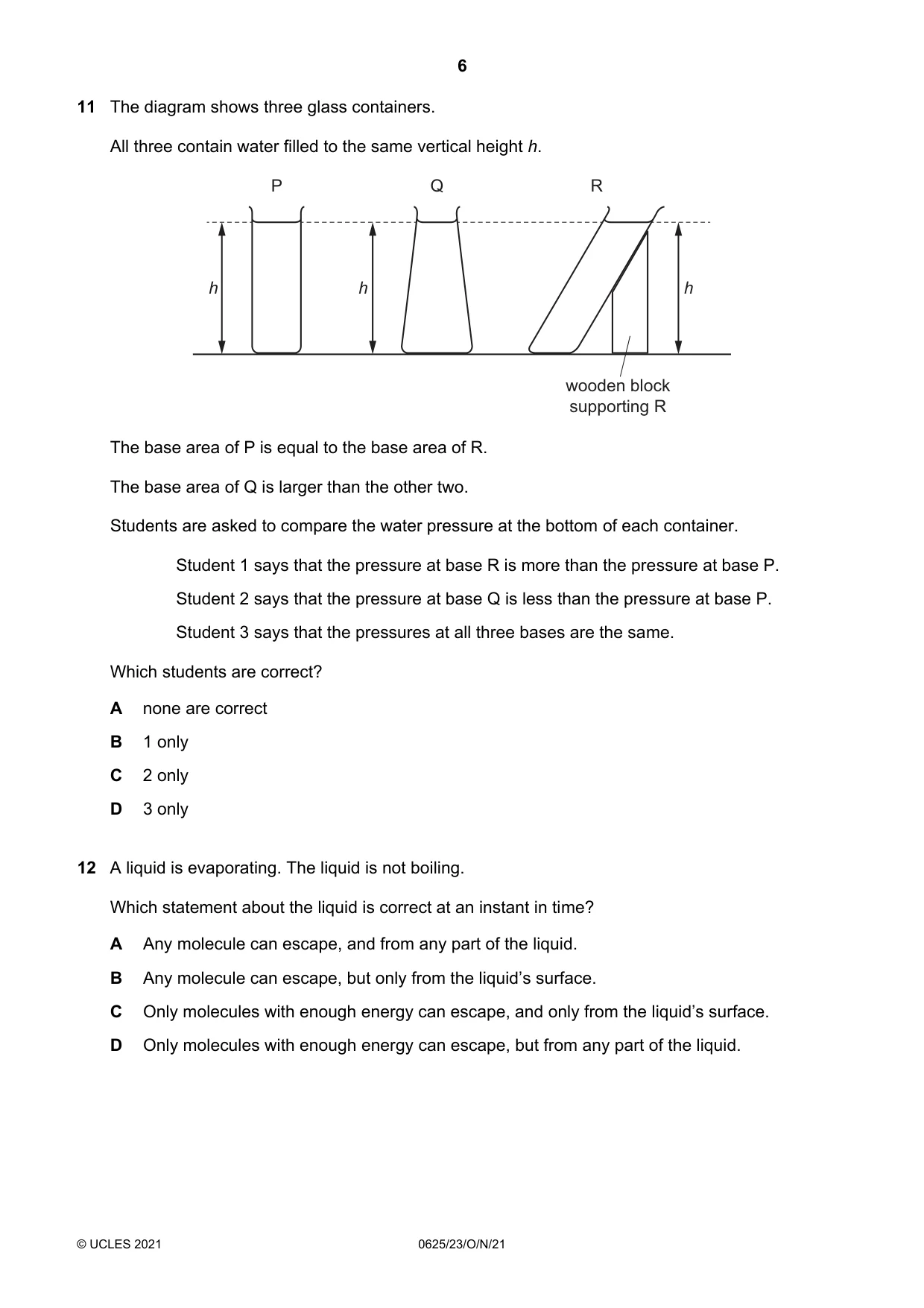
Q11 · The diagram shows three glass containers
11 The diagram shows three glass containers. All three contain water filled to the same vertical height h. P Q R h h h wooden block supporting R The base area of P is equal to the base area of R. The base area of Q is larger than the other two. Students are asked to compare the water pressure at the bottom of each container. Student 1 says that the pressure at base R is more than the pressure at base P. Student 2 says that the pressure at base Q is less than the pressure at base P. Student 3 says that the pressures at all three bases are the same. Which students are correct? A none are correct B 1 only C 2 only D 3 only
Mark scheme: D
Q12 · A liquid is evaporating
12 A liquid is evaporating. The liquid is not boiling. Which statement about the liquid is correct at an instant in time? A Any molecule can escape, and from any part of the liquid. B Any molecule can escape, but only from the liquid’s surface. C Only molecules with enough energy can escape, and only from the liquid’s surface. D Only molecules with enough energy can escape, but from any part of the liquid.
Mark scheme: C
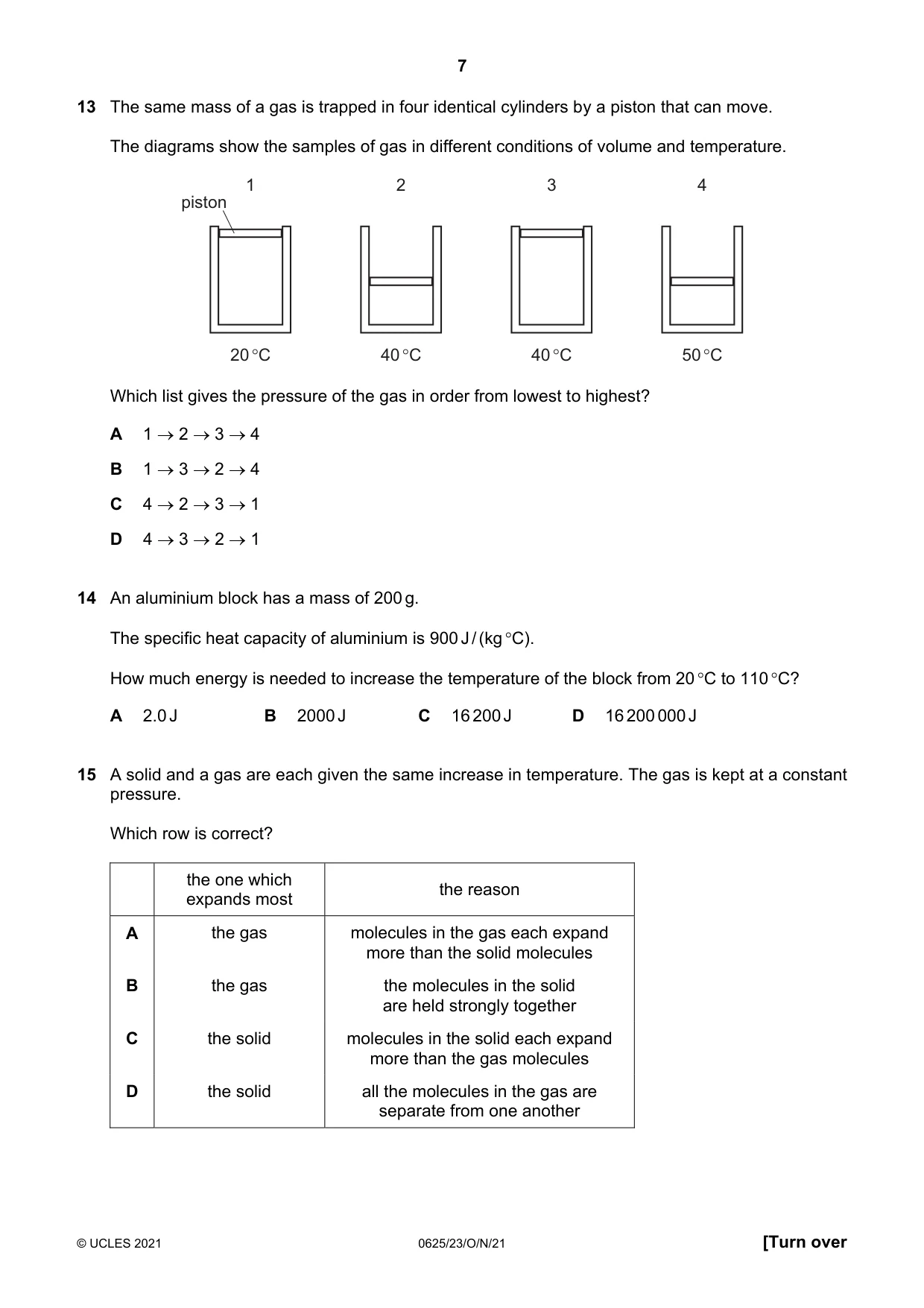
Q13 · The same mass of a gas is trapped in four identical cylinders by a piston that can move
13 The same mass of a gas is trapped in four identical cylinders by a piston that can move. The diagrams show the samples of gas in different conditions of volume and temperature. 1 2 3 4 piston 20 °C 40 °C 40 °C 50 °C Which list gives the pressure of the gas in order from lowest to highest? A 1 2 3 4 B 1 3 2 4 C 4 2 3 1 D 4 3 2 1
Mark scheme: B
Q14 · An aluminium block has a mass of 200 g
14 An aluminium block has a mass of 200 g. The specific heat capacity of aluminium is 900 J / (kg C). How much energy is needed to increase the temperature of the block from 20 C to 110 C? A 2.0 J B 2000 J C 16 200 J D 16 200 000 J
Mark scheme: C
Q15 · A solid and a gas are each given the same increase in temperature
15 A solid and a gas are each given the same increase in temperature. The gas is kept at a constant pressure. Which row is correct? the one which the reason expands most A the gas molecules in the gas each expand more than the solid molecules B the gas the molecules in the solid are held strongly together C the solid molecules in the solid each expand more than the gas molecules D the solid all the molecules in the gas are separate from one another
Mark scheme: B
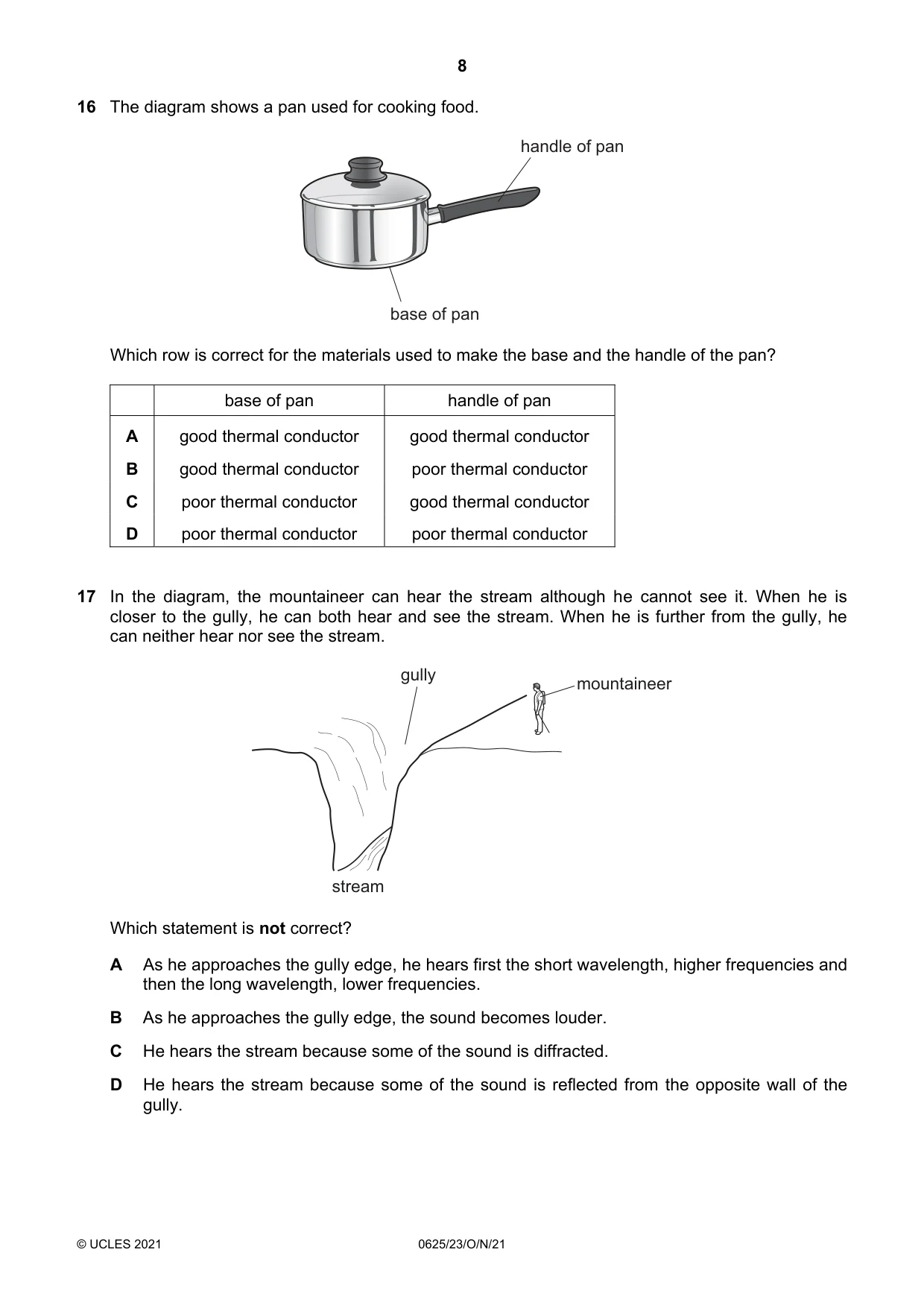
Q16 · The diagram shows a pan used for cooking food
16 The diagram shows a pan used for cooking food. handle of pan base of pan Which row is correct for the materials used to make the base and the handle of the pan? base of pan handle of pan A good thermal conductor good thermal conductor B good thermal conductor poor thermal conductor C poor thermal conductor good thermal conductor D poor thermal conductor poor thermal conductor
Mark scheme: B
Q17 · In the diagram, the mountaineer can hear the stream although he cannot see it
17 In the diagram, the mountaineer can hear the stream although he cannot see it. When he is closer to the gully, he can both hear and see the stream. When he is further from the gully, he can neither hear nor see the stream. gully mountaineer stream Which statement is not correct? A As he approaches the gully edge, he hears first the short wavelength, higher frequencies and then the long wavelength, lower frequencies. B As he approaches the gully edge, the sound becomes louder. C He hears the stream because some of the sound is diffracted. D He hears the stream because some of the sound is reflected from the opposite wall of the gully.
Mark scheme: A
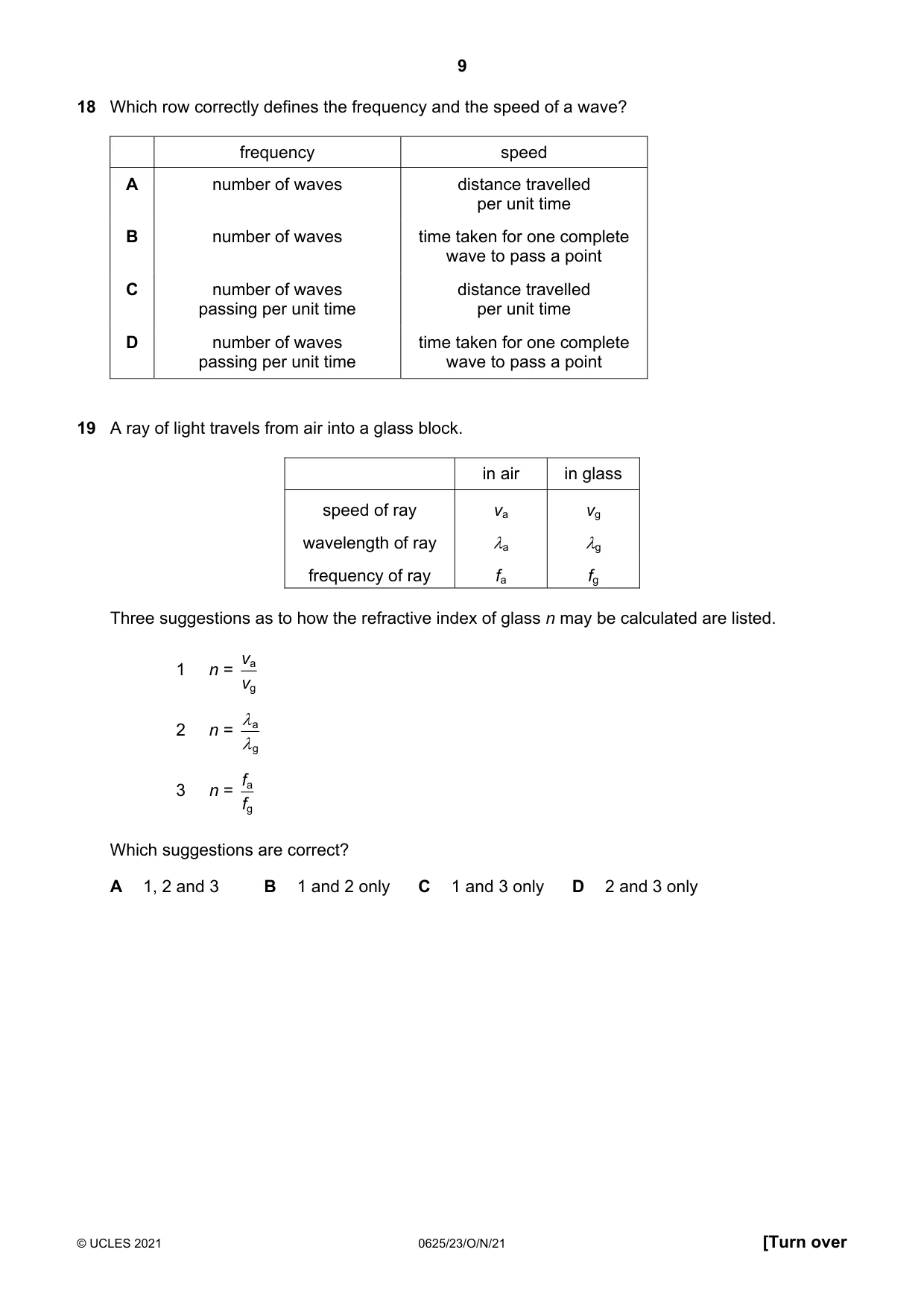
Q18 · Which row correctly defines the frequency and the speed of a wave?
18 Which row correctly defines the frequency and the speed of a wave? frequency speed A number of waves distance travelled per unit time B number of waves time taken for one complete wave to pass a point C number of waves distance travelled passing per unit time per unit time D number of waves time taken for one complete passing per unit time wave to pass a point
Mark scheme: C
Q19 · A ray of light travels from air into a glass block
19 A ray of light travels from air into a glass block. in air in glass speed of ray va vg wavelength of ray a g frequency of ray fa fg Three suggestions as to how the refractive index of glass n may be calculated are listed. v 1 n = v a g 2 n = a g f 3 n = a f g Which suggestions are correct? A 1, 2 and 3 B 1 and 2 only C 1 and 3 only D 2 and 3 only
Mark scheme: B
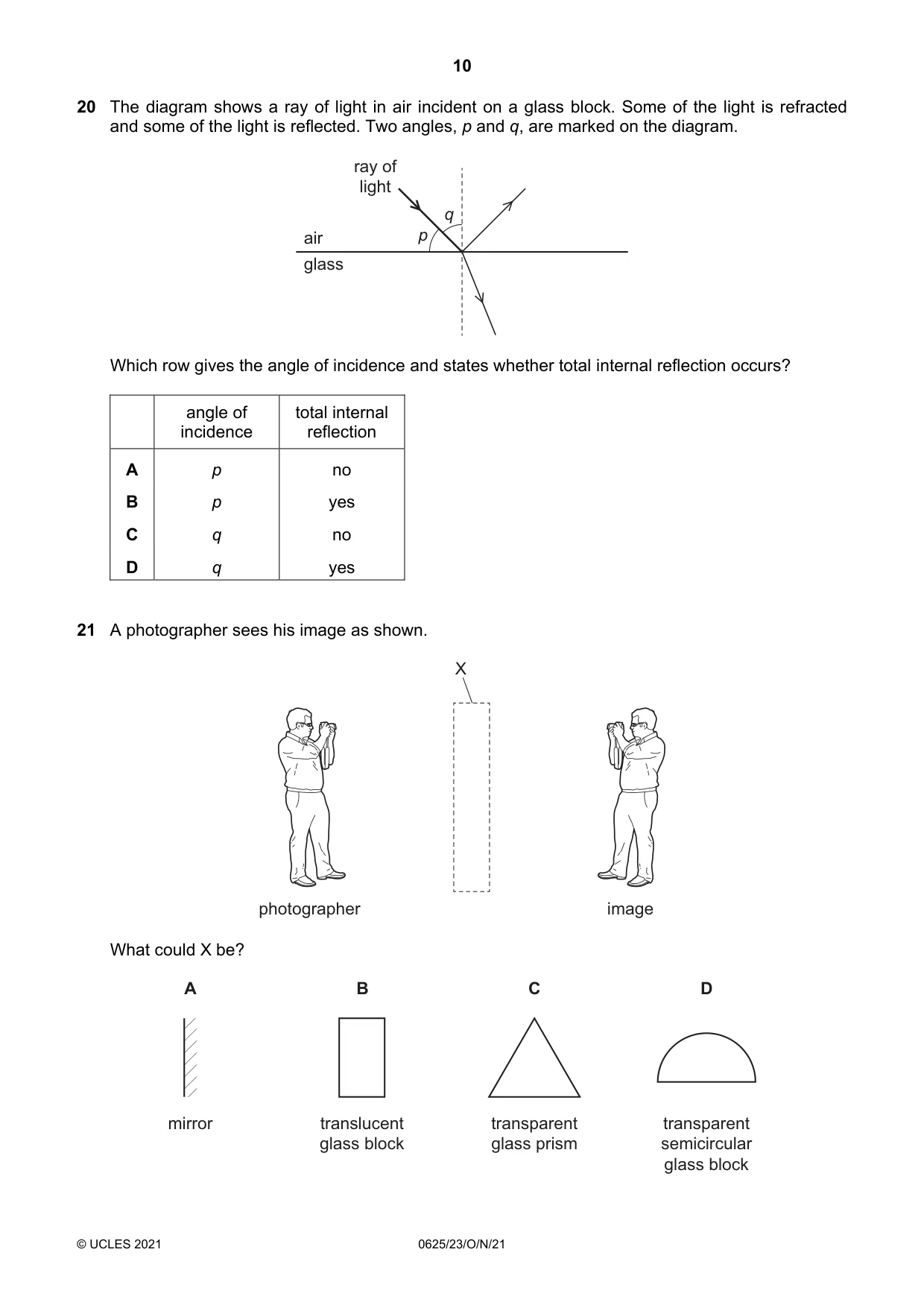
Q20 · The diagram shows a ray of light in air incident on a glass block
20 The diagram shows a ray of light in air incident on a glass block. Some of the light is refracted and some of the light is reflected. Two angles, p and q, are marked on the diagram. ray of light q air p glass Which row gives the angle of incidence and states whether total internal reflection occurs? angle of total internal incidence reflection A p no B p yes C q no D q yes
Mark scheme: C
Q21 · A photographer sees his image as shown
21 A photographer sees his image as shown. X photographer image What could X be? A B C D mirror translucent transparent transparent glass block glass prism semicircular glass block
Mark scheme: A
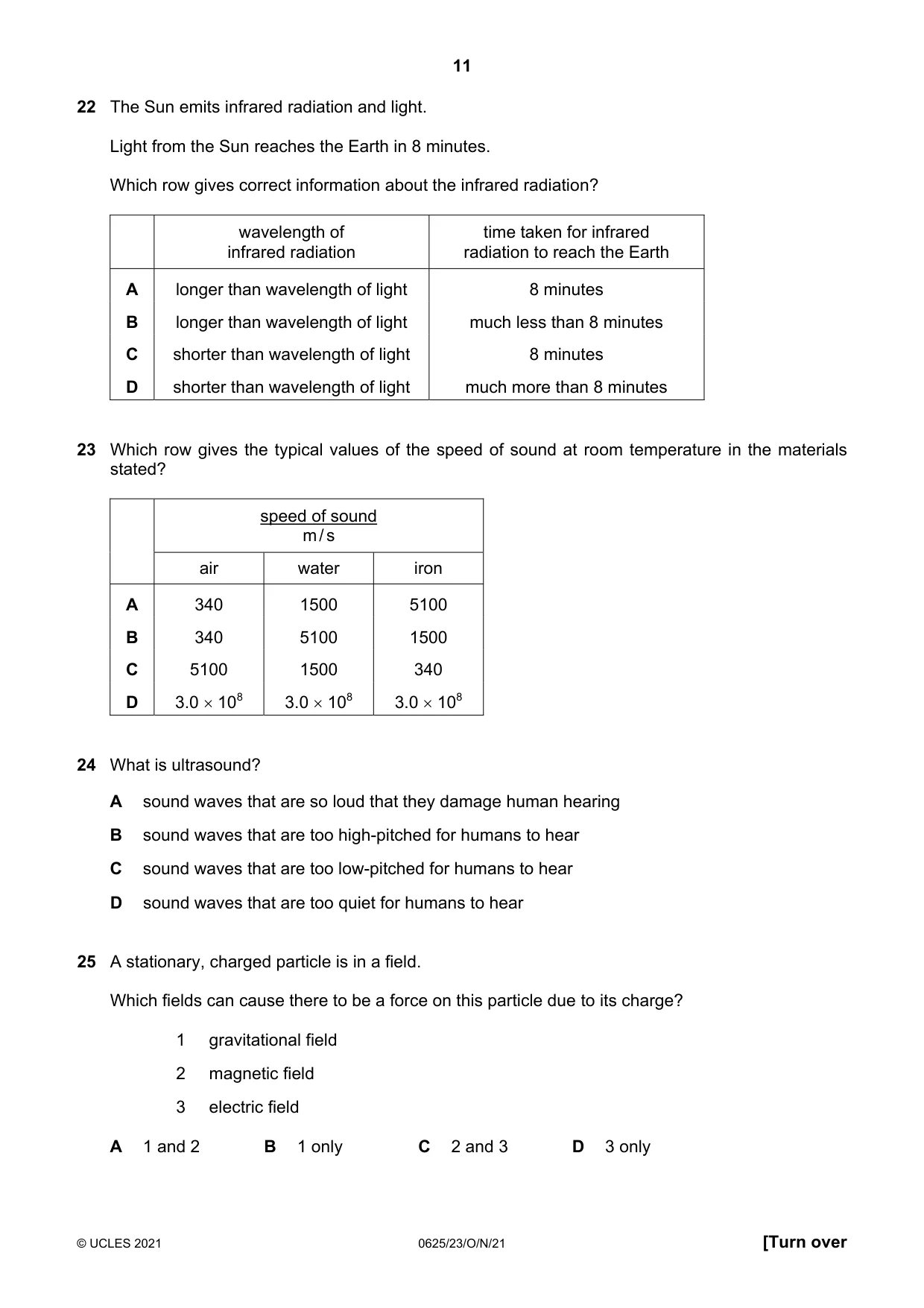
Q22 · The Sun emits infrared radiation and light
22 The Sun emits infrared radiation and light. Light from the Sun reaches the Earth in 8 minutes. Which row gives correct information about the infrared radiation? wavelength of time taken for infrared infrared radiation radiation to reach the Earth A longer than wavelength of light 8 minutes B longer than wavelength of light much less than 8 minutes C shorter than wavelength of light 8 minutes D shorter than wavelength of light much more than 8 minutes
Mark scheme: A
Q23 · Which row gives the typical values of the speed of sound at room temperature in the…
23 Which row gives the typical values of the speed of sound at room temperature in the materials stated? speed of sound m / s air water iron A 340 1500 5100 B 340 5100 1500 C 5100 1500 340 D 3.0 108 3.0 108 3.0 108
Mark scheme: A
Question 24
24 What is ultrasound? A sound waves that are so loud that they damage human hearing B sound waves that are too high-pitched for humans to hear C sound waves that are too low-pitched for humans to hear D sound waves that are too quiet for humans to hear
Mark scheme: B
Q25 · A stationary, charged particle is in a field
25 A stationary, charged particle is in a field. Which fields can cause there to be a force on this particle due to its charge? 1 gravitational field 2 magnetic field 3 electric field A 1 and 2 B 1 only C 2 and 3 D 3 only
Mark scheme: D
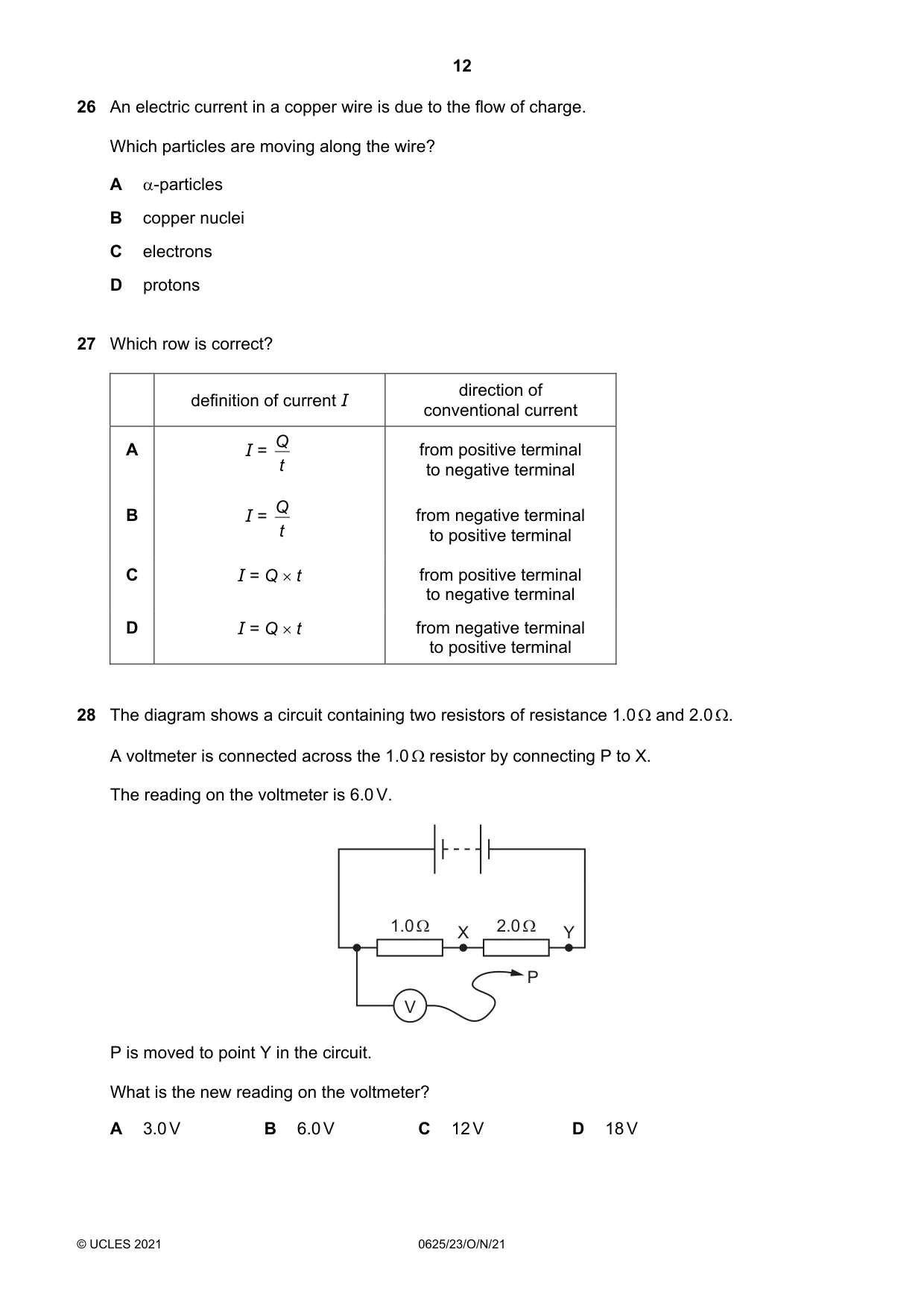
Q26 · An electric current in a copper wire is due to the flow of charge
26 An electric current in a copper wire is due to the flow of charge. Which particles are moving along the wire? A -particles B copper nuclei C electrons D protons
Mark scheme: C
Q27 · Which row is correct?
27 Which row is correct? direction of definition of current I conventional current I = Q A from positive terminal t to negative terminal I = Q B from negative terminal t to positive terminal C I = Q t from positive terminal to negative terminal D I = Q t from negative terminal to positive terminal
Mark scheme: A
Q28 · The diagram shows a circuit containing two resistors of resistance 1.0 and 2.0
28 The diagram shows a circuit containing two resistors of resistance 1.0 and 2.0 . A voltmeter is connected across the 1.0 resistor by connecting P to X. The reading on the voltmeter is 6.0 V. 1.0 Ω X 2.0 Ω Y P V P is moved to point Y in the circuit. What is the new reading on the voltmeter? A 3.0 V B 6.0 V C 12 V D 18 V
Mark scheme: D
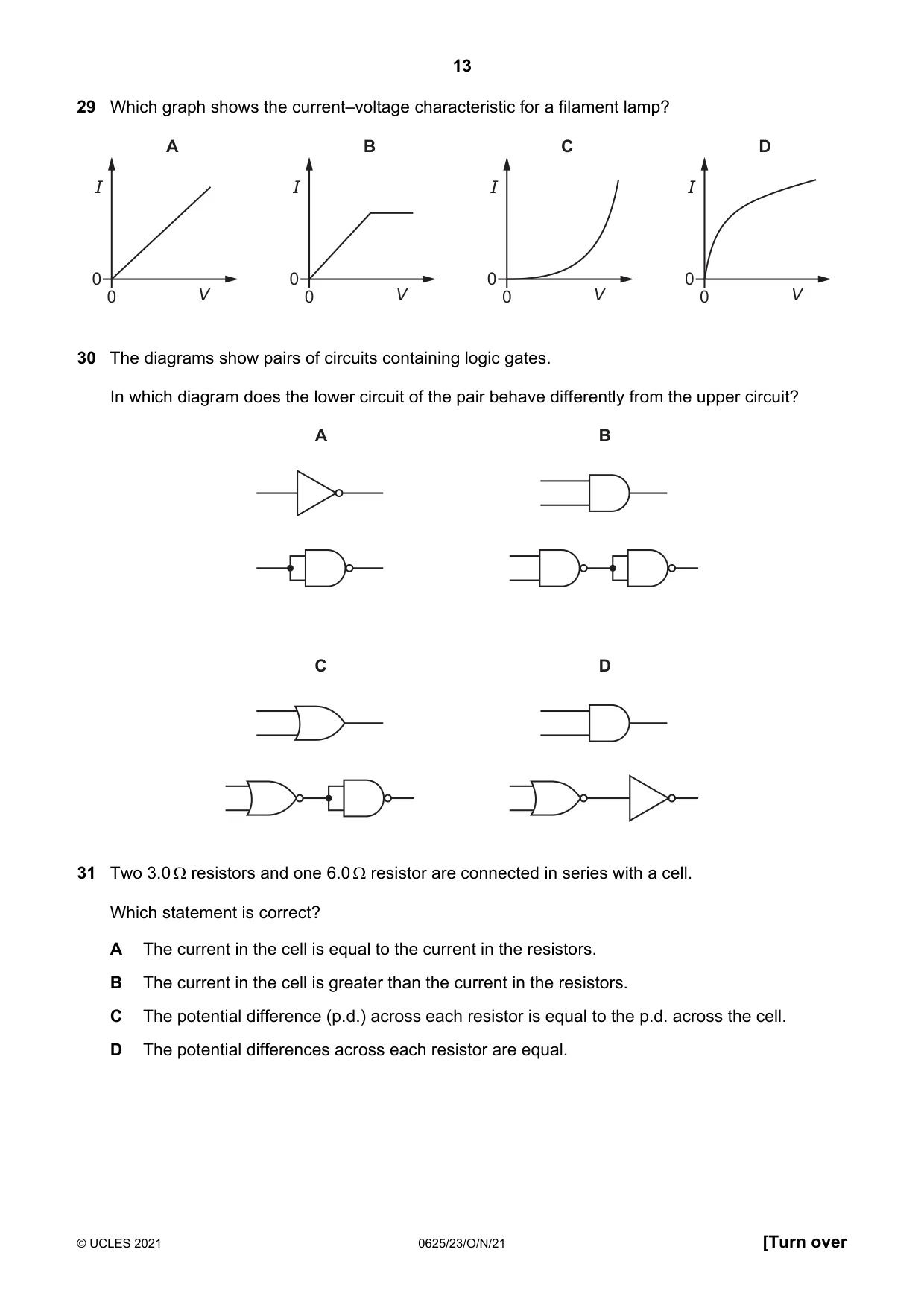
Q29 · Which graph shows the current–voltage characteristic for a filament lamp?
29 Which graph shows the current–voltage characteristic for a filament lamp? A B C D I I I I 0 0 0 0 0 V 0 V 0 V 0 V
Mark scheme: D
Q30 · The diagrams show pairs of circuits containing logic gates
30 The diagrams show pairs of circuits containing logic gates. In which diagram does the lower circuit of the pair behave differently from the upper circuit? A B C D
Mark scheme: D
Q31 · Two 3.0 resistors and one 6.0 resistor are connected in series with a cell
31 Two 3.0 resistors and one 6.0 resistor are connected in series with a cell. Which statement is correct? A The current in the cell is equal to the current in the resistors. B The current in the cell is greater than the current in the resistors. C The potential difference (p.d.) across each resistor is equal to the p.d. across the cell. D The potential differences across each resistor are equal.
Mark scheme: A
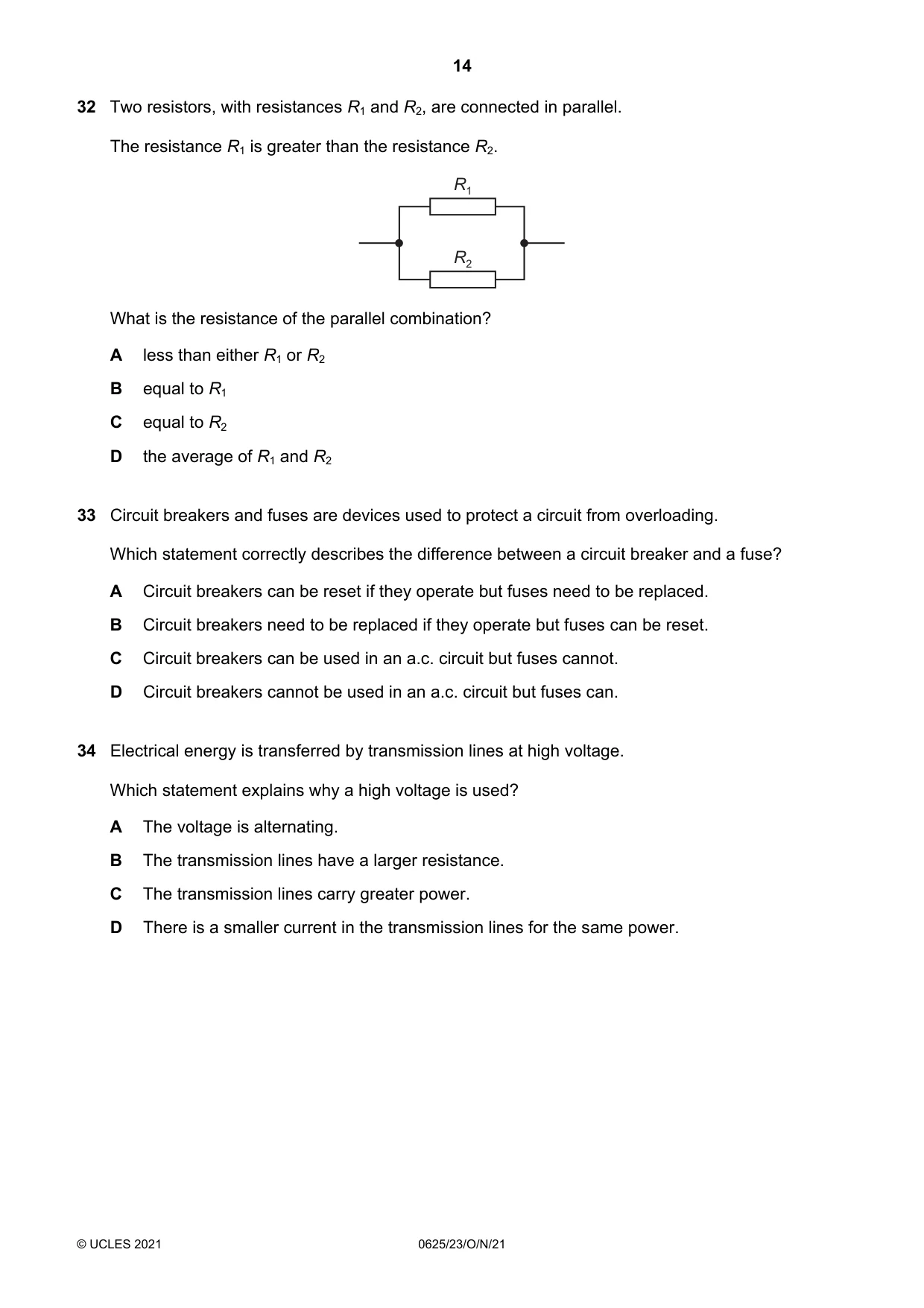
Q32 · Two resistors, with resistances R1 and R2, are connected in parallel
32 Two resistors, with resistances R1 and R2, are connected in parallel. The resistance R1 is greater than the resistance R2. R1 R2 What is the resistance of the parallel combination? A less than either R1 or R2 B equal to R1 C equal to R2 D the average of R1 and R2
Mark scheme: A
Q33 · Circuit breakers and fuses are devices used to protect a circuit from overloading
33 Circuit breakers and fuses are devices used to protect a circuit from overloading. Which statement correctly describes the difference between a circuit breaker and a fuse? A Circuit breakers can be reset if they operate but fuses need to be replaced. B Circuit breakers need to be replaced if they operate but fuses can be reset. C Circuit breakers can be used in an a.c. circuit but fuses cannot. D Circuit breakers cannot be used in an a.c. circuit but fuses can.
Mark scheme: A
Q34 · Electrical energy is transferred by transmission lines at high voltage
34 Electrical energy is transferred by transmission lines at high voltage. Which statement explains why a high voltage is used? A The voltage is alternating. B The transmission lines have a larger resistance. C The transmission lines carry greater power. D There is a smaller current in the transmission lines for the same power.
Mark scheme: D
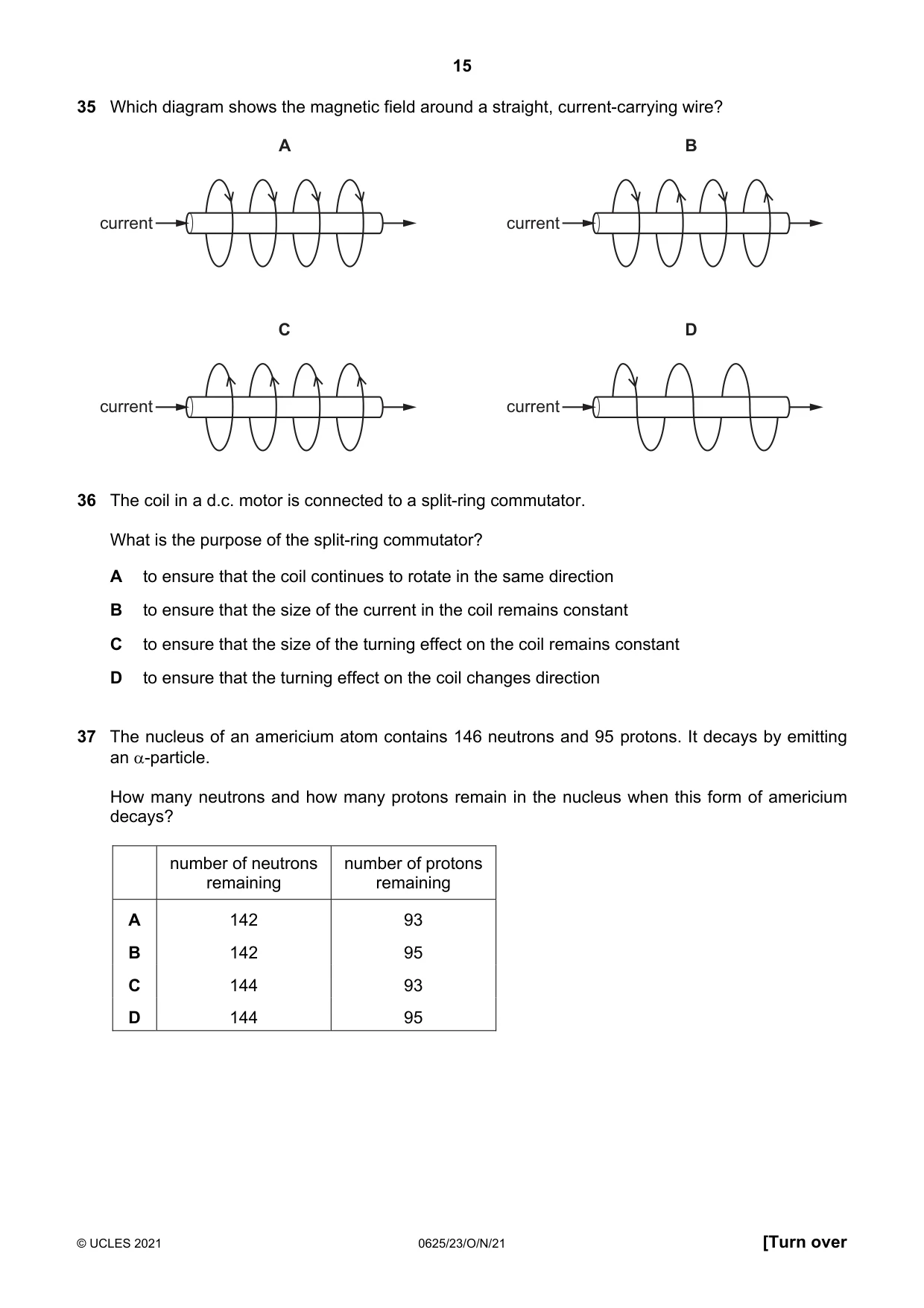
Q35 · Which diagram shows the magnetic field around a straight, current-carrying wire?
35 Which diagram shows the magnetic field around a straight, current-carrying wire? A B current current C D current current
Mark scheme: A
Q36 · The coil in a d.c
36 The coil in a d.c. motor is connected to a split-ring commutator. What is the purpose of the split-ring commutator? A to ensure that the coil continues to rotate in the same direction B to ensure that the size of the current in the coil remains constant C to ensure that the size of the turning effect on the coil remains constant D to ensure that the turning effect on the coil changes direction
Mark scheme: A
Q37 · The nucleus of an americium atom contains 146 neutrons and 95 protons
37 The nucleus of an americium atom contains 146 neutrons and 95 protons. It decays by emitting an -particle. How many neutrons and how many protons remain in the nucleus when this form of americium decays? number of neutrons number of protons remaining remaining A 142 93 B 142 95 C 144 93 D 144 95
Mark scheme: C
Q38 · The half-life for lead-202 is 52 500 years
38 The half-life for lead-202 is 52 500 years. A sample of lead-202 produces 800 counts / s. How long will it take for the count rate to drop to 100 counts / s? A 105 000 years B 157 500 years C 210 000 years D 420 000 years
Mark scheme: B
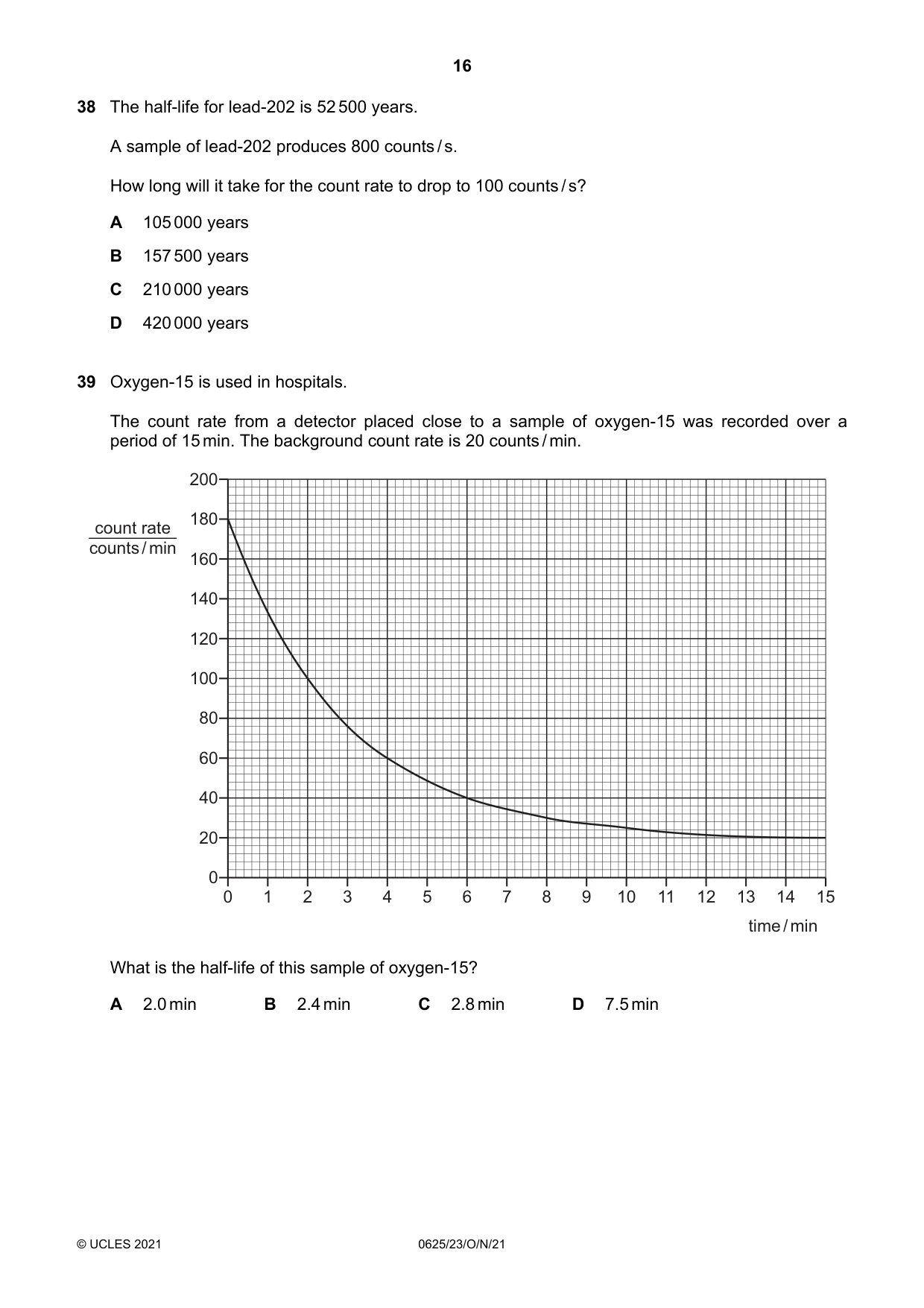
Q39 · Oxygen-15 is used in hospitals
39 Oxygen-15 is used in hospitals. The count rate from a detector placed close to a sample of oxygen-15 was recorded over a period of 15 min. The background count rate is 20 counts / min. 200 180 count rate counts / min 160 140 120 100 80 60 40 20 0 0 1 2 3 4 5 6 7 8 9 10 11 12 13 14 15 time / min What is the half-life of this sample of oxygen-15? A 2.0 min B 2.4 min C 2.8 min D 7.5 min
Mark scheme: A
Q40 · Of the three types of ionising radiation, , and , why does -emission cause the most…
40 Of the three types of ionising radiation, , and , why does -emission cause the most ionisation? A -particles have the smallest mass. B -particles have the greatest mass. C -particles move with the greatest speed. D -particles travel the greatest distance in matter.
Mark scheme: B
What was in this paper
The subtopics covered by these 40 questions, and how many questions each got. Open one in a new tab to see every Cambridge question on it.
6Electrical quantities3Energy, work and power3Kinetic particle model of matter3Light3Radioactivity3Sound3Forces2Density1Electrical safety1Electromagnetic effects1Electromagnetic spectrum1General properties of waves1Mass and weight1Momentum1Motion1Physical quantities and measurement techniques1Pressure1Simple phenomena of magnetism1The nuclear model of the atom1Thermal properties and temperature1Transfer of thermal energy1What you needed in this session
Cambridge’s own grade thresholds for 2021 Oct/Nov, Paper 2 · Variant 3. A higher threshold means an easier paper — the bar moves with how the cohort did.