Questions as text
Q1 · An object is released from rest and falls to Earth 0625/22 Feb/March 2016
3 An object is released from rest and falls to Earth. During its fall, the object is affected by air resistance. The air resistance eventually reaches a constant value. Which description about successive stages of the motion of the object is correct? A constant acceleration, then constant deceleration B constant deceleration, then zero acceleration C decreasing acceleration, then constant deceleration D decreasing acceleration, then zero acceleration
1 marks
Answer: D
This question in 0625/22 Feb/March 2016
Q2 · The diagram shows an object moving at a constant speed in a circular path in the… 0625/22 Feb/March 2016
6 The diagram shows an object moving at a constant speed in a circular path in the direction shown. A force acts on the object to keep it in the circular path. In which labelled direction does this force act, when the object is in the position shown? object A D B C path of object
1 marks
Answer: B
This question in 0625/22 Feb/March 2016
Q3 · A spring obeys Hooke’s law 0625/22 Feb/March 2016
7 A spring obeys Hooke’s law. Which graph is obtained by plotting the extension of the spring against the load applied? A B extension extension 0 0 0 load 0 load C D extension extension 0 0 0 load 0 load
1 marks
Answer: A
This question in 0625/22 Feb/March 2016
Q4 · A satellite orbits the Earth above the atmosphere at a constant speed 0625/21 May/June 2016
4 A satellite orbits the Earth above the atmosphere at a constant speed. The diagram shows the satellite at one point in its circular orbit around the Earth. Which labelled arrow shows the direction of the resultant force on the satellite at the position shown? direction of rotation of satellite A D B Earth satellite C
1 marks
Answer: D
This question in 0625/21 May/June 2016
Q5 · The diagrams show three uniform beams P, Q and R, each pivoted at its centre 0625/21 May/June 2016
6 The diagrams show three uniform beams P, Q and R, each pivoted at its centre. The two forces acting on each beam are also shown. 2.0 m 1.0 m P 4.0 N 4.0 N 4.0 m 2.0 m Q 2.0 N 5.0 N 2.0 m 4.0 m R 1.5 N 1.0 N Which beams rotate clockwise? A P and Q only B P and R only C Q and R only D P, Q and R
1 marks
Answer: C
This question in 0625/21 May/June 2016
Q6 · A car travels along a straight road 0625/22 May/June 2016
2 A car travels along a straight road. The speed-time graph for this journey is shown. During which labelled part of the journey is the resultant force on the car zero? speed C B D A 0 0 time
1 marks
Answer: B
This question in 0625/22 May/June 2016
Q7 · Below are four statements about acceleration 0625/22 May/June 2016
5 Below are four statements about acceleration. Which statement is not correct? A Acceleration always involves changing speed. B Changing direction always involves acceleration. C Changing speed always involves acceleration. D Circular motion always involves acceleration.
1 marks
Answer: A
This question in 0625/22 May/June 2016
Q8 · The diagram shows a non-uniform beam of weight 120 N, pivoted at one end 0625/22 May/June 2016
6 The diagram shows a non-uniform beam of weight 120 N, pivoted at one end. The beam is kept in equilibrium by force F. 20 cm 60 cm pivot centre of mass of beam weight F 120 N What is the value of force F? A 30 N B 40 N C 360 N D 480 N
1 marks
Answer: A
This question in 0625/22 May/June 2016
Q9 · An object is acted upon by a 3 N force and by a 4 N force 0625/22 May/June 2016
7 An object is acted upon by a 3 N force and by a 4 N force. Each diagram shows the two forces. Which diagram also shows the resultant X of these two forces? A B C D 3 N 3 N 3 N X 4 N 4 N 4 N X X X 3 N 4 N
1 marks
Answer: C
This question in 0625/22 May/June 2016
Q10 · The engine of a car produces a driving force of 5000 N on the car 0625/22 May/June 2016
8 The engine of a car produces a driving force of 5000 N on the car. Resistive forces R also act on the car, as shown. R 5000 N The car has a mass of 800 kg and an acceleration of 1.0 m / s2. What is the value of R? A 800 N B 4200 N C 5800 N D 8000 N
1 marks
Answer: B
This question in 0625/22 May/June 2016
Q11 · An object moves in a circle at constant speed 0625/23 May/June 2016
5 An object moves in a circle at constant speed. Which statement about the force needed on the object is correct? A A force away from the centre of the circle keeps the object moving in the circle. B A force in the direction of motion of the object keeps it moving in the circle. C A force towards the centre of the circle keeps the object moving in the circle. D No force is needed to keep the object moving at constant speed in the circle.
1 marks
Answer: C
This question in 0625/23 May/June 2016
Q12 · A long plank XY lies on the ground 0625/23 May/June 2016
6 A long plank XY lies on the ground. A load of 120 N is placed on it, at a distance of 0.50 m from end X, as shown. End Y is lifted off the ground. The upward force needed to do this is 65 N. load 65 N X Y 0.50 m 1.5 m 2.0 m ground 120 N W In the diagram, W is the weight of the plank, acting at its mid-point. What is the value of W ? A 35 N B 47 N C 100 N D 133 N
1 marks
Answer: C
This question in 0625/23 May/June 2016
Q13 · A spaceship approaches the Earth from deep space 0625/21 Oct/Nov 2016
4 A spaceship approaches the Earth from deep space. Near the Earth, a force on the spaceship causes it to have weight. This causes it to change its speed and direction. Which type of force causes the spaceship’s weight, and which property of the spaceship resists its change in speed and direction? force that property that resists change in causes weight speed and direction A gravitational mass B gravitational volume C magnetic mass D magnetic volume
1 marks
Answer: A
This question in 0625/21 Oct/Nov 2016
Q14 · An object travels in a circular path at constant speed 0625/21 Oct/Nov 2016
6 An object travels in a circular path at constant speed. Which statement about the object is correct? A It has changing kinetic energy. B It has changing momentum. C It has constant velocity. D It is not accelerating.
1 marks
Answer: B
This question in 0625/21 Oct/Nov 2016
Q15 · Which diagram shows the magnitude and direction of the resultant R of the two forces F1… 0625/21 Oct/Nov 2016
7 Which diagram shows the magnitude and direction of the resultant R of the two forces F1 and F2? A B C D F1 F1 F1 F1 R R R R F2 F2 F2 F2
1 marks
Answer: A
This question in 0625/21 Oct/Nov 2016
Q16 · An object tends to keep moving with the same speed and in the same direction due to a… 0625/22 Oct/Nov 2016
4 An object tends to keep moving with the same speed and in the same direction due to a certain property. The object also has weight due to the action of a field. What is the name of the property, and what is the name of the field? property field A mass electric B mass gravitational C volume electric D volume gravitational
1 marks
Answer: B
This question in 0625/22 Oct/Nov 2016
Q17 · An object travels in a circular path at constant speed 0625/22 Oct/Nov 2016
6 An object travels in a circular path at constant speed. Which statement about the object is correct? A It has changing kinetic energy. B It has changing momentum. C It has constant velocity. D It is not accelerating.
1 marks
Answer: B
This question in 0625/22 Oct/Nov 2016
Q18 · The diagrams show a spring and a graph of the length of the spring against the load… 0625/22 Oct/Nov 2016
7 The diagrams show a spring and a graph of the length of the spring against the load applied to it. 8 7 length / cm 6 5 spring length 4 3 load 2 1 0 0 20 40 60 80 100 load / N What is the extension of the spring when a load of 40 N is applied to it? A 1.5 cm B 2.5 cm C 4.0 cm D 6.5 cm
1 marks
Answer: A
This question in 0625/22 Oct/Nov 2016
Q19 · Different loads are hung on a spring 0625/23 Oct/Nov 2016
7 Different loads are hung on a spring. The diagram shows the length of the spring with and without the loads attached. 20 cm 40 cm 65 cm 200 N 400 N What is the extension of the spring when the load is 400 N? A 5 cm B 25 cm C 40 cm D 45 cm
1 marks
Answer: D
This question in 0625/23 Oct/Nov 2016
Q20 · A skydiver jumps from a stationary helicopter and reaches a steady vertical speed 0625/22 Feb/March 2017
6 A skydiver jumps from a stationary helicopter and reaches a steady vertical speed. She then opens her parachute. Which statement about the falling skydiver is correct? A As her parachute opens, her acceleration is upwards. B As she falls at a steady speed with her parachute open, her weight is zero. C When she accelerates, the resultant force on her is zero. D When she falls at a steady speed, air resistance is zero.
1 marks
Answer: A
This question in 0625/22 Feb/March 2017
Q21 · A car moves in a circular path as it turns a corner on a horizontal road 0625/22 Feb/March 2017
7 A car moves in a circular path as it turns a corner on a horizontal road. The car moves at constant speed. path of car car direction of travel Which description of the forces acting on the car is correct? A All the forces are balanced as the car is moving at constant speed. B The forces are unbalanced and the resultant force acts away from the centre of the circle. C The forces are unbalanced and the resultant force acts towards the centre of the circle. D The forces are unbalanced and the resultant force is in the direction of travel of the car.
1 marks
Answer: C
This question in 0625/22 Feb/March 2017
Q22 · A moving body undergoes a change of momentum 0625/22 Feb/March 2017
8 A moving body undergoes a change of momentum. What is a unit for change of momentum? A N m B N / m C N s D N / s
1 marks
Answer: C
This question in 0625/22 Feb/March 2017
Q23 · A skydiver reaches terminal velocity 0625/21 May/June 2017
3 A skydiver reaches terminal velocity. Then he opens his parachute. What happens to the skydiver as the parachute opens? A There is a decrease in weight. B There is acceleration upwards. C There is an increase in speed. D There is movement upwards.
1 marks
Answer: B
This question in 0625/21 May/June 2017
Q24 · A boat is travelling at a steady speed in a straight line across the surface of a lake 0625/21 May/June 2017
6 A boat is travelling at a steady speed in a straight line across the surface of a lake. Which statement about the boat is correct? A The resultant force on the boat is in the direction of motion. B The resultant force on the boat is in the opposite direction to its motion. C The resultant force on the boat is vertically downwards. D The resultant force on the boat is zero.
1 marks
Answer: D
This question in 0625/21 May/June 2017
Q25 · A ball of weight 1.2 N drops through the air at terminal velocity 0625/21 May/June 2017
7 A ball of weight 1.2 N drops through the air at terminal velocity. A sudden gust of wind exerts a horizontal force of 0.5 N on the ball from the left. Which diagram shows the resultant force on the ball while the wind is blowing? A B ball 0.5 N ball 0.5 N 1.2 N resultant 1.2 N resultant force force C D 1.2 N 1.2 N resultant force ball 0.5 N resultant ball 0.5 N force 1.2 N
1 marks
Answer: C
This question in 0625/21 May/June 2017
Q26 · The diagram shows a uniform bridge, 4.0 m long and weighing 10 000 N 0625/21 May/June 2017
8 The diagram shows a uniform bridge, 4.0 m long and weighing 10 000 N. The bridge is pivoted at one end. A force at the other end gradually increases until the bridge begins to lift. lifting bridge force pivot 4.0 m What is the lifting force as the bridge starts to move upwards? A 2500 N B 5000 N C 10 000 N D 20 000 N
1 marks
Answer: B
This question in 0625/21 May/June 2017
Q27 · A box of mass m slides down a slope of length l and vertical height d against a… 0625/21 May/June 2017
10 A box of mass m slides down a slope of length l and vertical height d against a frictional force F. mass m F l d stop As the box slides down the slope, it loses gravitational potential energy and it does work against the friction. Which row gives the loss in gravitational potential energy and the work done against friction? loss in gravitational work done potential energy against friction A mgd Fl B mgd Fd C mgl Fl D mgl Fd
1 marks
Answer: A
This question in 0625/21 May/June 2017
Q28 · In which pair are both quantities measured in newtons? 0625/22 May/June 2017
4 In which pair are both quantities measured in newtons? A force and pressure B force and weight C mass and pressure D mass and weight
1 marks
Answer: B
This question in 0625/22 May/June 2017
Q29 · A spring which obeys Hooke’s Law has an unstretched length of 10 cm 0625/22 May/June 2017
6 A spring which obeys Hooke’s Law has an unstretched length of 10 cm. A load of 20 N is hung from the spring. The new length of the spring is 36 cm. What is the spring constant k of the spring? A 0.56 N / cm B 0.77 N / cm C 1.3 N / cm D 1.8 N / cm
1 marks
Answer: B
This question in 0625/22 May/June 2017
Q30 · A car travels forwards along a straight horizontal road 0625/22 May/June 2017
7 A car travels forwards along a straight horizontal road. Only the horizontal forces acting on it are shown. air resistance and friction driving force The length of each arrow represents the size of each force. How do these forces affect the motion of the car? A The car moves at constant speed. B The car moves backwards. C The car slows down. D The car’s forward speed increases.
1 marks
Answer: C
This question in 0625/22 May/June 2017
Q31 · The diagram shows a wooden beam of weight 20 N 0625/22 May/June 2017
8 The diagram shows a wooden beam of weight 20 N. The centre of mass of the beam is labelled M. There is a pivot at one end of the beam. The beam is kept horizontal by an upward force, F. F 2.0 m 1.2 m pivot M wooden beam 20 N What is the magnitude of F ? A 12 N B 20 N C 30 N D 33 N
1 marks
Answer: A
This question in 0625/22 May/June 2017
Q32 · The diagram shows an object being acted upon by two forces 0625/23 May/June 2017
6 The diagram shows an object being acted upon by two forces. 6.0 N 3.0 N What is the size of the resultant force on the object? A 2.0 N B 3.0 N C 9.0 N D 18 N
1 marks
Answer: B
This question in 0625/23 May/June 2017
Q33 · The diagram shows a man holding a sack and barrow stationary 0625/23 May/June 2017
7 The diagram shows a man holding a sack and barrow stationary. He applies a vertical force to the handle. The centre of mass and the weight of the sack and barrow are shown. The wheel acts as a pivot. force exerted by man centre of mass of sack and barrow 20 cm 80 cm 15 cm 45 cm weight of sack and barrow 200 N What is the magnitude of the vertical force exerted by the man? A 38 N B 50 N C 67 N D 200 N
1 marks
Answer: B
This question in 0625/23 May/June 2017
Q34 · The diagram shows the only two forces F1 and F2 acting on an object 0625/23 May/June 2017
8 The diagram shows the only two forces F1 and F2 acting on an object. The magnitude of each force is represented by the length of each arrow. F1 110° F2 The resultant force acting on the object is R. Which vector diagram shows how forces F1 and F2 add to produce R? A B F1 R F2 110° R 70° F1 F2 C D F1 R F2 110° R 70° F1 F2
1 marks
Answer: D
This question in 0625/23 May/June 2017
Q35 · The diagrams show four bodies moving in the directions shown 0625/23 May/June 2017
9 The diagrams show four bodies moving in the directions shown. The only forces acting on the bodies are shown in each diagram. Which body gains the most kinetic energy when moving a distance of 1.0 m? A B 20 N movement movement 10 N 10 N C D 10 N 25 N 30 N 30 N movement movement
1 marks
Answer: C
This question in 0625/23 May/June 2017
Q36 · An ice crystal falls vertically from a cloud 0625/21 Oct/Nov 2017
3 An ice crystal falls vertically from a cloud. What happens to the acceleration of the ice crystal as it falls? A It decreases because of air resistance. B It decreases because of gravity. C It increases because of air resistance. D It increases because of gravity.
1 marks
Answer: A
This question in 0625/21 Oct/Nov 2017
Q37 · A spring is stretched by hanging a piece of metal from it 0625/21 Oct/Nov 2017
4 A spring is stretched by hanging a piece of metal from it. spring metal Which name is given to the force that stretches the spring? A friction B mass C pressure D weight
1 marks
Answer: D
This question in 0625/21 Oct/Nov 2017
Q38 · A uniform beam XY is 100 cm long and weighs 4.0 N 0625/21 Oct/Nov 2017
6 A uniform beam XY is 100 cm long and weighs 4.0 N. 80 cm 60 cm 10 cm X Y centre pivot of beam F 8.0 N The beam rests on a pivot 60 cm from end X. A load of 8.0 N hangs from the beam 10 cm from end X. The beam is kept balanced by a force F acting on the beam 80 cm from end X. What is the magnitude of force F ? A 8.0 N B 18 N C 22 N D 44 N
1 marks
Answer: C
This question in 0625/21 Oct/Nov 2017
Q39 · The diagrams show four table lamps resting on a table 0625/21 Oct/Nov 2017
7 The diagrams show four table lamps resting on a table. The position of the centre of mass of each lamp is labelled X. Which lamp is the most stable? A B C D X X X X
1 marks
Answer: B
This question in 0625/21 Oct/Nov 2017
Q40 · The diagram shows an incomplete scale drawing to find the resultant of two 10 N forces… 0625/21 Oct/Nov 2017
8 The diagram shows an incomplete scale drawing to find the resultant of two 10 N forces acting at a point in the directions shown. 10 N 10 N What is the magnitude of the resultant force? A 7.5 N B 8.6 N C 18 N D 20 N
1 marks
Answer: C
This question in 0625/21 Oct/Nov 2017
Q41 · A tennis ball of mass 0.060 kg travels horizontally at a speed of 25 m / s 0625/21 Oct/Nov 2017
9 A tennis ball of mass 0.060 kg travels horizontally at a speed of 25 m / s. The ball hits a tennis racket and rebounds horizontally at a speed of 40 m / s. racket ball 25 m / s 40 m / s before hitting racket after hitting racket The ball is in contact with the racket for 50 ms. What force does the racket exert on the ball? A 0.018 N B 0.078 N C 18 N D 78 N
1 marks
Answer: D
This question in 0625/21 Oct/Nov 2017
Q42 · The gravitational field strength on the Earth is greater than the gravitational field… 0625/22 Oct/Nov 2017
3 The gravitational field strength on the Earth is greater than the gravitational field strength on the Moon. The Earth has an atmosphere, but the Moon does not. Which speed-time graph represents the motion of a light ball dropped from a great height near the surface of the Earth and near the surface of the Moon? A B Earth Moon speed speed Earth Moon 0 0 0 time 0 time C D Earth Earth speed speed Moon Moon 0 0 0 time 0 time
1 marks
Answer: C
This question in 0625/22 Oct/Nov 2017
Q43 · A spring is stretched by hanging a piece of metal from it 0625/22 Oct/Nov 2017
4 A spring is stretched by hanging a piece of metal from it. spring metal Which name is given to the force that stretches the spring? A friction B mass C pressure D weight
1 marks
Answer: D
This question in 0625/22 Oct/Nov 2017
Q44 · An object is pivoted at point P 0625/22 Oct/Nov 2017
6 An object is pivoted at point P. A student ties a length of string to a peg on the object. He pulls the string with a force F. string F s t peg r q P object What is the moment of the force F about the point P? A F × q B F × r C F × s D F × t
1 marks
Answer: C
This question in 0625/22 Oct/Nov 2017
Q45 · Each diagram shows a metal plate with four parallel forces acting on it 0625/22 Oct/Nov 2017
7 Each diagram shows a metal plate with four parallel forces acting on it. These are the only forces acting on the plates. In which diagram is the plate in equilibrium? A B 1.0 N 2.0 N 2.0 N 1.0 N 2.0 N 1.0 N 1.0 N 2.0 N C D 1.0 N 1.0 N 2.0 N 1.0 N 2.0 N 2.0 N 2.0 N 2.0 N
1 marks
Answer: C
This question in 0625/22 Oct/Nov 2017
Q46 · The diagram shows an incomplete scale drawing to find the resultant of two 10 N forces… 0625/22 Oct/Nov 2017
8 The diagram shows an incomplete scale drawing to find the resultant of two 10 N forces acting at a point in the directions shown. 10 N 10 N What is the magnitude of the resultant force? A 7.5 N B 8.6 N C 18 N D 20 N
1 marks
Answer: C
This question in 0625/22 Oct/Nov 2017
Q47 · The diagram shows the vertical forces acting on a ball as it falls vertically through the… 0625/23 Oct/Nov 2017
3 The diagram shows the vertical forces acting on a ball as it falls vertically through the air. The ball does not reach terminal velocity. air resistance weight Which row describes what happens to the resultant force on the ball and what happens to the acceleration of the ball as it falls through the air? resultant force acceleration A decreases decreases B decreases increases C increases decreases D increases increases
1 marks
Answer: A
This question in 0625/23 Oct/Nov 2017
Q48 · A spring is stretched by hanging a piece of metal from it 0625/23 Oct/Nov 2017
4 A spring is stretched by hanging a piece of metal from it. spring metal Which name is given to the force that stretches the spring? A friction B mass C pressure D weight
1 marks
Answer: D
This question in 0625/23 Oct/Nov 2017
Q49 · A pair of cutters is used to cut a rope 0625/23 Oct/Nov 2017
6 A pair of cutters is used to cut a rope. blade handle P Q R S blade handle Where should the rope be positioned and at which labelled points should the hands be positioned to produce the greatest cutting force? rope hands positioned positioned A P R B P S C Q R D Q S
1 marks
Answer: D
This question in 0625/23 Oct/Nov 2017
Q50 · The lamp in the diagram is not very stable and falls over easily 0625/23 Oct/Nov 2017
7 The lamp in the diagram is not very stable and falls over easily. shade stem base Which row shows changes that would definitely make the lamp more stable? base centre of gravity A narrower higher B narrower lower C wider higher D wider lower
1 marks
Answer: D
This question in 0625/23 Oct/Nov 2017
Q51 · The diagram shows an incomplete scale drawing to find the resultant of two 10 N forces… 0625/23 Oct/Nov 2017
8 The diagram shows an incomplete scale drawing to find the resultant of two 10 N forces acting at a point in the directions shown. 10 N 10 N What is the magnitude of the resultant force? A 7.5 N B 8.6 N C 18 N D 20 N
1 marks
Answer: C
This question in 0625/23 Oct/Nov 2017
Q52 · An object has a mass of 60 kg 0625/23 Oct/Nov 2017
9 An object has a mass of 60 kg. It decelerates from 50 m / s to 20 m / s when a resultant force of 300 N acts on it. For how long does the force act? A 0.071 s B 0.17 s C 6.0 s D 14 s
1 marks
Answer: C
This question in 0625/23 Oct/Nov 2017
Q53 · When does an object falling vertically through the air reach terminal velocity? 0625/21 May/June 2018
2 When does an object falling vertically through the air reach terminal velocity? A when the acceleration of the object becomes negative B when the acceleration of the object is equal to g C when the air resistance equals the weight of the object D when the air resistance is greater than the weight of the object
1 marks
Answer: C
This question in 0625/21 May/June 2018
Question 54 0625/21 May/June 2018
4 Diagram 1 shows a beam balance. A beaker with a wire loop balances the standard masses. The beaker is then removed and hung from a spring. The spring extends by 5.0 cm, as in diagram 2. diagram 1 diagram 2 beam beaker with spring standard balance wire loop masses attached beaker with wire loop attached The experiment is repeated with the same apparatus on the Moon, where the acceleration of free fall is less than on Earth. Which statement describes what happens on the Moon? A The beam balance is balanced and the spring extends by 5.0 cm. B The beam balance is balanced and the spring extends by less than 5.0 cm. C The right-hand balance pan is higher and the spring extends by 5.0 cm. D The right-hand balance pan is higher and the spring extends by less than 5.0 cm.
1 marks
Answer: B
This question in 0625/21 May/June 2018
Q55 · A force acting on a moving ball causes its motion to change 0625/21 May/June 2018
6 A force acting on a moving ball causes its motion to change. This force stays constant. What makes the force produce a greater change in the motion of the ball? A decreasing the total mass of the ball B increasing the temperature of the ball C using a ball with a hollow centre but the same mass D using a different material for the ball so that it has a lower density but the same mass
1 marks
Answer: A
This question in 0625/21 May/June 2018
Q56 · A balloon and a mass are attached to a rod that is pivoted at P 0625/21 May/June 2018
7 A balloon and a mass are attached to a rod that is pivoted at P. balloon 45 40 35 30 25 20 15 10 5 P cm mass The balloon is filled with helium, a gas less dense than air, so that it applies an upward force on the rod. The rod is horizontal and stationary. Which action causes the rod to rotate clockwise? A Move both the balloon and mass 10 cm to the left. B Move both the balloon and mass 10 cm to the right. C Move both the balloon and mass to the 25 cm mark. D Move the balloon to the 20 cm mark and the mass to the 30 cm mark.
1 marks
Answer: B
This question in 0625/21 May/June 2018
Q57 · A car is moving in a straight line on a level road 0625/21 May/June 2018
8 A car is moving in a straight line on a level road. Its engine provides a forward force on the car. A second force of equal size acts on the car due to resistive forces. Which statement describes what happens? A The car changes direction. B The car moves at a constant speed. C The car slows down. D The car speeds up.
1 marks
Answer: B
This question in 0625/21 May/June 2018
Q58 · When does an object falling vertically through the air reach terminal velocity? 0625/22 May/June 2018
2 When does an object falling vertically through the air reach terminal velocity? A when the acceleration of the object becomes negative B when the acceleration of the object is equal to g C when the air resistance equals the weight of the object D when the air resistance is greater than the weight of the object
1 marks
Answer: C
This question in 0625/22 May/June 2018
Q59 · An object decelerates from 25.0 m / s to 5.0 m / s in a time of 4.0 s 0625/22 May/June 2018
6 An object decelerates from 25.0 m / s to 5.0 m / s in a time of 4.0 s. It has a mass of 50 kg. What is the resultant force on the object? A 0.63 N B 10 N C 250 N D 4000 N
1 marks
Answer: C
This question in 0625/22 May/June 2018
Q60 · A beam is pivoted at one end, as shown 0625/22 May/June 2018
7 A beam is pivoted at one end, as shown. 40 cm beam X pivot 6.0 N The beam weighs 6.0 N and its weight acts at a point X, 40 cm from the pivot. A force of 4.0 N is applied to the beam causing it to balance horizontally. In which direction and where is the 4.0 N force applied? A downwards at 20 cm to the left of X B downwards at 20 cm to the right of X C upwards at 20 cm to the left of X D upwards at 20 cm to the right of X
1 marks
Answer: D
This question in 0625/22 May/June 2018
Q61 · A spacecraft is travelling in space with no resultant force and no resultant moment… 0625/22 May/June 2018
8 A spacecraft is travelling in space with no resultant force and no resultant moment acting on it. Which statement about the spacecraft is correct? A Its direction is changing. B It is in equilibrium. C Its speed is decreasing. D Its speed is increasing.
1 marks
Answer: B
This question in 0625/22 May/June 2018
Q62 · When does an object falling vertically through the air reach terminal velocity? 0625/23 May/June 2018
2 When does an object falling vertically through the air reach terminal velocity? A when the acceleration of the object becomes negative B when the acceleration of the object is equal to g C when the air resistance equals the weight of the object D when the air resistance is greater than the weight of the object
1 marks
Answer: C
This question in 0625/23 May/June 2018
Q63 · A load is hung from a steel wire 0625/23 May/June 2018
6 A load is hung from a steel wire. The load is increased. The length of the wire increases until the limit of proportionality is reached. The load is now increased slightly. What happens? A The extension of the wire increases and the wire no longer obeys Hooke’s law. B The extension of the wire decreases and the wire no longer obeys Hooke’s law. C The extension of the wire increases and it obeys Hooke’s law. D The extension of the wire decreases and it obeys Hooke’s law.
1 marks
Answer: A
This question in 0625/23 May/June 2018
Q64 · The diagram shows a uniform metre rule pivoted at the 30 cm mark 0625/23 May/June 2018
7 The diagram shows a uniform metre rule pivoted at the 30 cm mark. metre rule 0 cm 30 cm 70 cm 100 cm pivot 6.0 N 2.0 N The rule balances when a weight of 6.0 N is hanging from the zero mark and a weight of 2.0 N is hanging from the 70 cm mark. What is the weight of the rule? A 2.0 N B 5.0 N C 6.0 N D 13.0 N
1 marks
Answer: B
This question in 0625/23 May/June 2018
Q65 · A small, light ball is dropped from the top of a tall building 0625/21 Oct/Nov 2018
2 A small, light ball is dropped from the top of a tall building. Which graph shows how the speed of the ball changes with time? A B speed speed 0 0 0 time 0 time C D speed speed 0 0 0 time 0 time
1 marks
Answer: C
This question in 0625/21 Oct/Nov 2018
Q66 · A helium balloon is tied to a top-pan balance 0625/21 Oct/Nov 2018
4 A helium balloon is tied to a top-pan balance. A metal block of mass 100 g is placed on the balance. The reading on the balance is 91 g. helium balloon metal block 91 g Which statement can be deduced from this experiment? A The balloon exerts a downward force of 0.09 N on the top-pan balance. B The helium has a mass of –9 g. C The helium has a mass of +9 g. D The resultant downward force on the top-pan balance is 0.91 N.
1 marks
Answer: D
This question in 0625/21 Oct/Nov 2018
Q67 · A resultant force of 4.0 N acts on an object of mass 0.50 kg for 3.0 seconds 0625/21 Oct/Nov 2018
6 A resultant force of 4.0 N acts on an object of mass 0.50 kg for 3.0 seconds. What is the change in velocity caused by this force? A 4.0 m / s B 6.0 m / s C 12 m / s D 24 m / s
1 marks
Answer: D
This question in 0625/21 Oct/Nov 2018
Q68 · A helium balloon is tied to a top-pan balance 0625/22 Oct/Nov 2018
4 A helium balloon is tied to a top-pan balance. A metal block of mass 100 g is placed on the balance. The reading on the balance is 91 g. helium balloon metal block 91 g Which statement can be deduced from this experiment? A The balloon exerts a downward force of 0.09 N on the top-pan balance. B The helium has a mass of –9 g. C The helium has a mass of +9 g. D The resultant downward force on the top-pan balance is 0.91 N.
1 marks
Answer: D
This question in 0625/22 Oct/Nov 2018
Q69 · The graph shows how the length of a spring changes when the stretching force is increased 0625/22 Oct/Nov 2018
6 The graph shows how the length of a spring changes when the stretching force is increased. 30 length of 25 spring / cm 20 15 10 5 0 0 1 2 3 4 5 6 force / N In the Hooke’s law region, what is the spring constant for this spring? A 0.20 N / cm B 0.22 N / cm C 0.28 N / cm D 0.33 N / cm
1 marks
Answer: D
This question in 0625/22 Oct/Nov 2018
Q70 · Point X is the centre of mass of a lamina in the shape of a triangle with sides of equal… 0625/22 Oct/Nov 2018
7 Point X is the centre of mass of a lamina in the shape of a triangle with sides of equal length. The top of the triangle is cut off along the dotted line shown. X What happens to the centre of mass, X? A moves towards the bottom of the page B moves to the left C moves to the right D moves towards the top of the page
1 marks
Answer: A
This question in 0625/22 Oct/Nov 2018
Q71 · A helium balloon is tied to a top-pan balance 0625/23 Oct/Nov 2018
4 A helium balloon is tied to a top-pan balance. A metal block of mass 100 g is placed on the balance. The reading on the balance is 91 g. helium balloon metal block 91 g Which statement can be deduced from this experiment? A The balloon exerts a downward force of 0.09 N on the top-pan balance. B The helium has a mass of –9 g. C The helium has a mass of +9 g. D The resultant downward force on the top-pan balance is 0.91 N.
1 marks
Answer: D
This question in 0625/23 Oct/Nov 2018
Q72 · An object accelerates from 10 m / s to 30 m / s in 4.0 seconds 0625/23 Oct/Nov 2018
6 An object accelerates from 10 m / s to 30 m / s in 4.0 seconds. The accelerating force is 150 N. What is the mass of the object? A 0.033 kg B 5.0 kg C 7.5 kg D 30 kg
1 marks
Answer: D
This question in 0625/23 Oct/Nov 2018
Q73 · The diagram shows a uniform bar of length 120 cm and weight W 0625/23 Oct/Nov 2018
7 The diagram shows a uniform bar of length 120 cm and weight W. The bar is pivoted at a point 40 cm from the left end of the bar. W is suspended from the right-hand end of the bar. A load of 2 A downward force F is applied to the left-hand end of the bar to keep it in equilibrium. 0 40 cm 60 cm 120 cm pivot bar F bar’s weight W W 2 What is the magnitude of force F ? W 3W A B W C D 2W 2 2
1 marks
Answer: C
This question in 0625/23 Oct/Nov 2018
Q74 · The extension / load graph for a spring is shown 0625/22 Feb/March 2019
7 The extension / load graph for a spring is shown. The unstretched length of the spring is 15.0 cm. 3 extension / cm 2 1 0 0 1 2 3 4 5 load / N When an object of unknown weight is suspended on the spring, the length of the spring is 16.4 cm. What is the weight of the object? A 0.55 N B 0.67 N C 3.5 N D 4.1 N
1 marks
Answer: C
This question in 0625/22 Feb/March 2019
Q75 · A box of mass 2.0 kg is pulled across the floor by a force of 6.0 N 0625/22 Feb/March 2019
8 A box of mass 2.0 kg is pulled across the floor by a force of 6.0 N. The frictional force acting on the box is 1.0 N. What is the acceleration of the box? A 0.40 m / s2 B 2.5 m / s2 C 3.0 m / s2 D 3.5 m / s2
1 marks
Answer: B
This question in 0625/22 Feb/March 2019
Q76 · Which moving body has a resultant force acting on it? 0625/22 Feb/March 2019
9 Which moving body has a resultant force acting on it? A a diver rising vertically through water at constant speed B an aircraft circling an airport at constant speed C a train going up a straight incline at constant speed D a parachutist descending vertically at terminal velocity
1 marks
Answer: B
This question in 0625/22 Feb/March 2019
Q77 · A constant force acts on a body causing the momentum of the body to increase 0625/22 Feb/March 2019
10 A constant force acts on a body causing the momentum of the body to increase. Which expression relates the force to the momentum and the time taken? change in momentum A force = time taken momentum B force = time taken C force = change in momentum × time taken D force = momentum × time taken
1 marks
Answer: A
This question in 0625/22 Feb/March 2019
Q78 · Which diagram shows an athlete exerting least pressure on the ground? 0625/22 Feb/March 2019
14 Which diagram shows an athlete exerting least pressure on the ground? A B C D
1 marks
Answer: B
This question in 0625/22 Feb/March 2019
Q79 · A current-carrying coil is placed in a magnetic field 0625/22 Feb/March 2019
37 A current-carrying coil is placed in a magnetic field. view from above coil magnetic field lines Which effect does the coil experience? A a change in shape B a change in weight C a resultant force D a turning effect
1 marks
Answer: D
This question in 0625/22 Feb/March 2019
Q80 · A student wishes to determine the spring constant of a spring where it obeys Hooke’s law 0625/21 May/June 2019
6 A student wishes to determine the spring constant of a spring where it obeys Hooke’s law. Different loads are hung from the spring and its length is measured for each different load. The table shows the results of the experiment. weight of load / N 0 2.0 4.0 5.0 length of spring / cm 12 20 28 38 What is the value of the spring constant of the spring? A 0.13 N / cm B 0.14 N / cm C 0.19 N / cm D 0.25 N / cm
1 marks
Answer: D
This question in 0625/21 May/June 2019
Q81 · A mass of 20 kg is held stationary by a rope passing over a frictionless pulley 0625/21 May/June 2019
7 A mass of 20 kg is held stationary by a rope passing over a frictionless pulley. pulley T 20 kg What is the tension T in the rope? A 10 kg B 20 kg C 100 N D 200 N
1 marks
Answer: D
This question in 0625/21 May/June 2019
Q82 · A boat starts moving across a river at velocity v perpendicular to the river bank 0625/21 May/June 2019
8 A boat starts moving across a river at velocity v perpendicular to the river bank. The boat encounters a current along the river of velocity u, as shown. v u river Which vector diagram shows the resultant velocity r of the boat? A B C D u u r r v v v v r r u u
1 marks
Answer: C
This question in 0625/21 May/June 2019
Q83 · A ball of mass 0.50 kg falls and hits the floor at 10 m / s 0625/21 May/June 2019
9 A ball of mass 0.50 kg falls and hits the floor at 10 m / s. It rebounds at speed 8.0 m / s, as shown. before collision after collision 10 m / s 8 m / s The collision between the ball and the floor lasts for 0.50 s. What is the average force acting on the ball during the collision? A 2.0 N upwards B 2.0 N downwards C 18 N upwards D 18 N downwards
1 marks
Answer: C
This question in 0625/21 May/June 2019
Q84 · A heavy metal ball falls vertically downwards through air past four equally spaced levels… 0625/22 May/June 2019
3 A heavy metal ball falls vertically downwards through air past four equally spaced levels J, K, L and M. metal ball level J level K level L level M The times taken to fall from one level to the next are measured. Where is the speed of the ball greatest and which time is shortest? speed is time is greatest between shortest between A J and K J and K B J and K L and M C L and M J and K D L and M L and M
1 marks
Answer: D
This question in 0625/22 May/June 2019
Q85 · An experiment is done to determine the spring constant for a spring 0625/22 May/June 2019
6 An experiment is done to determine the spring constant for a spring. Different loads are hung from the spring and its length is measured for each different load. The graph shows how its length varies with load. 4.0 weight of load / N 3.0 2.0 1.0 0 0 4 8 12 16 20 length of spring / cm What is the value of the spring constant? A 0.20 N / cm B 0.25 N / cm C 4.0 N / cm D 5.0 N / cm
1 marks
Answer: B
This question in 0625/22 May/June 2019
Q86 · A beam is pivoted at its centre of mass 0625/22 May/June 2019
7 A beam is pivoted at its centre of mass. It is acted upon by two forces, 10 N and 5.0 N, as shown. 25 cm 15 cm pivot 10 N 5.0 N What is the resultant moment about the pivot? A 25 N cm anticlockwise B 25 N cm clockwise C 175 N cm anticlockwise D 175 N cm clockwise
1 marks
Answer: B
This question in 0625/22 May/June 2019
Q87 · Which object is in equilibrium? 0625/22 May/June 2019
8 Which object is in equilibrium? A B C D 2 N 2 N 2 N 2 N 2 N 2 N 2 N 2 N
1 marks
Answer: C
This question in 0625/22 May/June 2019
Q88 · A brass ball and a feather are released at the same time 0625/23 May/June 2019
2 A brass ball and a feather are released at the same time. On Earth, the ball reaches the ground first. On the Moon, they reach the ground at the same time. What is the explanation for this? A Both weigh the same on the Moon. B Both weigh less on the Moon. C There is a greater air resistance on the Moon. D There is no air resistance on the Moon.
1 marks
Answer: D
This question in 0625/23 May/June 2019
Q89 · On Earth, a spring stretches by 5.0 cm when a mass of 3.0 kg is suspended from one end 0625/23 May/June 2019
4 On Earth, a spring stretches by 5.0 cm when a mass of 3.0 kg is suspended from one end. The gravitational field strength on the Moon is 1 6 of that on Earth. Which mass, on the Moon, would stretch the spring by the same extension? A 0.50 kg B 3.0 kg C 5.0 kg D 18 kg
1 marks
Answer: D
This question in 0625/23 May/June 2019
Q90 · An experiment is carried out to determine the spring constant for a spring that obeys… 0625/23 May/June 2019
6 An experiment is carried out to determine the spring constant for a spring that obeys Hooke’s law. A load is hung from the spring and the extension of the spring is measured. Which calculation is used to calculate the spring constant? extension A mass of the load extension B weight of the load mas s of the load C extension weight of the load D extension
1 marks
Answer: D
This question in 0625/23 May/June 2019
Q91 · A car is driven from rest on a long straight road 0625/23 May/June 2019
7 A car is driven from rest on a long straight road. The car engine exerts a constant driving force. The diagram shows the horizontal forces acting on the car. The resistive forces are proportional to the speed of the car. resistive driving force forces (from engine) Why does the car eventually reach a maximum speed? A The resistive forces decrease to make the acceleration of the car negative. B The resistive forces decrease to make the acceleration of the car zero. C The resistive forces increase to make the acceleration of the car negative. D The resistive forces increase to make the acceleration of the car zero.
1 marks
Answer: D
This question in 0625/23 May/June 2019
Q92 · A beam of weight 6.0 N is suspended from two strings P and Q 0625/23 May/June 2019
8 A beam of weight 6.0 N is suspended from two strings P and Q. String P is 30 cm from the left-hand end of the beam, as shown. String Q is not shown. 2.0 N string P 30 cm 20 cm beam 6.0 N The tension in string P is 2.0 N. What is the tension in string Q and where is it attached so that the beam is in equilibrium? A 4.0 N at 10.0 cm from the left-hand end B 4.0 N at 15.0 cm from the left-hand end C 6.0 N at 10.0 cm from the left-hand end D 8.0 N at 7.5 cm from the left-hand end
1 marks
Answer: B
This question in 0625/23 May/June 2019
Q93 · A box is pulled along a floor by a force of 3.0 N 0625/23 May/June 2019
12 A box is pulled along a floor by a force of 3.0 N. The friction acting on the box is 1.0 N, as shown. box 1.0 N 3.0 N How much kinetic energy does the box gain in moving 2.0 m? A 2.0 J B 4.0 J C 6.0 J D 8.0 J
1 marks
Answer: B
This question in 0625/23 May/June 2019
Q94 · A light object is dropped from rest 0625/21 Oct/Nov 2019
2 A light object is dropped from rest. It falls a large distance vertically through air. How can the motion of the object be described? A constant acceleration B increasing acceleration C decreasing acceleration and then moving at terminal velocity D increasing acceleration and then moving at terminal velocity
1 marks
Answer: C
This question in 0625/21 Oct/Nov 2019
Q95 · Which quantity is a force due to a gravitational field? 0625/21 Oct/Nov 2019
4 Which quantity is a force due to a gravitational field? A density B mass C weight D volume
1 marks
Answer: C
This question in 0625/21 Oct/Nov 2019
Q96 · A car is travelling around a circular track at a constant speed, as shown 0625/21 Oct/Nov 2019
6 A car is travelling around a circular track at a constant speed, as shown. In which direction is the resultant force on the car? D car C A direction of movement B
1 marks
Answer: B
This question in 0625/21 Oct/Nov 2019
Q97 · Two forces P and Q act on a metre rule as shown 0625/21 Oct/Nov 2019
7 Two forces P and Q act on a metre rule as shown. The metre rule is pivoted at one end. The rule starts to rotate in a clockwise direction. Q a b metre rule pivot P Which statement is correct? A P equals Q B P is less than Q C (P × a) is equal to (Q × b) D (P × a) is greater than (Q × (a + b))
1 marks
Answer: D
This question in 0625/21 Oct/Nov 2019
Q98 · Which statement gives a complete description of any object that is in equilibrium? 0625/21 Oct/Nov 2019
8 Which statement gives a complete description of any object that is in equilibrium? A There are no forces acting. B There is no resultant force. C There is no resultant force and no resultant turning effect. D There is no resultant turning effect.
1 marks
Answer: C
This question in 0625/21 Oct/Nov 2019
Q99 · A drawing pin (thumb tack) has a sharp point at one end and a flat surface at the other… 0625/21 Oct/Nov 2019
13 A drawing pin (thumb tack) has a sharp point at one end and a flat surface at the other end. sharp point flat surface The pin is pushed into a wooden board. How do the pressure and the force at the sharp point compare with the pressure and the force on the flat surface? force at the sharp point pressure at the sharp point A greater than on the flat surface greater than on the flat surface B greater than on the flat surface less than on the flat surface C the same as on the flat surface greater than on the flat surface D the same as on the flat surface less than on the flat surface
1 marks
Answer: C
This question in 0625/21 Oct/Nov 2019
Q100 · A box is placed on the ground 0625/22 Oct/Nov 2019
4 A box is placed on the ground. An upward force of 15 N is needed to lift the box at constant speed. Which row correctly describes the box? mass of the box weight of the box A 1.5 kg 15 N B 15 N 1.5 kg C 15 N 150 kg D 150 kg 15 N
1 marks
Answer: A
This question in 0625/22 Oct/Nov 2019
Q101 · A hook is used to lift a metal plate, as shown 0625/22 Oct/Nov 2019
6 A hook is used to lift a metal plate, as shown. 100 N hook 50 cm 40 cm pivot metal plate W An upward force of 100 N is needed to lift the metal plate about the pivot, as shown. What is the weight W of the metal plate? A 80 N B 100 N C 180 N D 225 N
1 marks
Answer: C
This question in 0625/22 Oct/Nov 2019
Q102 · What is the unit of the moment of a force? 0625/22 Oct/Nov 2019
7 What is the unit of the moment of a force? A N B N / kg C N / m D N m
1 marks
Answer: D
This question in 0625/22 Oct/Nov 2019
Q103 · A ship travels due North through still water at a speed of 20 m / s 0625/22 Oct/Nov 2019
8 A ship travels due North through still water at a speed of 20 m / s. It enters a channel where there is a current in the water from West to East. The speed of the current is 20 m / s. Which diagram shows the resultant velocity v of the ship? A B N v v W E 20 m / s 20 m / s S 20 m / s 20 m / s C D 20 m / s v 20 m / s v 20 m / s 20 m / s
1 marks
Answer: C
This question in 0625/22 Oct/Nov 2019
Q104 · A ball is at rest on the ground 0625/22 Oct/Nov 2019
9 A ball is at rest on the ground. A boy kicks the ball. The boy’s boot is in contact with the ball for 0.040 s. The average force on the ball is 200 N. The ball leaves the boy’s boot with a speed of 20 m / s. Which row gives the impulse of the boot on the ball and the average acceleration of the ball? impulse on ball average acceleration of ball N s m / s2 A 8 0.8 B 8 500 C 5000 0.8 D 5000 500
1 marks
Answer: B
This question in 0625/22 Oct/Nov 2019
Q105 · A drawing pin (thumb tack) has a sharp point at one end and a flat surface at the other… 0625/22 Oct/Nov 2019
14 A drawing pin (thumb tack) has a sharp point at one end and a flat surface at the other end. sharp point flat surface The pin is pushed into a wooden board. How do the pressure and the force at the sharp point compare with the pressure and the force on the flat surface? force at the sharp point pressure at the sharp point A greater than on the flat surface greater than on the flat surface B greater than on the flat surface less than on the flat surface C the same as on the flat surface greater than on the flat surface D the same as on the flat surface less than on the flat surface
1 marks
Answer: C
This question in 0625/22 Oct/Nov 2019
Q106 · A box of mass 2.0 kg is pulled across a horizontal floor by a force of 6.0 N 0625/23 Oct/Nov 2019
5 A box of mass 2.0 kg is pulled across a horizontal floor by a force of 6.0 N. The frictional force acting on the box is 1.0 N. What is the acceleration of the box? A 0.40 m / s2 B 2.5 m / s2 C 3.0 m / s2 D 3.5 m / s2
1 marks
Answer: B
This question in 0625/23 Oct/Nov 2019
Q107 · The diagram shows a uniform metre rule 0625/23 Oct/Nov 2019
7 The diagram shows a uniform metre rule. The rule is pivoted at its mid-point. A downward force of 4.0 N acts on the rule at the 5 cm mark. The rule is held by a string at the 30 cm mark. The rule is in equilibrium. string metre rule 0 cm mark 100 cm mark 5 50 30 pivot 4.0 N What is the upward force that the string exerts on the rule? A 0.67 N B 4.0 N C 6.0 N D 9.0 N
1 marks
Answer: D
This question in 0625/23 Oct/Nov 2019
Q108 · The momentum of a body is changed by a force acting on it for a period of time 0625/23 Oct/Nov 2019
9 The momentum of a body is changed by a force acting on it for a period of time. Which action increases the change in momentum? A doubling the force and halving the time B doubling the force for the same time C halving both the force and time D halving the force and doubling the time
1 marks
Answer: B
This question in 0625/23 Oct/Nov 2019
Q109 · A drawing pin (thumb tack) has a sharp point at one end and a flat surface at the other… 0625/23 Oct/Nov 2019
14 A drawing pin (thumb tack) has a sharp point at one end and a flat surface at the other end. sharp point flat surface The pin is pushed into a wooden board. How do the pressure and the force at the sharp point compare with the pressure and the force on the flat surface? force at the sharp point pressure at the sharp point A greater than on the flat surface greater than on the flat surface B greater than on the flat surface less than on the flat surface C the same as on the flat surface greater than on the flat surface D the same as on the flat surface less than on the flat surface
1 marks
Answer: C
This question in 0625/23 Oct/Nov 2019
Q110 · A ball falls from rest through the air towards the ground 0625/22 Feb/March 2020
2 A ball falls from rest through the air towards the ground. The diagram shows two forces acting on the ball. air resistance gravitational force As the ball falls, the air resistance increases. Which statement is correct? A The acceleration of the ball decreases. B The acceleration of the ball increases. C The speed of the ball decreases. D The gravitational force on the ball decreases.
1 marks
Answer: A
This question in 0625/22 Feb/March 2020
Q111 · A car travels along a horizontal road at constant speed 0625/22 Feb/March 2020
7 A car travels along a horizontal road at constant speed. Three horizontal forces act on the car. The diagram shows two of these forces. direction of motion forwards air resistance force from engine 300 N 1500 N What is the size and the direction of the third horizontal force acting on the car? A 1200 N backwards B 1200 N forwards C 1800 N backwards D 1800 N forwards
1 marks
Answer: A
This question in 0625/22 Feb/March 2020
Q112 · A car is driven round a bend in the road at a constant speed 0625/22 Feb/March 2020
8 A car is driven round a bend in the road at a constant speed. car direction of the motion of the car What is the direction of the resultant force on the car when it is going round the bend? A parallel to the motion and in the same direction as the motion B parallel to the motion and in the opposite direction to the motion C perpendicular to the motion and towards the inside of the bend D perpendicular to the motion and towards the outside of the bend
1 marks
Answer: C
This question in 0625/22 Feb/March 2020
Q113 · An athlete with mass 70 kg trains by performing press-ups with a load on his back 0625/22 Feb/March 2020
9 An athlete with mass 70 kg trains by performing press-ups with a load on his back. The diagram shows the perpendicular distances involved. The centre of mass of the athlete is CM and the centre of mass of the load he is carrying is CL. 0.1 m 0.3 m 0.9 m load CL CL CM CM The mass of the load is 6.0 kg. What is the upward force exerted by his two arms? A 54 N B 76 N C 540 N D 760 N
1 marks
Answer: C
This question in 0625/22 Feb/March 2020
Q114 · An air pistol fires a pellet forwards 0625/22 Feb/March 2020
10 An air pistol fires a pellet forwards. What is the motion of the air pistol? A The air pistol moves backwards with speed greater than the pellet. B The air pistol moves backwards with speed less than the pellet. C The air pistol moves forward with speed greater than the pellet. D The air pistol moves forward with speed less than the pellet.
1 marks
Answer: B
This question in 0625/22 Feb/March 2020
Q115 · Which statement correctly describes the effects of placing a heavy load in a car? 0625/21 May/June 2020
4 Which statement correctly describes the effects of placing a heavy load in a car? A It is easier to accelerate the car and easier to bring the car to rest. B It is easier to accelerate the car but more difficult to bring the car to rest. C It is more difficult to accelerate the car and more difficult to bring the car to rest. D It is more difficult to accelerate the car but easier to bring the car to rest.
1 marks
Answer: C
This question in 0625/21 May/June 2020
Q116 · The diagram shows a wooden beam PQ, of negligible weight, which is attached to a wall by… 0625/21 May/June 2020
7 The diagram shows a wooden beam PQ, of negligible weight, which is attached to a wall by a hinge at P and kept in a horizontal position by a vertical rope attached at Q. The beam is 3.0 m in length. A man of weight 800 N walks along the beam from P to Q. wall man rope beam P Q hinge What is the distance of the man from P when the tension in the rope at Q becomes equal to 500 N? A 0.53 m B 1.1 m C 1.9 m D 2.5 m
1 marks
Answer: C
This question in 0625/21 May/June 2020
Q117 · An object of mass 1.2 kg is moving with a velocity of 2.0 m / s when it is acted on by a… 0625/21 May/June 2020
9 An object of mass 1.2 kg is moving with a velocity of 2.0 m / s when it is acted on by a force of 4.0 N. The velocity of the object increases to 5.0 m / s. For what period of time does the force act on the object? A 0.90 s B 1.1 s C 1.5 s D 3.6 s
1 marks
Answer: A
This question in 0625/21 May/June 2020
Q118 · Which statement correctly describes the effects of placing a heavy load in a car? 0625/22 May/June 2020
4 Which statement correctly describes the effects of placing a heavy load in a car? A It is easier to accelerate the car and easier to bring the car to rest. B It is easier to accelerate the car but more difficult to bring the car to rest. C It is more difficult to accelerate the car and more difficult to bring the car to rest. D It is more difficult to accelerate the car but easier to bring the car to rest.
1 marks
Answer: C
This question in 0625/22 May/June 2020
Q119 · A satellite orbits the Earth at constant speed in a circular orbit 0625/22 May/June 2020
7 A satellite orbits the Earth at constant speed in a circular orbit. Which statement is correct? A The resultant force on the satellite is zero. B The resultant force on the satellite is towards the Earth. C The resultant force on the satellite is away from the Earth. D The resultant force on the satellite is in the direction of motion.
1 marks
Answer: B
This question in 0625/22 May/June 2020
Q120 · Two forces P and Q act on an object 0625/22 May/June 2020
8 Two forces P and Q act on an object. Which diagram shows the resultant of these two forces? A B C D resultant resultant P P P P resultant resultant Q Q Q Q
1 marks
Answer: C
This question in 0625/22 May/June 2020
Q121 · Which statement correctly describes the effects of placing a heavy load in a car? 0625/23 May/June 2020
4 Which statement correctly describes the effects of placing a heavy load in a car? A It is easier to accelerate the car and easier to bring the car to rest. B It is easier to accelerate the car but more difficult to bring the car to rest. C It is more difficult to accelerate the car and more difficult to bring the car to rest. D It is more difficult to accelerate the car but easier to bring the car to rest.
1 marks
Answer: C
This question in 0625/23 May/June 2020
Q122 · Which moving object has a resultant force acting on it? 0625/23 May/June 2020
7 Which moving object has a resultant force acting on it? A a diver rising vertically through water at constant speed B an aircraft circling an airport at constant speed C a parachutist descending vertically at terminal velocity D a train going up a straight slope at constant speed
1 marks
Answer: B
This question in 0625/23 May/June 2020
Q123 · Which quantity is weight an example of? 0625/21 Oct/Nov 2020
4 Which quantity is weight an example of? A acceleration B force C mass D pressure
1 marks
Answer: B
This question in 0625/21 Oct/Nov 2020
Q124 · A uniform plank rests on a pivot at its centre 0625/21 Oct/Nov 2020
7 A uniform plank rests on a pivot at its centre. Two children P and Q sit on the plank in the positions shown. 1.2 m 1.5 m child P child Q pivot The mass of child P is 25 kg. The plank is balanced. What is the mass of child Q? A 20 kg B 25 kg C 31 kg D 45 kg
1 marks
Answer: A
This question in 0625/21 Oct/Nov 2020
Q125 · The diagram shows three forces acting on an object 0625/21 Oct/Nov 2020
8 The diagram shows three forces acting on an object. 6 N 1 N 9 N What is the value of the resultant force acting on the object? A 2 N B 10 N C 14 N D 16 N
1 marks
Answer: B
This question in 0625/21 Oct/Nov 2020
Q126 · A stone is dropped from rest at a height of 2.0 m above the surface of a planet 0625/21 Oct/Nov 2020
10 A stone is dropped from rest at a height of 2.0 m above the surface of a planet. The planet has no atmosphere. The speed of the stone just before reaching the surface of the planet is 3.8 m / s. What is the acceleration of free fall on the planet? A zero B 1.9 m / s2 C 3.6 m / s2 D 7.2 m / s2
1 marks
Answer: C
This question in 0625/21 Oct/Nov 2020
Q127 · A concrete block falls vertically from an aeroplane 0625/22 Oct/Nov 2020
3 A concrete block falls vertically from an aeroplane. The concrete block falls into the sea and sinks. Which graph shows the vertical motion of the concrete block? A B speed speed 0 0 0 time 0 time C D speed speed 0 0 0 time 0 time
1 marks
Answer: C
This question in 0625/22 Oct/Nov 2020
Q128 · Which quantity is weight an example of? 0625/22 Oct/Nov 2020
4 Which quantity is weight an example of? A acceleration B force C mass D pressure
1 marks
Answer: B
This question in 0625/22 Oct/Nov 2020
Q129 · The diagram shows a beam lying on the ground 0625/22 Oct/Nov 2020
7 The diagram shows a beam lying on the ground. End Q is lifted from the ground by the force F. End P of the beam remains on the ground. 3.0 m 1.0 m F P Q G ground beam The length of the beam is 3.0 m and its weight is 600 N. The centre of mass of the beam at G is 1.0 m from end P. What is the size of the force F when it just raises end Q from the ground? A 200 N B 300 N C 400 N D 600 N
1 marks
Answer: A
This question in 0625/22 Oct/Nov 2020
Q130 · The diagram shows a stand 0625/22 Oct/Nov 2020
8 The diagram shows a stand. The stand holds a heavy mass above the bench. heavy mass stand bench base Which two changes would definitely make the stand more stable? A Lower the mass and make the base narrower. B Lower the mass and make the base wider. C Raise the mass and make the base narrower. D Raise the mass and make the base wider.
1 marks
Answer: B
This question in 0625/22 Oct/Nov 2020
Q131 · A footballer kicks a stationary football 0625/22 Oct/Nov 2020
9 A footballer kicks a stationary football. His foot is in contact with the ball for 0.050 s. The mass of the ball is 0.40 kg. The speed of projection of the ball is 25 m / s. What is the average force exerted on the ball by his foot? A 0.32 N B 0.50 N C 200 N D 1300 N
1 marks
Answer: C
This question in 0625/22 Oct/Nov 2020
Q132 · An object of mass 1.0 kg is at rest on Earth 0625/23 Oct/Nov 2020
5 An object of mass 1.0 kg is at rest on Earth. An identical object is at rest on a planet with a gravitational field strength of twice that on Earth. Which row correctly compares the object on the planet to the object on Earth? its acceleration when the same its weight horizontal force is applied A double equal to that on Earth B double half that on Earth C half equal to that on Earth D half half that on Earth
1 marks
Answer: A
This question in 0625/23 Oct/Nov 2020
Q133 · The diagram shows a car moving along a road 0625/23 Oct/Nov 2020
7 The diagram shows a car moving along a road. The force due to the engine is 1500 N and the total drag force is 200 N. engine force drag force 1500 N 200 N road What is the motion of the car? A constant speed B decreasing speed C increasing speed D reversing
1 marks
Answer: C
This question in 0625/23 Oct/Nov 2020
Q134 · The diagram shows a trolley used to transport a load of 400 N 0625/23 Oct/Nov 2020
8 The diagram shows a trolley used to transport a load of 400 N. A force F vertically downwards is needed to balance the trolley as shown. The centre of mass of the trolley is vertically above the pivot. 40 cm F 90 cm 15 cm 30 cm 400 N pivot What is the value of F ? A 133 N B 150 N C 300 N D 400 N
1 marks
Answer: B
This question in 0625/23 Oct/Nov 2020
Q135 · Which statement about mass is correct? 0625/22 Feb/March 2021
4 Which statement about mass is correct? A A mass of 10 kg weighs 1 N near the Earth’s surface. B Mass is a gravitational force. C Mass increases when the gravitational field strength increases. D The greater the mass of a body, the more it resists a change in its motion.
1 marks
Answer: D
This question in 0625/22 Feb/March 2021
Q136 · An object of mass 0.80 kg is moving in a straight line at a velocity of 2.0 m / s 0625/22 Feb/March 2021
6 An object of mass 0.80 kg is moving in a straight line at a velocity of 2.0 m / s. A force is exerted on the object, in the direction of motion, for a period of 1.0 minute and the velocity of the object increases to 6.0 m / s. What force is exerted on the object? A 0.053 N B 0.080 N C 3.2 N D 4.8 N
1 marks
Answer: A
This question in 0625/22 Feb/March 2021
Q137 · An object moves at constant speed in the circular path shown 0625/22 Feb/March 2021
7 An object moves at constant speed in the circular path shown. P Z X Y Which statement about the acceleration of the object when it is at point P is correct? A The acceleration is in the direction of arrow X. B The acceleration is in the direction of arrow Y. C The acceleration is in the direction of arrow Z. D The object is not accelerating.
1 marks
Answer: C
This question in 0625/22 Feb/March 2021
Q138 · An object is pivoted at point P 0625/22 Feb/March 2021
8 An object is pivoted at point P. A student ties a length of string to a peg on the object. He pulls the string with a force F. string F s t peg r q P object What is the moment of the force F about the point P? A F q B F r C F s D F t
1 marks
Answer: C
This question in 0625/22 Feb/March 2021
Q139 · The extension–load graph for a spring is shown 0625/22 May/June 2021
6 The extension–load graph for a spring is shown. The unstretched length of the spring is 17.0 cm. 3 extension / cm 2 1 0 0 1 2 3 4 load / N When an object is suspended from the spring, the length of the spring is 19.2 cm. What is the weight of the object? A 1.4 N B 1.6 N C 2.6 N D 3.0 N
1 marks
Answer: D
This question in 0625/22 May/June 2021
Q140 · A satellite orbits the Earth in an anticlockwise direction at constant speed, as shown 0625/22 May/June 2021
7 A satellite orbits the Earth in an anticlockwise direction at constant speed, as shown. When the satellite is in the position shown, in which direction does the resultant force act upon it? direction of motion of satellite A Earth D B C satellite
1 marks
Answer: D
This question in 0625/22 May/June 2021
Q141 · A tennis ball has a mass of 57 g 0625/22 May/June 2021
8 A tennis ball has a mass of 57 g. A tennis player hits the tennis ball with a tennis racket. The tennis ball has a velocity of 25 m / s when it hits the racket. The velocity of the tennis ball when it leaves the player’s racket is 15 m / s in the opposite direction from its approaching direction. The average force exerted by the tennis racket on the ball is 35 N. For how long is the tennis ball in contact with the tennis racket? A 0.015 s B 0.016 s C 0.065 s D 0.65 s
1 marks
Answer: C
This question in 0625/22 May/June 2021
Q142 · A 20 m long, uniform bridge of weight 100 kN is supported at each end by pillars, as shown 0625/21 Oct/Nov 2021
5 A 20 m long, uniform bridge of weight 100 kN is supported at each end by pillars, as shown. T1 T2 20 m bridge pillar 24 kN pillar 100 kN The pillars exert forces T1 and T2 on the ends of the bridge. What are the values of T1 and T2 when a van of weight 24 kN is on the bridge, 5 m from the left-hand pillar? T1 / kN T2 / kN A 56 68 B 62 62 C 68 56 D 74 50
1 marks
Answer: C
This question in 0625/21 Oct/Nov 2021
Q143 · A spring, which obeys Hooke’s law, has an unstretched length of 10 cm 0625/21 Oct/Nov 2021
6 A spring, which obeys Hooke’s law, has an unstretched length of 10 cm. A load of 20 N is suspended from the spring. The new length of the spring is 36 cm. What is the spring constant k of the spring? A 0.56 N / cm B 0.77 N / cm C 1.3 N / cm D 1.8 N / cm
1 marks
Answer: B
This question in 0625/21 Oct/Nov 2021
Q144 · The diagrams show a horizontal wire in a magnetic field 0625/21 Oct/Nov 2021
36 The diagrams show a horizontal wire in a magnetic field. The horizontal wire is firmly held at each end (not shown) and cannot move. The magnets and holder are on a balance. When there is no current in the wire, the reading on the balance is 0.35 g. fixed horizontal wire current direction N S balance N S 0.35 g fixed horizontal wire view from side view from above There is a d.c. current in the wire, as shown. What happens to the reading on the balance? A smaller than 0.35 g B no change C changing from smaller to larger than 0.35 g repeatedly D larger than 0.35 g
1 marks
Answer: D
This question in 0625/21 Oct/Nov 2021
Q145 · Three simple machines are shown 0625/22 Oct/Nov 2021
5 Three simple machines are shown. 1 2 3 moving soil with cutting string screwing a screw a wheelbarrow with scissors with a screwdriver Which machines are an application of the moment of a force? A 1, 2 and 3 B 1 and 2 only C 1 and 3 only D 2 and 3 only
1 marks
Answer: A
This question in 0625/22 Oct/Nov 2021
Q146 · A spring, which obeys Hooke’s law, has an unstretched length of 10 cm 0625/22 Oct/Nov 2021
6 A spring, which obeys Hooke’s law, has an unstretched length of 10 cm. A load of 20 N is suspended from the spring. The new length of the spring is 36 cm. What is the spring constant k of the spring? A 0.56 N / cm B 0.77 N / cm C 1.3 N / cm D 1.8 N / cm
1 marks
Answer: B
This question in 0625/22 Oct/Nov 2021
Q147 · Four positions of a current-carrying coil in a magnetic field, as in a d.c 0625/22 Oct/Nov 2021
35 Four positions of a current-carrying coil in a magnetic field, as in a d.c. motor, are shown. In diagrams 2 and 4, the coil is at an angle of 45 to the field lines. 1 2 3 4 N S N S N S N S coil Which row is correct? turning effect of the forces turning effect of the forces in positions 1 and 3 in positions 2 and 4 A different different B different same C same different D same same
1 marks
Answer: B
This question in 0625/22 Oct/Nov 2021
Q148 · The diagram shows a uniform bar resting on two supports, P and Q 0625/23 Oct/Nov 2021
5 The diagram shows a uniform bar resting on two supports, P and Q. 0 10 50 60 100 cm P Q The weight of the bar is 4.0 N. What is the force exerted on the bar by support P? A 0.80 N B 2.0 N C 3.2 N D 4.0 N
1 marks
Answer: A
This question in 0625/23 Oct/Nov 2021
Q149 · A spring, which obeys Hooke’s law, has an unstretched length of 10 cm 0625/23 Oct/Nov 2021
6 A spring, which obeys Hooke’s law, has an unstretched length of 10 cm. A load of 20 N is suspended from the spring. The new length of the spring is 36 cm. What is the spring constant k of the spring? A 0.56 N / cm B 0.77 N / cm C 1.3 N / cm D 1.8 N / cm
1 marks
Answer: B
This question in 0625/23 Oct/Nov 2021
Q150 · A cricket ball has a mass of 0.16 kg 0625/23 Oct/Nov 2021
7 A cricket ball has a mass of 0.16 kg. The ball travels at 30 m / s. The ball is hit by a bat with a force of 10 800 N. After being hit, the ball moves off at 30 m / s in the opposite direction. 30 m / s 30 m / s For how long was the ball in contact with the bat? A 0.0004 s B 0.00089 s C 0.0044 s D 0.015 s
1 marks
Answer: B
This question in 0625/23 Oct/Nov 2021
Q151 · A car has a mass of 1500 kg 0625/22 Feb/March 2022
6 A car has a mass of 1500 kg. A constant resultant force acts on the car and the car accelerates from 15 m / s to 20 m / s in 4.0 seconds. What is the magnitude of the resultant force acting on the car? A 300 N B 1200 N C 1900 N D 7500 N
1 marks
Answer: C
This question in 0625/22 Feb/March 2022
Q152 · A metal wire is loaded up to the limit of proportionality 0625/22 Feb/March 2022
7 A metal wire is loaded up to the limit of proportionality. Which statement is correct? A Hooke’s law is not obeyed when the load is increased from zero to this point. B When the load is increased beyond the limit of proportionality, the diameter of the wire will increase. C When the load is removed, the wire returns to its original length. D Up to the limit of proportionality, there is no change in the shape of the wire.
1 marks
Answer: C
This question in 0625/22 Feb/March 2022
Q153 · The diagram shows a uniform metre rule, MN, pivoted at its midpoint P 0625/22 Feb/March 2022
8 The diagram shows a uniform metre rule, MN, pivoted at its midpoint P. M P N W1 W2 Two weights, W1 and W2, are hung either side of the pivot. The rule remains balanced. Which row is correct? direction of resultant direction of resultant moment about point M force on the rule A clockwise downwards B clockwise zero C zero downwards D zero zero
1 marks
Answer: D
This question in 0625/22 Feb/March 2022
Q154 · On the Moon, all objects fall with the same acceleration 0625/21 May/June 2022
4 On the Moon, all objects fall with the same acceleration. Which statement explains this? A On the Moon, all objects have the same weight. B The Moon has a smaller gravitational field strength than the Earth. C The weight of an object is directly proportional to its mass. D The weight of an object is inversely proportional to its mass.
1 marks
Answer: C
This question in 0625/21 May/June 2022
Q155 · An object on the end of a string moves in a clockwise circular path at constant speed 0625/21 May/June 2022
6 An object on the end of a string moves in a clockwise circular path at constant speed. The diagram shows the object as viewed from above. What is the direction of the resultant force on the object when it is in the position shown? string A B object D C
1 marks
Answer: A
This question in 0625/21 May/June 2022
Q156 · A beam is pivoted at one end, as shown 0625/21 May/June 2022
7 A beam is pivoted at one end, as shown. 40 cm beam X pivot 6.0 N The beam weighs 6.0 N and its weight acts at a point X 40 cm from the pivot. A force of 4.0 N is applied to the beam causing it to balance horizontally. In which direction and where is the 4.0 N force applied? A vertically downwards at 20 cm to the left of X B vertically downwards at 20 cm to the right of X C vertically upwards at 20 cm to the left of X D vertically upwards at 20 cm to the right of X
1 marks
Answer: D
This question in 0625/21 May/June 2022
Q157 · On the diagram shown, what is the magnitude of the resultant force of the two vectors? 0625/21 May/June 2022
8 On the diagram shown, what is the magnitude of the resultant force of the two vectors? scale 2.0 N 6.0 N 8.0 N A 2.0 N B 7.0 N C 10 N D 14 N
1 marks
Answer: C
This question in 0625/21 May/June 2022
Q158 · Three situations are listed 0625/21 May/June 2022
9 Three situations are listed. 1 An object has a resultant force acting on it. 2 A moving object experiences an impulse. 3 An object is decelerating. In which situations is the momentum of the object changing? A 1 and 2 only B 1 and 3 only C 2 and 3 only D 1, 2 and 3
1 marks
Answer: D
This question in 0625/21 May/June 2022
Q159 · On the Moon, all objects fall with the same acceleration 0625/22 May/June 2022
4 On the Moon, all objects fall with the same acceleration. Which statement explains this? A On the Moon, all objects have the same weight. B The Moon has a smaller gravitational field strength than the Earth. C The weight of an object is directly proportional to its mass. D The weight of an object is inversely proportional to its mass.
1 marks
Answer: C
This question in 0625/22 May/June 2022
Q160 · An object moves at constant speed around a circular path 0625/22 May/June 2022
6 An object moves at constant speed around a circular path. Which statement is correct? A A resultant force acts on the object outwards from the centre of the circle. B A resultant force acts on the object in the direction it is travelling. C A resultant force acts on the object towards the centre of the circle. D There is no resultant force acting on the object because it is moving at constant speed.
1 marks
Answer: C
This question in 0625/22 May/June 2022
Q161 · A beam is pivoted at one end, as shown 0625/22 May/June 2022
7 A beam is pivoted at one end, as shown. 40 cm beam X pivot 6.0 N The beam weighs 6.0 N and its weight acts at a point X 40 cm from the pivot. A force of 4.0 N is applied to the beam causing it to balance horizontally. In which direction and where is the 4.0 N force applied? A vertically downwards at 20 cm to the left of X B vertically downwards at 20 cm to the right of X C vertically upwards at 20 cm to the left of X D vertically upwards at 20 cm to the right of X
1 marks
Answer: D
This question in 0625/22 May/June 2022
Q162 · The diagram shows two forces acting at right angles to each other 0625/22 May/June 2022
8 The diagram shows two forces acting at right angles to each other. scale 1.0 N 3.0 N 4.0 N What is the resultant of the two forces? A 1.0 N B 5.0 N C 7.0 N D 12.0 N
1 marks
Answer: B
This question in 0625/22 May/June 2022
Q163 · A skydiver jumps from an aeroplane and falls towards the Earth 0625/23 May/June 2022
3 A skydiver jumps from an aeroplane and falls towards the Earth. Which statement is correct when the skydiver has reached terminal velocity? A The skydiver’s speed is decreasing. B The skydiver’s speed is increasing. C The skydiver is moving with constant speed. D The skydiver’s speed is zero.
1 marks
Answer: C
This question in 0625/23 May/June 2022
Q164 · On the Moon, all objects fall with the same acceleration 0625/23 May/June 2022
4 On the Moon, all objects fall with the same acceleration. Which statement explains this? A On the Moon, all objects have the same weight. B The Moon has a smaller gravitational field strength than the Earth. C The weight of an object is directly proportional to its mass. D The weight of an object is inversely proportional to its mass.
1 marks
Answer: C
This question in 0625/23 May/June 2022
Q165 · A box of mass 4.0 kg is pulled along a horizontal floor in a straight line by a constant… 0625/23 May/June 2022
6 A box of mass 4.0 kg is pulled along a horizontal floor in a straight line by a constant force F. The constant frictional force acting on the box is 2.0 N. The speed of the box increases from 0.50 m / s to 2.5 m / s in 2.0 s. What is the value of F ? A 2.0 N B 4.0 N C 6.0 N D 7.0 N
1 marks
Answer: C
This question in 0625/23 May/June 2022
Q166 · A beam is pivoted at one end, as shown 0625/23 May/June 2022
7 A beam is pivoted at one end, as shown. 40 cm beam X pivot 6.0 N The beam weighs 6.0 N and its weight acts at a point X 40 cm from the pivot. A force of 4.0 N is applied to the beam causing it to balance horizontally. In which direction and where is the 4.0 N force applied? A vertically downwards at 20 cm to the left of X B vertically downwards at 20 cm to the right of X C vertically upwards at 20 cm to the left of X D vertically upwards at 20 cm to the right of X
1 marks
Answer: D
This question in 0625/23 May/June 2022
Q167 · Two vectors, WX and WZ, are as shown 0625/23 May/June 2022
8 Two vectors, WX and WZ, are as shown. X Y W Z What is the resultant of the vectors? A WY B XY C XZ D ZY
1 marks
Answer: A
This question in 0625/23 May/June 2022
Q168 · A wheelbarrow has a weight W of 140 N 0625/21 Oct/Nov 2022
5 A wheelbarrow has a weight W of 140 N. F 0.8 m W 1.4 m Which vertical force F is needed to support the wheelbarrow in the position shown? A 60 N B 80 N C 140 N D 245 N
1 marks
Answer: A
This question in 0625/21 Oct/Nov 2022
Q169 · A car is travelling around a circular track at a constant speed, as shown 0625/21 Oct/Nov 2022
6 A car is travelling around a circular track at a constant speed, as shown. In which direction is the resultant force on the car? D car C A direction of movement B
1 marks
Answer: B
This question in 0625/21 Oct/Nov 2022
Q170 · The diagram shows part of a hose used by a firefighter 0625/21 Oct/Nov 2022
7 The diagram shows part of a hose used by a firefighter. nozzle NOT TO SCALE water water moving moving at 6 m / s at 1 m / s 15 kg of water flows through the hose each second. Which force is applied to the hose by the water? A 15 N B 75 N C 90 N D 105 N
1 marks
Answer: B
This question in 0625/21 Oct/Nov 2022
Q171 · The diagram shows a metre rule MN on two supports, P and Q 0625/22 Oct/Nov 2022
5 The diagram shows a metre rule MN on two supports, P and Q. Two loads are placed on the rule, as shown. load load M N P Q The rule rests steadily on the supports. Which row is correct? total moment total moment about M about N A is clockwise is anticlockwise B is clockwise is zero C is zero is clockwise D is zero is zero
1 marks
Answer: D
This question in 0625/22 Oct/Nov 2022
Q172 · The diagram shows an object moving at a constant speed in a circular path in the… 0625/22 Oct/Nov 2022
6 The diagram shows an object moving at a constant speed in a circular path in the direction shown. A force acts on the object to keep it in the circular path. In which labelled direction does this force act, when the object is in the position shown? A object B D C path of object
1 marks
Answer: D
This question in 0625/22 Oct/Nov 2022
Q173 · A metal rod of length 80 cm is pivoted at point O 0625/23 Oct/Nov 2022
5 A metal rod of length 80 cm is pivoted at point O. Its centre of mass is at its mid-point. Four pulley wheels are indicated by the letter P. P P P P cords 20 cm 20 cm O metal rod 0.10 kg 0.10 kg The rod is in equilibrium, as shown. What is the weight of the rod? A 0.20 N B 1.0 N C 2.0 N D 4.0 N
1 marks
Answer: C
This question in 0625/23 Oct/Nov 2022
Q174 · The diagram shows an object moving at a constant speed in a circular path in the… 0625/23 Oct/Nov 2022
6 The diagram shows an object moving at a constant speed in a circular path in the direction shown. A force acts on the object to keep it in the circular path. In which labelled direction does this force act, when the object is in the position shown? A object B D C path of object
1 marks
Answer: D
This question in 0625/23 Oct/Nov 2022
Q175 · A force F acts on a body of mass m for a time t 0625/23 Oct/Nov 2022
7 A force F acts on a body of mass m for a time t. During this time, the velocity of the body increases from u to v. Which equation relates F, m, t, u and v ? A Fm = t(v – u) B Fm = t(v + u) C Ft = m(v – u) D Ft = m(v + u)
1 marks
Answer: C
This question in 0625/23 Oct/Nov 2022
Q176 · A skier is pulled up a short straight slope at constant speed by a rope 0625/23 Oct/Nov 2022
9 A skier is pulled up a short straight slope at constant speed by a rope. rope The tension in the rope is 100 N and there is a combined frictional and air resistance force of 20 N acting on the skier. The slope is 10 m long and the skier rises 1.5 m vertically. How much work is done by the rope pulling the skier up the slope? A 120 J B 150 J C 1000 J D 1200 J
1 marks
Answer: C
This question in 0625/23 Oct/Nov 2022
Q177 · The drag force on a car increases with speed 0625/22 Feb/March 2023
4 The drag force on a car increases with speed. At 20 m / s, the total drag force is 400 N. The mass of the car is 1200 kg and the driving force is constant at 700 N. Which statement about the acceleration of the car at 20 m / s is correct? A The acceleration is 0.25 m / s2 but will decrease as time passes. B The acceleration is 0.25 m / s2 but will increase as time passes. C The acceleration is 0.58 m / s2 but will decrease as time passes. D The acceleration is 0.58 m / s2 but will increase as time passes.
1 marks
Answer: A
This question in 0625/22 Feb/March 2023
Q178 · An object is rising vertically at constant speed through water 0625/22 Feb/March 2023
6 An object is rising vertically at constant speed through water. There are three vertical forces acting on it: the weight W, the drag force D, and the upward force U. Which diagram shows the magnitude and direction of the vertical forces acting on the object? A B C D U = 3.0 N U = 3.0 N U = 2.0 N D = 2.0 N U = 2.0 N D = 1.0 N W = 1.0 N D = 1.0 N D = 1.0 N W = 2.0 N W = 3.0 N W = 3.0 N
1 marks
Answer: D
This question in 0625/22 Feb/March 2023
Q179 · Two boys of equal weight sit on one side of a see-saw, as shown 0625/22 Feb/March 2023
7 Two boys of equal weight sit on one side of a see-saw, as shown. Their father, of weight 1000 N, sits on the other side. The see-saw is balanced and is being used so that it moves up and down. During one part of the cycle, the father descends through a distance of 40 cm. At the same time, the boy nearest the pivot rises through 20 cm, while the other boy rises through 80 cm. What is the weight of each boy? A 200 N B 400 N C 600 N D 800 N
1 marks
Answer: B
This question in 0625/22 Feb/March 2023
Q180 · A student measures the length of a spring 0625/22 Feb/March 2023
8 A student measures the length of a spring. She then attaches different weights to the spring. She measures the length of the spring for each weight. The table shows her results. weight / N length / mm 0 520 1.0 524 2.0 528 3.0 533 4.0 537 5.0 540 What is the extension of the spring with a weight of 3.0 N attached to it? A 4 mm B 5 mm C 12 mm D 13 mm
1 marks
Answer: D
This question in 0625/22 Feb/March 2023
Q181 · Which vector diagram correctly shows the force Z as the resultant of forces X and Y? 0625/21 May/June 2023
1 Which vector diagram correctly shows the force Z as the resultant of forces X and Y? A B C D Y Y Z Z X X X X Z Z Y Y
1 marks
Answer: D
This question in 0625/21 May/June 2023
Q182 · An object falls towards the surface of the Earth 0625/21 May/June 2023
2 An object falls towards the surface of the Earth. The object is falling at its terminal velocity. Which statement is correct? A There is air resistance and the acceleration of the object is negative. B There is air resistance and the acceleration of the object is zero. C There is no air resistance and the acceleration of the object is negative. D There is no air resistance and the acceleration of the object is zero.
1 marks
Answer: B
This question in 0625/21 May/June 2023
Q183 · A train is travelling horizontally in a straight line 0625/21 May/June 2023
7 A train is travelling horizontally in a straight line. A book is on a table in the train. The diagram shows all the forces acting on the book. contact force book frictional force table weight of book How is the train moving? A accelerating to the left of the diagram B accelerating to the right of the diagram C moving at uniform speed to the left of the diagram D moving at uniform speed to the right of the diagram
1 marks
Answer: B
This question in 0625/21 May/June 2023
Q184 · The diagrams show four beams, each of negligible weight and freely pivoted 0625/21 May/June 2023
8 The diagrams show four beams, each of negligible weight and freely pivoted. Which beam is not in equilibrium? A B 2.0 m 1.0 m 2.0 m 2.0 m 3.0 N pivot 6.0 N 6.0 N pivot 6.0 N C D 1.0 m 2.0 m 2.0 m 1.0 m 1.0 m 3.0 N pivot 3.0 N 4.0 N pivot 4.0 N 2.0 N
1 marks
Answer: C
This question in 0625/21 May/June 2023
Q185 · Forces of 3 N and 4 N act at right angles, as shown 0625/22 May/June 2023
1 Forces of 3 N and 4 N act at right angles, as shown. X Y 3 N O 4 N Z What is the resultant force? A 1 N along XZ B 5 N along XZ C 5 N along OY D 7 N along OY
1 marks
Answer: C
This question in 0625/22 May/June 2023
Q186 · A light ball is held at rest at the top of a tall cliff 0625/22 May/June 2023
2 A light ball is held at rest at the top of a tall cliff. It is released and falls through the air, eventually reaching its terminal velocity. Which row describes the behaviour of the ball as it descends? the initial the final acceleration acceleration of the ball of the ball A 0 0 B 0 g C g 0 D g g
1 marks
Answer: C
This question in 0625/22 May/June 2023
Q187 · A truck is towing a car along a straight horizontal road at a constant speed 0625/22 May/June 2023
7 A truck is towing a car along a straight horizontal road at a constant speed. truck car rope The rope breaks. Which row gives the direction of the initial acceleration of the truck after the rope breaks and the reason for the acceleration? direction of acceleration reason of the truck A left the driving force is greater than the resistive forces on the truck B left the driving force is smaller than the resistive forces on the truck C right the driving force is greater than the resistive forces on the truck D right the driving force is smaller than the resistive forces on the truck
1 marks
Answer: C
This question in 0625/22 May/June 2023
Q188 · A uniform beam is pivoted at the centre and two identical masses, X and Y, are placed so… 0625/22 May/June 2023
8 A uniform beam is pivoted at the centre and two identical masses, X and Y, are placed so that the beam balances. A smaller mass is then added at the position shown. position of small mass X Y pivot How can the masses be positioned so the beam balances again? A Move X away from the pivot. B Move X towards the pivot. C Move Y towards the pivot. D Move the small mass away from the pivot.
1 marks
Answer: B
This question in 0625/22 May/June 2023
Q189 · A resultant force of 2.0 N acts on an object of mass 3.0 kg for 6.0 s 0625/22 May/June 2023
9 A resultant force of 2.0 N acts on an object of mass 3.0 kg for 6.0 s. What is the change in velocity of the object? A 0.25 m / s B 1.0 m / s C 4.0 m / s D 36 m / s
1 marks
Answer: C
This question in 0625/22 May/June 2023
Q190 · Which statement about a falling object accelerating close to the Earth’s surface is… 0625/23 May/June 2023
2 Which statement about a falling object accelerating close to the Earth’s surface is correct? A The weight of the object is increasing and the force of air resistance on the object is decreasing. B The weight of the object and the force of air resistance on the object are of equal magnitude, but act in opposite directions. C The weight of the object is constant, but the force of air resistance on the object is increasing. D The weight of the object is less than the force of air resistance.
1 marks
Answer: C
This question in 0625/23 May/June 2023
Q191 · A cyclist is travelling in a straight line along a horizontal road at a constant speed 0625/23 May/June 2023
6 A cyclist is travelling in a straight line along a horizontal road at a constant speed. A constant driving force F acts on the cyclist in the forward direction shown. F Which statement about the magnitude of the frictional forces acting on the cyclist is correct? A The magnitude is equal to F. B The magnitude is smaller than F, but greater than zero. C The magnitude is greater than F. D The magnitude is zero.
1 marks
Answer: A
This question in 0625/23 May/June 2023
Q192 · A spring has an unstretched length of 3.0 cm 0625/23 May/June 2023
7 A spring has an unstretched length of 3.0 cm. When a force of 60 N is applied to the spring, its length increases to 5.0 cm. The limit of proportionality is not exceeded. What is the spring constant of the spring? A 7.5 N / cm B 12 N / cm C 20 N / cm D 30 N / cm
1 marks
Answer: D
This question in 0625/23 May/June 2023
Q193 · The diagram shows the minimum force F1 acting vertically on a lever required to lift a… 0625/23 May/June 2023
8 The diagram shows the minimum force F1 acting vertically on a lever required to lift a heavy log of weight W. lever pivot F1 log W The log needs to be lifted by a smaller force than F1. The diagrams show the changes tried. Each diagram has only one change from the original diagram. In each case, F2 is the minimum force required to lift the log. P Q lever lever F2 pivot pivot F2 log log W increasing the length of the W applying the force lever to the right of the pivot perpendicular to the lever R lever pivot F2 log W increasing the distance from the log to the pivot In which situations will F2 be smaller than F1? A P, Q and R B P and Q only C P only D Q and R only
1 marks
Answer: B
This question in 0625/23 May/June 2023
Q194 · An object reaches terminal velocity after being dropped and falling through air 0625/21 Oct/Nov 2023
3 An object reaches terminal velocity after being dropped and falling through air. Which graph shows how its speed varies with time? A B speed speed 0 0 0 time 0 time C D speed speed 0 0 0 time 0 time
1 marks
Answer: C
This question in 0625/21 Oct/Nov 2023
Q195 · Which moving object has a resultant force acting on it? 0625/21 Oct/Nov 2023
5 Which moving object has a resultant force acting on it? A a diver rising vertically through water at constant speed B an aircraft circling an airport at constant speed C a train going up a straight incline at constant speed D a parachutist descending vertically at terminal velocity
1 marks
Answer: B
This question in 0625/21 Oct/Nov 2023
Q196 · Forces are applied to four identical objects 0625/21 Oct/Nov 2023
6 Forces are applied to four identical objects. The length of each arrow indicates the magnitude of the force. Which object is in equilibrium? A B C D
1 marks
Answer: B
This question in 0625/21 Oct/Nov 2023
Q197 · A metal rod PQ rests on two horizontal metal wires that are attached to a battery 0625/21 Oct/Nov 2023
32 A metal rod PQ rests on two horizontal metal wires that are attached to a battery. The rod lies between the poles of a magnet. magnet N Q metal rod P S magnet When the switch is closed, the rod moves to the right. What could be changed so that the rod moves to the left? A Open the switch. B Reverse the battery terminals and exchange the poles of the magnet. C Reverse the battery terminals but without exchanging the poles of the magnet. D Turn the metal rod around (P and Q exchanged).
1 marks
Answer: C
This question in 0625/21 Oct/Nov 2023
Q198 · A satellite orbits the Earth at constant speed in a circular orbit 0625/22 Oct/Nov 2023
5 A satellite orbits the Earth at constant speed in a circular orbit. Which statement is correct? A The resultant force on the satellite is zero. B The resultant force on the satellite is towards the Earth. C The resultant force on the satellite is away from the Earth. D The resultant force on the satellite is in the direction of its motion.
1 marks
Answer: B
This question in 0625/22 Oct/Nov 2023
Q199 · The diagrams show four identical objects 0625/22 Oct/Nov 2023
6 The diagrams show four identical objects. Each object is acted on by only the forces shown. Which diagram shows an object in equilibrium? A B C D 10 N 10 N 10 N 10 N 10 N 20 N 10 N 10 N 20 N 10 N 10 N 10 N
1 marks
Answer: D
This question in 0625/22 Oct/Nov 2023
Q200 · The diagram shows a wire in the magnetic field between two poles of a magnet 0625/22 Oct/Nov 2023
32 The diagram shows a wire in the magnetic field between two poles of a magnet. magnet N S wire The current in the wire repeatedly changes between a constant value in one direction and a constant value in the opposite direction, as shown in the graph. current 0 0 time What is the effect on the wire? A The force on the wire alternates between one direction and the opposite direction. B The force on the wire is constant in size and direction. C There is no force acting on the wire at any time. D There is only a force on the wire when the current reverses.
1 marks
Answer: A
This question in 0625/22 Oct/Nov 2023
Q201 · An object moves in a circle at constant speed 0625/23 Oct/Nov 2023
5 An object moves in a circle at constant speed. Which statement about the force needed on the object is correct? A A force away from the centre of the circle keeps the object moving in the circle. B A force in the direction of motion of the object keeps it moving in the circle. C A force towards the centre of the circle keeps the object moving in the circle. D No force is needed to keep the object moving at constant speed in the circle.
1 marks
Answer: C
This question in 0625/23 Oct/Nov 2023
Q202 · A uniform rod rests on a pivot at its centre 0625/23 Oct/Nov 2023
6 A uniform rod rests on a pivot at its centre. The rod is not attached to the pivot. Forces are then applied to the rod in four different ways, as shown. The weight of the rod can be ignored. Which diagram shows the rod in equilibrium? A B 100 N 100 N 100 N 100 N C D 100 N 100 N 100 N 100 N 100 N
1 marks
Answer: A
This question in 0625/23 Oct/Nov 2023
Q203 · A car of mass 1200 kg is travelling along a straight horizontal road 0625/23 Oct/Nov 2023
7 A car of mass 1200 kg is travelling along a straight horizontal road. Which impulse is needed to accelerate the car from 5.0 m / s to 10 m / s? A 6000 N s B 12 000 N s C 15 000 N s D 18 000 N s
1 marks
Answer: A
This question in 0625/23 Oct/Nov 2023
Q204 · The diagram shows a solid object on a flat surface, with two forces acting on the object 0625/22 Feb/March 2024
2 The diagram shows a solid object on a flat surface, with two forces acting on the object. 3 N 4 N What is the resultant force on the object? A 1 N to the left B 1 N to the right C 7 N to the left D 7 N to the right
1 marks
Answer: B
This question in 0625/22 Feb/March 2024
Q205 · A weightless beam is balanced on a pivot as shown 0625/22 Feb/March 2024
6 A weightless beam is balanced on a pivot as shown. Forces P, Q and R act on the beam. Q c b a weightless beam d pivot P R Which equation is correct? A (P c) + (Q b) = (R a) B (P c) – (Q b) = (R a) C (P d) + (Q b) = (R a) D (P d) – (Q b) = (R a)
1 marks
Answer: D
This question in 0625/22 Feb/March 2024
Q206 · Four objects each have two forces acting on them 0625/21 May/June 2024
5 Four objects each have two forces acting on them. Which object is in equilibrium? A B C D 1.0 N 1.0 N 1.0 N 1.0 N 1.0 N 1.0 N 1.0 N 1.0 N
1 marks
Answer: A
This question in 0625/21 May/June 2024
Q207 · Each diagram shows three forces on a beam 0625/22 May/June 2024
5 Each diagram shows three forces on a beam. In which situation is it possible for the three forces shown to be in equilibrium? A B C D
1 marks
Answer: D
This question in 0625/22 May/June 2024
Q208 · A gymnast jumps down from a high piece of apparatus 0625/22 May/June 2024
6 A gymnast jumps down from a high piece of apparatus. She gradually bends her knees as she lands. Which effect does this have? A She will have a smaller change of momentum as she lands. B She will lose less kinetic energy as she lands. C She will exert a smaller impulse on the ground as she lands. D She will experience a smaller force from the ground as she lands.
1 marks
Answer: D
This question in 0625/22 May/June 2024
Q209 · Which quantity is a vector? 0625/23 May/June 2024
2 Which quantity is a vector? A electric field strength B energy C mass D temperature
1 marks
Answer: A
This question in 0625/23 May/June 2024
Q210 · Which property of an object cannot be changed by applying forces? 0625/23 May/June 2024
6 Which property of an object cannot be changed by applying forces? A mass B shape C speed D volume
1 marks
Answer: A
This question in 0625/23 May/June 2024
Q211 · The diagram shows the vertical forces acting on a ball as it falls vertically through the… 0625/21 Oct/Nov 2024
3 The diagram shows the vertical forces acting on a ball as it falls vertically through the air. The ball does not reach terminal velocity. air resistance weight Which row describes what happens to the resultant force on the ball and what happens to the acceleration of the ball as it falls through the air? resultant force acceleration A decreases decreases B decreases increases C increases decreases D increases increases
1 marks
Answer: A
This question in 0625/21 Oct/Nov 2024
Q212 · A coconut falls from a palm tree 0625/21 Oct/Nov 2024
4 A coconut falls from a palm tree. At X, it has just started falling. Y is the point just before it hits the ground. X Y What is the acceleration of the coconut at X? (Air resistance can be ignored.) A zero B less than that at Y C the same as that at Y D more than that at Y
1 marks
Answer: C
This question in 0625/21 Oct/Nov 2024
Q213 · A car is driven round a bend in the road at a constant speed 0625/21 Oct/Nov 2024
5 A car is driven round a bend in the road at a constant speed. car direction of the motion of the car What is the direction of the resultant force on the car when it is going round the bend? A parallel to the motion and in the same direction as the motion B parallel to the motion and in the opposite direction to the motion C perpendicular to the motion and towards the inside of the bend D perpendicular to the motion and towards the outside of the bend
1 marks
Answer: C
This question in 0625/21 Oct/Nov 2024
Q214 · The diagram shows a drawbridge that is attached to a wall by a hinge at one end and a… 0625/21 Oct/Nov 2024
6 The diagram shows a drawbridge that is attached to a wall by a hinge at one end and a cable at the other. cable wall tension hinge drawbridge weight The weight of the drawbridge and the tension in the cable are represented by the labelled arrows in the diagram. There is a third force at the hinge, which is not shown. The drawbridge is in equilibrium. Which arrow shows a possible direction for the force at the hinge? A B C D
1 marks
Answer: D
This question in 0625/21 Oct/Nov 2024
Q215 · Two forces with magnitudes F1 and F2 act on an object at right angles to each other 0625/22 Oct/Nov 2024
1 Two forces with magnitudes F1 and F2 act on an object at right angles to each other. What is the magnitude of the resultant force? A F 2 F 2 B F + F C F 2 + F 2 D F F 1 2 1 2 1 2 1 2
1 marks
Answer: A
This question in 0625/22 Oct/Nov 2024
Q216 · The diagram shows a uniform beam pivoted at its centre 0625/22 Oct/Nov 2024
6 The diagram shows a uniform beam pivoted at its centre. A student applies two forces, F1 and F2, as shown. F1 F2 d3 d4 d1 pivot d2 Which row is correct? clockwise anticlockwise moment about moment about the pivot the pivot A F2d2 F1d1 B F2d2 F1d3 C F2d4 F1d1 D F2d4 F1d3
1 marks
Answer: D
This question in 0625/22 Oct/Nov 2024
Q217 · An object of mass 1.0 kg is at rest on the Earth 0625/23 Oct/Nov 2024
3 An object of mass 1.0 kg is at rest on the Earth. An identical object is at rest on a planet with a gravitational field strength of twice that on the Earth. Which row correctly compares the object on the planet to the object on the Earth? its acceleration when the same its weight horizontal resultant force is applied A double equal to that on the Earth B double half that on the Earth C half equal to that on the Earth D half half that on the Earth
1 marks
Answer: A
This question in 0625/23 Oct/Nov 2024
Q218 · The diagram shows a car moving along a road 0625/23 Oct/Nov 2024
5 The diagram shows a car moving along a road. The force due to the engine is 1500 N and the total drag force is 200 N. engine force drag force 1500 N 200 N road What is the motion of the car? A decreasing speed forward B increasing speed forward C reversing D constant speed
1 marks
Answer: B
This question in 0625/23 Oct/Nov 2024
Q219 · A pair of cutters is used to cut a rope 0625/23 Oct/Nov 2024
6 A pair of cutters is used to cut a rope. blade handle P Q R S blade handle Where should the rope be positioned and at which labelled points should the hands be positioned to produce the greatest cutting force? rope hands positioned positioned A P R B P S C Q R D Q S
1 marks
Answer: D
This question in 0625/23 Oct/Nov 2024
Q220 · The diagram shows three forces acting on an object 0625/22 Feb/March 2025
1 The diagram shows three forces acting on an object. 6.0 N 1.0 N 9.0 N What is the magnitude of the resultant force acting on the object? A 2.0 N B 10 N C 14 N D 16 N
1 marks
Answer: B
This question in 0625/22 Feb/March 2025
Q221 · The load–extension graph for a material is shown 0625/22 Feb/March 2025
5 The load–extension graph for a material is shown. Which point indicates the limit of proportionality? D load C B A extension
1 marks
Answer: A
This question in 0625/22 Feb/March 2025
Q222 · A tennis ball with momentum 2.3 kg m / s is struck by a tennis racket 0625/22 Feb/March 2025
8 A tennis ball with momentum 2.3 kg m / s is struck by a tennis racket. The racket causes the direction of motion of the ball to reverse. The racket exerts an average force of 1500 N during the impact with the ball. The racket and ball are in contact with each other for a time of 0.0024 s. What is the magnitude of the momentum of the ball as it leaves the tennis racket? A 1.3 kg m / s B 3.6 kg m / s C 5.9 kg m / s D 8.6 kg m / s
1 marks
Answer: A
This question in 0625/22 Feb/March 2025
Q223 · The diagram shows the four forces acting on an aircraft in flight 0625/21 May/June 2025
2 The diagram shows the four forces acting on an aircraft in flight. 120 kN 40 kN 60 kN 60 kN Which arrow shows the direction of the resultant of the four forces? A B C D
1 marks
Answer: B
This question in 0625/21 May/June 2025
Q224 · A spring has a length of 25 cm when a load of 2.0 N is suspended from it 0625/21 May/June 2025
5 A spring has a length of 25 cm when a load of 2.0 N is suspended from it. The spring has a length of 35 cm when a 7.0 N load is used. What is the spring constant of the spring? A 0.20 N / cm B 0.50 N / cm C 2.0 N / cm D 5.0 N / cm
1 marks
Answer: B
This question in 0625/21 May/June 2025
Q225 · The diagrams E–H show a block of wood on a frictionless surface 0625/21 May/June 2025
6 The diagrams E–H show a block of wood on a frictionless surface. In each diagram, the block has two forces acting on its sides. 2 N 2 N 2 N 2 N 2 N 2 N 2 N 2 N E F G H Which diagrams show the block in equilibrium? A E, F, G and H B E, G and H only C E and F only D G and H only
1 marks
Answer: D
This question in 0625/21 May/June 2025
Q226 · A force acting on a moving ball causes its motion to change 0625/21 May/June 2025
8 A force acting on a moving ball causes its motion to change. This force stays constant. What makes the force produce a greater change in the motion of the ball? A decreasing the total mass of the ball B increasing the temperature of the ball C using a ball with a hollow centre but the same mass D using a different material for the ball so that it has a lower density but the same mass
1 marks
Answer: A
This question in 0625/21 May/June 2025
Q227 · A 0.15 kg mass is suspended from a vertical spring 0625/22 May/June 2025
6 A 0.15 kg mass is suspended from a vertical spring. The mass is pulled downwards until the spring has extended by 12 cm from its unstretched length. The spring constant of the spring is 30 N / m. What is the magnitude of the initial acceleration of the spring when it is released? A 14 m / s2 B 24 m / s2 C 28 m / s2 D 34 m / s2
1 marks
Answer: A
This question in 0625/22 May/June 2025
Q228 · A cricket ball of mass 0.15 kg is moving at a speed of 30 m / s 0625/22 May/June 2025
7 A cricket ball of mass 0.15 kg is moving at a speed of 30 m / s. The diagram shows a batsman holding a bat stationary as the ball hits the bat and bounces back at the same speed in the opposite direction. The ball is in contact with the bat for 1.0 10–3 s. bat ball The table shows the change in momentum of the ball and the magnitude of the force applied to the ball. Which row is correct? change of momentum force applied to ball / N kg m / s A 4.5 4500 B 4.5 9000 C 9.0 4500 D 9.0 9000
1 marks
Answer: D
This question in 0625/22 May/June 2025
Q229 · A car moves along a level road 0625/23 May/June 2025
6 A car moves along a level road. The diagram shows all of the horizontal forces acting on the car. 800 N air resistance 2000 N force 500 N from engine friction Which statement is correct? A The car is slowing down. B The car is speeding up. C The car is moving at a constant speed. D The car is moving backwards.
1 marks
Answer: B
This question in 0625/23 May/June 2025
Q230 · A car is travelling around a circular track at a constant speed, as shown 0625/23 May/June 2025
7 A car is travelling around a circular track at a constant speed, as shown. In which direction is the resultant force on the car? D car C A direction of movement B
1 marks
Answer: B
This question in 0625/23 May/June 2025
Q231 · The diagram shows a wire moving downwards in a magnetic field between two magnetic poles 0625/23 May/June 2025
30 The diagram shows a wire moving downwards in a magnetic field between two magnetic poles. There is an induced current in the wire because of the movement. The induced current produces a force on the wire. In which direction is this force? movement of wire downwards A N S D B C wire
1 marks
Answer: A
This question in 0625/23 May/June 2025
Q232 · The orbit of Mercury is closer to the Sun than the orbit of the Earth is to the Sun 0625/23 May/June 2025
40 The orbit of Mercury is closer to the Sun than the orbit of the Earth is to the Sun. How do the values of the gravitational field strength of the Sun near Mercury and the orbital speed of Mercury compare to those values for the Earth? gravitational field orbital speed strength of the Sun of Mercury near Mercury A greater faster B greater slower C smaller faster D smaller slower
1 marks
Answer: A
This question in 0625/23 May/June 2025
Q233 · A spring has a spring constant k 0625/21 Oct/Nov 2025
5 A spring has a spring constant k. What is a possible unit for k ? A metre per newton B newton metre C newton per metre D newton per metre squared
1 marks
Answer: C
This question in 0625/21 Oct/Nov 2025
Q234 · Which statement about the moment of a force is not correct? 0625/21 Oct/Nov 2025
6 Which statement about the moment of a force is not correct? A If an object is balanced about a pivot, the resultant moment on the object must be zero. B The moment of a force is a measure of its turning effect. C The moment of a force about a point is equal to: force perpendicular distance from the point. D The moment of a force about a point increases when the perpendicular distance of the force from the point decreases.
1 marks
Answer: D
This question in 0625/21 Oct/Nov 2025
Q235 · The momentum of a car changes from 10 000 kg m / s to 15 000 kg m / s in a time of 8.0 s 0625/21 Oct/Nov 2025
7 The momentum of a car changes from 10 000 kg m / s to 15 000 kg m / s in a time of 8.0 s. What is the resultant force acting on the car? A 630 N B 3100 N C 40 000 N D 200 000 N
1 marks
Answer: A
This question in 0625/21 Oct/Nov 2025
Q236 · A force F is applied to a spanner, as shown 0625/22 Oct/Nov 2025
5 A force F is applied to a spanner, as shown. spanner handle nut F Which action increases the moment of F about the centre of the nut? A applying the force F to the right-hand end of the spanner handle B applying the force F parallel to the spanner handle C spraying oil on the nut D using a shorter spanner
1 marks
Answer: A
This question in 0625/22 Oct/Nov 2025
Q237 · An object is falling in a uniform gravitational field 0625/23 Oct/Nov 2025
3 An object is falling in a uniform gravitational field. After a certain time, it reaches terminal velocity. Which row is correct? velocity of object acceleration of object A increases then decreases positive then negative B increases then decreases positive then zero C increases then constant positive then negative D increases then constant positive then zero
1 marks
Answer: D
This question in 0625/23 Oct/Nov 2025
Q238 · A car is moving in a straight line on a level road 0625/23 Oct/Nov 2025
6 A car is moving in a straight line on a level road. Its engine provides a forward force on the car. A second force of equal size acts on the car in the opposite direction. Which statement describes what happens? A The car changes direction. B The car moves at a constant speed. C The car slows down. D The car speeds up.
1 marks
Answer: B
This question in 0625/23 Oct/Nov 2025
Q239 · Which beam is balanced? 0625/23 Oct/Nov 2025
7 Which beam is balanced? (Ignore the weight of the beam.) A B 1.0 m 1.0 m 1.0 m 1.0 m 1.0 m 1.0 m pivot pivot 3.0 N 3.0 N 6.0 N 3.0 N 3.0 N 9.0 N C D 1.0 m 1.0 m 1.0 m 1.0 m 1.0 m 1.0 m pivot pivot 9.0 N 3.0 N 6.0 N 3.0 N 3.0 N 3.0 N
1 marks
Answer: B
This question in 0625/23 Oct/Nov 2025
Q240 · A ball is at rest on the ground 0625/23 Oct/Nov 2025
8 A ball is at rest on the ground. A boy kicks the ball. The boy’s boot is in contact with the ball for a time of 0.040 s. The average force on the ball is 200 N. The ball leaves the boy’s boot with a speed of 20 m / s. Which row gives the impulse of the boot on the ball and the average acceleration of the ball during the time of 0.040 s? impulse on ball average accelerati on of ball N s m s / 2 A 8 0.8 B 8 500 C 5000 0.8 D 5000 500
1 marks
Answer: B
This question in 0625/23 Oct/Nov 2025
Q241 · The diagram shows a wire between two magnetic poles 0625/23 Oct/Nov 2025
32 The diagram shows a wire between two magnetic poles. The wire is connected in a circuit with an ammeter. wire N S A The wire is moved downwards, towards the bottom of the page. A current is induced in the wire. In which direction is the force on the wire caused by this current? A towards the bottom of the page B towards the left of the page C towards the right of the page D towards the top of the page
1 marks
Answer: D
This question in 0625/23 Oct/Nov 2025
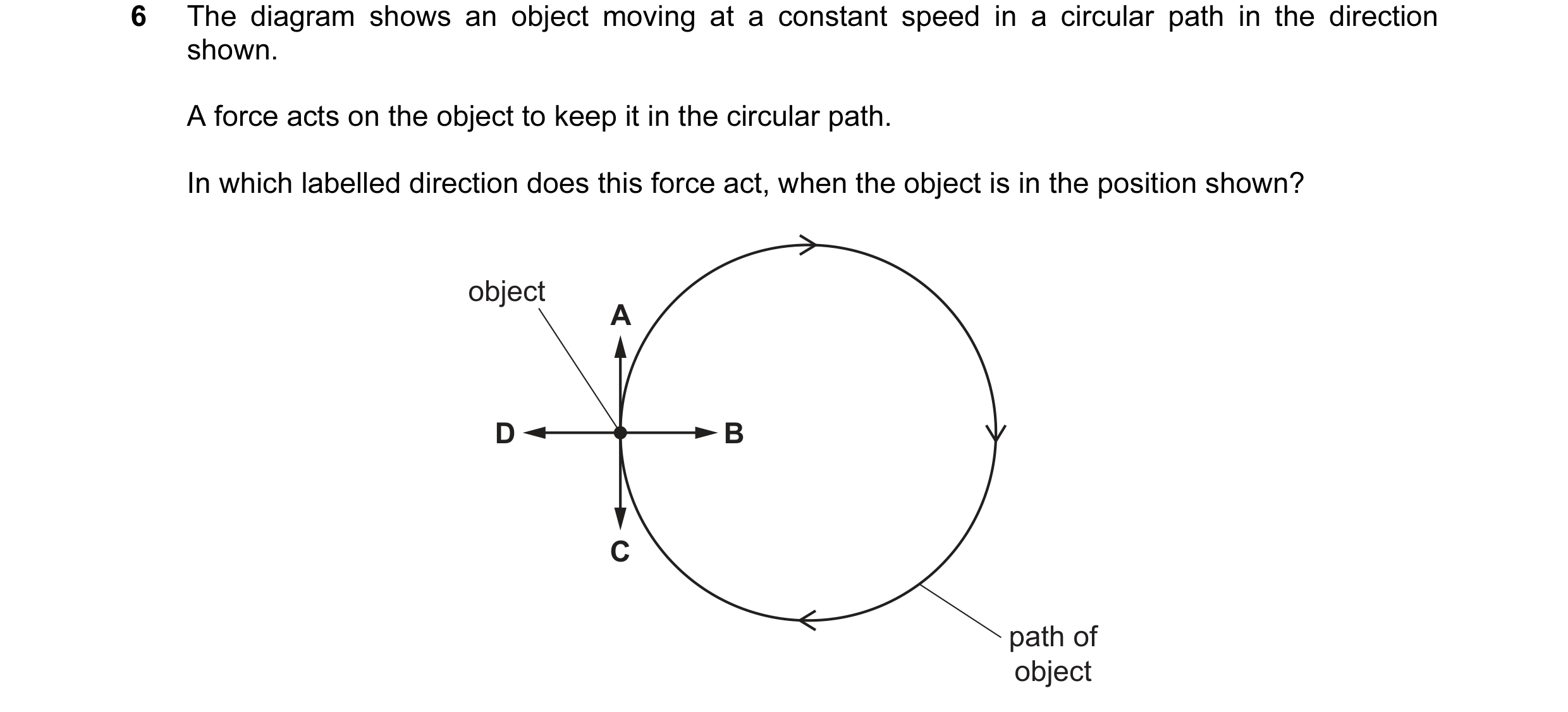
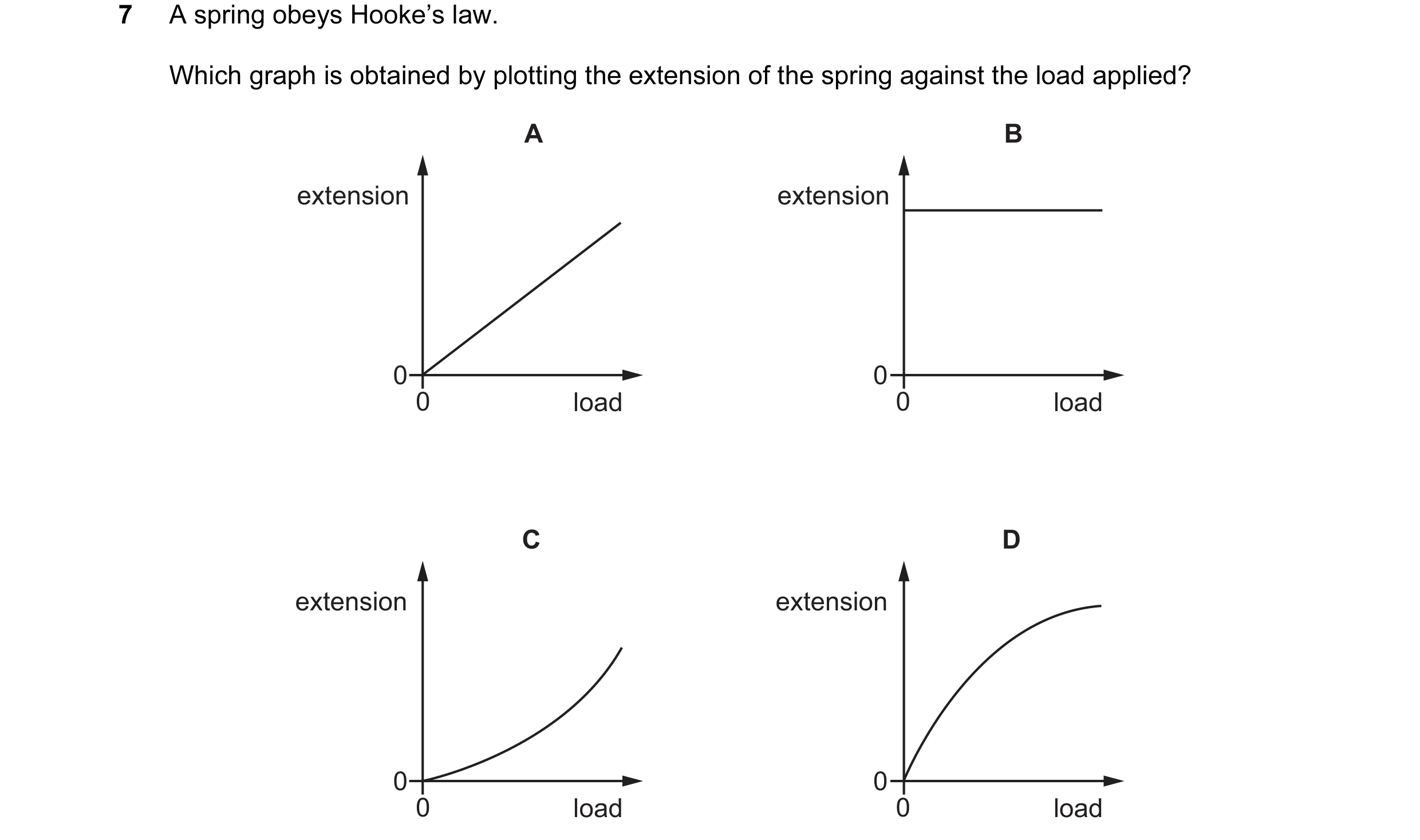 1 / 82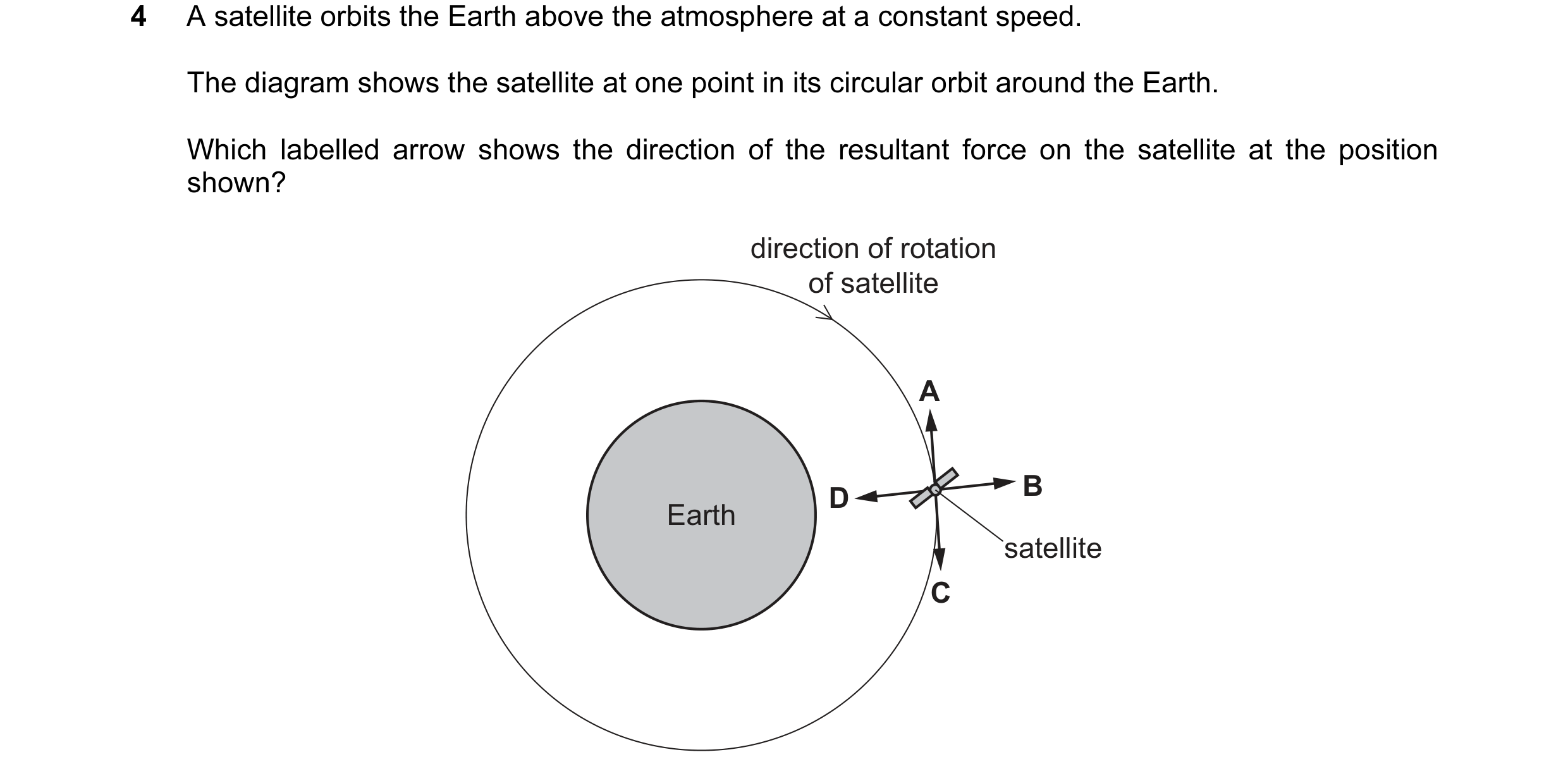
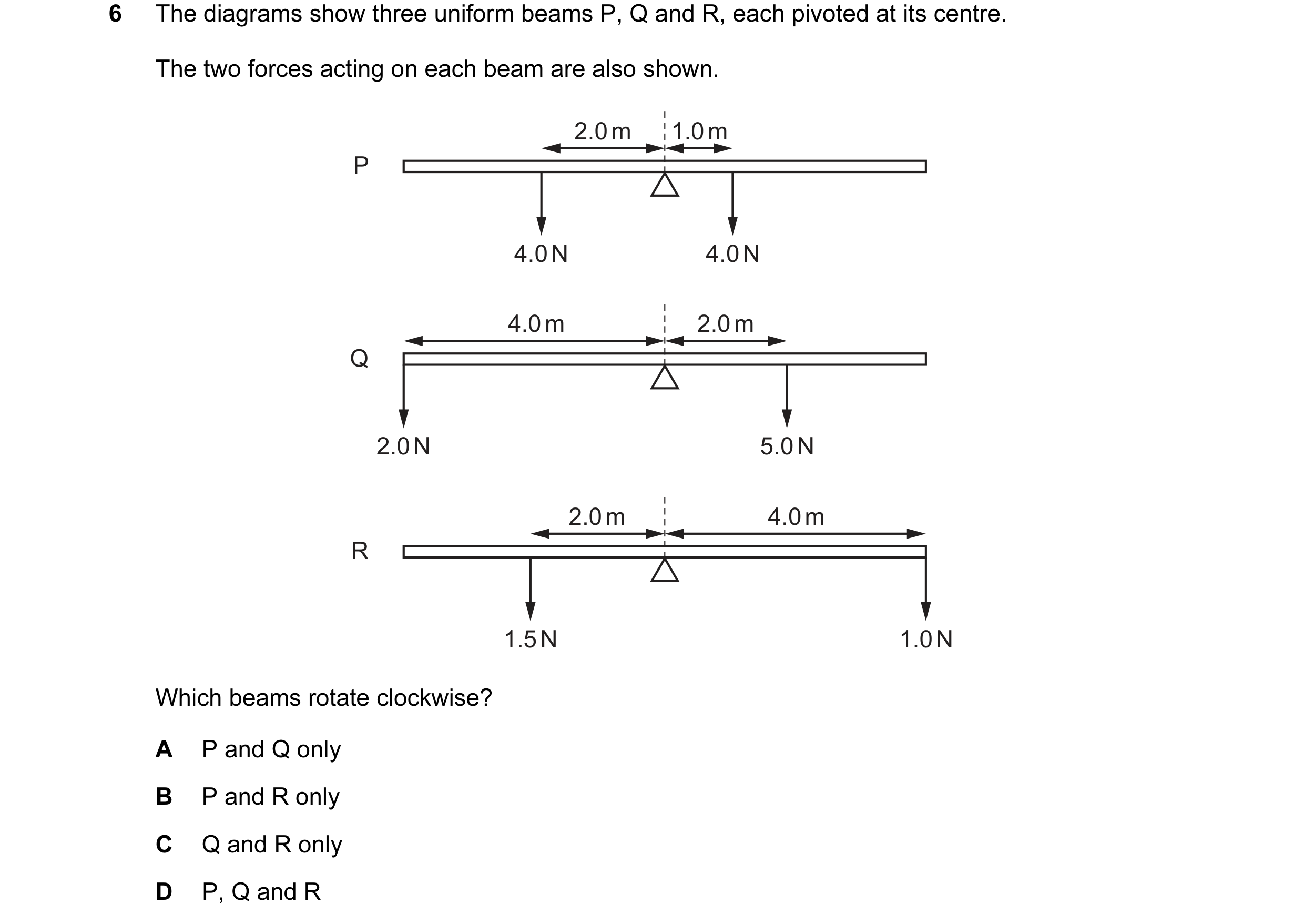 2 / 82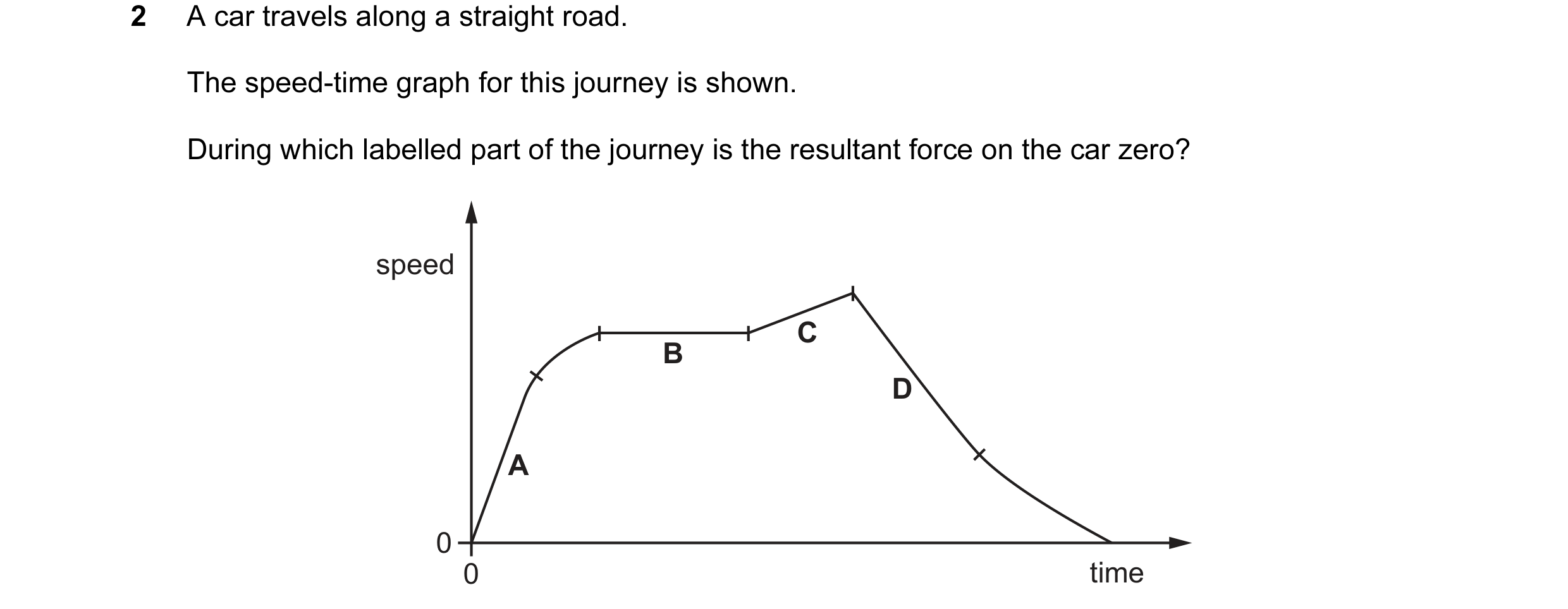
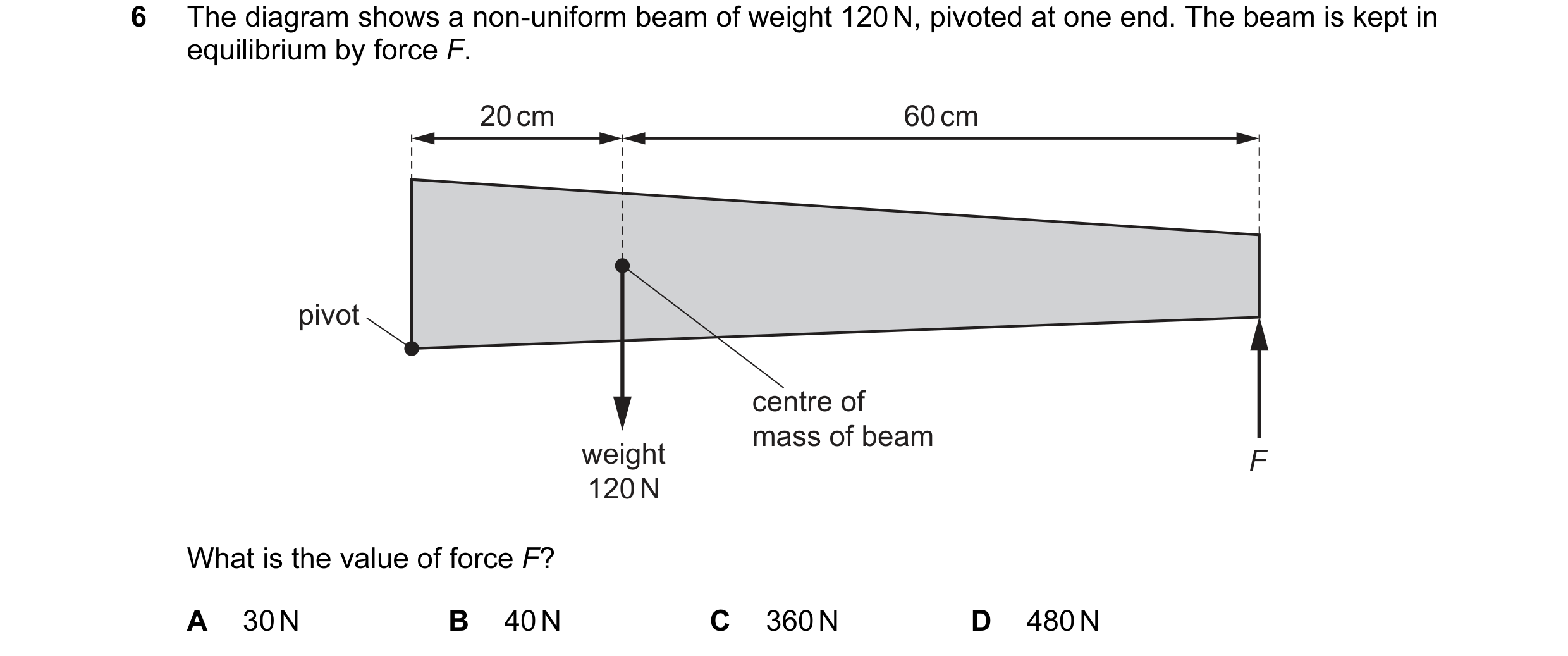 3 / 82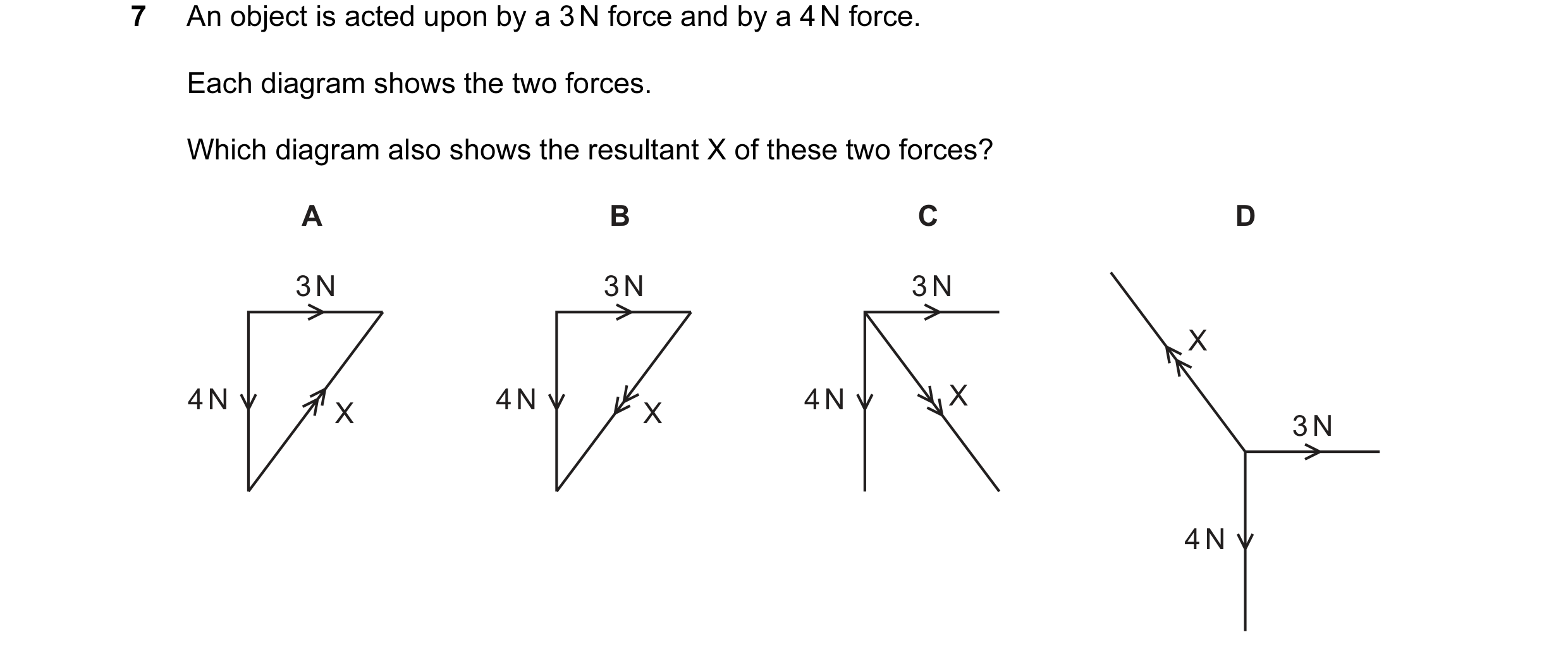
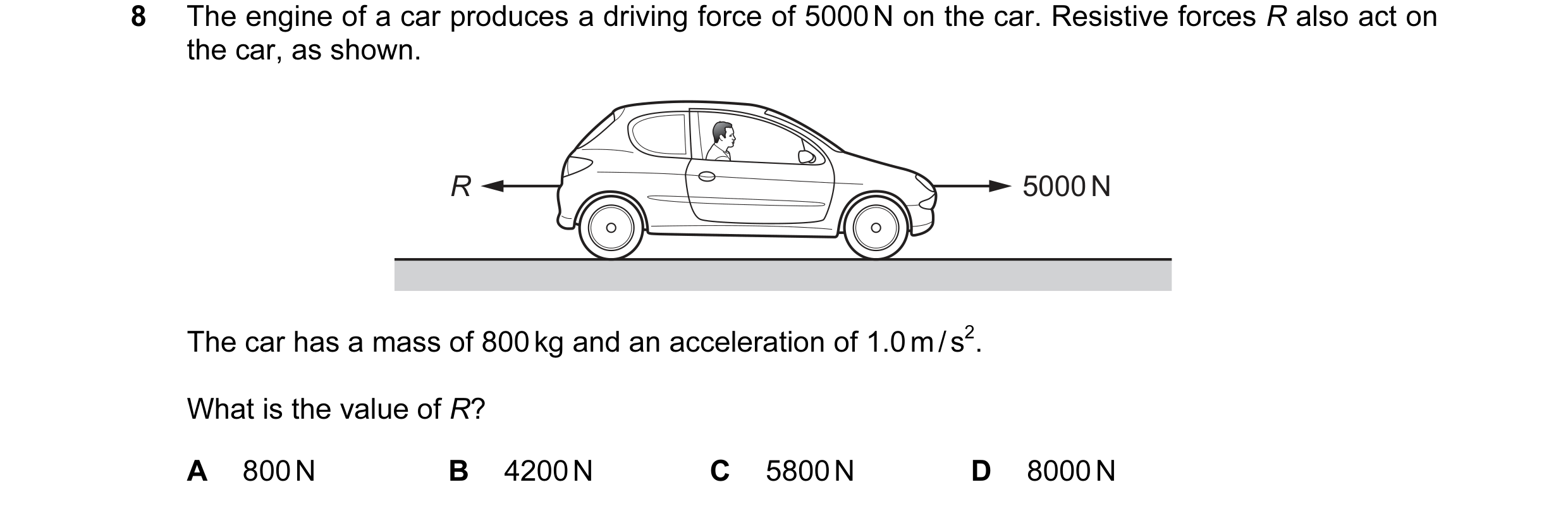
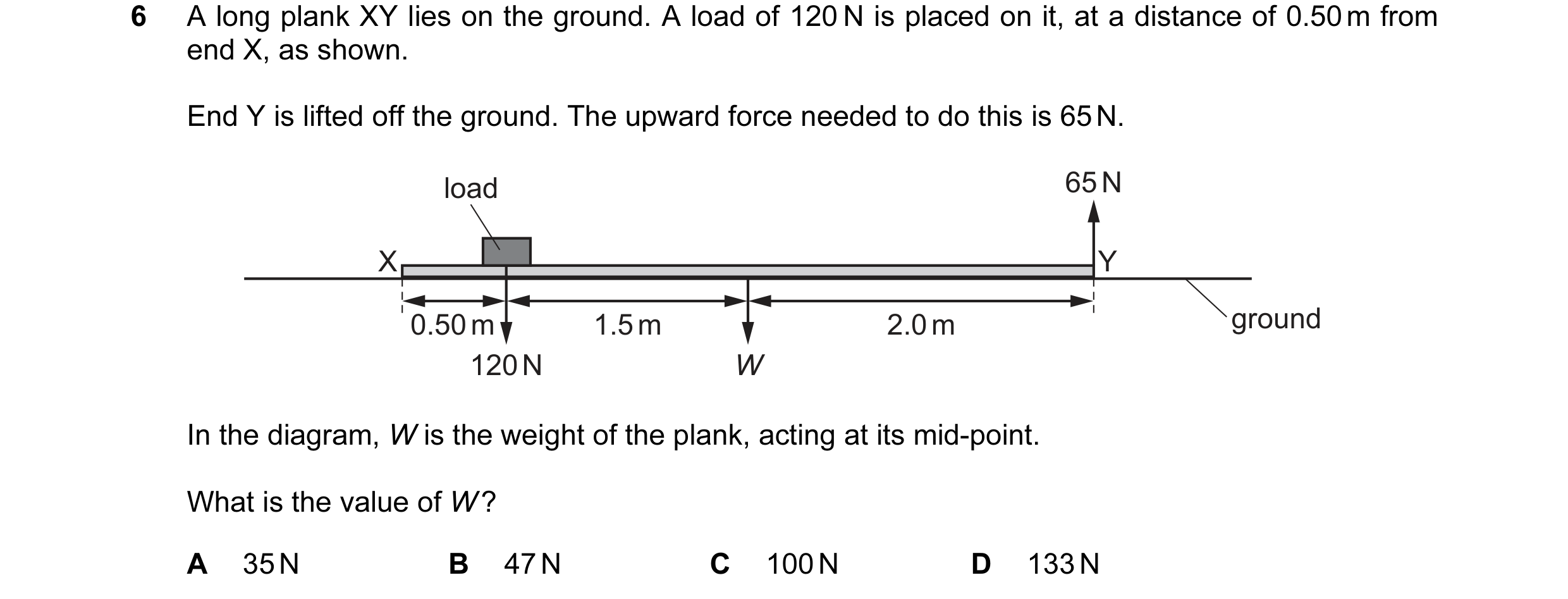 4 / 82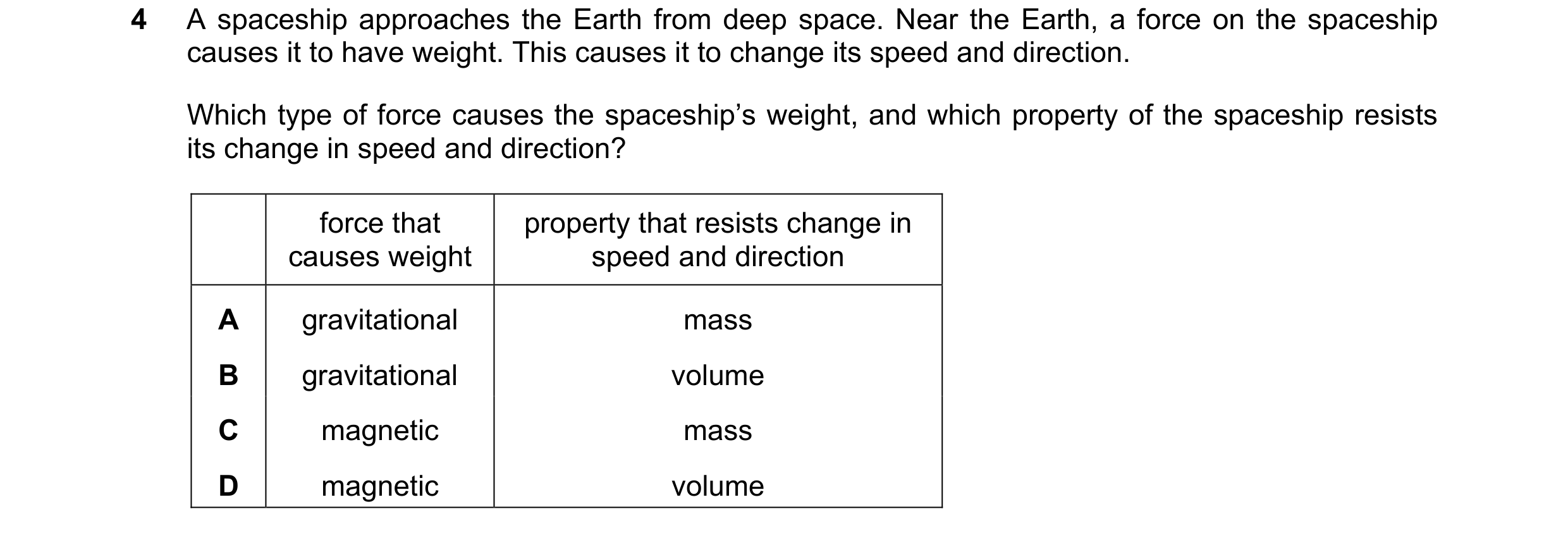
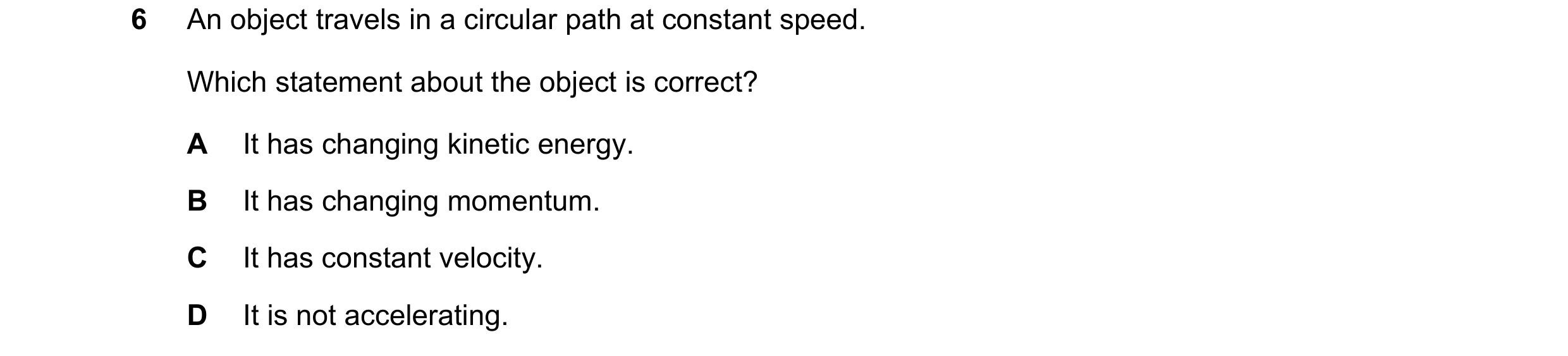
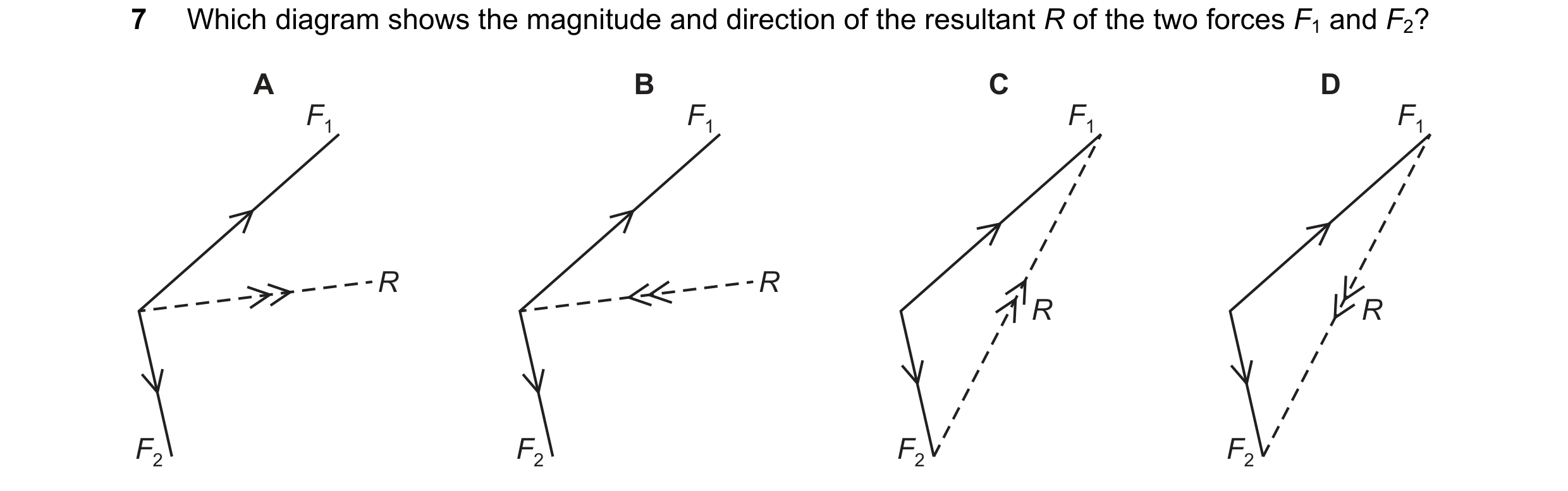
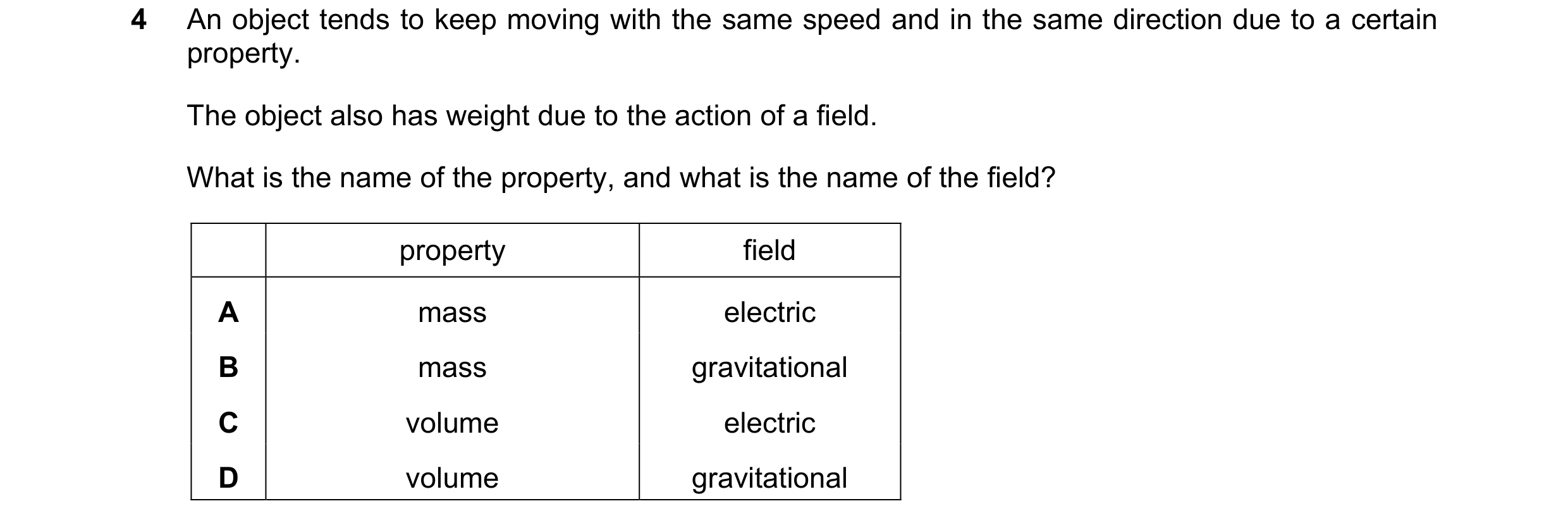 5 / 82
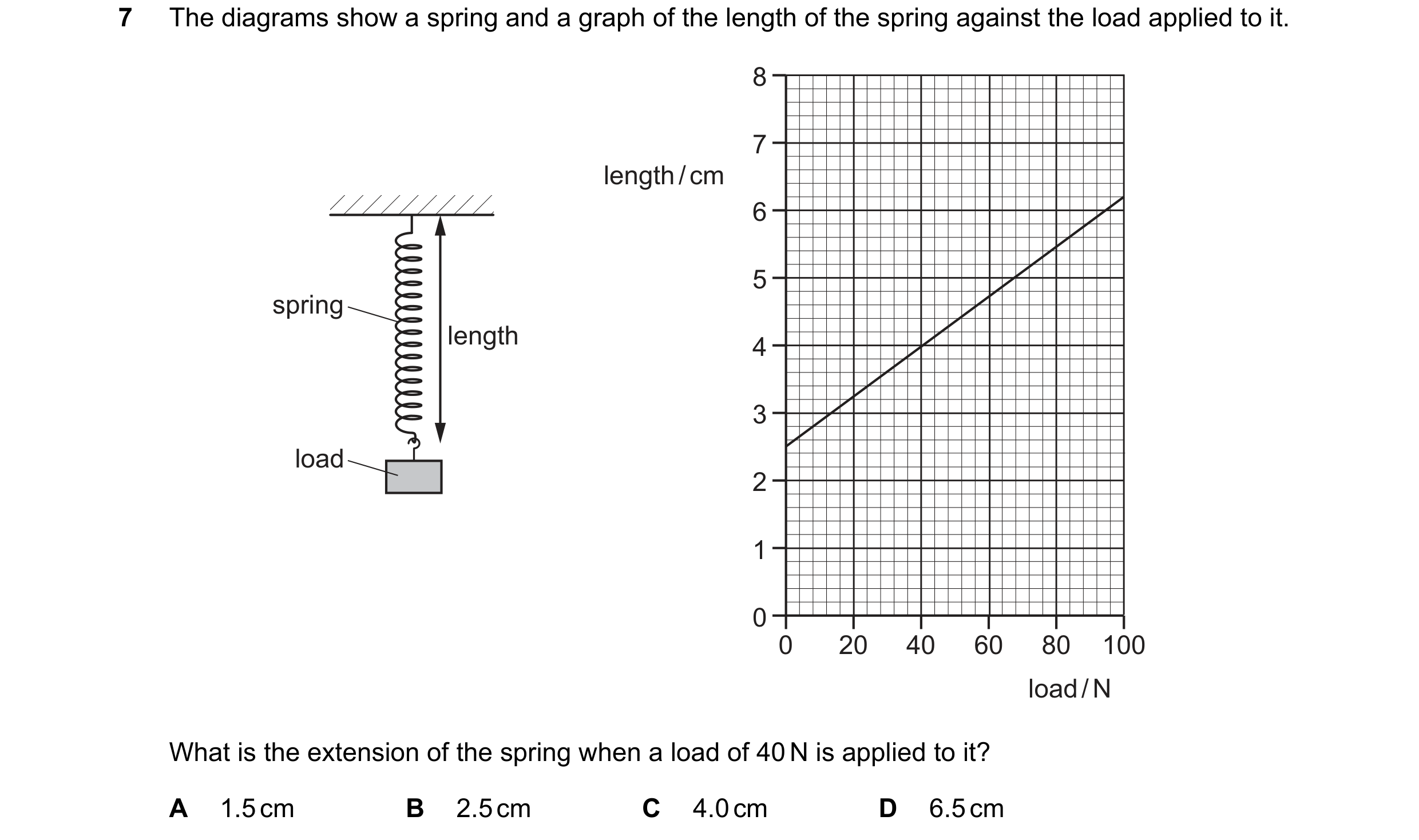 6 / 82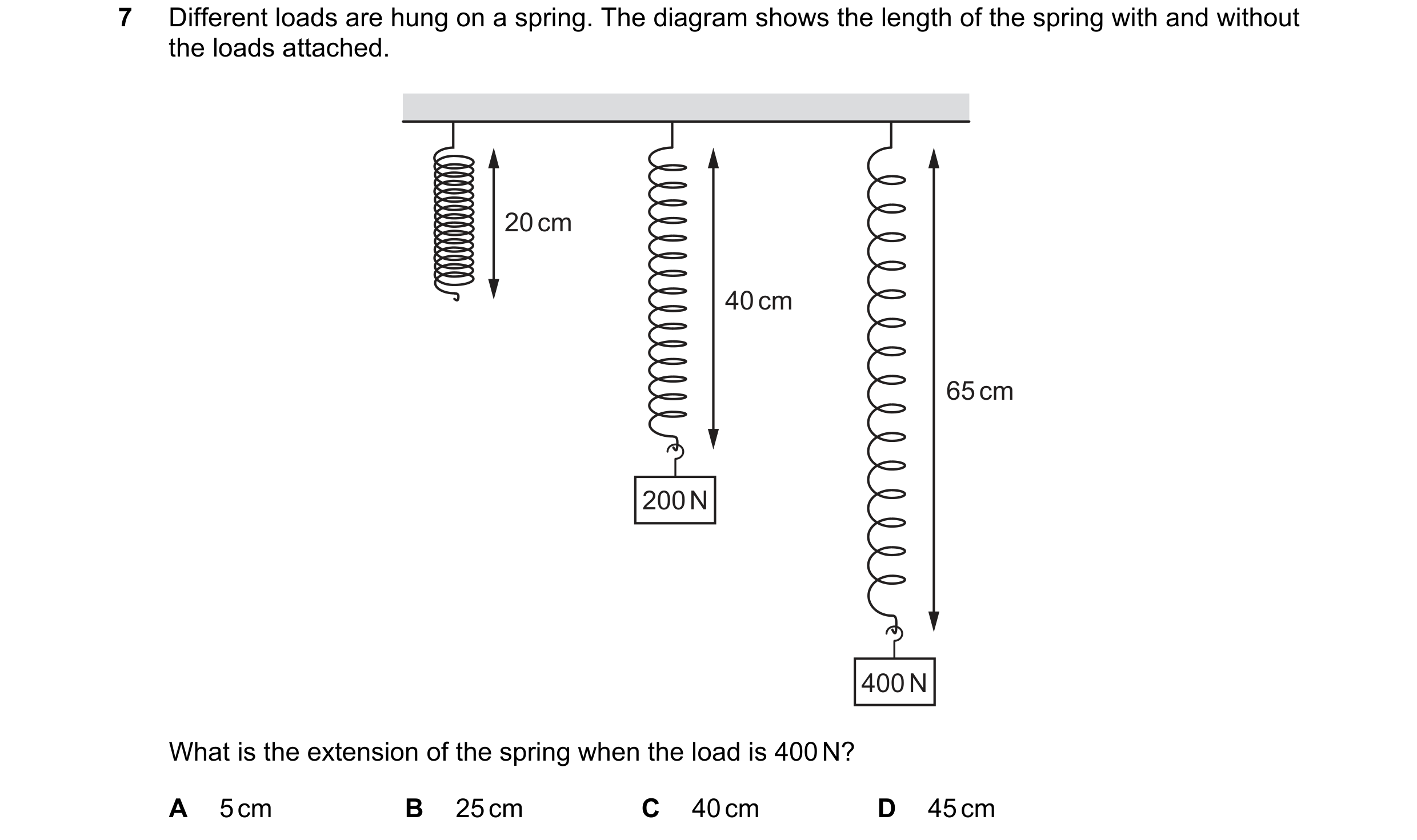
 7 / 82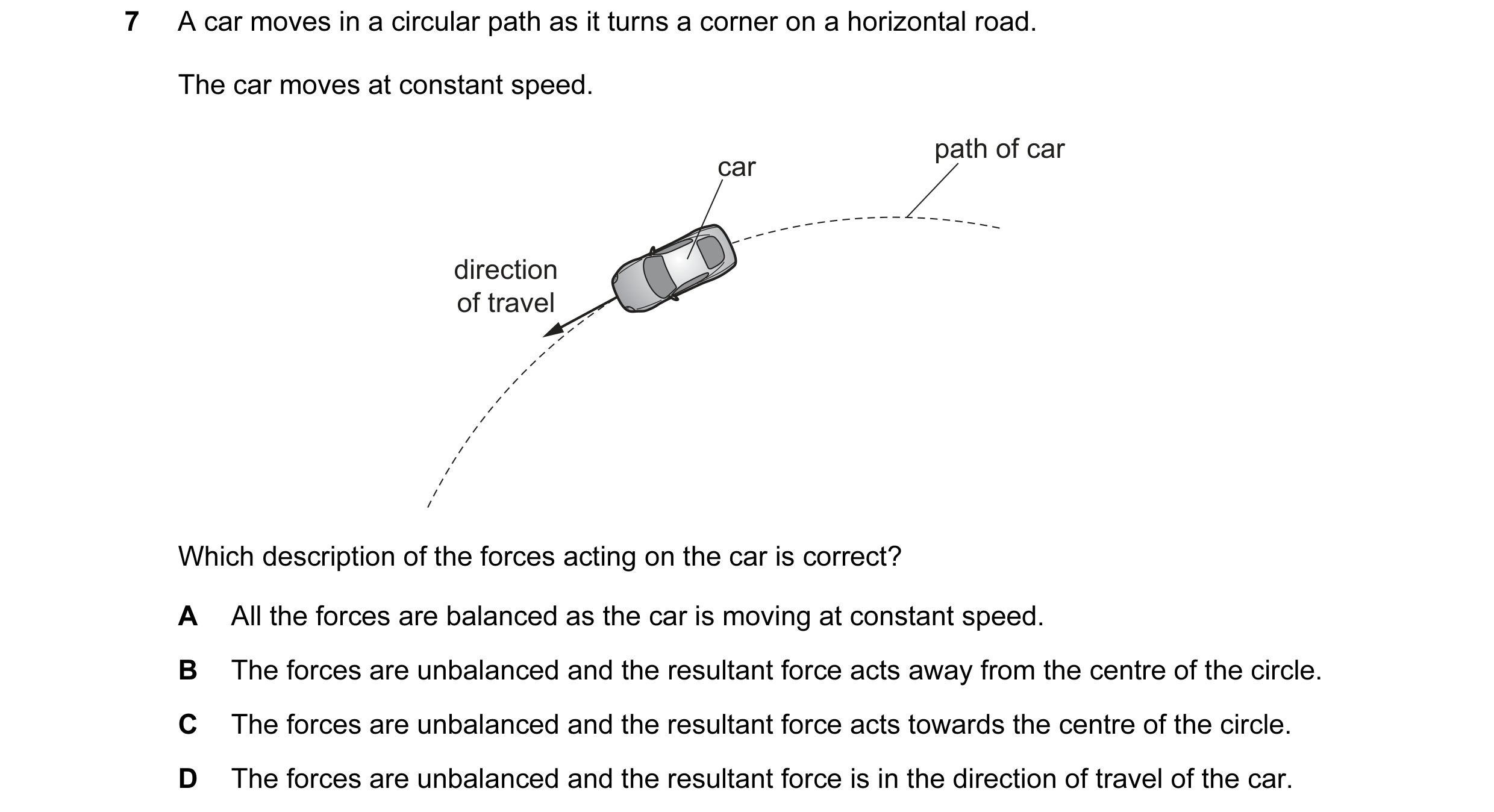

 8 / 82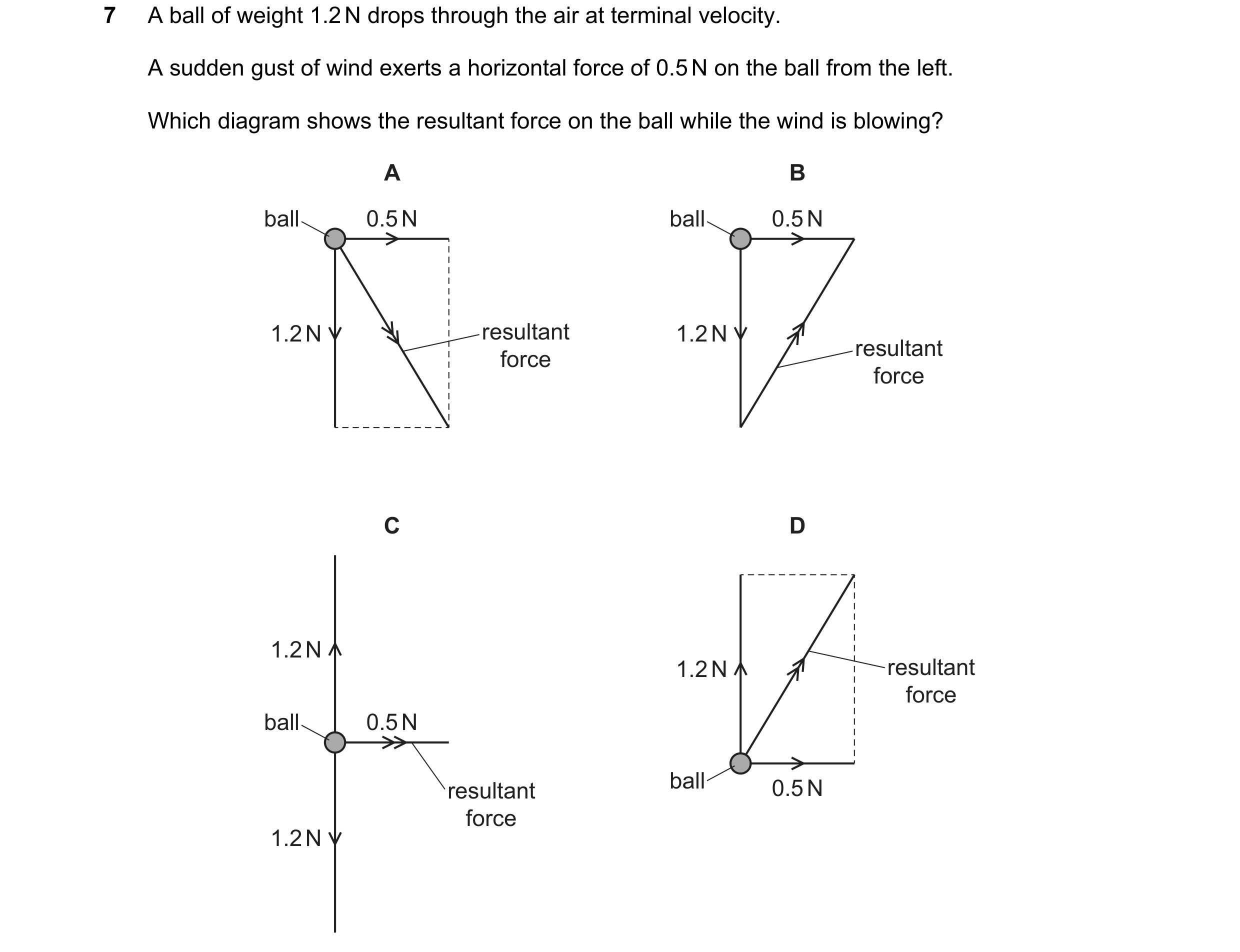
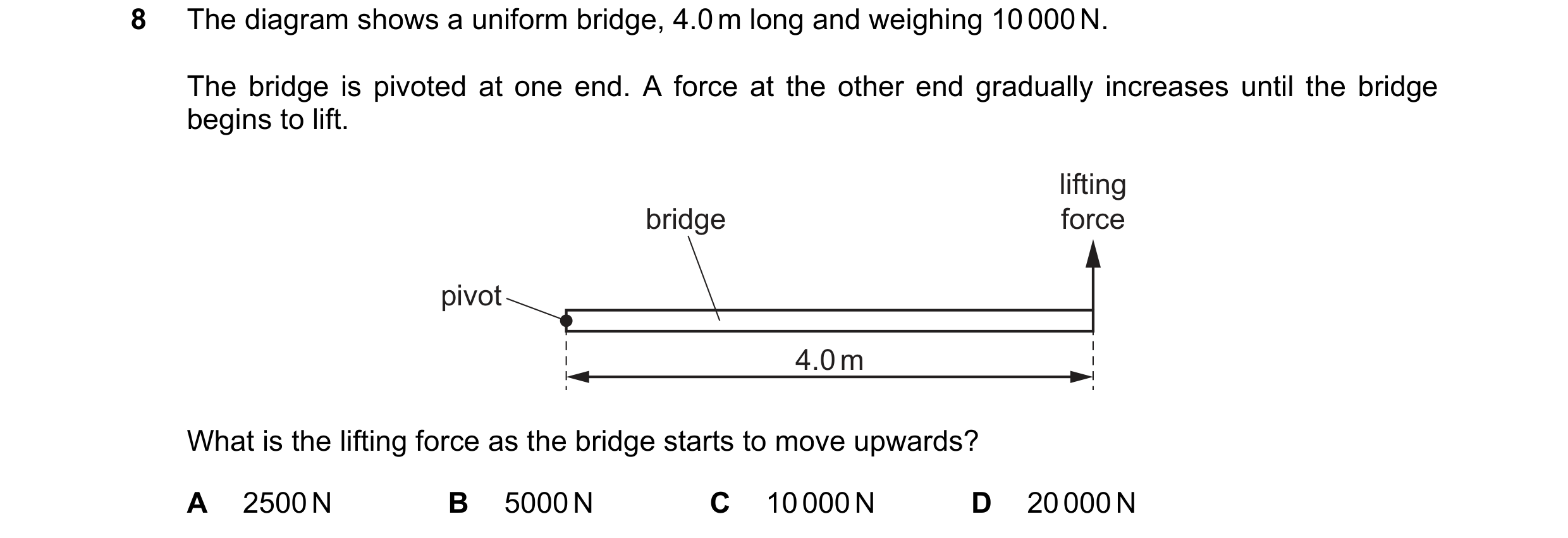 9 / 82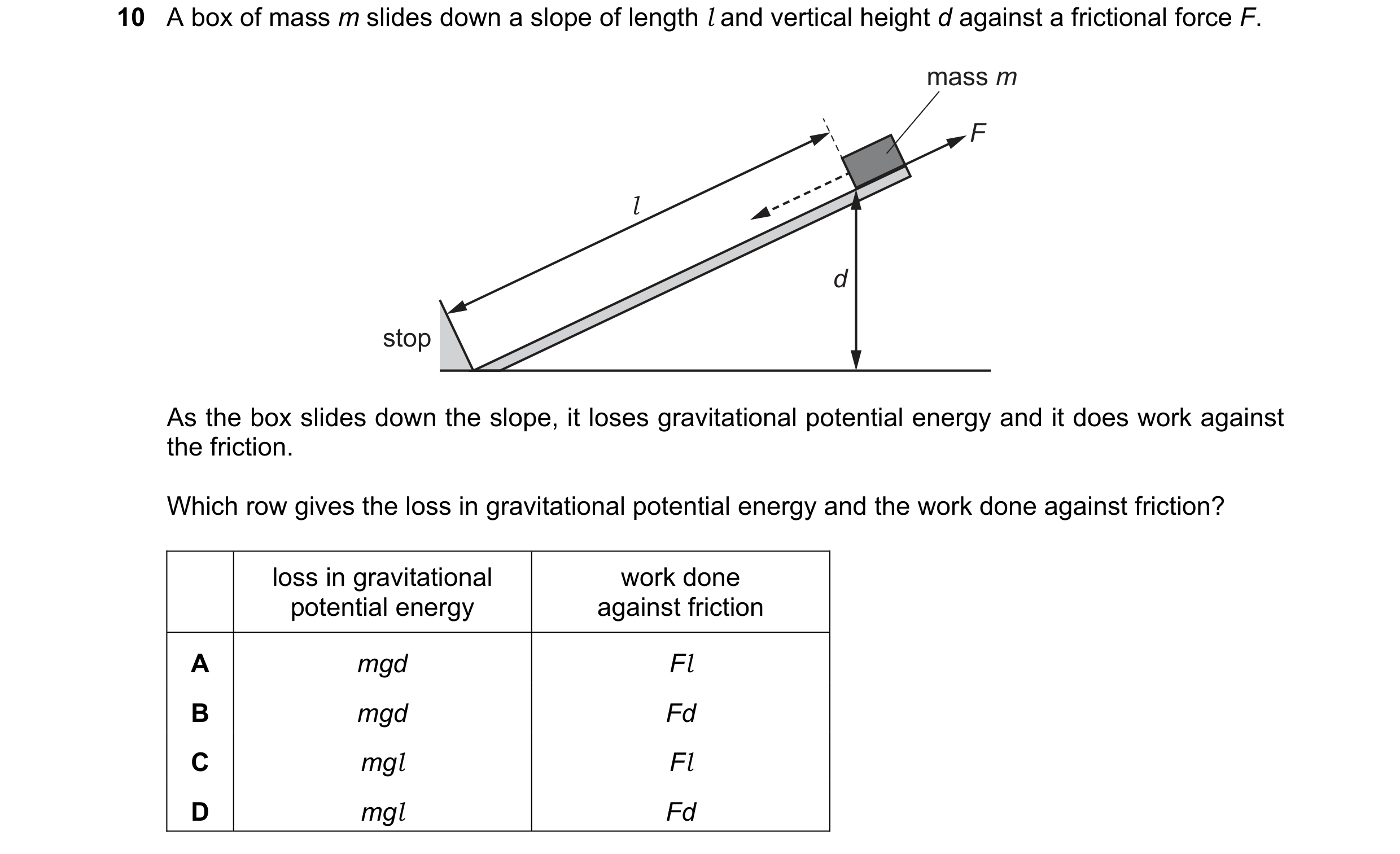

 10 / 82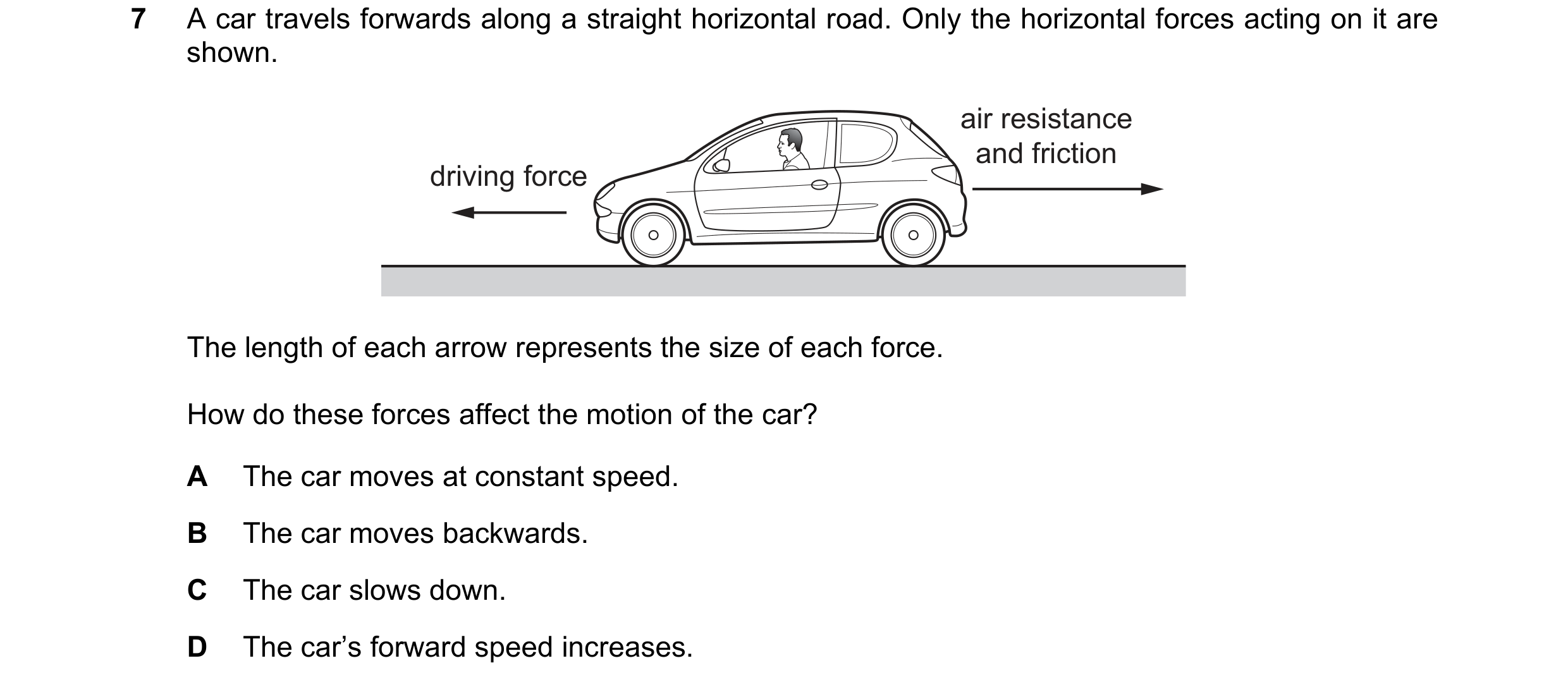
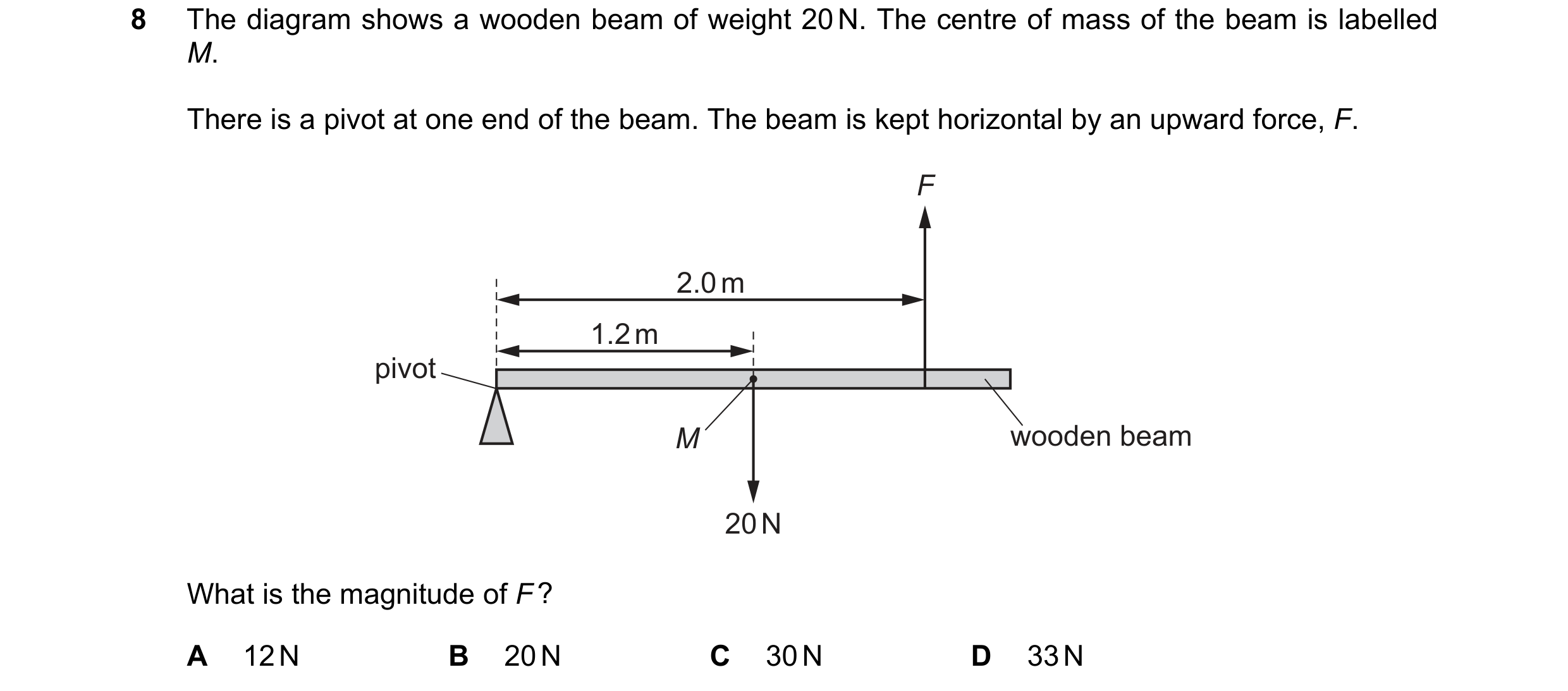
 11 / 82
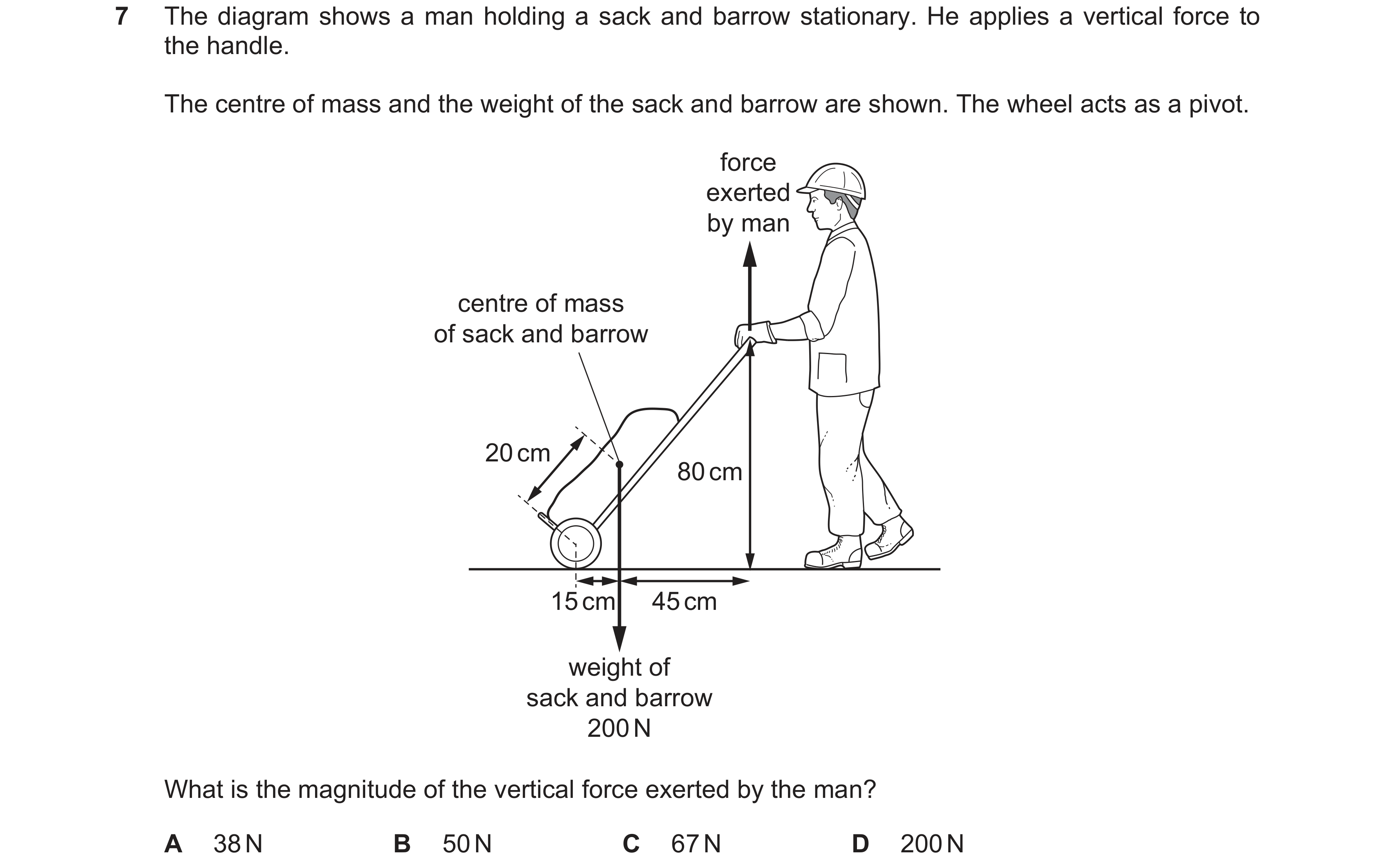 12 / 82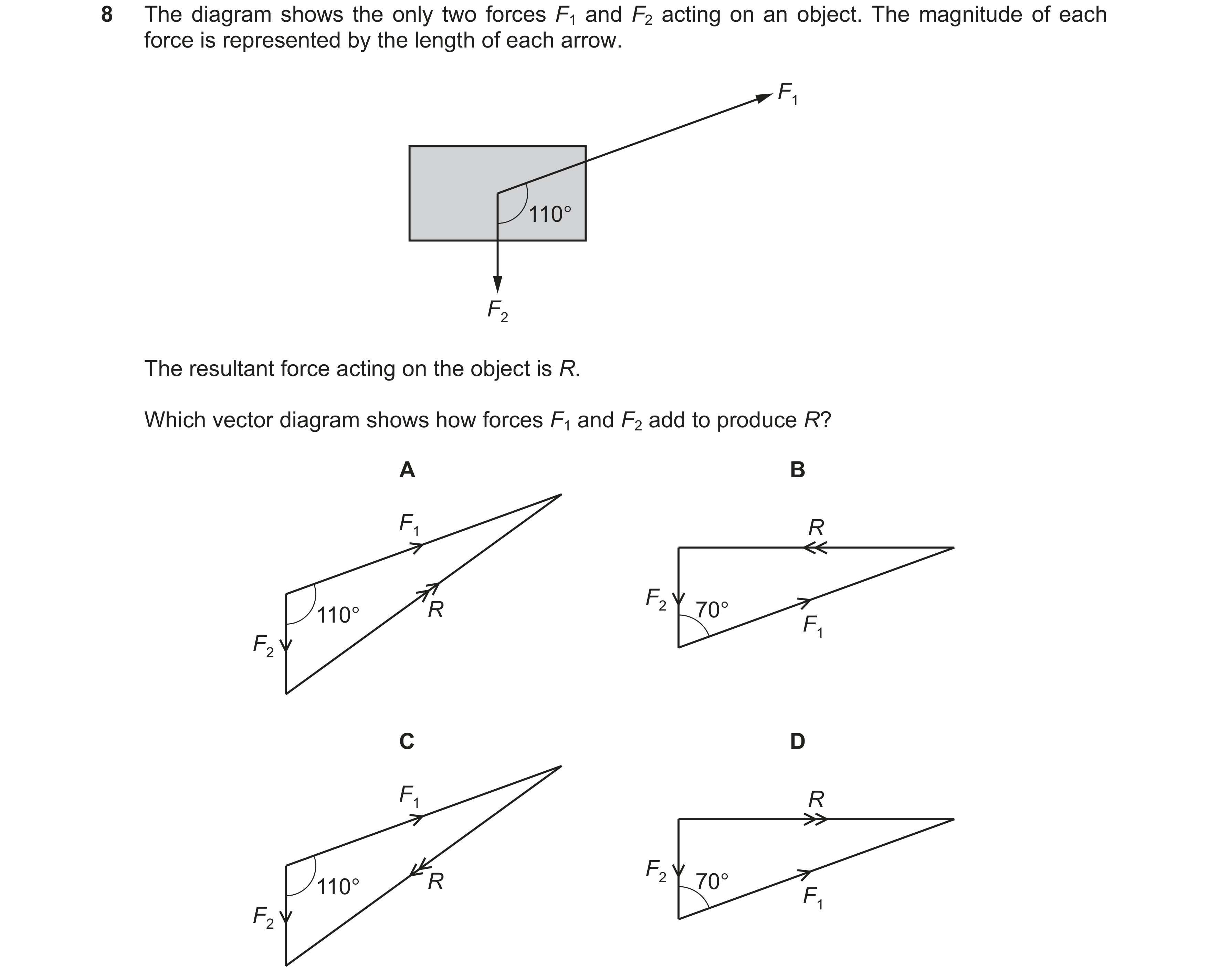
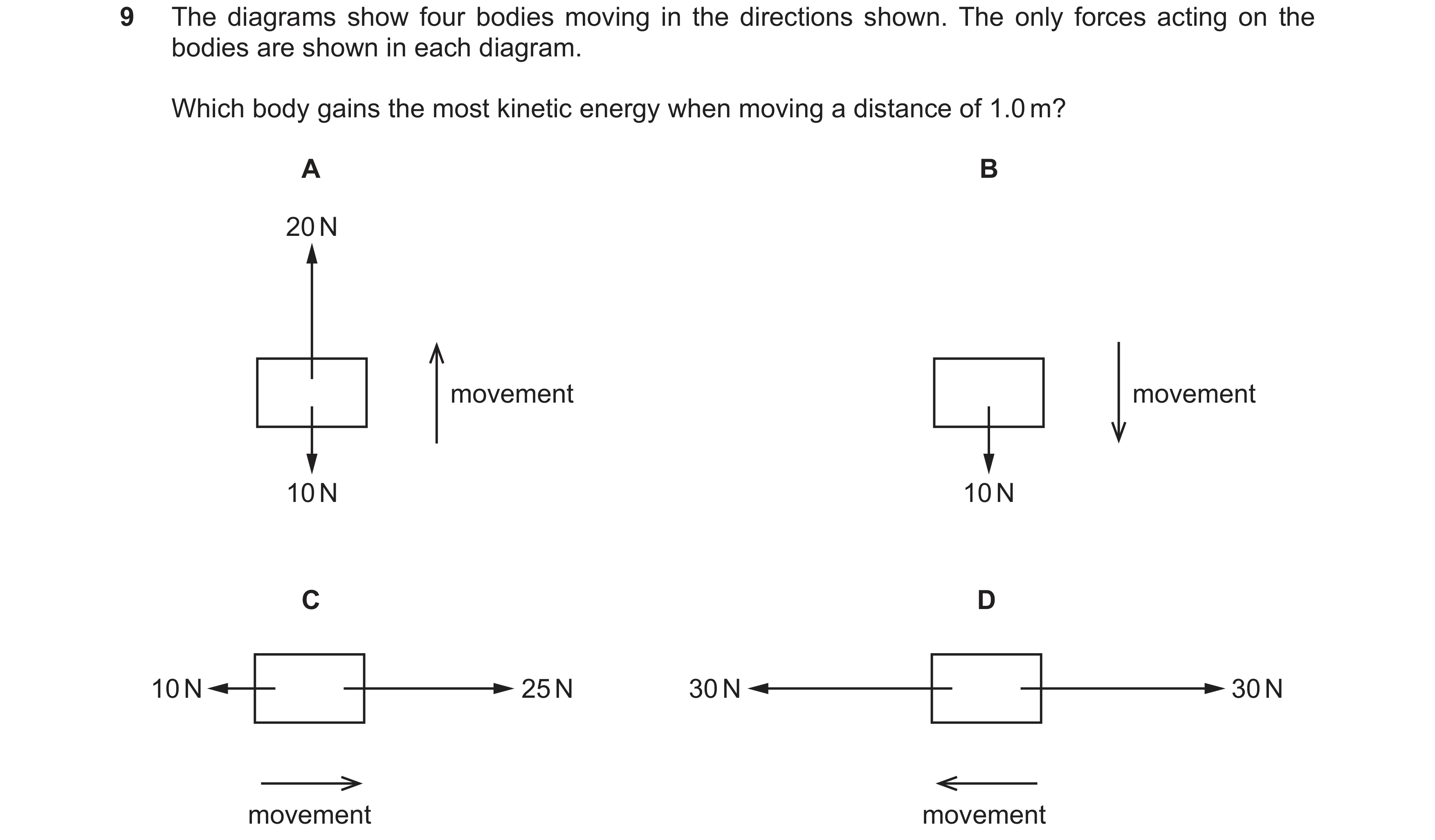 13 / 82
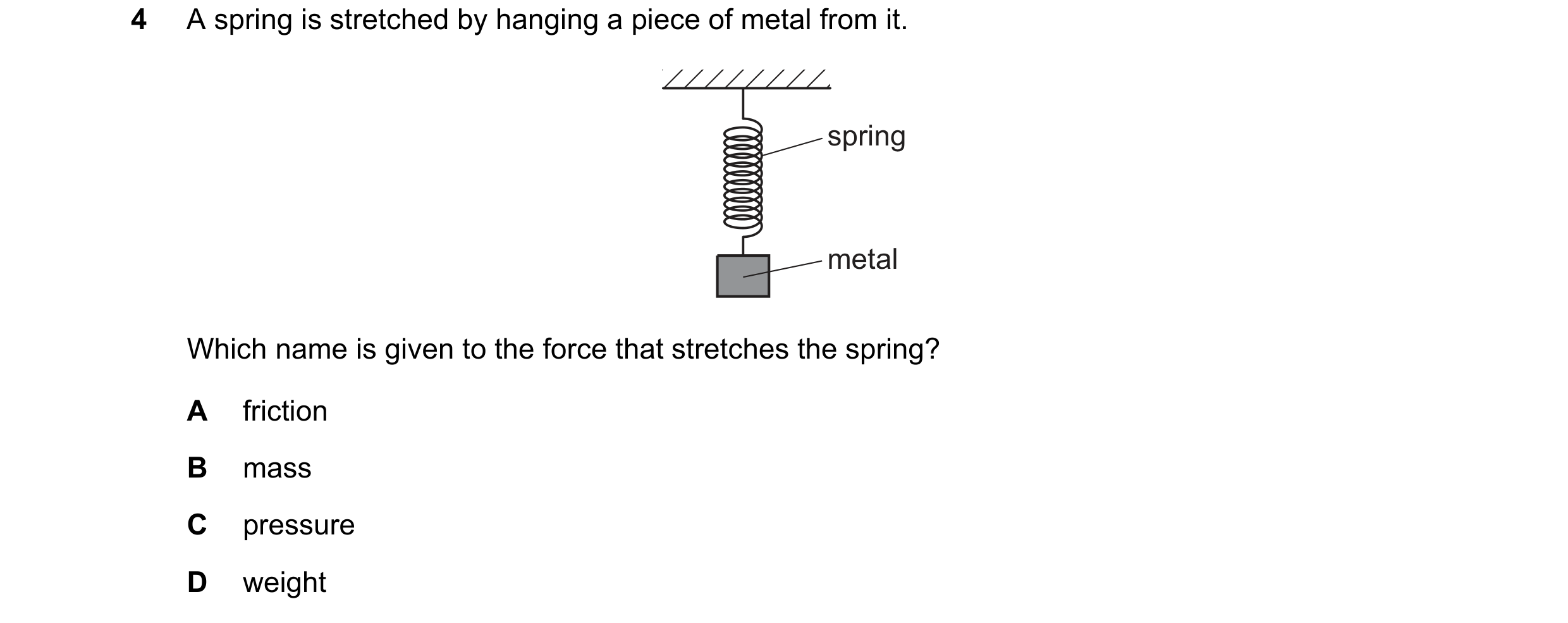
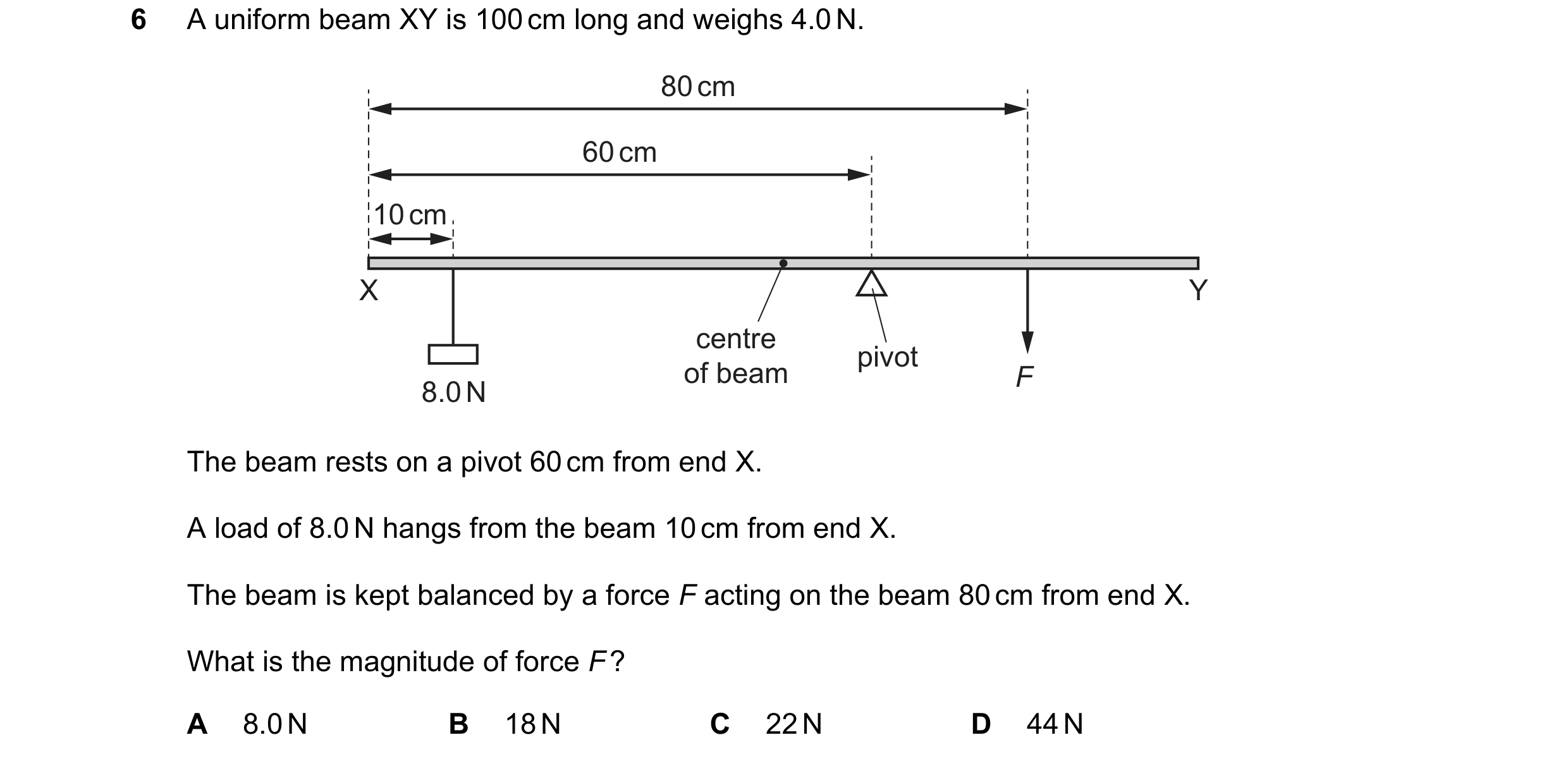 14 / 82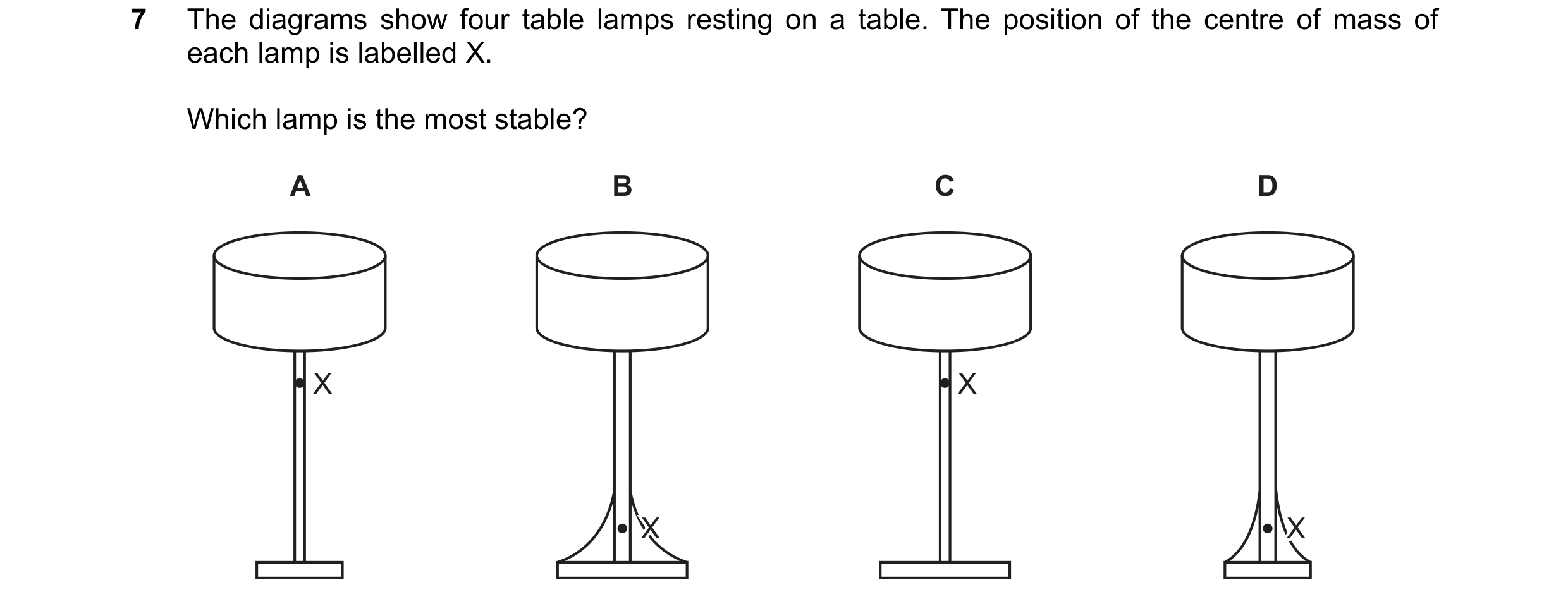
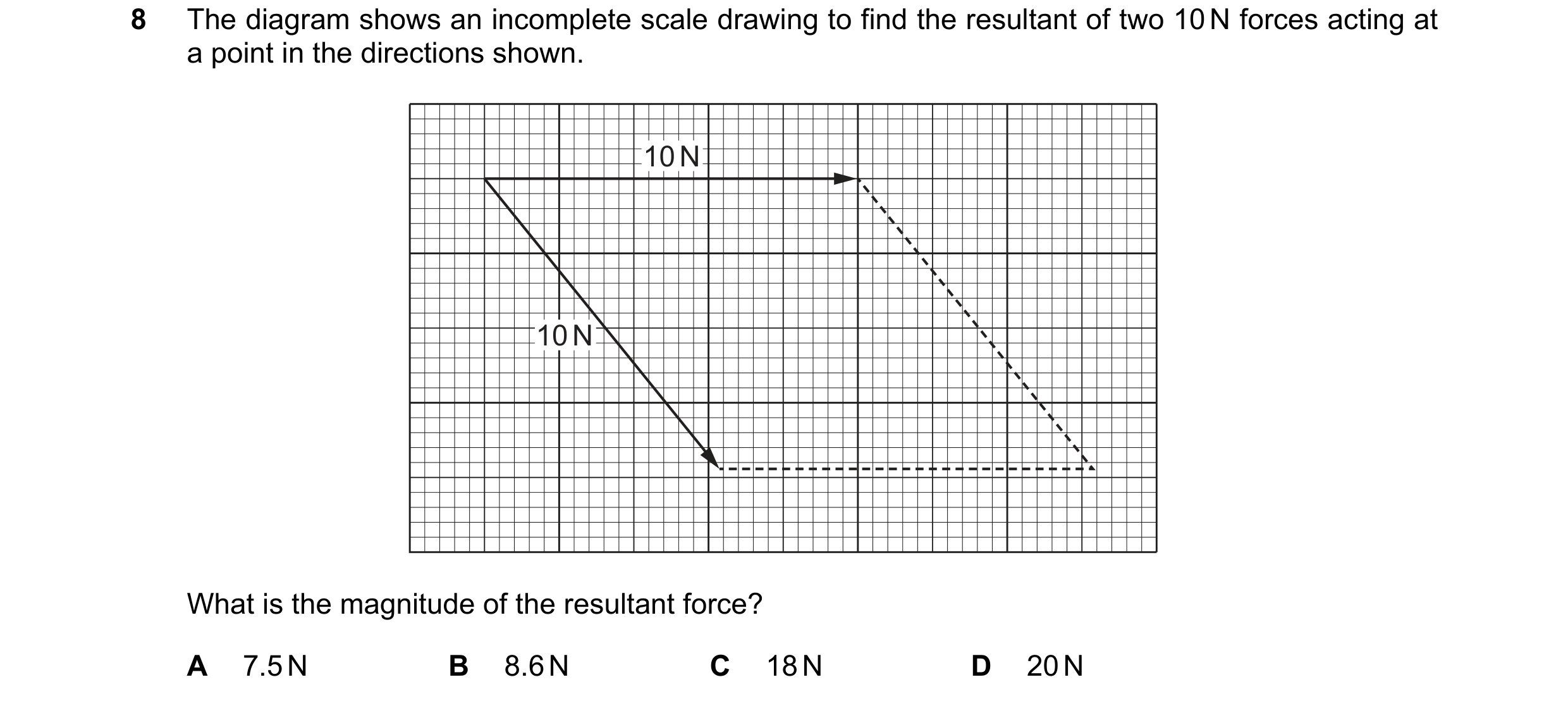
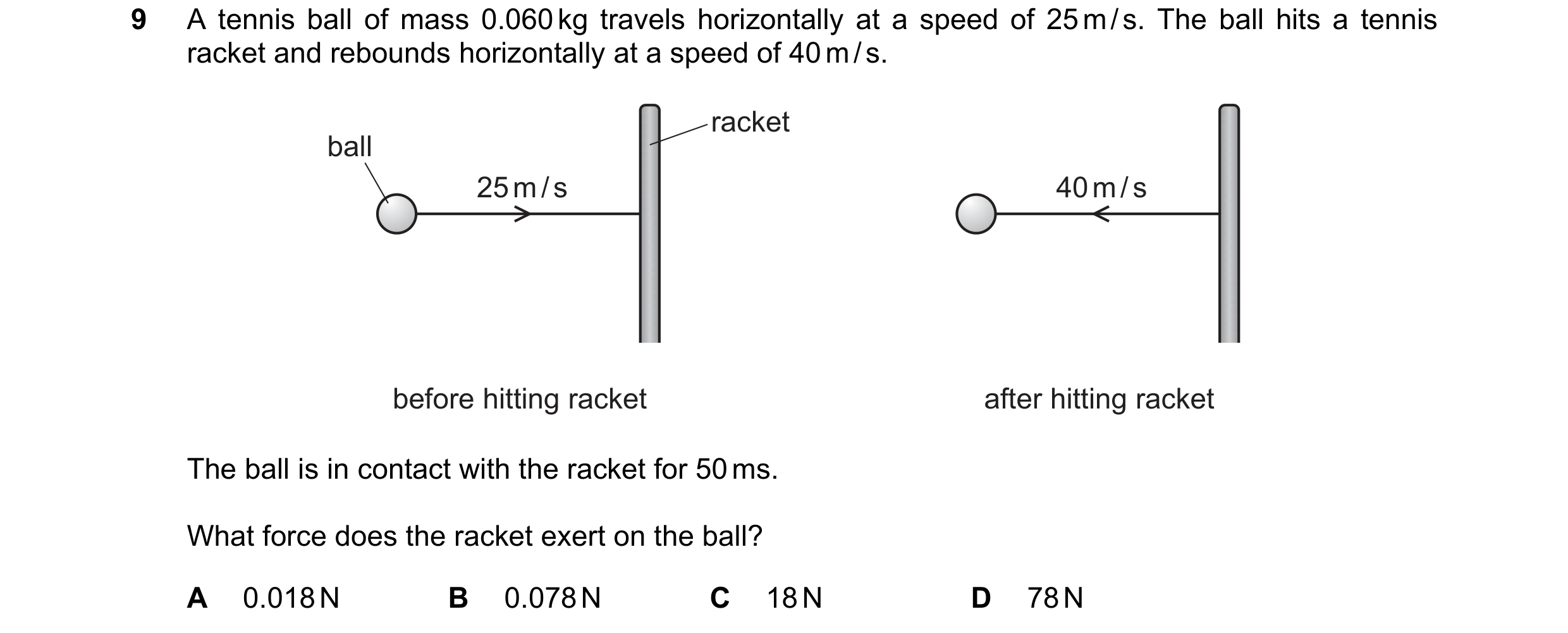 15 / 82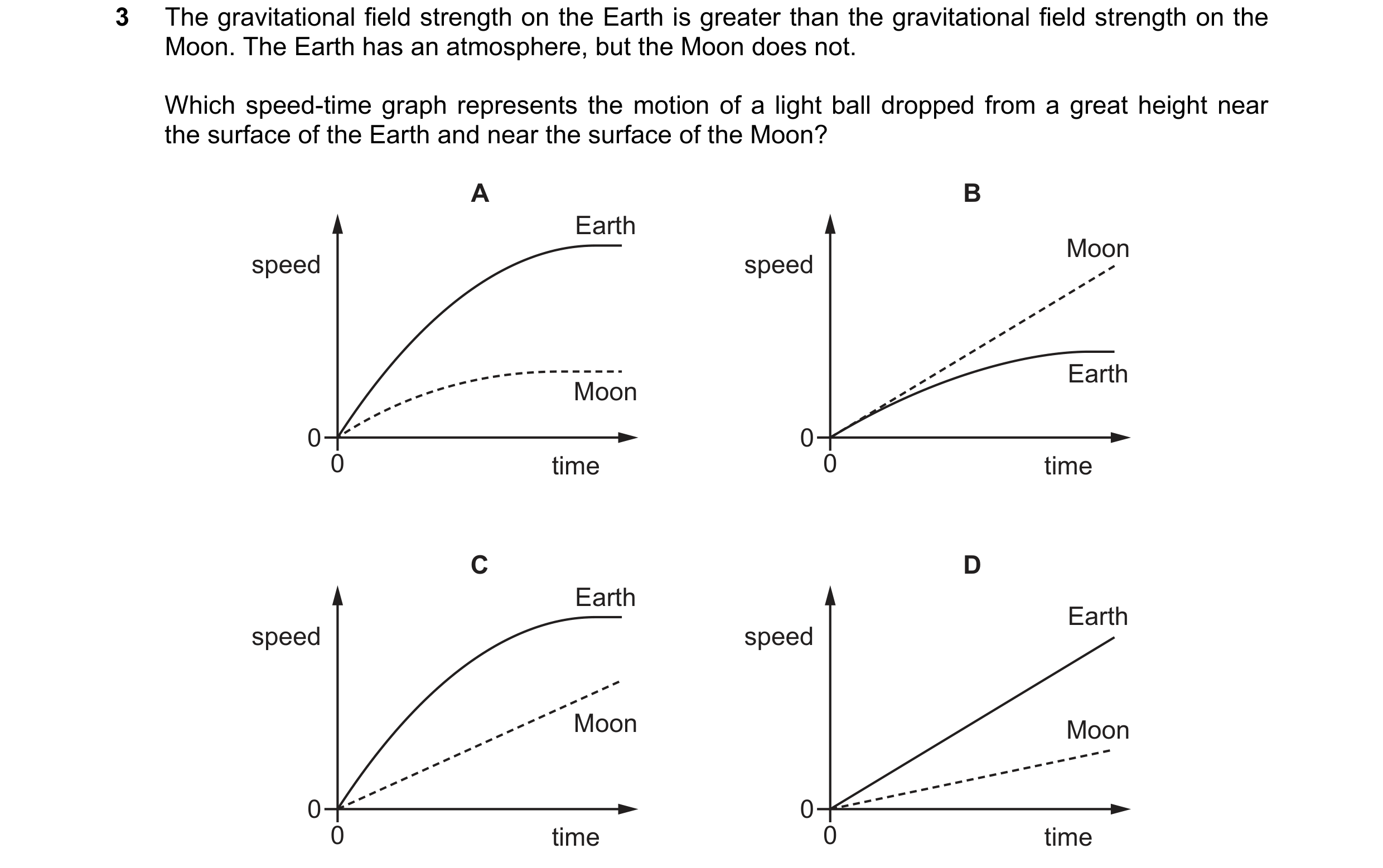
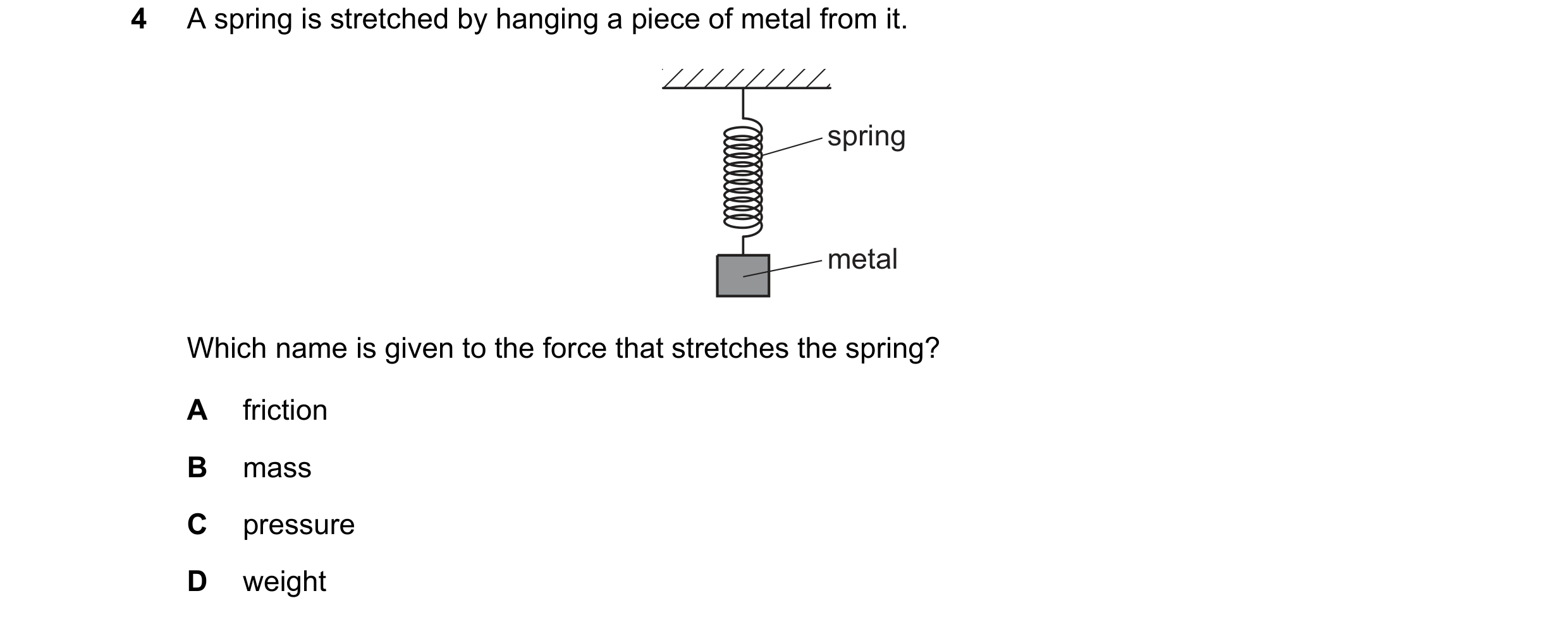 16 / 82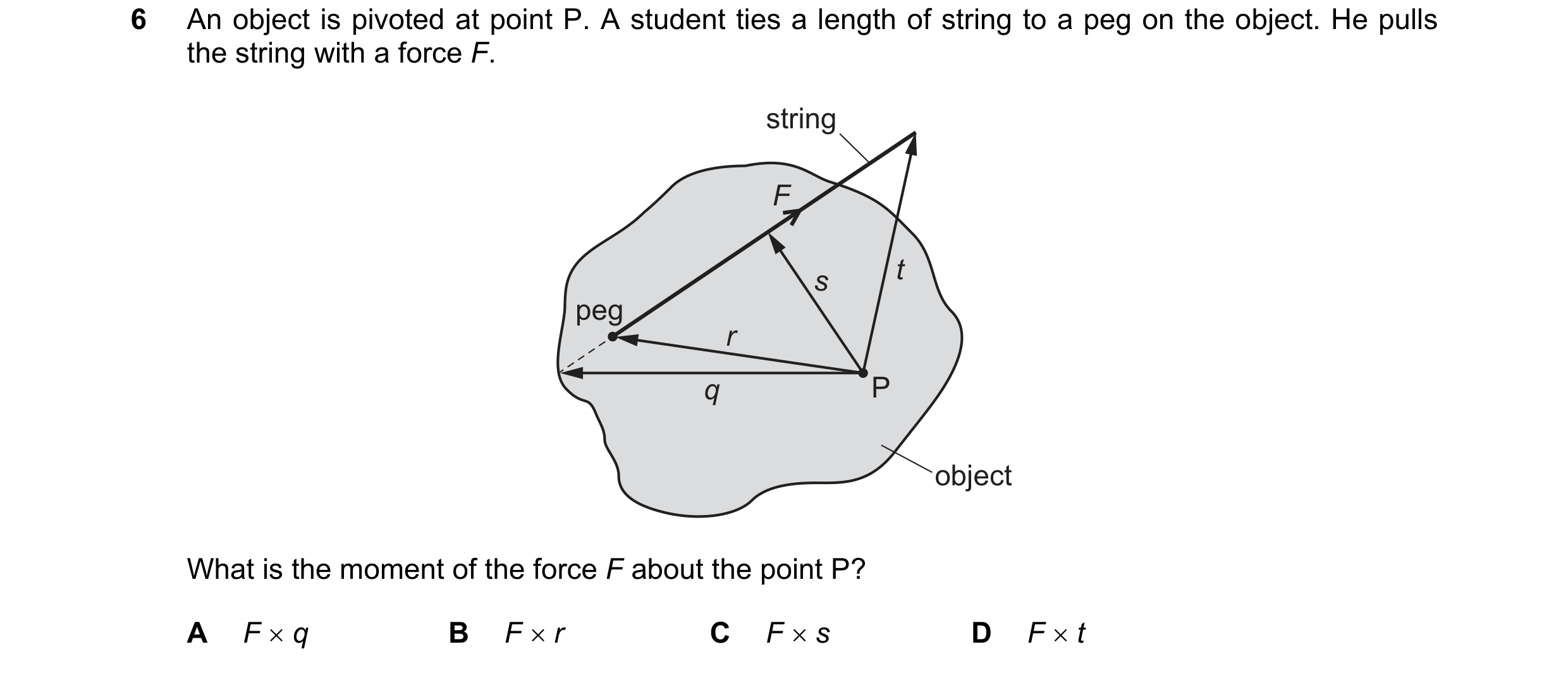
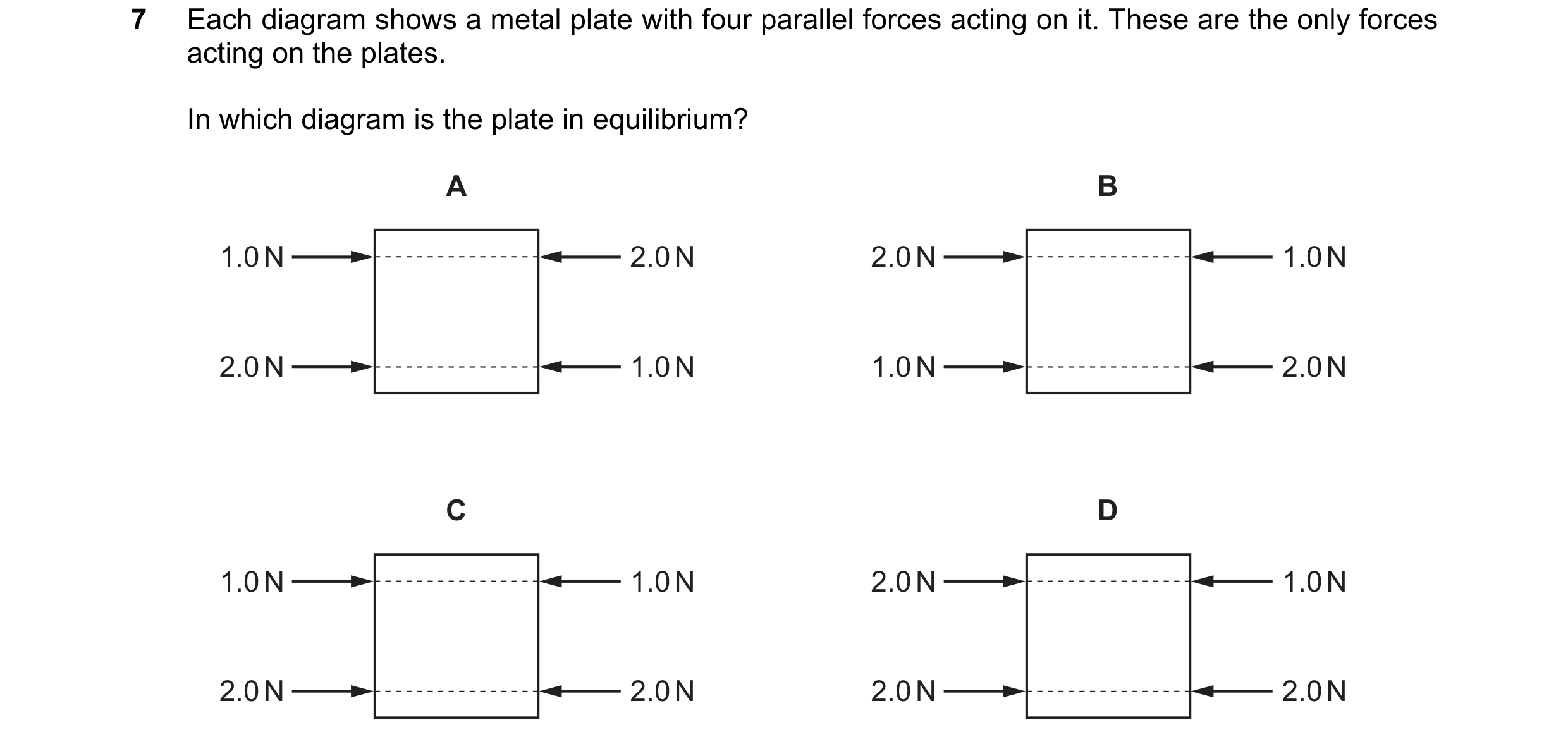
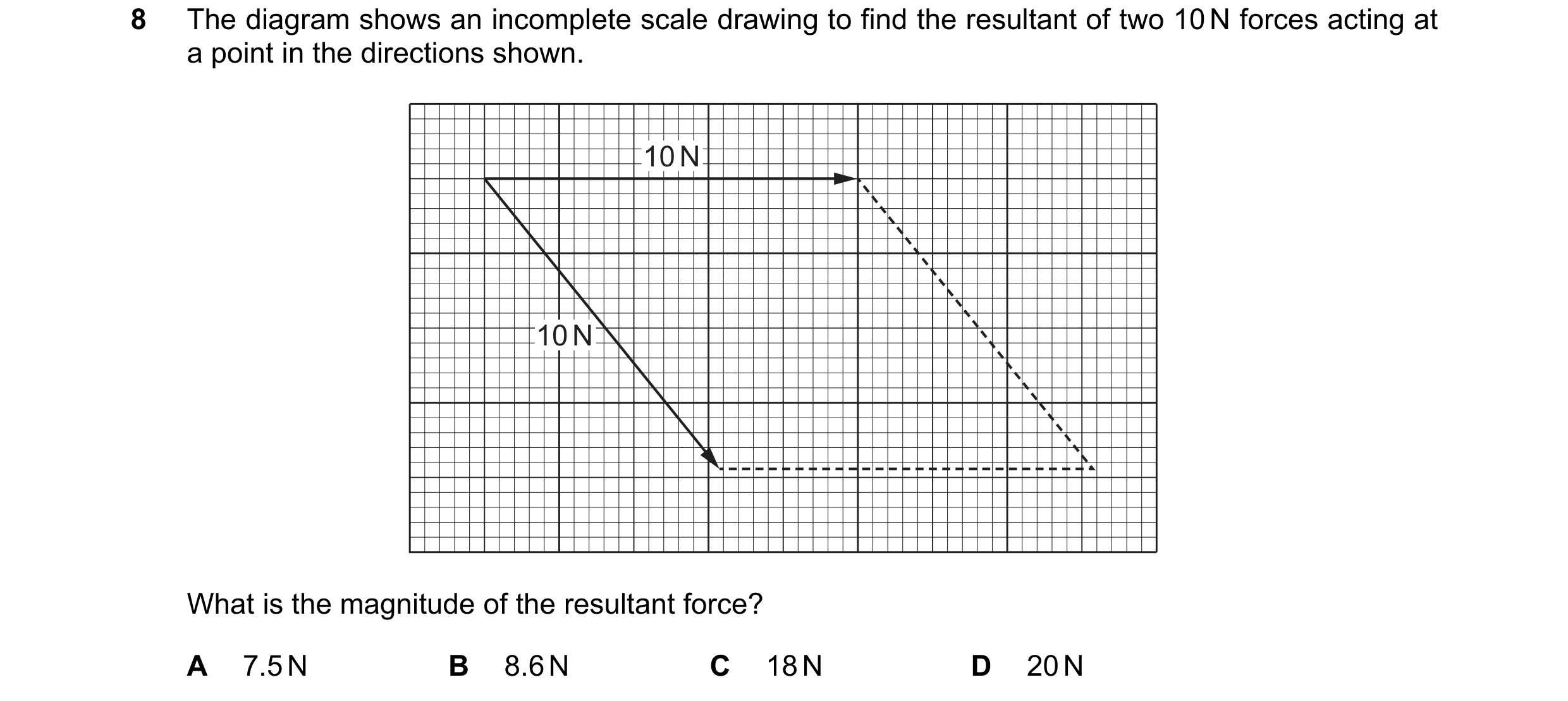 17 / 82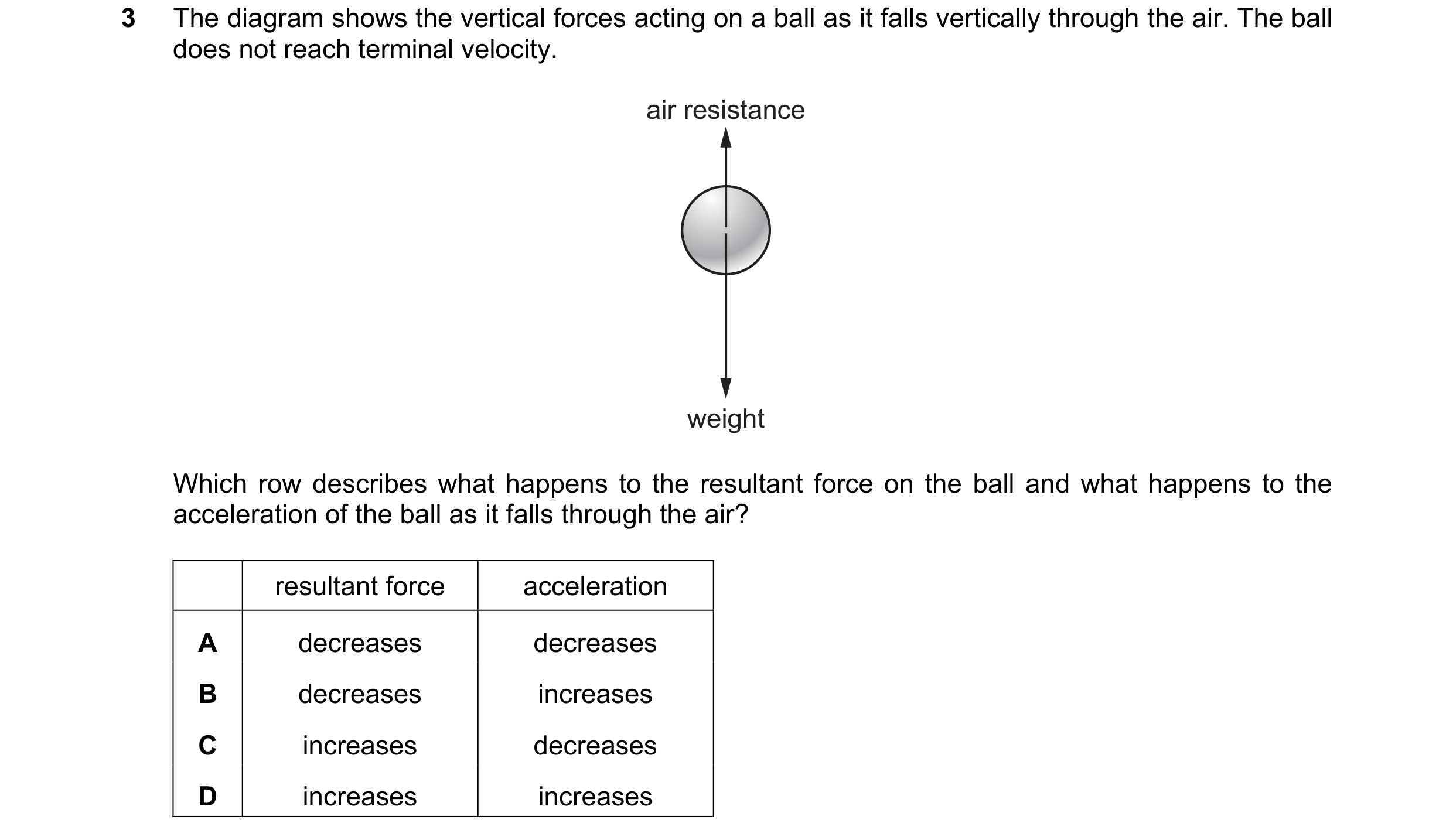
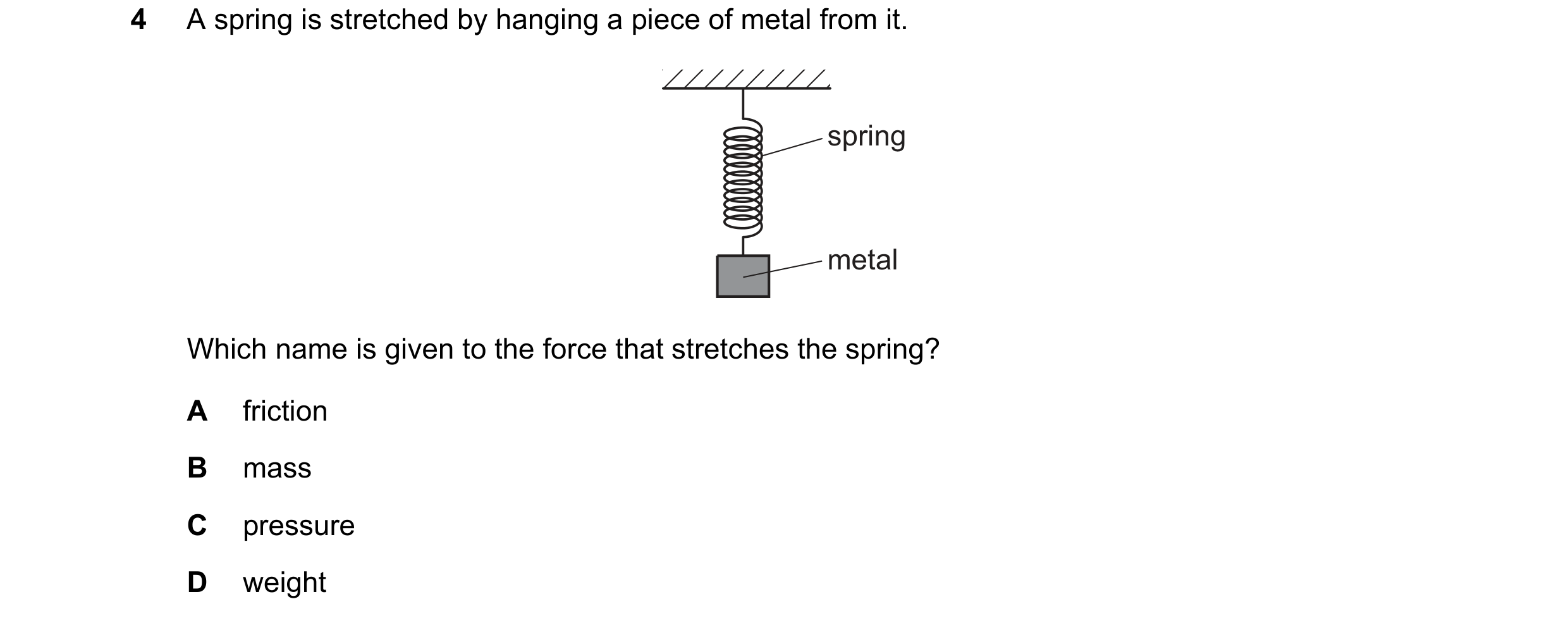 18 / 82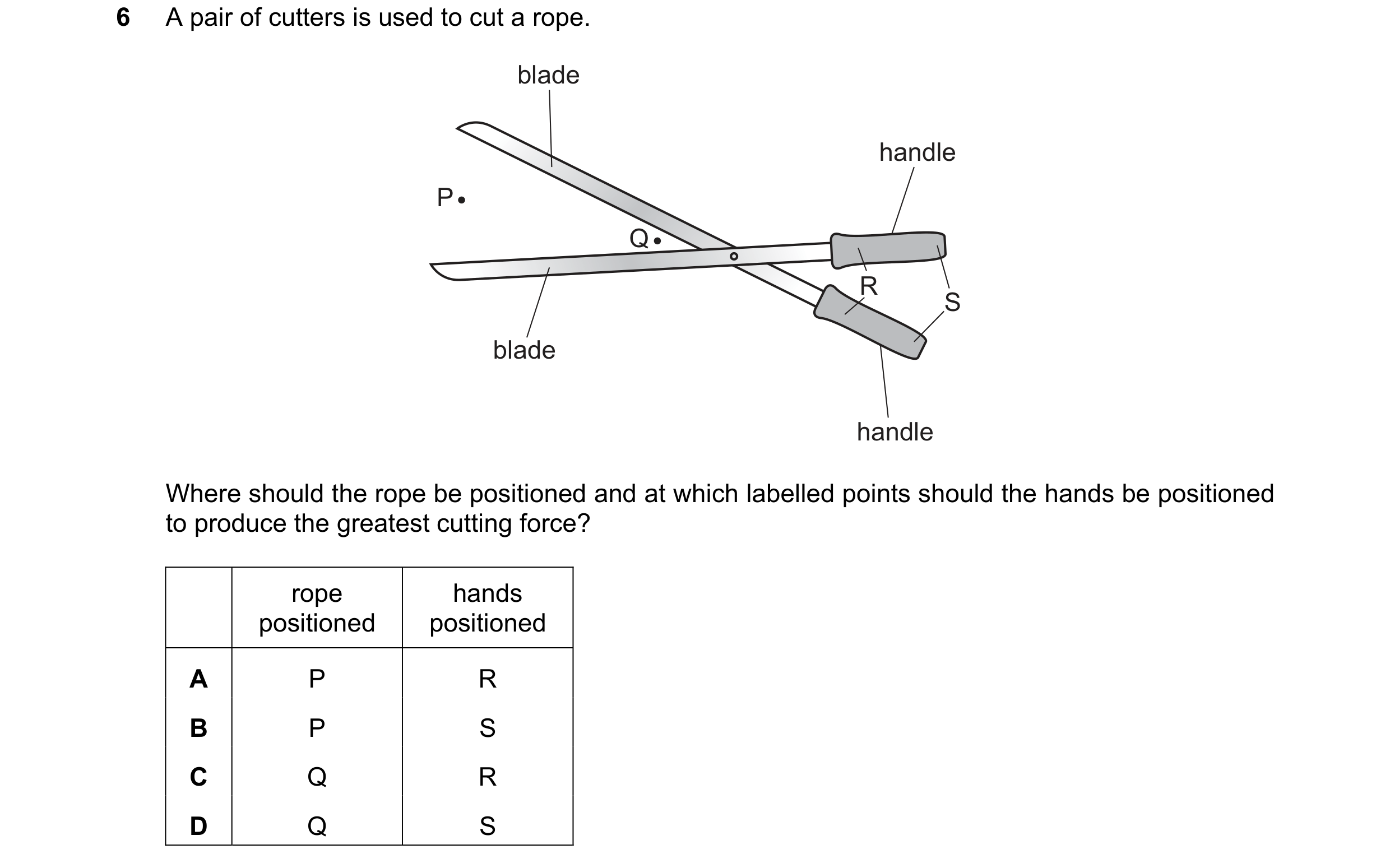
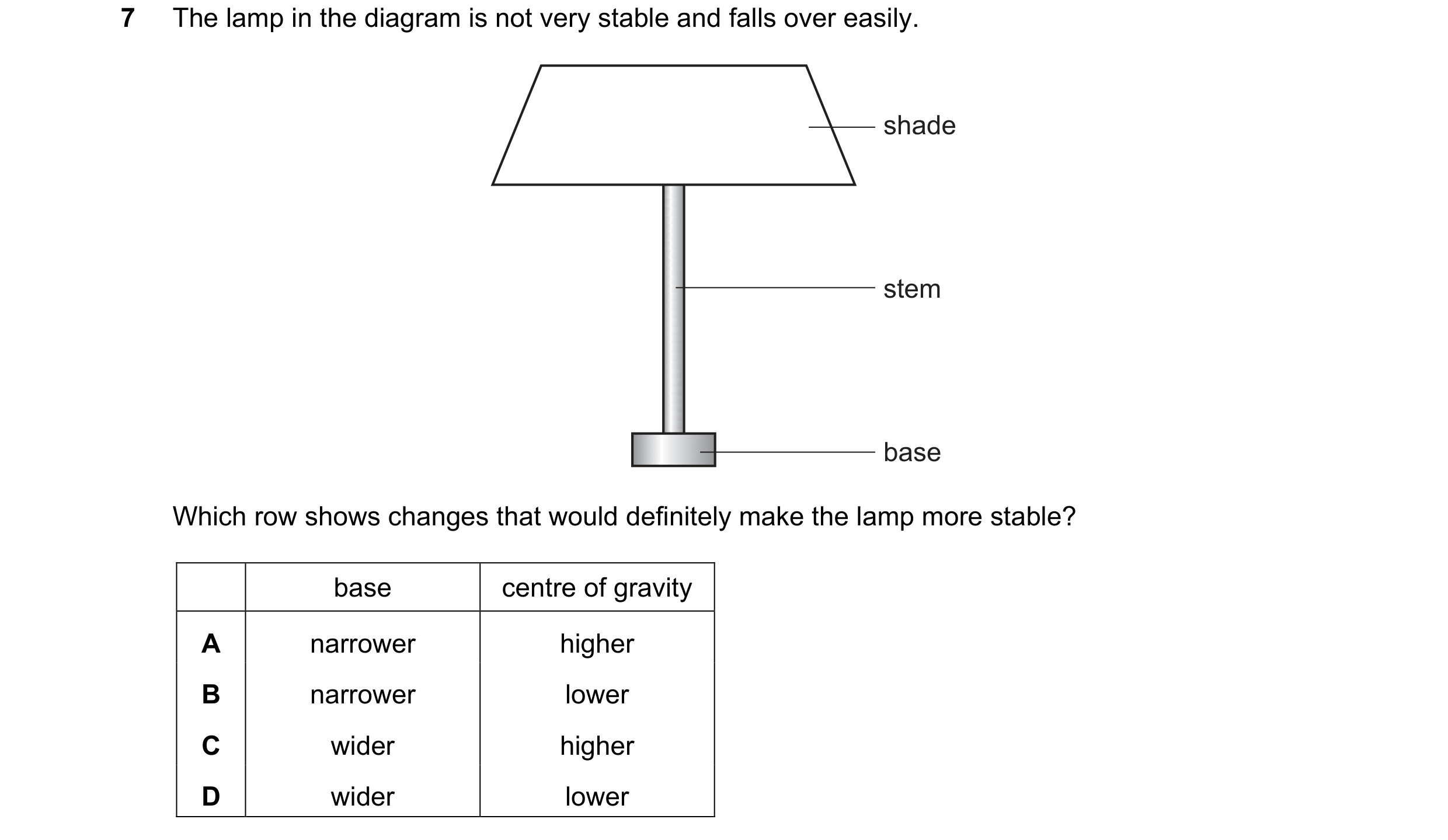 19 / 82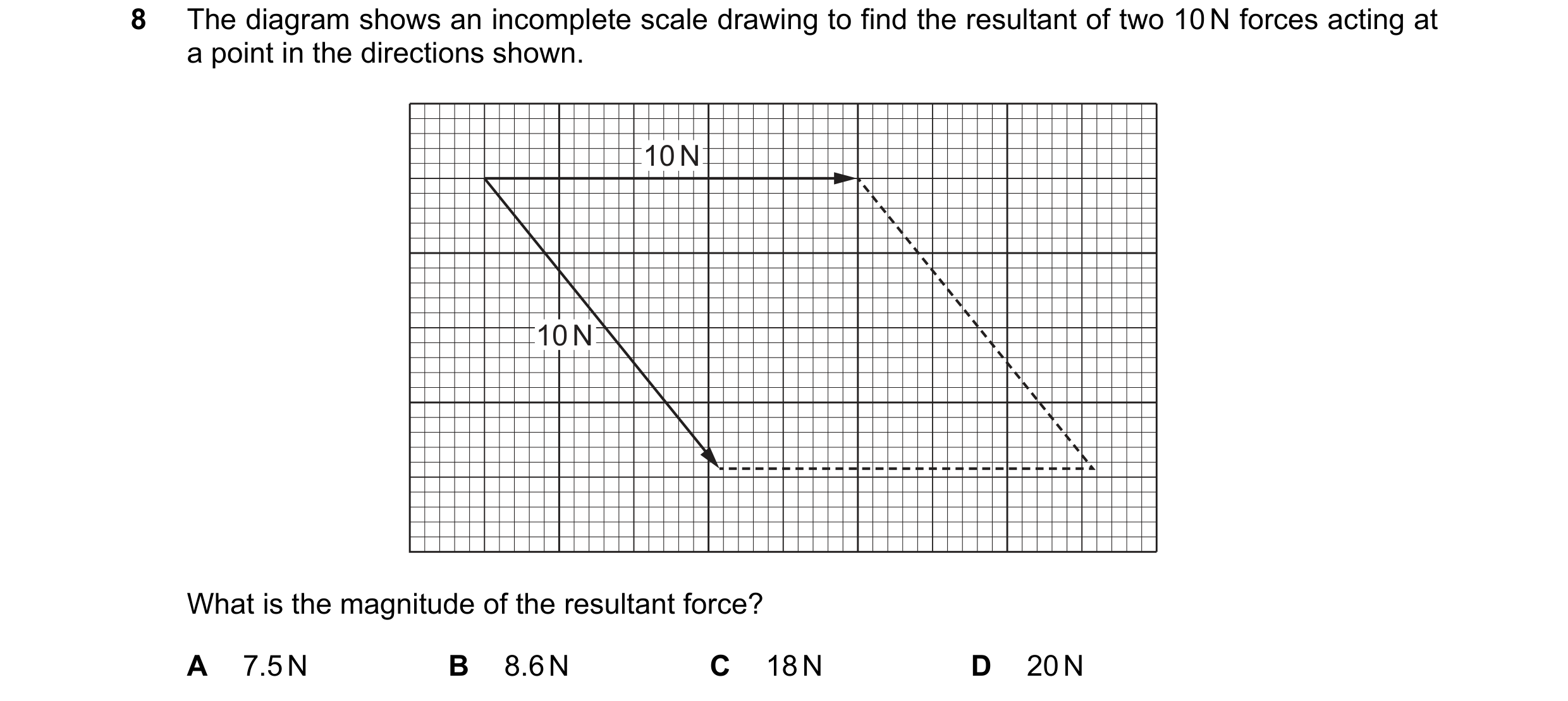

 20 / 82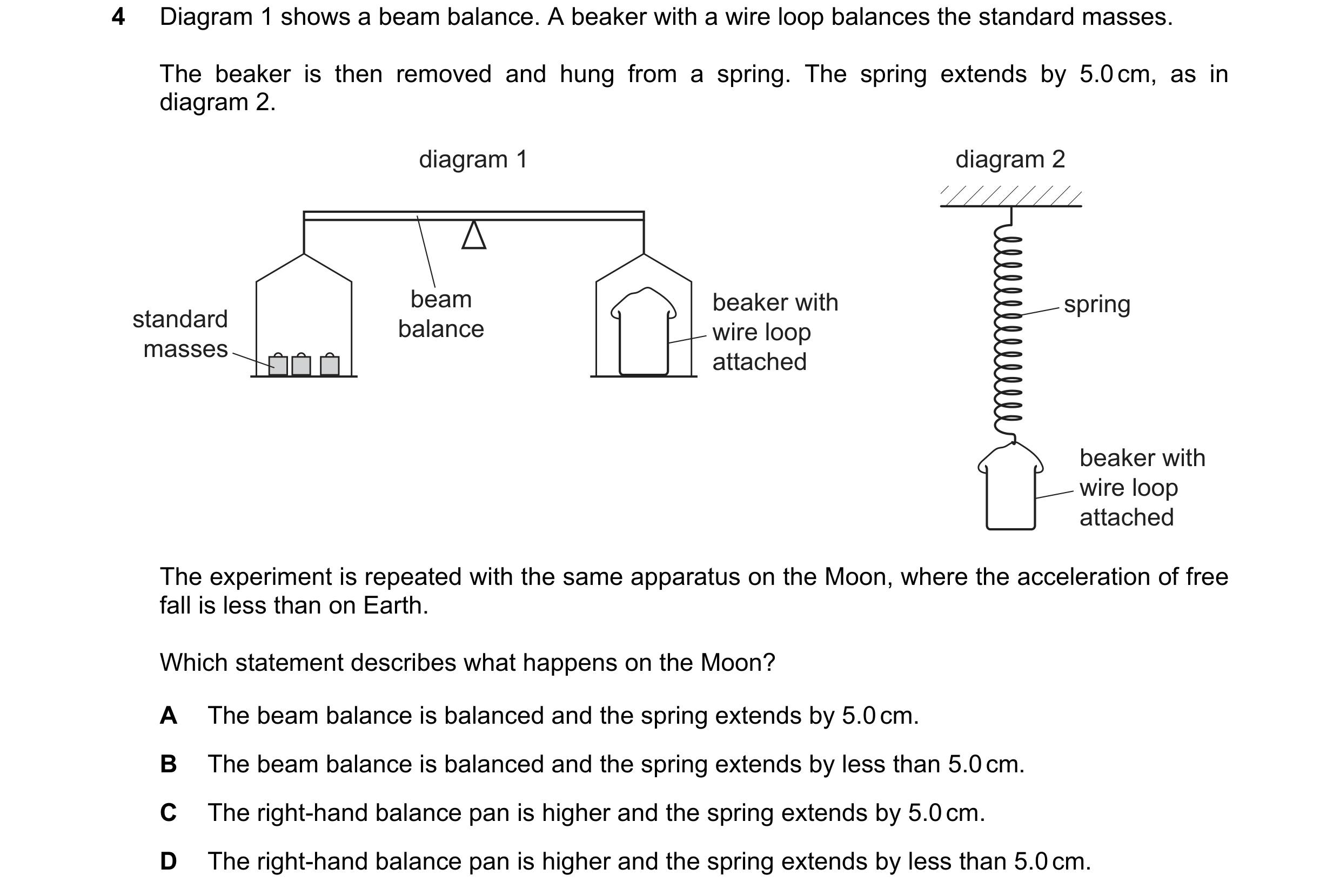
 21 / 82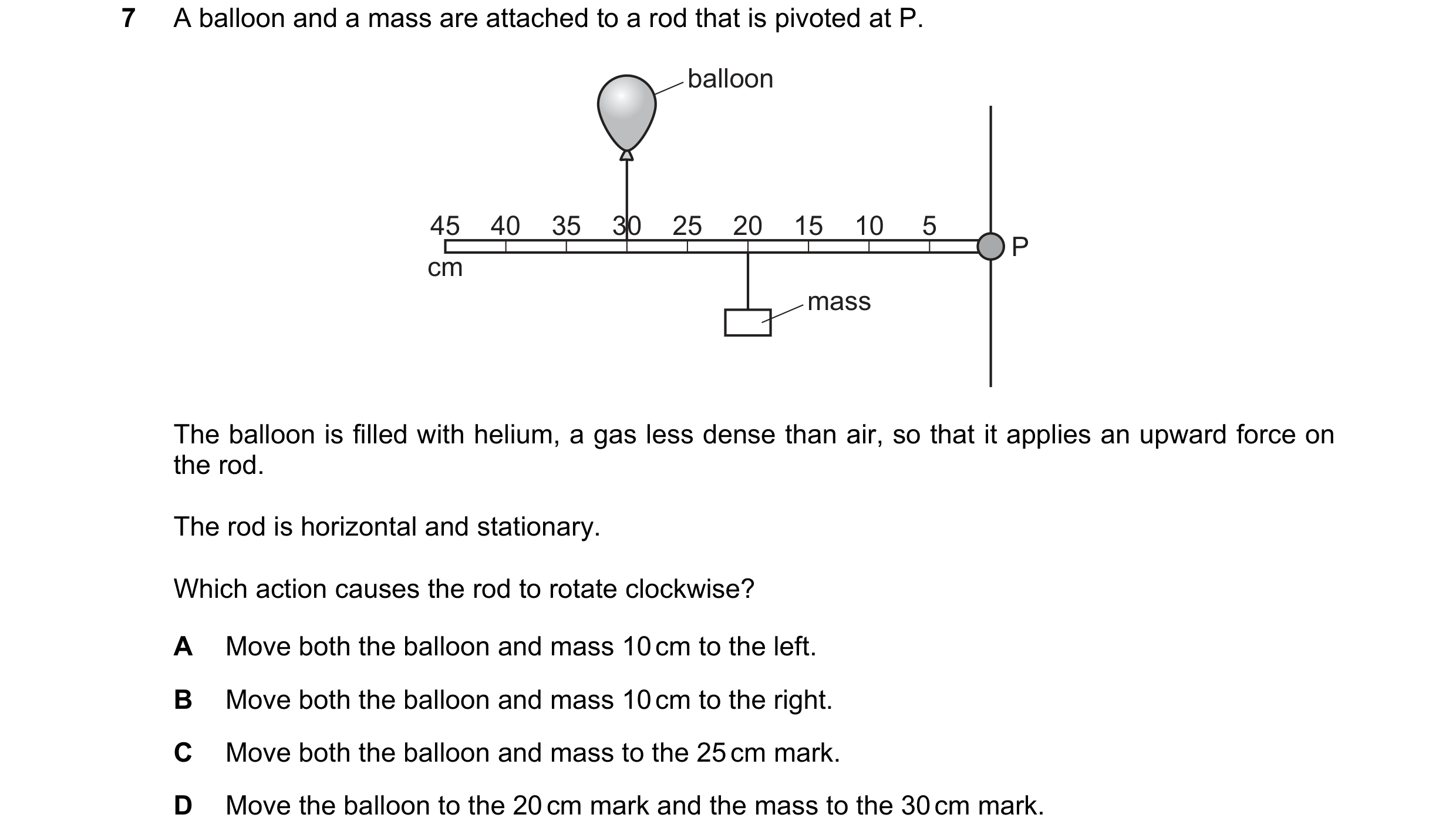

 22 / 82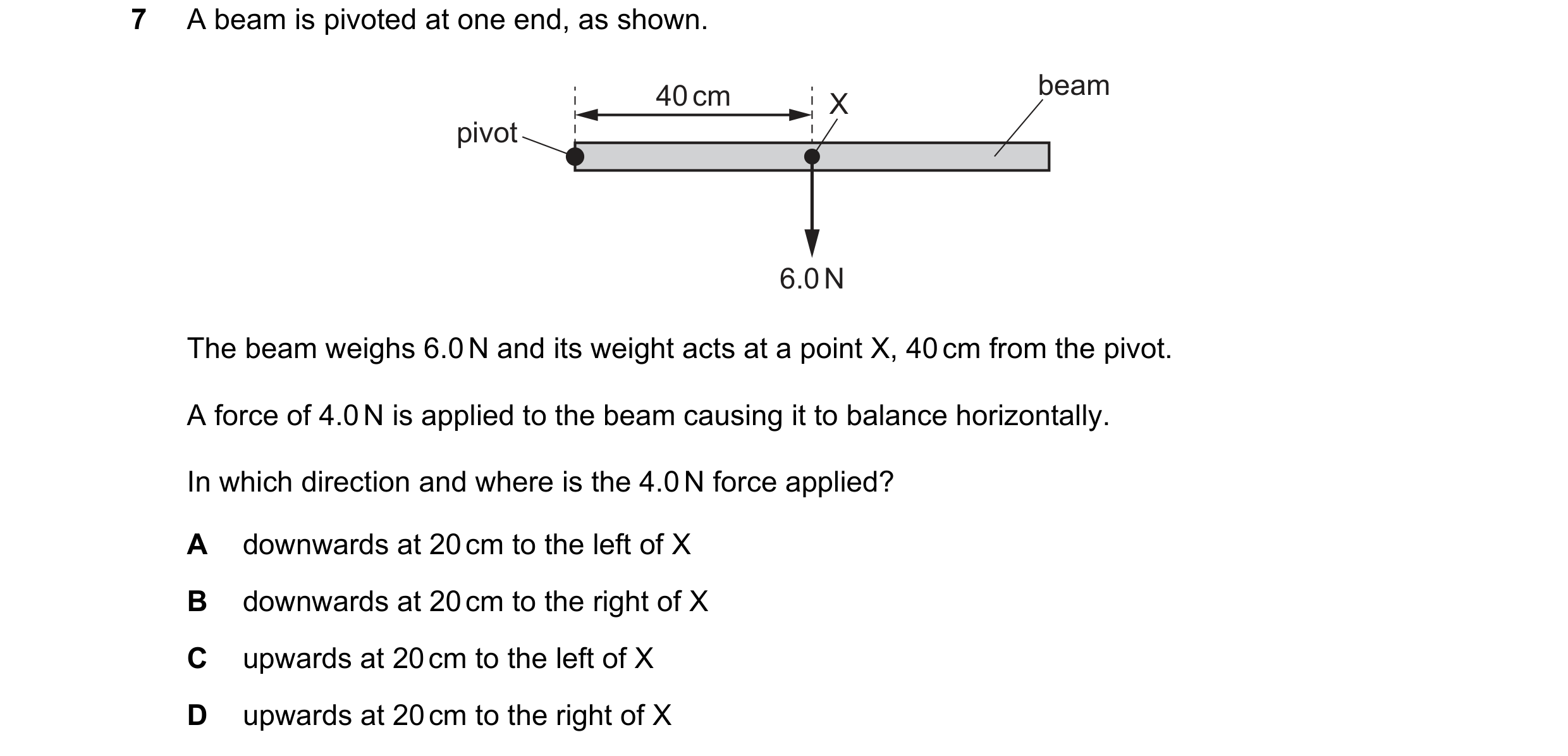

 23 / 82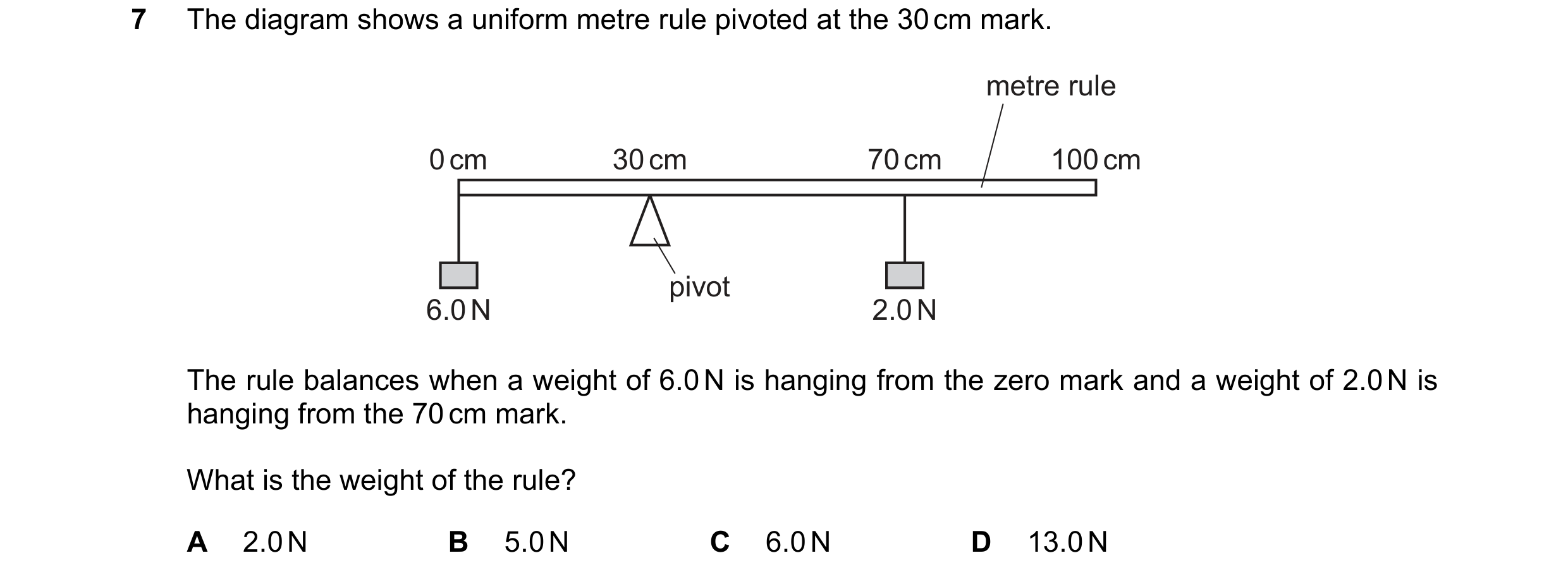
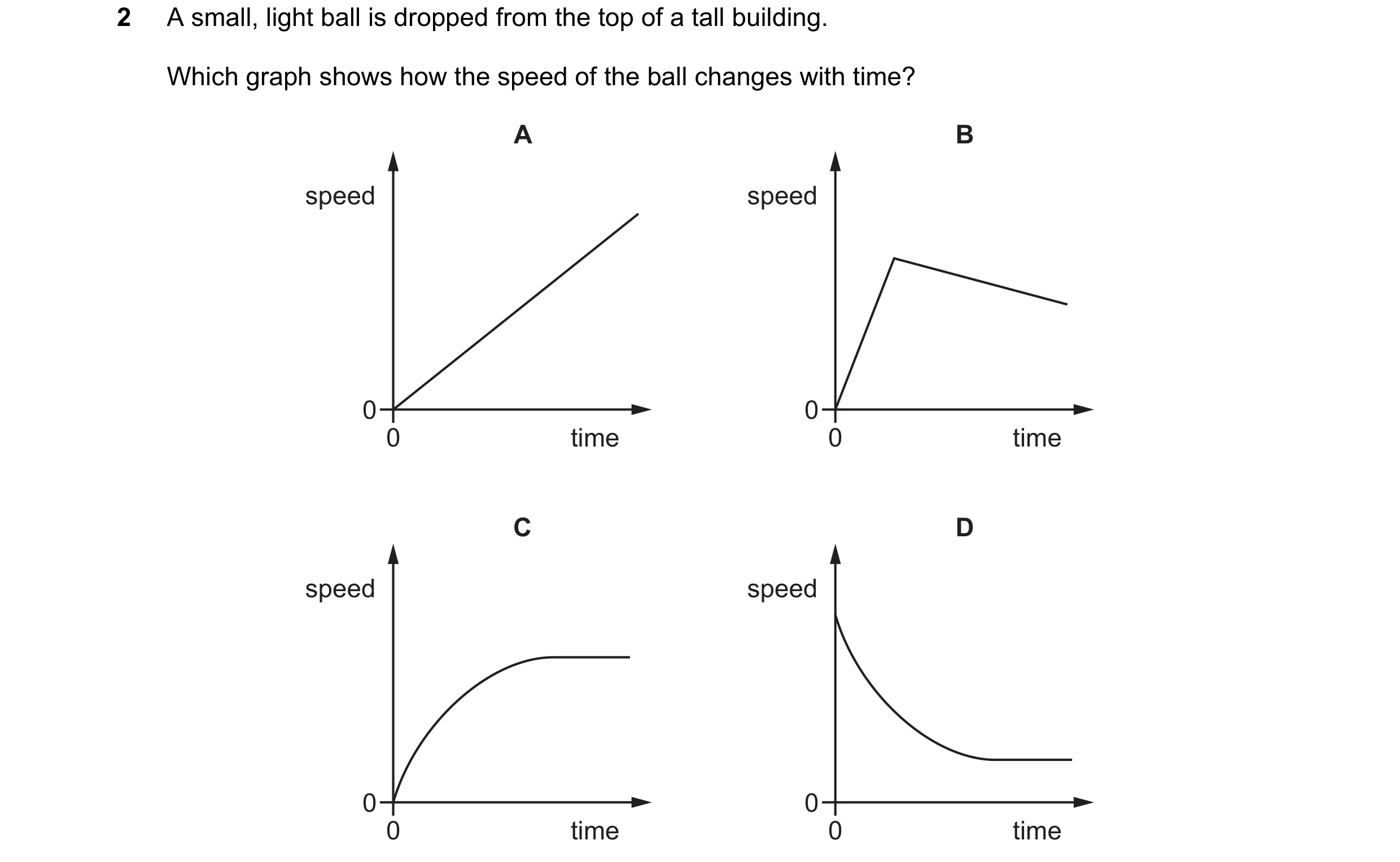 24 / 82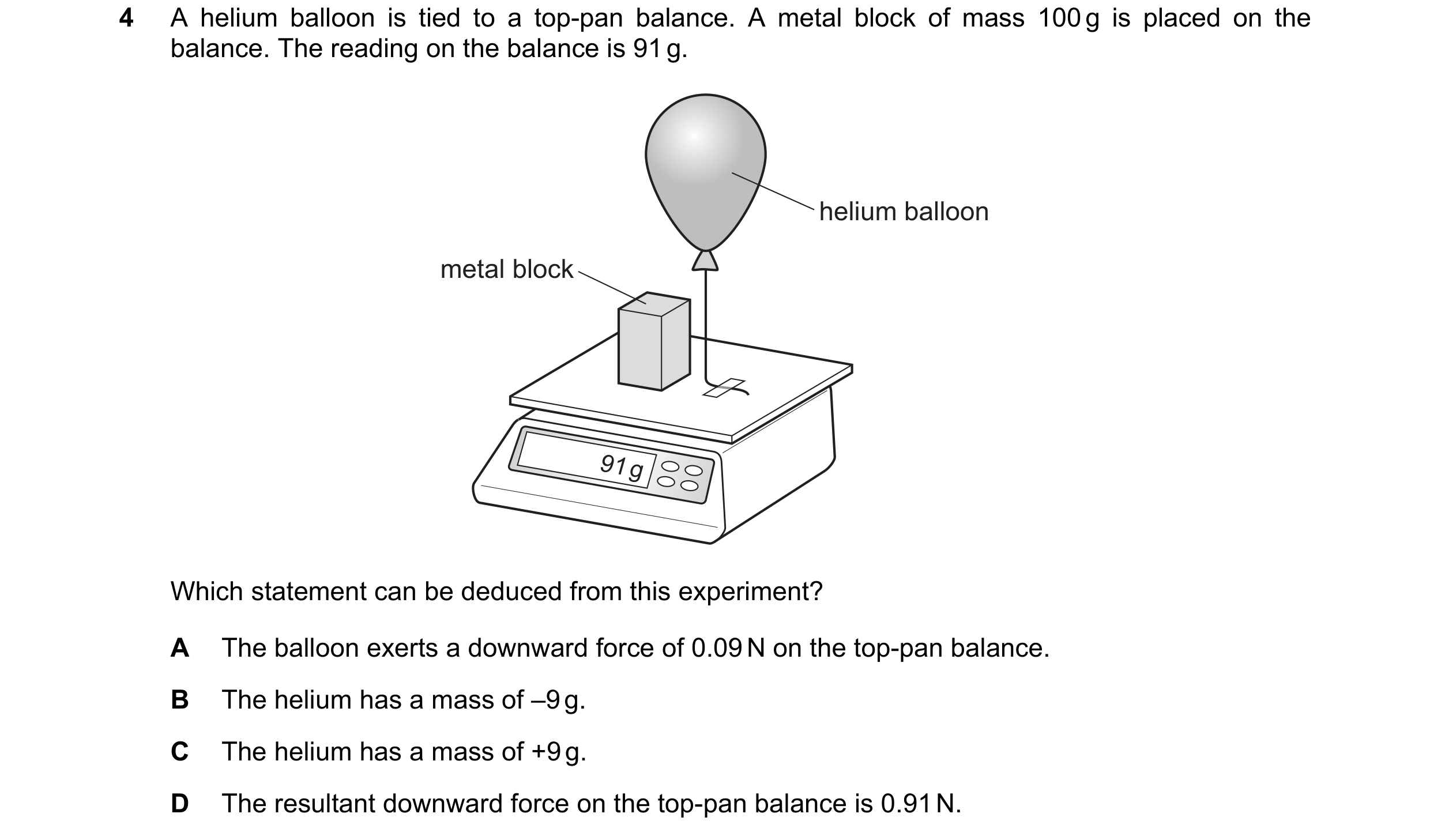

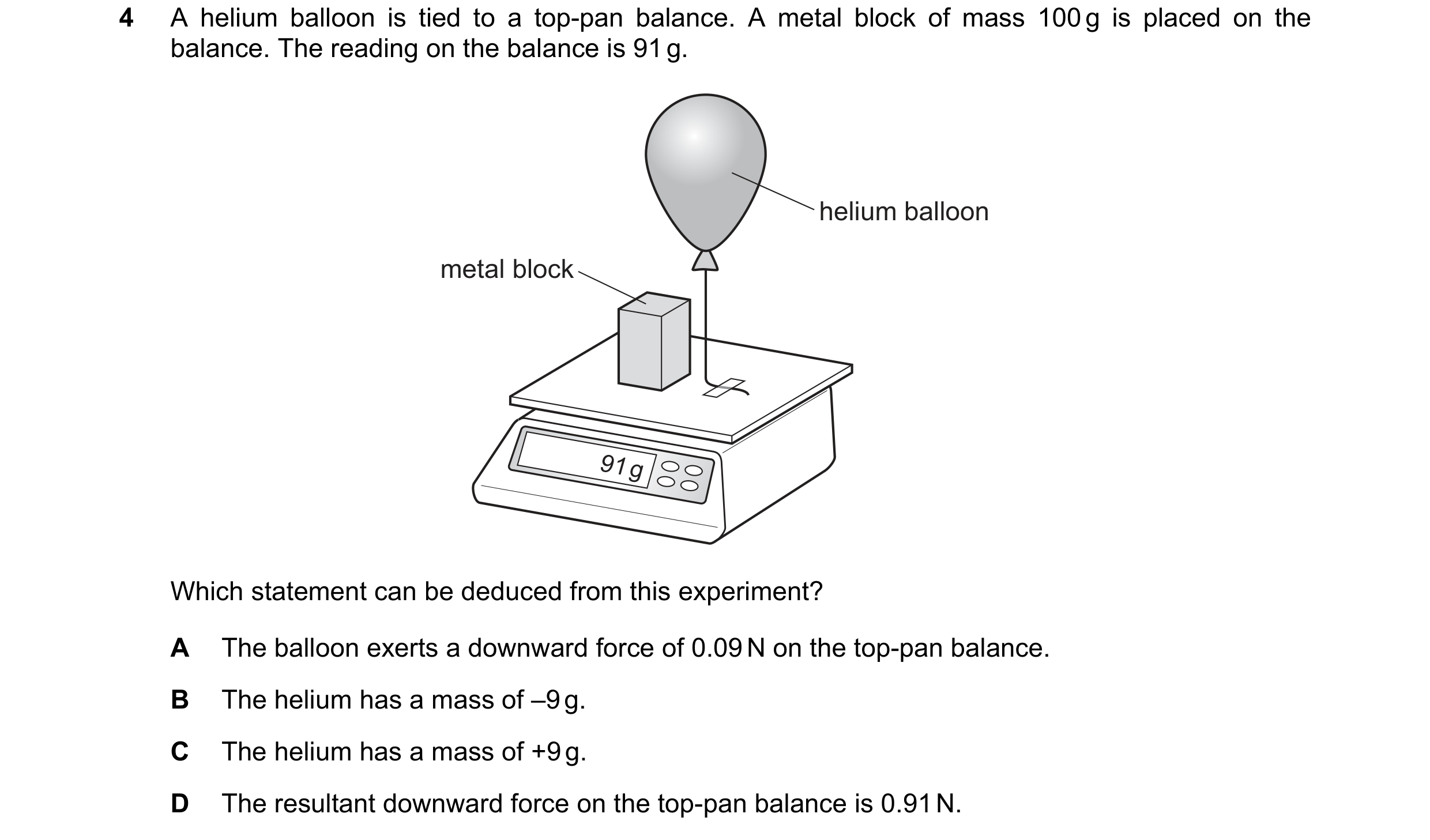 25 / 82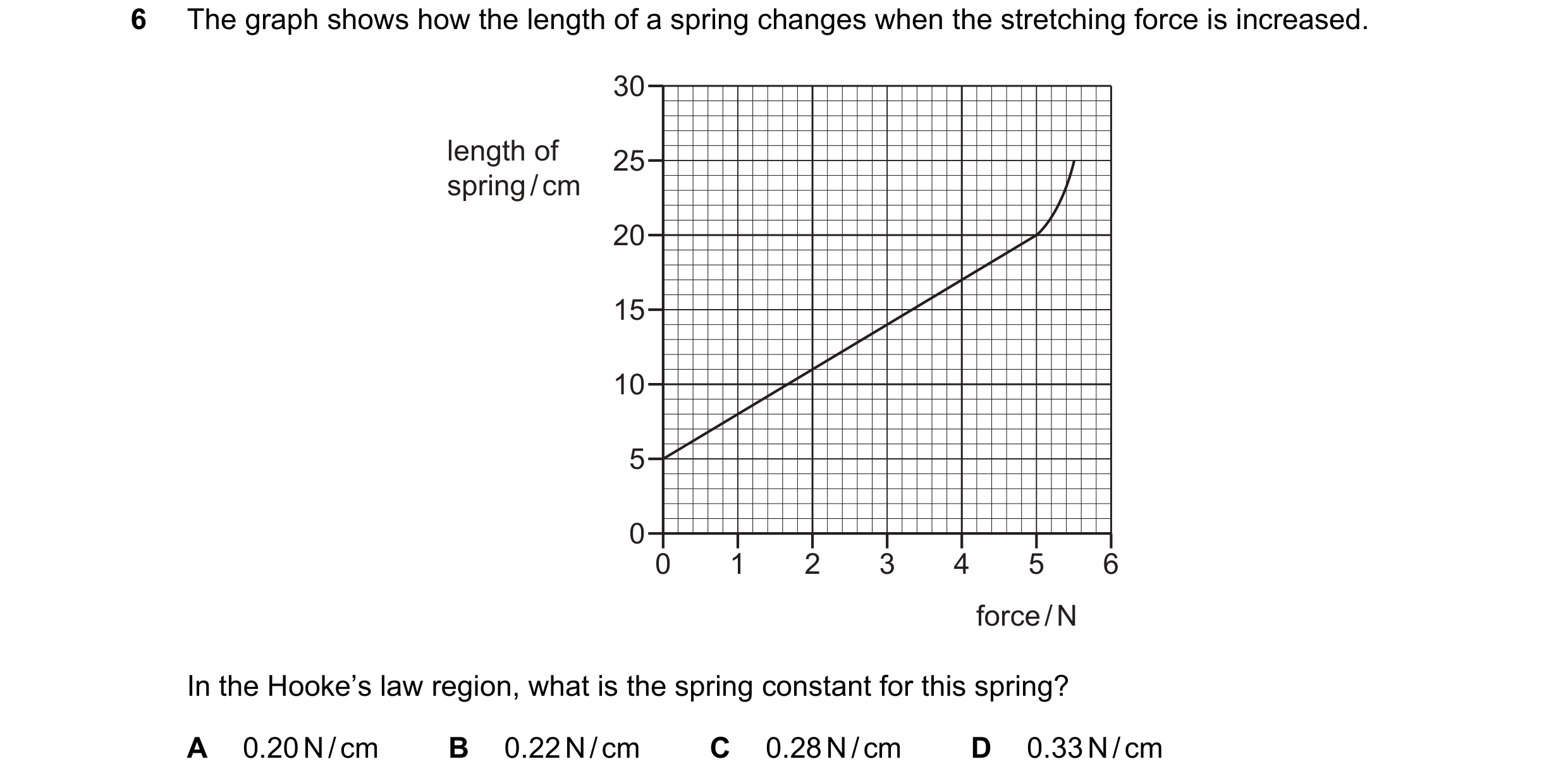
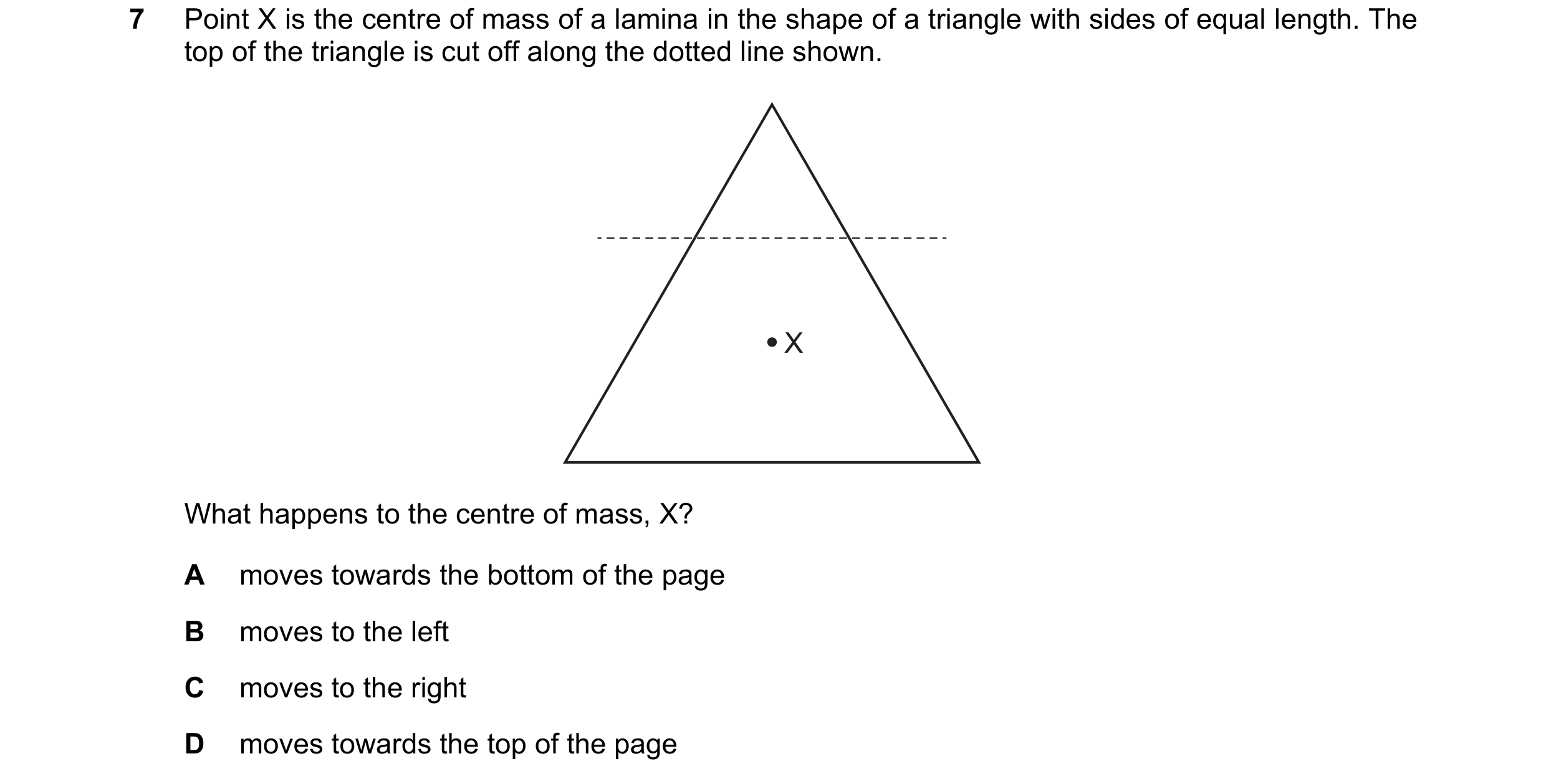 26 / 82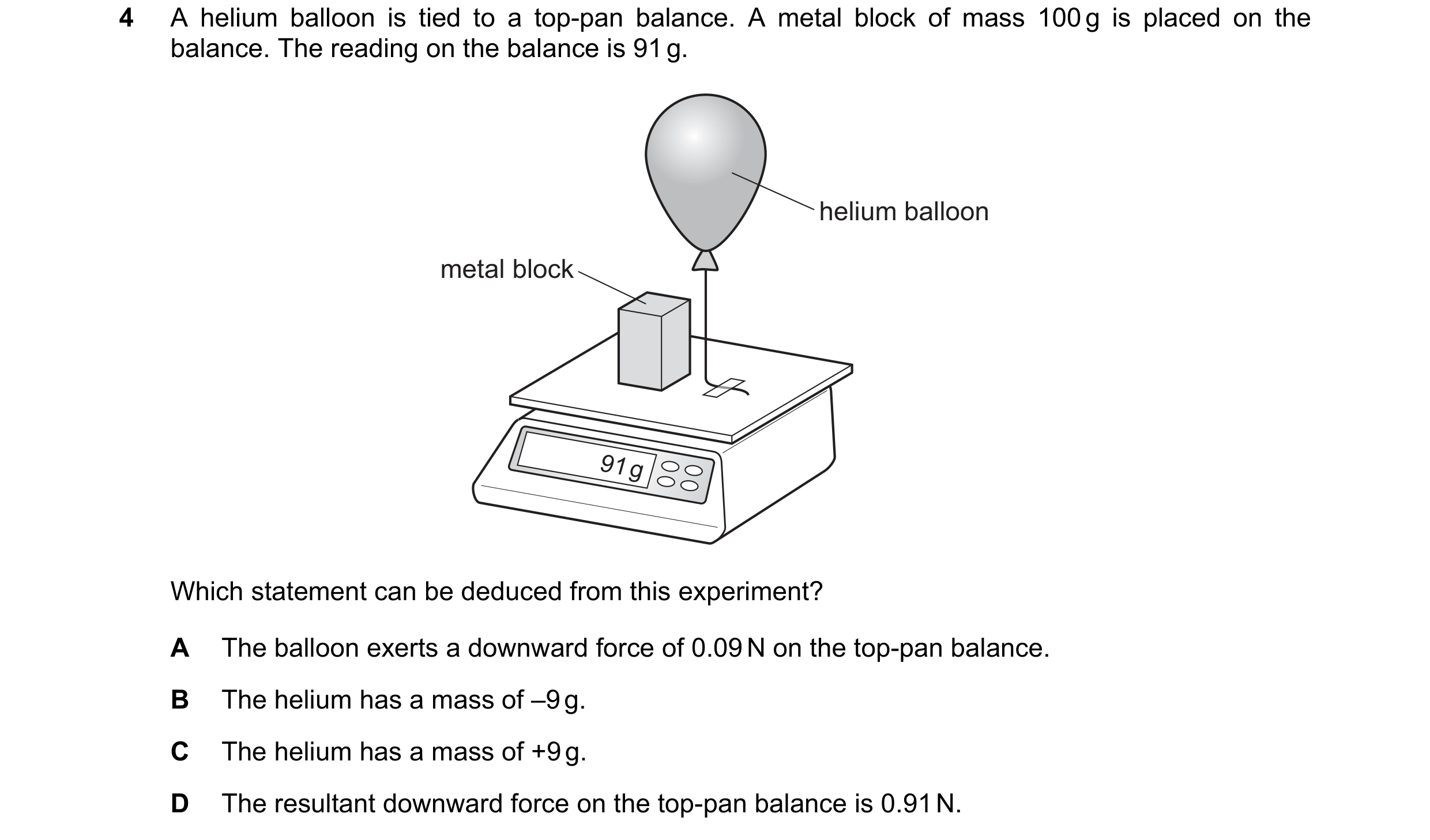

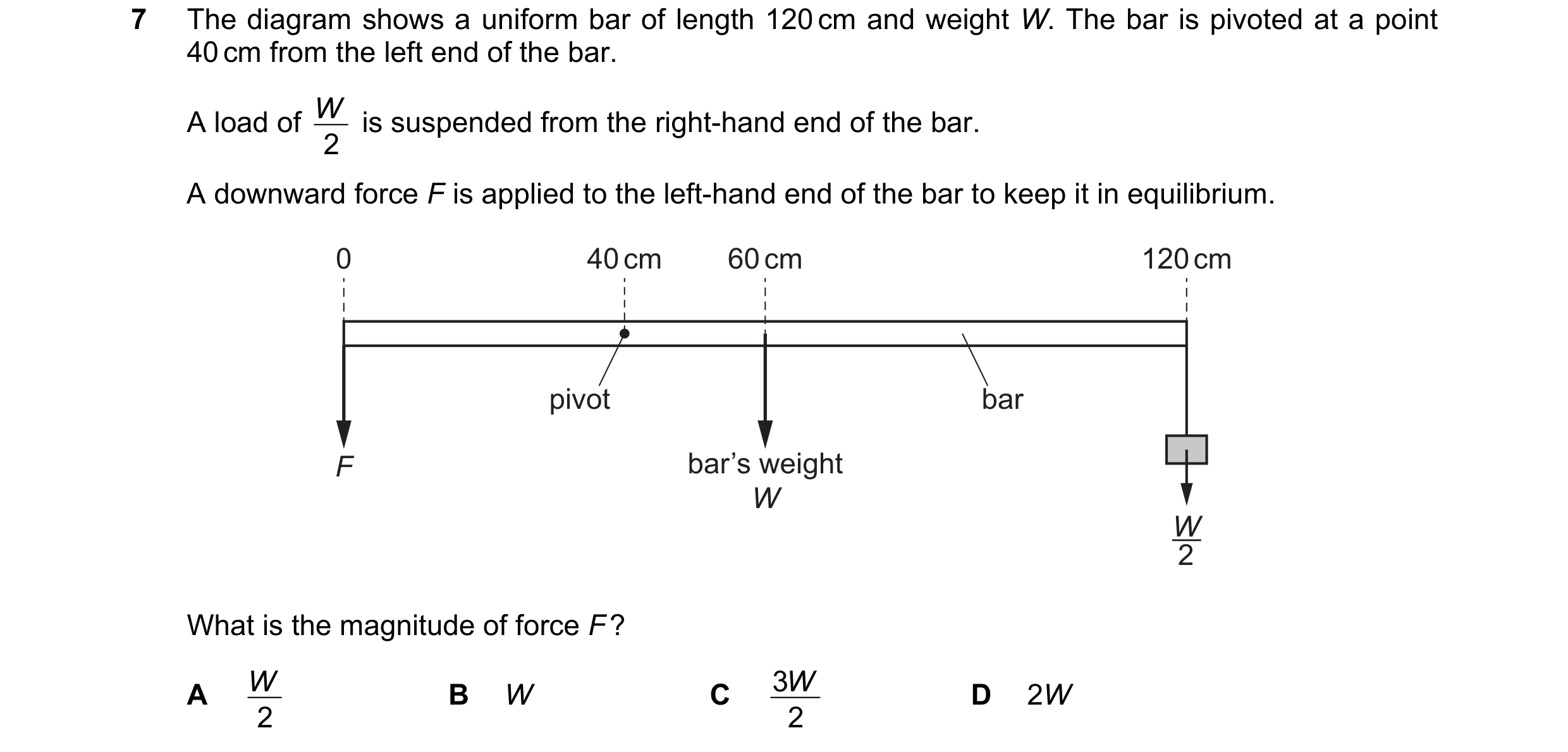 27 / 82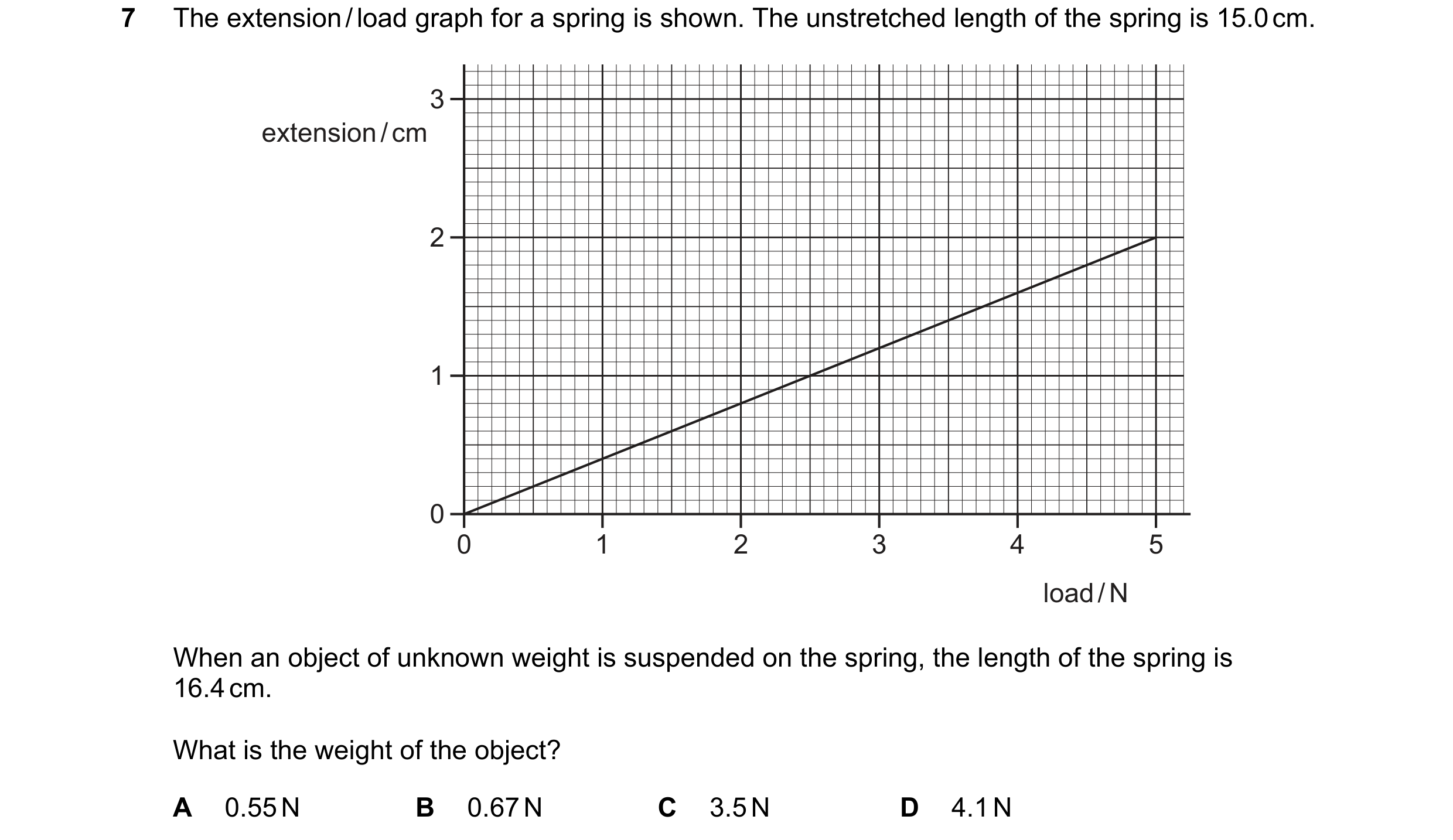


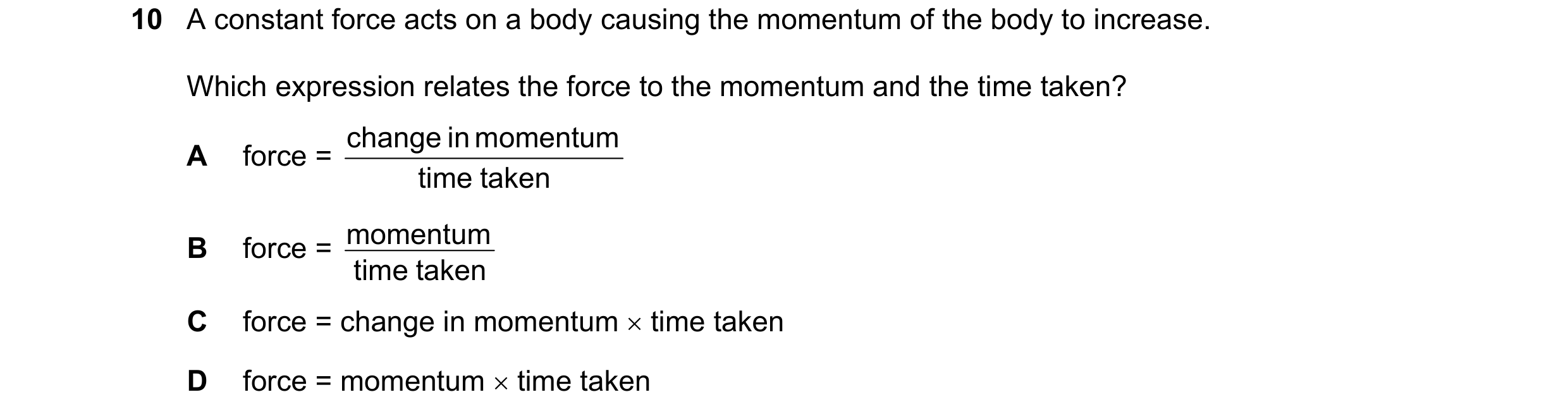 28 / 82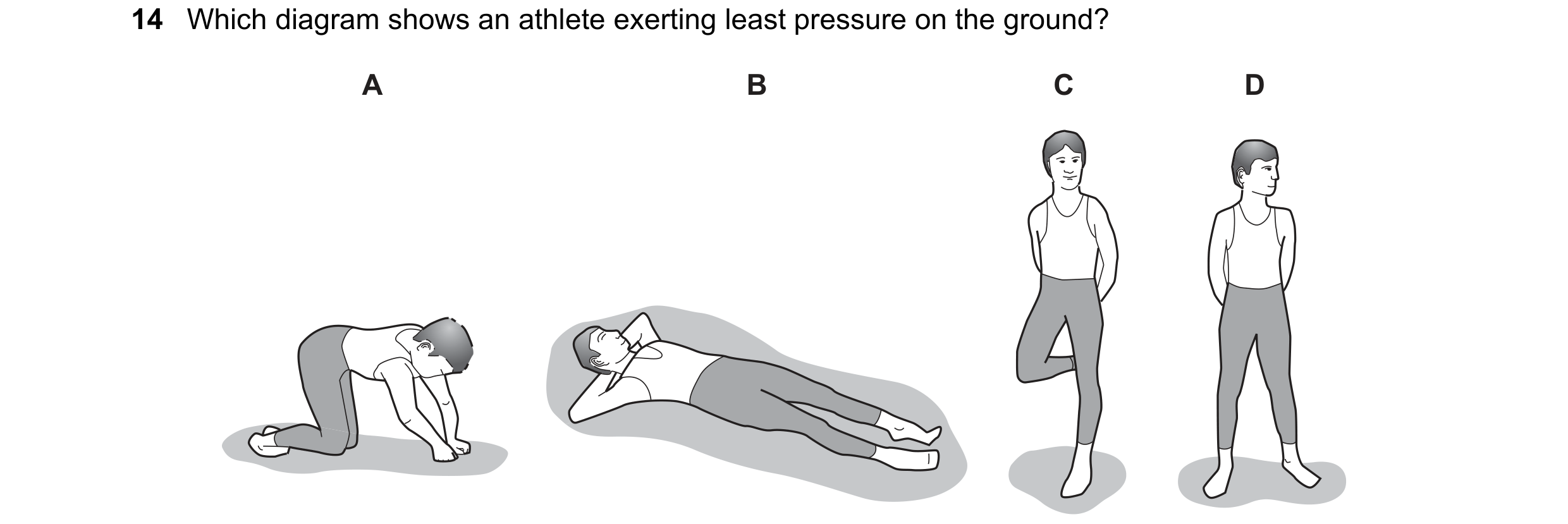
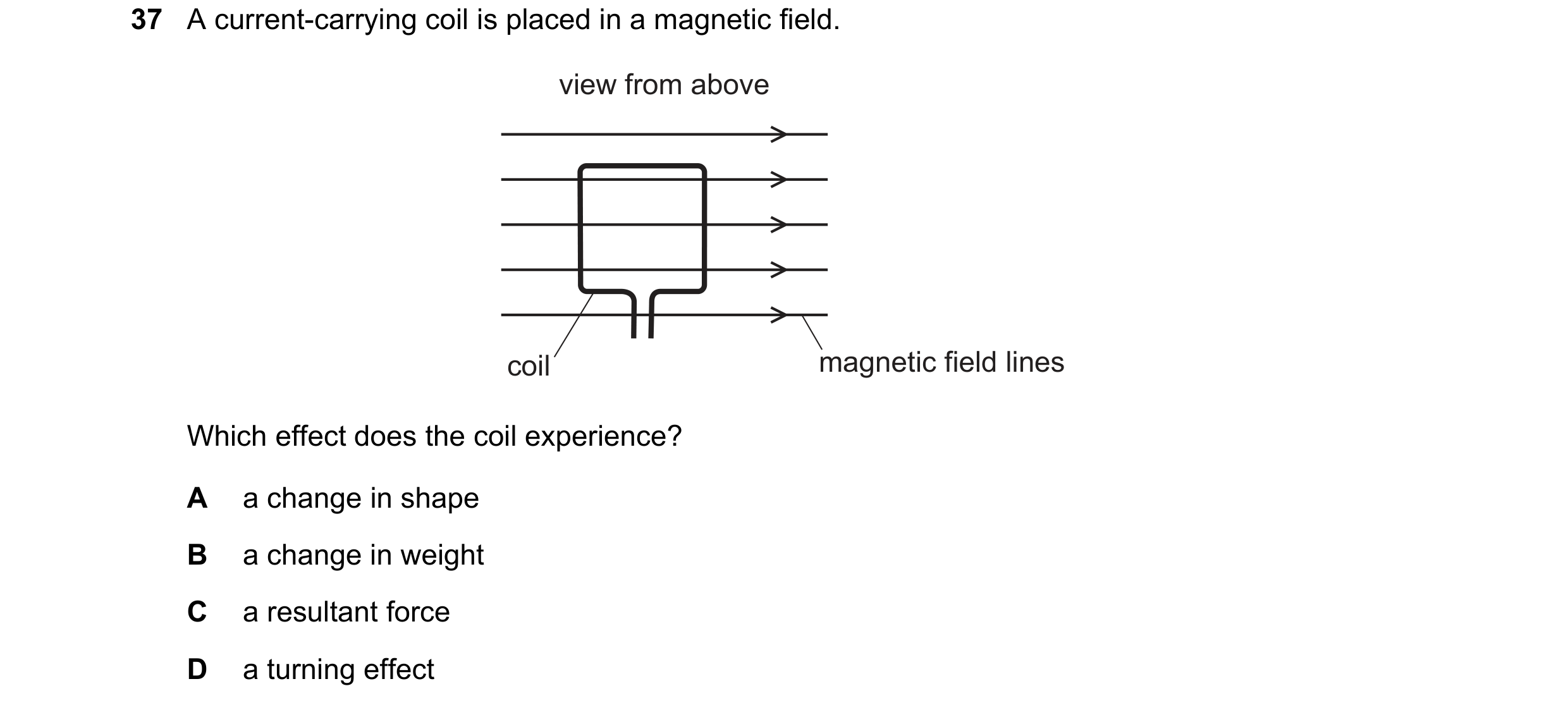
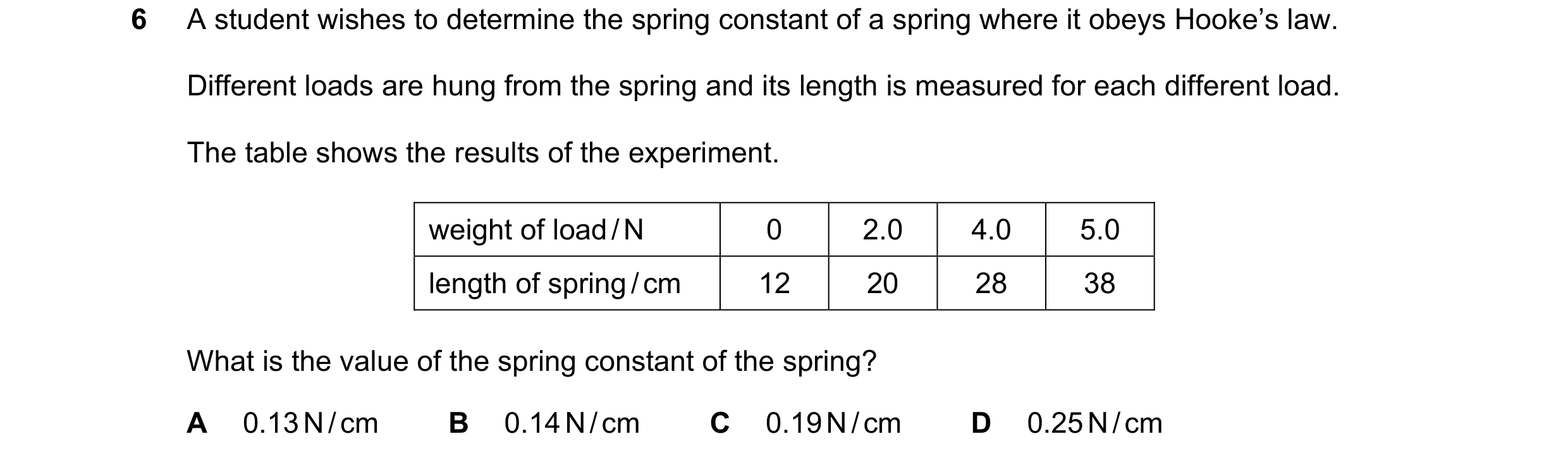 29 / 82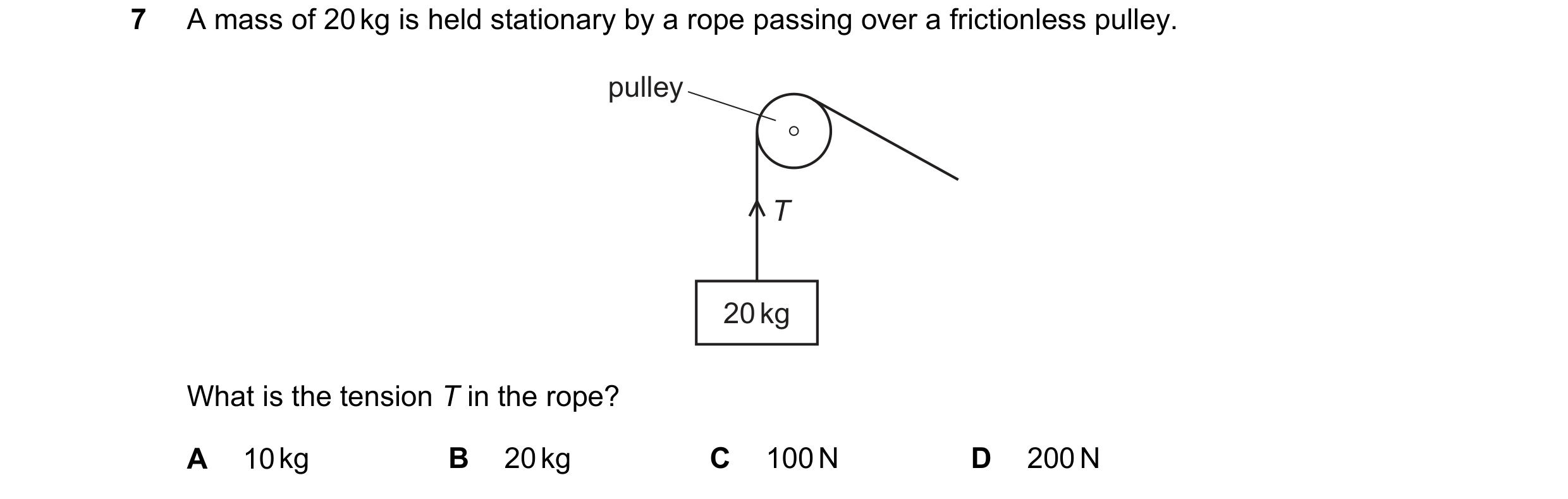
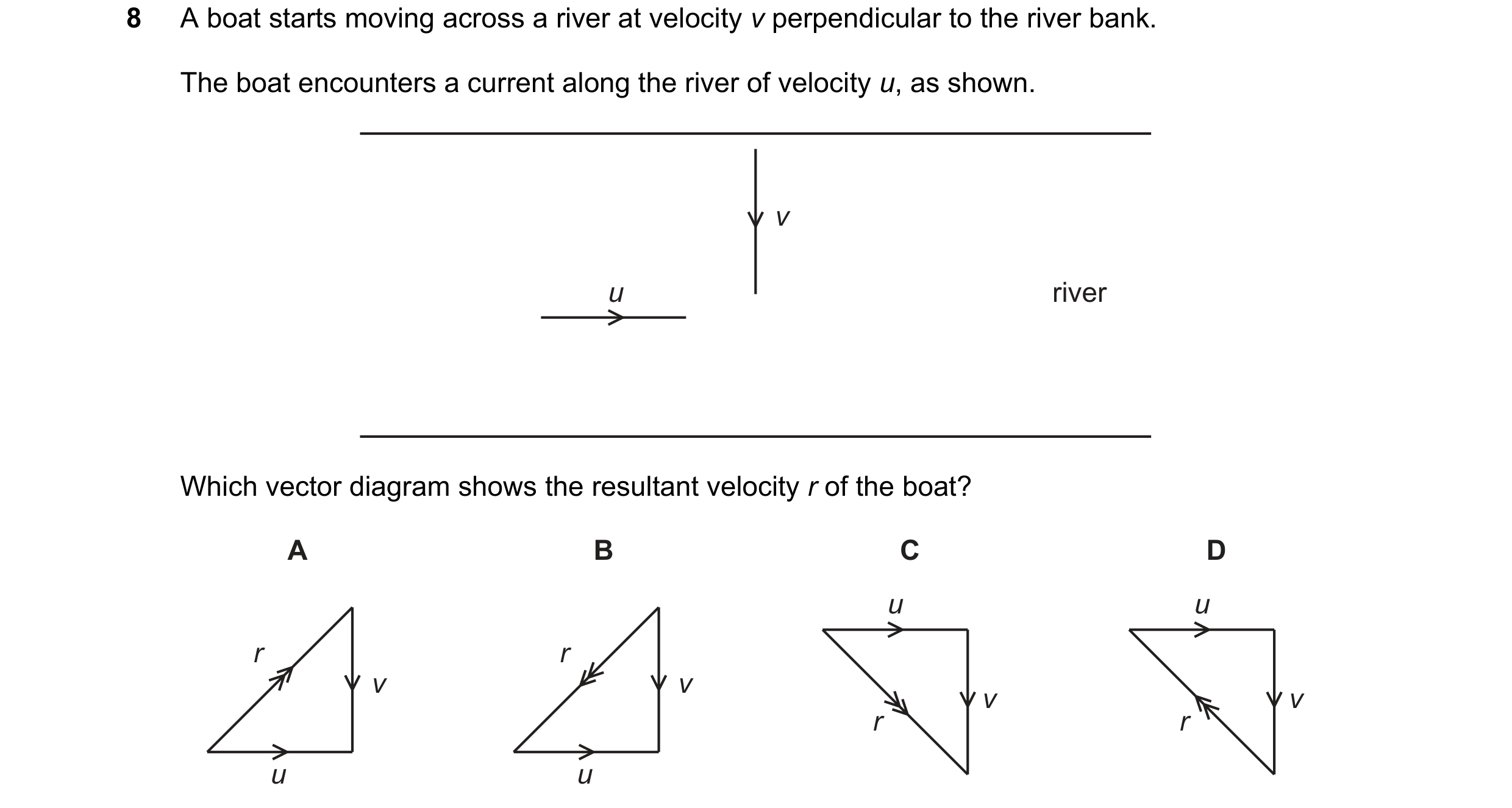
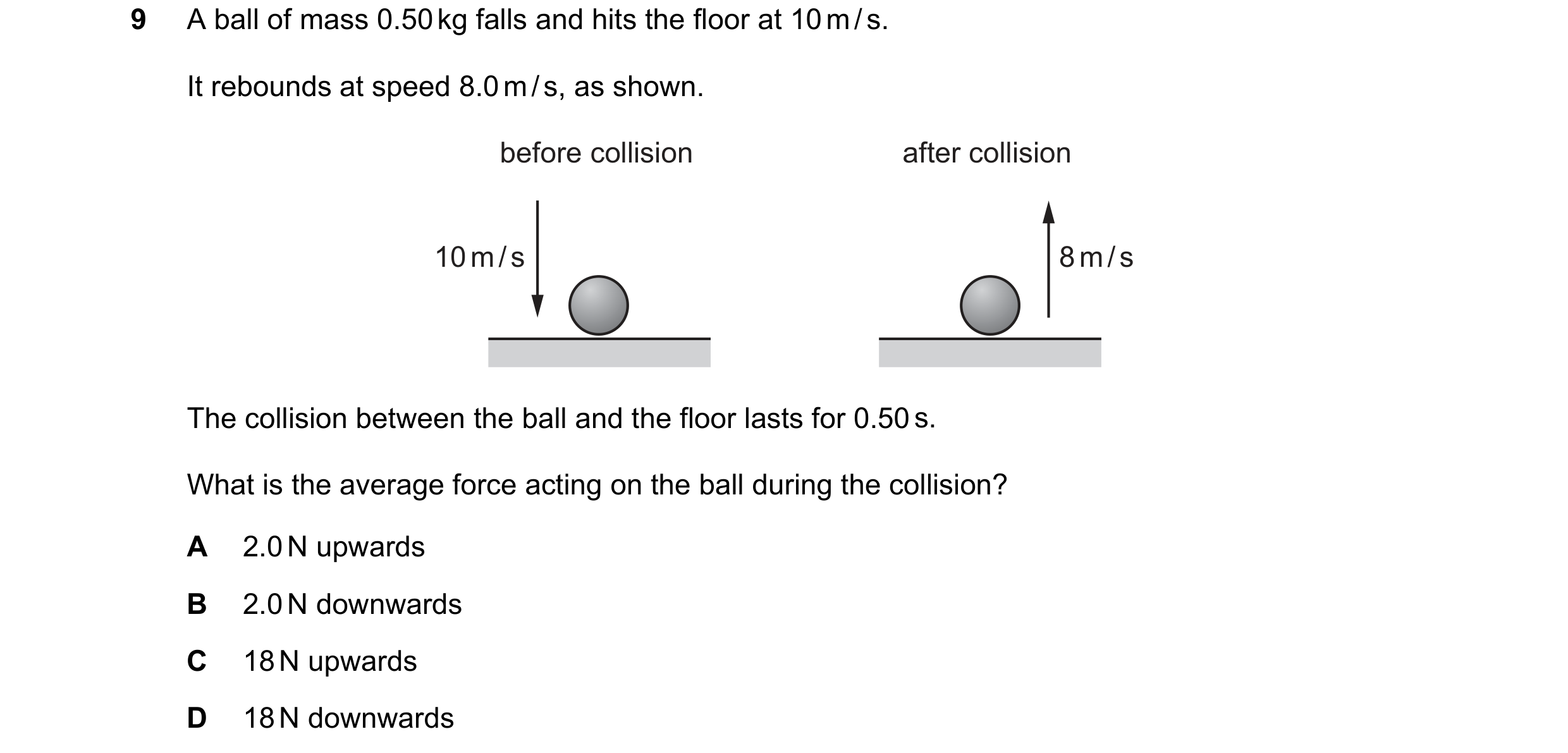 30 / 82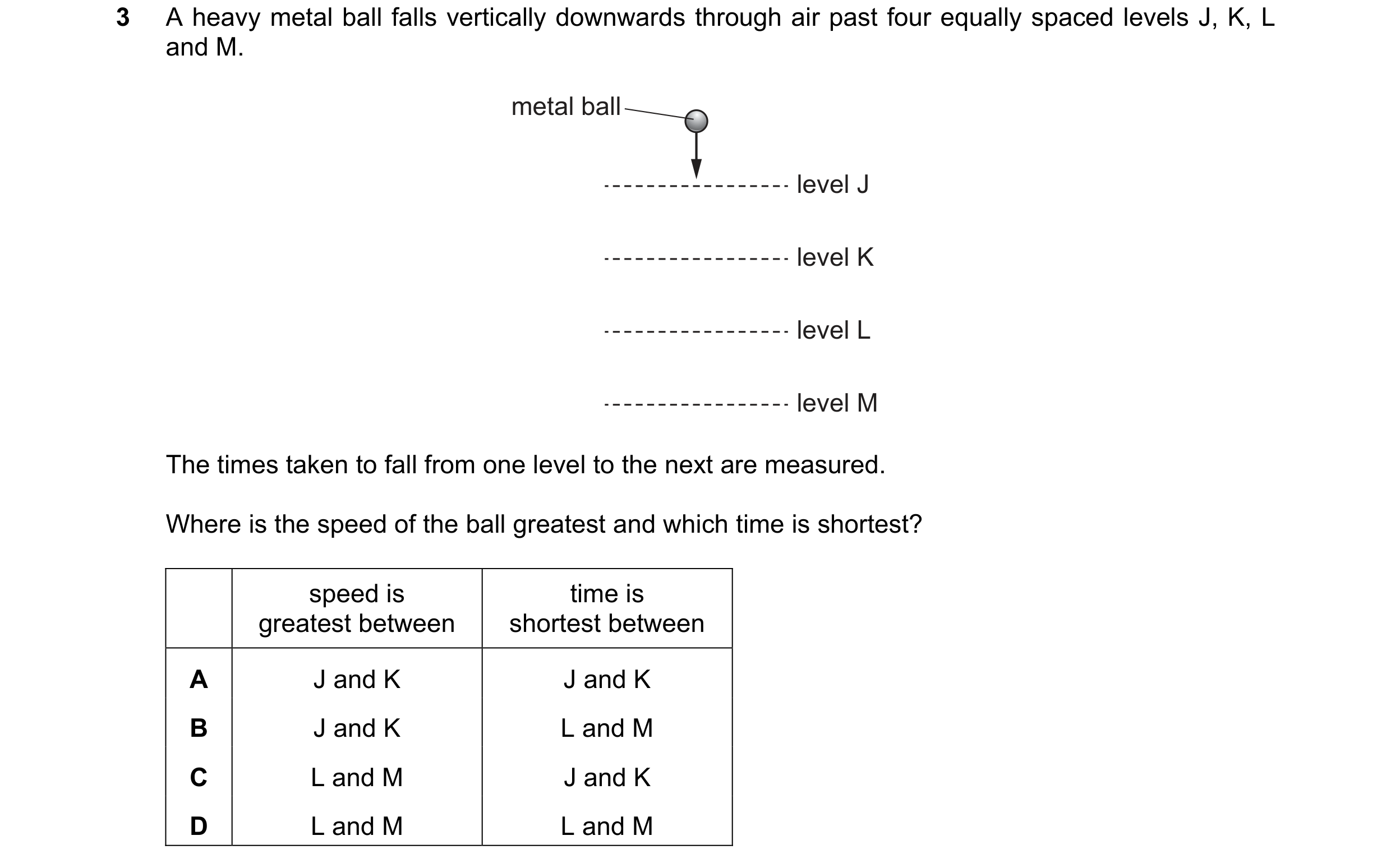
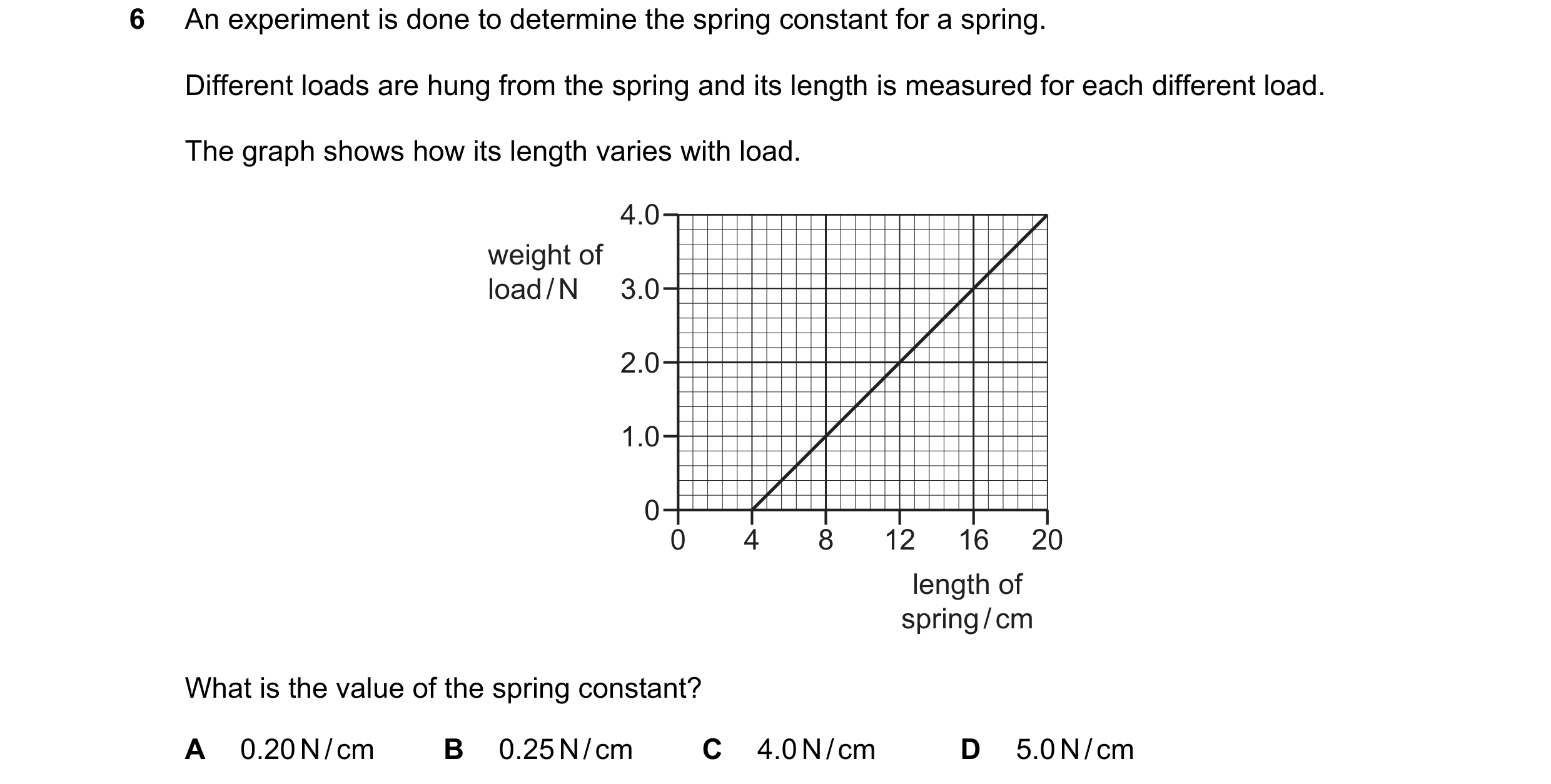 31 / 82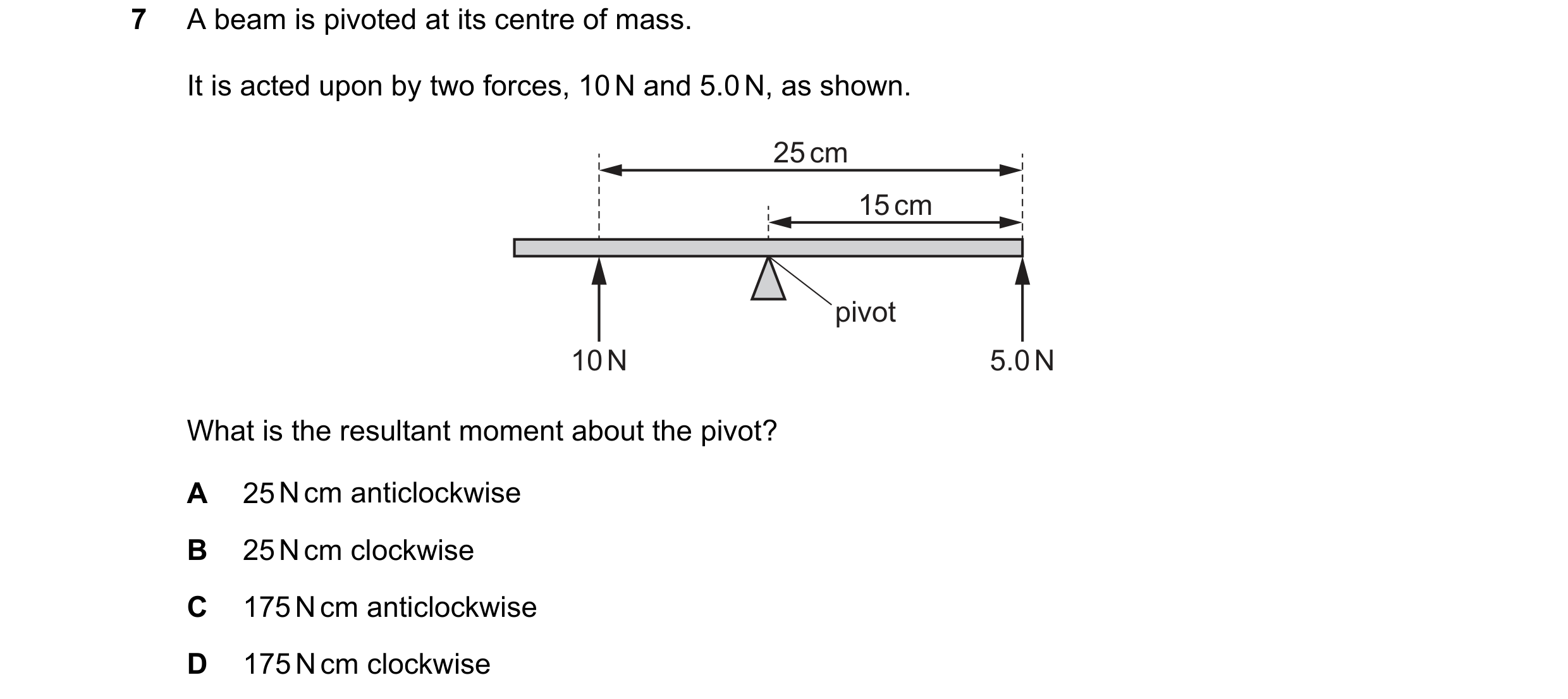
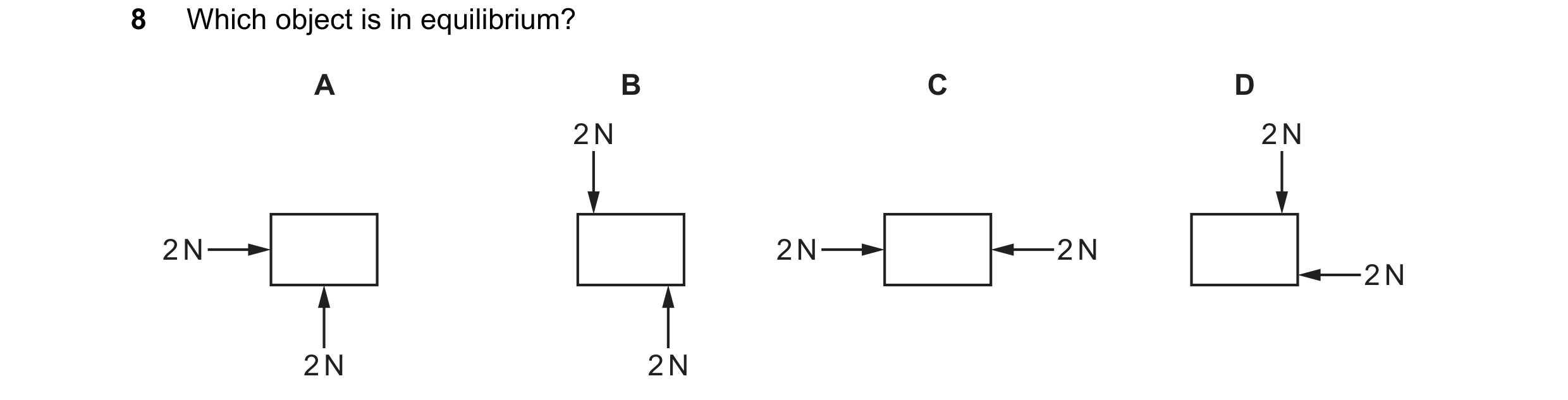
 32 / 82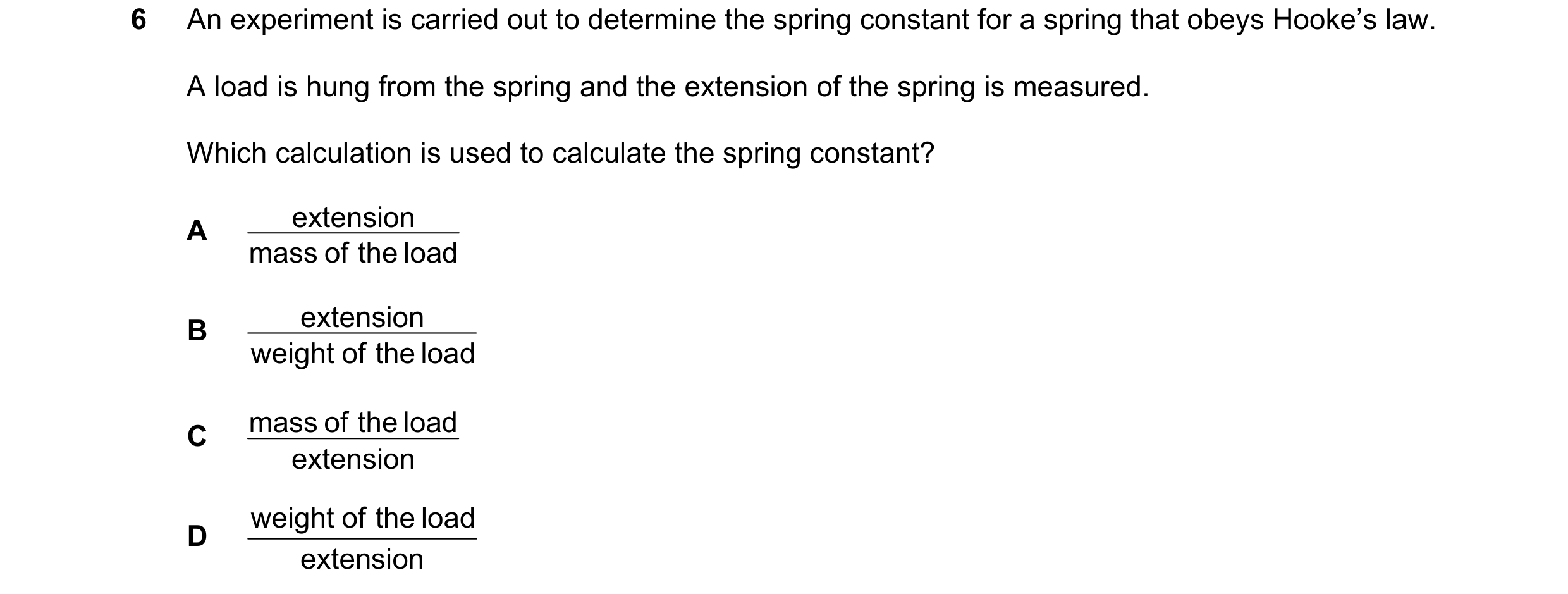
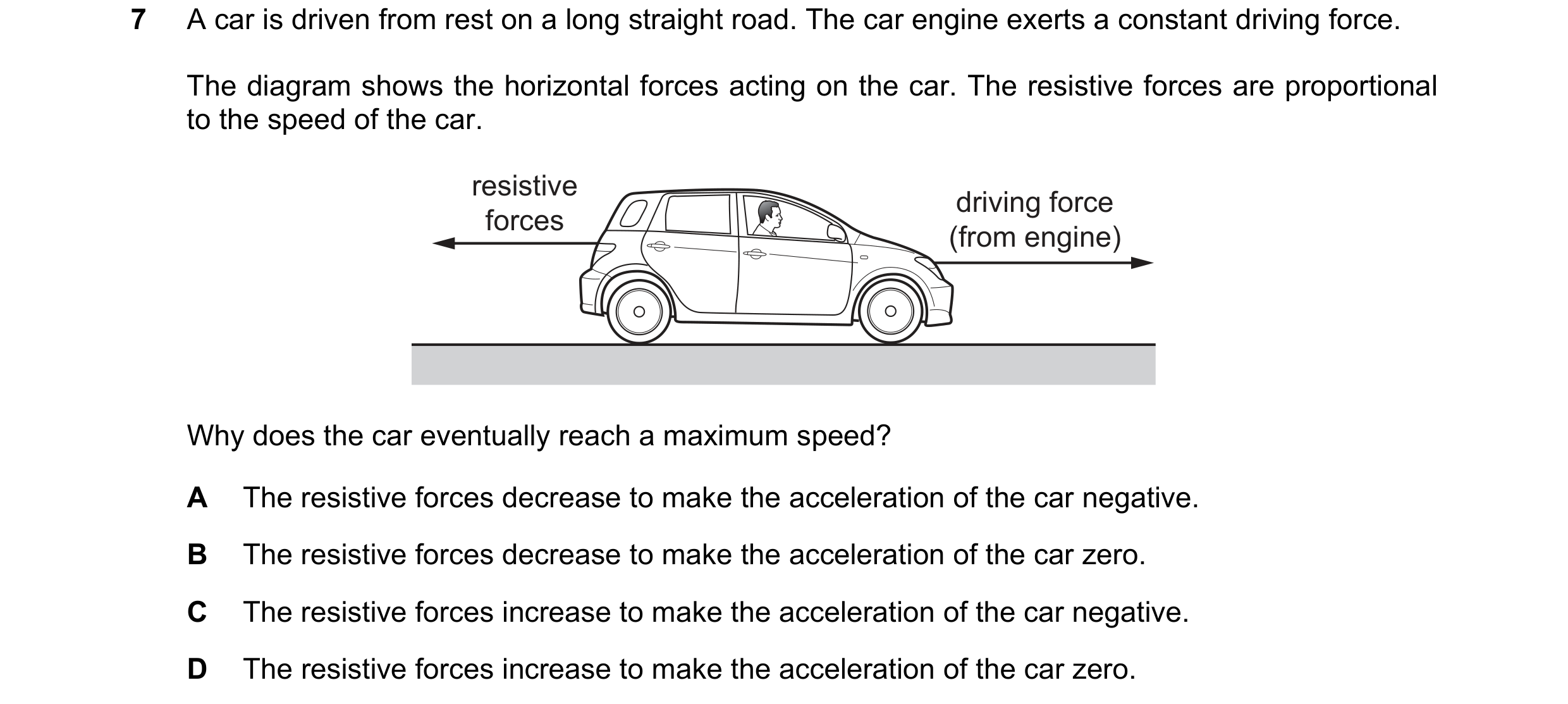
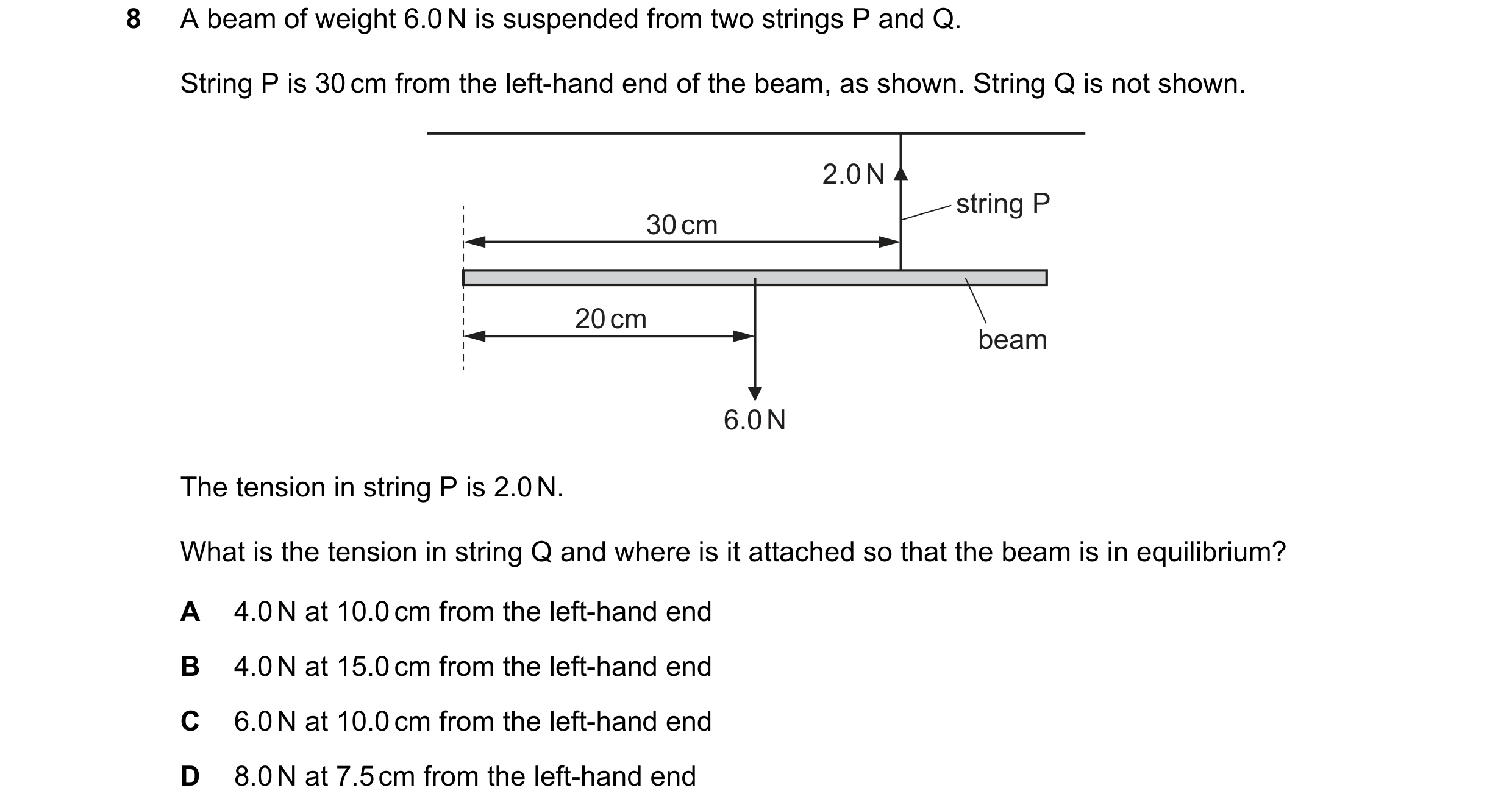 33 / 82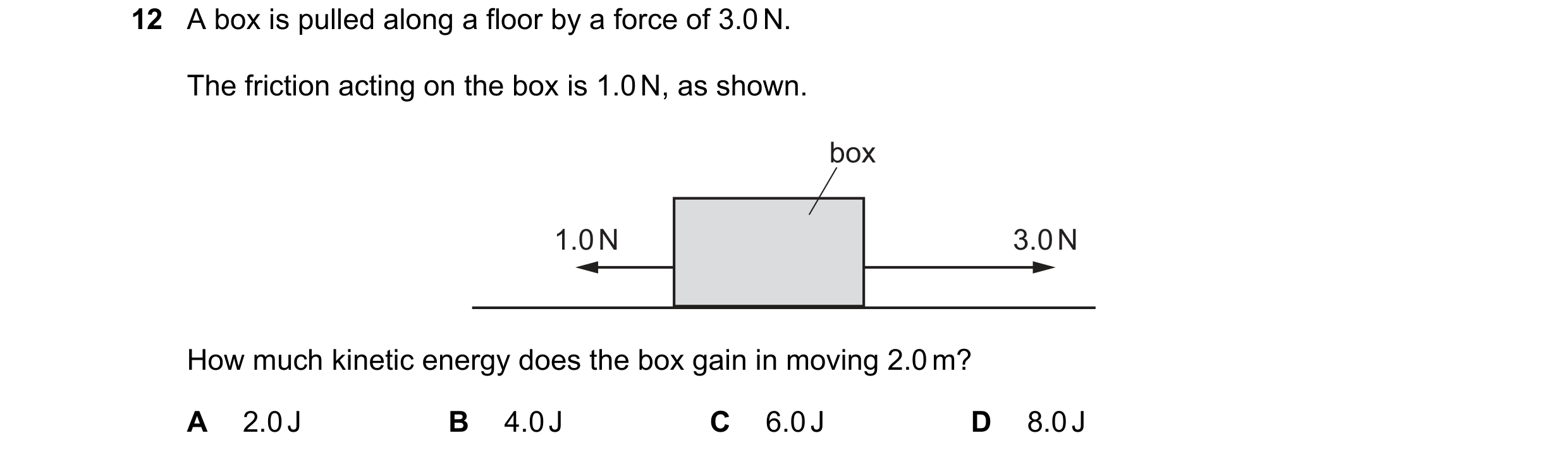
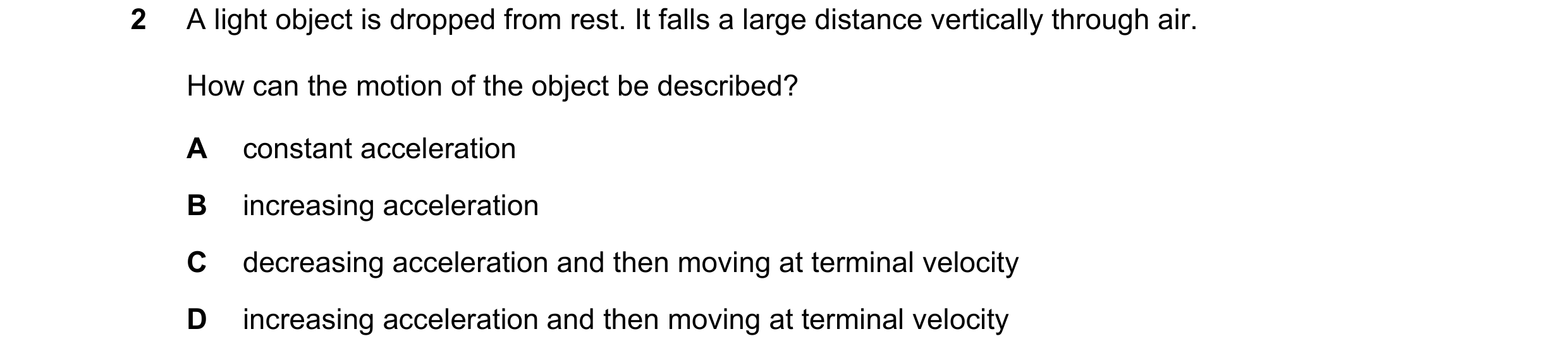

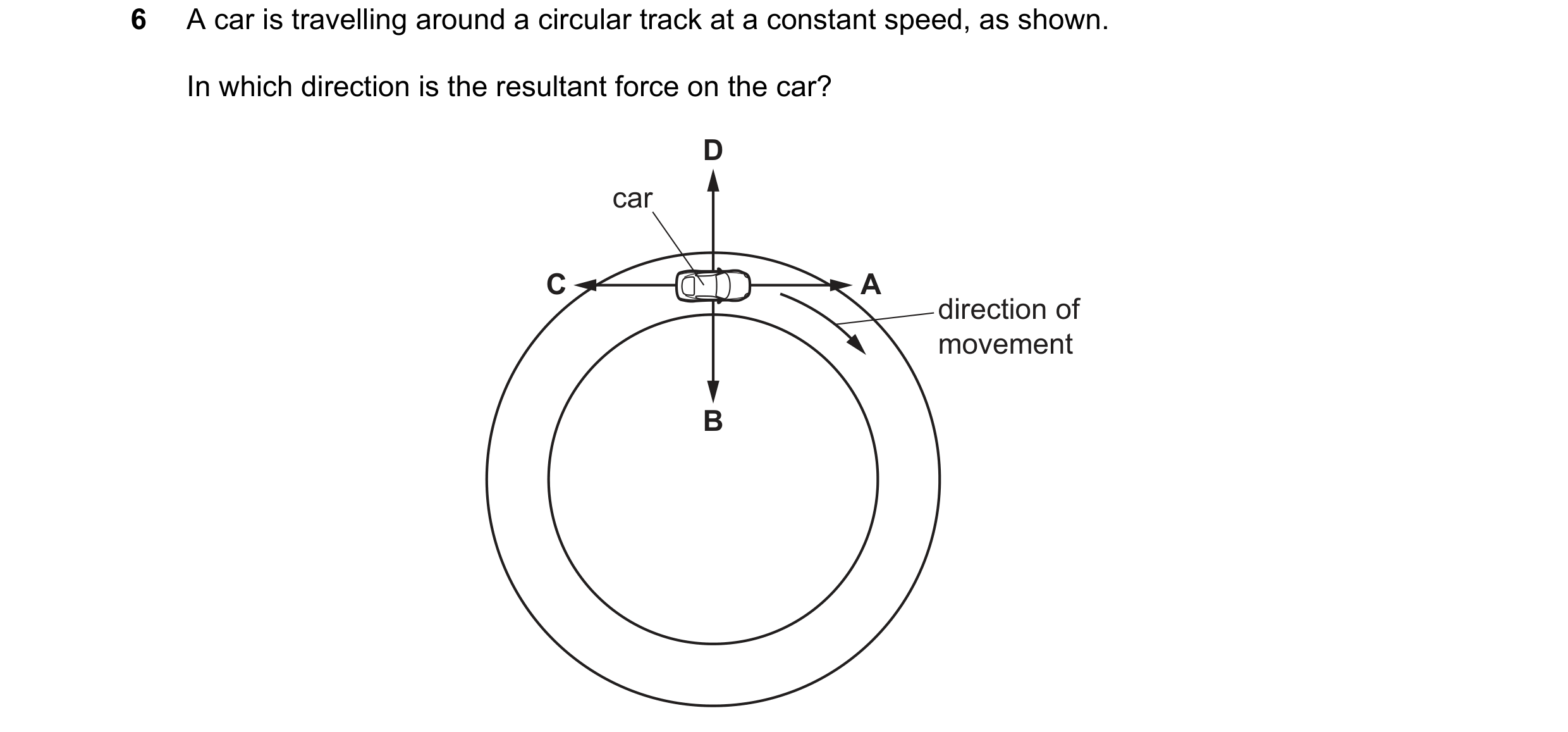 34 / 82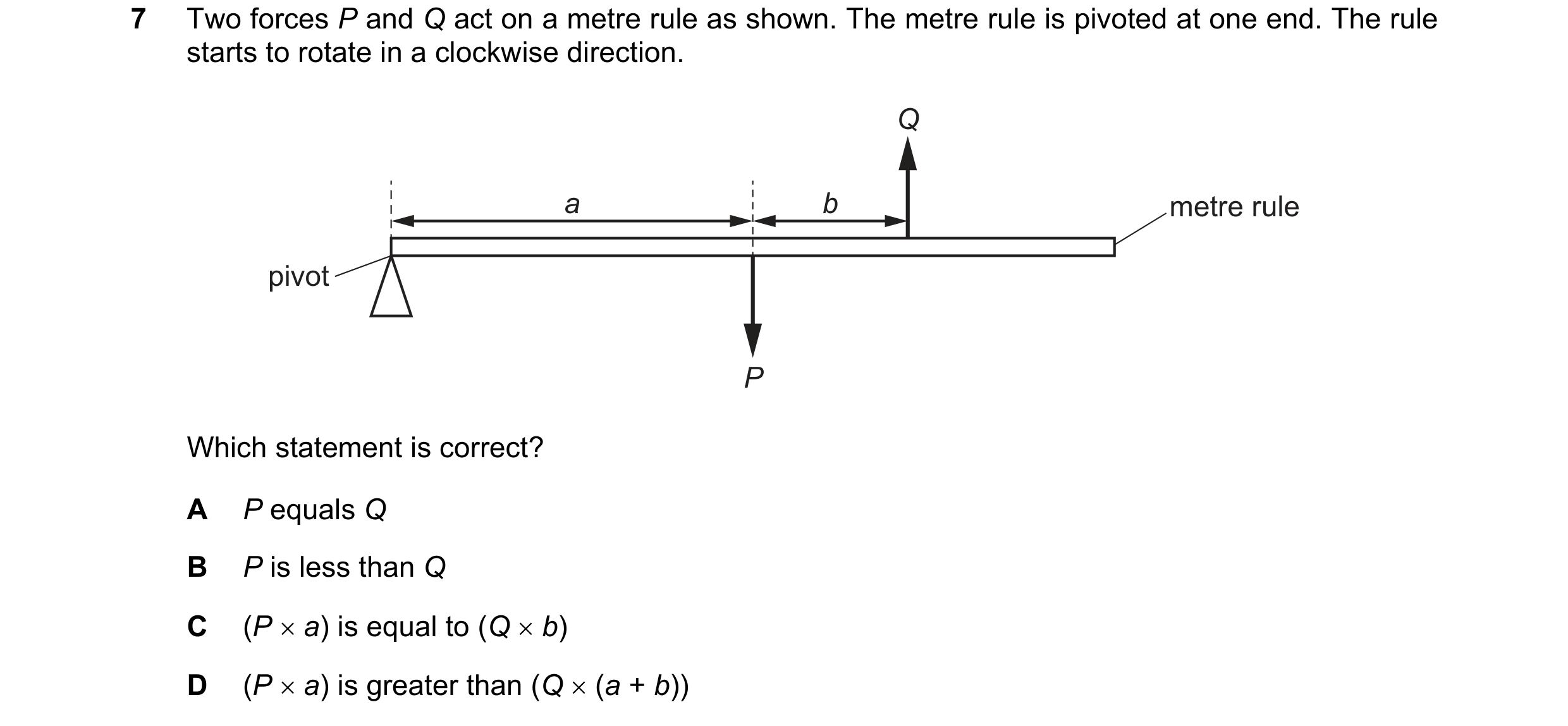

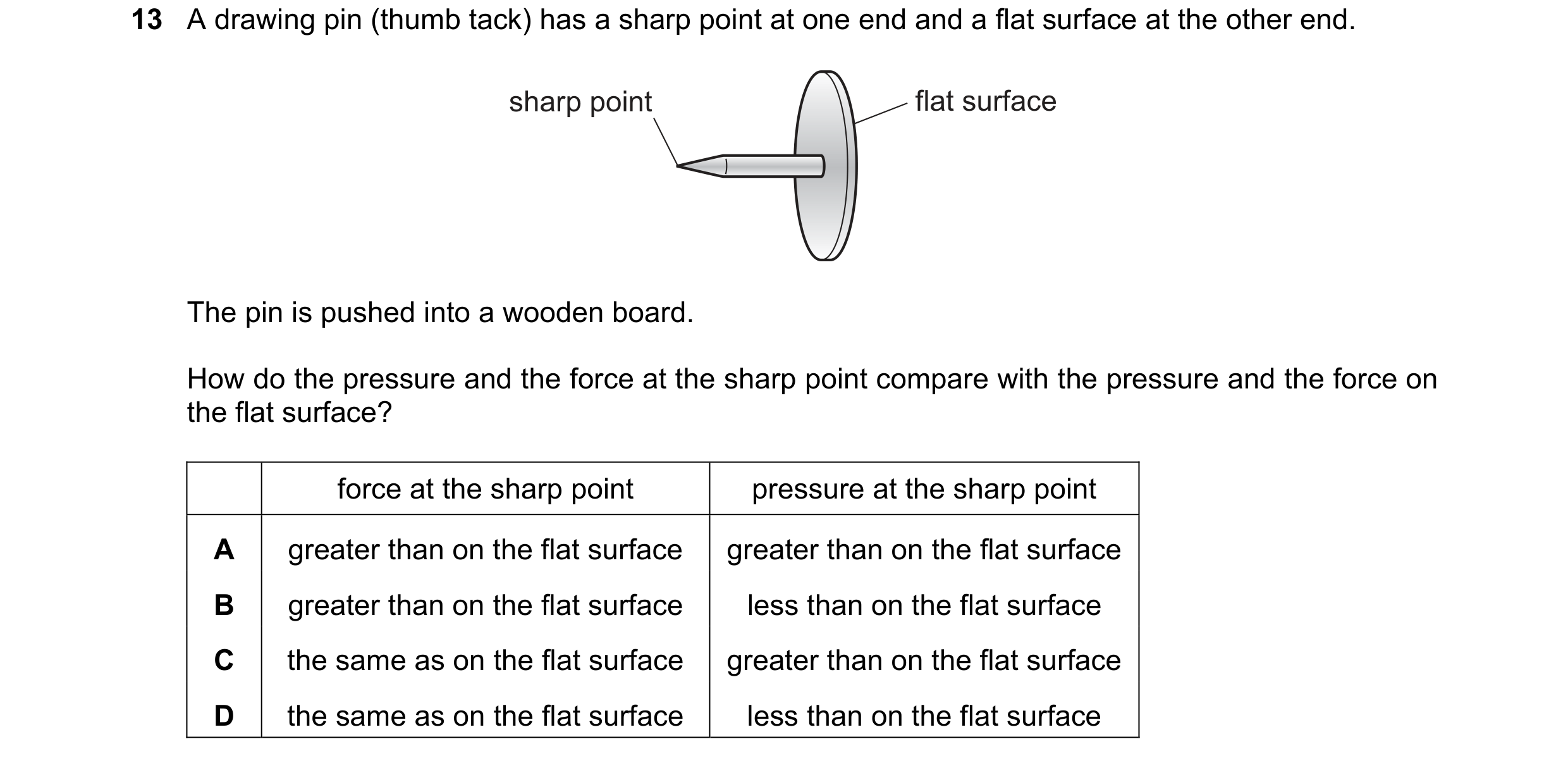 35 / 82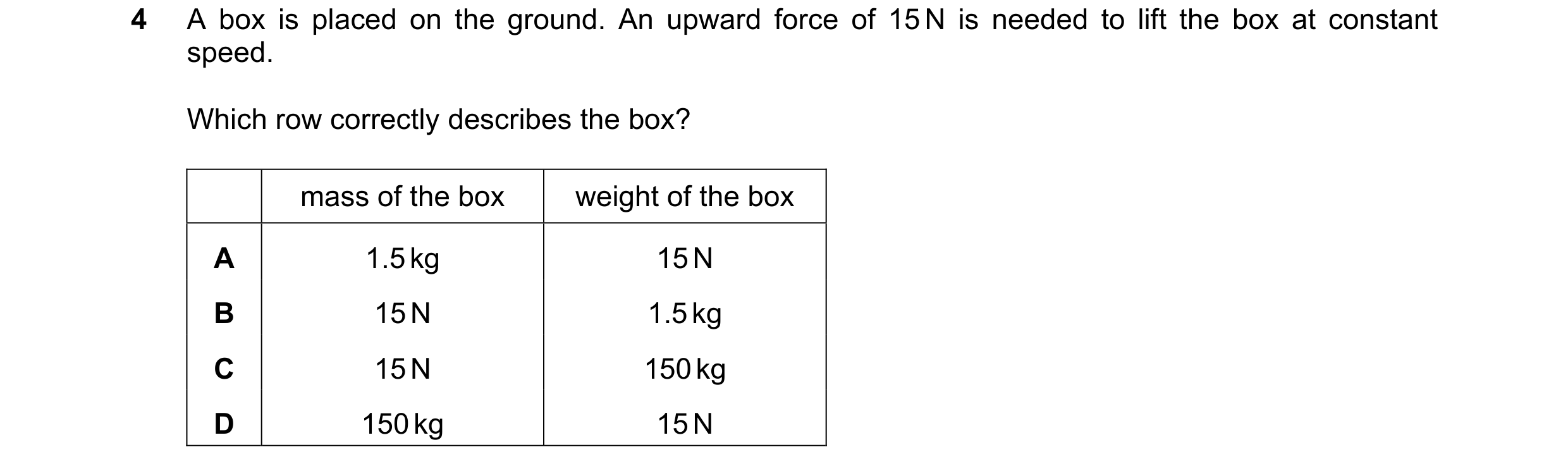
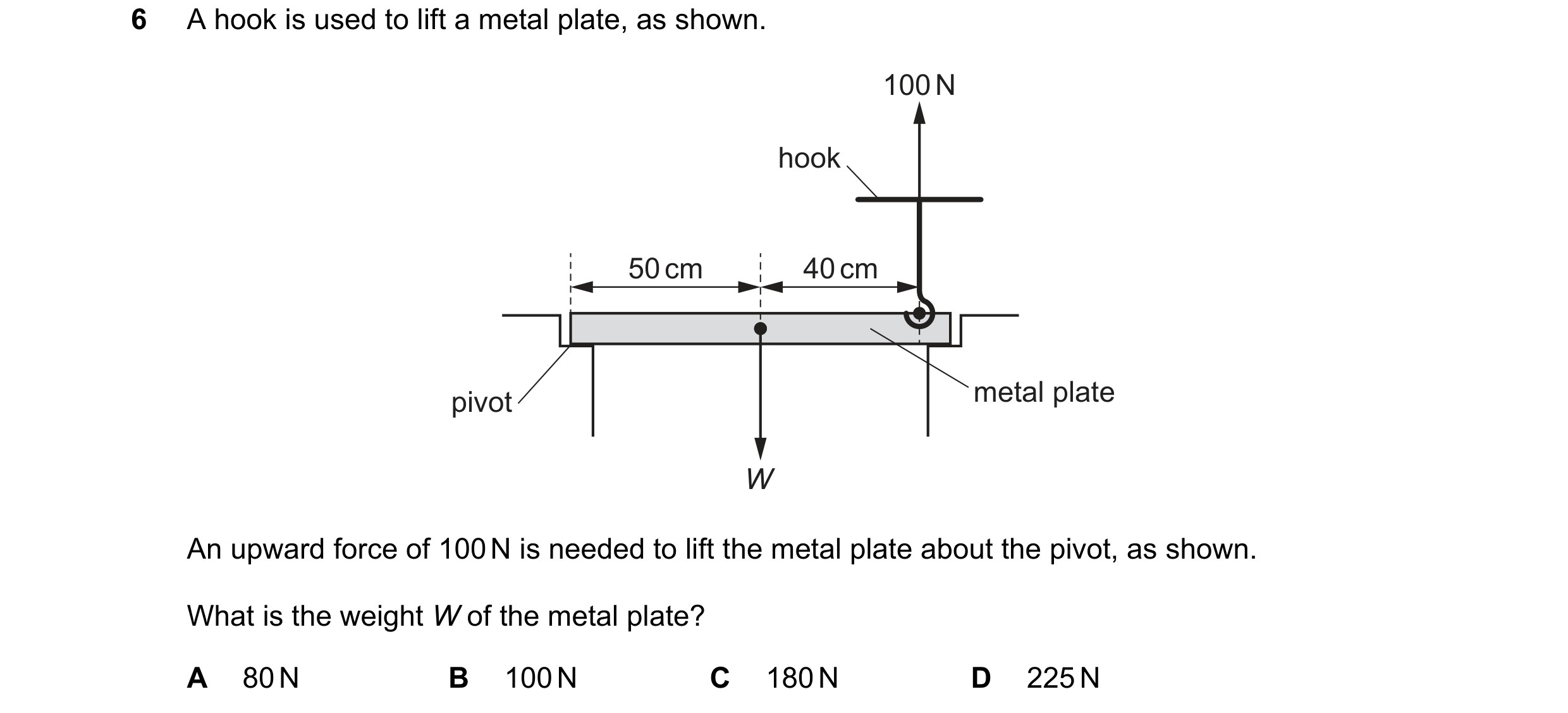
 36 / 82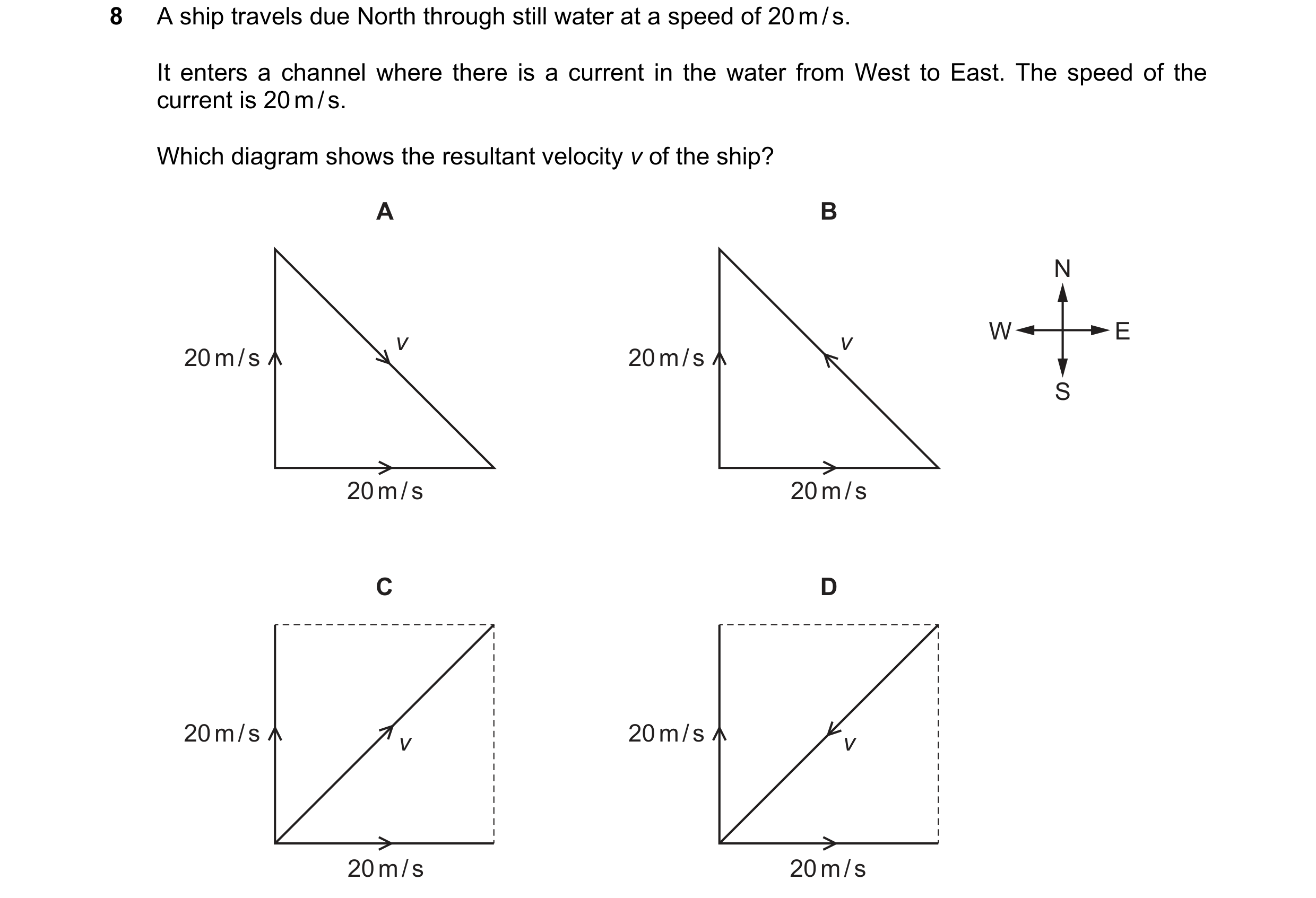
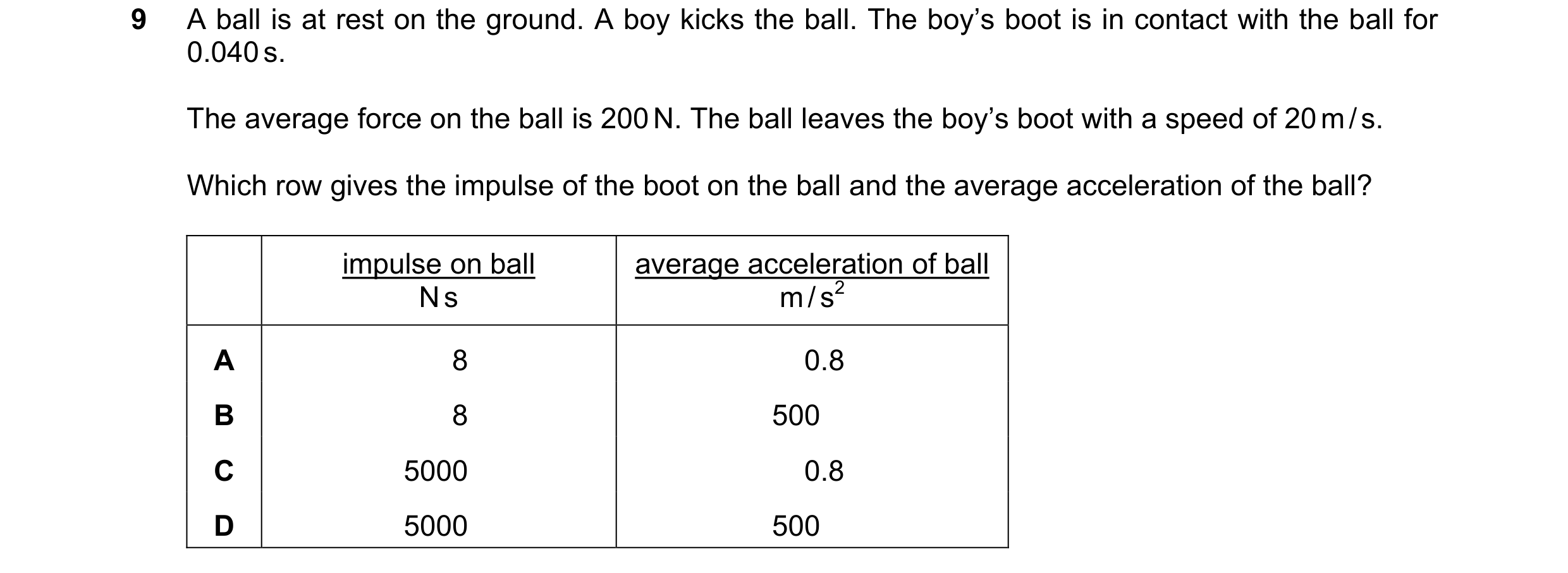 37 / 82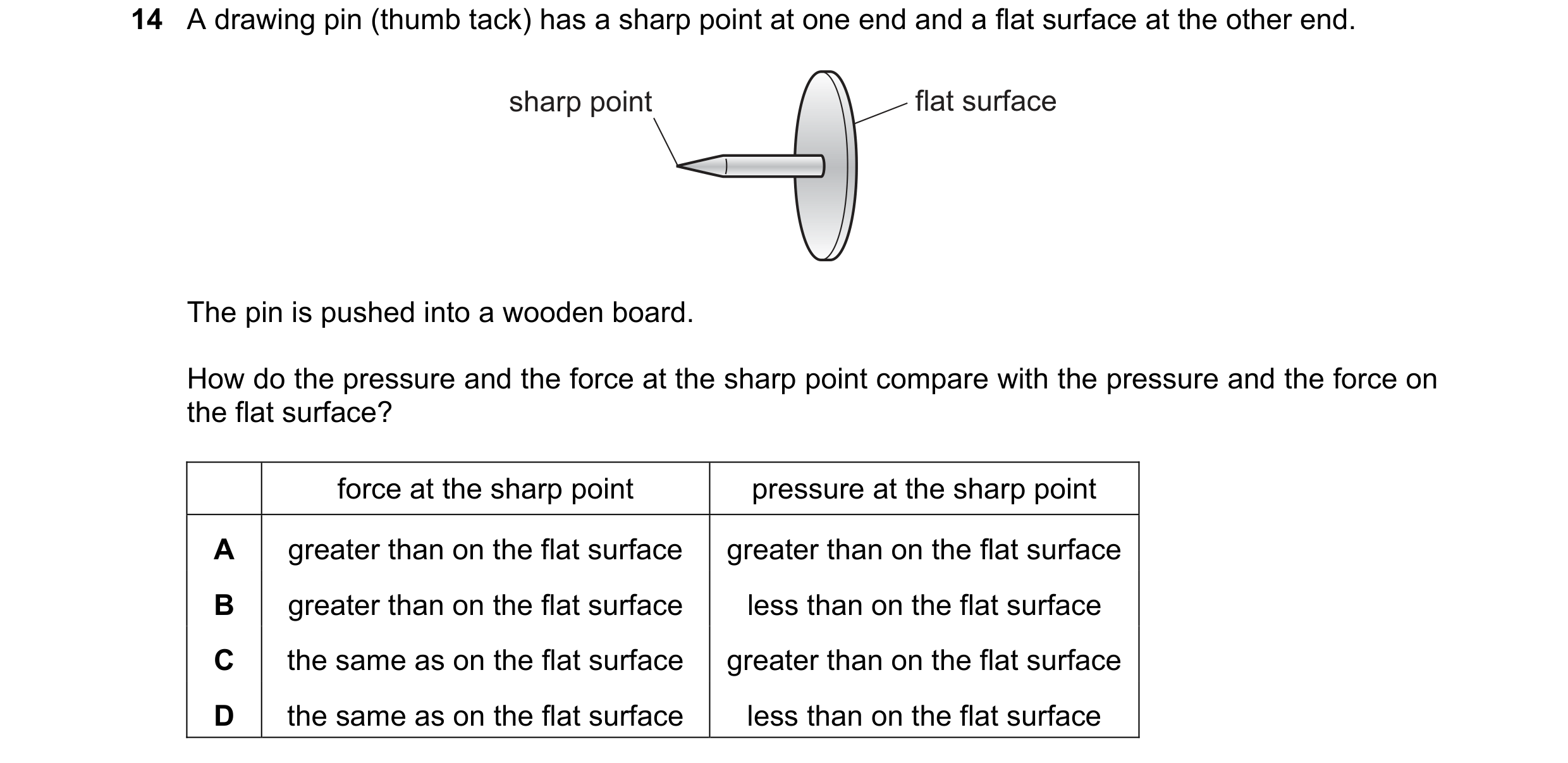

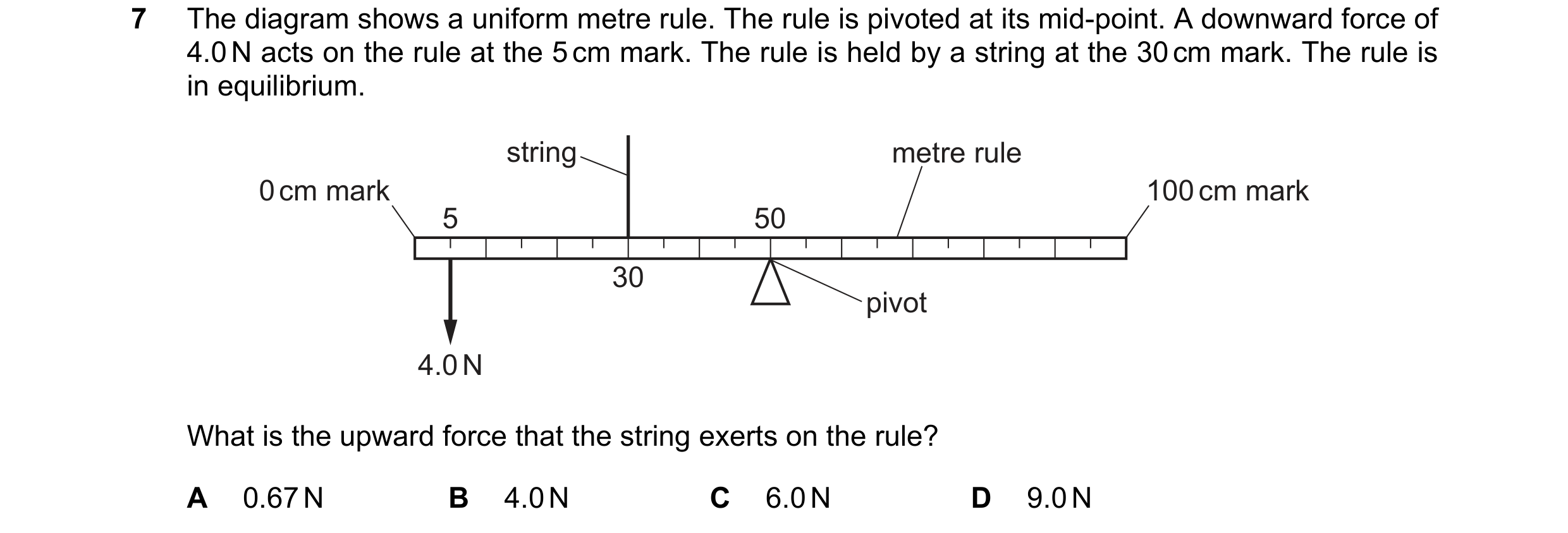
 38 / 82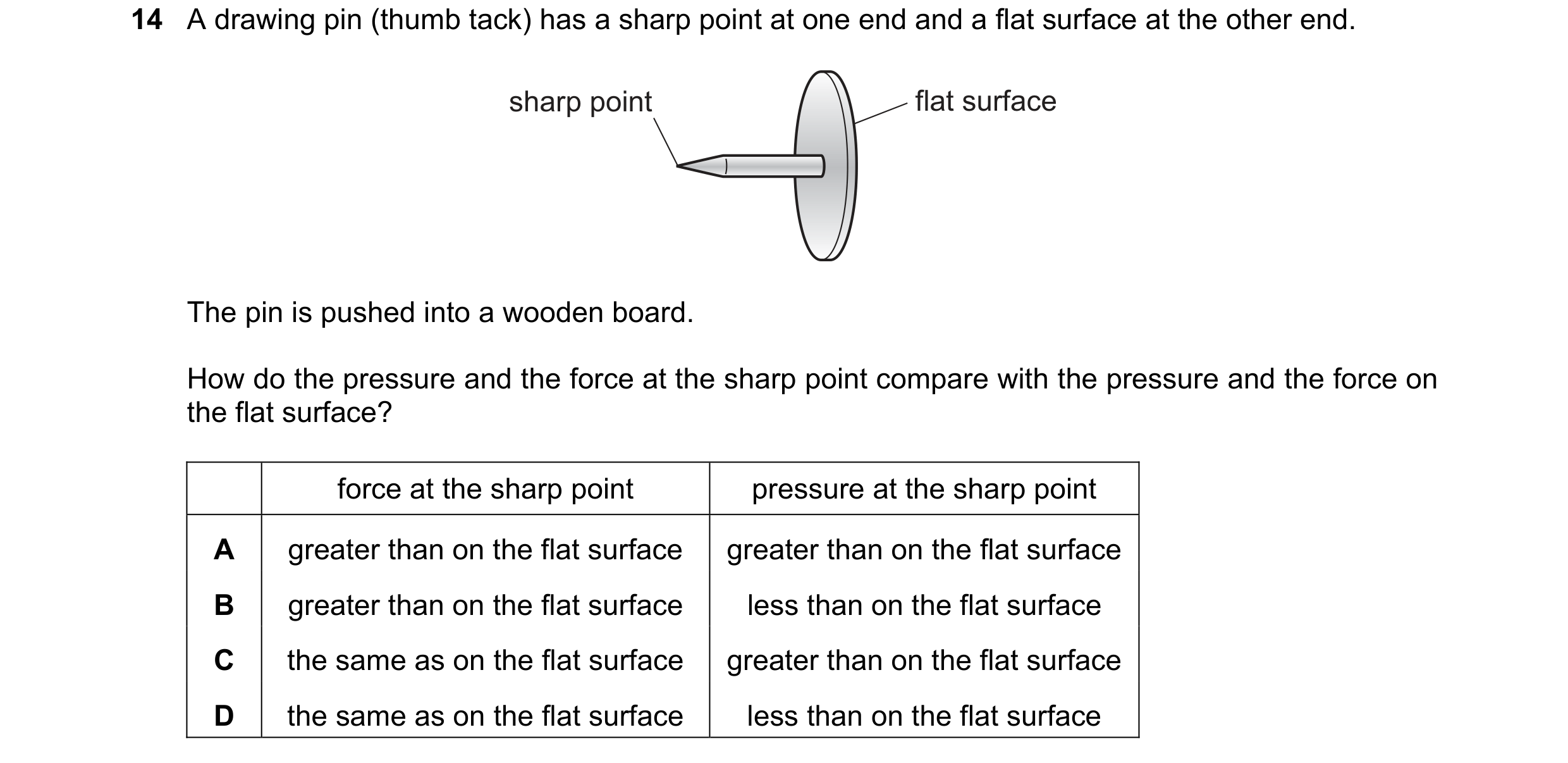
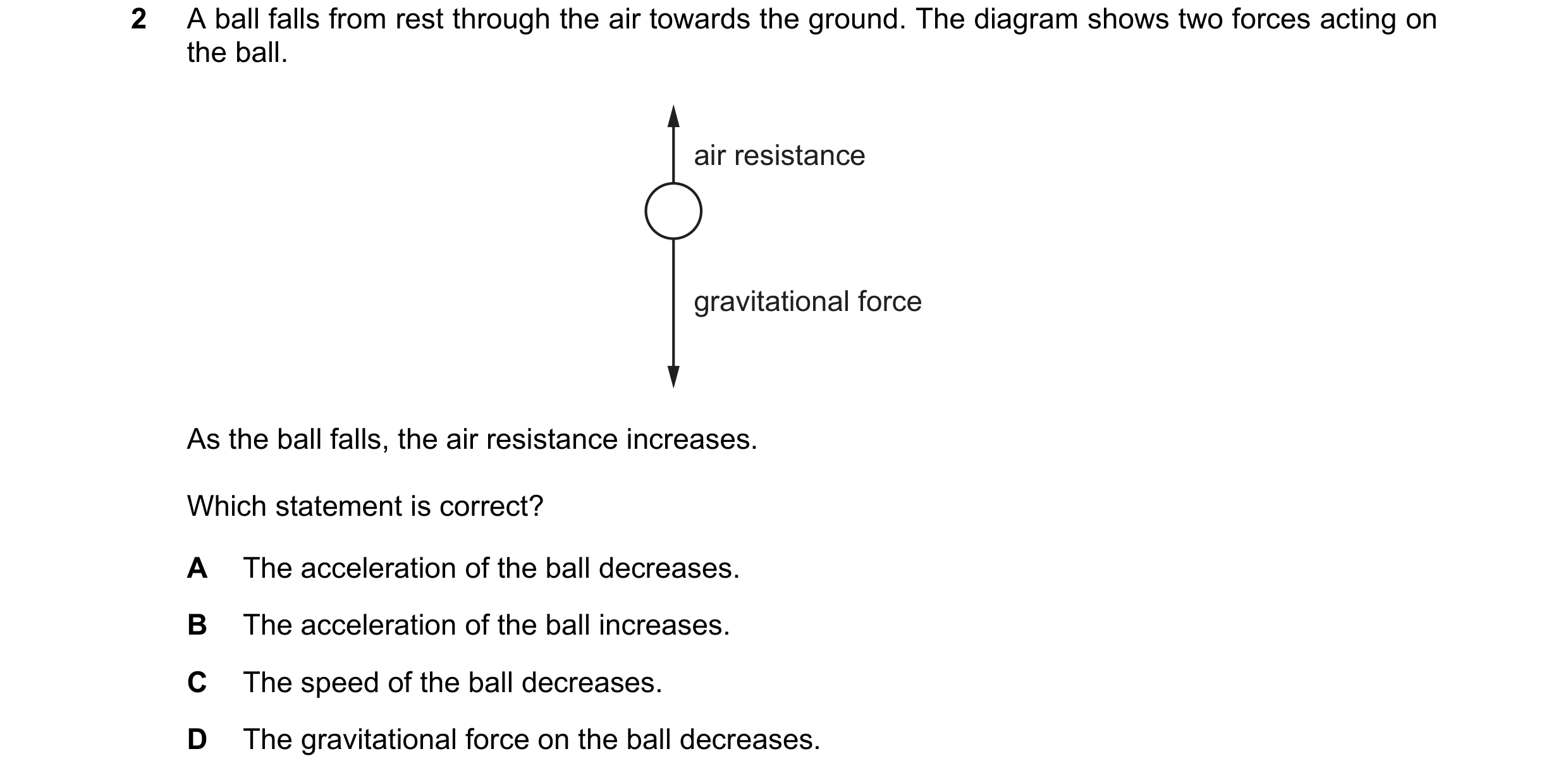 39 / 82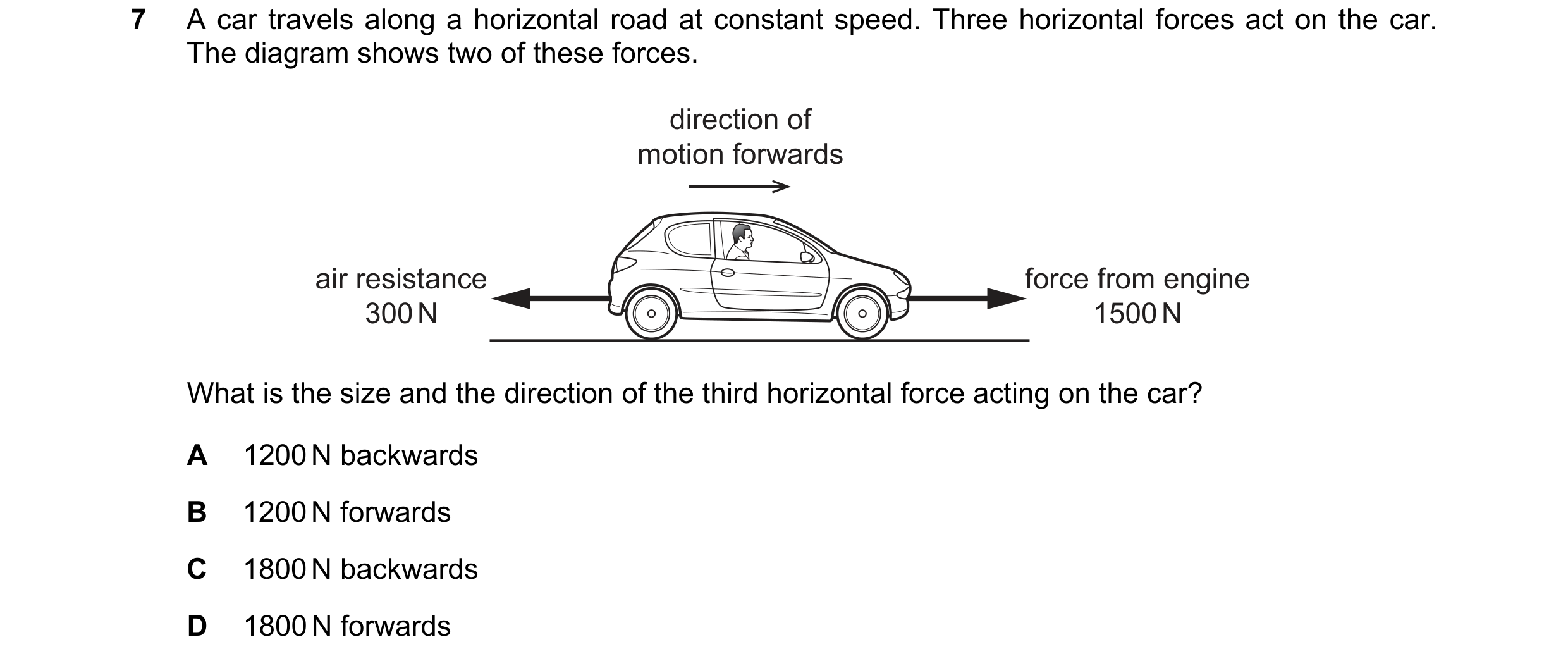
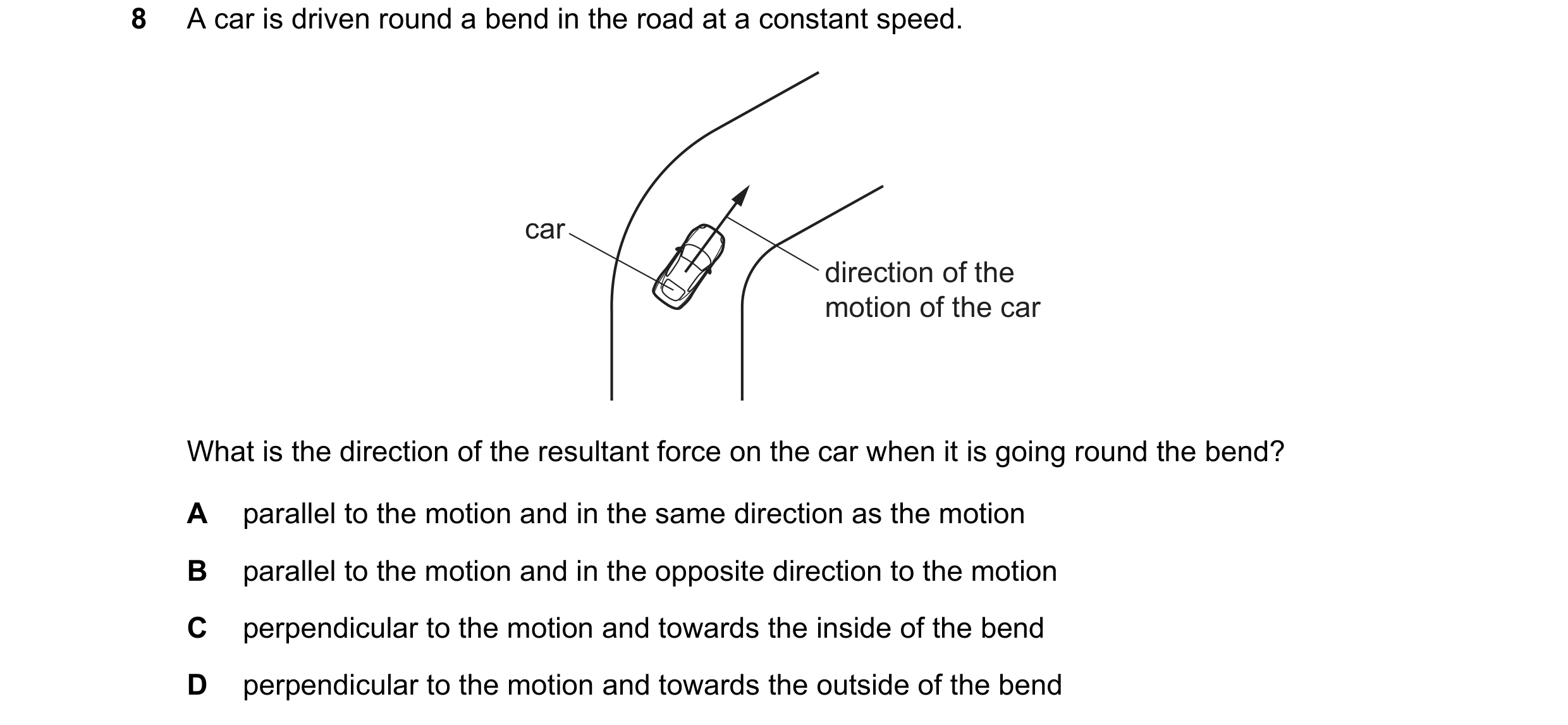 40 / 82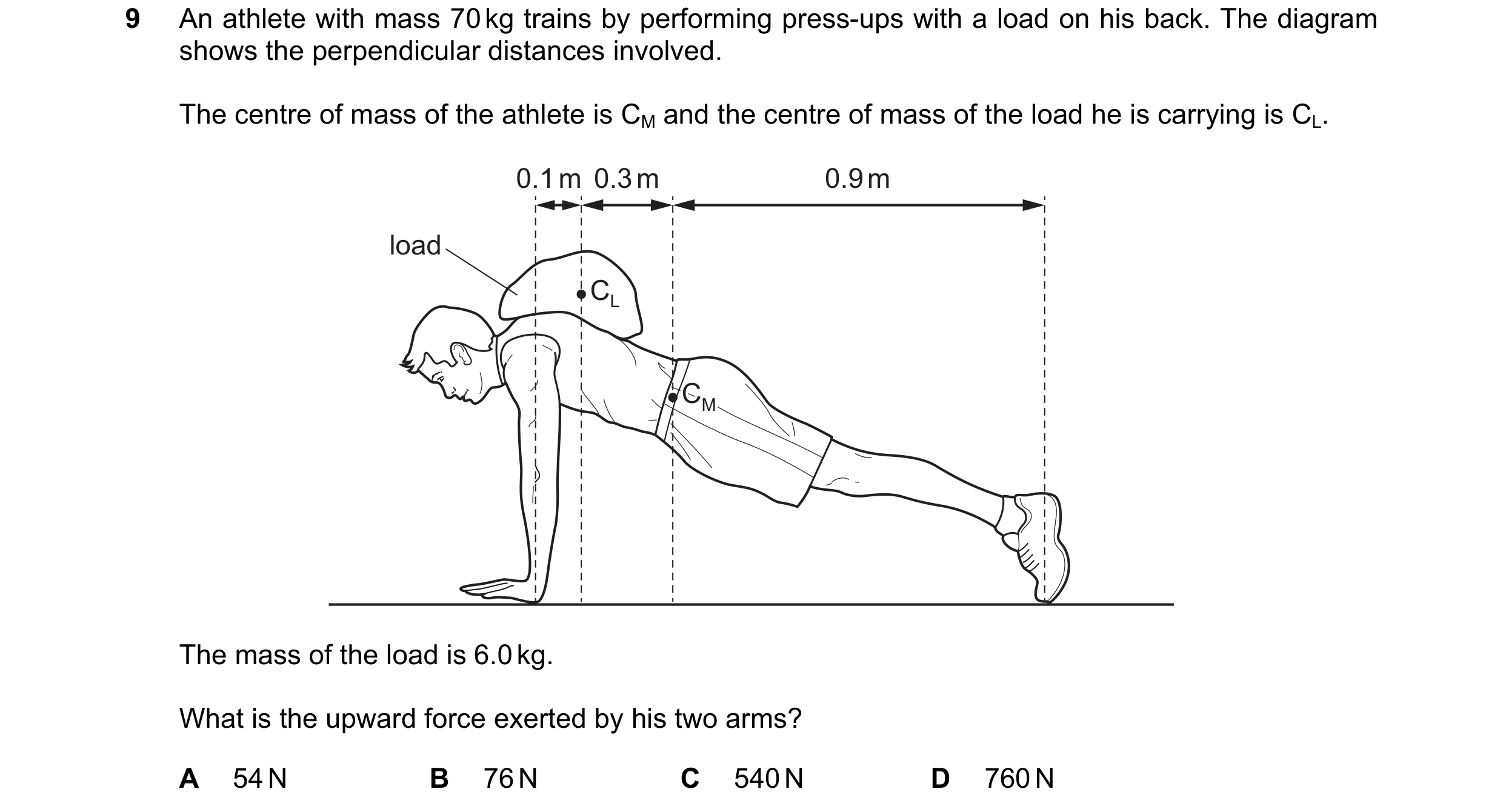
 41 / 82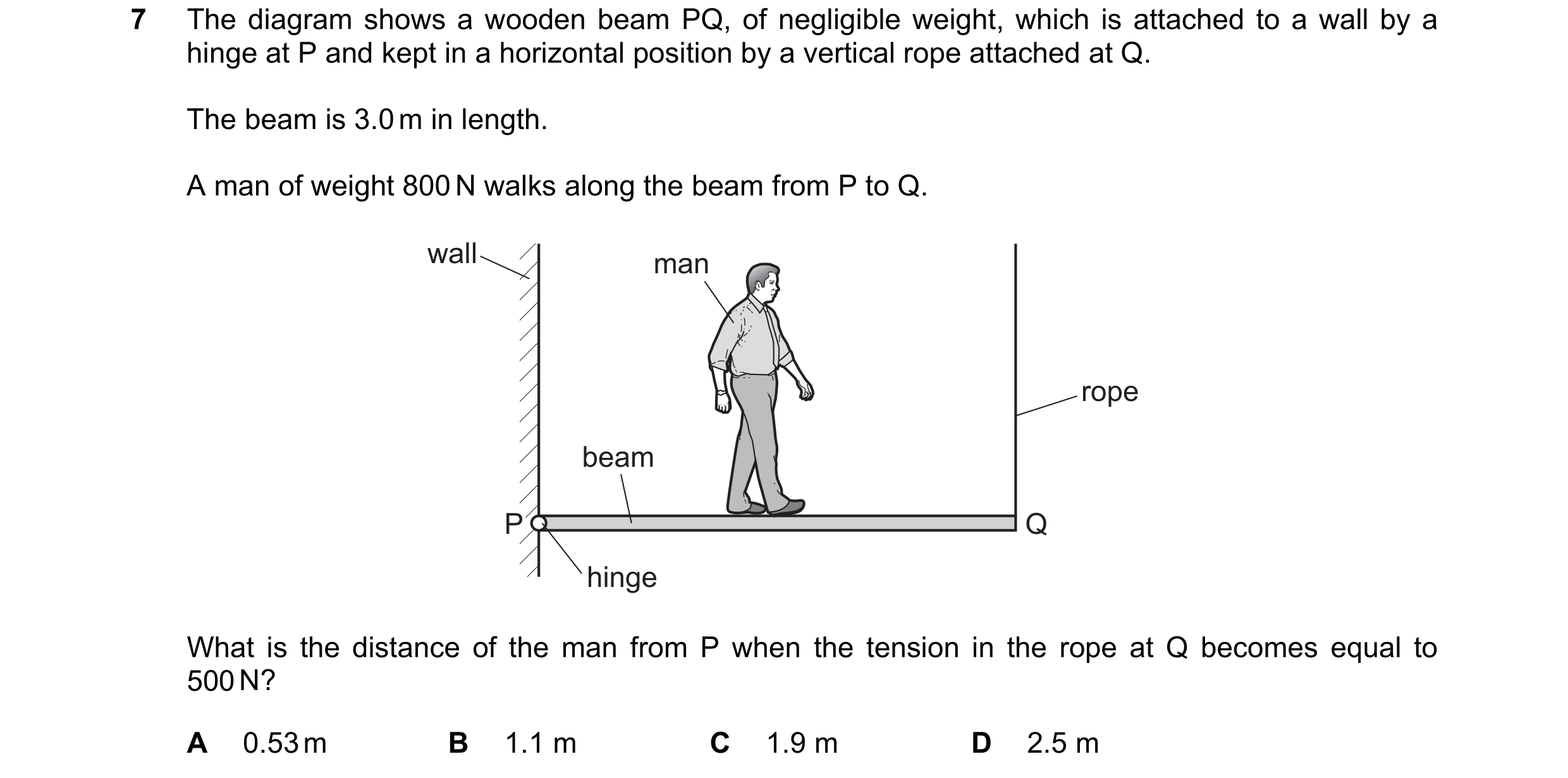


 42 / 82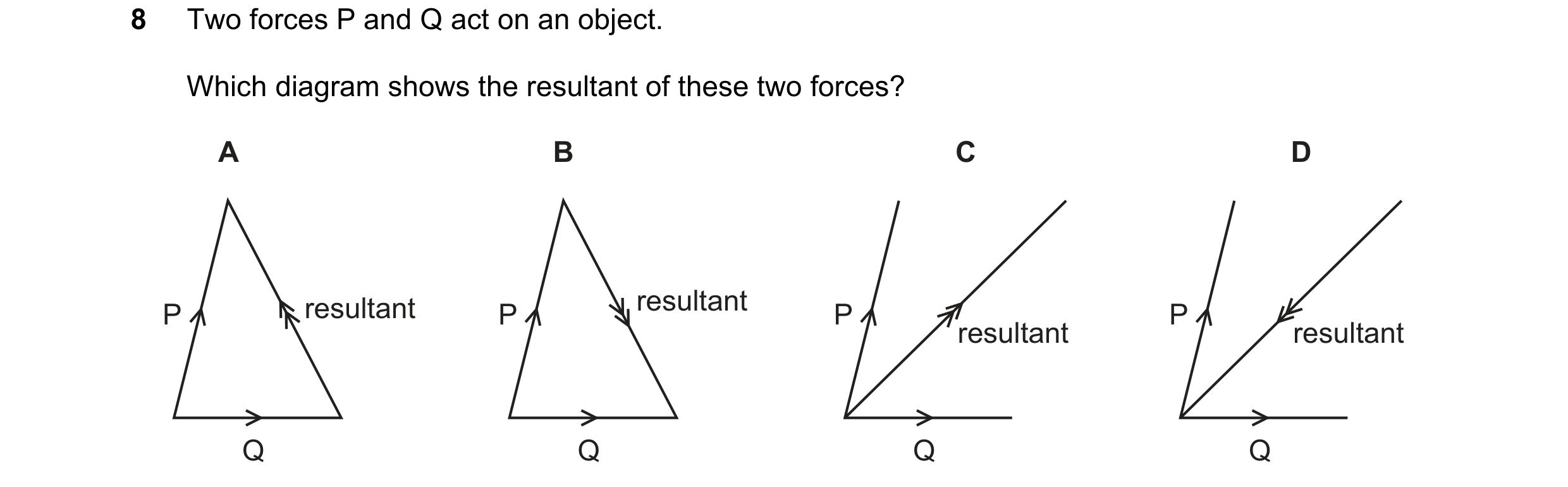


 43 / 82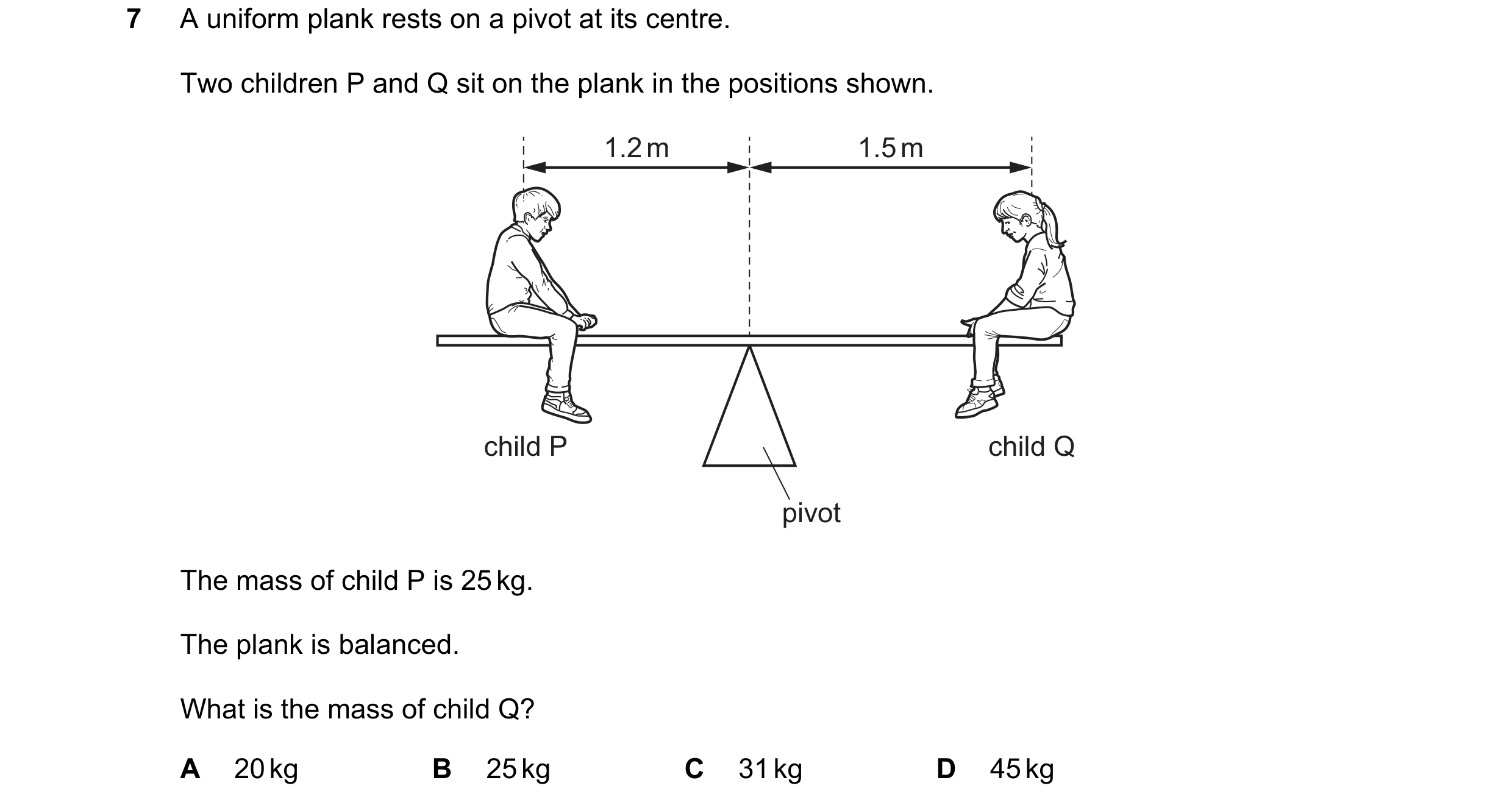
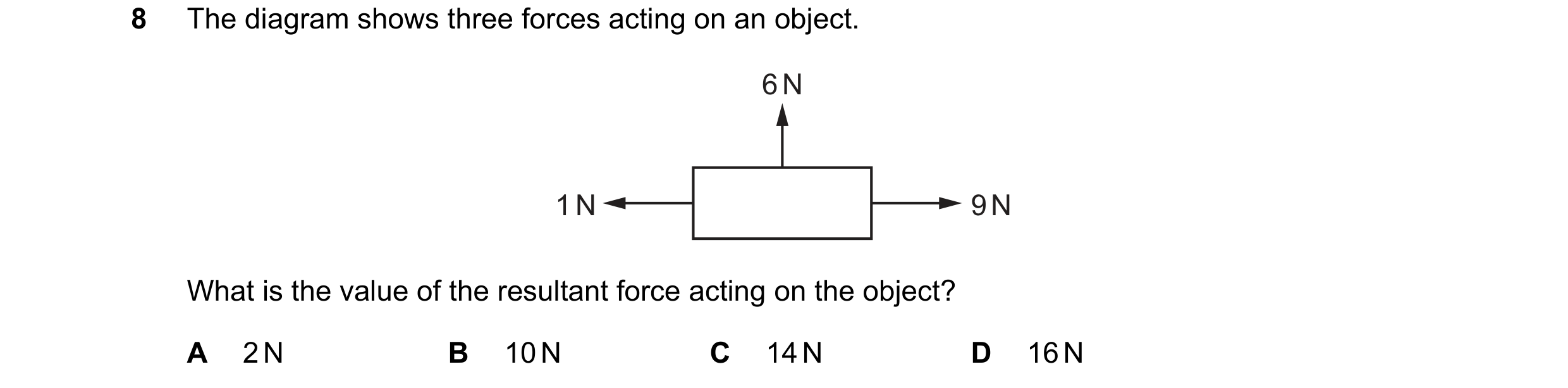
 44 / 82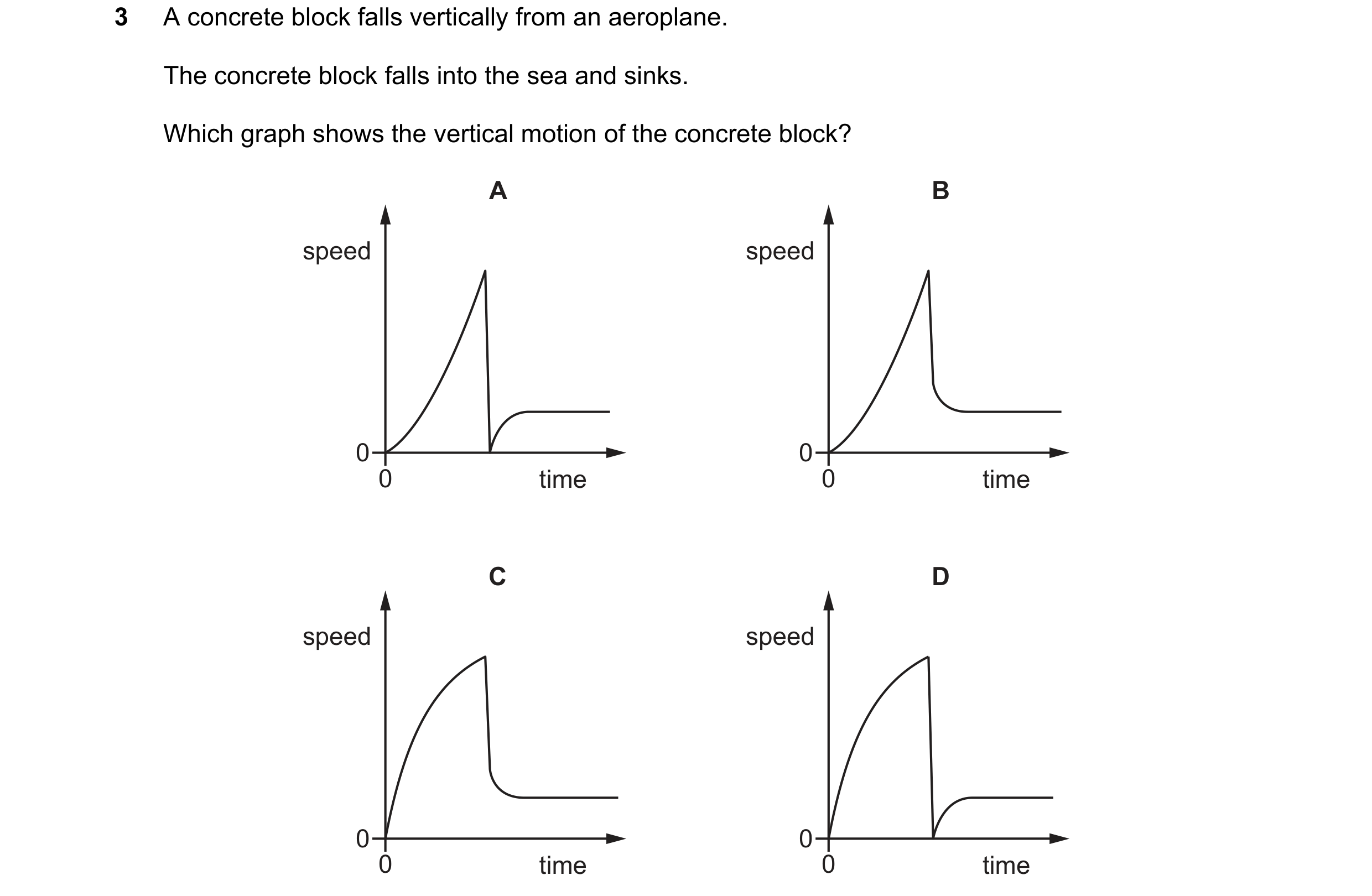

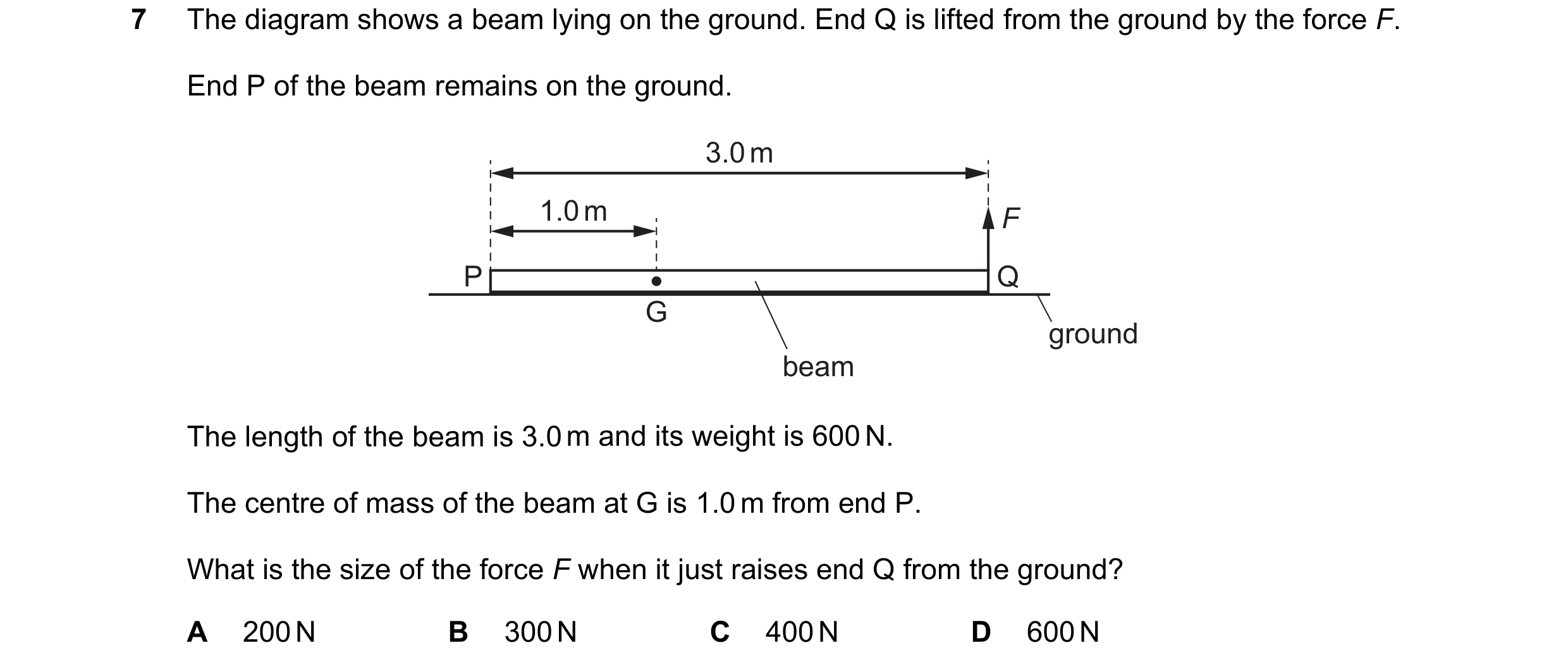 45 / 82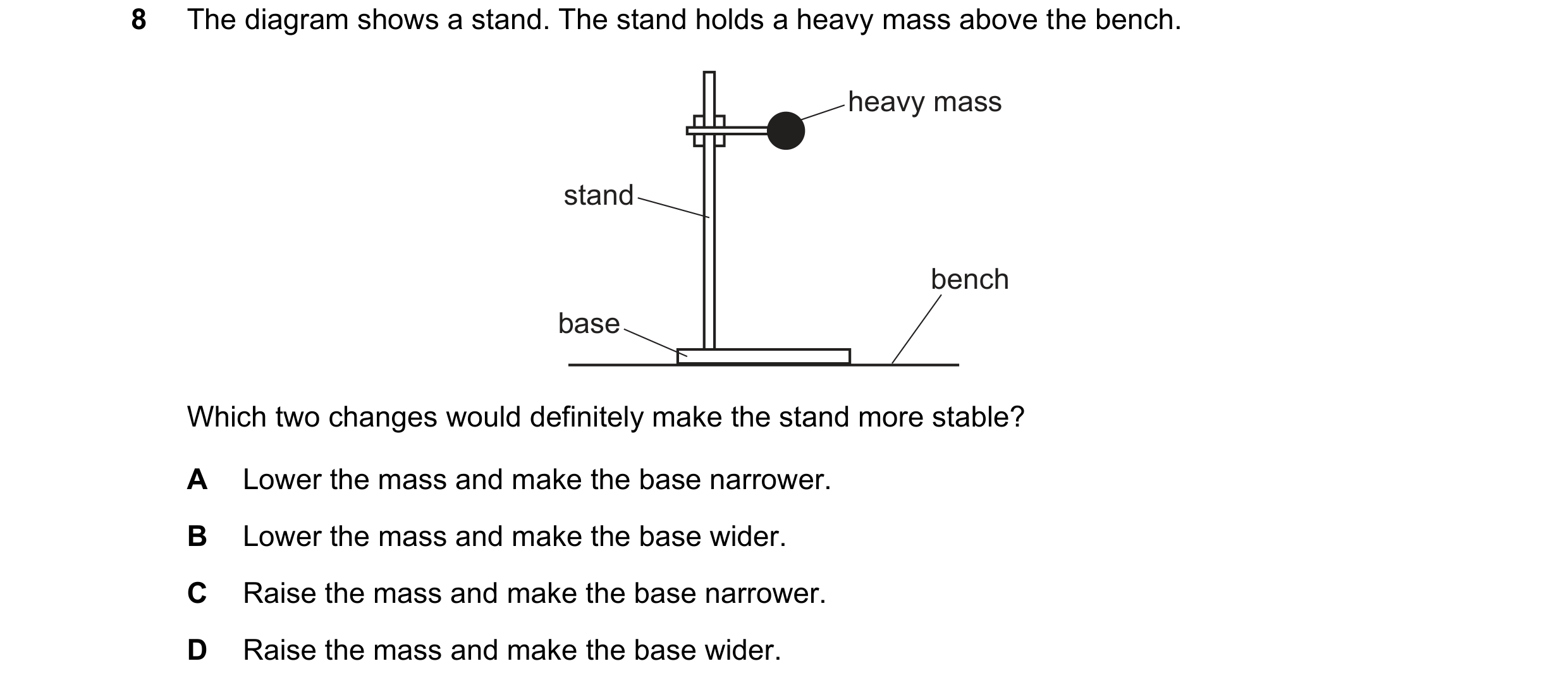
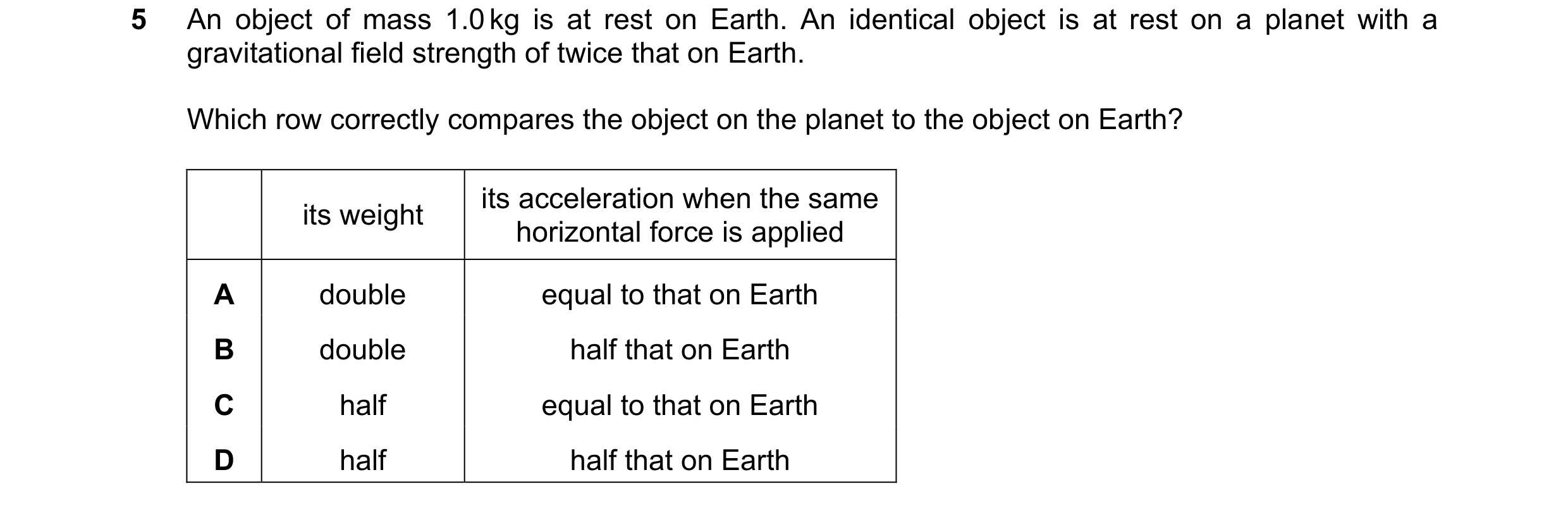 46 / 82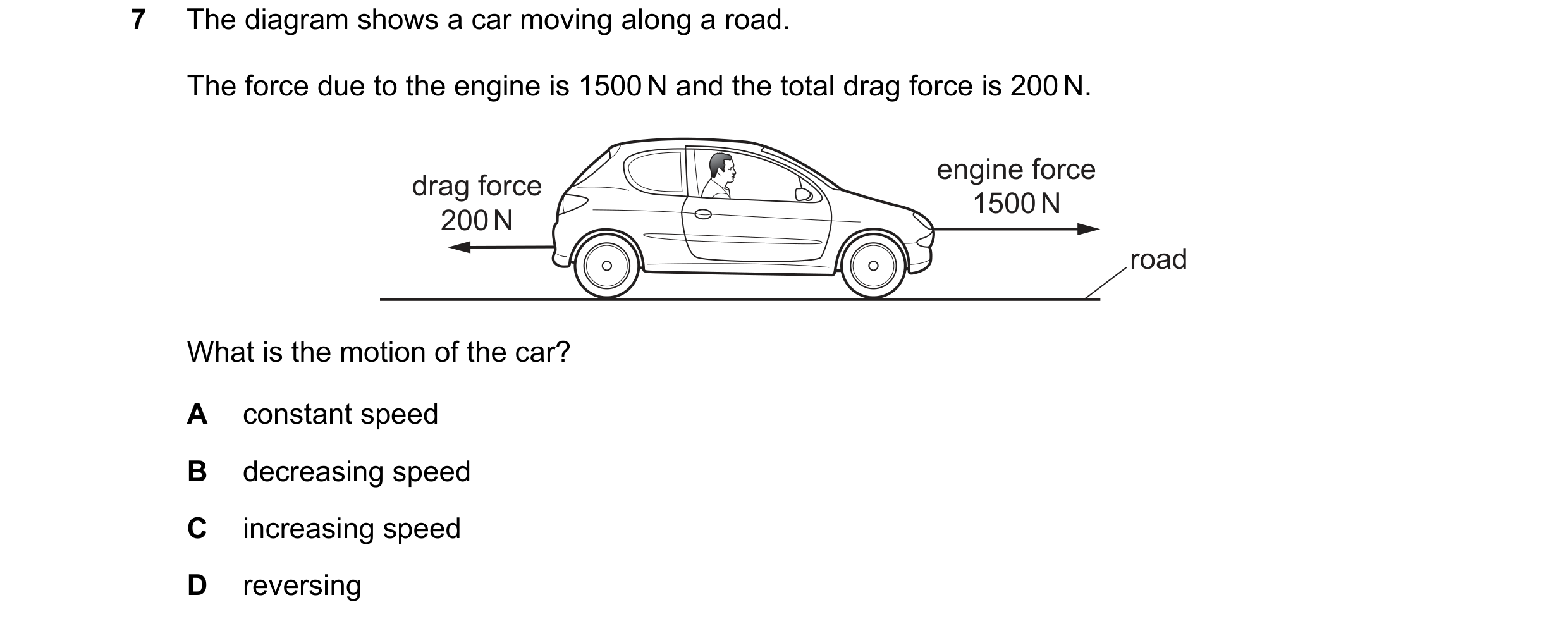
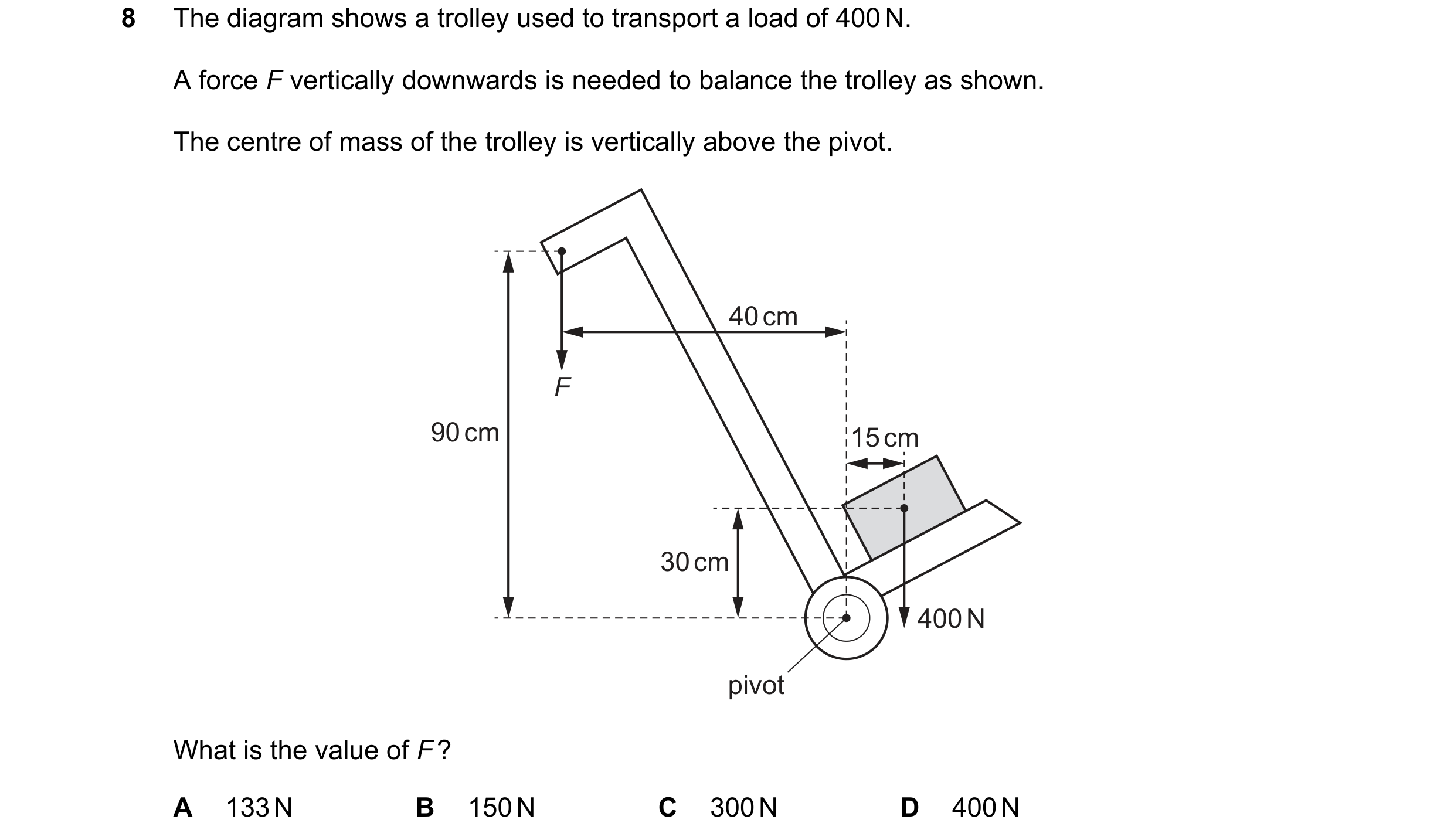

 47 / 82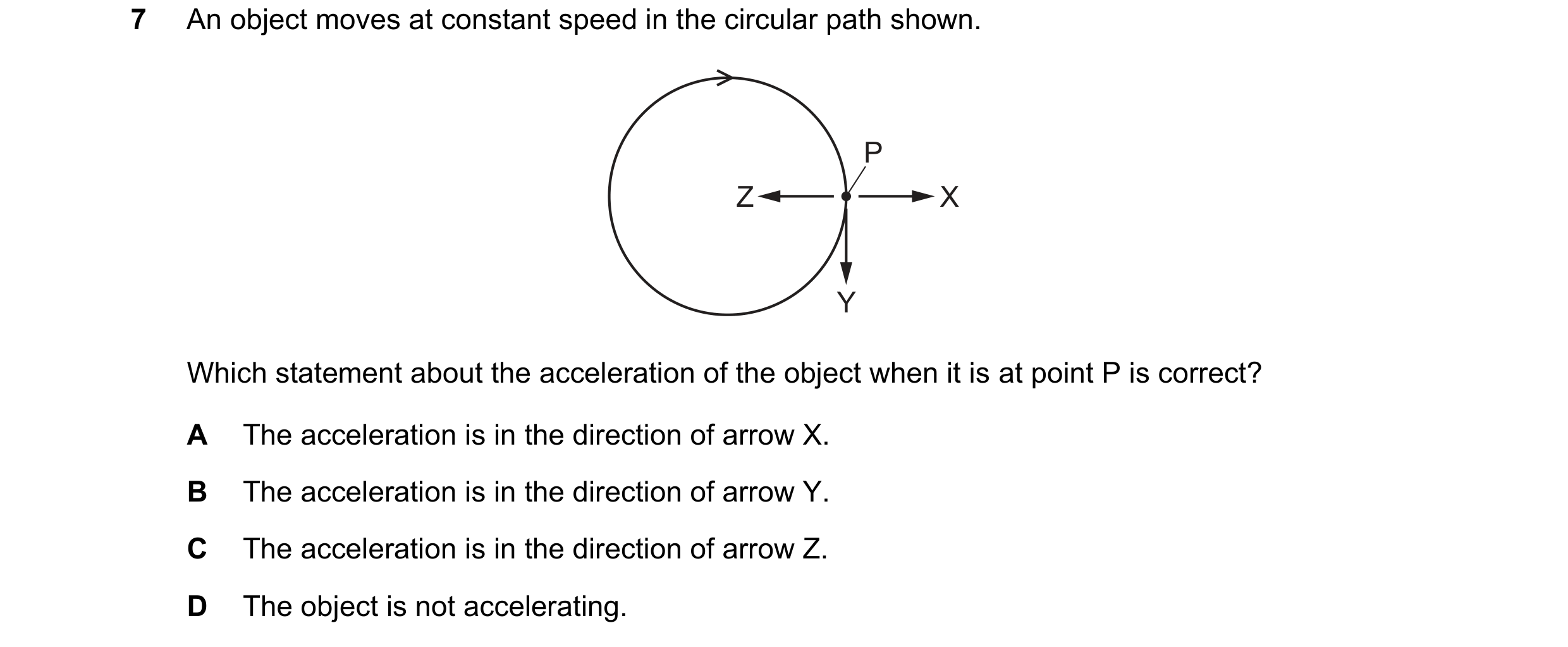
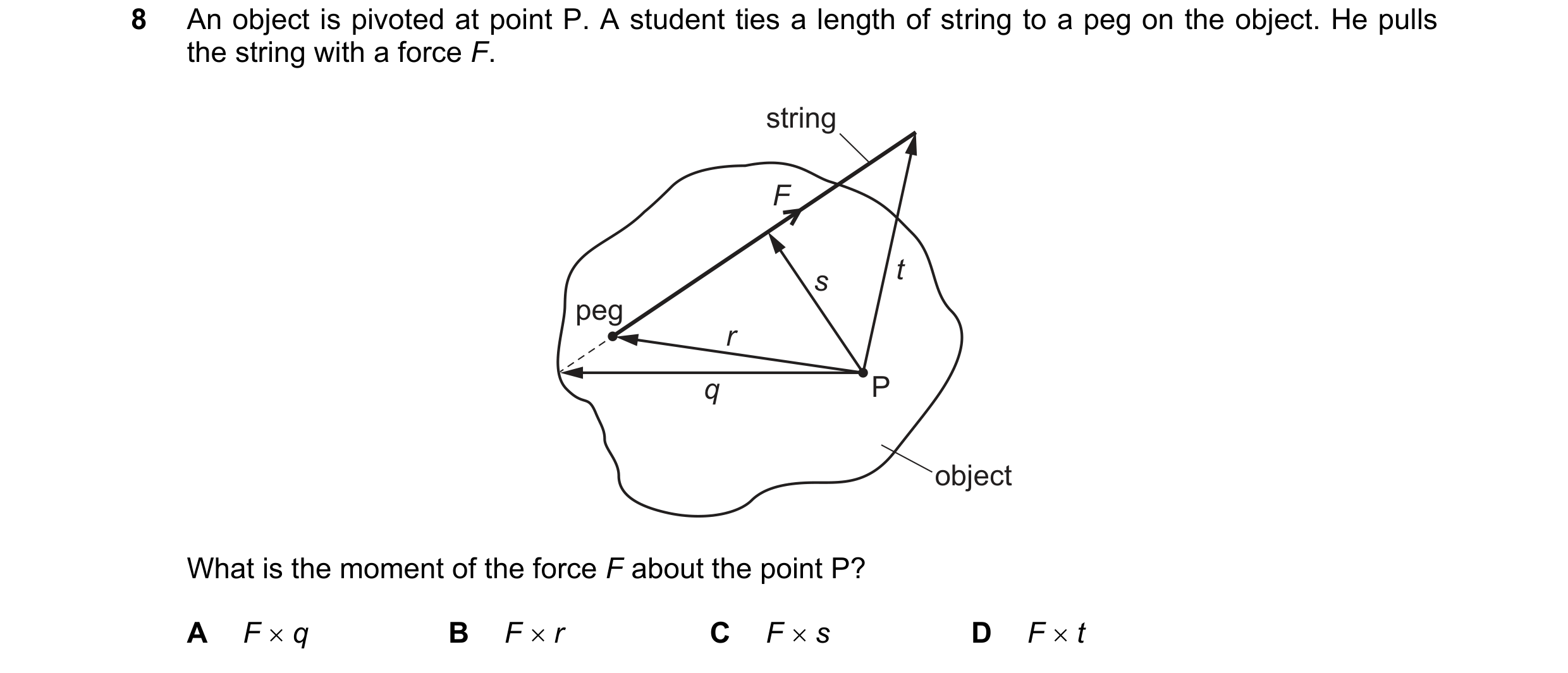 48 / 82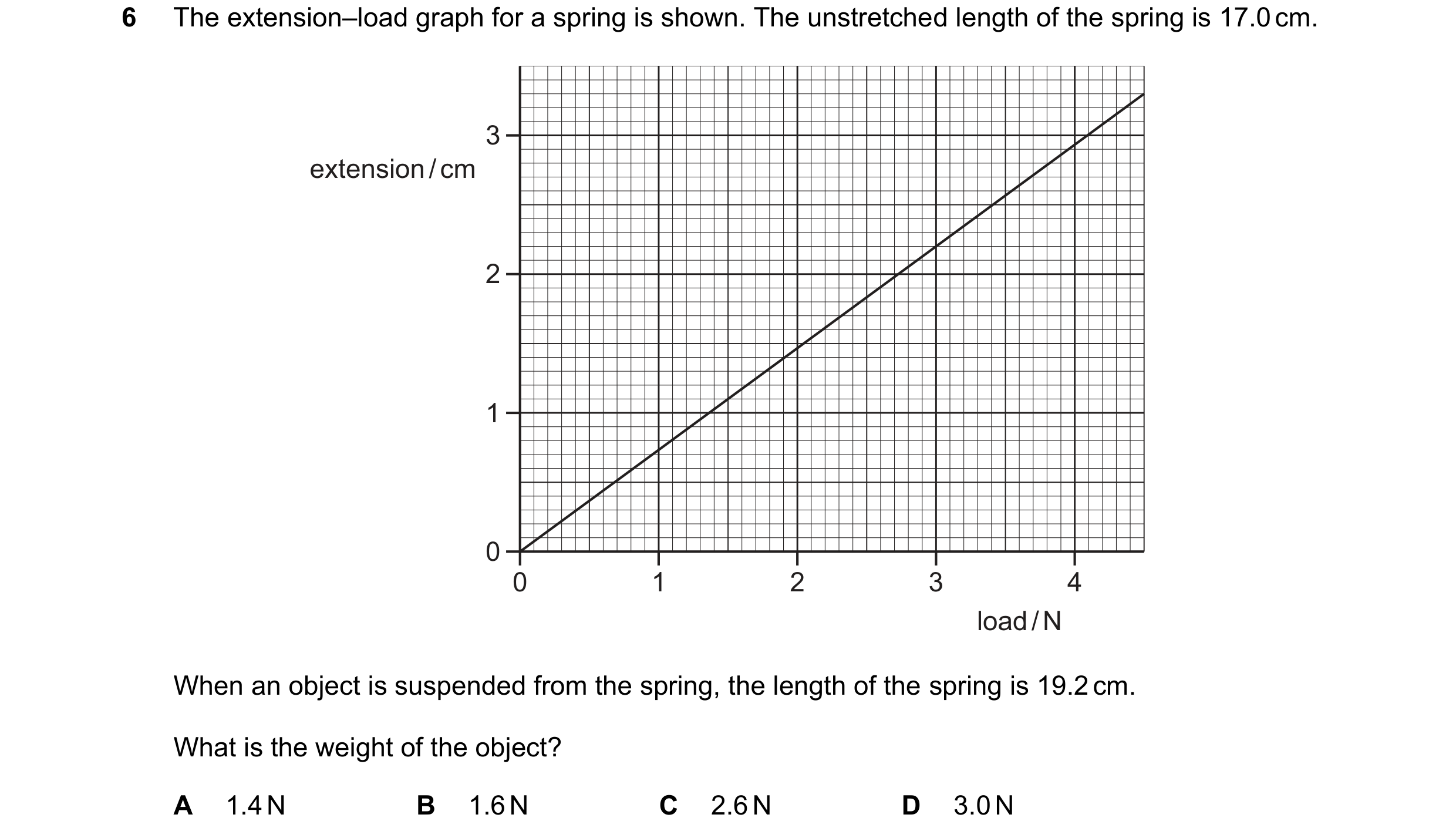
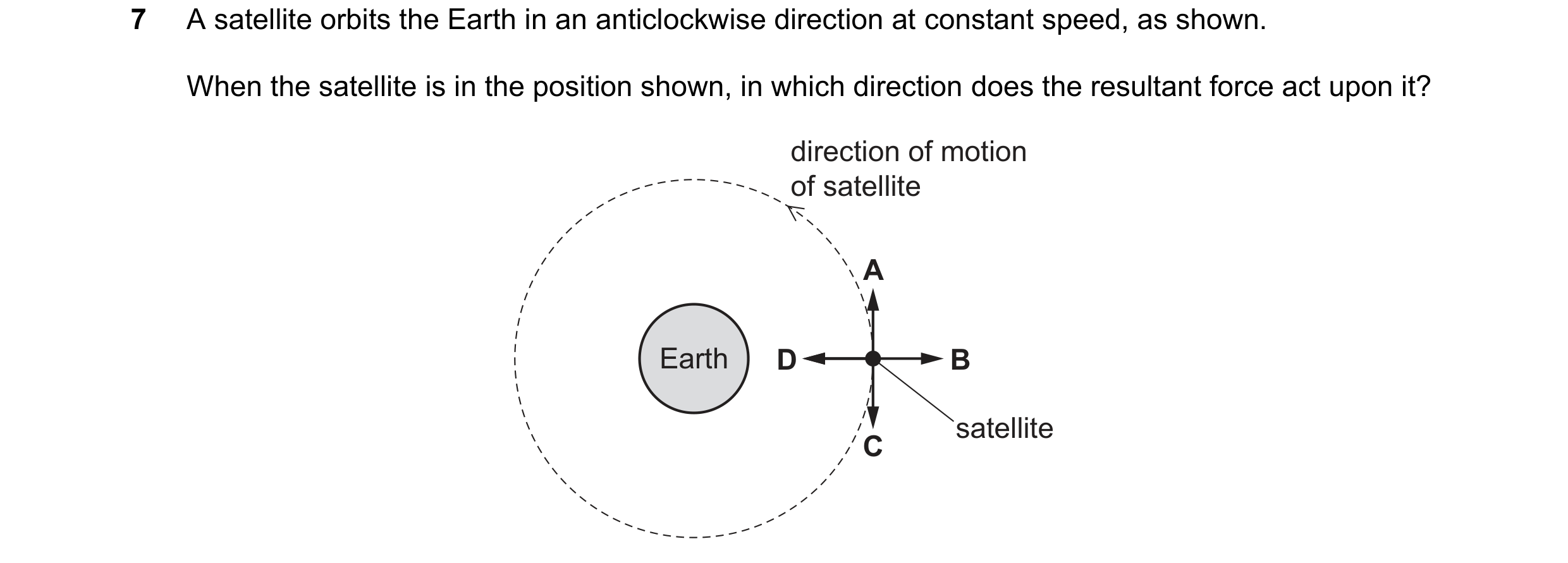
 49 / 82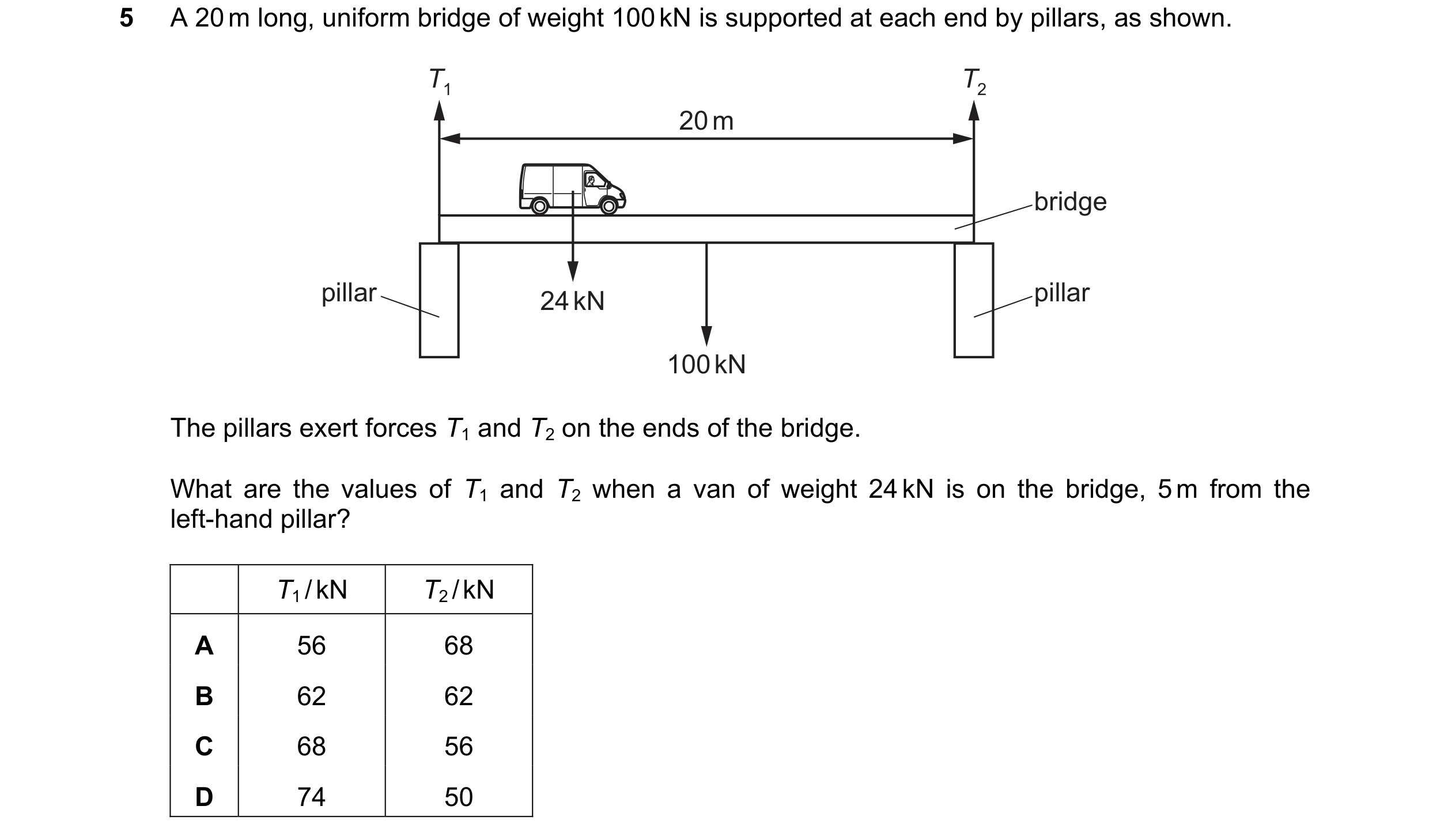
 50 / 82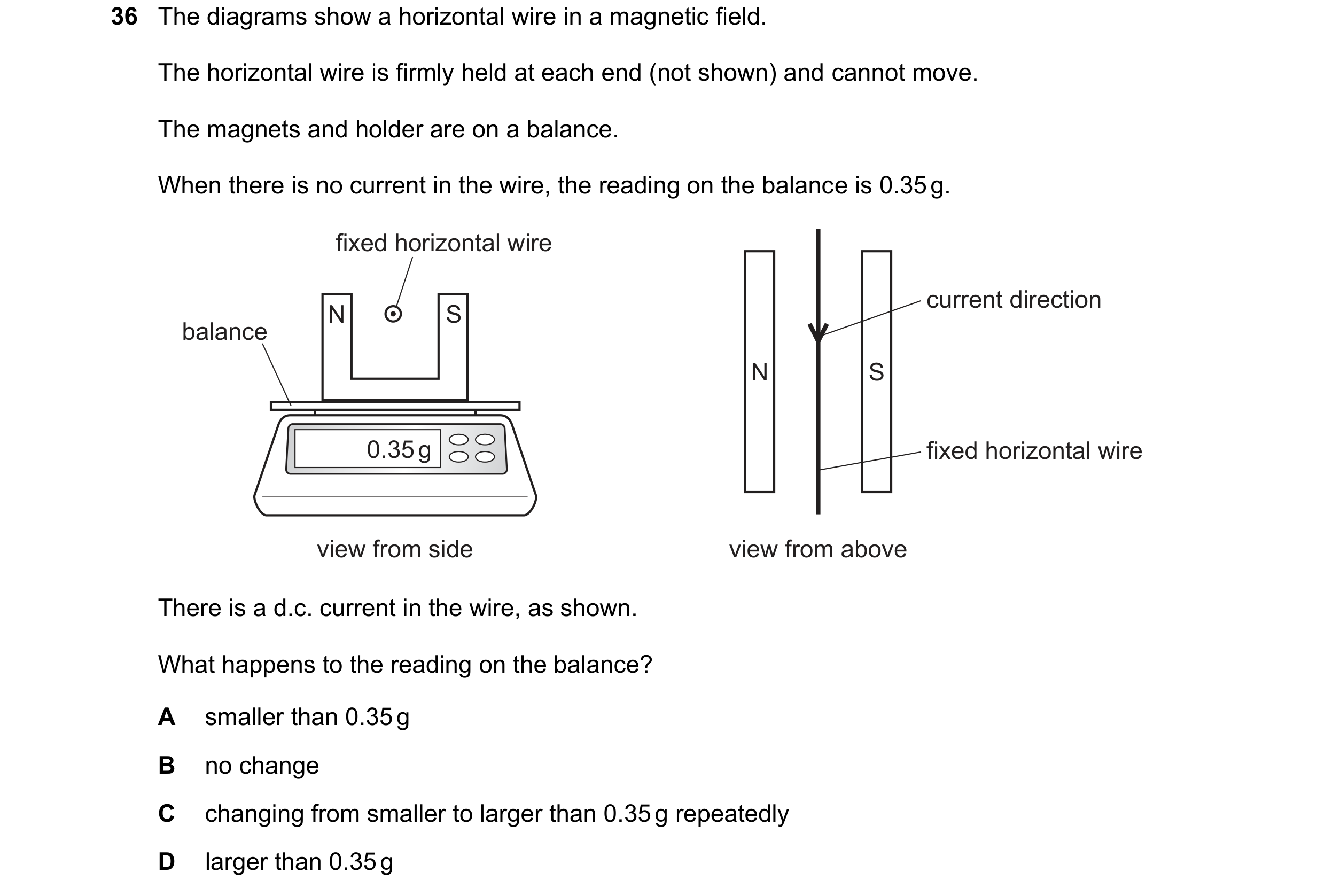
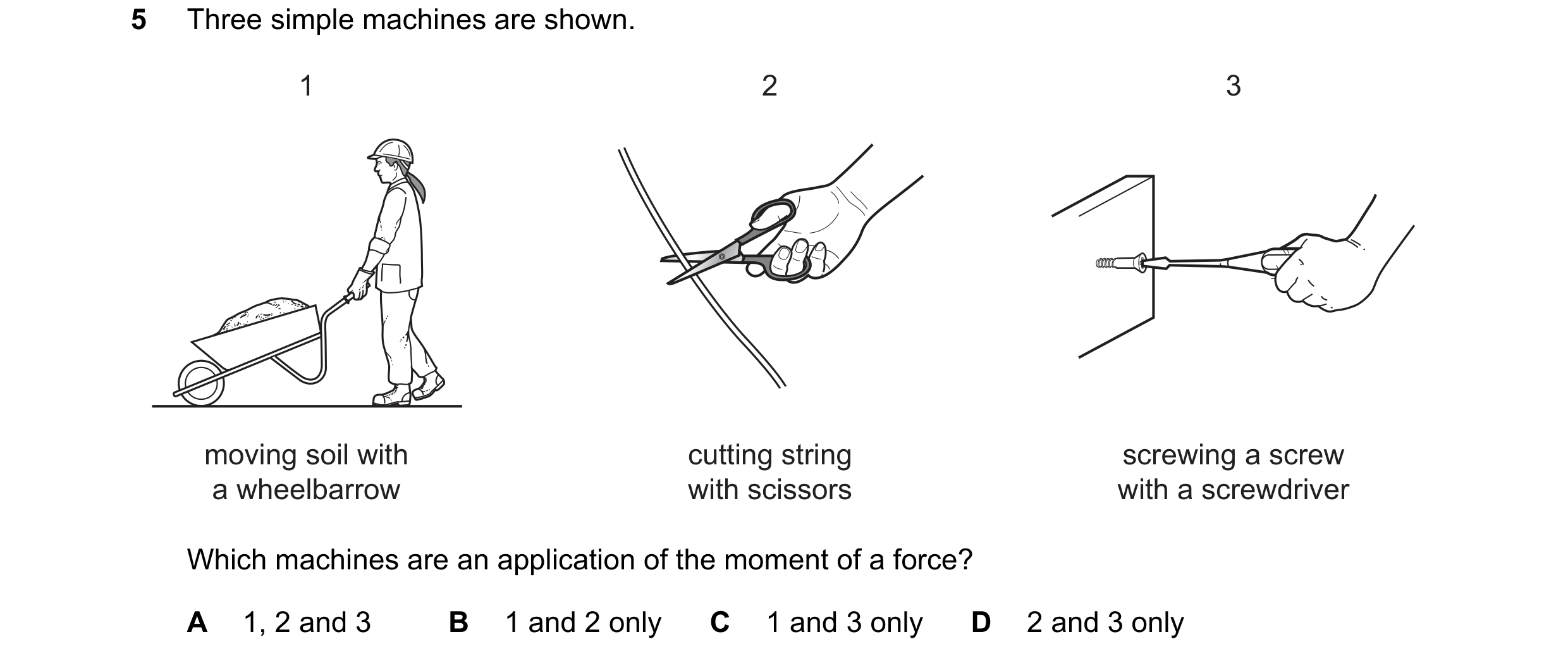
 51 / 82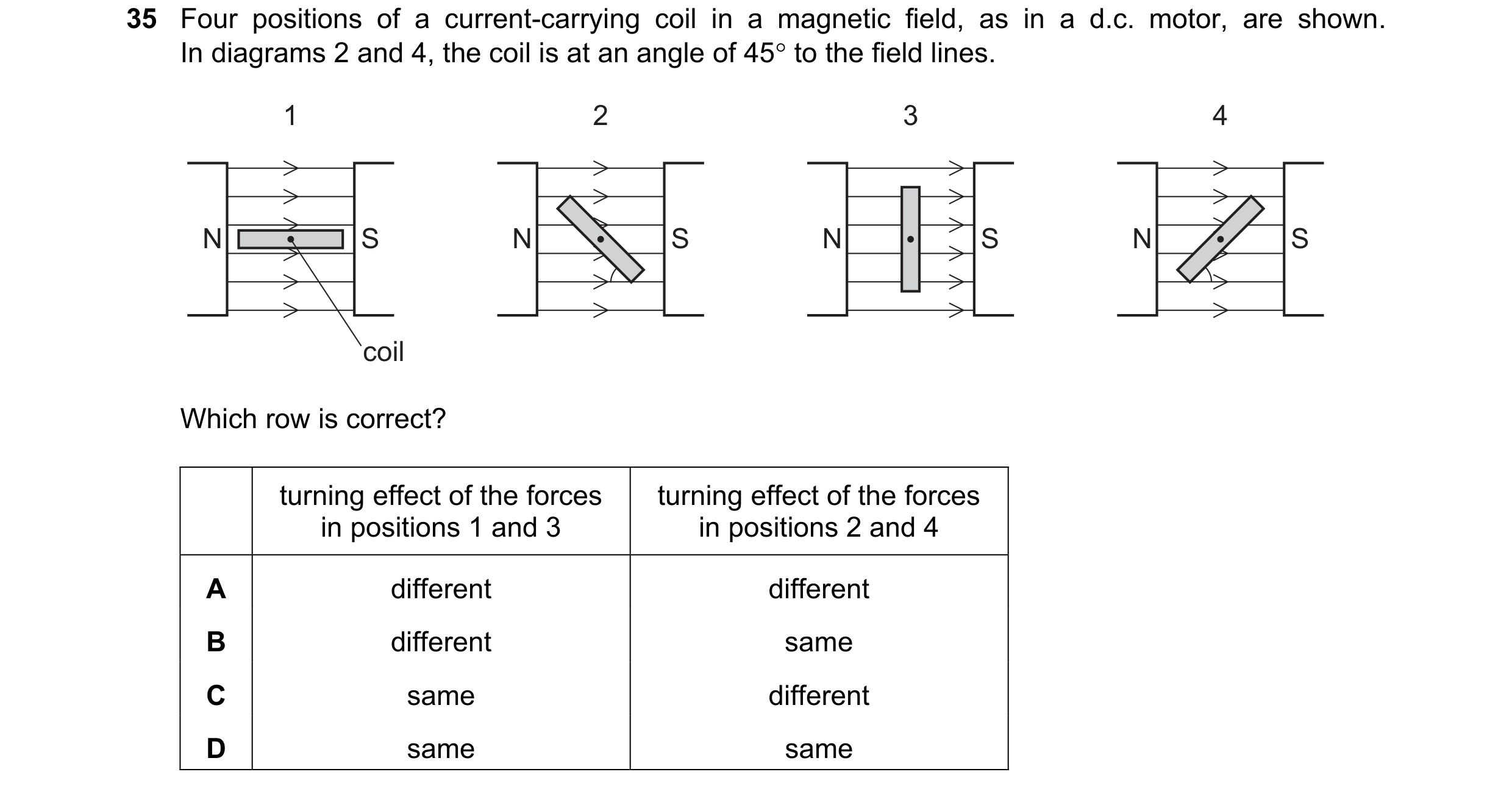
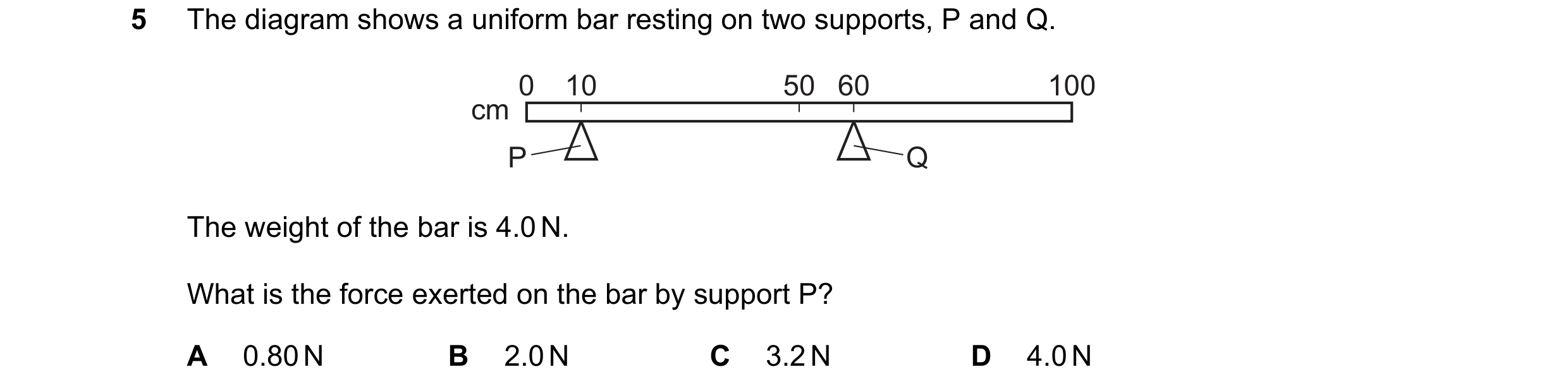
 52 / 82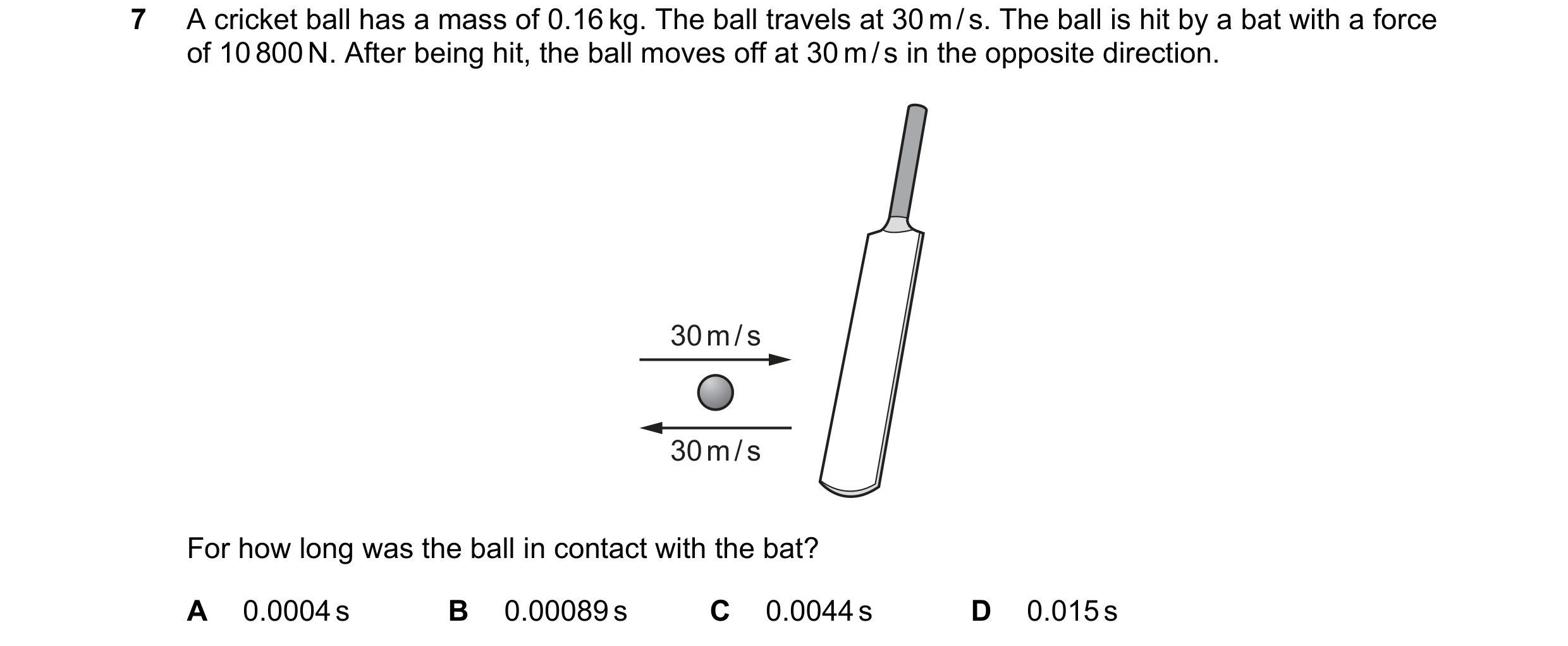

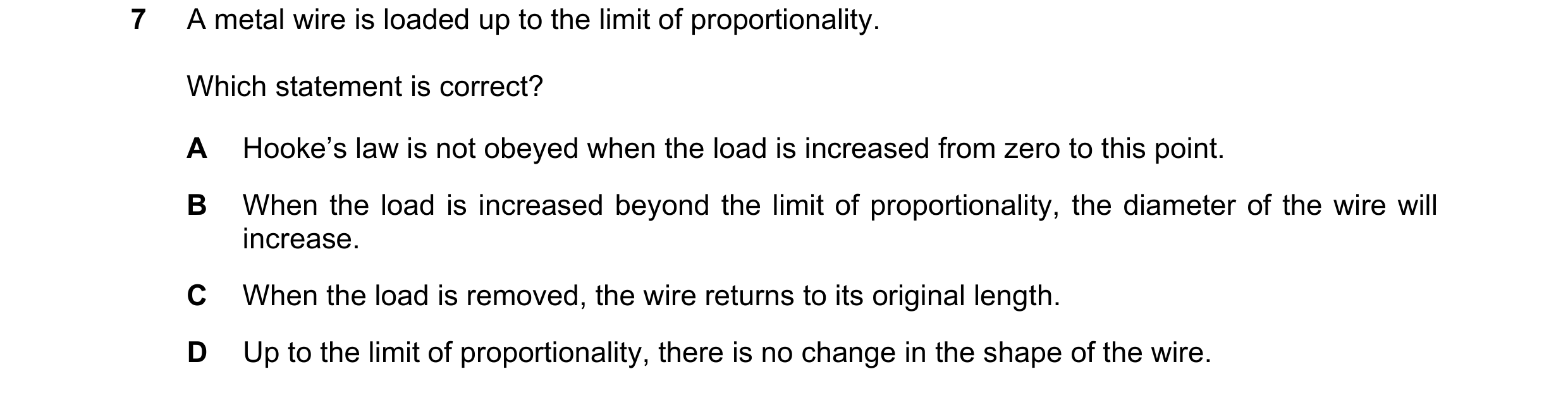
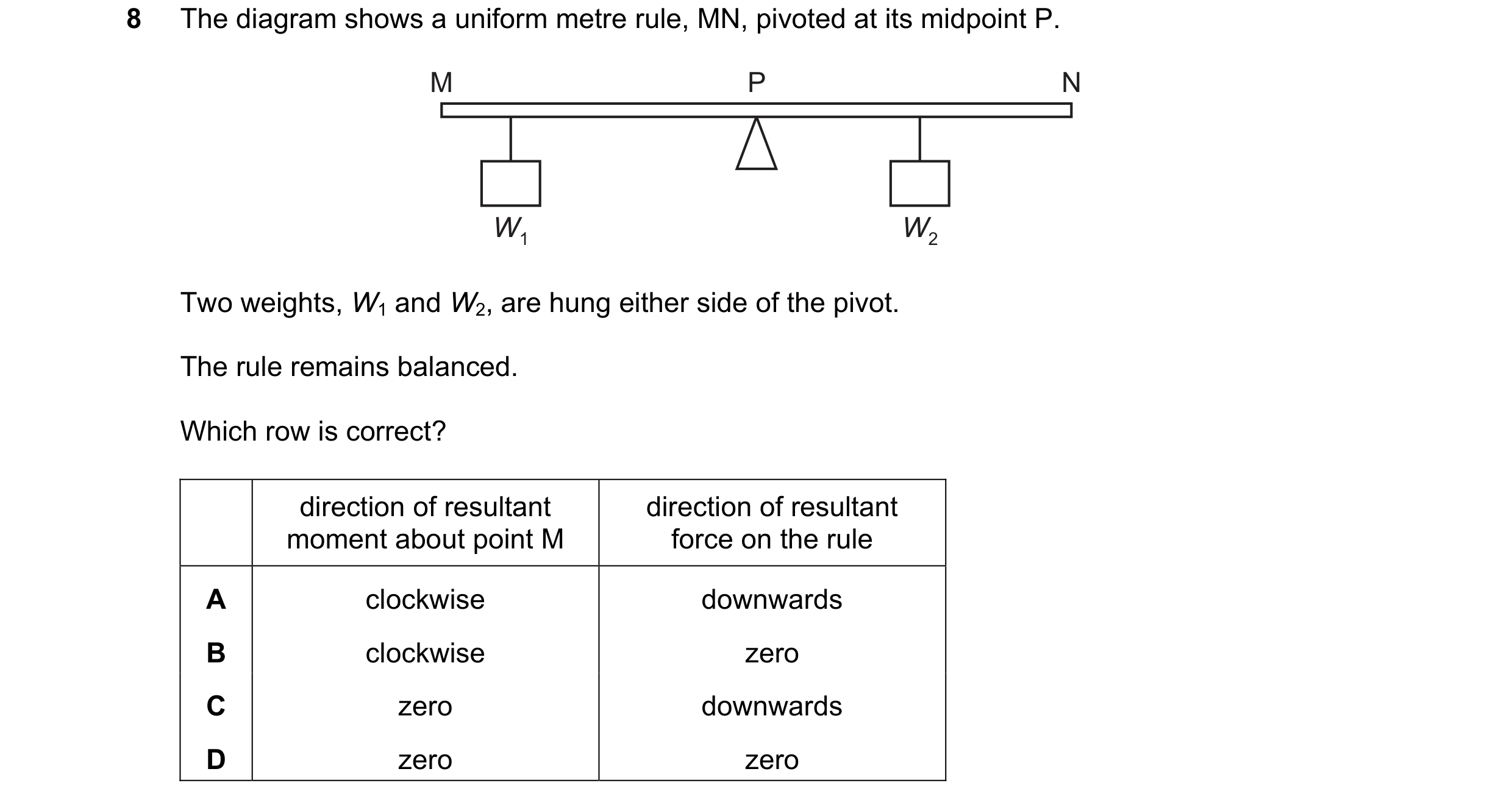 53 / 82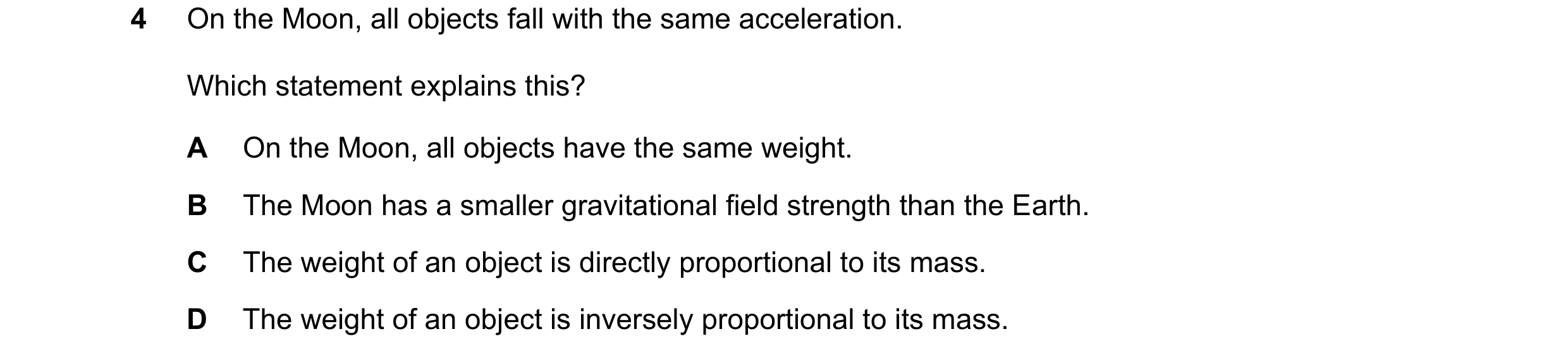
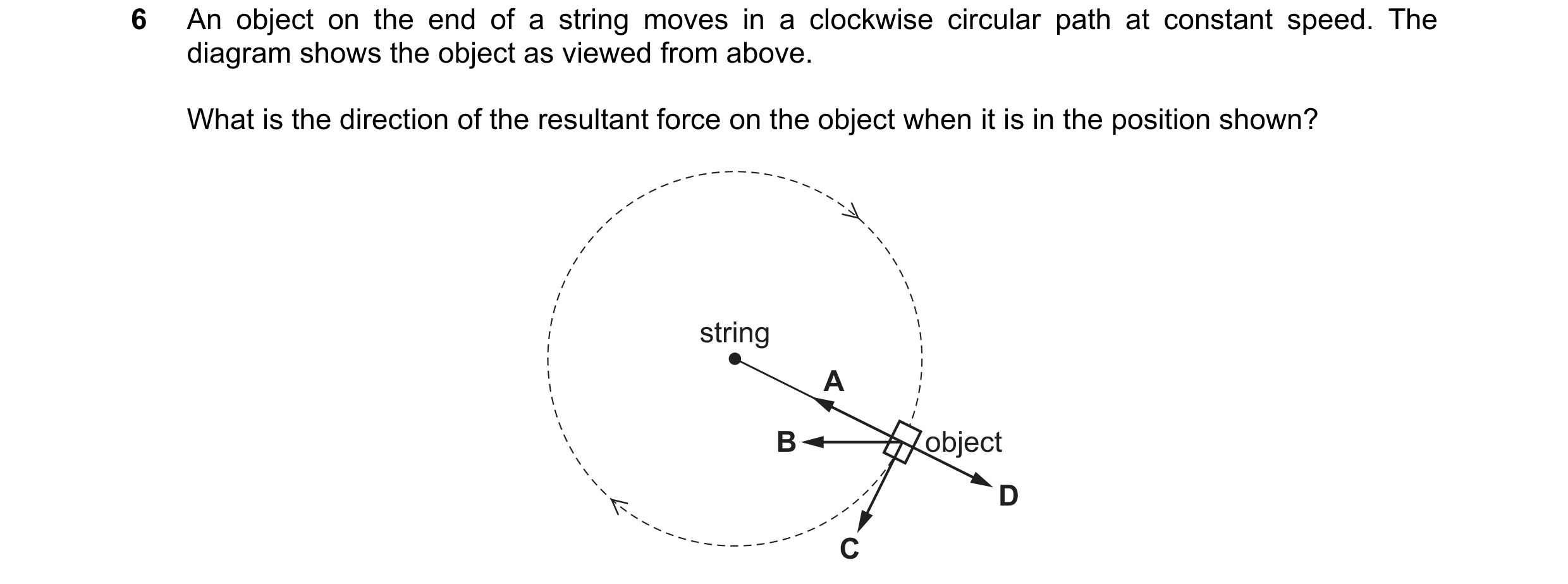
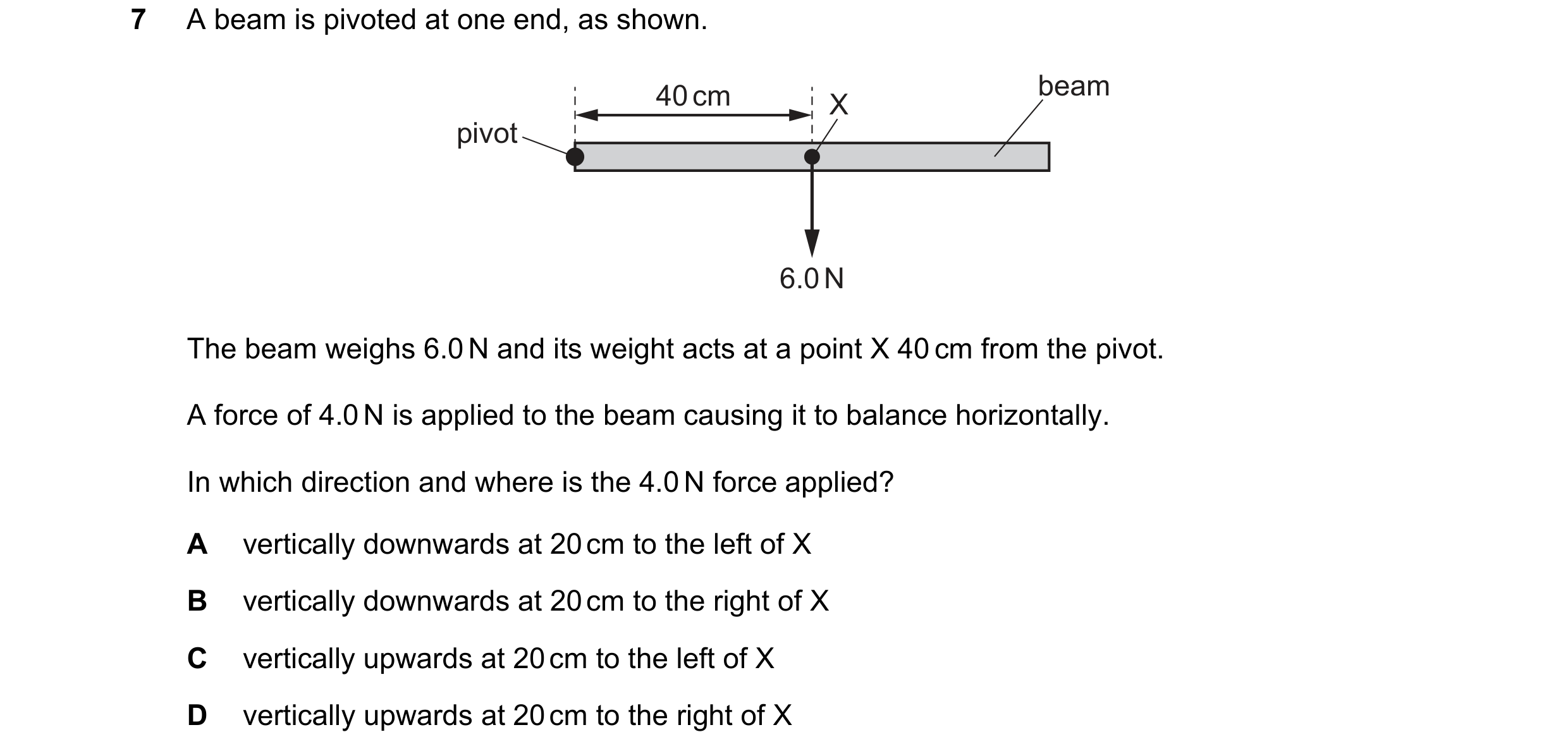 54 / 82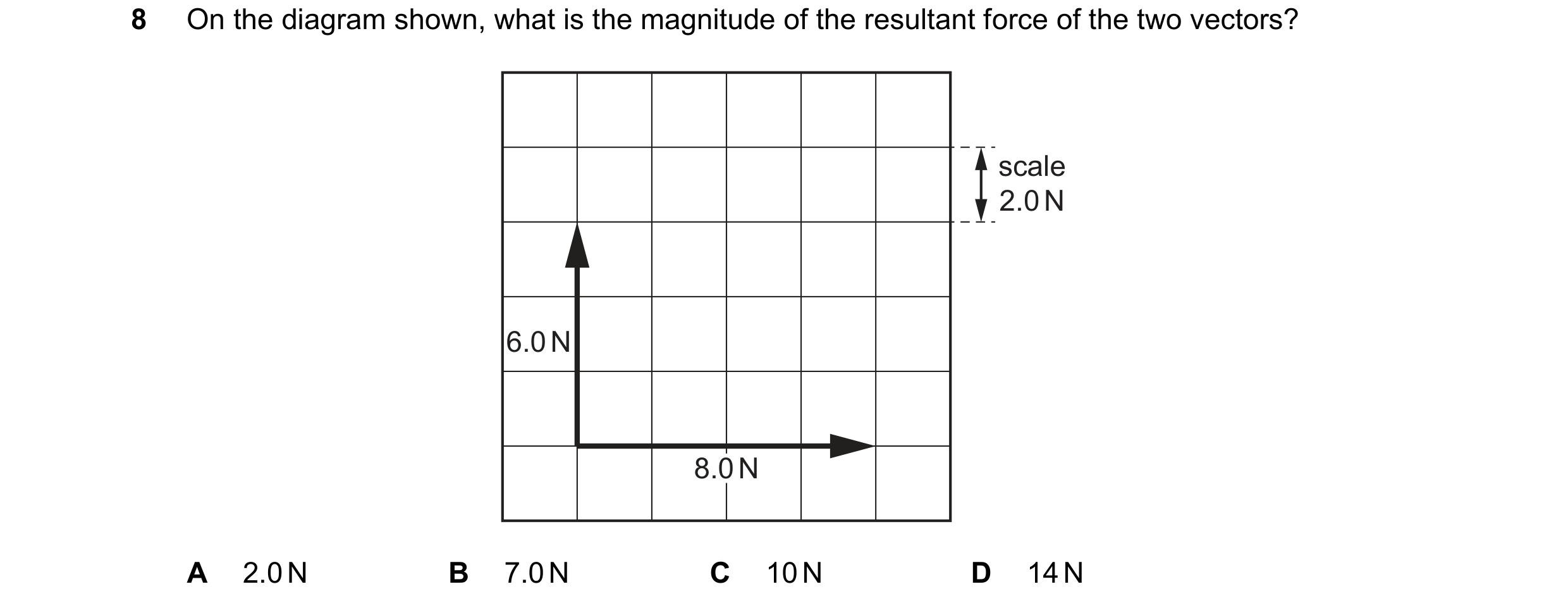
 55 / 82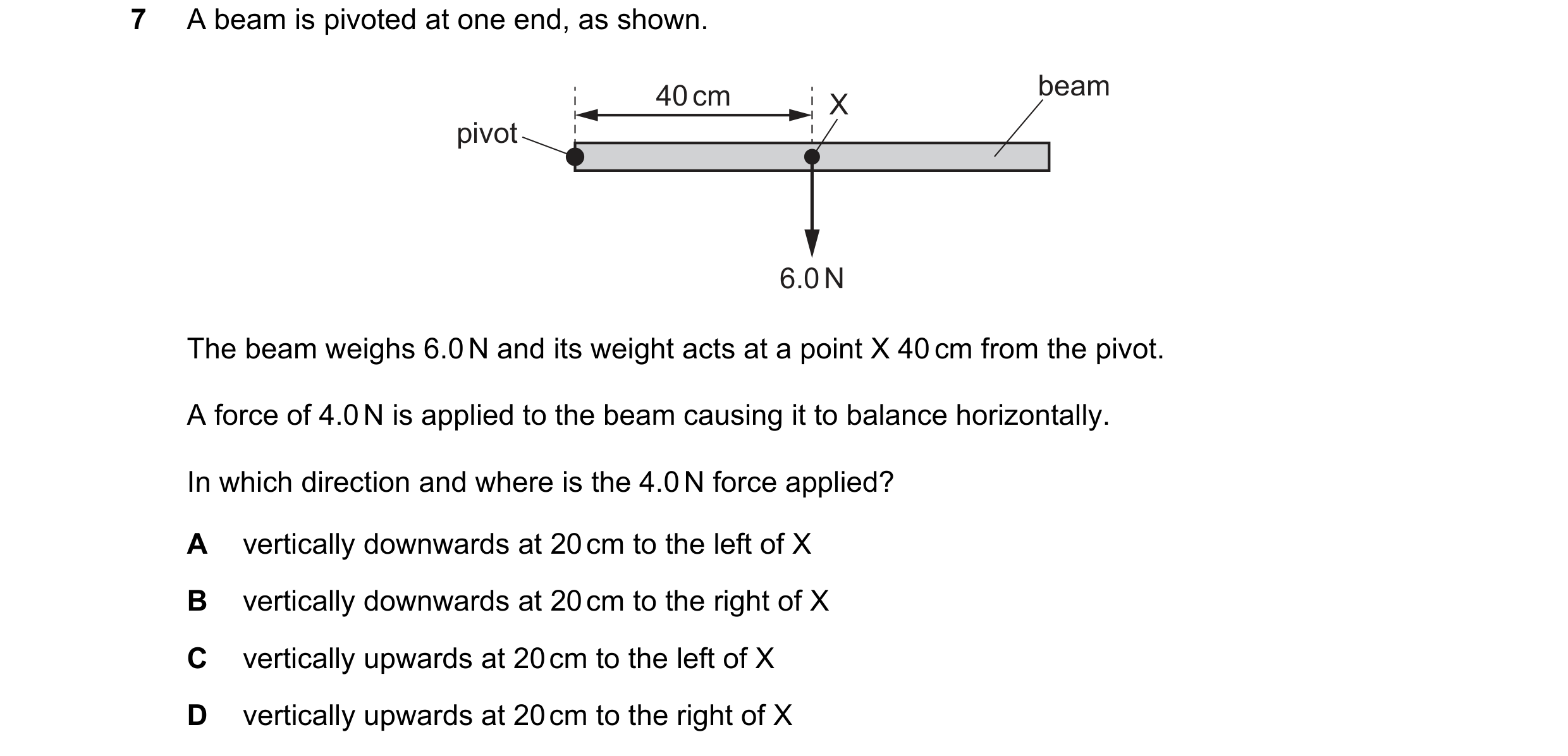
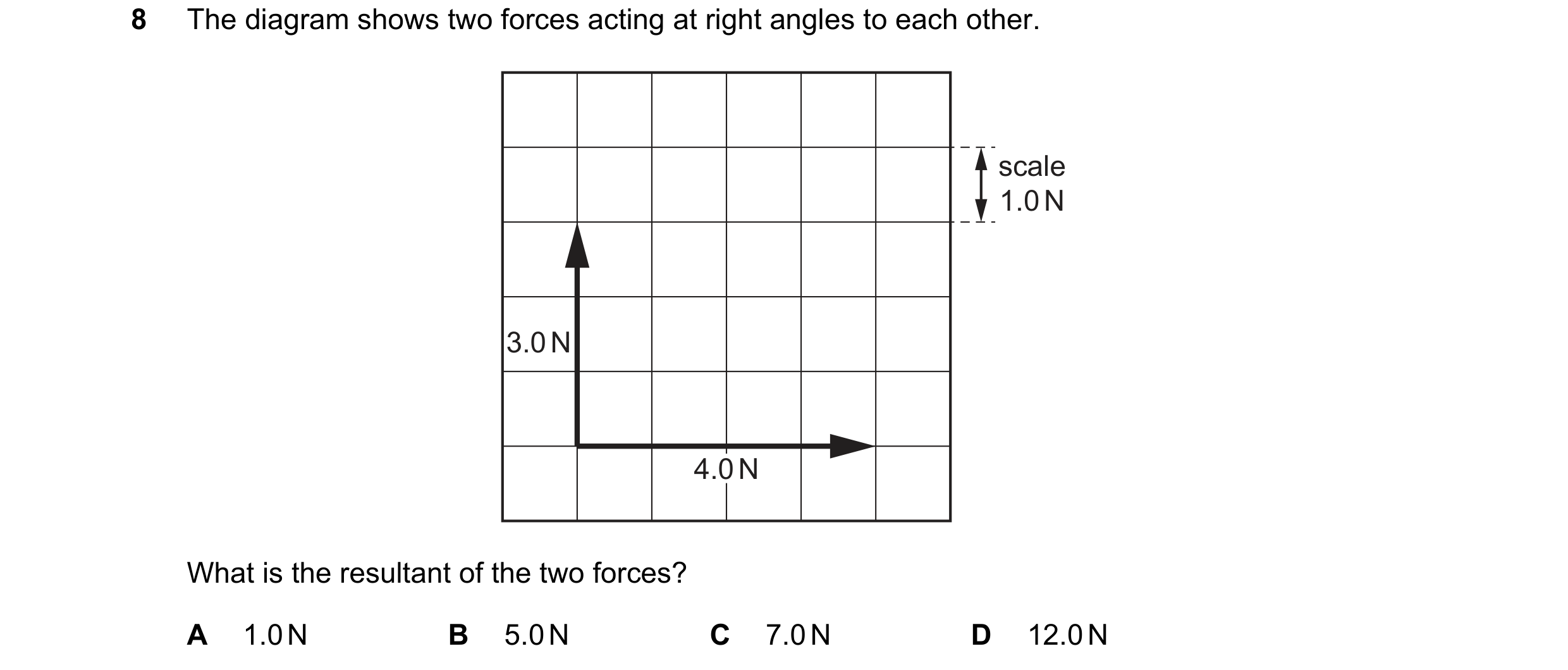
 56 / 82
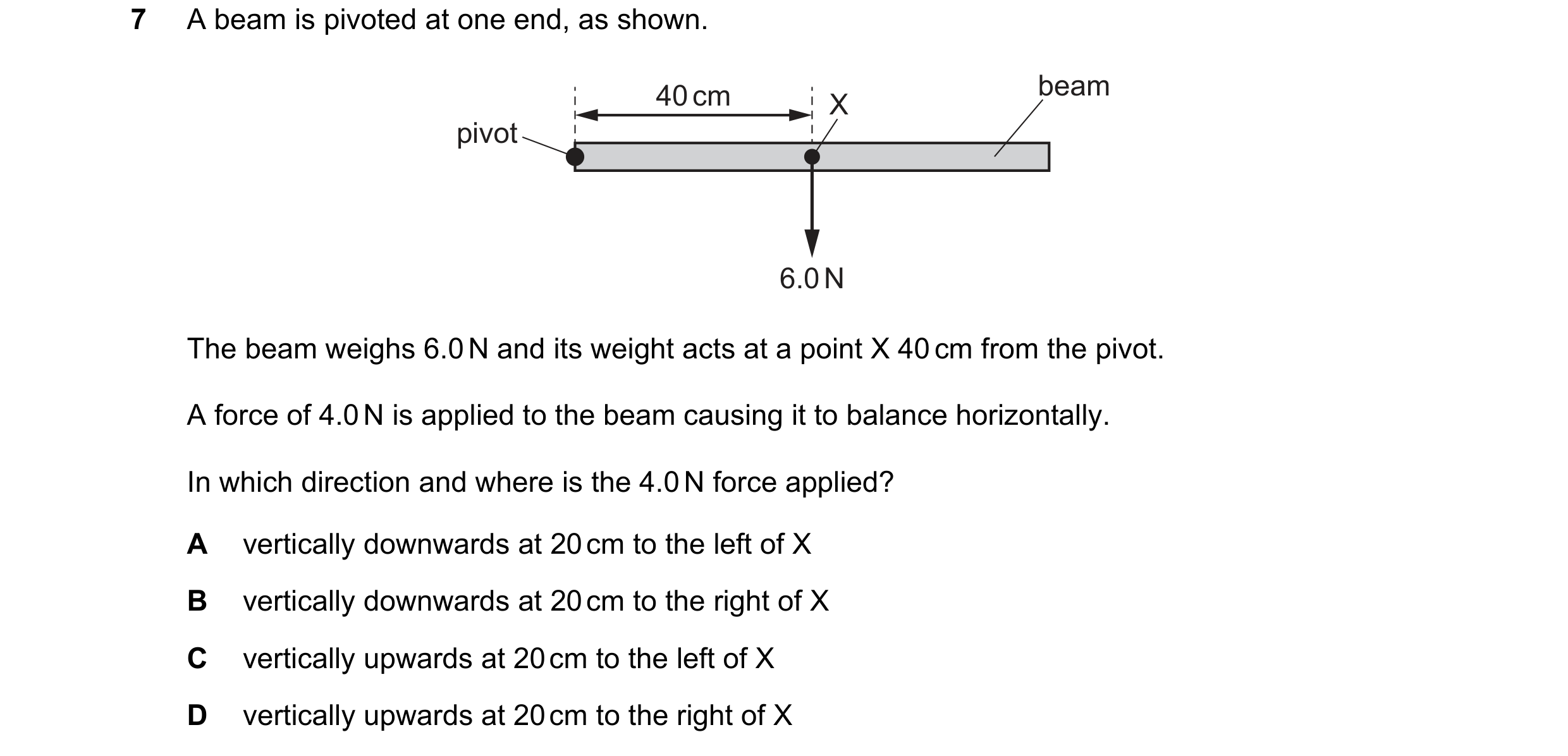
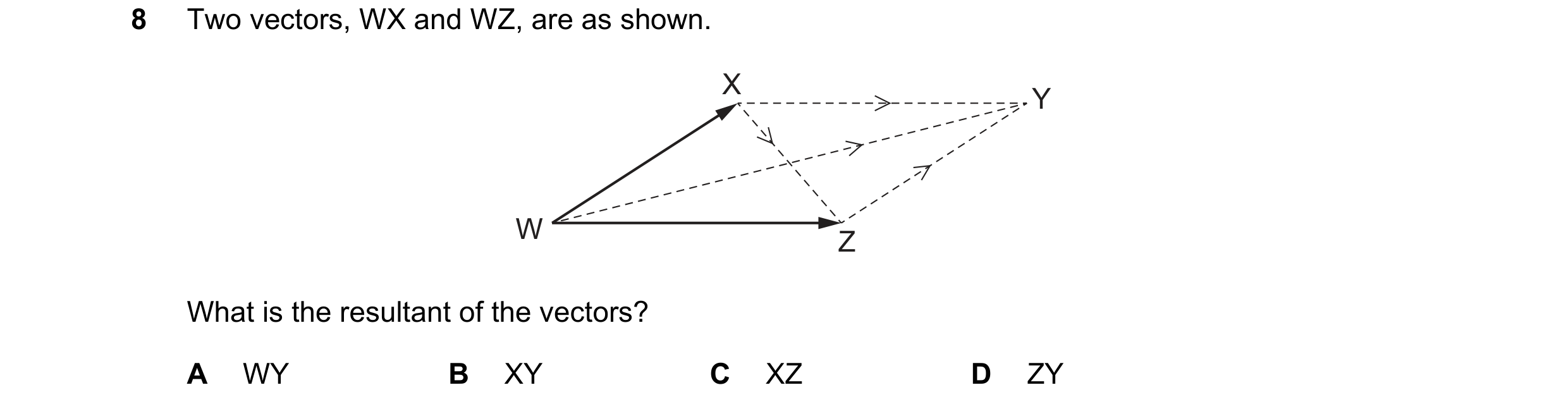 57 / 82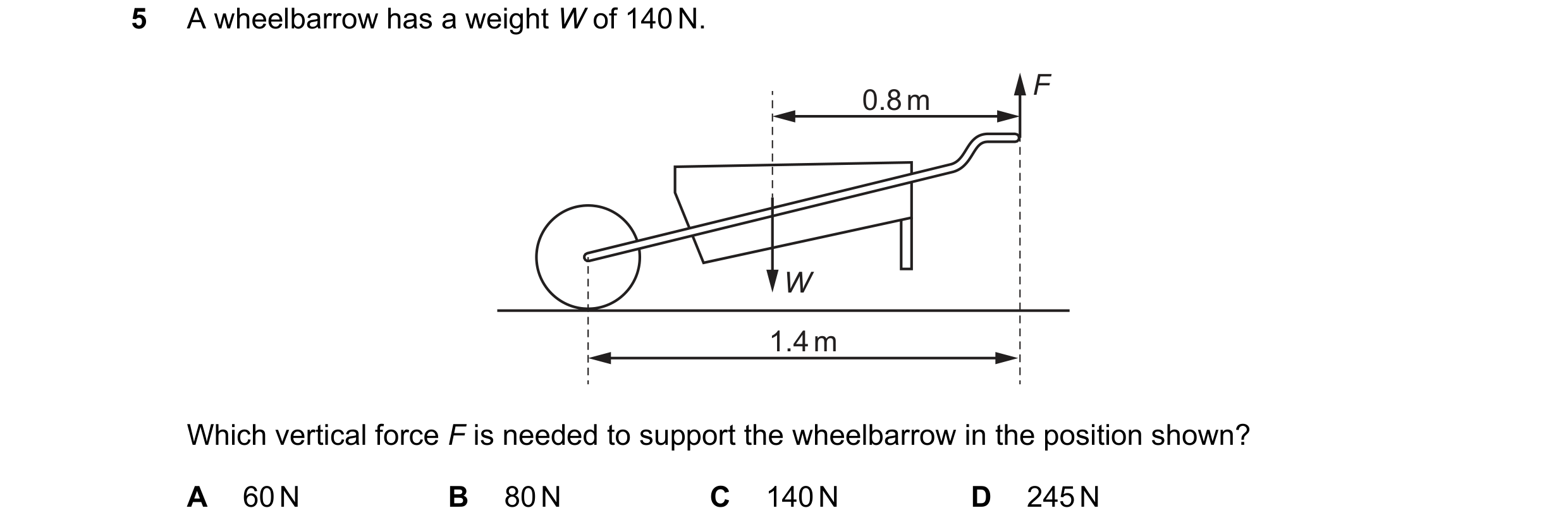
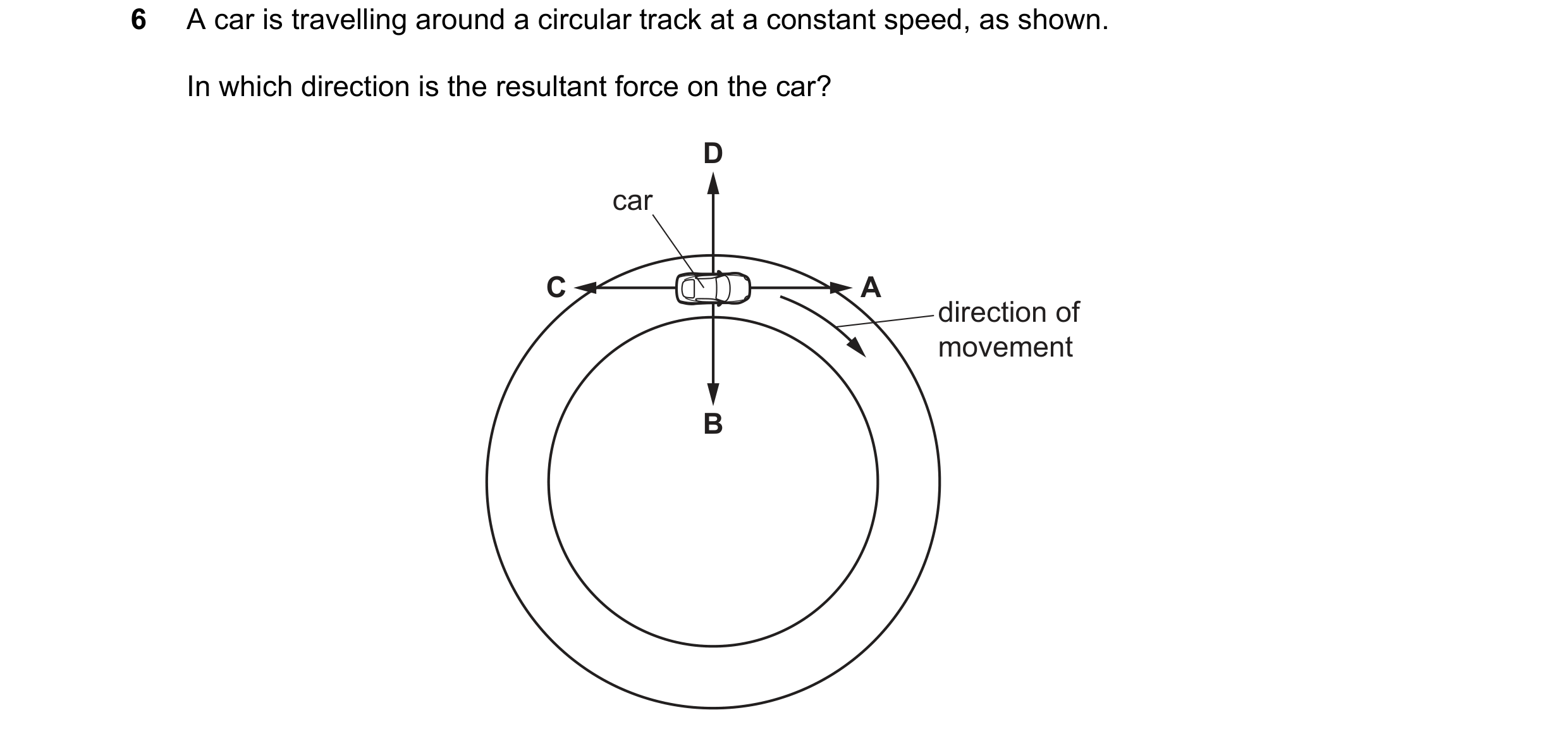
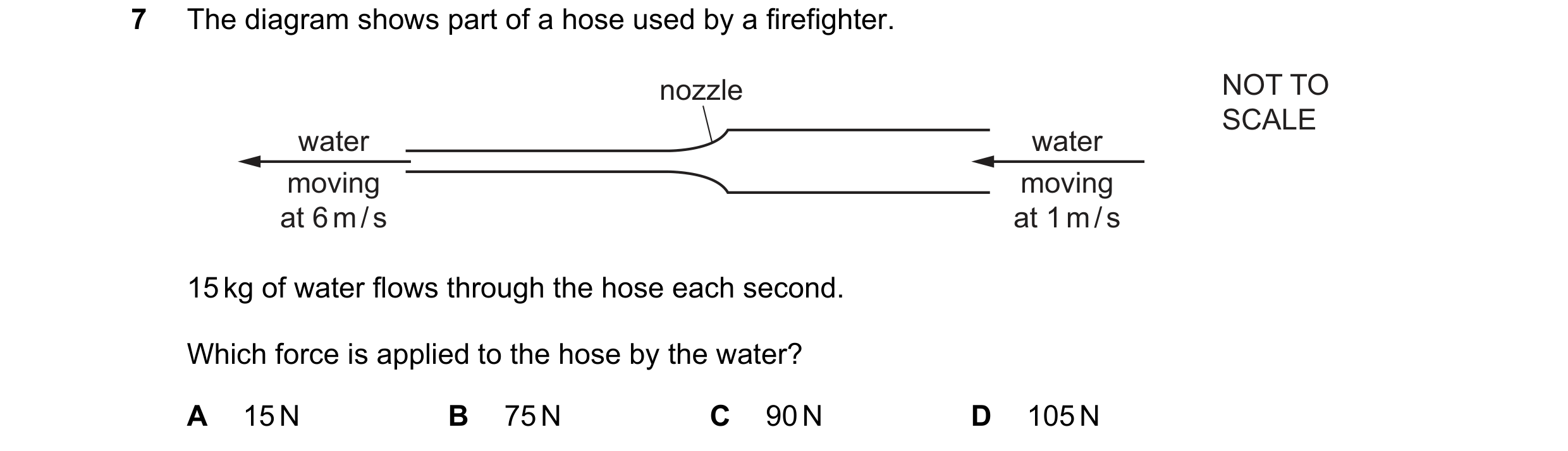 58 / 82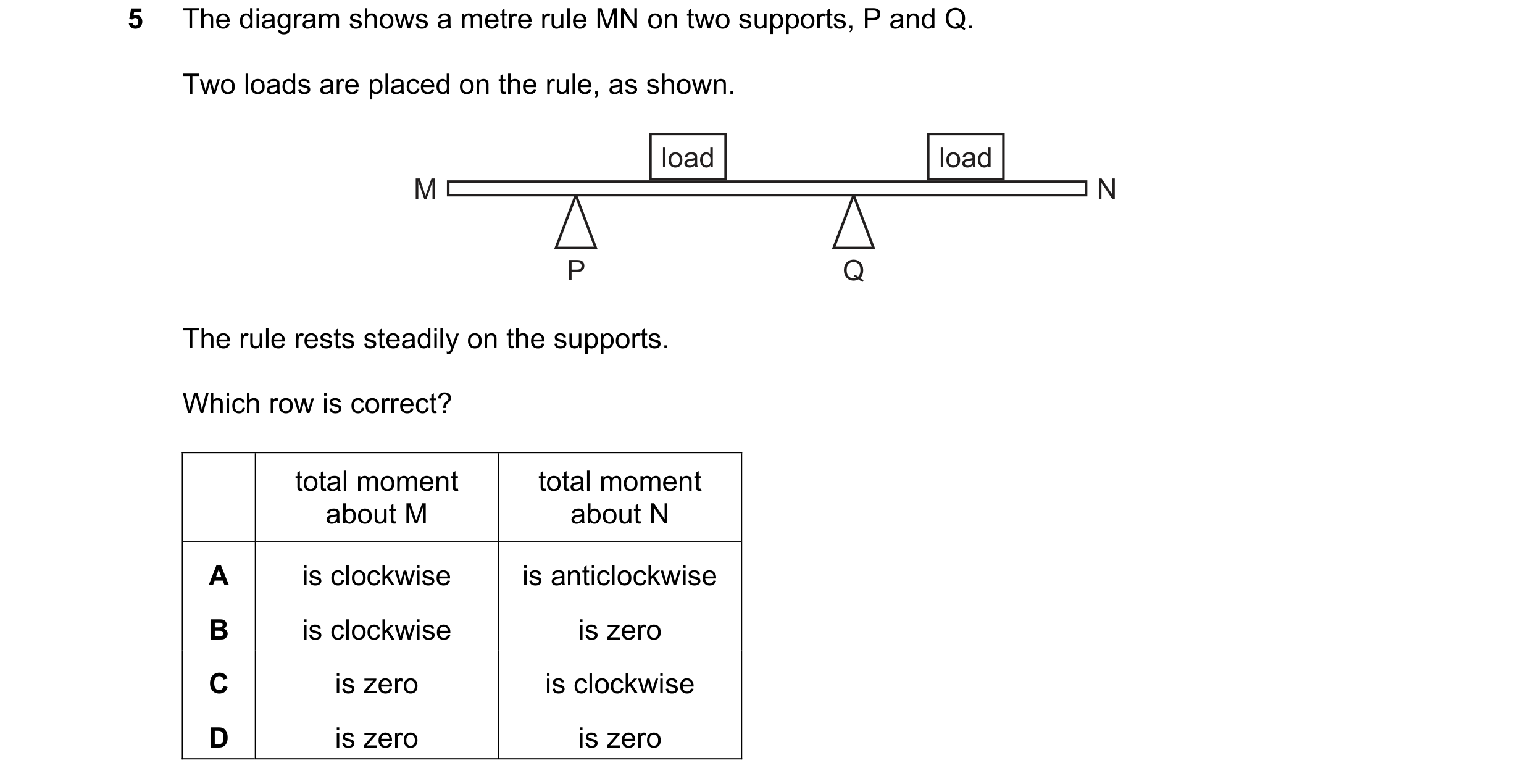
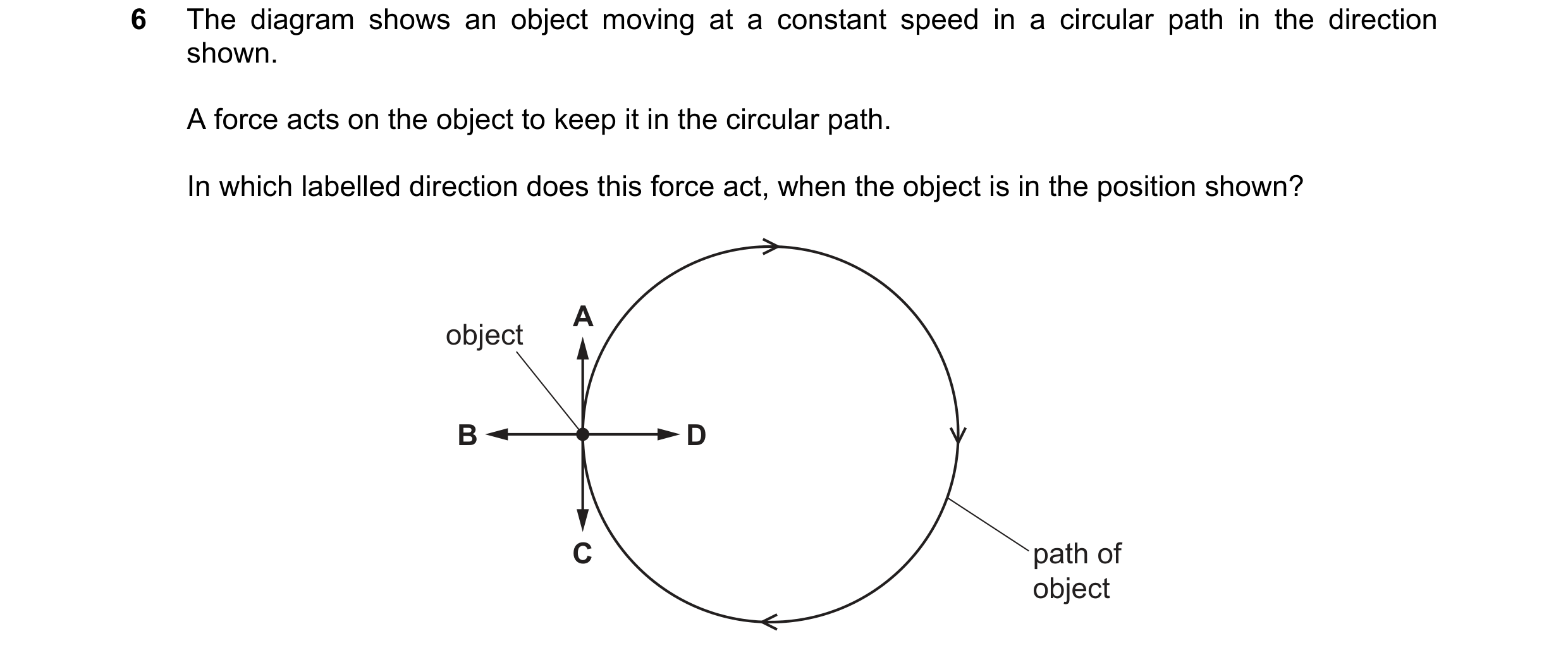
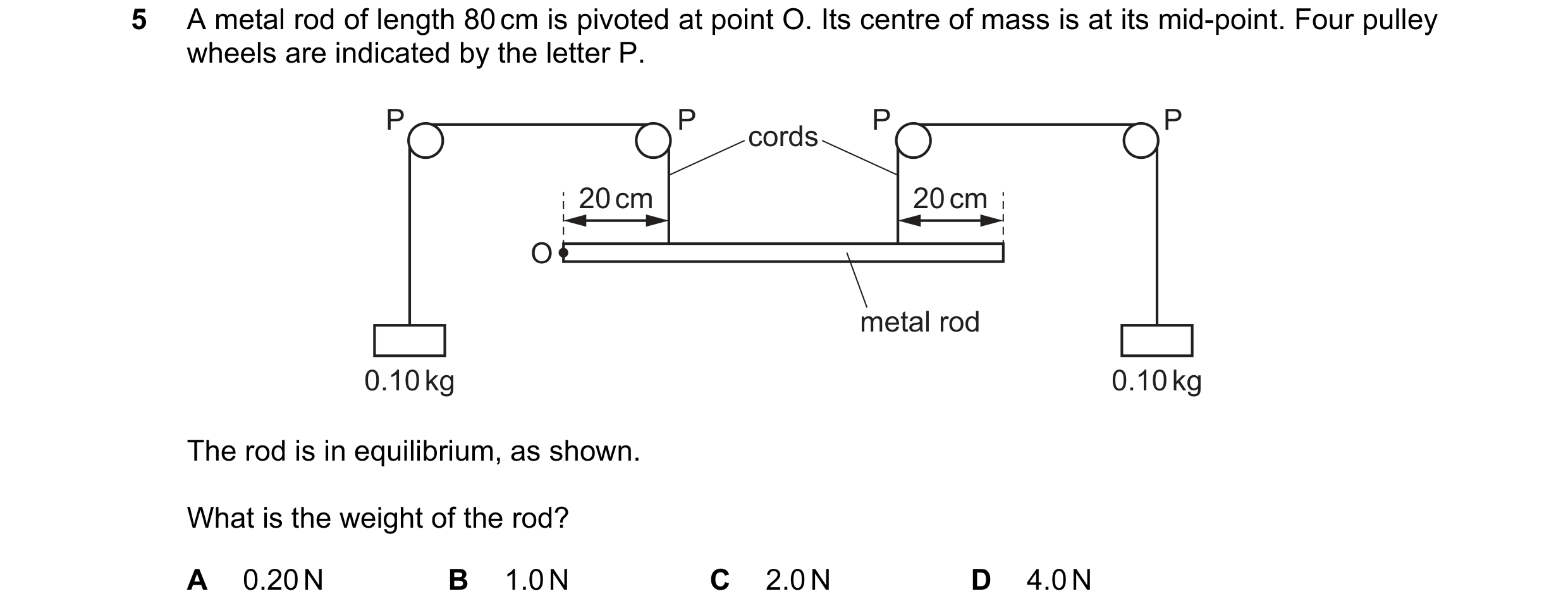 59 / 82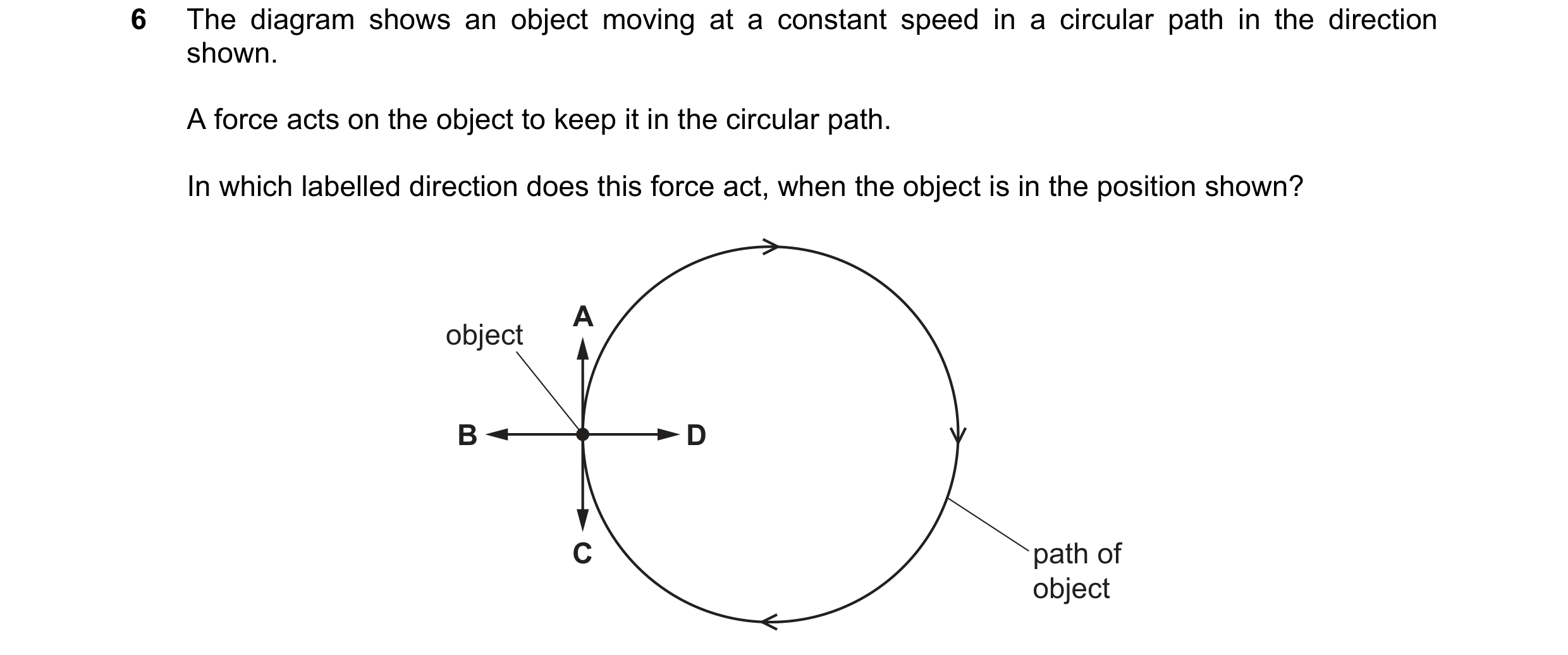
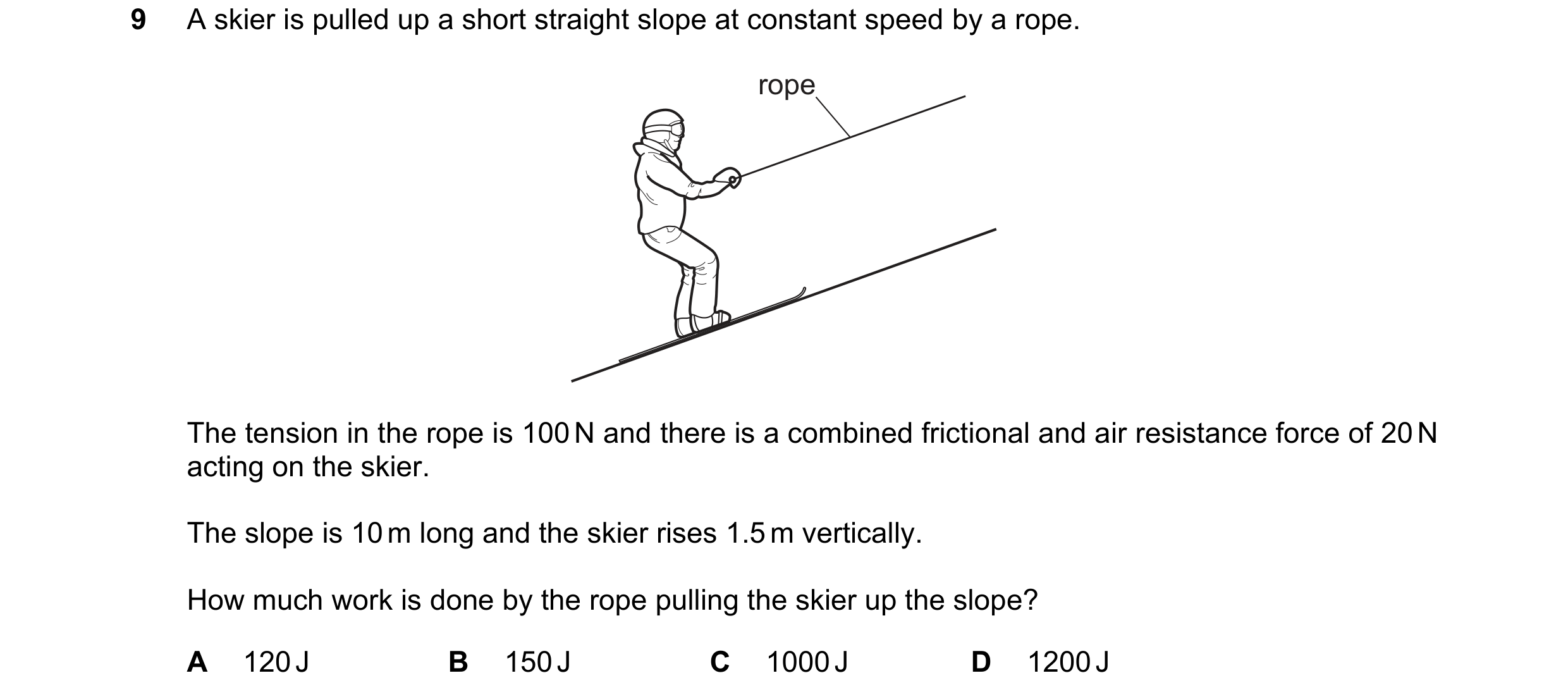 60 / 82
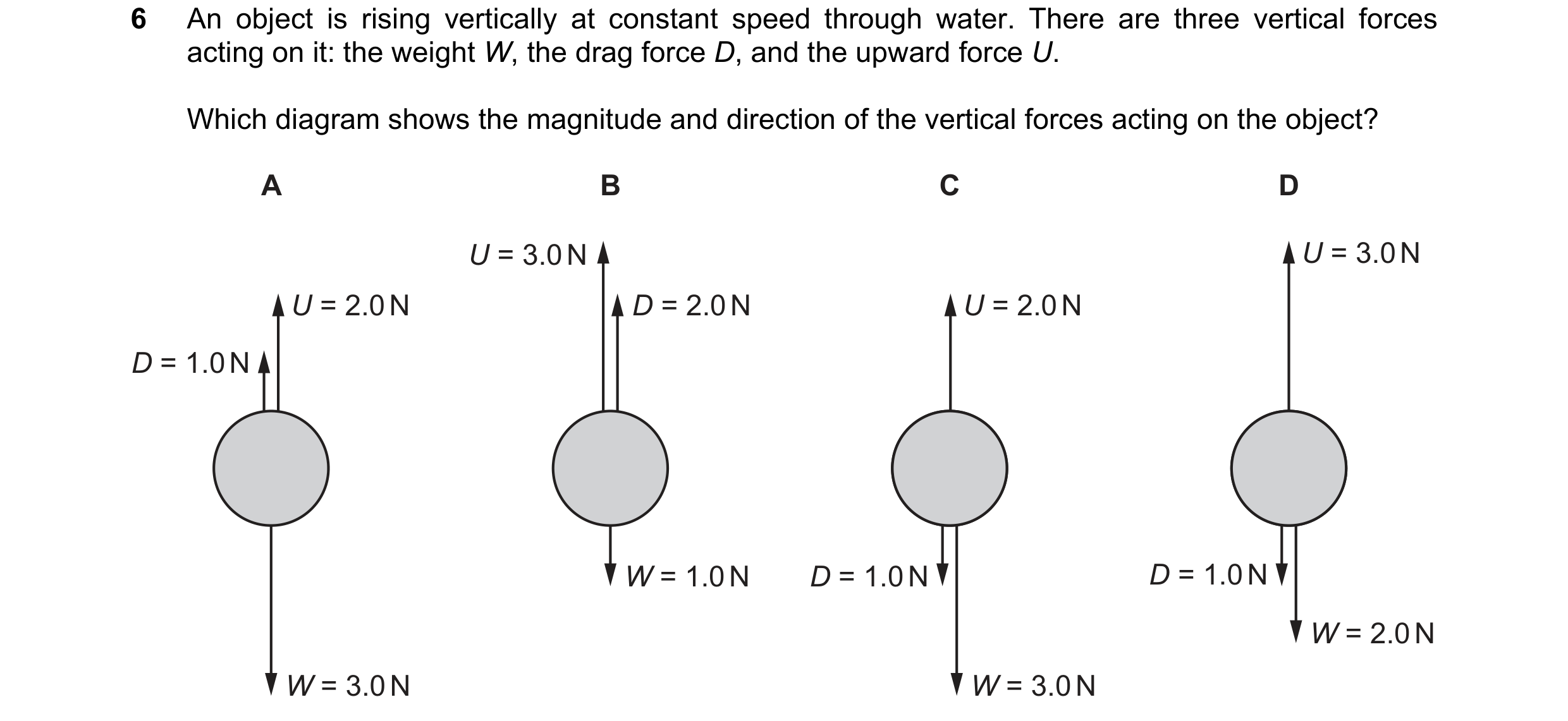
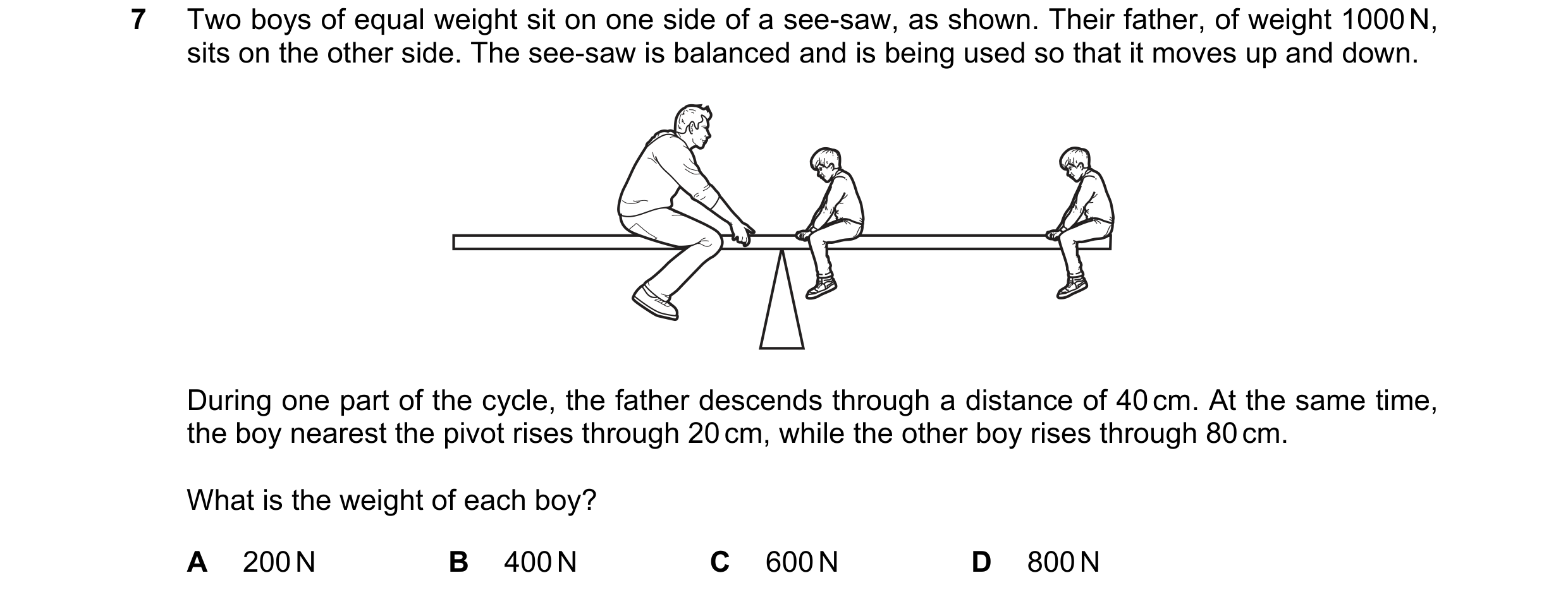 61 / 82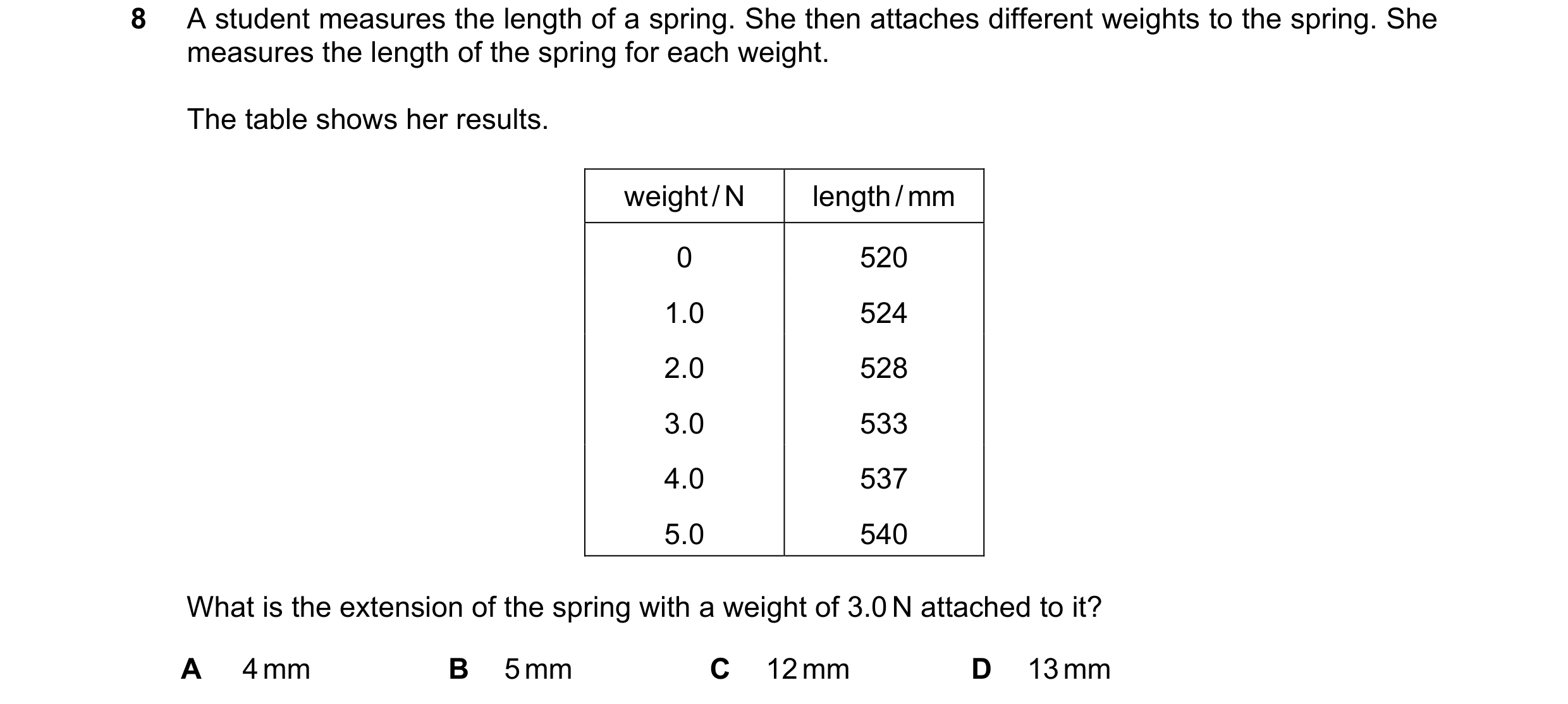
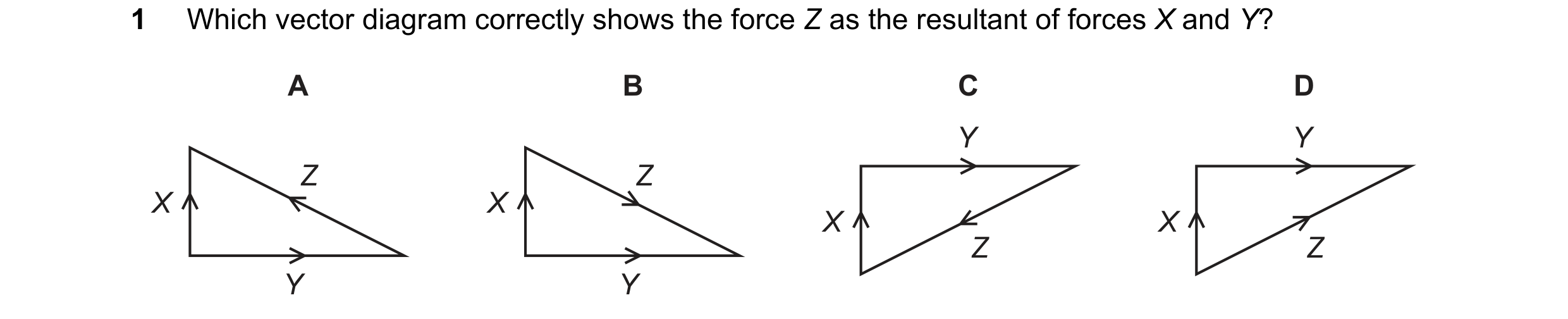
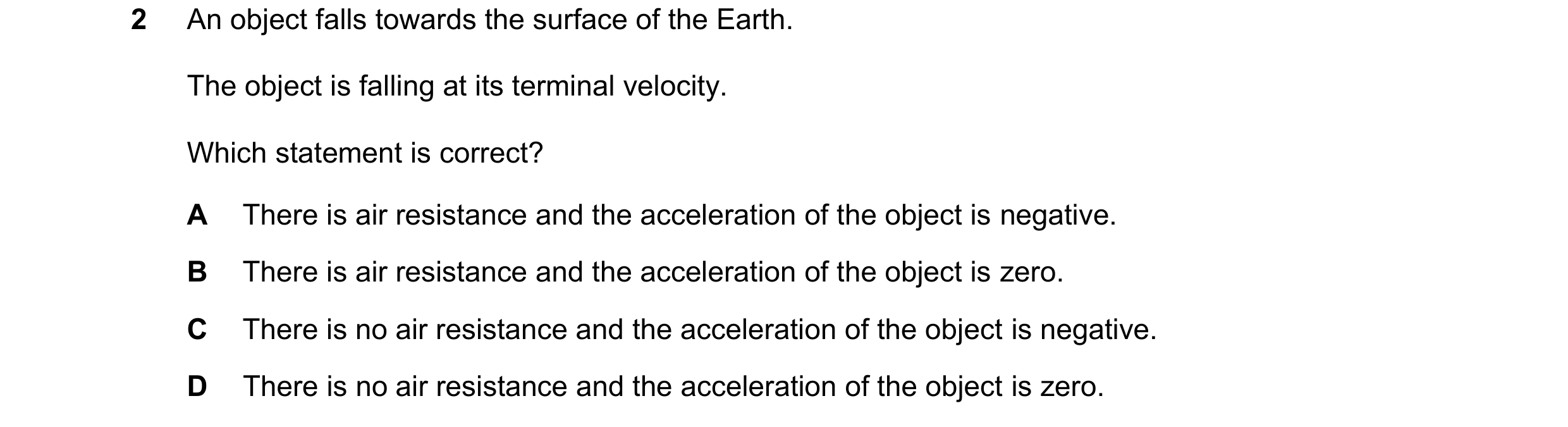 62 / 82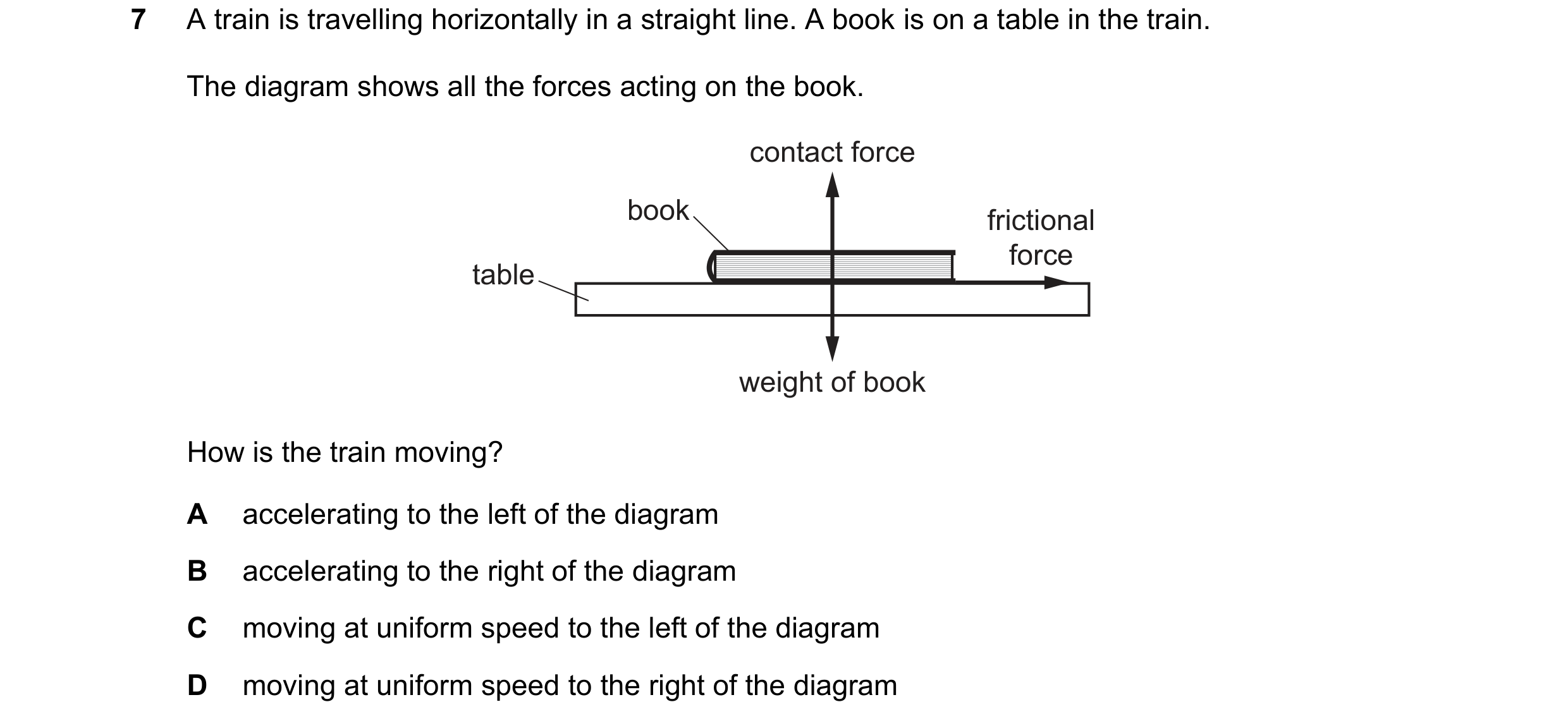
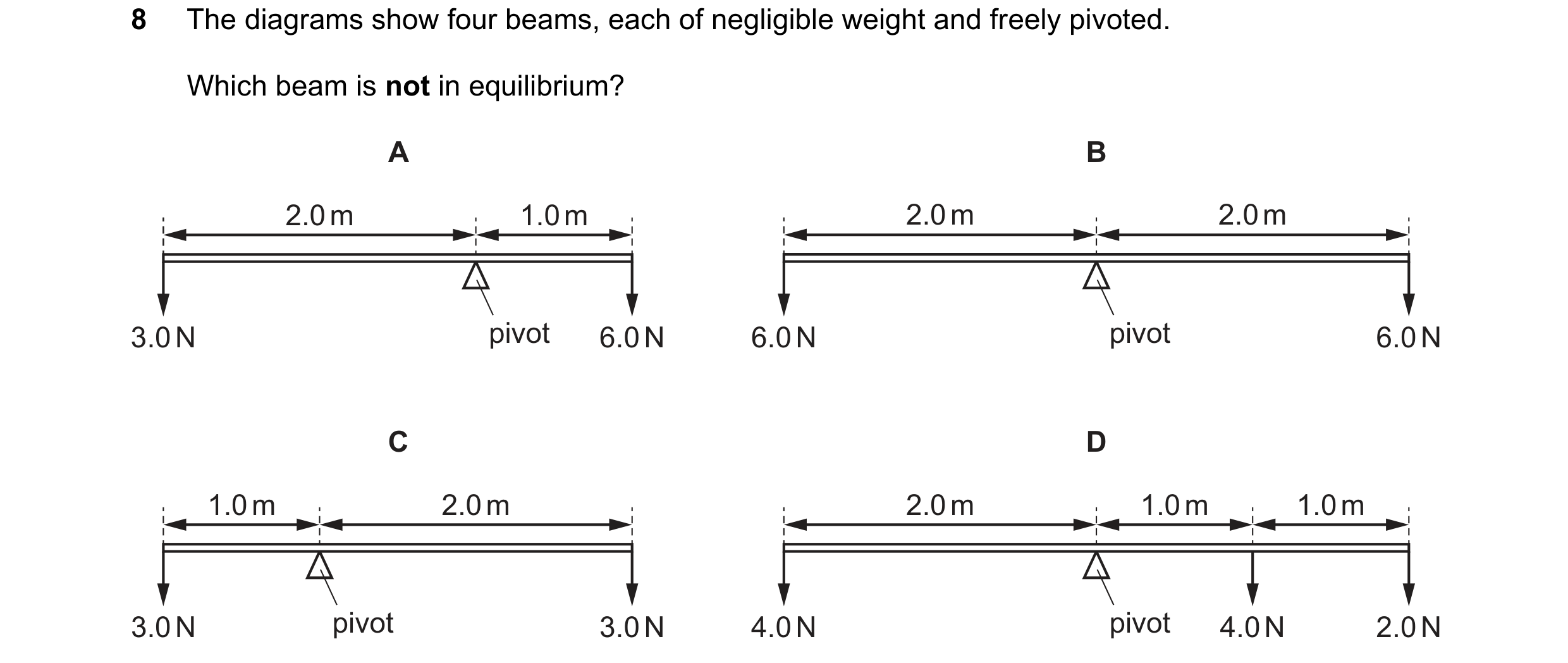
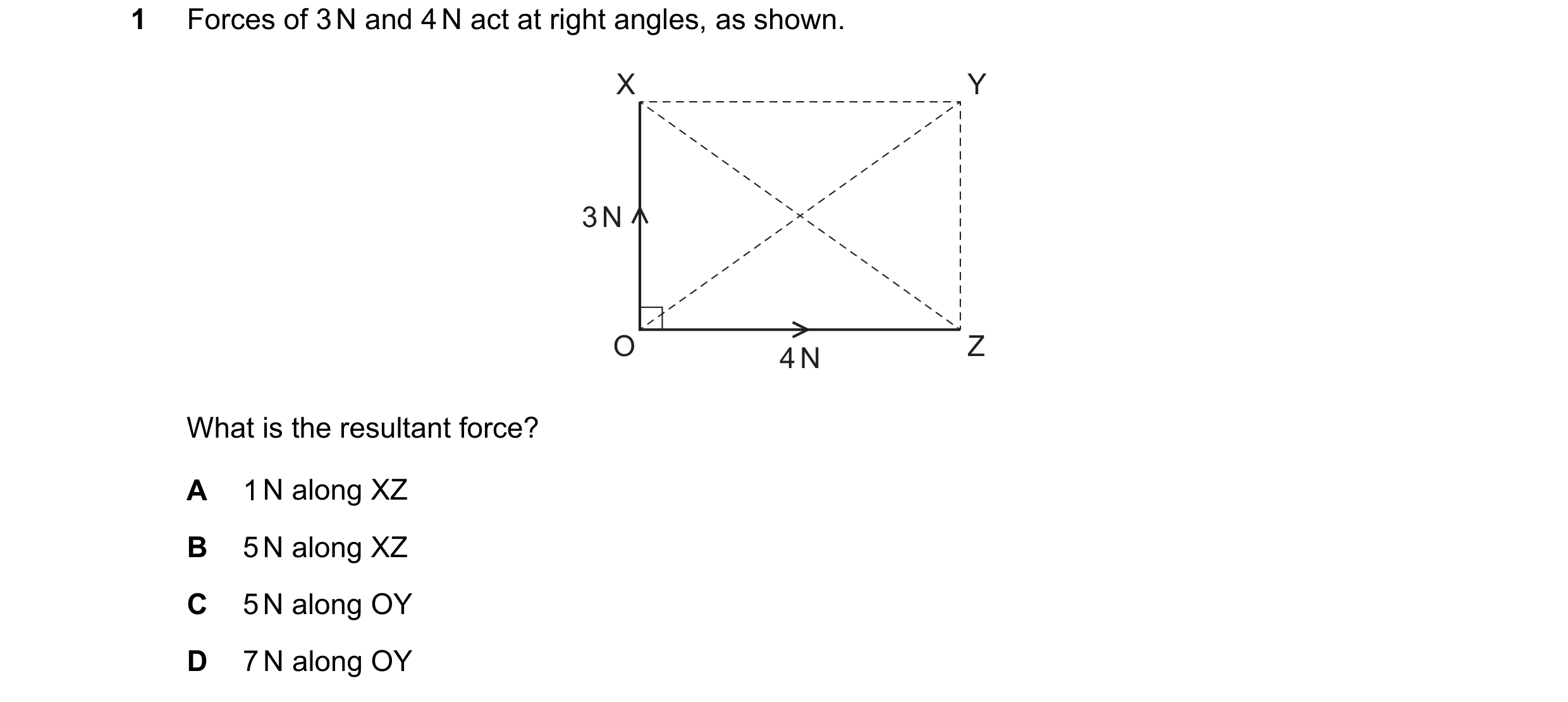 63 / 82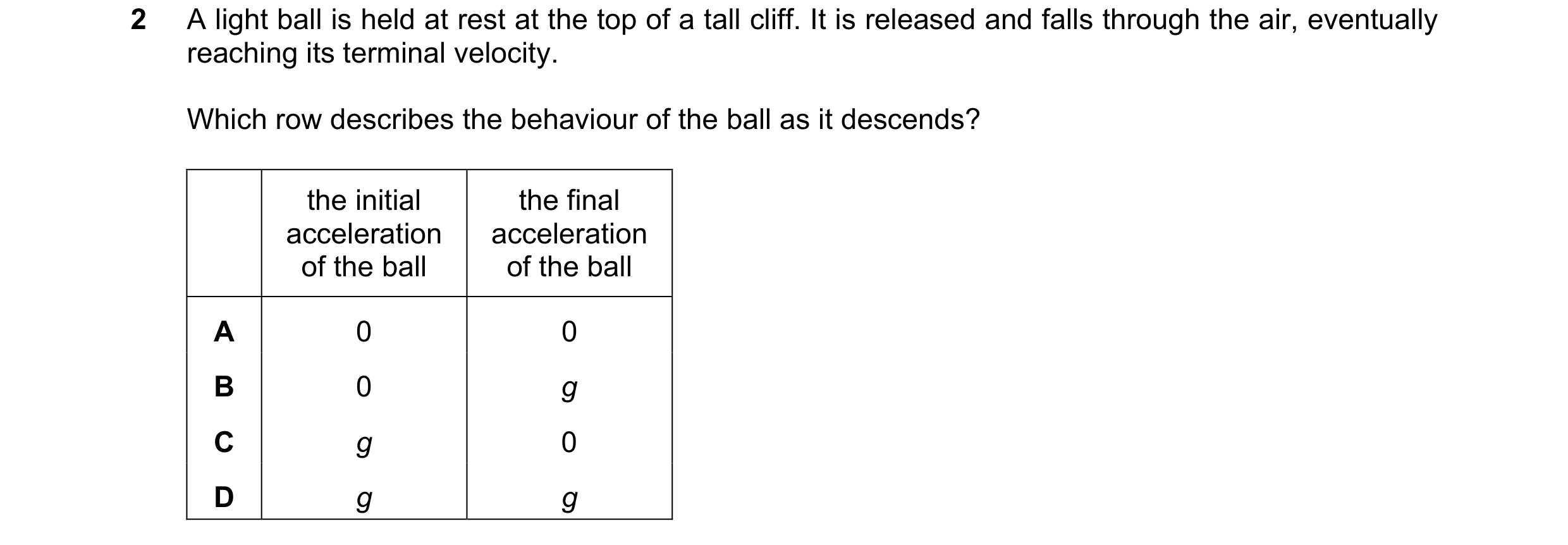
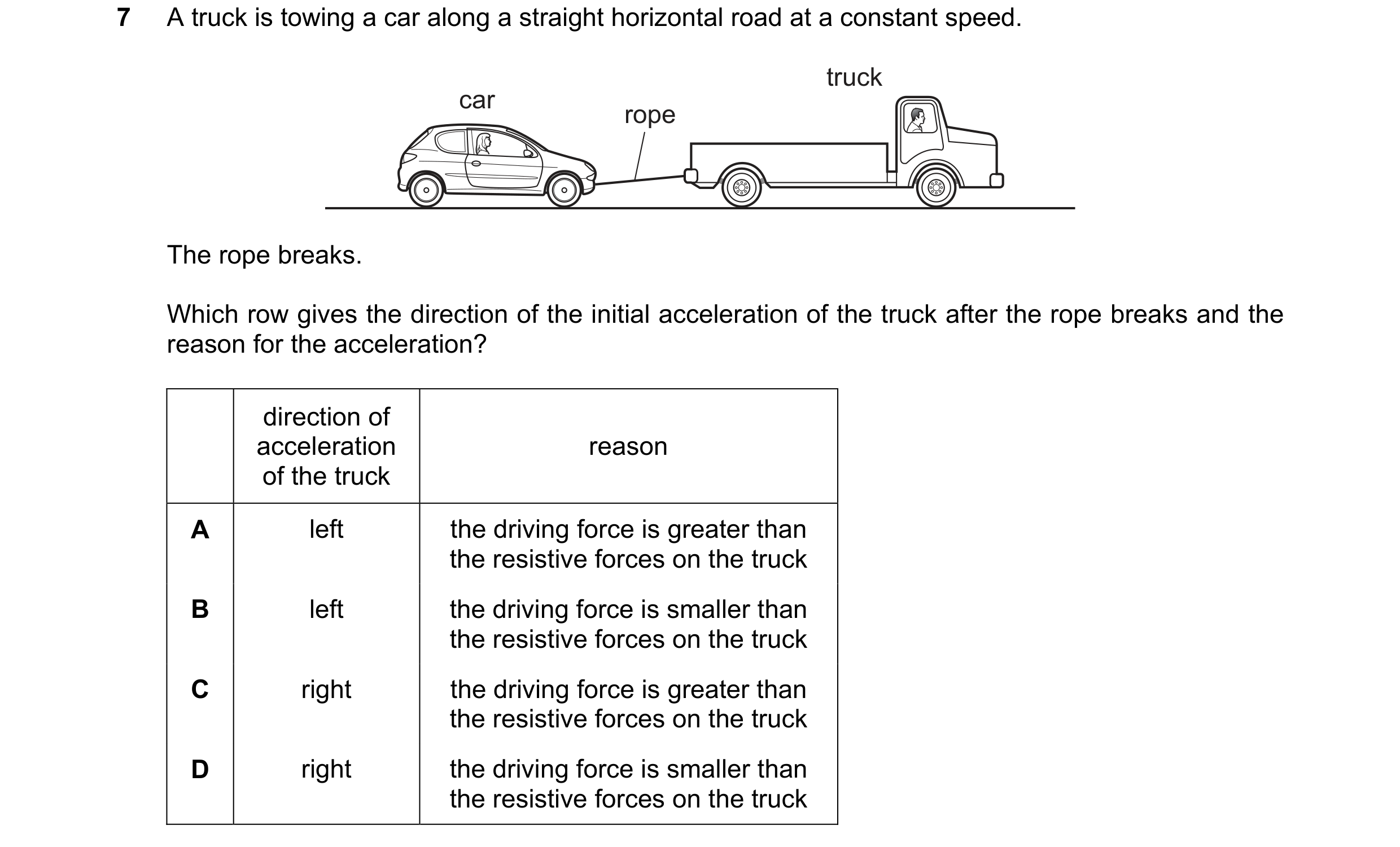 64 / 82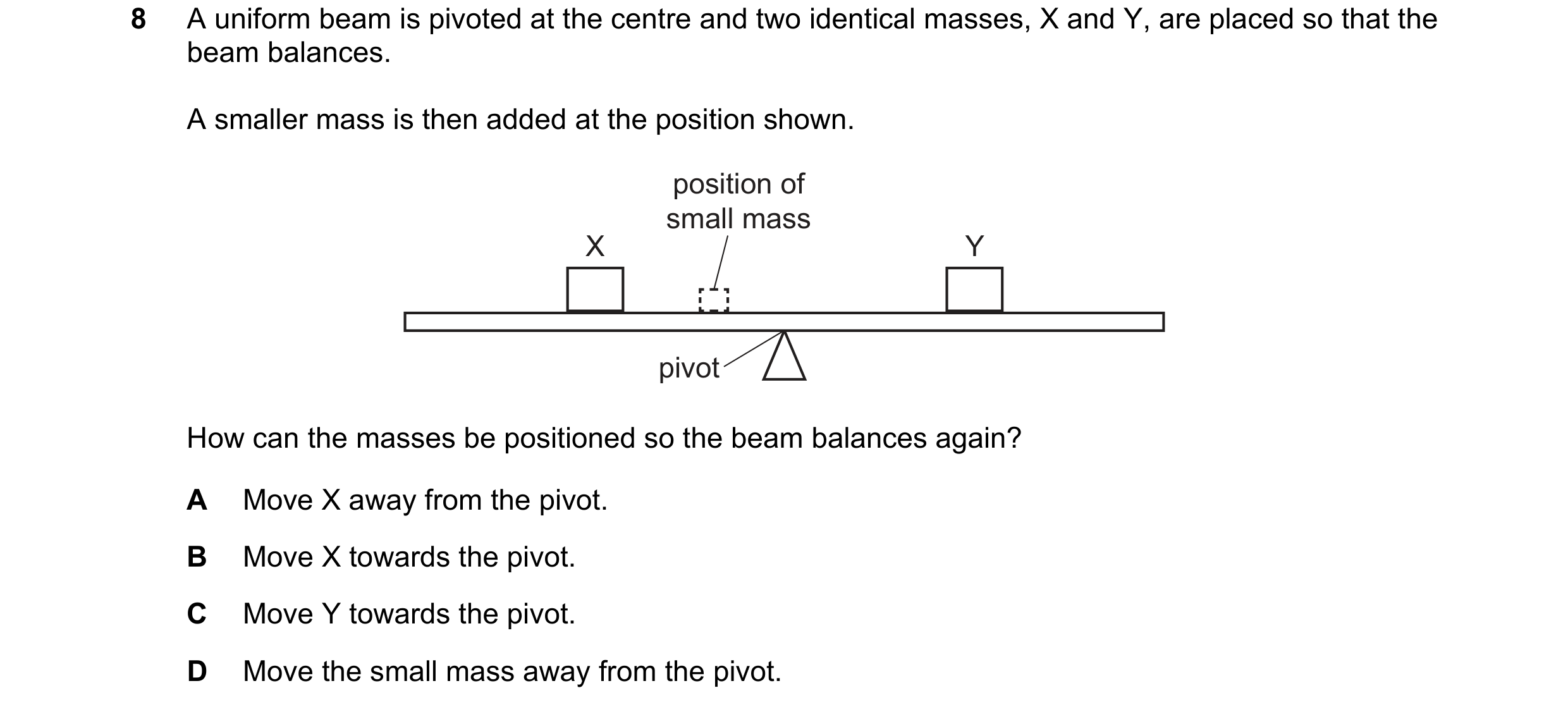

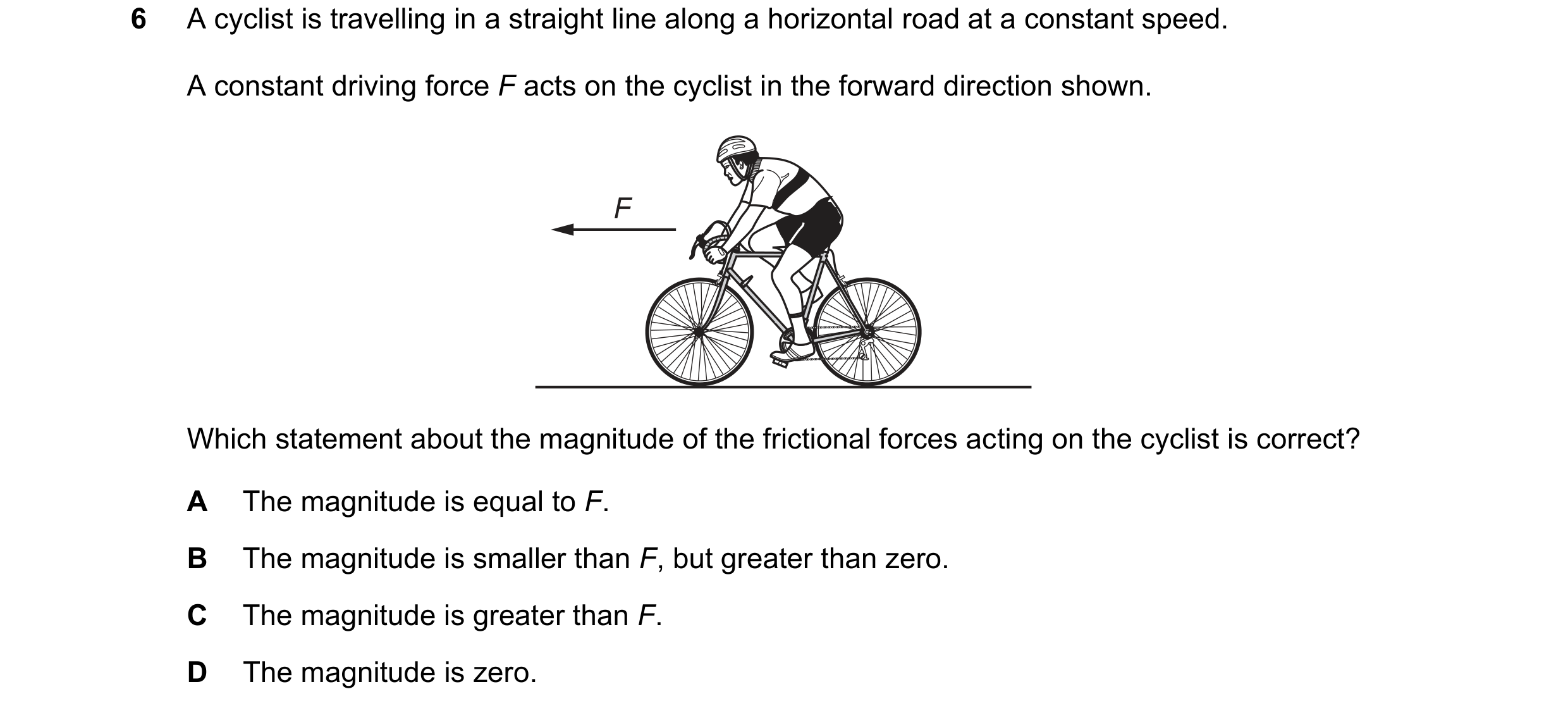 65 / 82
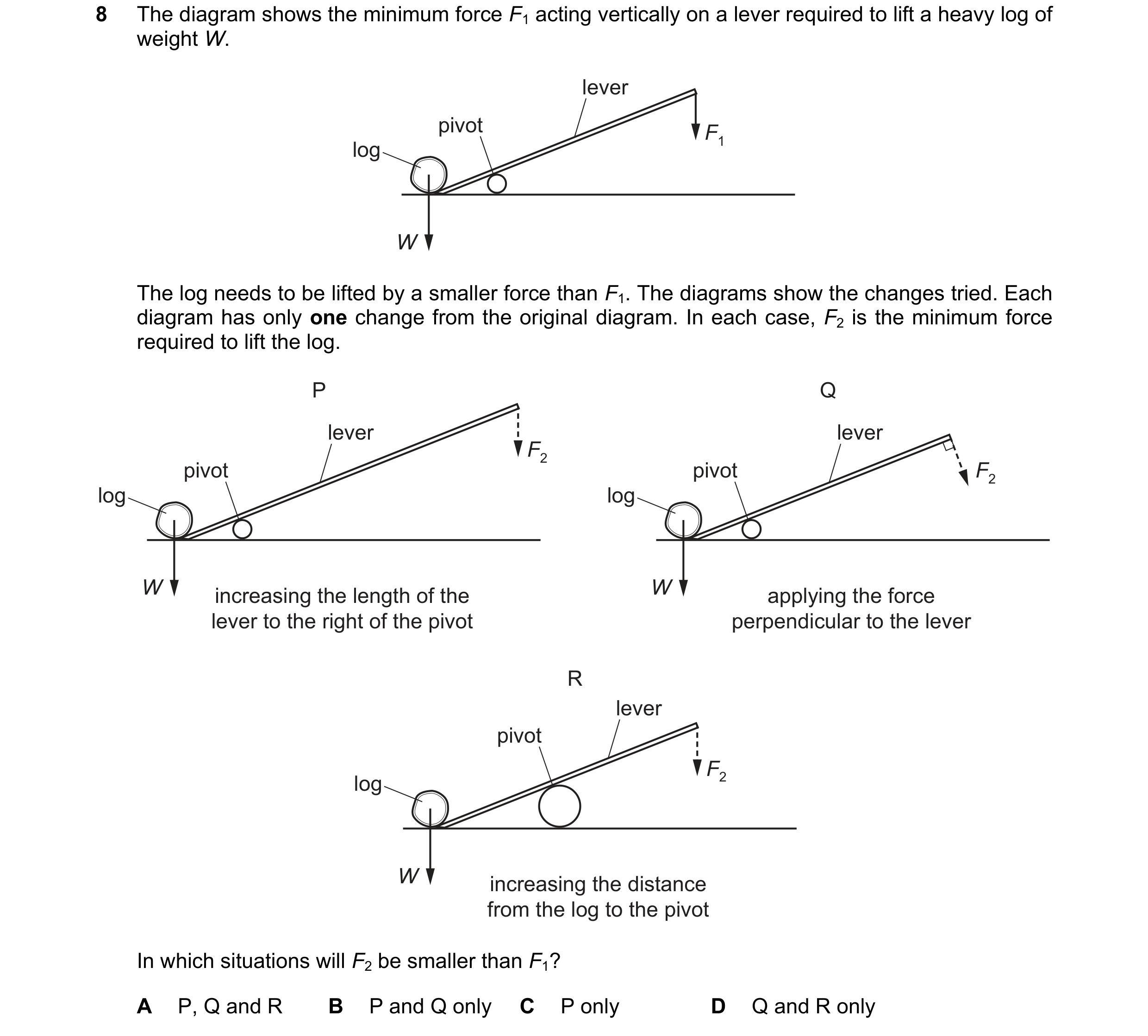 66 / 82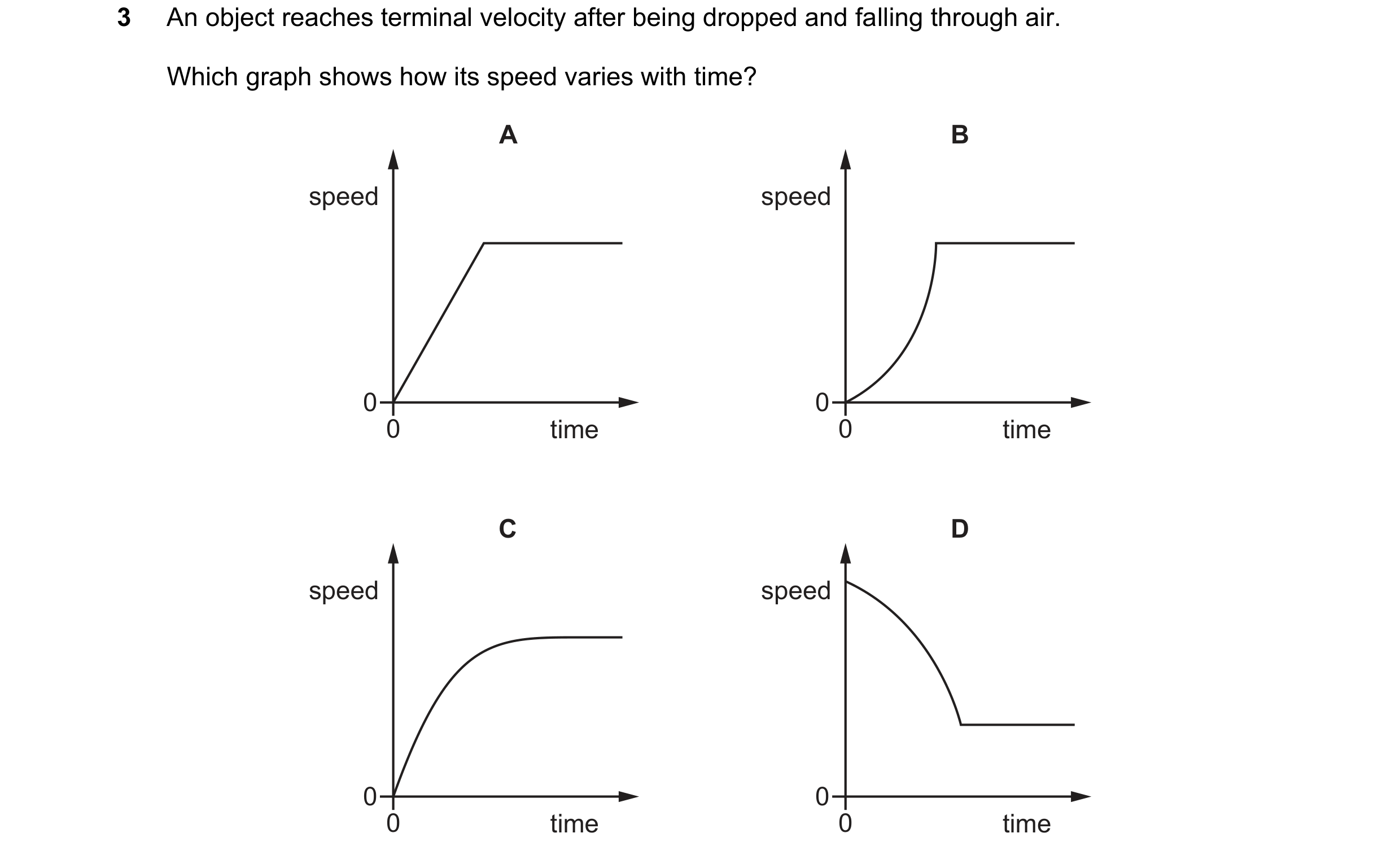

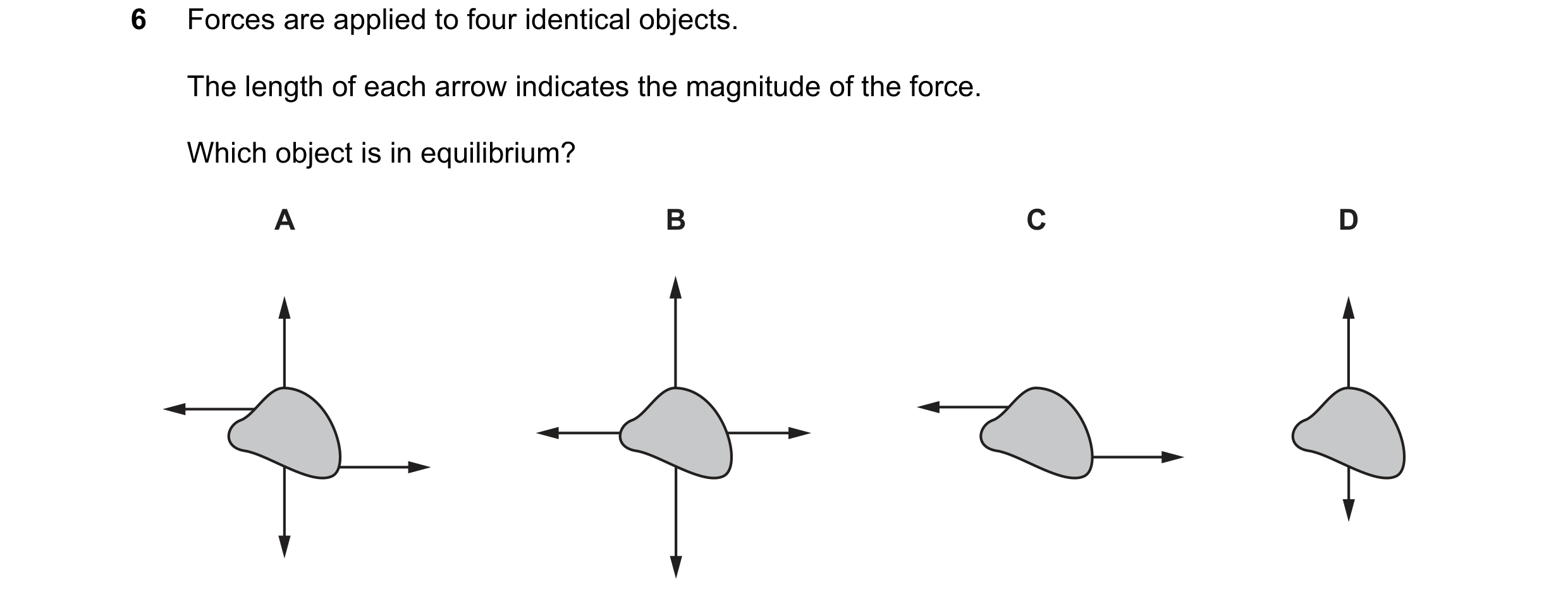 67 / 82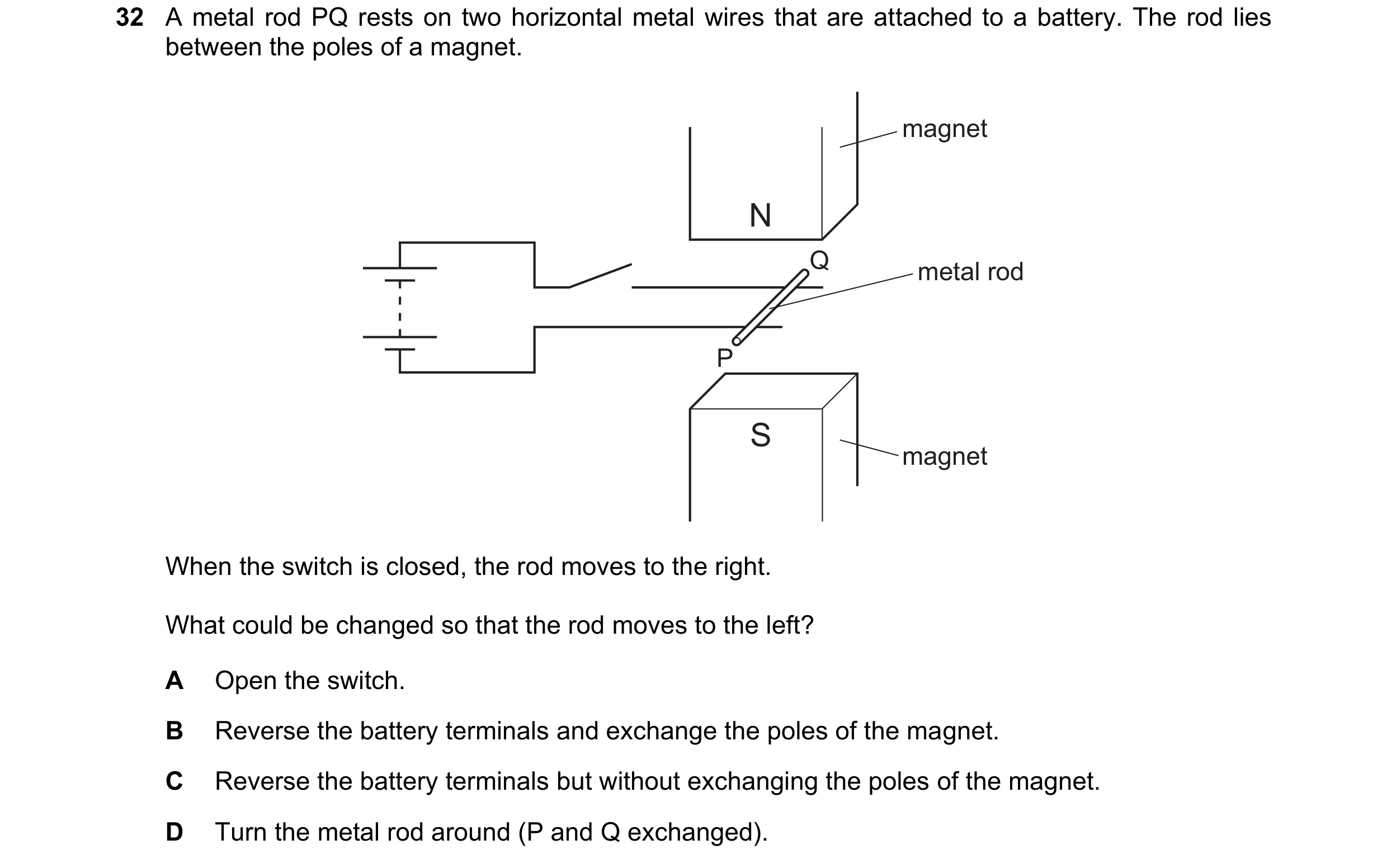
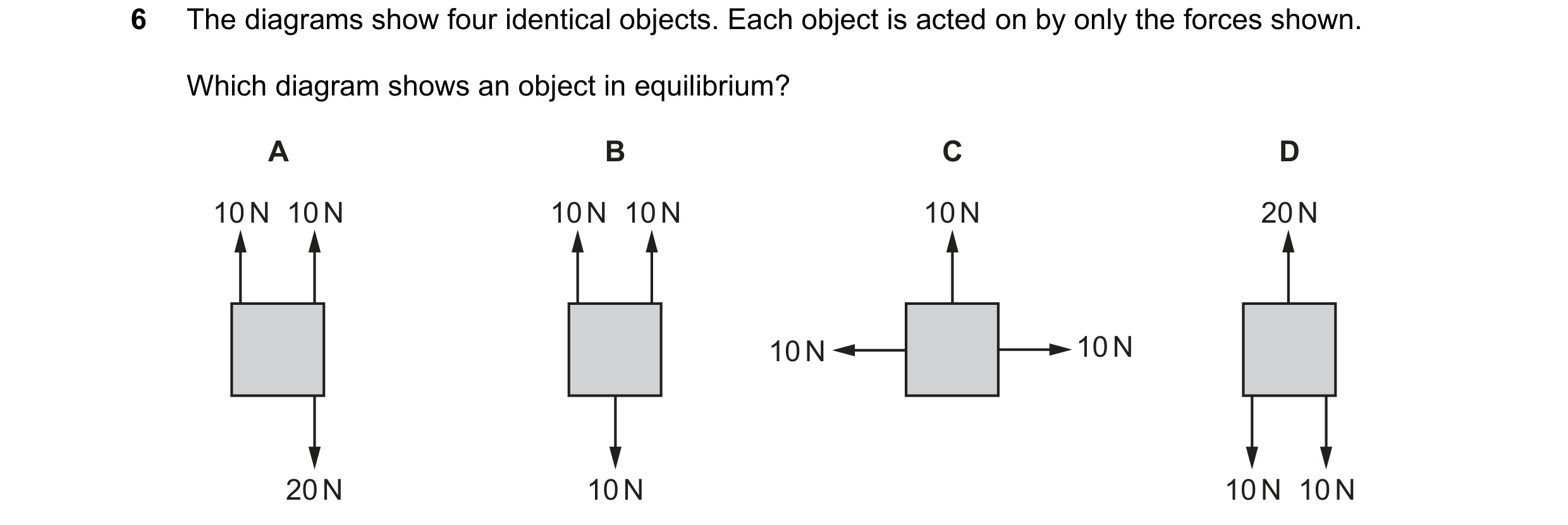 68 / 82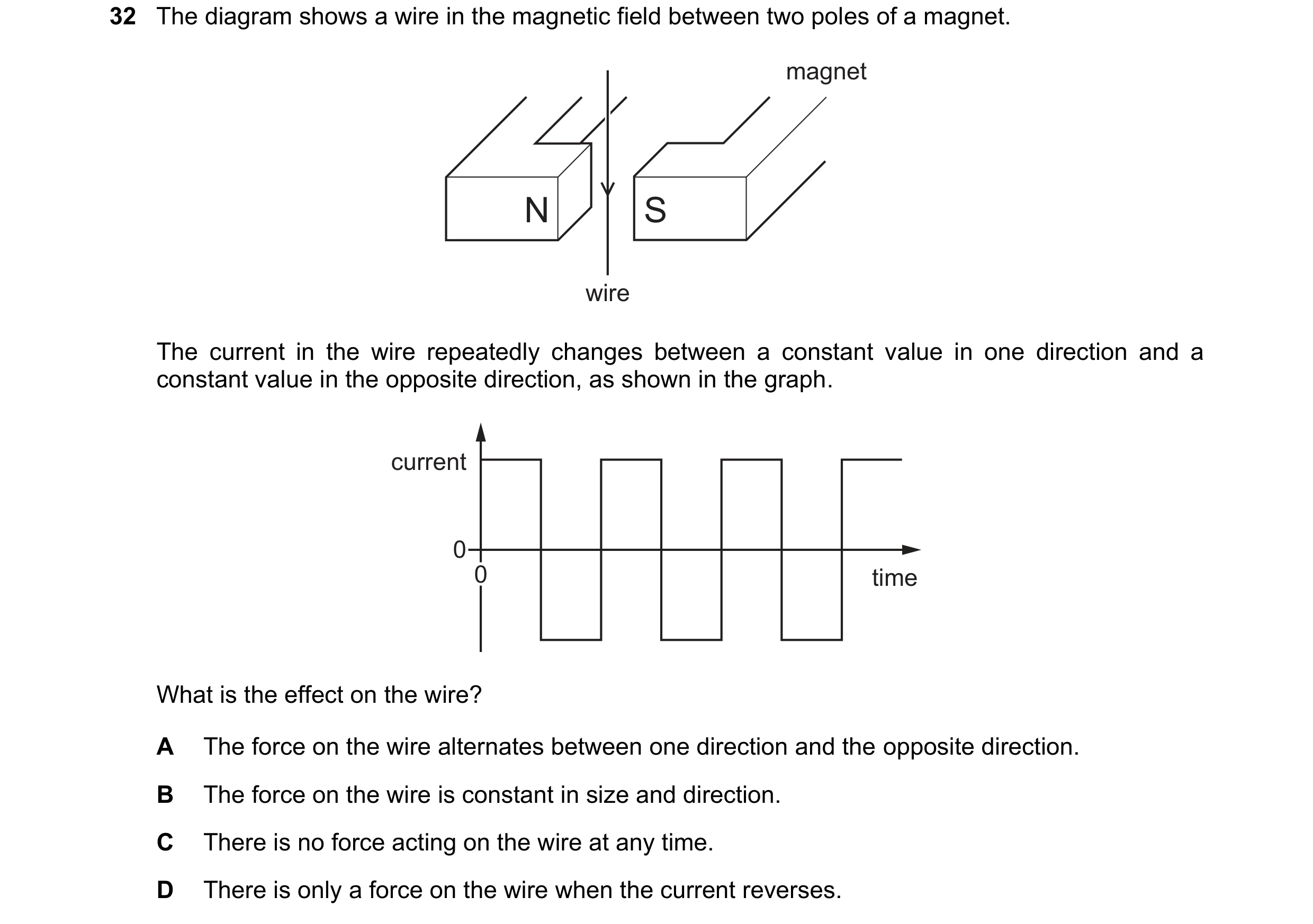
 69 / 82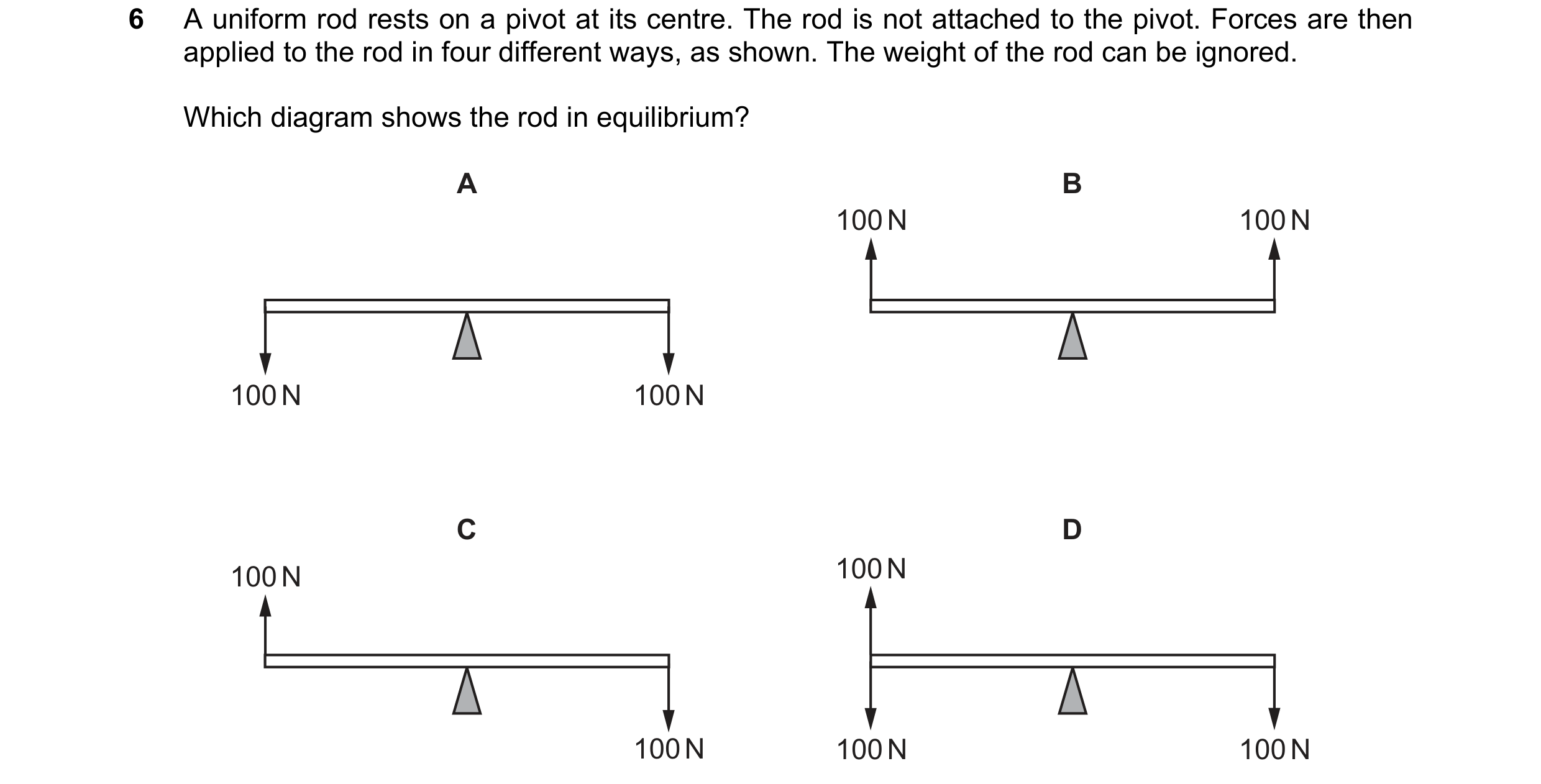

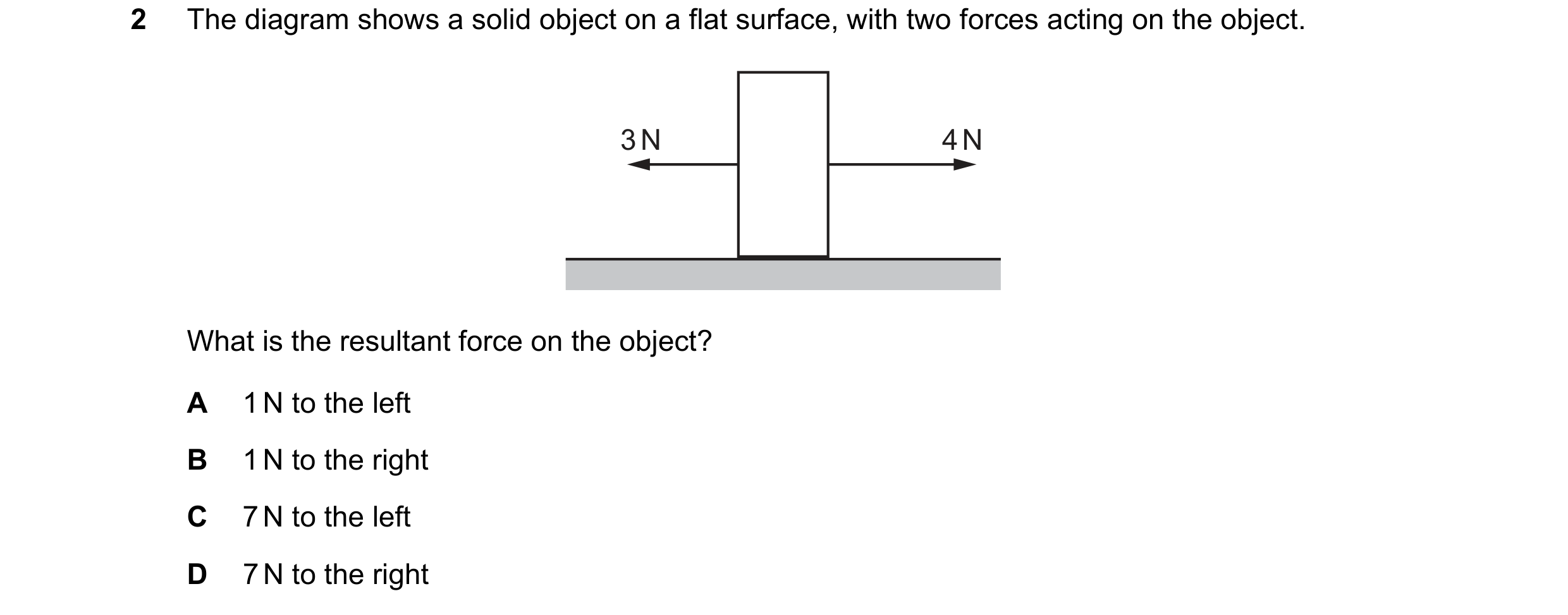 70 / 82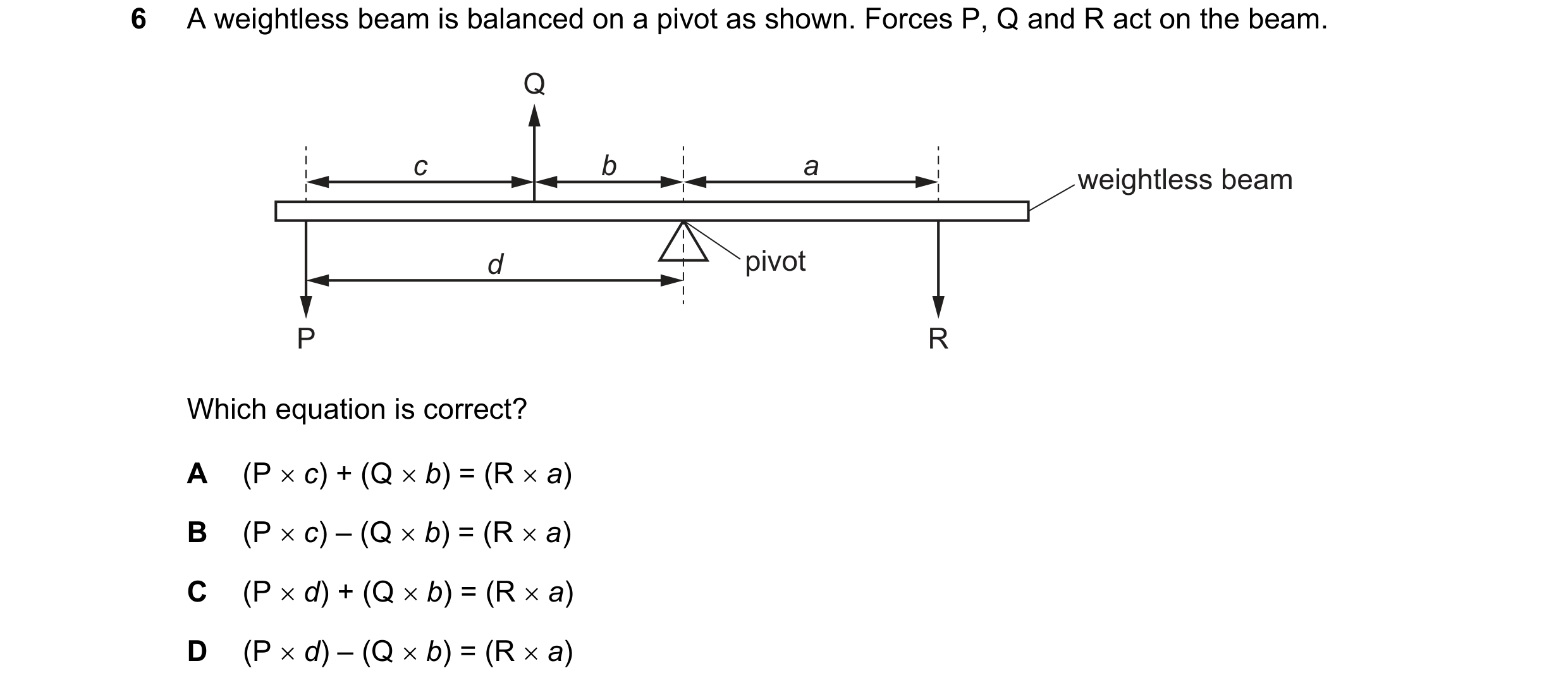
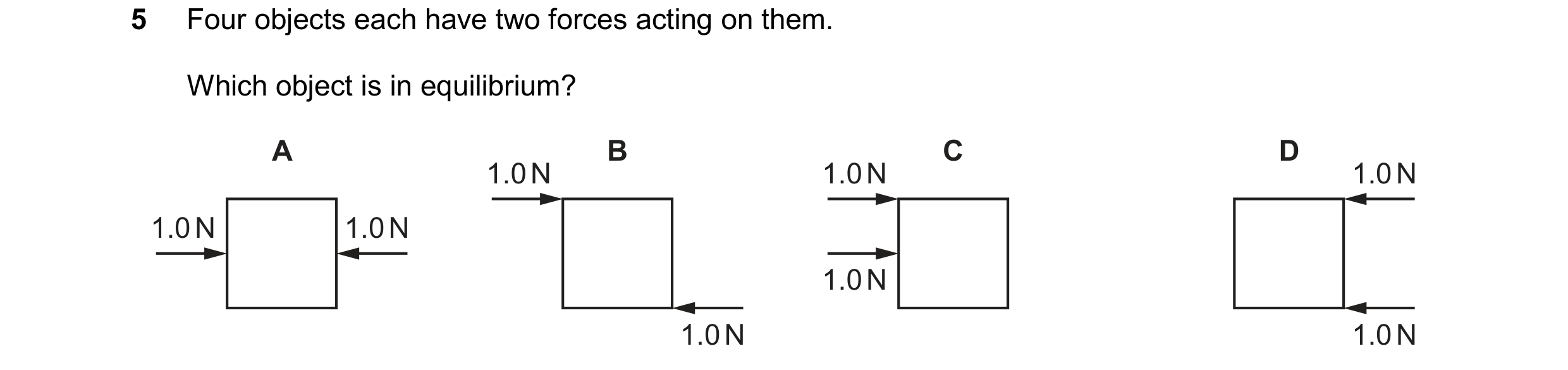
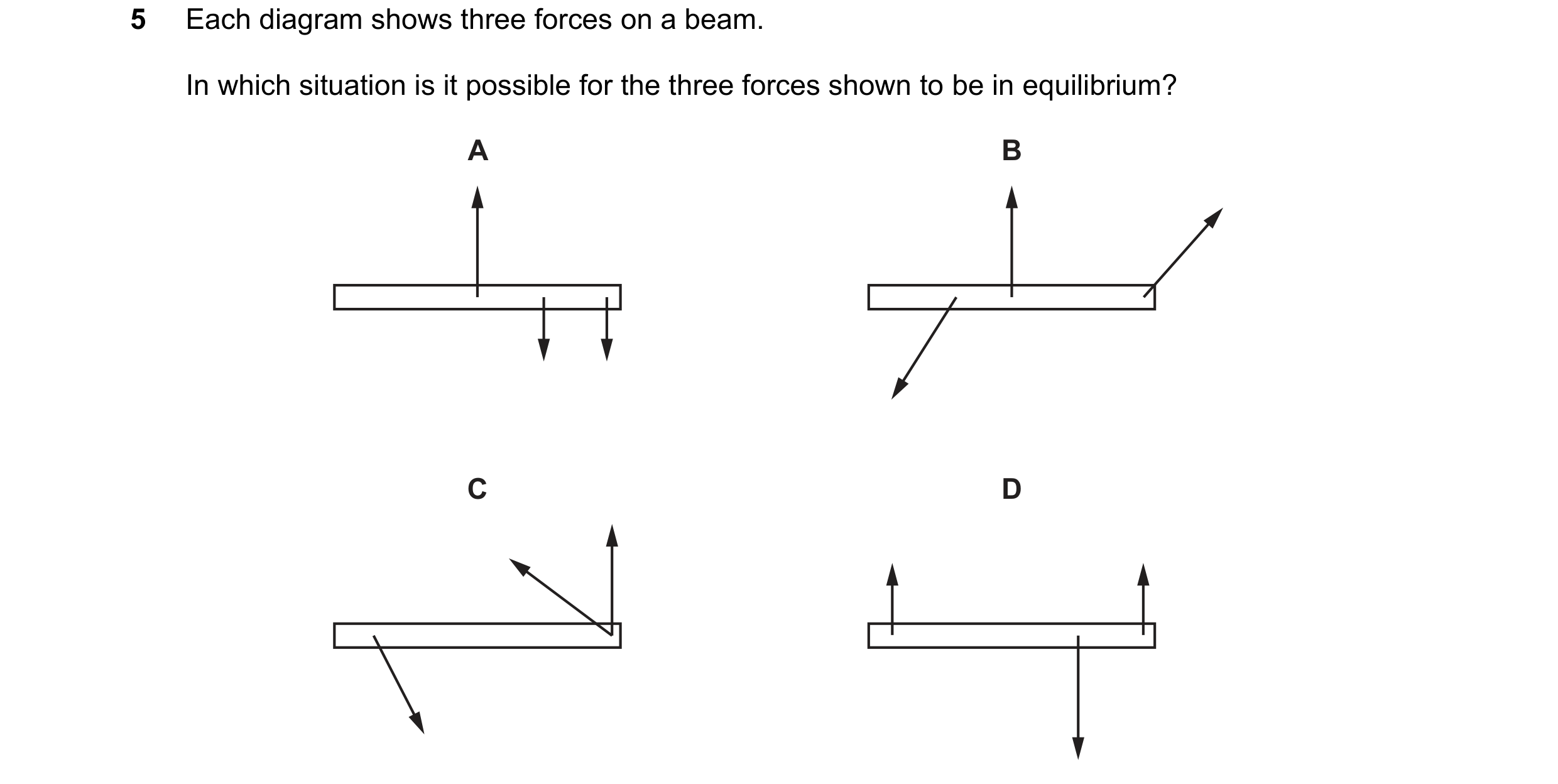 71 / 82


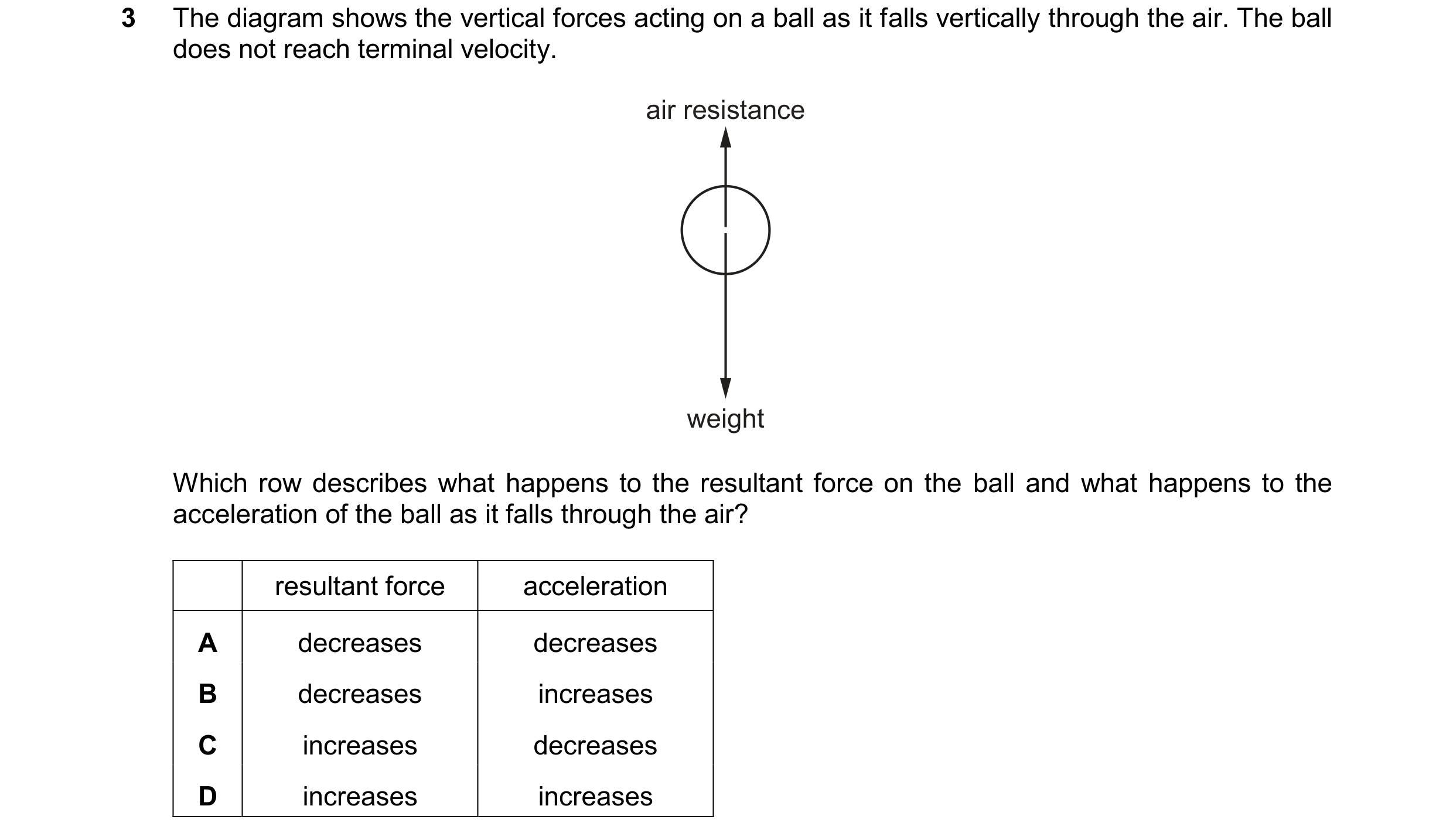 72 / 82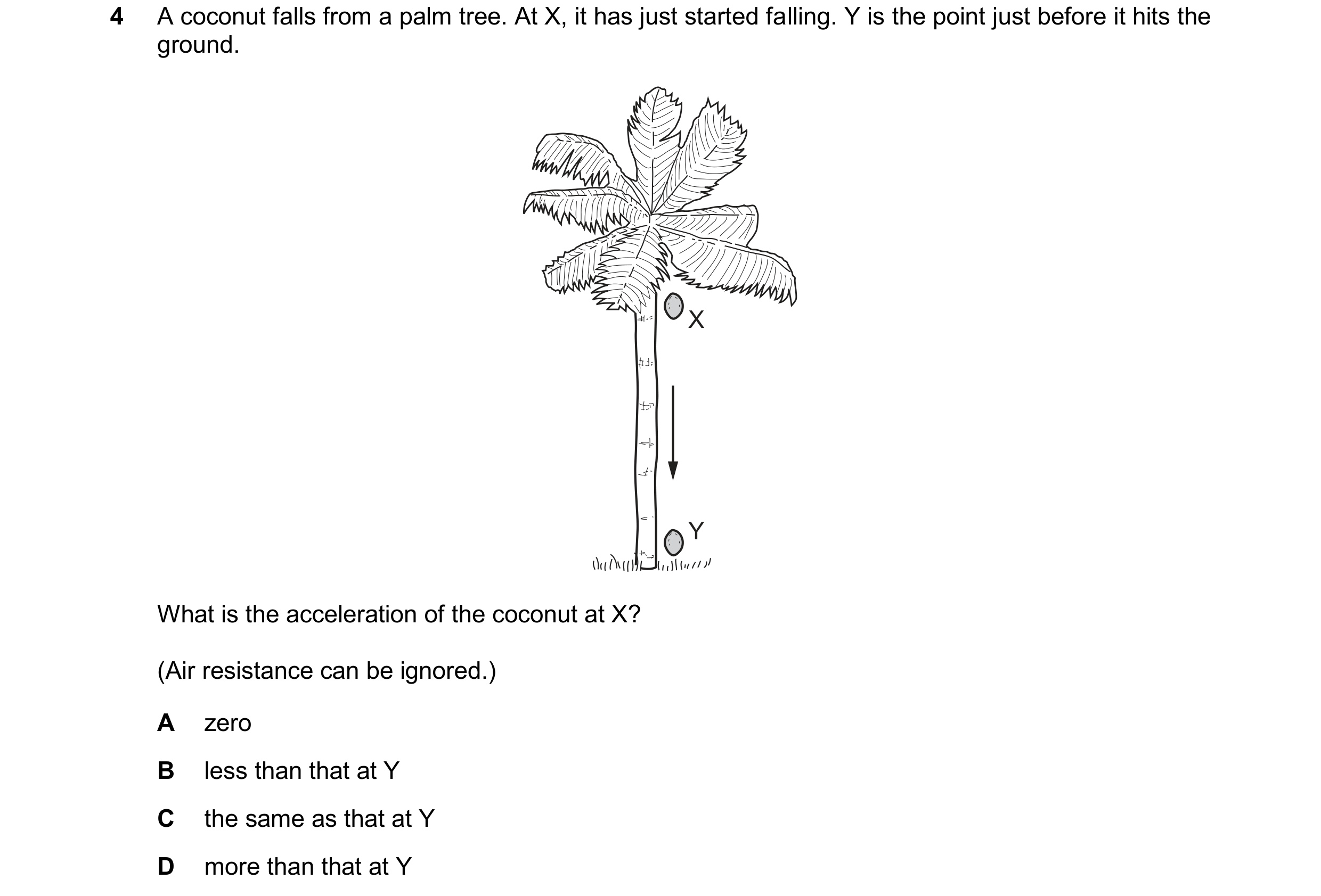
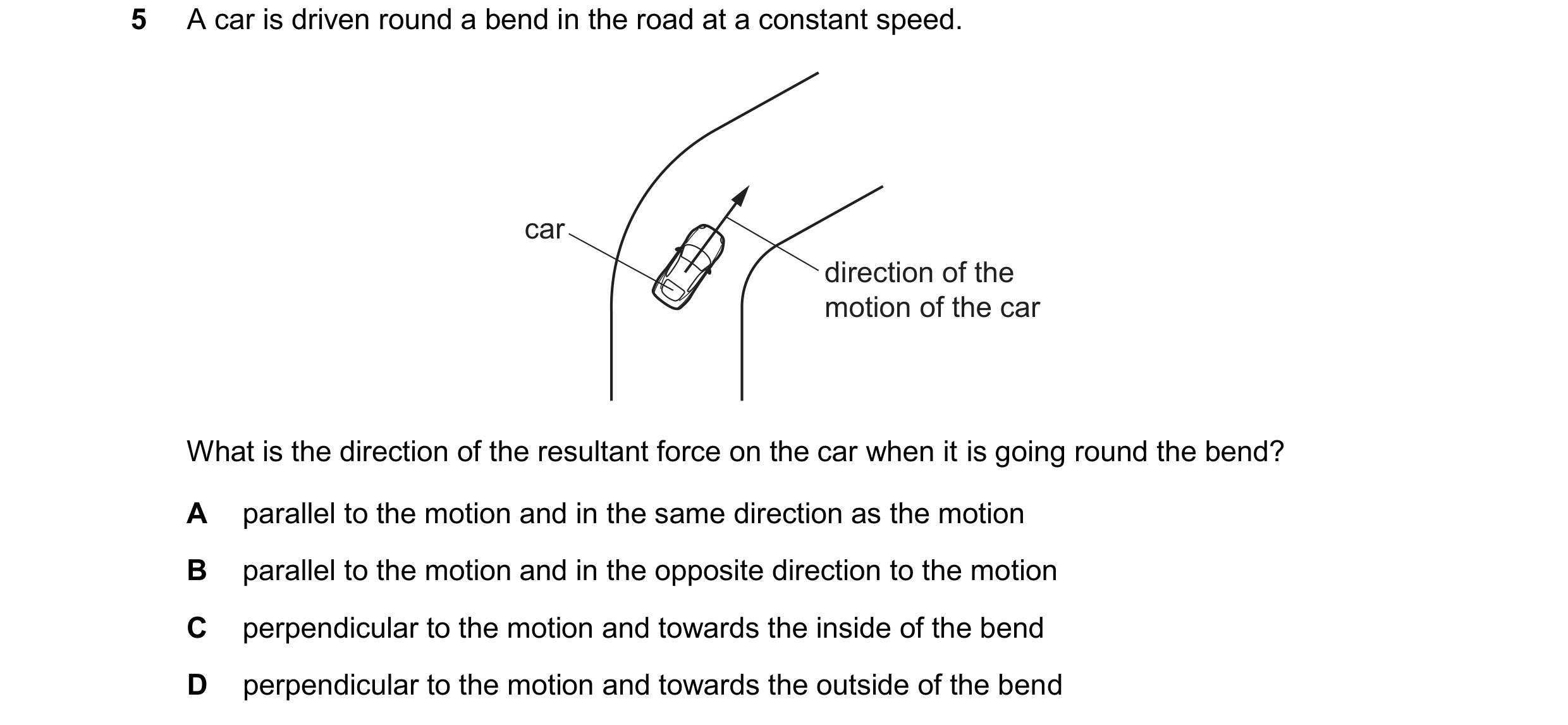 73 / 82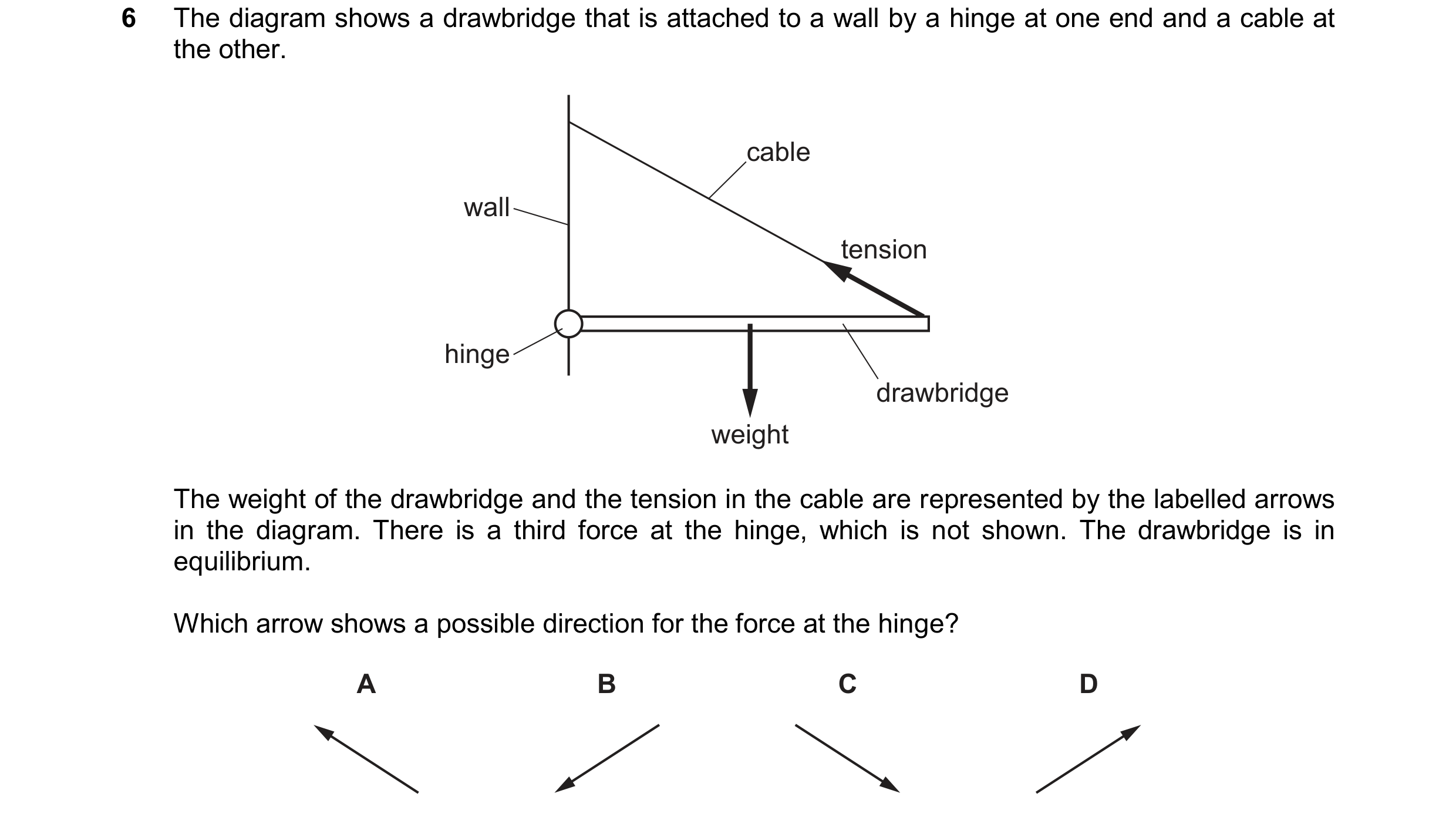

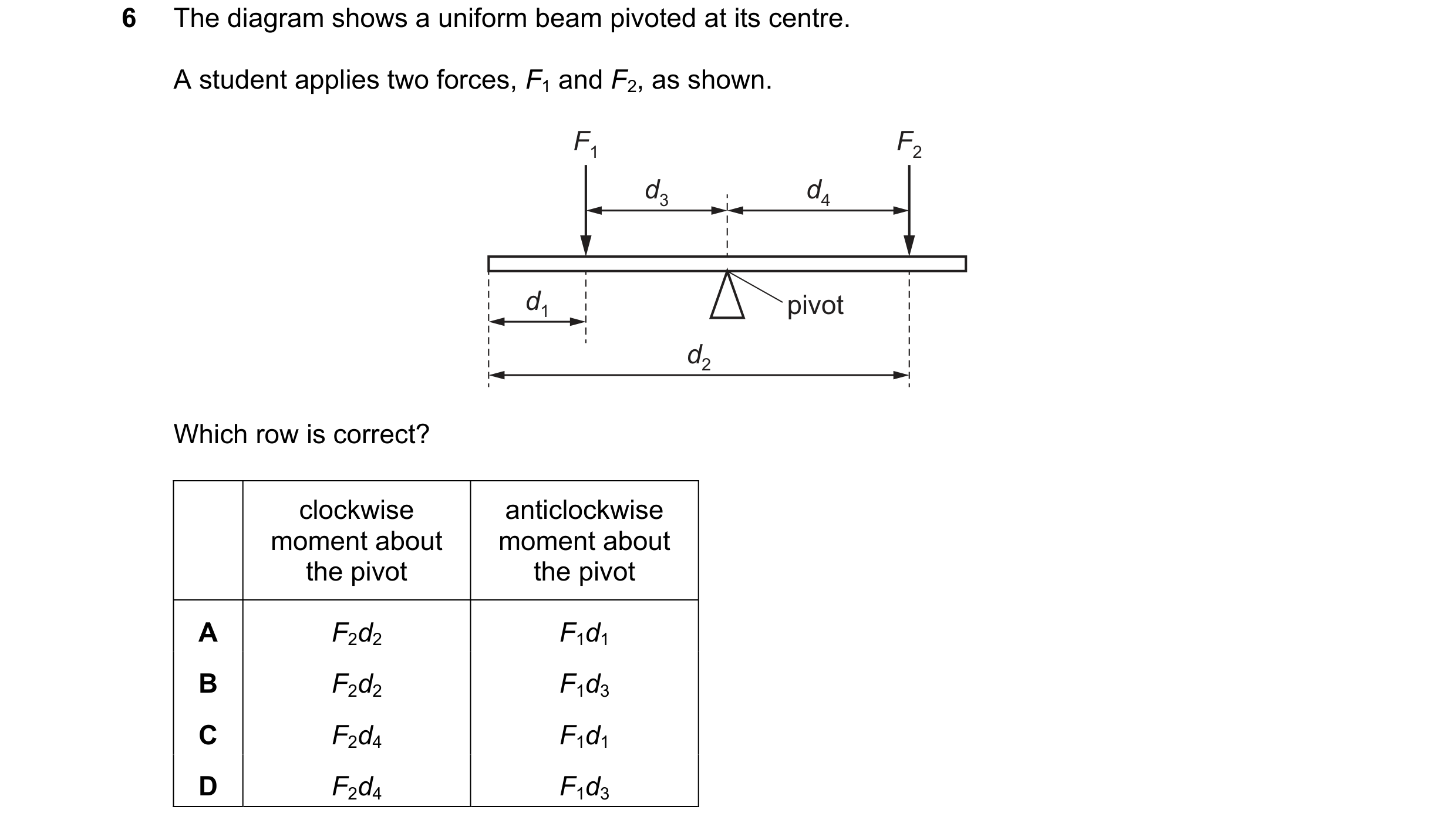 74 / 82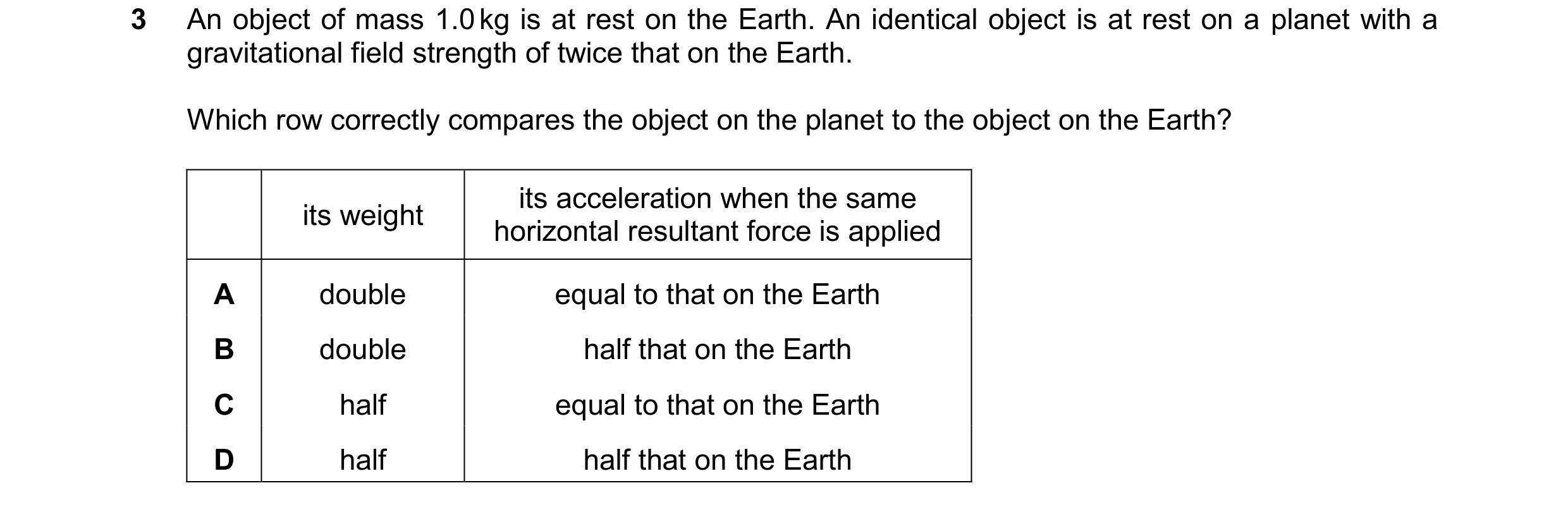
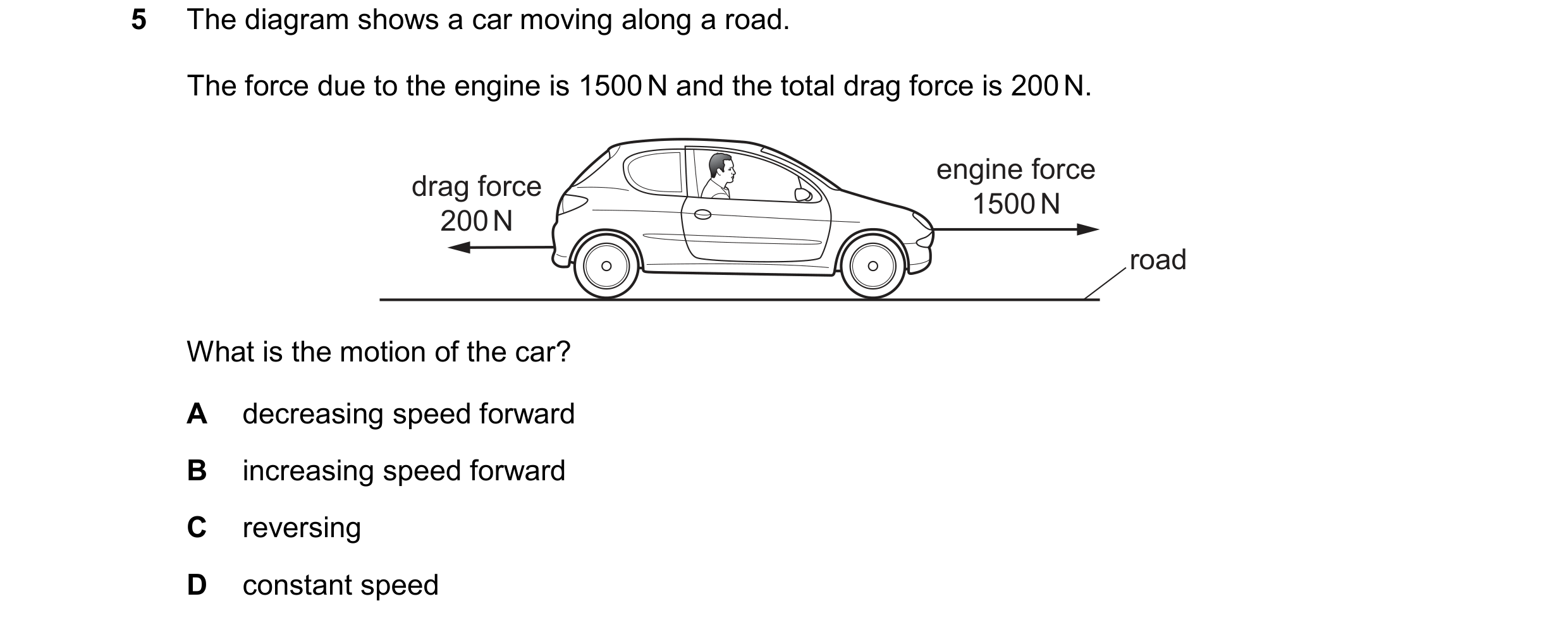
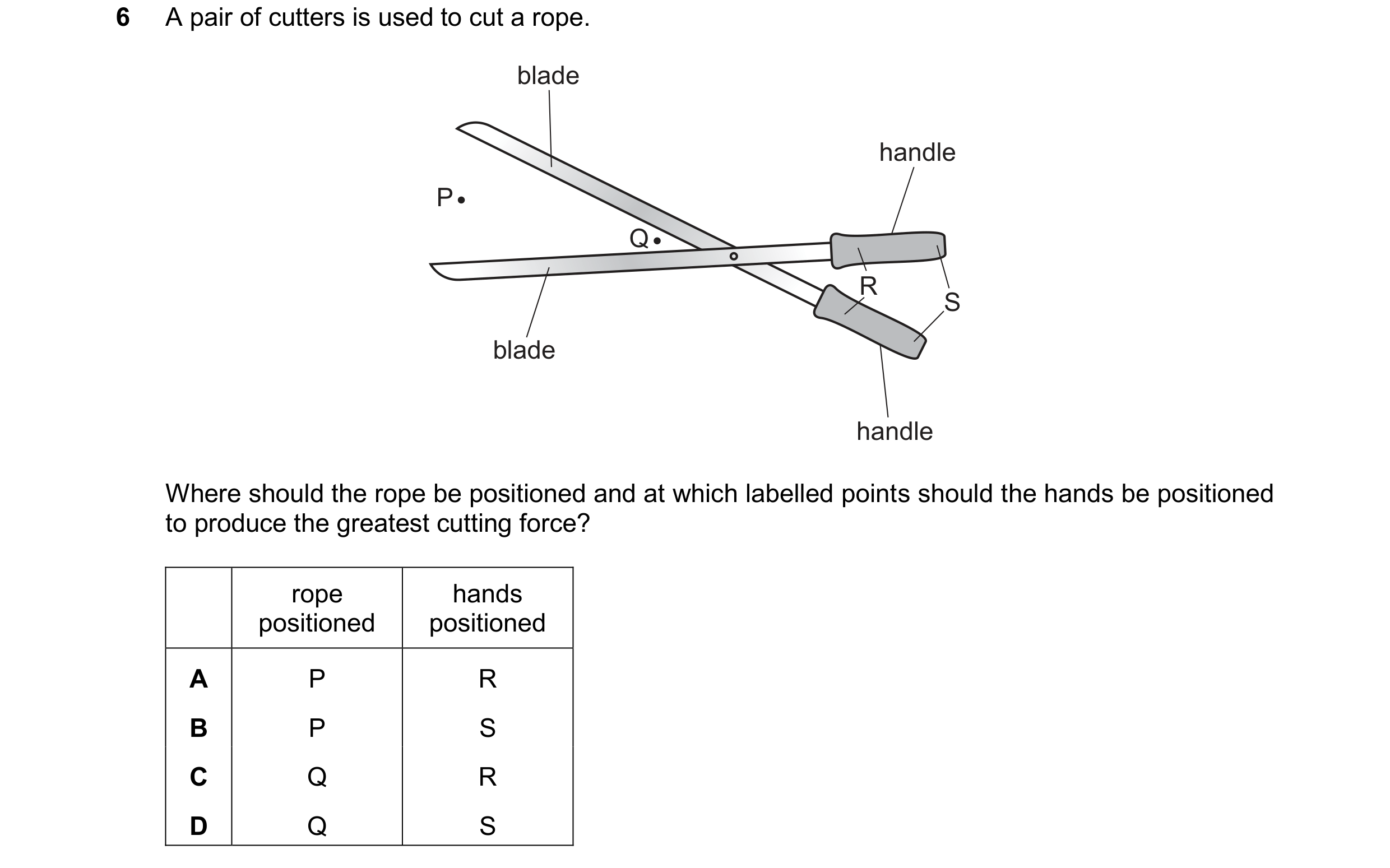 75 / 82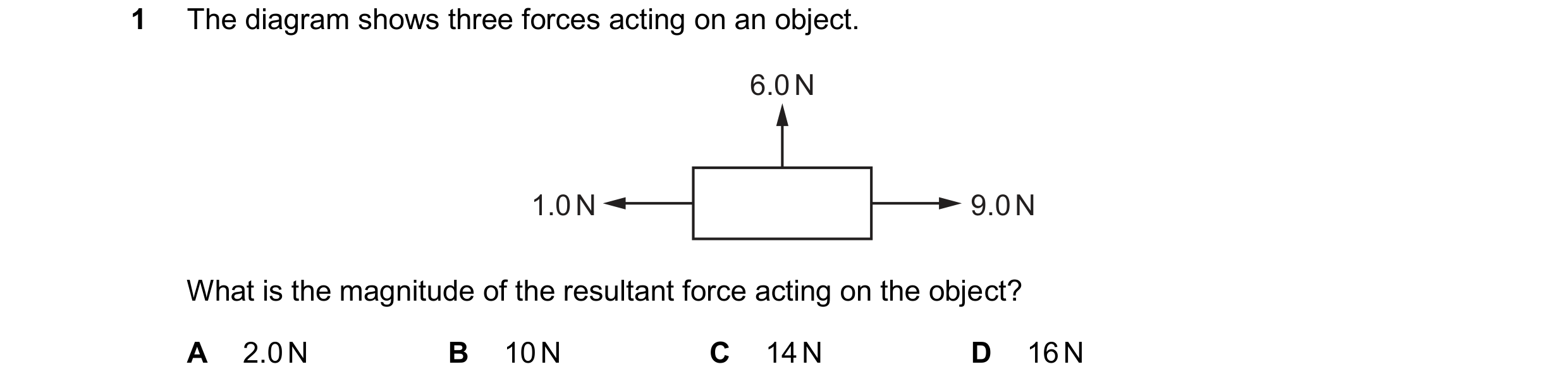
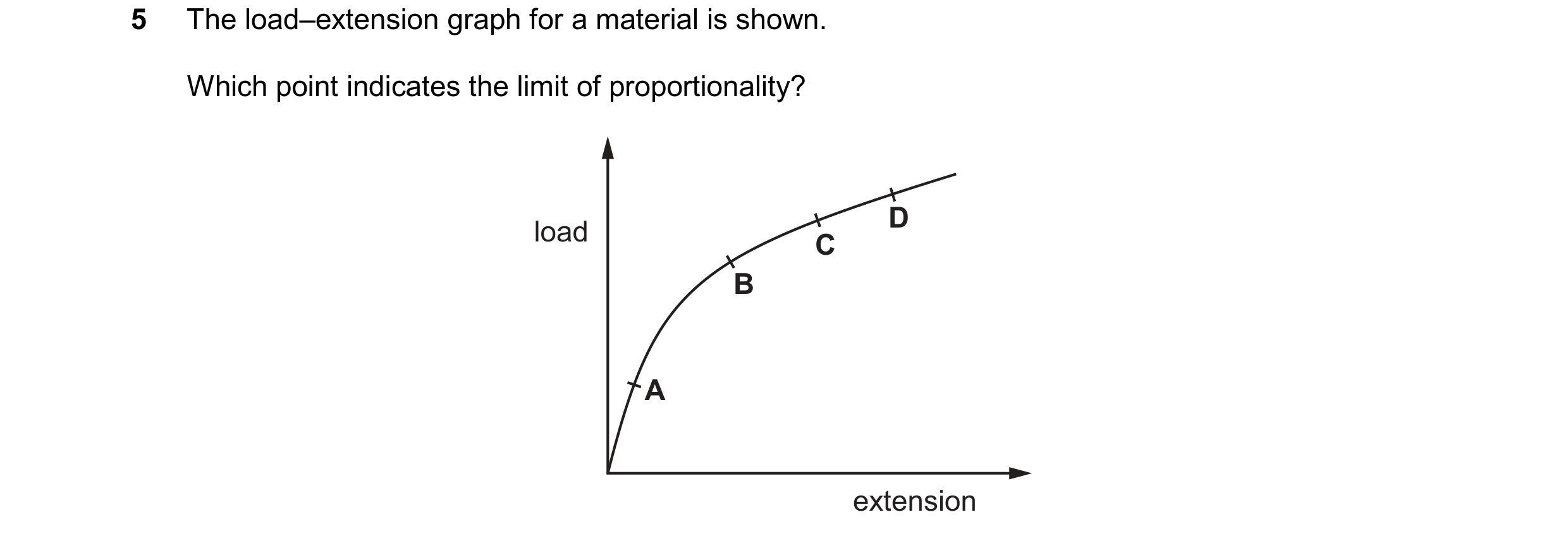
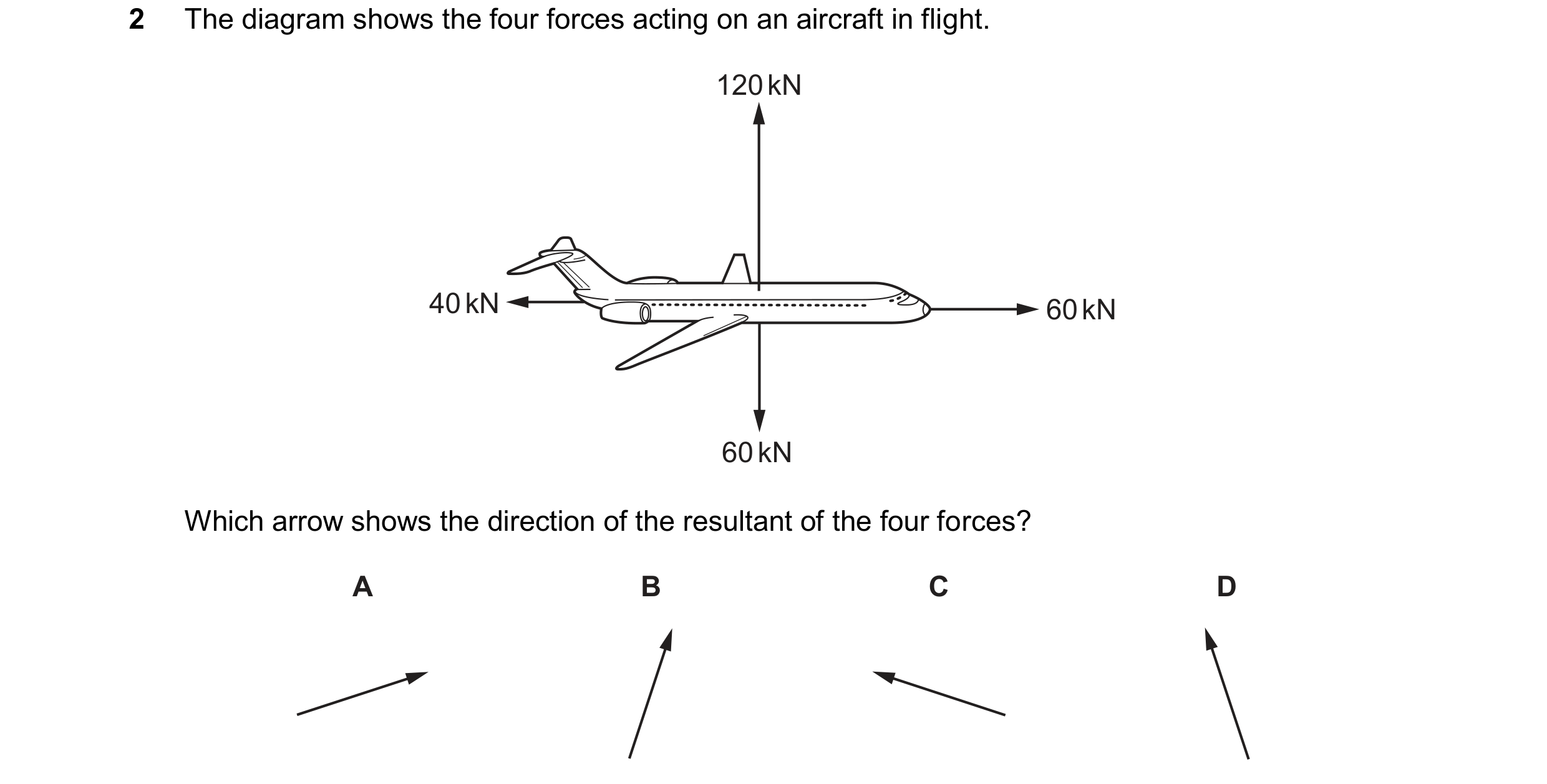 76 / 82
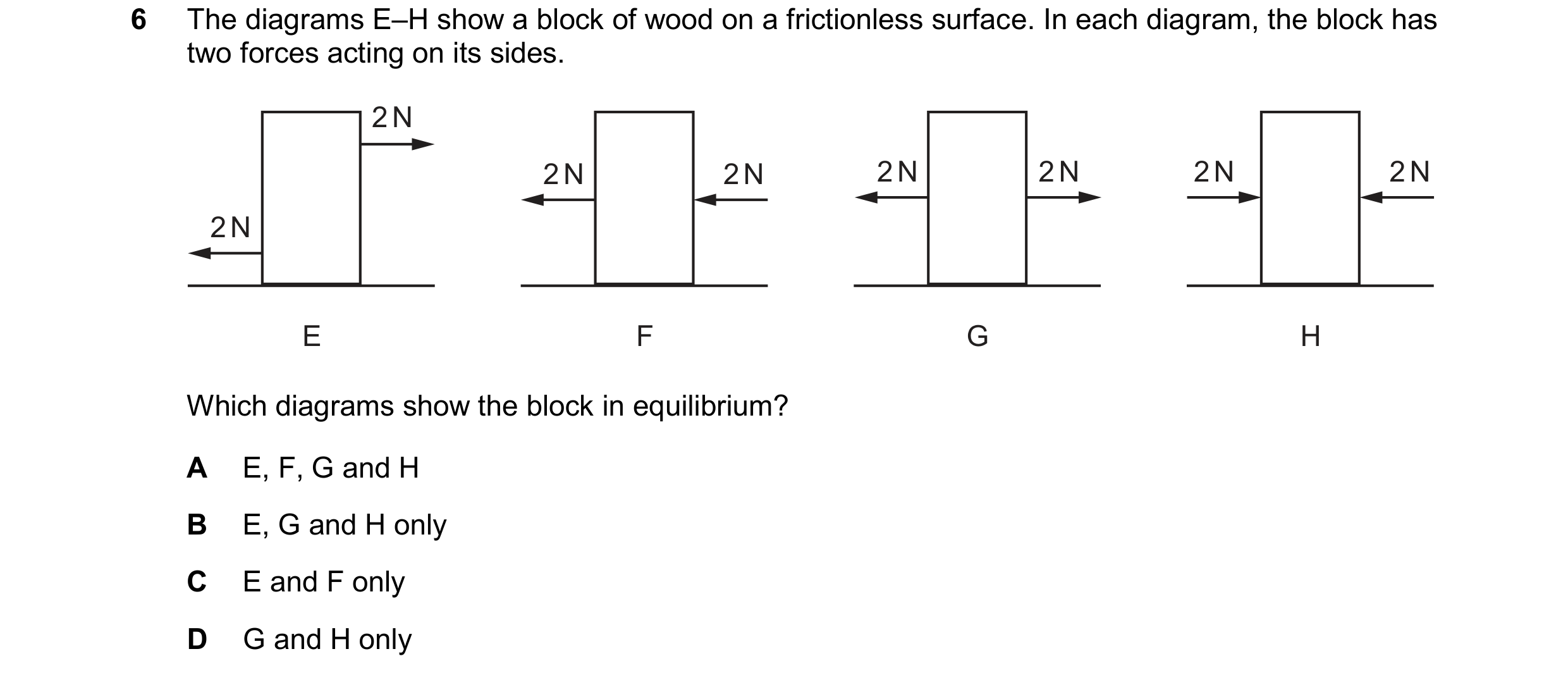
 77 / 82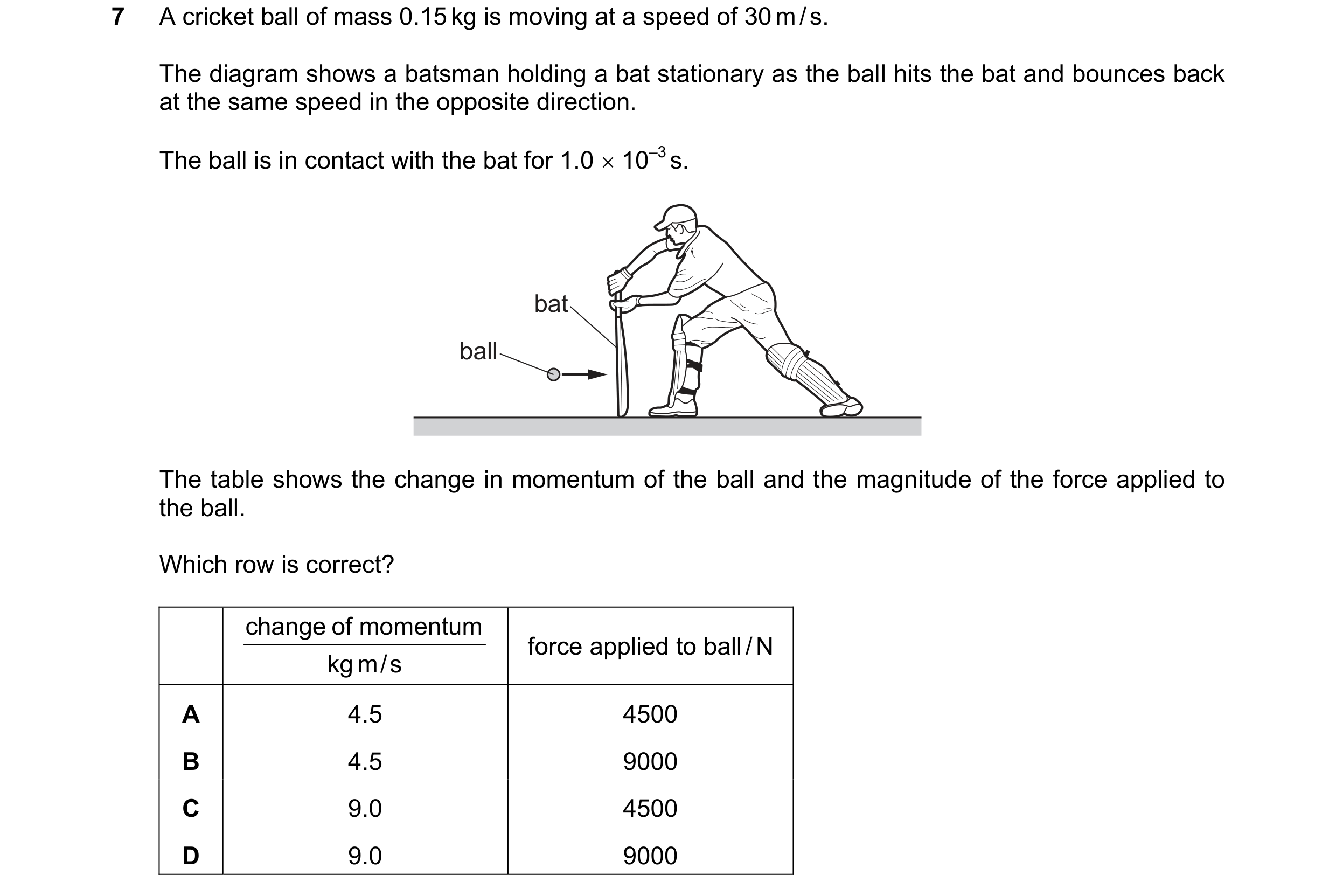
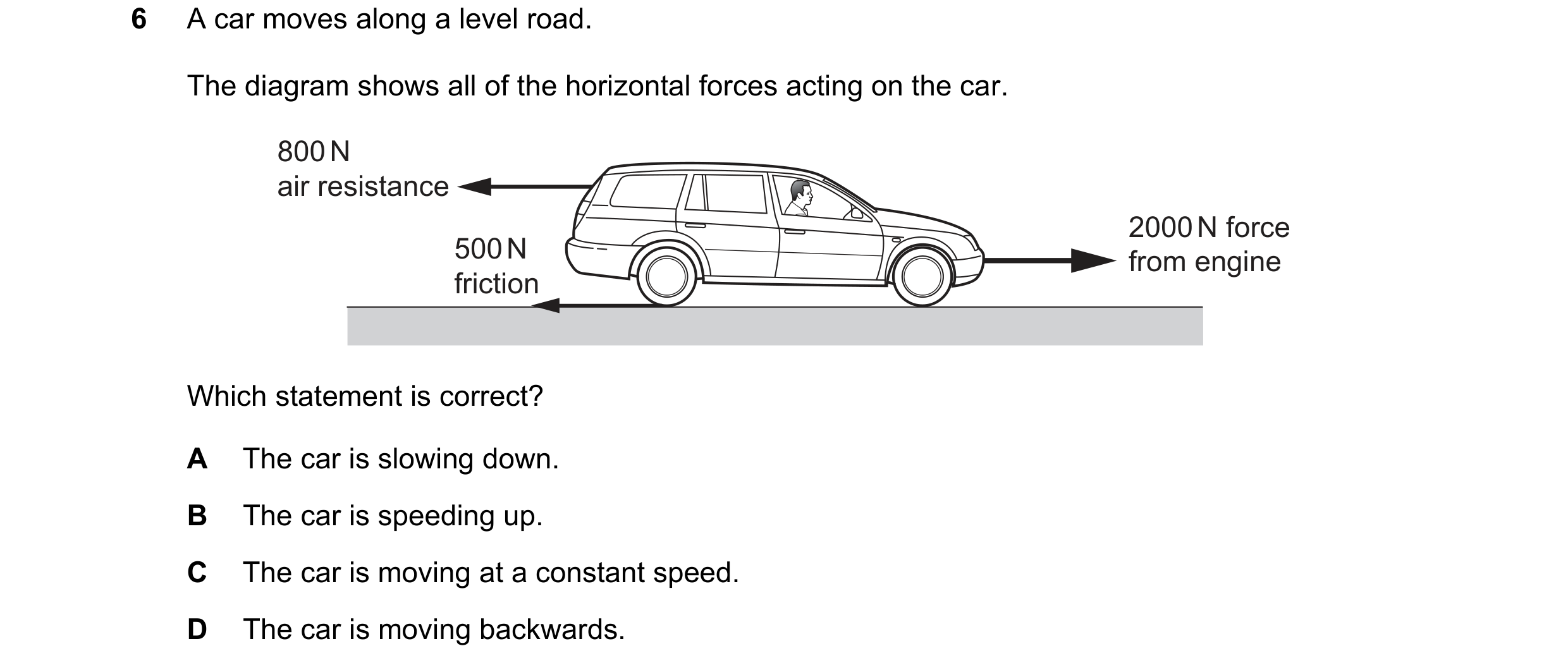 78 / 82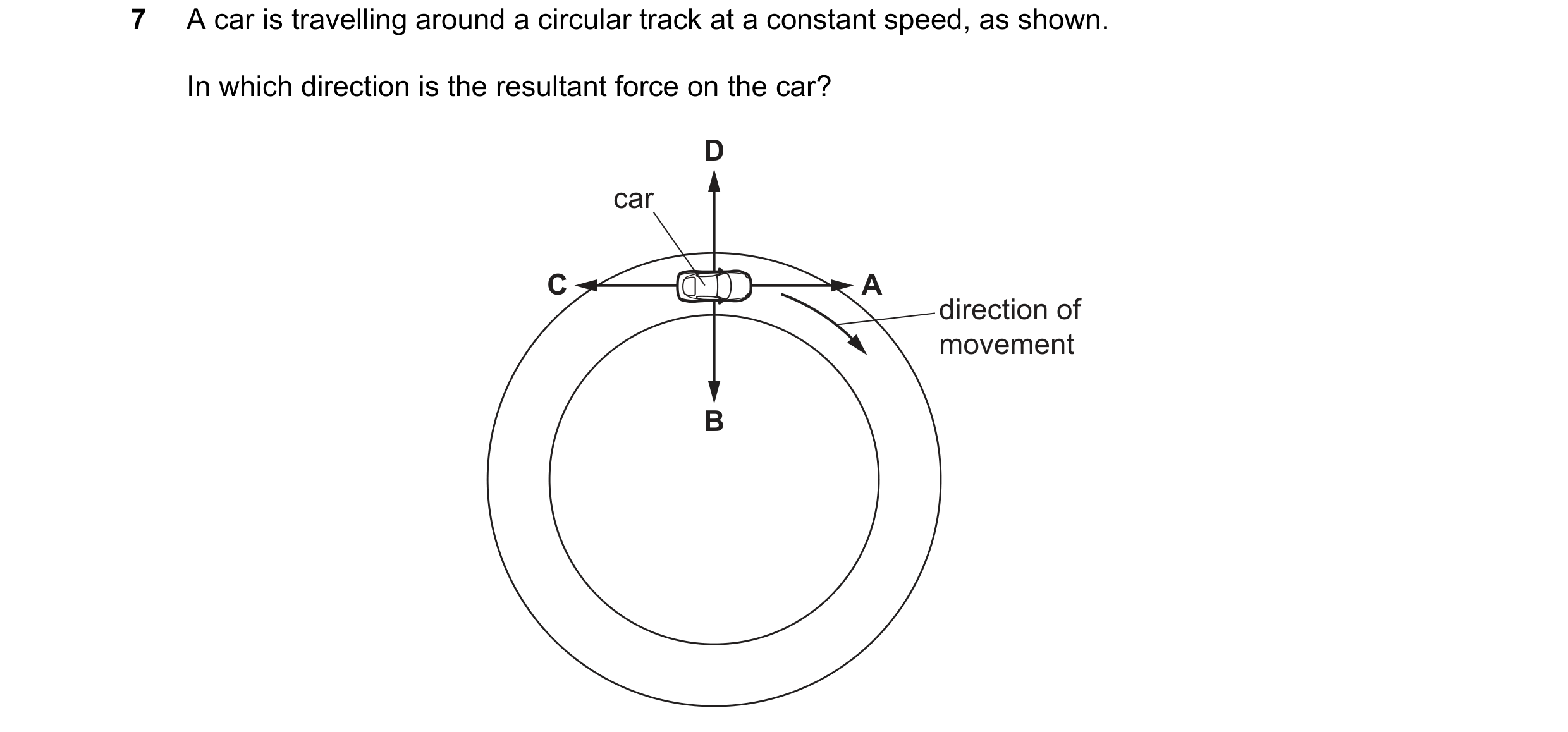
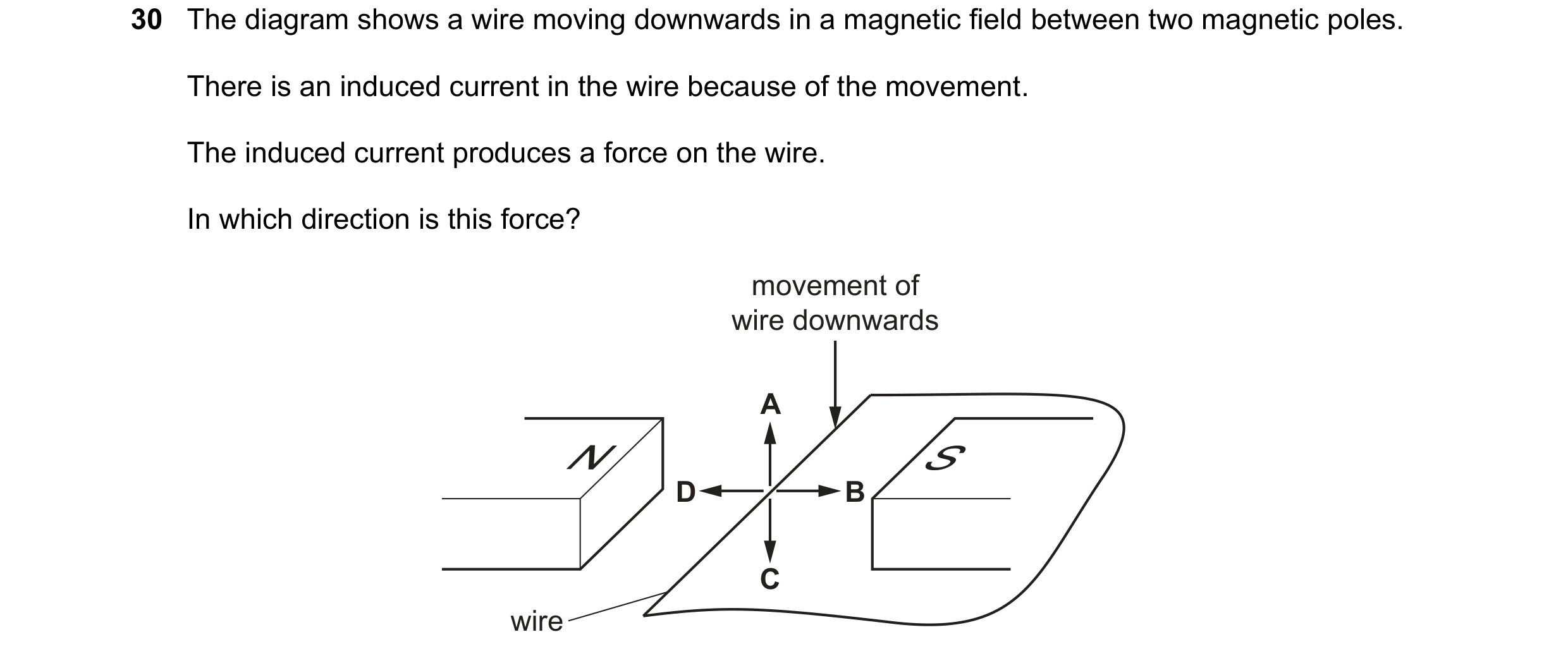
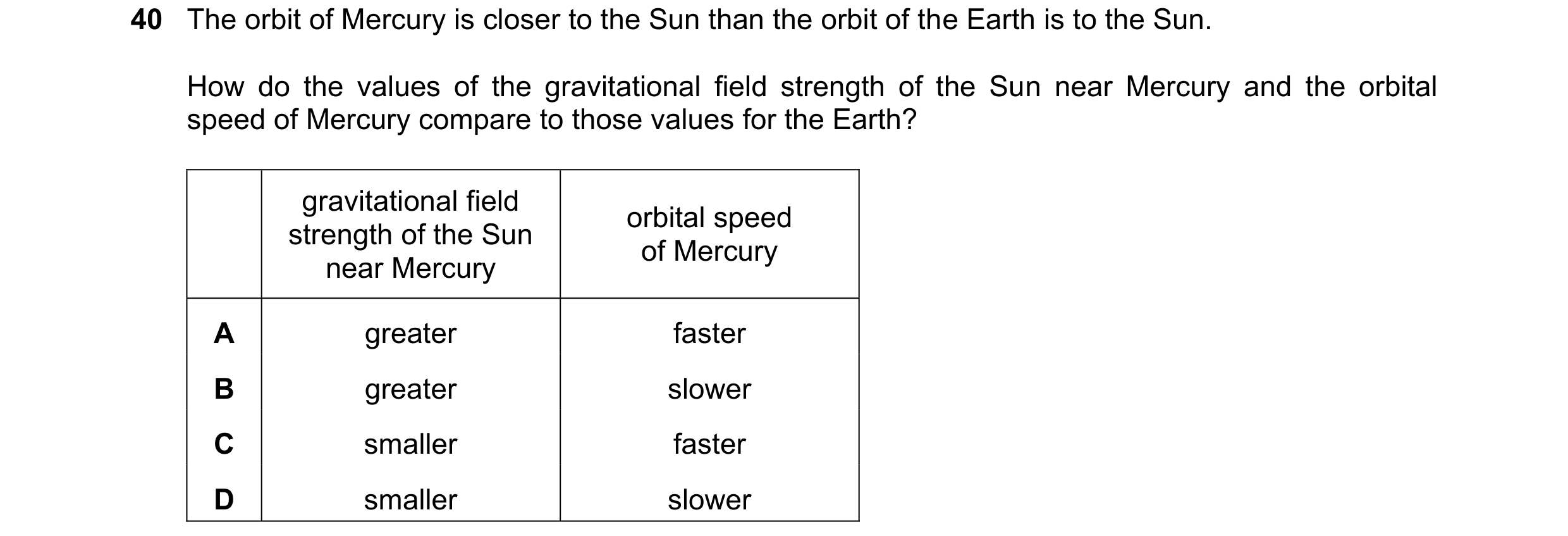 79 / 82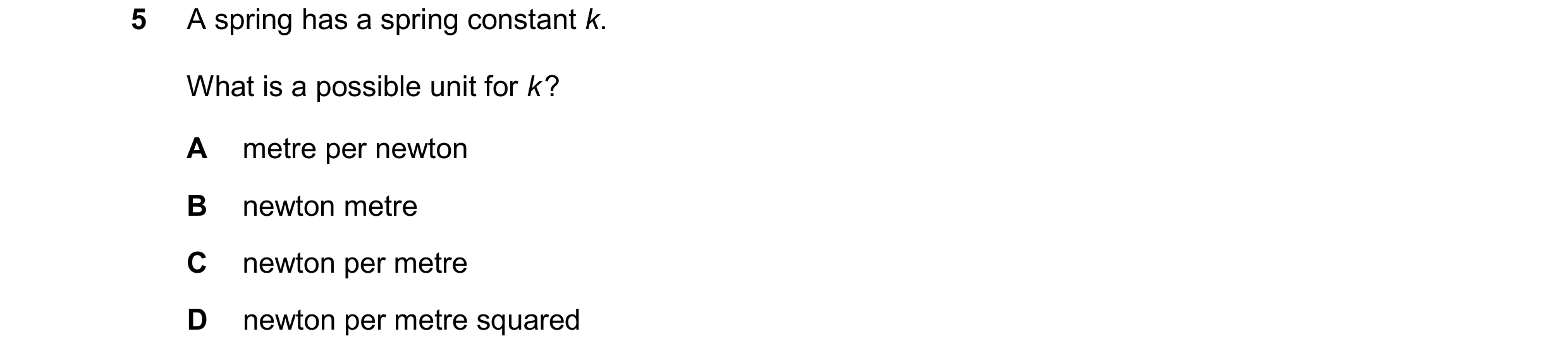

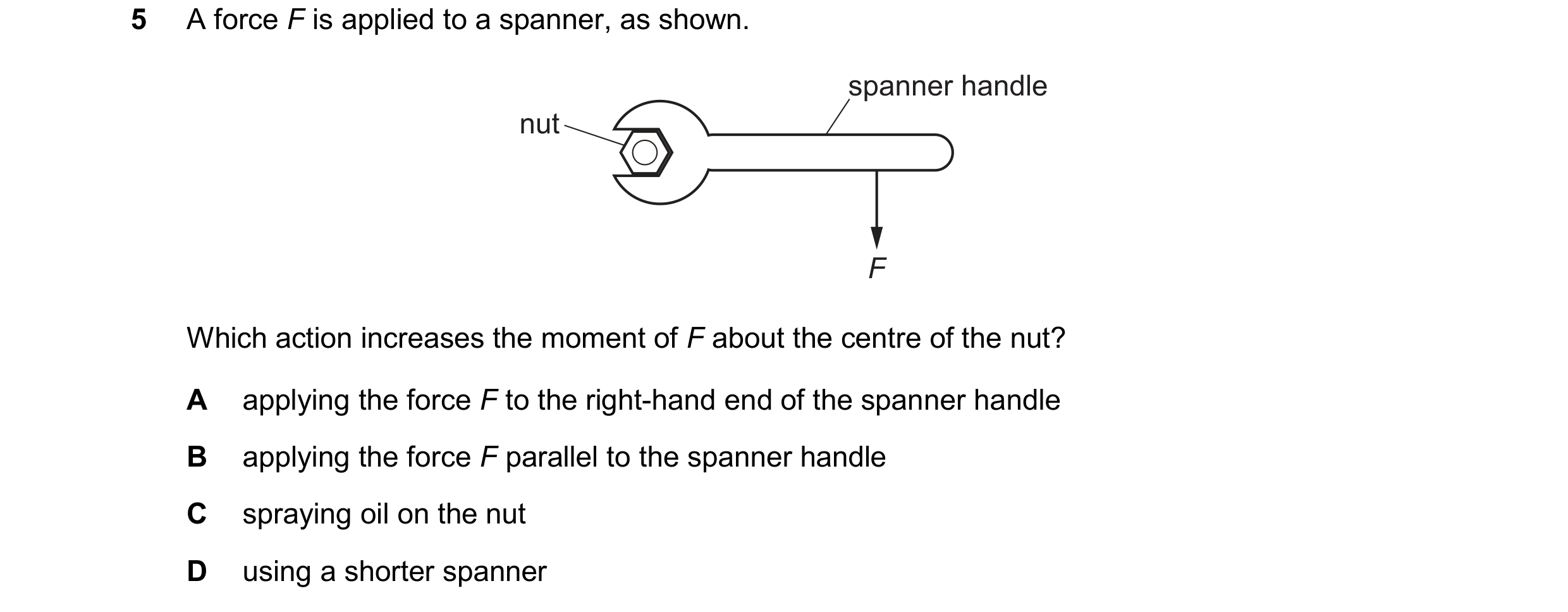
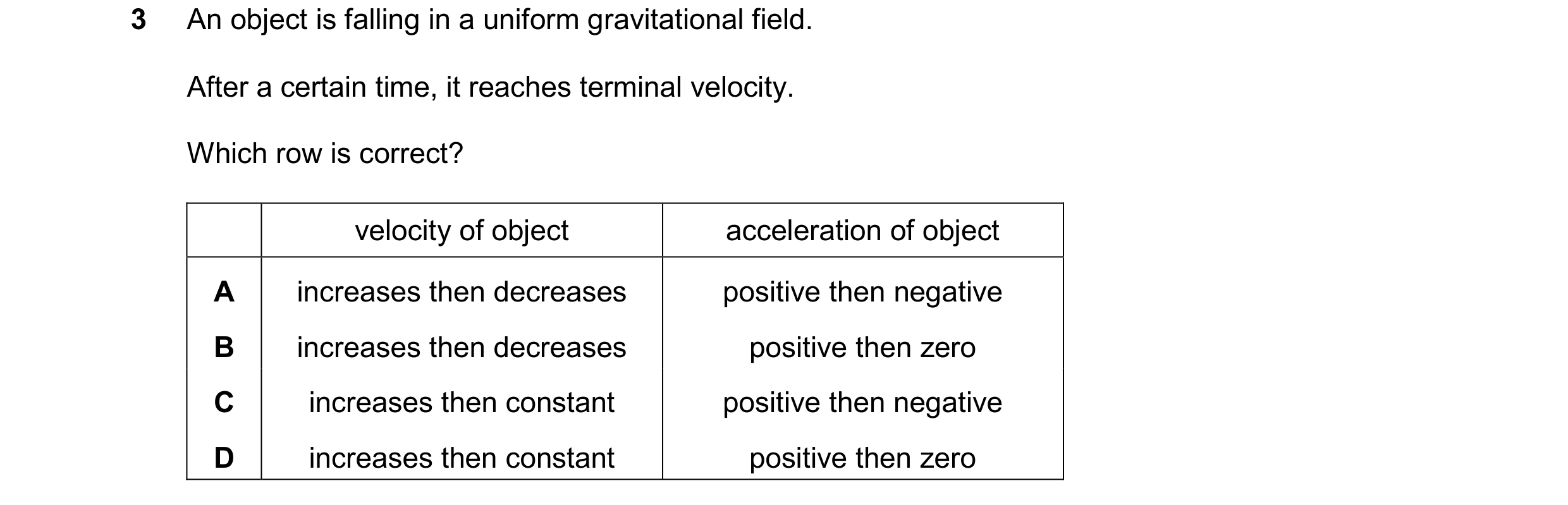 80 / 82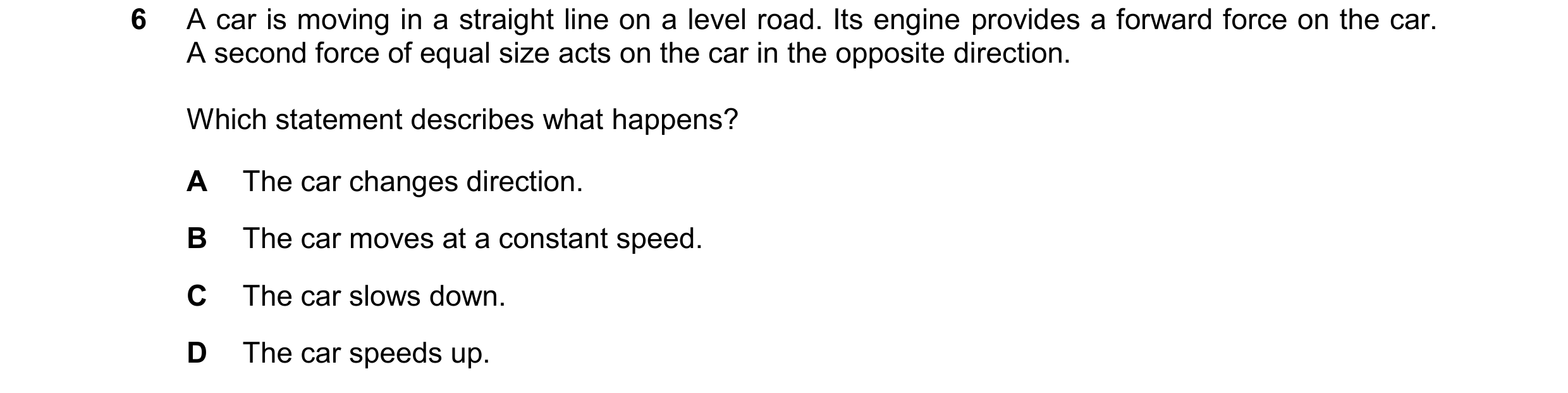
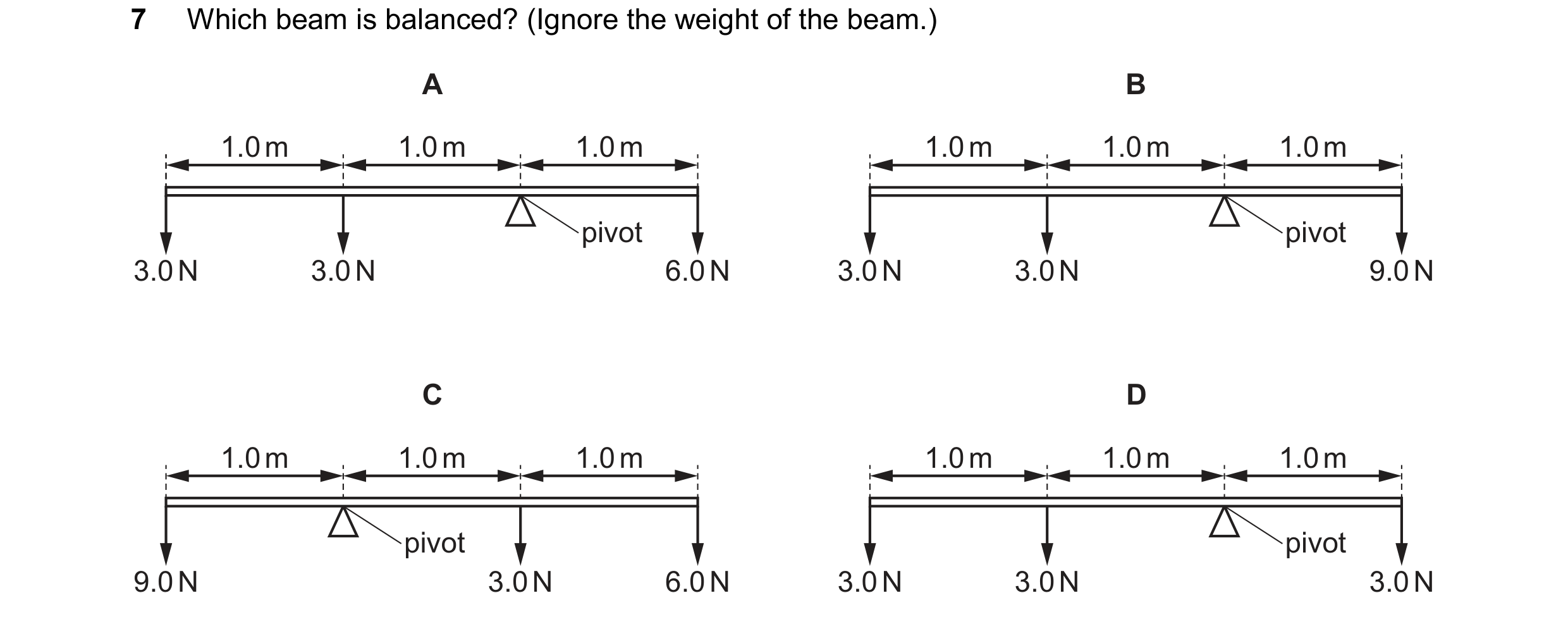
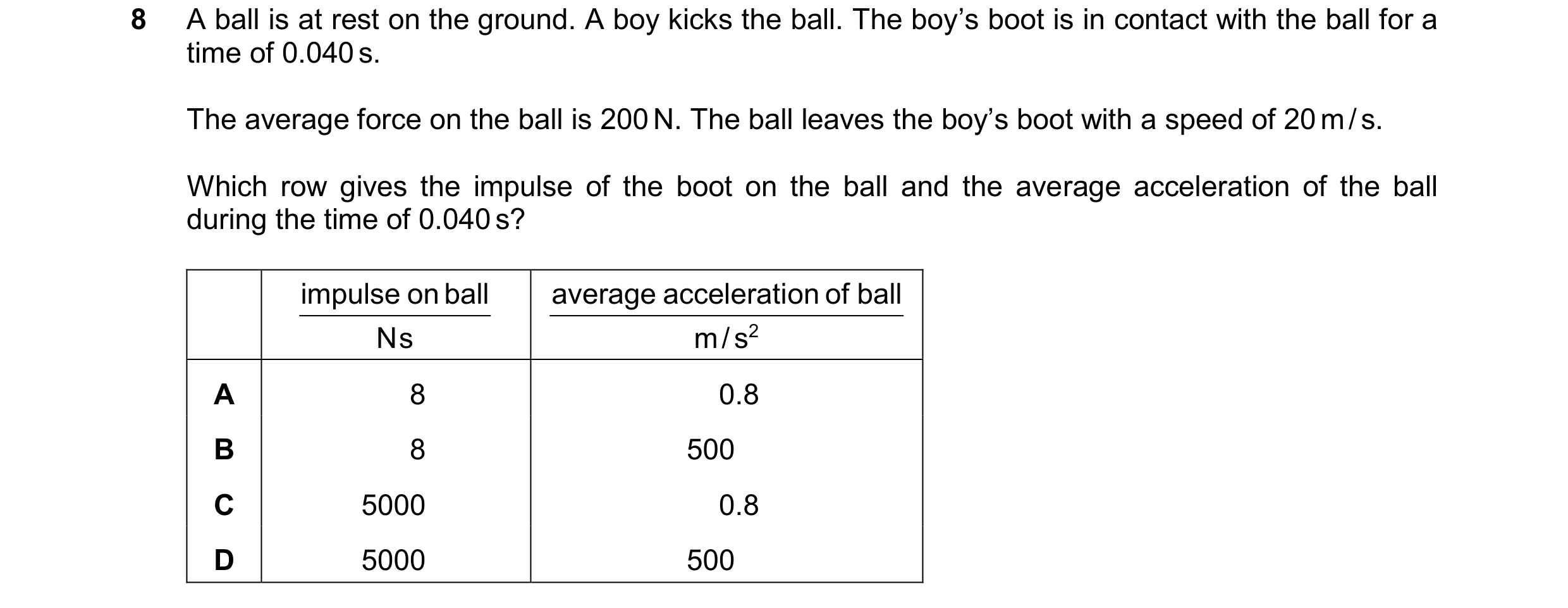 81 / 82
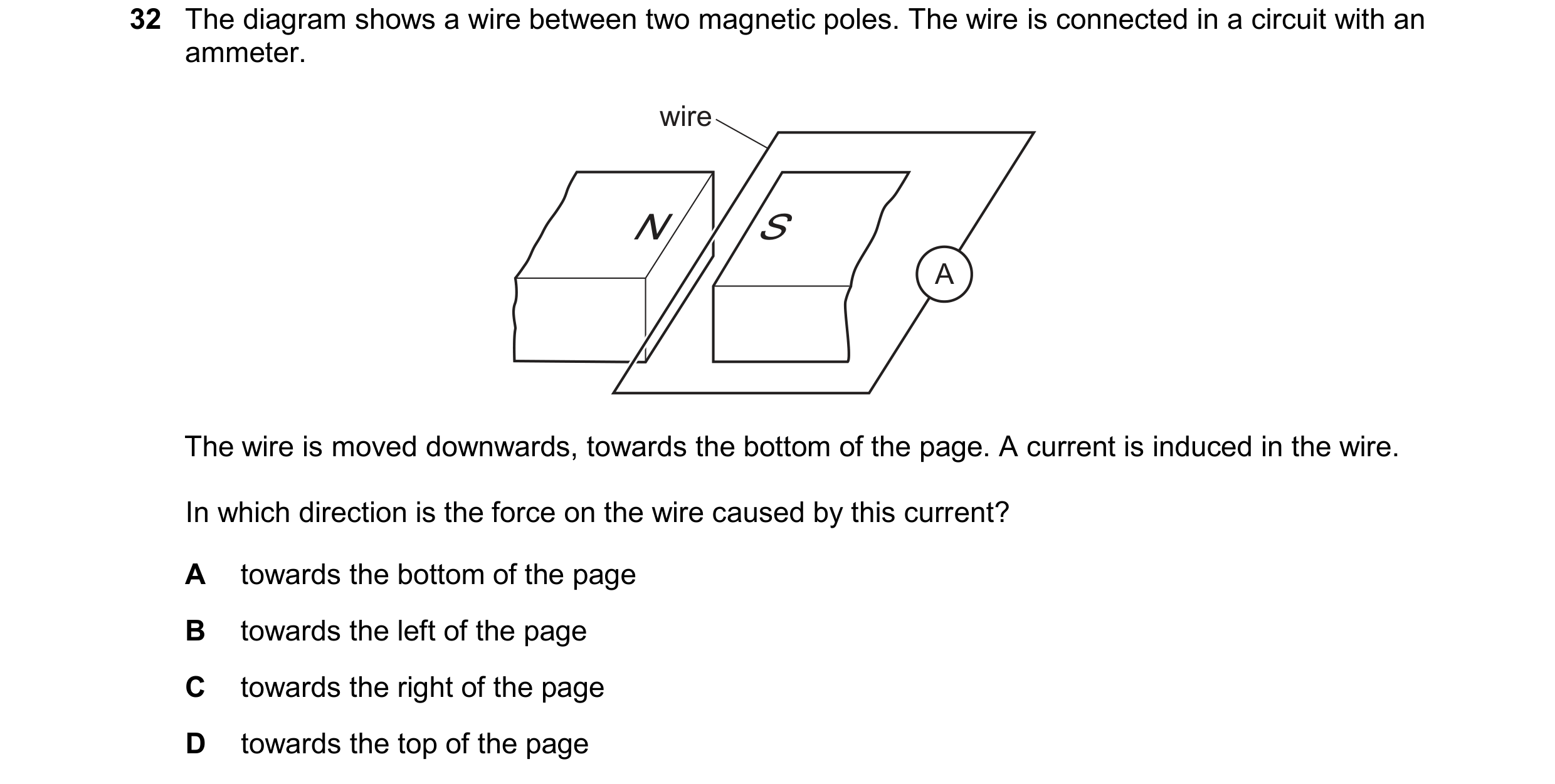 82 / 82