Questions as text
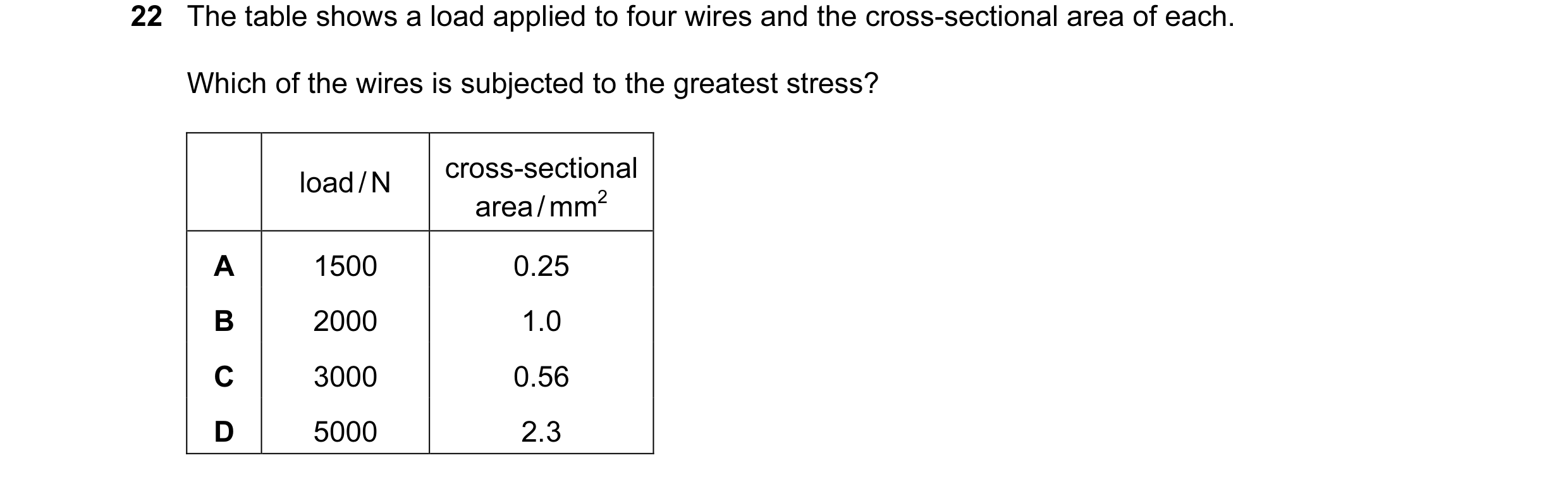
Q1 · The table shows a load applied to four wires and the cross-sectional area of each 9702/11 Oct/Nov 2004
22 The table shows a load applied to four wires and the cross-sectional area of each. Which of the wires is subjected to the greatest stress? cross-sectional load / N area / mm2 A 1500 0.25 B 2000 1.0 C 3000 0.56 D 5000 2.3
1 marks
Answer: A
This question in 9702/11 Oct/Nov 2004
Q2 · A wire stretches 8 mm under a load of 60 N 9702/11 Oct/Nov 2005
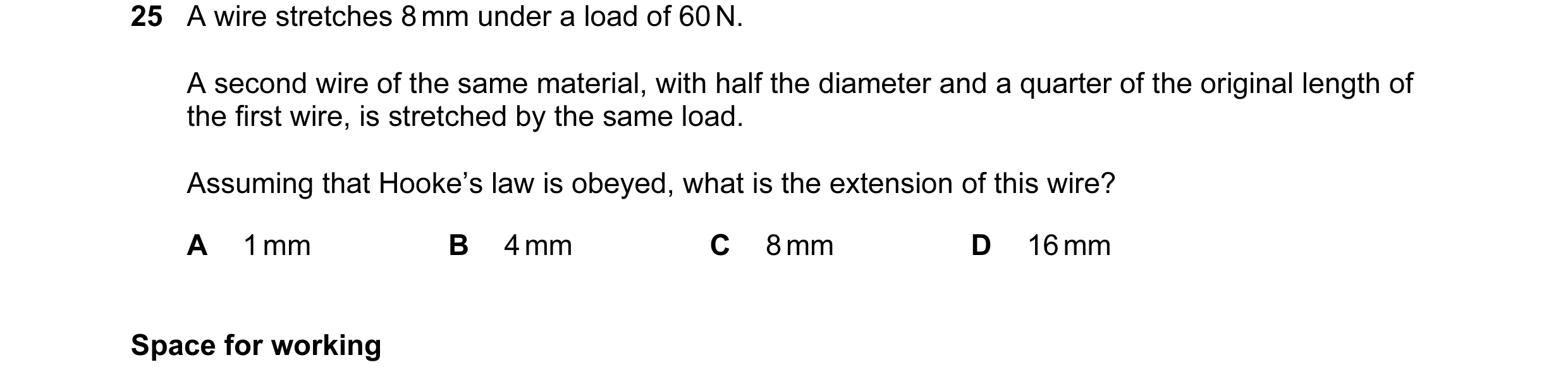
21 A wire stretches 8 mm under a load of 60 N. A second wire of the same material, with half the diameter and a quarter of the original length of the first wire, is stretched by the same load. Assuming that Hooke’s law is obeyed, what is the extension of this wire? A 1 mm B 4 mm C 8 mm D 16 mm
1 marks
Answer: C
This question in 9702/11 Oct/Nov 2005
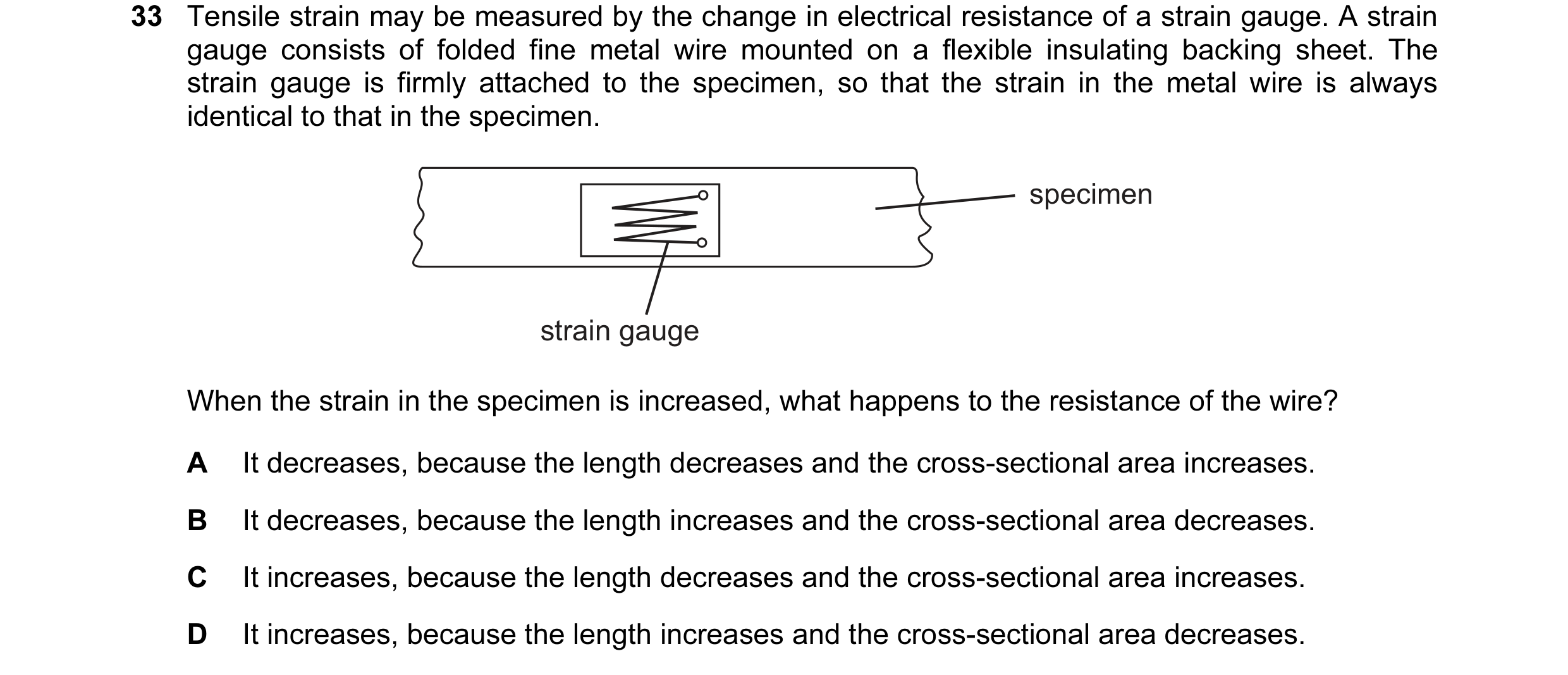
Q3 · Tensile strain may be measured by the change in electrical resistance of a strain gauge 9702/11 Oct/Nov 2005
33 Tensile strain may be measured by the change in electrical resistance of a strain gauge. A strain gauge consists of folded fine metal wire mounted on a flexible insulating backing sheet. The strain gauge is firmly attached to the specimen, so that the strain in the metal wire is always identical to that in the specimen. specimen strain gauge When the strain in the specimen is increased, what happens to the resistance of the wire? A It decreases, because the length decreases and the cross-sectional area increases. B It decreases, because the length increases and the cross-sectional area decreases. C It increases, because the length decreases and the cross-sectional area increases. D It increases, because the length increases and the cross-sectional area decreases.
1 marks
Answer: D
This question in 9702/11 Oct/Nov 2005
Q4 · What is represented by the gradient of a graph of force (vertical axis) against extension… 9702/11 Oct/Nov 2006
22 What is represented by the gradient of a graph of force (vertical axis) against extension (horizontal axis)? A elastic limit B spring constant C stress D the Young modulus
1 marks
Answer: B
This question in 9702/11 Oct/Nov 2006
Q5 · What is the unit of the Young modulus? 9702/11 Oct/Nov 2006
23 What is the unit of the Young modulus? A N m–1 B N m C N m–2 D N m2
1 marks
Answer: C
This question in 9702/11 Oct/Nov 2006
Q6 · A spring of unextended length 0.50 m is stretched by a force of 2.0 N to a new length of… 9702/11 May/June 2007
19 A spring of unextended length 0.50 m is stretched by a force of 2.0 N to a new length of 0.90 m. The variation of its length with tension is as shown. 2.0 tension / N 0 0 0.50 0.90 length / m How much strain energy is stored in the spring? A 0.40 J B 0.80 J C 0.90 J D 1.8 J
1 marks
Answer: A
This question in 9702/11 May/June 2007
Q7 · The Young modulus of steel is determined using a length of steel wire and is found to… 9702/11 May/June 2008
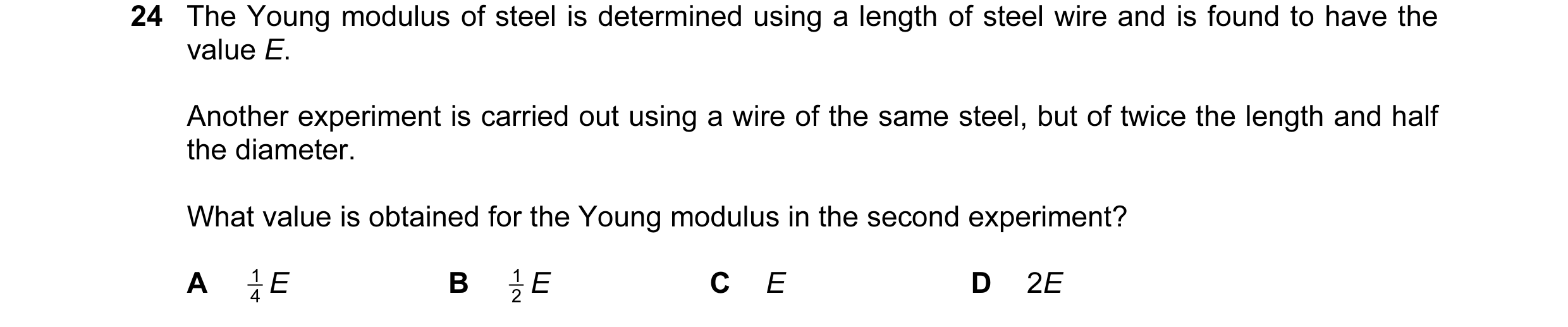
24 The Young modulus of steel is determined using a length of steel wire and is found to have the value E. Another experiment is carried out using a wire of the same steel, but of twice the length and half the diameter. What value is obtained for the Young modulus in the second experiment? A 1 E B 1 E C E D 2E 4 2
1 marks
Answer: C
This question in 9702/11 May/June 2008
Q8 · The graphs show how force varies with extension and stress varies with strain for the… 9702/11 Oct/Nov 2008
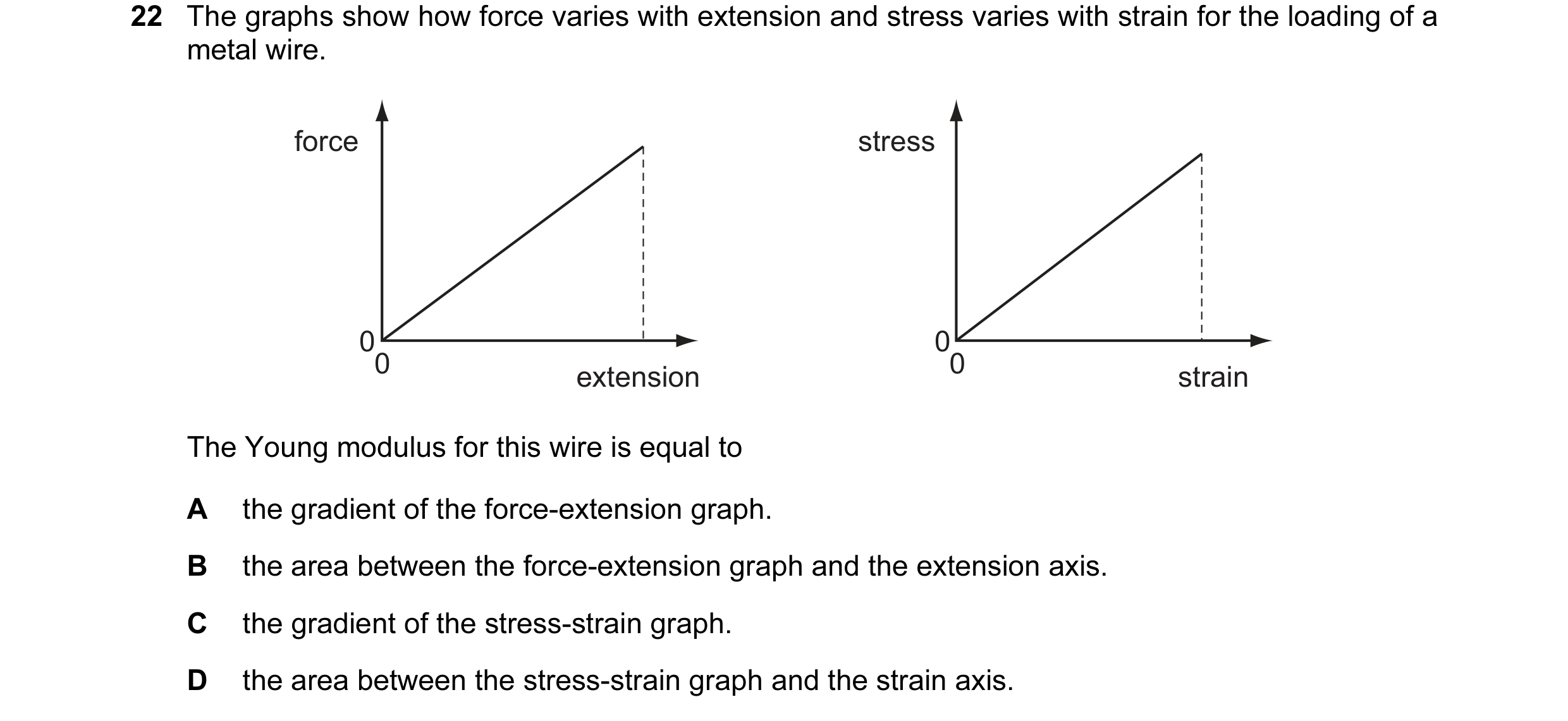
22 The graphs show how force varies with extension and stress varies with strain for the loading of a metal wire. force stress 00 00 extension strain The Young modulus for this wire is equal to A the gradient of the force-extension graph. B the area between the force-extension graph and the extension axis. C the gradient of the stress-strain graph. D the area between the stress-strain graph and the strain axis.
1 marks
Answer: C
This question in 9702/11 Oct/Nov 2008
Q9 · For a wire, Hooke’s law is obeyed for a tension F and extension x 9702/11 Oct/Nov 2008
23 For a wire, Hooke’s law is obeyed for a tension F and extension x. The Young modulus for the material of the wire is E. Which expression represents the elastic strain energy stored in the wire? A 1 E x B E x C 1 F x D F x 2 2
1 marks
Answer: C
This question in 9702/11 Oct/Nov 2008
Q10 · Two steel wires P and Q have lengths l and 2l respectively, and cross-sectional areas A… 9702/11 May/June 2009
20 Two steel wires P and Q have lengths l and 2l respectively, and cross-sectional areas A and 2 respectively. Both wires obey Hooke’s law. tension in P What is the ratio when both wires are stretched to the same extension? tension in Q 1 1 2 4 A B C D 4 2 1 1
1 marks
Answer: D
This question in 9702/11 May/June 2009
Q11 · A steel string on an electric guitar has the following properties 9702/11 Oct/Nov 2009
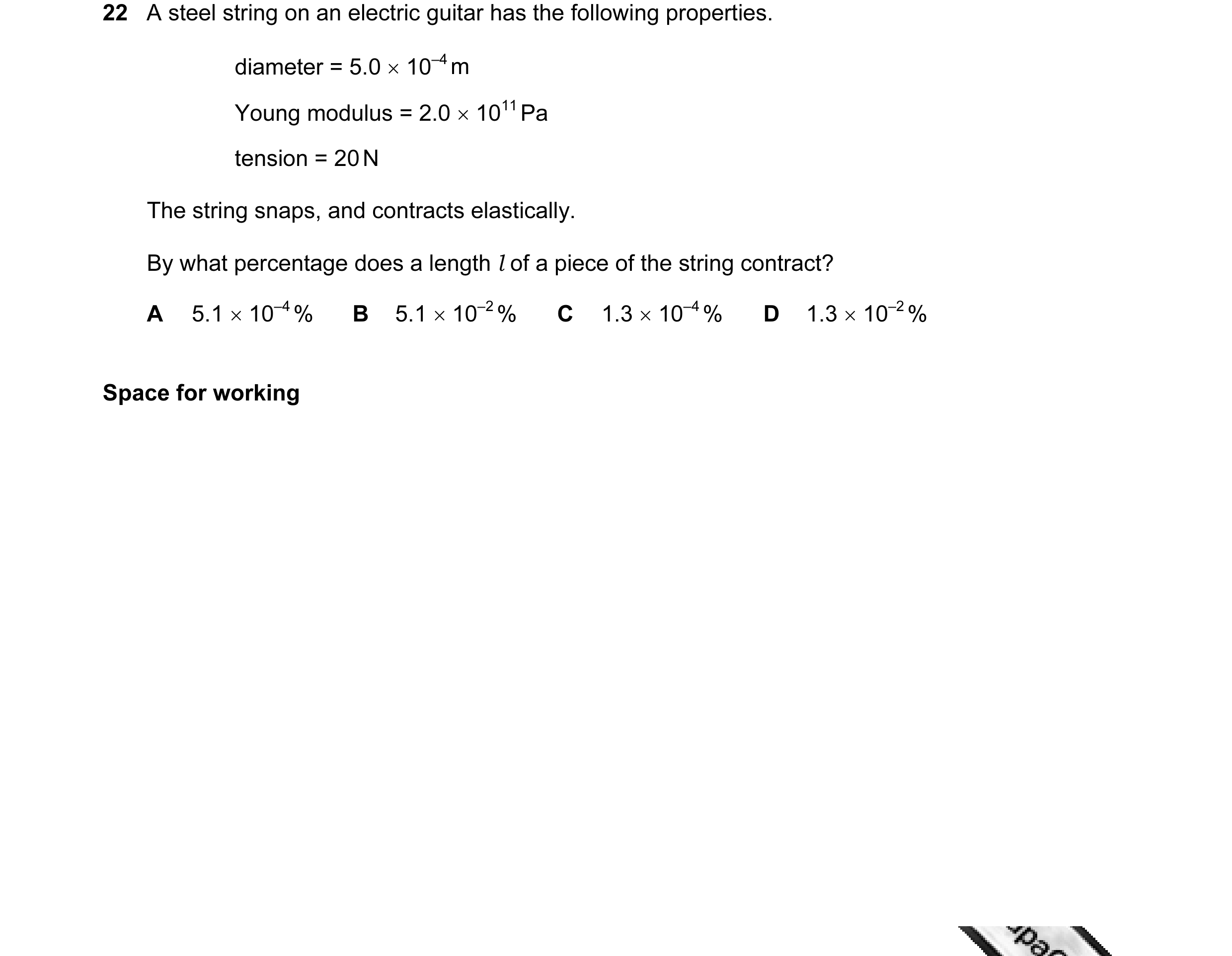
22 A steel string on an electric guitar has the following properties. diameter = 5.0 × 10⁻⁴ m Young modulus = 2.0 × 10¹¹ Pa tension = 20 N The string snaps, and contracts elastically. By what percentage does a length l of a piece of the string contract? A 5.1 × 10⁻⁴ % B 5.1 × 10⁻² % C 1.3 × 10⁻⁴ % D 1.3 × 10⁻² % Space for working
1 marks
Answer: B
This question in 9702/11 Oct/Nov 2009
Q12 · A steel string on an electric guitar has the following properties 9702/12 Oct/Nov 2009
21 A steel string on an electric guitar has the following properties. diameter = 5.0 × 10⁻⁴ m Young modulus = 2.0 × 10¹¹ Pa tension = 20 N The string snaps, and contracts elastically. By what percentage does a length l of a piece of the string contract? A 5.1 × 10⁻⁴ % B 5.1 × 10⁻² % C 1.3 × 10⁻⁴ % D 1.3 × 10⁻² % Space for working
1 marks
Answer: B
This question in 9702/12 Oct/Nov 2009
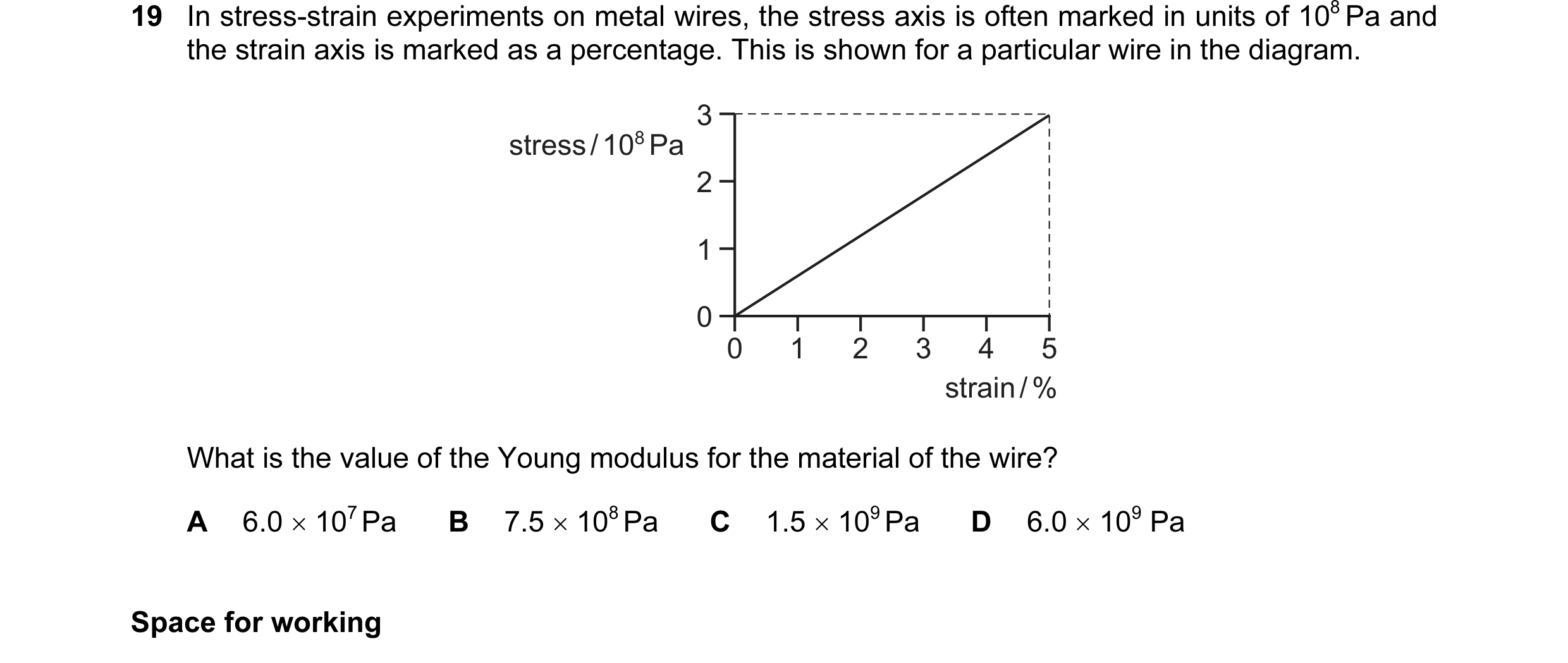
Q13 · In stress-strain experiments on metal wires, the stress axis is often marked in units of… 9702/11 May/June 2010
19 In stress-strain experiments on metal wires, the stress axis is often marked in units of 108 Pa and the strain axis is marked as a percentage. This is shown for a particular wire in the diagram. 3 stress / 108 Pa 2 1 0 0 1 2 3 4 5 strain / % What is the value of the Young modulus for the material of the wire? A 6.0 × 10⁷ Pa B 7.5 × 10⁸ Pa C 1.5 × 10⁹ Pa D 6.0 × 10⁹ Pa Space for working
1 marks
Answer: D
This question in 9702/11 May/June 2010
Q14 · In stress-strain experiments on metal wires, the stress axis is often marked in units of… 9702/13 May/June 2010
20 In stress-strain experiments on metal wires, the stress axis is often marked in units of 108 Pa and the strain axis is marked as a percentage. This is shown for a particular wire in the diagram. 3 stress / 108 Pa 2 1 0 0 1 2 3 4 5 strain / % What is the value of the Young modulus for the material of the wire? A 6.0 × 10⁷ Pa B 7.5 × 10⁸ Pa C 1.5 × 10⁹ Pa D 6.0 × 10⁹ Pa Space for working
1 marks
Answer: D
This question in 9702/13 May/June 2010
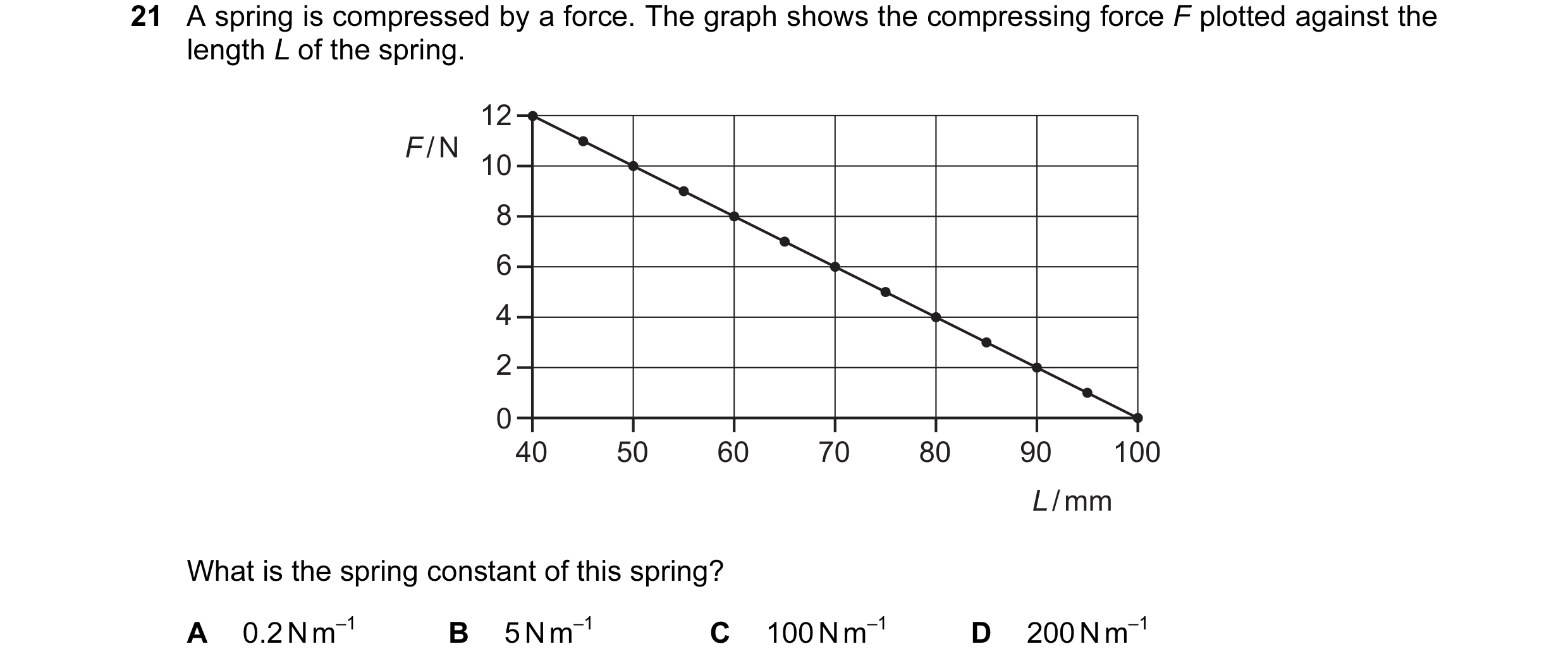
Q15 · A spring is compressed by a force 9702/13 May/June 2010
21 A spring is compressed by a force. The graph shows the compressing force F plotted against the length L of the spring. 12 F / N 10 8 6 4 2 0 40 50 60 70 80 90 100 L / mm What is the spring constant of this spring? A 0.2 N m–1 B 5 N m–1 C 100 N m–1 D 200 N m–1
1 marks
Answer: D
This question in 9702/13 May/June 2010
Q16 · Two wires P and Q are made from the same material 9702/12 Oct/Nov 2010
21 Two wires P and Q are made from the same material. Wire P is initially twice the diameter and twice the length of wire Q. The same force, applied to each wire, causes the wires to extend elastically. What is the ratio of the extension in P to that in Q? 1 A B 1 C 2 D 4 2 Space for working
1 marks
Answer: A
This question in 9702/12 Oct/Nov 2010
Q17 · A wire consists of a 3.0 m length of metal X joined to a 1.0 m length of metal Y 9702/13 Oct/Nov 2010
21 A wire consists of a 3.0 m length of metal X joined to a 1.0 m length of metal Y. The cross-sectional area of the wire is uniform. X 3.0 m Y 1.0 m load A load hung from the wire causes metal X to stretch by 1.5 mm and metal Y to stretch by 1.0 mm. The same load is then hung from a second wire of the same cross-section, consisting of 1.0 m of metal X and 3.0 m of metal Y. What is the total extension of this second wire? A 2.5 mm B 3.5 mm C 4.8 mm D 5.0 mm Space for working
1 marks
Answer: B
This question in 9702/13 Oct/Nov 2010
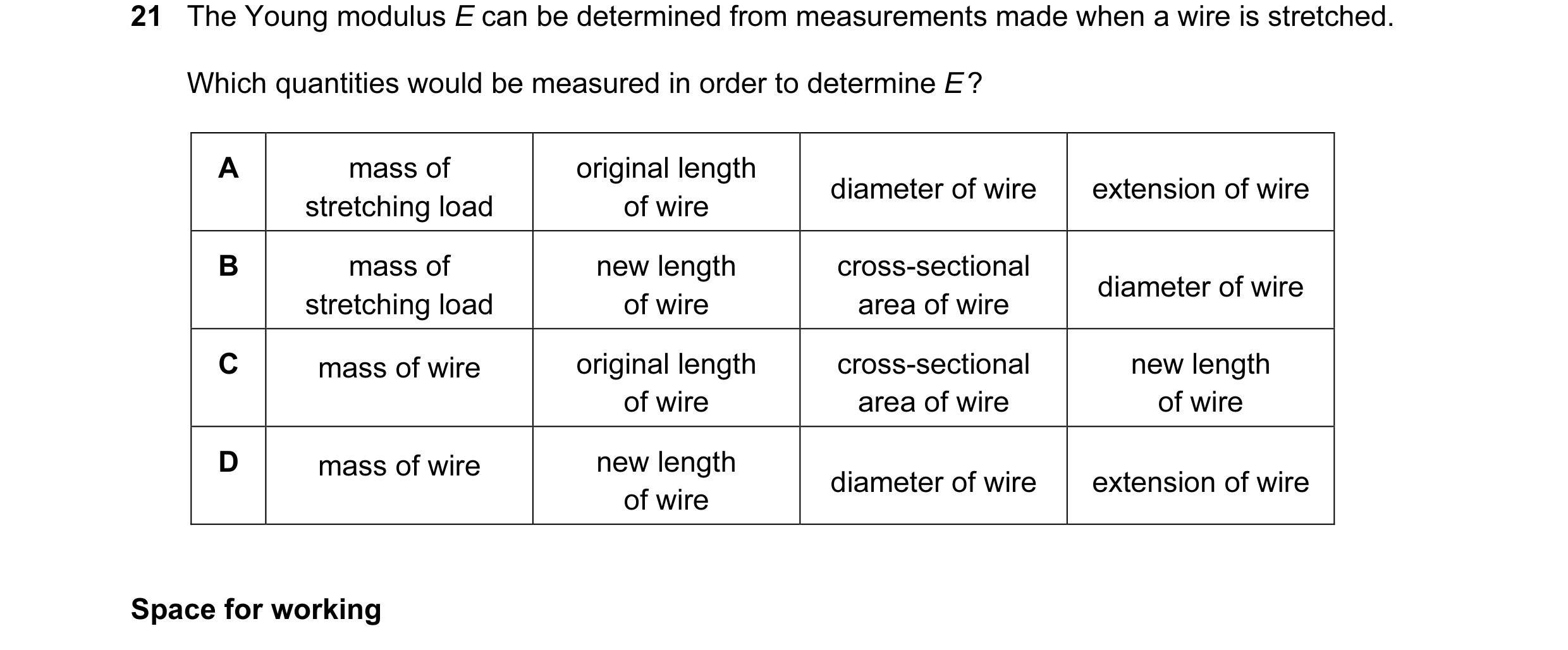
Q18 · The Young modulus E can be determined from measurements made when a wire is stretched 9702/11 May/June 2011
21 The Young modulus E can be determined from measurements made when a wire is stretched. Which quantities would be measured in order to determine E ? A mass of original length diameter of wire extension of wire stretching load of wire B mass of new length cross-sectional diameter of wire stretching load of wire area of wire C mass of wire original length cross-sectional new length of wire area of wire of wire D mass of wire new length diameter of wire extension of wire of wire Space for working
1 marks
Answer: A
This question in 9702/11 May/June 2011
Q19 · The behaviour of a wire under tensile stress may be described in terms of the Young… 9702/12 May/June 2011
23 The behaviour of a wire under tensile stress may be described in terms of the Young modulus E of the material of the wire and of the force per unit extension k of the wire. For a wire of length L and cross-sectional area A, what is the relation between E and k ? E = kL A E = L kA E = A kL E = kA L A B C D
1 marks
Answer: C
This question in 9702/12 May/June 2011
Q20 · The Young modulus E can be determined from measurements made when a wire is stretched 9702/13 May/June 2011
20 The Young modulus E can be determined from measurements made when a wire is stretched. Which quantities would be measured in order to determine E ? A mass of original length diameter of wire extension of wire stretching load of wire B mass of new length cross-sectional diameter of wire stretching load of wire area of wire C mass of wire original length cross-sectional new length of wire area of wire of wire D mass of wire new length diameter of wire extension of wire of wire Space for working
1 marks
Answer: A
This question in 9702/13 May/June 2011
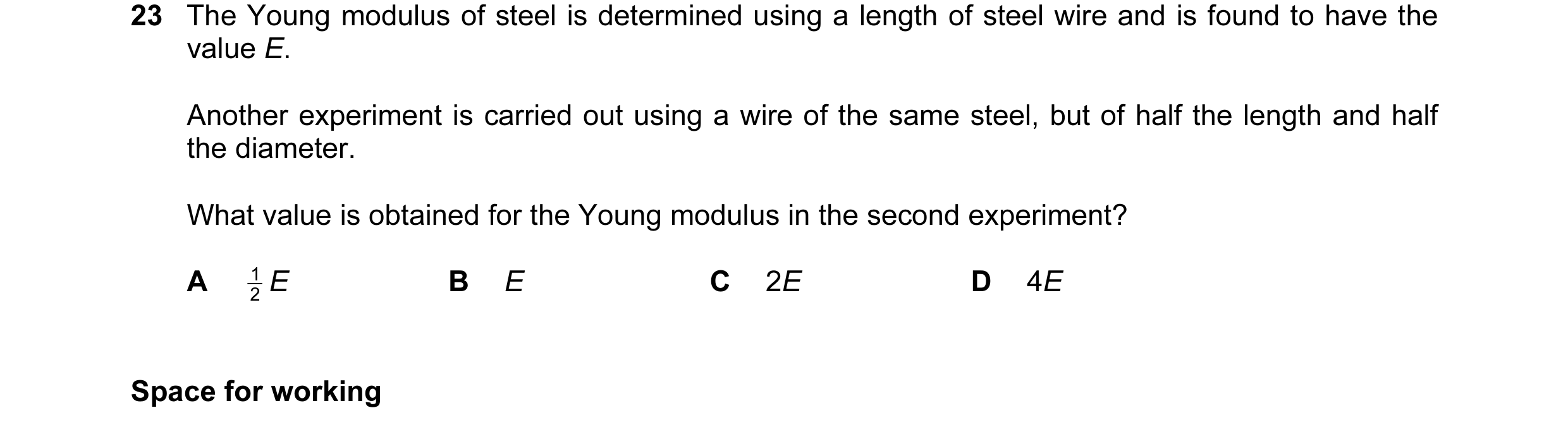
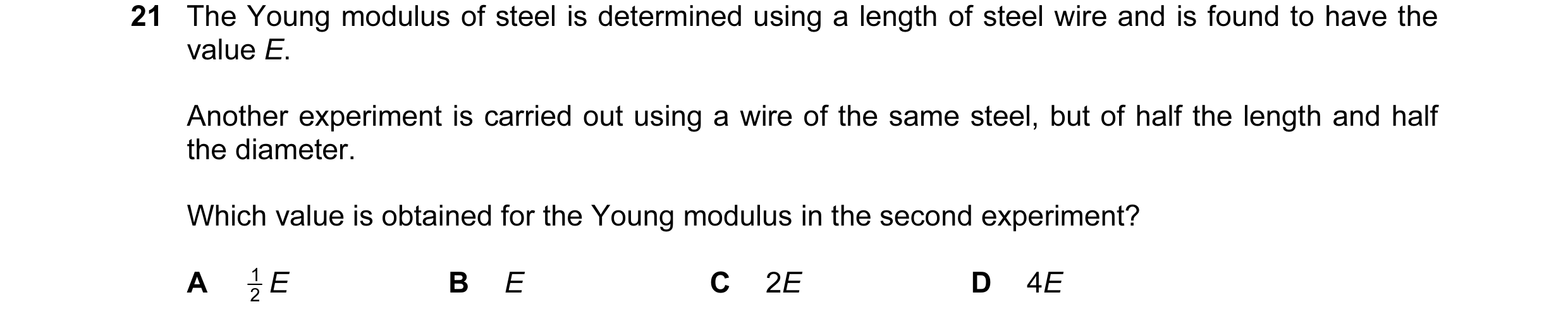
Q21 · The Young modulus of steel is determined using a length of steel wire and is found to… 9702/11 Oct/Nov 2011
23 The Young modulus of steel is determined using a length of steel wire and is found to have the value E. Another experiment is carried out using a wire of the same steel, but of half the length and half the diameter. What value is obtained for the Young modulus in the second experiment? A 1 E B E C 2E D 4E 2 Space for working
1 marks
Answer: B
This question in 9702/11 Oct/Nov 2011
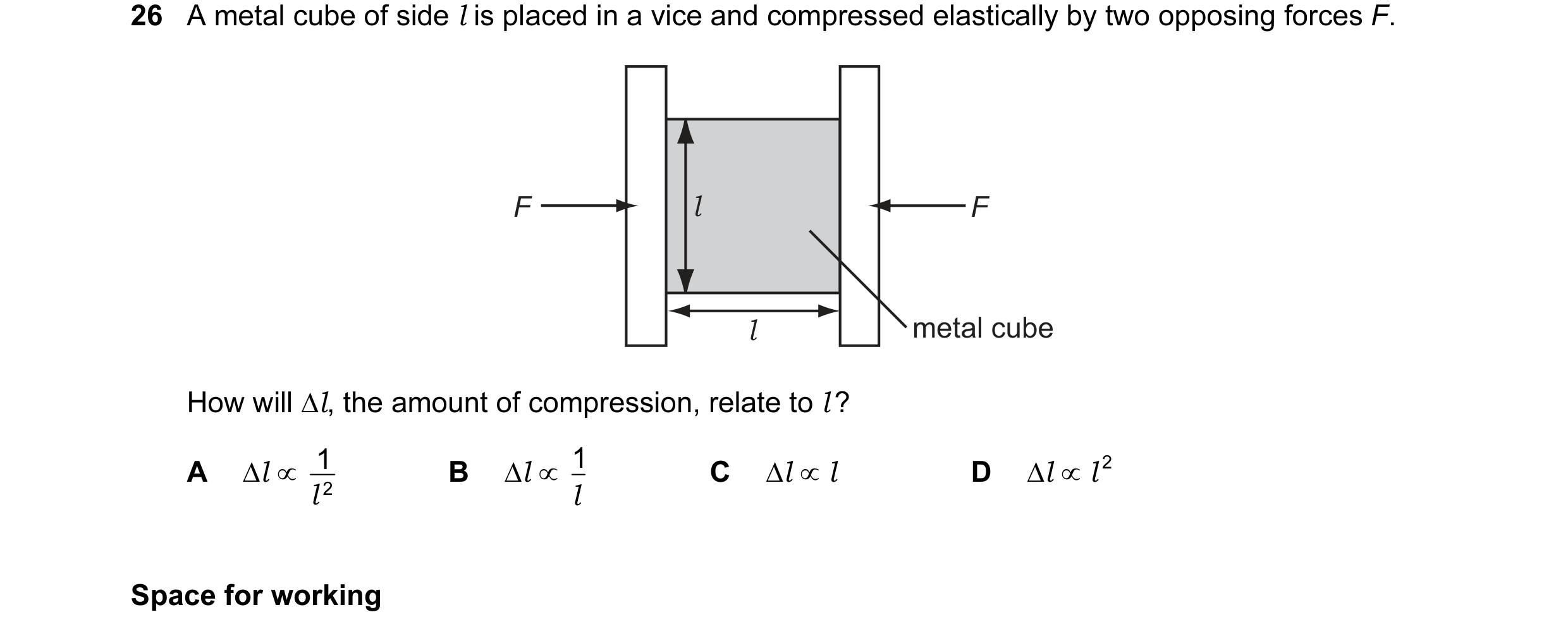
Q22 · A metal cube of side l is placed in a vice and compressed elastically by two opposing… 9702/11 Oct/Nov 2011
26 A metal cube of side l is placed in a vice and compressed elastically by two opposing forces F. F l F l metal cube How will ∆l, the amount of compression, relate to l ? 1 1 ∆l ∝ l 2 A ∆l ∝ B ∆l ∝ l C ∆l ∝ l D l 2 Space for working
1 marks
Answer: B
This question in 9702/11 Oct/Nov 2011
Q23 · The graph shows the relationship between stress and strain for three wires of the same… 9702/12 Oct/Nov 2011
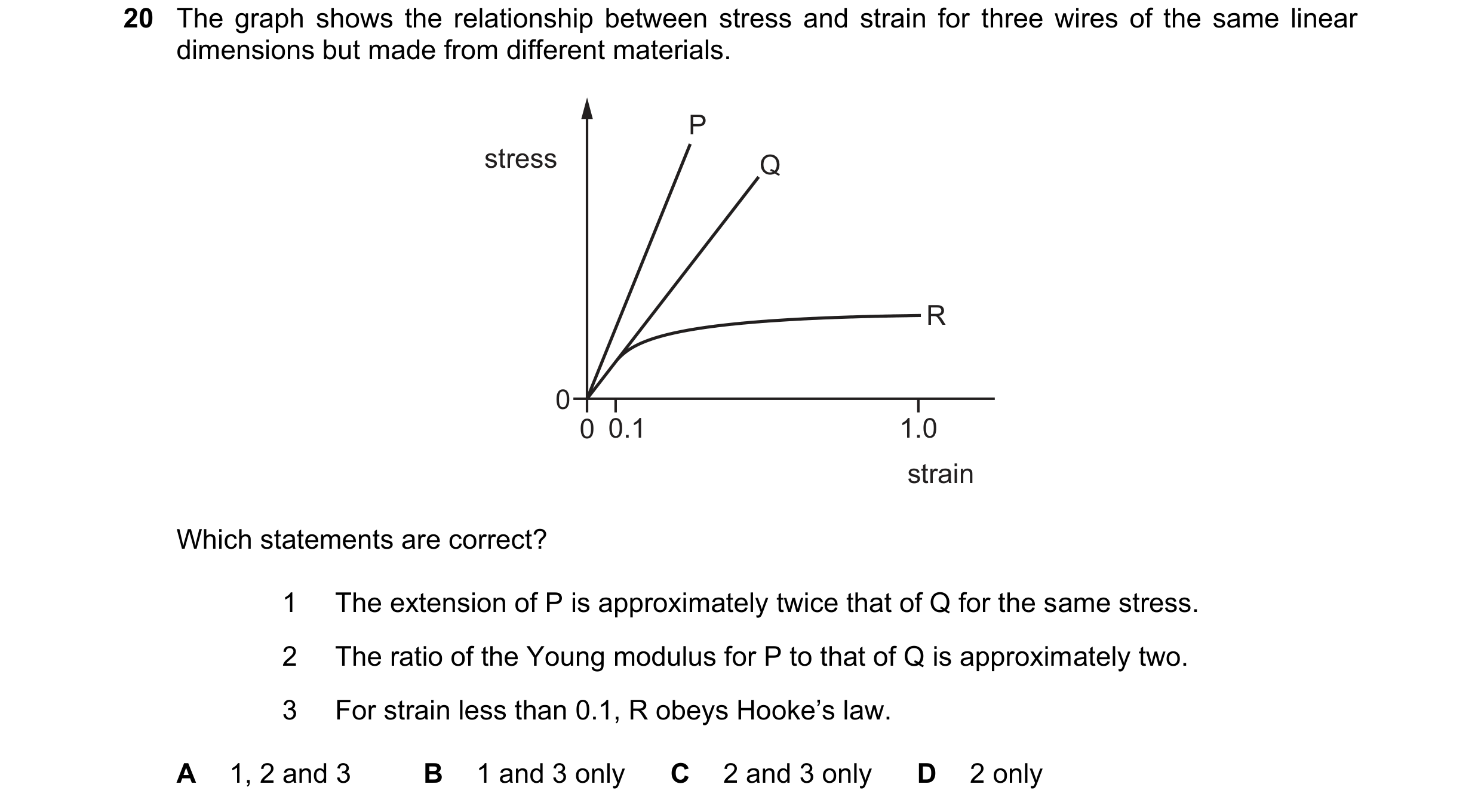
21 The graph shows the relationship between stress and strain for three wires of the same linear dimensions but made from different materials. P stress Q R 0 0 0.1 1.0 strain Which statements are correct? 1 The extension of P is approximately twice that of Q for the same stress. 2 The ratio of the Young modulus for P to that of Q is approximately two. 3 For strain less than 0.1, R obeys Hooke’s law. A 1, 2 and 3 B 1 and 3 only C 2 and 3 only D 2 only Space for working
1 marks
Answer: C
This question in 9702/12 Oct/Nov 2011
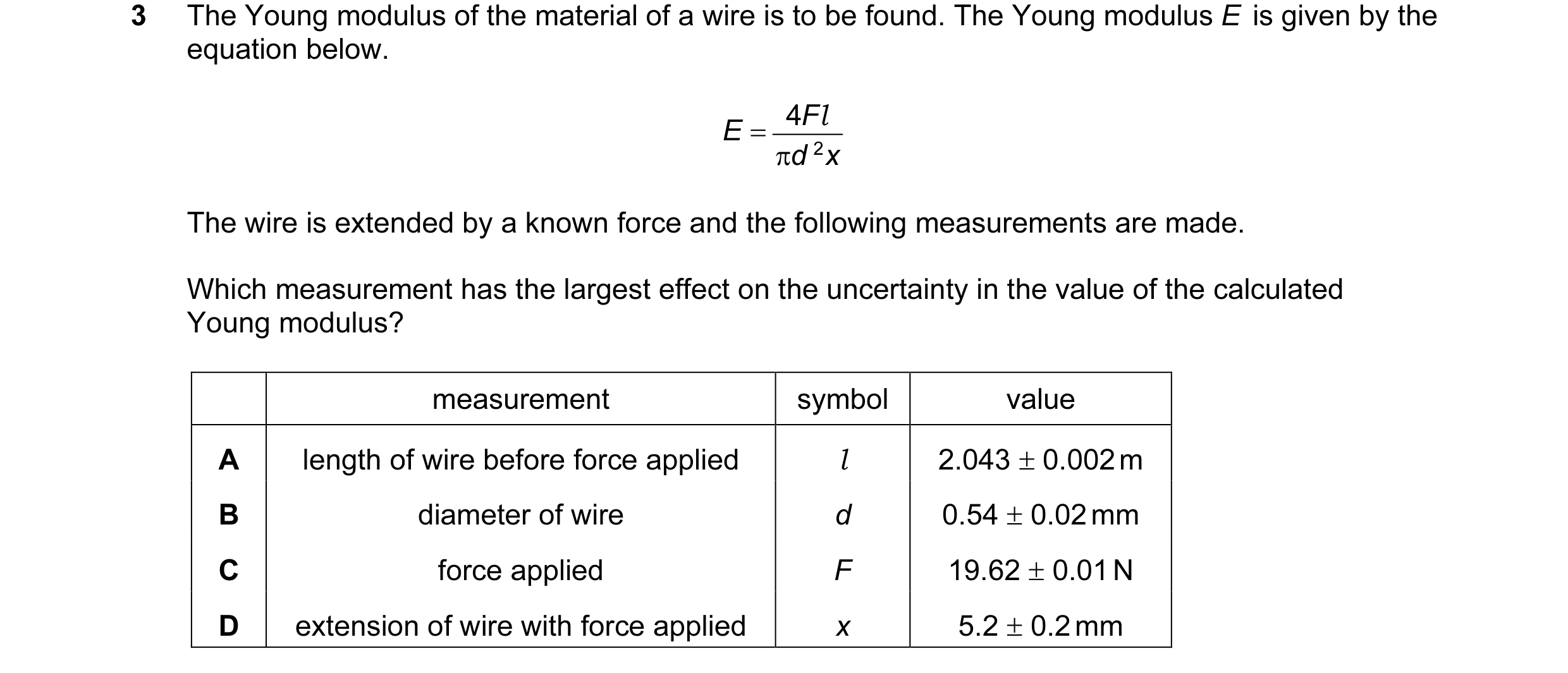
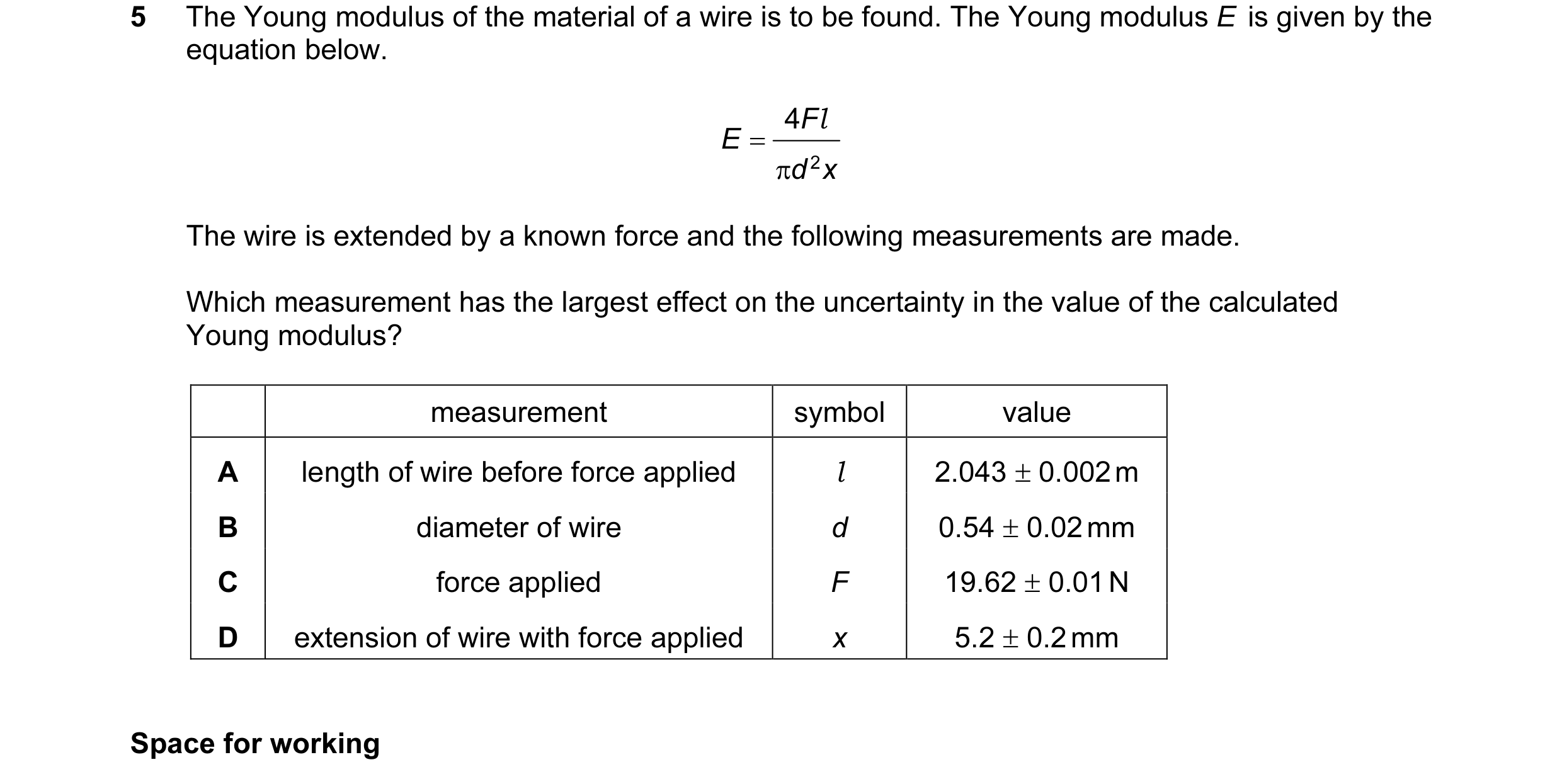
Q24 · The Young modulus of the material of a wire is to be found 9702/13 Oct/Nov 2011
3 The Young modulus of the material of a wire is to be found. The Young modulus E is given by the equation below. 4 F l E = π d 2 x The wire is extended by a known force and the following measurements are made. Which measurement has the largest effect on the uncertainty in the value of the calculated Young modulus? measurement symbol value A length of wire before force applied l 2.043 ± 0.002 m B diameter of wire d 0.54 ± 0.02 mm C force applied F 19.62 ± 0.01 N D extension of wire with force applied x 5.2 ± 0.2 mm
1 marks
Answer: B
This question in 9702/13 Oct/Nov 2011
Q25 · The Young modulus of steel is determined using a length of steel wire and is found to… 9702/13 Oct/Nov 2011
21 The Young modulus of steel is determined using a length of steel wire and is found to have the value E. Another experiment is carried out using a wire of the same steel, but of half the length and half the diameter. What value is obtained for the Young modulus in the second experiment? A 1 E B E C 2E D 4E 2 Space for working
1 marks
Answer: B
This question in 9702/13 Oct/Nov 2011
Q26 · A metal cube of side l is placed in a vice and compressed elastically by two opposing… 9702/13 Oct/Nov 2011
25 A metal cube of side l is placed in a vice and compressed elastically by two opposing forces F. F l F l metal cube How will ∆l, the amount of compression, relate to l ? 1 1 ∆l ∝ l 2 A ∆l ∝ B ∆l ∝ l C ∆l ∝ l D l 2 Space for working
1 marks
Answer: B
This question in 9702/13 Oct/Nov 2011
Q27 · A wire stretches 8 mm under a load of 60 N 9702/12 May/June 2012
25 A wire stretches 8 mm under a load of 60 N. A second wire of the same material, with half the diameter and a quarter of the original length of the first wire, is stretched by the same load. Assuming that Hooke’s law is obeyed, what is the extension of this wire? A 1 mm B 4 mm C 8 mm D 16 mm Space for working
1 marks
Answer: C
This question in 9702/12 May/June 2012
Q28 · The diagram shows the stress-strain graph for two wires X and Y of different materials up… 9702/11 Oct/Nov 2012
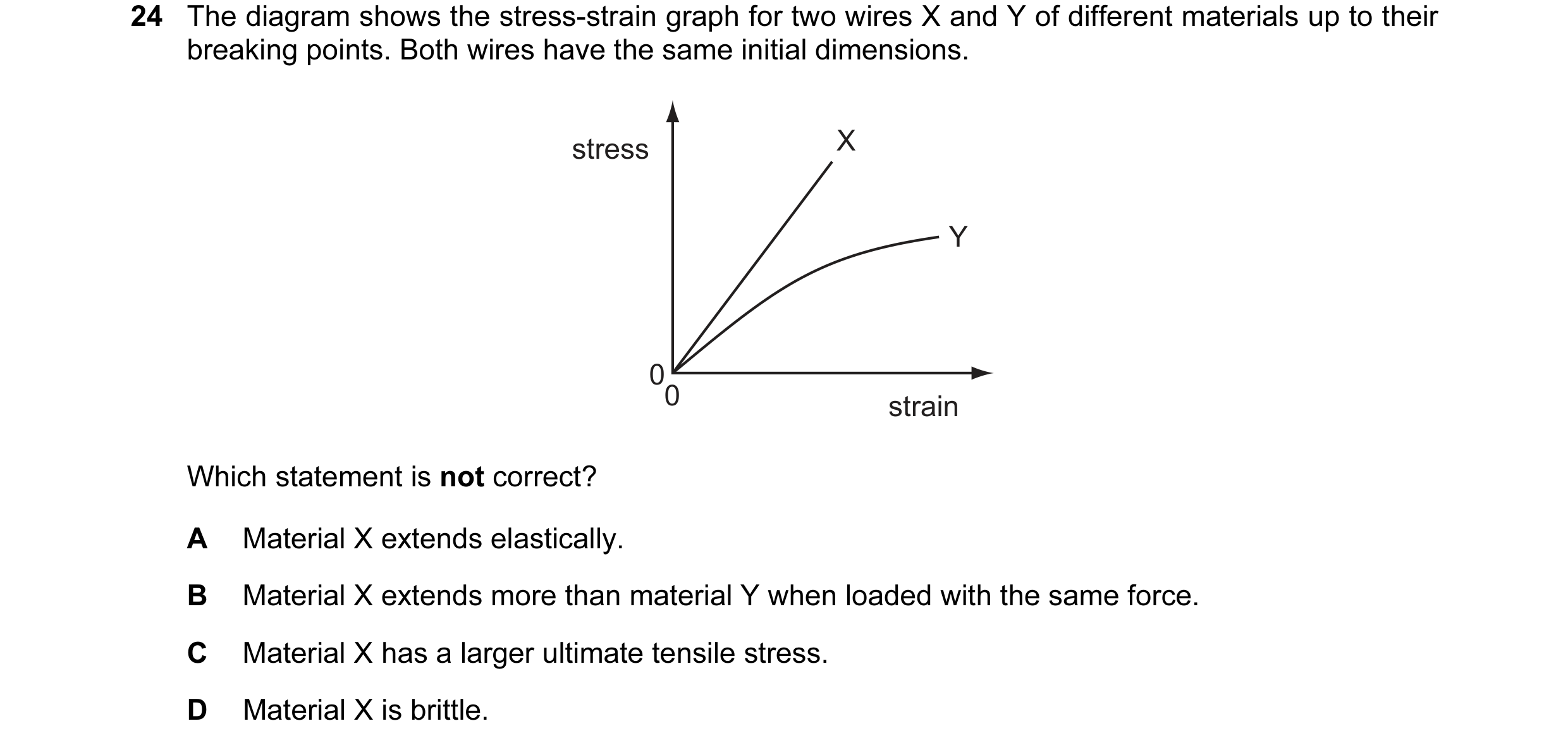
24 The diagram shows the stress-strain graph for two wires X and Y of different materials up to their breaking points. Both wires have the same initial dimensions. stress X Y 00 strain Which statement is not correct? A Material X extends elastically. B Material X extends more than material Y when loaded with the same force. C Material X has a larger ultimate tensile stress. D Material X is brittle.
1 marks
Answer: B
This question in 9702/11 Oct/Nov 2012
Q29 · A steel wire and a brass wire are joined end to end and are hung vertically with the… 9702/11 Oct/Nov 2012
25 A steel wire and a brass wire are joined end to end and are hung vertically with the steel wire attached to a point on the ceiling. The steel wire is twice as long as the brass wire and has half the diameter. A large mass is hung from the end of the brass wire so that both wires are stretched elastically. The Young modulus for steel is 2.0 × 10¹¹ Pa and for brass is 1.0 × 10¹¹ Pa. What is the ratio of the extension of the steel to the extension of the brass? A 2 B 4 C 8 D 16 Space for working
1 marks
Answer: B
This question in 9702/11 Oct/Nov 2012
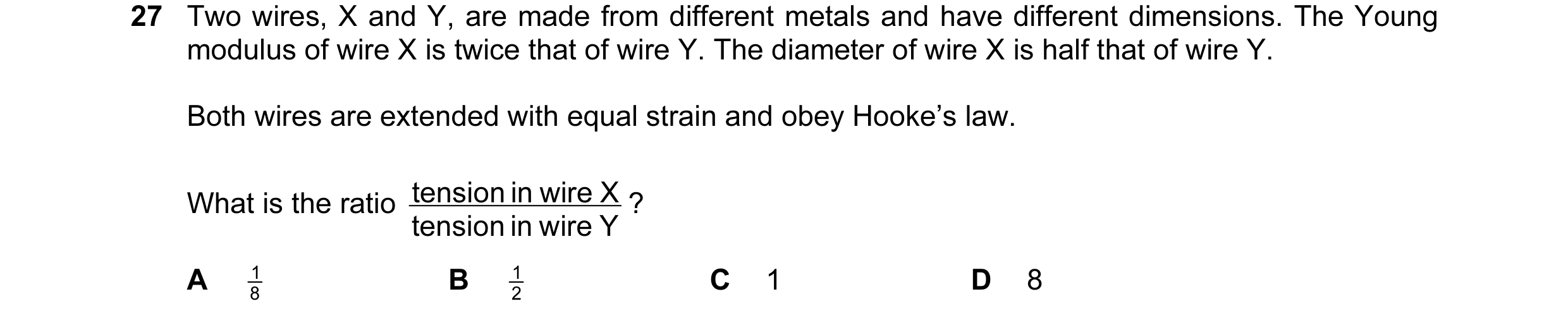
Q30 · Two wires, X and Y, are made from different metals and have different dimensions 9702/12 Oct/Nov 2012
27 Two wires, X and Y, are made from different metals and have different dimensions. The Young modulus of wire X is twice that of wire Y. The diameter of wire X is half that of wire Y. Both wires are extended with equal strain and obey Hooke’s law. What is the ratio tension in wire X ? tension in wire Y A 1 B 1 C 1 D 8 8 2
1 marks
Answer: B
This question in 9702/12 Oct/Nov 2012
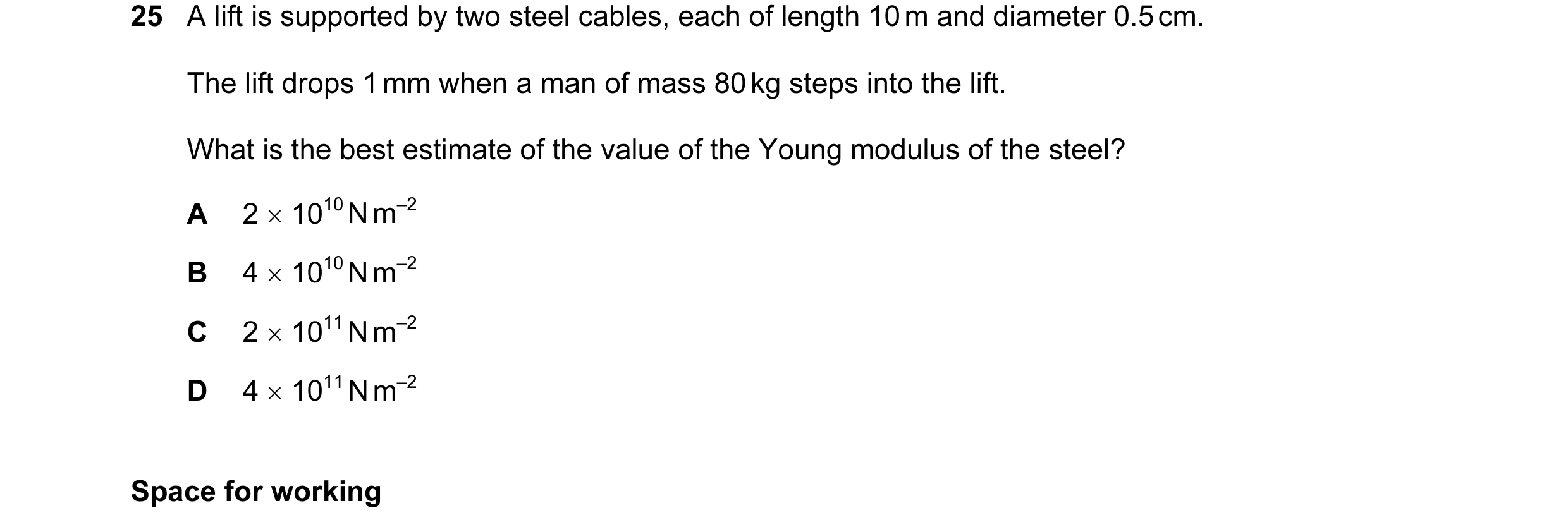
Q31 · A lift is supported by two steel cables, each of length 10 m and diameter 0.5 cm 9702/13 Oct/Nov 2012
25 A lift is supported by two steel cables, each of length 10 m and diameter 0.5 cm. The lift drops 1 mm when a man of mass 80 kg steps into the lift. What is the best estimate of the value of the Young modulus of the steel? A 2 × 10¹⁰ N m–2 B 4 × 10¹⁰ N m–2 C 2 × 10¹¹ N m–2 D 4 × 10¹¹ N m–2 Space for working
1 marks
Answer: C
This question in 9702/13 Oct/Nov 2012
Q32 · A number of identical springs, each having the same spring constant, are joined in four… 9702/11 May/June 2013
23 A number of identical springs, each having the same spring constant, are joined in four arrangements. A different load is applied to each arrangement. Which arrangement has the largest extension? A B C D 6 N 8 N 2 N 1 N
1 marks
Answer: A
This question in 9702/11 May/June 2013
Q33 · What is the unit of the Young modulus? 9702/12 May/June 2013
21 What is the unit of the Young modulus? A N m–1 B N m C N m–2 D N m2 Space for working
1 marks
Answer: C
This question in 9702/12 May/June 2013
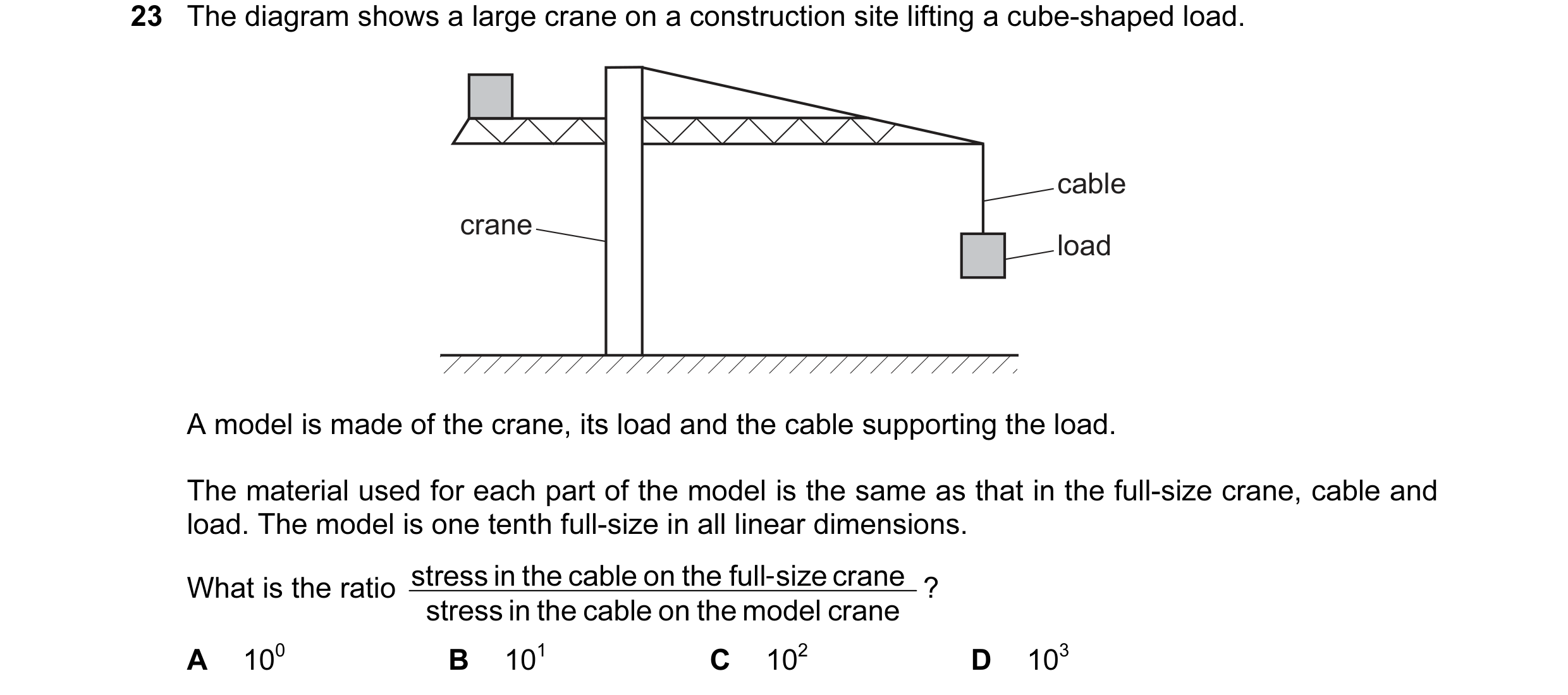
Q34 · The diagram shows a large crane on a construction site lifting a cube-shaped load 9702/12 May/June 2013
23 The diagram shows a large crane on a construction site lifting a cube-shaped load. cable crane load A model is made of the crane, its load and the cable supporting the load. The material used for each part of the model is the same as that in the full-size crane, cable and load. The model is one tenth full-size in all linear dimensions. stress in the cable on the full - size crane What is the ratio ? stress in the cable on the model crane A 100 B 101 C 102 D 103
1 marks
Answer: B
This question in 9702/12 May/June 2013
Q35 · The diagram shows a large crane on a construction site lifting a cube-shaped load 9702/13 May/June 2013
19 The diagram shows a large crane on a construction site lifting a cube-shaped load. cable crane load A model is made of the crane, its load and the cable supporting the load. The material used for each part of the model is the same as that in the full-size crane, cable and load. The model is one tenth full-size in all linear dimensions. extension of the cable on the full - size crane What is the ratio ? extension of the cable on the model crane A 100 B 101 C 102 D 103 Space for working
1 marks
Answer: C
This question in 9702/13 May/June 2013
Q36 · A steel spring has a spring constant of 150 N m–1 9702/11 Oct/Nov 2013
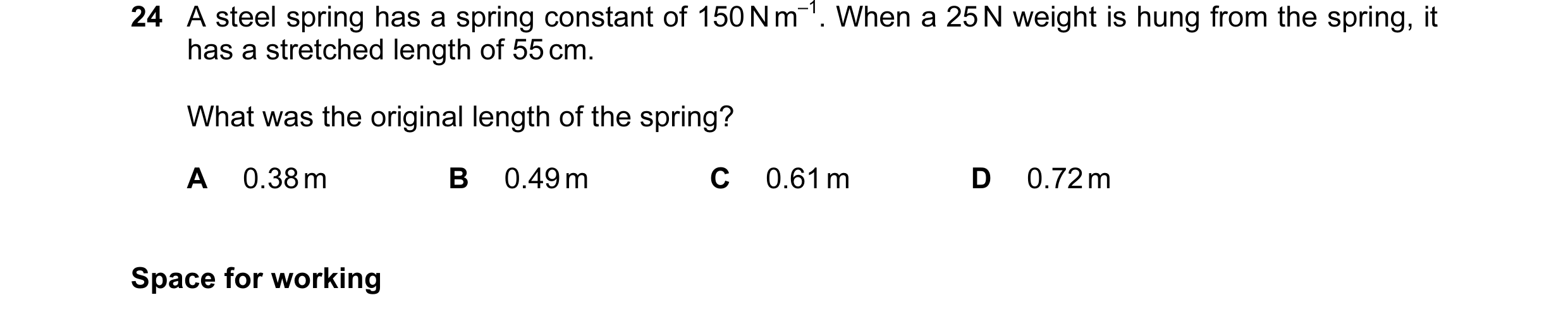
24 A steel spring has a spring constant of 150 N m–1. When a 25 N weight is hung from the spring, it has a stretched length of 55 cm. What was the original length of the spring? A 0.38 m B 0.49 m C 0.61 m D 0.72 m Space for working
1 marks
Answer: A
This question in 9702/11 Oct/Nov 2013
Q37 · The spring constant k of a coiled wire spring is given by the equation Gr 4 k = 4nR 3… 9702/13 Oct/Nov 2013
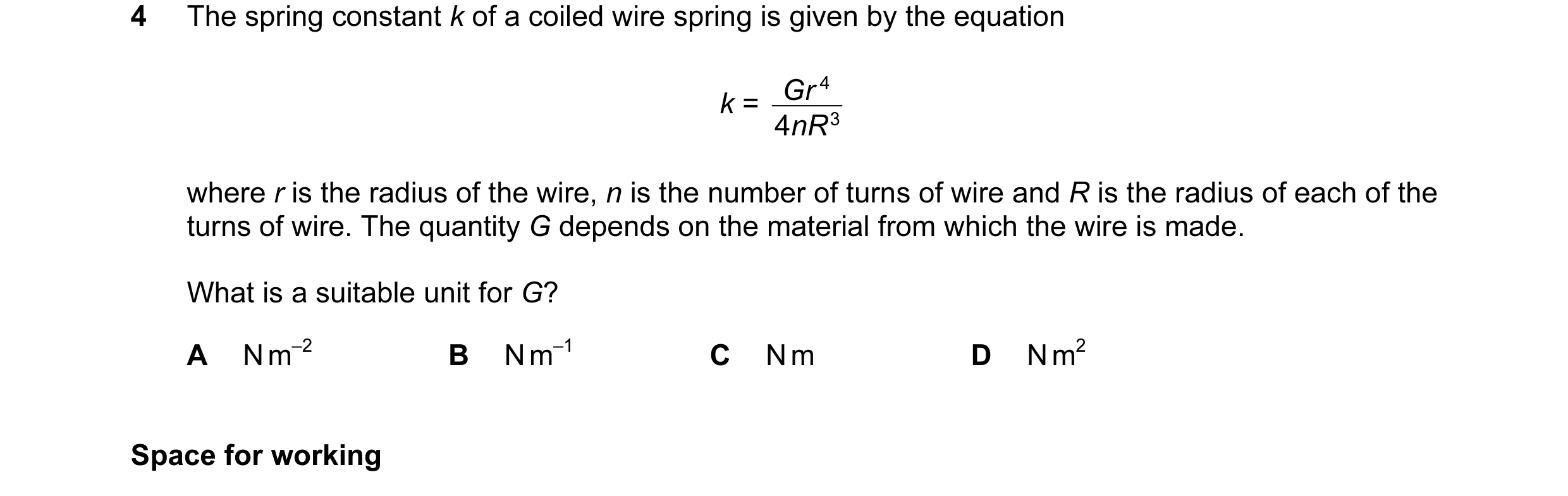
4 The spring constant k of a coiled wire spring is given by the equation Gr 4 k = 4nR 3 where r is the radius of the wire, n is the number of turns of wire and R is the radius of each of the turns of wire. The quantity G depends on the material from which the wire is made. What is a suitable unit for G? A N m–2 B N m–1 C N m D N m2 Space for working
1 marks
Answer: A
This question in 9702/13 Oct/Nov 2013
Q38 · A lift is supported by two steel cables each of length 20 m 9702/13 Oct/Nov 2013
22 A lift is supported by two steel cables each of length 20 m. Each of the cables consists of 100 parallel steel wires, each wire of cross-sectional area 3.2 × 10⁻⁶ m2. The Young modulus of steel is 2.1 × 10¹¹ N m–2. Which distance does the lift move downward when a man of mass 70 kg steps into it? A 0.010 mm B 0.020 mm C 0.10 mm D 0.20 mm
1 marks
Answer: C
This question in 9702/13 Oct/Nov 2013
Q39 · What is equal to the Young modulus of a material that is extended elastically within the… 9702/13 Oct/Nov 2013
23 What is equal to the Young modulus of a material that is extended elastically within the limit of proportionality? A area under the force-extension graph B area under the stress-strain graph C gradient of the force-extension graph D gradient of the stress-strain graph Space for working
1 marks
Answer: D
This question in 9702/13 Oct/Nov 2013
Q40 · The Young modulus of the material of a wire is to be found 9702/11 May/June 2014
5 The Young modulus of the material of a wire is to be found. The Young modulus E is given by the equation below. 4 F l E = π d 2 x The wire is extended by a known force and the following measurements are made. Which measurement has the largest effect on the uncertainty in the value of the calculated Young modulus? measurement symbol value A length of wire before force applied l 2.043 ± 0.002 m B diameter of wire d 0.54 ± 0.02 mm C force applied F 19.62 ± 0.01 N D extension of wire with force applied x 5.2 ± 0.2 mm Space for working
1 marks
Answer: B
This question in 9702/11 May/June 2014
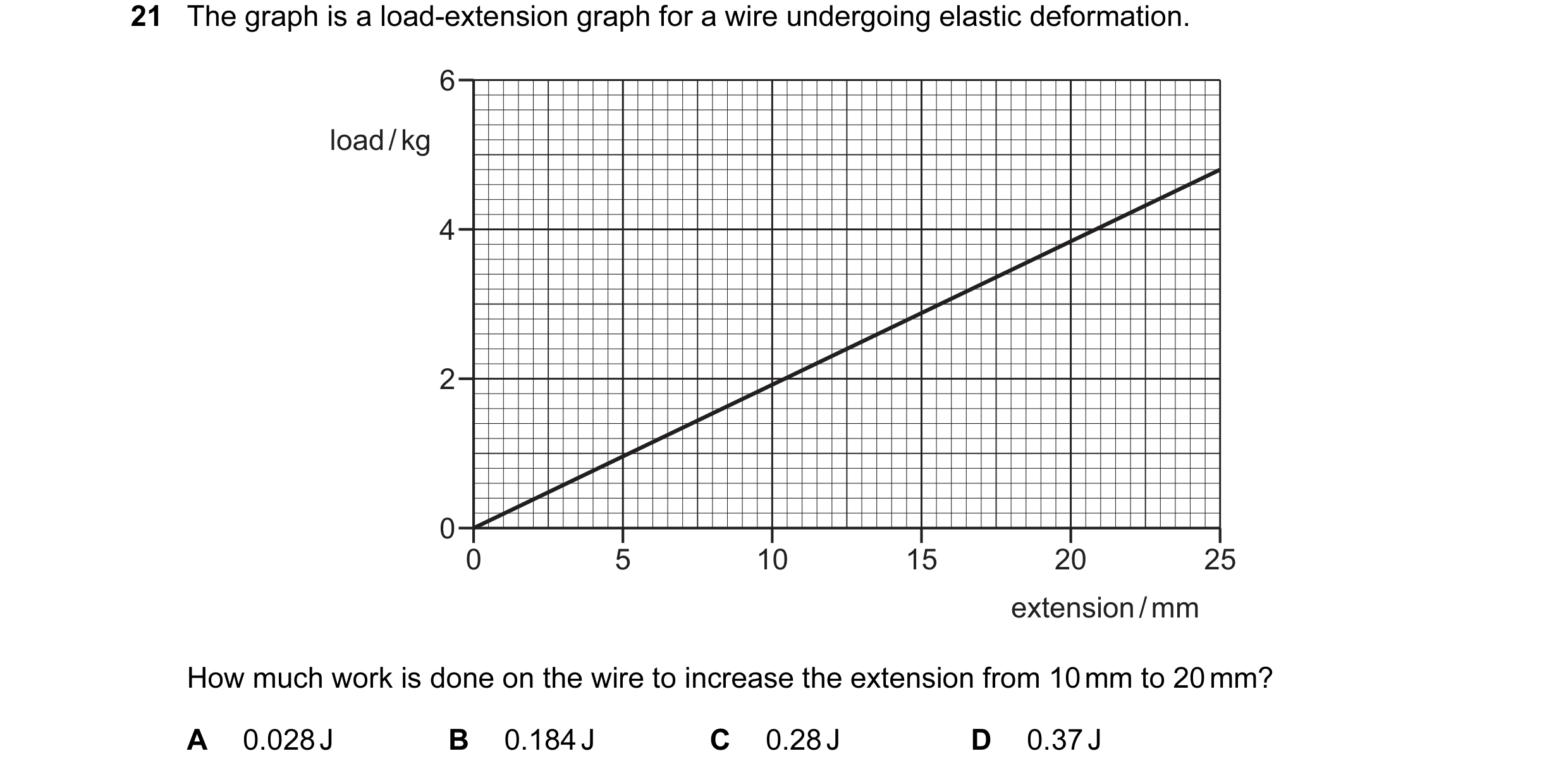
Q41 · The graph is a load-extension graph for a wire undergoing elastic deformation 9702/11 May/June 2014
21 The graph is a load-extension graph for a wire undergoing elastic deformation. 6 load / kg 4 2 0 0 5 10 15 20 25 extension / mm How much work is done on the wire to increase the extension from 10 mm to 20 mm? A 0.028 J B 0.184 J C 0.28 J D 0.37 J
1 marks
Answer: C
This question in 9702/11 May/June 2014
Q42 · A sample of metal is subjected to a force which increases to a maximum value and then… 9702/12 May/June 2014
19 A sample of metal is subjected to a force which increases to a maximum value and then decreases back to zero. A force-extension graph for the sample is shown. force Y X 0 0 extension When the sample contracts it follows the same force-extension curve as when it was being stretched. What is the behaviour of the metal between X and Y? A both elastic and plastic B not elastic and not plastic C plastic but not elastic D elastic but not plastic Space for working
1 marks
Answer: D
This question in 9702/12 May/June 2014
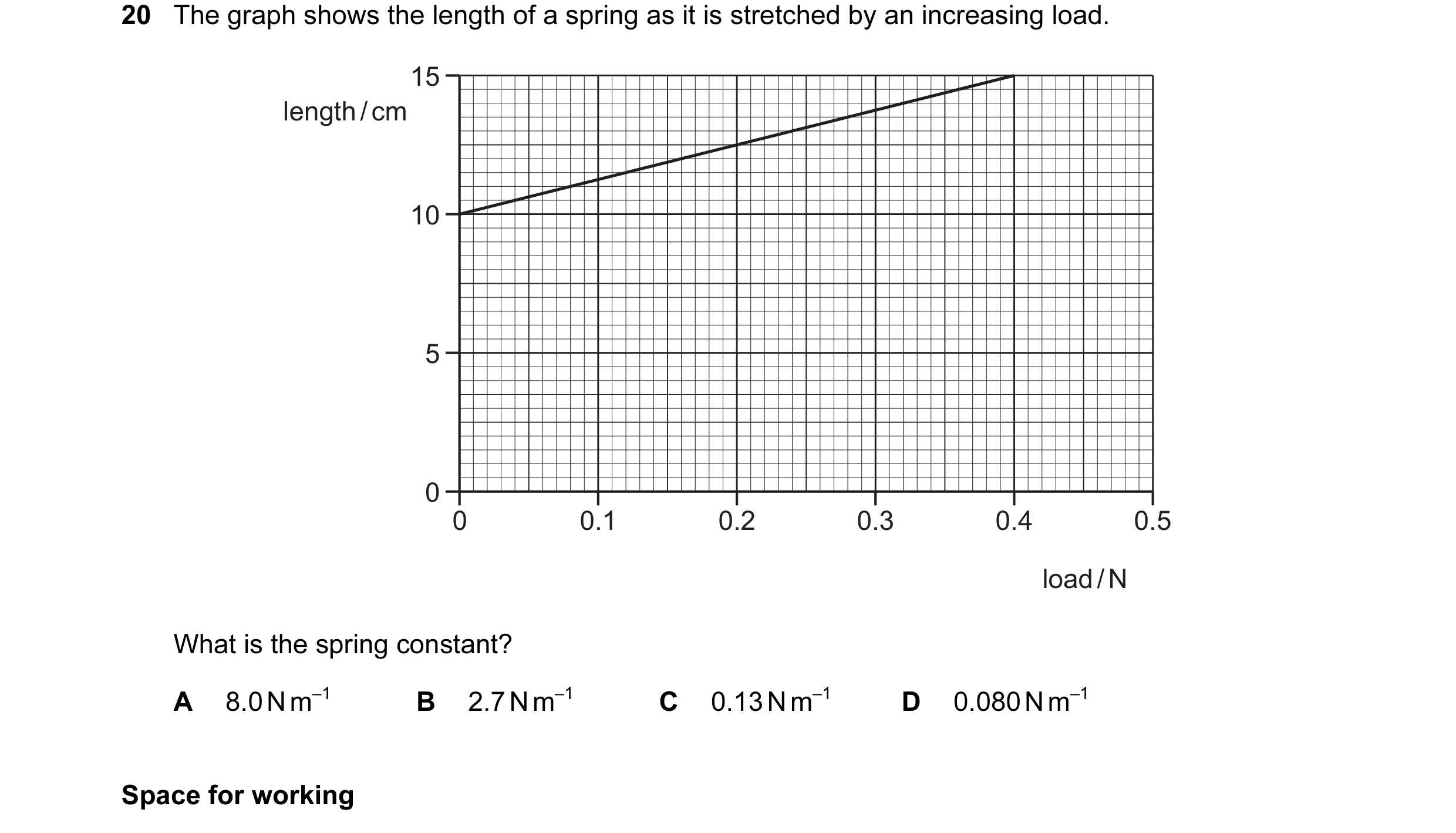
Q43 · The graph shows the length of a spring as it is stretched by an increasing load 9702/12 May/June 2014
20 The graph shows the length of a spring as it is stretched by an increasing load. 15 length / cm 10 5 0 0 0.1 0.2 0.3 0.4 0.5 load / N What is the spring constant? A 8.0 N m–1 B 2.7 N m–1 C 0.13 N m–1 D 0.080 N m–1 Space for working
1 marks
Answer: A
This question in 9702/12 May/June 2014
Q44 · A composite rod is made by attaching a glass-reinforced plastic rod and a nylon rod end… 9702/12 May/June 2014
21 A composite rod is made by attaching a glass-reinforced plastic rod and a nylon rod end to end, as shown. 1.00 m 1.00 m glass-reinforced plastic nylon Ep = 40 GPa En = 2.0 GPa The rods have the same cross-sectional area and each rod is 1.00 m in length. The Young modulus Ep of the plastic is 40 GPa and the Young modulus En of the nylon is 2.0 GPa. The composite rod will break when its total extension reaches 3.0 mm. What is the greatest tensile stress that can be applied to the composite rod before it breaks? A 7.1 × 10⁻¹⁴ Pa B 7.1 × 10⁻² Pa C 5.7 × 10⁶ Pa D 5.7 × 10⁹ Pa Space for working
1 marks
Answer: C
This question in 9702/12 May/June 2014
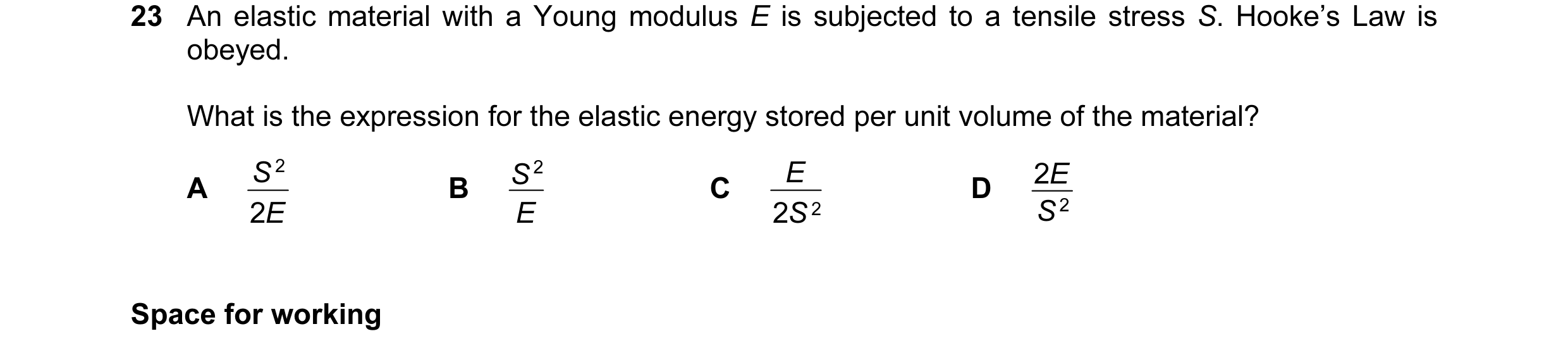
Q45 · An elastic material with a Young modulus E is subjected to a tensile stress S 9702/13 May/June 2014
23 An elastic material with a Young modulus E is subjected to a tensile stress S. Hooke’s Law is obeyed. What is the expression for the elastic energy stored per unit volume of the material? S 2 S 2 E 2 E A B C D 2 E E 2 S 2 S 2 Space for working
1 marks
Answer: A
This question in 9702/13 May/June 2014
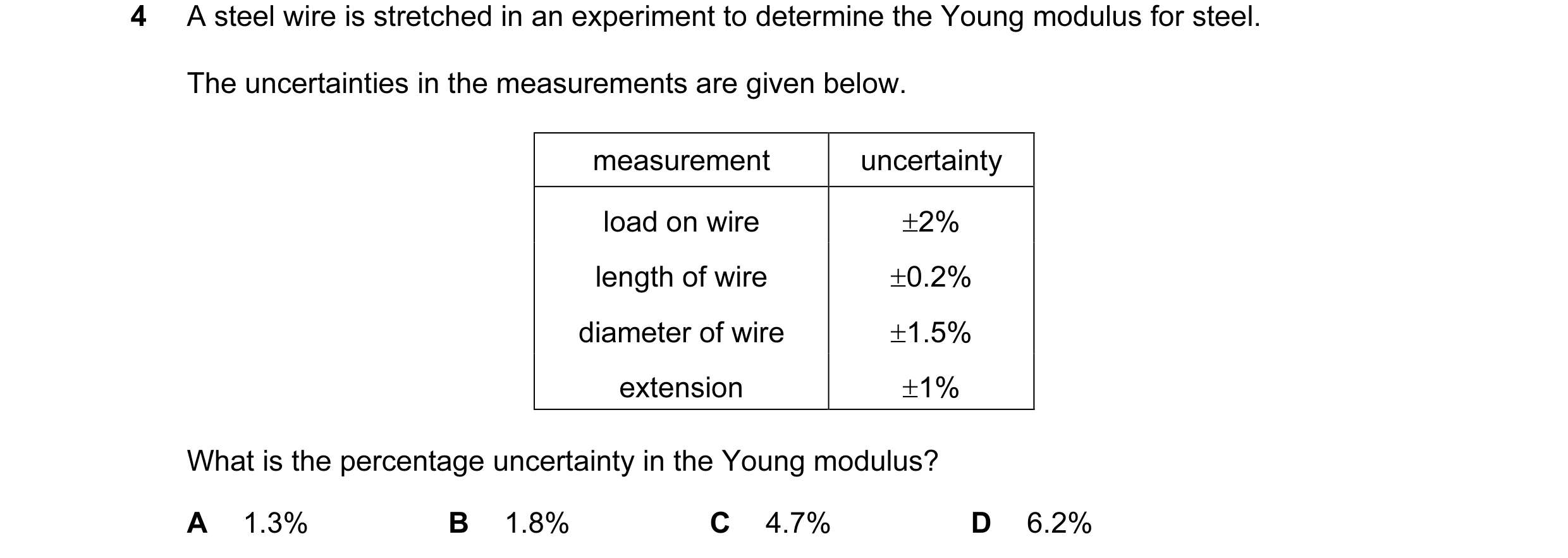
Q46 · A steel wire is stretched in an experiment to determine the Young modulus for steel 9702/12 Oct/Nov 2014
4 A steel wire is stretched in an experiment to determine the Young modulus for steel. The uncertainties in the measurements are given below. measurement uncertainty load on wire ±2% length of wire ±0.2% diameter of wire ±1.5% extension ±1% What is the percentage uncertainty in the Young modulus? A 1.3% B 1.8% C 4.7% D 6.2%
1 marks
Answer: D
This question in 9702/12 Oct/Nov 2014
Q47 · What is meant by the ultimate tensile stress of a material? 9702/13 Oct/Nov 2014
23 What is meant by the ultimate tensile stress of a material? A the maximum force that can be applied to a bar of the material before it bends B the maximum inter-atomic force before the atomic bonds of the material break C the maximum stretching force per unit cross-sectional area before the material breaks D the maximum tensile force in a wire of the material before it breaks
1 marks
Answer: C
This question in 9702/13 Oct/Nov 2014
Q48 · The graph shown was plotted in an experiment on a metal wire 9702/11 May/June 2015
22 The graph shown was plotted in an experiment on a metal wire. Y 00 X The shaded area represents the total strain energy stored in stretching the wire. How should the axes be labelled? Y X A force extension B mass extension C strain energy D stress strain
1 marks
Answer: A
This question in 9702/11 May/June 2015
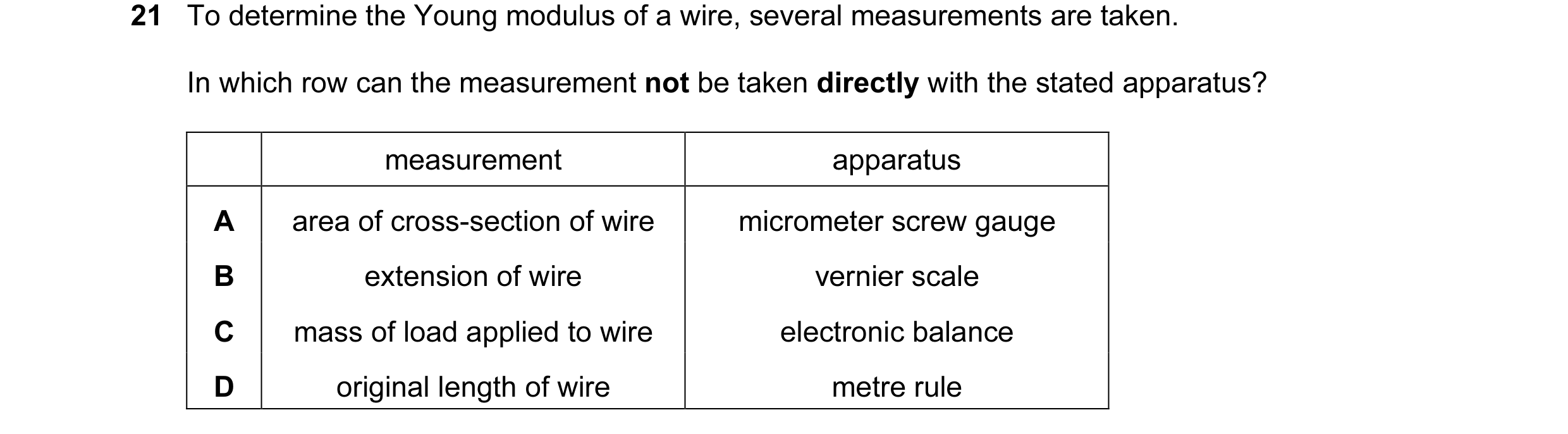
Q49 · To determine the Young modulus of a wire, several measurements are taken 9702/12 May/June 2015
21 To determine the Young modulus of a wire, several measurements are taken. In which row can the measurement not be taken directly with the stated apparatus? measurement apparatus A area of cross-section of wire micrometer screw gauge B extension of wire vernier scale C mass of load applied to wire electronic balance D original length of wire metre rule
1 marks
Answer: A
This question in 9702/12 May/June 2015
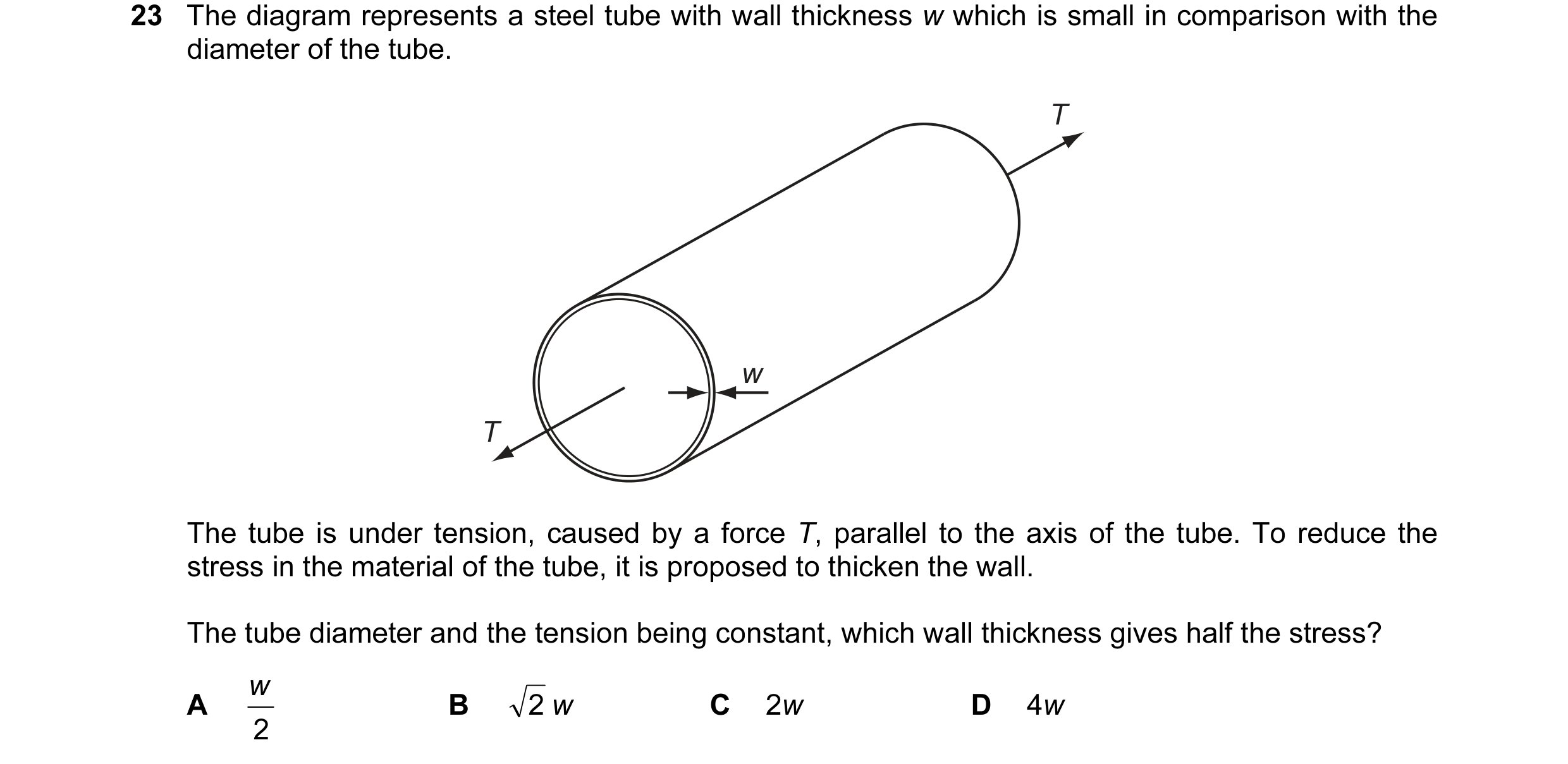
Q50 · The diagram represents a steel tube with wall thickness w which is small in comparison… 9702/12 May/June 2015
23 The diagram represents a steel tube with wall thickness w which is small in comparison with the diameter of the tube. T w T The tube is under tension, caused by a force T, parallel to the axis of the tube. To reduce the stress in the material of the tube, it is proposed to thicken the wall. The tube diameter and the tension being constant, which wall thickness gives half the stress? w A B 2 w C 2w D 4w 2
1 marks
Answer: C
This question in 9702/12 May/June 2015
Q51 · A steel bar of circular cross-section is under tension T, as shown 9702/13 May/June 2015
22 A steel bar of circular cross-section is under tension T, as shown. The diameter of the wide portion is double the diameter of the narrow portion. T T stress in the wide portion What is the value of ? stress in the narrow portion A 0.25 B 0.50 C 2.0 D 4.0
1 marks
Answer: A
This question in 9702/13 May/June 2015
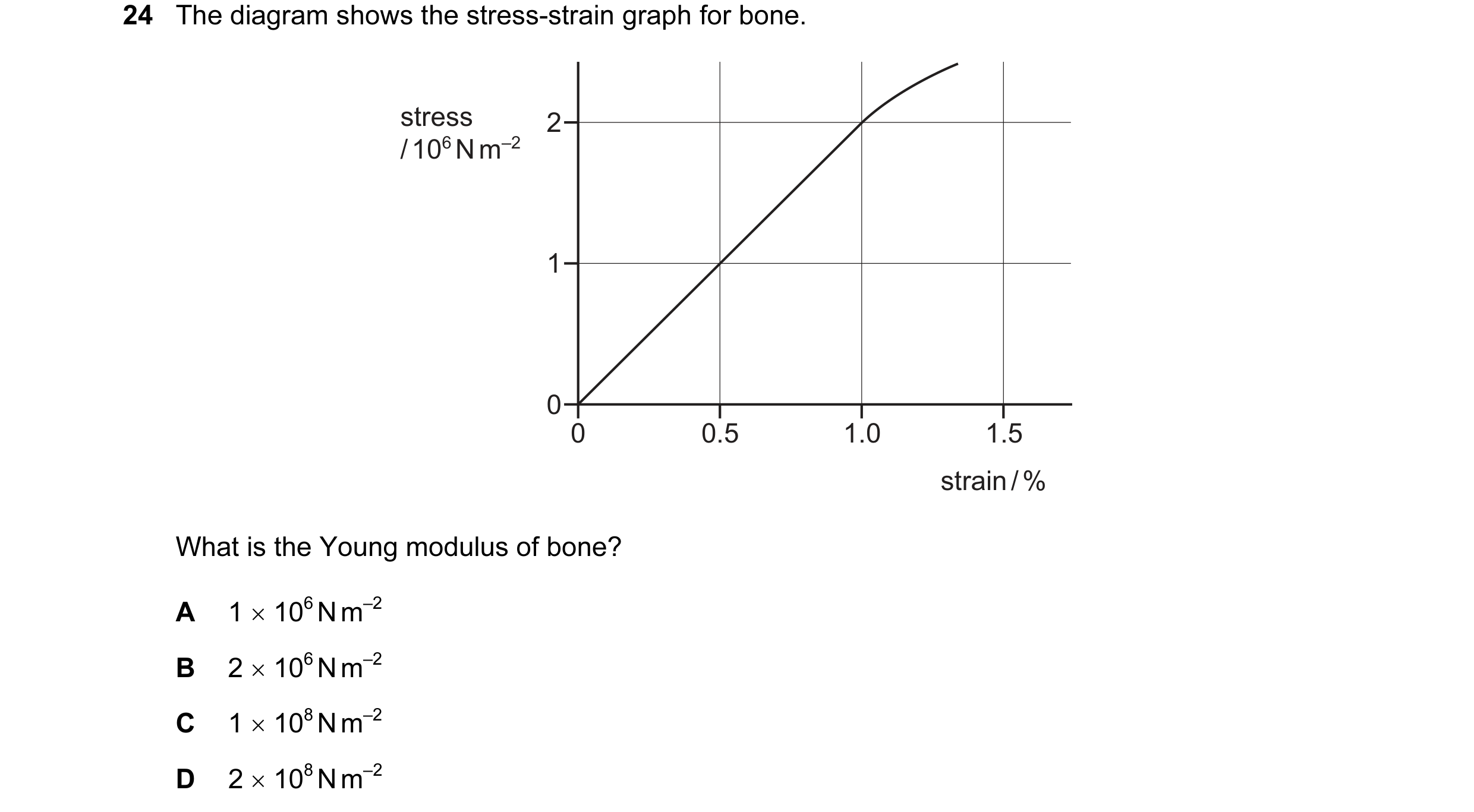
Q52 · The diagram shows the stress-strain graph for bone 9702/13 May/June 2015
24 The diagram shows the stress-strain graph for bone. stress 2 / 106 N m–2 1 0 0 0.5 1.0 1.5 strain / % What is the Young modulus of bone? A 1 × 10⁶ N m–2 B 2 × 10⁶ N m–2 C 1 × 10⁸ N m–2 D 2 × 10⁸ N m–2
1 marks
Answer: D
This question in 9702/13 May/June 2015
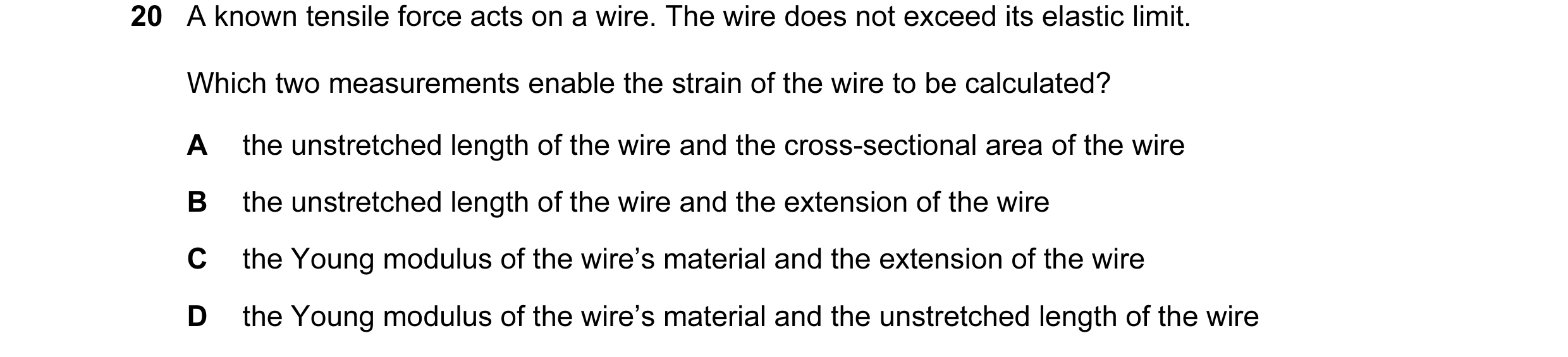
Q53 · A known tensile force acts on a wire 9702/11 Oct/Nov 2015
20 A known tensile force acts on a wire. The wire does not exceed its elastic limit. Which two measurements enable the strain of the wire to be calculated? A the unstretched length of the wire and the cross-sectional area of the wire B the unstretched length of the wire and the extension of the wire C the Young modulus of the wire’s material and the extension of the wire D the Young modulus of the wire’s material and the unstretched length of the wire
1 marks
Answer: B
This question in 9702/11 Oct/Nov 2015
Q54 · The Young modulus of steel is determined using a length of steel wire and is found to… 9702/11 Oct/Nov 2015
21 The Young modulus of steel is determined using a length of steel wire and is found to have the value E. Another experiment is carried out using a wire of the same steel, but of half the length and half the diameter. Which value is obtained for the Young modulus in the second experiment? A 1 E B E C 2E D 4E 2
1 marks
Answer: B
This question in 9702/11 Oct/Nov 2015
Q55 · A wire has a final length of 6.0 m after undergoing a strain of 200% 9702/11 Oct/Nov 2015
23 A wire has a final length of 6.0 m after undergoing a strain of 200%. What is the original length of the wire? A 1.5 m B 2.0 m C 3.0 m D 4.0 m
1 marks
Answer: B
This question in 9702/11 Oct/Nov 2015
Q56 · A force acts on a wire to produce extension e 9702/12 Oct/Nov 2015
21 A force acts on a wire to produce extension e. The same force then acts on a second wire of the same material, but of half the diameter and three times the length of the first wire. Both wires obey Hooke’s law. What is the extension of the second wire? A 3e B 4e C 6e D 12e
1 marks
Answer: D
This question in 9702/12 Oct/Nov 2015
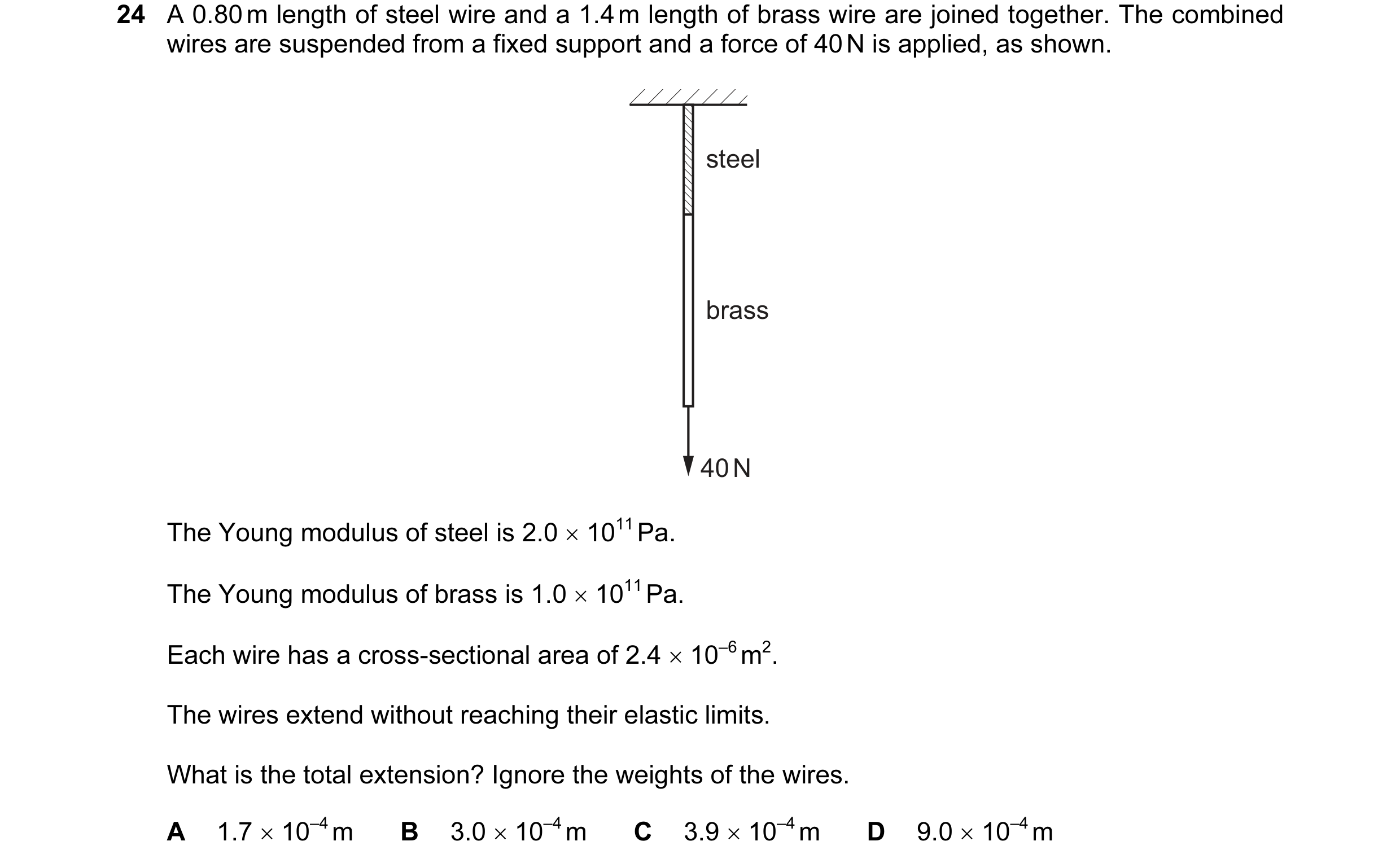
Q57 · A 0.80 m length of steel wire and a 1.4 m length of brass wire are joined together 9702/12 Oct/Nov 2015
24 A 0.80 m length of steel wire and a 1.4 m length of brass wire are joined together. The combined wires are suspended from a fixed support and a force of 40 N is applied, as shown. steel brass 40 N The Young modulus of steel is 2.0 × 10¹¹ Pa. The Young modulus of brass is 1.0 × 10¹¹ Pa. Each wire has a cross-sectional area of 2.4 × 10⁻⁶ m2. The wires extend without reaching their elastic limits. What is the total extension? Ignore the weights of the wires. A 1.7 × 10⁻⁴ m B 3.0 × 10⁻⁴ m C 3.9 × 10⁻⁴ m D 9.0 × 10⁻⁴ m
1 marks
Answer: B
This question in 9702/12 Oct/Nov 2015
Q58 · What is the unit of the Young modulus when expressed in SI base units? 9702/13 Oct/Nov 2015
1 What is the unit of the Young modulus when expressed in SI base units? A kg m–1 s–2 B kg m3 s–2 C kg m–2 D kg m–1 s–1
1 marks
Answer: A
This question in 9702/13 Oct/Nov 2015
Q59 · The Young modulus of a metal may be determined from the ratio strain stretched elastically 9702/13 Oct/Nov 2015
20 The Young modulus of a metal may be determined from the ratio strain stretched elastically. This can be done by making measurements when loads are added to a wire. Which measurements are needed to calculate the stress and strain of the wire in such an experiment? stress strain A wire diameter initial and final wire’s original mass added positions of load length B wire diameter mass added wire’s original initial and final length positions of load C wire’s original initial and final wire diameter mass added length positions of load D wire’s original mass added wire diameter initial and final length positions of load
1 marks
Answer: B
This question in 9702/13 Oct/Nov 2015
Q60 · A copper wire of length 3.6 m and diameter 1.22 mm is stretched elastically by a force of… 9702/13 Oct/Nov 2015
21 A copper wire of length 3.6 m and diameter 1.22 mm is stretched elastically by a force of 37 N. The Young modulus of copper is 1.17 × 10¹¹ Pa. Which extension is caused by this force? A 0.24 mm B 0.76 mm C 0.97 mm D 3.1 mm
1 marks
Answer: C
This question in 9702/13 Oct/Nov 2015
Q61 · Tensile strain may be measured by the change in electrical resistance of a device called… 9702/13 Oct/Nov 2015
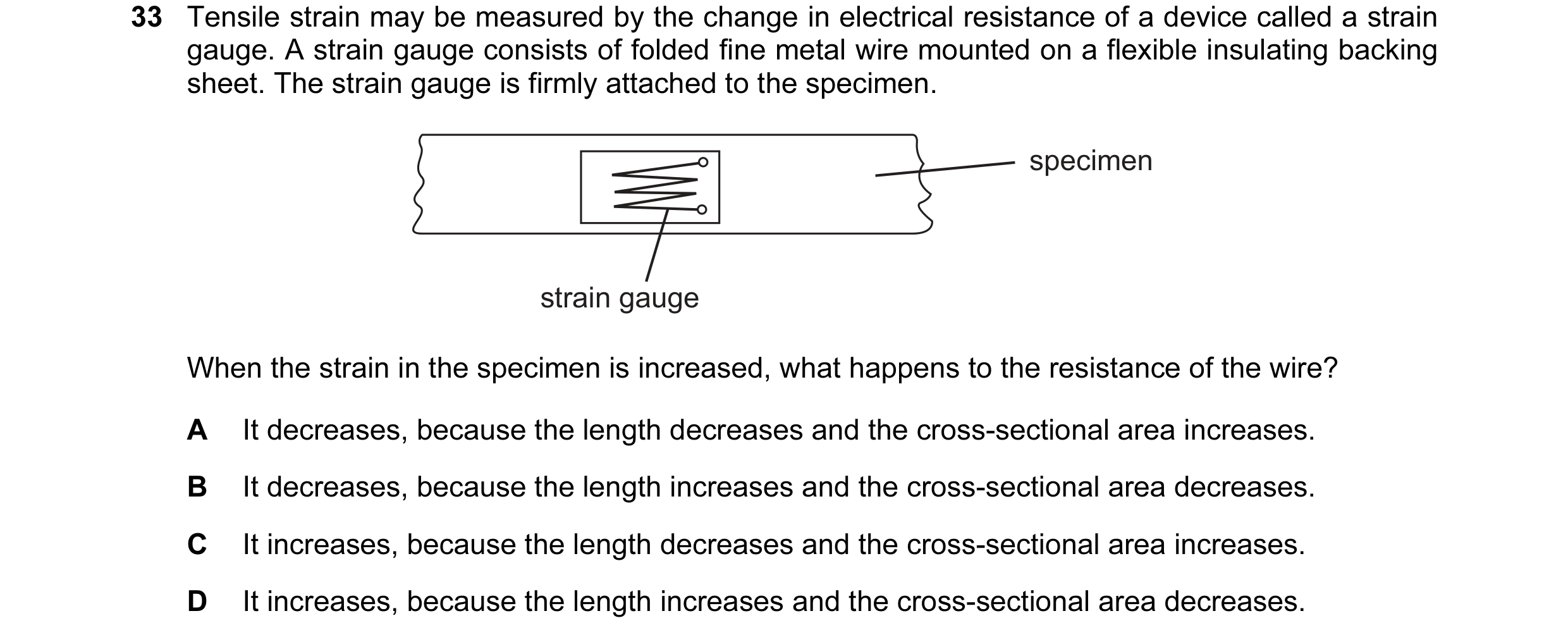
33 Tensile strain may be measured by the change in electrical resistance of a device called a strain gauge. A strain gauge consists of folded fine metal wire mounted on a flexible insulating backing sheet. The strain gauge is firmly attached to the specimen. specimen strain gauge When the strain in the specimen is increased, what happens to the resistance of the wire? A It decreases, because the length decreases and the cross-sectional area increases. B It decreases, because the length increases and the cross-sectional area decreases. C It increases, because the length decreases and the cross-sectional area increases. D It increases, because the length increases and the cross-sectional area decreases.
1 marks
Answer: D
This question in 9702/13 Oct/Nov 2015
Q62 · The Young modulus of steel is twice that of copper 9702/12 Feb/March 2016
19 The Young modulus of steel is twice that of copper. A 50 cm length of copper wire of diameter 2.0 mm is joined to a 50 cm length of steel wire of diameter 1.0 mm, making a combination wire of length 1.0 m, as shown. fixed support copper wire steel wire weight The combination wire is stretched by a weight added to its end. Both the copper and the steel wires obey Hooke’s law. extension of steel wire What is the ratio ? extension of copper wire A 4 B 2 C 1 D 0.5
1 marks
Answer: B
This question in 9702/12 Feb/March 2016
Q63 · A lift is supported by two steel cables, each of length 10 m and diameter 0.5 cm 9702/11 May/June 2016
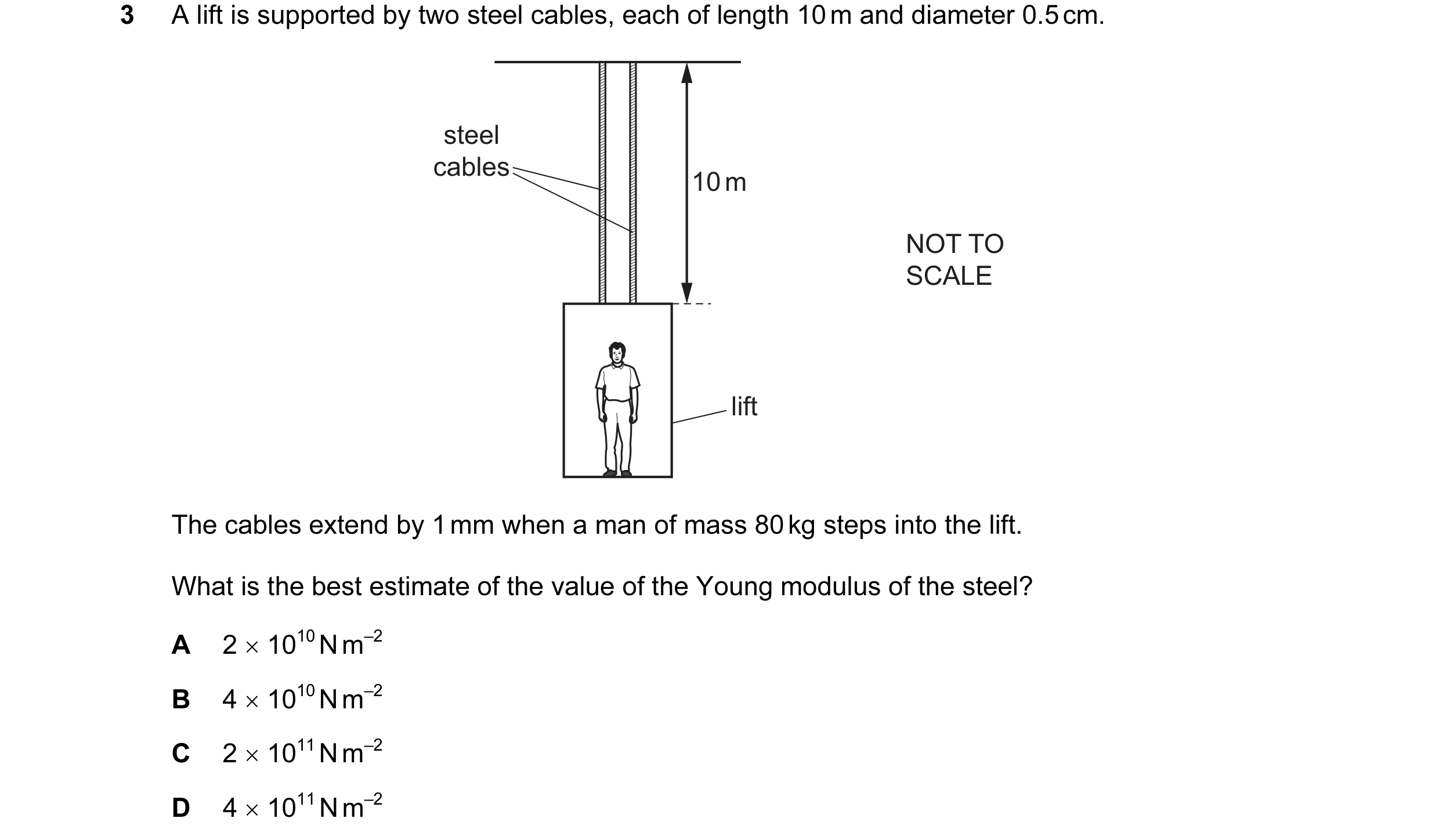
3 A lift is supported by two steel cables, each of length 10 m and diameter 0.5 cm. steel cables 10 m NOT TO SCALE lift The cables extend by 1 mm when a man of mass 80 kg steps into the lift. What is the best estimate of the value of the Young modulus of the steel? A 2 × 10¹⁰ N m–2 B 4 × 10¹⁰ N m–2 C 2 × 10¹¹ N m–2 D 4 × 10¹¹ N m–2
1 marks
Answer: C
This question in 9702/11 May/June 2016
Q64 · The stress σ needed to fracture a particular solid is given by the equation γ E σ = k d… 9702/13 May/June 2016
2 The stress σ needed to fracture a particular solid is given by the equation γ E σ = k d where E is the Young modulus, d is the distance between planes of atoms, and k is a constant with no units. What are the SI base units of γ ? A kg m s–2 B kg s–2 C kg m s–1 D kg s–1
1 marks
Answer: B
This question in 9702/13 May/June 2016
Q65 · A metal wire of cross-sectional area 0.20 mm2 hangs vertically from a fixed point 9702/13 May/June 2016
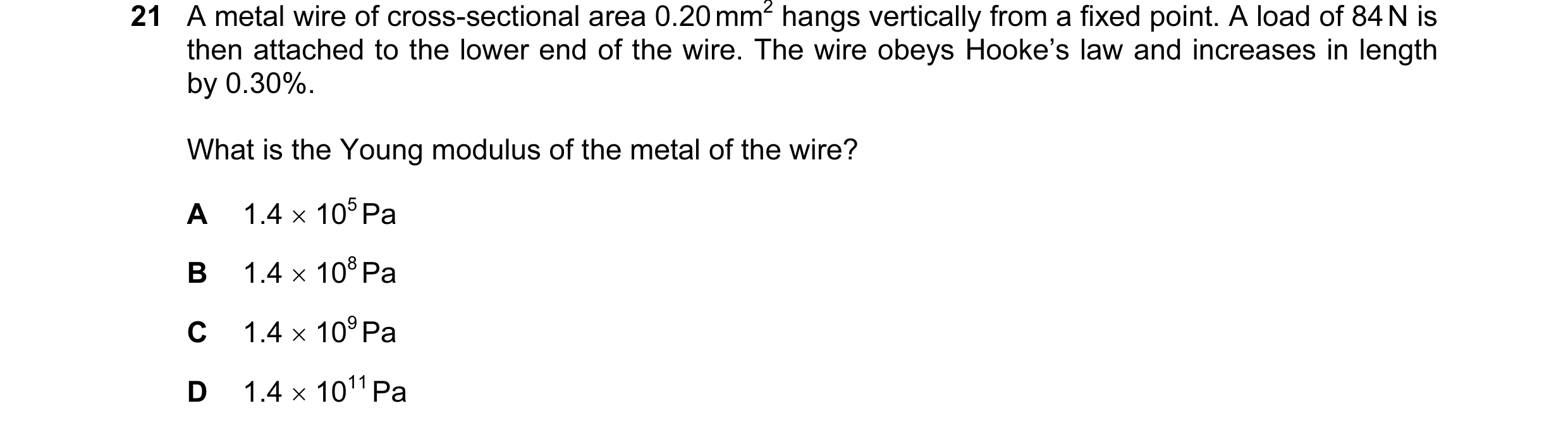
21 A metal wire of cross-sectional area 0.20 mm2 hangs vertically from a fixed point. A load of 84 N is then attached to the lower end of the wire. The wire obeys Hooke’s law and increases in length by 0.30%. What is the Young modulus of the metal of the wire? A 1.4 × 10⁵ Pa B 1.4 × 10⁸ Pa C 1.4 × 10⁹ Pa D 1.4 × 10¹¹ Pa
1 marks
Answer: D
This question in 9702/13 May/June 2016
Q66 · The diagram shows a beam supported on two pivots 9702/13 May/June 2016
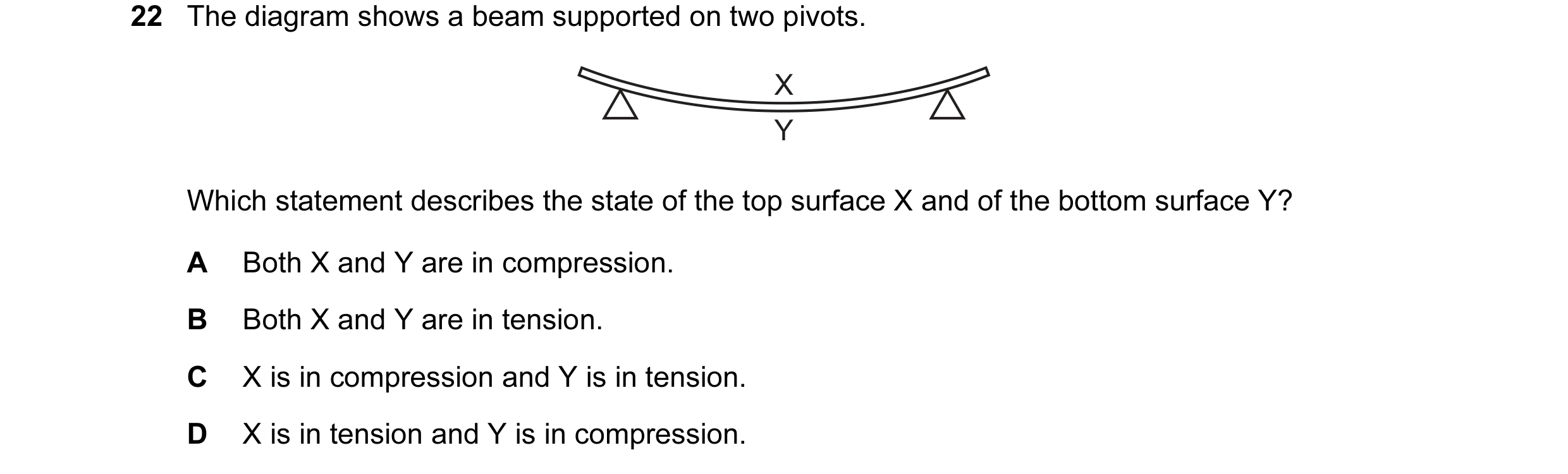
22 The diagram shows a beam supported on two pivots. X Y Which statement describes the state of the top surface X and of the bottom surface Y? A Both X and Y are in compression. B Both X and Y are in tension. C X is in compression and Y is in tension. D X is in tension and Y is in compression.
1 marks
Answer: C
This question in 9702/13 May/June 2016
Q67 · What is the order of magnitude of the Young modulus for a metal such as copper? 9702/11 Oct/Nov 2016
1 What is the order of magnitude of the Young modulus for a metal such as copper? A 10–11 Pa B 10–4 Pa C 104 Pa D 1011 Pa
1 marks
Answer: D
This question in 9702/11 Oct/Nov 2016
Q68 · A copper wire hangs vertically from a fixed point 9702/11 Oct/Nov 2016
22 A copper wire hangs vertically from a fixed point. A load is attached to the lower end of the wire producing an extension x. The wire obeys Hooke’s law. Which single change gives an extension 2x? A Halve the cross-sectional area of the wire. B Halve the diameter of the wire. C Halve the length of the wire. D Halve the load on the wire.
1 marks
Answer: A
This question in 9702/11 Oct/Nov 2016
Q69 · What is the order of magnitude of the Young modulus for a metal such as copper? 9702/13 Oct/Nov 2016
1 What is the order of magnitude of the Young modulus for a metal such as copper? A 10–11 Pa B 10–4 Pa C 104 Pa D 1011 Pa
1 marks
Answer: D
This question in 9702/13 Oct/Nov 2016
Q70 · A copper wire hangs vertically from a fixed point 9702/13 Oct/Nov 2016
22 A copper wire hangs vertically from a fixed point. A load is attached to the lower end of the wire producing an extension x. The wire obeys Hooke’s law. Which single change gives an extension 2x? A Halve the cross-sectional area of the wire. B Halve the diameter of the wire. C Halve the length of the wire. D Halve the load on the wire.
1 marks
Answer: A
This question in 9702/13 Oct/Nov 2016
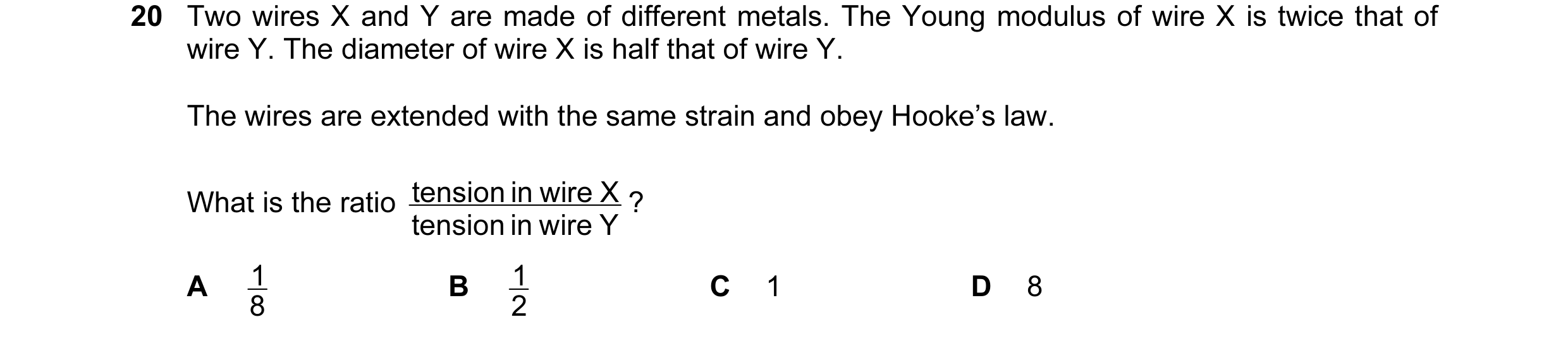
Q71 · Two wires X and Y are made of different metals 9702/12 Feb/March 2017
20 Two wires X and Y are made of different metals. The Young modulus of wire X is twice that of wire Y. The diameter of wire X is half that of wire Y. The wires are extended with the same strain and obey Hooke’s law. What is the ratio tension in wire X ? tension in wire Y A 1 B 1 C 1 D 8 8 2
1 marks
Answer: B
This question in 9702/12 Feb/March 2017
Q72 · A wire of diameter d and length l hangs vertically from a fixed point 9702/11 May/June 2017
20 A wire of diameter d and length l hangs vertically from a fixed point. The wire is extended by hanging a mass M on its end. The Young modulus of the wire is E. The acceleration of free fall is g. Which equation is used to determine the extension x of the wire? M l Mg l 4 Mg l 4 Mg l A x = B x = C x = D x = π d 2 E π d 2 E π dE π d 2 E
1 marks
Answer: D
This question in 9702/11 May/June 2017
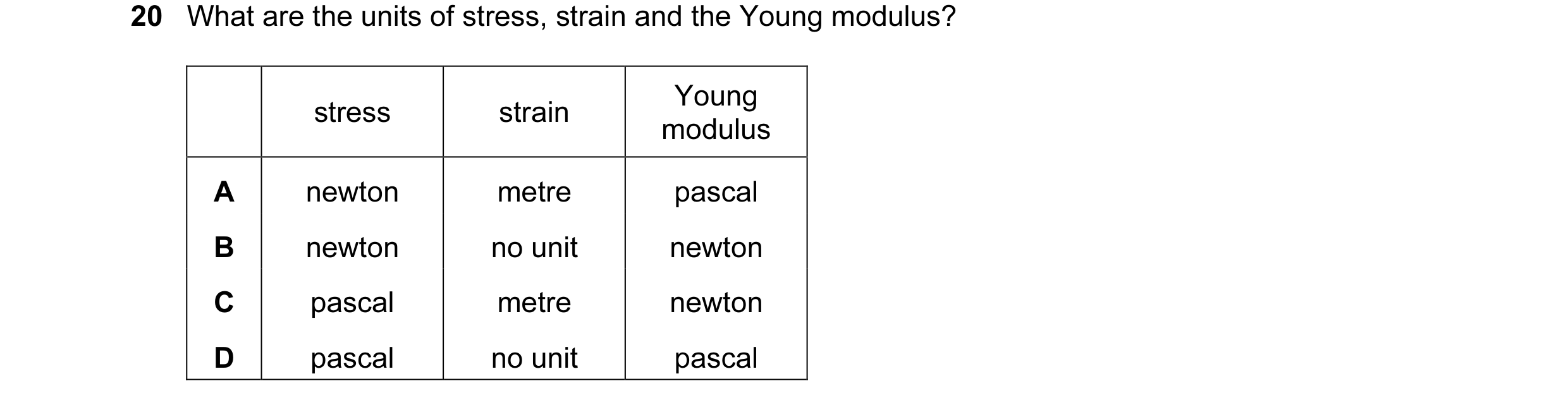
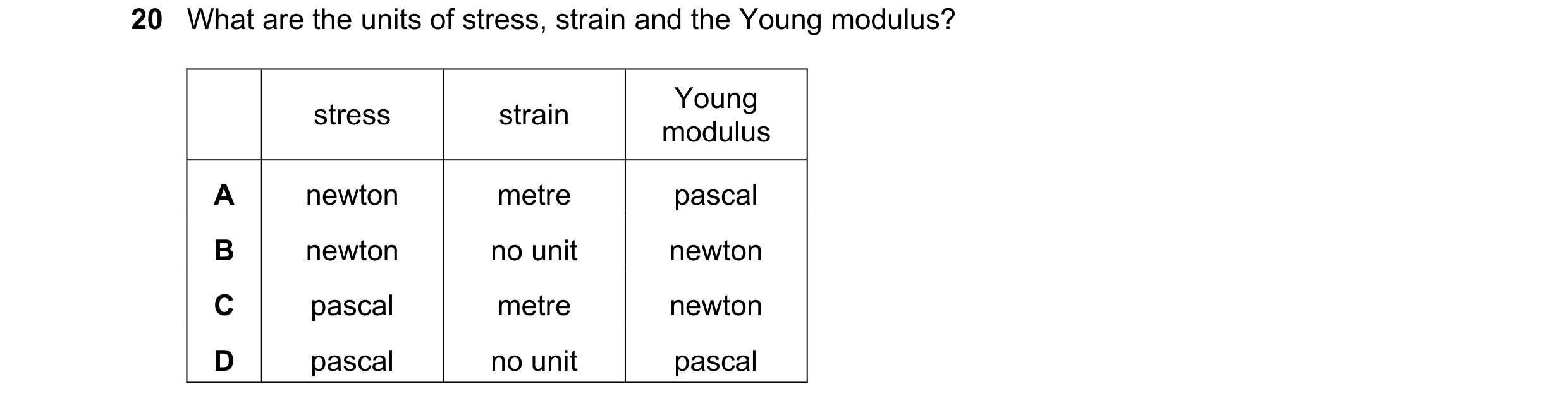
Q73 · What are the units of stress, strain and the Young modulus? 9702/12 May/June 2017
20 What are the units of stress, strain and the Young modulus? Young stress strain modulus A newton metre pascal B newton no unit newton C pascal metre newton D pascal no unit pascal
1 marks
Answer: D
This question in 9702/12 May/June 2017
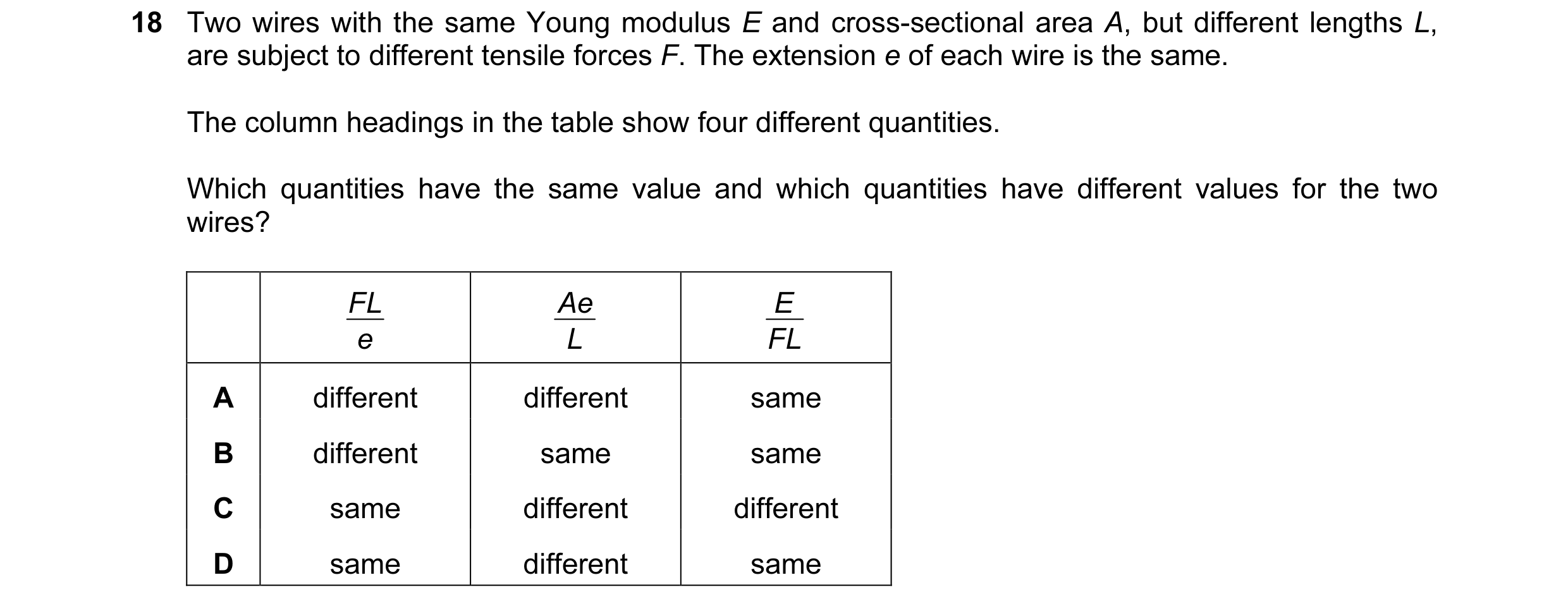
Q74 · Two wires with the same Young modulus E and cross-sectional area A, but different lengths… 9702/13 May/June 2017
18 Two wires with the same Young modulus E and cross-sectional area A, but different lengths L, are subject to different tensile forces F. The extension e of each wire is the same. The column headings in the table show four different quantities. Which quantities have the same value and which quantities have different values for the two wires? FL Ae E e L FL A different different same B different same same C same different different D same different same
1 marks
Answer: D
This question in 9702/13 May/June 2017
Q75 · The stress-strain graph for a metal is shown 9702/11 Oct/Nov 2017
21 The stress-strain graph for a metal is shown. 2 stress / GPa 1 0 0 0.005 0.010 strain What is the strain energy per unit volume of a rod made from this metal when the strain of the rod is 0.010? A 10 kJ m–3 B 100 kJ m–3 C 1.0 MJ m–3 D 10 MJ m–3
1 marks
Answer: D
This question in 9702/11 Oct/Nov 2017
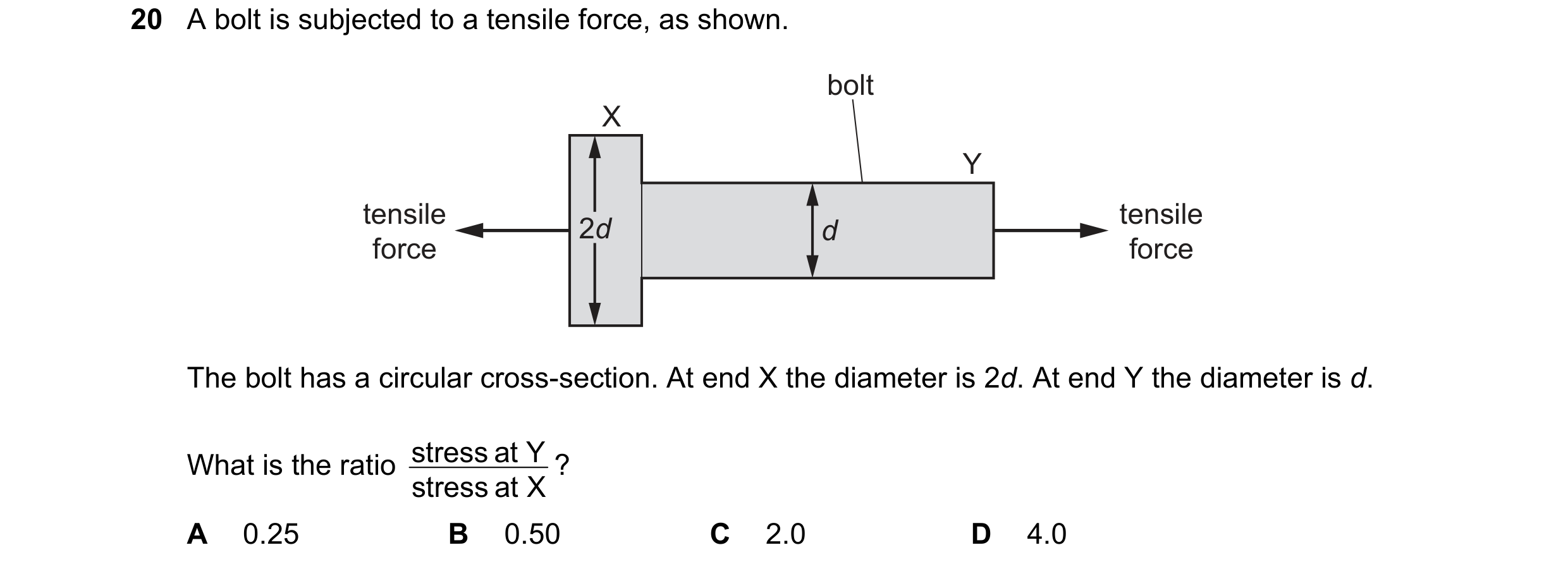
Q76 · A bolt is subjected to a tensile force, as shown 9702/12 Oct/Nov 2017
20 A bolt is subjected to a tensile force, as shown. bolt X Y tensile tensile 2d d force force The bolt has a circular cross-section. At end X the diameter is 2d. At end Y the diameter is d. What is the ratio stress at Y ? stress at X A 0.25 B 0.50 C 2.0 D 4.0
1 marks
Answer: D
This question in 9702/12 Oct/Nov 2017
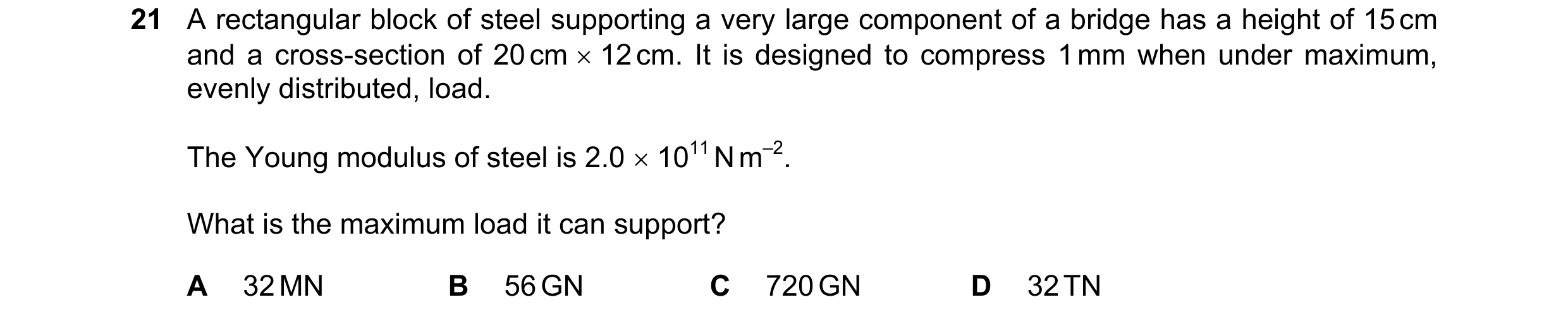
Q77 · A rectangular block of steel supporting a very large component of a bridge has a height… 9702/12 Oct/Nov 2017
21 A rectangular block of steel supporting a very large component of a bridge has a height of 15 cm and a cross-section of 20 cm × 12 cm. It is designed to compress 1 mm when under maximum, evenly distributed, load. The Young modulus of steel is 2.0 × 10¹¹ N m–2. What is the maximum load it can support? A 32 MN B 56 GN C 720 GN D 32 TN
1 marks
Answer: A
This question in 9702/12 Oct/Nov 2017
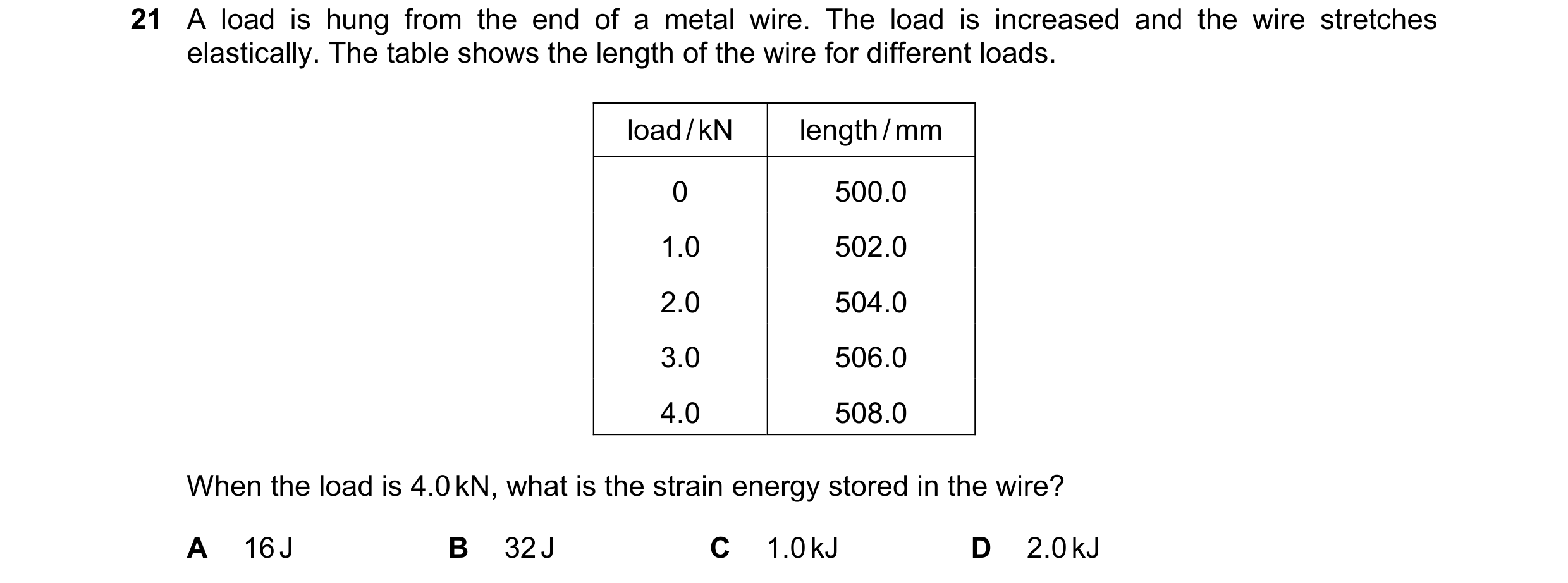
Q78 · A load is hung from the end of a metal wire 9702/13 Oct/Nov 2017
21 A load is hung from the end of a metal wire. The load is increased and the wire stretches elastically. The table shows the length of the wire for different loads. load / kN length / mm 0 500.0 1.0 502.0 2.0 504.0 3.0 506.0 4.0 508.0 When the load is 4.0 kN, what is the strain energy stored in the wire? A 16 J B 32 J C 1.0 kJ D 2.0 kJ
1 marks
Answer: A
This question in 9702/13 Oct/Nov 2017
Q79 · The diagram shows a large crane on a construction site lifting a cube-shaped load at a… 9702/12 Feb/March 2018
20 The diagram shows a large crane on a construction site lifting a cube-shaped load at a constant speed. cable crane load A model is made of the crane, its load and the cable supporting the load. The material used for each part of the model is the same as that in the full-size crane, cable and load. The model is one tenth full-size in all linear dimensions. stress in the cable on the full - size crane What is the ratio ? stress in the cable on the model crane A 0.1 B 1 C 10 D 100
1 marks
Answer: C
This question in 9702/12 Feb/March 2018
Q80 · What is a unit for stress? 9702/11 May/June 2018
1 What is a unit for stress? A kg m–1 s–2 B kg m–2 s–2 C N m–1 D N m
1 marks
Answer: A
This question in 9702/11 May/June 2018
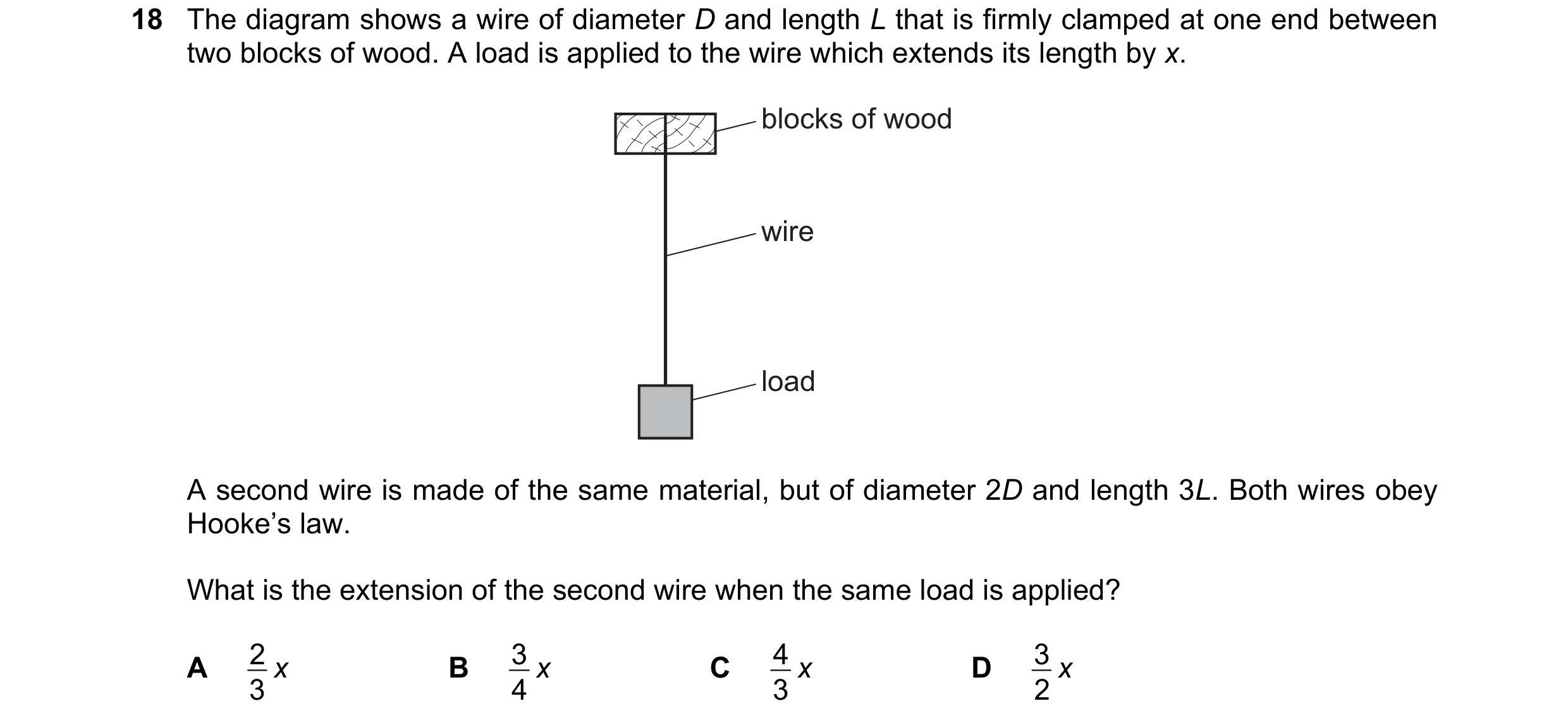
Q81 · The diagram shows a wire of diameter D and length L that is firmly clamped at one end… 9702/11 May/June 2018
18 The diagram shows a wire of diameter D and length L that is firmly clamped at one end between two blocks of wood. A load is applied to the wire which extends its length by x. blocks of wood wire load A second wire is made of the same material, but of diameter 2D and length 3L. Both wires obey Hooke’s law. What is the extension of the second wire when the same load is applied? 2 3 4 3 A x B x C x D x 3 4 3 2
1 marks
Answer: B
This question in 9702/11 May/June 2018
Q82 · Two wires, one made of brass and the other of steel, are stretched in an experiment 9702/11 May/June 2018
19 Two wires, one made of brass and the other of steel, are stretched in an experiment. Both wires obey Hooke’s law during this experiment. The Young modulus for brass is less than the Young modulus for steel. Which graph shows how the stress varies with strain for both wires in this experiment? A B stress steel stress steel brass brass 0 0 0 strain 0 strain C D stress brass stress brass steel steel 0 0 0 strain 0 strain
1 marks
Answer: B
This question in 9702/11 May/June 2018
Q83 · An elastic material with Young modulus E is subjected to a tensile stress S 9702/12 May/June 2018
20 An elastic material with Young modulus E is subjected to a tensile stress S. Hooke’s law is obeyed. What is the expression for the elastic energy stored per unit volume of the material? E 2 E S 2 S A B C D 2 2 S S 2 E 2 E 2
1 marks
Answer: D
This question in 9702/12 May/June 2018
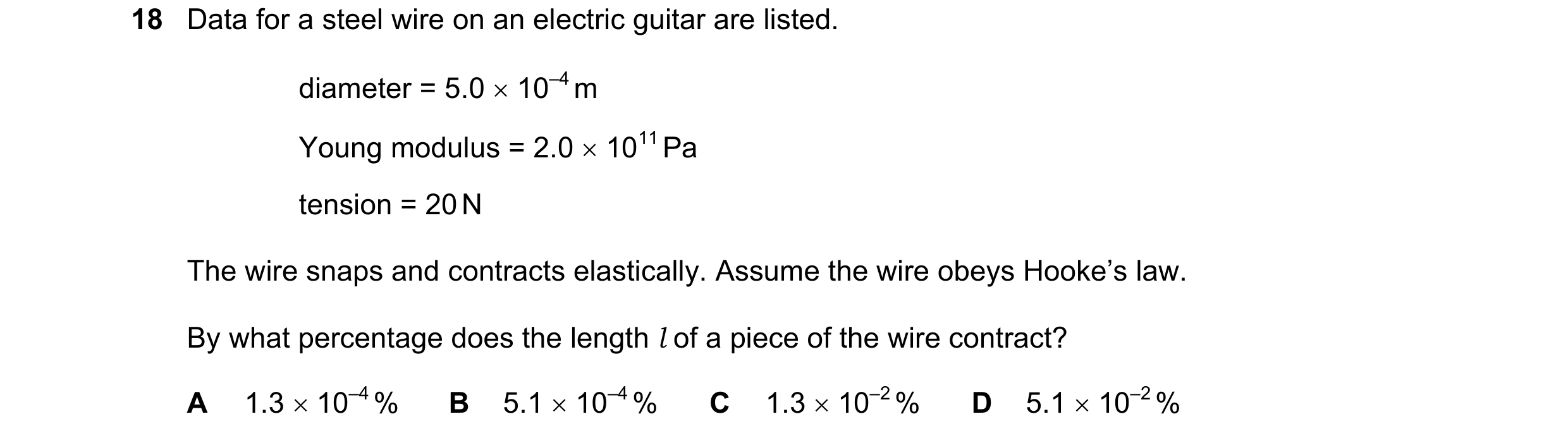
Q84 · Data for a steel wire on an electric guitar are listed 9702/13 May/June 2018
18 Data for a steel wire on an electric guitar are listed. diameter = 5.0 × 10⁻⁴ m Young modulus = 2.0 × 10¹¹ Pa tension = 20 N The wire snaps and contracts elastically. Assume the wire obeys Hooke’s law. By what percentage does the length l of a piece of the wire contract? A 1.3 × 10⁻⁴ % B 5.1 × 10⁻⁴ % C 1.3 × 10⁻² % D 5.1 × 10⁻² %
1 marks
Answer: D
This question in 9702/13 May/June 2018
Q85 · Two wires X and Y are made from the same material 9702/11 Oct/Nov 2018
18 Two wires X and Y are made from the same material. Wire Y has twice the diameter and experiences twice the tension of wire X. The wires obey Hooke’s law and have the same original length. wire X wire Y diameter d diameter 2d tension T tension 2T Wire X has extension e. What is the extension of wire Y? e e A B C e D 2e 4 2
1 marks
Answer: B
This question in 9702/11 Oct/Nov 2018
Q86 · What is represented by the gradient of a graph of force (vertical axis) against extension… 9702/11 Oct/Nov 2018
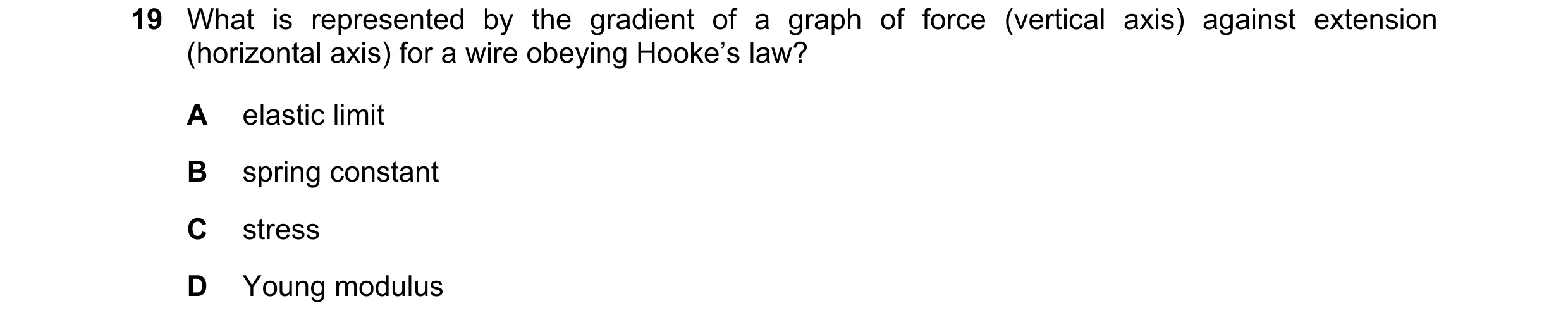
19 What is represented by the gradient of a graph of force (vertical axis) against extension (horizontal axis) for a wire obeying Hooke’s law? A elastic limit B spring constant C stress D Young modulus
1 marks
Answer: B
This question in 9702/11 Oct/Nov 2018
Q87 · A metal cylinder is able to withstand a compressive force of 4.0 kN without deforming… 9702/12 Oct/Nov 2018
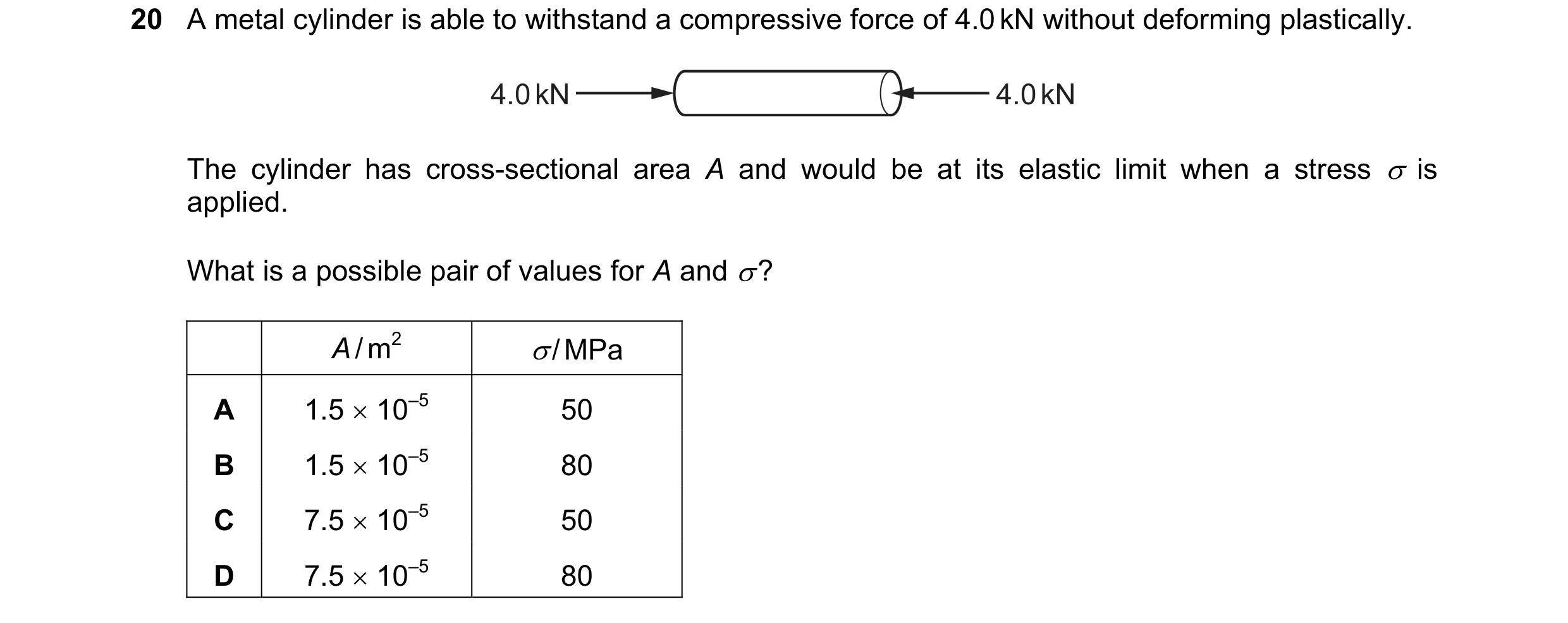
20 A metal cylinder is able to withstand a compressive force of 4.0 kN without deforming plastically. 4.0 kN 4.0 kN The cylinder has cross-sectional area A and would be at its elastic limit when a stress σ is applied. What is a possible pair of values for A and σ ? A / m2 σ / MPa A 1.5 × 10⁻⁵ 50 B 1.5 × 10⁻⁵ 80 C 7.5 × 10⁻⁵ 50 D 7.5 × 10⁻⁵ 80
1 marks
Answer: D
This question in 9702/12 Oct/Nov 2018
Q88 · In an experiment to measure the Young modulus of a metal, a wire of the metal of diameter… 9702/13 Oct/Nov 2018
19 In an experiment to measure the Young modulus of a metal, a wire of the metal of diameter 0.25 mm is clamped, as shown. wire clamp pulley pulley marker F scale The wire passes from a clamp, around a frictionless pulley, and then to a second frictionless pulley where loads F are applied to it. A marker is attached to the wire so that the total length of wire between the clamp and the marker is initially 3.70 m. A scale is fixed near to this marker. The graph shows how the reading on the scale varies with F. 8.0 marker position 7.0 on scale / mm 6.0 5.0 4.0 3.0 2.0 1.0 0 0 2 4 6 8 10 F / N What is the Young modulus of the metal? A 5.5 × 10¹⁰ Pa B 9.4 × 10¹⁰ Pa C 1.6 × 10¹¹ Pa D 2.2 × 10¹¹ Pa
1 marks
Answer: D
This question in 9702/13 Oct/Nov 2018
Q89 · A metal wire, fixed at one end, has length l and cross-sectional area A 9702/12 Feb/March 2019
19 A metal wire, fixed at one end, has length l and cross-sectional area A. The wire extends a distance e when mass m is hung from the other end of the wire. What is an expression for the Young Modulus E of the metal? ml E = mgl E = me E = mge A E = Ae B Ae C Al D Al
1 marks
Answer: B
This question in 9702/12 Feb/March 2019
Q90 · A 0.80 m length of steel wire and a 1.4 m length of brass wire are joined together 9702/11 May/June 2019
21 A 0.80 m length of steel wire and a 1.4 m length of brass wire are joined together. The combined wires are suspended from a fixed support and a force of 40 N is applied, as shown. steel brass 40 N The Young modulus of steel is 2.0 × 10¹¹ Pa. The Young modulus of brass is 1.0 × 10¹¹ Pa. Each wire has a cross-sectional area of 2.4 × 10⁻⁶ m2. The wires obey Hooke’s law. What is the total extension? Ignore the weights of the wires. A 1.7 × 10⁻⁴ m B 3.0 × 10⁻⁴ m C 3.9 × 10⁻⁴ m D 9.0 × 10⁻⁴ m
1 marks
Answer: B
This question in 9702/11 May/June 2019
Q91 · A wire X is stretched by a force and gains elastic potential energy E 9702/12 May/June 2019
20 A wire X is stretched by a force and gains elastic potential energy E. The same force is applied to wire Y of the same material, with the same initial length but twice the diameter of wire X. Both wires obey Hooke’s law. What is the gain in elastic potential energy of wire Y? A 0.25E B 0.5E C 2E D 4E
1 marks
Answer: A
This question in 9702/12 May/June 2019
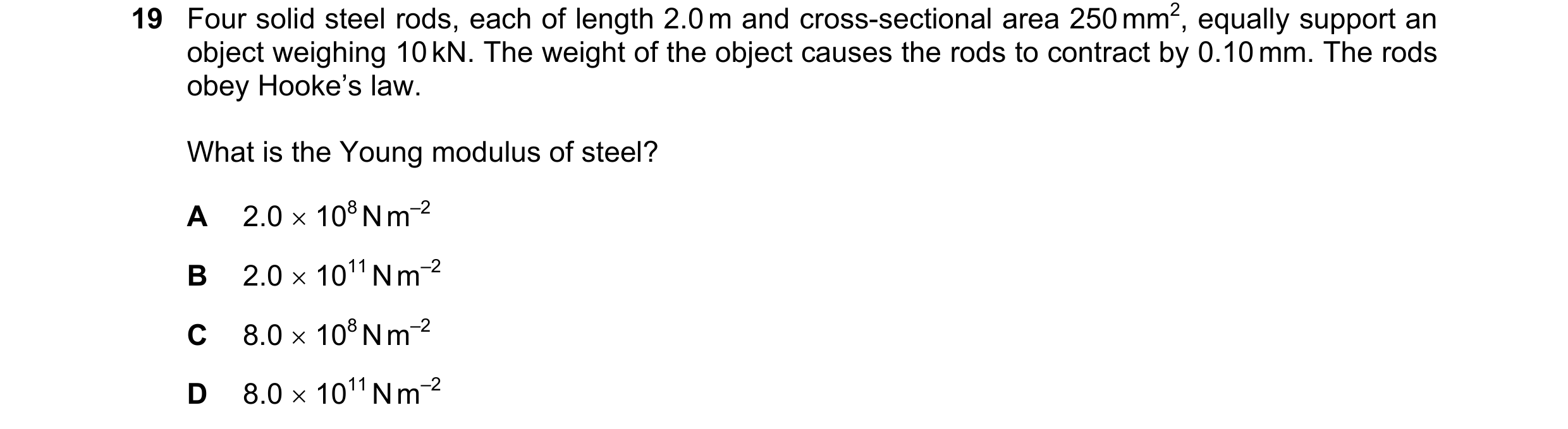
Q92 · Four solid steel rods, each of length 2.0 m and cross-sectional area 250 mm2, equally… 9702/13 May/June 2019
19 Four solid steel rods, each of length 2.0 m and cross-sectional area 250 mm2, equally support an object weighing 10 kN. The weight of the object causes the rods to contract by 0.10 mm. The rods obey Hooke’s law. What is the Young modulus of steel? A 2.0 × 10⁸ N m–2 B 2.0 × 10¹¹ N m–2 C 8.0 × 10⁸ N m–2 D 8.0 × 10¹¹ N m–2
1 marks
Answer: B
This question in 9702/13 May/June 2019
Q93 · An extension–force graph for a spring is shown 9702/11 Oct/Nov 2019
19 An extension–force graph for a spring is shown. 15 extension / cm 0 0 6.0 force / N What is the spring constant of the spring? A 0.025 N m–1 B 0.40 N m–1 C 2.5 N m–1 D 40 N m–1
1 marks
Answer: D
This question in 9702/11 Oct/Nov 2019
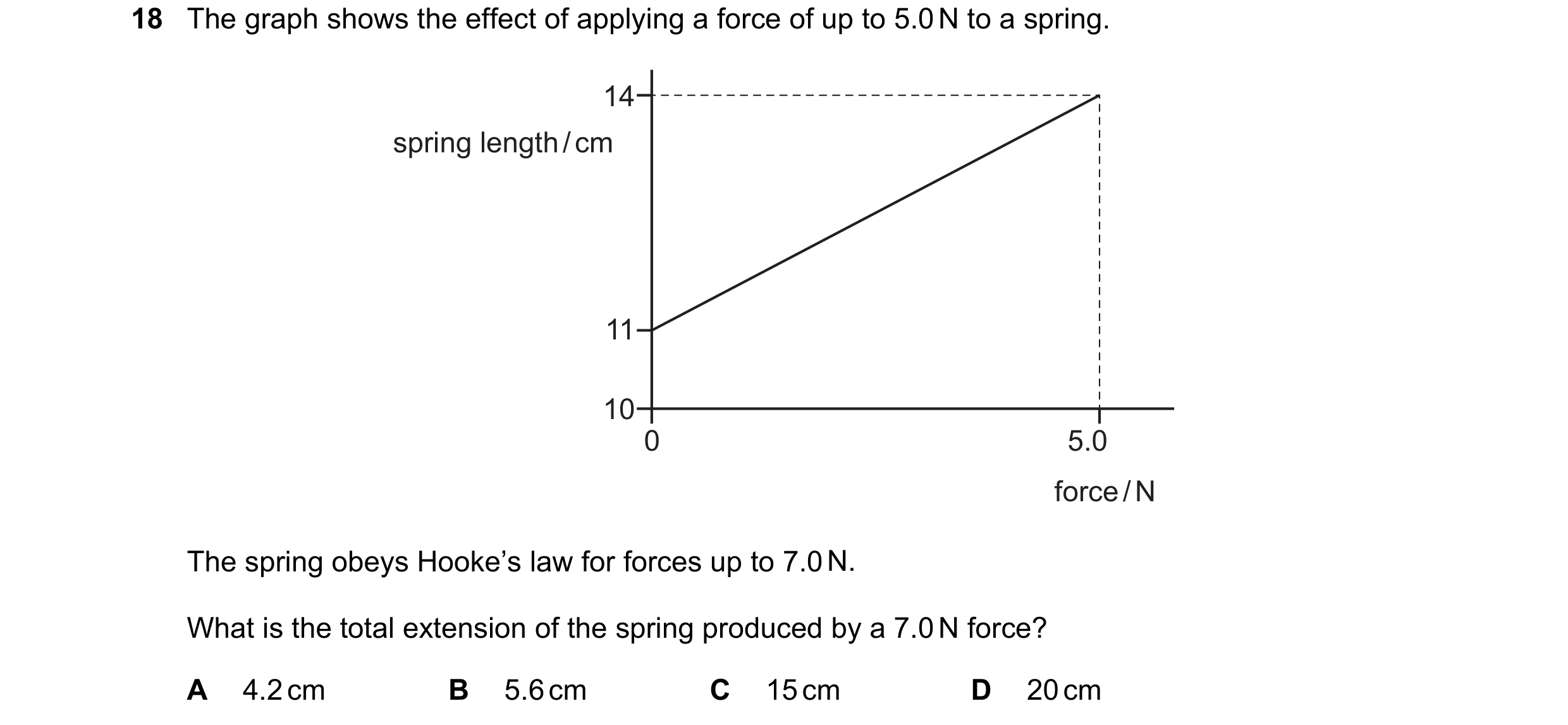
Q94 · The graph shows the effect of applying a force of up to 5.0 N to a spring 9702/12 Oct/Nov 2019
18 The graph shows the effect of applying a force of up to 5.0 N to a spring. 14 spring length / cm 11 10 0 5.0 force / N The spring obeys Hooke’s law for forces up to 7.0 N. What is the total extension of the spring produced by a 7.0 N force? A 4.2 cm B 5.6 cm C 15 cm D 20 cm
1 marks
Answer: A
This question in 9702/12 Oct/Nov 2019
Q95 · The stress–strain graph for a wire is shown 9702/13 Oct/Nov 2019
19 The stress–strain graph for a wire is shown. stress / 108 Pa 2.1 0 0 1.4 strain / 10–3 What is the Young modulus of the material of the wire? A 6.7 × 10⁻¹² Pa B 6.7 × 10⁻⁹ Pa C 1.5 × 10⁸ Pa D 1.5 × 10¹¹ Pa
1 marks
Answer: D
This question in 9702/13 Oct/Nov 2019
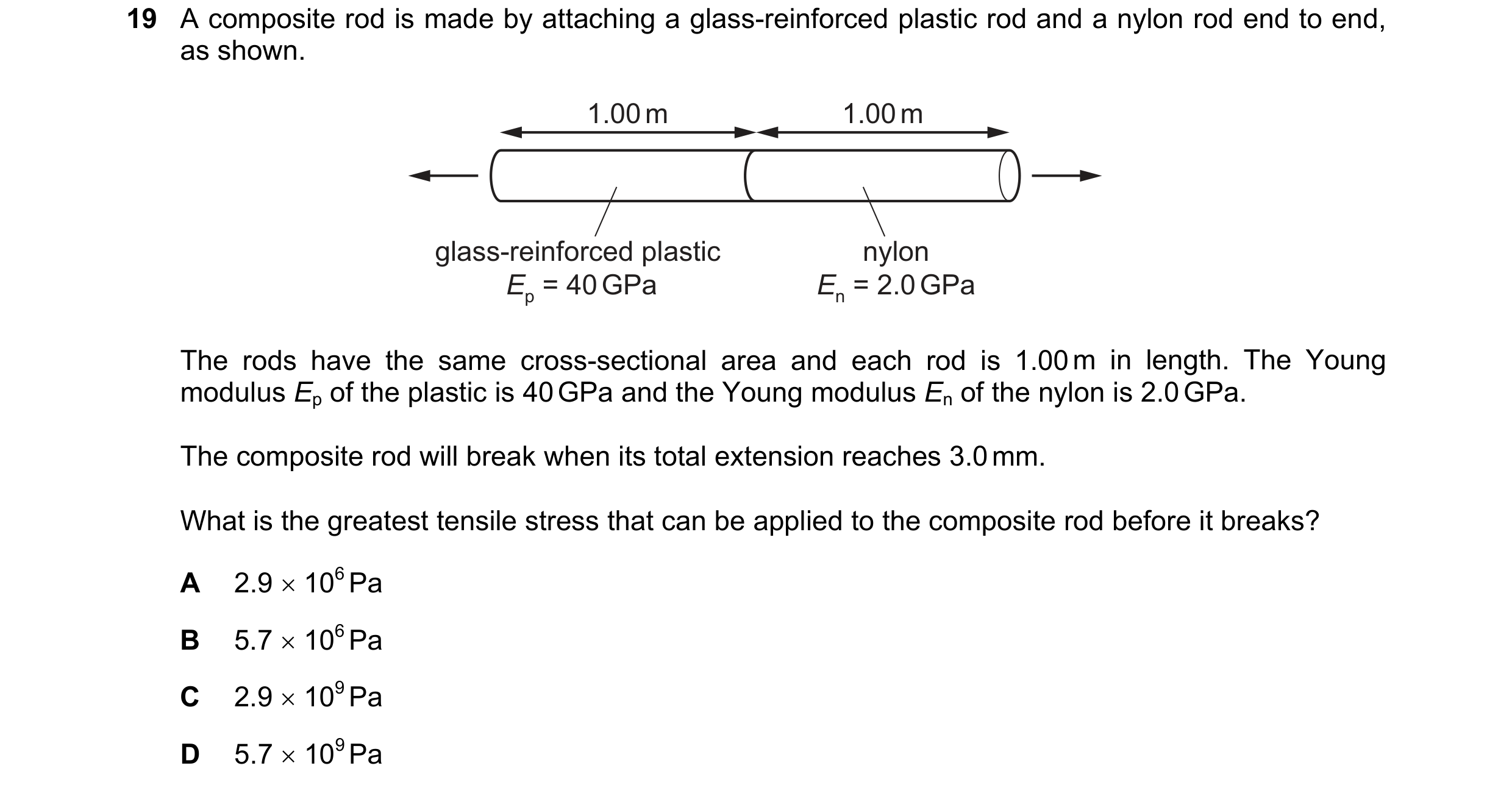
Q96 · A composite rod is made by attaching a glass-reinforced plastic rod and a nylon rod end… 9702/12 Feb/March 2020
19 A composite rod is made by attaching a glass-reinforced plastic rod and a nylon rod end to end, as shown. 1.00 m 1.00 m glass-reinforced plastic nylon Ep = 40 GPa En = 2.0 GPa The rods have the same cross-sectional area and each rod is 1.00 m in length. The Young modulus Ep of the plastic is 40 GPa and the Young modulus En of the nylon is 2.0 GPa. The composite rod will break when its total extension reaches 3.0 mm. What is the greatest tensile stress that can be applied to the composite rod before it breaks? A 2.9 × 10⁶ Pa B 5.7 × 10⁶ Pa C 2.9 × 10⁹ Pa D 5.7 × 10⁹ Pa
1 marks
Answer: B
This question in 9702/12 Feb/March 2020
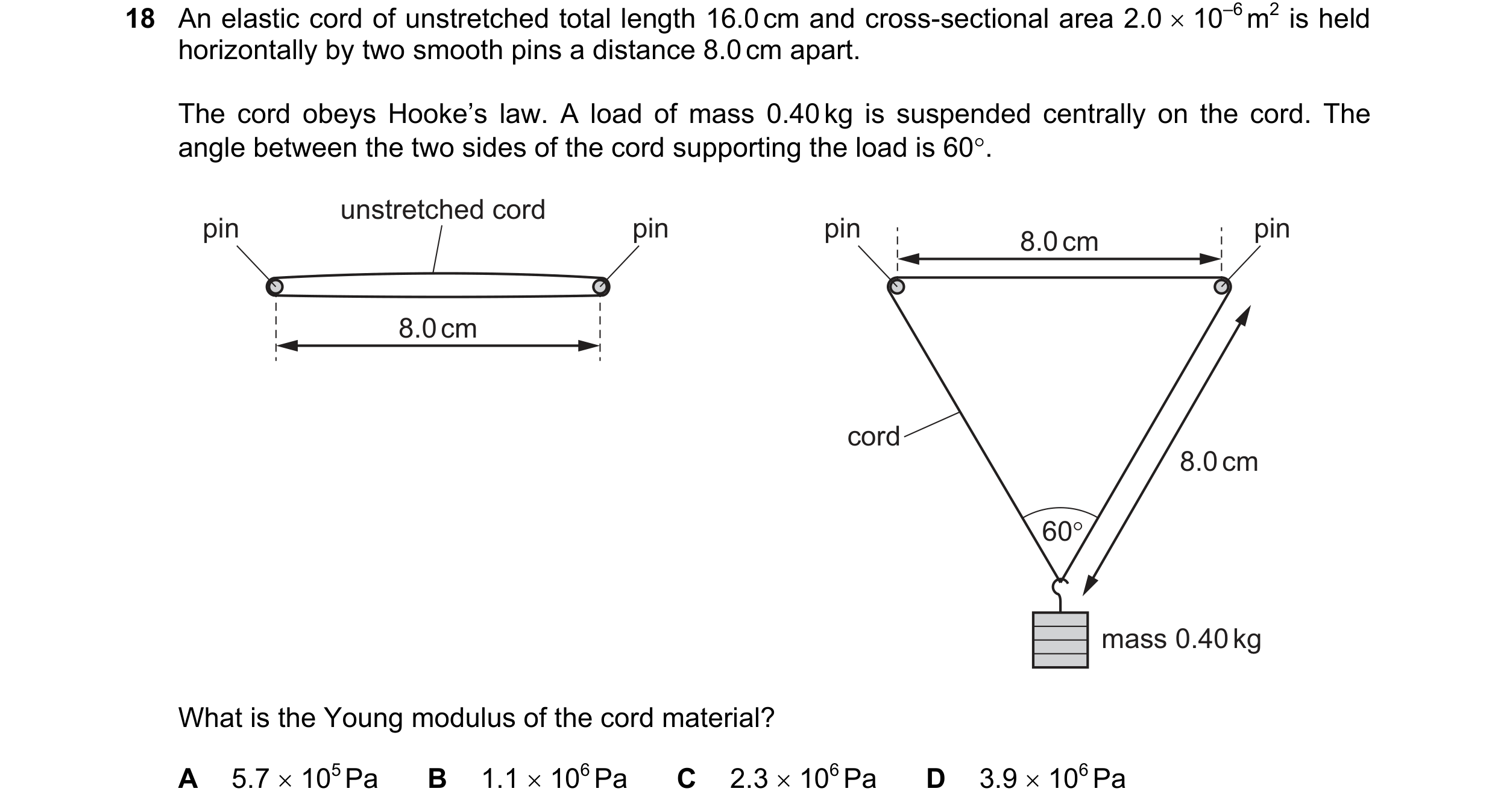
Q97 · An elastic cord of unstretched total length 16.0 cm and cross-sectional area 2.0 × 10⁻⁶… 9702/12 May/June 2020
18 An elastic cord of unstretched total length 16.0 cm and cross-sectional area 2.0 × 10⁻⁶ m2 is held horizontally by two smooth pins a distance 8.0 cm apart. The cord obeys Hooke’s law. A load of mass 0.40 kg is suspended centrally on the cord. The angle between the two sides of the cord supporting the load is 60°. unstretched cord pin pin pin pin 8.0 cm 8.0 cm cord 8.0 cm 60° mass 0.40 kg What is the Young modulus of the cord material? A 5.7 × 10⁵ Pa B 1.1 × 10⁶ Pa C 2.3 × 10⁶ Pa D 3.9 × 10⁶ Pa
1 marks
Answer: C
This question in 9702/12 May/June 2020
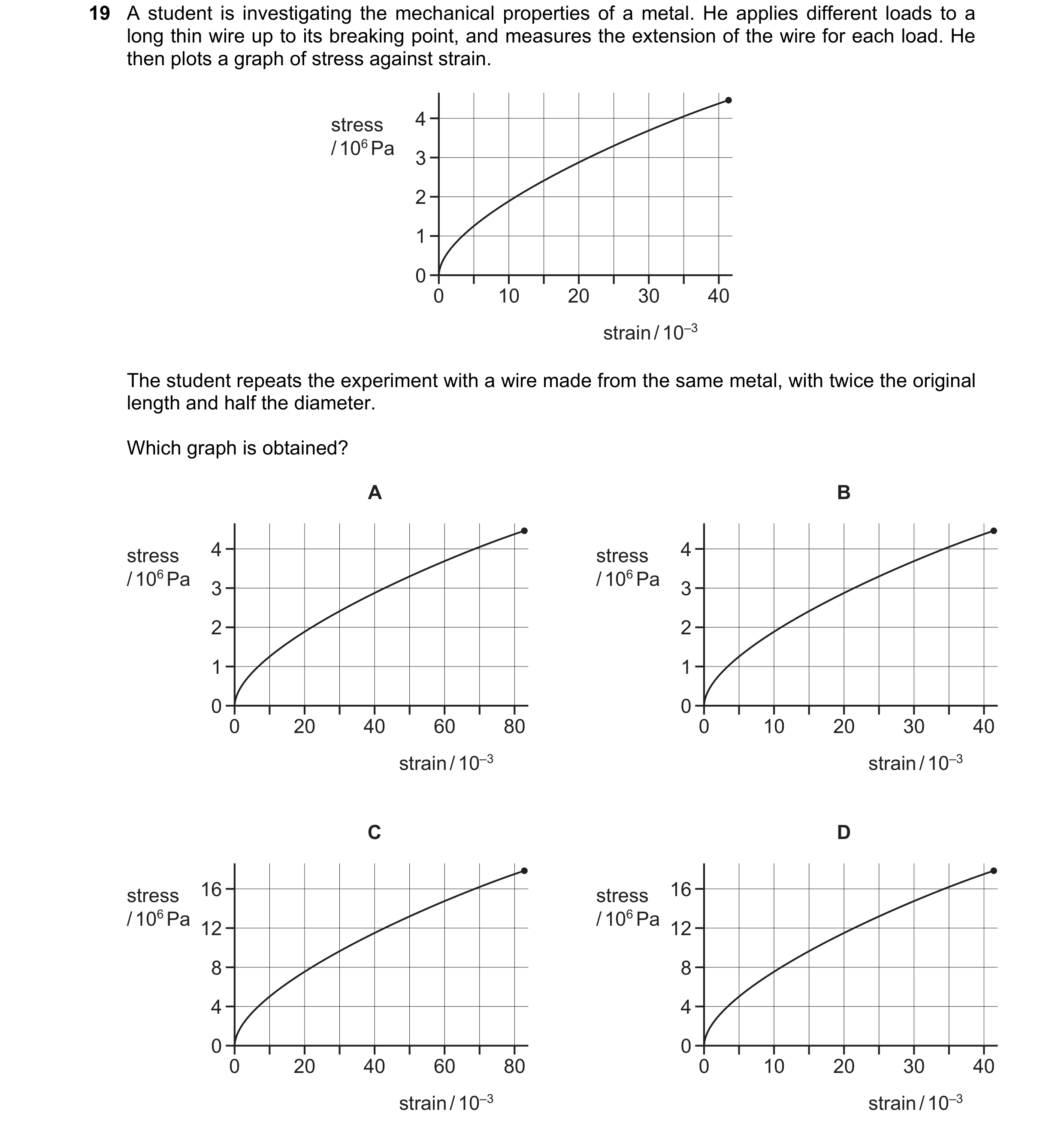
Q98 · A student is investigating the mechanical properties of a metal 9702/12 May/June 2020
19 A student is investigating the mechanical properties of a metal. He applies different loads to a long thin wire up to its breaking point, and measures the extension of the wire for each load. He then plots a graph of stress against strain. stress 4 / 106 Pa 3 2 1 0 0 10 20 30 40 strain / 10–3 The student repeats the experiment with a wire made from the same metal, with twice the original length and half the diameter. Which graph is obtained? A B stress 4 stress 4 / 106 Pa / 106 Pa 3 3 2 2 1 1 0 0 0 20 40 60 80 0 10 20 30 40 strain / 10–3 strain / 10–3 C D stress 16 stress 16 / 106 Pa / 106 Pa 12 12 8 8 4 4 0 0 0 20 40 60 80 0 10 20 30 40 strain / 10–3 strain / 10–3
1 marks
Answer: B
This question in 9702/12 May/June 2020
Q99 · The diagram shows a simplified model of a building with four identical heavy floors 9702/13 May/June 2020
20 The diagram shows a simplified model of a building with four identical heavy floors. top rods floors middle rods bottom rods The spacing of the bottom floor from the ground is twice that of the spacing between the floors. Between each floor are equal numbers of vertical steel supporting rods of negligible mass compared with the floors. The rods are of different diameters so that the stress in each rod is the same. What is the ratio diameter of bottom rods ? diameter of top rods A 2 B 4 C 8 D 16
1 marks
Answer: A
This question in 9702/13 May/June 2020
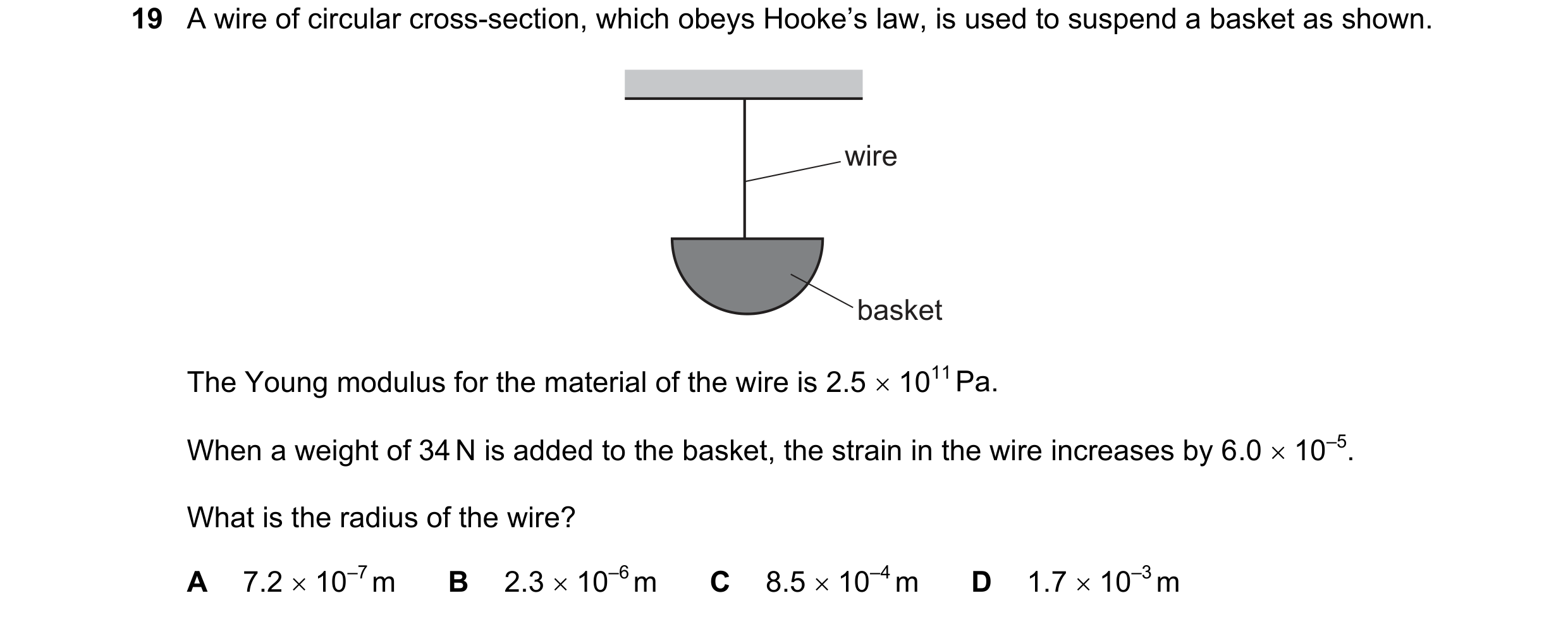
Q100 · A wire of circular cross-section, which obeys Hooke’s law, is used to suspend a basket as… 9702/11 Oct/Nov 2020
19 A wire of circular cross-section, which obeys Hooke’s law, is used to suspend a basket as shown. wire basket The Young modulus for the material of the wire is 2.5 1011 Pa. When a weight of 34 N is added to the basket, the strain in the wire increases by 6.0 10–5. What is the radius of the wire? A 7.2 10–7 m B 2.3 10–6 m C 8.5 10–4 m D 1.7 10–3 m
1 marks
Answer: C
This question in 9702/11 Oct/Nov 2020
Q101 · A mass of 60.0 g is suspended from a spring and the distance from the bottom of the… 9702/12 Oct/Nov 2020
20 A mass of 60.0 g is suspended from a spring and the distance from the bottom of the spring to the floor is measured to be 16.4 cm. The mass is replaced with a 100.0 g mass and the distance from the bottom of the spring to the floor is now measured to be 12.6 cm. The spring obeys Hooke’s law. What is the spring constant of the spring? A 1.05 N m–1 B 1.35 N m–1 C 10.3 N m–1 D 103 N m–1
1 marks
Answer: C
This question in 9702/12 Oct/Nov 2020
Q102 · A platform is suspended by four steel wires 9702/13 Oct/Nov 2020
20 A platform is suspended by four steel wires. Each wire is 5.0 m long and has a diameter of 3.0 mm. The Young modulus of steel is 2.1 1011 Pa. steel wires steel wires 200 kg platform The wires obey Hooke’s law when a load of mass 200 kg is placed on the platform. How far will the platform descend because of the extension of the wires? A 1.7 10–4 m B 4.1 10–4 m C 1.7 10–3 m D 6.6 10–3 m
1 marks
Answer: C
This question in 9702/13 Oct/Nov 2020
Q103 · A tensile force of 7.00 MN is applied to a sample of steel 9702/13 Oct/Nov 2020
21 A tensile force of 7.00 MN is applied to a sample of steel. This causes the sample to extend by 5.00 mm in the direction of the force. The sample obeys Hooke’s law. What is the work done to extend the sample? A 17.5 J B 35.0 J C 17.5 kJ D 35.0 kJ
1 marks
Answer: C
This question in 9702/13 Oct/Nov 2020
Q104 · Which expression is equal to the stress on a wire? 9702/12 Feb/March 2021
19 Which expression is equal to the stress on a wire? extension A original length force B cross-sectional area force C extension Young modulus D original length
1 marks
Answer: B
This question in 9702/12 Feb/March 2021
Q105 · The spring constants of four springs are determined by plotting the following graphs of… 9702/11 May/June 2021
19 The spring constants of four springs are determined by plotting the following graphs of force F against extension x. 1 2 3 4 10 20 100 10 F / N F / N F / N F / N 0 0 0 0 0 5 0 4 0 0.1 0 0.5 x / mm x / mm x / mm x / mm Which order of the graphs shows decreasing spring constants? A 2 1 3 4 B 3 4 2 1 C 4 2 1 3 D 4 3 2 1
1 marks
Answer: B
This question in 9702/11 May/June 2021
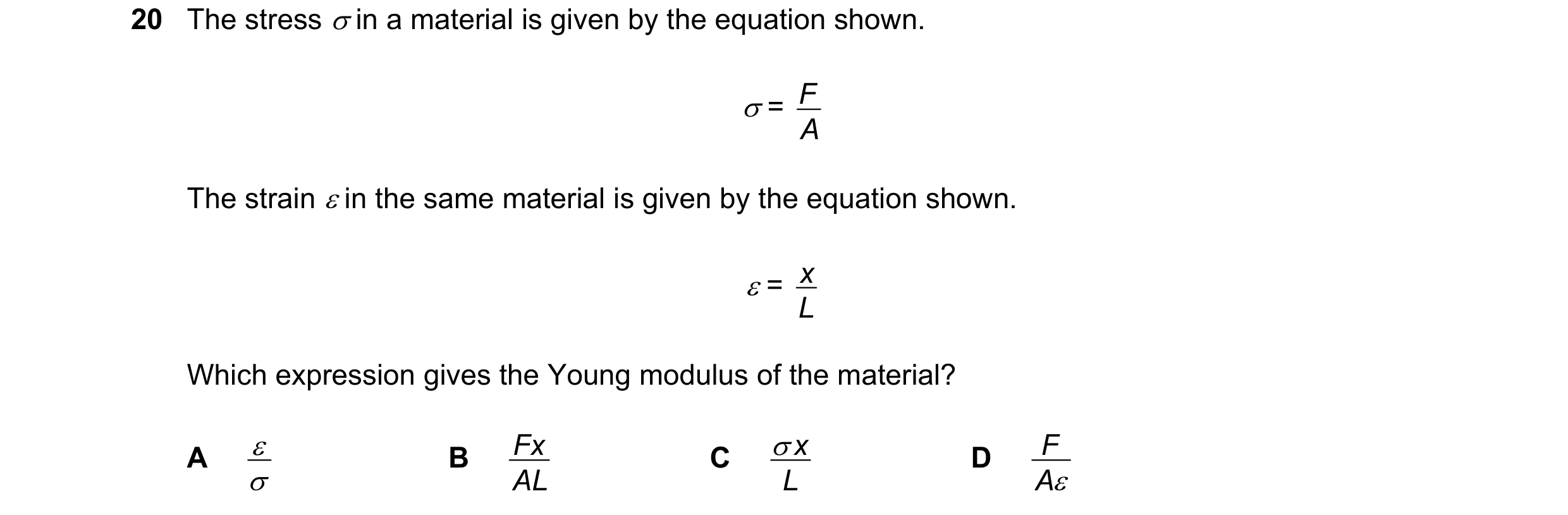
Q106 · The stress in a material is given by the equation shown 9702/13 May/June 2021
20 The stress in a material is given by the equation shown. = F A The strain in the same material is given by the equation shown. = x L Which expression gives the Young modulus of the material? Fx x F A B AL C D A L
1 marks
Answer: D
This question in 9702/13 May/June 2021
Q107 · A metal wire, of cross-sectional area A and unstretched length l, is subjected to stress 9702/11 Oct/Nov 2021
19 A metal wire, of cross-sectional area A and unstretched length l, is subjected to stress . As a result it has strain . Which expression gives the Young modulus of the metal? A l A B l C D A
1 marks
Answer: C
This question in 9702/11 Oct/Nov 2021
Q108 · A metal wire is stretched 9702/12 Feb/March 2022
18 A metal wire is stretched. The wire obeys Hooke’s law. Which quantity has a value that does not change? A extension B strain C stress D Young modulus
1 marks
Answer: D
This question in 9702/12 Feb/March 2022
Q109 · Two wires, P and Q, are made from the same metal and hang vertically from a steel girder 9702/11 May/June 2022
19 Two wires, P and Q, are made from the same metal and hang vertically from a steel girder. Wire Q has half the length and twice the diameter of wire P. Identical masses are attached to the bottom of each wire. Both wires obey Hooke’s law as they are stretched by the weight of the masses. extension of wire P What is the ratio ? extension of wire Q 8 4 1 1 A B C D 1 1 1 2
1 marks
Answer: A
This question in 9702/11 May/June 2022
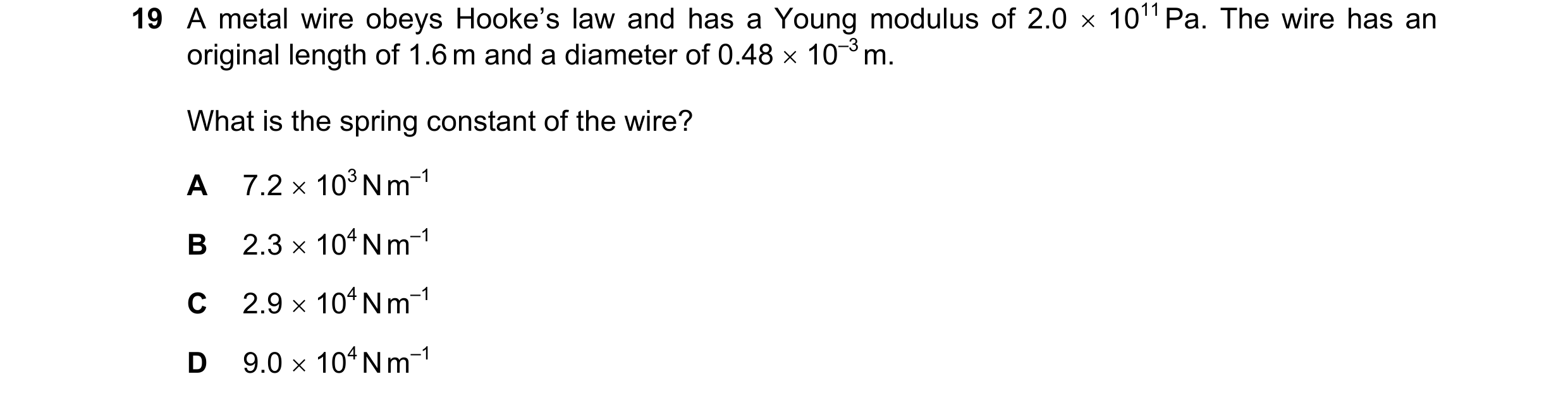
Q110 · A metal wire obeys Hooke’s law and has a Young modulus of 2.0 1011 Pa 9702/12 May/June 2022
19 A metal wire obeys Hooke’s law and has a Young modulus of 2.0 1011 Pa. The wire has an original length of 1.6 m and a diameter of 0.48 10–3 m. What is the spring constant of the wire? A 7.2 103 N m–1 B 2.3 104 N m–1 C 2.9 104 N m–1 D 9.0 104 N m–1
1 marks
Answer: B
This question in 9702/12 May/June 2022
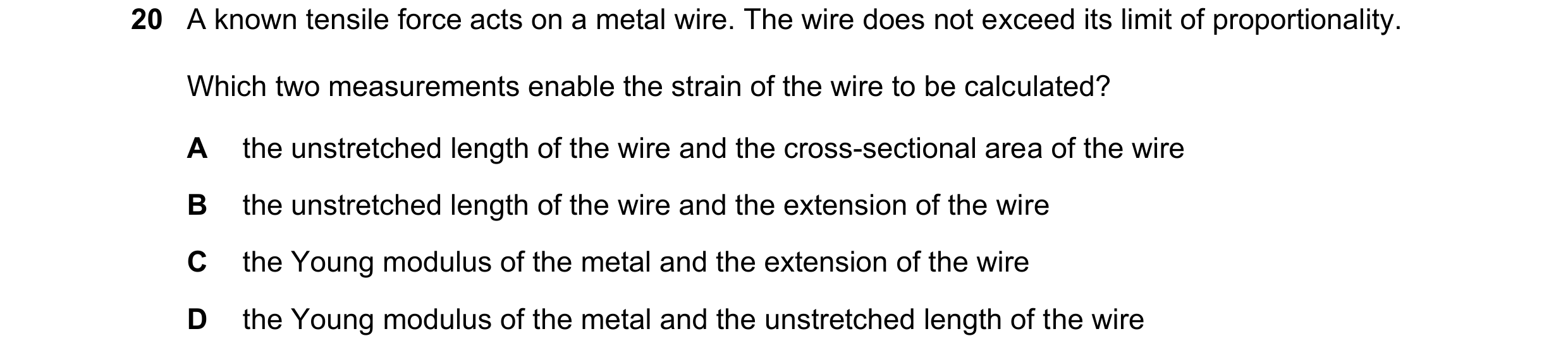
Q111 · A known tensile force acts on a metal wire 9702/12 Oct/Nov 2022
20 A known tensile force acts on a metal wire. The wire does not exceed its limit of proportionality. Which two measurements enable the strain of the wire to be calculated? A the unstretched length of the wire and the cross-sectional area of the wire B the unstretched length of the wire and the extension of the wire C the Young modulus of the metal and the extension of the wire D the Young modulus of the metal and the unstretched length of the wire
1 marks
Answer: B
This question in 9702/12 Oct/Nov 2022
Q112 · A copper wire of length 3.6 m and diameter 1.22 mm is stretched by a force of 37 N 9702/13 Oct/Nov 2022
19 A copper wire of length 3.6 m and diameter 1.22 mm is stretched by a force of 37 N. The wire obeys Hooke’s law. The Young modulus of copper is 1.17 1011 Pa. Which extension is caused by this force? A 0.24 mm B 0.76 mm C 0.97 mm D 3.1 mm
1 marks
Answer: C
This question in 9702/13 Oct/Nov 2022
Q113 · A spring has an unstretched length of 4.50 cm 9702/12 Feb/March 2023
18 A spring has an unstretched length of 4.50 cm. The spring is fixed at one end and a force of 35.0 N is applied to the other end so that the spring extends. The spring obeys Hooke’s law and has a spring constant of 420 N m–1. What is the strain of the extended spring? A 0.019 B 0.083 C 1.85 D 2.67
1 marks
Answer: C
This question in 9702/12 Feb/March 2023
Q114 · What is meant by the spring constant of a spring? 9702/12 May/June 2023
18 What is meant by the spring constant of a spring? A extension per unit force B 1 force extension 2 C force extension D force per unit extension
1 marks
Answer: D
This question in 9702/12 May/June 2023
Q115 · A metal wire has length 5.2 m and diameter 1.0 mm 9702/13 May/June 2023
18 A metal wire has length 5.2 m and diameter 1.0 mm. The metal has Young modulus 360 GPa. The wire is fixed at one end and a force is applied to the other end. The force extends the wire by 7.2 mm. The wire obeys Hooke’s law. What is the force applied to the wire? A 1.2 102 N B 3.9 102 N C 5.0 102 N D 1.6 103 N
1 marks
Answer: B
This question in 9702/13 May/June 2023
Q116 · A copper wire of diameter 1.6 mm is stretched within its limit of proportionality by a… 9702/13 Oct/Nov 2023
18 A copper wire of diameter 1.6 mm is stretched within its limit of proportionality by a tensile force of 430 N. The Young modulus of copper is 130 GPa. What is the strain in the wire? A 4.1 10–4 B 1.3 10–3 C 1.6 10–3 D 5.2 10–3
1 marks
Answer: C
This question in 9702/13 Oct/Nov 2023
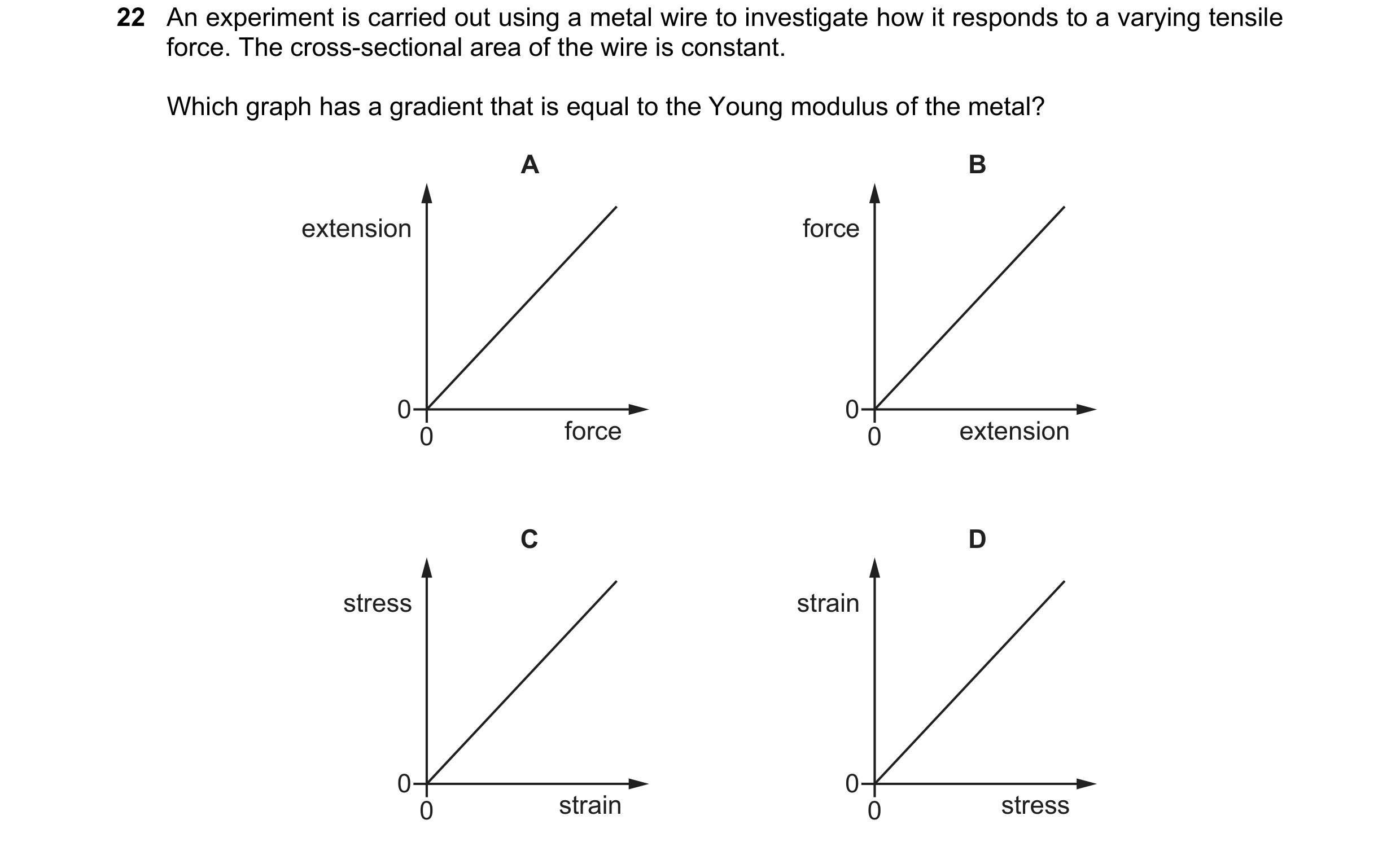
Q117 · An experiment is carried out using a metal wire to investigate how it responds to a… 9702/11 May/June 2024
22 An experiment is carried out using a metal wire to investigate how it responds to a varying tensile force. The cross-sectional area of the wire is constant. Which graph has a gradient that is equal to the Young modulus of the metal? A B extension force 0 0 0 force 0 extension C D stress strain 0 0 0 strain 0 stress
1 marks
Answer: C
This question in 9702/11 May/June 2024
Q118 · Two wires, P and Q, made of the same material, are stretched with an increasing force 9702/12 May/June 2024
19 Two wires, P and Q, made of the same material, are stretched with an increasing force. A graph is plotted of the variation with force of the extension of each wire. 4 extension / mm 3 P 2 1 Q 0 0 1 2 force / N The wires have the same original length but different diameters. diameter of wire Q What is the ratio ? diameter of wire P 1 1 A B C 3 D 3 3 3
1 marks
Answer: C
This question in 9702/12 May/June 2024
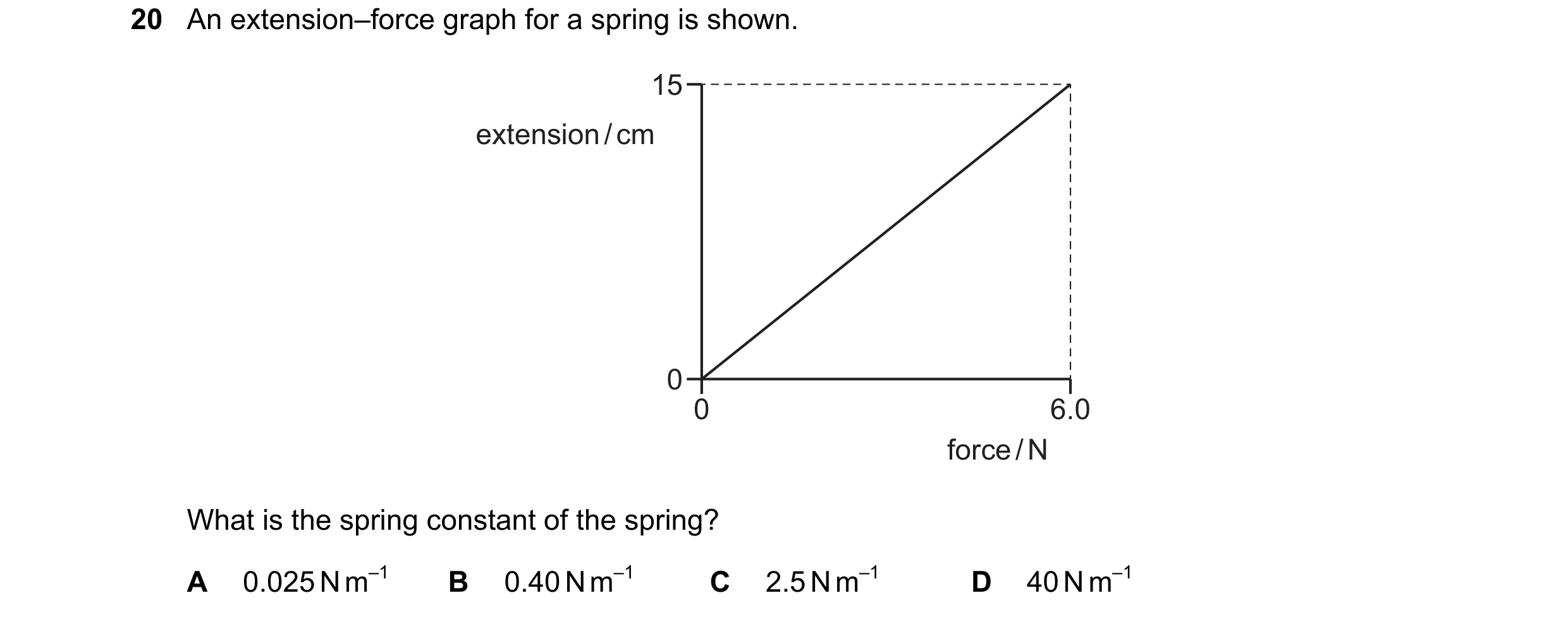
Q119 · An extension–force graph for a spring is shown 9702/12 May/June 2024
20 An extension–force graph for a spring is shown. 15 extension / cm 0 0 6.0 force / N What is the spring constant of the spring? A 0.025 N m–1 B 0.40 N m–1 C 2.5 N m–1 D 40 N m–1
1 marks
Answer: D
This question in 9702/12 May/June 2024
Q120 · Two wires, one made of brass and the other of steel, are stretched in an experiment 9702/13 May/June 2024
19 Two wires, one made of brass and the other of steel, are stretched in an experiment. Both wires obey Hooke’s law during this experiment. The Young modulus for brass is less than the Young modulus for steel. Which graph shows how the stress varies with strain for both wires in this experiment? A B stress steel stress steel brass brass 0 0 0 strain 0 strain C D stress brass stress brass steel steel 0 0 0 strain 0 strain
1 marks
Answer: B
This question in 9702/13 May/June 2024
Q121 · A wire has original length L and cross-sectional area A 9702/11 Oct/Nov 2024
20 A wire has original length L and cross-sectional area A. A tensile force F is applied to the wire which causes it to have extension x. The wire obeys Hooke’s law. What is an expression for the Young modulus of the material from which the wire is made? stress x F F x strain A B C D stress L A strain A L
1 marks
Answer: B
This question in 9702/11 Oct/Nov 2024
Q122 · A wire consists of a 3.0 m length of metal X joined to a 1.0 m length of metal Y 9702/11 Oct/Nov 2024
23 A wire consists of a 3.0 m length of metal X joined to a 1.0 m length of metal Y. The cross-sectional area of the wire is uniform. X 3.0 m Y 1.0 m load A load hung from the wire causes metal X to extend by 1.5 mm and metal Y to extend by 1.0 mm. The same load is then hung from a second wire of the same cross-sectional area, consisting of a 1.0 m length of metal X and a 3.0 m length of metal Y. Both wires are extended within their limit of proportionality. What is the total extension of this second wire? A 2.5 mm B 3.5 mm C 4.8 mm D 5.0 mm
1 marks
Answer: B
This question in 9702/11 Oct/Nov 2024
Q123 · What is a unit for stress? 9702/12 Oct/Nov 2024
19 What is a unit for stress? A kg m–1 s–2 B kg m–2 s–2 C N m–1 D N m
1 marks
Answer: A
This question in 9702/12 Oct/Nov 2024
Q124 · The graph shows the relationship between stress and strain for three wires of the same… 9702/12 Oct/Nov 2024
20 The graph shows the relationship between stress and strain for three wires of the same linear dimensions but made from different materials. P stress Q R 0 0 0.1 1.0 strain Which statements are correct? 1 The extension of P is approximately twice that of Q for the same stress. 2 The ratio of the Young modulus for P to that of Q is approximately two. 3 For strain less than 0.1, R obeys Hooke’s law. A 1, 2 and 3 B 1 and 3 only C 2 and 3 only D 2 only
1 marks
Answer: C
This question in 9702/12 Oct/Nov 2024
Q125 · Four solid steel rods equally support an object weighing 10 kN 9702/12 Oct/Nov 2024
21 Four solid steel rods equally support an object weighing 10 kN. Each rod is of length 2.0 m and cross-sectional area 250 mm2. The weight of the object causes the rods to contract by 0.10 mm. The rods obey Hooke’s law. What is the Young modulus of steel? A 2.0 108 N m–2 B 2.0 1011 N m–2 C 8.0 108 N m–2 D 8.0 1011 N m–2
1 marks
Answer: B
This question in 9702/12 Oct/Nov 2024
Q126 · A uniform wire is made of a metal that has a Young modulus of 1.3 1011 Pa 9702/13 Oct/Nov 2024
22 A uniform wire is made of a metal that has a Young modulus of 1.3 1011 Pa. The wire is 2.4 m long and has a spring constant of 2.7 104 N m–1. What is the volume of the wire? A 2.6 10–8 m3 B 6.3 10–8 m3 C 5.0 10–7 m3 D 1.2 10–6 m3
1 marks
Answer: D
This question in 9702/13 Oct/Nov 2024
Q127 · A bolt is subjected to a tensile force, as shown 9702/12 Feb/March 2025
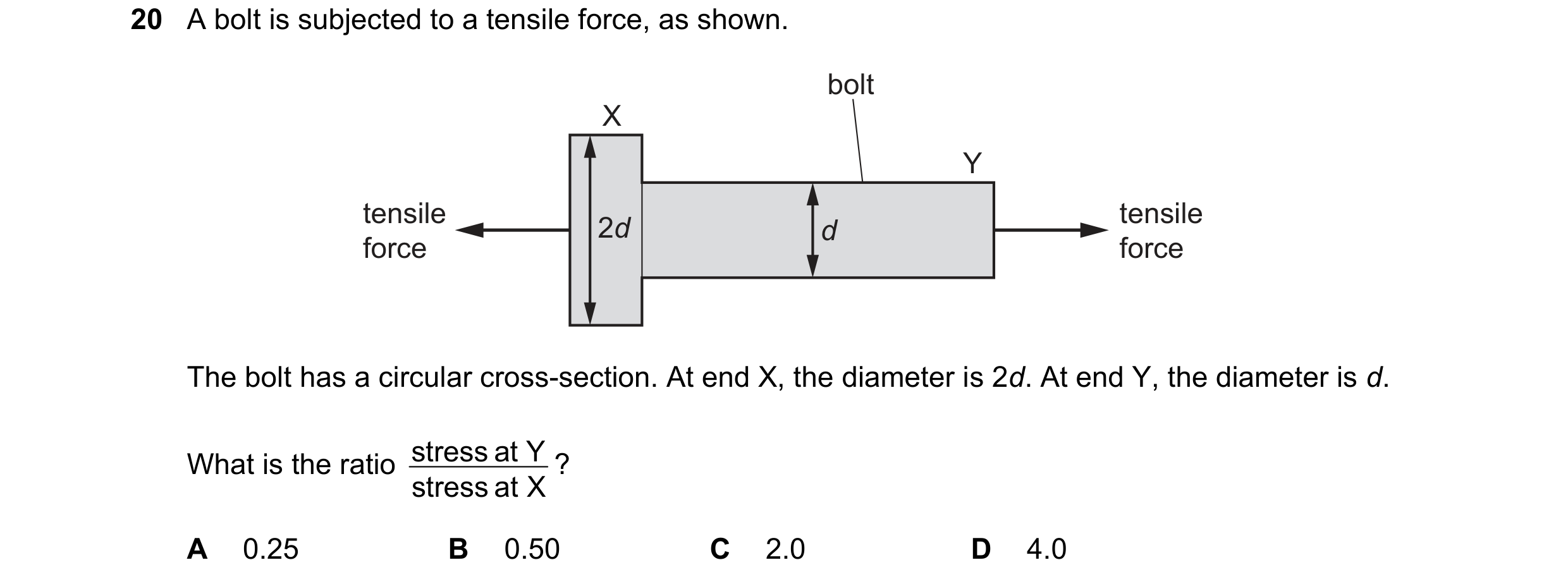
20 A bolt is subjected to a tensile force, as shown. bolt X Y tensile 2d d tensile force force The bolt has a circular cross-section. At end X, the diameter is 2d. At end Y, the diameter is d. What is the ratio stress at Y ? stress at X A 0.25 B 0.50 C 2.0 D 4.0
1 marks
Answer: D
This question in 9702/12 Feb/March 2025
Q128 · A uniform metal wire of length L and diameter d has spring constant k 9702/11 May/June 2025
23 A uniform metal wire of length L and diameter d has spring constant k. What is the Young modulus of the metal? d 2 d 2 kL 4 kL A B C D 4 kL kL d 2 d 2
1 marks
Answer: D
This question in 9702/11 May/June 2025
Q129 · A student has a copper wire and a steel wire with equal lengths and cross-sectional areas 9702/12 May/June 2025
21 A student has a copper wire and a steel wire with equal lengths and cross-sectional areas.
The student hangs identical loads on the two wires.
The extensions of the two wires are different.
The student calculates the stress, strain and Young modulus of each wire.
Which row identifies with a tick (“) the calculated values that are equal for both wires?
| stress | strain | Young modulus
A J
B J
Cc v v
D v v
1 marks
Answer: A
This question in 9702/12 May/June 2025
Q130 · What are the units of stress, strain and the Young modulus? 9702/13 May/June 2025
20 What are the units of stress, strain and the Young modulus? Young stress strain modulus A newton metre pascal B newton no unit newton C pascal metre newton D pascal no unit pascal
1 marks
Answer: D
This question in 9702/13 May/June 2025
Q131 · A wire of length L0 is attached at one end to a fixed point 9702/13 May/June 2025
22 A wire of length L0 is attached at one end to a fixed point. A tensile force is applied to the other end so that the wire extends and has a new length L1. What is the strain of the wire? L L A 1 – 1 B L1 – L0 C 1 + 1 D L1 + L0 L L 0 0
1 marks
Answer: A
This question in 9702/13 May/June 2025
Q132 · What is the definition of strain? 9702/14 May/June 2025
17 What is the definition of strain? A extension per unit cross-sectional area B extension per unit original length C force per unit cross-sectional area D force per unit extension
1 marks
Answer: B
This question in 9702/14 May/June 2025
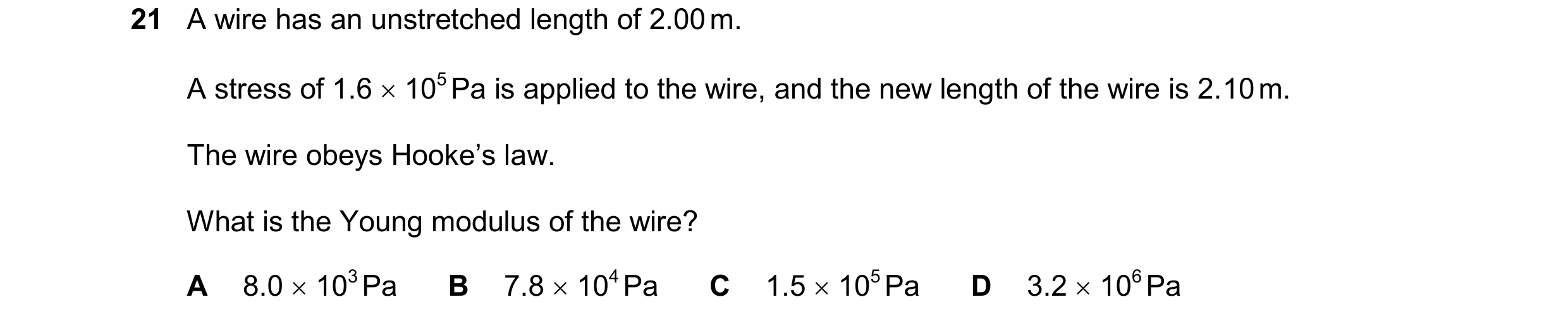
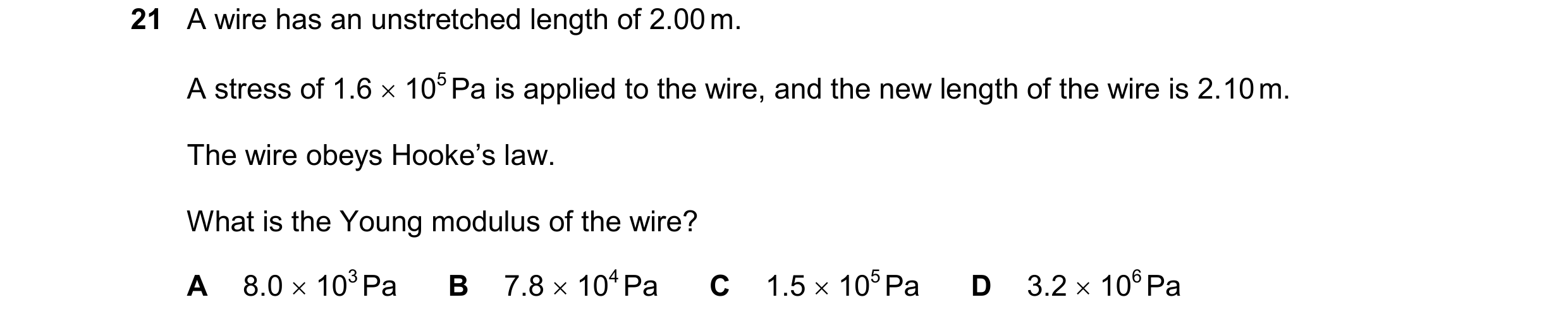
Q133 · A wire has an unstretched length of 2.00 m 9702/11 Oct/Nov 2025
21 A wire has an unstretched length of 2.00 m. A stress of 1.6 105 Pa is applied to the wire, and the new length of the wire is 2.10 m. The wire obeys Hooke’s law. What is the Young modulus of the wire? A 8.0 103 Pa B 7.8 104 Pa C 1.5 105 Pa D 3.2 106 Pa
1 marks
Answer: D
This question in 9702/11 Oct/Nov 2025
Q134 · What are the SI base units of stress? 9702/11 Oct/Nov 2025
22 What are the SI base units of stress? A kg m s–2 B kg m–1 s–2 C kg m–2 s–2 D kg m–3 s–2
1 marks
Answer: B
This question in 9702/11 Oct/Nov 2025
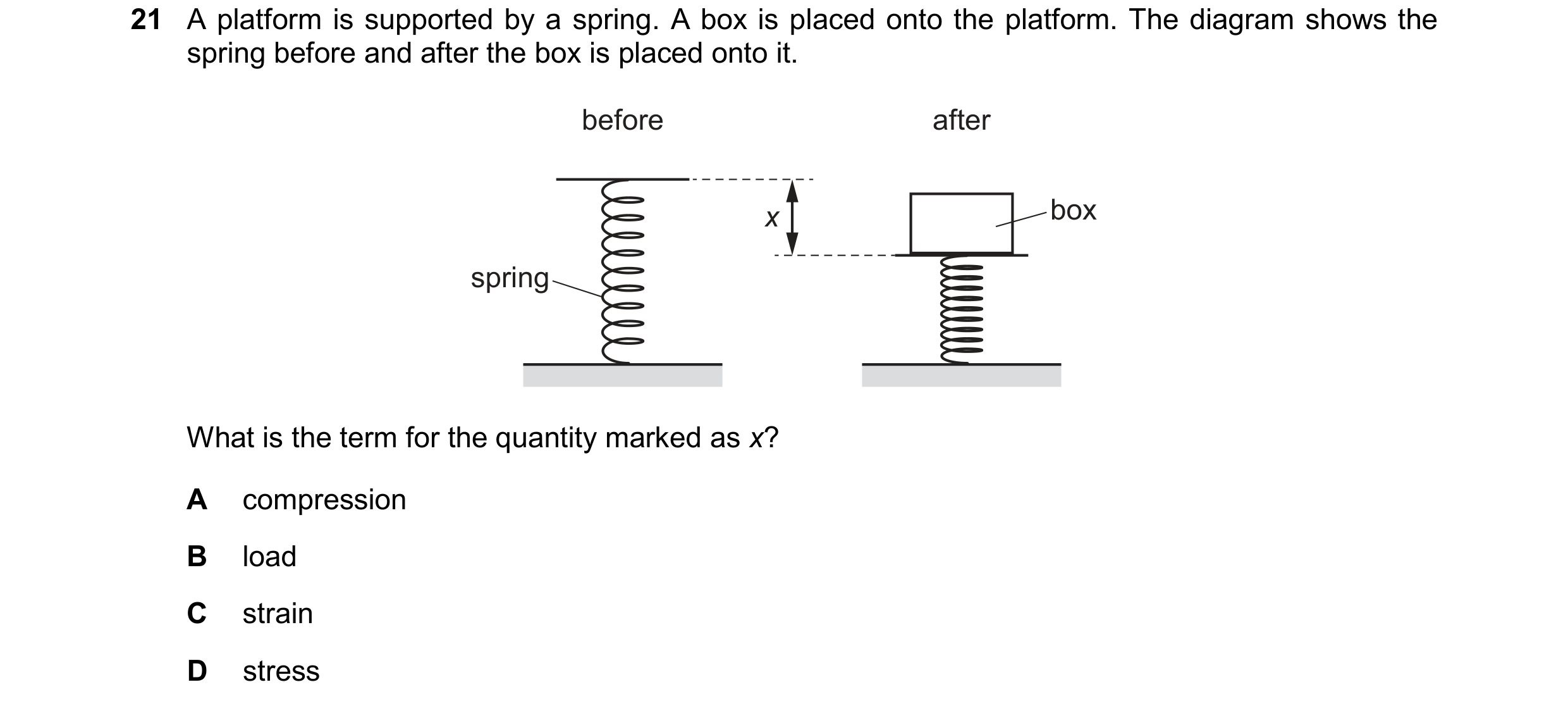
Q135 · A platform is supported by a spring 9702/12 Oct/Nov 2025
21 A platform is supported by a spring. A box is placed onto the platform. The diagram shows the spring before and after the box is placed onto it. before after x box spring What is the term for the quantity marked as x? A compression B load C strain D stress
1 marks
Answer: A
This question in 9702/12 Oct/Nov 2025
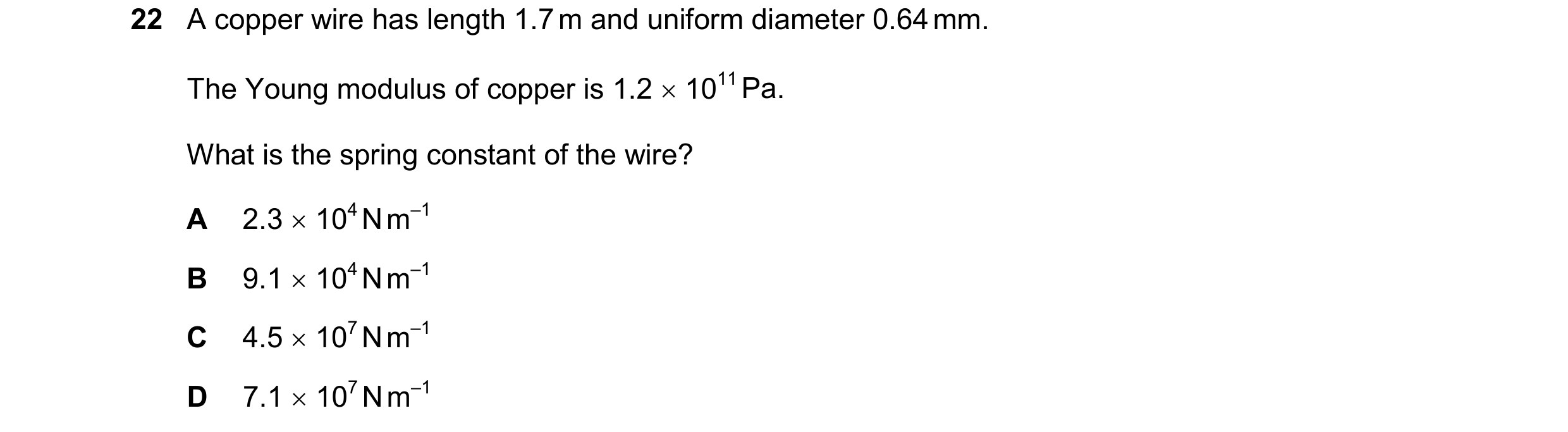
Q136 · A copper wire has length 1.7 m and uniform diameter 0.64 mm 9702/12 Oct/Nov 2025
22 A copper wire has length 1.7 m and uniform diameter 0.64 mm. The Young modulus of copper is 1.2 1011 Pa. What is the spring constant of the wire? A 2.3 104 N m–1 B 9.1 104 N m–1 C 4.5 107 N m–1 D 7.1 107 N m–1
1 marks
Answer: A
This question in 9702/12 Oct/Nov 2025
Q137 · A wire has an unstretched length of 2.00 m 9702/13 Oct/Nov 2025
21 A wire has an unstretched length of 2.00 m. A stress of 1.6 105 Pa is applied to the wire, and the new length of the wire is 2.10 m. The wire obeys Hooke’s law. What is the Young modulus of the wire? A 8.0 103 Pa B 7.8 104 Pa C 1.5 105 Pa D 3.2 106 Pa
1 marks
Answer: D
This question in 9702/13 Oct/Nov 2025
Q138 · What are the SI base units of stress? 9702/13 Oct/Nov 2025
22 What are the SI base units of stress? A kg m s–2 B kg m–1 s–2 C kg m–2 s–2 D kg m–3 s–2
1 marks
Answer: B
This question in 9702/13 Oct/Nov 2025
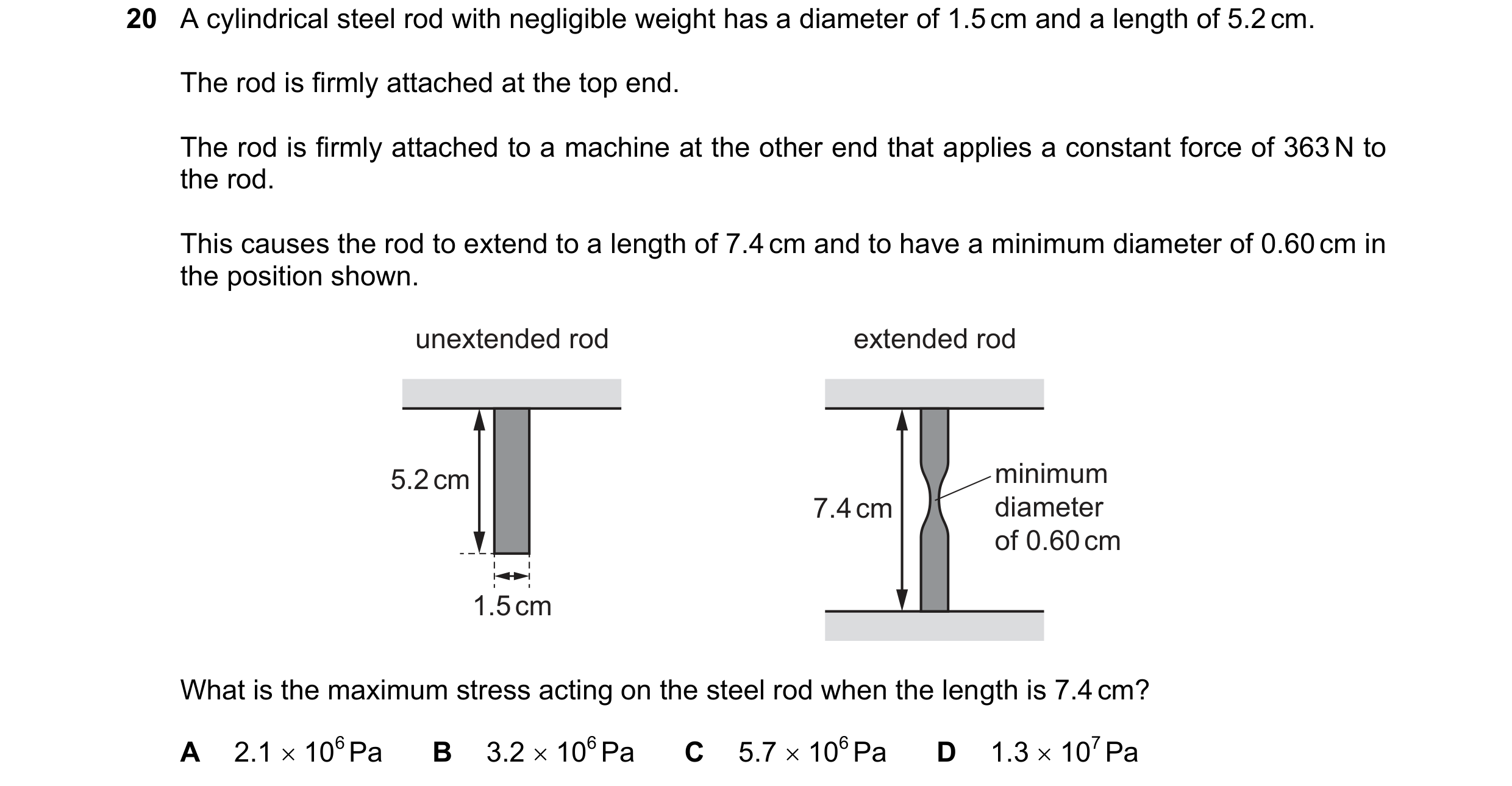
Q139 · A cylindrical steel rod with negligible weight has a diameter of 1.5 cm and a length of… 9702/14 Oct/Nov 2025
20 A cylindrical steel rod with negligible weight has a diameter of 1.5 cm and a length of 5.2 cm. The rod is firmly attached at the top end. The rod is firmly attached to a machine at the other end that applies a constant force of 363 N to the rod. This causes the rod to extend to a length of 7.4 cm and to have a minimum diameter of 0.60 cm in the position shown. unextended rod extended rod 5.2 cm minimum 7.4 cm diameter of 0.60 cm 1.5 cm What is the maximum stress acting on the steel rod when the length is 7.4 cm? A 2.1 106 Pa B 3.2 106 Pa C 5.7 106 Pa D 1.3 107 Pa
1 marks
Answer: D
This question in 9702/14 Oct/Nov 2025

 1 / 44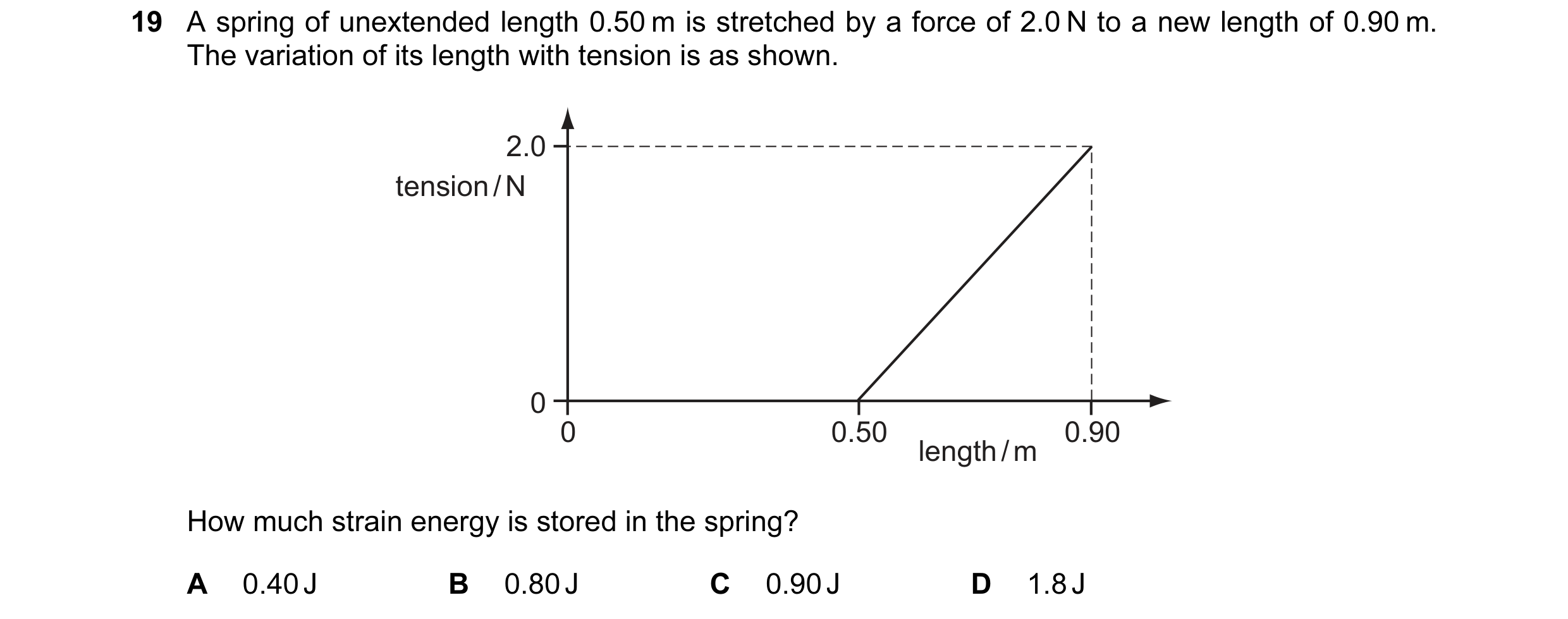
 2 / 44
 3 / 44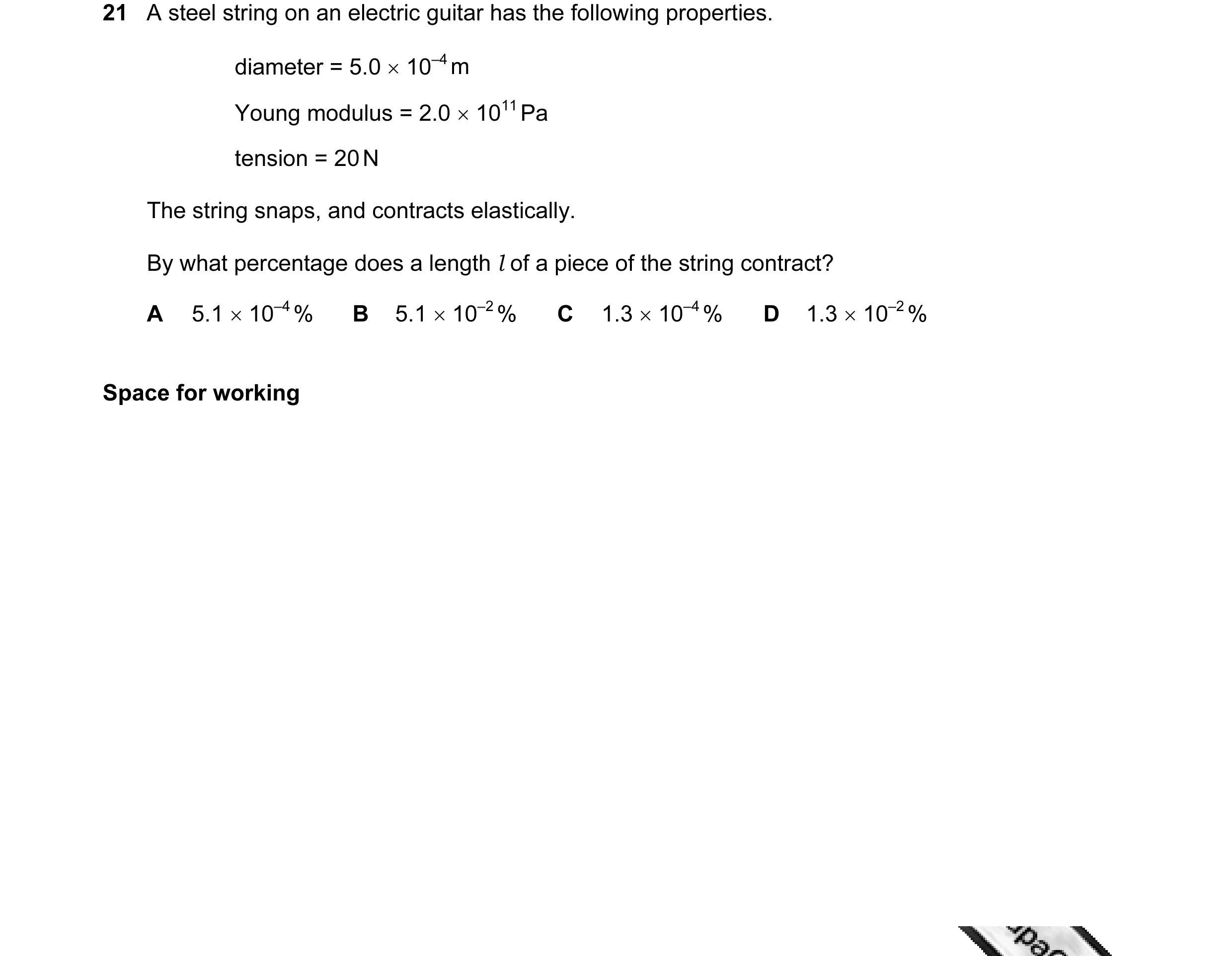
 4 / 44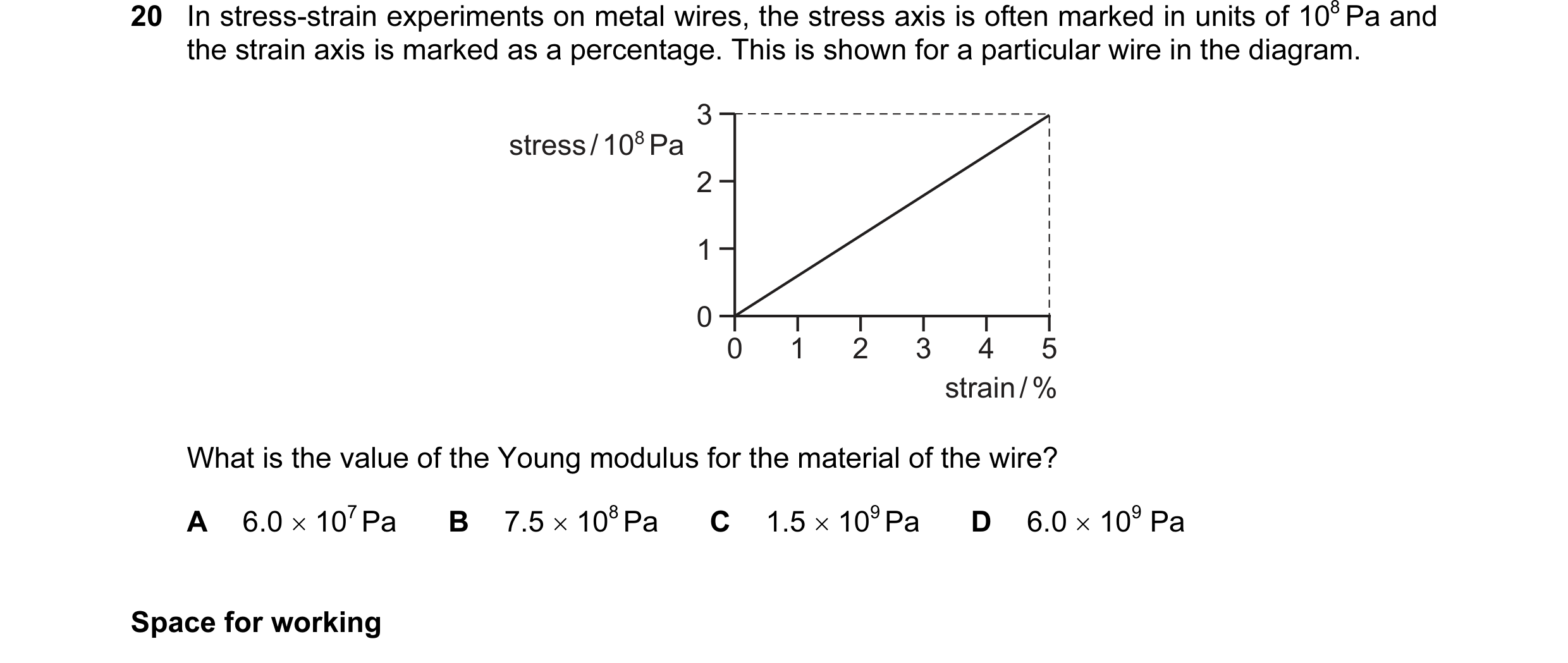
 5 / 44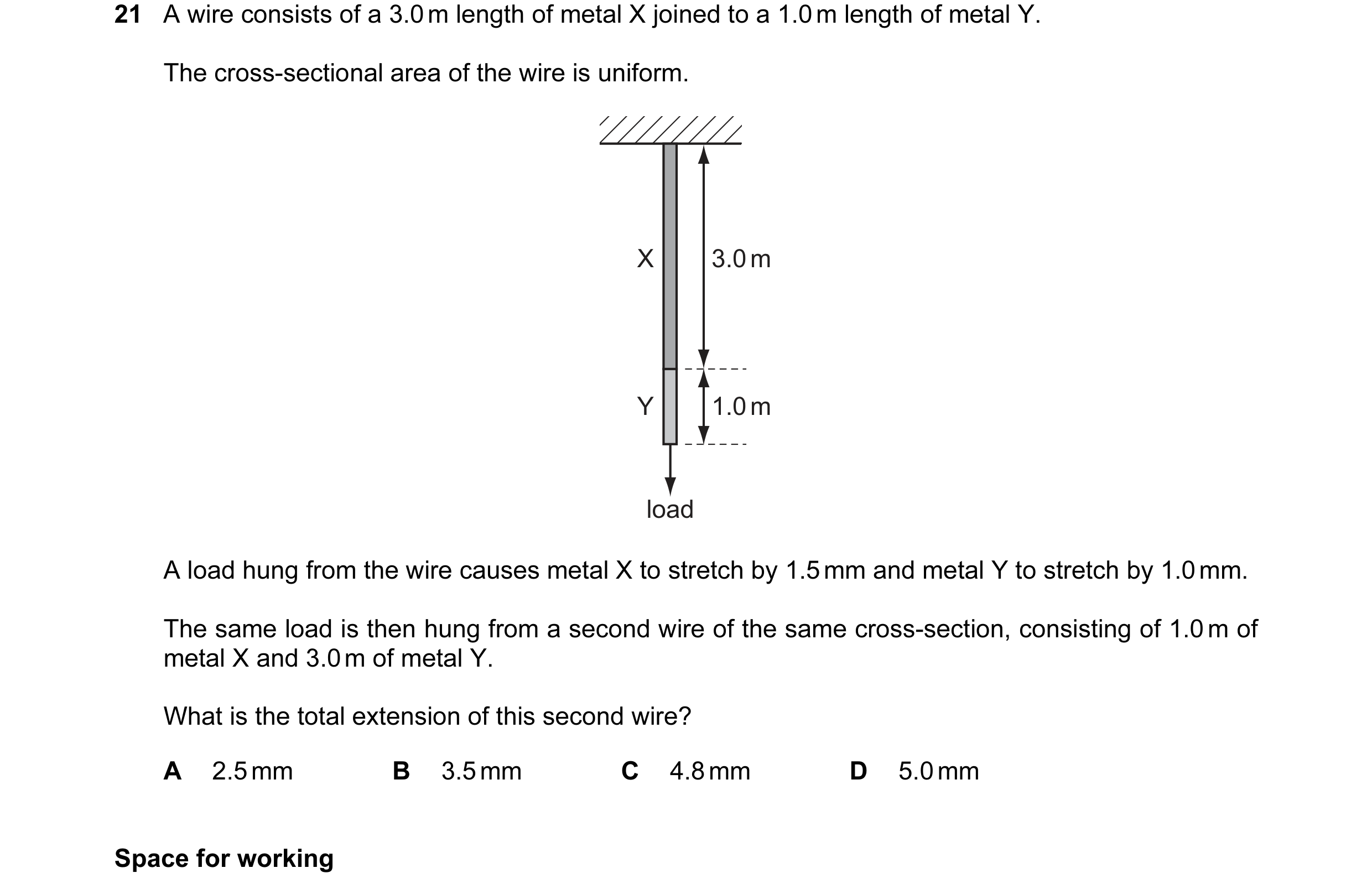
 6 / 44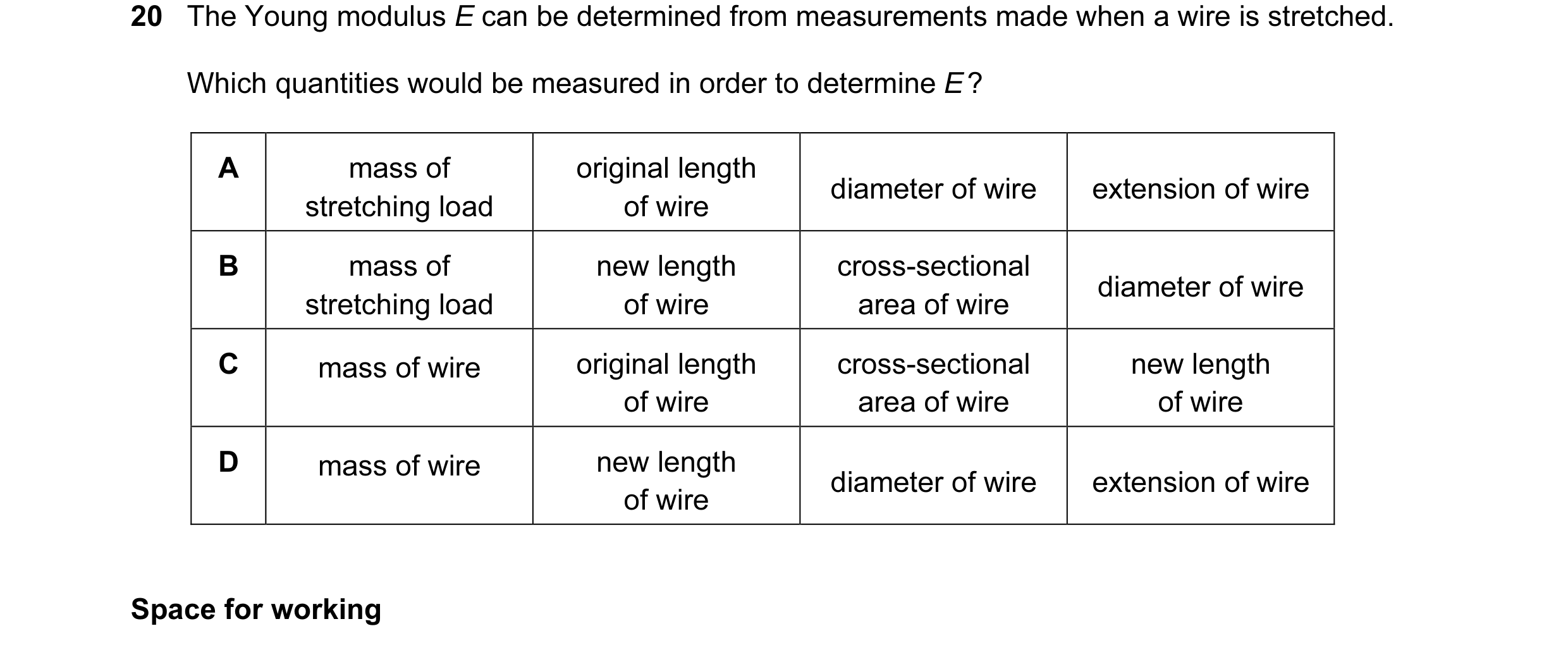
 7 / 44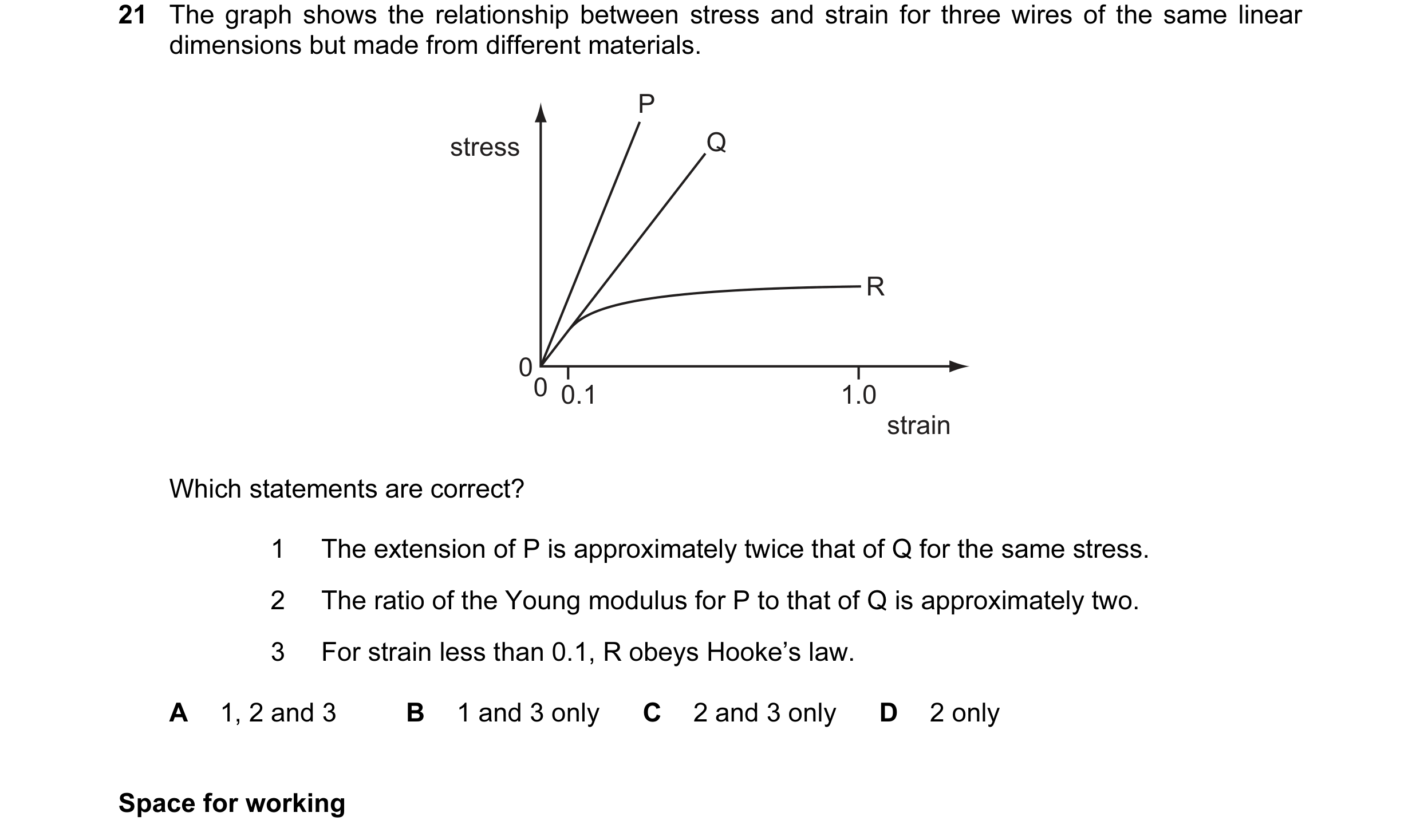
 8 / 44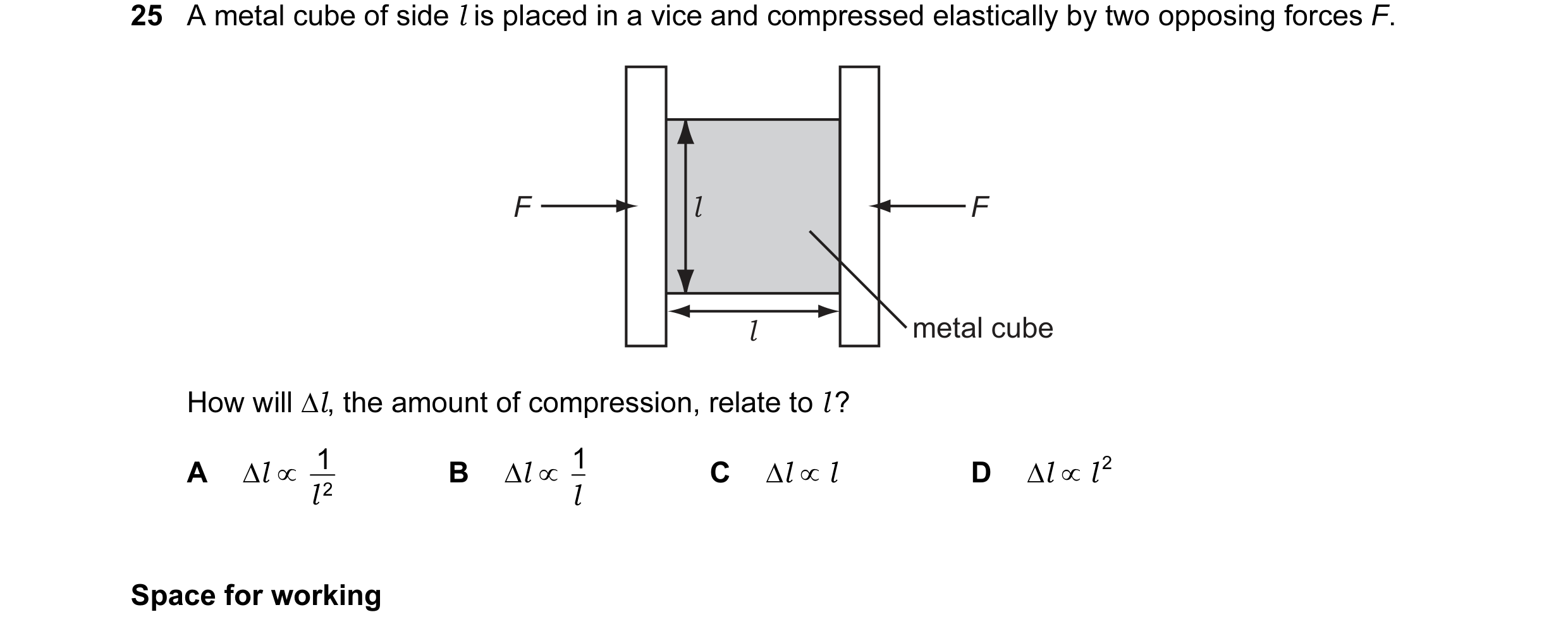
 9 / 44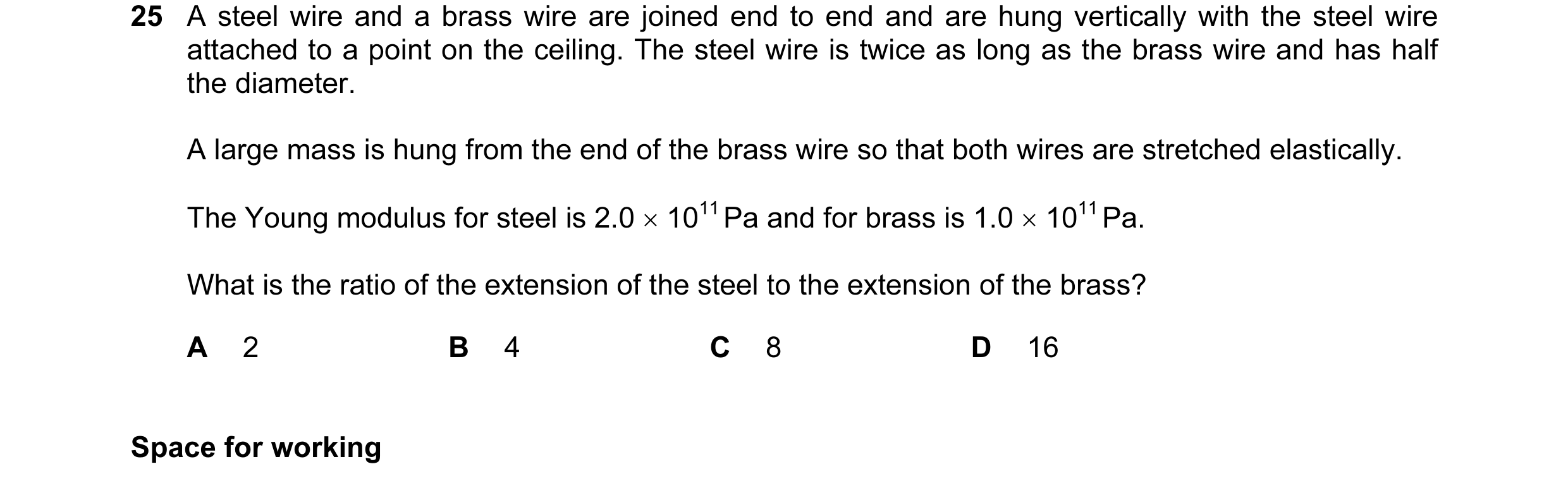
 10 / 44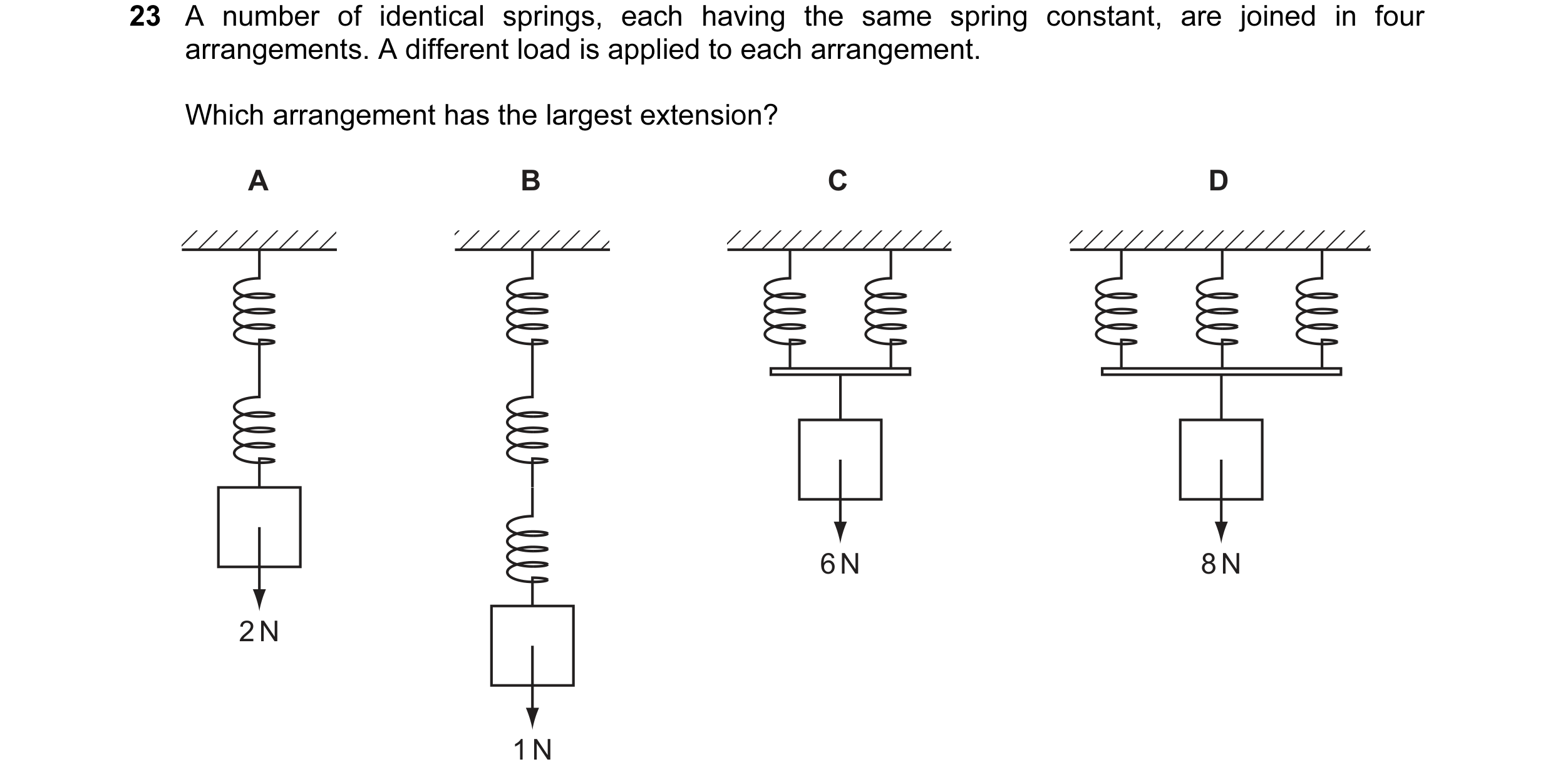

 11 / 44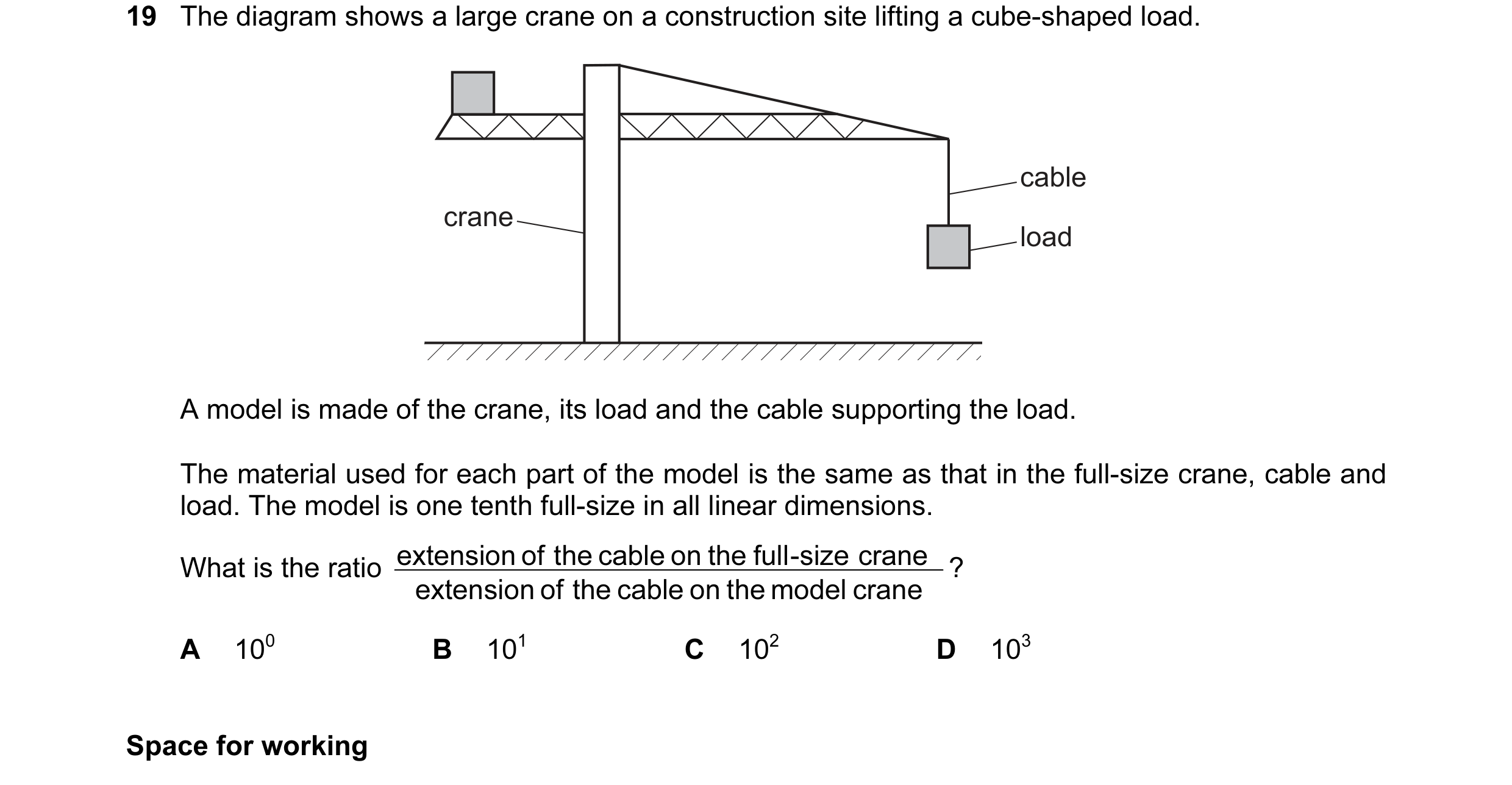
 12 / 44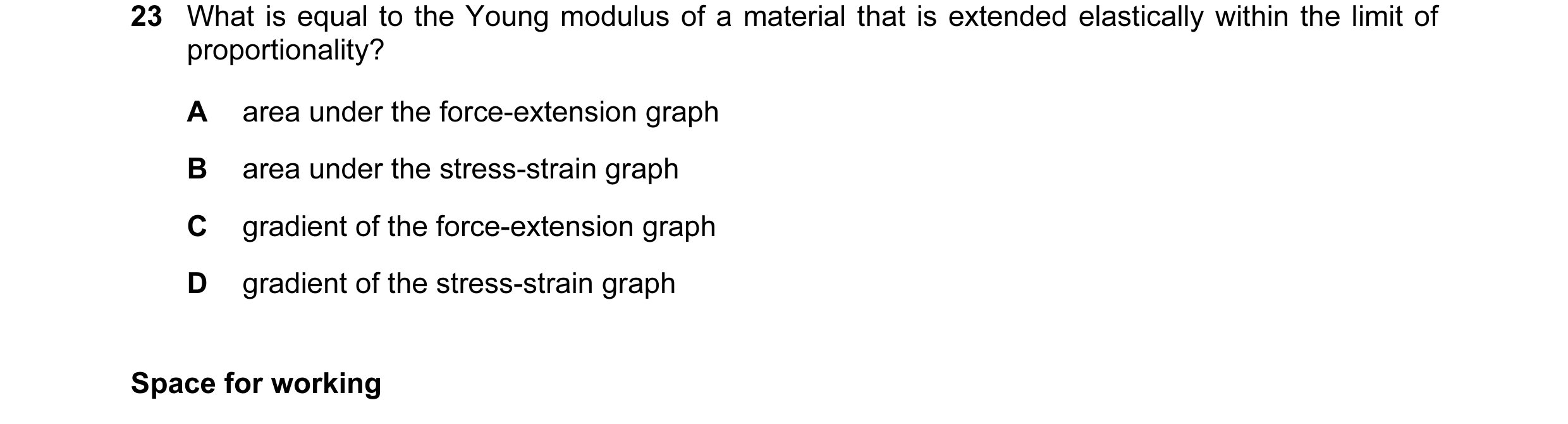
 13 / 44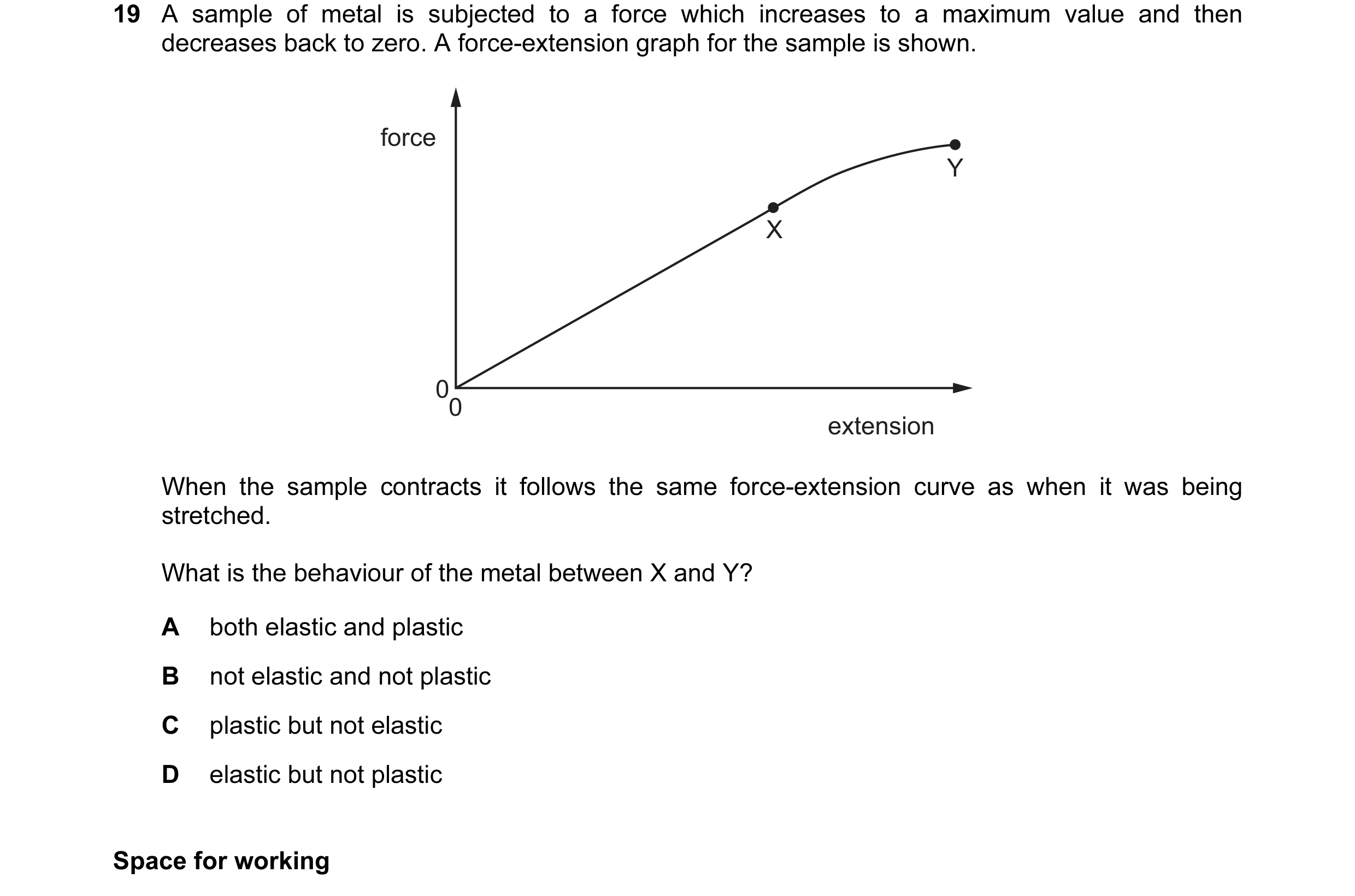
 14 / 44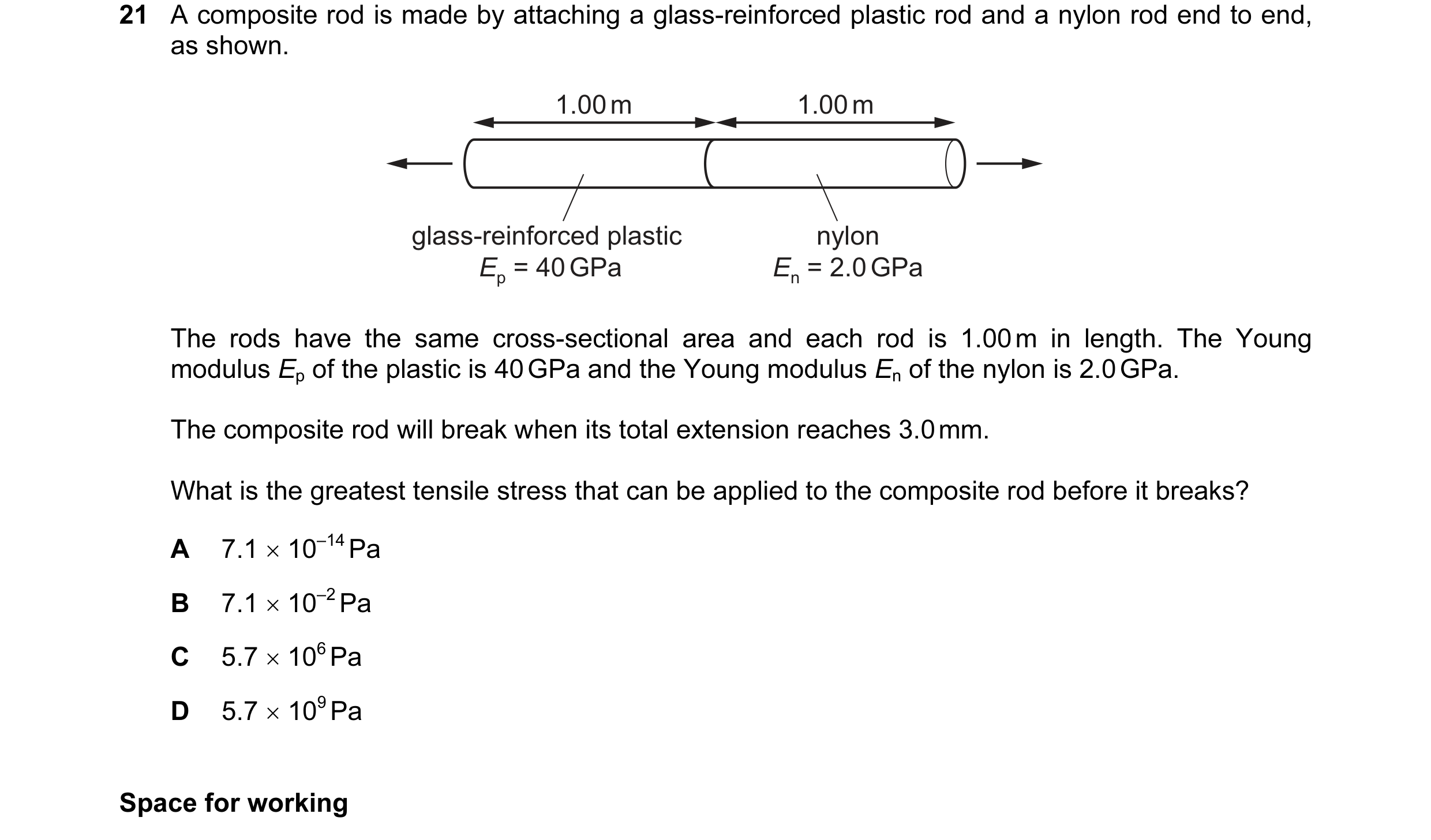
 15 / 44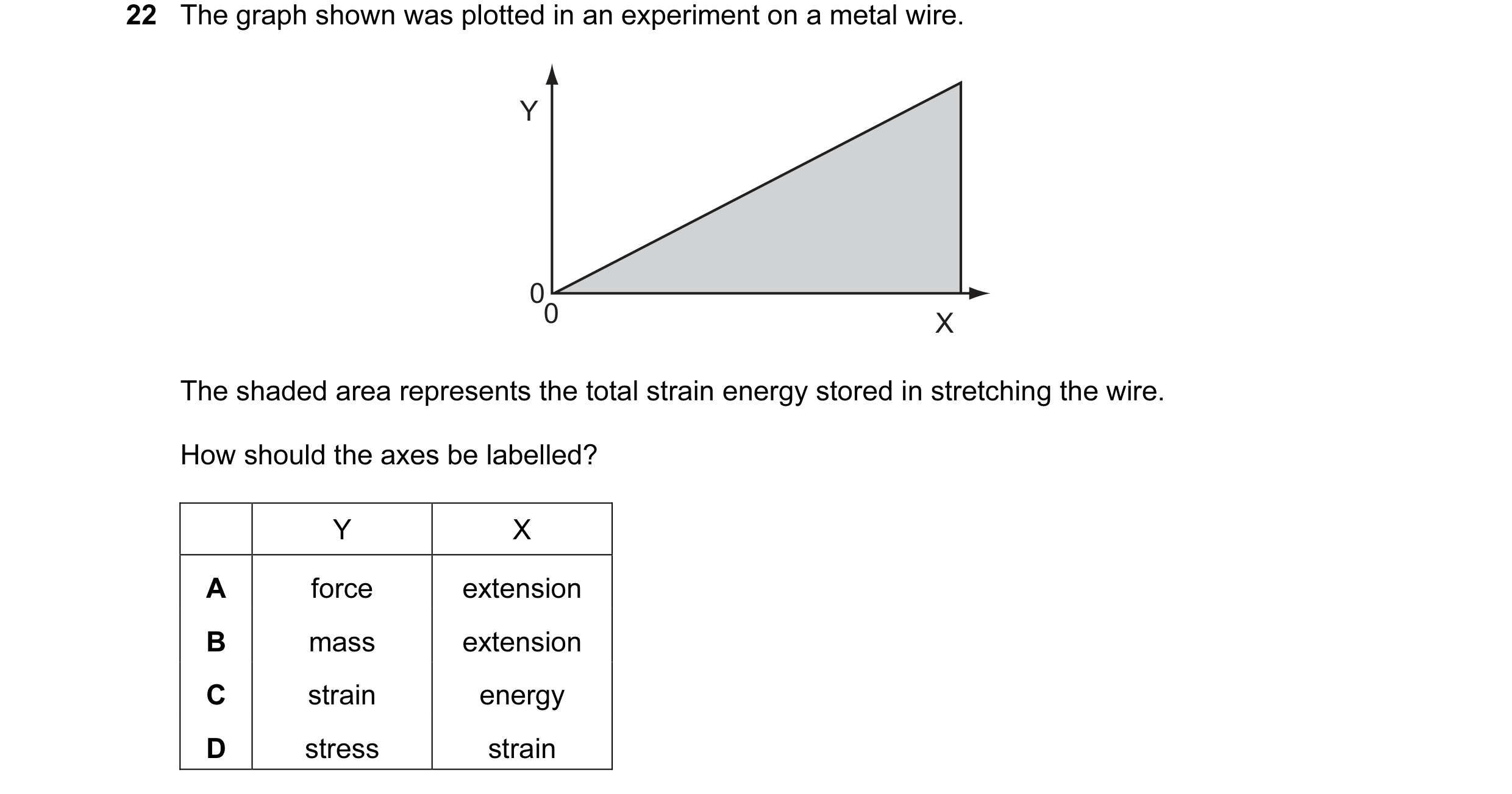
 16 / 44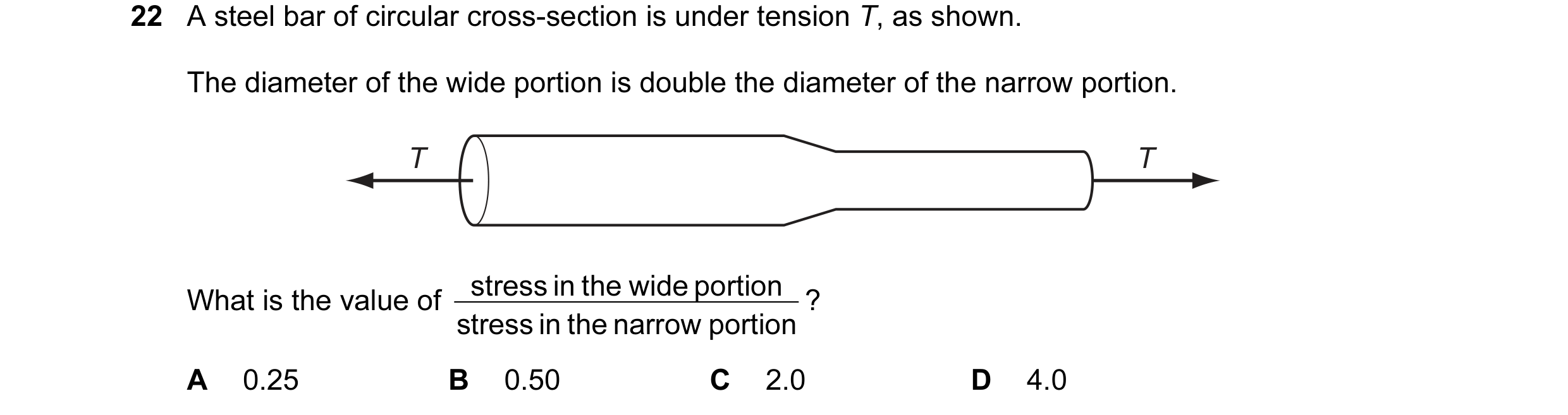
 17 / 44

 18 / 44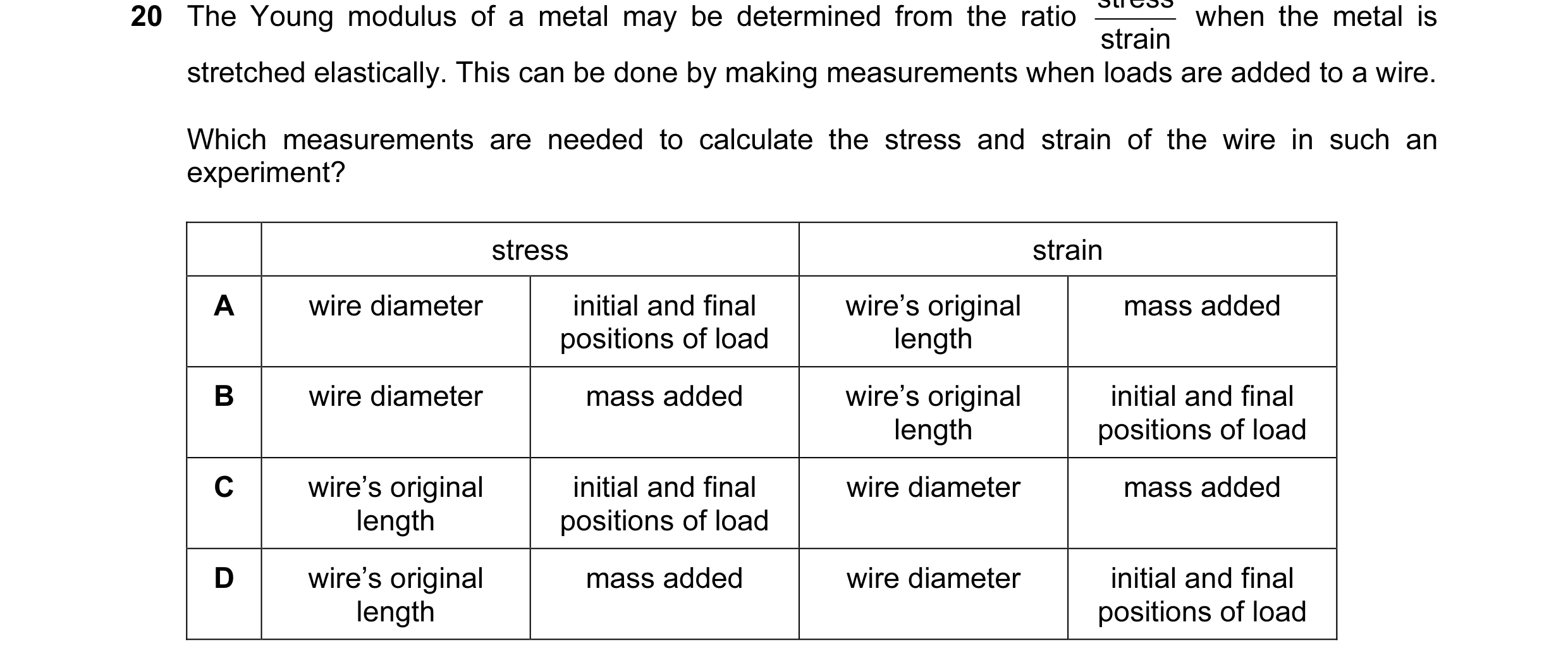

 19 / 44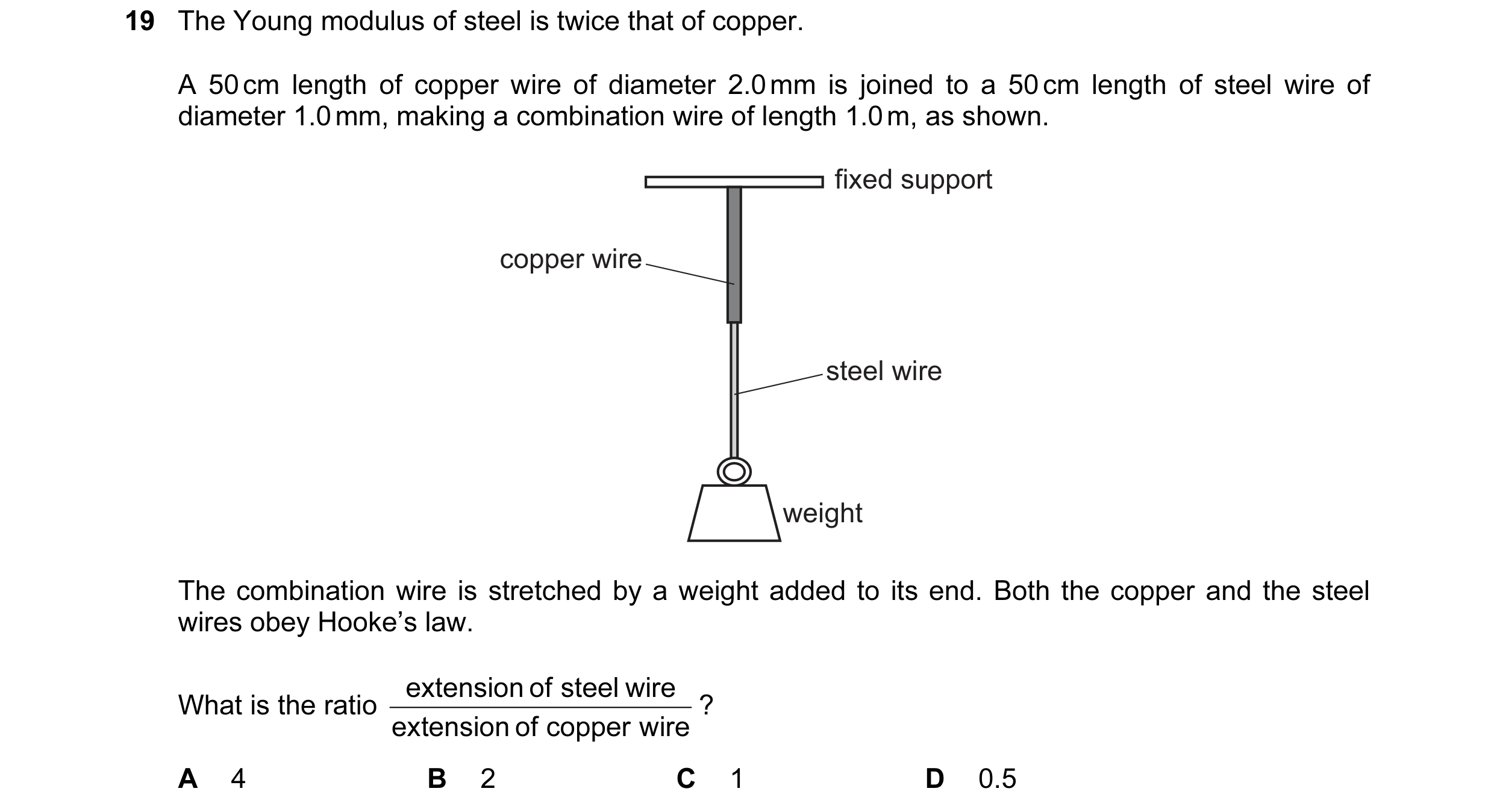
 20 / 44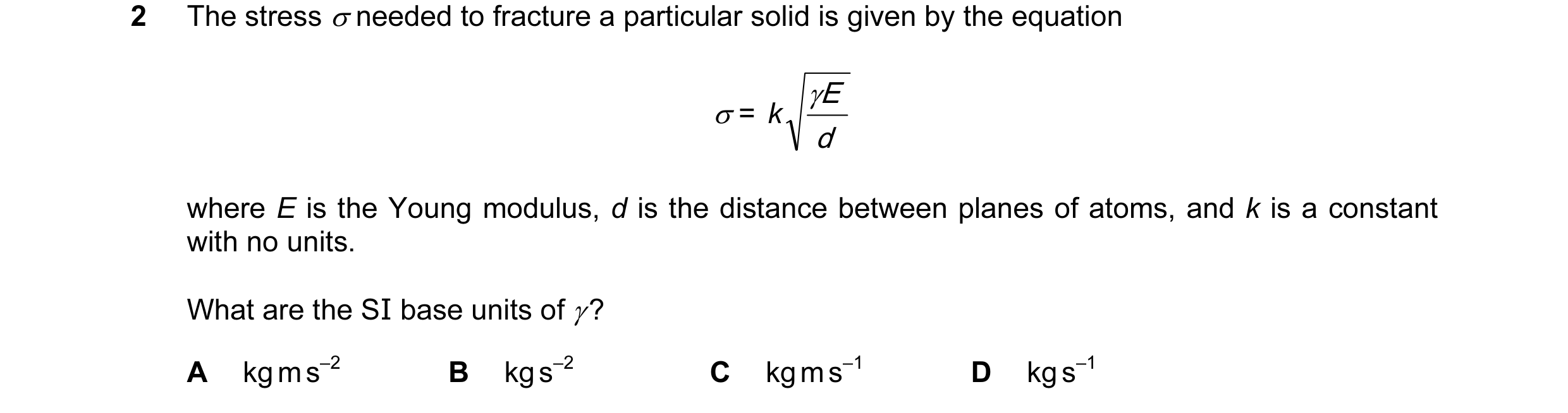

 21 / 44

 22 / 44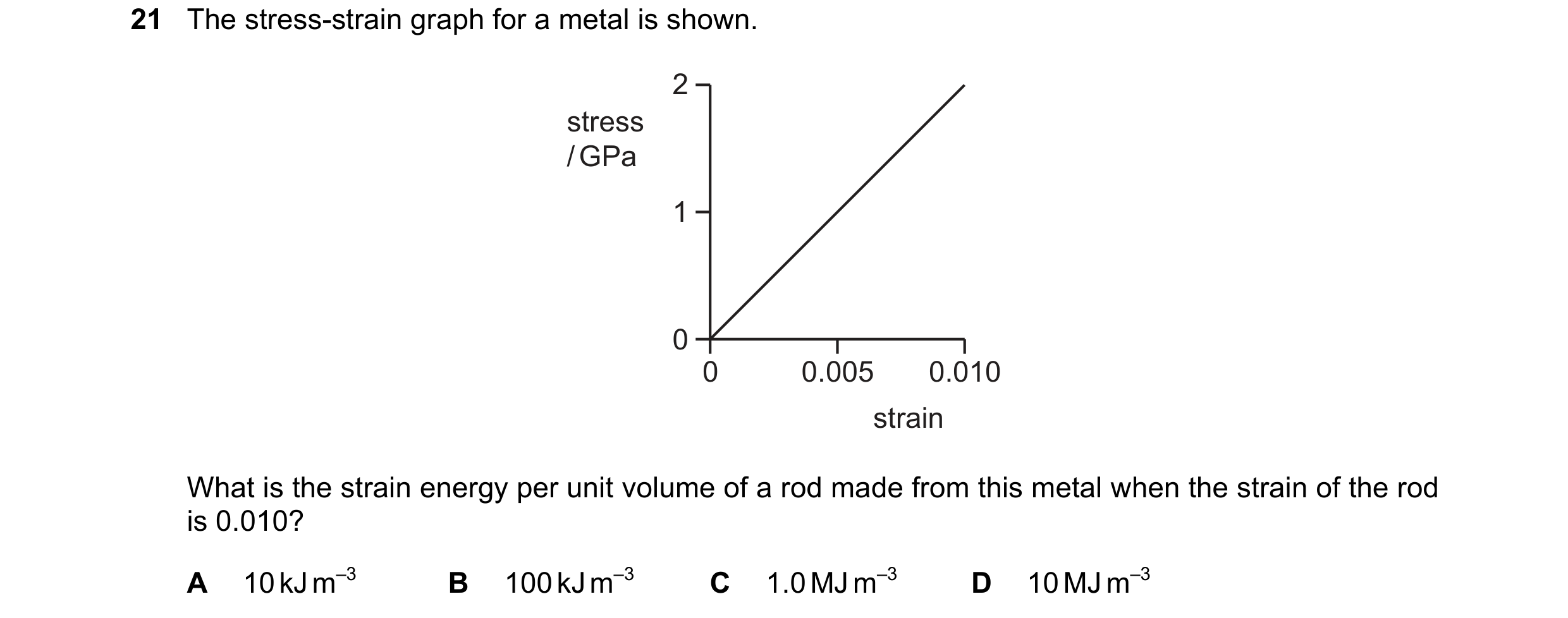
 23 / 44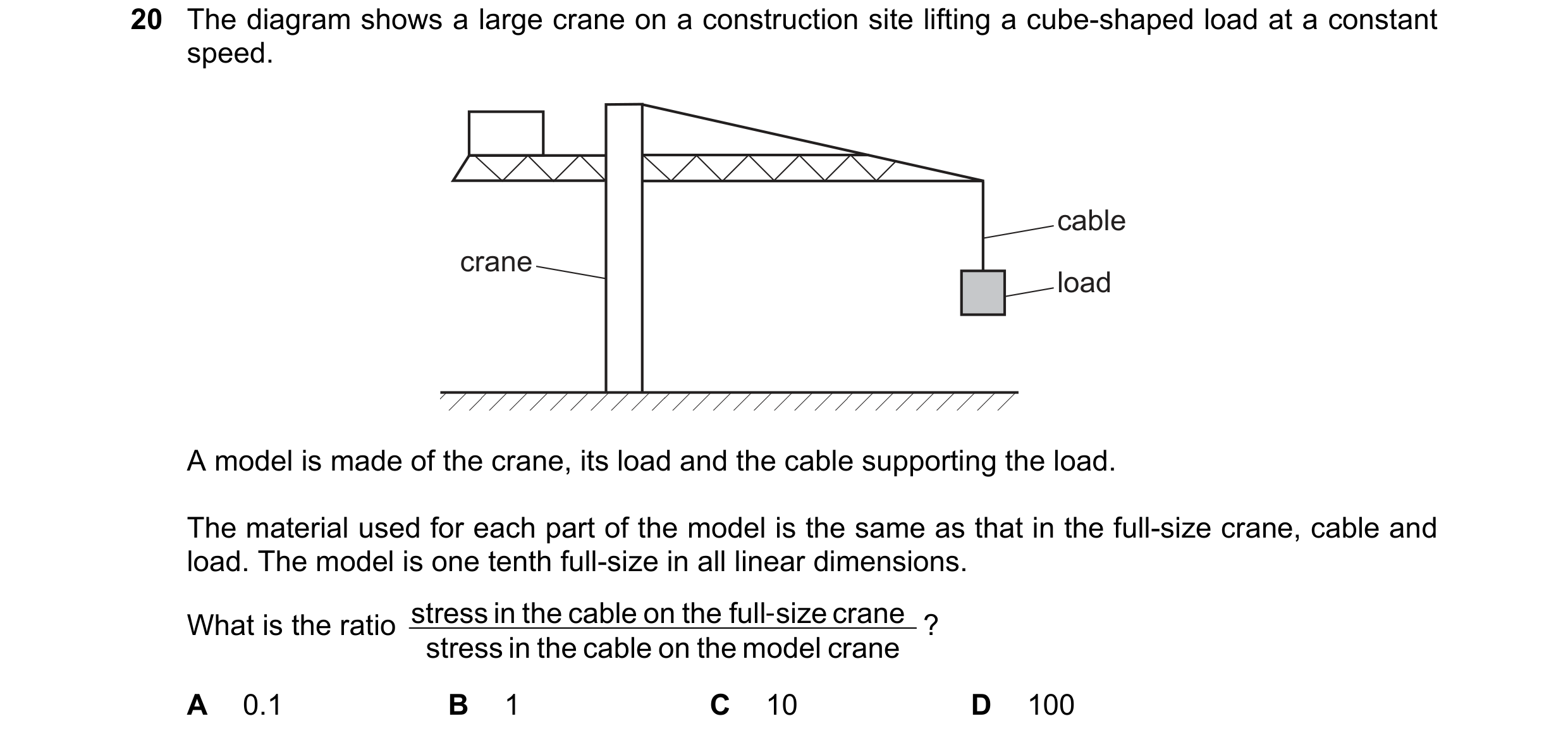

 24 / 44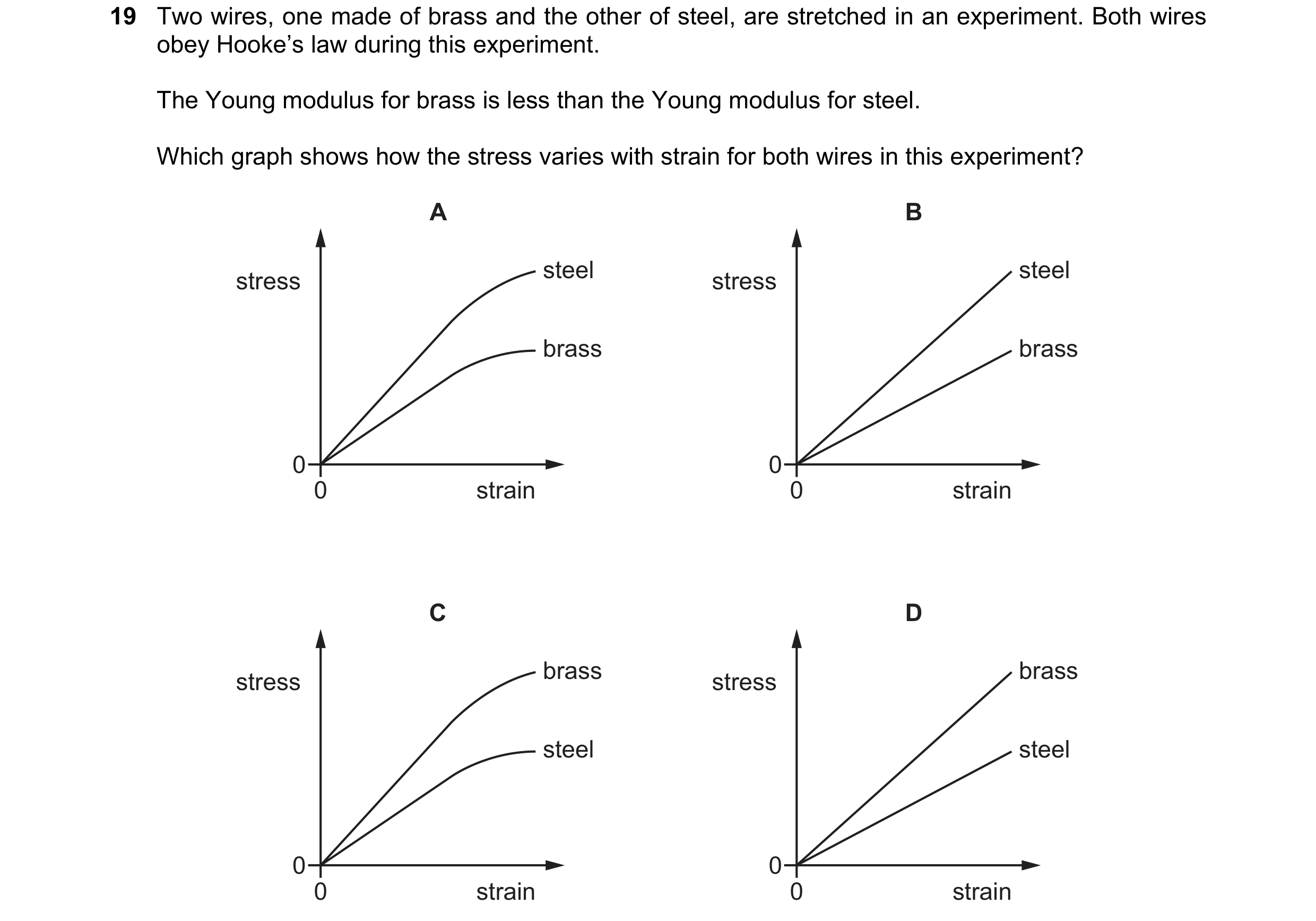

 25 / 44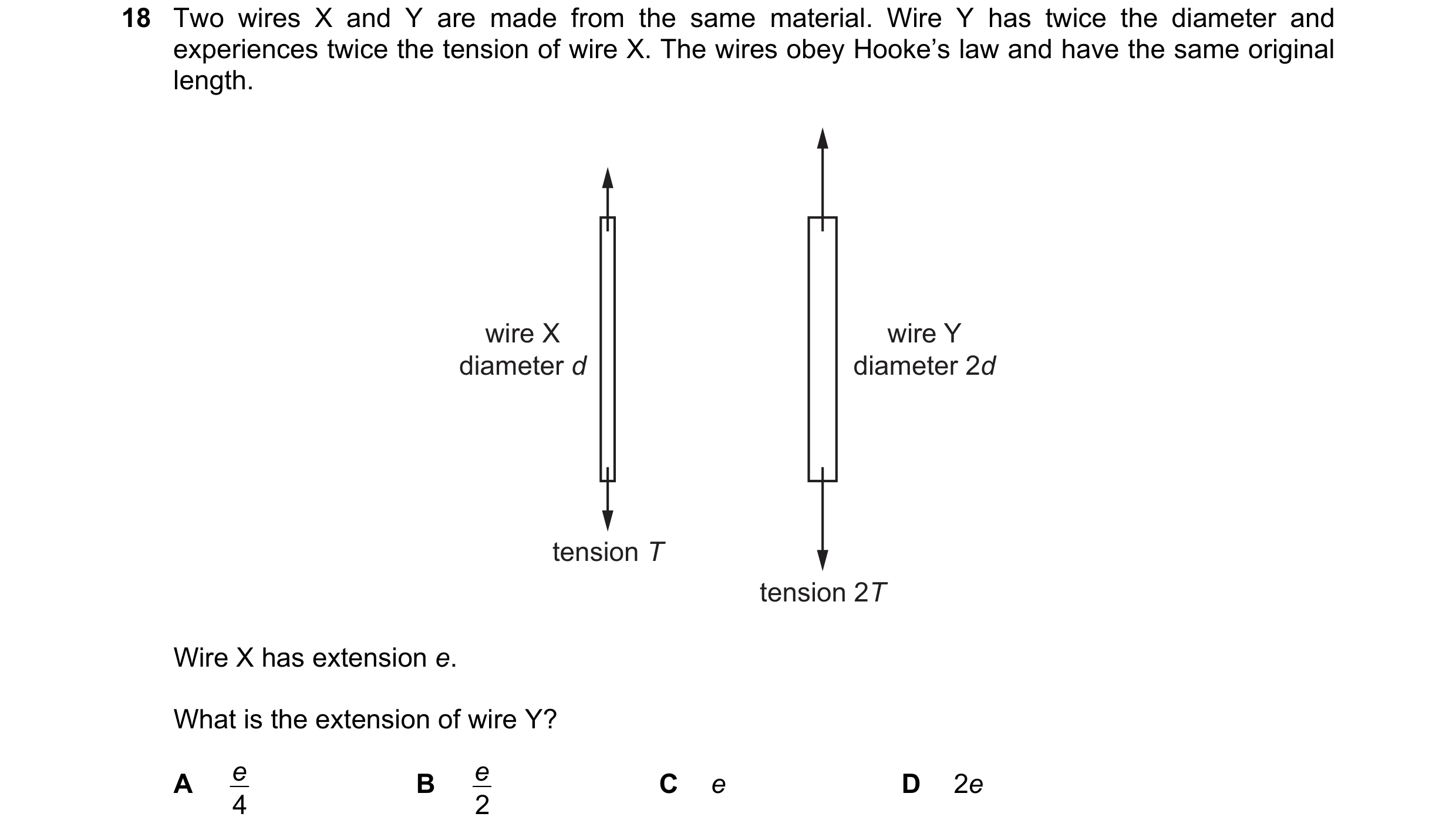
 26 / 44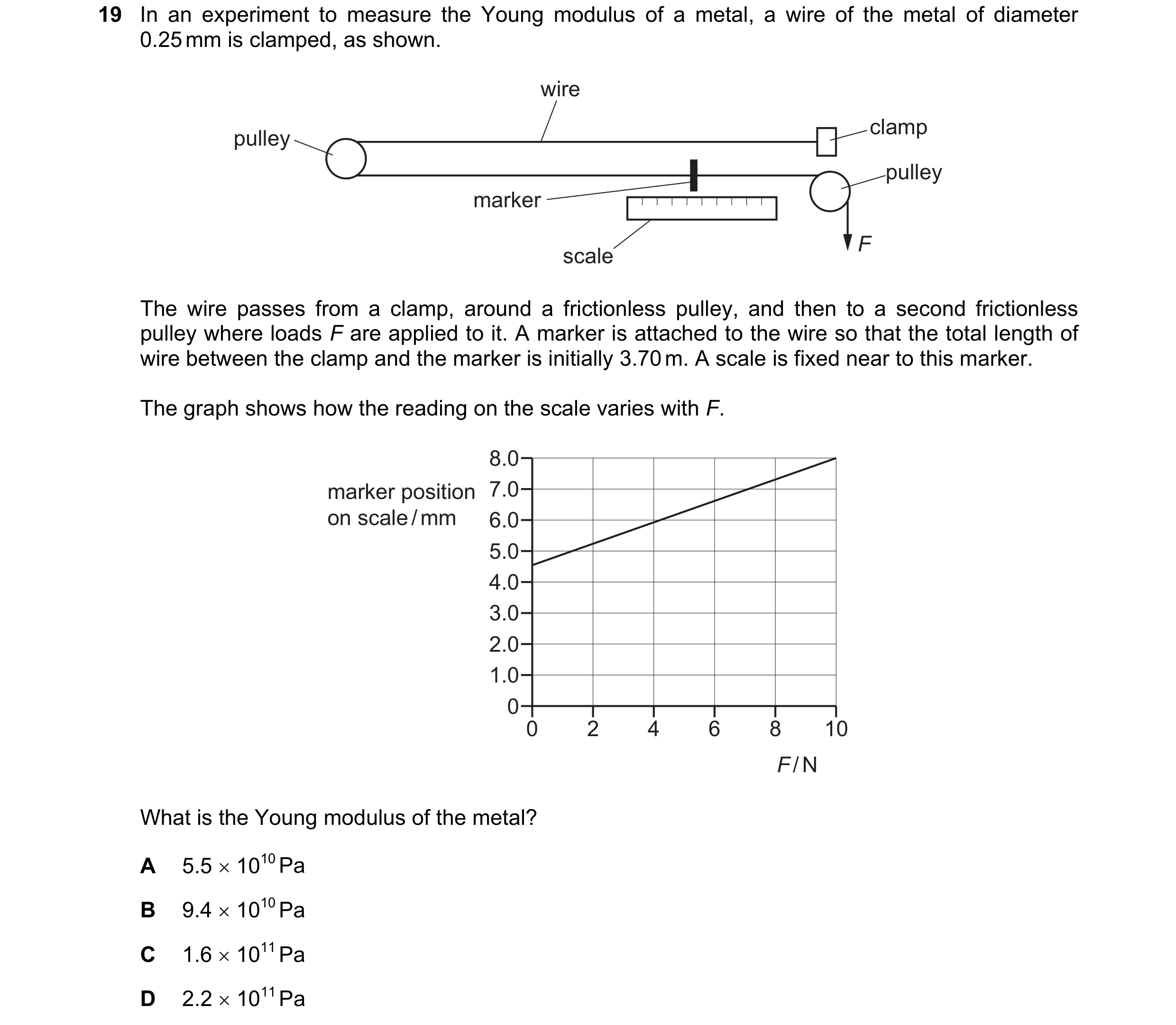
 27 / 44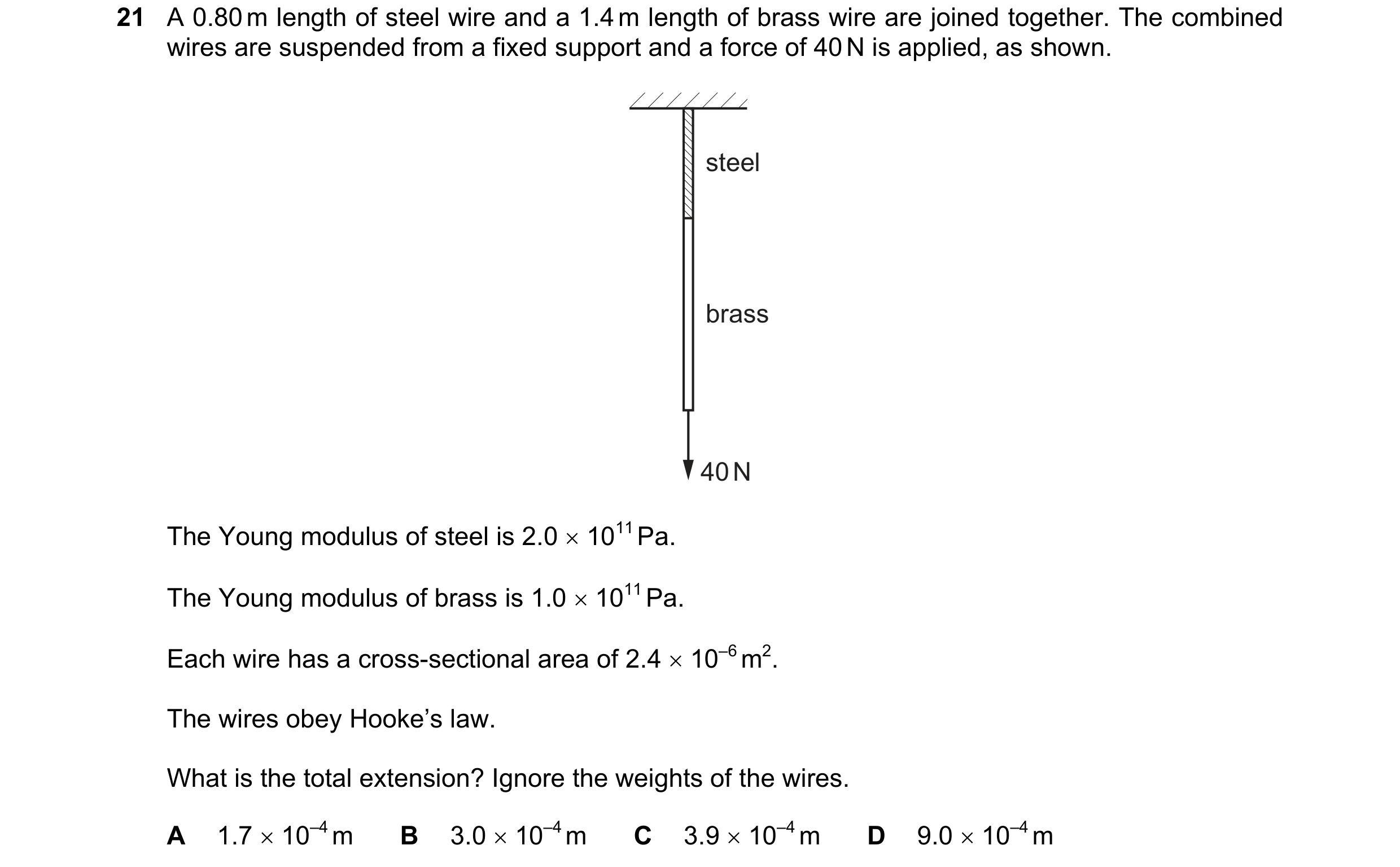

 28 / 44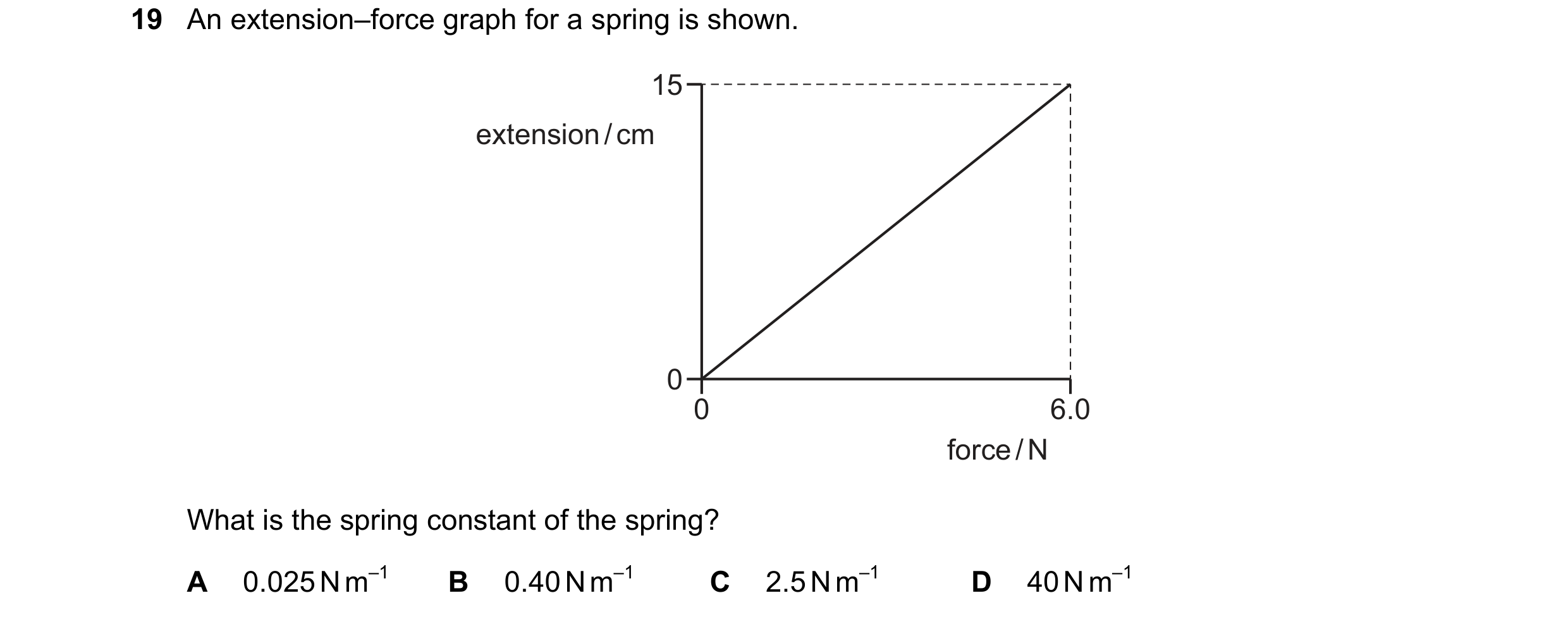
 29 / 44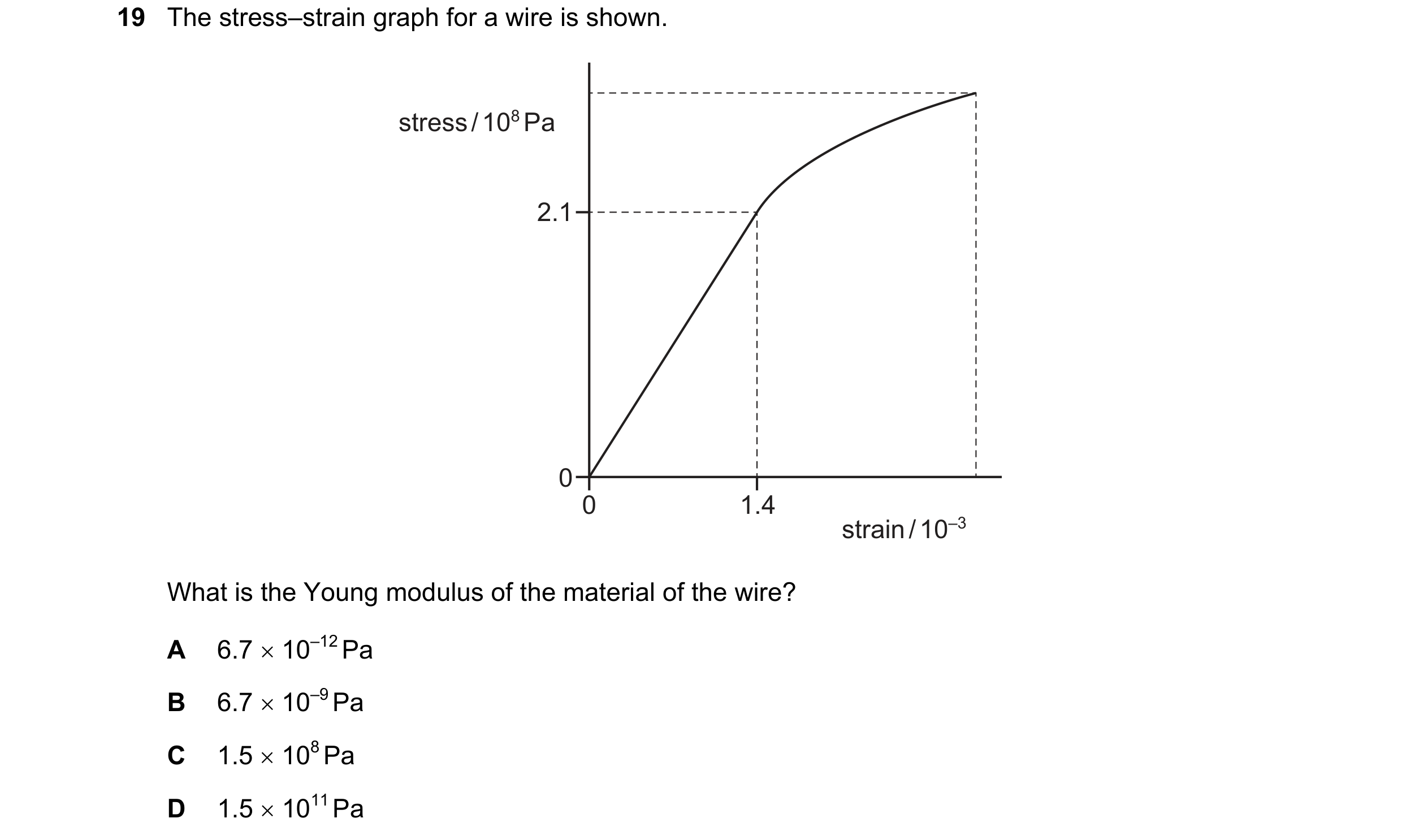
 30 / 44
 31 / 44
 32 / 44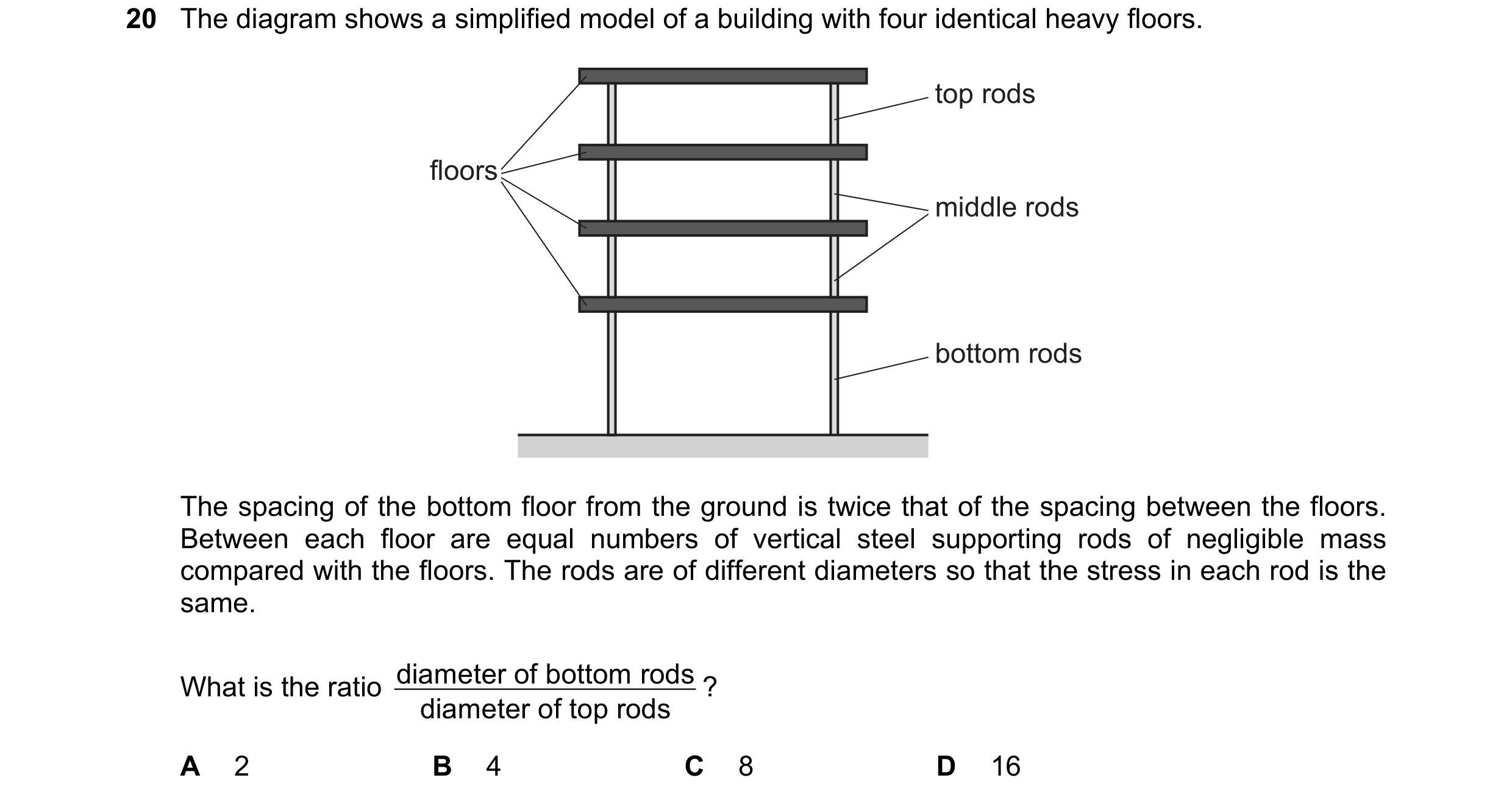
 33 / 44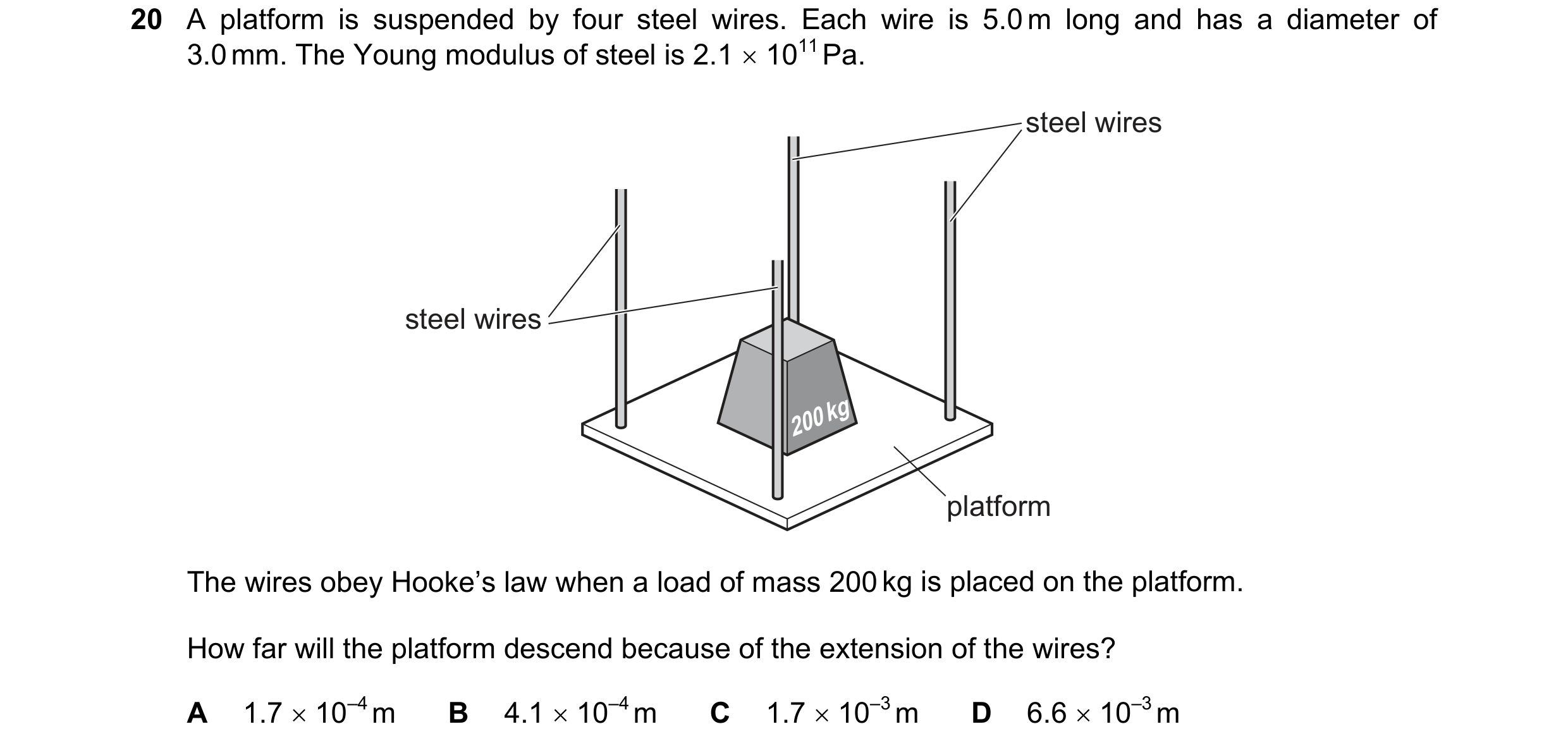

 34 / 44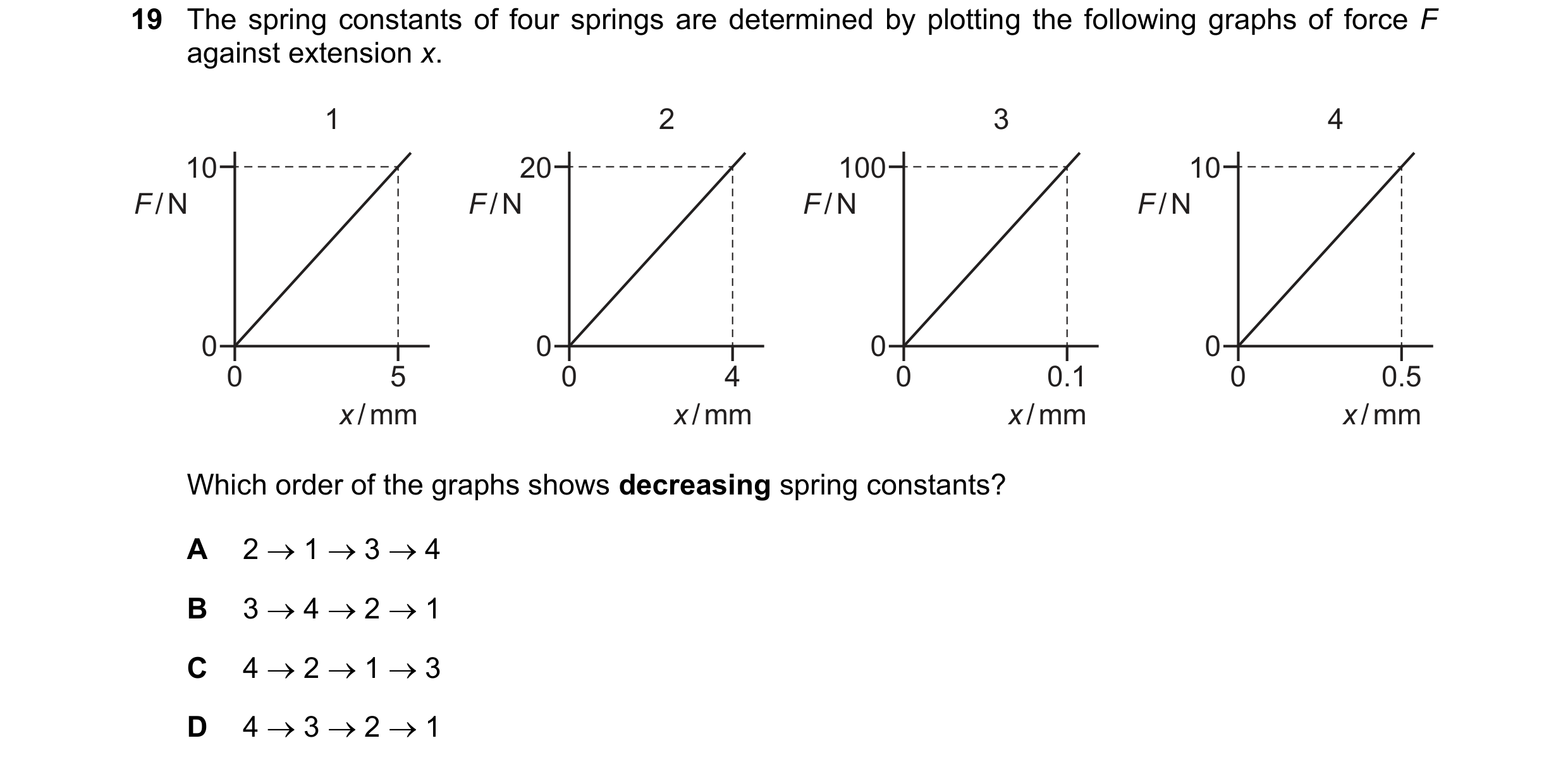

 35 / 44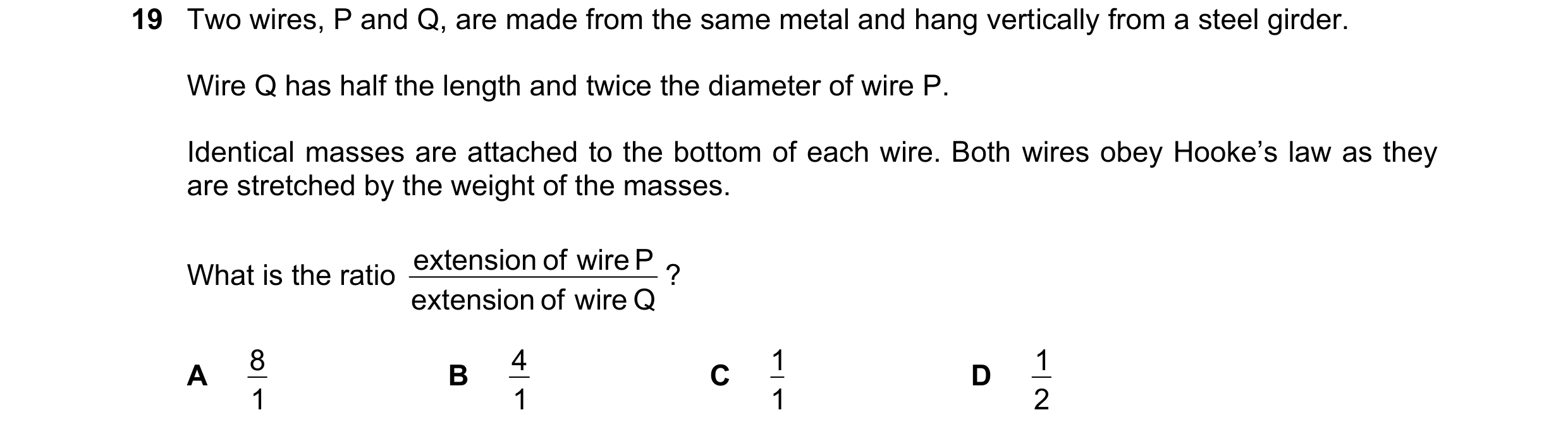


 36 / 44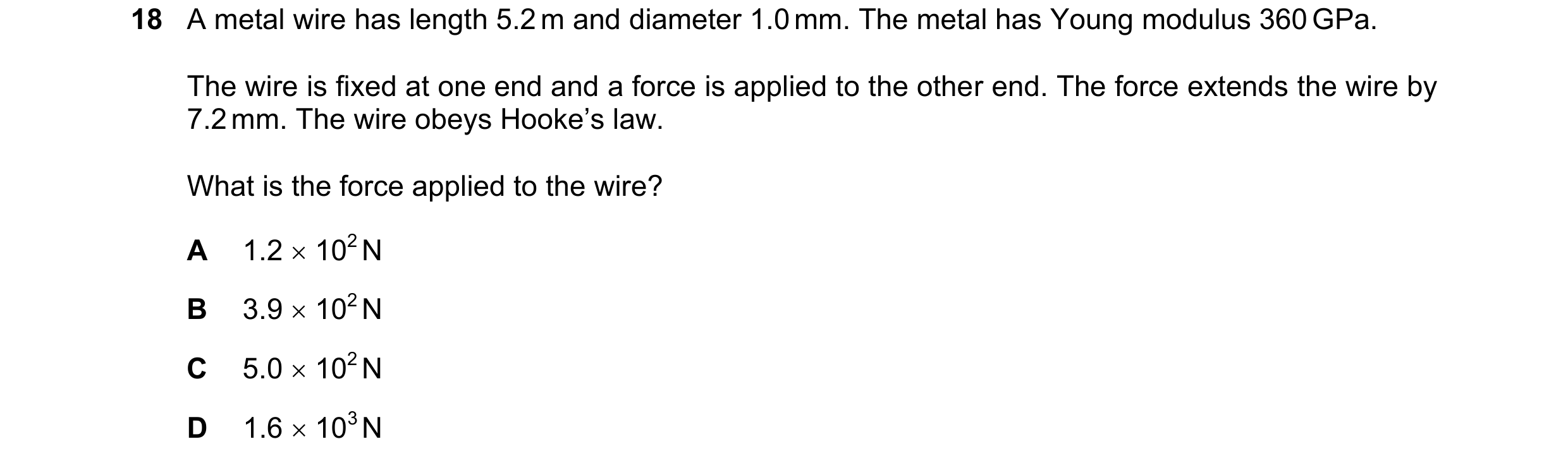

 37 / 44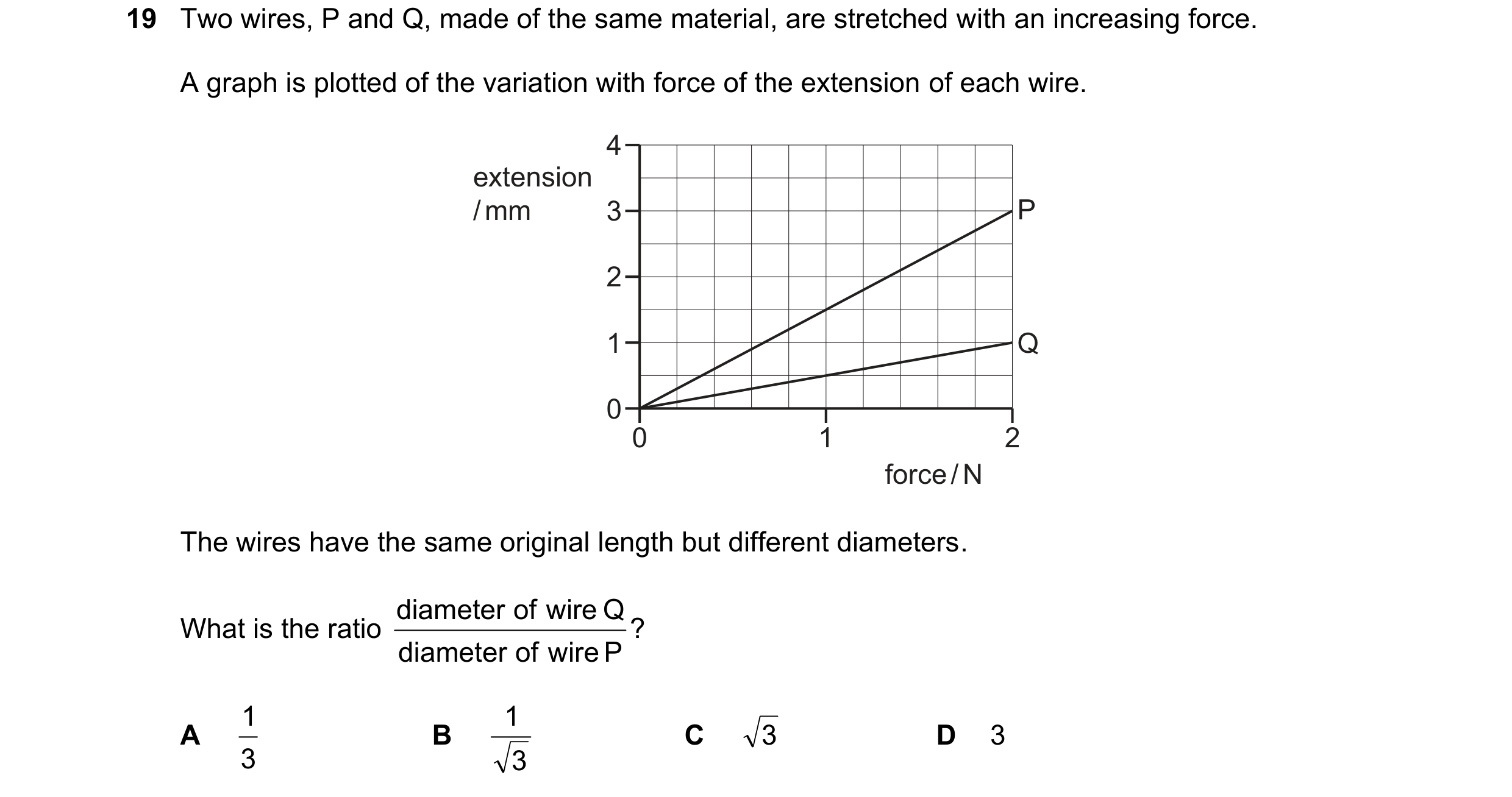
 38 / 44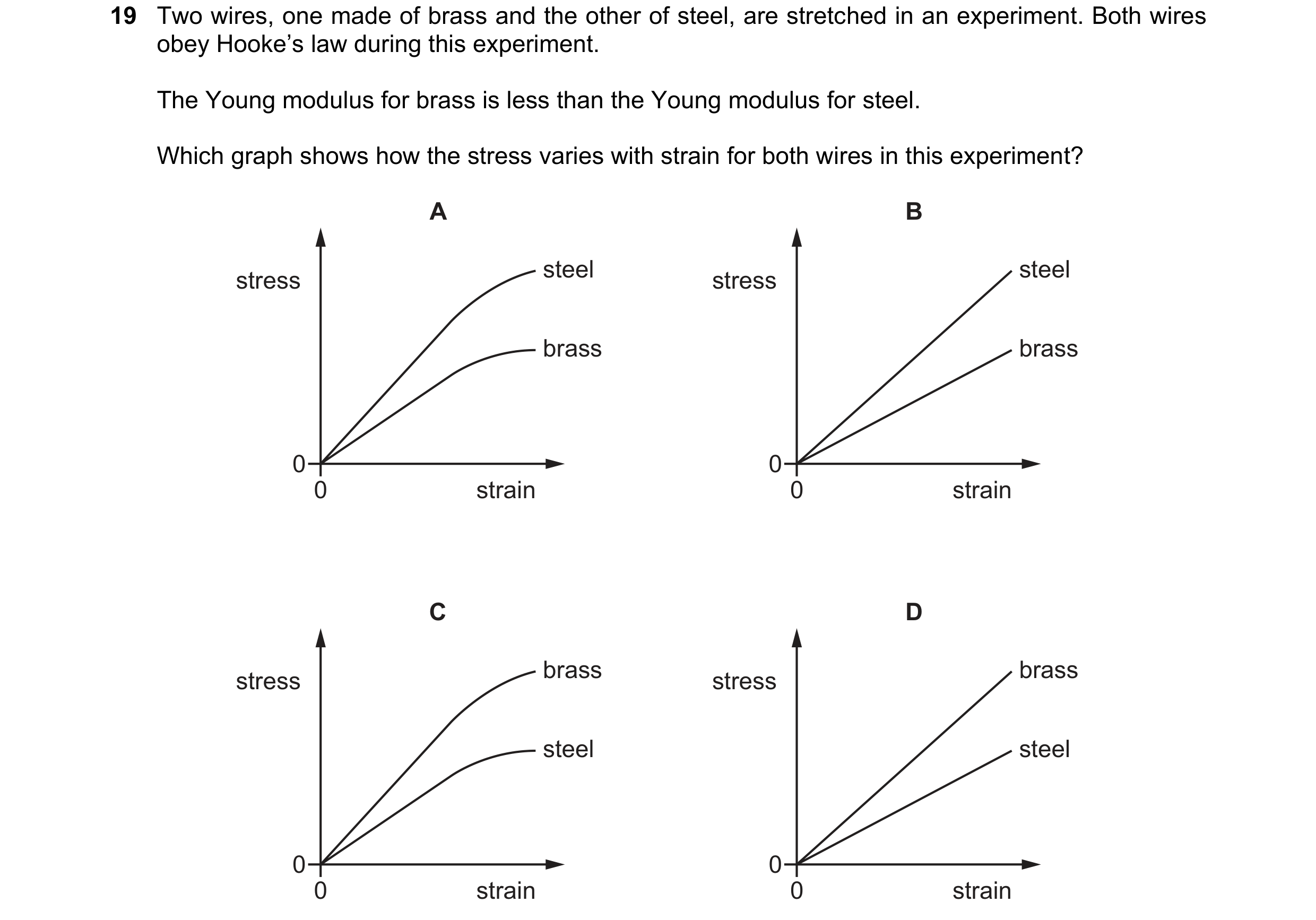
 39 / 44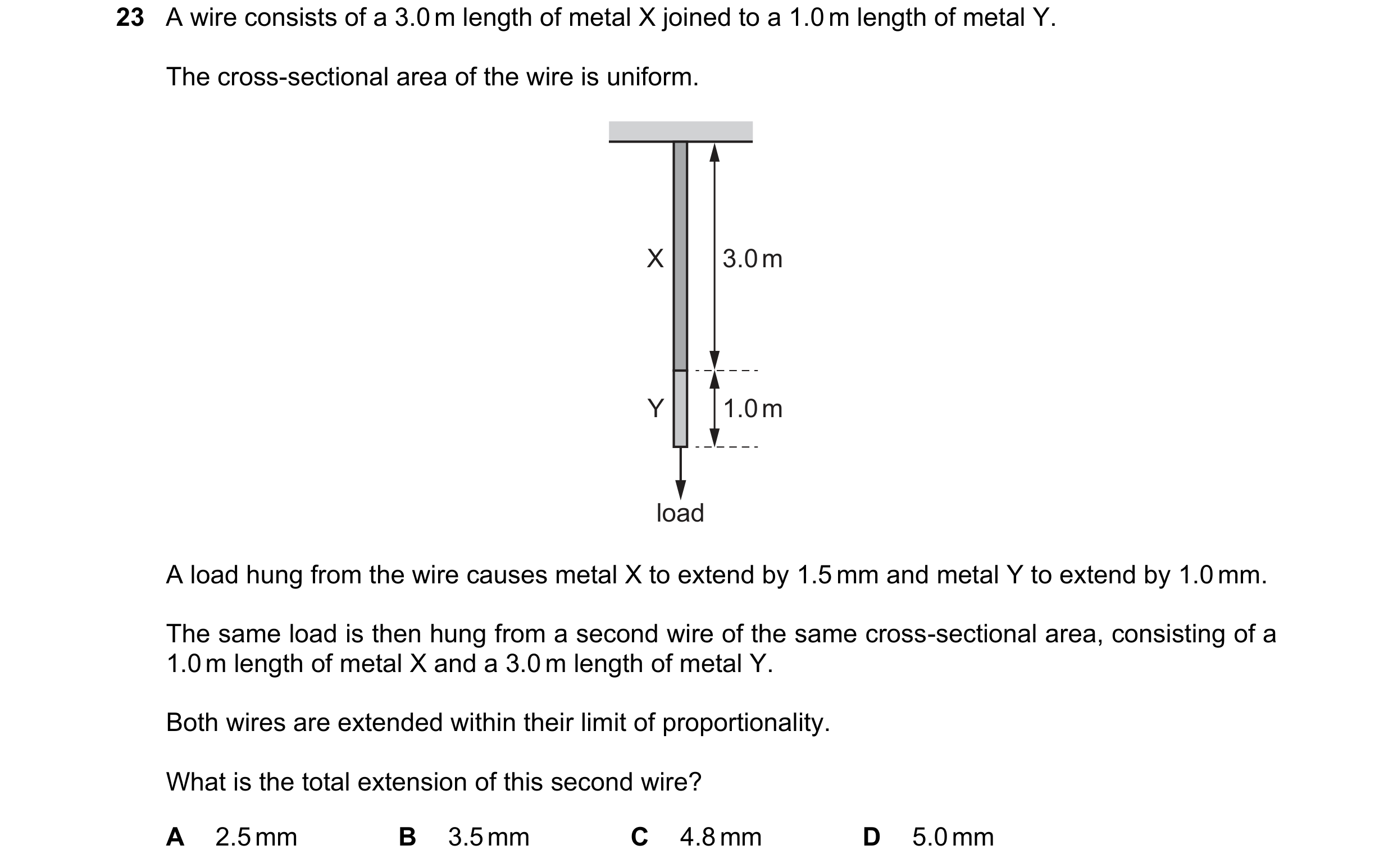

 40 / 44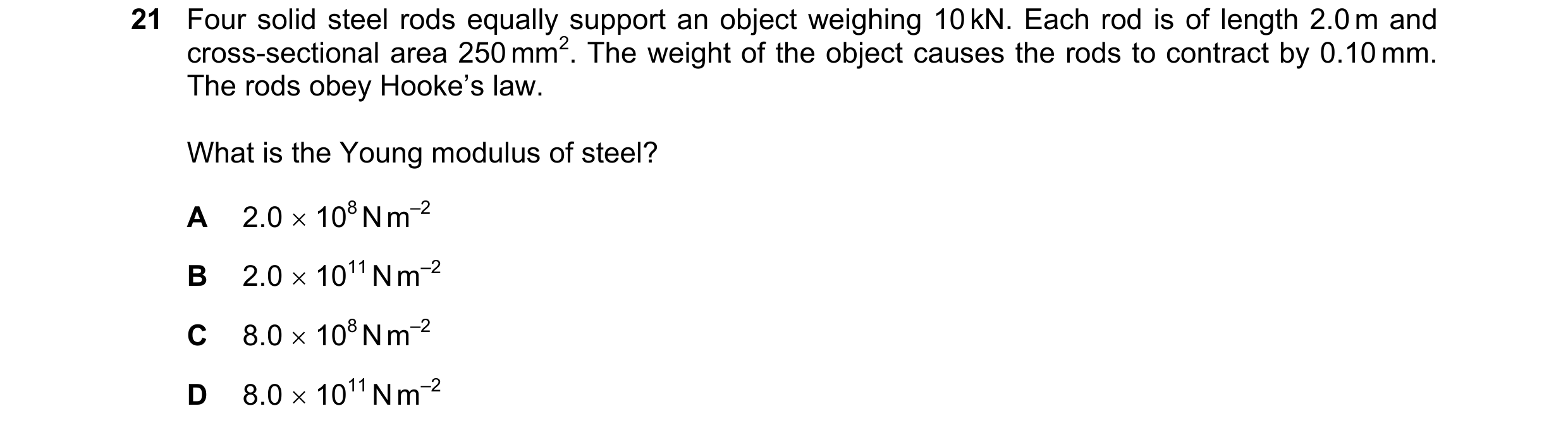

 41 / 44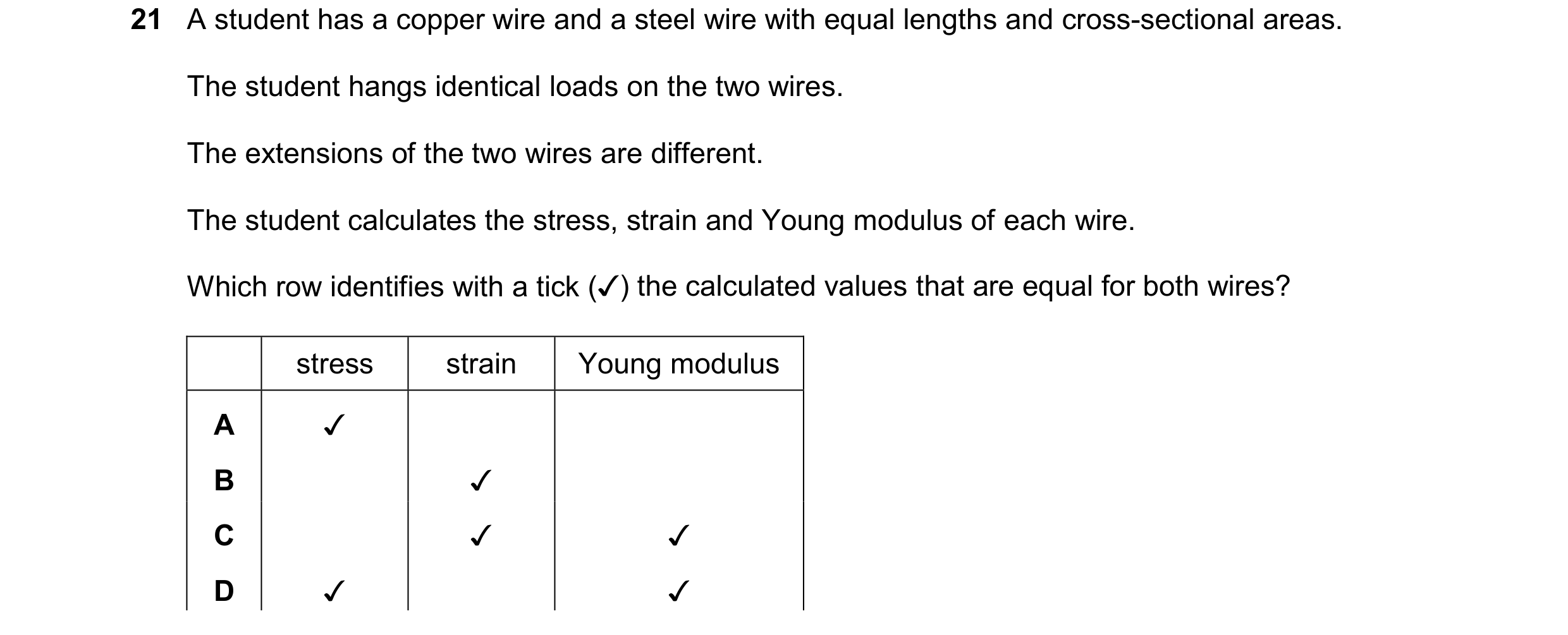


 42 / 44
 43 / 44
 44 / 44