Questions as text
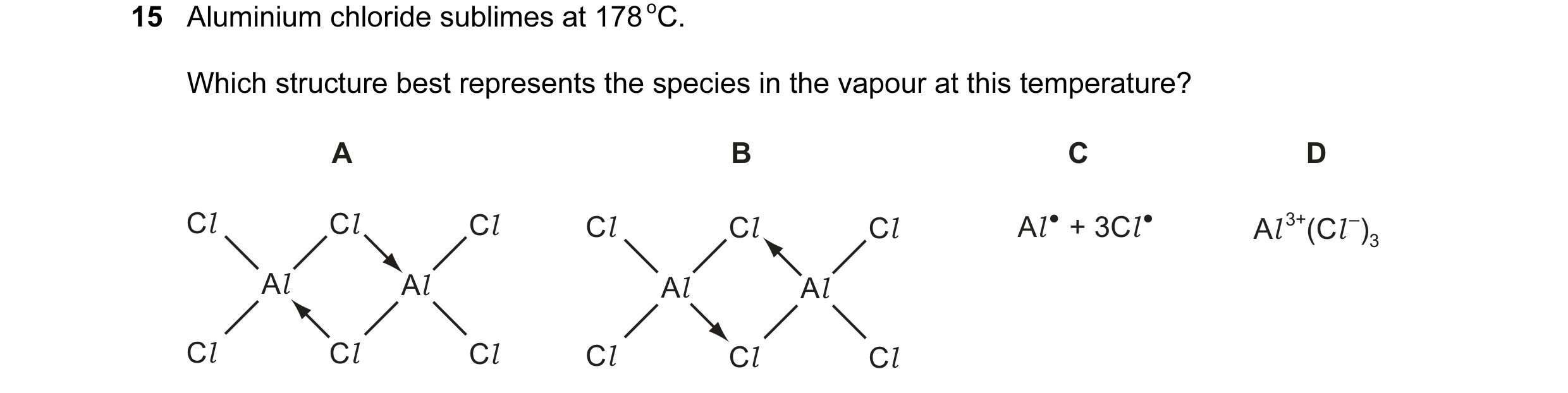
Q1 · Aluminium chloride sublimes at 178 oC 9701/11 May/June 2006
15 Aluminium chloride sublimes at 178 oC. Which structure best represents the species in the vapour at this temperature? A B C D Cl Cl Cl Cl Cl Cl Al + 3Cl Al 3+(Cl –)3 Al Al Al Al Cl Cl Cl Cl Cl Cl
1 marks
Answer: A
This question in 9701/11 May/June 2006
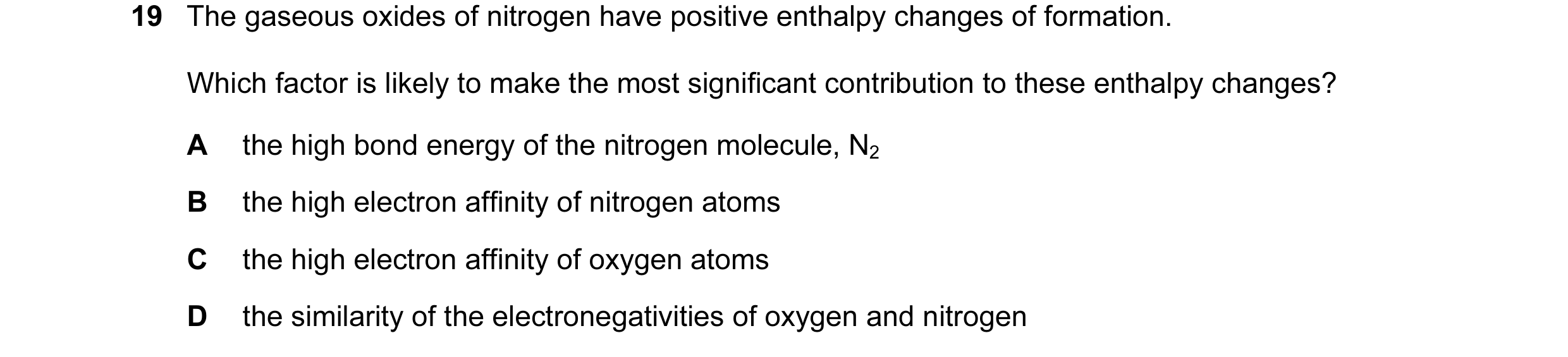
Q2 · The gaseous oxides of nitrogen have positive enthalpy changes of formation 9701/11 May/June 2006
19 The gaseous oxides of nitrogen have positive enthalpy changes of formation. Which factor is likely to make the most significant contribution to these enthalpy changes? A the high bond energy of the nitrogen molecule, N2 B the high electron affinity of nitrogen atoms C the high electron affinity of oxygen atoms D the similarity of the electronegativities of oxygen and nitrogen
1 marks
Answer: A
This question in 9701/11 May/June 2006
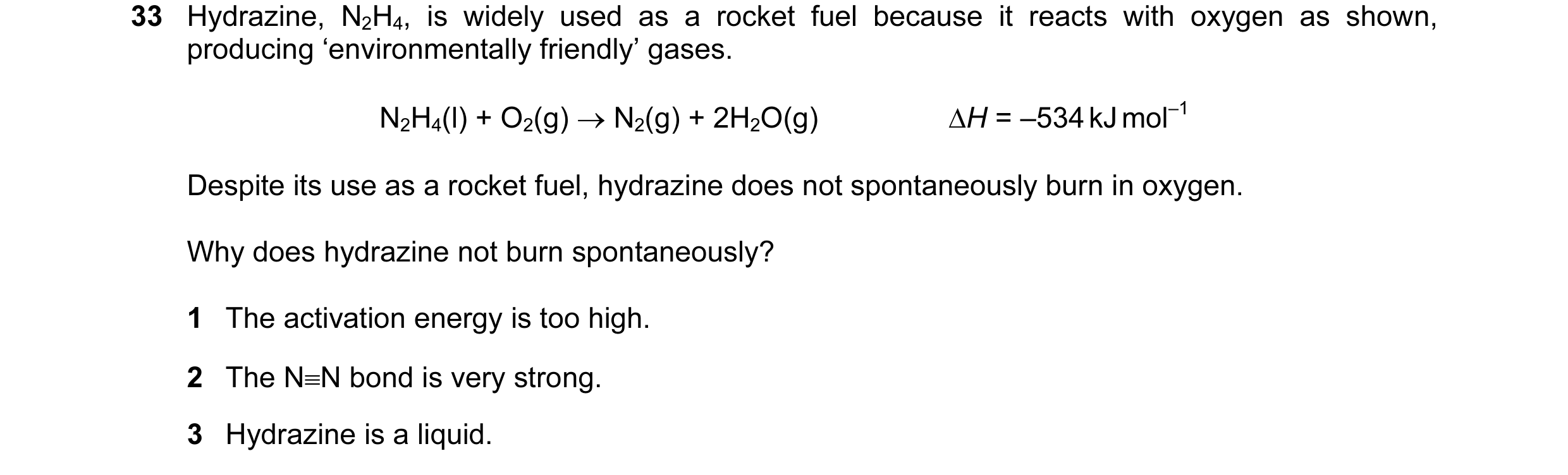
Q3 · Hydrazine, N2H4, is widely used as a rocket fuel because it reacts with oxygen as shown… 9701/11 May/June 2006
33 Hydrazine, N2H4, is widely used as a rocket fuel because it reacts with oxygen as shown, producing ‘environmentally friendly’ gases. N2H4(l) + O2(g) → N2(g) + 2H2O(g) ∆H = –534 kJ mol–1 Despite its use as a rocket fuel, hydrazine does not spontaneously burn in oxygen. Why does hydrazine not burn spontaneously? 1 The activation energy is too high. 2 The N≡N bond is very strong. 3 Hydrazine is a liquid.
1 marks
Answer: D
This question in 9701/11 May/June 2006
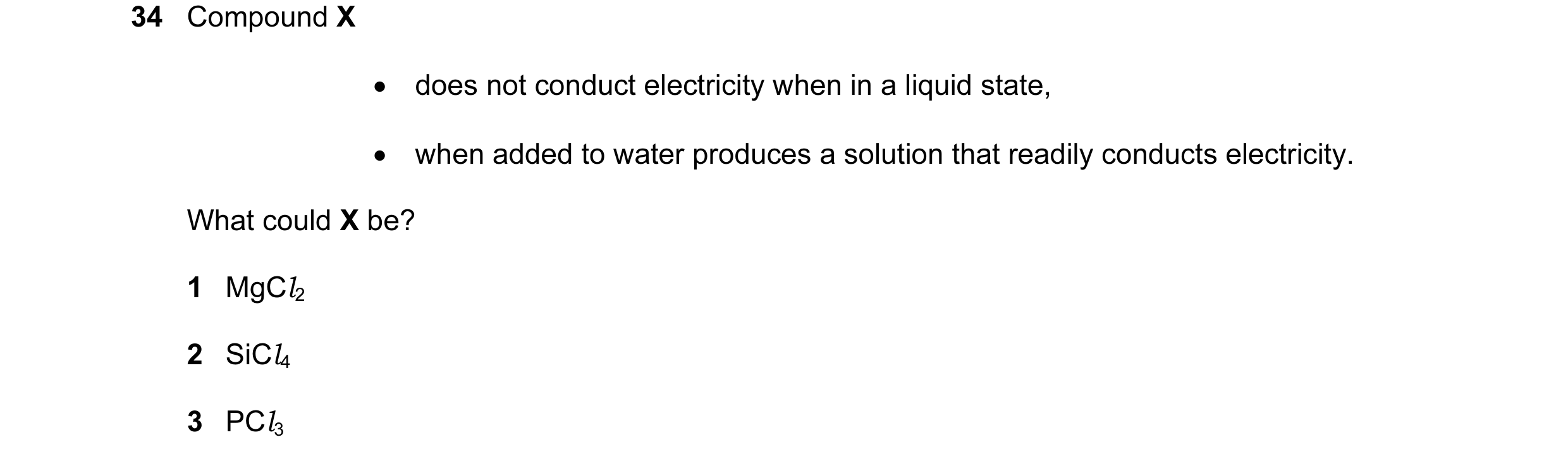
Q4 · Compound X • does not conduct electricity when in a liquid state, • when added to water… 9701/11 May/June 2006
34 Compound X • does not conduct electricity when in a liquid state, • when added to water produces a solution that readily conducts electricity. What could X be? 1 MgCl2 2 SiCl4 3 PCl3
1 marks
Answer: C
This question in 9701/11 May/June 2006
Q5 · The chlorine oxide free radical, ClO•, is formed during the depletion of the ozone layer… 9701/11 Oct/Nov 2006
31 The chlorine oxide free radical, ClO•, is formed during the depletion of the ozone layer by chlorofluoroalkanes (CFCs). Cl • + O3 → ClO• + O2 Which features are present in the chlorine oxide free radical? 1 an odd number of electrons 2 a single covalent bond 3 a dative covalent bond from oxygen to chlorine
1 marks
Answer: B
This question in 9701/11 Oct/Nov 2006
Q6 · In this question, the methyl group, CH3, is represented by Me 9701/11 May/June 2008
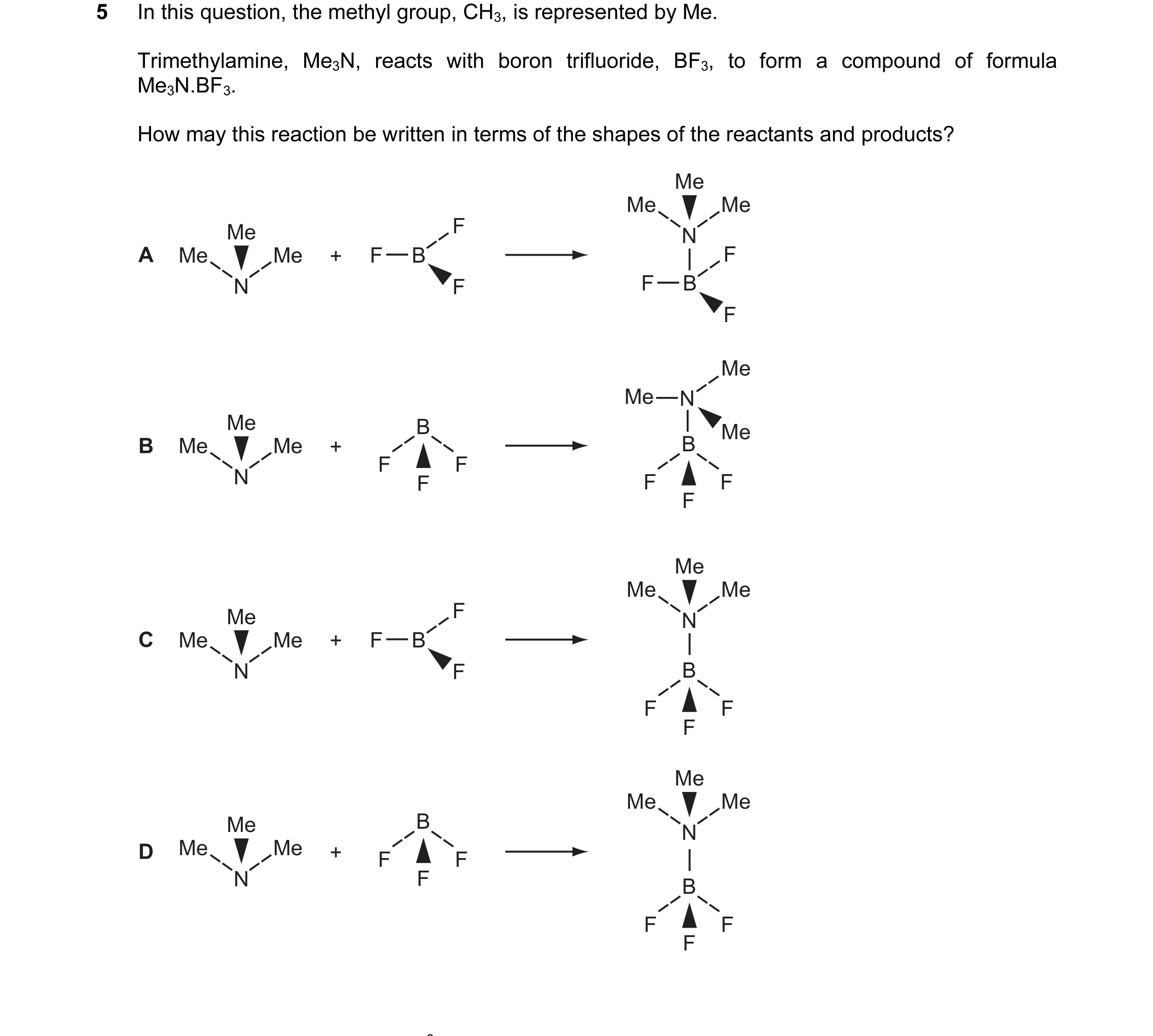
5 In this question, the methyl group, CH3, is represented by Me. Trimethylamine, Me3N, reacts with boron trifluoride, BF3, to form a compound of formula Me3N.BF3. How may this reaction be written in terms of the shapes of the reactants and products? Me Me Me Me F N A Me Me + F B F N F F B F Me Me N Me B Me B Me Me + B F F N F F F F Me Me Me Me F N C Me Me + F B N F B F F F Me Me Me Me B N D Me Me + F F N F B F F F
1 marks
Answer: C
This question in 9701/11 May/June 2008
Q7 · Water is added to anhydrous aluminium chloride to make a 0.1 mol dm-3 solution 9701/11 May/June 2008
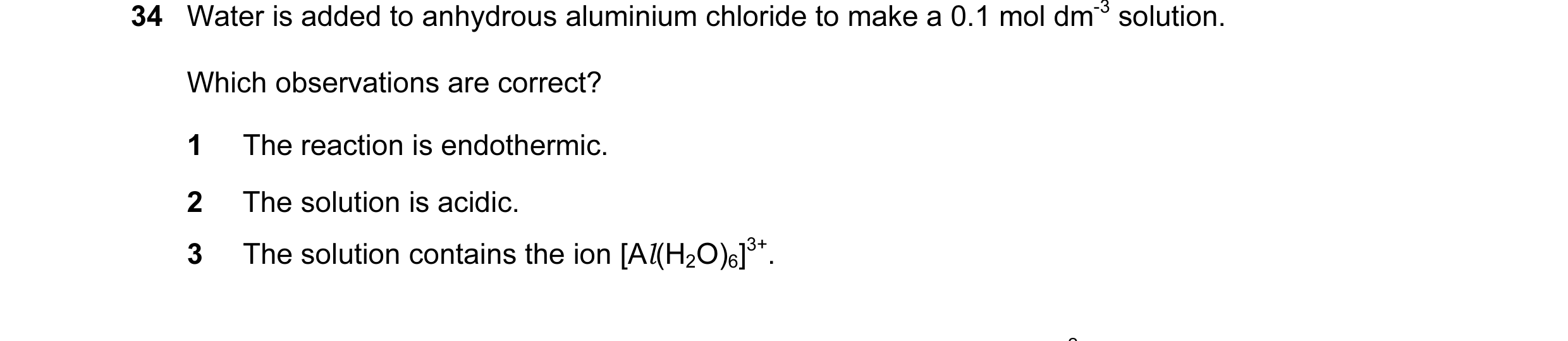
34 Water is added to anhydrous aluminium chloride to make a 0.1 mol dm-3 solution. Which observations are correct? 1 The reaction is endothermic. 2 The solution is acidic. 3 The solution contains the ion [Al(H2O)6]3+.
1 marks
Answer: C
This question in 9701/11 May/June 2008
Q8 · Aluminium chloride catalyses certain reactions by forming carbocations (carbonium ions)… 9701/11 Oct/Nov 2008
15 Aluminium chloride catalyses certain reactions by forming carbocations (carbonium ions) with chloroalkanes as shown. RCl + Al Cl3 → R+ + A l C l − 4 Which property makes this reaction possible? A AlCl3 exists as the dimer Al2Cl6 in the vapour. B AlCl3 is a covalent molecule. C The aluminium atom in Al Cl3 has an incomplete octet of electrons. D The chlorine atom in RCl has a vacant p orbital.
1 marks
Answer: C
This question in 9701/11 Oct/Nov 2008
Q9 · Deposits of ammonium compounds have been discovered in areas of high atmospheric pollution 9701/11 May/June 2009
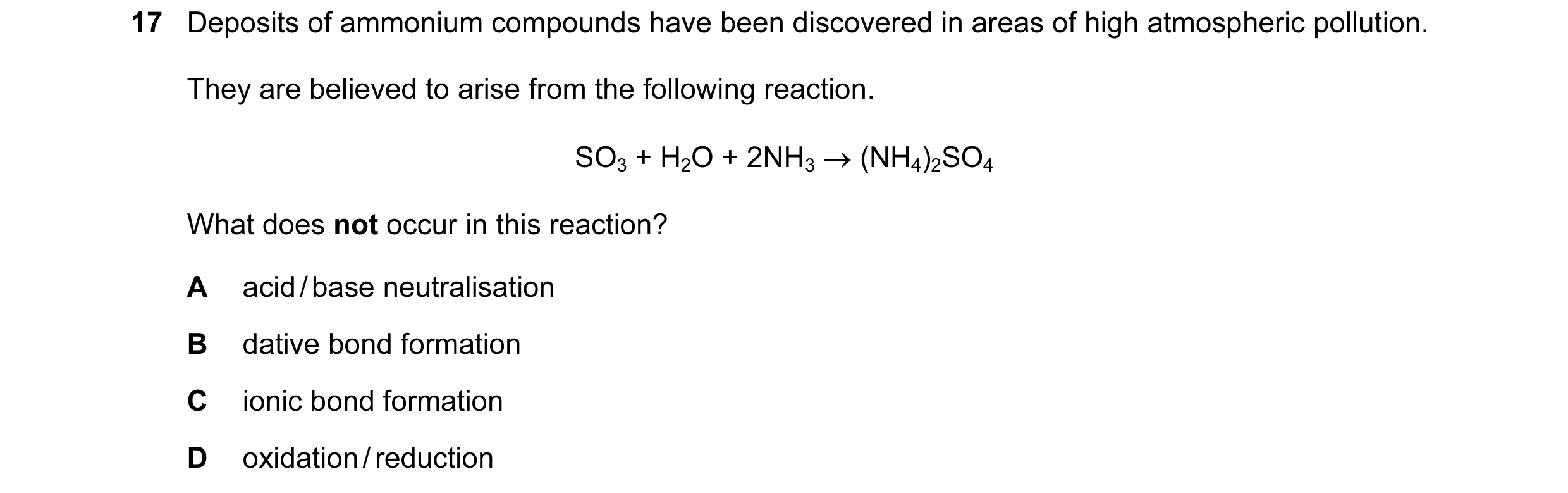
17 Deposits of ammonium compounds have been discovered in areas of high atmospheric pollution. They are believed to arise from the following reaction. SO3 + H2O + 2NH3 → (NH4)2SO4 What does not occur in this reaction? A acid / base neutralisation B dative bond formation C ionic bond formation D oxidation / reduction
1 marks
Answer: D
This question in 9701/11 May/June 2009
Q10 · Which statements about covalent bonds are correct? 9701/12 Oct/Nov 2010
33 Which statements about covalent bonds are correct? 1 A triple bond consists of one π bond and two σ bonds. 2 The electron density in a σ bond is highest along the axis between the two bonded atoms. 3 A π bond restricts rotation about the σ bond axis.
1 marks
Answer: C
This question in 9701/12 Oct/Nov 2010
Q11 · The formula CH3 can represent an anion, a cation or a free radical 9701/11 May/June 2011
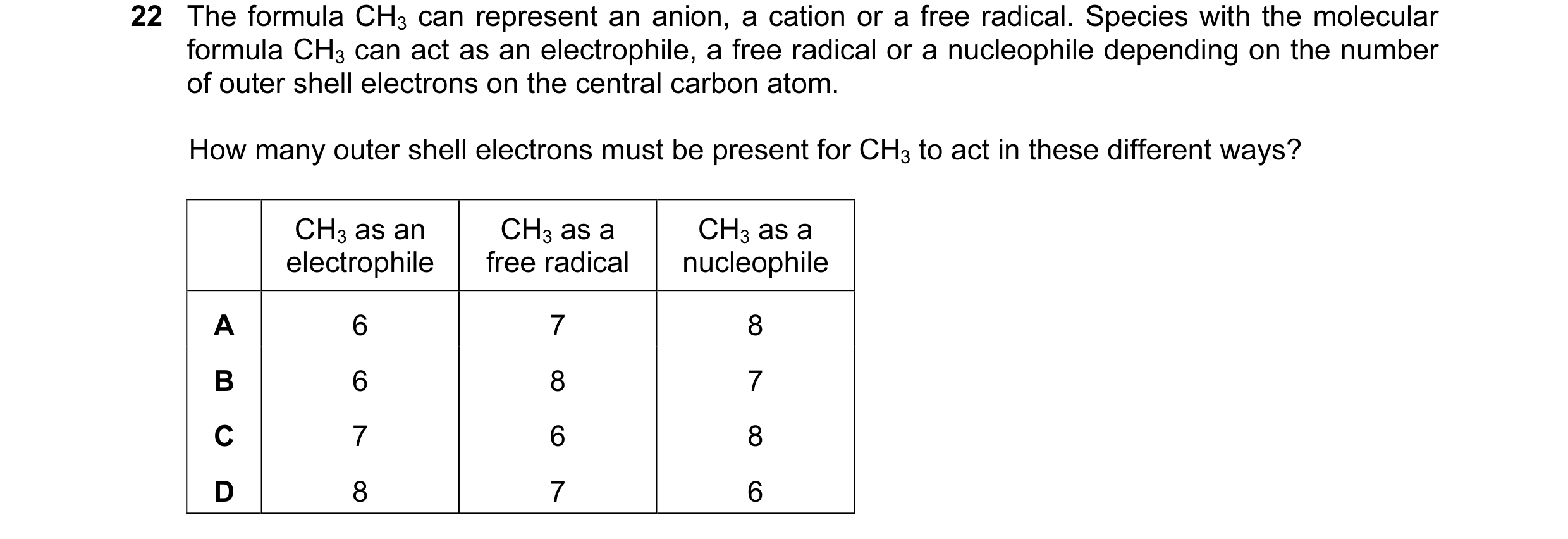
22 The formula CH3 can represent an anion, a cation or a free radical. Species with the molecular formula CH3 can act as an electrophile, a free radical or a nucleophile depending on the number of outer shell electrons on the central carbon atom. How many outer shell electrons must be present for CH3 to act in these different ways? CH3 as an CH3 as a CH3 as a electrophile free radical nucleophile A 6 7 8 B 6 8 7 C 7 6 8 D 8 7 6
1 marks
Answer: A
This question in 9701/11 May/June 2011
Q12 · Which diagram correctly shows the bonding in the ammonium ion, NH4 +? 9701/12 May/June 2011
2 Which diagram correctly shows the bonding in the ammonium ion, NH4 +? key A B N electron + + H H H electron H N H H N H H H C D + + H H H N H H N H H H
1 marks
Answer: C
This question in 9701/12 May/June 2011
Q13 · The equation below represents the combination of gaseous atoms of non-metal X and of… 9701/13 May/June 2011
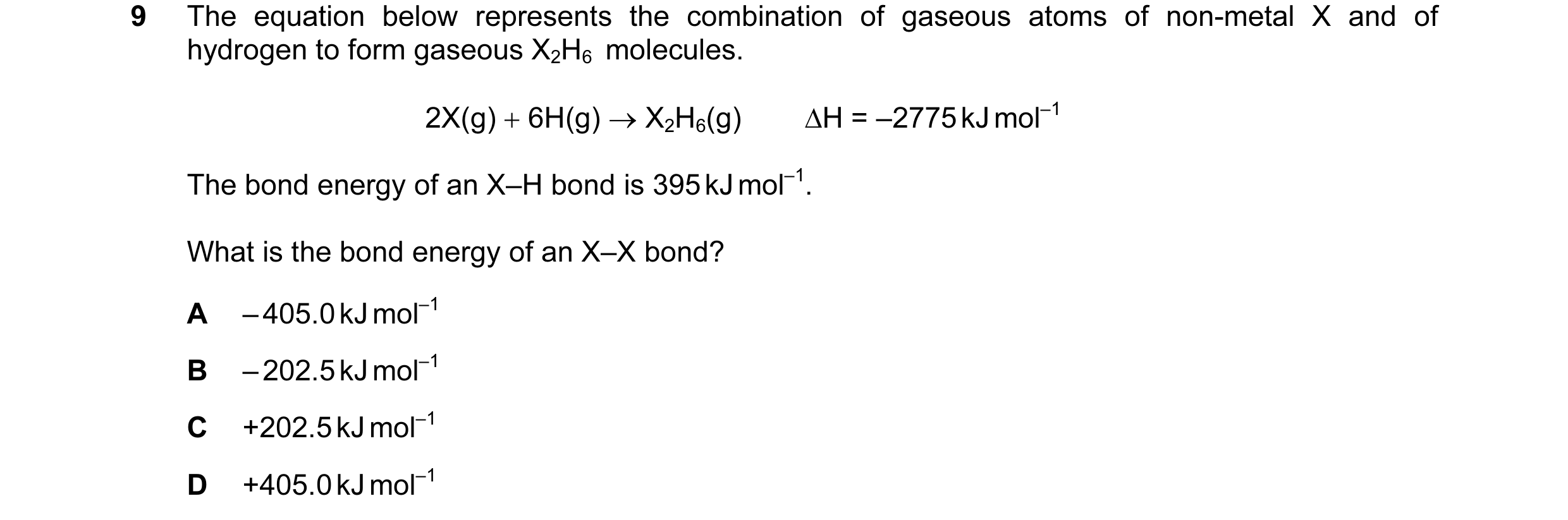
9 The equation below represents the combination of gaseous atoms of non-metal X and of hydrogen to form gaseous X2H6 molecules. 2X(g) + 6H(g) → X2H6(g) ∆H = –2775 kJ mol–1 The bond energy of an X–H bond is 395 kJ mol–1. What is the bond energy of an X–X bond? A – 405.0 kJ mol–1 B – 202.5 kJ mol–1 C +202.5 kJ mol–1 D +405.0 kJ mol–1
1 marks
Answer: D
This question in 9701/13 May/June 2011
Q14 · Why does aluminium chloride, Al 2Cl 6, sublime at the relatively low temperature of 180… 9701/11 Oct/Nov 2011
32 Why does aluminium chloride, Al 2Cl 6, sublime at the relatively low temperature of 180 °C? 1 The intermolecular forces between the Al 2Cl 6 molecules are weak. 2 The co-ordinate bonds between aluminium and chlorine are weak. 3 The covalent bonds between aluminium and chlorine are weak.
1 marks
Answer: D
This question in 9701/11 Oct/Nov 2011
Q15 · Why does aluminium chloride, Al 2Cl 6, sublime at the relatively low temperature of 180… 9701/13 Oct/Nov 2011
34 Why does aluminium chloride, Al 2Cl 6, sublime at the relatively low temperature of 180 °C? 1 The intermolecular forces between the Al 2Cl 6 molecules are weak. 2 The co-ordinate bonds between aluminium and chlorine are weak. 3 The covalent bonds between aluminium and chlorine are weak.
1 marks
Answer: D
This question in 9701/13 Oct/Nov 2011
Q16 · In which species does the underlined atom have an incomplete outer shell? 9701/11 May/June 2012
1 In which species does the underlined atom have an incomplete outer shell? A BF3 B CH3 – C F2O D H3O+
1 marks
Answer: A
This question in 9701/11 May/June 2012
Q17 · Aluminium chloride catalyses certain reactions by forming carbocations with chloroalkanes… 9701/11 May/June 2012
12 Aluminium chloride catalyses certain reactions by forming carbocations with chloroalkanes as shown. RCl + Al Cl 3 → R+ + Al Cl 4 – Which property makes this reaction possible? A Al Cl 3 exists as the dimer Al 2Cl 6 in the vapour. B Al Cl 3 is a covalent molecule. C The aluminium atom in Al Cl 3 has an incomplete octet of electrons. D The chlorine atom in RCl has a vacant p orbital.
1 marks
Answer: C
This question in 9701/11 May/June 2012
Q18 · What is always involved in a carbon-carbon π bond? 9701/11 May/June 2012
37 What is always involved in a carbon-carbon π bond? 1 a shared pair of electrons 2 a sideways overlap of p orbitals 3 delocalised electrons
1 marks
Answer: B
This question in 9701/11 May/June 2012
Q19 · In which species does the underlined atom have an incomplete outer shell? 9701/12 May/June 2012
4 In which species does the underlined atom have an incomplete outer shell? A Al 2Cl 6 B CH3 + C Cl 2O D H2Cl C•
1 marks
Answer: B
This question in 9701/12 May/June 2012
Q20 · Which of the following molecules and ions have a regular trigonal planar shape? 9701/12 May/June 2012
31 Which of the following molecules and ions have a regular trigonal planar shape? 1 BF3 2 CH3 + 3 Al Cl 3
1 marks
Answer: A
This question in 9701/12 May/June 2012
Q21 · Silver chloride dissolves in aqueous ammonia 9701/12 May/June 2012
34 Silver chloride dissolves in aqueous ammonia. What happens in this process? 1 A co-ordinate bond is formed. 2 The oxidation number of nitrogen is unchanged. 3 Ammonia acts as a Brønsted-Lowry base.
1 marks
Answer: B
This question in 9701/12 May/June 2012
Q22 · Aluminium chloride catalyses certain reactions by forming carbocations with chloroalkanes… 9701/13 May/June 2012
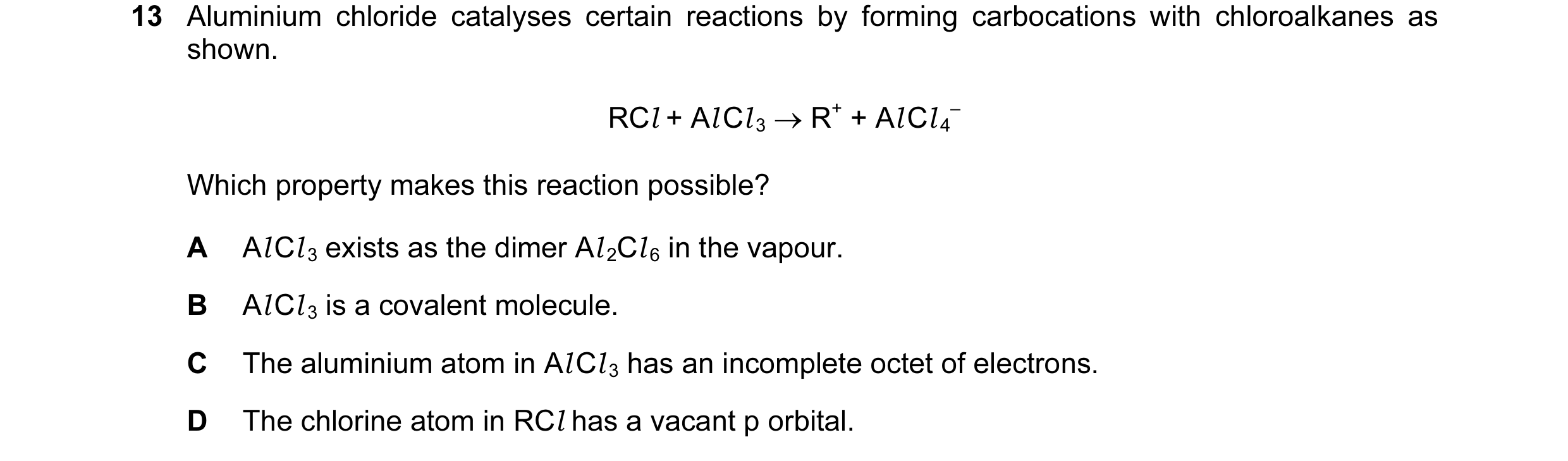
13 Aluminium chloride catalyses certain reactions by forming carbocations with chloroalkanes as shown. RCl + Al Cl 3 → R+ + Al Cl 4 – Which property makes this reaction possible? A Al Cl 3 exists as the dimer Al 2Cl 6 in the vapour. B Al Cl 3 is a covalent molecule. C The aluminium atom in Al Cl 3 has an incomplete octet of electrons. D The chlorine atom in RCl has a vacant p orbital.
1 marks
Answer: C
This question in 9701/13 May/June 2012
Q23 · What is always involved in a carbon-carbon π bond? 9701/13 May/June 2012
38 What is always involved in a carbon-carbon π bond? 1 a shared pair of electrons 2 a sideways overlap of p orbitals 3 delocalised electrons
1 marks
Answer: B
This question in 9701/13 May/June 2012
Q24 · Some car paints contain small flakes of silica, SiO2 9701/11 Oct/Nov 2012
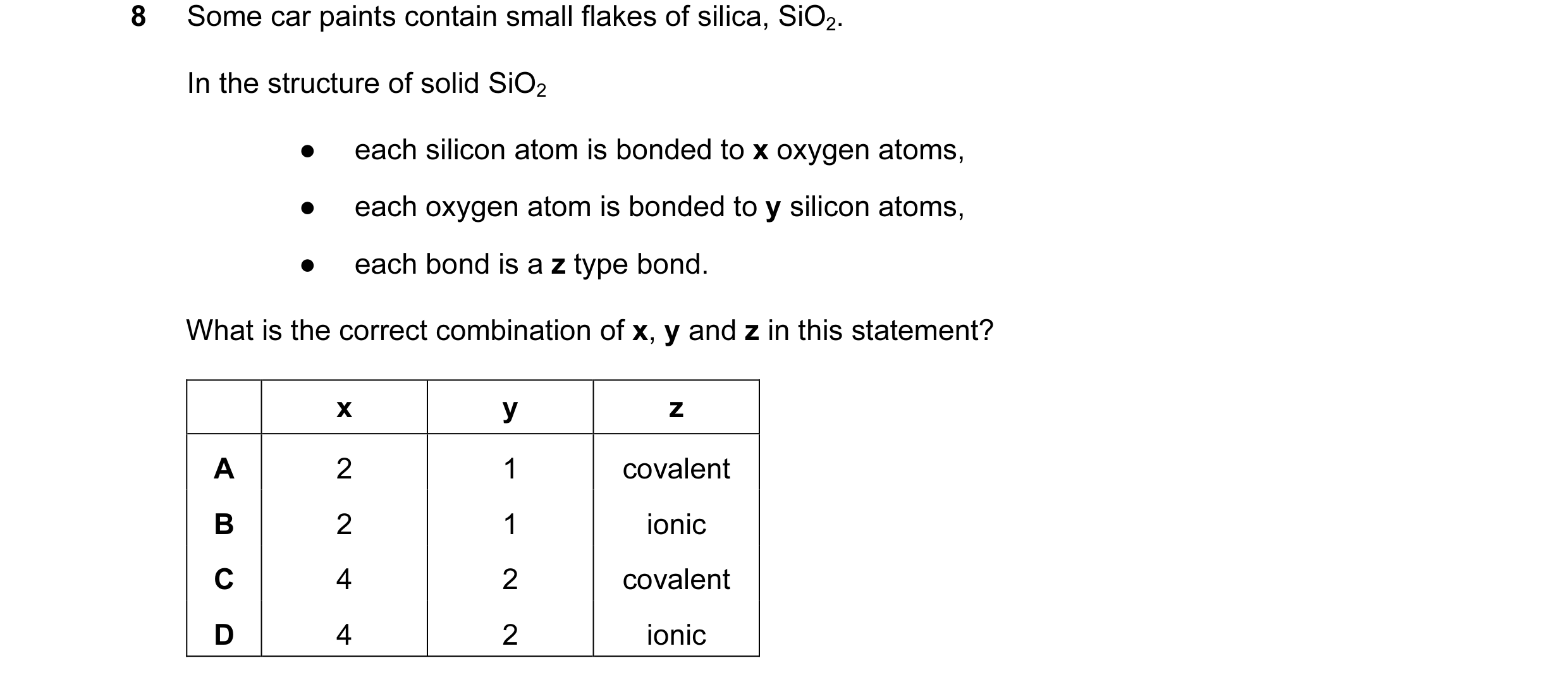
8 Some car paints contain small flakes of silica, SiO2. In the structure of solid SiO2 ● each silicon atom is bonded to x oxygen atoms, ● each oxygen atom is bonded to y silicon atoms, ● each bond is a z type bond. What is the correct combination of x, y and z in this statement? x y z A 2 1 covalent B 2 1 ionic C 4 2 covalent D 4 2 ionic
1 marks
Answer: C
This question in 9701/11 Oct/Nov 2012
Q25 · How may nitrogen exist in compounds? 9701/11 Oct/Nov 2012
31 How may nitrogen exist in compounds? 1 bonded by a triple covalent bond 2 as part of a cation 3 having lost 3 electrons to form an anion
1 marks
Answer: B
This question in 9701/11 Oct/Nov 2012
Q26 · Some car paints contain small flakes of silica, SiO2 9701/12 Oct/Nov 2012
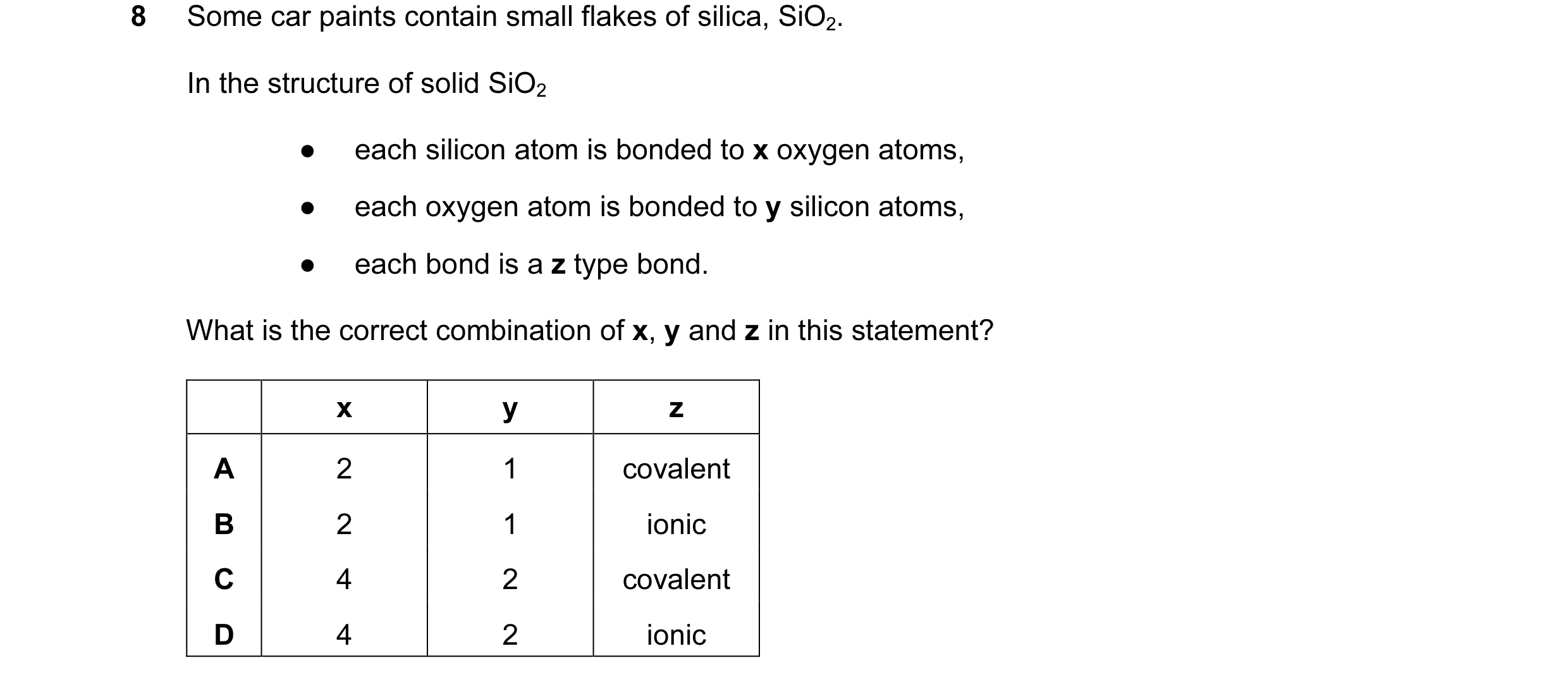
8 Some car paints contain small flakes of silica, SiO2. In the structure of solid SiO2 ● each silicon atom is bonded to x oxygen atoms, ● each oxygen atom is bonded to y silicon atoms, ● each bond is a z type bond. What is the correct combination of x, y and z in this statement? x y z A 2 1 covalent B 2 1 ionic C 4 2 covalent D 4 2 ionic
1 marks
Answer: C
This question in 9701/12 Oct/Nov 2012
Q27 · How may nitrogen exist in compounds? 9701/12 Oct/Nov 2012
31 How may nitrogen exist in compounds? 1 bonded by a triple covalent bond 2 as part of a cation 3 having lost 3 electrons to form an anion
1 marks
Answer: B
This question in 9701/12 Oct/Nov 2012
Q28 · Deposits of ammonium sulfate have been discovered in areas of high atmospheric pollution 9701/13 Oct/Nov 2012
19 Deposits of ammonium sulfate have been discovered in areas of high atmospheric pollution. They are believed to arise from the following reaction. SO3 + H2O + 2NH3 → (NH4)2SO4 What does not occur in this reaction? A acid / base neutralisation B dative bond formation C ionic bond formation D oxidation / reduction
1 marks
Answer: D
This question in 9701/13 Oct/Nov 2012
Q29 · How may nitrogen exist in compounds? 9701/13 Oct/Nov 2012
31 How may nitrogen exist in compounds? 1 bonded by a triple covalent bond 2 as part of a cation 3 in an oxidation state of +5
1 marks
Answer: A
This question in 9701/13 Oct/Nov 2012
Q30 · In the gas phase, aluminium chloride exists as the dimer, Al2Cl6 9701/13 Oct/Nov 2012
35 In the gas phase, aluminium chloride exists as the dimer, Al2Cl6. By using this information, which of the following are structural features of the Al2Cl6 molecule? 1 Each aluminium atom is surrounded by four chlorine atoms. 2 There are twelve non-bonded electron pairs in the molecule. 3 Each aluminium atom contributes electrons to four covalent bonds.
1 marks
Answer: D
This question in 9701/13 Oct/Nov 2012
Q31 · Which changes in bonding occur during the reaction of ethanal and hydrogen cyanide? 9701/13 Oct/Nov 2012
40 Which changes in bonding occur during the reaction of ethanal and hydrogen cyanide? 1 A carbon-carbon bond is formed. 2 A carbon-hydrogen bond is broken. 3 A carbon-nitrogen bond is broken.
1 marks
Answer: B
This question in 9701/13 Oct/Nov 2012
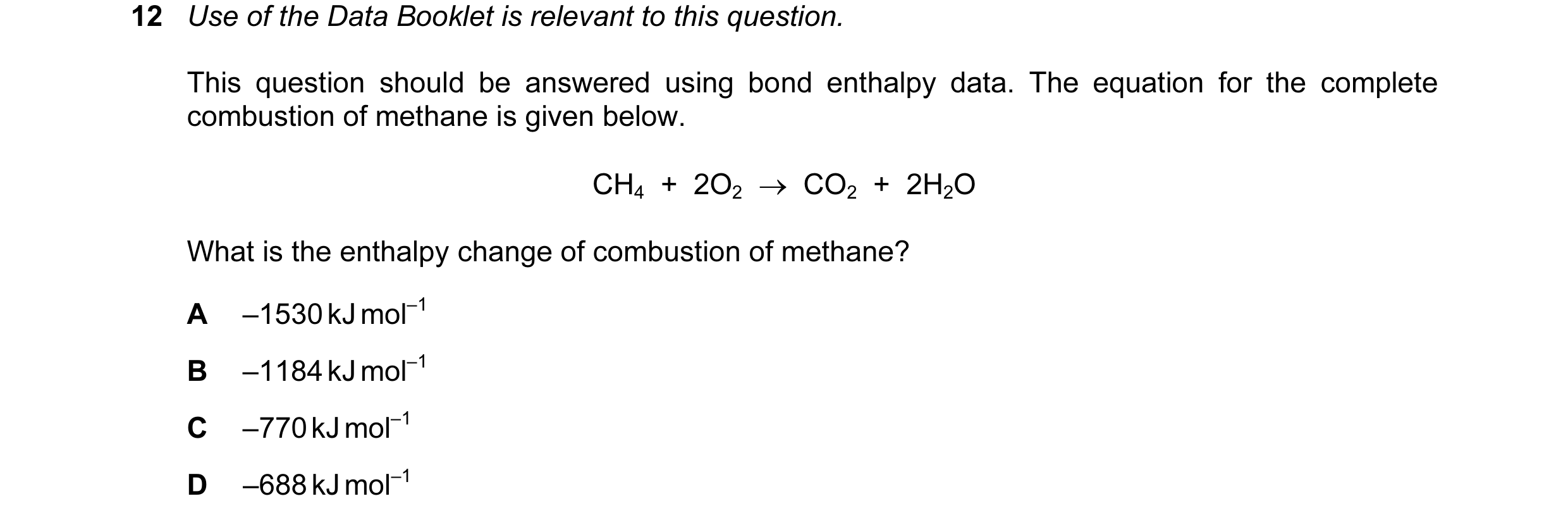
Q32 · Use of the Data Booklet is relevant to this question 9701/11 May/June 2013
12 Use of the Data Booklet is relevant to this question. This question should be answered using bond enthalpy data. The equation for the complete combustion of methane is given below. CH4 + 2O2 → CO2 + 2H2O What is the enthalpy change of combustion of methane? A –1530 kJ mol–1 B –1184 kJ mol–1 C –770 kJ mol–1 D –688 kJ mol–1
1 marks
Answer: D
This question in 9701/11 May/June 2013
Q33 · Polymerisation of ethene gives poly(ethene) 9701/12 May/June 2013
30 Polymerisation of ethene gives poly(ethene). How does the carbon-carbon bond in poly(ethene) compare with that in ethene? A The carbon-carbon bond is longer and stronger in poly(ethene). B The carbon-carbon bond is longer and weaker in poly(ethene). C The carbon-carbon bond is shorter and stronger in poly(ethene). D The carbon-carbon bond is shorter and weaker in poly(ethene).
1 marks
Answer: B
This question in 9701/12 May/June 2013
Q34 · Which types of bonding are present in ammonium carbonate, (NH4)2CO3? 9701/11 Oct/Nov 2013
35 Which types of bonding are present in ammonium carbonate, (NH4)2CO3? 1 ionic 2 covalent 3 co-ordinate (dative covalent)
1 marks
Answer: A
This question in 9701/11 Oct/Nov 2013
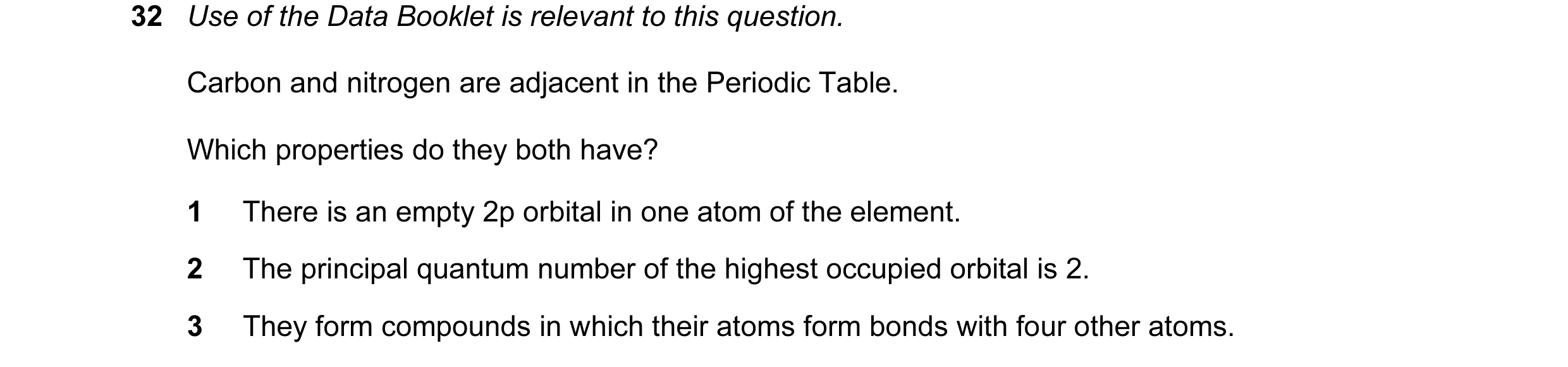
Q35 · Use of the Data Booklet is relevant to this question 9701/12 Oct/Nov 2013
32 Use of the Data Booklet is relevant to this question. Carbon and nitrogen are adjacent in the Periodic Table. Which properties do they both have? 1 There is an empty 2p orbital in one atom of the element. 2 The principal quantum number of the highest occupied orbital is 2. 3 They form compounds in which their atoms form bonds with four other atoms.
1 marks
Answer: C
This question in 9701/12 Oct/Nov 2013
Q36 · Which types of bonding are present in ammonium carbonate, (NH4)2CO3? 9701/12 Oct/Nov 2013
35 Which types of bonding are present in ammonium carbonate, (NH4)2CO3? 1 ionic 2 covalent 3 co-ordinate (dative covalent)
1 marks
Answer: A
This question in 9701/12 Oct/Nov 2013
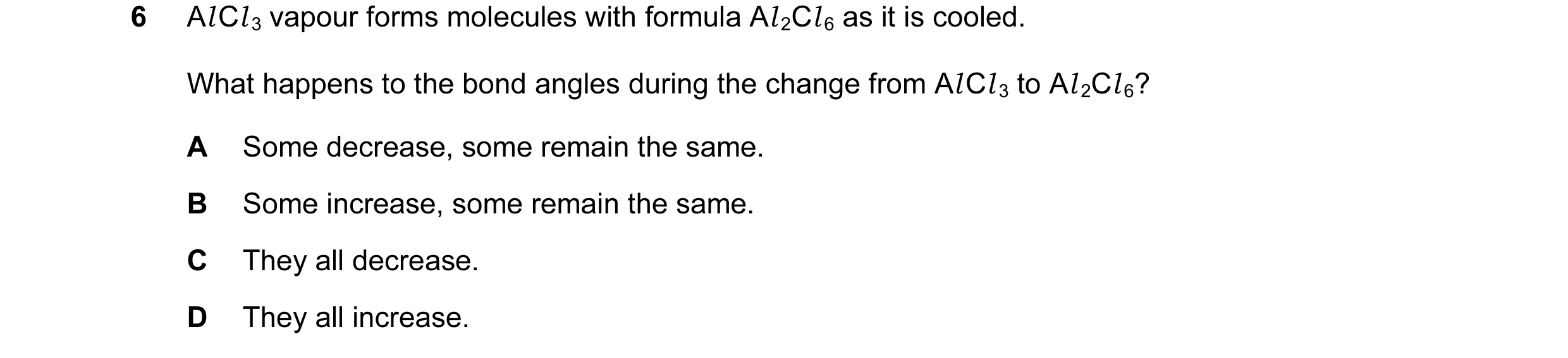
Q37 · Al Cl 3 vapour forms molecules with formula Al 2Cl 6 as it is cooled 9701/11 May/June 2014
6 Al Cl 3 vapour forms molecules with formula Al 2Cl 6 as it is cooled. What happens to the bond angles during the change from Al Cl 3 to Al 2Cl 6? A Some decrease, some remain the same. B Some increase, some remain the same. C They all decrease. D They all increase.
1 marks
Answer: C
This question in 9701/11 May/June 2014
Q38 · Which elements have atoms which can form π bonds with atoms of other elements? 9701/12 May/June 2014
33 Which elements have atoms which can form π bonds with atoms of other elements? 1 oxygen 2 nitrogen 3 fluorine
1 marks
Answer: B
This question in 9701/12 May/June 2014
Q39 · Use of the Data Booklet is relevant to this question 9701/11 Oct/Nov 2014
32 Use of the Data Booklet is relevant to this question. The bond energy of the Br – O bond is 235 kJ mol–1. Which reactions are exothermic? 1 OH• + HBr → H2 + BrO• 2 OH• + HBr → H2O + Br• 3 H• + HBr → H2 + Br•
1 marks
Answer: C
This question in 9701/11 Oct/Nov 2014
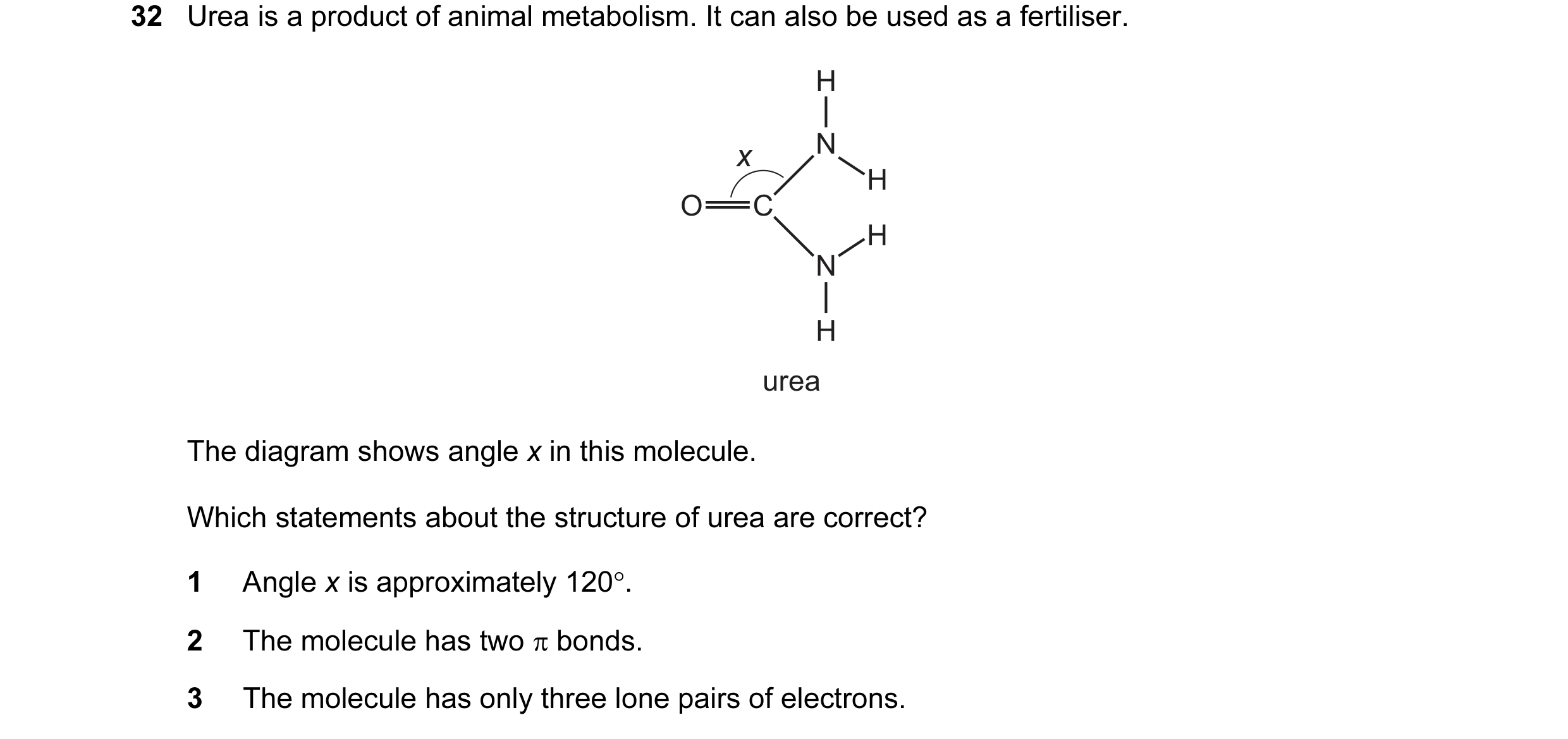
Q40 · Urea is a product of animal metabolism 9701/11 May/June 2015
32 Urea is a product of animal metabolism. It can also be used as a fertiliser. H x N H O C H N H urea The diagram shows angle x in this molecule. Which statements about the structure of urea are correct? 1 Angle x is approximately 120°. 2 The molecule has two π bonds. 3 The molecule has only three lone pairs of electrons.
1 marks
Answer: D
This question in 9701/11 May/June 2015
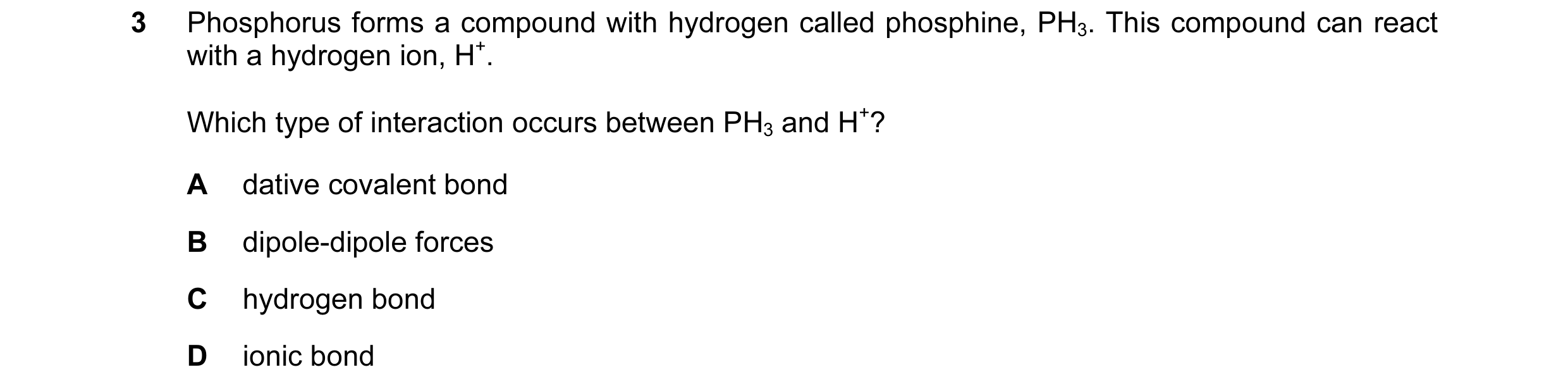
Q41 · Phosphorus forms a compound with hydrogen called phosphine, PH3 9701/12 May/June 2015
3 Phosphorus forms a compound with hydrogen called phosphine, PH3. This compound can react with a hydrogen ion, H+. Which type of interaction occurs between PH3 and H+? A dative covalent bond B dipole-dipole forces C hydrogen bond D ionic bond
1 marks
Answer: A
This question in 9701/12 May/June 2015
Q42 · Which statement about the ammonium ion, NH4 +, is correct? 9701/12 May/June 2015
17 Which statement about the ammonium ion, NH4 +, is correct? A All bond angles are 107°. B Ammonium ions are formed when ammonia behaves as an acid. C Ammonium ions are unreactive when heated with NaOH(aq). D The bonds are all the same length.
1 marks
Answer: D
This question in 9701/12 May/June 2015
Q43 · Why does aluminium chloride, Al 2Cl 6, sublime at the relatively low temperature of 180… 9701/12 May/June 2015
32 Why does aluminium chloride, Al 2Cl 6, sublime at the relatively low temperature of 180 °C? 1 The intermolecular forces between the Al 2Cl 6 molecules are weak. 2 The co-ordinate bonds between aluminium and chlorine are weak. 3 The covalent bonds between aluminium and chlorine are weak.
1 marks
Answer: D
This question in 9701/12 May/June 2015
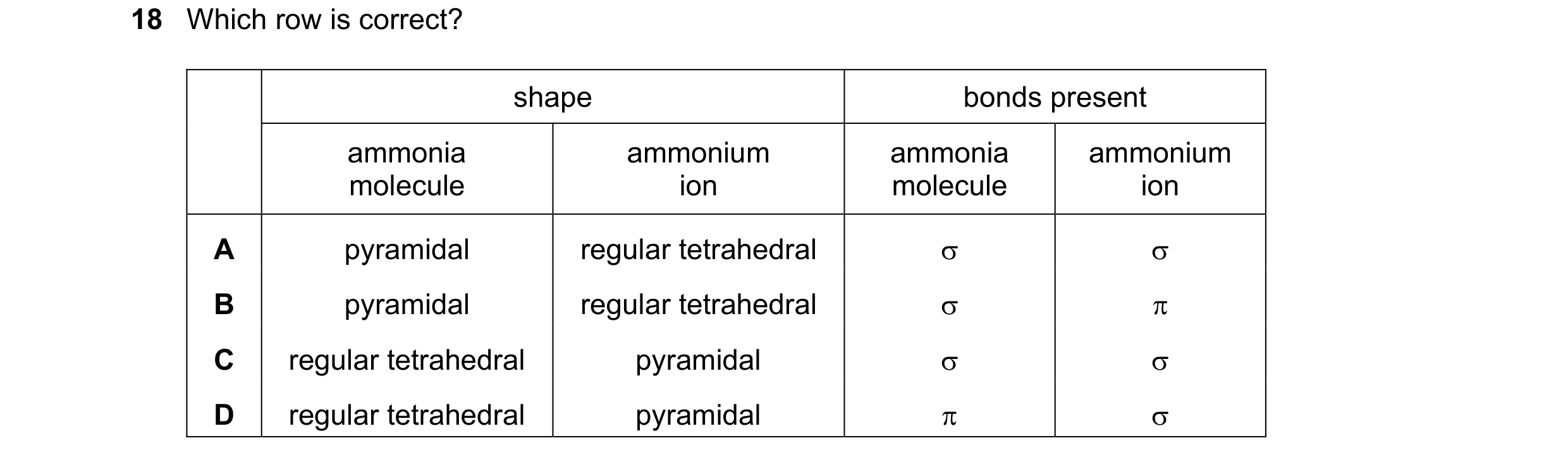
Q44 · Which row of the table is correct? 9701/12 Feb/March 2016
15 Which row of the table is correct? shape bonds present ammonia ammonium ammonia ammonium molecule ion molecule ion A pyramidal regular tetrahedral σ σ B pyramidal regular tetrahedral σ π C regular tetrahedral pyramidal σ σ D regular tetrahedral pyramidal π σ
1 marks
Answer: A
This question in 9701/12 Feb/March 2016
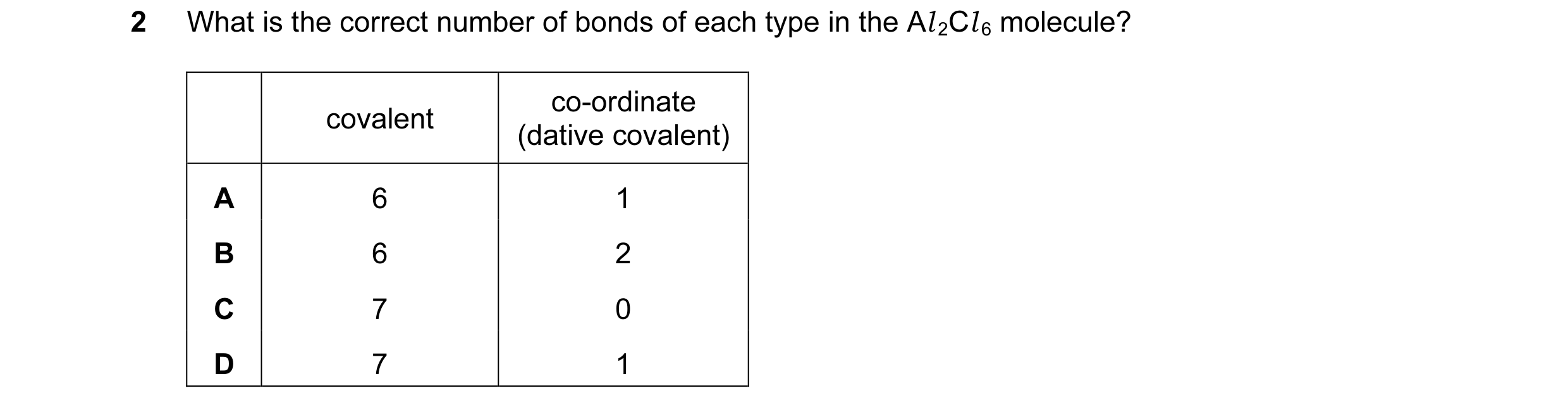
Q45 · What is the correct number of bonds of each type in the Al 2Cl 6 molecule? 9701/11 May/June 2016
2 What is the correct number of bonds of each type in the Al 2Cl 6 molecule? co-ordinate covalent (dative covalent) A 6 1 B 6 2 C 7 0 D 7 1
1 marks
Answer: B
This question in 9701/11 May/June 2016
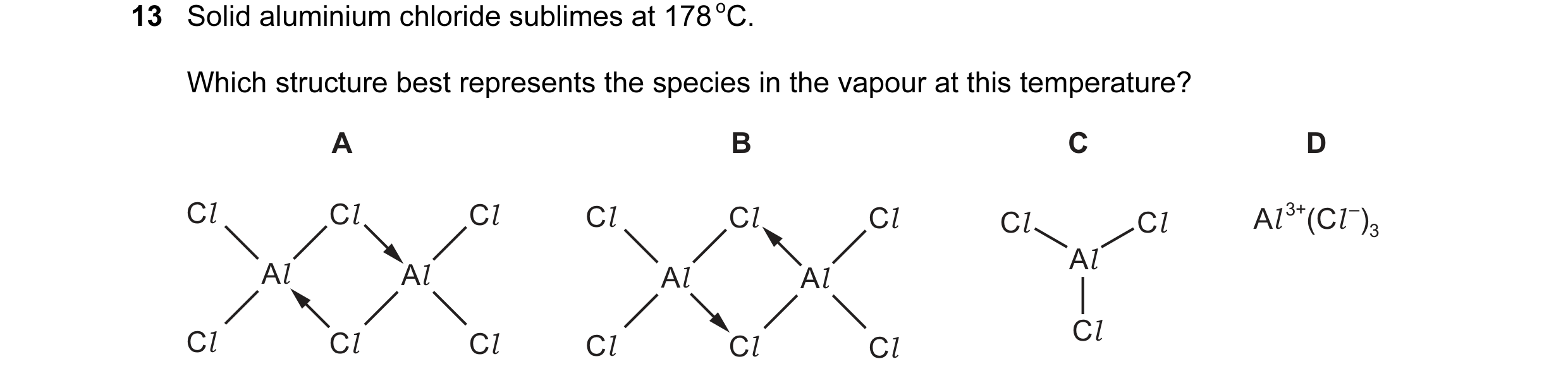
Q46 · Solid aluminium chloride sublimes at 178 oC 9701/12 May/June 2016
13 Solid aluminium chloride sublimes at 178 oC. Which structure best represents the species in the vapour at this temperature? A B C D Cl Cl Cl Cl Cl Cl Cl Cl Al 3+(Cl –)3 Al Al Al Al Al Cl Cl Cl Cl Cl Cl Cl
1 marks
Answer: A
This question in 9701/12 May/June 2016
Q47 · Which elements can form π bonds in their compounds? 9701/11 Oct/Nov 2016
32 Which elements can form π bonds in their compounds? 1 carbon 2 oxygen 3 nitrogen
1 marks
Answer: A
This question in 9701/11 Oct/Nov 2016
Q48 · Which elements can form π bonds in their compounds? 9701/13 Oct/Nov 2016
32 Which elements can form π bonds in their compounds? 1 carbon 2 oxygen 3 nitrogen
1 marks
Answer: A
This question in 9701/13 Oct/Nov 2016
Q49 · The ammonium ion is formed by the following reaction 9701/12 May/June 2017
18 The ammonium ion is formed by the following reaction. NH3 + H+ → NH4 + Which statement about the species involved in this reaction is correct? A The ammonia molecule contains a dative covalent bond. B The ammonium ion is a Brønsted-Lowry base as it has accepted a proton. C The H–N–H bond angle changes from 107° in ammonia to 90° in the ammonium ion. D The number of electrons surrounding each nitrogen atom does not change.
1 marks
Answer: D
This question in 9701/12 May/June 2017
Q50 · Which compounds contain covalent bonds? 9701/13 May/June 2017
32 Which compounds contain covalent bonds? 1 aluminium chloride 2 ammonia 3 calcium fluoride
1 marks
Answer: B
This question in 9701/13 May/June 2017
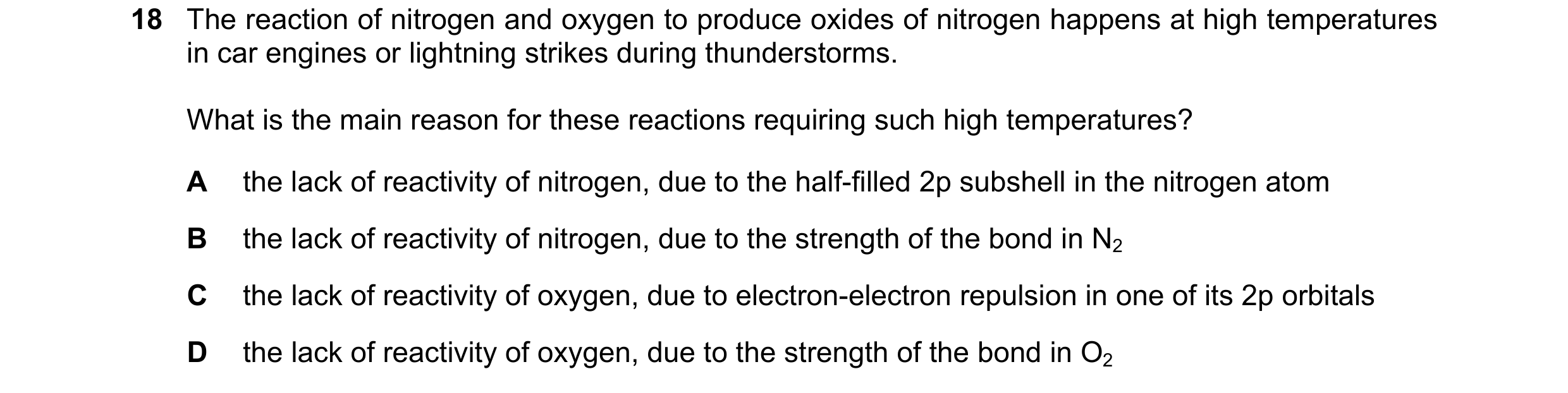
Q51 · The reaction of nitrogen and oxygen to produce oxides of nitrogen happens at high… 9701/12 Oct/Nov 2017
18 The reaction of nitrogen and oxygen to produce oxides of nitrogen happens at high temperatures in car engines or lightning strikes during thunderstorms. What is the main reason for these reactions requiring such high temperatures? A the lack of reactivity of nitrogen, due to the half-filled 2p subshell in the nitrogen atom B the lack of reactivity of nitrogen, due to the strength of the bond in N2 C the lack of reactivity of oxygen, due to electron-electron repulsion in one of its 2p orbitals D the lack of reactivity of oxygen, due to the strength of the bond in O2
1 marks
Answer: B
This question in 9701/12 Oct/Nov 2017
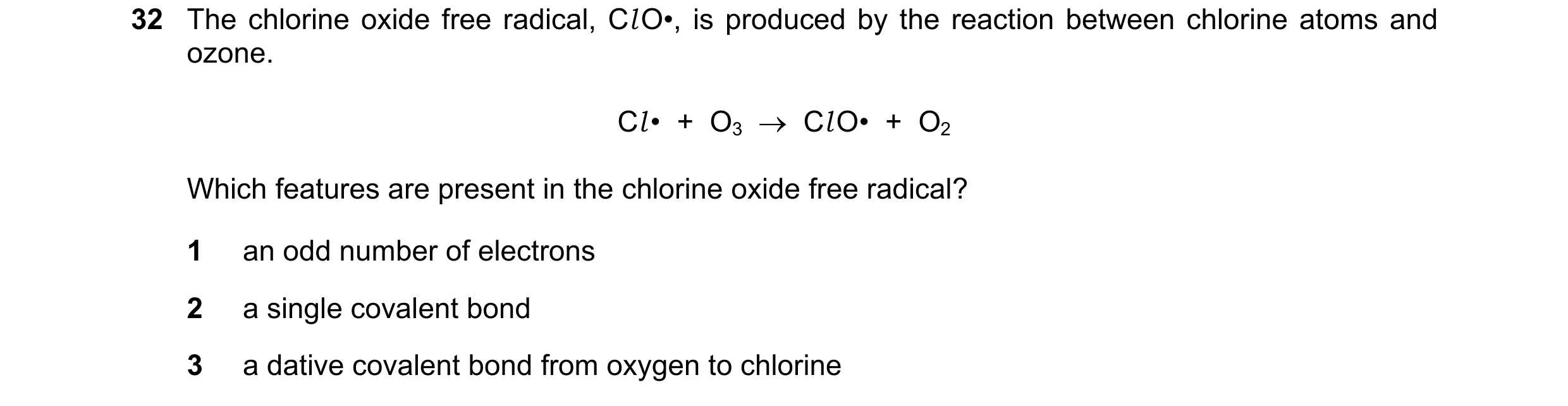
Q52 · The chlorine oxide free radical, Cl O•, is produced by the reaction between chlorine… 9701/12 Oct/Nov 2017
32 The chlorine oxide free radical, Cl O•, is produced by the reaction between chlorine atoms and ozone. Cl • + O3 → Cl O• + O2 Which features are present in the chlorine oxide free radical? 1 an odd number of electrons 2 a single covalent bond 3 a dative covalent bond from oxygen to chlorine
1 marks
Answer: B
This question in 9701/12 Oct/Nov 2017
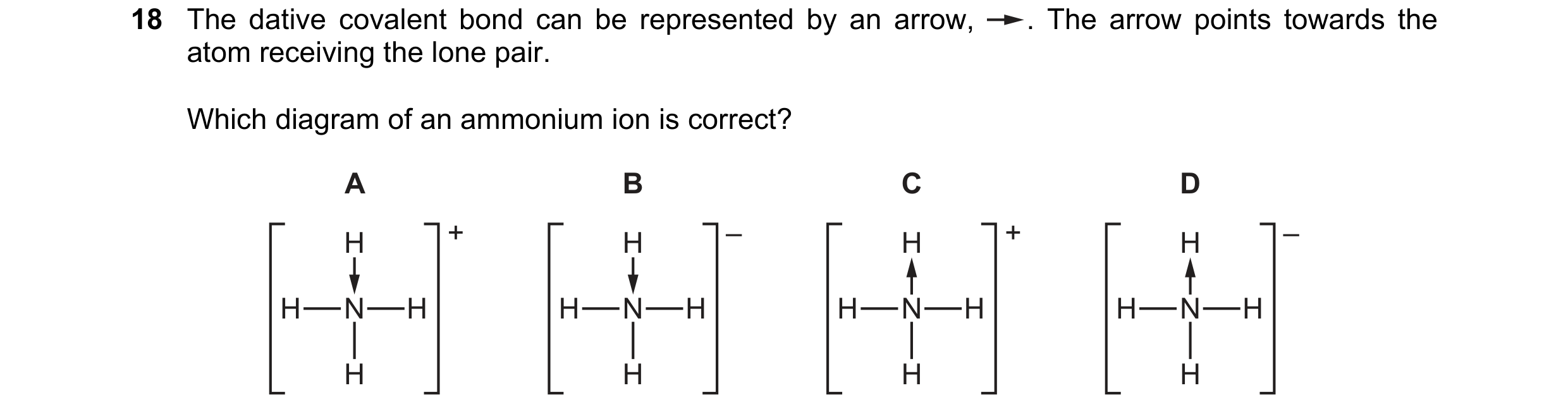
Q53 · The dative covalent bond can be represented by an arrow, 9701/12 May/June 2018
18 The dative covalent bond can be represented by an arrow, . The arrow points towards the atom receiving the lone pair. Which diagram of an ammonium ion is correct? A B C D H + H – H + H – H N H H N H H N H H N H H H H H
1 marks
Answer: C
This question in 9701/12 May/June 2018
Q54 · Ethanal reacts with HCN in the presence of KCN 9701/13 Oct/Nov 2018
40 Ethanal reacts with HCN in the presence of KCN. Which changes in bonding occur during this reaction? 1 A carbon-carbon bond is formed. 2 A carbon-hydrogen bond is broken. 3 A carbon-nitrogen bond is broken.
1 marks
Answer: B
This question in 9701/13 Oct/Nov 2018
Q55 · Which types of bonding are present in ammonium carbonate, (NH4)2CO3? 9701/12 Feb/March 2019
36 Which types of bonding are present in ammonium carbonate, (NH4)2CO3? 1 ionic 2 covalent 3 co-ordinate (dative covalent)
1 marks
Answer: A
This question in 9701/12 Feb/March 2019
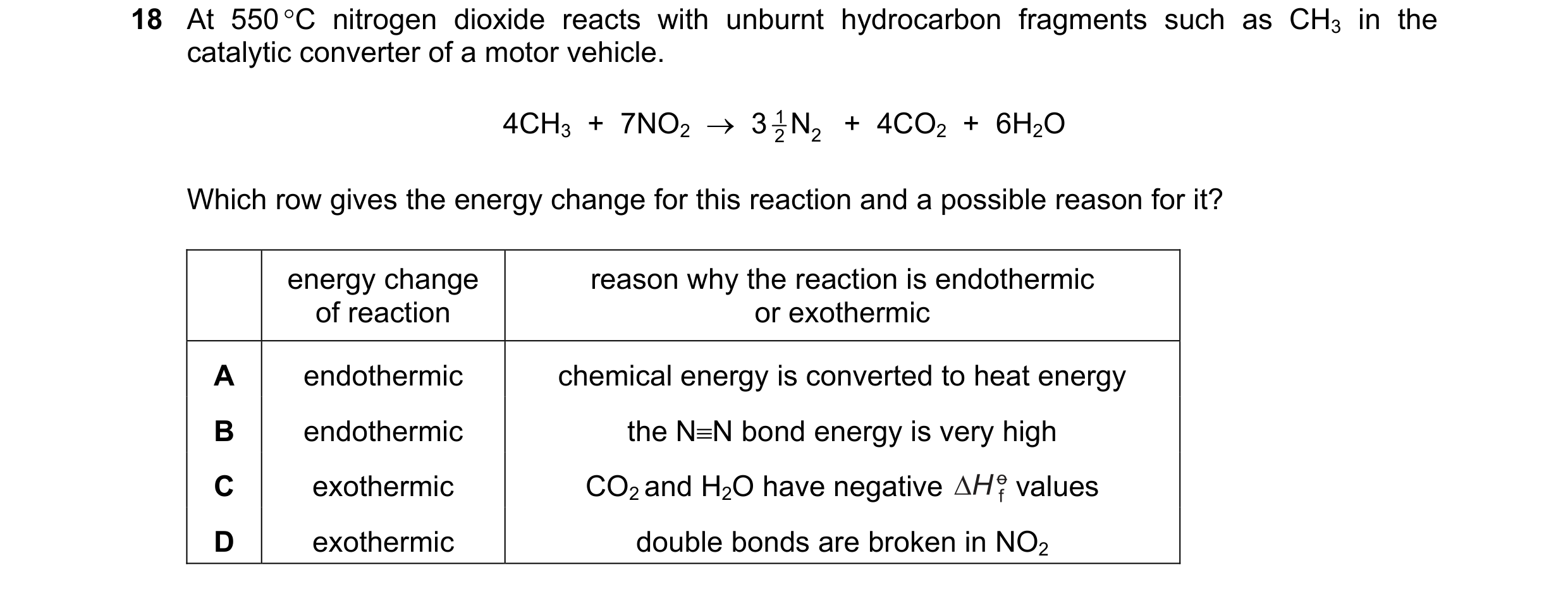
Q56 · At 550 °C nitrogen dioxide reacts with unburnt hydrocarbon fragments such as CH3 in the… 9701/11 May/June 2019
18 At 550 °C nitrogen dioxide reacts with unburnt hydrocarbon fragments such as CH3 in the catalytic converter of a motor vehicle. 4CH3 + 7NO2 → 3 1 N + 4CO2 + 6H2O 2 2 Which row gives the energy change for this reaction and a possible reason for it? energy change reason why the reaction is endothermic of reaction or exothermic A endothermic chemical energy is converted to heat energy B endothermic the N≡N bond energy is very high C exothermic CO2 and H2O have negative values D exothermic double bonds are broken in NO2
1 marks
Answer: C
This question in 9701/11 May/June 2019
Q57 · Which statement is correct? 9701/11 May/June 2019
19 Which statement is correct? A Ammonia reacts with alkalis to form the ammonium ion. B Ammonium chloride contains ionic, covalent and co-ordinate bonds. C The ammonium ion reacts with acids to produce ammonia. D The bond angle in the ammonium ion is approximately 107°.
1 marks
Answer: B
This question in 9701/11 May/June 2019
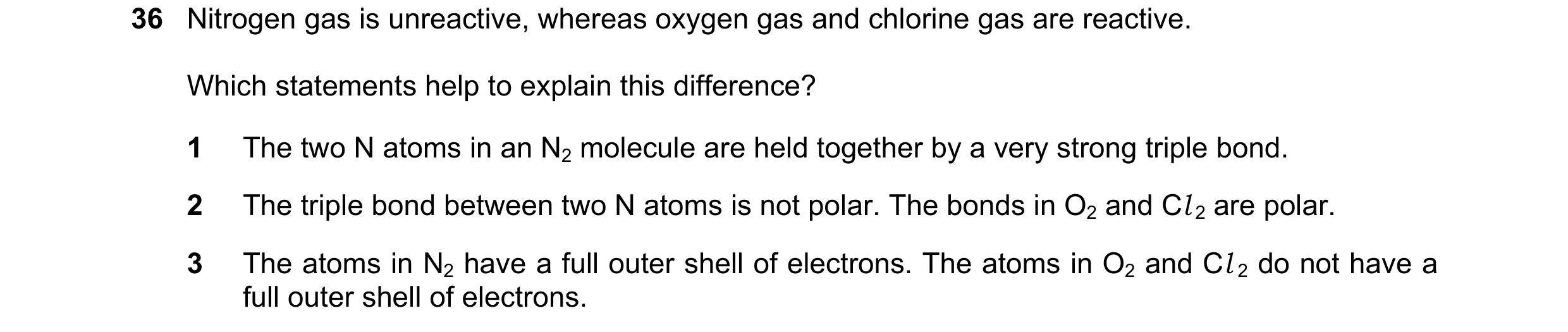
Q58 · Nitrogen gas is unreactive, whereas oxygen gas and chlorine gas are reactive 9701/11 Oct/Nov 2019
36 Nitrogen gas is unreactive, whereas oxygen gas and chlorine gas are reactive. Which statements help to explain this difference? 1 The two N atoms in an N2 molecule are held together by a very strong triple bond. 2 The triple bond between two N atoms is not polar. The bonds in O2 and Cl 2 are polar. 3 The atoms in N2 have a full outer shell of electrons. The atoms in O2 and Cl 2 do not have a full outer shell of electrons.
1 marks
Answer: D
This question in 9701/11 Oct/Nov 2019
Q59 · A carbon monoxide molecule, CO, has three bonds between the carbon atom and the oxygen… 9701/12 Oct/Nov 2019
32 A carbon monoxide molecule, CO, has three bonds between the carbon atom and the oxygen atom. Which features are present in one CO molecule? 1 two lone pairs of electrons 2 a co-ordinate (dative covalent) bond from oxygen to carbon 3 two π bonds
1 marks
Answer: A
This question in 9701/12 Oct/Nov 2019
Q60 · Carbon can exist as allotropes which include graphite, diamond and a fullerene 9701/12 Oct/Nov 2019
33 Carbon can exist as allotropes which include graphite, diamond and a fullerene. Which statements are correct? 1 All three allotropes contain covalent bonds. 2 All three allotropes are giant molecular. 3 All three allotropes have delocalised electrons.
1 marks
Answer: D
This question in 9701/12 Oct/Nov 2019
Q61 · Which molecule contains six bonding electrons? 9701/13 May/June 2020
2 Which molecule contains six bonding electrons? A NCl 3 B H2S C C2H4 D SF6
1 marks
Answer: A
This question in 9701/13 May/June 2020
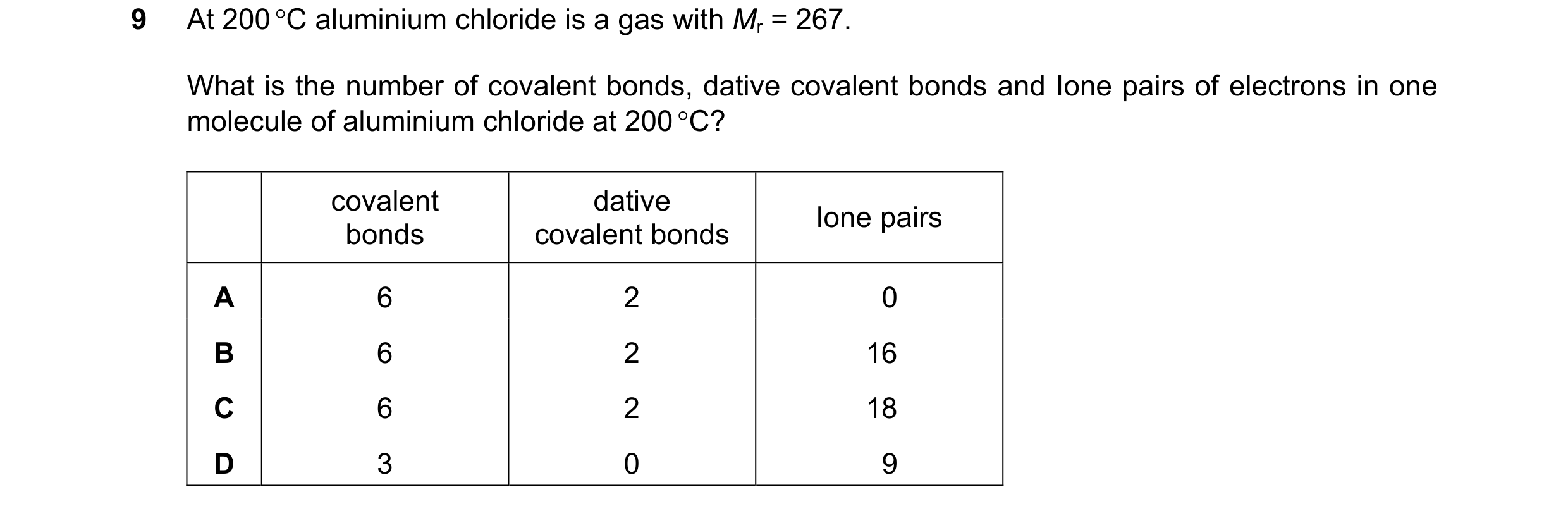
Q62 · At 200 °C aluminium chloride is a gas with Mr = 267 9701/13 May/June 2020
9 At 200 °C aluminium chloride is a gas with Mr = 267. What is the number of covalent bonds, dative covalent bonds and Ione pairs of electrons in one molecule of aluminium chloride at 200 °C? covalent dative Ione pairs bonds covalent bonds A 6 2 0 B 6 2 16 C 6 2 18 D 3 0 9
1 marks
Answer: B
This question in 9701/13 May/June 2020
Q63 · Buckminsterfullerene is a fullerene allotrope of carbon 9701/13 May/June 2020
32 Buckminsterfullerene is a fullerene allotrope of carbon. Which statements about buckminsterfullerene are correct? 1 Buckminsterfullerene is a giant covalent molecule. 2 Buckminsterfullerene has delocalised electrons. 3 Buckminsterfullerene has strong intramolecular bonds.
1 marks
Answer: C
This question in 9701/13 May/June 2020
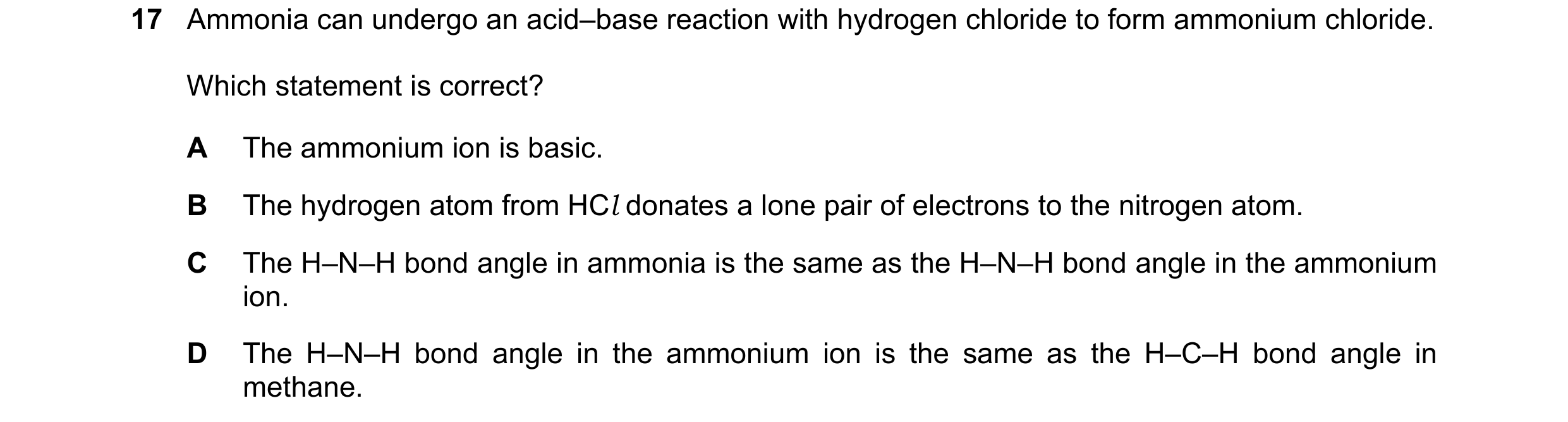
Q64 · Ammonia can undergo an acid–base reaction with hydrogen chloride to form ammonium chloride 9701/11 Oct/Nov 2020
17 Ammonia can undergo an acid–base reaction with hydrogen chloride to form ammonium chloride. Which statement is correct? A The ammonium ion is basic. B The hydrogen atom from HCl donates a lone pair of electrons to the nitrogen atom. C The H–N–H bond angle in ammonia is the same as the H–N–H bond angle in the ammonium ion. D The H–N–H bond angle in the ammonium ion is the same as the H–C–H bond angle in methane.
1 marks
Answer: D
This question in 9701/11 Oct/Nov 2020
Q65 · Ammonia can undergo an acid–base reaction with hydrogen chloride to form ammonium chloride 9701/13 Oct/Nov 2020
17 Ammonia can undergo an acid–base reaction with hydrogen chloride to form ammonium chloride. Which statement is correct? A The ammonium ion is basic. B The hydrogen atom from HCl donates a lone pair of electrons to the nitrogen atom. C The H–N–H bond angle in ammonia is the same as the H–N–H bond angle in the ammonium ion. D The H–N–H bond angle in the ammonium ion is the same as the H–C–H bond angle in methane.
1 marks
Answer: D
This question in 9701/13 Oct/Nov 2020
Q66 · Which species can accept a lone pair of electrons to form a coordinate (dative covalent)… 9701/12 Feb/March 2021
34 Which species can accept a lone pair of electrons to form a coordinate (dative covalent) bond? 1 BF3 2 H+ 3 CH3 +
1 marks
Answer: A
This question in 9701/12 Feb/March 2021
Q67 · Which elements form a chloride in which both covalent bonding and coordinate (dative… 9701/11 Oct/Nov 2021
35 Which elements form a chloride in which both covalent bonding and coordinate (dative covalent) bonding are present? 1 Al 2 Si 3 Mg
1 marks
Answer: D
This question in 9701/11 Oct/Nov 2021
Q68 · Which row is correct? 9701/13 Oct/Nov 2021
18 Which row is correct? shape bonds present ammonia ammonium ammonia ammonium molecule ion molecule ion A pyramidal regular tetrahedral B pyramidal regular tetrahedral C regular tetrahedral pyramidal D regular tetrahedral pyramidal
1 marks
Answer: A
This question in 9701/13 Oct/Nov 2021
Q69 · Which elements form a chloride in which both covalent bonding and coordinate (dative… 9701/13 Oct/Nov 2021
35 Which elements form a chloride in which both covalent bonding and coordinate (dative covalent) bonding are present? 1 Al 2 Si 3 Mg
1 marks
Answer: D
This question in 9701/13 Oct/Nov 2021
Q70 · Which statement about aluminium chloride is correct? 9701/11 May/June 2022
6 Which statement about aluminium chloride is correct? A Aluminium chloride has a much higher melting point than magnesium chloride due to the small size of the aluminium ion. B Anhydrous aluminium chloride reacts vigorously with water to form a solution with a pH greater than 7. C Each Al 2Cl 6 molecule found in aluminium chloride vapour contains two coordinate bonds. D The bonding between aluminium and chlorine is strongly ionic due to the large difference in electronegativity.
1 marks
Answer: C
This question in 9701/11 May/June 2022
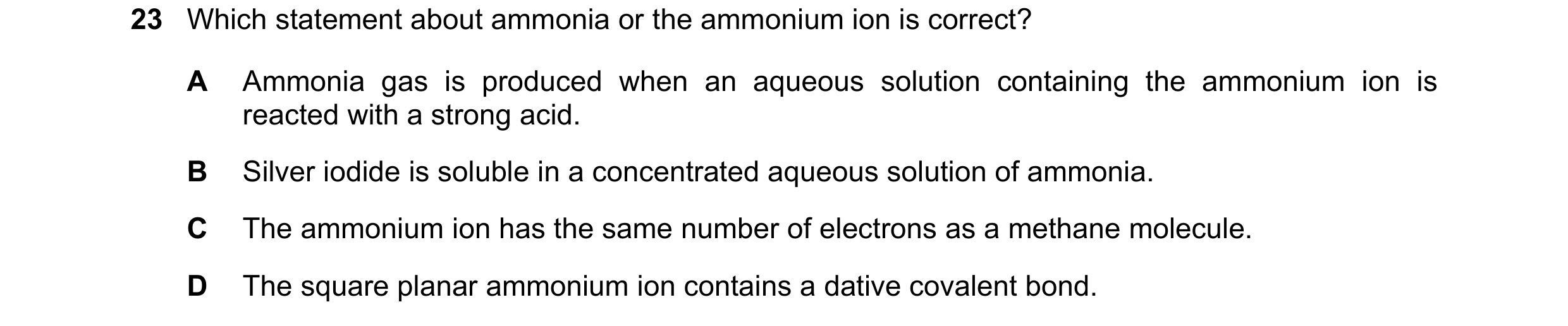
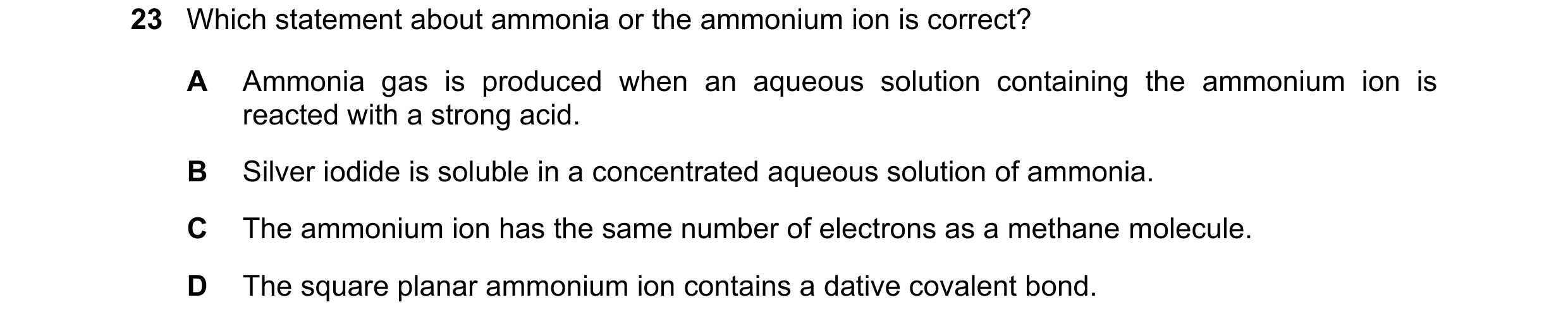
Q71 · Which statement about ammonia or the ammonium ion is correct? 9701/11 Oct/Nov 2022
23 Which statement about ammonia or the ammonium ion is correct? A Ammonia gas is produced when an aqueous solution containing the ammonium ion is reacted with a strong acid. B Silver iodide is soluble in a concentrated aqueous solution of ammonia. C The ammonium ion has the same number of electrons as a methane molecule. D The square planar ammonium ion contains a dative covalent bond.
1 marks
Answer: C
This question in 9701/11 Oct/Nov 2022
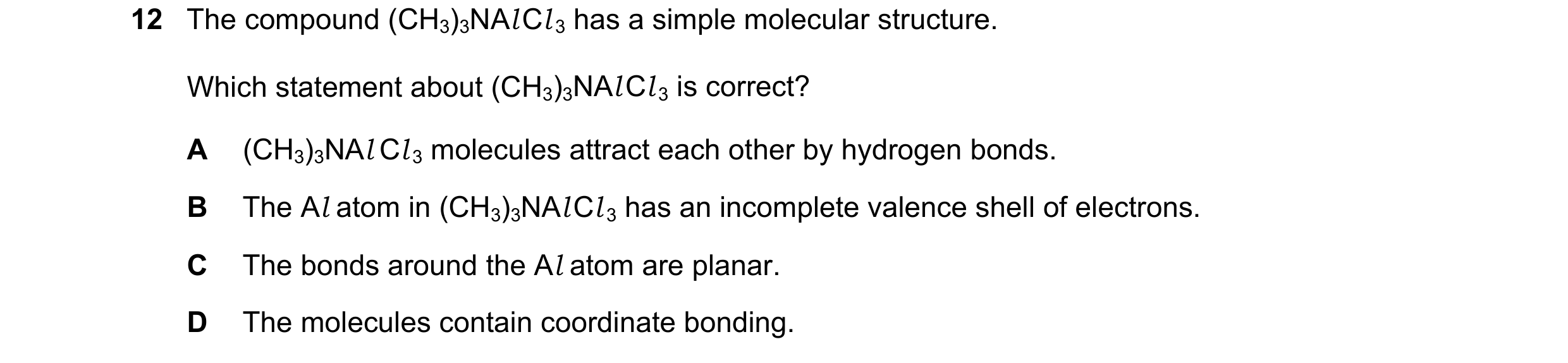
Q72 · The compound (CH3)3NAl Cl 3 has a simple molecular structure 9701/12 Oct/Nov 2022
12 The compound (CH3)3NAl Cl 3 has a simple molecular structure. Which statement about (CH3)3NAl Cl 3 is correct? A (CH3)3NAl Cl 3 molecules attract each other by hydrogen bonds. B The Al atom in (CH3)3NAl Cl 3 has an incomplete valence shell of electrons. C The bonds around the Al atom are planar. D The molecules contain coordinate bonding.
1 marks
Answer: D
This question in 9701/12 Oct/Nov 2022
Q73 · Which statement about ammonia or the ammonium ion is correct? 9701/13 Oct/Nov 2022
23 Which statement about ammonia or the ammonium ion is correct? A Ammonia gas is produced when an aqueous solution containing the ammonium ion is reacted with a strong acid. B Silver iodide is soluble in a concentrated aqueous solution of ammonia. C The ammonium ion has the same number of electrons as a methane molecule. D The square planar ammonium ion contains a dative covalent bond.
1 marks
Answer: C
This question in 9701/13 Oct/Nov 2022
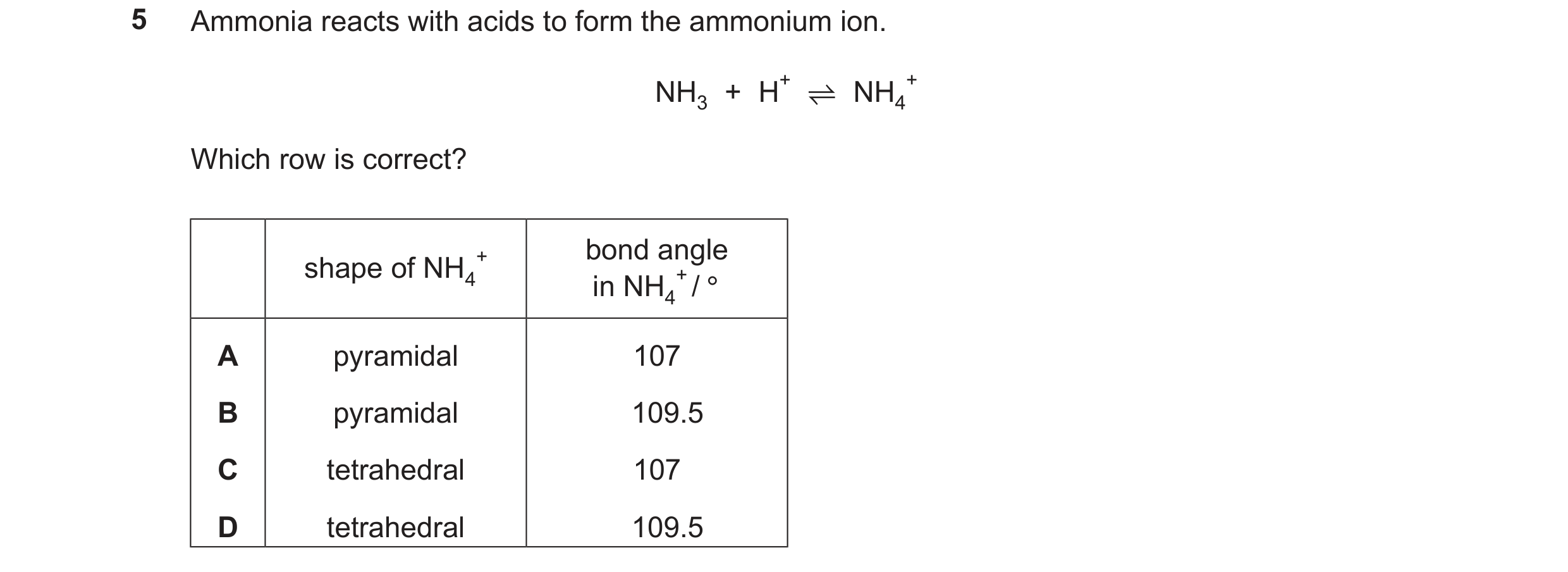
Q74 · Ammonia reacts with acids to form the ammonium ion 9701/13 May/June 2023
5 Ammonia reacts with acids to form the ammonium ion.
NH, + H’ = NH,
Which row is correct?
+ bond angle
shape of NH, in NH,*/°
A pyramidal 107
B pyramidal 109.5
Cc tetrahedral 107
D tetrahedral 109.5
1 marks
Answer: D
This question in 9701/13 May/June 2023
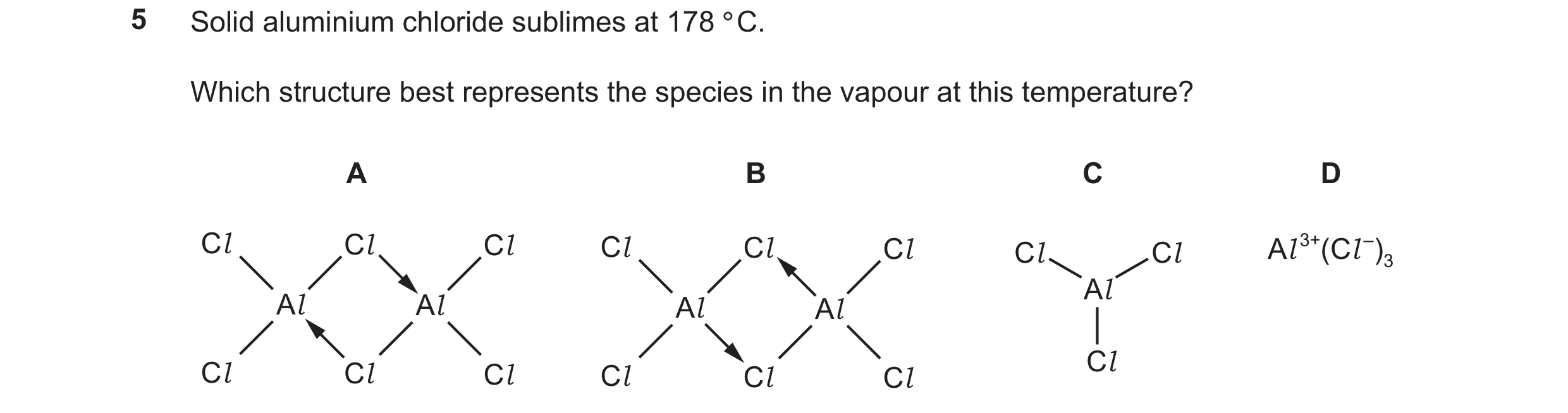
Q75 · Solid aluminium chloride sublimes at 178 °C 9701/11 Oct/Nov 2023
5 Solid aluminium chloride sublimes at 178 °C. Which structure best represents the species in the vapour at this temperature? A B C D Cl Cl Cl Cl Cl Cl Cl Cl Al 3+(Cl –)3 Al Al Al Al Al Cl Cl Cl Cl Cl Cl Cl
1 marks
Answer: A
This question in 9701/11 Oct/Nov 2023
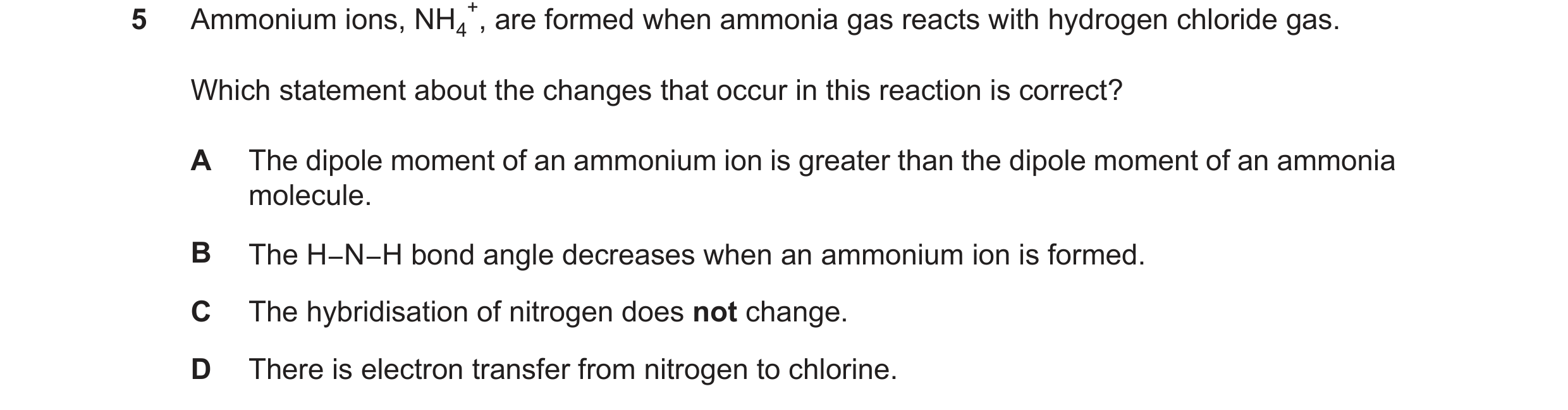
Q76 · Ammonium ions, NH4 +, are formed when ammonia gas reacts with hydrogen chloride gas 9701/12 Oct/Nov 2023
5 Ammonium ions, NH4 +, are formed when ammonia gas reacts with hydrogen chloride gas. Which statement about the changes that occur in this reaction is correct? A The dipole moment of an ammonium ion is greater than the dipole moment of an ammonia molecule. B The H−N−H bond angle decreases when an ammonium ion is formed. C The hybridisation of nitrogen does not change. D There is electron transfer from nitrogen to chlorine.
1 marks
Answer: C
This question in 9701/12 Oct/Nov 2023
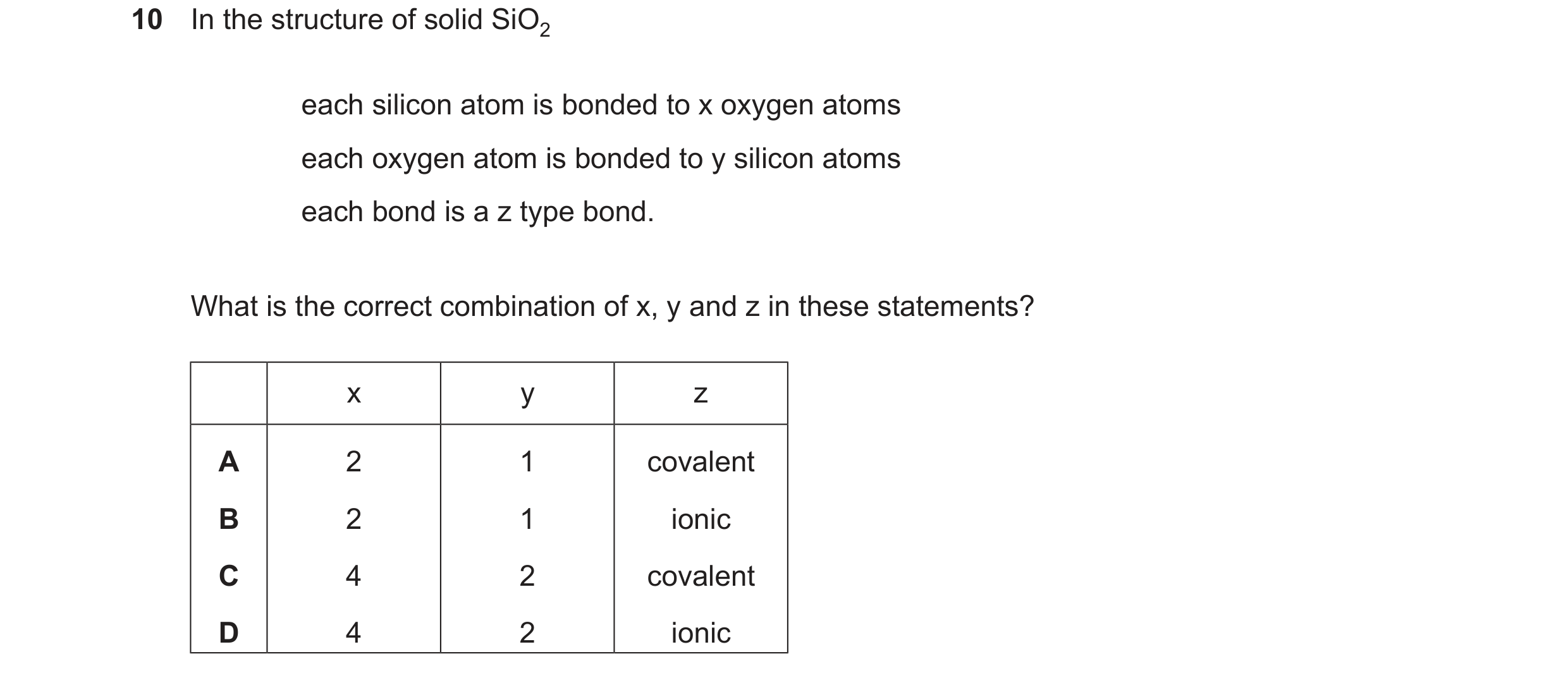
Q77 · In the structure of solid SiO2 each silicon atom is bonded to x oxygen atoms each oxygen… 9701/12 Oct/Nov 2023
10 In the structure of solid SiO2 each silicon atom is bonded to x oxygen atoms each oxygen atom is bonded to y silicon atoms each bond is a z type bond. What is the correct combination of x, y and z in these statements? x y z A 2 1 covalent B 2 1 ionic C 4 2 covalent D 4 2 ionic
1 marks
Answer: C
This question in 9701/12 Oct/Nov 2023
Q78 · Solid aluminium chloride sublimes at 178 °C 9701/13 Oct/Nov 2023
5 Solid aluminium chloride sublimes at 178 °C. Which structure best represents the species in the vapour at this temperature? A B C D Cl Cl Cl Cl Cl Cl Cl Cl Al 3+(Cl –)3 Al Al Al Al Al Cl Cl Cl Cl Cl Cl Cl
1 marks
Answer: A
This question in 9701/13 Oct/Nov 2023
Q79 · Aluminium chloride exists as Al 2Cl 6 molecules at room temperature 9701/12 Feb/March 2024
6 Aluminium chloride exists as Al 2Cl 6 molecules at room temperature. When heated to a high temperature, Al Cl 3 molecules are formed. What are the arrangements of the bonding pairs of electrons around the aluminium atom in the two forms of aluminium chloride? Al Cl 3 Al 2Cl 6 A planar planar B planar tetrahedral C tetrahedral tetrahedral D tetrahedral octahedral
1 marks
Answer: B
This question in 9701/12 Feb/March 2024
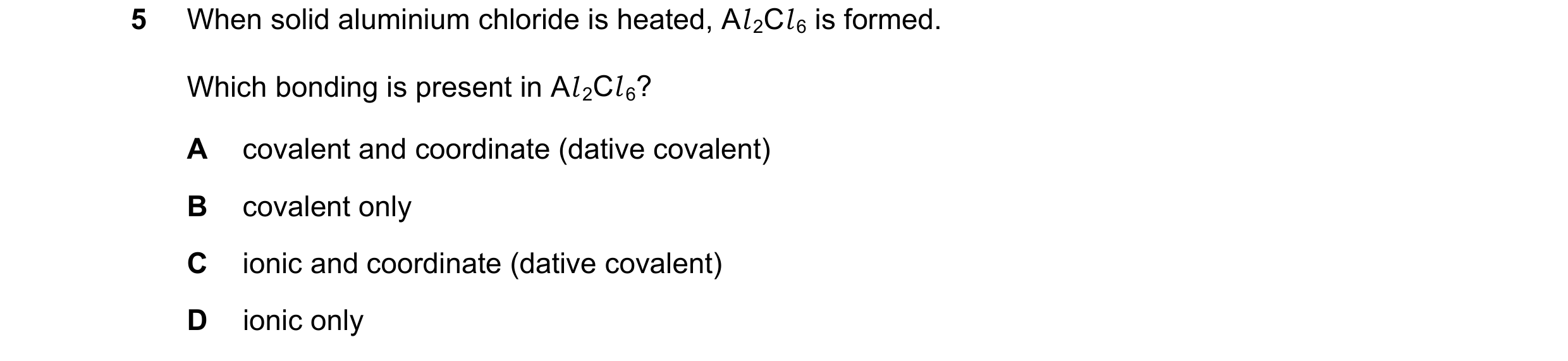
Q80 · When solid aluminium chloride is heated, Al 2Cl 6 is formed 9701/11 May/June 2024
5 When solid aluminium chloride is heated, Al 2Cl 6 is formed. Which bonding is present in Al 2Cl 6? A covalent and coordinate (dative covalent) B covalent only C ionic and coordinate (dative covalent) D ionic only
1 marks
Answer: A
This question in 9701/11 May/June 2024
Q81 · What is the bond angle in the ammonium ion? 9701/11 May/June 2024
24 What is the bond angle in the ammonium ion? A 90 B 107 C 109.5 D 120
1 marks
Answer: C
This question in 9701/11 May/June 2024
Q82 · In which species does the underlined atom have an incomplete outer shell? 9701/12 May/June 2024
6 In which species does the underlined atom have an incomplete outer shell? A BF3 B CH3 – C F2O D H3O+
1 marks
Answer: A
This question in 9701/12 May/June 2024
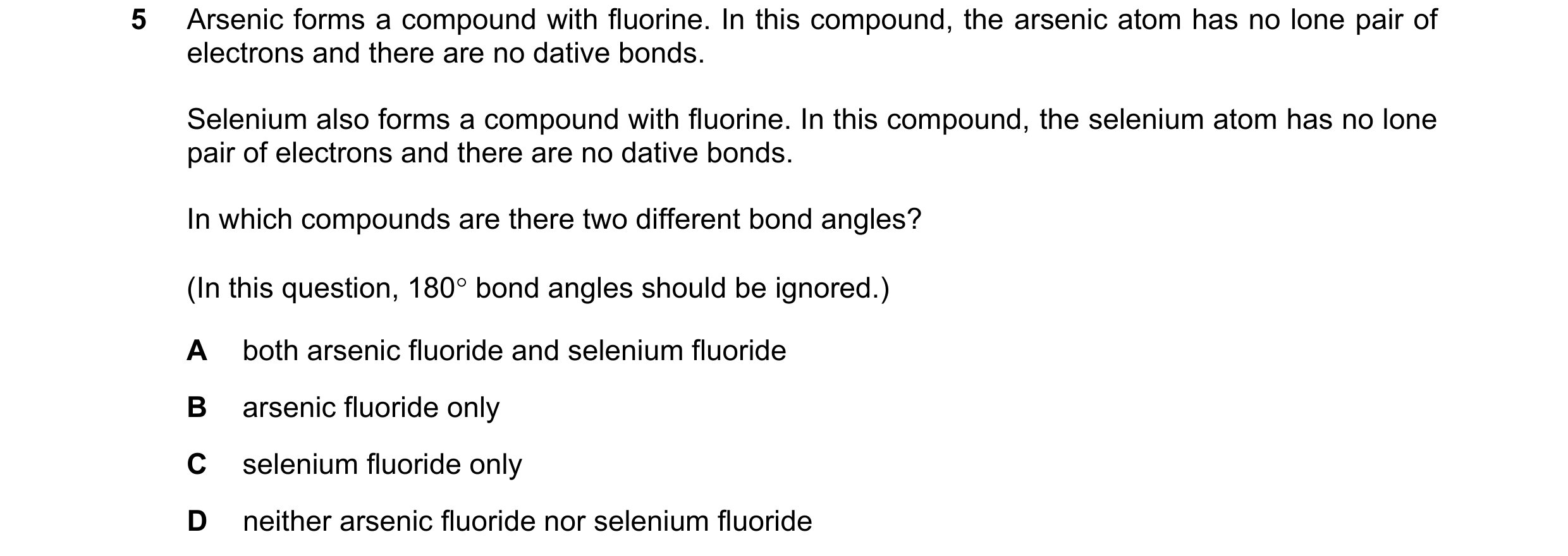
Q83 · Arsenic forms a compound with fluorine 9701/13 May/June 2024
5 Arsenic forms a compound with fluorine. In this compound, the arsenic atom has no lone pair of electrons and there are no dative bonds. Selenium also forms a compound with fluorine. In this compound, the selenium atom has no lone pair of electrons and there are no dative bonds. In which compounds are there two different bond angles? (In this question, 180 bond angles should be ignored.) A both arsenic fluoride and selenium fluoride B arsenic fluoride only C selenium fluoride only D neither arsenic fluoride nor selenium fluoride
1 marks
Answer: B
This question in 9701/13 May/June 2024
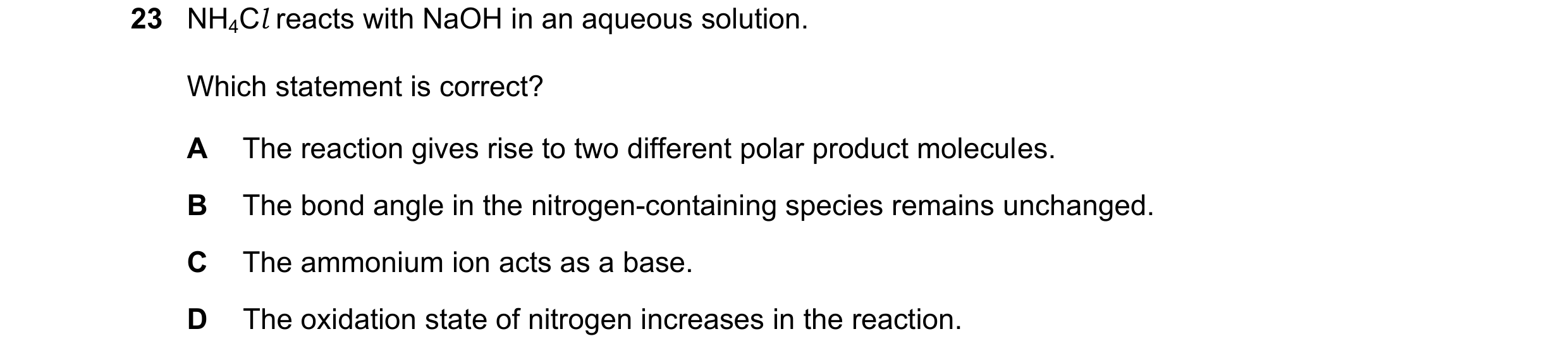
Q84 · NH4Cl reacts with NaOH in an aqueous solution 9701/13 May/June 2024
23 NH4Cl reacts with NaOH in an aqueous solution. Which statement is correct? A The reaction gives rise to two different polar product molecules. B The bond angle in the nitrogen-containing species remains unchanged. C The ammonium ion acts as a base. D The oxidation state of nitrogen increases in the reaction.
1 marks
Answer: A
This question in 9701/13 May/June 2024
Q85 · Phosphorus forms a compound with hydrogen called phosphine, PH3 9701/11 Oct/Nov 2024
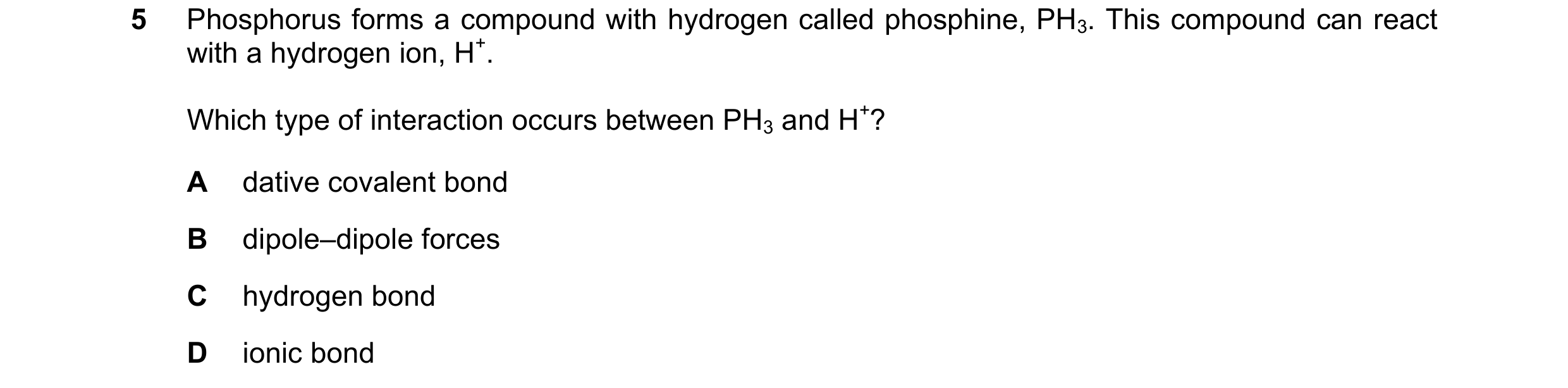
5 Phosphorus forms a compound with hydrogen called phosphine, PH3. This compound can react with a hydrogen ion, H+. Which type of interaction occurs between PH3 and H+? A dative covalent bond B dipole–dipole forces C hydrogen bond D ionic bond
1 marks
Answer: A
This question in 9701/11 Oct/Nov 2024
Q86 · Three statements about ammonia molecules and ammonium ions are given 9701/11 Oct/Nov 2024
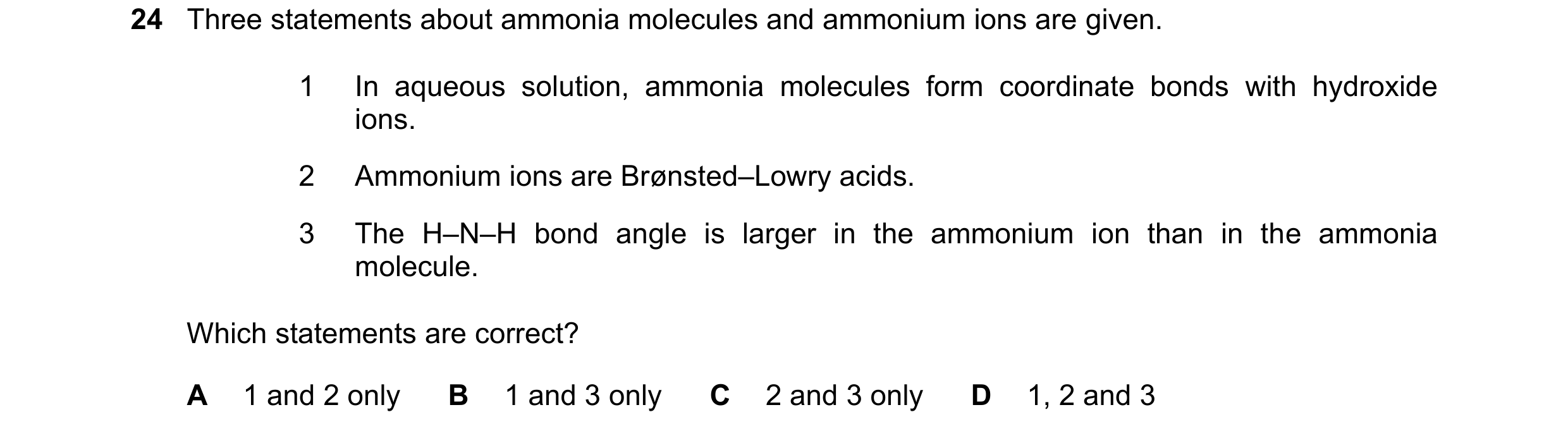
24 Three statements about ammonia molecules and ammonium ions are given. 1 In aqueous solution, ammonia molecules form coordinate bonds with hydroxide ions. 2 Ammonium ions are Brønsted–Lowry acids. 3 The H–N–H bond angle is larger in the ammonium ion than in the ammonia molecule. Which statements are correct? A 1 and 2 only B 1 and 3 only C 2 and 3 only D 1, 2 and 3
1 marks
Answer: C
This question in 9701/11 Oct/Nov 2024
Q87 · Phosphorus forms a compound with hydrogen called phosphine, PH3 9701/13 Oct/Nov 2024
5 Phosphorus forms a compound with hydrogen called phosphine, PH3. This compound can react with a hydrogen ion, H+. Which type of interaction occurs between PH3 and H+? A dative covalent bond B dipole–dipole forces C hydrogen bond D ionic bond
1 marks
Answer: A
This question in 9701/13 Oct/Nov 2024
Q88 · In which pair do both species: ● have the same shape ● have the same number of covalent… 9701/11 May/June 2025
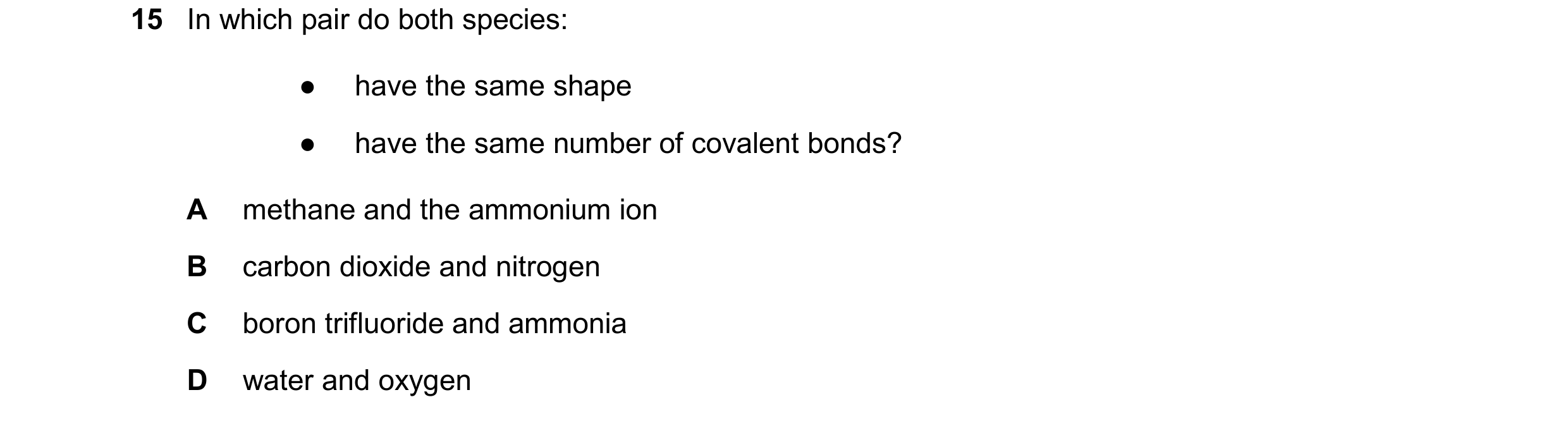
15 In which pair do both species: ● have the same shape ● have the same number of covalent bonds? A methane and the ammonium ion B carbon dioxide and nitrogen C boron trifluoride and ammonia D water and oxygen
1 marks
Answer: A
This question in 9701/11 May/June 2025
Q89 · BF3 reacts with NH3 to form a single compound with a simple molecular structure 9701/13 May/June 2025
11 BF3 reacts with NH3 to form a single compound with a simple molecular structure. BF3 + NH3 F3B–NH3 Which row describes how the bond angles change during the reaction? F–B–F bond angle H–N–H bond angle A decreases decreases B decreases increases C increases decreases D increases increases
1 marks
Answer: B
This question in 9701/13 May/June 2025
Q90 · Which solid compound has both ionic and covalent bonding but not coordinate bonding? 9701/14 May/June 2025
12 Which solid compound has both ionic and covalent bonding but not coordinate bonding? A Al 2Cl 6 B CH3COONa C MgCl 2 D NH4Cl
1 marks
Answer: B
This question in 9701/14 May/June 2025
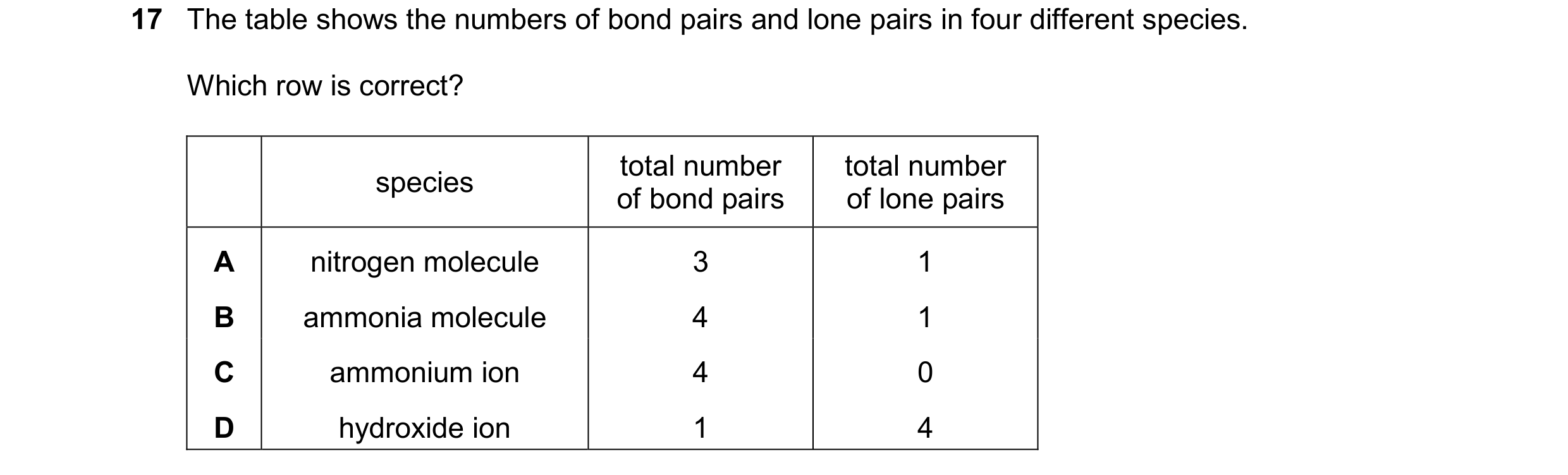
Q91 · The table shows the numbers of bond pairs and lone pairs in four different species 9701/14 May/June 2025
17 The table shows the numbers of bond pairs and lone pairs in four different species. Which row is correct? total number total number species of bond pairs of lone pairs A nitrogen molecule 3 1 B ammonia molecule 4 1 C ammonium ion 4 0 D hydroxide ion 1 4
1 marks
Answer: C
This question in 9701/14 May/June 2025
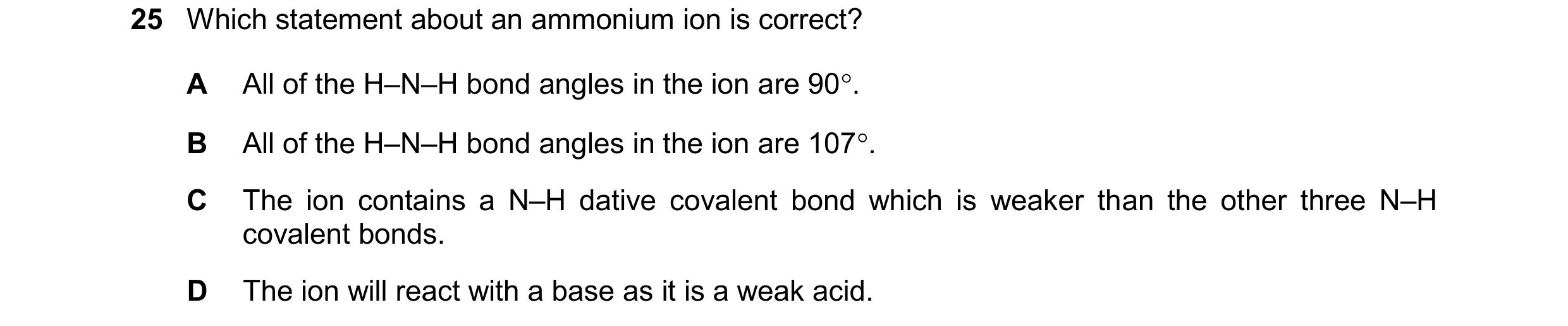
Q92 · Which statement about an ammonium ion is correct? 9701/14 May/June 2025
25 Which statement about an ammonium ion is correct? A All of the H–N–H bond angles in the ion are 90. B All of the H–N–H bond angles in the ion are 107. C The ion contains a N–H dative covalent bond which is weaker than the other three N–H covalent bonds. D The ion will react with a base as it is a weak acid.
1 marks
Answer: D
This question in 9701/14 May/June 2025
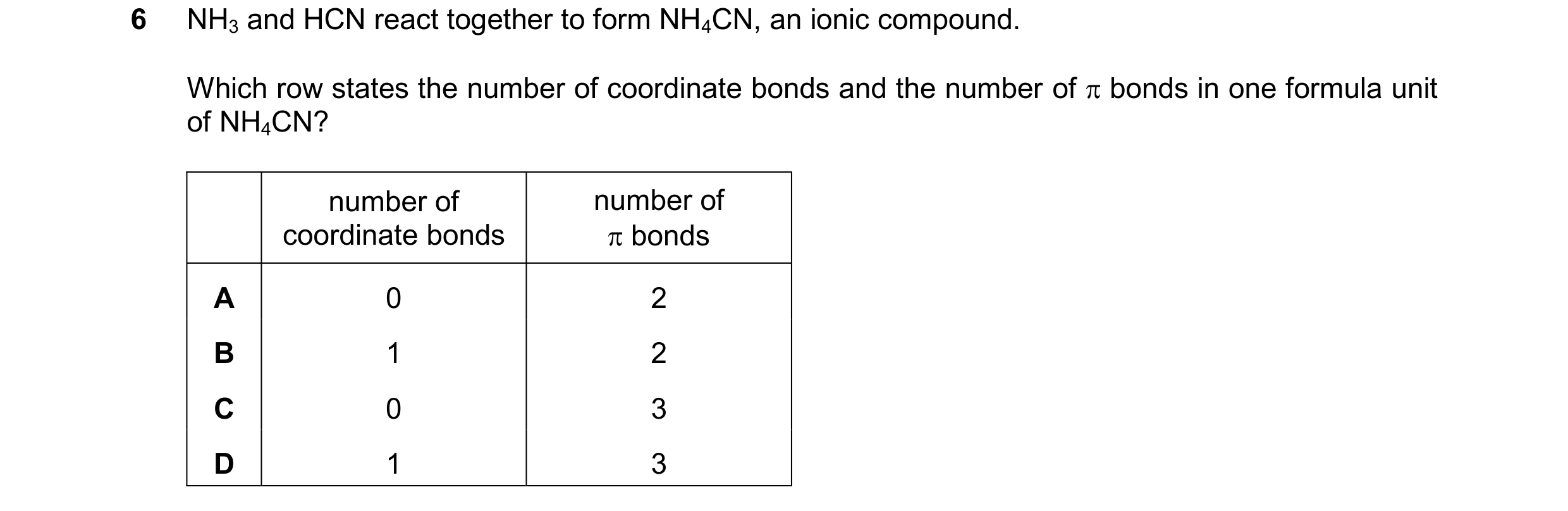
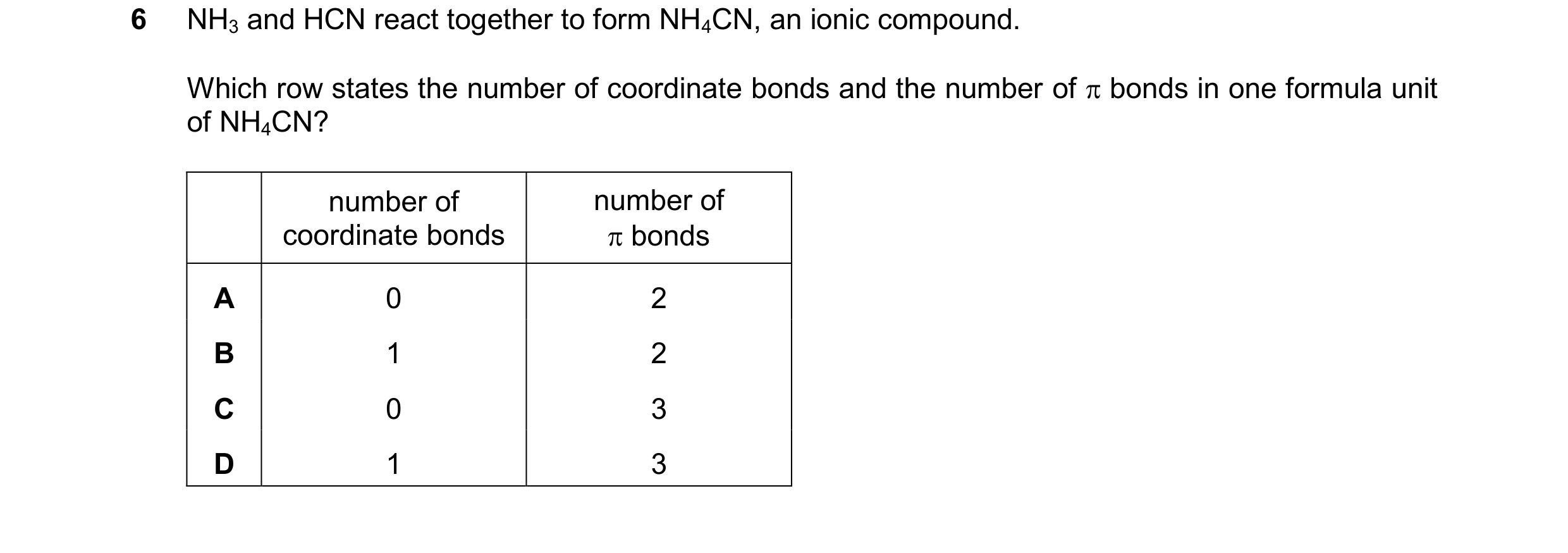
Q93 · NH3 and HCN react together to form NH4CN, an ionic compound 9701/11 Oct/Nov 2025
6 NH3 and HCN react together to form NH4CN, an ionic compound. Which row states the number of coordinate bonds and the number of bonds in one formula unit of NH4CN? number of coordinate bonds number of bonds A 0 2 B 1 2 C 0 3 D 1 3
1 marks
Answer: B
This question in 9701/11 Oct/Nov 2025
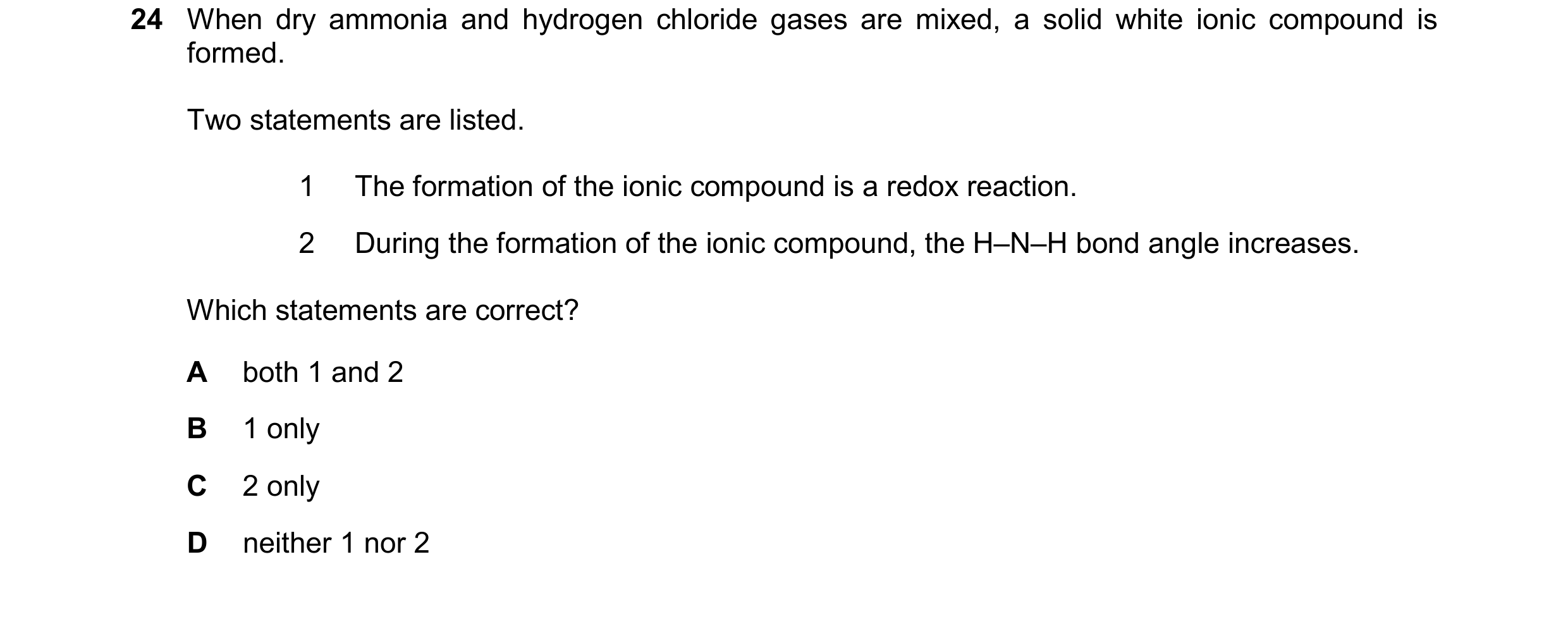
Q94 · When dry ammonia and hydrogen chloride gases are mixed, a solid white ionic compound is… 9701/11 Oct/Nov 2025
24 When dry ammonia and hydrogen chloride gases are mixed, a solid white ionic compound is formed. Two statements are listed. 1 The formation of the ionic compound is a redox reaction. 2 During the formation of the ionic compound, the H–N–H bond angle increases. Which statements are correct? A both 1 and 2 B 1 only C 2 only D neither 1 nor 2
1 marks
Answer: C
This question in 9701/11 Oct/Nov 2025
Q95 · NH3 and HCN react together to form NH4CN, an ionic compound 9701/13 Oct/Nov 2025
6 NH3 and HCN react together to form NH4CN, an ionic compound. Which row states the number of coordinate bonds and the number of bonds in one formula unit of NH4CN? number of coordinate bonds number of bonds A 0 2 B 1 2 C 0 3 D 1 3
1 marks
Answer: B
This question in 9701/13 Oct/Nov 2025
Q96 · When dry ammonia and hydrogen chloride gases are mixed, a solid white ionic compound is… 9701/13 Oct/Nov 2025
24 When dry ammonia and hydrogen chloride gases are mixed, a solid white ionic compound is formed. Two statements are listed. 1 The formation of the ionic compound is a redox reaction. 2 During the formation of the ionic compound, the H–N–H bond angle increases. Which statements are correct? A both 1 and 2 B 1 only C 2 only D neither 1 nor 2
1 marks
Answer: C
This question in 9701/13 Oct/Nov 2025
 1 / 20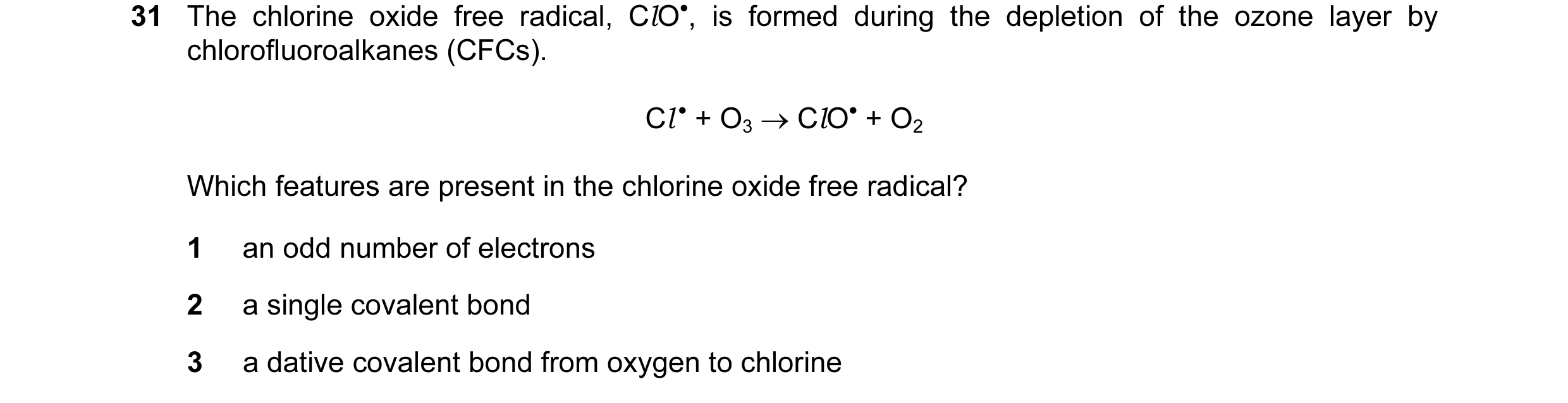
 2 / 20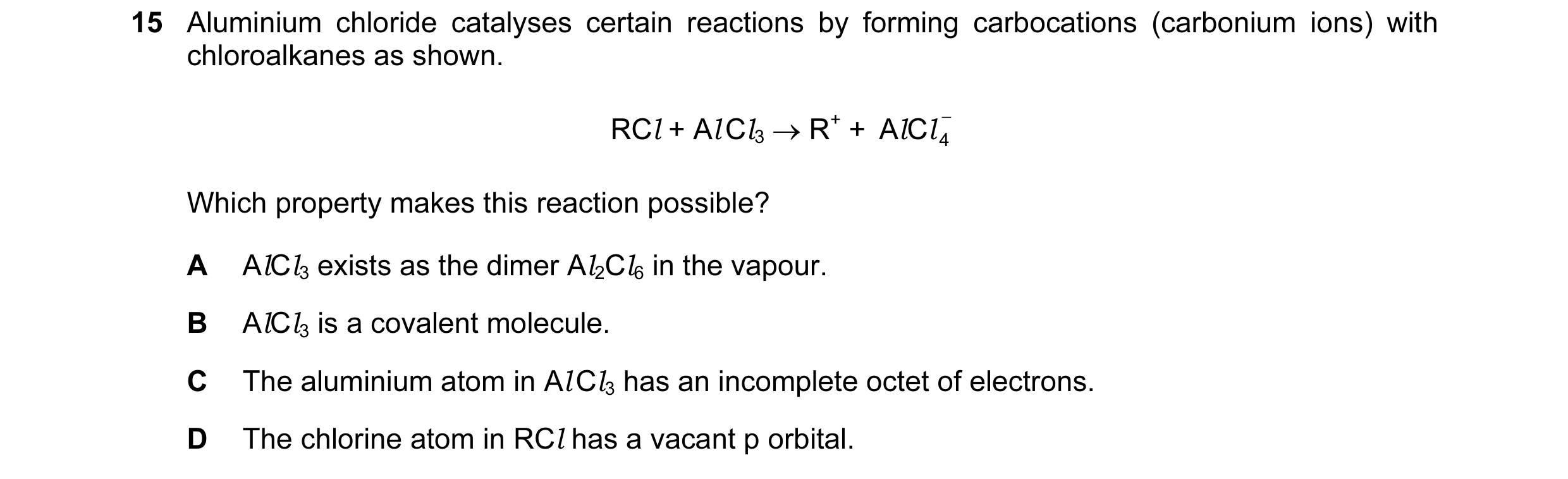

 3 / 20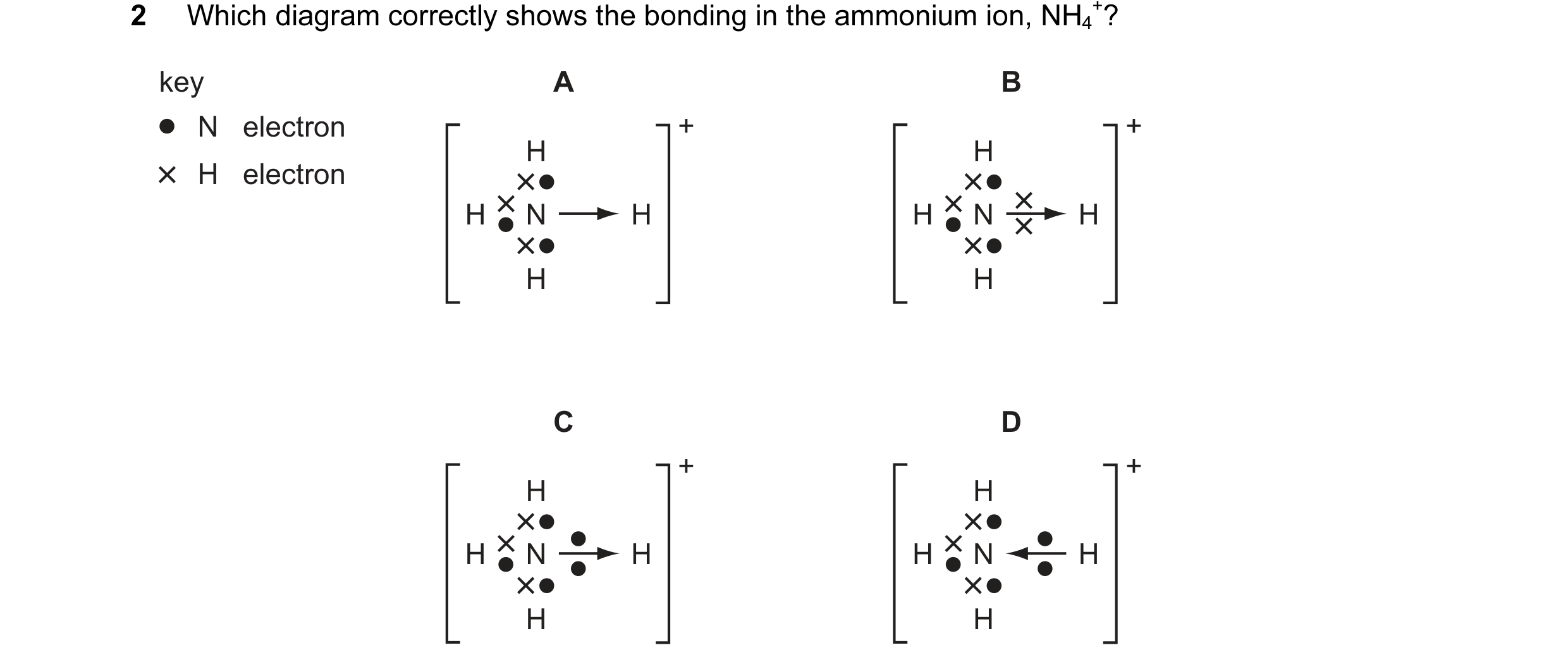


 4 / 20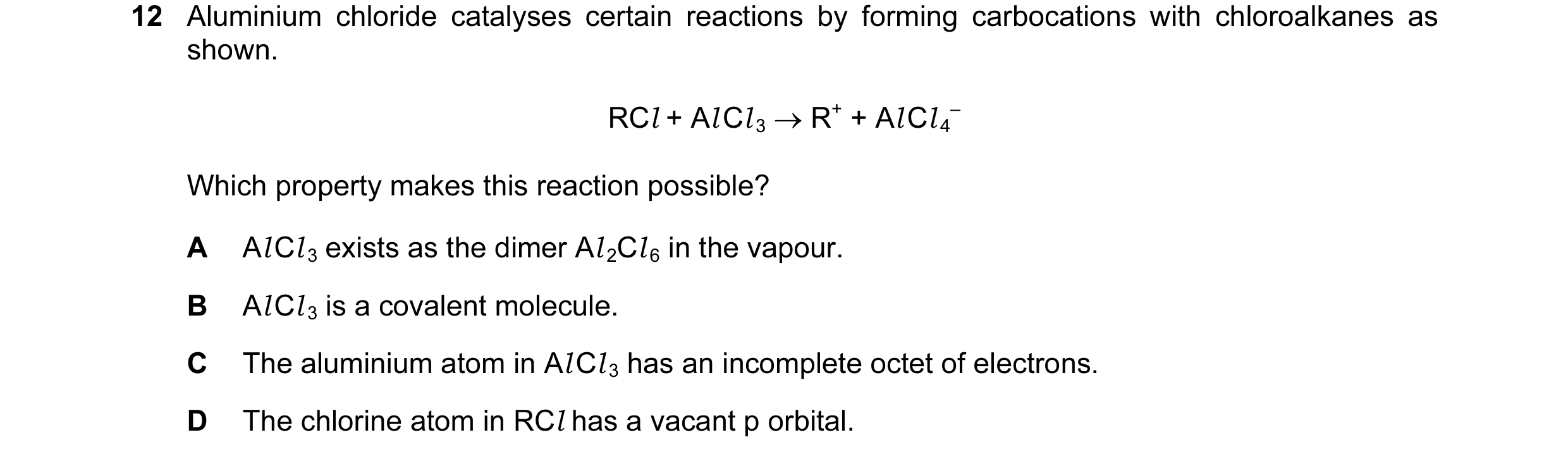




 5 / 20

 6 / 20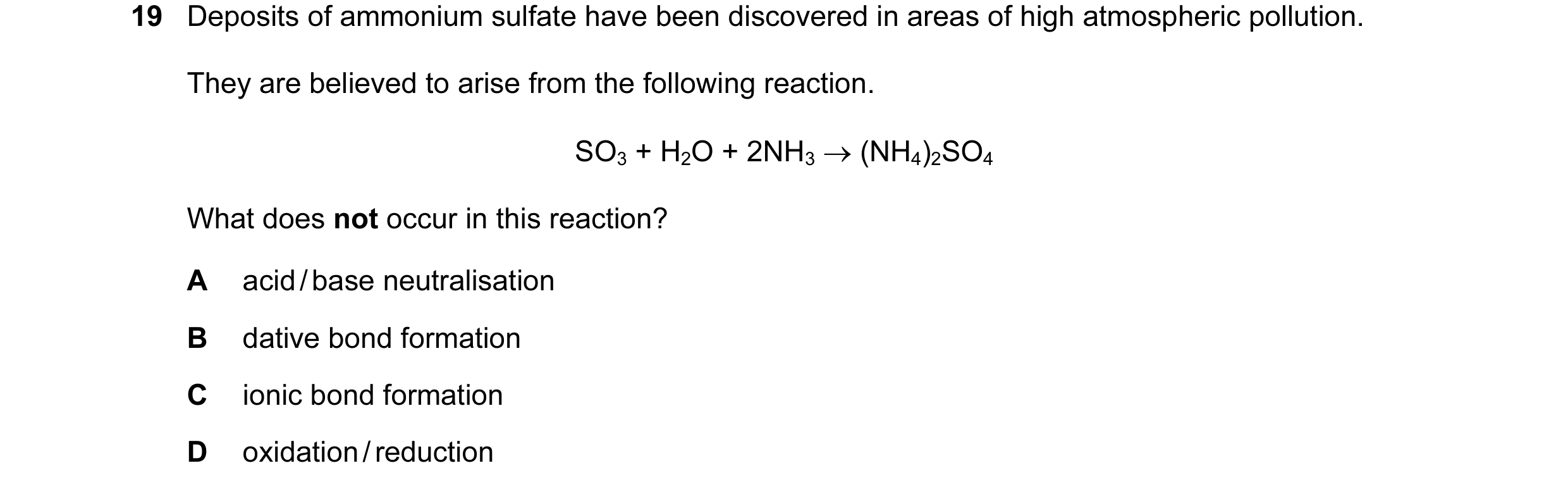



 7 / 20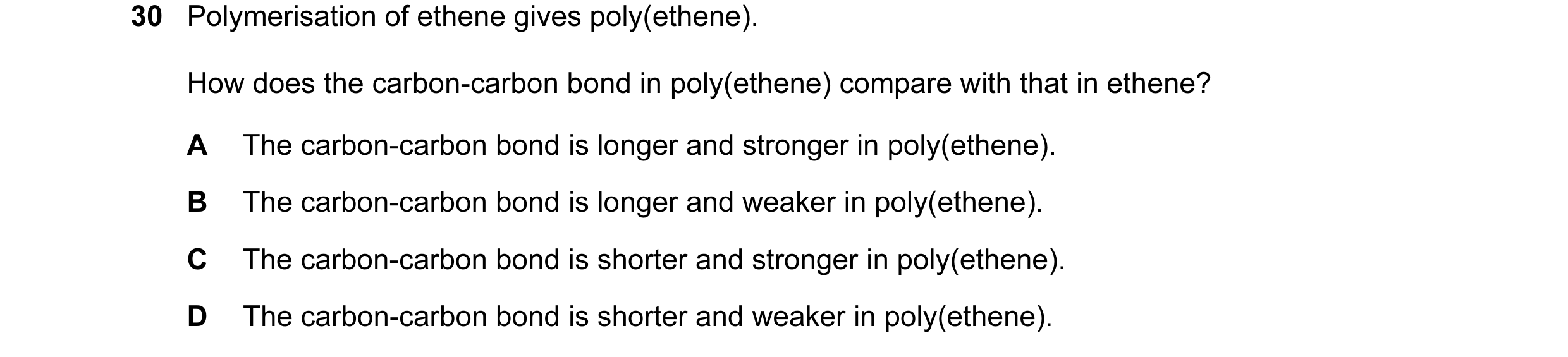


 8 / 20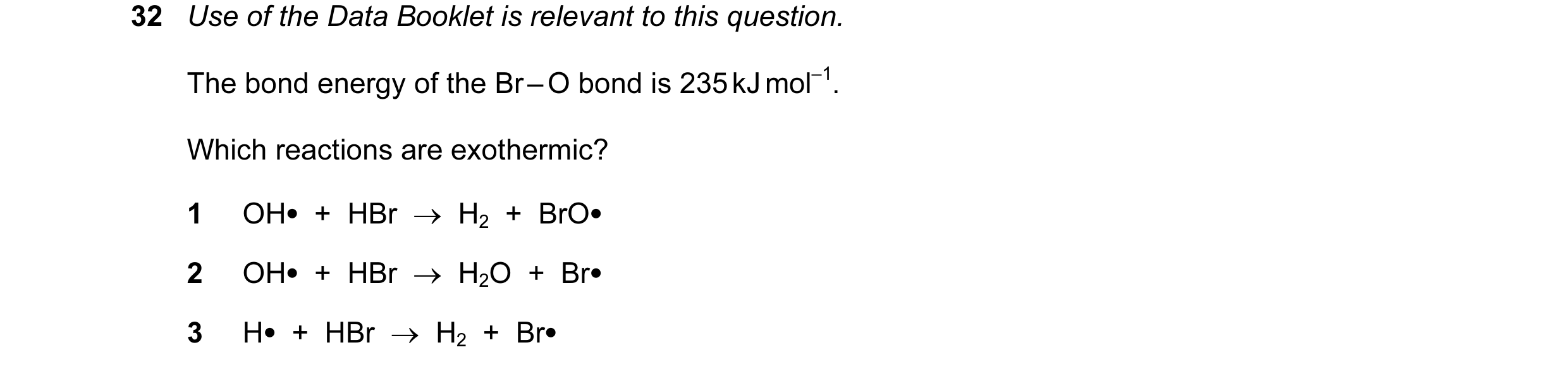

 9 / 20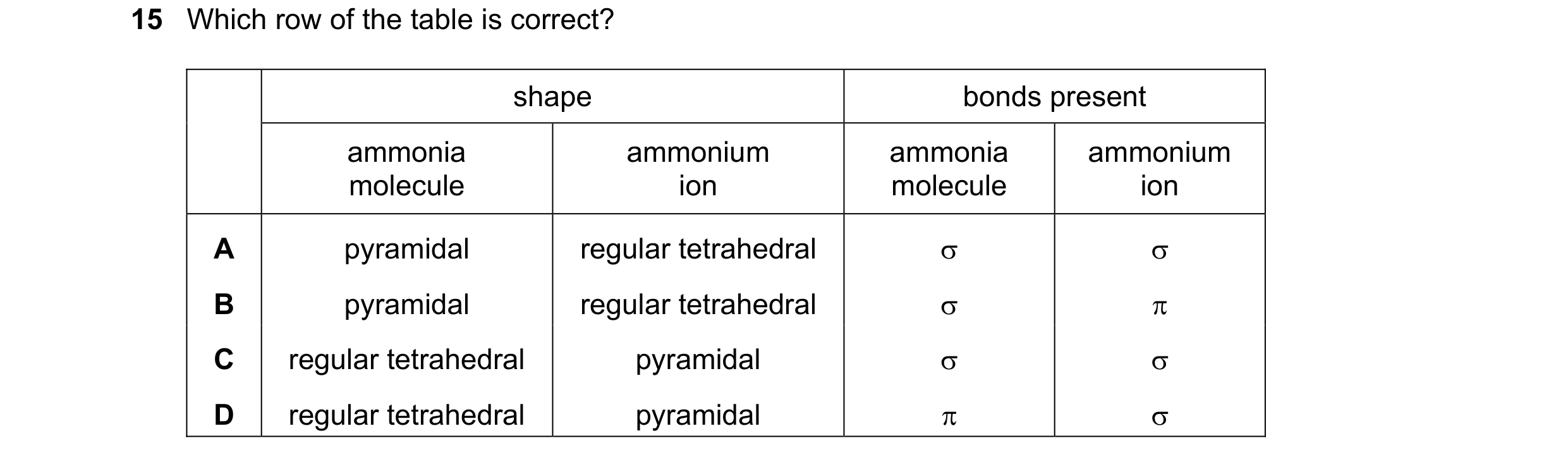

 10 / 20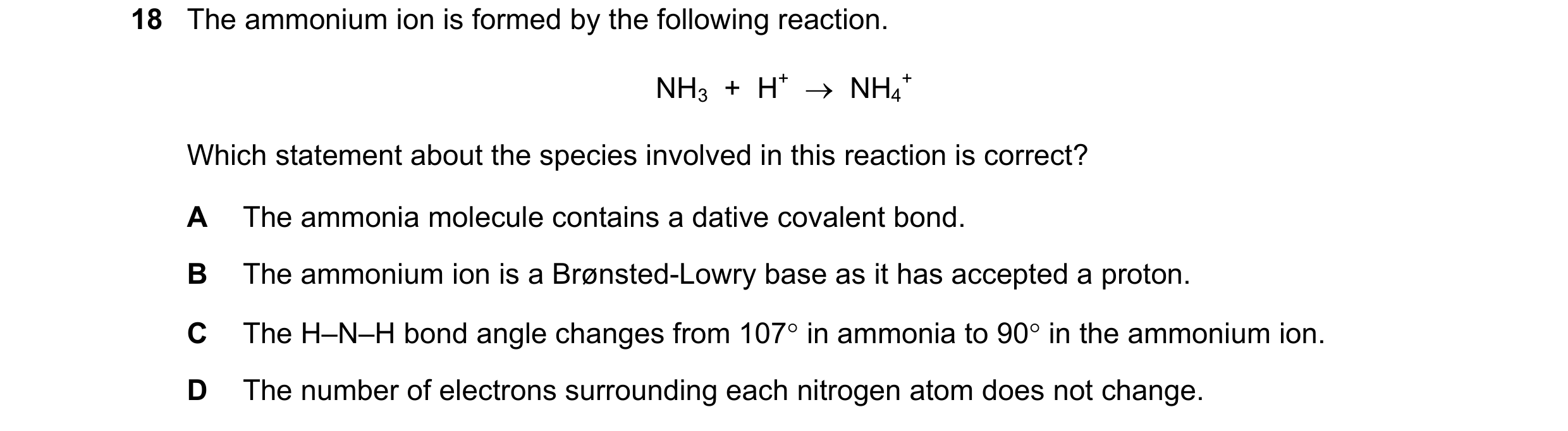

 11 / 20


 12 / 20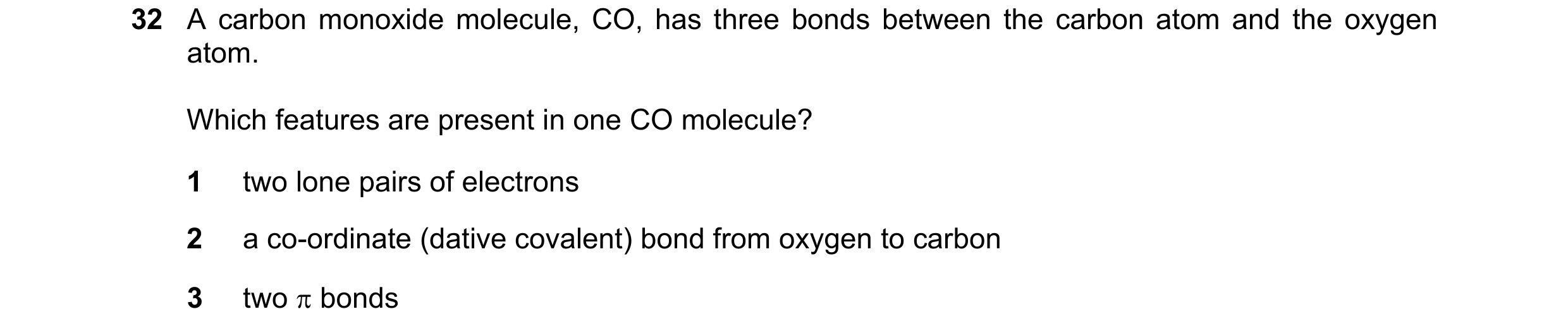



 13 / 20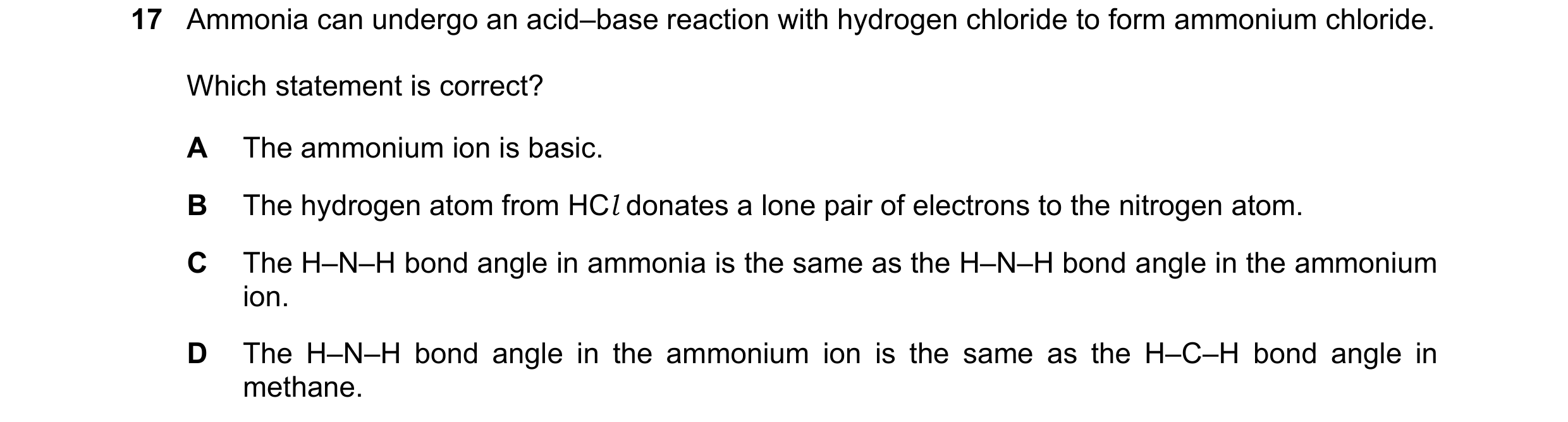


 14 / 20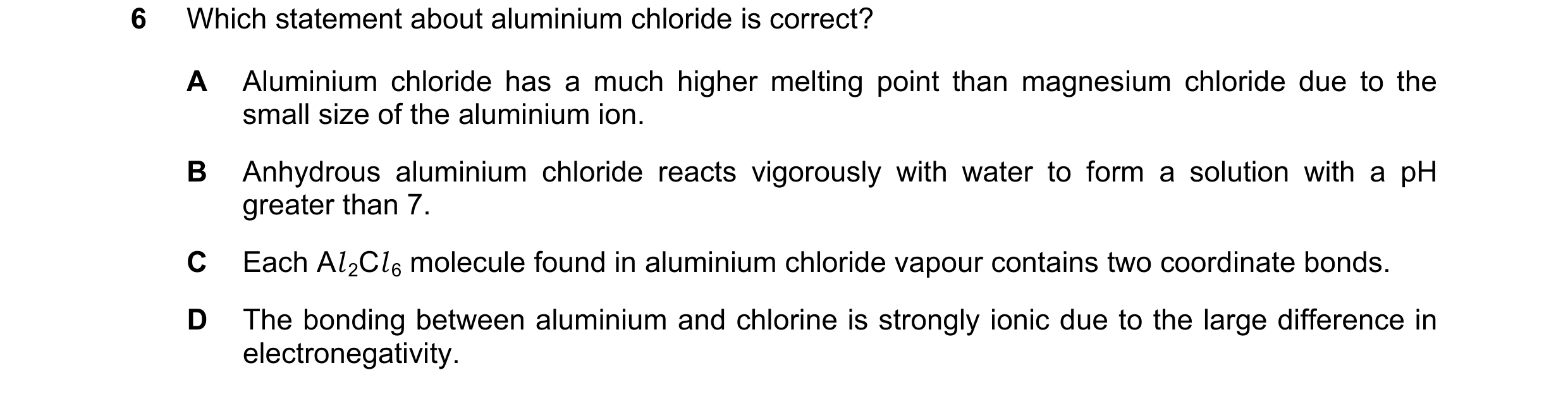
 15 / 20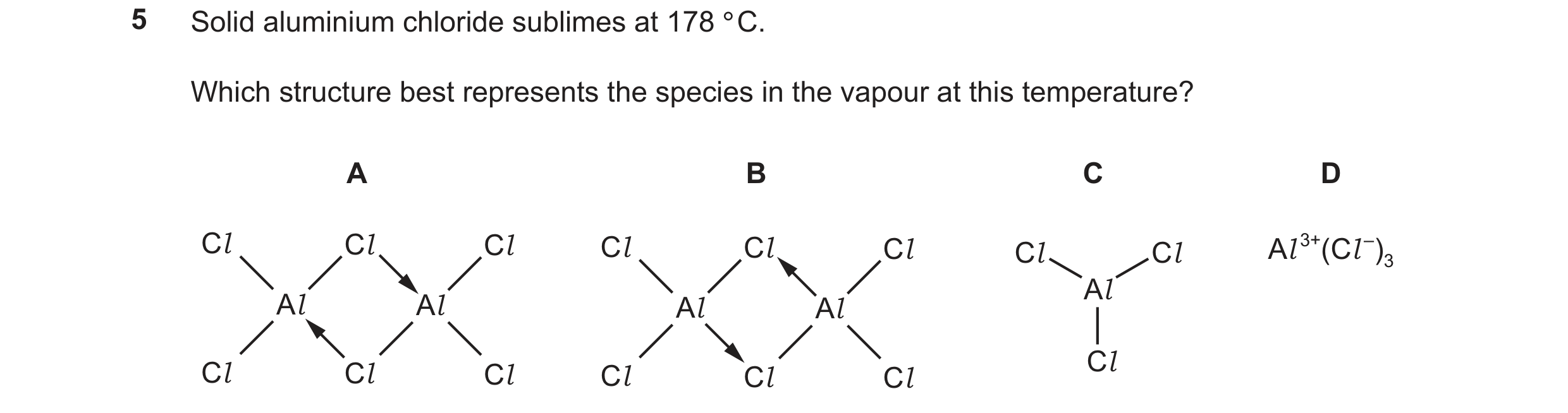
 16 / 20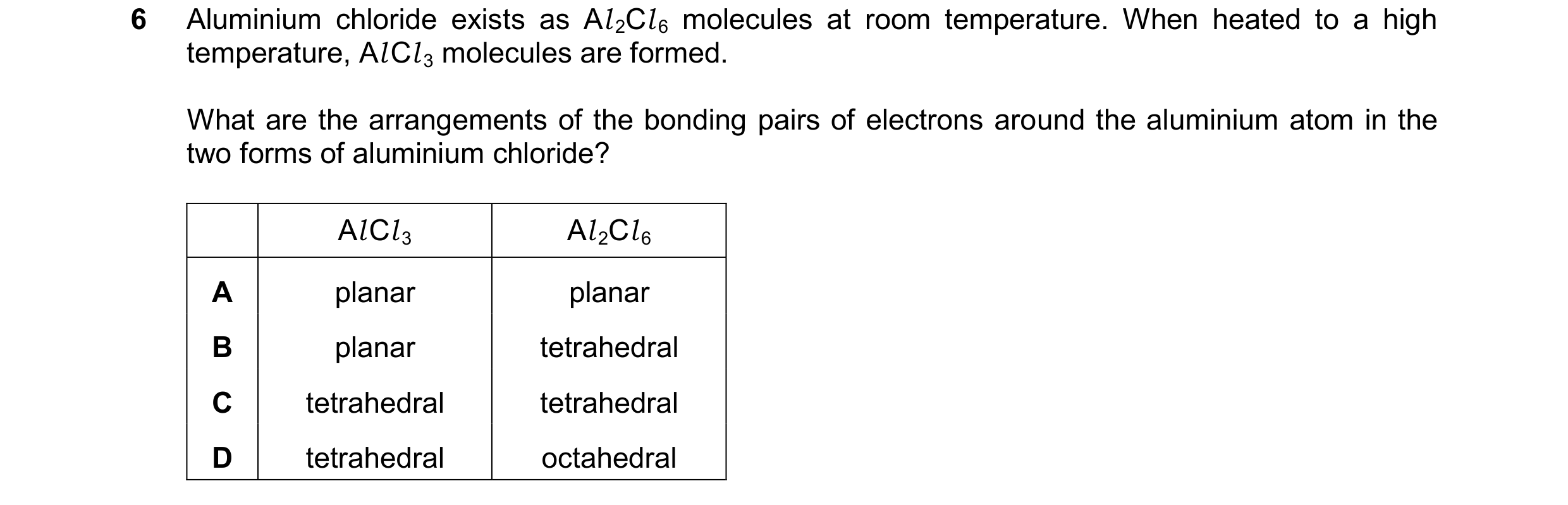


 17 / 20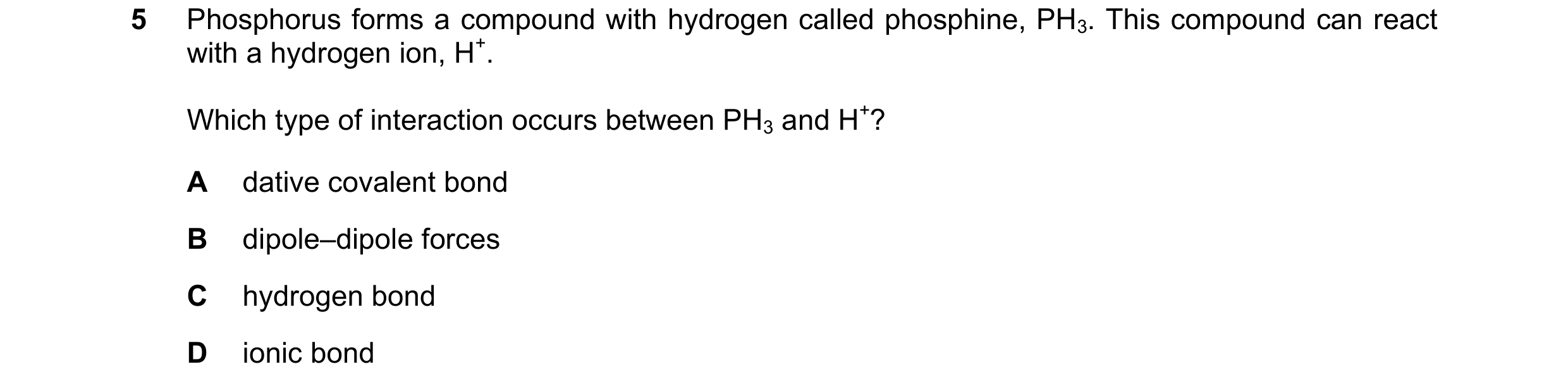
 18 / 20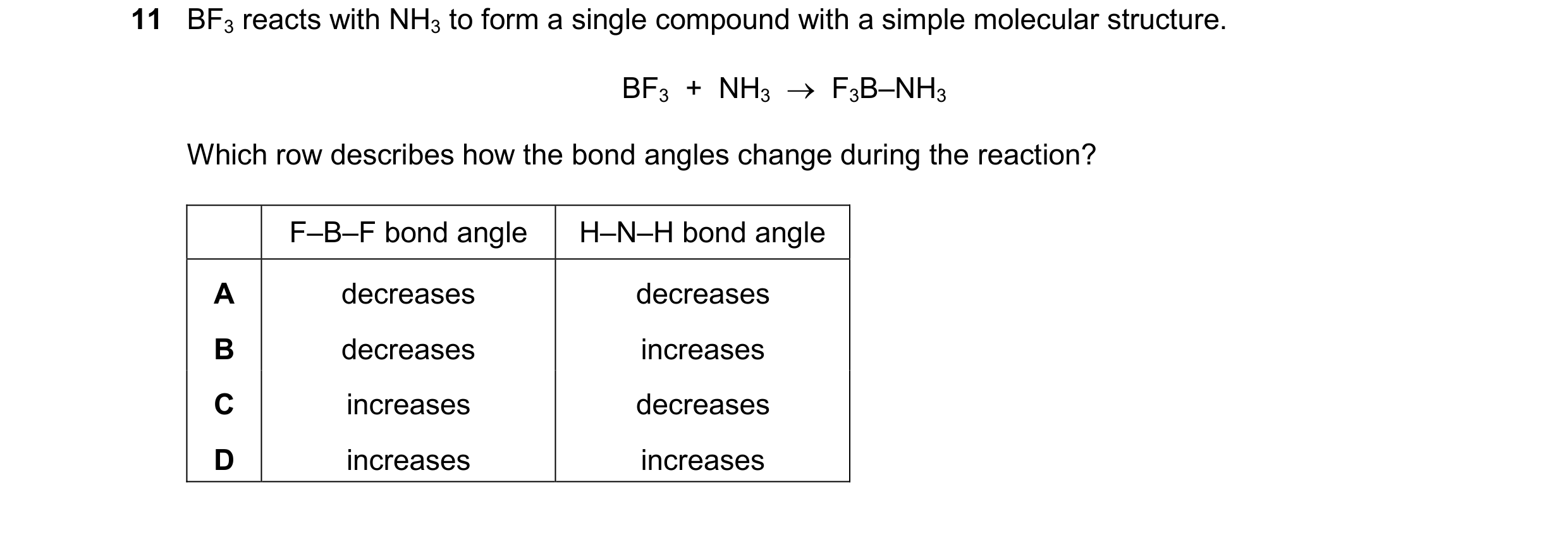

 19 / 20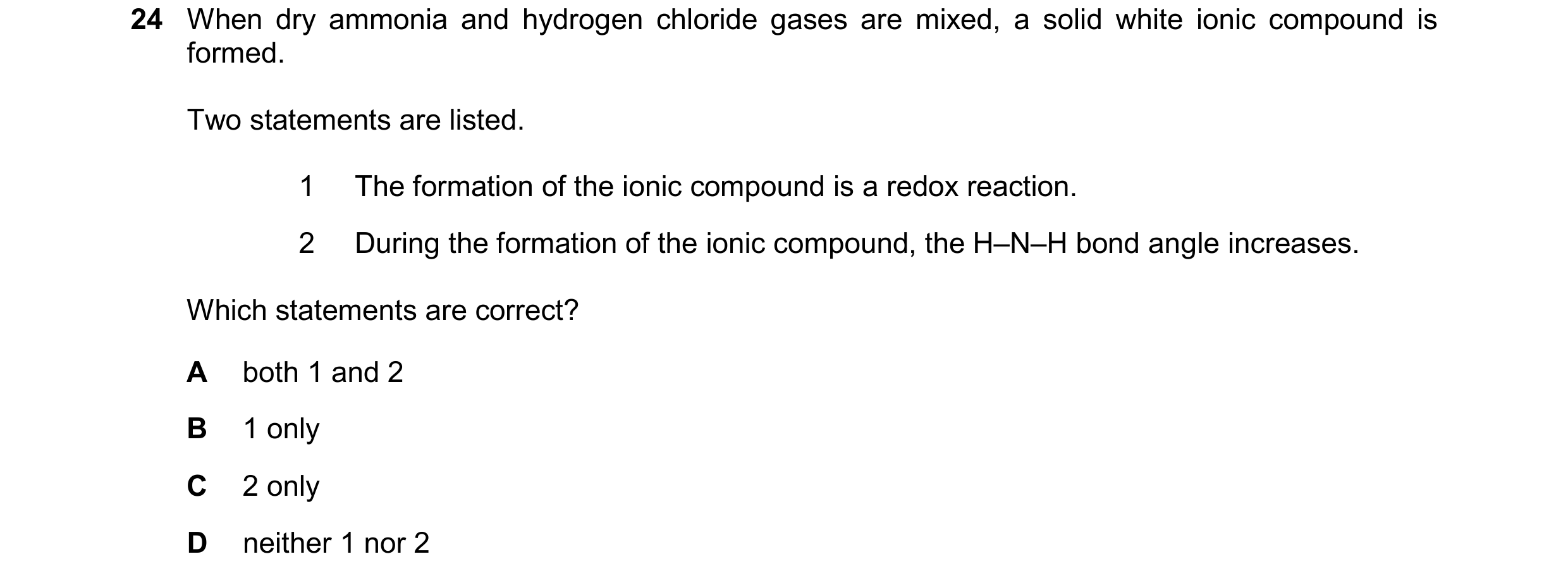
 20 / 20