Questions as text
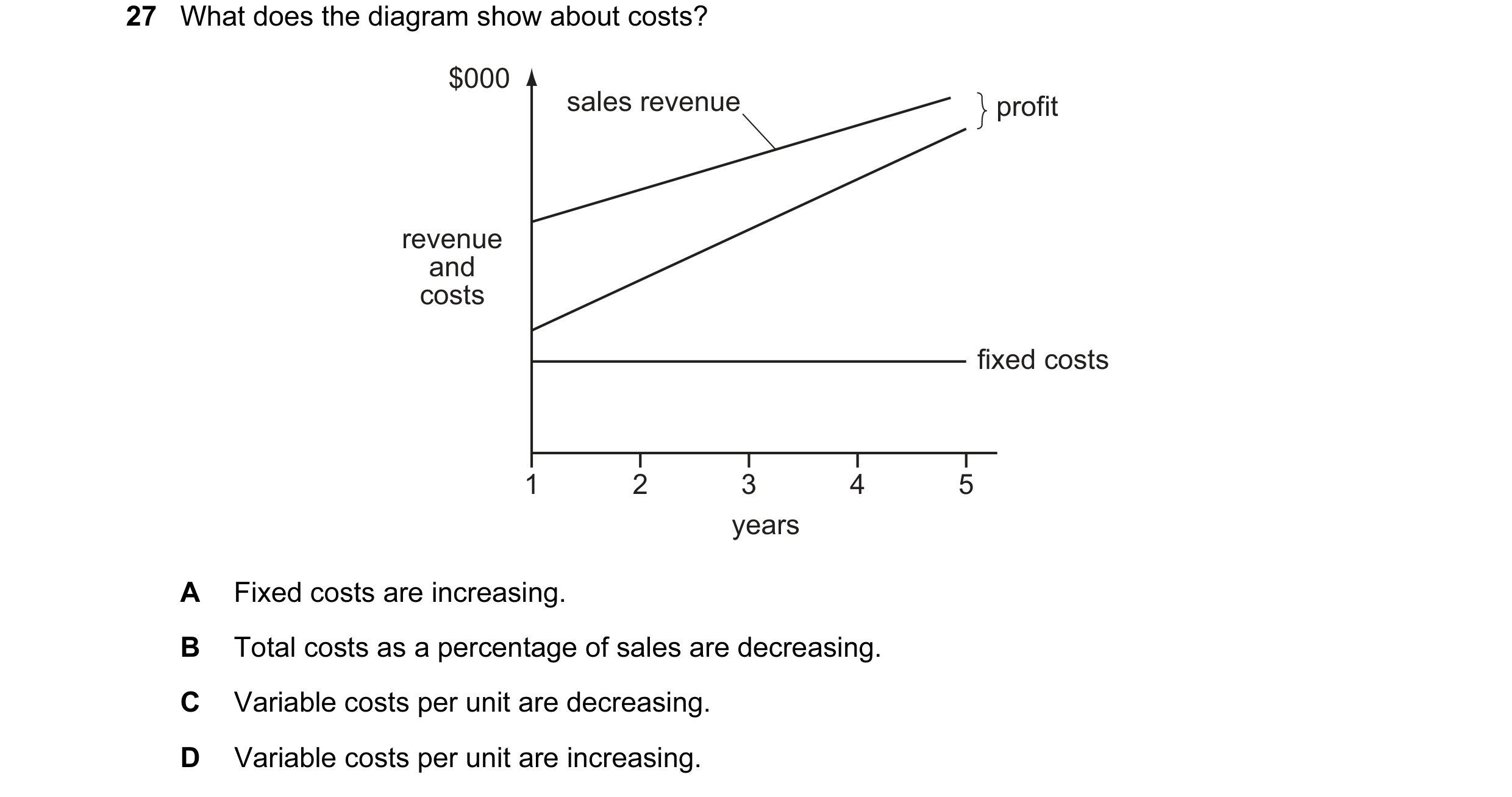
Q1 · What does the diagram show about costs? 9706/13 Oct/Nov 2011
27 What does the diagram show about costs? $000 sales revenue profit revenue and costs fixed costs 1 2 3 4 5 years A Fixed costs are increasing. B Total costs as a percentage of sales are decreasing. C Variable costs per unit are decreasing. D Variable costs per unit are increasing.
1 marks
Answer: D
This question in 9706/13 Oct/Nov 2011
Q2 · Purchases in January 2014 are expected to be $20 000 and to increase by $1000 each month 9706/11 May/June 2013
30 Purchases in January 2014 are expected to be $20 000 and to increase by $1000 each month. 20% of purchases are for cash. Credit purchases are paid for in the month following purchase. Which amount will be shown in the cash budget for payments to credit suppliers in March 2014? A $16 800 B $17 600 C $20 200 D $21 200
1 marks
Answer: A
This question in 9706/11 May/June 2013
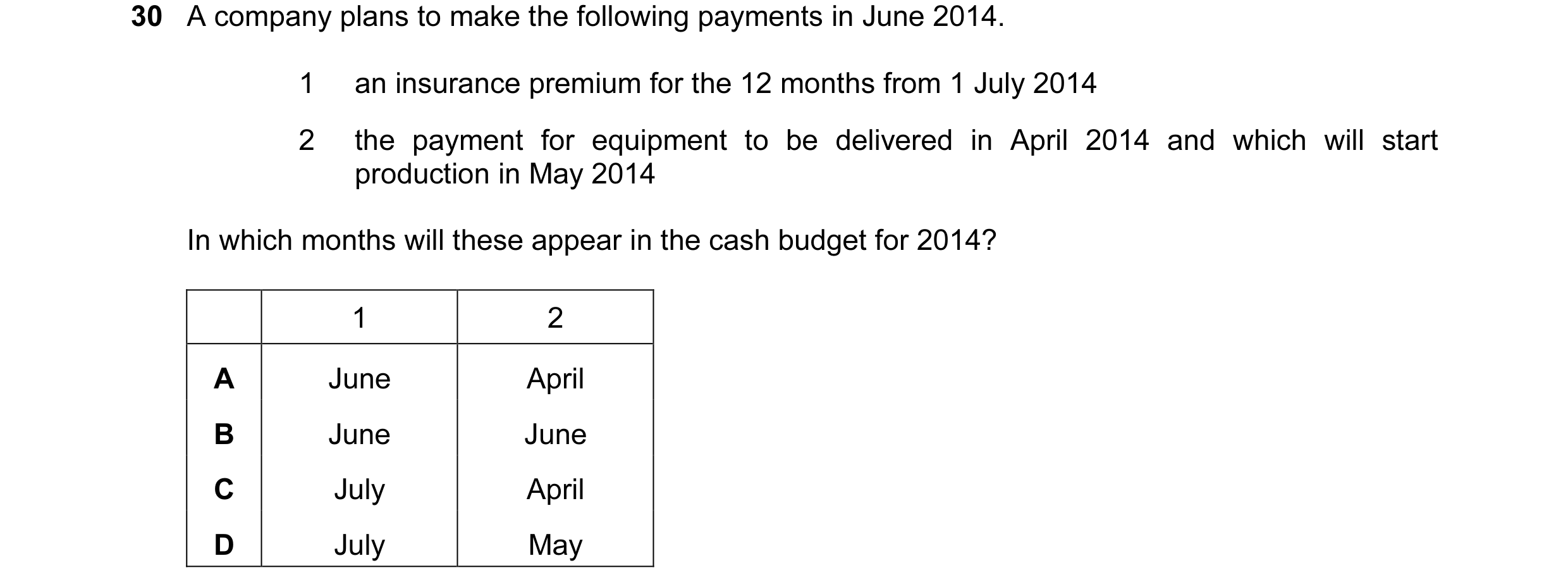
Q3 · A company plans to make the following payments in June 2014 9706/12 May/June 2013
30 A company plans to make the following payments in June 2014. 1 an insurance premium for the 12 months from 1 July 2014 2 the payment for equipment to be delivered in April 2014 and which will start production in May 2014 In which months will these appear in the cash budget for 2014? 1 2 A June April B June June C July April D July May
1 marks
Answer: B
This question in 9706/12 May/June 2013
Q4 · Why does a company prepare a cash budget? 9706/13 May/June 2013
30 Why does a company prepare a cash budget? A to establish the figure for cash for inclusion in the financial statements B to identify a month in which there will be a cash shortage C to look for seasonal trends in profitability D to reconcile bank statement figures with cash book figures
1 marks
Answer: B
This question in 9706/13 May/June 2013
Q5 · Which item would appear in a cash budget? 9706/11 Oct/Nov 2013
30 Which item would appear in a cash budget? A bad debts B cash discounts C depreciation D loan repayments
1 marks
Answer: D
This question in 9706/11 Oct/Nov 2013
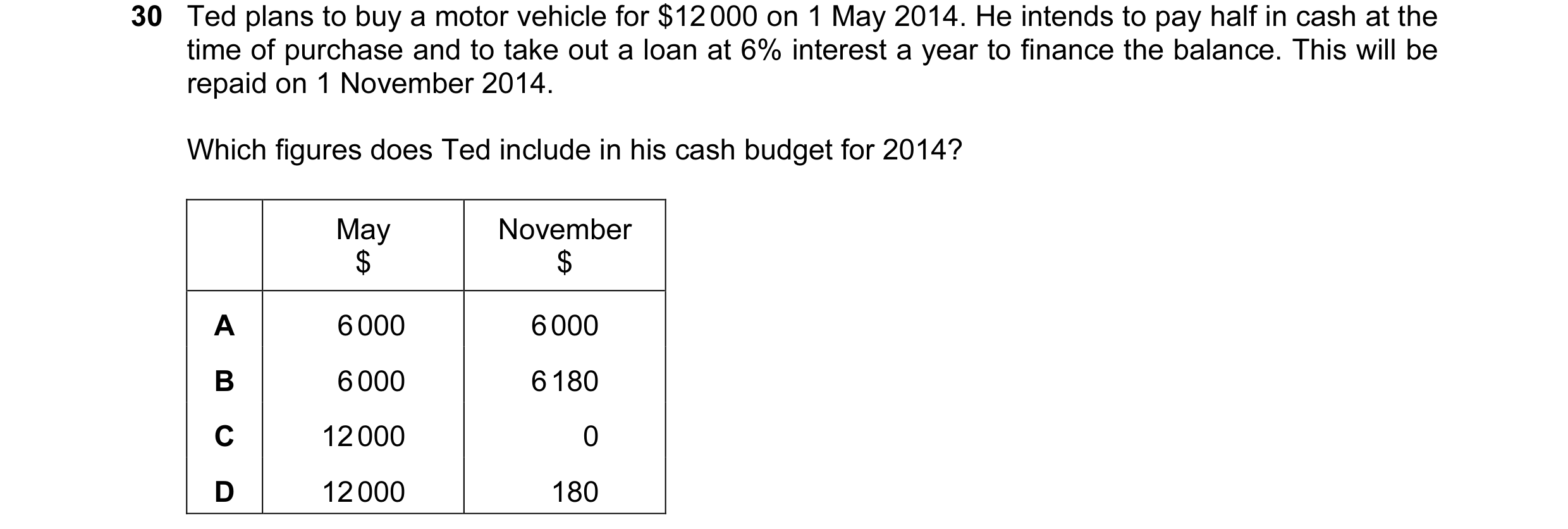
Q6 · Ted plans to buy a motor vehicle for $12 000 on 1 May 2014 9706/12 Oct/Nov 2013
30 Ted plans to buy a motor vehicle for $12 000 on 1 May 2014. He intends to pay half in cash at the time of purchase and to take out a loan at 6% interest a year to finance the balance. This will be repaid on 1 November 2014. Which figures does Ted include in his cash budget for 2014? May November $ $ A 6 000 6 000 B 6 000 6 180 C 12 000 0 D 12 000 180
1 marks
Answer: B
This question in 9706/12 Oct/Nov 2013
Q7 · Sales for January 2014 are expected to be $10 000 and these are expected to increase by… 9706/13 Oct/Nov 2013
30 Sales for January 2014 are expected to be $10 000 and these are expected to increase by $2000 each month. 10% of sales will be cash sales. Credit customers are expected to pay after one month. Which amount will be shown in the cash budget for receipts from customers in March 2014? A $12 000 B $12 200 C $13 800 D $14 000
1 marks
Answer: B
This question in 9706/13 Oct/Nov 2013
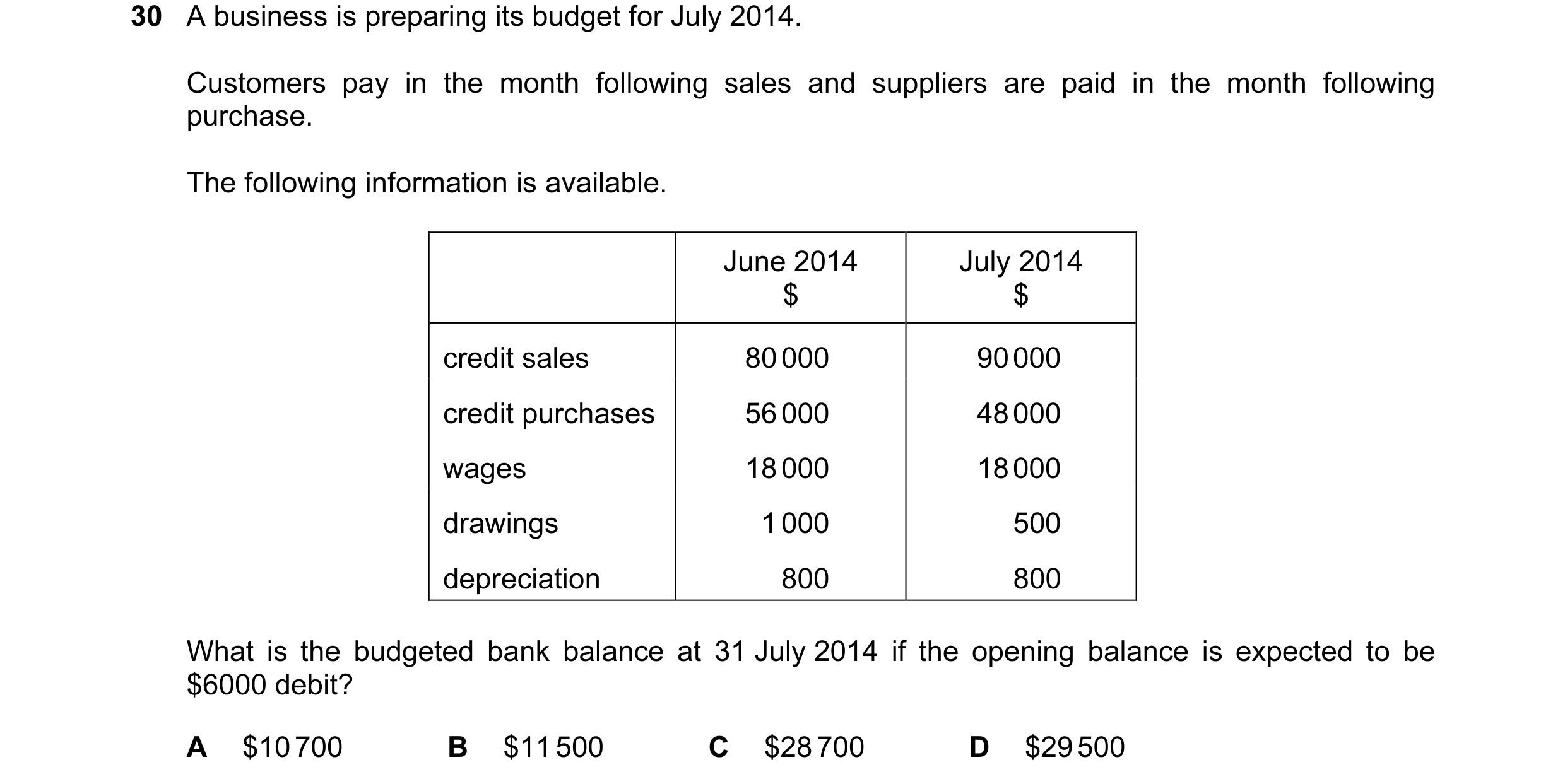
Q8 · A business is preparing its budget for July 2014 9706/11 May/June 2014
30 A business is preparing its budget for July 2014. Customers pay in the month following sales and suppliers are paid in the month following purchase. The following information is available. June 2014 July 2014 $ $ credit sales 80 000 90 000 credit purchases 56 000 48 000 wages 18 000 18 000 drawings 1 000 500 depreciation 800 800 What is the budgeted bank balance at 31 July 2014 if the opening balance is expected to be $6000 debit? A $10 700 B $11 500 C $28 700 D $29 500
1 marks
Answer: B
This question in 9706/11 May/June 2014
Q9 · Sybil owns a vehicle which on 1 August 2014 will be shown at a cost of $10 000 with… 9706/12 May/June 2014
30 Sybil owns a vehicle which on 1 August 2014 will be shown at a cost of $10 000 with accumulated depreciation of $6000. On that date she expects to trade it in against a new vehicle with a cost of $15 000, receiving a trade-in allowance of $3500. Which figure will appear in Sybil’s cash budget for August 2014? A $5000 B $11 000 C $11 500 D $15 000
1 marks
Answer: C
This question in 9706/12 May/June 2014
Q10 · The following budgeted information is provided 9706/13 May/June 2014
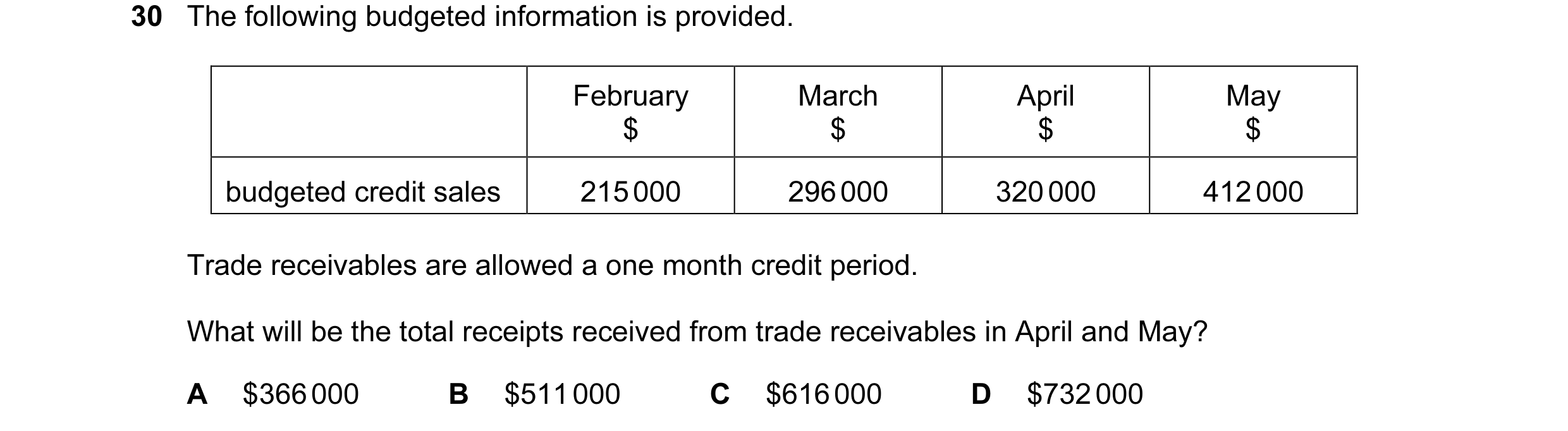
30 The following budgeted information is provided. February March April May $ $ $ $ budgeted credit sales 215 000 296 000 320 000 412 000 Trade receivables are allowed a one month credit period. What will be the total receipts received from trade receivables in April and May? A $366 000 B $511 000 C $616 000 D $732 000
1 marks
Answer: C
This question in 9706/13 May/June 2014
Q11 · A business provides the following information for July 9706/11 Oct/Nov 2014
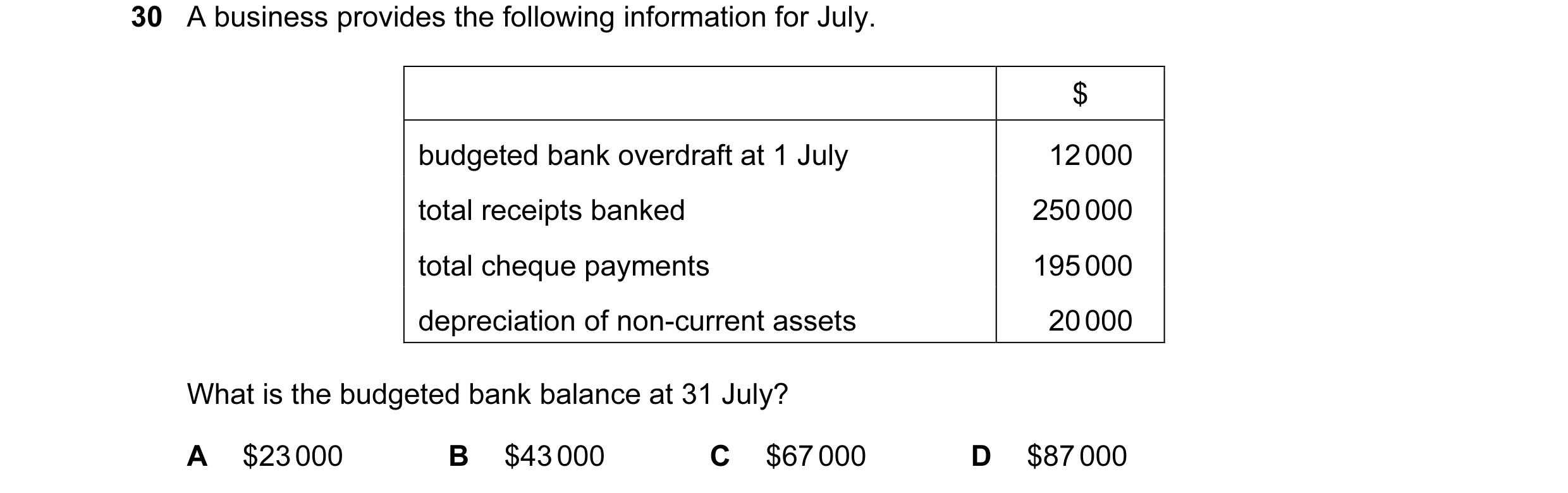
30 A business provides the following information for July. $ budgeted bank overdraft at 1 July 12 000 total receipts banked 250 000 total cheque payments 195 000 depreciation of non-current assets 20 000 What is the budgeted bank balance at 31 July? A $23 000 B $43 000 C $67 000 D $87 000
1 marks
Answer: B
This question in 9706/11 Oct/Nov 2014
Q12 · A business prepared a cash budget using the following information 9706/12 Oct/Nov 2014
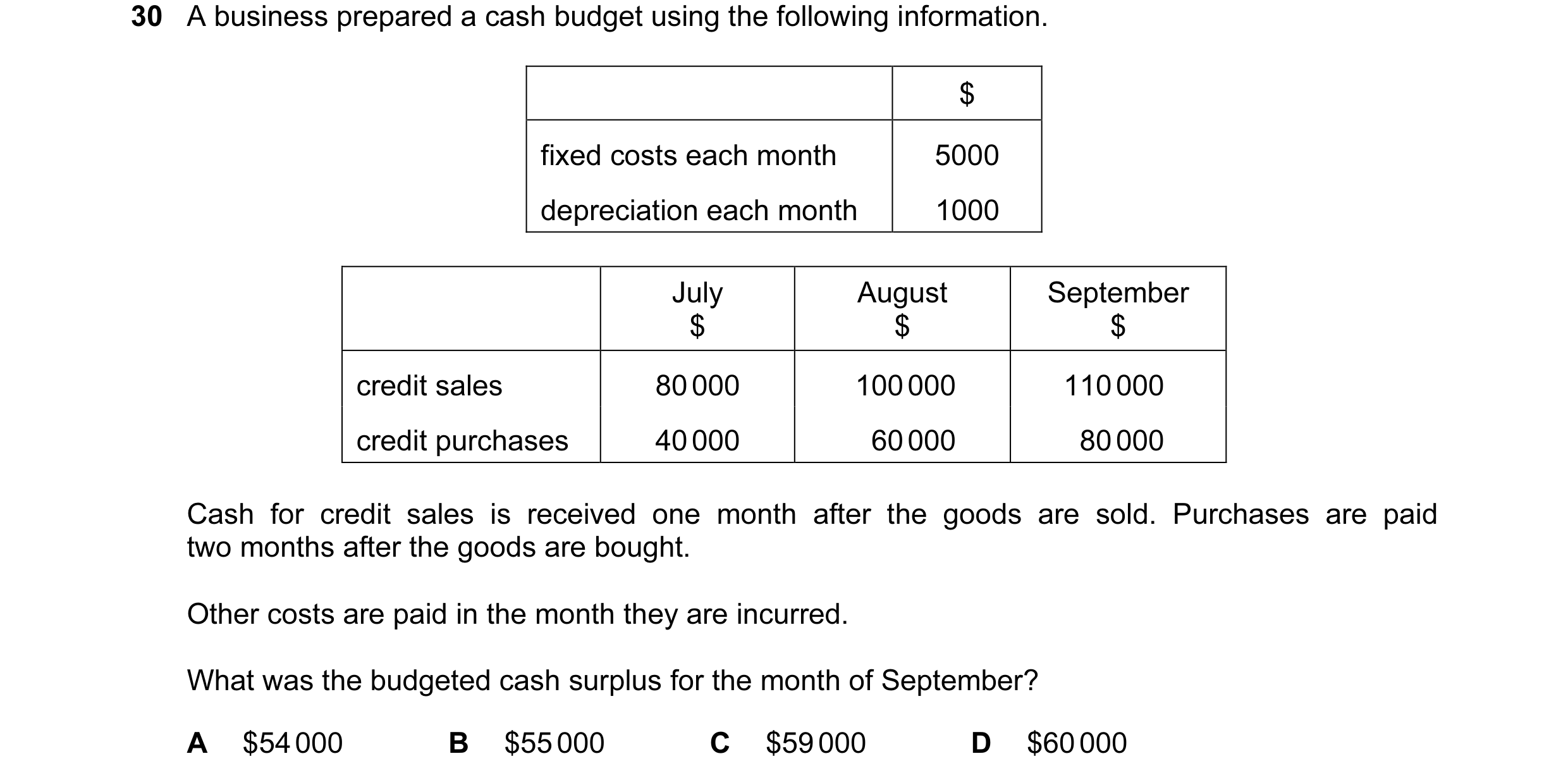
30 A business prepared a cash budget using the following information. $ fixed costs each month 5000 depreciation each month 1000 July August September $ $ $ credit sales 80 000 100 000 110 000 credit purchases 40 000 60 000 80 000 Cash for credit sales is received one month after the goods are sold. Purchases are paid two months after the goods are bought. Other costs are paid in the month they are incurred. What was the budgeted cash surplus for the month of September? A $54 000 B $55 000 C $59 000 D $60 000
1 marks
Answer: B
This question in 9706/12 Oct/Nov 2014
Q13 · The table shows a company’s estimated sales 9706/13 Oct/Nov 2014
30 The table shows a company’s estimated sales. cash ($) credit ($) February 10 000 15 000 March 10 000 25 000 April 10 000 35 000 Trade receivables are expected to pay as follows: 60% in month following sale 40% in second month following sale How much cash from sales is received in April? A $21 000 B $25 000 C $31 000 D $45 000
1 marks
Answer: C
This question in 9706/13 Oct/Nov 2014
Q14 · Which item will not appear in a cash budget? 9706/11 May/June 2015
30 Which item will not appear in a cash budget? A bad debt written off B loan interest C repayment of bank loan D utility expenses
1 marks
Answer: A
This question in 9706/11 May/June 2015
Q15 · Which statement about a cash budget is correct? 9706/12 May/June 2015
30 Which statement about a cash budget is correct? A It includes credit sales and discount allowed. B It includes credit sales but excludes discount allowed. C It includes receipts from debtors and discount allowed. D It includes receipts from debtors but excludes discount allowed.
1 marks
Answer: D
This question in 9706/12 May/June 2015
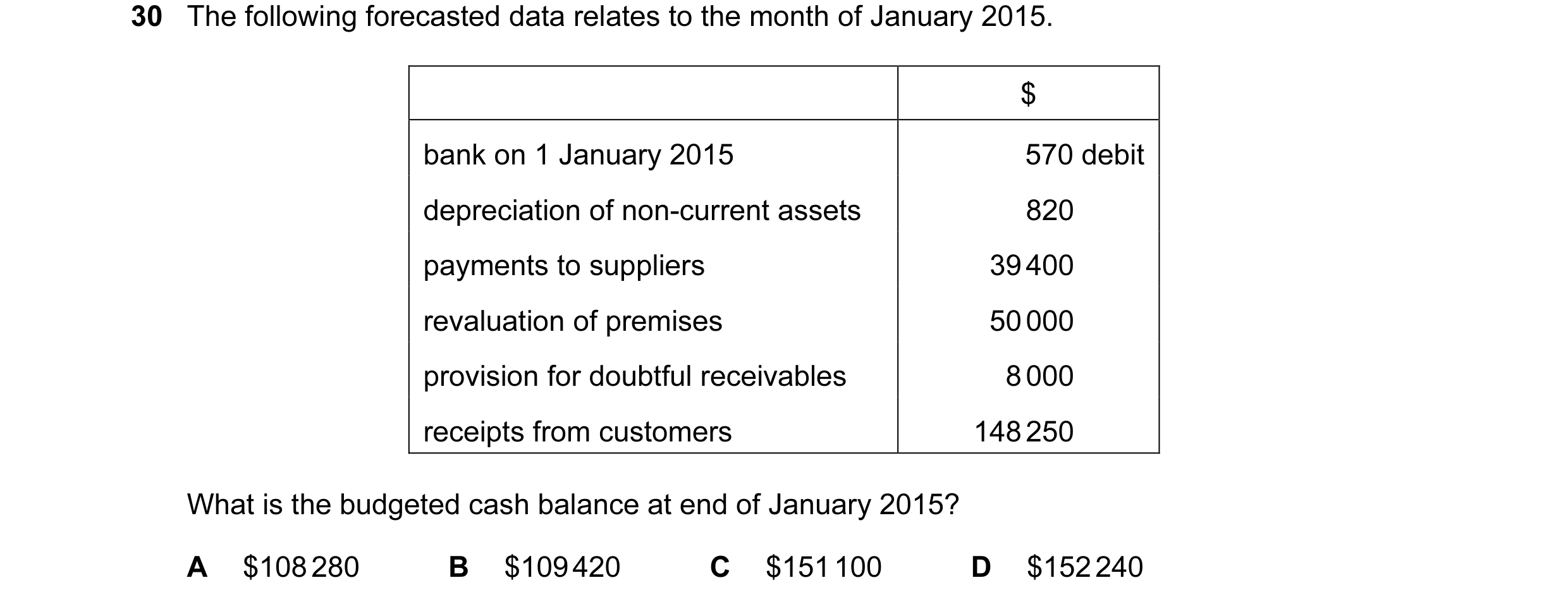
Q16 · The following forecasted data relates to the month of January 2015 9706/13 May/June 2015
30 The following forecasted data relates to the month of January 2015. $ bank on 1 January 2015 570 debit depreciation of non-current assets 820 payments to suppliers 39 400 revaluation of premises 50 000 provision for doubtful receivables 8 000 receipts from customers 148 250 What is the budgeted cash balance at end of January 2015? A $108 280 B $109 420 C $151 100 D $152 240
1 marks
Answer: B
This question in 9706/13 May/June 2015
Q17 · What are the main purposes of budgeting? 9706/12 Feb/March 2016
30 What are the main purposes of budgeting? 1 to control expenditure 2 to forecast future expenditure 3 to determine company strategy A 1, 2 and 3 B 1 and 2 only C 1 only D 2 only
1 marks
Answer: B
This question in 9706/12 Feb/March 2016
Q18 · Who should be on the budget committee? 9706/12 May/June 2016
30 Who should be on the budget committee? A accounting and finance staff only B sales manager and production manager only C sales staff only D senior management representing every department in the organisation
1 marks
Answer: D
This question in 9706/12 May/June 2016
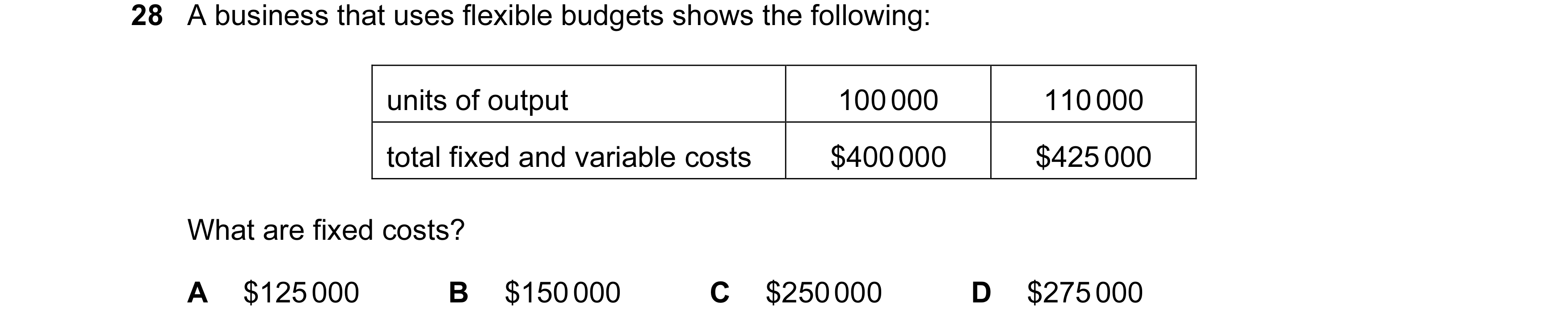
Q19 · A business that uses flexible budgets shows the following: units of output 100 000 110… 9706/12 Oct/Nov 2016
28 A business that uses flexible budgets shows the following: units of output 100 000 110 000 total fixed and variable costs $400 000 $425 000 What are fixed costs? A $125 000 B $150 000 C $250 000 D $275 000
1 marks
Answer: B
This question in 9706/12 Oct/Nov 2016
Q20 · What is the objective of a system of budgetary planning and control? 9706/12 Oct/Nov 2016
30 What is the objective of a system of budgetary planning and control? A to determine next year’s production B to determine next year’s profits C to motivate the manufacturing staff D to provide a system for communication, coordination and control
1 marks
Answer: D
This question in 9706/12 Oct/Nov 2016
Q21 · Which statement is not a reason why a business prepares budgets? 9706/12 May/June 2017
30 Which statement is not a reason why a business prepares budgets? A to ensure coordination of the business activities B to identify potential problems in the future C to identify the responsibilities of managers D to prepare the financial statements for the year
1 marks
Answer: D
This question in 9706/12 May/June 2017
Q22 · Which is not a function of a budget? 9706/13 May/June 2017
30 Which is not a function of a budget? A helping maintain accurate double entry accounts B helping monitor and control operations C providing a financial plan for the business D providing a way to allocate resources
1 marks
Answer: A
This question in 9706/13 May/June 2017
Q23 · What is not a reason for a business to prepare its budgets? 9706/11 Oct/Nov 2017
30 What is not a reason for a business to prepare its budgets? A to control the business B to make a profit every year C to motivate staff D to plan for the future
1 marks
Answer: B
This question in 9706/11 Oct/Nov 2017
Q24 · Why is planning important to a business? 9706/12 Oct/Nov 2017
30 Why is planning important to a business? 1 to ensure that the business always makes a profit 2 to employ the correct number of workers 3 to reduce the risk of running out of inventory A 1 and 2 B 1 only C 2 and 3 D 3 only
1 marks
Answer: C
This question in 9706/12 Oct/Nov 2017
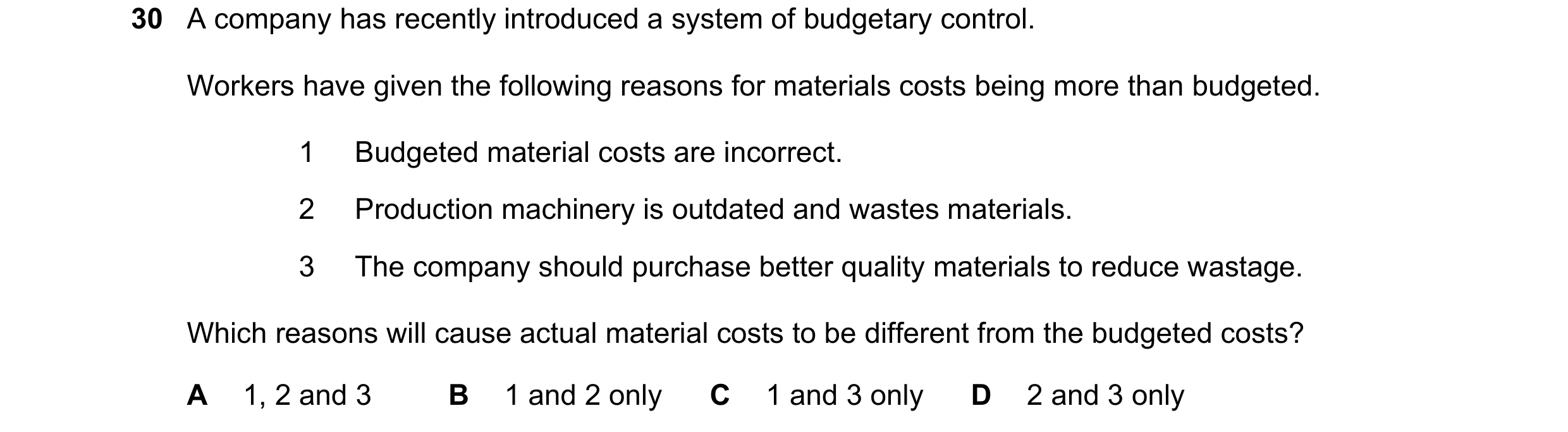
Q25 · A company has recently introduced a system of budgetary control 9706/12 Feb/March 2018
30 A company has recently introduced a system of budgetary control. Workers have given the following reasons for materials costs being more than budgeted. 1 Budgeted material costs are incorrect. 2 Production machinery is outdated and wastes materials. 3 The company should purchase better quality materials to reduce wastage. Which reasons will cause actual material costs to be different from the budgeted costs? A 1, 2 and 3 B 1 and 2 only C 1 and 3 only D 2 and 3 only
1 marks
Answer: A
This question in 9706/12 Feb/March 2018
Q26 · Why does a business prepare budgets? 9706/11 May/June 2018
30 Why does a business prepare budgets? 1 co-ordinate business activities 2 meet IAS requirements 3 motivate management A 1 and 3 B 1 only C 2 and 3 D 2 only
1 marks
Answer: A
This question in 9706/11 May/June 2018
Q27 · Why might a business prepare a budget? 9706/12 May/June 2018
30 Why might a business prepare a budget? A to determine the amount of bank loan it needs B to determine the skills of labour force C to identify its market share D to identify the quality of its products
1 marks
Answer: A
This question in 9706/12 May/June 2018
Q28 · What should not be a reason for business planning? 9706/13 May/June 2018
30 What should not be a reason for business planning? A to assist with management decision making B to avoid departmental conflict C to identify staff redundancy opportunities D to support an application for funding
1 marks
Answer: C
This question in 9706/13 May/June 2018
Q29 · In which way can a budget be used to help the management of a company? 9706/11 Oct/Nov 2018
30 In which way can a budget be used to help the management of a company? A ascertain actual profit B compare the company’s budget with its competitors C implement strategic planning D increase the company’s public image
1 marks
Answer: C
This question in 9706/11 Oct/Nov 2018
Q30 · Which statement identifies an advantage to a business of financial planning? 9706/12 Oct/Nov 2018
30 Which statement identifies an advantage to a business of financial planning? A Not all managers are aware of business financial planning. B Specialist knowledge is required to prepare the financial plans. C The financial plans provide targets for managers to achieve. D Time and cost is required to prepare the financial plans.
1 marks
Answer: C
This question in 9706/12 Oct/Nov 2018
Q31 · Which statement about budgeting is not correct? 9706/13 Oct/Nov 2018
30 Which statement about budgeting is not correct? A It helps managers to check differences between actual and budgeted data. B It helps managers to control activities. C It helps managers to ensure targets are met. D It helps managers plan operations.
1 marks
Answer: C
This question in 9706/13 Oct/Nov 2018
Q32 · The budgeted information for one month is shown 9706/12 Feb/March 2019
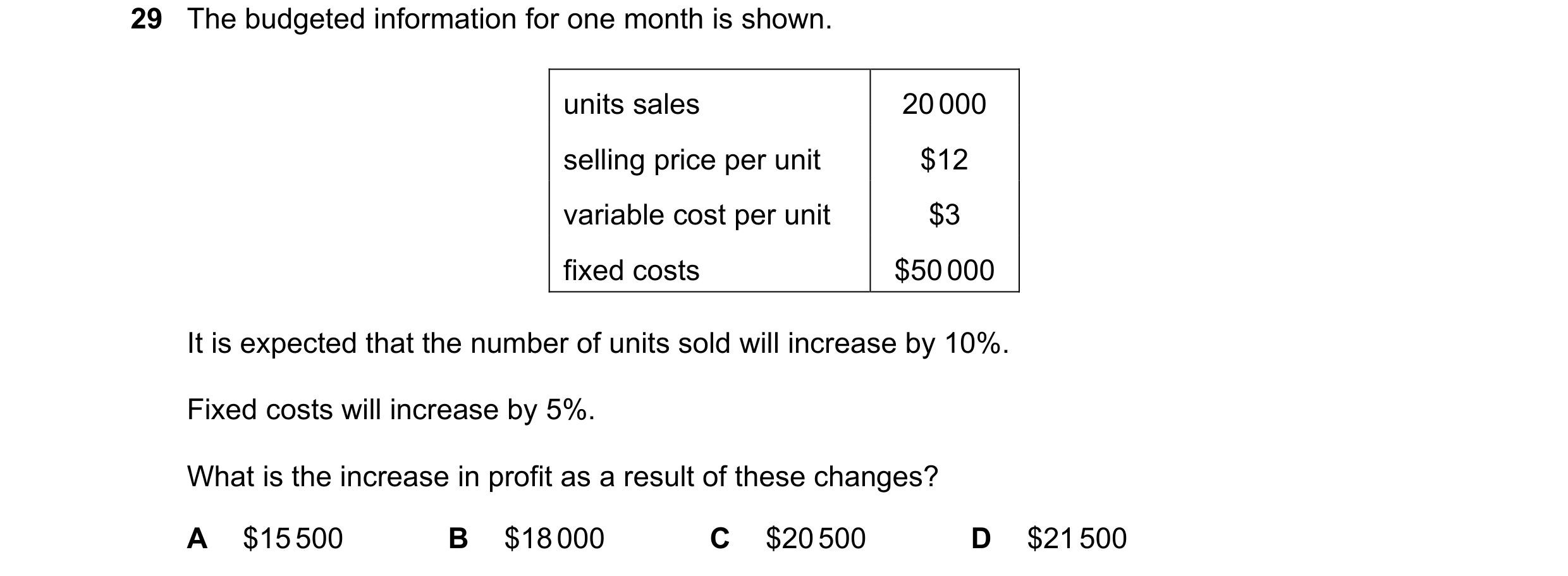
29 The budgeted information for one month is shown. units sales 20 000 selling price per unit $12 variable cost per unit $3 fixed costs $50 000 It is expected that the number of units sold will increase by 10%. Fixed costs will increase by 5%. What is the increase in profit as a result of these changes? A $15 500 B $18 000 C $20 500 D $21 500
1 marks
Answer: A
This question in 9706/12 Feb/March 2019
Q33 · What are the disadvantages of budgetary control systems? 9706/12 Feb/March 2019
30 What are the disadvantages of budgetary control systems? 1 Budget holders can be blamed for uncontrollable adverse outcomes. 2 Only financial outcomes are measured and considered. 3 Rigid decision-making often occurs. A 1, 2 and 3 B 1 and 2 only C 1 and 3 only D 2 and 3
1 marks
Answer: A
This question in 9706/12 Feb/March 2019
Q34 · A company’s budget shows figures for costs and sales for the month ended 31 March 2019 9706/11 May/June 2019
28 A company’s budget shows figures for costs and sales for the month ended 31 March 2019. variable costs per unit $20 selling price per unit $35 volume sold 2000 units fixed costs $10 000 In March the actual sales volume was 10% lower than budgeted. By how much was actual profit lower than budgeted profit? A $2000 B $3000 C $5700 D $7000
1 marks
Answer: B
This question in 9706/11 May/June 2019
Q35 · Why might a business prepare budgets? 9706/11 May/June 2019
30 Why might a business prepare budgets? 1 to improve coordination between departments 2 to encourage planning and decision-making 3 to monitor and control costs A 1, 2 and 3 B 1 and 2 only C 1 and 3 only D 2 and 3 only
1 marks
Answer: A
This question in 9706/11 May/June 2019
Q36 · Why do businesses prepare budgets? 9706/12 May/June 2019
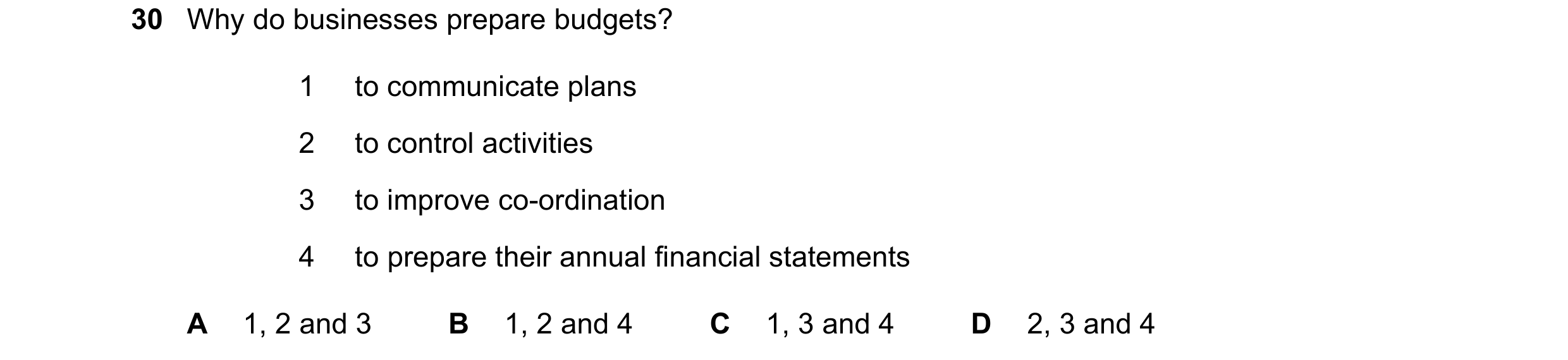
30 Why do businesses prepare budgets? 1 to communicate plans 2 to control activities 3 to improve co-ordination 4 to prepare their annual financial statements A 1, 2 and 3 B 1, 2 and 4 C 1, 3 and 4 D 2, 3 and 4
1 marks
Answer: A
This question in 9706/12 May/June 2019
Q37 · Which statements concerning a budget are correct? 9706/13 May/June 2019
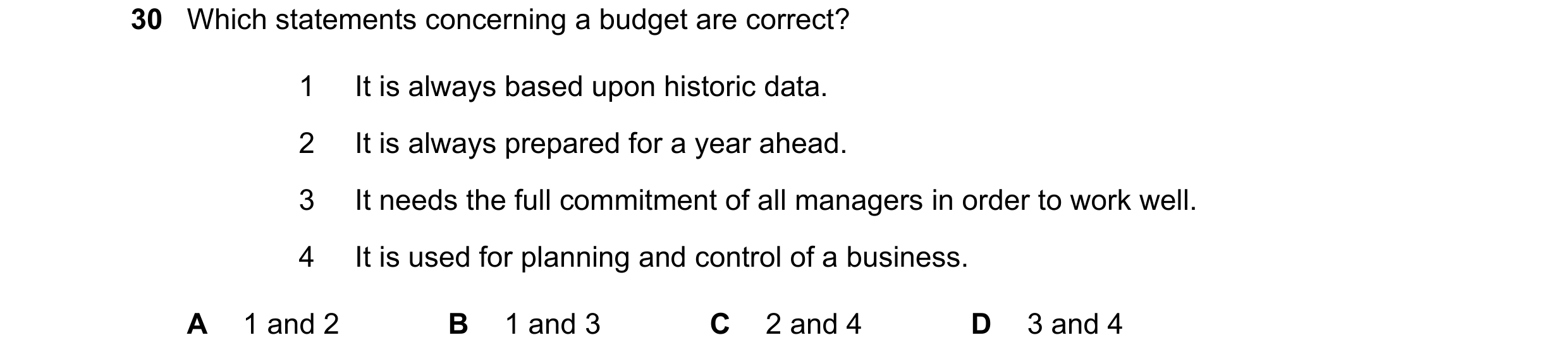
30 Which statements concerning a budget are correct? 1 It is always based upon historic data. 2 It is always prepared for a year ahead. 3 It needs the full commitment of all managers in order to work well. 4 It is used for planning and control of a business. A 1 and 2 B 1 and 3 C 2 and 4 D 3 and 4
1 marks
Answer: D
This question in 9706/13 May/June 2019
Q38 · A business is preparing this year’s budget by adding a percentage to last year’s budget 9706/11 Oct/Nov 2019
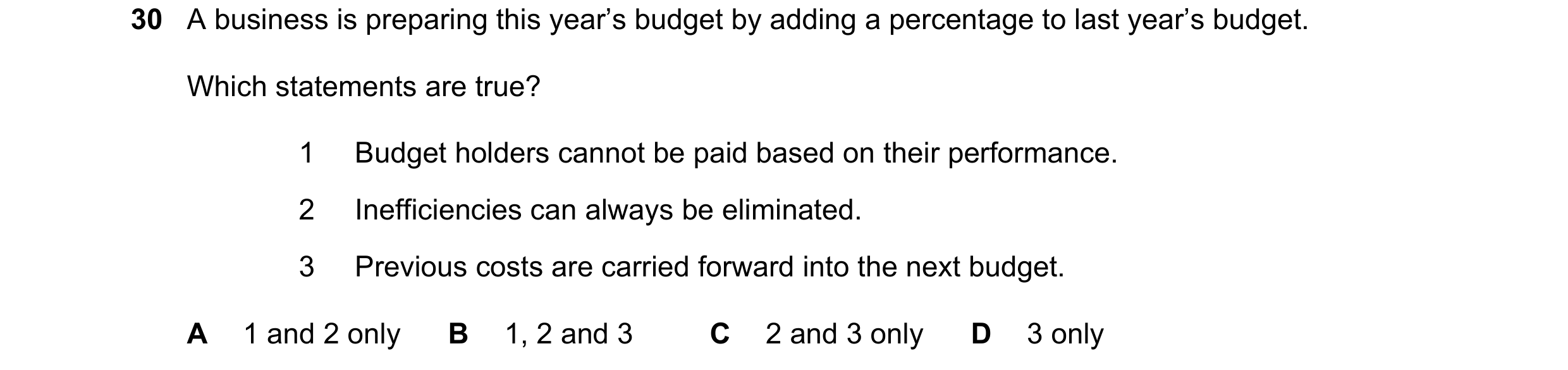
30 A business is preparing this year’s budget by adding a percentage to last year’s budget. Which statements are true? 1 Budget holders cannot be paid based on their performance. 2 Inefficiencies can always be eliminated. 3 Previous costs are carried forward into the next budget. A 1 and 2 only B 1, 2 and 3 C 2 and 3 only D 3 only
1 marks
Answer: D
This question in 9706/11 Oct/Nov 2019
Q39 · Why do businesses prepare budgets? 9706/12 Oct/Nov 2019
30 Why do businesses prepare budgets? 1 to communicate plans 2 to improve coordination 3 to plan annual operations 4 to plan long-term strategies A 1, 2 and 3 B 1, 2 and 4 C 1, 3 and 4 D 2, 3 and 4
1 marks
Answer: A
This question in 9706/12 Oct/Nov 2019
Q40 · Which statements describe the advantages to a business of using a budgetary control… 9706/13 Oct/Nov 2019
30 Which statements describe the advantages to a business of using a budgetary control system? 1 Budget holders are accountable for controllable costs. 2 Costs are controlled by comparing their actual and budgeted levels. 3 The budget holders’ performance is measured on the quality of their output. A 1 and 2 B 1 only C 2 and 3 D 2 only
1 marks
Answer: A
This question in 9706/13 Oct/Nov 2019
Q41 · Why would a business prepare budgets? 9706/12 Feb/March 2020
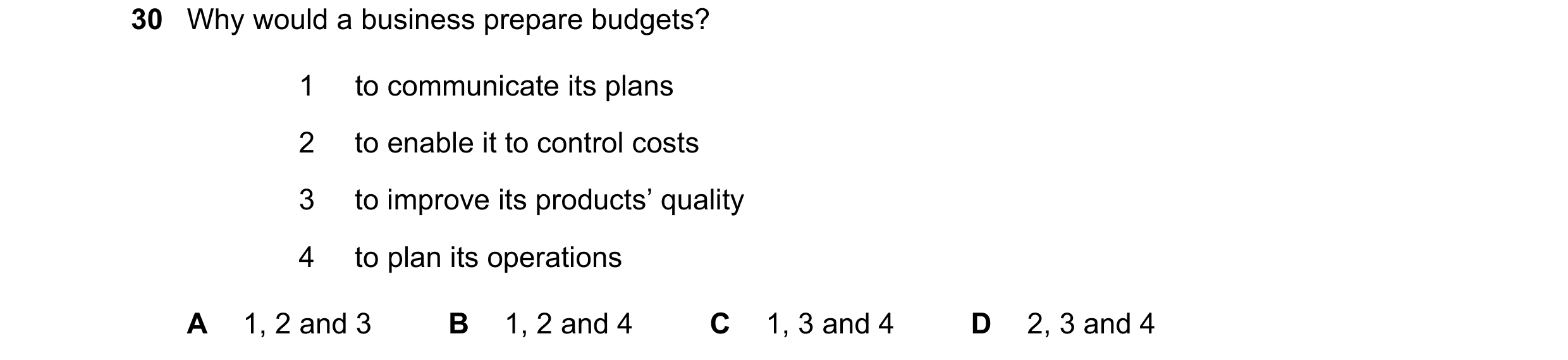
30 Why would a business prepare budgets? 1 to communicate its plans 2 to enable it to control costs 3 to improve its products’ quality 4 to plan its operations A 1, 2 and 3 B 1, 2 and 4 C 1, 3 and 4 D 2, 3 and 4
1 marks
Answer: B
This question in 9706/12 Feb/March 2020
Q42 · Budgetary control systems have just been introduced by a company but employees have not… 9706/11 May/June 2020
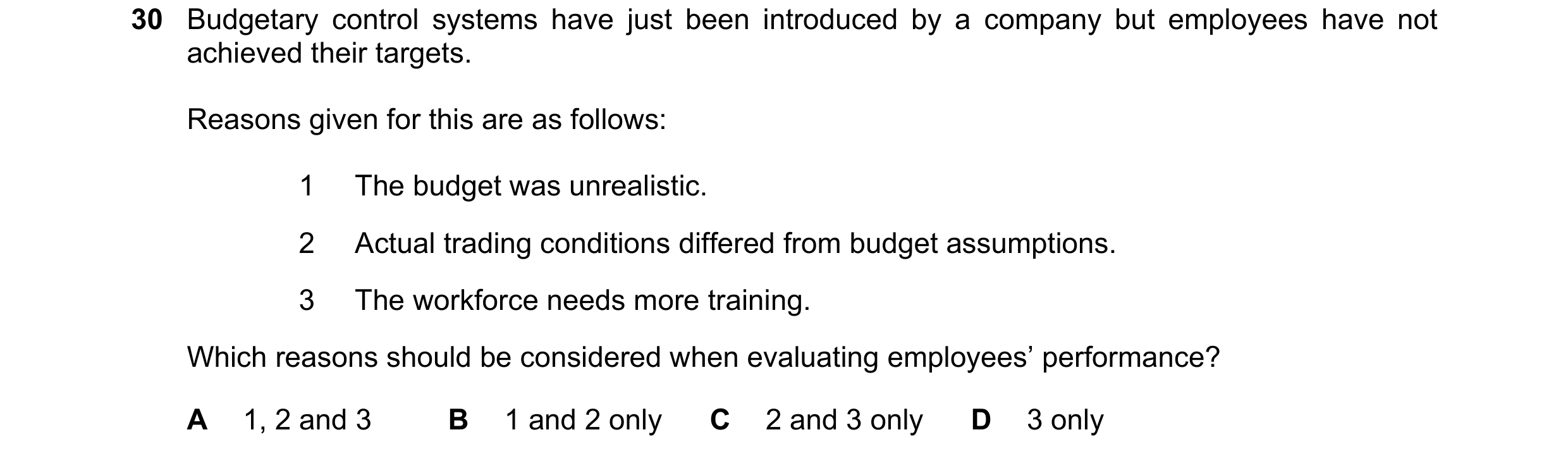
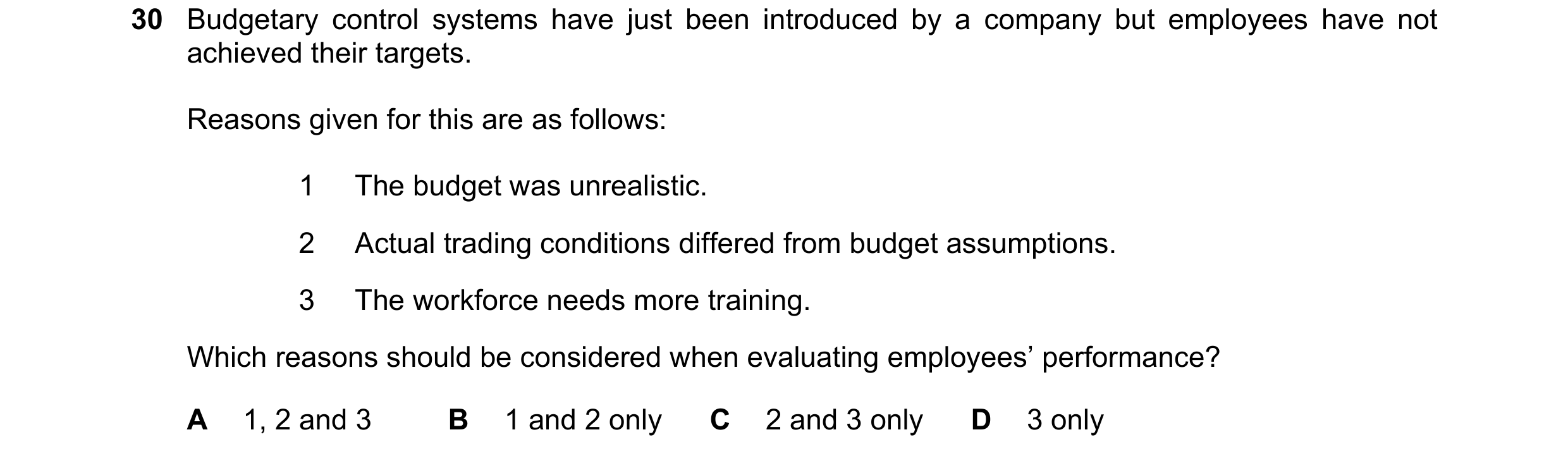
30 Budgetary control systems have just been introduced by a company but employees have not achieved their targets. Reasons given for this are as follows: 1 The budget was unrealistic. 2 Actual trading conditions differed from budget assumptions. 3 The workforce needs more training. Which reasons should be considered when evaluating employees’ performance? A 1, 2 and 3 B 1 and 2 only C 2 and 3 only D 3 only
1 marks
Answer: A
This question in 9706/11 May/June 2020
Q43 · A company has recently introduced a system of budgetary control 9706/12 May/June 2020
30 A company has recently introduced a system of budgetary control. Workers have given the following reasons for failing to achieve the budget targets. 1 ‘We need more training.’ 2 ‘The budget is unrealistic.’ 3 ‘The budget needs to be changed to reflect actual conditions. Which reasons should be considered when evaluating a worker’s performance? A 1, 2 and 3 B 2 and 3 only C 2 only D 3 only
1 marks
Answer: A
This question in 9706/12 May/June 2020
Q44 · Budgetary control systems have just been introduced by a company but employees have not… 9706/13 May/June 2020
30 Budgetary control systems have just been introduced by a company but employees have not achieved their targets. Reasons given for this are as follows: 1 The budget was unrealistic. 2 Actual trading conditions differed from budget assumptions. 3 The workforce needs more training. Which reasons should be considered when evaluating employees’ performance? A 1, 2 and 3 B 1 and 2 only C 2 and 3 only D 3 only
1 marks
Answer: A
This question in 9706/13 May/June 2020
Q45 · How can budgeting help a business achieve control of its performance? 9706/11 Oct/Nov 2020
30 How can budgeting help a business achieve control of its performance? A by comparing the actual performance with the budgeted performance B by comparing the business’ performance with its competitors C by comparing the business’ performance with the industry averages D by comparing the current year’s performance with its previous year’s performance
1 marks
Answer: A
This question in 9706/11 Oct/Nov 2020
Q46 · Which are benefits of a budgetary control system? 9706/12 Oct/Nov 2020
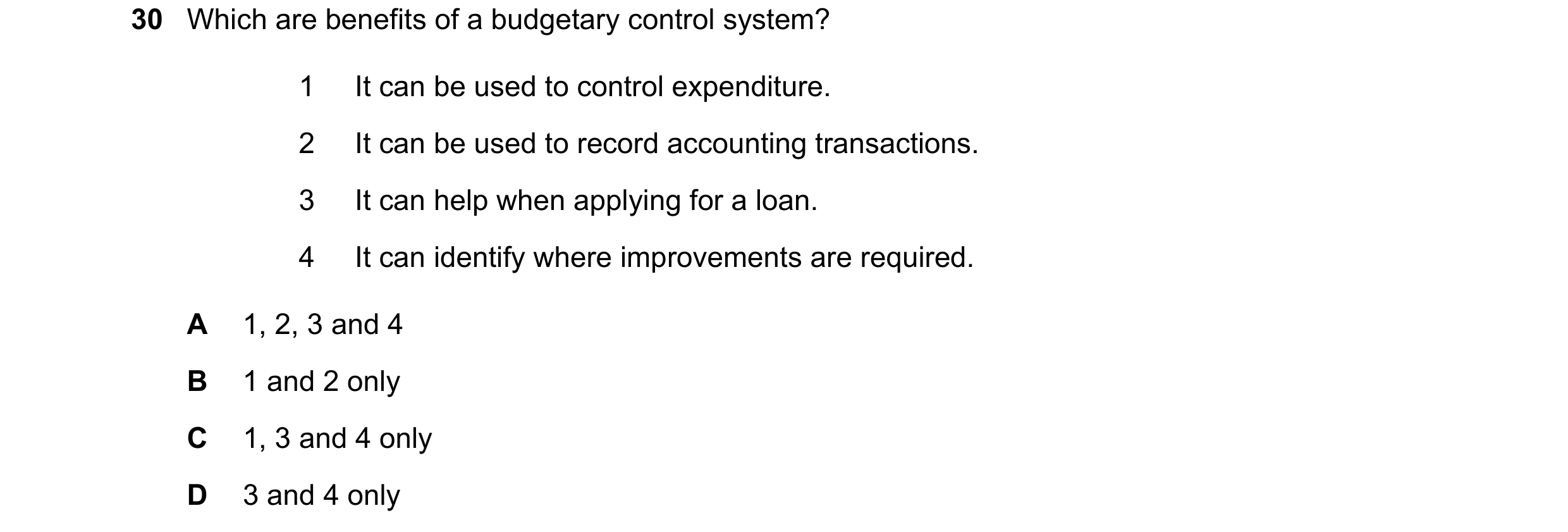
30 Which are benefits of a budgetary control system? 1 It can be used to control expenditure. 2 It can be used to record accounting transactions. 3 It can help when applying for a loan. 4 It can identify where improvements are required. A 1, 2, 3 and 4 B 1 and 2 only C 1, 3 and 4 only D 3 and 4 only
1 marks
Answer: C
This question in 9706/12 Oct/Nov 2020
Q47 · What would cause a margin of safety of a product to increase? 9706/13 Oct/Nov 2020
26 What would cause a margin of safety of a product to increase? 1 Break-even revenue decreases. 2 Break-even revenue increases. 3 Forecast revenue decreases. 4 Forecast revenue increases. A 1 and 3 B 1 and 4 C 2 and 3 D 2 and 4
1 marks
Answer: B
This question in 9706/13 Oct/Nov 2020
Q48 · Which purpose is cost–volume–profit analysis used for? 9706/13 Oct/Nov 2020
28 Which purpose is cost–volume–profit analysis used for? A comparing actual and budgeted costs B organising resources in the most efficient way C planning to achieve targeted profit D preparing annual financial statements
1 marks
Answer: C
This question in 9706/13 Oct/Nov 2020
Q49 · Which statement does not apply to an efficient system of business planning? 9706/13 Oct/Nov 2020
30 Which statement does not apply to an efficient system of business planning? A It identifies levels of achievable costs and revenues. B It identifies budgets when a business is only making a loss. C It identifies targets regularly to monitor future performance. D It informs management if standards are not met.
1 marks
Answer: B
This question in 9706/13 Oct/Nov 2020
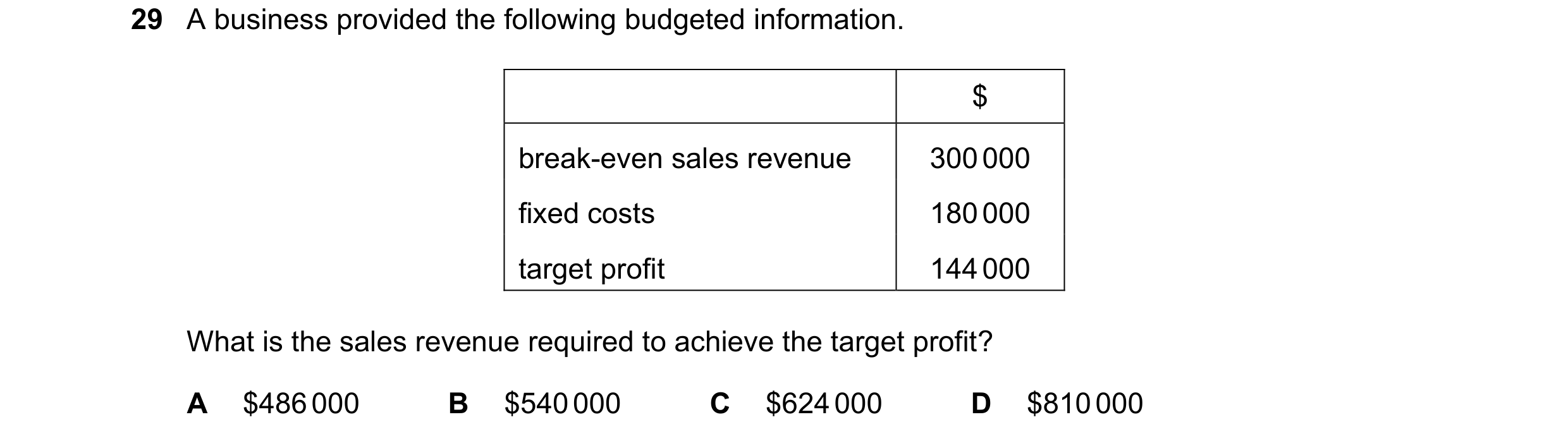
Q50 · A business provided the following budgeted information 9706/12 Feb/March 2021
29 A business provided the following budgeted information. $ break-even sales revenue 300 000 fixed costs 180 000 target profit 144 000 What is the sales revenue required to achieve the target profit? A $486 000 B $540 000 C $624 000 D $810 000
1 marks
Answer: B
This question in 9706/12 Feb/March 2021
Q51 · Which factors should be considered when setting a budget? 9706/12 Feb/March 2021
30 Which factors should be considered when setting a budget? 1 availability of skilled labour 2 production capacity 3 quality of goods to be produced A 1, 2 and 3 B 1 and 2 only C 1 and 3 only D 2 and 3 only
1 marks
Answer: A
This question in 9706/12 Feb/March 2021
Q52 · Why might a business prepare a budget? 9706/11 May/June 2021
30 Why might a business prepare a budget? A to determine the amount of bank loan it needs B to determine the skills of labour force C to identify its market share D to identify the quality of its products
1 marks
Answer: A
This question in 9706/11 May/June 2021
Q53 · What is not an advantage to a business of preparing budgets? 9706/12 May/June 2021
30 What is not an advantage to a business of preparing budgets? A They can motivate managers and employees. B They ensure that the business will not make loss. C They facilitate coordination and communication. D They provide a measure for evaluating performance.
1 marks
Answer: B
This question in 9706/12 May/June 2021
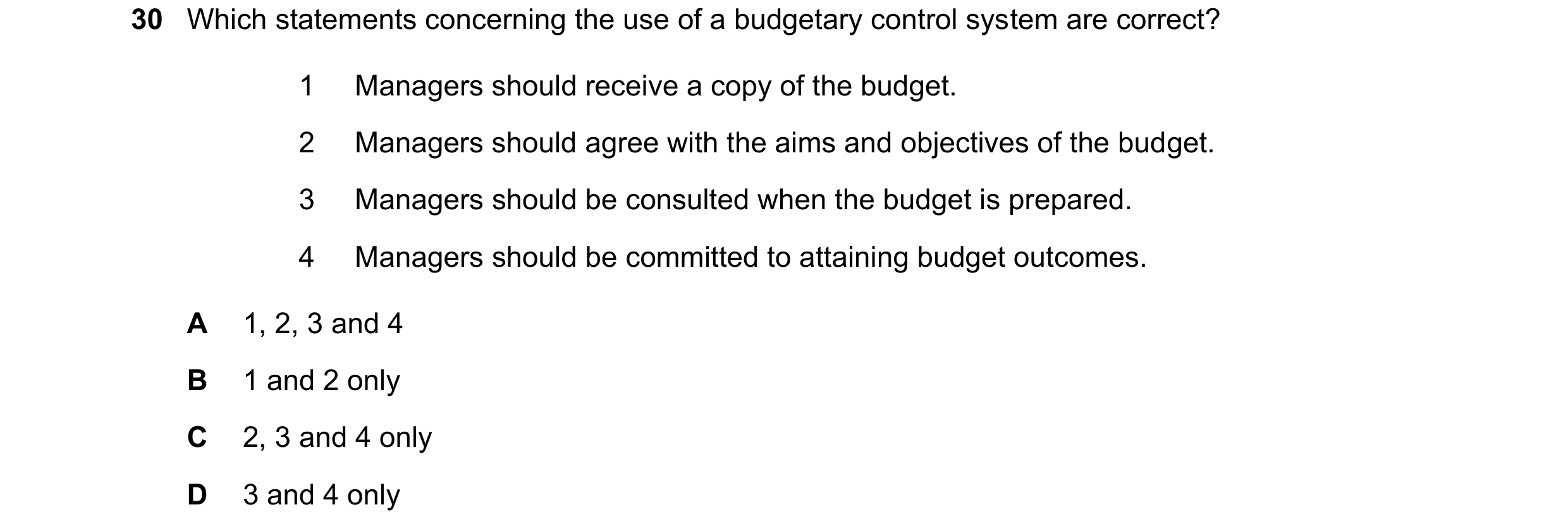
Q54 · Which statements concerning the use of a budgetary control system are correct? 9706/13 May/June 2021
30 Which statements concerning the use of a budgetary control system are correct? 1 Managers should receive a copy of the budget. 2 Managers should agree with the aims and objectives of the budget. 3 Managers should be consulted when the budget is prepared. 4 Managers should be committed to attaining budget outcomes. A 1, 2, 3 and 4 B 1 and 2 only C 2, 3 and 4 only D 3 and 4 only
1 marks
Answer: A
This question in 9706/13 May/June 2021
Q55 · Why might a business use budgets? 9706/11 Oct/Nov 2021
30 Why might a business use budgets? 1 to determine the level of demand for its product 2 to have a benchmark against which to assess actual performance 3 to know how much raw material suppliers will be able to supply A 1, 2 and 3 B 1 and 3 only C 2 and 3 only D 2 only
1 marks
Answer: D
This question in 9706/11 Oct/Nov 2021
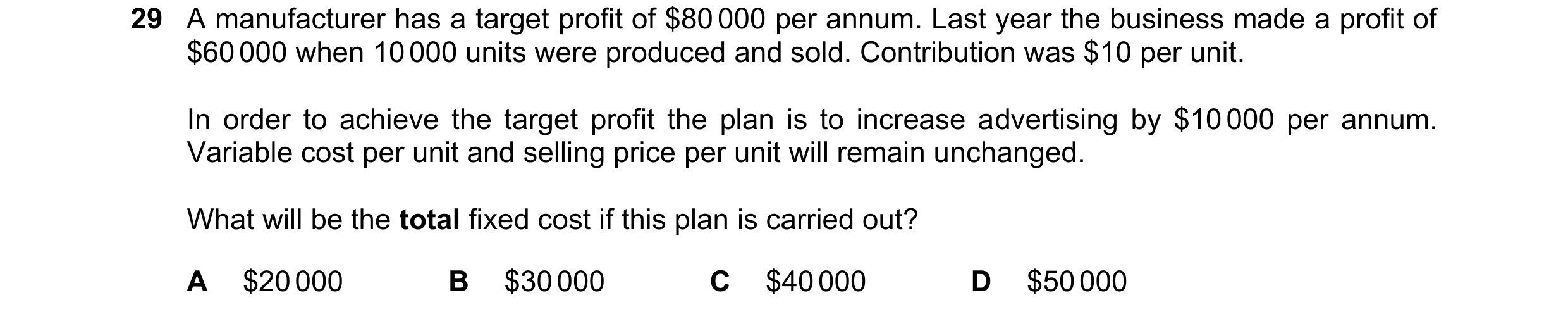
Q56 · A manufacturer has a target profit of $80 000 per annum 9706/12 Oct/Nov 2021
29 A manufacturer has a target profit of $80 000 per annum. Last year the business made a profit of $60 000 when 10 000 units were produced and sold. Contribution was $10 per unit. In order to achieve the target profit the plan is to increase advertising by $10 000 per annum. Variable cost per unit and selling price per unit will remain unchanged. What will be the total fixed cost if this plan is carried out? A $20 000 B $30 000 C $40 000 D $50 000
1 marks
Answer: D
This question in 9706/12 Oct/Nov 2021
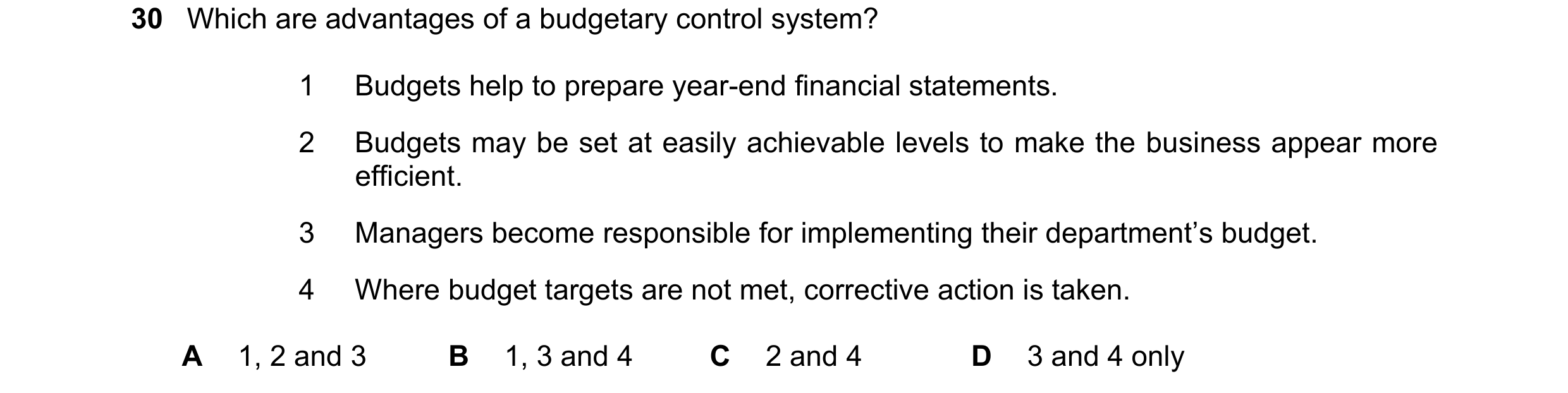
Q57 · Which are advantages of a budgetary control system? 9706/12 Oct/Nov 2021
30 Which are advantages of a budgetary control system? 1 Budgets help to prepare year-end financial statements. 2 Budgets may be set at easily achievable levels to make the business appear more efficient. 3 Managers become responsible for implementing their department’s budget. 4 Where budget targets are not met, corrective action is taken. A 1, 2 and 3 B 1, 3 and 4 C 2 and 4 D 3 and 4 only
1 marks
Answer: D
This question in 9706/12 Oct/Nov 2021
Q58 · Which statement about budgets is correct? 9706/13 Oct/Nov 2021
30 Which statement about budgets is correct? A They are usually prepared by the board of directors. B They can identify limiting factors. C They can only show monetary values. D They have to be approved by shareholders.
1 marks
Answer: B
This question in 9706/13 Oct/Nov 2021
Q59 · What are possible limitations of a budgetary control system? 9706/12 Feb/March 2022
30 What are possible limitations of a budgetary control system? 1 Budgets are based on estimates. 2 Budgets may lead to staff demotivation. 3 Budgets may prevent managers from being creative. A 1 and 2 only B 1 and 3 only C 1, 2 and 3 D 2 and 3 only
1 marks
Answer: C
This question in 9706/12 Feb/March 2022
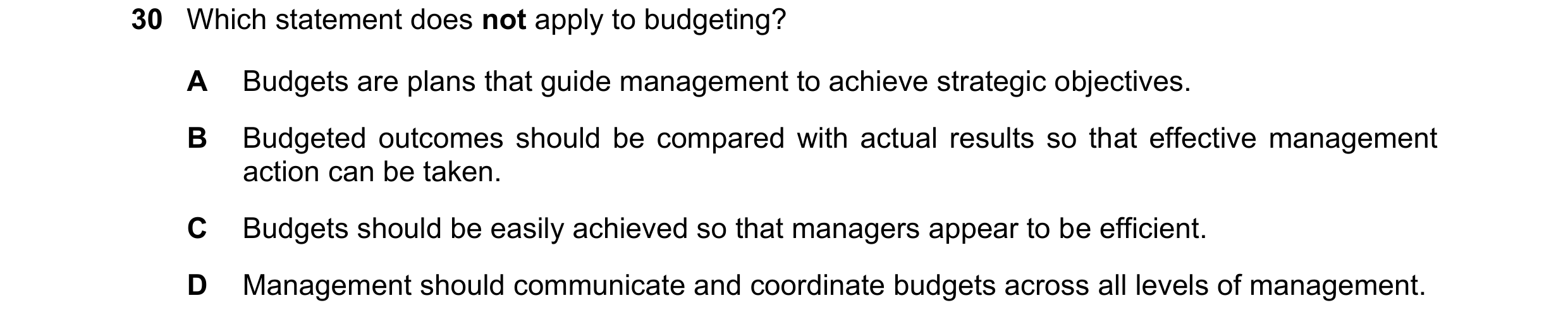
Q60 · Which statement does not apply to budgeting? 9706/11 May/June 2022
30 Which statement does not apply to budgeting? A Budgets are plans that guide management to achieve strategic objectives. B Budgeted outcomes should be compared with actual results so that effective management action can be taken. C Budgets should be easily achieved so that managers appear to be efficient. D Management should communicate and coordinate budgets across all levels of management.
1 marks
Answer: C
This question in 9706/11 May/June 2022
Q61 · Why does a business prepare budgets? 9706/12 May/June 2022
30 Why does a business prepare budgets? A to assess their non-financial performance B to control their expenditure C to strategically plan several years ahead D to value the assets and liabilities of the organisation
1 marks
Answer: B
This question in 9706/12 May/June 2022
Q62 · Why might a business prepare budgets? 9706/13 May/June 2022
30 Why might a business prepare budgets? 1 to encourage planning and decision-making 2 to improve coordination between departments 3 to monitor and control costs A 1, 2 and 3 B 1 and 2 only C 1 and 3 only D 2 and 3 only
1 marks
Answer: A
This question in 9706/13 May/June 2022
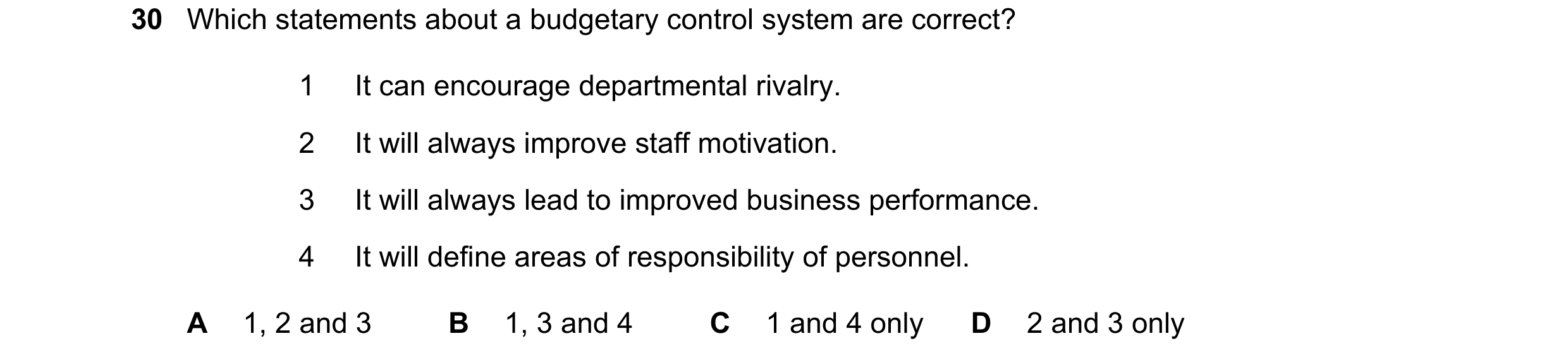
Q63 · Which statements about a budgetary control system are correct? 9706/11 Oct/Nov 2022
30 Which statements about a budgetary control system are correct? 1 It can encourage departmental rivalry. 2 It will always improve staff motivation. 3 It will always lead to improved business performance. 4 It will define areas of responsibility of personnel. A 1, 2 and 3 B 1, 3 and 4 C 1 and 4 only D 2 and 3 only
1 marks
Answer: C
This question in 9706/11 Oct/Nov 2022
Q64 · A business makes and sells a single product 9706/12 Oct/Nov 2022
29 A business makes and sells a single product. The budget for sales of 5000 units is as follows: per unit $ selling price 75.00 variable production cost 25.00 fixed production cost 18.90 variable selling expenses 5.00 The company plans to reduce the selling price to $60 per unit. How many extra units will need to be sold to break even? A 810 B 1050 C 2100 D 3150
1 marks
Answer: B
This question in 9706/12 Oct/Nov 2022
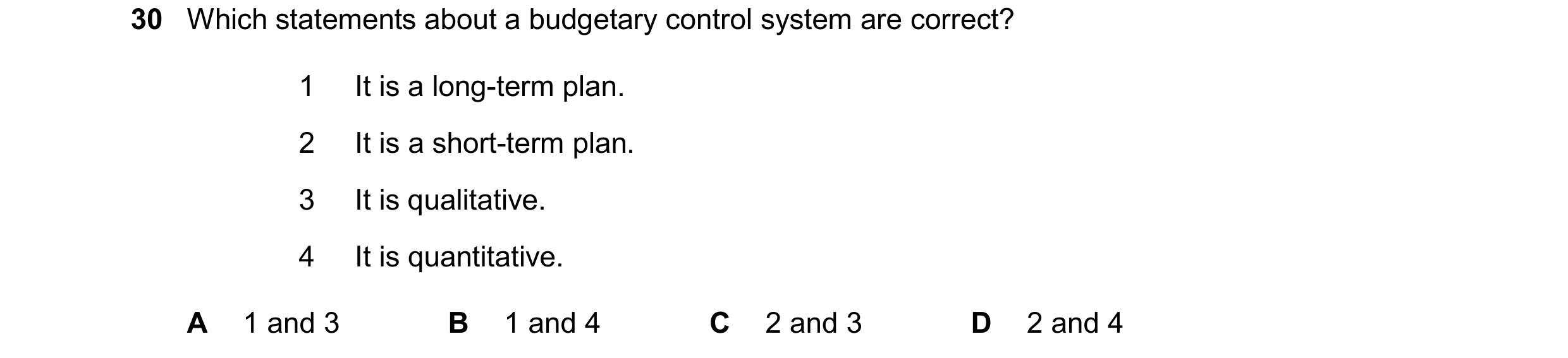
Q65 · Which statements about a budgetary control system are correct? 9706/12 Oct/Nov 2022
30 Which statements about a budgetary control system are correct? 1 It is a long-term plan. 2 It is a short-term plan. 3 It is qualitative. 4 It is quantitative. A 1 and 3 B 1 and 4 C 2 and 3 D 2 and 4
1 marks
Answer: D
This question in 9706/12 Oct/Nov 2022
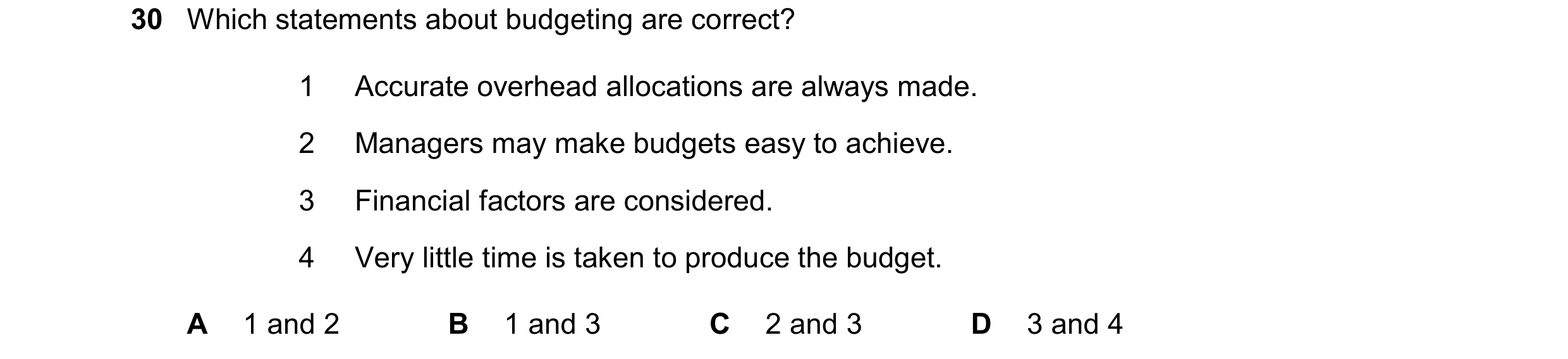
Q66 · Which statements about budgeting are correct? 9706/13 Oct/Nov 2022
30 Which statements about budgeting are correct? 1 Accurate overhead allocations are always made. 2 Managers may make budgets easy to achieve. 3 Financial factors are considered. 4 Very little time is taken to produce the budget. A 1 and 2 B 1 and 3 C 2 and 3 D 3 and 4
1 marks
Answer: C
This question in 9706/13 Oct/Nov 2022

 1 / 14

 2 / 14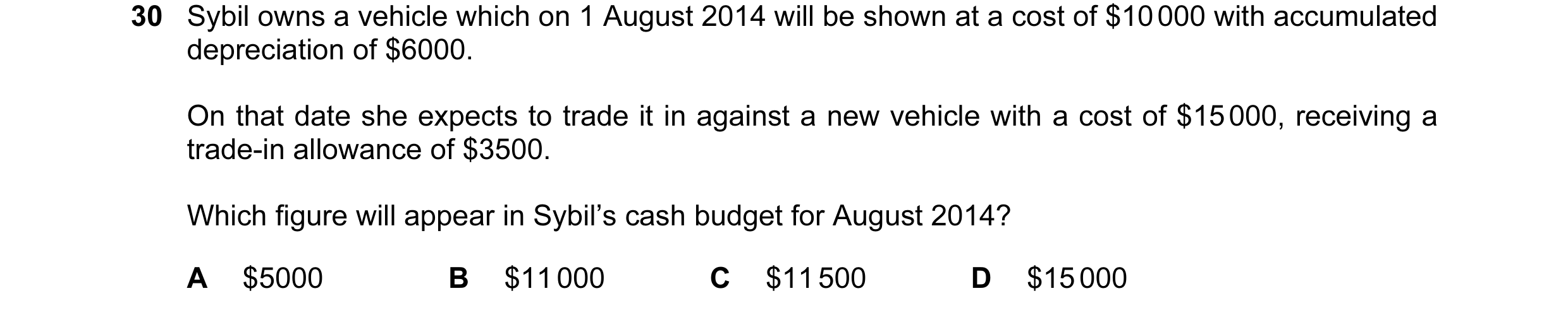
 3 / 14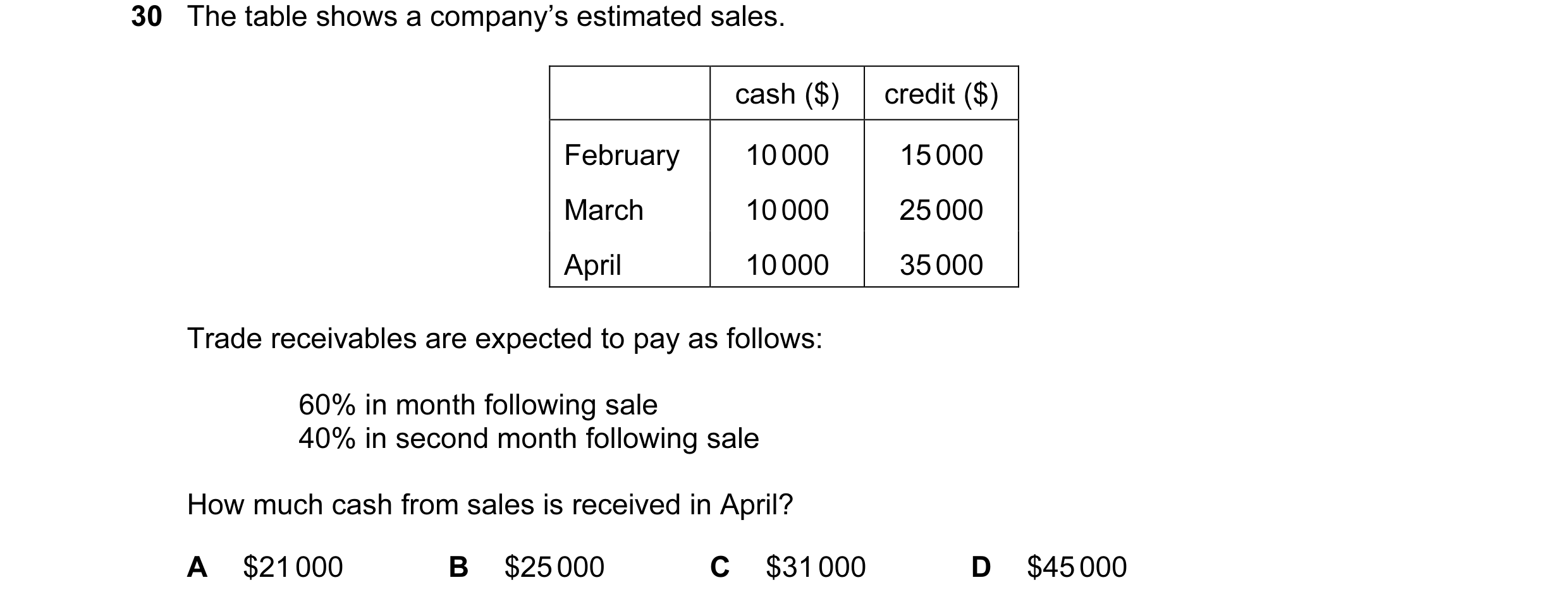


 4 / 14



 5 / 14



 6 / 14


 7 / 14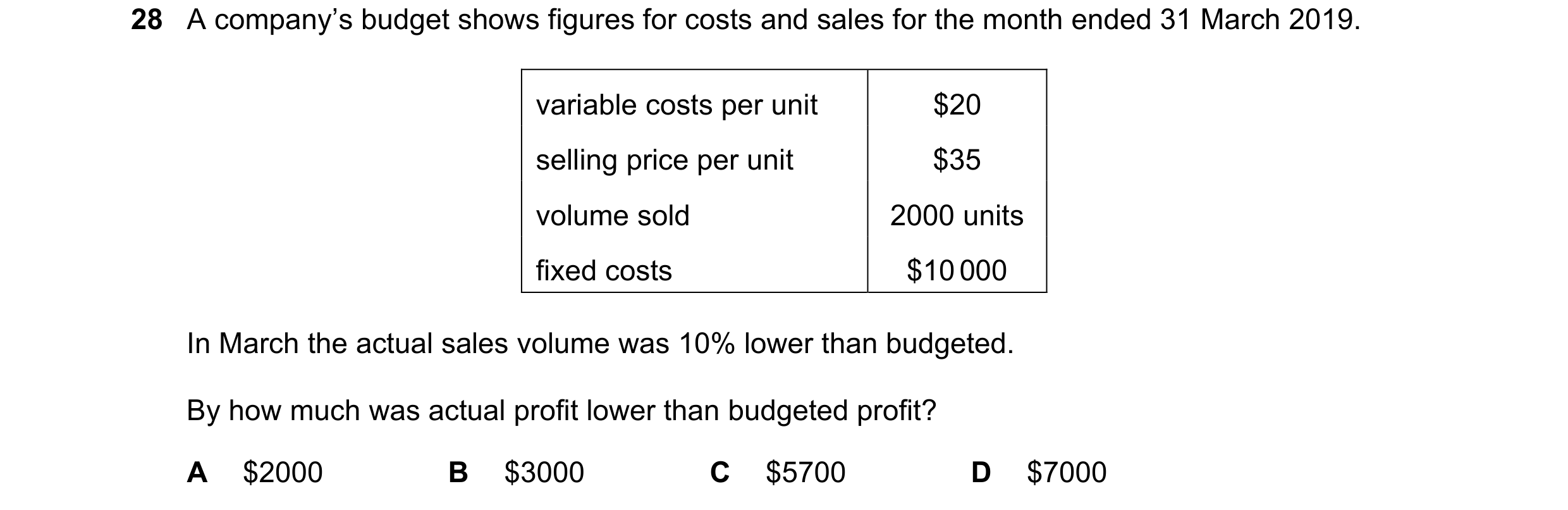

 8 / 14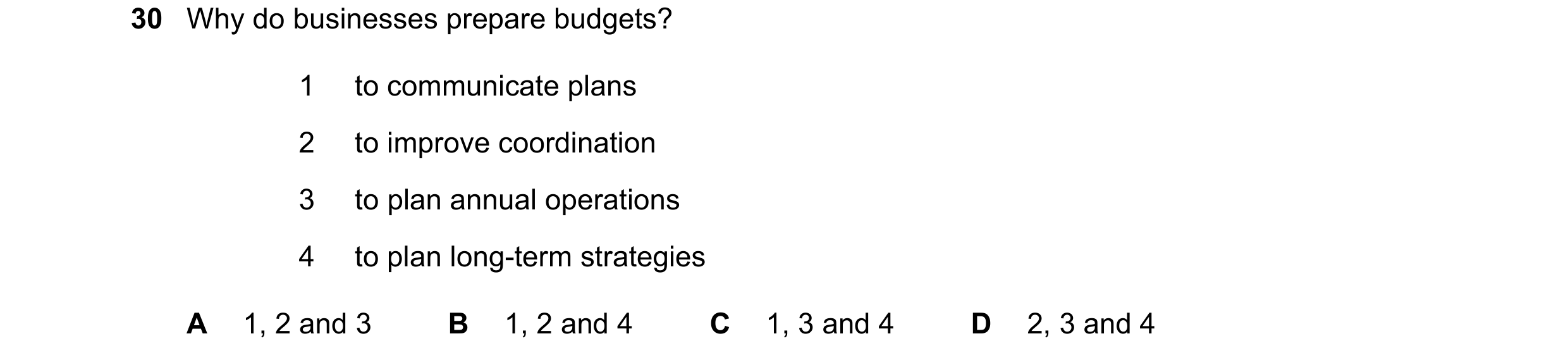

 9 / 14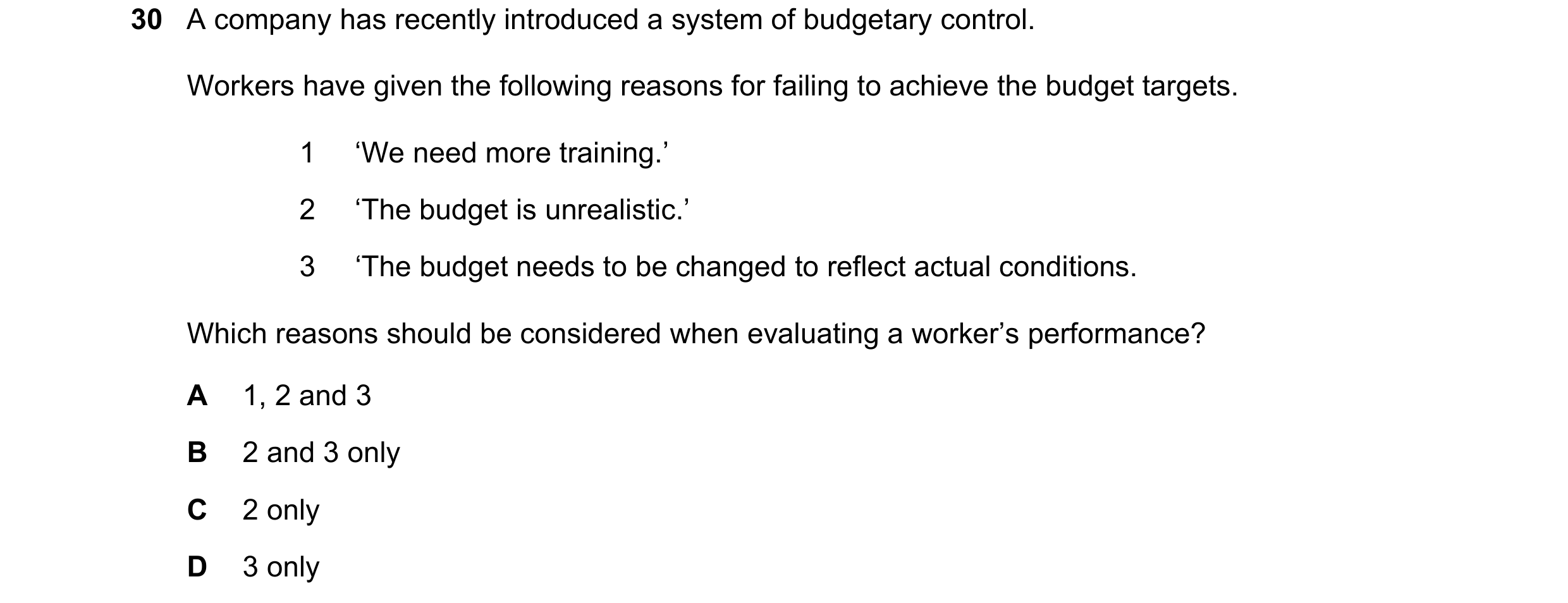

 10 / 14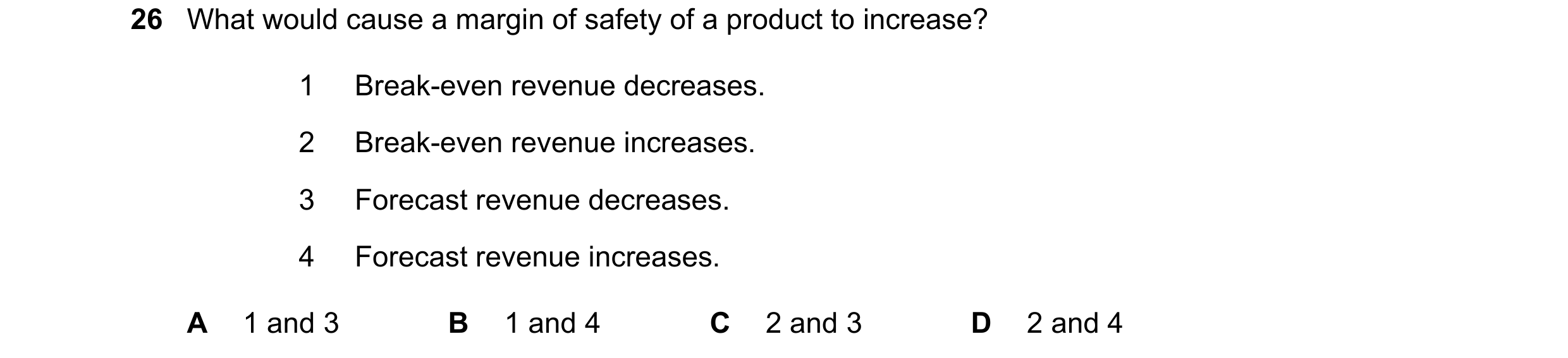



 11 / 14

 12 / 14



 13 / 14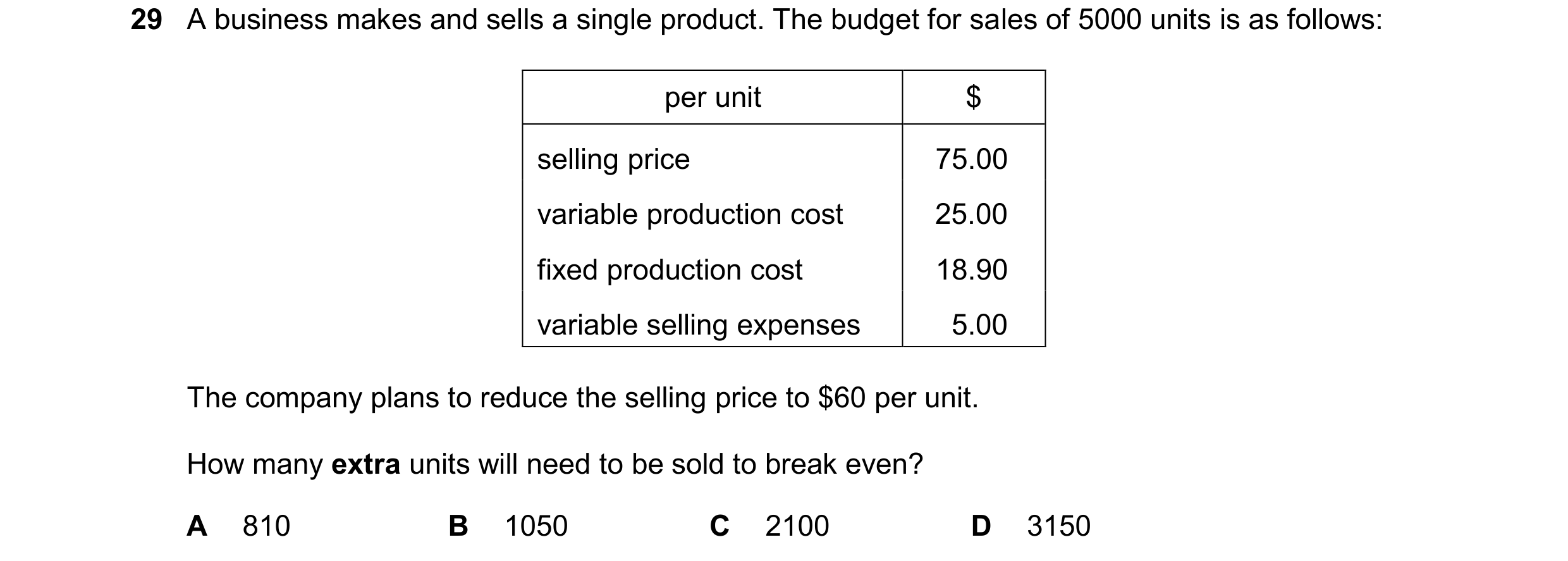
 14 / 14