Questions as text
Q1 · What is the starting point in the preparation of a budget for a manufacturing… 9706/31 Oct/Nov 2009
22 What is the starting point in the preparation of a budget for a manufacturing organisation? A a cash forecast B amending last year’s budget to take account of the effects of inflation C forecasting employee numbers D identifying the key budget factor
1 marks
Answer: D
This question in 9706/31 Oct/Nov 2009
Q2 · Which statement is true about the operation of an effective budgetary control system? 9706/31 Oct/Nov 2009
23 Which statement is true about the operation of an effective budgetary control system? A It will only use past data which means that it is not forward looking. B It will help a company plan and control the use of its financial and other resources. C It will help a company prepare its annual statutory accounts. D It will stop managers cooperating with each other.
1 marks
Answer: B
This question in 9706/31 Oct/Nov 2009
Q3 · The master budget of a company is being prepared 9706/31 Oct/Nov 2009
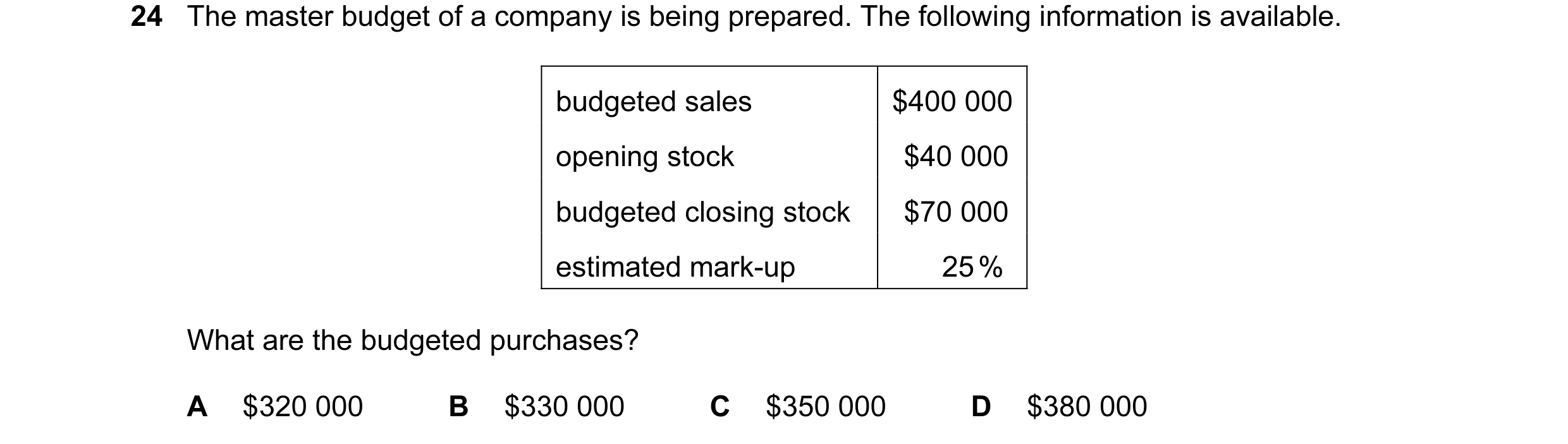
24 The master budget of a company is being prepared. The following information is available. budgeted sales $400 000 opening stock $40 000 budgeted closing stock $70 000 estimated mark-up 25 % What are the budgeted purchases? A $320 000 B $330 000 C $350 000 D $380 000
1 marks
Answer: C
This question in 9706/31 Oct/Nov 2009
Q4 · What is the starting point in the preparation of a budget for a manufacturing… 9706/32 Oct/Nov 2009
21 What is the starting point in the preparation of a budget for a manufacturing organisation? A a cash forecast B amending last year’s budget to take account of the effects of inflation C forecasting employee numbers D identifying the key budget factor
1 marks
Answer: D
This question in 9706/32 Oct/Nov 2009
Q5 · Which statement is true about the operation of an effective budgetary control system? 9706/32 Oct/Nov 2009
22 Which statement is true about the operation of an effective budgetary control system? A It will only use past data which means that it is not forward looking. B It will help a company plan and control the use of its financial and other resources. C It will help a company prepare its annual statutory accounts. D It will stop managers cooperating with each other.
1 marks
Answer: B
This question in 9706/32 Oct/Nov 2009
Q6 · The master budget of a company is being prepared 9706/32 Oct/Nov 2009
23 The master budget of a company is being prepared. The following information is available. budgeted sales $400 000 opening stock $40 000 budgeted closing stock $70 000 estimated mark-up 25 % What are the budgeted purchases? A $320 000 B $330 000 C $350 000 D $380 000
1 marks
Answer: C
This question in 9706/32 Oct/Nov 2009
Q7 · What is an advantage of an effective budgetary control system? 9706/31 May/June 2010
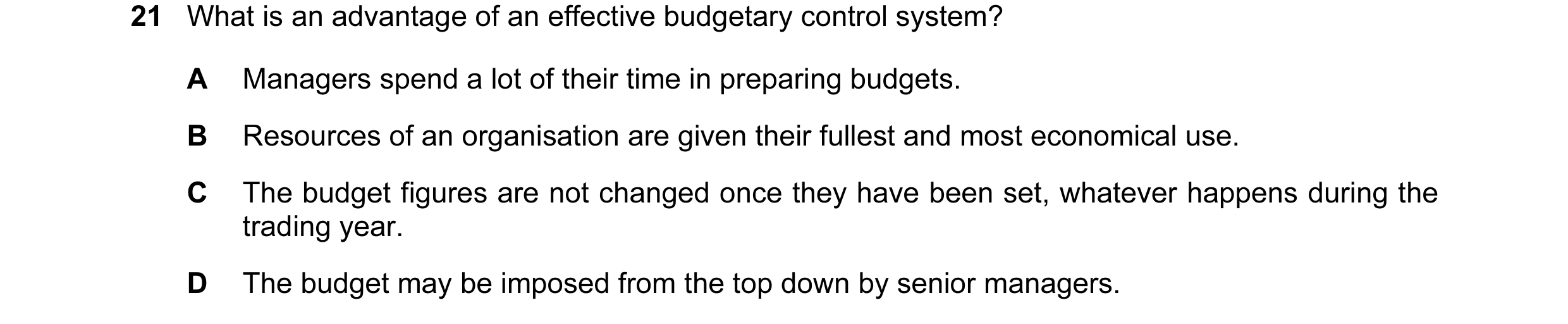
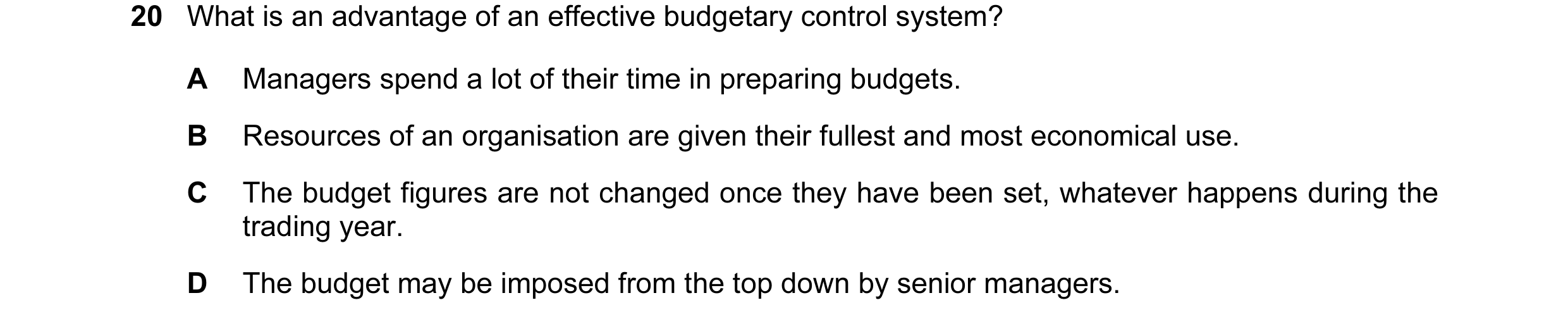
21 What is an advantage of an effective budgetary control system? A Managers spend a lot of their time in preparing budgets. B Resources of an organisation are given their fullest and most economical use. C The budget figures are not changed once they have been set, whatever happens during the trading year. D The budget may be imposed from the top down by senior managers.
1 marks
Answer: B
This question in 9706/31 May/June 2010
Q8 · In order to prepare the budget figures for next year a company uses last year’s actual… 9706/31 May/June 2010
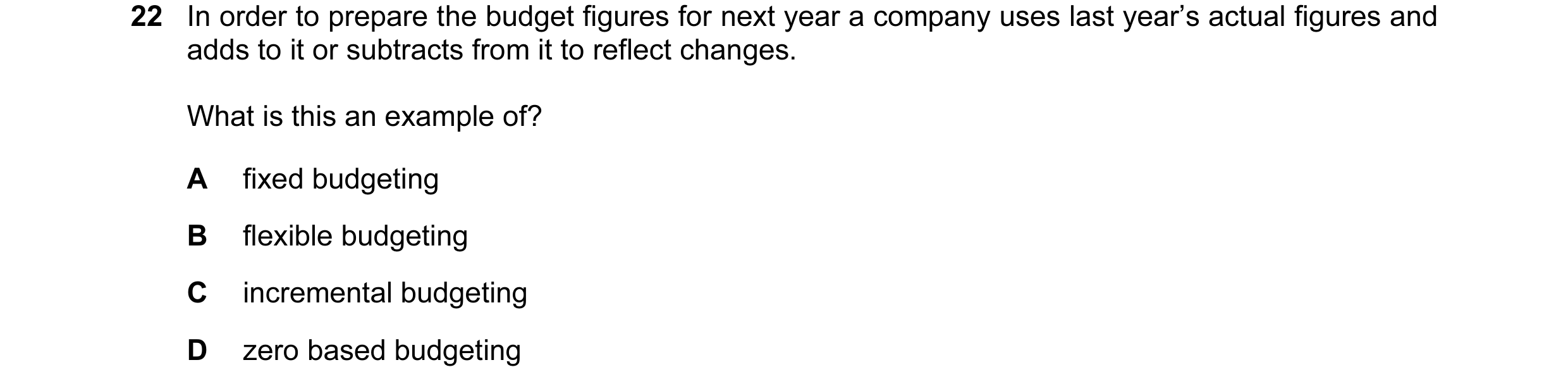
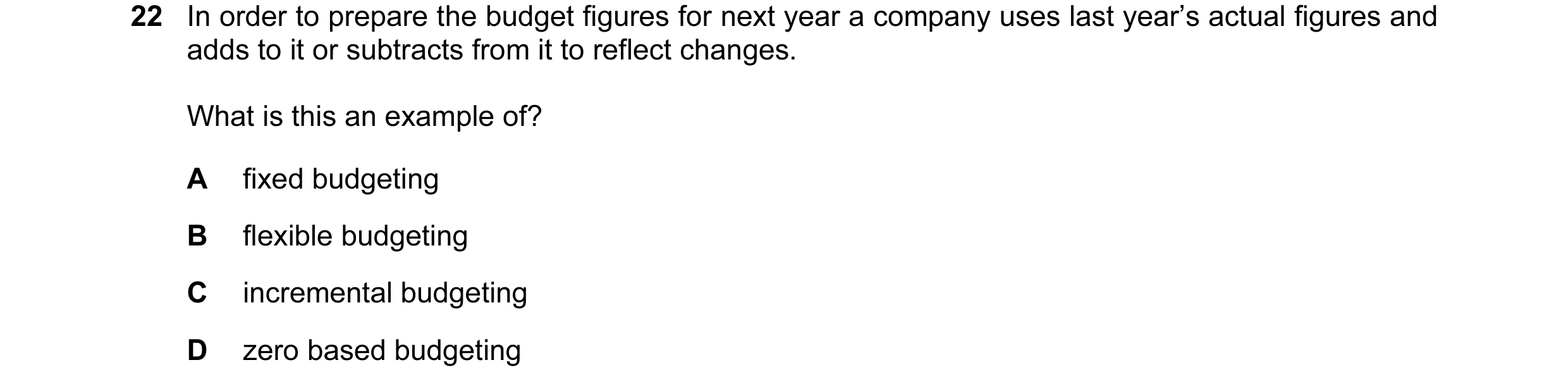
22 In order to prepare the budget figures for next year a company uses last year’s actual figures and adds to it or subtracts from it to reflect changes. What is this an example of? A fixed budgeting B flexible budgeting C incremental budgeting D zero based budgeting
1 marks
Answer: C
This question in 9706/31 May/June 2010
Q9 · A company currently uses a fixed budget 9706/31 May/June 2010
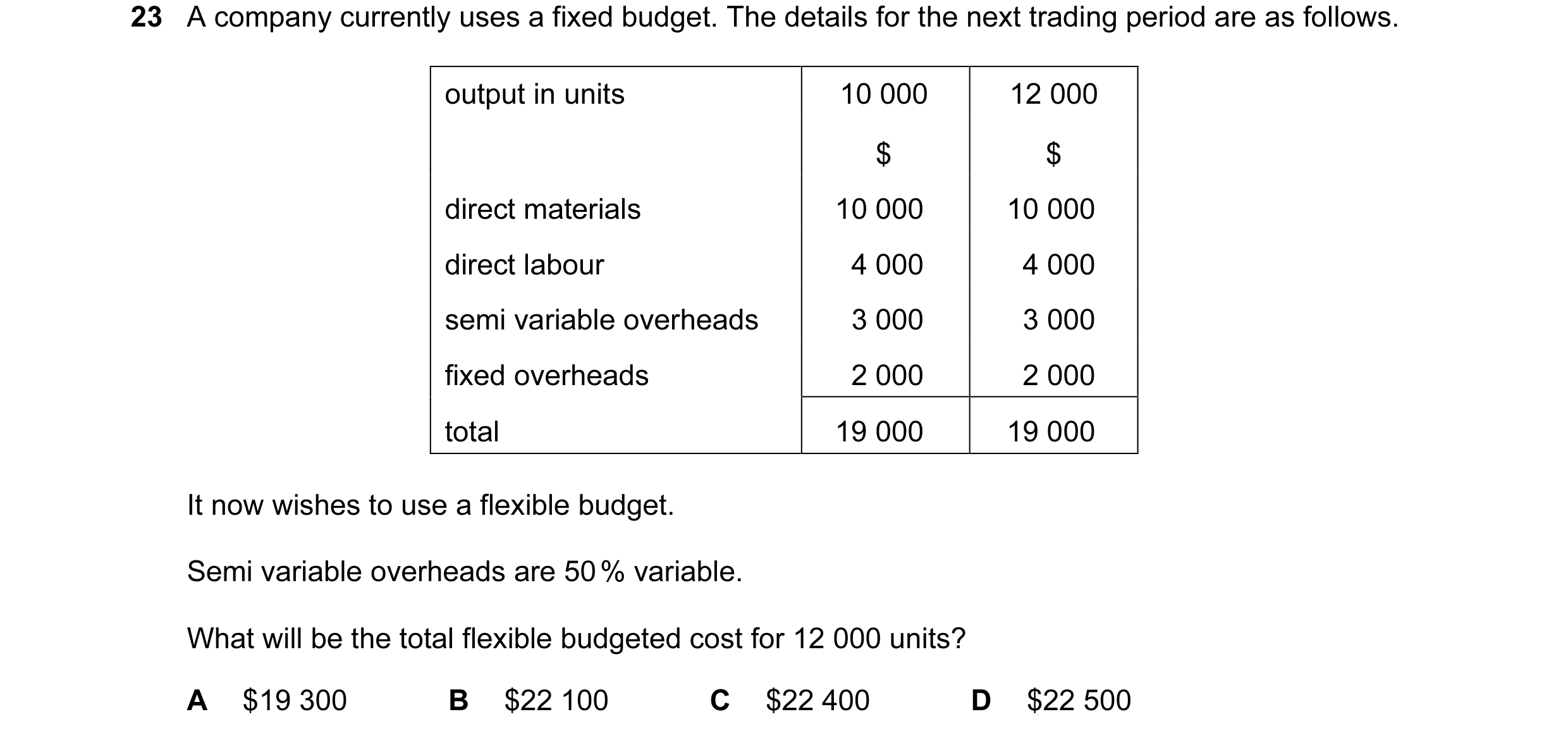
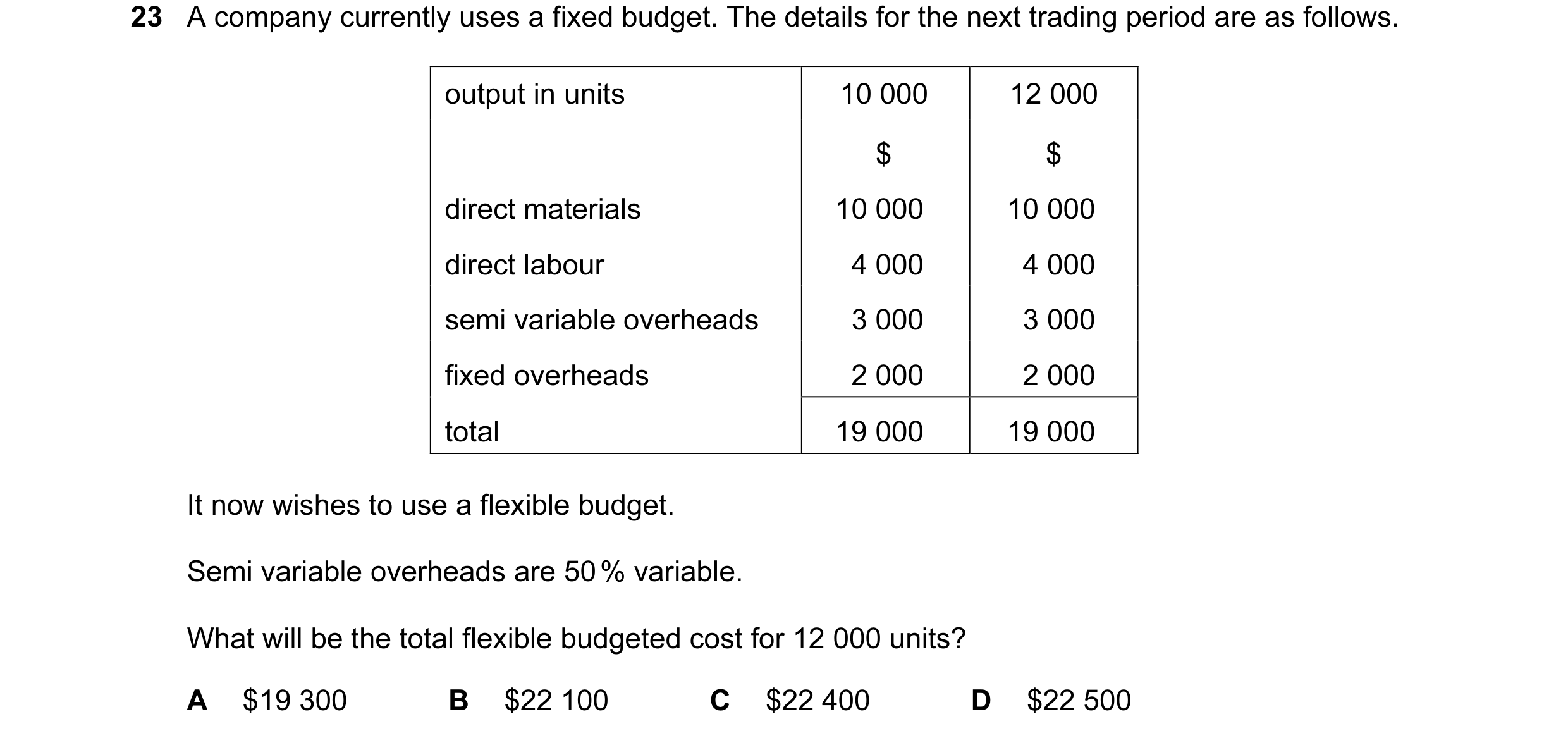
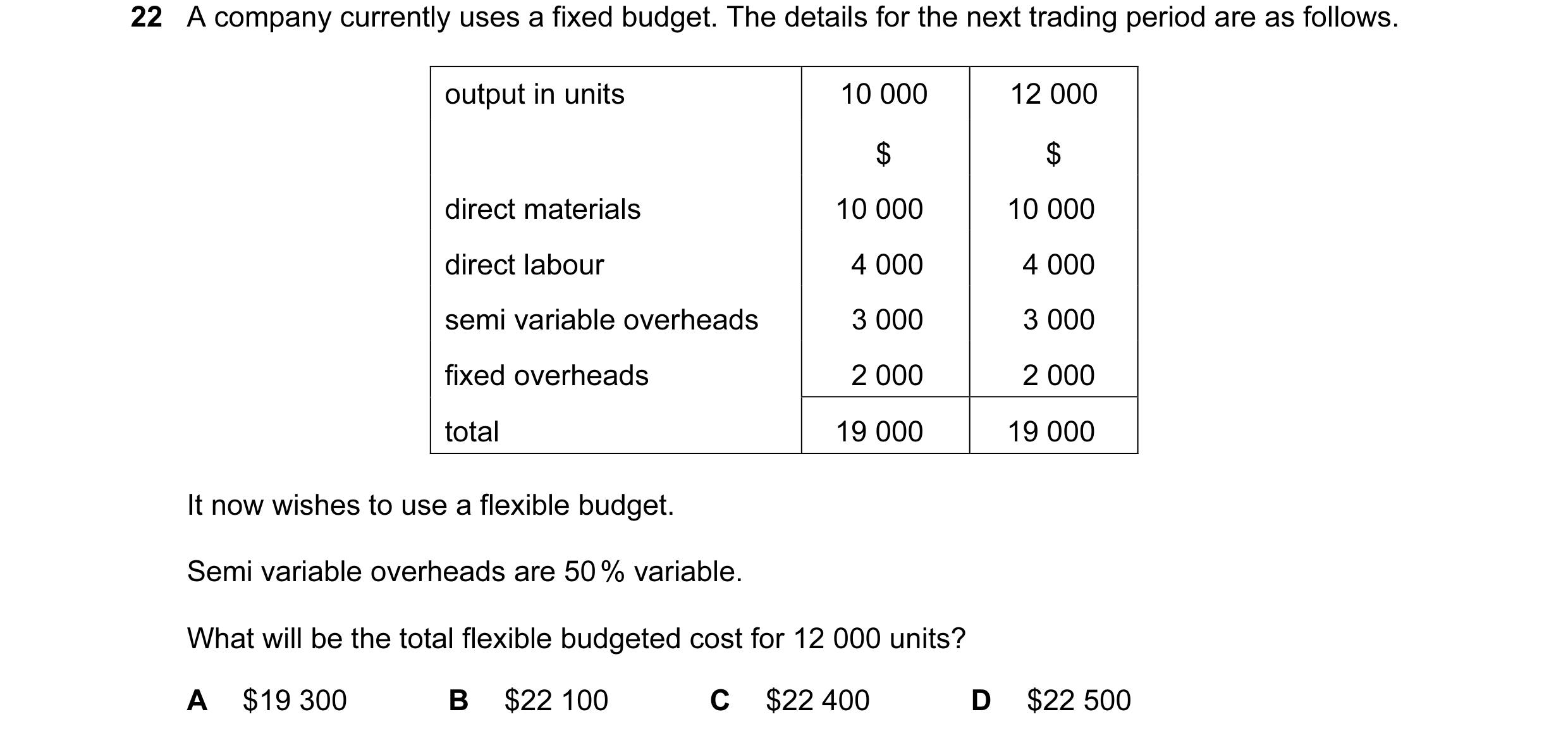
23 A company currently uses a fixed budget. The details for the next trading period are as follows. output in units 10 000 12 000 $ $ direct materials 10 000 10 000 direct labour 4 000 4 000 semi variable overheads 3 000 3 000 fixed overheads 2 000 2 000 total 19 000 19 000 It now wishes to use a flexible budget. Semi variable overheads are 50 % variable. What will be the total flexible budgeted cost for 12 000 units? A $19 300 B $22 100 C $22 400 D $22 500
1 marks
Answer: B
This question in 9706/31 May/June 2010
Q10 · What is an advantage of an effective budgetary control system? 9706/32 May/June 2010
21 What is an advantage of an effective budgetary control system? A Managers spend a lot of their time in preparing budgets. B Resources of an organisation are given their fullest and most economical use. C The budget figures are not changed once they have been set, whatever happens during the trading year. D The budget may be imposed from the top down by senior managers.
1 marks
Answer: B
This question in 9706/32 May/June 2010
Q11 · In order to prepare the budget figures for next year a company uses last year’s actual… 9706/32 May/June 2010
22 In order to prepare the budget figures for next year a company uses last year’s actual figures and adds to it or subtracts from it to reflect changes. What is this an example of? A fixed budgeting B flexible budgeting C incremental budgeting D zero based budgeting
1 marks
Answer: C
This question in 9706/32 May/June 2010
Q12 · A company currently uses a fixed budget 9706/32 May/June 2010
23 A company currently uses a fixed budget. The details for the next trading period are as follows. output in units 10 000 12 000 $ $ direct materials 10 000 10 000 direct labour 4 000 4 000 semi variable overheads 3 000 3 000 fixed overheads 2 000 2 000 total 19 000 19 000 It now wishes to use a flexible budget. Semi variable overheads are 50 % variable. What will be the total flexible budgeted cost for 12 000 units? A $19 300 B $22 100 C $22 400 D $22 500
1 marks
Answer: B
This question in 9706/32 May/June 2010
Q13 · What is an advantage of an effective budgetary control system? 9706/33 May/June 2010
20 What is an advantage of an effective budgetary control system? A Managers spend a lot of their time in preparing budgets. B Resources of an organisation are given their fullest and most economical use. C The budget figures are not changed once they have been set, whatever happens during the trading year. D The budget may be imposed from the top down by senior managers.
1 marks
Answer: B
This question in 9706/33 May/June 2010
Q14 · In order to prepare the budget figures for next year a company uses last year’s actual… 9706/33 May/June 2010
21 In order to prepare the budget figures for next year a company uses last year’s actual figures and adds to it or subtracts from it to reflect changes. What is this an example of? A fixed budgeting B flexible budgeting C incremental budgeting D zero based budgeting
1 marks
Answer: C
This question in 9706/33 May/June 2010
Q15 · A company currently uses a fixed budget 9706/33 May/June 2010
22 A company currently uses a fixed budget. The details for the next trading period are as follows. output in units 10 000 12 000 $ $ direct materials 10 000 10 000 direct labour 4 000 4 000 semi variable overheads 3 000 3 000 fixed overheads 2 000 2 000 total 19 000 19 000 It now wishes to use a flexible budget. Semi variable overheads are 50 % variable. What will be the total flexible budgeted cost for 12 000 units? A $19 300 B $22 100 C $22 400 D $22 500
1 marks
Answer: B
This question in 9706/33 May/June 2010
Q16 · The table shows the budgeted resources required for production and sales, and the… 9706/31 Oct/Nov 2010
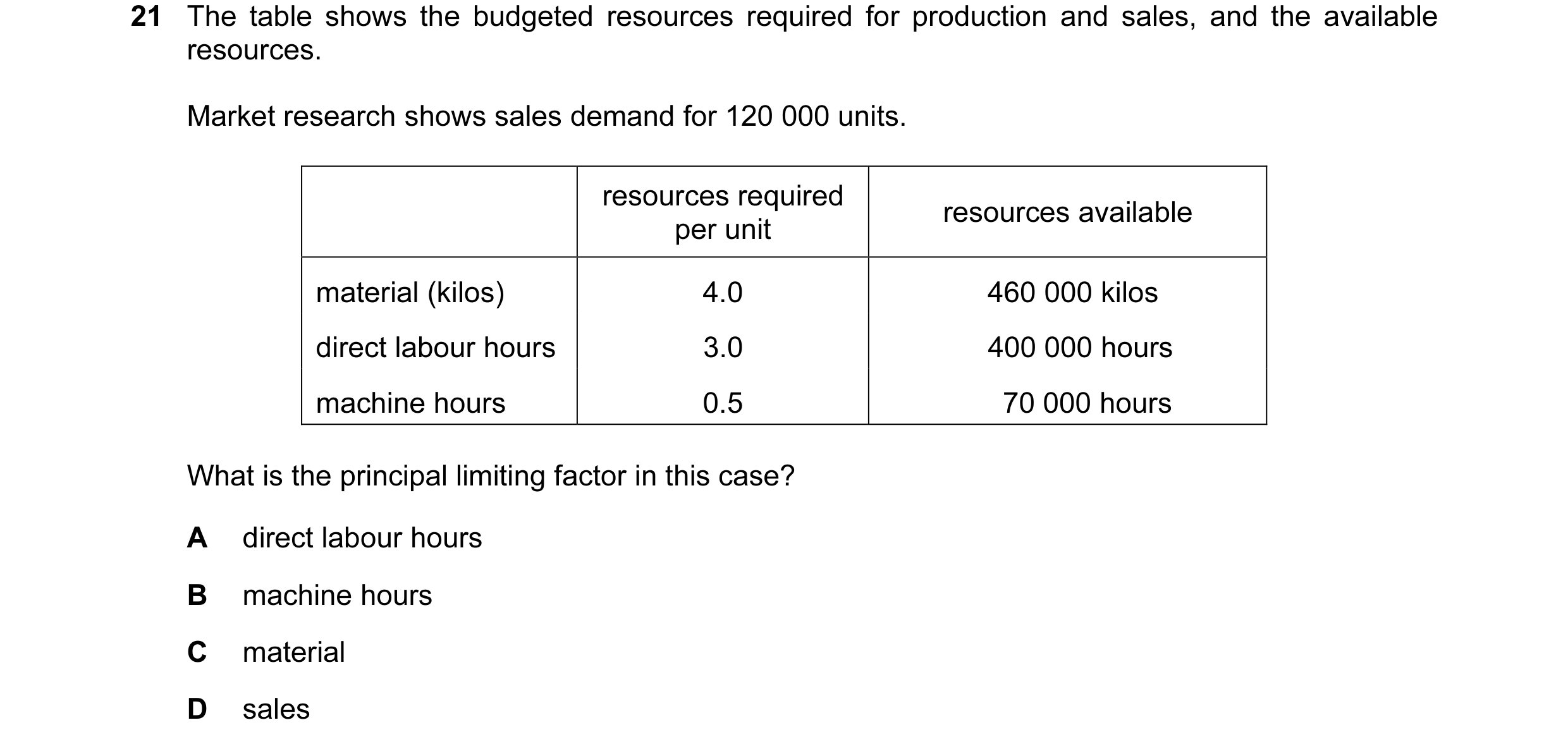
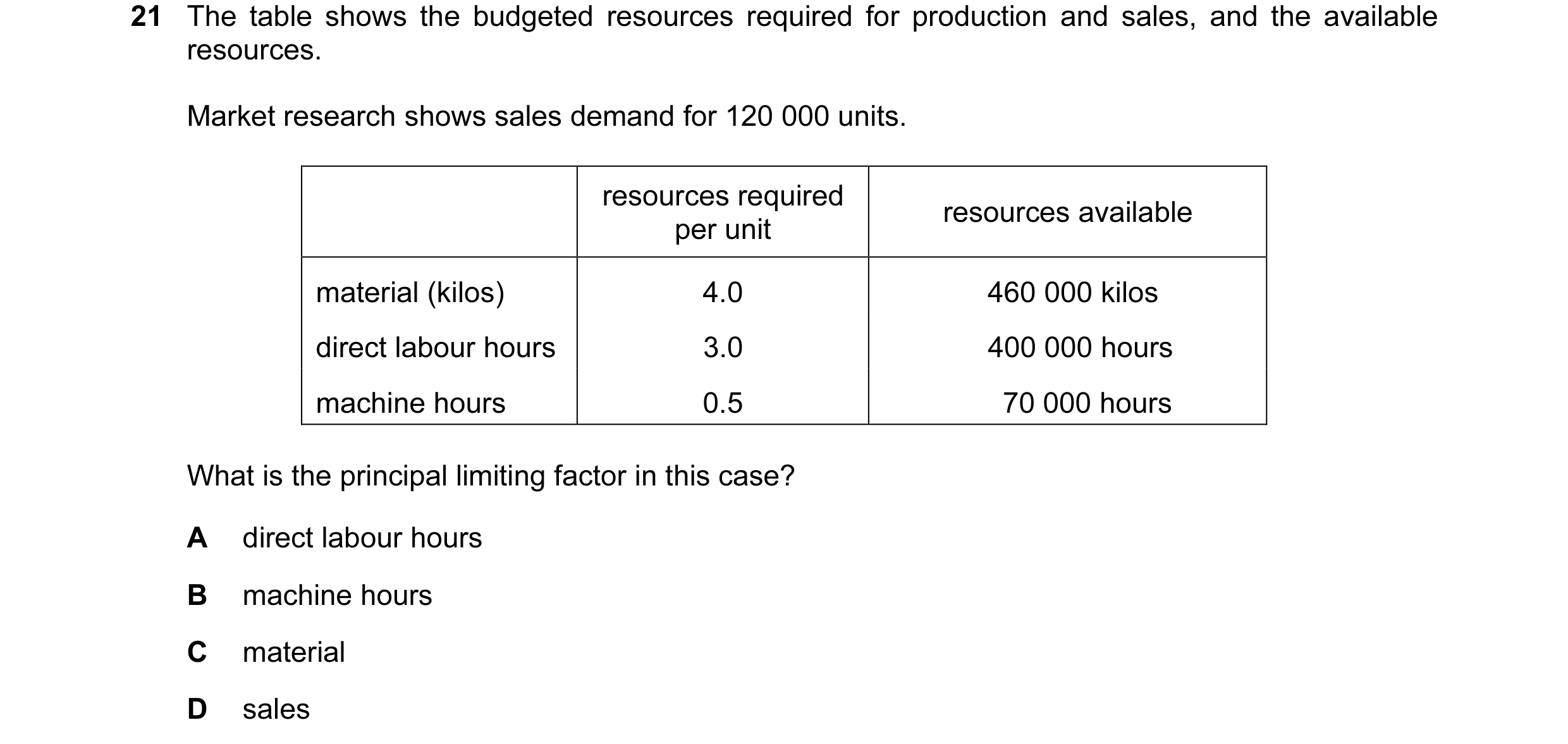
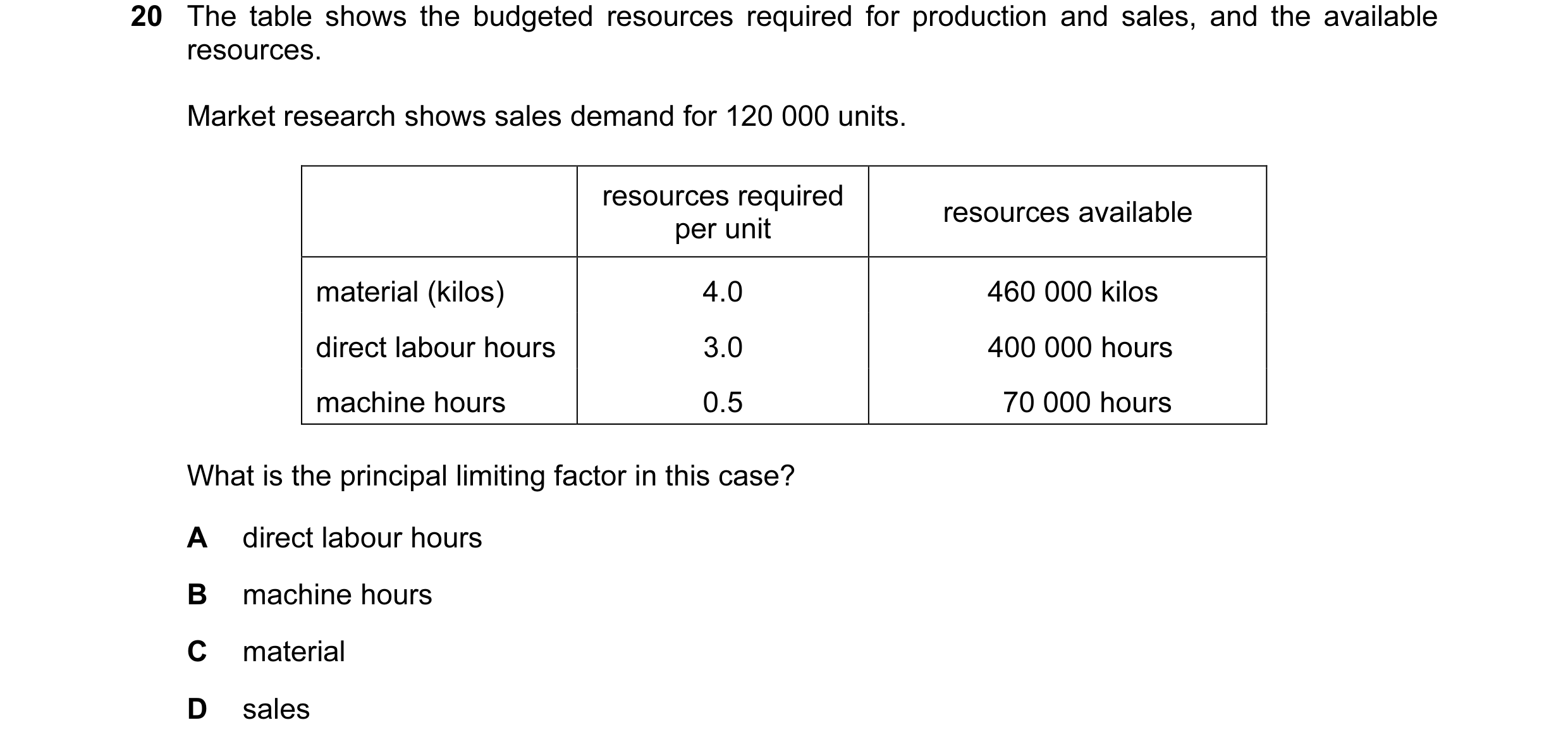
21 The table shows the budgeted resources required for production and sales, and the available resources. Market research shows sales demand for 120 000 units. resources required resources available per unit material (kilos) 4.0 460 000 kilos direct labour hours 3.0 400 000 hours machine hours 0.5 70 000 hours What is the principal limiting factor in this case? A direct labour hours B machine hours C material D sales
1 marks
Answer: C
This question in 9706/31 Oct/Nov 2010
Q17 · When should a system of ‘Flexible Budgeting’ be used? 9706/31 Oct/Nov 2010
23 When should a system of ‘Flexible Budgeting’ be used? A to allow accurate comparison when budgeted and actual activity levels differ B to budget for changes in costs arising from price increases C to enable a company to change its budgetary control period D to prepare budgets when selling prices are continuously changing
1 marks
Answer: A
This question in 9706/31 Oct/Nov 2010
Q18 · A company has the following production budget 9706/31 Oct/Nov 2010
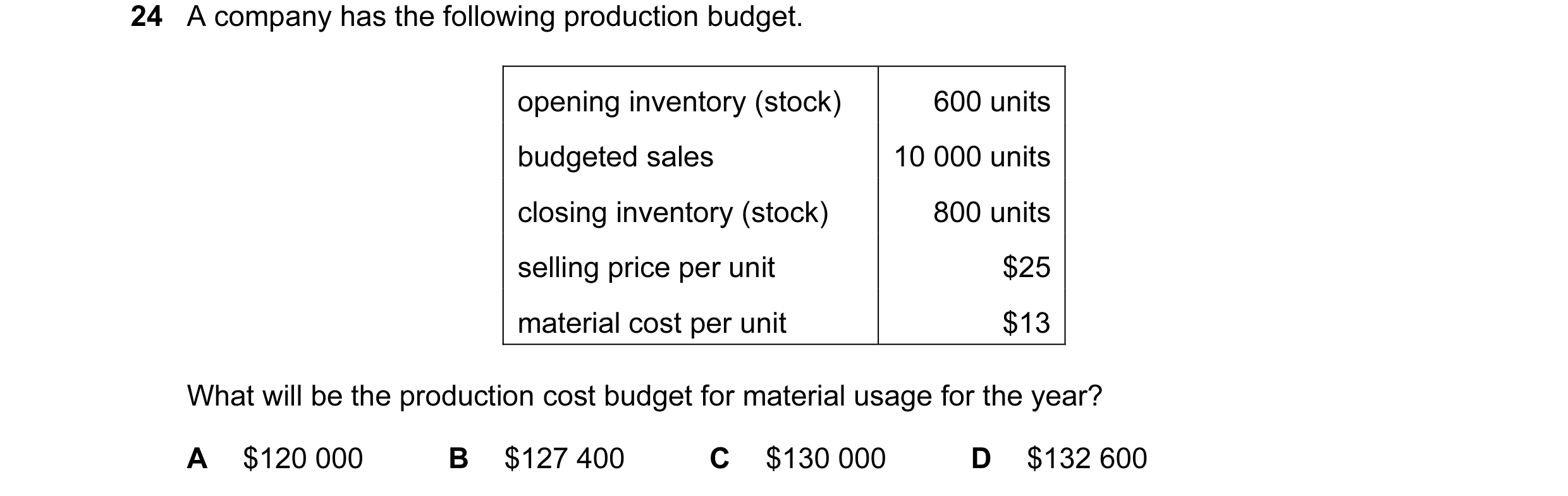
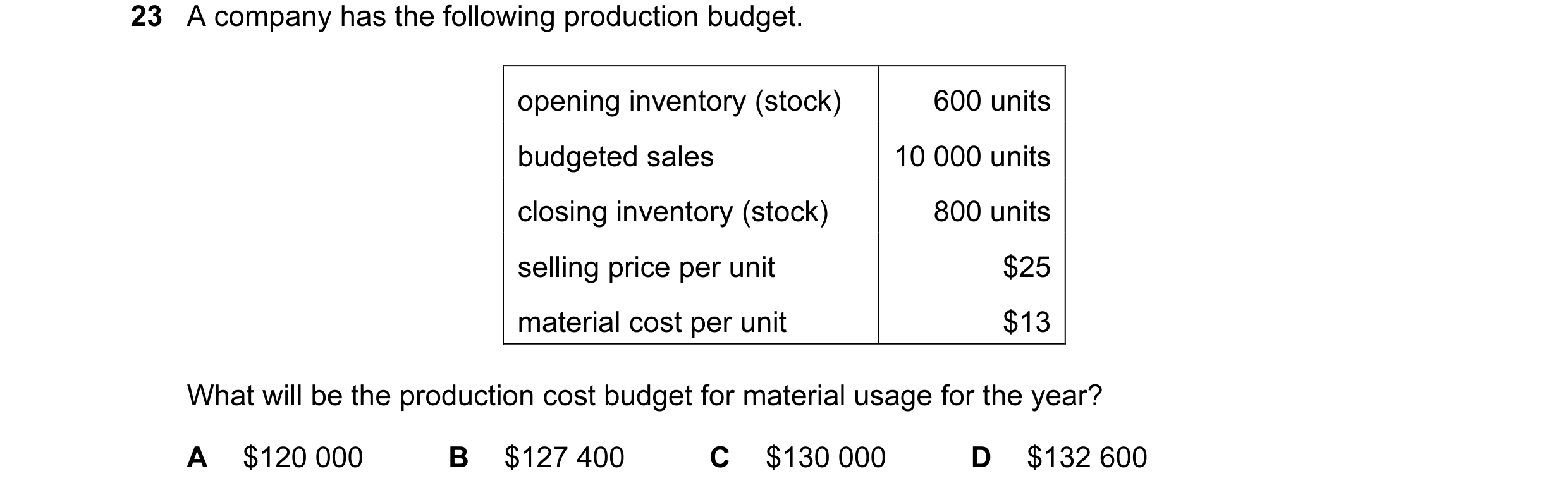
24 A company has the following production budget. opening inventory (stock) 600 units budgeted sales 10 000 units closing inventory (stock) 800 units selling price per unit $25 material cost per unit $13 What will be the production cost budget for material usage for the year? A $120 000 B $127 400 C $130 000 D $132 600
1 marks
Answer: D
This question in 9706/31 Oct/Nov 2010
Q19 · The table shows the budgeted resources required for production and sales, and the… 9706/32 Oct/Nov 2010
21 The table shows the budgeted resources required for production and sales, and the available resources. Market research shows sales demand for 120 000 units. resources required resources available per unit material (kilos) 4.0 460 000 kilos direct labour hours 3.0 400 000 hours machine hours 0.5 70 000 hours What is the principal limiting factor in this case? A direct labour hours B machine hours C material D sales
1 marks
Answer: C
This question in 9706/32 Oct/Nov 2010
Q20 · When should a system of ‘Flexible Budgeting’ be used? 9706/32 Oct/Nov 2010
23 When should a system of ‘Flexible Budgeting’ be used? A to allow accurate comparison when budgeted and actual activity levels differ B to budget for changes in costs arising from price increases C to enable a company to change its budgetary control period D to prepare budgets when selling prices are continuously changing
1 marks
Answer: A
This question in 9706/32 Oct/Nov 2010
Q21 · A company has the following production budget 9706/32 Oct/Nov 2010
24 A company has the following production budget. opening inventory (stock) 600 units budgeted sales 10 000 units closing inventory (stock) 800 units selling price per unit $25 material cost per unit $13 What will be the production cost budget for material usage for the year? A $120 000 B $127 400 C $130 000 D $132 600
1 marks
Answer: D
This question in 9706/32 Oct/Nov 2010
Q22 · The table shows the budgeted resources required for production and sales, and the… 9706/33 Oct/Nov 2010
20 The table shows the budgeted resources required for production and sales, and the available resources. Market research shows sales demand for 120 000 units. resources required resources available per unit material (kilos) 4.0 460 000 kilos direct labour hours 3.0 400 000 hours machine hours 0.5 70 000 hours What is the principal limiting factor in this case? A direct labour hours B machine hours C material D sales
1 marks
Answer: C
This question in 9706/33 Oct/Nov 2010
Q23 · When should a system of ‘Flexible Budgeting’ be used? 9706/33 Oct/Nov 2010
22 When should a system of ‘Flexible Budgeting’ be used? A to allow accurate comparison when budgeted and actual activity levels differ B to budget for changes in costs arising from price increases C to enable a company to change its budgetary control period D to prepare budgets when selling prices are continuously changing
1 marks
Answer: A
This question in 9706/33 Oct/Nov 2010
Q24 · A company has the following production budget 9706/33 Oct/Nov 2010
23 A company has the following production budget. opening inventory (stock) 600 units budgeted sales 10 000 units closing inventory (stock) 800 units selling price per unit $25 material cost per unit $13 What will be the production cost budget for material usage for the year? A $120 000 B $127 400 C $130 000 D $132 600
1 marks
Answer: D
This question in 9706/33 Oct/Nov 2010
Q25 · A company has the following production budget details for the next period 9706/31 May/June 2011
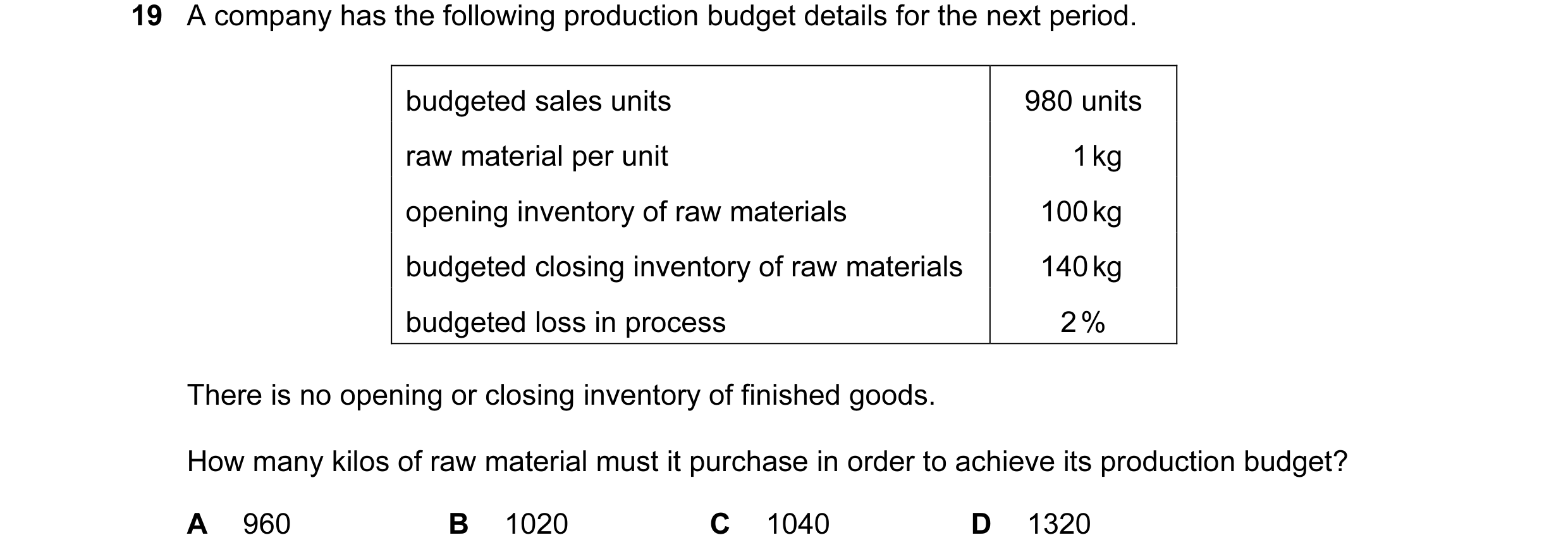
20 A company has the following production budget details for the next period. budgeted sales units 980 units raw material per unit 1 kg opening inventory of raw materials 100 kg budgeted closing inventory of raw materials 140 kg budgeted loss in process 2 % There is no opening or closing inventory of finished goods. How many kilos of raw material must it purchase in order to achieve its production budget? A 960 B 1020 C 1040 D 1320
1 marks
Answer: C
This question in 9706/31 May/June 2011
Q26 · What are flexible budgets needed for? 9706/31 May/June 2011
23 What are flexible budgets needed for? A effective forecasts of future sales B identification of budgeted fixed costs C monitoring trends in material price changes D taking effective budgetary control action
1 marks
Answer: D
This question in 9706/31 May/June 2011
Q27 · A company plans to sell 200 000 units of a product next year 9706/31 May/June 2011
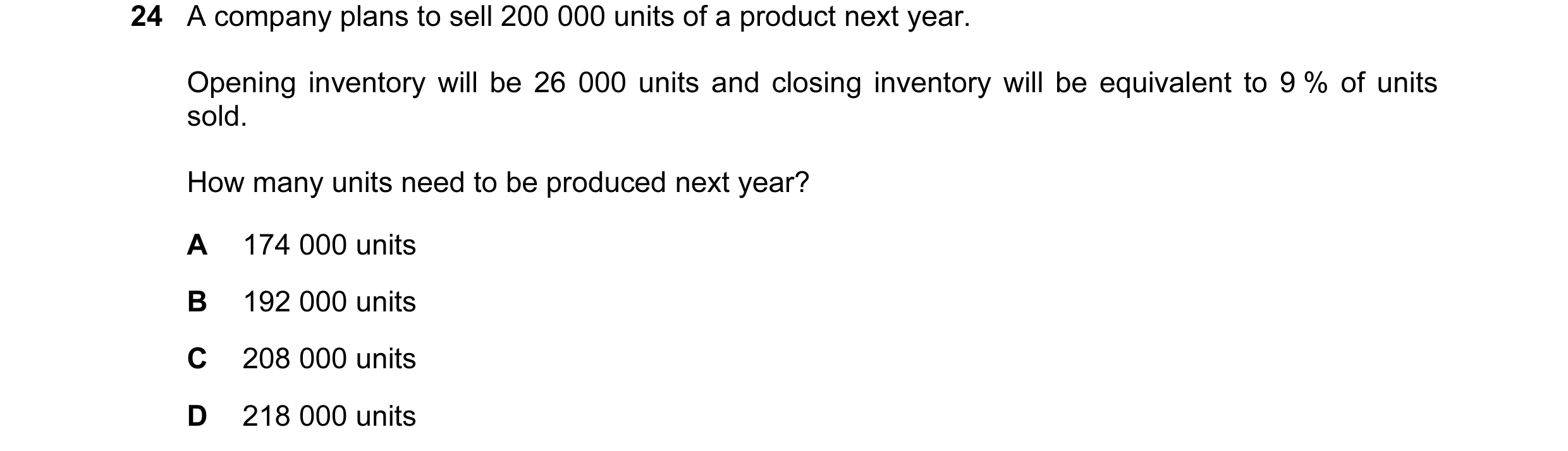
24 A company plans to sell 200 000 units of a product next year. Opening inventory will be 26 000 units and closing inventory will be equivalent to 9 % of units sold. How many units need to be produced next year? A 174 000 units B 192 000 units C 208 000 units D 218 000 units
1 marks
Answer: B
This question in 9706/31 May/June 2011
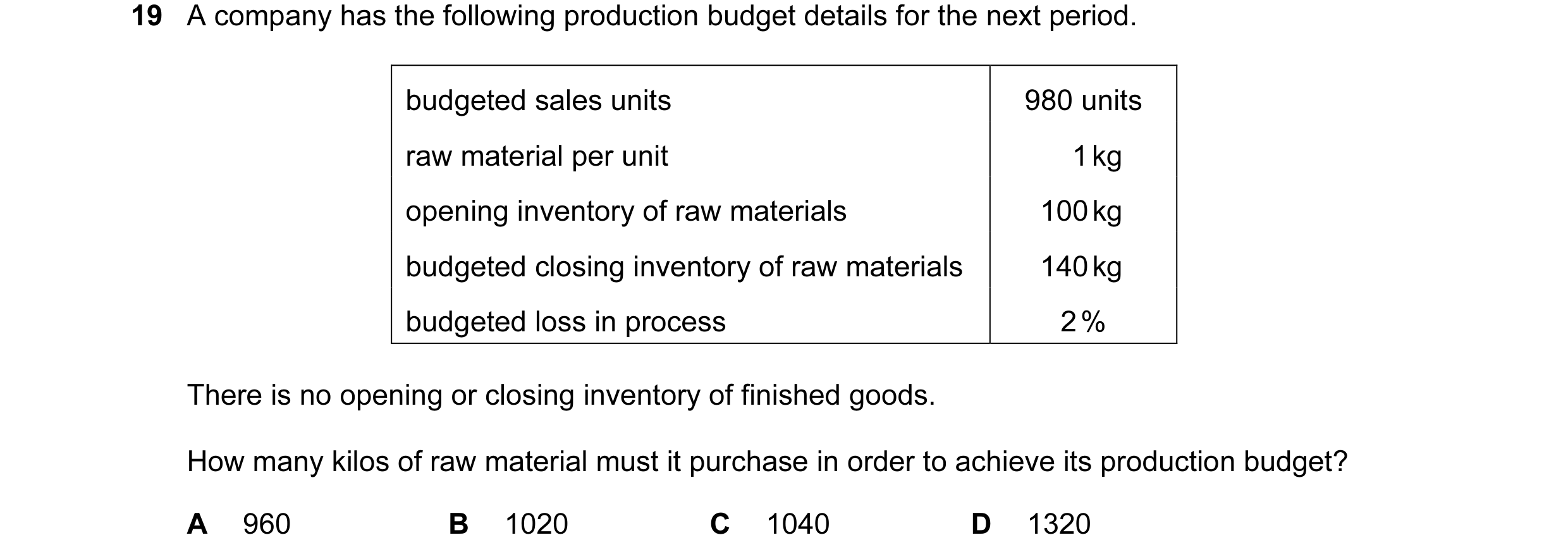
Q28 · A company has the following production budget details for the next period 9706/32 May/June 2011
19 A company has the following production budget details for the next period. budgeted sales units 980 units raw material per unit 1 kg opening inventory of raw materials 100 kg budgeted closing inventory of raw materials 140 kg budgeted loss in process 2 % There is no opening or closing inventory of finished goods. How many kilos of raw material must it purchase in order to achieve its production budget? A 960 B 1020 C 1040 D 1320
1 marks
Answer: C
This question in 9706/32 May/June 2011
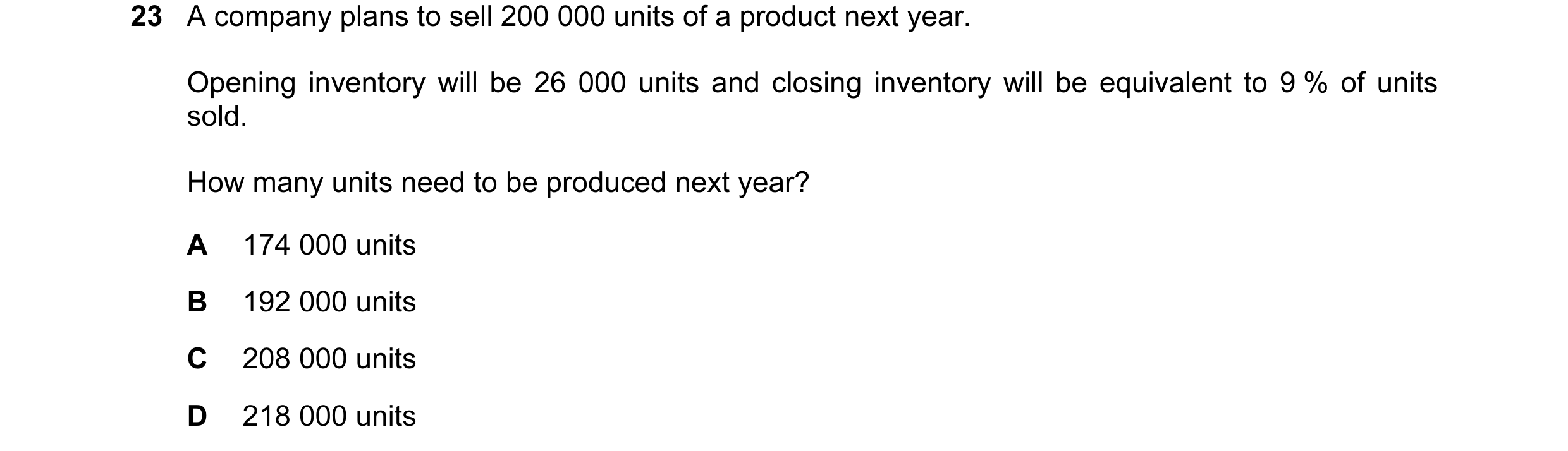
Q29 · A company plans to sell 200 000 units of a product next year 9706/32 May/June 2011
23 A company plans to sell 200 000 units of a product next year. Opening inventory will be 26 000 units and closing inventory will be equivalent to 9 % of units sold. How many units need to be produced next year? A 174 000 units B 192 000 units C 208 000 units D 218 000 units
1 marks
Answer: B
This question in 9706/32 May/June 2011
Q30 · What are flexible budgets needed for? 9706/32 May/June 2011
24 What are flexible budgets needed for? A effective forecasts of future sales B identification of budgeted fixed costs C monitoring trends in material price changes D taking effective budgetary control action
1 marks
Answer: D
This question in 9706/32 May/June 2011
Q31 · A company has the following production budget details for the next period 9706/33 May/June 2011
19 A company has the following production budget details for the next period. budgeted sales units 980 units raw material per unit 1 kg opening inventory of raw materials 100 kg budgeted closing inventory of raw materials 140 kg budgeted loss in process 2 % There is no opening or closing inventory of finished goods. How many kilos of raw material must it purchase in order to achieve its production budget? A 960 B 1020 C 1040 D 1320
1 marks
Answer: C
This question in 9706/33 May/June 2011
Q32 · What are flexible budgets needed for? 9706/33 May/June 2011
22 What are flexible budgets needed for? A effective forecasts of future sales B identification of budgeted fixed costs C monitoring trends in material price changes D taking effective budgetary control action
1 marks
Answer: D
This question in 9706/33 May/June 2011
Q33 · A company plans to sell 200 000 units of a product next year 9706/33 May/June 2011
23 A company plans to sell 200 000 units of a product next year. Opening inventory will be 26 000 units and closing inventory will be equivalent to 9 % of units sold. How many units need to be produced next year? A 174 000 units B 192 000 units C 208 000 units D 218 000 units
1 marks
Answer: B
This question in 9706/33 May/June 2011
Q34 · What is a master budget? 9706/31 Oct/Nov 2011
22 What is a master budget? A a budget based on the limiting factor B a cash budget C a flexible budget D a set of budgeted financial statements
1 marks
Answer: D
This question in 9706/31 Oct/Nov 2011
Q35 · Which department would be most likely to use zero-based budgeting? 9706/31 Oct/Nov 2011
23 Which department would be most likely to use zero-based budgeting? A administration B labour C manufacturing D marketing
1 marks
Answer: D
This question in 9706/31 Oct/Nov 2011
Q36 · The budgeted output for a process is 6000 litres for a period 9706/31 Oct/Nov 2011
24 The budgeted output for a process is 6000 litres for a period. The opening inventory is 400 litres and the inventory is expected to increase by 50 % by the end of the period. The process has a normal loss of 10 %. How much is the material usage budget? A 5220 litres B 6200 litres C 6380 litres D 6667 litres
1 marks
Answer: D
This question in 9706/31 Oct/Nov 2011
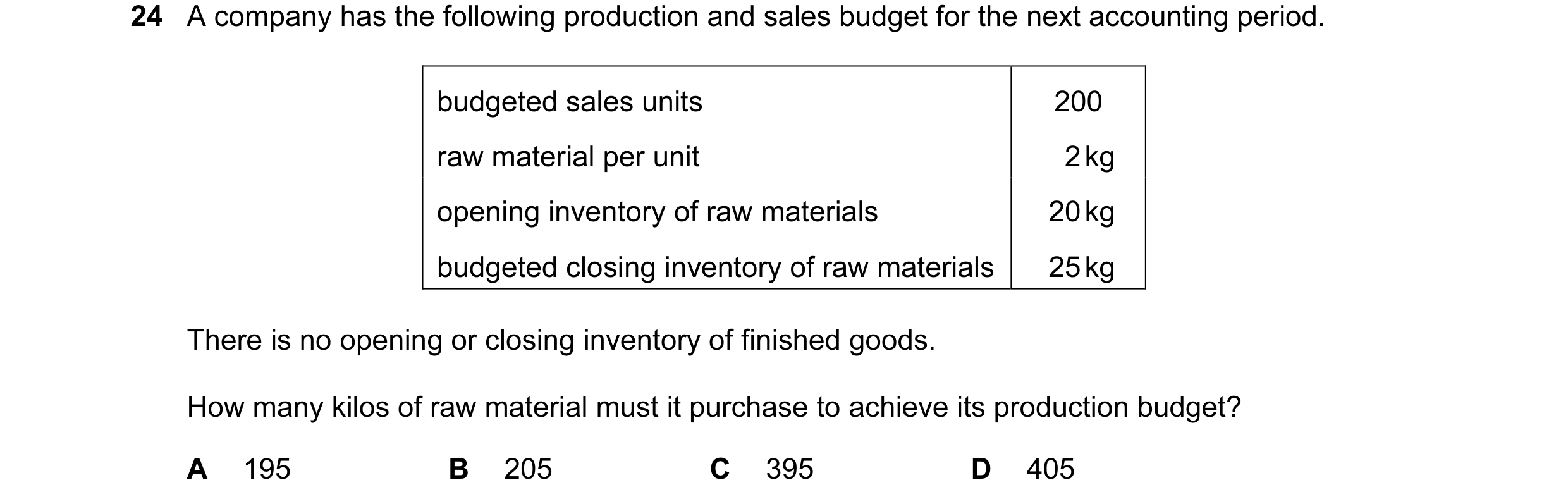
Q37 · A company has the following production and sales budget for the next accounting period 9706/32 Oct/Nov 2011
24 A company has the following production and sales budget for the next accounting period. budgeted sales units 200 raw material per unit 2 kg opening inventory of raw materials 20 kg budgeted closing inventory of raw materials 25 kg There is no opening or closing inventory of finished goods. How many kilos of raw material must it purchase to achieve its production budget? A 195 B 205 C 395 D 405
1 marks
Answer: D
This question in 9706/32 Oct/Nov 2011
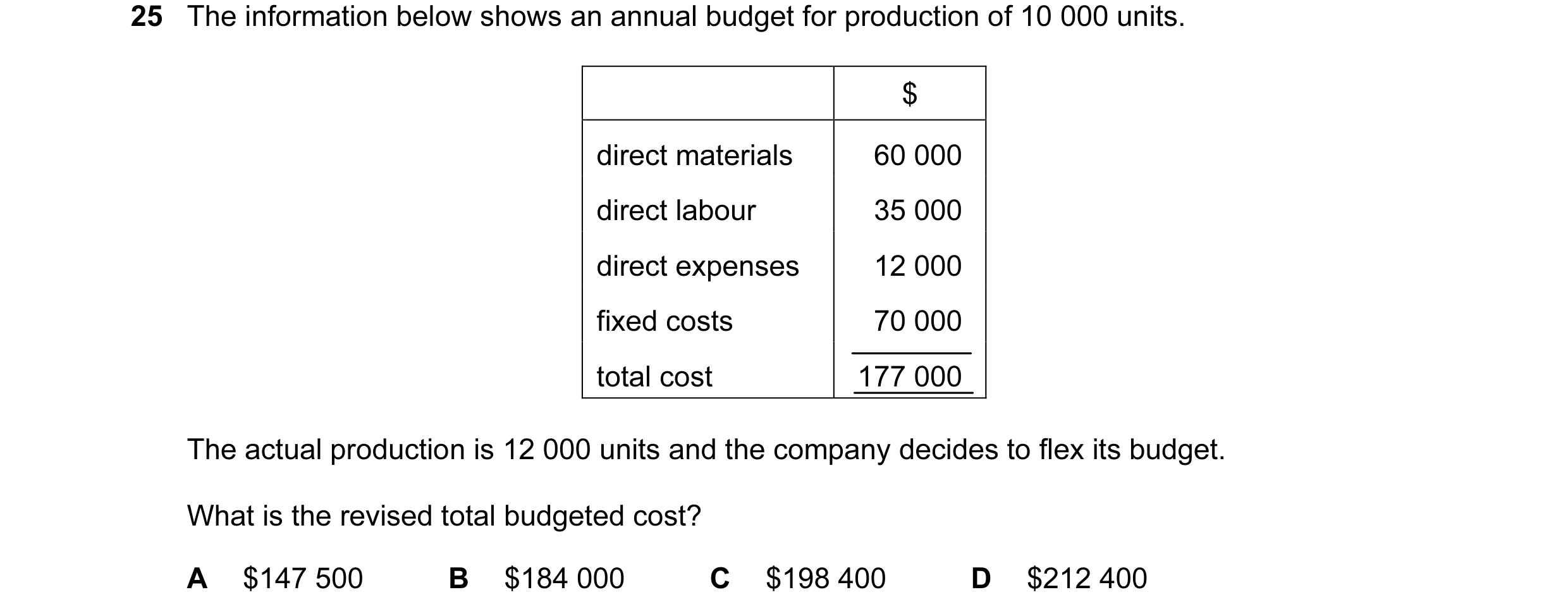
Q38 · The information below shows an annual budget for production of 10 000 units 9706/32 Oct/Nov 2011
25 The information below shows an annual budget for production of 10 000 units. $ direct materials 60 000 direct labour 35 000 direct expenses 12 000 fixed costs 70 000 total cost 177 000 The actual production is 12 000 units and the company decides to flex its budget. What is the revised total budgeted cost? A $147 500 B $184 000 C $198 400 D $212 400
1 marks
Answer: C
This question in 9706/32 Oct/Nov 2011
Q39 · What is a master budget? 9706/33 Oct/Nov 2011
21 What is a master budget? A a budget based on the limiting factor B a cash budget C a flexible budget D a set of budgeted financial statements
1 marks
Answer: D
This question in 9706/33 Oct/Nov 2011
Q40 · Which department would be most likely to use zero-based budgeting? 9706/33 Oct/Nov 2011
22 Which department would be most likely to use zero-based budgeting? A administration B labour C manufacturing D marketing
1 marks
Answer: D
This question in 9706/33 Oct/Nov 2011
Q41 · The budgeted output for a process is 6000 litres for a period 9706/33 Oct/Nov 2011
23 The budgeted output for a process is 6000 litres for a period. The opening inventory is 400 litres and the inventory is expected to increase by 50 % by the end of the period. The process has a normal loss of 10 %. How much is the material usage budget? A 5220 litres B 6200 litres C 6380 litres D 6667 litres
1 marks
Answer: D
This question in 9706/33 Oct/Nov 2011
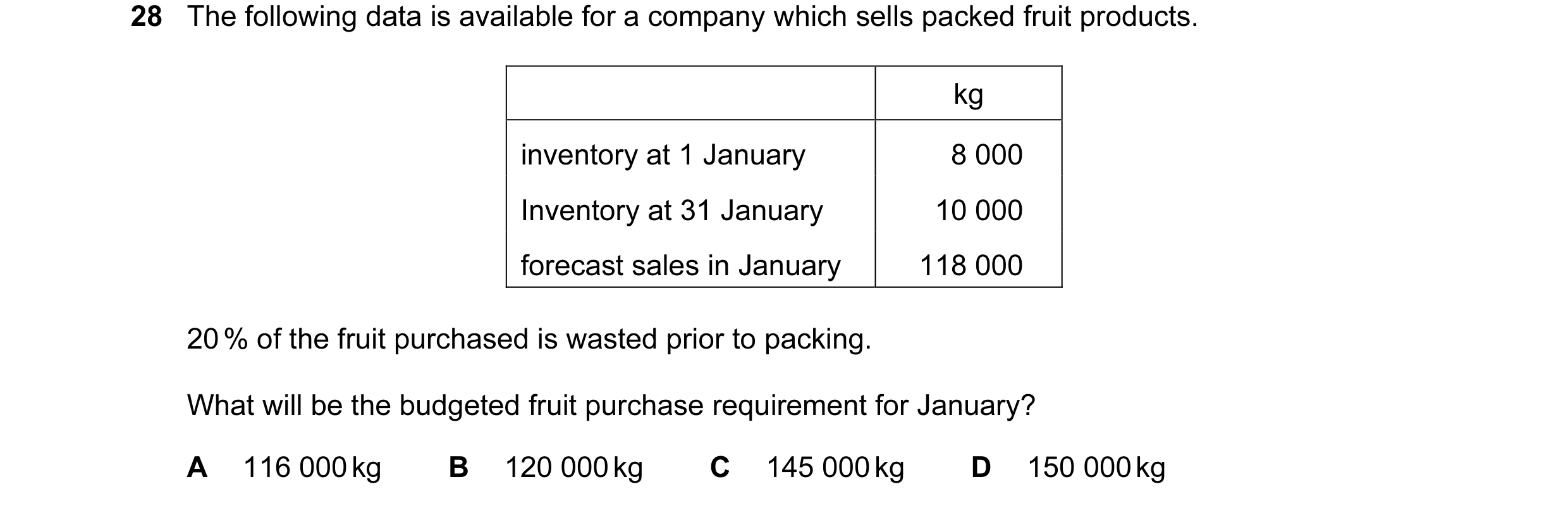
Q42 · The following data is available for a company which sells packed fruit products 9706/31 May/June 2012
28 The following data is available for a company which sells packed fruit products. kg inventory at 1 January 8 000 Inventory at 31 January 10 000 forecast sales in January 118 000 20 % of the fruit purchased is wasted prior to packing. What will be the budgeted fruit purchase requirement for January? A 116 000 kg B 120 000 kg C 145 000 kg D 150 000 kg
1 marks
Answer: D
This question in 9706/31 May/June 2012
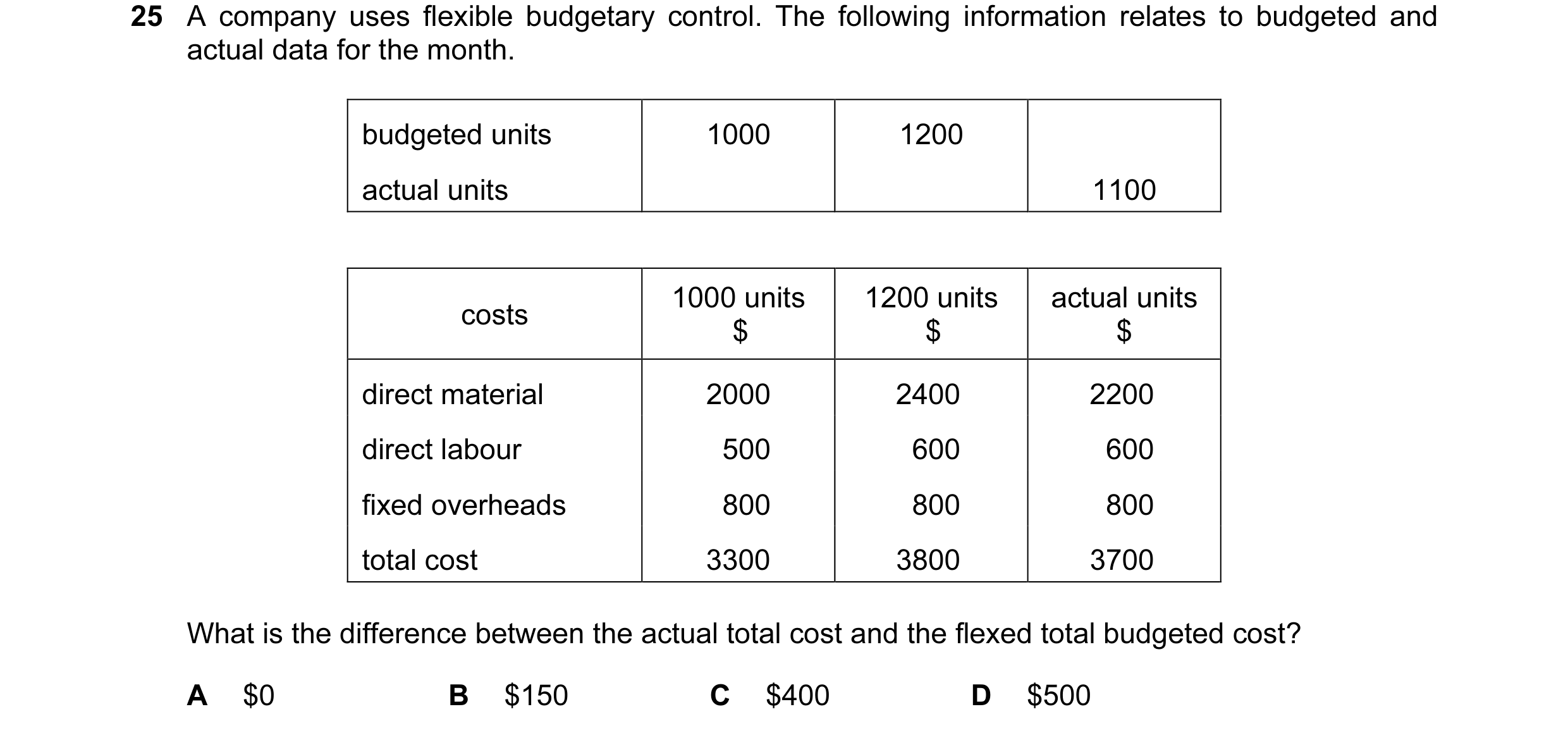
Q43 · A company uses flexible budgetary control 9706/32 May/June 2012
25 A company uses flexible budgetary control. The following information relates to budgeted and actual data for the month. budgeted units 1000 1200 actual units 1100 1000 units 1200 units actual units costs $ $ $ direct material 2000 2400 2200 direct labour 500 600 600 fixed overheads 800 800 800 total cost 3300 3800 3700 What is the difference between the actual total cost and the flexed total budgeted cost? A $0 B $150 C $400 D $500
1 marks
Answer: B
This question in 9706/32 May/June 2012
Q44 · The following data is available for a company which sells packed fruit products 9706/33 May/June 2012
26 The following data is available for a company which sells packed fruit products. kg inventory at 1 January 8 000 Inventory at 31 January 10 000 forecast sales in January 118 000 20 % of the fruit purchased is wasted prior to packing. What will be the budgeted fruit purchase requirement for January? A 116 000 kg B 120 000 kg C 145 000 kg D 150 000 kg
1 marks
Answer: D
This question in 9706/33 May/June 2012
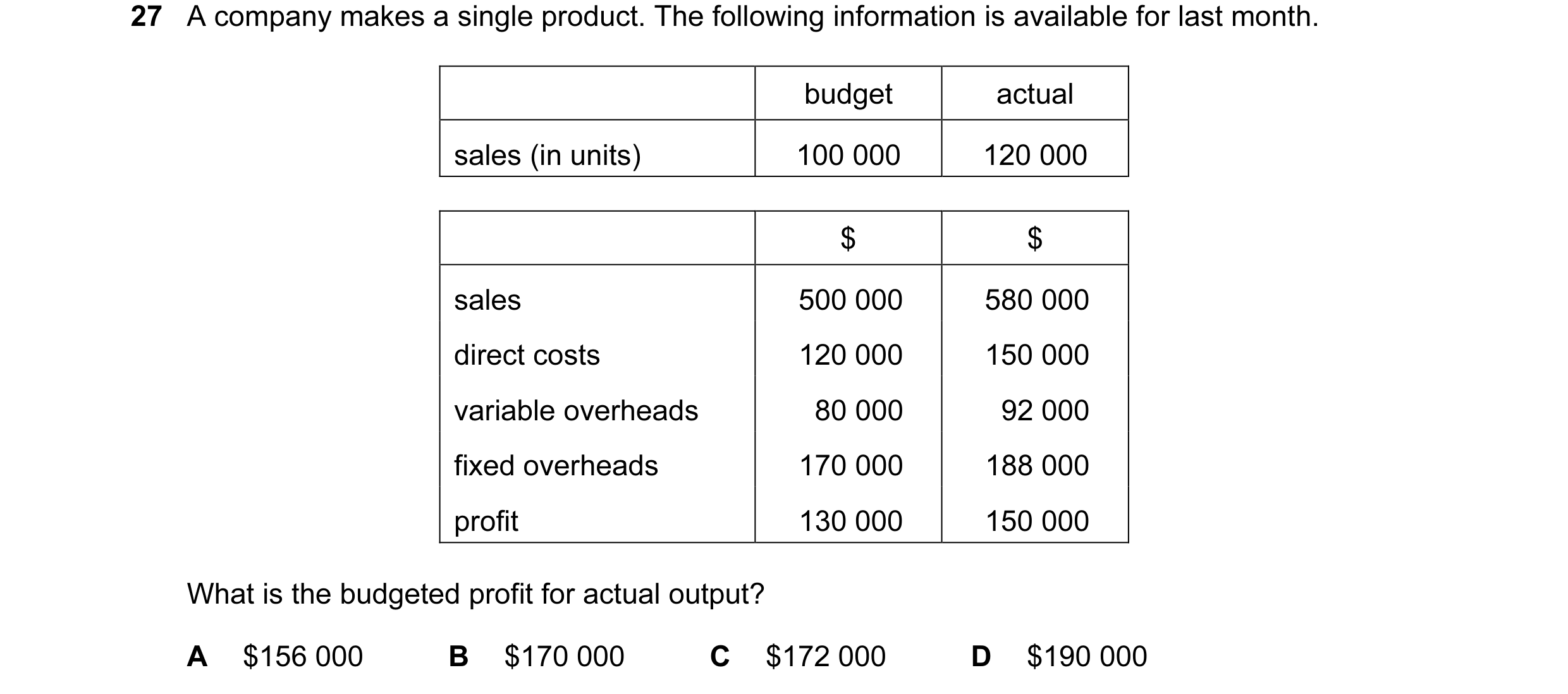
Q45 · A company makes a single product 9706/33 May/June 2012
27 A company makes a single product. The following information is available for last month. budget actual sales (in units) 100 000 120 000 $ $ sales 500 000 580 000 direct costs 120 000 150 000 variable overheads 80 000 92 000 fixed overheads 170 000 188 000 profit 130 000 150 000 What is the budgeted profit for actual output? A $156 000 B $170 000 C $172 000 D $190 000
1 marks
Answer: D
This question in 9706/33 May/June 2012
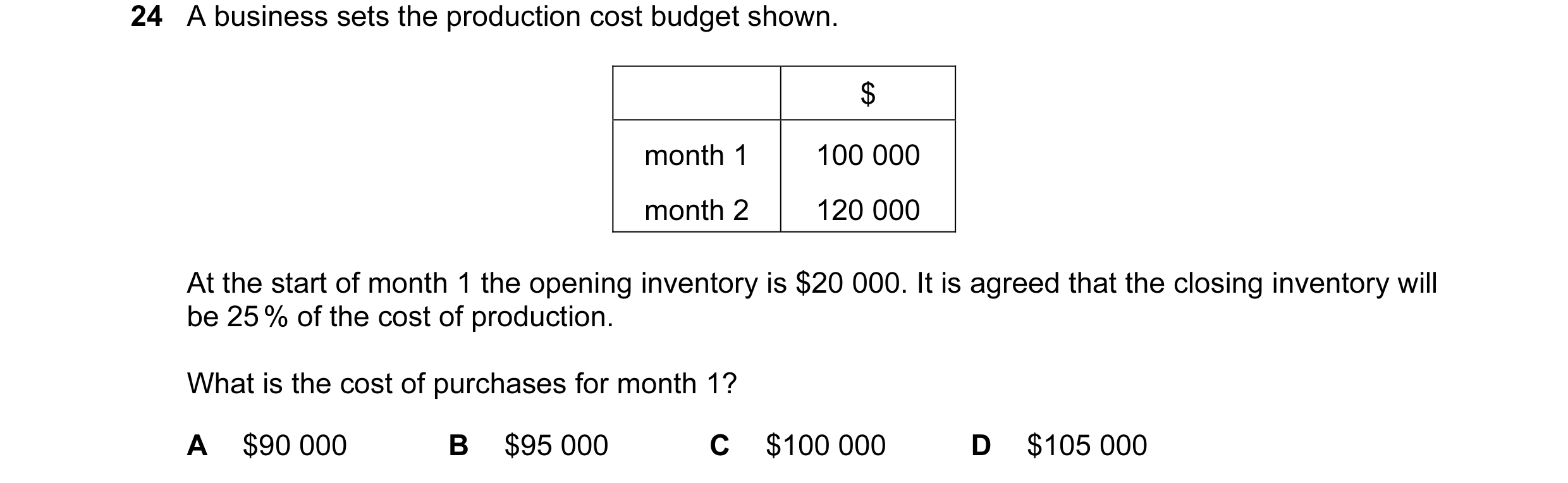
Q46 · A business sets the production cost budget shown 9706/31 Oct/Nov 2012
24 A business sets the production cost budget shown. $ month 1 100 000 month 2 120 000 At the start of month 1 the opening inventory is $20 000. It is agreed that the closing inventory will be 25 % of the cost of production. What is the cost of purchases for month 1? A $90 000 B $95 000 C $100 000 D $105 000
1 marks
Answer: D
This question in 9706/31 Oct/Nov 2012
Q47 · The following budgets have been prepared for production (volume and costs) 9706/31 Oct/Nov 2012
25 The following budgets have been prepared for production (volume and costs). production volume 100 000 units 105 000 units direct materials $180 000 $189 000 direct labour $215 000 $225 750 overheads $330 000 $335 500 What would be the budgeted production cost of 110 000 units? A $7.00 per unit B $7.05 per unit C $7.15 per unit D $7.25 per unit
1 marks
Answer: B
This question in 9706/31 Oct/Nov 2012
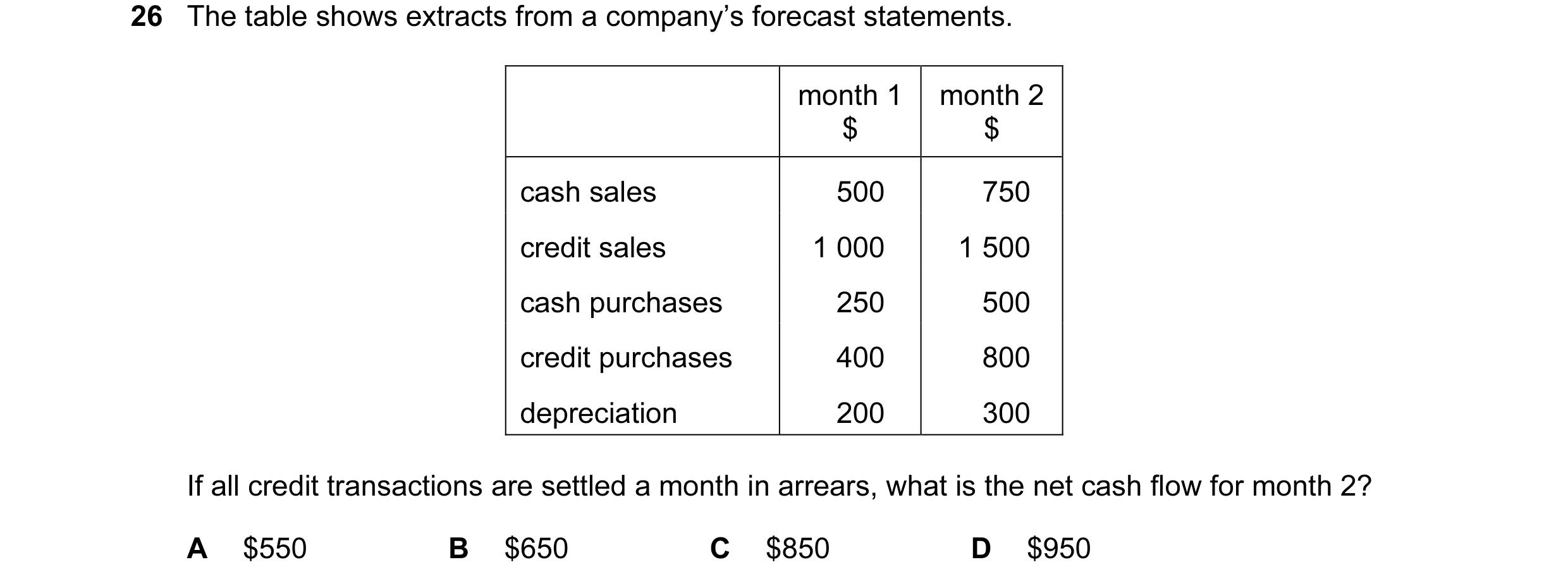
Q48 · The table shows extracts from a company’s forecast statements 9706/31 Oct/Nov 2012
26 The table shows extracts from a company’s forecast statements. month 1 month 2 $ $ cash sales 500 750 credit sales 1 000 1 500 cash purchases 250 500 credit purchases 400 800 depreciation 200 300 If all credit transactions are settled a month in arrears, what is the net cash flow for month 2? A $550 B $650 C $850 D $950
1 marks
Answer: C
This question in 9706/31 Oct/Nov 2012
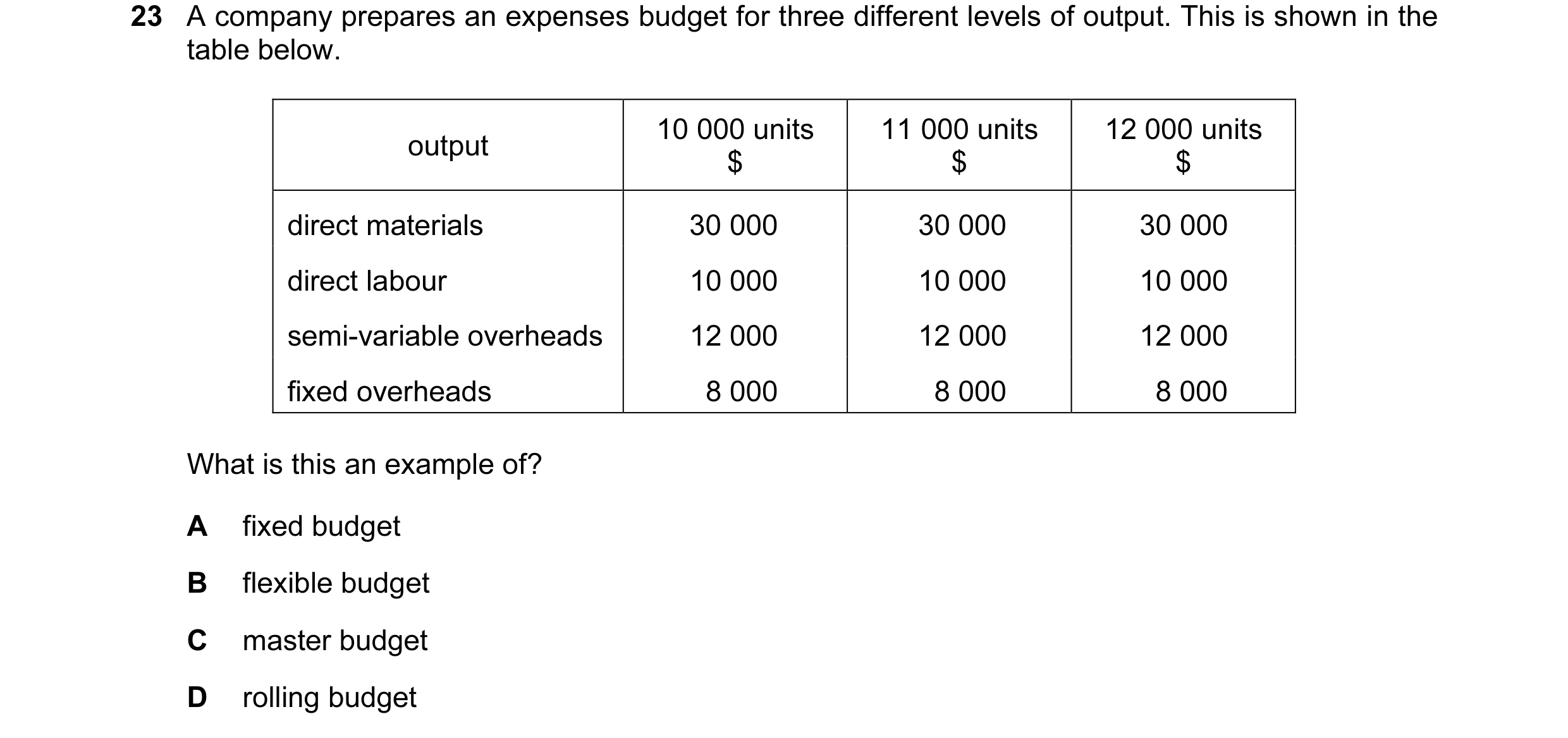
Q49 · A company prepares an expenses budget for three different levels of output 9706/32 Oct/Nov 2012
23 A company prepares an expenses budget for three different levels of output. This is shown in the table below. 10 000 units 11 000 units 12 000 units output $ $ $ direct materials 30 000 30 000 30 000 direct labour 10 000 10 000 10 000 semi-variable overheads 12 000 12 000 12 000 fixed overheads 8 000 8 000 8 000 What is this an example of? A fixed budget B flexible budget C master budget D rolling budget
1 marks
Answer: A
This question in 9706/32 Oct/Nov 2012
Q50 · What is regarded as a problem when operating a budgetary control system? 9706/32 Oct/Nov 2012
24 What is regarded as a problem when operating a budgetary control system? A All managers participate in the budgetary process to feel involved in its achievement. B Budgetary slack is built in by managers, meaning standards are of little use in measuring performance. C Financial incentives and rewards for managers are based on their achievement of the budget. D Managers are provided with regular feedback on their performance against budget.
1 marks
Answer: B
This question in 9706/32 Oct/Nov 2012
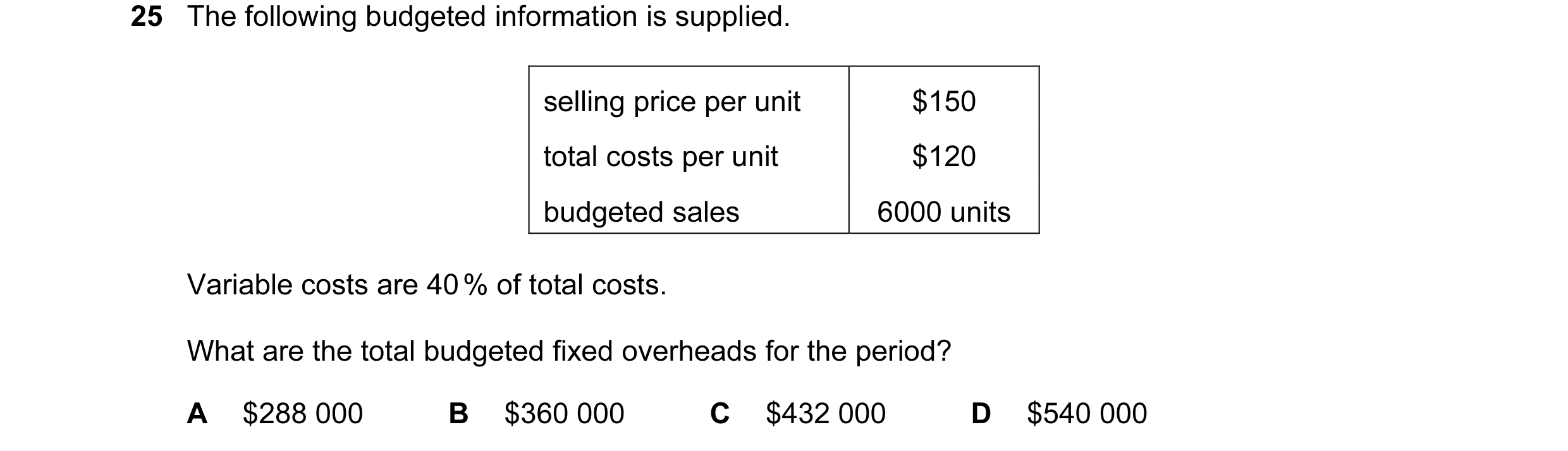
Q51 · The following budgeted information is supplied 9706/32 Oct/Nov 2012
25 The following budgeted information is supplied. selling price per unit $150 total costs per unit $120 budgeted sales 6000 units Variable costs are 40 % of total costs. What are the total budgeted fixed overheads for the period? A $288 000 B $360 000 C $432 000 D $540 000
1 marks
Answer: C
This question in 9706/32 Oct/Nov 2012
Q52 · A company has creditors valued at $100 000 and they are currently paid in 30 days 9706/33 Oct/Nov 2012
22 A company has creditors valued at $100 000 and they are currently paid in 30 days. It is budgeting to increase this immediately by 40 % and increase the payment period to 60 days. How much will this generate as a one-off cash saving for the business? A $40 000 B $100 000 C $140 000 D $180 000
1 marks
Answer: D
This question in 9706/33 Oct/Nov 2012
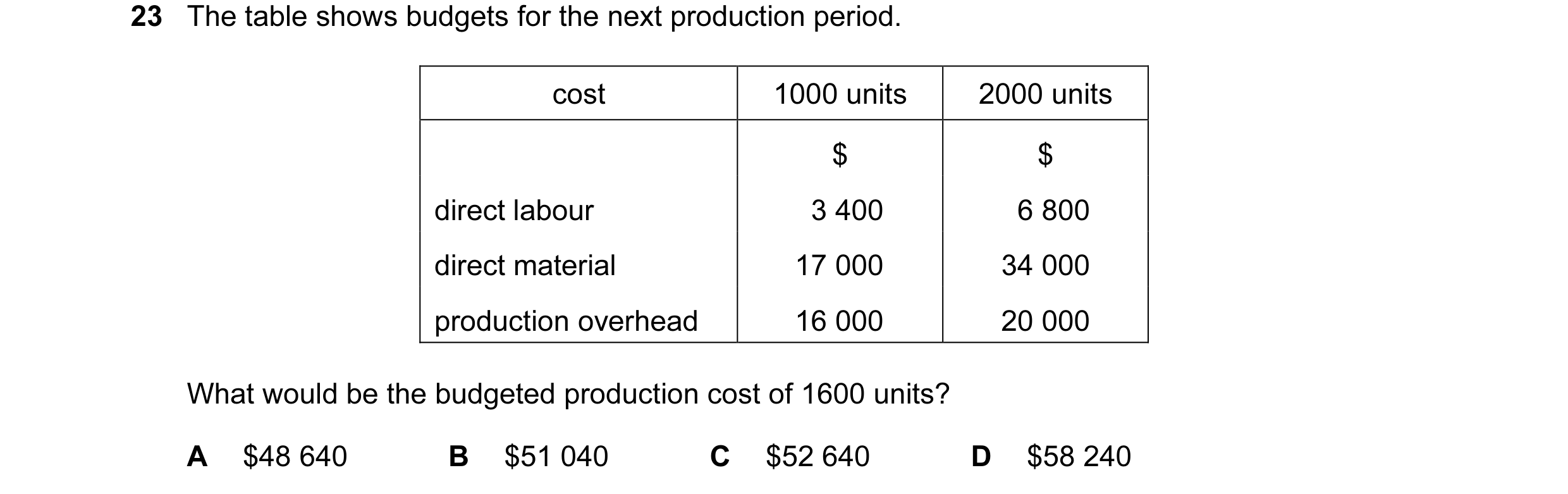
Q53 · The table shows budgets for the next production period 9706/33 Oct/Nov 2012
23 The table shows budgets for the next production period. cost 1000 units 2000 units $ $ direct labour 3 400 6 800 direct material 17 000 34 000 production overhead 16 000 20 000 What would be the budgeted production cost of 1600 units? A $48 640 B $51 040 C $52 640 D $58 240
1 marks
Answer: B
This question in 9706/33 Oct/Nov 2012
Q54 · A company had budgeted output of 245 000 units and budgeted fixed costs at $100 000 9706/33 Oct/Nov 2012
24 A company had budgeted output of 245 000 units and budgeted fixed costs at $100 000. Actual production and fixed costs were exactly as budgeted. The total expenditure of $450 000 was $50 000 over budget. What was the budgeted variable cost per unit to the nearest cent? A $1.22 B $1.43 C $1.63 D $1.84
1 marks
Answer: A
This question in 9706/33 Oct/Nov 2012
Q55 · A company’s trade receivables are $27 000 9706/31 May/June 2013
22 A company’s trade receivables are $27 000. There is a collection period of 30 days. The budget for the coming year provides for an increased turnover of 50% with the relevant collection period being increased to 60 days. What are the budgeted trade receivables? A $13 500 B $27 000 C $40 500 D $81 000
1 marks
Answer: D
This question in 9706/31 May/June 2013
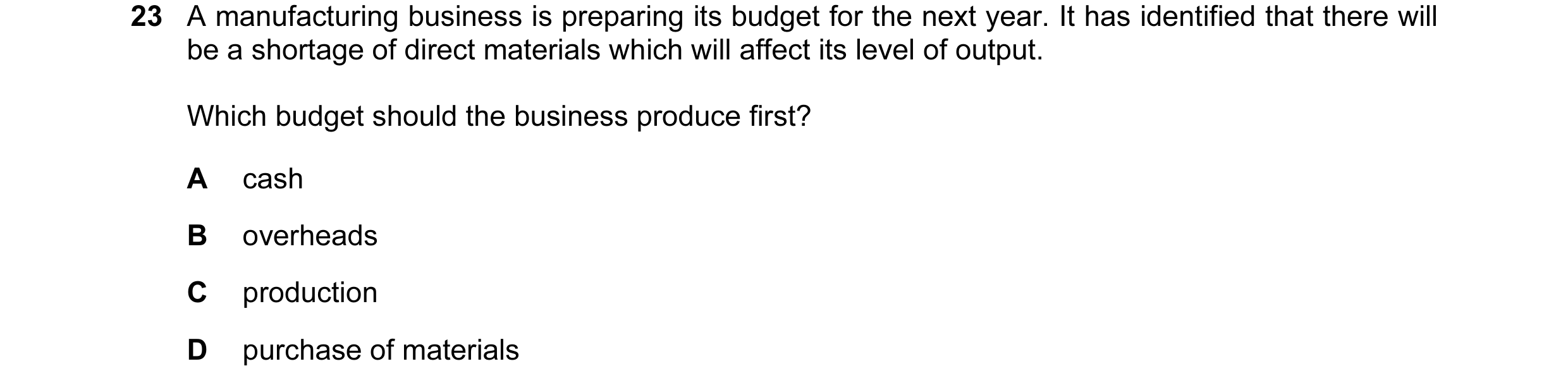
Q56 · A manufacturing business is preparing its budget for the next year 9706/31 May/June 2013
23 A manufacturing business is preparing its budget for the next year. It has identified that there will be a shortage of direct materials which will affect its level of output. Which budget should the business produce first? A cash B overheads C production D purchase of materials
1 marks
Answer: C
This question in 9706/31 May/June 2013
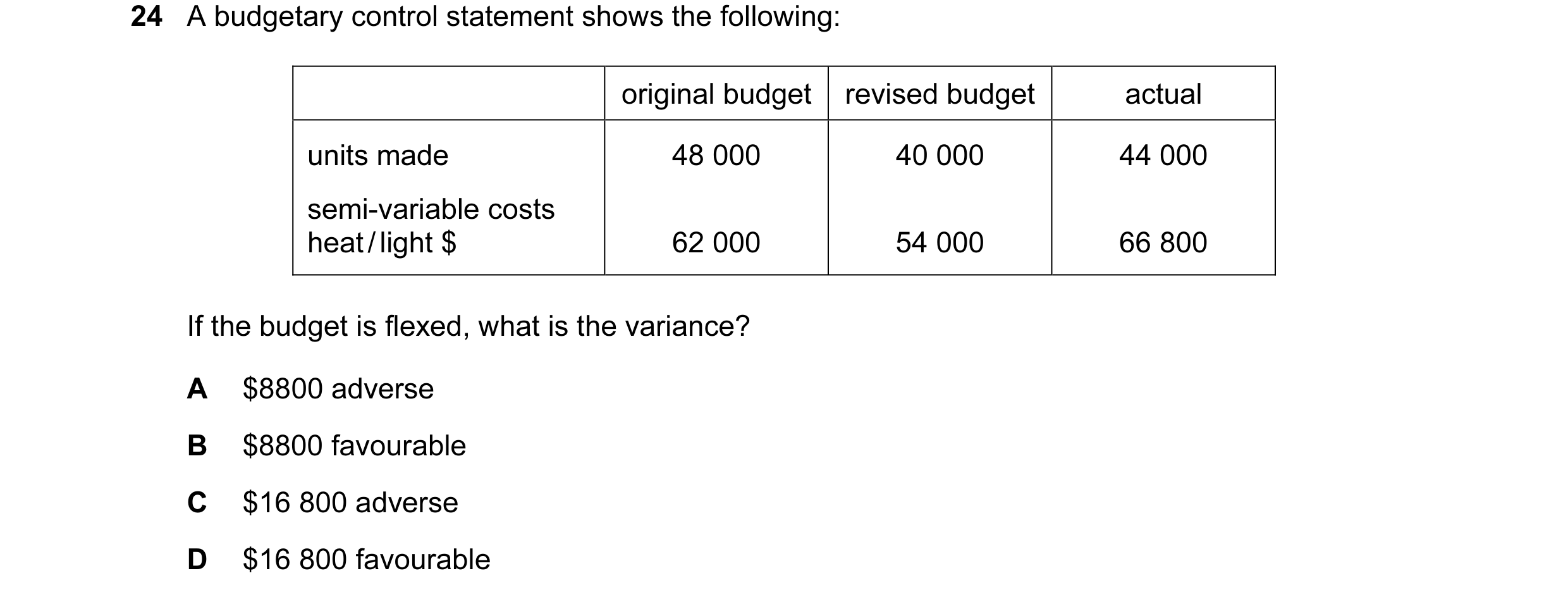
Q57 · A budgetary control statement shows the following: original budget revised budget actual… 9706/31 May/June 2013
24 A budgetary control statement shows the following: original budget revised budget actual units made 48 000 40 000 44 000 semi-variable costs heat / light $ 62 000 54 000 66 800 If the budget is flexed, what is the variance? A $8800 adverse B $8800 favourable C $16 800 adverse D $16 800 favourable
1 marks
Answer: A
This question in 9706/31 May/June 2013
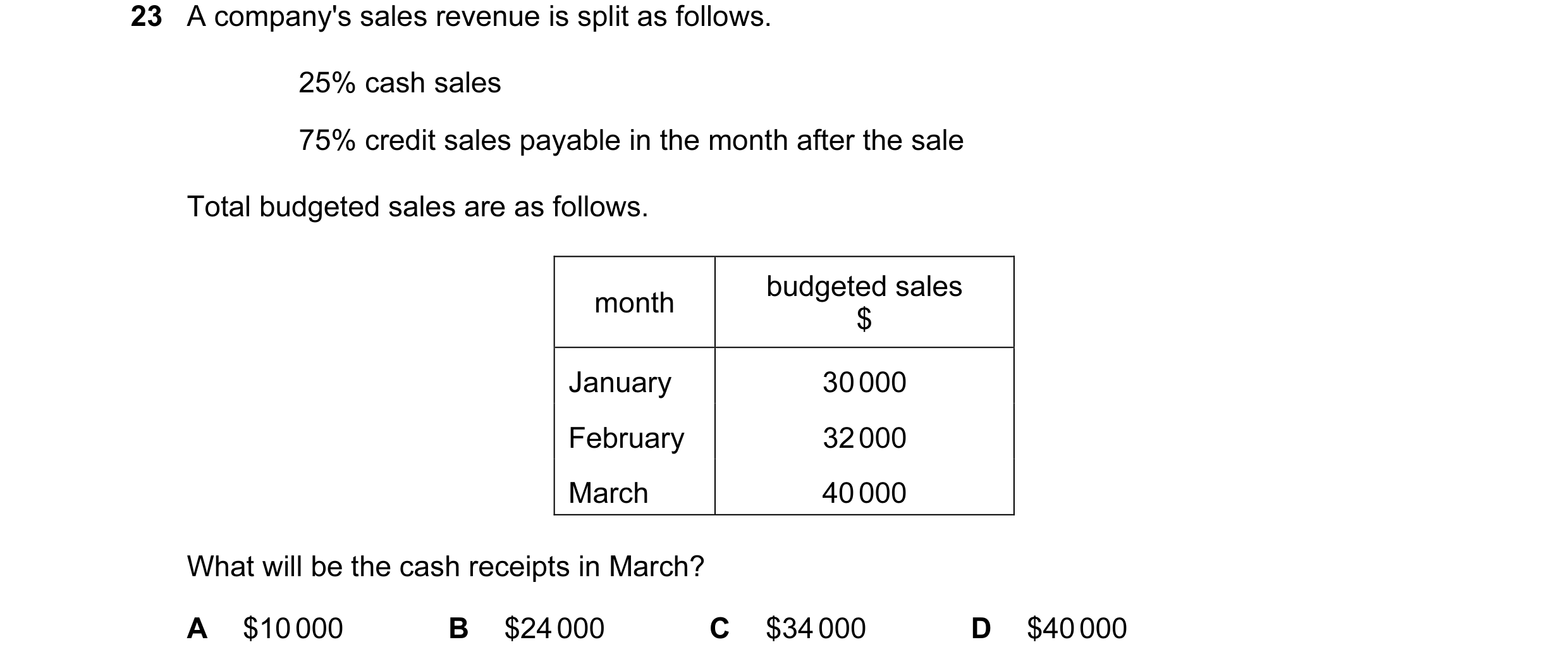
Q58 · A company's sales revenue is split as follows 9706/32 May/June 2013
23 A company's sales revenue is split as follows. 25% cash sales 75% credit sales payable in the month after the sale Total budgeted sales are as follows. budgeted sales month $ January 30 000 February 32 000 March 40 000 What will be the cash receipts in March? A $10 000 B $24 000 C $34 000 D $40 000
1 marks
Answer: C
This question in 9706/32 May/June 2013
Q59 · What is the starting point for the preparation of an annual budget? 9706/32 May/June 2013
24 What is the starting point for the preparation of an annual budget? A identifying the limiting factor B planning cash flow for the year C preparing the production budget D preparing the sales budget
1 marks
Answer: A
This question in 9706/32 May/June 2013
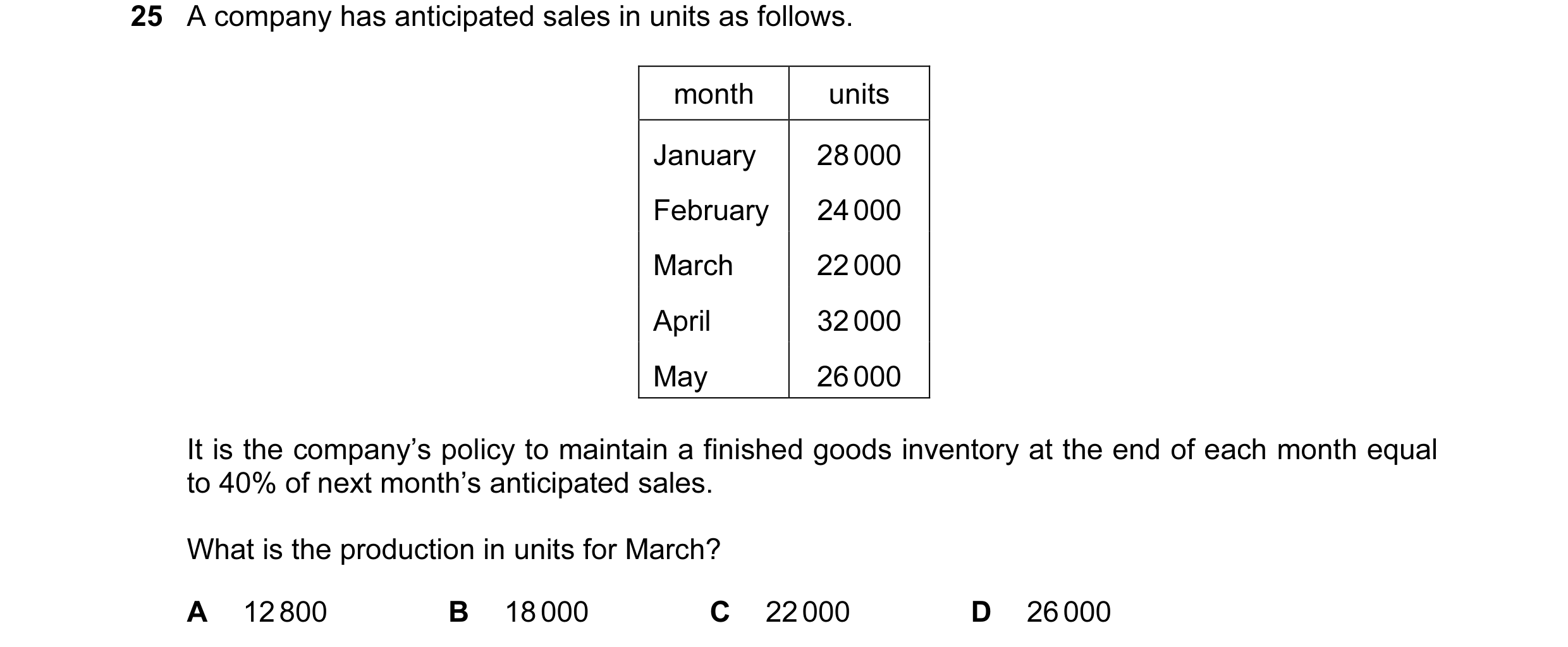
Q60 · A company has anticipated sales in units as follows 9706/32 May/June 2013
25 A company has anticipated sales in units as follows. month units January 28 000 February 24 000 March 22 000 April 32 000 May 26 000 It is the company’s policy to maintain a finished goods inventory at the end of each month equal to 40% of next month’s anticipated sales. What is the production in units for March? A 12 800 B 18 000 C 22 000 D 26 000
1 marks
Answer: D
This question in 9706/32 May/June 2013
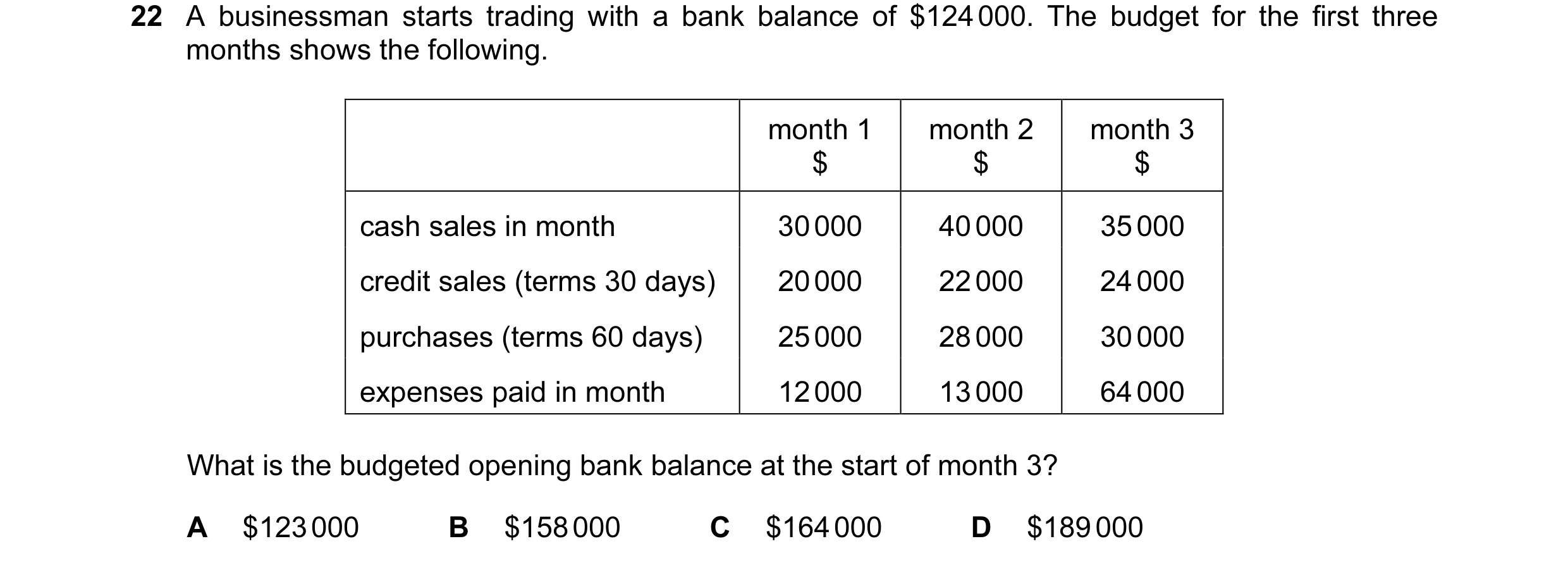
Q61 · A businessman starts trading with a bank balance of $124 000 9706/33 May/June 2013
22 A businessman starts trading with a bank balance of $124 000. The budget for the first three months shows the following. month 1 month 2 month 3 $ $ $ cash sales in month 30 000 40 000 35 000 credit sales (terms 30 days) 20 000 22 000 24 000 purchases (terms 60 days) 25 000 28 000 30 000 expenses paid in month 12 000 13 000 64 000 What is the budgeted opening bank balance at the start of month 3? A $123 000 B $158 000 C $164 000 D $189 000
1 marks
Answer: D
This question in 9706/33 May/June 2013
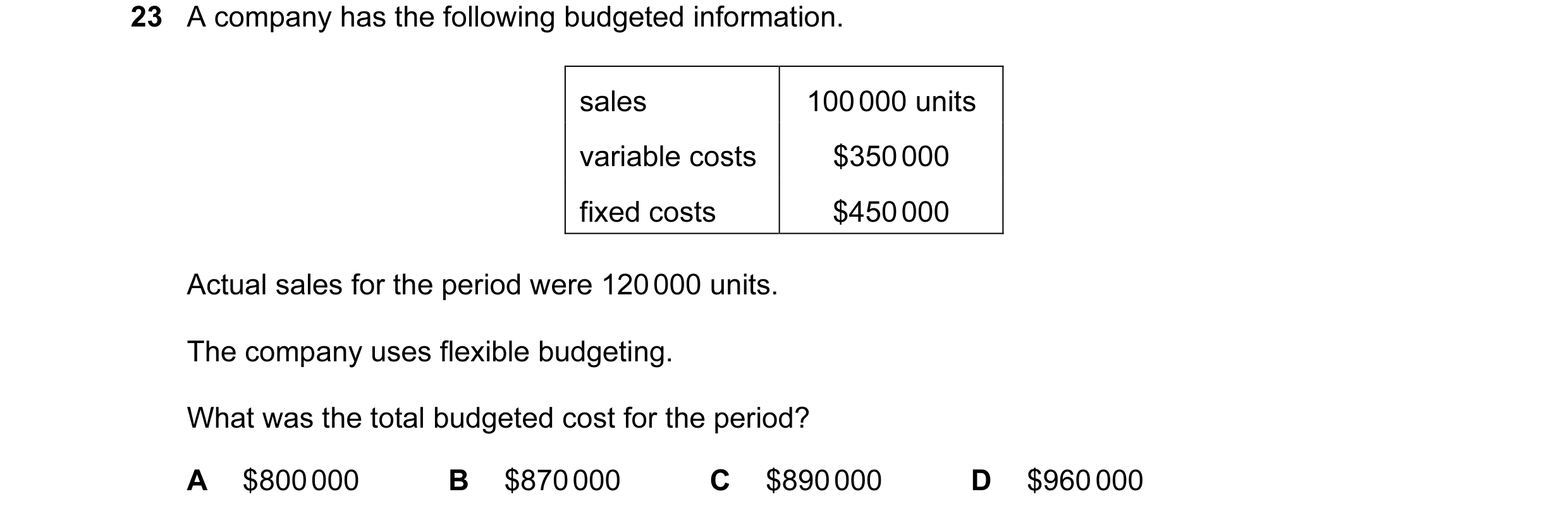
Q62 · A company has the following budgeted information 9706/33 May/June 2013
23 A company has the following budgeted information. sales 100 000 units variable costs $350 000 fixed costs $450 000 Actual sales for the period were 120 000 units. The company uses flexible budgeting. What was the total budgeted cost for the period? A $800 000 B $870 000 C $890 000 D $960 000
1 marks
Answer: B
This question in 9706/33 May/June 2013
Q63 · A company provides the following budgeted information for next month 9706/33 May/June 2013
24 A company provides the following budgeted information for next month. production 16 875 units raw materials per unit 4 kilos opening inventory of raw materials 24 000 kilos closing inventory of raw materials 28 500 kilos loss of raw materials in production process 10% What is the budgeted raw material purchases for the month? A 67 500 kilos B 70 000 kilos C 75 000 kilos D 79 500 kilos
1 marks
Answer: D
This question in 9706/33 May/June 2013
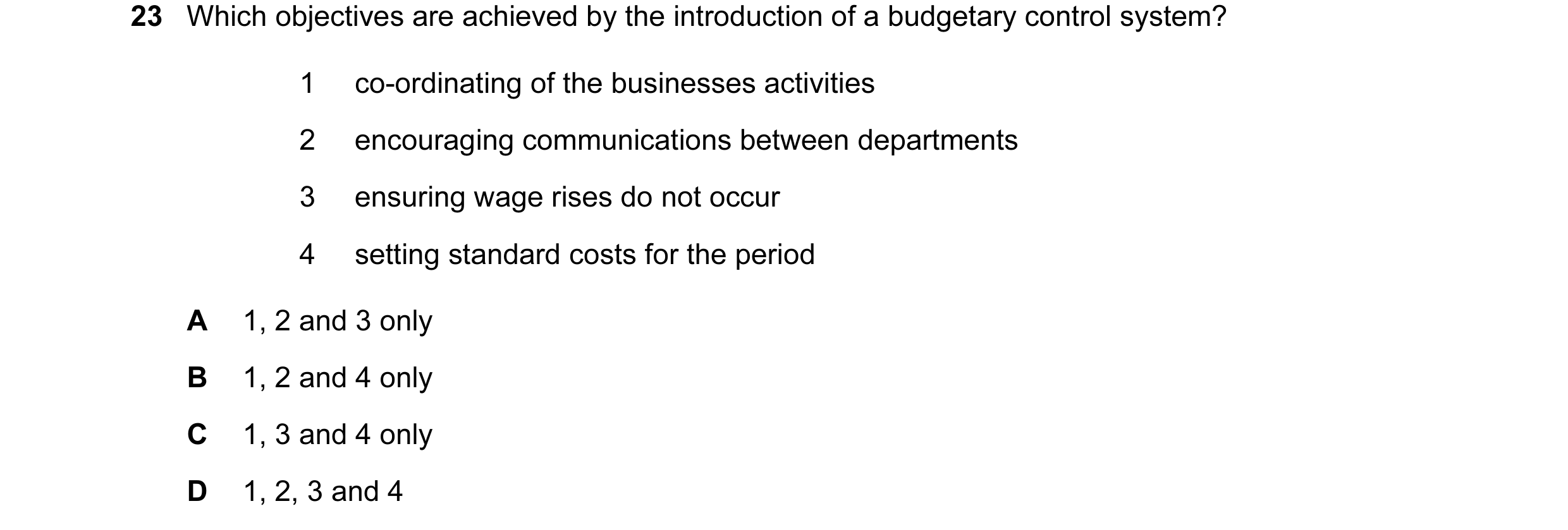
Q64 · Which objectives are achieved by the introduction of a budgetary control system? 9706/31 Oct/Nov 2013
23 Which objectives are achieved by the introduction of a budgetary control system? 1 co-ordinating of the businesses activities 2 encouraging communications between departments 3 ensuring wage rises do not occur 4 setting standard costs for the period A 1, 2 and 3 only B 1, 2 and 4 only C 1, 3 and 4 only D 1, 2, 3 and 4
1 marks
Answer: B
This question in 9706/31 Oct/Nov 2013
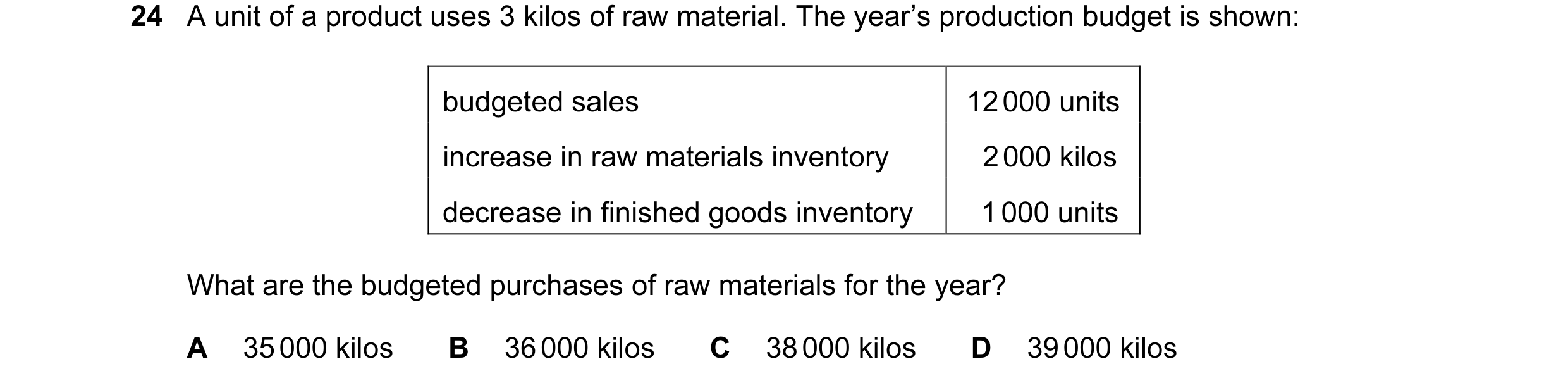
Q65 · A unit of a product uses 3 kilos of raw material 9706/31 Oct/Nov 2013
24 A unit of a product uses 3 kilos of raw material. The year’s production budget is shown: budgeted sales 12 000 units increase in raw materials inventory 2 000 kilos decrease in finished goods inventory 1 000 units What are the budgeted purchases of raw materials for the year? A 35 000 kilos B 36 000 kilos C 38 000 kilos D 39 000 kilos
1 marks
Answer: A
This question in 9706/31 Oct/Nov 2013
Q66 · Which statement about budgeting is correct? 9706/31 Oct/Nov 2013
25 Which statement about budgeting is correct? A A budget should always be produced based on last year’s actual results. B Evaluation of performance should take actual operating conditions into account. C The budget should always be set at an ideal level of performance. D The budget should not be changed once agreed.
1 marks
Answer: B
This question in 9706/31 Oct/Nov 2013
Q67 · A company has forecast the following sales for the first three months of next year 9706/32 Oct/Nov 2013
23 A company has forecast the following sales for the first three months of next year. month units 1 2000 2 2100 3 2400 At the start of month 1 there were 300 units of inventory. The company requires that the closing inventory at the end of each month should be equal to one third of the sales for the following month. How many units must be produced in month 2? A 2000 units B 2200 units C 2400 units D 2900 units
1 marks
Answer: B
This question in 9706/32 Oct/Nov 2013
Q68 · What is a flexed budget? 9706/32 Oct/Nov 2013
24 What is a flexed budget? A a budget based on expected level of production B a budget based on past performance but updated to take account of present conditions C a budget that reflects changes in activity levels D a budget that links fixed overheads to production
1 marks
Answer: C
This question in 9706/32 Oct/Nov 2013
Q69 · The production of an item in March has a budgeted total cost of $43 200 for 2400 units 9706/32 Oct/Nov 2013
25 The production of an item in March has a budgeted total cost of $43 200 for 2400 units. The fixed costs make up 24% of the total cost and the balance is variable. What is the expected expenditure for March if actual production is 2200 units? A $30 096 B $39 600 C $40 464 D $43 200
1 marks
Answer: C
This question in 9706/32 Oct/Nov 2013
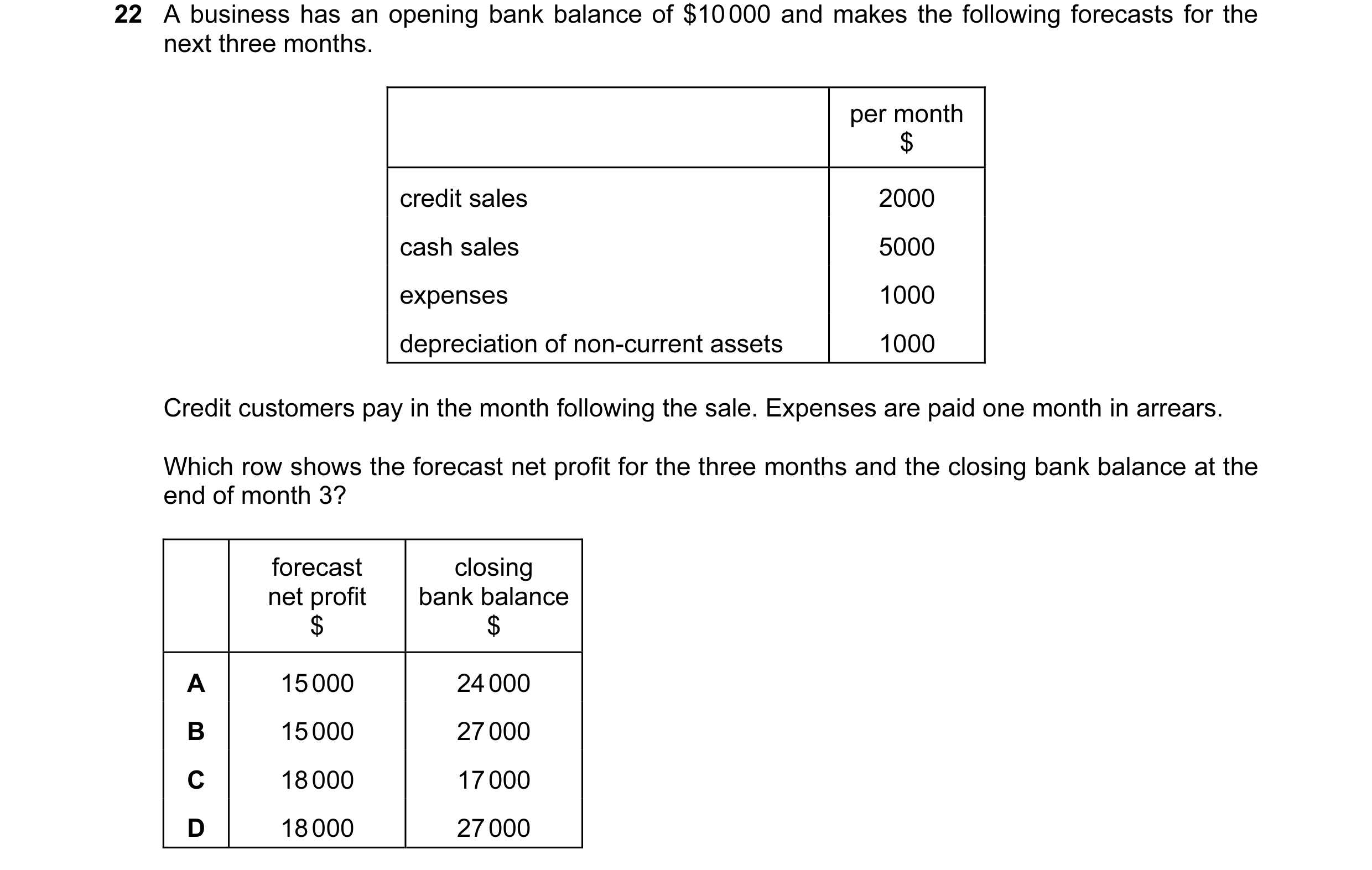
Q70 · A business has an opening bank balance of $10 000 and makes the following forecasts for… 9706/33 Oct/Nov 2013
22 A business has an opening bank balance of $10 000 and makes the following forecasts for the next three months. per month $ credit sales 2000 cash sales 5000 expenses 1000 depreciation of non-current assets 1000 Credit customers pay in the month following the sale. Expenses are paid one month in arrears. Which row shows the forecast net profit for the three months and the closing bank balance at the end of month 3? forecast closing net profit bank balance $ $ A 15 000 24 000 B 15 000 27 000 C 18 000 17 000 D 18 000 27 000
1 marks
Answer: B
This question in 9706/33 Oct/Nov 2013
Q71 · A company adjusts its budget to take account of changes in costs as a result of changes… 9706/33 Oct/Nov 2013
23 A company adjusts its budget to take account of changes in costs as a result of changes in the level of activity. Which type of budget is the company using? A fixed budget B flexed budget C incremental budget D zero based budget
1 marks
Answer: B
This question in 9706/33 Oct/Nov 2013
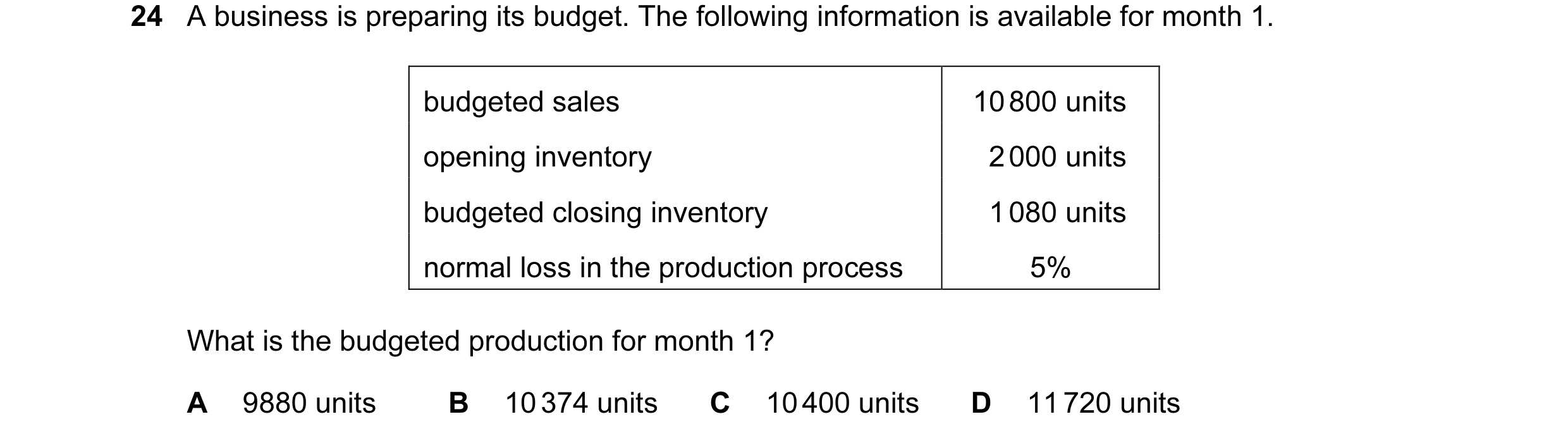
Q72 · A business is preparing its budget 9706/33 Oct/Nov 2013
24 A business is preparing its budget. The following information is available for month 1. budgeted sales 10 800 units opening inventory 2 000 units budgeted closing inventory 1 080 units normal loss in the production process 5% What is the budgeted production for month 1? A 9880 units B 10 374 units C 10 400 units D 11 720 units
1 marks
Answer: C
This question in 9706/33 Oct/Nov 2013
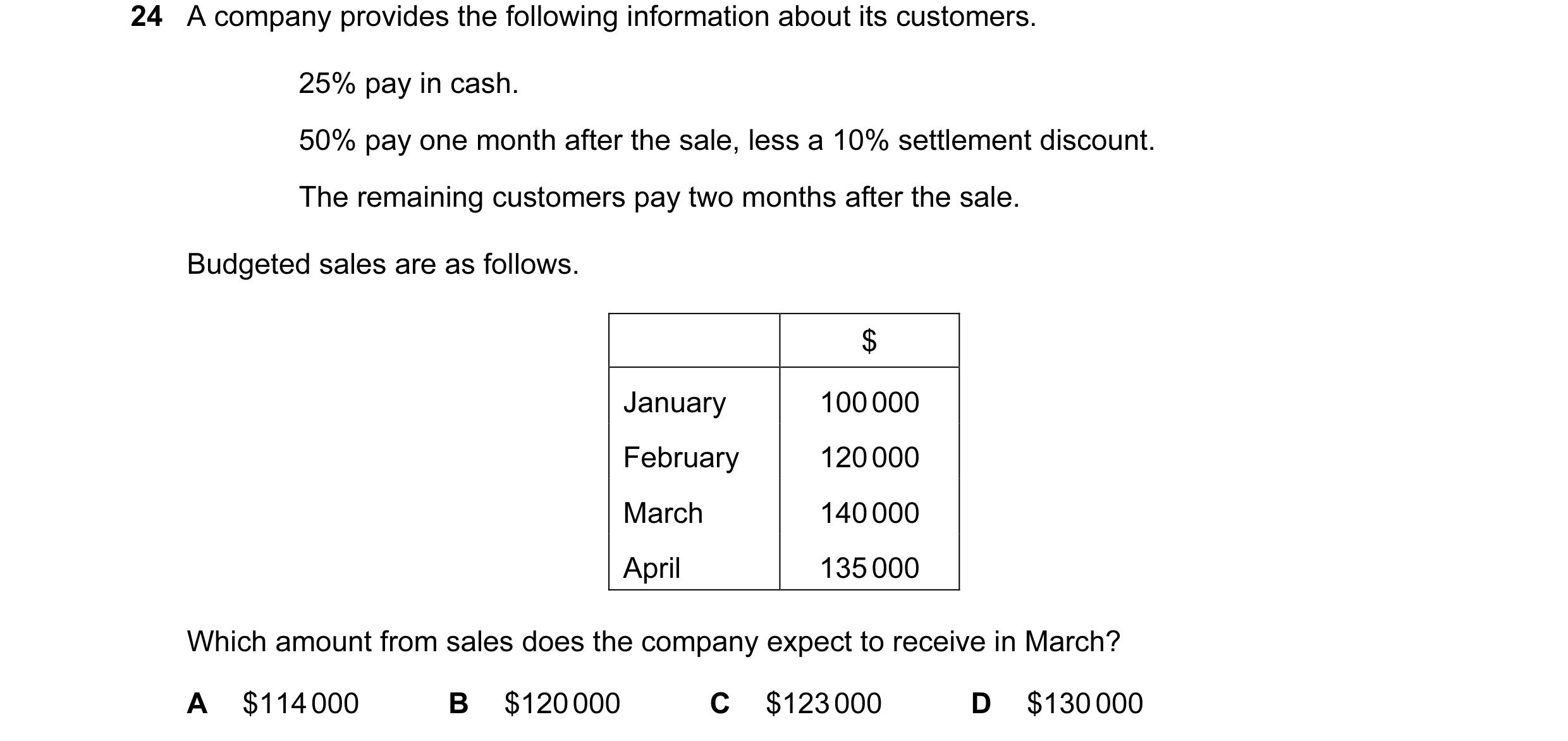
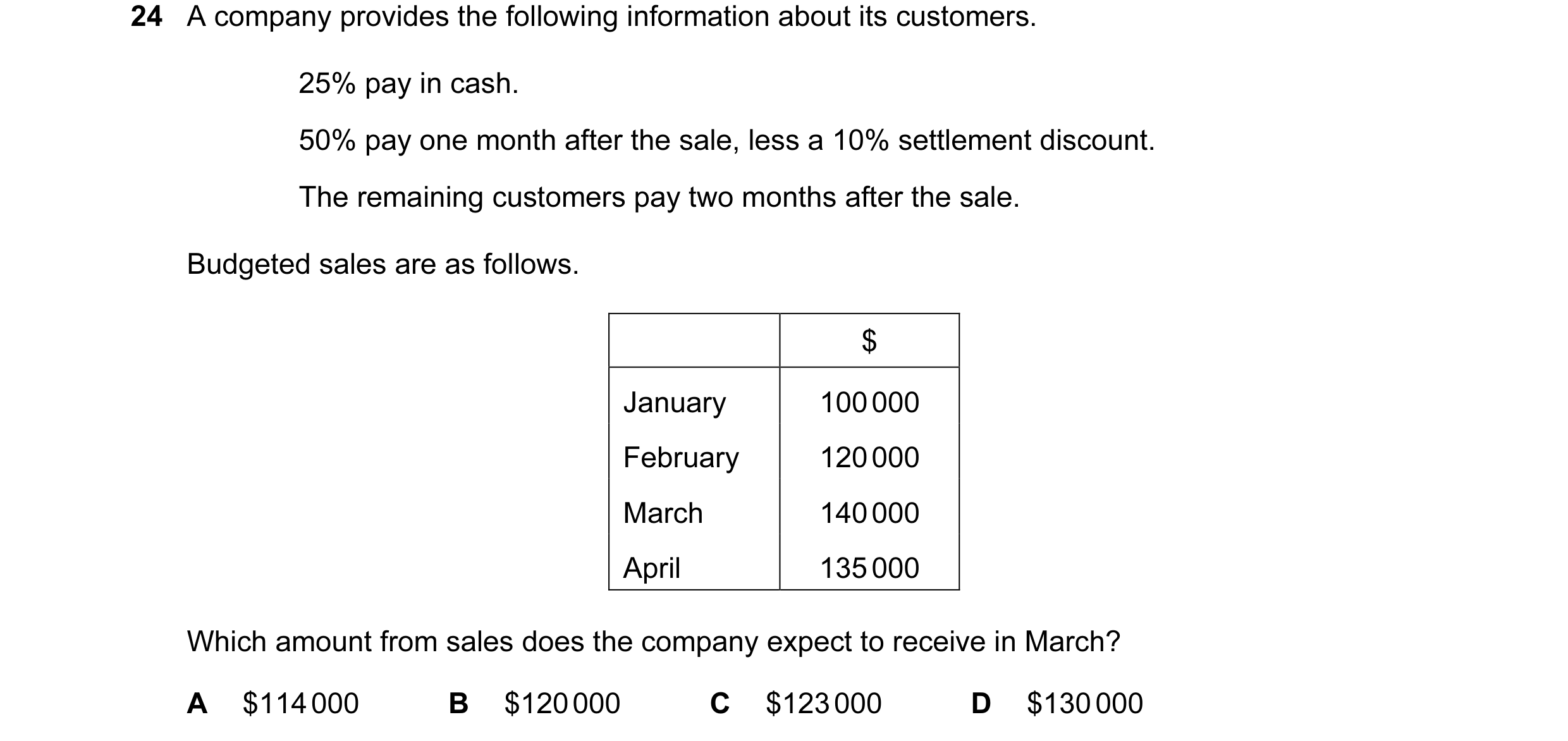
Q73 · A company provides the following information about its customers 9706/31 May/June 2014
24 A company provides the following information about its customers. 25% pay in cash. 50% pay one month after the sale, less a 10% settlement discount. The remaining customers pay two months after the sale. Budgeted sales are as follows. $ January 100 000 February 120 000 March 140 000 April 135 000 Which amount from sales does the company expect to receive in March? A $114 000 B $120 000 C $123 000 D $130 000
1 marks
Answer: A
This question in 9706/31 May/June 2014
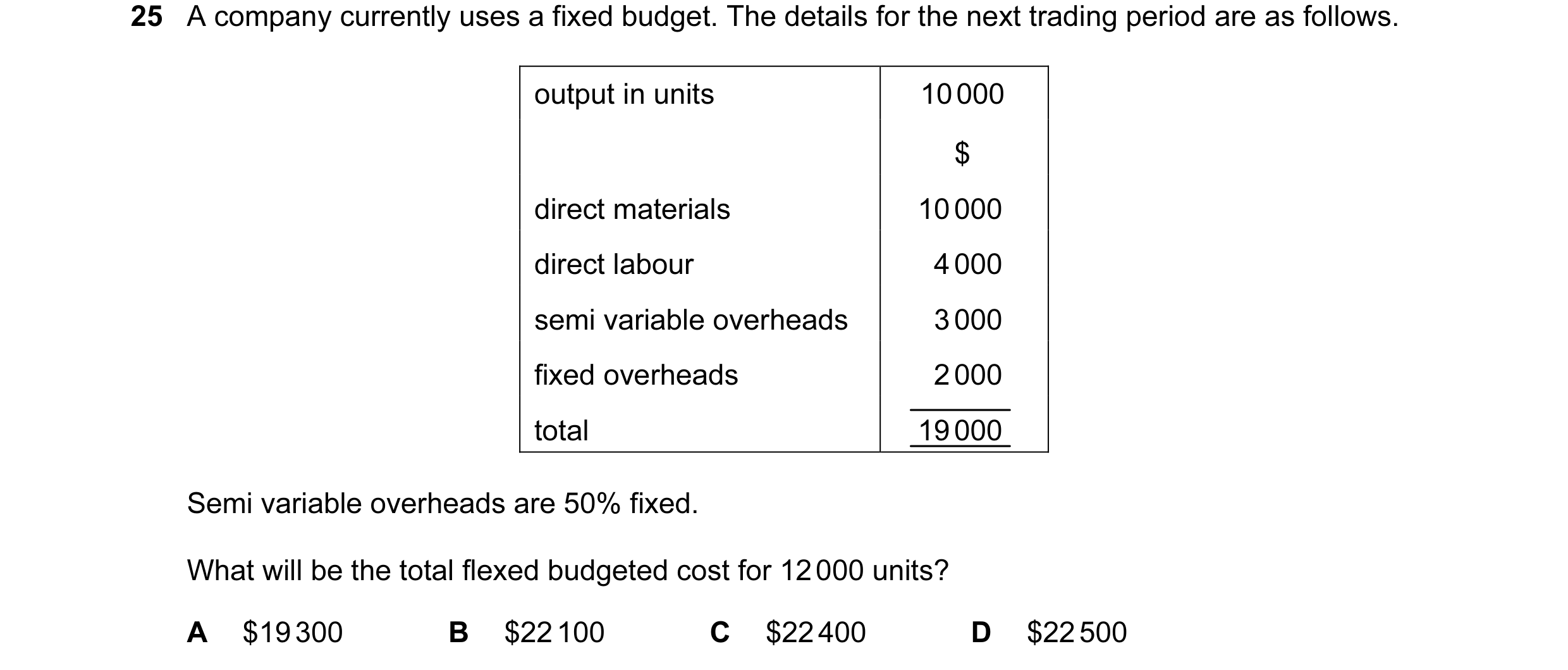
Q74 · A company currently uses a fixed budget 9706/31 May/June 2014
25 A company currently uses a fixed budget. The details for the next trading period are as follows. output in units 10 000 $ direct materials 10 000 direct labour 4 000 semi variable overheads 3 000 fixed overheads 2 000 total 19 000 Semi variable overheads are 50% fixed. What will be the total flexed budgeted cost for 12 000 units? A $19 300 B $22 100 C $22 400 D $22 500
1 marks
Answer: B
This question in 9706/31 May/June 2014
Q75 · A company provides the following information about its customers 9706/32 May/June 2014
24 A company provides the following information about its customers. 25% pay in cash. 50% pay one month after the sale, less a 10% settlement discount. The remaining customers pay two months after the sale. Budgeted sales are as follows. $ January 100 000 February 120 000 March 140 000 April 135 000 Which amount from sales does the company expect to receive in March? A $114 000 B $120 000 C $123 000 D $130 000
1 marks
Answer: A
This question in 9706/32 May/June 2014
Q76 · A company currently uses a fixed budget 9706/32 May/June 2014
25 A company currently uses a fixed budget. The details for the next trading period are as follows. output in units 10 000 $ direct materials 10 000 direct labour 4 000 semi variable overheads 3 000 fixed overheads 2 000 total 19 000 Semi variable overheads are 50% fixed. What will be the total flexed budgeted cost for 12 000 units? A $19 300 B $22 100 C $22 400 D $22 500
1 marks
Answer: B
This question in 9706/32 May/June 2014
Q77 · The following data relates to a manufacturing company for a month 9706/33 May/June 2014
23 The following data relates to a manufacturing company for a month. budgeted net profit as a percentage of sales 12% budgeted contribution / sales ratio 30% budgeted sales $120 000 actual sales $180 000 Selling prices and variable costs per unit and fixed costs were as budget. What profit did the company make in the month? A $21 600 B $32 400 C $36 000 D $39 600
1 marks
Answer: B
This question in 9706/33 May/June 2014
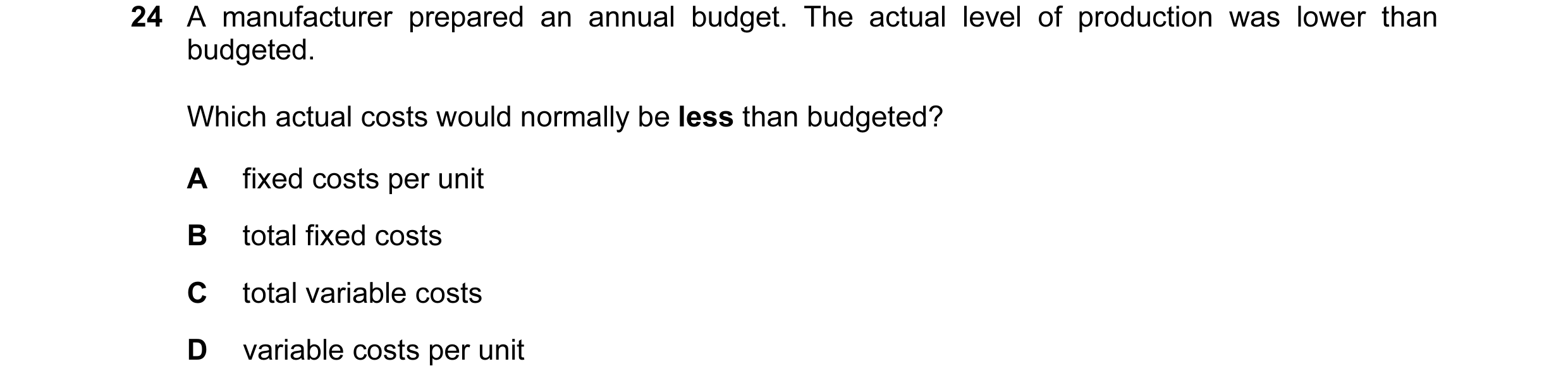
Q78 · A manufacturer prepared an annual budget 9706/33 May/June 2014
24 A manufacturer prepared an annual budget. The actual level of production was lower than budgeted. Which actual costs would normally be less than budgeted? A fixed costs per unit B total fixed costs C total variable costs D variable costs per unit
1 marks
Answer: C
This question in 9706/33 May/June 2014
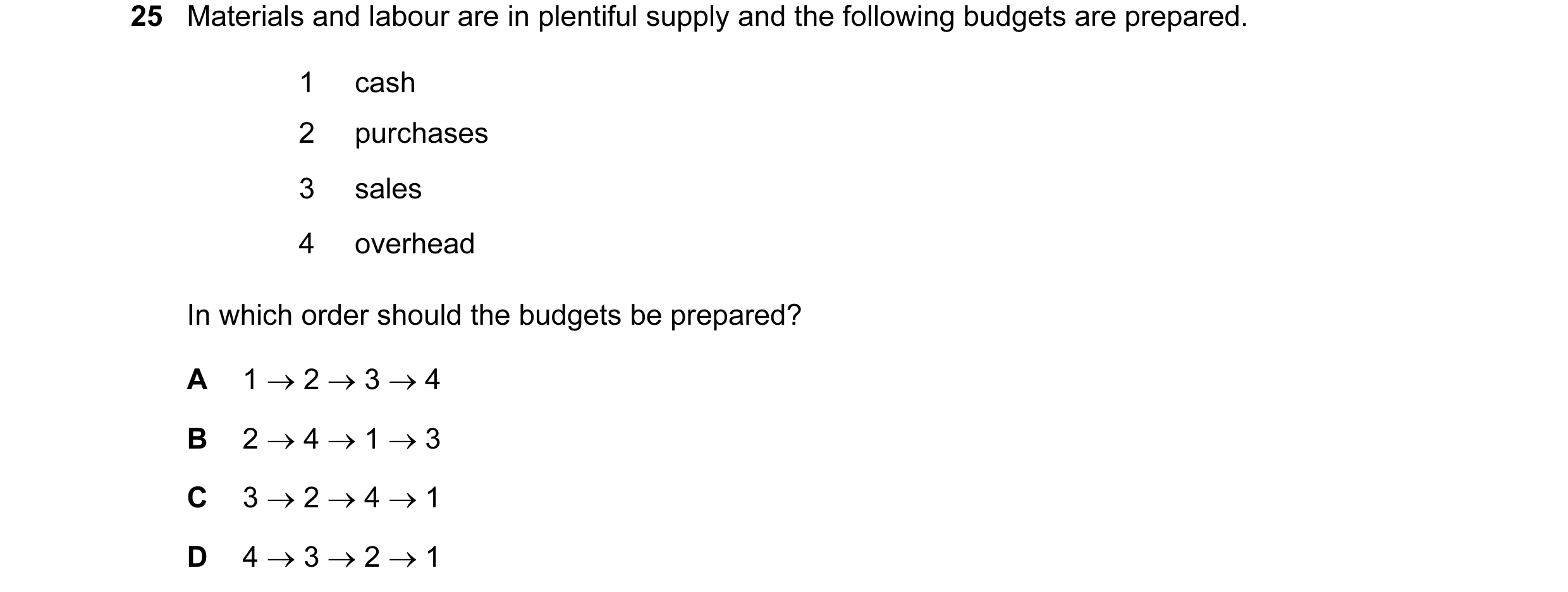
Q79 · Materials and labour are in plentiful supply and the following budgets are prepared 9706/33 May/June 2014
25 Materials and labour are in plentiful supply and the following budgets are prepared. 1 cash 2 purchases 3 sales 4 overhead In which order should the budgets be prepared? A 1 → 2 → 3 → 4 B 2 → 4 → 1 → 3 C 3 → 2 → 4 → 1 D 4 → 3 → 2 → 1
1 marks
Answer: C
This question in 9706/33 May/June 2014
Q80 · Why does a business prepare a statement reconciling the actual profit with the budgeted… 9706/33 May/June 2014
28 Why does a business prepare a statement reconciling the actual profit with the budgeted profit? A to aid preparation of the financial statements B to enable comparison with the flexed budget C to identify the cause of the variances D to report a more accurate profit figure
1 marks
Answer: B
This question in 9706/33 May/June 2014
Q81 · A company makes and sells a single product 9706/31 Oct/Nov 2015
21 A company makes and sells a single product. The following data relates to the current year’s results. sales and production in units 2000 variable cost per unit $150 fixed cost per unit $80 contribution / sales ratio 50% profit for the year $140 000 It is expected that the selling price next year will be $315 per unit and that total fixed costs will increase by 10%. How many units will need to be sold next year in order to achieve the same profit as in the current year? A 1819 B 1904 C 1916 D 2006
1 marks
Answer: C
This question in 9706/31 Oct/Nov 2015
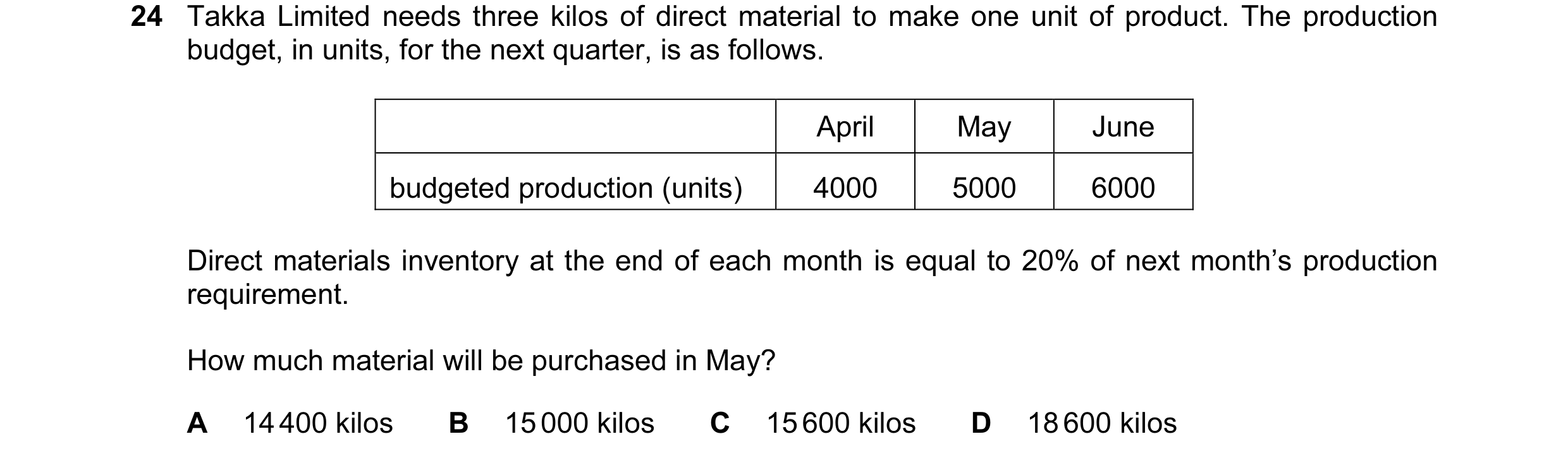
Q82 · Takka Limited needs three kilos of direct material to make one unit of product 9706/31 Oct/Nov 2015
24 Takka Limited needs three kilos of direct material to make one unit of product. The production budget, in units, for the next quarter, is as follows. April May June budgeted production (units) 4000 5000 6000 Direct materials inventory at the end of each month is equal to 20% of next month’s production requirement. How much material will be purchased in May? A 14 400 kilos B 15 000 kilos C 15 600 kilos D 18 600 kilos
1 marks
Answer: C
This question in 9706/31 Oct/Nov 2015
Q83 · Which statement about budgetary control is correct? 9706/32 Oct/Nov 2015
24 Which statement about budgetary control is correct? A It always adjusts the previous year’s budgets for rising prices. B It can only be applied to manufacturing situations. C It cannot take account of varying levels of activity. D It compares actual results with predetermined costs and revenues.
1 marks
Answer: D
This question in 9706/32 Oct/Nov 2015
Q84 · A business is preparing its cash budget and provides the following information 9706/32 Oct/Nov 2015
25 A business is preparing its cash budget and provides the following information. material purchases monthly wages month $000 $000 January 330 200 February 360 200 March 390 200 One third of materials are paid for in the month they are purchased. The remainder are paid for two months later. Half the wages are paid for in the month and the remainder are paid in the following month. The business will purchase a machine costing $80 000 in March. They will pay $50 000 in March and the balance in August. Which figure will appear as other payables in the statement of financial position at 31 March? A $130 000 B $500 000 C $600 000 D $630 000
1 marks
Answer: A
This question in 9706/32 Oct/Nov 2015
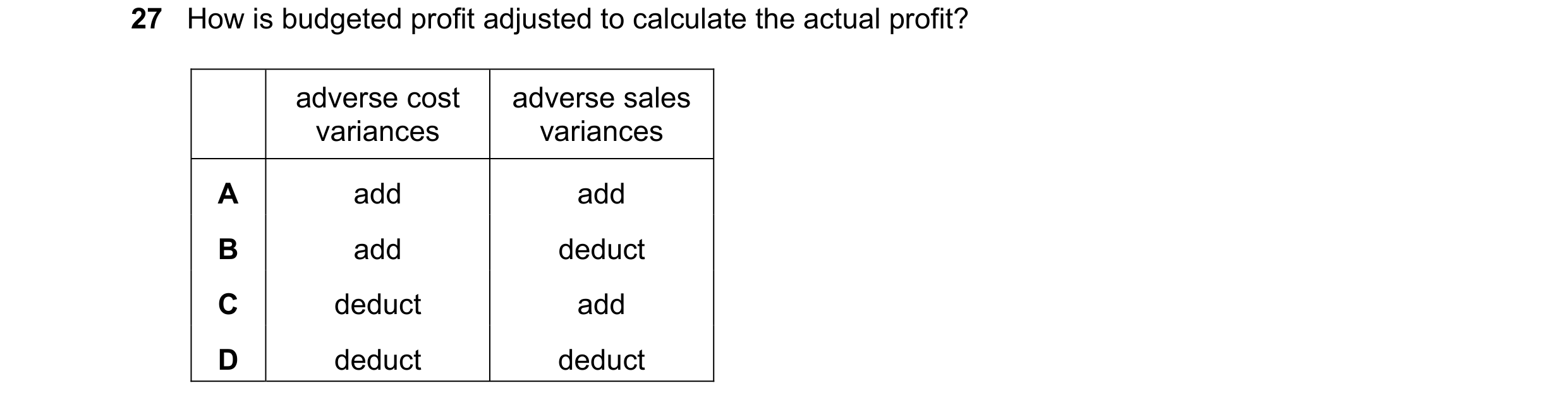
Q85 · How is budgeted profit adjusted to calculate the actual profit? 9706/32 Oct/Nov 2015
27 How is budgeted profit adjusted to calculate the actual profit? adverse cost adverse sales variances variances A add add B add deduct C deduct add D deduct deduct
1 marks
Answer: D
This question in 9706/32 Oct/Nov 2015



 1 / 22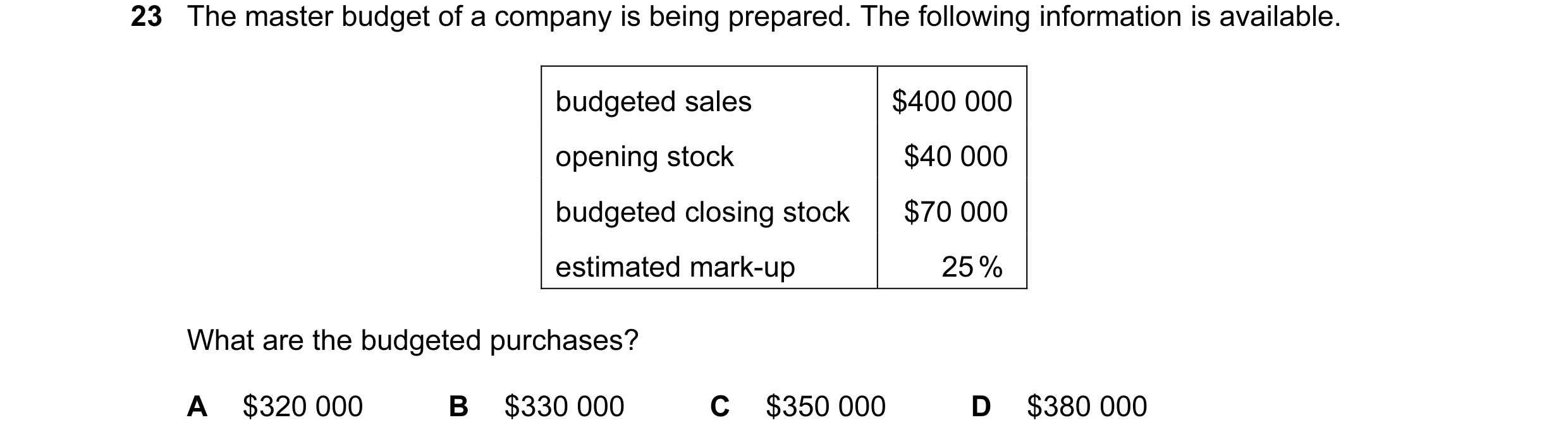
 2 / 22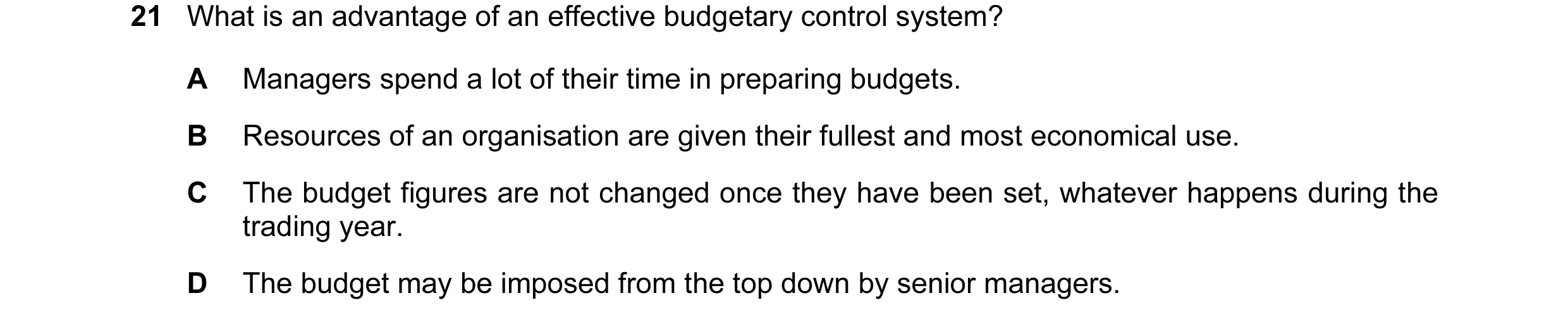
 3 / 22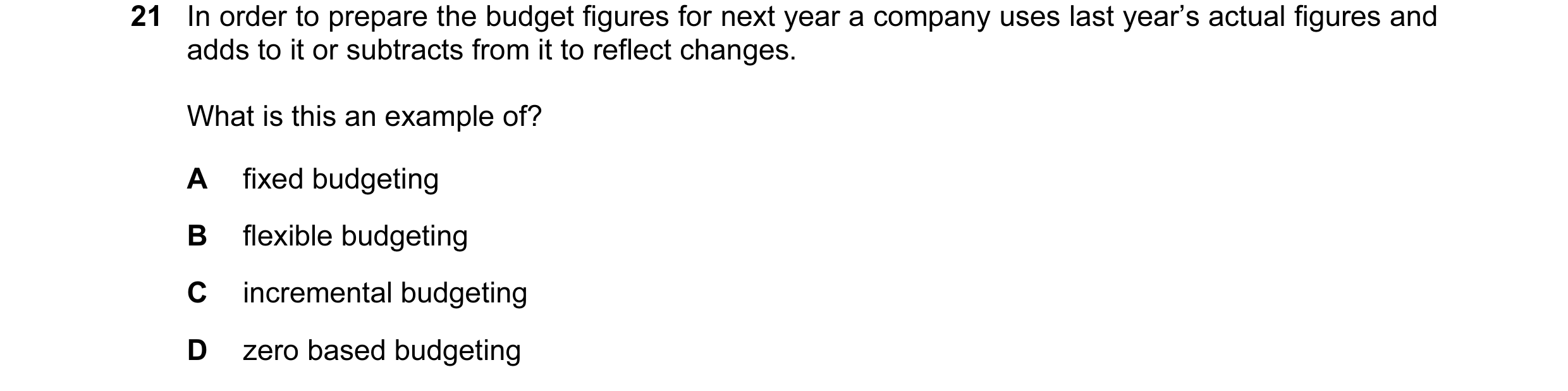
 4 / 22
 5 / 22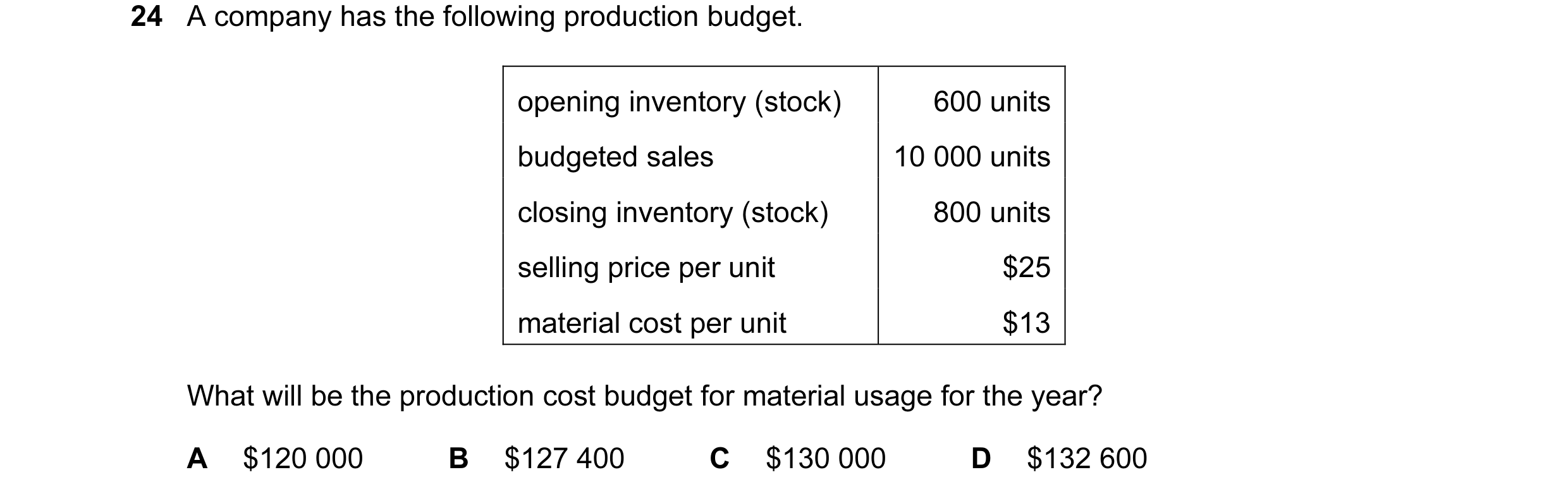

 6 / 22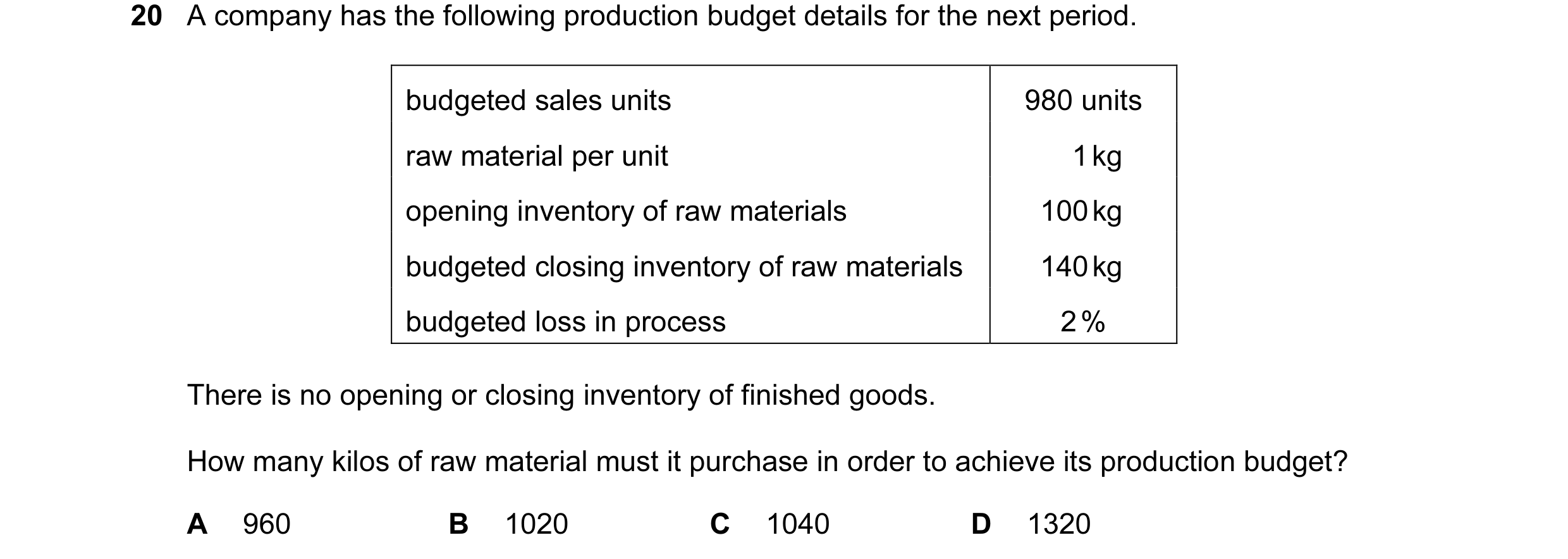

 7 / 22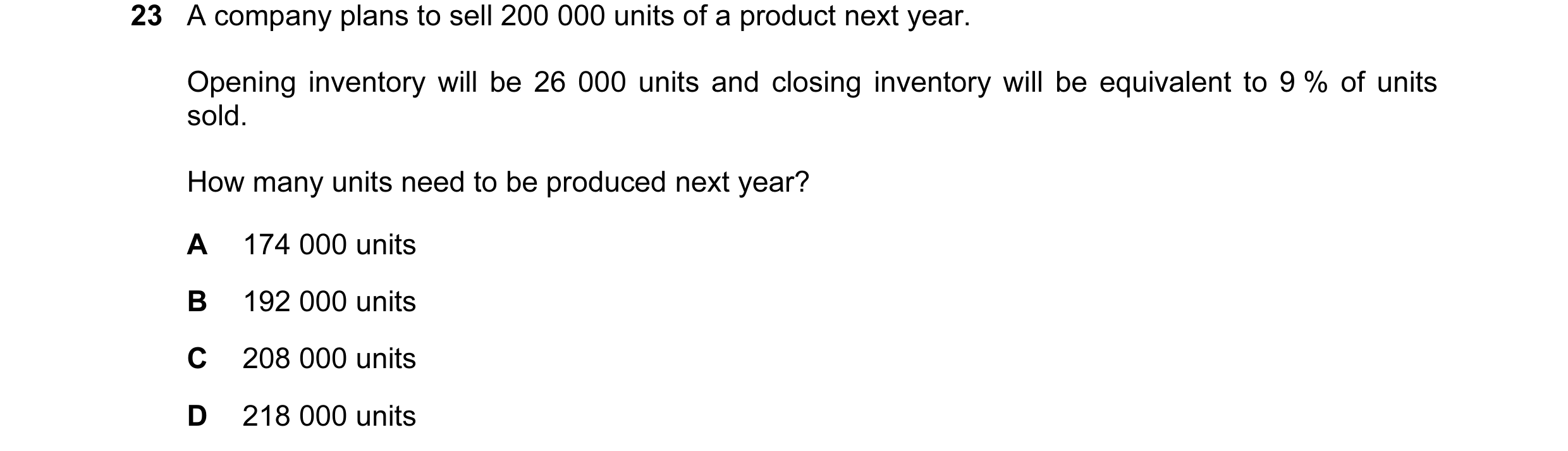


 8 / 22


 9 / 22


 10 / 22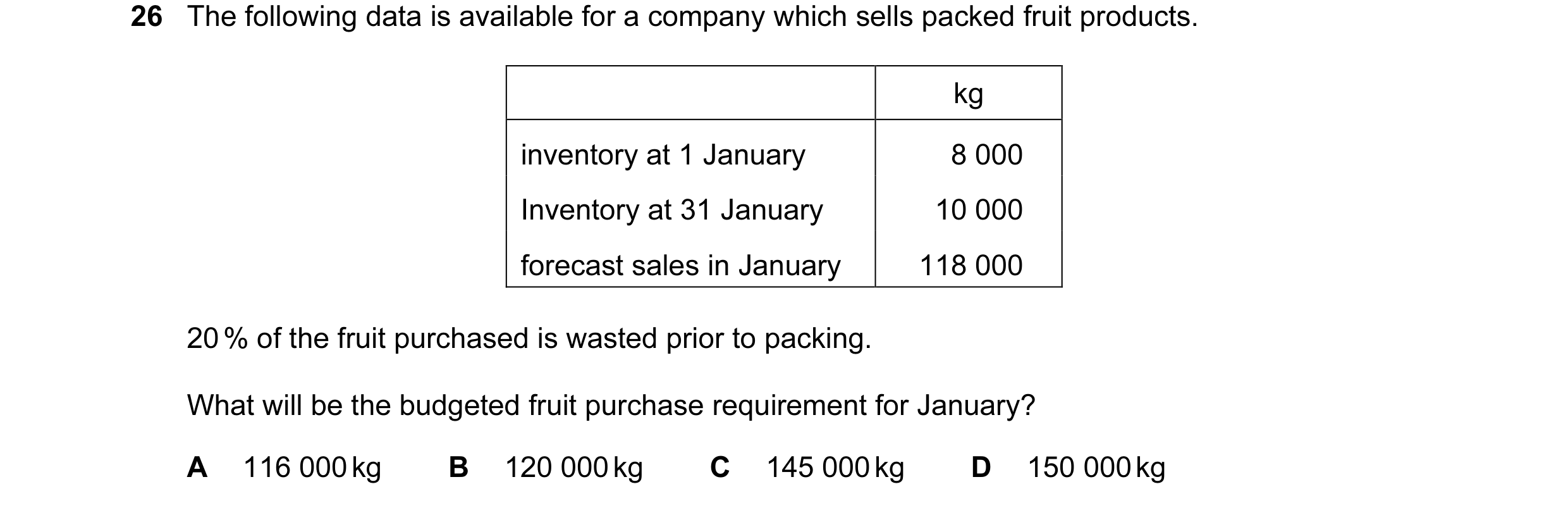
 11 / 22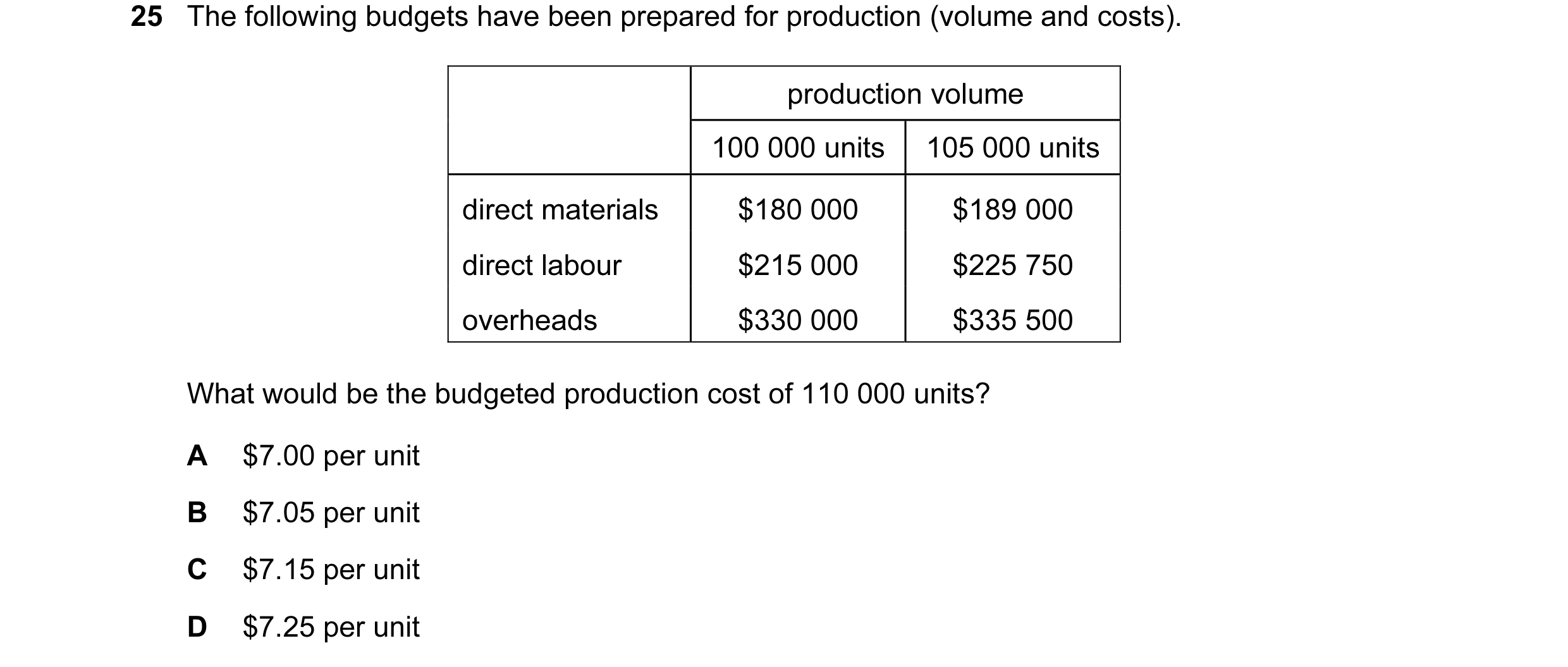
 12 / 22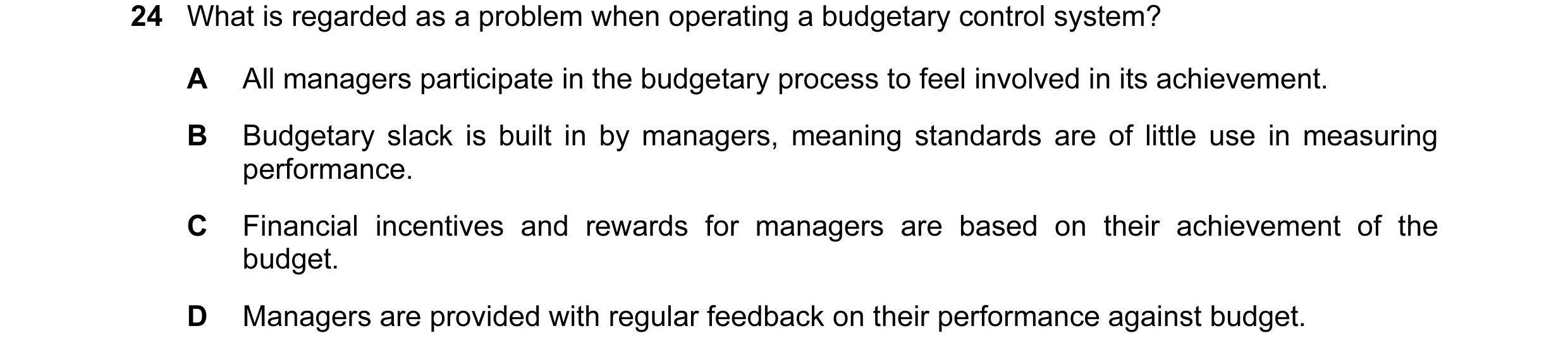

 13 / 22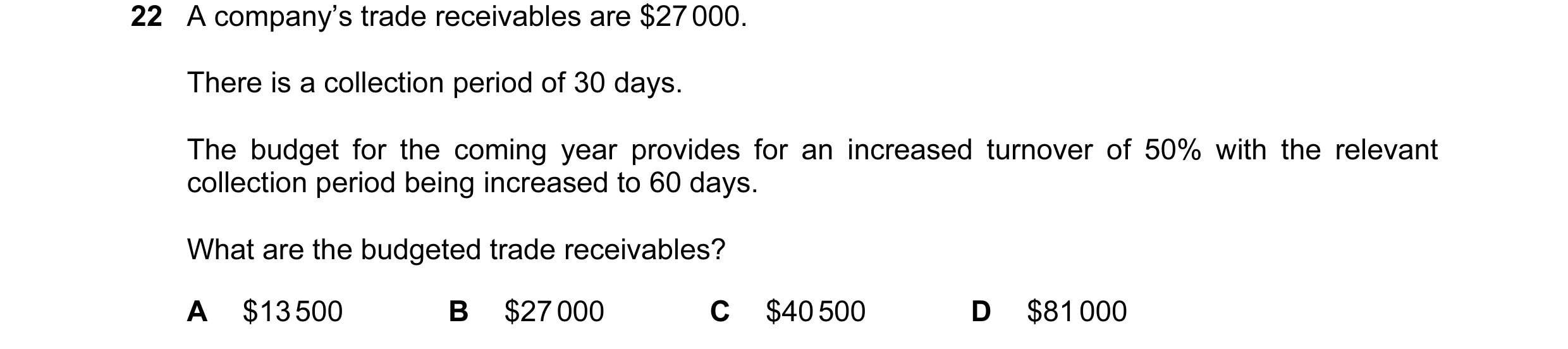
 14 / 22
 15 / 22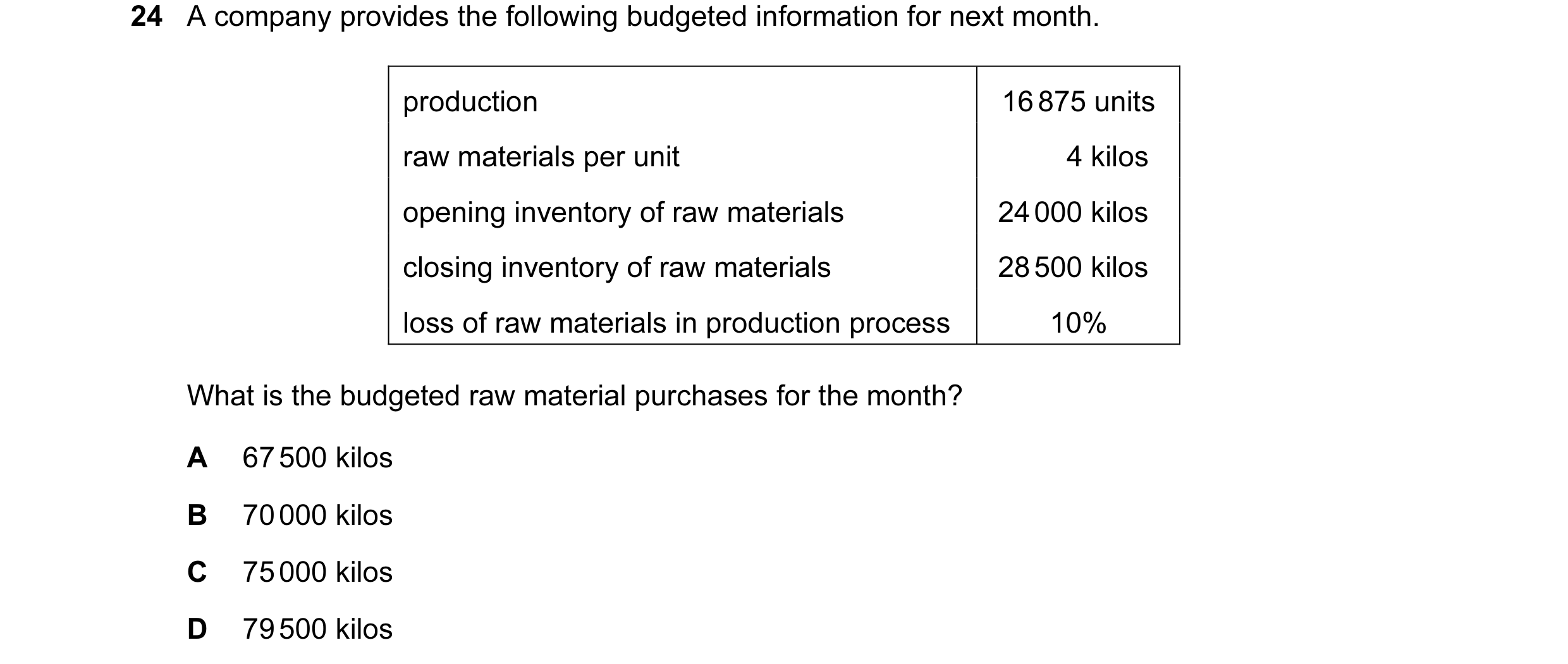
 16 / 22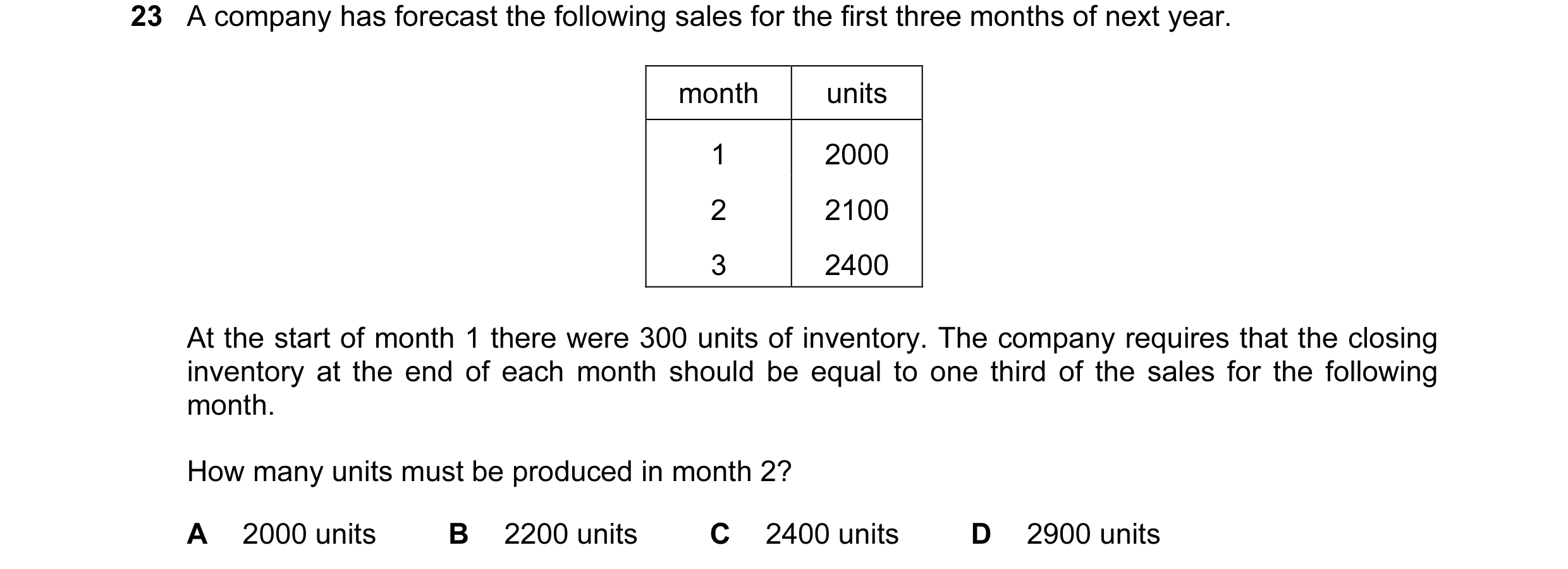


 17 / 22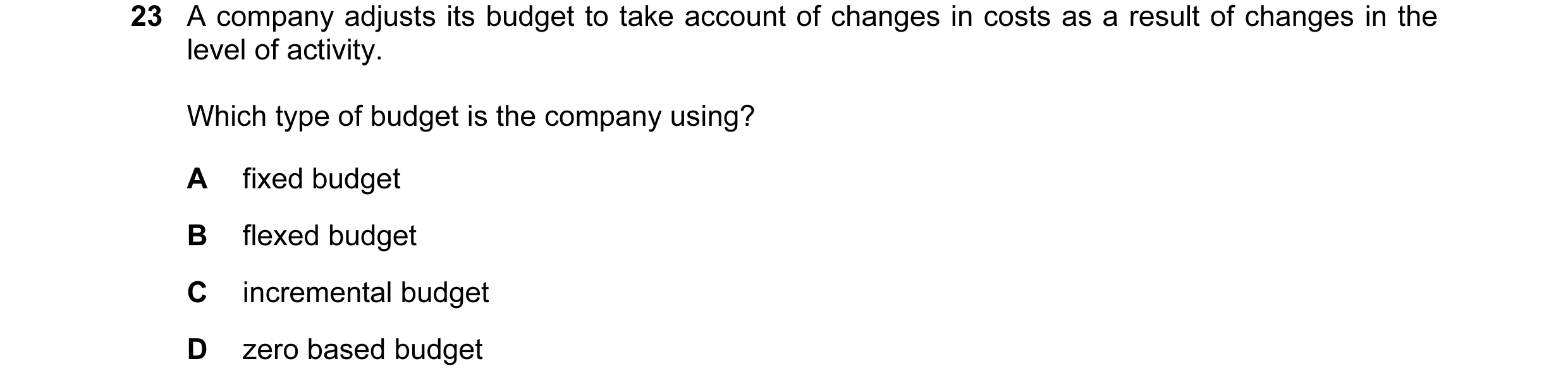
 18 / 22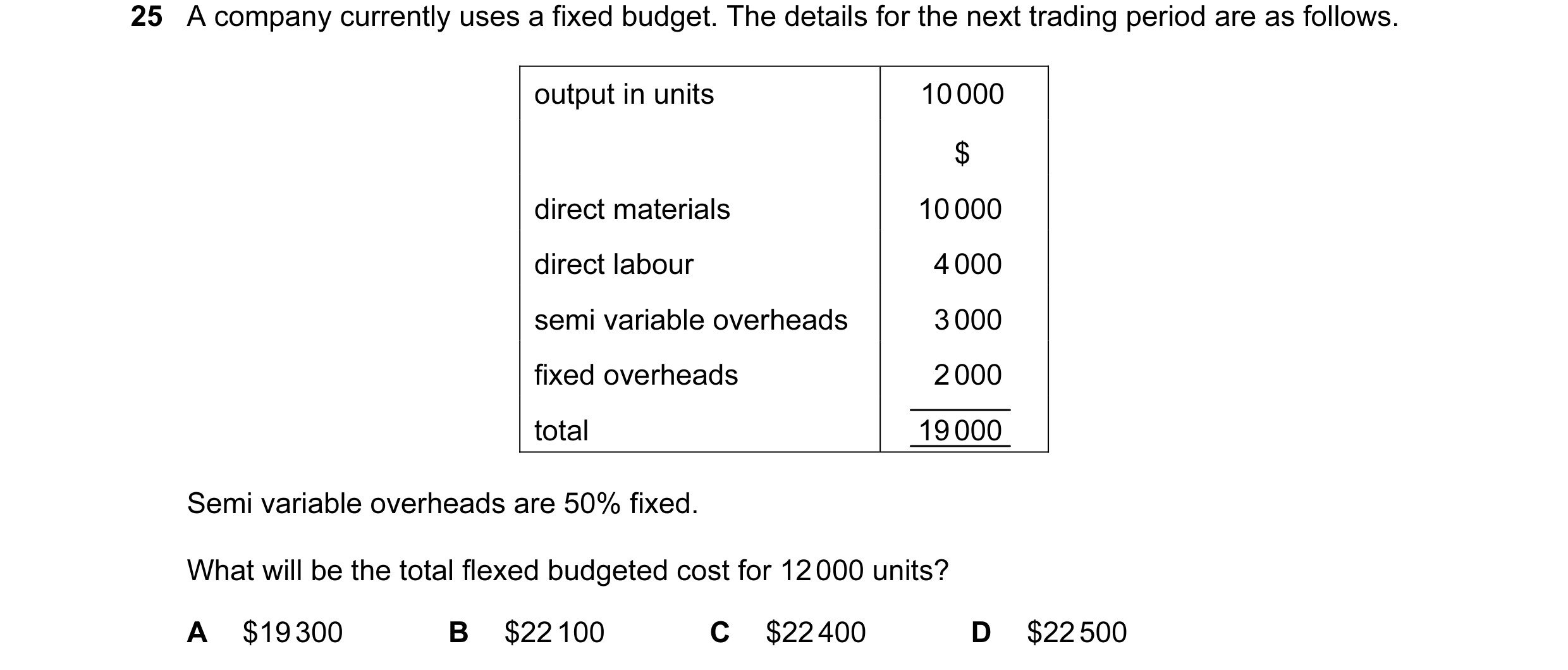
 19 / 22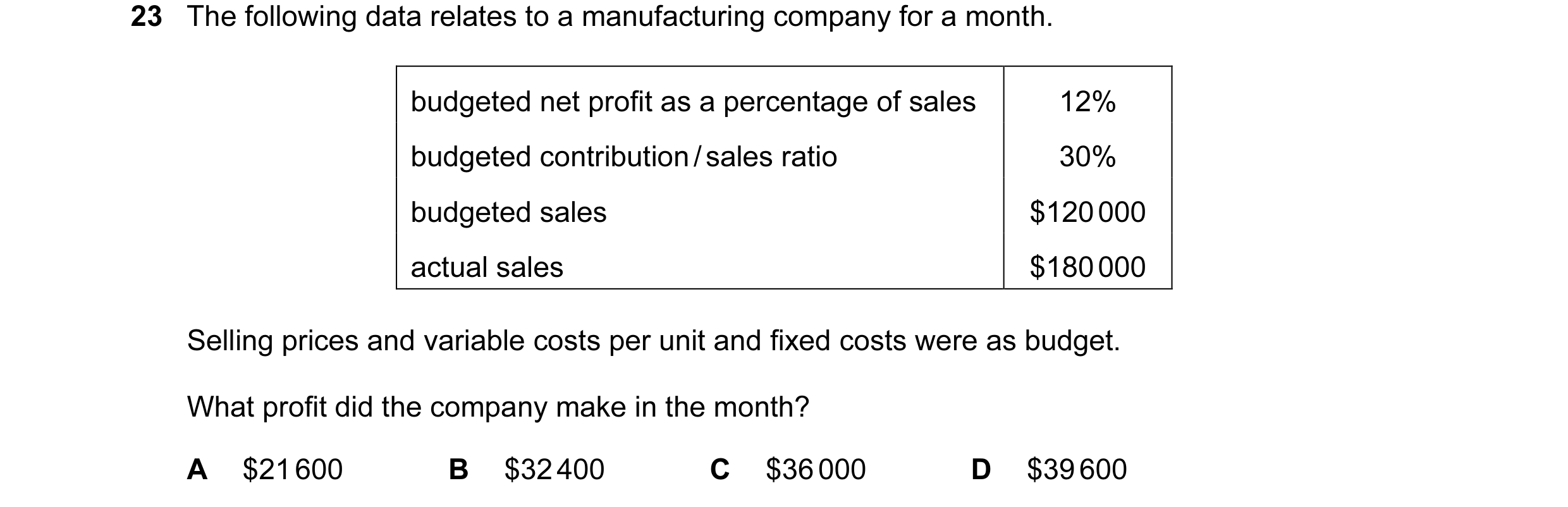
 20 / 22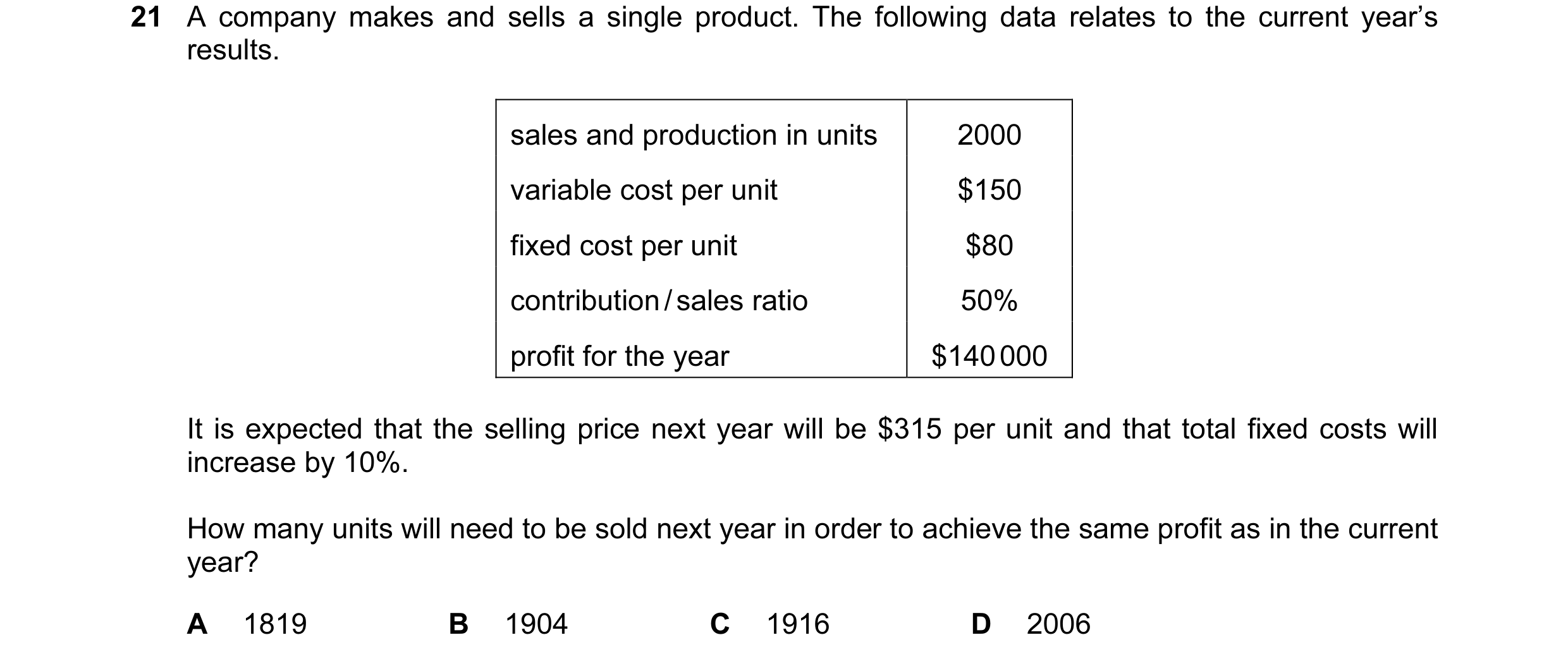
 21 / 22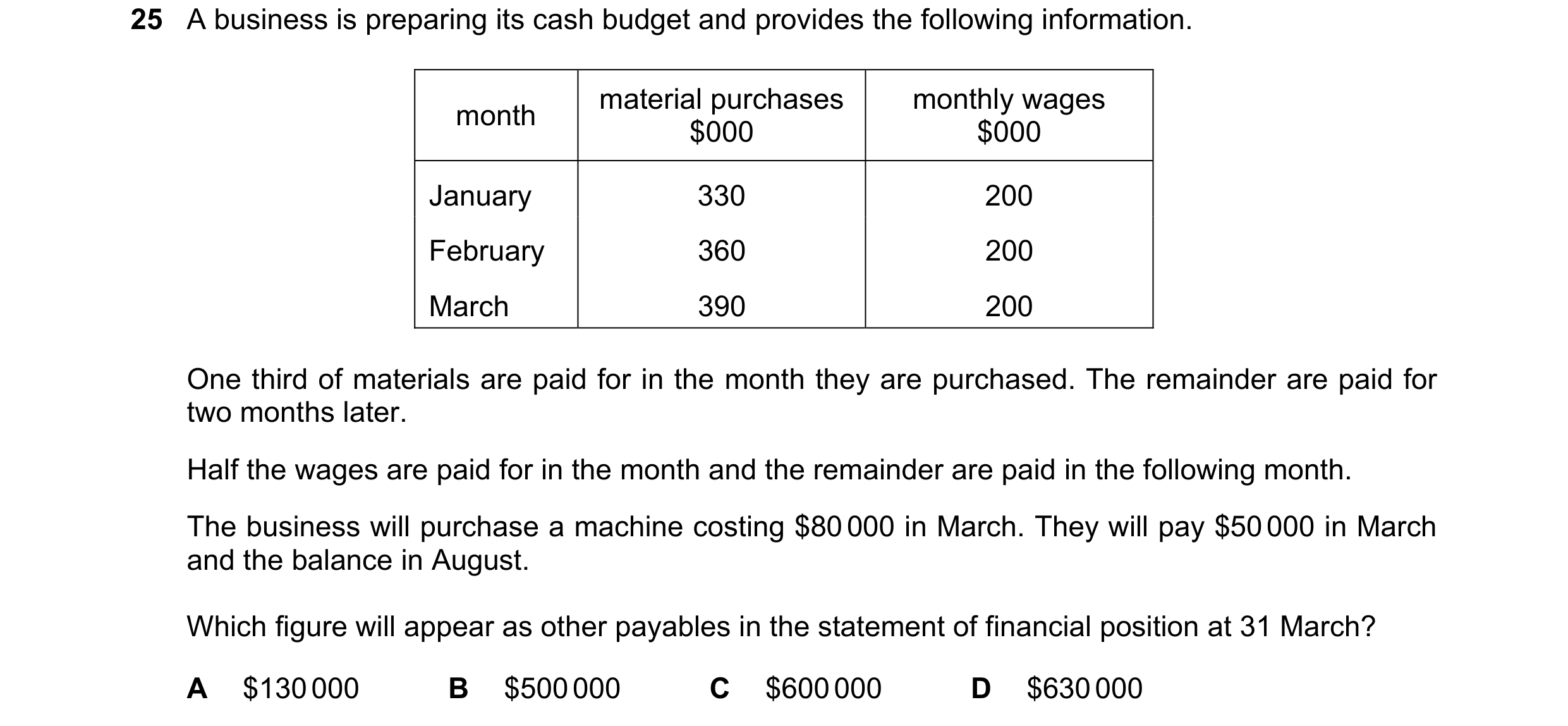
 22 / 22