Questions as text
Q1 · Which type of radiation produces the most ionisation? 0654/11 May/June 2005
39 Which type of radiation produces the most ionisation? A alpha-particles B beta-particles C gamma-rays D all produce the same amount
1 marks
Answer: A
This question in 0654/11 May/June 2005
Q2 · A powder contains 400 mg of a radioactive material which emits alpha-particles 0654/11 May/June 2005
40 A powder contains 400 mg of a radioactive material which emits alpha-particles. The half-life of the material is 5 days. What mass of that material remains after 10 days? A 0 mg B 40 mg C 100 mg D 200 mg
1 marks
Answer: C
This question in 0654/11 May/June 2005
Q3 · A Geiger counter detects radiation from radioactive sources 0654/11 May/June 2006
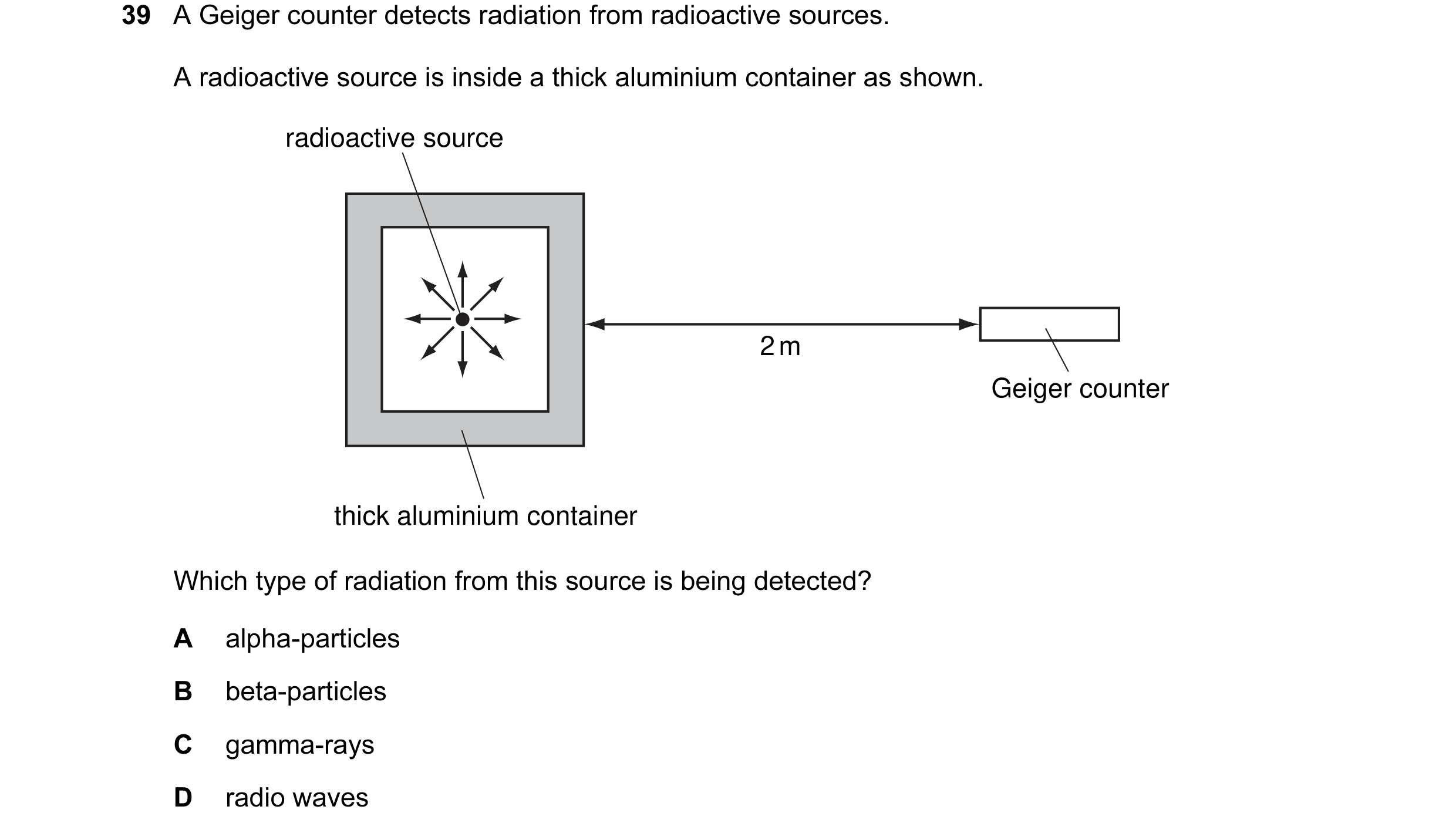
39 A Geiger counter detects radiation from radioactive sources. A radioactive source is inside a thick aluminium container as shown. radioactive source 2 m Geiger counter thick aluminium container Which type of radiation from this source is being detected? A alpha-particles B beta-particles C gamma-rays D radio waves
1 marks
Answer: C
This question in 0654/11 May/June 2006
Q4 · Particles are emitted by a heated cathode in a cathode-ray tube 0654/11 Oct/Nov 2006
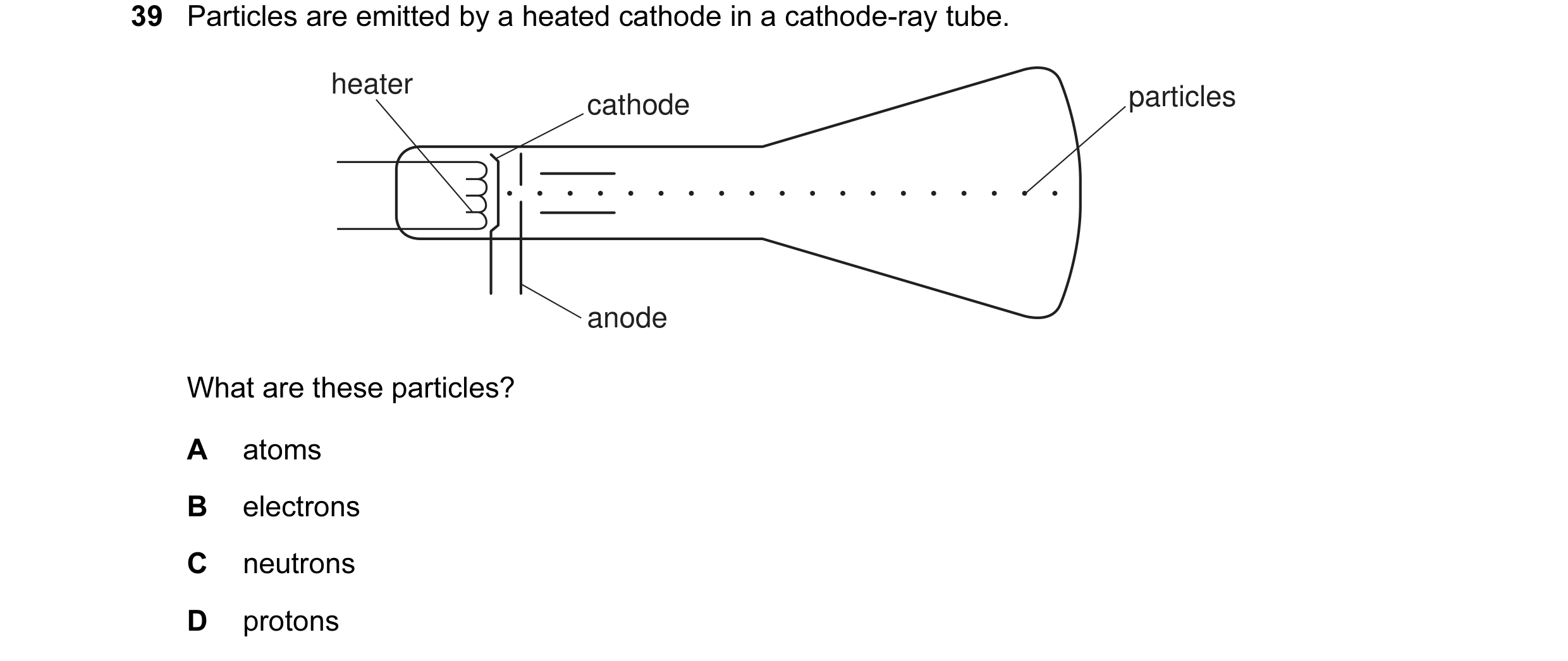
39 Particles are emitted by a heated cathode in a cathode-ray tube. heater particles cathode anode What are these particles? A atoms B electrons C neutrons D protons
1 marks
Answer: B
This question in 0654/11 Oct/Nov 2006
Q5 · Which line in the table describes the nature of alpha radiation and of gamma radiation? 0654/11 Oct/Nov 2006
40 Which line in the table describes the nature of alpha radiation and of gamma radiation? alpha radiation gamma radiation A helium nuclei electromagnetic waves B helium nuclei electrons C protons electromagnetic waves D protons electrons
1 marks
Answer: A
This question in 0654/11 Oct/Nov 2006
Q6 · The half-life of a radioactive substance is 5 hours 0654/11 May/June 2007
40 The half-life of a radioactive substance is 5 hours. A sample is tested and found to contain 0.48 g of the substance. How much of the substance was present in the sample 20 hours before the sample was tested? A 0.03 g B 0.12 g C 1.92 g D 7.68 g
1 marks
Answer: D
This question in 0654/11 May/June 2007
Q7 · A sheet of paper is placed between a radioactive source and a detector 0654/11 Oct/Nov 2007
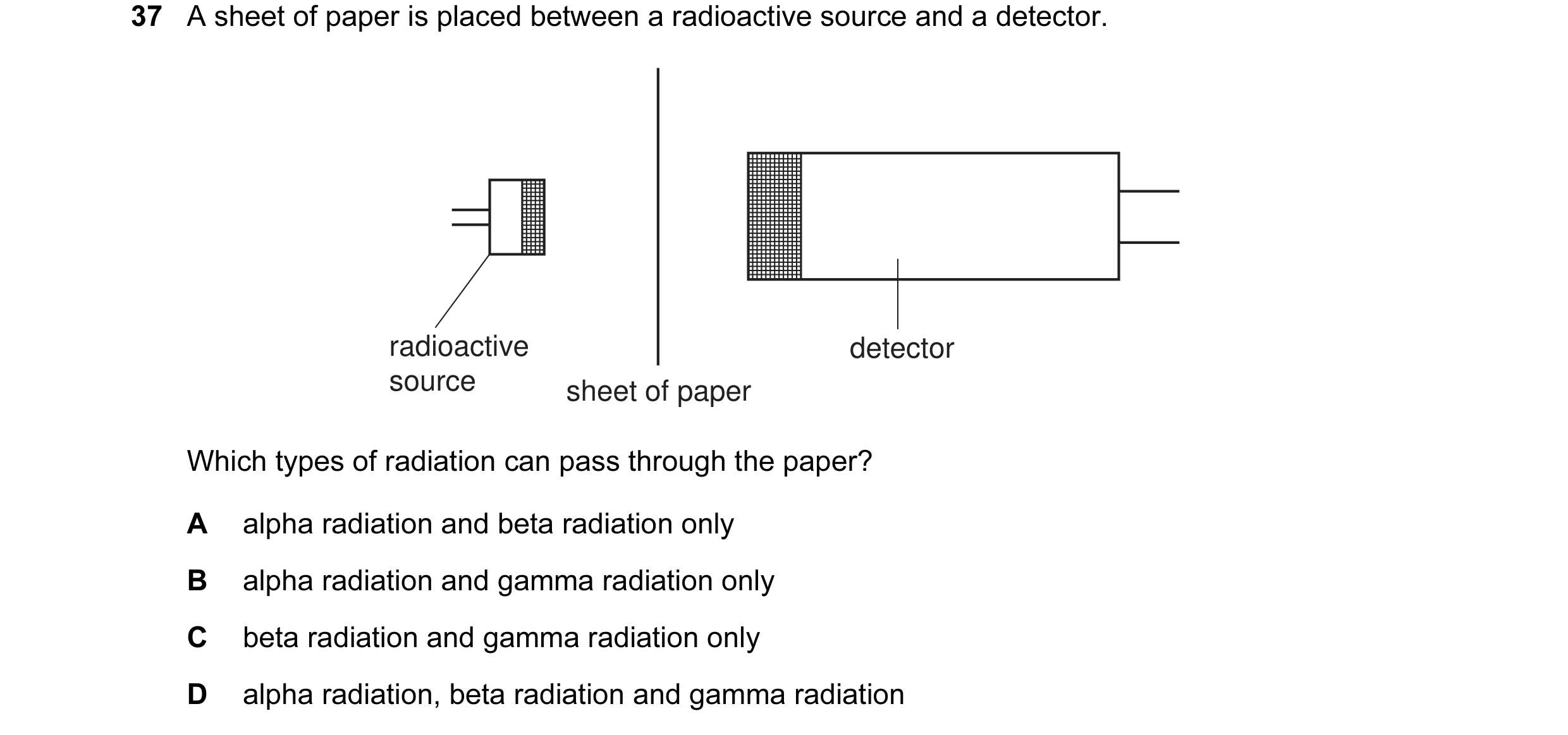
37 A sheet of paper is placed between a radioactive source and a detector. radioactive detector source sheet of paper Which types of radiation can pass through the paper? A alpha radiation and beta radiation only B alpha radiation and gamma radiation only C beta radiation and gamma radiation only D alpha radiation, beta radiation and gamma radiation
1 marks
Answer: C
This question in 0654/11 Oct/Nov 2007
Q8 · There are three types of emission from radioactive substances 0654/11 May/June 2008
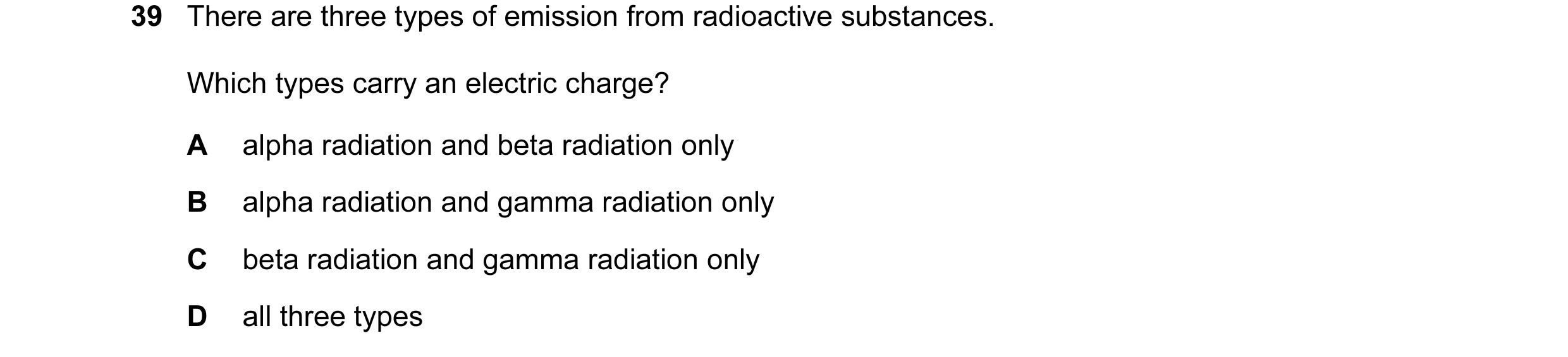
39 There are three types of emission from radioactive substances. Which types carry an electric charge? A alpha radiation and beta radiation only B alpha radiation and gamma radiation only C beta radiation and gamma radiation only D all three types
1 marks
Answer: A
This question in 0654/11 May/June 2008
Q9 · A sample of radioactive uranium has mass 1g 0654/11 May/June 2008
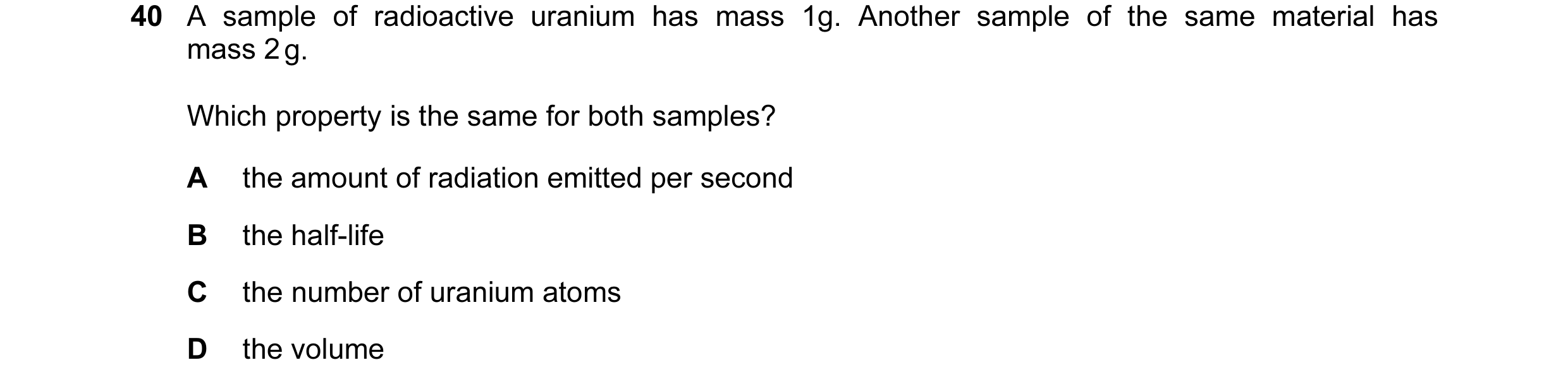
40 A sample of radioactive uranium has mass 1g. Another sample of the same material has mass 2 g. Which property is the same for both samples? A the amount of radiation emitted per second B the half-life C the number of uranium atoms D the volume
1 marks
Answer: B
This question in 0654/11 May/June 2008
Q10 · The diagram shows an experiment to monitor the radiation from a radioactive gas 0654/11 Oct/Nov 2008
40 The diagram shows an experiment to monitor the radiation from a radioactive gas. The counter readings are corrected for background radiation. counter 000.0 radioactive gas The table shows how the counter reading varies with time. time / seconds 0 20 40 60 80 100 120 140 160 180 counter reading / 140 105 82 61 44 36 27 20 15 10 counts per minute What is the half-life of the gas? A between 20 and 40 seconds B between 40 and 60 seconds C between 60 and 140 seconds D between 140 and 180 seconds
1 marks
Answer: B
This question in 0654/11 Oct/Nov 2008
Q11 · The graph shows the decay curve for one particular type of radioactive nuclide 0654/11 May/June 2009
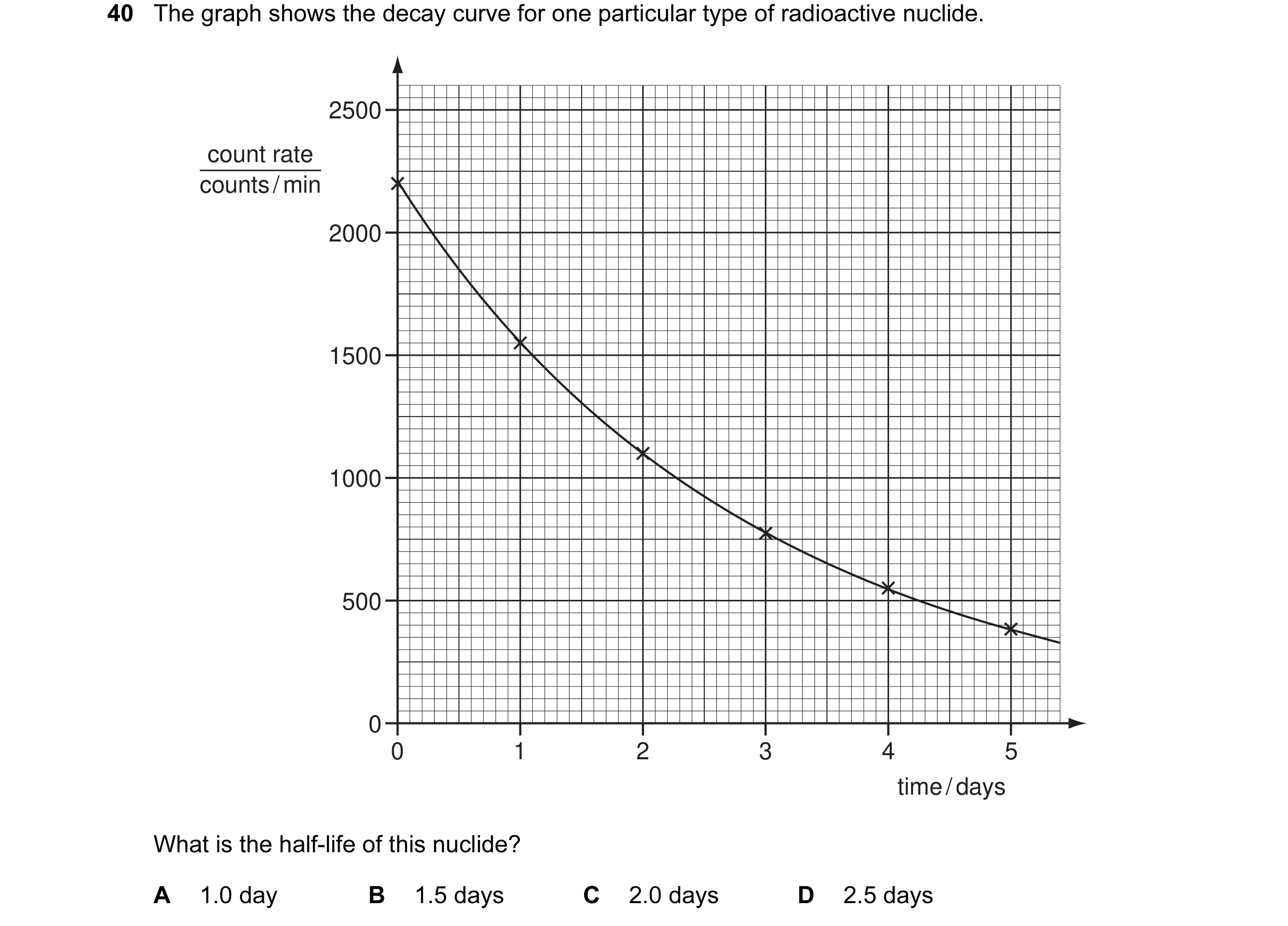
40 The graph shows the decay curve for one particular type of radioactive nuclide. 2500 count rate counts / min 2000 1500 1000 500 0 0 1 2 3 4 5 time / days What is the half-life of this nuclide? A 1.0 day B 1.5 days C 2.0 days D 2.5 days
1 marks
Answer: C
This question in 0654/11 May/June 2009
Q12 · Which statement explains the meaning of the half-life of a radioactive substance? 0654/11 Oct/Nov 2009
39 Which statement explains the meaning of the half-life of a radioactive substance? A half the time taken for half the substance to decay B half the time taken for the substance to decay completely C the time taken for half the substance to decay D the time taken for the substance to decay completely
1 marks
Answer: C
This question in 0654/11 Oct/Nov 2009
Q13 · The diagram shows the paths of three different types of radiation, X, Y and Z 0654/11 Oct/Nov 2009
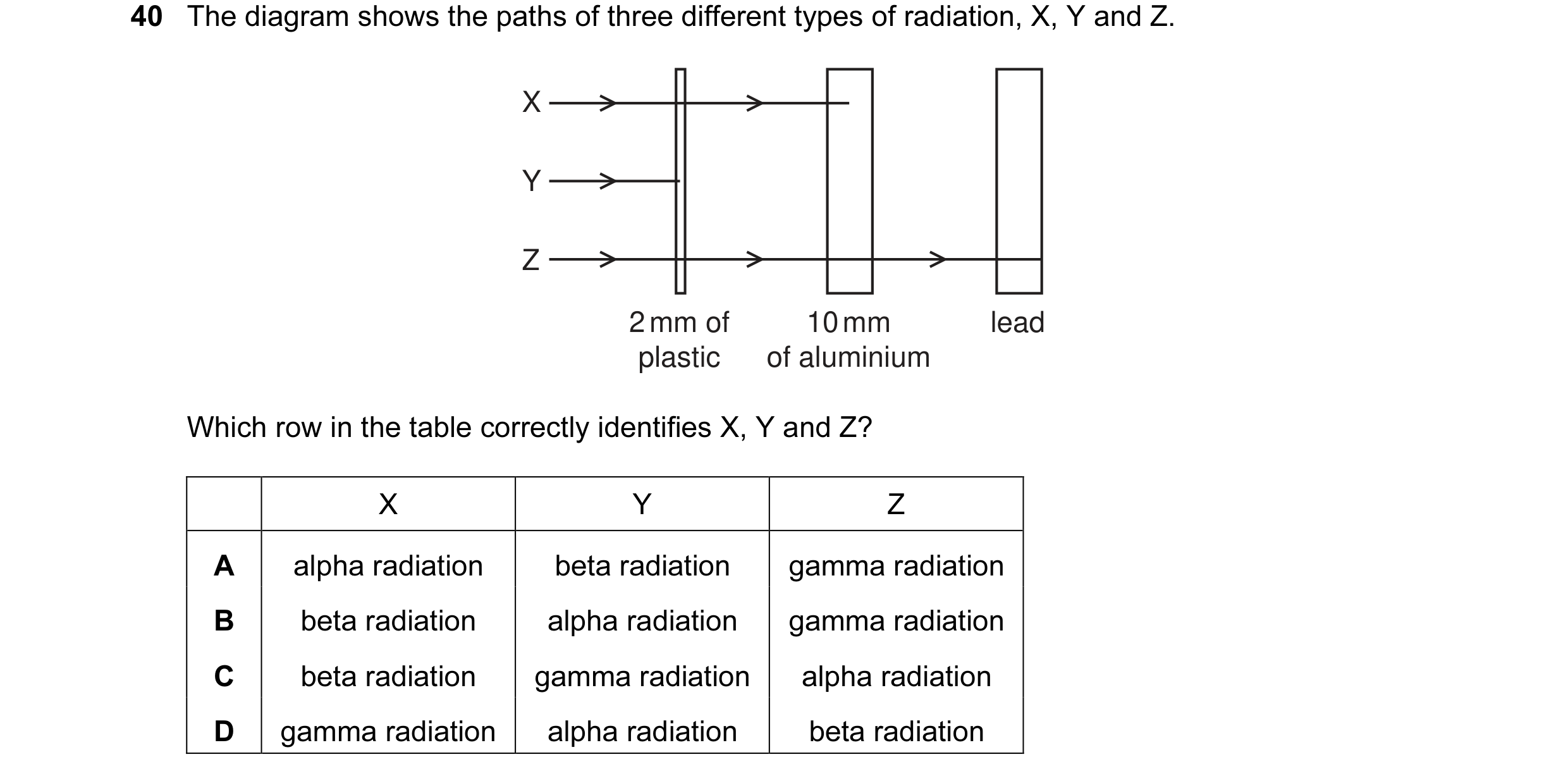
40 The diagram shows the paths of three different types of radiation, X, Y and Z. X Y Z 2 mm of 10 mm lead plastic of aluminium Which row in the table correctly identifies X, Y and Z? X Y Z A alpha radiation beta radiation gamma radiation B beta radiation alpha radiation gamma radiation C beta radiation gamma radiation alpha radiation D gamma radiation alpha radiation beta radiation
1 marks
Answer: B
This question in 0654/11 Oct/Nov 2009
Q14 · Which statement about radioactive emissions is correct? 0654/11 May/June 2010
39 Which statement about radioactive emissions is correct? A Alpha-particles are the least penetrating and are positively charged. B Alpha-particles are the most penetrating and are positively charged. C Gamma-rays are the least penetrating and are positively charged. D Gamma-rays are the most penetrating and are positively charged.
1 marks
Answer: A
This question in 0654/11 May/June 2010
Q15 · A sample of radioactive material has a mass of 64 mg and a half-life of 16 years 0654/11 May/June 2010
40 A sample of radioactive material has a mass of 64 mg and a half-life of 16 years. What is the time taken for the mass of the sample to decrease to 8 mg? A 2 years B 4 years C 48 years D 128 years
1 marks
Answer: C
This question in 0654/11 May/June 2010
Q16 · A sample of radioactive material has a mass of 64 mg and a half-life of 16 years 0654/12 May/June 2010
31 A sample of radioactive material has a mass of 64 mg and a half-life of 16 years. What is the time taken for the mass of the sample to decrease to 8 mg? A 2 years B 4 years C 48 years D 128 years
1 marks
Answer: C
This question in 0654/12 May/June 2010
Q17 · Which statement about radioactive emissions is correct? 0654/12 May/June 2010
40 Which statement about radioactive emissions is correct? A Alpha-particles are the least penetrating and are positively charged. B Alpha-particles are the most penetrating and are positively charged. C Gamma-rays are the least penetrating and are positively charged. D Gamma-rays are the most penetrating and are positively charged.
1 marks
Answer: A
This question in 0654/12 May/June 2010
Q18 · Compared with beta-particles and gamma-rays, alpha-particles A are the only radiation to… 0654/11 Oct/Nov 2010
39 Compared with beta-particles and gamma-rays, alpha-particles A are the only radiation to carry a charge. B have the greatest ionising effect. C have the greatest penetrating effect. D have the smallest mass.
1 marks
Answer: B
This question in 0654/11 Oct/Nov 2010
Q19 · A small amount of a substance contains 72 billion radioactive atoms 0654/11 Oct/Nov 2010
40 A small amount of a substance contains 72 billion radioactive atoms. The half-life of the substance is 4 hours. How many radioactive atoms would remain after 12 hours? A 6 billion B 9 billion C 18 billion D 24 billion
1 marks
Answer: B
This question in 0654/11 Oct/Nov 2010
Q20 · Compared with beta-particles and gamma-rays, alpha-particles A are the only radiation to… 0654/12 Oct/Nov 2010
38 Compared with beta-particles and gamma-rays, alpha-particles A are the only radiation to carry a charge. B have the greatest ionising effect. C have the greatest penetrating effect. D have the smallest mass.
1 marks
Answer: B
This question in 0654/12 Oct/Nov 2010
Q21 · A small amount of a substance contains 72 billion radioactive atoms 0654/12 Oct/Nov 2010
39 A small amount of a substance contains 72 billion radioactive atoms. The half-life of the substance is 4 hours. How many radioactive atoms would remain after 12 hours? A 6 billion B 9 billion C 18 billion D 24 billion
1 marks
Answer: B
This question in 0654/12 Oct/Nov 2010
Q22 · Compared with beta-particles and gamma-rays, alpha-particles A are the only radiation to… 0654/13 Oct/Nov 2010
39 Compared with beta-particles and gamma-rays, alpha-particles A are the only radiation to carry a charge. B have the greatest ionising effect. C have the greatest penetrating effect. D have the smallest mass.
1 marks
Answer: B
This question in 0654/13 Oct/Nov 2010
Q23 · A small amount of a substance contains 72 billion radioactive atoms 0654/13 Oct/Nov 2010
40 A small amount of a substance contains 72 billion radioactive atoms. The half-life of the substance is 4 hours. How many radioactive atoms would remain after 12 hours? A 6 billion B 9 billion C 18 billion D 24 billion
1 marks
Answer: B
This question in 0654/13 Oct/Nov 2010
Q24 · Which row describes the properties of beta radiation? 0654/11 May/June 2011
37 Which row describes the properties of beta radiation?
electromagnetic ionising
A v v
B v x
Cc x v
D x x
key
v/=yes
X =no
1 marks
Answer: C
This question in 0654/11 May/June 2011
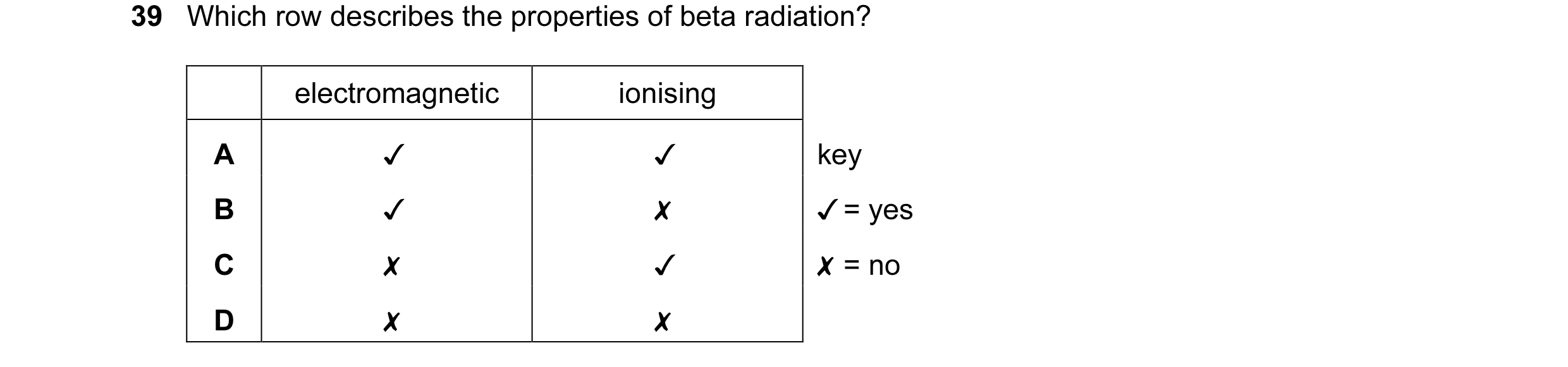
Q25 · Which row describes the properties of beta radiation? 0654/12 May/June 2011
39 Which row describes the properties of beta radiation?
electromagnetic ionising
A v v
B v x
Cc x v
D x x
key
v/=yes
X =no
1 marks
Answer: C
This question in 0654/12 May/June 2011
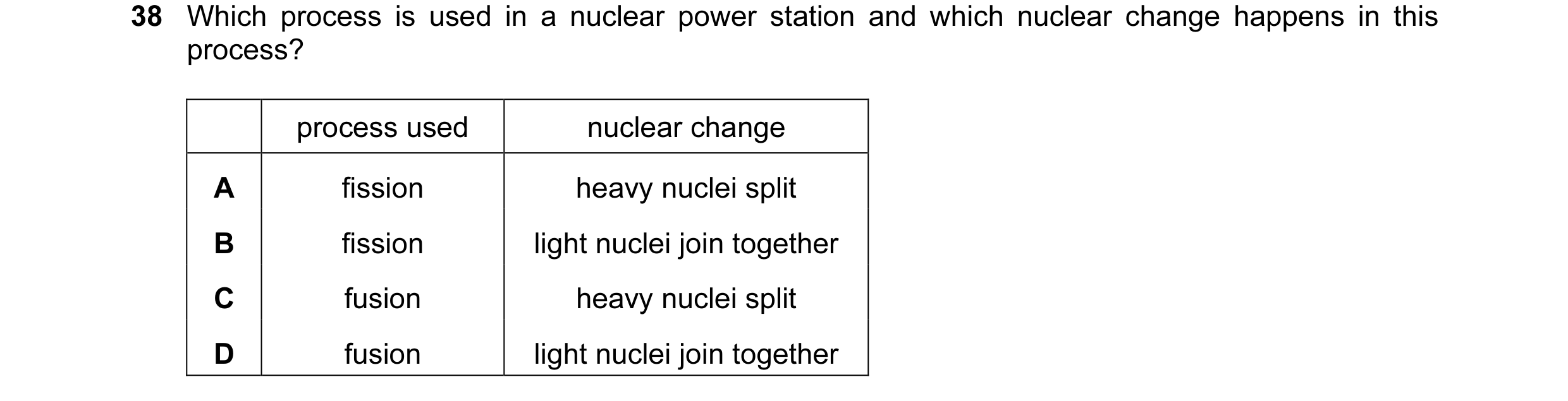
Q26 · Which process is used in a nuclear power station and which nuclear change happens in this… 0654/13 May/June 2011
38 Which process is used in a nuclear power station and which nuclear change happens in this process? process used nuclear change A fission heavy nuclei split B fission light nuclei join together C fusion heavy nuclei split D fusion light nuclei join together
1 marks
Answer: A
This question in 0654/13 May/June 2011
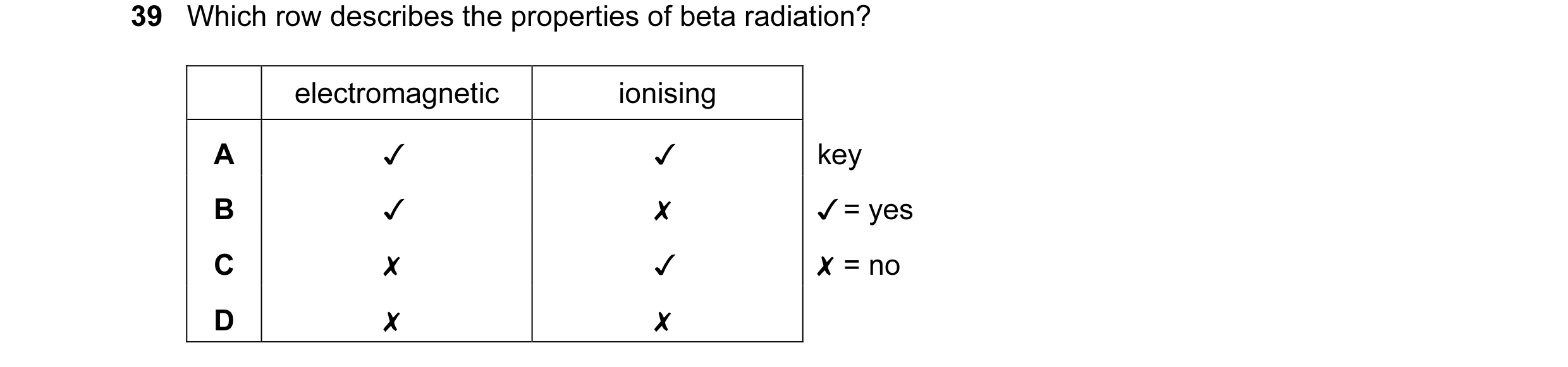
Q27 · Which row describes the properties of beta radiation? 0654/13 May/June 2011
39 Which row describes the properties of beta radiation?
electromagnetic ionising
A v v
B v x
Cc x v
D x x
key
v/=yes
X =no
1 marks
Answer: C
This question in 0654/13 May/June 2011
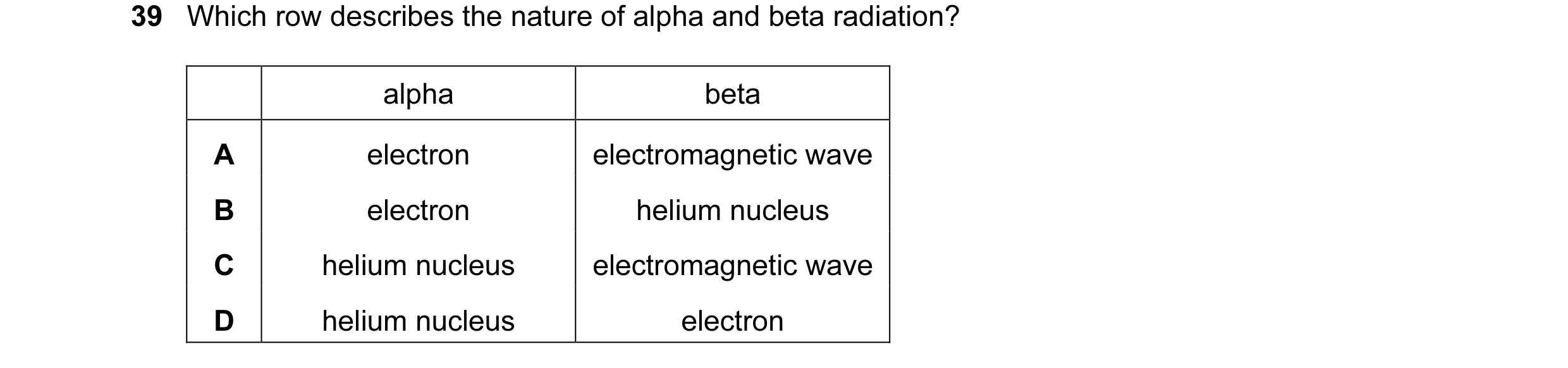
Q28 · Which row describes the nature of alpha and beta radiation? 0654/12 May/June 2012
39 Which row describes the nature of alpha and beta radiation? alpha beta A electron electromagnetic wave B electron helium nucleus C helium nucleus electromagnetic wave D helium nucleus electron
1 marks
Answer: D
This question in 0654/12 May/June 2012
Q29 · Which row describes the nature of alpha and beta radiation? 0654/13 May/June 2012
39 Which row describes the nature of alpha and beta radiation? alpha beta A electron electromagnetic wave B electron helium nucleus C helium nucleus electromagnetic wave D helium nucleus electron
1 marks
Answer: D
This question in 0654/13 May/June 2012
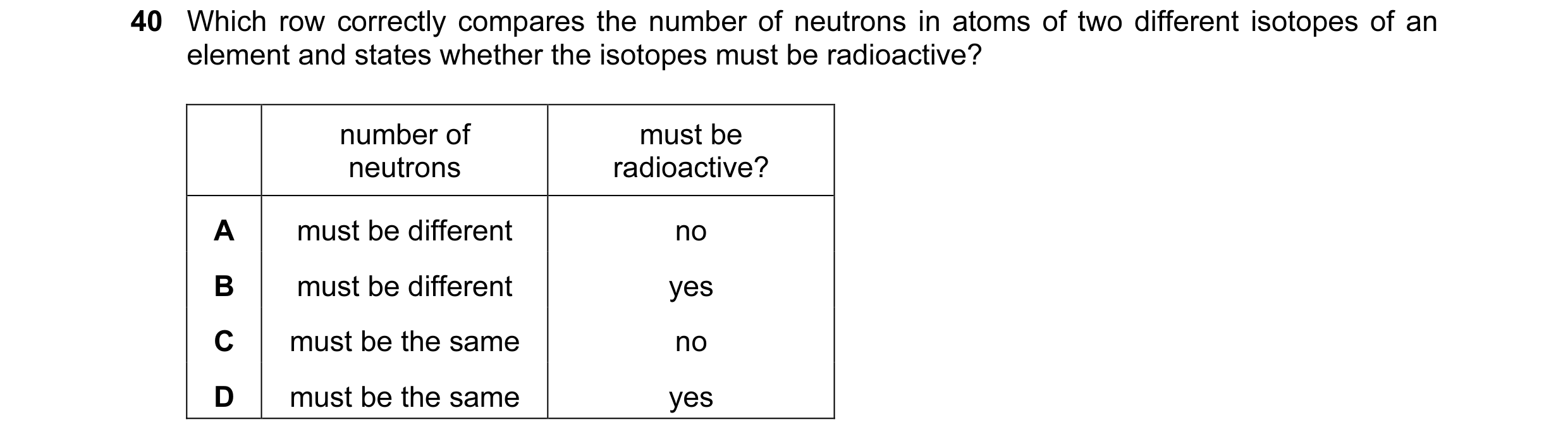
Q30 · Which row correctly compares the number of neutrons in atoms of two different isotopes of… 0654/12 May/June 2013
40 Which row correctly compares the number of neutrons in atoms of two different isotopes of an element and states whether the isotopes must be radioactive? number of must be neutrons radioactive? A must be different no B must be different yes C must be the same no D must be the same yes
1 marks
Answer: A
This question in 0654/12 May/June 2013
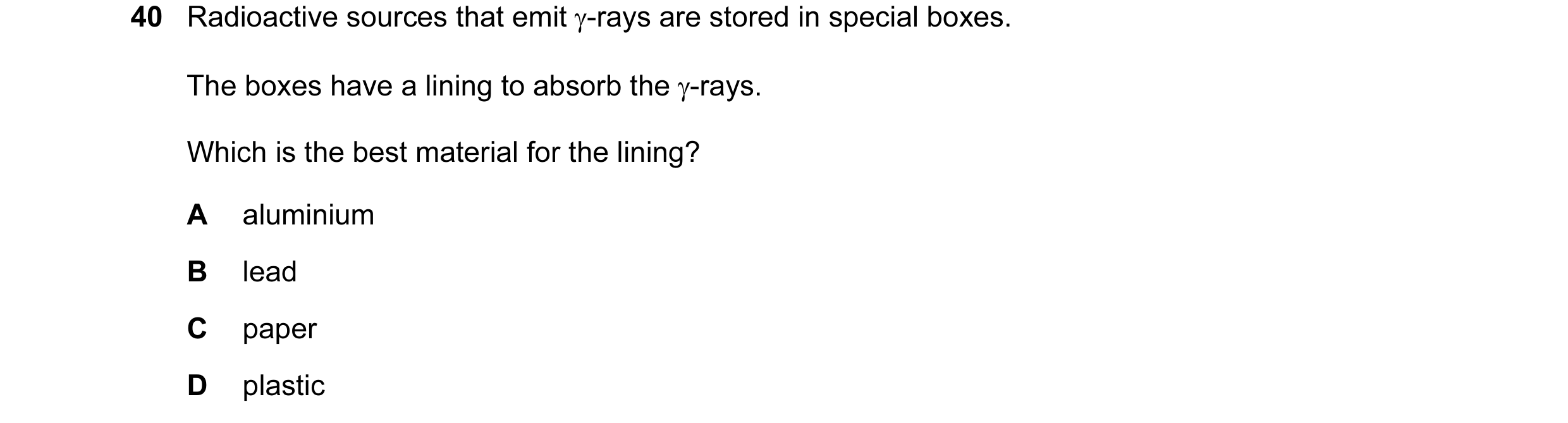
Q31 · Radioactive sources that emit γ-rays are stored in special boxes 0654/12 May/June 2014
40 Radioactive sources that emit γ-rays are stored in special boxes. The boxes have a lining to absorb the γ-rays. Which is the best material for the lining? A aluminium B lead C paper D plastic
1 marks
Answer: B
This question in 0654/12 May/June 2014
Q32 · During a fire in a laboratory storeroom, some radioactive material is spilt 0654/11 Oct/Nov 2014
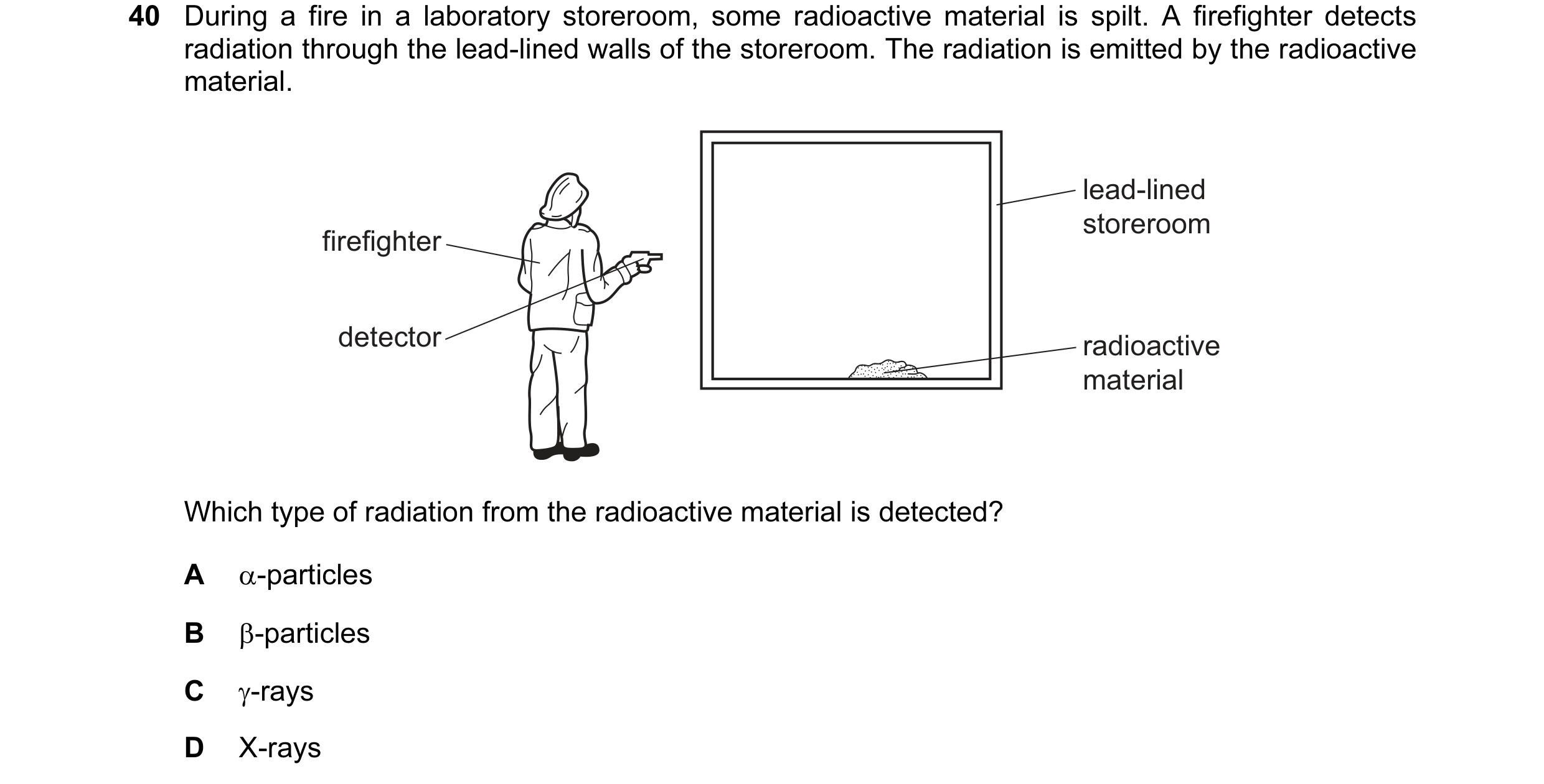
40 During a fire in a laboratory storeroom, some radioactive material is spilt. A firefighter detects radiation through the lead-lined walls of the storeroom. The radiation is emitted by the radioactive material. lead-lined storeroom firefighter detector radioactive material Which type of radiation from the radioactive material is detected? A α-particles B β-particles C γ-rays D X-rays
1 marks
Answer: C
This question in 0654/11 Oct/Nov 2014
Q33 · During a fire in a laboratory storeroom, some radioactive material is spilt 0654/12 Oct/Nov 2014
40 During a fire in a laboratory storeroom, some radioactive material is spilt. A firefighter detects radiation through the lead-lined walls of the storeroom. The radiation is emitted by the radioactive material. lead-lined storeroom firefighter detector radioactive material Which type of radiation from the radioactive material is detected? A α-particles B β-particles C γ-rays D X-rays
1 marks
Answer: C
This question in 0654/12 Oct/Nov 2014
Q34 · During a fire in a laboratory storeroom, some radioactive material is spilt 0654/13 Oct/Nov 2014
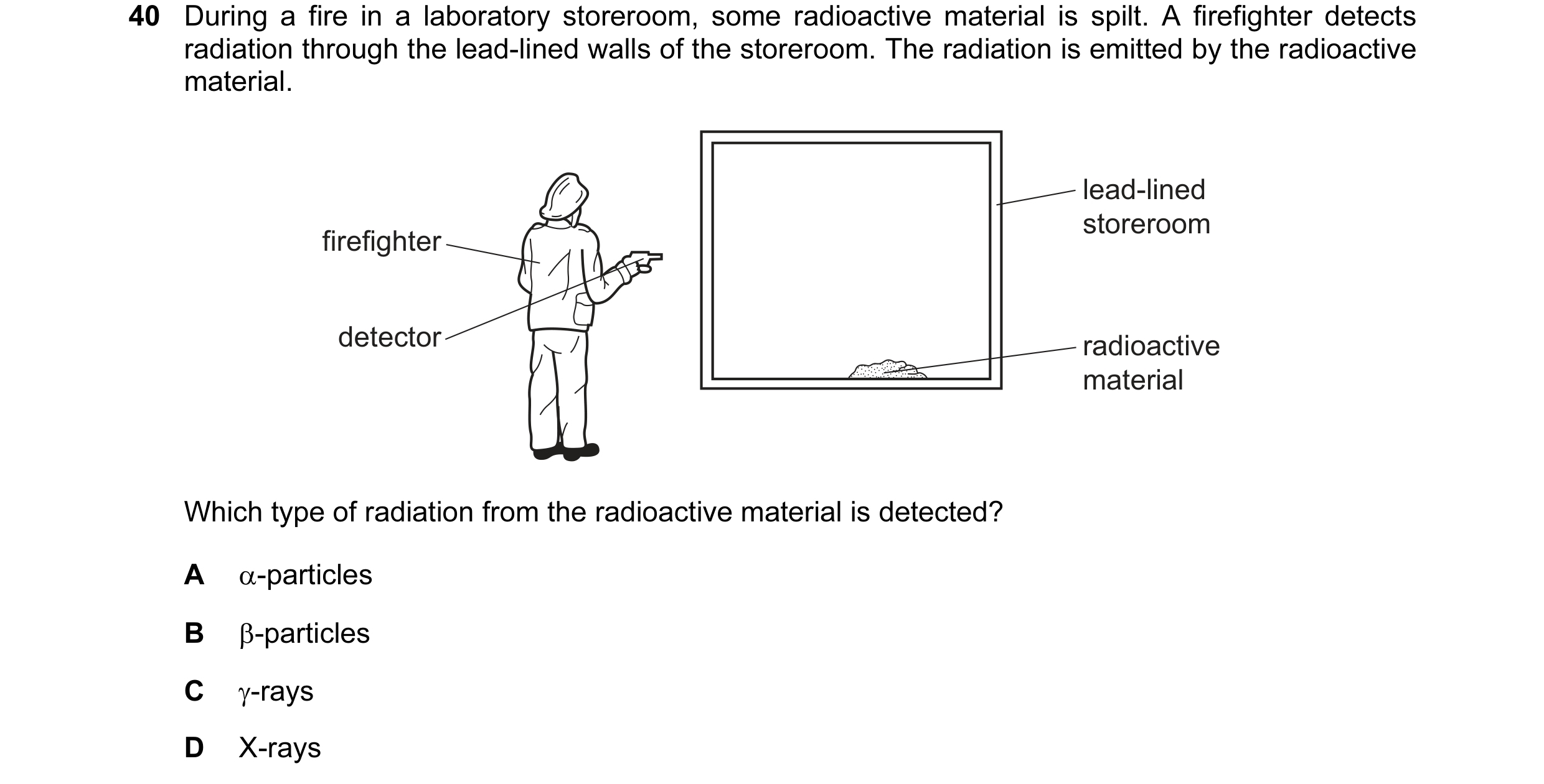
40 During a fire in a laboratory storeroom, some radioactive material is spilt. A firefighter detects radiation through the lead-lined walls of the storeroom. The radiation is emitted by the radioactive material. lead-lined storeroom firefighter detector radioactive material Which type of radiation from the radioactive material is detected? A α-particles B β-particles C γ-rays D X-rays
1 marks
Answer: C
This question in 0654/13 Oct/Nov 2014
Q35 · Which type of radiation has the greatest ionising effect? 0654/11 May/June 2015
40 Which type of radiation has the greatest ionising effect? A infra-red rays B α–particles C β–particles D γ–rays
1 marks
Answer: B
This question in 0654/11 May/June 2015
Q36 · Which type of radiation has the greatest ionising effect? 0654/12 May/June 2015
40 Which type of radiation has the greatest ionising effect? A infra-red rays B α–particles C β–particles D γ–rays
1 marks
Answer: B
This question in 0654/12 May/June 2015
Q37 · Which type of radiation has the greatest ionising effect? 0654/13 May/June 2015
40 Which type of radiation has the greatest ionising effect? A infra-red rays B α–particles C β–particles D γ–rays
1 marks
Answer: B
This question in 0654/13 May/June 2015
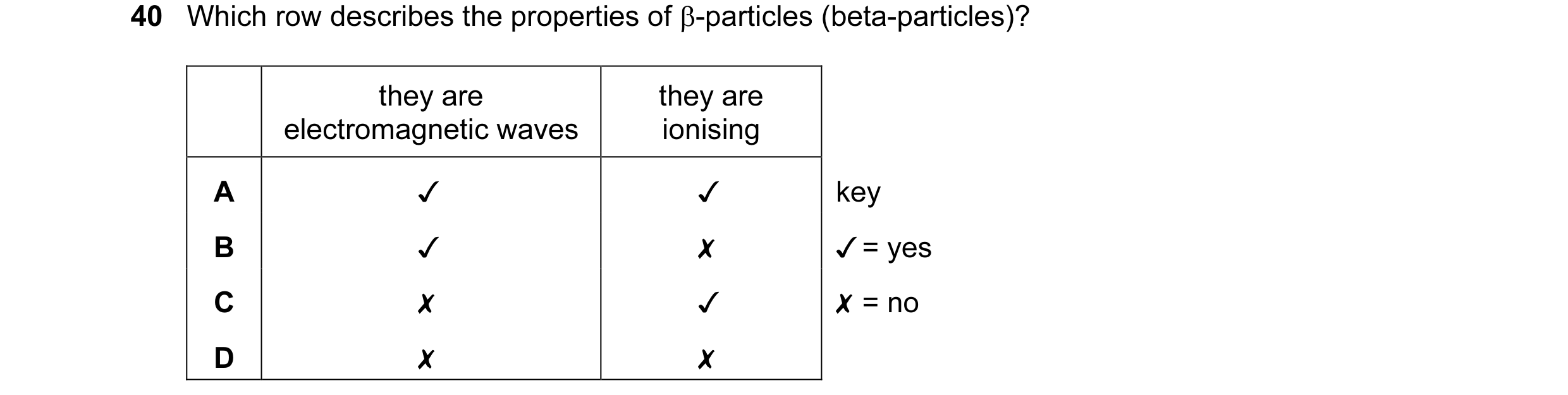
Q38 · Which row describes the properties of B-particles (beta-particles)? 0654/11 May/June 2016
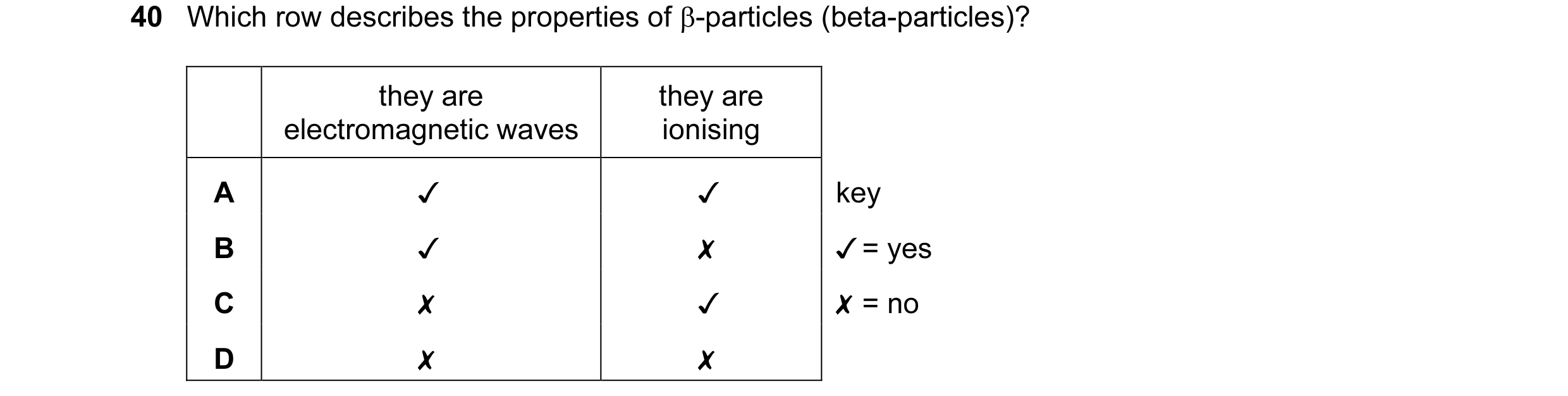
40 Which row describes the properties of B-particles (beta-particles)?
they are they are
electromagnetic waves ionising
A v v key
B v x v/=yes
Cc x v X =no
D x x
1 marks
Answer: C
This question in 0654/11 May/June 2016
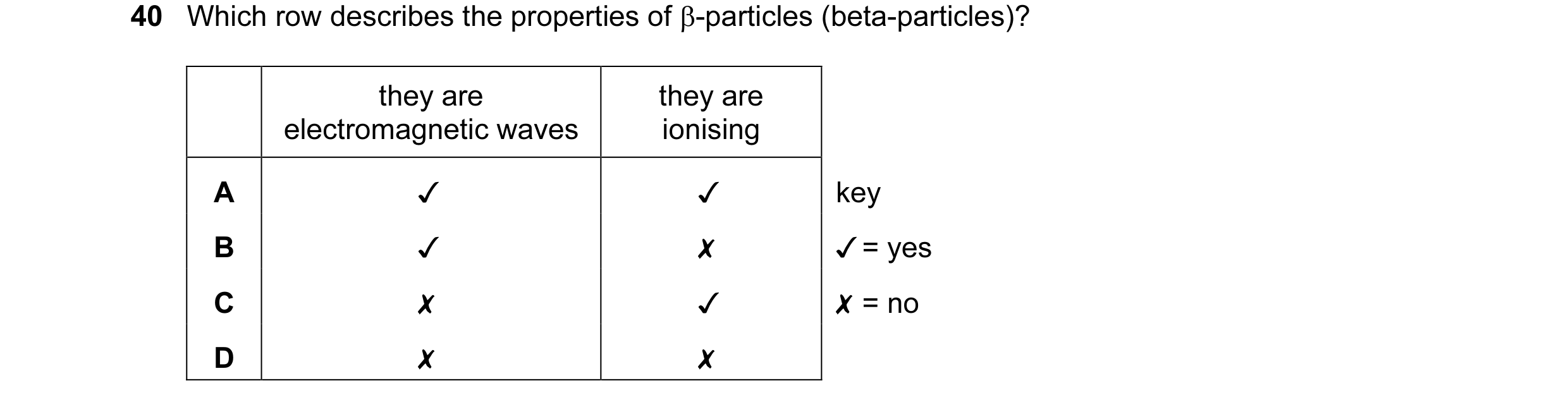
Q39 · Which row describes the properties of B-particles (beta-particles)? 0654/12 May/June 2016
40 Which row describes the properties of B-particles (beta-particles)?
they are they are
electromagnetic waves ionising
v v key
v/=yes
xX =no
x
v
x
1 marks
Answer: C
This question in 0654/12 May/June 2016
Q40 · Which row describes the properties of B-particles (beta-particles)? 0654/13 May/June 2016
40 Which row describes the properties of B-particles (beta-particles)?
they are they are
electromagnetic waves ionising
A v v key
B v x v/=yes
Cc x v X =no
D x x
1 marks
Answer: C
This question in 0654/13 May/June 2016
Q41 · A radiation detector is placed near to a radioactive source 0654/11 Oct/Nov 2018
40 A radiation detector is placed near to a radioactive source. The count rate on the detector includes background radiation. How can the radiation due to the source itself be determined? A carry out the experiment in a different laboratory B carry out the experiment in a vacuum C measure the count rate three times and average the result D measure the count rate without the source and subtract this value from the first reading
1 marks
Answer: D
This question in 0654/11 Oct/Nov 2018
Q42 · Microwaves and X-rays have different wavelengths 0654/12 Oct/Nov 2018
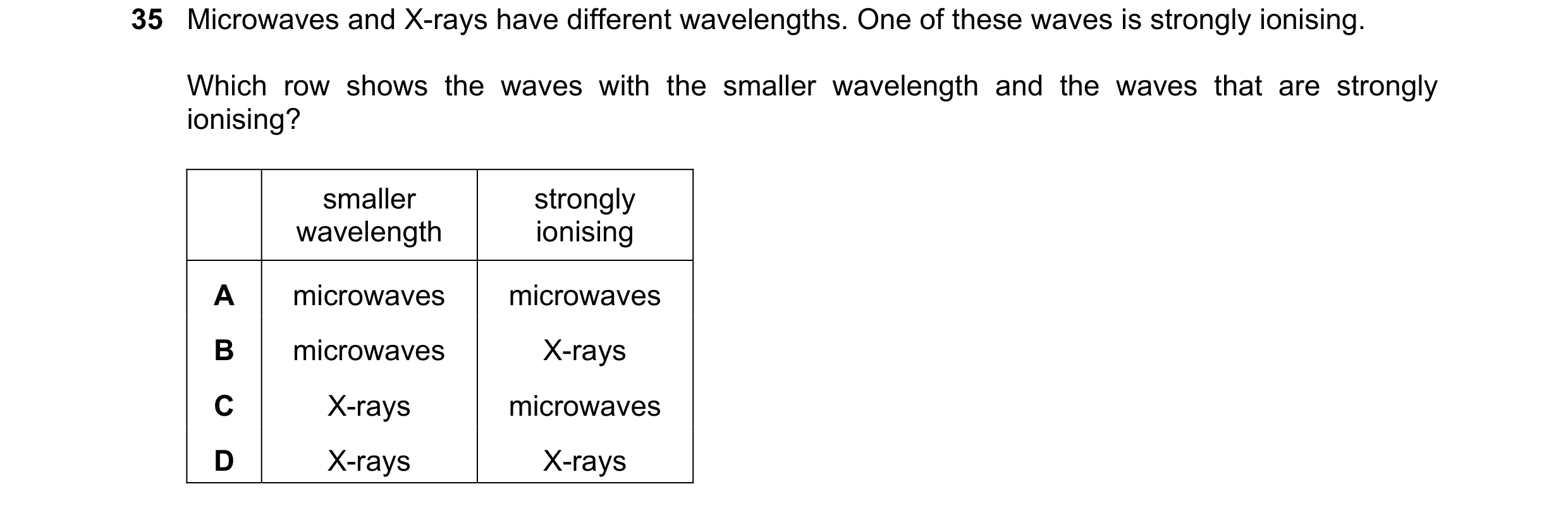
35 Microwaves and X-rays have different wavelengths. One of these waves is strongly ionising. Which row shows the waves with the smaller wavelength and the waves that are strongly ionising? smaller strongly wavelength ionising A microwaves microwaves B microwaves X-rays C X-rays microwaves D X-rays X-rays
1 marks
Answer: D
This question in 0654/12 Oct/Nov 2018
Q43 · The half-life of a radioactive isotope is 8.0 days 0654/12 May/June 2019
40 The half-life of a radioactive isotope is 8.0 days. How long does it take for the activity to decrease to 16 1 of its original value? A 16 days B 24 days C 32 days D 64 days
1 marks
Answer: C
This question in 0654/12 May/June 2019
Q44 · The half-life of a radioactive isotope is 8.0 days 0654/13 May/June 2019
40 The half-life of a radioactive isotope is 8.0 days. How long does it take for the activity to decrease to 16 1 of its original value? A 16 days B 24 days C 32 days D 64 days
1 marks
Answer: C
This question in 0654/13 May/June 2019
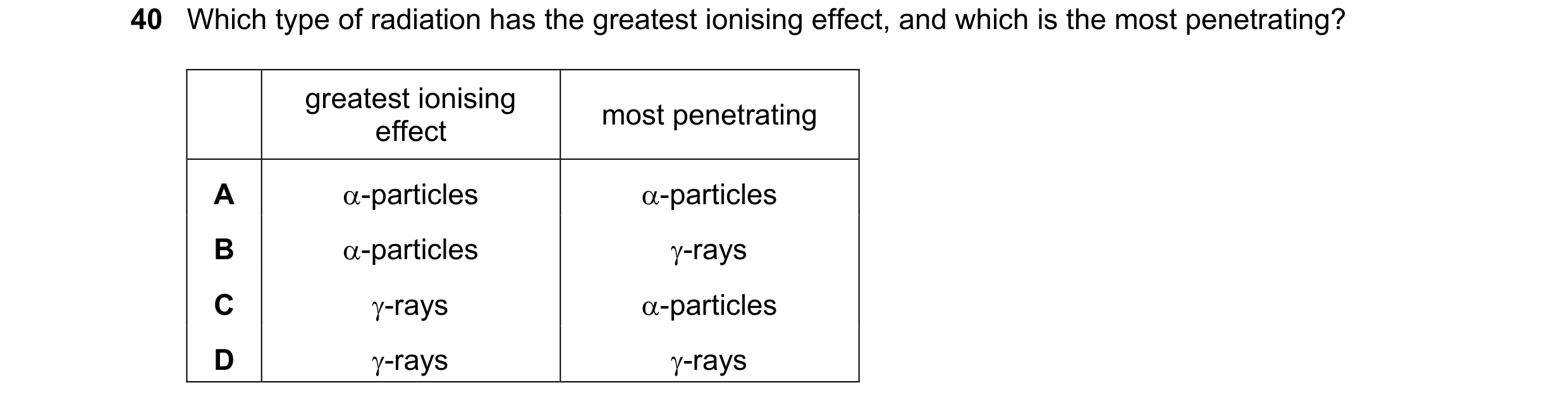
Q45 · Which type of radiation has the greatest ionising effect, and which is the most… 0654/11 Oct/Nov 2019
40 Which type of radiation has the greatest ionising effect, and which is the most penetrating? greatest ionising most penetrating effect A α-particles α-particles B α-particles γ-rays C γ-rays α-particles D γ-rays γ-rays
1 marks
Answer: B
This question in 0654/11 Oct/Nov 2019
Q46 · Which type of radiation has the greatest ionising effect, and which is the most… 0654/12 Oct/Nov 2019
40 Which type of radiation has the greatest ionising effect, and which is the most penetrating? greatest ionising most penetrating effect A α-particles α-particles B α-particles γ-rays C γ-rays α-particles D γ-rays γ-rays
1 marks
Answer: B
This question in 0654/12 Oct/Nov 2019
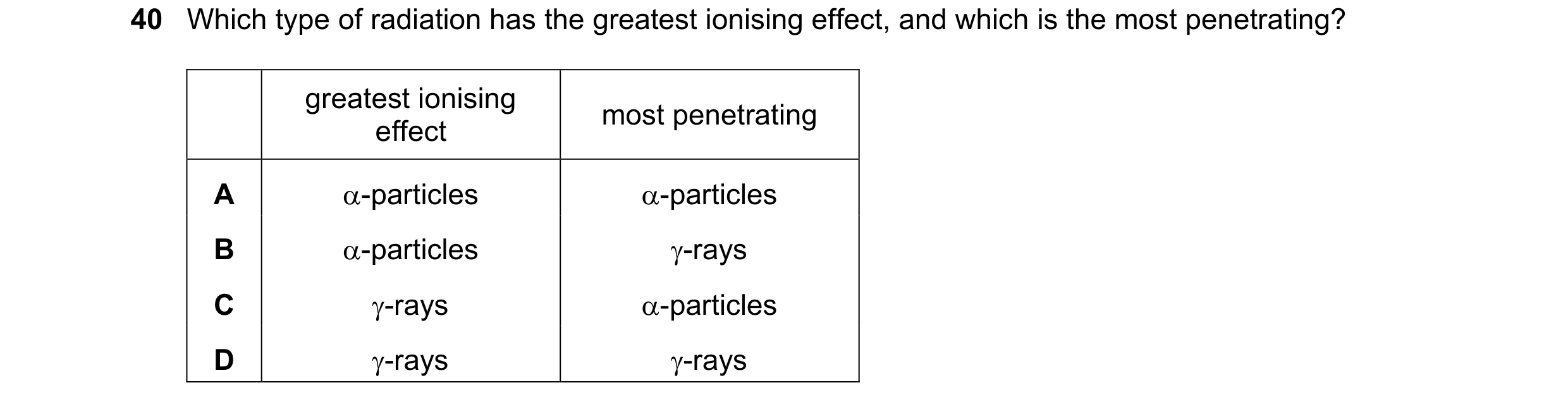
Q47 · Which type of radiation has the greatest ionising effect, and which is the most… 0654/13 Oct/Nov 2019
40 Which type of radiation has the greatest ionising effect, and which is the most penetrating? greatest ionising most penetrating effect A α-particles α-particles B α-particles γ-rays C γ-rays α-particles D γ-rays γ-rays
1 marks
Answer: B
This question in 0654/13 Oct/Nov 2019
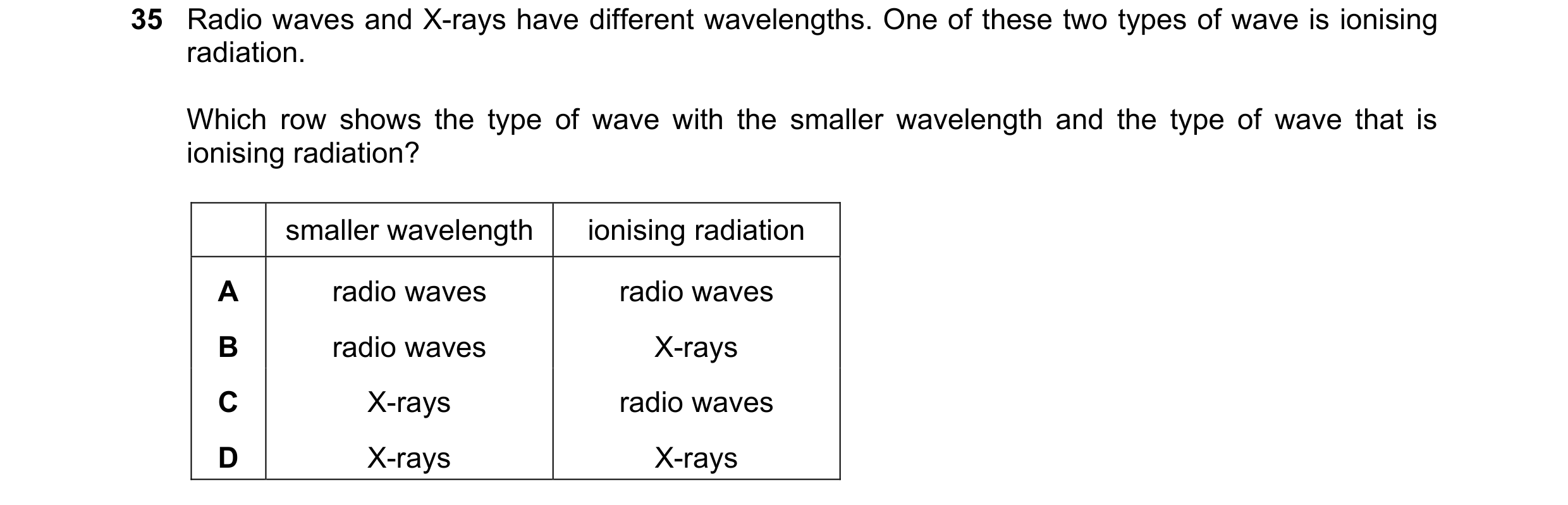
Q48 · Radio waves and X-rays have different wavelengths 0654/12 May/June 2020
35 Radio waves and X-rays have different wavelengths. One of these two types of wave is ionising radiation. Which row shows the type of wave with the smaller wavelength and the type of wave that is ionising radiation? smaller wavelength ionising radiation A radio waves radio waves B radio waves X-rays C X-rays radio waves D X-rays X-rays
1 marks
Answer: D
This question in 0654/12 May/June 2020
Q49 · Which type of radiation has the greatest ionising effect? 0654/11 Oct/Nov 2020
40 Which type of radiation has the greatest ionising effect? A infrared rays B -particles C -particles D -rays
1 marks
Answer: B
This question in 0654/11 Oct/Nov 2020
Q50 · Which type of radiation has the greatest ionising effect? 0654/12 Oct/Nov 2020
39 Which type of radiation has the greatest ionising effect? A infrared rays B -particles C -particles D -rays
1 marks
Answer: B
This question in 0654/12 Oct/Nov 2020
Q51 · The graph shows how the rate of emission from a radioactive sample changes with time 0654/12 Oct/Nov 2020
40 The graph shows how the rate of emission from a radioactive sample changes with time. 80 rate of emission 70 emissions / minute 60 50 40 30 20 10 0 0 1 2 3 4 5 6 7 8 9 10 time / years What is the half-life of this sample? A 40 minutes B 2.0 years C 5.0 years D 10 years
1 marks
Answer: B
This question in 0654/12 Oct/Nov 2020
Q52 · Which type of radiation has the greatest ionising effect? 0654/13 Oct/Nov 2020
40 Which type of radiation has the greatest ionising effect? A infrared rays B -particles C -particles D -rays
1 marks
Answer: B
This question in 0654/13 Oct/Nov 2020
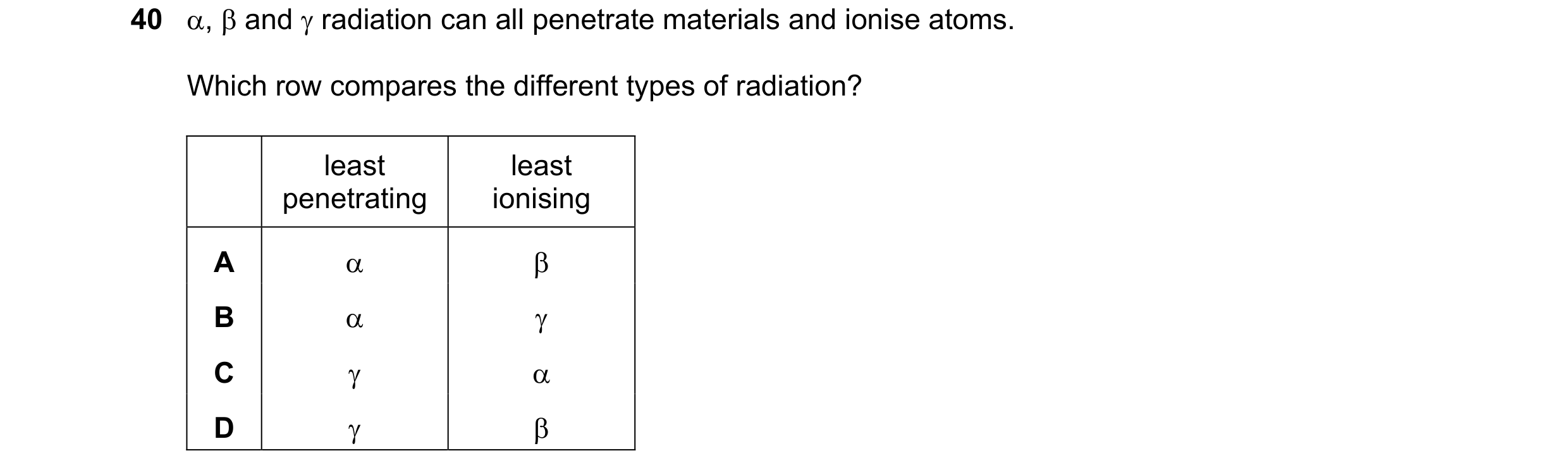
Q53 · , and radiation can all penetrate materials and ionise atoms 0654/12 Feb/March 2021
40 , and radiation can all penetrate materials and ionise atoms. Which row compares the different types of radiation? least least penetrating ionising A B C D
1 marks
Answer: B
This question in 0654/12 Feb/March 2021
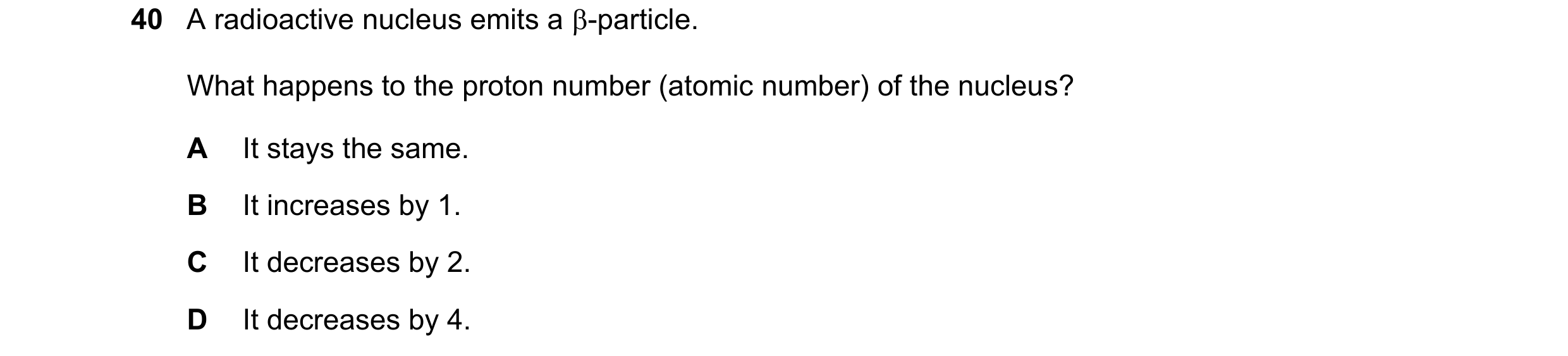
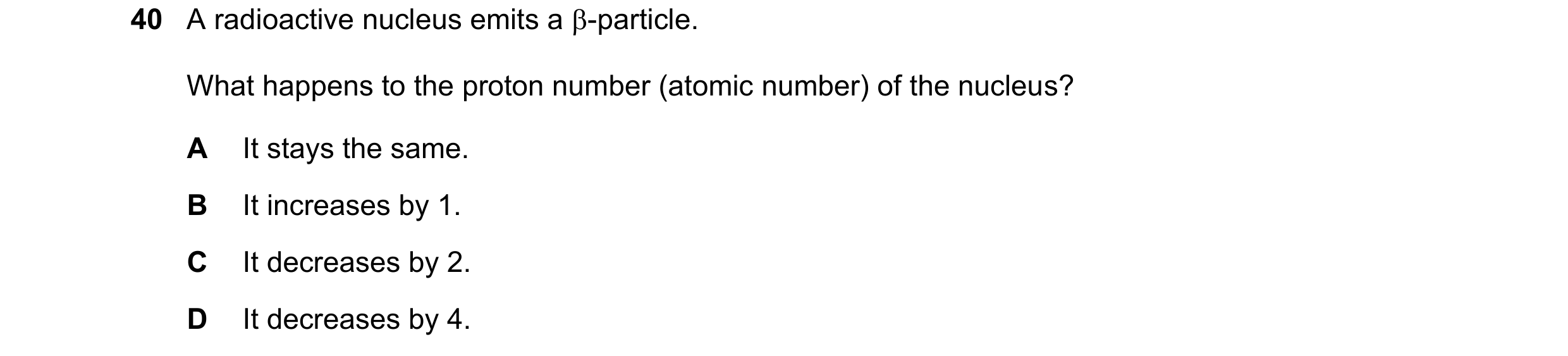
Q54 · A radioactive nucleus emits a -particle 0654/11 May/June 2021
40 A radioactive nucleus emits a -particle. What happens to the proton number (atomic number) of the nucleus? A It stays the same. B It increases by 1. C It decreases by 2. D It decreases by 4.
1 marks
Answer: B
This question in 0654/11 May/June 2021
Q55 · A radioactive nucleus emits a -particle 0654/12 May/June 2021
40 A radioactive nucleus emits a -particle. What happens to the proton number (atomic number) of the nucleus? A It stays the same. B It increases by 1. C It decreases by 2. D It decreases by 4.
1 marks
Answer: B
This question in 0654/12 May/June 2021
Q56 · A radioactive nucleus emits a -particle 0654/13 May/June 2021
40 A radioactive nucleus emits a -particle. What happens to the proton number (atomic number) of the nucleus? A It stays the same. B It increases by 1. C It decreases by 2. D It decreases by 4.
1 marks
Answer: B
This question in 0654/13 May/June 2021
Q57 · Which description of an -particle is correct? 0654/13 Oct/Nov 2021
40 Which description of an -particle is correct? A It contains 2 protons and 2 neutrons. B It contains 2 protons and 4 neutrons. C It contains 4 protons and 2 neutrons. D It contains 4 protons and 4 neutrons.
1 marks
Answer: A
This question in 0654/13 Oct/Nov 2021
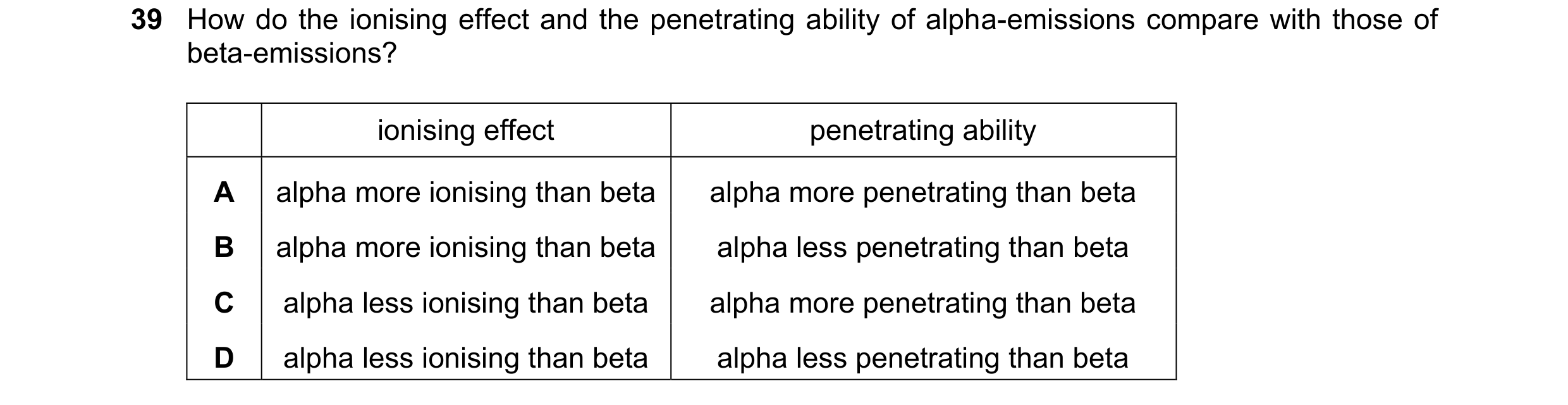
Q58 · How do the ionising effect and the penetrating ability of alpha-emissions compare with… 0654/12 Feb/March 2022
39 How do the ionising effect and the penetrating ability of alpha-emissions compare with those of beta-emissions? ionising effect penetrating ability A alpha more ionising than beta alpha more penetrating than beta B alpha more ionising than beta alpha less penetrating than beta C alpha less ionising than beta alpha more penetrating than beta D alpha less ionising than beta alpha less penetrating than beta
1 marks
Answer: B
This question in 0654/12 Feb/March 2022
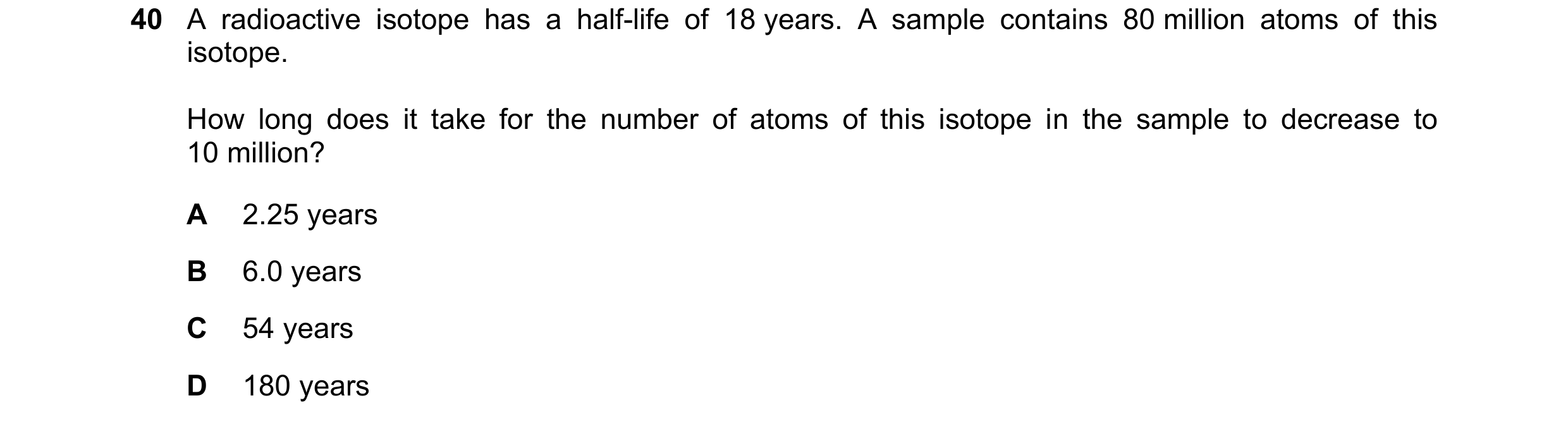
Q59 · A radioactive isotope has a half-life of 18 years 0654/12 Feb/March 2022
40 A radioactive isotope has a half-life of 18 years. A sample contains 80 million atoms of this isotope. How long does it take for the number of atoms of this isotope in the sample to decrease to 10 million? A 2.25 years B 6.0 years C 54 years D 180 years
1 marks
Answer: C
This question in 0654/12 Feb/March 2022
Q60 · A pure sample of a radioactive substance decays 0654/11 May/June 2022
40 A pure sample of a radioactive substance decays. The graph shows how the number of these radioactive atoms in the sample changes with time. 800 number of 700 radioactive atoms 600 500 400 300 200 100 0 0 10 20 30 40 time / s What is the half-life of the substance? A 10 s B 20 s C 30 s D 40 s
1 marks
Answer: A
This question in 0654/11 May/June 2022
Q61 · The isotope of americium used in a smoke detector has a half-life of 430 years 0654/12 Feb/March 2023
40 The isotope of americium used in a smoke detector has a half-life of 430 years. A sample of this isotope emits 36 000 particles per minute. At which rate does it emit particles 1290 years later? A 4500 counts per minute B 9000 counts per minute C 12 000 counts per minute D 18 000 counts per minute
1 marks
Answer: A
This question in 0654/12 Feb/March 2023
Q62 · A radioactive isotope has a half-life of 3.0 days 0654/11 May/June 2023
40 A radioactive isotope has a half-life of 3.0 days. A sample contains 4000 atoms of this isotope. How many atoms of the isotope remain after 6.0 days? A 0 B 500 C 1000 D 2000
1 marks
Answer: C
This question in 0654/11 May/June 2023
Q63 · The diagram shows how the count rate for a radioactive isotope varies with time 0654/12 May/June 2023
39 The diagram shows how the count rate for a radioactive isotope varies with time. 700 count rate 600 counts / second 500 400 300 200 100 0 0 10 20 30 40 time / hours How many half-lives of the isotope elapse in 45 hours? A 1 B 3 C 45 D 75
1 marks
Answer: B
This question in 0654/12 May/June 2023
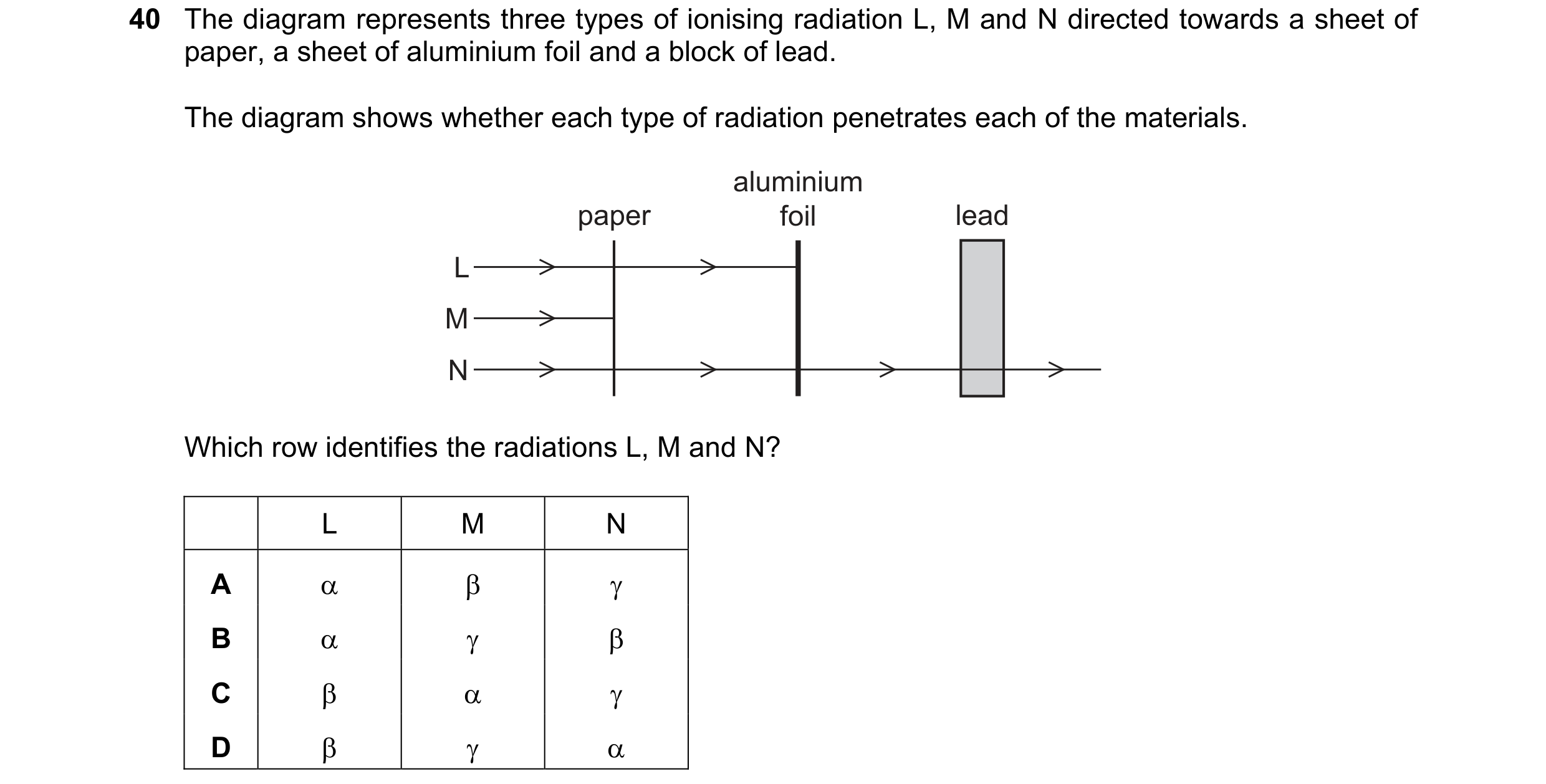
Q64 · The diagram represents three types of ionising radiation L, M and N directed towards a… 0654/12 May/June 2023
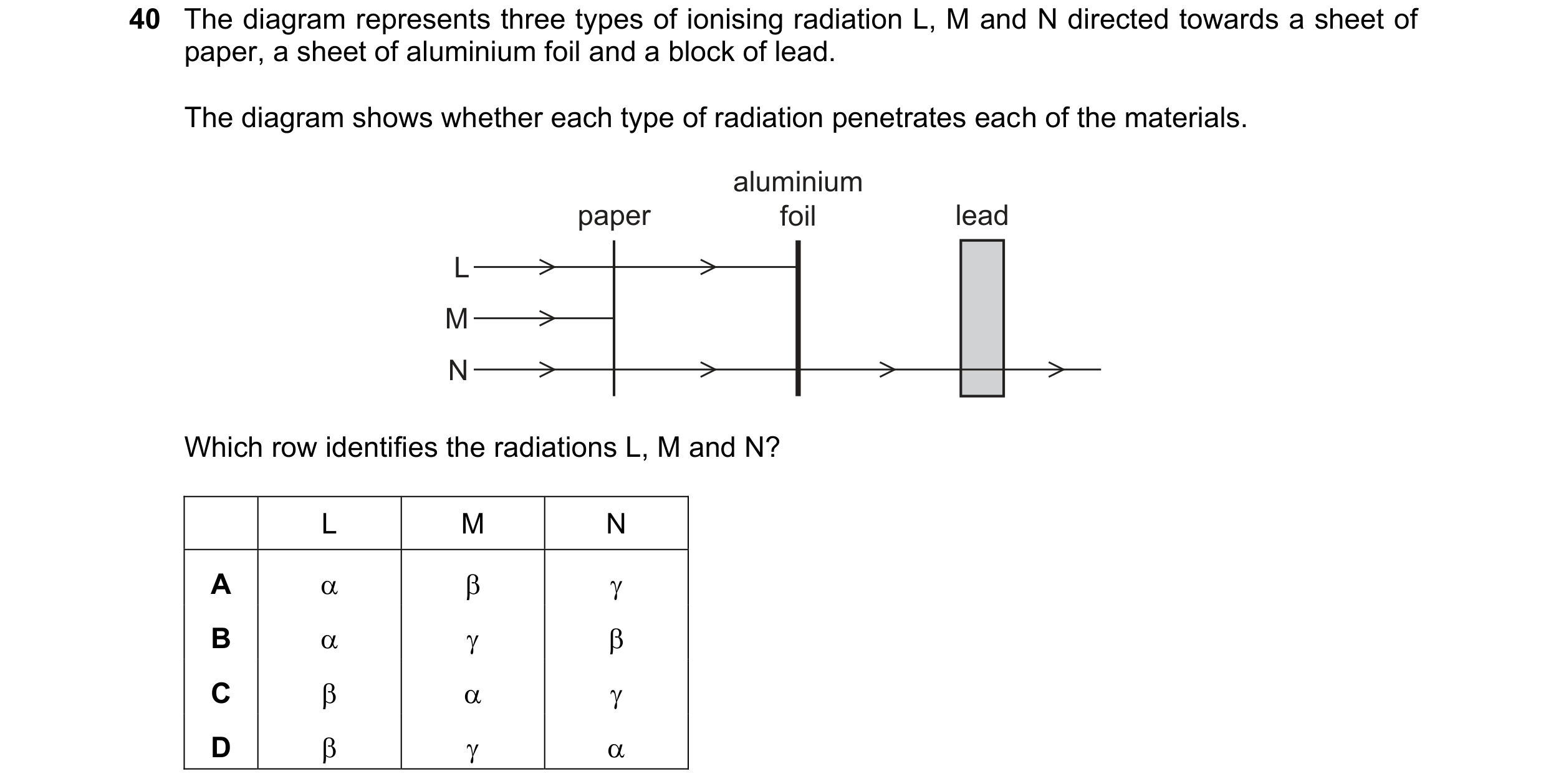
40 The diagram represents three types of ionising radiation L, M and N directed towards a sheet of paper, a sheet of aluminium foil and a block of lead. The diagram shows whether each type of radiation penetrates each of the materials. aluminium paper foil lead L M N Which row identifies the radiations L, M and N? L M N A B C D
1 marks
Answer: C
This question in 0654/12 May/June 2023
Q65 · The diagram shows how the count rate for a radioactive isotope varies with time 0654/13 May/June 2023
39 The diagram shows how the count rate for a radioactive isotope varies with time. 700 count rate 600 counts / second 500 400 300 200 100 0 0 10 20 30 40 time / hours How many half-lives of the isotope elapse in 45 hours? A 1 B 3 C 45 D 75
1 marks
Answer: B
This question in 0654/13 May/June 2023
Q66 · The diagram represents three types of ionising radiation L, M and N directed towards a… 0654/13 May/June 2023
40 The diagram represents three types of ionising radiation L, M and N directed towards a sheet of paper, a sheet of aluminium foil and a block of lead. The diagram shows whether each type of radiation penetrates each of the materials. aluminium paper foil lead L M N Which row identifies the radiations L, M and N? L M N A α β γ B α γ β C β α γ D β γ α
1 marks
Answer: C
This question in 0654/13 May/June 2023
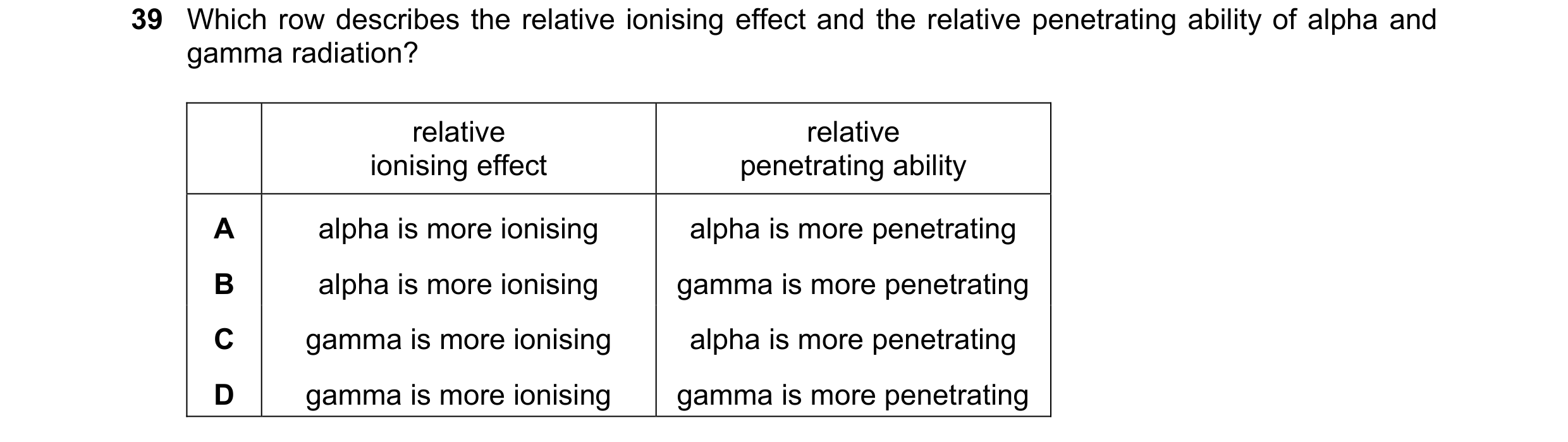
Q67 · Which row describes the relative ionising effect and the relative penetrating ability of… 0654/12 Oct/Nov 2023
39 Which row describes the relative ionising effect and the relative penetrating ability of alpha and gamma radiation? relative relative ionising effect penetrating ability A alpha is more ionising alpha is more penetrating B alpha is more ionising gamma is more penetrating C gamma is more ionising alpha is more penetrating D gamma is more ionising gamma is more penetrating
1 marks
Answer: B
This question in 0654/12 Oct/Nov 2023
Q68 · A radioactive isotope has a half-life of 4.0 days 0654/12 Oct/Nov 2023
40 A radioactive isotope has a half-life of 4.0 days. A sample of the isotope emits radiation at a rate of 100 emissions per minute. What was the rate of emission from the sample 8.0 days earlier? A 25 emissions per minute B 50 emissions per minute C 200 emissions per minute D 400 emissions per minute
1 marks
Answer: D
This question in 0654/12 Oct/Nov 2023
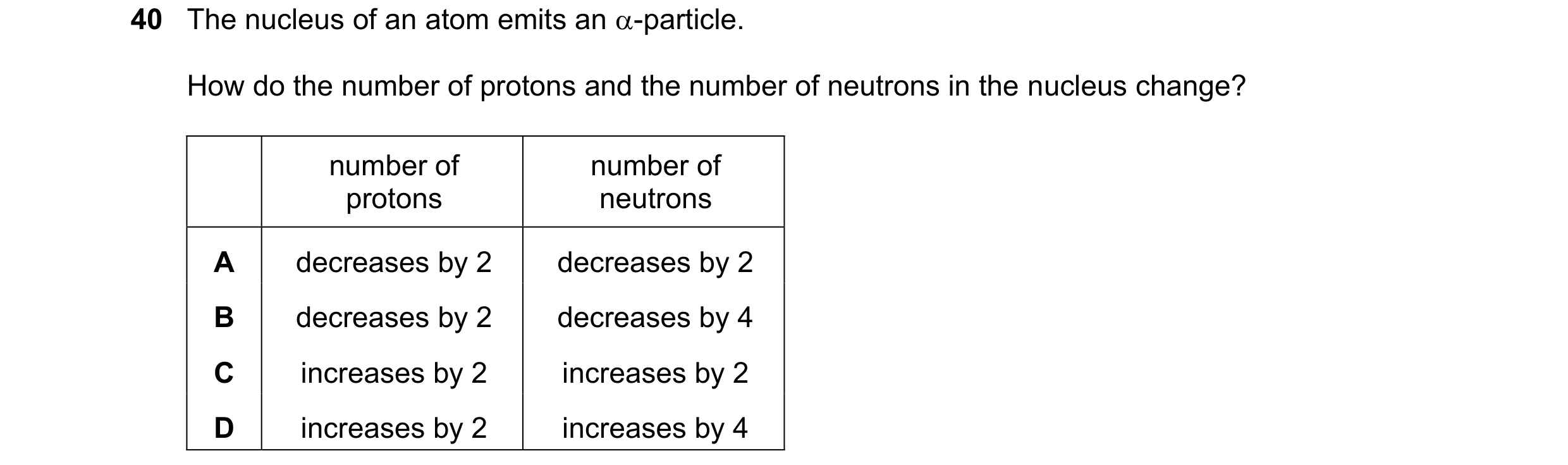
Q69 · The nucleus of an atom emits an -particle 0654/13 Oct/Nov 2023
40 The nucleus of an atom emits an -particle. How do the number of protons and the number of neutrons in the nucleus change? number of number of protons neutrons A decreases by 2 decreases by 2 B decreases by 2 decreases by 4 C increases by 2 increases by 2 D increases by 2 increases by 4
1 marks
Answer: A
This question in 0654/13 Oct/Nov 2023
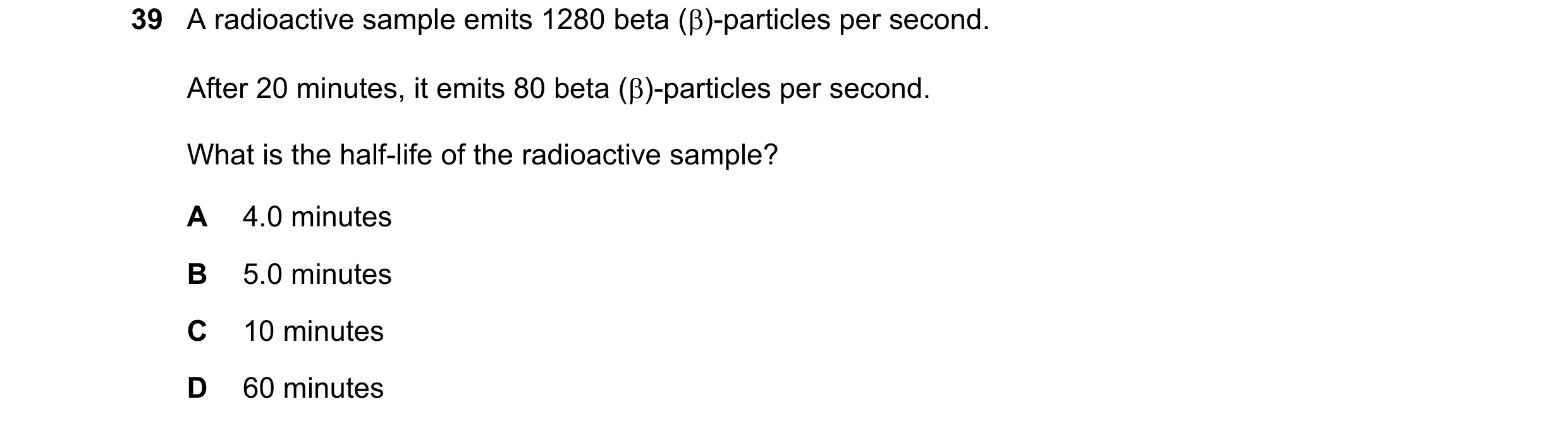
Q70 · A radioactive sample emits 1280 beta ()-particles per second 0654/12 Feb/March 2024
39 A radioactive sample emits 1280 beta ()-particles per second. After 20 minutes, it emits 80 beta ()-particles per second. What is the half-life of the radioactive sample? A 4.0 minutes B 5.0 minutes C 10 minutes D 60 minutes
1 marks
Answer: B
This question in 0654/12 Feb/March 2024
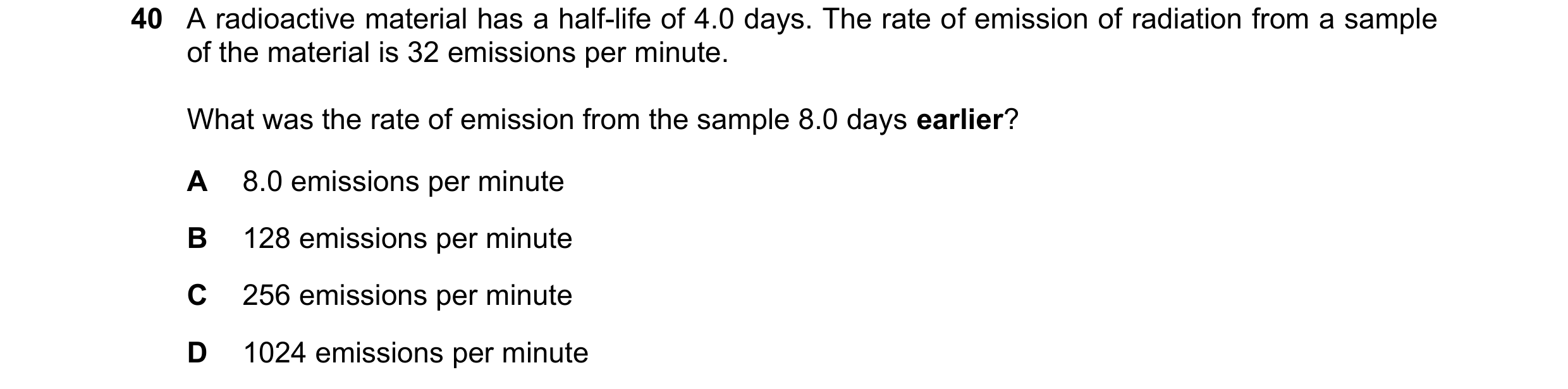
Q71 · A radioactive material has a half-life of 4.0 days 0654/11 May/June 2024
40 A radioactive material has a half-life of 4.0 days. The rate of emission of radiation from a sample of the material is 32 emissions per minute. What was the rate of emission from the sample 8.0 days earlier? A 8.0 emissions per minute B 128 emissions per minute C 256 emissions per minute D 1024 emissions per minute
1 marks
Answer: B
This question in 0654/11 May/June 2024
Q72 · The graph shows the decay curve for a radioactive substance 0654/12 May/June 2024
40 The graph shows the decay curve for a radioactive substance. 800 emissions 700 per minute 600 500 400 300 200 100 0 0 1 2 3 4 5 6 7 8 9 10 time / hours What is the half-life of this substance? A 2.0 hours B 3.2 hours C 5.0 hours D 10 hours
1 marks
Answer: A
This question in 0654/12 May/June 2024
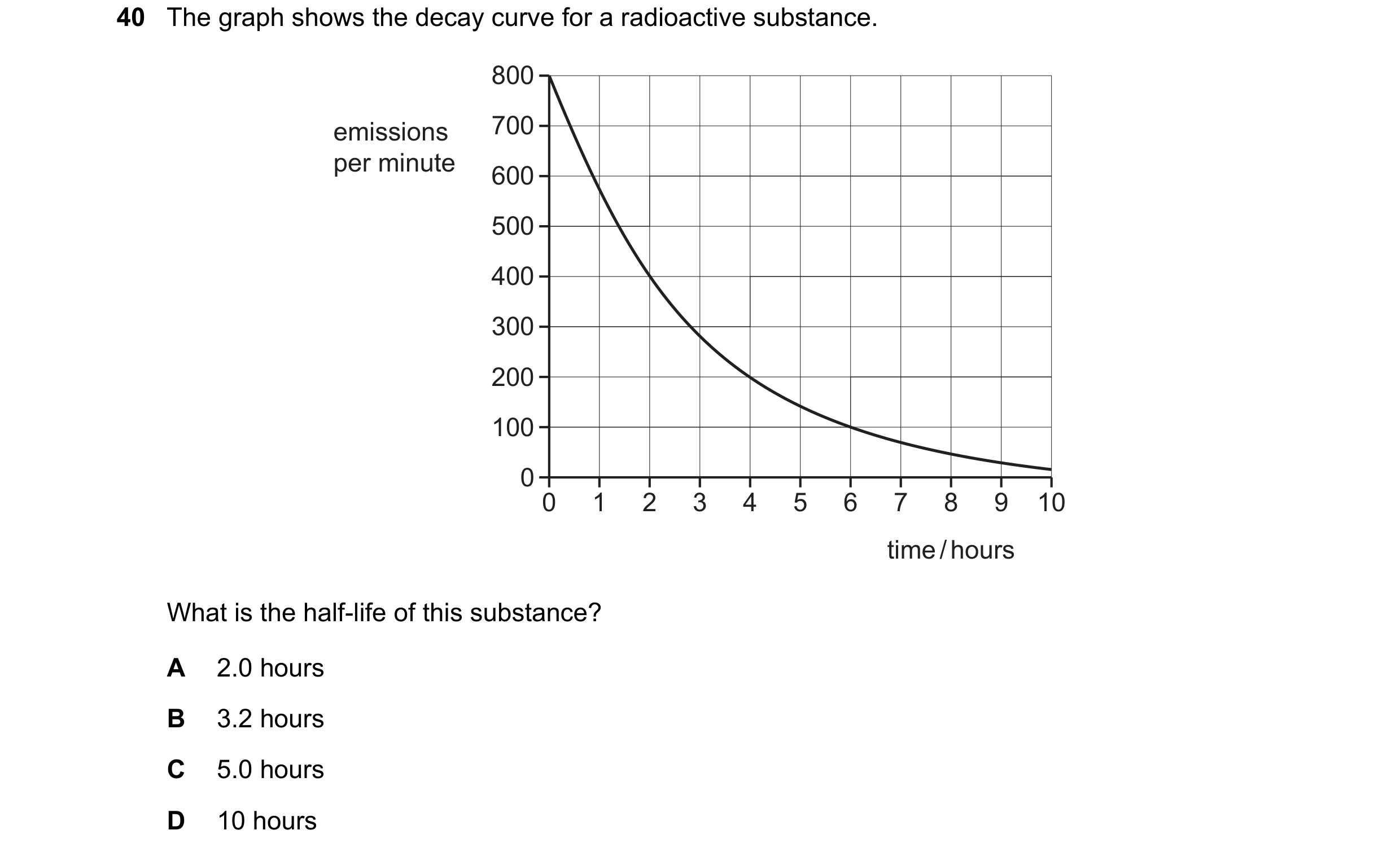
Q73 · The graph shows the decay curve for a radioactive substance 0654/13 May/June 2024
40 The graph shows the decay curve for a radioactive substance. 800 emissions 700 per minute 600 500 400 300 200 100 0 0 1 2 3 4 5 6 7 8 9 10 time / hours What is the half-life of this substance? A 2.0 hours B 3.2 hours C 5.0 hours D 10 hours
1 marks
Answer: A
This question in 0654/13 May/June 2024
Q74 · The graph shows how the rate of emission of radiation from a radioactive sample changes… 0654/11 Oct/Nov 2024
40 The graph shows how the rate of emission of radiation from a radioactive sample changes with time. 80 rate of emission 70 emissions / minute 60 50 40 30 20 10 0 0 1 2 3 4 5 6 7 8 9 10 time / years What is the half-life of this sample? A 40 minutes B 2.0 years C 5.0 years D 10 years
1 marks
Answer: B
This question in 0654/11 Oct/Nov 2024
Q75 · A radioactive isotope emits only alpha ()-particles 0654/12 Oct/Nov 2024
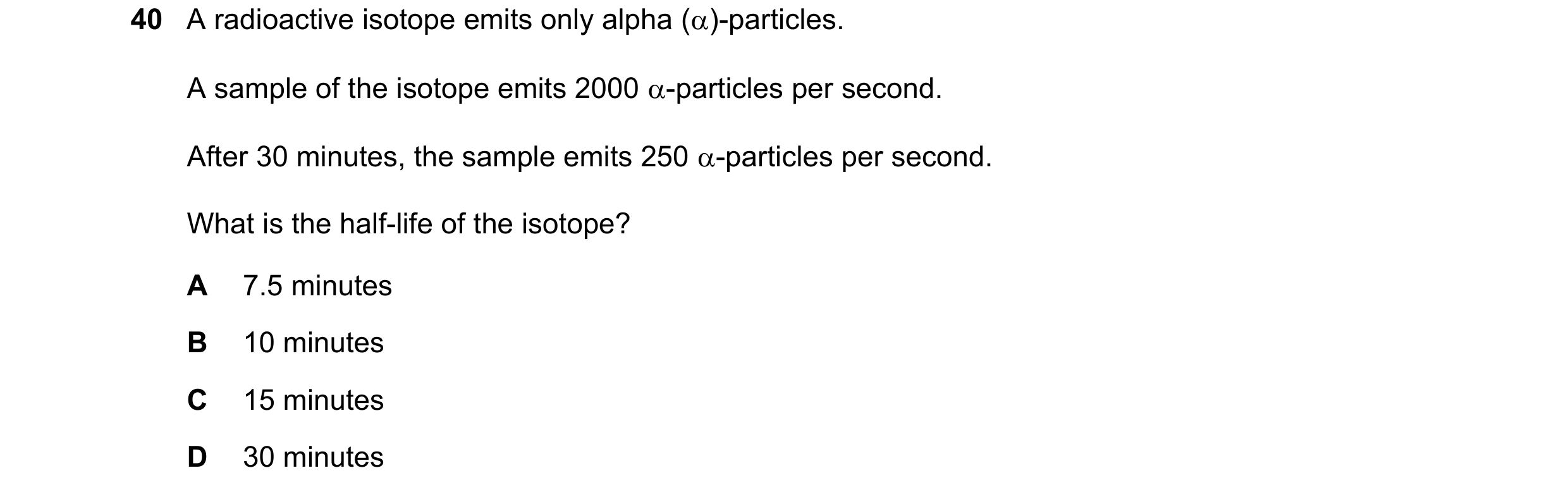
40 A radioactive isotope emits only alpha ()-particles. A sample of the isotope emits 2000 -particles per second. After 30 minutes, the sample emits 250 -particles per second. What is the half-life of the isotope? A 7.5 minutes B 10 minutes C 15 minutes D 30 minutes
1 marks
Answer: B
This question in 0654/12 Oct/Nov 2024
Q76 · A radioactive isotope emits only alpha ()-particles 0654/13 Oct/Nov 2024
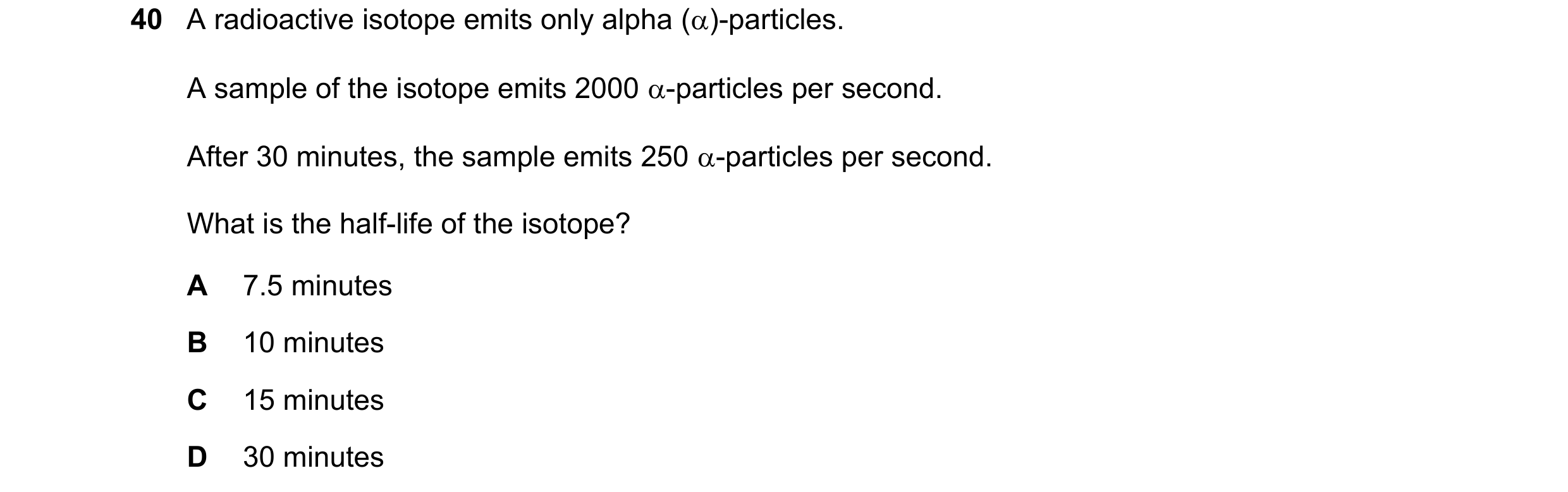
40 A radioactive isotope emits only alpha ()-particles. A sample of the isotope emits 2000 -particles per second. After 30 minutes, the sample emits 250 -particles per second. What is the half-life of the isotope? A 7.5 minutes B 10 minutes C 15 minutes D 30 minutes
1 marks
Answer: B
This question in 0654/13 Oct/Nov 2024
Q77 · An atom emits radiation by radioactive decay 0654/12 Feb/March 2025
39 An atom emits radiation by radioactive decay. Which part of the atom is the radiation emitted from? A stable orbiting electrons B stable nucleus C unstable orbiting electrons D unstable nucleus
1 marks
Answer: D
This question in 0654/12 Feb/March 2025
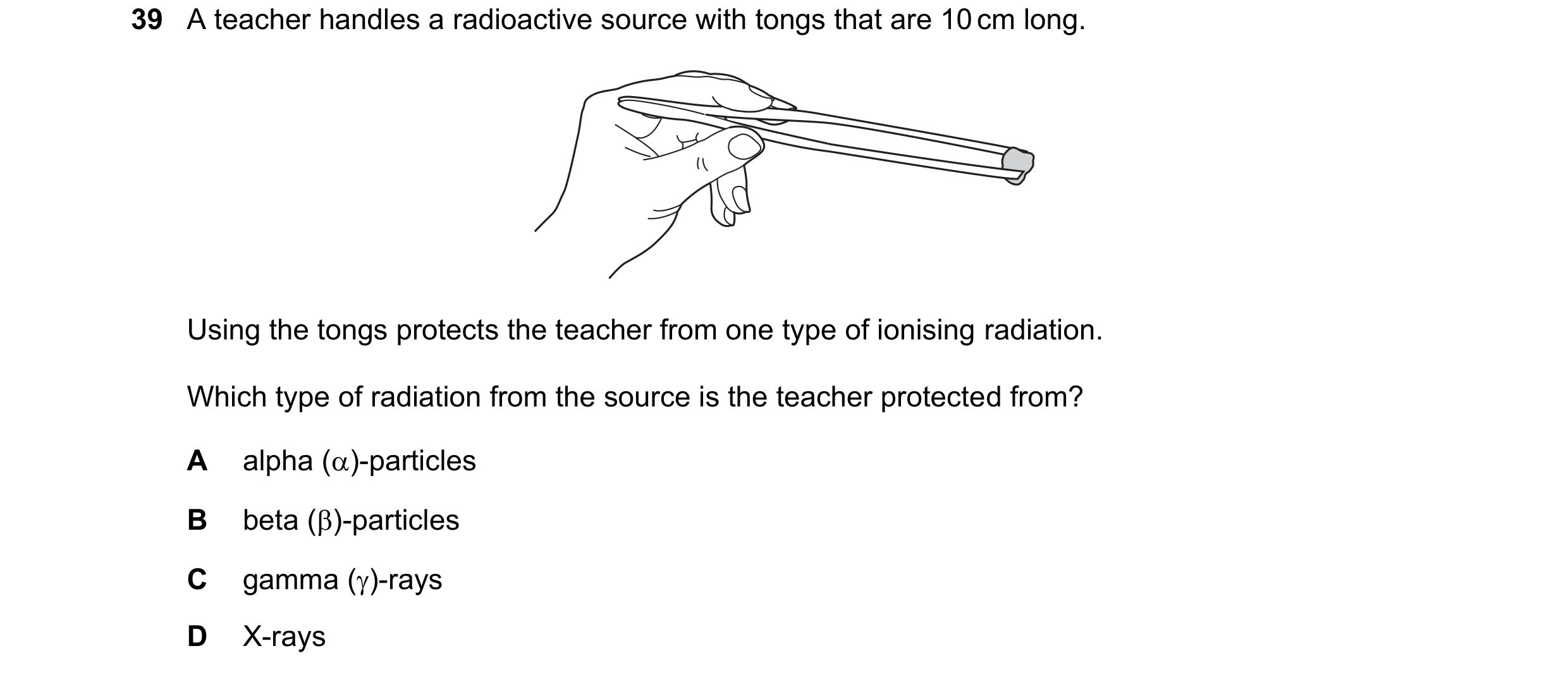
Q78 · A teacher handles a radioactive source with tongs that are 10 cm long 0654/11 May/June 2025
39 A teacher handles a radioactive source with tongs that are 10 cm long. Using the tongs protects the teacher from one type of ionising radiation. Which type of radiation from the source is the teacher protected from? A alpha ()-particles B beta ()-particles C gamma ()-rays D X-rays
1 marks
Answer: A
This question in 0654/11 May/June 2025
Q79 · A scientist works with a radioactive source that emits gamma ()-rays 0654/12 May/June 2025
39 A scientist works with a radioactive source that emits gamma ()-rays. The scientist takes several precautions. Which precaution does not give the scientist any protection? A Keep a lead screen between the scientist and the source. B Use a detector to measure the count rate of the source. C Only use the source for a short period of time. D Have a large distance between the scientist and the source.
1 marks
Answer: B
This question in 0654/12 May/June 2025
Q80 · A scientist works with a radioactive source that emits gamma ()-rays 0654/13 May/June 2025
39 A scientist works with a radioactive source that emits gamma ()-rays. The scientist takes several precautions. Which precaution does not give the scientist any protection? A Keep a lead screen between the scientist and the source. B Use a detector to measure the count rate of the source. C Only use the source for a short period of time. D Have a large distance between the scientist and the source.
1 marks
Answer: B
This question in 0654/13 May/June 2025
Q81 · The mass of a radioactive isotope in a sample is 720 g 0654/11 Oct/Nov 2025
39 The mass of a radioactive isotope in a sample is 720 g. The half-life of the isotope is 4.0 hours. Which mass of the isotope remains undecayed after 12 hours? A 60 g B 90 g C 180 g D 240 g
1 marks
Answer: B
This question in 0654/11 Oct/Nov 2025
Q82 · A box is made from aluminium that is 20 mm thick 0654/12 Oct/Nov 2025
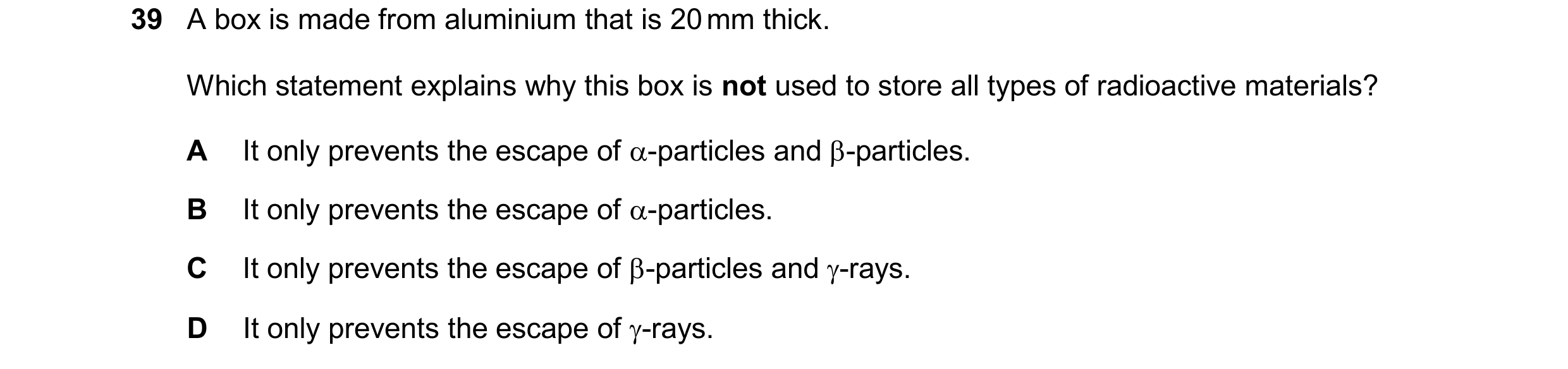
39 A box is made from aluminium that is 20 mm thick. Which statement explains why this box is not used to store all types of radioactive materials? A It only prevents the escape of -particles and -particles. B It only prevents the escape of -particles. C It only prevents the escape of -particles and -rays. D It only prevents the escape of -rays.
1 marks
Answer: A
This question in 0654/12 Oct/Nov 2025
Q83 · A box is made from aluminium that is 20 mm thick 0654/13 Oct/Nov 2025
39 A box is made from aluminium that is 20 mm thick. Which statement explains why this box is not used to store all types of radioactive materials? A It only prevents the escape of -particles and -particles. B It only prevents the escape of -particles. C It only prevents the escape of -particles and -rays. D It only prevents the escape of -rays.
1 marks
Answer: A
This question in 0654/13 Oct/Nov 2025


 1 / 21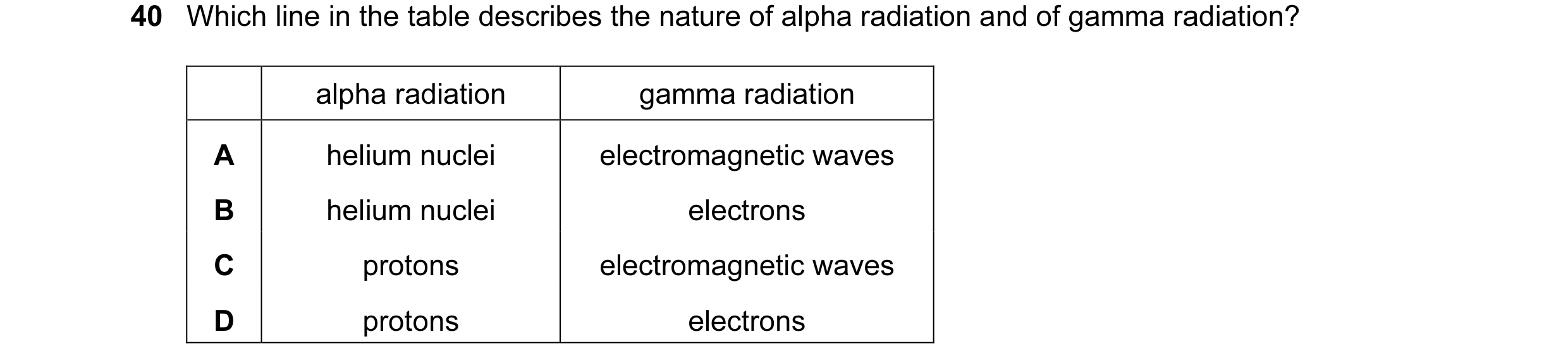

 2 / 21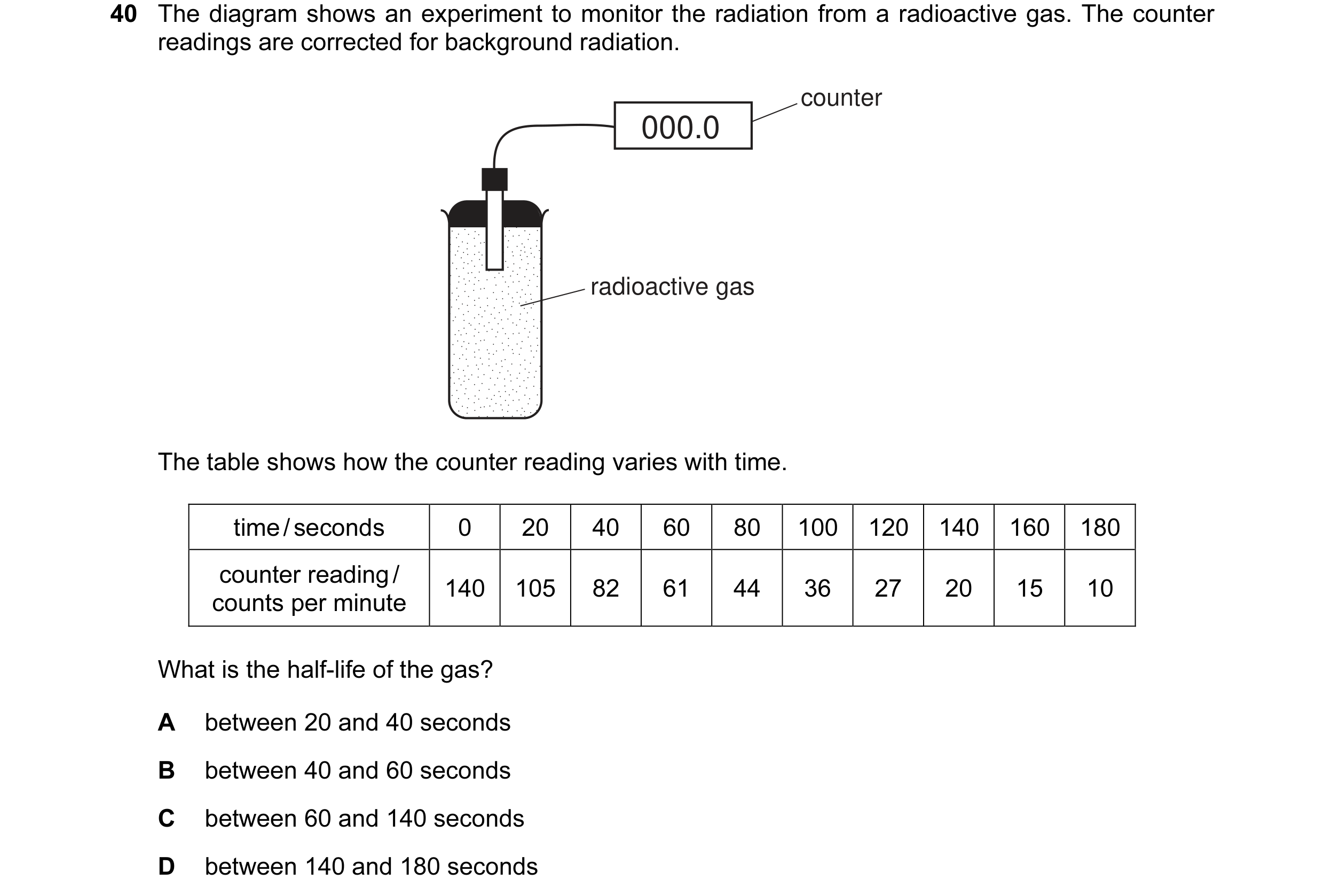
 3 / 21



 4 / 21


 5 / 21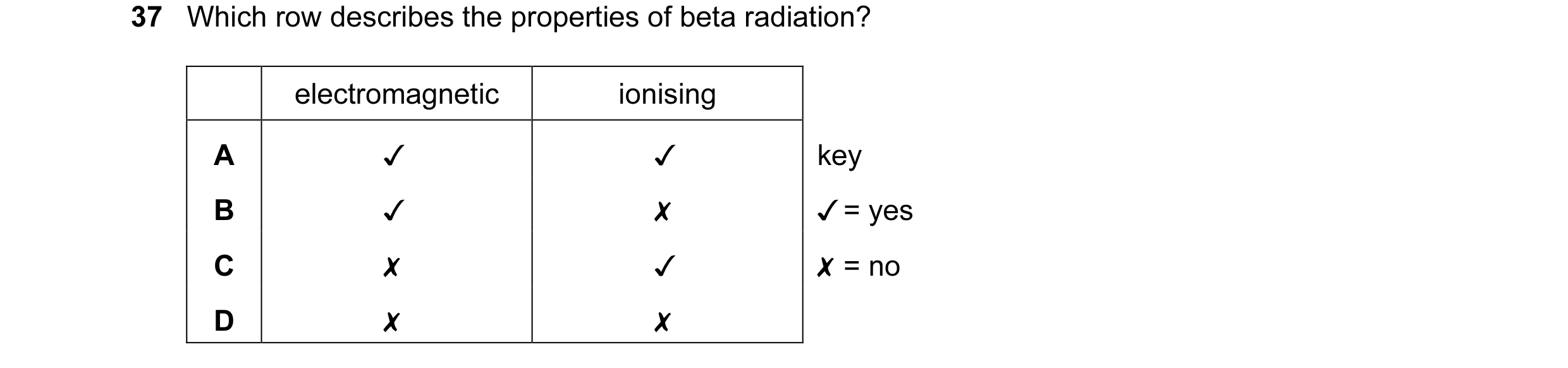
 6 / 21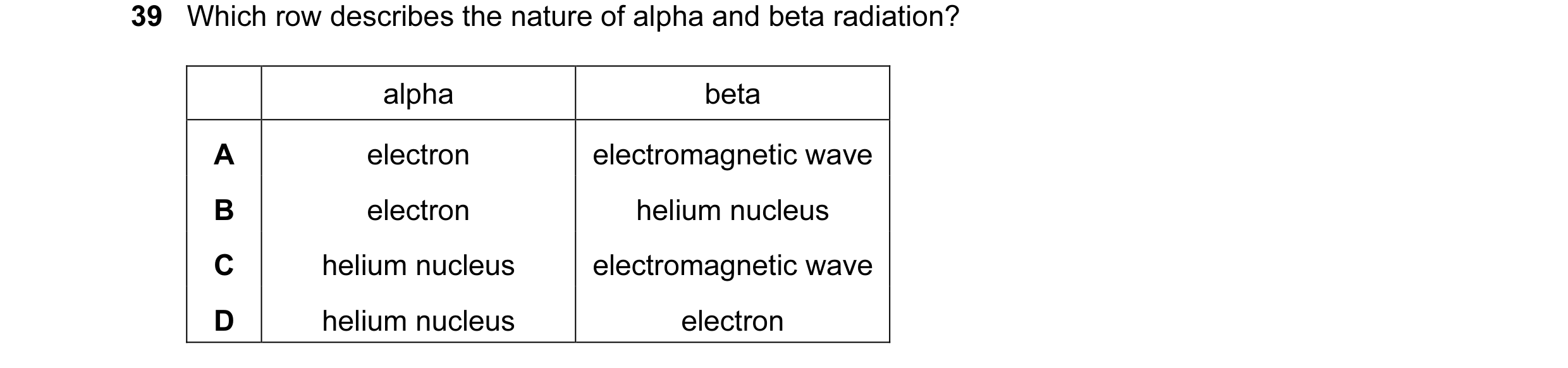
 7 / 21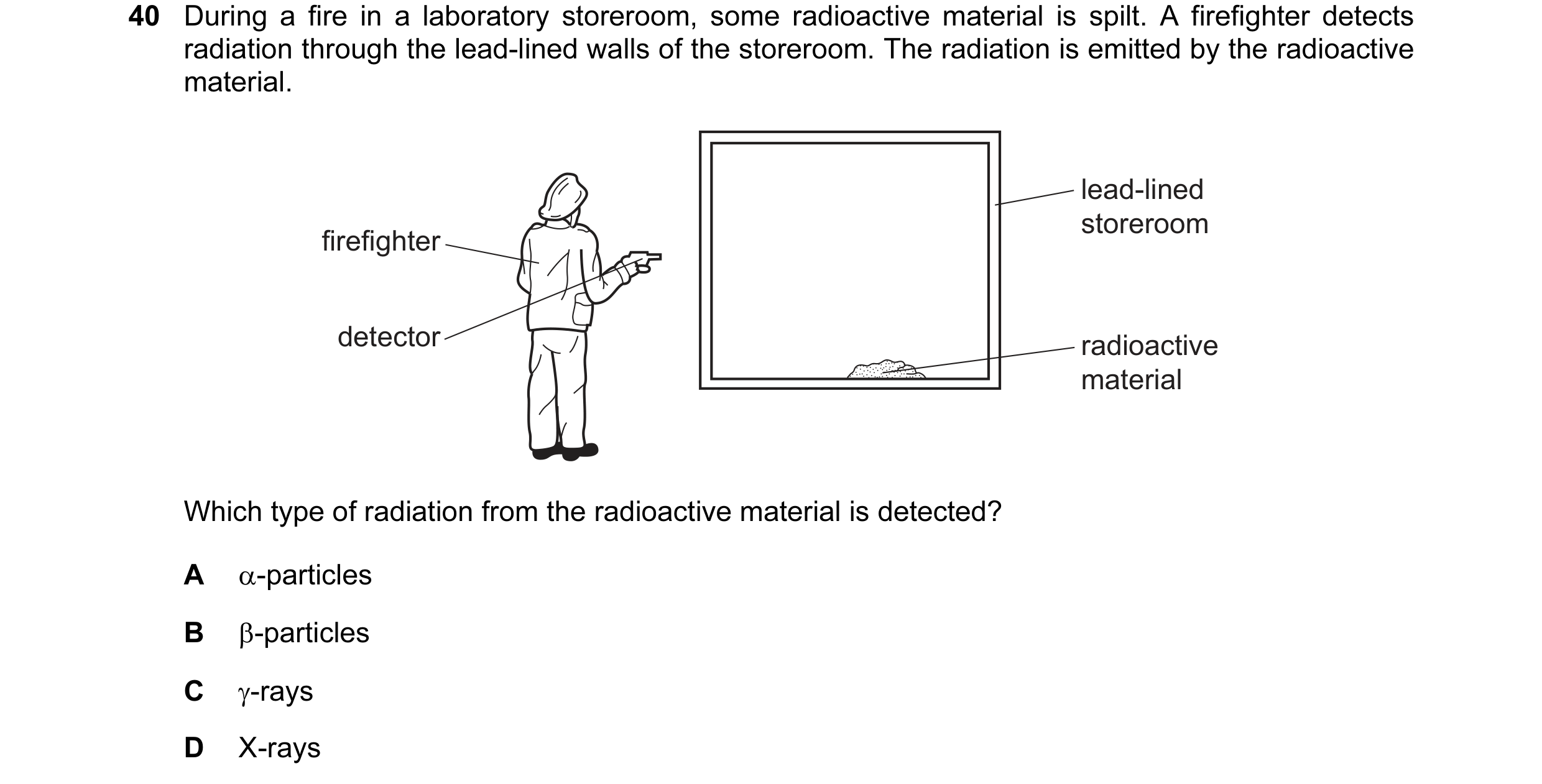
 8 / 21

 9 / 21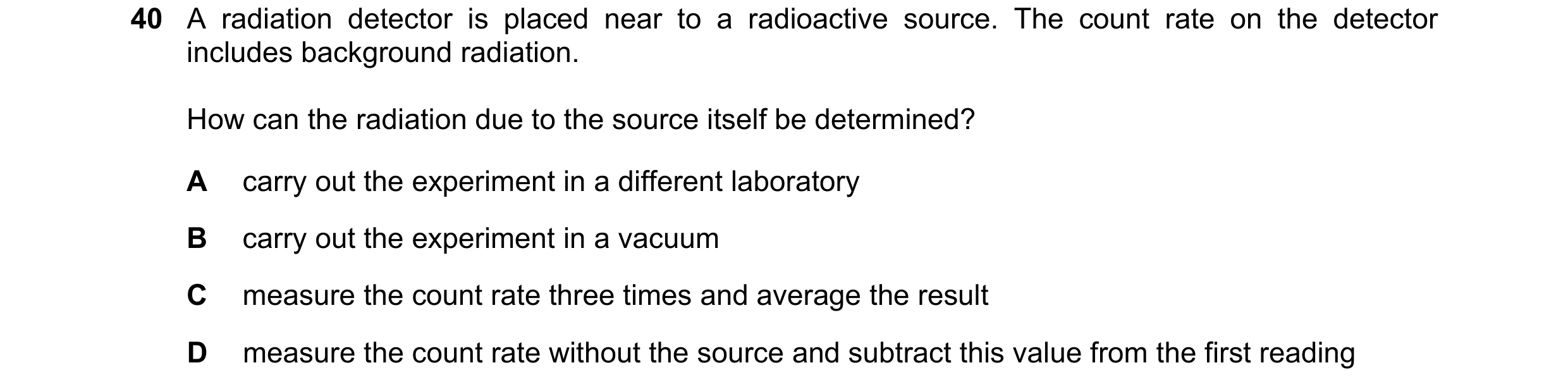


 10 / 21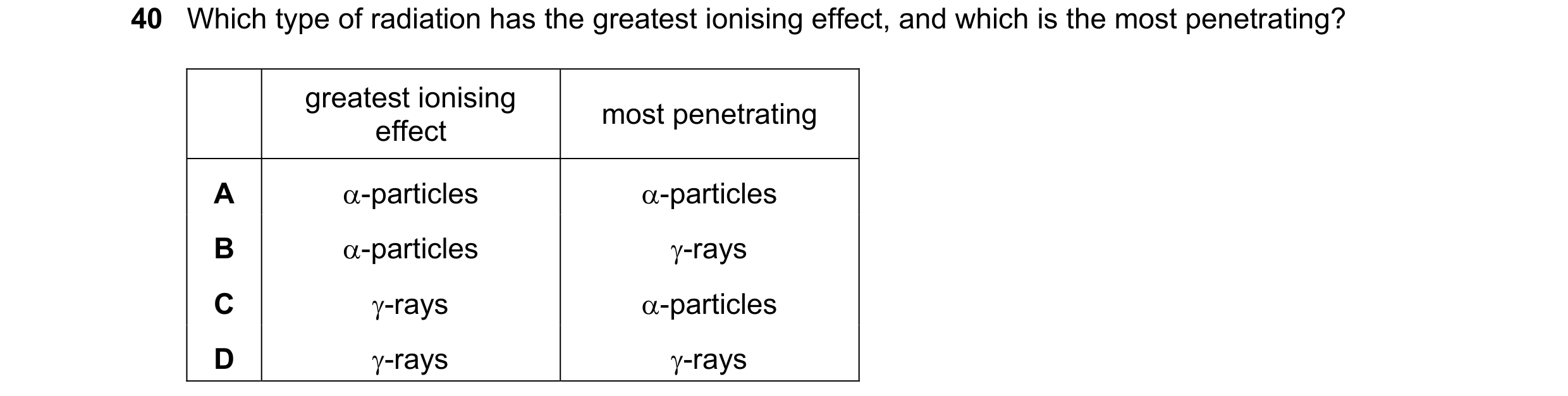

 11 / 21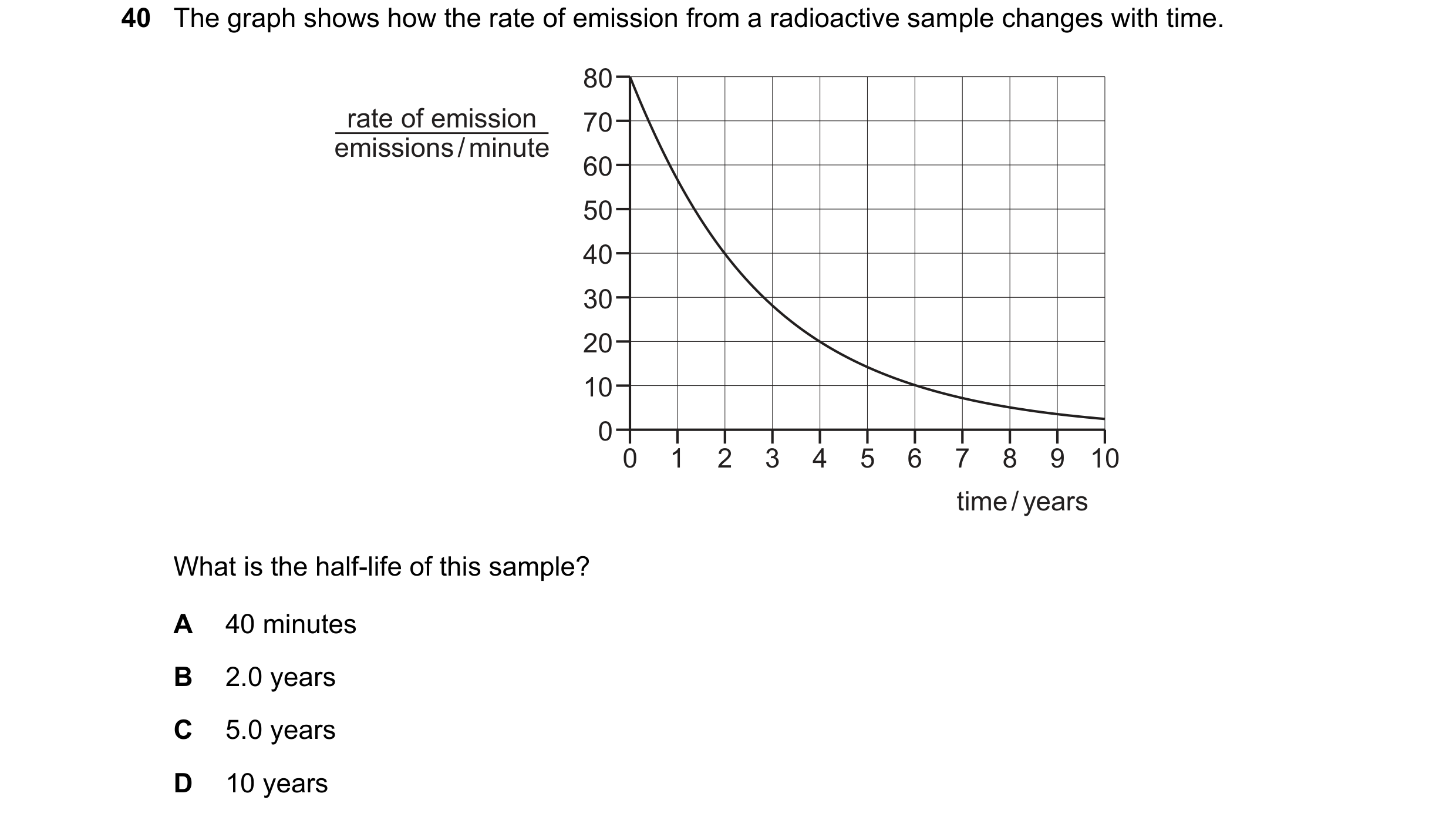

 12 / 21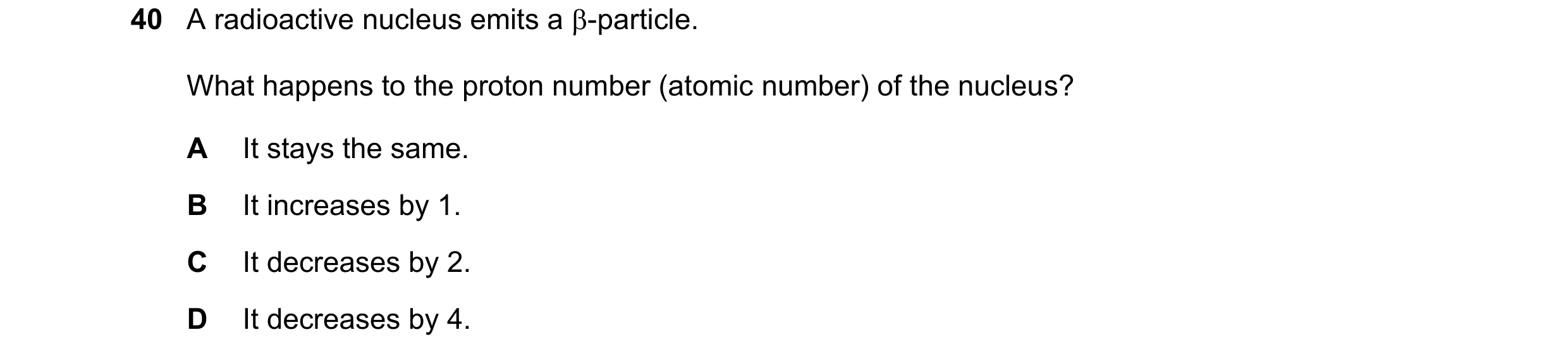

 13 / 21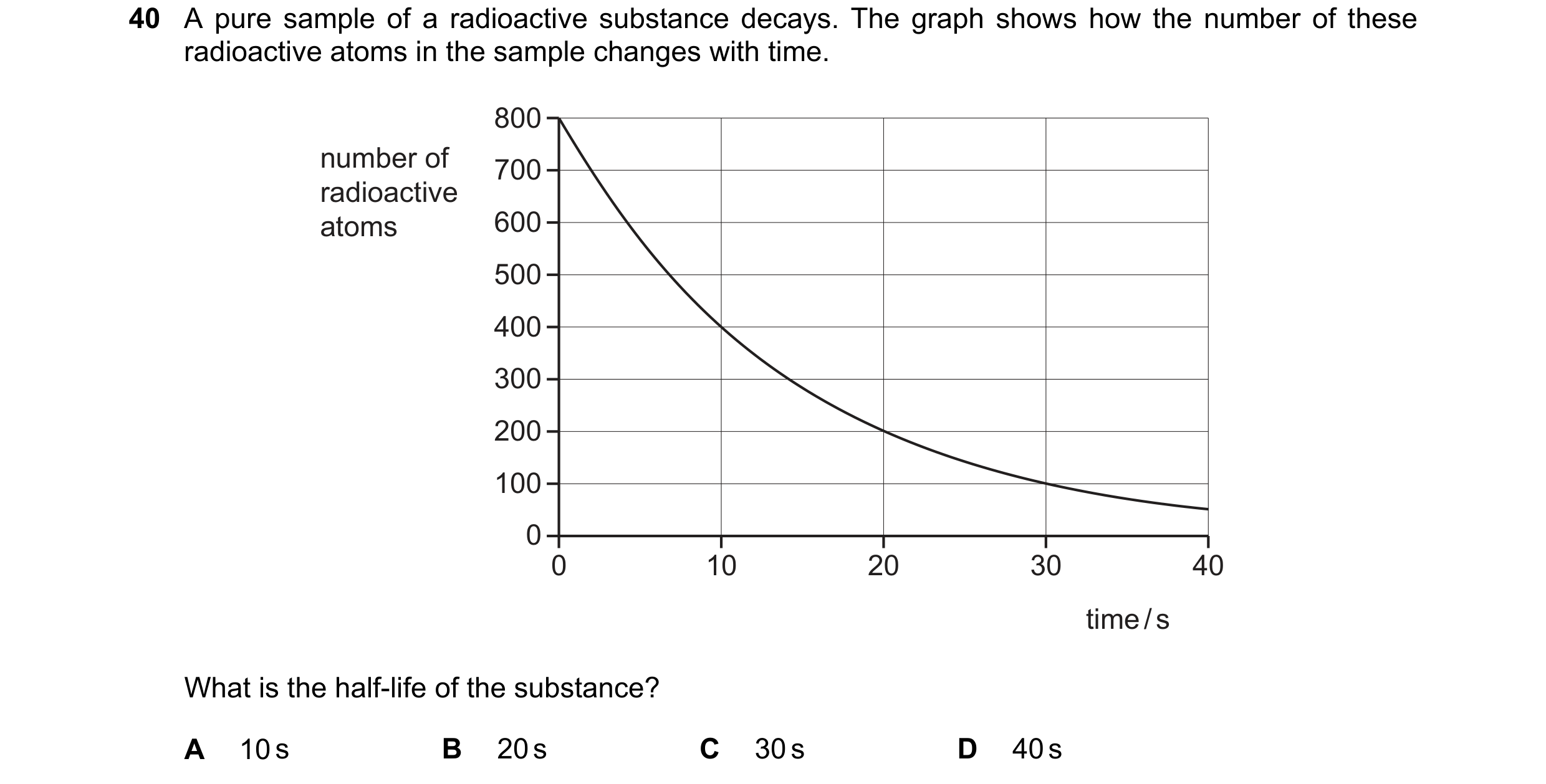
 14 / 21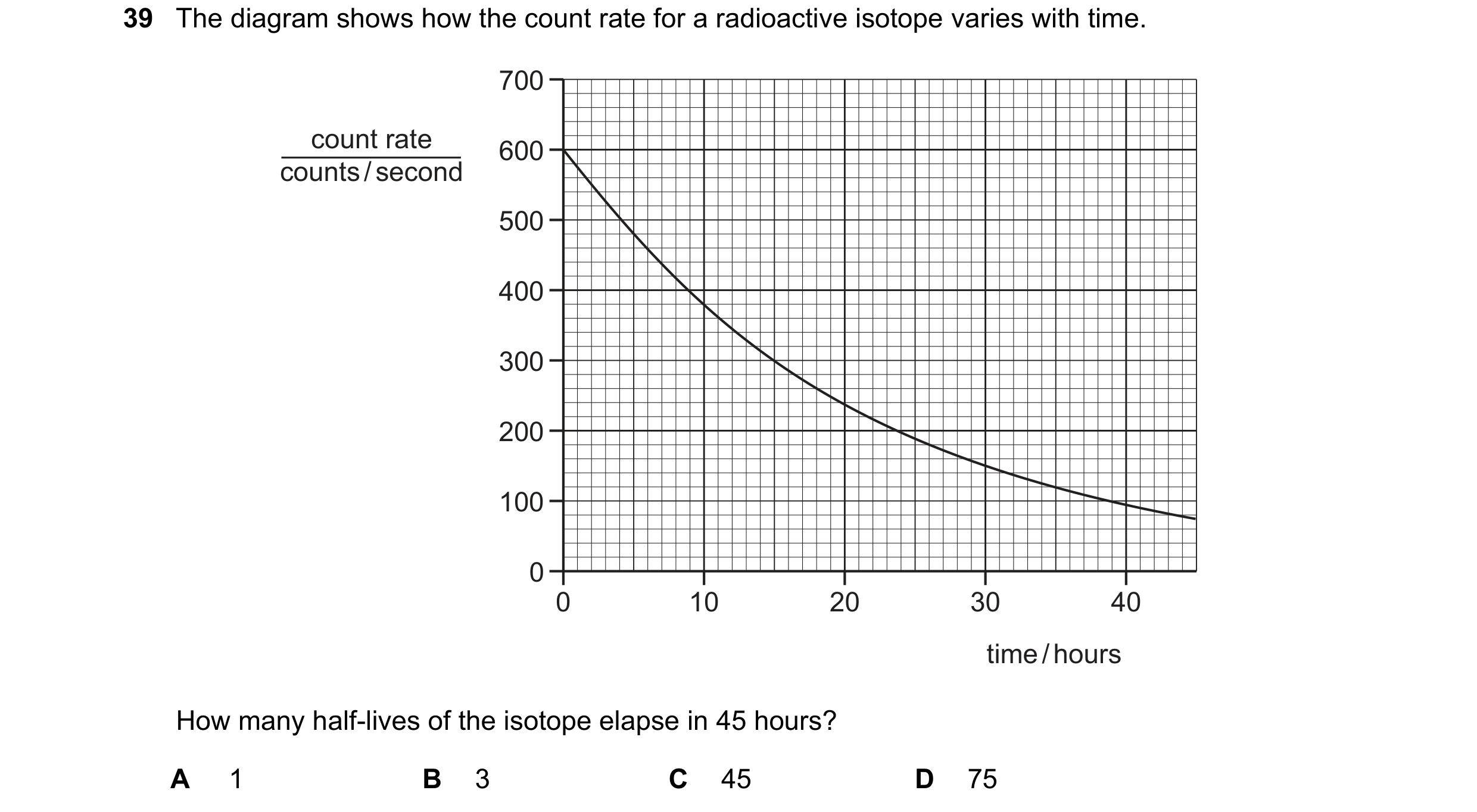
 15 / 21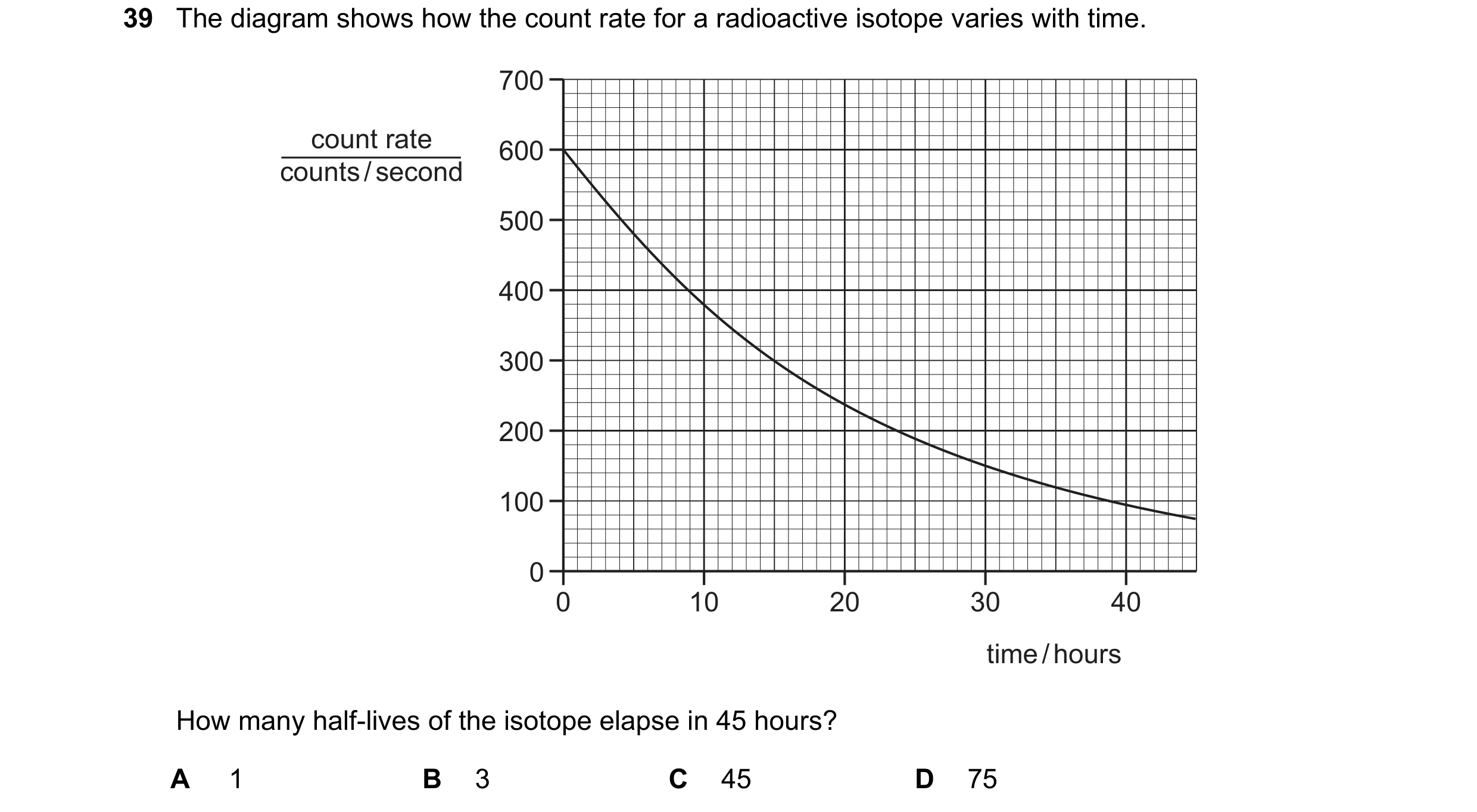
 16 / 21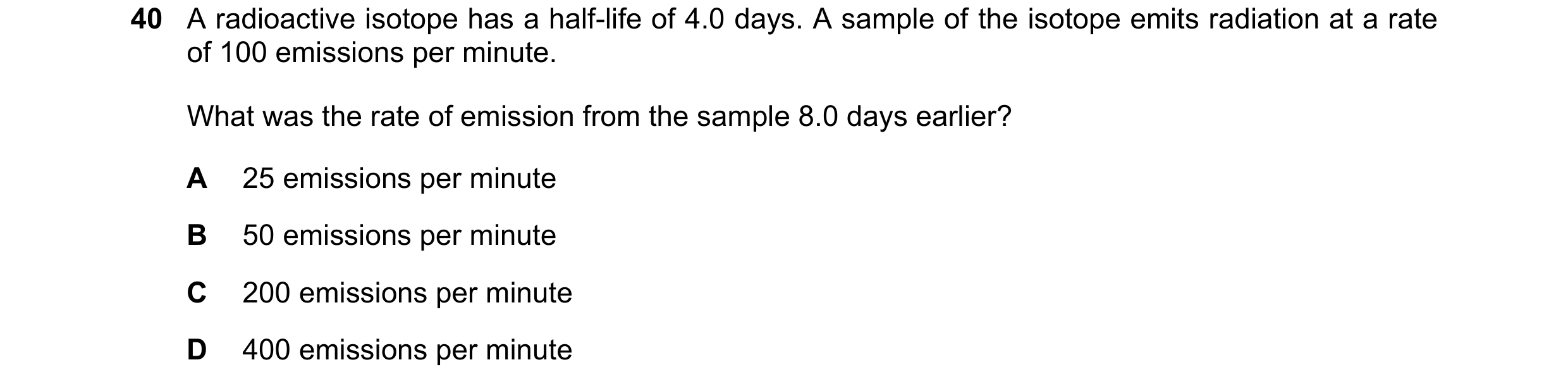
 17 / 21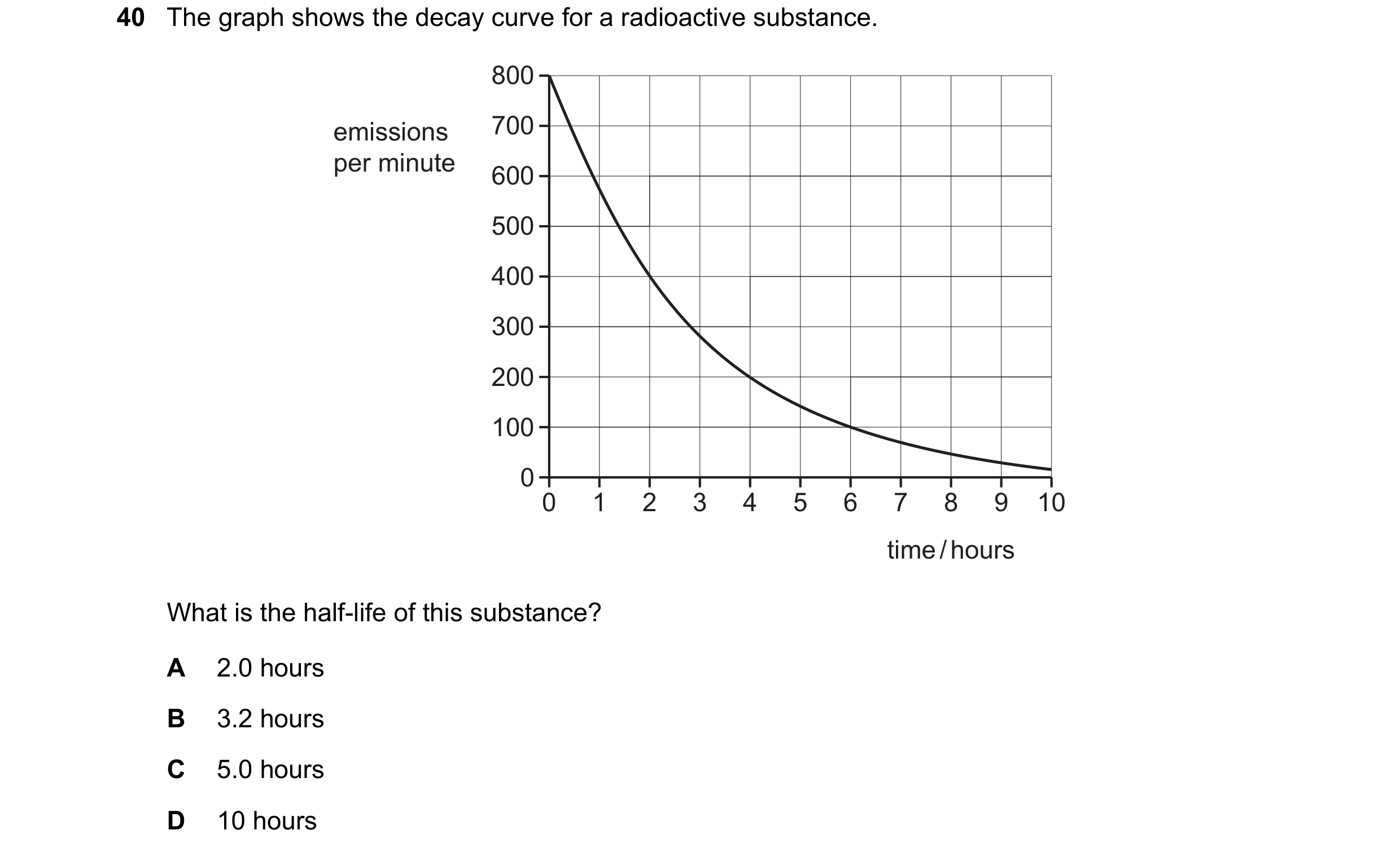
 18 / 21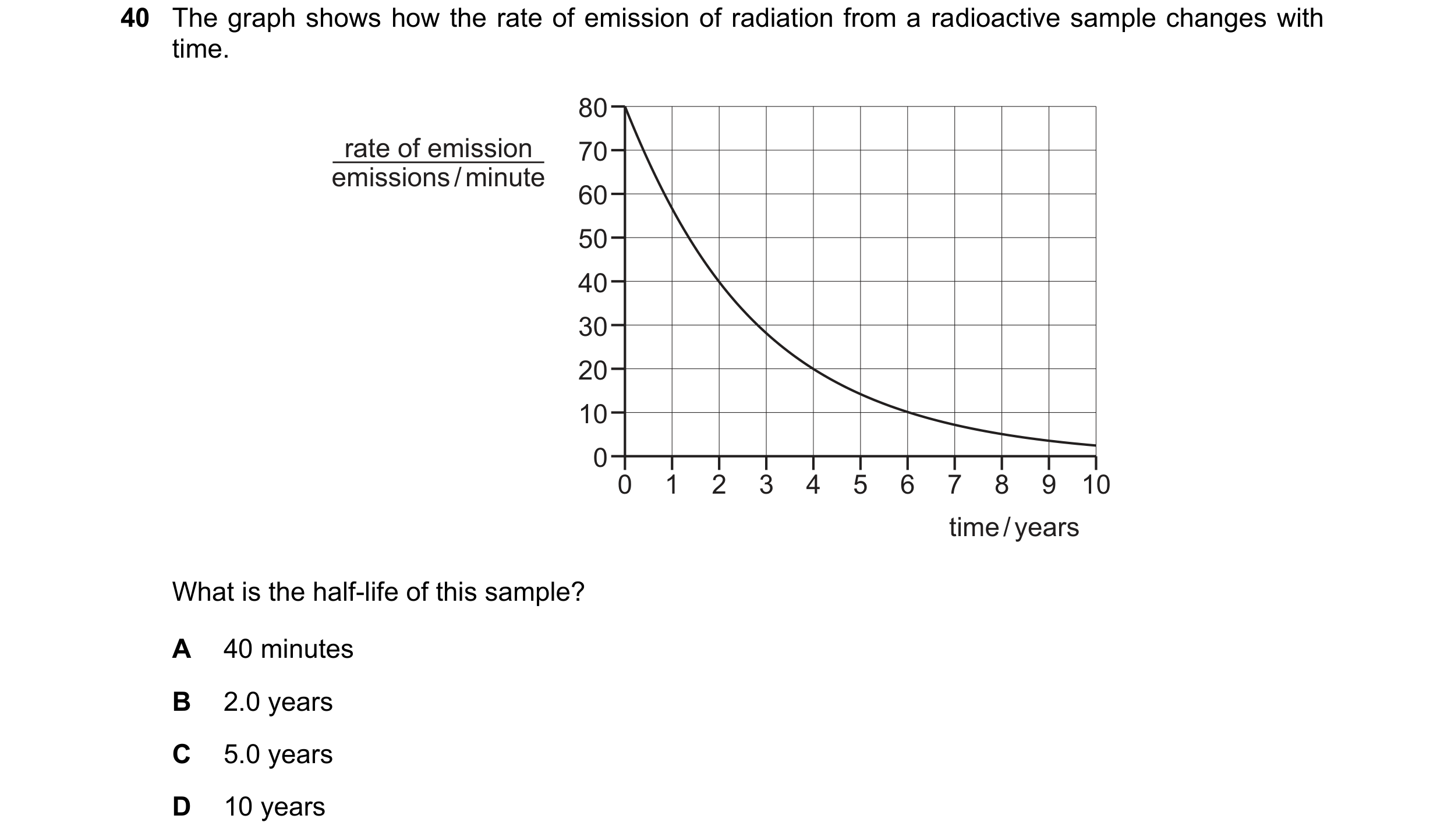
 19 / 21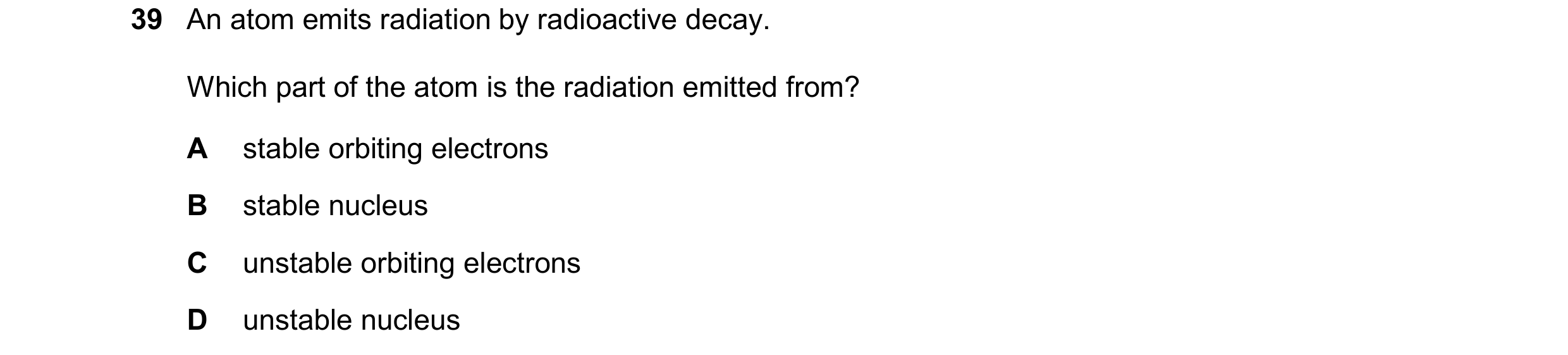
 20 / 21
 21 / 21