Questions as text
Q1 · Which produces an electromotive force (e.m.f.)? 0625/22 Feb/March 2016
28 Which produces an electromotive force (e.m.f.)? A a battery B a filament lamp C a resistor D a spring balance
1 marks
Answer: A
This question in 0625/22 Feb/March 2016
Q2 · The table describes four different resistance wires 0625/22 Feb/March 2016
29 The table describes four different resistance wires. They are all made from the same metal. Which wire has the smallest resistance? length of diameter of wire / m wire / mm A 2.0 1.0 B 2.0 1.5 C 3.0 1.0 D 3.0 1.5
1 marks
Answer: B
This question in 0625/22 Feb/March 2016
Q3 · Which circuit shows the directions of the conventional current I and the flow of… 0625/22 Feb/March 2016
30 Which circuit shows the directions of the conventional current I and the flow of electrons? A B I electrons I electrons C D I electrons I electrons
1 marks
Answer: B
This question in 0625/22 Feb/March 2016
Q4 · What is an electric field? 0625/21 May/June 2016
26 What is an electric field? A a region around a wire carrying an electric current in which a compass needle experiences a force B a region in which an electric charge experiences a force C a region in which an electric charge is attracted by the Earth’s gravity D a region through which electromagnetic radiation is passing
1 marks
Answer: B
This question in 0625/21 May/June 2016
Q5 · A negatively charged rod is held close to one side of a metal sphere 0625/21 May/June 2016
27 A negatively charged rod is held close to one side of a metal sphere. The other side of the sphere is earthed. Which diagram shows the distribution of charge on the metal sphere? A B – + – –– – –– –– –– –– + – C D + + + –– –– + –– –– + + + +
1 marks
Answer: D
This question in 0625/21 May/June 2016
Q6 · A cell is connected to a lamp, as shown 0625/21 May/June 2016
28 A cell is connected to a lamp, as shown. – + A charge of 4.0 C flows through the lamp in 2.0 s. What is the direction of the electron flow in the lamp and what is the current in the lamp? direction of electron current / A flow in lamp A from left to right 2.0 B from left to right 8.0 C from right to left 2.0 D from right to left 8.0
1 marks
Answer: A
This question in 0625/21 May/June 2016
Q7 · The diagrams show four current-voltage graphs 0625/21 May/June 2016
29 The diagrams show four current-voltage graphs. Which two graphs show the characteristics of an ohmic resistor and of a filament lamp? W X Y Z current current current current 0 0 0 0 0 voltage 0 voltage 0 voltage 0 voltage ohmic filament resistor lamp A W Y B X Y C W Z D X Z
1 marks
Answer: B
This question in 0625/21 May/June 2016
Q8 · The four circuits shown all include an a.c 0625/21 May/June 2016
30 The four circuits shown all include an a.c. power supply, two diodes and a lamp. In which circuit is there a rectified current in the lamp? A B C D
1 marks
Answer: A
This question in 0625/21 May/June 2016
Q9 · The diagram shows part of a circuit used to switch street lamps on and off automatically 0625/21 May/June 2016
32 The diagram shows part of a circuit used to switch street lamps on and off automatically. + LDR – In the evening it gets dark. Which row shows the effect on the resistance of the light-dependent resistor (LDR) and on the potential difference (p.d.) across it? resistance of LDR p.d. across LDR A decreases decreases B decreases increases C increases decreases D increases increases
1 marks
Answer: D
This question in 0625/21 May/June 2016
Q10 · A small potential difference V is applied across a filament lamp 0625/22 May/June 2016
26 A small potential difference V is applied across a filament lamp. The current I in the lamp is measured. V is increased in stages and I is measured at each stage. Which graph shows the results obtained? A B C D I I I I 0 0 0 0 0 V 0 V 0 V 0 V
1 marks
Answer: A
This question in 0625/22 May/June 2016
Q11 · A resistor of resistance R is connected to a battery of e.m.f 0625/22 May/June 2016
27 A resistor of resistance R is connected to a battery of e.m.f. V. There is a current I in the resistor. Power P is dissipated by the resistor, and in time t the energy transferred is E. Which expression is correct? V A E = IVt B E = PIt C P = VIR D P = R
1 marks
Answer: A
This question in 0625/22 May/June 2016
Q12 · A wire has a certain electrical resistance 0625/22 May/June 2016
28 A wire has a certain electrical resistance. The diameter and length of the wire may be changed. Which pair of changes must cause the resistance of the wire to increase? change of change of diameter length A decrease decrease B decrease increase C increase decrease D increase increase
1 marks
Answer: B
This question in 0625/22 May/June 2016
Q13 · The diagram shows part of a circuit used to switch street lamps on and off automatically 0625/22 May/June 2016
32 The diagram shows part of a circuit used to switch street lamps on and off automatically. + LDR – In the evening it gets dark. Which row shows the effect on the resistance of the light-dependent resistor (LDR) and on the potential difference (p.d.) across it? resistance of LDR p.d. across LDR A decreases decreases B decreases increases C increases decreases D increases increases
1 marks
Answer: D
This question in 0625/22 May/June 2016
Q14 · Each diagram shows two charged metal plates 0625/23 May/June 2016
27 Each diagram shows two charged metal plates. Which diagram shows the pattern and the direction of the electric field between the plates? A B – – – – – – – – + + + + + + + + C D – – – – – – – – + + + + + + + +
1 marks
Answer: D
This question in 0625/23 May/June 2016
Q15 · The diagram shows a battery connected to two resistors 0625/23 May/June 2016
29 The diagram shows a battery connected to two resistors. R Four students separately measure the electromotive force (e.m.f.) of the battery, the current in the resistors, and the potential difference (p.d.) across resistor R. Their results are shown in the table below. Which row shows values with their correct units? e.m.f. current p.d. A 3.0 A 0.30 V 1.5 A B 3.0 A 0.30 A 1.5 V C 3.0 V 0.30 V 1.5 A D 3.0 V 0.30 A 1.5 V
1 marks
Answer: D
This question in 0625/23 May/June 2016
Q16 · The diagram shows part of a circuit used to switch street lamps on and off automatically 0625/23 May/June 2016
32 The diagram shows part of a circuit used to switch street lamps on and off automatically. + LDR – In the evening it gets dark. Which row shows the effect on the resistance of the light-dependent resistor (LDR) and on the potential difference (p.d.) across it? resistance of LDR p.d. across LDR A decreases decreases B decreases increases C increases decreases D increases increases
1 marks
Answer: D
This question in 0625/23 May/June 2016
Q17 · A polythene rod is rubbed with a cloth 0625/21 Oct/Nov 2016
29 A polythene rod is rubbed with a cloth. The rod becomes positively charged because of the movement of charged particles. Which row gives the name of these charged particles, and the direction in which they move? charged direction of particles movement A electrons from cloth to rod B electrons from rod to cloth C protons from cloth to rod D protons from rod to cloth
1 marks
Answer: B
This question in 0625/21 Oct/Nov 2016
Q18 · The circuit shows a 12 V battery connected to a lamp of resistance 3.0 Ω 0625/21 Oct/Nov 2016
32 The circuit shows a 12 V battery connected to a lamp of resistance 3.0 Ω. 12 V How much energy is transferred to the surroundings by the lamp in 2.0 minutes? A 48 J B 96 J C 2880 J D 5760 J
1 marks
Answer: D
This question in 0625/21 Oct/Nov 2016
Q19 · The diagram shows a lamp in a circuit 0625/22 Oct/Nov 2016
29 The diagram shows a lamp in a circuit. P Which change to the circuit would increase the current in the lamp? A adding another resistor in parallel with the one in the circuit B adding another resistor in series with the one in the circuit C decreasing the electromotive force (e.m.f.) of the battery in the circuit D moving the lamp to point P in the circuit
1 marks
Answer: A
This question in 0625/22 Oct/Nov 2016
Q20 · The diagram shows a circuit 0625/22 Oct/Nov 2016
30 The diagram shows a circuit. A The reading on the ammeter is 12 A. How much charge passes through the ammeter in 2.0 minutes? A 0.10 C B 6.0 C C 24 C D 1440 C
1 marks
Answer: D
This question in 0625/22 Oct/Nov 2016
Q21 · A copper wire has a resistance of 2.0 Ω 0625/22 Oct/Nov 2016
31 A copper wire has a resistance of 2.0 Ω. A second copper wire is twice as long as the first wire, and its diameter is twice the diameter of the first wire. What is the resistance of the second wire? A 1.0 Ω B 2.0 Ω C 8.0 Ω D 16.0 Ω
1 marks
Answer: A
This question in 0625/22 Oct/Nov 2016
Q22 · In the circuit shown, the voltmeter reads 2.0 V 0625/22 Oct/Nov 2016
33 In the circuit shown, the voltmeter reads 2.0 V. A charge of 5.0 C passes through the resistor in a certain time. V How much energy is supplied to the resistor in this time? A 0.40 J B 2.5 J C 10 J D 20 J
1 marks
Answer: C
This question in 0625/22 Oct/Nov 2016
Q23 · A student holds a rod in his hand 0625/23 Oct/Nov 2016
28 A student holds a rod in his hand. cloth hand rod He rubs the rod with a cloth. The rod gains a positive charge. Of which material could the rod be made, and which transfer of charge has happened? material of rod transfer of charge A metal negative charge from rod to cloth B metal positive charge from cloth to rod C plastic negative charge from rod to cloth D plastic positive charge from cloth to rod
1 marks
Answer: C
This question in 0625/23 Oct/Nov 2016
Q24 · The graph shows the relationship between the current in a circuit component and the… 0625/23 Oct/Nov 2016
30 The graph shows the relationship between the current in a circuit component and the potential difference (p.d.) across it. The graph has a straight section and a curved section. current 0 0 p.d. What happens to the resistance of the component in these two sections as the current increases? straight section curved section A resistance increases resistance decreases B resistance increases resistance increases C no change in resistance resistance decreases D no change in resistance resistance increases
1 marks
Answer: D
This question in 0625/23 Oct/Nov 2016
Q25 · In the circuit shown there is a current of 10 A 0625/23 Oct/Nov 2016
31 In the circuit shown there is a current of 10 A. How much charge passes through the resistor in 2.0 minutes? A 0.083 C B 5 C C 20 C D 1200 C
1 marks
Answer: D
This question in 0625/23 Oct/Nov 2016
Q26 · Which particles move in a metal to cause an electric current? 0625/22 Feb/March 2017
27 Which particles move in a metal to cause an electric current? A electrons B neutrons C nucleons D protons
1 marks
Answer: A
This question in 0625/22 Feb/March 2017
Q27 · The diagrams represent four copper wires 0625/22 Feb/March 2017
28 The diagrams represent four copper wires. Which wire has the greatest resistance? A B C D 20 mm 20 mm 10 mm 10 mm 1 mm 2 mm 1 mm 2 mm
1 marks
Answer: C
This question in 0625/22 Feb/March 2017
Q28 · Four circuits are set up 0625/22 Feb/March 2017
30 Four circuits are set up. In which circuit does the ammeter show the greatest reading? A B C D 12 V 12 V 12 V 12 V A A A A 2.0 Ω 2.0 Ω 2.0 Ω 2.0 Ω 3.0 Ω 3.0 Ω 3.0 Ω 3.0 Ω
1 marks
Answer: A
This question in 0625/22 Feb/March 2017
Q29 · The diagram shows an electric circuit 0625/22 Feb/March 2017
31 The diagram shows an electric circuit. V The light falling on the light-dependent resistor (LDR) increases in brightness. What happens to the resistance of the LDR, the current in the fixed resistor and the reading on the voltmeter? resistance of current in reading on LDR fixed resistor voltmeter A decreases increases decreases B decreases increases increases C increases decreases decreases D increases decreases increases
1 marks
Answer: B
This question in 0625/22 Feb/March 2017
Q30 · A student rubs a plastic rod with a cloth 0625/21 May/June 2017
27 A student rubs a plastic rod with a cloth. The rod becomes positively charged. What has happened to the rod? A It has gained electrons. B It has gained protons. C It has lost electrons. D It has lost protons.
1 marks
Answer: C
This question in 0625/21 May/June 2017
Q31 · Which quantity is measured in coulombs? 0625/21 May/June 2017
28 Which quantity is measured in coulombs? A charge B current C electromotive force D power
1 marks
Answer: A
This question in 0625/21 May/June 2017
Q32 · A cylinder of conducting putty has length l, diameter d and resistance R 0625/21 May/June 2017
29 A cylinder of conducting putty has length l, diameter d and resistance R. The putty is now moulded into a cylinder of diameter 2d that has the same volume. l R d By which factor does the resistance of the putty cylinder decrease? A 2 B 4 C 8 D 16
1 marks
Answer: D
This question in 0625/21 May/June 2017
Q33 · The average current during a lightning strike between a cloud and the ground is 1.5 × 10⁴… 0625/21 May/June 2017
30 The average current during a lightning strike between a cloud and the ground is 1.5 × 10⁴ A. The lightning releases 3.0 × 10⁸ J of energy and lasts for 2.0 × 10⁻⁴ s. What is the average electromotive force (e.m.f.) between the cloud and the ground? A 4.0 V B 100 V C 1.0 × 10⁸ V D 9.0 × 10⁸ V
1 marks
Answer: C
This question in 0625/21 May/June 2017
Q34 · A light-dependent resistor (LDR) and a resistor R are connected in a series circuit 0625/21 May/June 2017
33 A light-dependent resistor (LDR) and a resistor R are connected in a series circuit. Light falls on the LDR. A R The brightness of the light falling on the LDR decreases. What happens to the resistance of the LDR and what happens to the reading on the ammeter? resistance reading on of LDR ammeter A decreases decreases B decreases increases C increases decreases D increases increases
1 marks
Answer: C
This question in 0625/21 May/June 2017
Q35 · A student tests the electrical conduction of four materials 0625/22 May/June 2017
27 A student tests the electrical conduction of four materials. aluminium iron plastic silver Which materials conduct electricity? A aluminium, iron and silver only B aluminium and silver only C iron, silver and plastic only D plastic only
1 marks
Answer: A
This question in 0625/22 May/June 2017
Q36 · What is the unit of charge? 0625/22 May/June 2017
28 What is the unit of charge? A ampere B coulomb C ohm D volt
1 marks
Answer: B
This question in 0625/22 May/June 2017
Q37 · An isolated metal sphere is positively charged 0625/22 May/June 2017
29 An isolated metal sphere is positively charged. It is then brought near to another isolated metal sphere that is neutral. + + + + + + + + + + positively charged + + neutral metal sphere metal sphere What happens to the charges on the neutral sphere as the positively charged sphere is brought close to it? A Some positive charges move to the left and some negative charges move to the right. B Some positive charges move to the right and some negative charges move to the left. C Some positive charges move to the right, but the negative charges do not move. D The positive charges do not move, but some negative charges move to the left.
1 marks
Answer: D
This question in 0625/22 May/June 2017
Q38 · Which diagram is the current-voltage (I-V) characteristic graph for a metallic conductor… 0625/22 May/June 2017
30 Which diagram is the current-voltage (I-V) characteristic graph for a metallic conductor at constant temperature? A B C D I I I I 00 00 00 00 V V V V
1 marks
Answer: D
This question in 0625/22 May/June 2017
Q39 · A solar panel is used to recharge a battery 0625/23 May/June 2017
11 A solar panel is used to recharge a battery. The solar panel produces 0.80 W of electrical power. The panel is 20% efficient. solar panel sunlight power to battery 0.80 W What is the power input of the sunlight onto the solar panel? A 0.16 W B 4.0 W C 8.0 W D 16 W
1 marks
Answer: B
This question in 0625/23 May/June 2017
Q40 · Which material is a conductor of electricity? 0625/23 May/June 2017
27 Which material is a conductor of electricity? A brass B glass C plastic D wood
1 marks
Answer: A
This question in 0625/23 May/June 2017
Q41 · The diagrams each show a positive point charge 0625/23 May/June 2017
28 The diagrams each show a positive point charge. Which diagram represents the pattern and the direction of the electric field due to the charge? A B C D + + + +
1 marks
Answer: A
This question in 0625/23 May/June 2017
Q42 · Which quantity is equivalent to 1.0 V? 0625/23 May/June 2017
29 Which quantity is equivalent to 1.0 V? A 1.0 J / C B 1.0 kJ / C C 1.0 J / s D 1.0 kJ / s
1 marks
Answer: A
This question in 0625/23 May/June 2017
Q43 · A circuit contains a fixed resistor 0625/23 May/June 2017
30 A circuit contains a fixed resistor. The potential difference across the resistor is 24.0 V and the current in the resistor is 2.30 A. How much energy is transferred in the resistor in a time of 17.0 minutes? A 938 J B 5630 J C 56.3 kJ D 9.38 kJ
1 marks
Answer: C
This question in 0625/23 May/June 2017
Q44 · A battery, an ammeter, a switch, a lamp and a resistor are connected together in a circuit 0625/23 May/June 2017
31 A battery, an ammeter, a switch, a lamp and a resistor are connected together in a circuit. A With the switch open, the ammeter reads 2.4 A. When the switch is closed, this reading increases to 4.0 A. What is the current through the resistor with the switch closed? A 0 A B 1.6 A C 3.2 A D 6.4 A
1 marks
Answer: B
This question in 0625/23 May/June 2017
Q45 · The diagram shows a circuit with a gap between points P and Q 0625/21 Oct/Nov 2017
31 The diagram shows a circuit with a gap between points P and Q. Four pieces of metal wire of the same material are connected, in turn, between points P and Q in the circuit. A P Q The table gives the diameters and lengths of the wires. In which wire is the current the largest? diameter / mm length / m A 0.10 1.0 B 0.10 2.0 C 0.20 1.0 D 0.20 2.0
1 marks
Answer: C
This question in 0625/21 Oct/Nov 2017
Q46 · A torch has a simple circuit with a 3.0 V battery and a lamp 0625/21 Oct/Nov 2017
32 A torch has a simple circuit with a 3.0 V battery and a lamp. There is a 20 mA current in the lamp. How much energy is transferred to the lamp in 5.0 minutes? A 0.30 J B 18 J C 60 J D 0.30 kJ
1 marks
Answer: B
This question in 0625/21 Oct/Nov 2017
Q47 · Which diagram represents the electric field due to a negatively-charged conducting sphere? 0625/22 Oct/Nov 2017
30 Which diagram represents the electric field due to a negatively-charged conducting sphere? A B C D – – – –
1 marks
Answer: A
This question in 0625/22 Oct/Nov 2017
Q48 · The diagram shows a circuit with a gap between points P and Q 0625/22 Oct/Nov 2017
31 The diagram shows a circuit with a gap between points P and Q. Four pieces of metal wire of the same material are connected, in turn, between points P and Q in the circuit. A P Q The table gives the diameters and lengths of the wires. In which wire is the current the largest? diameter / mm length / m A 0.10 1.0 B 0.10 2.0 C 0.20 1.0 D 0.20 2.0
1 marks
Answer: C
This question in 0625/22 Oct/Nov 2017
Q49 · The graph shows the way in which one physical quantity y varies with another physical… 0625/22 Oct/Nov 2017
32 The graph shows the way in which one physical quantity y varies with another physical quantity x. y 0 0 x Which row gives suitable quantities for y and x? y x A the number of atoms of a the time taken radioactive isotope present B the potential difference the current in the metallic conductor across a metallic conductor C the resistance of a length of wire the diameter of the wire D the volume of a 1.0 kg object the density of the material from which the object is made
1 marks
Answer: B
This question in 0625/22 Oct/Nov 2017
Q50 · The potential difference across a car headlamp is 12 V 0625/22 Oct/Nov 2017
33 The potential difference across a car headlamp is 12 V. The current in the lamp is 2.5 A. How much energy is transferred by the lamp in 1.0 hour? A 1800 J B 1800 W C 108 000 J D 108 000 W
1 marks
Answer: C
This question in 0625/22 Oct/Nov 2017
Q51 · The diagram shows a circuit with a fixed resistor connected in series with a thermistor… 0625/22 Oct/Nov 2017
34 The diagram shows a circuit with a fixed resistor connected in series with a thermistor and an ammeter. A Which row shows how temperature change affects the resistance of the thermistor and the current in the circuit? resistance of temperature current in circuit thermistor A decreases decreases increases B decreases increases decreases C increases decreases decreases D increases increases increases
1 marks
Answer: B
This question in 0625/22 Oct/Nov 2017
Q52 · A 100% efficient transformer has 6000 turns on its primary coil and 600 turns on its… 0625/22 Oct/Nov 2017
37 A 100% efficient transformer has 6000 turns on its primary coil and 600 turns on its secondary coil. The output voltage of the transformer is 12 V. A resistor is connected across the secondary coil and dissipates 24 W of power. primary coil secondary coil 6000 turns 600 turns output voltage 12 V power 24 W What is the current in the primary coil of the transformer? A 0.050 A B 0.20 A C 5.0 A D 20 A
1 marks
Answer: B
This question in 0625/22 Oct/Nov 2017
Q53 · There is a current in a metal wire 0625/23 Oct/Nov 2017
30 There is a current in a metal wire. Which particles in the wire move to cause this current? A α-particles B electrons C neutrons D protons
1 marks
Answer: B
This question in 0625/23 Oct/Nov 2017
Q54 · The diagram shows a circuit with a gap between points P and Q 0625/23 Oct/Nov 2017
31 The diagram shows a circuit with a gap between points P and Q. Four pieces of metal wire of the same material are connected, in turn, between points P and Q in the circuit. A P Q The table gives the diameters and lengths of the wires. In which wire is the current the largest? diameter / mm length / m A 0.10 1.0 B 0.10 2.0 C 0.20 1.0 D 0.20 2.0
1 marks
Answer: C
This question in 0625/23 Oct/Nov 2017
Q55 · A battery is connected to a circuit 0625/23 Oct/Nov 2017
32 A battery is connected to a circuit. It is switched on for 1.0 minute. During that time, there is a current of 0.40 A in the circuit and the battery supplies a total of 48 J of energy. Which row gives the charge that passes and the electromotive force (e.m.f.) of the battery? charge that passes e.m.f. of the in 1.0 minute / C battery / V A 0.40 2.0 B 0.40 120 C 24 2.0 D 24 120
1 marks
Answer: C
This question in 0625/23 Oct/Nov 2017
Q56 · The electromotive force (e.m.f.) of a rechargeable battery is 6.0 V 0625/21 May/June 2018
27 The electromotive force (e.m.f.) of a rechargeable battery is 6.0 V. What does this mean? A 6.0 J is the maximum energy the battery can provide in 1.0 s. B 6.0 J is the total energy the battery can provide before it has to be recharged. C 6.0 J of energy is provided by the battery to drive a charge of 1.0 C around a complete circuit. D 6.0 J of energy is provided by the battery to drive a current of 1.0 A around a complete circuit.
1 marks
Answer: C
This question in 0625/21 May/June 2018
Q57 · A student measures the potential difference across a device and the current in the device 0625/21 May/June 2018
28 A student measures the potential difference across a device and the current in the device. Which calculation gives the resistance of the device? A current + potential difference B current ÷ potential difference C potential difference ÷ current D potential difference × current
1 marks
Answer: C
This question in 0625/21 May/June 2018
Q58 · A water heater is connected to a 230 V supply and there is a current of 26 A in the heater 0625/21 May/June 2018
29 A water heater is connected to a 230 V supply and there is a current of 26 A in the heater. It takes 20 minutes to heat the water to the required temperature. How much energy is supplied by the heater? A 6.0 × 10³ J B 1.0 × 10⁴ J C 1.2 × 10⁵ J D 7.2 × 10⁶ J
1 marks
Answer: D
This question in 0625/21 May/June 2018
Q59 · What is the electromotive force (e.m.f.) of a cell? 0625/22 May/June 2018
27 What is the electromotive force (e.m.f.) of a cell? A the amount of charge that passes through the cell per unit time B the energy gained per unit charge as charge passes through the cell C the total amount of charge flowing through the cell D the total energy stored in the cell
1 marks
Answer: B
This question in 0625/22 May/June 2018
Q60 · A student measures the potential difference across a device and the current in the device 0625/22 May/June 2018
28 A student measures the potential difference across a device and the current in the device. Which calculation gives the resistance of the device? A current + potential difference B current ÷ potential difference C potential difference ÷ current D potential difference × current
1 marks
Answer: C
This question in 0625/22 May/June 2018
Q61 · A piece of wire is 40 cm long and has a diameter of 2.0 mm 0625/22 May/June 2018
29 A piece of wire is 40 cm long and has a diameter of 2.0 mm. Its resistance is 0.30 Ω. Which wire of the same material has a resistance of 0.15 Ω? length / cm diameter / mm A 20 1.0 B 20 4.0 C 80 1.0 D 80 4.0
1 marks
Answer: D
This question in 0625/22 May/June 2018
Q62 · Two power supplies are connected in separate circuits 0625/23 May/June 2018
27 Two power supplies are connected in separate circuits. Both power supplies provide the same magnitude current. Power supply P has an electromotive force (e.m.f.) of 1.5 V and power supply Q has an e.m.f. of 3.0 V. Which statements are correct? 1 Source Q supplies twice the charge per unit time. 2 Source Q supplies twice the energy per unit charge. 3 Source Q supplies twice the energy per unit time. A 1, 2 and 3 B 1 and 2 only C 1 and 3 only D 2 and 3 only
1 marks
Answer: D
This question in 0625/23 May/June 2018
Q63 · A student measures the potential difference across a device and the current in the device 0625/23 May/June 2018
28 A student measures the potential difference across a device and the current in the device. Which calculation gives the resistance of the device? A current + potential difference B current ÷ potential difference C potential difference ÷ current D potential difference × current
1 marks
Answer: C
This question in 0625/23 May/June 2018
Q64 · An electricity meter records that 200 MJ of electrical energy are drawn from the 240 V… 0625/23 May/June 2018
29 An electricity meter records that 200 MJ of electrical energy are drawn from the 240 V mains supply in a 24 hour period. What is the average rate of electrical charge passing through the meter? A 9.6 C / h B 580 C / h C 35 kC / h D 0.83 MC / h
1 marks
Answer: C
This question in 0625/23 May/June 2018
Q65 · The diagrams represent two different electric fields 0625/21 Oct/Nov 2018
28 The diagrams represent two different electric fields. field 1 field 2 A single electron is located in each of the fields. Which row gives the correct direction of the force on the electron and the field in which there is a larger force on it? direction of larger force the force A ↓ field 1 B ↓ field 2 C ↑ field 1 D ↑ field 2
1 marks
Answer: A
This question in 0625/21 Oct/Nov 2018
Q66 · The resistance of a component in a circuit is found using an ammeter and a voltmeter 0625/21 Oct/Nov 2018
29 The resistance of a component in a circuit is found using an ammeter and a voltmeter. How are the ammeter and the voltmeter connected? A the voltmeter and ammeter in parallel with the component B the voltmeter and ammeter in series with the component C the voltmeter in parallel with the component and the ammeter in series with the component D the voltmeter in series with the component and the ammeter in parallel with the component
1 marks
Answer: C
This question in 0625/21 Oct/Nov 2018
Q67 · The table gives data for four different electrical devices 0625/21 Oct/Nov 2018
30 The table gives data for four different electrical devices. Which device develops the greatest power? device voltage current A car headlight 12 V 3.0 A B cooling fan 110 V 0.40 A C electric spark generator 400 kV 0.10 mA D mains lamp 240 V 0.20 A
1 marks
Answer: D
This question in 0625/21 Oct/Nov 2018
Q68 · Copper wire is available in fixed lengths but in various diameters d 0625/22 Oct/Nov 2018
29 Copper wire is available in fixed lengths but in various diameters d. Each diameter has a different resistance R. Which relationship between R and d is correct? A R is directly proportional to d. B R is directly proportional to d 2. C R is inversely proportional to d. D R is inversely proportional to d 2.
1 marks
Answer: D
This question in 0625/22 Oct/Nov 2018
Q69 · A student investigates the resistance of a lamp 0625/22 Oct/Nov 2018
30 A student investigates the resistance of a lamp. Which row states how the meters must be connected? ammeter voltmeter A in parallel with the lamp in parallel with the lamp B in parallel with the lamp in series with the lamp C in series with the lamp in parallel with the lamp D in series with the lamp in series with the lamp
1 marks
Answer: C
This question in 0625/22 Oct/Nov 2018
Q70 · Electrical power is transmitted at 400 kV and transformed down to 240 V before being… 0625/22 Oct/Nov 2018
35 Electrical power is transmitted at 400 kV and transformed down to 240 V before being delivered to consumers. Which statement is correct? A A 400 kV cable requires less insulation than a 240 V cable. B Birds are subject to a high-voltage shock when resting on a high-voltage cable. C The current in the transmission wires is equal to the current delivered to the consumers. D With a 400 kV transmission system, a smaller proportion of the energy is used to heat the atmosphere than with a 240 V system.
1 marks
Answer: D
This question in 0625/22 Oct/Nov 2018
Q71 · Which row shows the meaning of the quantity e.m.f 0625/23 Oct/Nov 2018
28 Which row shows the meaning of the quantity e.m.f. and the unit in which it is measured? meaning unit A electromagnetic force N B electromagnetic force V C electromotive force N D electromotive force V
1 marks
Answer: D
This question in 0625/23 Oct/Nov 2018
Q72 · Which diagram shows the current-voltage (I - V) characteristic for a filament lamp? 0625/23 Oct/Nov 2018
29 Which diagram shows the current-voltage (I - V) characteristic for a filament lamp? A B C D I I I I 0 0 0 0 0 V 0 V 0 V 0 V
1 marks
Answer: C
This question in 0625/23 Oct/Nov 2018
Q73 · The diagram shows part of an electric circuit 0625/23 Oct/Nov 2018
31 The diagram shows part of an electric circuit. The reading on the voltmeter is 16 V. The current in the resistor is 8.0 A. V 8.0 A P Q One coulomb of charge flows from P to Q through the resistor. How much energy is transferred in the resistor? A 2.0 J B 8.0 J C 16 J D 128 J
1 marks
Answer: C
This question in 0625/23 Oct/Nov 2018
Q74 · Which electrical quantity is defined in terms of the energy supplied in driving charge… 0625/22 Feb/March 2019
30 Which electrical quantity is defined in terms of the energy supplied in driving charge round a complete circuit? A current B electromotive force C potential difference D power
1 marks
Answer: B
This question in 0625/22 Feb/March 2019
Q75 · Two thin, uncharged strips of plastic 0625/21 May/June 2019
27 Diagram 1 shows two thin, uncharged strips of plastic. Diagram 2 shows the same strips after they have been rubbed with a dry cloth. strips strips of plastic of plastic diagram 1 diagram 2 Which row describes the charge on the strips after rubbing, and the force between the strips after rubbing? charge on strips force between strips A opposite attraction B opposite repulsion C the same attraction D the same repulsion
1 marks
Answer: D
This question in 0625/21 May/June 2019
Q76 · A cell has an electromotive force (e.m.f.) of 1.5 V 0625/21 May/June 2019
28 A cell has an electromotive force (e.m.f.) of 1.5 V. What does this statement mean? A The cell converts 1.0 J of energy when driving 1.5 C of charge round a complete circuit. B The cell converts 1.5 J of energy when driving 1.0 C of charge round a complete circuit. C The cell converts 1.5 J of energy per second when driving 1.0 C of charge round a complete circuit. D The cell converts 1.5 W of power when driving 1.0 C of charge round a complete circuit.
1 marks
Answer: B
This question in 0625/21 May/June 2019
Q77 · Which two changes to a metal wire both increase resistance? 0625/21 May/June 2019
29 Which two changes to a metal wire both increase resistance? A decreasing its length and increasing its temperature B increasing its length and decreasing its temperature C decreasing its thickness and increasing its temperature D increasing its thickness and decreasing its temperature
1 marks
Answer: C
This question in 0625/21 May/June 2019
Q78 · An electric heater is plugged into the mains supply using a fused plug 0625/21 May/June 2019
35 An electric heater is plugged into the mains supply using a fused plug. The current in the heater is 10 A. The cable attached to the heater is rated at 15 A. The fuses available are rated at 1 A, 3 A, 5 A and 13 A. Which fuse should be used? A 1 A B 3 A C 5 A D 13 A
1 marks
Answer: D
This question in 0625/21 May/June 2019
Q79 · Two thin, uncharged strips of plastic 0625/22 May/June 2019
27 Diagram 1 shows two thin, uncharged strips of plastic. Diagram 2 shows the same strips after they have been rubbed with a dry cloth. strips strips of plastic of plastic diagram 1 diagram 2 Which row describes the charge on the strips after rubbing, and the force between the strips after rubbing? charge on strips force between strips A opposite attraction B opposite repulsion C the same attraction D the same repulsion
1 marks
Answer: D
This question in 0625/22 May/June 2019
Q80 · A cell has an electromotive force (e.m.f.) of 1.5 V 0625/22 May/June 2019
28 A cell has an electromotive force (e.m.f.) of 1.5 V. What does this statement mean? A The cell converts 1.0 J of energy when driving 1.5 C of charge round a complete circuit. B The cell converts 1.5 J of energy when driving 1.0 C of charge round a complete circuit. C The cell converts 1.5 J of energy per second when driving 1.0 C of charge round a complete circuit. D The cell converts 1.5 W of power when driving 1.0 C of charge round a complete circuit.
1 marks
Answer: B
This question in 0625/22 May/June 2019
Q81 · A metal wire of length 100 cm and cross-sectional area 0.20 mm2 has a resistance of 8.0 Ω 0625/22 May/June 2019
29 A metal wire of length 100 cm and cross-sectional area 0.20 mm2 has a resistance of 8.0 Ω. What is the resistance of a wire of the same metal of length 50 cm and cross-sectional area of 0.40 mm2? A 2.0 Ω B 8.0 Ω C 16 Ω D 32 Ω
1 marks
Answer: A
This question in 0625/22 May/June 2019
Q82 · A cell has an electromotive force (e.m.f.) of 1.5 V 0625/23 May/June 2019
28 A cell has an electromotive force (e.m.f.) of 1.5 V. What does this statement mean? A The cell converts 1.0 J of energy when driving 1.5 C of charge round a complete circuit. B The cell converts 1.5 J of energy when driving 1.0 C of charge round a complete circuit. C The cell converts 1.5 J of energy per second when driving 1.0 C of charge round a complete circuit. D The cell converts 1.5 W of power when driving 1.0 C of charge round a complete circuit.
1 marks
Answer: B
This question in 0625/23 May/June 2019
Q83 · Two wires X and Y are made from the same metal and have the same resistance 0625/23 May/June 2019
29 Two wires X and Y are made from the same metal and have the same resistance. Which row identifies a possible pair of values for X and for Y? length of X diameter of X length of Y diameter of Y / cm / mm / cm / mm A 50 0.40 200 0.10 B 50 0.40 200 0.20 C 50 0.40 200 0.80 D 50 0.40 200 1.60
1 marks
Answer: C
This question in 0625/23 May/June 2019
Q84 · A lamp is to be connected in a circuit so that the potential difference (p.d.) across it… 0625/23 May/June 2019
31 A lamp is to be connected in a circuit so that the potential difference (p.d.) across it can be varied from 0 to 6 V. Which circuit would be most suitable? A B 6 V 6 V C D 6 V 6 V
1 marks
Answer: B
This question in 0625/23 May/June 2019
Q85 · A 12 V battery is connected to a combination of 2.0 Ω resistors as shown 0625/23 May/June 2019
32 A 12 V battery is connected to a combination of 2.0 Ω resistors as shown. 12 V 2.0 Ω 2.0 Ω 2.0 Ω What is the current in the battery? A 1.5 A B 2.0 A C 4.0 A D 6.0 A
1 marks
Answer: C
This question in 0625/23 May/June 2019
Q86 · A student is designing a lighting circuit for a dolls’ house 0625/23 May/June 2019
33 A student is designing a lighting circuit for a dolls’ house. He sets up two different circuits. Each circuit contains a 12 V power supply and three identical lamps. Each lamp is designed to operate at normal brightness when connected individually to a 12 V supply. 12 V power 12 V power supply supply 12 12 circuit 1 circuit 2 Which statement is correct? A In circuit 1, each of the lamps is at normal brightness. B In circuit 1, if one lamp fails, the other lamps remain lit. C In circuit 2, if one lamp fails, the other lamps remain lit. D In circuit 2, the current from the power supply is less than in circuit 1.
1 marks
Answer: C
This question in 0625/23 May/June 2019
Q87 · A plastic rod is rubbed with a dry cloth 0625/21 Oct/Nov 2019
27 A plastic rod is rubbed with a dry cloth. The rod becomes positively charged. Why has the rod become positively charged? A It has gained electrons. B It has gained neutrons. C It has lost electrons. D It has lost neutrons.
1 marks
Answer: C
This question in 0625/21 Oct/Nov 2019
Q88 · A circuit contains a cell of electromotive force (e.m.f.) of 2.0 V 0625/21 Oct/Nov 2019
28 A circuit contains a cell of electromotive force (e.m.f.) of 2.0 V. The current in the circuit is 2.0 A. How much energy is converted by the cell in 2.0 minutes? A 2.0 J B 4.0 J C 8.0 J D 480 J
1 marks
Answer: D
This question in 0625/21 Oct/Nov 2019
Q89 · A circuit contains a cell of electromotive force (e.m.f.) 2.0 V, three resistors, three… 0625/21 Oct/Nov 2019
31 A circuit contains a cell of electromotive force (e.m.f.) 2.0 V, three resistors, three ammeters and two voltmeters. One ammeter is labelled P and one voltmeter is labelled Q. The readings on the other two ammeters and on the other voltmeter are shown. 2.0 V 2.0 A A 0.50 A A A V P 0.50 V V Q What is the reading on ammeter P and what is the reading on voltmeter Q? reading on P / A reading on Q / V A 1.5 1.5 B 1.5 2.5 C 2.5 1.5 D 2.5 2.5
1 marks
Answer: A
This question in 0625/21 Oct/Nov 2019
Q90 · A plastic rod is rubbed with a dry cloth 0625/22 Oct/Nov 2019
28 A plastic rod is rubbed with a dry cloth. The rod becomes positively charged. Why has the rod become positively charged? A It has gained electrons. B It has gained neutrons. C It has lost electrons. D It has lost neutrons.
1 marks
Answer: C
This question in 0625/22 Oct/Nov 2019
Q91 · There is a current of 2.0 A in a resistor for 30 s 0625/22 Oct/Nov 2019
29 There is a current of 2.0 A in a resistor for 30 s. The potential difference (p.d.) across the resistor is 12 V. How much energy is transferred in the resistor? A 1.25 J B 5.0 J C 180 J D 720 J
1 marks
Answer: D
This question in 0625/22 Oct/Nov 2019
Q92 · There is a current of 3.0 A in a resistor for time t 0625/23 Oct/Nov 2019
28 There is a current of 3.0 A in a resistor for time t. During time t, a charge of 120 C flows through the resistor. What is time t ? A 0.025 minutes B 0.025 s C 40 minutes D 40 s
1 marks
Answer: D
This question in 0625/23 Oct/Nov 2019
Q93 · Which row describes conventional current and electron flow in a circuit containing a cell? 0625/22 Feb/March 2020
30 Which row describes conventional current and electron flow in a circuit containing a cell? conventional current electron flow A from the negative terminal of the cell from the negative terminal of the cell to the positive terminal of the cell to the positive terminal of the cell B from the negative terminal of the cell from the positive terminal of the cell to to the positive terminal of the cell the negative terminal of the cell C from the positive terminal of the cell to from the negative terminal of the cell the negative terminal of the cell to the positive terminal of the cell D from the positive terminal of the cell to from the positive terminal of the cell to the negative terminal of the cell the negative terminal of the cell
1 marks
Answer: C
This question in 0625/22 Feb/March 2020
Q94 · A student is to determine the resistance of resistor R 0625/22 Feb/March 2020
32 A student is to determine the resistance of resistor R. She uses a circuit including a voltmeter and an ammeter. Which circuit should be used? A B C D V A V V A R R R R A A V
1 marks
Answer: D
This question in 0625/22 Feb/March 2020
Q95 · A cell is connected to a parallel combination of a 2.0 Ω resistor and a 4.0 Ω resistor 0625/22 Feb/March 2020
34 A cell is connected to a parallel combination of a 2.0 Ω resistor and a 4.0 Ω resistor. The current in the 4.0 Ω resistor is 1.0 A. 2.0 Ω 4.0 Ω 1.0 A What is the current in the cell? A 1.0 A B 1.5 A C 2.0 A D 3.0 A
1 marks
Answer: D
This question in 0625/22 Feb/March 2020
Q96 · A student uses the circuit shown to determine the resistance of two identical resistors 0625/21 May/June 2020
28 A student uses the circuit shown to determine the resistance of two identical resistors. A V The voltmeter reading is 2.2 V and the ammeter reading is 0.25 A. What is the resistance of each resistor? A 0.275 Ω B 0.55 Ω C 4.4 Ω D 8.8 Ω
1 marks
Answer: C
This question in 0625/21 May/June 2020
Q97 · An electric fire is connected to a 240 V supply and transfers energy at a rate of 1.0 kW 0625/21 May/June 2020
29 An electric fire is connected to a 240 V supply and transfers energy at a rate of 1.0 kW. How much charge passes through the fire in 1.0 h? A 42 C B 250 C C 1.5 × 10⁴ C D 2.4 × 10⁵ C
1 marks
Answer: C
This question in 0625/21 May/June 2020
Q98 · Cables transmit electrical power from the output of the transformer at a power station to… 0625/21 May/June 2020
36 Cables transmit electrical power from the output of the transformer at a power station to the input of the transformer at a substation. cables output input transformer at transformer at power station substation The power at the output of the transformer at the power station is 400 MW. Which situation delivers the most power to the input of the transformer at the substation? potential difference at power station transformer diameter of cables output / kV A 200 large B 200 small C 400 large D 400 small
1 marks
Answer: C
This question in 0625/21 May/June 2020
Q99 · A cloth is used to rub an uncharged plastic rod 0625/22 May/June 2020
28 A cloth is used to rub an uncharged plastic rod. Both the rod and the cloth become charged. Why does the plastic rod become negatively charged and the cloth become positively charged? A The rod gains electrons and the cloth gains positive charges. B The rod gains electrons and the cloth loses electrons. C The rod loses electrons and the cloth gains electrons. D The rod loses electrons and the cloth loses positive charges.
1 marks
Answer: B
This question in 0625/22 May/June 2020
Q100 · A student uses the circuit shown to determine the resistance of two identical resistors 0625/22 May/June 2020
29 A student uses the circuit shown to determine the resistance of two identical resistors. A V The voltmeter reading is 2.2 V and the ammeter reading is 0.25 A. What is the resistance of each resistor? A 0.275 Ω B 0.55 Ω C 4.4 Ω D 8.8 Ω
1 marks
Answer: C
This question in 0625/22 May/June 2020
Q101 · A cell passes a current of 2.0 A in a circuit for 30 s 0625/22 May/June 2020
30 A cell passes a current of 2.0 A in a circuit for 30 s. In this time the cell transfers 120 J of energy. What is the electromotive force (e.m.f.) of the cell? A 0.50 V B 1.5 V C 2.0 V D 8.0 V
1 marks
Answer: C
This question in 0625/22 May/June 2020
Q102 · The diagram shows a positively charged conducting sphere and a wire connected to earth 0625/23 May/June 2020
28 The diagram shows a positively charged conducting sphere and a wire connected to earth. positively charged sphere + + + wire + + + earth insulating support What happens when the wire is touched onto the sphere? A Electrons flow from earth to the sphere. B Electrons flow from the sphere to earth. C Positive charges flow from earth to the sphere. D Positive charges flow from the sphere to earth.
1 marks
Answer: A
This question in 0625/23 May/June 2020
Q103 · A student uses the circuit shown to determine the resistance of two identical resistors 0625/23 May/June 2020
29 A student uses the circuit shown to determine the resistance of two identical resistors. A V The voltmeter reading is 2.2 V and the ammeter reading is 0.25 A. What is the resistance of each resistor? A 0.275 Ω B 0.55 Ω C 4.4 Ω D 8.8 Ω
1 marks
Answer: C
This question in 0625/23 May/June 2020
Q104 · There is a current of 2.0 A in a resistor of resistance 8.0 Ω 0625/23 May/June 2020
30 There is a current of 2.0 A in a resistor of resistance 8.0 Ω. How much power is dissipated in the resistor? A 0.25 W B 4.0 W C 16 W D 32 W
1 marks
Answer: D
This question in 0625/23 May/June 2020
Q105 · The graphs show how the currents in three circuits vary with time 0625/23 May/June 2020
35 The graphs show how the currents in three circuits vary with time. circuit 1 circuit 2 1.5 1.5 current / A 1.0 current / A 1.0 0.5 0.5 0.0 0.0 –0.5 –0.5 –1.0 –1.0 –1.5 –1.5 time time circuit 3 1.5 current / A 1.0 0.5 0.0 –0.5 –1.0 –1.5 time In which circuits is there a direct current? A 1 and 2 B 1 and 3 C 2 only D 3 only
1 marks
Answer: B
This question in 0625/23 May/June 2020
Q106 · Α-particles, β-particles and γ-rays are emitted by radioactive nuclei when they decay 0625/23 May/June 2020
40 α-particles, β-particles and γ-rays are emitted by radioactive nuclei when they decay. Which emissions can be deflected by an electric field? A α-particles and β-particles only B β-particles and γ-rays only C γ-rays and α-particles only D α-particles, β-particles and γ-rays
1 marks
Answer: A
This question in 0625/23 May/June 2020
Q107 · A negatively charged plastic rod is brought near to an uncharged metal sphere and held… 0625/21 Oct/Nov 2020
29 A negatively charged plastic rod is brought near to an uncharged metal sphere and held there. What happens when the metal sphere is earthed? A Electrons flow from the metal sphere to earth. B Electrons flow from earth to the metal sphere. C Positive charge flows from the metal sphere to earth. D Positive charge flows from earth to the metal sphere.
1 marks
Answer: A
This question in 0625/21 Oct/Nov 2020
Q108 · Which statement defines the electromotive force (e.m.f.) of a cell? 0625/21 Oct/Nov 2020
30 Which statement defines the electromotive force (e.m.f.) of a cell? A the current in the cell when 1.0 C of charge flows in 1.0 s B the current supplied by the cell to drive 1.0 C of charge around a complete circuit C the energy supplied by the cell to drive 1.0 C of charge around a complete circuit D the energy supplied by the cell to drive 1.0 A of current around a complete circuit
1 marks
Answer: C
This question in 0625/21 Oct/Nov 2020
Q109 · Two beams of radiation, P and Q, enter an electric field as shown 0625/21 Oct/Nov 2020
39 Two beams of radiation, P and Q, enter an electric field as shown. + + + + + + + + P Q – – – – – – – – Which type of radiations are P and Q? P Q A beta () alpha () B beta () gamma () C gamma () alpha () D gamma () gamma ()
1 marks
Answer: A
This question in 0625/21 Oct/Nov 2020
Q110 · Which quantity is defined as the energy transferred by a cell in driving unit charge… 0625/22 Oct/Nov 2020
30 Which quantity is defined as the energy transferred by a cell in driving unit charge around a complete circuit? A current B electromotive force (e.m.f.) C power D resistance
1 marks
Answer: B
This question in 0625/22 Oct/Nov 2020
Q111 · There is a current in a variable resistor when a potential difference (p.d.) is applied… 0625/22 Oct/Nov 2020
31 There is a current in a variable resistor when a potential difference (p.d.) is applied across it. In which situation is the current increased? A Decrease the p.d. and keep the resistance the same. B Decrease the p.d. and increase the resistance. C Keep the p.d. the same and decrease the resistance. D Keep the p.d. the same and increase the resistance.
1 marks
Answer: C
This question in 0625/22 Oct/Nov 2020
Q112 · The diagram shows a beam of -particles passing through a strong electric field 0625/22 Oct/Nov 2020
39 The diagram shows a beam of -particles passing through a strong electric field. + β-particles – In which direction will the -particles be deflected? A upwards towards the top of the page B downwards towards the bottom of the page C into the plane of the page D out of the plane of the page
1 marks
Answer: A
This question in 0625/22 Oct/Nov 2020
Q113 · A negatively charged cloud passes over a tall steel-framed building 0625/23 Oct/Nov 2020
29 A negatively charged cloud passes over a tall steel-framed building. A charge is induced on the building by the cloud because charges flow through the building. cloud – – –– – – – tall building earth What charge is induced on the building and in which direction do the charge carriers move? charge induced direction of charge flow on building A positive from the building to earth B positive from earth to the building C negative from the building to earth D negative from earth to the building
1 marks
Answer: A
This question in 0625/23 Oct/Nov 2020
Q114 · Electromotive force (e.m.f.) is defined in terms of the energy supplied in driving which… 0625/23 Oct/Nov 2020
30 Electromotive force (e.m.f.) is defined in terms of the energy supplied in driving which physical quantity around a complete circuit? A charge B current C potential difference (p.d.) D power
1 marks
Answer: A
This question in 0625/23 Oct/Nov 2020
Q115 · Which two changes to a metal wire both decrease its resistance? 0625/22 Feb/March 2021
31 Which two changes to a metal wire both decrease its resistance? cross-sectional length of wire area of wire A decrease decrease B decrease increase C increase decrease D increase increase
1 marks
Answer: B
This question in 0625/22 Feb/March 2021
Q116 · There is a current I in a resistor of resistance R for a time t 0625/22 Feb/March 2021
32 There is a current I in a resistor of resistance R for a time t. The potential difference across the resistor is V. Which equation gives the energy E transferred by the resistor? A E = IR B E = IV C E = IRt D E = IVt
1 marks
Answer: D
This question in 0625/22 Feb/March 2021
Q117 · A resistor R is connected in parallel with an 8.0 resistor 0625/22 Feb/March 2021
33 A resistor R is connected in parallel with an 8.0 resistor. The resistance of this combination is 4.0 . R 8.0 Ω What is the resistance of resistor R? A 0.50 B 2.0 C 4.0 D 8.0
1 marks
Answer: D
This question in 0625/22 Feb/March 2021
Q118 · A student designs a circuit to use as a dimmer switch for a lamp 0625/22 Feb/March 2021
34 A student designs a circuit to use as a dimmer switch for a lamp. X Y What happens to the brightness of the lamp and the potential difference (p.d.) across the lamp, when the slider is moved from X to Y? brightness of lamp p.d. across the lamp A decreases decreases B decreases increases C increases decreases D increases increases
1 marks
Answer: A
This question in 0625/22 Feb/March 2021
Q119 · A student rubs a plastic rod with a cloth 0625/22 May/June 2021
30 A student rubs a plastic rod with a cloth. The rod becomes positively charged. What has happened to the rod? A It has gained electrons. B It has gained protons. C It has lost electrons. D It has lost protons.
1 marks
Answer: C
This question in 0625/22 May/June 2021
Q120 · An isolated metal sphere is positively charged 0625/22 May/June 2021
31 An isolated metal sphere is positively charged. It is then brought near to another isolated metal sphere that is neutral. left right + + + + + + + + + + positively charged + + neutral metal sphere metal sphere What happens to the charges on the neutral sphere as the positively charged sphere is brought close to it? A Some positive charges move to the left and some negative charges move to the right. B Some positive charges move to the right and some negative charges move to the left. C Some positive charges move to the right, but the negative charges do not move. D The positive charges do not move, but some negative charges move to the left.
1 marks
Answer: D
This question in 0625/22 May/June 2021
Q121 · In which circuit is the ammeter measuring the flow of charge through the lamp? 0625/21 Oct/Nov 2021
26 In which circuit is the ammeter measuring the flow of charge through the lamp? A B C D A A A A
1 marks
Answer: B
This question in 0625/21 Oct/Nov 2021
Q122 · A lamp is connected to a cell 0625/21 Oct/Nov 2021
27 A lamp is connected to a cell. Which circuit diagram shows the direction of conventional current I and also the direction of flow of electrons e? A B C D I e I e I e I e
1 marks
Answer: C
This question in 0625/21 Oct/Nov 2021
Q123 · The diagram shows a circuit containing two resistors of resistance 1.0 and 2.0 0625/21 Oct/Nov 2021
28 The diagram shows a circuit containing two resistors of resistance 1.0 and 2.0 . A voltmeter is connected across the 1.0 resistor by connecting P to X. The reading on the voltmeter is 6.0 V. 1.0 Ω X 2.0 Ω Y P V P is moved to point Y in the circuit. What is the new reading on the voltmeter? A 3.0 V B 6.0 V C 12 V D 18 V
1 marks
Answer: D
This question in 0625/21 Oct/Nov 2021
Q124 · The graph shows the current–voltage relationship for a circuit component X 0625/21 Oct/Nov 2021
29 The graph shows the current–voltage relationship for a circuit component X. current 0 0 voltage What happens to the resistance of X and what happens to the temperature of X as the voltage increases? resistance temperature of X of X A decreases decreases B decreases increases C increases decreases D increases increases
1 marks
Answer: B
This question in 0625/21 Oct/Nov 2021
Q125 · Which graph represents an alternating current (a.c.)? 0625/21 Oct/Nov 2021
35 Which graph represents an alternating current (a.c.)? A B current current 0 0 0 time 0 time C D current current 0 0 0 time 0 time
1 marks
Answer: A
This question in 0625/21 Oct/Nov 2021
Q126 · Which diagram shows the electric field pattern between two oppositely charged parallel… 0625/22 Oct/Nov 2021
25 Which diagram shows the electric field pattern between two oppositely charged parallel metal plates? A B C D + – + – + – + –
1 marks
Answer: A
This question in 0625/22 Oct/Nov 2021
Q127 · Which circuit symbol represents a component used to measure electric current? 0625/22 Oct/Nov 2021
26 Which circuit symbol represents a component used to measure electric current? A B C D A G V
1 marks
Answer: A
This question in 0625/22 Oct/Nov 2021
Q128 · The graph shows the current–voltage characteristic for a conductor 0625/22 Oct/Nov 2021
27 The graph shows the current–voltage characteristic for a conductor. current R Q P 0 0 voltage Where on the graph can Ohm’s law be applied to the conductor? A at Q only B between P and Q C between P and R D between Q and R
1 marks
Answer: B
This question in 0625/22 Oct/Nov 2021
Q129 · The diagram shows a circuit containing two resistors of resistance 1.0 and 2.0 0625/22 Oct/Nov 2021
28 The diagram shows a circuit containing two resistors of resistance 1.0 and 2.0 . A voltmeter is connected across the 1.0 resistor by connecting P to X. The reading on the voltmeter is 6.0 V. 1.0 Ω X 2.0 Ω Y P V P is moved to point Y in the circuit. What is the new reading on the voltmeter? A 3.0 V B 6.0 V C 12 V D 18 V
1 marks
Answer: D
This question in 0625/22 Oct/Nov 2021
Q130 · There is a current I in a resistor 0625/22 Oct/Nov 2021
29 There is a current I in a resistor. The potential difference (p.d.) across the resistor is V. Which other physical quantity is needed to be able to determine the energy transferred W by the resistor? A the electromotive force (e.m.f.) E of the source B the power P dissipated C the resistance R of the resistor D the time t for which there is a current in the resistor
1 marks
Answer: D
This question in 0625/22 Oct/Nov 2021
Q131 · Several cells are connected in series, as shown 0625/22 Oct/Nov 2021
31 Several cells are connected in series, as shown. What is the combined electromotive force (e.m.f.) of the cells? A the average of the e.m.f.s of the separate cells B the e.m.f. of one of the cells C the product of the e.m.f.s of the cells D the sum of the e.m.f.s of the cells
1 marks
Answer: D
This question in 0625/22 Oct/Nov 2021
Q132 · A stationary, charged particle is in a field 0625/23 Oct/Nov 2021
25 A stationary, charged particle is in a field. Which fields can cause there to be a force on this particle due to its charge? 1 gravitational field 2 magnetic field 3 electric field A 1 and 2 B 1 only C 2 and 3 D 3 only
1 marks
Answer: D
This question in 0625/23 Oct/Nov 2021
Q133 · An electric current in a copper wire is due to the flow of charge 0625/23 Oct/Nov 2021
26 An electric current in a copper wire is due to the flow of charge. Which particles are moving along the wire? A -particles B copper nuclei C electrons D protons
1 marks
Answer: C
This question in 0625/23 Oct/Nov 2021
Q134 · Which row is correct? 0625/23 Oct/Nov 2021
27 Which row is correct? direction of definition of current I conventional current I = Q A from positive terminal t to negative terminal I = Q B from negative terminal t to positive terminal C I = Q t from positive terminal to negative terminal D I = Q t from negative terminal to positive terminal
1 marks
Answer: A
This question in 0625/23 Oct/Nov 2021
Q135 · The diagram shows a circuit containing two resistors of resistance 1.0 and 2.0 0625/23 Oct/Nov 2021
28 The diagram shows a circuit containing two resistors of resistance 1.0 and 2.0 . A voltmeter is connected across the 1.0 resistor by connecting P to X. The reading on the voltmeter is 6.0 V. 1.0 Ω X 2.0 Ω Y P V P is moved to point Y in the circuit. What is the new reading on the voltmeter? A 3.0 V B 6.0 V C 12 V D 18 V
1 marks
Answer: D
This question in 0625/23 Oct/Nov 2021
Q136 · Which graph shows the current–voltage characteristic for a filament lamp? 0625/23 Oct/Nov 2021
29 Which graph shows the current–voltage characteristic for a filament lamp? A B C D I I I I 0 0 0 0 0 V 0 V 0 V 0 V
1 marks
Answer: D
This question in 0625/23 Oct/Nov 2021
Q137 · Two 3.0 resistors and one 6.0 resistor are connected in series with a cell 0625/23 Oct/Nov 2021
31 Two 3.0 resistors and one 6.0 resistor are connected in series with a cell. Which statement is correct? A The current in the cell is equal to the current in the resistors. B The current in the cell is greater than the current in the resistors. C The potential difference (p.d.) across each resistor is equal to the p.d. across the cell. D The potential differences across each resistor are equal.
1 marks
Answer: A
This question in 0625/23 Oct/Nov 2021
Q138 · Two resistors, with resistances R1 and R2, are connected in parallel 0625/23 Oct/Nov 2021
32 Two resistors, with resistances R1 and R2, are connected in parallel. The resistance R1 is greater than the resistance R2. R1 R2 What is the resistance of the parallel combination? A less than either R1 or R2 B equal to R1 C equal to R2 D the average of R1 and R2
1 marks
Answer: A
This question in 0625/23 Oct/Nov 2021
Q139 · Two separate circuits have different power supplies 0625/22 Feb/March 2022
28 Two separate circuits have different power supplies. Both power supplies provide the same magnitude current. Power supply P has an electromotive force (e.m.f.) of 1.5 V and power supply Q has an e.m.f. of 3.0 V. Which statements about Q are correct when compared with P? 1 Q supplies twice the charge per unit time. 2 Q supplies twice the energy per unit charge. 3 Q supplies twice the energy per unit time. A 1, 2 and 3 B 1 and 2 only C 1 and 3 only D 2 and 3 only
1 marks
Answer: D
This question in 0625/22 Feb/March 2022
Q140 · Which unit is equivalent to a volt (V)? 0625/21 May/June 2022
30 Which unit is equivalent to a volt (V)? A A / B J / C C J / s D W / C
1 marks
Answer: B
This question in 0625/21 May/June 2022
Q141 · A resistor converts 360 J of energy when there is a current of 3.0 A in it 0625/21 May/June 2022
31 A resistor converts 360 J of energy when there is a current of 3.0 A in it. The potential difference across the resistor is 6.0 V. For how long is there this current in the resistor? A 0.05 s B 20 s C 180 s D 720 s
1 marks
Answer: B
This question in 0625/21 May/June 2022
Q142 · A resistor has a potential difference (p.d.) of 12 V across it and a current of 0.60 A in… 0625/22 May/June 2022
30 A resistor has a potential difference (p.d.) of 12 V across it and a current of 0.60 A in it. What is the resistance of the resistor? A 0.050 Ω B 2.0 Ω C 7.2 Ω D 20 Ω
1 marks
Answer: D
This question in 0625/22 May/June 2022
Q143 · There is a current I in a resistor of resistance R for a time t 0625/22 May/June 2022
31 There is a current I in a resistor of resistance R for a time t. The potential difference (p.d.) across the resistor is V. Which equation gives the power P dissipated in the resistor? I V A P = IR B P = It C P = IV D P = t
1 marks
Answer: C
This question in 0625/22 May/June 2022
Q144 · A resistor and a battery are connected in series 0625/23 May/June 2022
26 A resistor and a battery are connected in series. The value of the resistor is 20 Ω. The potential difference (p.d.) of the battery is 4.0 V. What is the current in the resistor? A 0.20 A B 4.0 A C 5.0 A D 80 A
1 marks
Answer: A
This question in 0625/23 May/June 2022
Q145 · There is a current I in a resistor for a time t 0625/23 May/June 2022
31 There is a current I in a resistor for a time t. The potential difference (p.d.) across the resistor is V. A student calculates the product IVt. In which unit is the student’s answer measured? A ampere B coulomb C joule D watt
1 marks
Answer: C
This question in 0625/23 May/June 2022
Q146 · The circuit shown consists of a vertical wire, a resistor R and a battery 0625/23 May/June 2022
37 The circuit shown consists of a vertical wire, a resistor R and a battery. The magnetic field near the wire is also shown. card card wire carrying current into the page vertical wire R view from above showing the magnetic field Two changes are made to the circuit: ● The polarity of the battery is reversed. ● The resistor R is replaced with another resistor with a lower resistance than R. What effect will these changes have on the magnetic field near the wire? direction of strength of magnetic field magnetic field A opposite same B same weaker C opposite stronger D same stronger
1 marks
Answer: C
This question in 0625/23 May/June 2022
Q147 · The diagram shows a circuit containing a variable resistor connected to a variable power… 0625/21 Oct/Nov 2022
26 The diagram shows a circuit containing a variable resistor connected to a variable power supply. power supply The table shows the currents for different values of the potential difference (p.d.) and the resistance. p.d. / V resistance / current 3.6 12 I1 1.2 12 I2 3.6 6 I3 What is the order of the currents from smallest to largest? A I1 I2 I3 B I1 I3 I2 C I2 I1 I3 D I3 I1 I2
1 marks
Answer: C
This question in 0625/21 Oct/Nov 2022
Q148 · A lamp rated 12 V, 2.0 A is switched on for one minute 0625/21 Oct/Nov 2022
29 A lamp rated 12 V, 2.0 A is switched on for one minute. How much energy is transferred by the lamp? A 6.0 J B 24 J C 360 J D 1440 J
1 marks
Answer: D
This question in 0625/21 Oct/Nov 2022
Q149 · A student makes four resistors using different pieces of wire 0625/21 Oct/Nov 2022
31 A student makes four resistors using different pieces of wire. The wires have different diameters and lengths. All the pieces of wire are made of the same material. Which piece of wire will make the resistor with the largest resistance? diameter / mm length / cm A 0.8 10 B 0.8 17 C 2.0 10 D 2.0 17
1 marks
Answer: B
This question in 0625/21 Oct/Nov 2022
Q150 · The diagram shows a circuit used to control the potential difference (p.d.) across a lamp 0625/22 Oct/Nov 2022
26 The diagram shows a circuit used to control the potential difference (p.d.) across a lamp. The variable resistor is adjusted until the p.d. across the lamp is 6.0 V. The current in the lamp is 0.5 A. V What is the resistance of the lamp? A 0.083 Ω B 3.0 Ω C 6.5 Ω D 12.0 Ω
1 marks
Answer: D
This question in 0625/22 Oct/Nov 2022
Q151 · A charge Q flows for time t through a resistor of resistance R 0625/22 Oct/Nov 2022
27 A charge Q flows for time t through a resistor of resistance R. Which equation gives the current I in the resistor? I = Qt I = Rt I = t Q I = t R A B C D
1 marks
Answer: C
This question in 0625/22 Oct/Nov 2022
Q152 · A plastic rod is rubbed with a dry woollen cloth 0625/22 Oct/Nov 2022
28 A plastic rod is rubbed with a dry woollen cloth. The rod becomes positively charged. Which statement is correct? A Electrons move from the cloth to the rod. B Electrons move from the rod to the cloth. C Protons move from the cloth to the rod. D Protons move from the rod to the cloth.
1 marks
Answer: B
This question in 0625/22 Oct/Nov 2022
Q153 · Which diagram shows a graph of current against voltage for a filament lamp? 0625/22 Oct/Nov 2022
29 Which diagram shows a graph of current against voltage for a filament lamp? A B C D current current current current 0 0 0 0 0 voltage 0 voltage 0 voltage 0 voltage
1 marks
Answer: D
This question in 0625/22 Oct/Nov 2022
Q154 · Each potential divider is placed in a circuit with a power supply 0625/22 Oct/Nov 2022
30 Each potential divider is placed in a circuit with a power supply. Which potential divider makes the potential difference (p.d.) across component Y increase when the light intensity increases? A B C D X X X X Y Y Y Y
1 marks
Answer: A
This question in 0625/22 Oct/Nov 2022
Q155 · A student is investigating a resistance wire 0625/23 Oct/Nov 2022
26 A student is investigating a resistance wire. She measures the current in a 50 cm length of resistance wire. A resistance wire The student repeats the experiment using a 100 cm length of the same resistance wire. What is the effect of this change on the current in the circuit and on the resistance of the wire? effect on effect on current resistance A decreases decreases B decreases increases C increases decreases D increases increases
1 marks
Answer: B
This question in 0625/23 Oct/Nov 2022
Q156 · A resistor is connected to a cell so that there is a current from the positive terminal… 0625/23 Oct/Nov 2022
27 A resistor is connected to a cell so that there is a current from the positive terminal of the cell to the negative terminal. What causes the current in the resistor? A electrons moving from the negative terminal of the cell to the positive terminal B electrons moving from the positive terminal of the cell to the negative terminal C protons moving from the negative terminal of the cell to the positive terminal D protons moving from the positive terminal of the cell to the negative terminal
1 marks
Answer: A
This question in 0625/23 Oct/Nov 2022
Q157 · A plastic rod is rubbed with a dry woollen cloth 0625/23 Oct/Nov 2022
28 A plastic rod is rubbed with a dry woollen cloth. The rod becomes positively charged. Which statement is correct? A Electrons move from the cloth to the rod. B Electrons move from the rod to the cloth. C Protons move from the cloth to the rod. D Protons move from the rod to the cloth.
1 marks
Answer: B
This question in 0625/23 Oct/Nov 2022
Q158 · Which combination of the current in a resistor and the time for which it is present… 0625/23 Oct/Nov 2022
29 Which combination of the current in a resistor and the time for which it is present results in a charge of 240 C passing through the resistor? A a current of 2.0 A for 120 s B a current of 4.0 A for 960 s C a current of 6.0 A for 40 minutes D a current of 8.0 A for 30 minutes
1 marks
Answer: A
This question in 0625/23 Oct/Nov 2022
Q159 · Which diagram shows the electric field pattern and direction around a positive point… 0625/22 Feb/March 2023
25 Which diagram shows the electric field pattern and direction around a positive point charge? A B C D
1 marks
Answer: A
This question in 0625/22 Feb/March 2023
Q160 · A plastic rod is rubbed with a cloth 0625/21 May/June 2023
24 A plastic rod is rubbed with a cloth. plastic rod cloth The rod and the cloth both become charged as electrons move between them. The rod becomes negatively charged. Which diagram shows how the rod becomes negatively charged and shows the final charge on the cloth? A B electron electron – – movement – – – movement – – – – – + + – – + + – – + – – + – ++ + + – ++ + + + + final charge + + final charge on the cloth on the cloth C D electron electron – – – movement – – – movement – – – – – – – – – – – – – – – – – –– – – – –– – – – – final charge – – final charge on the cloth on the cloth
1 marks
Answer: B
This question in 0625/21 May/June 2023
Q161 · A wire has a uniform circular cross-sectional area 0625/21 May/June 2023
25 A wire has a uniform circular cross-sectional area. Which statement is correct? A The resistance of the wire is directly proportional to its cross-sectional area and inversely proportional to its diameter. B The resistance of the wire is directly proportional to its cross-sectional area and inversely proportional to its length. C The resistance of the wire is directly proportional to its length and inversely proportional to its cross-sectional area. D The resistance of the wire is directly proportional to its length and inversely proportional to its diameter.
1 marks
Answer: C
This question in 0625/21 May/June 2023
Q162 · The diagram shows the current–voltage graph for a metal wire 0625/21 May/June 2023
26 The diagram shows the current–voltage graph for a metal wire. current 0 0 voltage What can be deduced from the graph? A As voltage increases, the temperature of the wire increases. B As voltage increases, the temperature of the wire decreases. C As voltage increases, the resistance of the wire increases. D As voltage increases, the resistance of the wire remains constant.
1 marks
Answer: D
This question in 0625/21 May/June 2023
Q163 · A battery is connected to a circuit 0625/21 May/June 2023
27 A battery is connected to a circuit. It is switched on for 1.0 minute. During that time, there is a current of 0.40 A in the circuit and the battery supplies a total of 48 J of energy. Which row gives the charge that passes and the electromotive force (e.m.f.) of the battery? charge that passes e.m.f. of the in 1.0 minute / C battery / V A 0.40 2.0 B 0.40 120 C 24 2.0 D 24 120
1 marks
Answer: C
This question in 0625/21 May/June 2023
Q164 · A plastic rod is rubbed with a dry cloth 0625/22 May/June 2023
24 A plastic rod is rubbed with a dry cloth. The rod becomes positively charged. Why has the rod become positively charged? A It has gained electrons. B It has gained neutrons. C It has lost electrons. D It has lost neutrons.
1 marks
Answer: C
This question in 0625/22 May/June 2023
Q165 · Which statement about electric current in a conductor is correct? 0625/22 May/June 2023
25 Which statement about electric current in a conductor is correct? A In a d.c. circuit, the electric current gradually decreases along the conductor. B In a d.c. circuit, the free electrons flow back and forth. C In an a.c. circuit, the electric current remains exactly the same all the time. D In an a.c. circuit, the flow of charge changes direction continually.
1 marks
Answer: D
This question in 0625/22 May/June 2023
Q166 · A piece of metal wire X with a uniform diameter has resistance R 0625/22 May/June 2023
26 A piece of metal wire X with a uniform diameter has resistance R. X A second piece of wire Y is made of the same metal and has a uniform diameter. Y has double the cross-sectional area of X and half the length of X. Y What is the resistance of Y? R R A B C R D 4R 4 2
1 marks
Answer: A
This question in 0625/22 May/June 2023
Q167 · An electric fire is connected to a 240 V supply and transfers energy at a rate of 1.0 kW 0625/22 May/June 2023
27 An electric fire is connected to a 240 V supply and transfers energy at a rate of 1.0 kW. How much charge passes through the fire in 1.0 h? A 42 C B 250 C C 1.5 × 10⁴ C D 2.4 × 10⁵ C
1 marks
Answer: C
This question in 0625/22 May/June 2023
Q168 · A step-down transformer is 100% efficient 0625/22 May/June 2023
30 A step-down transformer is 100% efficient. It has an input voltage of 240 V a.c. and an output voltage of 60 V a.c. The current in the primary coil is 0.50 A. What is the current in the secondary coil? A 0.13 A B 0.50 A C 2.0 A D 8.0 A
1 marks
Answer: C
This question in 0625/22 May/June 2023
Q169 · A student does an experiment to investigate the resistance of a metal wire 0625/23 May/June 2023
25 A student does an experiment to investigate the resistance of a metal wire. The graph shows the results from the experiment. resistance 0 0 x What is plotted on the x-axis? A diameter of the wire B length of the wire C temperature of the wire D current in the wire
1 marks
Answer: A
This question in 0625/23 May/June 2023
Q170 · The cost of electrical energy is $0.25 for each unit of 1 kW h 0625/23 May/June 2023
26 The cost of electrical energy is $0.25 for each unit of 1 kW h. A 2200 W heater is switched on for 48 minutes. What is the cost of this use? A $0.44 B $0.55 C $26 D $440
1 marks
Answer: A
This question in 0625/23 May/June 2023
Q171 · The table describes four different resistance wires 0625/23 May/June 2023
27 The table describes four different resistance wires. They are all made from the same metal. Which wire has the smallest resistance? length of diameter of wire / m wire / mm A 2.0 1.0 B 2.0 1.5 C 3.0 1.0 D 3.0 1.5
1 marks
Answer: B
This question in 0625/23 May/June 2023
Q172 · A transformer has 5500 turns on the primary coil and 500 turns on the secondary coil 0625/23 May/June 2023
32 A transformer has 5500 turns on the primary coil and 500 turns on the secondary coil. The output of the secondary coil is 110 V a.c. and is connected to a heater. The transformer is 100% efficient. The heater produces a power of 132 W. What is the current in the primary coil? A 0.11 A B 0.12 A C 11 A D 12 A
1 marks
Answer: A
This question in 0625/23 May/June 2023
Q173 · Which statement describes the direction of an electric field at a point? 0625/21 Oct/Nov 2023
25 Which statement describes the direction of an electric field at a point? A the direction of the force on a negative charge B the direction of the force on an N pole C the direction of the force on a positive charge D the direction of the force on an S pole
1 marks
Answer: C
This question in 0625/21 Oct/Nov 2023
Q174 · Which statement about a voltmeter is correct? 0625/21 Oct/Nov 2023
26 Which statement about a voltmeter is correct? A It has a scale which is marked in amperes (A). B It must be connected in series in a circuit. C It measures potential difference (p.d.). D It must have three terminals.
1 marks
Answer: C
This question in 0625/21 Oct/Nov 2023
Q175 · A wire has a resistance of 8.0 0625/21 Oct/Nov 2023
27 A wire has a resistance of 8.0 . A second wire of the same material has twice the length and twice the cross-sectional area. What is the resistance of the second wire? A 4.0 B 8.0 C 16 D 32
1 marks
Answer: B
This question in 0625/21 Oct/Nov 2023
Q176 · A plastic rod is rubbed with a cloth 0625/21 Oct/Nov 2023
28 A plastic rod is rubbed with a cloth. The rod becomes positively charged because of the movement of charged particles. Which row gives the name of these charged particles and the direction in which they move? charged direction of particles movement A electrons from cloth to rod B electrons from rod to cloth C protons from cloth to rod D protons from rod to cloth
1 marks
Answer: B
This question in 0625/21 Oct/Nov 2023
Q177 · -particles, -particles and -rays are emitted by radioactive nuclei when they decay 0625/21 Oct/Nov 2023
35 -particles, -particles and -rays are emitted by radioactive nuclei when they decay. Which emissions can be deflected by an electric field? A -particles, -particles and -rays B -particles and -particles only C -particles and -rays only D -rays and -particles only
1 marks
Answer: B
This question in 0625/21 Oct/Nov 2023
Q178 · A power source is connected to a resistor XY 0625/22 Oct/Nov 2023
25 A power source is connected to a resistor XY. X – + Y In which directions are the conventional current and the flow of free electrons through the resistor? conventional free electron current flow A X to Y X to Y B X to Y Y to X C Y to X X to Y D Y to X Y to X
1 marks
Answer: C
This question in 0625/22 Oct/Nov 2023
Q179 · Which unit is used to measure electromotive force (e.m.f.)? 0625/22 Oct/Nov 2023
26 Which unit is used to measure electromotive force (e.m.f.)? A ampere B joule C volt D watt
1 marks
Answer: C
This question in 0625/22 Oct/Nov 2023
Q180 · The graph shows the current–voltage characteristic for a filament lamp 0625/22 Oct/Nov 2023
27 The graph shows the current–voltage characteristic for a filament lamp. current 0 0 voltage Which statement describes how the resistance of the lamp changes as the voltage increases? A The resistance decreases to zero. B The resistance decreases, but not to zero. C The resistance increases. D The resistance remains constant.
1 marks
Answer: C
This question in 0625/22 Oct/Nov 2023
Q181 · In the diagram, rod R is suspended from an insulating thread 0625/22 Oct/Nov 2023
28 In the diagram, rod R is suspended from an insulating thread. insulating thread Q R + + + + + moves away from rod Q When the positively charged rod Q is brought close to rod R, rod R moves away from rod Q. Which conclusion can be made from this observation? A Rod R is charged, but it is not possible to identify the sign of the charge. B Rod R must be positively charged. C Rod R must be negatively charged. D Rod R is uncharged.
1 marks
Answer: B
This question in 0625/22 Oct/Nov 2023
Q182 · The diagram shows an electric circuit 0625/23 Oct/Nov 2023
25 The diagram shows an electric circuit. A In which direction do free electrons flow around this circuit and what quantity does the ammeter measure? quantity measured direction of electron flow by the ammeter A anticlockwise charge passing each point in the circuit per unit time B anticlockwise total charge passing through the ammeter C clockwise charge passing each point in the circuit per unit time D clockwise total charge passing through the ammeter
1 marks
Answer: A
This question in 0625/23 Oct/Nov 2023
Q183 · Which substances both contain large concentrations of free electrons? 0625/23 Oct/Nov 2023
26 Which substances both contain large concentrations of free electrons? A aluminium and glass B copper and water C copper and nylon D silver and gold
1 marks
Answer: D
This question in 0625/23 Oct/Nov 2023
Q184 · A resistance wire of length L melts and has to be replaced with a wire of the same… 0625/23 Oct/Nov 2023
27 A resistance wire of length L melts and has to be replaced with a wire of the same material and the same resistance. The only wire available has twice the diameter of the broken wire. Which length of this wire should be used? L L A B C 2L D 4L 4 2
1 marks
Answer: D
This question in 0625/23 Oct/Nov 2023
Q185 · Two resistors, with resistances R1 and R2, are used as a potential divider 0625/23 Oct/Nov 2023
29 Two resistors, with resistances R1 and R2, are used as a potential divider. R1 V1 R2 V2 What is the relationship between R1, R2 and potential differences V1 and V2? A R1 × R2 = V1 × V2 B R1 × V1 = R2 × V2 R = V1 × V2 C 1 R 2 R V D 1 = 1 R V 2 2
1 marks
Answer: D
This question in 0625/23 Oct/Nov 2023
Q186 · The diagram shows a light-dependent resistor (LDR) connected in a potential divider… 0625/23 Oct/Nov 2023
30 The diagram shows a light-dependent resistor (LDR) connected in a potential divider circuit. V The brightness of the light falling on the LDR is increased. Which row shows what happens to the resistance of the LDR and what happens to the reading on the voltmeter? resistance of LDR reading on voltmeter A decreases decreases B decreases increases C increases decreases D increases increases
1 marks
Answer: A
This question in 0625/23 Oct/Nov 2023
Q187 · What is the unit of potential difference (p.d.)? 0625/22 Feb/March 2024
24 What is the unit of potential difference (p.d.)? A ampere B coulomb C coulomb / second D volt
1 marks
Answer: D
This question in 0625/22 Feb/March 2024
Q188 · The diagram shows a transformer 0625/22 Feb/March 2024
25 The diagram shows a transformer. iron core 550 turns 115 turns output 22 000 V voltage What is the output voltage? A 0.35 V B 2.9 V C 4600 V D 105 000 V
1 marks
Answer: C
This question in 0625/22 Feb/March 2024
Q189 · A nichrome wire, P, has a length of 1.0 m and a diameter of 1.0 mm 0625/22 Feb/March 2024
27 A nichrome wire, P, has a length of 1.0 m and a diameter of 1.0 mm. A second nichrome wire, Q, has a length of 2.0 m and a diameter of 2.0 mm. Which statement correctly compares the resistance of Q with that of P? A The resistance of Q is one-quarter the resistance of P. B The resistance of Q is one-half the resistance of P. C The resistance of Q is the same as the resistance of P. D The resistance of Q is four times the resistance of P.
1 marks
Answer: B
This question in 0625/22 Feb/March 2024
Q190 · A student determines the resistance of resistor R 0625/21 May/June 2024
26 A student determines the resistance of resistor R. She uses a circuit including a voltmeter and an ammeter. Which circuit does she use? A B C D V A V V A R R R R A A V
1 marks
Answer: D
This question in 0625/21 May/June 2024
Q191 · A student draws graphs of an a.c 0625/22 May/June 2024
26 A student draws graphs of an a.c. supply and a d.c. supply. W X 0 0 Y Which row shows the correct labels for W, X and Y? label of W a.c. supply d.c. supply A time X Y B time Y X C voltage X Y D voltage Y X
1 marks
Answer: D
This question in 0625/22 May/June 2024
Q192 · A resistor transfers 100 J of energy when a charge of 10 C flows through it 0625/22 May/June 2024
27 A resistor transfers 100 J of energy when a charge of 10 C flows through it. What is the potential difference across the resistor? A 0.10 V B 10 V C 10 W D 1000 W
1 marks
Answer: B
This question in 0625/22 May/June 2024
Q193 · Wire X and wire Y are made from the same metal 0625/22 May/June 2024
28 Wire X and wire Y are made from the same metal. The table gives information about the two wires. length cross-sectional resistance / m area / mm2 / wire X 1.0 0.40 2.0 wire Y 1.3 0.30 What is the resistance of wire Y? A 0.31 B 0.78 C 2.1 D 3.5
1 marks
Answer: D
This question in 0625/22 May/June 2024
Q194 · The diagram shows two resistors used as a potential divider 0625/22 May/June 2024
29 The diagram shows two resistors used as a potential divider.
The reading on the voltmeter is 1.8 V.
What is the resistance of the resistor R?
A 3.0kQ B 3.3kQ C 7.5kQ D 13kQ
1 marks
Answer: C
This question in 0625/22 May/June 2024
Q195 · A 24 V power supply and a 100% efficient transformer are used to light a 6.0 V, 12 W lamp 0625/22 May/June 2024
32 A 24 V power supply and a 100% efficient transformer are used to light a 6.0 V, 12 W lamp. What is the current in the power supply? A 0.50 A B 2.0 A C 3.0 A D 8.0 A
1 marks
Answer: A
This question in 0625/22 May/June 2024
Q196 · A student rubs a plastic rod with a cloth 0625/23 May/June 2024
27 A student rubs a plastic rod with a cloth. The rod becomes electrically charged and is attracted by a negatively charged object. Which statement about the rod is correct? A It is negatively charged because it has gained electrons. B It is negatively charged because it has lost electrons. C It is positively charged because it has gained electrons. D It is positively charged because it has lost electrons.
1 marks
Answer: D
This question in 0625/23 May/June 2024
Q197 · Which circuit shows the directions of the conventional current I and the flow of… 0625/23 May/June 2024
28 Which circuit shows the directions of the conventional current I and the flow of electrons? A B I electrons I electrons C D I electrons I electrons
1 marks
Answer: B
This question in 0625/23 May/June 2024
Q198 · A cell has an electromotive force (e.m.f.) of 1.5 V 0625/23 May/June 2024
29 A cell has an electromotive force (e.m.f.) of 1.5 V. How much energy is transferred by the cell when it drives 6.0 C of charge round a complete circuit? A 4.0 J B 4.0 W C 9.0 J D 9.0 W
1 marks
Answer: C
This question in 0625/23 May/June 2024
Q199 · A metal resistance wire of length l and cross-sectional area A has resistance R 0625/23 May/June 2024
30 A metal resistance wire of length l and cross-sectional area A has resistance R. What is the resistance of a metal wire of the same material that has length 2l and cross-sectional A ? area 2 R A B R C 2R D 4R 4
1 marks
Answer: D
This question in 0625/23 May/June 2024
Q200 · There is a current of 0.60 A in a closed circuit 0625/21 Oct/Nov 2024
25 There is a current of 0.60 A in a closed circuit. How much charge passes a point in the circuit in 2.5 min? A 0.24 C B 1.5 C C 90 C D 5400 C
1 marks
Answer: C
This question in 0625/21 Oct/Nov 2024
Q201 · Which two physical quantities have the unit J / C? 0625/21 Oct/Nov 2024
26 Which two physical quantities have the unit J / C? A charge and energy B charge and potential difference (p.d.) C electromotive force (e.m.f.) and p.d. D e.m.f. and charge
1 marks
Answer: C
This question in 0625/21 Oct/Nov 2024
Q202 · A copper wire is placed in an electrical circuit and its resistance is measured 0625/21 Oct/Nov 2024
27 A copper wire is placed in an electrical circuit and its resistance is measured. The wire is then replaced with a second copper wire with twice the length and a quarter of the diameter. What is the ratio of the resistance for the two wires? A 1 : 2 B 1 : 4 C 1 : 8 D 1 : 32
1 marks
Answer: D
This question in 0625/21 Oct/Nov 2024
Q203 · A positive ion in a vacuum moves at a steady speed in a straight line 0625/22 Oct/Nov 2024
25 A positive ion in a vacuum moves at a steady speed in a straight line. There is a potential difference between the two parallel metal plates P and Q so that they are oppositely charged. When the positive ion enters the region between plates P and Q, it changes direction as shown. The diagram shows the view from above the ion. plate P + positive ion plate Q Which diagram shows the direction of the electric field between the plates? A B P P Q Q C D P P Q Q
1 marks
Answer: C
This question in 0625/22 Oct/Nov 2024
Q204 · In the circuit shown, the voltmeter reads 2.0 V 0625/22 Oct/Nov 2024
26 In the circuit shown, the voltmeter reads 2.0 V. A charge of 5.0 C passes through the resistor in a certain time. V How much energy is supplied to the resistor in this time? A 0.40 J B 2.5 J C 10 J D 20 J
1 marks
Answer: C
This question in 0625/22 Oct/Nov 2024
Q205 · The diagram shows a charged sphere and the direction of the electric field at point X due… 0625/23 Oct/Nov 2024
25 The diagram shows a charged sphere and the direction of the electric field at point X due to the sphere. X charged sphere Y An electron is placed at point Y. Which diagram shows the direction of the force acting on the electron due to the charged sphere? A B C D Y Y Y Y
1 marks
Answer: D
This question in 0625/23 Oct/Nov 2024
Q206 · A battery moves 3.0 C of charge round a complete circuit 0625/23 Oct/Nov 2024
26 A battery moves 3.0 C of charge round a complete circuit. The battery transfers 12 J of energy during this process. What is the electromotive force (e.m.f.) of the cell? A 0.25 V B 4.0 V C 12 V D 36 V
1 marks
Answer: B
This question in 0625/23 Oct/Nov 2024
Q207 · A cylinder of conducting putty has length l, diameter d and resistance R 0625/23 Oct/Nov 2024
27 A cylinder of conducting putty has length l, diameter d and resistance R. The putty is now moulded into a cylinder of diameter 2d that has the same volume. l R d By which factor does the resistance of the putty cylinder decrease? A 2 B 4 C 8 D 16
1 marks
Answer: D
This question in 0625/23 Oct/Nov 2024
Q208 · A negatively charged rod is brought near to a metal sphere 0625/22 Feb/March 2025
24 A negatively charged rod is brought near to a metal sphere. A positive charge develops on the surface of the metal sphere closest to the negatively charged rod. Why is this? A Electrons in the sphere are attracted by the negatively charged rod. B Electrons in the sphere are repelled by the negatively charged rod. C Positive charges in the sphere are attracted by the negatively charged rod. D Positive charges in the sphere are repelled by the negatively charged rod.
1 marks
Answer: B
This question in 0625/22 Feb/March 2025
Q209 · The electromotive force (e.m.f.) of a cell is defined in terms of which quantities? 0625/22 Feb/March 2025
25 The electromotive force (e.m.f.) of a cell is defined in terms of which quantities? A the energy transferred by the cell in moving charge around the circuit B the energy transferred by the cell in moving voltage around the circuit C the power transferred by the cell in moving charge around the circuit D the power transferred by the cell in moving voltage around the circuit
1 marks
Answer: A
This question in 0625/22 Feb/March 2025
Q210 · A resistor of resistance R is connected to a battery of electromotive force (e.m.f.) V 0625/22 Feb/March 2025
26 A resistor of resistance R is connected to a battery of electromotive force (e.m.f.) V. There is a current I in the resistor. Power P is dissipated by the resistor. In time t, the energy transferred is E. Which expression is correct? E = IVt E = PIt P = VIR V A B C D P = R
1 marks
Answer: A
This question in 0625/22 Feb/March 2025
Q211 · A copper wire of length 80 cm and cross-sectional area 0.20 mm2 has resistance R 0625/22 Feb/March 2025
27 A copper wire of length 80 cm and cross-sectional area 0.20 mm2 has resistance R. Which length of copper wire of cross-sectional area 0.40 mm2 has resistance R ? A 10 cm B 20 cm C 40 cm D 160 cm
1 marks
Answer: D
This question in 0625/22 Feb/March 2025
Q212 · The resistors in the circuit shown are identical 0625/22 Feb/March 2025
29 The resistors in the circuit shown are identical. The reading on voltmeter V2 is 1.5 V. The reading on ammeter A2 is 0.50 A. The reading on ammeter A3 is 0.25 A. A1 A V A2 V1 A A A3 V V2 What are the readings on ammeter A1 and voltmeter V1? ammeter A1 / A voltmeter V1 / V A 0.25 1.5 B 0.25 3.0 C 0.75 1.5 D 0.75 3.0
1 marks
Answer: D
This question in 0625/22 Feb/March 2025
Q213 · Which row describes an electric field and its direction? 0625/21 May/June 2025
25 Which row describes an electric field and its direction? description of electric field direction of electric field A region in which an electric direction of the force charge experiences a force on a positive charge B region in which an electric direction of the force charge experiences a force on a negative charge C region in which an electric direction of the force charge produces a current on a positive charge D region in which an electric direction of the force charge produces a current on a negative charge
1 marks
Answer: A
This question in 0625/21 May/June 2025
Q214 · Copper wire is available in fixed lengths but in various diameters d 0625/21 May/June 2025
26 Copper wire is available in fixed lengths but in various diameters d. Each wire has a different resistance R. Which relationship between R and d is correct? A R is directly proportional to d. B R is directly proportional to d 2. C R is inversely proportional to d. D R is inversely proportional to d 2.
1 marks
Answer: D
This question in 0625/21 May/June 2025
Q215 · A student is trying to determine the resistance of a lamp 0625/22 May/June 2025
27 A student is trying to determine the resistance of a lamp. He sets up the incorrect circuit shown. V A Which change would allow him to take the measurements needed to calculate the resistance of the lamp? A Disconnect the ammeter and move it to the left of the lamp. B Swap the positions of the ammeter and the voltmeter in the circuit. C Disconnect the ammeter and connect it in parallel with the lamp. D Disconnect the voltmeter and connect it in parallel with the lamp.
1 marks
Answer: D
This question in 0625/22 May/June 2025
Q216 · A metallic wire X has a resistance 0625/22 May/June 2025
28 A metallic wire X has a resistance. What is the difference in resistance for a wire of the same material as X that is: ● shorter than X but the same diameter ● the same length as X but with a smaller diameter? resistance of resistance of wire shorter wire with smaller diameter A greater greater B greater smaller C smaller greater D smaller smaller
1 marks
Answer: C
This question in 0625/22 May/June 2025
Q217 · Acell is connected to a parallel combination of a 2.0Q resistor and a 4.0Q resistor 0625/22 May/June 2025
31 Acell is connected to a parallel combination of a 2.0Q resistor and a 4.0Q resistor. The current in
the 4.0Q resistor is 1.0A.
What is the current in the cell?
A 1.0A B 1.5A C 2.0A D 3.0A
1 marks
Answer: D
This question in 0625/22 May/June 2025
Q218 · A 0.60 m length of resistance wire with a diameter of 0.25 mm has a resistance of 6.0 0625/23 May/June 2025
25 A 0.60 m length of resistance wire with a diameter of 0.25 mm has a resistance of 6.0 . A second piece of resistance wire of the same material with a diameter of 0.50 mm also has a resistance of 6.0 . What is the length of the second piece of wire? A 0.15 m B 0.30 m C 1.20 m D 2.40 m
1 marks
Answer: D
This question in 0625/23 May/June 2025
Q219 · A circuit contains a cell with an electromotive force (e.m.f.) of 2.0 V 0625/23 May/June 2025
26 A circuit contains a cell with an electromotive force (e.m.f.) of 2.0 V. The current in the circuit is 2.0 A. How much energy is transferred by the cell in 2.0 minutes? A 2.0 J B 4.0 J C 8.0 J D 480 J
1 marks
Answer: D
This question in 0625/23 May/June 2025
Q220 · What is the electromotive force (e.m.f.) of a cell? 0625/23 May/June 2025
27 What is the electromotive force (e.m.f.) of a cell? A the charge that passes through the cell per unit time B the energy supplied per unit charge as charge passes through the cell C the total charge flowing through the cell D the total energy stored in the cell
1 marks
Answer: B
This question in 0625/23 May/June 2025
Q221 · A fully charged battery stores a charge of 18 000 C 0625/21 Oct/Nov 2025
25 A fully charged battery stores a charge of 18 000 C. The battery is charged with a current of 830 mA. How long does it take to fully charge a completely discharged battery? A about 10 minutes B about 3.5 hours C about 4 hours D about 6 hours
1 marks
Answer: D
This question in 0625/21 Oct/Nov 2025
Q222 · What is the definition of electromotive force? 0625/21 Oct/Nov 2025
26 What is the definition of electromotive force? A the electrical work done by a source in moving a unit charge around a complete circuit B the electrical work done by a unit charge passing through a component C the mechanical work done by a source in moving a unit charge around a complete circuit D the mechanical work done by a unit charge passing through a component
1 marks
Answer: A
This question in 0625/21 Oct/Nov 2025
Q223 · A cell passes a current of 2.0 A in a circuit for 30 s 0625/21 Oct/Nov 2025
27 A cell passes a current of 2.0 A in a circuit for 30 s. In this time, the cell transfers 120 J of energy. What is the electromotive force (e.m.f.) of the cell? A 0.50 V B 1.5 V C 2.0 V D 8.0 V
1 marks
Answer: C
This question in 0625/21 Oct/Nov 2025
Q224 · The diagram shows two resistors in series connected to a power supply 0625/21 Oct/Nov 2025
28 The diagram shows two resistors in series connected to a power supply.
12.0V
S) t+ =
—
6.09 R
The reading on the voltmeter is 3.0V when the switch is closed.
What is the resistance of resistor R?
A 0.679 Bo 1.2Q C 1.509 D 2.0Q
1 marks
Answer: D
This question in 0625/21 Oct/Nov 2025
Q225 · In a circuit, two identical lamps are in parallel 0625/22 Oct/Nov 2025
25 In a circuit, two identical lamps are in parallel. The parallel pair of lamps is in series with a resistor and a battery. The battery does 120 J of work moving 50 C of charge around the circuit in time t. In each lamp, 40 J of work is done by the charge that passes through it in time t. The electromotive force (e.m.f.) of the battery is E and the potential difference (p.d.) across one lamp is V. Which statement about E and V is correct? A E is 2.4 V and V is 0.80 V. B E is 2.4 V and V is 1.6 V. C E is 4.8 V and V is 2.4 V. D E is 4.8 V and V is 4.8 V.
1 marks
Answer: B
This question in 0625/22 Oct/Nov 2025
Q226 · Two wires, X and Y, are made from the same metal and have the same resistance 0625/22 Oct/Nov 2025
26 Two wires, X and Y, are made from the same metal and have the same resistance. Which row identifies a possible pair of values for X and for Y? length of X diameter of X length of Y diameter of Y / cm / mm / cm / mm A 50 0.40 200 0.10 B 50 0.40 200 0.20 C 50 0.40 200 0.80 D 50 0.40 200 1.60
1 marks
Answer: C
This question in 0625/22 Oct/Nov 2025
Q227 · There is an electric current in a circuit with a battery 0625/23 Oct/Nov 2025
26 There is an electric current in a circuit with a battery. This question refers to the positive and negative terminals of the battery. Which row correctly describes the directions of the conventional current and the electron flow in the circuit? direction of direction of conventional current electron flow A from the negative to from the negative to the positive terminal the positive terminal B from the negative to from the positive to the positive terminal the negative terminal C from the positive to from the negative to the negative terminal the positive terminal D from the positive to from the positive to the negative terminal the negative terminal
1 marks
Answer: C
This question in 0625/23 Oct/Nov 2025
Q228 · Which electrical quantity is defined in terms of the energy supplied by a source in… 0625/23 Oct/Nov 2025
27 Which electrical quantity is defined in terms of the energy supplied by a source in driving charge round a complete circuit? A current B electromotive force C potential difference D power
1 marks
Answer: B
This question in 0625/23 Oct/Nov 2025
Q229 · A torch has a simple circuit with a 3.0 V battery and a lamp 0625/23 Oct/Nov 2025
28 A torch has a simple circuit with a 3.0 V battery and a lamp. There is a 20 mA current in the lamp. How much energy is transferred to the lamp in 5.0 minutes? A 0.30 J B 18 J C 60 J D 0.30 kJ
1 marks
Answer: B
This question in 0625/23 Oct/Nov 2025

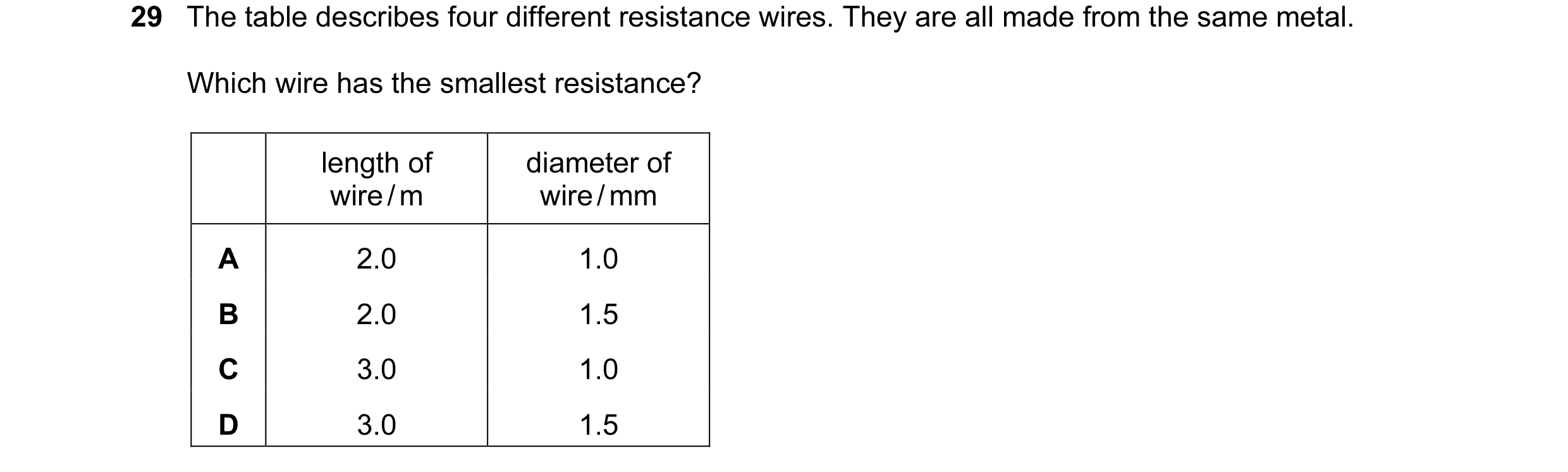
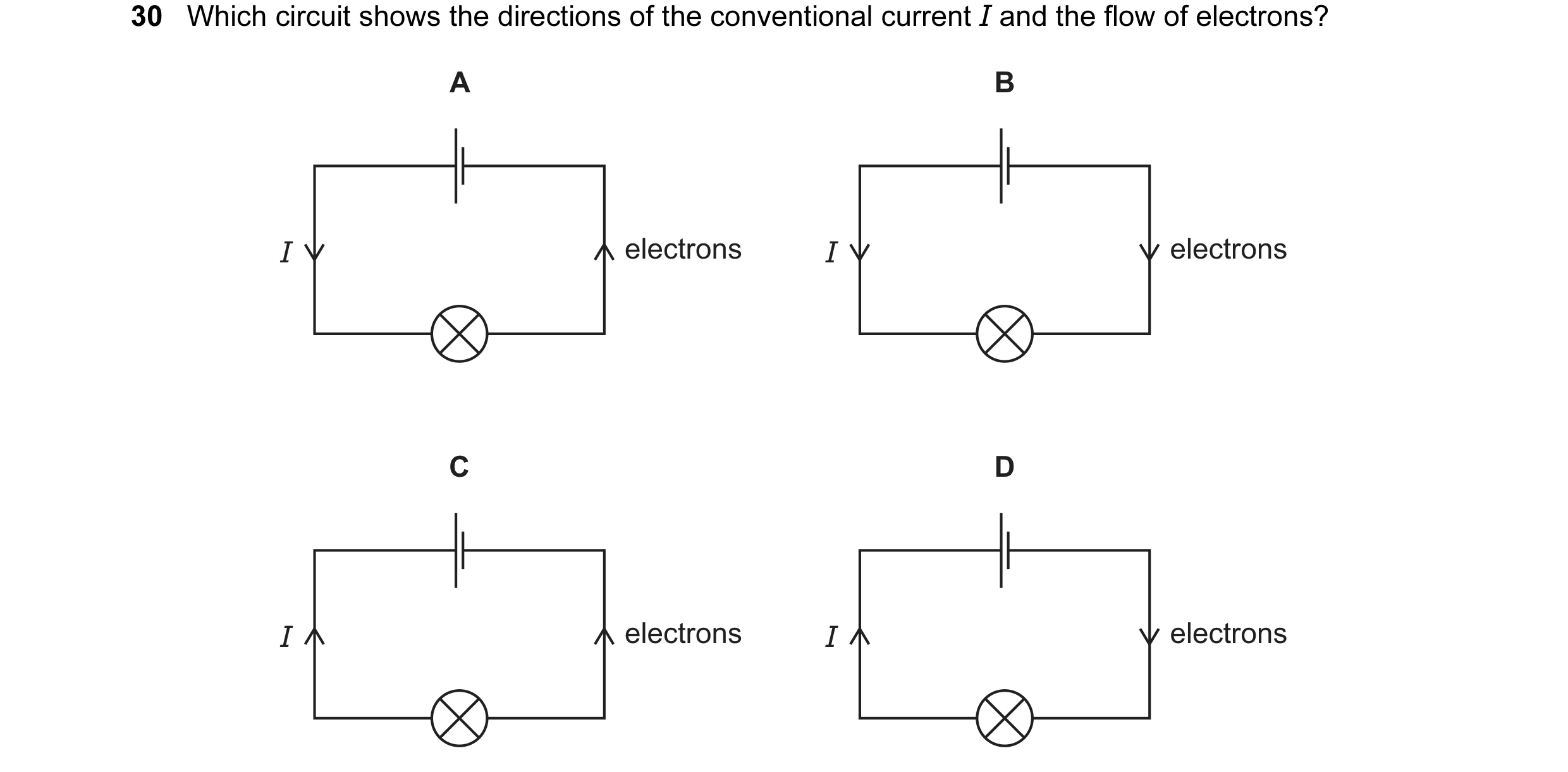
 1 / 64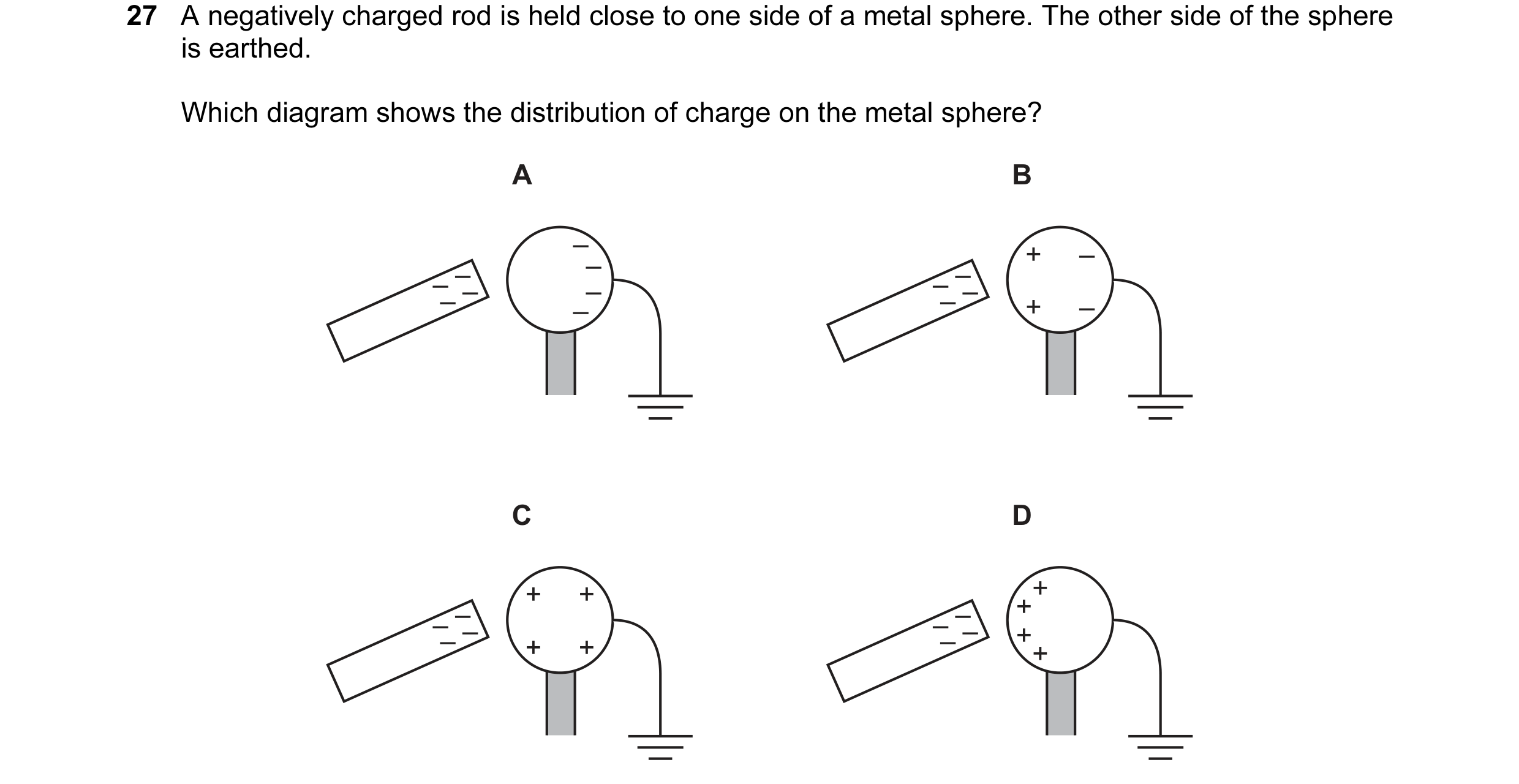
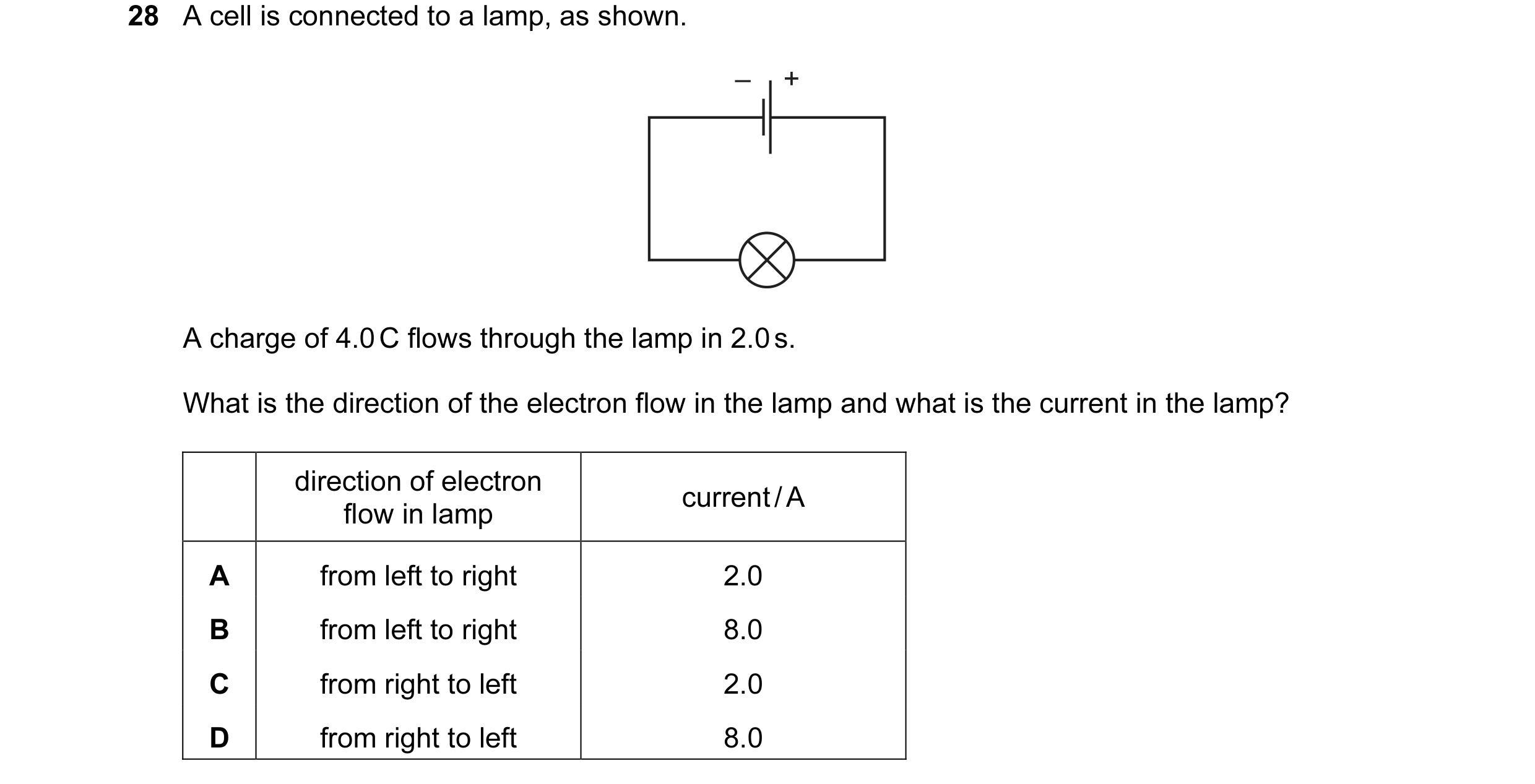 2 / 64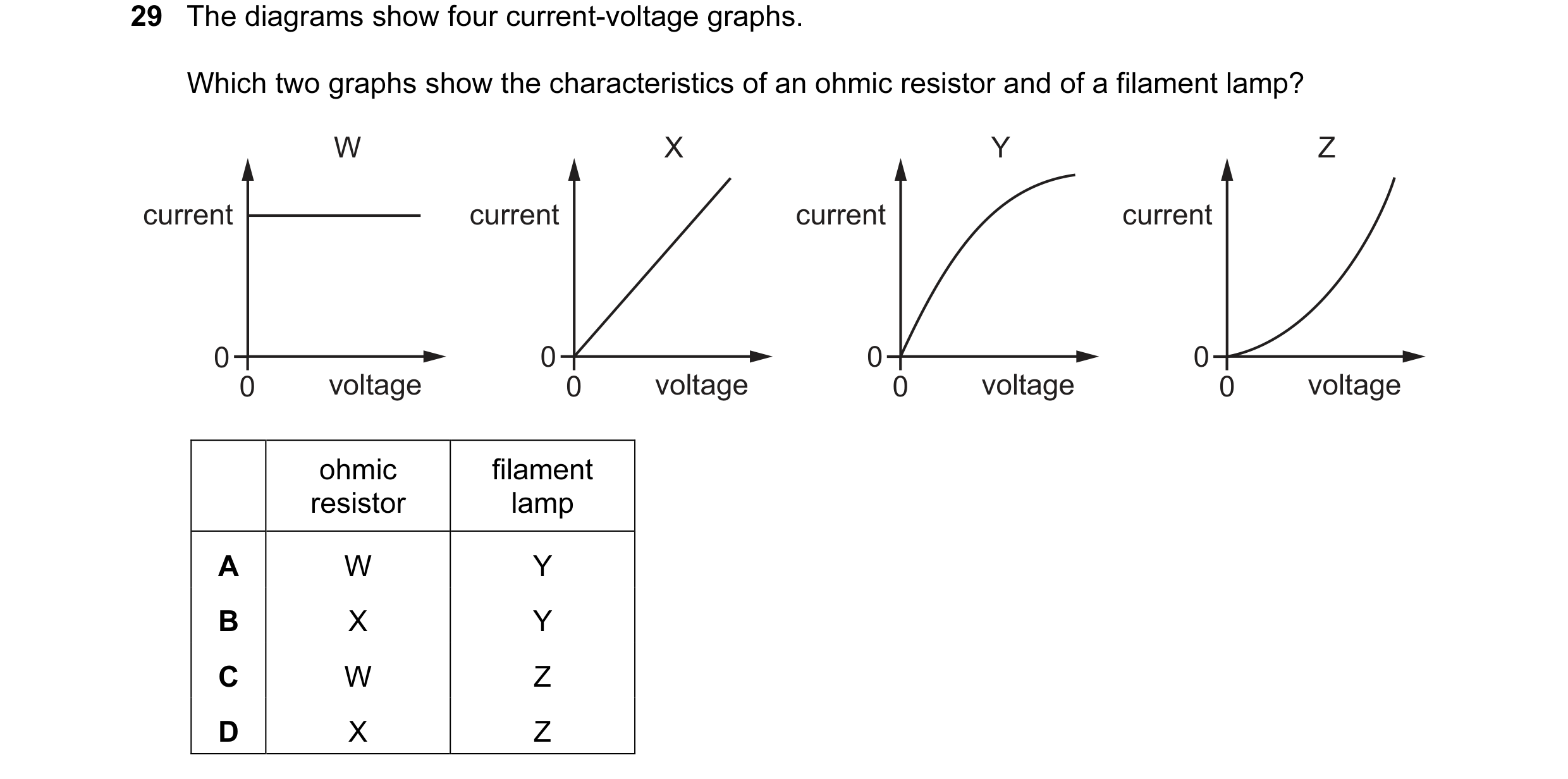
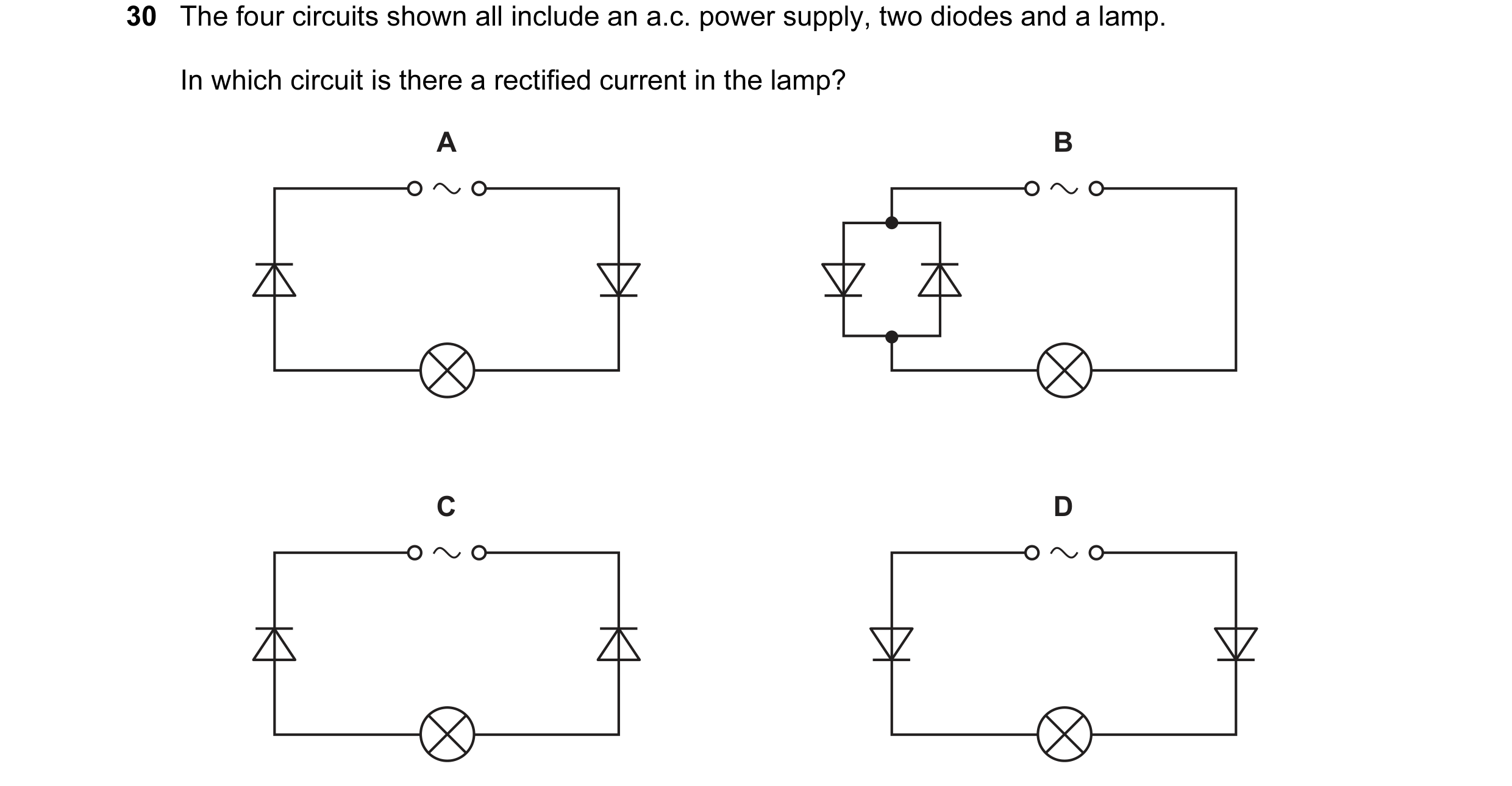 3 / 64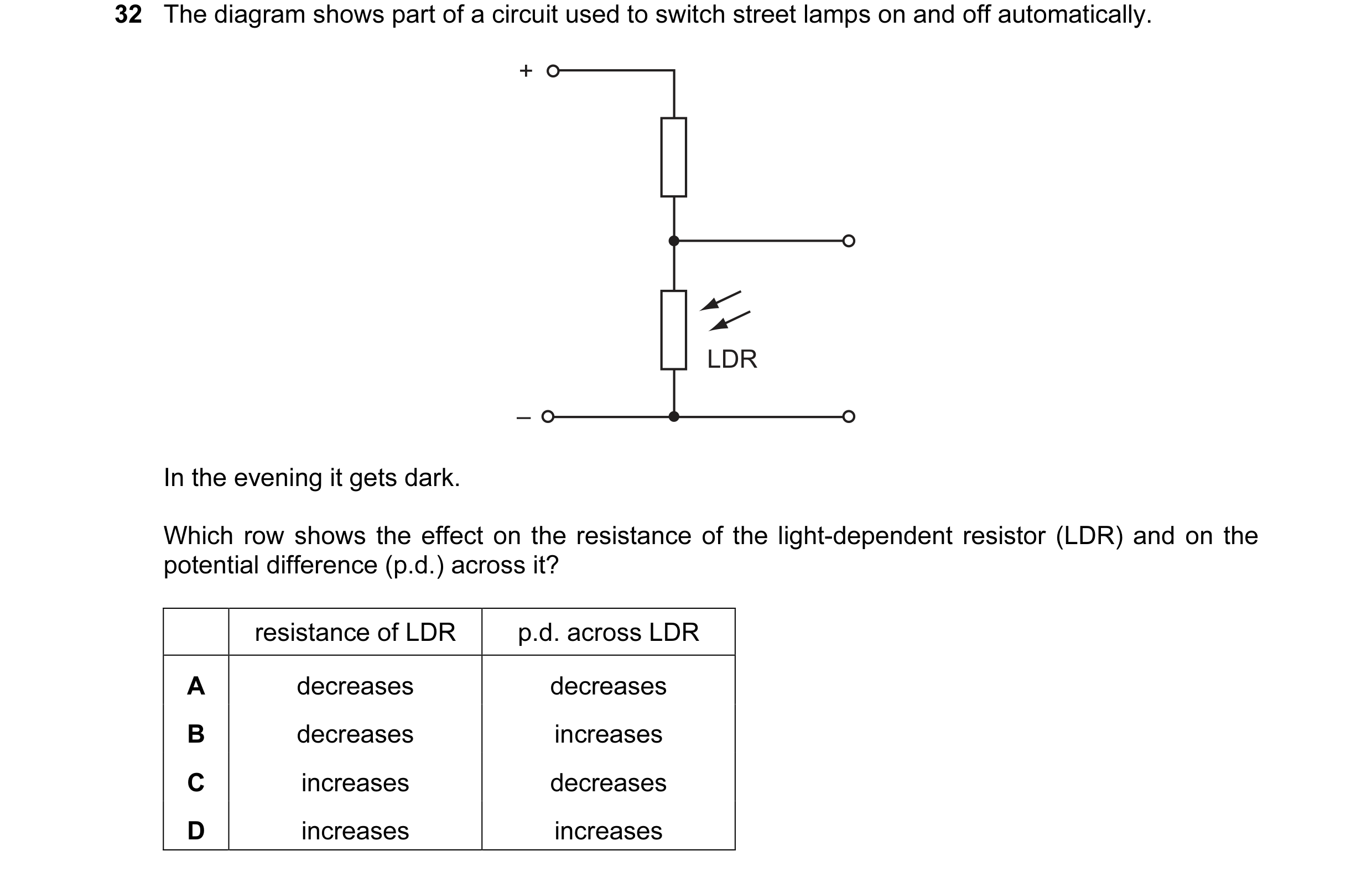
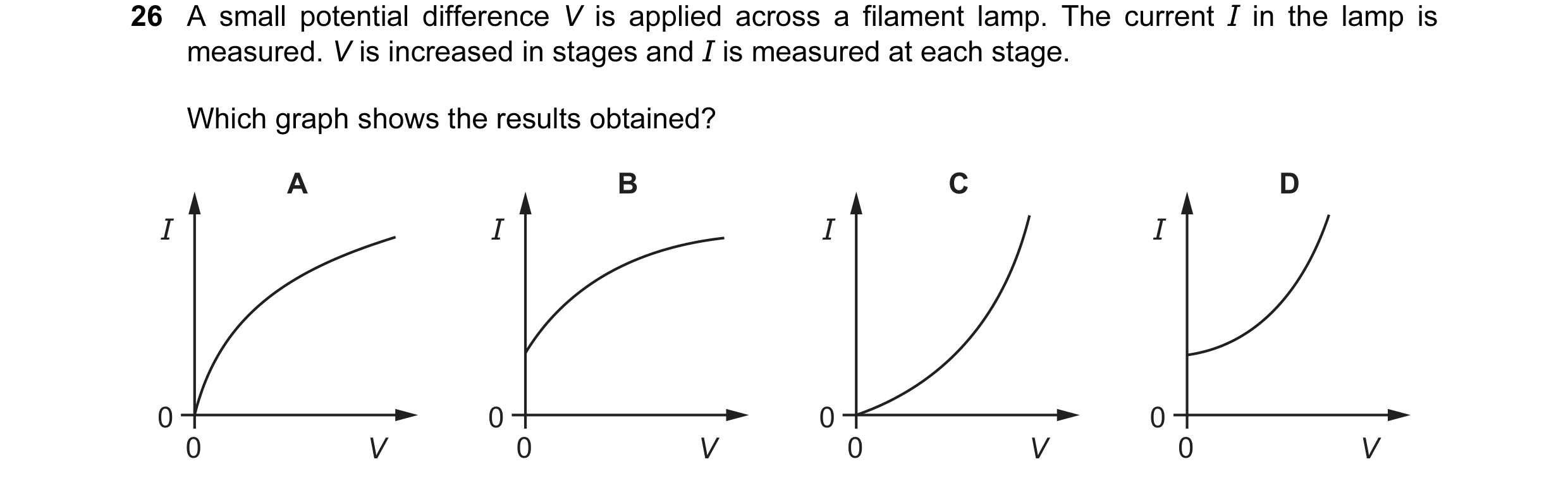
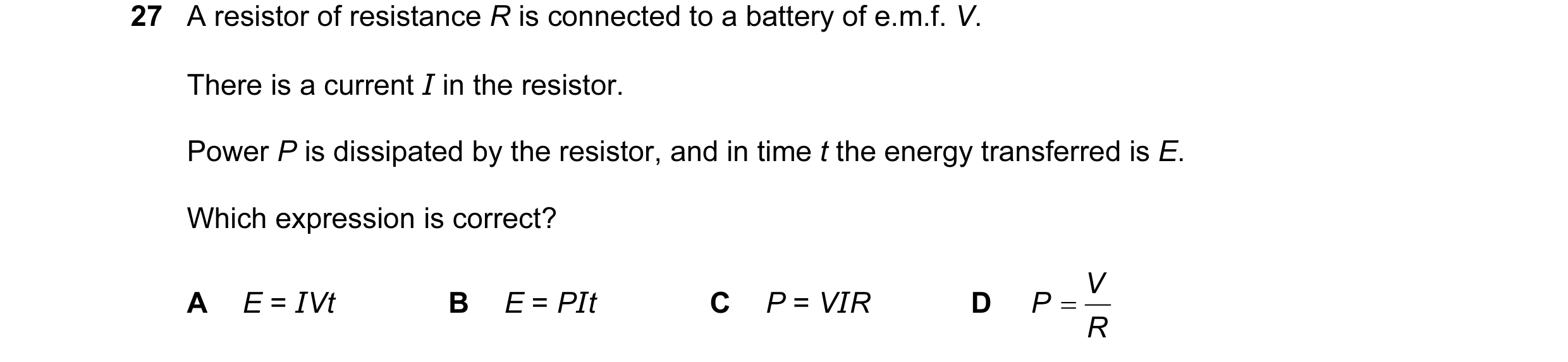 4 / 64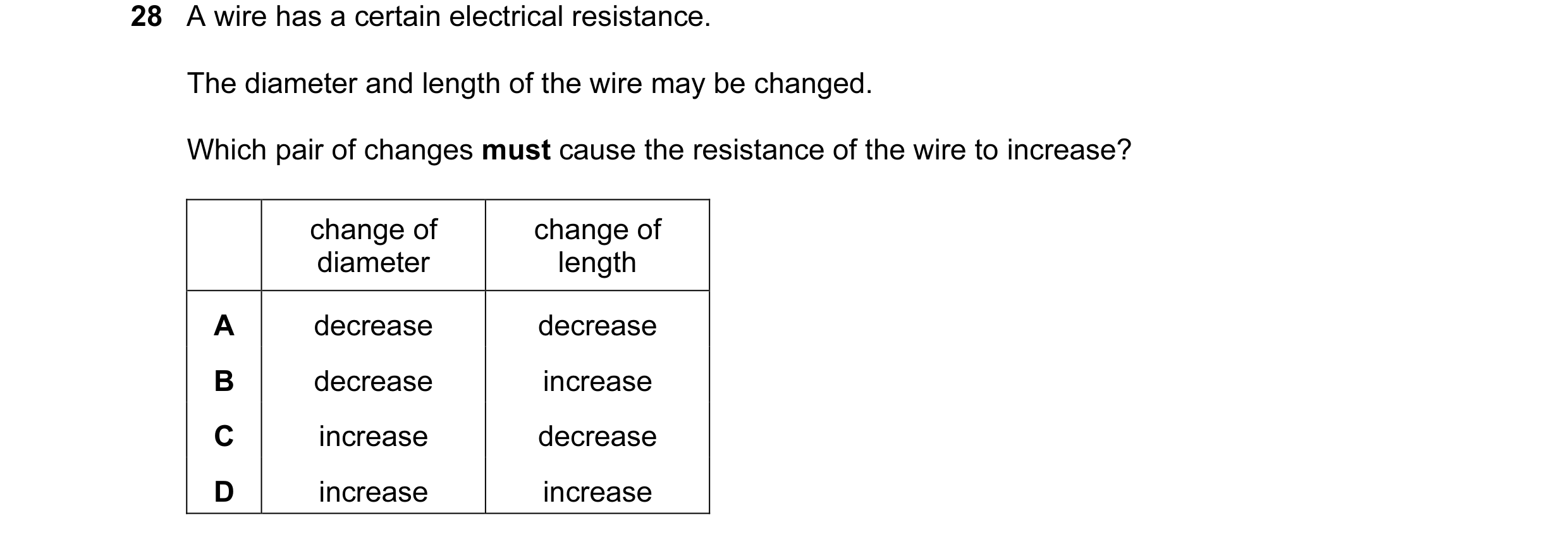
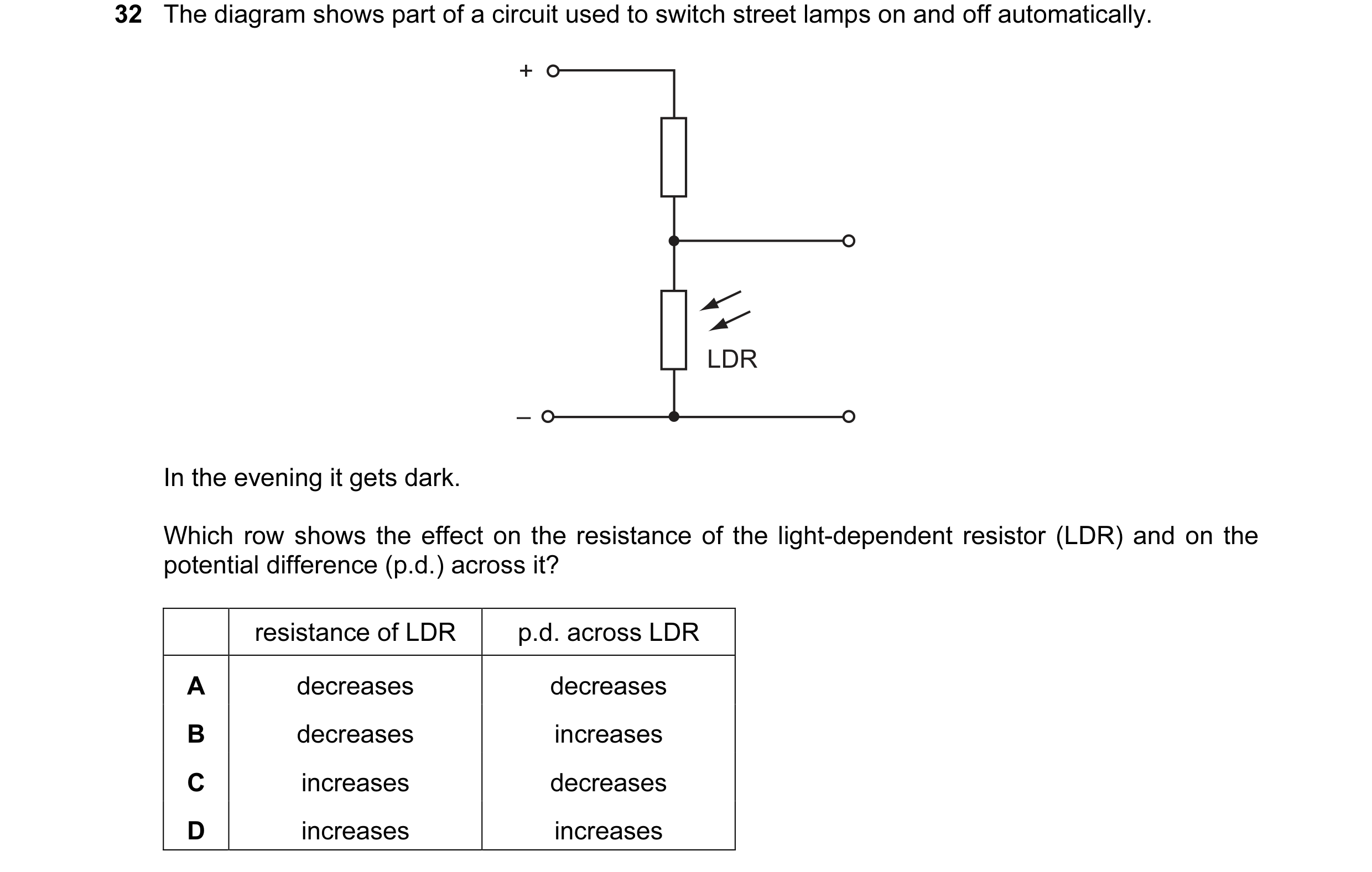 5 / 64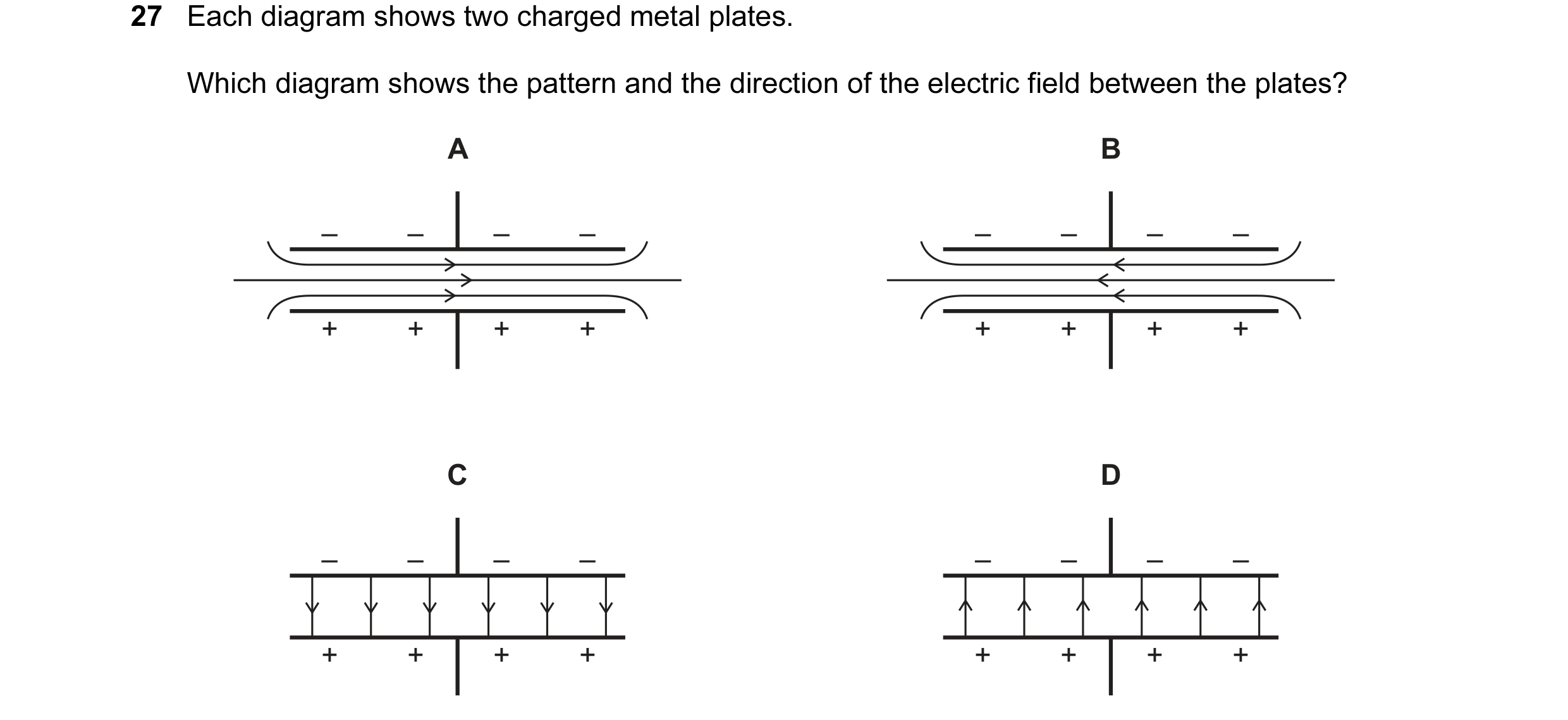
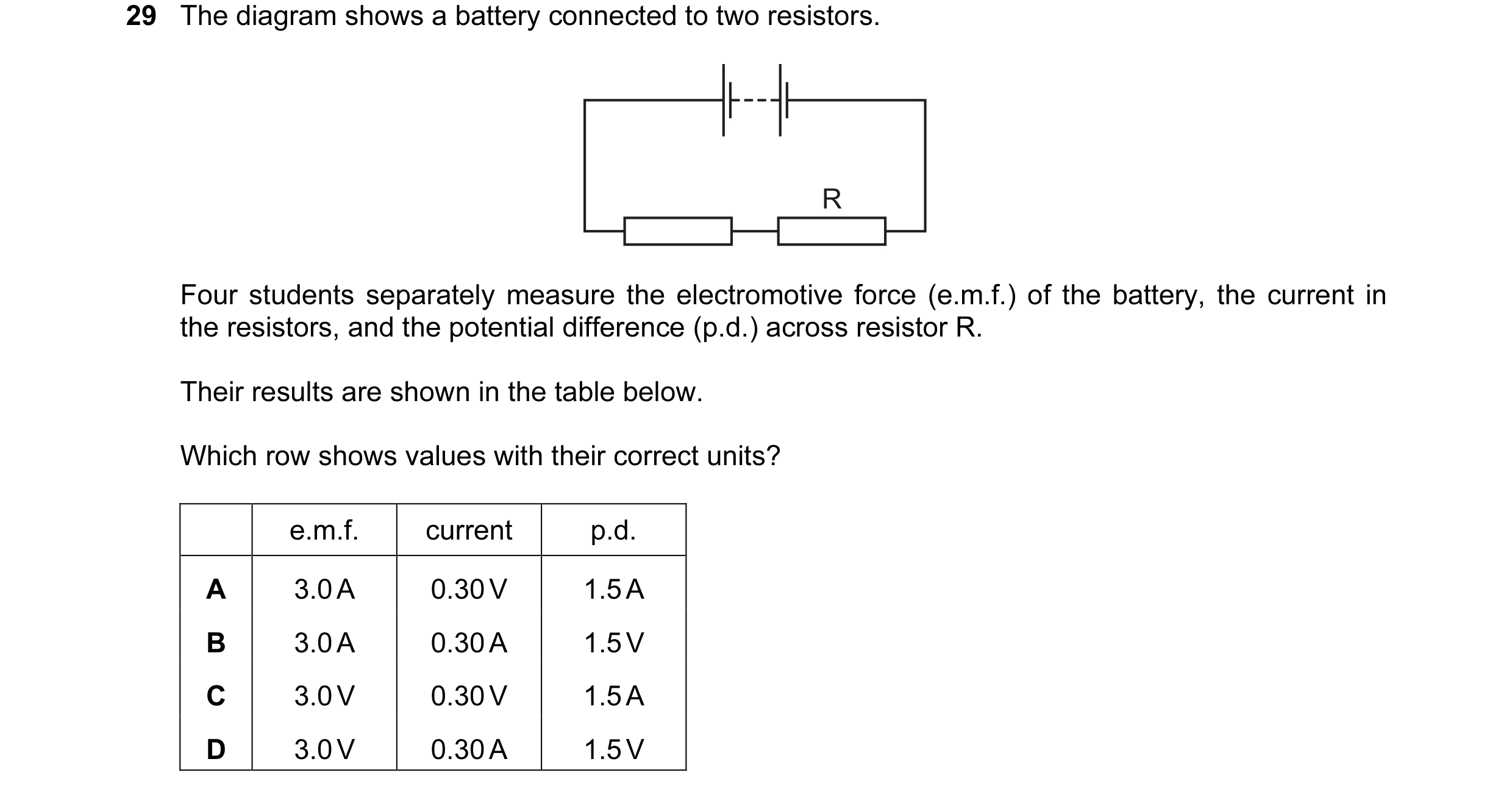 6 / 64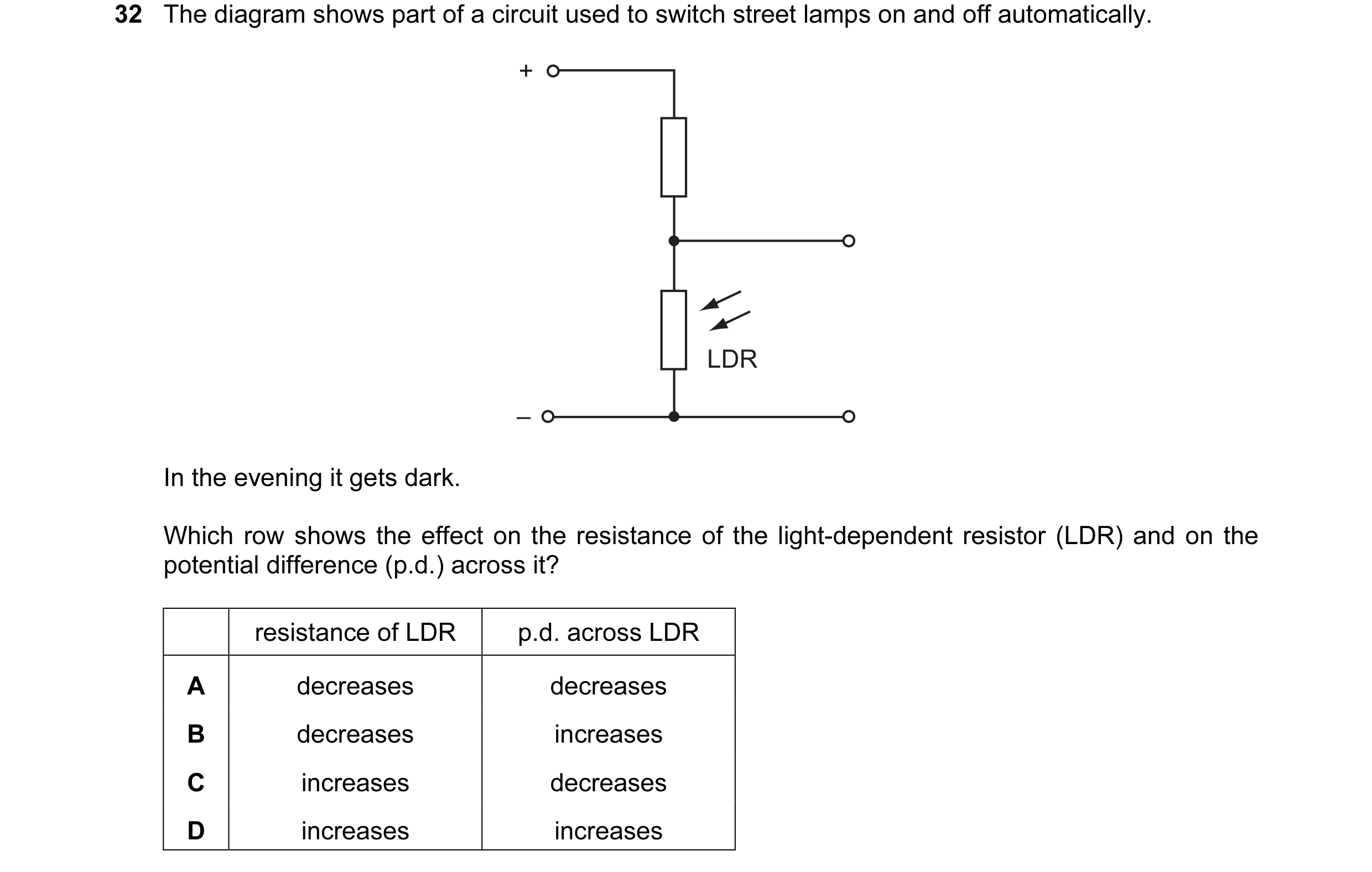
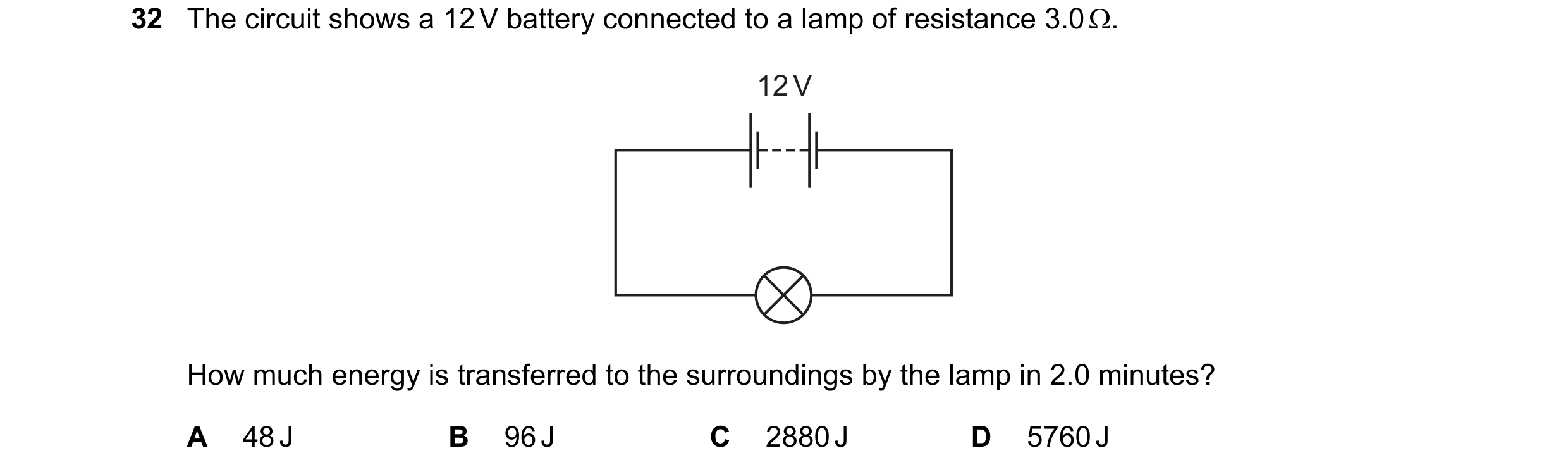 7 / 64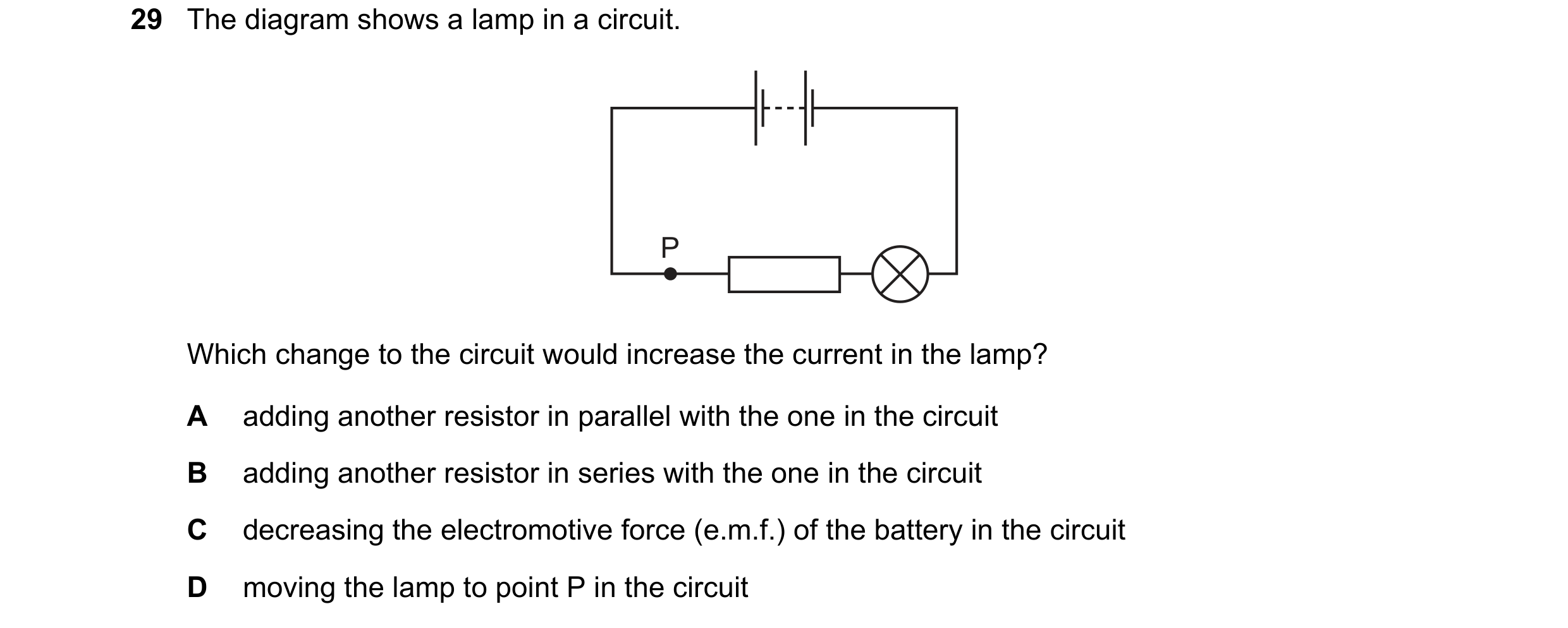
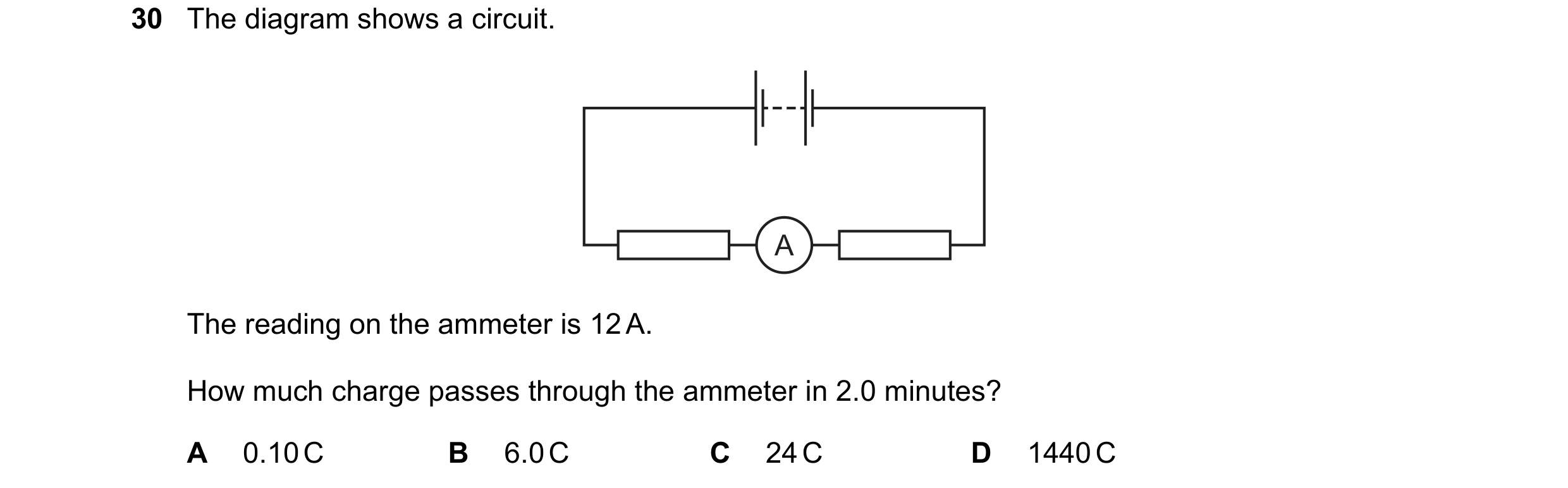

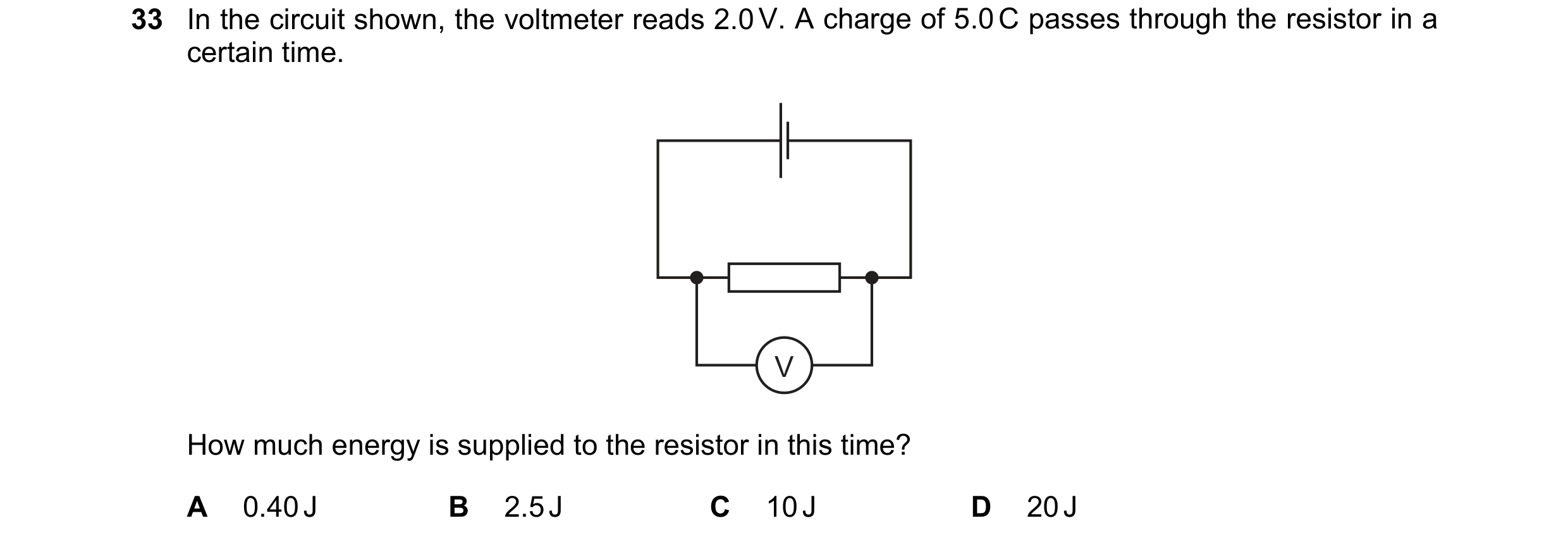 8 / 64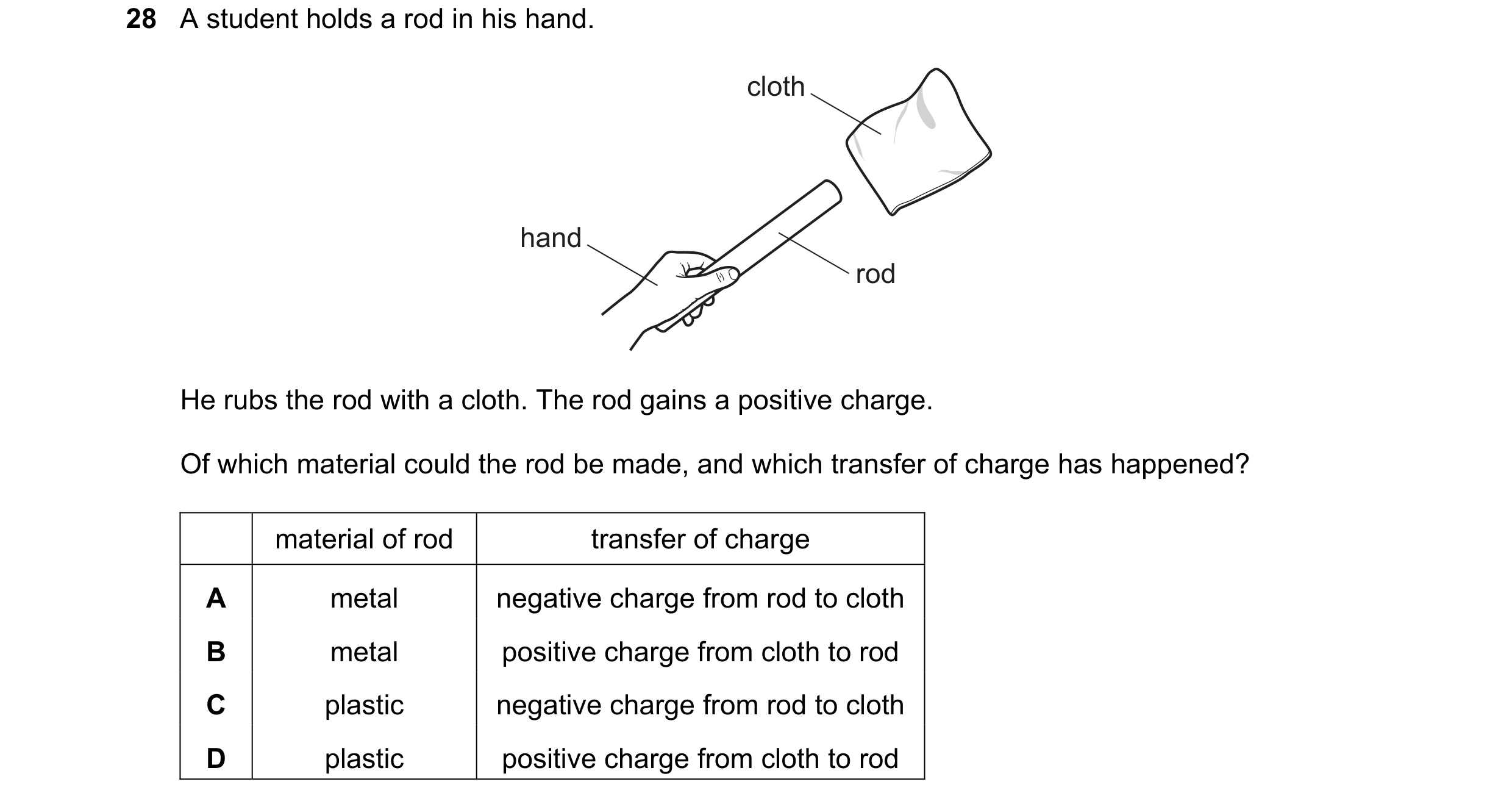
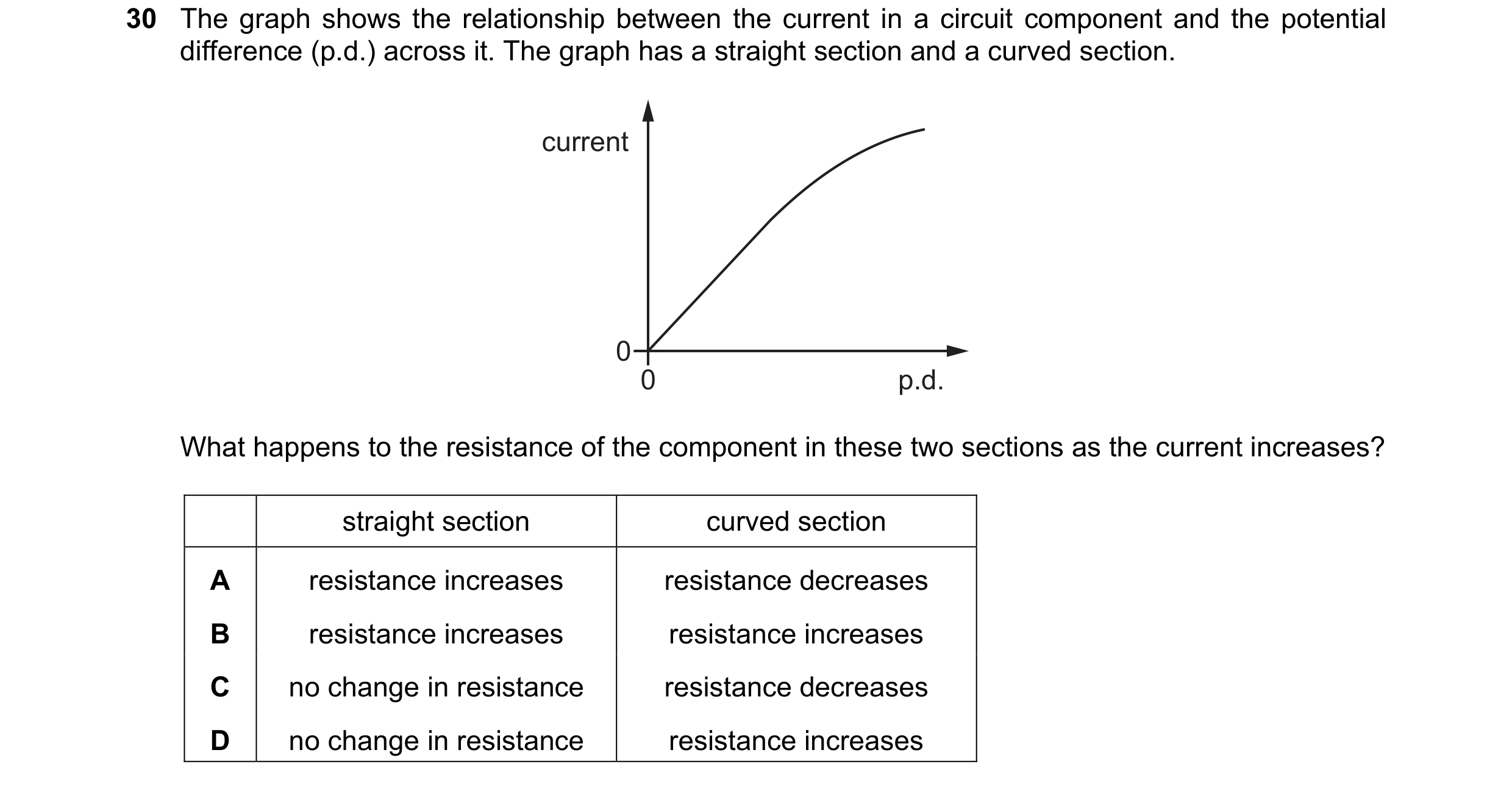
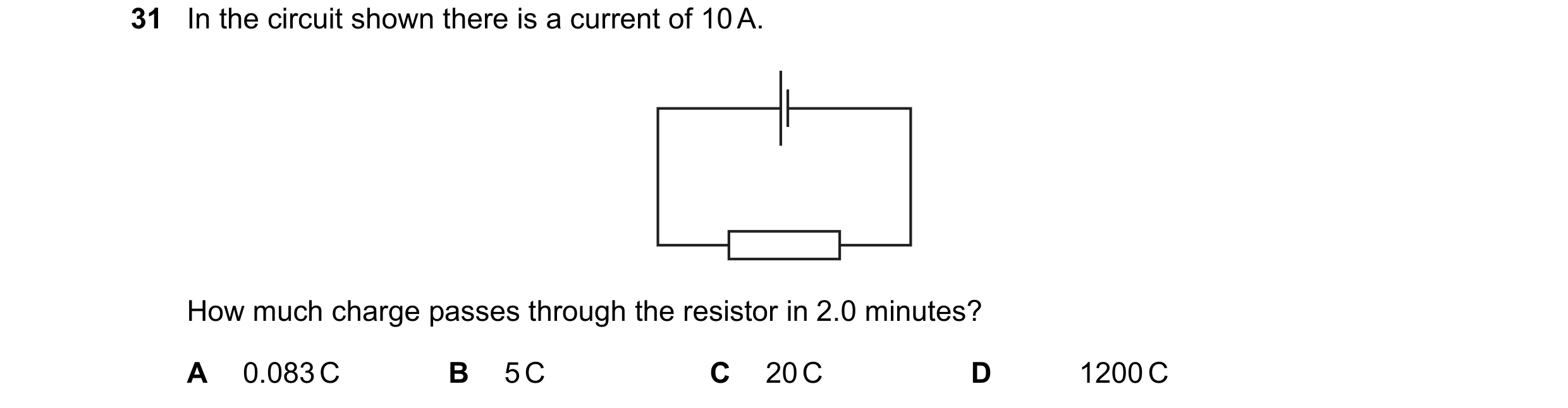 9 / 64
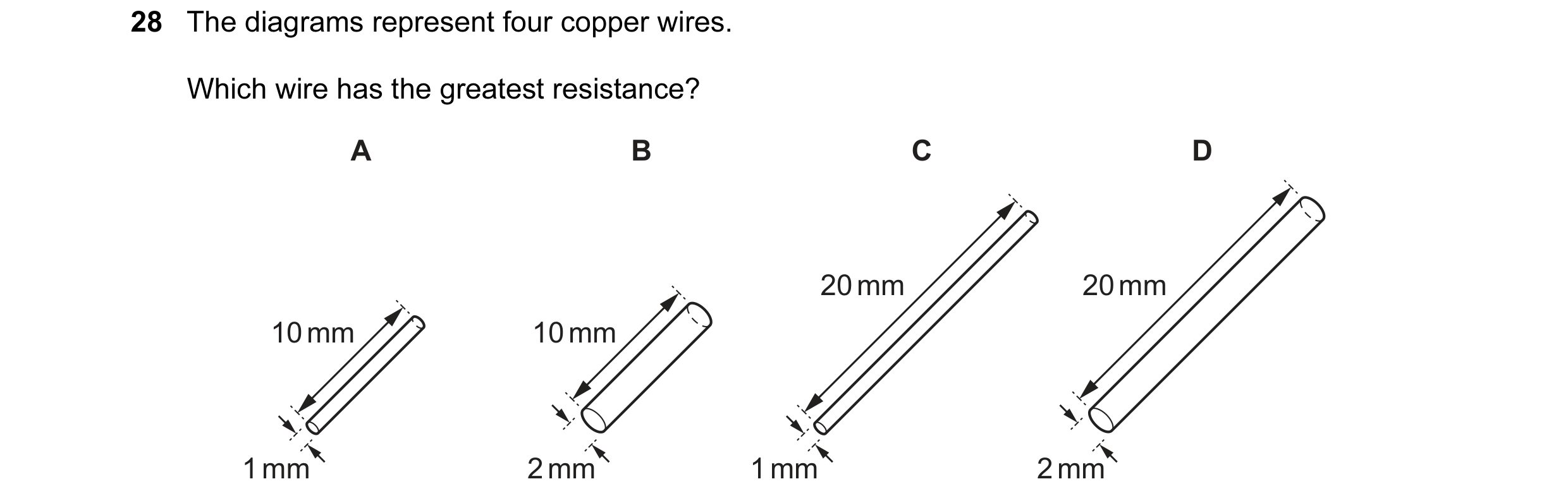
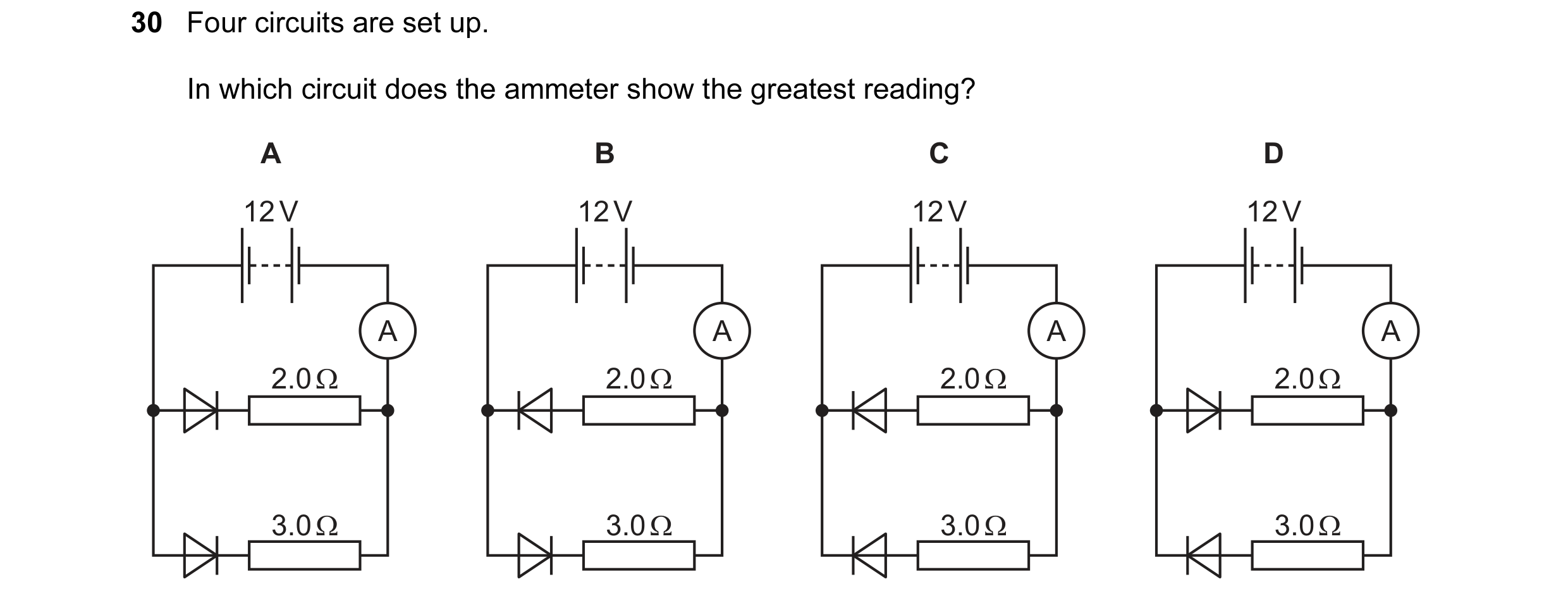 10 / 64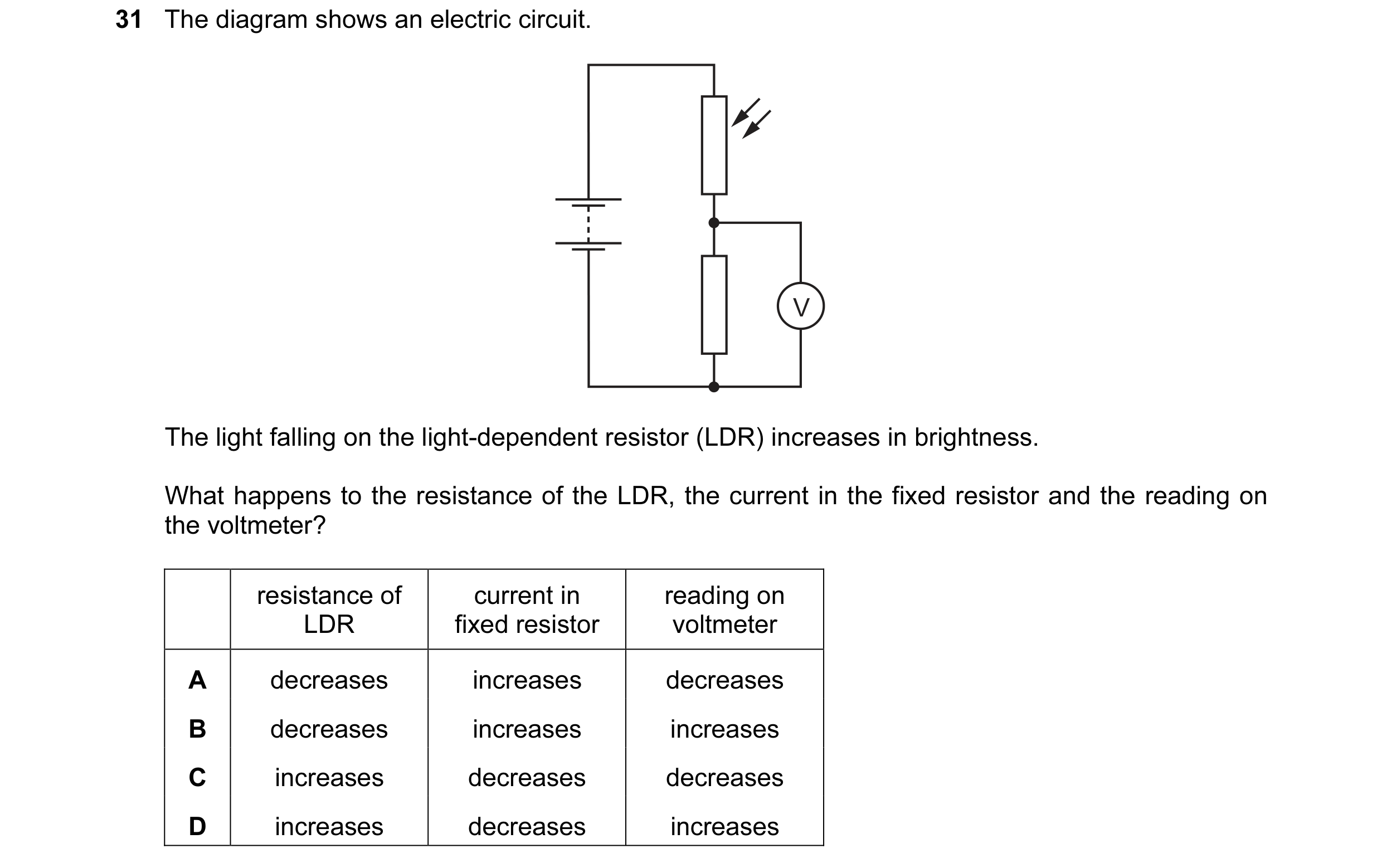
 11 / 64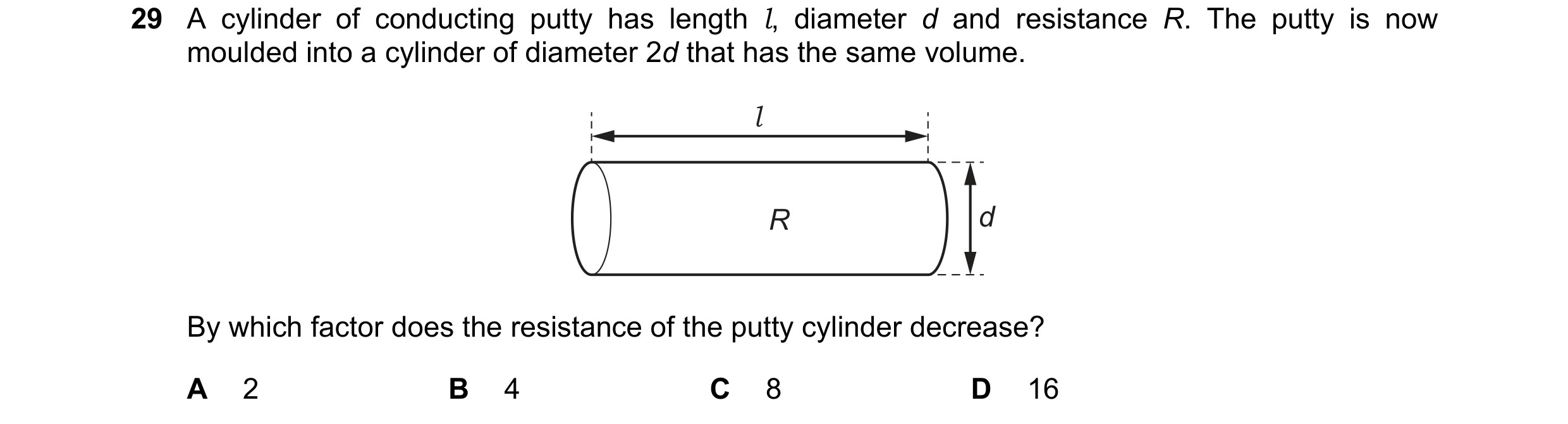

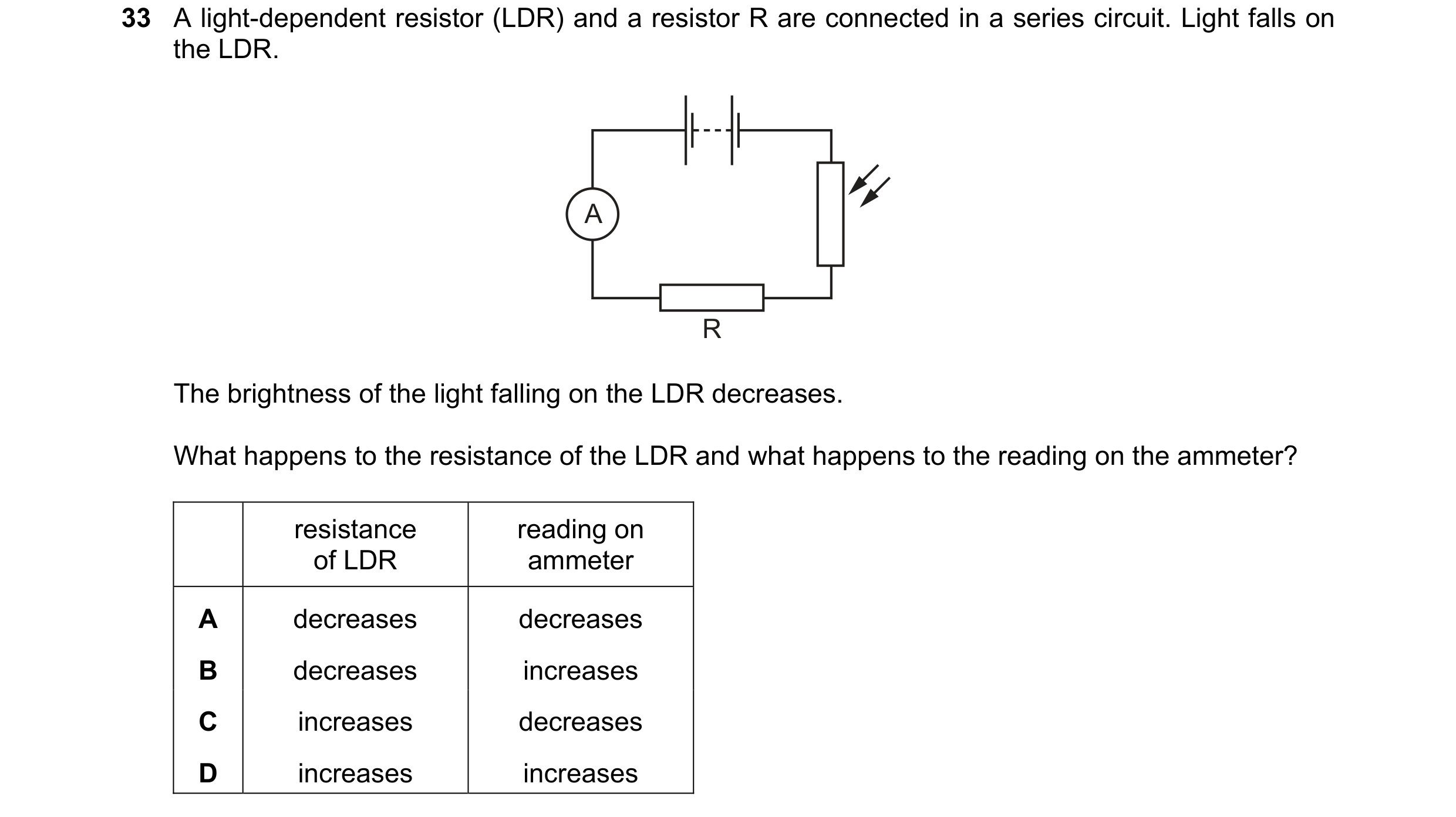 12 / 64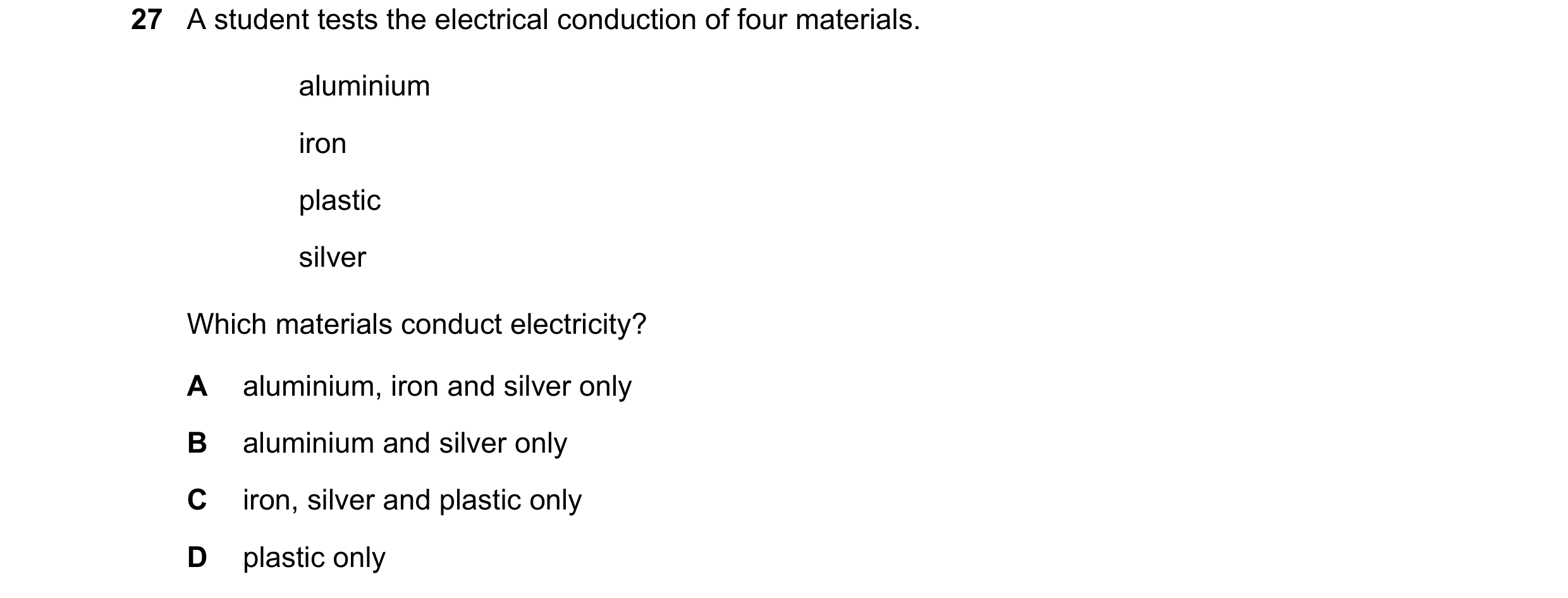

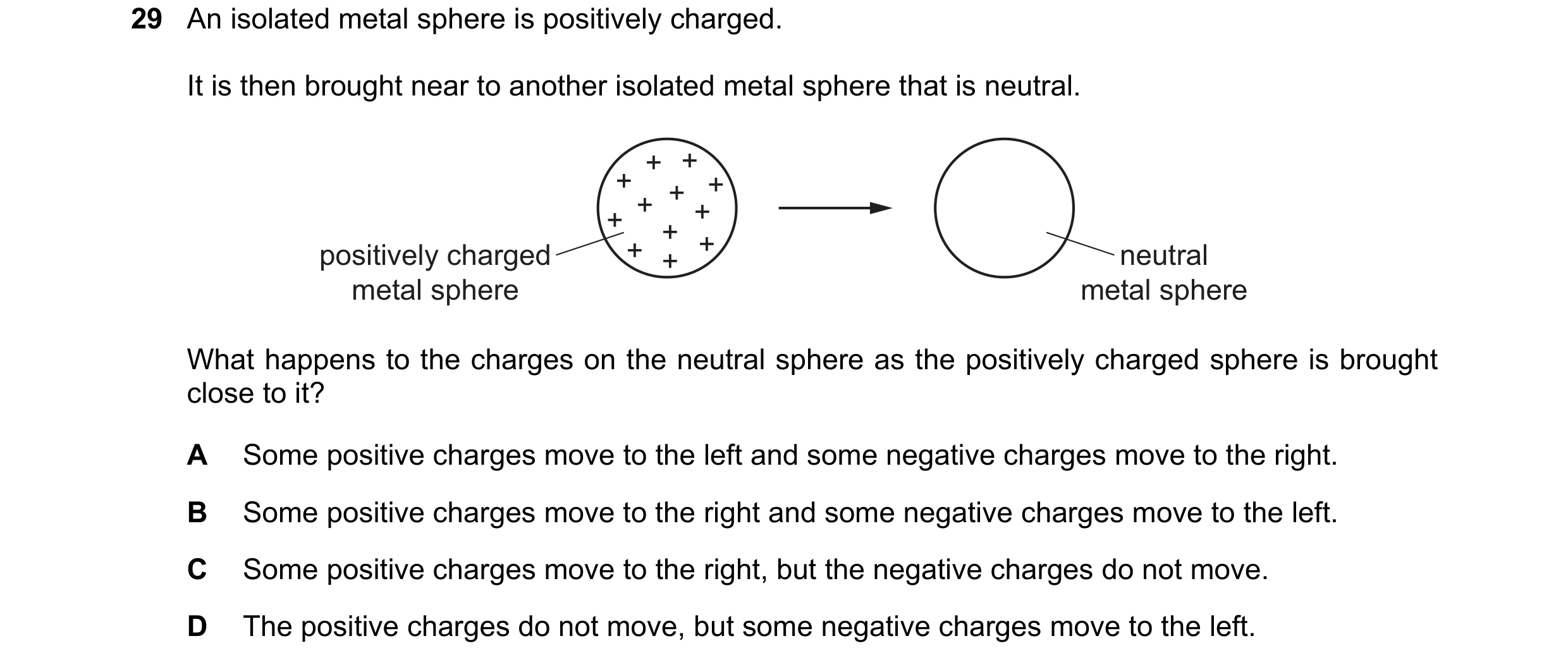
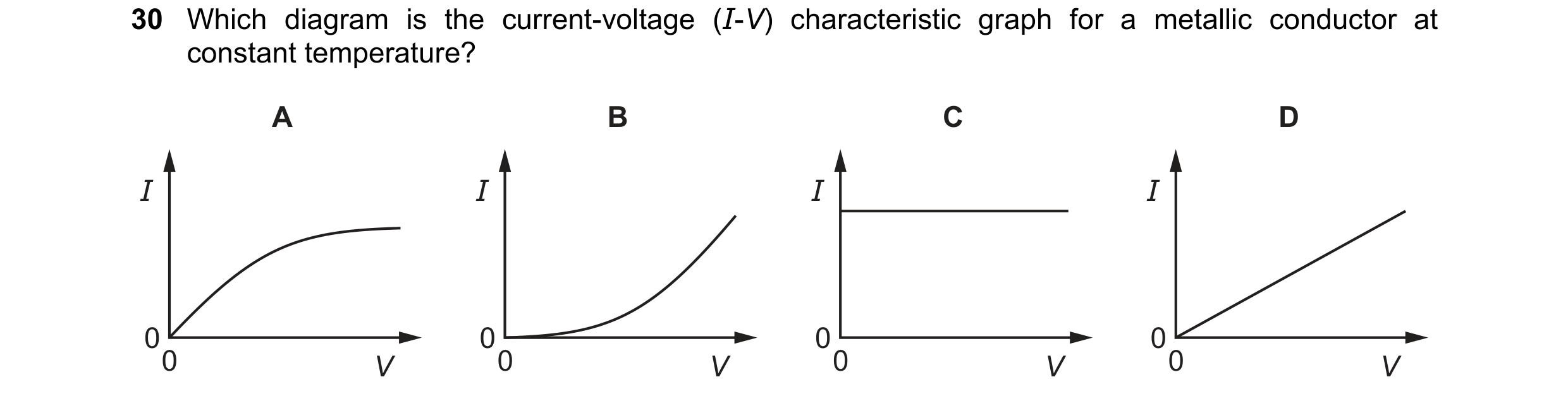 13 / 64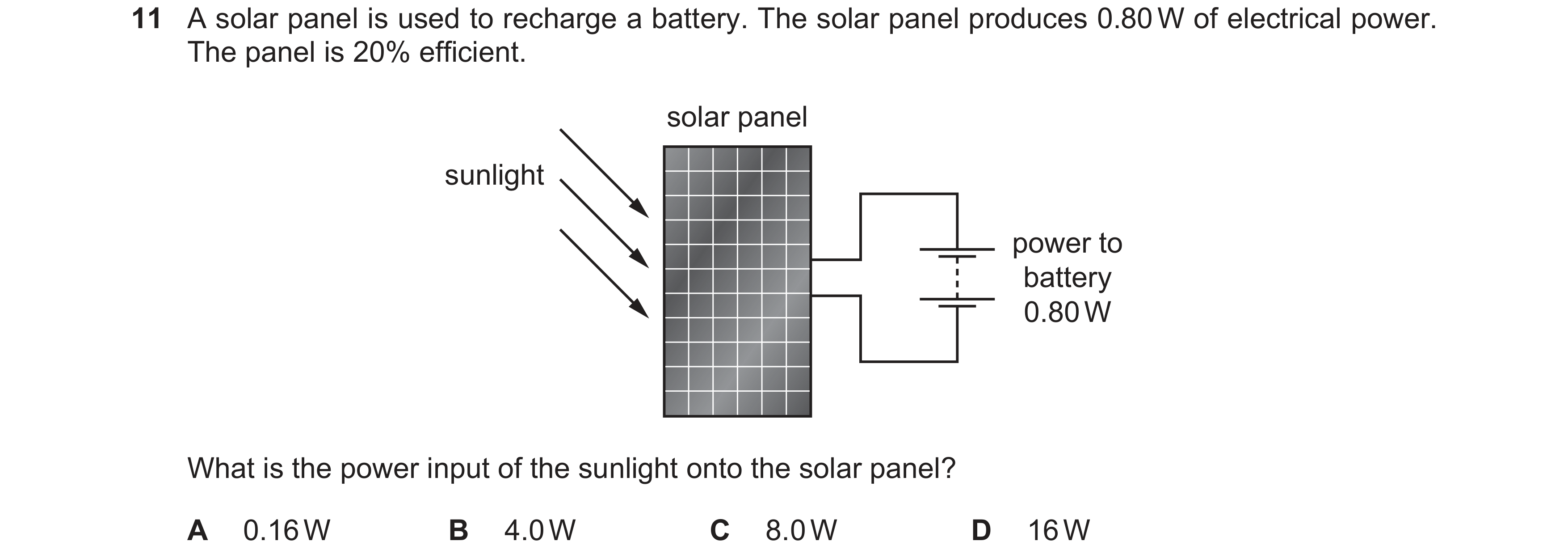

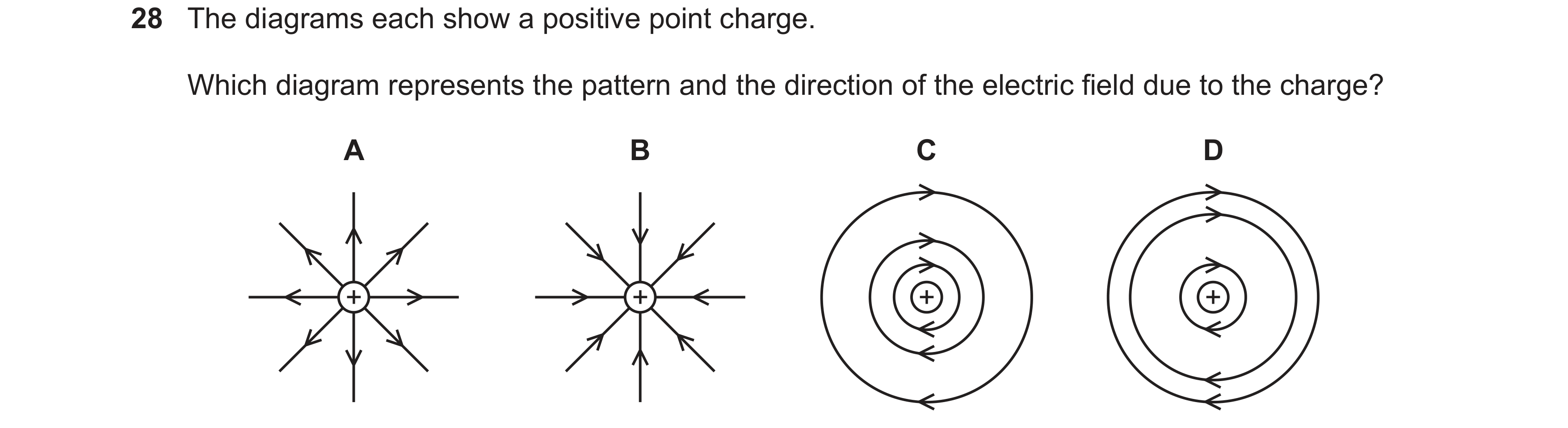

 14 / 64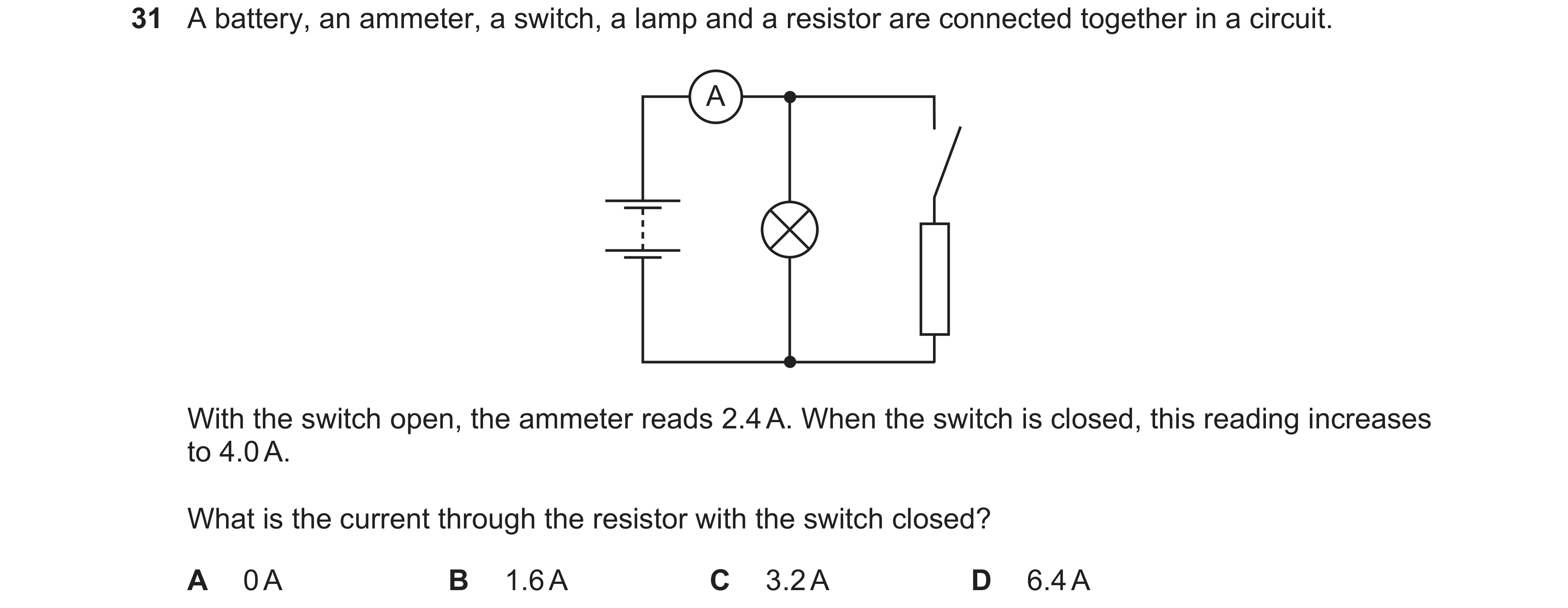
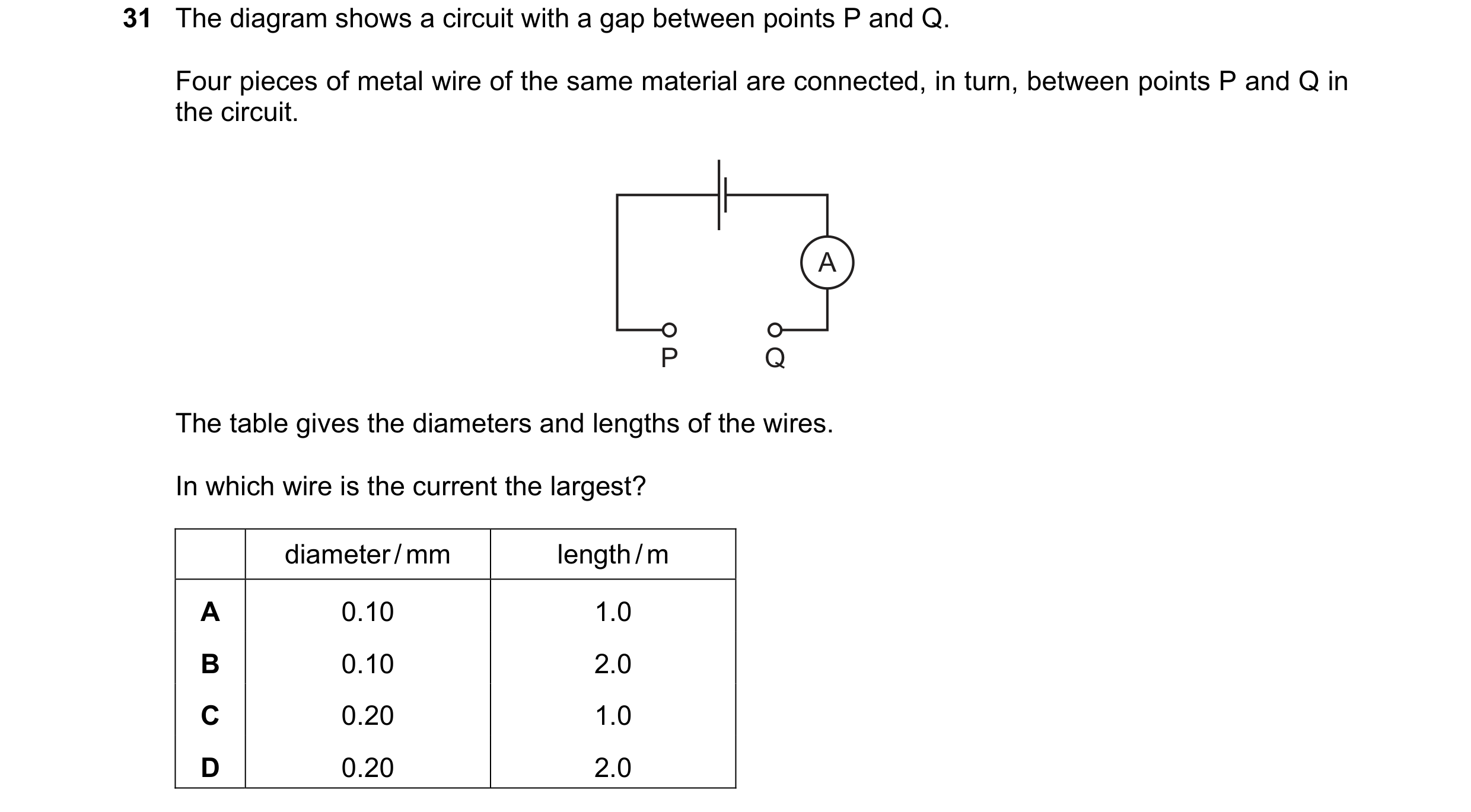

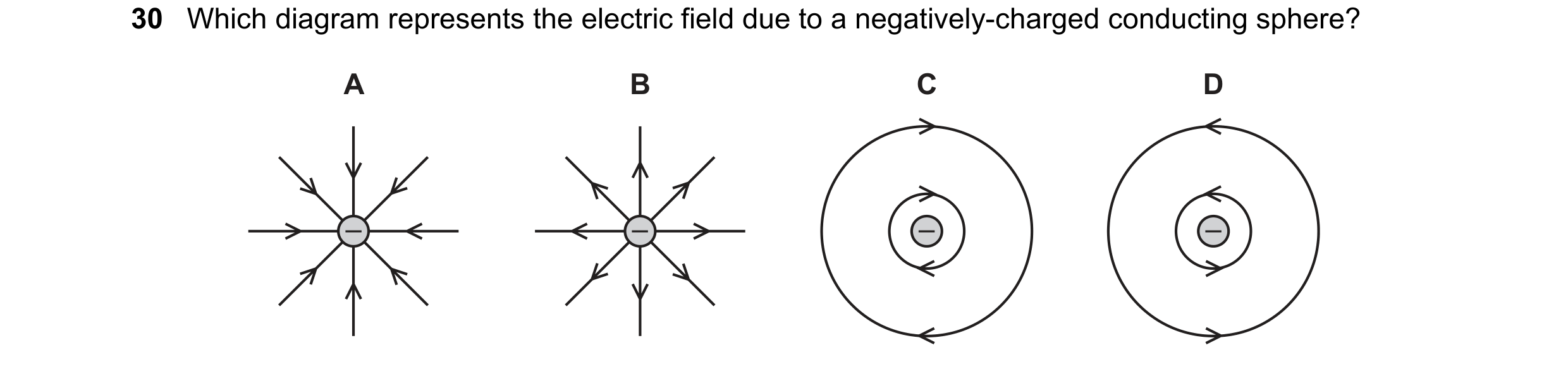 15 / 64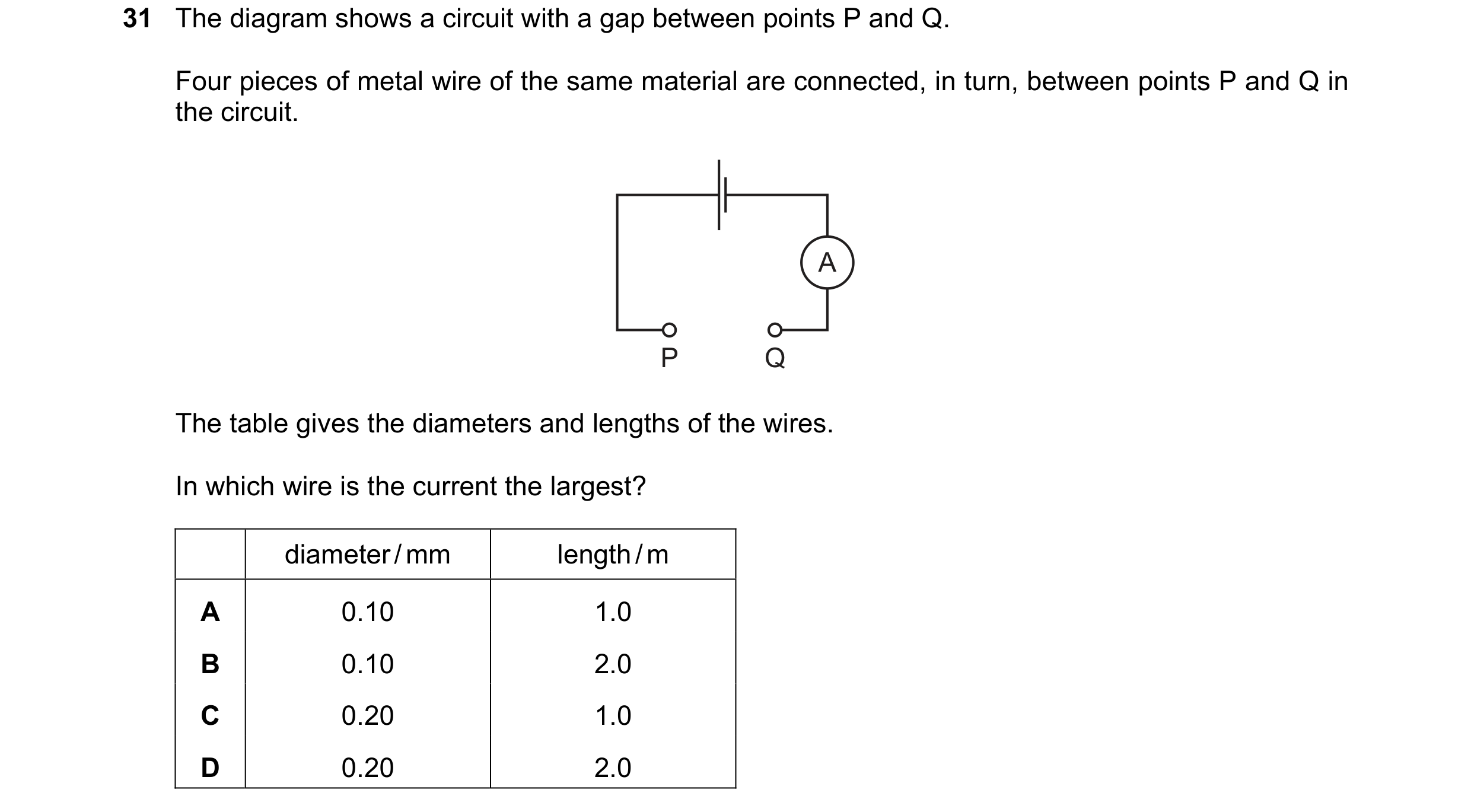
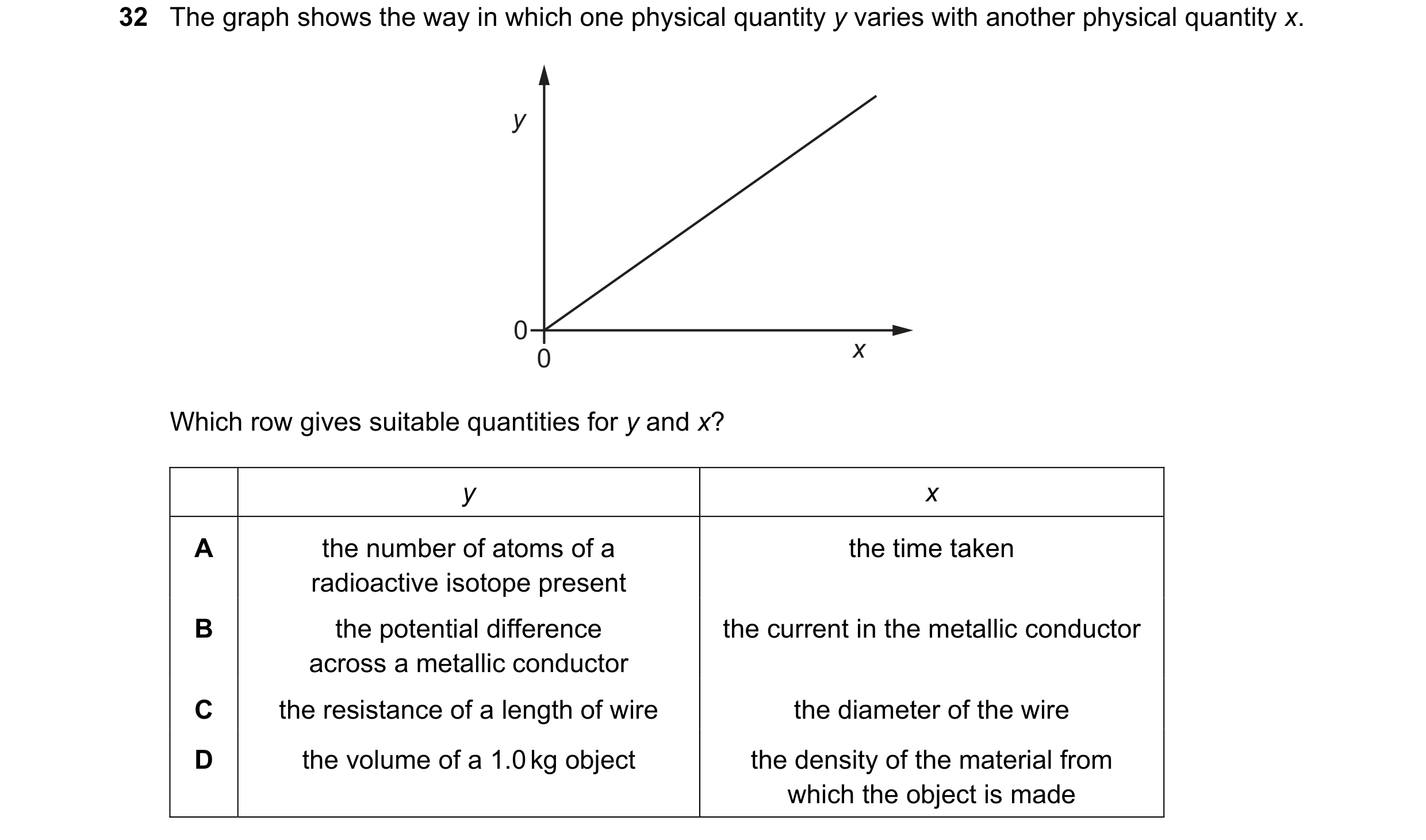
 16 / 64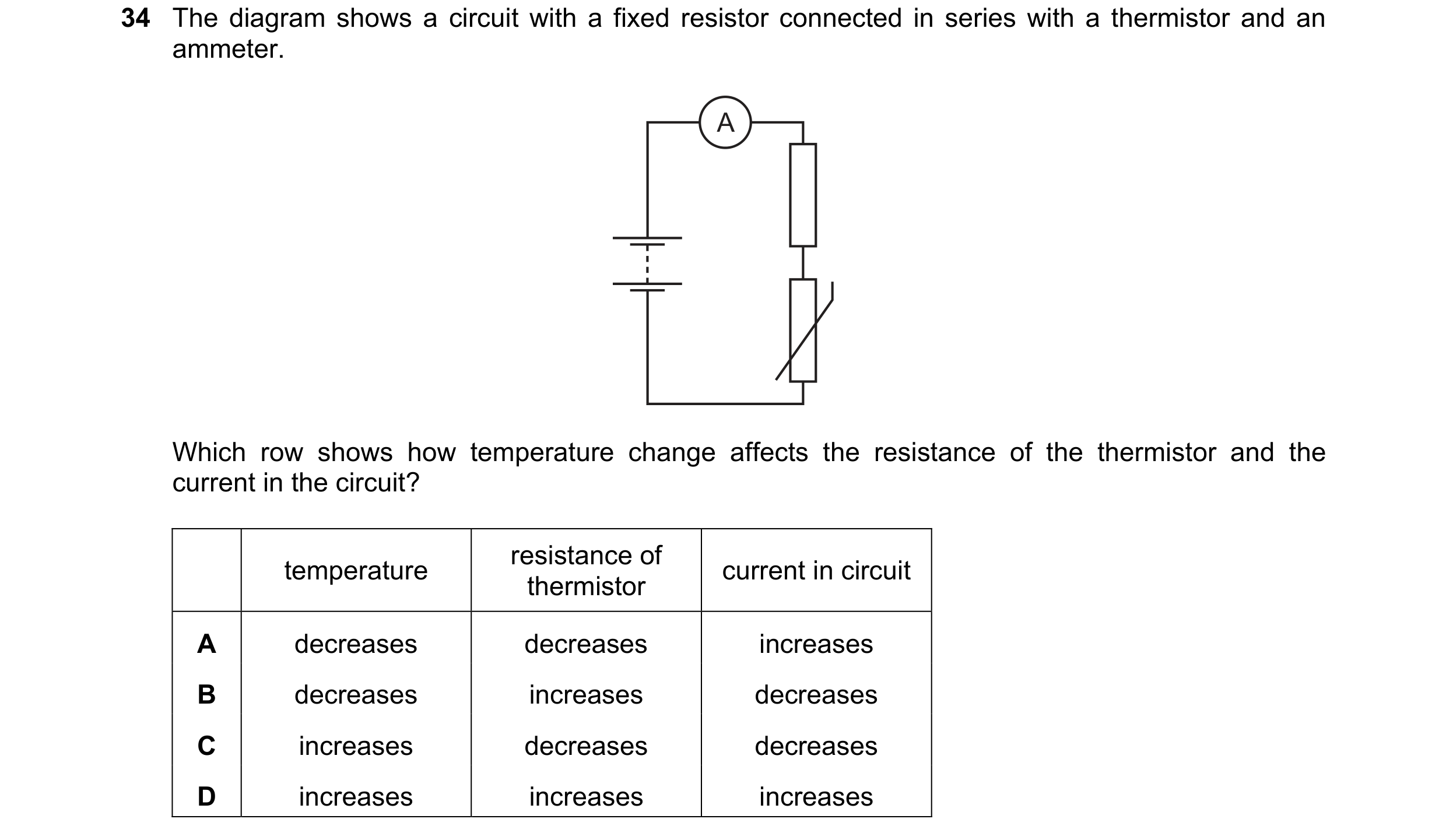
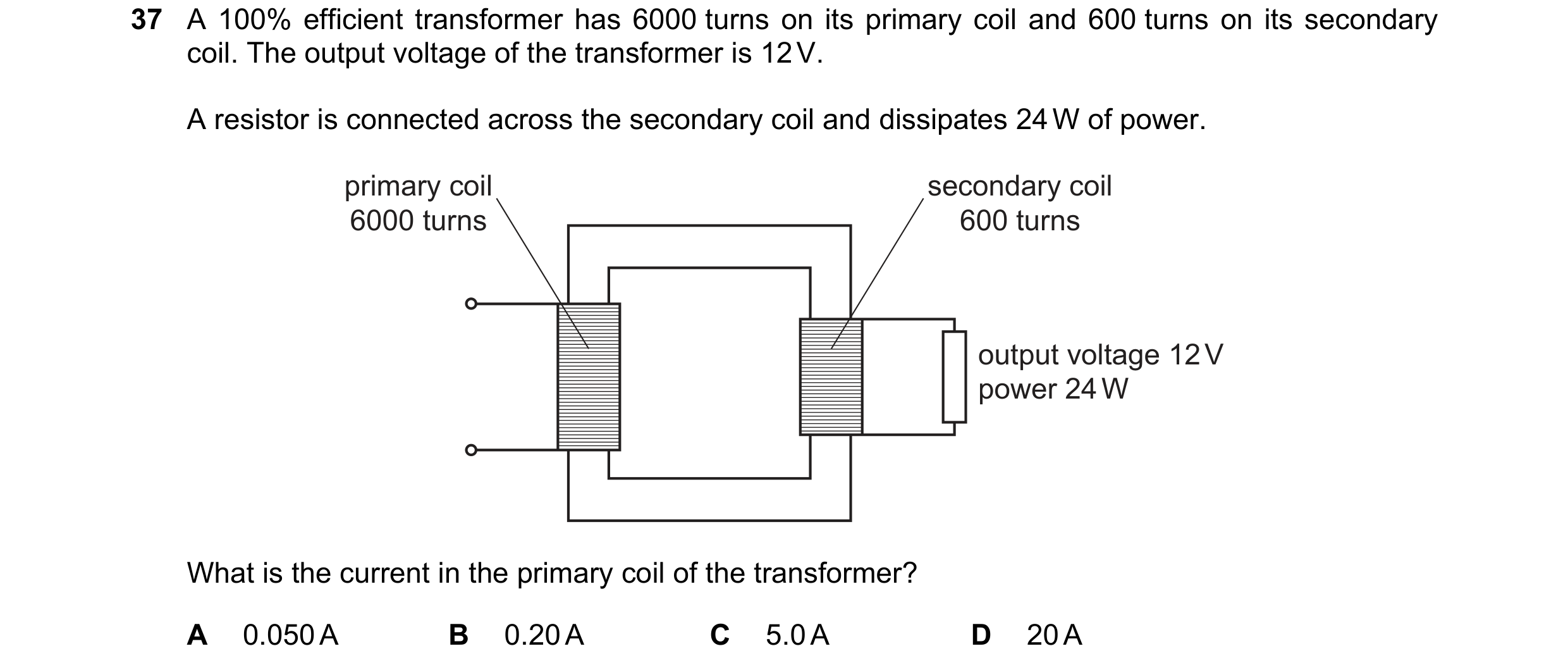
 17 / 64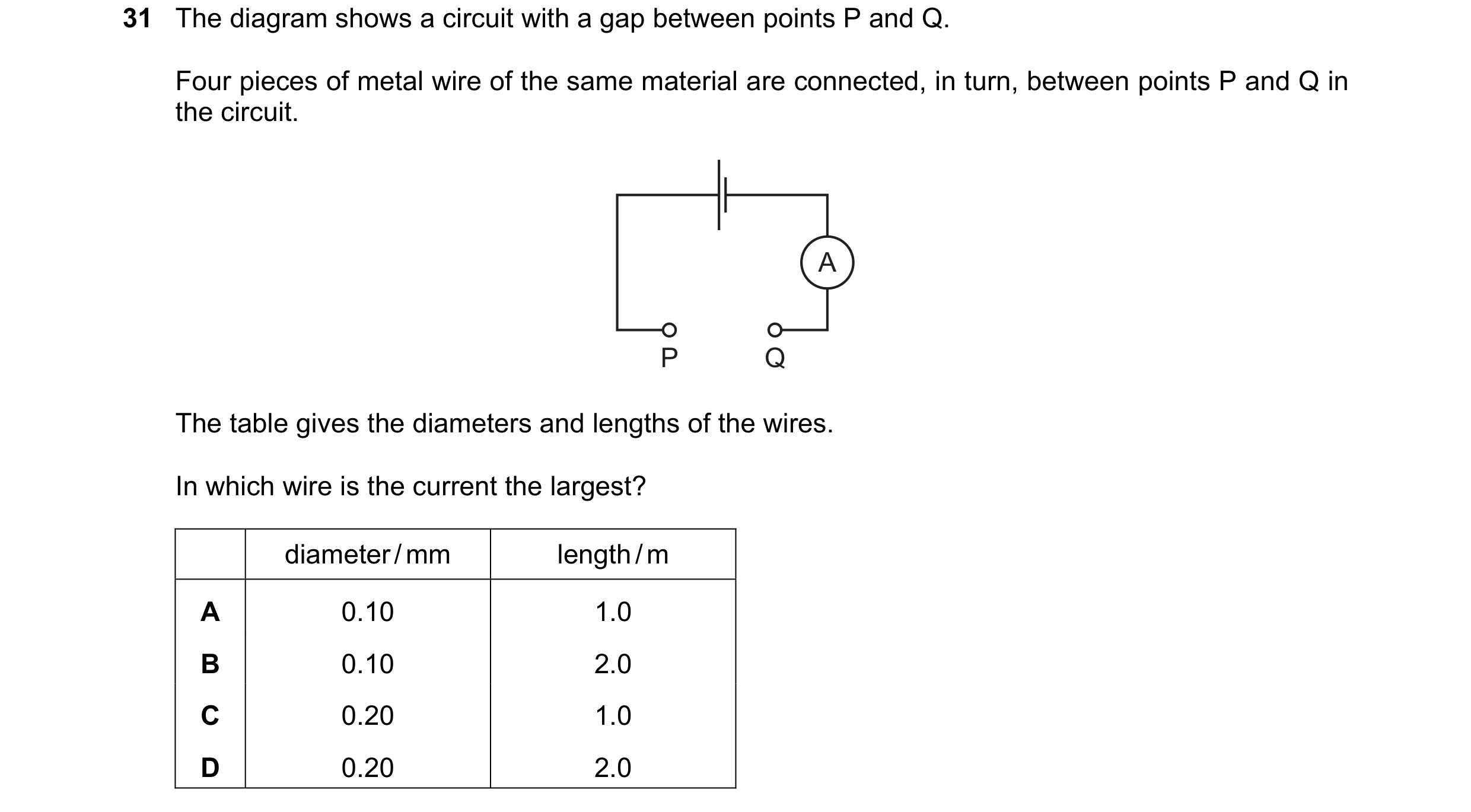
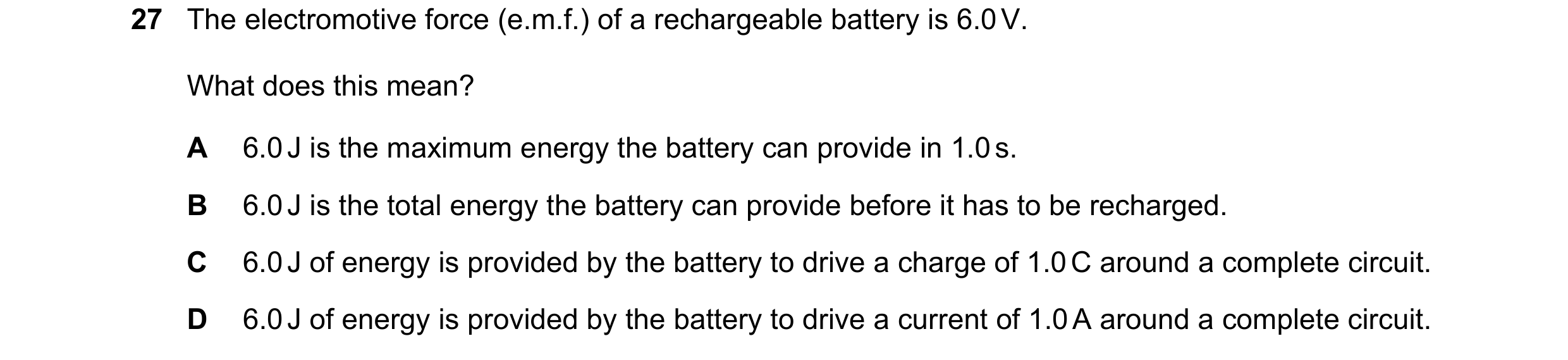
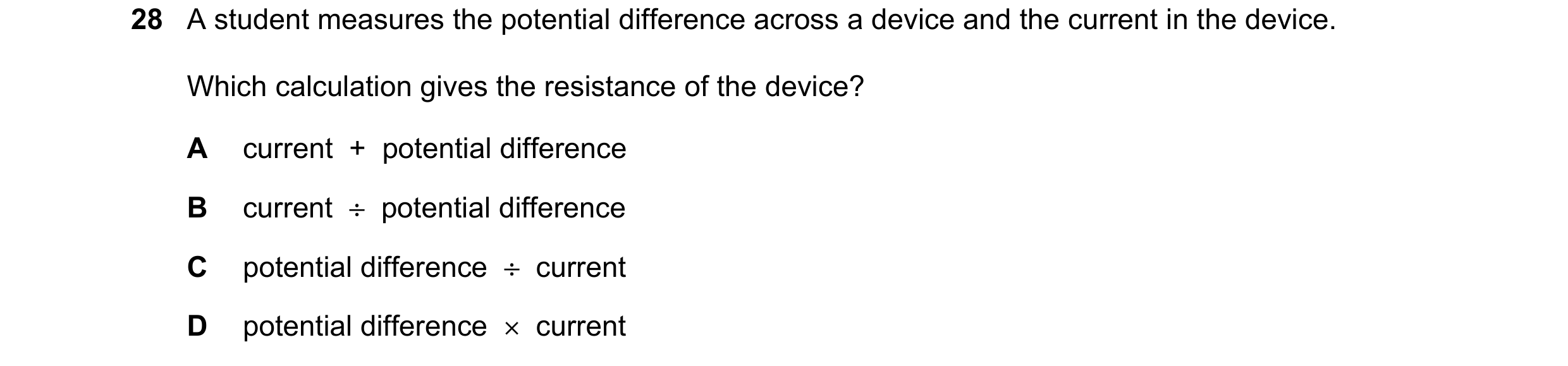 18 / 64

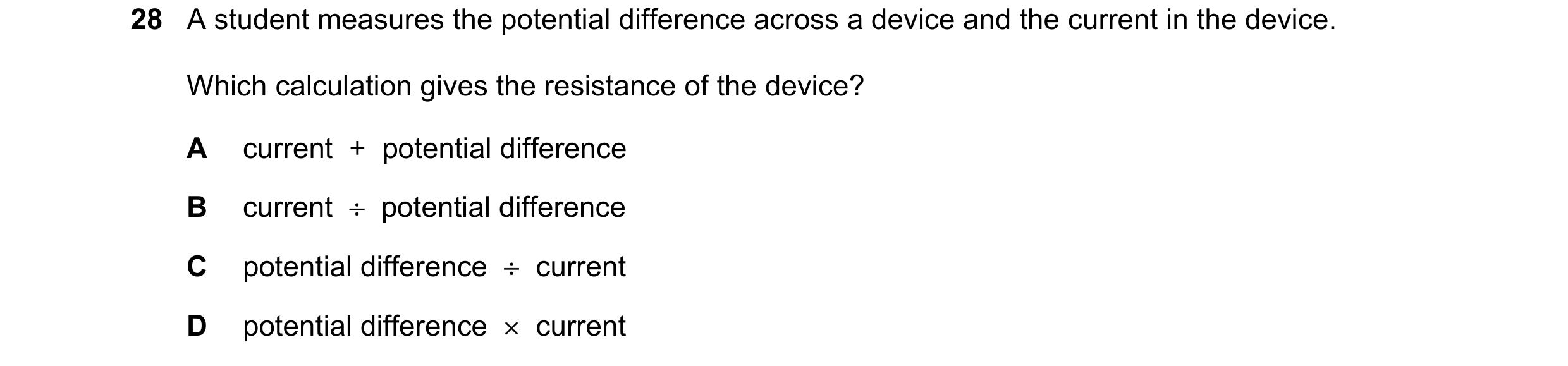
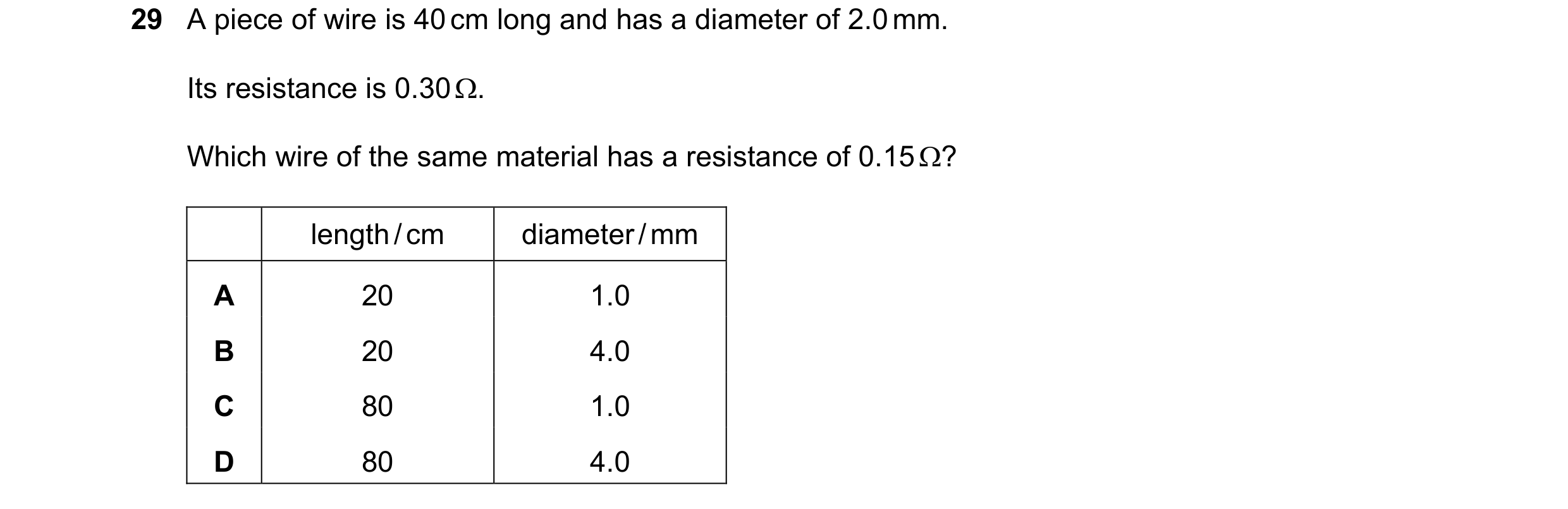
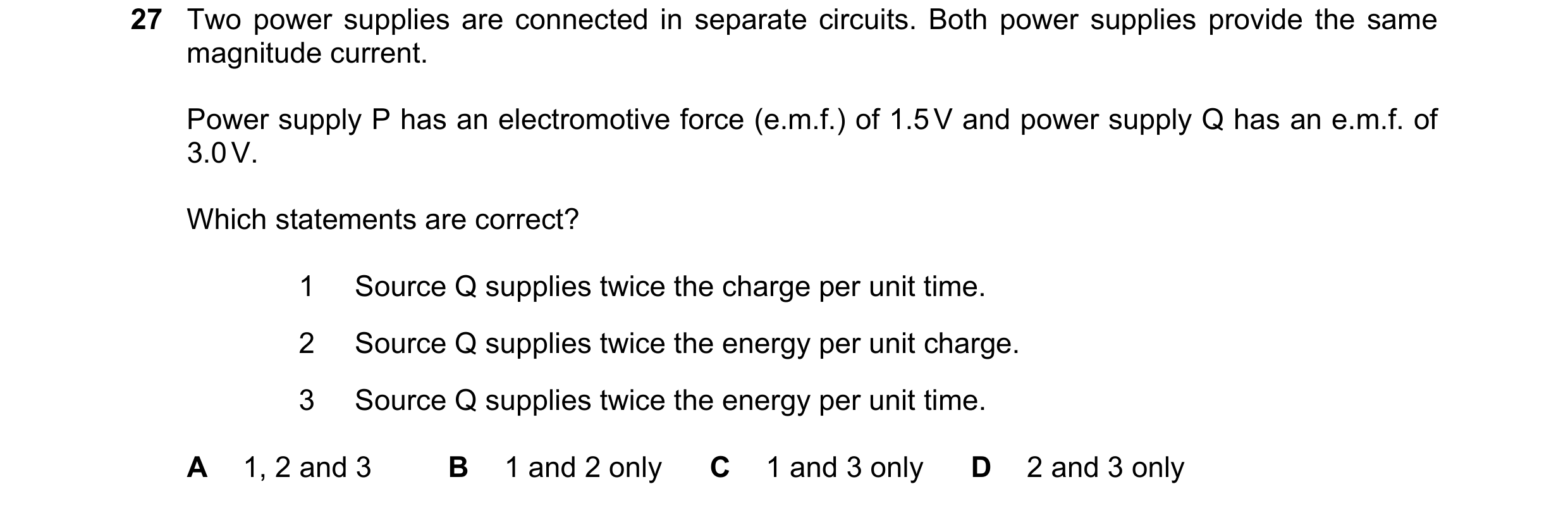 19 / 64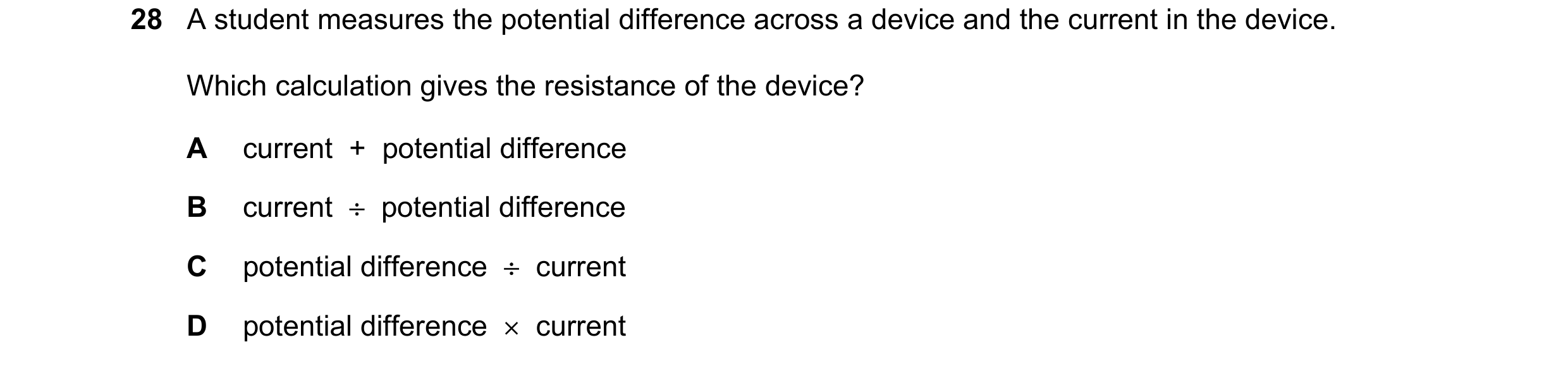

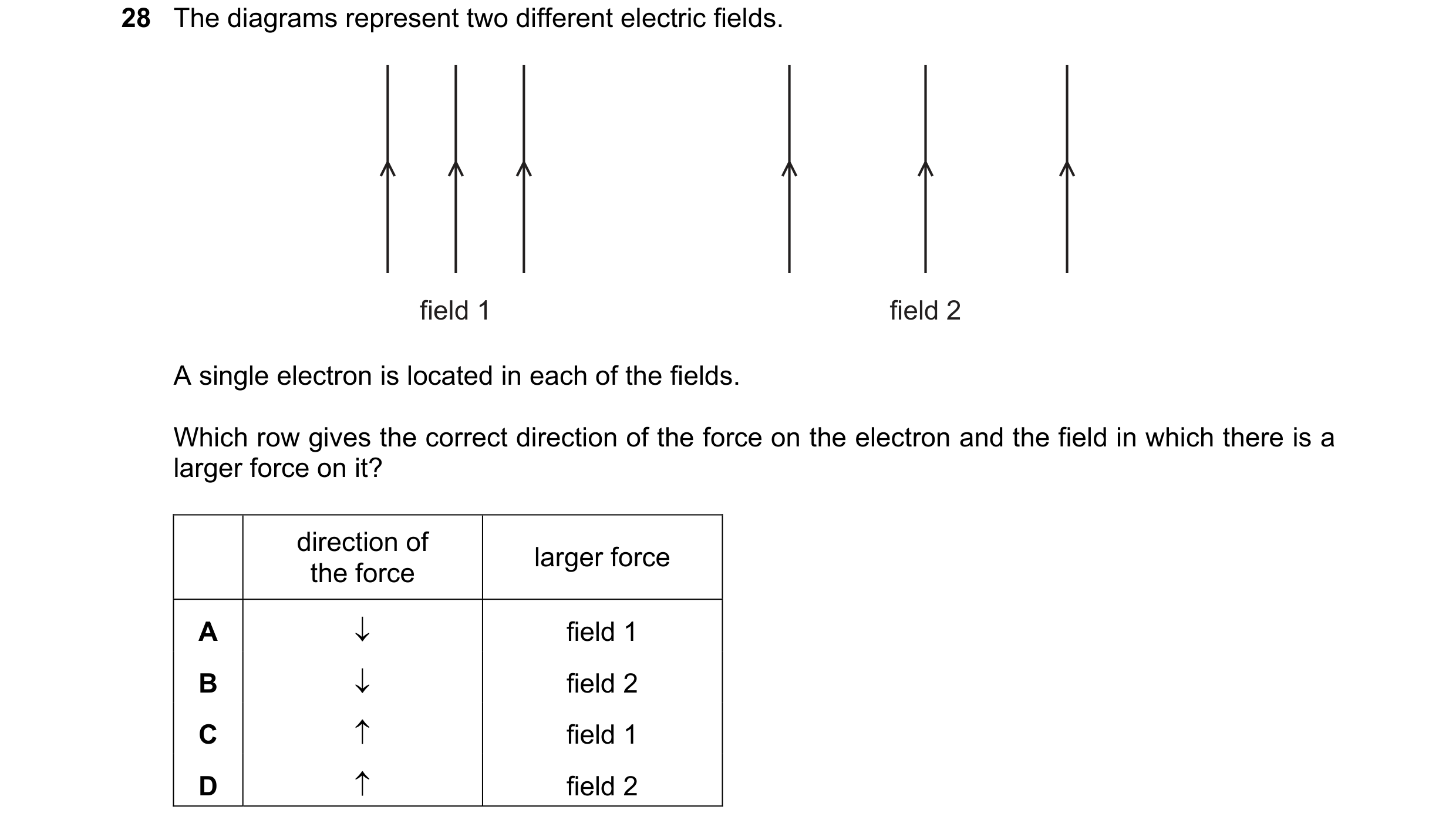
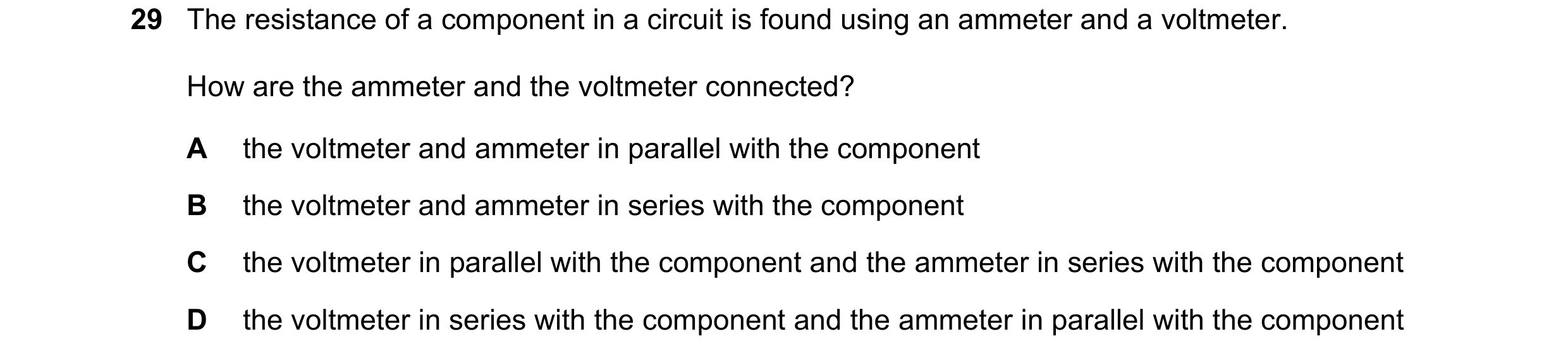 20 / 64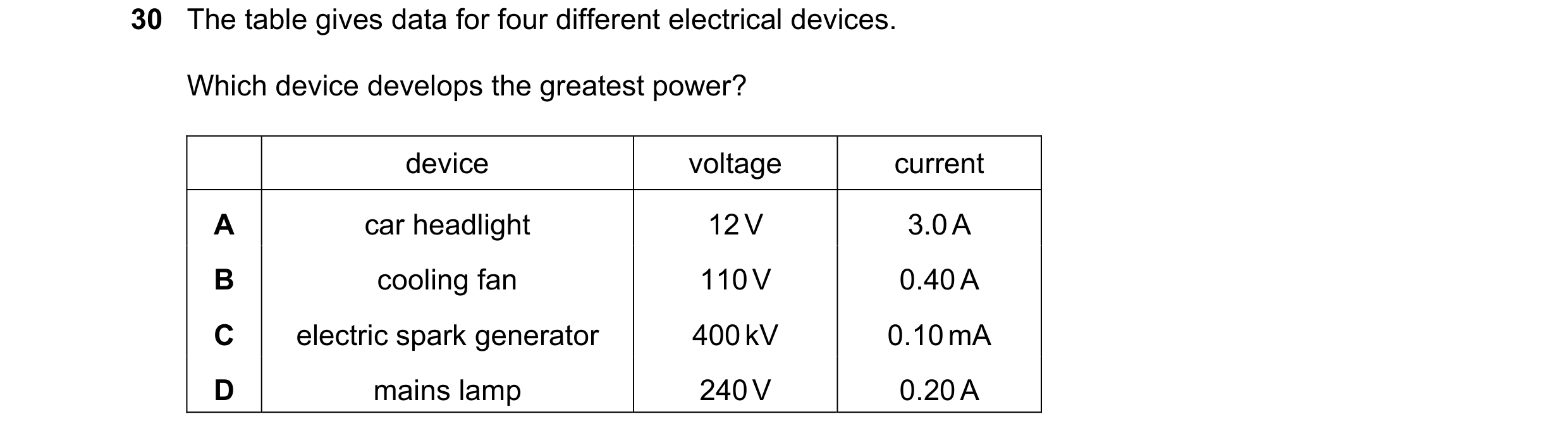
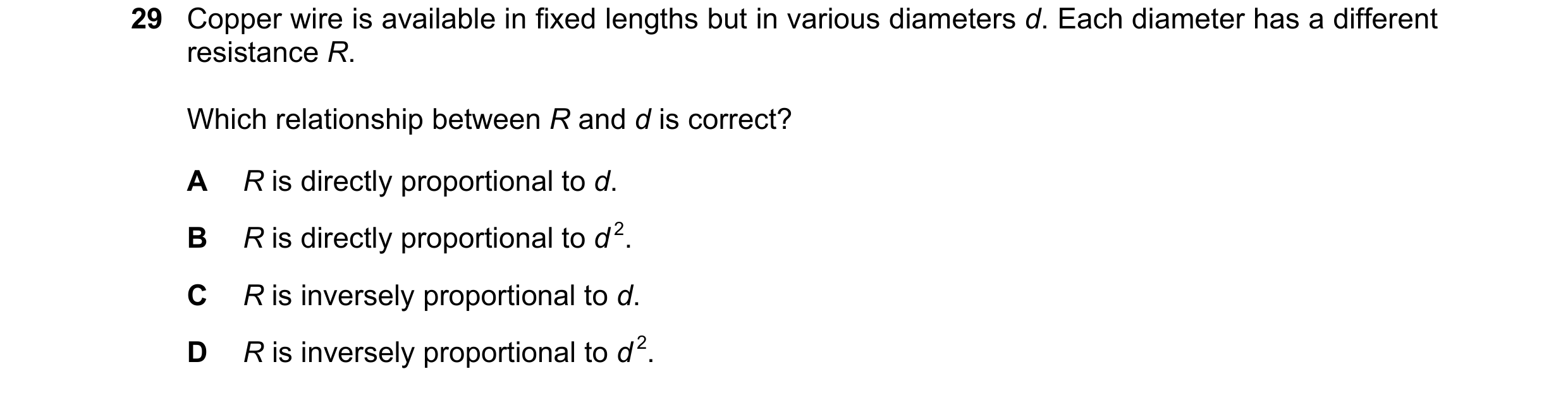
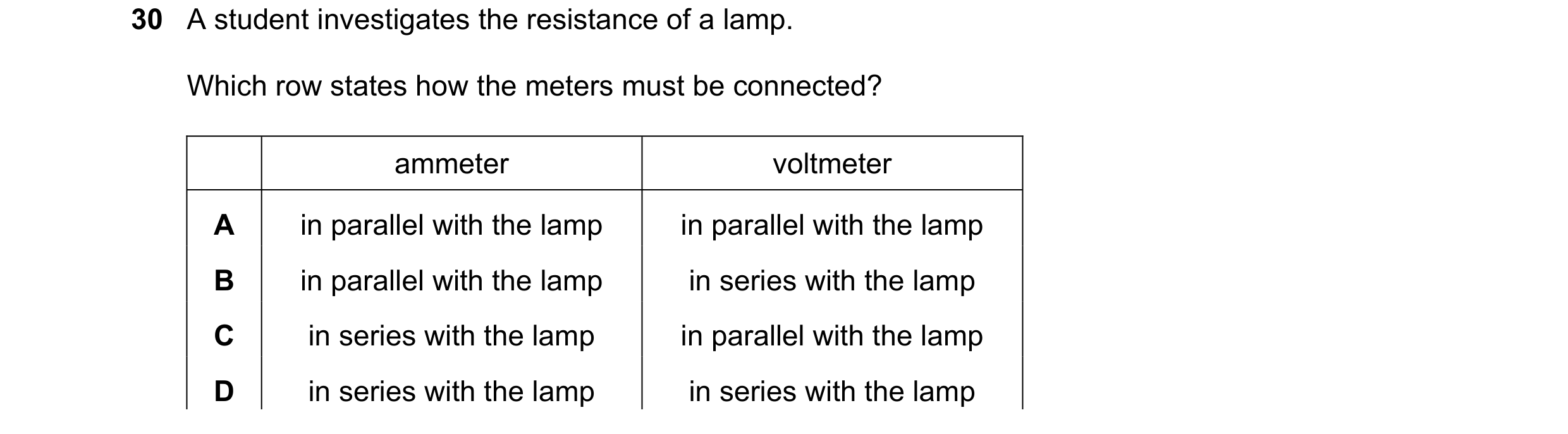
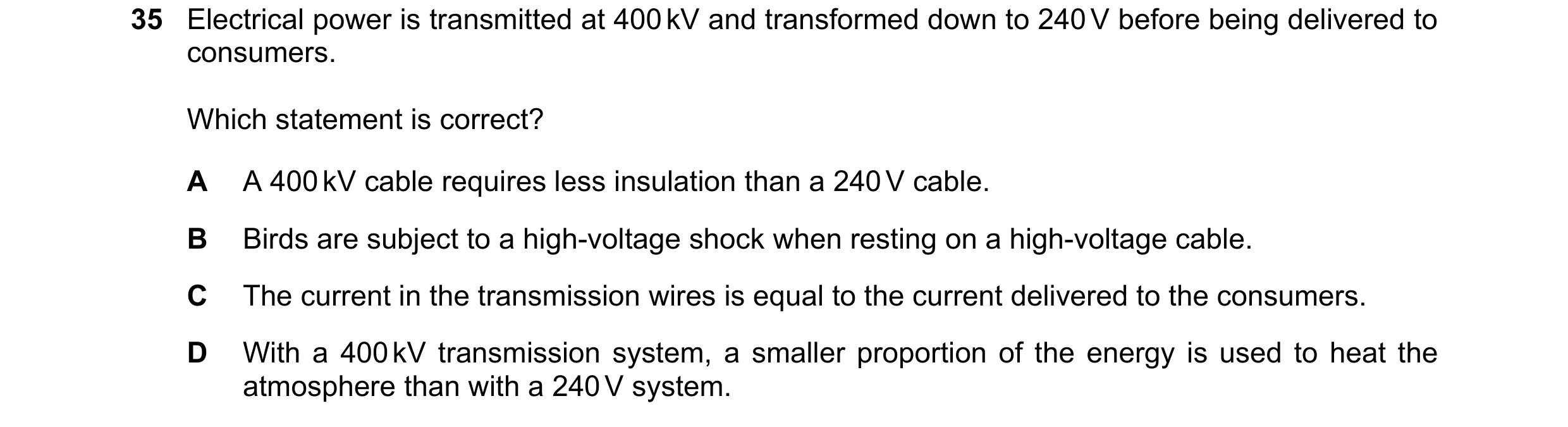
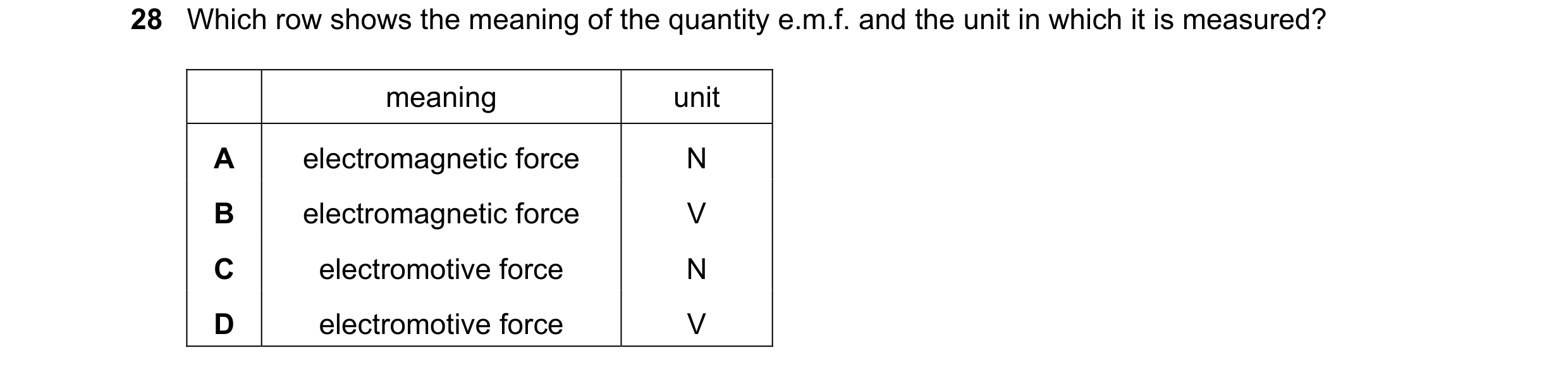 21 / 64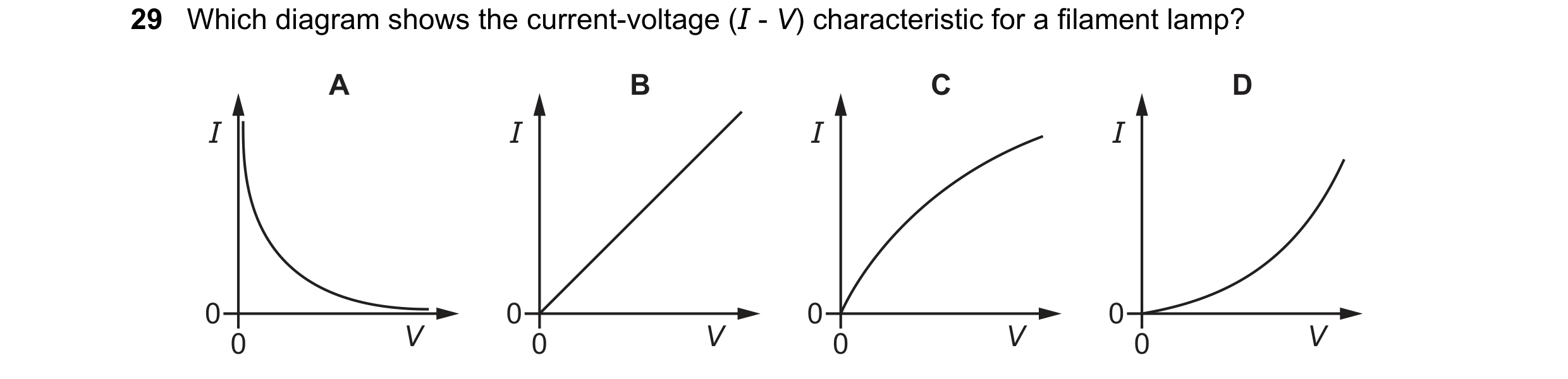
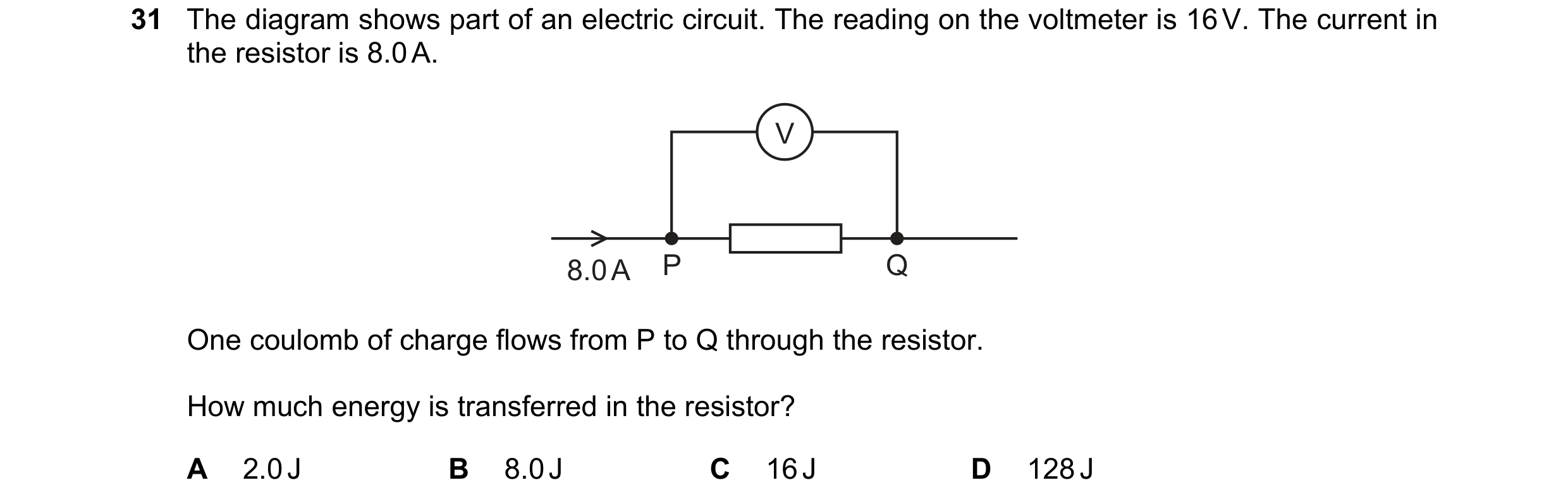
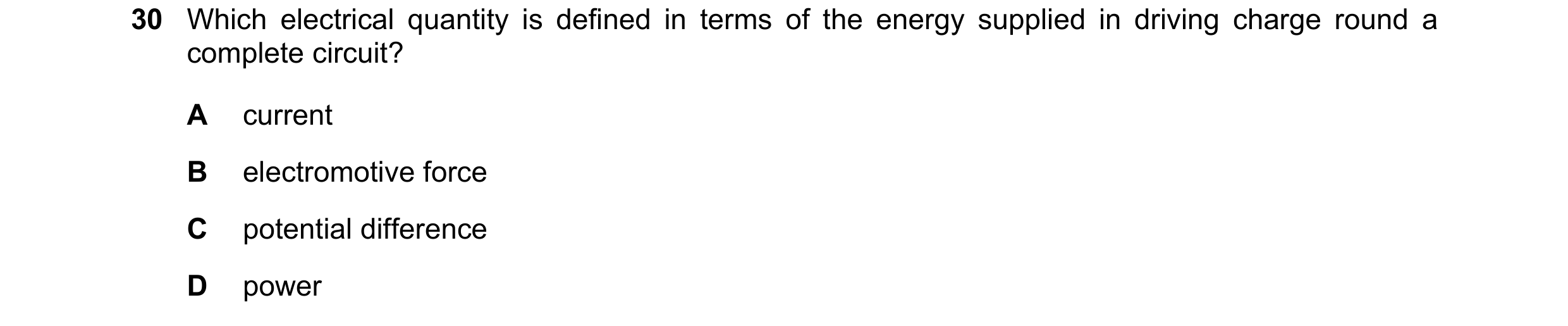 22 / 64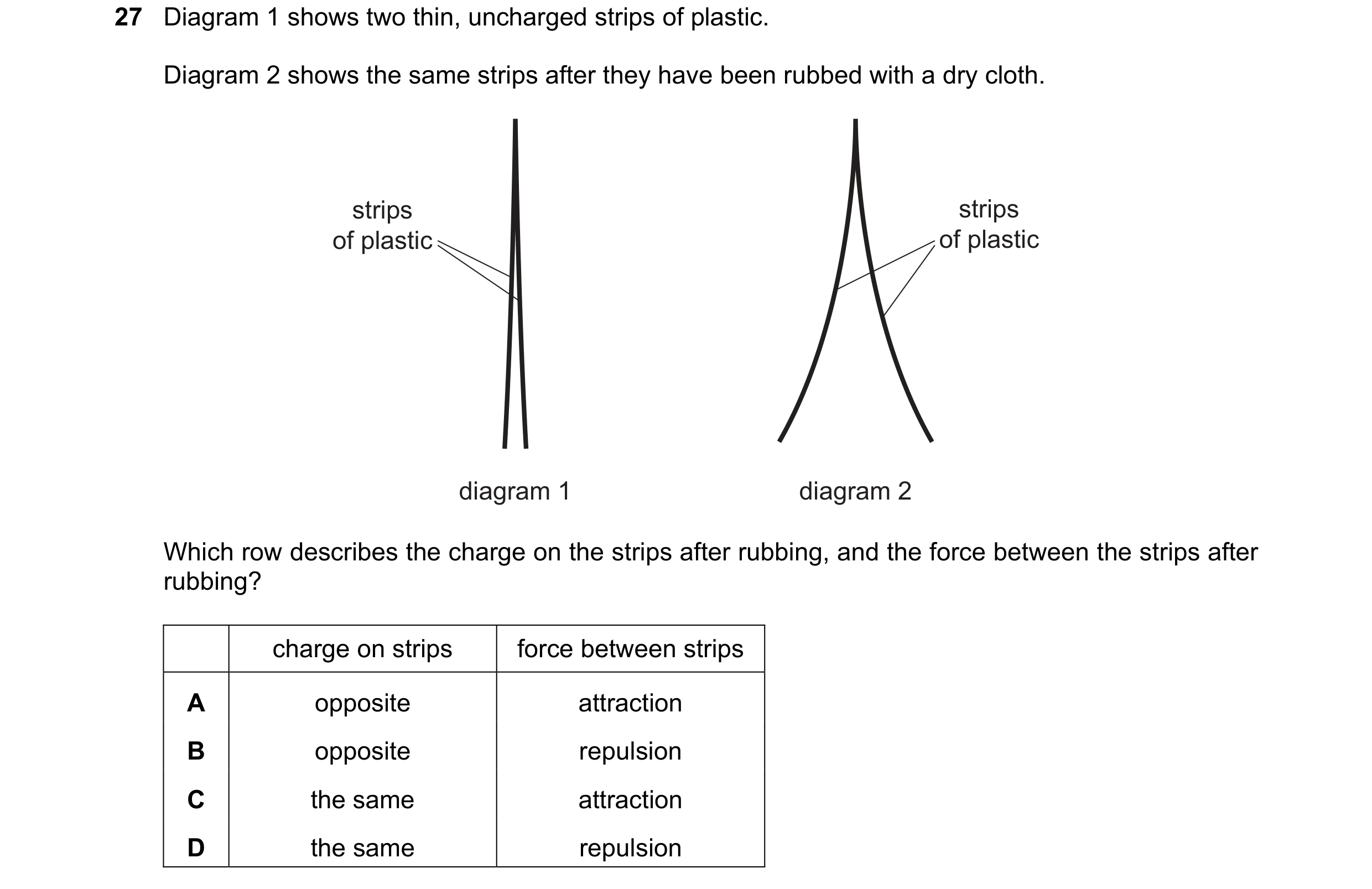

 23 / 64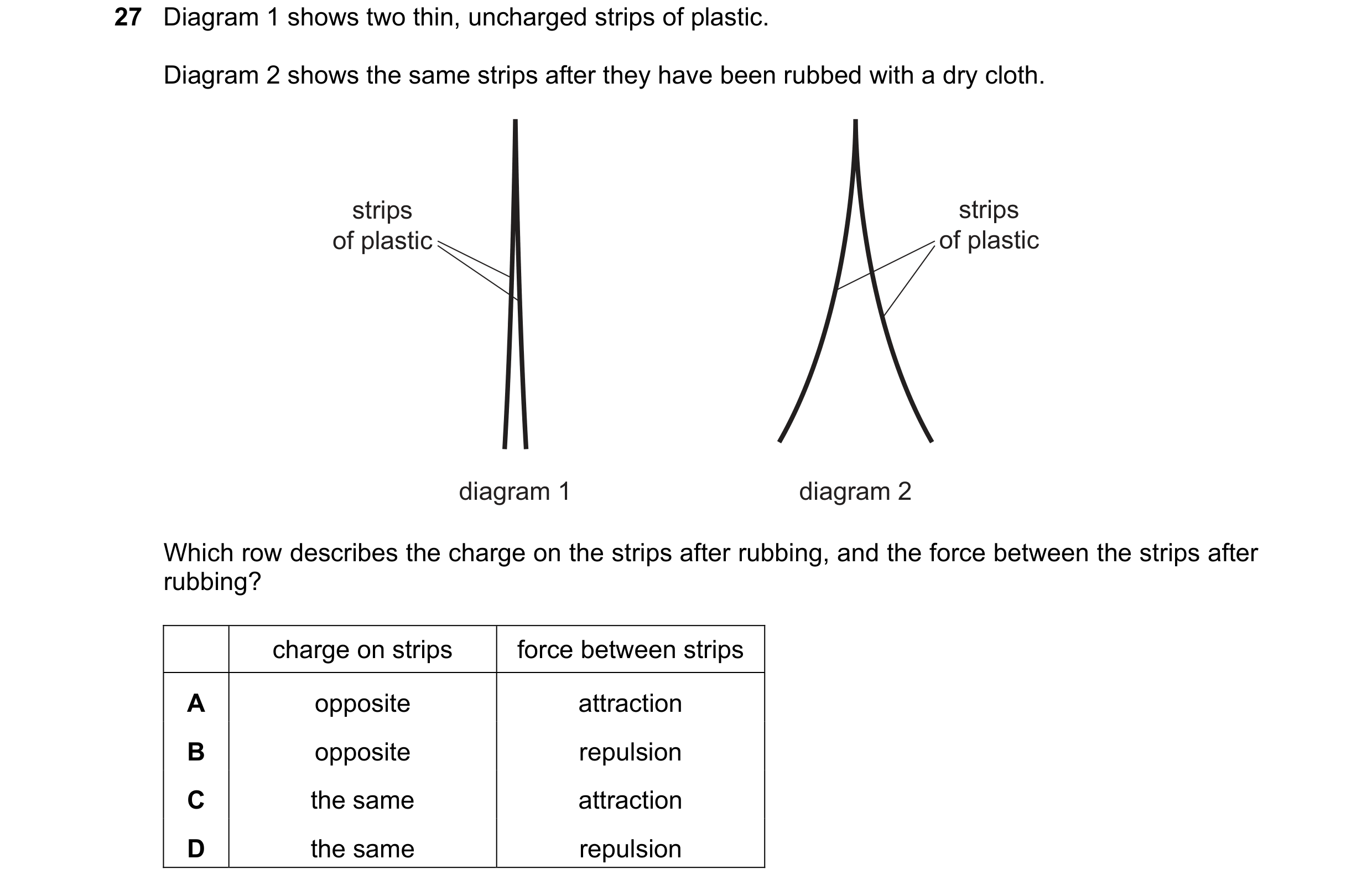

 24 / 64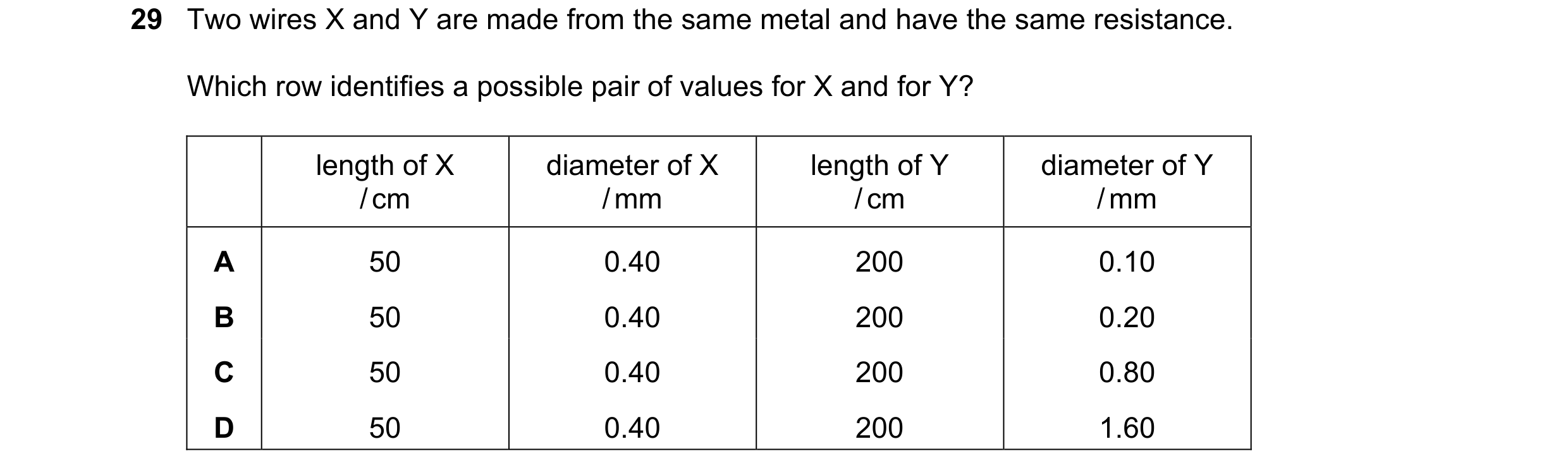
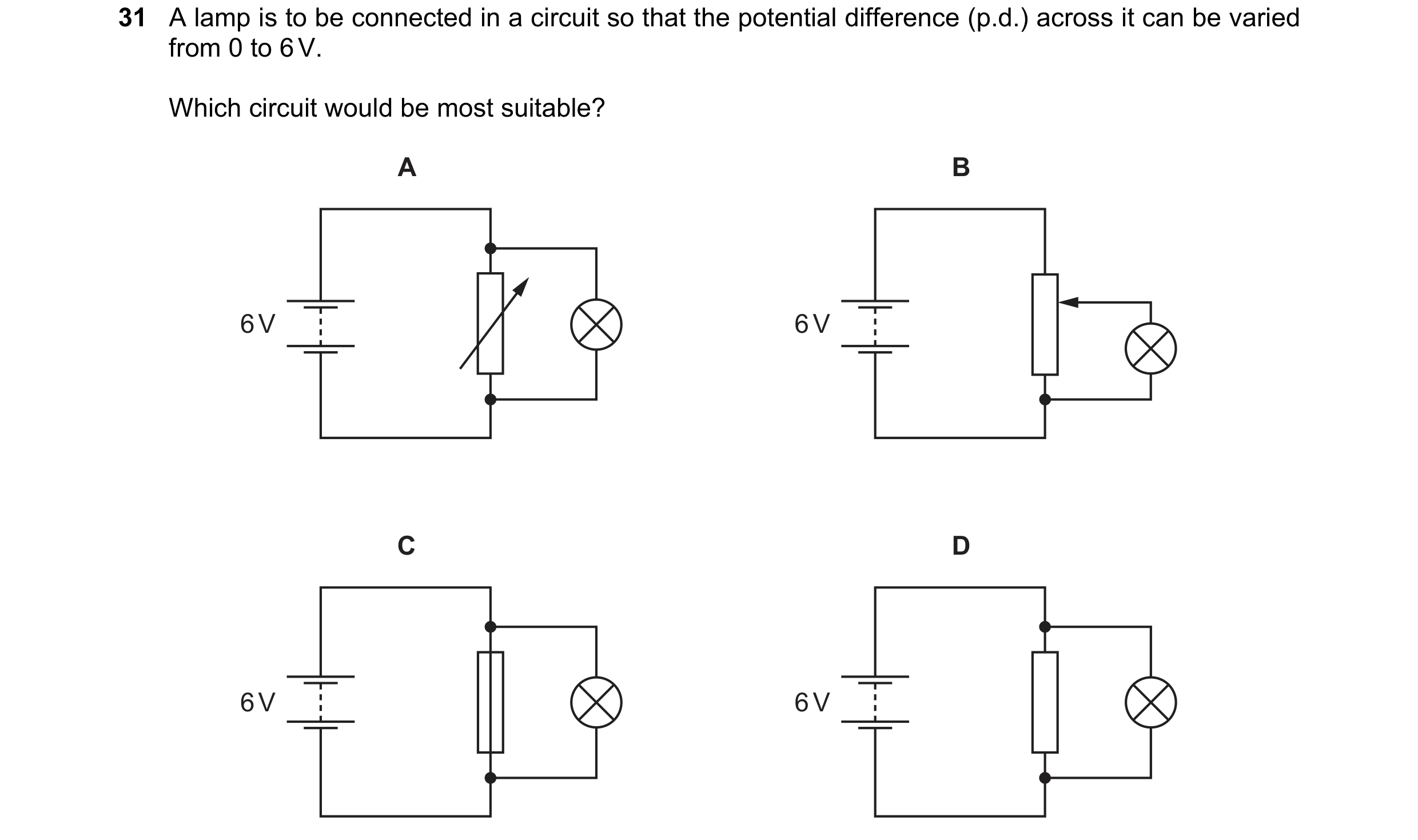
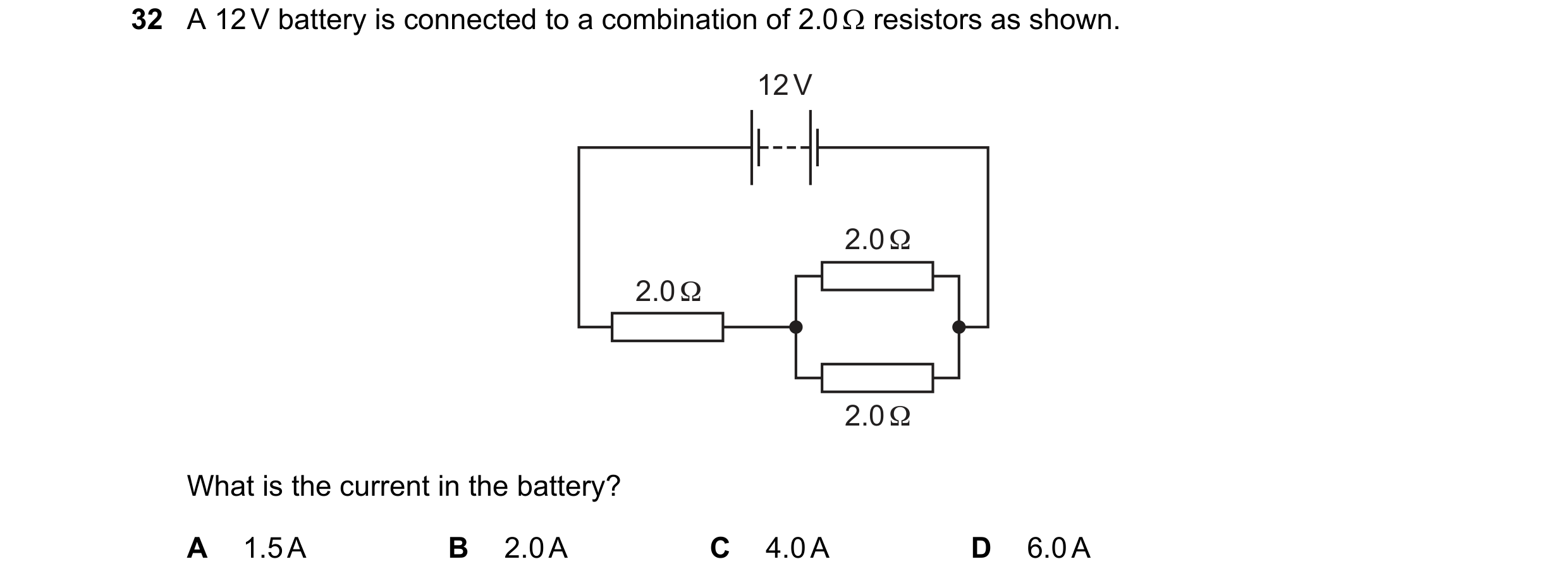 25 / 64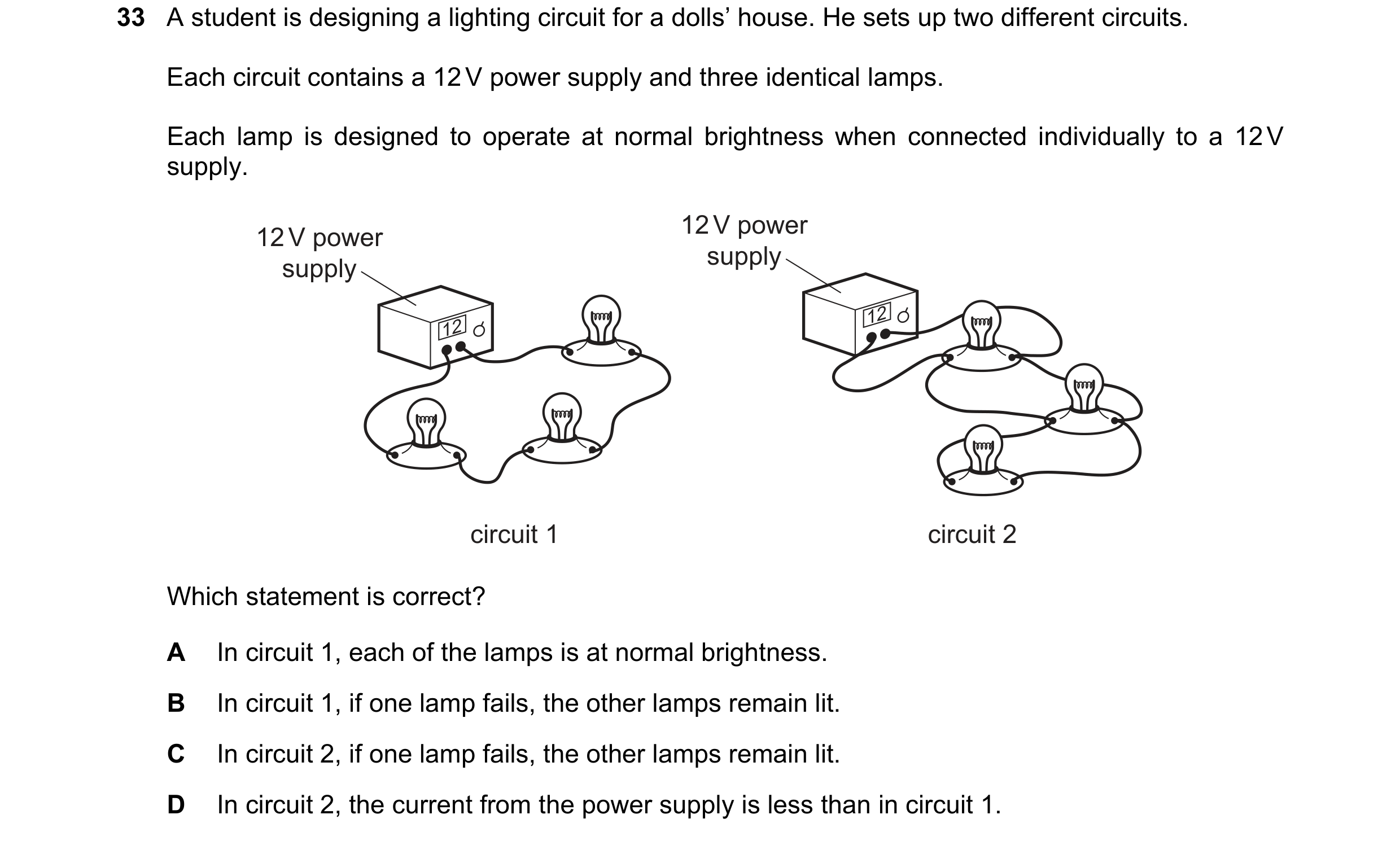
 26 / 64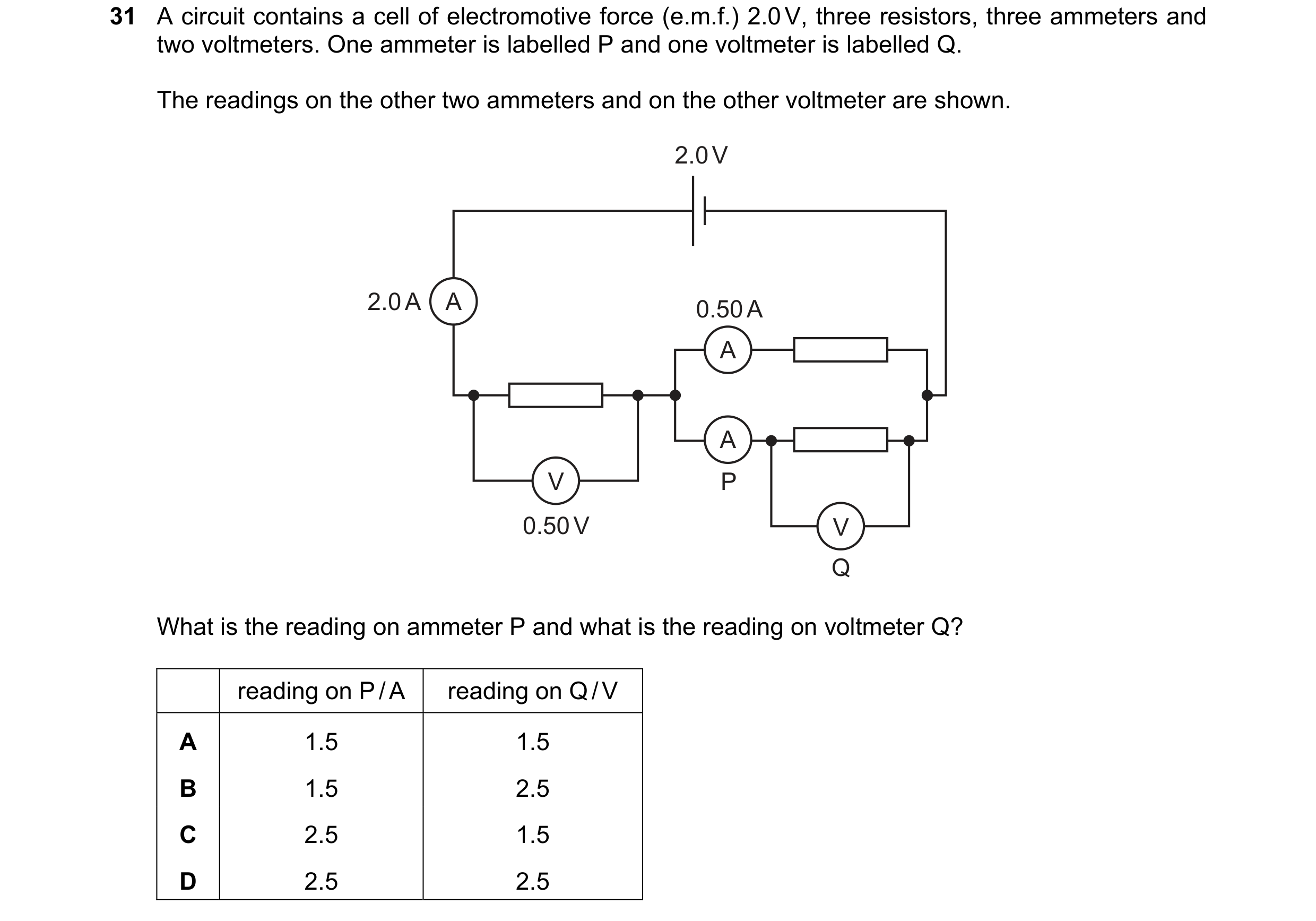

 27 / 64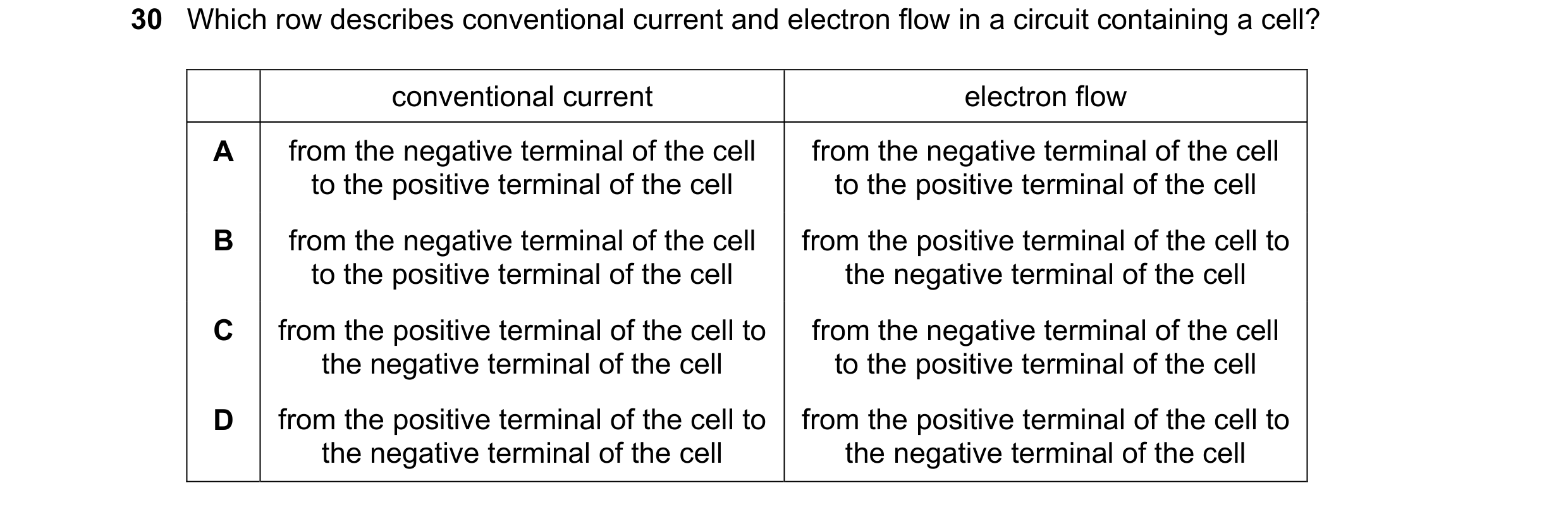
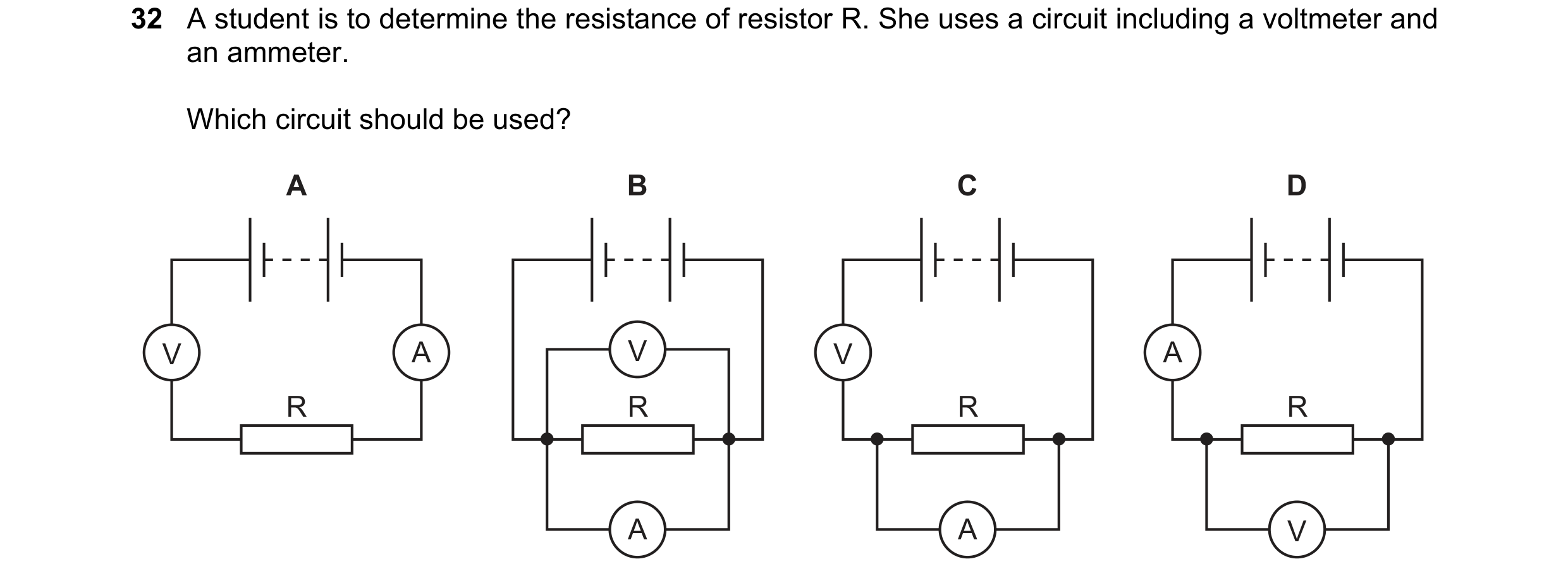
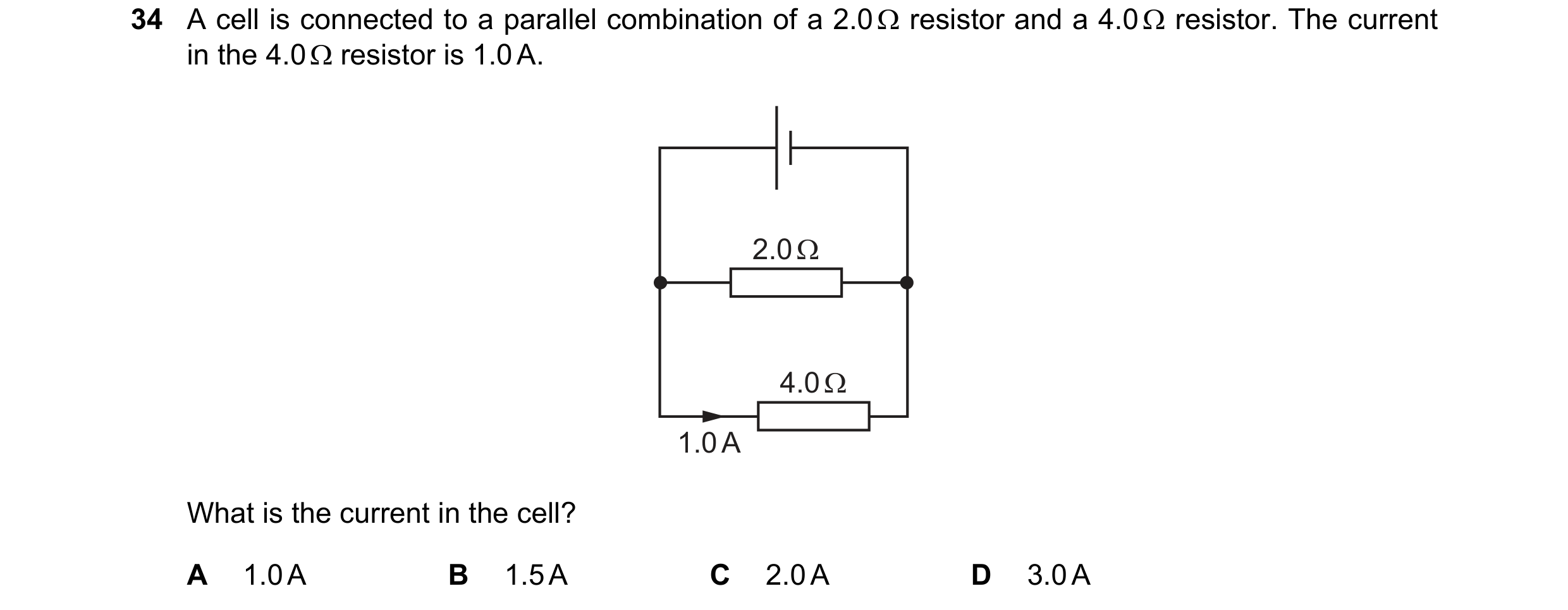 28 / 64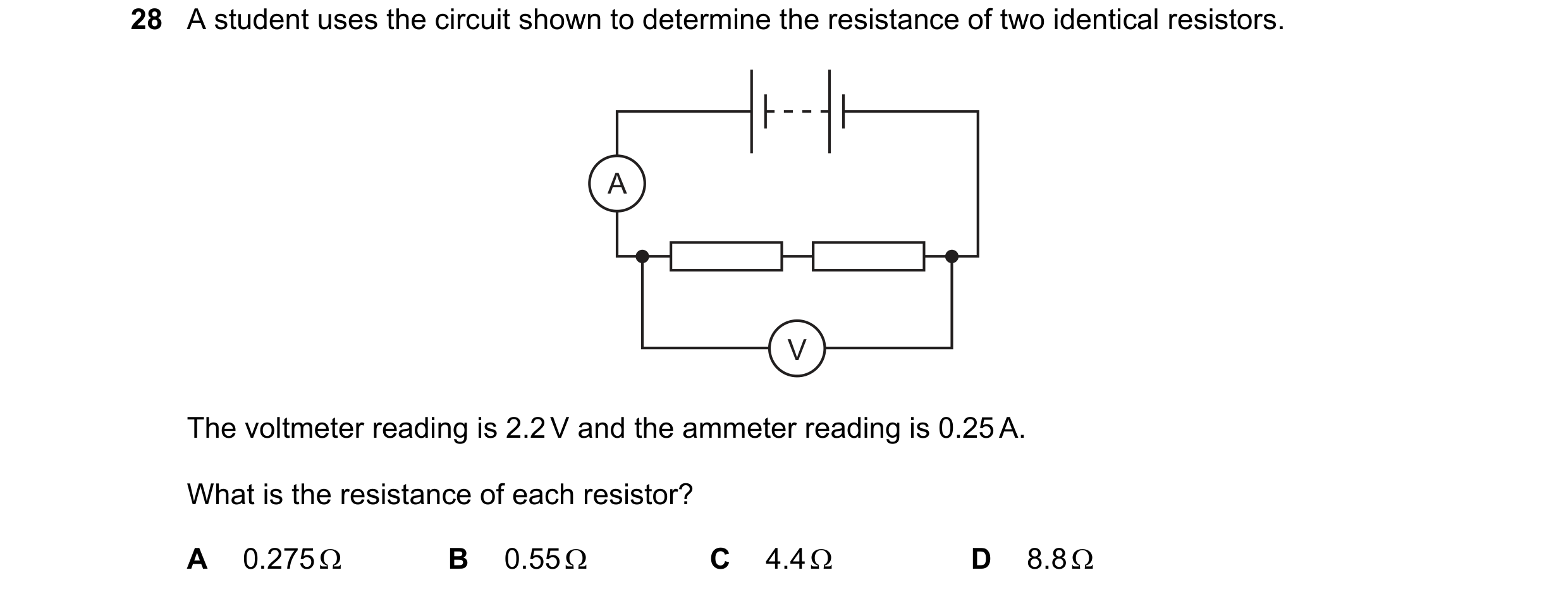

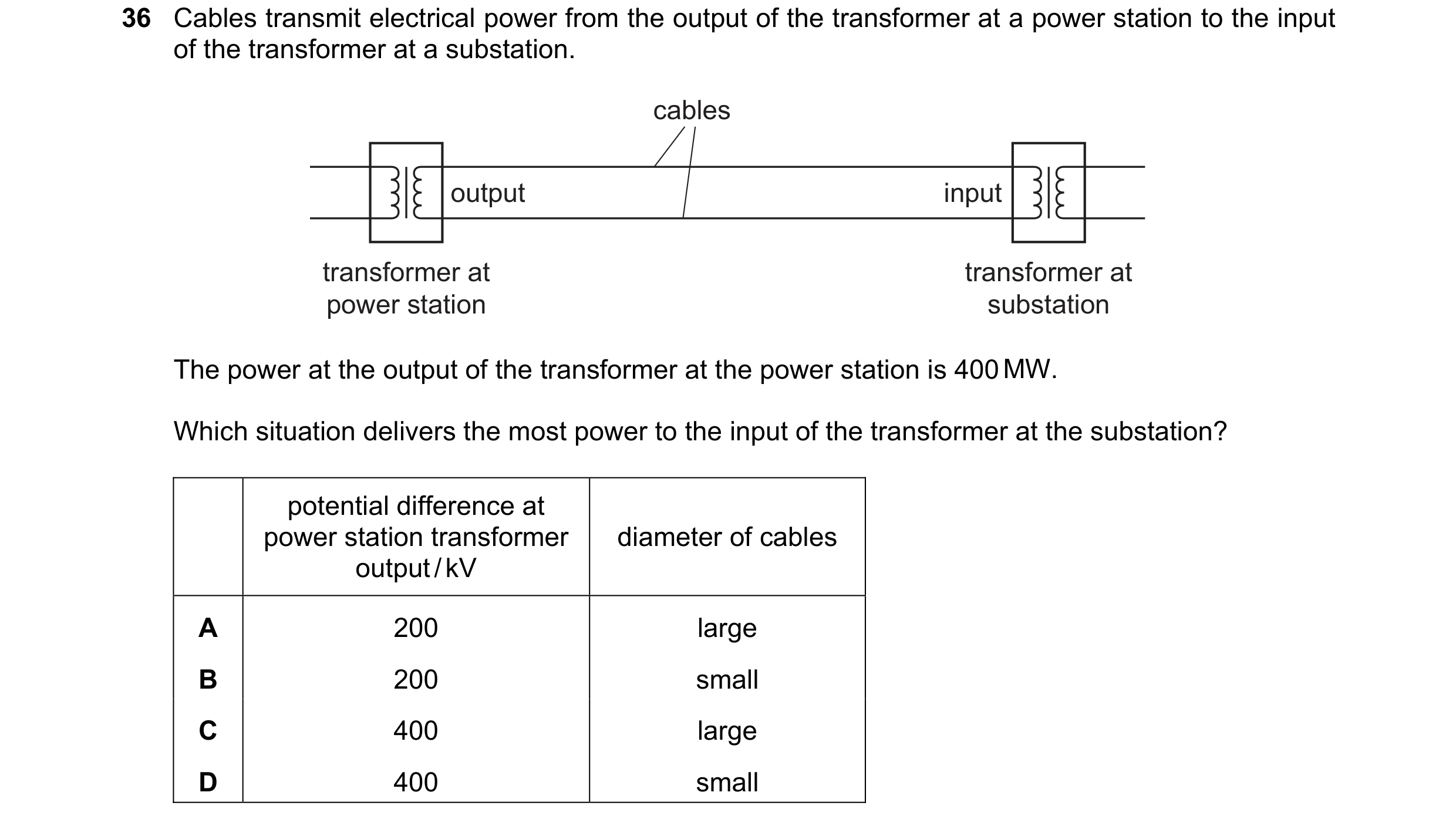
 29 / 64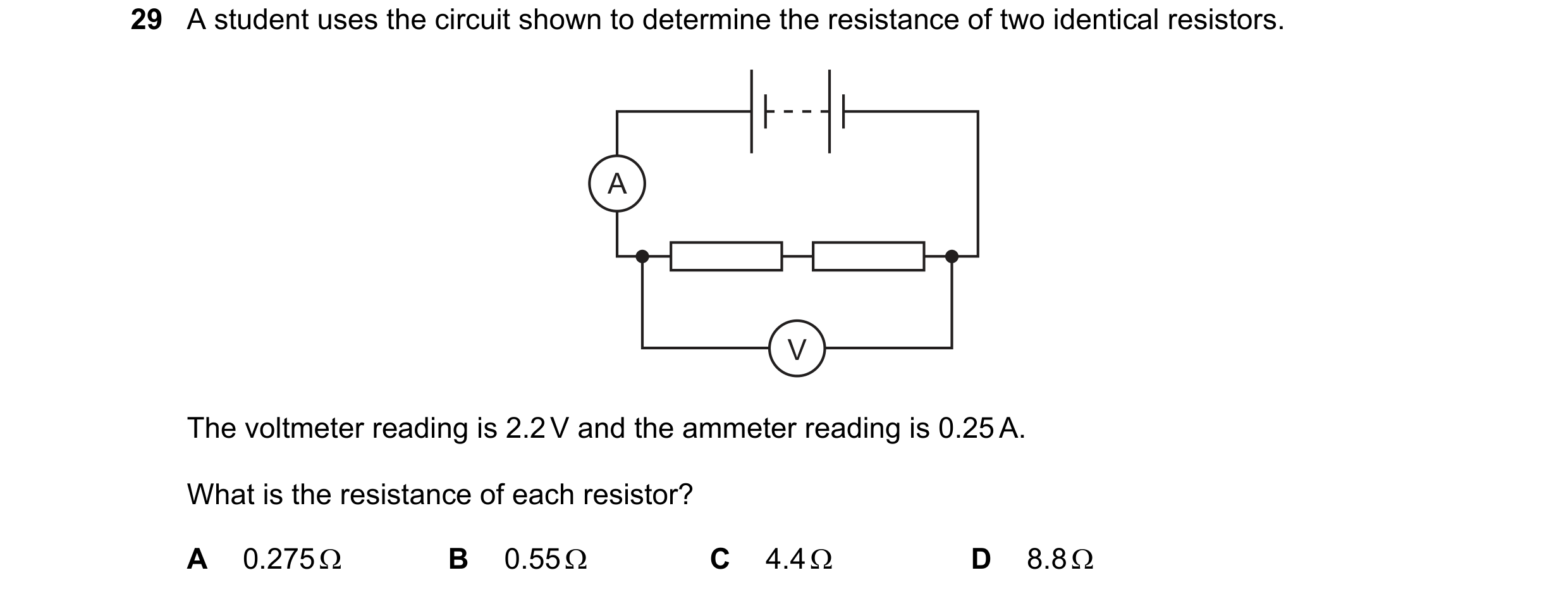

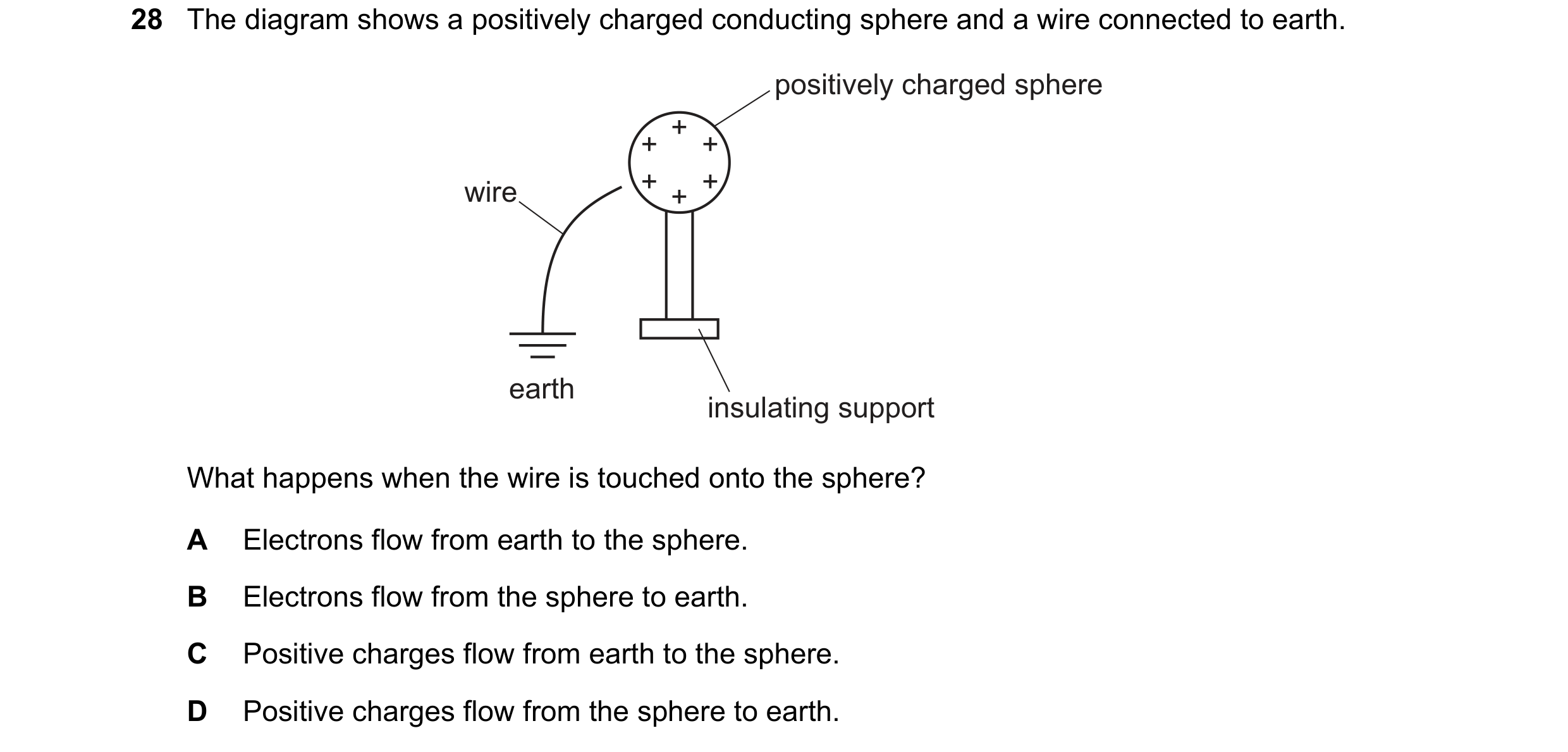
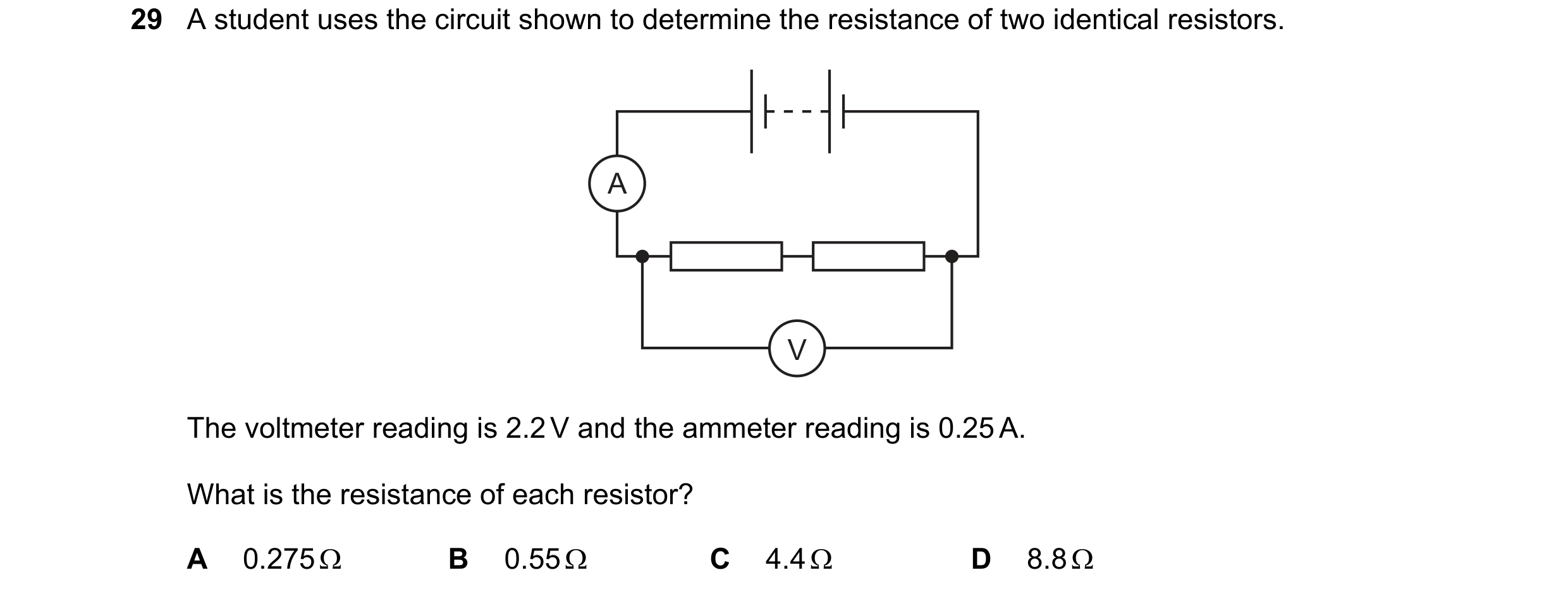 30 / 64
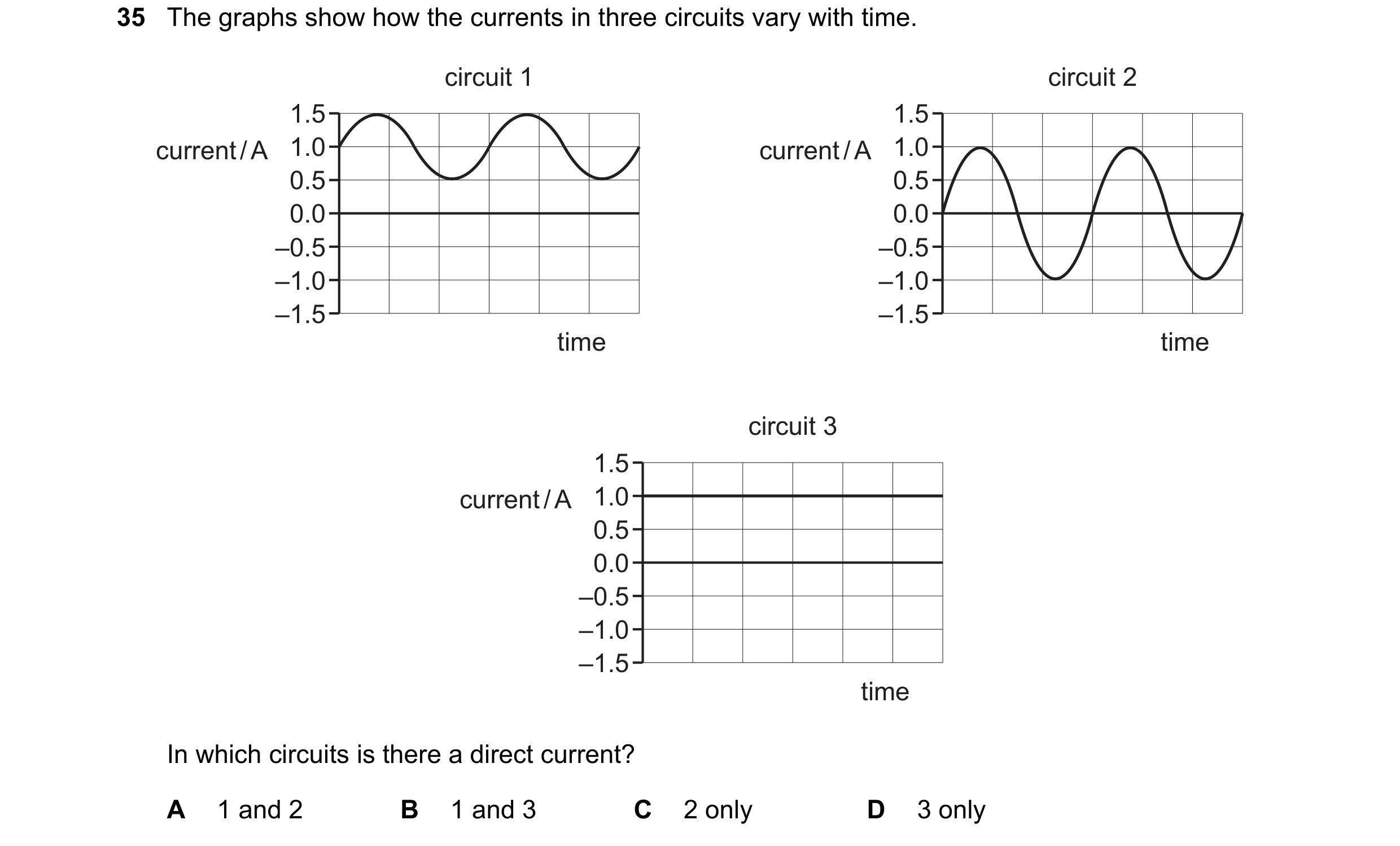
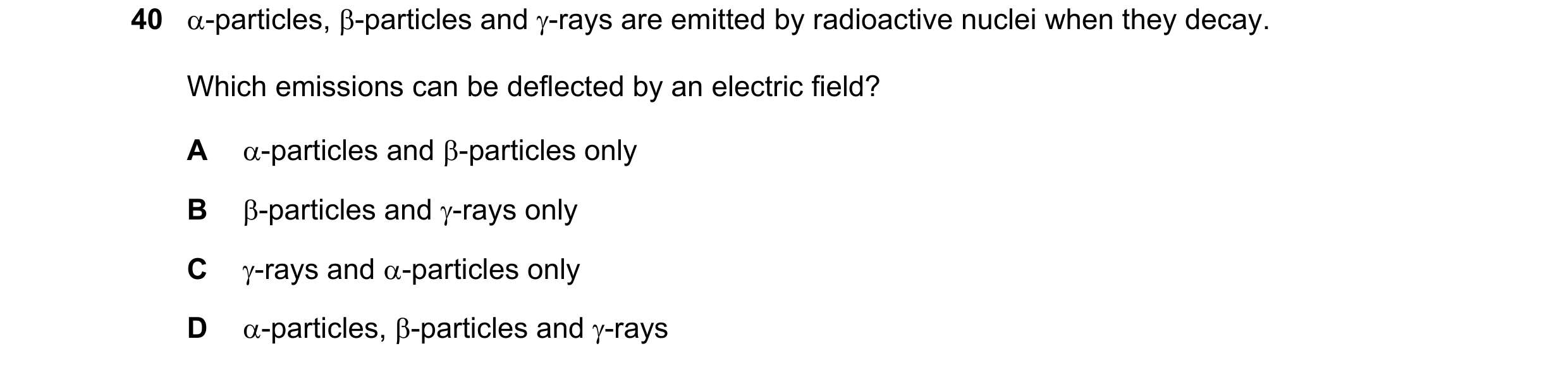
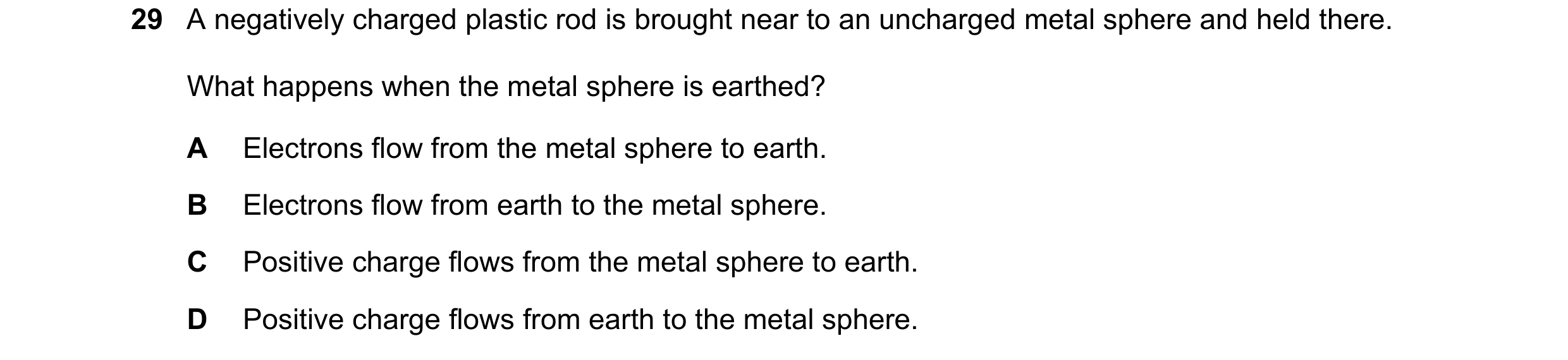 31 / 64
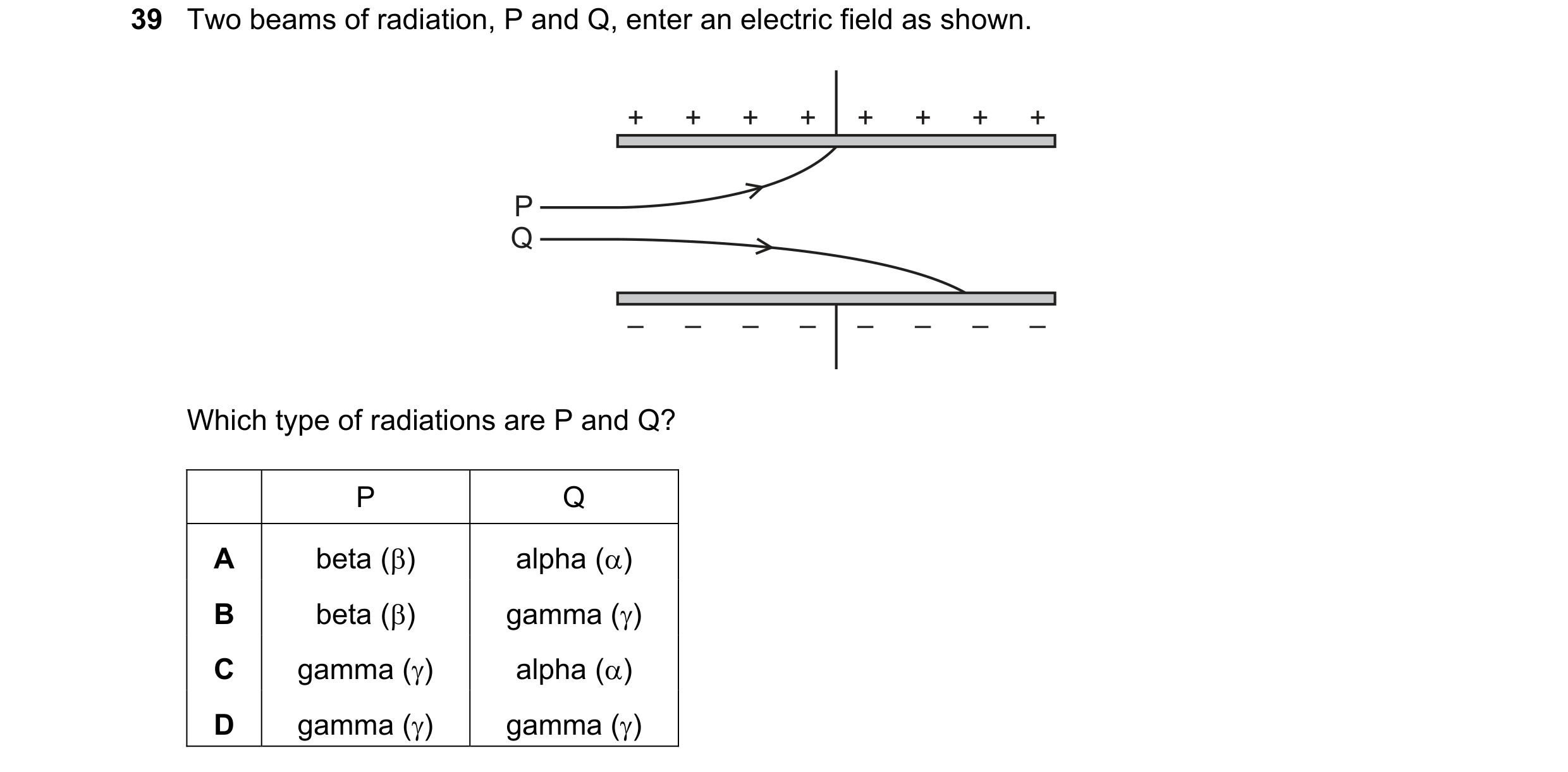
 32 / 64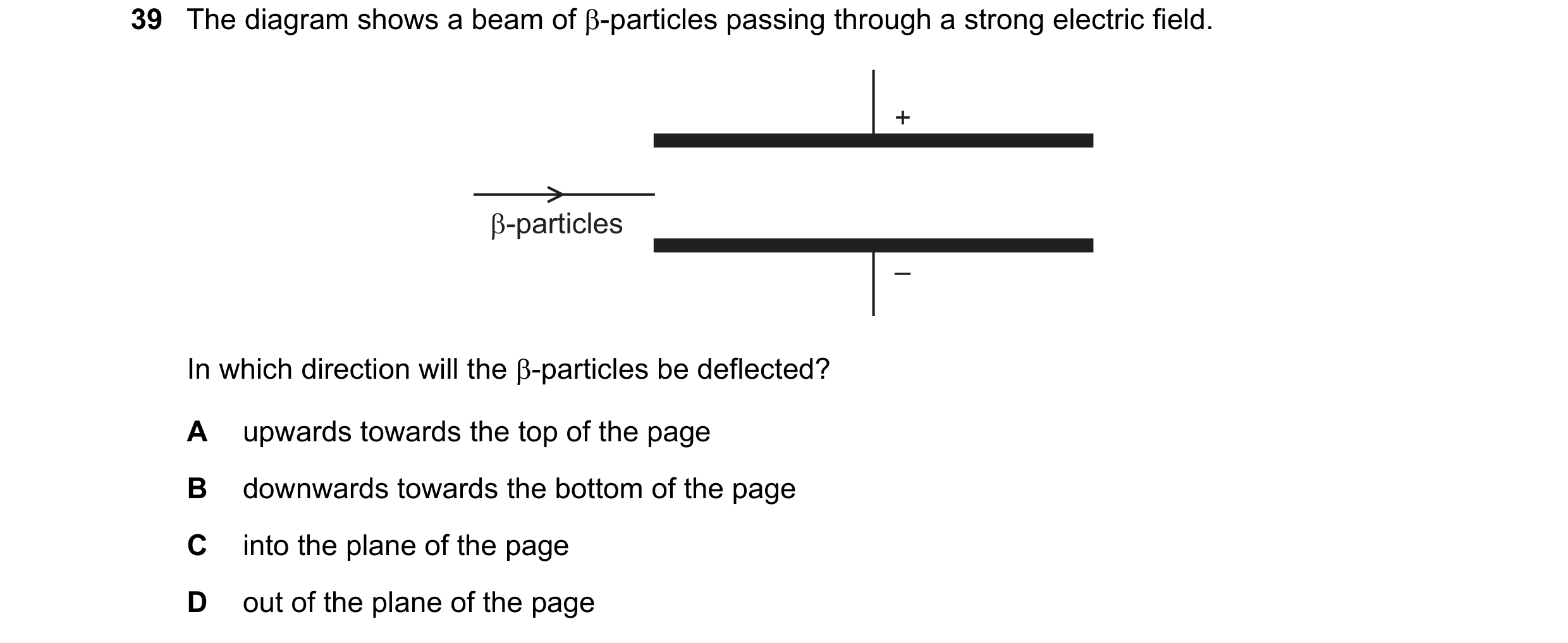
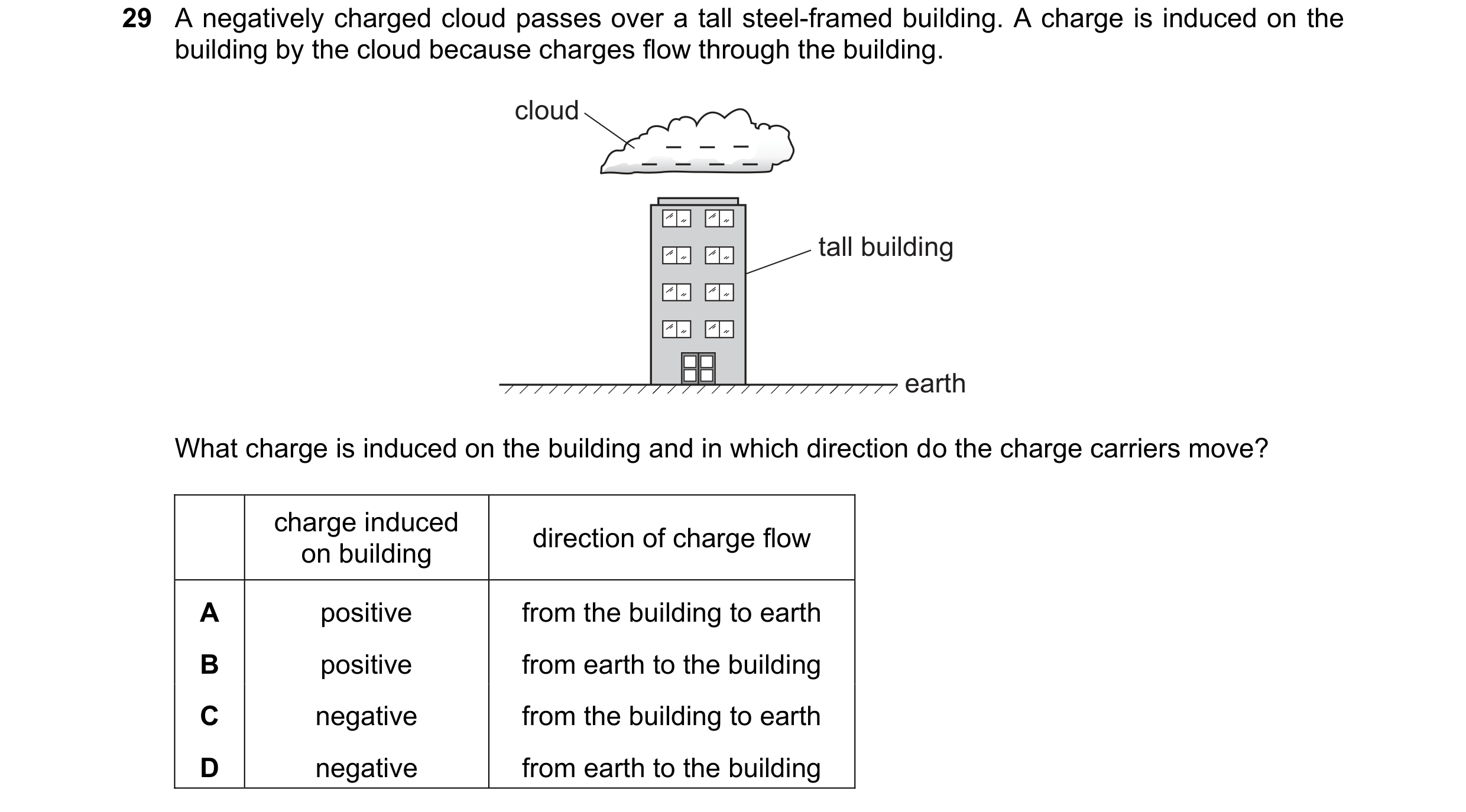
 33 / 64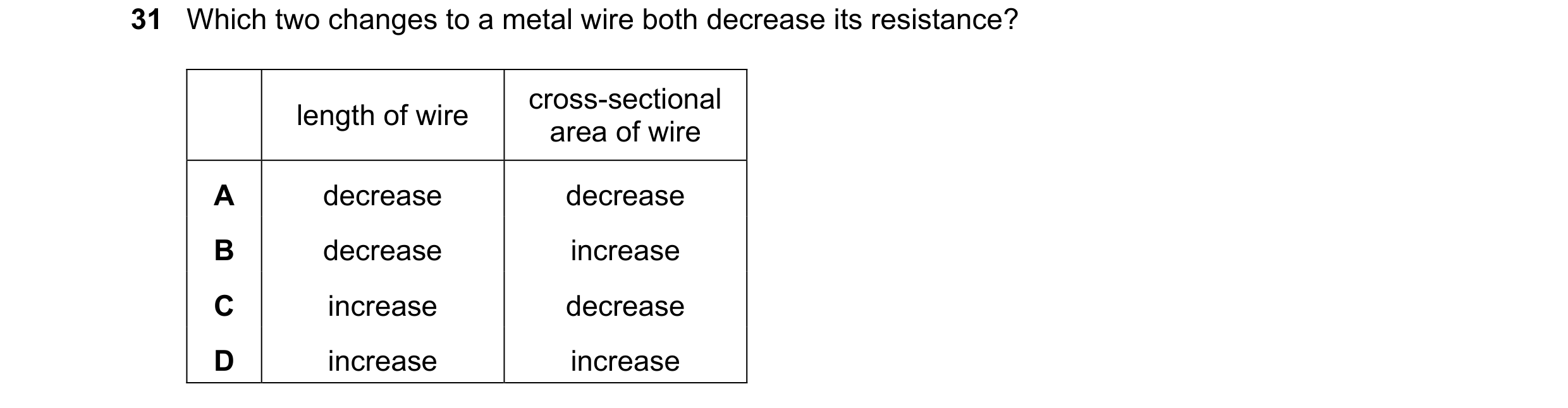

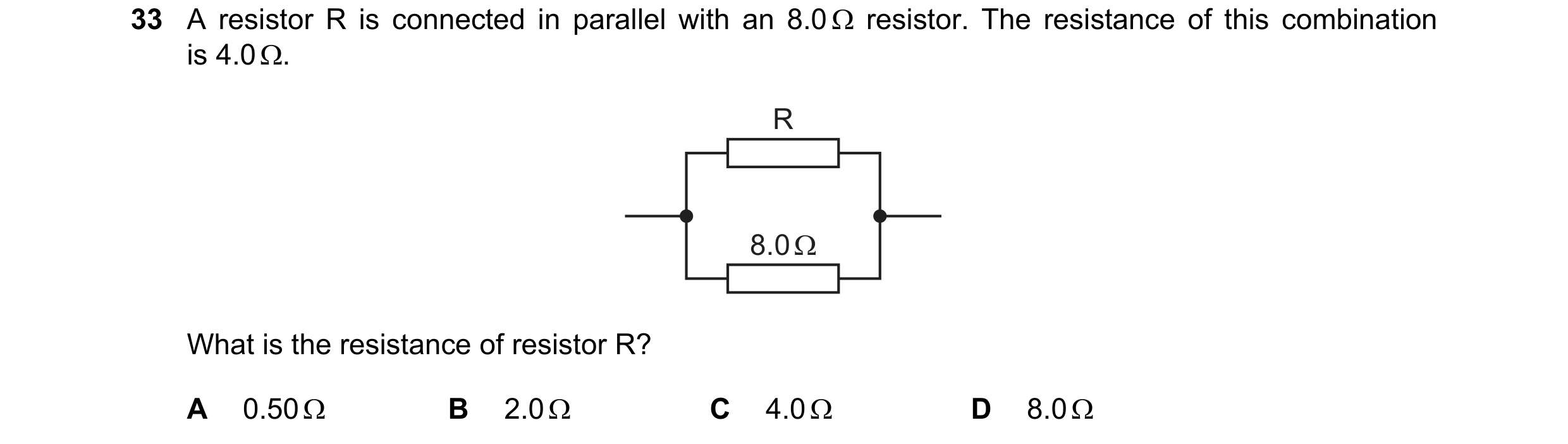
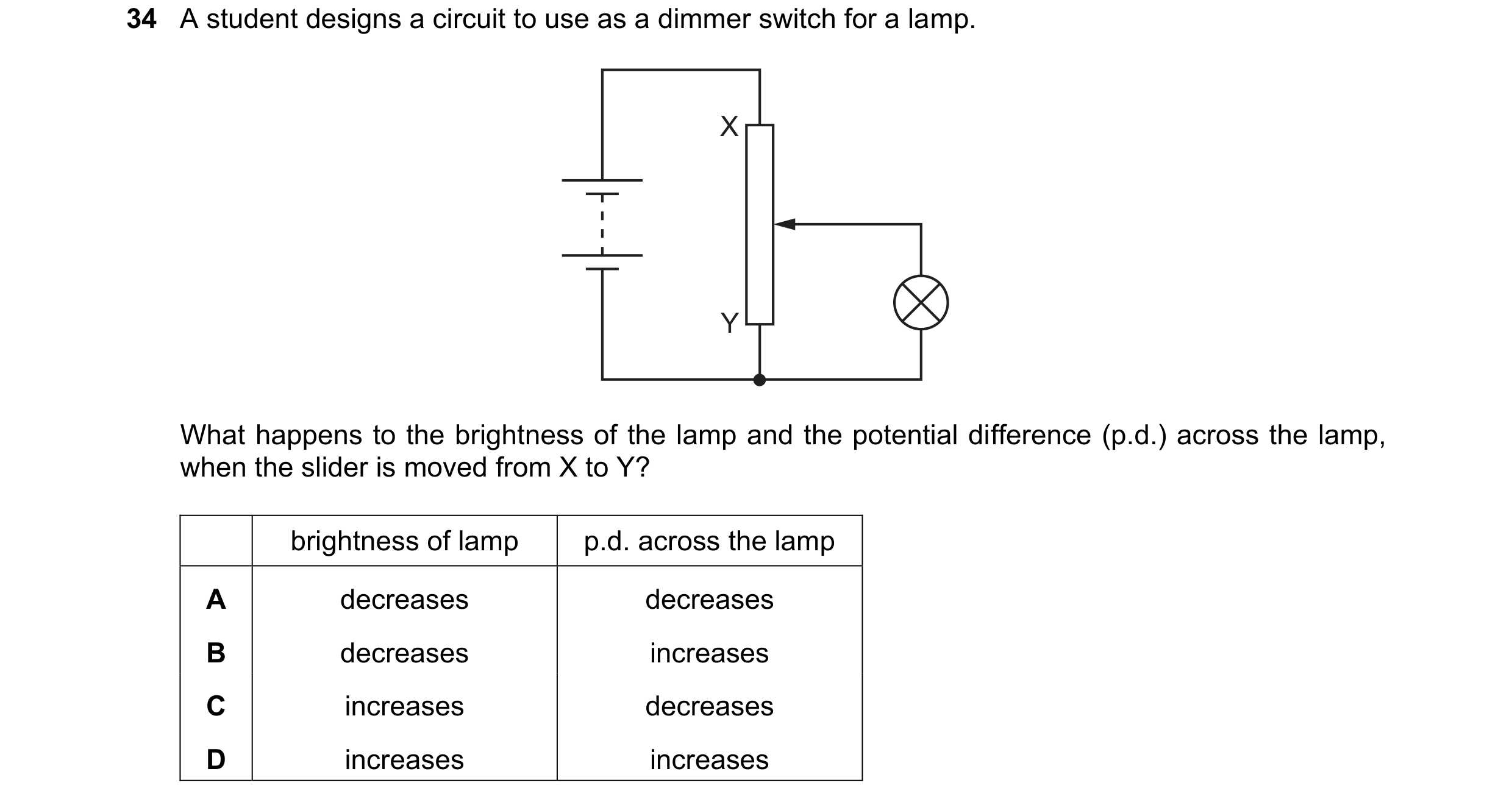 34 / 64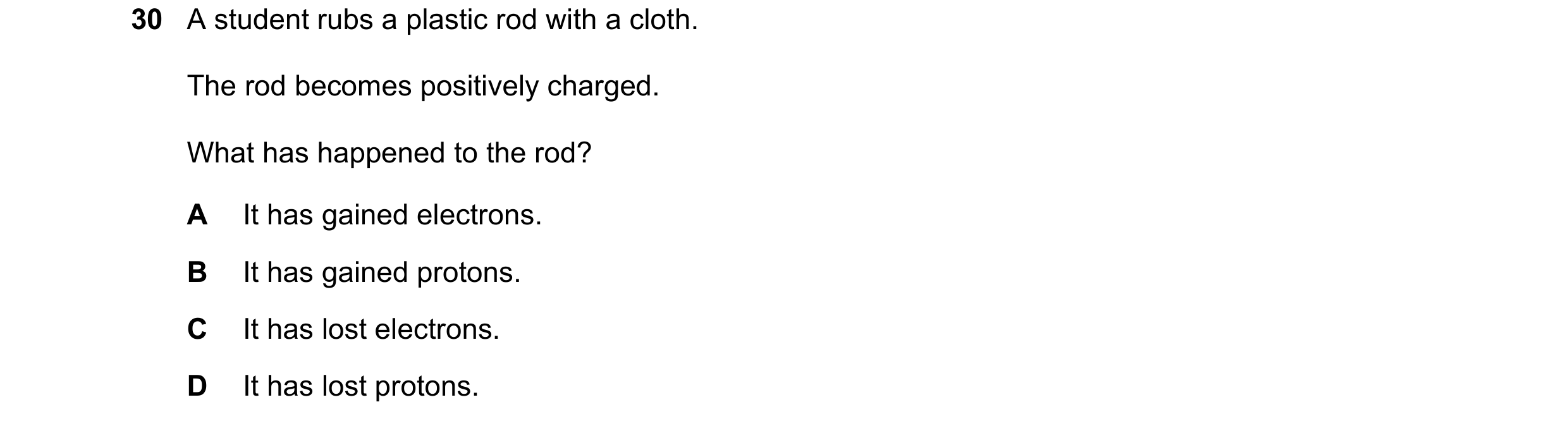
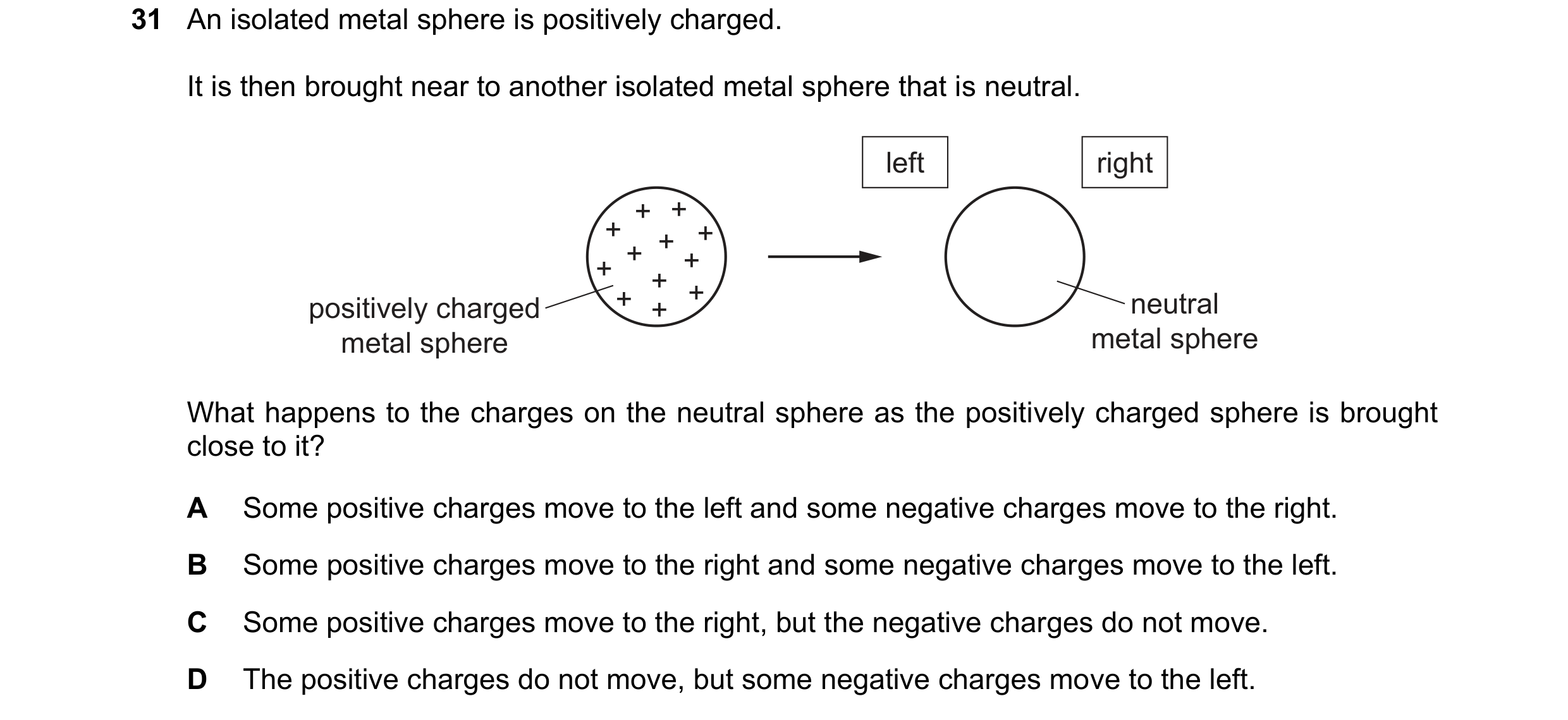
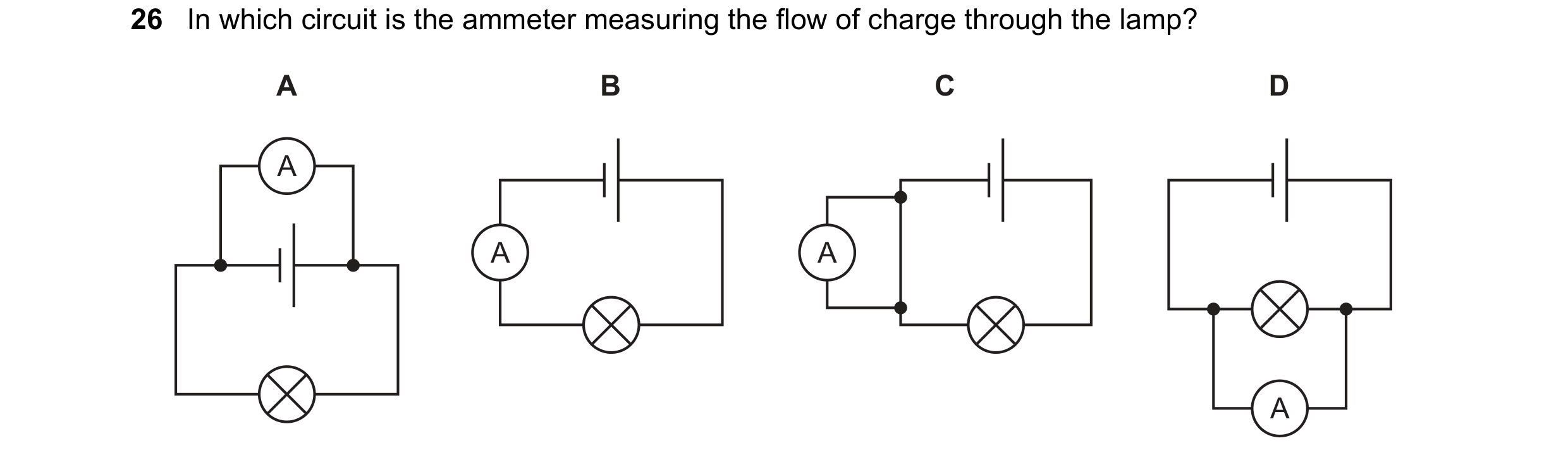
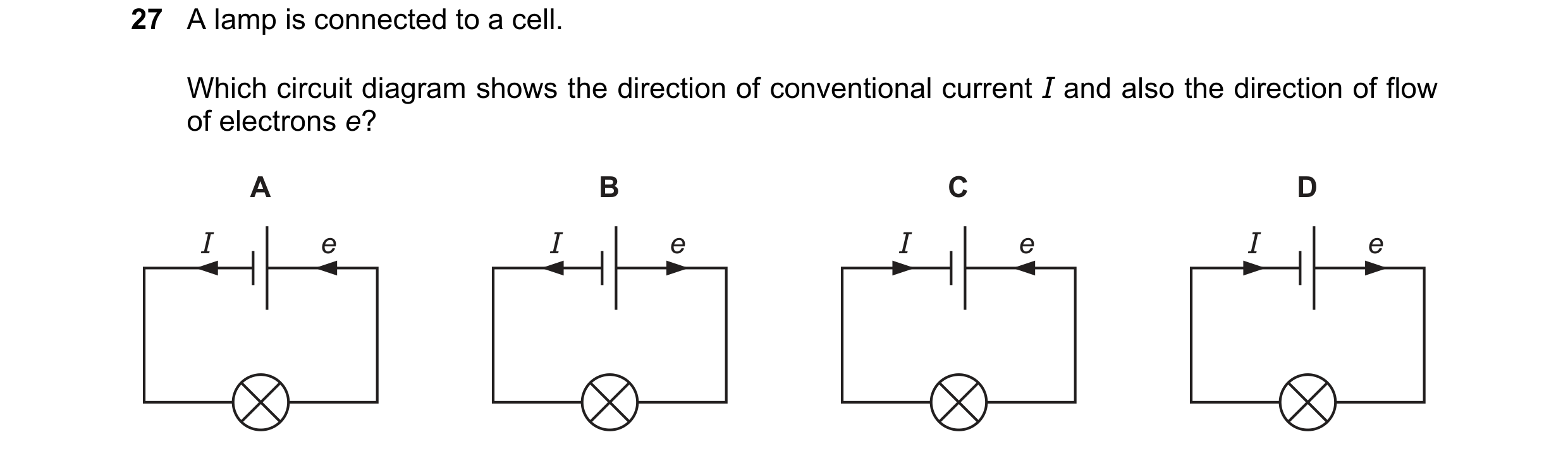 35 / 64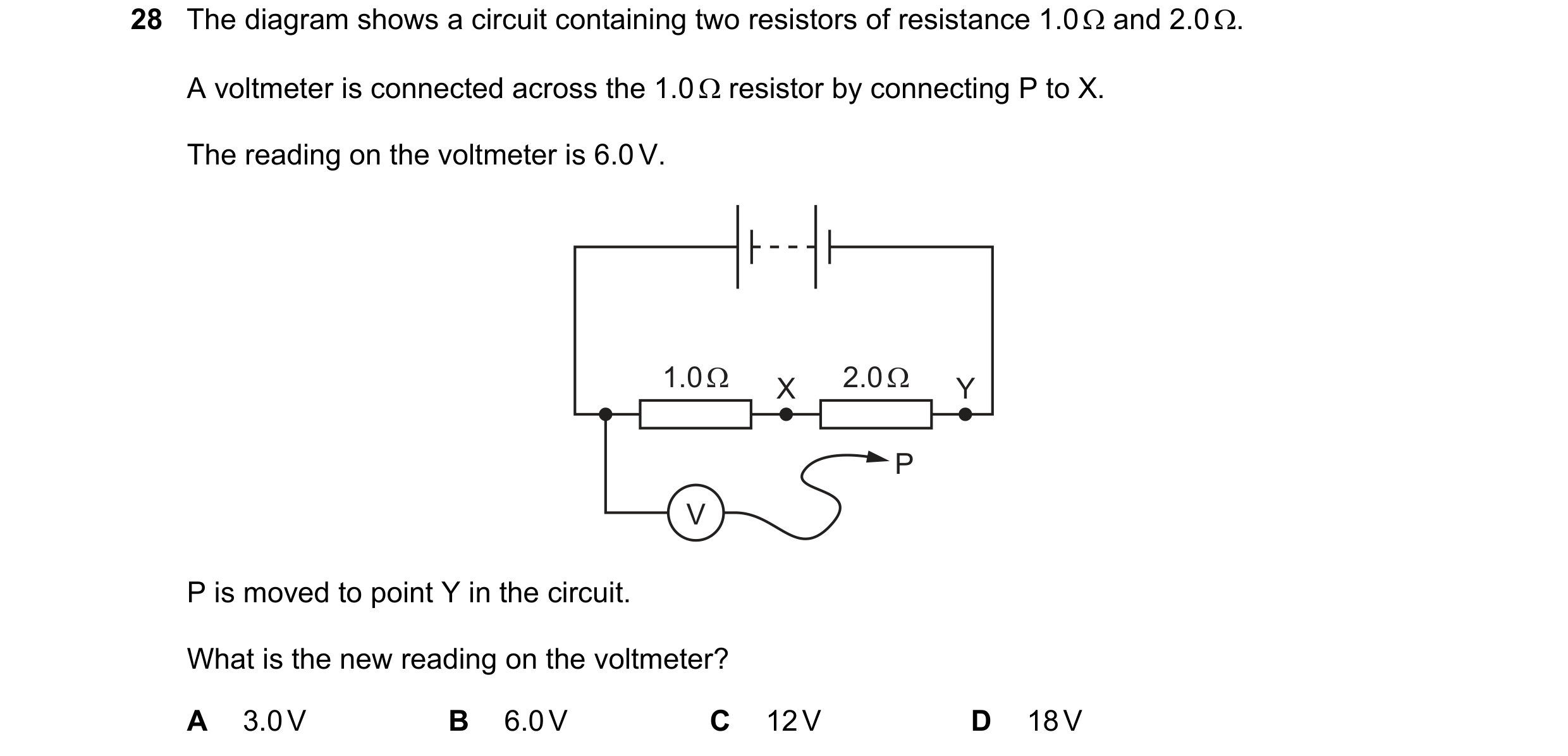
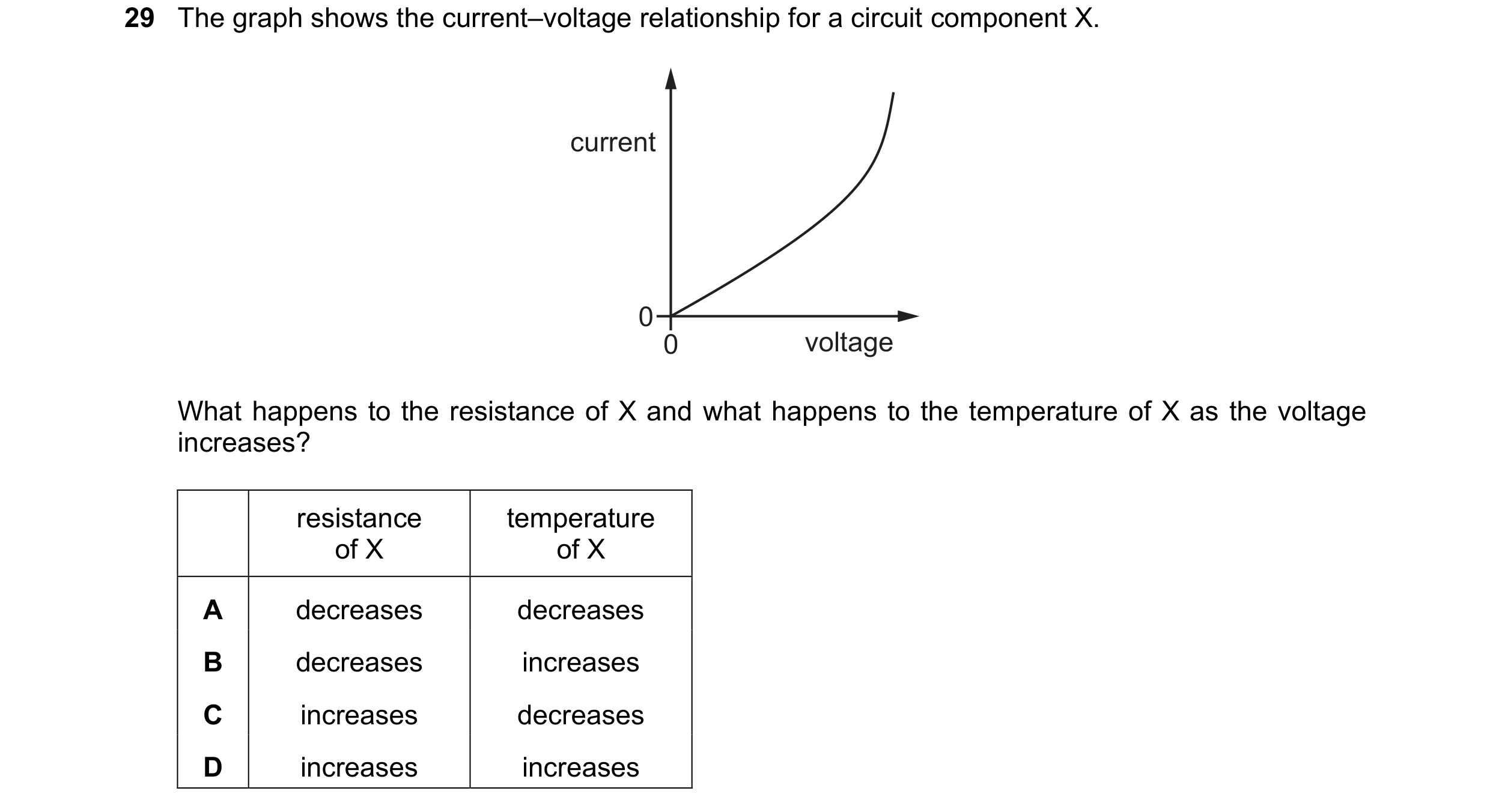 36 / 64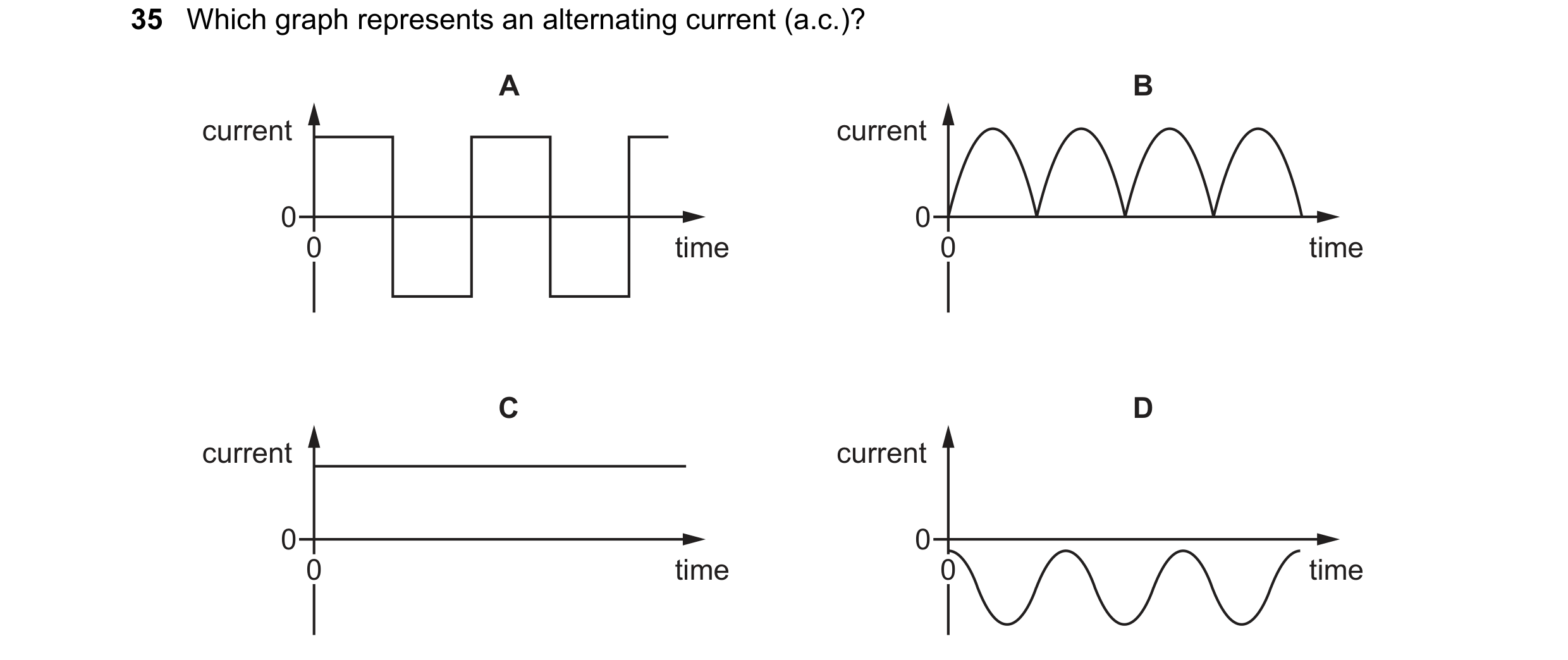
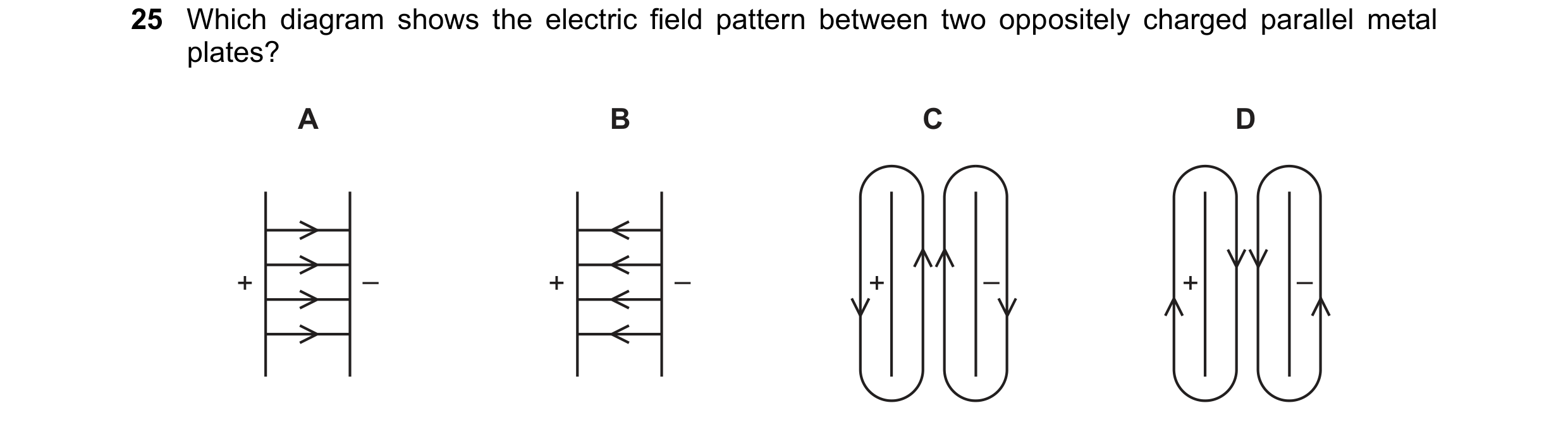

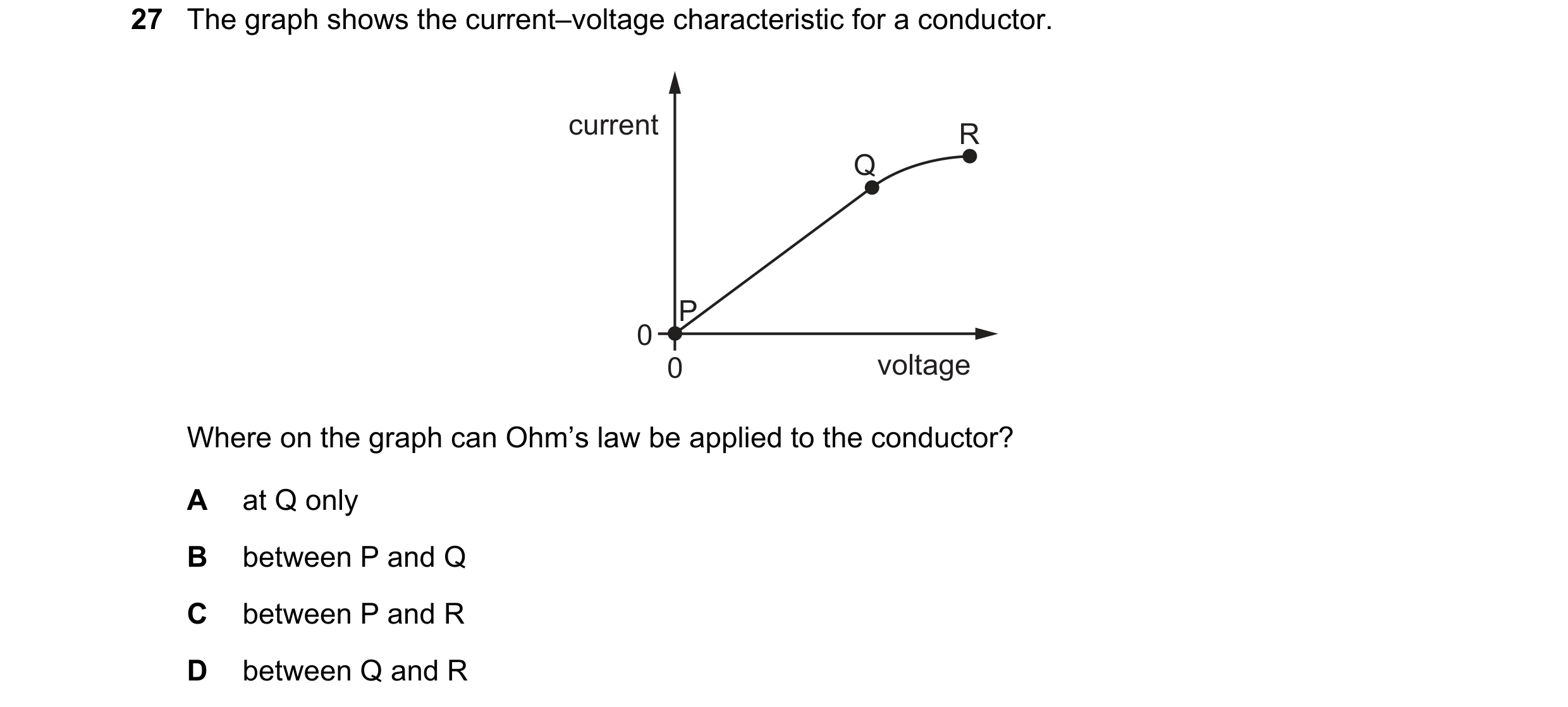 37 / 64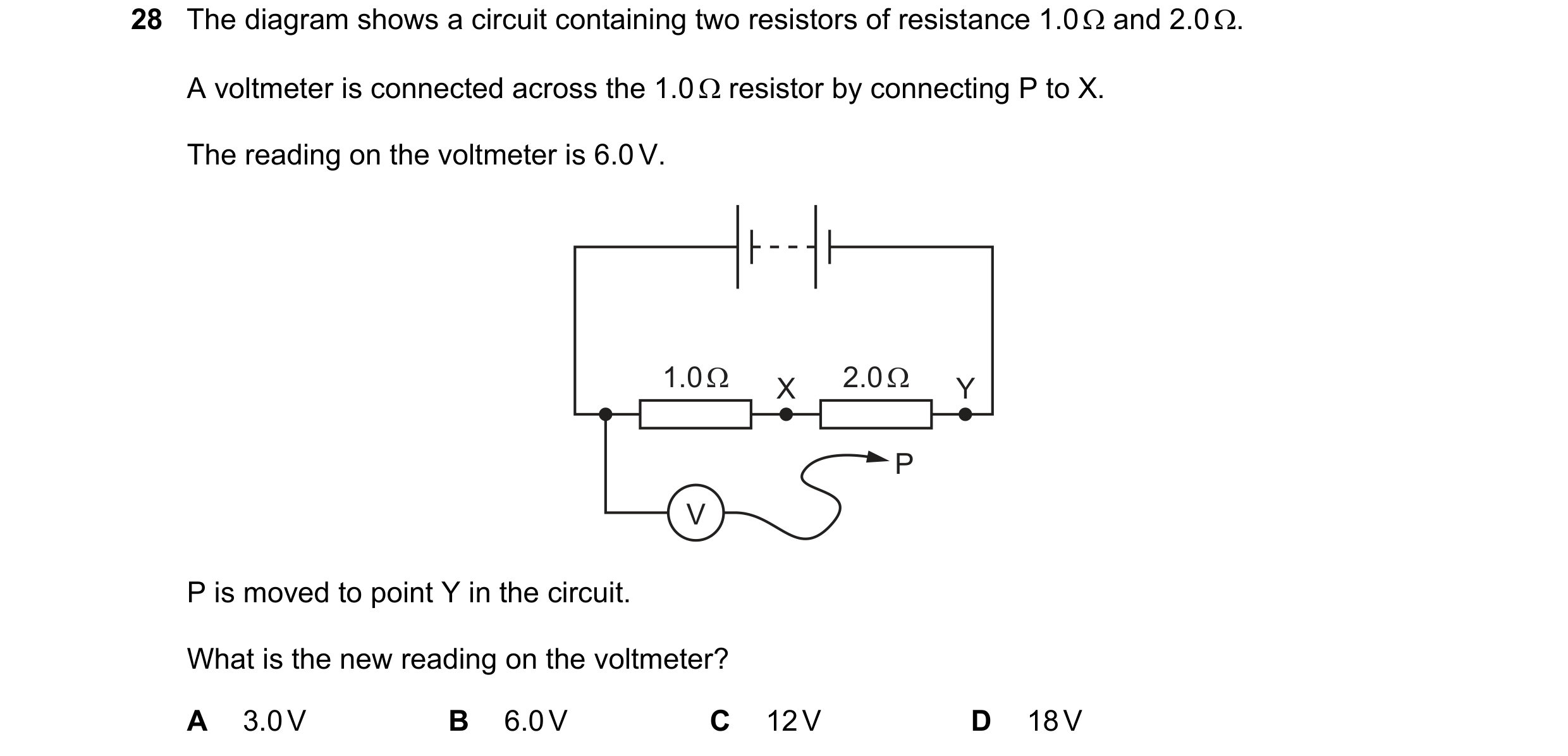
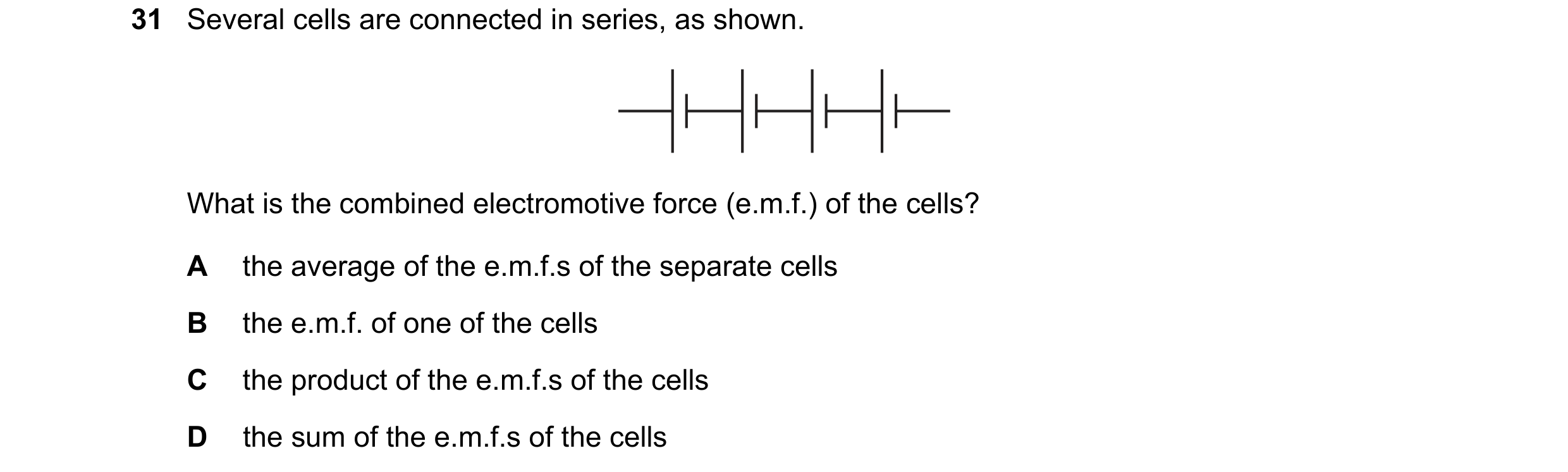
 38 / 64
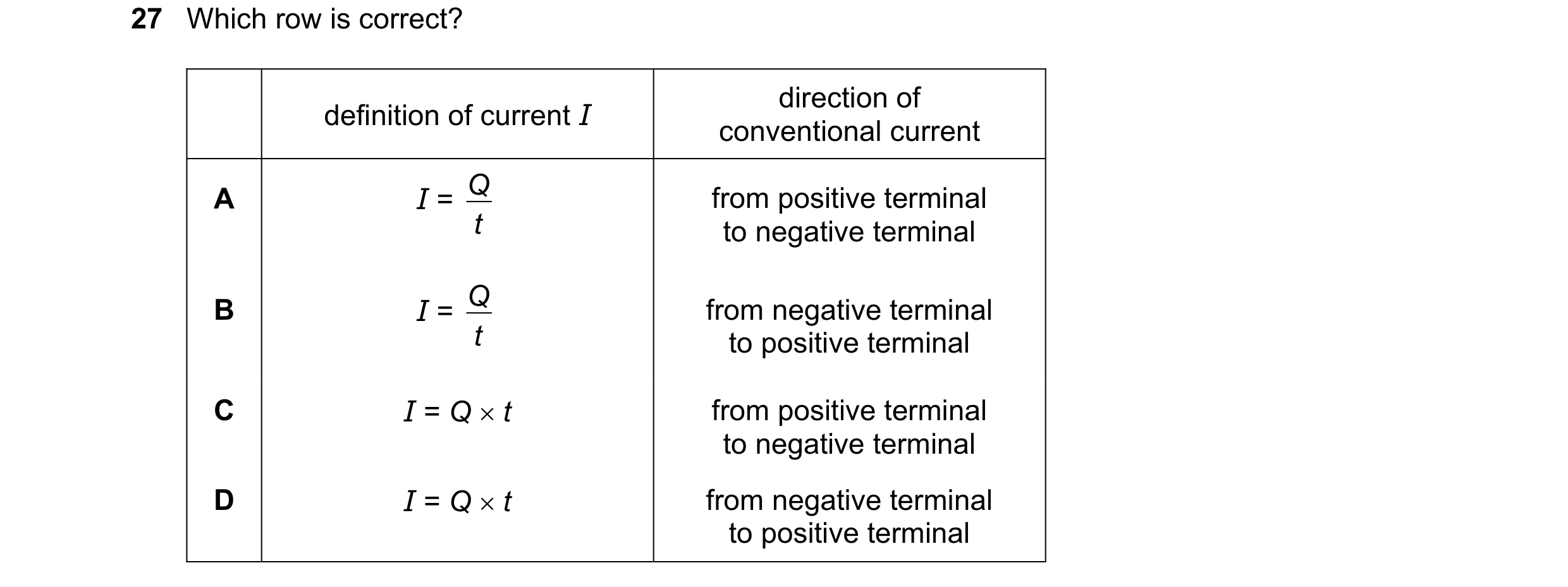
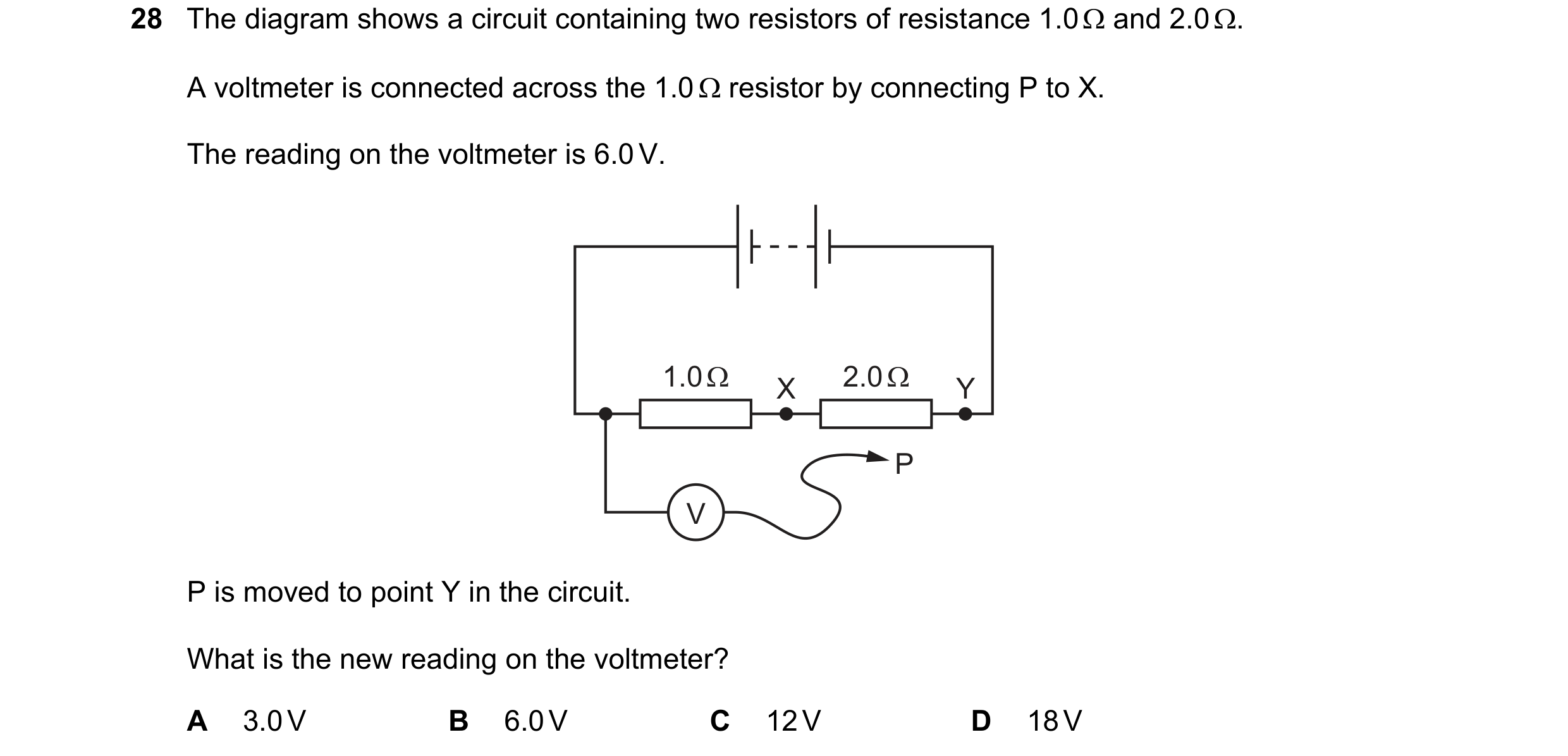
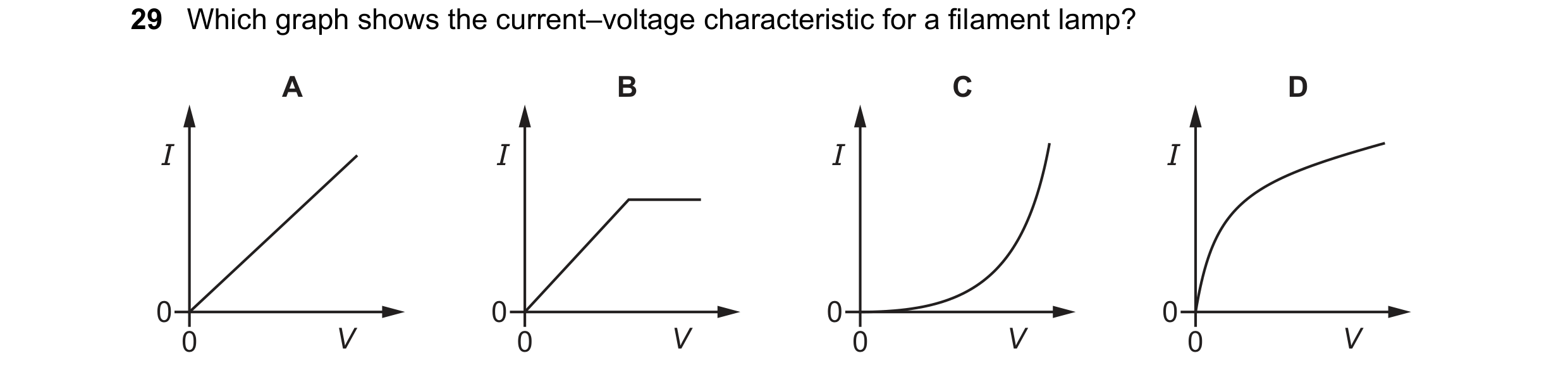 39 / 64
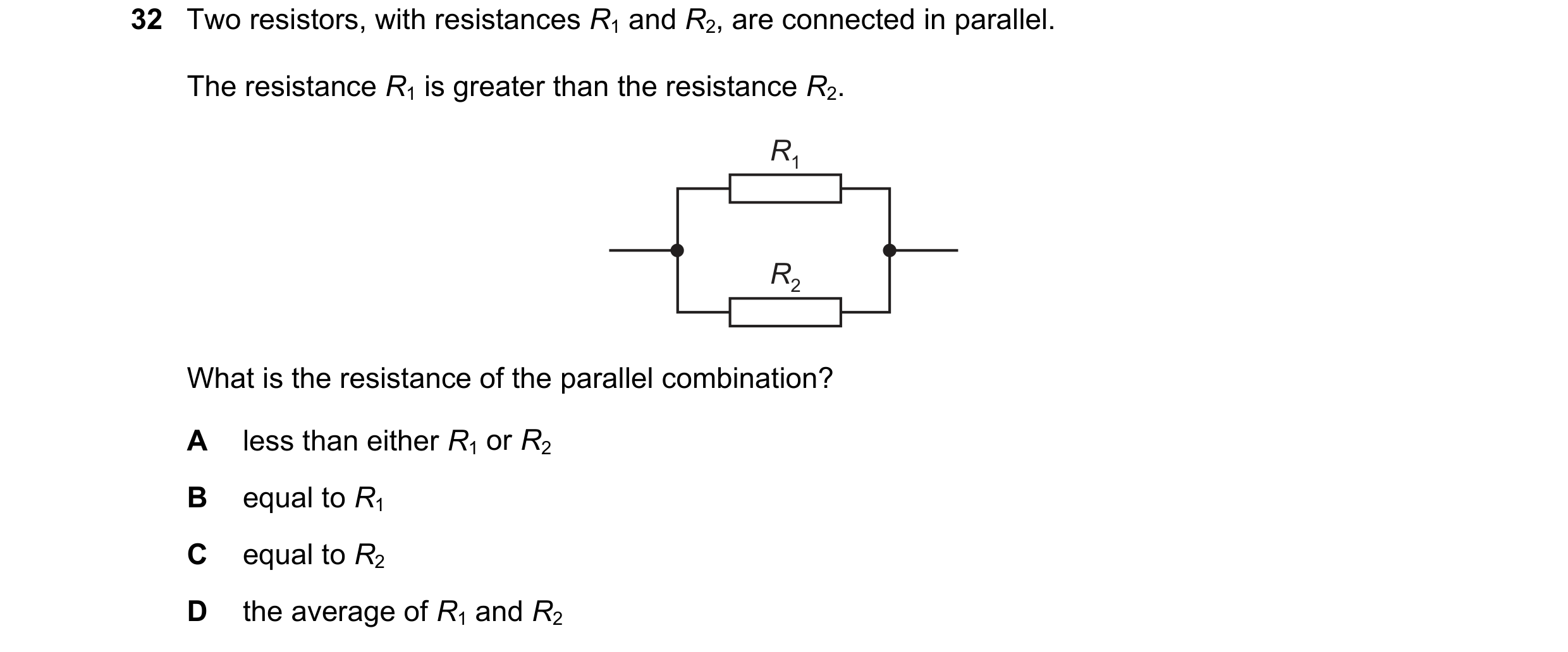

 40 / 64

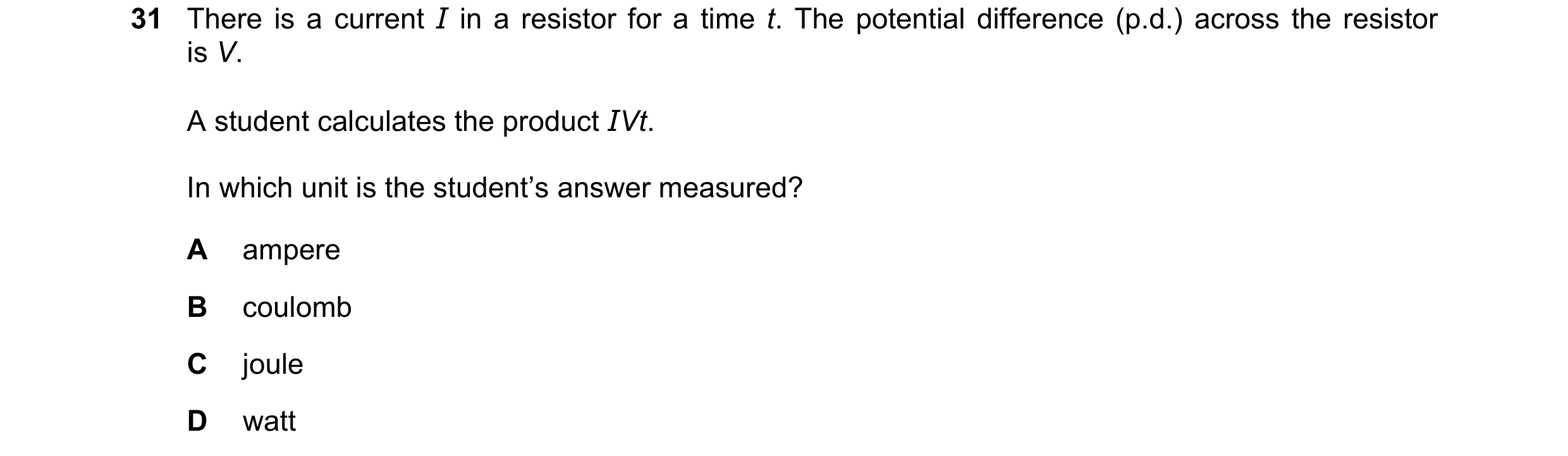 41 / 64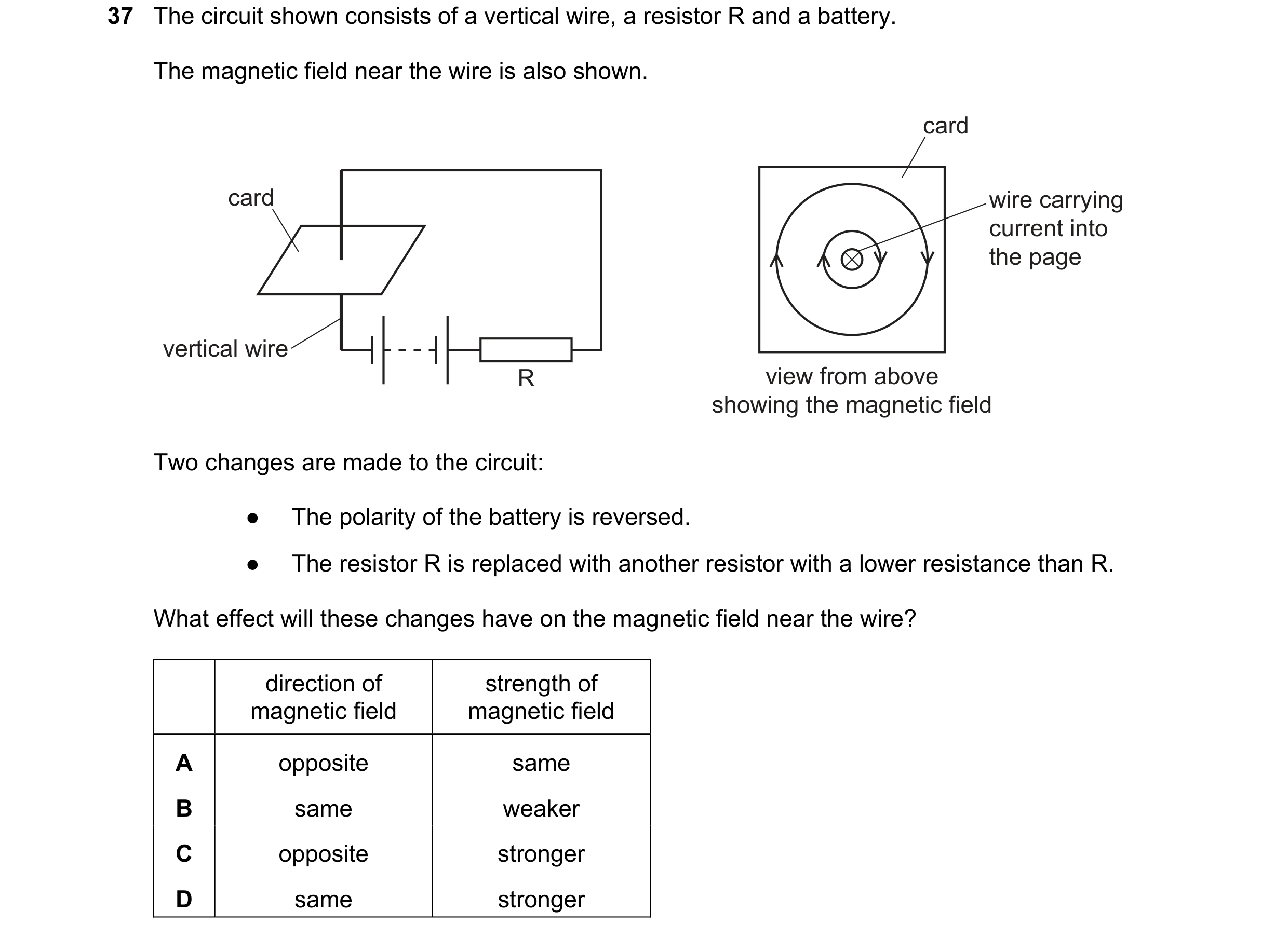
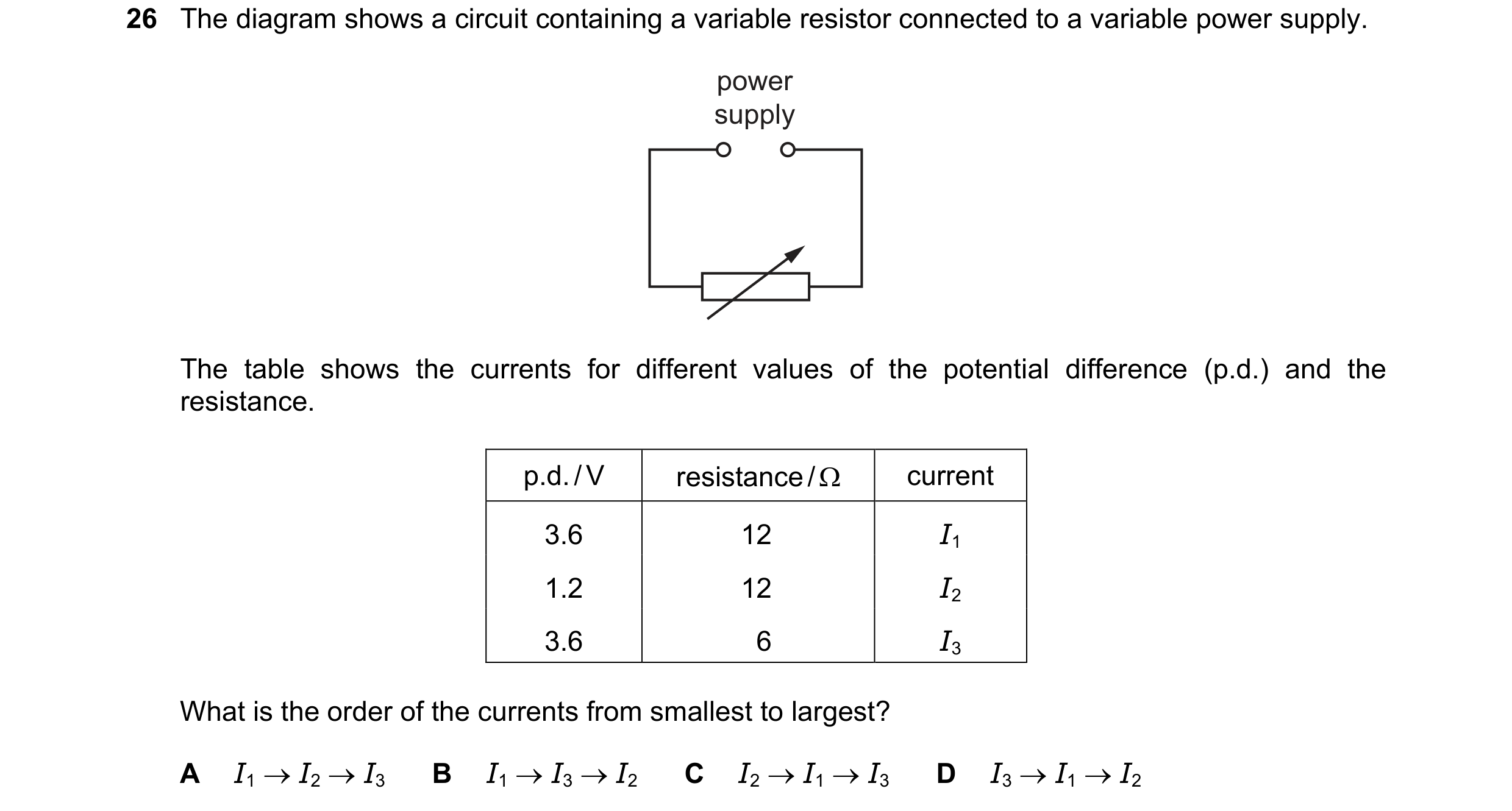
 42 / 64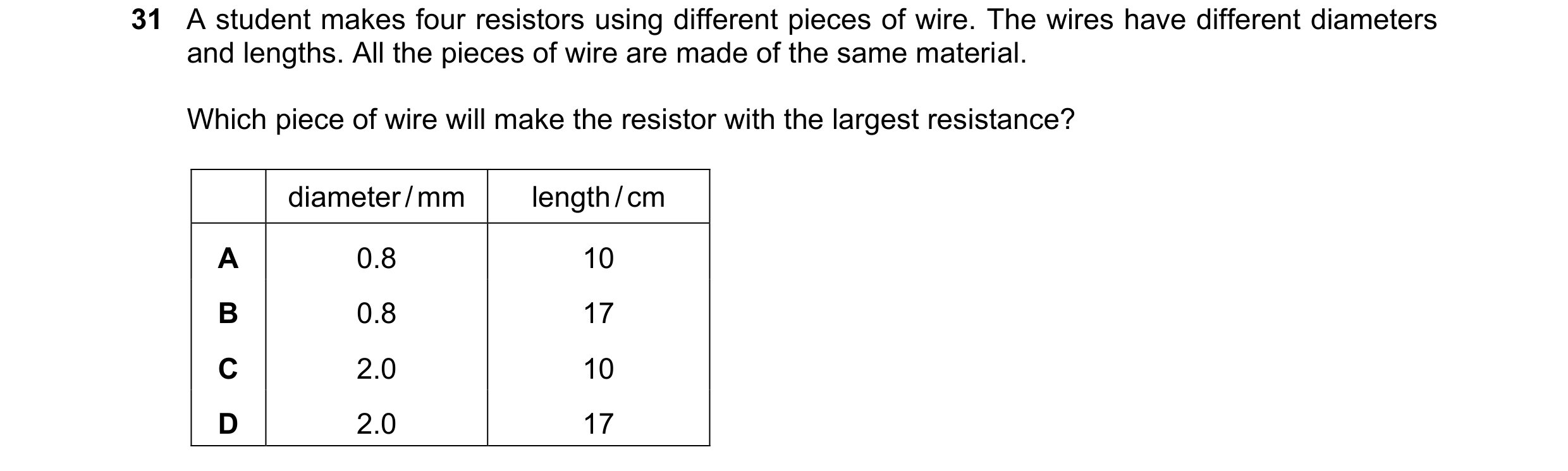
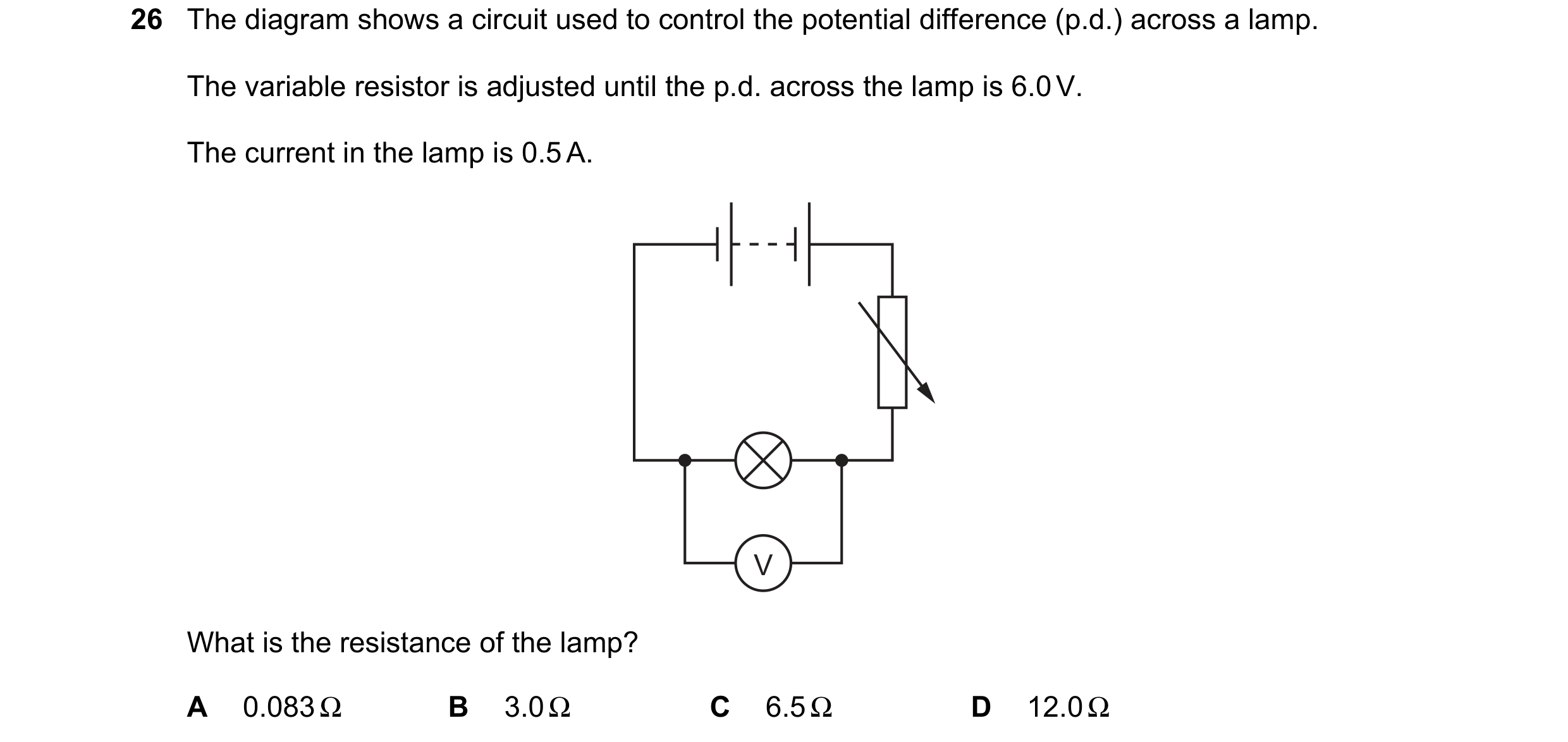

 43 / 64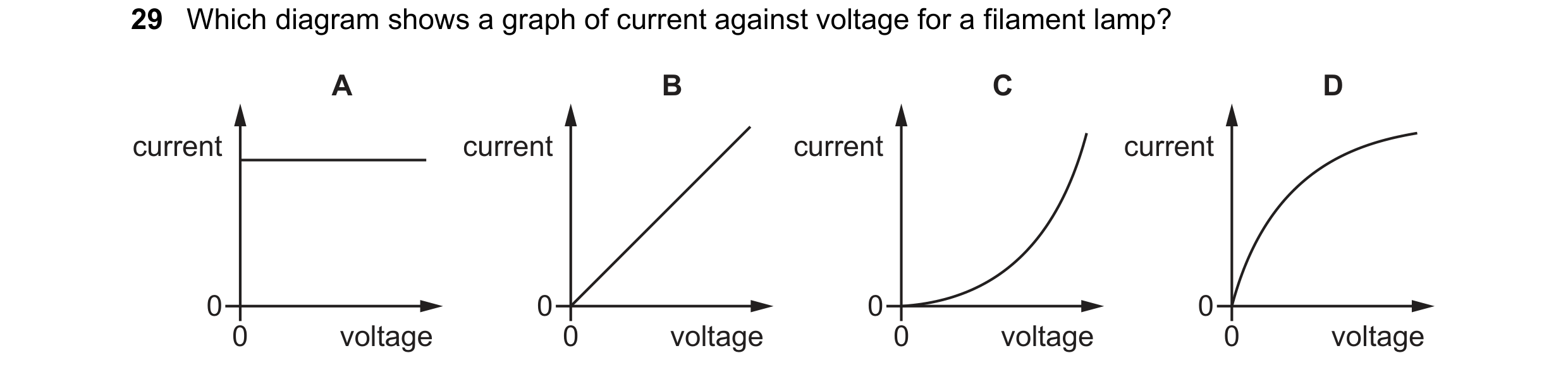
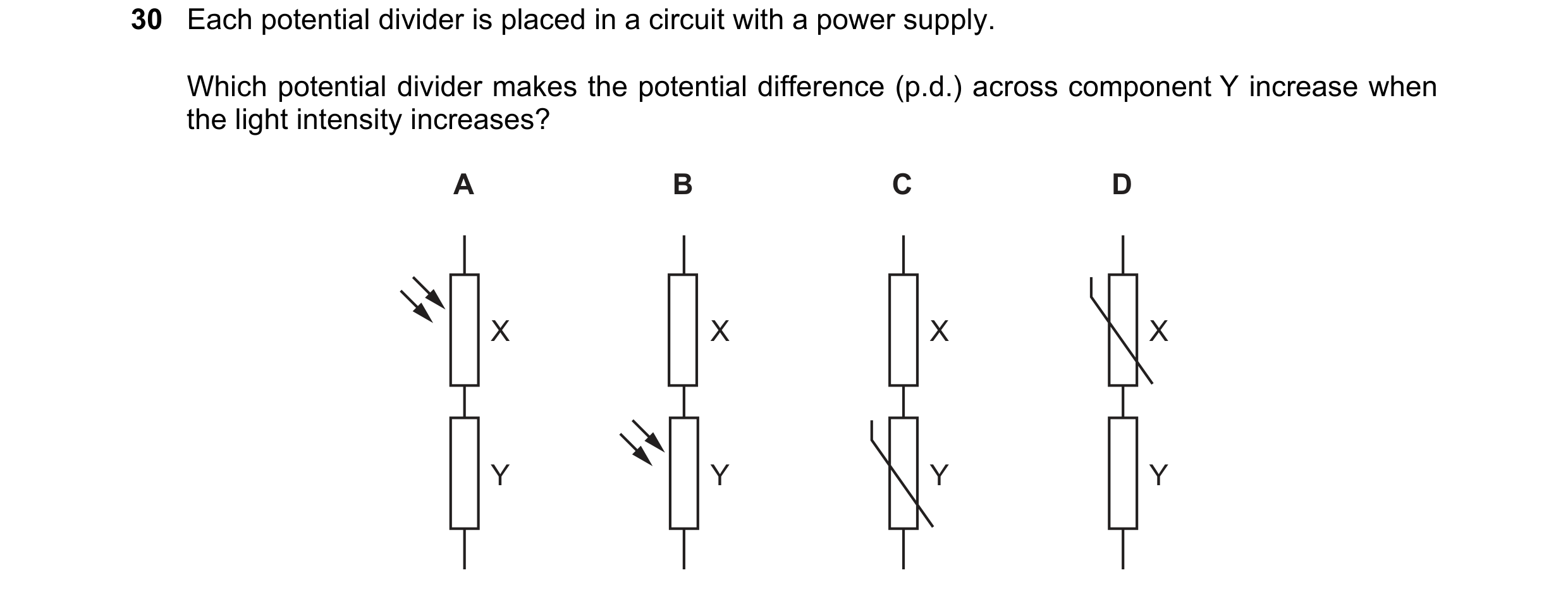
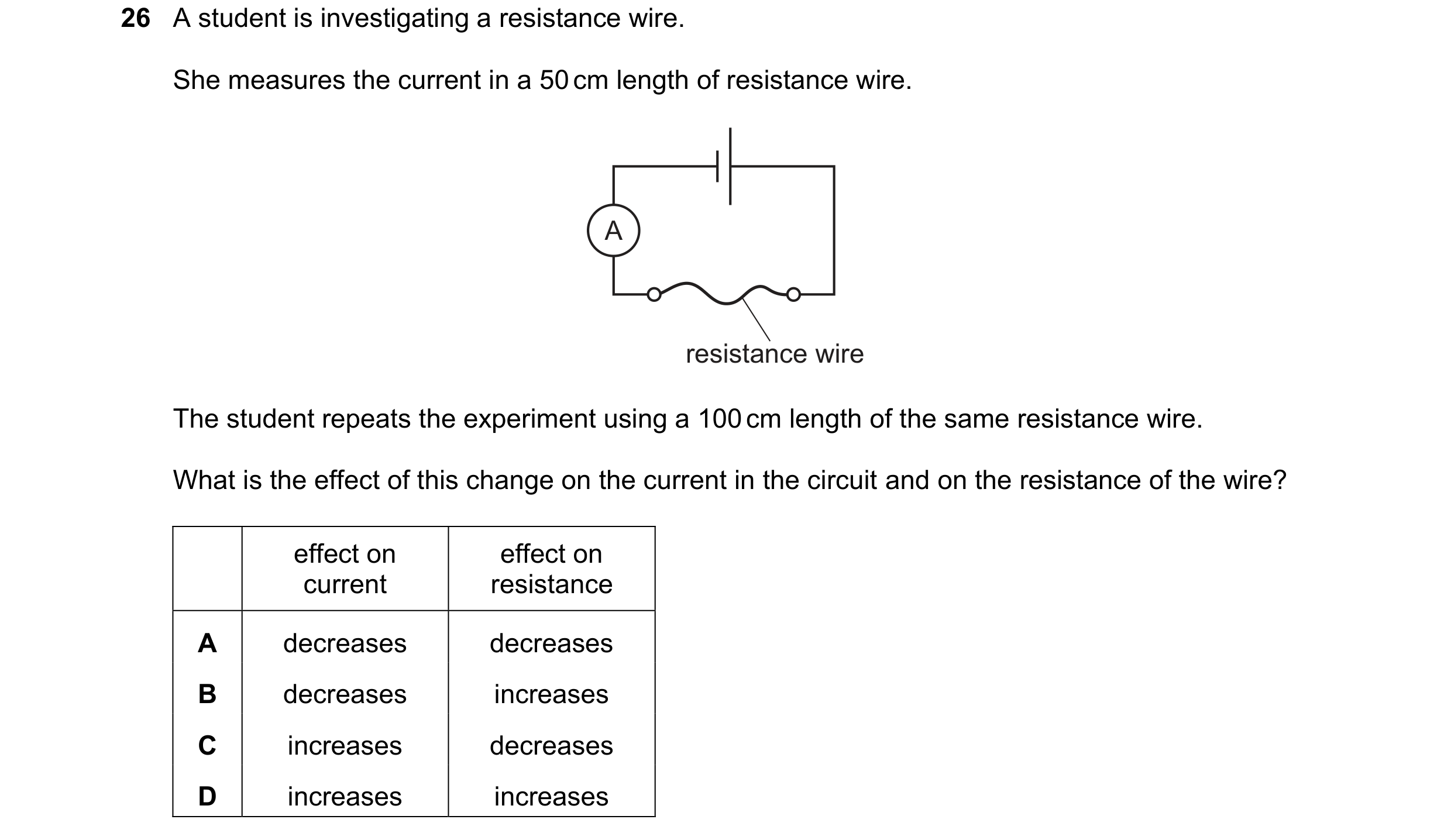 44 / 64
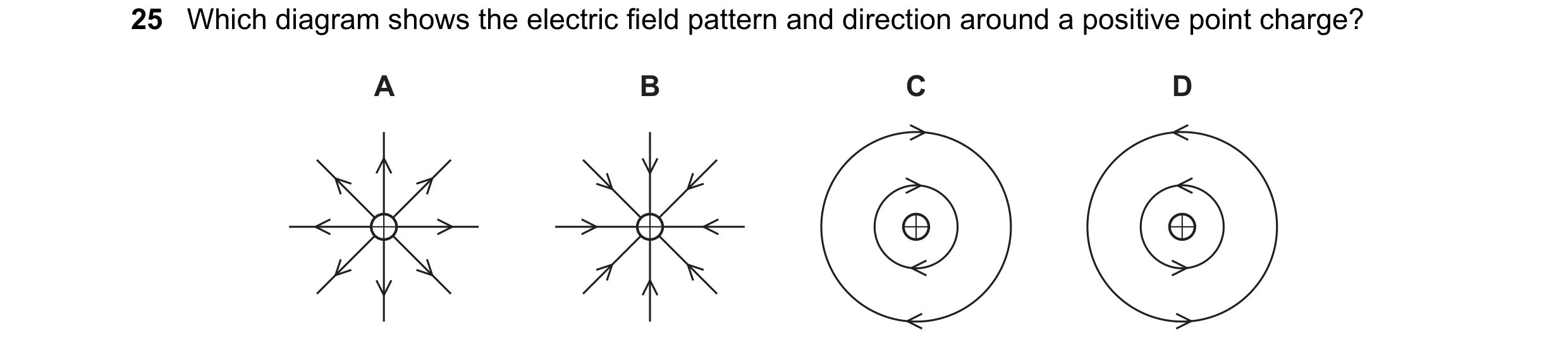 45 / 64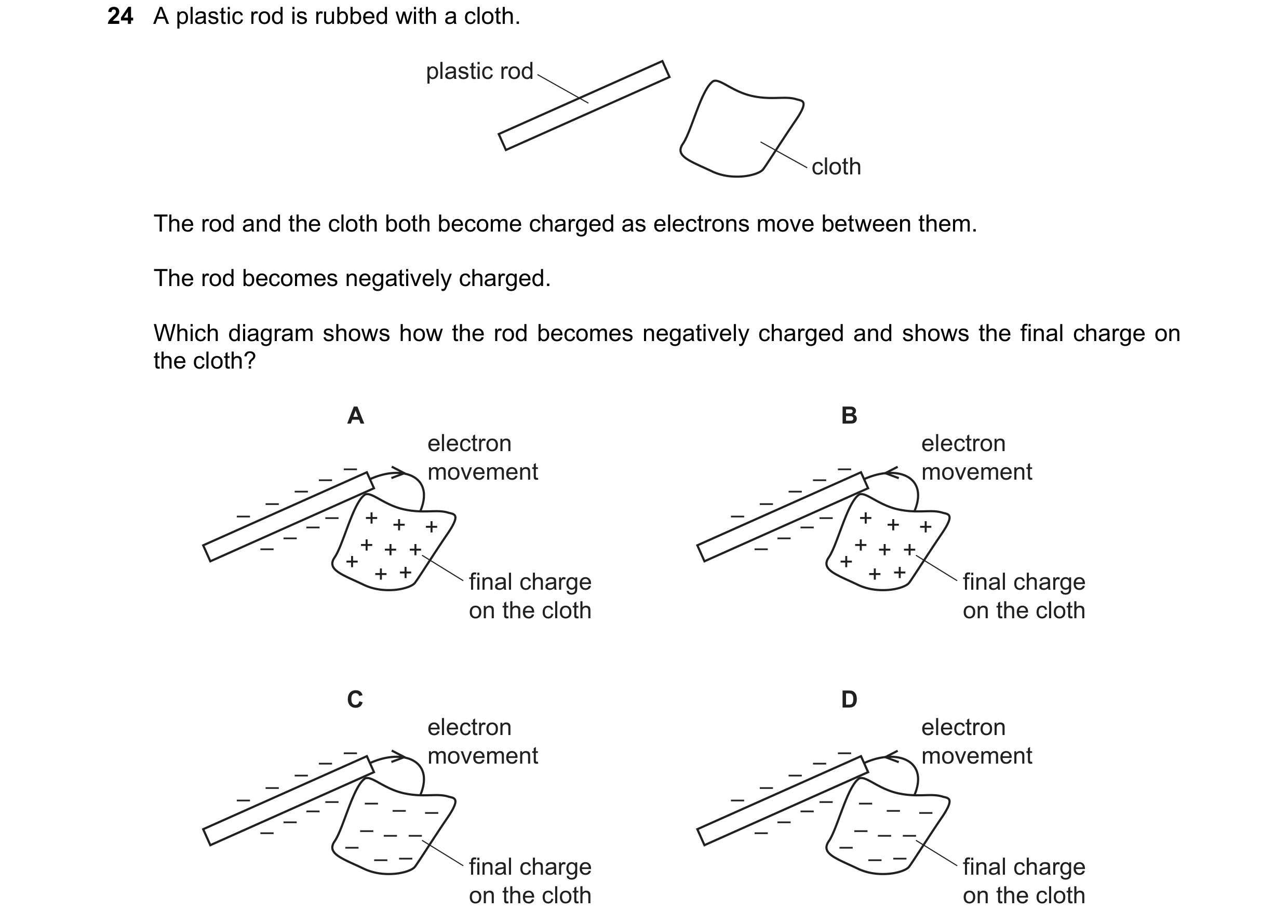
 46 / 64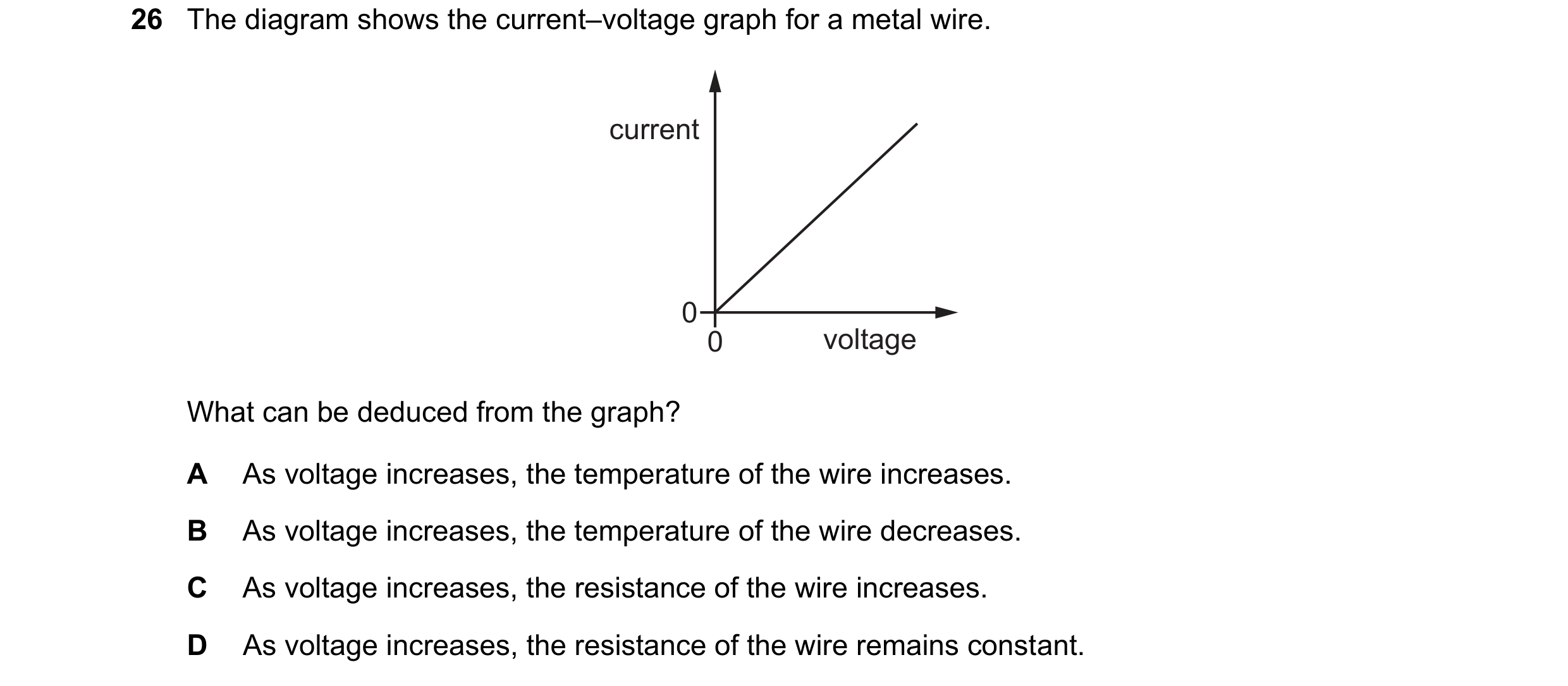
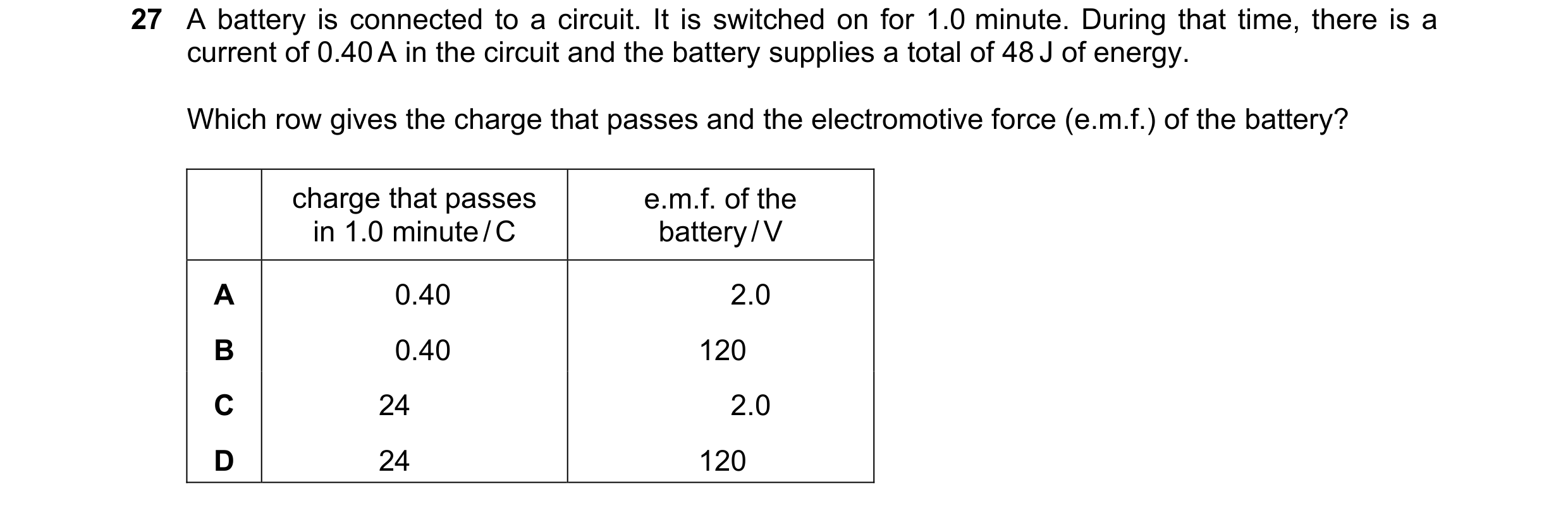
 47 / 64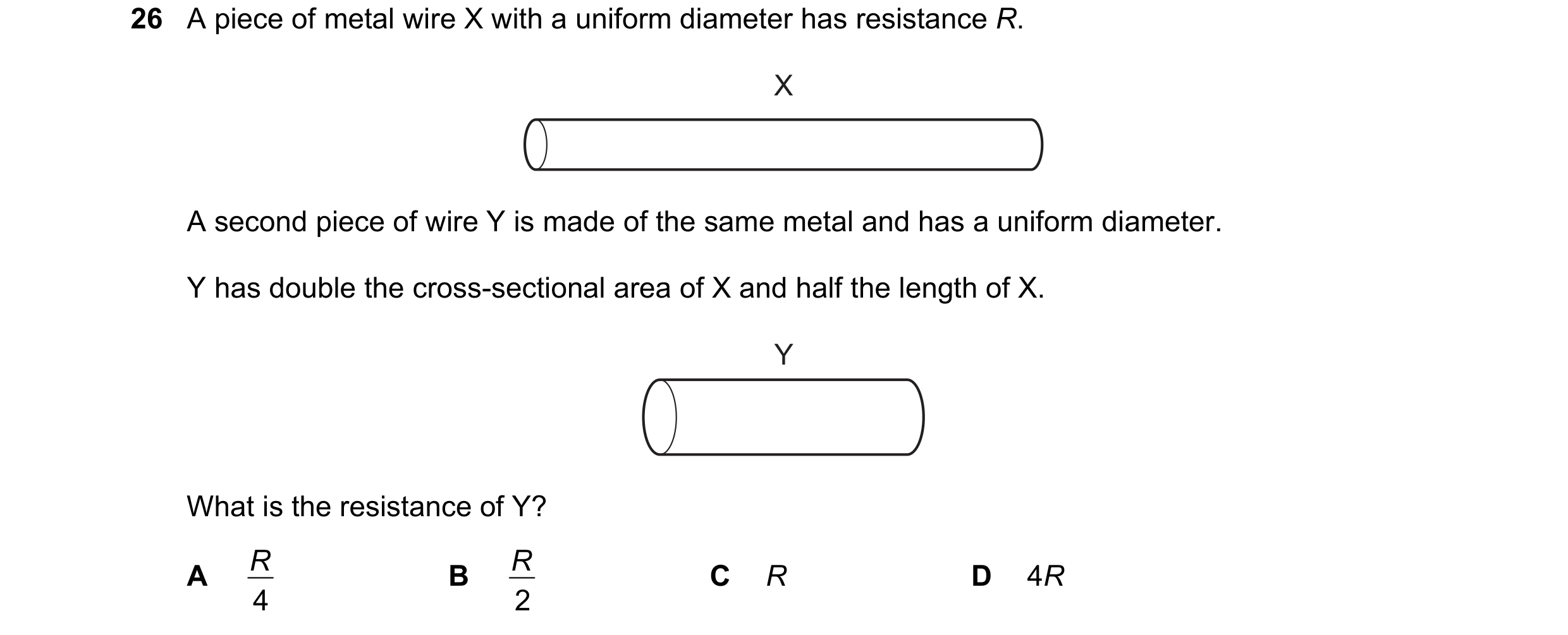


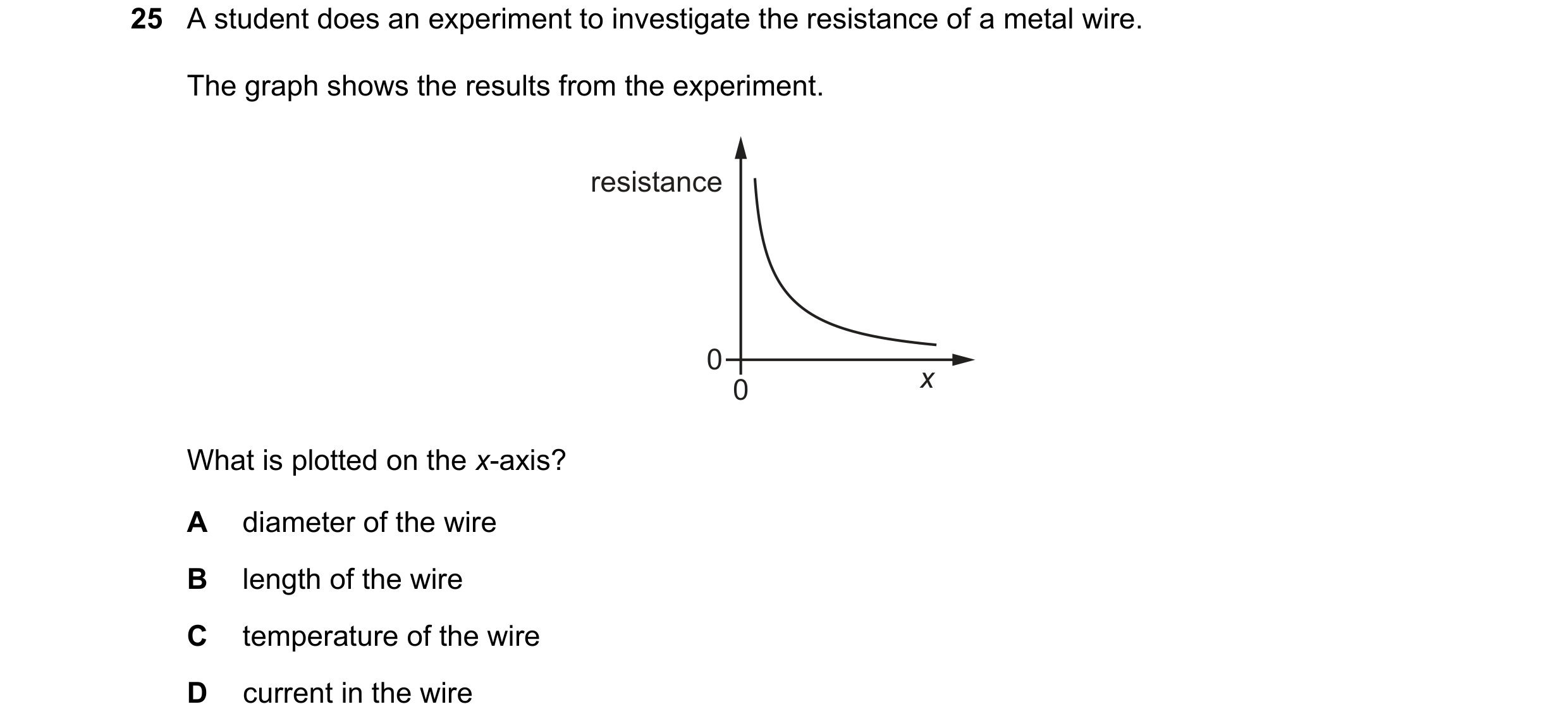
 48 / 64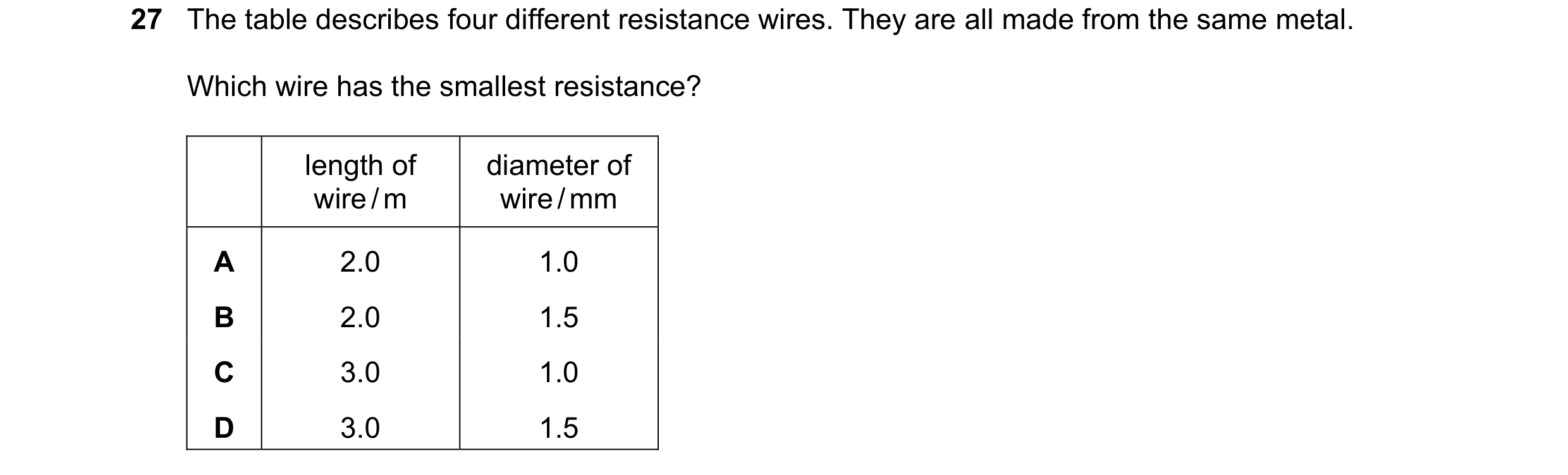


 49 / 64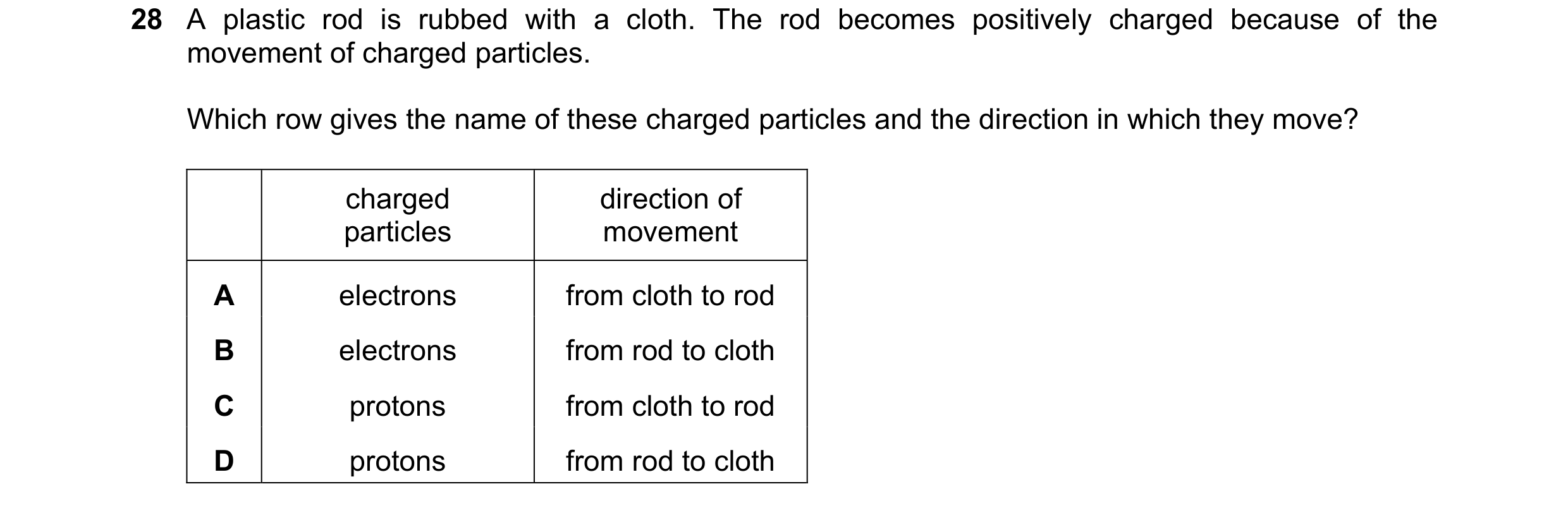
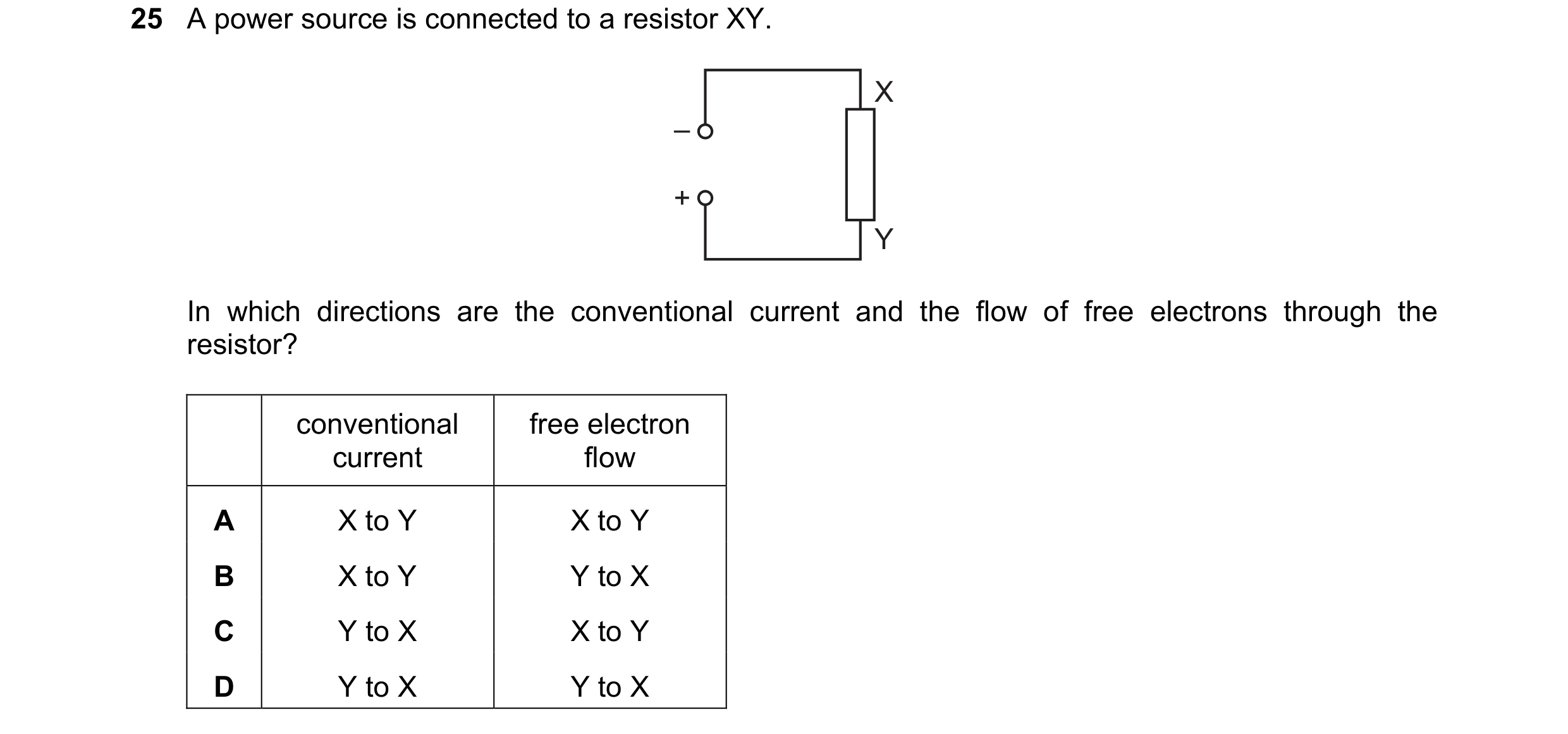
 50 / 64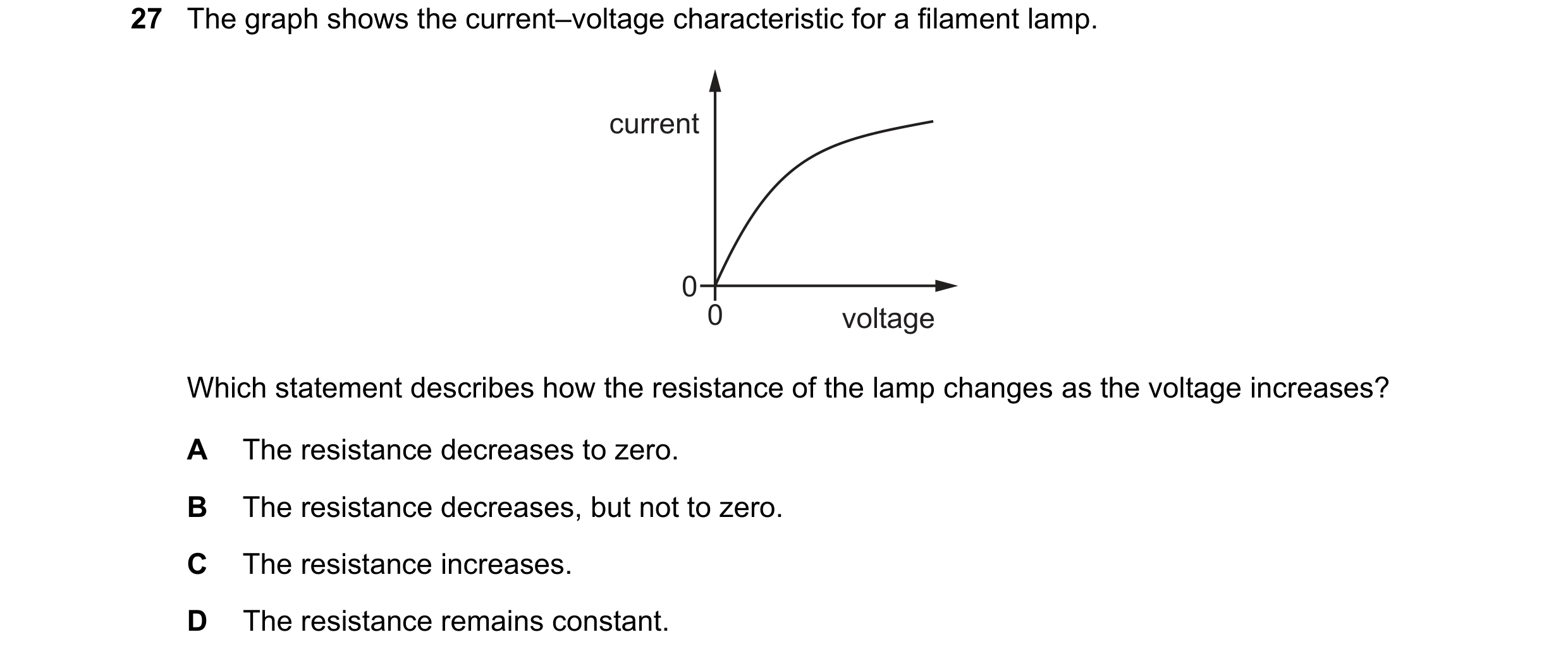
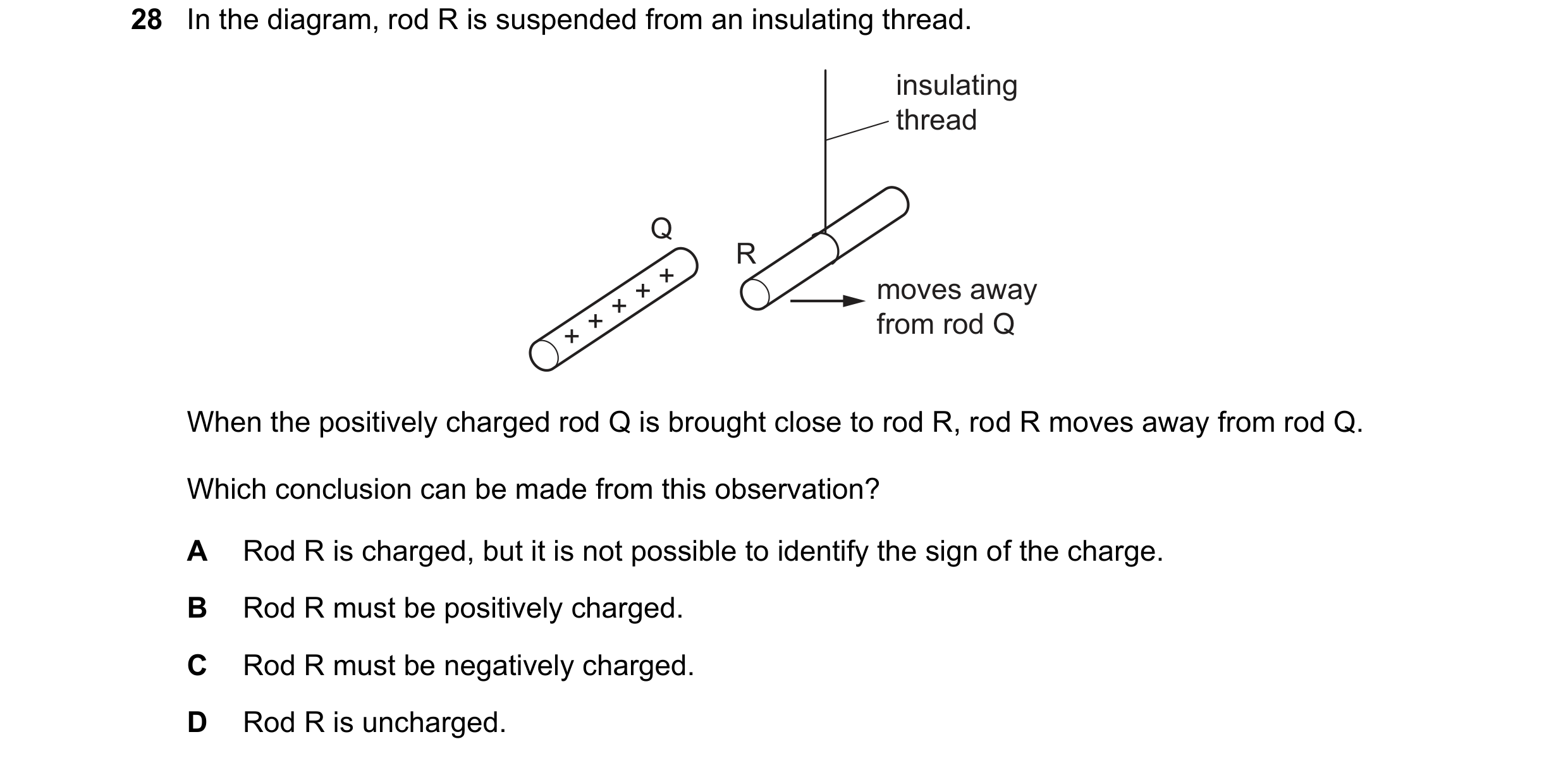 51 / 64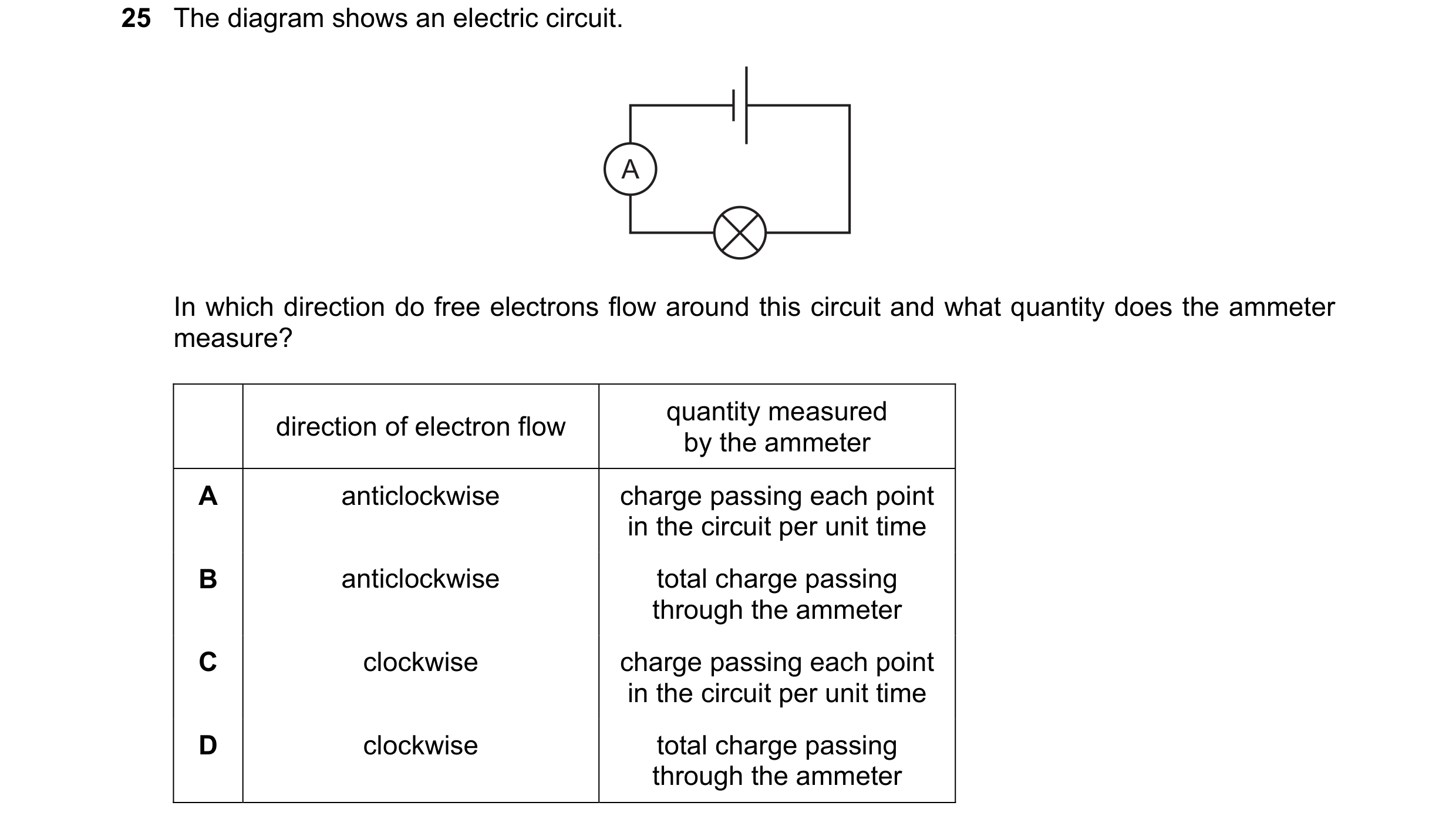

 52 / 64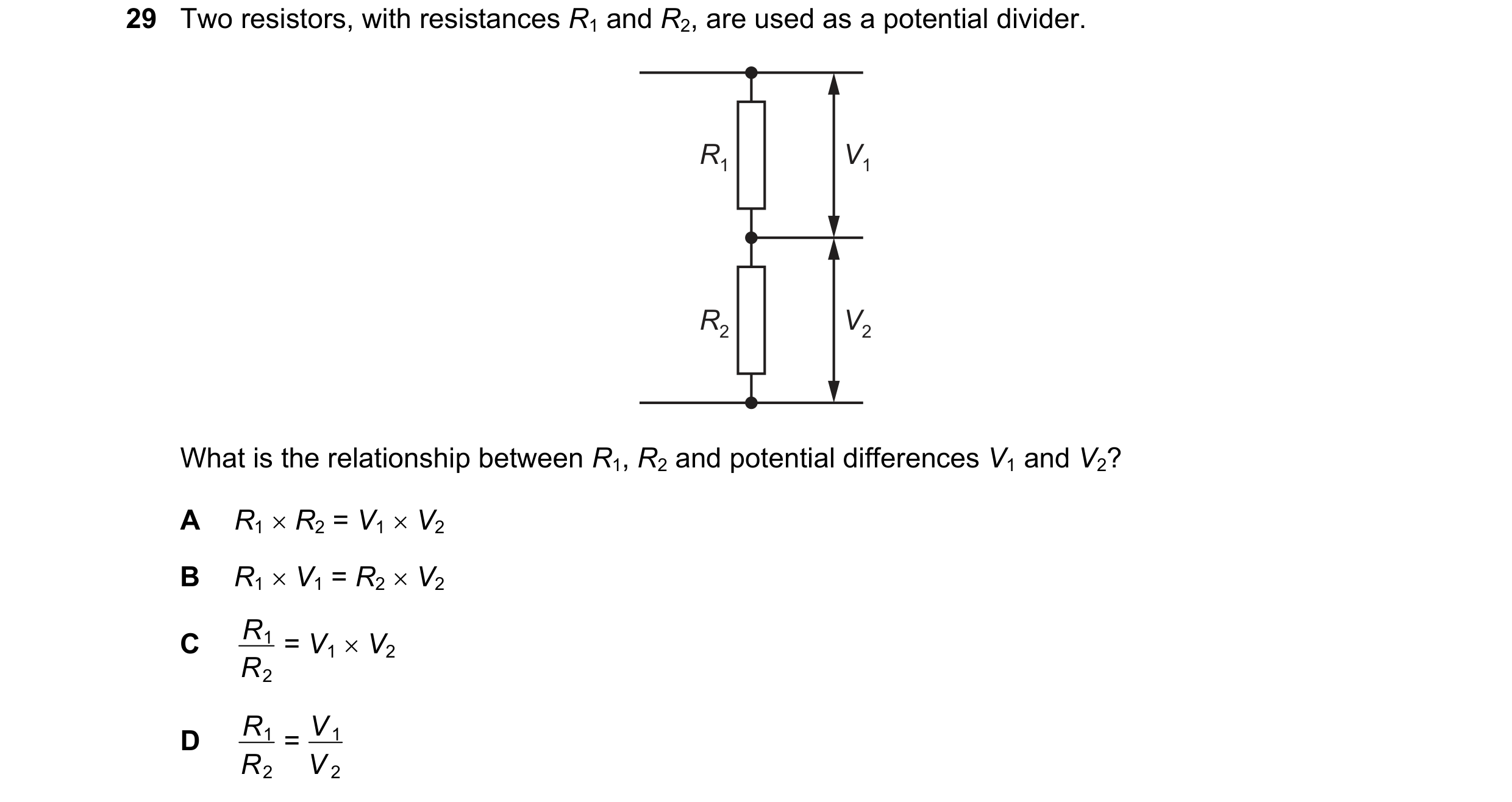
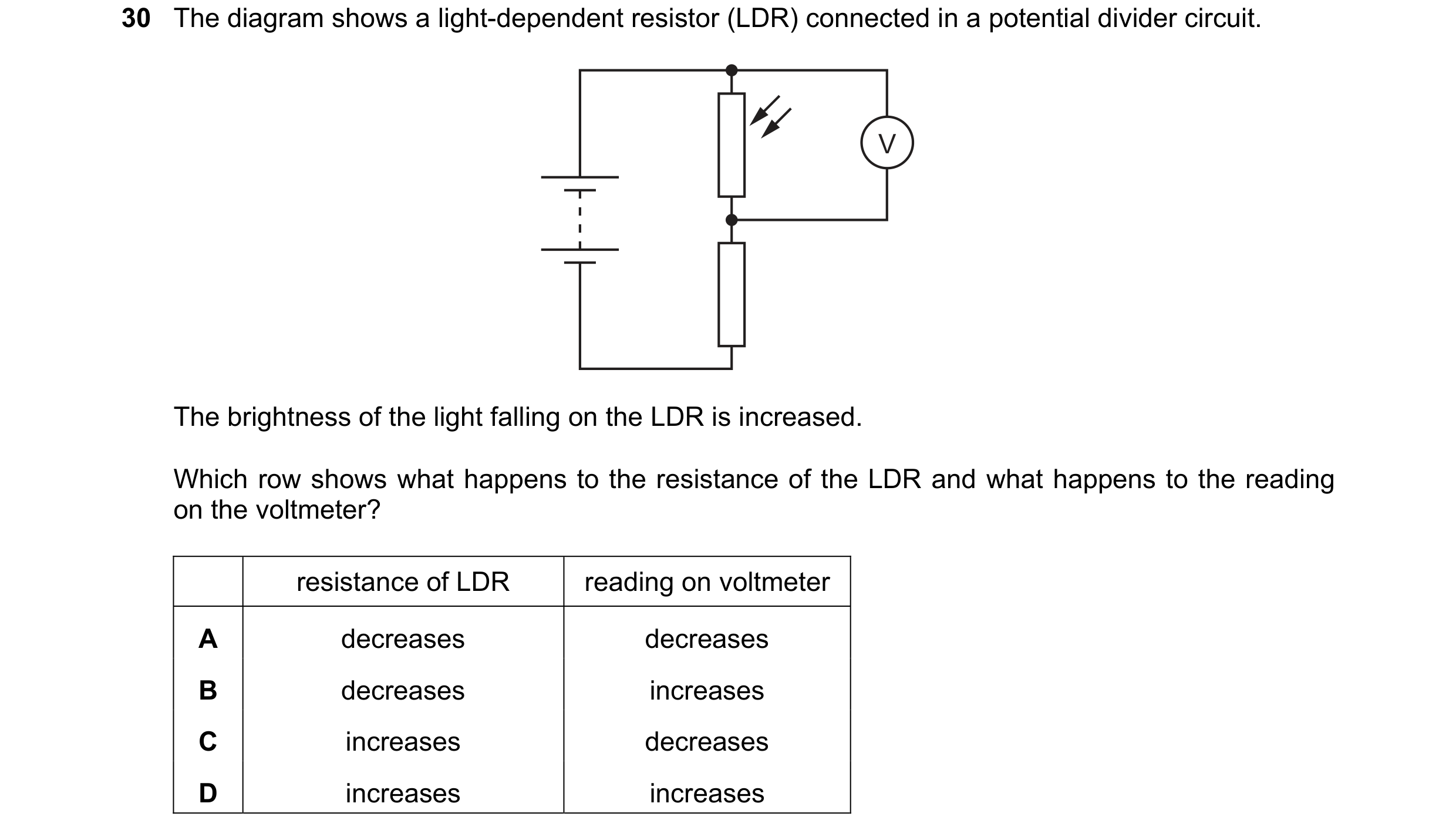
 53 / 64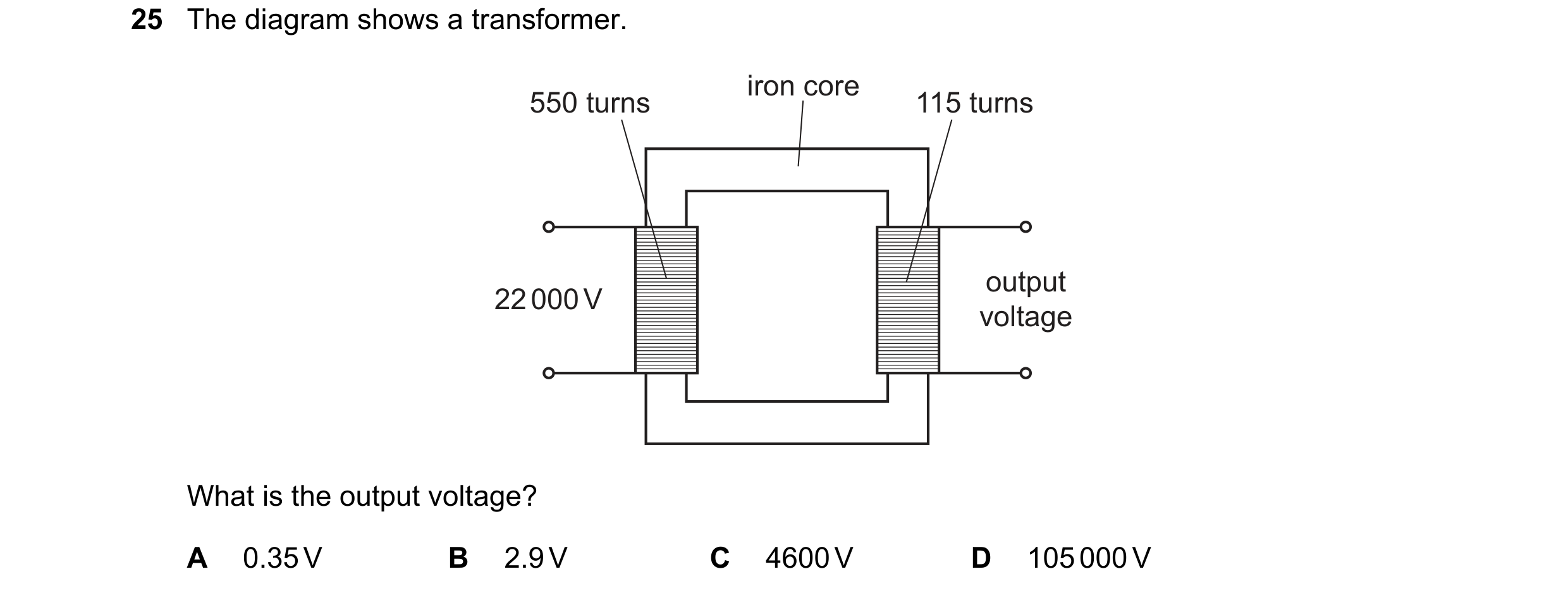
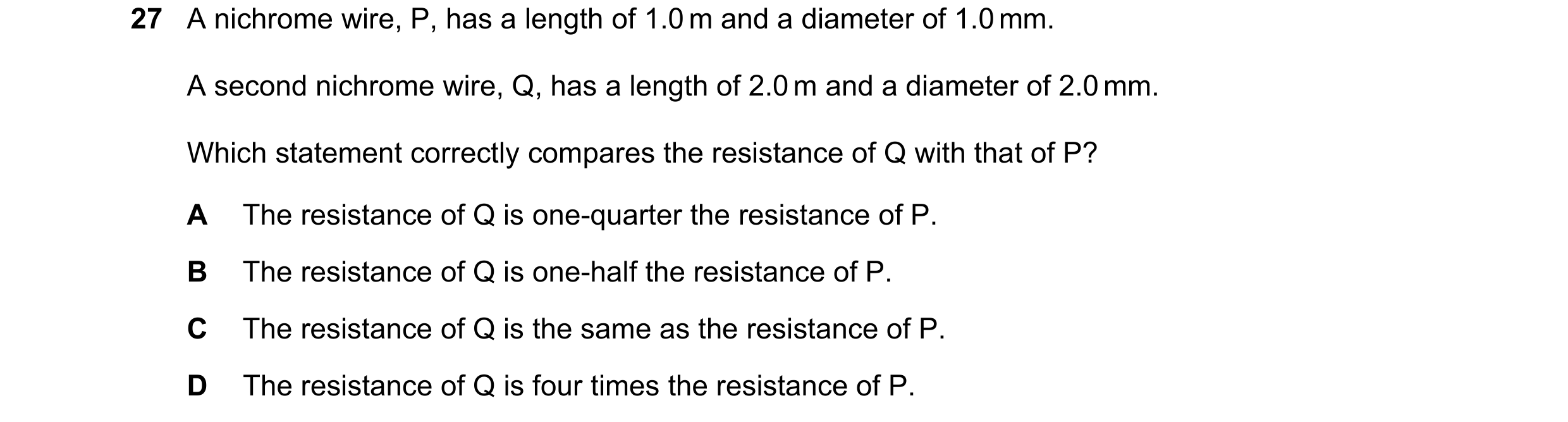
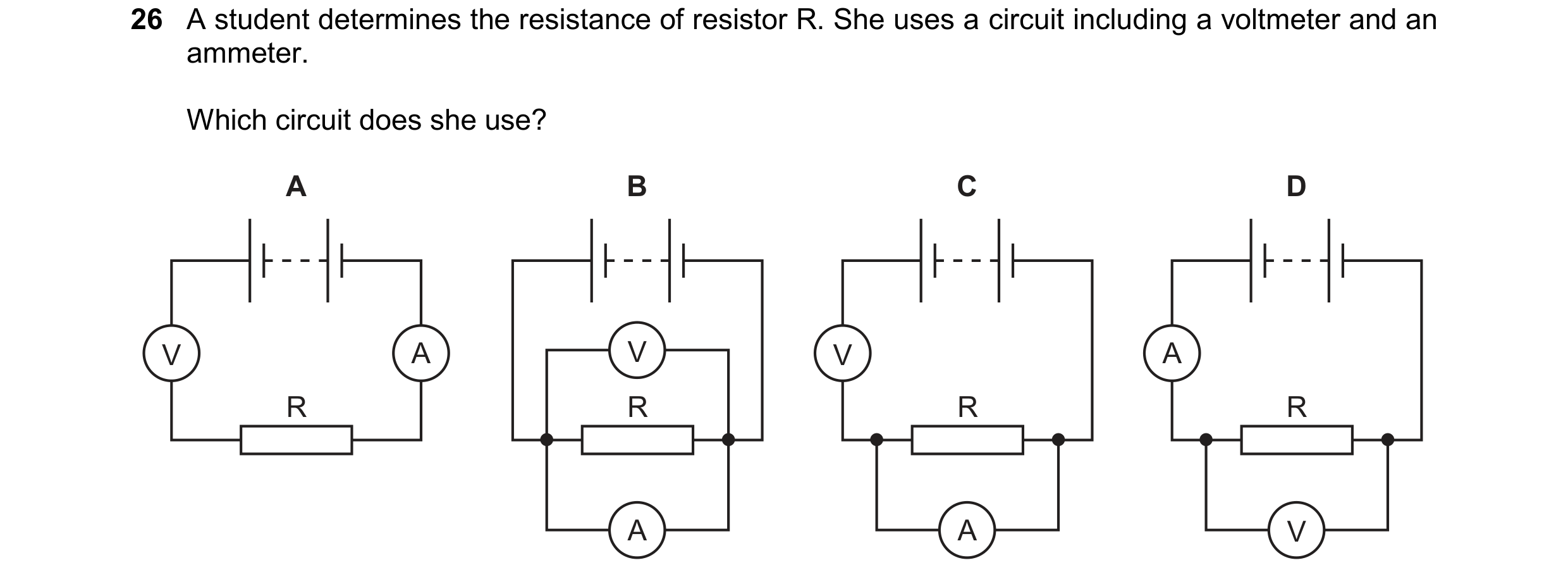 54 / 64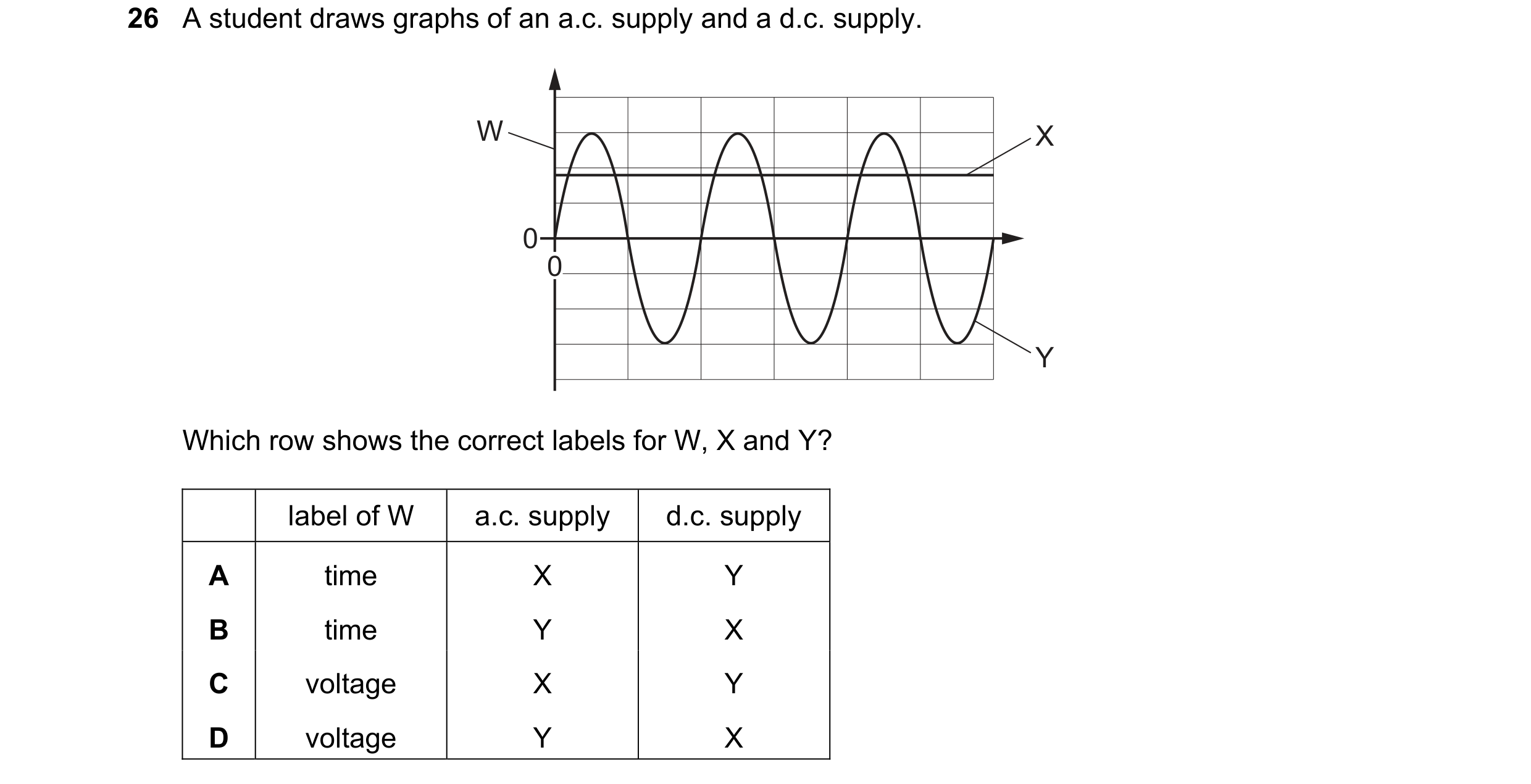

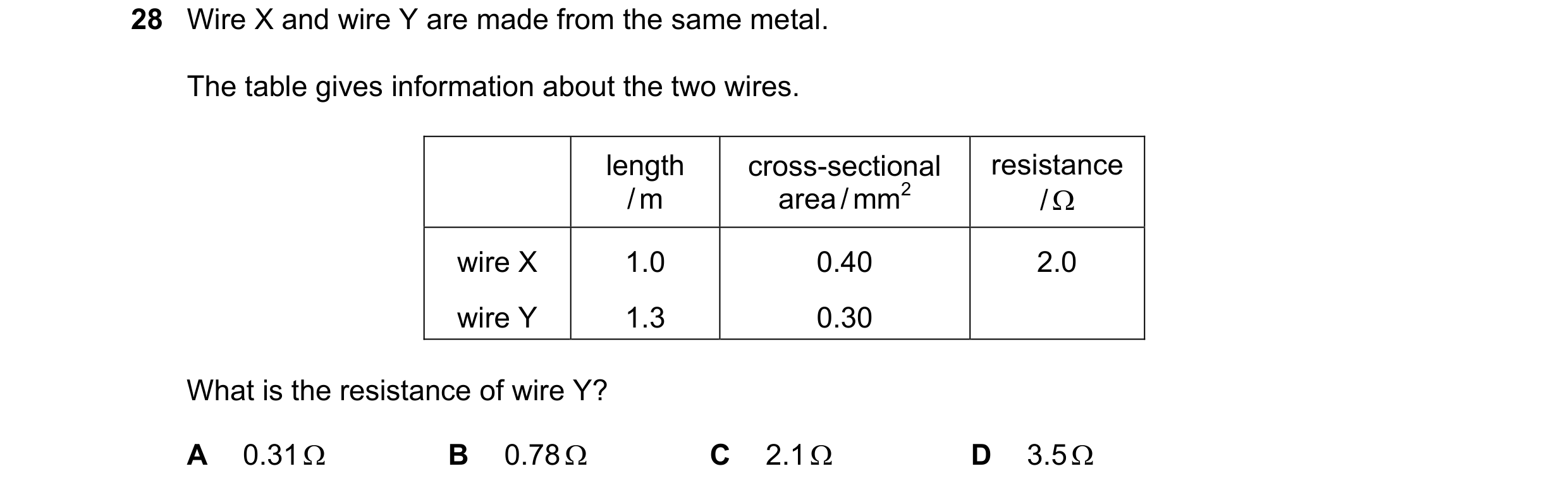
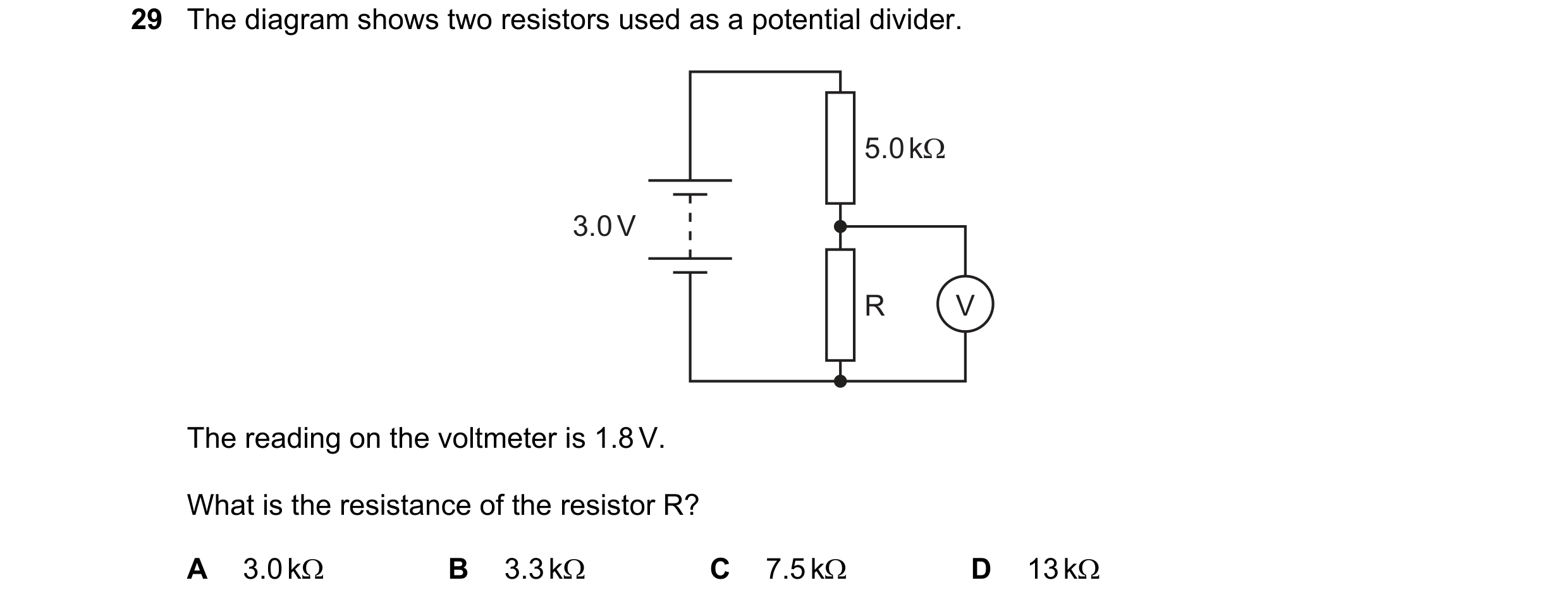 55 / 64
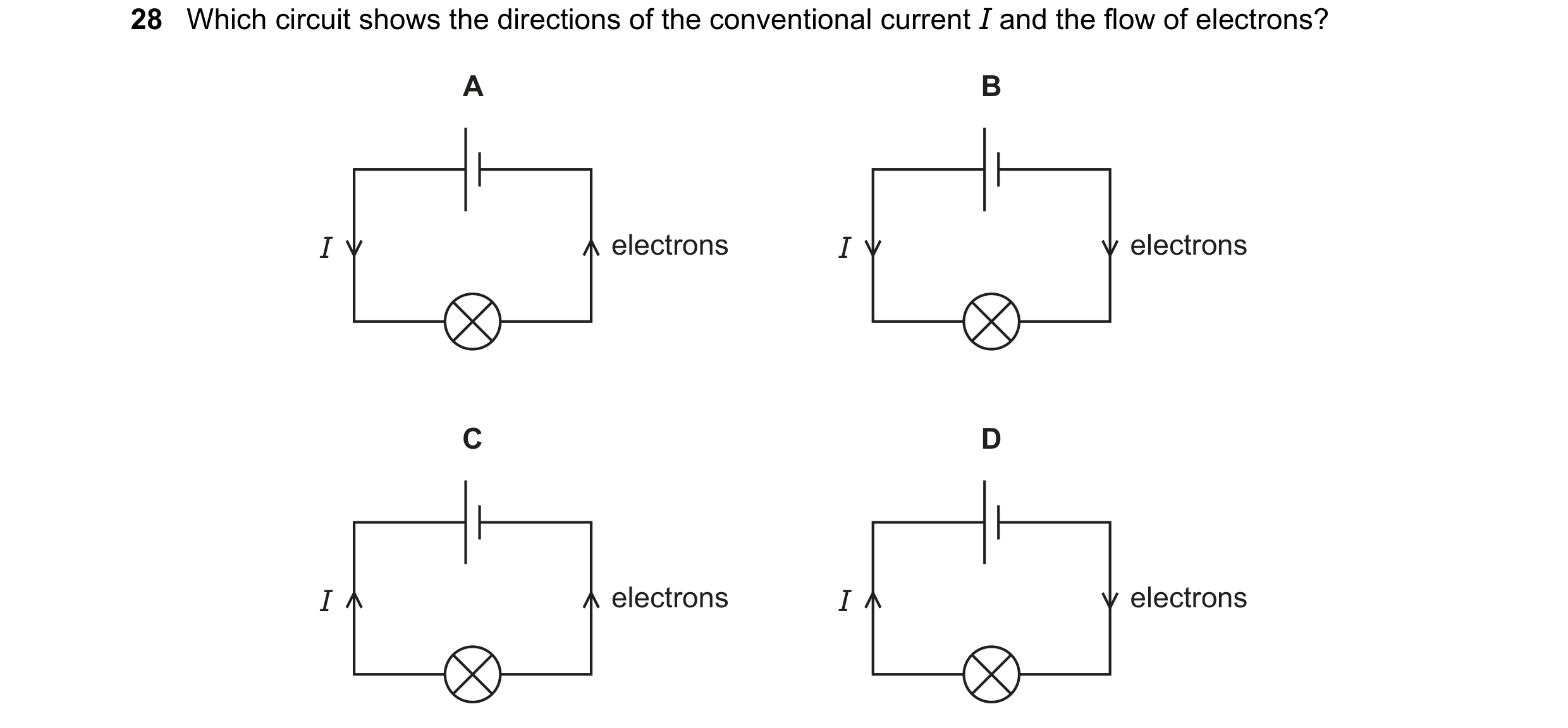

 56 / 64


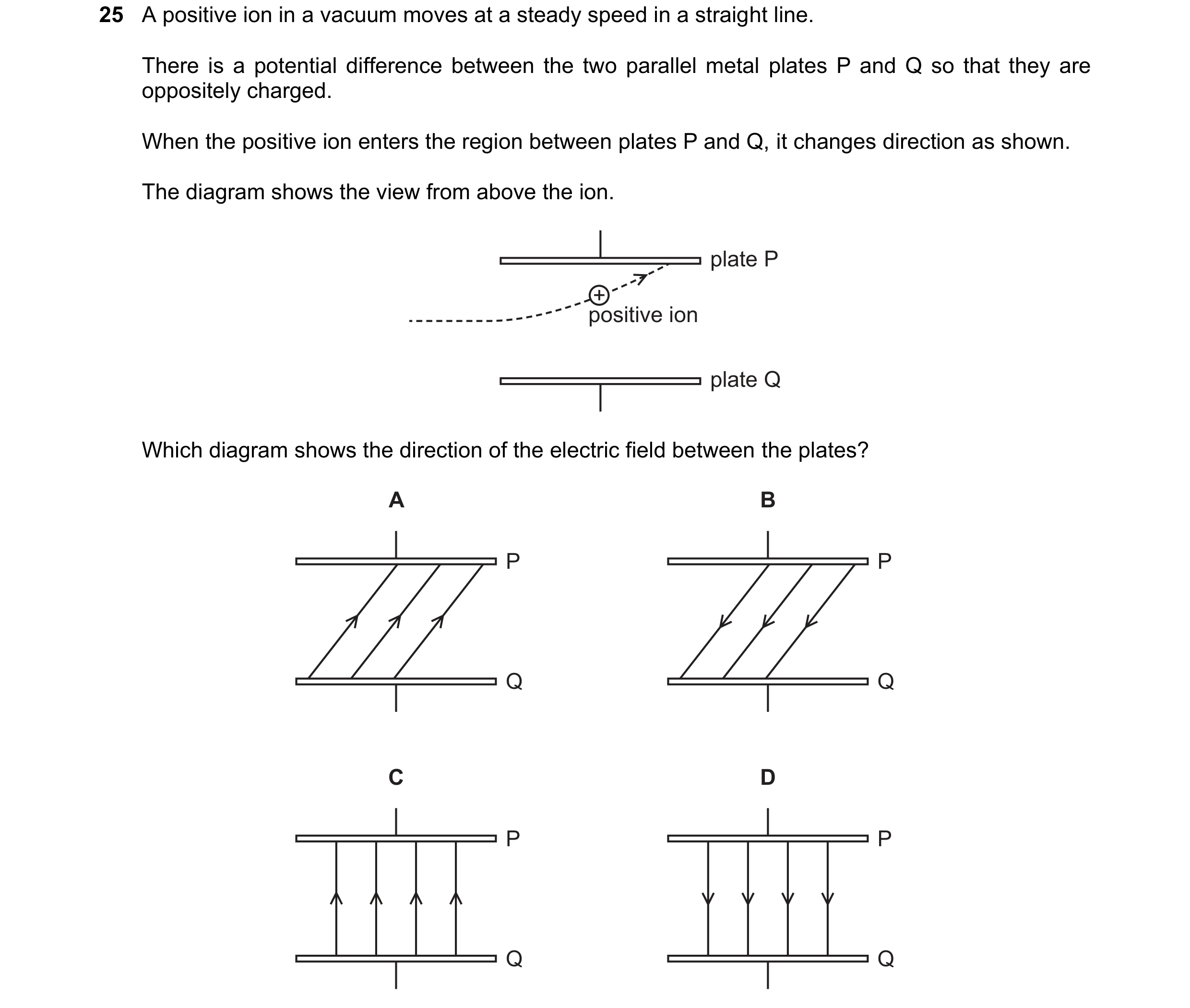 57 / 64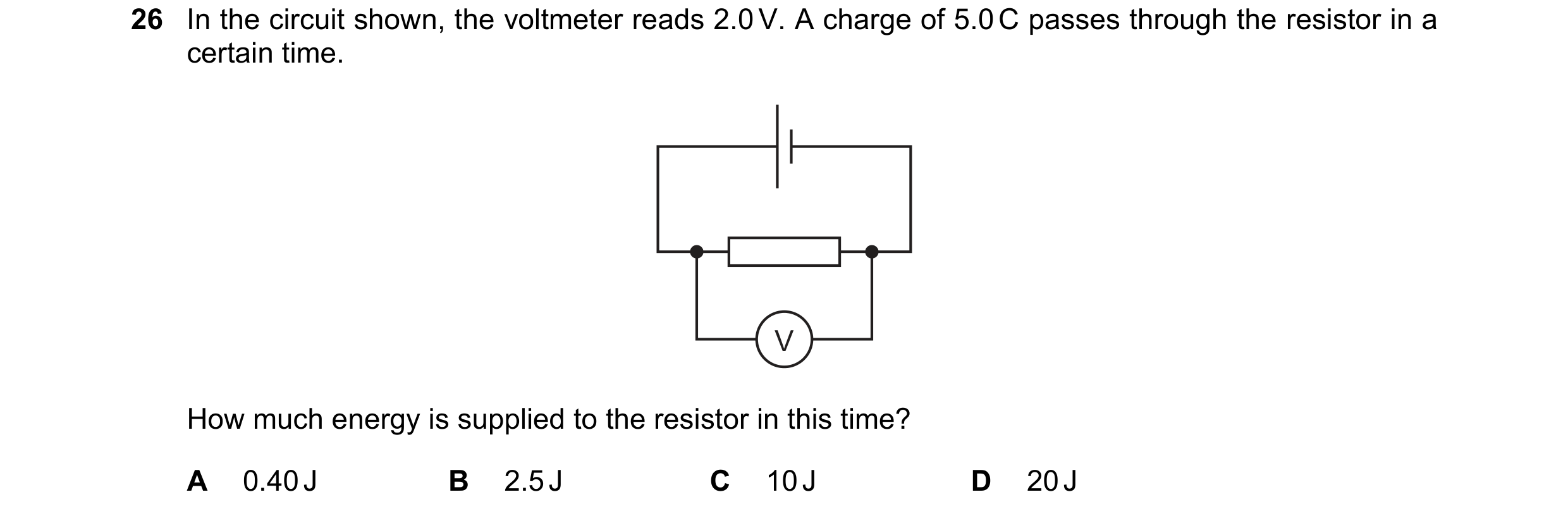
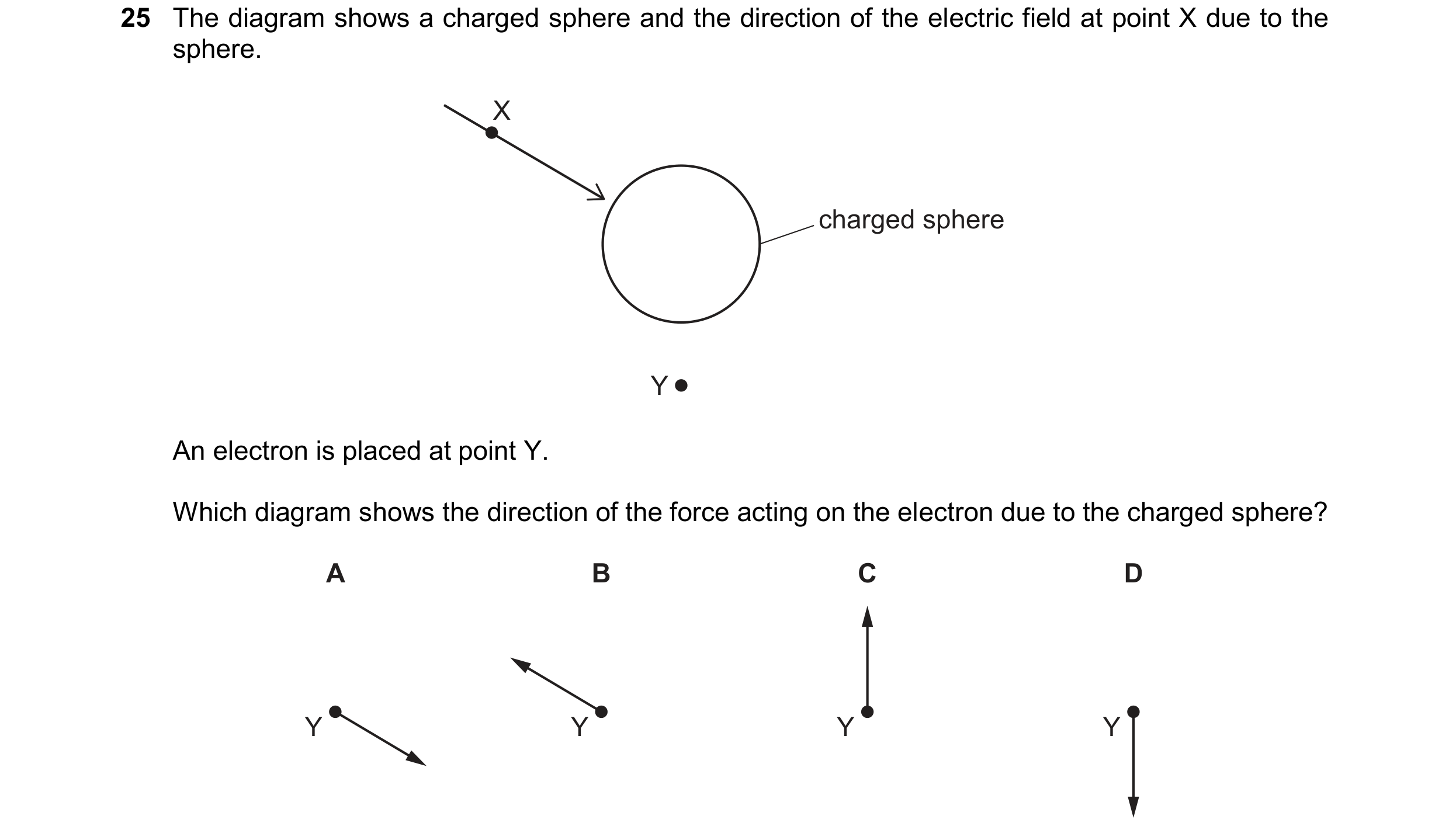

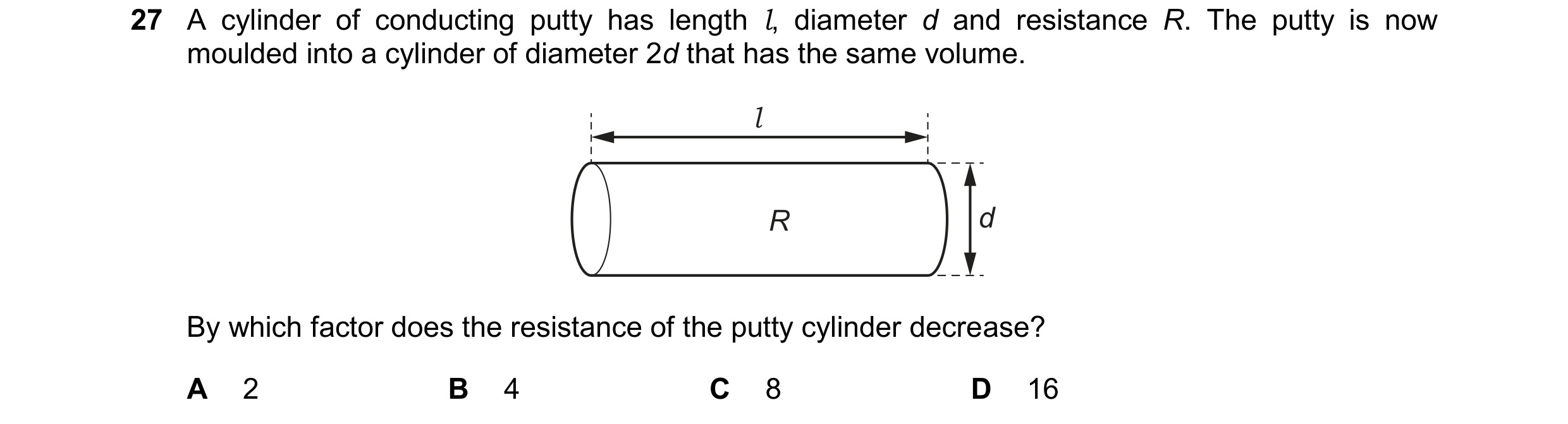 58 / 64

 59 / 64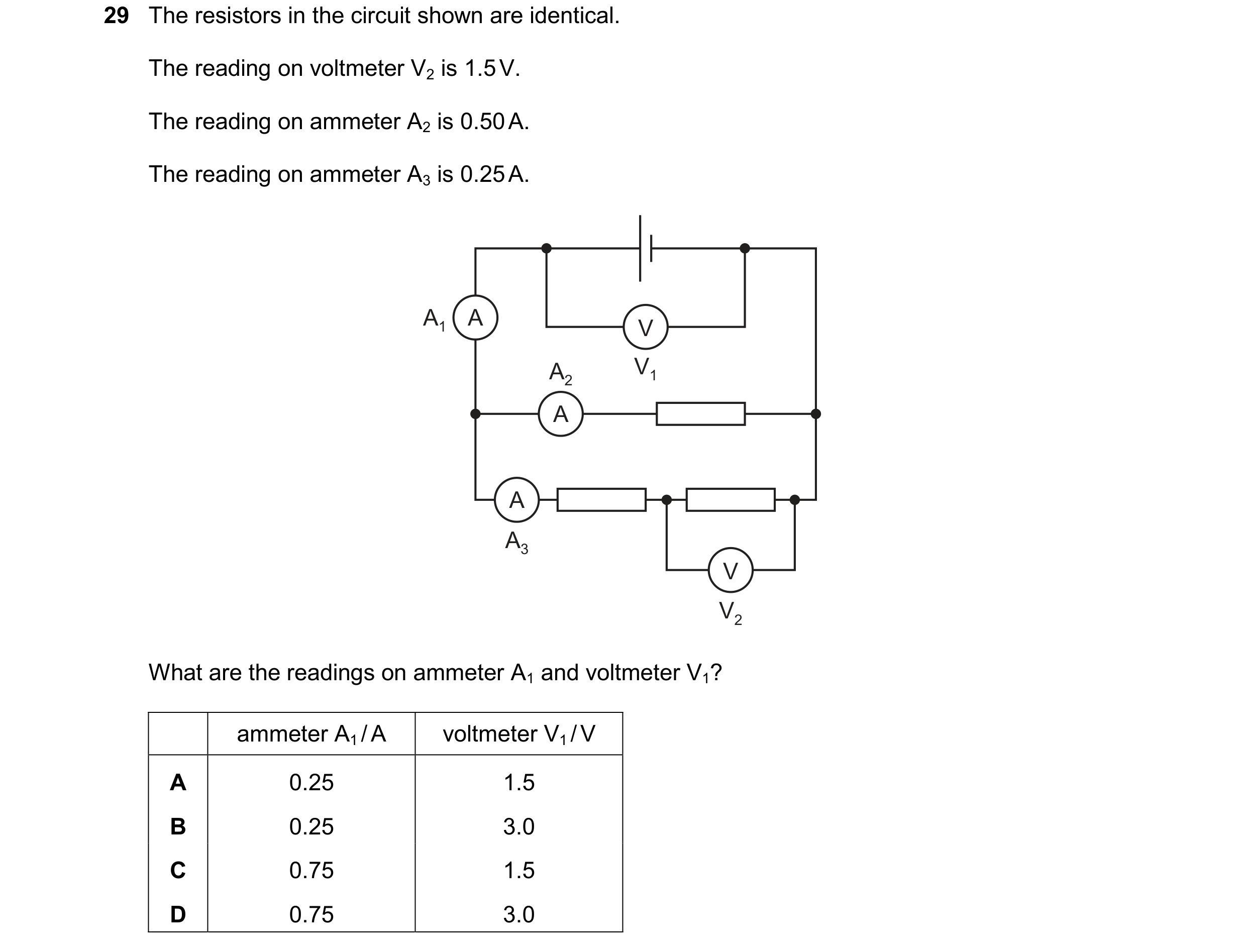
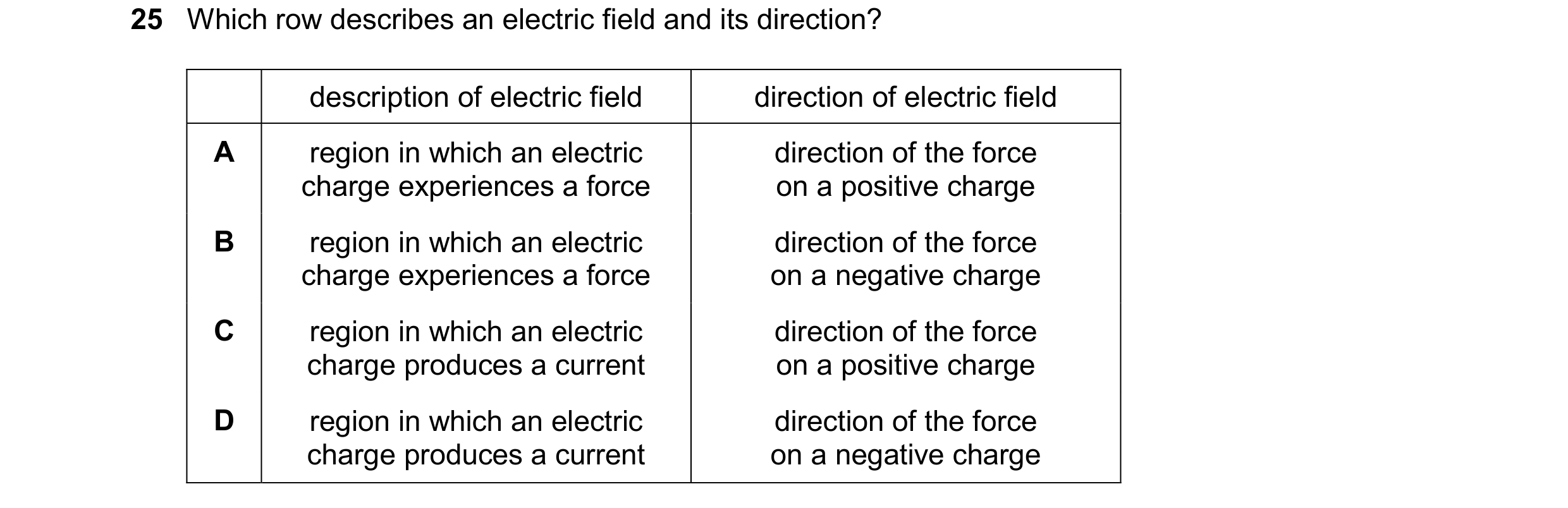
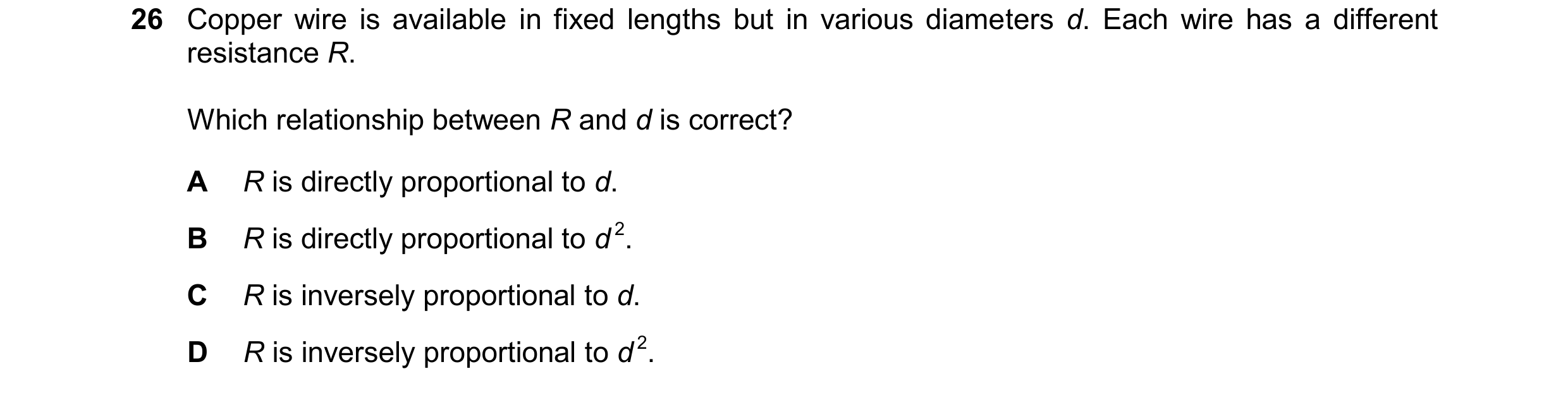 60 / 64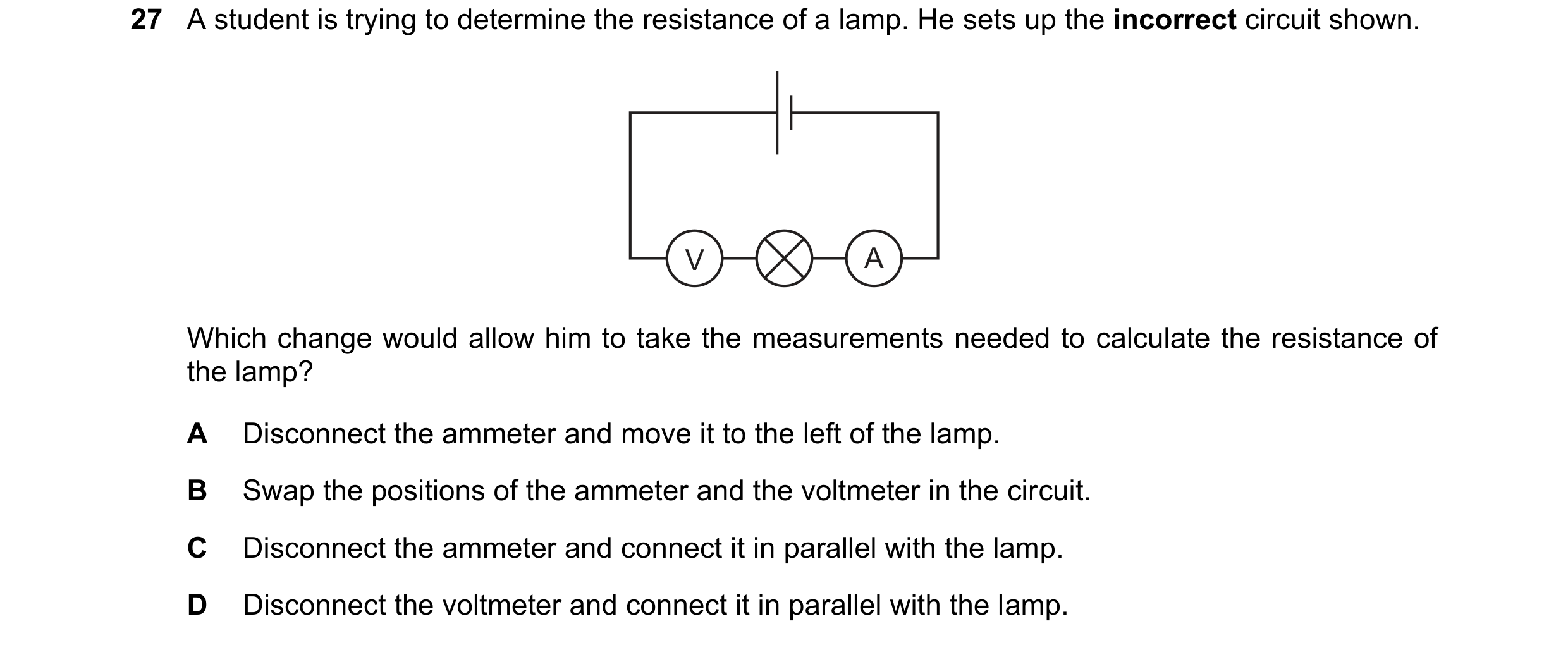
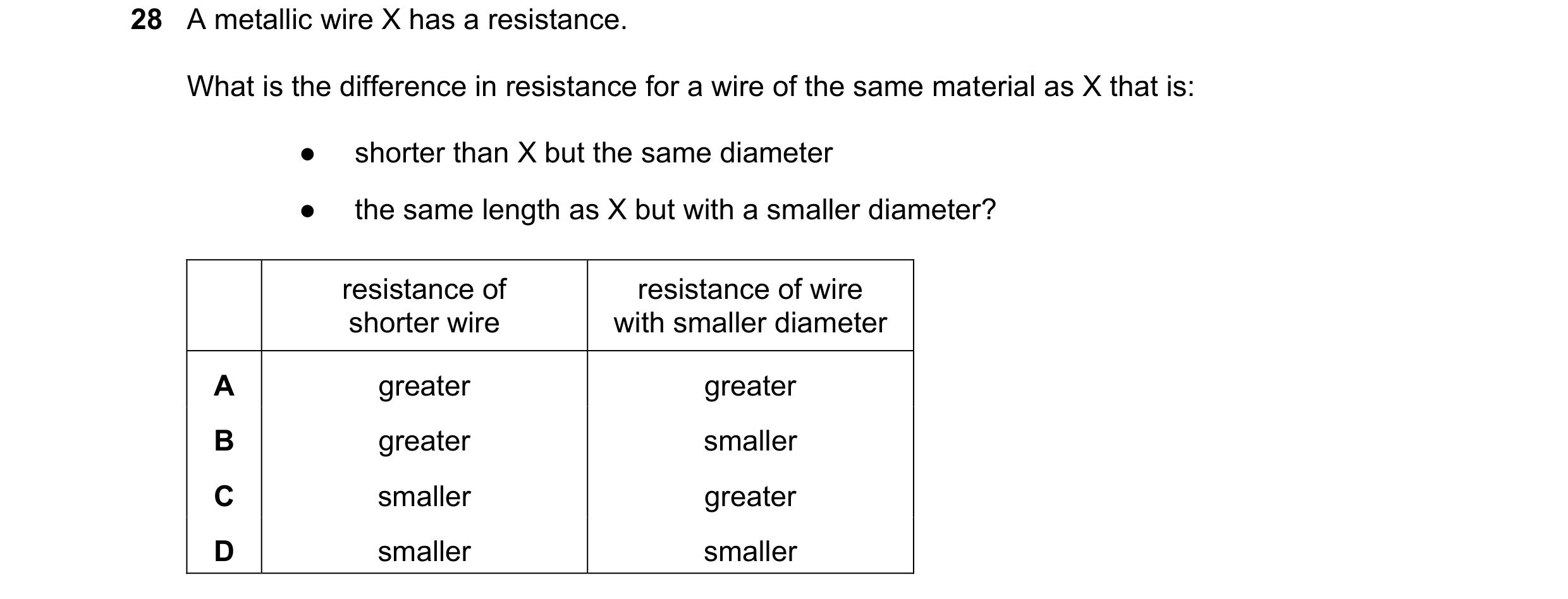
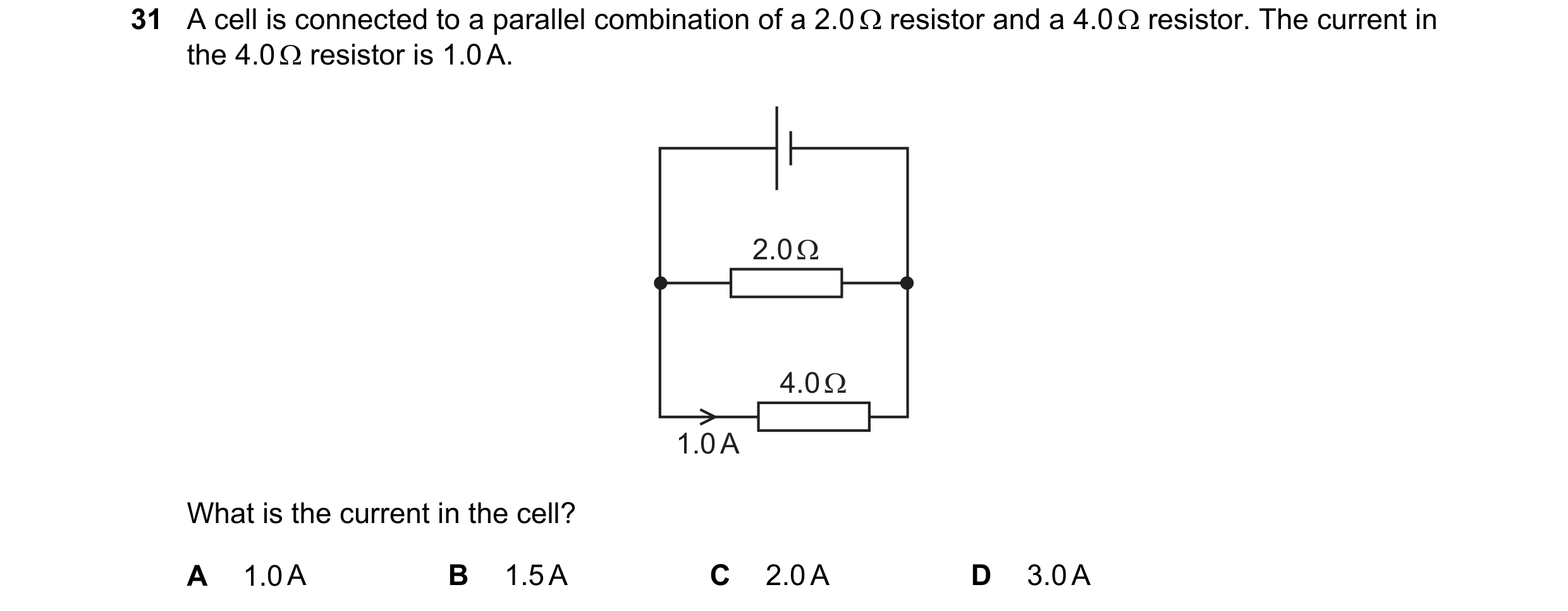 61 / 64



 62 / 64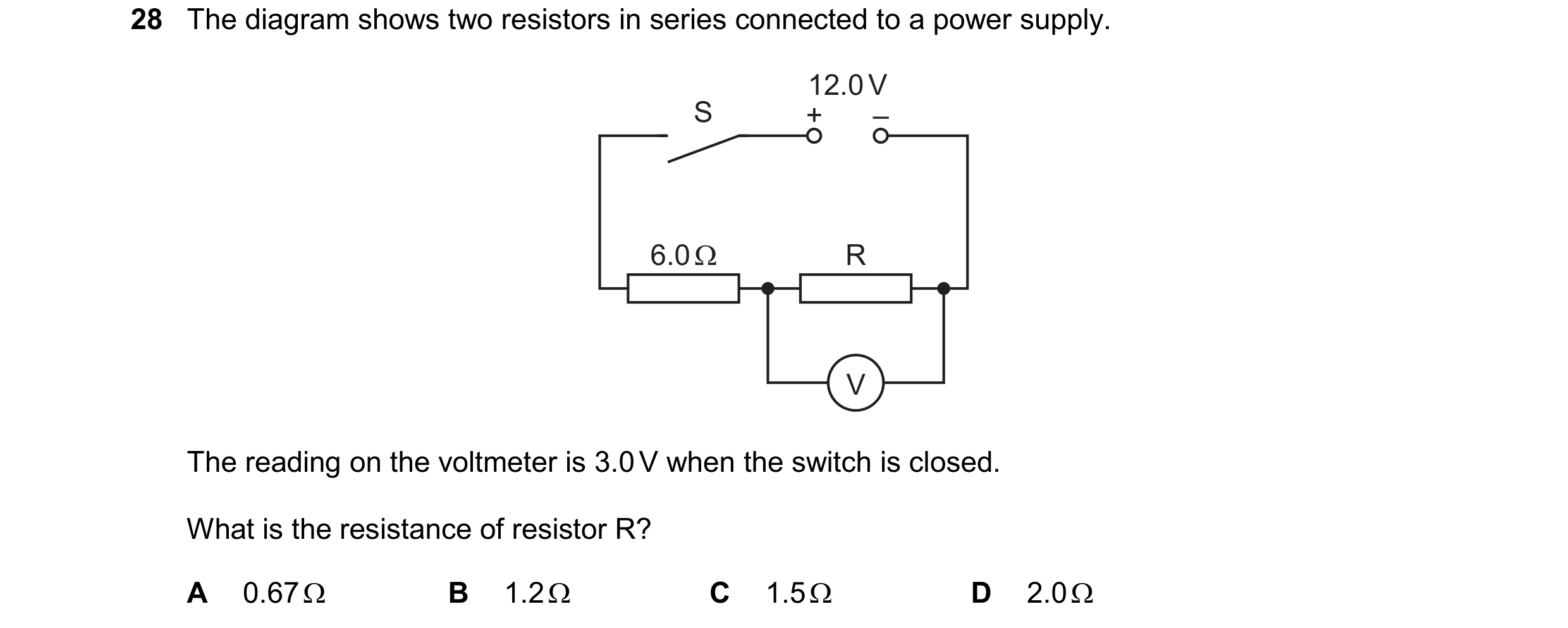
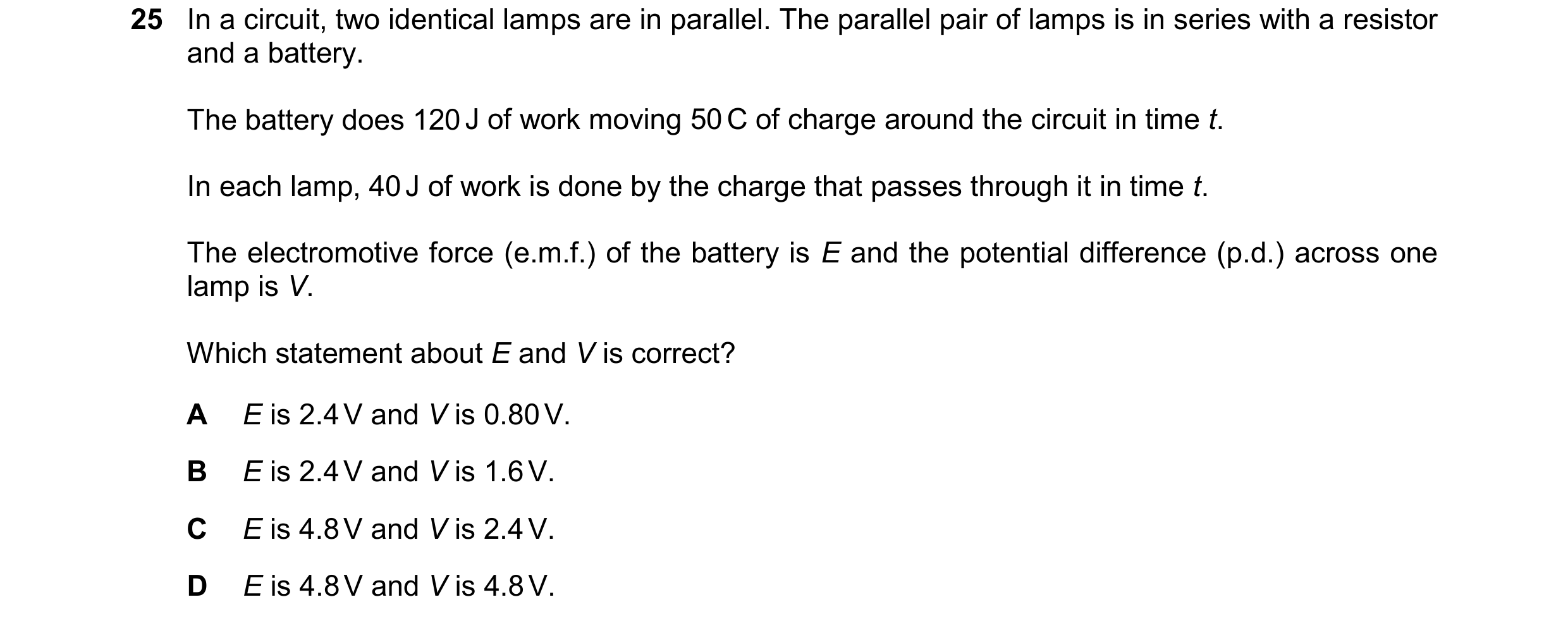
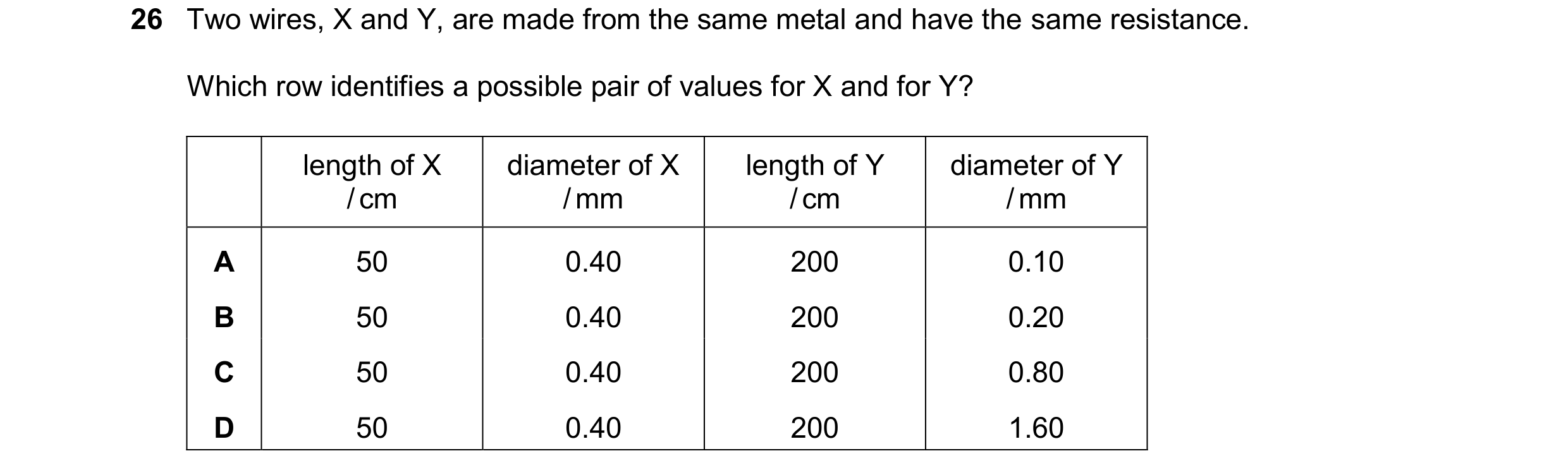 63 / 64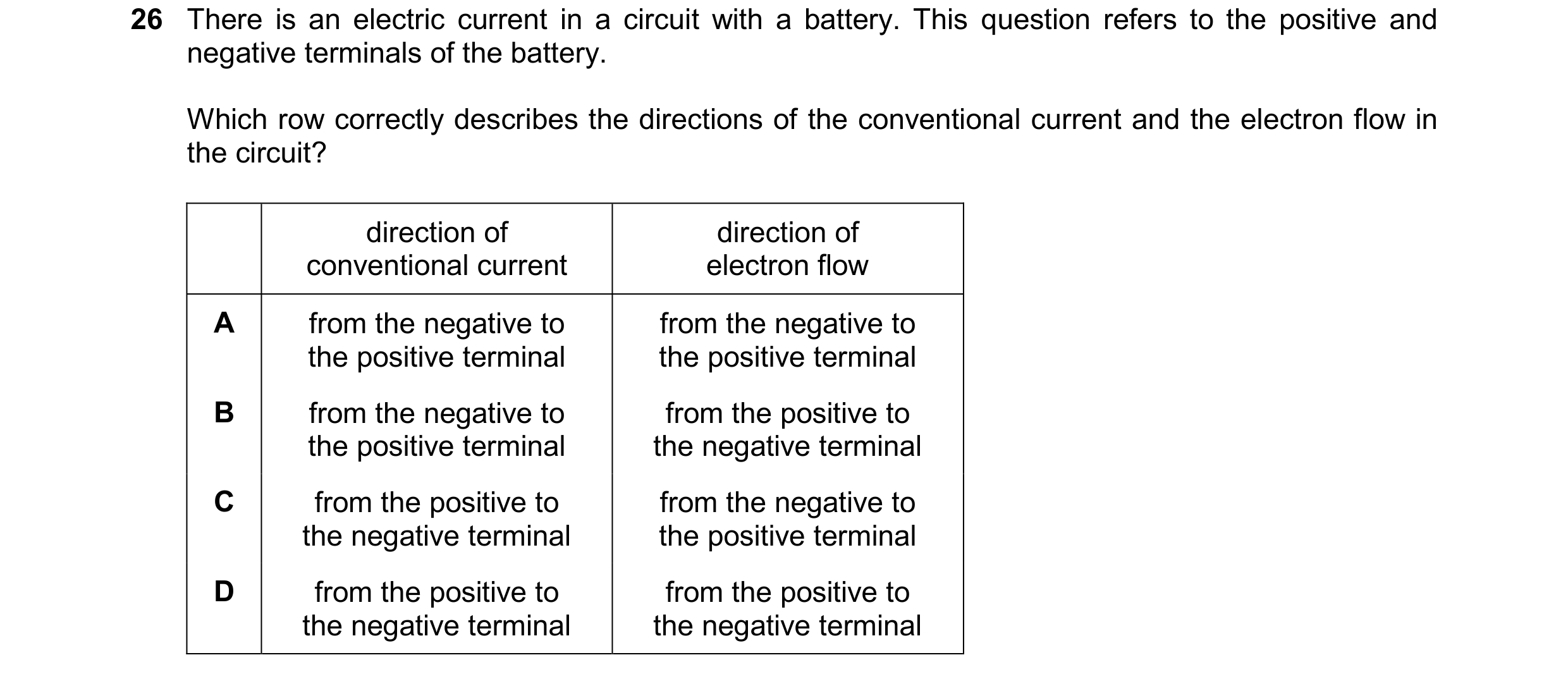
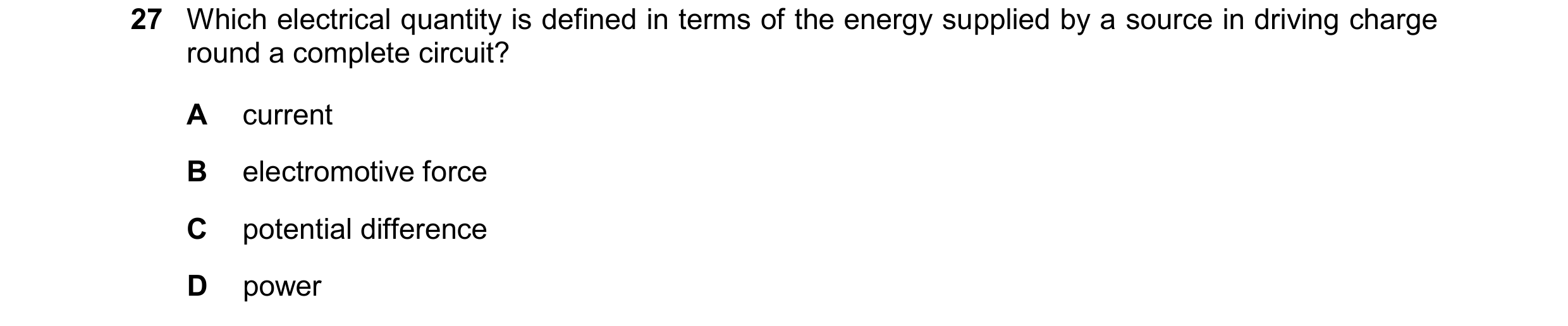
 64 / 64