Questions as text
Q1 · Water can exist as ice, liquid water and steam 0625/32 Feb/March 2017
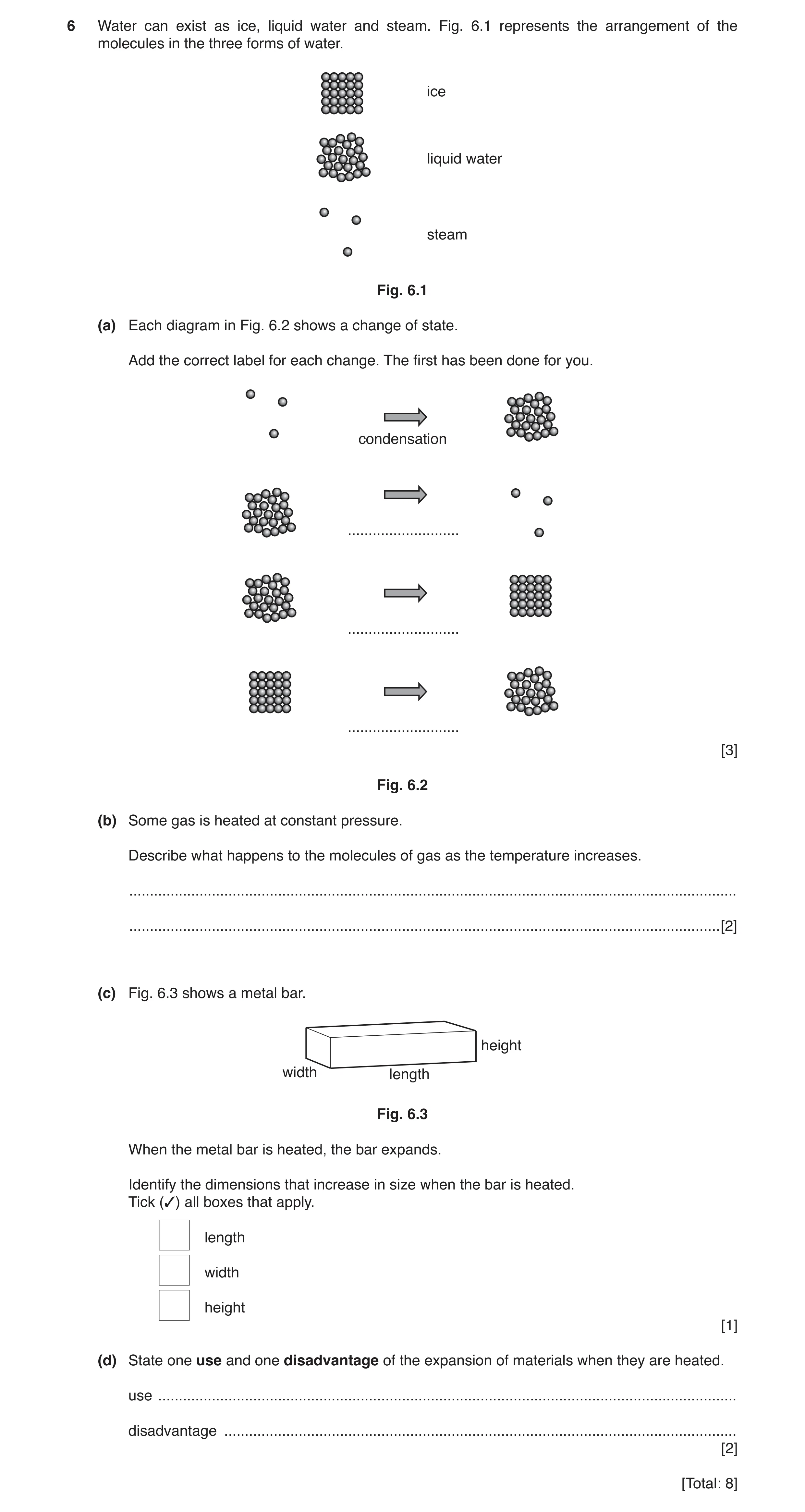
6 Water can exist as ice, liquid water and steam. Fig. 6.1 represents the arrangement of the molecules in the three forms of water. ice liquid water steam Fig. 6.1 (a) Each diagram in Fig. 6.2 shows a change of state. Add the correct label for each change. The first has been done for you. condensation … … … [3] Fig. 6.2 (b) Some gas is heated at constant pressure. Describe what happens to the molecules of gas as the temperature increases. … … [2] (c) Fig. 6.3 shows a metal bar. height width length Fig. 6.3 When the metal bar is heated, the bar expands. Identify the dimensions that increase in size when the bar is heated. Tick (3) all boxes that apply. length width height [1] (d) State one use and one disadvantage of the expansion of materials when they are heated. use … disadvantage … [2] [Total: 8]
8 marks
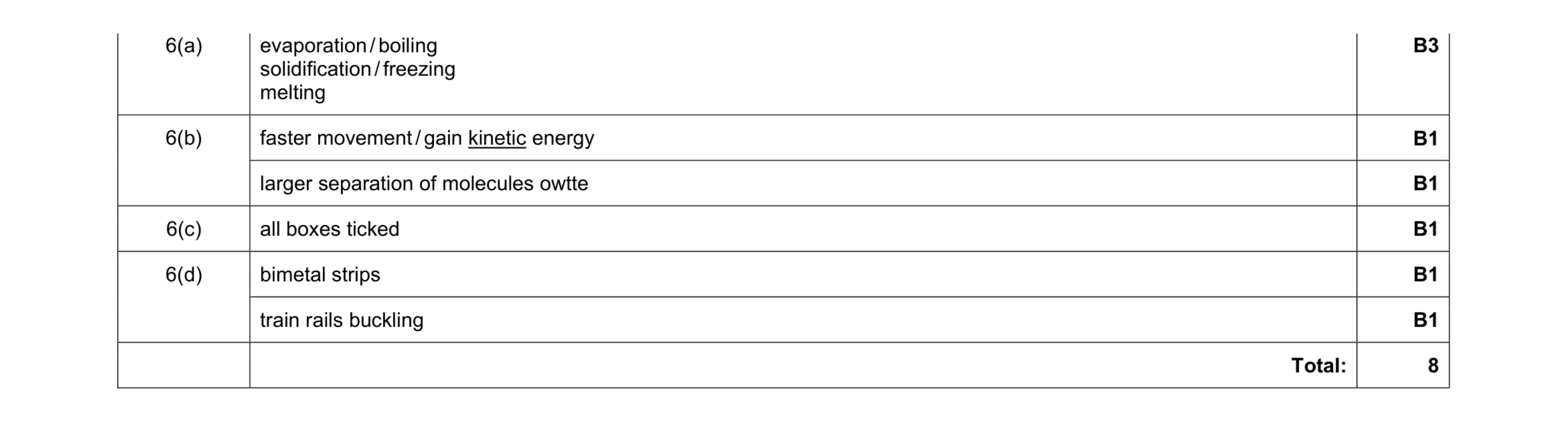
Mark scheme: 6(a) evaporation / boiling solidification / freezing melting B3 6(b) faster movement / gain kinetic energy B1 larger separation of molecules owtte B1 6(c) all boxes ticked B1 6(d) bimetal strips B1 train rails buckling B1 Total: 8
This question in 0625/32 Feb/March 2017
Question 2 0625/33 Oct/Nov 2017
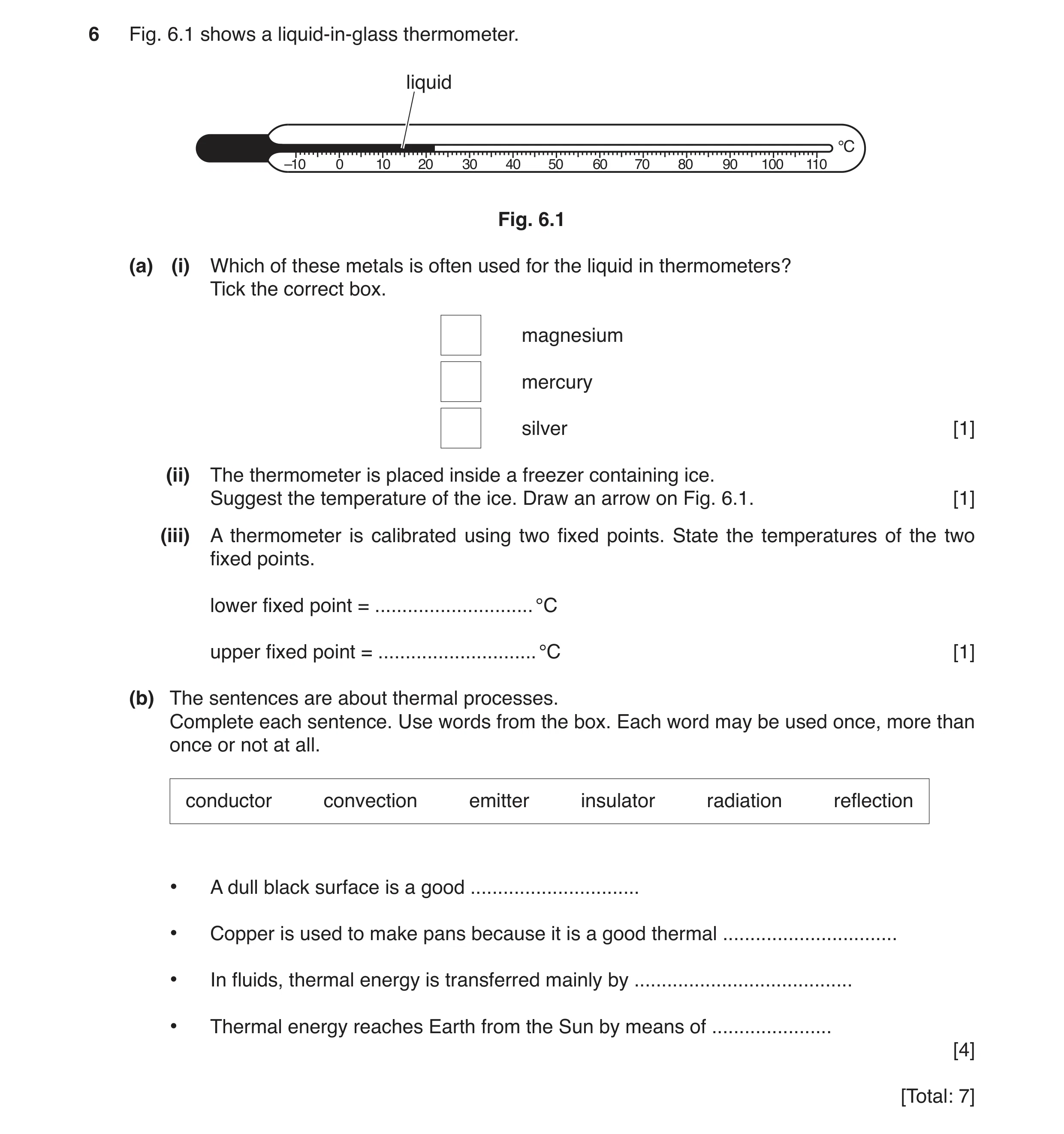
6 Fig. 6.1 shows a liquid-in-glass thermometer. liquid °C –10 0 10 20 30 40 50 60 70 80 90 100 110 Fig. 6.1 (a) (i) Which of these metals is often used for the liquid in thermometers? Tick the correct box. magnesium mercury silver [1] (ii) The thermometer is placed inside a freezer containing ice. Suggest the temperature of the ice. Draw an arrow on Fig. 6.1. [1] (iii) A thermometer is calibrated using two fixed points. State the temperatures of the two fixed points. lower fixed point = … °C upper fixed point = … °C [1] (b) The sentences are about thermal processes. Complete each sentence. Use words from the box. Each word may be used once, more than once or not at all. conductor convection emitter insulator radiation reflection • A dull black surface is a good … • Copper is used to make pans because it is a good thermal … • In fluids, thermal energy is transferred mainly by … • Thermal energy reaches Earth from the Sun by means of … [4] [Total: 7]
7 marks
Mark scheme: 6(a)(i) mercury B1 6(a)(ii) arrow between 0 o C and start of capillary tube B1 6(a)(iii) 0 (oC) AND 100 (o C) B1 6(b) emitter B1 conductor B1 convection B1 radiation B1
This question in 0625/33 Oct/Nov 2017
Q3 · A student constructs a device for absorbing thermal energy from the Sun 0625/31 May/June 2018
6 A student constructs a device for absorbing thermal energy from the Sun. Fig. 6.1 shows the device. Sun thermometer Tank A thermometer cold water white plastic pipe Tank B warm water Fig. 6.1 The student places the white plastic pipe in sunlight. The cold water flows slowly from Tank A to Tank B. Energy from the Sun heats the water in the pipe. Fig. 6.2 shows the temperatures in Tank A and Tank B. –10 0 10 20 30 40 50 60 70 80 90 100 110 °C Thermometer showing temperature in Tank A. –10 0 10 20 30 40 50 60 70 80 90 100 110 °C Thermometer showing temperature in Tank B. Fig. 6.2 (a) Determine the rise in temperature of the water. temperature rise = … ° C [1] (b) The student wants to increase the thermal energy absorbed by the water in the pipe. Suggest three improvements he can make to increase the thermal energy absorbed. 1 … … 2 … … 3 … … [3] (c) Describe how the thermal energy is transferred from the Sun to the water inside the pipe. … … [2] [Total: 6]
6 marks
Mark scheme: 6(a) (26 – 23 =) 3(°C) 1 6(b) any three from: use metal pipe paint black or use black pipe use matt or dull (paint) (place) reflector behind pipe use long(er) pipe use pipe with great(er) surface area slow(er) flow rate (place) glass/(clear) plastic cover over pipe 3 6(c) infra-red (radiation through space/air) 1 conduction through pipe 1
This question in 0625/31 May/June 2018
Q4 · A Bunsen burner heats a beaker of water, as shown in Fig 0625/32 May/June 2018
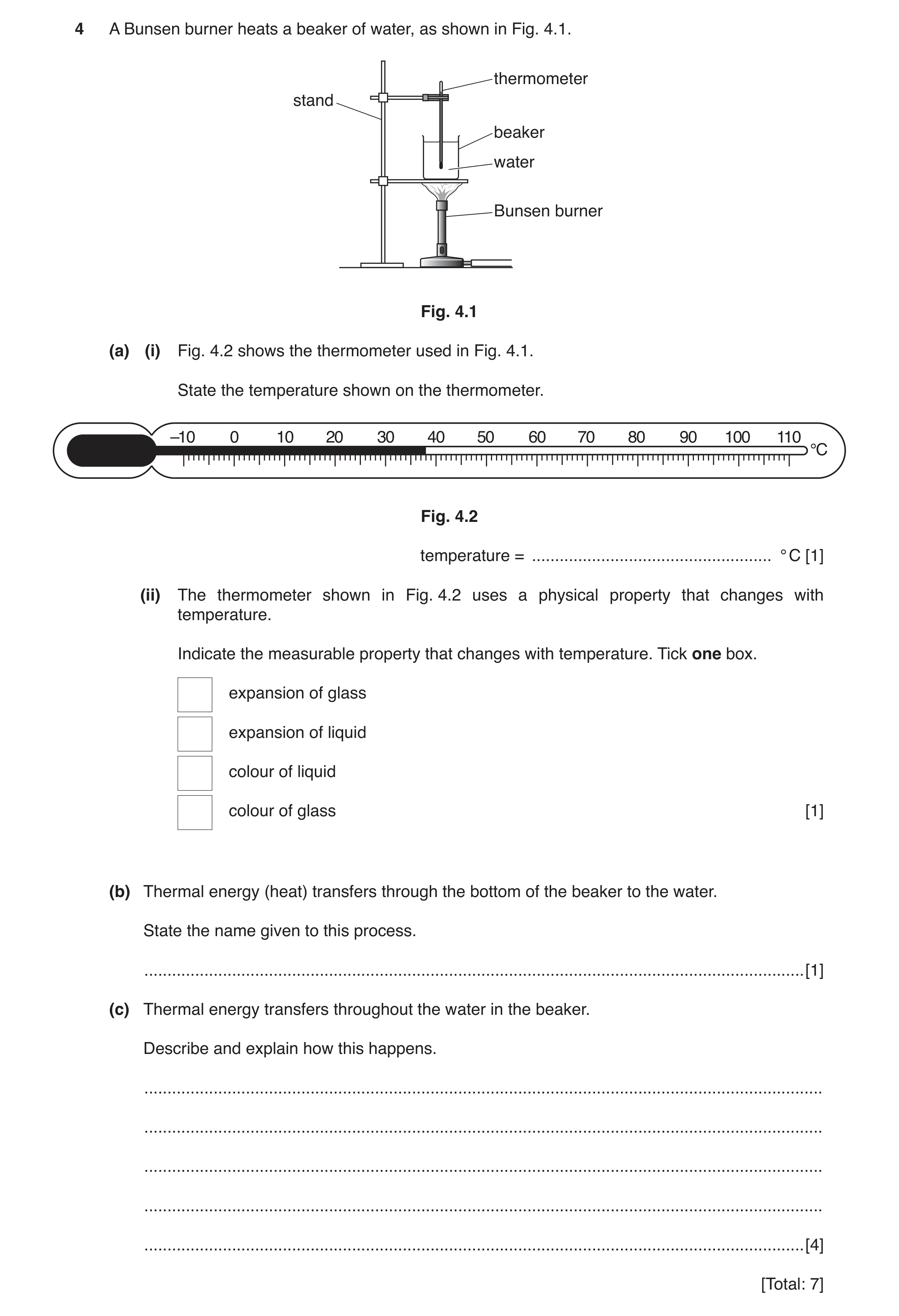
4 A Bunsen burner heats a beaker of water, as shown in Fig. 4.1. thermometer stand beaker water Bunsen burner Fig. 4.1 (a) (i) Fig. 4.2 shows the thermometer used in Fig. 4.1. State the temperature shown on the thermometer. –10 0 10 20 30 40 50 60 70 80 90 100 110 °C Fig. 4.2 temperature = … ° C [1] (ii) The thermometer shown in Fig. 4.2 uses a physical property that changes with temperature. Indicate the measurable property that changes with temperature. Tick one box. expansion of glass expansion of liquid colour of liquid colour of glass [1] (b) Thermal energy (heat) transfers through the bottom of the beaker to the water. State the name given to this process. … [1] (c) Thermal energy transfers throughout the water in the beaker. Describe and explain how this happens. … … … … … [4] [Total: 7]
7 marks
Mark scheme: 4(a)(i) 38 (°C) 1 4(a)(ii) 2nd box ticked i.e. expansion of liquid 1 4(b) conduction 1 4(c) any three from: water is a fluid water molecules gain (kinetic) energy/move faster/further apart water expands/volume increases warm/hot water or molecules rises convection (current created) cooler/cold/water falls/sinks (to be heated again) 3 correct reference to density change of water 1
This question in 0625/32 May/June 2018
Q5 · State the meaning of the term thermal capacity 0625/32 Oct/Nov 2018
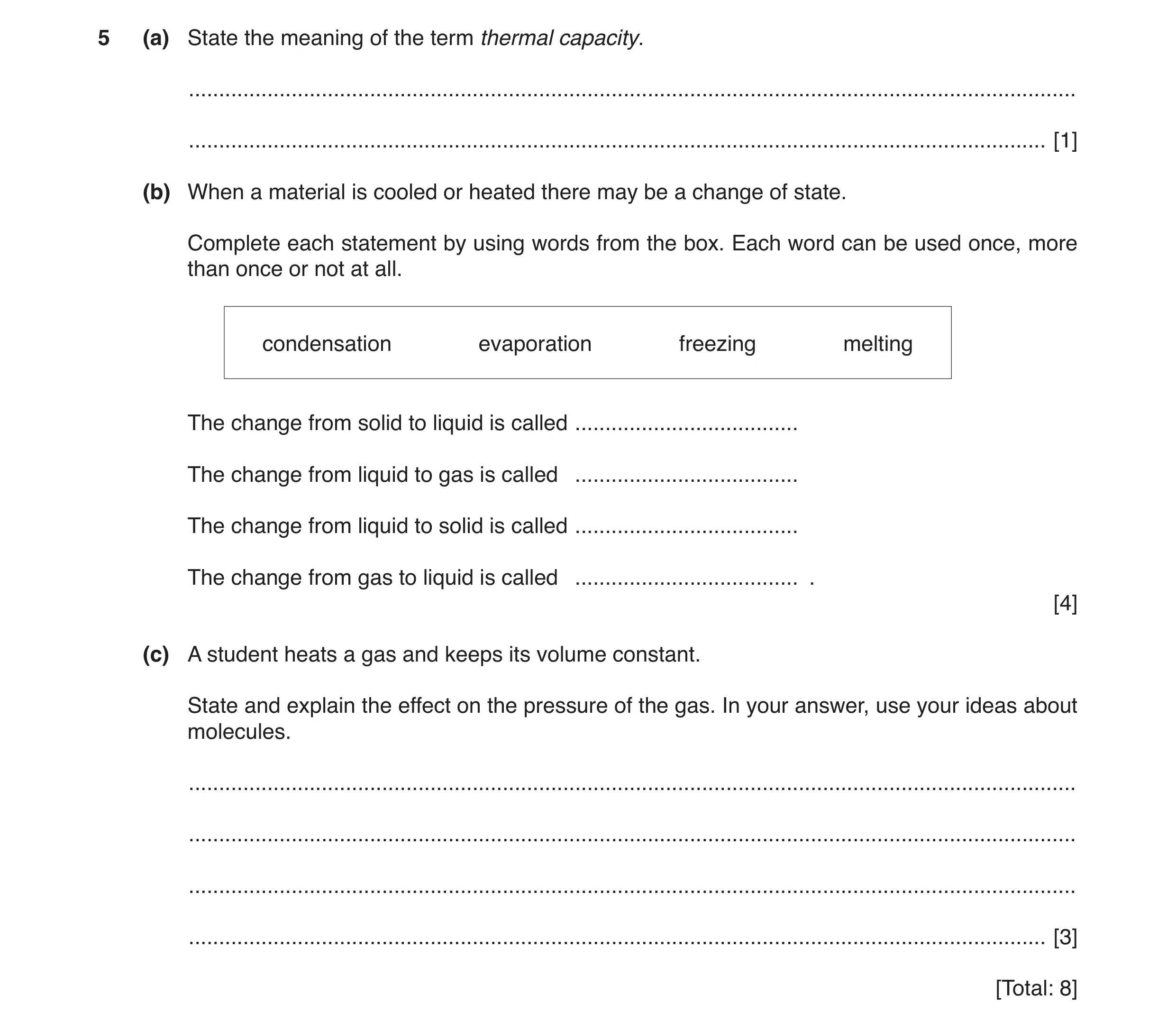
5 (a) State the meaning of the term thermal capacity. … … [1] (b) When a material is cooled or heated there may be a change of state. Complete each statement by using words from the box. Each word can be used once, more than once or not at all. condensation evaporation freezing melting The change from solid to liquid is called … The change from liquid to gas is called … The change from liquid to solid is called … The change from gas to liquid is called … . [4] (c) A student heats a gas and keeps its volume constant. State and explain the effect on the pressure of the gas. In your answer, use your ideas about molecules. … … … … [3] [Total: 8]
8 marks
Mark scheme: 5(a) B1 5(b) melting evaporation or boiling freezing condensation or condensing B4 5(c) increased pressure B1 more collisions or hit walls of container harder or more often B1 molecules move faster OR have more (kinetic) energy B1
This question in 0625/32 Oct/Nov 2018
Q6 · A liquid-in-glass thermometer is placed in some ice made from pure water 0625/31 May/June 2019
6 A liquid-in-glass thermometer is placed in some ice made from pure water. The ice is heated. It changes to water and then to steam. The graph in Fig. 6.1 shows how the temperature varies with time. The values of temperature are missing from the y-axis. temperature / °C Y X 0 10 20 30 40 50 60 70 time / minutes Fig. 6.1 (a) On Fig. 6.1, suggest a value for the temperature at each of the three points marked on the y-axis. Write a value in each of the boxes. [2] (b) In both section X and section Y the line on the graph is horizontal. For each section, state the name for the process taking place and explain what is happening to the molecules. (i) section X name … explanation … … … … [2] (ii) section Y name … explanation … … … … [2] [Total: 6]
6 marks
Mark scheme: 6(a) 0 AND 100 correctly labelled M1 36 A1 6(b)(i) Melting B1 Any one of: molecules gain energy molecule (begin to) break (some) bonds arrangement becomes irregular or arrangement changes B1 6(b)(ii) boiling B1 Any one of: molecules break (all) bonds molecules move (more) freely molecules become widely separated or far apart B1
This question in 0625/31 May/June 2019
Question 7 0625/32 Oct/Nov 2019
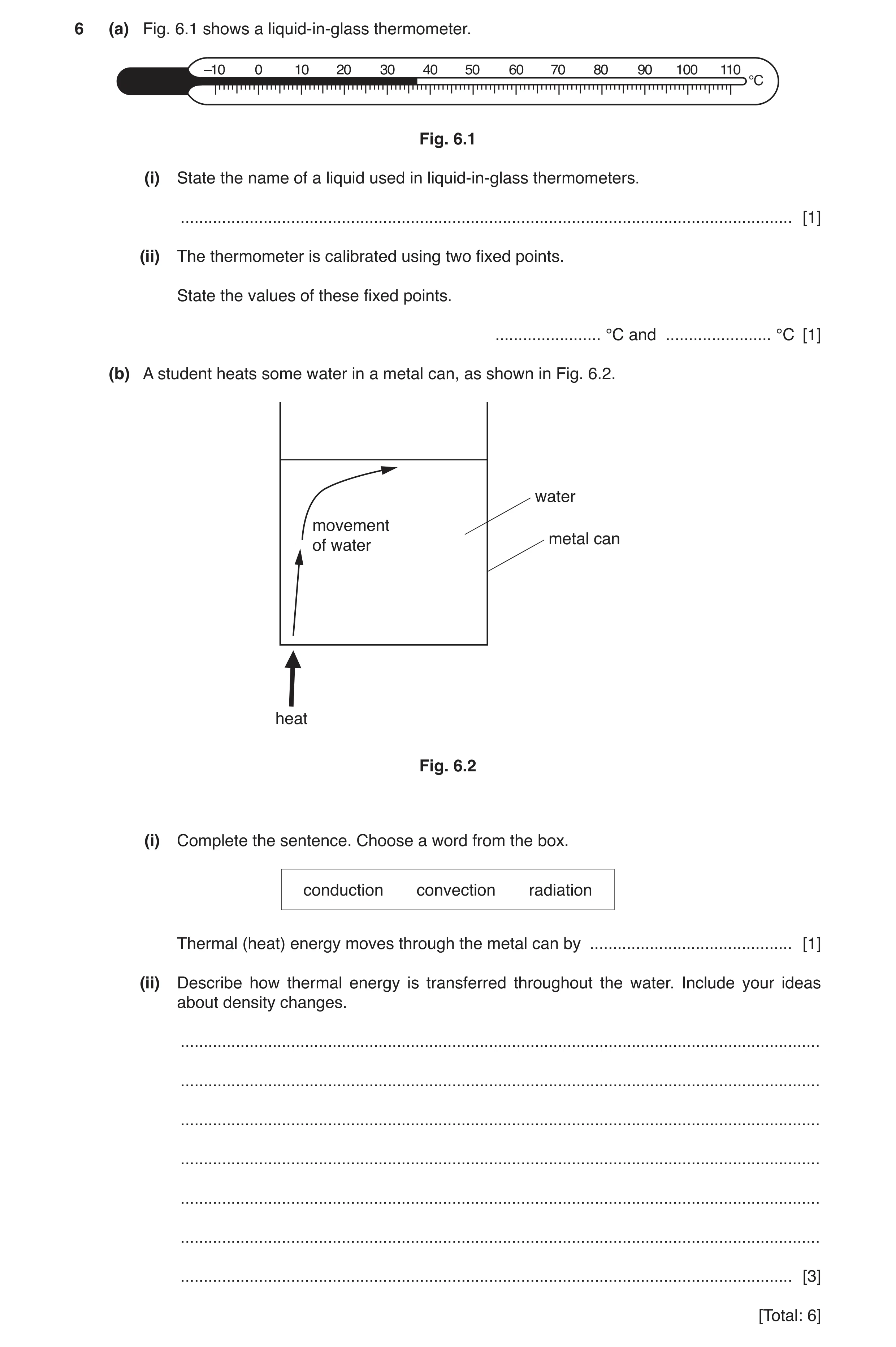
6 (a) Fig. 6.1 shows a liquid-in-glass thermometer. –10 0 10 20 30 40 50 60 70 80 90 100 110 °C Fig. 6.1 (i) State the name of a liquid used in liquid-in-glass thermometers. … [1] (ii) The thermometer is calibrated using two fixed points. State the values of these fixed points. … °C and … °C [1] (b) A student heats some water in a metal can, as shown in Fig. 6.2. water movement metal can of water heat Fig. 6.2 (i) Complete the sentence. Choose a word from the box. conduction convection radiation Thermal (heat) energy moves through the metal can by … [1] (ii) Describe how thermal energy is transferred throughout the water. Include your ideas about density changes. … … … … … … … [3] [Total: 6]
6 marks
Mark scheme: 6(a)(i) mercury or alcohol B1 6(a)(ii) 0 (°C) AND 100 (°C) B1 6(b)(i) conduction B1 6(b)(ii) Any three from: (heat causes) water molecules (to) move further apart OR (hot) water expands / volume increases (hot water) is less dense NOT molecules less dense/expand (so hot / less dense) water rises (and is replaced by cooler / more dense water) convection / current (in water) B3
This question in 0625/32 Oct/Nov 2019
Question 8 0625/33 Oct/Nov 2019
7 (a) Complete the sentences. Add the missing word to each of the blank spaces. The unit of temperature is called the … . The physical property that varies with temperature in a liquid-in-glass thermometer is the … of the liquid. [2] (b) A student has a thermometer without a marked scale. To produce a scale for the thermometer, the student must use two fixed points. Give the temperature value for each fixed point and describe what happens to water at each of these temperatures. Lower fixed point … … Upper fixed point … … [4] [Total: 6]
6 marks
Mark scheme: 7(a) (degrees) celsius OR oC volume B1 B1 7(b) Lower 0 oC (water) freezes OR turns to ice Upper 100 oC (water) boils B1 B1 B1 B1
This question in 0625/33 Oct/Nov 2019
Q9 · Equal volumes of steel, oil and hydrogen are heated from 20 °C to 60 °C 0625/32 Feb/March 2020
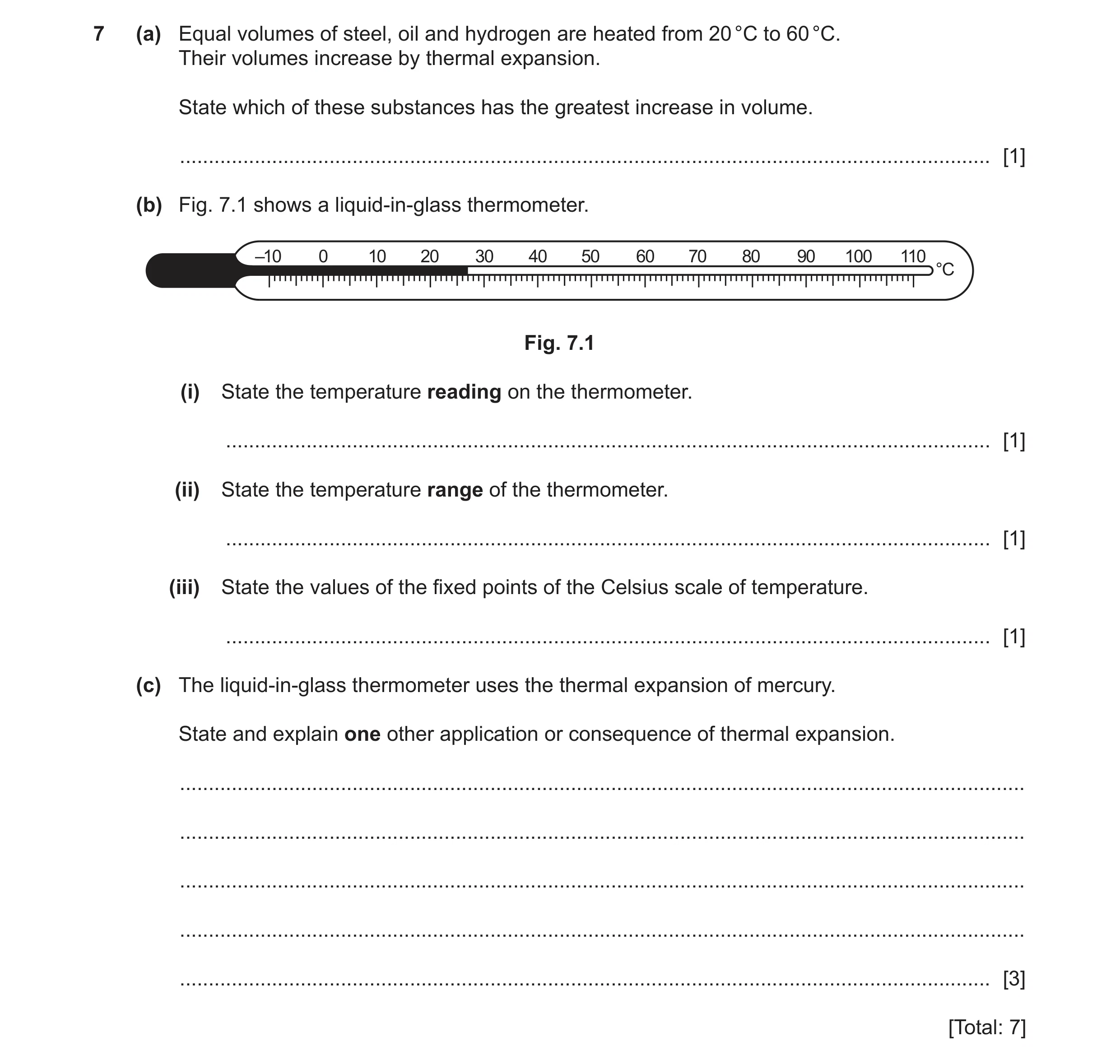
7 (a) Equal volumes of steel, oil and hydrogen are heated from 20 °C to 60 °C. Their volumes increase by thermal expansion. State which of these substances has the greatest increase in volume. … [1] (b) Fig. 7.1 shows a liquid-in-glass thermometer. –10 0 10 20 30 40 50 60 70 80 90 100 110 °C Fig. 7.1 (i) State the temperature reading on the thermometer. … [1] (ii) State the temperature range of the thermometer. … [1] (iii) State the values of the fixed points of the Celsius scale of temperature. … [1] (c) The liquid-in-glass thermometer uses the thermal expansion of mercury. State and explain one other application or consequence of thermal expansion. … … … … … [3] [Total: 7]
7 marks
Mark scheme: 7(a) hydrogen (gas) B1 7(b)(i) 27 (°C) B1 7(b)(ii) –10 (°C) to 110 (°C) B1 7(b)(iii) 0 (°C) AND 100 (°C) B1 7(c) use / consequence of thermal expansion identified B1 description of effect B1 explanation of effect B1
This question in 0625/32 Feb/March 2020
Question 10 0625/31 May/June 2020
6 Fig. 6.1 shows a liquid-in-glass thermometer. liquid –10 0 10 20 30 40 50 60 70 80 90 100 110 ice point liquid Fig. 6.1 (a) (i) This thermometer is used for measuring temperatures in science experiments. State the unit for measuring temperature. … [1] (ii) On Fig. 6.1, an arrow points to the temperature reading when the thermometer is placed in pure melting ice. This is labelled ice point. On Fig. 6.1, draw an arrow pointing to the temperature reading when the thermometer is at the upper fixed point. Label this arrow steam point. [1] (b) A liquid-in-glass thermometer uses the property of expansion of a liquid to measure temperature. State one other application or consequence of thermal expansion. … … [1] (c) A student is testing how different surfaces absorb radiant heat. The student puts two metal plates in holders and places them on either side of a radiant heater as shown in Fig. 6.2. One plate has a shiny metal side facing towards the heater and the other plate has a dull black side facing towards the heater. A metal disc is attached to each plate using wax. shiny metal radiant dull black surface heater surface metal disc metal disc wax wax 8 cm 10 cm Fig. 6.2 (i) The student turns on the radiant heater and starts a stop-clock. The wax on the plate with a dull black side melts and the metal disc falls off the plate 53 seconds after the stop-clock is started. The metal disc on the plate with a shiny metal side remains attached for another 32 seconds after the metal disc on the first plate falls. Explain why the metal disc on the plate with a dull black side falls before the metal disc on the plate with a shiny metal side. … … … … … [2] (ii) Another student observes the experiment shown in Fig. 6.2 and says that the comparison of the two plates is not fair. Suggest why the experiment is not fair. … … [2] [Total: 7]
7 marks
Mark scheme: 6(a)(i) °C or degrees celcius B1 6(a)(ii) arrow at 100 (labelled steam) B1 6(b) use OR consequence of thermal expansion identified B1 6(c)(i) black is better / best absorber B1 (so) temperature of wax rises faster on black plate B1 6(c)(ii) (for a valid comparison all independent) variables must be the same B1 plates / discs should be equal distances (from heater) (owtte) B1
This question in 0625/31 May/June 2020
Q11 · Match each description with the correct state of matter in Table 4.1 0625/32 May/June 2020
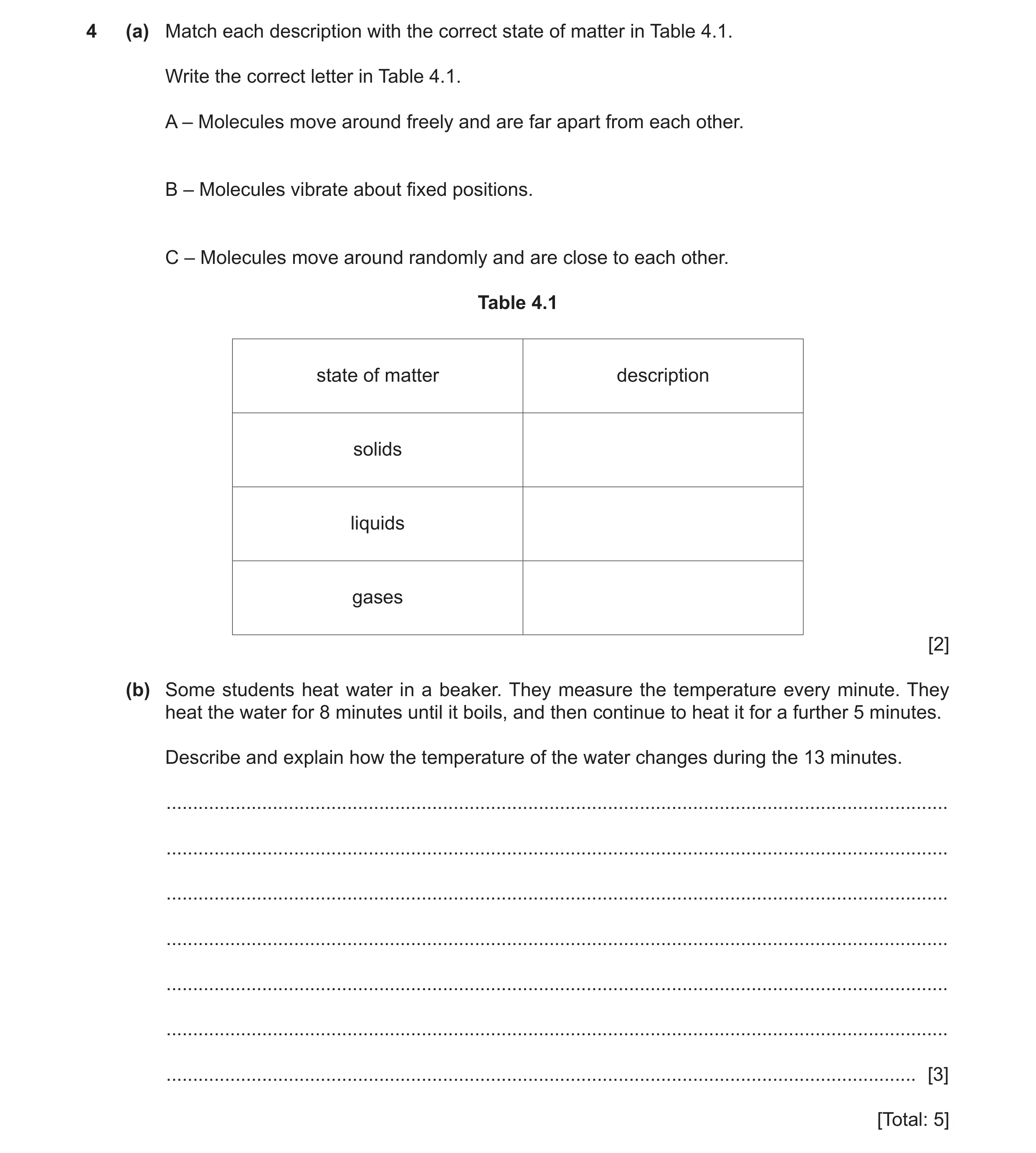
4 (a) Match each description with the correct state of matter in Table 4.1. Write the correct letter in Table 4.1. A – Molecules move around freely and are far apart from each other. B – Molecules vibrate about fixed positions. C – Molecules move around randomly and are close to each other. Table 4.1 state of matter description solids liquids gases [2] (b) Some students heat water in a beaker. They measure the temperature every minute. They heat the water for 8 minutes until it boils, and then continue to heat it for a further 5 minutes. Describe and explain how the temperature of the water changes during the 13 minutes. … … … … … … … [3] [Total: 5]
5 marks
Mark scheme: 4(a) B C A B2 4(b) any three from: during first eight minutes temp rises (because) internal energy of water rises (from thermal energy input) during next five minutes temperature is constant / stays the same (because) internal energy does not rise (at boiling point) B3
This question in 0625/32 May/June 2020
Q12 · Three changes of state 0625/31 Oct/Nov 2020
6 (a) Fig. 6.1 represents three changes of state. Each pair of diagrams A, B and C shows the arrangement of molecules in a substance before and after it changes state. before after A B C Fig. 6.1 Give the term used for each change of state. A … B … C … [3] (b) A student attaches a liquid-in-glass thermometer to a ruler. The thermometer does not have a marked scale. Fig. 6.2 shows the arrangement. ruler cm 15 14 thermometer 13 12 11 10 9 8 mercury level 7 6 5 4 3 2 1 0 Fig. 6.2 The student places the thermometer in steam. The mercury rises to 11 cm on the ruler. The student places the thermometer in melting ice. The mercury decreases to 1 cm on the ruler. Determine the temperature indicated by the mercury level in Fig. 6.2. temperature = … °C [3] [Total: 6]
6 marks
Mark scheme: 6(a) A: melting B1 B: evaporating / boiling / vapourising B1 C: freezing / solidifying B1 6(b) 1(.0) cm = 10 °C OR (6(.0) – 1(.0)) = 5 B1 × − 5 100 11 1 C1 (temperature =) 50 (°C) A1
This question in 0625/31 Oct/Nov 2020
Q13 · A beaker contains water 0625/32 Oct/Nov 2020
5 A beaker contains water. Some of the water evaporates. (a) Describe and explain how the water evaporates. Use your ideas about molecules. … … … [2] (b) Evaporation changes the temperature of the water that remains in the beaker. State and explain the change in temperature of the water due to evaporation. … … … [3] [Total: 5]
5 marks
Mark scheme: 5(a) high(er / est) energy molecules B1 (near the surface) escape (from surface) B1 5(b) (temperature) decreases B1 AND any two from: higher energy molecules have escaped (leaving) lower energy particles behind (so) average energy of remaining molecules is lower B2
This question in 0625/32 Oct/Nov 2020
Q14 · Diagrams of the arrangement of molecules in three states of matter and shows descriptions… 0625/33 Oct/Nov 2020
5 (a) Fig. 5.1 shows diagrams of the arrangement of molecules in three states of matter and shows descriptions of how the molecules move. arrangement of molecules state of matter movement of molecules solid do not move move around while in contact with other molecules liquid move around freely vibrate about gas fixed positions Fig. 5.1 On Fig. 5.1, draw a line: • from each arrangement of molecules to the correct state of matter • from the state of matter to the correct description of the movement of molecules. [4] (b) A bicycle tyre contains air. The tyre is sealed and does not leak. The temperature of the air in the tyre increases by 20 °C. The volume of the tyre does not change. (i) State how the increase in temperature affects the motion of the air molecules in the tyre. … [1] (ii) State how the increase in temperature changes the pressure of the air in the tyre. … [1] (c) Fig. 5.2 shows a liquid-in-glass thermometer. … … narrow tube liquid Fig. 5.2 (i) Add the missing labels to Fig. 5.2. [2] (ii) The thermometer in Fig. 5.2 is designed to measure a range of temperatures from 0 °C to 100 °C. State the name of a suitable liquid for use in this thermometer. … [1] (iii) Describe and explain the changes in the thermometer in Fig. 5.2 when the temperature of the liquid increases. … … … [2] [Total: 11]
11 marks
Mark scheme: 5(a) arrangement: solid to 2nd box liquid to 3rd box 3 correct – 2 marks: 2 or 1 correct – 1 mark gas to 1st box movement: solid to 4th box liquid to 2nd box 3 correct – 2 marks: 2 or 1 correct – 1 mark gas to 3rd box B2 5(b)(i) move faster / speed up / more (kinetic) energy or wtte B1 5(b)(ii) (pressure) increases B1 5(c)(i) (temperature) scale B1 bulb OR reservoir B1 5(c)(ii) mercury B1 5(c)(iii) (liquid / mercury / alcohol) expands B1 liquid level / meniscus moves along tube / scale B1
This question in 0625/33 Oct/Nov 2020
Question 15 0625/32 May/June 2021
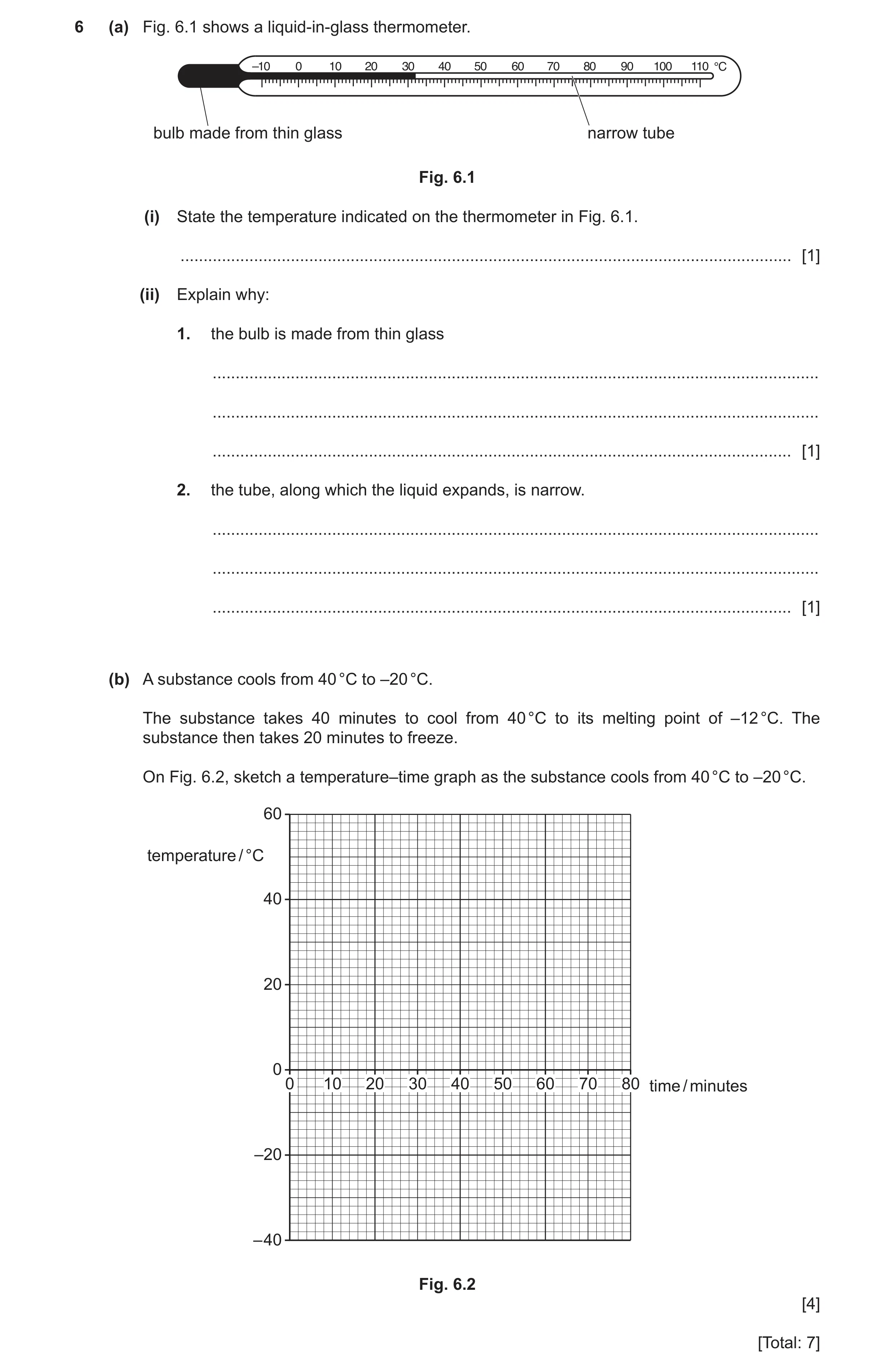
6 (a) Fig. 6.1 shows a liquid-in-glass thermometer. –10 0 10 20 30 40 50 60 70 80 90 100 110 °C bulb made from thin glass narrow tube Fig. 6.1 (i) State the temperature indicated on the thermometer in Fig. 6.1. … [1] (ii) Explain why: 1. the bulb is made from thin glass … … … [1] 2. the tube, along which the liquid expands, is narrow. … … … [1] (b) A substance cools from 40 °C to –20 °C. The substance takes 40 minutes to cool from 40 °C to its melting point of –12 °C. The substance then takes 20 minutes to freeze. On Fig. 6.2, sketch a temperature–time graph as the substance cools from 40 °C to –20 °C. 60 temperature / °C 40 20 0 0 10 20 30 40 50 60 70 80 time / minutes –20 – 40 Fig. 6.2 [4] [Total: 7]
7 marks
Mark scheme: 6(a)(i) 6(a)(ii)1 to enable rapid transfer of thermal energy to liquid in bulb B1 6(a)(ii)2 idea: (small change in volume OR temperature) produces large movement of mercury along capillary owtte B1 Question Answer Marks 6(b) any four from: • line starting at 40 °C • line showing decreasing temp with time for 40 minutes • line becoming horizontal at –12 °C • horizontal line for about 20 mins (by eye) • line showing decreasing temp after horizontal section B4
This question in 0625/32 May/June 2021
Q16 · A substance cools from 50 °C to 5.0 °C 0625/31 Oct/Nov 2021
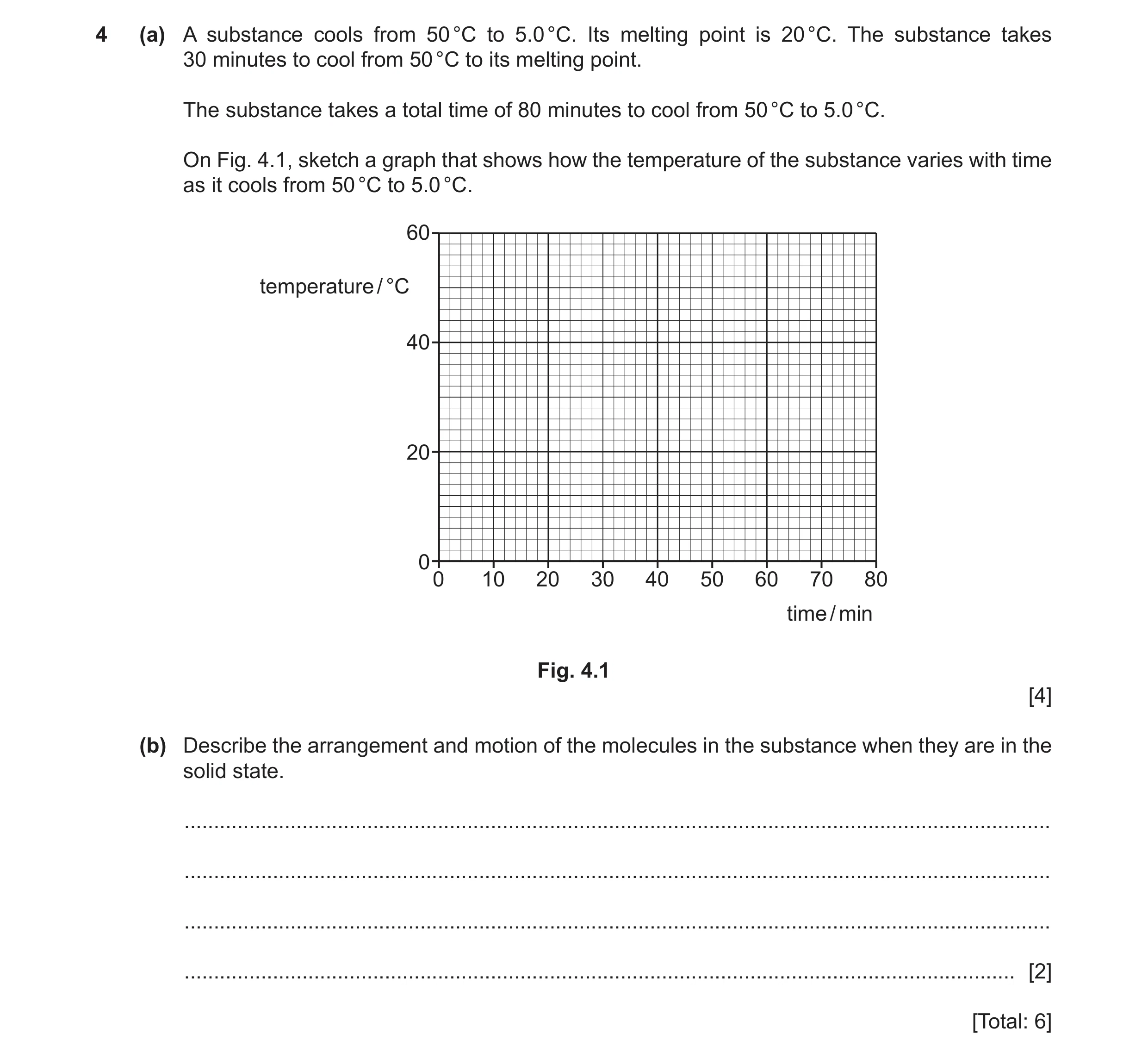
4 (a) A substance cools from 50 °C to 5.0 °C. Its melting point is 20 °C. The substance takes 30 minutes to cool from 50 °C to its melting point. The substance takes a total time of 80 minutes to cool from 50 °C to 5.0 °C. On Fig. 4.1, sketch a graph that shows how the temperature of the substance varies with time as it cools from 50 °C to 5.0 °C. 60 temperature / °C 40 20 0 0 10 20 30 40 50 60 70 80 time / min Fig. 4.1 [4] (b) Describe the arrangement and motion of the molecules in the substance when they are in the solid state. … … … … [2] [Total: 6]
6 marks
Mark scheme: 4(a) horizontal section at 20 °C B1 line starting at (0, 50) line decreasing (steadily) (from (0, 50)) to 20 °C in 30 minutes (by eye) line decreasing from 20 °C AND line reaches 5 °C at time of 80 mins B3 4(b) any two from: (in solid state molecules / they are) close(r)(than in liquids / gases) (in solid state molecules / they are) in regular arrangement (in solid state molecules / they are) in fixed positions (in solid state molecules / they can only) vibrate B2
This question in 0625/31 Oct/Nov 2021
Q17 · A candle underneath a thin, metal fan 0625/32 Oct/Nov 2021
7 (a) Fig. 7.1 shows a candle underneath a thin, metal fan. support for fan direction of rotation thin, metal fan candle Fig. 7.1 When the candle starts to burn, the fan starts to rotate around its support. Explain what causes the fan to rotate. … … … [3] (b) Fig. 7.2 shows a bimetallic strip. It is made of two metals, steel and copper, fastened together. The bimetallic strip is straight when the temperature is 25 °C. clamp steel temperature = 25 °C copper Fig. 7.2 Fig. 7.3 shows the bimetallic strip when the temperature is 40 °C. clamp steel temperature = 40 °C copper Fig. 7.3 (i) Draw the bimetallic strip when the temperature is 10 °C. [1] (ii) The bimetallic strip is used in a circuit, as shown in Fig. 7.4. The circuit is in a room. cell electric bell room temperature = 25 °C steel contacts copper Fig. 7.4 The room temperature is 25 °C. State and explain any changes in the circuit as the temperature of the room rises above 40 °C. … … [2] [Total: 6]
6 marks
Mark scheme: 7(a) any three from: convection (currents) (candle) heats air (warm) air less dense (warm) air rises (rising / moving) air pushes on fan B3 7(b)(i) strip curved downwards B1 7(b)(ii) bimetallic strip curves upwards B1 bell rings OR switches circuit on owtte B1
This question in 0625/32 Oct/Nov 2021
Q18 · State and explain one application of thermal expansion 0625/33 May/June 2022
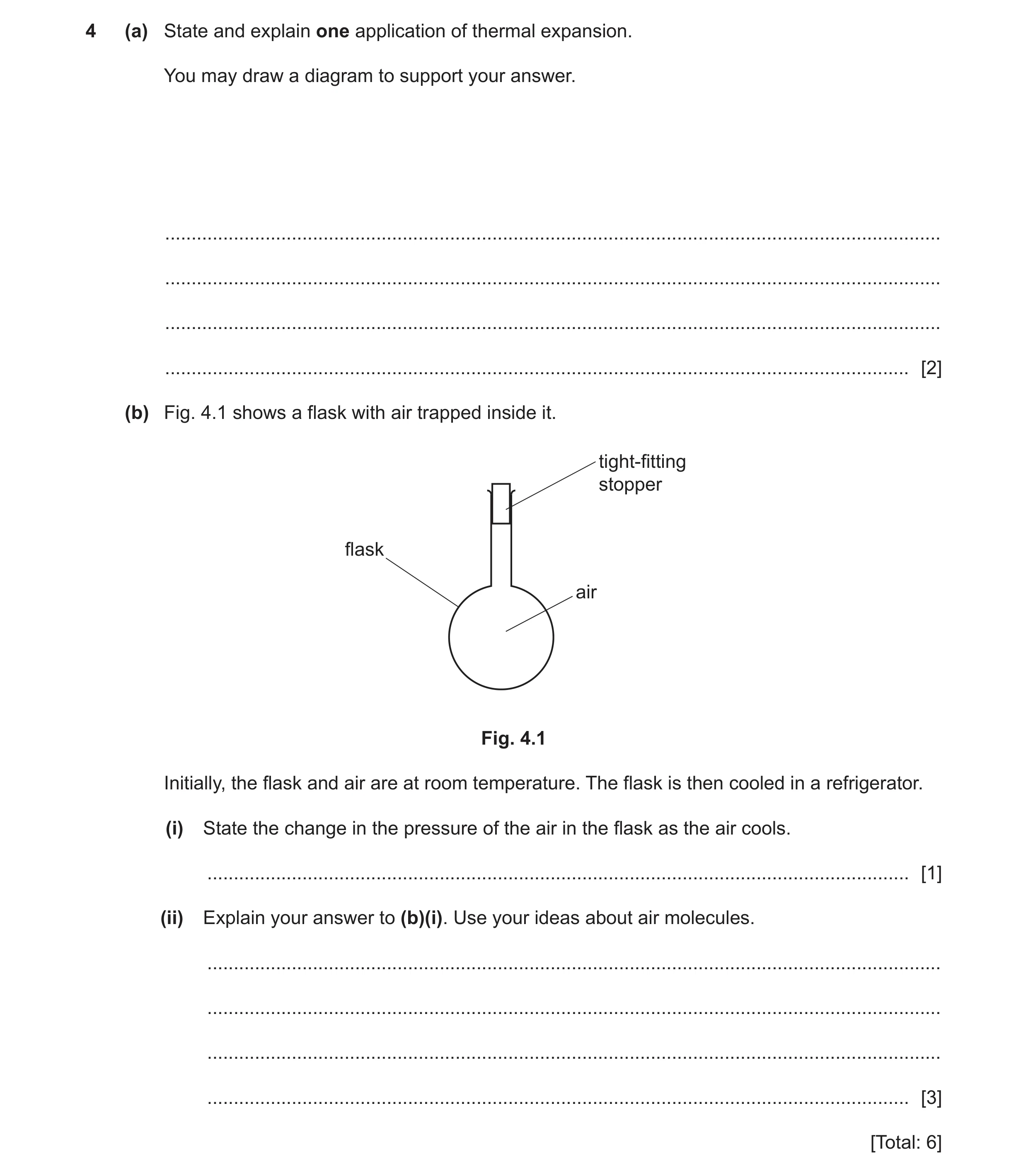
4 (a) State and explain one application of thermal expansion. You may draw a diagram to support your answer. … … … … [2] (b) Fig. 4.1 shows a flask with air trapped inside it. tight-fitting stopper flask air Fig. 4.1 Initially, the flask and air are at room temperature. The flask is then cooled in a refrigerator. (i) State the change in the pressure of the air in the flask as the air cools. … [1] (ii) Explain your answer to (b)(i). Use your ideas about air molecules. … … … … [3] [Total: 6]
6 marks
Mark scheme: 4(a) situation B1 explanation B1 4(b)(i) decreases B1 4(b)(ii) molecules slow(er)/less (kinetic) energy B1 hit (wall/flask) less often B1 hit (wall/flask) with less force B1
This question in 0625/33 May/June 2022
Q19 · An engineer makes a device that absorbs thermal energy from the Sun 0625/33 May/June 2022
5 An engineer makes a device that absorbs thermal energy from the Sun. The absorbed energy heats water. In the device, cold water flows slowly from an upper tank, through a white plastic pipe, to a lower tank. Energy from the Sun heats the water as it flows, as shown in Fig. 5.1. upper cold water tank Sun white plastic pipe lower tank warm water Fig. 5.1 (a) The engineer measures the temperature of the water in each tank. State the name of the instrument used for measuring temperature. … [1] (b) (i) State the name of the process that transfers thermal energy from the Sun to the white plastic pipe. … [1] (ii) State the name of the process that transfers thermal energy through the plastic wall of the pipe to the water inside the pipe. … [1] (c) The engineer wants to increase the thermal energy absorbed by the water in the pipe. Suggest two improvements he can make to increase the thermal energy absorbed. In each case, explain why the suggestion increases the thermal energy absorbed. improvement 1 … … explanation … … improvement 2 … … explanation … … [4] [Total: 7]
7 marks
Mark scheme: 5(a) thermometer B1 5(b)(i) radiation B1 5(b)(ii) conduction B1 5(c) (dull) black pipes B1 better absorber (of radiation)/less reflection from pipes B1 foil/shiny metal behind pipes B1 reflects (radiation back to pipes) owtte B1 valid alternatives (B1)
This question in 0625/33 May/June 2022
Q20 · A liquid-in-glass thermometer has a scale with marks from –10 °C to 110 °C 0625/32 Oct/Nov 2022
3 (a) A liquid-in-glass thermometer has a scale with marks from –10 °C to 110 °C. A student checks the accuracy of the thermometer. Describe how to check the accuracy of: (i) the 100 °C mark on the thermometer scale … … [1] (ii) the 0 °C mark on the thermometer scale. … … [1] (iii) State the importance of the 0 °C and 100 °C marks on a thermometer scale. … [1] (b) We can measure temperature by using physical properties that vary with temperature. (i) State the physical property that we use to measure temperature in a liquid-in-glass thermometer. … [1] (ii) State another physical property that we use to measure temperature. … [1] [Total: 5]
5 marks
Mark scheme: 3(a)(i) steam above pure boiling water (at standard atmospheric pressure) B1 3(a)(ii) melting ice (made from pure water) B1 3(a)(iii) calibration owtte / scale / idea of increased accuracy B1 3(b)(i) expansion / contraction B1 3(b)(ii) length / resistance / e.m.f B1
This question in 0625/32 Oct/Nov 2022
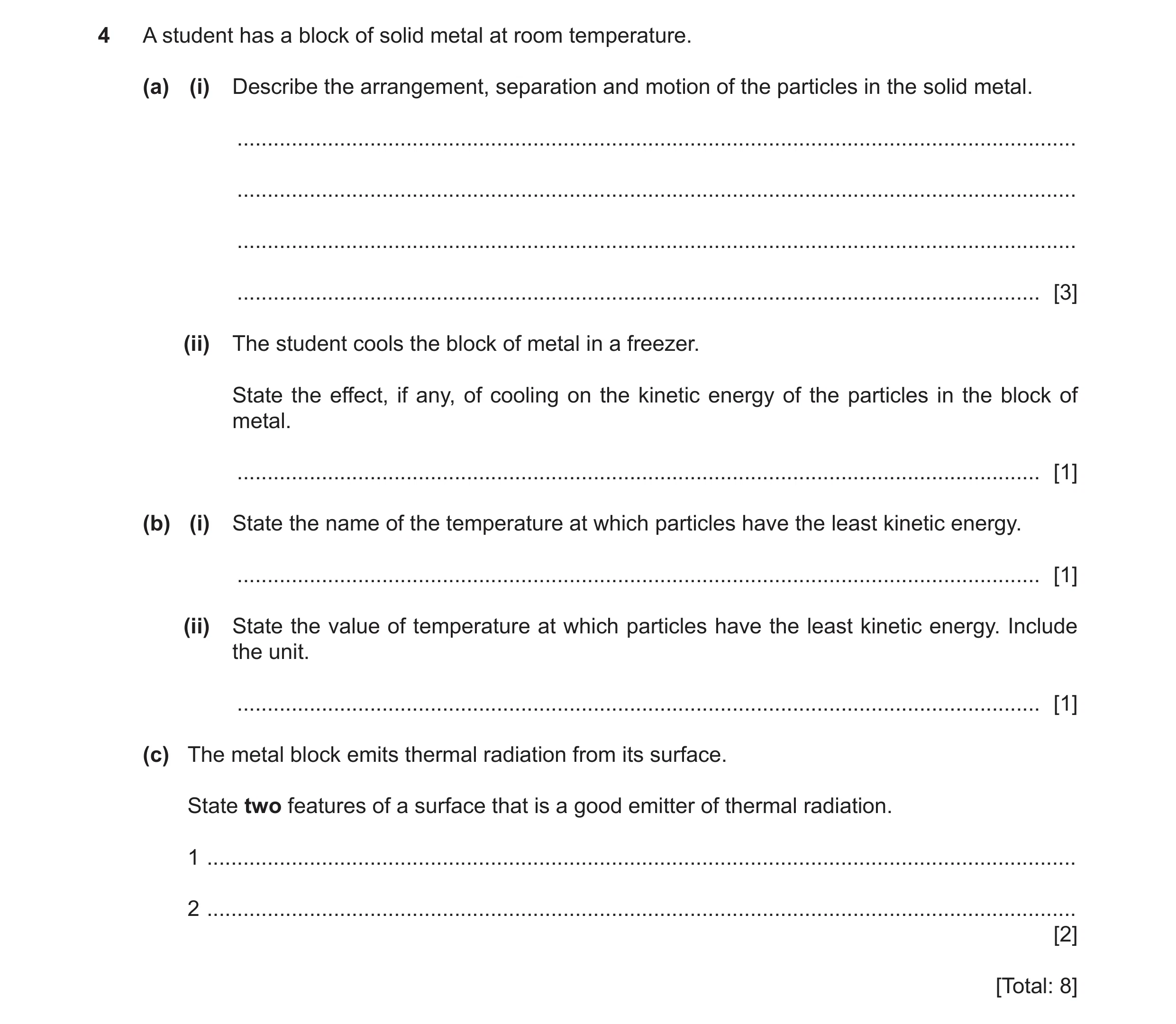
Q21 · A student has a block of solid metal at room temperature 0625/32 May/June 2023
4 A student has a block of solid metal at room temperature. (a) (i) Describe the arrangement, separation and motion of the particles in the solid metal. … … … … [3] (ii) The student cools the block of metal in a freezer. State the effect, if any, of cooling on the kinetic energy of the particles in the block of metal. … [1] (b) (i) State the name of the temperature at which particles have the least kinetic energy. … [1] (ii) State the value of temperature at which particles have the least kinetic energy. Include the unit. … [1] (c) The metal block emits thermal radiation from its surface. State two features of a surface that is a good emitter of thermal radiation. 1 … 2 … [2] [Total: 8]
8 marks
Mark scheme: 4(a)(i) any three from: (particles are) fixed in position / place regular arrangement vibrating close(r than in liquids or gases) B3 4(a)(ii) (kinetic energy) decreases B1 4(b)(i) absolute zero B1 4(b)(ii) –273 °C OR 0 K OR zero K / kelvin B1 4(c) black OR dark (colour) B1 dull OR rough (surface) B1
This question in 0625/32 May/June 2023
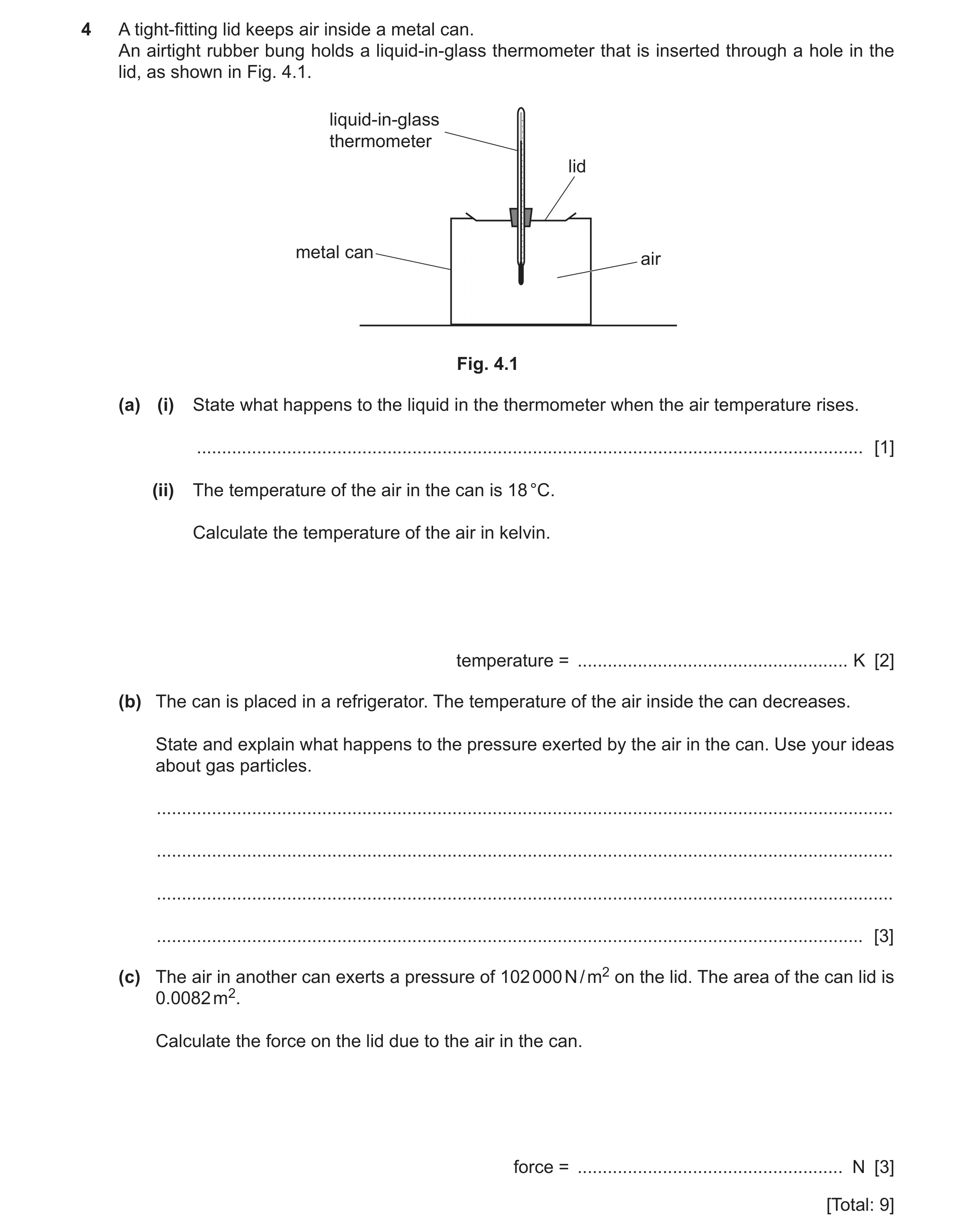
Q22 · A tight-fitting lid keeps air inside a metal can 0625/33 May/June 2023
4 A tight-fitting lid keeps air inside a metal can. An airtight rubber bung holds a liquid-in-glass thermometer that is inserted through a hole in the lid, as shown in Fig. 4.1. liquid-in-glass thermometer lid metal can air Fig. 4.1 (a) (i) State what happens to the liquid in the thermometer when the air temperature rises. … [1] (ii) The temperature of the air in the can is 18 °C. Calculate the temperature of the air in kelvin. temperature = … K [2] (b) The can is placed in a refrigerator. The temperature of the air inside the can decreases. State and explain what happens to the pressure exerted by the air in the can. Use your ideas about gas particles. … … … … [3] (c) The air in another can exerts a pressure of 102 000 N / m2 on the lid. The area of the can lid is 0.0082 m2. Calculate the force on the lid due to the air in the can. force = … N [3] [Total: 9]
9 marks
Mark scheme: 4(a)(i) (liquid / it) expands B1 4(a)(ii) 273 + 18 C1 291 (K) A1 4(b) pressure decreases B1 any two from: particles slower / less kinetic energy collisions (with wall) less frequent collide (with wall) with less force B2 4(c) (F =) P A in any form C1 102 000 0.0082 C1 840 (N) A1
This question in 0625/33 May/June 2023
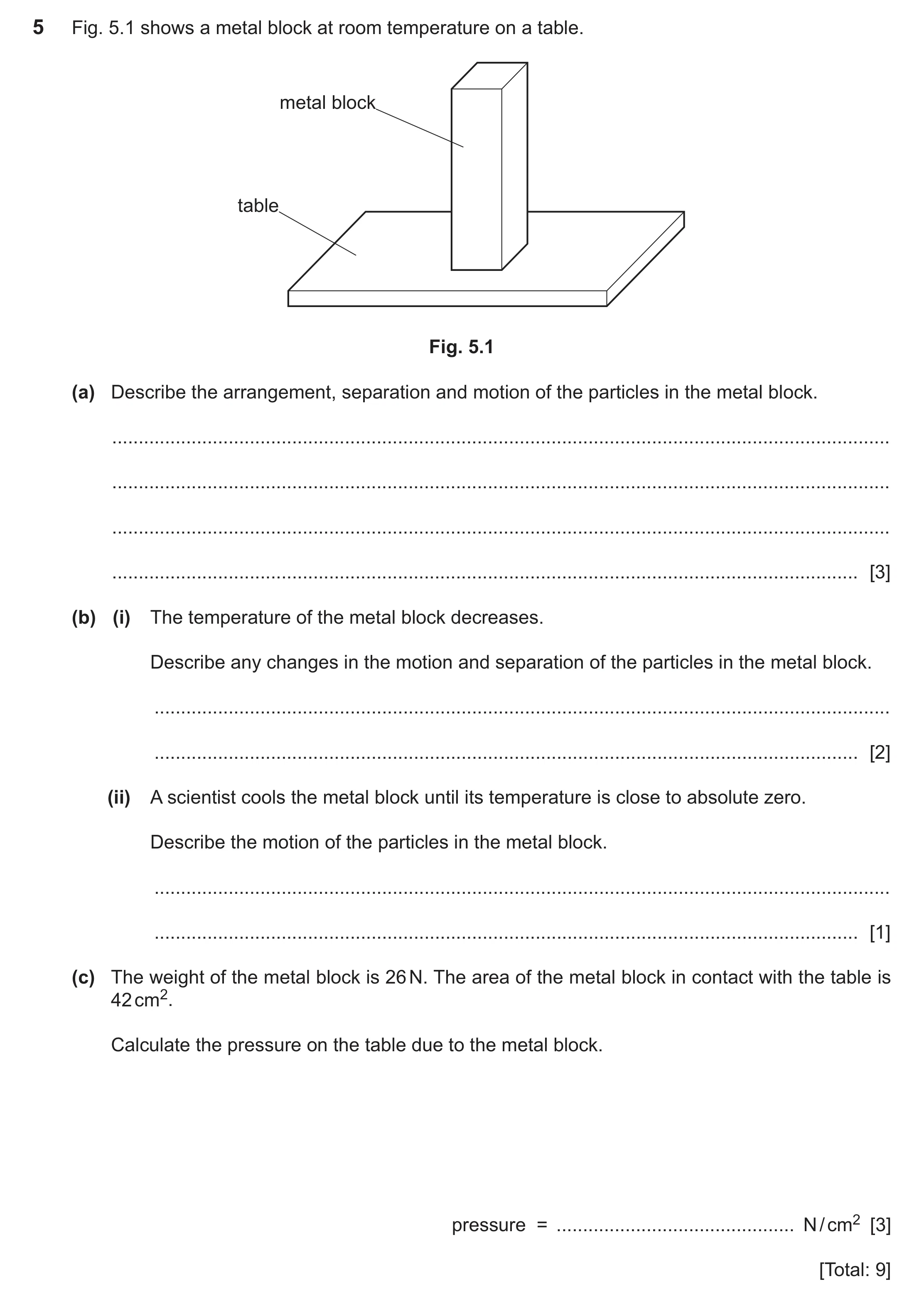
Q23 · A metal block at room temperature on a table 0625/32 May/June 2024
5 Fig. 5.1 shows a metal block at room temperature on a table. metal block table Fig. 5.1 (a) Describe the arrangement, separation and motion of the particles in the metal block. … … … … [3] (b) (i) The temperature of the metal block decreases. Describe any changes in the motion and separation of the particles in the metal block. … … [2] (ii) A scientist cools the metal block until its temperature is close to absolute zero. Describe the motion of the particles in the metal block. … … [1] (c) The weight of the metal block is 26 N. The area of the metal block in contact with the table is 42 cm2. Calculate the pressure on the table due to the metal block. pressure = … N / cm2 [3] [Total: 9]
9 marks
Mark scheme: 5(a) (particles are) fixed in position / in lattice OR regular / fixed arrangement / pattern B1 can only vibrate / no translational KE B1 close / closer (than in liquids or gases) B1 5(b)(i) (particles move) closer (as temperature decreases) B1 particles vibrate slower / less OR have smaller vibrations B1 5(b)(ii) (at absolute zero particles have) least / smallest vibrations B1 5(c) (P =) 0.62 (N / cm2) A3 (P =) 26 ÷ 42 (C2) (P =) F ÷ A (C1)
This question in 0625/32 May/June 2024
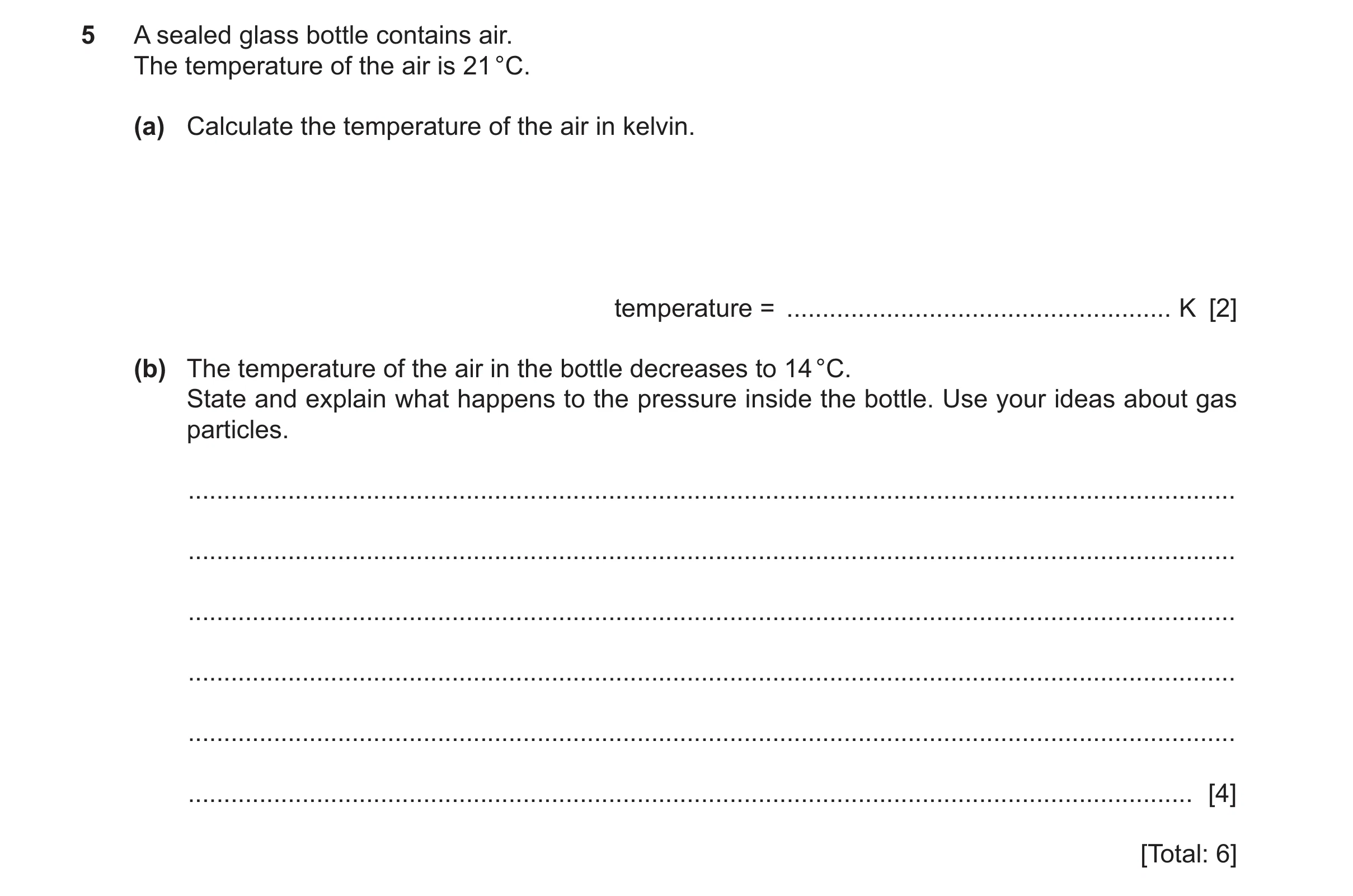
Q24 · A sealed glass bottle contains air 0625/32 Oct/Nov 2024
5 A sealed glass bottle contains air. The temperature of the air is 21 °C. (a) Calculate the temperature of the air in kelvin. temperature = … K [2] (b) The temperature of the air in the bottle decreases to 14 °C. State and explain what happens to the pressure inside the bottle. Use your ideas about gas particles. … … … … … … [4] [Total: 6]
6 marks
Mark scheme: 5(a) 294 (K) A2 273 (+ 21) (C1) 5(b) • low(er) pressure B1 any three from: • slow(er)particles or particles have less Kinetic Energy OR less energy in the kinetic store • less frequent collisions (with inside of bottle) B3 • (collide with) less force • pressure = force / area OR p = F A
This question in 0625/32 Oct/Nov 2024
Q25 · Table 5.1 defines three specific temperatures 0625/33 Oct/Nov 2024
5 (a) Table 5.1 defines three specific temperatures. (i) Complete Table 5.1 by writing the correct temperature for each definition. Table 5.1 definition temperature / °C pure water boiling at standard atmospheric pressure pure ice melting at standard atmospheric pressure the lowest possible temperature of matter [3] (ii) The temperature of air in a room is 15 °C. Calculate the temperature of the air in kelvin. temperature = … K [2] (b) A teacher demonstrates thermal energy transfer through some metal rods. Fig. 5.1 shows the arrangement. metal rods Bunsen burner block of wood pins held on by wax Fig. 5.1 The metal rods are placed on a block of wood. The demonstration compares how quickly thermal energy is transferred to the wax at the end of each rod. (i) State the name of the process for thermal energy transfer through the metal rods. … [1] (ii) The rods are made from different metals. The rods have the same length and diameter. The ends of the rods in the Bunsen flame are at the same temperature. State how the demonstration shows which metal transfers thermal energy at the greatest rate. … … [2] (c) A playground includes a concrete area with white and black squares, as shown in Fig. 5.2. Fig. 5.2 The Sun shines on the concrete area during the day. The temperature of the concrete area increases. During the afternoon, students compare the temperature of the white squares with the temperature of the black squares. State and explain whether the white squares or the black squares have the higher temperature. Include the name of the process of thermal energy transfer from the Sun to the squares. … … … [2] [Total: 10]
10 marks
Mark scheme: 5(a)(i) B1 pure water boiling at standard atmospheric pressure 100 B1 pure ice melting at standard atmospheric pressure 0 the lowest possible temperature of matter –273 B1 5(a)(ii) 288 (K) A2 273 + 15 (C1) 5(b)(i) conduction B1 5(b)(ii) first wax to melt or first pin to fall off or the faster the pin falls off M1 the better the conductor / energy transfer / has the greatest rate A1 5(c) black (square) B1 AND either black – best/good absorber OR worse / poor reflector OR B1 white – best/good reflector OR worse / poor absorber of radiation / infrared (radiation)
This question in 0625/33 Oct/Nov 2024
Q26 · A student warms some water in a metal container using an electric heater, as shown in Fig 0625/32 Feb/March 2025
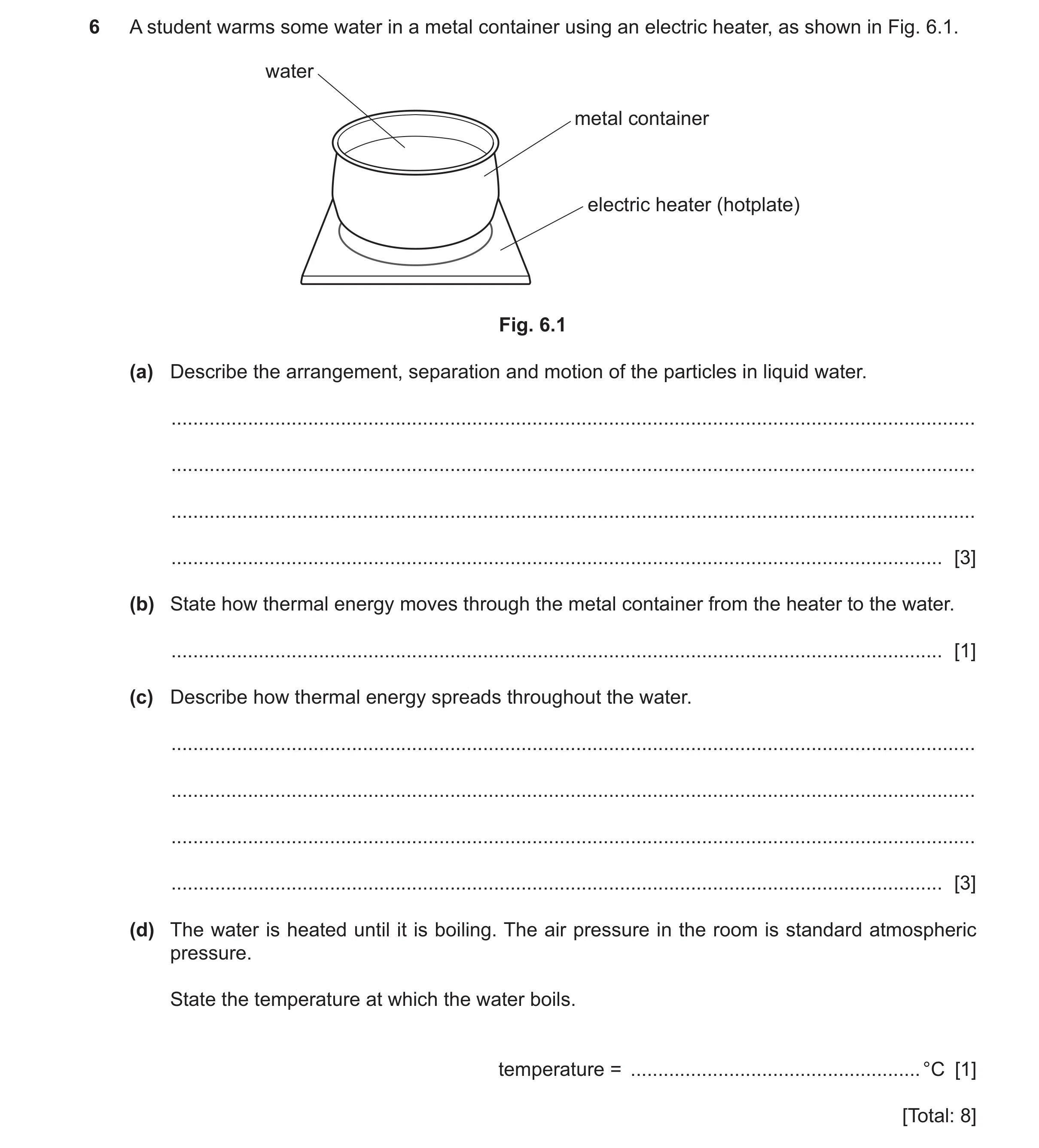
6 A student warms some water in a metal container using an electric heater, as shown in Fig. 6.1. water metal container electric heater (hotplate) Fig. 6.1 (a) Describe the arrangement, separation and motion of the particles in liquid water. … … … … [3] (b) State how thermal energy moves through the metal container from the heater to the water. … [1] (c) Describe how thermal energy spreads throughout the water. … … … … [3] (d) The water is heated until it is boiling. The air pressure in the room is standard atmospheric pressure. State the temperature at which the water boils. temperature = … °C [1] [Total: 8]
8 marks
Mark scheme: 6(a) any three from (particles are:) B3 in a random arrangement close together OR slightly further apart than in solids move freely OR slide over each other collide (with each other) moving randomly 6(b) conduction B1 6(c) any three from: B3 convection idea that water at bottom of pan is warmed / temp of water at bottom increases warm water is less dense less dense / warm water rises OR more dense/colder water sinks 6(d) 100 (°C) B1
This question in 0625/32 Feb/March 2025
Q27 · Complete the sentences about the kinetic particle model of matter 0625/32 May/June 2025
4 (a) Complete the sentences about the kinetic particle model of matter. (i) The movement of the particles in a gas is … … . [1] (ii) The forces between the particles in a gas are … … . [1] (iii) The gas exerts a pressure because the moving gas particles … … . [1] (iv) As the temperature of a fixed volume of gas decreases, the pressure exerted by the gas … . [1] (b) (i) State the value, in degrees Celsius, of the lowest possible temperature. lowest possible temperature = … °C [1] (ii) State the term used for the lowest possible temperature. … [1] [Total: 6]
6 marks
Mark scheme: 4(a)(i) random B1 4(a)(ii) weak / small / negligible B1 4(a)(iii) collide B1 4(a)(iv) decreases B1 4(b)(i) −273 ( C) B1 4(b)(ii) absolute zero B1
This question in 0625/32 May/June 2025
Q28 · Complete the sentences about the kinetic particle model of matter 0625/33 May/June 2025
4 (a) Complete the sentences about the kinetic particle model of matter. (i) The movement of the particles in a gas is … … . [1] (ii) The forces between the particles in a gas are … … . [1] (iii) The gas exerts a pressure because the moving gas particles … … . [1] (iv) As the temperature of a fixed volume of gas decreases, the pressure exerted by the gas … . [1] (b) (i) State the value, in degrees Celsius, of the lowest possible temperature. lowest possible temperature = … °C [1] (ii) State the term used for the lowest possible temperature. … [1] [Total: 6]
6 marks
Mark scheme: 4(a)(i) random B1 4(a)(ii) weak / small / negligible B1 4(a)(iii) collide B1 4(a)(iv) decreases B1 4(b)(i) −273 ( C) B1 4(b)(ii) absolute zero B1
This question in 0625/33 May/June 2025
Q29 · A teacher shows the class a demonstration about heat energy and states of matter 0625/33 Oct/Nov 2025
4 (a) A teacher shows the class a demonstration about heat energy and states of matter. The teacher heats a substance. A heater supplies thermal energy at a steady rate. The students measure the temperature of the substance every minute for 30 minutes. Fig. 4.1 shows the graph of their results. At point A, the substance is solid. 200 F 150 temperature D E / °C 100 B C 50 0 A 0 5 10 15 20 25 30 time / min Fig. 4.1 (i) Describe the effect of the thermal energy input in section AB of the graph. … [1] (ii) Describe the effect of the thermal energy input in section BC of the graph. … [1] (iii) Determine the temperature at which the substance boils. … [1] (iv) Deduce the state of matter of the substance in section EF of the graph. … [1] (b) Evaporation is the name of a process that causes puddles of water to dry gradually. (i) Describe the process of evaporation. Use your ideas about particles. … … … … … [3] (ii) Describe another effect that evaporation has on the remaining water in the puddle. … [1] [Total: 8]
8 marks
Mark scheme: 4(a)(i) temperature increasing or internal energy increasing B1 4(a)(ii) melting or changing from solid to liquid B1 4(a)(iii) 140 (°C) B1 4(a)(iv) Gas B1 4(b)(i) any three from the following: B3 • liquid (particles) → gas / vapour (particles) • happens at a surface • (liquid / water absorbs) thermal energy / heat from sun / surroundings / remaining liquid • (average) kinetic energy of particle increases • more energetic particles escape owtte 4(b)(ii) (remaining liquid) cools B1
This question in 0625/33 Oct/Nov 2025
 3 / 32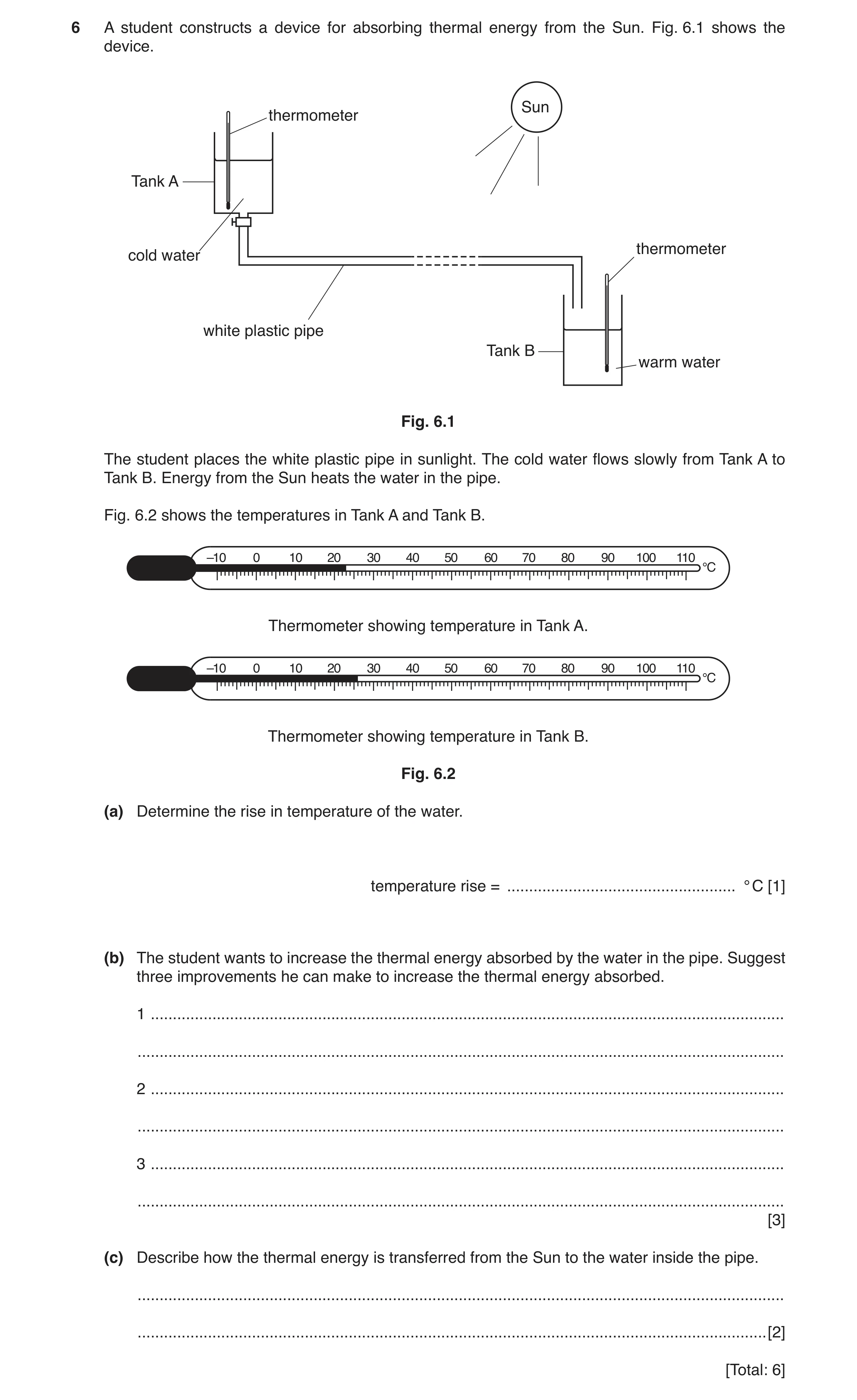
 6 / 32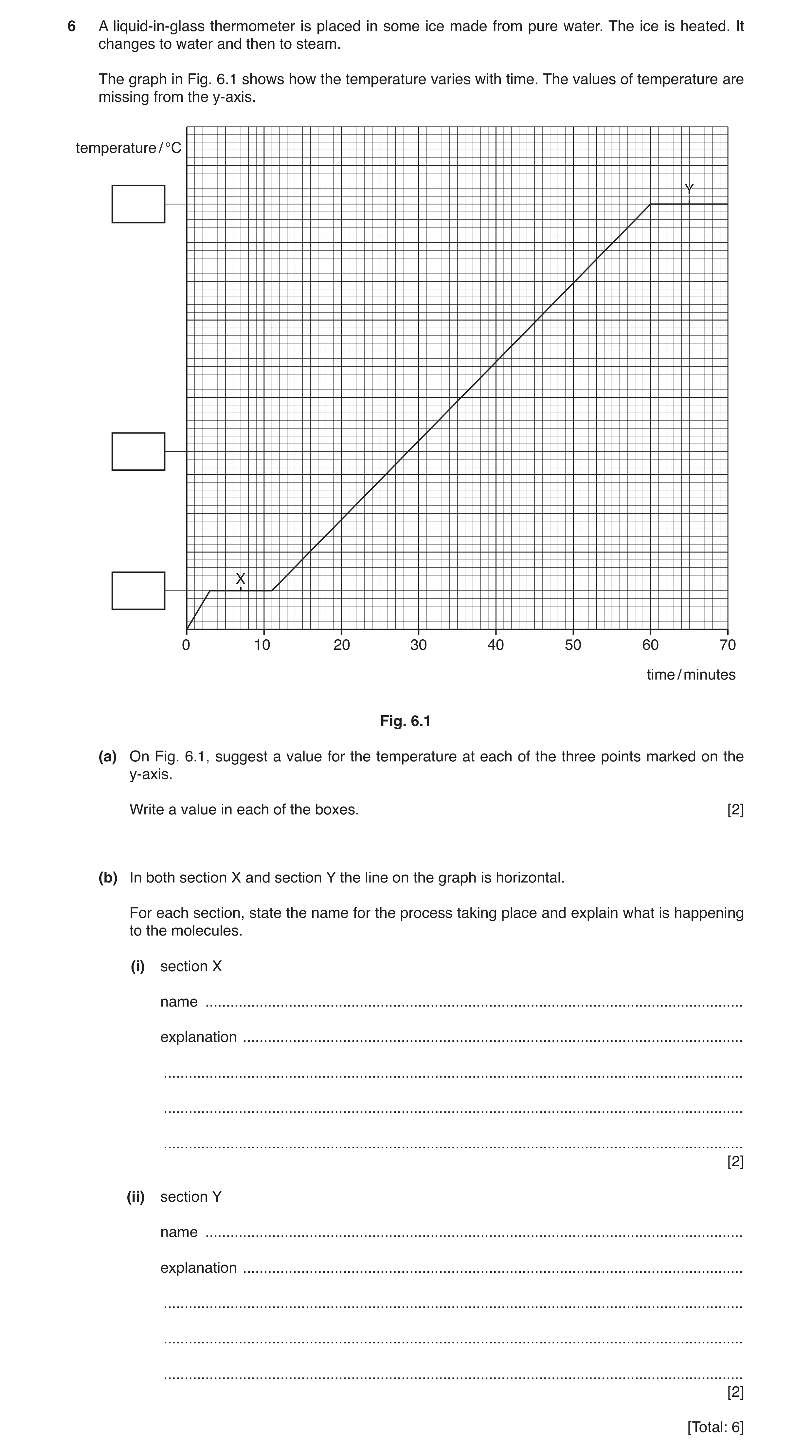
 9 / 32
 10 / 32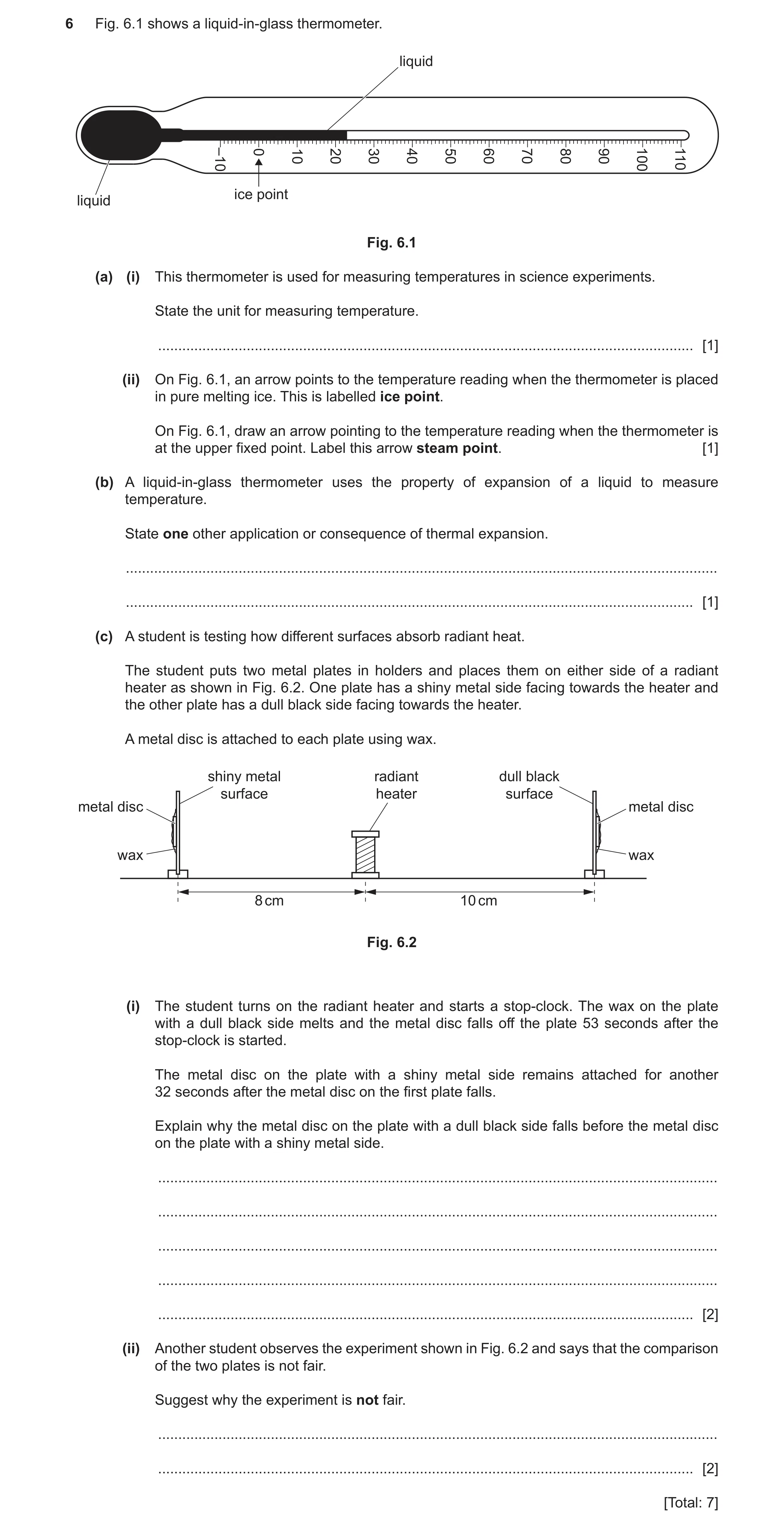
 12 / 32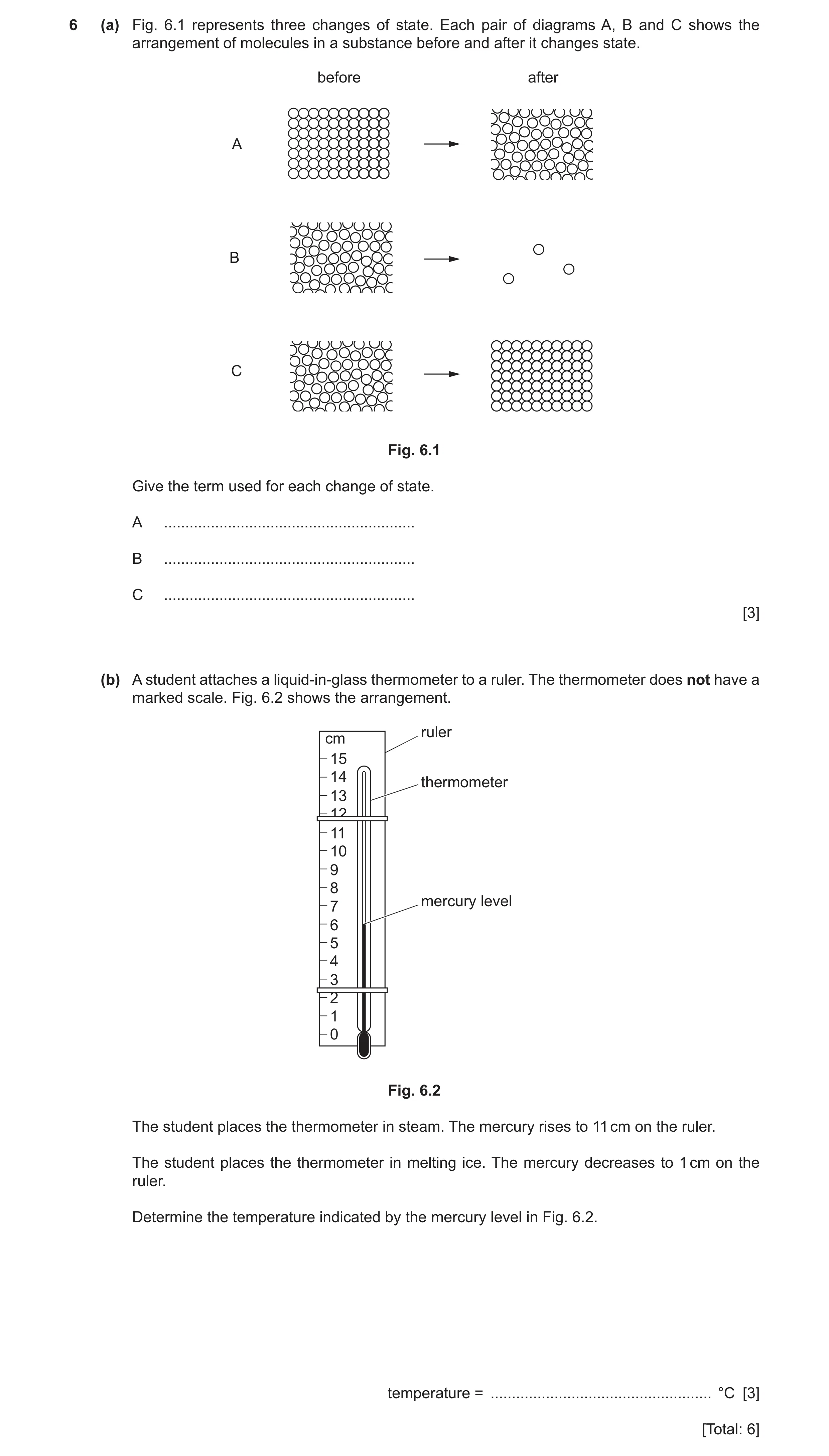
 14 / 32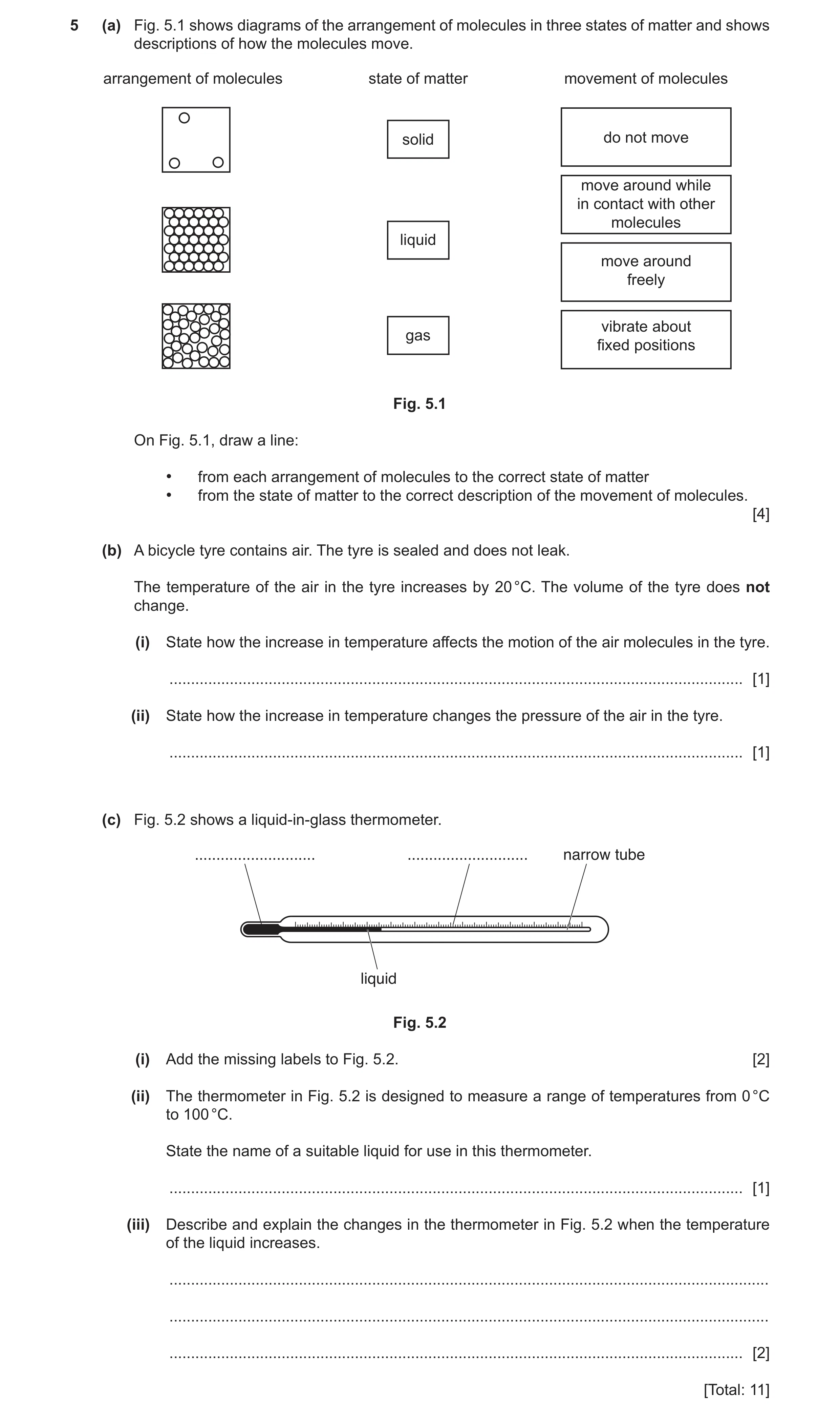
 18 / 32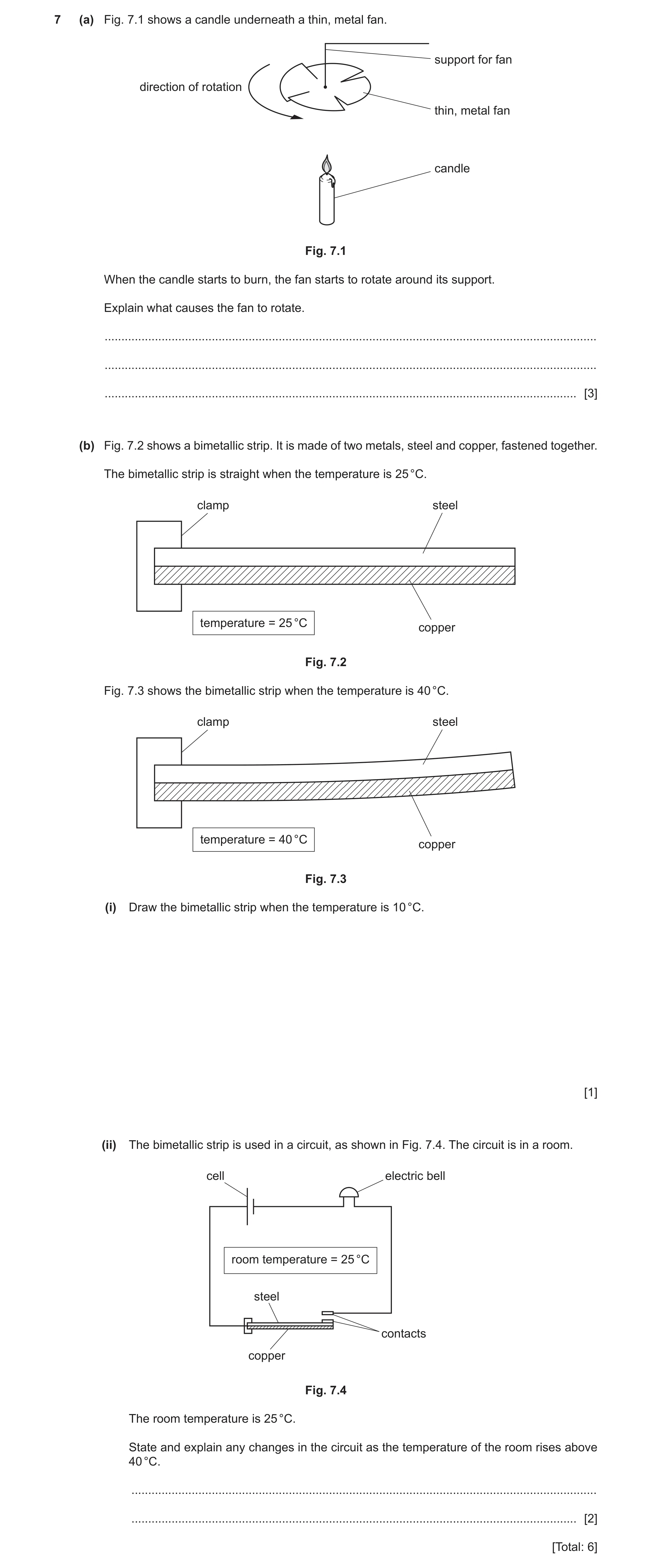
 21 / 32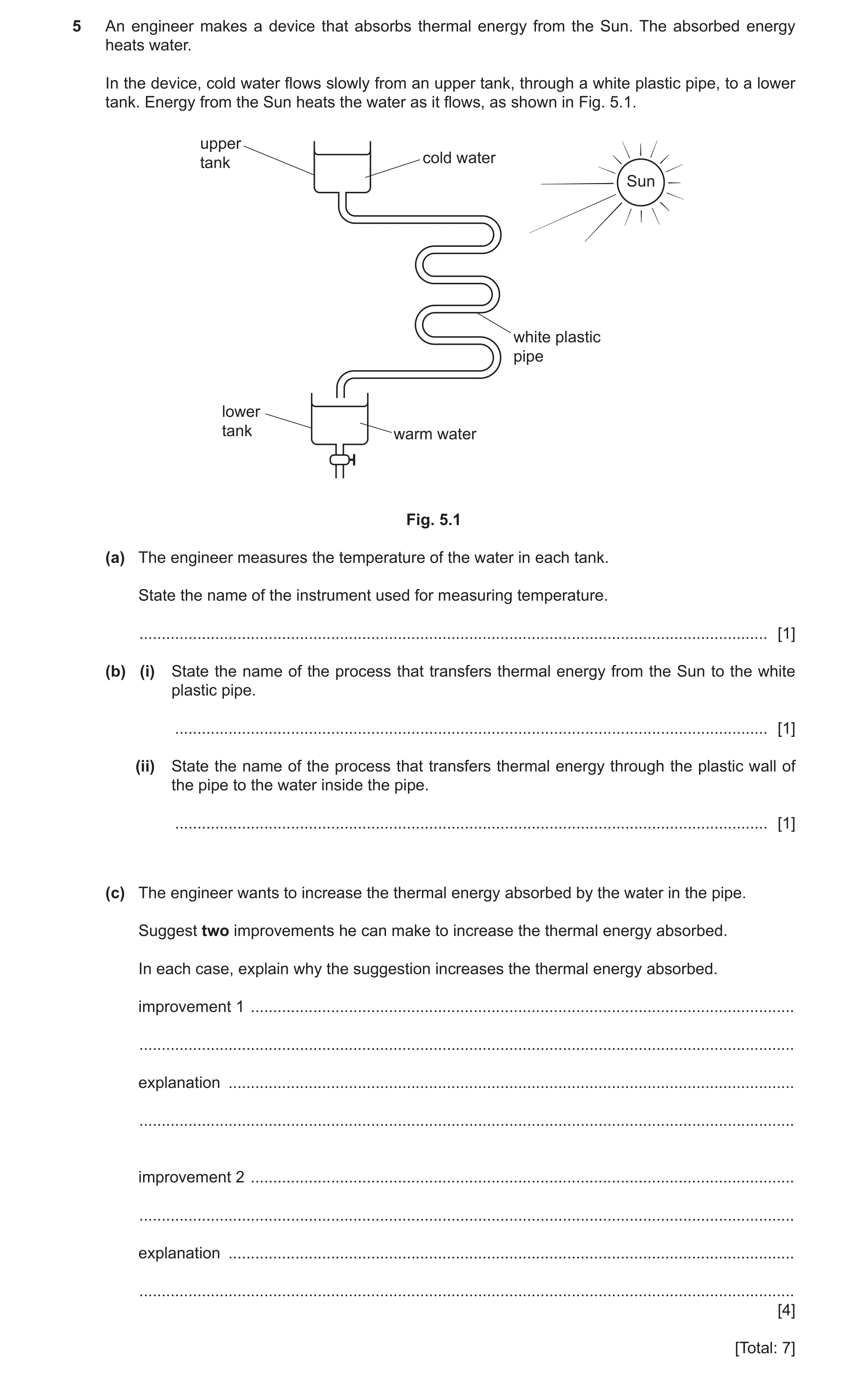
 23 / 32
 24 / 32
 25 / 32
 26 / 32
 27 / 32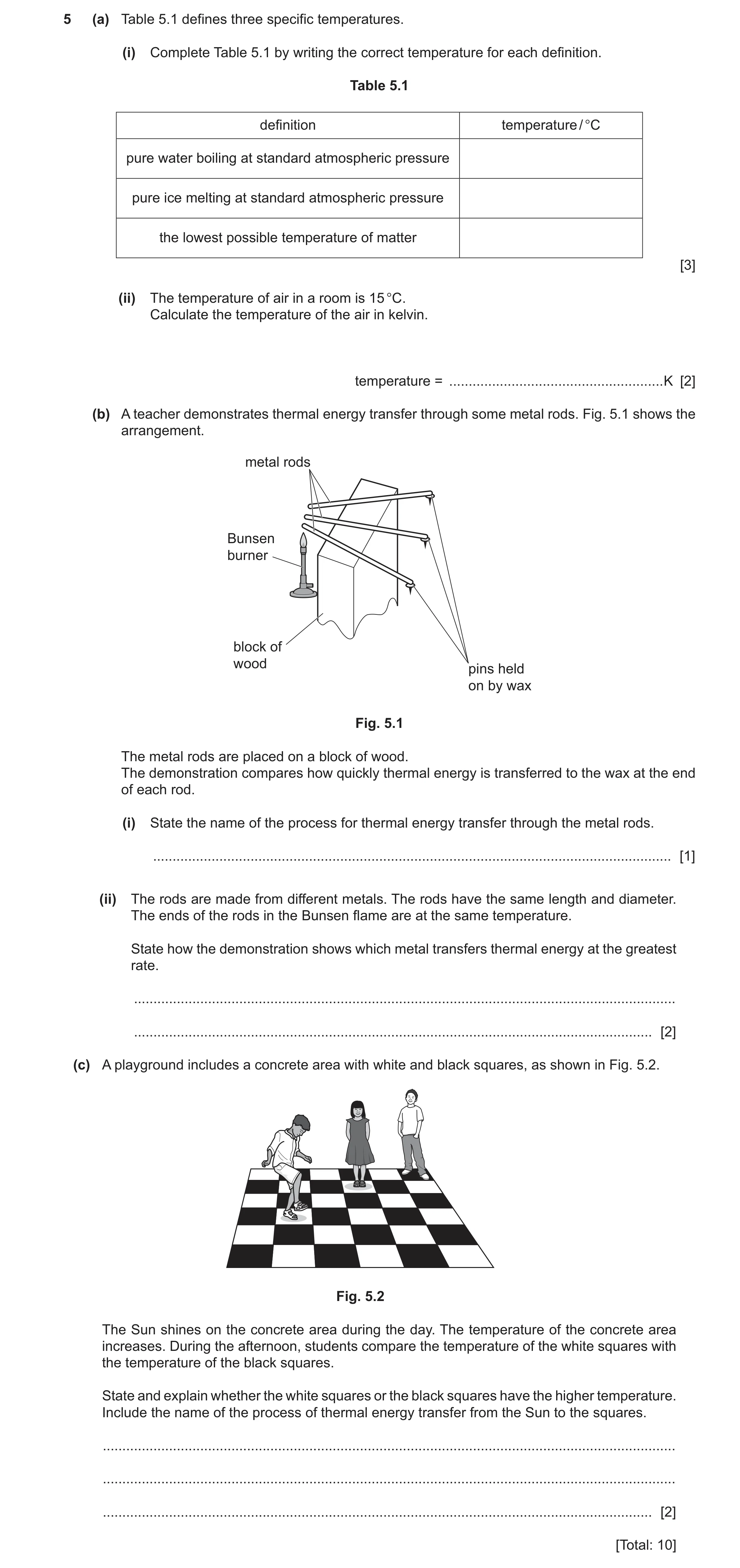
 29 / 32
 30 / 32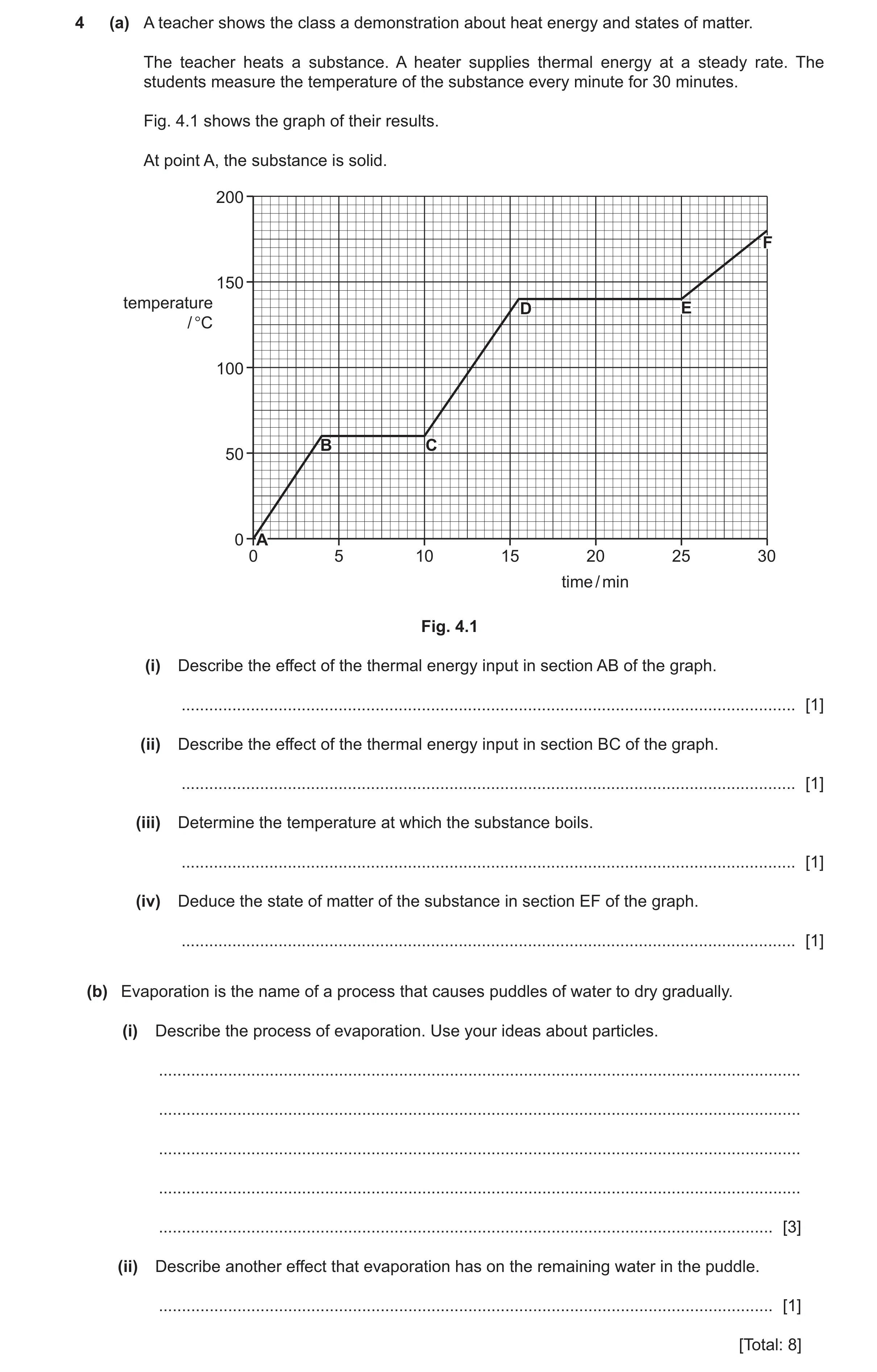
 8
8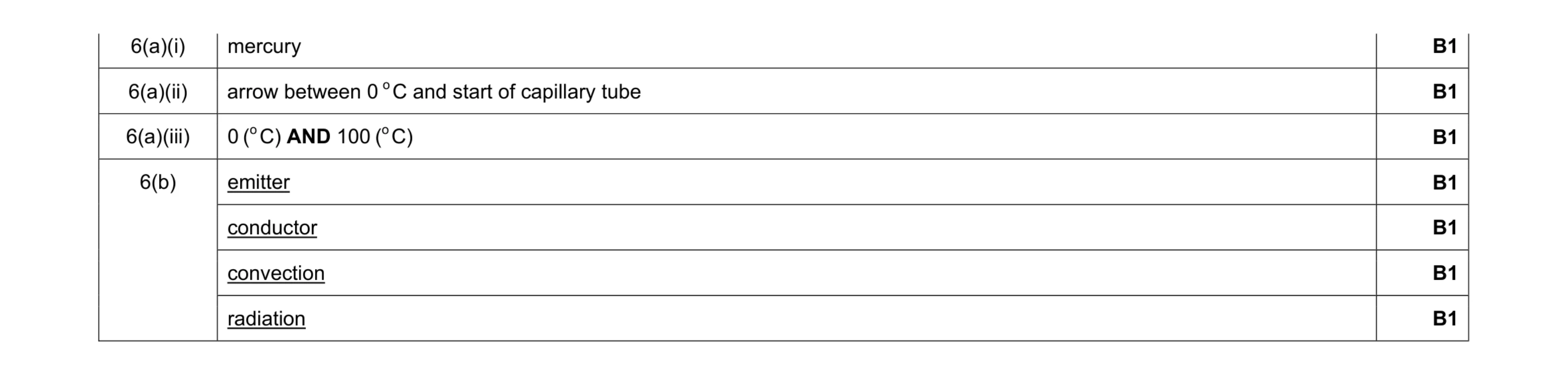 7
7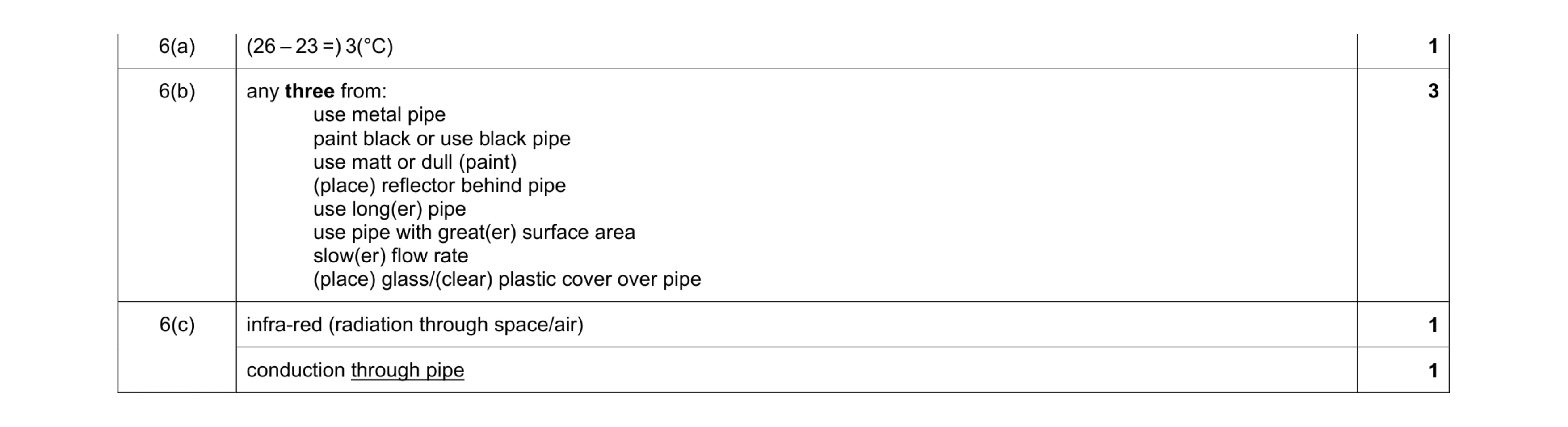 6
6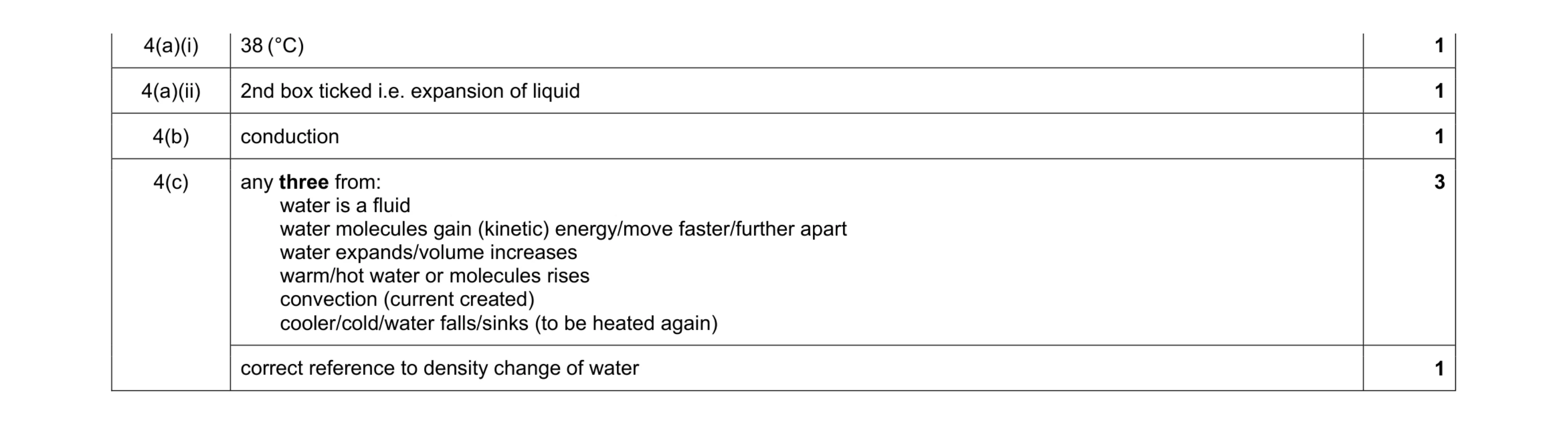 7
7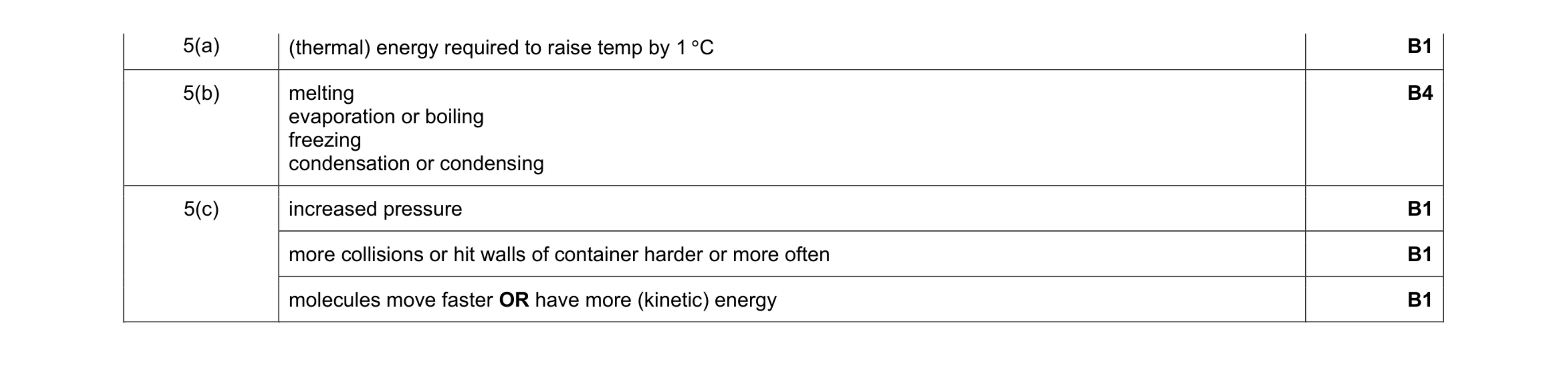 8
8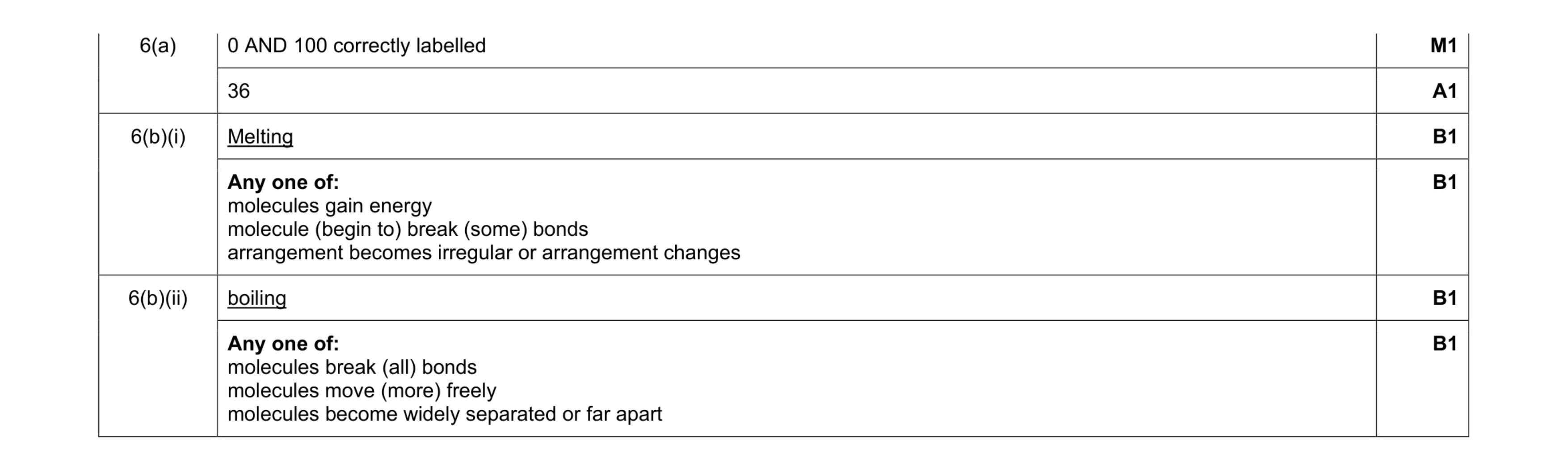 6
6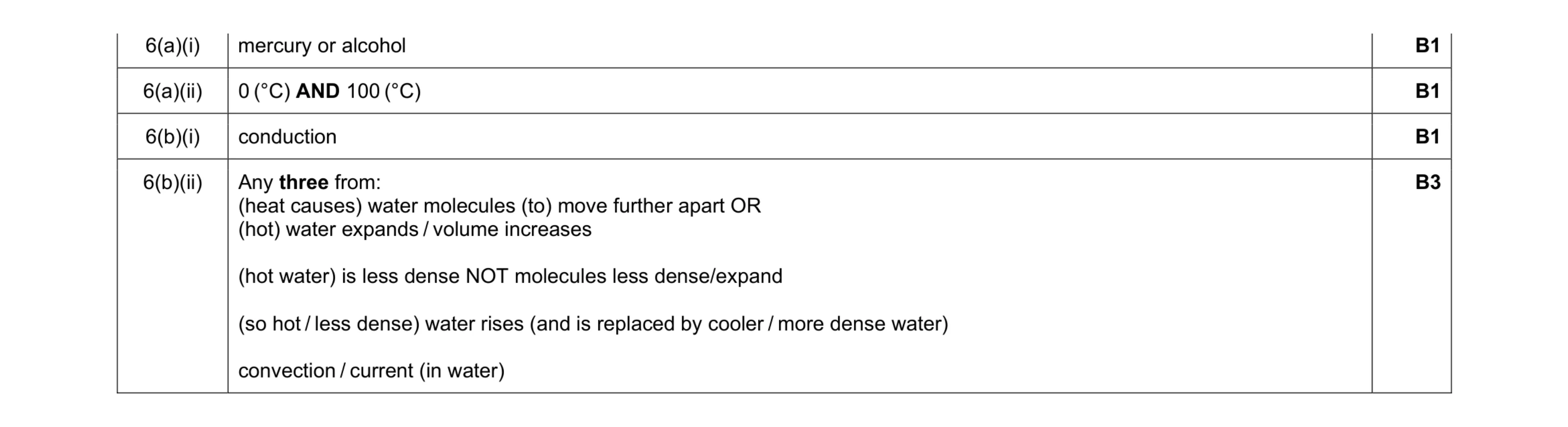 6
6 6
6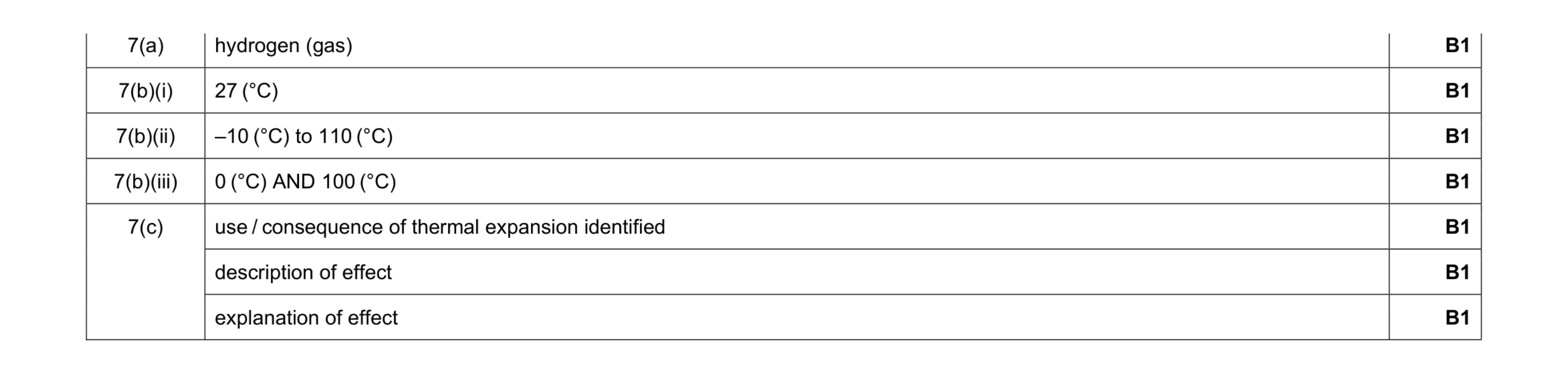 7
7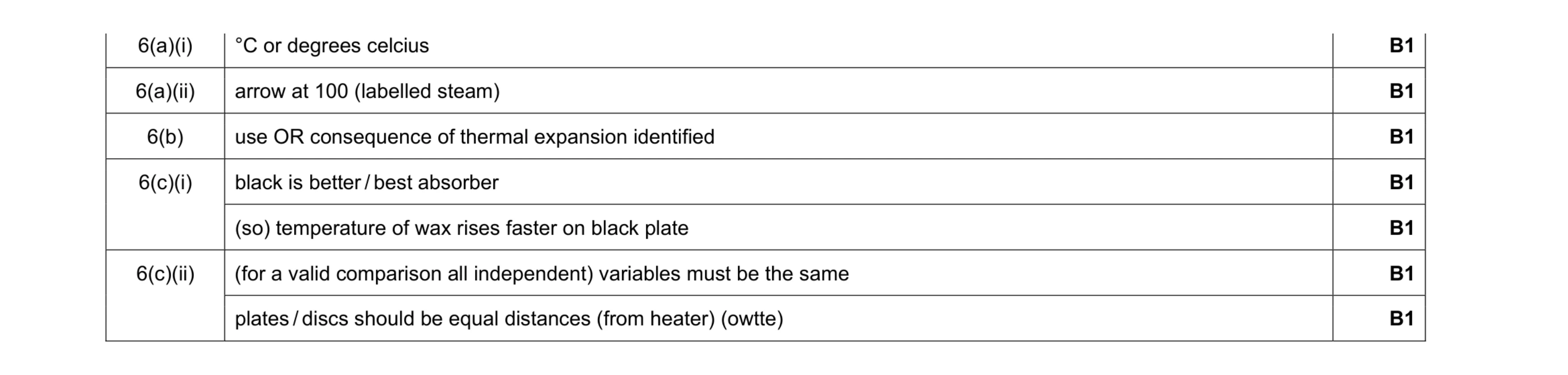 7
7 5
5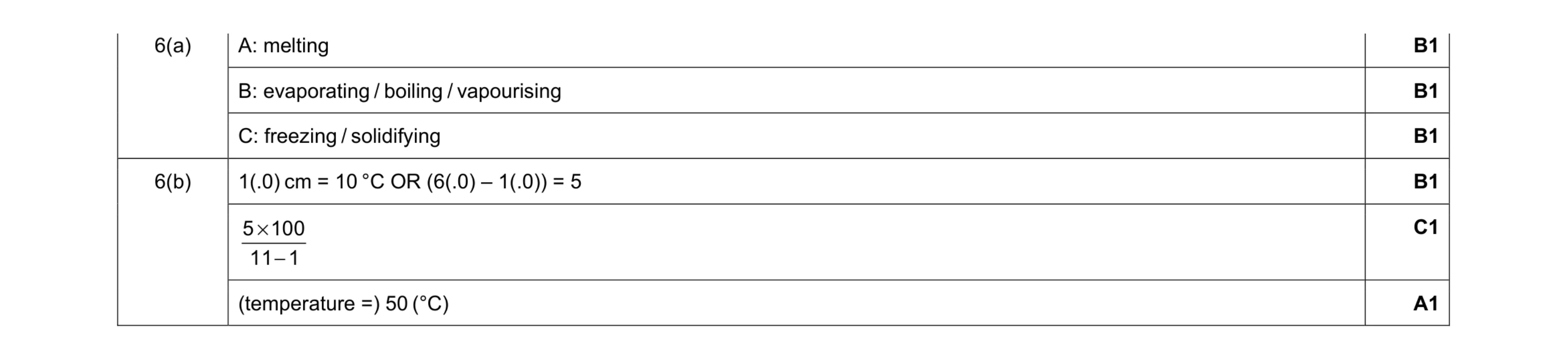 6
6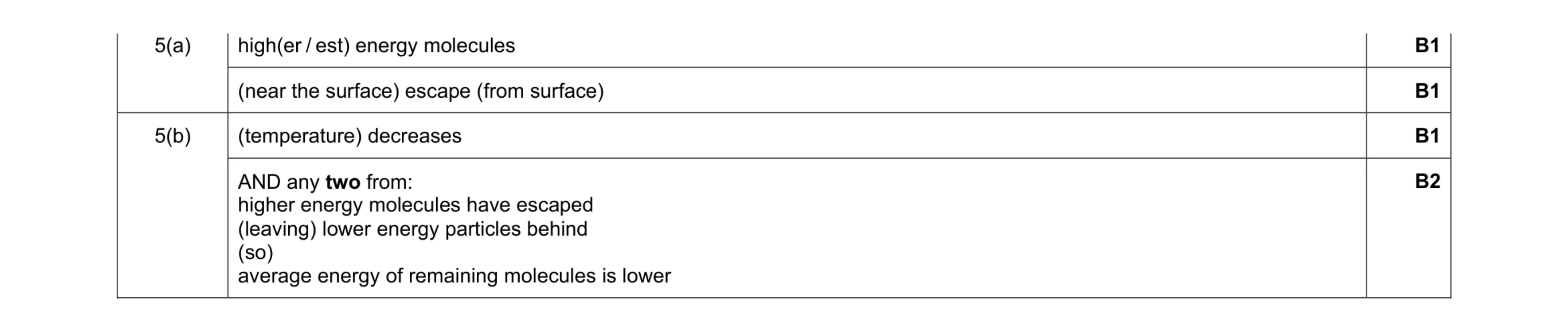 5
5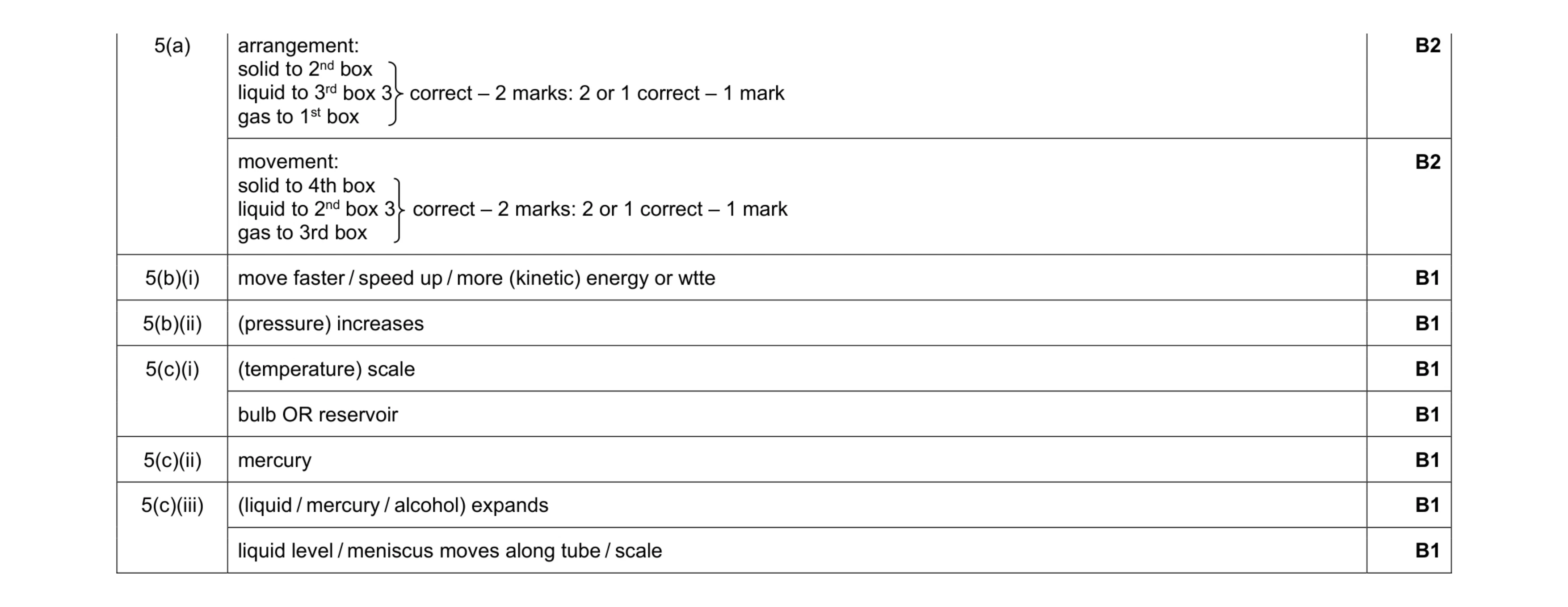 11
11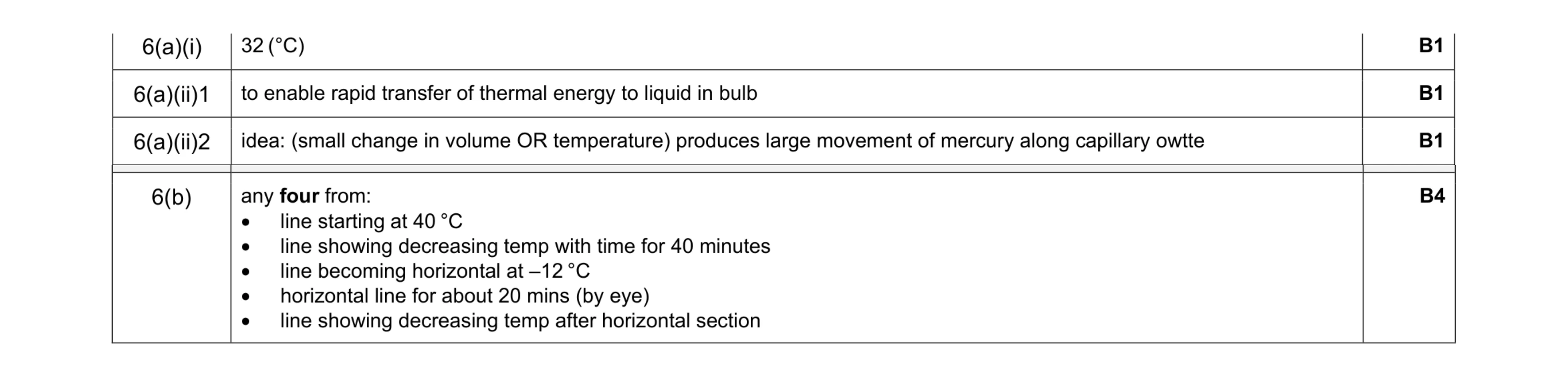 7
7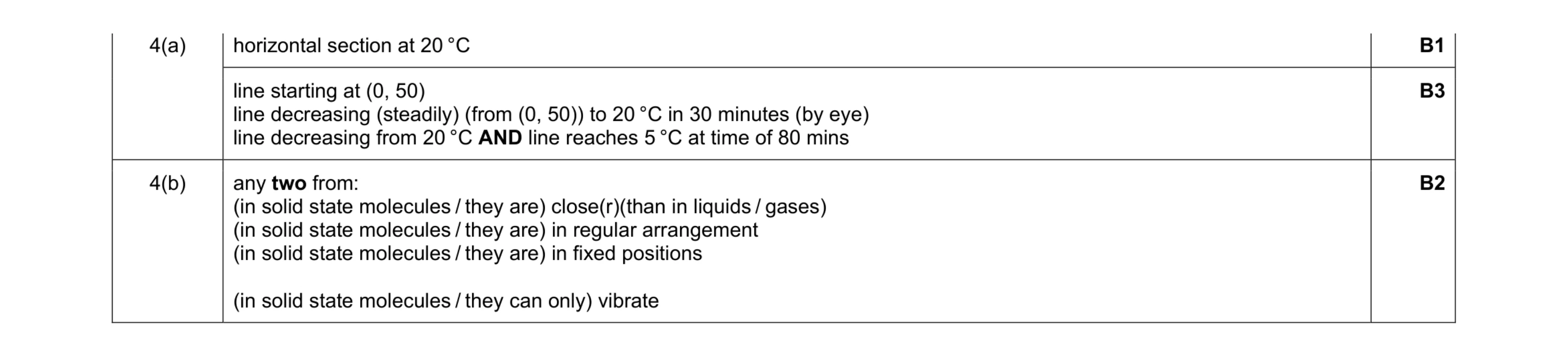 6
6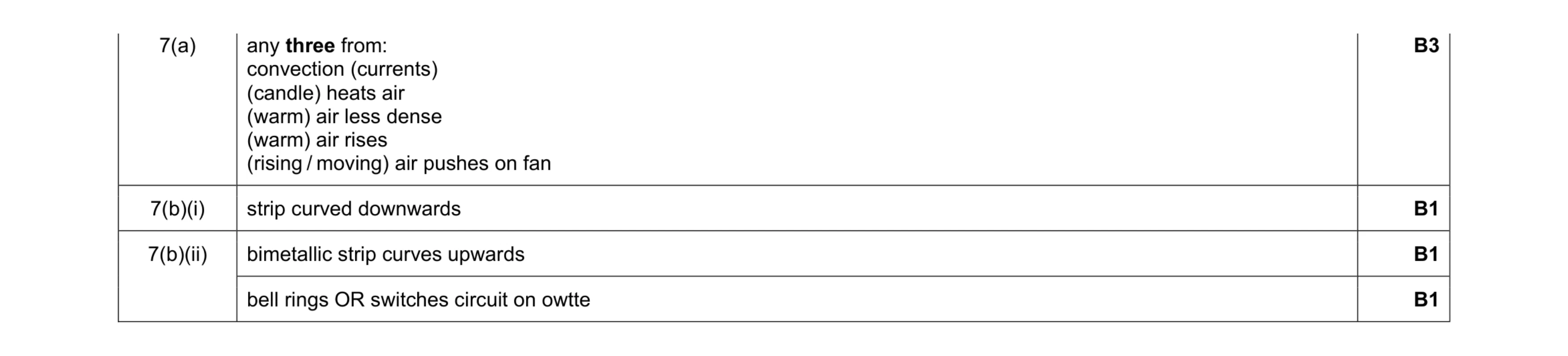 6
6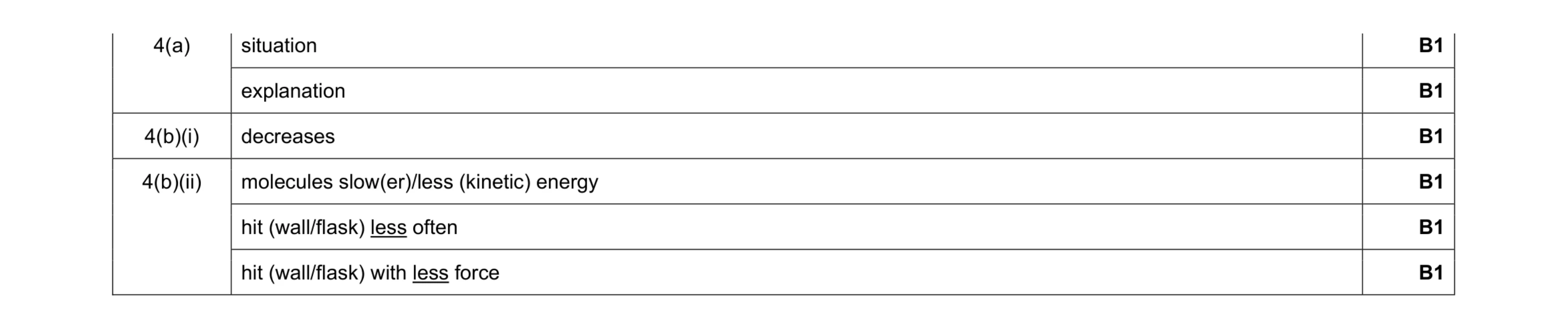 6
6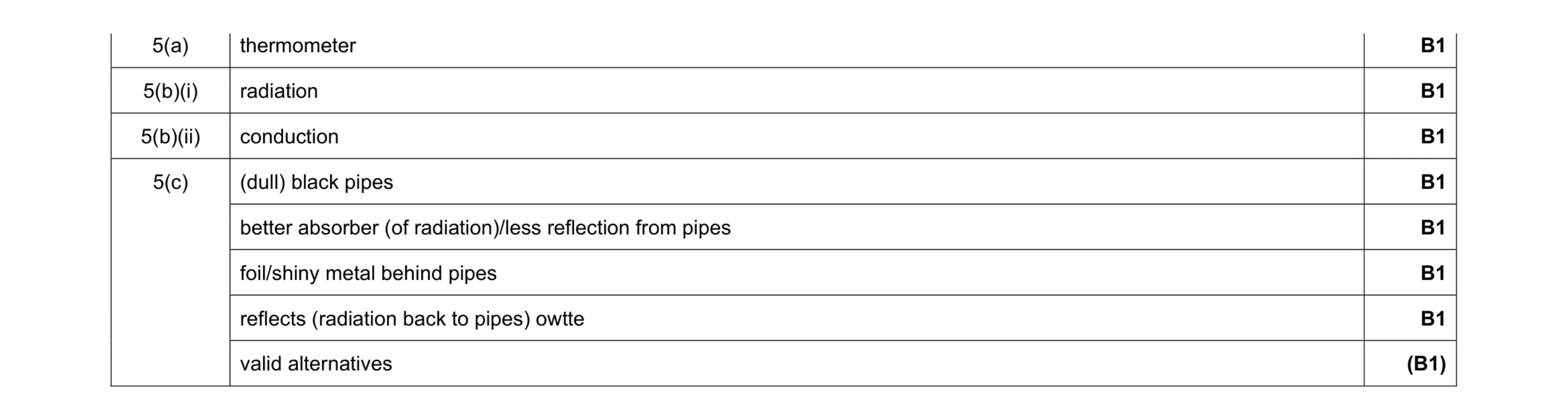 7
7 5
5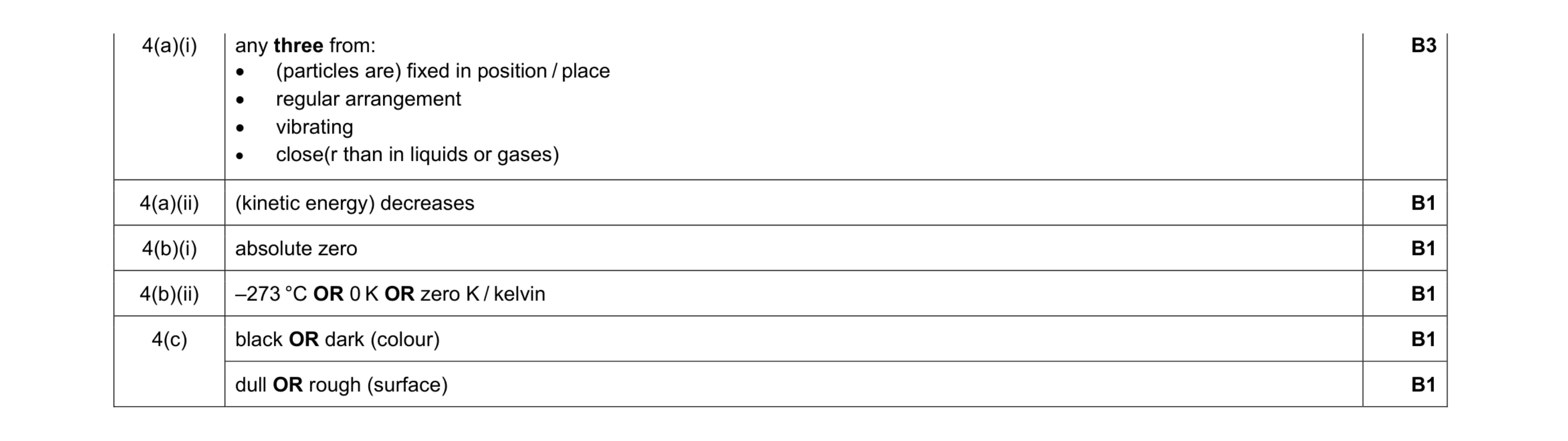 8
8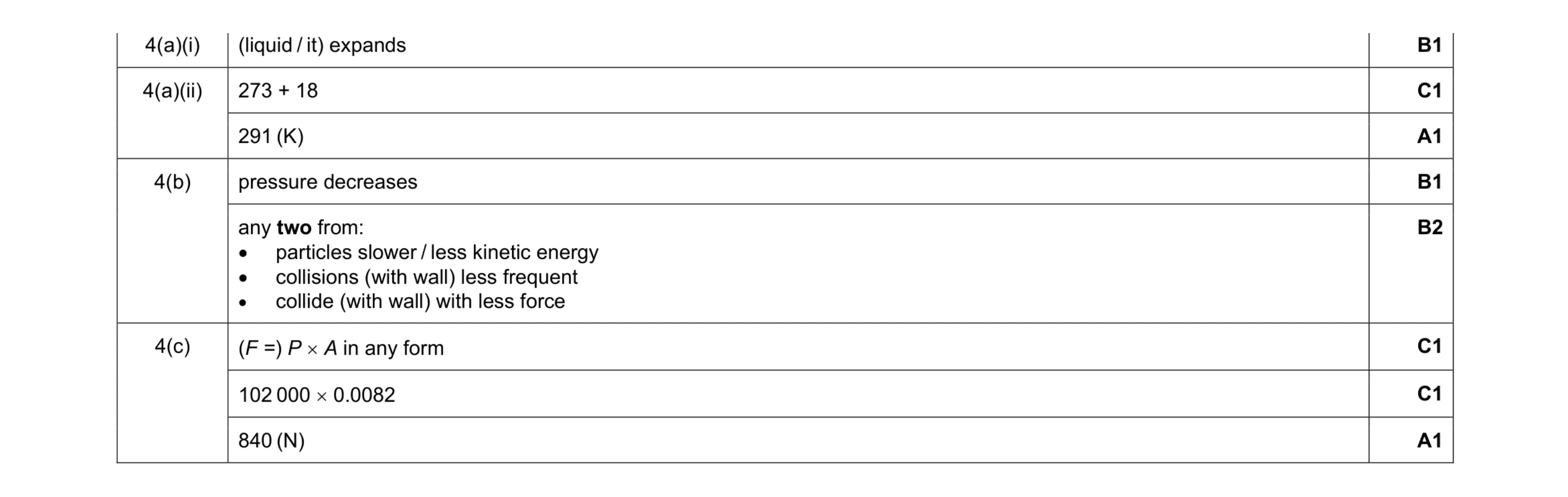 9
9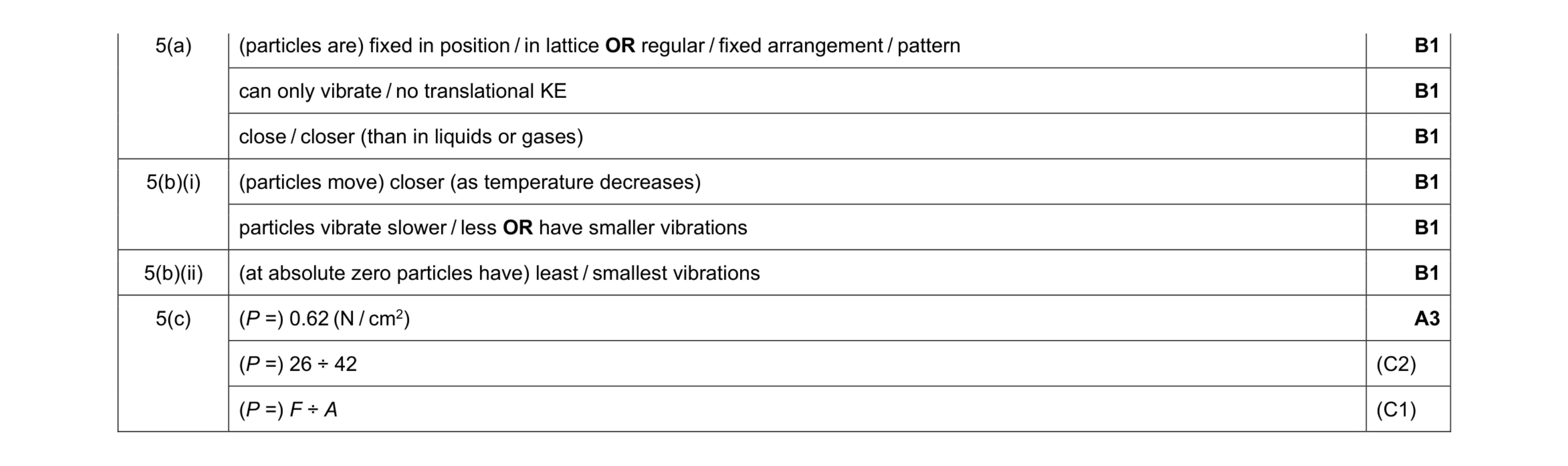 9
9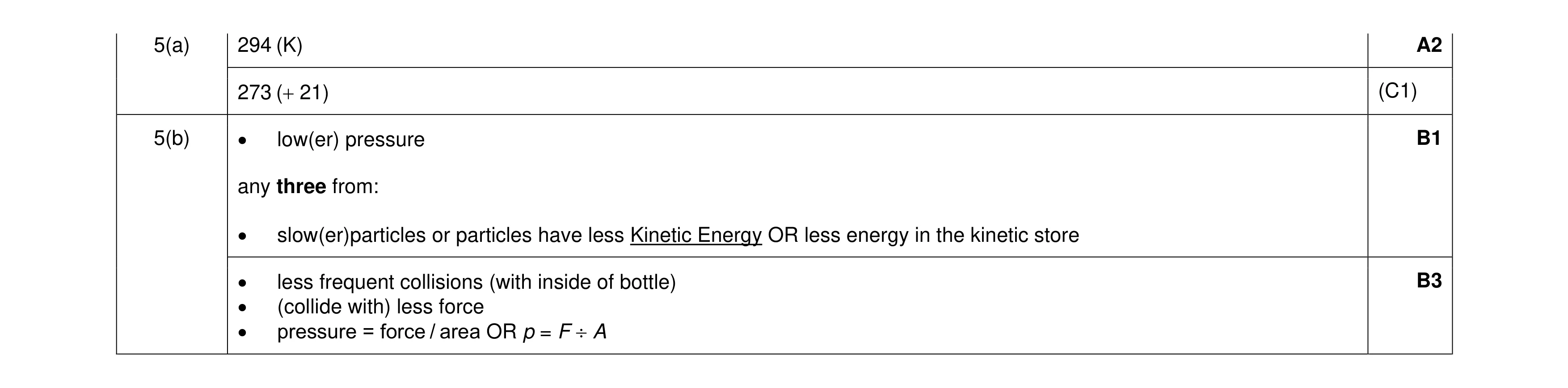 6
6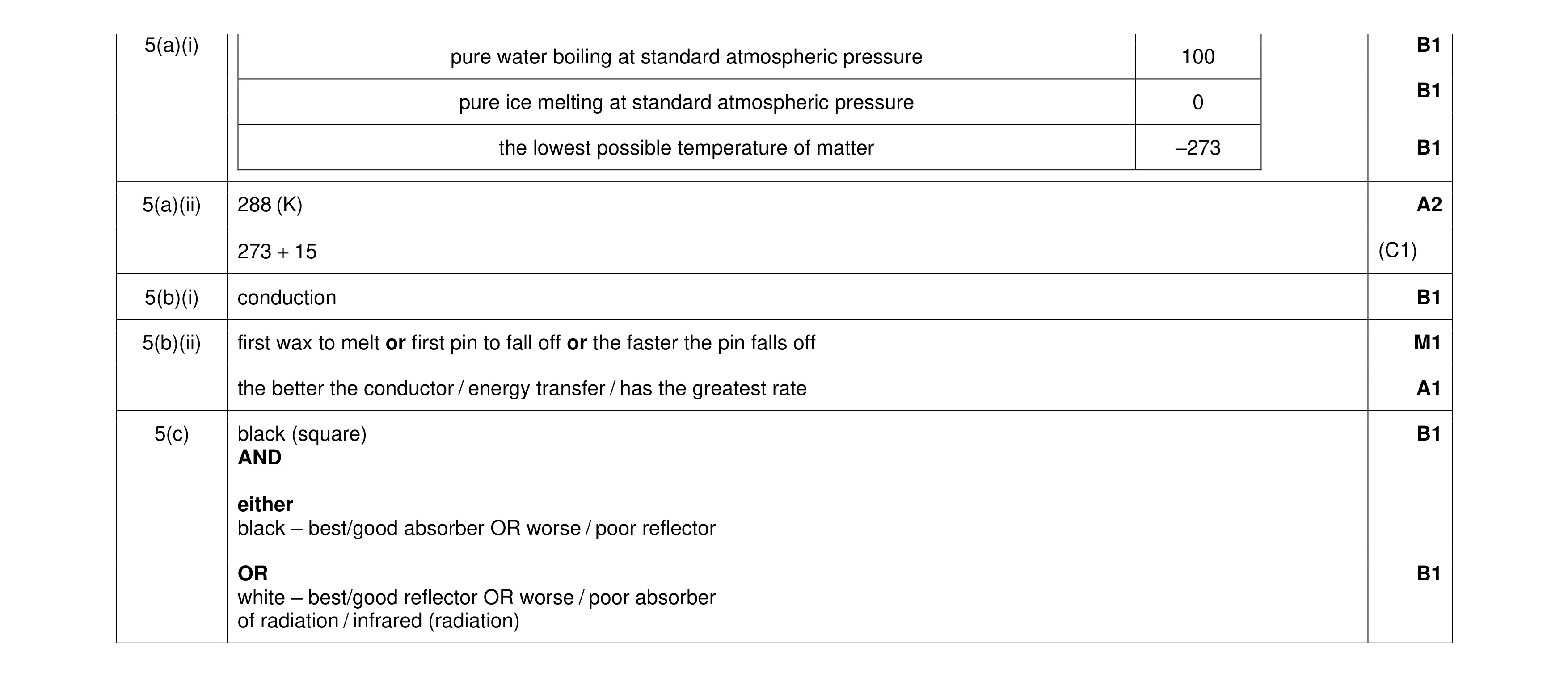 10
10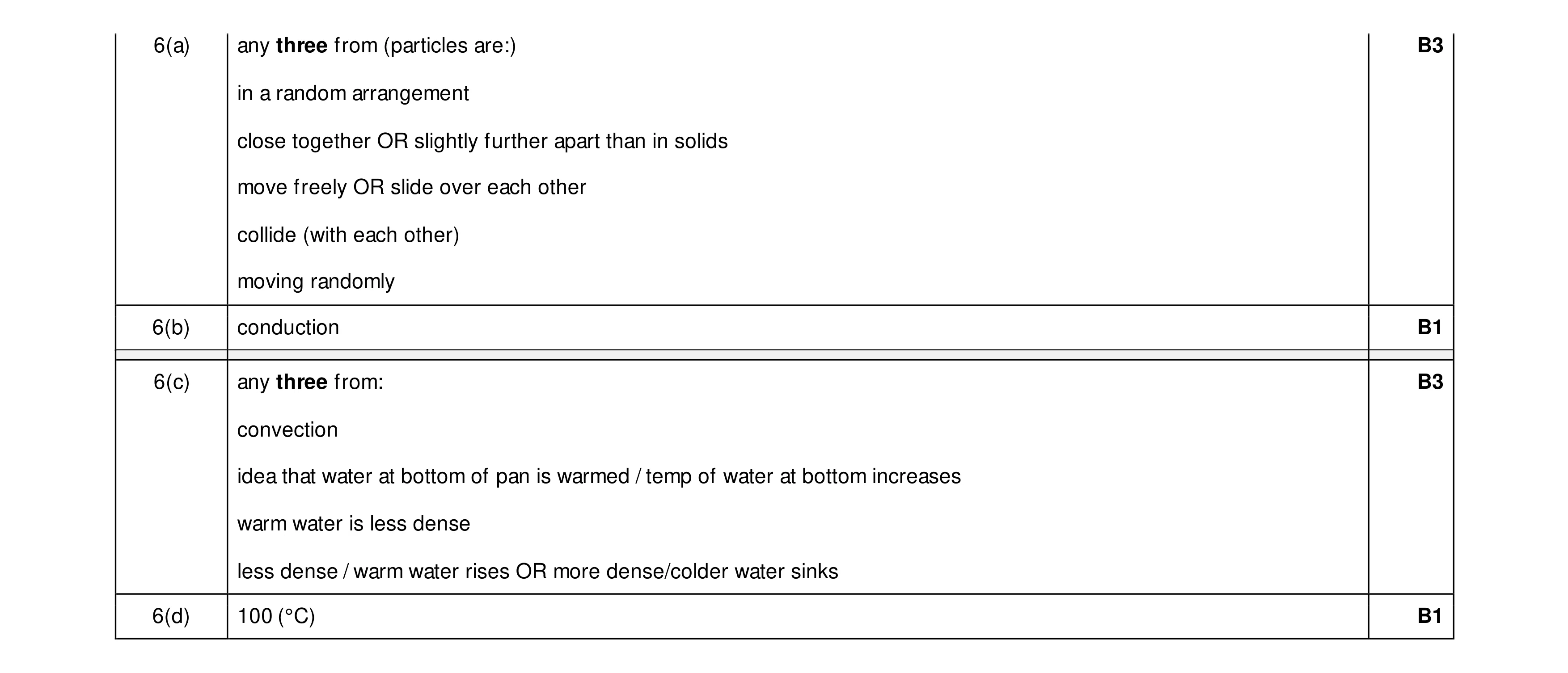 8
8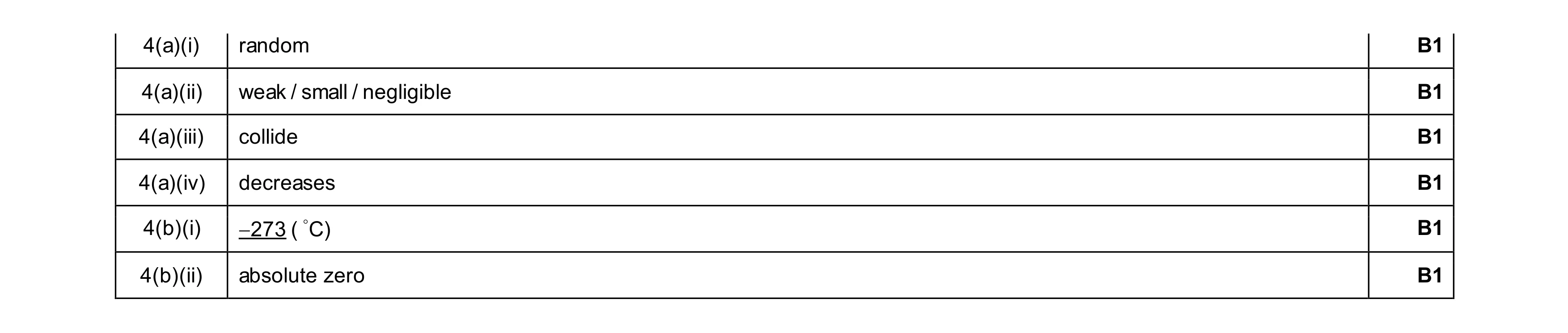 6
6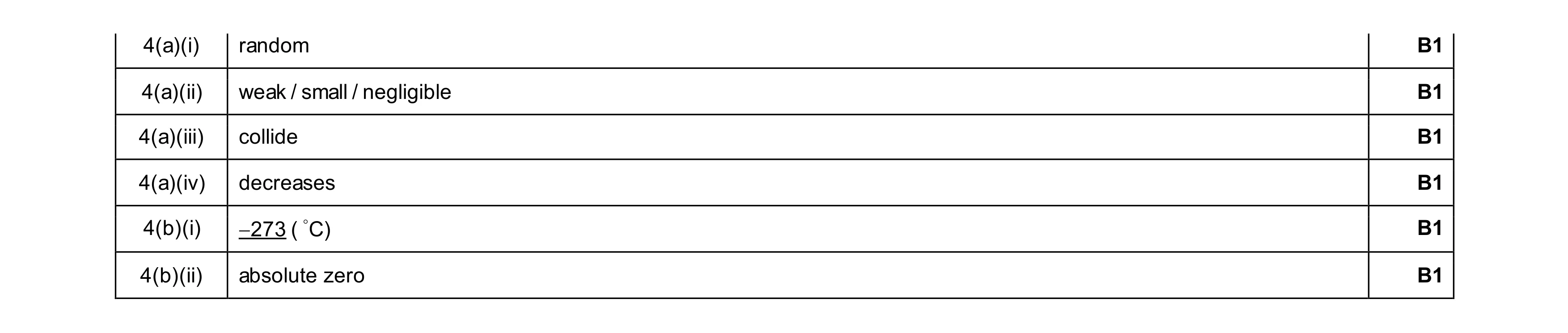 6
6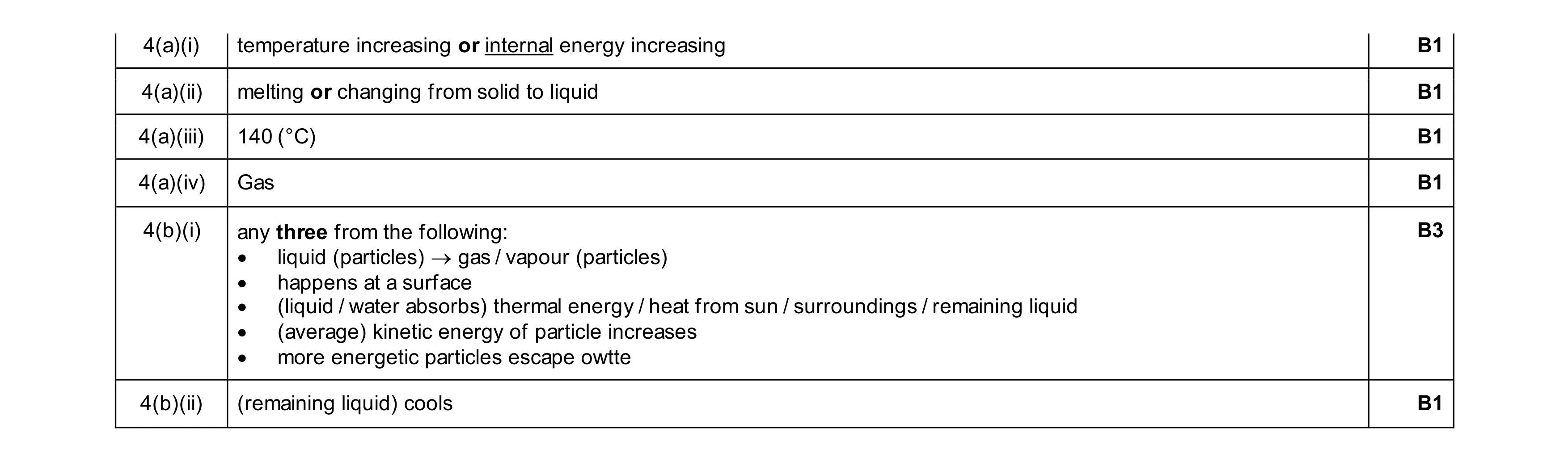 8
8