Questions as text
Question 1 0625/42 Feb/March 2017
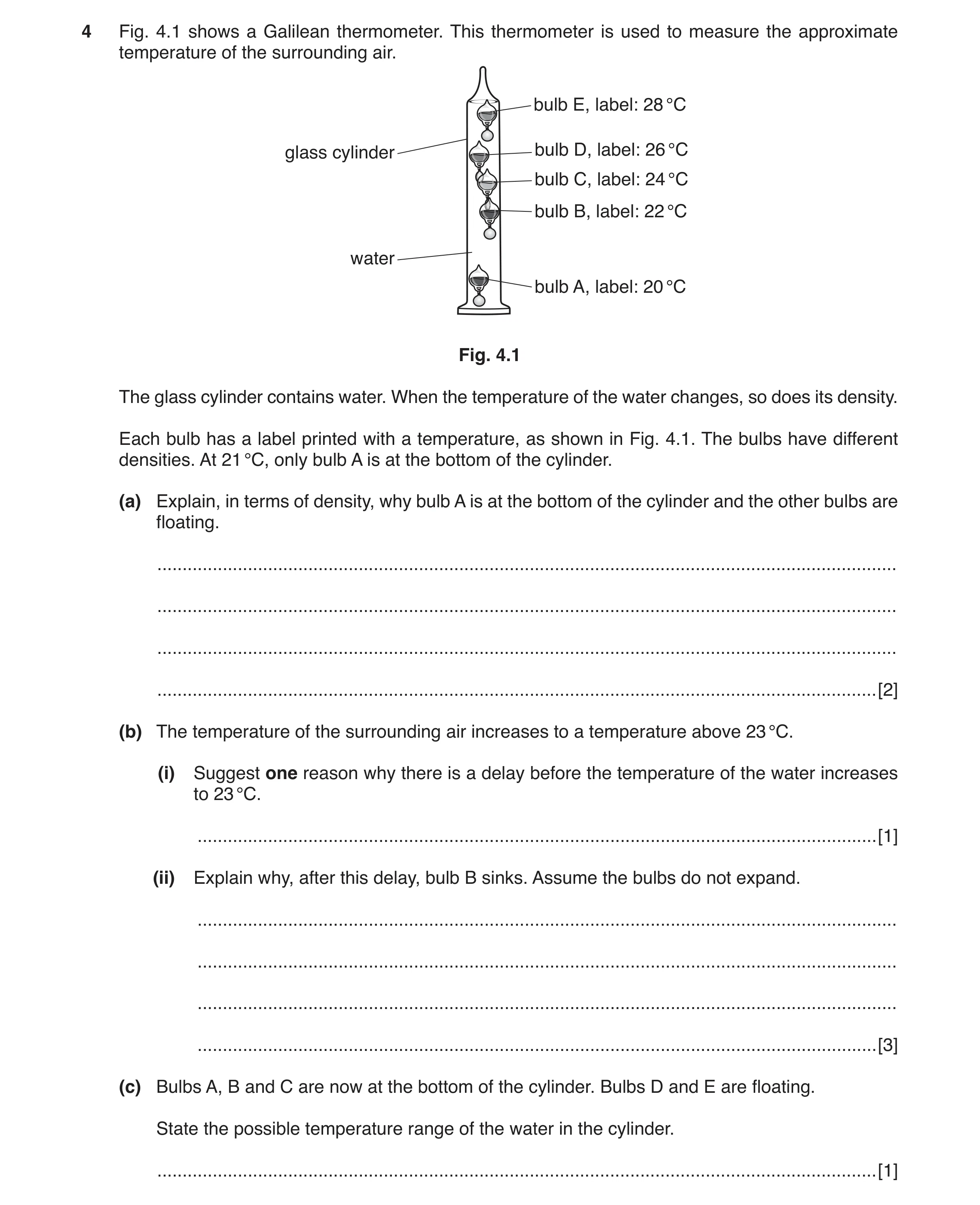
4 Fig. 4.1 shows a Galilean thermometer. This thermometer is used to measure the approximate temperature of the surrounding air. bulb E, label: 28 °C glass cylinder bulb D, label: 26 °C bulb C, label: 24 °C bulb B, label: 22 °C water bulb A, label: 20 °C Fig. 4.1 The glass cylinder contains water. When the temperature of the water changes, so does its density. Each bulb has a label printed with a temperature, as shown in Fig. 4.1. The bulbs have different densities. At 21 °C, only bulb A is at the bottom of the cylinder. (a) Explain, in terms of density, why bulb A is at the bottom of the cylinder and the other bulbs are floating. … … … … [2] (b) The temperature of the surrounding air increases to a temperature above 23 °C. (i) Suggest one reason why there is a delay before the temperature of the water increases to 23 °C. … [1] (ii) Explain why, after this delay, bulb B sinks. Assume the bulbs do not expand. … … … … [3] (c) Bulbs A, B and C are now at the bottom of the cylinder. Bulbs D and E are floating. State the possible temperature range of the water in the cylinder. … [1]
7 marks
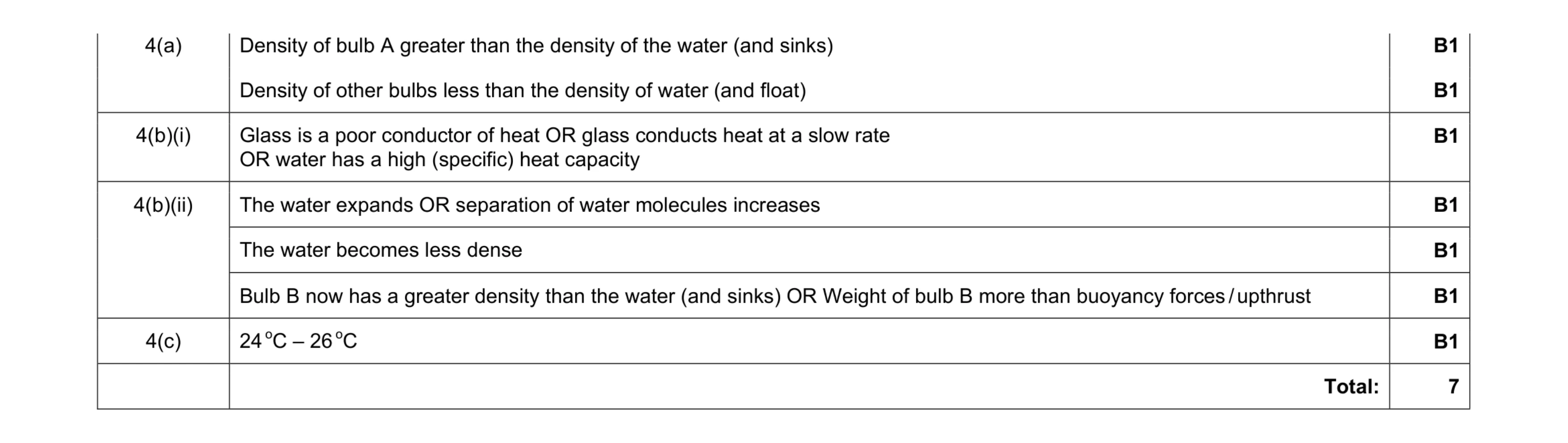
Mark scheme: 4(a) Density of bulb A greater than the density of the water (and sinks) B1 Density of other bulbs less than the density of water (and float) B1 4(b)(i) Glass is a poor conductor of heat OR glass conducts heat at a slow rate OR water has a high (specific) heat capacity B1 4(b)(ii) The water expands OR separation of water molecules increases B1 The water becomes less dense B1 Bulb B now has a greater density than the water (and sinks) OR Weight of bulb B more than buoyancy forces / upthrust B1 4(c) 24 oC – 26 oC B1 Total: 7
This question in 0625/42 Feb/March 2017
Q2 · State two ways in which evaporation is different from boiling 0625/42 Feb/March 2017
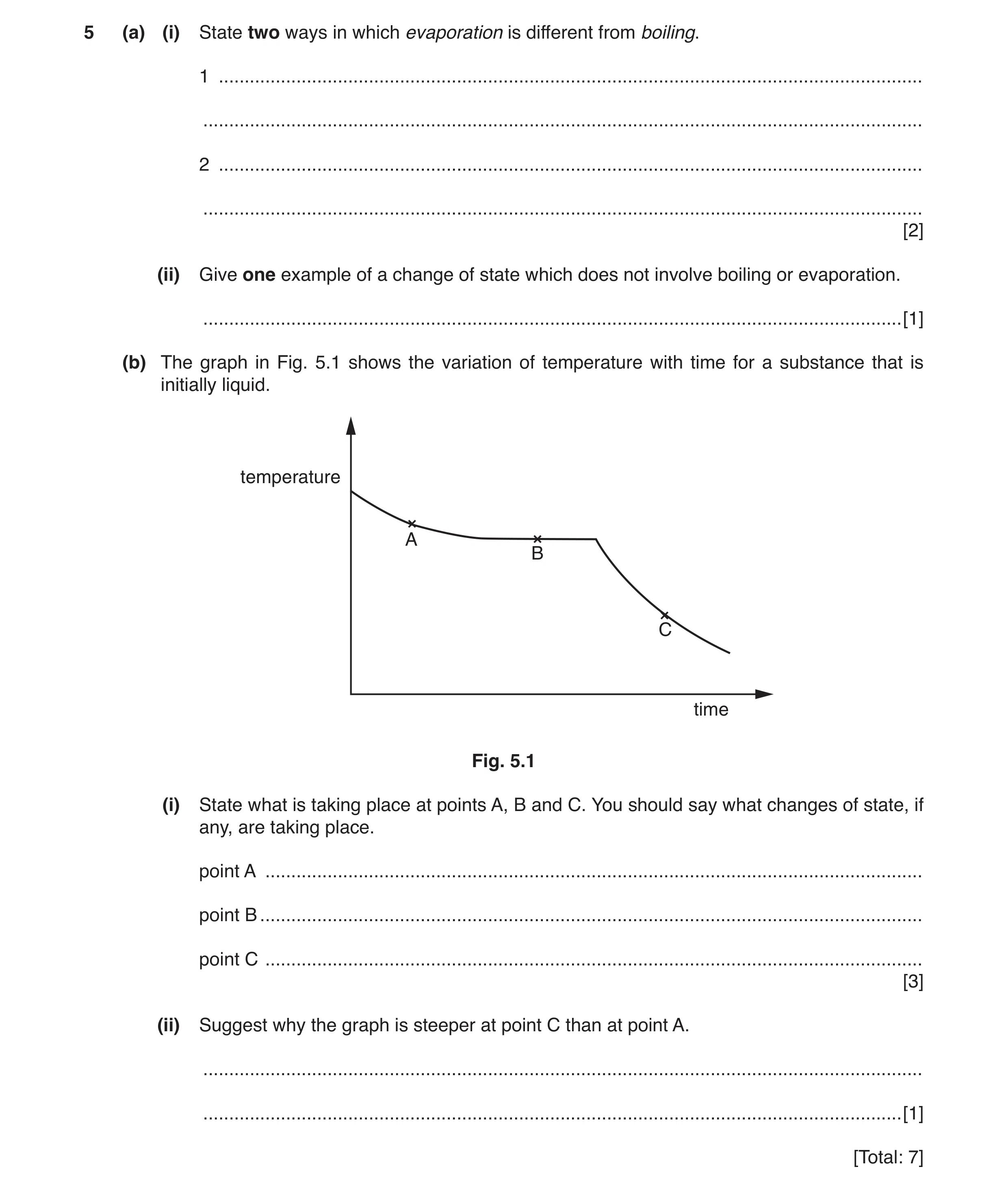
5 (a) (i) State two ways in which evaporation is different from boiling. 1 … … 2 … … [2] (ii) Give one example of a change of state which does not involve boiling or evaporation. … [1] (b) The graph in Fig. 5.1 shows the variation of temperature with time for a substance that is initially liquid. temperature A B C time Fig. 5.1 (i) State what is taking place at points A, B and C. You should say what changes of state, if any, are taking place. point A … point B … point C … [3] (ii) Suggest why the graph is steeper at point C than at point A. … … [1] [Total: 7]
7 marks
Mark scheme: 5(a)(i) Two of: Evaporation takes place at any temperature Evaporation takes place at the surface Evaporation takes thermal energy / heat from liquid OR Evaporation lowers temperature of liquid No bubbles (rise to surface during evaporation) Evaporation lowers temperature of liquid B2 5(a)(ii) e.g. condensation / change from gas to liquid OR freezing or solidification / change from liquid to solid OR melting / change from solid to liquid OR sublimation / change from solid to gas B1 Question Answer Marks 5(b)(i) Point A: liquid cooling / temperature of liquid falling B1 Point B: (liquid) freezing / changing (from liquid) to solid B1 Point C: solid cooling / temperature of solid falling B1 5(b)(ii) Specific heat capacity of liquid greater than specific heat capacity of solid B1 Total: 7
This question in 0625/42 Feb/March 2017
Q3 · A beaker contains water at room temperature 0625/42 Oct/Nov 2017
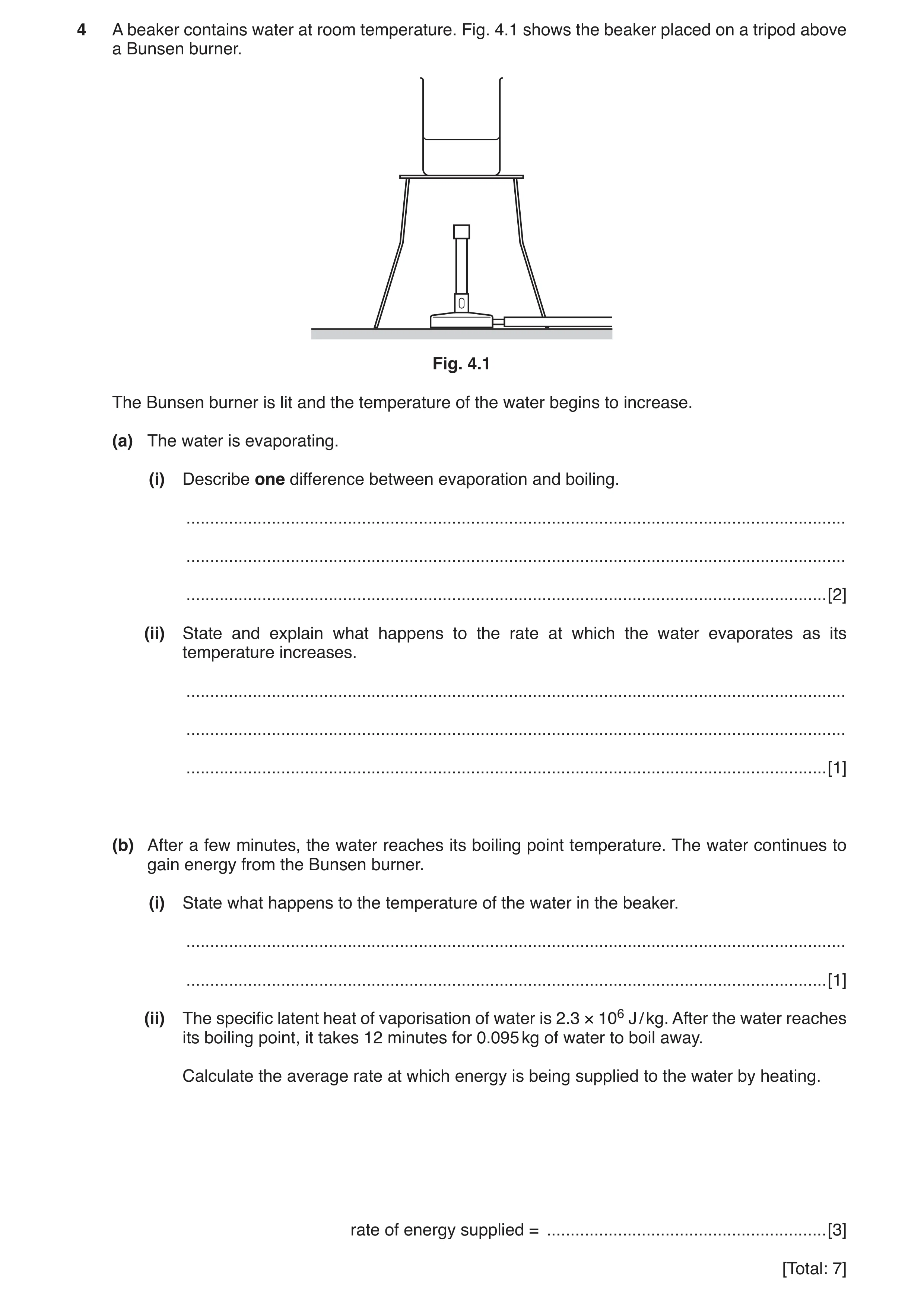
4 A beaker contains water at room temperature. Fig. 4.1 shows the beaker placed on a tripod above a Bunsen burner. Fig. 4.1 The Bunsen burner is lit and the temperature of the water begins to increase. (a) The water is evaporating. (i) Describe one difference between evaporation and boiling. … … … [2] (ii) State and explain what happens to the rate at which the water evaporates as its temperature increases. … … … [1] (b) After a few minutes, the water reaches its boiling point temperature. The water continues to gain energy from the Bunsen burner. (i) State what happens to the temperature of the water in the beaker. … … [1] (ii) The specific latent heat of vaporisation of water is 2.3 × 10⁶ J / kg. After the water reaches its boiling point, it takes 12 minutes for 0.095 kg of water to boil away. Calculate the average rate at which energy is being supplied to the water by heating. rate of energy supplied = … [3] [Total: 7]
7 marks
Mark scheme: 4(a)(i) any one of these six: • evaporation: at surface OR no bubbles form) pair 1 • boiling: throughout liquid OR bubbles form ) • evaporation: at any temperature OR no heat needed) pair 2 • boiling: at specific temperature OR heat needed ) • evaporation: affected by draught / surface area) pair 3 • boiling: not affected by draught / surface area ) B1 any one pair of points B1 4(a)(ii) (it / rate) increases AND {more molecules have enough energy to escape OR break bonds} B1 4(b)(i) remains constant B1 4(b)(ii) E = m l in any form OR (E =) m l C1 P = energy / t in any form OR (P =) energy / t C1 (P = 0.095 × 2.3 × 106 / (12 × 60) =) 300 W A1
This question in 0625/42 Oct/Nov 2017
Q4 · The molecules of most liquids are, on average, slightly further apart than the molecules… 0625/43 Oct/Nov 2017
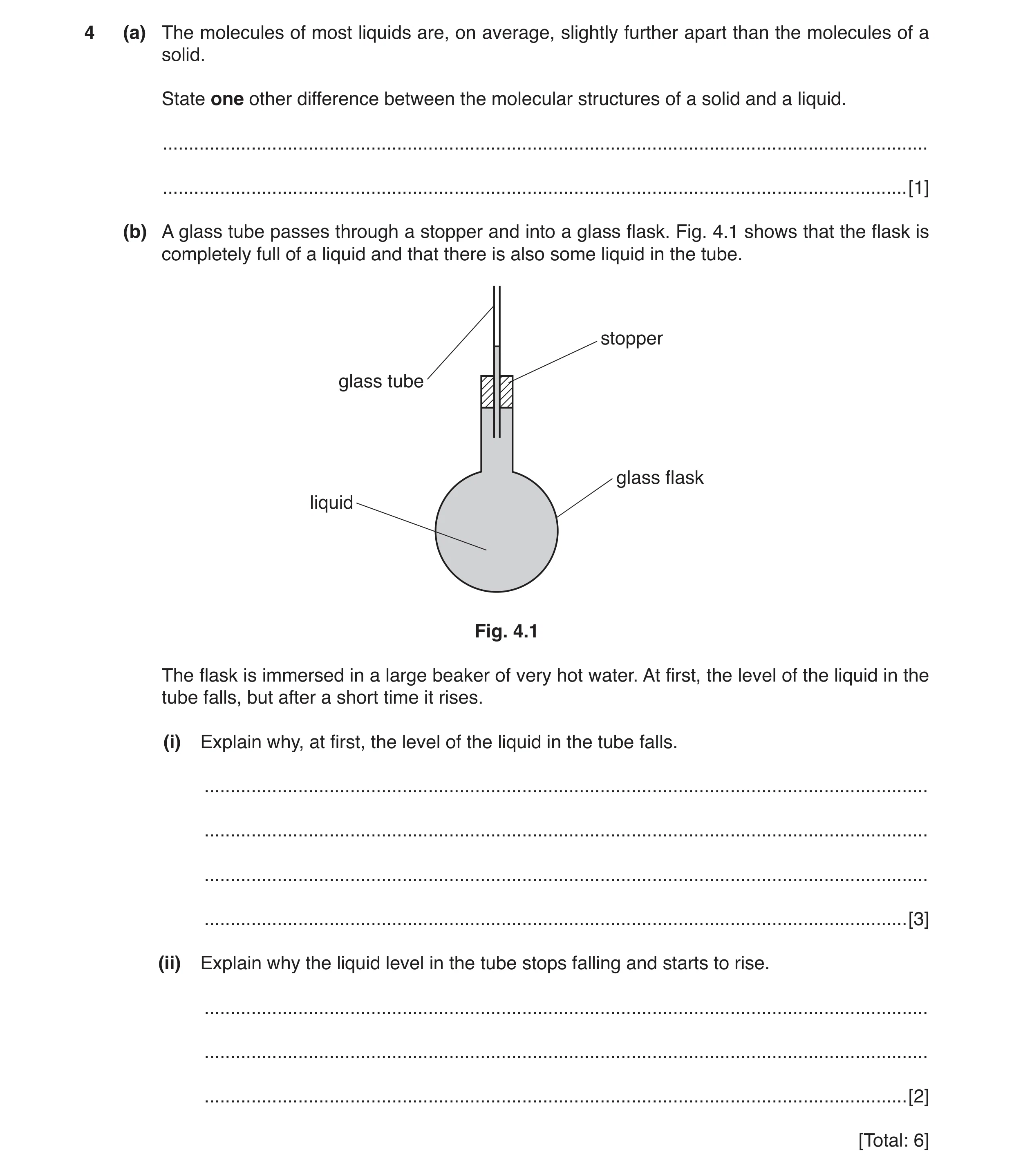
4 (a) The molecules of most liquids are, on average, slightly further apart than the molecules of a solid. State one other difference between the molecular structures of a solid and a liquid. … … [1] (b) A glass tube passes through a stopper and into a glass flask. Fig. 4.1 shows that the flask is completely full of a liquid and that there is also some liquid in the tube. stopper glass tube glass flask liquid Fig. 4.1 The flask is immersed in a large beaker of very hot water. At first, the level of the liquid in the tube falls, but after a short time it rises. (i) Explain why, at first, the level of the liquid in the tube falls. … … … … [3] (ii) Explain why the liquid level in the tube stops falling and starts to rise. … … … [2] [Total: 6]
6 marks
Mark scheme: 4(a) molecules of solid arranged in lattice / in organised pattern / without gaps / orderly / fixed structure B1 4(b)(i) glass heated first or at first liquid not heated / does not expand / takes time (to heat up) or glass poor conductor B1 glass expands B1 capacity / volume of flask increases B1 4(b)(ii) liquid (starts to) warms up B1 liquid expands more than the solid / glass B1
This question in 0625/43 Oct/Nov 2017
Q5 · A silver spoon has a thermal capacity of 7.2 J / °C 0625/43 Oct/Nov 2017
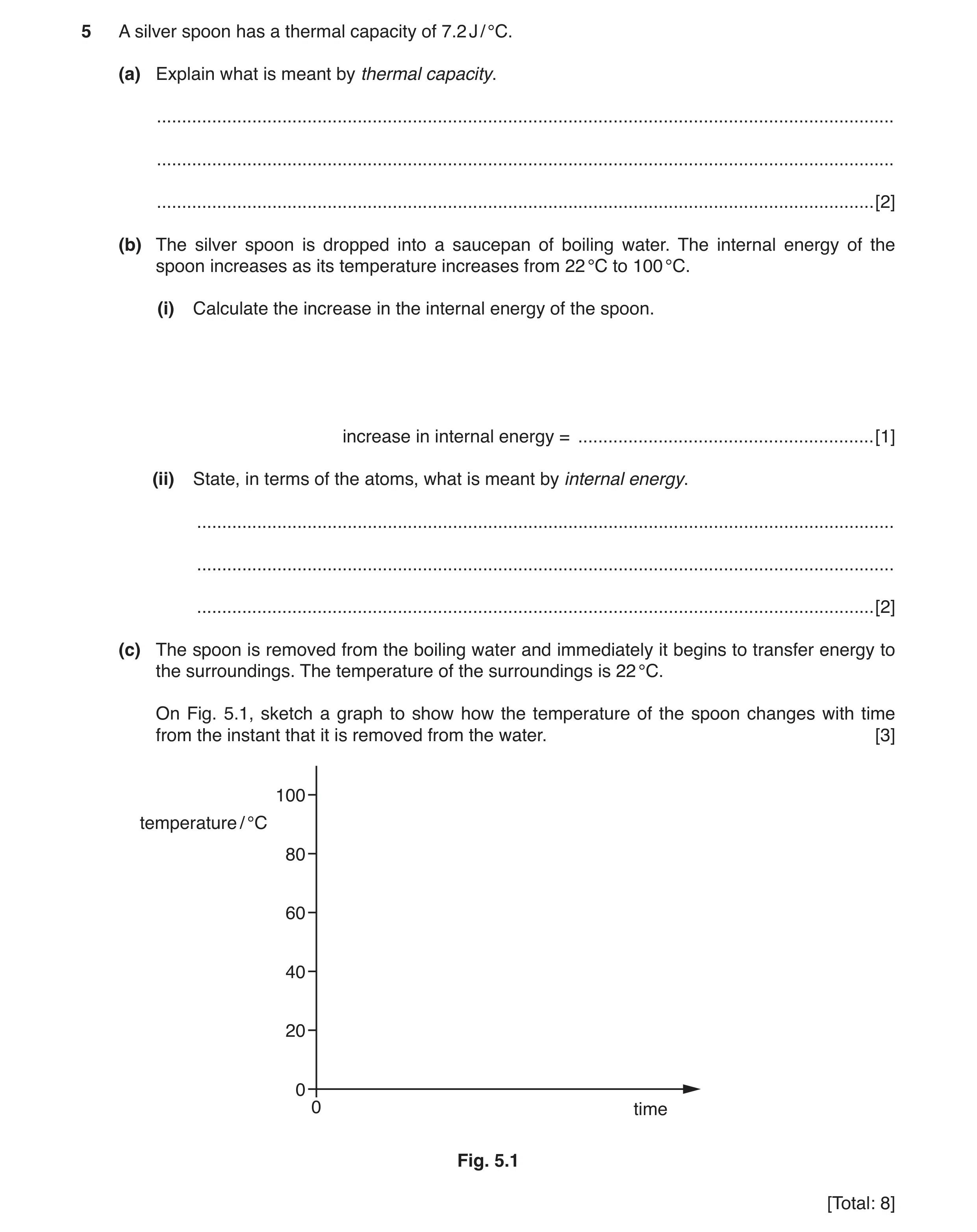
5 A silver spoon has a thermal capacity of 7.2 J / °C. (a) Explain what is meant by thermal capacity. … … … [2] (b) The silver spoon is dropped into a saucepan of boiling water. The internal energy of the spoon increases as its temperature increases from 22 °C to 100 °C. (i) Calculate the increase in the internal energy of the spoon. increase in internal energy = … [1] (ii) State, in terms of the atoms, what is meant by internal energy. … … … [2] (c) The spoon is removed from the boiling water and immediately it begins to transfer energy to the surroundings. The temperature of the surroundings is 22 °C. On Fig. 5.1, sketch a graph to show how the temperature of the spoon changes with time from the instant that it is removed from the water. [3] 100 temperature / °C 80 60 40 20 0 0 time Fig. 5.1 [Total: 8]
8 marks
Mark scheme: 5(a) (quantity of internal) energy that raises temperature M1 per degree Celsius / per unit temperature change A1 5(b)(i) 560 / 562 / 561.6 J B1 5(b)(ii) kinetic energy / potential energy / total energy (of atoms / molecules / particles) B1 kinetic added to potential energy (of atoms / molecules / particles) B1 5(c) line from 100 °C and falling B1 falls at decreasing rate B1 levels off at labelled / approximate 22 °C B1
This question in 0625/43 Oct/Nov 2017
Q6 · In a laboratory at normal room temperature, 200 g of water is poured into a beaker 0625/41 May/June 2018
8 In a laboratory at normal room temperature, 200 g of water is poured into a beaker. A thermometer placed in the water has a reading of 22 °C. Small pieces of ice at 0 °C are added to the water one by one. The mixture is stirred after each addition until the ice has melted. This process is continued until the temperature recorded by the thermometer is 0 °C. The total mass of ice added to the water is found to be 60 g. (a) The specific heat capacity of water is 4.2 J/(g °C). Calculate the thermal energy lost by the water originally in the beaker. thermal energy = … [2] (b) Assume that all the thermal energy lost by the water originally in the beaker is transferred to the ice. Calculate the specific latent heat of fusion of ice. specific latent heat of fusion of ice = … [2] (c) Suggest a reason for any inaccuracy in the value of the specific latent heat of fusion of ice calculated in (b). Assume the temperature readings and the values for the mass of the water and the mass of the ice are accurate. … … [1] [Total: 5]
5 marks
Mark scheme: 8(a) 1 18000 J 1 8(b) Q = m × L OR (L =) Q ÷ m OR 18 480 ÷ 60 1 310 J / g 1 8(c) (Thermal) energy/heat transfers from surroundings OR into water 1
This question in 0625/41 May/June 2018
Q7 · In the space below, draw a labelled diagram of the structure of a thermocouple thermometer 0625/41 Oct/Nov 2018
5 (a) (i) In the space below, draw a labelled diagram of the structure of a thermocouple thermometer. Include the device from which a reading is taken. [3] (ii) A thermocouple thermometer is used to measure the temperature of the flame of a small candle. State two reasons why the thermocouple thermometer is suitable for this application. 1. … … 2. … … [2] (b) State and explain any effect on the sensitivity of a liquid-in-glass thermometer of: (i) reducing the diameter of the capillary tube … … … [2] (ii) increasing the volume of the liquid-filled bulb. … … … [2] [Total: 9]
9 marks
Mark scheme: 5(a)(i) 2 different metals labelled B1 2 junctions between different metals B1 Correctly connected meter B1 5(a)(ii) Any two of: Suitable for high temp measurement OR has wide range Has low value of thermal capacity OR absorbs only a small quantity of thermal energy / heat Measures temperature at a point OR small size Responds quickly Can be used for remote sensing B2 5(b)(i) More sensitive B1 Thread moves further (for same expansion) B1 5(b)(ii) More sensitive B1 Greater expansion / more liquid (from bulb) B1
This question in 0625/41 Oct/Nov 2018
Q8 · Apparatus used by a student to measure the specific heat capacity of iron 0625/42 Oct/Nov 2018
4 Fig. 4.1 shows apparatus used by a student to measure the specific heat capacity of iron. thermometer electric heater iron block Fig. 4.1 (a) The student improves the accuracy of the experiment by placing material around the block, as shown in Fig. 4.2. material Fig. 4.2 (i) Suggest the name of a possible material the student could use and explain how it improves the accuracy of the experiment. suggestion … explanation … … … [3] (ii) State how the student could further improve the accuracy of the experiment by using more of the material used in Fig. 4.2. … … … [1] (b) The current in the heater is 3.8 A and the potential difference (p.d.) across it is 12 V. The iron block has a mass of 2.0 kg. When the heater is switched on for 10 minutes, the temperature of the block rises from 25 °C to 55 °C. Calculate the specific heat capacity of iron. specific heat capacity = … [4] [Total: 8]
8 marks
Mark scheme: 4(a)(i) any feasible named insulating material B1 reduces thermal energy / heat loss or transfer to surroundings B1 more (calculated electrical) energy (transferred) into block or (it is an) insulator / poor conductor B1 4(a)(ii) insulation on top of block B1 4(b) (energy input = VIt = 12 × 3.8 × 600 =) 27 000 (J) B1 SHC = E / m∆T in any form OR E / m∆T B1 (∆T = ) 55 – 25 OR 30 (°C) B1 (SHC = 27 000 / (2 × 30)) = 450 J kg–1°C–1 OR J / (kg °C) B1
This question in 0625/42 Oct/Nov 2018
Q9 · A student is supplied with a small block of iron, a thermometer and an electrical heater… 0625/43 Oct/Nov 2018
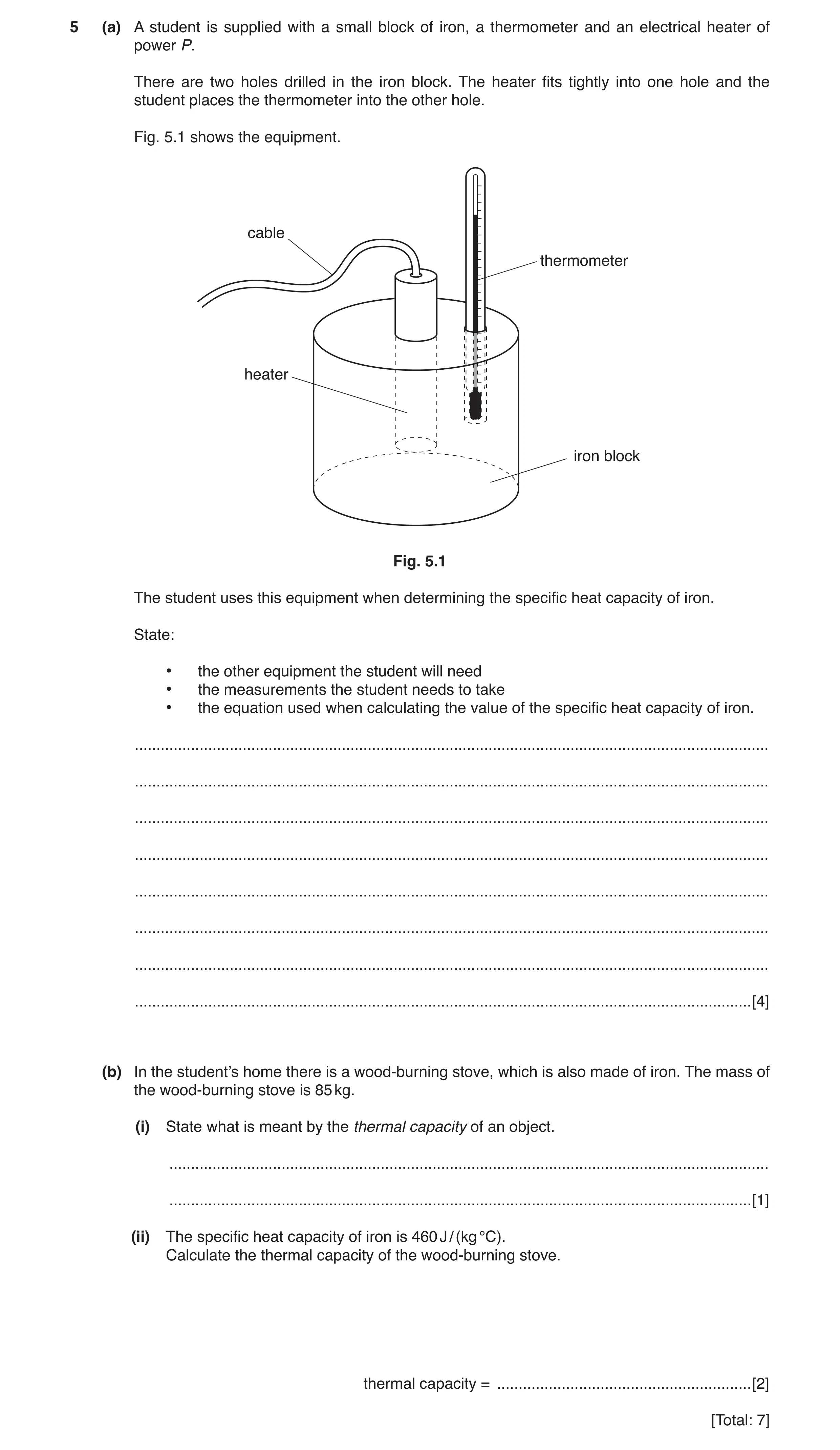
5 (a) A student is supplied with a small block of iron, a thermometer and an electrical heater of power P. There are two holes drilled in the iron block. The heater fits tightly into one hole and the student places the thermometer into the other hole. Fig. 5.1 shows the equipment. cable thermometer heater iron block Fig. 5.1 The student uses this equipment when determining the specific heat capacity of iron. State: • the other equipment the student will need • the measurements the student needs to take • the equation used when calculating the value of the specific heat capacity of iron. … … … … … … … … [4] (b) In the student’s home there is a wood-burning stove, which is also made of iron. The mass of the wood-burning stove is 85 kg. (i) State what is meant by the thermal capacity of an object. … … [1] (ii) The specific heat capacity of iron is 460 J / (kg °C). Calculate the thermal capacity of the wood-burning stove. thermal capacity = … [2] [Total: 7]
7 marks
Mark scheme: 5(a) power supply and (top-pan) balance / scales and stopwatch / timer / joulemeter measure mass (of block) and initial and final temperature B1 reading from joulemeter or measure time (of heating) and (E =) Pt / VIt or c = Pt / m∆T B1 c = Pt / m∆T or c = E / m∆T B1 5(b)(i) energy required to increase the temperature per °C / per unit temperature increase B1 5(b)(ii) (C =) m c or 85 × 460 C1 3.9 × 10⁴ J / °C A1
This question in 0625/43 Oct/Nov 2018
Q10 · State the values of the fixed points of a temperature scale 0625/42 Feb/March 2019
5 (a) State the values of the fixed points of a temperature scale. … [1] (b) (i) The graduations on a liquid-in-glass thermometer are equally spaced. For the equal spacing of the graduations to be correct, state: 1. an assumption that is made about the liquid in the thermometer … 2. an assumption that is made about the structure of the thermometer. … [2] (ii) Liquid-in-glass thermometer A has a greater range than liquid-in-glass thermometer B. State one way the design of thermometer A is different from thermometer B. … … [1] (iii) Liquid-in-glass thermometer C has a greater sensitivity than liquid-in-glass thermometer D. State one way the design of thermometer C is different from thermometer D. … … [1] (c) (i) In the space provided, draw a labelled diagram of a thermocouple thermometer. [3] (ii) Suggest when a thermocouple thermometer is more suitable than a liquid-in-glass thermometer. … … [1] [Total: 9]
9 marks
Mark scheme: 5(a) 0 °C and 100 °C B1 5(b)(i) 1 Has uniform / linear expansion OR Has equal expansion for each degree of temperature rise B1 2 Has capillary / tube of constant cross-sectional area / diameter / radius / bore / width / thickness B1 5(b)(ii) (Compared with thermometer B) A has a capillary / tube of greater cross-section / diameter / radius / width OR A contains a liquid with less expansion per degree / unit temp. rise OR A is longer than B OR A has a smaller bulb B1 5(b)(iii) (Compared with thermometer D) C (has capillary / tube that is) narrower / of smaller cross-section / thinner OR has a larger bulb OR bulb containing more liquid OR contains a liquid with greater expansion per degree / unit temp. rise OR contains alcohol instead of mercury B1 Question Answer Marks 5(c)(i) Diagram to show: Three wires labelled e.g. copper, iron, copper or with symbols for metals OR metal A, metal B, metal A B1 One junction between different metals B1 Connections to voltmeter / ammeter / galvanometer identified by V, A, G, mV, mA or arrow in a circle B1 5(c)(ii) Measurement of: a (very) high or (very) low temperature OR a rapidly varying temperature OR a high range of temperature If values given, more than 300 °C; less than –200 °C B1
This question in 0625/42 Feb/March 2019
Q11 · An electrical heater is placed on the floor of a room in a house 0625/42 Feb/March 2019
6 An electrical heater is placed on the floor of a room in a house. The heater is switched on. (a) State the main process by which thermal energy is transferred to the air in all parts of the room. … [1] (b) The heater has a power of 1.5 kW. The air in the room has a mass of 65 kg. The specific heat capacity of air is 720 J / (kg °C). (i) Calculate the time it takes for this heater to raise the temperature of the air in the room from 8.0 °C to 15.0 °C. time = … [4] (ii) State two reasons why the time calculated in (b)(i) is smaller than the actual time taken to raise the temperature of the air in the room from 8.0 °C to 15.0 °C. 1 … … 2 … … [2] [Total: 7]
7 marks
Mark scheme: 6(a) Convection B1 6(b)(i) (E =) mc∆θ OR 65 × 720 × 7 C1 3.3 × 10⁵ (J) C1 P = E / t in any form OR (t=) E / P OR 3.3 × 10⁶ / 1.5 × 10³ C1 220 s A1 6(b)(ii) Two of: The heater warms walls, floor, ceiling, windows, furniture / objects. Thermal energy conducted through walls, floor, ceiling, windows (to exterior) Thermal energy used to raise temperature of air entering room via draughts / openings B2
This question in 0625/42 Feb/March 2019
Q12 · Gas of mass 0.23 g is trapped in a cylinder by a piston 0625/41 May/June 2019
4 Gas of mass 0.23 g is trapped in a cylinder by a piston. The gas is at atmospheric pressure which is 1.0 × 10⁵ Pa. Fig. 4.1 shows the piston held in position by a catch. gas cylinder air at atmospheric pressure piston heater catch Fig. 4.1 The volume of the trapped gas is 1.9 × 10⁻⁴ m3. An electrical heater is used to increase the temperature of the trapped gas by 550 °C. (a) The specific heat capacity of the gas is 0.72 J / (g °C). (i) Calculate the energy required to increase the temperature of the trapped gas by 550 °C. energy = … [2] (ii) The power of the heater is 2.4 W. 1. Calculate how long it takes for the heater to supply the energy calculated in (a)(i). time = … [2] 2. In practice, it takes much longer to increase the temperature of the gas by 550 °C using the heater. Suggest one reason for this. … … … [1] (b) When the temperature of the gas has increased by 550 °C, its pressure is 2.9 × 10⁵ Pa. The catch is then released allowing the piston to move. As the piston moves, the temperature of the gas remains constant. (i) State and explain what happens to the piston. … … … [2] (ii) Determine the volume of the gas when the piston stops moving. volume = … [2] [Total: 9]
9 marks
Mark scheme: 4(a)(i) OR 0.23 × 0.72 × 550 C1 91 J A1 4(a)(ii) 1. t = E / P in any form words, symbols or numbers OR (t =) E / P or 91 / 2.4 C1 38 s A1 2. (thermal) energy is used to increase the temperature of / lost to cylinder / piston / heater / surroundings B1 4(b)(i) it / piston moves to the right / away from heater OR accelerates (to right) M1 pressure (of gas) greater / pressure greater (on left) / resultant force to right A1 4(b)(ii) V2 = p1V1 / p2 in any form OR (V2 =) p1V1 / p2 OR 2.9 × 105 × 1.9 × 10–4 / 1.0 × 10⁵ C1 5.5 × 10⁻⁴ m3 A1
This question in 0625/41 May/June 2019
Q13 · State and explain, in terms of molecules, any change in the pressure of a gas when the… 0625/42 May/June 2019
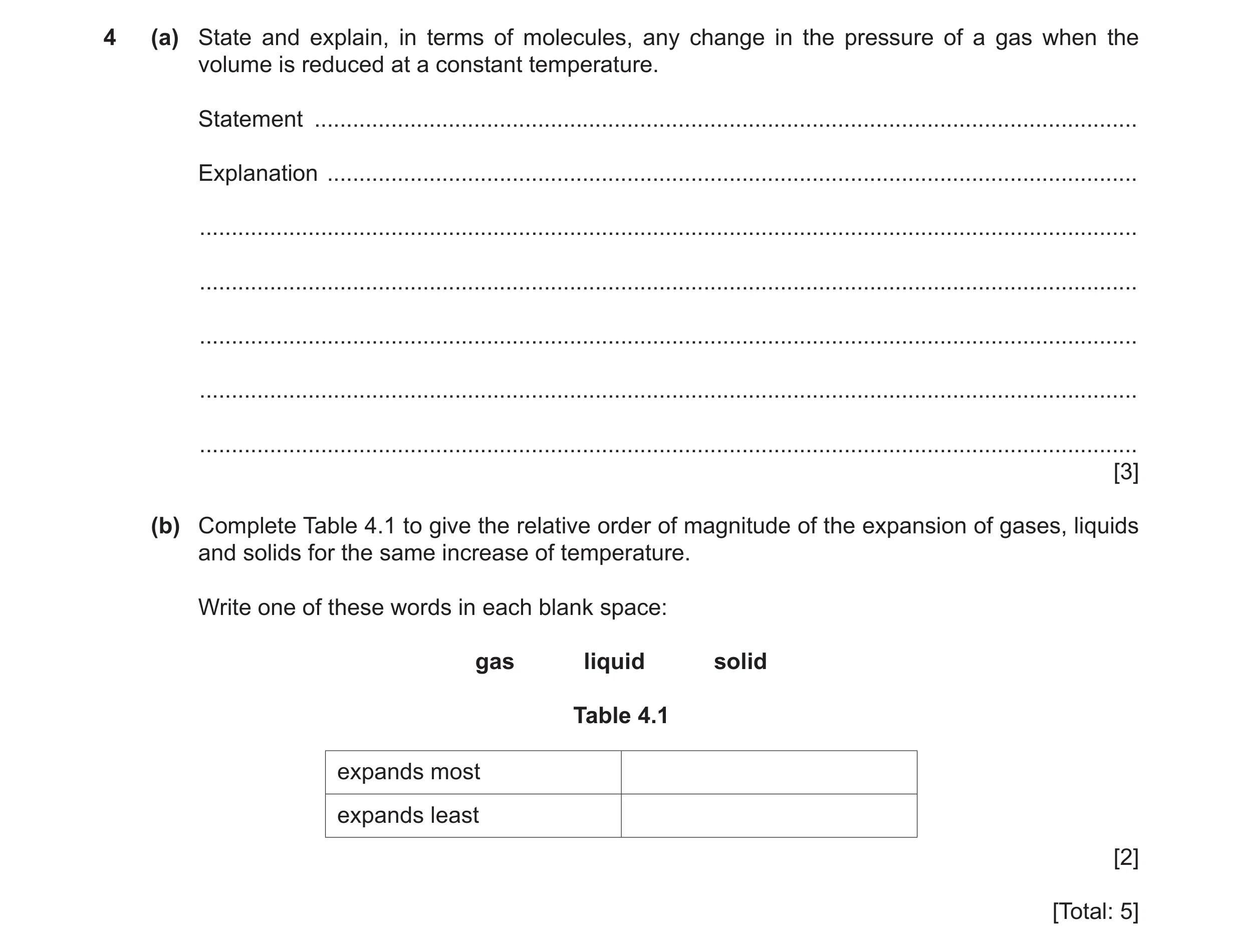
4 (a) State and explain, in terms of molecules, any change in the pressure of a gas when the volume is reduced at a constant temperature. Statement … Explanation … … … … … … [3] (b) Complete Table 4.1 to give the relative order of magnitude of the expansion of gases, liquids and solids for the same increase of temperature. Write one of these words in each blank space: gas liquid solid Table 4.1 expands most expands least [2] [Total: 5]
5 marks
Mark scheme: 4(a) pressure increases B1 any two from : • molecules travel shorter (average) distance between collisions with walls NOT molecules change speed • molecules hit walls more often OR more collisions (per unit area) with walls • {greater force OR greater (rate of) change of momentum of molecules} per unit area on walls B2 4(b) 1st box gas B1 2nd box solid B1
This question in 0625/42 May/June 2019
Q14 · A liquid is heated so that bubbles of its vapour rise to the surface and molecules escape… 0625/42 May/June 2019
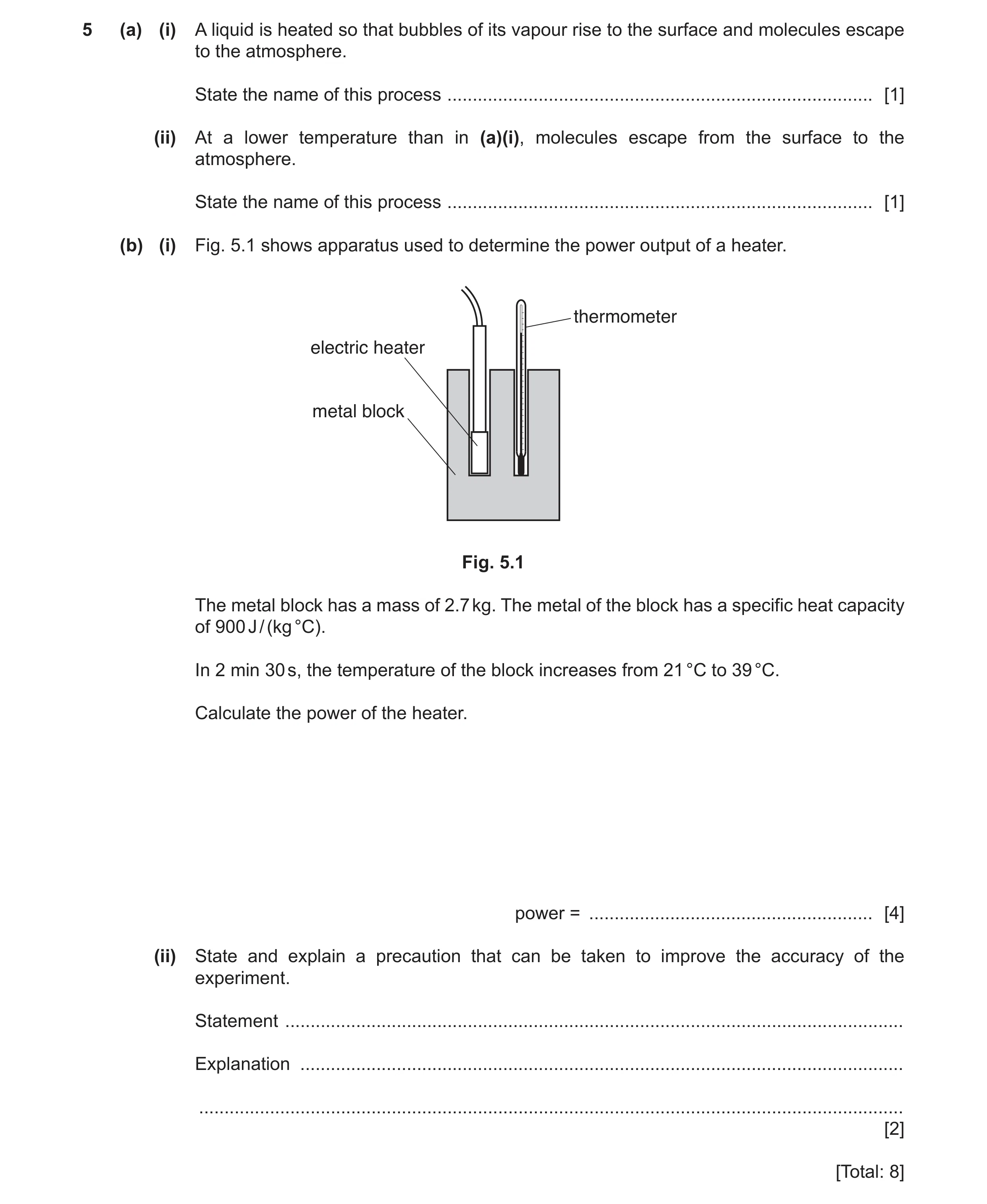
5 (a) (i) A liquid is heated so that bubbles of its vapour rise to the surface and molecules escape to the atmosphere. State the name of this process … [1] (ii) At a lower temperature than in (a)(i), molecules escape from the surface to the atmosphere. State the name of this process … [1] (b) (i) Fig. 5.1 shows apparatus used to determine the power output of a heater. thermometer electric heater metal block Fig. 5.1 The metal block has a mass of 2.7 kg. The metal of the block has a specific heat capacity of 900 J / (kg °C). In 2 min 30 s, the temperature of the block increases from 21 °C to 39 °C. Calculate the power of the heater. power = … [4] (ii) State and explain a precaution that can be taken to improve the accuracy of the experiment. Statement … Explanation … … [2] [Total: 8]
8 marks
Mark scheme: 5(a)(i) boiling B1 5(a)(ii) evaporation B1 5(b)(i) E=mc∆T in any form OR (E=) mc∆T OR (E=) 2.7 × 900 × 18 C1 44 000 (J) A1 E=Pt in any form OR (P=) E/t OR (P= ) 43 740/150 C1 (P= ) 290 W A1 5(b)(ii) lagging/insulation/named insulator (around/on block) M1 reduction of thermal energy/heat losses A1
This question in 0625/42 May/June 2019
Q15 · Water molecules escape to the atmosphere from water boiling in a pan 0625/43 May/June 2019
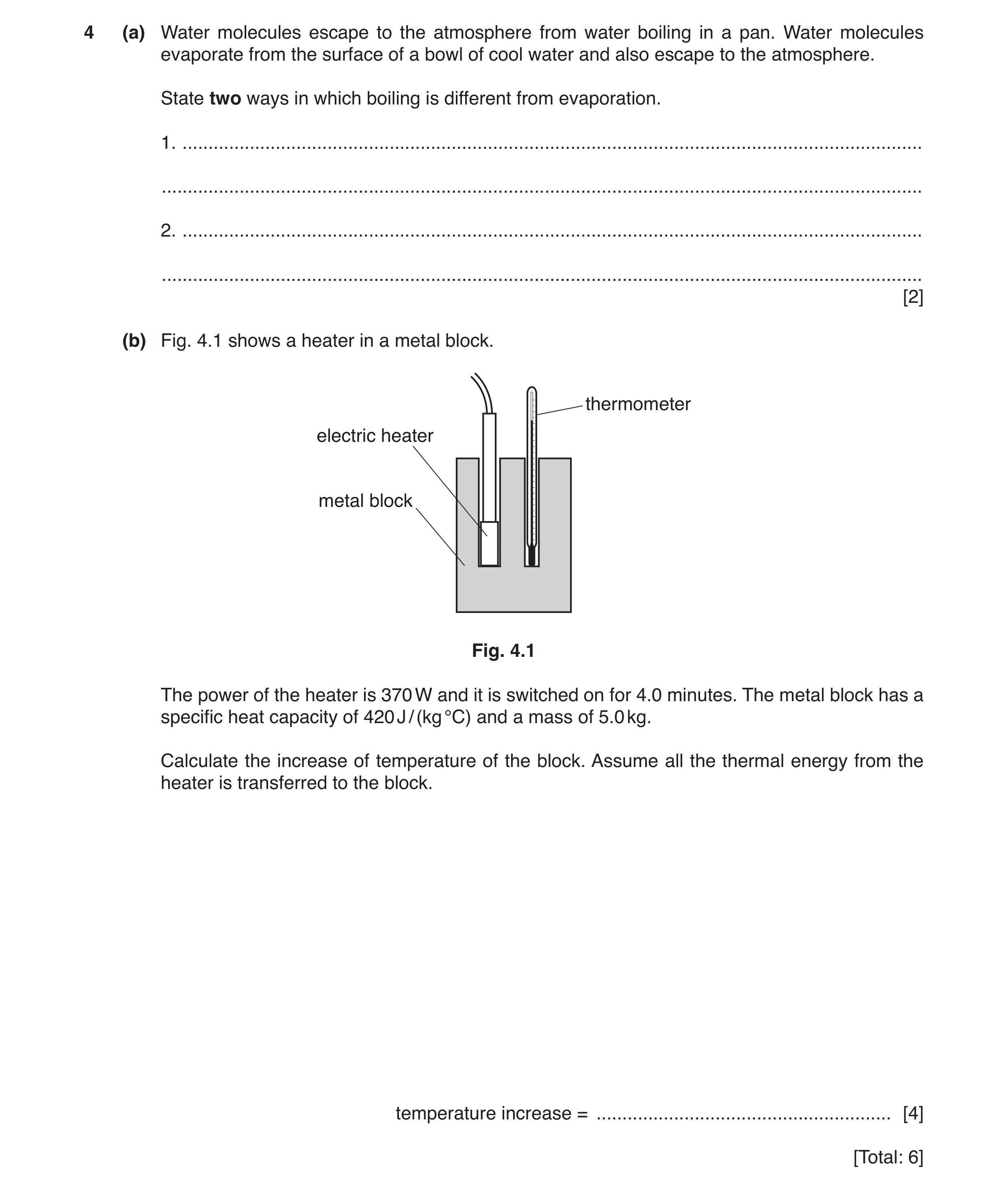
4 (a) Water molecules escape to the atmosphere from water boiling in a pan. Water molecules evaporate from the surface of a bowl of cool water and also escape to the atmosphere. State two ways in which boiling is different from evaporation. 1. … … 2. … … [2] (b) Fig. 4.1 shows a heater in a metal block. thermometer electric heater metal block Fig. 4.1 The power of the heater is 370 W and it is switched on for 4.0 minutes. The metal block has a specific heat capacity of 420 J / (kg °C) and a mass of 5.0 kg. Calculate the increase of temperature of the block. Assume all the thermal energy from the heater is transferred to the block. temperature increase = … [4] [Total: 6]
6 marks
Mark scheme: 4(a) Any two from: bubbles form OR occurs throughout liquid only occurs at one temperature/boiling point does not produce cooling OR not affected by surface area / humidity / draught OR does not lower KE of molecules left in the liquid. B2 4(b) E = Pt in any form OR (E) = 370 × 240 C1 = 89 000 (J) A1 E = mc∆T in any form C1 (temperature increase =) 89 000 / {5.0 × 420} = ) 42 °C A1
This question in 0625/43 May/June 2019
Q16 · A shower that takes in cold water 0625/41 Oct/Nov 2019
6 Fig. 6.1 shows a shower that takes in cold water. The water passes through an electric water heater and emerges from the showerhead at a higher temperature. showerhead electric water heater Fig. 6.1 The power of the heater is 9000 W. (a) The shower is powered by a 230 V electricity supply. (i) Calculate the current in the heater when it is switched on. current = … [2] (ii) Suggest a suitable rating for the fuse in the heater circuit. fuse rating = … [1] (b) The specific heat capacity of water is 4200 J / (kg °C). The initial temperature of the cold water is 16 °C. Determine the maximum mass of water that can be heated to a temperature of 35 °C in 1.0 s. mass = … [4] (c) A safety control in the shower switches off the shower when the water becomes dangerously hot. The control uses a thermocouple thermometer to measure the temperature of the heated water. (i) Describe the structure of a thermocouple thermometer. Include a diagram in your answer. … … … [2] (ii) Suggest one reason why a thermocouple thermometer is suitable for this purpose. … … [1] [Total: 10]
10 marks
Mark scheme: 6(a)(i) 39 A C1 A1 6(a)(ii) 40 A or any greater integer value (in A) up to and including 60 A B1 6(b) E = Pt or in any form words, symbols or numbers or (E =) Pt or 9000 × 1.0 or 9000 J seen 35 – 16 or 19 (°C) seen m = E /(c∆T) or in any form words, symbols or numbers or (m =) E /(c∆T) or 9000 / (4200 × 19) 0.11 kg C1 C1 C1 A1 6(c)(i) two different metal wiresjoined at one end and voltmeter between free ends or three metal wires and two different joined ABA and voltmeter between free ends B1 B1 6(c)(ii) any one from: quick response / makes measurements fast measures rapidly varying temperatures electrical output small heat capacity robust / rugged B1
This question in 0625/41 Oct/Nov 2019
Q17 · An electric kettle contains water at a temperature of 19 °C 0625/43 Oct/Nov 2019
5 An electric kettle contains water at a temperature of 19 °C. The kettle has a power rating of 3.0 kW and is switched on for 3.5 minutes. (a) Calculate the energy supplied to the kettle by the electricity supply. electrical energy = … [3] (b) At 3.5 minutes, the temperature of the water reaches 100 °C. The volume of the water in the kettle is 1700 cm3 and its density is 1.0 g / cm3. The specific heat capacity of water is 4200 J / (kg °C). Calculate the thermal energy gained by the water. thermal energy = … [5] (c) Calculate the efficiency of the kettle. efficiency = … [2] [Total: 10]
10 marks
Mark scheme: 5(a) (energy =) power x time in any form C1 = 3000 × 3.5 × 60 C1 = 630 000 J A1 5(b) (E =) mc∆T in any form C1 m = 1700 / 1000 C1 ∆T = (100–19) OR ∆T = 81 C1 (E =) 1700 1000 × 4200 × 81 C1 = 580 000 J A1 5(c) Efficiency = useful energy output total energy input OR 580000 630000 (× 100) C1 = 0.92 OR 92% A1
This question in 0625/43 Oct/Nov 2019
Q18 · Define the specific latent heat of fusion of a substance 0625/42 Feb/March 2020
4 (a) Define the specific latent heat of fusion of a substance. … … … [2] (b) Small pieces of ice at 0 °C are added to 0.35 kg of water. The initial temperature of the water is 24.5 °C. The temperature of the water decreases to 0 °C. The water loses 35 000 J of thermal energy as it cools. All of the ice added to the water melts. The specific latent heat of fusion of ice is 3.3 × 10⁵ J / kg. Calculate: (i) the specific heat capacity of water specific heat capacity = … [2] (ii) the mass of ice added to the water. mass = … [3] [Total: 7]
7 marks
Mark scheme: 4(a) (thermal) energy to change state o.w.t.t.e. M1 to melt (solid) per kg / unit mass NOT per °C A1 4(b)(i) E = mc(Δ)T in any form OR (c =) E / m(Δ)T OR (c =) 35 000 / (0.35 × 24.5) C1 (c =) 4 100 J / (kg °C) A1 4(b)(ii) use of 35 000 B1 E = ml in any form OR (m =) E / l OR 35000 / 3.3 × 10⁵ C1 (m =) 0.11 kg A1
This question in 0625/42 Feb/March 2020
Q19 · Water has a specific heat capacity of 4200 J / (kg °C) and a boiling point of 100 °C 0625/41 May/June 2020
4 Water has a specific heat capacity of 4200 J / (kg °C) and a boiling point of 100 °C. (a) State what is meant by boiling point. … … [1] (b) A mass of 0.30 kg of water at its boiling point is poured into a copper container which is initially at 11 °C. After a few seconds, the temperature of the container and the water are both 95 °C. (i) Calculate the energy transferred from the water. energy transferred = … [2] (ii) Calculate the thermal capacity of the copper container. thermal capacity of the copper container = … [2] (iii) Water from the container evaporates and the temperature of the remaining water decreases slowly. Explain, in terms of molecules, why evaporation causes the temperature of the remaining water to decrease. … … … … [3] [Total: 8]
8 marks
Mark scheme: 4(a) temperature at which liquid turns into gas B1 4(b)(i) (E =) mcΔT OR 0.30 × 4200 × (100 – 95) C1 6300 J A1 4(b)(ii) (C =) E / ΔT OR 6300 / 84 C1 75 J / °C A1 4(b)(iii) molecules do work against attractive force as they evaporate B1 more energetic molecules more likely to escape B1 average energy of remaining molecules decreases B1
This question in 0625/41 May/June 2020
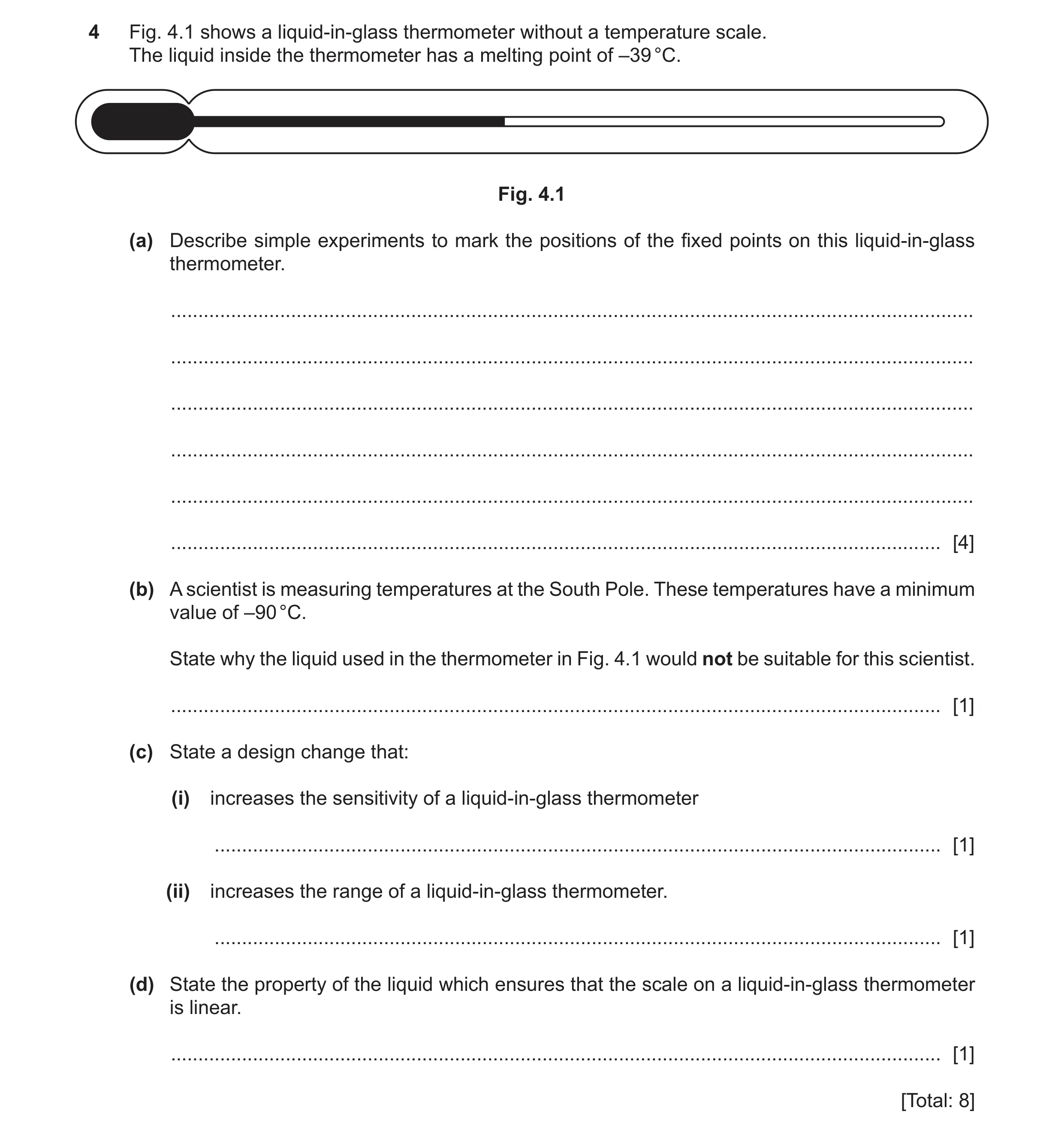
Q20 · A liquid-in-glass thermometer without a temperature scale 0625/42 May/June 2020
4 Fig. 4.1 shows a liquid-in-glass thermometer without a temperature scale. The liquid inside the thermometer has a melting point of –39 °C. Fig. 4.1 (a) Describe simple experiments to mark the positions of the fixed points on this liquid-in-glass thermometer. … … … … … … [4] (b) A scientist is measuring temperatures at the South Pole. These temperatures have a minimum value of –90 °C. State why the liquid used in the thermometer in Fig. 4.1 would not be suitable for this scientist. … [1] (c) State a design change that: (i) increases the sensitivity of a liquid-in-glass thermometer … [1] (ii) increases the range of a liquid-in-glass thermometer. … [1] (d) State the property of the liquid which ensures that the scale on a liquid-in-glass thermometer is linear. … [1] [Total: 8]
8 marks
Mark scheme: 4(a) (place) in melting ice B1 when bead has stopped moving OR owtte mark as lower fixed point / 0 °C B1 (place) in steam (above boiling water) B1 when bead has stopped moving OR owtte mark as upper fixed point / 100 °C B1 4(b) bead would not be liquid owtte B1 4(c)(i) thinner bore / tube OR smaller bulb OR use liquid which expands more (per unit change in temperature) B1 4(c)(ii) longer tube OR larger (volume) glass bulb OR use liquid which expands less (per unit change in temperature) B1 4(d) expands uniformly (with temperature) OR same distance between all degree intervals B1
This question in 0625/42 May/June 2020
Question 21 0625/43 May/June 2020
5 (a) Fig. 5.1 shows a plastic cup. The cup contains sand, an electric heater and a thermometer. thermometer electric plastic heater cup sand Fig. 5.1 The power of the heater is 50 W. The mass of the sand in the cup is 550 g. The initial temperature of the sand is 20 °C. The heater is switched on for 2.0 minutes. The temperature is recorded until the temperature stops increasing. The highest temperature recorded by the thermometer is 33 °C. (i) Calculate the energy supplied by the heater. energy = … [2] (ii) Calculate a value for the specific heat capacity of the sand, using your answer to (a)(i) and the data in the question. specific heat capacity = … [3] (iii) Explain why the specific heat capacity of sand may be different from the value calculated in (a)(ii). … … [2] (b) On a sunny day, the temperature of the sand on a beach is much higher than the temperature of the sea. Explain why. … … … [2] (c) Draw a labelled diagram to show the structure of a thermocouple thermometer. [3] [Total: 12]
12 marks
Mark scheme: 5(a)(i) E = Pt in any form C1 (E =) 6000 J A1 5(a)(ii) E = mcΔT in any form C1 ( ) 6000 550 33 20 c = − C1 (c =) 0.84 J / (g °C) OR 840 J / (kg °C) A1 5(a)(iii) EITHER some of energy supplied by the heater heats the heater / goes to lagging / goes to surroundings M1 specific heat capacity is lower than value in (ii) A1 OR some energy may be absorbed from surroundings if they are at a higher temperature M1 specific heat capacity is higher than value in (ii) A1 5(b) (specific) heat capacity of water is much higher than (specific) heat capacity of sand B1 same rate of energy supplied to sand and sea B1 5(c) cold junction labelled or shown in ice or something similar OR diagram with two junctions with voltmeter labelled B1 two different metals labelled B1 galvanometer or voltmeter joining ends of wires B1
This question in 0625/43 May/June 2020
Question 22 0625/42 Oct/Nov 2020
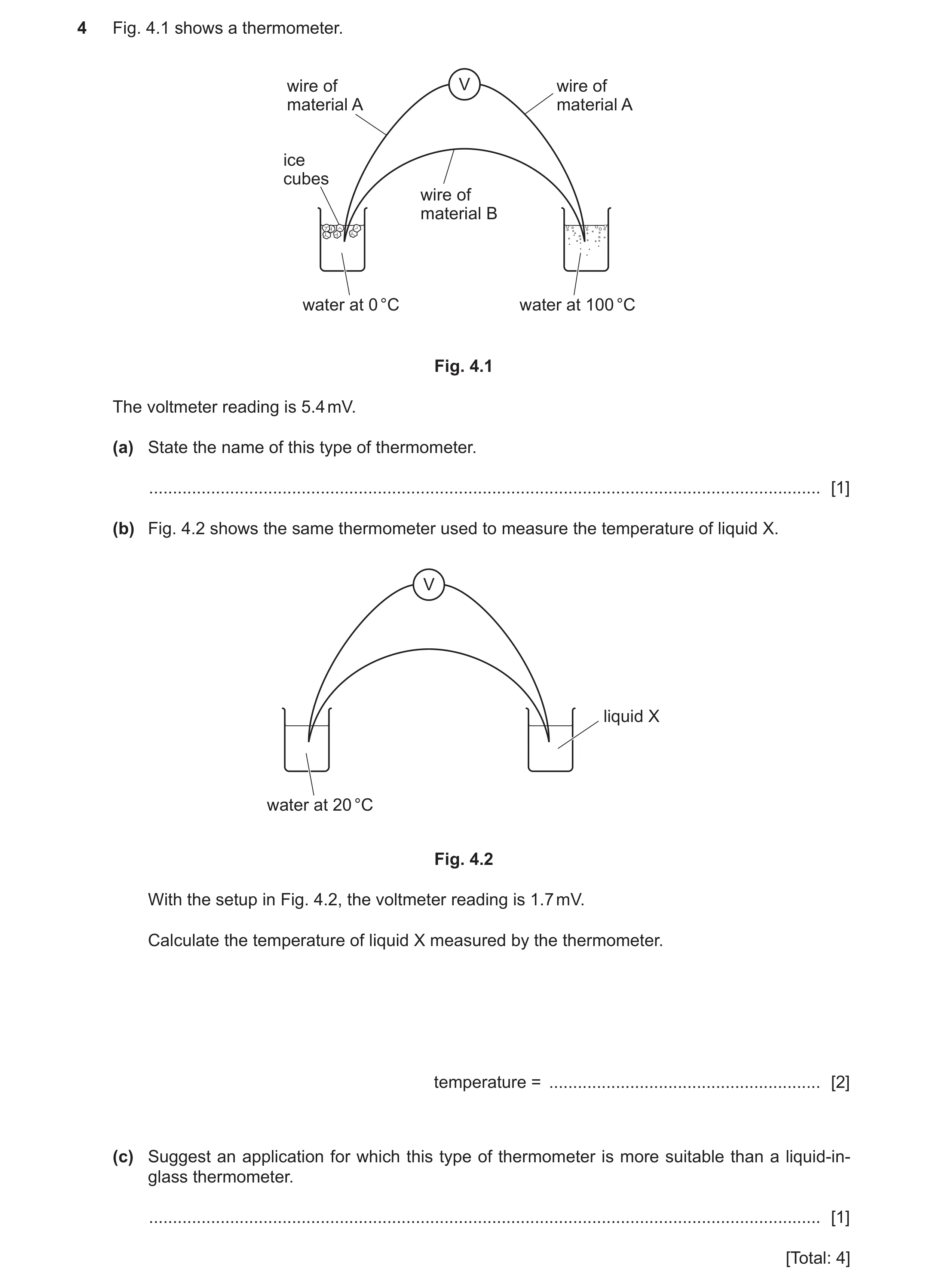
4 Fig. 4.1 shows a thermometer. wire of V wire of material A material A ice cubes wire of material B water at 0 °C water at 100 °C Fig. 4.1 The voltmeter reading is 5.4 mV. (a) State the name of this type of thermometer. … [1] (b) Fig. 4.2 shows the same thermometer used to measure the temperature of liquid X. V liquid X water at 20 °C Fig. 4.2 With the setup in Fig. 4.2, the voltmeter reading is 1.7 mV. Calculate the temperature of liquid X measured by the thermometer. temperature = … [2] (c) Suggest an application for which this type of thermometer is more suitable than a liquid-in- glass thermometer. … [1] [Total: 4]
4 marks
Mark scheme: 4(a) thermocouple B1 4(b) (ΔT =) {1.7 / 5.4} × 100 C1 (T = 31 + 20 =) 51°C A1 4(c) any application involving high(er) / low(er) temperatures OR rapidly changing temperatures OR on vibrating machinery OR remote sensing OR data logging OR small areas / masses B1
This question in 0625/42 Oct/Nov 2020
Q23 · Define specific latent heat 0625/42 Oct/Nov 2020
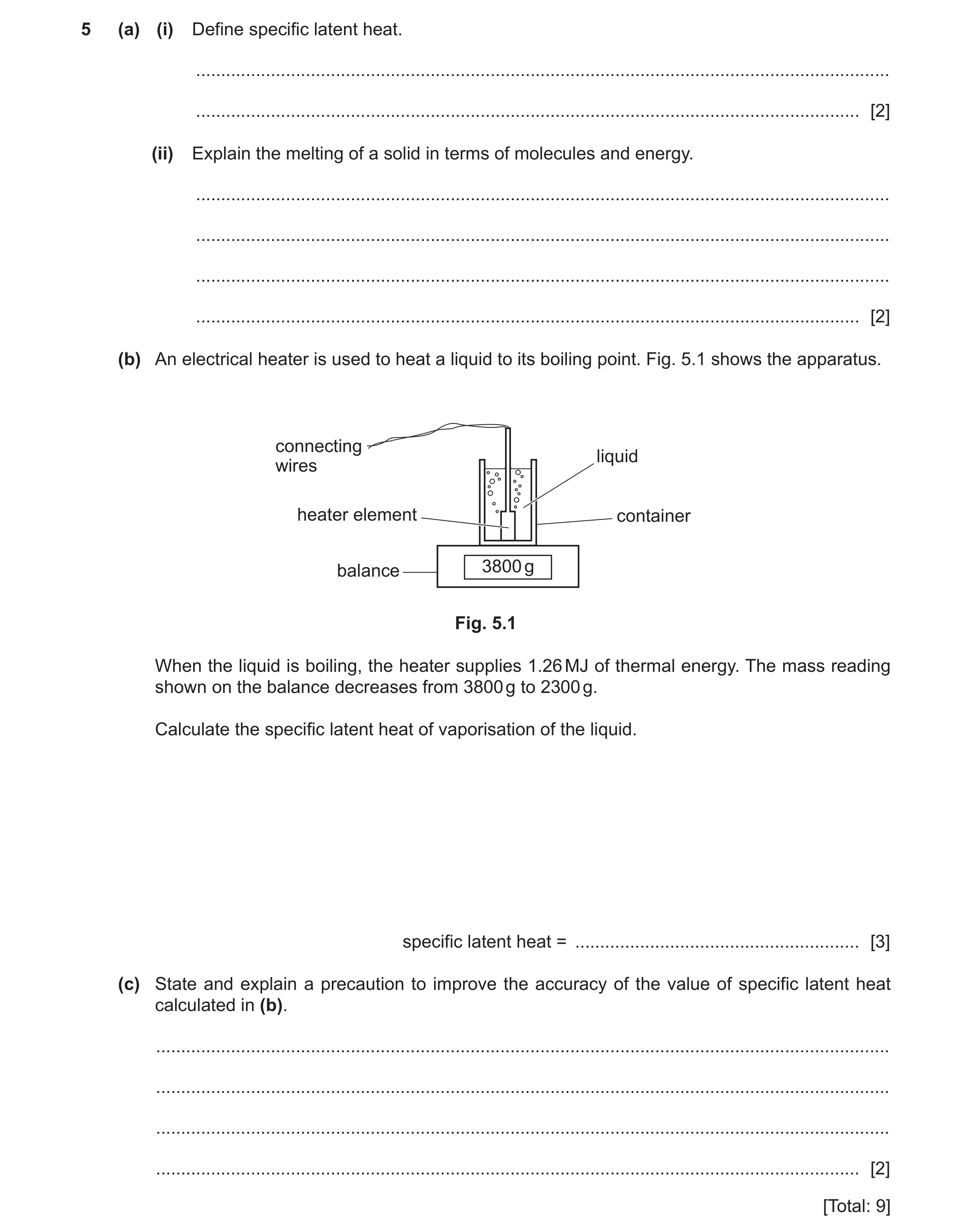
5 (a) (i) Define specific latent heat. … … [2] (ii) Explain the melting of a solid in terms of molecules and energy. … … … … [2] (b) An electrical heater is used to heat a liquid to its boiling point. Fig. 5.1 shows the apparatus. connecting liquid wires heater element container balance 3800 g Fig. 5.1 When the liquid is boiling, the heater supplies 1.26 MJ of thermal energy. The mass reading shown on the balance decreases from 3800 g to 2300 g. Calculate the specific latent heat of vaporisation of the liquid. specific latent heat = … [3] (c) State and explain a precaution to improve the accuracy of the value of specific latent heat calculated in (b). … … … … [2] [Total: 9]
9 marks
Mark scheme: 5(a)(i) (thermal) energy (needed) to change state M1 of unit mass / 1 kg (of material) NOT per °C A1 5(a)(ii) molecules must be separated OR (intermolecular) bonds must be broken / overcome B1 work done (against bonds) OR energy is required / needed NOT increase of KE / speed B1 5(b) E = ml in any form or (l =) E ÷ m words, symbols or numbers C1 (m =) 1.5 OR 1500 OR OR 3.8 – 2.3 OR 3800 – 2300 C1 (l = 1.26 × 10⁶ ÷ 1.5 =) 8.4 × 10⁵ J / kg A1 5(c) insulate OR apply lagging / insulation (to container) B1 reduction of thermal energy / heat losses B1
This question in 0625/42 Oct/Nov 2020
Q24 · The structure of a liquid-in-glass thermometer 0625/41 May/June 2021
5 Fig. 5.1 shows the structure of a liquid-in-glass thermometer. bulb glass 0 10 20 30 40 50 60 70 80 90 100°C liquid Fig. 5.1 The bulb of the thermometer is placed into a beaker of warm water. As the liquid expands, it moves along the tube. (a) Explain, in terms of molecules, why a liquid expands when heated. … … … [2] (b) Explain, in terms of molecules, why a liquid expands more than a solid when heated. … … … [2] (c) A second thermometer has a larger bulb that contains more of the same liquid than the thermometer shown in Fig. 5.1. It has a different scale. In every other way, it is identical. (i) Explain how the sensitivity of the second thermometer compares with the sensitivity of the thermometer in Fig. 5.1. … … … [2] (ii) Explain how the range of the second thermometer compares with the range of the thermometer in Fig. 5.1. … … [1] (d) (i) State one everyday problem that is a result of thermal expansion. … … [1] (ii) Suggest and explain one way of solving this problem. … … … [2] [Total: 10]
10 marks
Mark scheme: 5(a) molecules / they speed up or gain kinetic energy B1 molecules move further apart or push others away B1 5(b) forces between liquid molecules weak(er than in solids) B1 less energy / work done to separate molecules or greater separation for same work done / same increase in energy B1 5(c)(i) greater sensitivity B1 volume increase (of liquid in second thermometer) is greater or liquid moves a greater distance (for the same temperature increase) B1 5(c)(ii) smaller range and either of: • smaller temperature increase for liquid / meniscus to reach end of tube • expands more / greater sensitivity and tube of same length B1 5(d)(i) statement of problem (e.g. bridges buckle (in hot weather)) B1 5(d)(ii) suggested solution to problem stated in 5(d)(i) (e.g. allow gaps at the ends of the bridge) B1 more detail (e.g. as the bridge expands the gaps close) B1
This question in 0625/41 May/June 2021
Q25 · Define specific latent heat of fusion 0625/43 May/June 2021
4 (a) (i) Define specific latent heat of fusion. … … [2] (ii) A cup of water contains 250 cm3 of water at a temperature of 0 °C. An identical cup contains 250 cm3 of a mixture of ice and water at a temperature of 0 °C. The temperature of the surrounding air is 20 °C. State and explain which cup contains the liquid with the lower temperature after 10 minutes. statement … explanation … … [2] (b) (i) On a hot day, sweat forms on a person’s skin and then evaporates. Explain, in terms of molecules, how the evaporation of sweat cools the person. … … … … … [3] (ii) Explain why this process is more effective when a wind is blowing. … … [1] [Total: 8]
8 marks
Mark scheme: 4(a)(i) Energy transferred when 1 kg / unit mass of a substance freezes or melts A2 Energy transferred when a substance freezes/melts/changes state C1 4(a)(ii) cup containing mixture of ice and water M1 mixture of ice and water will remain at 0 °C until all ice is melted (but temperature of water at 0 °C rises) or reverse argument OR energy needed for change of state so temperature doesn’t rise until this has taken place A1 4(b)(i) in evaporation more – energetic / faster moving molecules / molecules with high(er) kinetic energy escape (from surface) B1 low(er) energy / slow molecules remain OR so remaining liquid is cooler B1 thermal energy is taken from person to liquid (so person cools down) B1 4(b)(ii) (great(er) / fast(er) evaporation of sweat as) wind blows fast moving molecules away OR molecules do not re-enter the liquid B1
This question in 0625/43 May/June 2021
Q26 · A student carries out an experiment using a plastic beaker that contains 0.24 kg of water… 0625/41 Oct/Nov 2021
2 A student carries out an experiment using a plastic beaker that contains 0.24 kg of water at 17 °C. The thermal capacity (heat capacity) of the beaker is negligible. (a) Define thermal capacity. … … … [2] (b) Several ice cubes are at a temperature of 0 °C. The ice cubes are dropped into the water and the internal energy of the water decreases. (i) Give a simple molecular account of this decrease in internal energy. … … … [2] (ii) The specific heat capacity of water is 4200 J / (kg °C). Calculate the decrease in the internal energy of the water as its temperature decreases from 17 °C to 0 °C. decrease in internal energy = … [2] (c) As the temperature of the water decreases, some of the ice melts. (i) Explain why this ice melts. … … … [2] (ii) Describe how to determine the specific latent heat of fusion of ice using this experiment. State any other measurements that the student needs to make. … … … … … [3] [Total: 11]
11 marks
Mark scheme: 2(a) (quantity of thermal) energy or energy (to increase temperature) or energy (transferred by heating) C1 energy to increase temperature (of an object) per degree Celsius 1 °C A1 2(b)(i) (internal energy) depends on kinetic energy (of molecules) B1 kinetic energy (of molecules) decreases or potential energy (of molecules) decreases B1 2(b)(ii) (ΔE =) mcΔT in any form or 0.24 × 4200 × 17 C1 1.7 × 10⁴ J A1 2(c)(i) k.e. of molecules / (thermal) energy absorbed (from water / surroundings) or energy absorbed from (cooling) water B1 supplies latent heat or energy used to overcome intermolecular forces / to break bonds B1 2(c)(ii) any determination of mass B1 determine change in mass (of ice) / increase in mass of water or dry the ice or ensure water is at 0 °C / equilibrium is established or insulate the beaker B1 use (lf =) E / m in any form B1
This question in 0625/41 Oct/Nov 2021
Q27 · A thermocouple thermometer is used to determine the temperature difference between a… 0625/42 Oct/Nov 2021
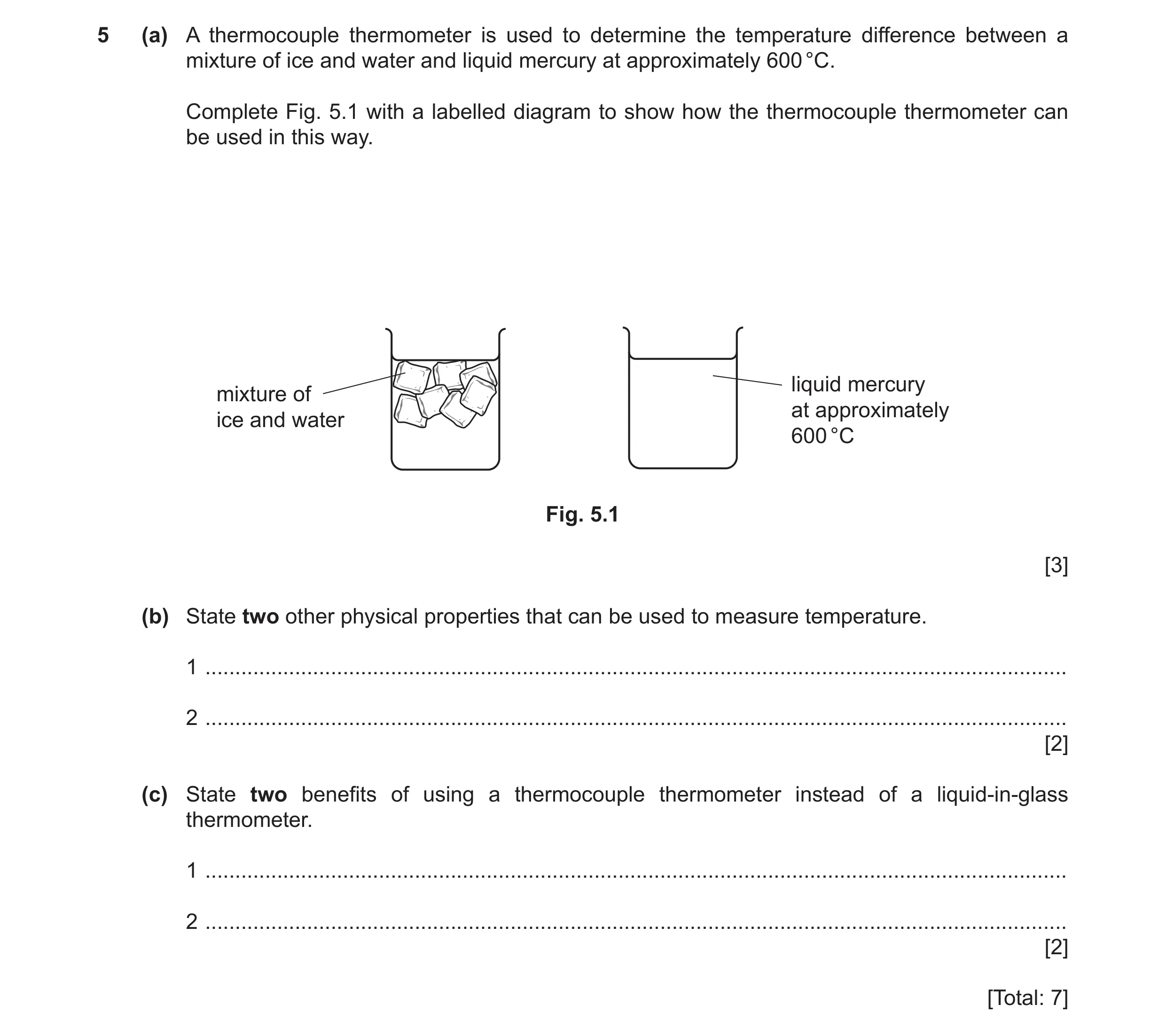
5 (a) A thermocouple thermometer is used to determine the temperature difference between a mixture of ice and water and liquid mercury at approximately 600 °C. Complete Fig. 5.1 with a labelled diagram to show how the thermocouple thermometer can be used in this way. liquid mercury mixture of at approximately ice and water 600 °C Fig. 5.1 [3] (b) State two other physical properties that can be used to measure temperature. 1 … 2 … [2] (c) State two benefits of using a thermocouple thermometer instead of a liquid-in-glass thermometer. 1 … 2 … [2] [Total: 7]
7 marks
Mark scheme: 5(a) wires of 2 different metals B1 one junction clearly in each liquid B1 voltmeter / ammeter / galvanometer correctly connected B1 5(b) any two from • expansion of liquid • expansion of solid • expansion of gas • density (of liquid) • (electrical) resistance B2 5(c) any two from • large range • (measure) high temperatures • remote sensing • small size OR small mass • small thermal capacity • suitable for data logging • responds quickly OR measures rapidly varying temperatures OR temperature changing continuously B2
This question in 0625/42 Oct/Nov 2021
Q28 · A thermocouple is a device that is used as a thermometer 0625/41 May/June 2022
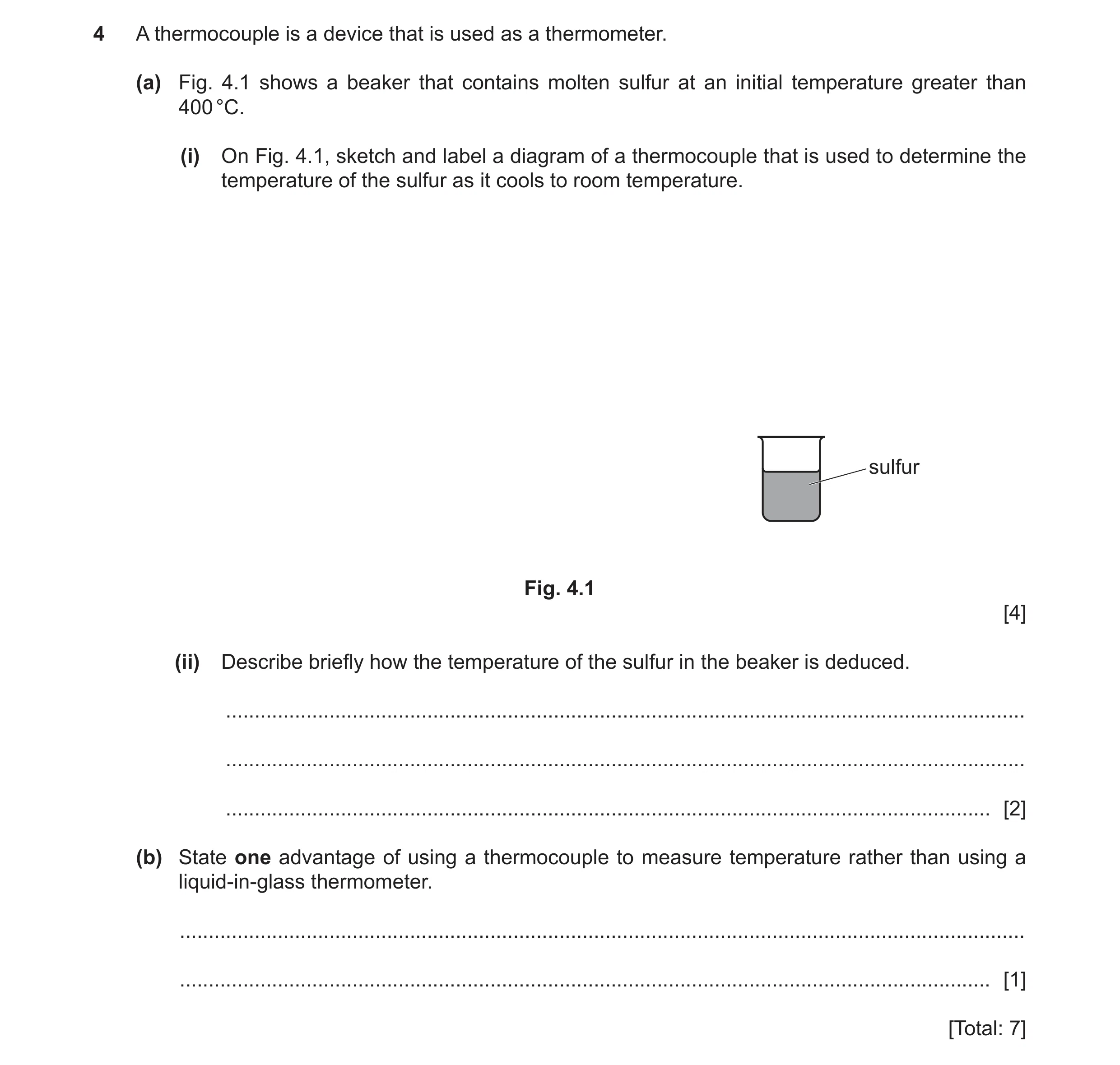
4 A thermocouple is a device that is used as a thermometer. (a) Fig. 4.1 shows a beaker that contains molten sulfur at an initial temperature greater than 400 °C. (i) On Fig. 4.1, sketch and label a diagram of a thermocouple that is used to determine the temperature of the sulfur as it cools to room temperature. sulfur Fig. 4.1 [4] (ii) Describe briefly how the temperature of the sulfur in the beaker is deduced. … … … [2] (b) State one advantage of using a thermocouple to measure temperature rather than using a liquid-in-glass thermometer. … … [1] [Total: 7]
7 marks
Mark scheme: 4(a)(i) two / three wires of at least two different metals B1 one junction in sulfur B1 the other junction in ice-water mixture / at room temperature and one of the wires must be from the first junction B1 labelled voltmeter / voltmeter symbol correctly connected B1 Question Answer Marks 4(a)(ii) measure e.m.f. B1 how to find temperature from e.m.f. (e.g. use calibration graph or calculation or table) B1 4(b) measures high temperatures / wires do not melt / rapid response / robust / small heat capacity / electrical output / (can be) remote from observer / direct input to computer B1
This question in 0625/41 May/June 2022
Q29 · A kitchen tap that supplies instant boiling water 0625/41 May/June 2022
5 Fig. 5.1 shows a kitchen tap that supplies instant boiling water. Fig. 5.1 Cold water passes over an electric immersion heater inside the tap. The boiling point of water is 100 °C. (a) State what is meant by boiling point. … … [2] (b) The immersion heater is powered by the mains at a voltage of 230 V. When the tap is opened, the heater switches on and the current in the heater is 13 A. (i) Calculate the thermal energy produced by the heater in 60 s. thermal energy = … [2] (ii) The specific heat capacity of water is 4200 J / (kg °C). The cold water that enters the tap is at 22 °C. Calculate the rate at which water at its boiling point emerges from the tap. rate = … [4] (c) The metal tap is earthed and there is a fuse in the cable that connects the heater to the mains. 1. Explain how the earth wire protects the user. … … 2. Explain how the fuse protects the circuit. … … [3] [Total: 11]
11 marks
Mark scheme: 5(a) temperature B1 at which liquid becomes a gas or liquid and gas exist together B1 5(b)(i) 1.8 105 J A2 (E =) VIt (in any form) or 230 13 60 or 230 13 or 3000 C1 5(b)(ii) 9.1 10–3 kg / s 9.1 10–3 kg / s A4 (T =) 100 – 22 or 78 or (T =) 100 – 22 or 78 C1 m = E / cT (in any form) or 1.8 105 / (4200 78) or (rate =) P / cT (in any form) or m = E / cT and E = Pt C1 1.8 105 / (4200 78 60) or 5.5 10N or 9.1/9.2 10N or 3000 / (4200 78) or 230 13 / (4200 78) or 9.1 / 9.2 10N C1 5(c) 1 if the tap becomes live or if the (live) cable touches the (metal) tap B1 there is a current to earth / in the earth wire (which blows the fuse) B1 2 the current (in earth wire) is large and fuse melts / blows / stops current / breaks circuit B1
This question in 0625/41 May/June 2022
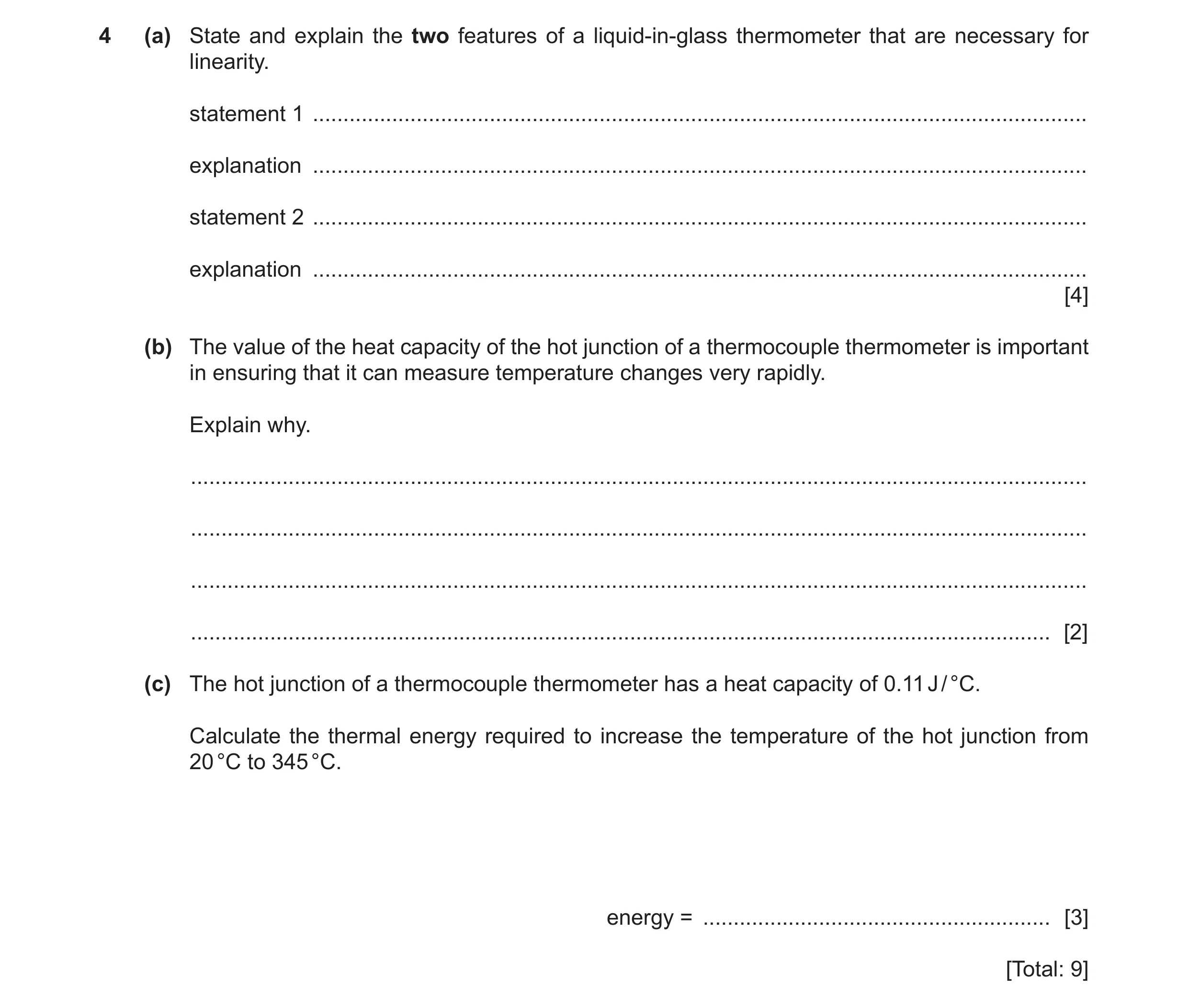
Q30 · State and explain the two features of a liquid-in-glass thermometer that are necessary… 0625/42 May/June 2022
4 (a) State and explain the two features of a liquid-in-glass thermometer that are necessary for linearity. statement 1 … explanation … statement 2 … explanation … [4] (b) The value of the heat capacity of the hot junction of a thermocouple thermometer is important in ensuring that it can measure temperature changes very rapidly. Explain why. … … … … [2] (c) The hot junction of a thermocouple thermometer has a heat capacity of 0.11 J / °C. Calculate the thermal energy required to increase the temperature of the hot junction from 20 °C to 345 °C. energy = … [3] [Total: 9]
9 marks
Mark scheme: 4(a) statement: bore of constant (cross sectional) area B1 explanation: idea of same movement / change in length of liquid / thread AND for same increase in volume / expansion (of liquid) B1 statement: (liquid has) constant thermal expansion B1 explanation: liquid moves same distance for each °C temperature rise B1 4(b) heat capacity / it is small B1 only uses / needs a small amount of (thermal) energy (to raise its temperature) B1 4(c) 36 J A3 (E =) CT in any form C1 (E =) 0.11 (345 – 20) OR (T =) 325 (°C) C1
This question in 0625/42 May/June 2022
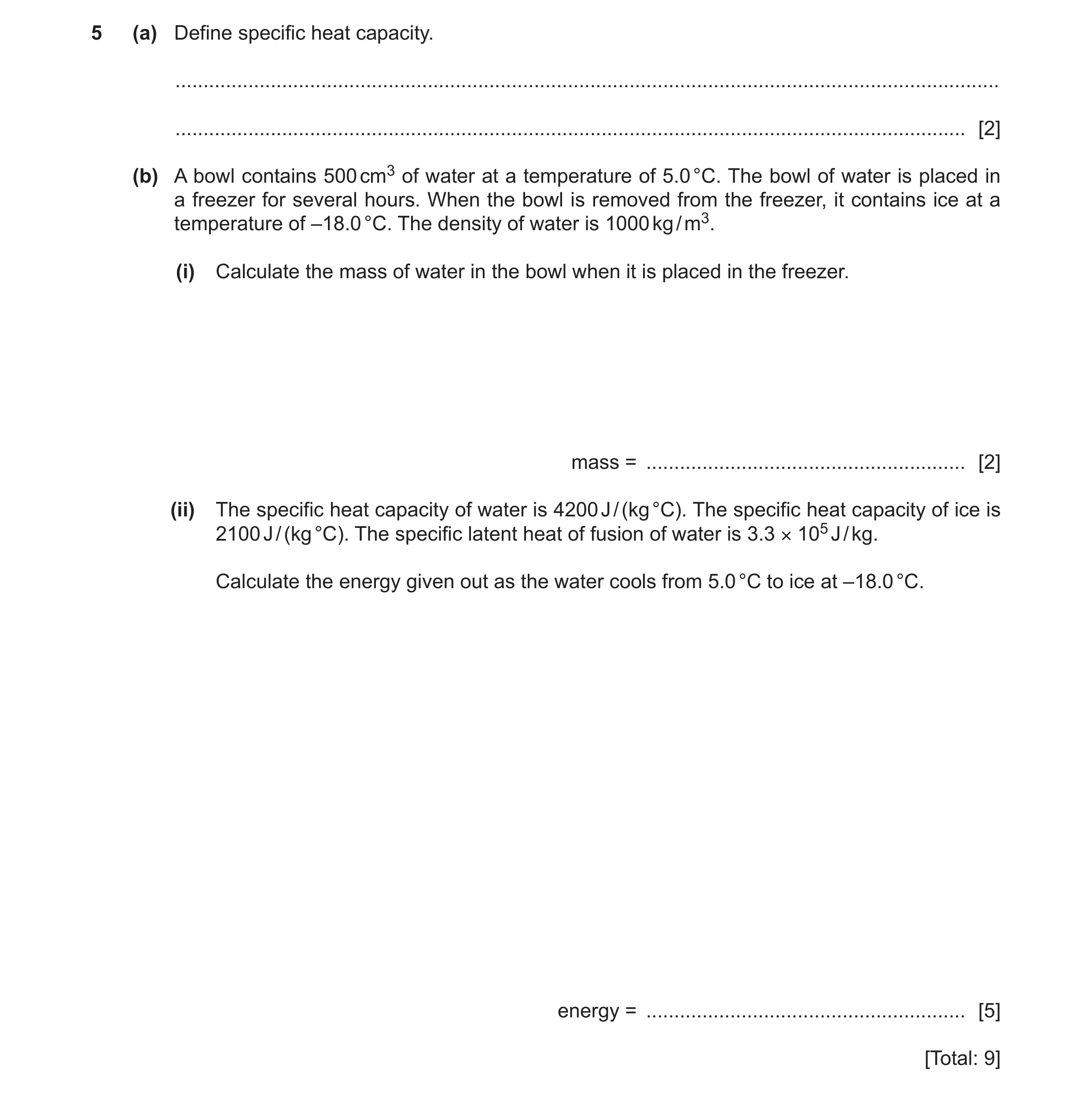
Q31 · Define specific heat capacity 0625/43 May/June 2022
5 (a) Define specific heat capacity. … … [2] (b) A bowl contains 500 cm3 of water at a temperature of 5.0 °C. The bowl of water is placed in a freezer for several hours. When the bowl is removed from the freezer, it contains ice at a temperature of –18.0 °C. The density of water is 1000 kg / m3. (i) Calculate the mass of water in the bowl when it is placed in the freezer. mass = … [2] (ii) The specific heat capacity of water is 4200 J / (kg °C). The specific heat capacity of ice is 2100 J / (kg °C). The specific latent heat of fusion of water is 3.3 × 10⁵ J / kg. Calculate the energy given out as the water cools from 5.0 °C to ice at –18.0 °C. energy = … [5] [Total: 9]
9 marks
Mark scheme: 5(a) energy required to raise the temperature of 1 kg / 1 g / unit mass of a substance by 1 °C / unit temperature A2 energy required to raise the temperature of a substance by 1 °C C1 5(b)(i) 0.50 kg A2 = m/V in any form C1 5(b)(ii) 190 000J / 1.9 105 J / 190 kJ A5 (E=) mc∆T in any form C1 (E=) mL in any form C1 Use of c = 4200 (J / kg °C) AND ∆T = 5 C1 Use of c = 2100 AND ∆T = 18 C1
This question in 0625/43 May/June 2022
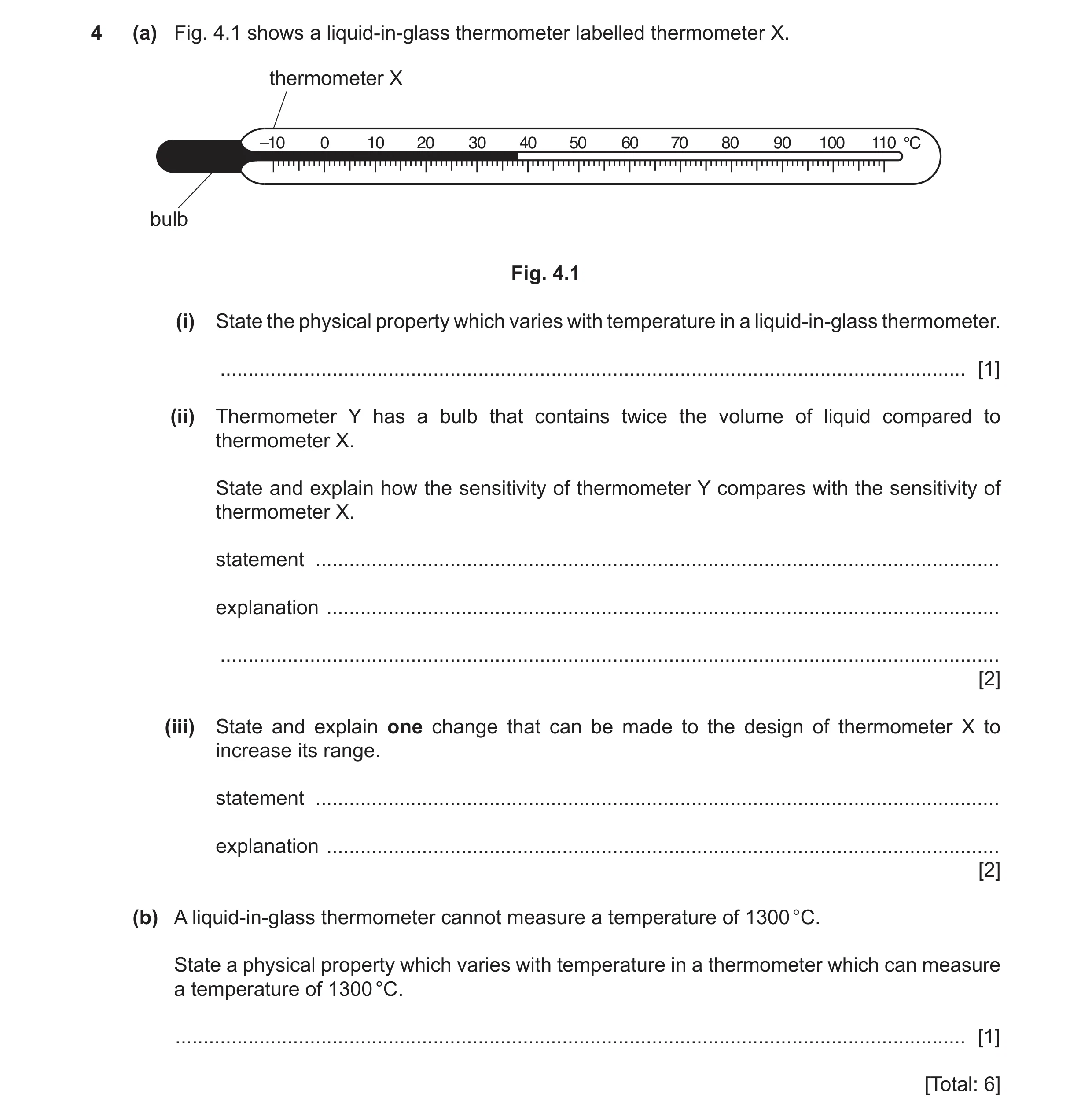
Q32 · A liquid-in-glass thermometer labelled thermometer X 0625/43 Oct/Nov 2022
4 (a) Fig. 4.1 shows a liquid-in-glass thermometer labelled thermometer X. thermometer X –10 0 10 20 30 40 50 60 70 80 90 100 110 °C bulb Fig. 4.1 (i) State the physical property which varies with temperature in a liquid-in-glass thermometer. … [1] (ii) Thermometer Y has a bulb that contains twice the volume of liquid compared to thermometer X. State and explain how the sensitivity of thermometer Y compares with the sensitivity of thermometer X. statement … explanation … … [2] (iii) State and explain one change that can be made to the design of thermometer X to increase its range. statement … explanation … [2] (b) A liquid-in-glass thermometer cannot measure a temperature of 1300 °C. State a physical property which varies with temperature in a thermometer which can measure a temperature of 1300 °C. … [1] [Total: 6]
6 marks
Mark scheme: 4(a)(i) any one from: B1 • volume (of liquid) • length (of thread / liquid in tube). 4(a)(ii) more OR greater (sensitivity) M1 volume of liquid / length of thread increases more per °C / unit temperature (because greater volume of liquid present) A1 OR (more liquid to expand so) gives a larger change in the level of the liquid per °C / unit temperature 4(a)(iii) longer (capillary) tube M1 liquid can expand further so to a higher temperature A1 OR smaller (volume) bulb (M1) less liquid so liquid expands less / lower rise per °C (A1) OR larger diameter / wider capillary tube (M1) lower increase in level for each °C (A1) OR replace liquid with a liquid with lower expansivity (M1) liquid expands less for each °C (A1) 4(b) e.m.f. B1
This question in 0625/43 Oct/Nov 2022
Q33 · Three identical dishes, A, B and C, contain an equal volume of water 0625/43 Oct/Nov 2022
5 (a) Three identical dishes, A, B and C, contain an equal volume of water. Dish A is outside in sunlight and experiences no wind during the day. Dish B is outside in sunlight and experiences a strong wind during the day. Dish C is in a dark room. Water evaporates from each dish. After 12 hours, a student measures the volume of water in each dish. Dish C contains the largest volume of water and dish B contains the smallest volume of water. Explain, in terms of particles, why the three dishes have different volumes of water. … … … … … … … [4] (b) Define specific latent heat of vaporisation. … … … [2] (c) Fig. 5.1 shows an insulating beaker, crushed ice, an immersion heater and a thermometer. thermometer to the power supply insulating immersion heater beaker crushed ice Fig. 5.1 The initial temperature of the ice is –60 °C. The immersion heater is switched on and the temperature is recorded at equal intervals of time. Fig. 5.2 shows the temperature–time graph. D temperature C B A time Fig. 5.2 Describe what occurs in each of the sections A, B, C and D. A … B … C … D … [3] [Total: 9]
9 marks
Mark scheme: 5(a) energy from the Sun transfers to / is absorbed by (water) molecules, (so KE of (water) molecules increases) B1 molecules with high(er) energy / KE / fast(er) moving molecules escape (from the surface) B1 wind removes molecules when they have left the surface (so they do not re-enter the liquid) B1 any one from: B1 • wind increases the rate of evaporation • (absorption of) energy from the Sun increases the rate of evaporation • least / less water evaporates / lower rate of evaporation from dish C • most / more water evaporates / higher rate of evaporation from dish B 5(b) energy to change 1 kg / unit mass from liquid to gas / gas to liquid (without changing its temperature) A2 energy to change from liquid to gas / gas to liquid C1 OR energy to change state of 1 kg 5(c) A: temperature (of solid / ice) increases AND C: temperature (of liquid / water) increases B1 B: solid / ice changes to liquid / water OR solid / ice melts (at constant temperature) B1 D: liquid / water changes to gas / steam OR liquid / water boils (at constant temperature) B1
This question in 0625/43 Oct/Nov 2022
Q34 · A metal pan on an electric hotplate 0625/42 Feb/March 2023
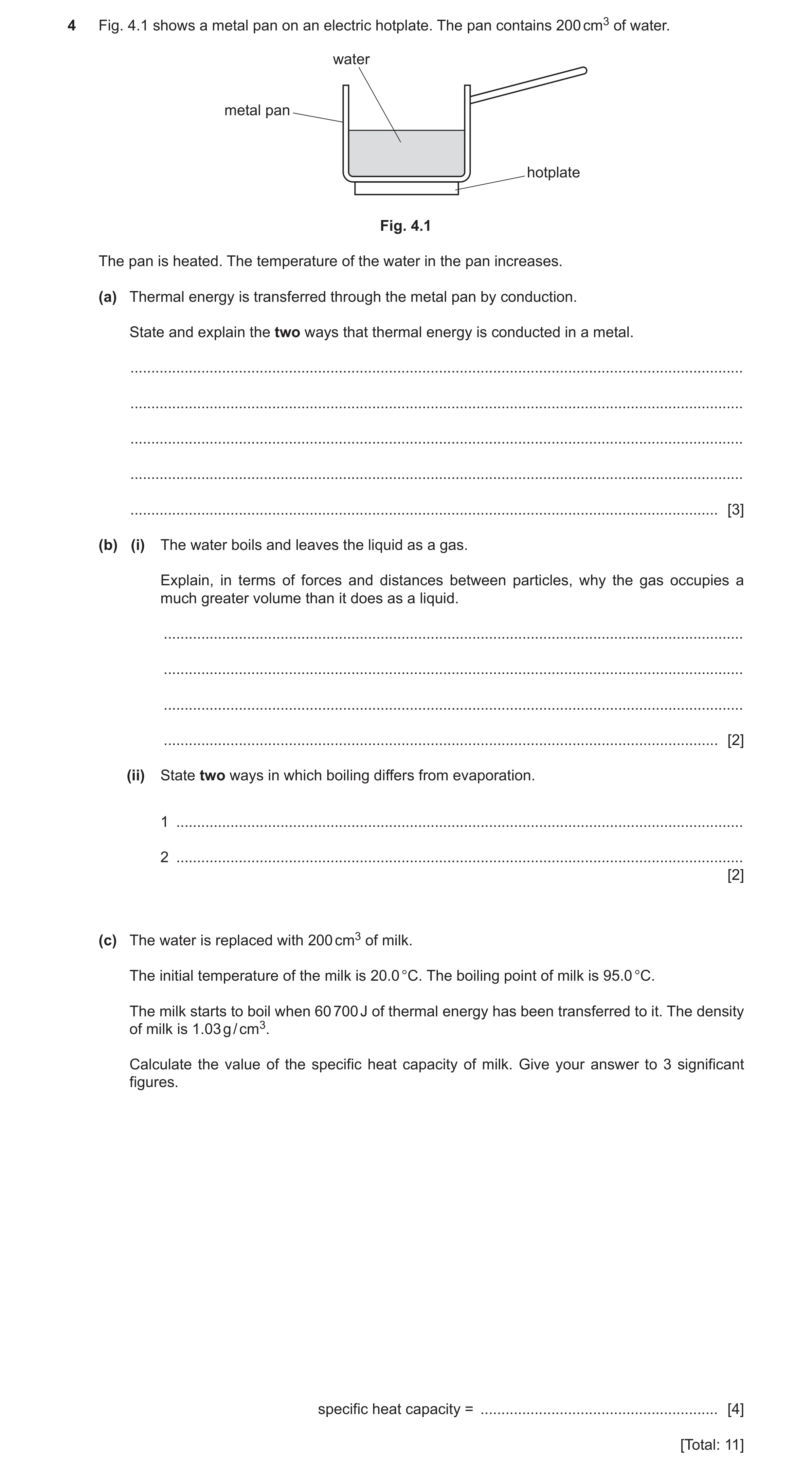
4 Fig. 4.1 shows a metal pan on an electric hotplate. The pan contains 200 cm3 of water. water metal pan hotplate Fig. 4.1 The pan is heated. The temperature of the water in the pan increases. (a) Thermal energy is transferred through the metal pan by conduction. State and explain the two ways that thermal energy is conducted in a metal. … … … … … [3] (b) (i) The water boils and leaves the liquid as a gas. Explain, in terms of forces and distances between particles, why the gas occupies a much greater volume than it does as a liquid. … … … … [2] (ii) State two ways in which boiling differs from evaporation. 1 … 2 … [2] (c) The water is replaced with 200 cm3 of milk. The initial temperature of the milk is 20.0 °C. The boiling point of milk is 95.0 °C. The milk starts to boil when 60 700 J of thermal energy has been transferred to it. The density of milk is 1.03 g / cm3. Calculate the value of the specific heat capacity of milk. Give your answer to 3 significant figures. specific heat capacity = … [4] [Total: 11]
11 marks
Mark scheme: 4(a) delocalised / free / mobile electrons B1 electrons move through metal OR electrons collide with distant particles OR electrons carry energy through the metal B1 lattice vibrations transfer energy to neighbouring particles OR particles vibrate and cause nearby / adjacent particles to B1 vibrate OR vibrating particles collide with particles transferring energy 4(b)(i) (attractive) forces (between particles are much) greater in liquids (than in gases) B1 particles in gases are (much) further apart (than in liquids) B1 4(b)(ii) occurs at a fixed temperature B1 takes place throughout the liquid B1 4(c) 3.93 J / (g °C) OR 3930 J / (kg °C) A4 = m / V OR (m =) V OR 1.03 200 OR 206 SEEN (C1) c = E / m∆OR (c = ) E / m∆OR 60 700 / (206 75) OR 60700 / (1.03 200 75) (C1) (m =) 206 (g) OR (∆) = 75 (°C) (C1)
This question in 0625/42 Feb/March 2023
Q35 · A student investigates the efficiency of a filament lamp 0625/41 May/June 2023
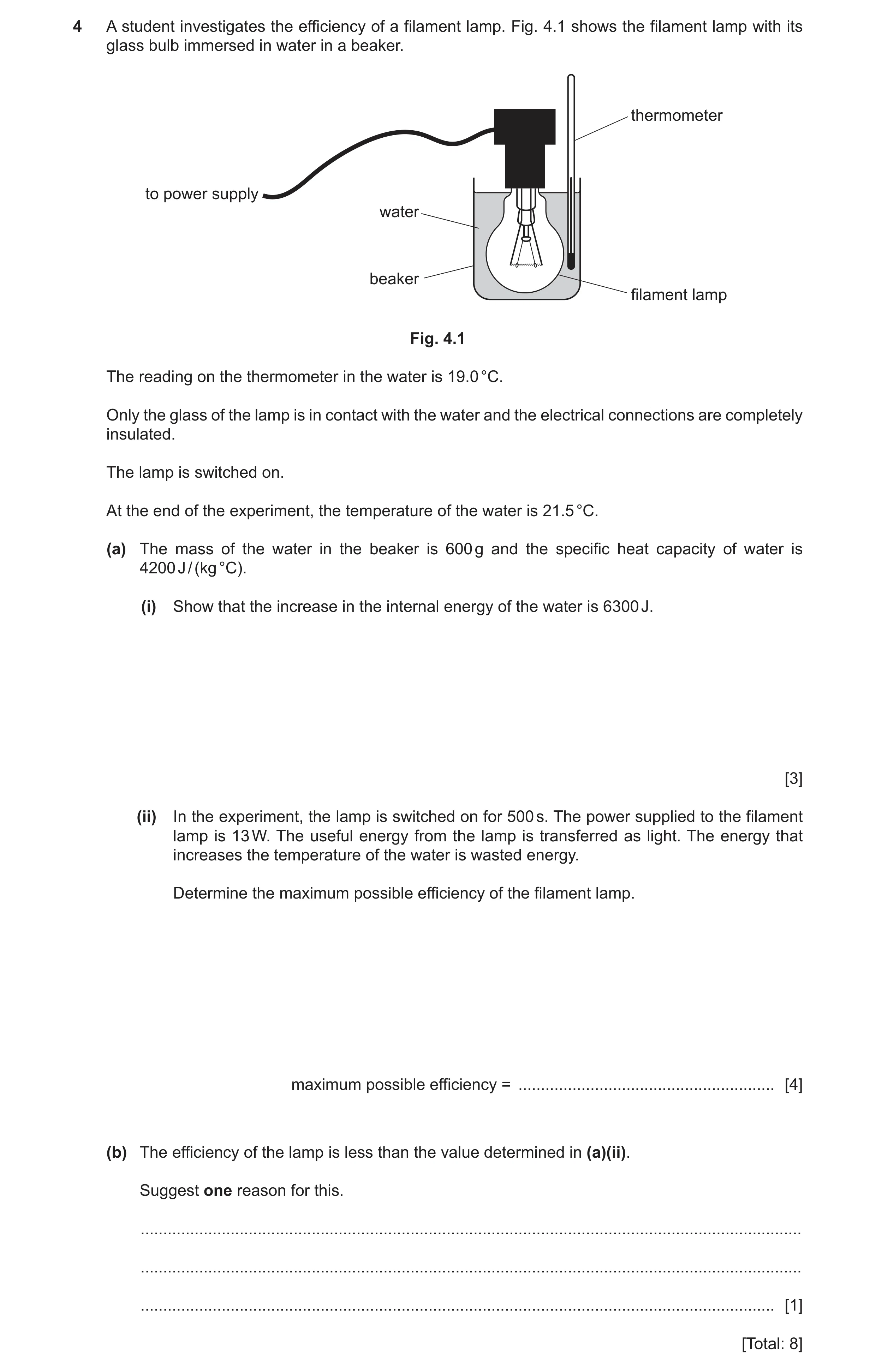
4 A student investigates the efficiency of a filament lamp. Fig. 4.1 shows the filament lamp with its glass bulb immersed in water in a beaker. thermometer to power supply water beaker filament lamp Fig. 4.1 The reading on the thermometer in the water is 19.0 °C. Only the glass of the lamp is in contact with the water and the electrical connections are completely insulated. The lamp is switched on. At the end of the experiment, the temperature of the water is 21.5 °C. (a) The mass of the water in the beaker is 600 g and the specific heat capacity of water is 4200 J / (kg °C). (i) Show that the increase in the internal energy of the water is 6300 J. [3] (ii) In the experiment, the lamp is switched on for 500 s. The power supplied to the filament lamp is 13 W. The useful energy from the lamp is transferred as light. The energy that increases the temperature of the water is wasted energy. Determine the maximum possible efficiency of the filament lamp. maximum possible efficiency = … [4] (b) The efficiency of the lamp is less than the value determined in (a)(ii). Suggest one reason for this. … … … [1] [Total: 8]
8 marks
Mark scheme: 4(a)(i) B1 (∆ =) 21.5 – 19 OR (∆ =) 2.5 (°C) B1 (∆E =) 0.6(0) 4200 2.5 OR (∆E =) 0.6(0) 4200 {21.5 – 19} B1 4(a)(ii) (maximum possible efficiency =) 3.1% or 0.031 A4 E = Pt OR (E =) Pt OR (E =) 13 500 OR (E =) 6500 C1 (useful energy output =) 6500 – 6300 OR (useful energy output =) 200 C1 efficiency = useful energy (output) / total energy (input) ( 100%) OR (efficiency =) useful energy (output) / total energy (input) ( 100%) OR (efficiency =) {6500 – 6300} / 6500 OR (efficiency =) 200 / 6500 ( 100%) C1 OR P = E/t OR (P =) E / t OR (P =) 6 300 / 500 OR (P =) 12.6 (W) (C1) (useful power output =) total power (output) – wasted power (output) OR (useful power output =) 13 – {6300 / 500} OR (useful power output =) 13–12.6 (C1) efficiency = useful power (output) / total power (input) ( 100%) OR (efficiency =) useful power (output) / total power (input) ( 100%) OR (efficiency =) 0.4 / 13 ( 100%) (C1) 4(b) any one from: temperature change is an underestimate (due to thermal energy losses) (thermal energy is) transferred from the water (to air / beaker / bench) energy (other than light) transferred in lamp (filament / glass / internal structure) (some) water evaporates B1
This question in 0625/41 May/June 2023
Q36 · Pluto is a dwarf planet 0625/41 May/June 2023
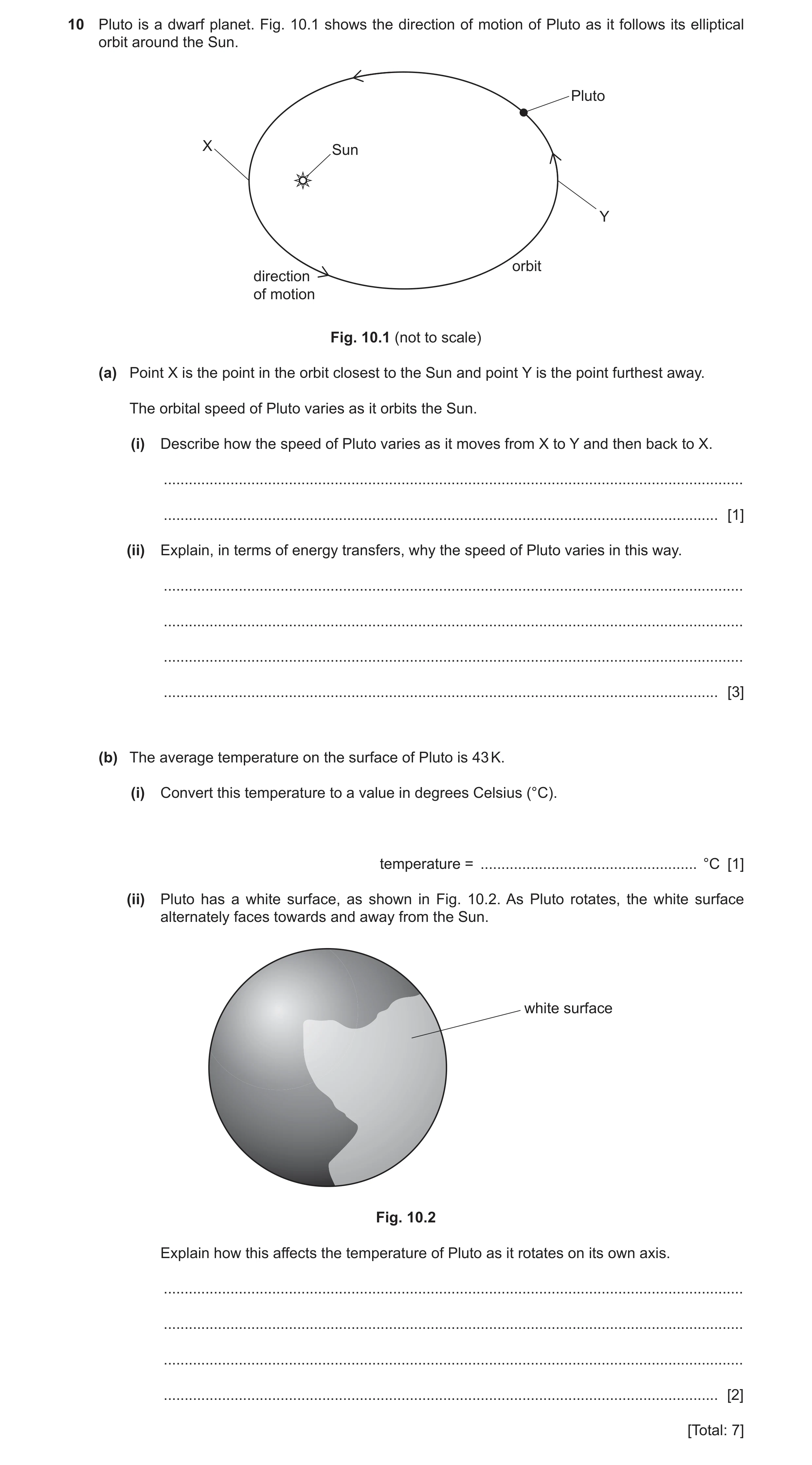
10 Pluto is a dwarf planet. Fig. 10.1 shows the direction of motion of Pluto as it follows its elliptical orbit around the Sun. Pluto X Sun Y orbit direction of motion Fig. 10.1 (not to scale) (a) Point X is the point in the orbit closest to the Sun and point Y is the point furthest away. The orbital speed of Pluto varies as it orbits the Sun. (i) Describe how the speed of Pluto varies as it moves from X to Y and then back to X. … … [1] (ii) Explain, in terms of energy transfers, why the speed of Pluto varies in this way. … … … … [3] (b) The average temperature on the surface of Pluto is 43 K. (i) Convert this temperature to a value in degrees Celsius (°C). temperature = … °C [1] (ii) Pluto has a white surface, as shown in Fig. 10.2. As Pluto rotates, the white surface alternately faces towards and away from the Sun. white surface Fig. 10.2 Explain how this affects the temperature of Pluto as it rotates on its own axis. … … … … [2] [Total: 7]
7 marks
Mark scheme: 10(a)(i) (speed) decreases (from X to Y) and then increases (from Y to X) B1 Question Answer Marks 10(a)(ii) any three from: gravitational (potential) energy (GPE) transfers to kinetic energy (KE) or vice versa KE transfers to GPE from X to Y AND GPE transfers to KE from Y to X speed decreases as KE decreases / ORA most GPE at Y OR least GPE at X total (of GPE + KE) energy is constant B3 10(b)(i) –230 (°C) B1 10(b)(ii) (white surface) is a poor absorber / good reflector / poor emitter of IR / radiation OR black / other surface is a good absorber / poor reflector / good emitter of IR / radiation B1 any one from: (the white surface) increases in temperature less when facing the Sun (the white surface) decreases in temperature less when facing away (from Sun) the black / other surfaces increases in temperature more when facing the Sun the black / other surface decreases in temperature more when facing away (from Sun) less variation in temperature on white surface (during one whole rotation) B1
This question in 0625/41 May/June 2023
Q37 · The temperature of a fixed mass of gas at constant volume is decreased 0625/42 May/June 2023
4 (a) The temperature of a fixed mass of gas at constant volume is decreased. State and explain, in terms of particles, how the pressure of the gas changes. … … … … [3] (b) (i) State the value of absolute zero in °C. value of absolute zero = … °C [1] (ii) Explain what is meant by the term absolute zero. Refer to particles in your answer. … … … [2] (c) Cylinder 1 contains 350 cm3 of gas at a pressure of 9.0 × 10⁴ Pa. The gas is transferred to cylinder 2 and the pressure increases to 1.6 × 10⁵ Pa. The temperature remains constant. Calculate the volume of cylinder 2. volume = … [3] [Total: 9]
9 marks
Mark scheme: 4(a) pressure decreases AND particles have smaller velocity / momentum / smaller EK / kinetic energy (when temperature is lower) B1 lower rate / frequency of collision of particles B1 particles collide with smaller force OR smaller impulse change B1 Question Answer Marks 4(b)(i) –273 (°C) B1 4(b)(ii) (temperature at which) particles have least EK / kinetic energy B1 lowest possible temperature B1 4(c) 200 cm3 A3 pV = constant OR 9.0 104 350 = 1.6 105 V2 C1 V2 = [9.0 104 350] / 1.6 105 OR V2 = 2.0 10N OR 1.97 10N C1
This question in 0625/42 May/June 2023
Q38 · An electric tumble dryer used to dry wet clothes 0625/42 Oct/Nov 2023
2 Fig. 2.1 shows an electric tumble dryer used to dry wet clothes. drum hot air blows into drum clothes heating element cool air condenser leaves condenser water Fig. 2.1 (a) Hot air blows into the drum. The air gains water vapour from the clothes and then leaves the drum. The moist air enters the condenser. Cool air leaves the condenser, passes through the heating element and enters the drum again. (i) State the process by which the hot air removes water from the wet clothes. … [1] (ii) The air is cooled as it passes through the condenser. Describe and explain one other way in which the air leaving the condenser is different from the air entering the condenser. description … explanation … … [2] (b) The drum of the tumble dryer rotates, lifting up the wet clothes which then fall down through the hot air. (i) Name the force that causes the clothes to fall down. … [1] (ii) When the drum rotates too fast the clothes remain in contact with the wall of the drum. State the direction of the resultant force on the clothes during the circular motion. … [1] (c) Suggest why using a clothesline to dry clothes in the open air is better for the environment than using an electric tumble dryer. … … [1] [Total: 6]
6 marks
Mark scheme: 2(a)(i) evaporation B1 2(a)(ii) air is drier B1 because water vapour has condensed / turned back to liquid in the condenser B1 2(b)(i) gravitational (force) OR weight B1 2(b)(ii) (force is) perpendicular to the motion (of the clothes) B1 2(c) uses (solar / wind) energy which is renewable OR energy (re)sources not used to generate electricity OR B1 greenhouse gases not produced OR does not use (fossil) fuels
This question in 0625/42 Oct/Nov 2023
Q39 · A bottle part-filled with water 0625/42 Oct/Nov 2023
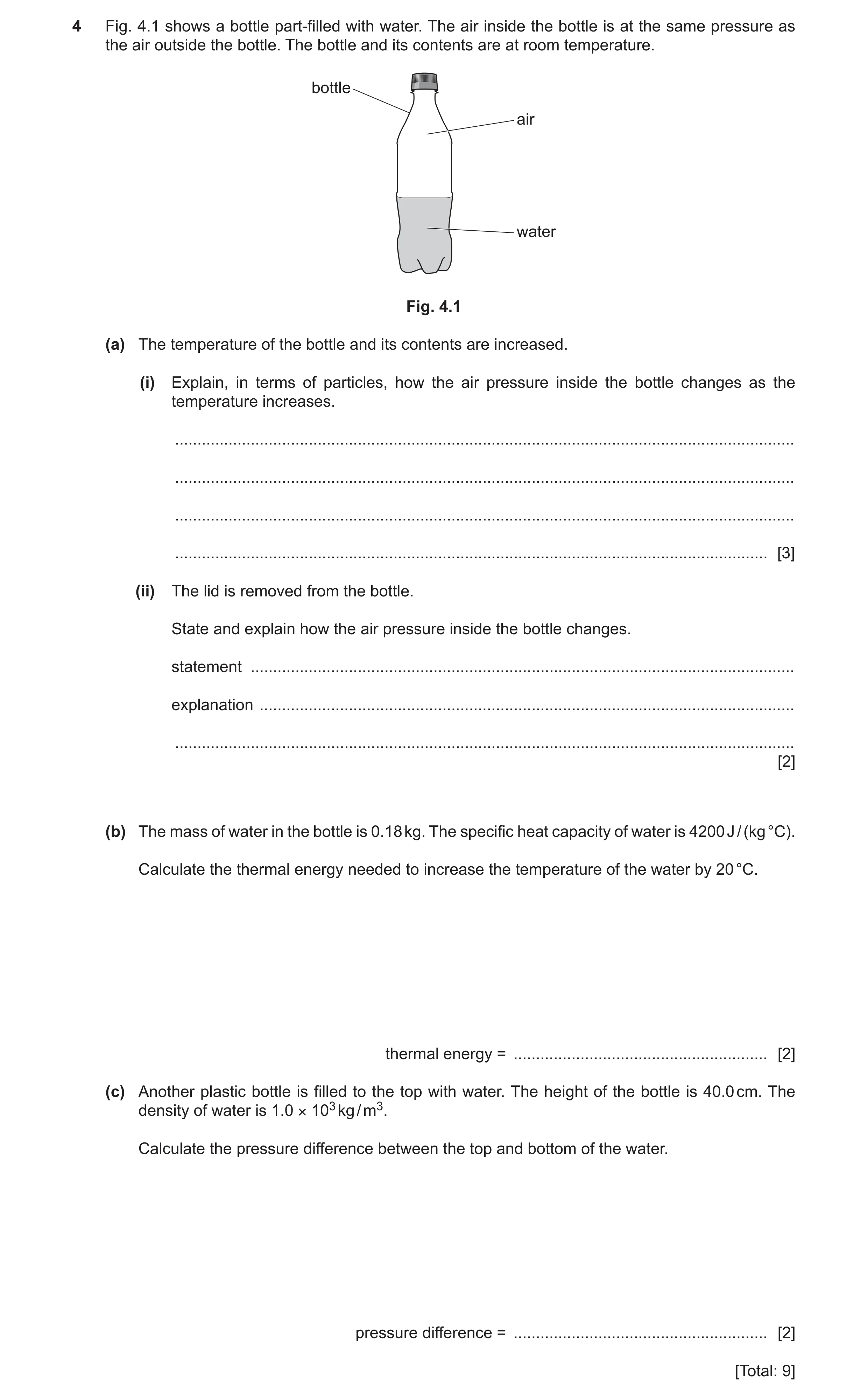
4 Fig. 4.1 shows a bottle part-filled with water. The air inside the bottle is at the same pressure as the air outside the bottle. The bottle and its contents are at room temperature. bottle air water Fig. 4.1 (a) The temperature of the bottle and its contents are increased. (i) Explain, in terms of particles, how the air pressure inside the bottle changes as the temperature increases. … … … … [3] (ii) The lid is removed from the bottle. State and explain how the air pressure inside the bottle changes. statement … explanation … … [2] (b) The mass of water in the bottle is 0.18 kg. The specific heat capacity of water is 4200 J / (kg °C). Calculate the thermal energy needed to increase the temperature of the water by 20 °C. thermal energy = … [2] (c) Another plastic bottle is filled to the top with water. The height of the bottle is 40.0 cm. The density of water is 1.0 × 10³ kg / m3. Calculate the pressure difference between the top and bottom of the water. pressure difference = … [2] [Total: 9]
9 marks
Mark scheme: 4(a)(i) any three from: B3 • increase in the (average) KE / speed of air particles • more frequent collisions of (air) particles (with bottle) • more forceful collisions of (air) particles (with bottle) • greater force per unit area gives greater pressure • volume unchanged and so pressure increases 4(a)(ii) (pressure decreases as) B1 air (particles) escape from the bottle / into the air until pressure (inside the bottle) is same as (air) pressure outside the bottle OR until pressure (inside the bottle) is same as B1 atmospheric pressure 4(b) 1.5 104 J A2 c = (∆)E / m∆𝜃 (∆E =) mc∆𝜃 OR (∆E =) 0.18 4200 20 C1 4(c) 3900 Pa A2 (∆p =) ρg(∆)h OR (∆p =) 1.0 103 9.8 0.4 OR C1 (∆p =) 1.0 103 9.8 40 OR (∆p =) 3.9 10N
This question in 0625/42 Oct/Nov 2023
Q40 · Define specific heat capacity 0625/42 Feb/March 2024
4 (a) Define specific heat capacity. … … … [2] (b) A volume of 0.0024 m3 of oil is heated in a pan for 7.0 min. The temperature of the oil increases from 20 °C to 180 °C. The density of the oil is 910 kg / m3. The specific heat capacity of the oil is 2000 J / (kg °C). (i) Calculate the mass of oil in the pan. mass = … [2] (ii) Calculate the energy required to increase the temperature of the oil. energy = … [2] (iii) Calculate the power required to supply the energy calculated in (b)(ii). power = … [2] [Total: 8]
8 marks
Mark scheme: 4(a) energy transferred per unit mass per unit temperature change A2 (thermal) energy (transferred) per unit temperature change (C1) 4(b)(i) (m =) 2.2 kg A2 m = V in any form OR 910 0.0024 (C1) 4(b)(ii) 7.0 105 J OR 700 000 J A2 c = ∆E / { m∆} OR (∆E =) mc∆OR 2.2 2000 160 OR 2.184 2000 160 (C1) 4(b)(iii) 1700 W A2 (P =) E / t OR 700 000 / 7 60 OR 704 000 / 7 60 OR 698 880 / 7 60 (C1)
This question in 0625/42 Feb/March 2024
Q41 · State two ways that evaporation differs from boiling 0625/42 May/June 2024
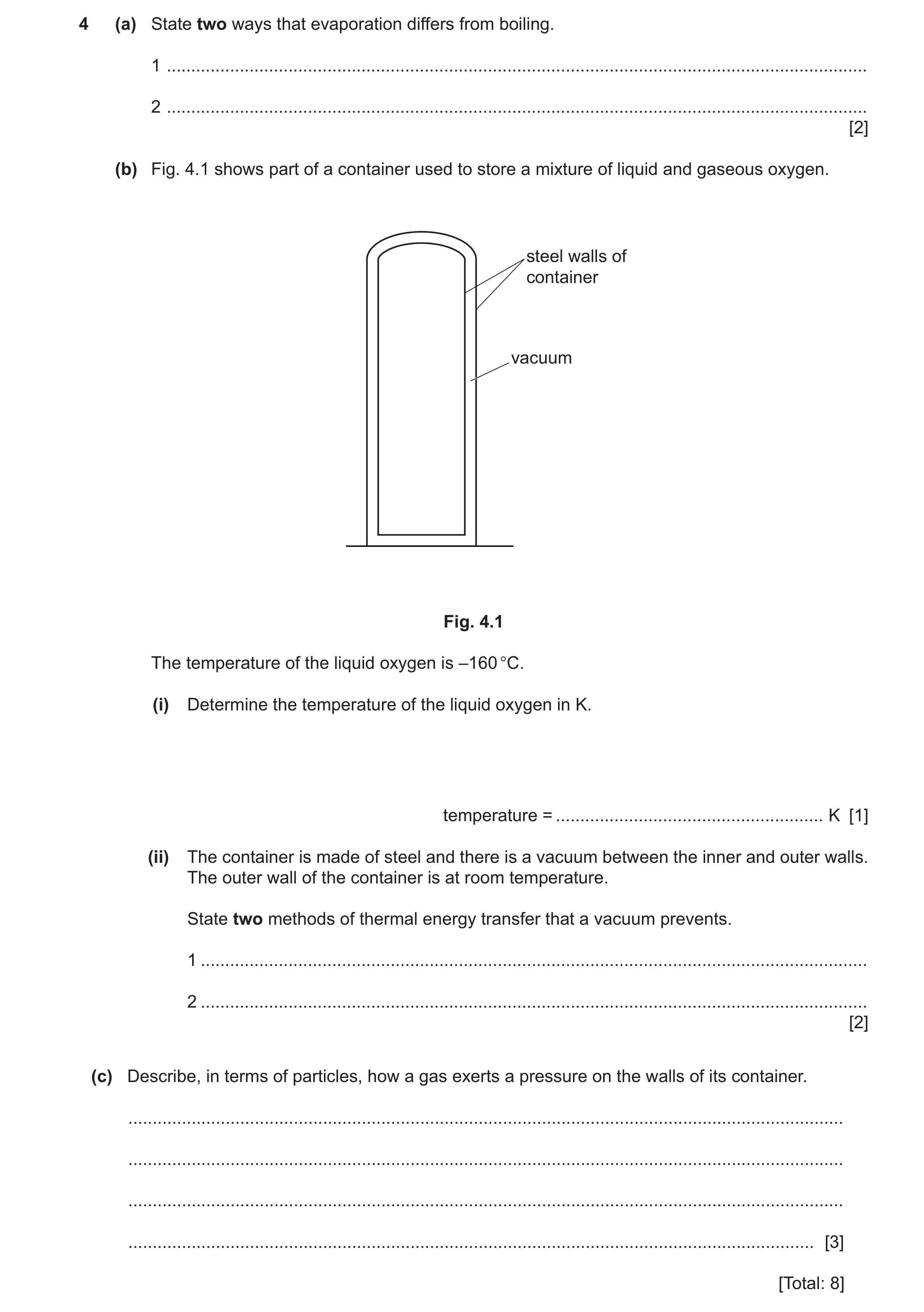
4 (a) State two ways that evaporation differs from boiling. 1 … 2 … [2] (b) Fig. 4.1 shows part of a container used to store a mixture of liquid and gaseous oxygen. steel walls of container vacuum Fig. 4.1 The temperature of the liquid oxygen is –160 °C. (i) Determine the temperature of the liquid oxygen in K. temperature = … K [1] (ii) The container is made of steel and there is a vacuum between the inner and outer walls. The outer wall of the container is at room temperature. State two methods of thermal energy transfer that a vacuum prevents. 1 … 2 … [2] (c) Describe, in terms of particles, how a gas exerts a pressure on the walls of its container. … … … … [3] [Total: 8]
8 marks
Mark scheme: 4(a) (evaporation:) (only) at the surface OR boiling: happens throughout the liquid B1 (evaporation:) takes place at any temperature OR boiling: takes place at a specific temperature / boiling point B1 4(b)(i) 113 (K) B1 4(b)(ii) conduction B1 convection B1 4(c) particles collide with the walls / container B1 (particles) exert a force on the walls OR collision with walls produces a change in momentum (of particles) B1 pressure is force per unit area OR p = F / A OR pressure is rate of change of momentum per unit area B1
This question in 0625/42 May/June 2024
Q42 · Describe an experiment to determine the specific heat capacity of aluminium 0625/41 Oct/Nov 2024
4 (a) Describe an experiment to determine the specific heat capacity of aluminium. You may draw a diagram. Include in your answer: • the measurements made • any equations needed. … … … … [4] (b) An aluminium dish is initially at room temperature. Boiling water is poured into the aluminium dish as shown in Fig. 4.1. boiling water aluminium dish table surface Fig. 4.1 (i) Explain why, after a short time, the dish and the water are the same temperature. … … … … [3] (ii) Explain, in terms of its particles, why the aluminium expands as the boiling water is poured into the dish. … … … [2] (iii) The water in the dish evaporates. Explain, in terms of the water molecules, what is meant by evaporation. … … … [2] [Total: 11]
11 marks
Mark scheme: 4(a) 1 Any one method to transfer measurable amount of thermal energy for ∆: B1 (a) to aluminium block (with electrical heater) (b) from aluminium block to known liquid (c) from known liquid to insulated aluminium (calorimeter) (d) to known liquid and aluminium (calorimeter) 2 Determination of energy transferred for ∆, to match workable method in 1: B1 (a) Use of E = Pt OR E= IVt (b) Use of E = mc with s.h.c. of known liquid (c) Use of E = mc with s.h.c. of known liquid (d) Use of E = Pt OR E = IVt AND E = mc (with known s.h.c. of liquid) 3 Any one measurement from: B1 • initial and final temperature / temperature change • time (of heating) • mass of aluminium 4 c = E / m OR (c =) E / m B1 4(b)(i) Any three from: B3 1 (net) transfer of energy from higher temperature to lower temperature OR (net) transfer of energy from water / to dish 2 (energy transfer) by conduction OR aluminium is a good conductor (of thermal energy) 3 temperature of water decreases AND temperature of dish increases 4 no (net) transfer of energy when temperature of dish = temperature of water 4(b)(ii) (particles) gain energy in kinetic store (as temperature of aluminium increases) B1 (average) separation of (aluminium) particles increases OR (aluminium) particles move further apart owtte B1 4(b)(iii) (water) molecules with more/enough energy escape from the surface A2 escape of more energetic molecules (from water) OR (molecules) leave from the surface C1
This question in 0625/41 Oct/Nov 2024
Q43 · A pan with a copper base on a hotplate 0625/43 May/June 2025
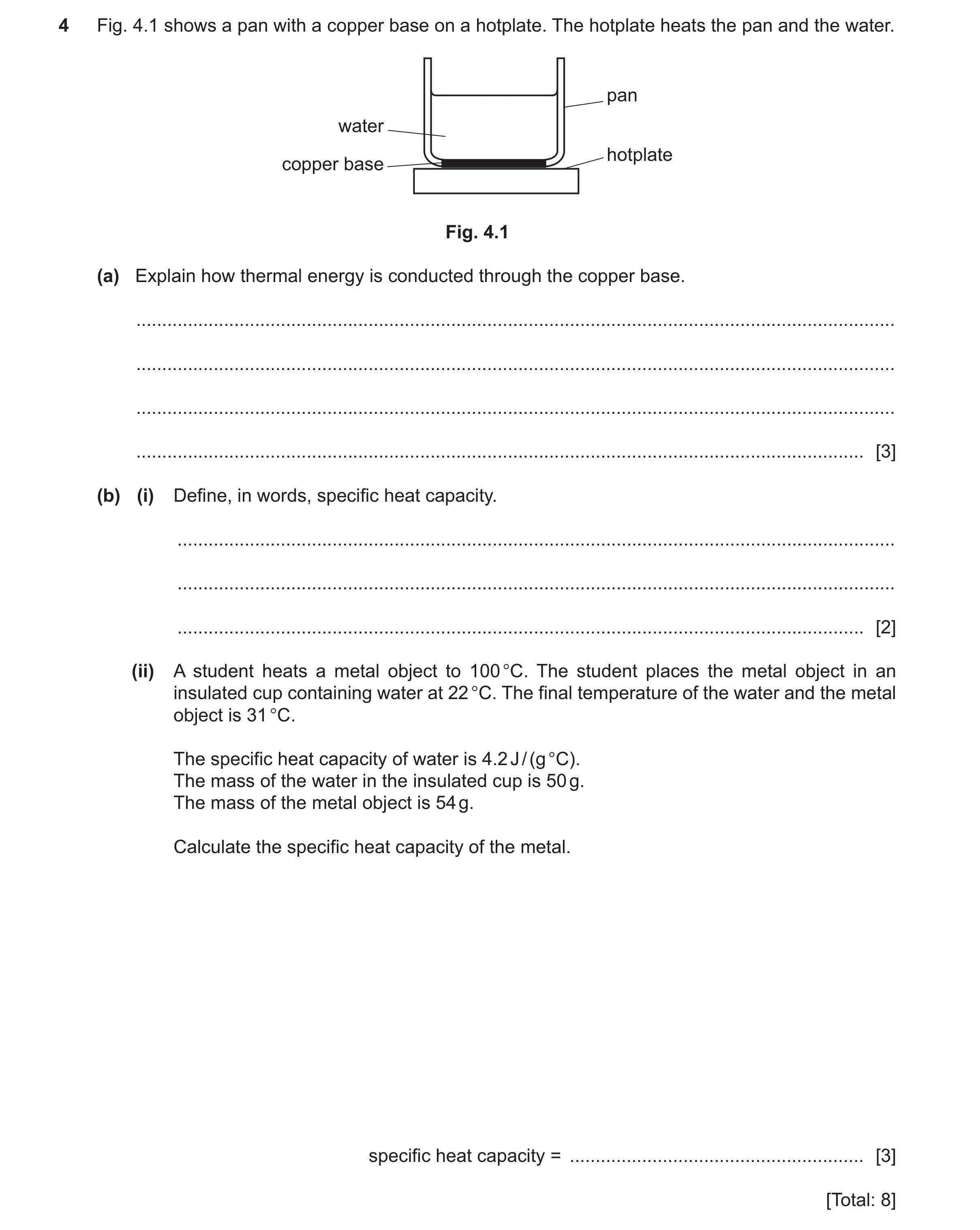
4 Fig. 4.1 shows a pan with a copper base on a hotplate. The hotplate heats the pan and the water. pan water hotplate copper base Fig. 4.1 (a) Explain how thermal energy is conducted through the copper base. … … … … [3] (b) (i) Define, in words, specific heat capacity. … … … [2] (ii) A student heats a metal object to 100 °C. The student places the metal object in an insulated cup containing water at 22 °C. The final temperature of the water and the metal object is 31 °C. The specific heat capacity of water is 4.2 J / (g °C). The mass of the water in the insulated cup is 50 g. The mass of the metal object is 54 g. Calculate the specific heat capacity of the metal. specific heat capacity = … [3] [Total: 8]
8 marks
Mark scheme: 4(a) any three from: B3 • (copper / metal contains) free / delocalised electrons • electrons carry (thermal) energy through metal • electrons collide with (distant) ions • lattice vibrations transfer energy (to neighbouring ions) OR ions vibrate and cause (nearby / adjacent) ions to vibrate 4(b)(i) energy transferred per unit mass per unit temperature change A2 (thermal) energy (transferred) per unit temperature change C1 4(b)(ii) 0.51 J / (g C) A3 (energy lost by metal =) 54 c 69 C1 OR (energy gained by water =) 50 4.2 9 OR 1890 energy lost by metal = energy gained by water C1 OR 54 c 69 = 50 4.2 9
This question in 0625/43 May/June 2025
Q44 · A 12 V, 50 W immersion heater is used to heat 0.15 kg of water in a beaker 0625/41 Oct/Nov 2025
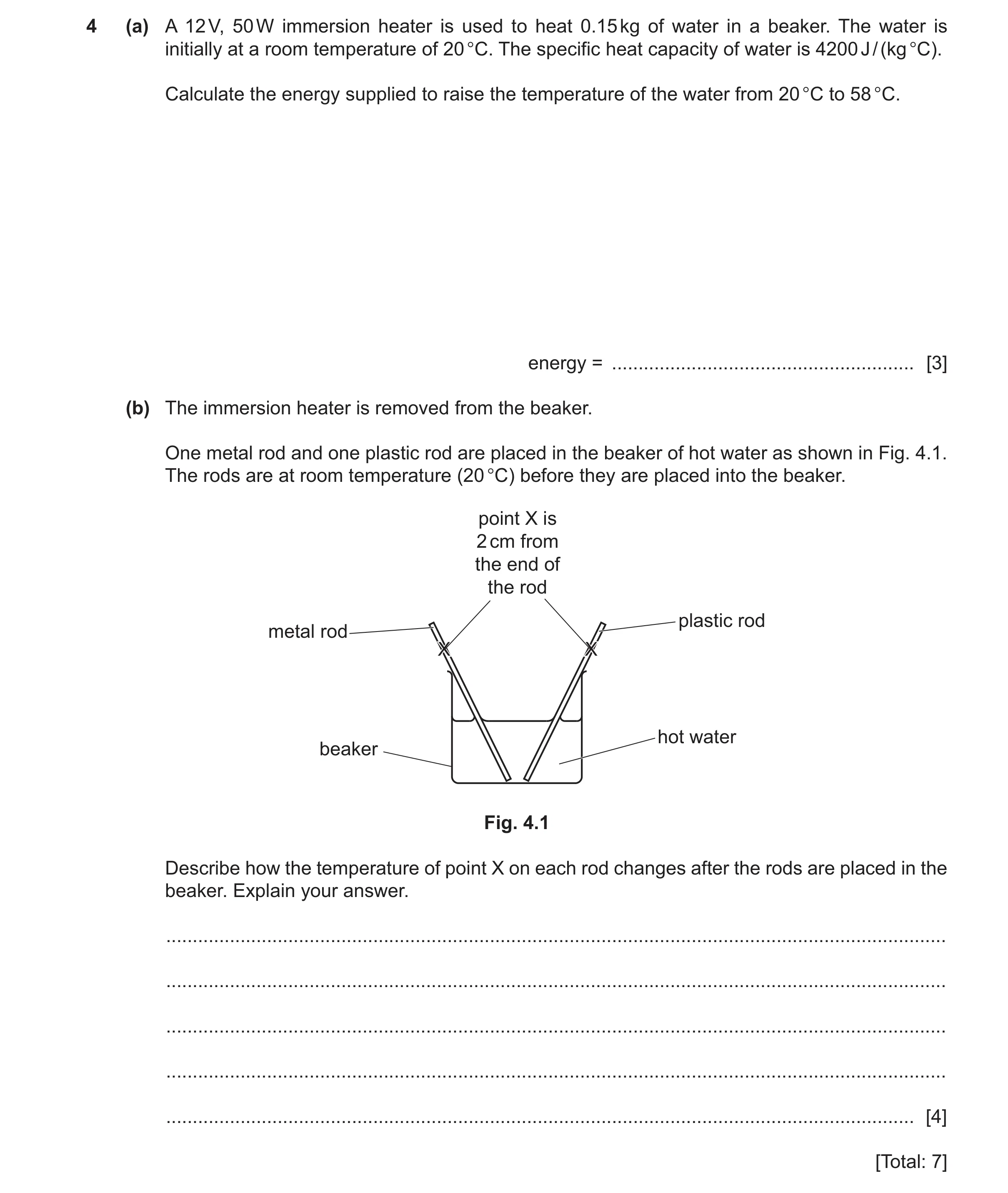
4 (a) A 12 V, 50 W immersion heater is used to heat 0.15 kg of water in a beaker. The water is initially at a room temperature of 20 °C. The specific heat capacity of water is 4200 J / (kg °C). Calculate the energy supplied to raise the temperature of the water from 20 °C to 58 °C. energy = … [3] (b) The immersion heater is removed from the beaker. One metal rod and one plastic rod are placed in the beaker of hot water as shown in Fig. 4.1. The rods are at room temperature (20 °C) before they are placed into the beaker. point X is 2 cm from the end of the rod plastic rod metal rod X X hot water beaker Fig. 4.1 Describe how the temperature of point X on each rod changes after the rods are placed in the beaker. Explain your answer. … … … … … [4] [Total: 7]
7 marks
Mark scheme: 4(a) 24 000 J OR 2.4 104 J A3 (∆E =) mc∆𝜃 OR (∆E =) 0.15 4200 {58 – 20} C1 (∆𝜃 =) 58 – 20 OR 38 (°C) seen C1 4(b) (temperature of point X) on metal rod increases faster ORA A2 (temperature of point X) increases (with time) C1 thermal energy is transferred) by conduction B1 metal rod (transfers thermal energy through movement of) delocalised / free electrons. ORA B1
This question in 0625/41 Oct/Nov 2025
 1 / 49
 2 / 49
 3 / 49
 4 / 49
 5 / 49
 6 / 49
 7 / 49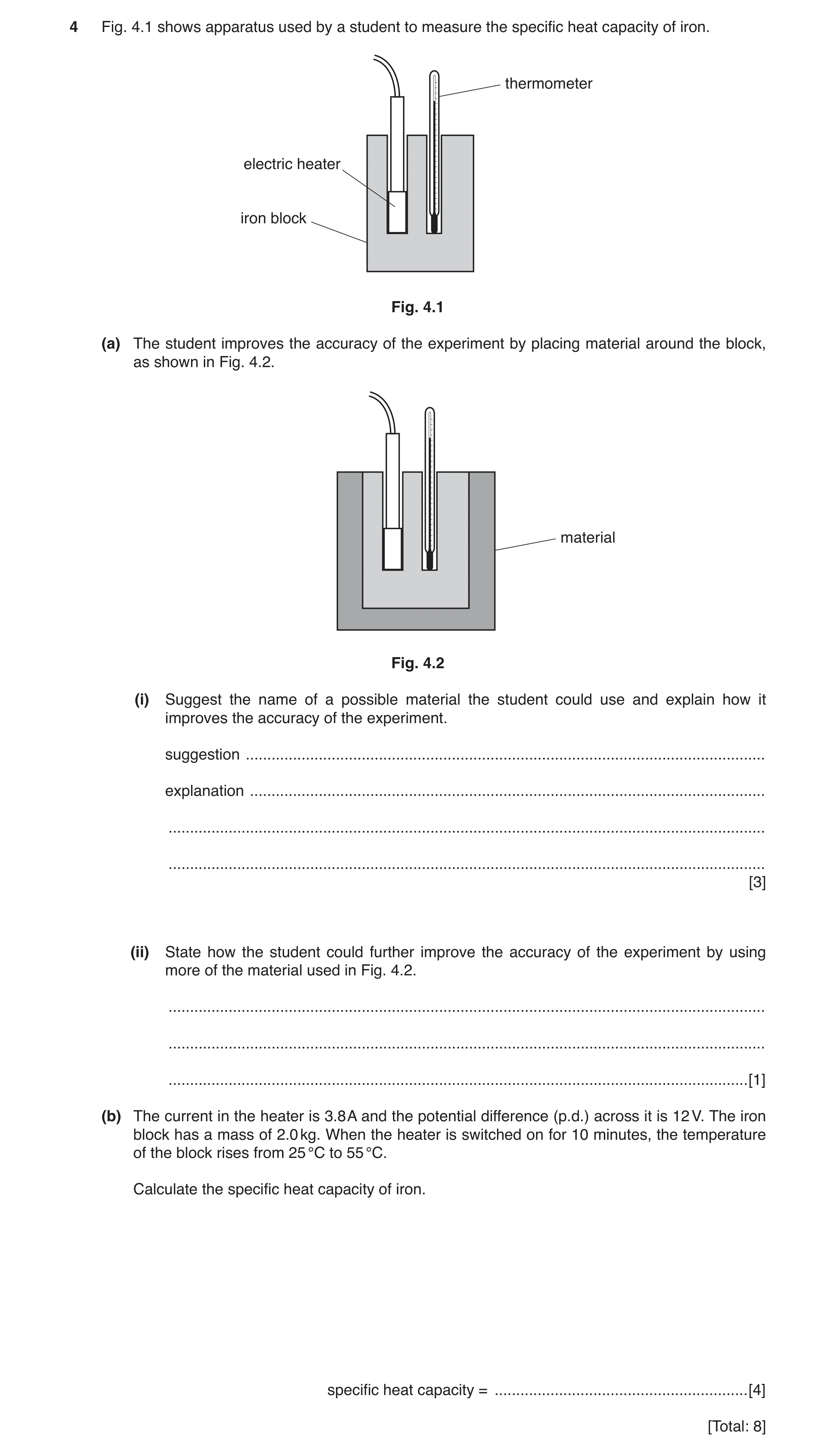
 11 / 49
 12 / 49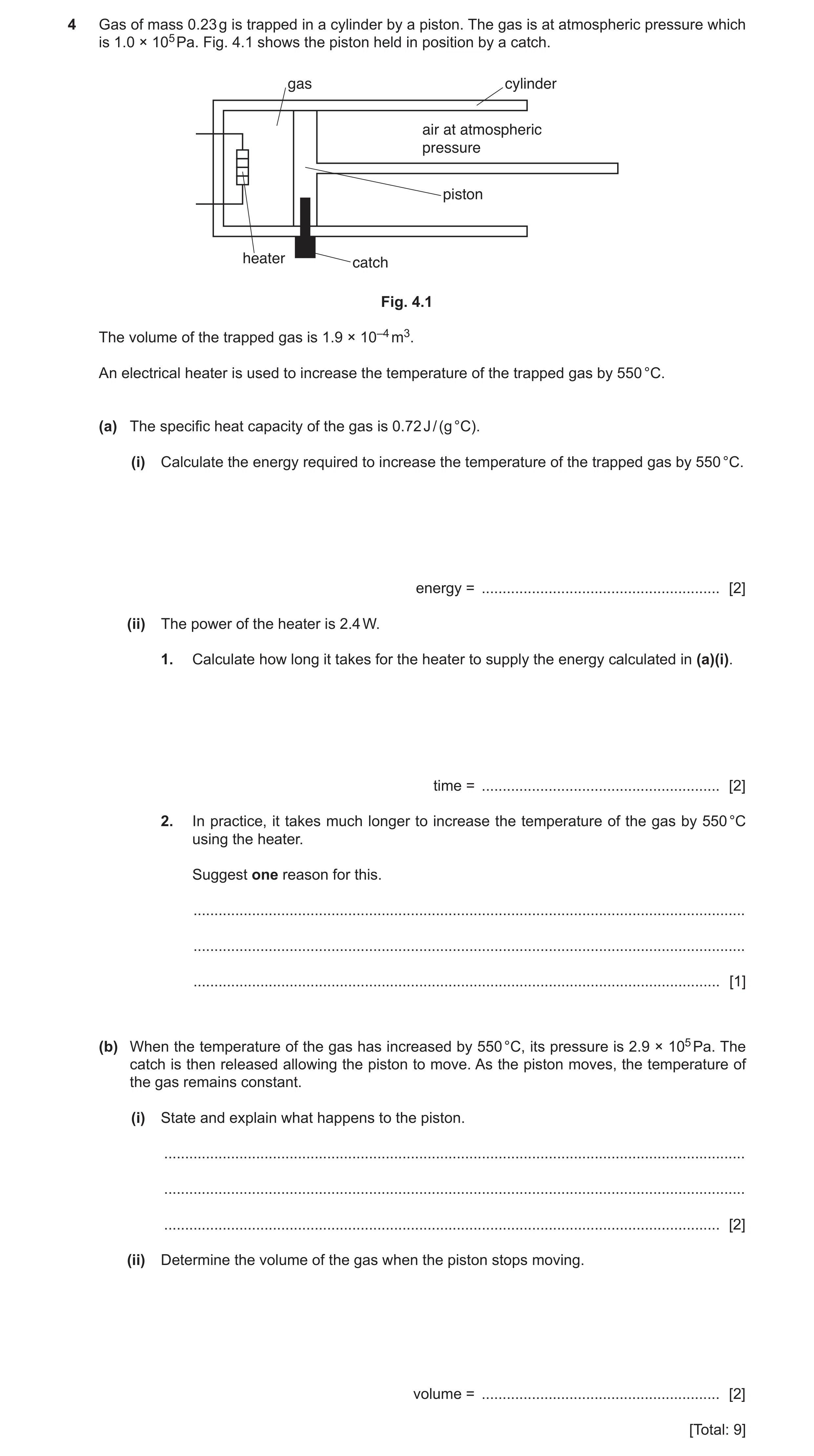
 14 / 49
 15 / 49
 16 / 49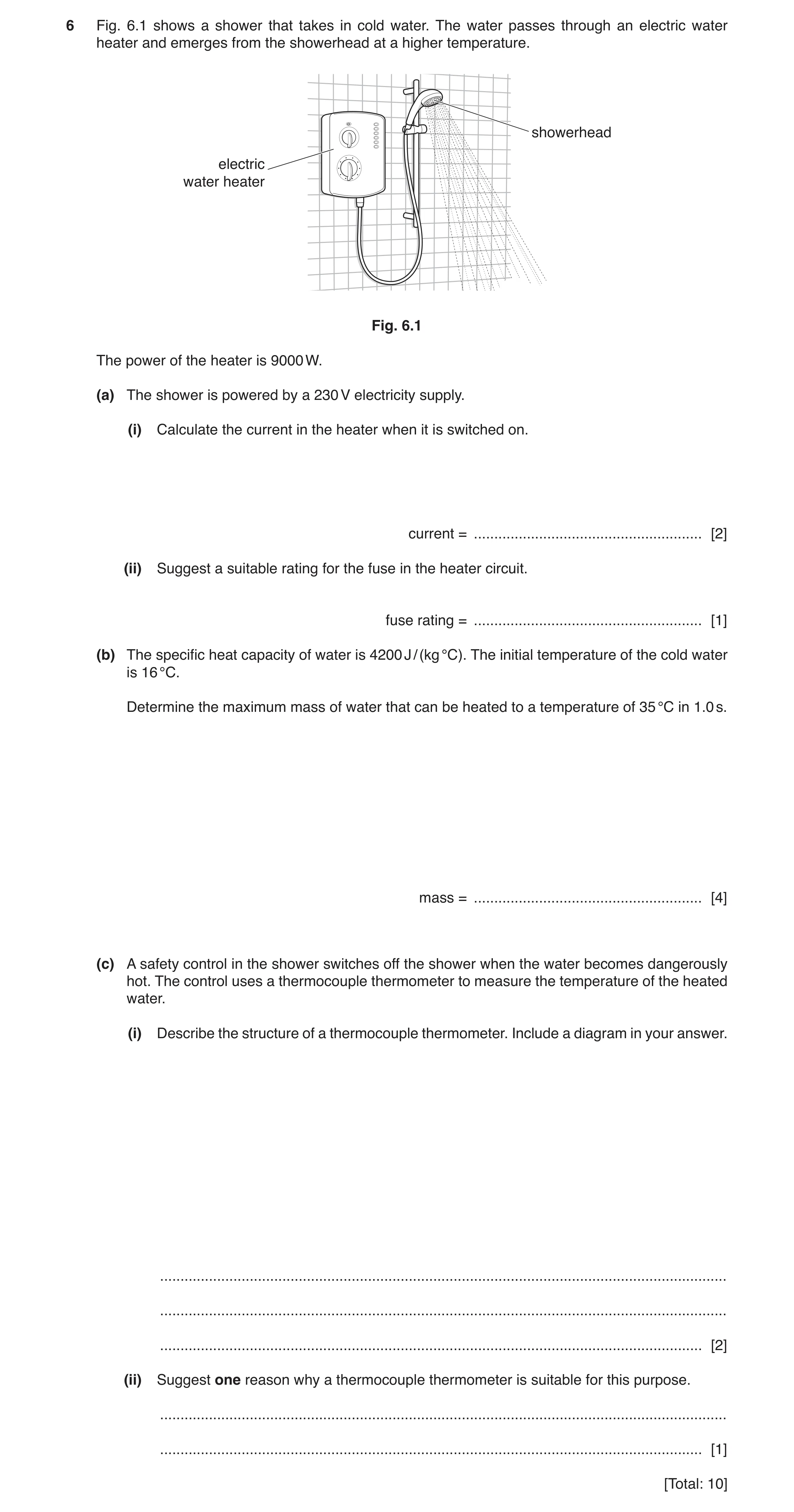
 19 / 49
 20 / 49
 21 / 49
 22 / 49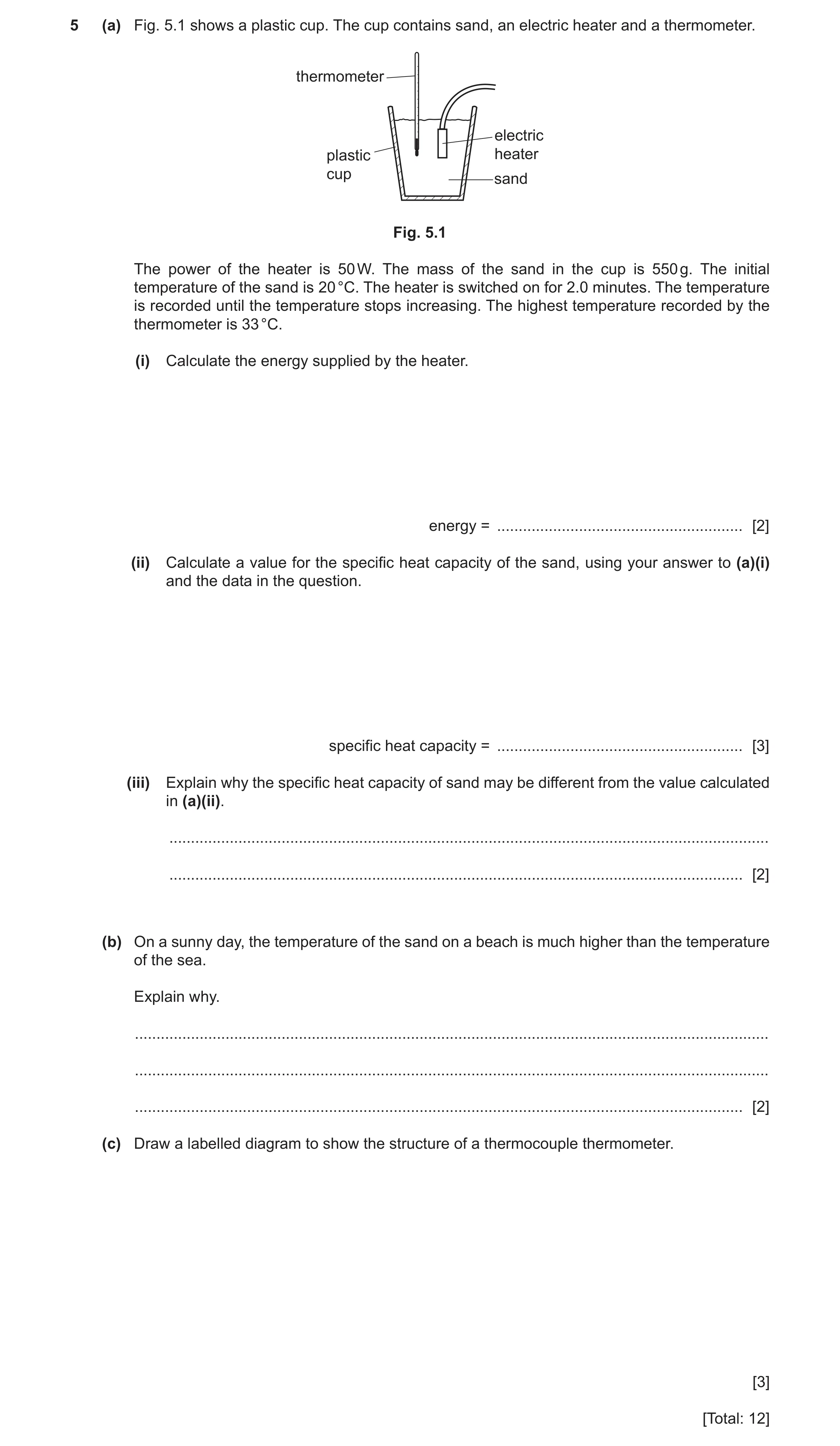
 24 / 49
 25 / 49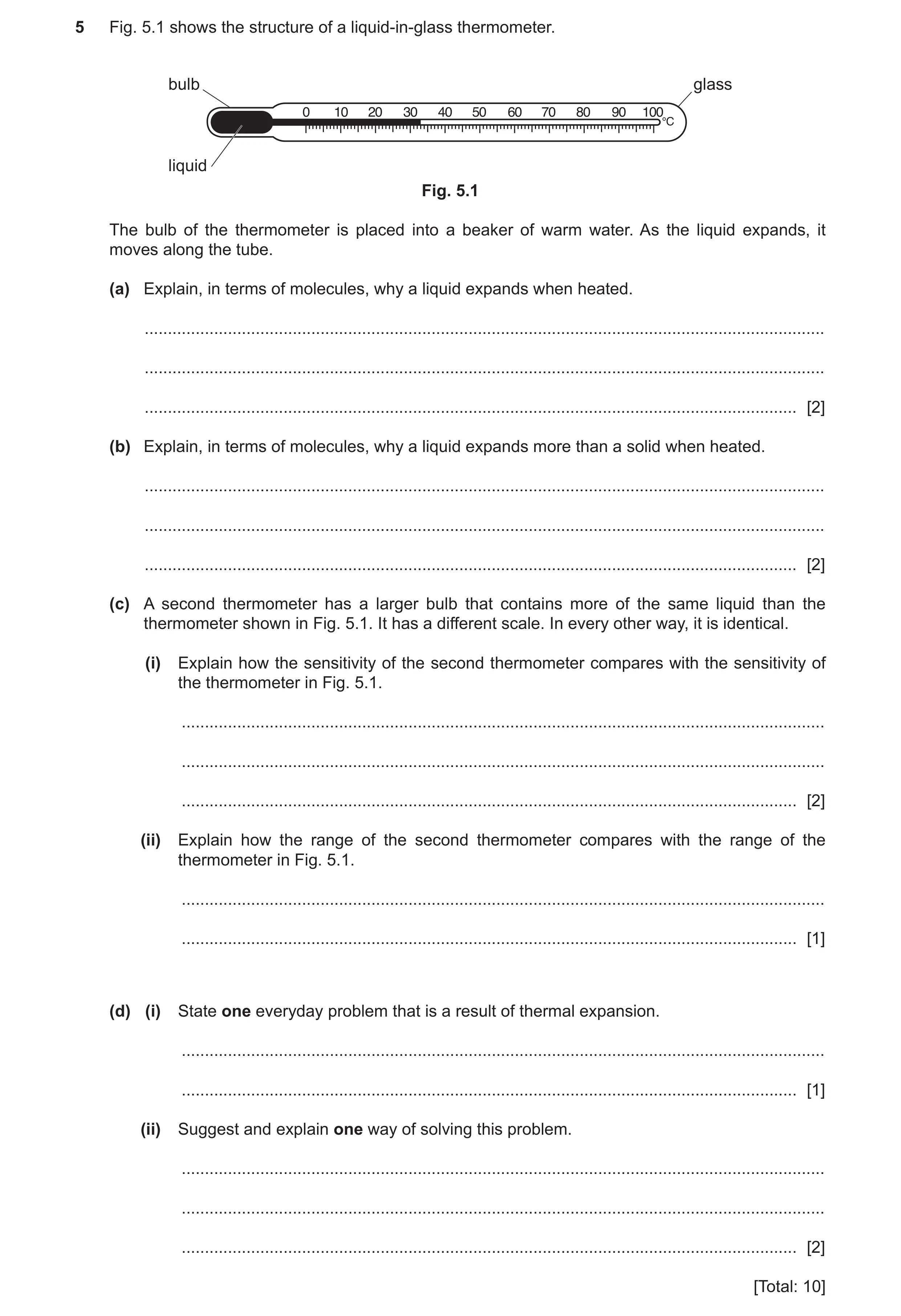
 27 / 49
 28 / 49
 29 / 49
 30 / 49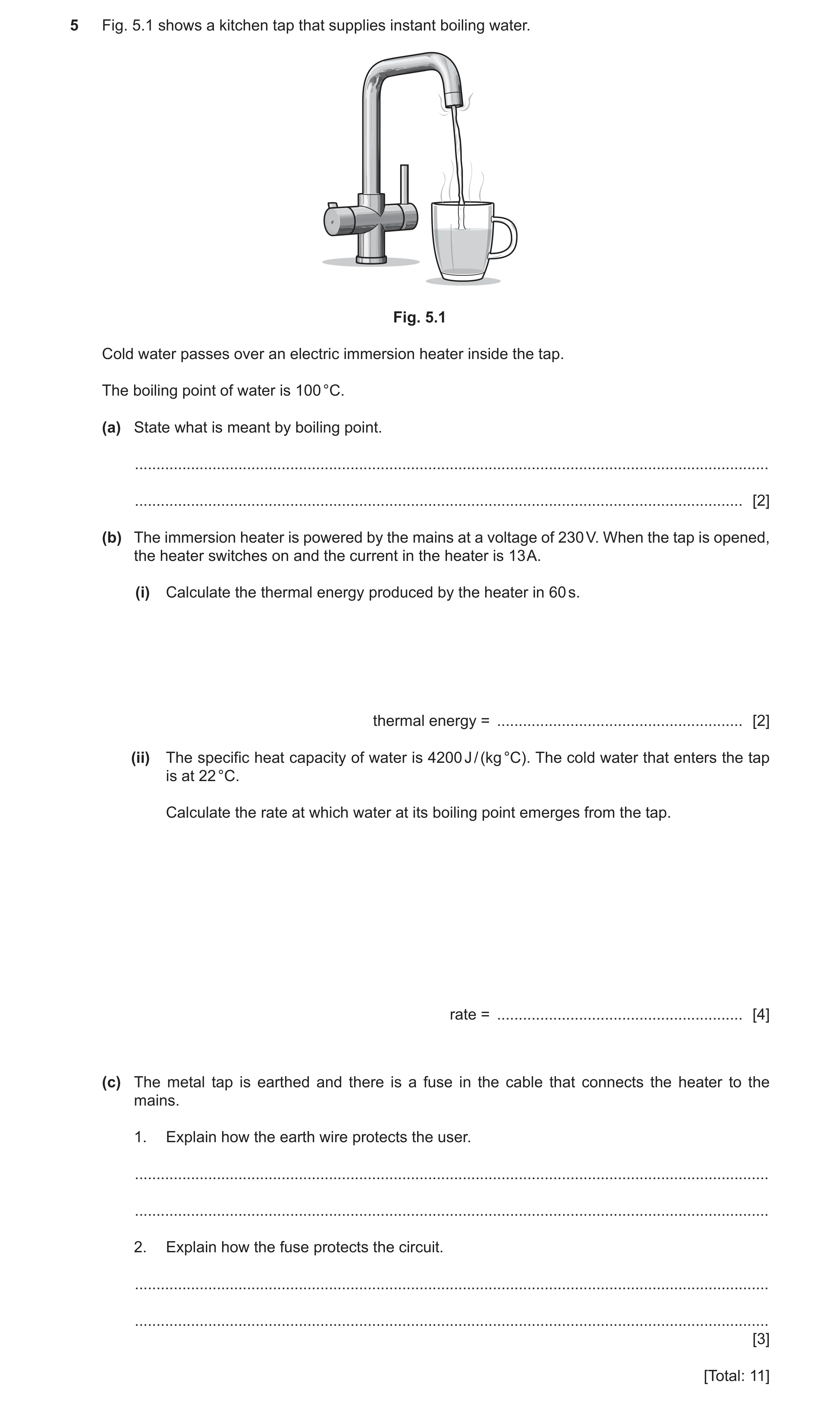
 32 / 49
 33 / 49
 34 / 49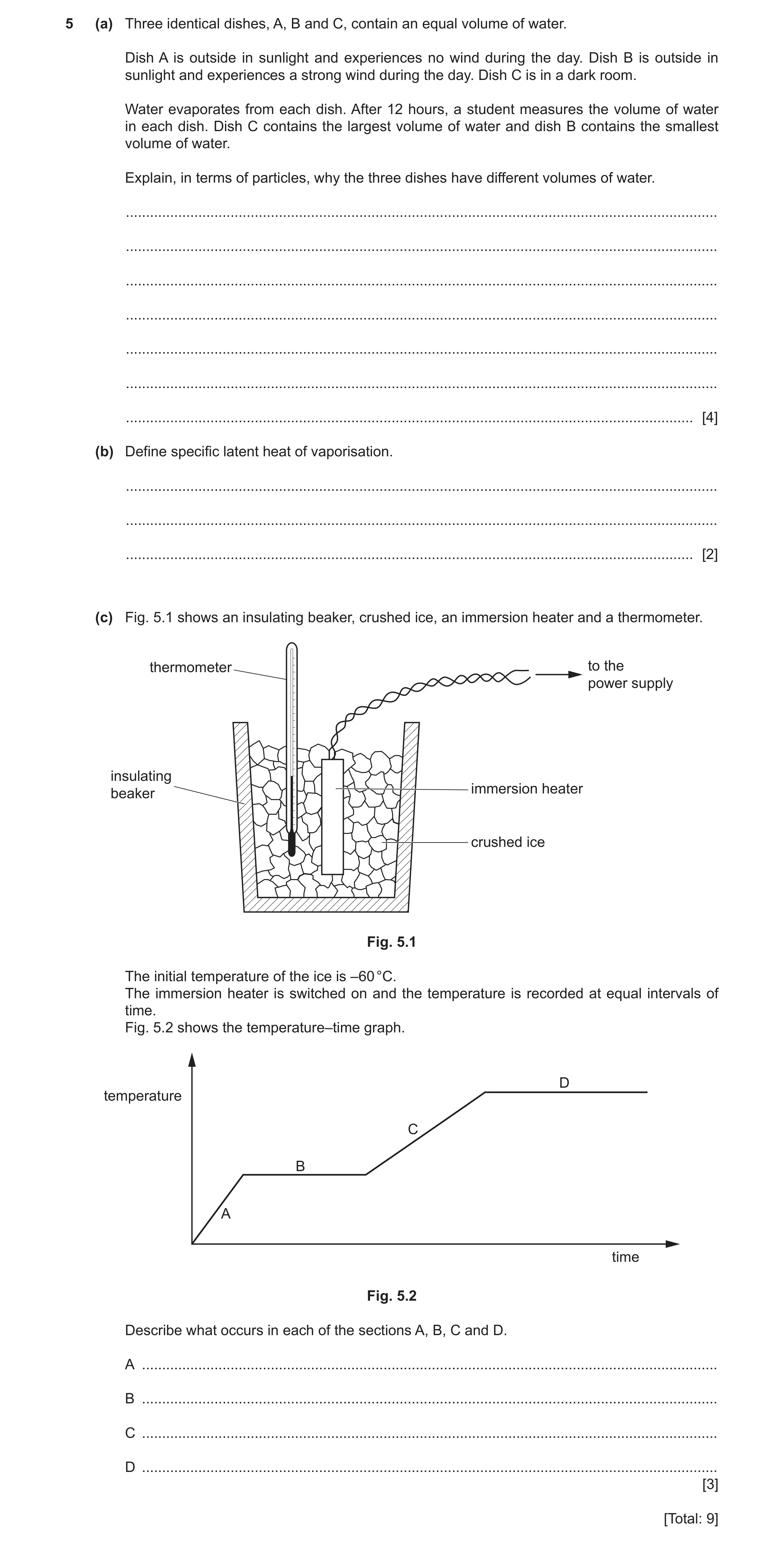
 40 / 49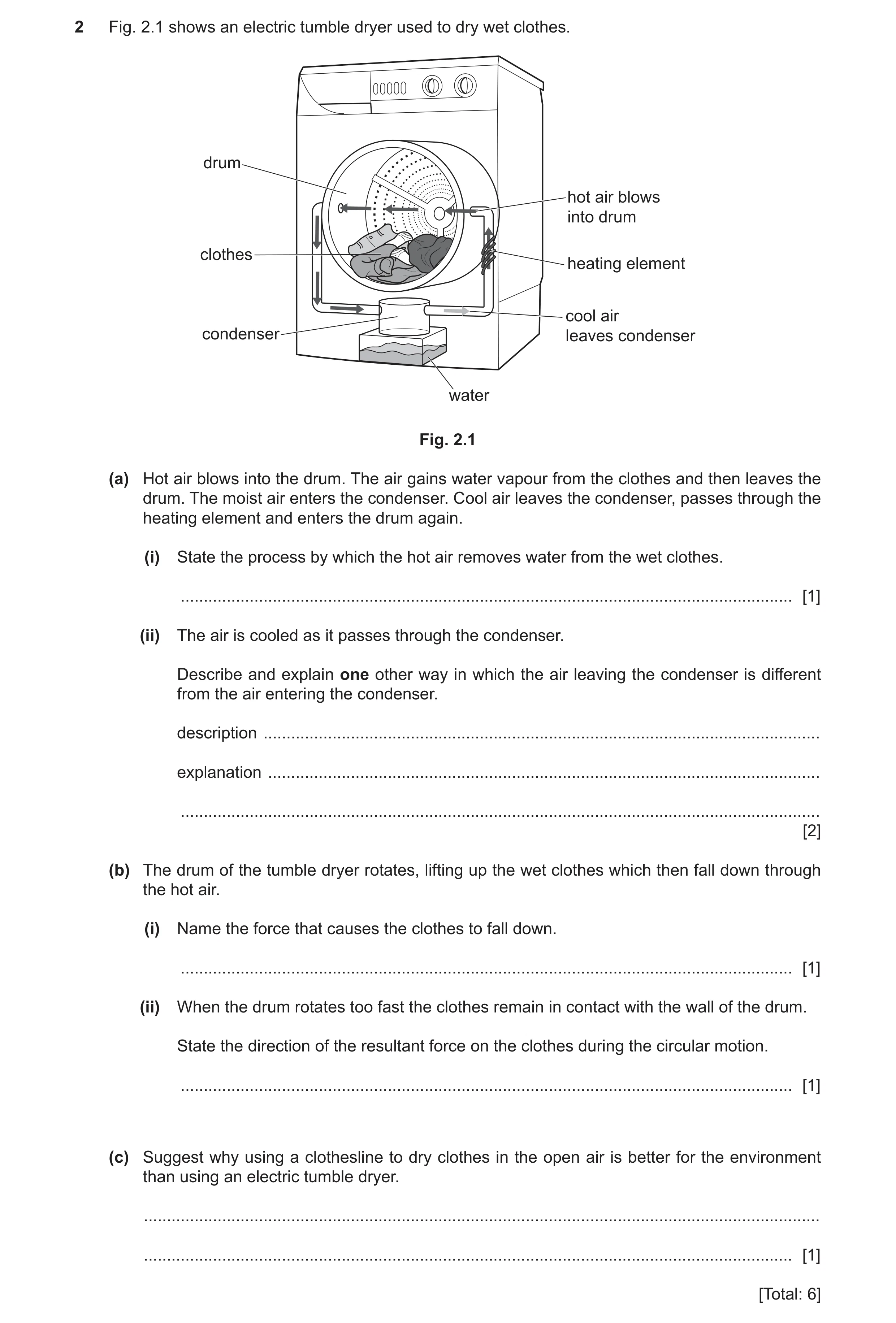
 44 / 49
 45 / 49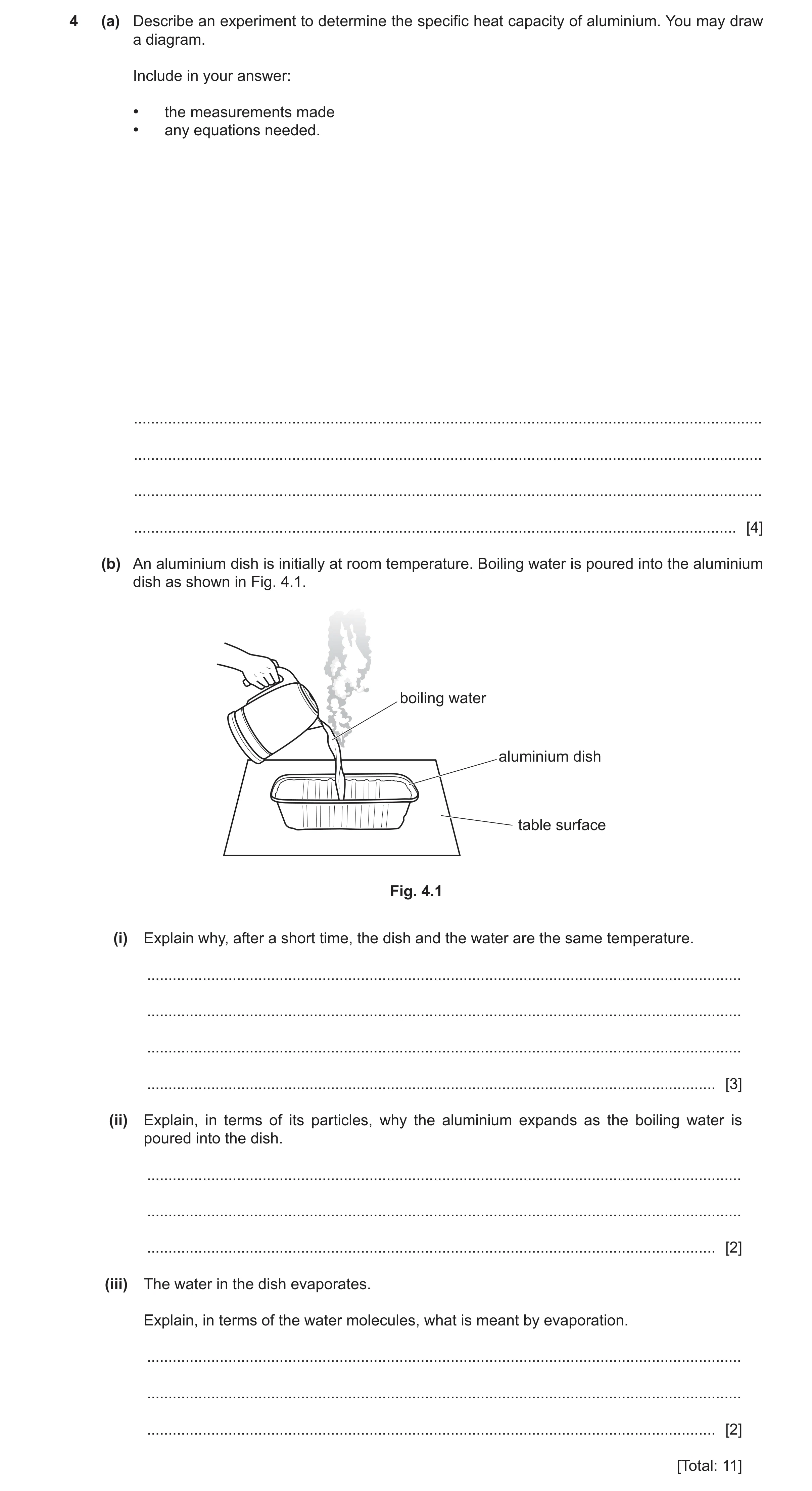
 48 / 49
 49 / 49
 7
7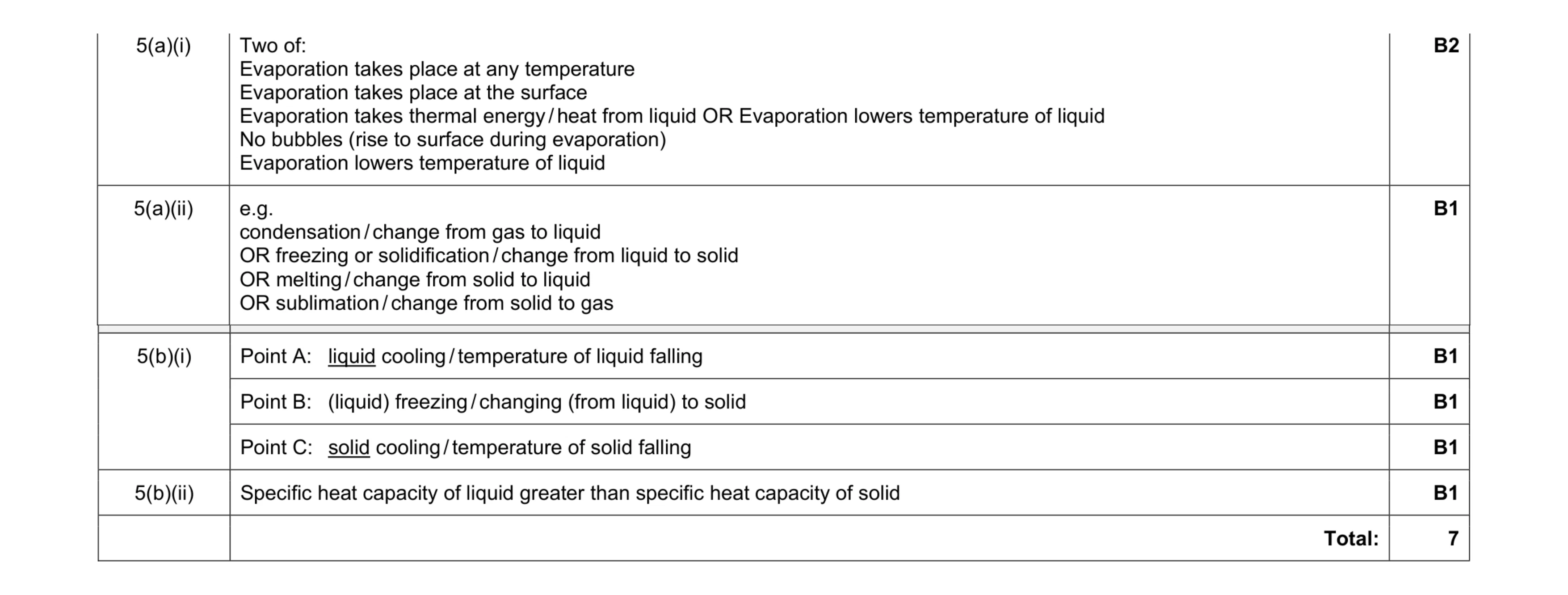 7
7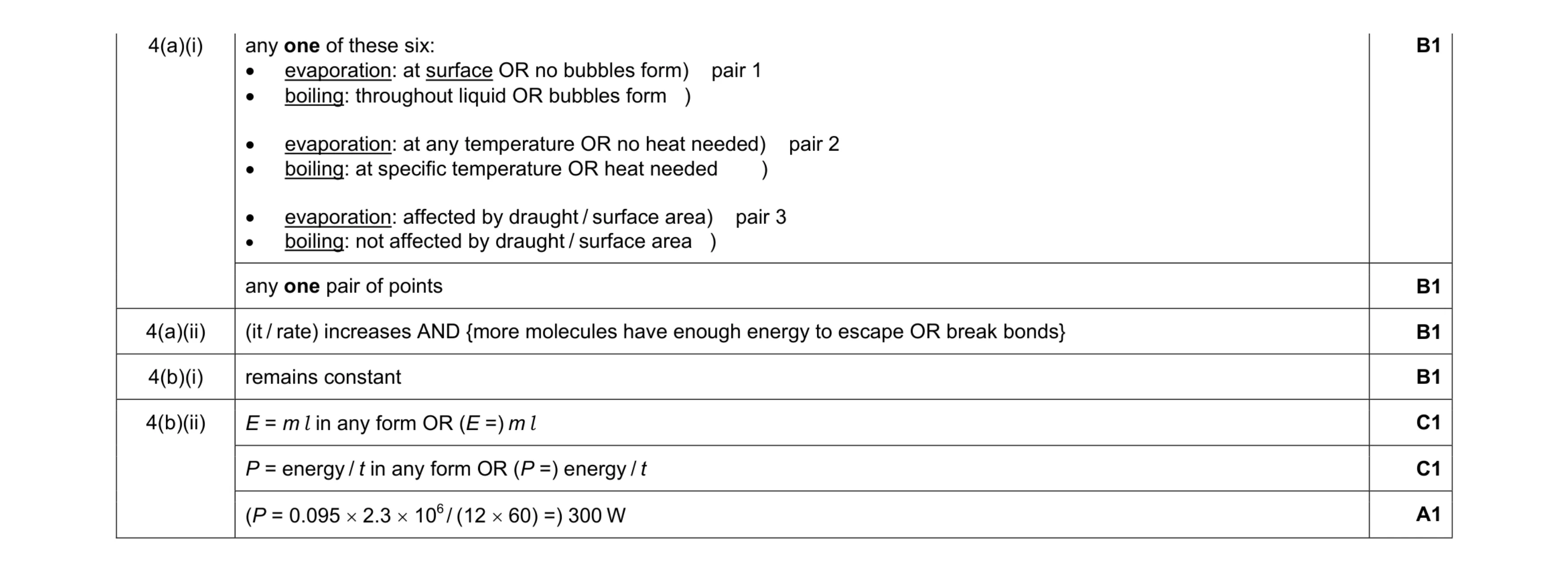 7
7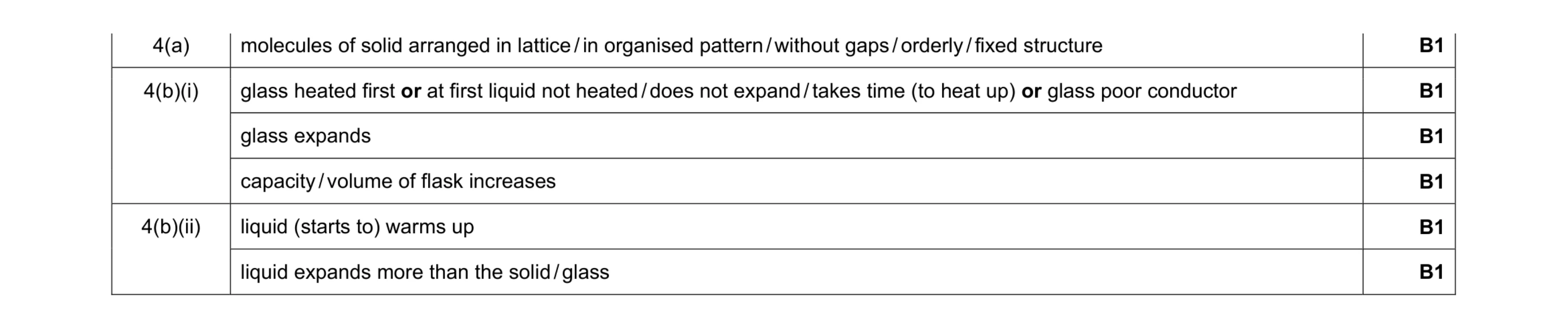 6
6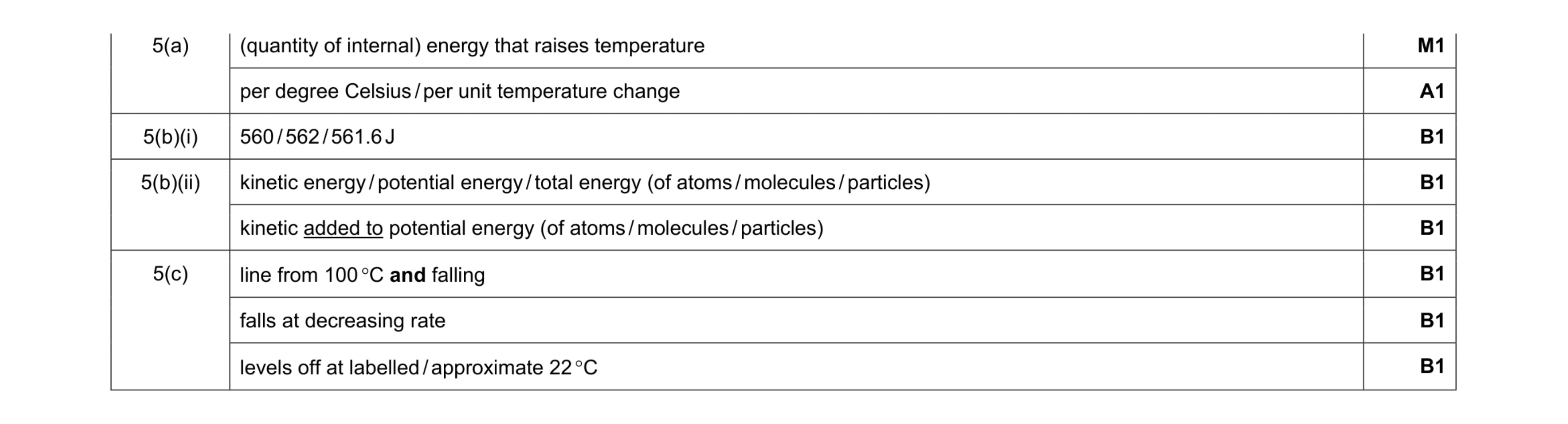 8
8 5
5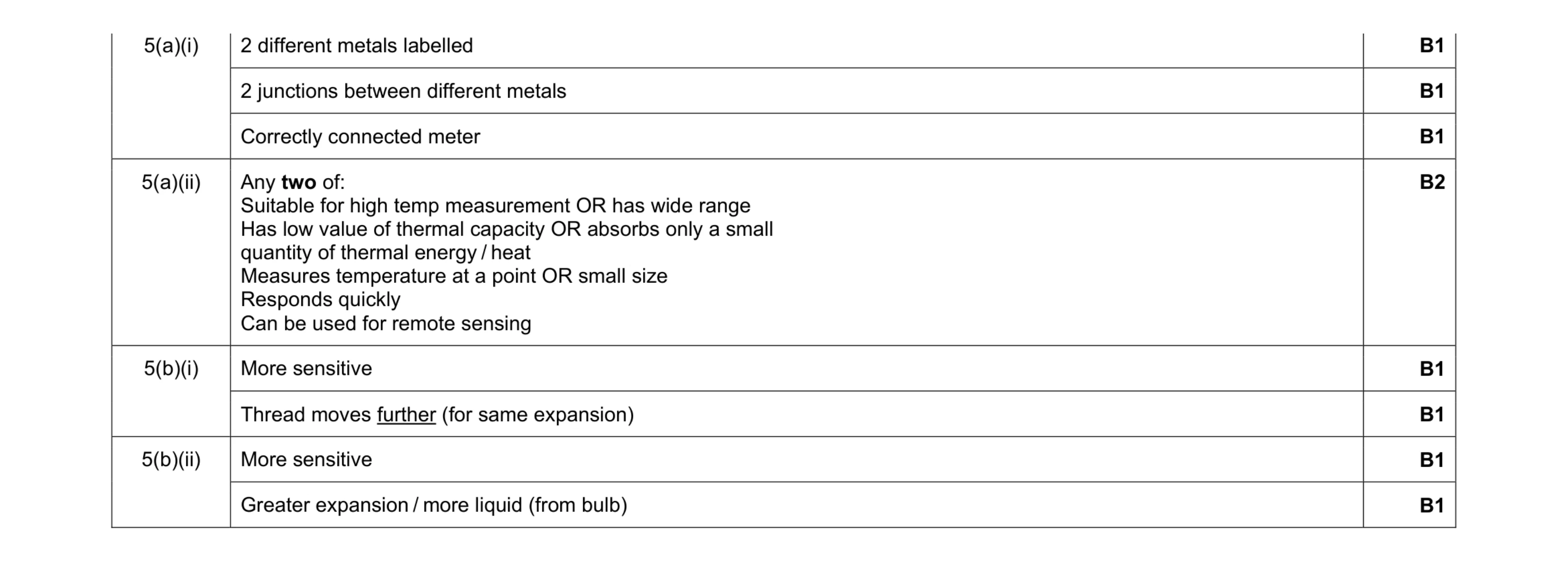 9
9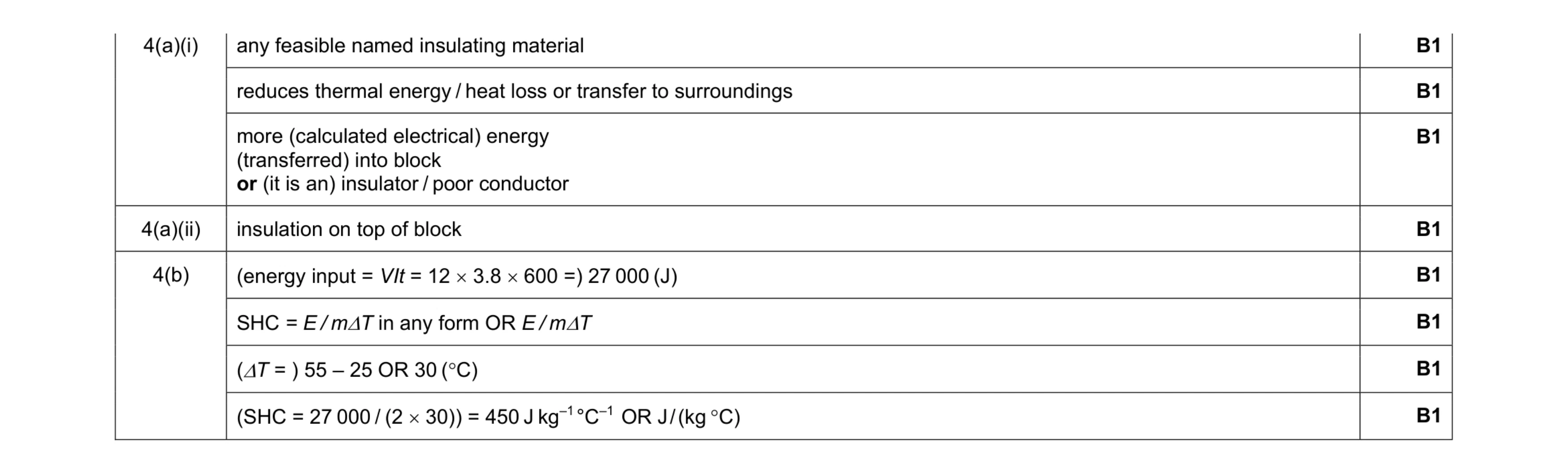 8
8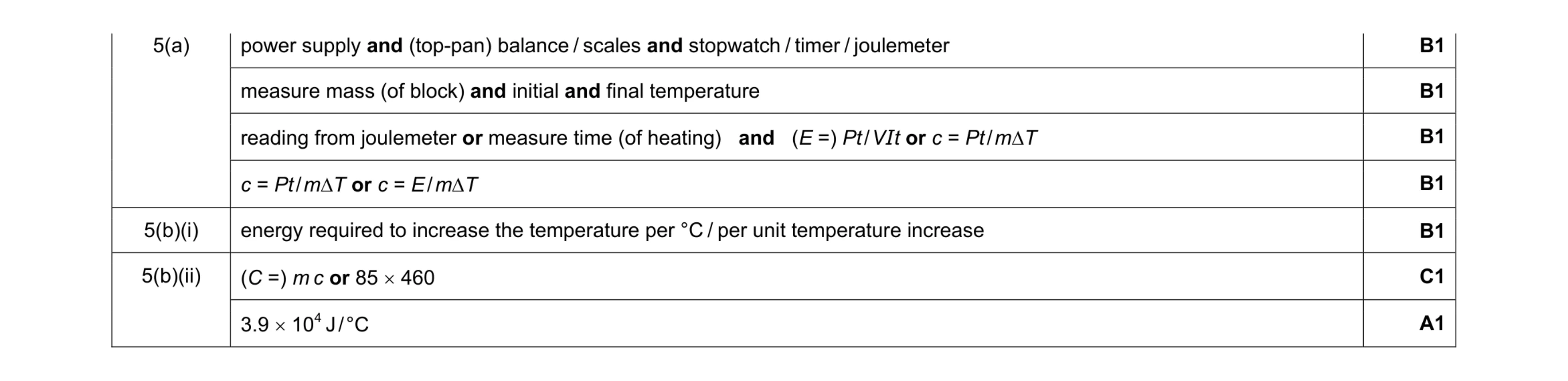 7
7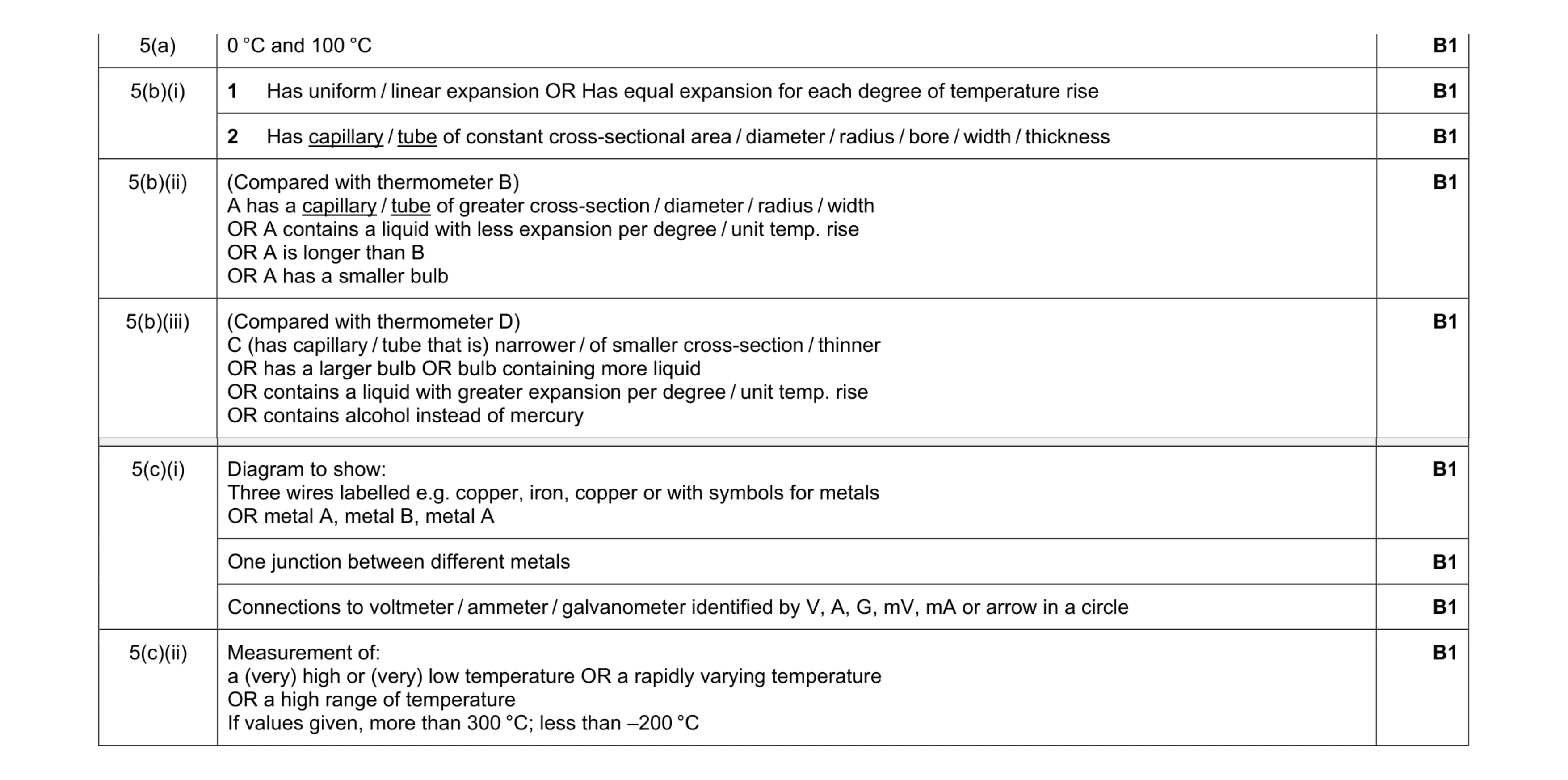 9
9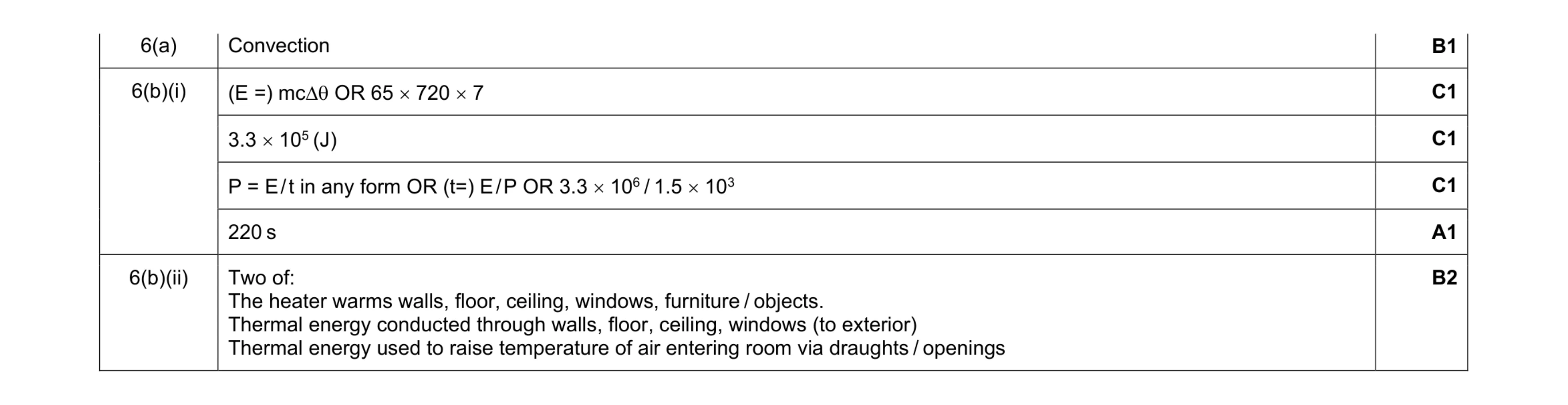 7
7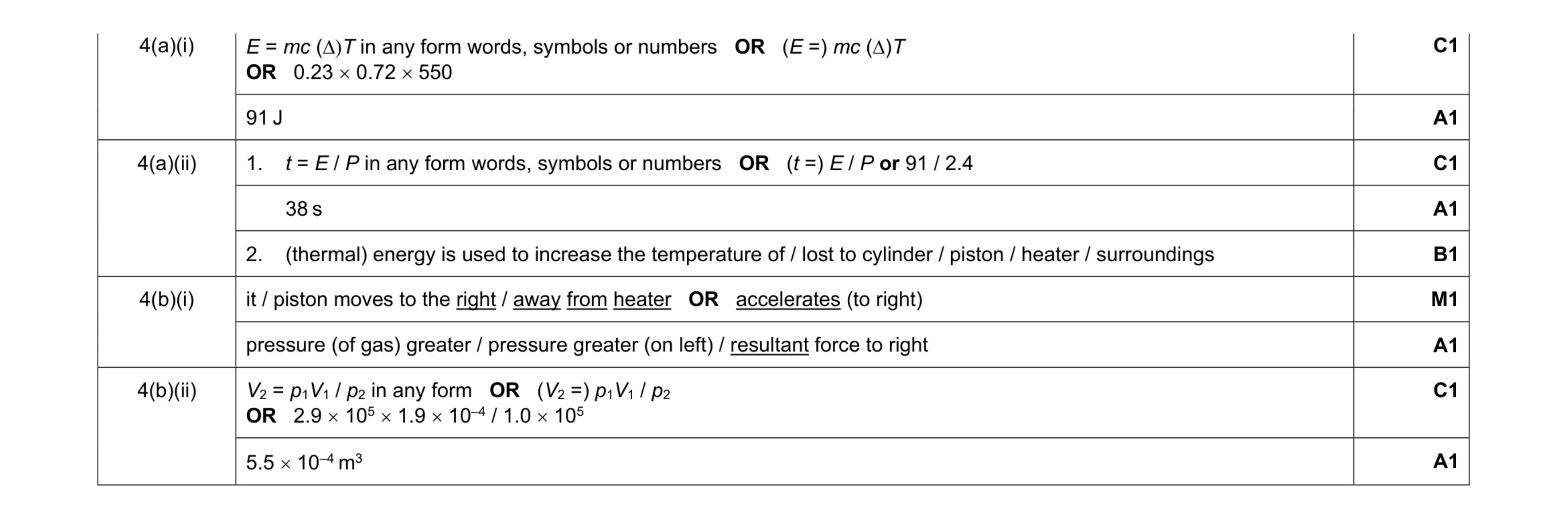 9
9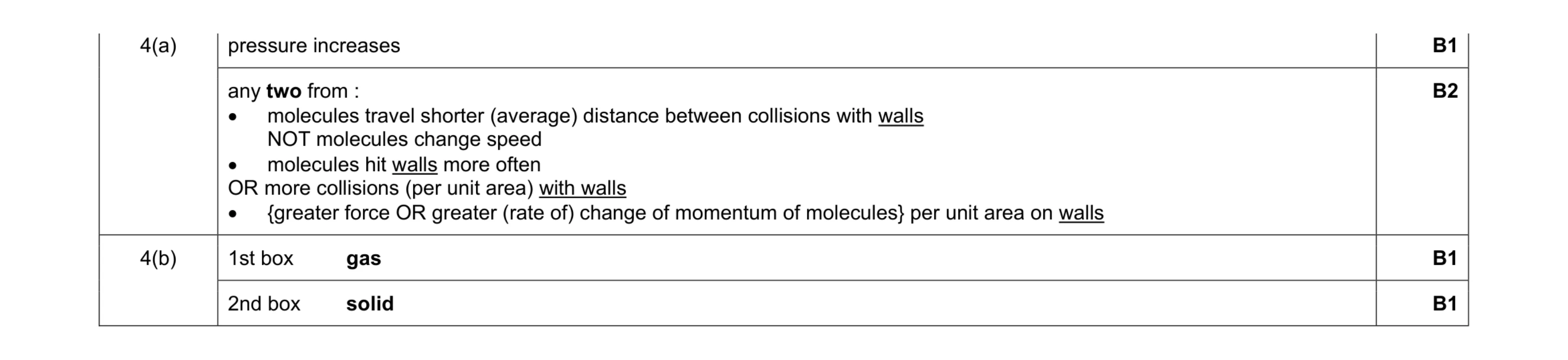 5
5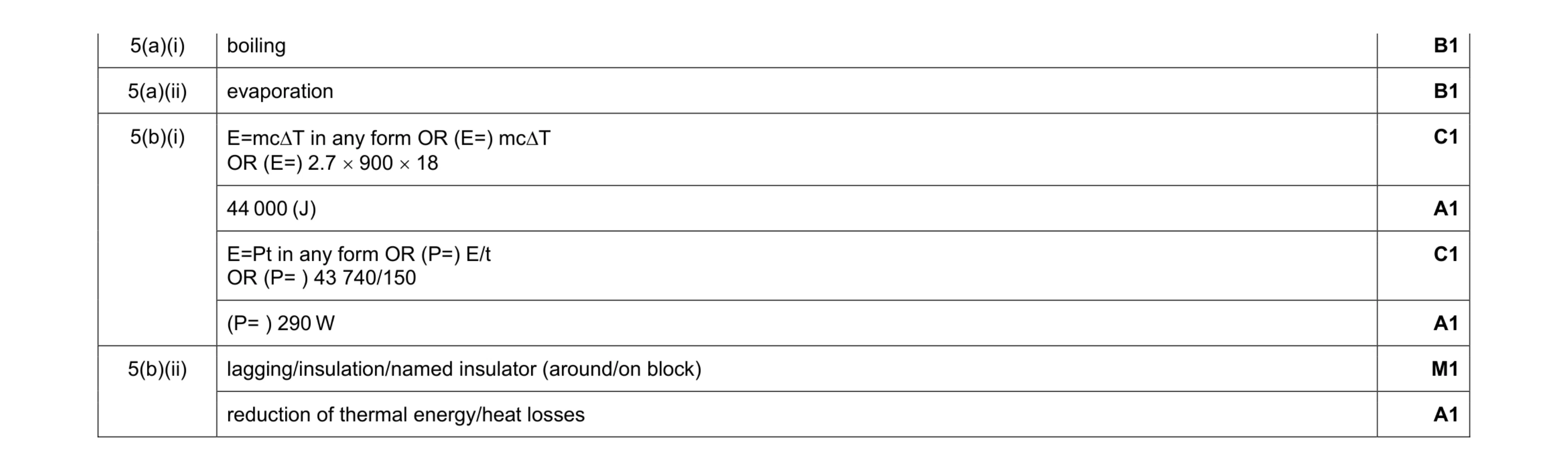 8
8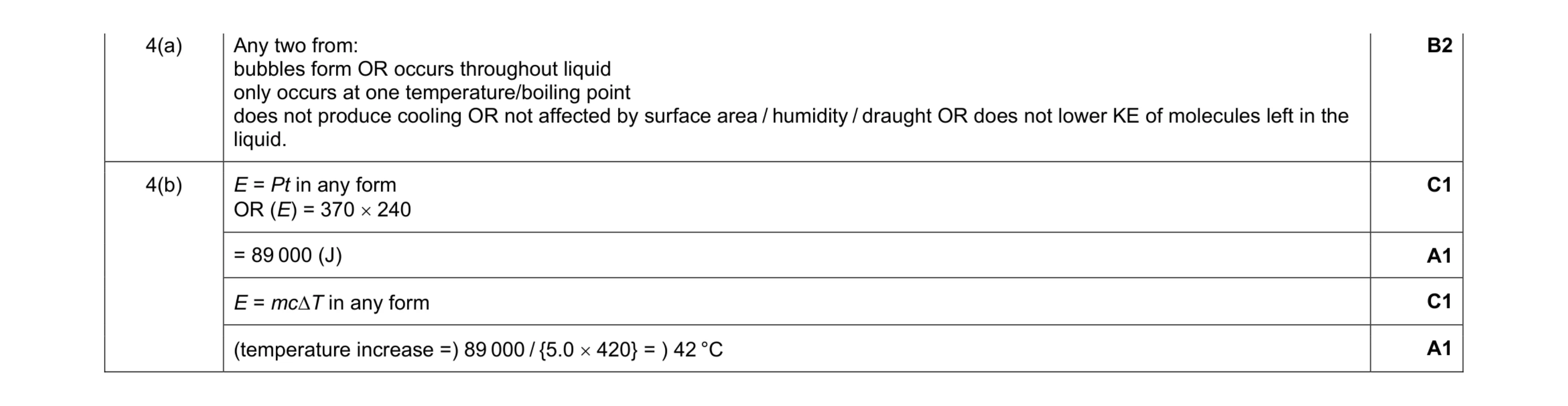 6
6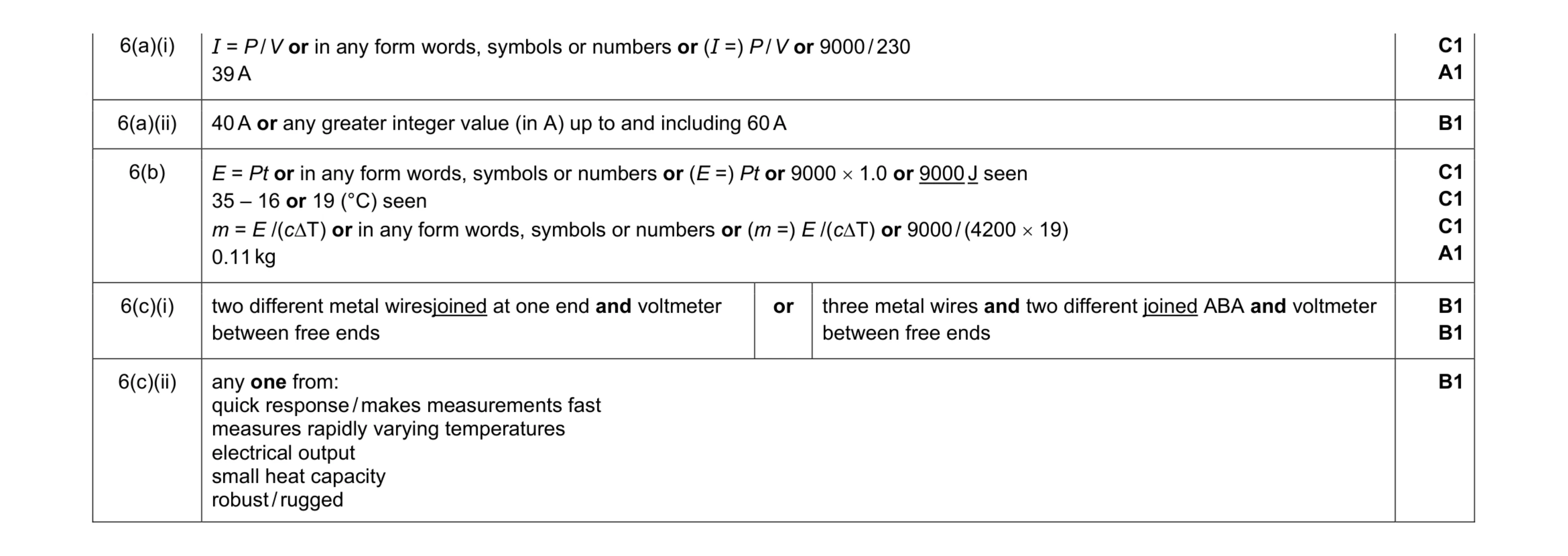 10
10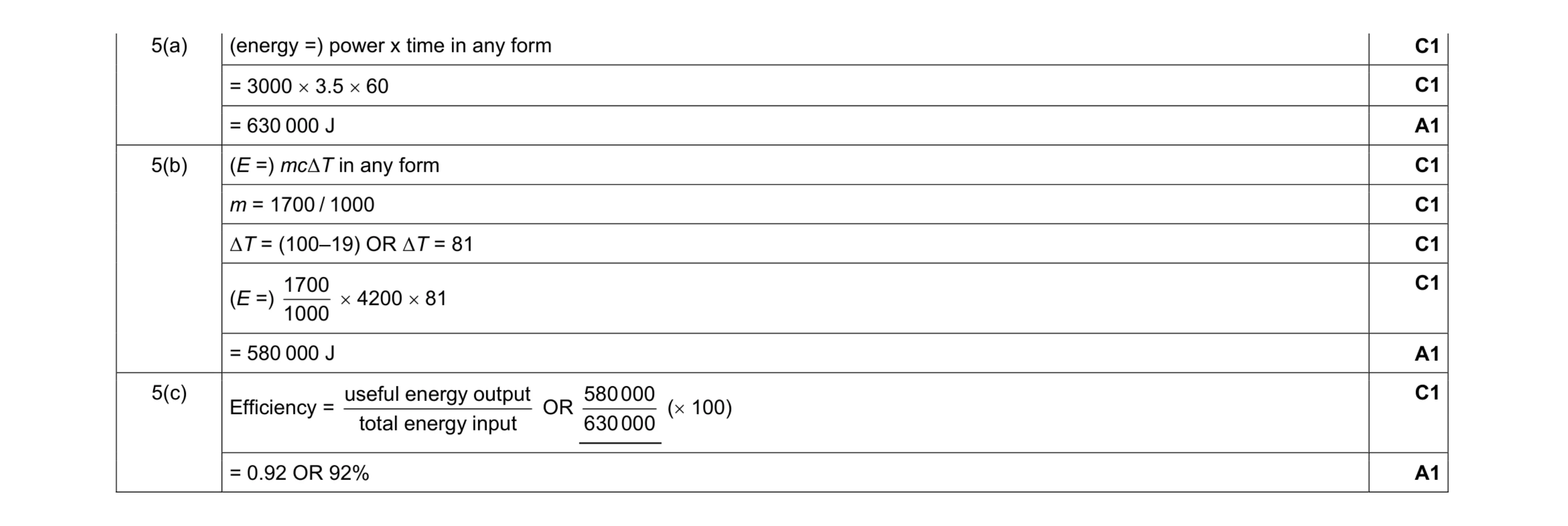 10
10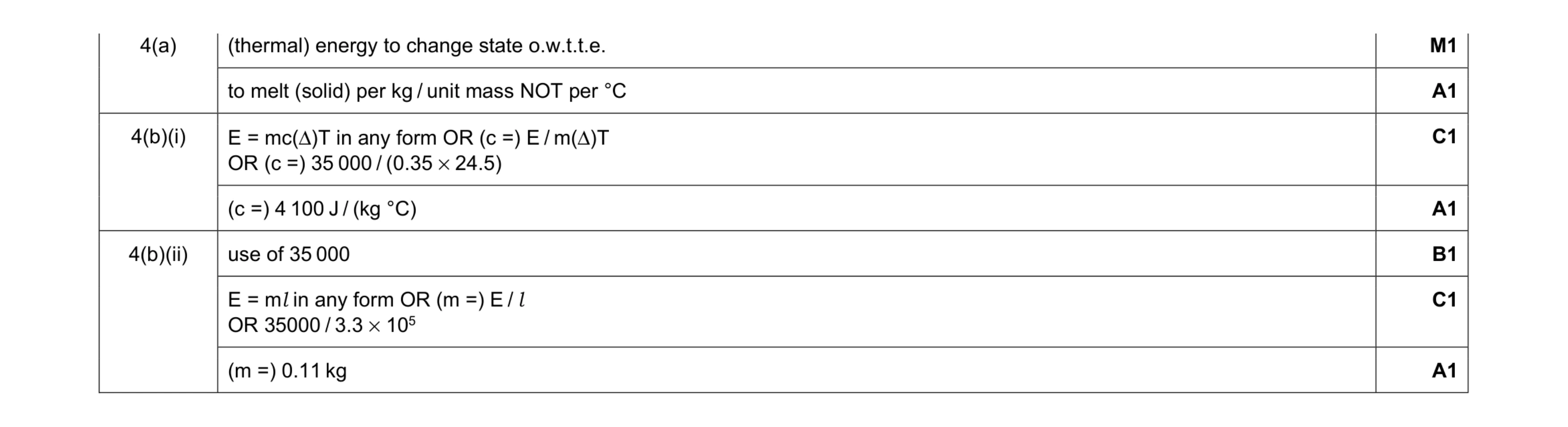 7
7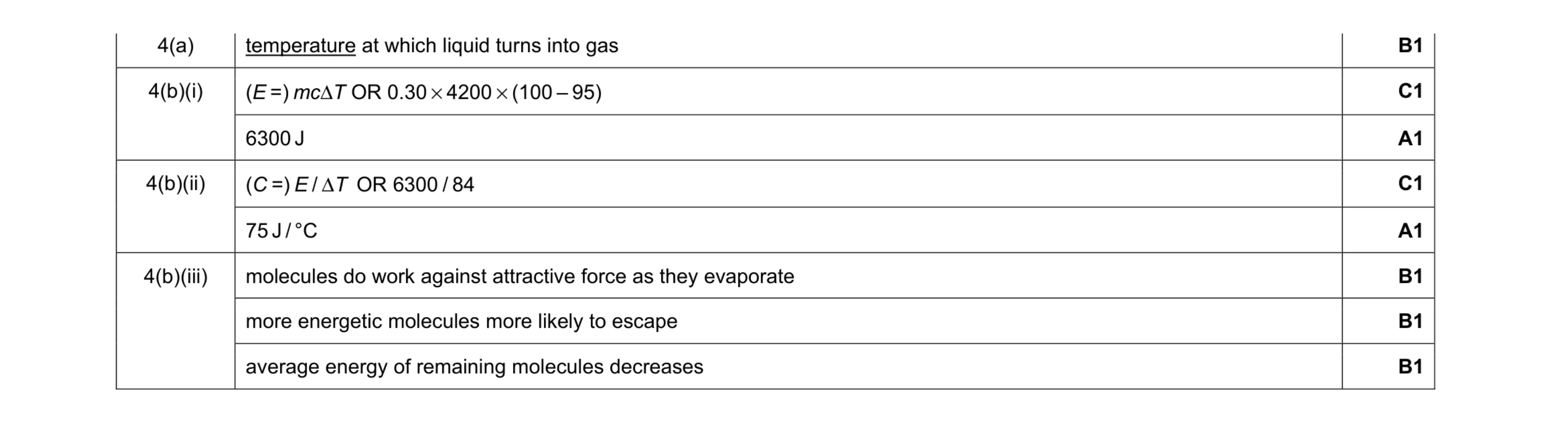 8
8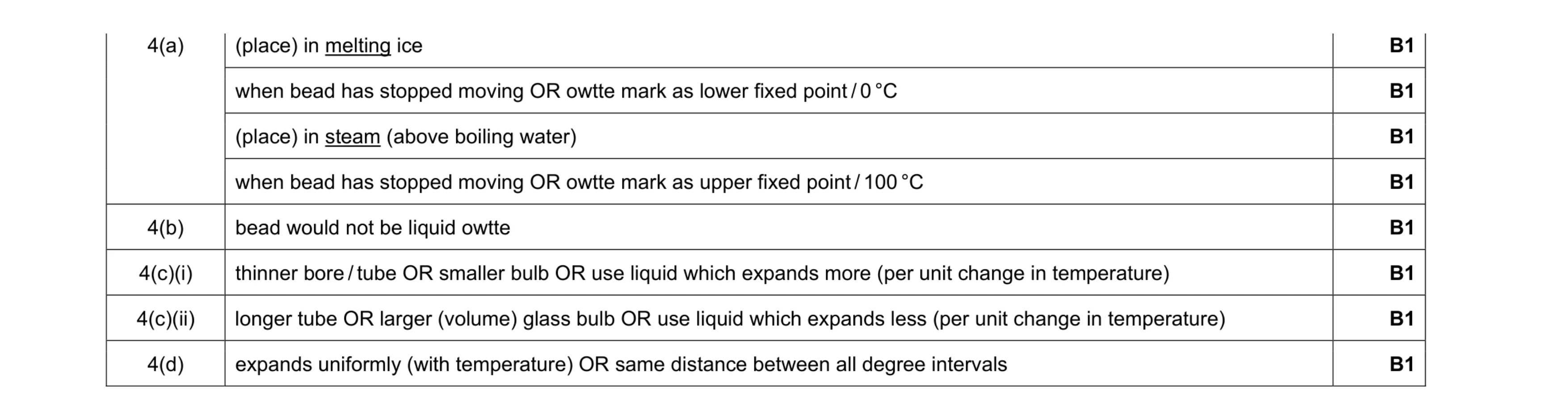 8
8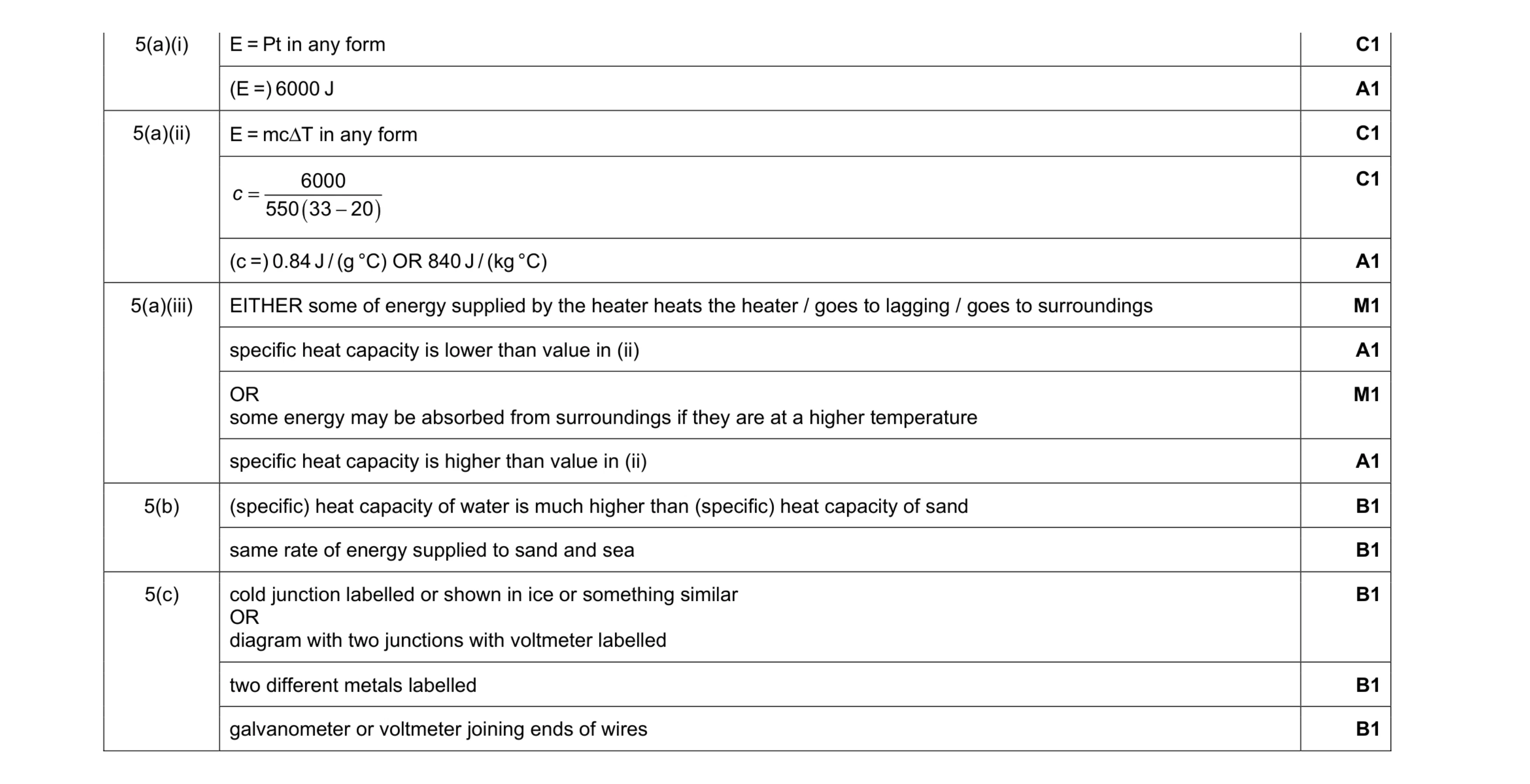 12
12 4
4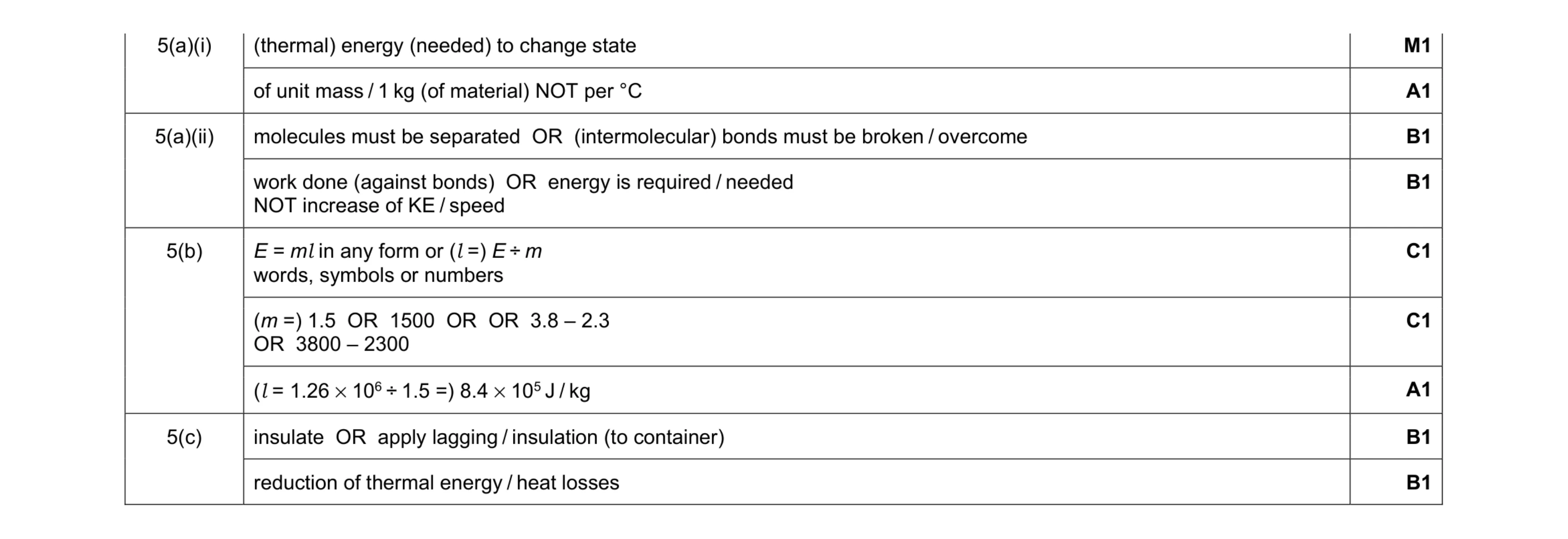 9
9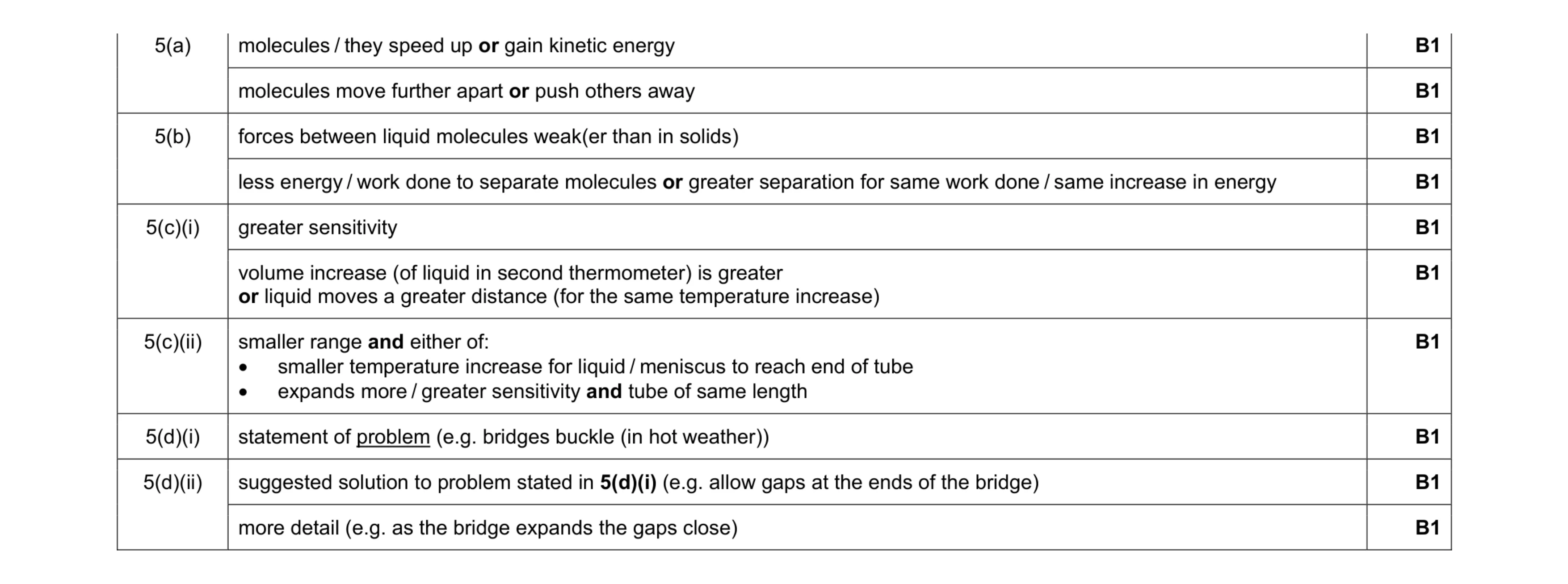 10
10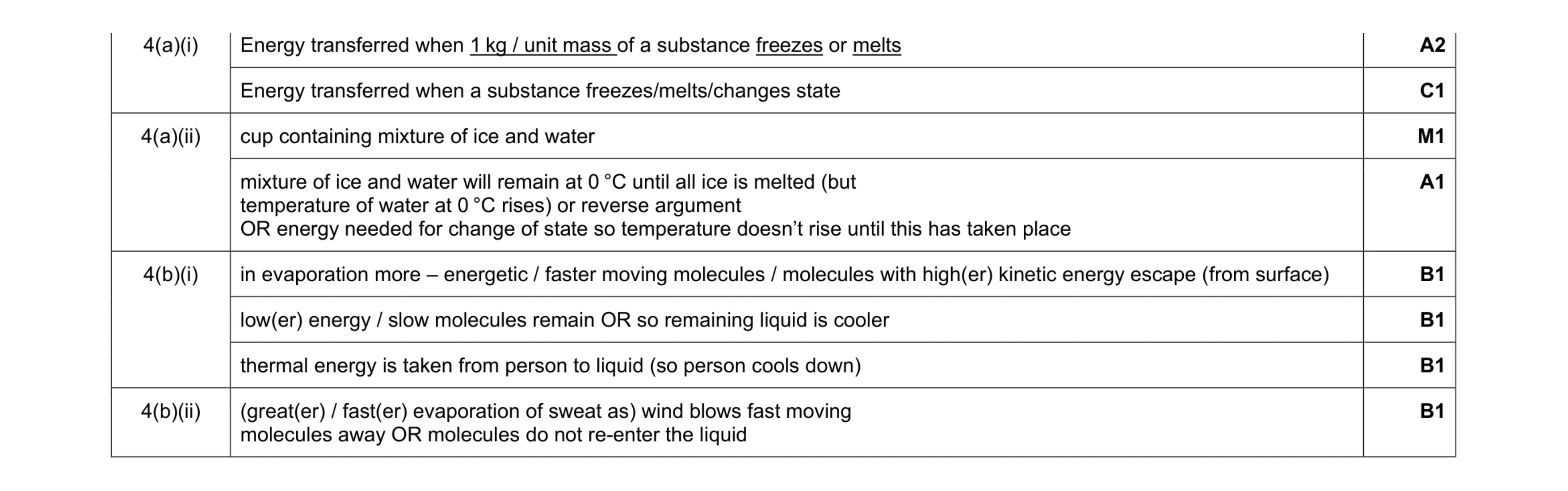 8
8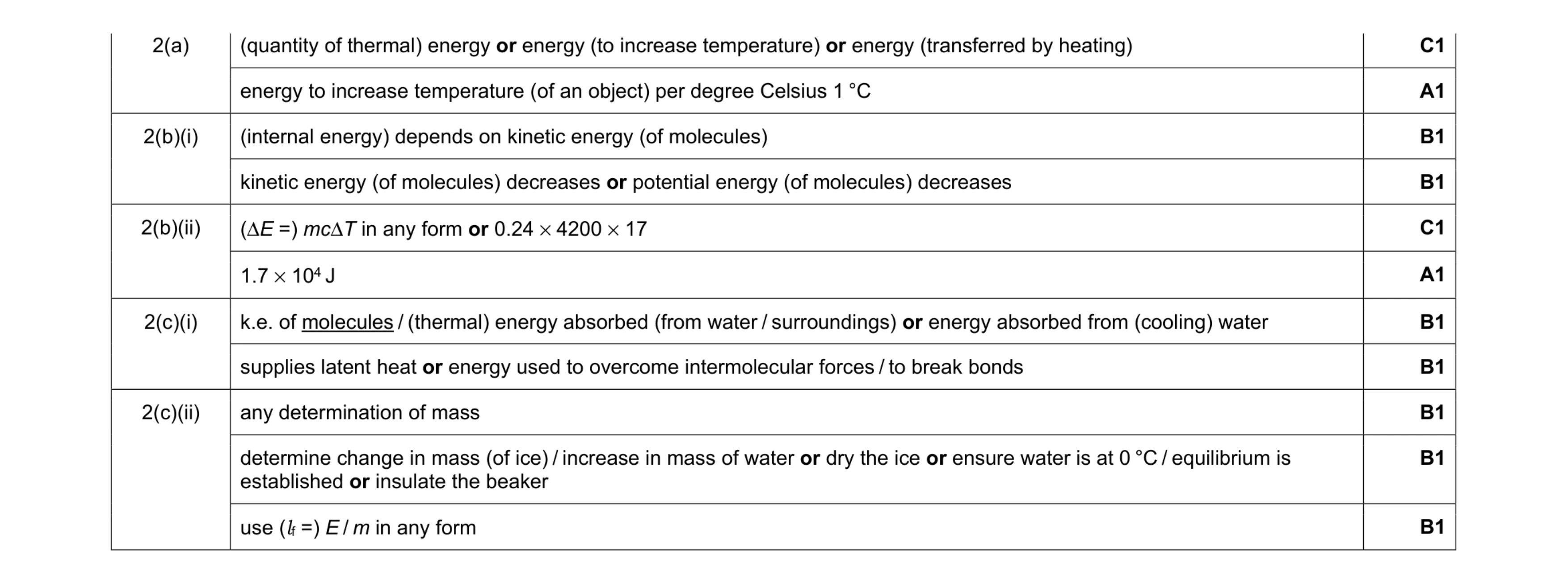 11
11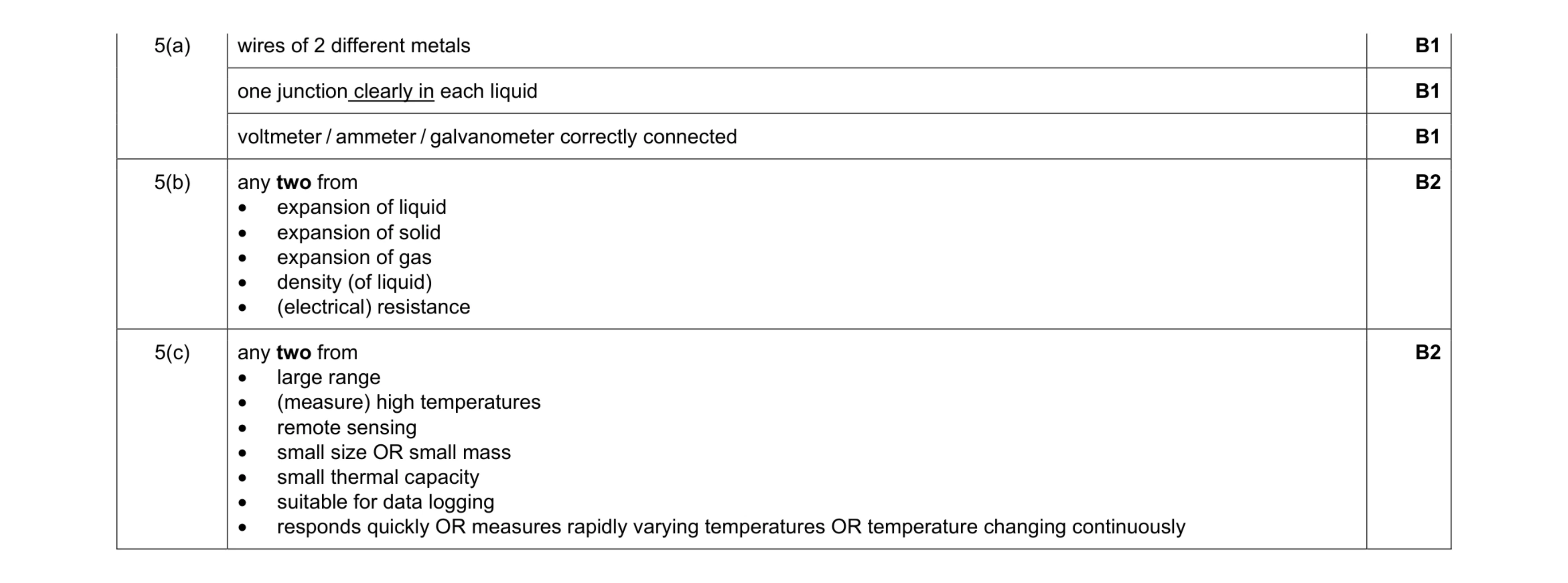 7
7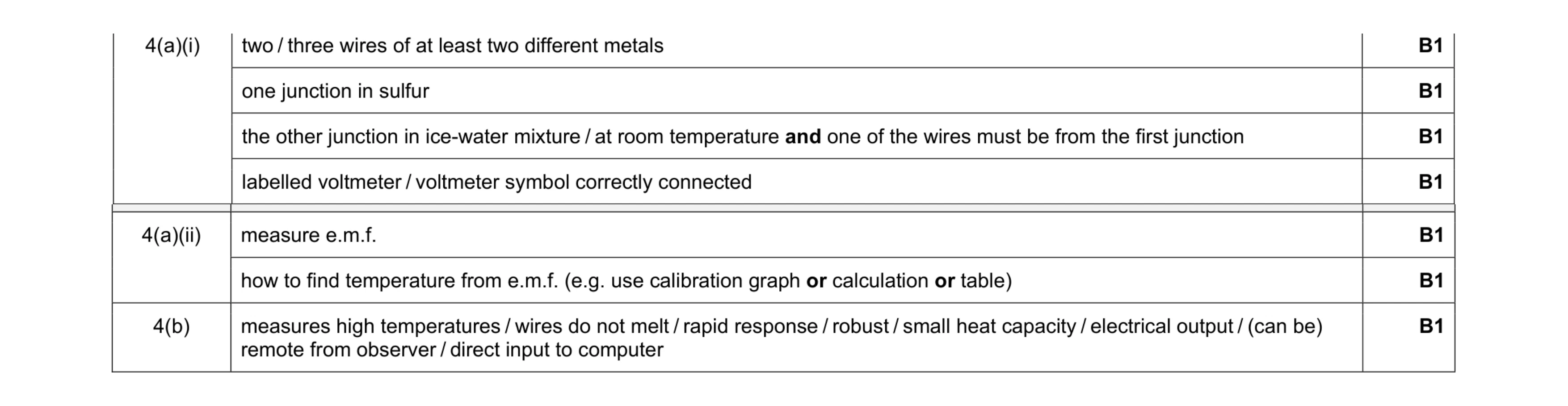 7
7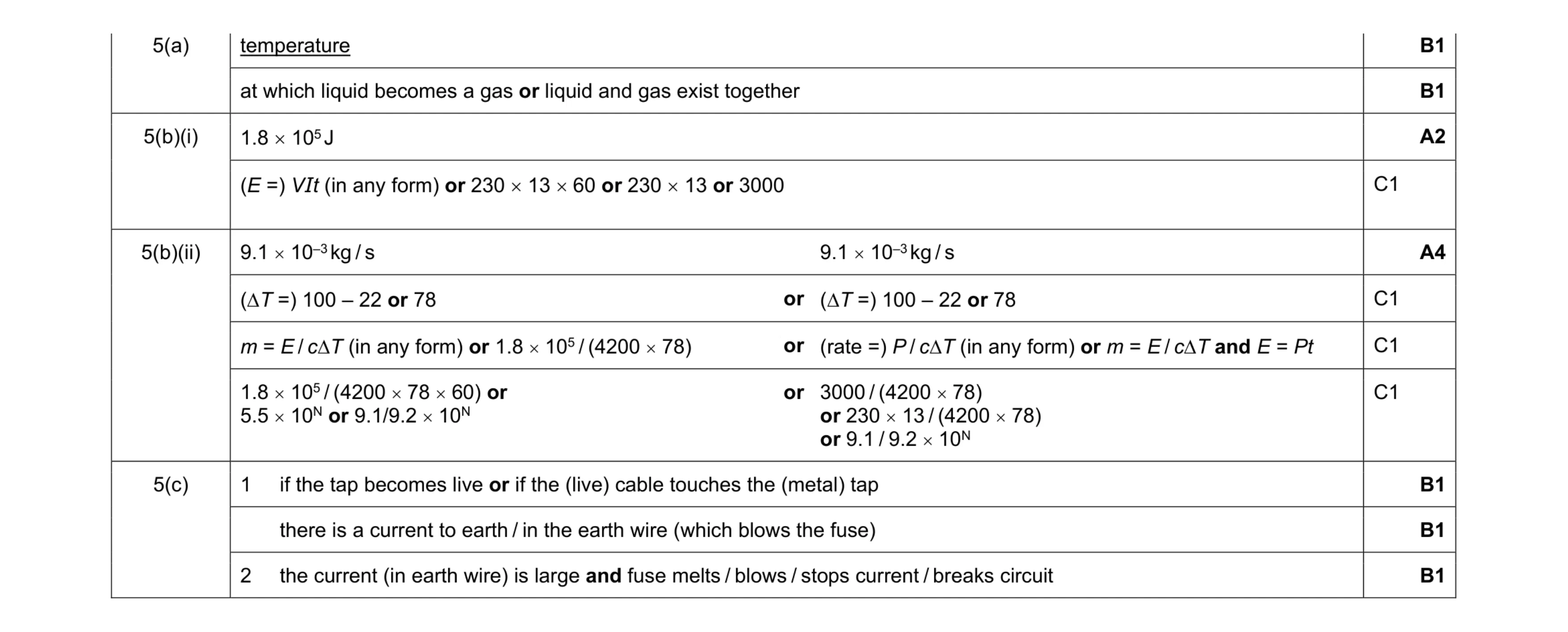 11
11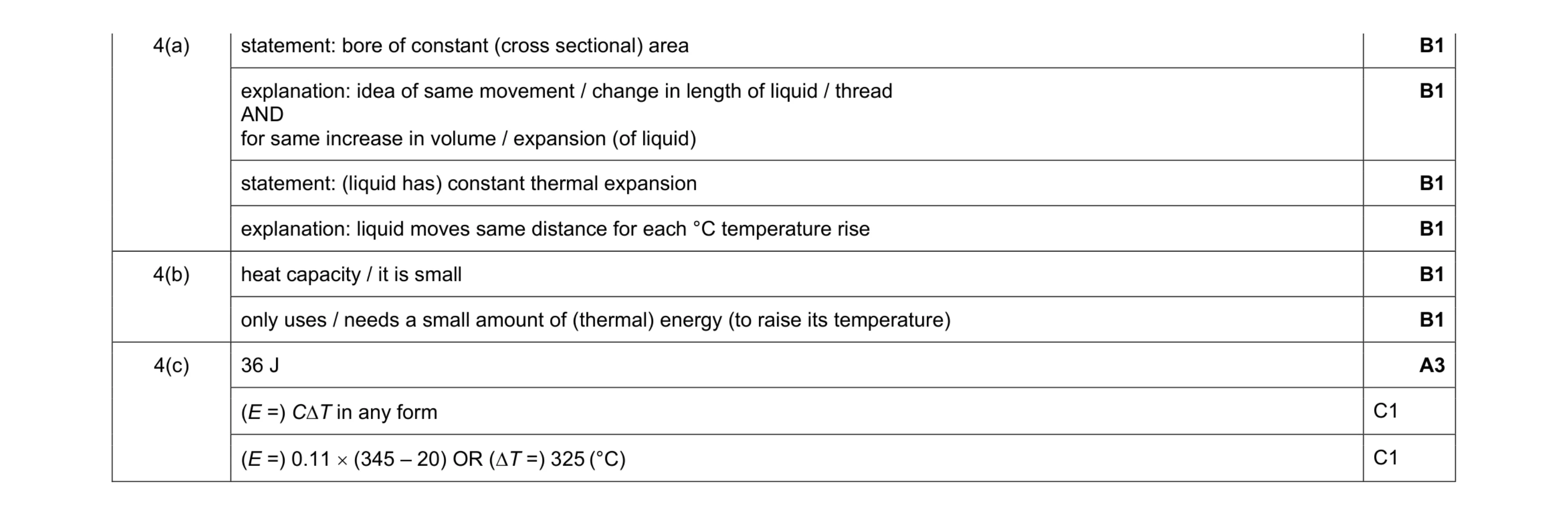 9
9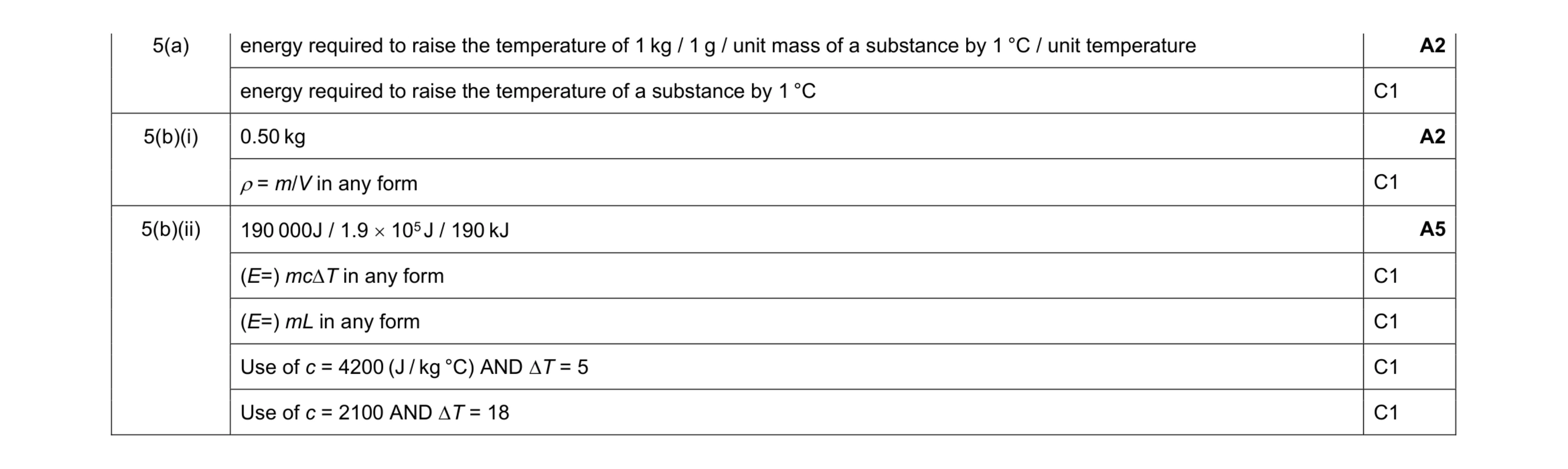 9
9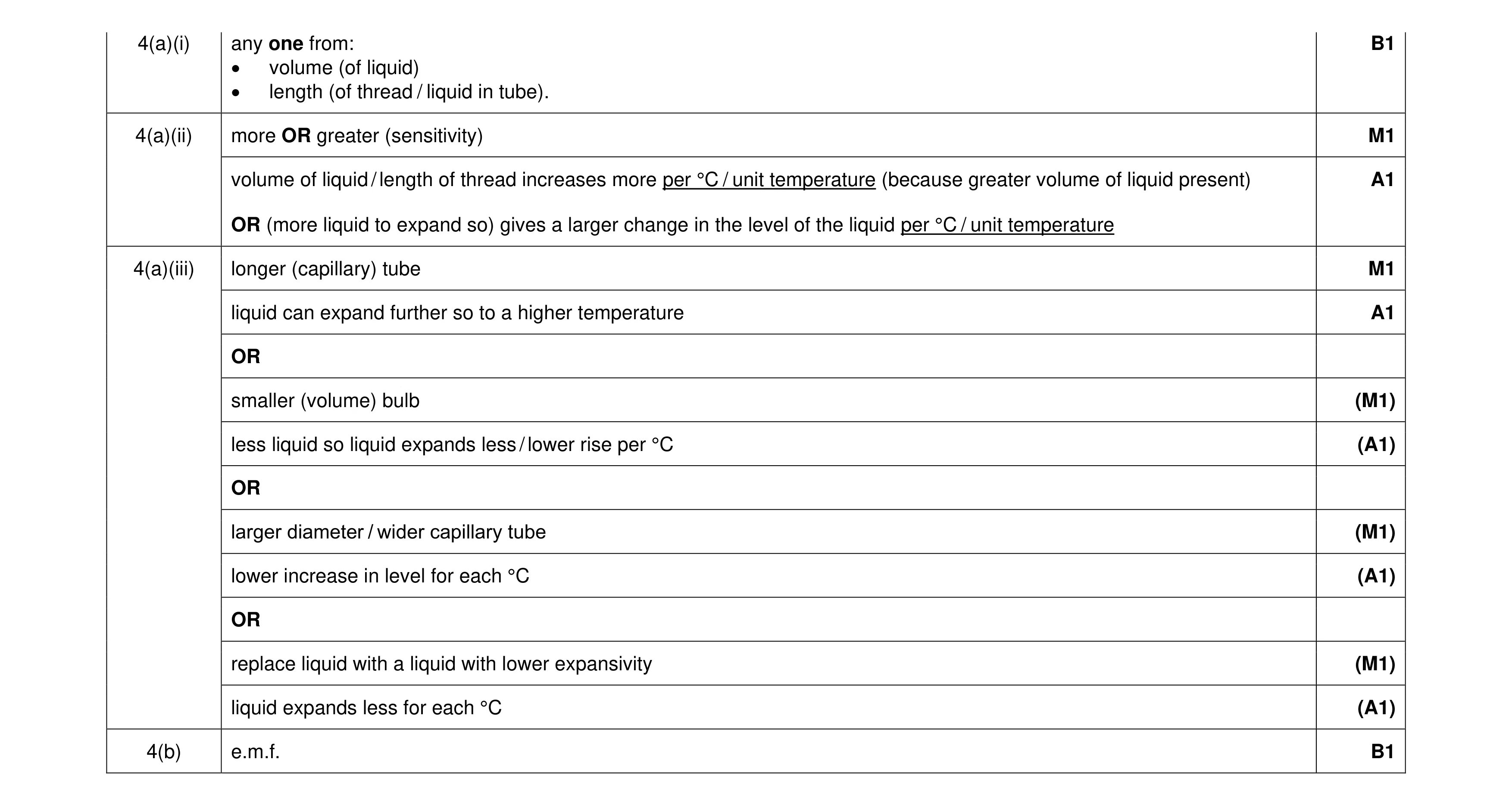 6
6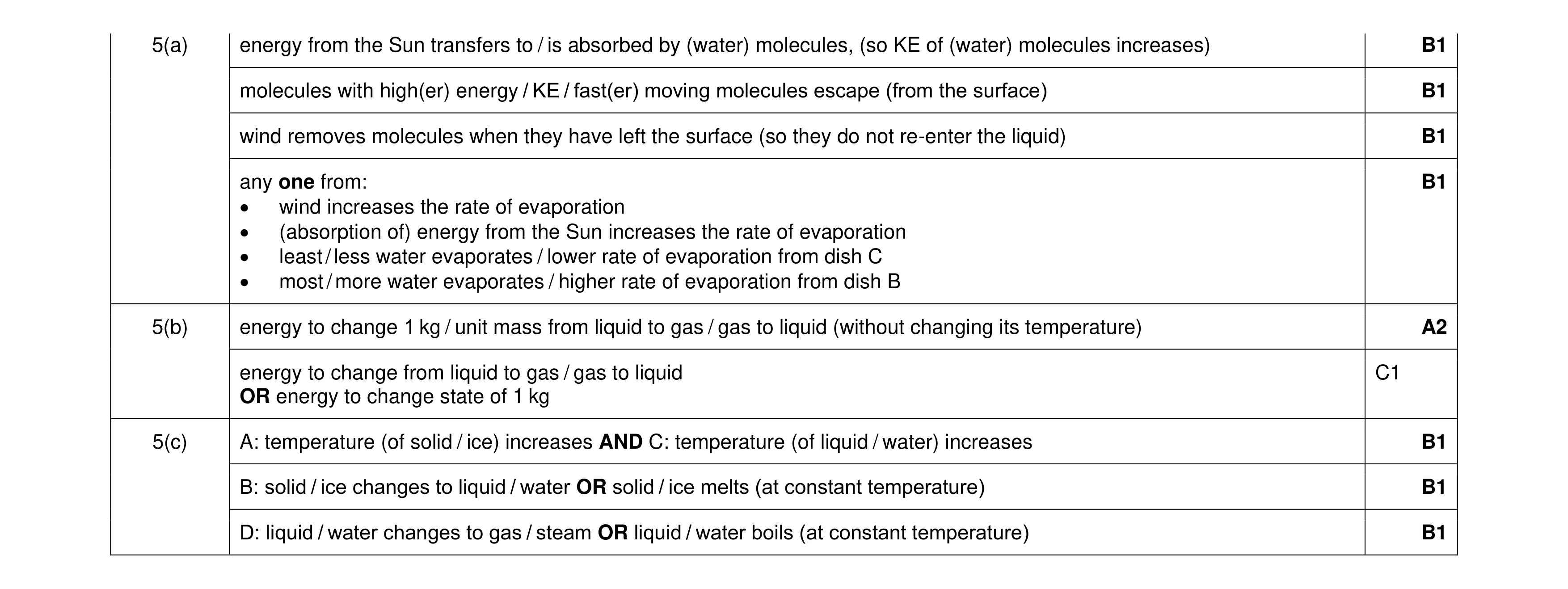 9
9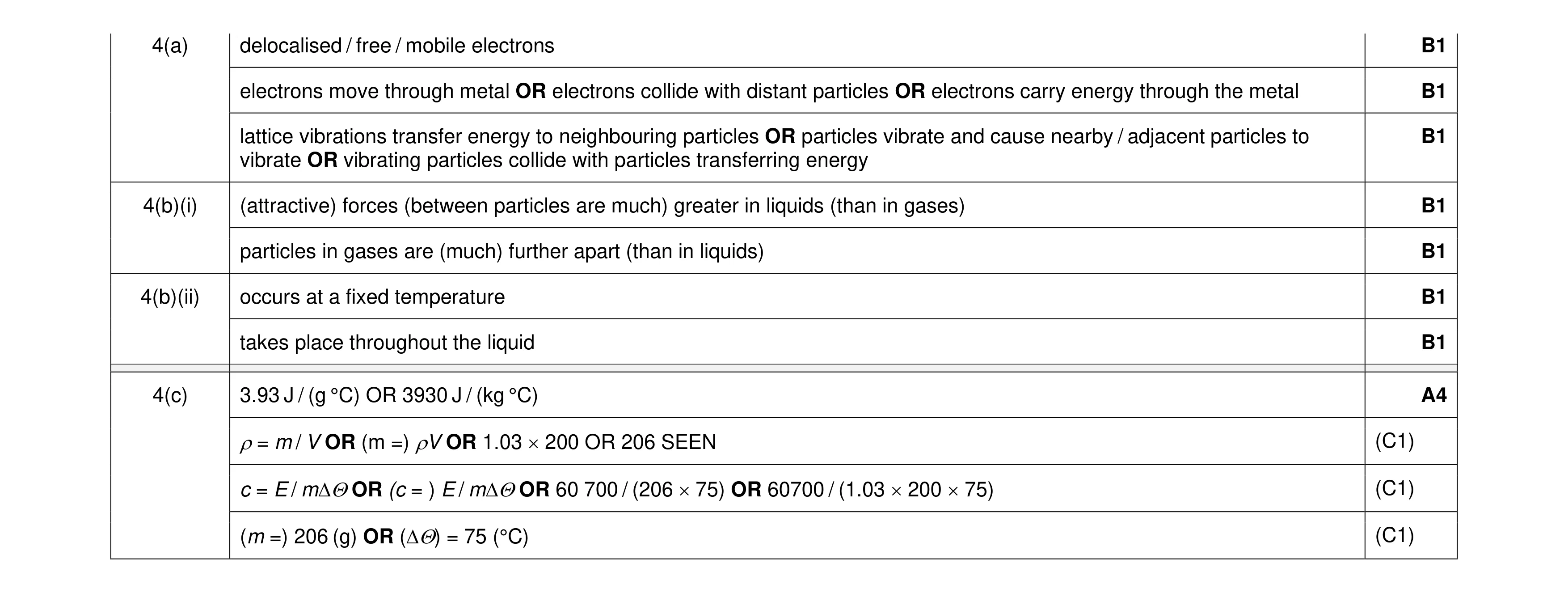 11
11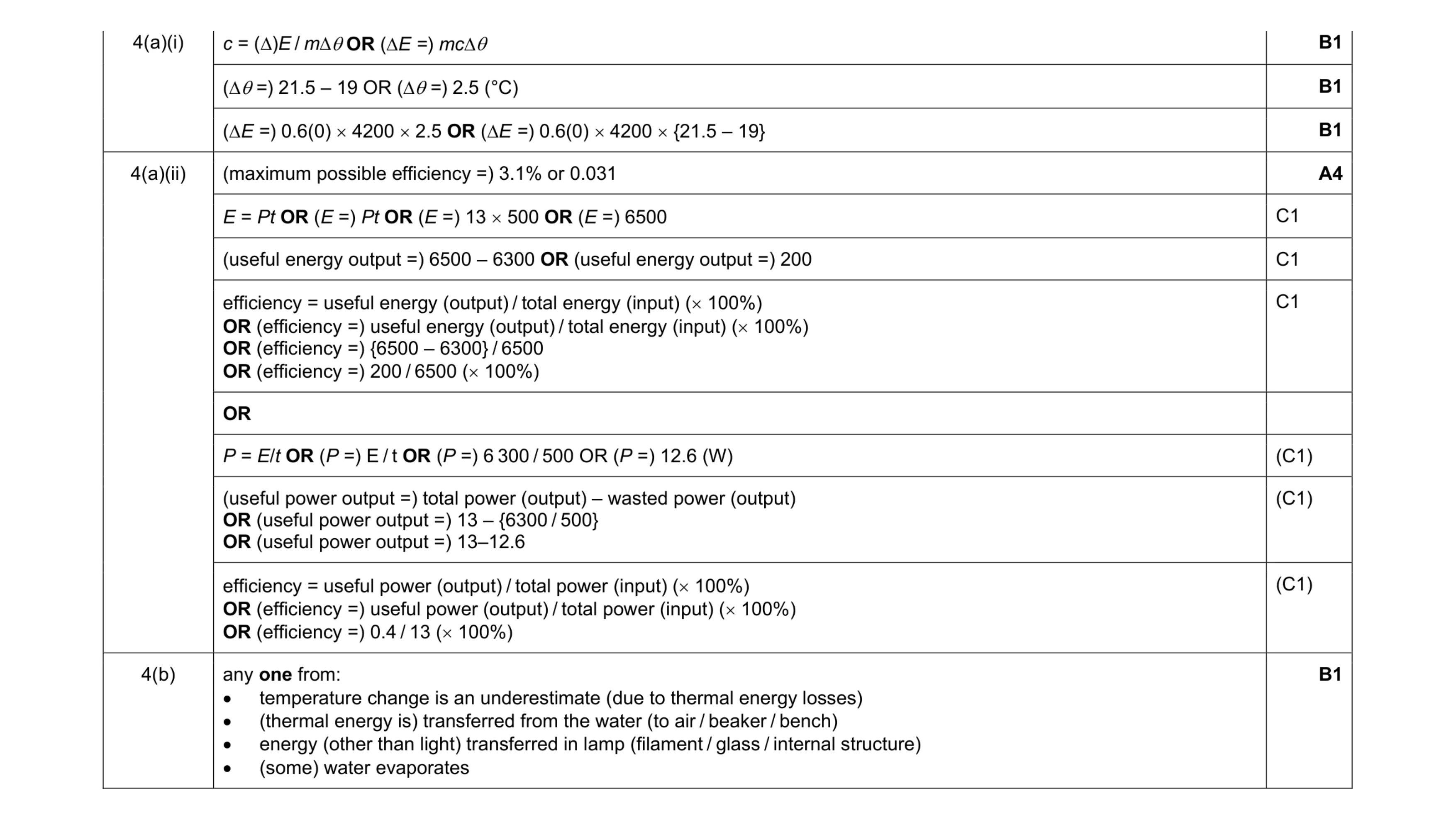 8
8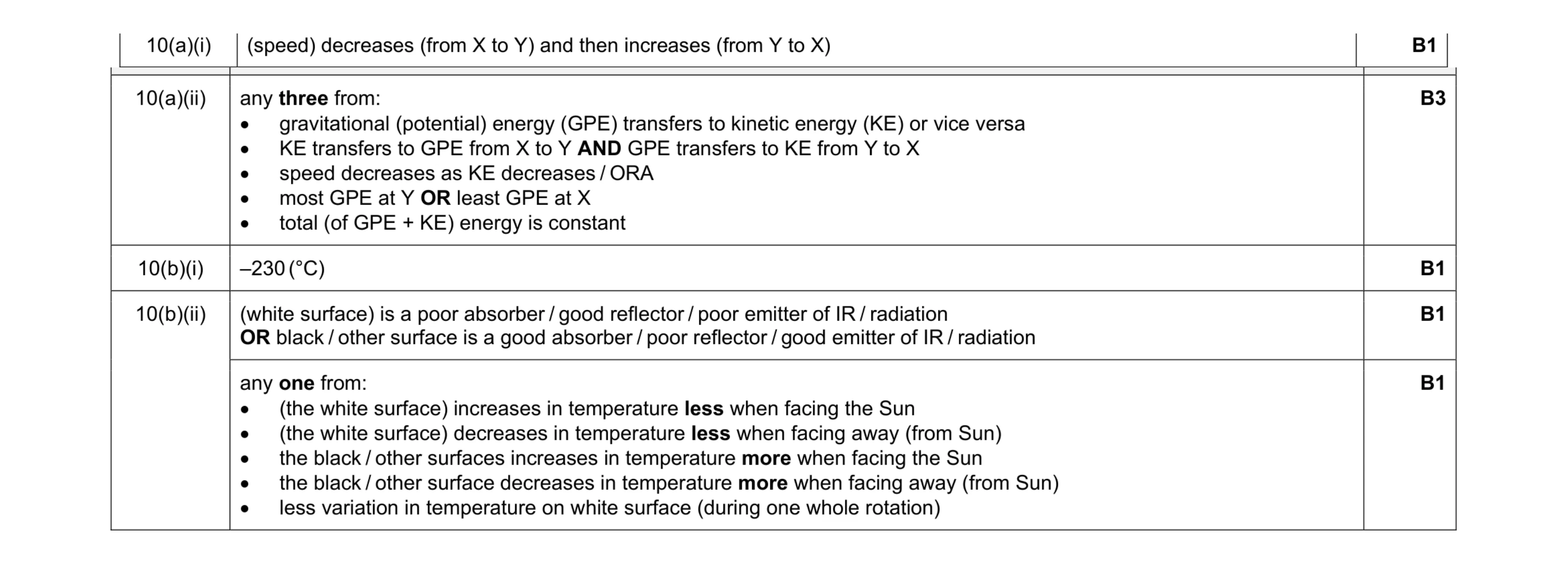 7
7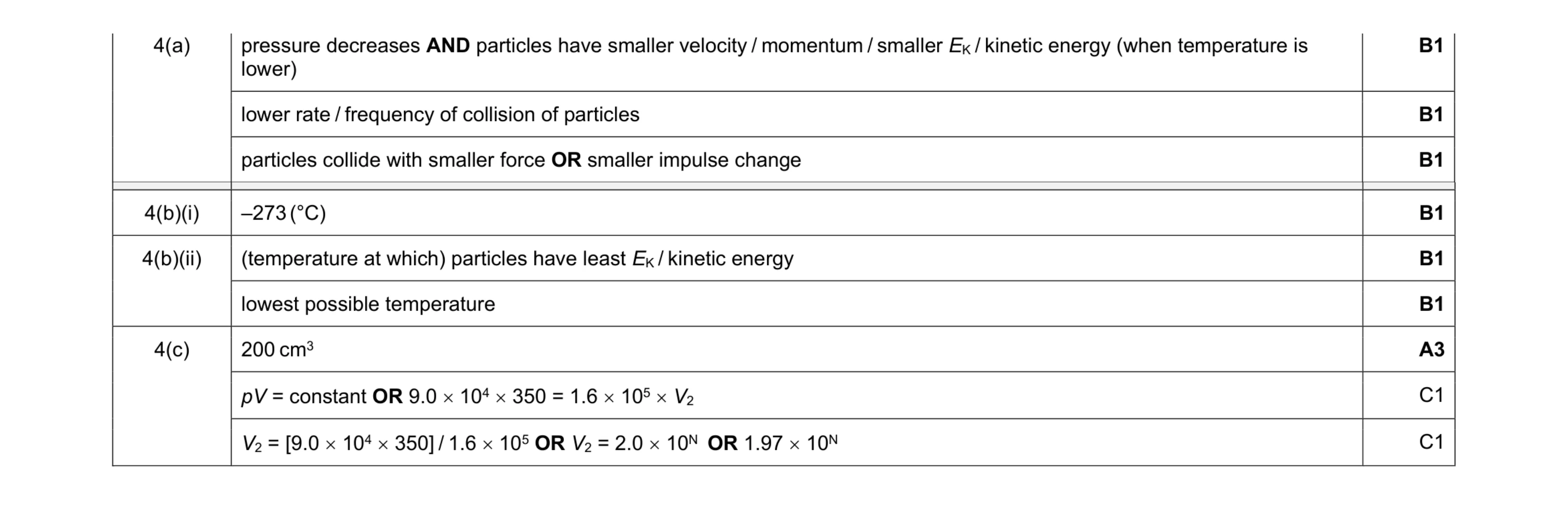 9
9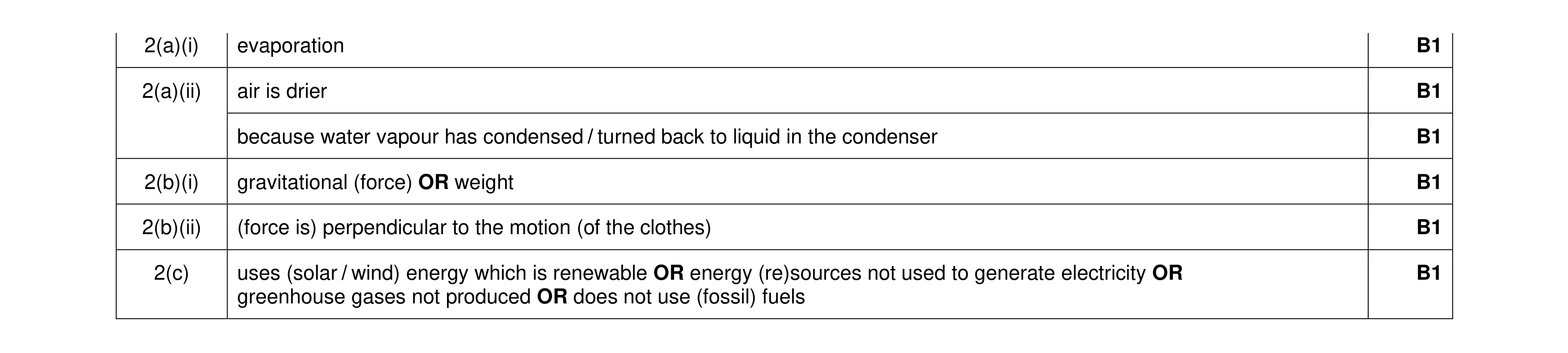 6
6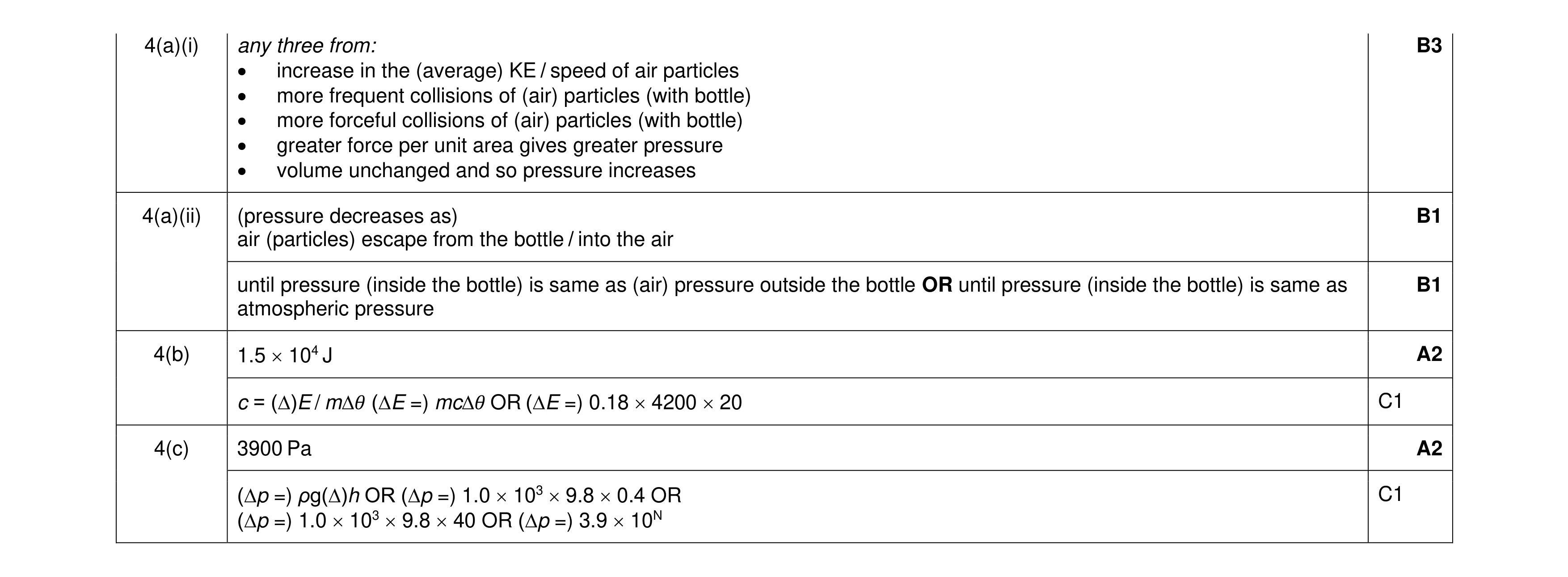 9
9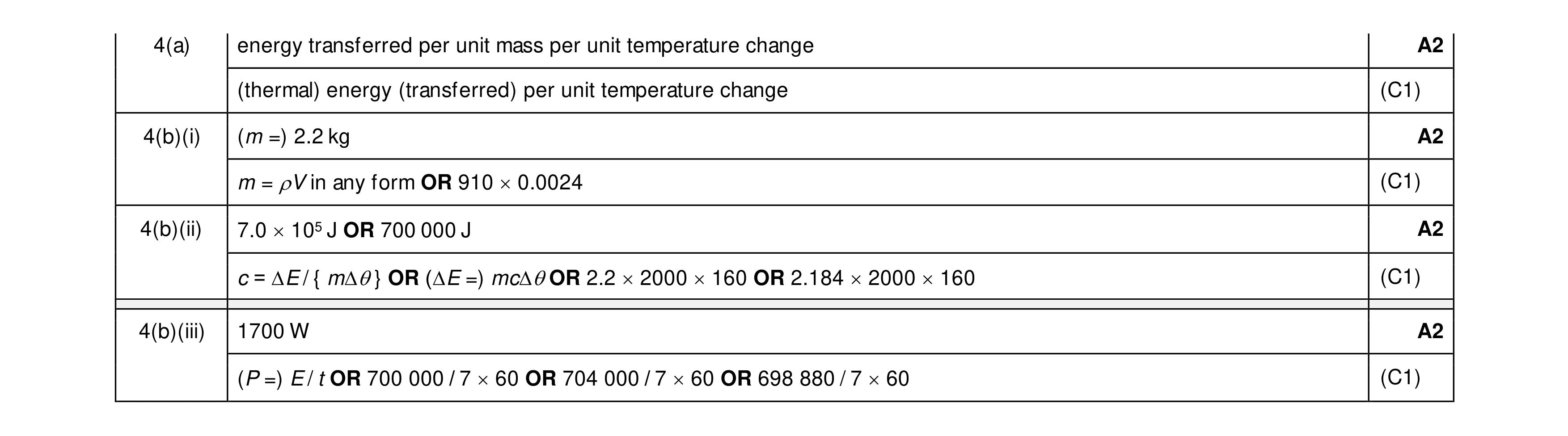 8
8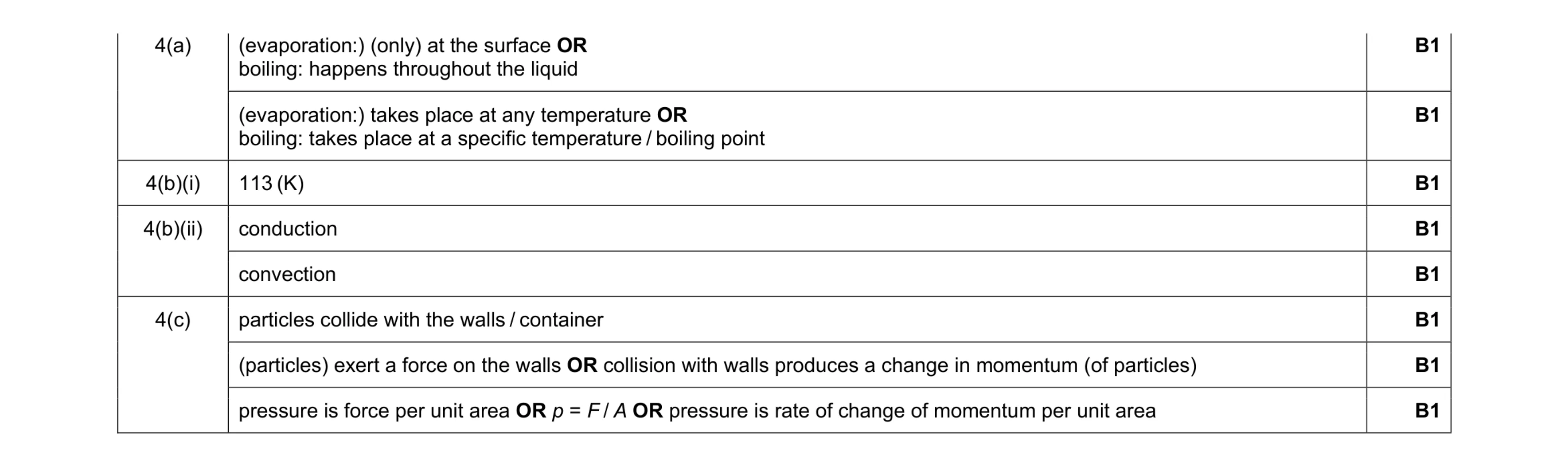 8
8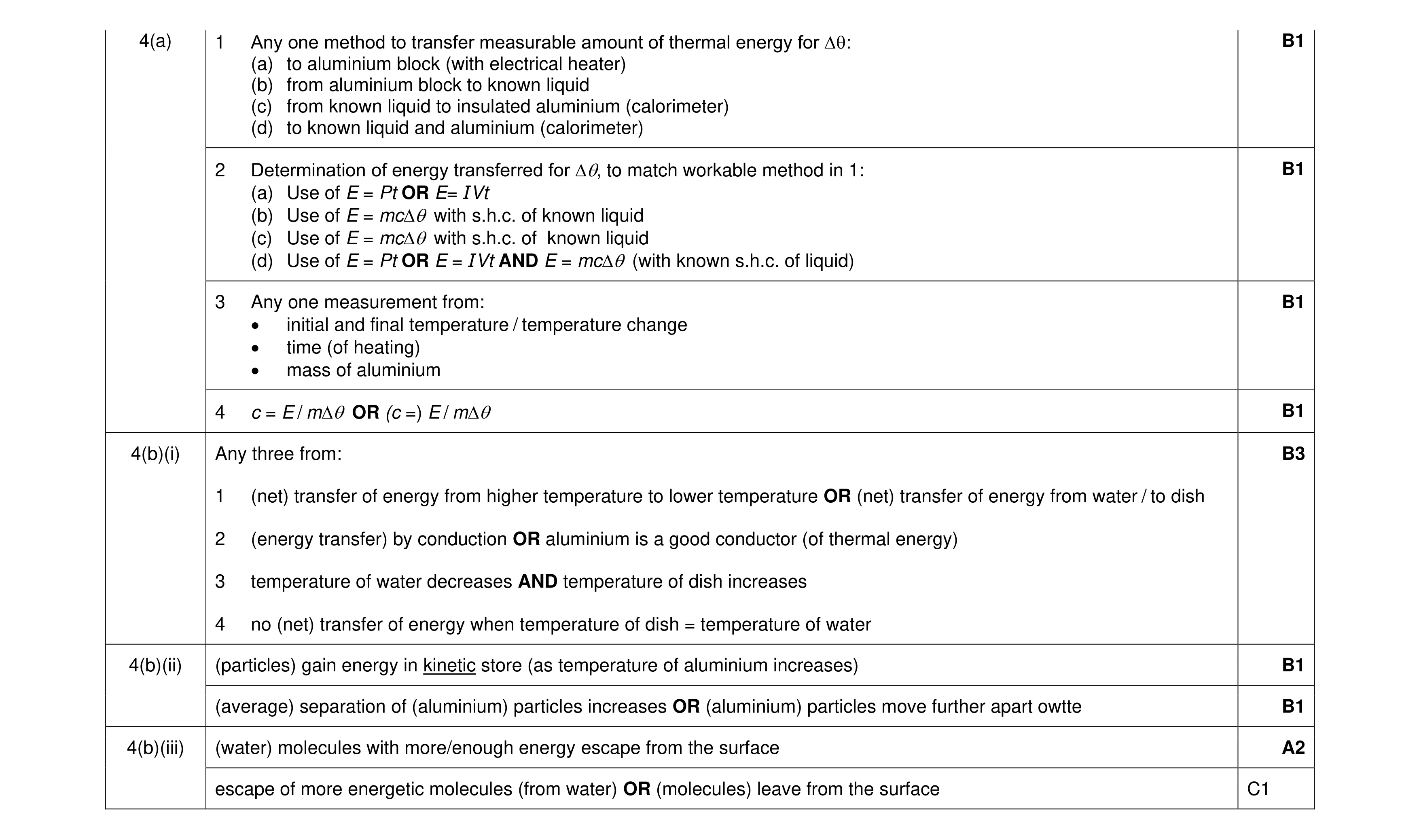 11
11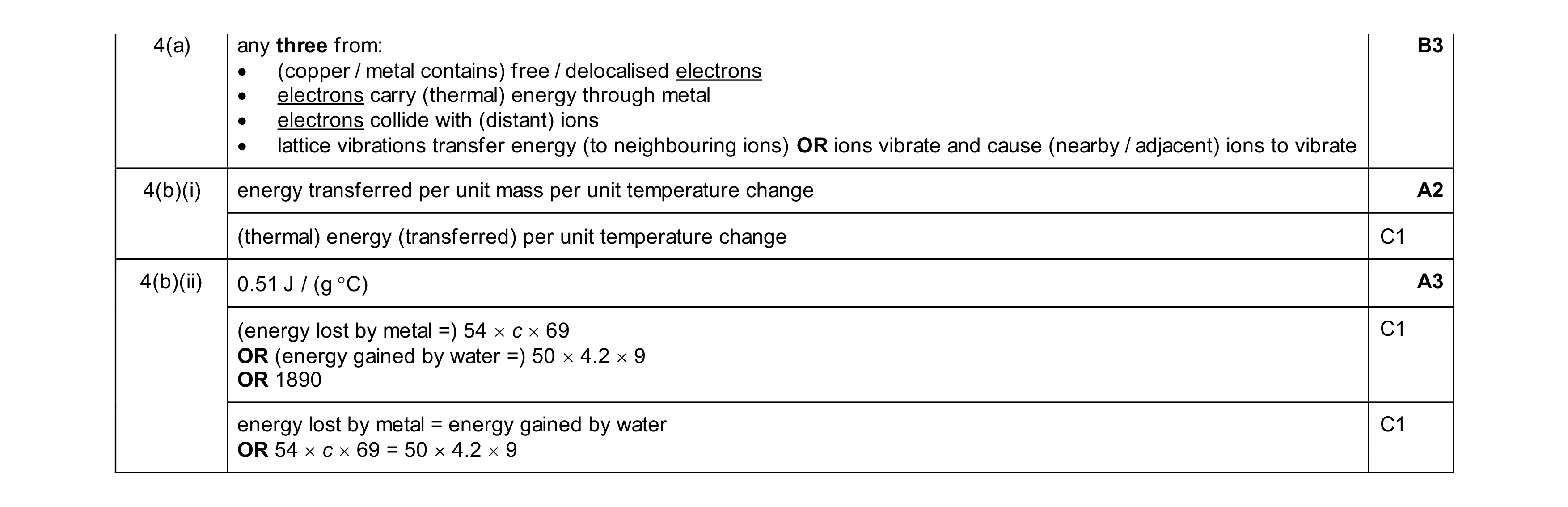 8
8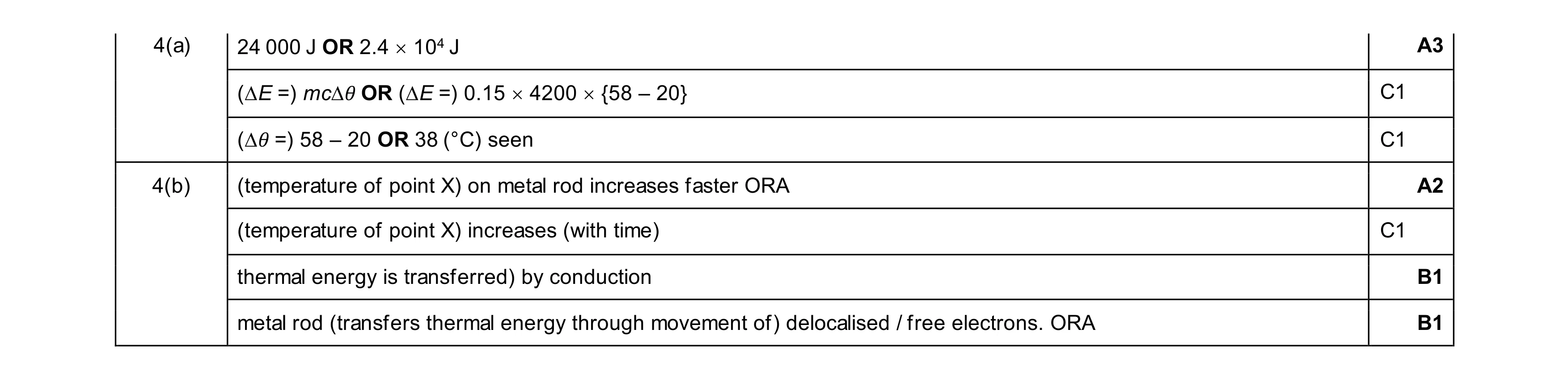 7
7