Questions as text
Q1 · Which is a unit of acceleration? 0625/22 Feb/March 2016
2 Which is a unit of acceleration? A g / cm3 B m / s C m / s2 D N / m
1 marks
Answer: C
This question in 0625/22 Feb/March 2016
Q2 · An object is released from rest and falls to Earth 0625/22 Feb/March 2016
3 An object is released from rest and falls to Earth. During its fall, the object is affected by air resistance. The air resistance eventually reaches a constant value. Which description about successive stages of the motion of the object is correct? A constant acceleration, then constant deceleration B constant deceleration, then zero acceleration C decreasing acceleration, then constant deceleration D decreasing acceleration, then zero acceleration
1 marks
Answer: D
This question in 0625/22 Feb/March 2016
Q3 · The diagram shows an object moving at a constant speed in a circular path in the… 0625/22 Feb/March 2016
6 The diagram shows an object moving at a constant speed in a circular path in the direction shown. A force acts on the object to keep it in the circular path. In which labelled direction does this force act, when the object is in the position shown? object A D B C path of object
1 marks
Answer: B
This question in 0625/22 Feb/March 2016
Q4 · The speed-time graph shown is for a car moving in a straight line 0625/21 May/June 2016
2 The speed-time graph shown is for a car moving in a straight line. 15 speed m / s 10 5 0 0 20 40 60 80 time / s What is the acceleration of the car when the time is 40 s? 0 m / s2 15 − 3 m / s2 15 m / s2 (15 – 3) m / s2 A B C D 4 0 4 0
1 marks
Answer: A
This question in 0625/21 May/June 2016
Q5 · Two runners take part in a race 0625/21 May/June 2016
3 Two runners take part in a race. The graph shows how the speed of each runner changes with time. runner 1 speed runner 2 0 0 t time What does the graph show about the runners at time t ? A Both runners are moving at the same speed. B Runner 1 has zero acceleration. C Runner 1 is overtaking runner 2. D Runner 2 is slowing down.
1 marks
Answer: A
This question in 0625/21 May/June 2016
Q6 · A car travels along a straight road 0625/22 May/June 2016
2 A car travels along a straight road. The speed-time graph for this journey is shown. During which labelled part of the journey is the resultant force on the car zero? speed C B D A 0 0 time
1 marks
Answer: B
This question in 0625/22 May/June 2016
Q7 · A large stone is dropped from a bridge into a river 0625/22 May/June 2016
3 A large stone is dropped from a bridge into a river. Air resistance can be ignored. Which row describes the acceleration and the speed of the stone as it falls? acceleration speed of of the stone the stone A constant constant B constant increasing C increasing constant D increasing increasing
1 marks
Answer: B
This question in 0625/22 May/June 2016
Q8 · Below are four statements about acceleration 0625/22 May/June 2016
5 Below are four statements about acceleration. Which statement is not correct? A Acceleration always involves changing speed. B Changing direction always involves acceleration. C Changing speed always involves acceleration. D Circular motion always involves acceleration.
1 marks
Answer: A
This question in 0625/22 May/June 2016
Q9 · An object moves at a constant speed for some time, then begins to accelerate 0625/23 May/June 2016
2 An object moves at a constant speed for some time, then begins to accelerate. Which distance-time graph shows this motion? A B distance distance 0 0 0 time 0 time C D distance distance 0 0 0 time 0 time
1 marks
Answer: C
This question in 0625/23 May/June 2016
Q10 · A heavy object is released near the surface of the Earth and falls freely 0625/23 May/June 2016
3 A heavy object is released near the surface of the Earth and falls freely. Air resistance can be ignored. Which statement about the acceleration of the object due to gravity is correct? A The acceleration depends on the mass of the object. B The acceleration depends on the volume of the object. C The acceleration is constant. D The acceleration is initially zero and increases as the object falls.
1 marks
Answer: C
This question in 0625/23 May/June 2016
Q11 · The graph shows how the distance travelled by a vehicle changes with time 0625/21 Oct/Nov 2016
1 The graph shows how the distance travelled by a vehicle changes with time. S distance Q R P 0 0 time Which row describes the speed of the vehicle in each section of the graph? P to Q Q to R R to S A constant zero constant B constant zero decreasing C increasing constant decreasing D increasing zero constant
1 marks
Answer: A
This question in 0625/21 Oct/Nov 2016
Q12 · A stone falls freely from the top of a cliff 0625/21 Oct/Nov 2016
2 A stone falls freely from the top of a cliff. Air resistance may be ignored. Which graph shows how the acceleration of the stone varies with time as it falls? A B acceleration acceleration 0 0 0 time 0 time C D acceleration acceleration 0 0 0 time 0 time
1 marks
Answer: D
This question in 0625/21 Oct/Nov 2016
Q13 · A car travels along a horizontal road in a straight line 0625/21 Oct/Nov 2016
3 A car travels along a horizontal road in a straight line. The driver presses the accelerator to increase the speed of the car. The speed-time graph for the car is shown. 30 speed m / s 20 10 0 0 5 10 15 20 time / s What is the acceleration of the car? A 0.50 m / s2 B 1.00 m / s2 C 1.50 m / s2 D 2.00 m / s2
1 marks
Answer: A
This question in 0625/21 Oct/Nov 2016
Q14 · The graph shows how the distance travelled by a vehicle changes with time 0625/22 Oct/Nov 2016
1 The graph shows how the distance travelled by a vehicle changes with time. S distance Q R P 0 0 time Which row describes the speed of the vehicle in each section of the graph? P to Q Q to R R to S A constant zero constant B constant zero decreasing C increasing constant decreasing D increasing zero constant
1 marks
Answer: A
This question in 0625/22 Oct/Nov 2016
Q15 · A stone falls freely from the top of a cliff 0625/22 Oct/Nov 2016
2 A stone falls freely from the top of a cliff. Air resistance may be ignored. Which graph shows how the acceleration of the stone varies with time as it falls? A B acceleration acceleration 0 0 0 time 0 time C D acceleration acceleration 0 0 0 time 0 time
1 marks
Answer: D
This question in 0625/22 Oct/Nov 2016
Q16 · The speed-time graph for an object is shown 0625/22 Oct/Nov 2016
3 The speed-time graph for an object is shown. speed X Y 20 m / s W P Z 0 0 5 15 25 time / s Below are four statements about the acceleration of the object. Which statement is correct? A The acceleration in the first 5 s is given by area P. B The acceleration increases between W and X. C The acceleration is negative between Y and Z. D The deceleration between Y and Z is (20 ÷ 25) m / s2.
1 marks
Answer: C
This question in 0625/22 Oct/Nov 2016
Q17 · The graph shows how the distance travelled by a vehicle changes with time 0625/23 Oct/Nov 2016
1 The graph shows how the distance travelled by a vehicle changes with time. S distance Q R P 0 0 time Which row describes the speed of the vehicle in each section of the graph? P to Q Q to R R to S A constant zero constant B constant zero decreasing C increasing constant decreasing D increasing zero constant
1 marks
Answer: A
This question in 0625/23 Oct/Nov 2016
Q18 · A stone falls freely from the top of a cliff 0625/23 Oct/Nov 2016
2 A stone falls freely from the top of a cliff. Air resistance may be ignored. Which graph shows how the acceleration of the stone varies with time as it falls? A B acceleration acceleration 0 0 0 time 0 time C D acceleration acceleration 0 0 0 time 0 time
1 marks
Answer: D
This question in 0625/23 Oct/Nov 2016
Q19 · The speed-time graph for an object is shown 0625/23 Oct/Nov 2016
3 The speed-time graph for an object is shown. speed X Y 10 m / s W Z 0 0 10 30 50 time / s Below are four statements about the acceleration of the object. Which statement is true? A The acceleration in the first 10 s is (10 ÷ 10) m / s2. B The acceleration increases between W and X. C The acceleration decreases between Y and Z. D The deceleration between Y and Z is (10 ÷ 50) m / s2.
1 marks
Answer: A
This question in 0625/23 Oct/Nov 2016
Q20 · An object travels in a circular path at constant speed 0625/23 Oct/Nov 2016
6 An object travels in a circular path at constant speed. Which statement about the object is correct? A It has changing kinetic energy. B It has changing momentum. C It has constant velocity. D It is not accelerating.
1 marks
Answer: B
This question in 0625/23 Oct/Nov 2016
Q21 · A ball is dropped onto a floor 0625/23 Oct/Nov 2016
10 A ball is dropped onto a floor. Its speed just before hitting the floor is 3.0 m / s. Which change would result in a speed of 6.0 m / s just before hitting the floor? Ignore any effects due to air resistance. A Drop the ball from double the height above the floor. B Drop the ball from four times the height above the floor. C Use a ball with double the mass. D Use a ball with four times the mass.
1 marks
Answer: B
This question in 0625/23 Oct/Nov 2016
Q22 · Four balls with different masses are dropped from the heights shown 0625/22 Feb/March 2017
2 Four balls with different masses are dropped from the heights shown. P Q R S 1.0 kg 2.0 kg 3.0 kg 4.0 m 4.0 kg 3.0 m 2.0 m 1.0 m ground Air resistance may be ignored. Which statement about the balls is correct? A Ball P has the greatest acceleration. B Balls Q and R take the same time to fall to the ground. C The acceleration of ball R is half the acceleration of ball P. D Ball S has the greatest average speed.
1 marks
Answer: D
This question in 0625/22 Feb/March 2017
Q23 · An object is travelling in a straight line 0625/22 Feb/March 2017
3 An object is travelling in a straight line. The diagram is the speed-time graph for the object. At which labelled point is the object accelerating at a changing rate? C speed m / s B D A 0 0 time / s
1 marks
Answer: B
This question in 0625/22 Feb/March 2017
Q24 · A car moves in a circular path as it turns a corner on a horizontal road 0625/22 Feb/March 2017
7 A car moves in a circular path as it turns a corner on a horizontal road. The car moves at constant speed. path of car car direction of travel Which description of the forces acting on the car is correct? A All the forces are balanced as the car is moving at constant speed. B The forces are unbalanced and the resultant force acts away from the centre of the circle. C The forces are unbalanced and the resultant force acts towards the centre of the circle. D The forces are unbalanced and the resultant force is in the direction of travel of the car.
1 marks
Answer: C
This question in 0625/22 Feb/March 2017
Q25 · On Earth, a ball is dropped and falls 2.0 m in a vacuum 0625/21 May/June 2017
2 On Earth, a ball is dropped and falls 2.0 m in a vacuum. The acceleration of the ball at 1.0 m is 10 m / s2. 0 m ball 0.5 m 1.0 m 1.5 m 2.0 m What is the acceleration of the ball at 0.5 m? A 5.0 m / s2 B 10 m / s2 C 15 m / s2 D 20 m / s2
1 marks
Answer: B
This question in 0625/21 May/June 2017
Q26 · A skydiver reaches terminal velocity 0625/21 May/June 2017
3 A skydiver reaches terminal velocity. Then he opens his parachute. What happens to the skydiver as the parachute opens? A There is a decrease in weight. B There is acceleration upwards. C There is an increase in speed. D There is movement upwards.
1 marks
Answer: B
This question in 0625/21 May/June 2017
Q27 · A boat is travelling at a steady speed in a straight line across the surface of a lake 0625/21 May/June 2017
6 A boat is travelling at a steady speed in a straight line across the surface of a lake. Which statement about the boat is correct? A The resultant force on the boat is in the direction of motion. B The resultant force on the boat is in the opposite direction to its motion. C The resultant force on the boat is vertically downwards. D The resultant force on the boat is zero.
1 marks
Answer: D
This question in 0625/21 May/June 2017
Q28 · A student determines the average speed of a bubble rising through a liquid at constant… 0625/22 May/June 2017
2 A student determines the average speed of a bubble rising through a liquid at constant speed. When the student starts the stopwatch the bubble is at position P. After 2.0 s the bubble is at position Q. bubble 18 Q 19 20 21 22 23 24 25 P 26 cm 27 bubble What is the speed of the bubble between P and Q? A 3.2 cm / s B 3.7 cm / s C 6.4 cm / s D 7.4 cm / s
1 marks
Answer: B
This question in 0625/22 May/June 2017
Q29 · The diagram shows the speed-time graph for a toy car travelling in a straight line 0625/22 May/June 2017
3 The diagram shows the speed-time graph for a toy car travelling in a straight line. 4.0 speed m / s 3.0 2.0 1.0 0 0 1.0 2.0 3.0 4.0 5.0 time / s What is the acceleration of the car during the first two seconds and what is the total distance that it travels? acceleration total m / s2 distance / m A 0.50 10 B 0.50 20 C 2.0 10 D 2.0 20
1 marks
Answer: C
This question in 0625/22 May/June 2017
Q30 · Which distance-time graph represents a body whose speed is decreasing? 0625/23 May/June 2017
3 Which distance-time graph represents a body whose speed is decreasing? A B distance distance 0 0 0 time 0 time C D distance distance 0 0 0 time 0 time
1 marks
Answer: C
This question in 0625/23 May/June 2017
Q31 · A steel ball is fired vertically upwards with a velocity v 0625/23 May/June 2017
10 A steel ball is fired vertically upwards with a velocity v. The ball reaches a height h. The same ball is now fired vertically upwards from the same position with a velocity 2v. Air resistance can be ignored. What is the new height reached by the ball? A h B 2h C 4h D 8h
1 marks
Answer: C
This question in 0625/23 May/June 2017
Q32 · Four balls with different masses are dropped from the heights shown 0625/21 Oct/Nov 2017
2 Four balls with different masses are dropped from the heights shown. Air resistance may be ignored. Which ball has the smallest average speed? A B C D 1.0 kg 2.0 kg 3.0 kg 4.0 m 4.0 kg 3.0 m 2.0 m 1.0 m ground
1 marks
Answer: A
This question in 0625/21 Oct/Nov 2017
Q33 · An ice crystal falls vertically from a cloud 0625/21 Oct/Nov 2017
3 An ice crystal falls vertically from a cloud. What happens to the acceleration of the ice crystal as it falls? A It decreases because of air resistance. B It decreases because of gravity. C It increases because of air resistance. D It increases because of gravity.
1 marks
Answer: A
This question in 0625/21 Oct/Nov 2017
Q34 · Four balls with different masses are dropped simultaneously from the heights shown 0625/22 Oct/Nov 2017
2 Four balls with different masses are dropped simultaneously from the heights shown. Air resistance may be ignored. Which ball hits the floor last? A B C D 4.0 kg 3.0 kg 2.0 kg 2.0 m 1.0 kg 1.5 m 1.0 m 0.5 m ground
1 marks
Answer: D
This question in 0625/22 Oct/Nov 2017
Q35 · The gravitational field strength on the Earth is greater than the gravitational field… 0625/22 Oct/Nov 2017
3 The gravitational field strength on the Earth is greater than the gravitational field strength on the Moon. The Earth has an atmosphere, but the Moon does not. Which speed-time graph represents the motion of a light ball dropped from a great height near the surface of the Earth and near the surface of the Moon? A B Earth Moon speed speed Earth Moon 0 0 0 time 0 time C D Earth Earth speed speed Moon Moon 0 0 0 time 0 time
1 marks
Answer: C
This question in 0625/22 Oct/Nov 2017
Q36 · A student finds that it takes sound 0.33 seconds to travel 100 metres 0625/22 Oct/Nov 2017
27 A student finds that it takes sound 0.33 seconds to travel 100 metres. From this information, what is the speed of sound? A 30 m / s B 60 m / s C 300 m / s D 600 m / s
1 marks
Answer: C
This question in 0625/22 Oct/Nov 2017
Q37 · Four balls with different masses are dropped simultaneously from the heights shown 0625/23 Oct/Nov 2017
2 Four balls with different masses are dropped simultaneously from the heights shown. Air resistance may be ignored. Which ball hits the floor first? A B C D 4.0 kg 3.0 kg 2.0 kg 2.0 m 1.0 kg 1.5 m 1.0 m 0.5 m ground
1 marks
Answer: A
This question in 0625/23 Oct/Nov 2017
Q38 · An object has a mass of 60 kg 0625/23 Oct/Nov 2017
9 An object has a mass of 60 kg. It decelerates from 50 m / s to 20 m / s when a resultant force of 300 N acts on it. For how long does the force act? A 0.071 s B 0.17 s C 6.0 s D 14 s
1 marks
Answer: C
This question in 0625/23 Oct/Nov 2017
Q39 · The Moon is 380 000 km from the Earth 0625/23 Oct/Nov 2017
24 The Moon is 380 000 km from the Earth. A laser light beam is directed from the Earth to the Moon. The beam is reflected back to the Earth. How long does it take for the light to travel to the Moon and back to the Earth? A 1.27 ms B 2.53 ms C 1.27 s D 2.53 s
1 marks
Answer: D
This question in 0625/23 Oct/Nov 2017
Q40 · When does an object falling vertically through the air reach terminal velocity? 0625/21 May/June 2018
2 When does an object falling vertically through the air reach terminal velocity? A when the acceleration of the object becomes negative B when the acceleration of the object is equal to g C when the air resistance equals the weight of the object D when the air resistance is greater than the weight of the object
1 marks
Answer: C
This question in 0625/21 May/June 2018
Q41 · A car is moving along a straight, level road, with a constant acceleration 0625/21 May/June 2018
3 A car is moving along a straight, level road, with a constant acceleration. Which graph shows the motion of the car? A B distance distance 0 0 0 time 0 time C D speed speed 0 0 0 time 0 time
1 marks
Answer: D
This question in 0625/21 May/June 2018
Q42 · A force acting on a moving ball causes its motion to change 0625/21 May/June 2018
6 A force acting on a moving ball causes its motion to change. This force stays constant. What makes the force produce a greater change in the motion of the ball? A decreasing the total mass of the ball B increasing the temperature of the ball C using a ball with a hollow centre but the same mass D using a different material for the ball so that it has a lower density but the same mass
1 marks
Answer: A
This question in 0625/21 May/June 2018
Q43 · A car is moving in a straight line on a level road 0625/21 May/June 2018
8 A car is moving in a straight line on a level road. Its engine provides a forward force on the car. A second force of equal size acts on the car due to resistive forces. Which statement describes what happens? A The car changes direction. B The car moves at a constant speed. C The car slows down. D The car speeds up.
1 marks
Answer: B
This question in 0625/21 May/June 2018
Q44 · When does an object falling vertically through the air reach terminal velocity? 0625/22 May/June 2018
2 When does an object falling vertically through the air reach terminal velocity? A when the acceleration of the object becomes negative B when the acceleration of the object is equal to g C when the air resistance equals the weight of the object D when the air resistance is greater than the weight of the object
1 marks
Answer: C
This question in 0625/22 May/June 2018
Q45 · A ball is dropped in an evacuated tube 0625/22 May/June 2018
3 A ball is dropped in an evacuated tube. A series of photographs is taken at equal time intervals from the time of release. Another ball of the same size but twice the mass is also dropped in the same evacuated tube and photographed. Which diagram shows the motion of the heavier ball? heavier ball (mass ×2) first ball A B C D
1 marks
Answer: B
This question in 0625/22 May/June 2018
Q46 · An object decelerates from 25.0 m / s to 5.0 m / s in a time of 4.0 s 0625/22 May/June 2018
6 An object decelerates from 25.0 m / s to 5.0 m / s in a time of 4.0 s. It has a mass of 50 kg. What is the resultant force on the object? A 0.63 N B 10 N C 250 N D 4000 N
1 marks
Answer: C
This question in 0625/22 May/June 2018
Q47 · When does an object falling vertically through the air reach terminal velocity? 0625/23 May/June 2018
2 When does an object falling vertically through the air reach terminal velocity? A when the acceleration of the object becomes negative B when the acceleration of the object is equal to g C when the air resistance equals the weight of the object D when the air resistance is greater than the weight of the object
1 marks
Answer: C
This question in 0625/23 May/June 2018
Q48 · A sprinter runs a 100 m race in a straight line 0625/23 May/June 2018
3 A sprinter runs a 100 m race in a straight line. The table shows how his speed changes with time for the first 5.0 s of the race. speed 0 1.7 4.1 5.7 6.5 6.8 m / s time / s 0 1.0 2.0 3.0 4.0 5.0 What is the average acceleration of the sprinter between time 2.0 s and time 3.0 s? A 1.6 m / s2 B 1.9 m / s2 C 4.1 m / s2 D 5.7 m / s2
1 marks
Answer: A
This question in 0625/23 May/June 2018
Q49 · A small, light ball is dropped from the top of a tall building 0625/21 Oct/Nov 2018
2 A small, light ball is dropped from the top of a tall building. Which graph shows how the speed of the ball changes with time? A B speed speed 0 0 0 time 0 time C D speed speed 0 0 0 time 0 time
1 marks
Answer: C
This question in 0625/21 Oct/Nov 2018
Q50 · A runner runs 300 m at an average speed of 3.0 m / s 0625/21 Oct/Nov 2018
3 A runner runs 300 m at an average speed of 3.0 m / s. She then runs another 300 m at an average speed of 6.0 m / s. What is her average speed for the total distance of 600 m? A 2.0 m / s B 4.0 m / s C 4.5 m / s D 8.0 m / s
1 marks
Answer: B
This question in 0625/21 Oct/Nov 2018
Q51 · An object, initially at rest, is dropped from a height of 12.0 m 0625/21 Oct/Nov 2018
10 An object, initially at rest, is dropped from a height of 12.0 m. The change in gravitational potential energy when it falls to the ground is 565 J. The frictional forces are negligible. What is its speed when it hits the ground? A 4.71 m / s B 15.5 m / s C 47.1 m / s D 240 m / s
1 marks
Answer: B
This question in 0625/21 Oct/Nov 2018
Q52 · The speed-time graph shows the motion of a car 0625/22 Oct/Nov 2018
2 The speed-time graph shows the motion of a car. At which time is its acceleration greatest? speed 0 0 A B C D time
1 marks
Answer: B
This question in 0625/22 Oct/Nov 2018
Q53 · An athlete runs at a speed of 8 m / s for 10 s, and then at a speed of 6 m / s for 12 s 0625/22 Oct/Nov 2018
3 An athlete runs at a speed of 8 m / s for 10 s, and then at a speed of 6 m / s for 12 s. Which calculation gives the average speed of the athlete in m / s? 8 + 6 A 2 (8 × 10) + (6 × 12) B 22 (8 ÷ 10) + (6 ÷ 12) C 22 (10 ÷ 8) + (12 ÷ 6) D 22
1 marks
Answer: B
This question in 0625/22 Oct/Nov 2018
Q54 · A crane on a building site lifts bricks of total mass 200 kg, initially at rest on the… 0625/22 Oct/Nov 2018
11 A crane on a building site lifts bricks of total mass 200 kg, initially at rest on the ground, with uniform acceleration. When the bricks are 5.0 m from the ground, they have a speed of 5.0 m / s. How much work is done during this process? A 2.5 kJ B 10.0 kJ C 12.5 kJ D 35 kJ
1 marks
Answer: C
This question in 0625/22 Oct/Nov 2018
Q55 · An object falls in a gravitational field with air resistance 0625/23 Oct/Nov 2018
2 An object falls in a gravitational field with air resistance. Which distance-time graph shows this motion? A B distance distance fallen fallen 0 0 0 time 0 time C D distance distance fallen fallen 0 0 0 time 0 time
1 marks
Answer: A
This question in 0625/23 Oct/Nov 2018
Q56 · A boy runs 400 m at an average speed of 4.0 m / s 0625/23 Oct/Nov 2018
3 A boy runs 400 m at an average speed of 4.0 m / s. He runs the first 200 m in 40 s. How long does he take to run the second 200 m? A 60 s B 66.7 s C 80 s D 140 s
1 marks
Answer: A
This question in 0625/23 Oct/Nov 2018
Q57 · An object accelerates from 10 m / s to 30 m / s in 4.0 seconds 0625/23 Oct/Nov 2018
6 An object accelerates from 10 m / s to 30 m / s in 4.0 seconds. The accelerating force is 150 N. What is the mass of the object? A 0.033 kg B 5.0 kg C 7.5 kg D 30 kg
1 marks
Answer: D
This question in 0625/23 Oct/Nov 2018
Q58 · An object is moving with uniform deceleration 0625/22 Feb/March 2019
2 An object is moving with uniform deceleration. Which statement describes its motion? A Its rate of change of speed is decreasing. B Its speed is constant. C Its speed is decreasing. D Its speed is increasing.
1 marks
Answer: C
This question in 0625/22 Feb/March 2019
Q59 · The graph shows how the speed of a car varies during part of its journey 0625/22 Feb/March 2019
3 The graph shows how the speed of a car varies during part of its journey. 20 speed m / s 15 10 5 0 0 2 4 6 8 10 12 time / s What is the value of the car’s acceleration between 6 s and 10 s? A 0.50 m / s2 B 0.80 m / s2 C 1.25 m / s2 D 1.50 m / s2
1 marks
Answer: C
This question in 0625/22 Feb/March 2019
Q60 · A box of mass 2.0 kg is pulled across the floor by a force of 6.0 N 0625/22 Feb/March 2019
8 A box of mass 2.0 kg is pulled across the floor by a force of 6.0 N. The frictional force acting on the box is 1.0 N. What is the acceleration of the box? A 0.40 m / s2 B 2.5 m / s2 C 3.0 m / s2 D 3.5 m / s2
1 marks
Answer: B
This question in 0625/22 Feb/March 2019
Q61 · Which moving body has a resultant force acting on it? 0625/22 Feb/March 2019
9 Which moving body has a resultant force acting on it? A a diver rising vertically through water at constant speed B an aircraft circling an airport at constant speed C a train going up a straight incline at constant speed D a parachutist descending vertically at terminal velocity
1 marks
Answer: B
This question in 0625/22 Feb/March 2019
Q62 · A car of mass 1500 kg has a speed of 20 m / s 0625/22 Feb/March 2019
11 A car of mass 1500 kg has a speed of 20 m / s. It accelerates until its speed is 25 m / s. What is the increase in the kinetic energy of the car? A 19 kJ B 38 kJ C 170 kJ D 340 kJ
1 marks
Answer: C
This question in 0625/22 Feb/March 2019
Q63 · A boy stands 150 m from a wall 0625/22 Feb/March 2019
27 A boy stands 150 m from a wall. He claps and when he hears the echo, he immediately claps again. He continues this for some time. Another student has a stop-watch. She starts the watch on the first clap and stops it on the eleventh clap. The watch reads 10.0 s. Which value do her measurements give for the speed of sound in air? A 150 m / s B 170 m / s C 300 m / s D 330 m / s
1 marks
Answer: C
This question in 0625/22 Feb/March 2019
Q64 · The velocity of an object increases from 30 m / s to 50 m / s in 5.0 seconds 0625/21 May/June 2019
2 The velocity of an object increases from 30 m / s to 50 m / s in 5.0 seconds. What is the average acceleration of the object? A 0.10 m / s2 B 0.25 m / s2 C 4.0 m / s2 D 10 m / s2
1 marks
Answer: C
This question in 0625/21 May/June 2019
Q65 · A heavy metal ball falls vertically downwards through air past four equally spaced levels… 0625/21 May/June 2019
3 A heavy metal ball falls vertically downwards through air past four equally spaced levels J, K, L and M. metal ball level J level K level L level M The times taken to fall from one level to the next are measured. Where is the speed of the ball greatest and which time is shortest? speed is time is greatest between shortest between A J and K J and K B J and K L and M C L and M J and K D L and M L and M
1 marks
Answer: D
This question in 0625/21 May/June 2019
Q66 · A boat starts moving across a river at velocity v perpendicular to the river bank 0625/21 May/June 2019
8 A boat starts moving across a river at velocity v perpendicular to the river bank. The boat encounters a current along the river of velocity u, as shown. v u river Which vector diagram shows the resultant velocity r of the boat? A B C D u u r r v v v v r r u u
1 marks
Answer: C
This question in 0625/21 May/June 2019
Q67 · An object falls from the top of a building that is 25 m high 0625/21 May/June 2019
10 An object falls from the top of a building that is 25 m high. Air resistance is negligible. What is the speed of the object when it hits the ground? A 10 m / s B 22 m / s C 25 m / s D 625 m / s
1 marks
Answer: B
This question in 0625/21 May/June 2019
Q68 · Four objects are moving along a straight line 0625/22 May/June 2019
2 Four objects are moving along a straight line. The distance of an object from a fixed point on the line is plotted against time for each object. Which object is decelerating? A B distance from distance from fixed point fixed point 00 00 time time C D distance from distance from fixed point fixed point 00 00 time time
1 marks
Answer: C
This question in 0625/22 May/June 2019
Q69 · A heavy metal ball falls vertically downwards through air past four equally spaced levels… 0625/22 May/June 2019
3 A heavy metal ball falls vertically downwards through air past four equally spaced levels J, K, L and M. metal ball level J level K level L level M The times taken to fall from one level to the next are measured. Where is the speed of the ball greatest and which time is shortest? speed is time is greatest between shortest between A J and K J and K B J and K L and M C L and M J and K D L and M L and M
1 marks
Answer: D
This question in 0625/22 May/June 2019
Q70 · A pulse of sound is produced at the bottom of a boat 0625/22 May/June 2019
24 A pulse of sound is produced at the bottom of a boat. The sound travels through the water and is reflected from a shoal of fish. The sound reaches the boat again after 1.2 s. The speed of sound in the water is 1500 m / s. boat shoal of fish How far below the bottom of the boat is the shoal of fish? A 450 m B 900 m C 1800 m D 3600 m
1 marks
Answer: B
This question in 0625/22 May/June 2019
Q71 · A heavy metal ball falls vertically downwards through air past four equally spaced levels… 0625/23 May/June 2019
3 A heavy metal ball falls vertically downwards through air past four equally spaced levels J, K, L and M. metal ball level J level K level L level M The times taken to fall from one level to the next are measured. Where is the speed of the ball greatest and which time is shortest? speed is time is greatest between shortest between A J and K J and K B J and K L and M C L and M J and K D L and M L and M
1 marks
Answer: D
This question in 0625/23 May/June 2019
Q72 · A car is driven from rest on a long straight road 0625/23 May/June 2019
7 A car is driven from rest on a long straight road. The car engine exerts a constant driving force. The diagram shows the horizontal forces acting on the car. The resistive forces are proportional to the speed of the car. resistive driving force forces (from engine) Why does the car eventually reach a maximum speed? A The resistive forces decrease to make the acceleration of the car negative. B The resistive forces decrease to make the acceleration of the car zero. C The resistive forces increase to make the acceleration of the car negative. D The resistive forces increase to make the acceleration of the car zero.
1 marks
Answer: D
This question in 0625/23 May/June 2019
Q73 · A pulse of sound is produced at the bottom of a boat 0625/23 May/June 2019
24 A pulse of sound is produced at the bottom of a boat. The sound travels through the water and is reflected from a shoal of fish. The sound reaches the boat again after 1.2 s. The speed of sound in the water is 1500 m / s. boat shoal of fish How far below the bottom of the boat is the shoal of fish? A 450 m B 900 m C 1800 m D 3600 m
1 marks
Answer: B
This question in 0625/23 May/June 2019
Q74 · A light object is dropped from rest 0625/21 Oct/Nov 2019
2 A light object is dropped from rest. It falls a large distance vertically through air. How can the motion of the object be described? A constant acceleration B increasing acceleration C decreasing acceleration and then moving at terminal velocity D increasing acceleration and then moving at terminal velocity
1 marks
Answer: C
This question in 0625/21 Oct/Nov 2019
Q75 · A car travels at an average speed of 60 km / h for 15 minutes 0625/21 Oct/Nov 2019
3 A car travels at an average speed of 60 km / h for 15 minutes. How far does the car travel in 15 minutes? A 4.0 km B 15 km C 240 km D 900 km
1 marks
Answer: B
This question in 0625/21 Oct/Nov 2019
Q76 · A car is travelling around a circular track at a constant speed, as shown 0625/21 Oct/Nov 2019
6 A car is travelling around a circular track at a constant speed, as shown. In which direction is the resultant force on the car? D car C A direction of movement B
1 marks
Answer: B
This question in 0625/21 Oct/Nov 2019
Q77 · The graph shows how the speed of a car varies during part of a journey 0625/22 Oct/Nov 2019
2 The graph shows how the speed of a car varies during part of a journey. 20.0 speed m / s 15.0 10.0 5.0 0 0 2.0 4.0 6.0 8.0 10.0 12.0 time / s What is the acceleration of the car between 6.0 s and 10.0 s? A 0.50 m / s2 B 0.80 m / s2 C 1.25 m / s2 D 1.50 m / s2
1 marks
Answer: C
This question in 0625/22 Oct/Nov 2019
Q78 · A car travels at an average speed of 60 km / h for 15 minutes 0625/22 Oct/Nov 2019
3 A car travels at an average speed of 60 km / h for 15 minutes. How far does the car travel in 15 minutes? A 4.0 km B 15 km C 240 km D 900 km
1 marks
Answer: B
This question in 0625/22 Oct/Nov 2019
Q79 · The graph shows how the speed of an object varies with time 0625/23 Oct/Nov 2019
2 The graph shows how the speed of an object varies with time. At which labelled time is the object decelerating? speed 0 0 A B C D time
1 marks
Answer: D
This question in 0625/23 Oct/Nov 2019
Q80 · A car travels at an average speed of 60 km / h for 15 minutes 0625/23 Oct/Nov 2019
3 A car travels at an average speed of 60 km / h for 15 minutes. How far does the car travel in 15 minutes? A 4.0 km B 15 km C 240 km D 900 km
1 marks
Answer: B
This question in 0625/23 Oct/Nov 2019
Q81 · A box of mass 2.0 kg is pulled across a horizontal floor by a force of 6.0 N 0625/23 Oct/Nov 2019
5 A box of mass 2.0 kg is pulled across a horizontal floor by a force of 6.0 N. The frictional force acting on the box is 1.0 N. What is the acceleration of the box? A 0.40 m / s2 B 2.5 m / s2 C 3.0 m / s2 D 3.5 m / s2
1 marks
Answer: B
This question in 0625/23 Oct/Nov 2019
Q82 · A ship sails due North at a speed of 20 m / s 0625/23 Oct/Nov 2019
8 A ship sails due North at a speed of 20 m / s. A current in the water begins to move from East to West. The speed of this current is 20 m / s. What is the magnitude of the resultant velocity of the ship? A 0 m / s B 20 m / s C 28 m / s D 40 m / s
1 marks
Answer: C
This question in 0625/23 Oct/Nov 2019
Q83 · A ball falls from rest through the air towards the ground 0625/22 Feb/March 2020
2 A ball falls from rest through the air towards the ground. The diagram shows two forces acting on the ball. air resistance gravitational force As the ball falls, the air resistance increases. Which statement is correct? A The acceleration of the ball decreases. B The acceleration of the ball increases. C The speed of the ball decreases. D The gravitational force on the ball decreases.
1 marks
Answer: A
This question in 0625/22 Feb/March 2020
Q84 · A compressed spring projects a ball horizontally in a vacuum chamber 0625/22 Feb/March 2020
3 A compressed spring projects a ball horizontally in a vacuum chamber. On the Earth, the ball reaches the chamber floor 4.0 m in front of the spring. An identical experiment is done on the Moon. The gravitational field strength is lower on the Moon than on the Earth. The experimental results on the Moon are compared with those on the Earth. Which statement is correct? A The horizontal speed is greater on the Moon and the ball hits the floor 4.0 m in front of the spring. B The horizontal speed is greater on the Moon and the ball hits the floor more than 4.0 m in front of the spring. C The horizontal speed is the same on the Moon and the ball hits the floor 4.0 m in front of the spring. D The horizontal speed is the same on the Moon and the ball hits the floor more than 4.0 m in front of the spring.
1 marks
Answer: D
This question in 0625/22 Feb/March 2020
Q85 · A car is driven round a bend in the road at a constant speed 0625/22 Feb/March 2020
8 A car is driven round a bend in the road at a constant speed. car direction of the motion of the car What is the direction of the resultant force on the car when it is going round the bend? A parallel to the motion and in the same direction as the motion B parallel to the motion and in the opposite direction to the motion C perpendicular to the motion and towards the inside of the bend D perpendicular to the motion and towards the outside of the bend
1 marks
Answer: C
This question in 0625/22 Feb/March 2020
Q86 · A student investigates the motion of a ball rolling down a slope 0625/21 May/June 2020
2 A student investigates the motion of a ball rolling down a slope. The diagram shows the speed v of the ball at different times t. t = 0 s v = 0 cm / s t = 0.2 s v = 2.8 cm / s t = 0.4 s ball v = 5.1 cm / s t = 0.6 s v = 7.0 cm / s Which statement describes the motion of the ball? A The acceleration is not constant. B The acceleration is negative. C The speed is decreasing. D The velocity is constant.
1 marks
Answer: A
This question in 0625/21 May/June 2020
Q87 · Which statement about acceleration is correct? 0625/21 May/June 2020
3 Which statement about acceleration is correct? A It is related to the changing speed of an object. B It is the distance an object travels in one second. C It is the force acting on an object divided by the distance it travels in one second. D It is the force acting on an object when it is near to the Earth.
1 marks
Answer: A
This question in 0625/21 May/June 2020
Q88 · A student investigates the motion of a ball rolling down a slope 0625/22 May/June 2020
2 A student investigates the motion of a ball rolling down a slope. The diagram shows the speed v of the ball at different times t. t = 0 s v = 0 cm / s t = 0.2 s v = 2.8 cm / s t = 0.4 s ball v = 5.1 cm / s t = 0.6 s v = 7.0 cm / s Which statement describes the motion of the ball? A The acceleration is not constant. B The acceleration is negative. C The speed is decreasing. D The velocity is constant.
1 marks
Answer: A
This question in 0625/22 May/June 2020
Q89 · Which statement about acceleration is correct? 0625/22 May/June 2020
3 Which statement about acceleration is correct? A It is related to the changing speed of an object. B It is the distance an object travels in one second. C It is the force acting on an object divided by the distance it travels in one second. D It is the force acting on an object when it is near to the Earth.
1 marks
Answer: A
This question in 0625/22 May/June 2020
Q90 · A satellite orbits the Earth at constant speed in a circular orbit 0625/22 May/June 2020
7 A satellite orbits the Earth at constant speed in a circular orbit. Which statement is correct? A The resultant force on the satellite is zero. B The resultant force on the satellite is towards the Earth. C The resultant force on the satellite is away from the Earth. D The resultant force on the satellite is in the direction of motion.
1 marks
Answer: B
This question in 0625/22 May/June 2020
Q91 · A student investigates the motion of a ball rolling down a slope 0625/23 May/June 2020
2 A student investigates the motion of a ball rolling down a slope. The diagram shows the speed v of the ball at different times t. t = 0 s v = 0 cm / s t = 0.2 s v = 2.8 cm / s t = 0.4 s ball v = 5.1 cm / s t = 0.6 s v = 7.0 cm / s Which statement describes the motion of the ball? A The acceleration is not constant. B The acceleration is negative. C The speed is decreasing. D The velocity is constant.
1 marks
Answer: A
This question in 0625/23 May/June 2020
Q92 · Which statement about acceleration is correct? 0625/23 May/June 2020
3 Which statement about acceleration is correct? A It is related to the changing speed of an object. B It is the distance an object travels in one second. C It is the force acting on an object divided by the distance it travels in one second. D It is the force acting on an object when it is near to the Earth.
1 marks
Answer: A
This question in 0625/23 May/June 2020
Q93 · Which moving object has a resultant force acting on it? 0625/23 May/June 2020
7 Which moving object has a resultant force acting on it? A a diver rising vertically through water at constant speed B an aircraft circling an airport at constant speed C a parachutist descending vertically at terminal velocity D a train going up a straight slope at constant speed
1 marks
Answer: B
This question in 0625/23 May/June 2020
Q94 · The speed–time graph represents a journey 0625/21 Oct/Nov 2020
2 The speed–time graph represents a journey. speed X Y 00 time How does the graph show that the distance travelled in section X of the journey is greater than the distance travelled in section Y? A The area below section X of the graph is greater than the area below section Y. B The gradient of section X of the graph is greater than the gradient of section Y. C The speed at the end of section X of the journey is greater than the speed at the end of section Y. D The time for section X of the journey is greater than the time for section Y.
1 marks
Answer: A
This question in 0625/21 Oct/Nov 2020
Q95 · A car is travelling at a velocity of 2.0 m / s 0625/21 Oct/Nov 2020
3 A car is travelling at a velocity of 2.0 m / s. It accelerates at a constant 0.20 m / s2 for 2.5 minutes. What is the final velocity of the car? A 2.5 m / s B 5.2 m / s C 30 m / s D 32 m / s
1 marks
Answer: D
This question in 0625/21 Oct/Nov 2020
Q96 · A stone is dropped from rest at a height of 2.0 m above the surface of a planet 0625/21 Oct/Nov 2020
10 A stone is dropped from rest at a height of 2.0 m above the surface of a planet. The planet has no atmosphere. The speed of the stone just before reaching the surface of the planet is 3.8 m / s. What is the acceleration of free fall on the planet? A zero B 1.9 m / s2 C 3.6 m / s2 D 7.2 m / s2
1 marks
Answer: C
This question in 0625/21 Oct/Nov 2020
Q97 · The graph shows how the speed of an object varies with time 0625/22 Oct/Nov 2020
2 The graph shows how the speed of an object varies with time. speed 0 P Q time Which row describes the motion of the object at times P and Q? P Q A at rest accelerating B at rest decelerating C moving with constant speed accelerating D moving with constant speed decelerating
1 marks
Answer: C
This question in 0625/22 Oct/Nov 2020
Q98 · A concrete block falls vertically from an aeroplane 0625/22 Oct/Nov 2020
3 A concrete block falls vertically from an aeroplane. The concrete block falls into the sea and sinks. Which graph shows the vertical motion of the concrete block? A B speed speed 0 0 0 time 0 time C D speed speed 0 0 0 time 0 time
1 marks
Answer: C
This question in 0625/22 Oct/Nov 2020
Q99 · Object P moves at a constant speed of 5 m / s repeatedly backwards and forwards in a… 0625/23 Oct/Nov 2020
2 Object P moves at a constant speed of 5 m / s repeatedly backwards and forwards in a straight line. Object Q moves at a constant speed of 5 m / s vertically downwards. Object R moves at a constant speed of 5 m / s in a circle. Which objects are moving with uniform velocity? A P only B Q only C R only D Q and R
1 marks
Answer: B
This question in 0625/23 Oct/Nov 2020
Q100 · The diagram shows a velocity–time graph for an object which is accelerating 0625/23 Oct/Nov 2020
3 The diagram shows a velocity–time graph for an object which is accelerating. 120 velocity 110 m / s 100 90 80 70 60 50 40 30 20 10 0 0 10 20 30 40 time / s What is the acceleration of the object? A 0.40 m / s2 B 2.5 m / s2 C 3.0 m / s2 D 100 m / s2
1 marks
Answer: B
This question in 0625/23 Oct/Nov 2020
Q101 · The diagram shows a car moving along a road 0625/23 Oct/Nov 2020
7 The diagram shows a car moving along a road. The force due to the engine is 1500 N and the total drag force is 200 N. engine force drag force 1500 N 200 N road What is the motion of the car? A constant speed B decreasing speed C increasing speed D reversing
1 marks
Answer: C
This question in 0625/23 Oct/Nov 2020
Q102 · A ball hits a bat with a velocity of 30 m / s, and leaves the bat travelling with a… 0625/22 Feb/March 2021
2 A ball hits a bat with a velocity of 30 m / s, and leaves the bat travelling with a velocity of 20 m / s in the opposite direction. The ball is in contact with the bat for 0.10 s. What is the magnitude of the acceleration of the ball whilst it is in contact with the bat? A 1.0 m / s2 B 5.0 m / s2 C 100 m / s2 D 500 m / s2
1 marks
Answer: D
This question in 0625/22 Feb/March 2021
Q103 · A train begins a journey from a station and travels 60 km in a time of 20 minutes 0625/22 Feb/March 2021
3 A train begins a journey from a station and travels 60 km in a time of 20 minutes. What is the average speed of the train? A 3.0 m / s B 5.0 m / s C 50 m / s D 60 m / s
1 marks
Answer: C
This question in 0625/22 Feb/March 2021
Q104 · An object of mass 0.80 kg is moving in a straight line at a velocity of 2.0 m / s 0625/22 Feb/March 2021
6 An object of mass 0.80 kg is moving in a straight line at a velocity of 2.0 m / s. A force is exerted on the object, in the direction of motion, for a period of 1.0 minute and the velocity of the object increases to 6.0 m / s. What force is exerted on the object? A 0.053 N B 0.080 N C 3.2 N D 4.8 N
1 marks
Answer: A
This question in 0625/22 Feb/March 2021
Q105 · An object moves at constant speed in the circular path shown 0625/22 Feb/March 2021
7 An object moves at constant speed in the circular path shown. P Z X Y Which statement about the acceleration of the object when it is at point P is correct? A The acceleration is in the direction of arrow X. B The acceleration is in the direction of arrow Y. C The acceleration is in the direction of arrow Z. D The object is not accelerating.
1 marks
Answer: C
This question in 0625/22 Feb/March 2021
Q106 · Four balls with different masses are dropped from the heights shown 0625/22 May/June 2021
2 Four balls with different masses are dropped from the heights shown. Air resistance may be ignored. Which ball has the smallest average speed? A B C D 1.0 kg 2.0 kg 3.0 kg 4.0 m 4.0 kg 3.0 m 2.0 m 1.0 m ground
1 marks
Answer: A
This question in 0625/22 May/June 2021
Q107 · A ball is thrown vertically upwards through the air 0625/22 May/June 2021
3 A ball is thrown vertically upwards through the air. Air resistance acts on the ball. Which graph shows how its speed varies with time? A B speed speed 0 0 0 time 0 time C D speed speed 0 0 0 time 0 time
1 marks
Answer: D
This question in 0625/22 May/June 2021
Q108 · A satellite orbits the Earth in an anticlockwise direction at constant speed, as shown 0625/22 May/June 2021
7 A satellite orbits the Earth in an anticlockwise direction at constant speed, as shown. When the satellite is in the position shown, in which direction does the resultant force act upon it? direction of motion of satellite A Earth D B C satellite
1 marks
Answer: D
This question in 0625/22 May/June 2021
Q109 · A stone is released from rest from a high building on Earth 0625/22 May/June 2021
10 A stone is released from rest from a high building on Earth. Air resistance is negligible. What is its velocity when it has fallen 5 m? A 7.1 m / s B 10 m / s C 50 m / s D 100 m / s
1 marks
Answer: B
This question in 0625/22 May/June 2021
Q110 · The diagrams show distance–time graphs for four objects 0625/21 Oct/Nov 2021
2 The diagrams show distance–time graphs for four objects. Which graph represents an object moving with an increasing speed? A B distance distance 0 0 0 time 0 time C D distance distance 0 0 0 time 0 time
1 marks
Answer: D
This question in 0625/21 Oct/Nov 2021
Q111 · Which graph represents an object that is moving at constant speed? 0625/22 Oct/Nov 2021
2 Which graph represents an object that is moving at constant speed? A B distance distance 0 0 0 time 0 time C D distance distance 0 0 0 time 0 time
1 marks
Answer: D
This question in 0625/22 Oct/Nov 2021
Q112 · The graph shows how the speed of a car varies with time at the start of a journey 0625/23 Oct/Nov 2021
2 The graph shows how the speed of a car varies with time at the start of a journey. 6 speed 5 m / s 4 3 2 1 0 0 1 2 3 4 time / s Which distance–time graph represents the motion of the car over the same time period? A B 12 12 10 10 distance / m distance / m 8 8 6 6 4 4 2 2 0 0 0 1 2 3 4 0 1 2 3 4 time / s time / s C D 6 6 5 5 distance / m distance / m 4 4 3 3 2 2 1 1 0 0 0 1 2 3 4 0 1 2 3 4 time / s time / s
1 marks
Answer: A
This question in 0625/23 Oct/Nov 2021
Q113 · A man, attached to an elastic cord, jumps from a platform 0625/23 Oct/Nov 2021
10 A man, attached to an elastic cord, jumps from a platform. He falls 60 m before starting to rise. The length of the unextended cord is 30 m. The diagrams show four successive stages in his fall. In which position is elastic (strain) energy and kinetic energy present? A B C D 30 m 45 m 60 m
1 marks
Answer: C
This question in 0625/23 Oct/Nov 2021
Q114 · A tennis ball falls from the upstairs window of a house 0625/22 Feb/March 2022
2 A tennis ball falls from the upstairs window of a house. What can be said about the acceleration of the ball if air resistance is ignored? A It depends on the density of the ball. B It depends on the mass of the ball. C It increases as the ball falls. D It stays the same as the ball falls.
1 marks
Answer: D
This question in 0625/22 Feb/March 2022
Q115 · A car joins a road at a speed of 14 m / s and accelerates at 4.0 m / s2 for 5.0 seconds 0625/22 Feb/March 2022
3 A car joins a road at a speed of 14 m / s and accelerates at 4.0 m / s2 for 5.0 seconds. What is the final speed of the car? A 18 m / s B 20 m / s C 32 m / s D 34 m / s
1 marks
Answer: D
This question in 0625/22 Feb/March 2022
Q116 · A car has a mass of 1500 kg 0625/22 Feb/March 2022
6 A car has a mass of 1500 kg. A constant resultant force acts on the car and the car accelerates from 15 m / s to 20 m / s in 4.0 seconds. What is the magnitude of the resultant force acting on the car? A 300 N B 1200 N C 1900 N D 7500 N
1 marks
Answer: C
This question in 0625/22 Feb/March 2022
Q117 · A resultant force of 500 N acts for 10 s on a car of mass 1000 kg 0625/22 Feb/March 2022
10 A resultant force of 500 N acts for 10 s on a car of mass 1000 kg. This causes the velocity of the car to double. What is the final velocity of the car? A 5 m / s B 10 m / s C 20 m / s D 50 m / s
1 marks
Answer: B
This question in 0625/22 Feb/March 2022
Q118 · A man stands next to a railway track 0625/21 May/June 2022
2 A man stands next to a railway track. A train travelling at 40 m / s takes 2.0 s to pass the man. What is the length of the train? A 20 m B 38 m C 40 m D 80 m
1 marks
Answer: D
This question in 0625/21 May/June 2022
Q119 · A speed–time graph is used to describe the motion of an object 0625/21 May/June 2022
3 A speed–time graph is used to describe the motion of an object. Which quantities are calculated from the gradient of the graph and from the area under the graph? gradient of the graph area under the graph A acceleration distance travelled B acceleration total journey time C distance travelled acceleration D total journey time distance travelled
1 marks
Answer: A
This question in 0625/21 May/June 2022
Q120 · A man stands next to a railway track 0625/22 May/June 2022
2 A man stands next to a railway track. A train travelling at 40 m / s takes 2.0 s to pass the man. What is the length of the train? A 20 m B 38 m C 40 m D 80 m
1 marks
Answer: D
This question in 0625/22 May/June 2022
Q121 · Which quantity is equal to acceleration? 0625/22 May/June 2022
3 Which quantity is equal to acceleration? A area under a distance–time graph B area under a speed–time graph C gradient of a distance–time graph D gradient of a speed–time graph
1 marks
Answer: D
This question in 0625/22 May/June 2022
Q122 · An object moves at constant speed around a circular path 0625/22 May/June 2022
6 An object moves at constant speed around a circular path. Which statement is correct? A A resultant force acts on the object outwards from the centre of the circle. B A resultant force acts on the object in the direction it is travelling. C A resultant force acts on the object towards the centre of the circle. D There is no resultant force acting on the object because it is moving at constant speed.
1 marks
Answer: C
This question in 0625/22 May/June 2022
Q123 · A man stands next to a railway track 0625/23 May/June 2022
2 A man stands next to a railway track. A train travelling at 40 m / s takes 2.0 s to pass the man. What is the length of the train? A 20 m B 38 m C 40 m D 80 m
1 marks
Answer: D
This question in 0625/23 May/June 2022
Q124 · A box of mass 4.0 kg is pulled along a horizontal floor in a straight line by a constant… 0625/23 May/June 2022
6 A box of mass 4.0 kg is pulled along a horizontal floor in a straight line by a constant force F. The constant frictional force acting on the box is 2.0 N. The speed of the box increases from 0.50 m / s to 2.5 m / s in 2.0 s. What is the value of F ? A 2.0 N B 4.0 N C 6.0 N D 7.0 N
1 marks
Answer: C
This question in 0625/23 May/June 2022
Q125 · A car starts from rest 0625/21 Oct/Nov 2022
2 A car starts from rest. The table shows the readings from its speedometer every 10 s. time / s 0 10 20 30 40 50 60 speed 0 4 8 12 12 12 12 m / s Which row describes the car’s motion in the first 30 seconds and in the last 30 seconds? motion during first 30 s motion during last 30 s A non-zero acceleration at rest B zero acceleration constant speed C zero acceleration at rest D non-zero acceleration constant speed
1 marks
Answer: D
This question in 0625/21 Oct/Nov 2022
Q126 · A car is travelling around a circular track at a constant speed, as shown 0625/21 Oct/Nov 2022
6 A car is travelling around a circular track at a constant speed, as shown. In which direction is the resultant force on the car? D car C A direction of movement B
1 marks
Answer: B
This question in 0625/21 Oct/Nov 2022
Q127 · The diagrams show speed–time graphs for four different bodies moving for 6.0 s 0625/22 Oct/Nov 2022
2 The diagrams show speed–time graphs for four different bodies moving for 6.0 s. Which body travelled the least distance? A B 8.0 8.0 speed speed m / s m / s 6.0 6.0 4.0 4.0 2.0 2.0 0 0 0 2.0 4.0 6.0 0 2.0 4.0 6.0 time / s time / s C D 8.0 8.0 speed speed m / s m / s 6.0 6.0 4.0 4.0 2.0 2.0 0 0 0 2.0 4.0 6.0 0 2.0 4.0 6.0 time / s time / s
1 marks
Answer: B
This question in 0625/22 Oct/Nov 2022
Q128 · The diagram shows an object moving at a constant speed in a circular path in the… 0625/22 Oct/Nov 2022
6 The diagram shows an object moving at a constant speed in a circular path in the direction shown. A force acts on the object to keep it in the circular path. In which labelled direction does this force act, when the object is in the position shown? A object B D C path of object
1 marks
Answer: D
This question in 0625/22 Oct/Nov 2022
Q129 · The velocity–time graph for a car is shown 0625/23 Oct/Nov 2022
2 The velocity–time graph for a car is shown. 25 velocity m / s 20 15 10 5 0 0 5 10 15 20 25 30 35 time / s What is the distance travelled by the car in 35 s? A 250 m B 350 m C 450 m D 700 m
1 marks
Answer: B
This question in 0625/23 Oct/Nov 2022
Q130 · The diagram shows the speed–time graph for a car 0625/22 Feb/March 2023
2 The diagram shows the speed–time graph for a car. speed Y X 0 0 time Which row describes the motion of the car at point X and at point Y? point X point Y A at rest moving with constant speed B moving with constant speed at rest C moving with changing speed at rest D moving with changing speed moving with constant speed
1 marks
Answer: D
This question in 0625/22 Feb/March 2023
Q131 · Four objects are moving in a straight line 0625/22 Feb/March 2023
3 Four objects are moving in a straight line. The table shows the distances moved by each object in each second of its motion. Which object is moving with constant non-zero acceleration? distance moved distance moved distance moved distance moved in 1st second / m in 2nd second / m in 3rd second / m in 4th second / m A 5 5 5 5 B 5 6 7 8 C 5 7 10 14 D 5 8 14 26
1 marks
Answer: B
This question in 0625/22 Feb/March 2023
Q132 · An object falls towards the surface of the Earth 0625/21 May/June 2023
2 An object falls towards the surface of the Earth. The object is falling at its terminal velocity. Which statement is correct? A There is air resistance and the acceleration of the object is negative. B There is air resistance and the acceleration of the object is zero. C There is no air resistance and the acceleration of the object is negative. D There is no air resistance and the acceleration of the object is zero.
1 marks
Answer: B
This question in 0625/21 May/June 2023
Q133 · The graph represents the motion of a vehicle 0625/21 May/June 2023
3 The graph represents the motion of a vehicle. 20 speed m / s 0 0 400 time / s What is the distance travelled by the vehicle in 400 s? A 20 m B 400 m C 4000 m D 8000 m
1 marks
Answer: C
This question in 0625/21 May/June 2023
Q134 · A train is travelling horizontally in a straight line 0625/21 May/June 2023
7 A train is travelling horizontally in a straight line. A book is on a table in the train. The diagram shows all the forces acting on the book. contact force book frictional force table weight of book How is the train moving? A accelerating to the left of the diagram B accelerating to the right of the diagram C moving at uniform speed to the left of the diagram D moving at uniform speed to the right of the diagram
1 marks
Answer: B
This question in 0625/21 May/June 2023
Q135 · An object of mass 1.2 kg is moving with a velocity of 2.0 m / s when it is acted on by a… 0625/21 May/June 2023
9 An object of mass 1.2 kg is moving with a velocity of 2.0 m / s when it is acted on by a force of 4.0 N. The velocity of the object increases to 5.0 m / s in the same direction. For which period of time does the force act on the object? A 0.90 s B 1.1 s C 1.5 s D 3.6 s
1 marks
Answer: A
This question in 0625/21 May/June 2023
Q136 · A space station orbits the Earth at a distance of 7000 km from the Earth’s centre 0625/21 May/June 2023
38 A space station orbits the Earth at a distance of 7000 km from the Earth’s centre. It makes 15 orbits in every 24-hour period. What is the speed of the space station in its orbit? A 2900 km / h B 4400 km / h C 8800 km / h D 27 000 km / h
1 marks
Answer: D
This question in 0625/21 May/June 2023
Q137 · A light ball is held at rest at the top of a tall cliff 0625/22 May/June 2023
2 A light ball is held at rest at the top of a tall cliff. It is released and falls through the air, eventually reaching its terminal velocity. Which row describes the behaviour of the ball as it descends? the initial the final acceleration acceleration of the ball of the ball A 0 0 B 0 g C g 0 D g g
1 marks
Answer: C
This question in 0625/22 May/June 2023
Q138 · The graph represents the motion of a car 0625/22 May/June 2023
3 The graph represents the motion of a car. 10 speed m / s 8 6 4 2 0 0 1 2 3 4 5 time / s How far has the car moved between 0 and 5 s? A 2 m B 10 m C 25 m D 50 m
1 marks
Answer: C
This question in 0625/22 May/June 2023
Q139 · A truck is towing a car along a straight horizontal road at a constant speed 0625/22 May/June 2023
7 A truck is towing a car along a straight horizontal road at a constant speed. truck car rope The rope breaks. Which row gives the direction of the initial acceleration of the truck after the rope breaks and the reason for the acceleration? direction of acceleration reason of the truck A left the driving force is greater than the resistive forces on the truck B left the driving force is smaller than the resistive forces on the truck C right the driving force is greater than the resistive forces on the truck D right the driving force is smaller than the resistive forces on the truck
1 marks
Answer: C
This question in 0625/22 May/June 2023
Q140 · A resultant force of 2.0 N acts on an object of mass 3.0 kg for 6.0 s 0625/22 May/June 2023
9 A resultant force of 2.0 N acts on an object of mass 3.0 kg for 6.0 s. What is the change in velocity of the object? A 0.25 m / s B 1.0 m / s C 4.0 m / s D 36 m / s
1 marks
Answer: C
This question in 0625/22 May/June 2023
Q141 · The speed–time graph shows the motion of an object 0625/23 May/June 2023
1 The speed–time graph shows the motion of an object. 5 speed m / s 0 0 5 10 15 20 25 time / s How far does the object travel at constant speed? A 25 m B 50 m C 75 m D 125 m
1 marks
Answer: B
This question in 0625/23 May/June 2023
Q142 · An aircraft is moving at 60 m / s in a northerly direction when a cross-wind from the… 0625/23 May/June 2023
3 An aircraft is moving at 60 m / s in a northerly direction when a cross-wind from the east starts to blow. The speed of the wind is 13 m / s. What is the magnitude of the aircraft’s velocity when the wind is blowing? A 47 m / s B 59 m / s C 61 m / s D 73 m / s
1 marks
Answer: C
This question in 0625/23 May/June 2023
Q143 · The graph shows the speed of a car travelling through a town 0625/21 Oct/Nov 2023
2 The graph shows the speed of a car travelling through a town. Which section of the graph represents a period when the car is decelerating? speed m / s C B D A 0 0 time / s
1 marks
Answer: D
This question in 0625/21 Oct/Nov 2023
Q144 · An object reaches terminal velocity after being dropped and falling through air 0625/21 Oct/Nov 2023
3 An object reaches terminal velocity after being dropped and falling through air. Which graph shows how its speed varies with time? A B speed speed 0 0 0 time 0 time C D speed speed 0 0 0 time 0 time
1 marks
Answer: C
This question in 0625/21 Oct/Nov 2023
Q145 · Which moving object has a resultant force acting on it? 0625/21 Oct/Nov 2023
5 Which moving object has a resultant force acting on it? A a diver rising vertically through water at constant speed B an aircraft circling an airport at constant speed C a train going up a straight incline at constant speed D a parachutist descending vertically at terminal velocity
1 marks
Answer: B
This question in 0625/21 Oct/Nov 2023
Q146 · A student measures the average speed of a cyclist in a race 0625/22 Oct/Nov 2023
2 A student measures the average speed of a cyclist in a race. Which quantities must she measure? A the total time taken to complete the race and the time taken for the cyclist to reach her highest speed B the total time taken to complete the race and the total distance travelled by the cyclist at her highest speed C the total time taken to complete the race and the total distance travelled by the cyclist D the time taken to reach her highest speed and the total distance travelled by the cyclist
1 marks
Answer: C
This question in 0625/22 Oct/Nov 2023
Q147 · The diagram shows a series of images of a moving object taken at regular intervals 0625/22 Oct/Nov 2023
3 The diagram shows a series of images of a moving object taken at regular intervals. The object is moving from left to right. Which statement describes the motion of the object? A The object accelerates continuously. B The object decelerates continuously. C The object travels at constant speed and then accelerates. D The object travels at constant speed and then decelerates.
1 marks
Answer: C
This question in 0625/22 Oct/Nov 2023
Q148 · A satellite orbits the Earth at constant speed in a circular orbit 0625/22 Oct/Nov 2023
5 A satellite orbits the Earth at constant speed in a circular orbit. Which statement is correct? A The resultant force on the satellite is zero. B The resultant force on the satellite is towards the Earth. C The resultant force on the satellite is away from the Earth. D The resultant force on the satellite is in the direction of its motion.
1 marks
Answer: B
This question in 0625/22 Oct/Nov 2023
Q149 · A resultant force F accelerates a car of mass m along a straight horizontal road from… 0625/22 Oct/Nov 2023
7 A resultant force F accelerates a car of mass m along a straight horizontal road from rest to a speed v in time t, giving it momentum p. Which pair of relationships for this situation is correct? A pt = mv and F = pt B p = mv and F = pt C p = mv and Ft = p D p = mvt and Ft = v
1 marks
Answer: C
This question in 0625/22 Oct/Nov 2023
Q150 · The time taken for the Earth to orbit the Sun is approximately 365 days 0625/22 Oct/Nov 2023
38 The time taken for the Earth to orbit the Sun is approximately 365 days. The average radius of the Earth’s orbit around the Sun is 1.5 108 km. What is the average orbital speed of the Earth? A 30 m / s B 4.8 103 m / s C 3.0 104 m / s D 4.1 1010 m / s
1 marks
Answer: C
This question in 0625/22 Oct/Nov 2023
Q151 · A train is on a straight track 0625/23 Oct/Nov 2023
2 A train is on a straight track. The graph shows how a quantity y varies with time. y 0 0 time Which statements can be true? 1 The train is stationary and y represents the distance from the last station. 2 The train is moving and y represents the distance from the last station. 3 The train is stationary and y represents the speed of the train. 4 The train is moving and y represents the speed of the train. A 1 and 2 B 1 and 4 C 2 and 3 D 3 and 4
1 marks
Answer: B
This question in 0625/23 Oct/Nov 2023
Q152 · The diagram shows a speed–time graph for a moving object 0625/23 Oct/Nov 2023
3 The diagram shows a speed–time graph for a moving object. speed 0 0 time Which description of the object’s motion is correct? A decreasing acceleration B decreasing speed C constant acceleration D constant speed
1 marks
Answer: A
This question in 0625/23 Oct/Nov 2023
Q153 · A stone is dropped from a tall tower and falls a distance of 50 m to the ground 0625/21 May/June 2024
7 A stone is dropped from a tall tower and falls a distance of 50 m to the ground. The stone has a mass of 3.0 kg. At which speed does the stone hit the ground? A 17 m / s B 31 m / s C 54 m / s D 150 m / s
1 marks
Answer: B
This question in 0625/21 May/June 2024
Q154 · The motion of an object is represented by the speed–time graph shown 0625/22 May/June 2024
2 The motion of an object is represented by the speed–time graph shown. speed area under the graph 0 0 time Which quantity is equal to the area under the graph? A acceleration B average speed C distance travelled D kinetic energy
1 marks
Answer: C
This question in 0625/22 May/June 2024
Q155 · The Earth orbits the Sun once in approximately 365 days 0625/22 May/June 2024
38 The Earth orbits the Sun once in approximately 365 days. The average radius of the orbit is 1.5 1011 m. What is the average orbital speed of the Earth? A 3.0 104 m / s B 1.1 108 m / s C 2.6 109 m / s D 1.3 1015 m / s
1 marks
Answer: A
This question in 0625/22 May/June 2024
Q156 · An athlete runs 2.4 km in 12 minutes 0625/23 May/June 2024
3 An athlete runs 2.4 km in 12 minutes. What is the average speed of the athlete? A 0.20 m / s B 3.3 m / s C 29 m / s D 200 m / s
1 marks
Answer: B
This question in 0625/23 May/June 2024
Q157 · The graph shows how the speed of a car changes during a period of 50 s 0625/23 May/June 2024
4 The graph shows how the speed of a car changes during a period of 50 s. 25 speed m / s 20 15 10 5 0 0 5 10 15 20 25 30 35 40 45 50 time / s Which row gives the car’s greatest acceleration and the car’s greatest deceleration? greatest greatest acceleration deceleration m / s2 m / s2 A 0.75 1.0 B 0.75 3.0 C 1.3 1.0 D 1.3 3.0
1 marks
Answer: D
This question in 0625/23 May/June 2024
Q158 · A rocket travels with an average speed of 6 km / s for 2 minutes 0625/21 Oct/Nov 2024
2 A rocket travels with an average speed of 6 km / s for 2 minutes. What is the distance travelled by the rocket? A 12 km B 50 km C 720 km D 12 000 km
1 marks
Answer: C
This question in 0625/21 Oct/Nov 2024
Q159 · The diagram shows the vertical forces acting on a ball as it falls vertically through the… 0625/21 Oct/Nov 2024
3 The diagram shows the vertical forces acting on a ball as it falls vertically through the air. The ball does not reach terminal velocity. air resistance weight Which row describes what happens to the resultant force on the ball and what happens to the acceleration of the ball as it falls through the air? resultant force acceleration A decreases decreases B decreases increases C increases decreases D increases increases
1 marks
Answer: A
This question in 0625/21 Oct/Nov 2024
Q160 · A coconut falls from a palm tree 0625/21 Oct/Nov 2024
4 A coconut falls from a palm tree. At X, it has just started falling. Y is the point just before it hits the ground. X Y What is the acceleration of the coconut at X? (Air resistance can be ignored.) A zero B less than that at Y C the same as that at Y D more than that at Y
1 marks
Answer: C
This question in 0625/21 Oct/Nov 2024
Q161 · A car is driven round a bend in the road at a constant speed 0625/21 Oct/Nov 2024
5 A car is driven round a bend in the road at a constant speed. car direction of the motion of the car What is the direction of the resultant force on the car when it is going round the bend? A parallel to the motion and in the same direction as the motion B parallel to the motion and in the opposite direction to the motion C perpendicular to the motion and towards the inside of the bend D perpendicular to the motion and towards the outside of the bend
1 marks
Answer: C
This question in 0625/21 Oct/Nov 2024
Q162 · A boy takes 30 minutes to cycle a distance of 8.0 km 0625/22 Oct/Nov 2024
2 A boy takes 30 minutes to cycle a distance of 8.0 km. He then walks a further distance of 2.0 km in 15 minutes. What is his average speed? A 4.5 km / h B 5.6 km / h C 12 km / h D 13 km / h
1 marks
Answer: D
This question in 0625/22 Oct/Nov 2024
Q163 · A small, light ball is dropped from the top of a tall building 0625/22 Oct/Nov 2024
3 A small, light ball is dropped from the top of a tall building. Which graph shows how the speed of the ball changes with time? A B speed speed 0 0 0 time 0 time C D speed speed 0 0 0 time 0 time
1 marks
Answer: C
This question in 0625/22 Oct/Nov 2024
Q164 · The graph shows how the velocity of an elevator varies with time 0625/23 Oct/Nov 2024
2 The graph shows how the velocity of an elevator varies with time. The elevator starts from the third floor of a tall building. Point P indicates the start of the elevator’s journey. 10 velocity m / s 5 P Q R S T 0 0 5 10 15 20 25 30 –5 time / s –10 When is the elevator on the third floor again? A Q to R and S to T B Q to R only C S to T only D The lift does not return to the third floor.
1 marks
Answer: C
This question in 0625/23 Oct/Nov 2024
Q165 · A man stands 110 m from a high wall 0625/23 Oct/Nov 2024
23 A man stands 110 m from a high wall. He makes a short, sharp sound and then hears an echo from the wall. The speed of sound in air is 330 m / s. How long after making the sound does the man hear the echo? A 0.33 s B 0.67 s C 1.5 s D 3.0 s
1 marks
Answer: B
This question in 0625/23 Oct/Nov 2024
Q166 · Which row defines speed and velocity? 0625/22 Feb/March 2025
2 Which row defines speed and velocity? speed velocity A distance travelled in a given direction speed per unit time B distance travelled per unit time speed in a given direction C distance travelled in a given direction speed in a given direction D distance travelled per unit time speed per unit time
1 marks
Answer: B
This question in 0625/22 Feb/March 2025
Q167 · The graph shows the journey of a motorcyclist 0625/22 Feb/March 2025
3 The graph shows the journey of a motorcyclist. Which section of the graph shows the time when the motorcyclist is stationary at some traffic lights? A speed B D C 0 0 time
1 marks
Answer: C
This question in 0625/22 Feb/March 2025
Q168 · The speed–time graph for a racing car is divided into four sections, P, Q, R and S 0625/21 May/June 2025
1 The speed–time graph for a racing car is divided into four sections, P, Q, R and S. The car starts the race but soon crashes into a wall of tyres. speed R Q S P 0 0 time Which sections of the graph show that there is an acceleration that is changing? A P, Q, R and S B Q, R and S only C Q and R only D R and S only
1 marks
Answer: C
This question in 0625/21 May/June 2025
Q169 · A steel ball is dropped from the top floor of a building 0625/22 May/June 2025
2 A steel ball is dropped from the top floor of a building. Air resistance can be ignored. Which statement describes the motion of the ball? A The ball falls with constant acceleration. B The ball falls with constant speed. C The ball falls with decreasing speed. D The ball falls with increasing acceleration.
1 marks
Answer: A
This question in 0625/22 May/June 2025
Q170 · The diagram shows a velocity–time graph for an object which is accelerating 0625/22 May/June 2025
3 The diagram shows a velocity–time graph for an object which is accelerating. 120 110 100 velocity 90 m / s 80 70 60 50 40 30 20 10 0 0 10 20 30 40 time / s What is the acceleration of the object? A 0.40 m / s2 B 2.5 m / s2 C 3.0 m / s2 D 100 m / s2
1 marks
Answer: B
This question in 0625/22 May/June 2025
Q171 · A 0.15 kg mass is suspended from a vertical spring 0625/22 May/June 2025
6 A 0.15 kg mass is suspended from a vertical spring. The mass is pulled downwards until the spring has extended by 12 cm from its unstretched length. The spring constant of the spring is 30 N / m. What is the magnitude of the initial acceleration of the spring when it is released? A 14 m / s2 B 24 m / s2 C 28 m / s2 D 34 m / s2
1 marks
Answer: A
This question in 0625/22 May/June 2025
Q172 · A stone is thrown vertically upwards at a speed of 5.0 m / s 0625/22 May/June 2025
8 A stone is thrown vertically upwards at a speed of 5.0 m / s. All of the energy initially in the kinetic store of the stone is transferred to its gravitational potential store when the stone reaches its maximum height. Which equation gives the maximum height h reached by the stone? 9.8 A h = 2 5.0 2 5.02 2 B h = 9.8 5.02 C h = 2 9.8 2 9.8 D h = 5.0 2
1 marks
Answer: C
This question in 0625/22 May/June 2025
Q173 · A ship sends an ultrasound pulse to the seabed to measure the depth of the sea 0625/22 May/June 2025
24 A ship sends an ultrasound pulse to the seabed to measure the depth of the sea. The speed of ultrasound waves in sea water is 1500 m / s. The pulse takes 4.6 seconds to travel to the seabed and back to the ship. What is the depth of the sea? A 330 m B 650 m C 3500 m D 6900 m
1 marks
Answer: C
This question in 0625/22 May/June 2025
Q174 · A car is driven from one town to another town along a road that is not straight 0625/23 May/June 2025
2 A car is driven from one town to another town along a road that is not straight. The driver of the car divides the total distance travelled by the total time taken. Which quantity does the driver calculate? A the acceleration of the car B the average speed of the car C the kinetic energy of the car D the velocity of the car
1 marks
Answer: B
This question in 0625/23 May/June 2025
Q175 · Which quantity can be determined from the area under a speed–time graph? 0625/23 May/June 2025
3 Which quantity can be determined from the area under a speed–time graph? A acceleration B distance C speed D velocity
1 marks
Answer: B
This question in 0625/23 May/June 2025
Q176 · A car is travelling around a circular track at a constant speed, as shown 0625/23 May/June 2025
7 A car is travelling around a circular track at a constant speed, as shown. In which direction is the resultant force on the car? D car C A direction of movement B
1 marks
Answer: B
This question in 0625/23 May/June 2025
Q177 · A stone is dropped from a bridge which is 22 m above a river 0625/23 May/June 2025
9 A stone is dropped from a bridge which is 22 m above a river. What is the speed of the stone when it hits the water? A 15 m / s B 21 m / s C 220 m / s D 430 m / s
1 marks
Answer: B
This question in 0625/23 May/June 2025
Q178 · An athlete runs at a speed of 8 m / s for 10 s, and then at a speed of 6 m / s for 12 s 0625/21 Oct/Nov 2025
2 An athlete runs at a speed of 8 m / s for 10 s, and then at a speed of 6 m / s for 12 s. Which calculation gives the average speed of the athlete in m / s? 8 6 A 2 (8 10) (6 12) B 22 (8 10) (6 12) C 22 (10 8) (12 6) D 22
1 marks
Answer: B
This question in 0625/21 Oct/Nov 2025
Q179 · A satellite is in orbit around the Earth 0625/21 Oct/Nov 2025
38 A satellite is in orbit around the Earth. The orbit has radius r and period T. Which expression gives the orbital speed of the satellite? r T 2 r 2 T A B C D 2 T 2 r T r
1 marks
Answer: C
This question in 0625/21 Oct/Nov 2025
Q180 · How is the deceleration of an object calculated from a speed–time graph? 0625/22 Oct/Nov 2025
2 How is the deceleration of an object calculated from a speed–time graph? A It is the area under the graph. B It is the gradient of the graph. C It is the difference between two readings on the horizontal (x) axis. D It is the difference between two readings on the vertical (y) axis.
1 marks
Answer: B
This question in 0625/22 Oct/Nov 2025
Q181 · A car driver applies the brakes to bring a car to rest with a constant deceleration of… 0625/23 Oct/Nov 2025
2 A car driver applies the brakes to bring a car to rest with a constant deceleration of 4.0 m / s2 in a time of 8.0 s. What is the average speed of the car during this time? A 4.0 m / s B 8.0 m / s C 16 m / s D 32 m / s
1 marks
Answer: C
This question in 0625/23 Oct/Nov 2025
Q182 · An object is falling in a uniform gravitational field 0625/23 Oct/Nov 2025
3 An object is falling in a uniform gravitational field. After a certain time, it reaches terminal velocity. Which row is correct? velocity of object acceleration of object A increases then decreases positive then negative B increases then decreases positive then zero C increases then constant positive then negative D increases then constant positive then zero
1 marks
Answer: D
This question in 0625/23 Oct/Nov 2025
Q183 · An artificial satellite orbits planet X at a distance r = 7.0 106 m from the centre of… 0625/23 Oct/Nov 2025
38 An artificial satellite orbits planet X at a distance r = 7.0 106 m from the centre of planet X. The average orbital speed v of the satellite is 3500 m / s. What is the orbital period? A 21 minutes B 52 minutes C 1 hour and 45 minutes D 3 hours and 29 minutes
1 marks
Answer: D
This question in 0625/23 Oct/Nov 2025

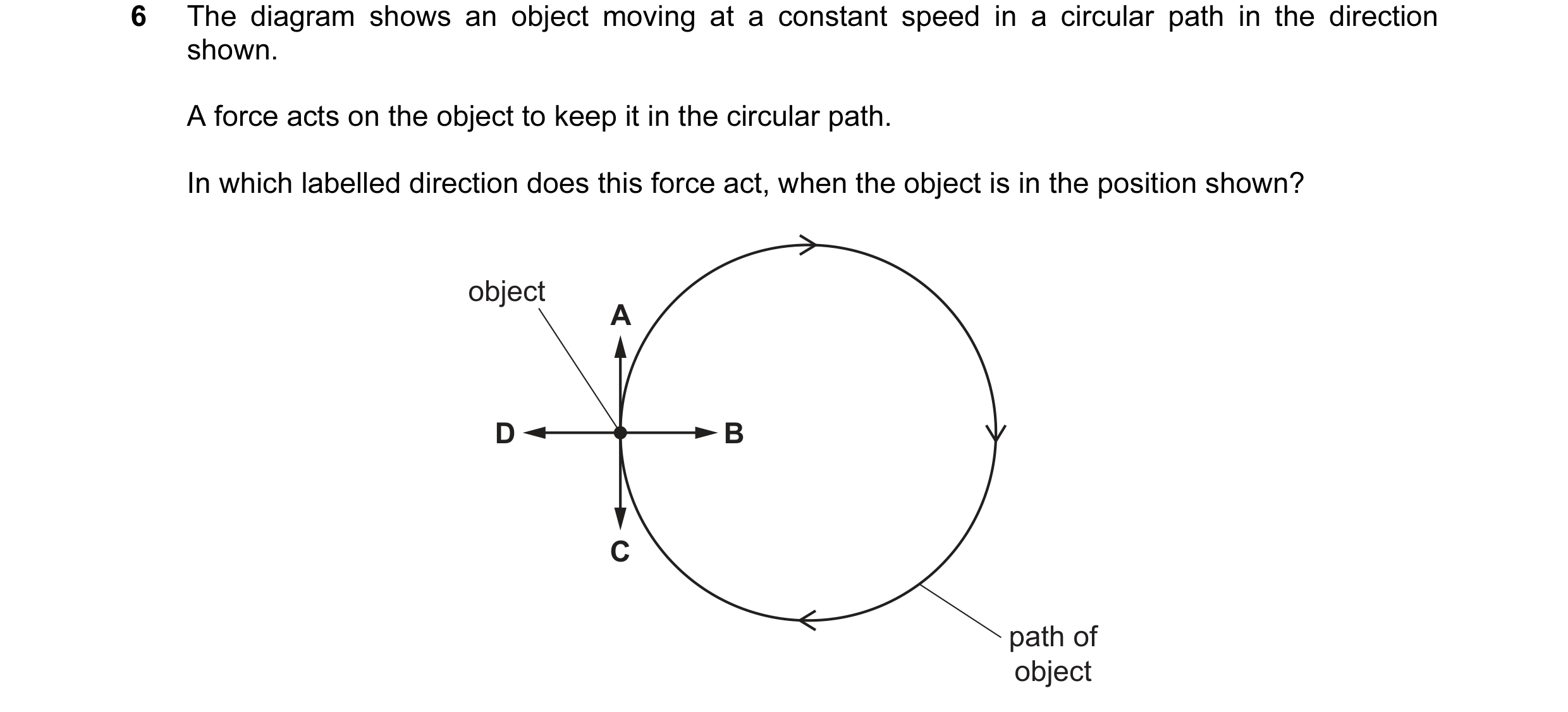
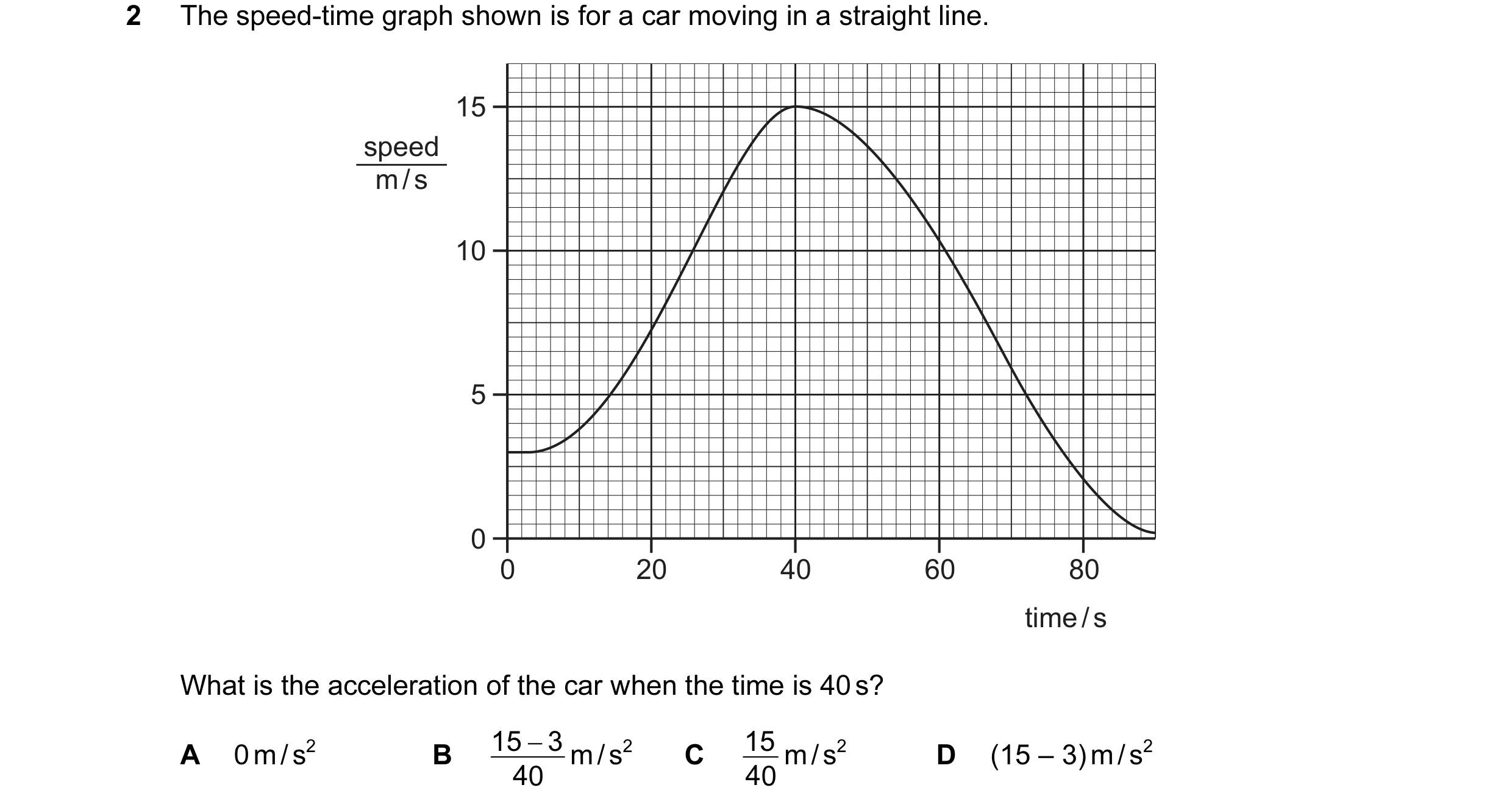 1 / 56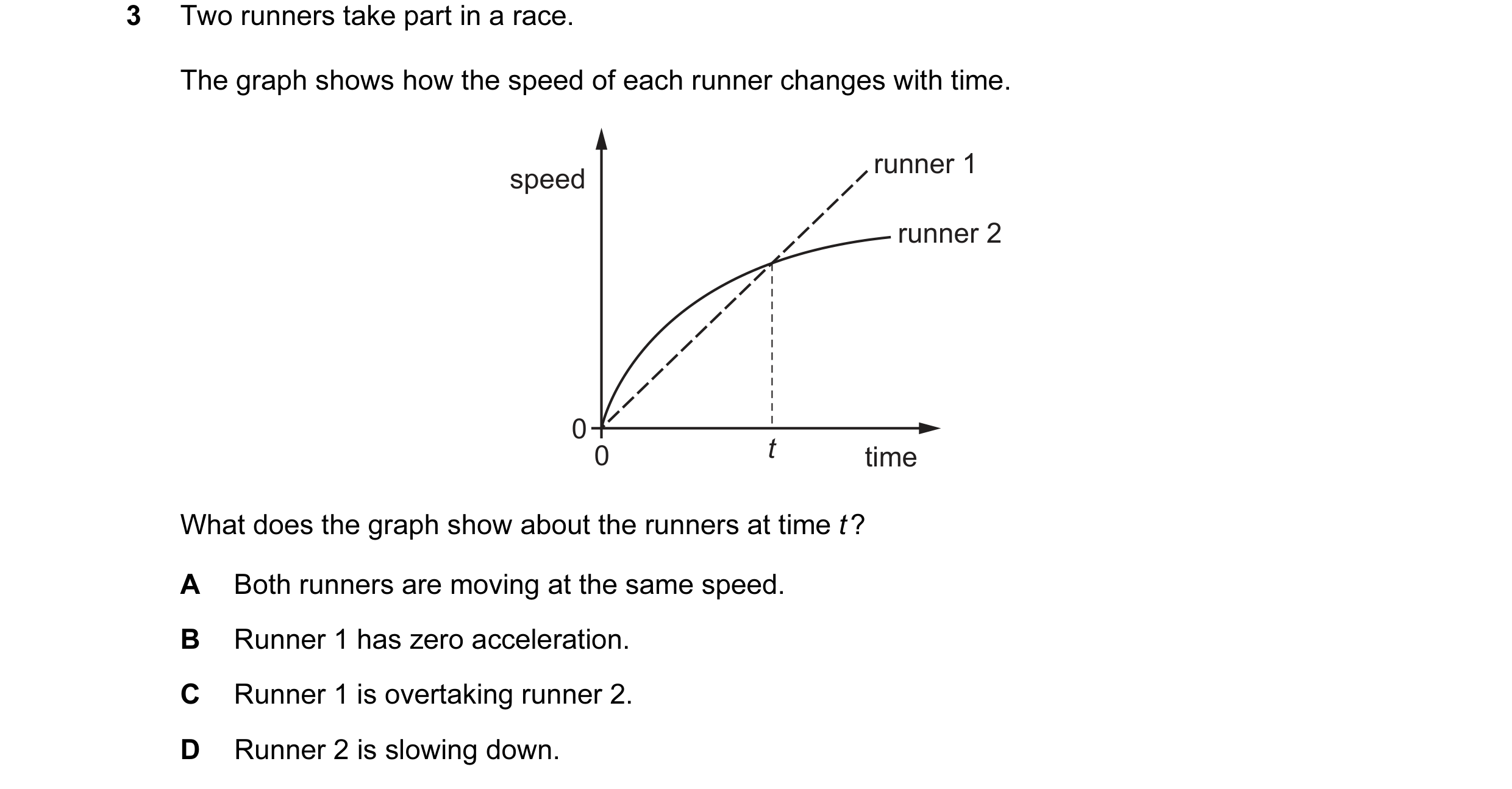
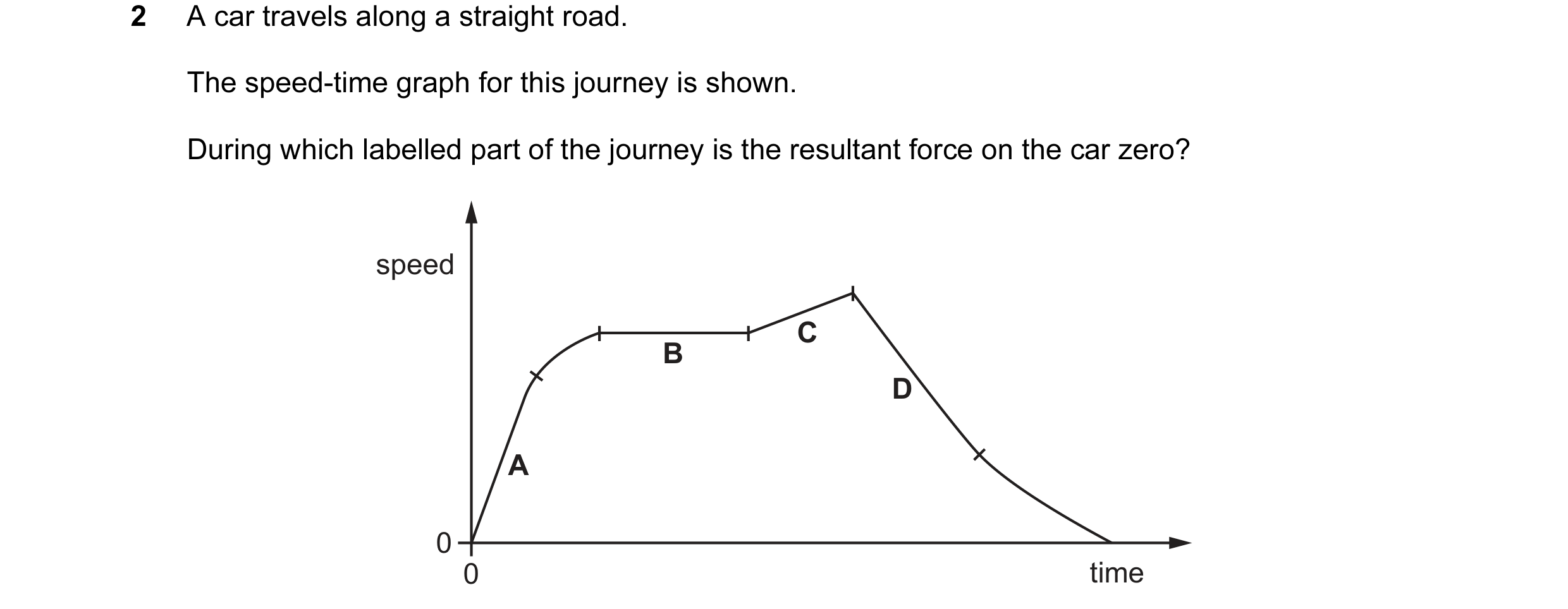
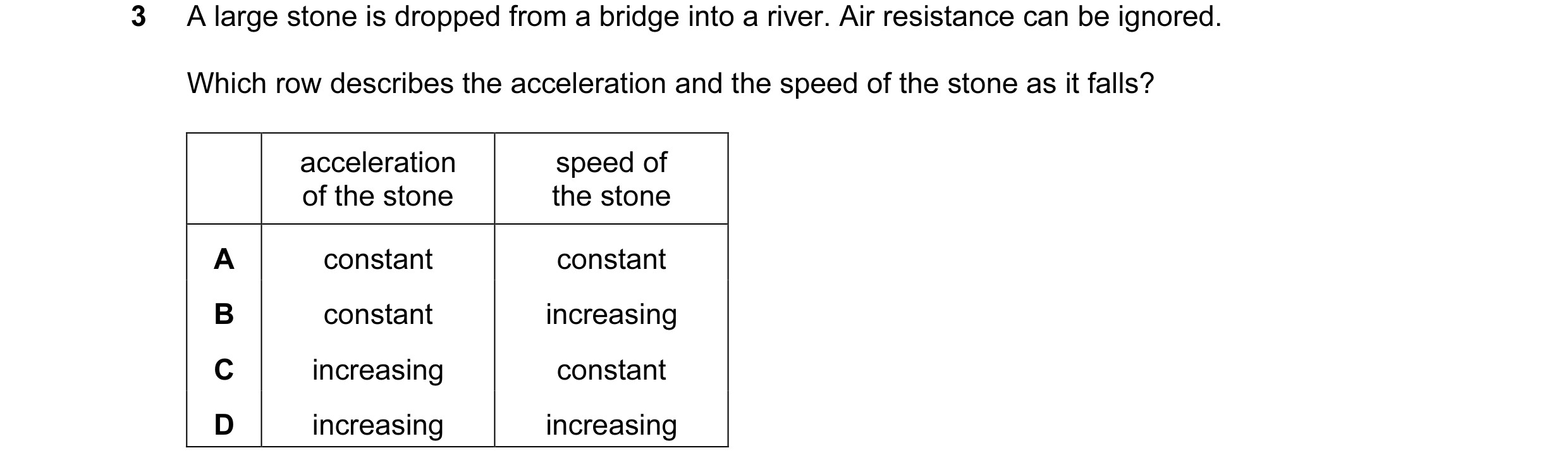 2 / 56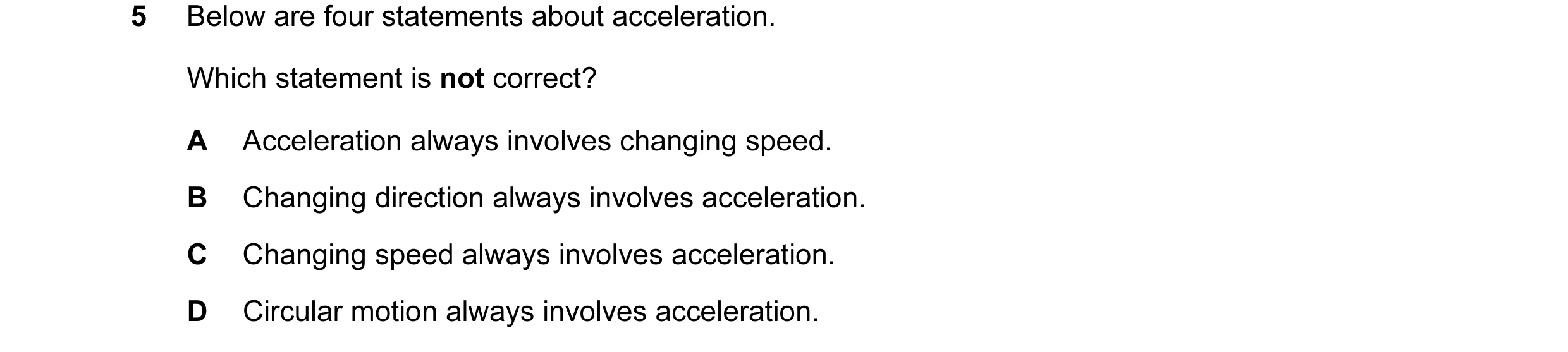
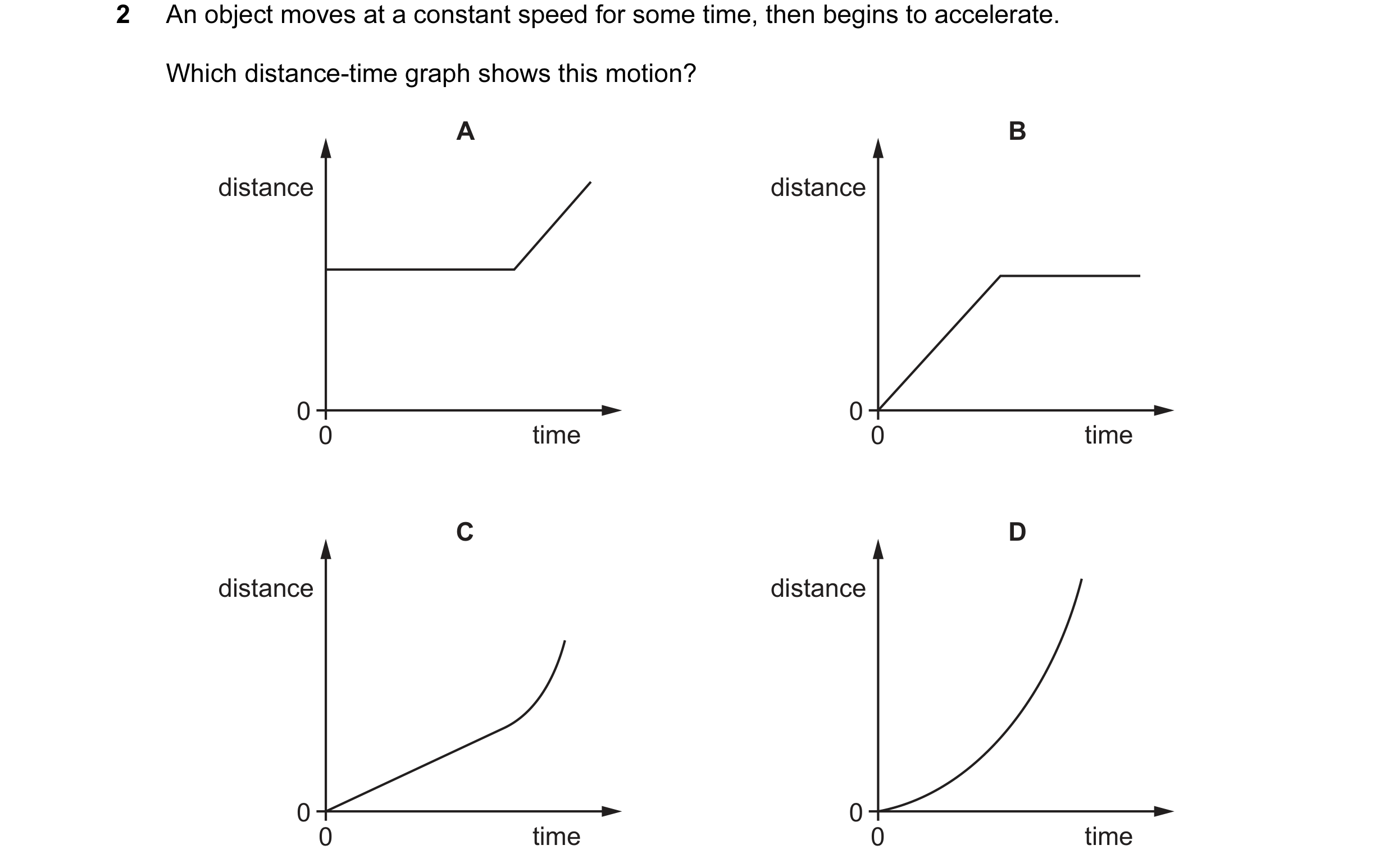
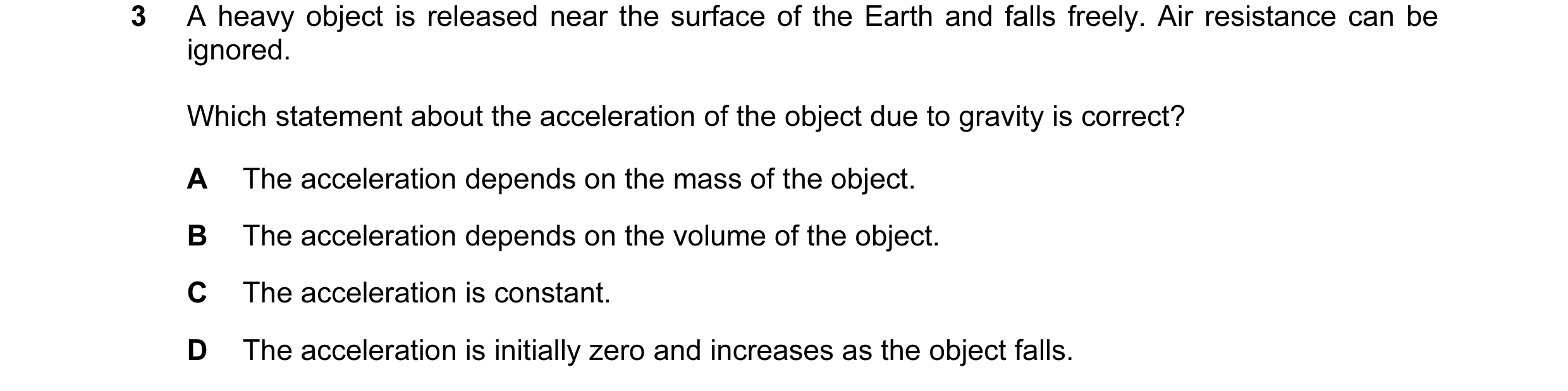 3 / 56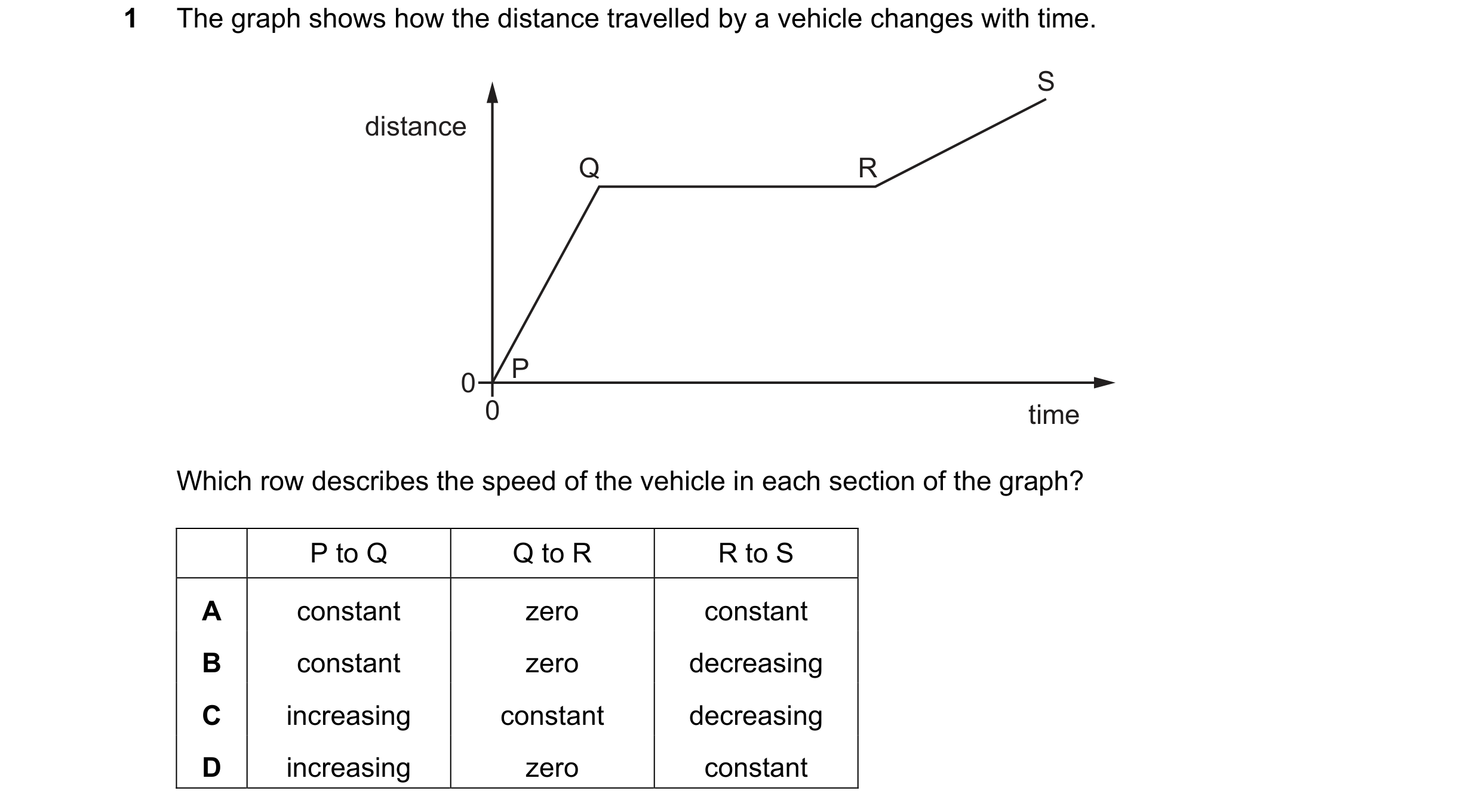
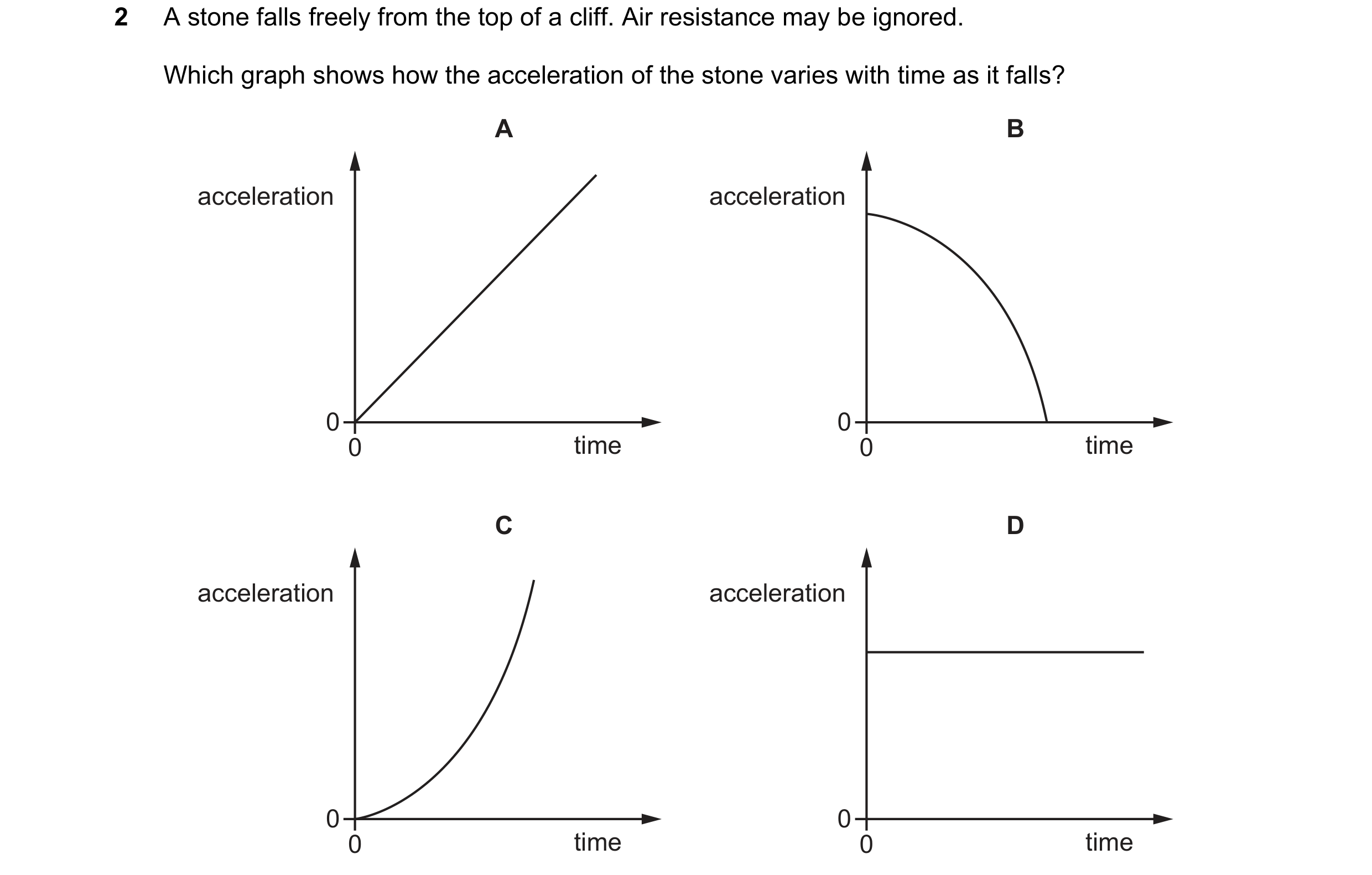 4 / 56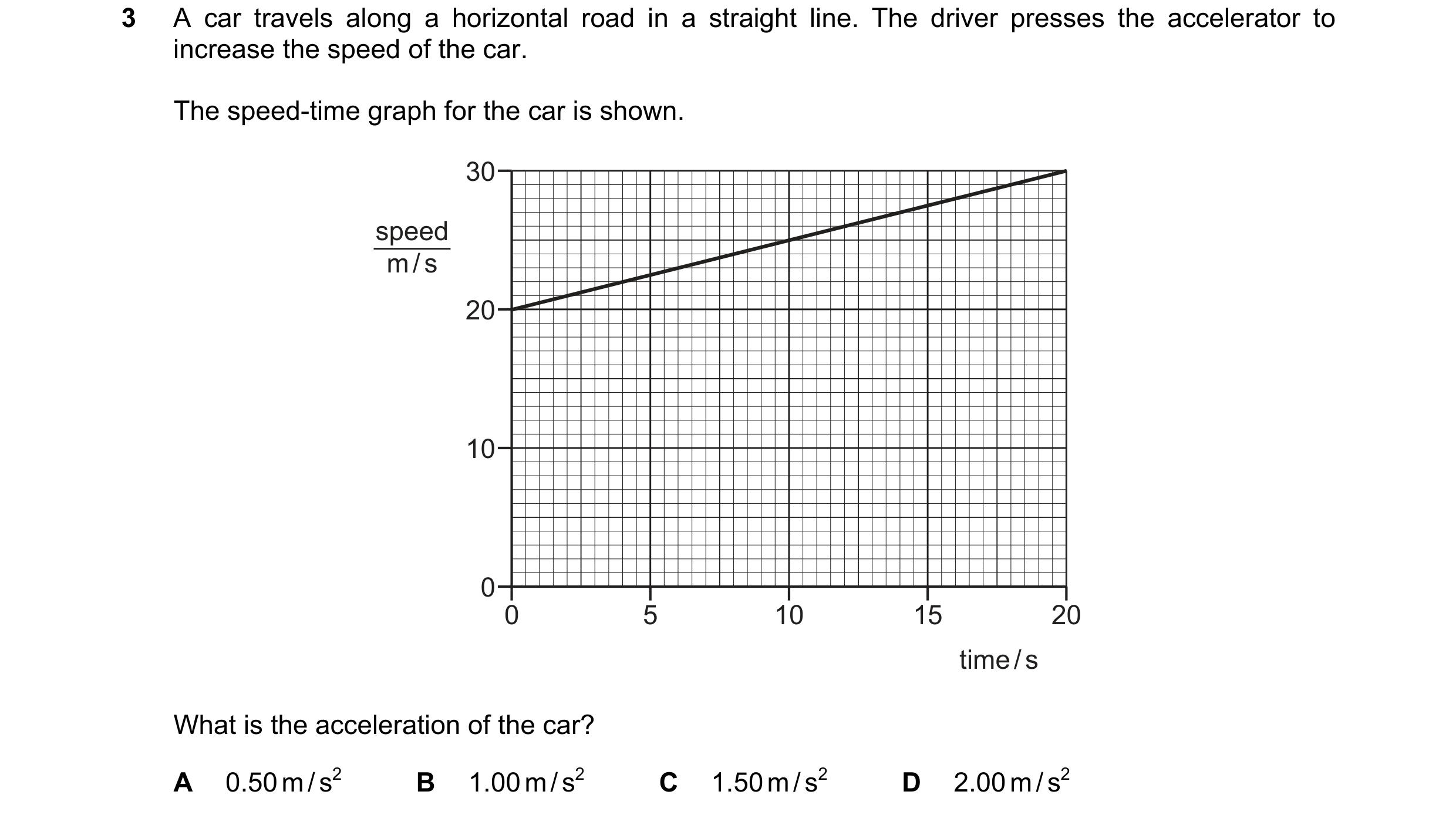
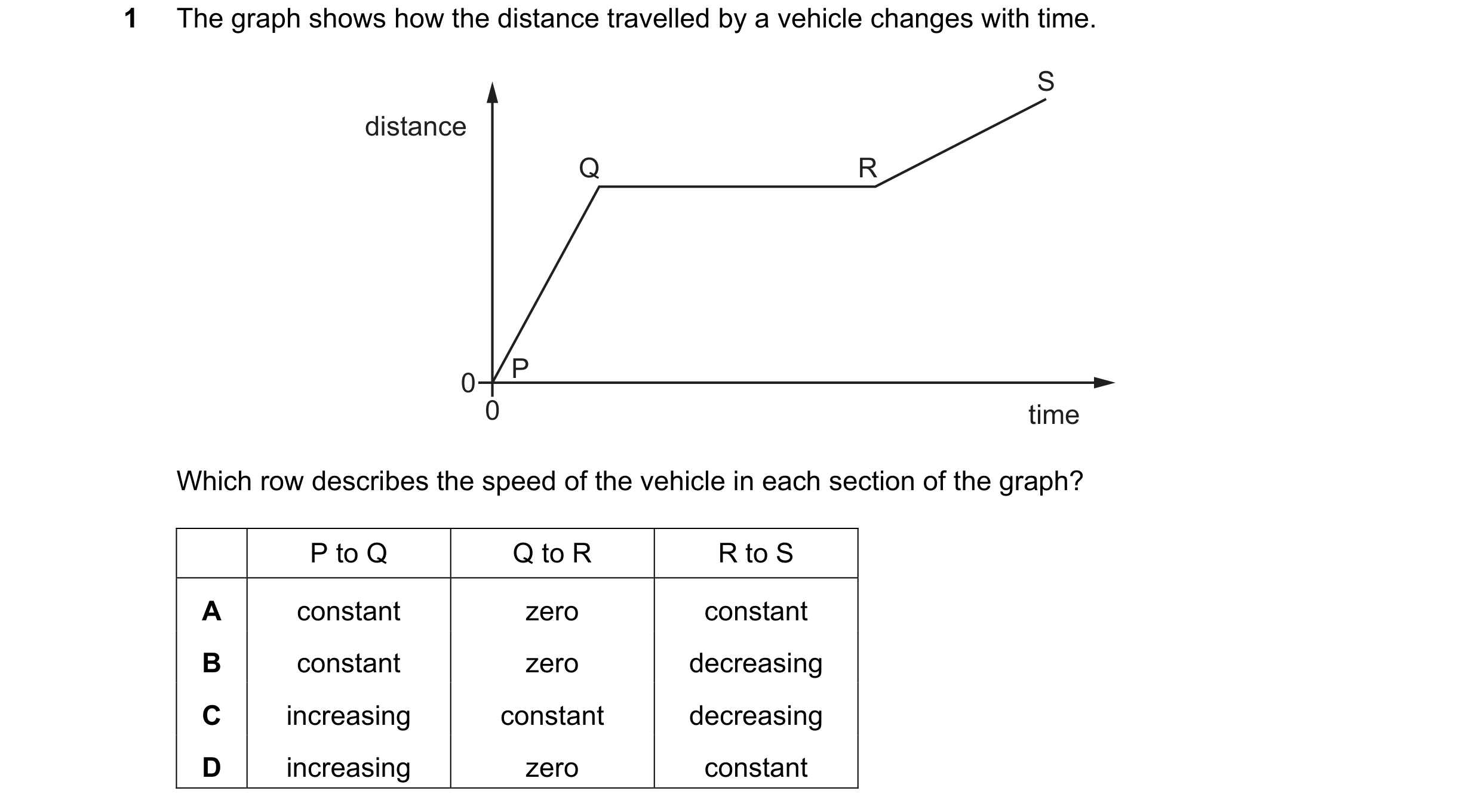 5 / 56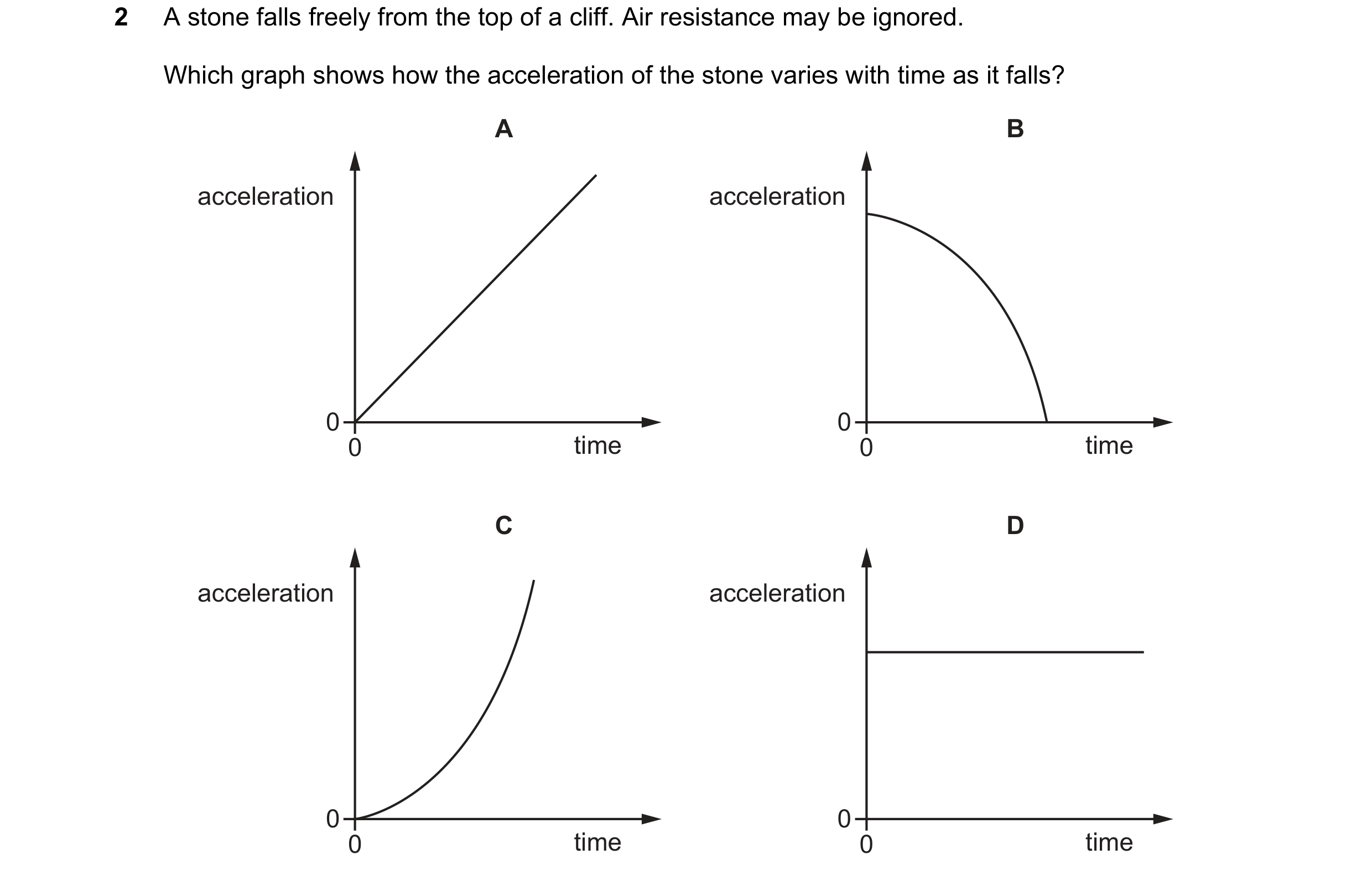
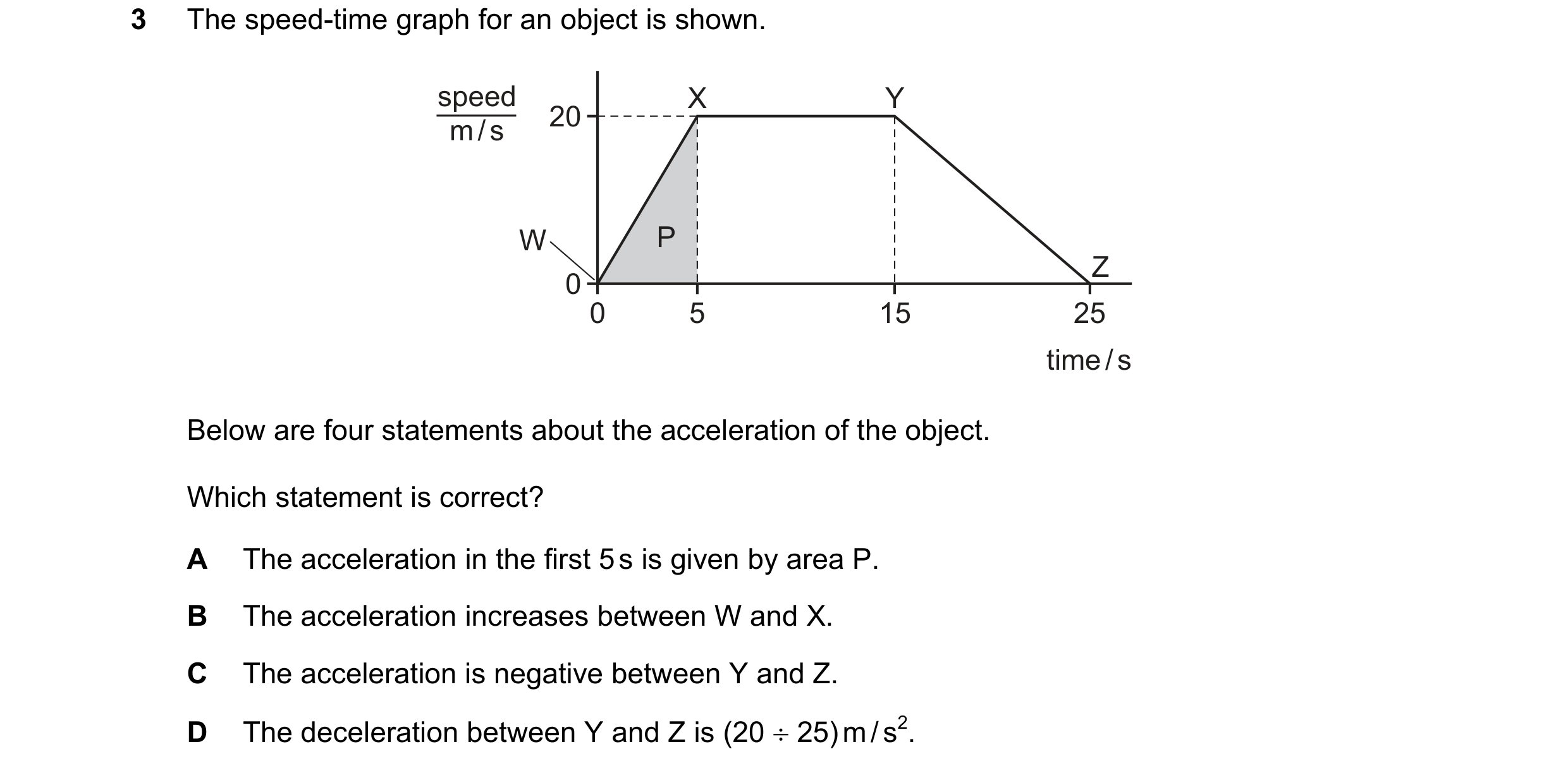 6 / 56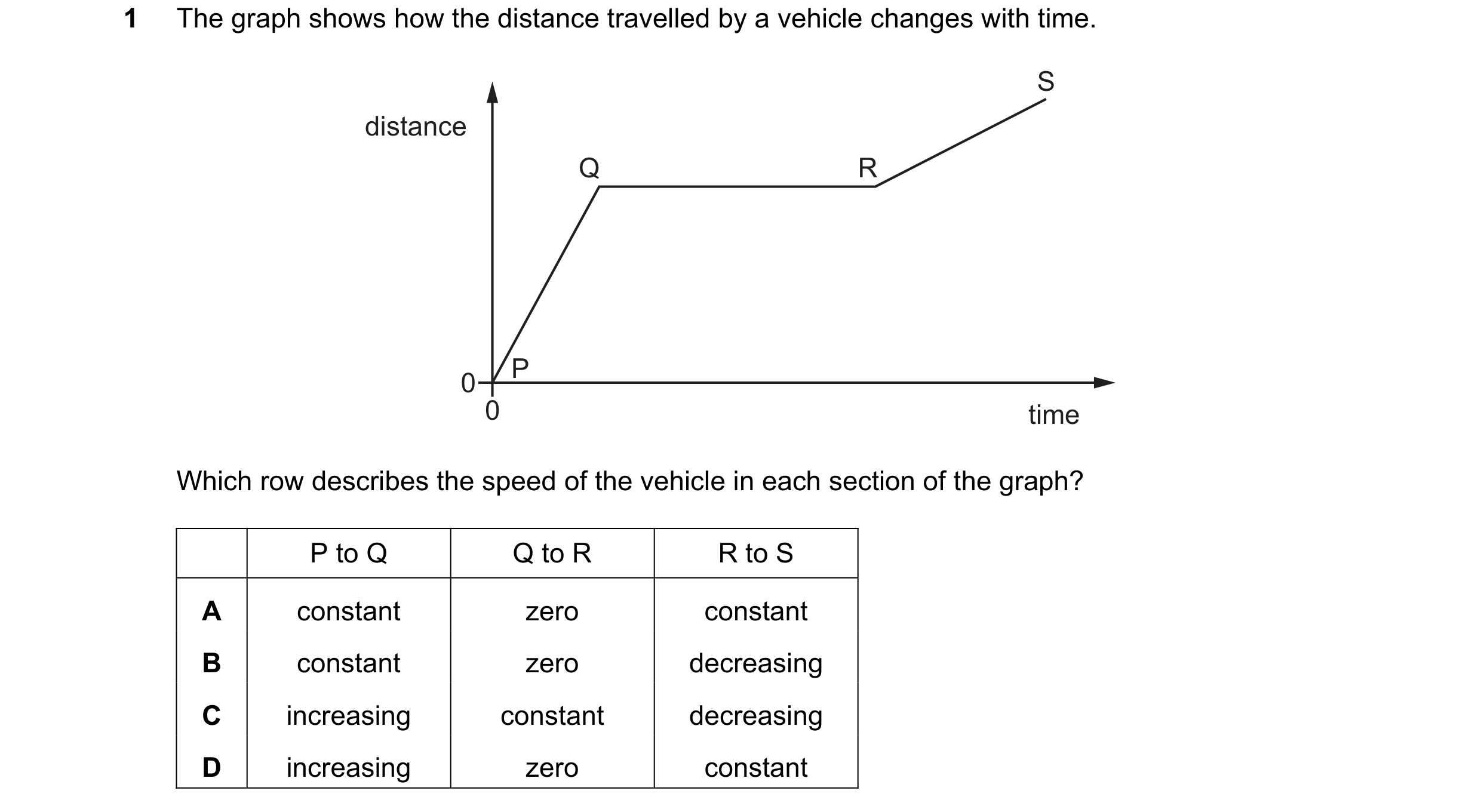
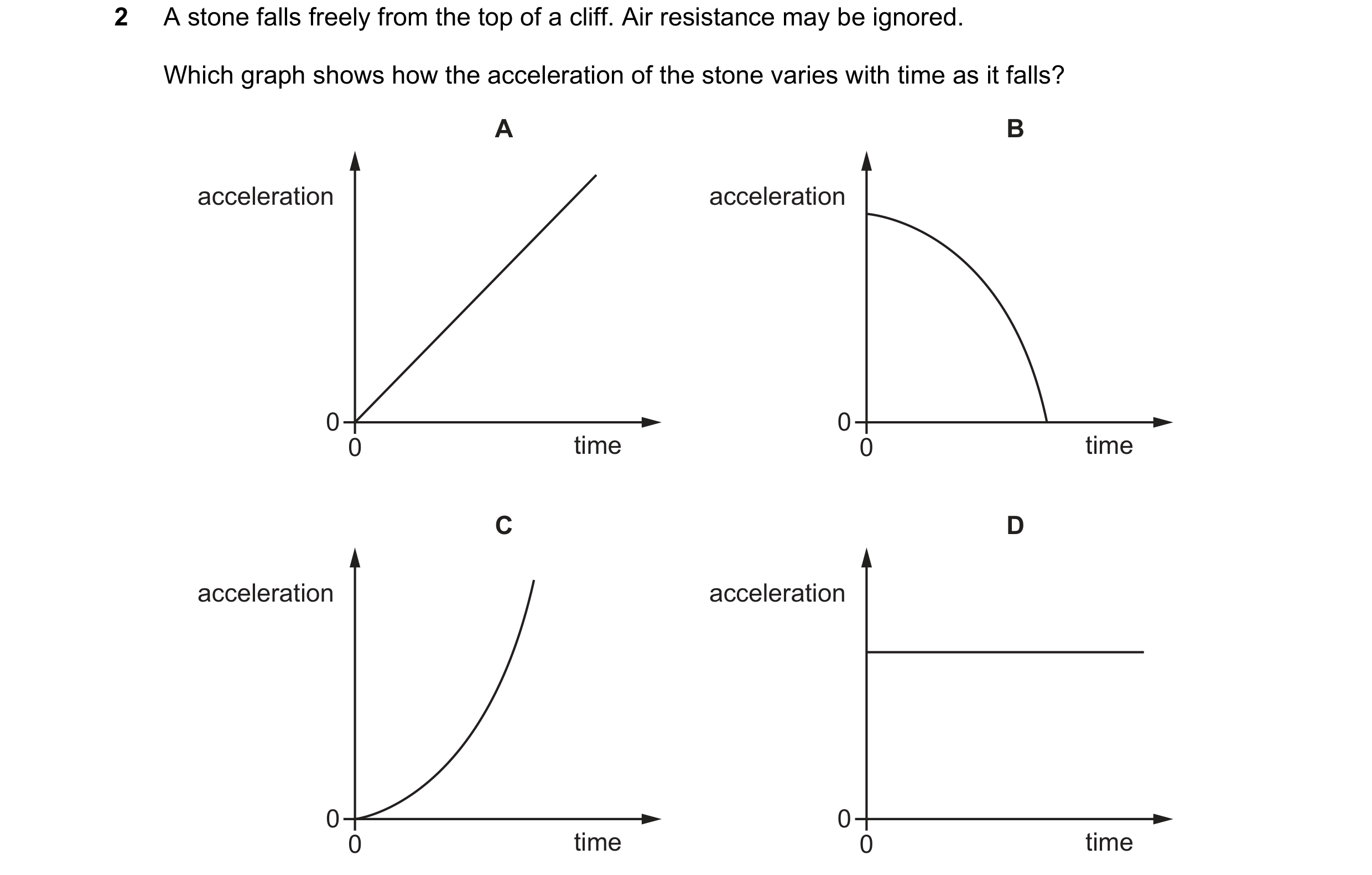 7 / 56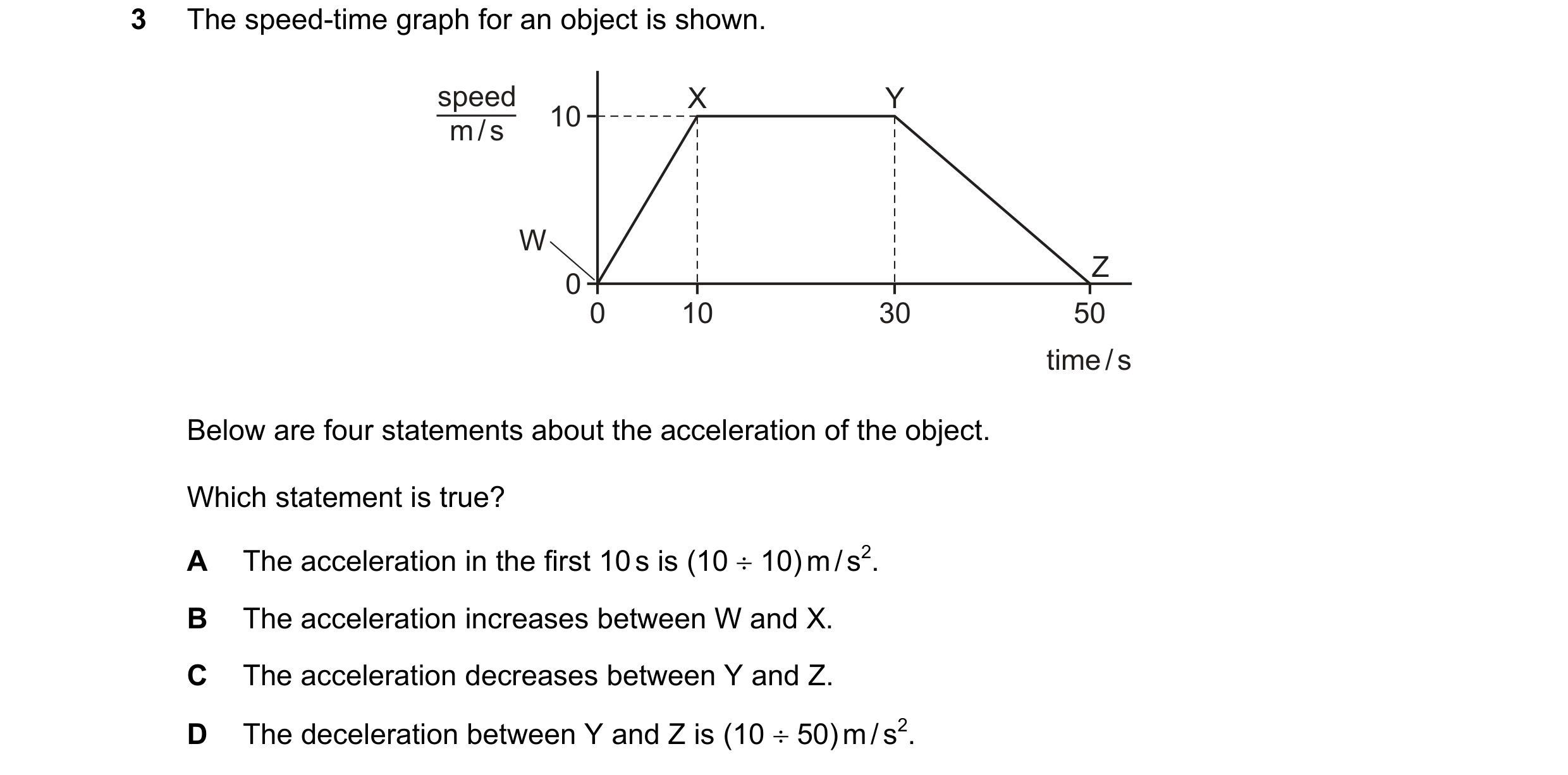
 8 / 56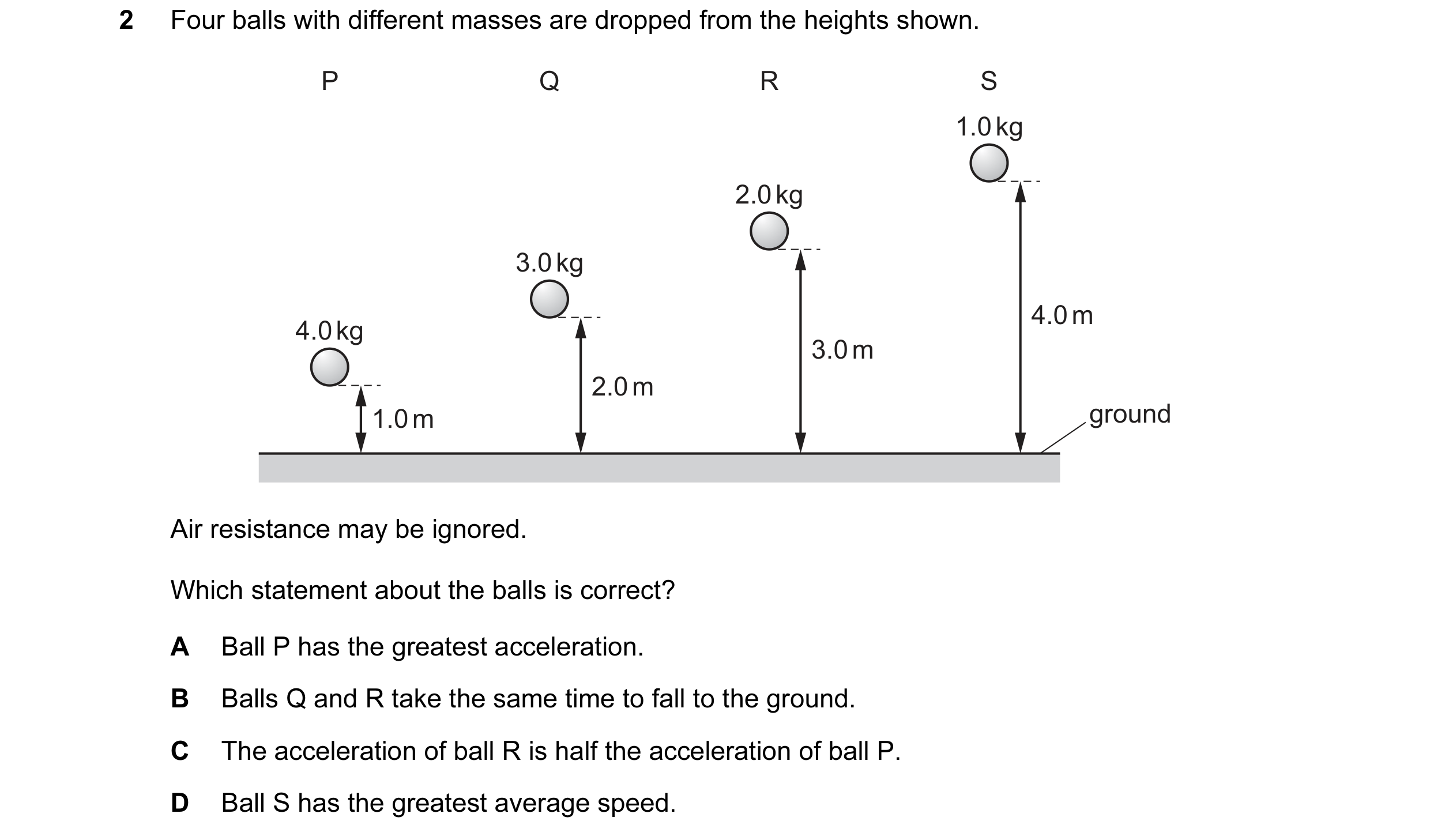
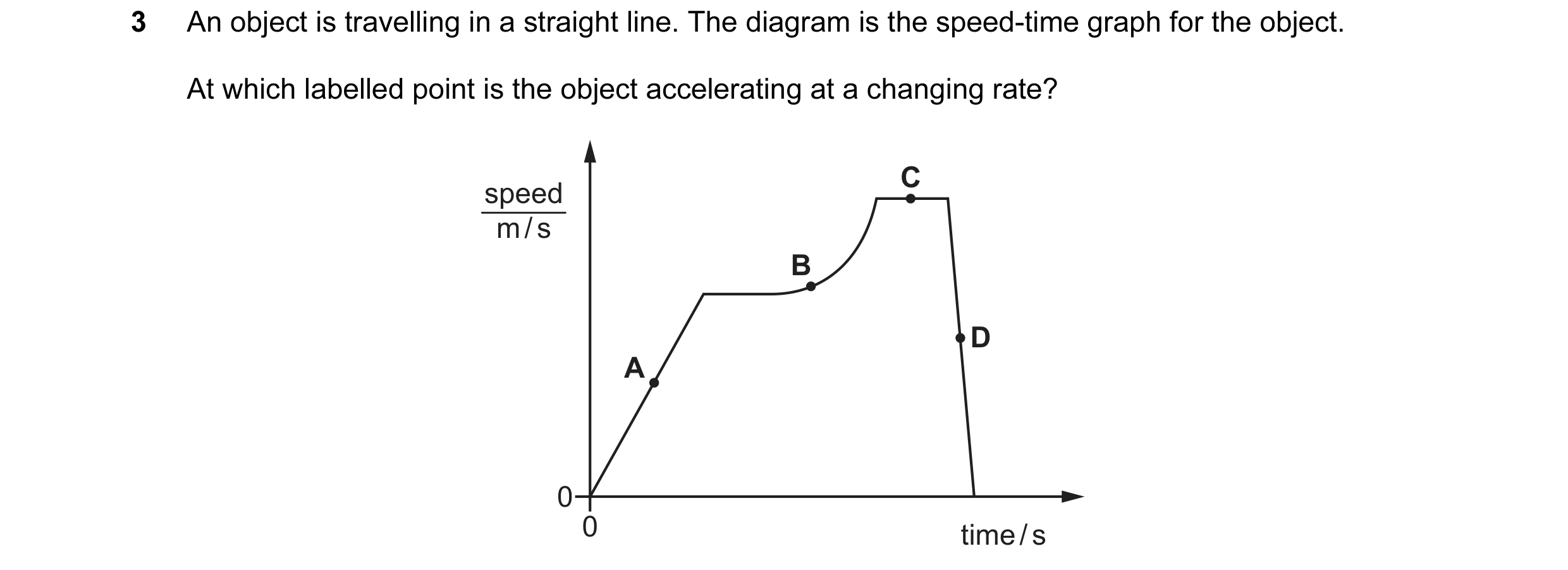 9 / 56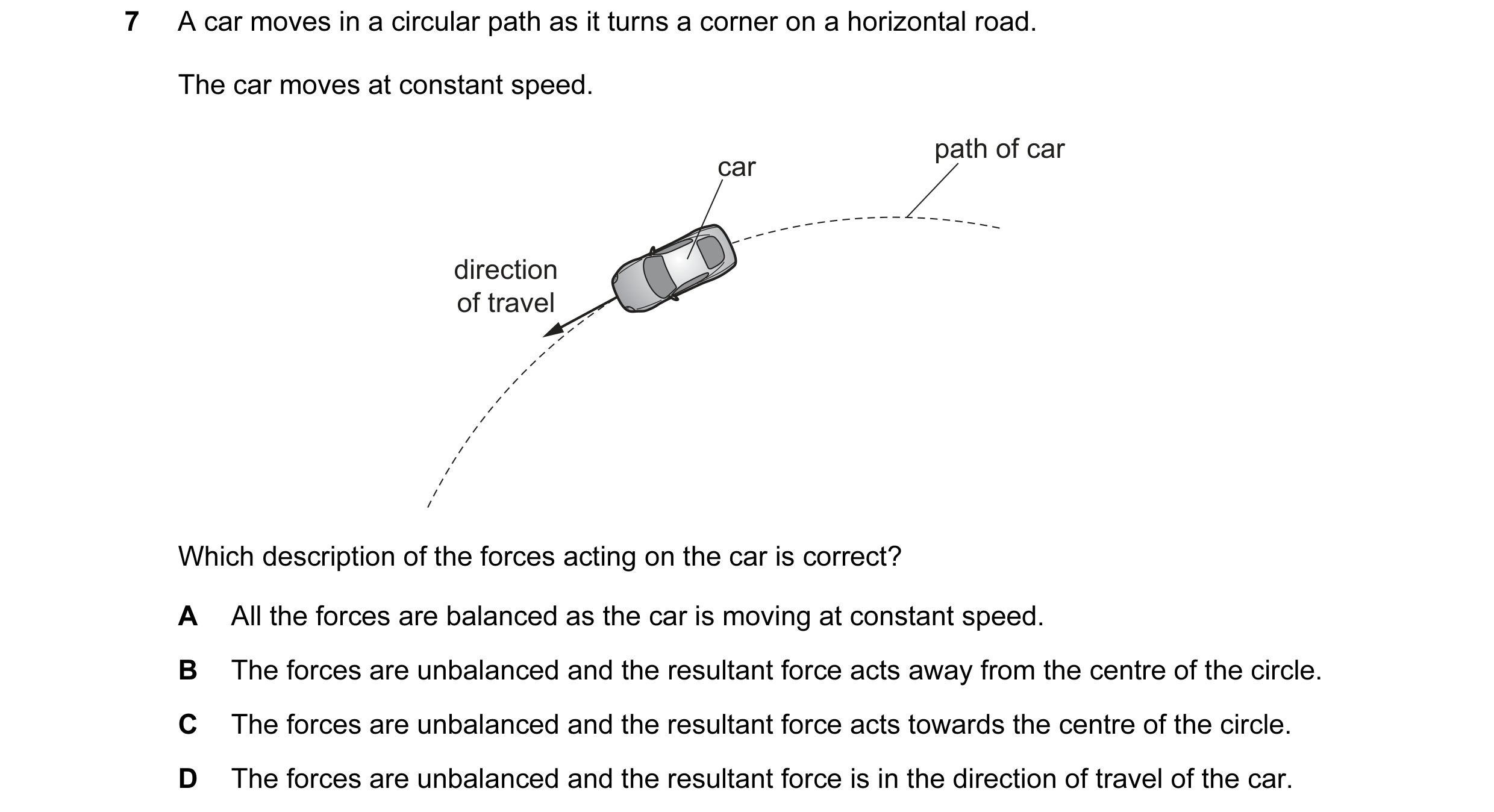
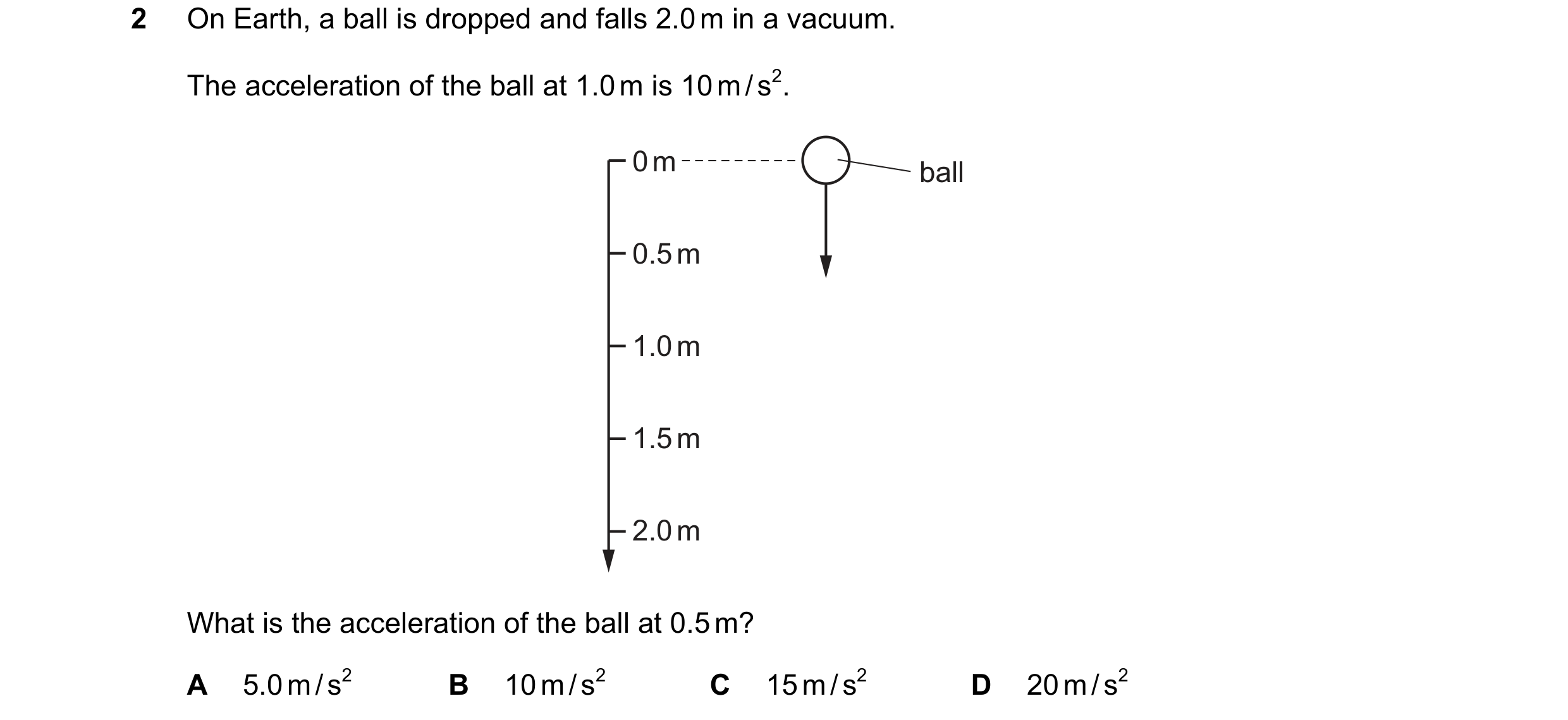
 10 / 56
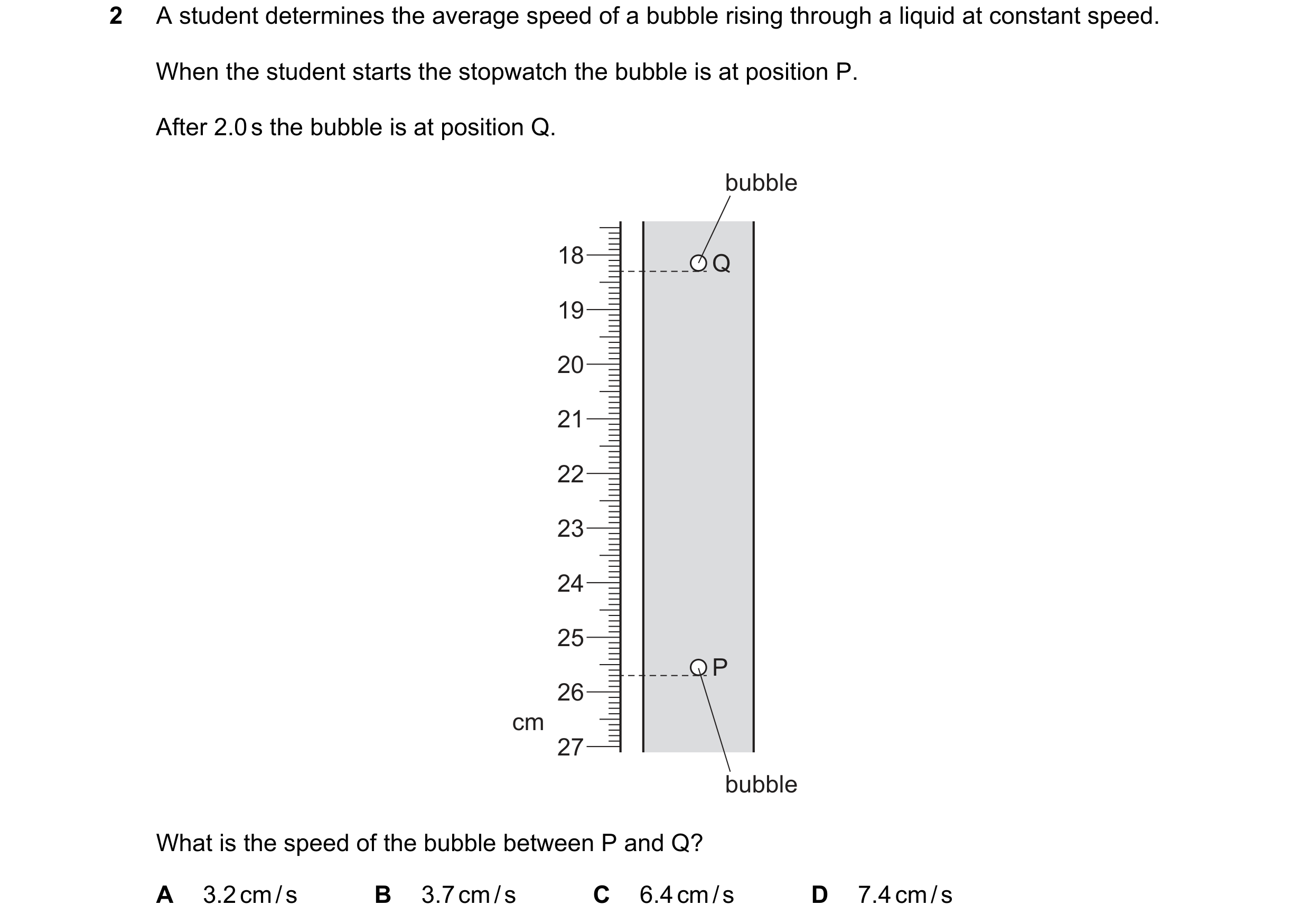 11 / 56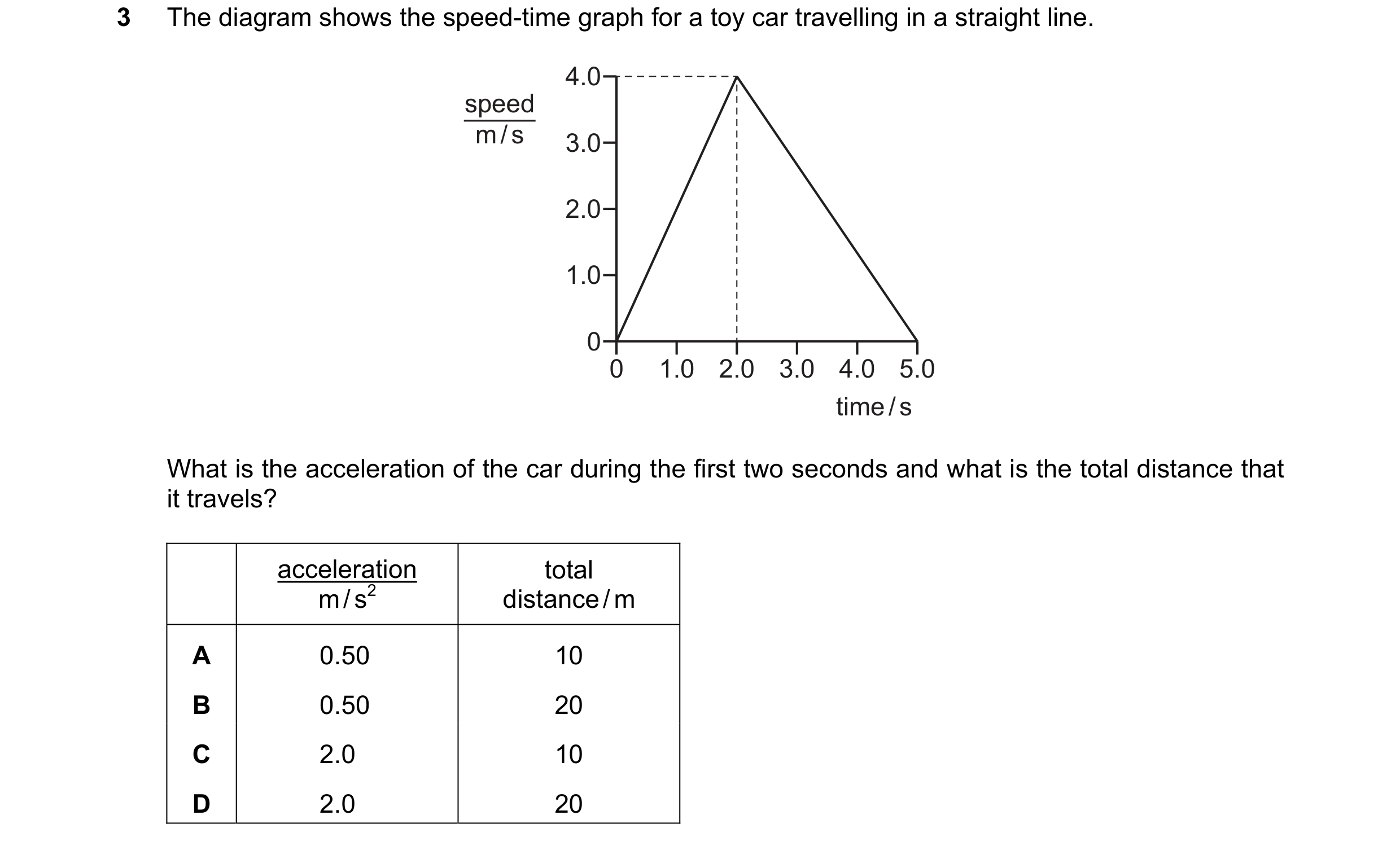
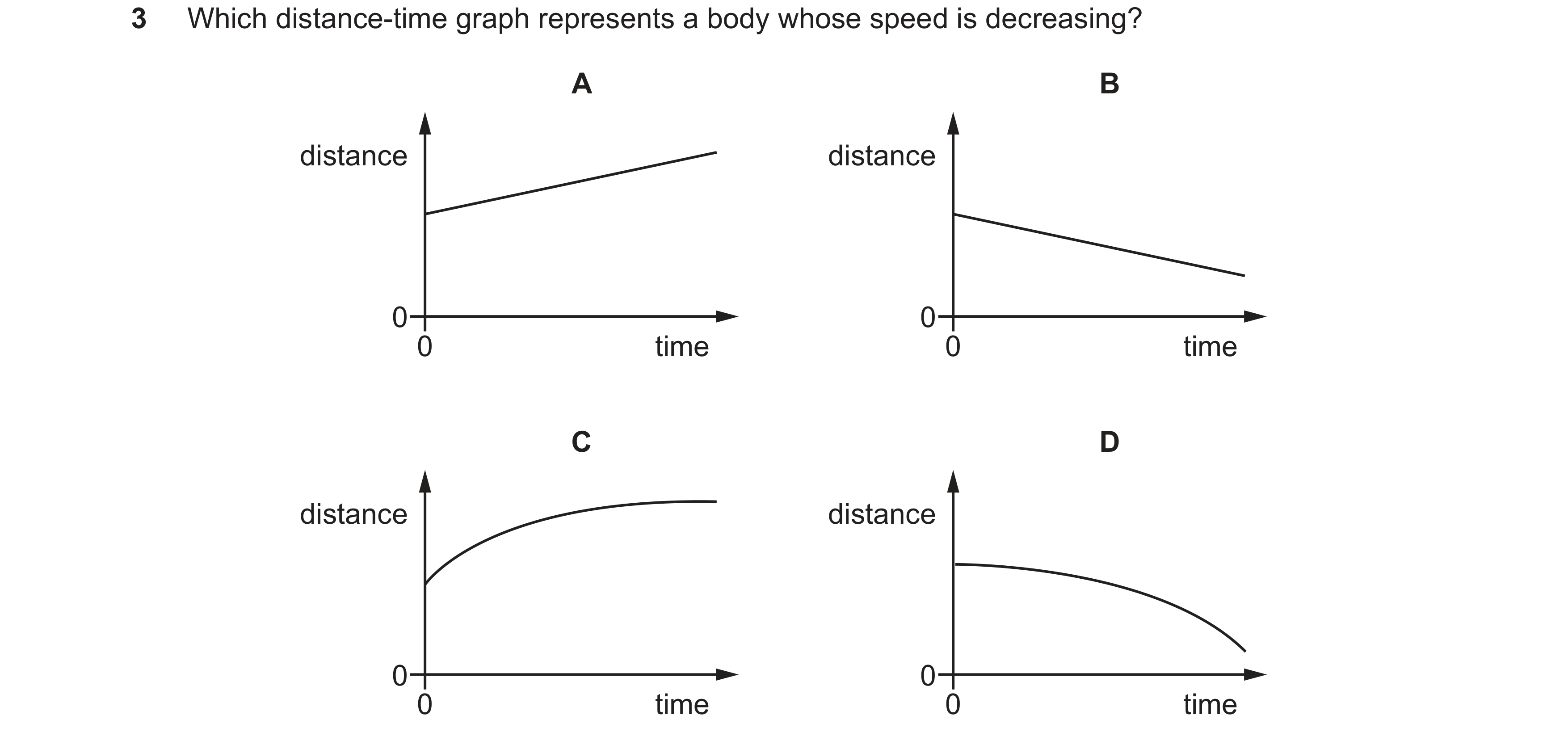
 12 / 56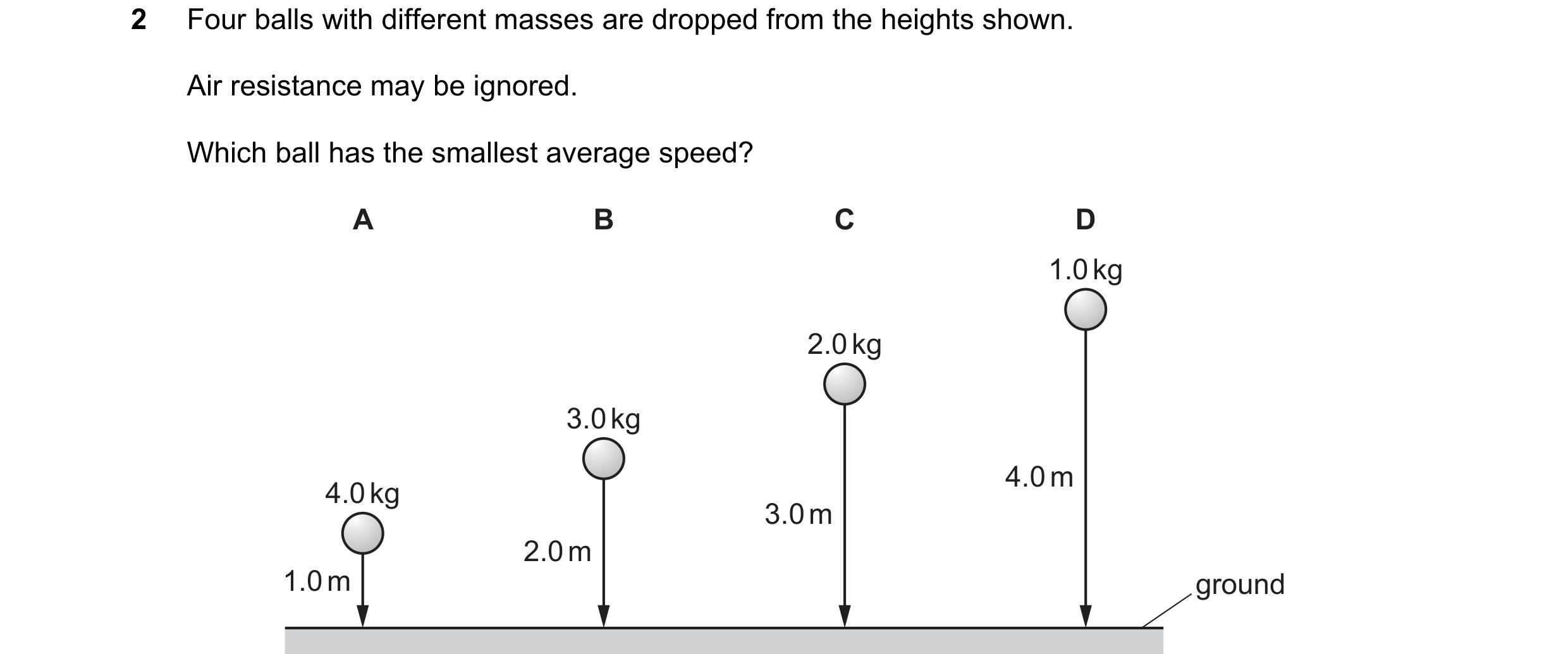
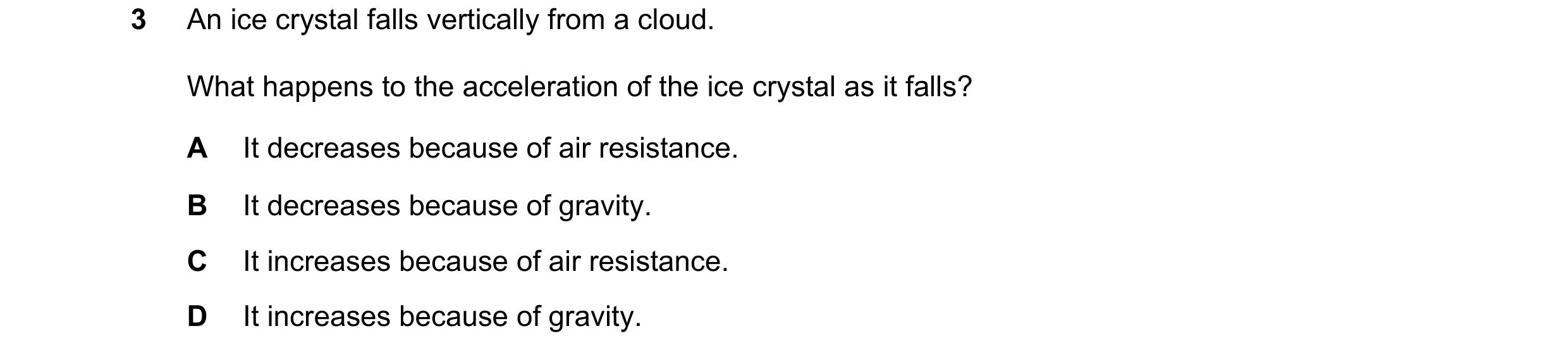
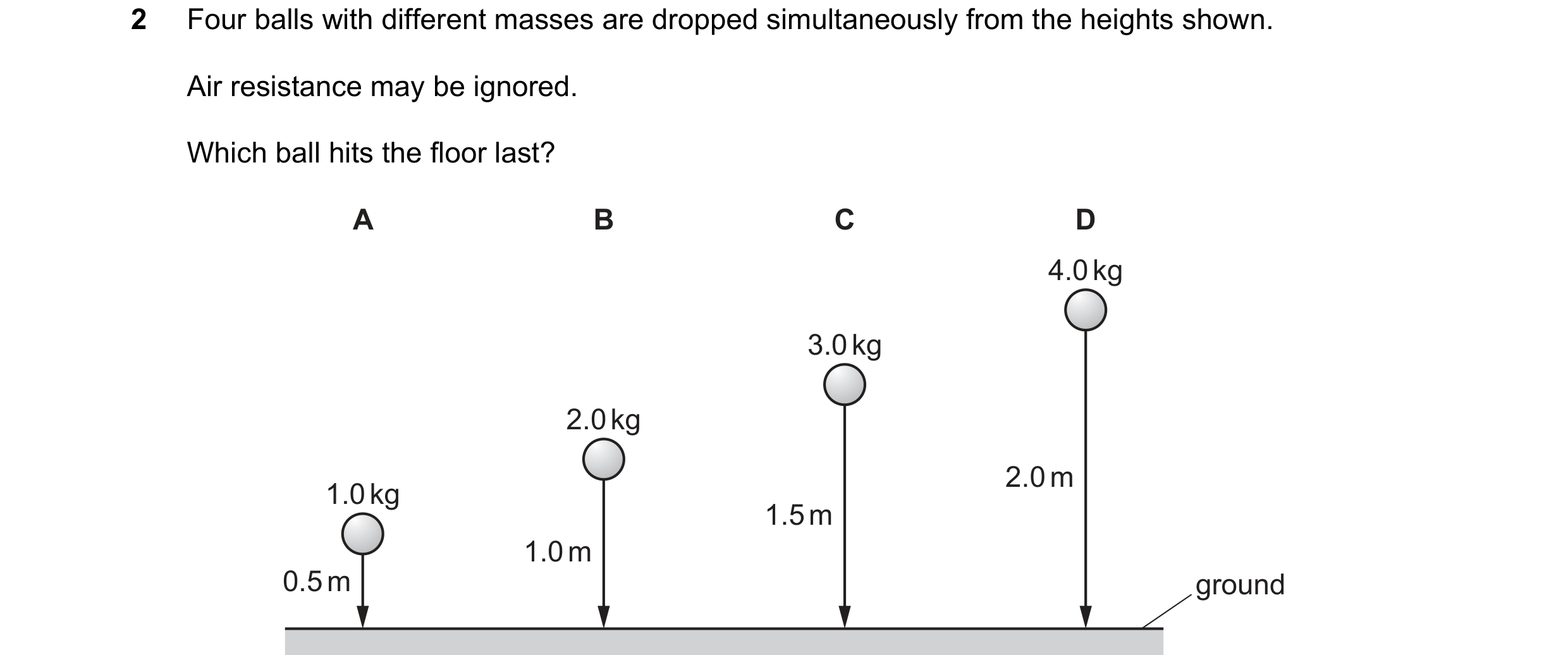 13 / 56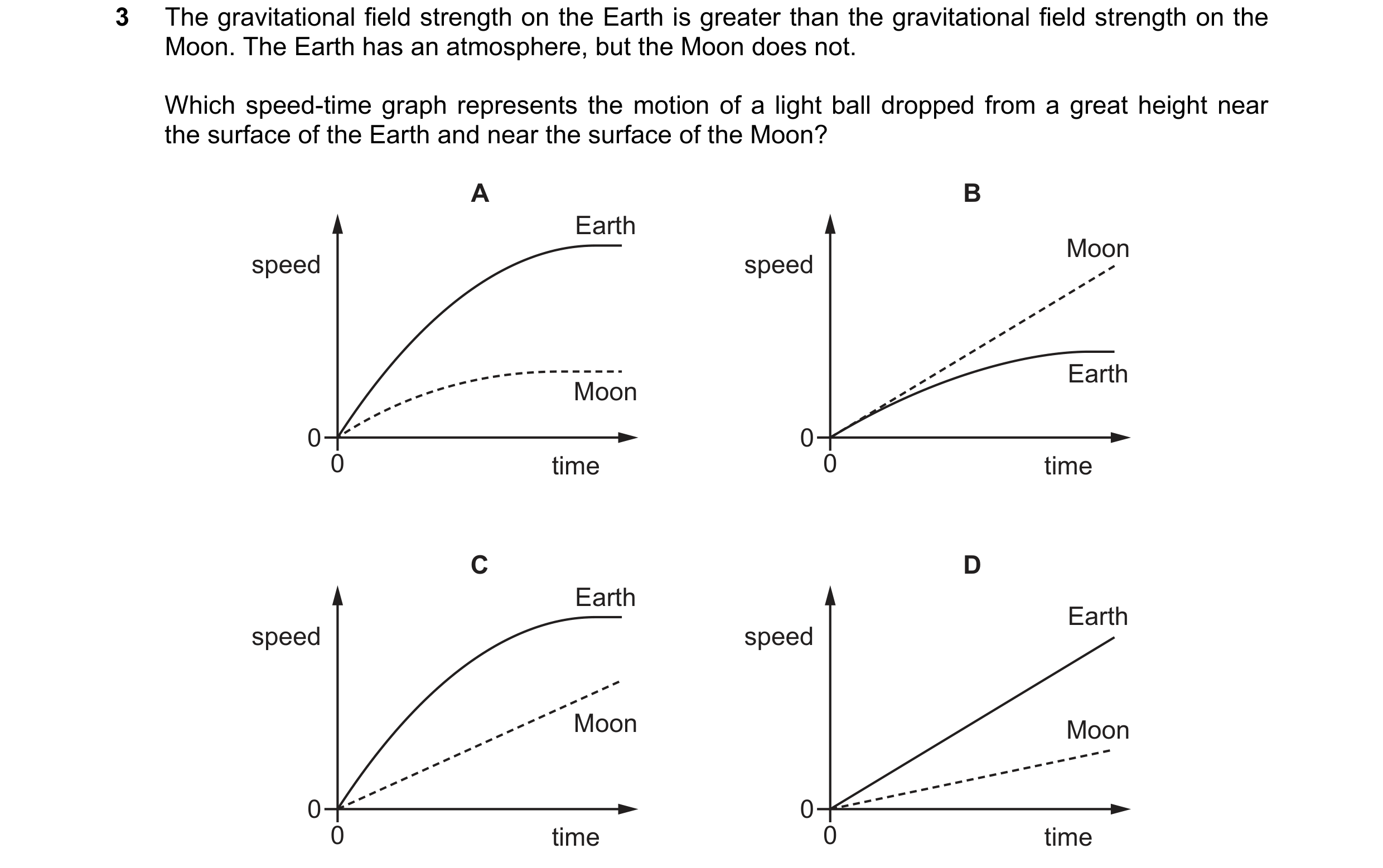

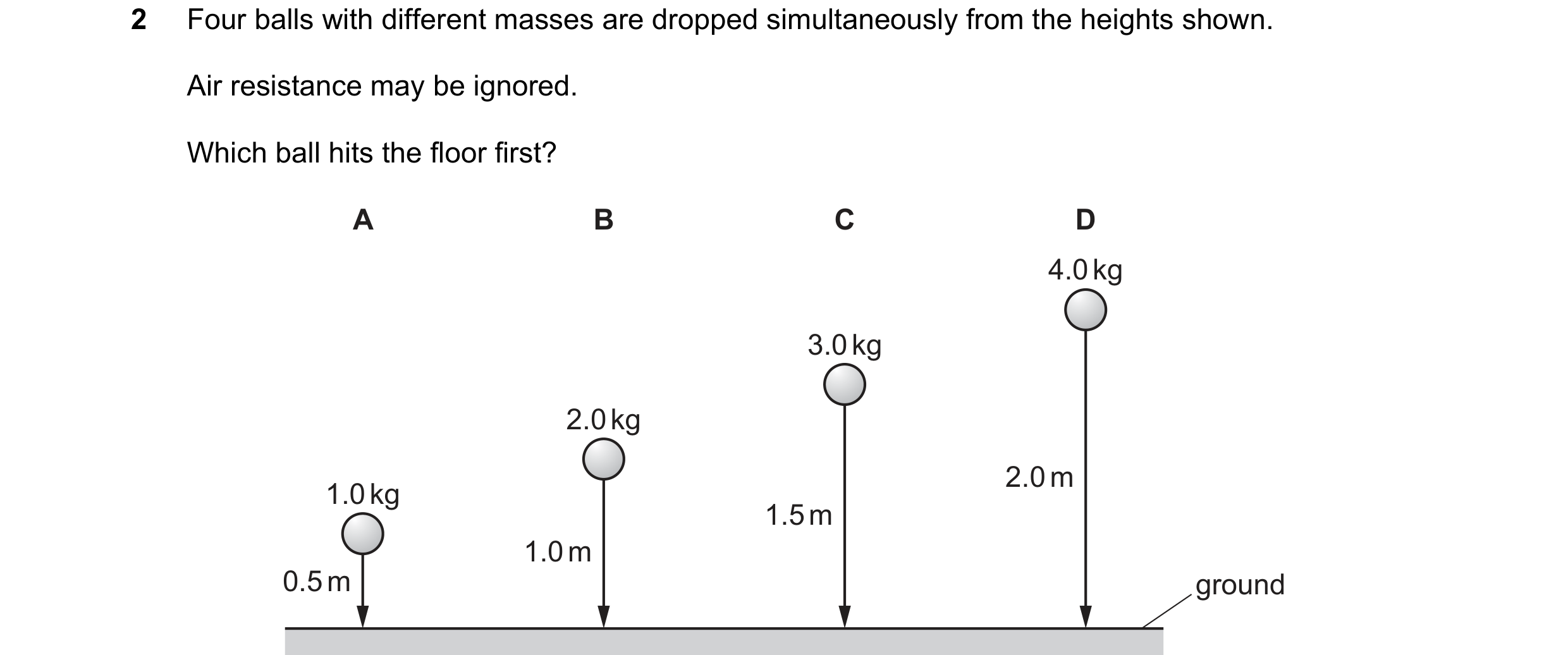
 14 / 56

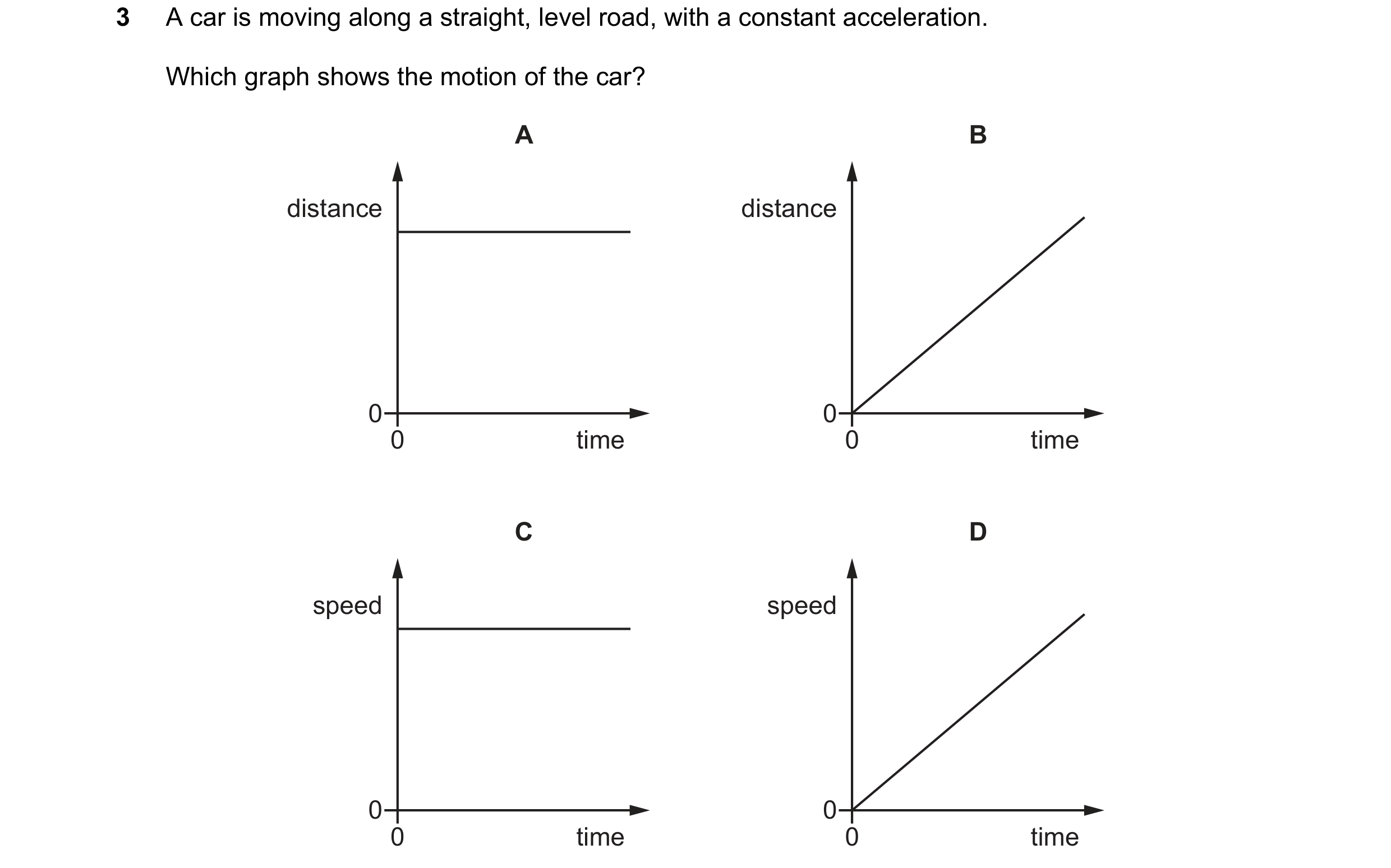
 15 / 56

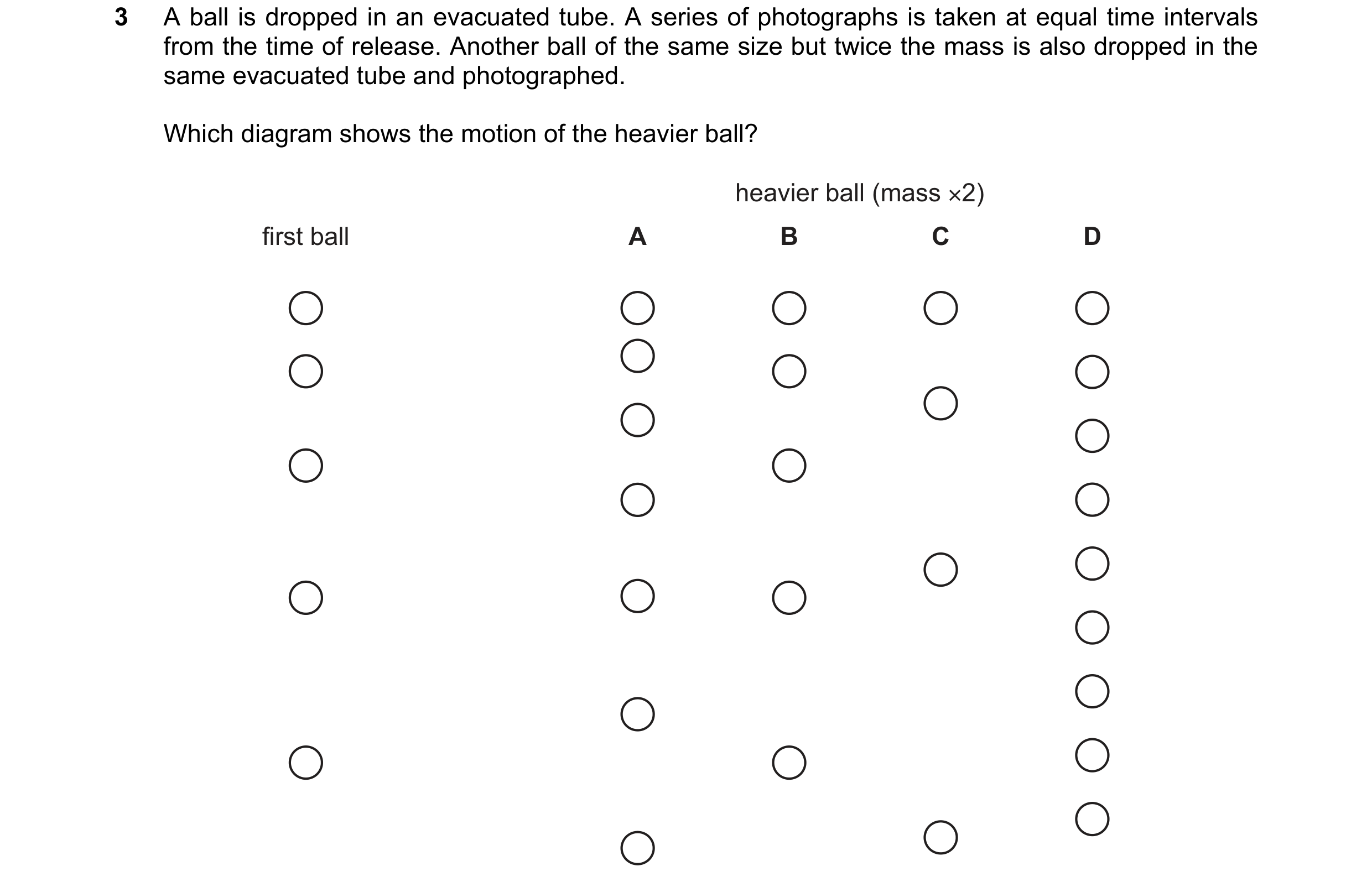
 16 / 56
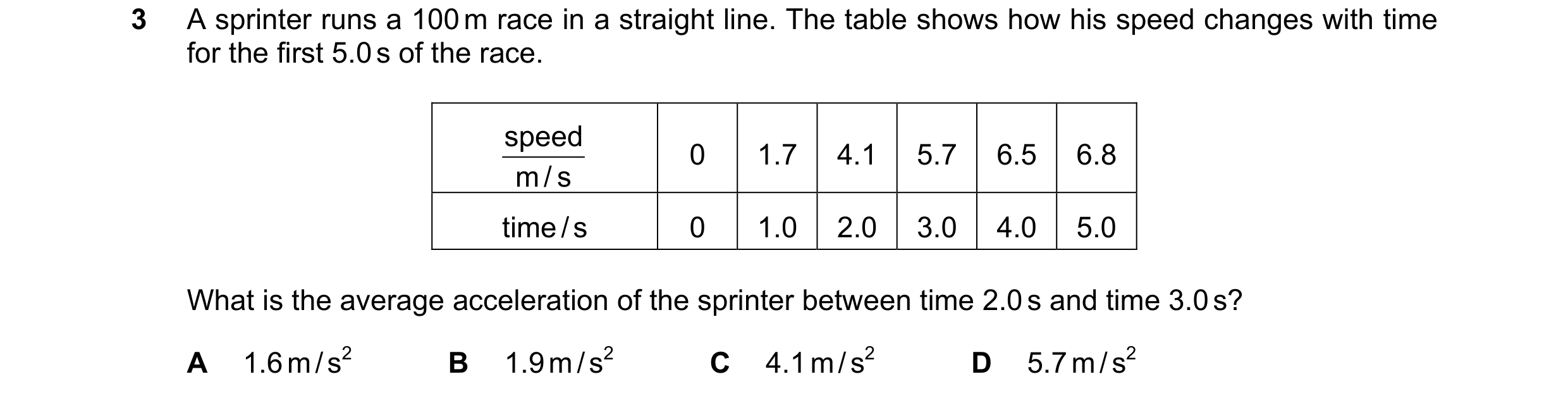
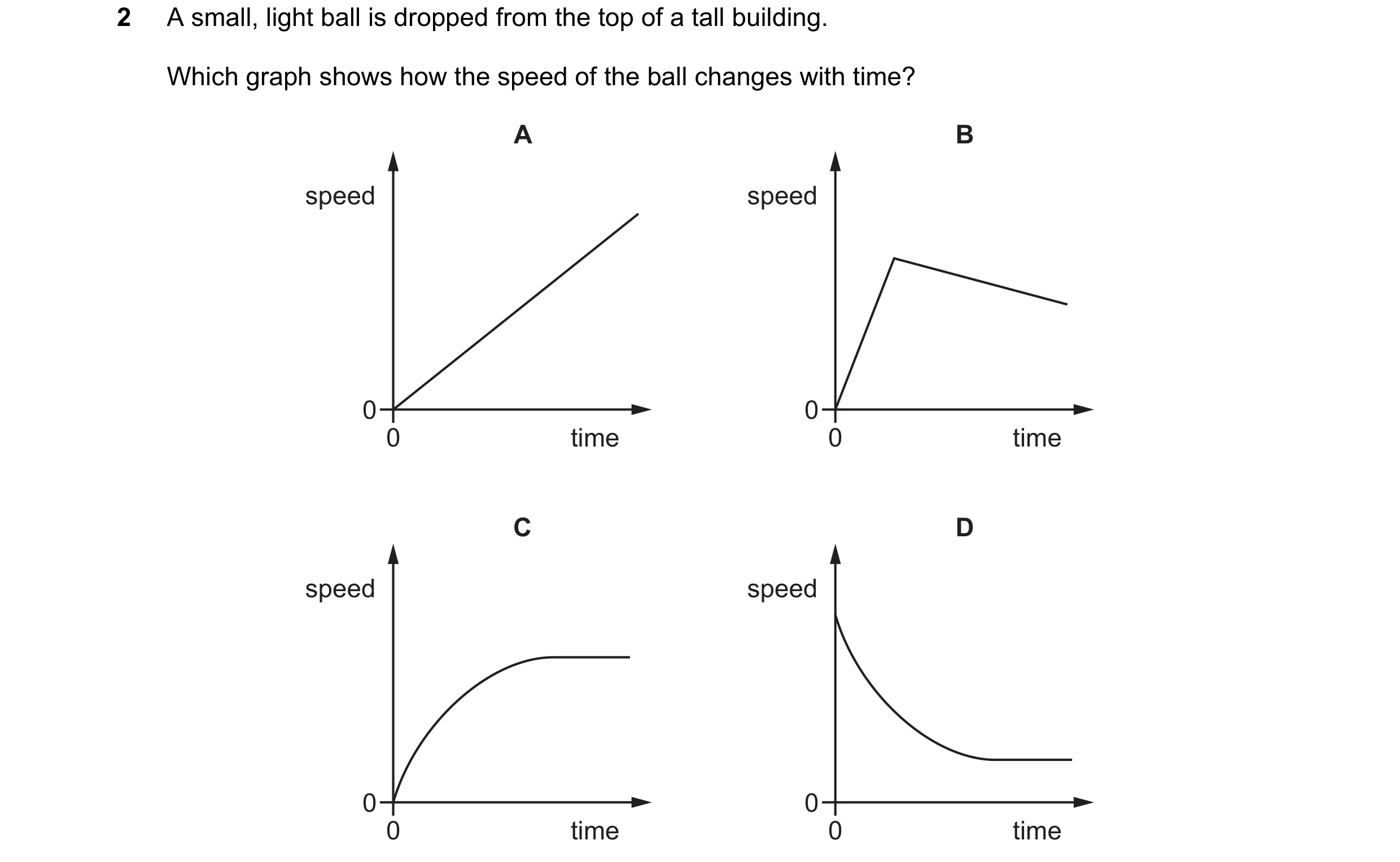
 17 / 56
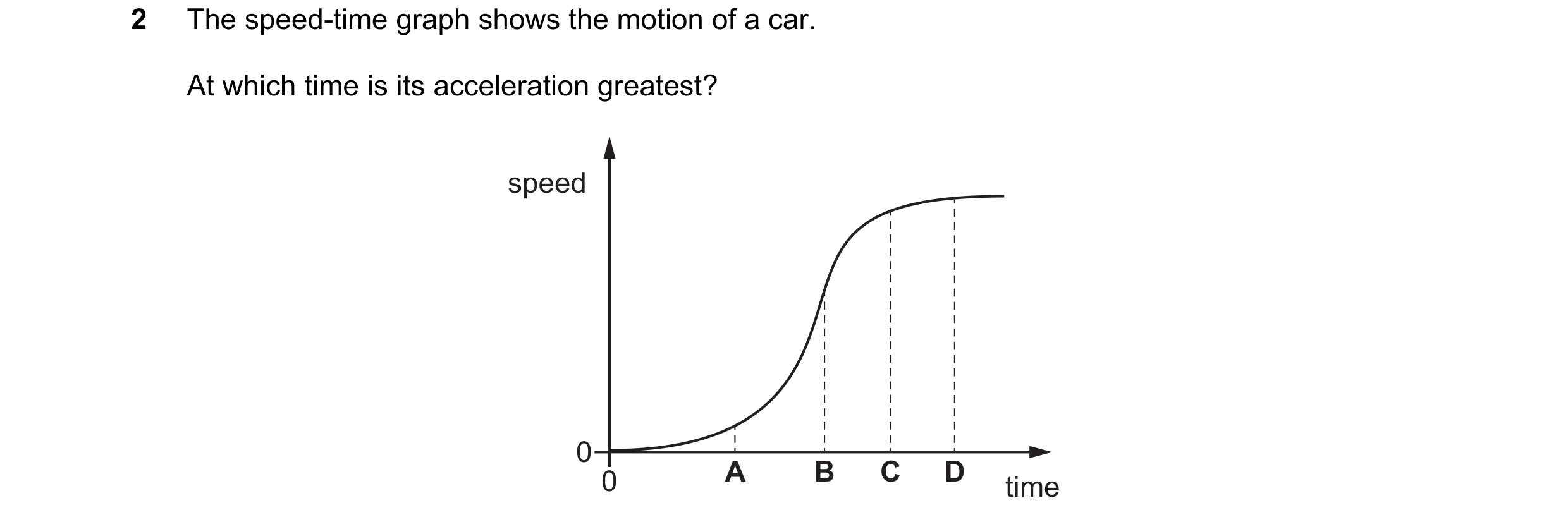
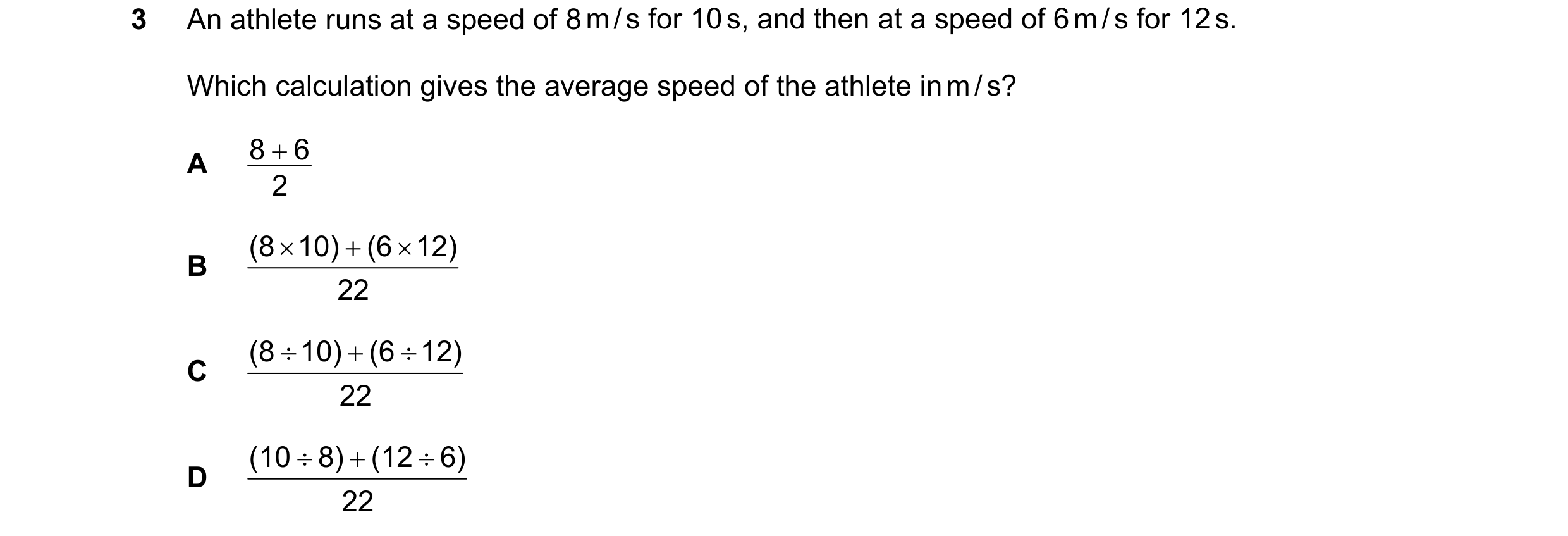
 18 / 56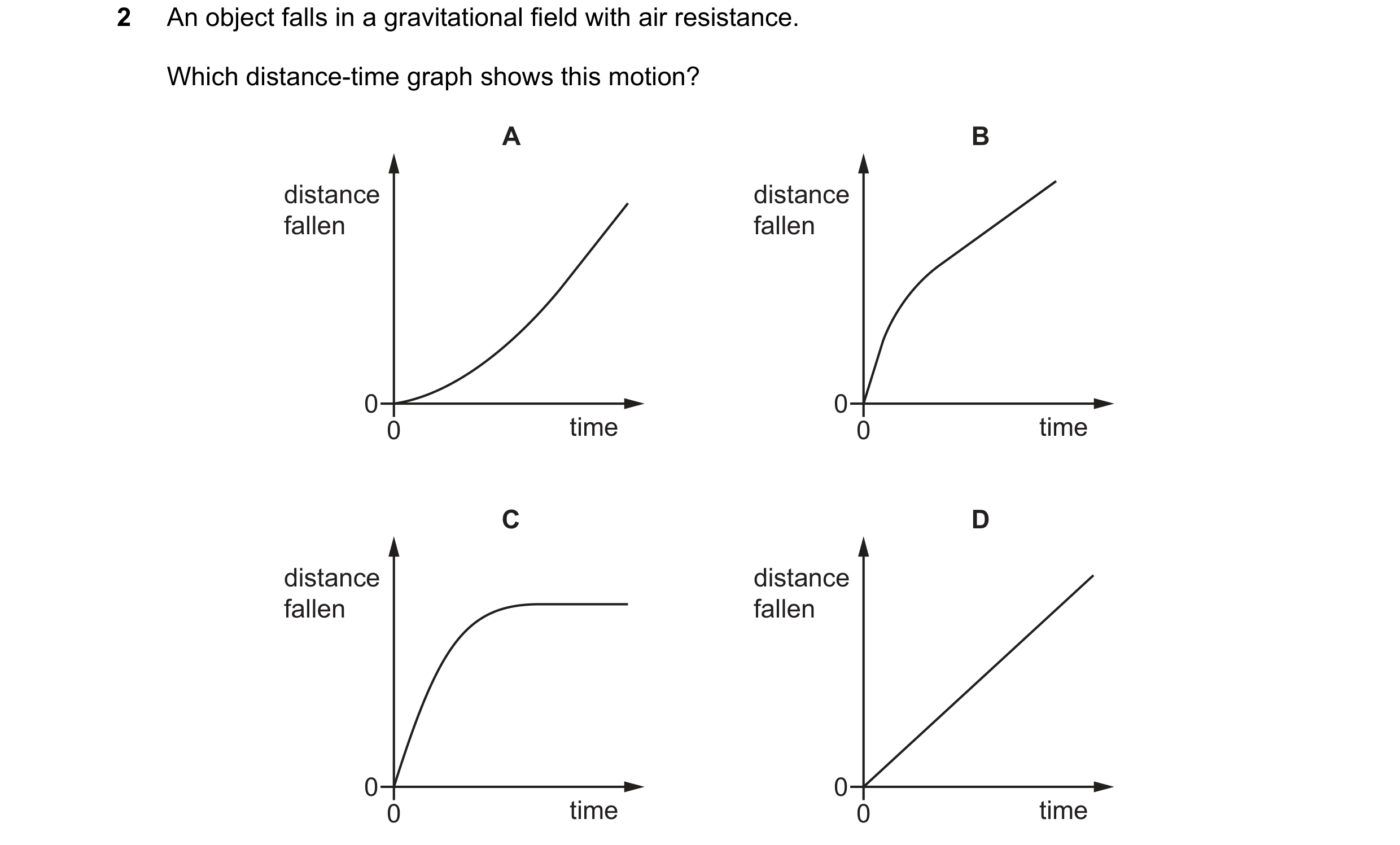


 19 / 56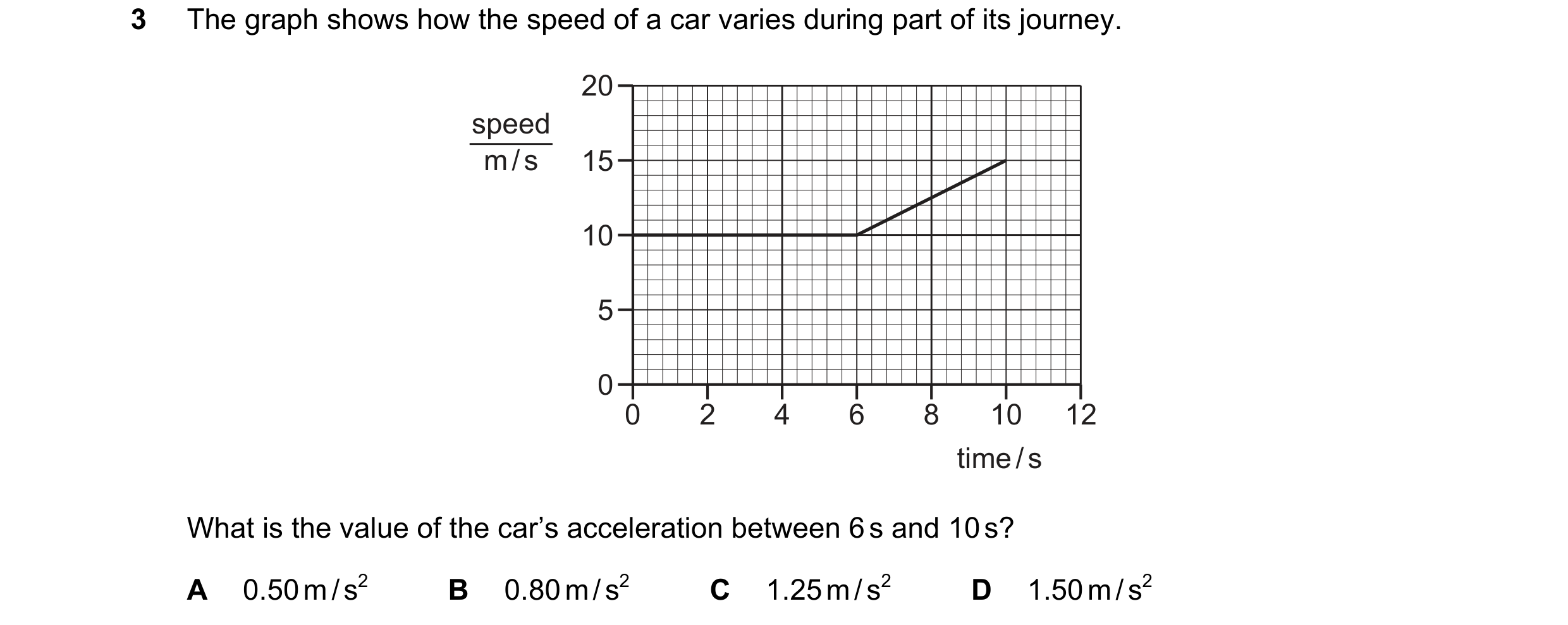



 20 / 56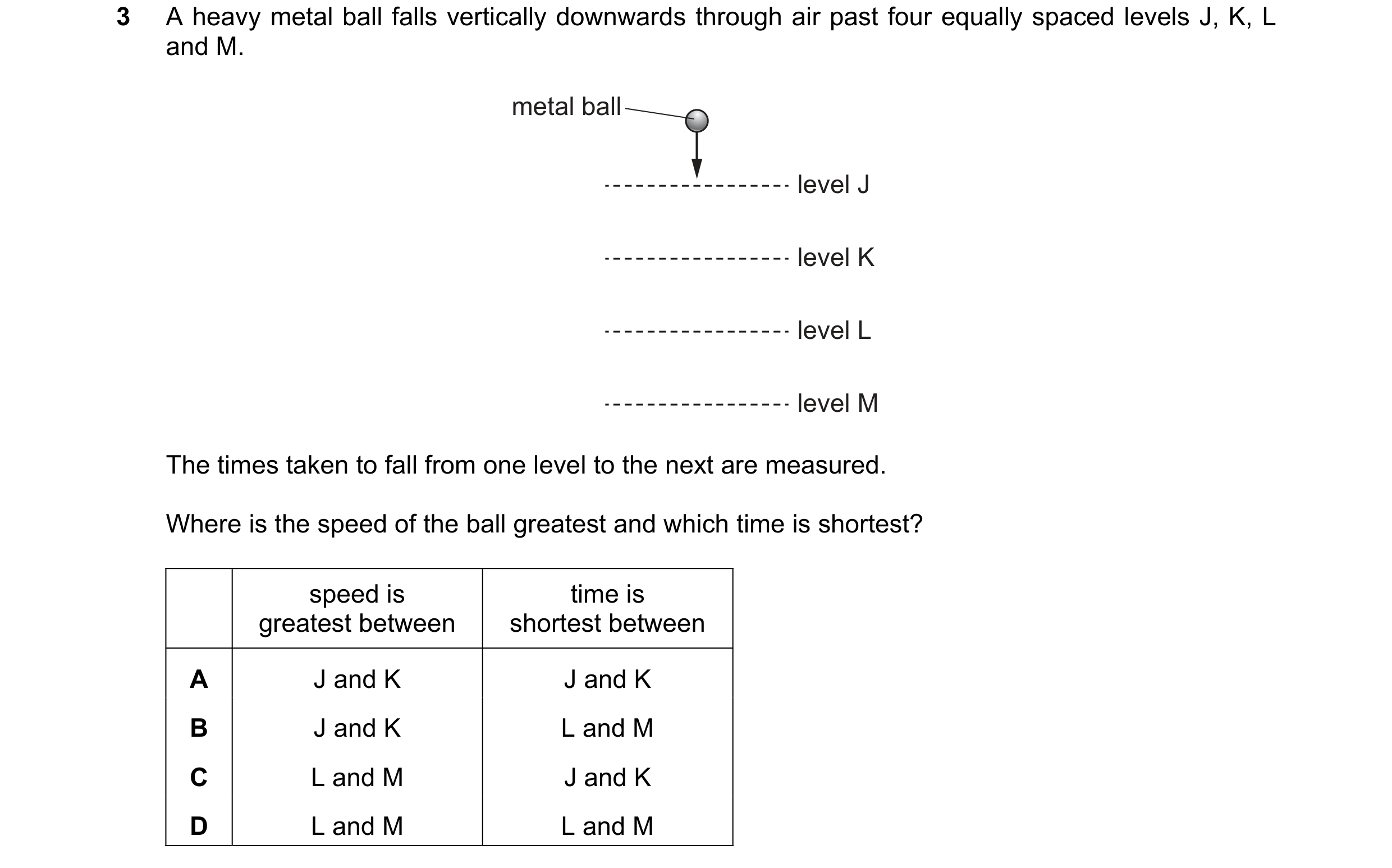
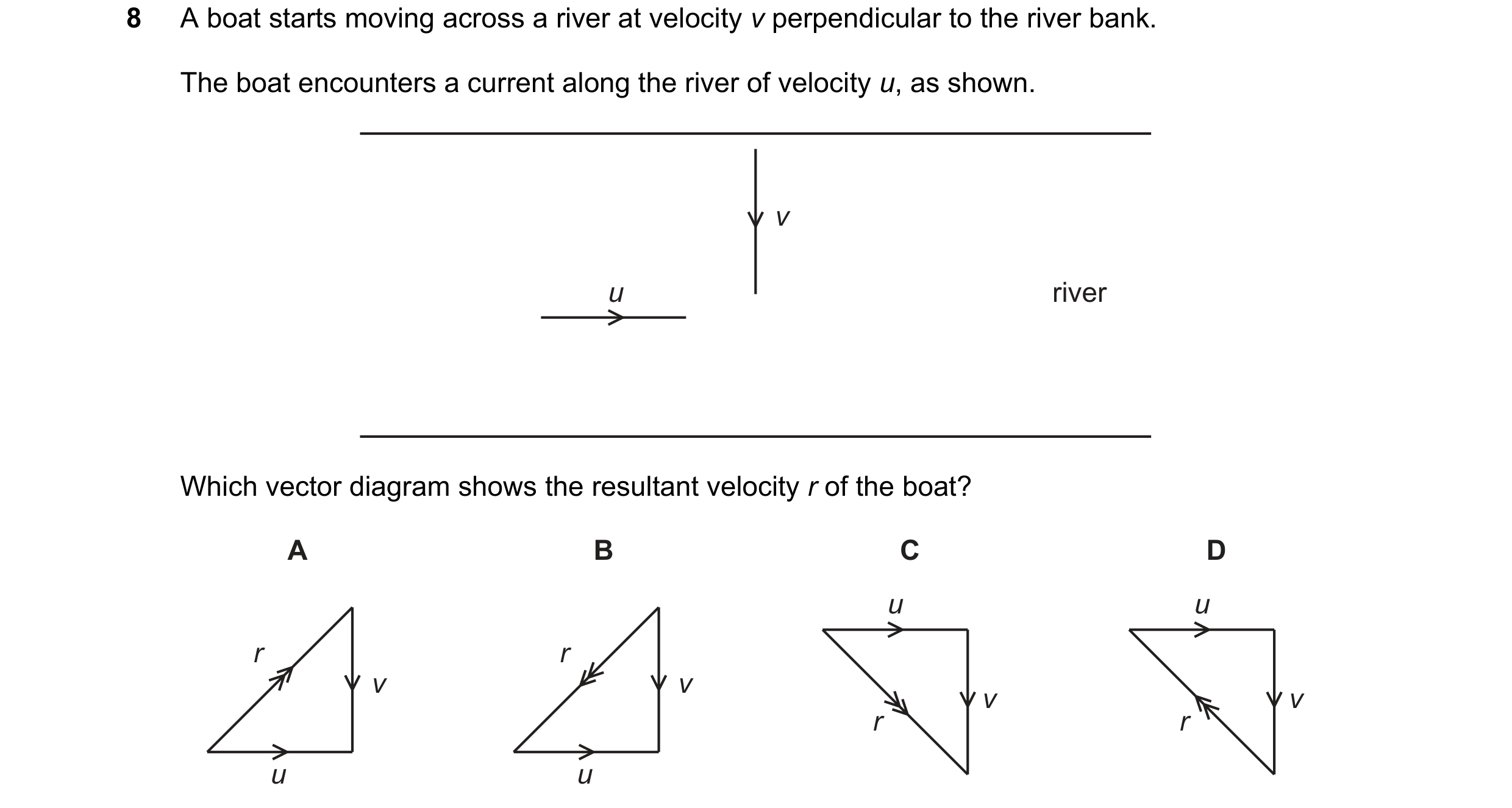
 21 / 56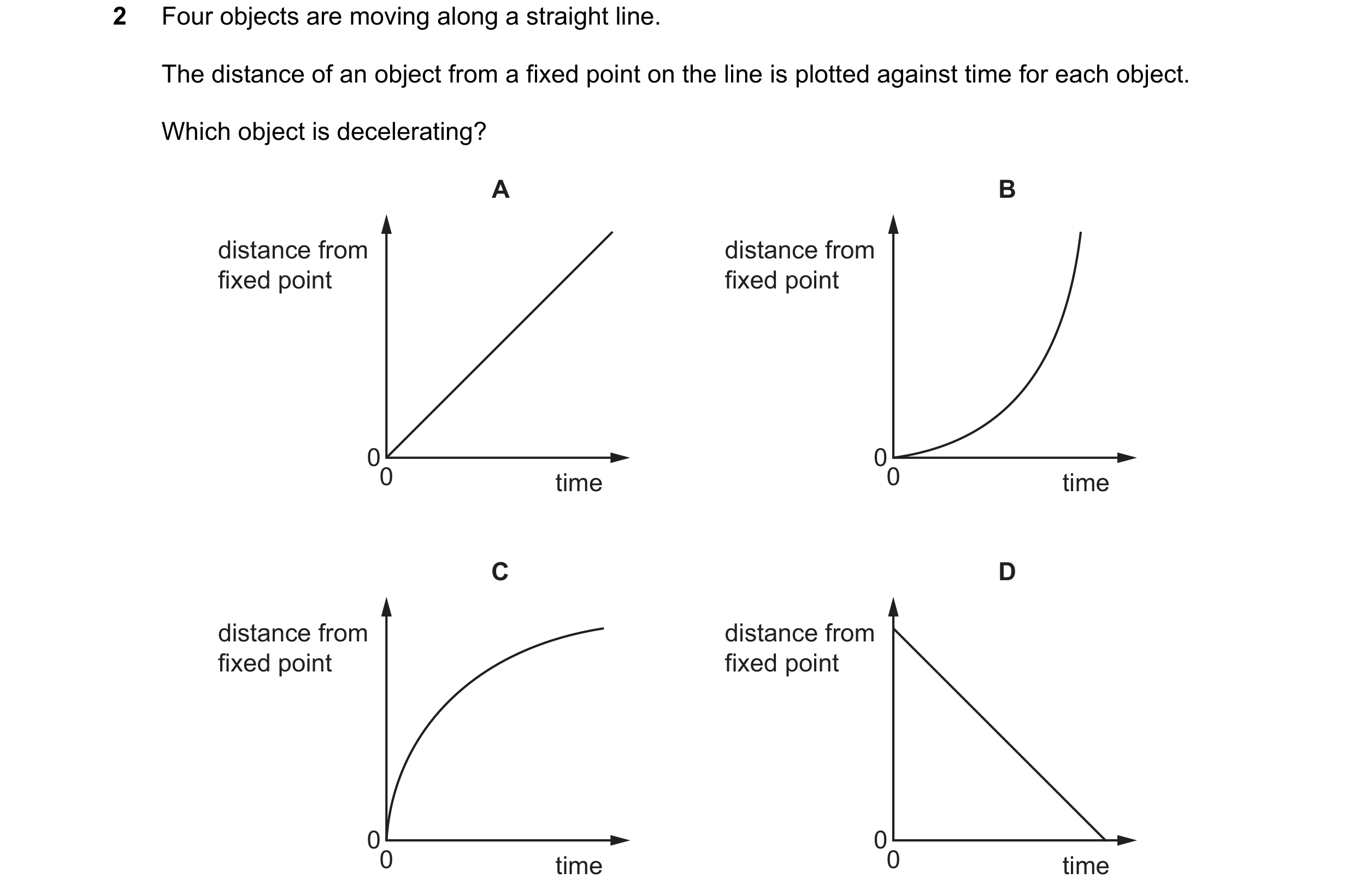
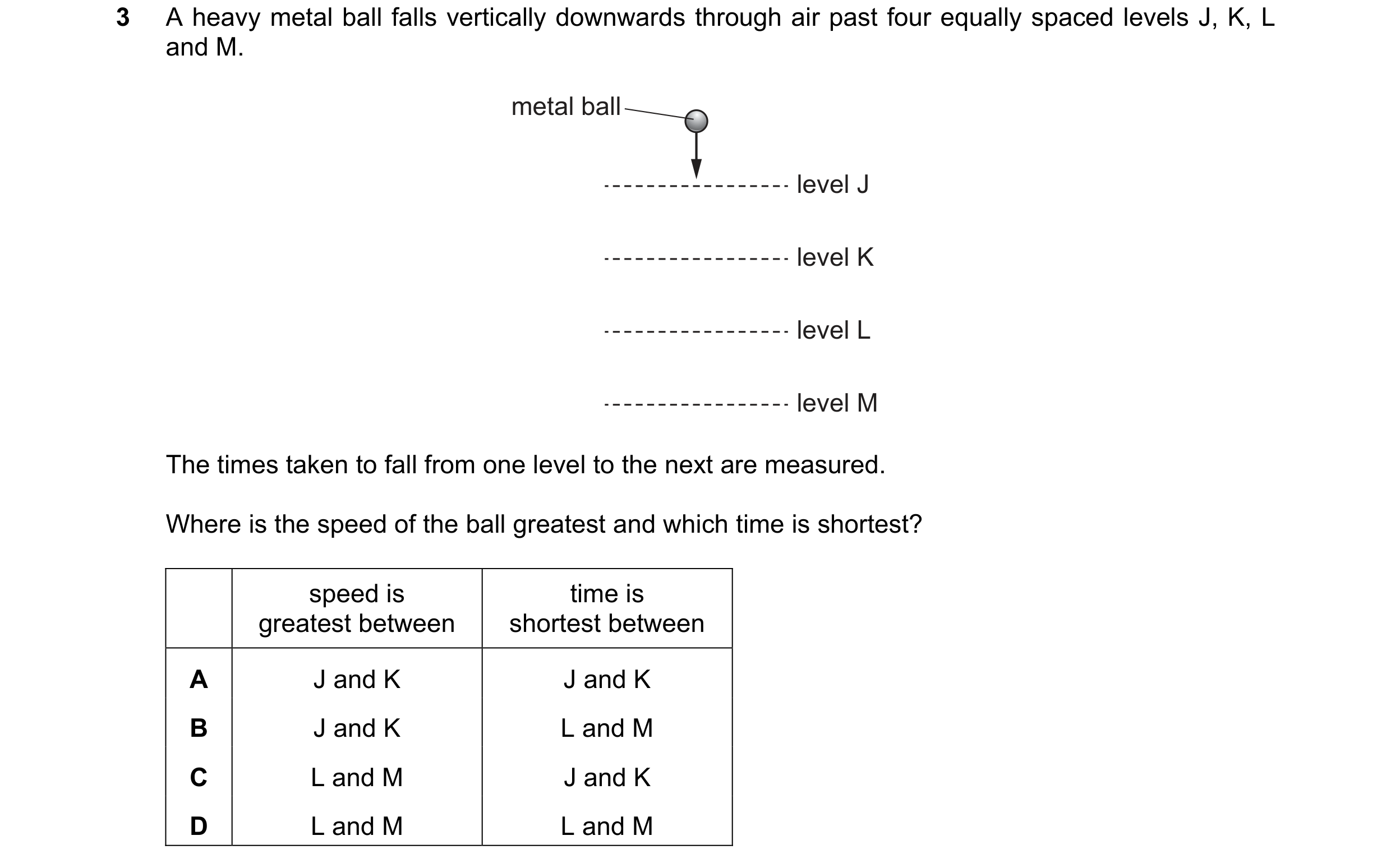 22 / 56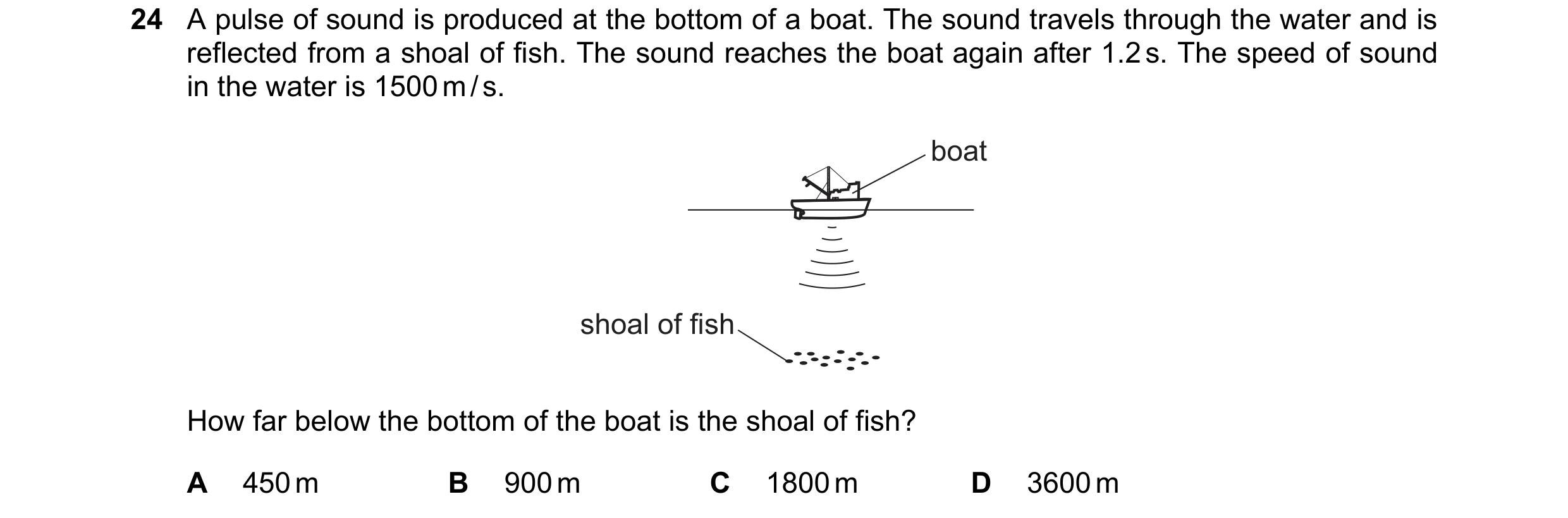
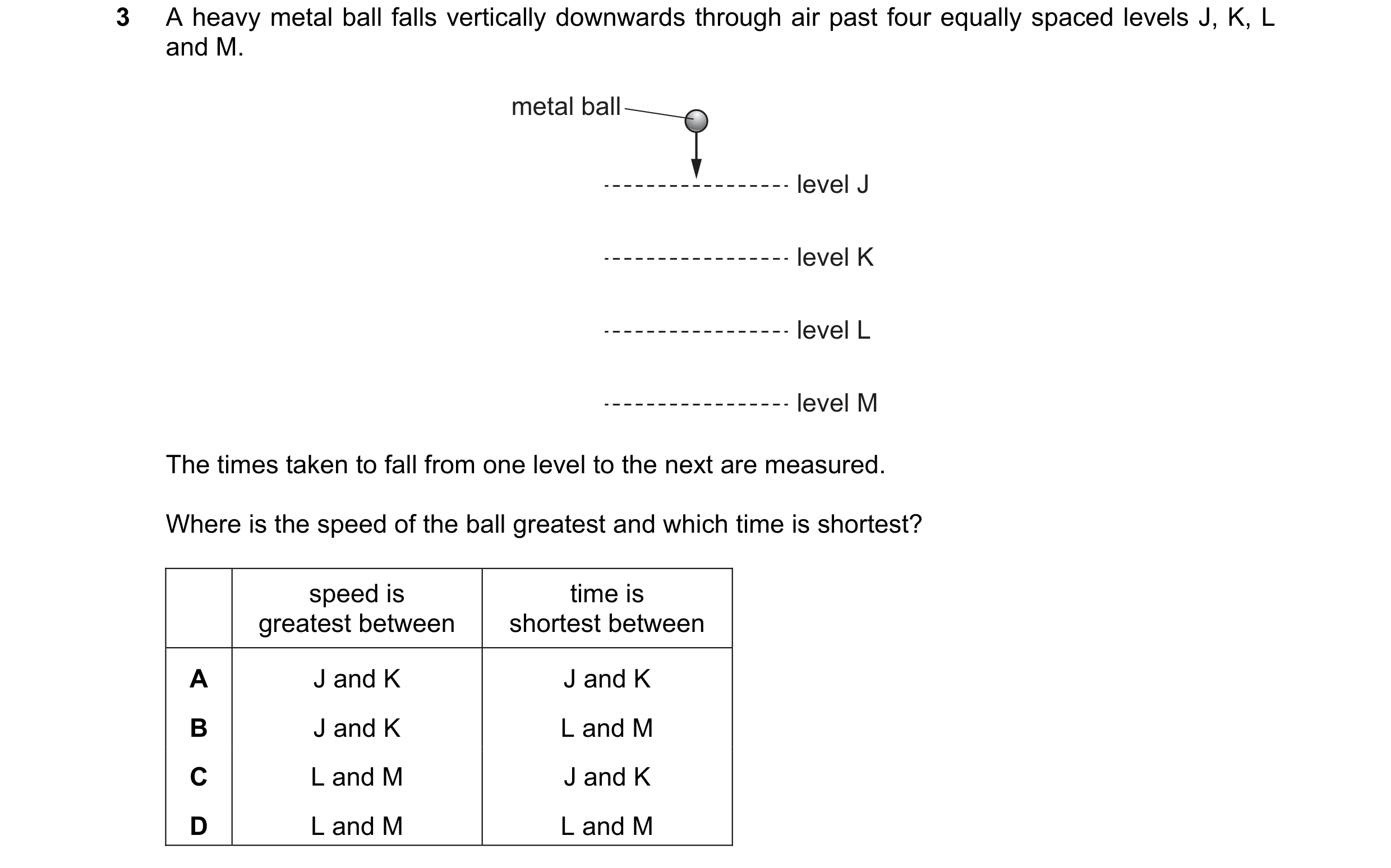 23 / 56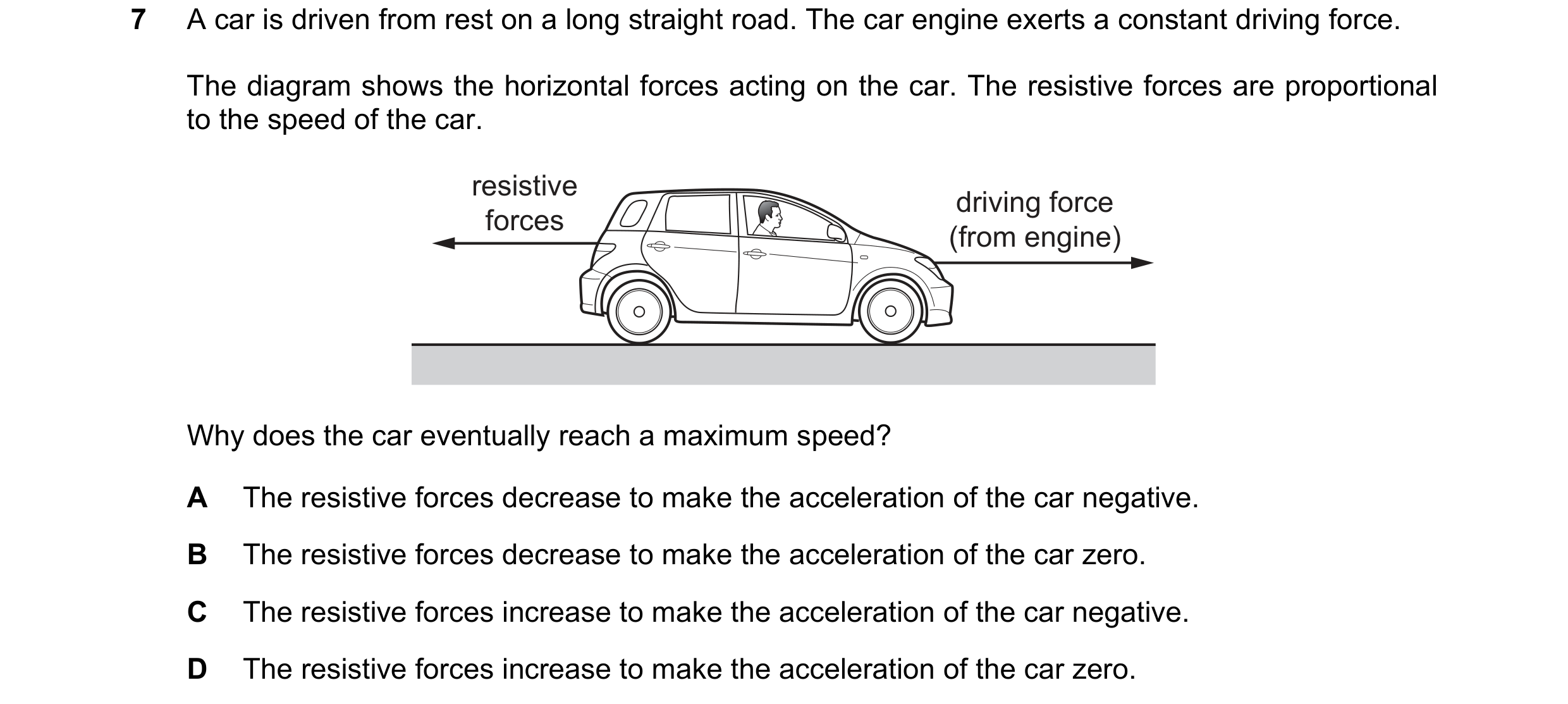
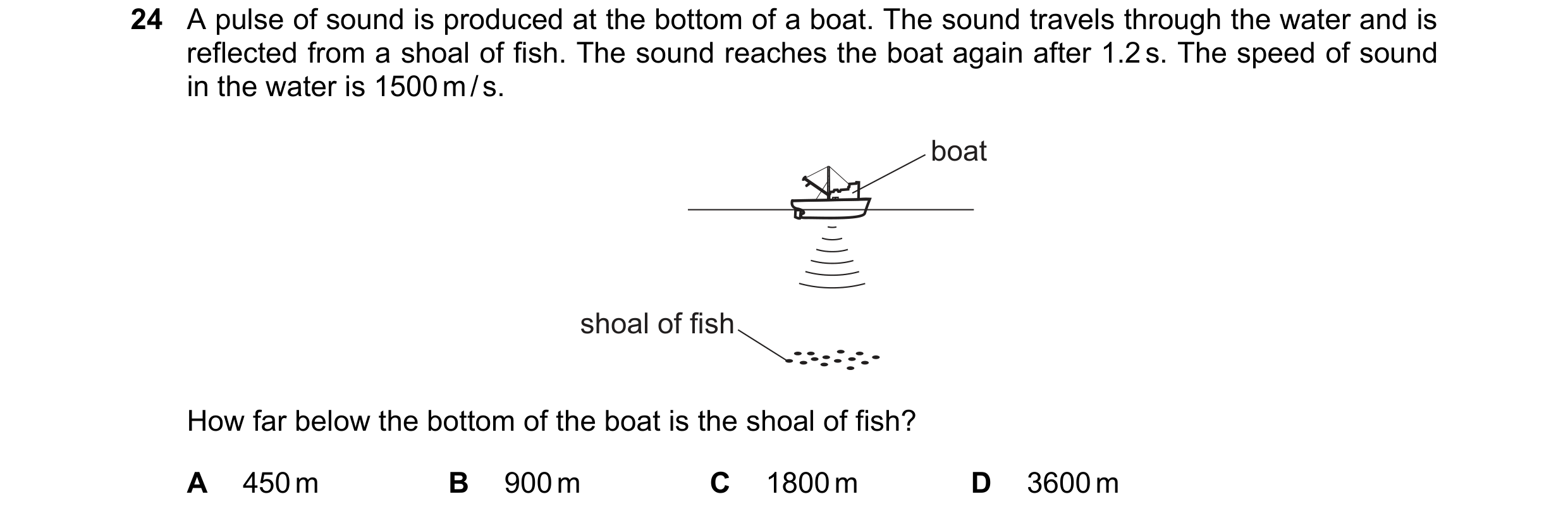
 24 / 56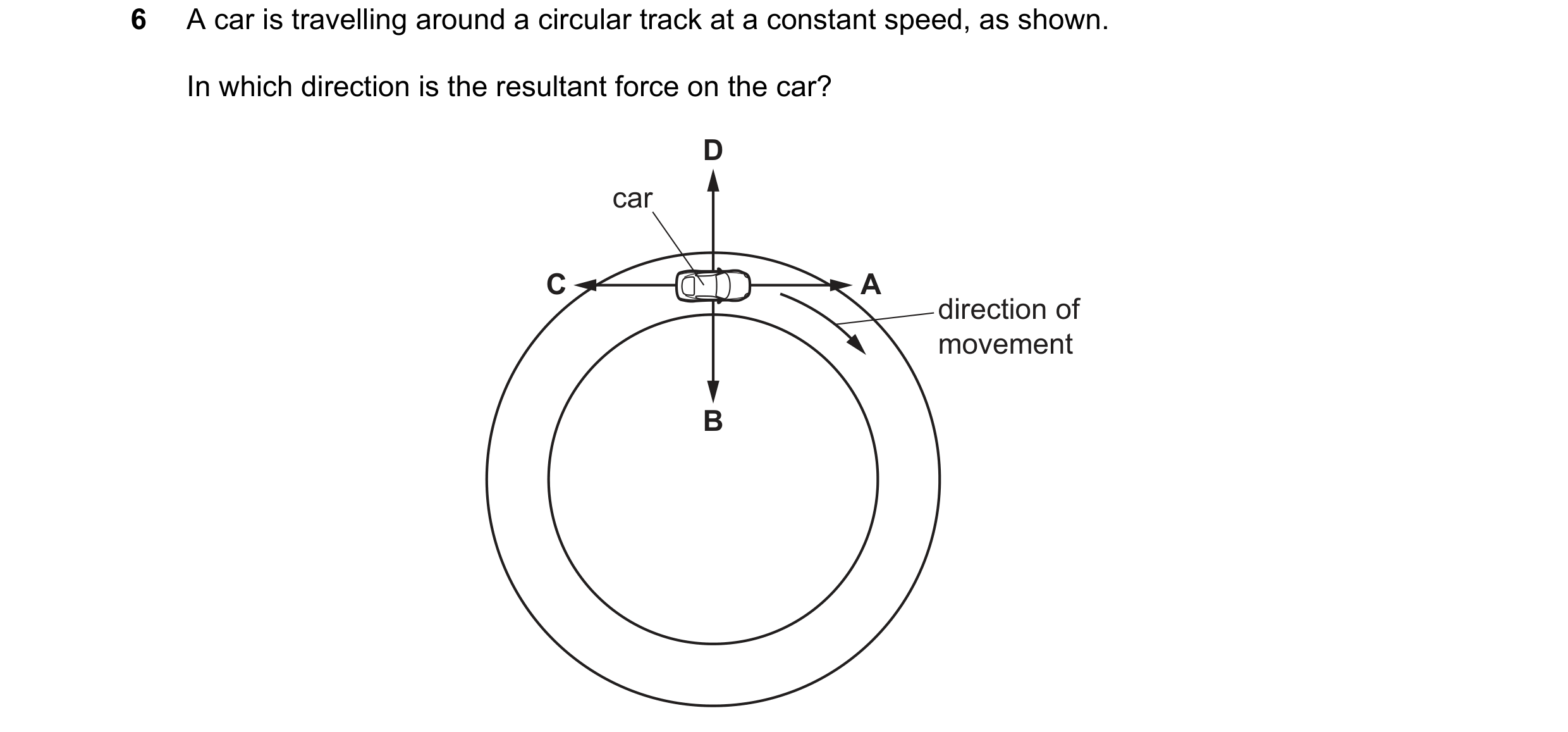
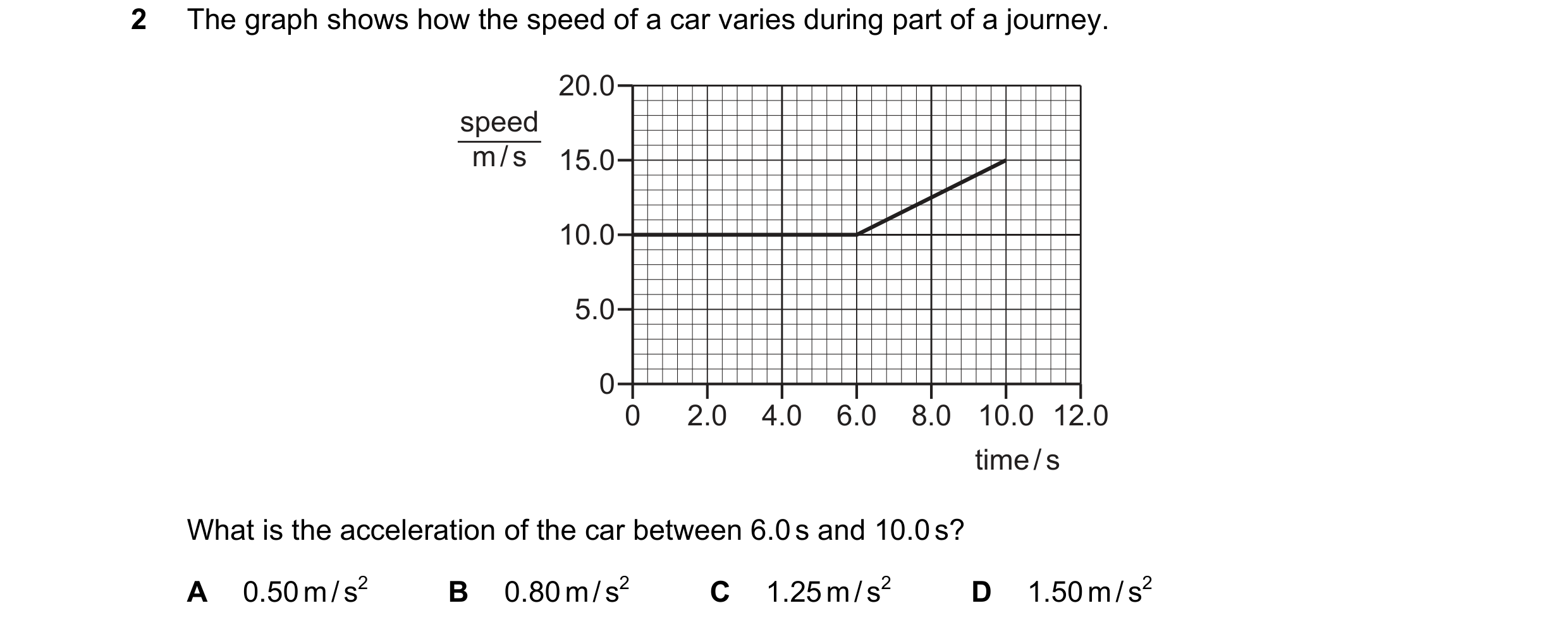

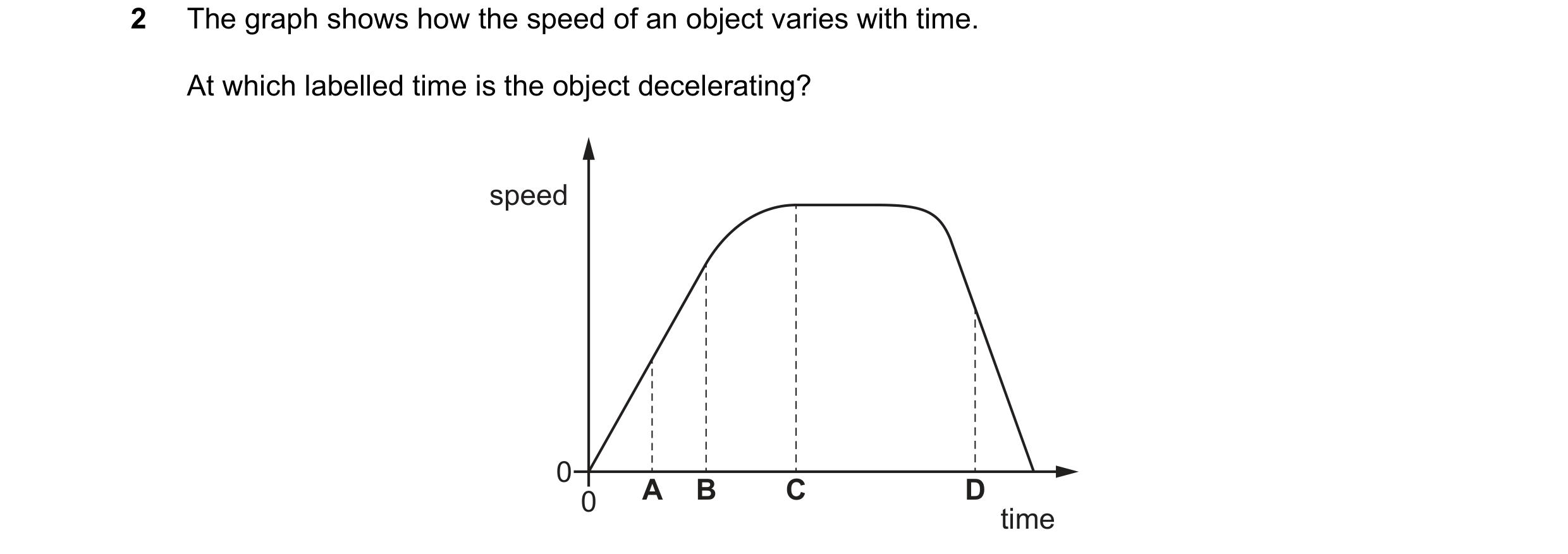 25 / 56


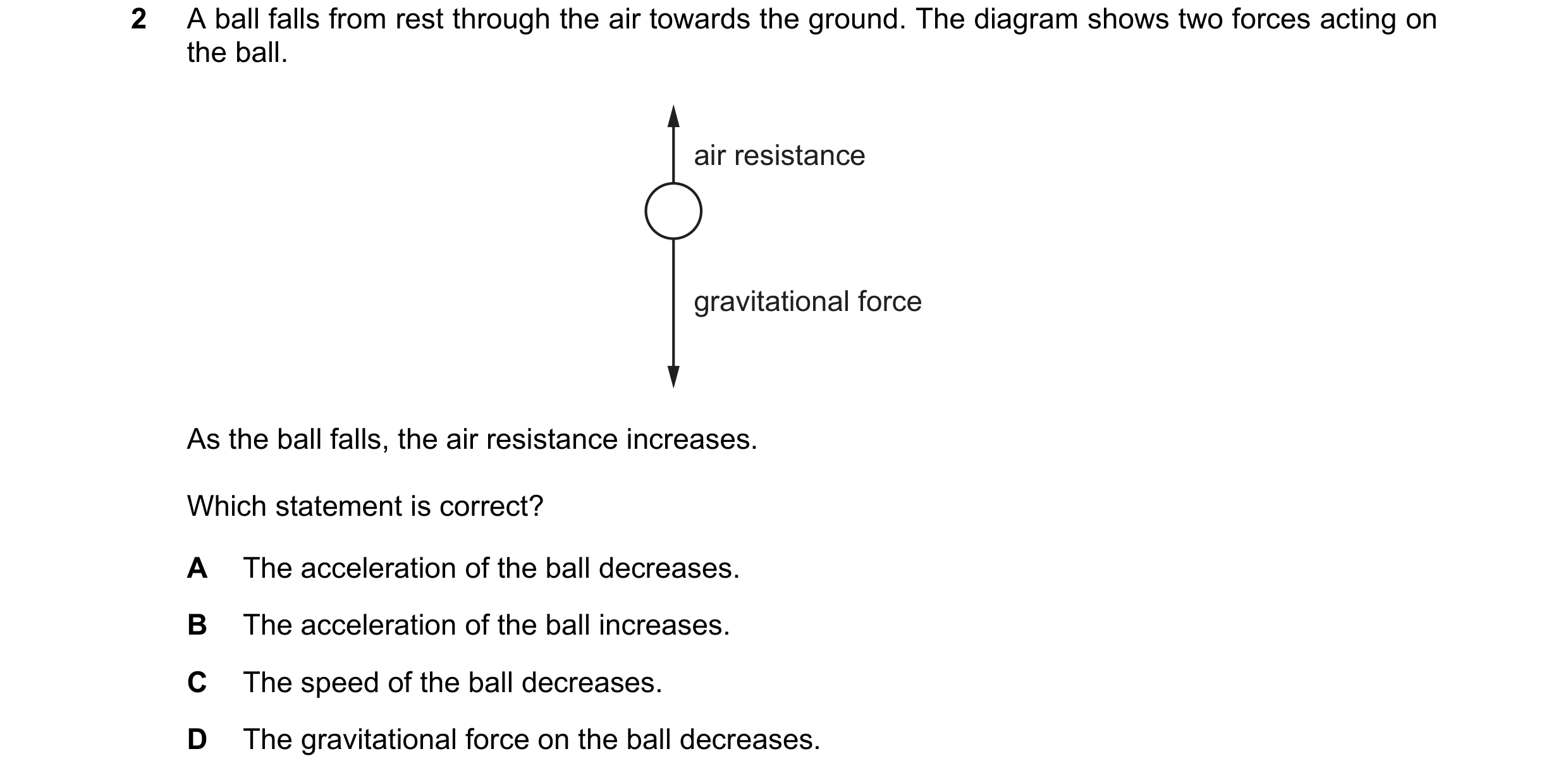 26 / 56
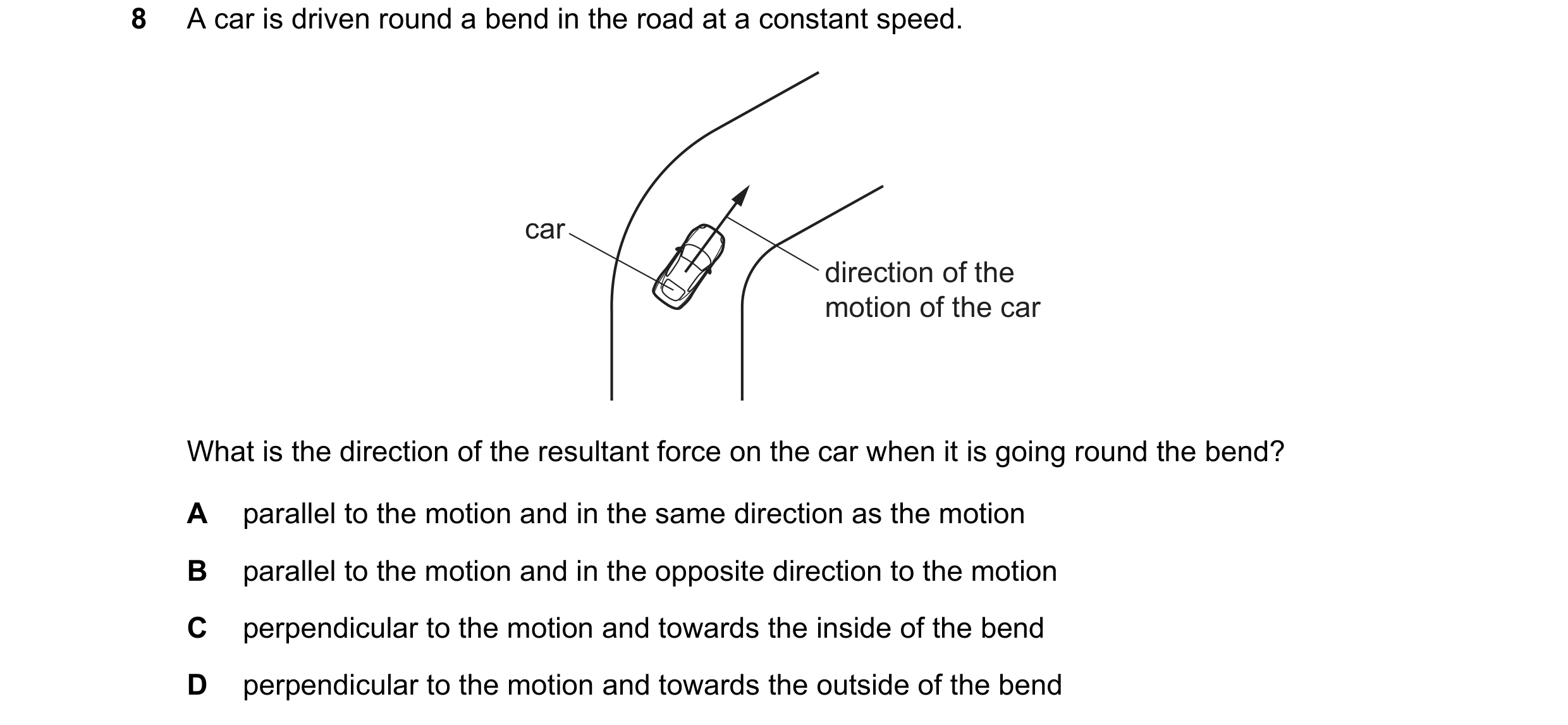 27 / 56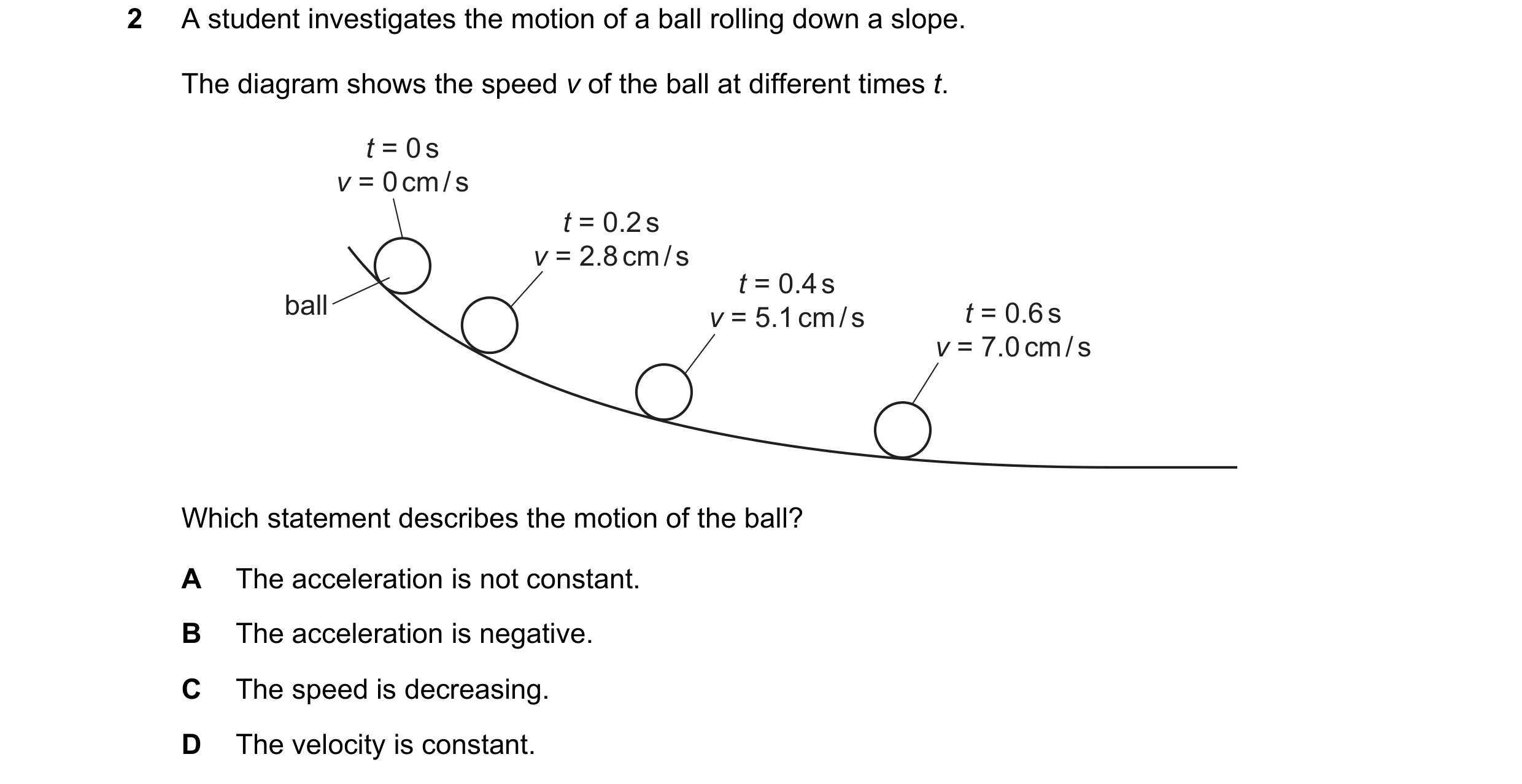

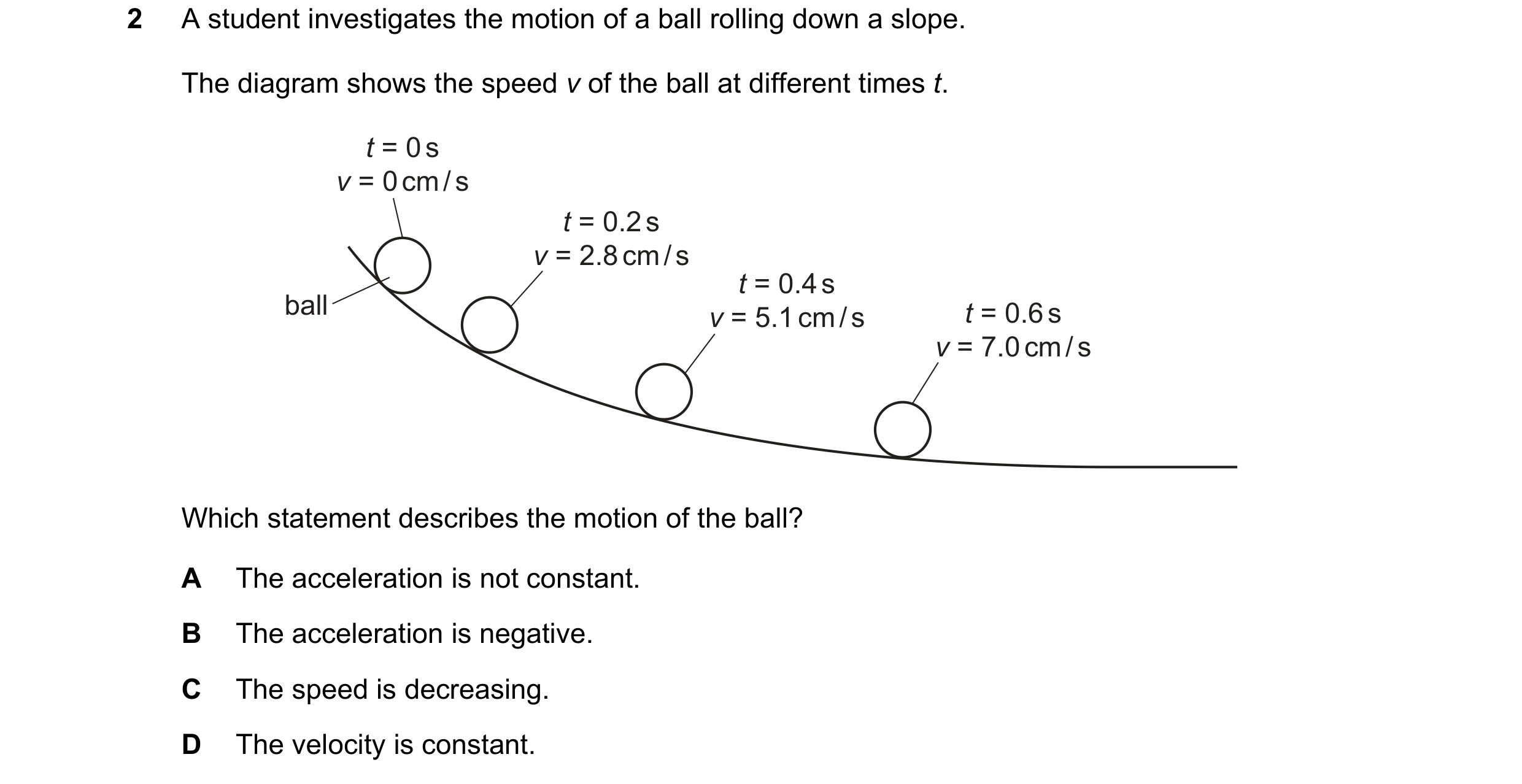 28 / 56
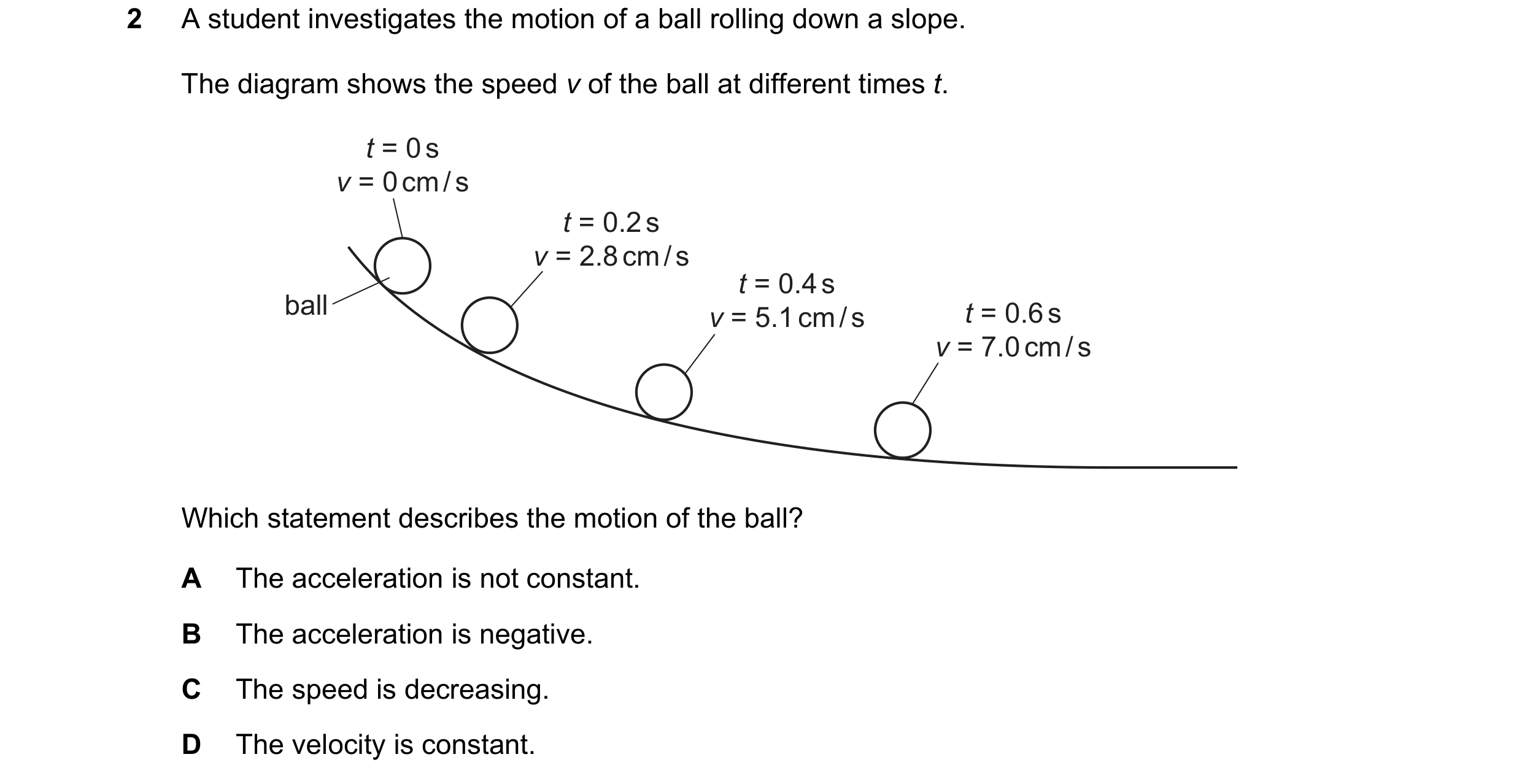

 29 / 56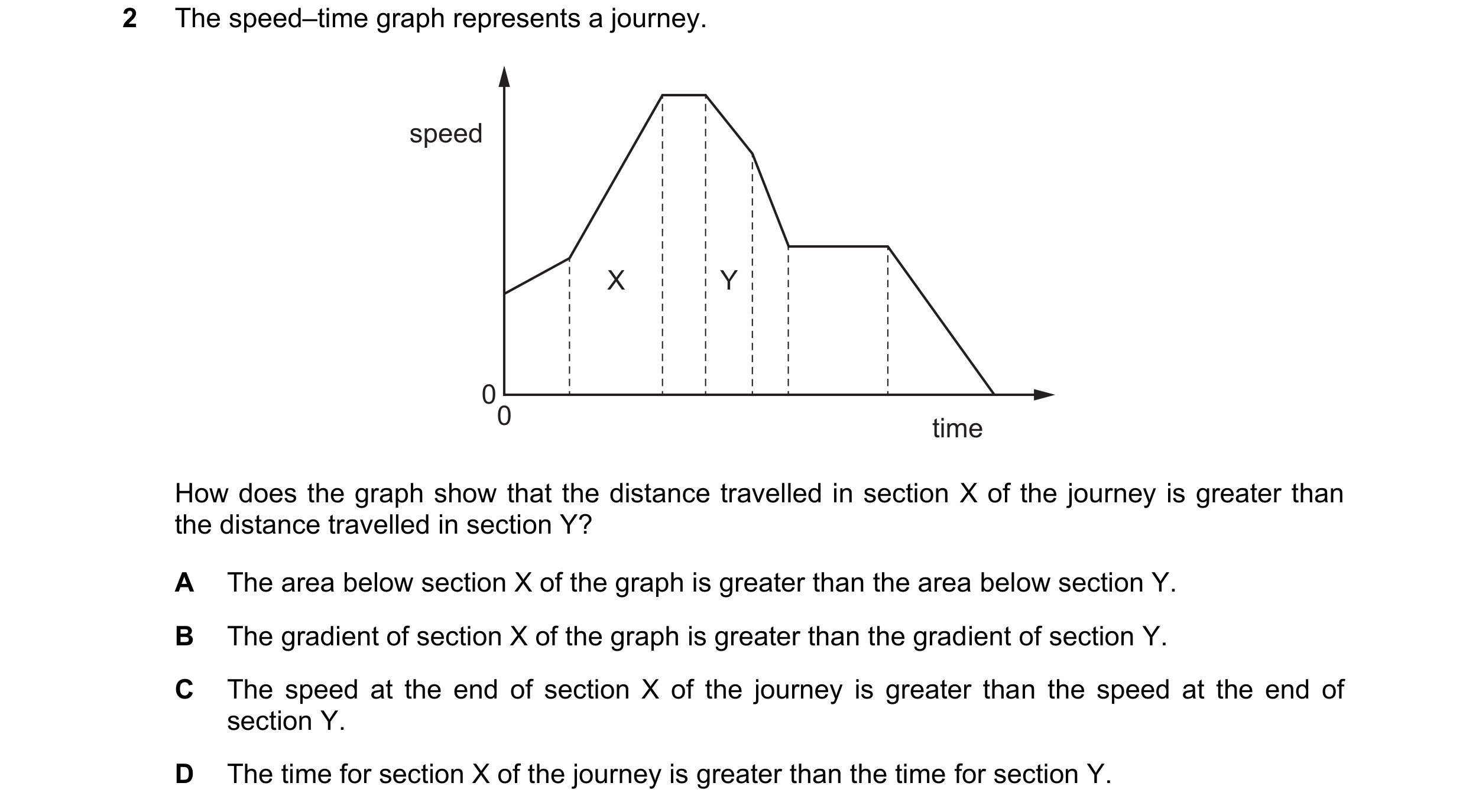

 30 / 56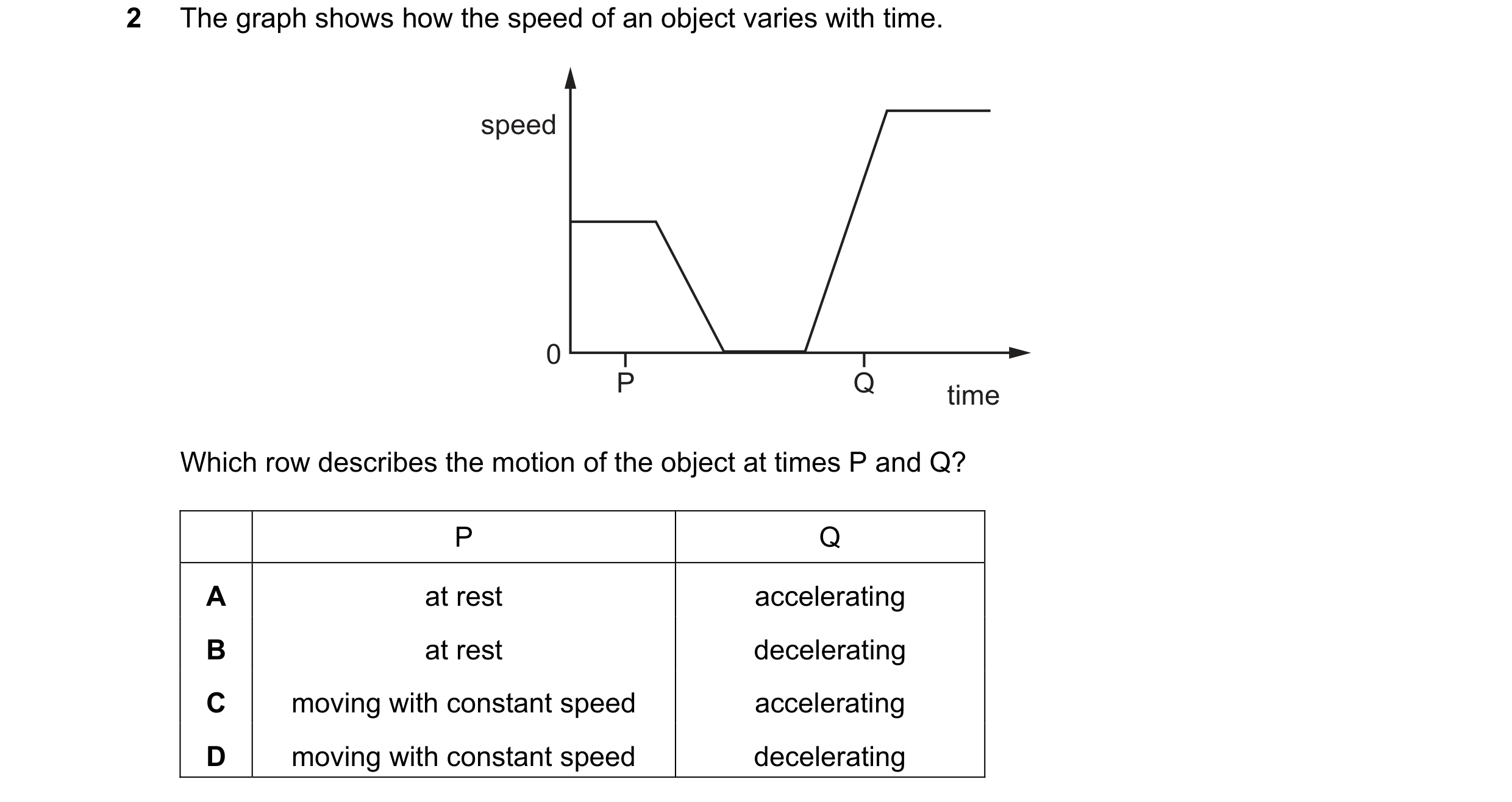
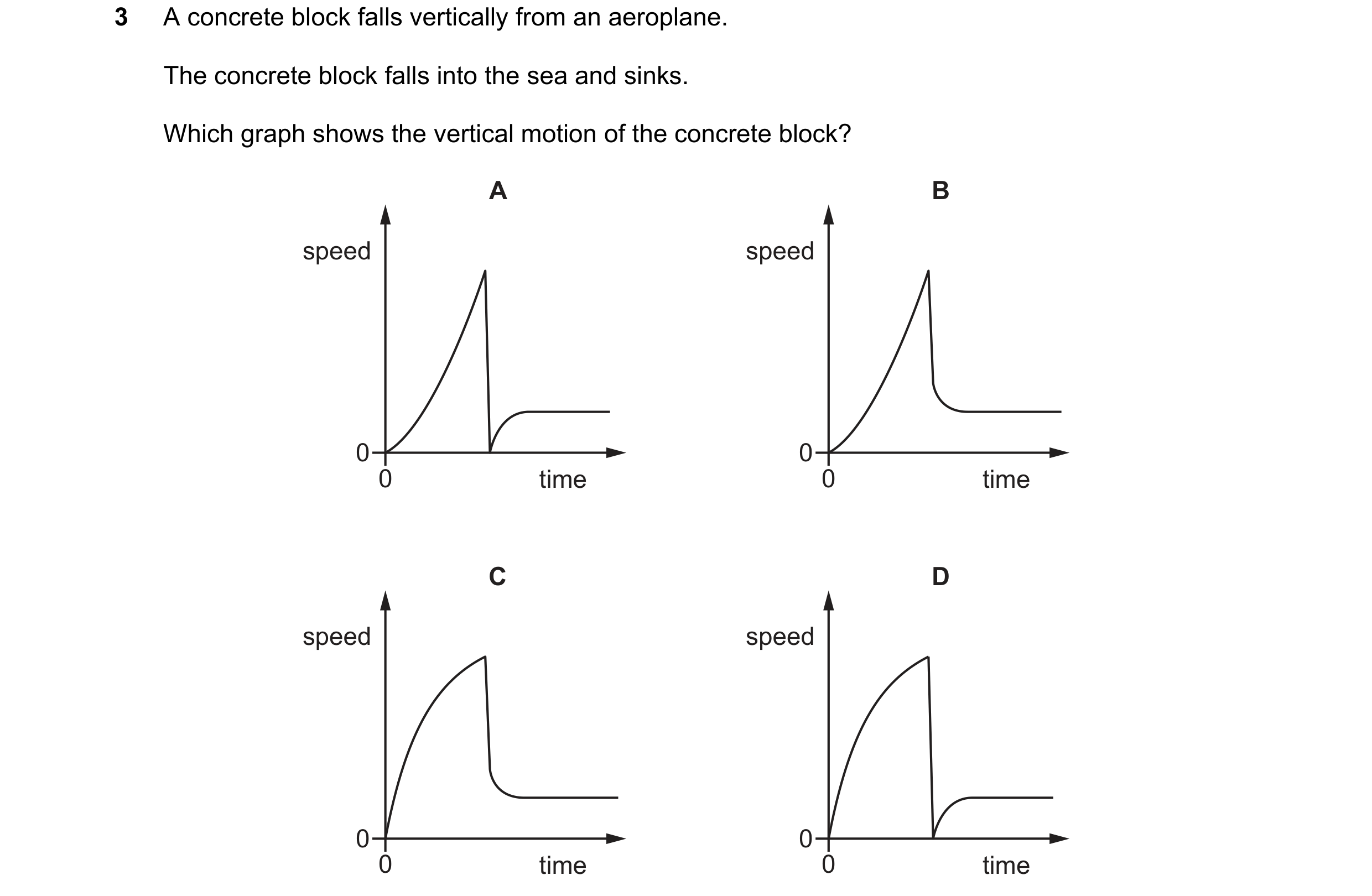 31 / 56
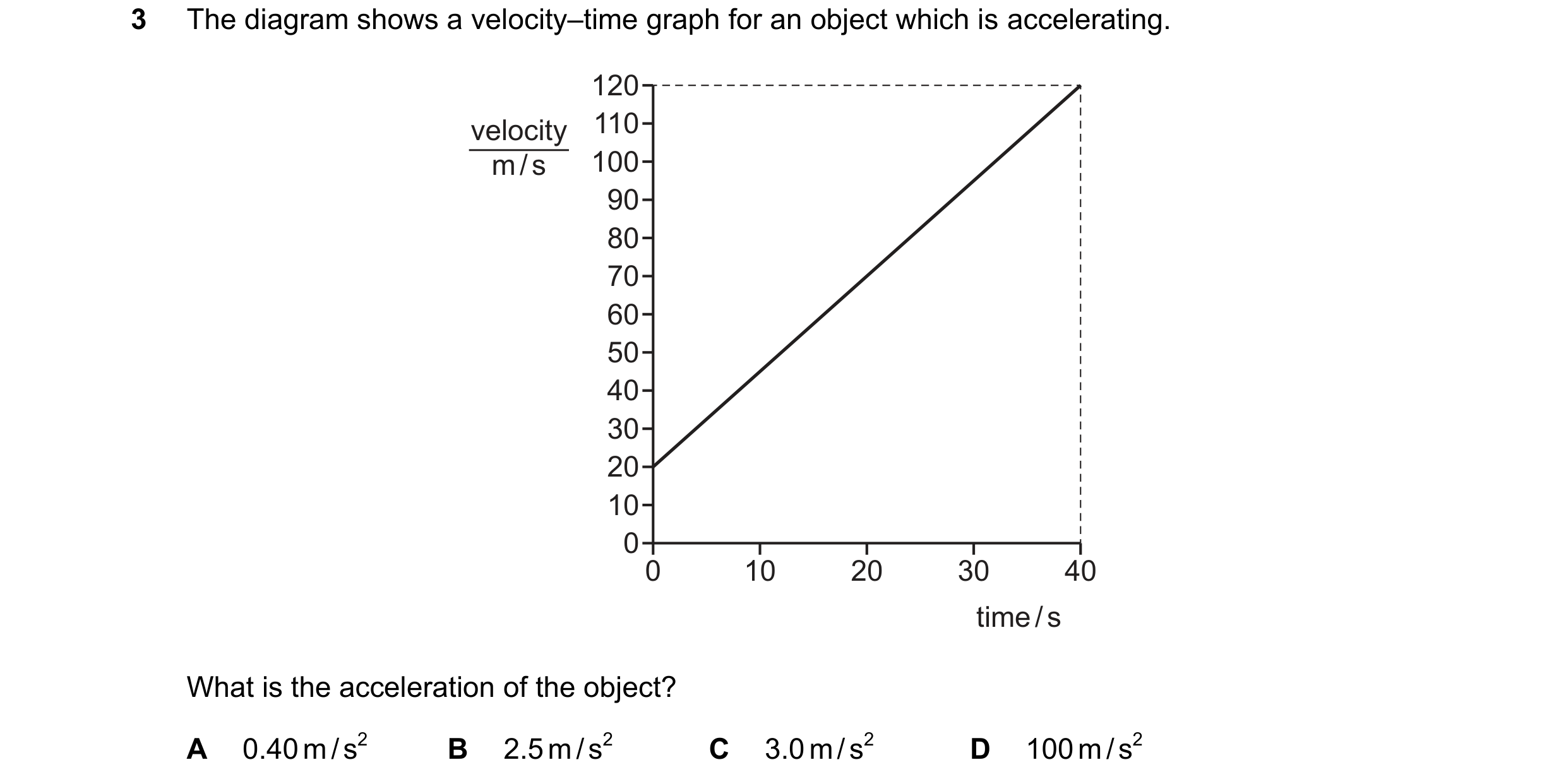
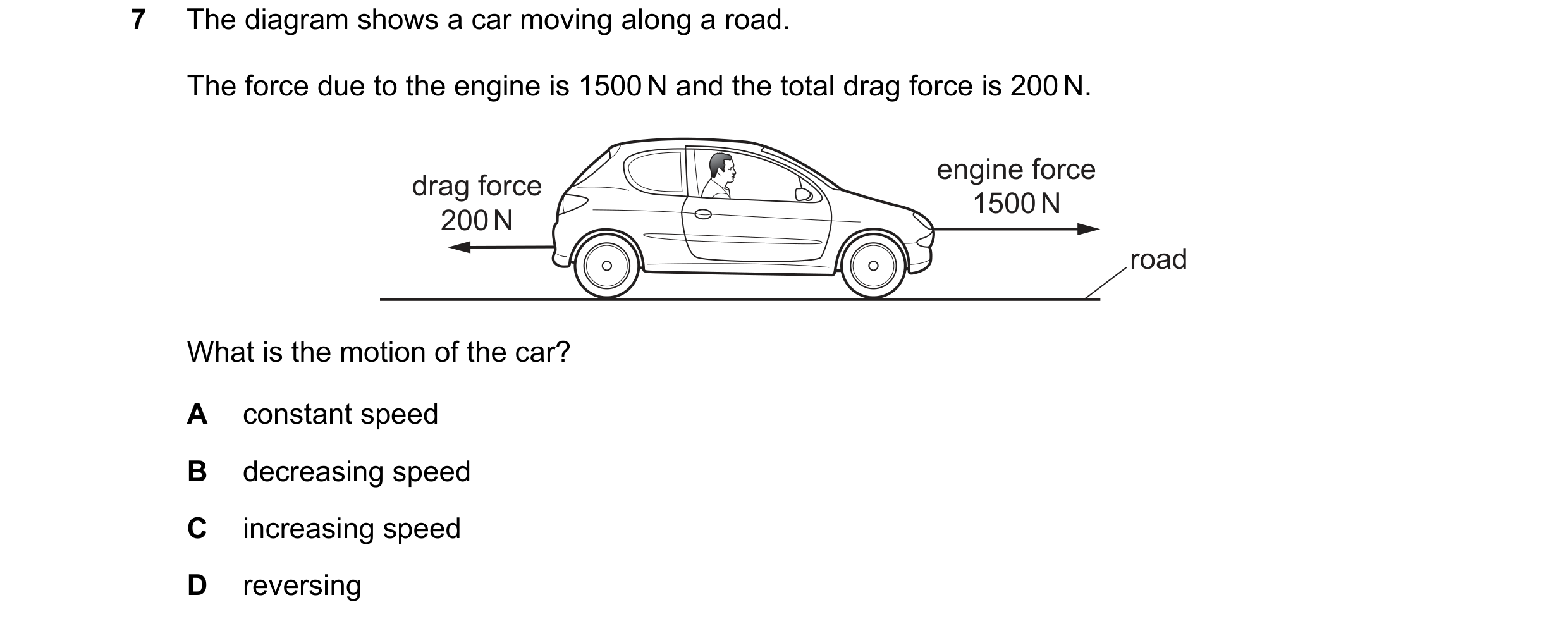
 32 / 56

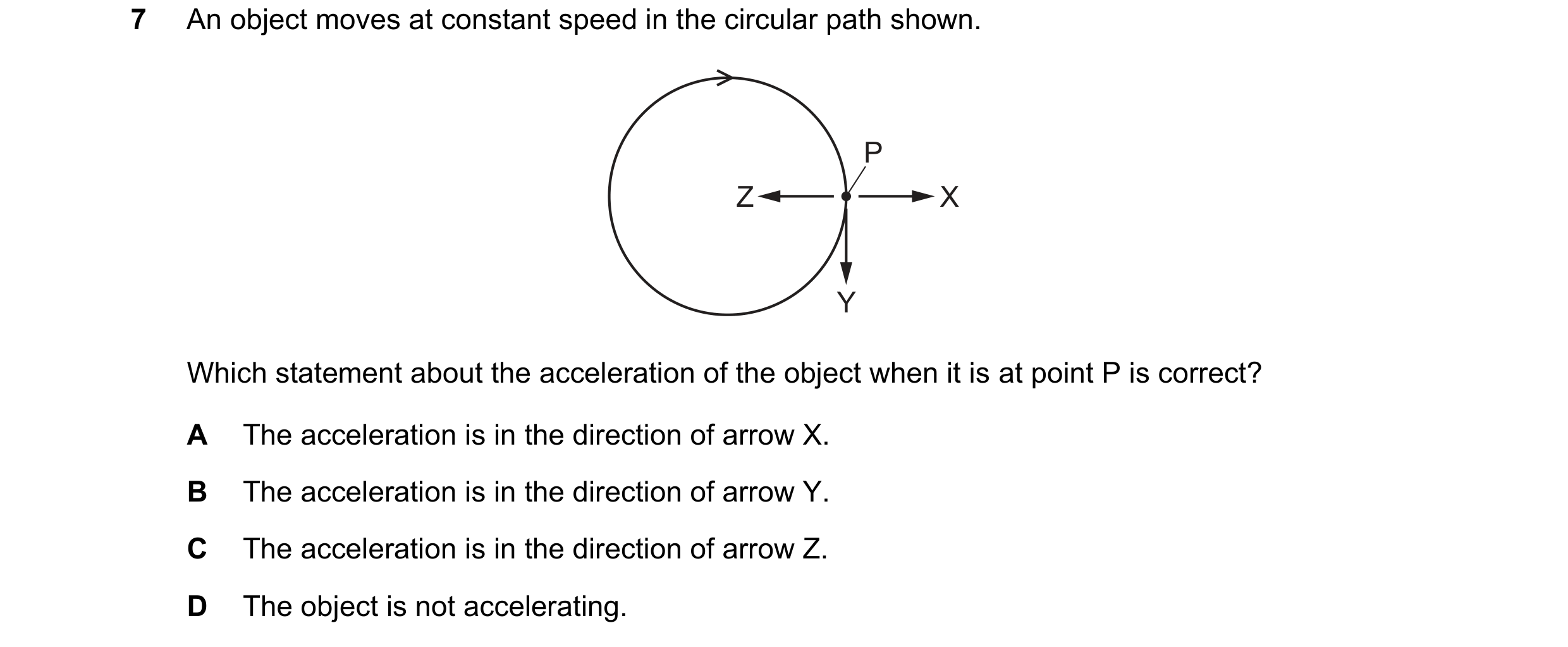
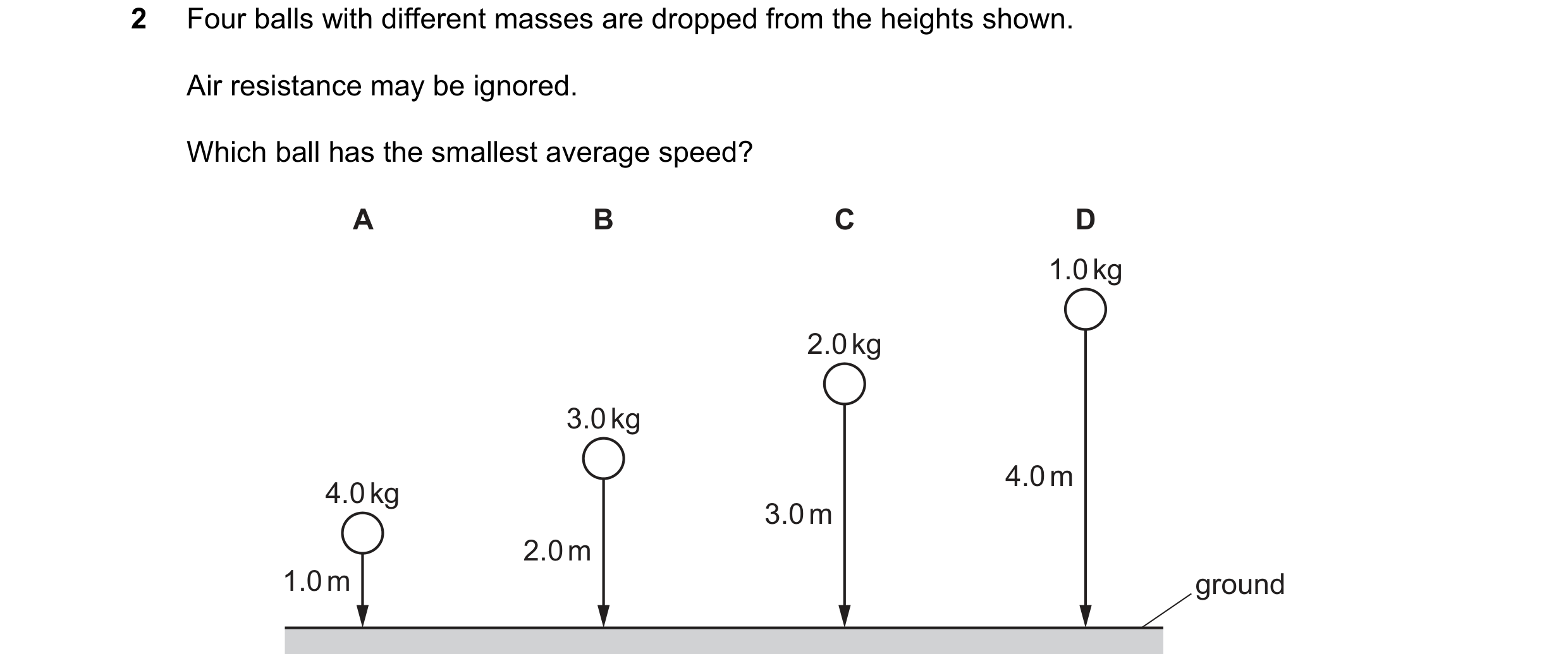 33 / 56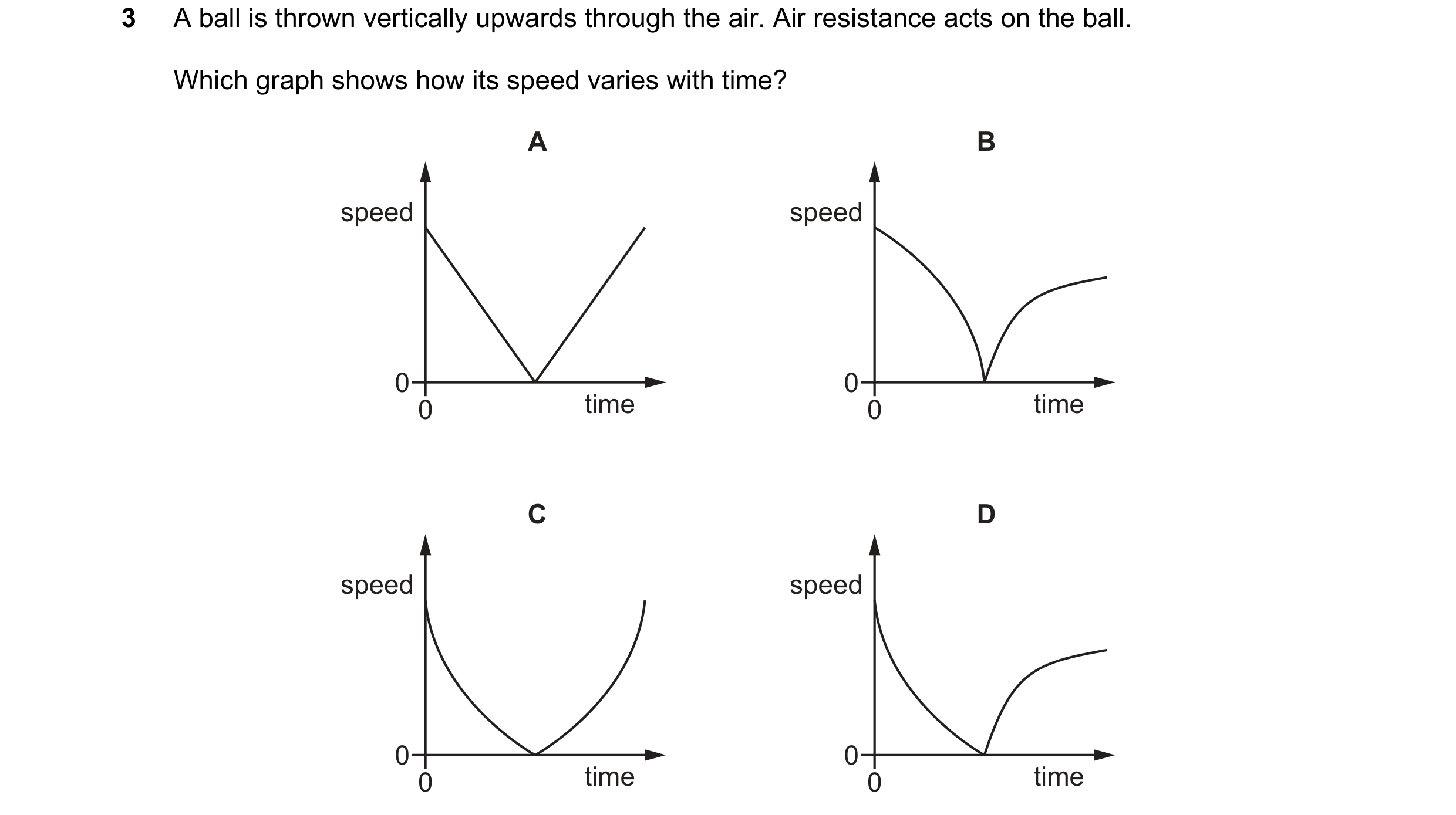
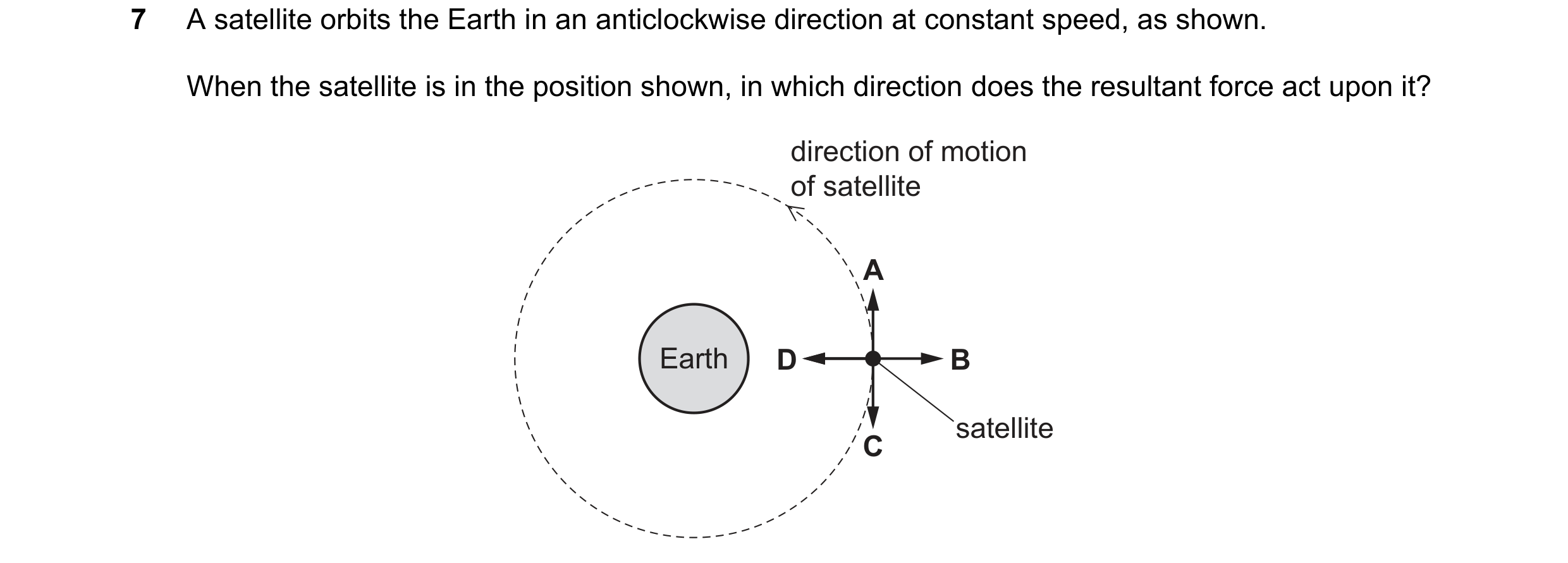
 34 / 56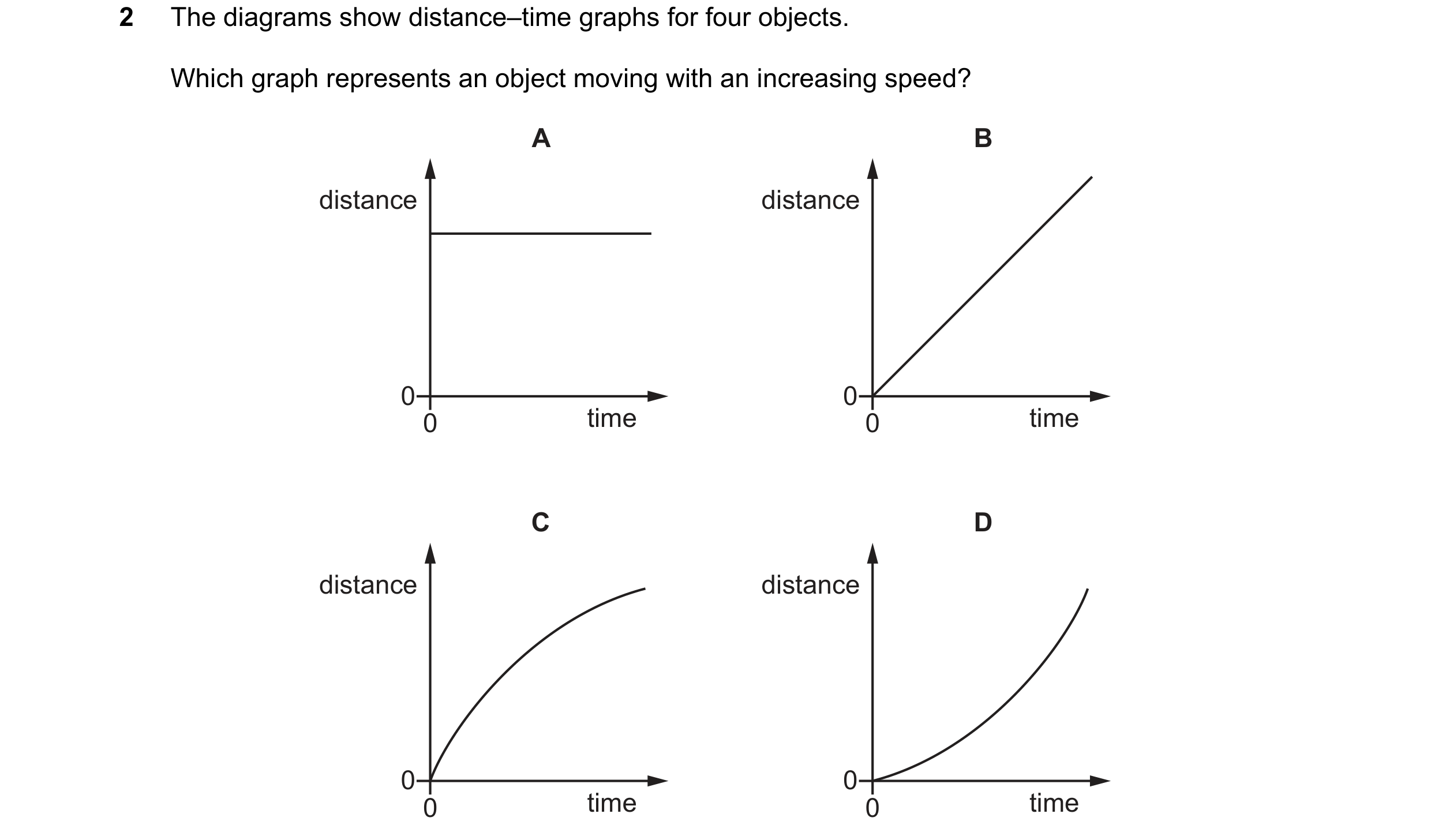
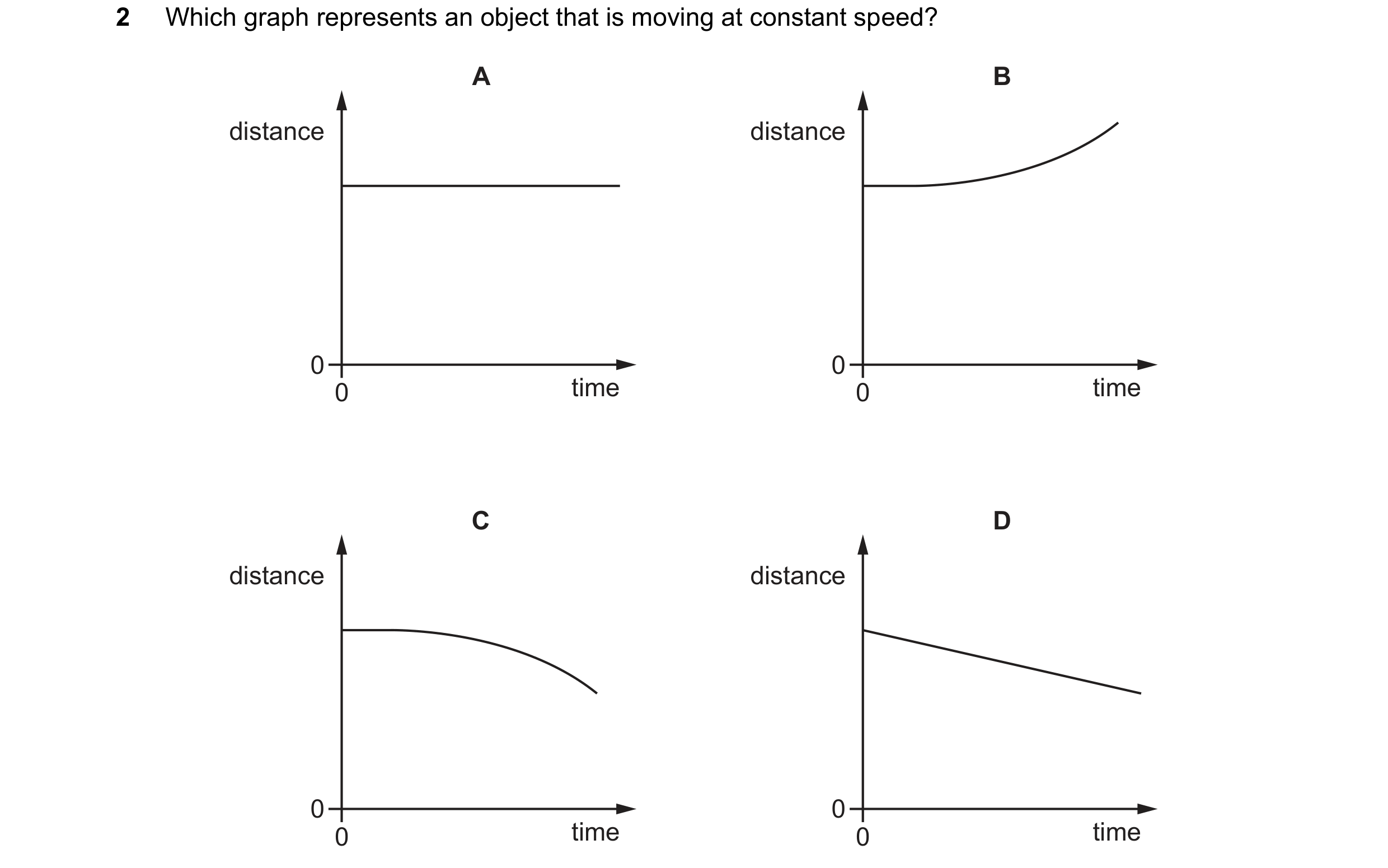 35 / 56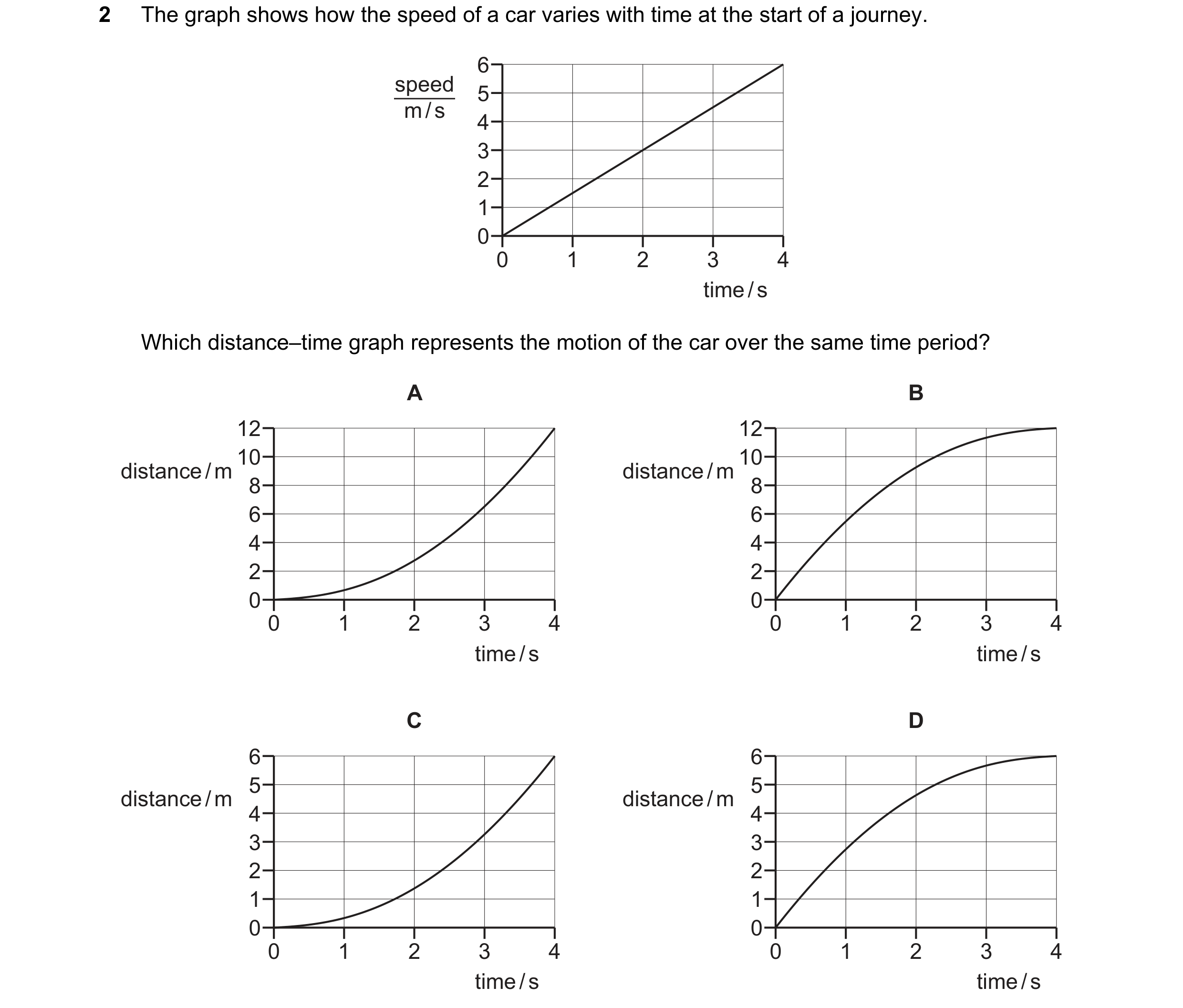
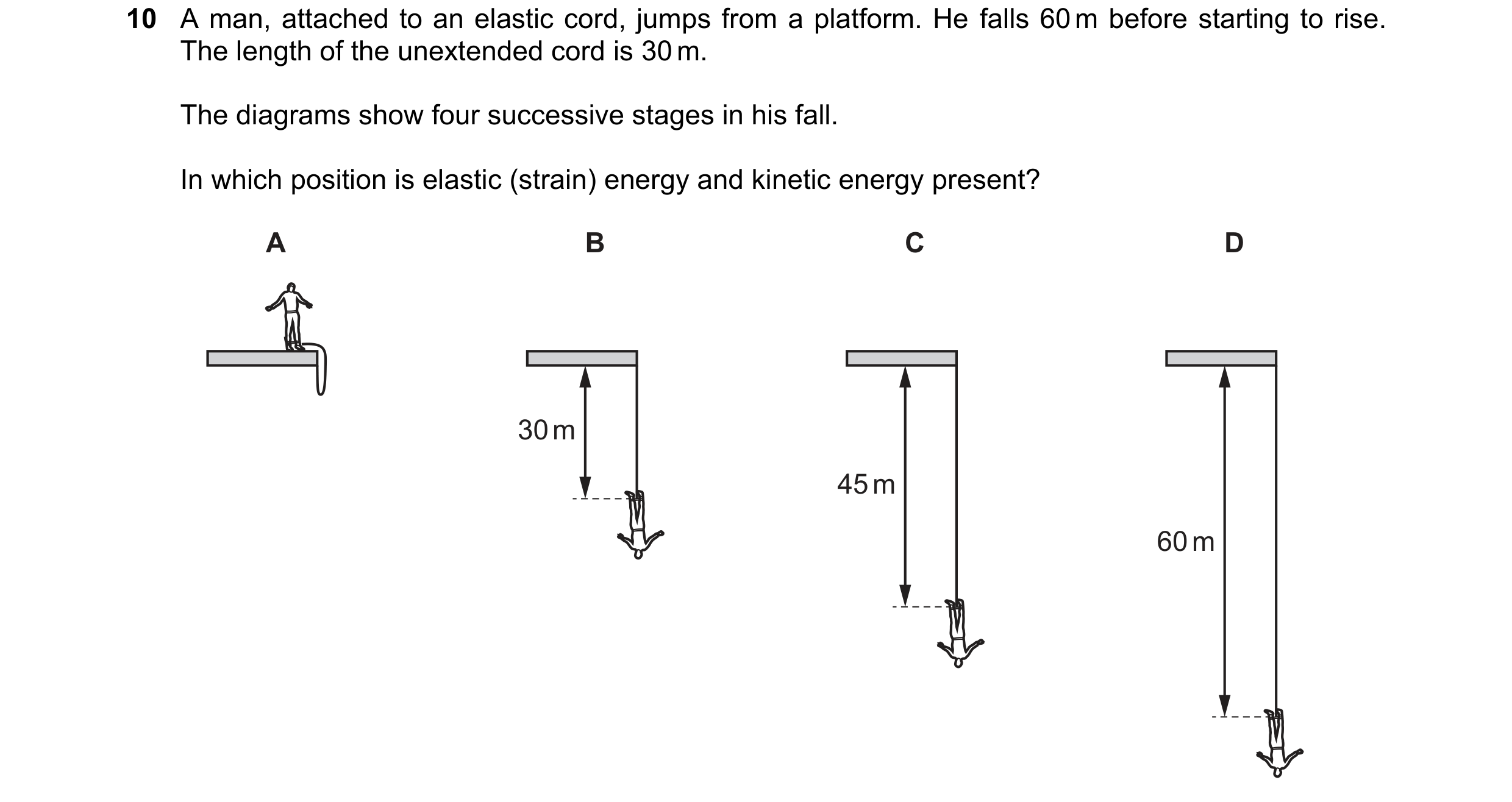 36 / 56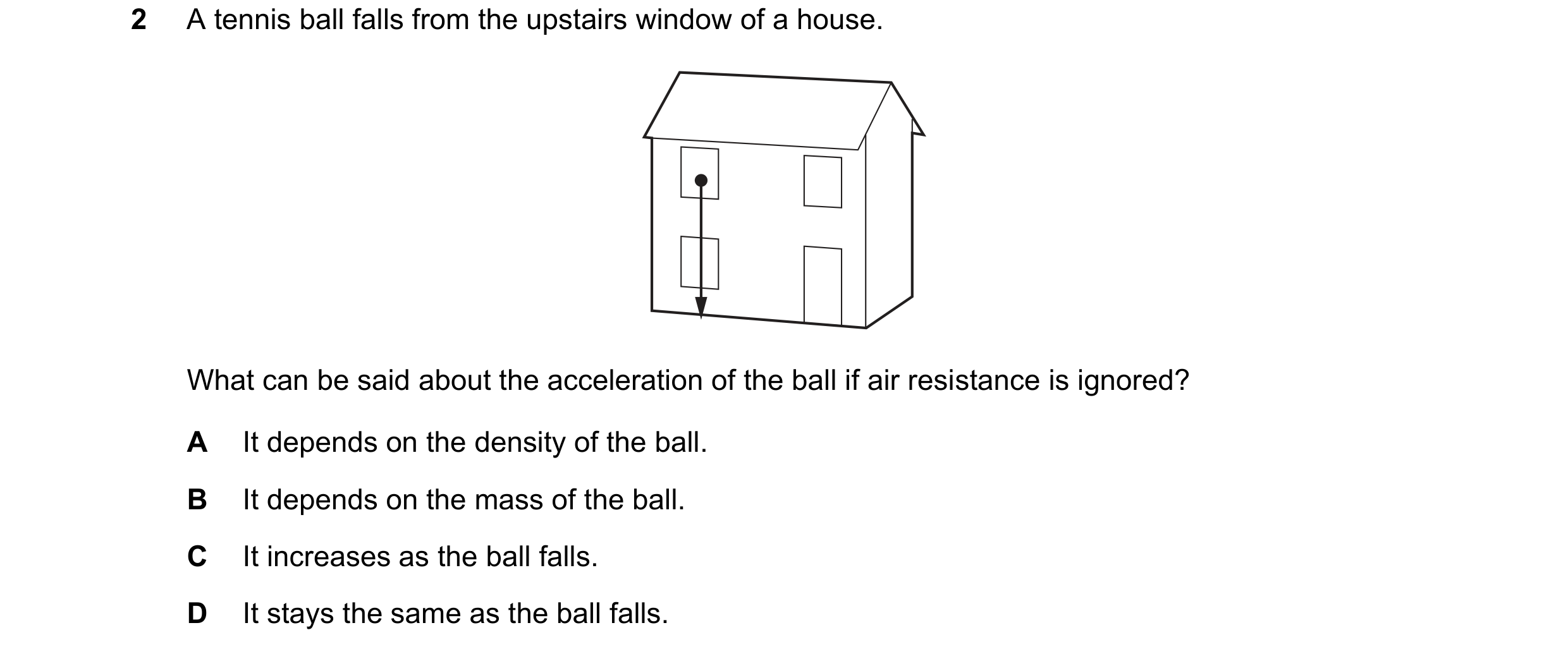



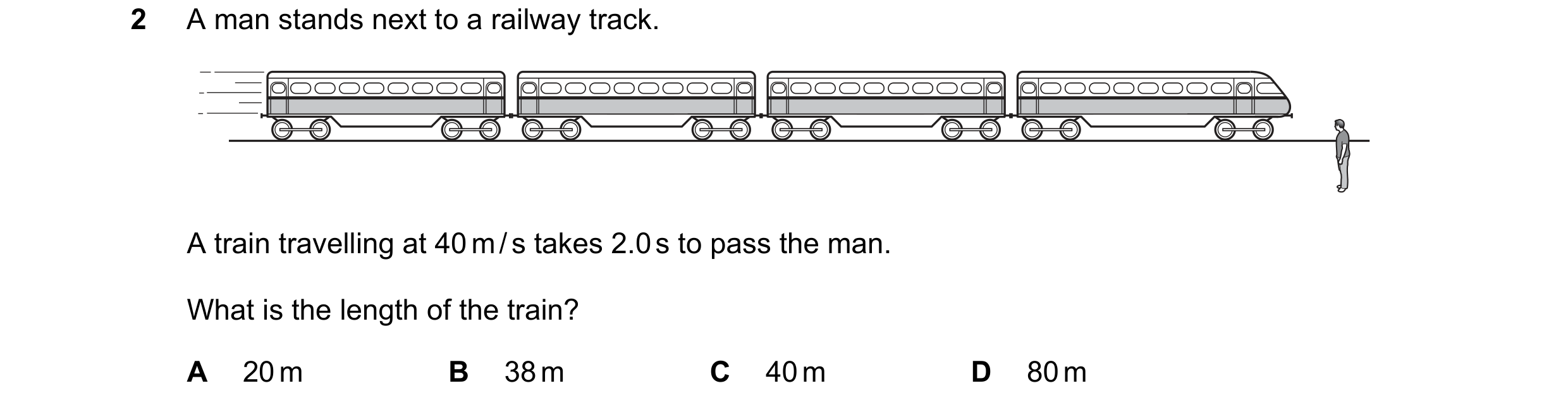 37 / 56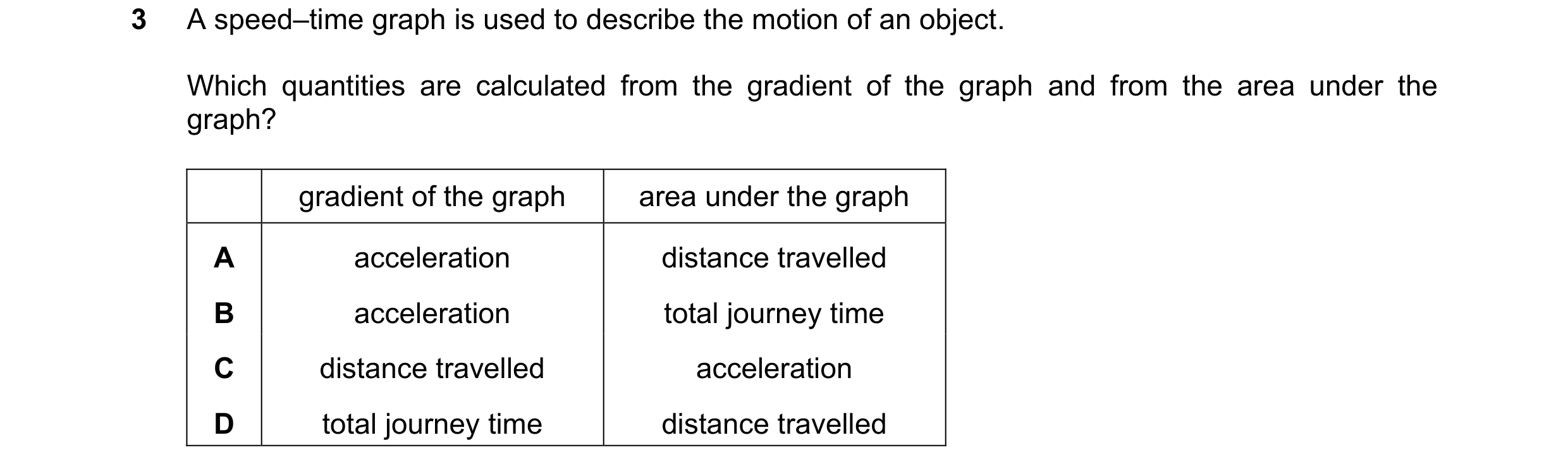
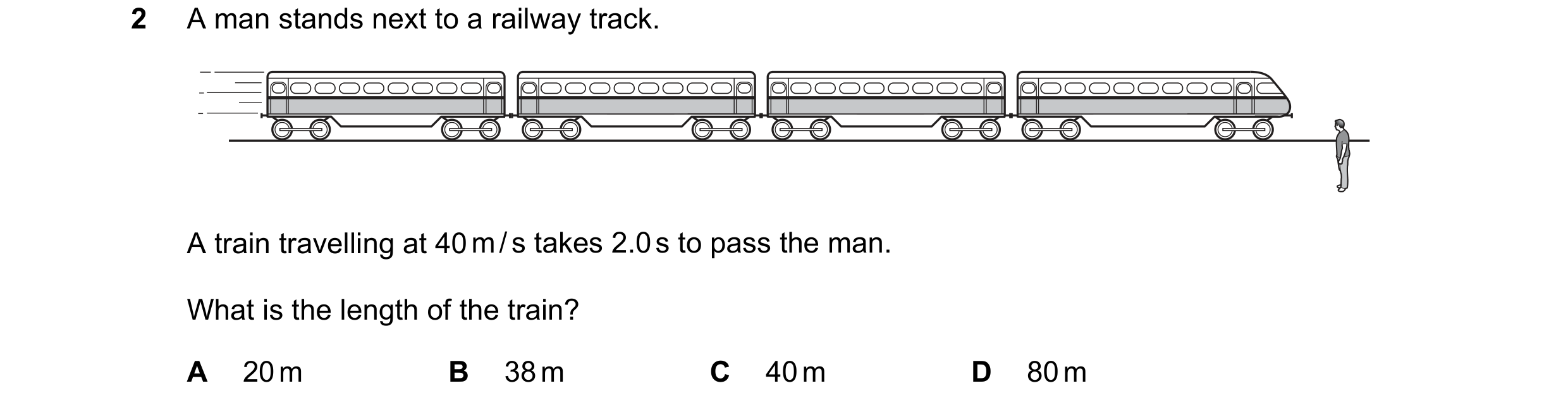

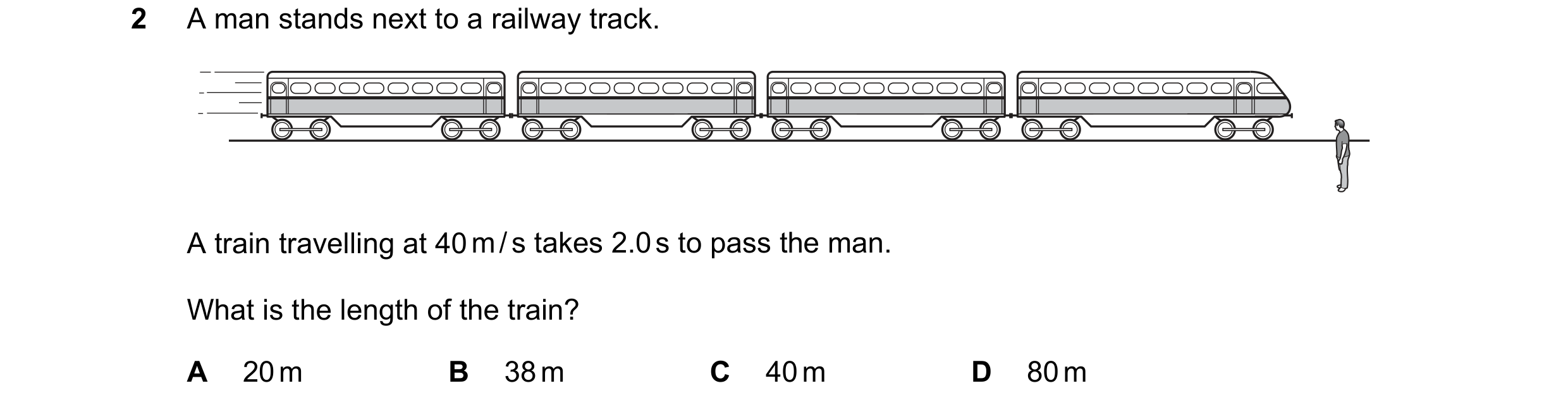 38 / 56
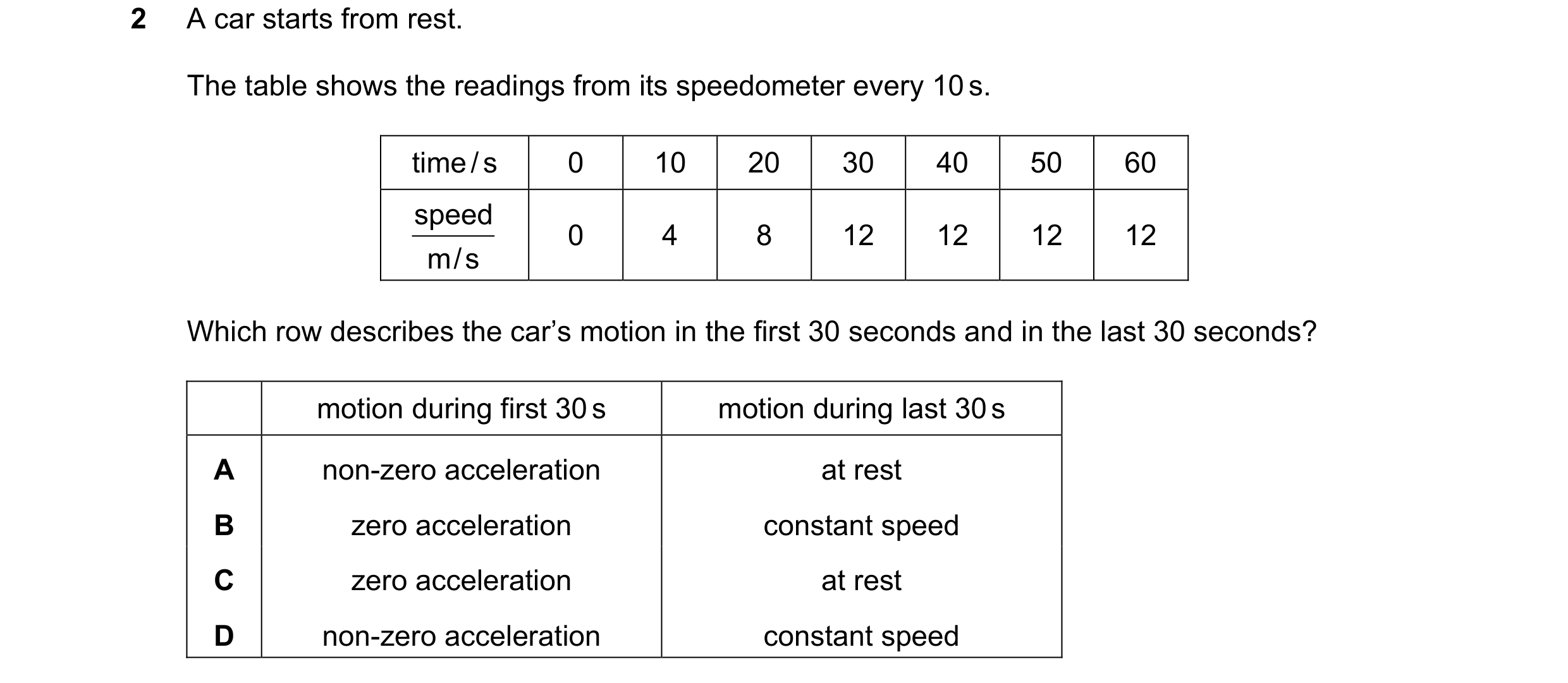
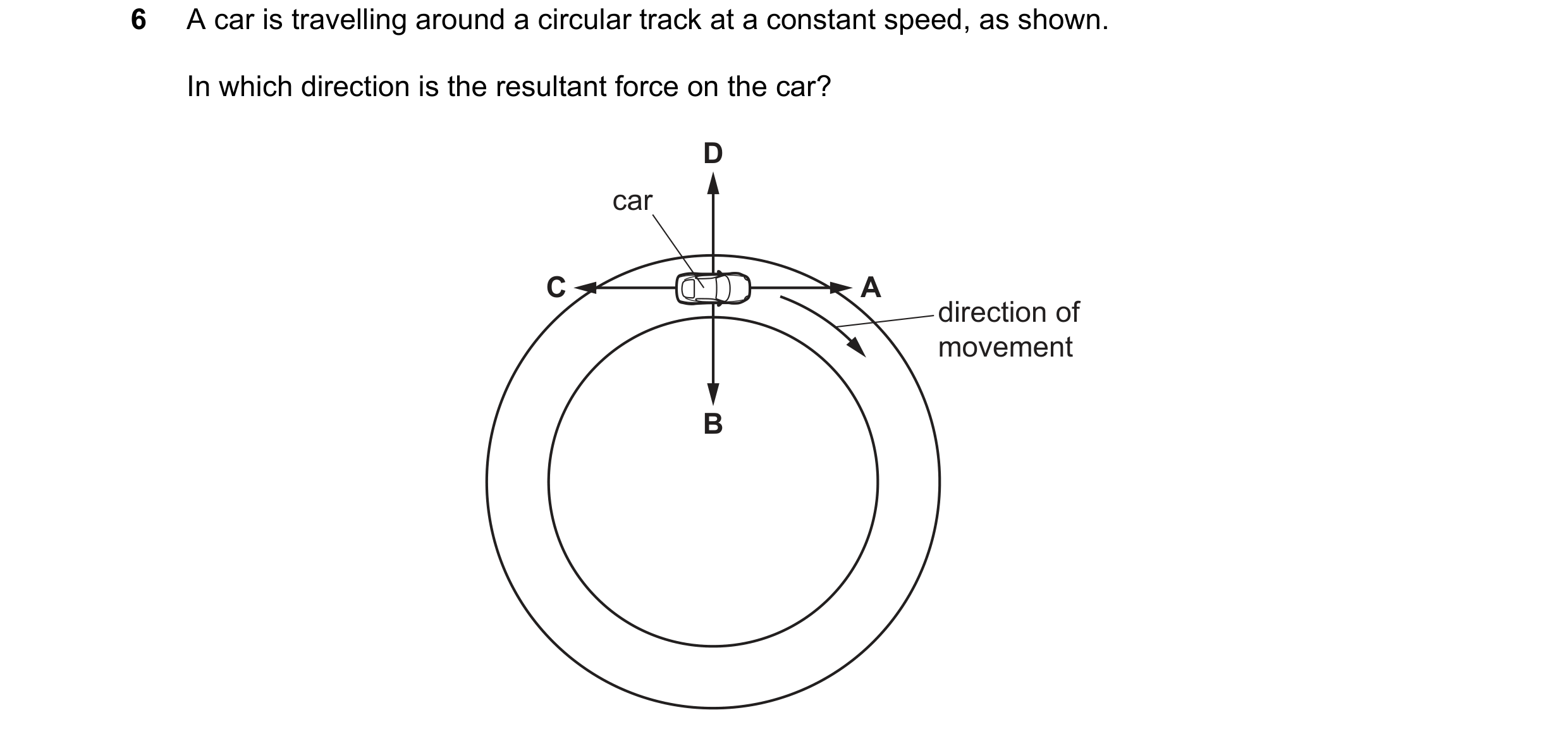 39 / 56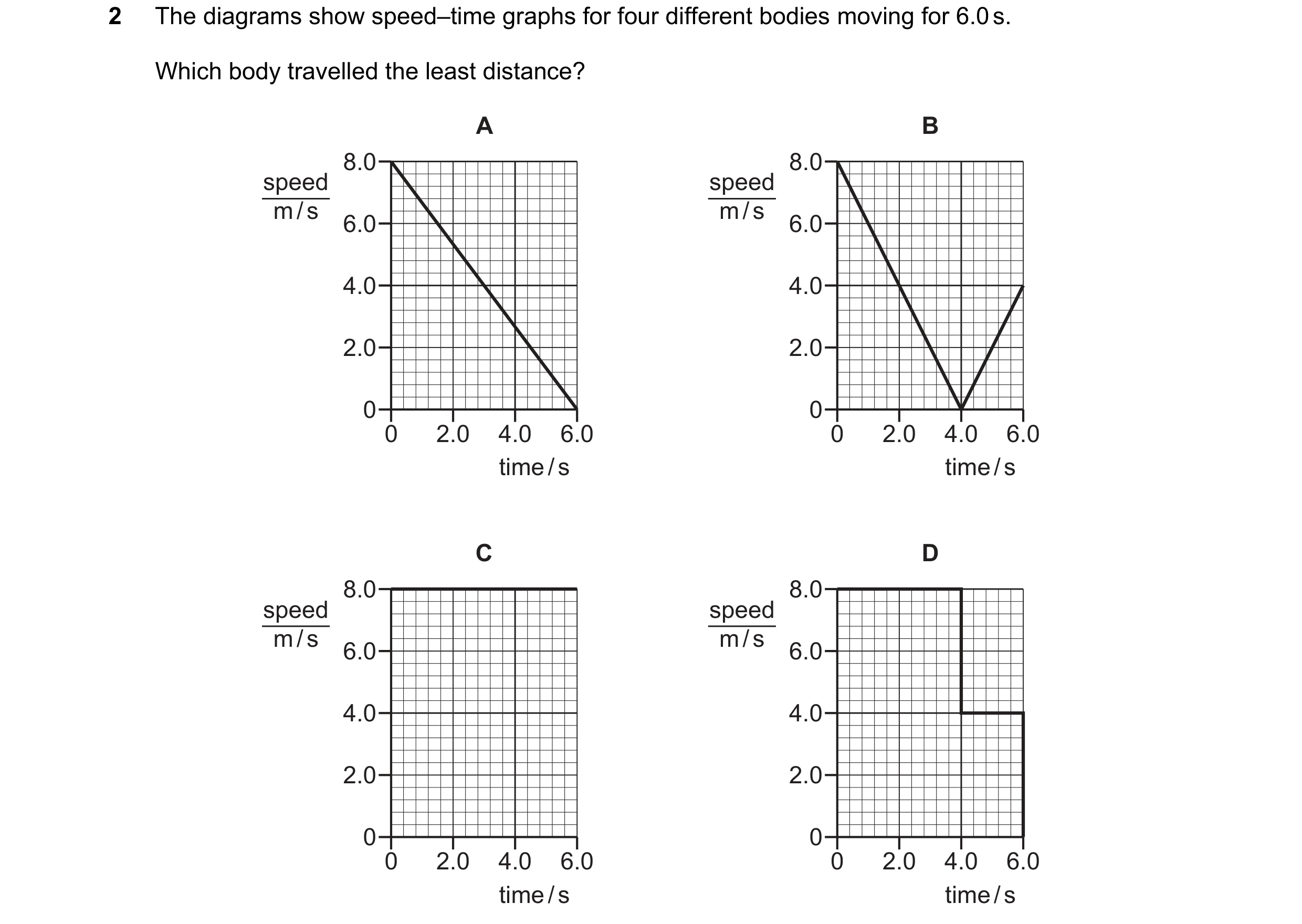
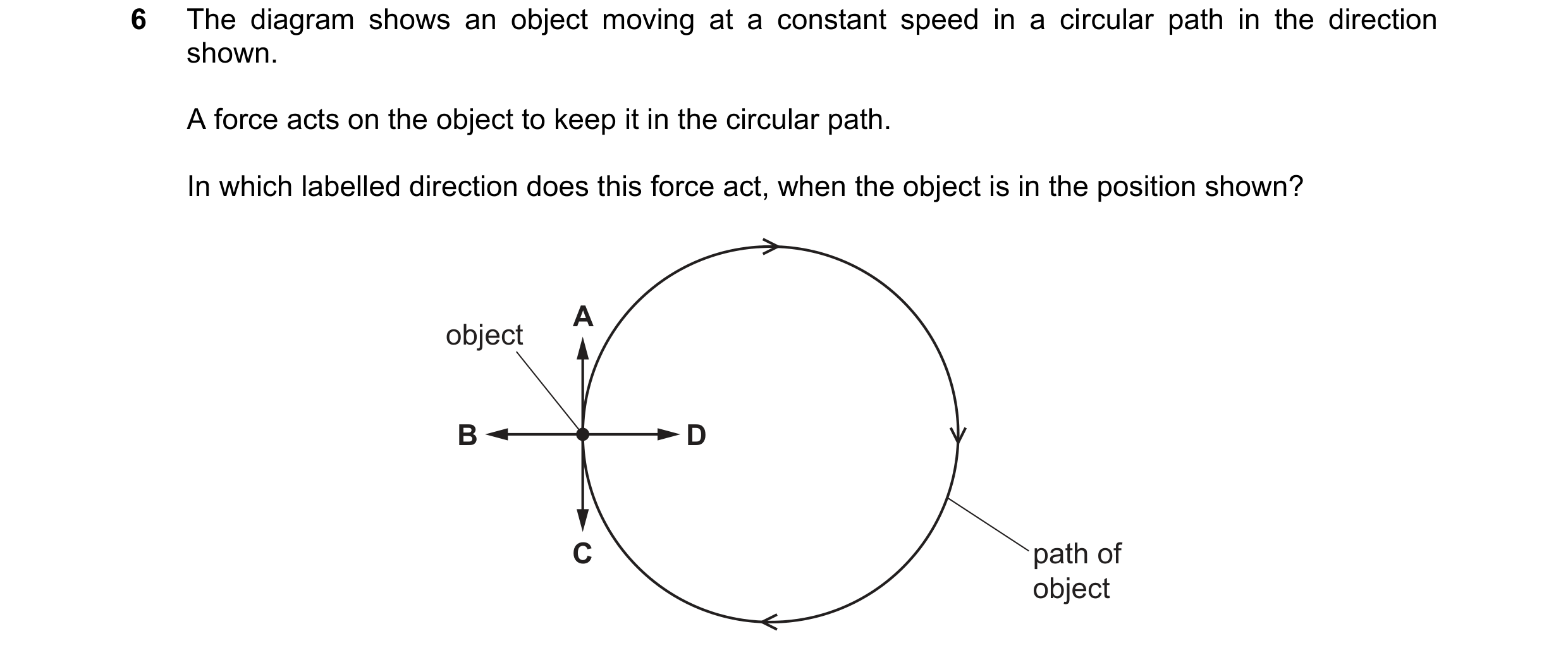 40 / 56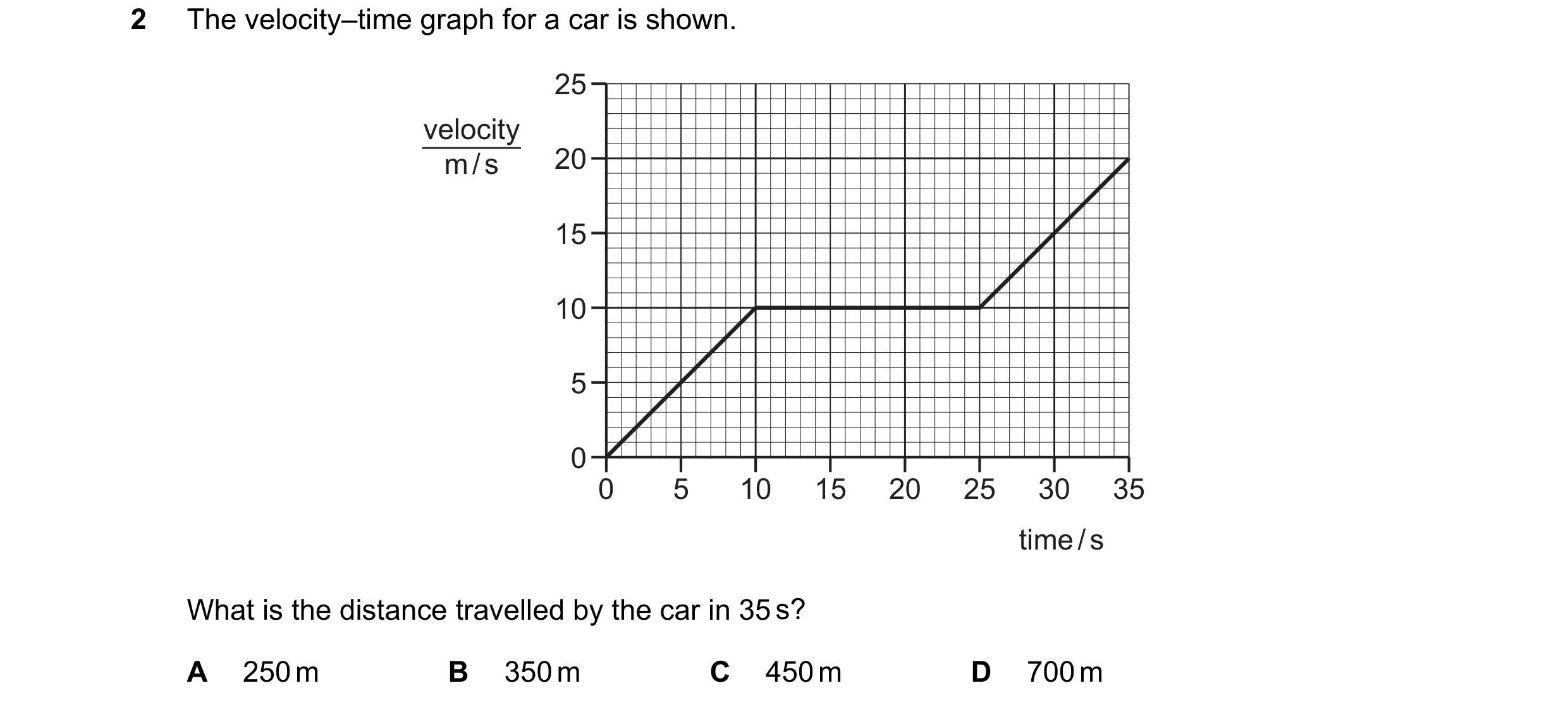
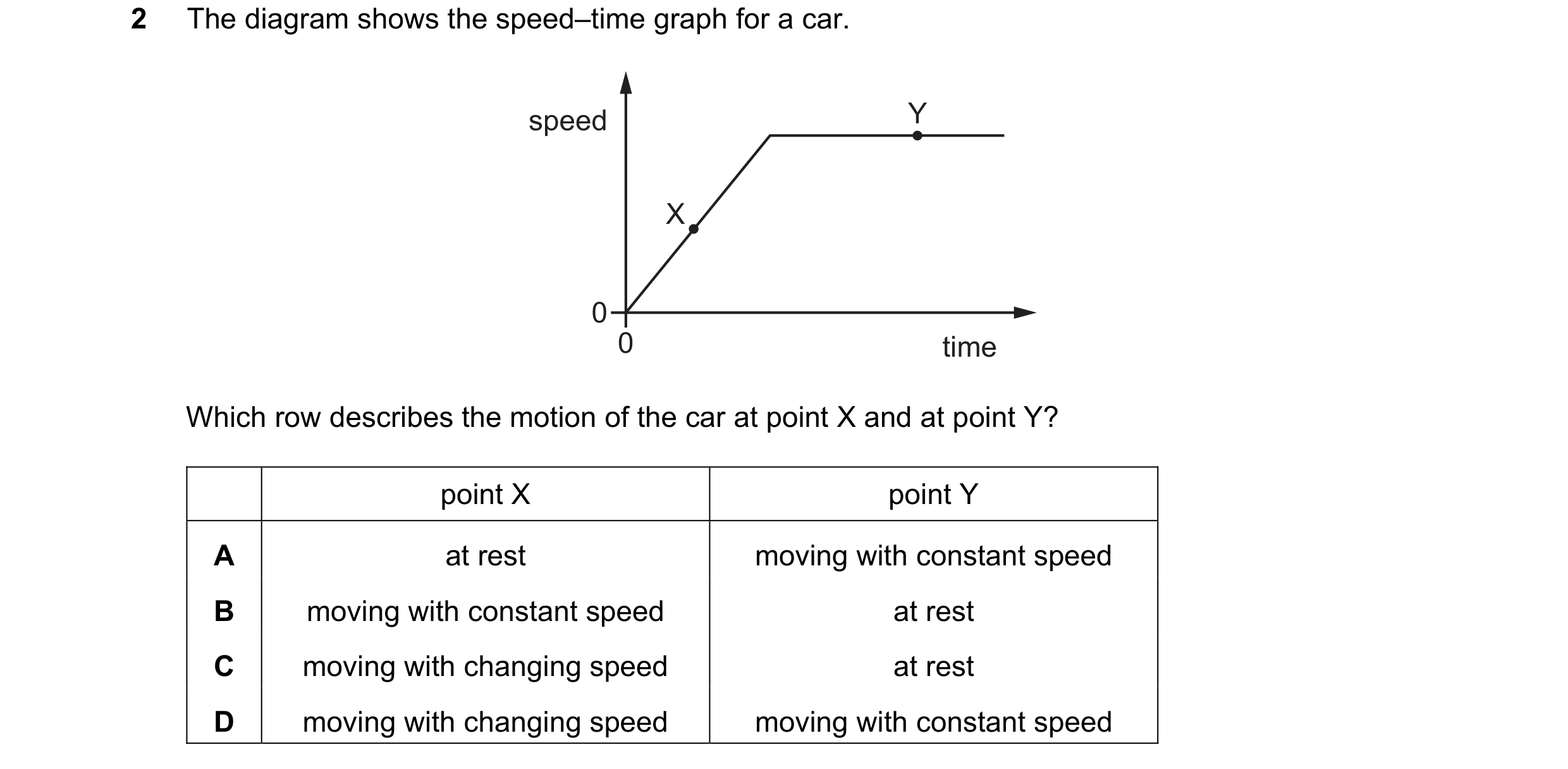
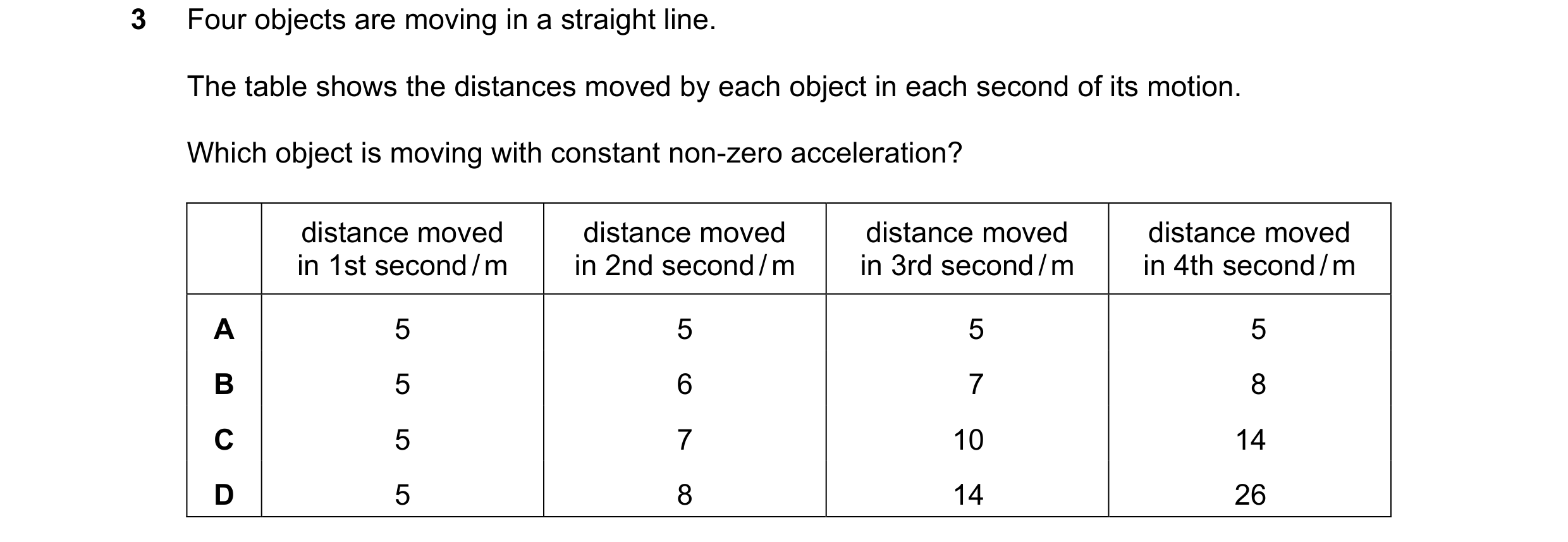 41 / 56
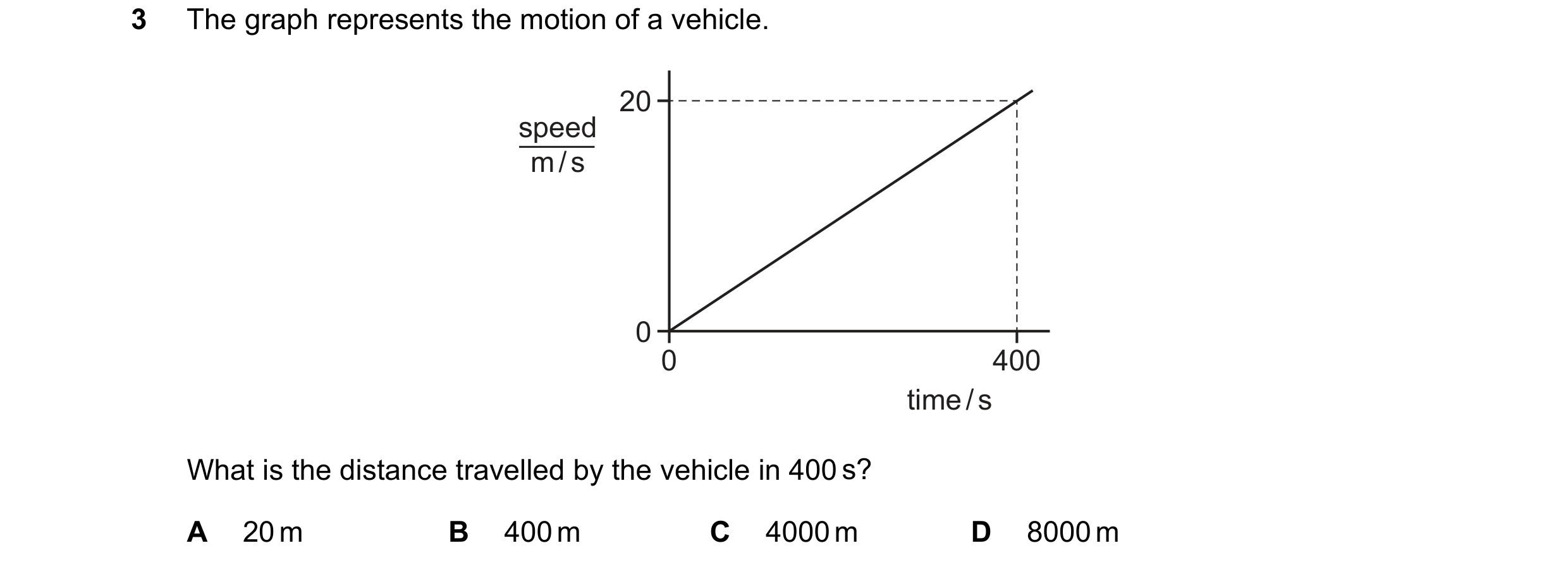
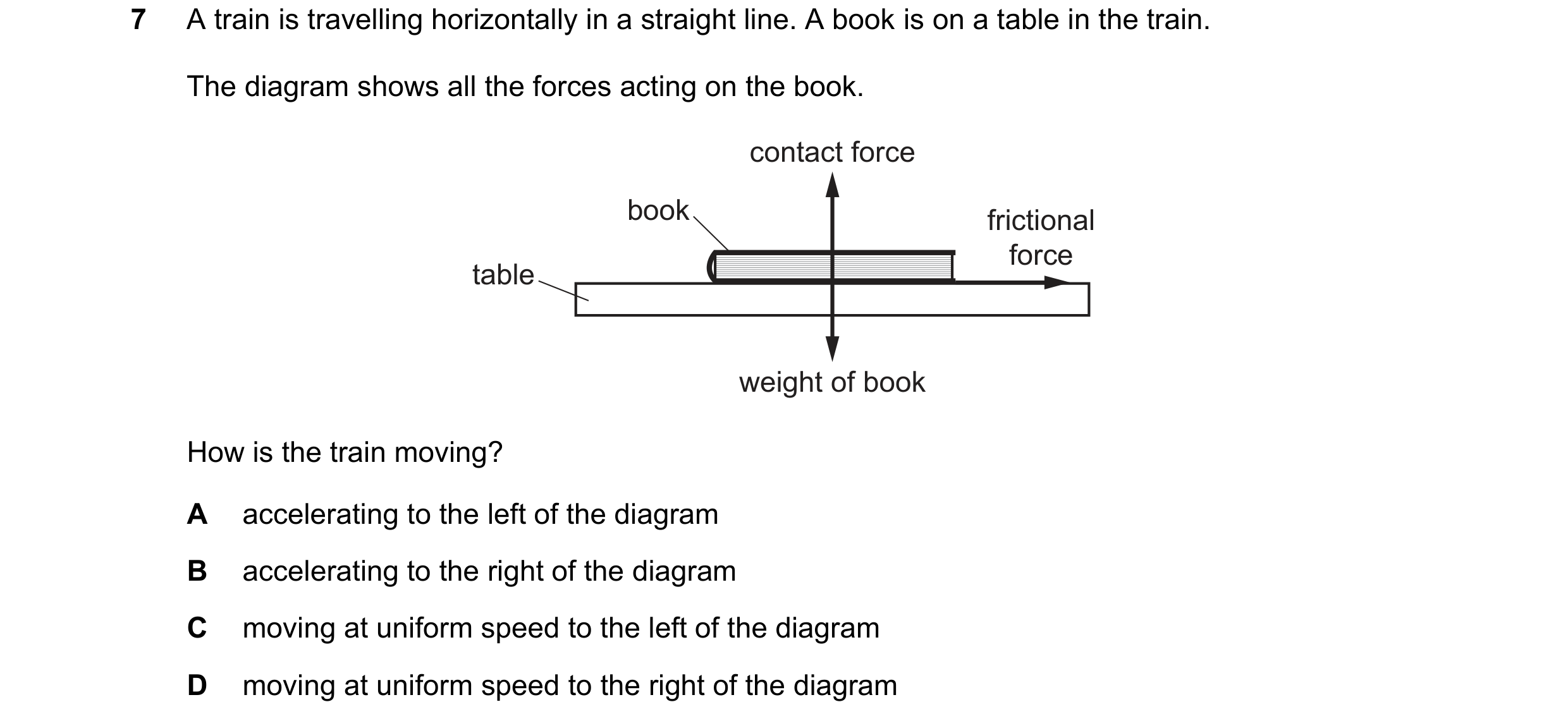
 42 / 56
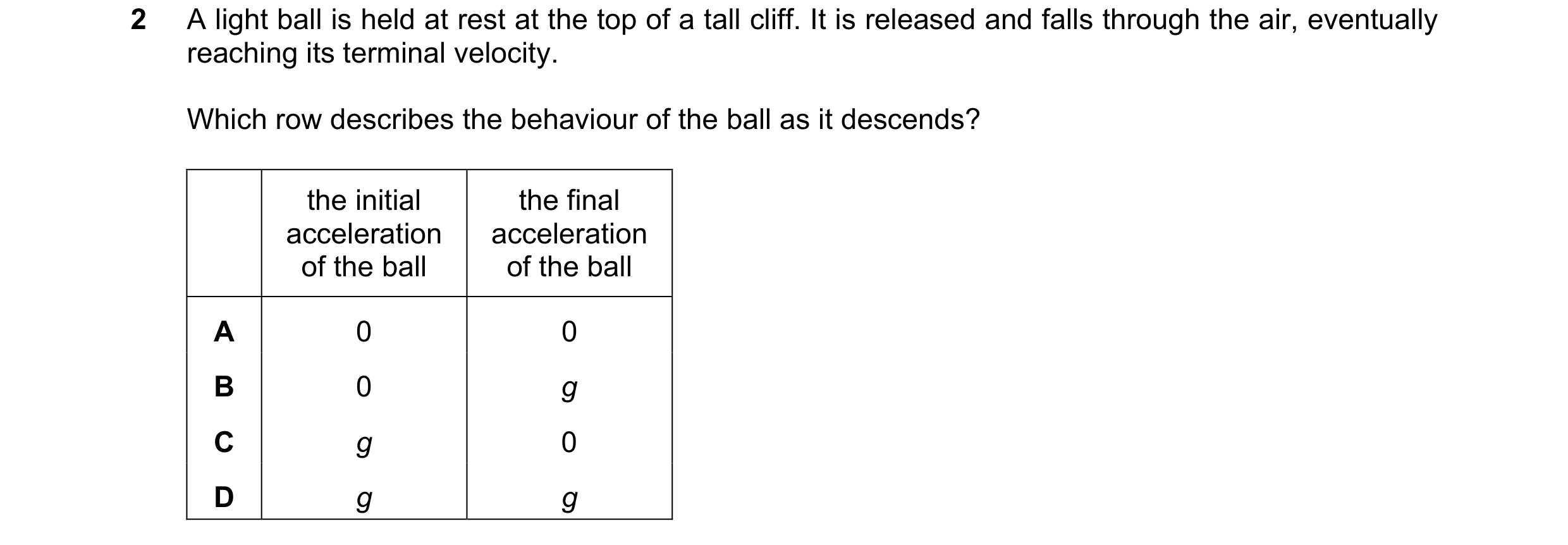
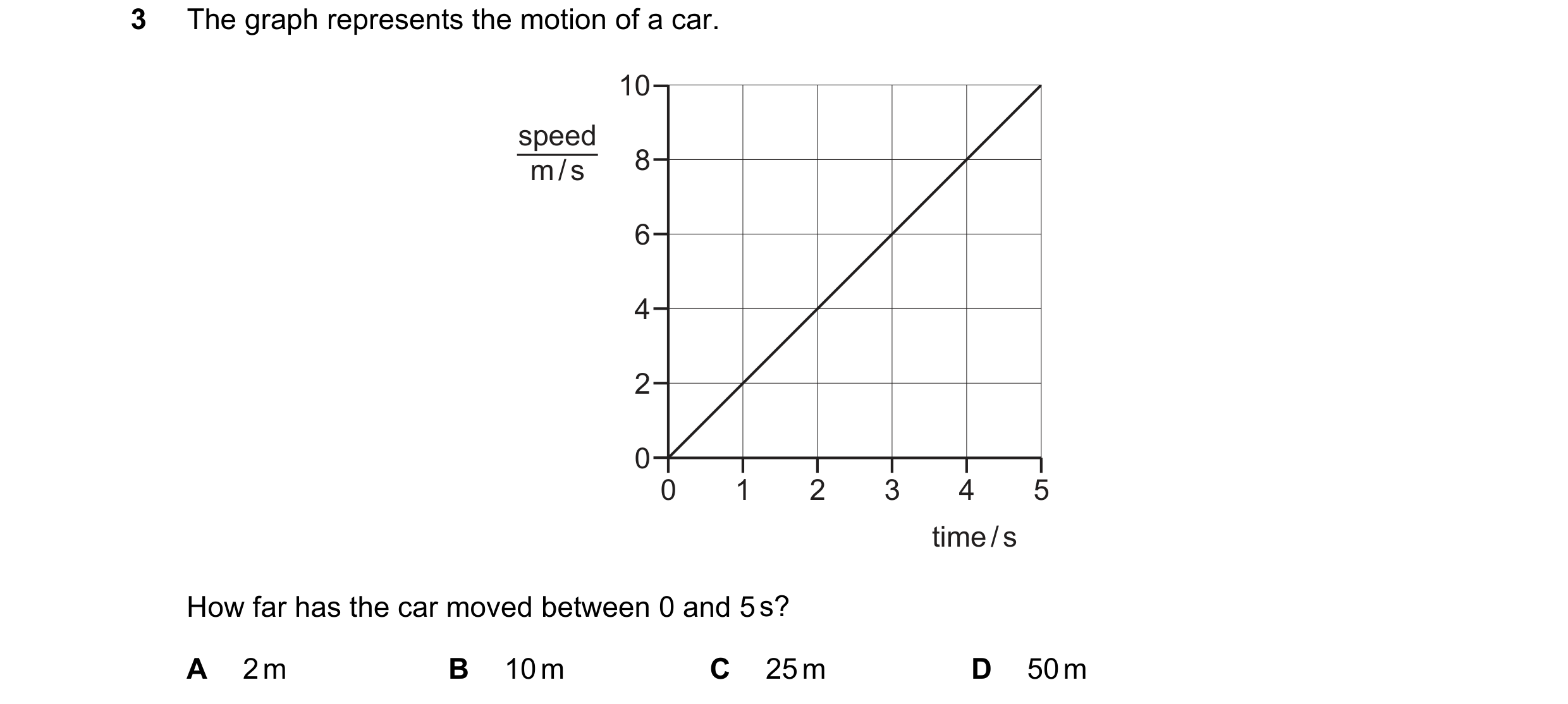 43 / 56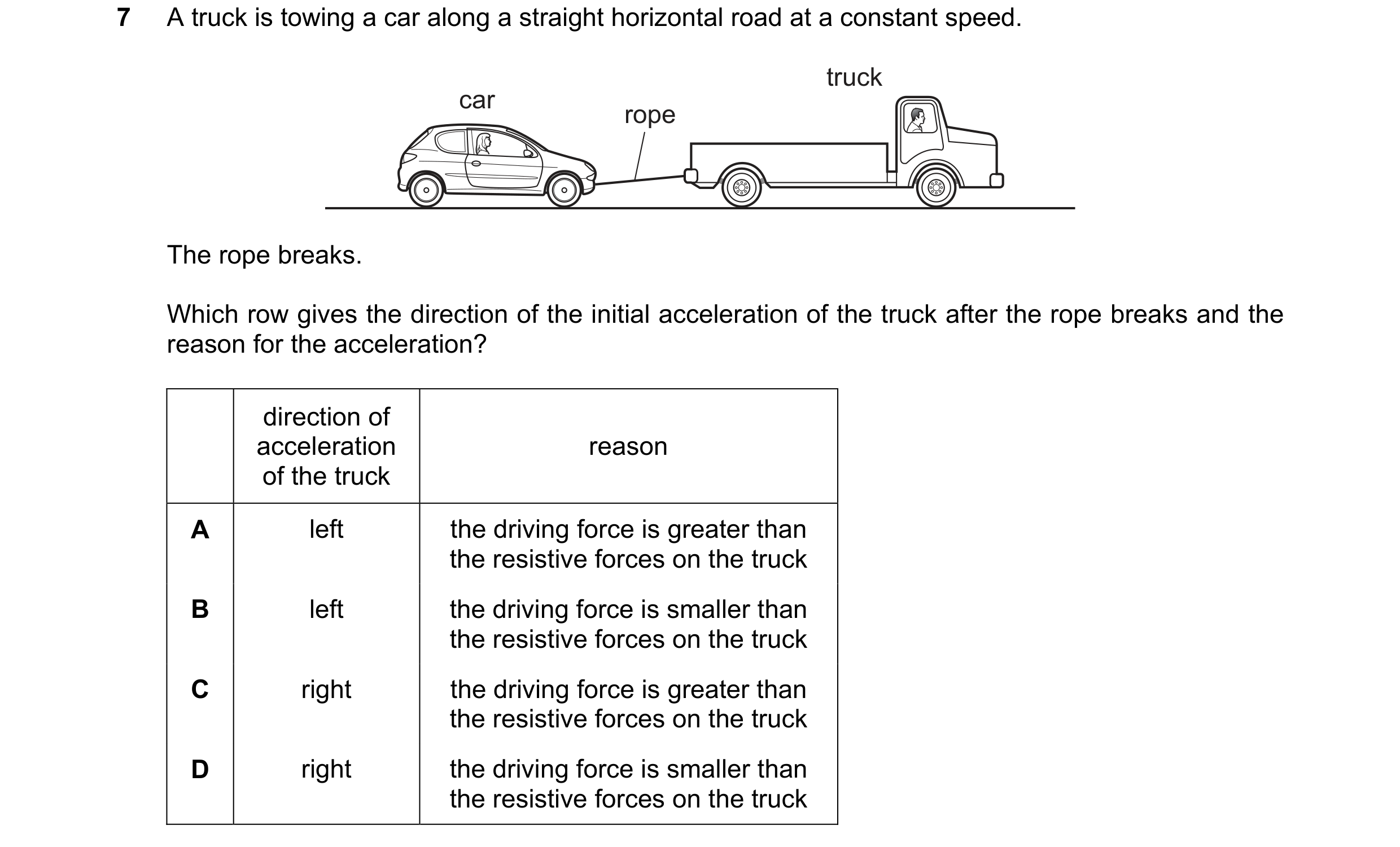

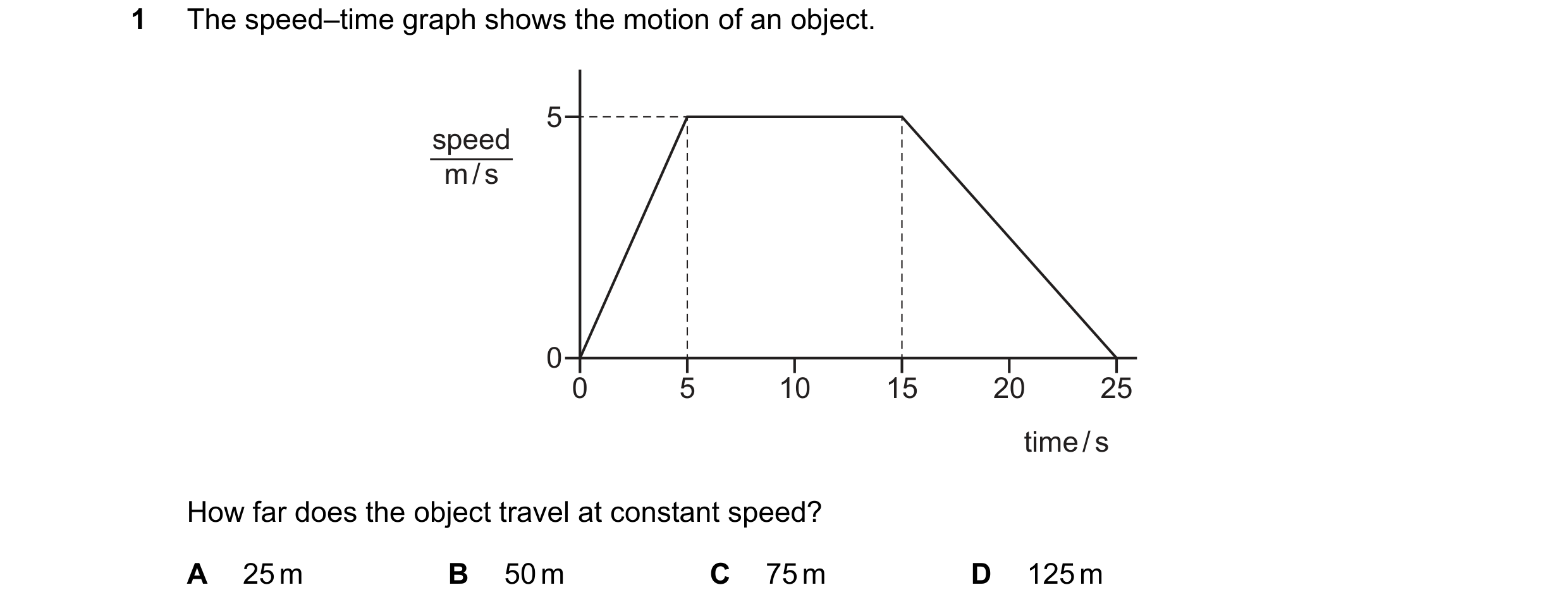
 44 / 56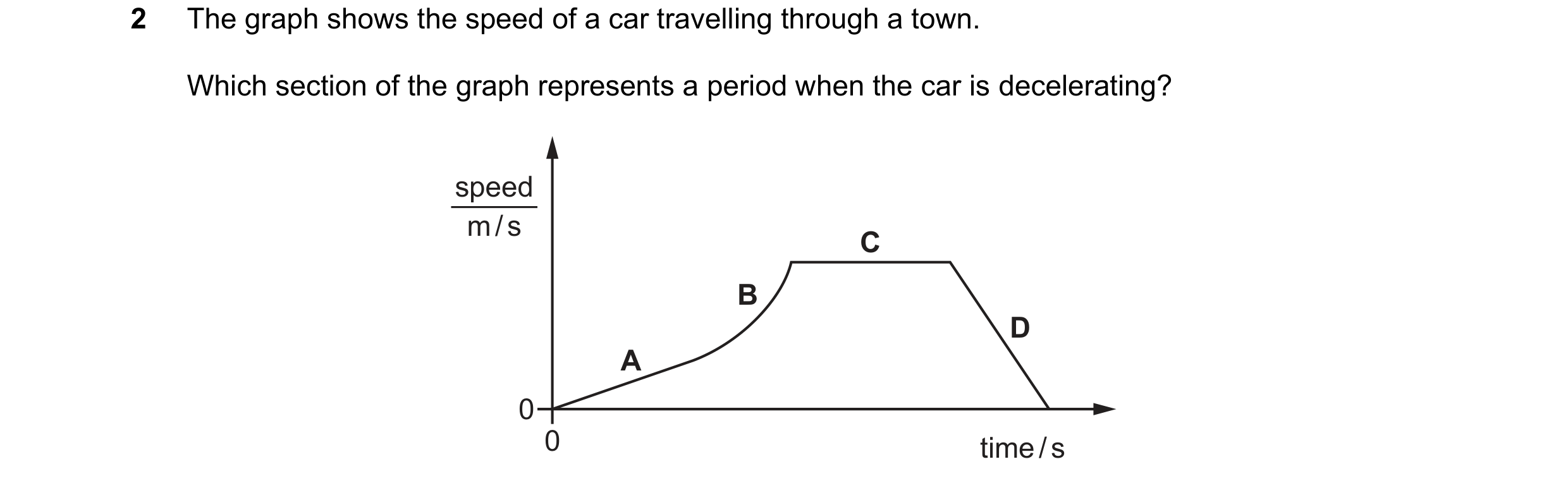
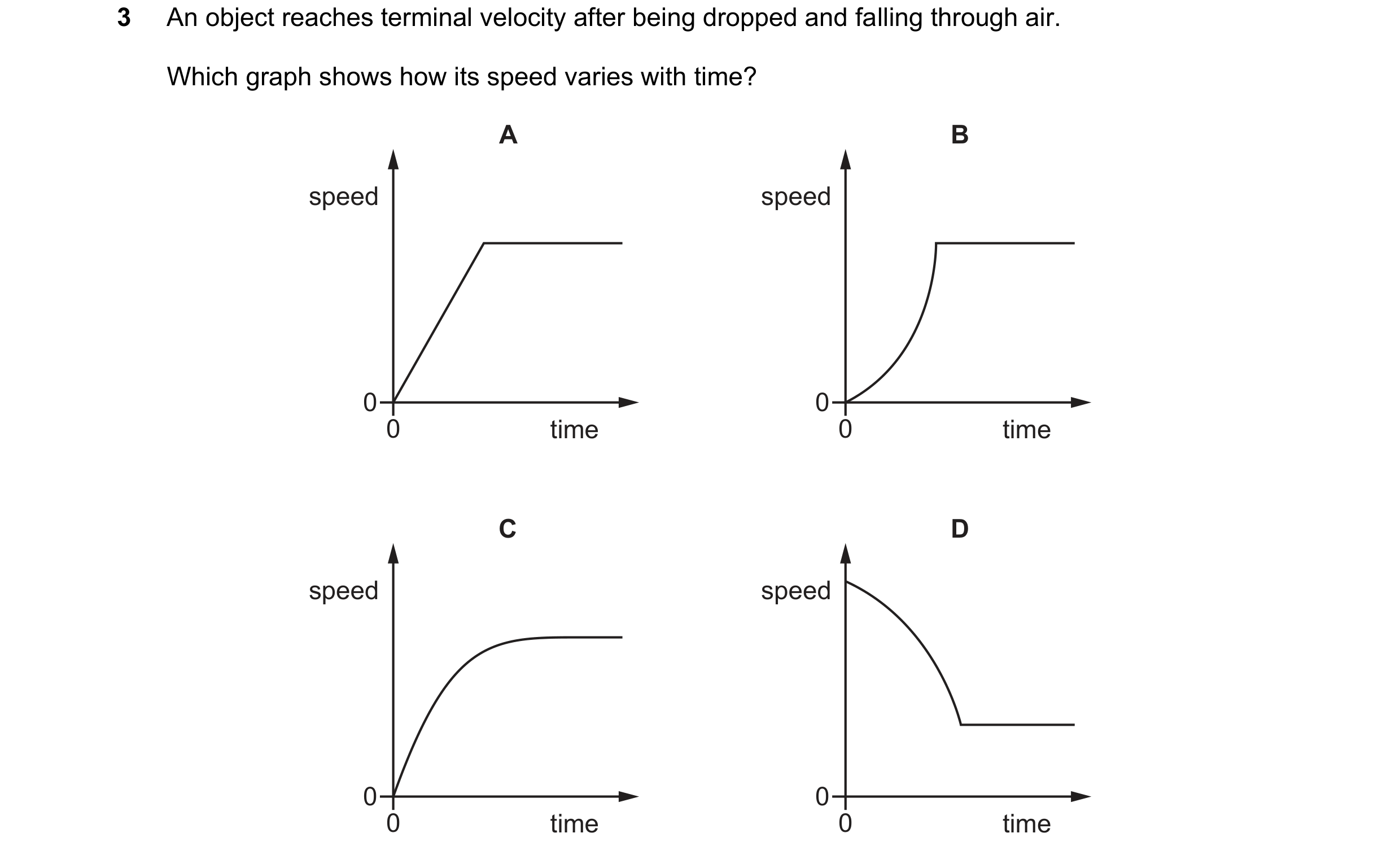
 45 / 56
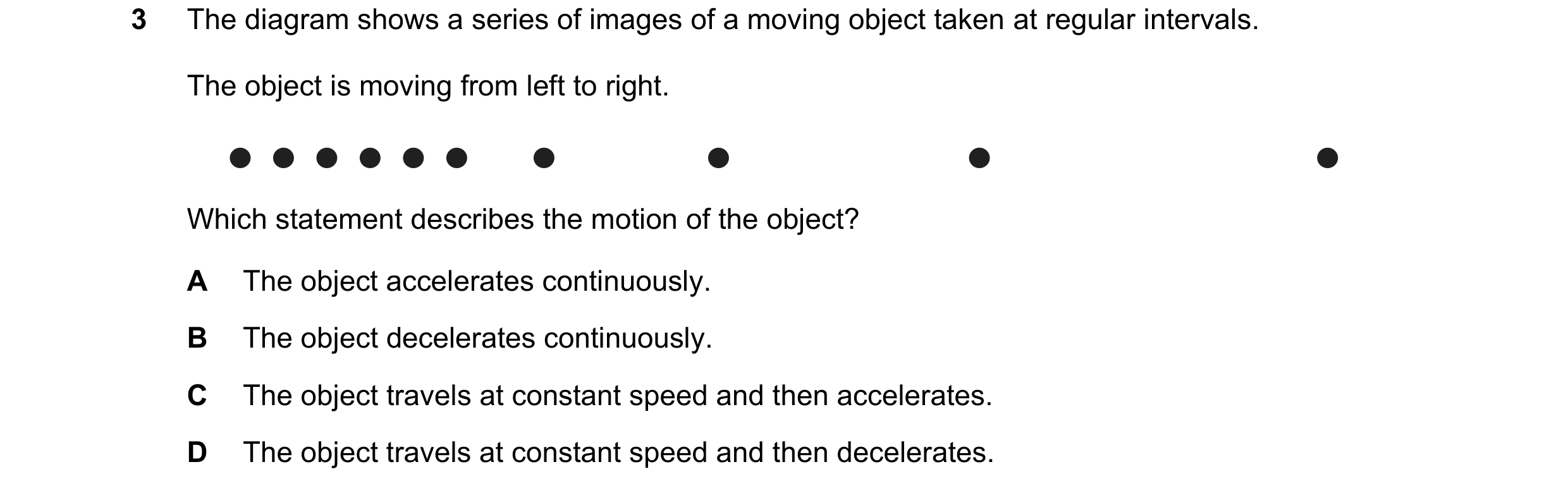
 46 / 56
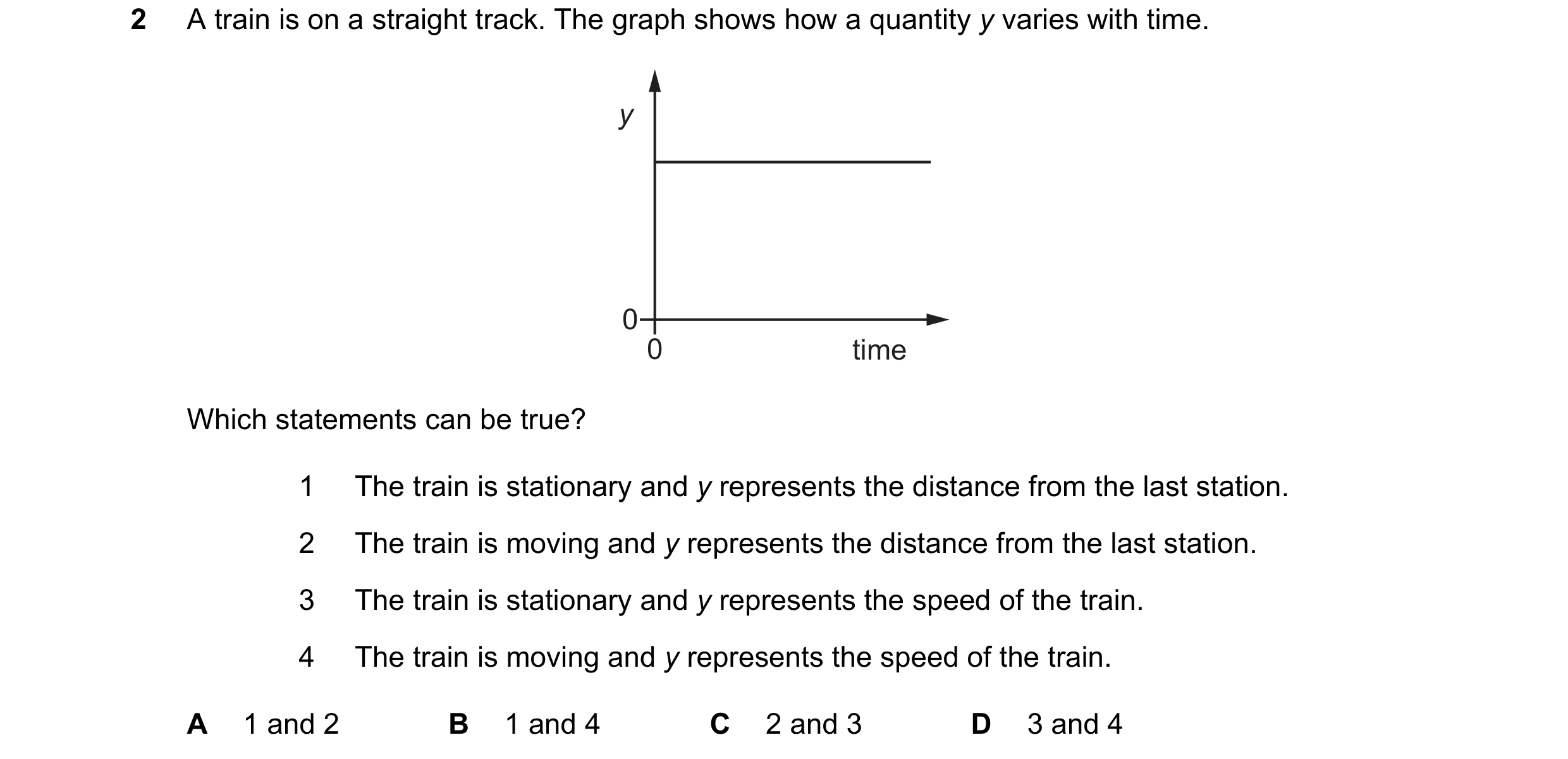
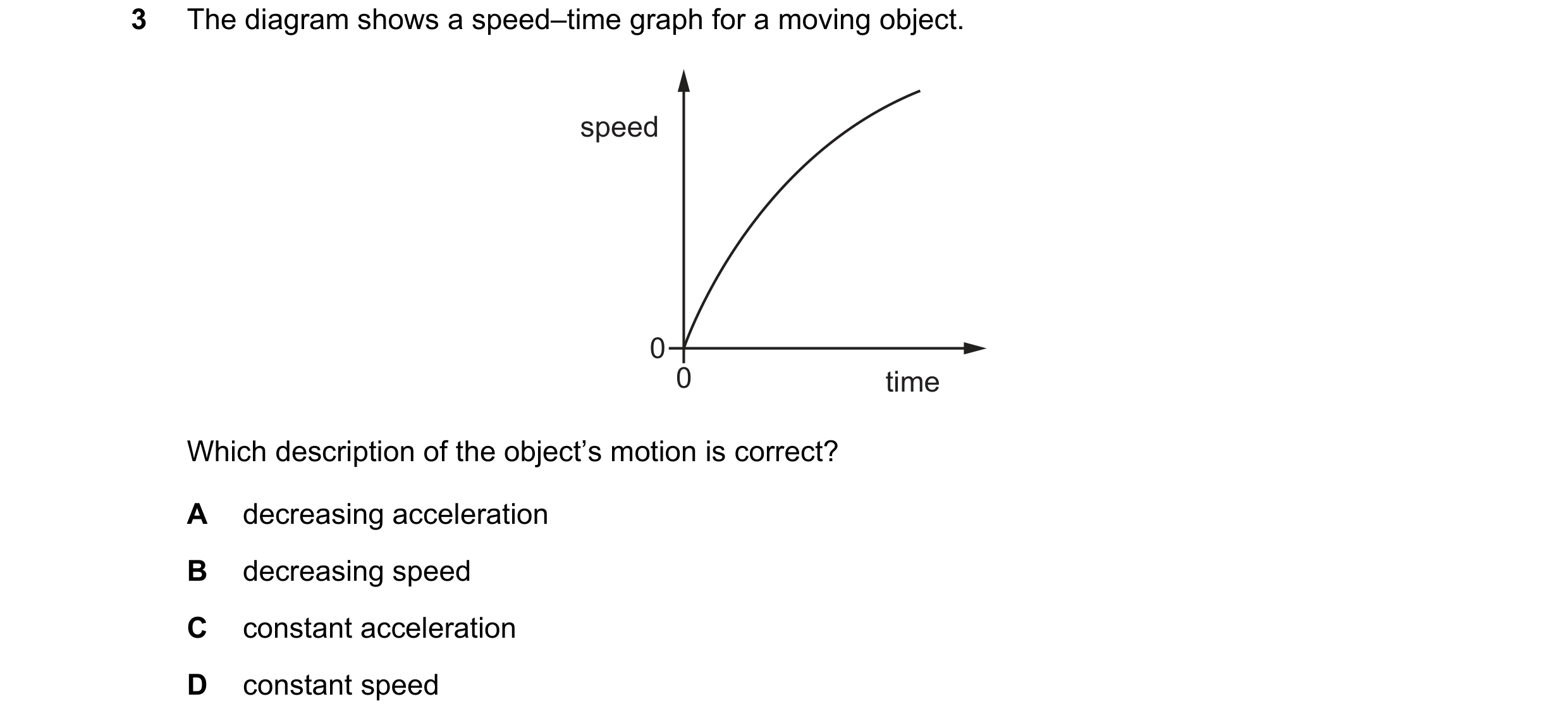 47 / 56
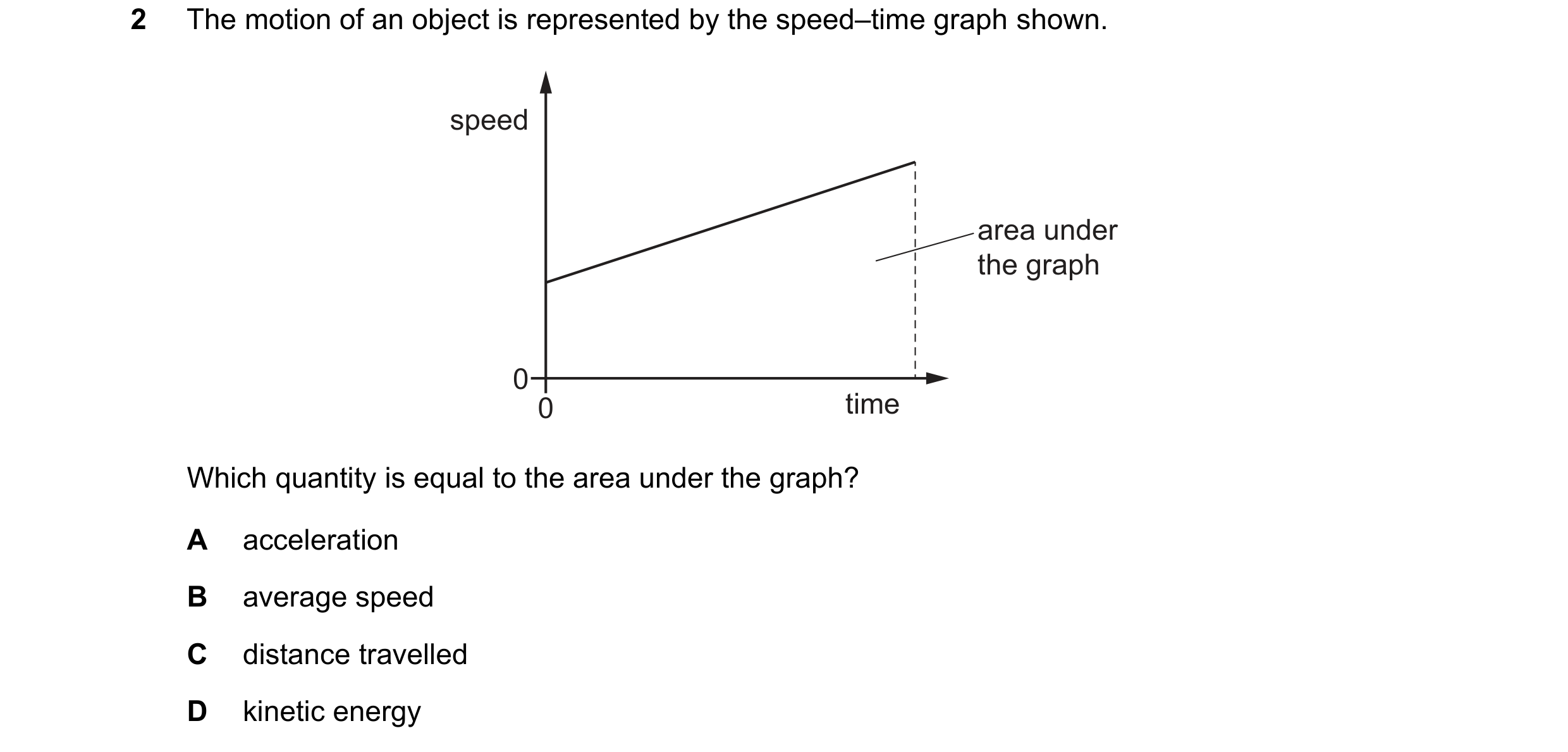
 48 / 56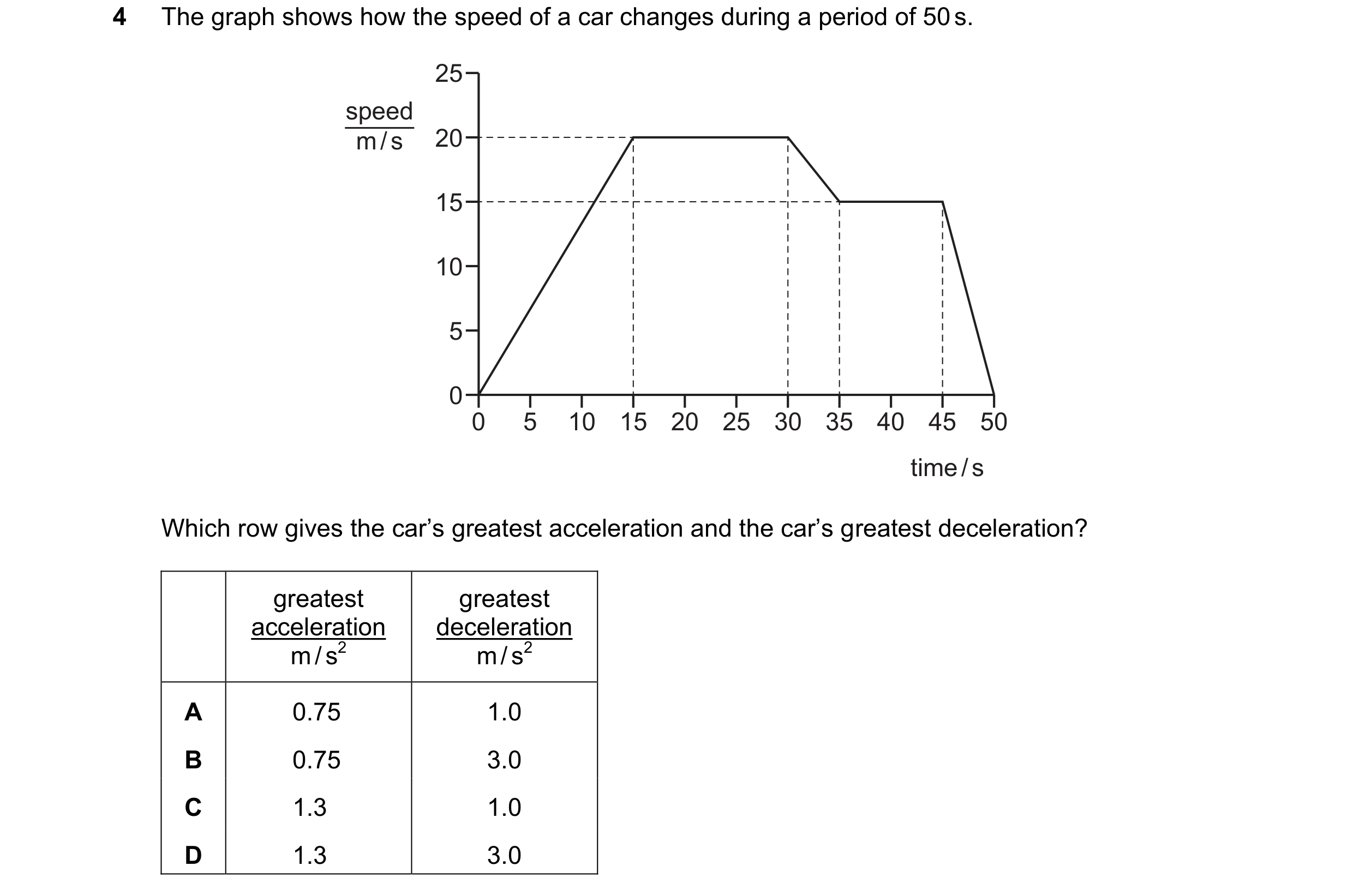

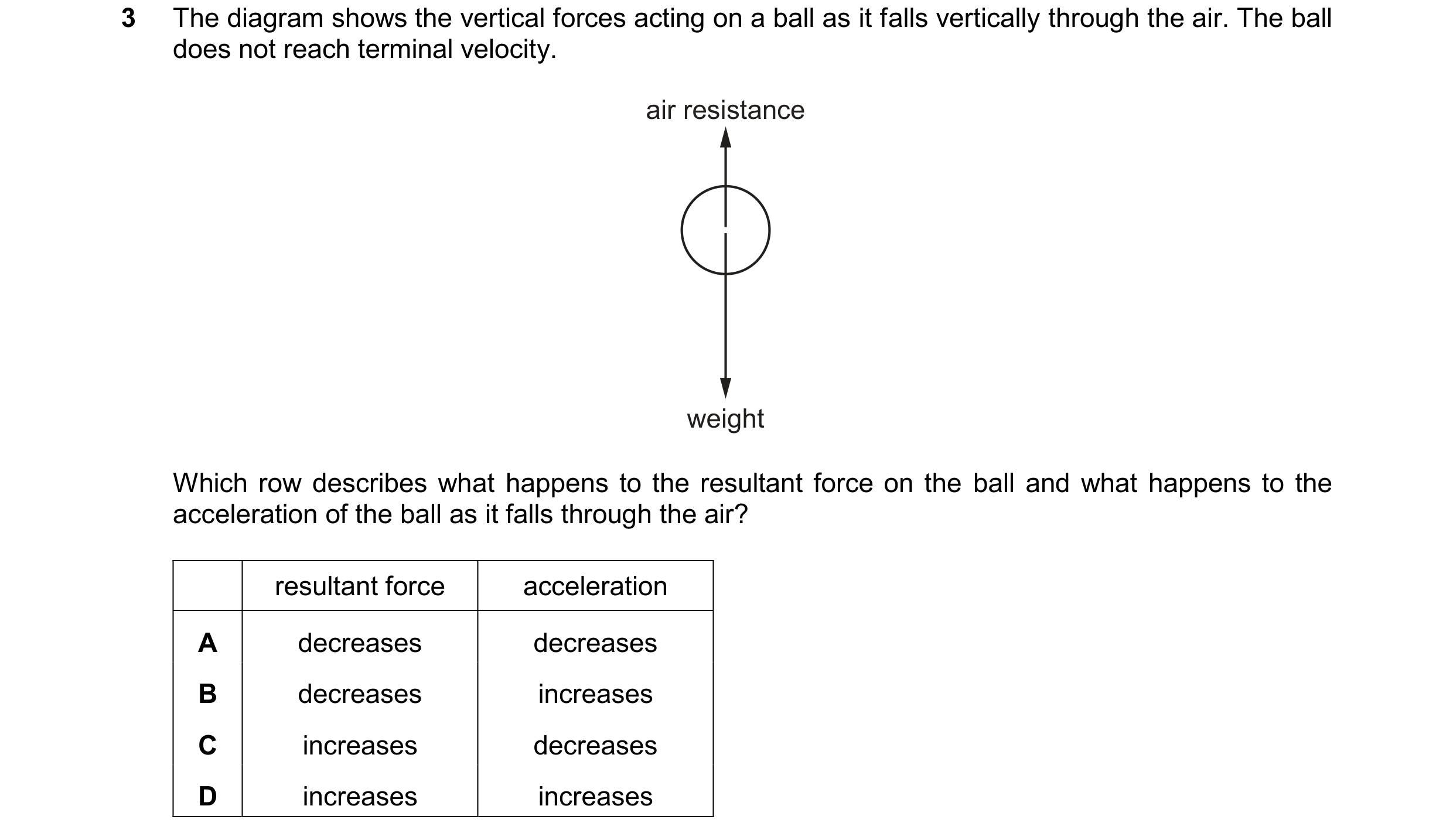 49 / 56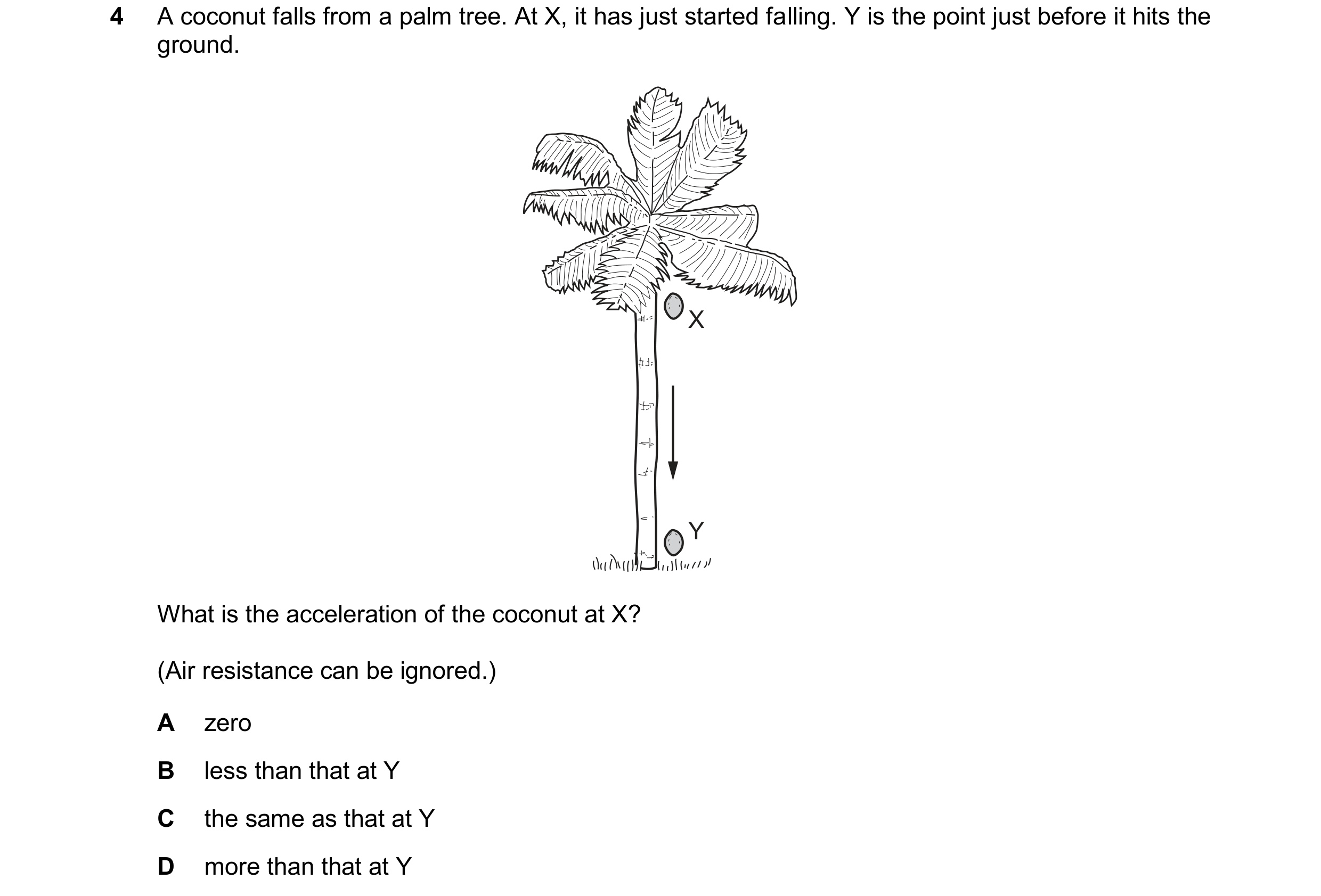
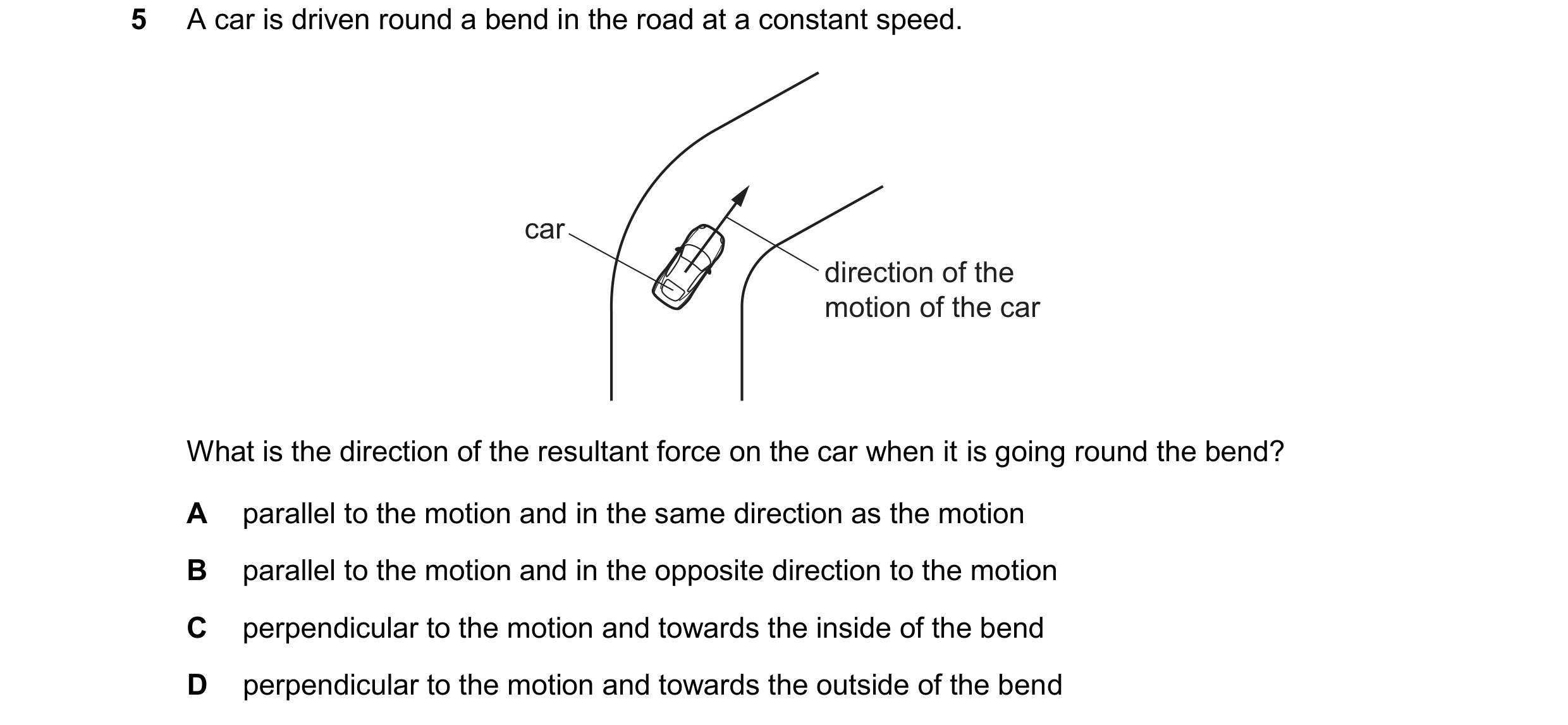
 50 / 56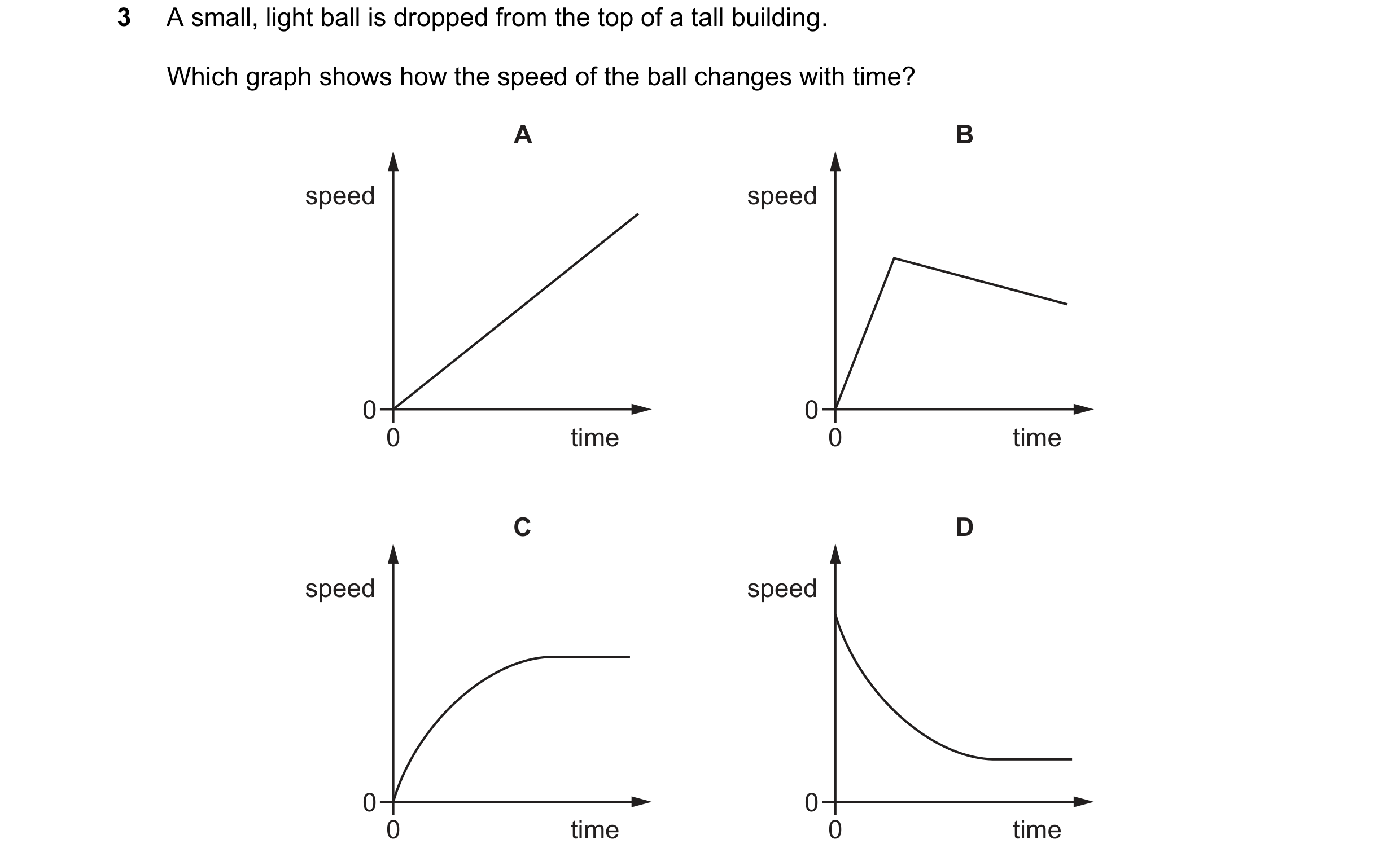
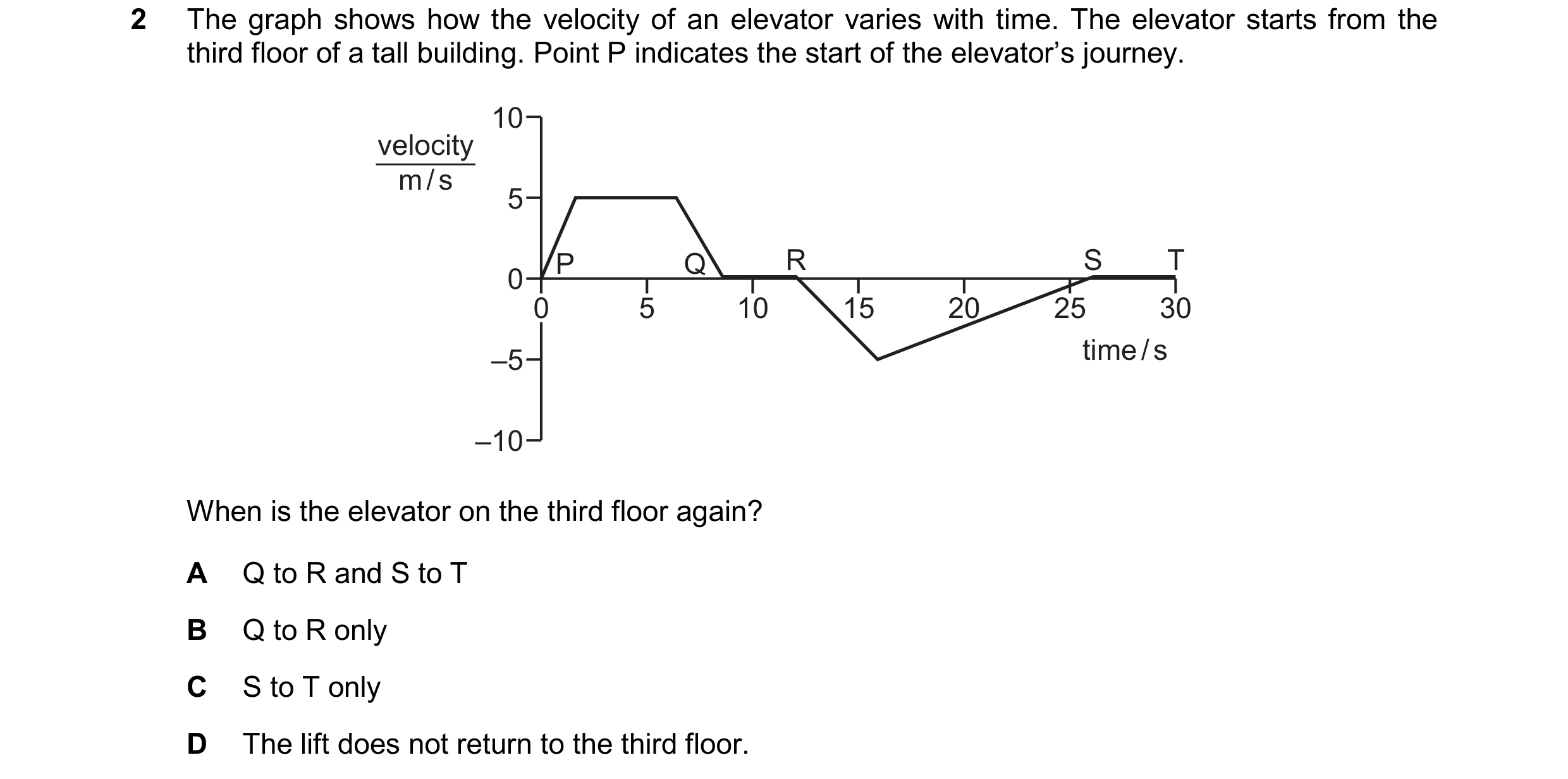
 51 / 56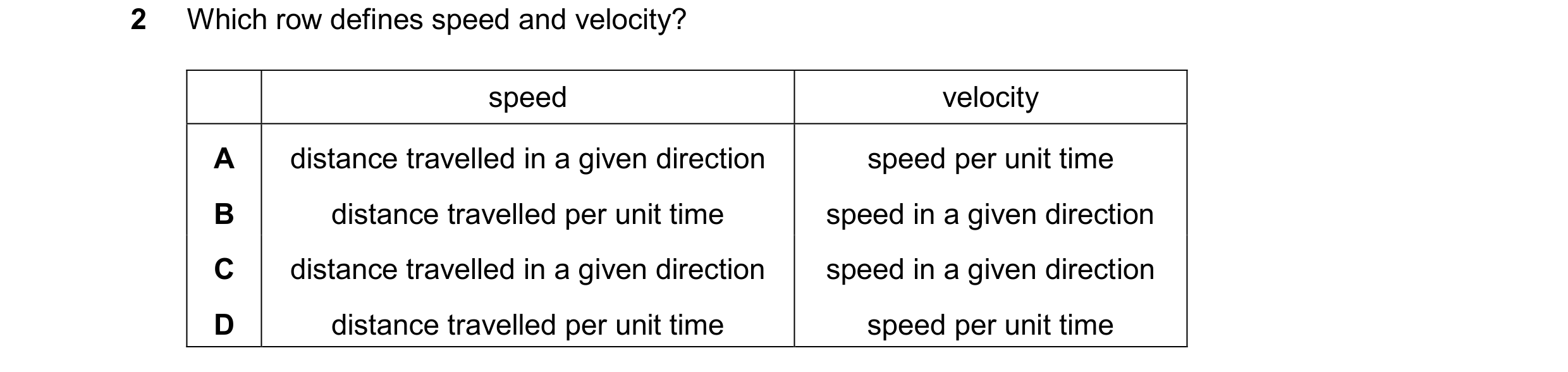
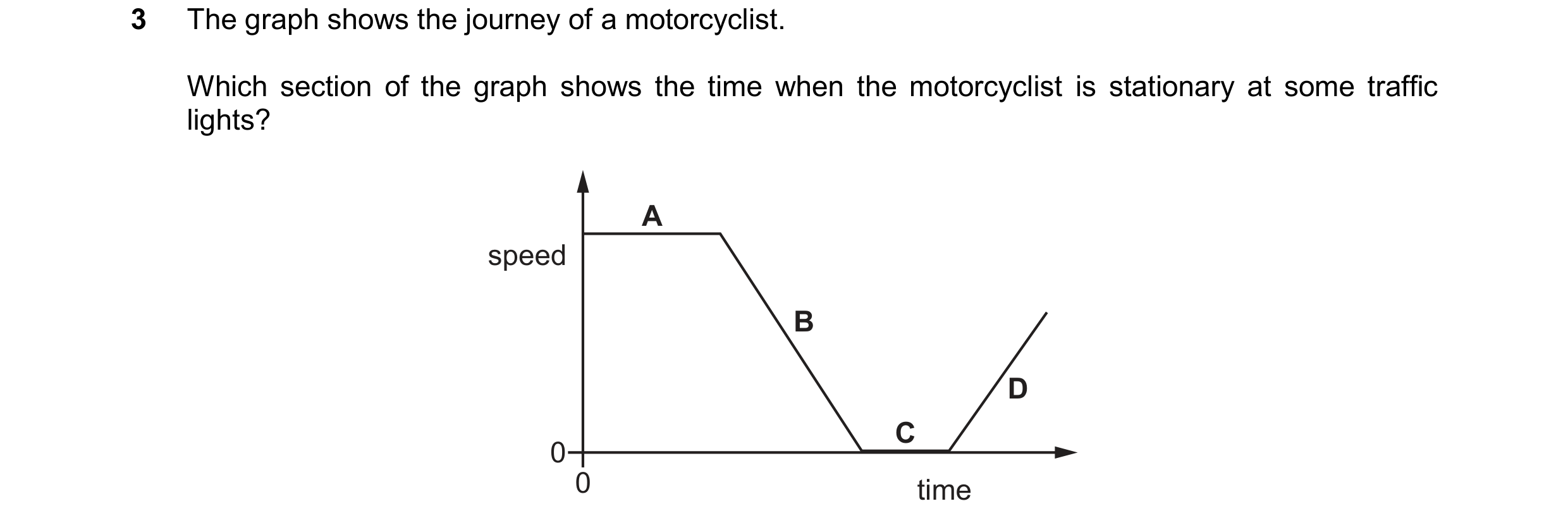
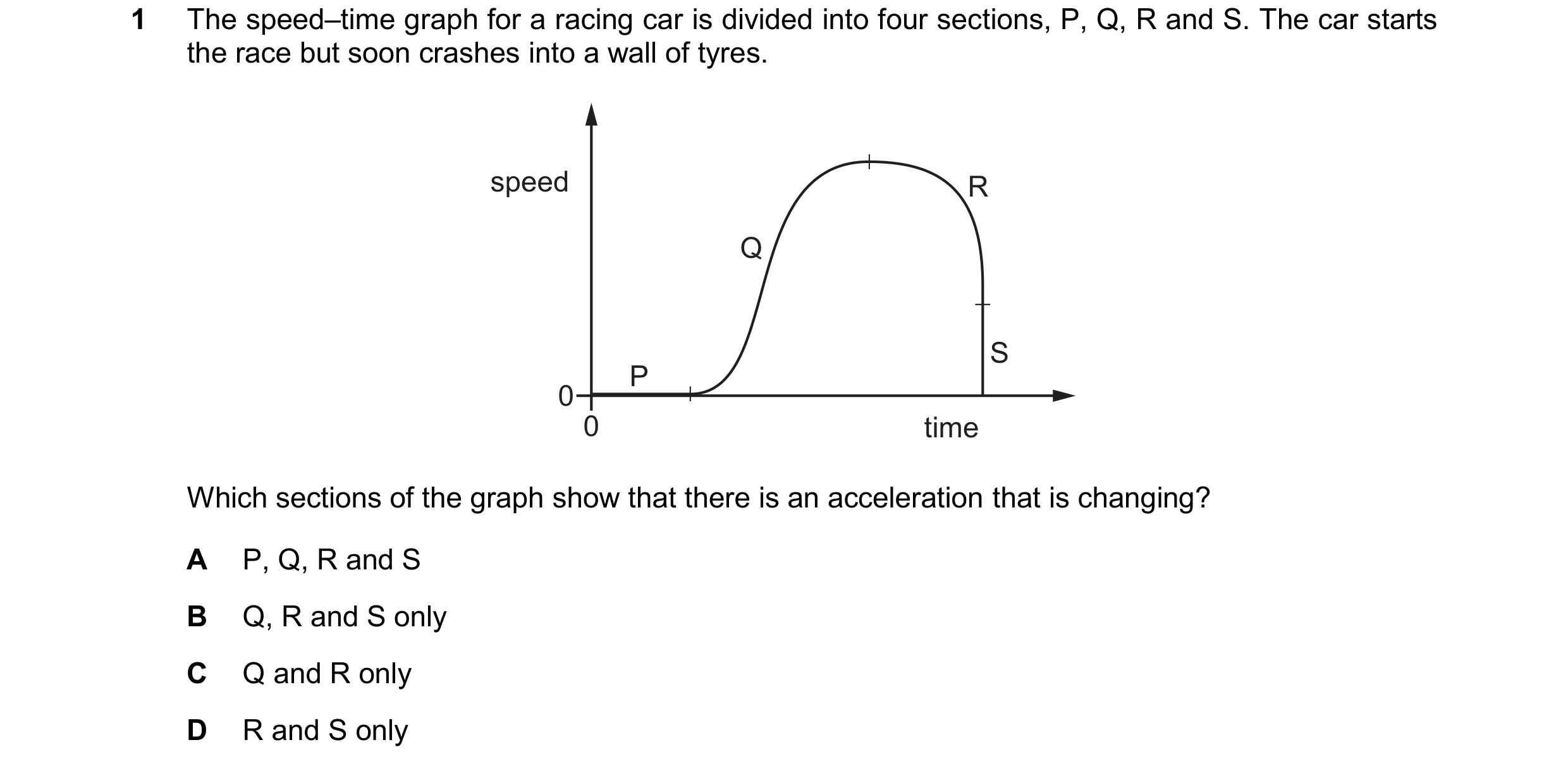
 52 / 56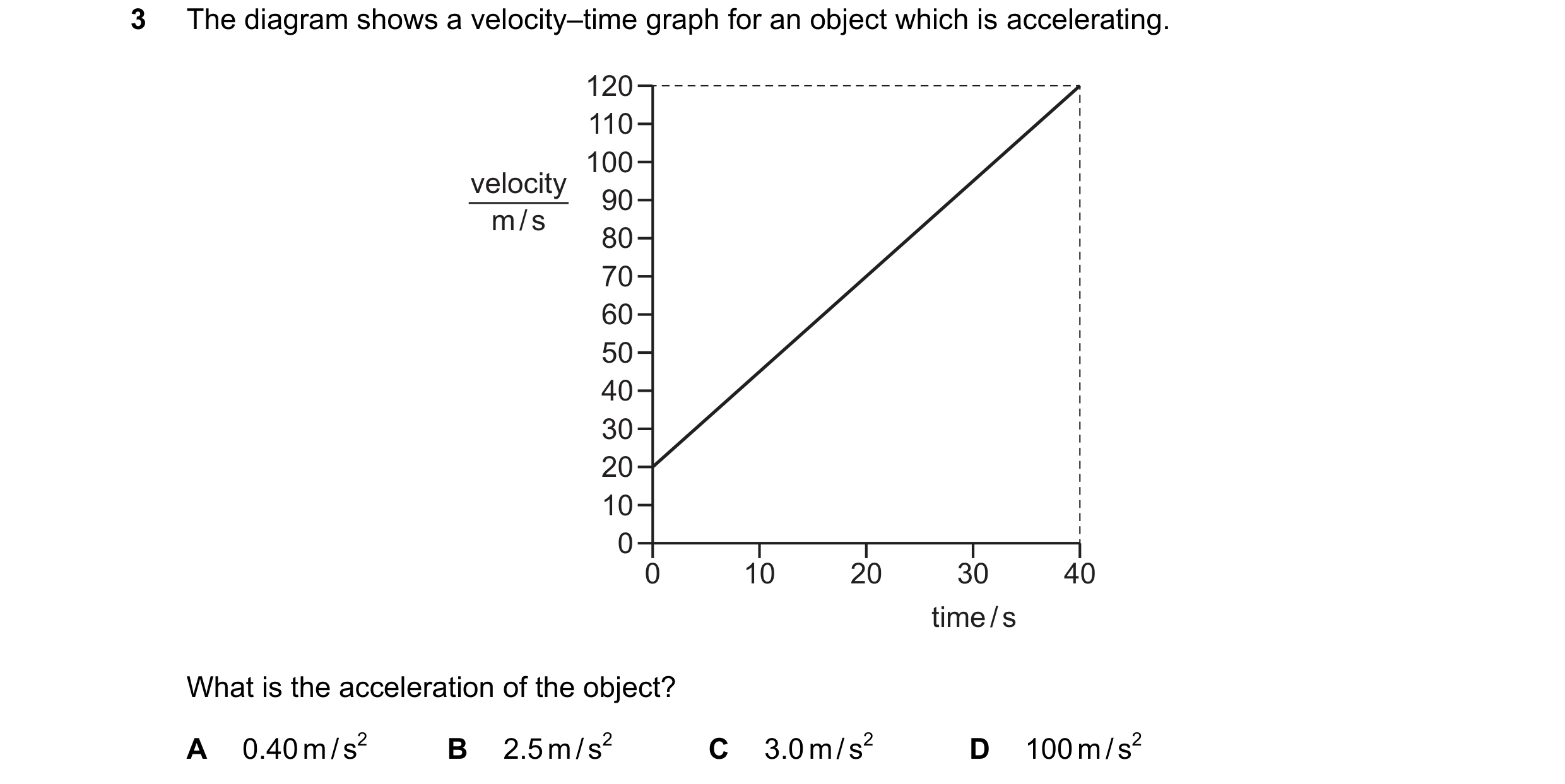
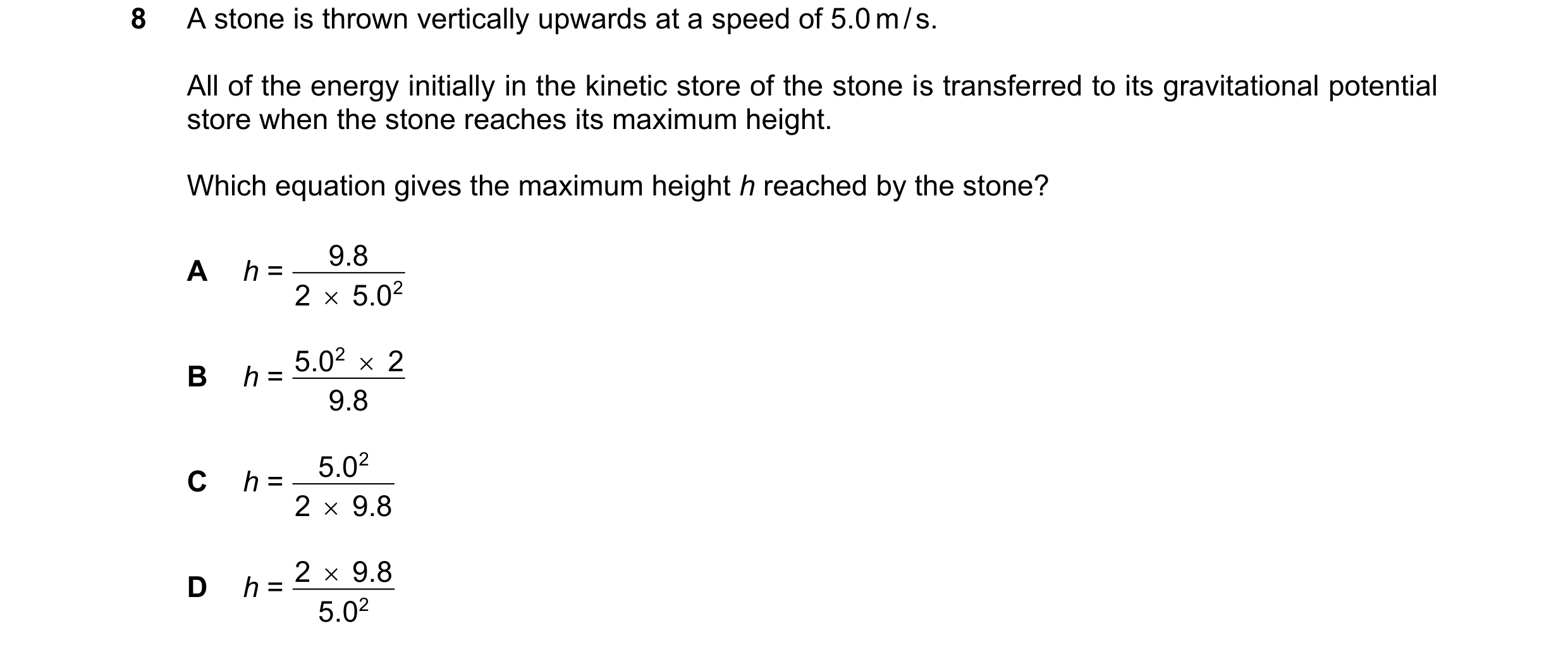
 53 / 56

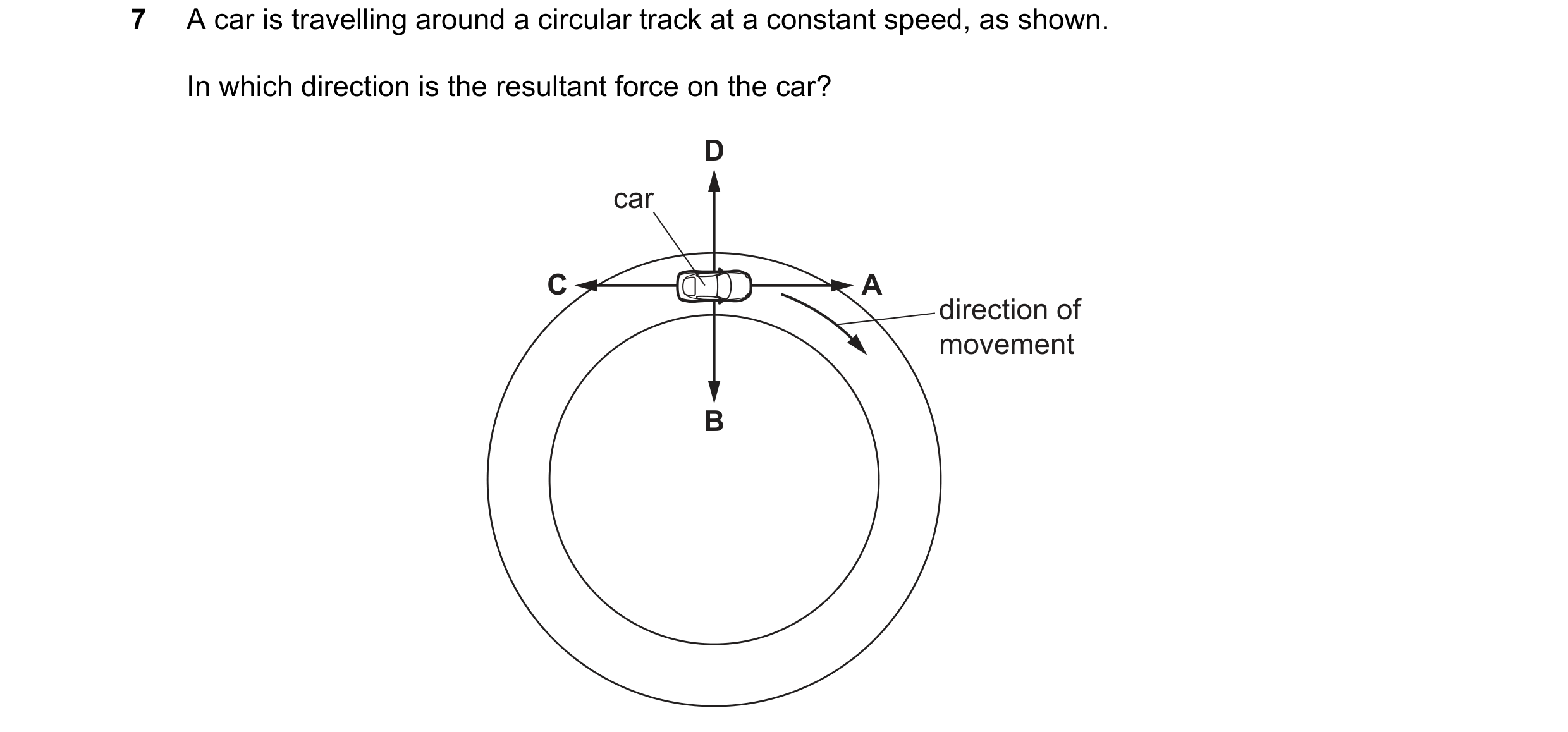
 54 / 56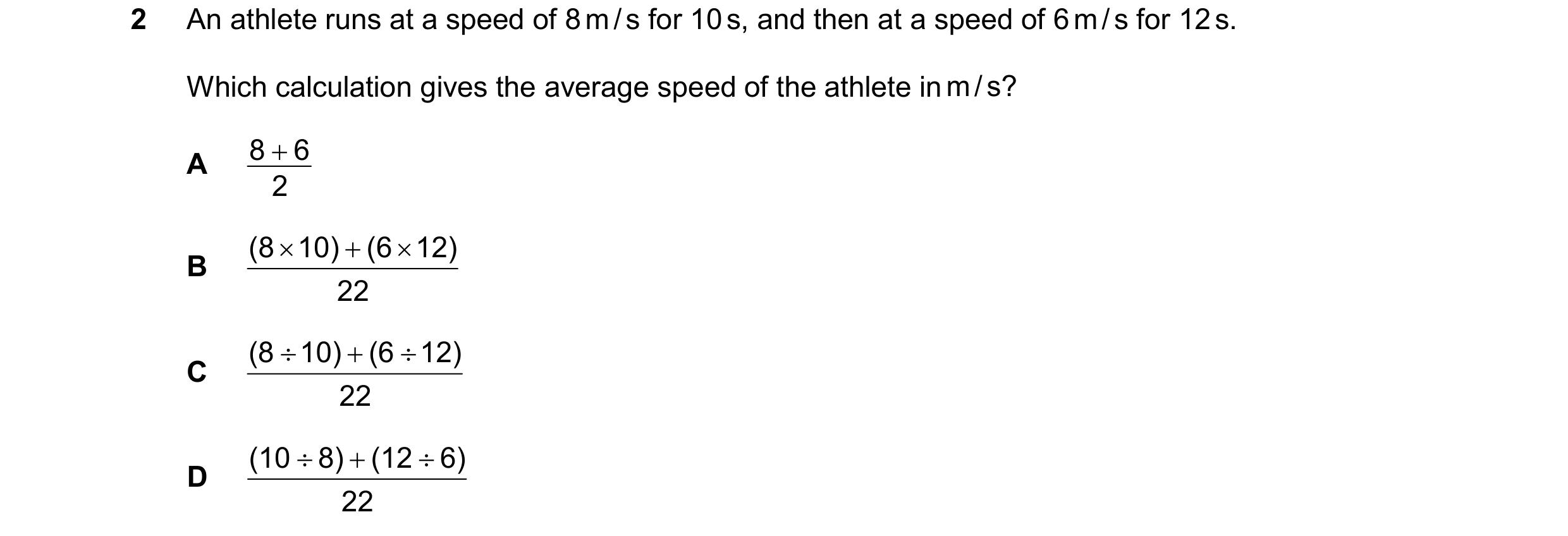



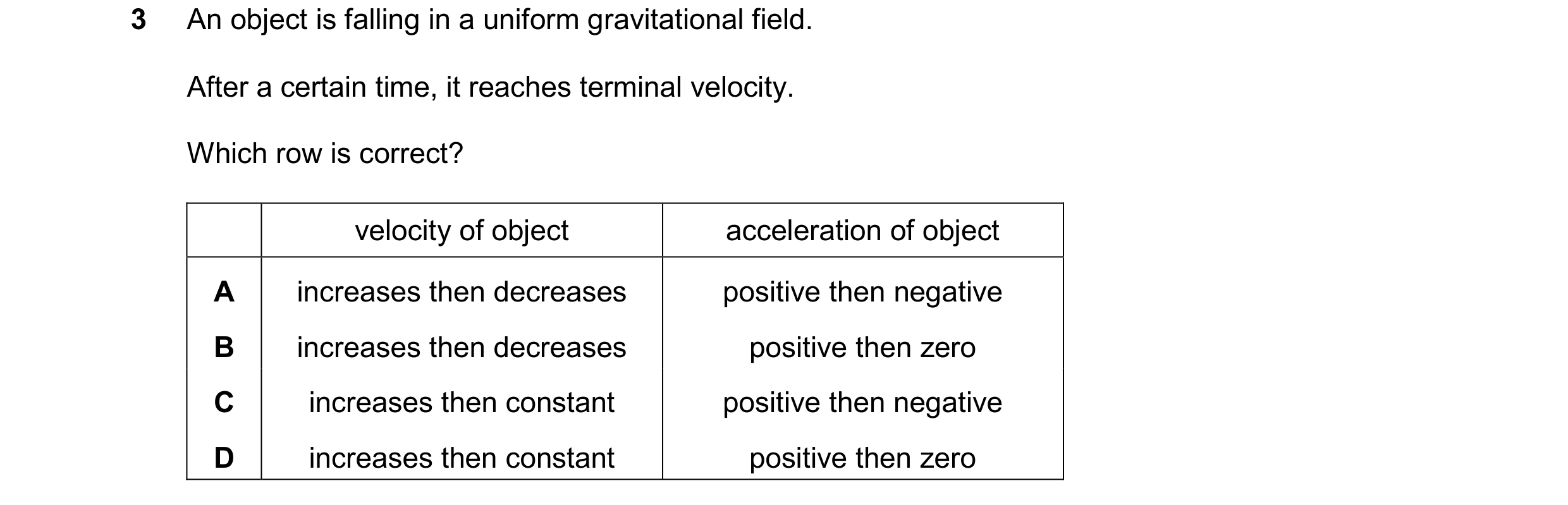 55 / 56
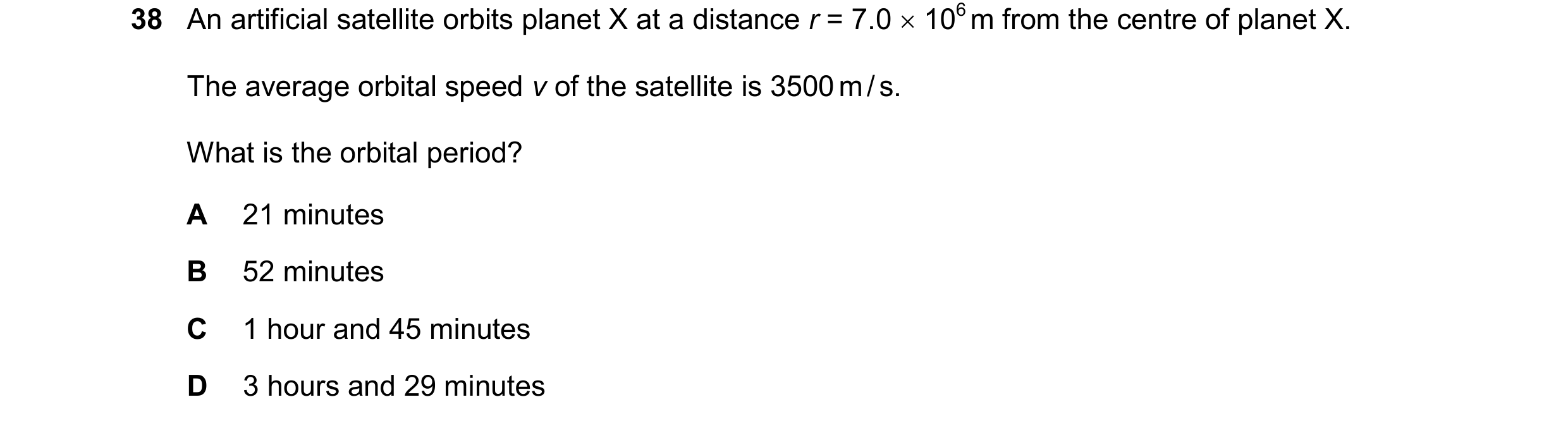 56 / 56