Questions as text
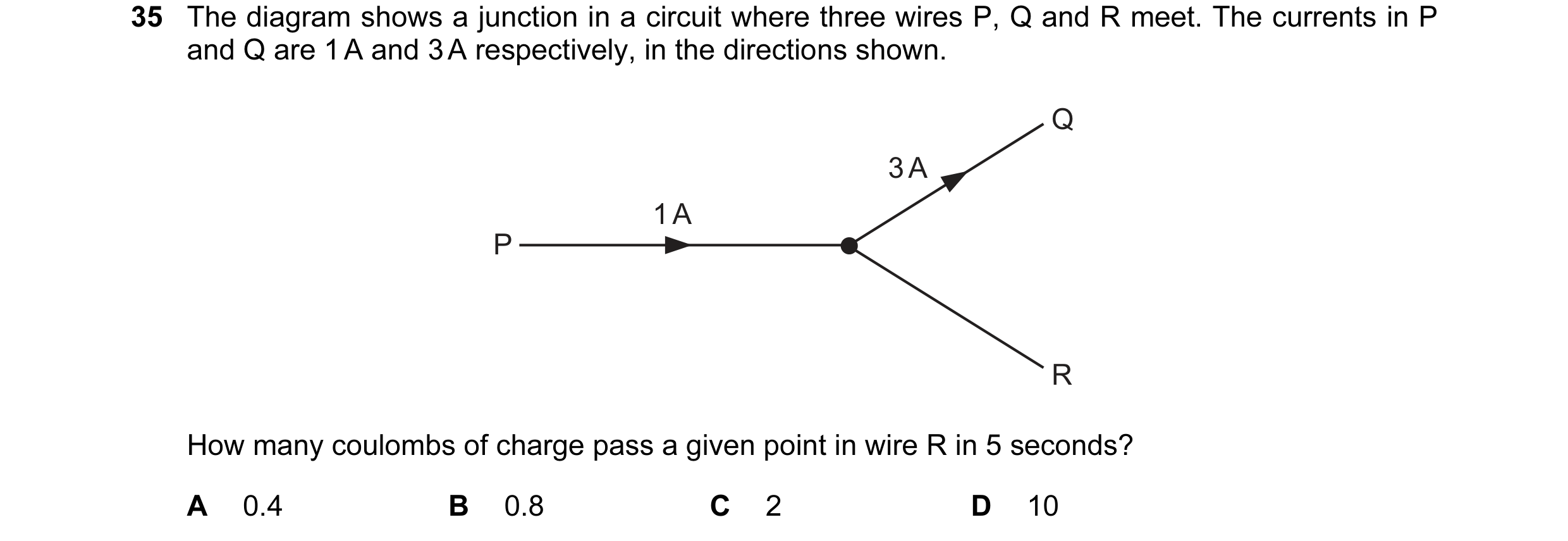
Q1 · The diagram shows a junction in a circuit where three wires P, Q and R meet 9702/11 Oct/Nov 2004
35 The diagram shows a junction in a circuit where three wires P, Q and R meet. The currents in P and Q are 1 A and 3 A respectively, in the directions shown. Q 3 A 1 A P R How many coulombs of charge pass a given point in wire R in 5 seconds? A 0.4 B 0.8 C 2 D 10
1 marks
Answer: D
This question in 9702/11 Oct/Nov 2004
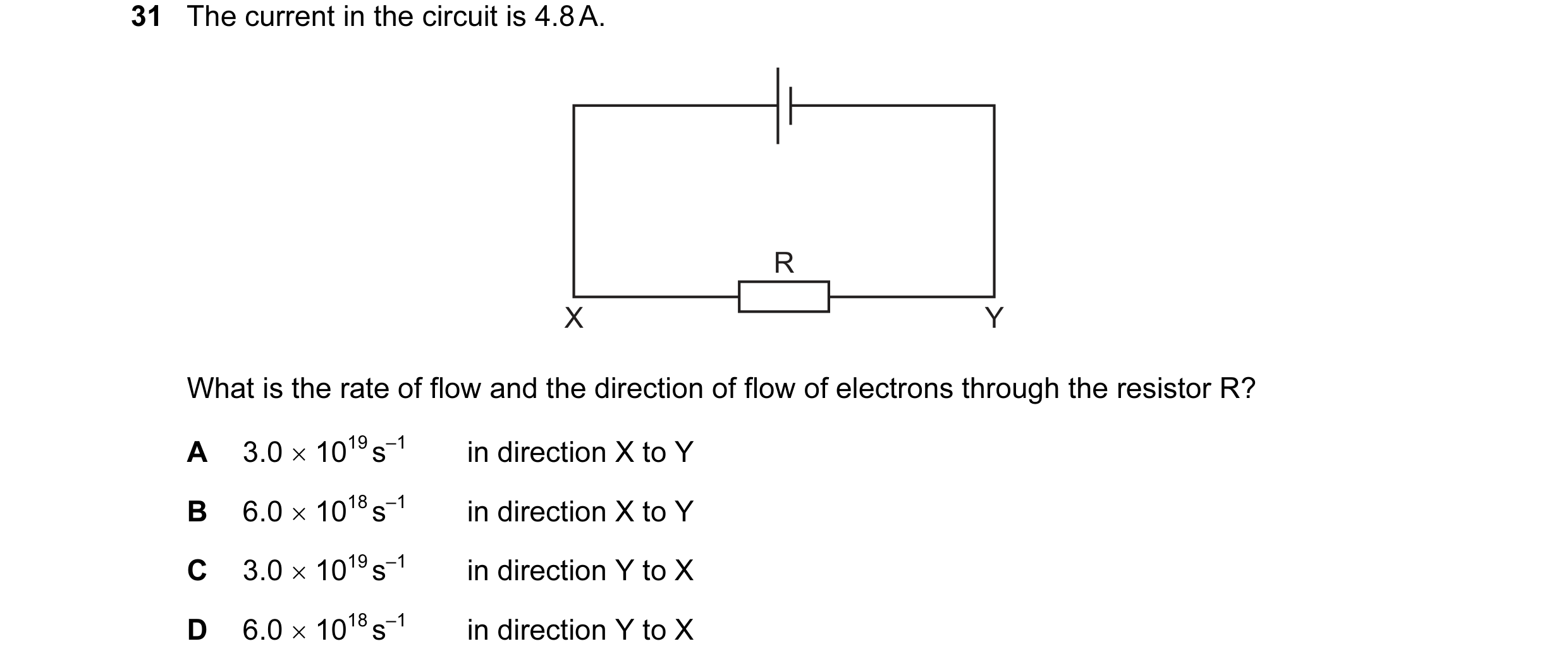
Q2 · The current in the circuit is 4.8 A 9702/11 May/June 2006
31 The current in the circuit is 4.8 A. R X Y What is the rate of flow and the direction of flow of electrons through the resistor R? A 3.0 × 10¹⁹ s–1 in direction X to Y B 6.0 × 10¹⁸ s–1 in direction X to Y C 3.0 × 10¹⁹ s–1 in direction Y to X D 6.0 × 10¹⁸ s–1 in direction Y to X
1 marks
Answer: C
This question in 9702/11 May/June 2006
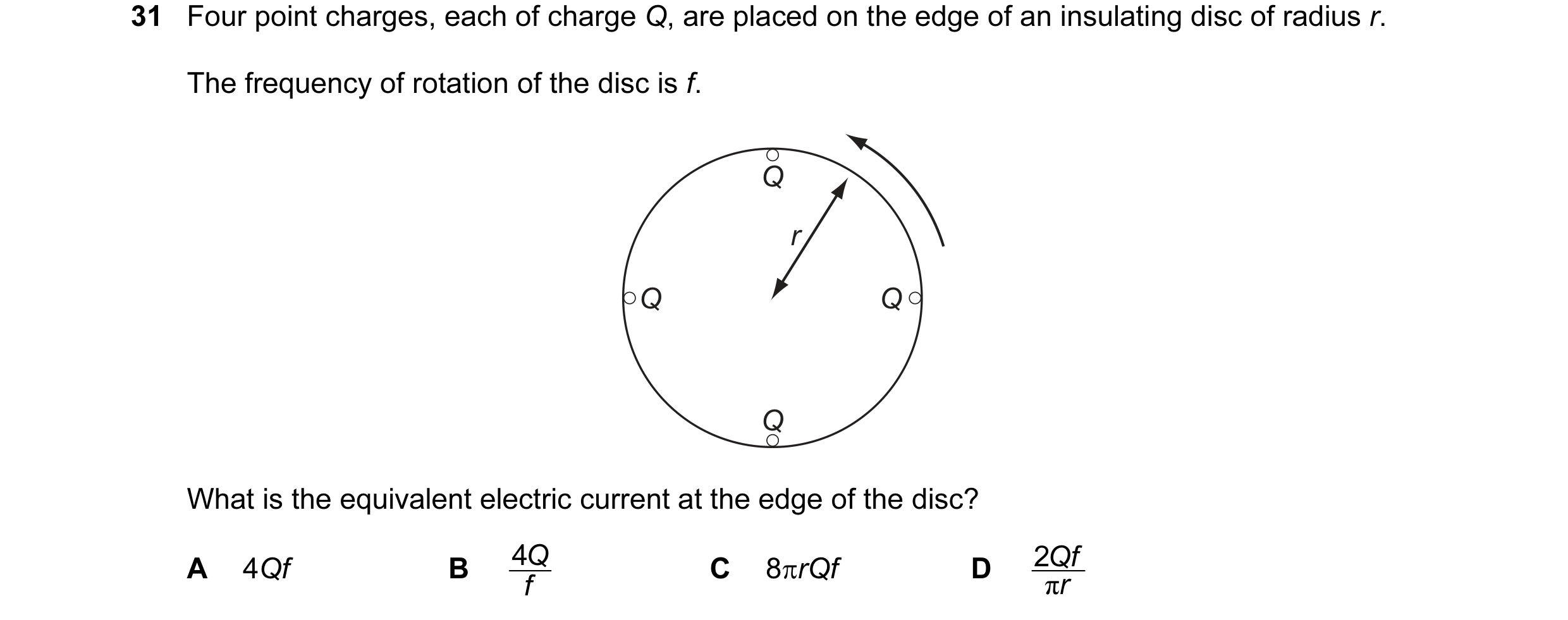
Q3 · Four point charges, each of charge Q, are placed on the edge of an insulating disc of… 9702/11 Oct/Nov 2006
31 Four point charges, each of charge Q, are placed on the edge of an insulating disc of radius r. The frequency of rotation of the disc is f. Q r Q Q Q What is the equivalent electric current at the edge of the disc? 4 Q 2 Qf A 4Qf B C 8πrQf D f π r
1 marks
Answer: A
This question in 9702/11 Oct/Nov 2006
Q4 · The current in a resistor is 8.0 mA 9702/11 May/June 2007
32 The current in a resistor is 8.0 mA. What charge flows through the resistor in 0.020 s? A 0.16 mC B 1.6 mC C 4.0 mC D 0.40 C
1 marks
Answer: A
This question in 9702/11 May/June 2007
Q5 · A total charge of 100 C flows through a 12 W light bulb in a time of 50 s 9702/11 May/June 2008
33 A total charge of 100 C flows through a 12 W light bulb in a time of 50 s. What is the potential difference across the bulb during this time? A 0.12 V B 2.0 V C 6.0 V D 24 V
1 marks
Answer: C
This question in 9702/11 May/June 2008
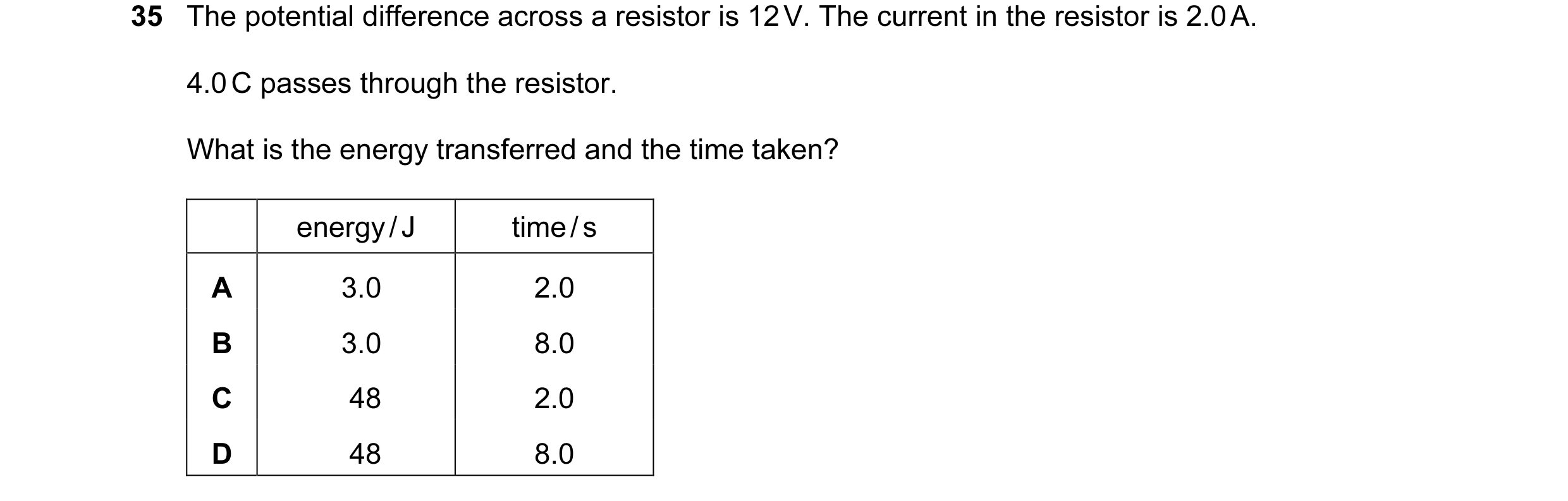
Q6 · The potential difference across a resistor is 12 V 9702/11 May/June 2008
35 The potential difference across a resistor is 12 V. The current in the resistor is 2.0 A. 4.0 C passes through the resistor. What is the energy transferred and the time taken? energy / J time / s A 3.0 2.0 B 3.0 8.0 C 48 2.0 D 48 8.0
1 marks
Answer: C
This question in 9702/11 May/June 2008
Q7 · The charge that a fully-charged 12 V car battery can supply is 100 kC 9702/11 Oct/Nov 2008
34 The charge that a fully-charged 12 V car battery can supply is 100 kC. The starter motor of the car requires a current of 200 A for an average period of 2.0 s. The battery does not recharge because of a fault. What is the maximum number of times the starter motor of the car can be used? A 21 B 25 C 42 D 250
1 marks
Answer: D
This question in 9702/11 Oct/Nov 2008
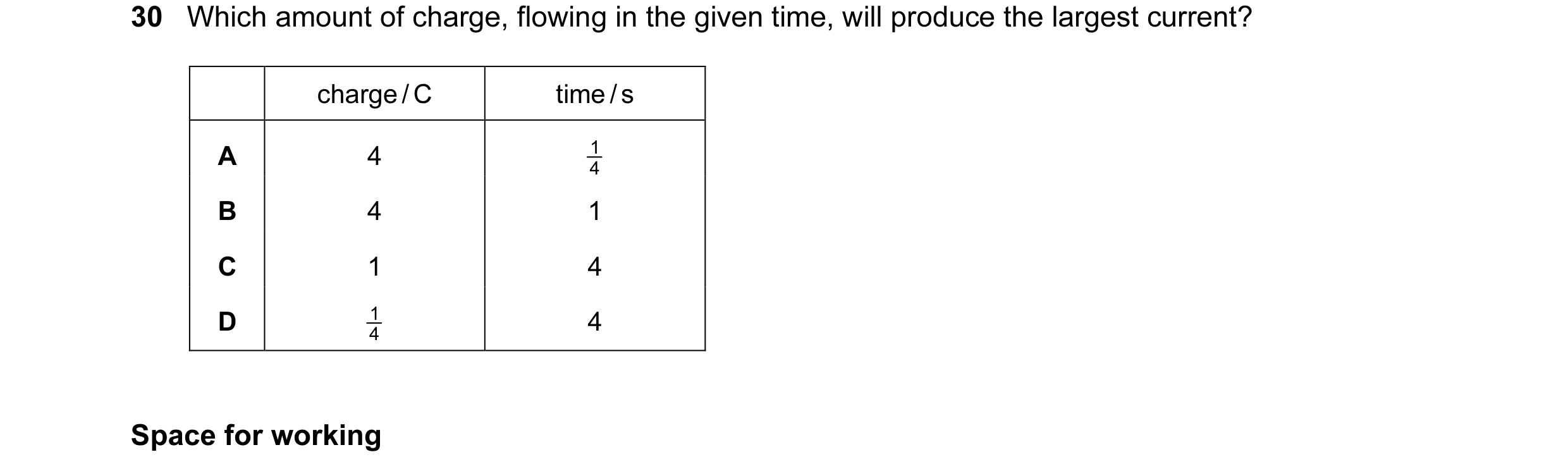
Q8 · Which amount of charge, flowing in the given time, will produce the largest current? 9702/11 May/June 2009
30 Which amount of charge, flowing in the given time, will produce the largest current? charge / C time / s A 4 1 4 B 4 1 C 1 4 D 1 4 4 Space for working
1 marks
Answer: A
This question in 9702/11 May/June 2009
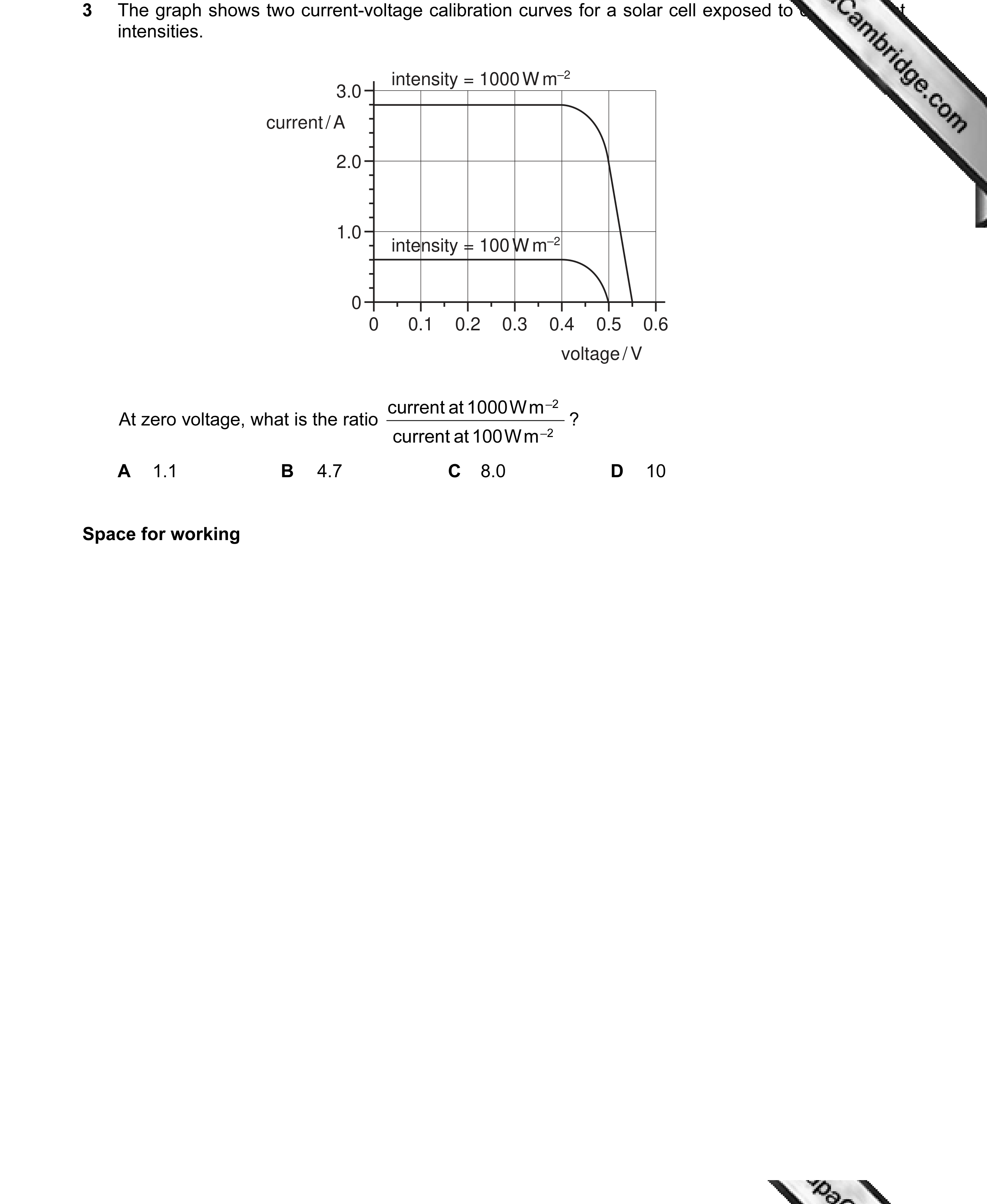
Q9 · The graph shows two current-voltage calibration curves for a solar cell exposed to… 9702/11 Oct/Nov 2009
3 The graph shows two current-voltage calibration curves for a solar cell exposed to different light intensities. intensity = 1000 W m–2 3.0 current / A 2.0 1.0 intensity = 100 W m–2 0 0 0.1 0.2 0.3 0.4 0.5 0.6 voltage / V current at 1000 W m _ 2 At zero voltage, what is the ratio ? current at 100 W m _ 2 A 1.1 B 4.7 C 8.0 D 10 Space for working
1 marks
Answer: B
This question in 9702/11 Oct/Nov 2009
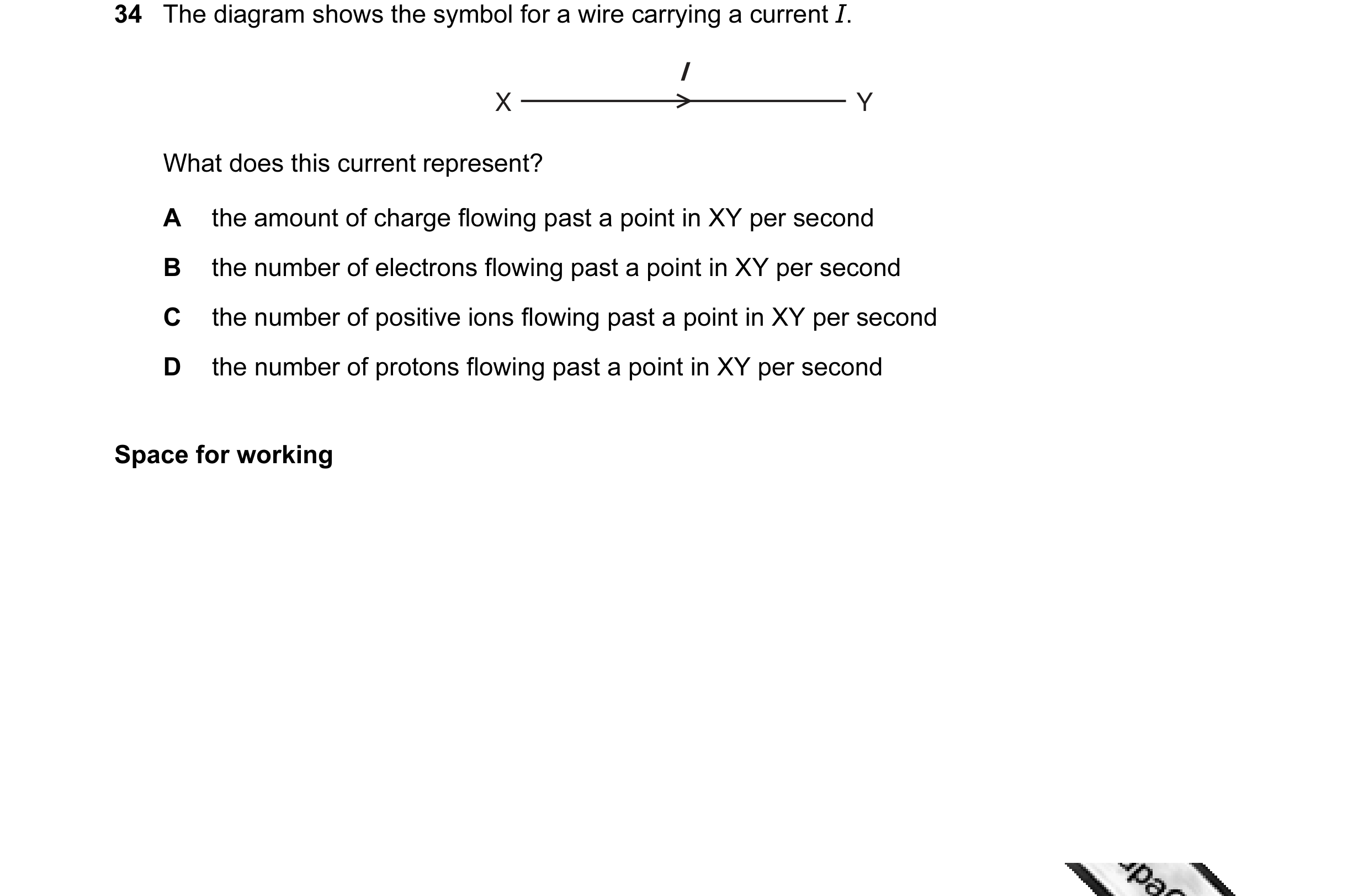
Q10 · The diagram shows the symbol for a wire carrying a current I 9702/11 Oct/Nov 2009
34 The diagram shows the symbol for a wire carrying a current I. I X Y What does this current represent? A the amount of charge flowing past a point in XY per second B the number of electrons flowing past a point in XY per second C the number of positive ions flowing past a point in XY per second D the number of protons flowing past a point in XY per second Space for working
1 marks
Answer: A
This question in 9702/11 Oct/Nov 2009
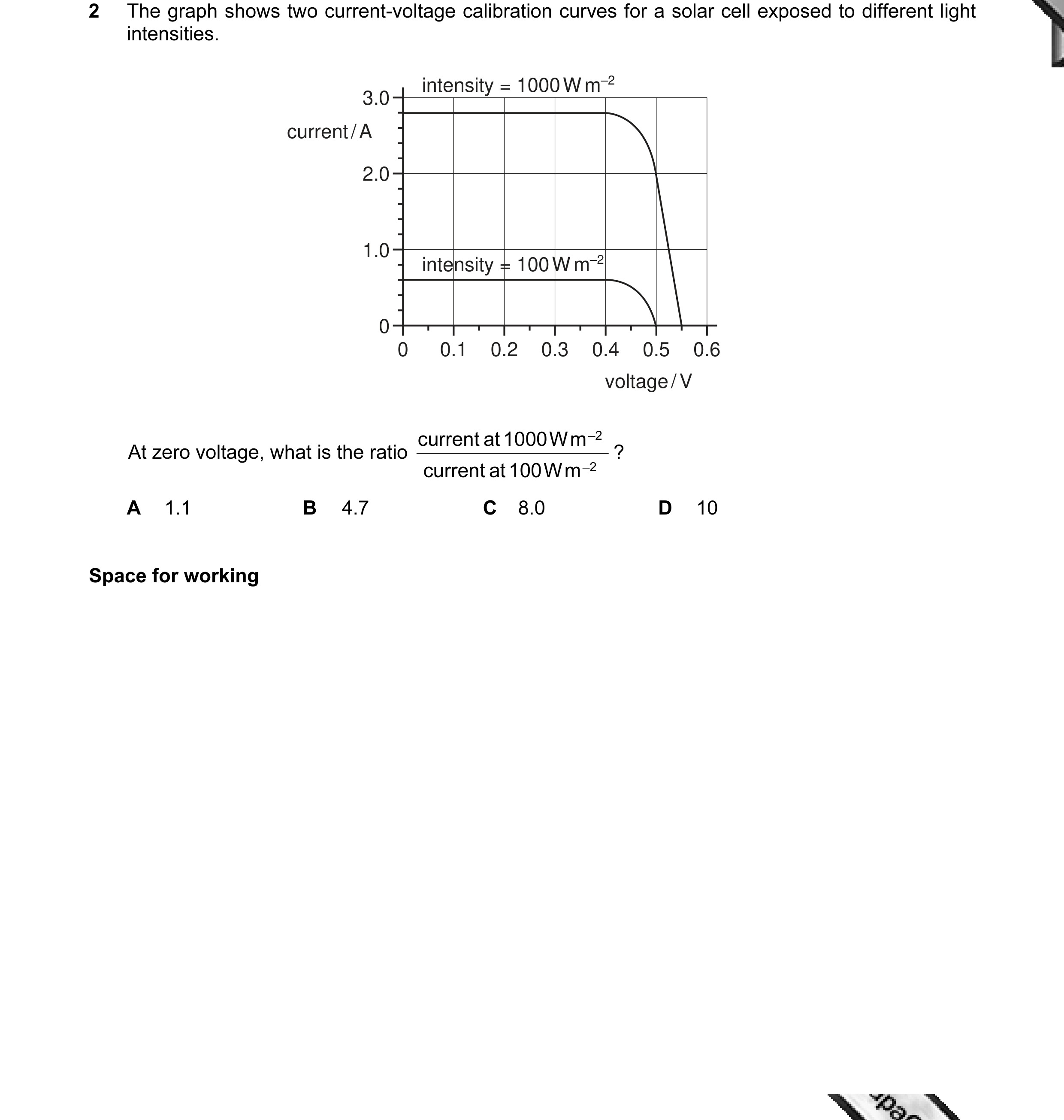
Q11 · The graph shows two current-voltage calibration curves for a solar cell exposed to… 9702/12 Oct/Nov 2009
2 The graph shows two current-voltage calibration curves for a solar cell exposed to different light intensities. intensity = 1000 W m–2 3.0 current / A 2.0 1.0 intensity = 100 W m–2 0 0 0.1 0.2 0.3 0.4 0.5 0.6 voltage / V current at 1000 W m _ 2 At zero voltage, what is the ratio ? current at 100 W m _ 2 A 1.1 B 4.7 C 8.0 D 10 Space for working
1 marks
Answer: B
This question in 9702/12 Oct/Nov 2009
Q12 · The diagram shows the symbol for a wire carrying a current I 9702/12 Oct/Nov 2009
33 The diagram shows the symbol for a wire carrying a current I. I X Y What does this current represent? A the amount of charge flowing past a point in XY per second B the number of electrons flowing past a point in XY per second C the number of positive ions flowing past a point in XY per second D the number of protons flowing past a point in XY per second Space for working
1 marks
Answer: A
This question in 9702/12 Oct/Nov 2009
Q13 · When there is no current in a wire, which statement about the conduction electrons in… 9702/12 Oct/Nov 2010
31 When there is no current in a wire, which statement about the conduction electrons in that wire is correct? A Electrons in the wire are moving totally randomly within the wire. B Equal numbers of electrons move at the same speed, but in opposite directions, along the wire. C No current is flowing therefore the electrons in the wire are stationary. D No current is flowing therefore the electrons in the wire are vibrating around a fixed point.
1 marks
Answer: A
This question in 9702/12 Oct/Nov 2010
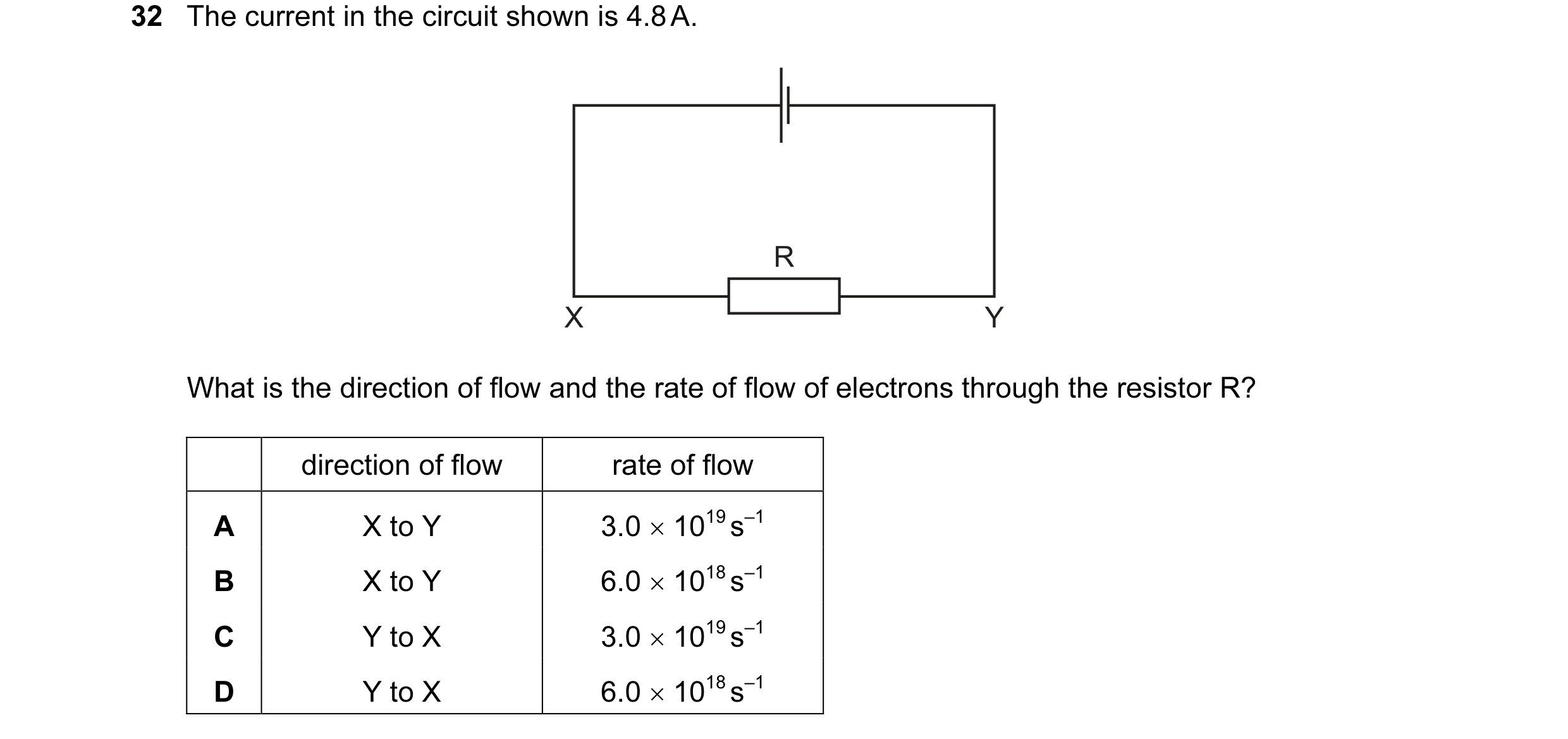
Q14 · The current in the circuit shown is 4.8 A 9702/13 Oct/Nov 2010
32 The current in the circuit shown is 4.8 A. R X Y What is the direction of flow and the rate of flow of electrons through the resistor R? direction of flow rate of flow A X to Y 3.0 × 10¹⁹ s–1 B X to Y 6.0 × 10¹⁸ s–1 C Y to X 3.0 × 10¹⁹ s–1 D Y to X 6.0 × 10¹⁸ s–1
1 marks
Answer: C
This question in 9702/13 Oct/Nov 2010
Q15 · A copper wire of cross-sectional area 2.0 mm2 carries a current of 10 A 9702/11 May/June 2011
31 A copper wire of cross-sectional area 2.0 mm2 carries a current of 10 A. How many electrons pass through a given cross-section of the wire in one second? A 1.0 × 101 B 5.0 × 10⁶ C 6.3 × 10¹⁹ D 3.1 × 1025
1 marks
Answer: C
This question in 9702/11 May/June 2011
Q16 · A copper wire of cross-sectional area 2.0 mm2 carries a current of 10 A 9702/13 May/June 2011
32 A copper wire of cross-sectional area 2.0 mm2 carries a current of 10 A. How many electrons pass through a given cross-section of the wire in one second? A 1.0 × 101 B 5.0 × 10⁶ C 6.3 × 10¹⁹ D 3.1 × 1025
1 marks
Answer: C
This question in 9702/13 May/June 2011
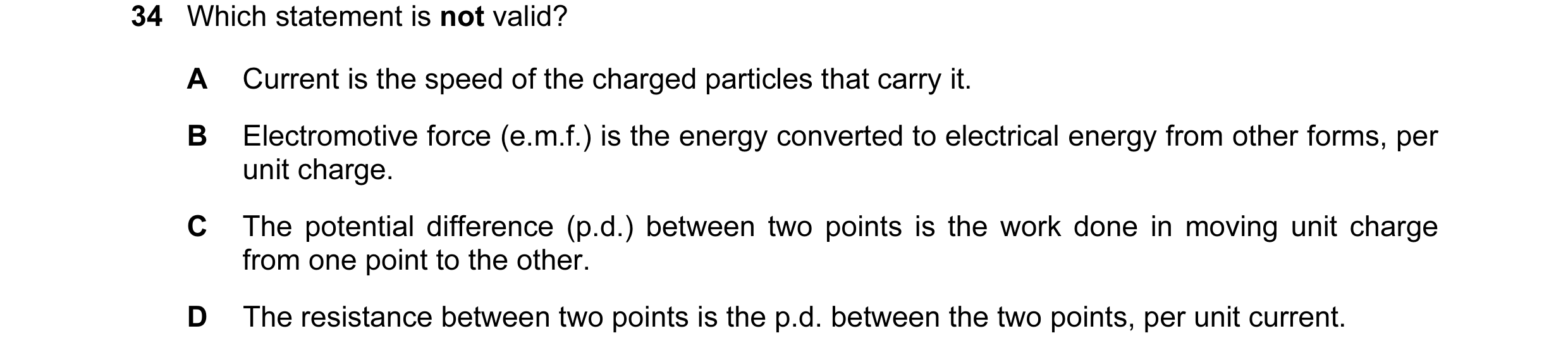
Q17 · Which statement is not valid? 9702/11 Oct/Nov 2011
35 Which statement is not valid? A Current is the speed of the charged particles that carry it. B Electromotive force (e.m.f.) is the energy converted to electrical energy from other forms, per unit charge. C The potential difference (p.d.) between two points is the work done in moving unit charge from one point to the other. D The resistance between two points is the p.d. between the two points, per unit current. Space for working
1 marks
Answer: A
This question in 9702/11 Oct/Nov 2011
Q18 · A charge of 8.0 C passes through a resistor of resistance 30 Ω at a constant rate in a… 9702/12 Oct/Nov 2011
32 A charge of 8.0 C passes through a resistor of resistance 30 Ω at a constant rate in a time of 20 s. What is the potential difference across the resistor? A 0.40 V B 5.3 V C 12 V D 75 V Space for working
1 marks
Answer: C
This question in 9702/12 Oct/Nov 2011
Q19 · Which statement is not valid? 9702/13 Oct/Nov 2011
34 Which statement is not valid? A Current is the speed of the charged particles that carry it. B Electromotive force (e.m.f.) is the energy converted to electrical energy from other forms, per unit charge. C The potential difference (p.d.) between two points is the work done in moving unit charge from one point to the other. D The resistance between two points is the p.d. between the two points, per unit current.
1 marks
Answer: A
This question in 9702/13 Oct/Nov 2011
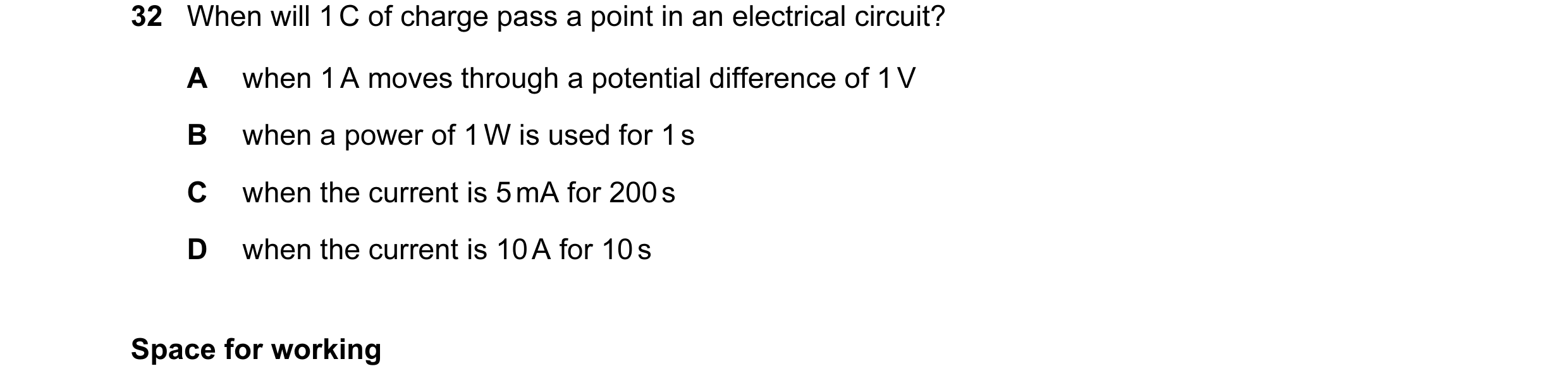
Q20 · When will 1 C of charge pass a point in an electrical circuit? 9702/12 May/June 2012
32 When will 1 C of charge pass a point in an electrical circuit? A when 1 A moves through a potential difference of 1 V B when a power of 1 W is used for 1 s C when the current is 5 mA for 200 s D when the current is 10 A for 10 s Space for working
1 marks
Answer: C
This question in 9702/12 May/June 2012
Q21 · Two copper wires of the same length but different diameters carry the same current 9702/12 May/June 2012
33 Two copper wires of the same length but different diameters carry the same current. Which statement about the flow of charged particles through the wires is correct? A Charged particles are provided by the power supply. Therefore the speed at which they travel depends only on the voltage of the supply. B The charged particles in both wires move with the same average speed because the current in both wires is the same. C The charged particles move faster through the wire with the larger diameter because there is a greater volume through which to flow. D The charged particles move faster through the wire with the smaller diameter because it has a larger potential difference applied to it.
1 marks
Answer: D
This question in 9702/12 May/June 2012
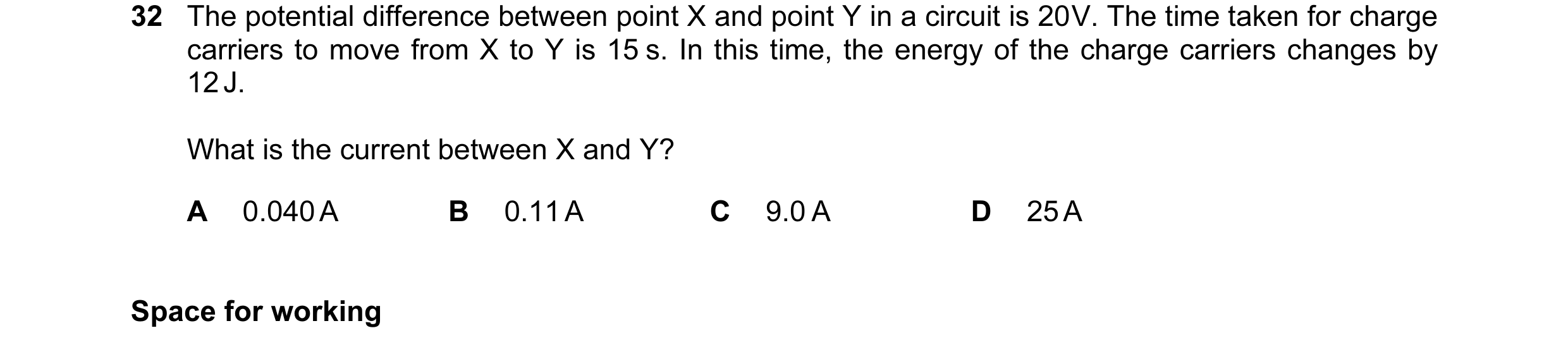
Q22 · The potential difference between point X and point Y in a circuit is 20 V 9702/11 Oct/Nov 2012
32 The potential difference between point X and point Y in a circuit is 20 V. The time taken for charge carriers to move from X to Y is 15 s. In this time, the energy of the charge carriers changes by 12 J. What is the current between X and Y? A 0.040 A B 0.11 A C 9.0 A D 25 A Space for working
1 marks
Answer: A
This question in 9702/11 Oct/Nov 2012
Q23 · Which unit is equivalent to the coulomb? 9702/13 Oct/Nov 2013
2 Which unit is equivalent to the coulomb? A ampere per second B joule per volt C watt per ampere D watt per volt
1 marks
Answer: B
This question in 9702/13 Oct/Nov 2013
Q24 · The current in a component is reduced uniformly from 100 mA to 20 mA over a period of 8.0… 9702/13 Oct/Nov 2013
32 The current in a component is reduced uniformly from 100 mA to 20 mA over a period of 8.0 s. What is the charge that flows during this time? A 160 mC B 320 mC C 480 mC D 640 mC Space for working
1 marks
Answer: C
This question in 9702/13 Oct/Nov 2013
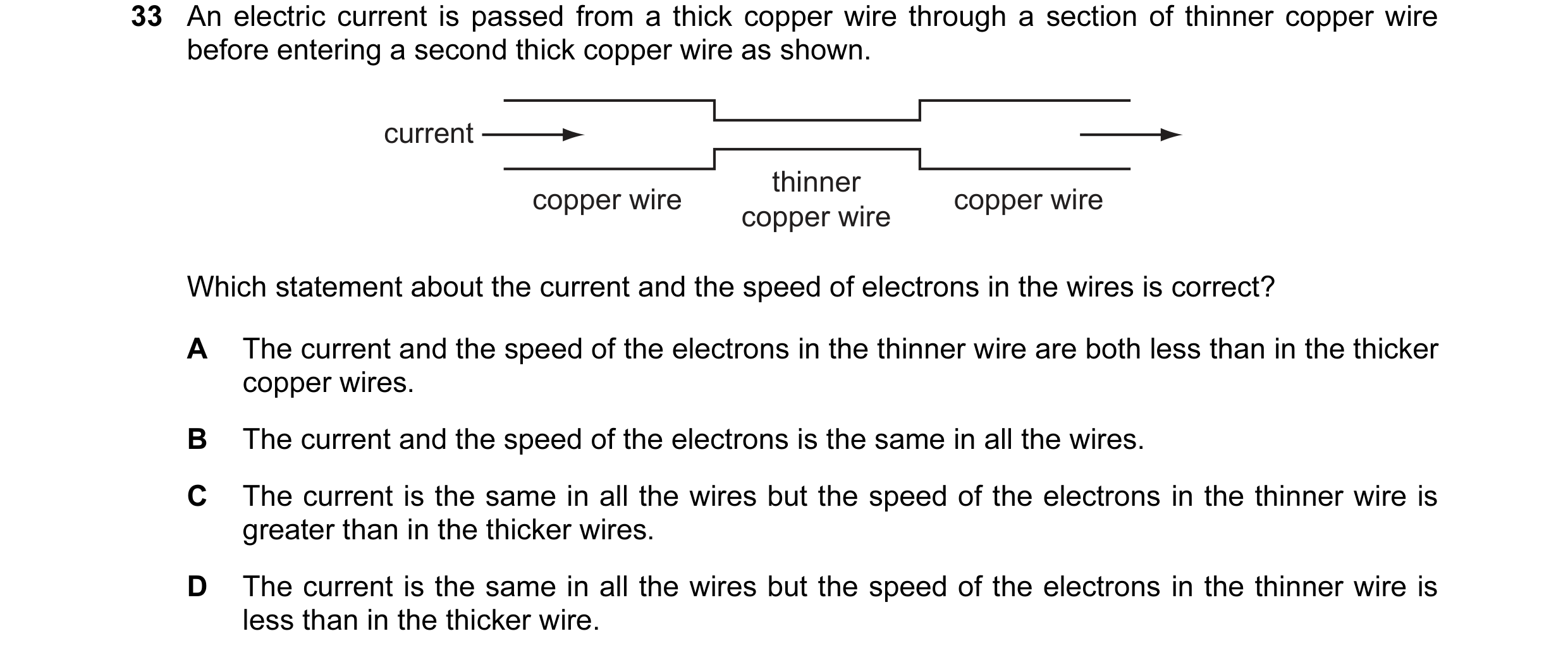
Q25 · An electric current is passed from a thick copper wire through a section of thinner… 9702/13 Oct/Nov 2013
33 An electric current is passed from a thick copper wire through a section of thinner copper wire before entering a second thick copper wire as shown. current thinner copper wire copper wire copper wire Which statement about the current and the speed of electrons in the wires is correct? A The current and the speed of the electrons in the thinner wire are both less than in the thicker copper wires. B The current and the speed of the electrons is the same in all the wires. C The current is the same in all the wires but the speed of the electrons in the thinner wire is greater than in the thicker wires. D The current is the same in all the wires but the speed of the electrons in the thinner wire is less than in the thicker wire.
1 marks
Answer: C
This question in 9702/13 Oct/Nov 2013
Q26 · The potential difference across a component in a circuit is 2.0 V 9702/11 May/June 2014
35 The potential difference across a component in a circuit is 2.0 V. How many electrons must flow through this component in order for it to be supplied with 4.8 J of energy? A 2.6 × 10¹⁸ B 1.5 × 10¹⁹ C 3.0 × 10¹⁹ D 6.0 × 10¹⁹ Space for working
1 marks
Answer: B
This question in 9702/11 May/June 2014
Q27 · Two wires P and Q made of the same material and of the same length are connected in… 9702/13 May/June 2014
33 Two wires P and Q made of the same material and of the same length are connected in parallel to the same voltage supply. Wire P has diameter 2 mm and wire Q has diameter 1 mm. What is the ratio current in P ? current in Q 1 1 2 4 A B C D 4 2 1 1
1 marks
Answer: D
This question in 9702/13 May/June 2014
Q28 · The charge that an electric battery can deliver is specified in ampere-hours 9702/11 May/June 2015
35 The charge that an electric battery can deliver is specified in ampere-hours. For example, a battery of capacity 40 ampere-hours could supply, when fully charged, 0.2 A for 200 hours. What is the maximum energy that a fully charged 12 V, 40 ampere-hour battery could supply? A 1.7 kJ B 29 kJ C 1.7 MJ D 29 MJ
1 marks
Answer: C
This question in 9702/11 May/June 2015
Q29 · Which unit is not used in either the definition of the coulomb or the definition of the… 9702/12 May/June 2015
31 Which unit is not used in either the definition of the coulomb or the definition of the volt? A ampere B joule C ohm D second
1 marks
Answer: C
This question in 9702/12 May/June 2015
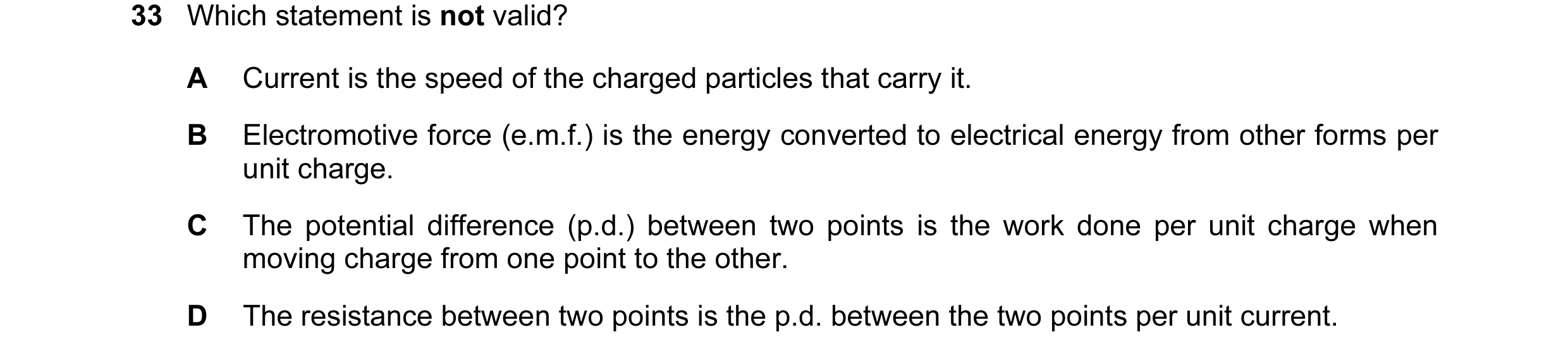
Q30 · Which statement is not valid? 9702/12 May/June 2015
33 Which statement is not valid? A Current is the speed of the charged particles that carry it. B Electromotive force (e.m.f.) is the energy converted to electrical energy from other forms per unit charge. C The potential difference (p.d.) between two points is the work done per unit charge when moving charge from one point to the other. D The resistance between two points is the p.d. between the two points per unit current.
1 marks
Answer: A
This question in 9702/12 May/June 2015
Q31 · Which unit is equivalent to a coulomb (C)? 9702/12 Oct/Nov 2015
33 Which unit is equivalent to a coulomb (C)? A A s B Ω s C V s D W s
1 marks
Answer: A
This question in 9702/12 Oct/Nov 2015
Q32 · An electrical conductor has a resistance of 5.6 kΩ 9702/12 Feb/March 2016
30 An electrical conductor has a resistance of 5.6 kΩ. A potential difference (p.d.) of 9.0 V is applied across its ends. How many electrons pass a point in the conductor in one minute? A 6.0 × 10²⁰ B 1.0 × 10¹⁹ C 6.0 × 10¹⁷ D 1.0 × 10¹⁶
1 marks
Answer: C
This question in 9702/12 Feb/March 2016
Q33 · A 12 V battery is charged for 20 minutes by connecting it to a source of electromotive… 9702/12 Feb/March 2016
33 A 12 V battery is charged for 20 minutes by connecting it to a source of electromotive force (e.m.f.). The battery is supplied with 7.2 × 10⁴ J of energy in this time. How much charge flows through the battery? A 5.0 C B 60 C C 100 C D 6000 C
1 marks
Answer: D
This question in 9702/12 Feb/March 2016
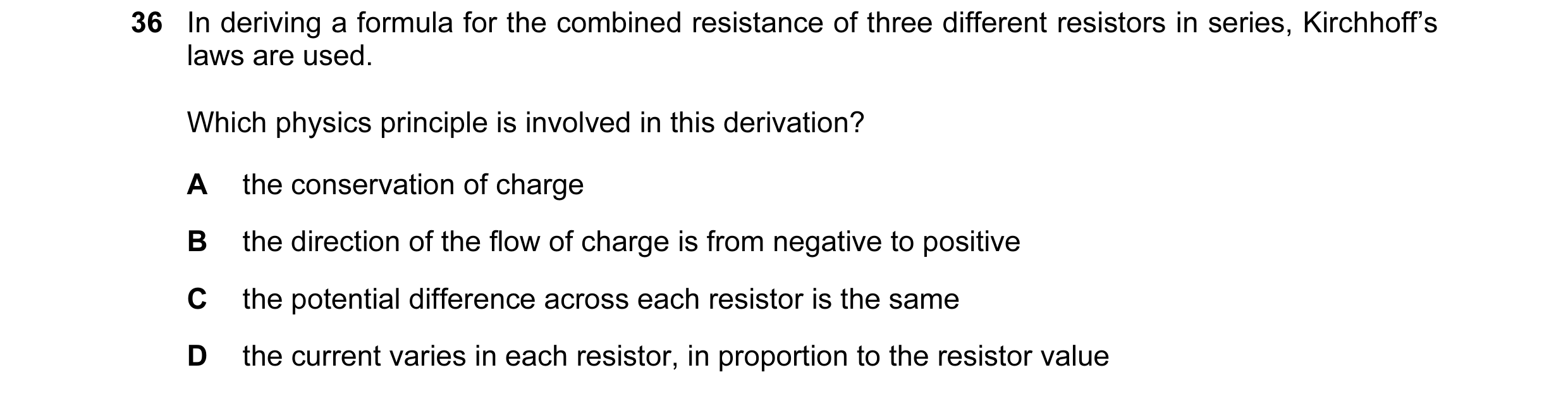
Q34 · In deriving a formula for the combined resistance of three different resistors in series… 9702/12 Feb/March 2016
36 In deriving a formula for the combined resistance of three different resistors in series, Kirchhoff’s laws are used. Which physics principle is involved in this derivation? A the conservation of charge B the direction of the flow of charge is from negative to positive C the potential difference across each resistor is the same D the current varies in each resistor, in proportion to the resistor value
1 marks
Answer: A
This question in 9702/12 Feb/March 2016
Q35 · The charge that a fully charged 12 V car battery can supply is 100 kC 9702/12 May/June 2016
35 The charge that a fully charged 12 V car battery can supply is 100 kC. The starter motor of the car requires a current of 200 A for an average period of 2.0 s. The battery does not recharge because of a fault. What is the maximum number of times the starter motor of the car can be used? A 21 B 25 C 42 D 250
1 marks
Answer: D
This question in 9702/12 May/June 2016
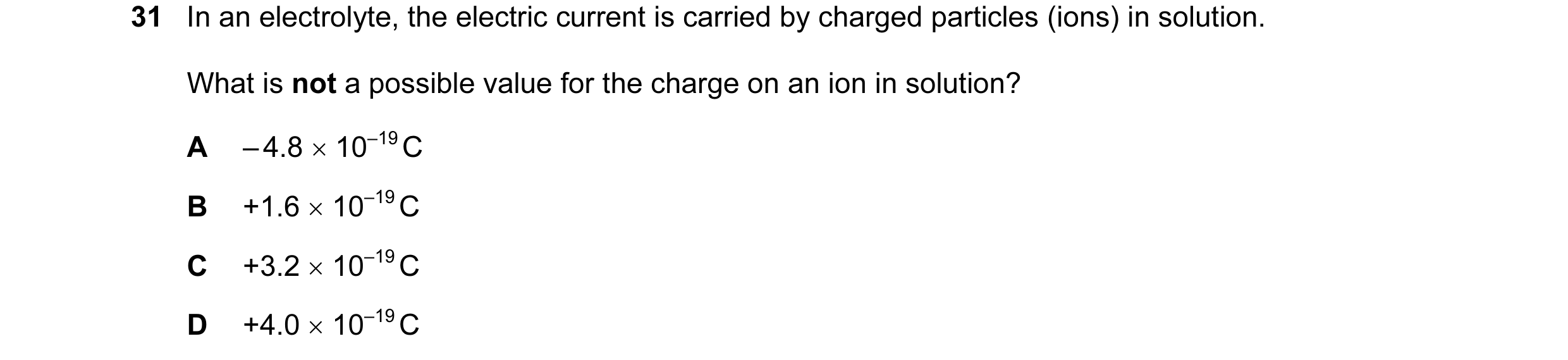
Q36 · In an electrolyte, the electric current is carried by charged particles (ions) in solution 9702/13 May/June 2016
31 In an electrolyte, the electric current is carried by charged particles (ions) in solution. What is not a possible value for the charge on an ion in solution? A – 4.8 × 10⁻¹⁹ C B +1.6 × 10⁻¹⁹ C C +3.2 × 10⁻¹⁹ C D +4.0 × 10⁻¹⁹ C
1 marks
Answer: D
This question in 9702/13 May/June 2016
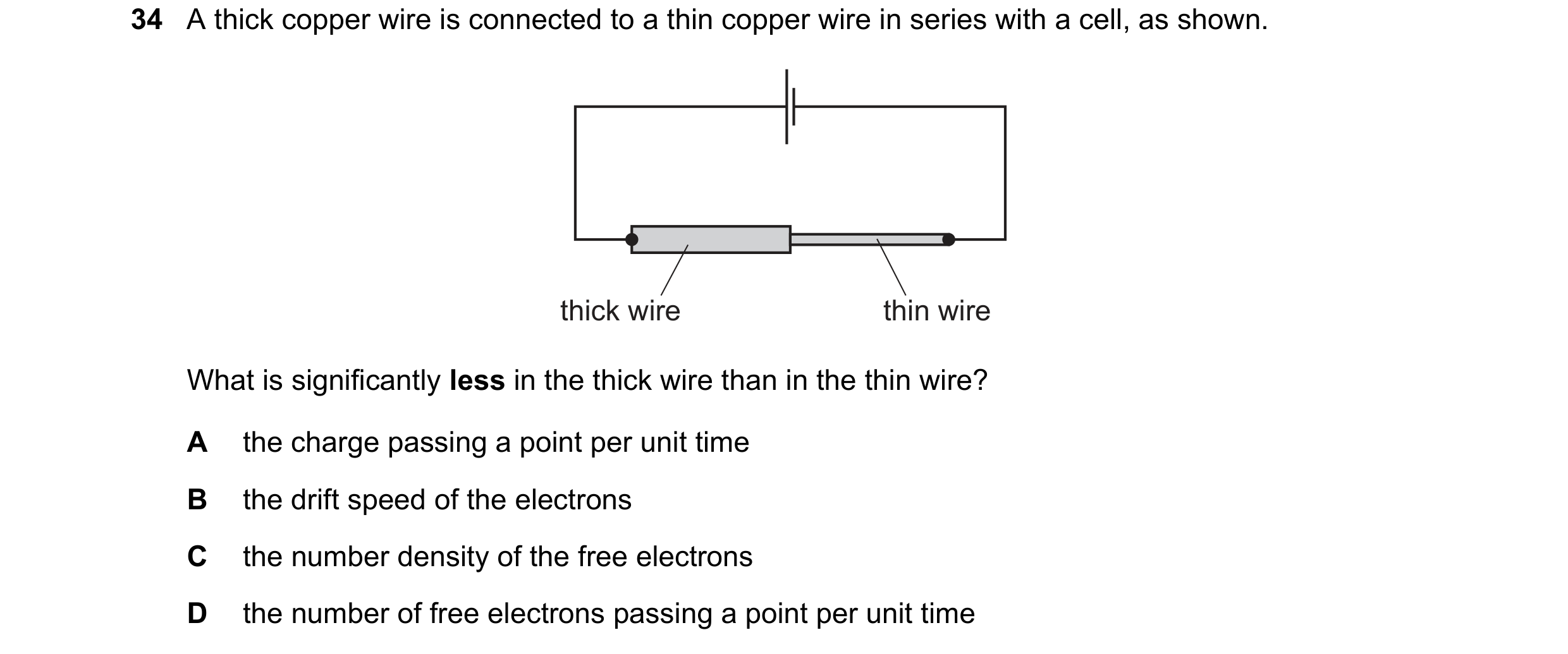
Q37 · A thick copper wire is connected to a thin copper wire in series with a cell, as shown 9702/11 Oct/Nov 2016
34 A thick copper wire is connected to a thin copper wire in series with a cell, as shown. thick wire thin wire What is significantly less in the thick wire than in the thin wire? A the charge passing a point per unit time B the drift speed of the electrons C the number density of the free electrons D the number of free electrons passing a point per unit time
1 marks
Answer: B
This question in 9702/11 Oct/Nov 2016
Q38 · A thick copper wire is connected to a thin copper wire in series with a cell, as shown 9702/13 Oct/Nov 2016
34 A thick copper wire is connected to a thin copper wire in series with a cell, as shown. thick wire thin wire What is significantly less in the thick wire than in the thin wire? A the charge passing a point per unit time B the drift speed of the electrons C the number density of the free electrons D the number of free electrons passing a point per unit time
1 marks
Answer: B
This question in 9702/13 Oct/Nov 2016
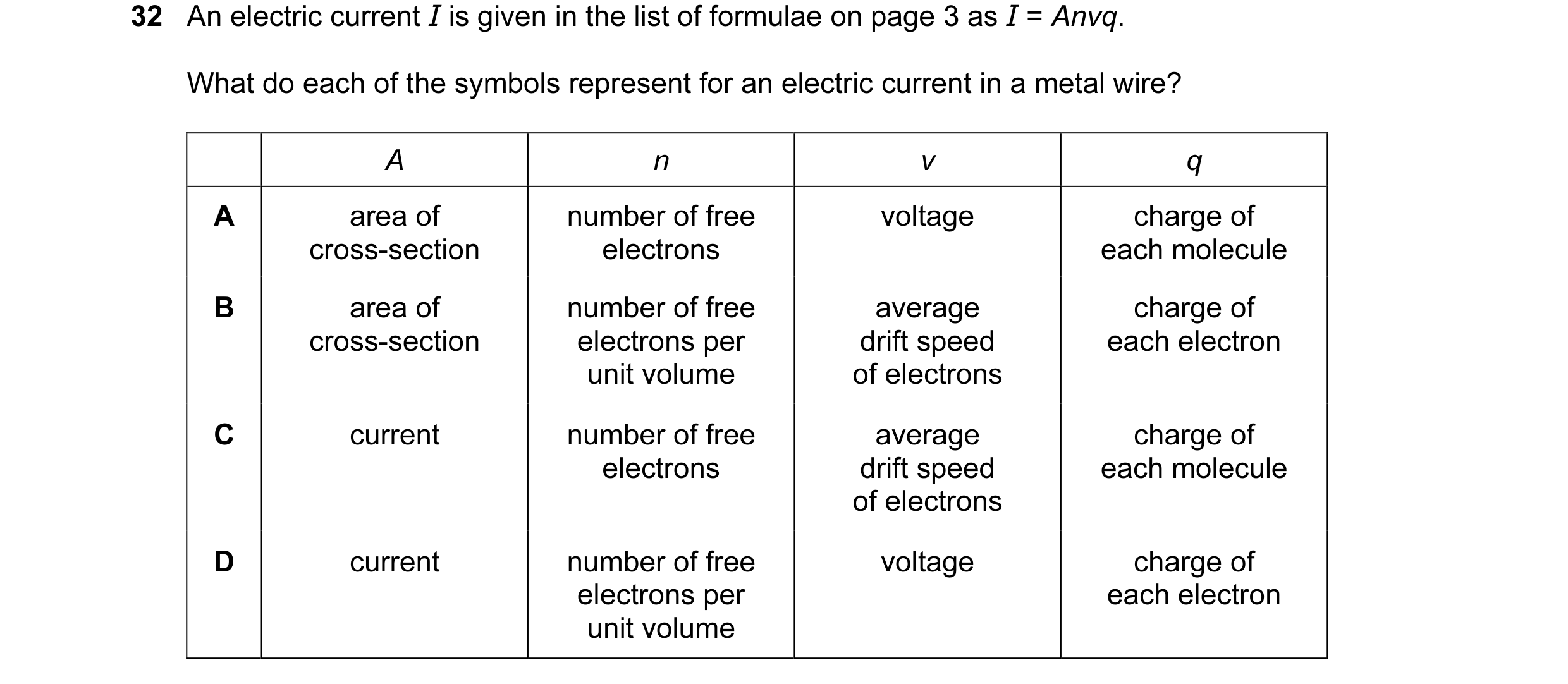
Q39 · An electric current I is given in the list of formulae on page 3 as I = Anvq 9702/12 Feb/March 2017
32 An electric current I is given in the list of formulae on page 3 as I = Anvq. What do each of the symbols represent for an electric current in a metal wire? A n v q A area of number of free voltage charge of cross-section electrons each molecule B area of number of free average charge of cross-section electrons per drift speed each electron unit volume of electrons C current number of free average charge of electrons drift speed each molecule of electrons D current number of free voltage charge of electrons per each electron unit volume
1 marks
Answer: B
This question in 9702/12 Feb/March 2017
Q40 · The diagram shows the symbol for a wire carrying a current I 9702/11 May/June 2017
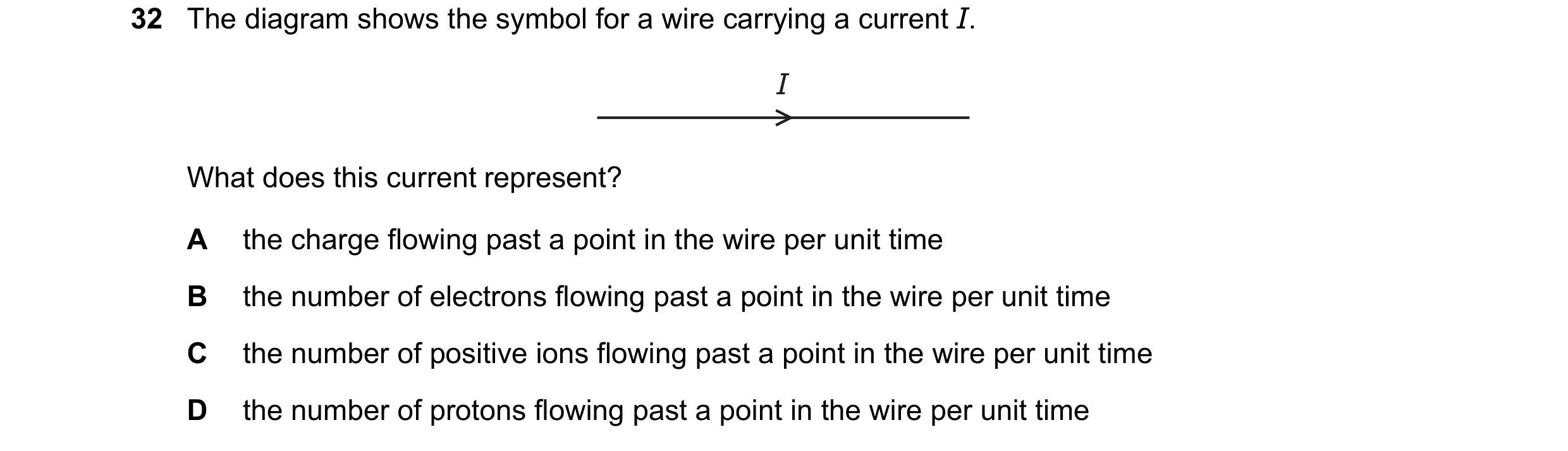
32 The diagram shows the symbol for a wire carrying a current I. I What does this current represent? A the charge flowing past a point in the wire per unit time B the number of electrons flowing past a point in the wire per unit time C the number of positive ions flowing past a point in the wire per unit time D the number of protons flowing past a point in the wire per unit time
1 marks
Answer: A
This question in 9702/11 May/June 2017
Q41 · The current in a circuit component is 2.00 µA 9702/12 May/June 2017
32 The current in a circuit component is 2.00 µA. How many electrons pass through the component each second? A 1.25 × 10¹³ B 1.25 × 10¹⁶ C 1.25 × 10¹⁹ D 1.25 × 1025
1 marks
Answer: A
This question in 9702/12 May/June 2017
Q42 · Two metal plates are a distance of 30 cm apart in a vacuum 9702/13 May/June 2017
31 Two metal plates are a distance of 30 cm apart in a vacuum. A current exists between the two plates consisting of electrons moving at a constant speed of 1.5 × 10⁶ m s–1. At any instant, there is always just one electron travelling between the plates. What is the current between the plates? A 3.2 × 10⁻²⁶ A B 8.0 × 10⁻¹³ A C 1.6 × 10⁻¹² A D 2.0 × 10⁻⁷ A
1 marks
Answer: B
This question in 9702/13 May/June 2017
Q43 · The current in the circuit shown is 3.2 mA 9702/11 Oct/Nov 2017
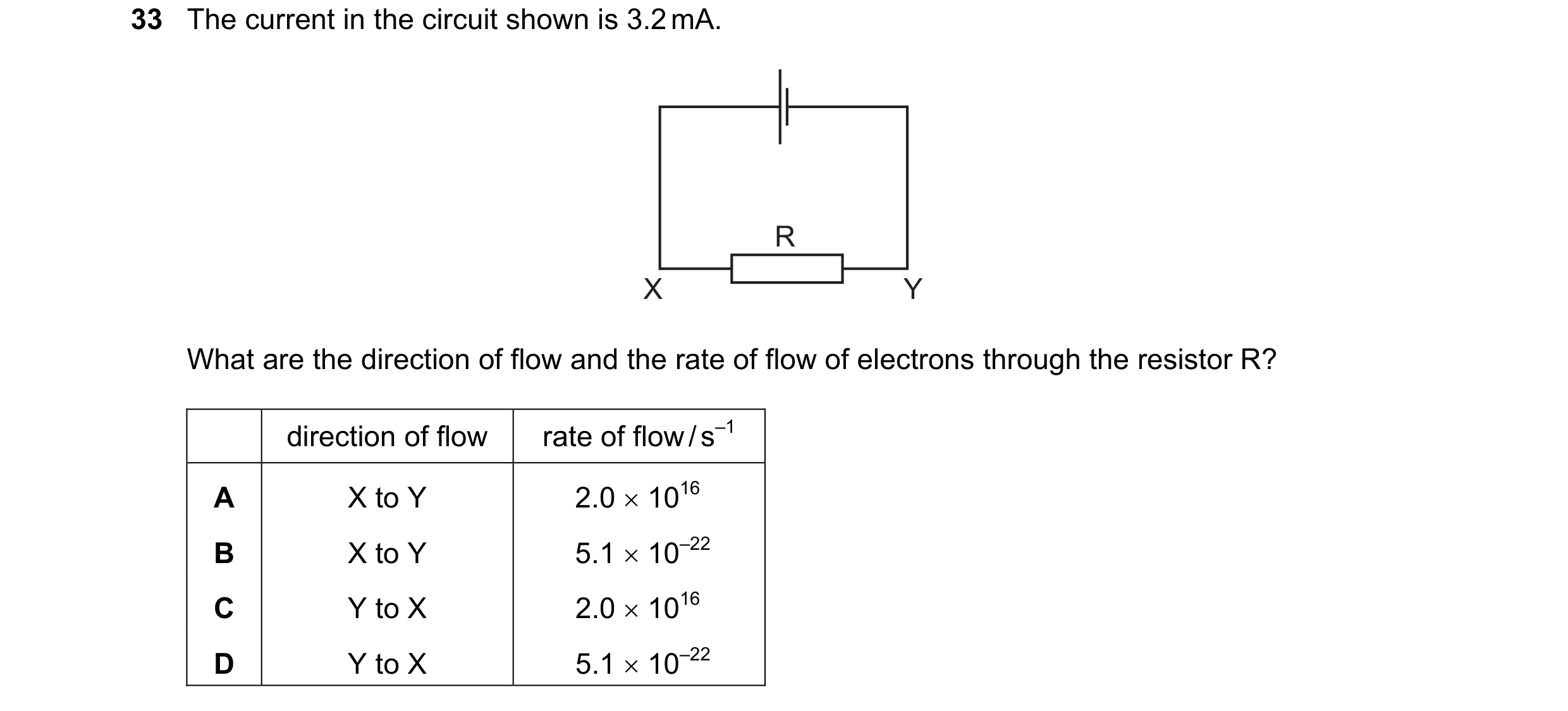
33 The current in the circuit shown is 3.2 mA. R X Y What are the direction of flow and the rate of flow of electrons through the resistor R? direction of flow rate of flow / s–1 A X to Y 2.0 × 10¹⁶ B X to Y 5.1 × 10⁻²² C Y to X 2.0 × 10¹⁶ D Y to X 5.1 × 10⁻²²
1 marks
Answer: C
This question in 9702/11 Oct/Nov 2017
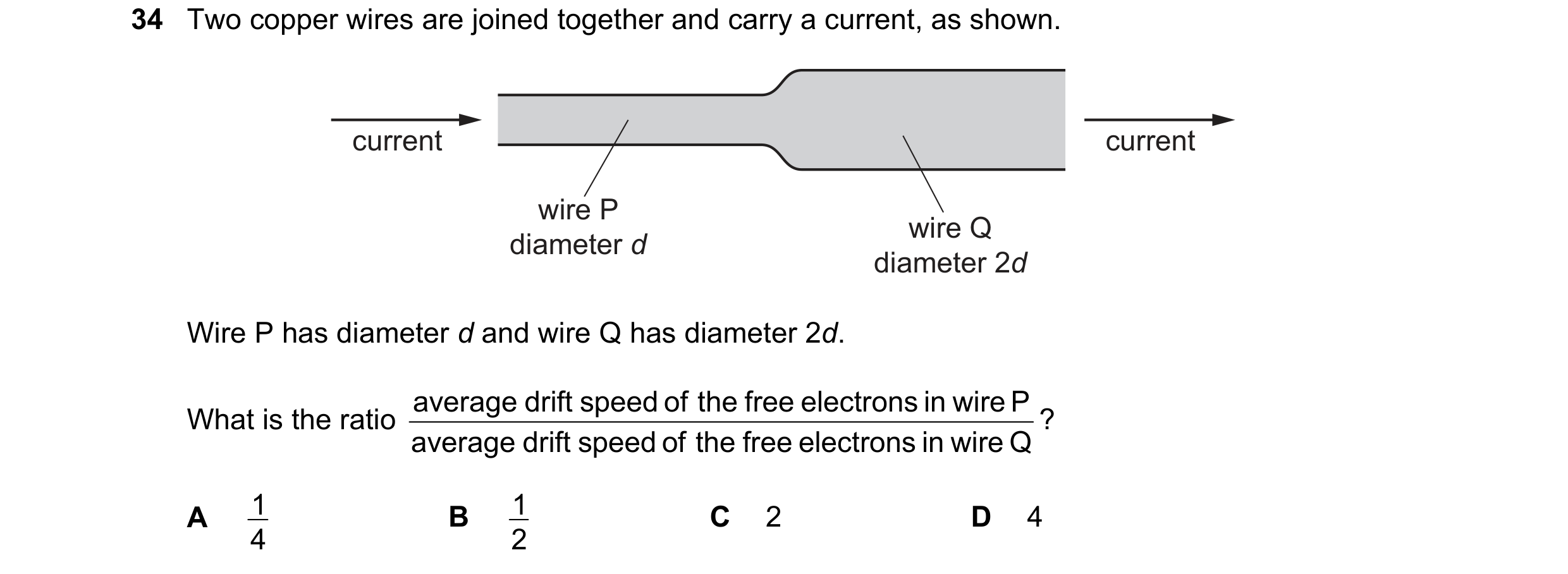
Q44 · Two copper wires are joined together and carry a current, as shown 9702/12 Oct/Nov 2017
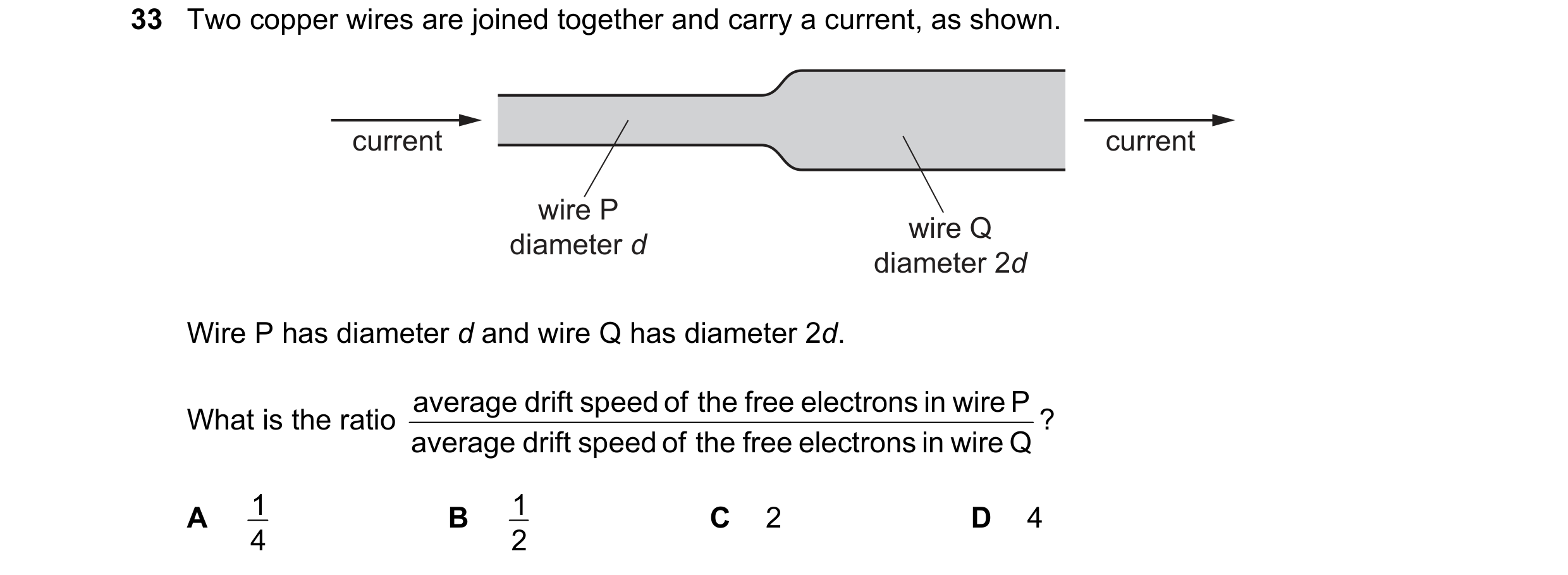
33 Two copper wires are joined together and carry a current, as shown. current current wire P wire Q diameter d diameter 2d Wire P has diameter d and wire Q has diameter 2d. average drift speed of the free electrons in wire P What is the ratio ? average drift speed of the free electrons in wire Q A 1 B 1 C 2 D 4 4 2
1 marks
Answer: D
This question in 9702/12 Oct/Nov 2017
Q45 · The number density of conduction electrons in copper is 8.0 × 1028 m–3 9702/13 Oct/Nov 2017
33 The number density of conduction electrons in copper is 8.0 × 1028 m–3. What is the average drift speed of electrons in a copper wire of diameter 0.42 mm when the current in the wire is 0.57 A? A 8.0 × 10⁻¹¹ m s–1 B 3.2 × 10⁻¹⁰ m s–1 C 8.0 × 10⁻⁵ m s–1 D 3.2 × 10⁻⁴ m s–1
1 marks
Answer: D
This question in 9702/13 Oct/Nov 2017
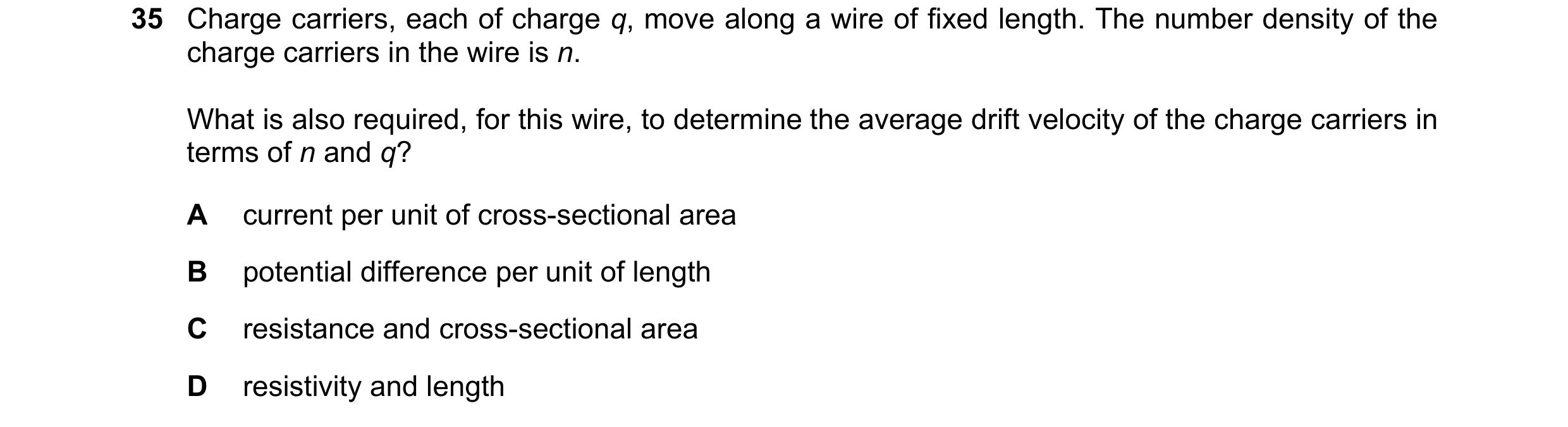
Q46 · Charge carriers, each of charge q, move along a wire of fixed length 9702/12 Feb/March 2018
35 Charge carriers, each of charge q, move along a wire of fixed length. The number density of the charge carriers in the wire is n. What is also required, for this wire, to determine the average drift velocity of the charge carriers in terms of n and q? A current per unit of cross-sectional area B potential difference per unit of length C resistance and cross-sectional area D resistivity and length
1 marks
Answer: A
This question in 9702/12 Feb/March 2018
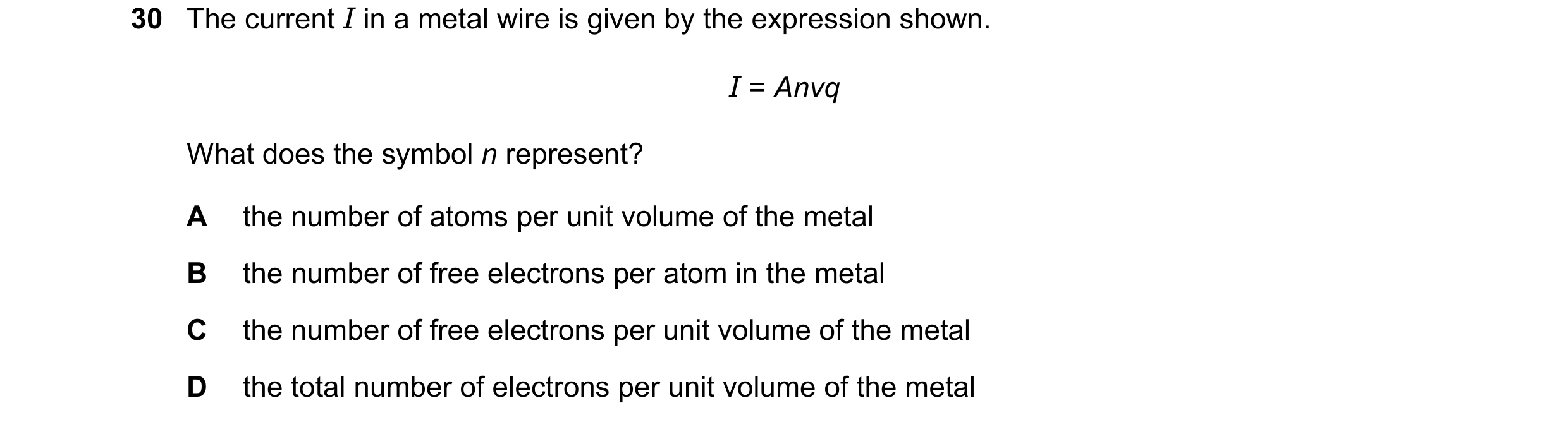
Q47 · The current I in a metal wire is given by the expression shown 9702/11 May/June 2018
30 The current I in a metal wire is given by the expression shown. I = Anvq What does the symbol n represent? A the number of atoms per unit volume of the metal B the number of free electrons per atom in the metal C the number of free electrons per unit volume of the metal D the total number of electrons per unit volume of the metal
1 marks
Answer: C
This question in 9702/11 May/June 2018
Q48 · What is a possible charge on a particle? 9702/13 May/June 2018
29 What is a possible charge on a particle? A 6.40 × 10⁻²⁰ C B 4.00 × 10⁻¹⁹ C C 1.12 × 10⁻¹⁸ C D 9.11 × 10⁻¹⁸ C
1 marks
Answer: C
This question in 9702/13 May/June 2018
Q49 · A slice of germanium of cross-sectional area 1.0 cm2 carries a current of 56 µA 9702/13 May/June 2018
30 A slice of germanium of cross-sectional area 1.0 cm2 carries a current of 56 µA. The number density of charge carriers in the germanium is 2.0 × 1013 cm–3. Each charge carrier has a charge equal to the charge on an electron. slice of germanium area 1.0 cm2 current 56 µA What is the average drift velocity of the charge carriers in the germanium? A 0.18 m s–1 B 18 m s–1 C 180 m s–1 D 1800 m s–1
1 marks
Answer: A
This question in 9702/13 May/June 2018
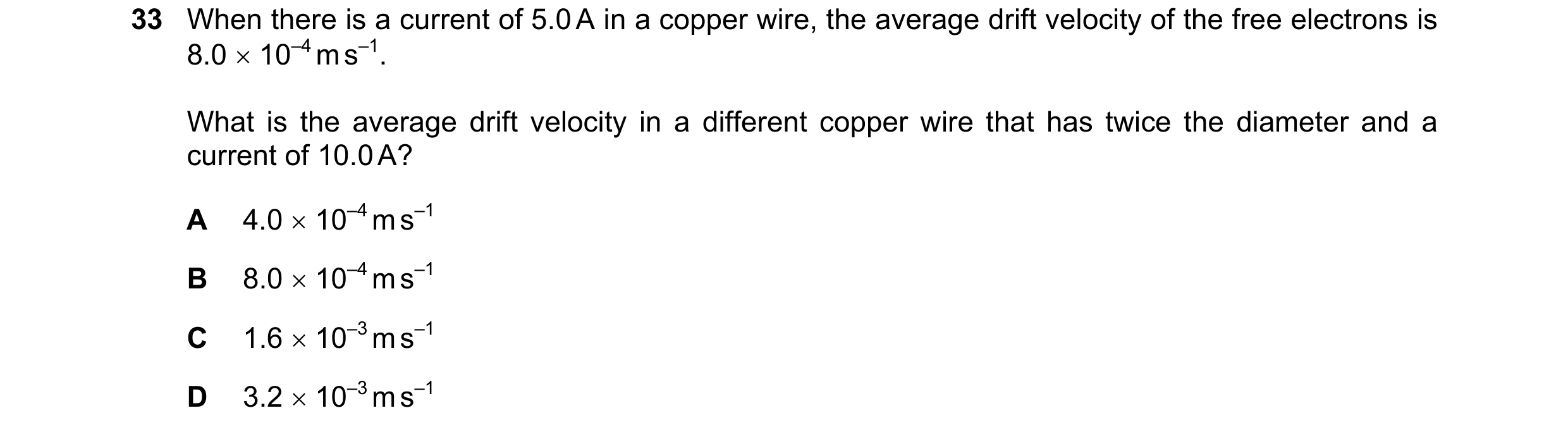
Q50 · When there is a current of 5.0 A in a copper wire, the average drift velocity of the free… 9702/11 Oct/Nov 2018
33 When there is a current of 5.0 A in a copper wire, the average drift velocity of the free electrons is 8.0 × 10⁻⁴ m s–1. What is the average drift velocity in a different copper wire that has twice the diameter and a current of 10.0 A? A 4.0 × 10⁻⁴ m s–1 B 8.0 × 10⁻⁴ m s–1 C 1.6 × 10⁻³ m s–1 D 3.2 × 10⁻³ m s–1
1 marks
Answer: A
This question in 9702/11 Oct/Nov 2018
Q51 · Which two units are used to define the coulomb? 9702/12 Oct/Nov 2018
33 Which two units are used to define the coulomb? A ampere and second B ampere and volt C volt and ohm D volt and second
1 marks
Answer: A
This question in 9702/12 Oct/Nov 2018
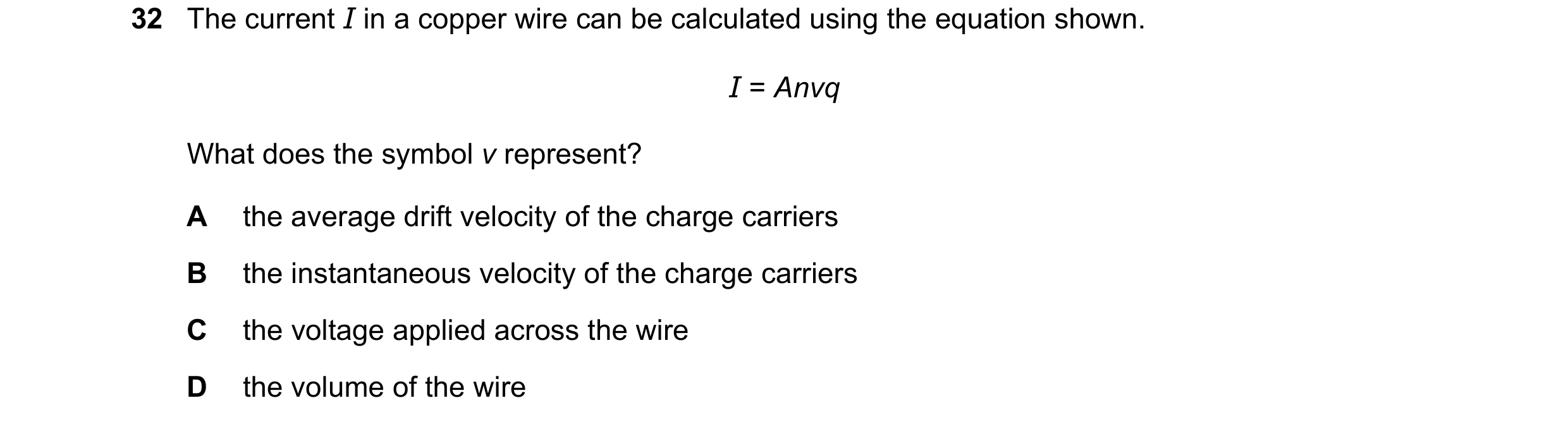
Q52 · The current I in a copper wire can be calculated using the equation shown 9702/13 Oct/Nov 2018
32 The current I in a copper wire can be calculated using the equation shown. I = Anvq What does the symbol v represent? A the average drift velocity of the charge carriers B the instantaneous velocity of the charge carriers C the voltage applied across the wire D the volume of the wire
1 marks
Answer: A
This question in 9702/13 Oct/Nov 2018
Q53 · The electric current in a wire may be calculated using the equation I = Anvq 9702/12 Feb/March 2019
32 The electric current in a wire may be calculated using the equation I = Anvq. Which statement is not correct? A n is the number of charge carriers per unit volume of the wire. B nA is the number of charge carriers per unit length of the wire. C q is the charge of each charge carrier. D v is the velocity of each charge carrier.
1 marks
Answer: D
This question in 9702/12 Feb/March 2019
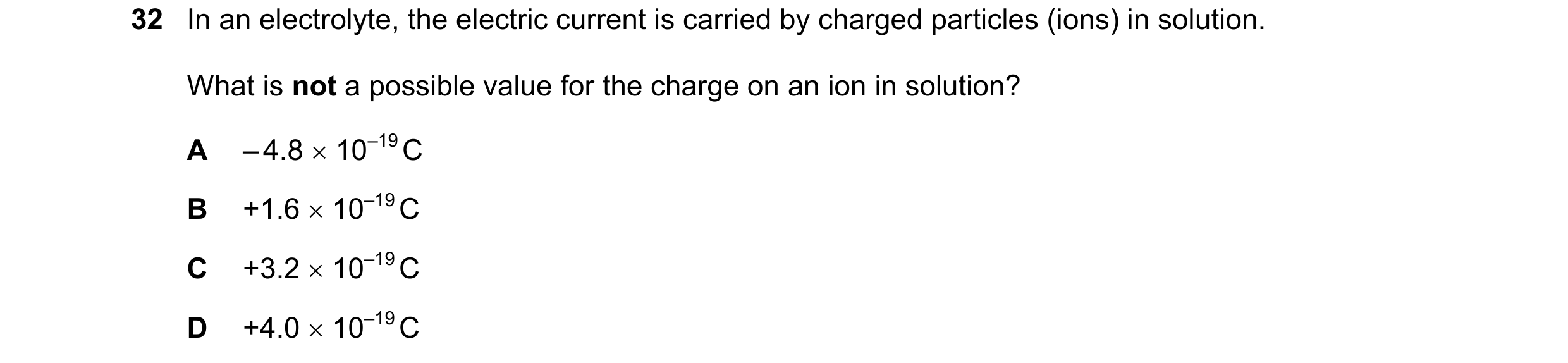
Q54 · In an electrolyte, the electric current is carried by charged particles (ions) in solution 9702/11 May/June 2019
32 In an electrolyte, the electric current is carried by charged particles (ions) in solution. What is not a possible value for the charge on an ion in solution? A – 4.8 × 10⁻¹⁹ C B +1.6 × 10⁻¹⁹ C C +3.2 × 10⁻¹⁹ C D +4.0 × 10⁻¹⁹ C
1 marks
Answer: D
This question in 9702/11 May/June 2019
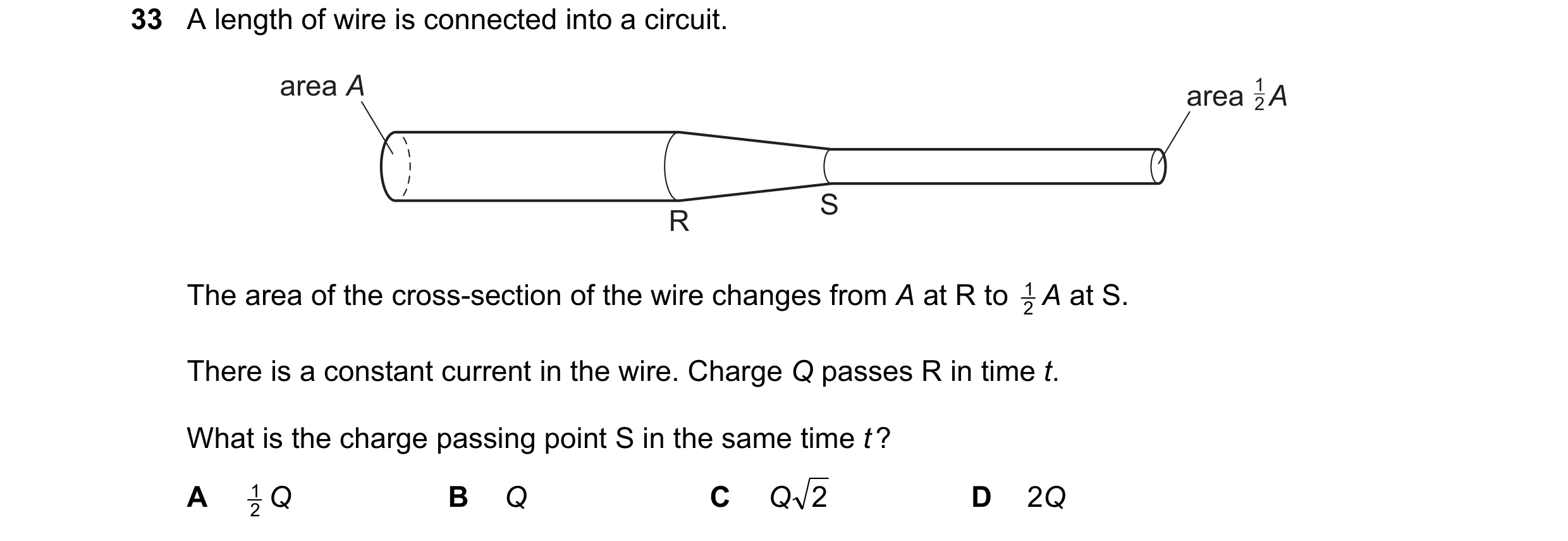
Q55 · A length of wire is connected into a circuit 9702/12 May/June 2019
33 A length of wire is connected into a circuit. area A area A 1 2 S R The area of the cross-section of the wire changes from A at R to 2 1 A at S. There is a constant current in the wire. Charge Q passes R in time t. What is the charge passing point S in the same time t ? A 1 Q B Q C Q 2 D 2Q 2
1 marks
Answer: B
This question in 9702/12 May/June 2019
Q56 · A metal plate of uniform thickness is connected to a cell as shown 9702/11 Oct/Nov 2019
30 A metal plate of uniform thickness is connected to a cell as shown. metal plate viewed from electron above flow Electrons move clockwise around the circuit. Which statement about the metal plate is correct? A The average drift speed of the conduction electrons decreases as they move from right to left through the plate. B The average drift speed of the conduction electrons increases as they move from right to left through the plate. C The number density of the conduction electrons decreases from right to left through the plate. D The number density of the conduction electrons increases from right to left through the plate.
1 marks
Answer: B
This question in 9702/11 Oct/Nov 2019
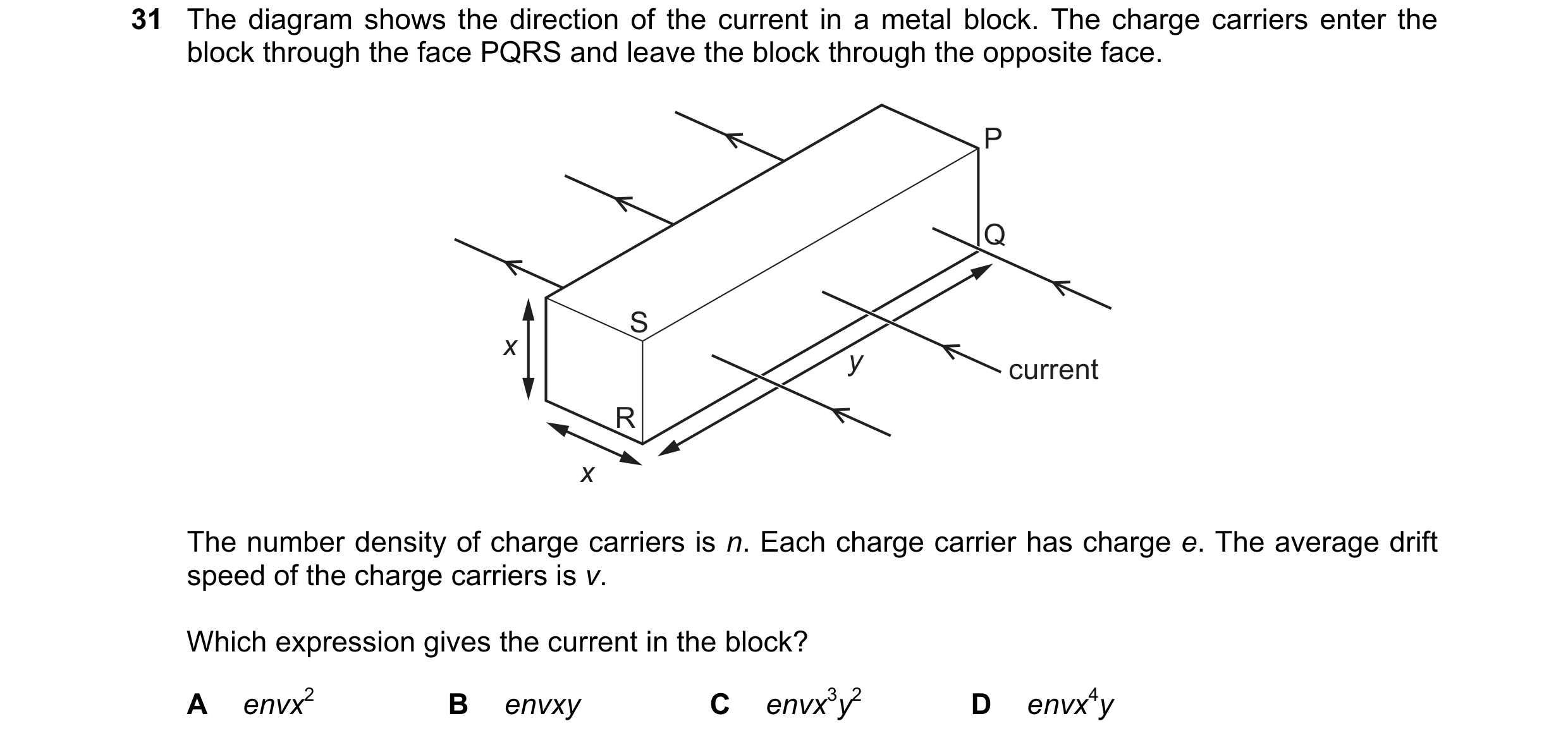
Q57 · The diagram shows the direction of the current in a metal block 9702/11 Oct/Nov 2019
31 The diagram shows the direction of the current in a metal block. The charge carriers enter the block through the face PQRS and leave the block through the opposite face. P Q S x y current R x The number density of charge carriers is n. Each charge carrier has charge e. The average drift speed of the charge carriers is v. Which expression gives the current in the block? A envx2 B envxy C envx3y2 D envx4y
1 marks
Answer: B
This question in 9702/11 Oct/Nov 2019
Q58 · When the current in a wire is 5.0 A, the average drift speed of the conduction electrons… 9702/12 Oct/Nov 2019
31 When the current in a wire is 5.0 A, the average drift speed of the conduction electrons in the wire is 7.4 × 10⁻⁴ m s–1. Which row gives a possible cross-sectional area and number of conduction electrons per unit volume for this wire? number of conduction cross-sectional area / m2 electrons per unit volume / m–3 A 7.2 × 10⁻⁷ 1.2 × 1028 B 7.2 × 10⁻⁷ 5.9 × 1028 C 2.3 × 10⁻⁶ 7.3 × 1026 D 2.3 × 10⁻⁶ 3.7 × 1027
1 marks
Answer: B
This question in 9702/12 Oct/Nov 2019
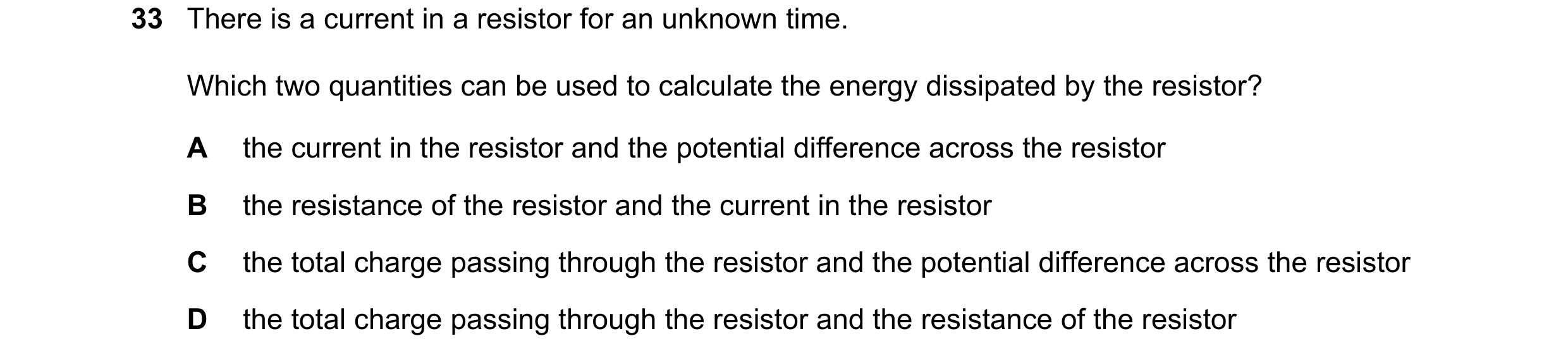
Q59 · There is a current in a resistor for an unknown time 9702/12 Oct/Nov 2019
33 There is a current in a resistor for an unknown time. Which two quantities can be used to calculate the energy dissipated by the resistor? A the current in the resistor and the potential difference across the resistor B the resistance of the resistor and the current in the resistor C the total charge passing through the resistor and the potential difference across the resistor D the total charge passing through the resistor and the resistance of the resistor
1 marks
Answer: C
This question in 9702/12 Oct/Nov 2019
Q60 · A metal electrical conductor has a resistance of 5.6 kΩ 9702/13 Oct/Nov 2019
33 A metal electrical conductor has a resistance of 5.6 kΩ. A potential difference (p.d.) of 9.0 V is applied across its ends. How many electrons pass a point in the conductor in one minute? A 6.0 × 10²⁰ B 1.0 × 10¹⁹ C 6.0 × 10¹⁷ D 1.0 × 10¹⁶
1 marks
Answer: C
This question in 9702/13 Oct/Nov 2019
Q61 · Electrons move in a vacuum from one metal plate to another metal plate 9702/12 Feb/March 2020
32 Electrons move in a vacuum from one metal plate to another metal plate. As a result of this, there is an electric current of 48 µA between the two plates. How many electrons are emitted by the first plate in a time of 5.0 minutes? A 1.4 × 10⁴ B 1.5 × 10¹⁵ C 1.8 × 10¹⁶ D 9.0 × 10¹⁶
1 marks
Answer: D
This question in 9702/12 Feb/March 2020
Q62 · The current in the circuit shown is 3.2 mA 9702/11 May/June 2020
33 The current in the circuit shown is 3.2 mA. R X Y What are the direction of flow and the rate of flow of electrons through the resistor R? direction of flow rate of flow / s–1 A X to Y 2.0 × 10¹⁶ B X to Y 5.1 × 10⁻²² C Y to X 2.0 × 10¹⁶ D Y to X 5.1 × 10⁻²²
1 marks
Answer: C
This question in 9702/11 May/June 2020
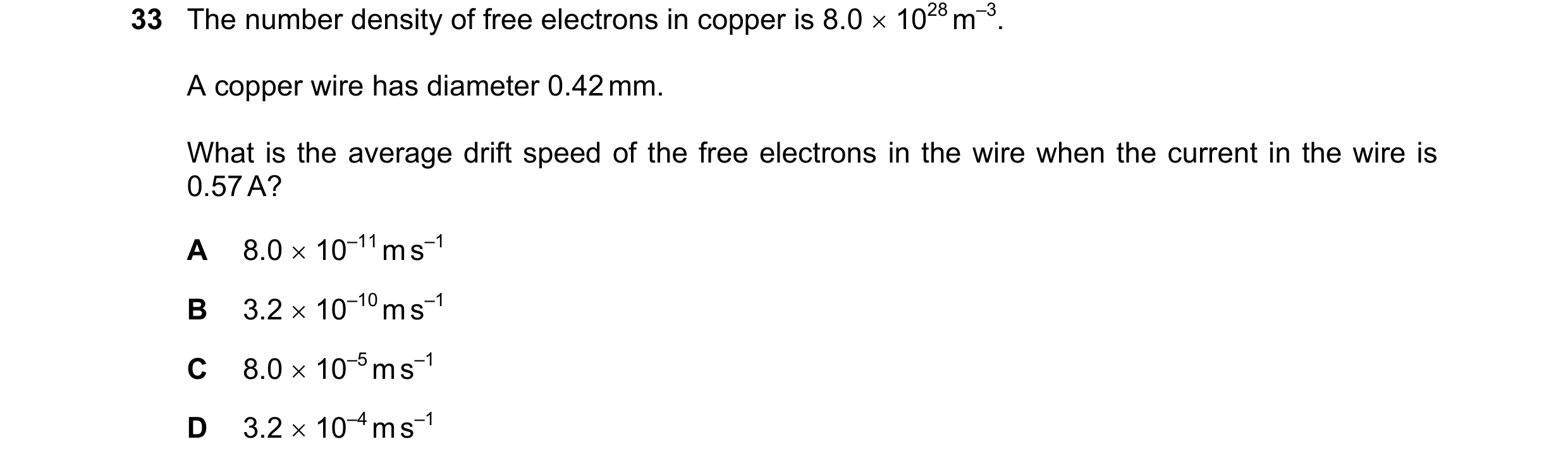
Q63 · The number density of free electrons in copper is 8.0 × 1028 m–3 9702/12 May/June 2020
33 The number density of free electrons in copper is 8.0 × 1028 m–3. A copper wire has diameter 0.42 mm. What is the average drift speed of the free electrons in the wire when the current in the wire is 0.57 A? A 8.0 × 10⁻¹¹ m s–1 B 3.2 × 10⁻¹⁰ m s–1 C 8.0 × 10⁻⁵ m s–1 D 3.2 × 10⁻⁴ m s–1
1 marks
Answer: D
This question in 9702/12 May/June 2020
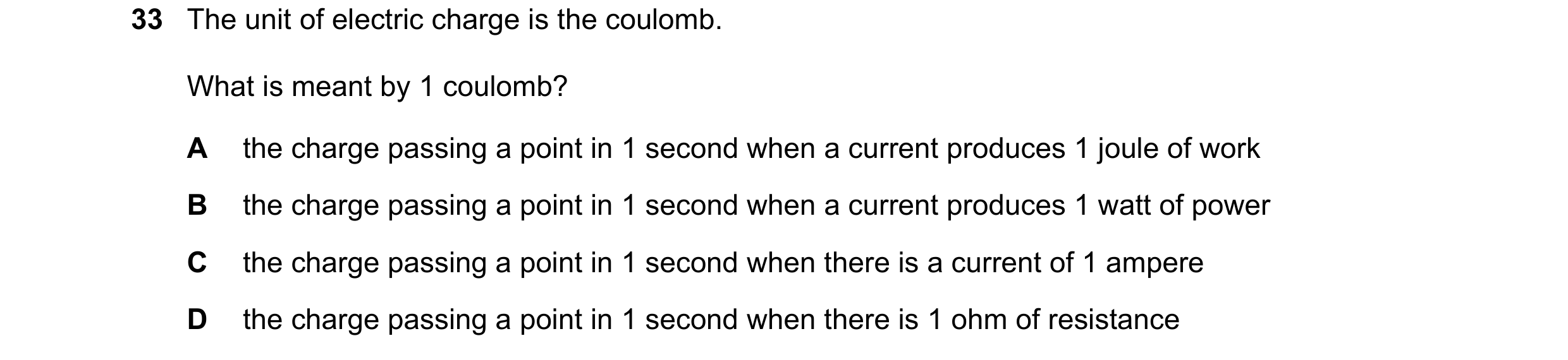
Q64 · The unit of electric charge is the coulomb 9702/13 May/June 2020
33 The unit of electric charge is the coulomb. What is meant by 1 coulomb? A the charge passing a point in 1 second when a current produces 1 joule of work B the charge passing a point in 1 second when a current produces 1 watt of power C the charge passing a point in 1 second when there is a current of 1 ampere D the charge passing a point in 1 second when there is 1 ohm of resistance
1 marks
Answer: C
This question in 9702/13 May/June 2020
Q65 · Two copper wires are joined together and carry a current, as shown 9702/13 May/June 2020
34 Two copper wires are joined together and carry a current, as shown. current current wire P diameter d wire Q diameter 2d Wire P has diameter d and wire Q has diameter 2d. average drift speed of the free electrons in wire P What is the ratio ? average drift speed of the free electrons in wire Q A 1 B 1 C 2 D 4 4 2
1 marks
Answer: D
This question in 9702/13 May/June 2020
Q66 · Free electrons flow along a copper wire X of radius 5.0 10–5 m with an average drift… 9702/11 Oct/Nov 2020
32 Free electrons flow along a copper wire X of radius 5.0 10–5 m with an average drift speed of 2.8 10–2 m s–1. The current in the wire is 3.0 A. There is a current of 2.0 A in a copper wire Y of radius 1.0 10–4 m. What is the average drift speed of the free electrons in copper wire Y? A 4.7 10–3 m s–1 B 9.3 10–3 m s–1 C 1.1 10–2 m s–1 D 1.9 10–2 m s–1
1 marks
Answer: A
This question in 9702/11 Oct/Nov 2020
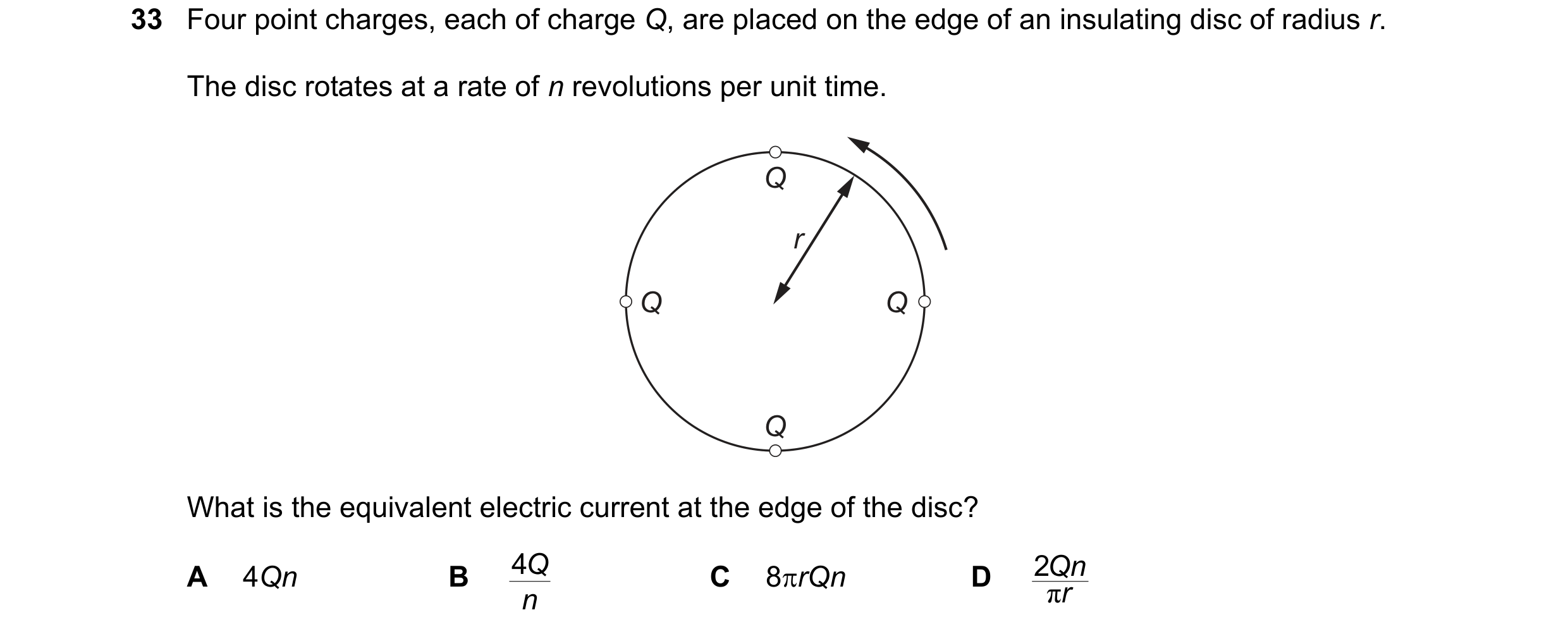
Q67 · Four point charges, each of charge Q, are placed on the edge of an insulating disc of… 9702/12 Oct/Nov 2020
33 Four point charges, each of charge Q, are placed on the edge of an insulating disc of radius r. The disc rotates at a rate of n revolutions per unit time. Q r Q Q Q What is the equivalent electric current at the edge of the disc? A 4Qn B 4Q n C 8rQn D 2Qn π r
1 marks
Answer: A
This question in 9702/12 Oct/Nov 2020
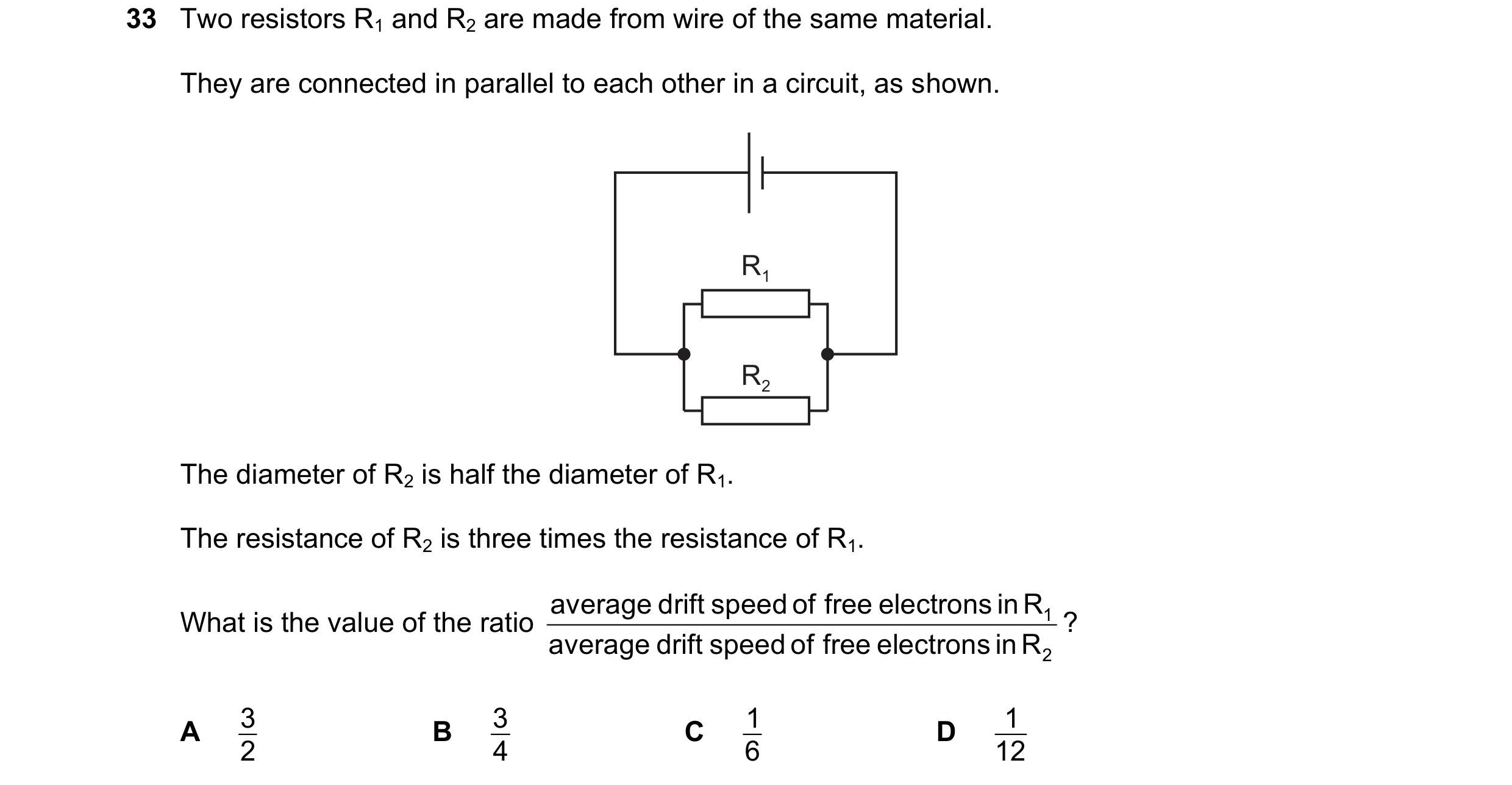
Q68 · Two resistors R1 and R2 are made from wire of the same material 9702/13 Oct/Nov 2020
33 Two resistors R1 and R2 are made from wire of the same material. They are connected in parallel to each other in a circuit, as shown. R1 R2 The diameter of R2 is half the diameter of R1. The resistance of R2 is three times the resistance of R1. average drift speed of free electrons in R What is the value of the ratio average drift speed of free electrons inR ? 1 2 3 3 1 1 A 2 B 4 C 6 D 12
1 marks
Answer: B
This question in 9702/13 Oct/Nov 2020
Q69 · The current I in a metal wire is given by the equation I = Anvq 9702/12 Feb/March 2021
32 The current I in a metal wire is given by the equation I = Anvq. What does the symbol n represent? A the number of charge carriers in the wire B the number of charge carriers per unit cross-sectional area of the wire C the number of charge carriers per unit length of the wire D the number of charge carriers per unit volume of the wire
1 marks
Answer: D
This question in 9702/12 Feb/March 2021
Q70 · Which two units are used to define the coulomb? 9702/11 May/June 2021
32 Which two units are used to define the coulomb? A ampere and second B ampere and volt C volt and ohm D volt and second
1 marks
Answer: A
This question in 9702/11 May/June 2021
Q71 · A wire has a length of 12 cm and contains a total of 5.1 1022 free electrons 9702/13 May/June 2021
33 A wire has a length of 12 cm and contains a total of 5.1 1022 free electrons. When a potential difference is applied across the ends of the wire, the free electrons move with an average drift speed of 4.0 10–6 m s–1. What is the current in the wire? A 0.0027 A B 0.0039 A C 0.27 A D 0.39 A
1 marks
Answer: C
This question in 9702/13 May/June 2021
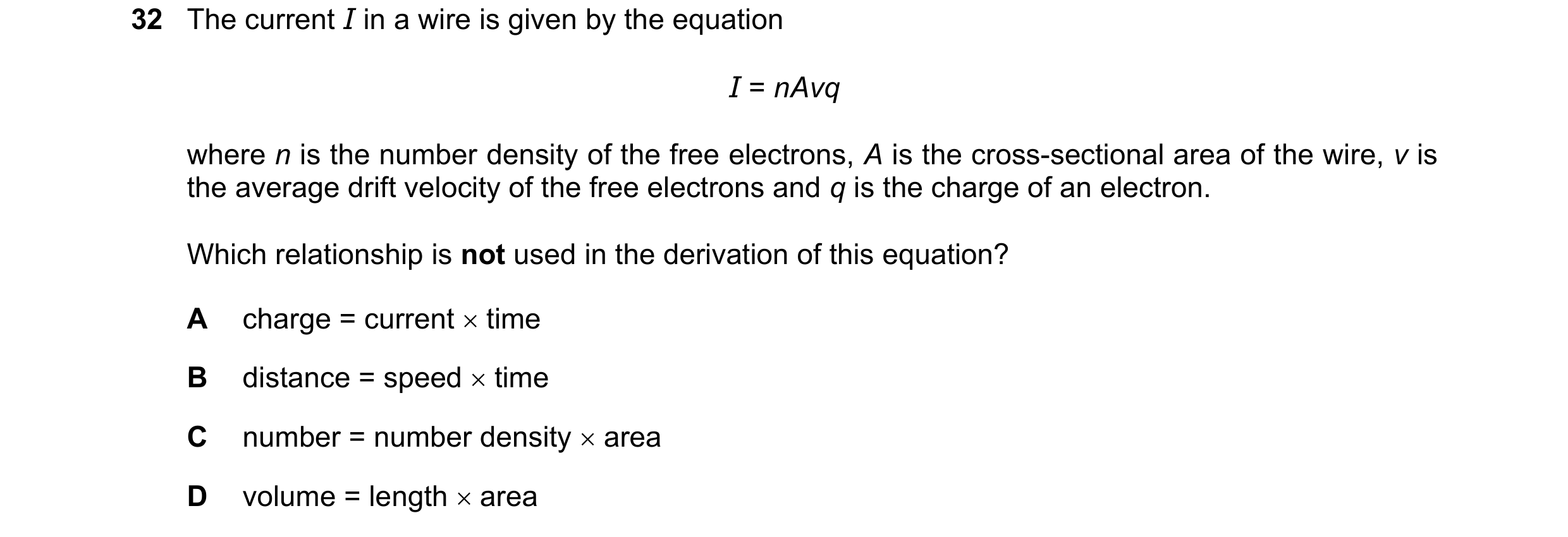
Q72 · The current I in a wire is given by the equation I = nAvq where n is the number density… 9702/11 Oct/Nov 2021
32 The current I in a wire is given by the equation I = nAvq where n is the number density of the free electrons, A is the cross-sectional area of the wire, v is the average drift velocity of the free electrons and q is the charge of an electron. Which relationship is not used in the derivation of this equation? A charge = current time B distance = speed time C number = number density area D volume = length area
1 marks
Answer: C
This question in 9702/11 Oct/Nov 2021
Q73 · A lightning strike transfers 1 1020 electrons past a point in a time of 30 s 9702/13 Oct/Nov 2021
33 A lightning strike transfers 1 1020 electrons past a point in a time of 30 s. What is the average current during the lightning strike? A 0.5 mA B 0.5 A C 500 A D 500 kA
1 marks
Answer: D
This question in 9702/13 Oct/Nov 2021
Q74 · For a current-carrying wire, the current can be calculated using the equation shown 9702/12 Feb/March 2022
29 For a current-carrying wire, the current can be calculated using the equation shown. I = Anvq What is the meaning of n? A the number of charge carriers in the wire B the number of charge carriers multiplied by the volume of the wire C the number of charge carriers per unit length of the wire D the number of charge carriers per unit volume of the wire
1 marks
Answer: D
This question in 9702/12 Feb/March 2022
Q75 · The number of free electrons passing a point in a wire in 24 hours is 6.0 1023 9702/12 Feb/March 2022
30 The number of free electrons passing a point in a wire in 24 hours is 6.0 1023. What is the average current in the wire? A 6.3 pA B 1.1 A C 67 A D 4.0 kA
1 marks
Answer: B
This question in 9702/12 Feb/March 2022
Q76 · A straight copper wire of diameter 0.42 10–3 m has a number density of free electrons… 9702/11 May/June 2022
31 A straight copper wire of diameter 0.42 10–3 m has a number density of free electrons of 8.5 1028 m–3. In a given time interval, a charge of 0.15 C moves through the wire. What is the average displacement of the free electrons along the wire in this time interval? A 3.3 10–8 m B 2.0 10–5 m C 8.0 10–5 m D 2.5 10–4 m
1 marks
Answer: C
This question in 9702/11 May/June 2022
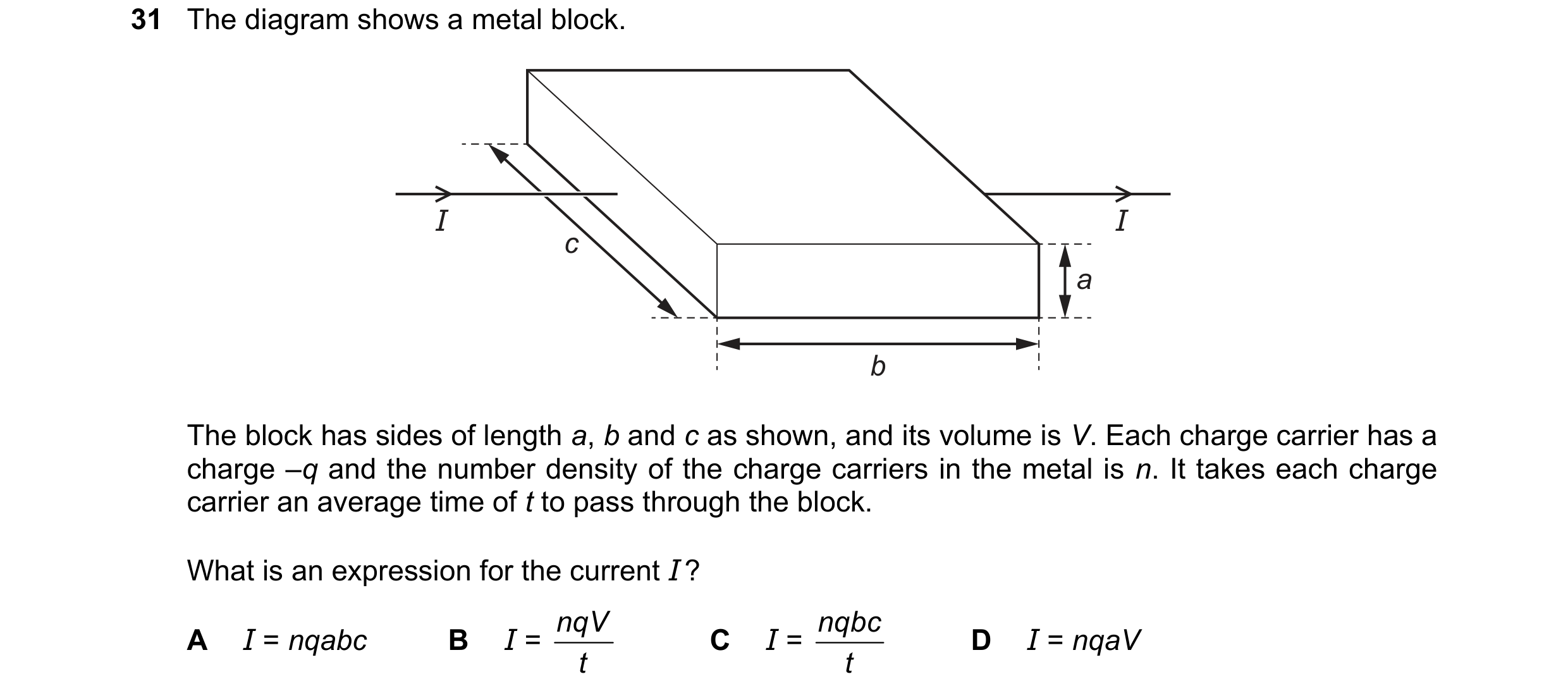
Q77 · The diagram shows a metal block 9702/12 May/June 2022
31 The diagram shows a metal block. I I c a b The block has sides of length a, b and c as shown, and its volume is V. Each charge carrier has a charge –q and the number density of the charge carriers in the metal is n. It takes each charge carrier an average time of t to pass through the block. What is an expression for the current I ? I = nqV I = nqbc A I = nqabc B C D I = nqaV t t
1 marks
Answer: B
This question in 9702/12 May/June 2022
Q78 · A length of wire RS has a circular cross-section 9702/11 Oct/Nov 2022
31 A length of wire RS has a circular cross-section. area A area A 2 S R At end R of the wire, the cross-sectional area is A. A . At end S of the wire, the cross-sectional area is 2 Charge Q takes time t to pass through end R of the wire. There is a constant electric current in the wire. t ? How much charge will pass through end S in a time interval of 4 Q Q Q A B C D Q 8 4 2
1 marks
Answer: B
This question in 9702/11 Oct/Nov 2022
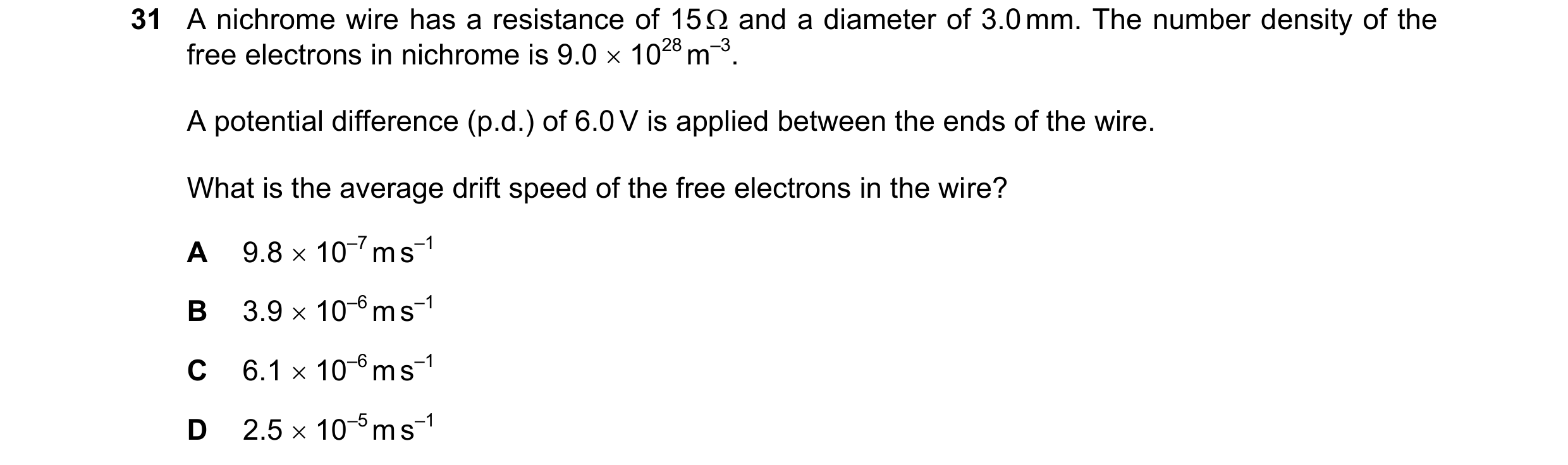
Q79 · A nichrome wire has a resistance of 15 and a diameter of 3.0 mm 9702/12 Oct/Nov 2022
31 A nichrome wire has a resistance of 15 and a diameter of 3.0 mm. The number density of the free electrons in nichrome is 9.0 1028 m–3. A potential difference (p.d.) of 6.0 V is applied between the ends of the wire. What is the average drift speed of the free electrons in the wire? A 9.8 10–7 m s–1 B 3.9 10–6 m s–1 C 6.1 10–6 m s–1 D 2.5 10–5 m s–1
1 marks
Answer: B
This question in 9702/12 Oct/Nov 2022
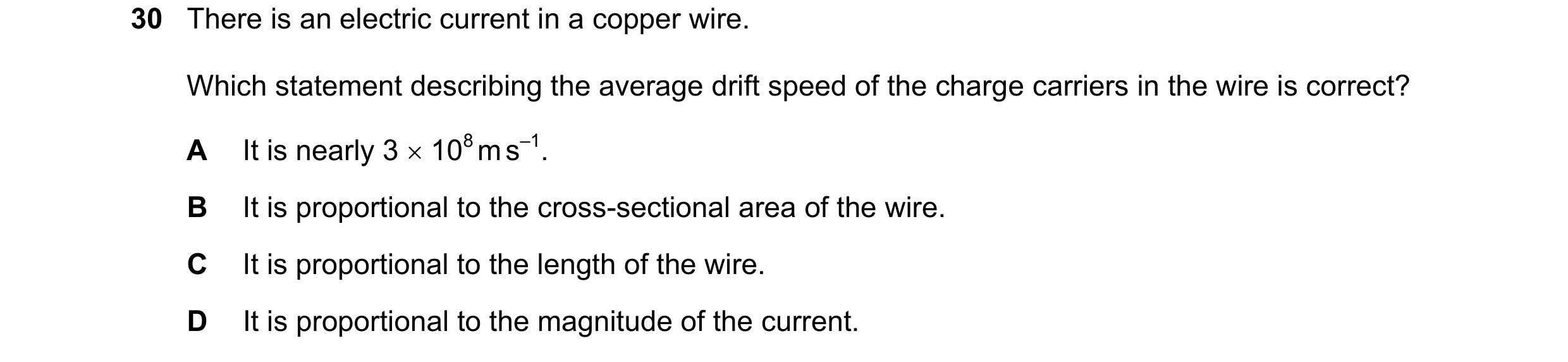
Q80 · There is an electric current in a copper wire 9702/13 Oct/Nov 2022
30 There is an electric current in a copper wire. Which statement describing the average drift speed of the charge carriers in the wire is correct? A It is nearly 3 108 m s–1. B It is proportional to the cross-sectional area of the wire. C It is proportional to the length of the wire. D It is proportional to the magnitude of the current.
1 marks
Answer: D
This question in 9702/13 Oct/Nov 2022
Q81 · A wire carries a current of 0.10 µA 9702/12 Feb/March 2023
30 A wire carries a current of 0.10 µA. The potential difference across the wire is 10 mV. How much energy is dissipated by the wire in a time of 10 s? A 1.0 pJ B 10 pJ C 1.0 nJ D 10 nJ
1 marks
Answer: D
This question in 9702/12 Feb/March 2023
Q82 · The electric current in a metal wire is 4.0 mA 9702/11 May/June 2023
30 The electric current in a metal wire is 4.0 mA. How many electrons pass a fixed point in the wire in a time of 10 hours? A 2.5 1017 B 2.5 1020 C 9.0 1020 D 9.0 1023
1 marks
Answer: C
This question in 9702/11 May/June 2023
Q83 · Which charge can be carried by a charge carrier? 9702/12 May/June 2023
30 Which charge can be carried by a charge carrier? A 1.1 10–19 C B 4.0 10–19 C C 4.8 10–19 C D 9.1 10–19 C
1 marks
Answer: C
This question in 9702/12 May/June 2023
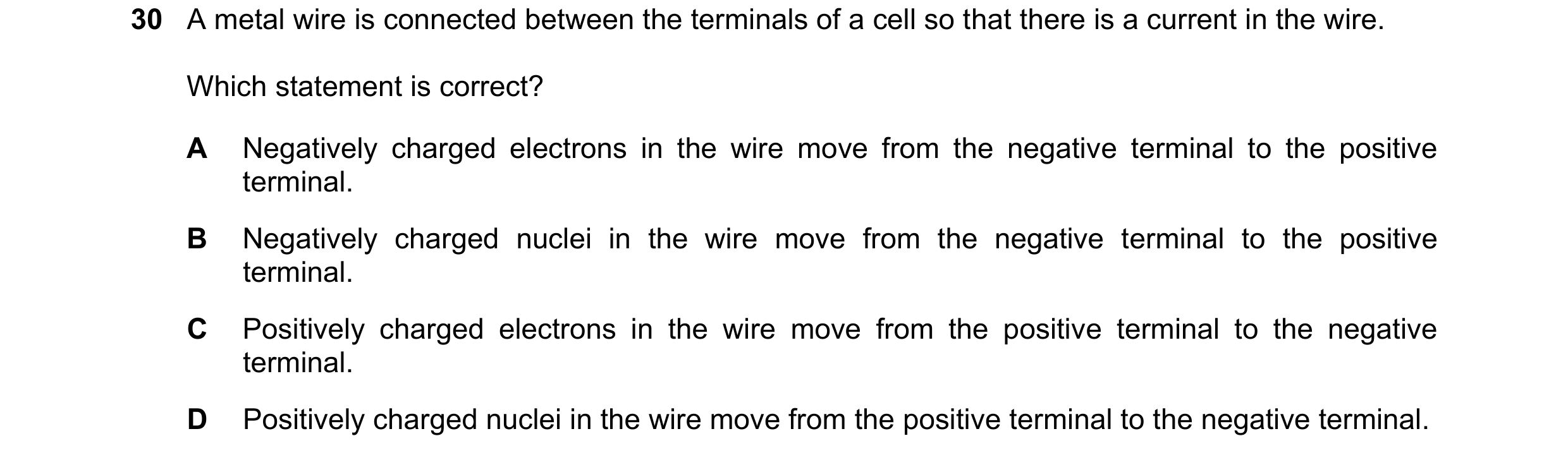
Q84 · A metal wire is connected between the terminals of a cell so that there is a current in… 9702/13 May/June 2023
30 A metal wire is connected between the terminals of a cell so that there is a current in the wire. Which statement is correct? A Negatively charged electrons in the wire move from the negative terminal to the positive terminal. B Negatively charged nuclei in the wire move from the negative terminal to the positive terminal. C Positively charged electrons in the wire move from the positive terminal to the negative terminal. D Positively charged nuclei in the wire move from the positive terminal to the negative terminal.
1 marks
Answer: A
This question in 9702/13 May/June 2023
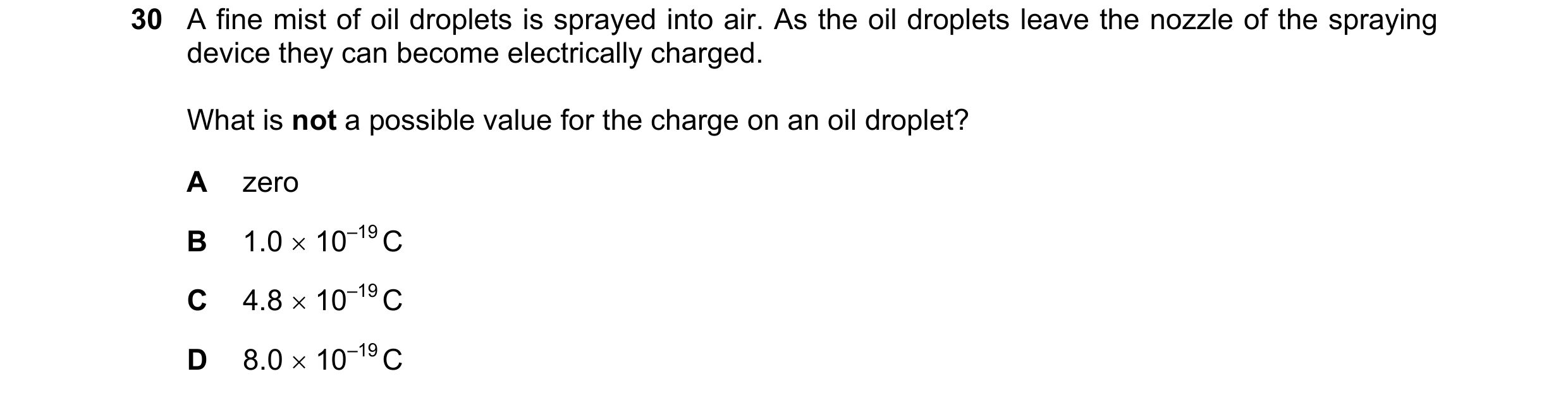
Q85 · A fine mist of oil droplets is sprayed into air 9702/12 Oct/Nov 2023
30 A fine mist of oil droplets is sprayed into air. As the oil droplets leave the nozzle of the spraying device they can become electrically charged. What is not a possible value for the charge on an oil droplet? A zero B 1.0 × 10⁻¹⁹ C C 4.8 × 10⁻¹⁹ C D 8.0 × 10⁻¹⁹ C
1 marks
Answer: B
This question in 9702/12 Oct/Nov 2023
Q86 · In an electric circuit, an ammeter reads 2 A 9702/13 Oct/Nov 2023
2 In an electric circuit, an ammeter reads 2 A. In a second circuit, the ammeter reads 1 mA. How many times larger is the current in the second circuit compared with the current in the first circuit? A 500 B 5000 C 500 000 D 5 000 000
1 marks
Answer: A
This question in 9702/13 Oct/Nov 2023
Q87 · A radioactive source produces a beam of -particles in a vacuum 9702/12 Feb/March 2024
36 A radioactive source produces a beam of -particles in a vacuum. The average current caused by the -particles in the beam is 1.5 10–9 A. The beam is incident on a metal target. What is the average number of -particles hitting the metal target in a time of 3.0 s? A 4.7 109 B 9.4 109 C 1.4 1010 D 2.8 1010
1 marks
Answer: C
This question in 9702/12 Feb/March 2024
Q88 · The charge carriers in a metal wire are free electrons 9702/12 Feb/March 2024
37 The charge carriers in a metal wire are free electrons. Which statement about the charge of each free electron is correct? A The magnitude of the charge increases with the potential difference across the wire. B The magnitude of the charge is zero unless there is a potential difference across the wire. C The sign and magnitude of the charge do not depend on the potential difference across the wire. D The sign of the charge depends on the potential difference across the wire. 2 e
1 marks
Answer: C
This question in 9702/12 Feb/March 2024
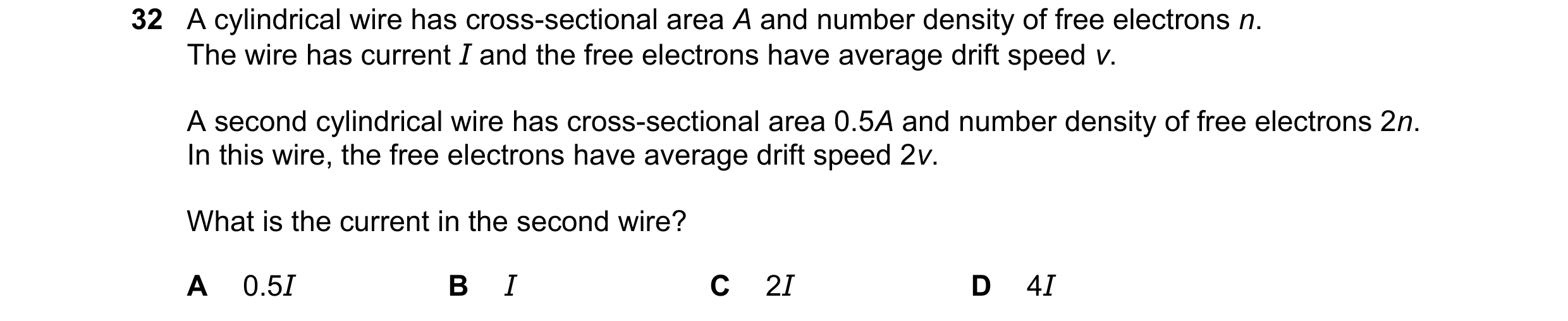
Q89 · A cylindrical wire has cross-sectional area A and number density of free electrons n 9702/12 May/June 2024
32 A cylindrical wire has cross-sectional area A and number density of free electrons n. The wire has current I and the free electrons have average drift speed v. A second cylindrical wire has cross-sectional area 0.5A and number density of free electrons 2n. In this wire, the free electrons have average drift speed 2v. What is the current in the second wire? A 0.5I B I C 2I D 4I
1 marks
Answer: C
This question in 9702/12 May/June 2024
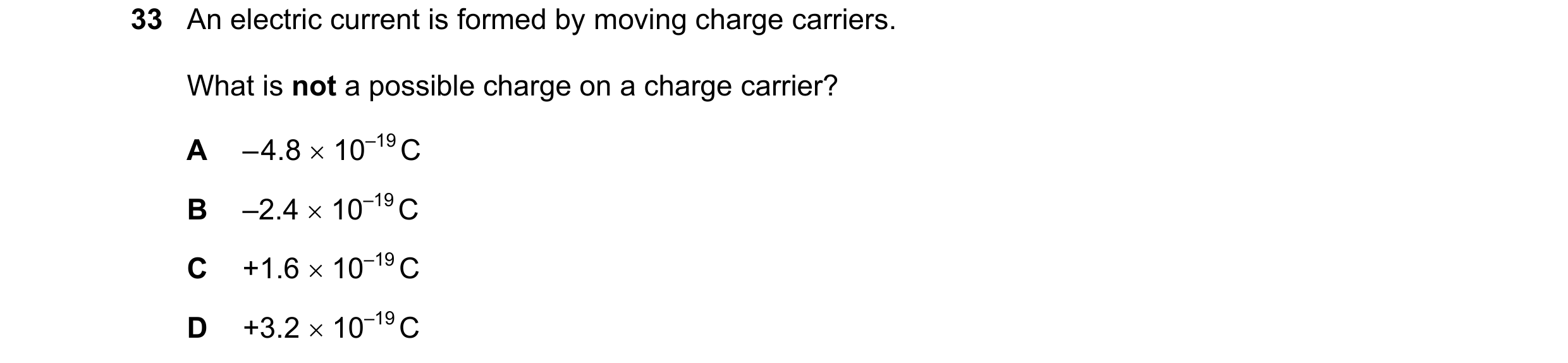
Q90 · An electric current is formed by moving charge carriers 9702/12 May/June 2024
33 An electric current is formed by moving charge carriers. What is not a possible charge on a charge carrier? A – 4.8 10–19 C B –2.4 10–19 C C +1.6 10–19 C D +3.2 10–19 C
1 marks
Answer: B
This question in 9702/12 May/June 2024
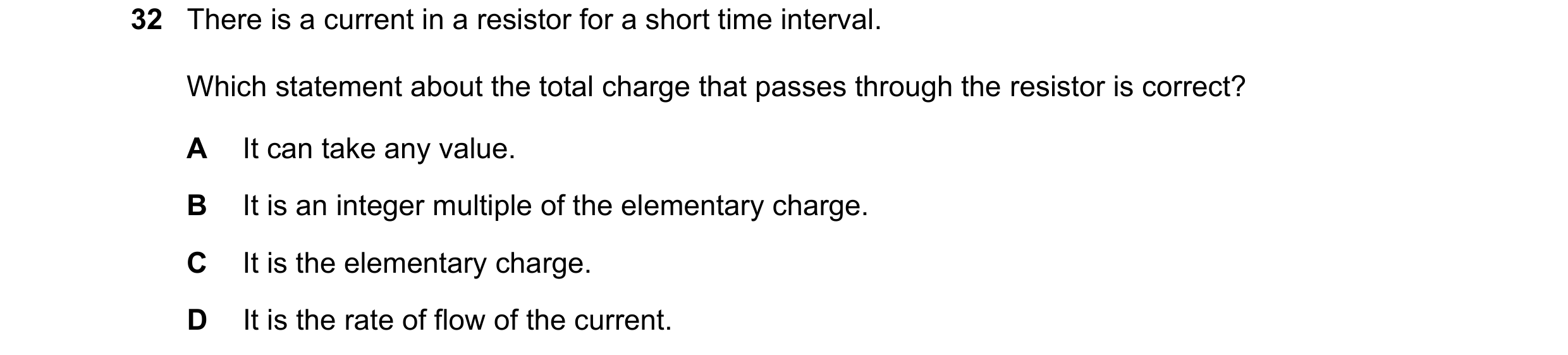
Q91 · There is a current in a resistor for a short time interval 9702/12 Oct/Nov 2024
32 There is a current in a resistor for a short time interval. Which statement about the total charge that passes through the resistor is correct? A It can take any value. B It is an integer multiple of the elementary charge. C It is the elementary charge. D It is the rate of flow of the current.
1 marks
Answer: B
This question in 9702/12 Oct/Nov 2024
Q92 · An electric current of 12 A is in a wire of length 0.35 m 9702/12 Oct/Nov 2024
34 An electric current of 12 A is in a wire of length 0.35 m. The average drift speed of the free electrons (charge carriers) in the wire is 5.0 10–4 m s–1. How many free electrons are in the wire? A 1.3 1016 B 5.3 1022 C 1.5 1023 D 4.3 1023
1 marks
Answer: B
This question in 9702/12 Oct/Nov 2024
Q93 · What is an electric current? 9702/13 Oct/Nov 2024
31 What is an electric current? A a flow of charge carriers B a flow of energy C an electron D the charge on a particle
1 marks
Answer: A
This question in 9702/13 Oct/Nov 2024
Q94 · A wire of diameter d is connected into an electric circuit 9702/13 Oct/Nov 2024
32 A wire of diameter d is connected into an electric circuit. There is a current I in the wire and the charge carriers have an average drift speed v. The wire is replaced with a new wire of the same material but with a diameter 0.5d. The current is adjusted so that the charge carriers in the new wire have an average drift speed 3v. What is the current in the new wire? A 0.75I B 1.5I C 6I D 12I
1 marks
Answer: A
This question in 9702/13 Oct/Nov 2024
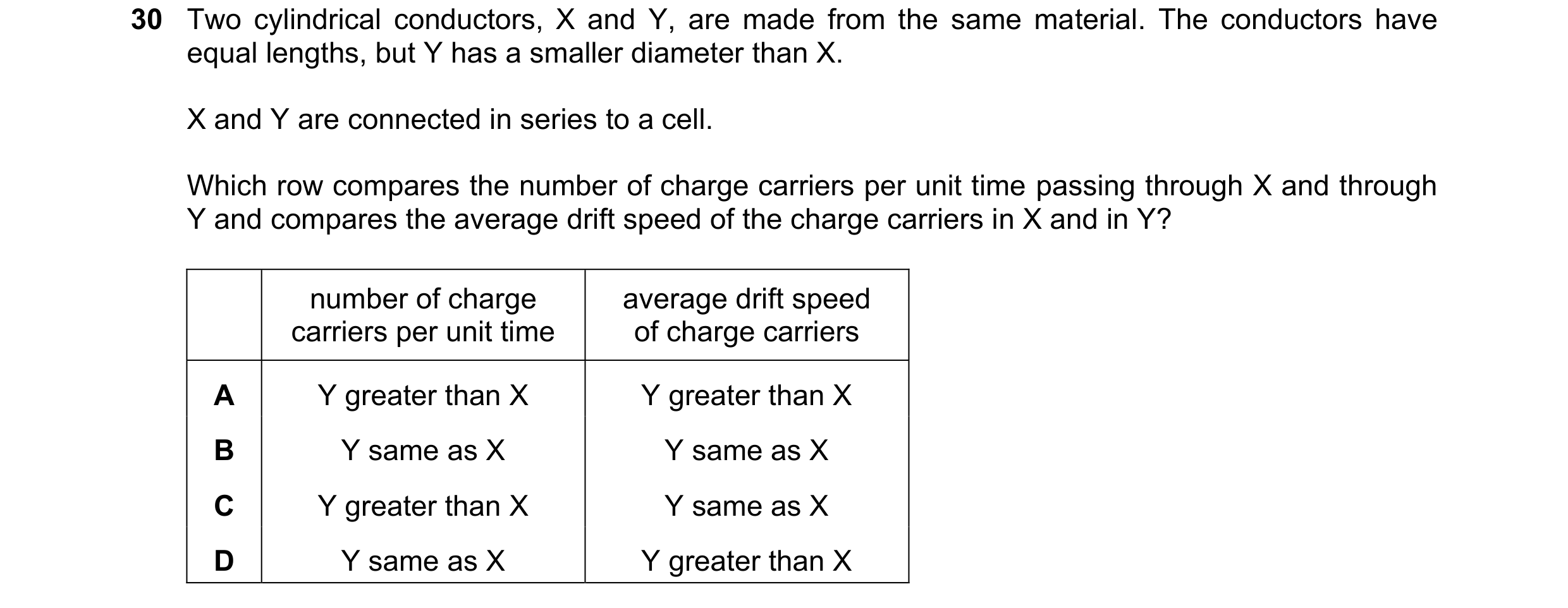
Q95 · Two cylindrical conductors, X and Y, are made from the same material 9702/12 Feb/March 2025
30 Two cylindrical conductors, X and Y, are made from the same material. The conductors have equal lengths, but Y has a smaller diameter than X. X and Y are connected in series to a cell. Which row compares the number of charge carriers per unit time passing through X and through Y and compares the average drift speed of the charge carriers in X and in Y? number of charge average drift speed carriers per unit time of charge carriers A Y greater than X Y greater than X B Y same as X Y same as X C Y greater than X Y same as X D Y same as X Y greater than X
1 marks
Answer: D
This question in 9702/12 Feb/March 2025
Q96 · A metal electrical conductor has a resistance of 5.6 k 9702/12 Feb/March 2025
33 A metal electrical conductor has a resistance of 5.6 k. A potential difference (p.d.) of 9.0 V is applied across its ends. How many electrons pass a point in the conductor in one minute? A 6.0 1020 B 1.0 1019 C 6.0 1017 D 1.0 1016
1 marks
Answer: C
This question in 9702/12 Feb/March 2025
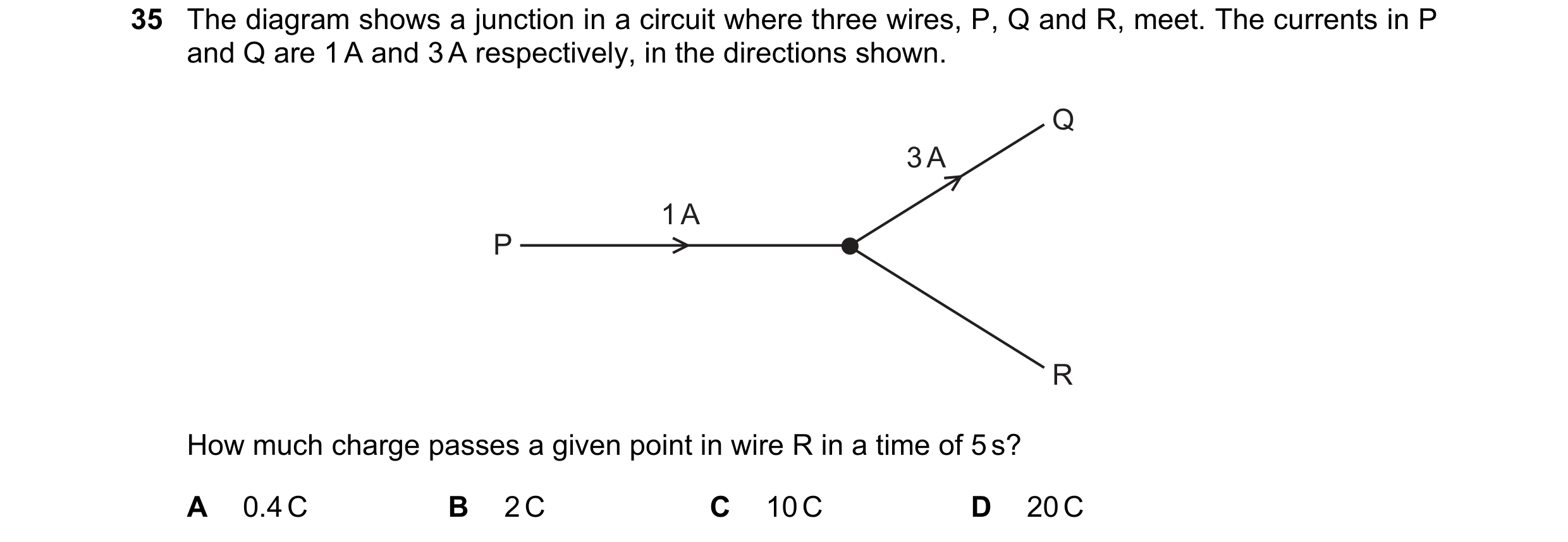
Q97 · The diagram shows a junction in a circuit where three wires, P, Q and R, meet 9702/12 Feb/March 2025
35 The diagram shows a junction in a circuit where three wires, P, Q and R, meet. The currents in P and Q are 1 A and 3 A respectively, in the directions shown. Q 3 A 1 A P R How much charge passes a given point in wire R in a time of 5 s? A 0.4 C B 2 C C 10 C D 20 C
1 marks
Answer: C
This question in 9702/12 Feb/March 2025
Q98 · A resistor of resistance 200 is connected to a supply that has a p.d 9702/12 May/June 2025
34 A resistor of resistance 200 is connected to a supply that has a p.d. of 4.00 V. How many electrons enter the resistor in 4.00 s? A 3.13 1016 B 1.25 1017 C 5.00 1017 D 1.25 1021
1 marks
Answer: C
This question in 9702/12 May/June 2025
Q99 · What is a reasonable estimate of the current in an electric kettle that is in use? 9702/13 May/June 2025
2 What is a reasonable estimate of the current in an electric kettle that is in use? A 8 A B 8 mA C 8 A D 8 kA
1 marks
Answer: C
This question in 9702/13 May/June 2025
Q100 · The current I in a metallic conductor of cross-sectional area A is given by I = Anve… 9702/13 May/June 2025
32 The current I in a metallic conductor of cross-sectional area A is given by I = Anve where e is the elementary charge and v is the mean drift velocity of the conduction electrons. What is represented by the letter n in the equation? A density of conduction electrons B number of conduction electrons per unit time C number of conduction electrons per unit volume D volume of conduction electrons
1 marks
Answer: C
This question in 9702/13 May/June 2025
Q101 · What cannot be the charge on a charge carrier? 9702/13 May/June 2025
33 What cannot be the charge on a charge carrier? A – 4.8 10–19 C B –3.2 10–19 C C –2.4 10–19 C D +3.2 10–19 C
1 marks
Answer: C
This question in 9702/13 May/June 2025
Q102 · The resistance of a lamp is 10 and the potential difference across it is 6.0 V 9702/14 May/June 2025
29 The resistance of a lamp is 10 and the potential difference across it is 6.0 V. How many electrons pass through the lamp in a time of 24 hours? A 5.2 104 B 9.0 1019 C 5.4 1021 D 3.2 1023
1 marks
Answer: D
This question in 9702/14 May/June 2025
Q103 · What is a possible charge on a particle? 9702/11 Oct/Nov 2025
32 What is a possible charge on a particle? A 6.40 10–20 C B 4.00 10–19 C C 1.12 10–18 C D 9.11 10–18 C
1 marks
Answer: C
This question in 9702/11 Oct/Nov 2025
Q104 · What is a possible charge on a particle? 9702/13 Oct/Nov 2025
32 What is a possible charge on a particle? A 6.40 10–20 C B 4.00 10–19 C C 1.12 10–18 C D 9.11 10–18 C
1 marks
Answer: C
This question in 9702/13 Oct/Nov 2025
Q105 · The graphs show possible current–voltage (I–V ) characteristics for a filament lamp and… 9702/13 Oct/Nov 2025
33 The graphs show possible current–voltage (I–V ) characteristics for a filament lamp and for a semiconductor diode. I I I I 0 0 0 0 0 V 0 V 0 V 0 V P Q R S Which row identifies the I–V graphs for the lamp and for the diode? semiconductor filament lamp diode A P R B P S C Q R D Q S
1 marks
Answer: A
This question in 9702/13 Oct/Nov 2025
Q106 · A wire carries a current of 5.6 A 9702/14 Oct/Nov 2025
35 A wire carries a current of 5.6 A. What is the number of conduction electrons that pass a point on the wire in a time of 20 s? A 1.8 1018 B 2.2 1019 C 3.5 1019 D 7.0 1020
1 marks
Answer: D
This question in 9702/14 Oct/Nov 2025
 1 / 27

 2 / 27
 3 / 27
 4 / 27
 5 / 27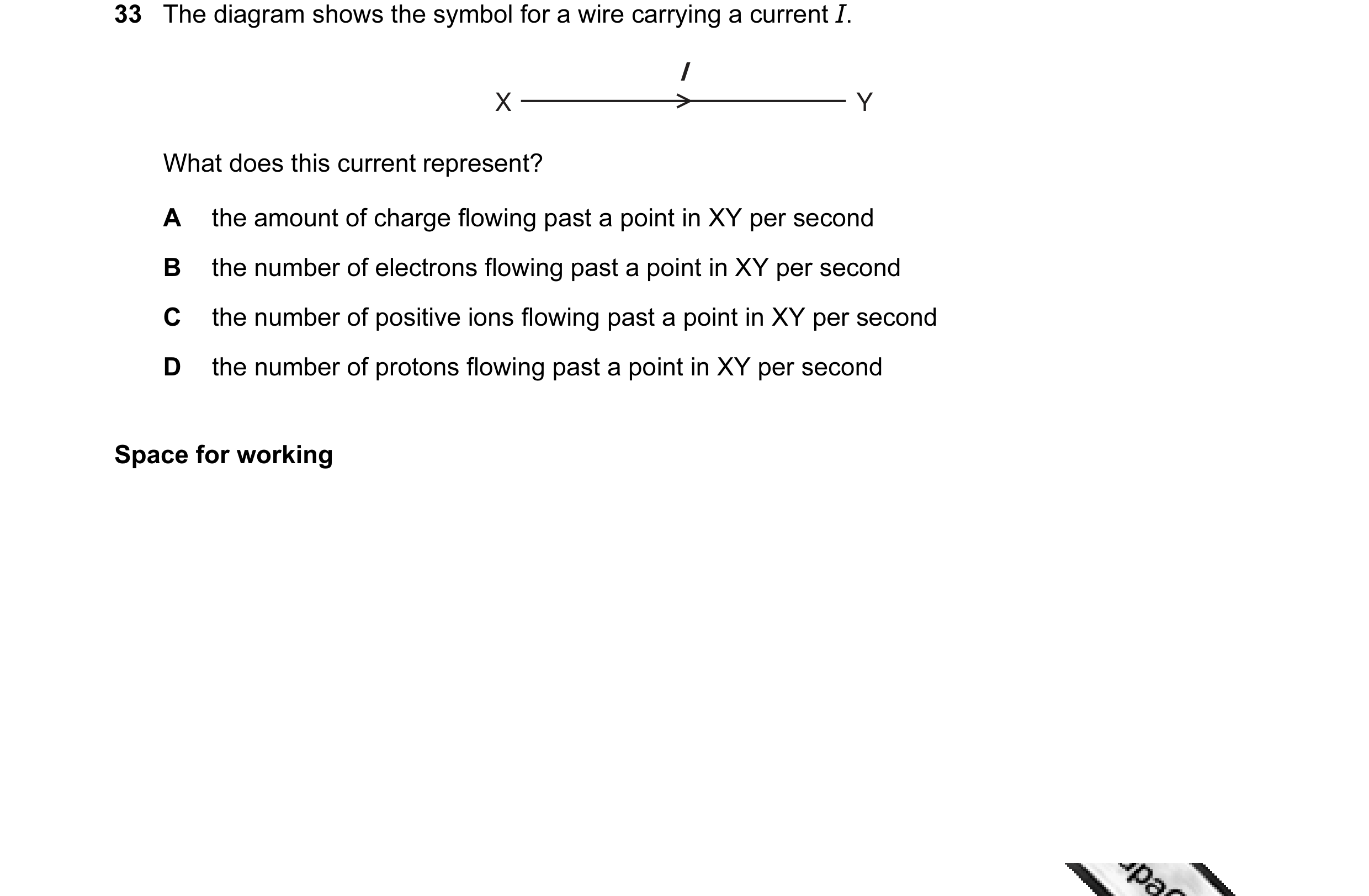
 6 / 27


 7 / 27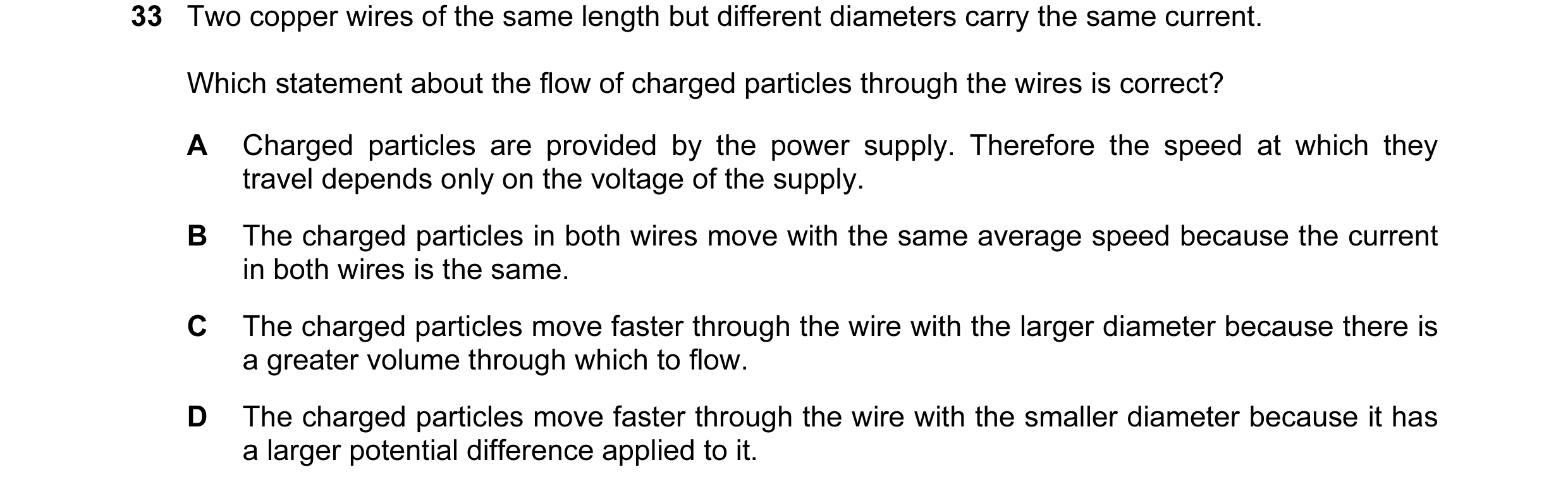


 8 / 27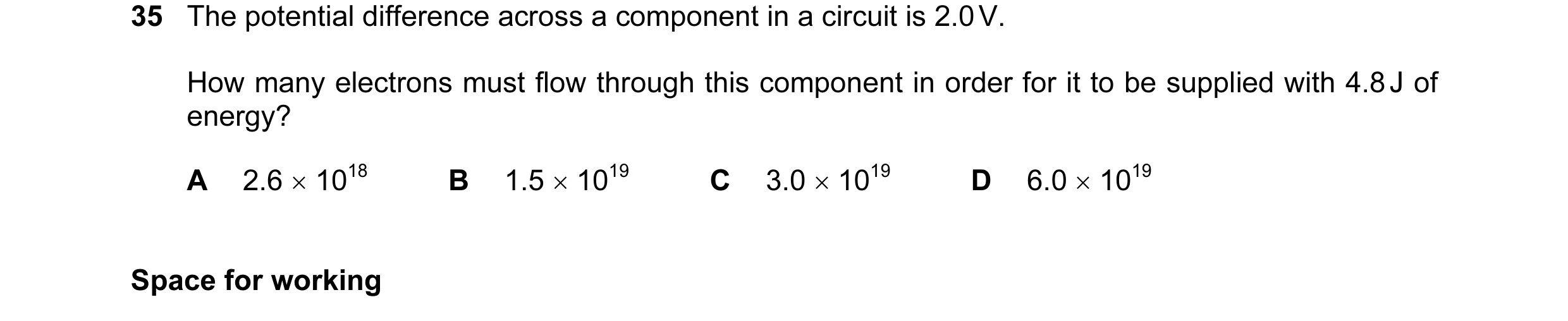




 9 / 27

 10 / 27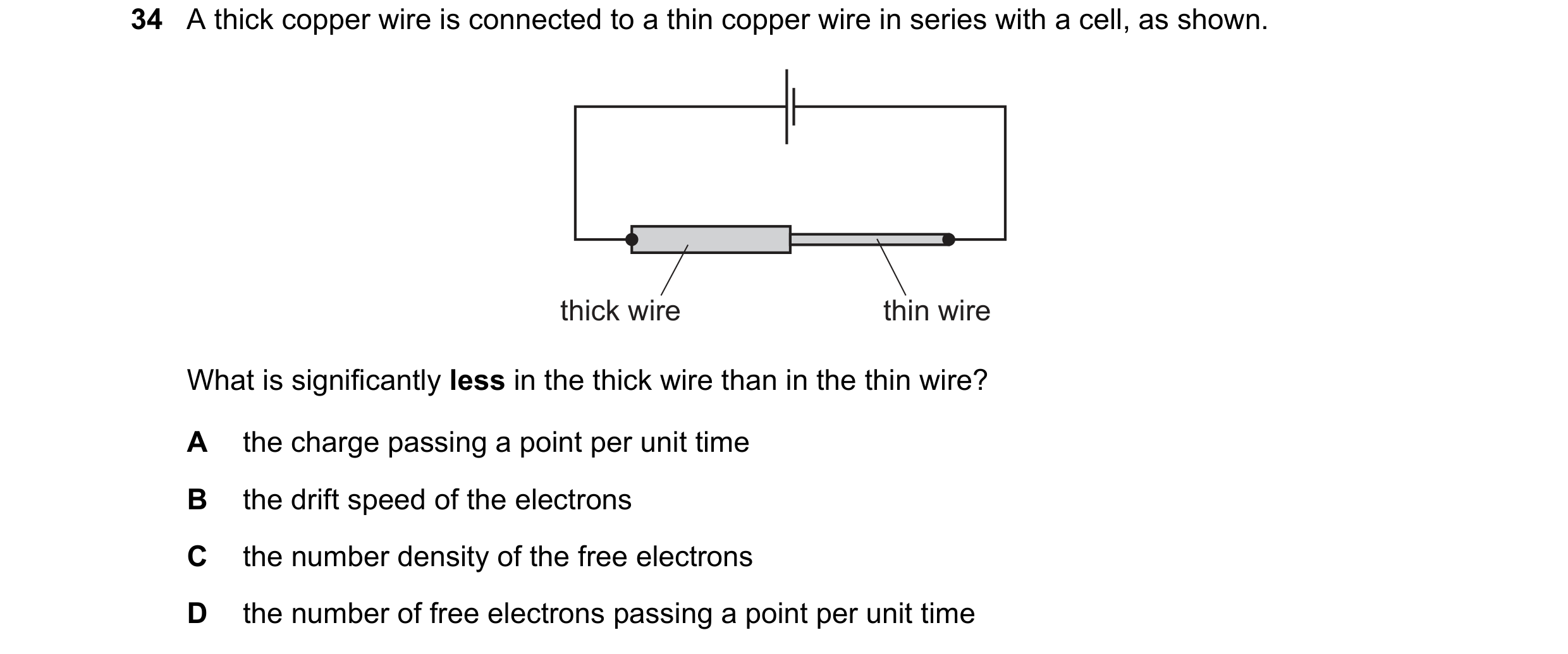
 11 / 27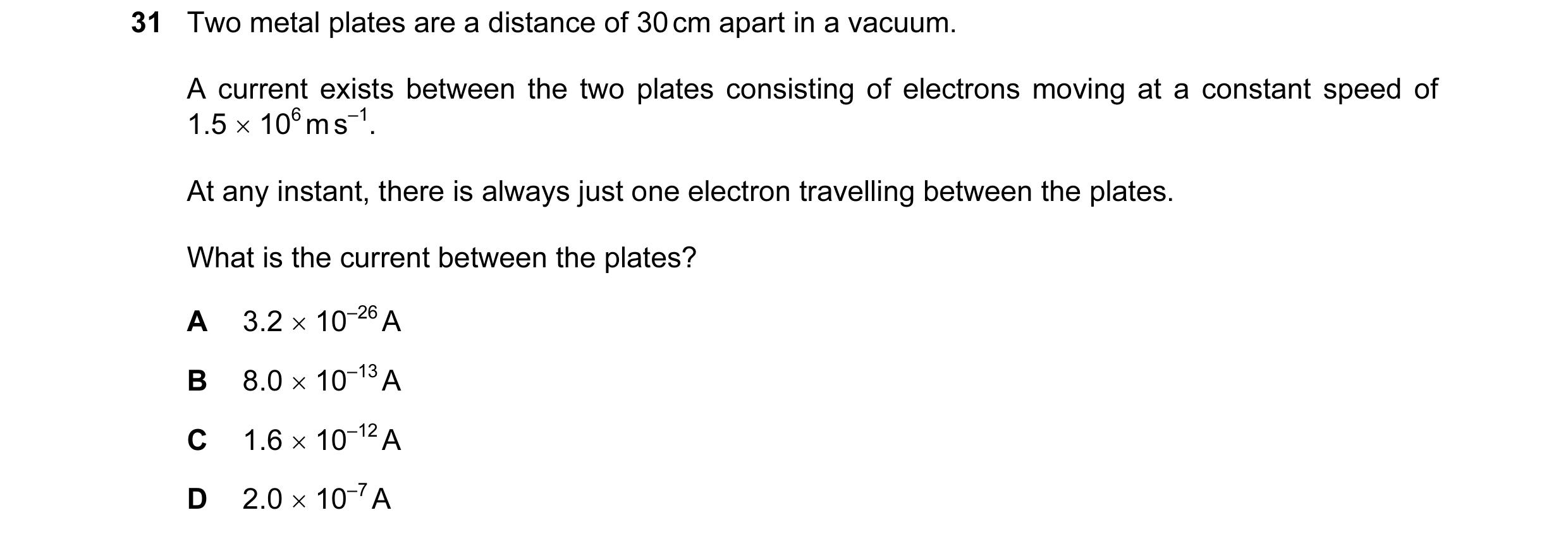
 12 / 27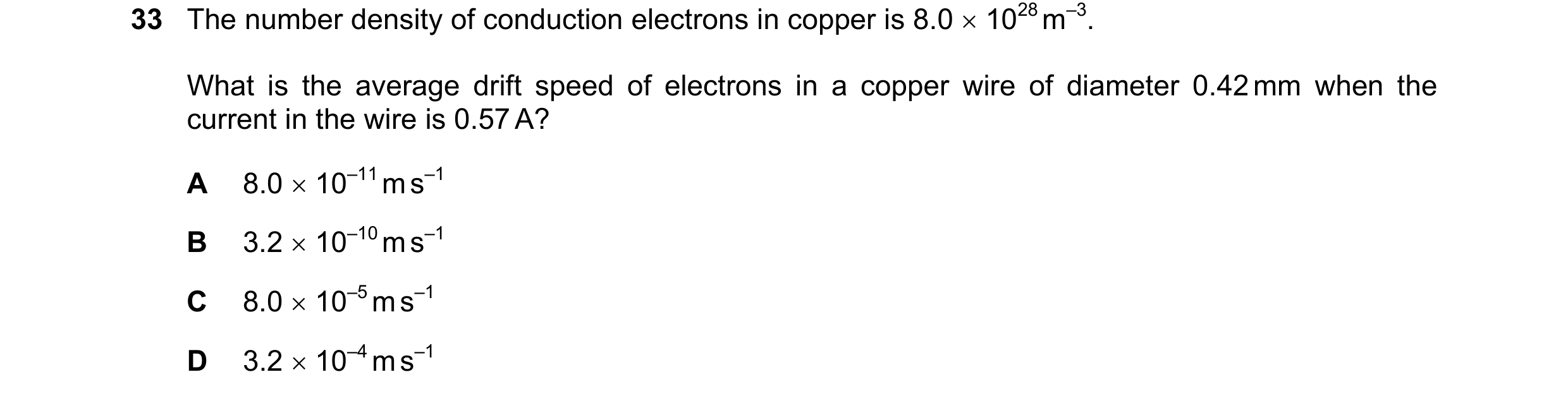
 13 / 27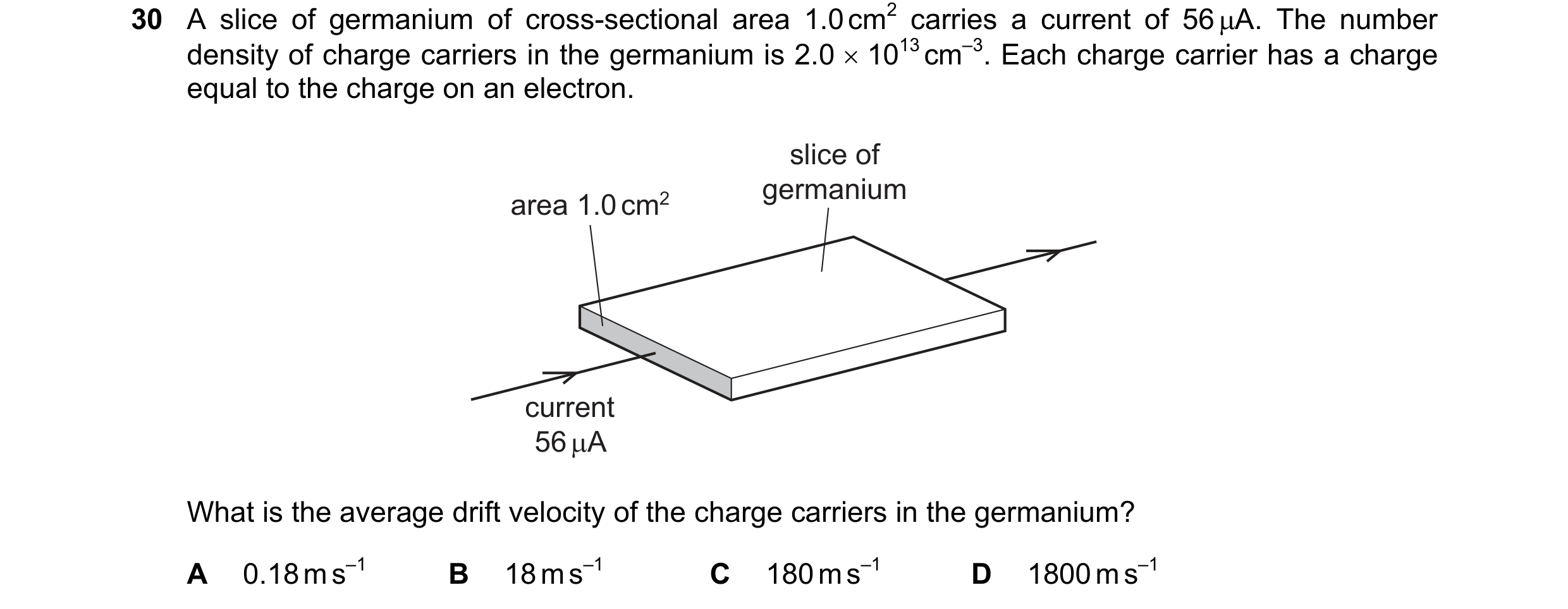

 14 / 27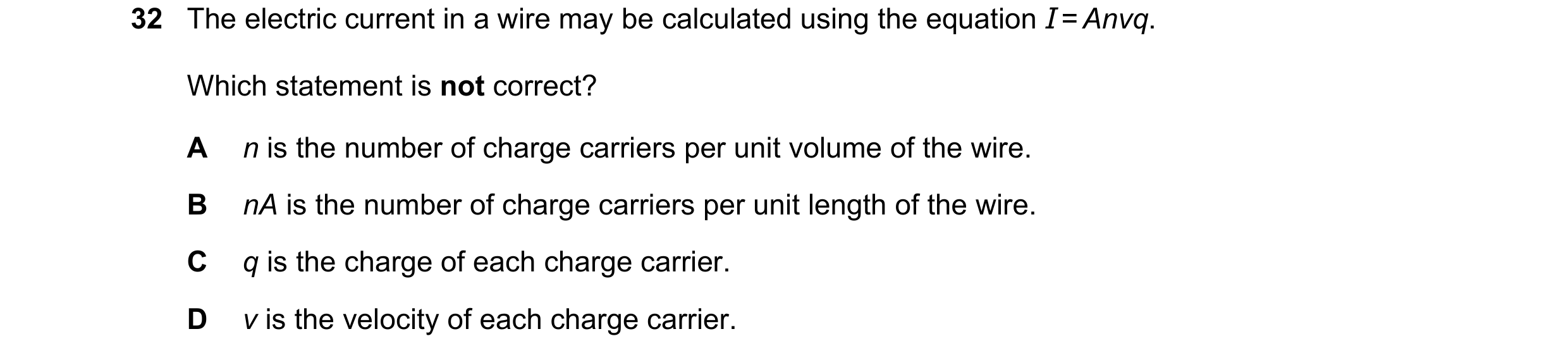
 15 / 27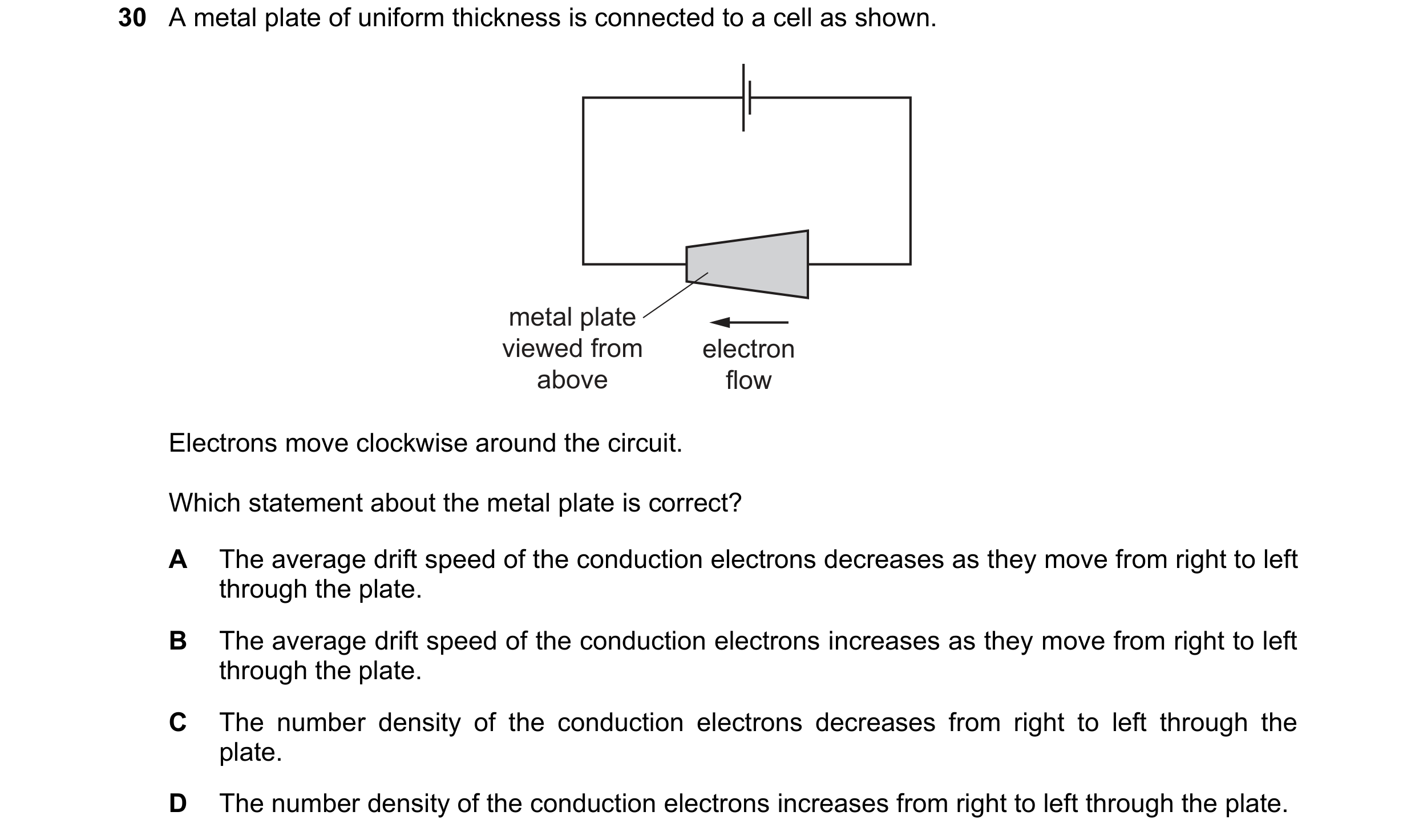
 16 / 27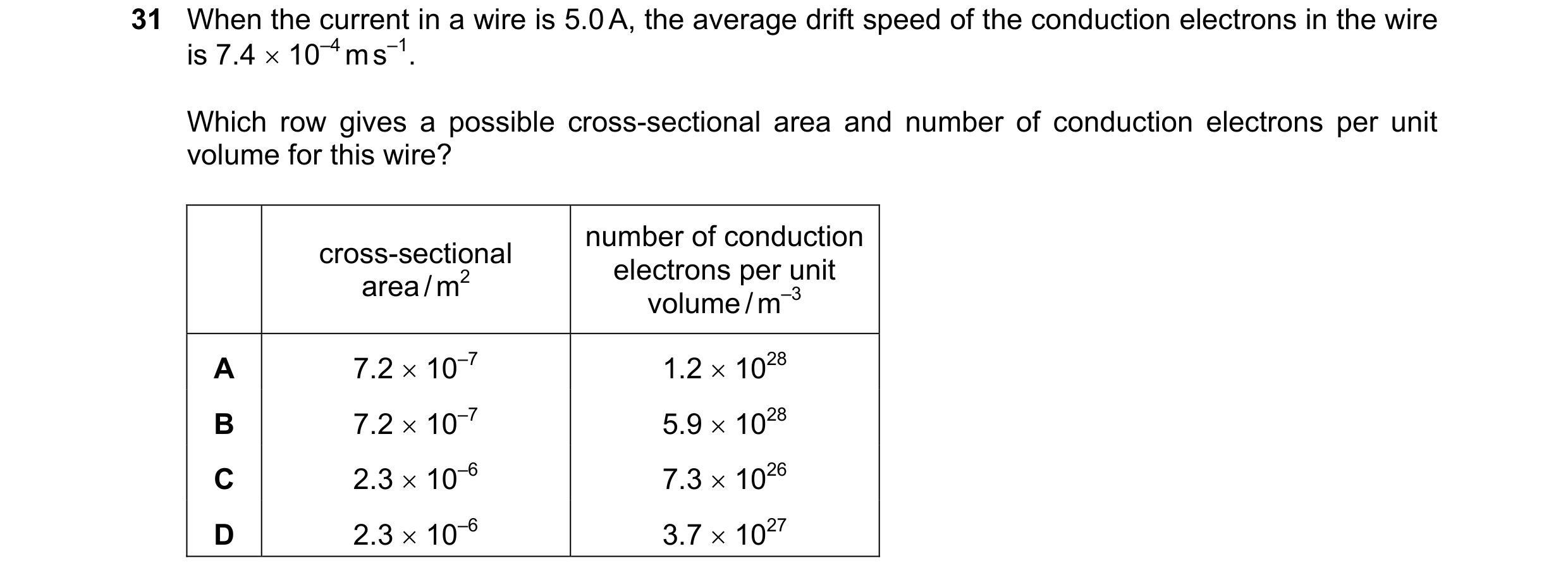

 17 / 27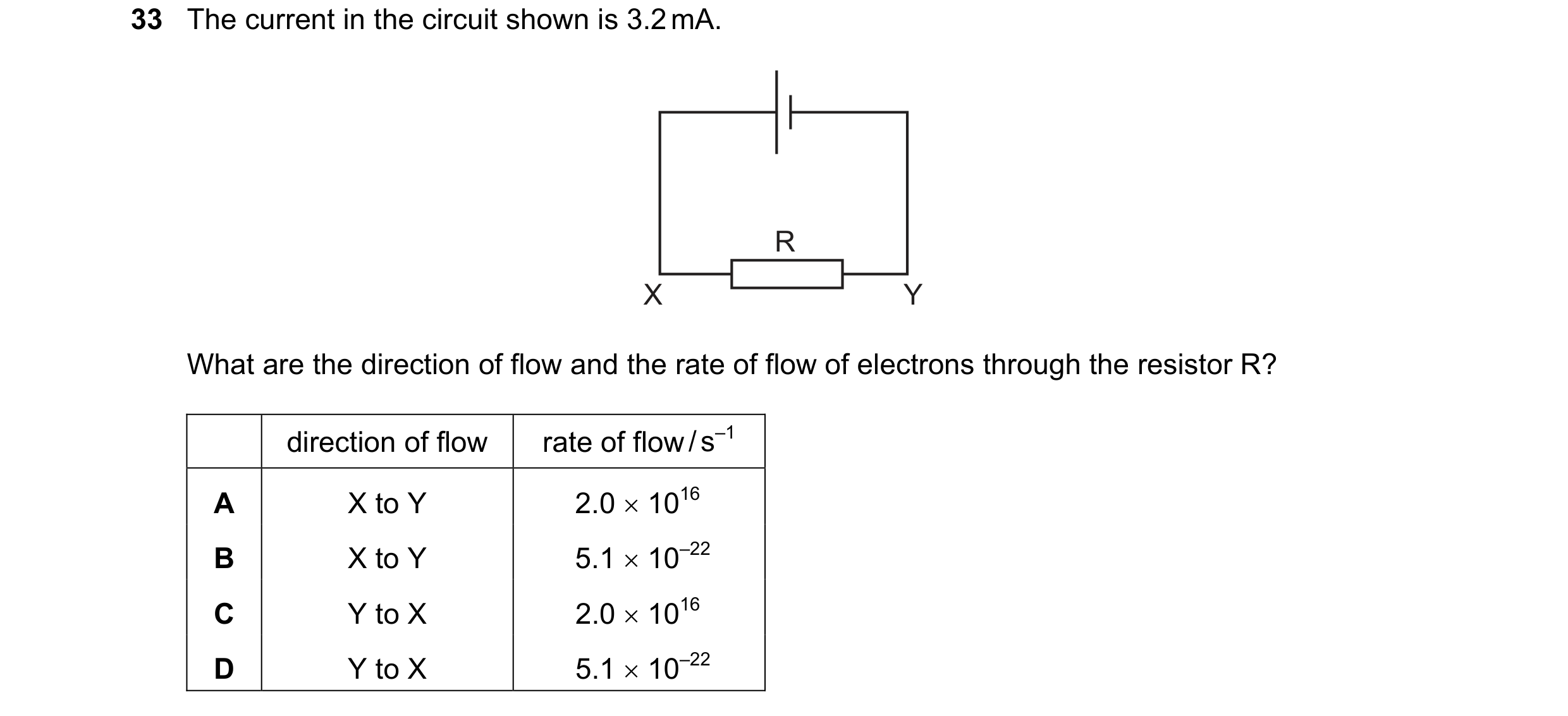
 18 / 27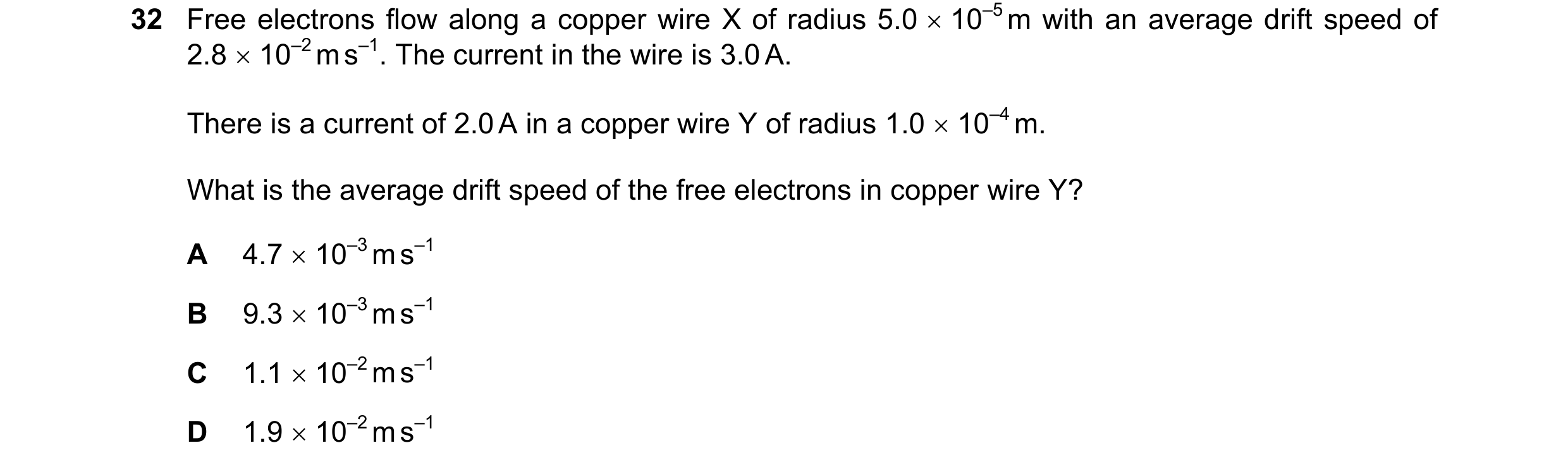
 19 / 27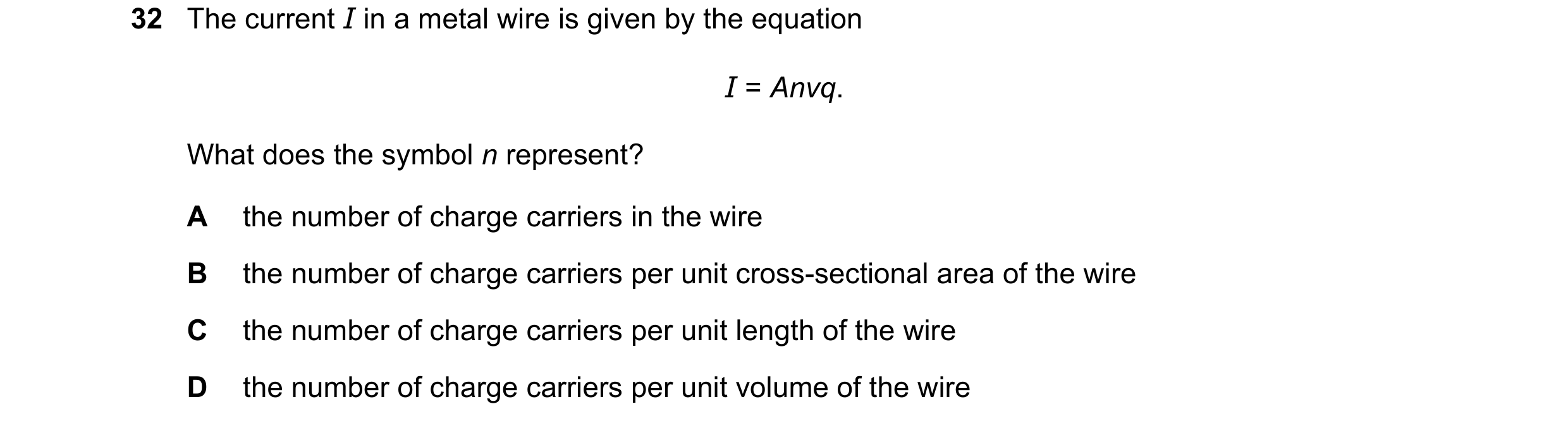


 20 / 27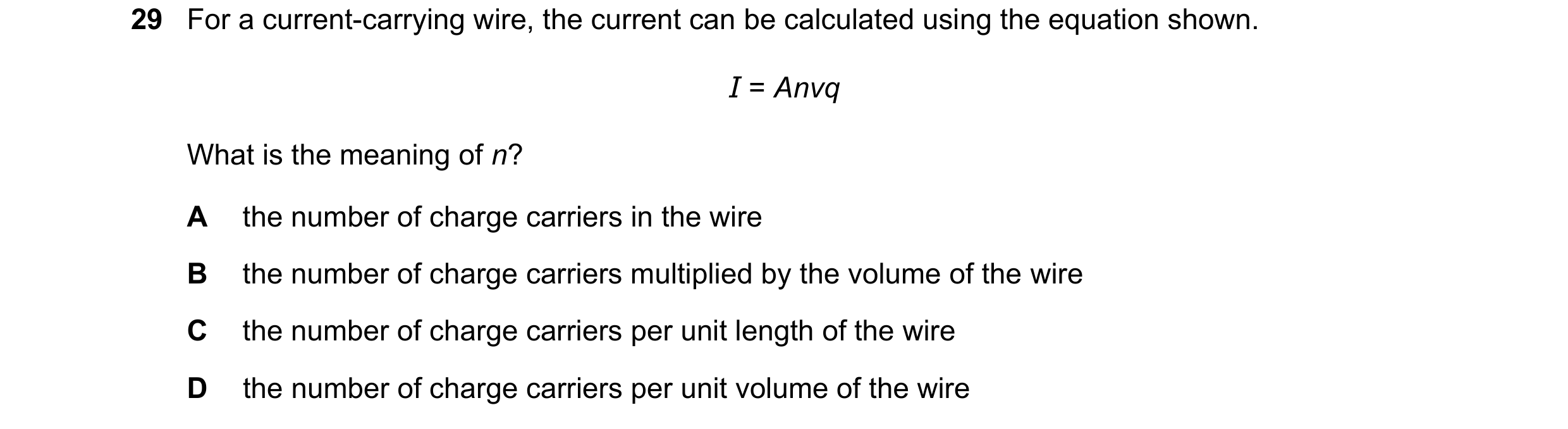


 21 / 27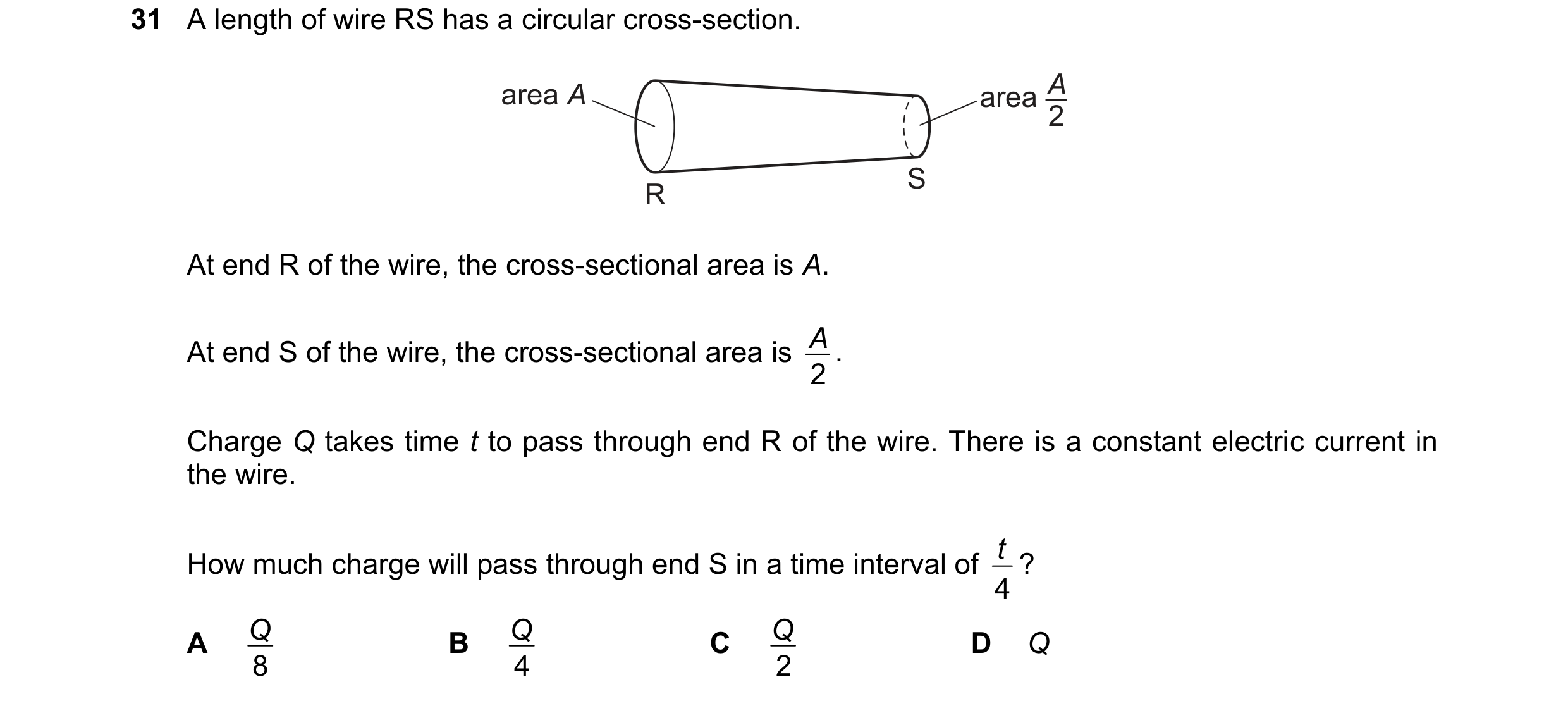

 22 / 27

 23 / 27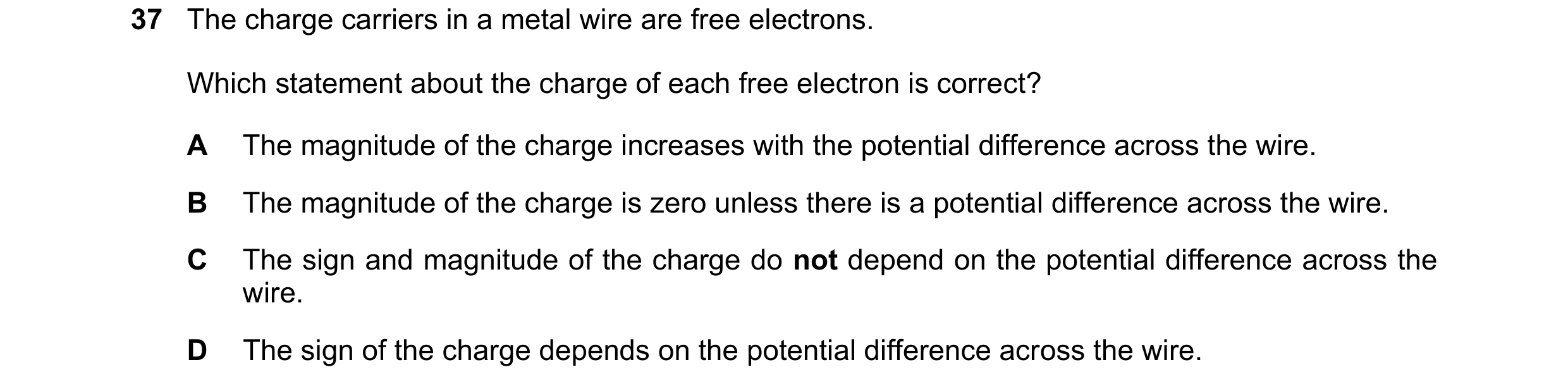

 24 / 27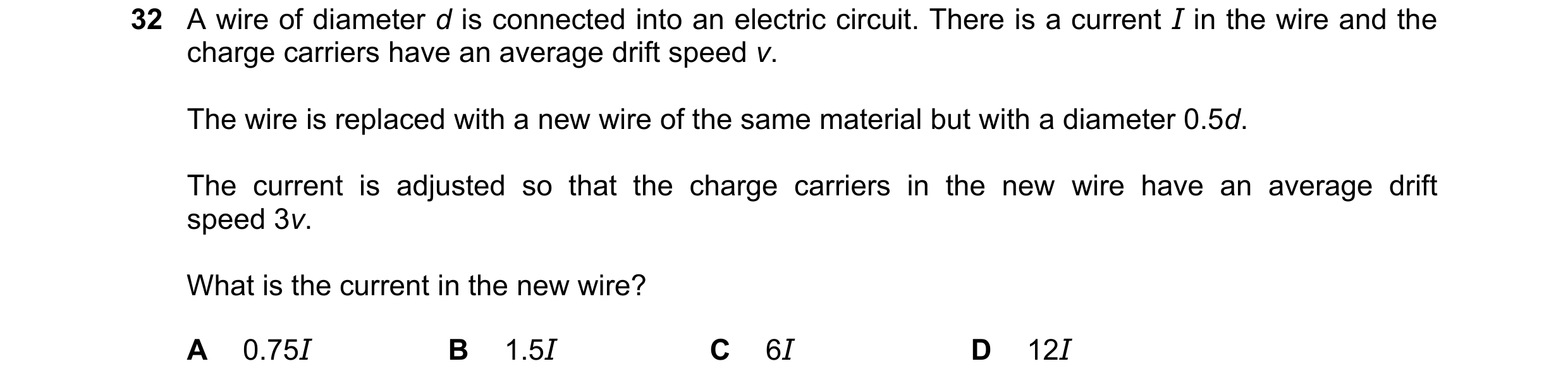

 25 / 27



 26 / 27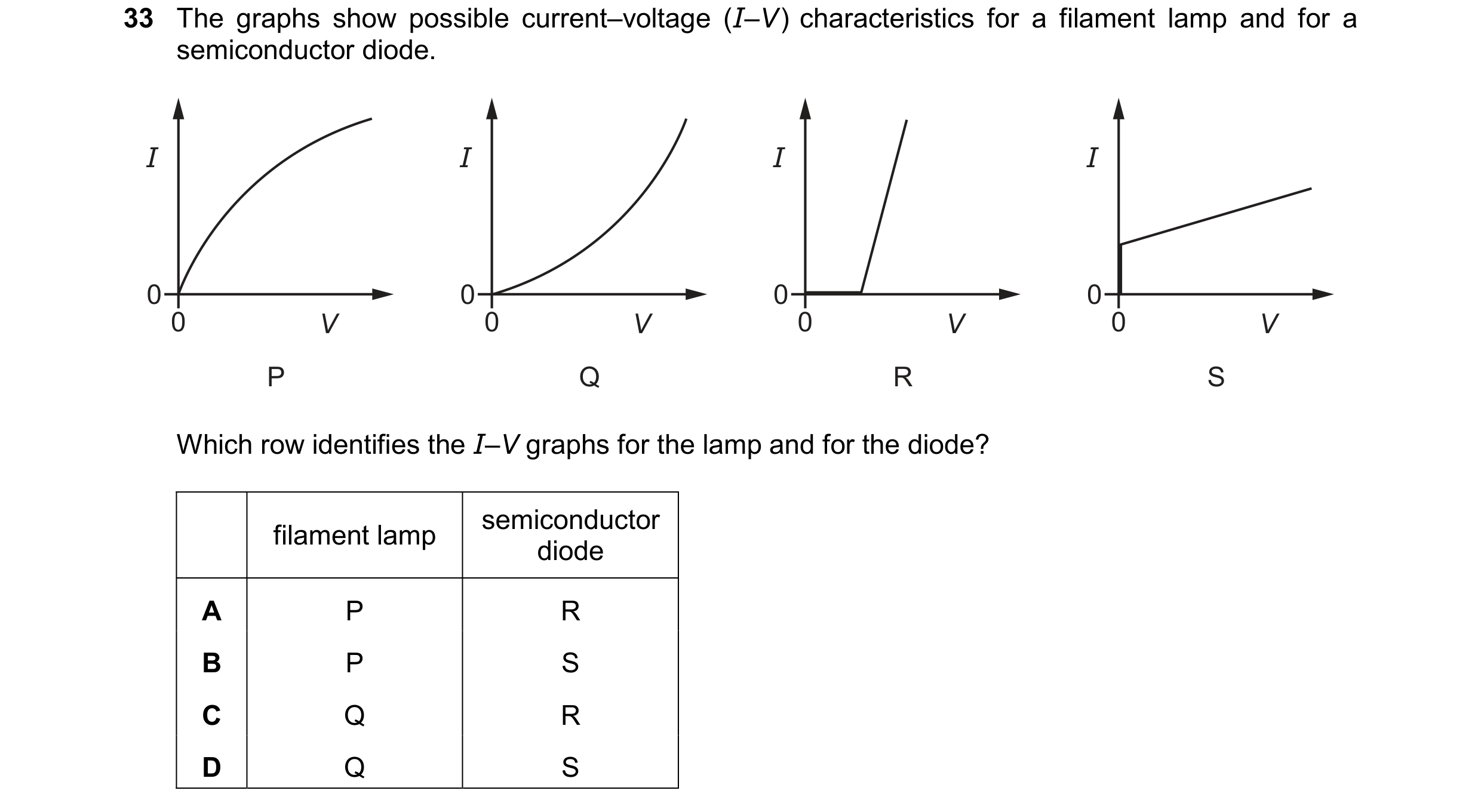
 27 / 27