Questions as text
Question 1 9702/22 Oct/Nov 2017
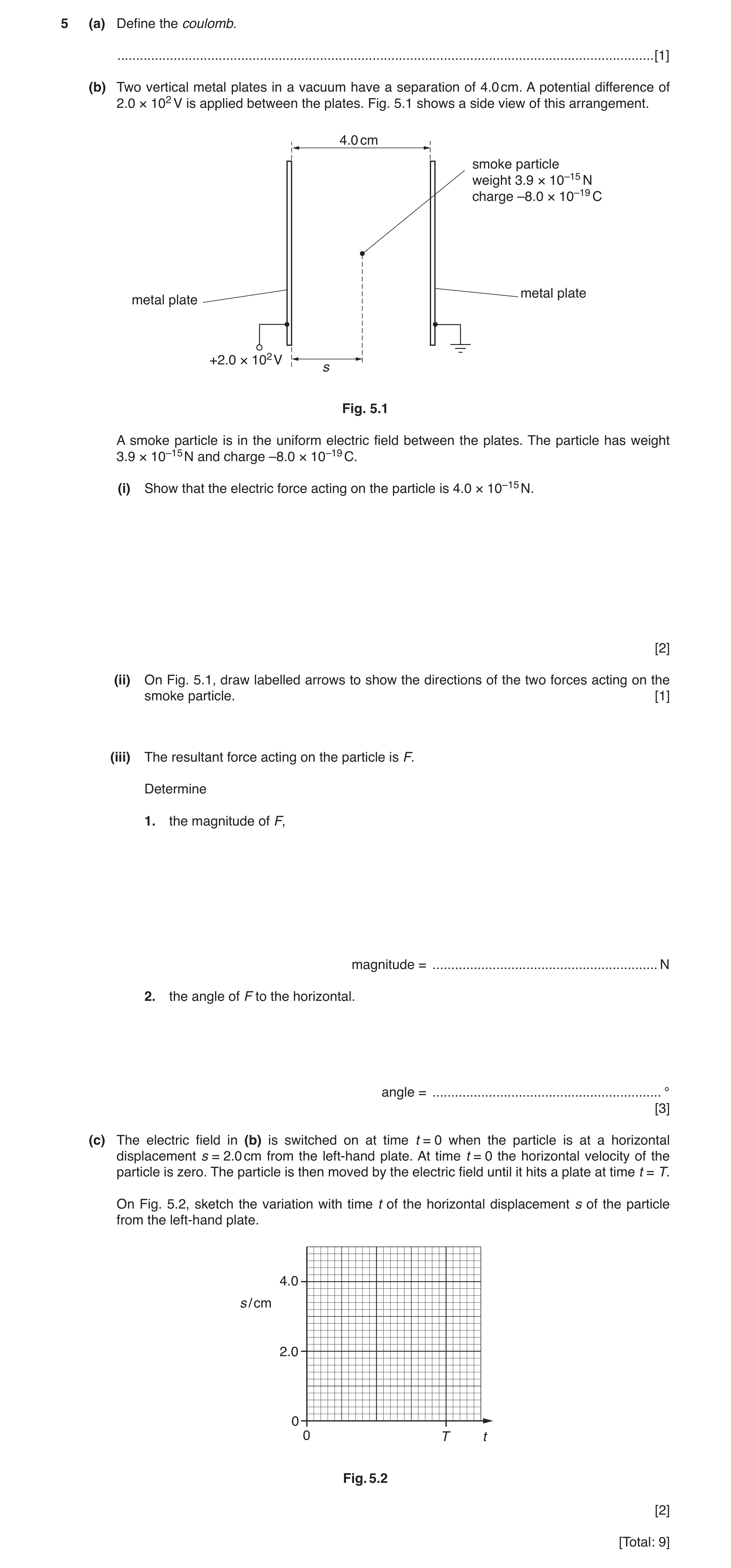
5 (a) Define the coulomb. … [1] (b) Two vertical metal plates in a vacuum have a separation of 4.0 cm. A potential difference of 2.0 × 10² V is applied between the plates. Fig. 5.1 shows a side view of this arrangement. 4.0 cm smoke particle weight 3.9 × 10⁻¹⁵ N charge –8.0 × 10⁻¹⁹ C metal plate metal plate +2.0 × 10² V s Fig. 5.1 A smoke particle is in the uniform electric field between the plates. The particle has weight 3.9 × 10⁻¹⁵ N and charge –8.0 × 10⁻¹⁹ C. (i) Show that the electric force acting on the particle is 4.0 × 10⁻¹⁵ N. [2] (ii) On Fig. 5.1, draw labelled arrows to show the directions of the two forces acting on the smoke particle. [1] (iii) The resultant force acting on the particle is F. Determine 1. the magnitude of F, magnitude = … N 2. the angle of F to the horizontal. angle = … ° [3] (c) The electric field in (b) is switched on at time t = 0 when the particle is at a horizontal displacement s = 2.0 cm from the left-hand plate. At time t = 0 the horizontal velocity of the particle is zero. The particle is then moved by the electric field until it hits a plate at time t = T. On Fig. 5.2, sketch the variation with time t of the horizontal displacement s of the particle from the left-hand plate. 4.0 s / cm 2.0 0 0 T t Fig. 5.2 [2] [Total: 9]
9 marks
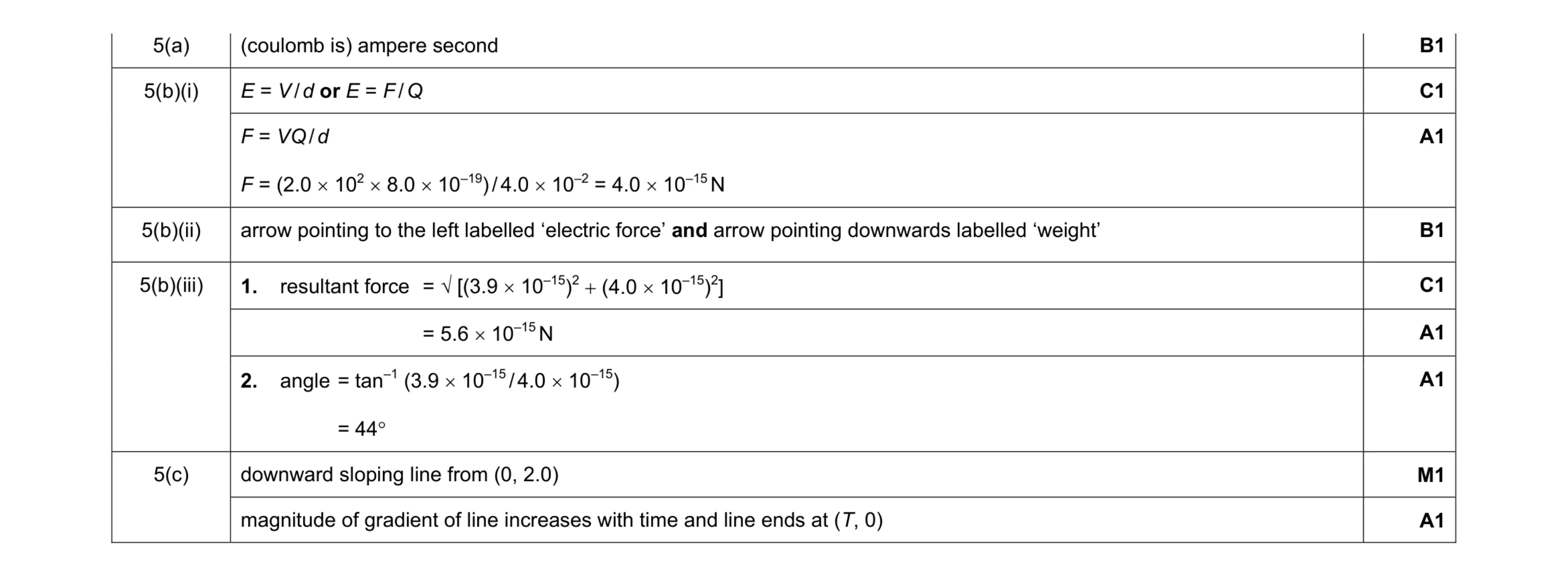
Mark scheme: 5(a) (coulomb is) ampere second B1 5(b)(i) E = V / d or E = F / Q C1 F = VQ / d F = (2.0 × 102 × 8.0 × 10–19) / 4.0 × 10–2 = 4.0 × 10⁻¹⁵ N A1 5(b)(ii) arrow pointing to the left labelled ‘electric force’ and arrow pointing downwards labelled ‘weight’ B1 5(b)(iii) 1. resultant force = √ [(3.9 × 10⁻¹⁵)2 + (4.0 × 10⁻¹⁵)2] C1 = 5.6 × 10⁻¹⁵ N A1 2. angle = tan–1 (3.9 × 10⁻¹⁵ / 4.0 × 10⁻¹⁵) = 44° A1 5(c) downward sloping line from (0, 2.0) M1 magnitude of gradient of line increases with time and line ends at (T, 0) A1
This question in 9702/22 Oct/Nov 2017
Q2 · State what is meant by an electric current 9702/22 Oct/Nov 2017
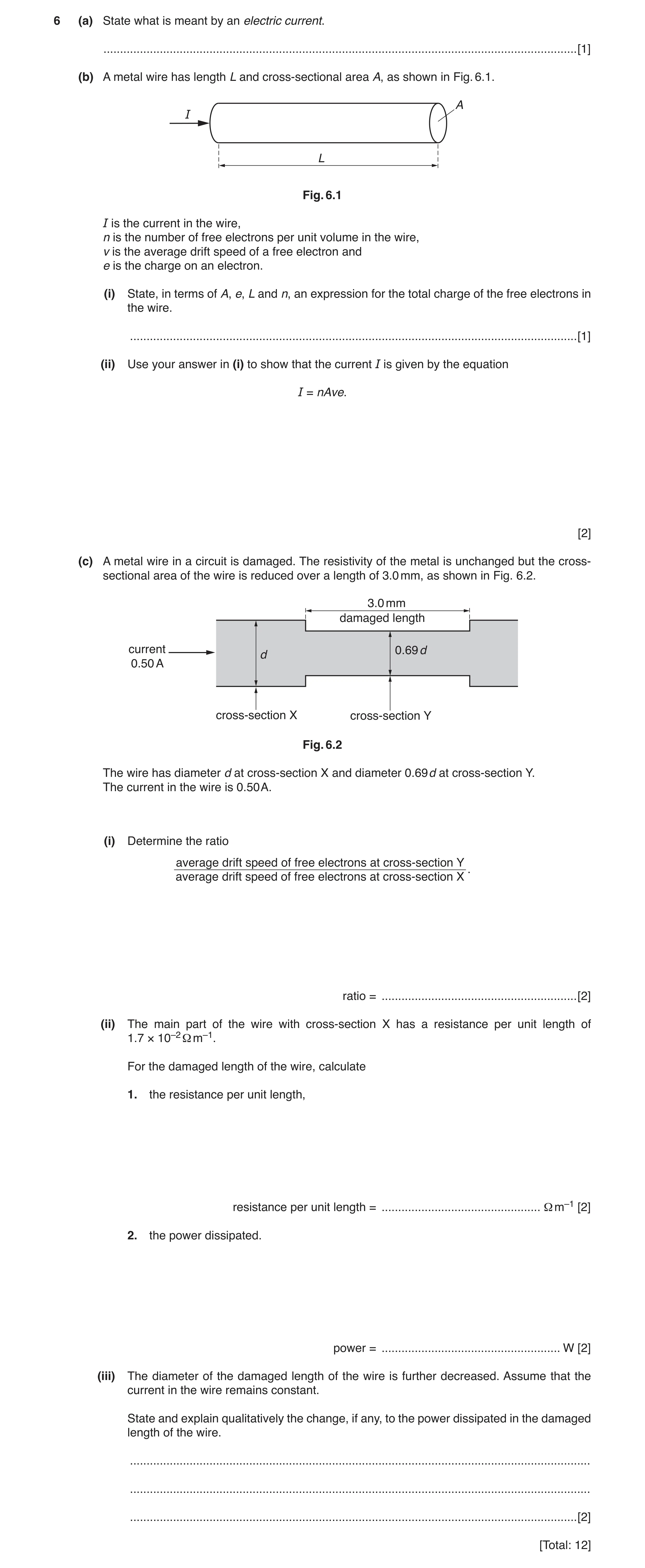
6 (a) State what is meant by an electric current. … [1] (b) A metal wire has length L and cross-sectional area A, as shown in Fig. 6.1. A I L Fig. 6.1 I is the current in the wire, n is the number of free electrons per unit volume in the wire, v is the average drift speed of a free electron and e is the charge on an electron. (i) State, in terms of A, e, L and n, an expression for the total charge of the free electrons in the wire. … [1] (ii) Use your answer in (i) to show that the current I is given by the equation I = nAve. [2] (c) A metal wire in a circuit is damaged. The resistivity of the metal is unchanged but the cross- sectional area of the wire is reduced over a length of 3.0 mm, as shown in Fig. 6.2. 3.0 mm damaged length current 0.69 d d 0.50 A cross-section X cross-section Y Fig. 6.2 The wire has diameter d at cross-section X and diameter 0.69 d at cross-section Y. The current in the wire is 0.50 A. (i) Determine the ratio average drift speed of free electrons at cross-section Y . average drift speed of free electrons at cross-section X ratio = … [2] (ii) The main part of the wire with cross-section X has a resistance per unit length of 1.7 × 10⁻² Ω m–1. For the damaged length of the wire, calculate 1. the resistance per unit length, resistance per unit length = … Ω m–1 [2] 2. the power dissipated. power = … W [2] (iii) The diameter of the damaged length of the wire is further decreased. Assume that the current in the wire remains constant. State and explain qualitatively the change, if any, to the power dissipated in the damaged length of the wire. … … … [2] [Total: 12]
12 marks
Mark scheme: 6(a) flow of charge carriers B1 6(b)(i) nALe B1 6(b)(ii) (t is time taken for electrons to move length L) I = Q / t B1 I = nALe / t or I = nALe / (L / v) or I = nAvte / t and I = nAve B1 6(c)(i) ratio = area at X / area at Y = [πd 2 / 4] / [π(0.69d)2 / 4] or d 2 / (0.69d)2 or 1 / 0.692 C1 = 2.1 A1 6(c)(ii) 1. R = ρ L / A or R / L ∝ 1 / A C1 resistance per unit length = 1.7 × 10⁻² × (area at X / area at Y) = 1.7 × 10–2 × 2.1 = 3.6 × 10⁻² Ω m–1 A1 2. P = I 2R or P = V 2 / R C1 R = 3.6 × 10–2 × 3.0 × 10–3 (= 1.08 × 10⁻⁴ Ω) P = 0.502 × 1.08 × 10–4 or P = (5.4 × 10⁻⁵)2 / 1.08 × 10–4 = 2.7 × 10⁻⁵ W A1 Question Answer Marks 6(c)(iii) (cross-sectional area decreases so) resistance increases M1 (P = I 2R, so) power increases A1
This question in 9702/22 Oct/Nov 2017
Q3 · A sample of a radioactive isotope emits a beam of β– radiation 9702/22 Feb/March 2018
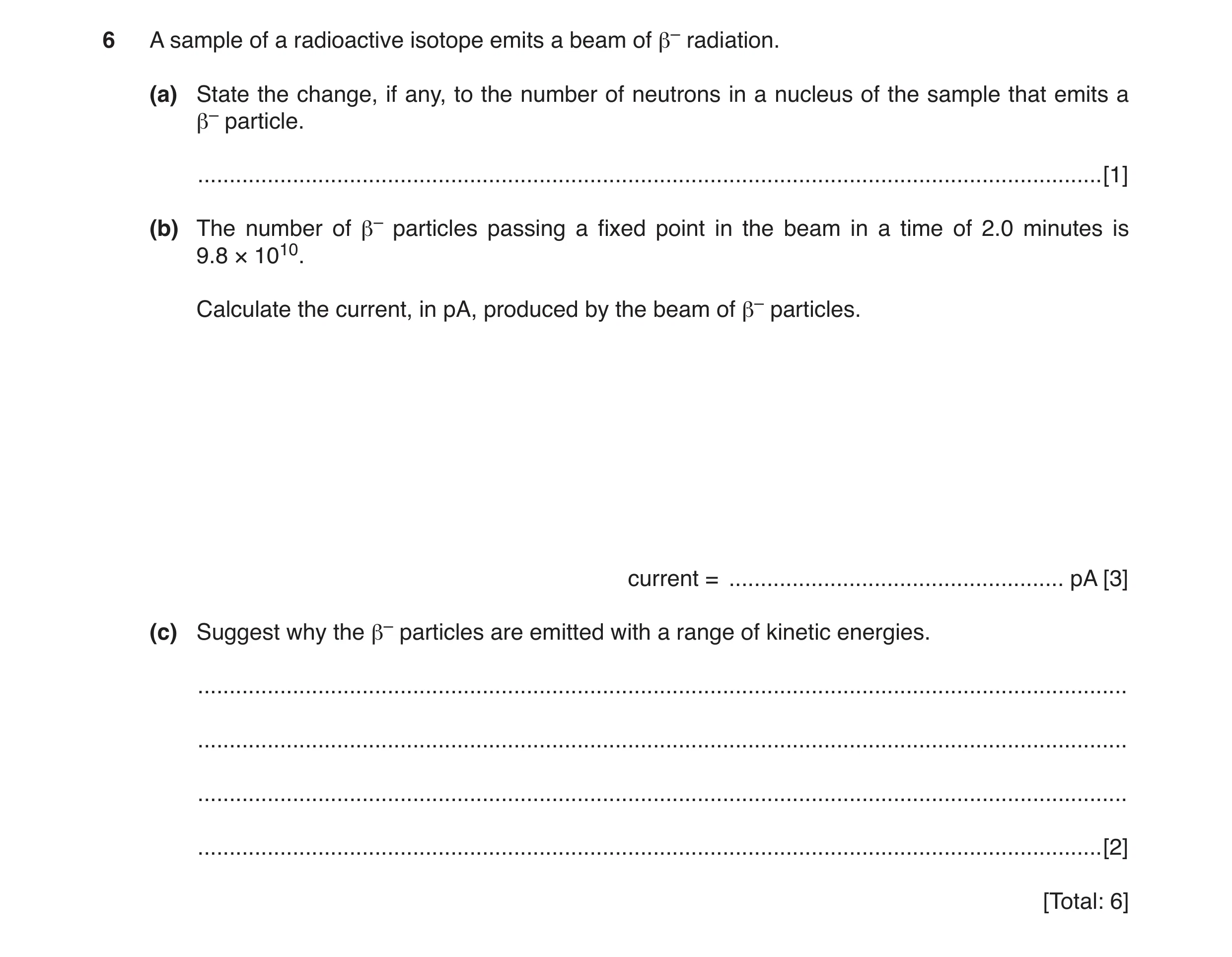
6 A sample of a radioactive isotope emits a beam of β– radiation. (a) State the change, if any, to the number of neutrons in a nucleus of the sample that emits a β– particle. … [1] (b) The number of β– particles passing a fixed point in the beam in a time of 2.0 minutes is 9.8 × 10¹⁰. Calculate the current, in pA, produced by the beam of β– particles. current = … pA [3] (c) Suggest why the β– particles are emitted with a range of kinetic energies. … … … … [2] [Total: 6]
6 marks
Mark scheme: 6(a) –1 / decreases by 1 A1 6(b) I = Q / t or Ne / t C1 = (9.8×1010 × 1.6×10–19) / (2.0 × 60) = 1.3 × 10⁻¹⁰ (A) C1 = 130 pA A1 6(c) antineutrino(s) (emitted) / other particle(s) (emitted) C1 energy / momentum shared with antineutrino(s) A1
This question in 9702/22 Feb/March 2018
Q4 · The current I in a metal wire is given by the expression I = Anve 9702/22 Oct/Nov 2018
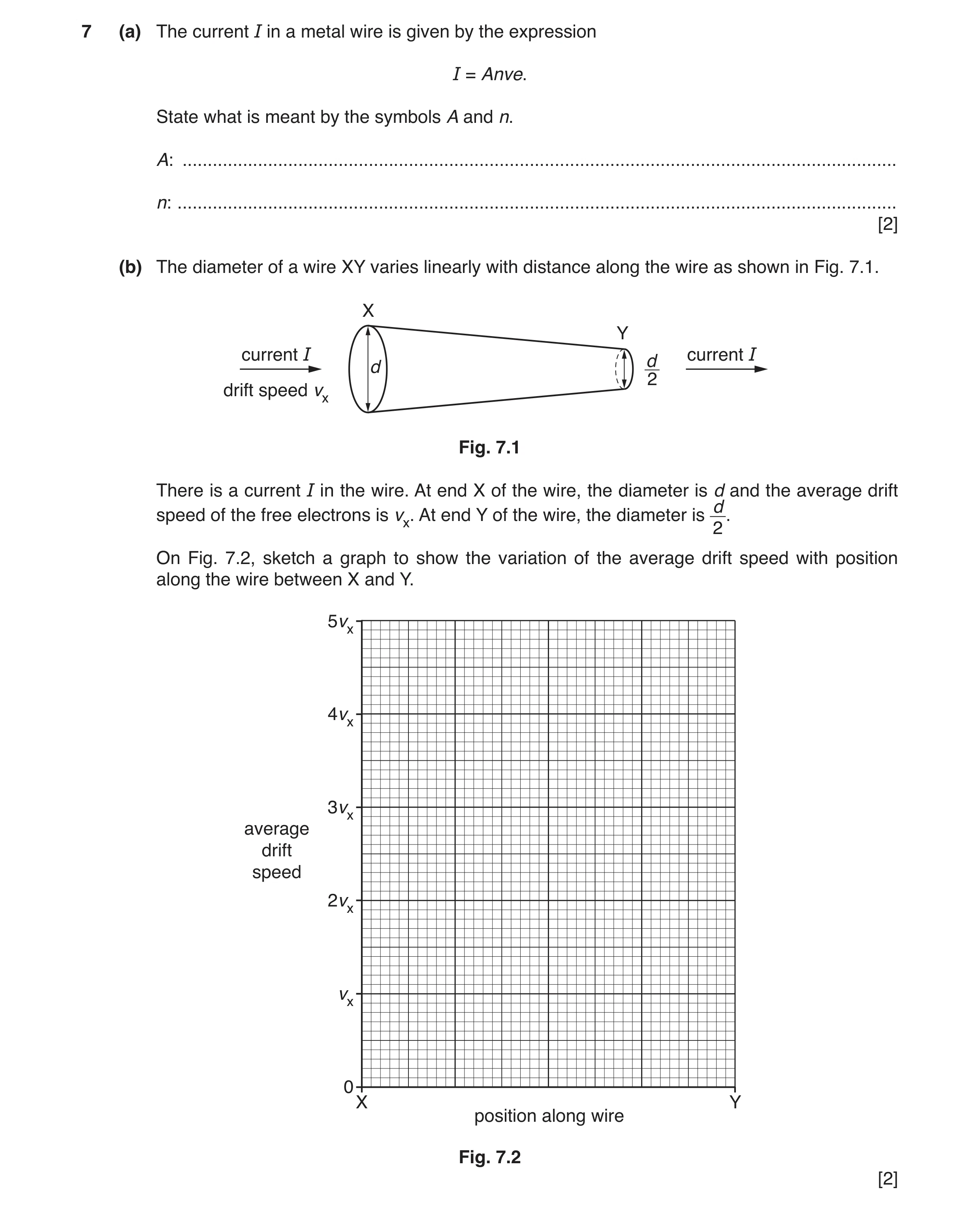
7 (a) The current I in a metal wire is given by the expression I = Anve. State what is meant by the symbols A and n. A: … n: … [2] (b) The diameter of a wire XY varies linearly with distance along the wire as shown in Fig. 7.1. X Y current I current I d d 2 drift speed vx Fig. 7.1 There is a current I in the wire. At end X of the wire, the diameter is d and the average drift d speed of the free electrons is vx. At end Y of the wire, the diameter is . 2 On Fig. 7.2, sketch a graph to show the variation of the average drift speed with position along the wire between X and Y. 5vx 4vx 3vx average drift speed 2vx vx 0 X Y position along wire Fig. 7.2 [2]
4 marks
Mark scheme: 7(a) A: (cross-sectional) area (of wire) B1 n: number of free electrons per unit volume or number density of free electrons B1 7(b) line drawn between (X, vx) and (Y, 4vx) M1 line has increasing gradient A1
This question in 9702/22 Oct/Nov 2018
Question 5 9702/23 Oct/Nov 2018
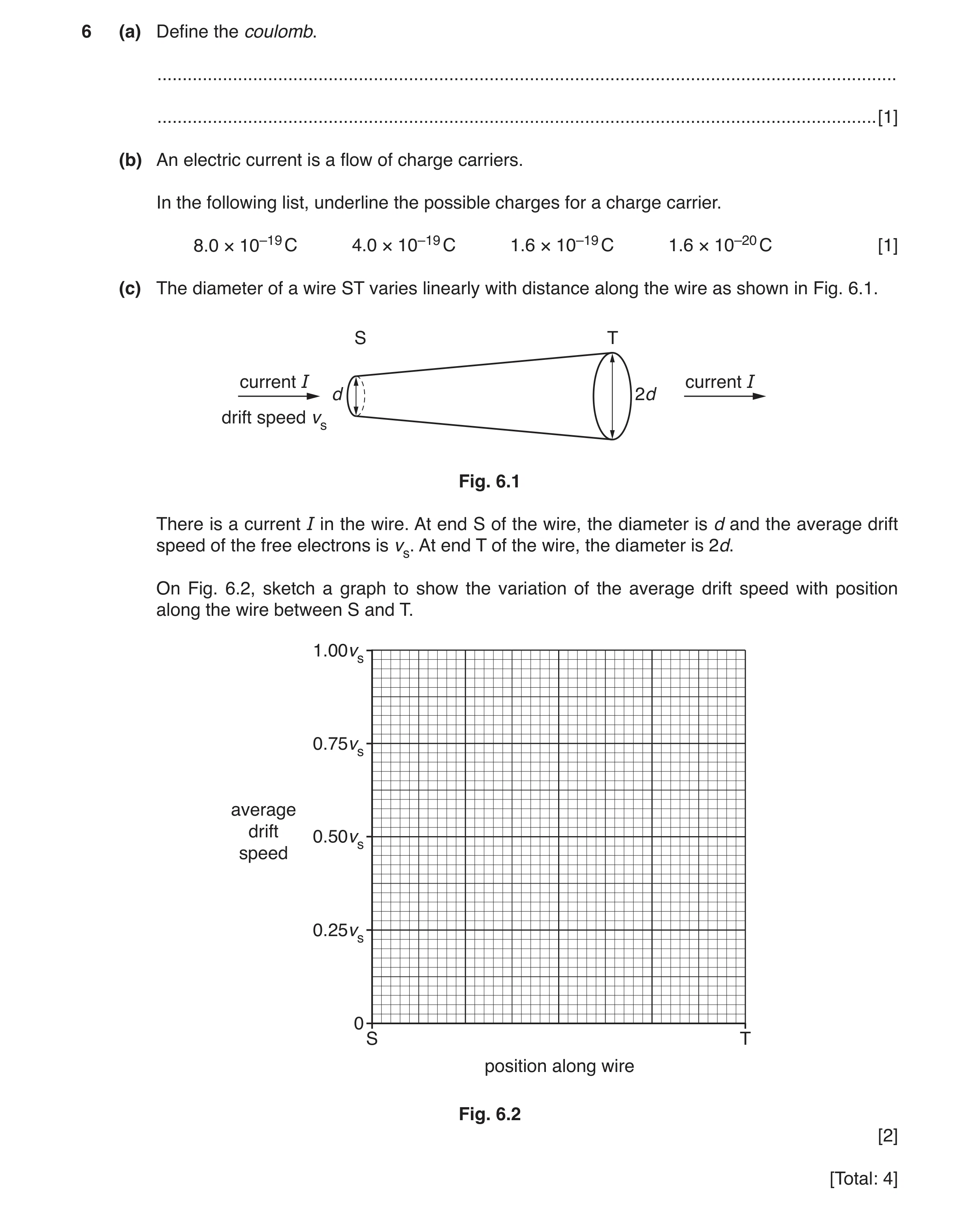
6 (a) Define the coulomb. … … [1] (b) An electric current is a flow of charge carriers. In the following list, underline the possible charges for a charge carrier. 8.0 × 10⁻¹⁹ C 4.0 × 10⁻¹⁹ C 1.6 × 10⁻¹⁹ C 1.6 × 10⁻²⁰ C [1] (c) The diameter of a wire ST varies linearly with distance along the wire as shown in Fig. 6.1. S T current I current I d 2d drift speed vs Fig. 6.1 There is a current I in the wire. At end S of the wire, the diameter is d and the average drift speed of the free electrons is vs. At end T of the wire, the diameter is 2d. On Fig. 6.2, sketch a graph to show the variation of the average drift speed with position along the wire between S and T. 1.00vs 0.75vs average drift 0.50vs speed 0.25vs 0 S T position along wire Fig. 6.2 [2] [Total: 4]
4 marks
Mark scheme: 6(a) (coulomb is an) ampere second B1 6(b) 8.0 × 10⁻¹⁹ C and 1.6 × 10⁻¹⁹ C both underlined (and no others underlined) B1 6(c) line drawn between (S, 1.00vs) and (T, 0.25vs) M1 line with decreasing magnitude of gradient A1
This question in 9702/23 Oct/Nov 2018
Q6 · A stationary nucleus of a radioactive isotope X decays by emitting an α-particle to… 9702/23 Oct/Nov 2019
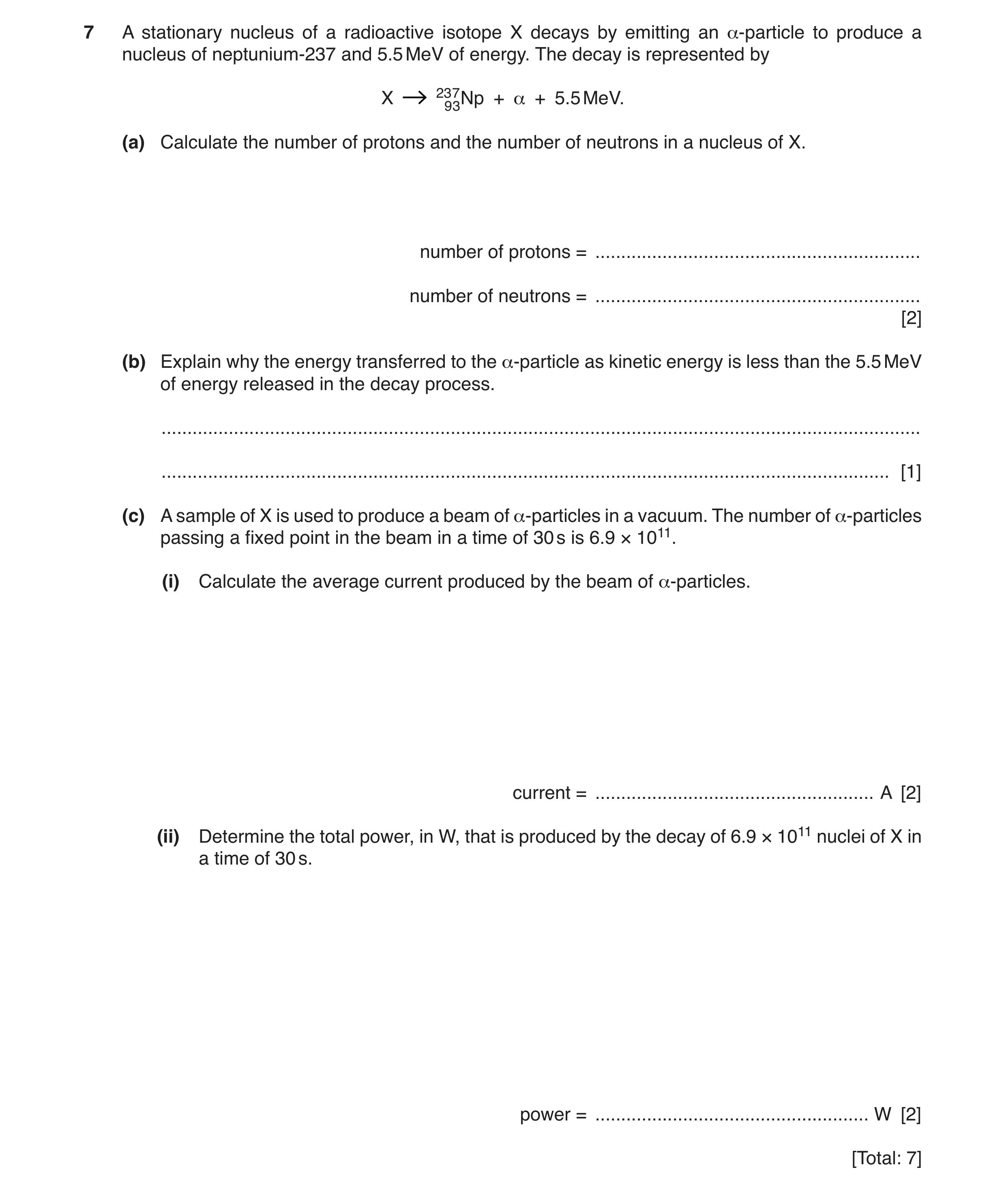
7 A stationary nucleus of a radioactive isotope X decays by emitting an α-particle to produce a nucleus of neptunium-237 and 5.5 MeV of energy. The decay is represented by α + 5.5 MeV. X 23973Np + (a) Calculate the number of protons and the number of neutrons in a nucleus of X. number of protons = … number of neutrons = … [2] (b) Explain why the energy transferred to the α-particle as kinetic energy is less than the 5.5 MeV of energy released in the decay process. … … [1] (c) A sample of X is used to produce a beam of α-particles in a vacuum. The number of α-particles passing a fixed point in the beam in a time of 30 s is 6.9 × 10¹¹. (i) Calculate the average current produced by the beam of α-particles. current = … A [2] (ii) Determine the total power, in W, that is produced by the decay of 6.9 × 10¹¹ nuclei of X in a time of 30 s. power = … W [2] [Total: 7]
7 marks
Mark scheme: 7(a) number of protons = 95 A1 number of neutrons = 146 A1 7(b) Np/neptunium (nucleus) has kinetic energy or gamma/γ-radiation produced B1 7(c)(i) I = NQ / t C1 I = (6.9 × 1011 × 2 × 1.60 × 10–19) / 30 = 7.4 × 10⁻⁹ A A1 7(c)(ii) P = (6.9 × 1011 × 5.5 × 106 × 1.60 × 10–19) / 30 C1 = 0.020 W A1
This question in 9702/23 Oct/Nov 2019
Q7 · Metal wire is used to connect a power supply to a lamp 9702/21 May/June 2020
5 (a) Metal wire is used to connect a power supply to a lamp. The wire has a total resistance of 3.4 Ω and the metal has a resistivity of 2.6 × 10⁻⁸ Ω m. The total length of the wire is 59 m. (i) Show that the wire has a cross-sectional area of 4.5 × 10⁻⁷ m2. [2] (ii) The potential difference across the total length of wire is 1.8 V. Calculate the current in the wire. current = … A [1] (iii) The number density of the free electrons in the wire is 6.1 × 1028 m–3. Calculate the average drift speed of the free electrons in the wire. average drift speed = … m s–1 [2] (b) A different wire carries a current. This wire has a part that is thinner than the rest of the wire, as shown in Fig. 5.1. wire thinner part Fig. 5.1 (i) State and explain qualitatively how the average drift speed of the free electrons in the thinner part compares with that in the rest of the wire. … … … [2] (ii) State and explain whether the power dissipated in the thinner part is the same, less or more than the power dissipated in an equal length of the rest of the wire. … … … [2] (c) Three resistors have resistances of 180 Ω, 90 Ω and 30 Ω. (i) Sketch a diagram showing how two of these three resistors may be connected together to give a combined resistance of 60 Ω between the terminals shown. Ensure you label the values of the resistances in your diagram. [1] (ii) A potential divider circuit is produced by connecting the three resistors to a battery of electromotive force (e.m.f.) 12 V and negligible internal resistance. The potential divider circuit provides an output potential difference VOUT of 8.0 V. Fig. 5.2 shows the circuit diagram. 12 V Fig. 5.2 On Fig. 5.2, label the resistances of all three resistors and the potential difference VOUT. [2] [Total: 12]
12 marks
Mark scheme: 5(a)(i) R = ρL / A A = (2.6 × 10–8 × 59) / 3.4 = 4.5 × 10⁻⁷ m2 A1 5(a)(ii) I = 1.8 / 3.4 = 0.53 A A1 5(a)(iii) I = Anvq v = 0.53 / (4.5 × 10–7 × 6.1 × 1028 × 1.60 × 10–19) C1 = 1.2 × 10⁻⁴ m s–1 A1 5(b)(i) (cross-sectional) area/A is less M1 (I, n, e the same so) average drift speed is greater A1 5(b)(ii) (area is less so) more resistance/R M1 (I is the same, so) more power/P A1 or (P = I2ρL / A so) P ∝ 1 / A (M1) (A is less so) more P (A1) 5(c)(i) 180 Ω and 90 Ω resistors shown connected in parallel B1 5(c)(ii) resistors connected in parallel labelled as 180 Ω and 90 Ω and the other resistor labelled as 30 Ω M1 VOUT or 8.0 V labelled across the two resistors in parallel A1
This question in 9702/21 May/June 2020
Q8 · The current I in a metal wire is given by the expression I = Anve where v is the average… 9702/23 May/June 2020
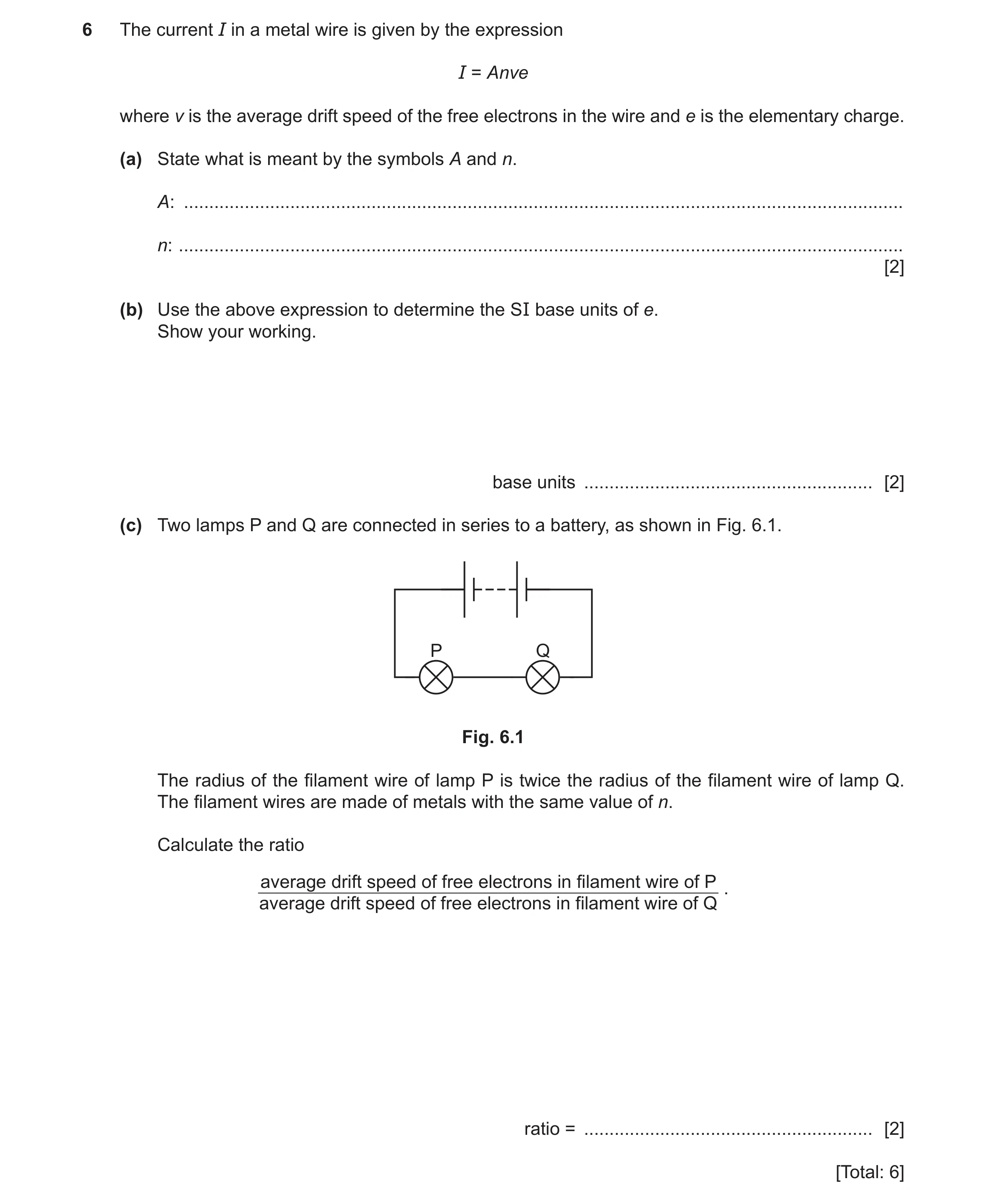
6 The current I in a metal wire is given by the expression I = Anve where v is the average drift speed of the free electrons in the wire and e is the elementary charge. (a) State what is meant by the symbols A and n. A: … n: … [2] (b) Use the above expression to determine the SI base units of e. Show your working. base units … [2] (c) Two lamps P and Q are connected in series to a battery, as shown in Fig. 6.1. P Q Fig. 6.1 The radius of the filament wire of lamp P is twice the radius of the filament wire of lamp Q. The filament wires are made of metals with the same value of n. Calculate the ratio average drift speed of free electrons in filament wire of P . average drift speed of free electrons in filament wire of Q ratio = … [2] [Total: 6]
6 marks
Mark scheme: 6(a) A: cross-sectional area B1 n: number density of free electrons B1 6(b) units of I: A and units of A: m2 and units of v: m s–1 B1 units of e: A / (m2 m–3 m s–1) = A s A1 6(c) ratio = AQ / AP C1 = [πr2] / [π(2r2)] = 0.25 A1
This question in 9702/23 May/June 2020
Q9 · One of the results of the α-particle scattering experiment is that a very small minority… 9702/22 May/June 2021
6 (a) One of the results of the α-particle scattering experiment is that a very small minority of the α-particles are scattered through angles greater than 90°. State what may be inferred about the structure of the atom from this result. … … … … [2] (b) An α-particle is made up of other particles. One of these particles is a proton. State and explain whether a proton is a fundamental particle. … … [1] (c) A radioactive source produces a beam of α-particles in a vacuum. The average current produced by the beam is 6.9 × 10⁻⁹ A. Calculate the average number of α-particles passing a fixed point in the beam in a time of 1.0 minute. number = … [3] (d) The α-particles in the vacuum in (c) enter a uniform electric field. The α-particles enter the field with their velocity in the same direction as the field. State and explain whether the magnitude of the acceleration of an α-particle due to the field decreases, increases or stays constant as the α-particle moves through the field. … … … [2] (e) A nucleus X is an isotope of a nucleus Y. The mass of nucleus X is greater than that of Y. Both of the nuclei are in the same uniform electric field. State and explain whether the magnitude of the electric force acting on nucleus X is greater than, less than or the same as that acting on nucleus Y. … … … [2] [Total: 10]
10 marks
Mark scheme: 6(a) the nucleus is charged B1 the majority of the mass (of atom) is in the nucleus B1 6(b) made up of quarks (so) not a fundamental particle B1 6(c) (Q =) 6.9 × 10–9 × 60 C1 number = (6.9 × 10–9 × 60) / (2 × 1.60 × 10–19) C1 = 1.3 × 10¹² A1 6(d) (magnitude of electric) force is constant B1 (so magnitude of) acceleration is constant B1 6(e) (nuclei have) same charge/same number of protons B1 (so) same (magnitude of) force B1
This question in 9702/22 May/June 2021
Q10 · A cell of electromotive force (e.m.f.) 0.48 V is connected to a metal wire X, as shown in… 9702/22 Oct/Nov 2021
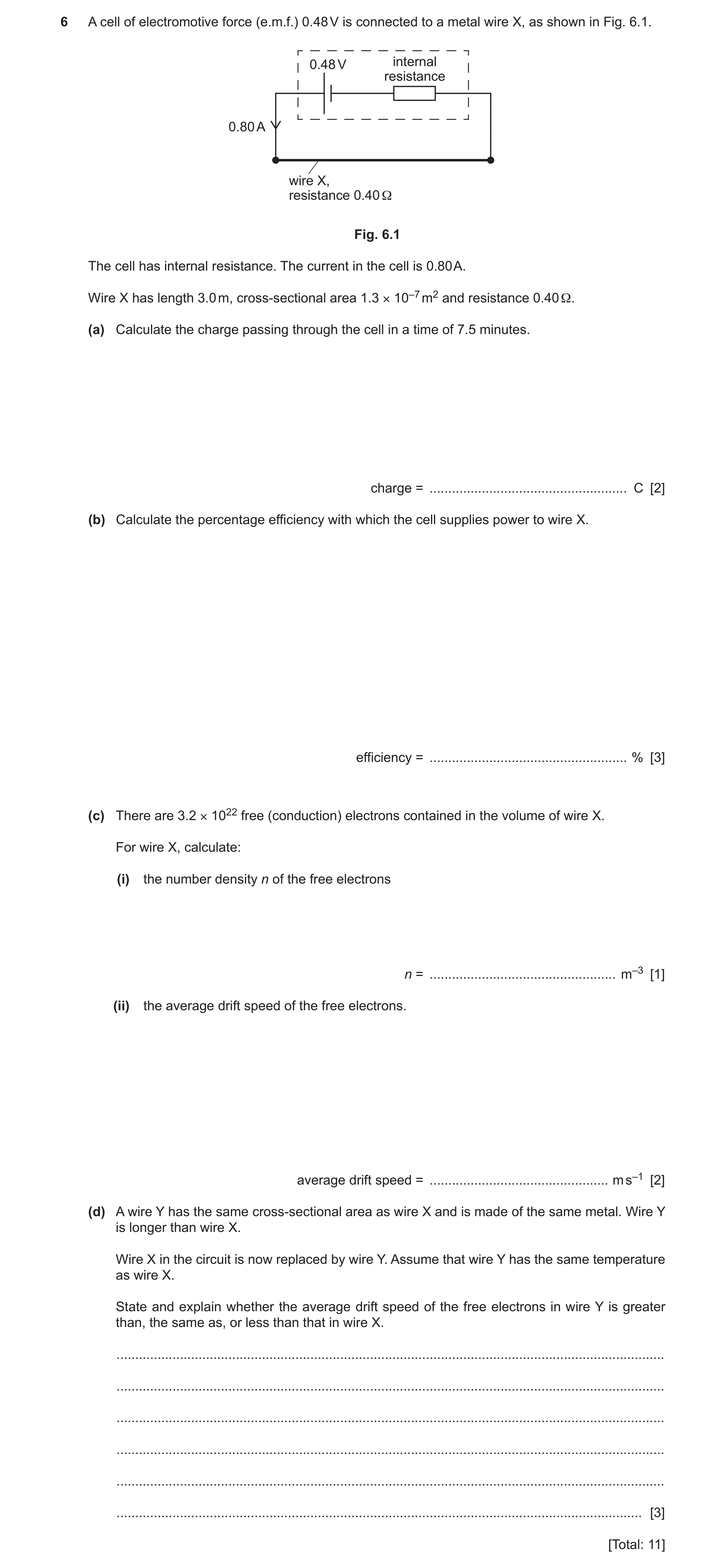
6 A cell of electromotive force (e.m.f.) 0.48 V is connected to a metal wire X, as shown in Fig. 6.1. 0.48 V internal resistance 0.80 A wire X, resistance 0.40 Ω Fig. 6.1 The cell has internal resistance. The current in the cell is 0.80 A. Wire X has length 3.0 m, cross-sectional area 1.3 × 10⁻⁷ m2 and resistance 0.40 Ω. (a) Calculate the charge passing through the cell in a time of 7.5 minutes. charge = … C [2] (b) Calculate the percentage efficiency with which the cell supplies power to wire X. efficiency = … % [3] (c) There are 3.2 × 10²² free (conduction) electrons contained in the volume of wire X. For wire X, calculate: (i) the number density n of the free electrons n = … m–3 [1] (ii) the average drift speed of the free electrons. average drift speed = … m s–1 [2] (d) A wire Y has the same cross-sectional area as wire X and is made of the same metal. Wire Y is longer than wire X. Wire X in the circuit is now replaced by wire Y. Assume that wire Y has the same temperature as wire X. State and explain whether the average drift speed of the free electrons in wire Y is greater than, the same as, or less than that in wire X. … … … … … … [3] [Total: 11]
11 marks
Mark scheme: 6(a) C1 = 0.80 × 7.5 × 60 = 360 C A1 6(b) P = EI or P = VI or P = I2R or P = V2 / R C1 0.802 × 0.40 (= 0.256 W) or 0.48 × 0.80 (= 0.384 W) C1 efficiency = (0.256 / 0.384) × 100 = 67% A1 6(c)(i) n = 3.2 × 10²² / (1.3 × 10–7 × 3.0) = 8.2 × 1028 m–3 A1 6(c)(ii) I = Anvq v = 0.80 / (1.3 × 10–7 × 8.2 × 1028 × 1.60 × 10–19) C1 = 4.7 × 10⁻⁴ m s–1 A1 6(d) (wire Y has) larger resistance / resistance increases M1 (wire Y has) smaller current / current decreases M1 (average drift) speed is less (in wire Y) A1
This question in 9702/22 Oct/Nov 2021
Q11 · The current in a filament lamp decreases 9702/22 May/June 2023
6 (a) The current in a filament lamp decreases. State and explain how the resistance of the lamp changes. … … [1] (b) A cylindrical wire has length L and resistance R. The total number of free electrons (charge carriers) contained in the volume of the wire is N. Each free electron has charge e. The potential difference between the ends of the wire is V. Determine expressions, in terms of some or all of the symbols e, L, N, R and V for: (i) the current in the wire current = … [1] (ii) the average drift speed of the free electrons average drift speed = … [2] (iii) the average time taken for a free electron to move along the full length of the wire. time taken = … [1] [Total: 5]
5 marks
Mark scheme: 6(a) temperature decreases (so) resistance decreases B1 6(b)(i) current = V / R A1 6(b)(ii) I = Anvq n = N / V or n = N / AL C1 v = (V / R) / [(V / L) (N / V) e] or (V / R) / [A (N / AL) e] = VL / RNe A1 or v = L / t = L / (Q / I) (C1) = LI / Q = L(V / R) / Ne = VL / RNe (A1) 6(b)(iii) time = distance / speed or Q / I = L / (VL / RNe) or Ne / (V / R) time = RNe / V A1
This question in 9702/22 May/June 2023
Q12 · Lightning occurs when charge builds up in the atmosphere, creating a potential difference… 9702/22 May/June 2024
3 Lightning occurs when charge builds up in the atmosphere, creating a potential difference between the ground and the atmosphere. During a lightning strike there is an average current of 3.3 × 10 4 A for a time of 2.6 × 10 –5 s. (a) Calculate the charge transferred during the lightning strike. charge = … C [2] (b) The potential difference between the ground and the atmosphere is 3.0 × 10⁷ V. Calculate the average power, in GW, transferred during the lightning strike. power = … GW [2] (c) A lightning rod is attached to a tall building to conduct charge safely to the ground. The lightning rod is modelled as a uniform cylindrical copper cable of total length 95 m that runs from the ground to the top of the building, as shown in Fig. 3.1. lightning rod building ground Fig. 3.1 (i) The resistance of the lightning rod is 9.6 Ω. The resistivity of copper is 1.7 × 10 –8 Ω m. Determine the radius of the lightning rod. radius = … m [3] (ii) The radius of the copper lightning rod is doubled with no change to its length. State the effect of this change on the resistance of the lightning rod. … [1] (d) A section of the lightning rod of length 0.12 m is removed for testing. A tensile stress of 1.9 × 10⁶ Pa is applied, as shown in Fig. 3.2. lightning rod fixed support tensile stress 1.9 × 10⁶ Pa 0.12 m Fig. 3.2 (not to scale) The section of the rod obeys Hooke’s law. The Young modulus of copper is 1.3 × 10¹¹ Pa. Calculate the extension of the section. extension = … m [3] [Total: 11]
11 marks
Mark scheme: 3(a) C1 = 3.3 104 2.6 10–5 = 0.86 C A1 3(b) P = IV or P = VQ / t or V = IR and P = V 2/R or P = I 2R C1 P = 3.3 104 3.0 107 or P = (3.0 107 0.86) / (2.6 10–5) or P = (3.0 107)2 / 910 or P = (3.3 104)2 910 P = 9.9 1011 (W) = 990 GW A1 3(c)(i) R = L / A C1 9.6 = 1.7 10–8 95 / r 2 C1 r = 2.3 10–4 m A1 3(c)(ii) (resistance) decreases by a factor of four A1 Question Answer Marks 3(d) E = / C1 x = L / E = 1.9 106 0.12 / (1.3 1011) C1 = 1.8 10–6 m A1
This question in 9702/22 May/June 2024
 4 / 16
 5 / 16
 6 / 16
 7 / 16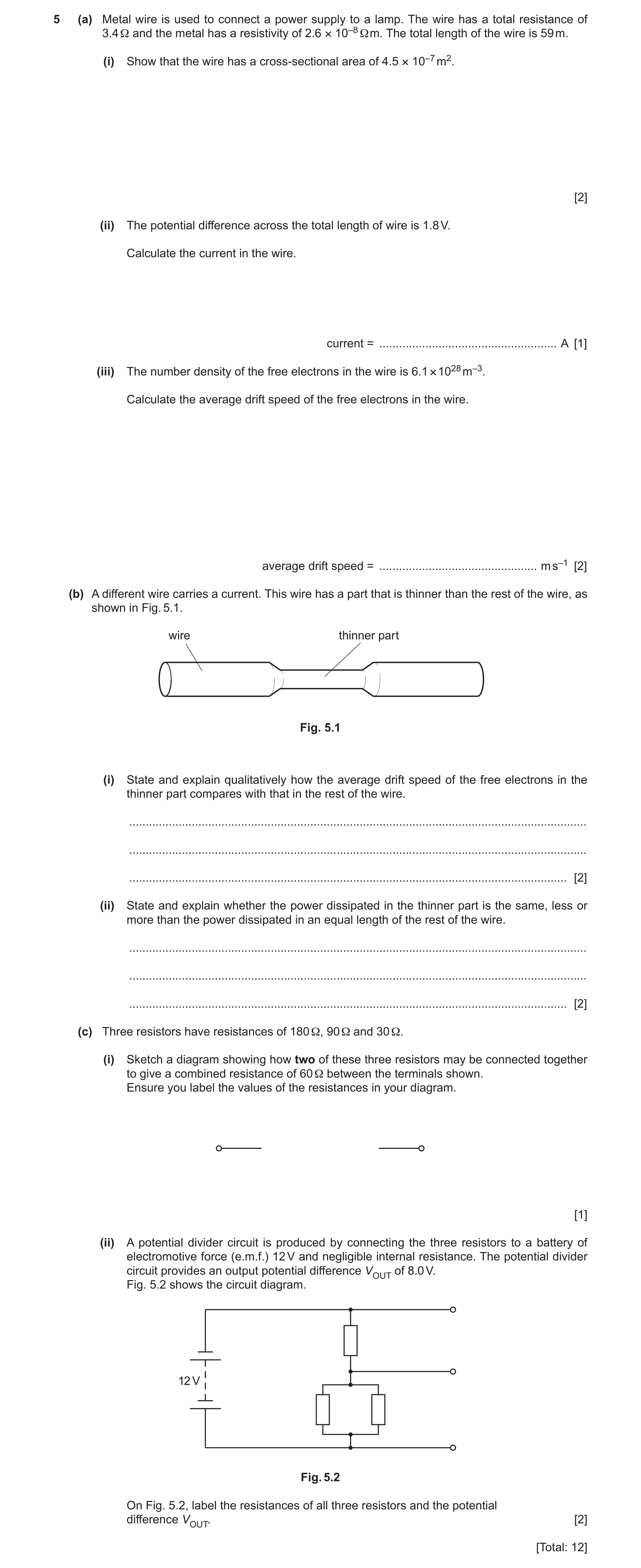
 10 / 16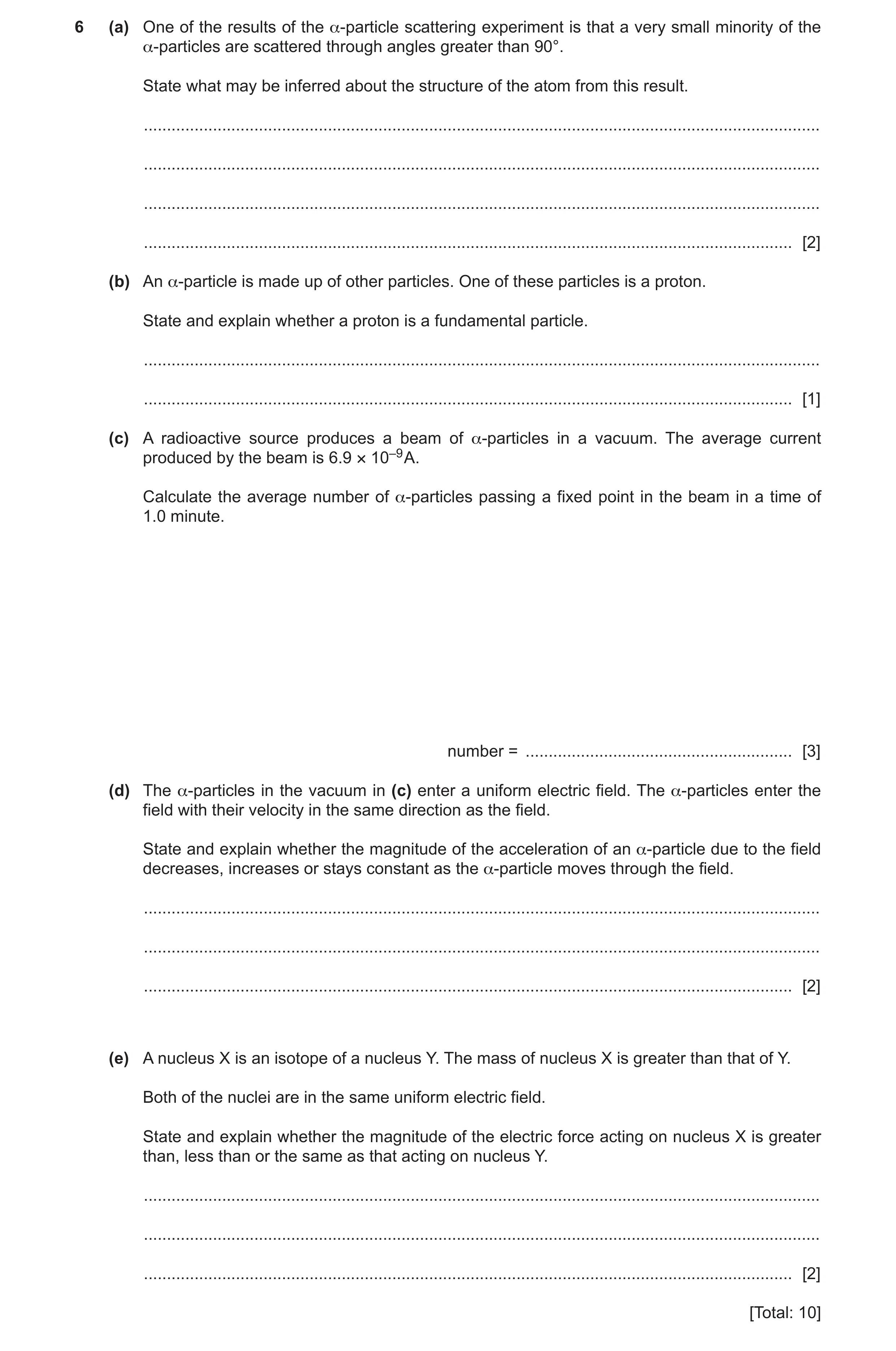
 14 / 16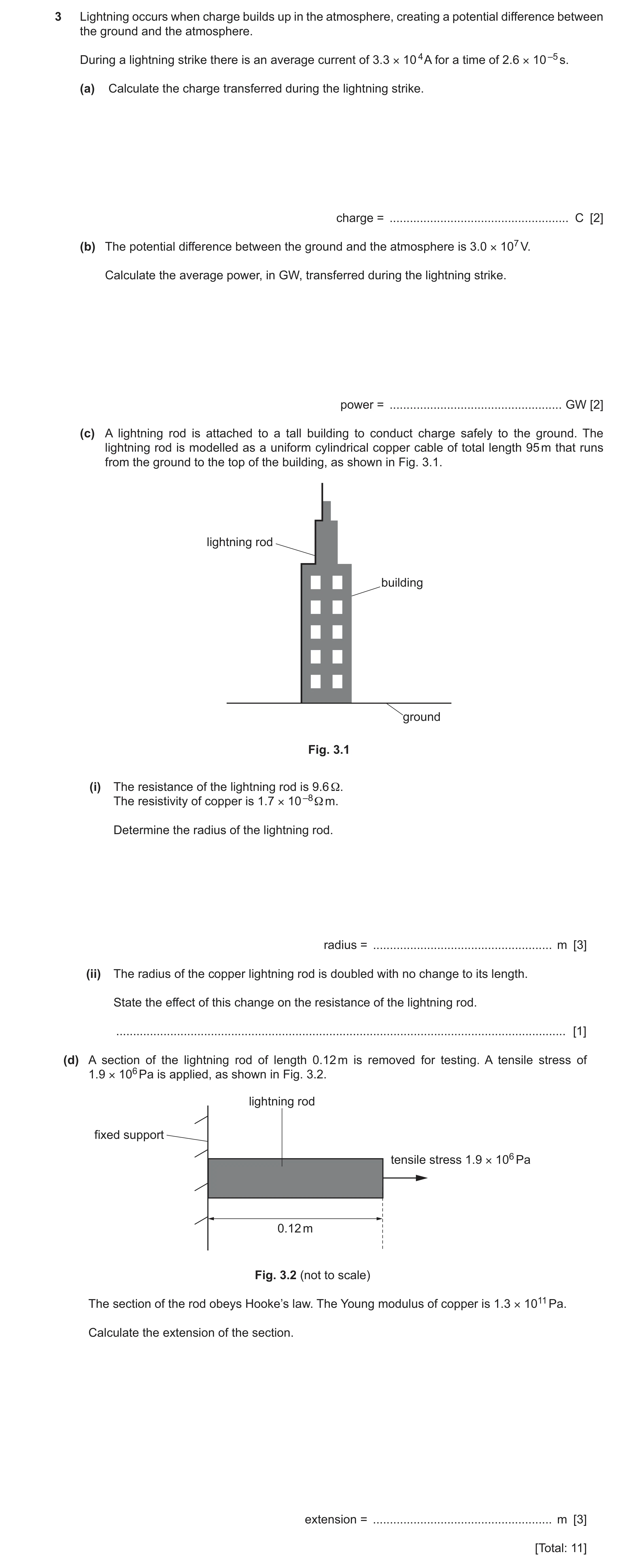
 9
9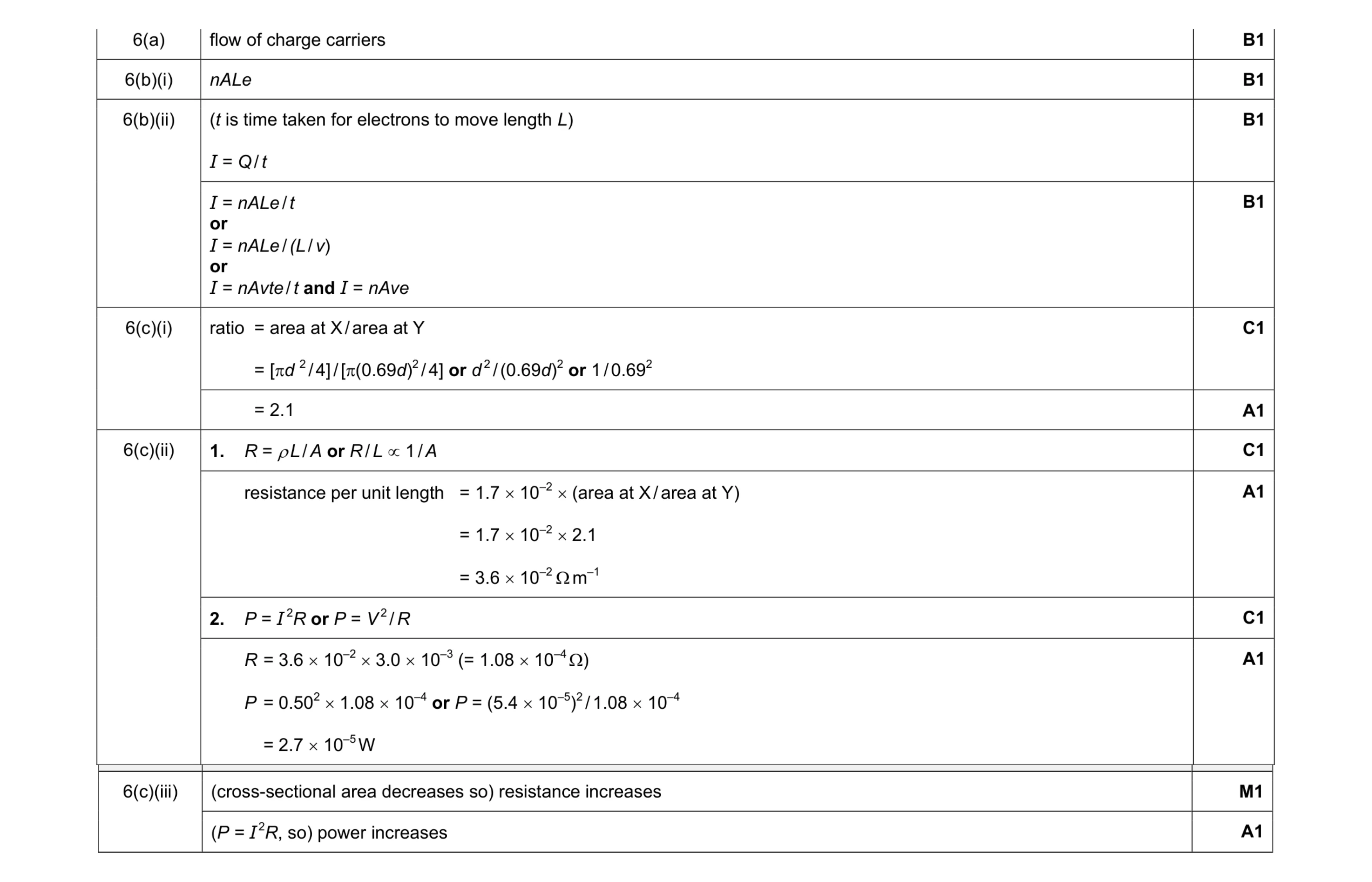 12
12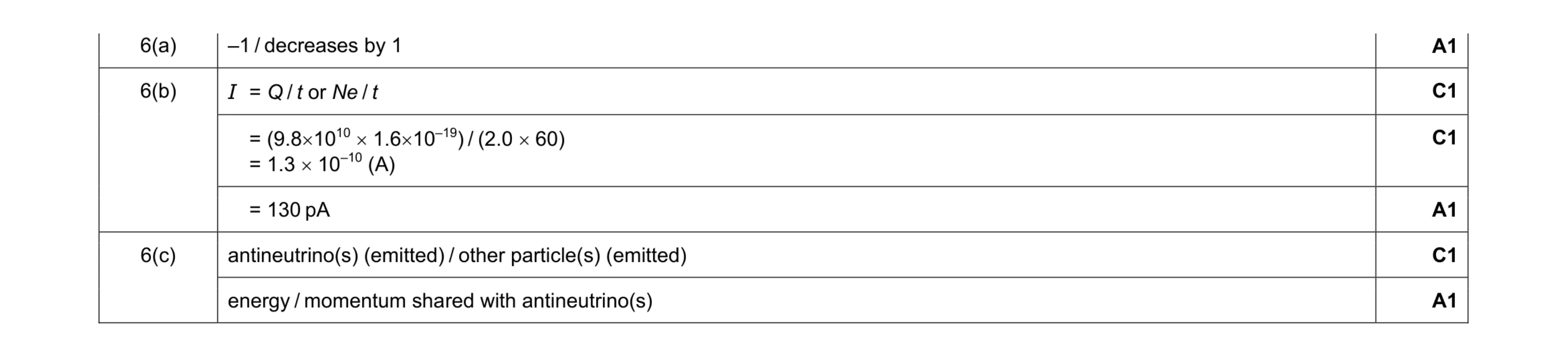 6
6 4
4 4
4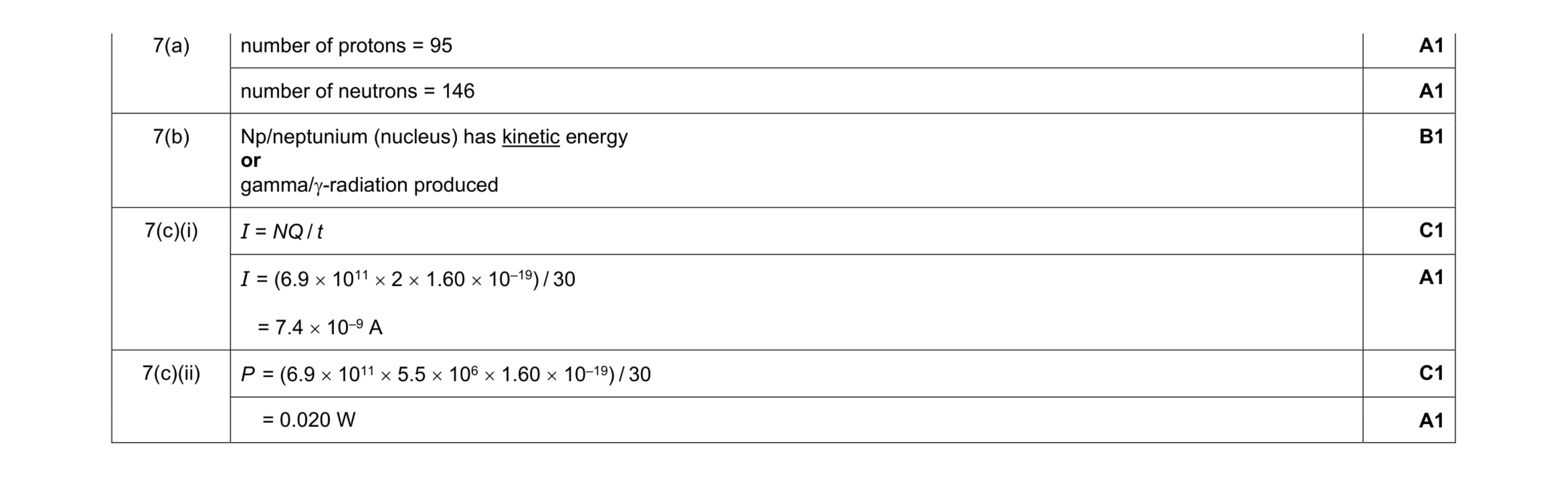 7
7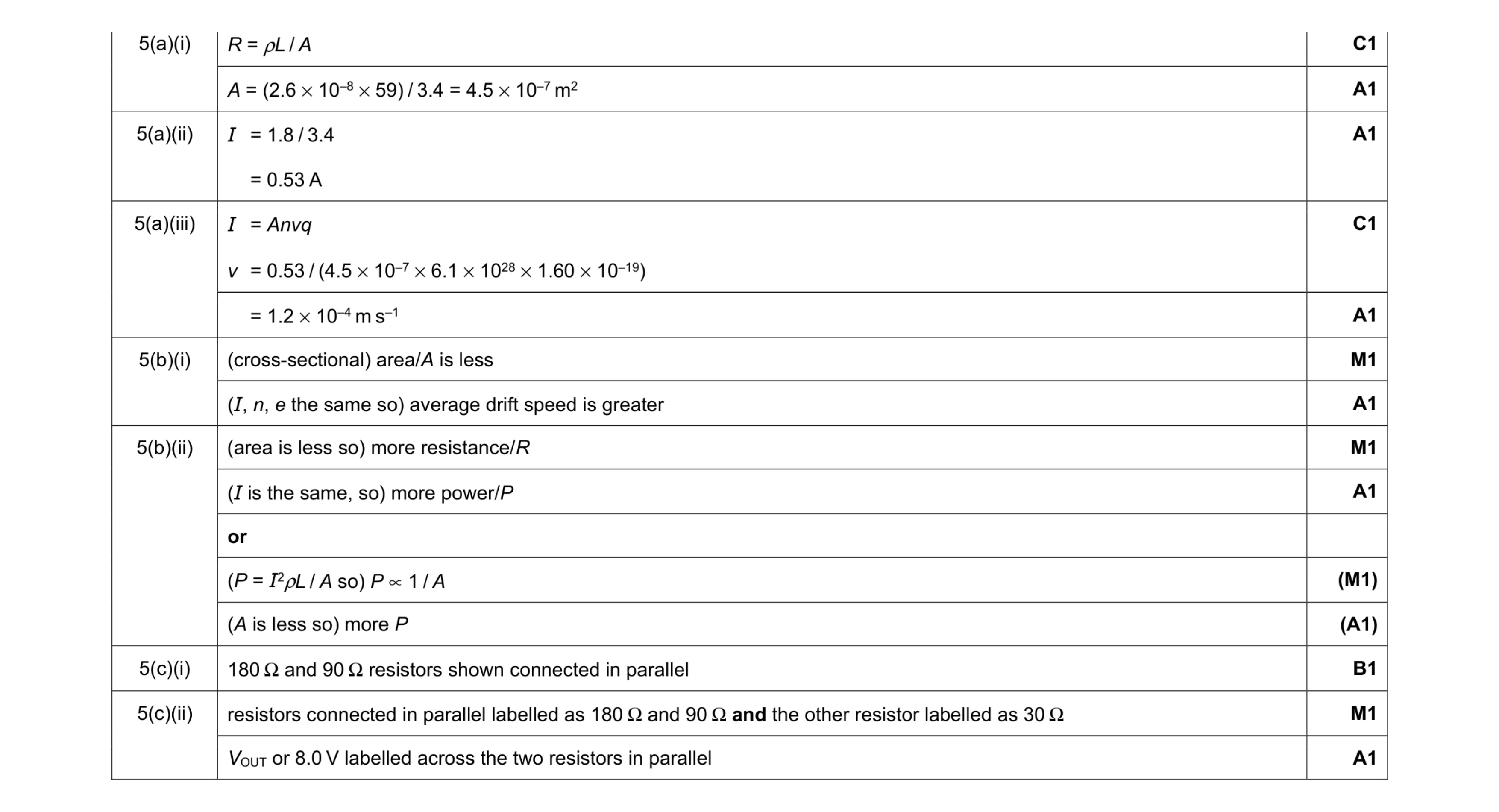 12
12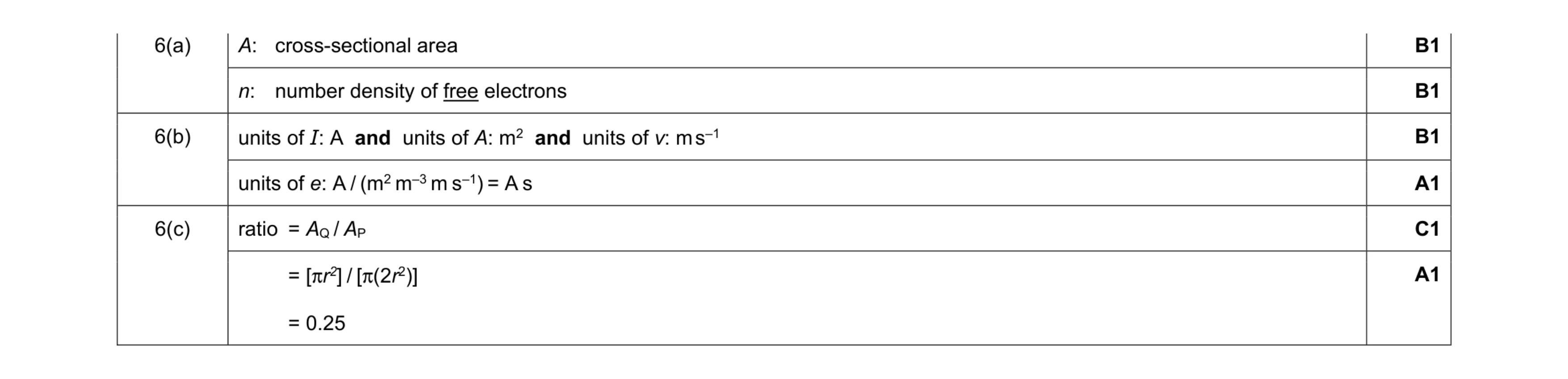 6
6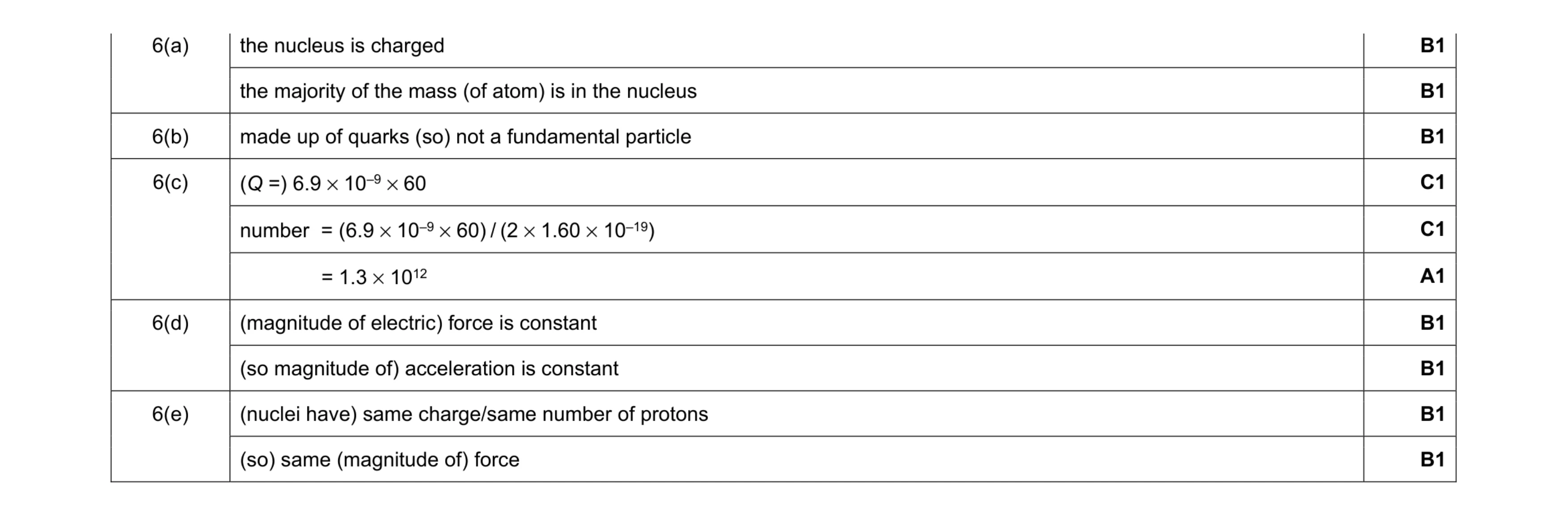 10
10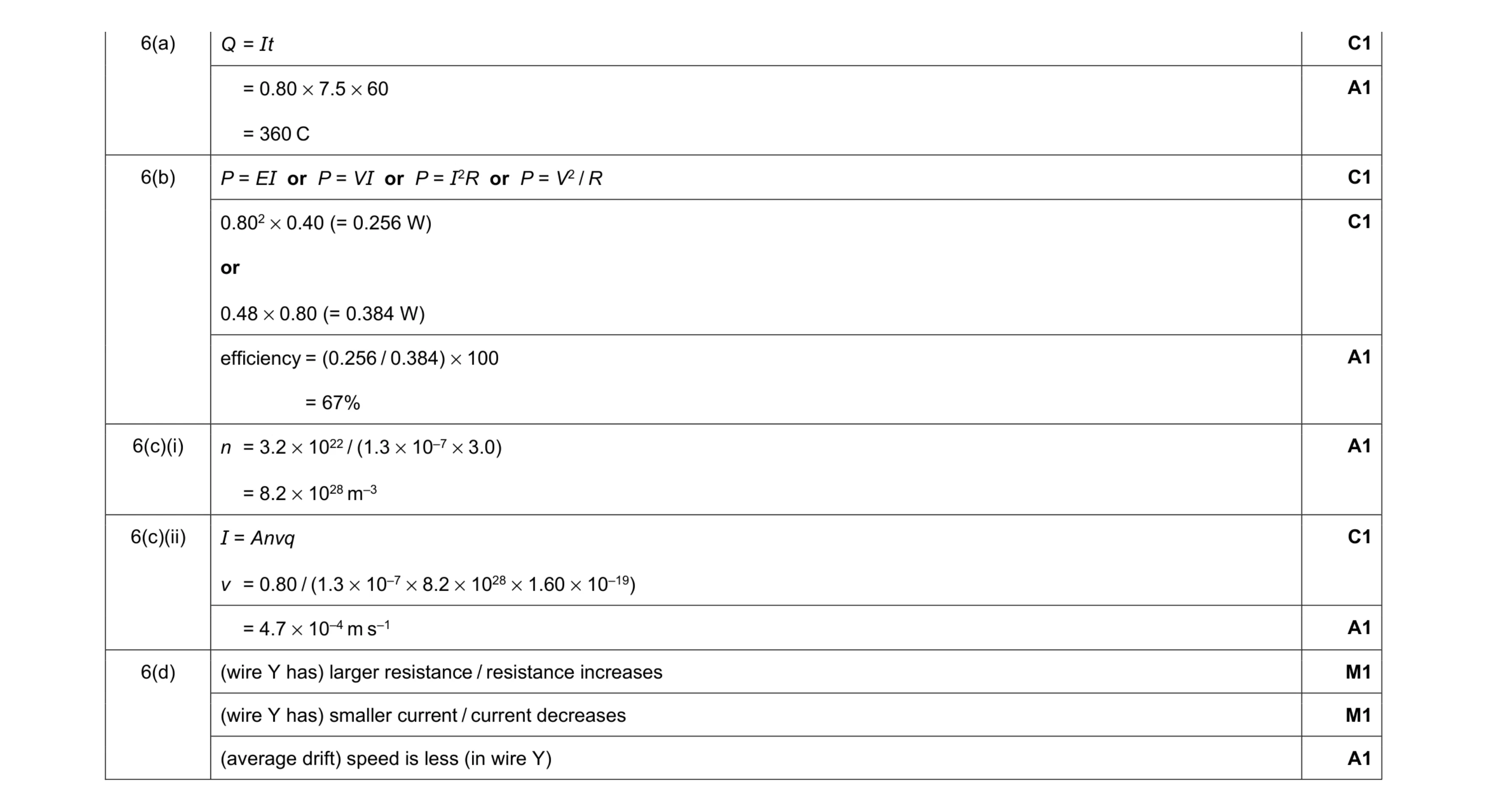 11
11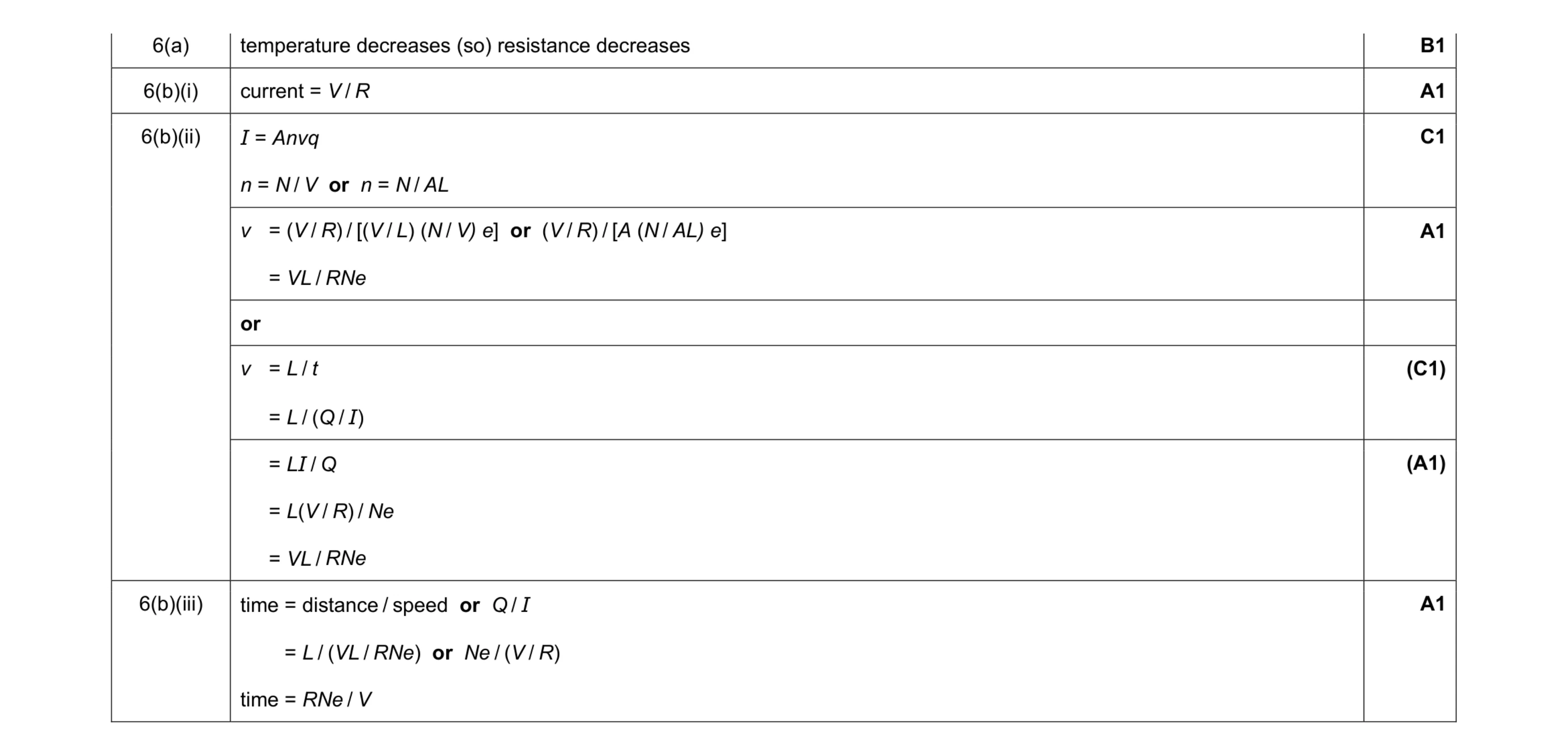 5
5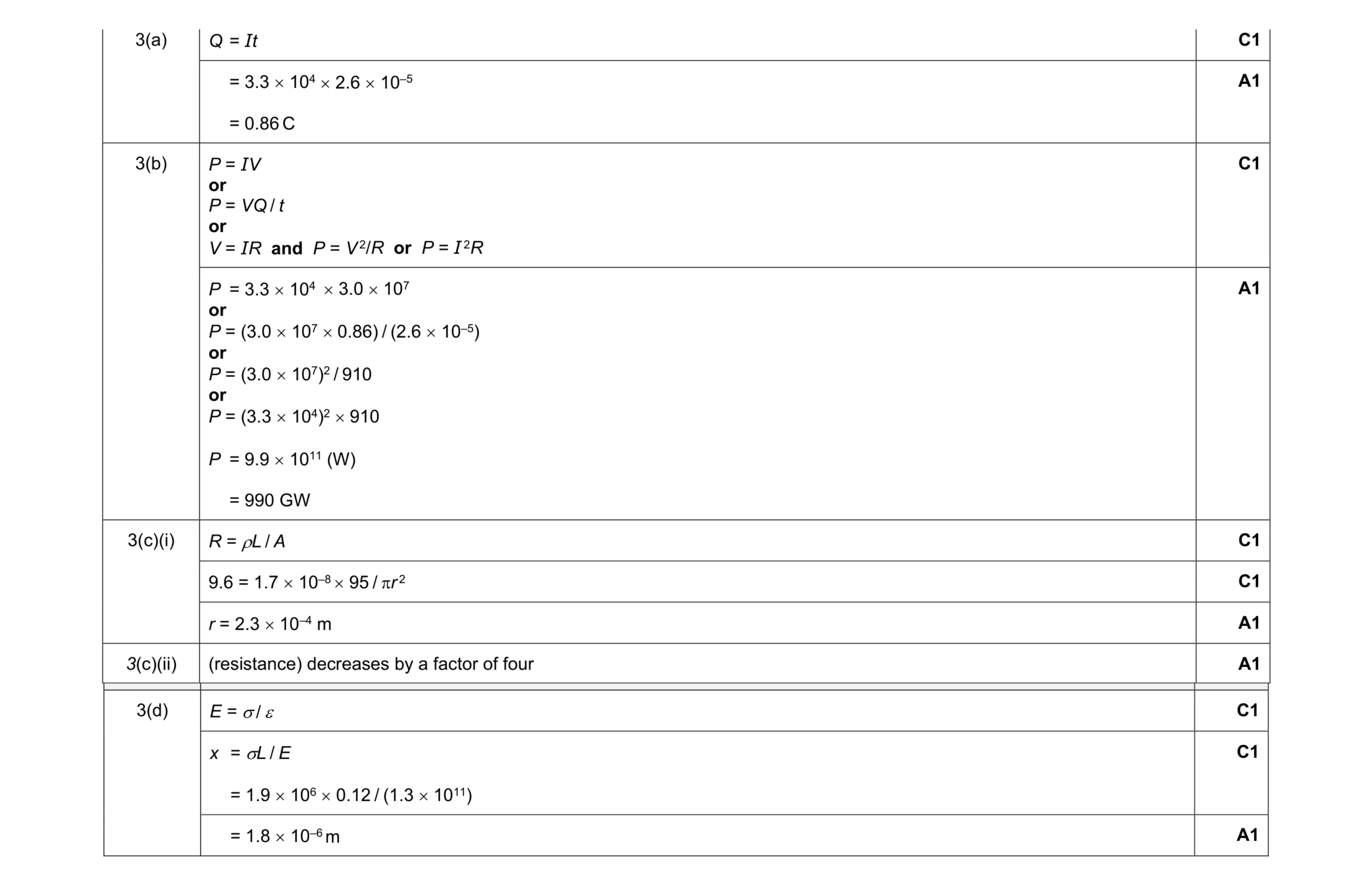 11
11