Questions as text
Q1 · A stationary sound wave is set up along the line joining two loudspeakers 9702/11 Oct/Nov 2004
25 A stationary sound wave is set up along the line joining two loudspeakers. Which measurement is sufficient on its own to enable you to deduce the wavelength of the wave? A the amplitude of the sound wave B the distance between the two loudspeakers C the distance between two adjacent antinodes D the frequency of the sound wave
1 marks
Answer: C
This question in 9702/11 Oct/Nov 2004
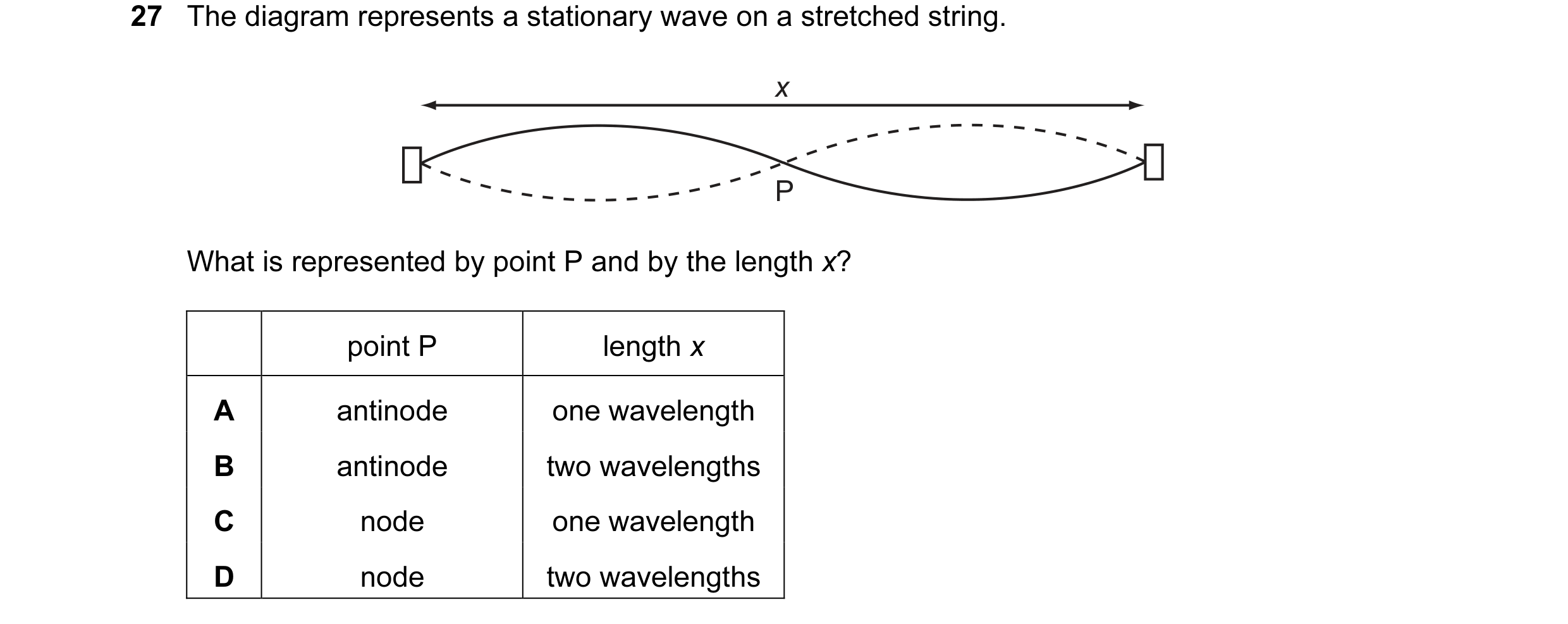
Q2 · The diagram represents a stationary wave on a stretched string 9702/11 Oct/Nov 2004
27 The diagram represents a stationary wave on a stretched string. x P What is represented by point P and by the length x? point P length x A antinode one wavelength B antinode two wavelengths C node one wavelength D node two wavelengths
1 marks
Answer: C
This question in 9702/11 Oct/Nov 2004
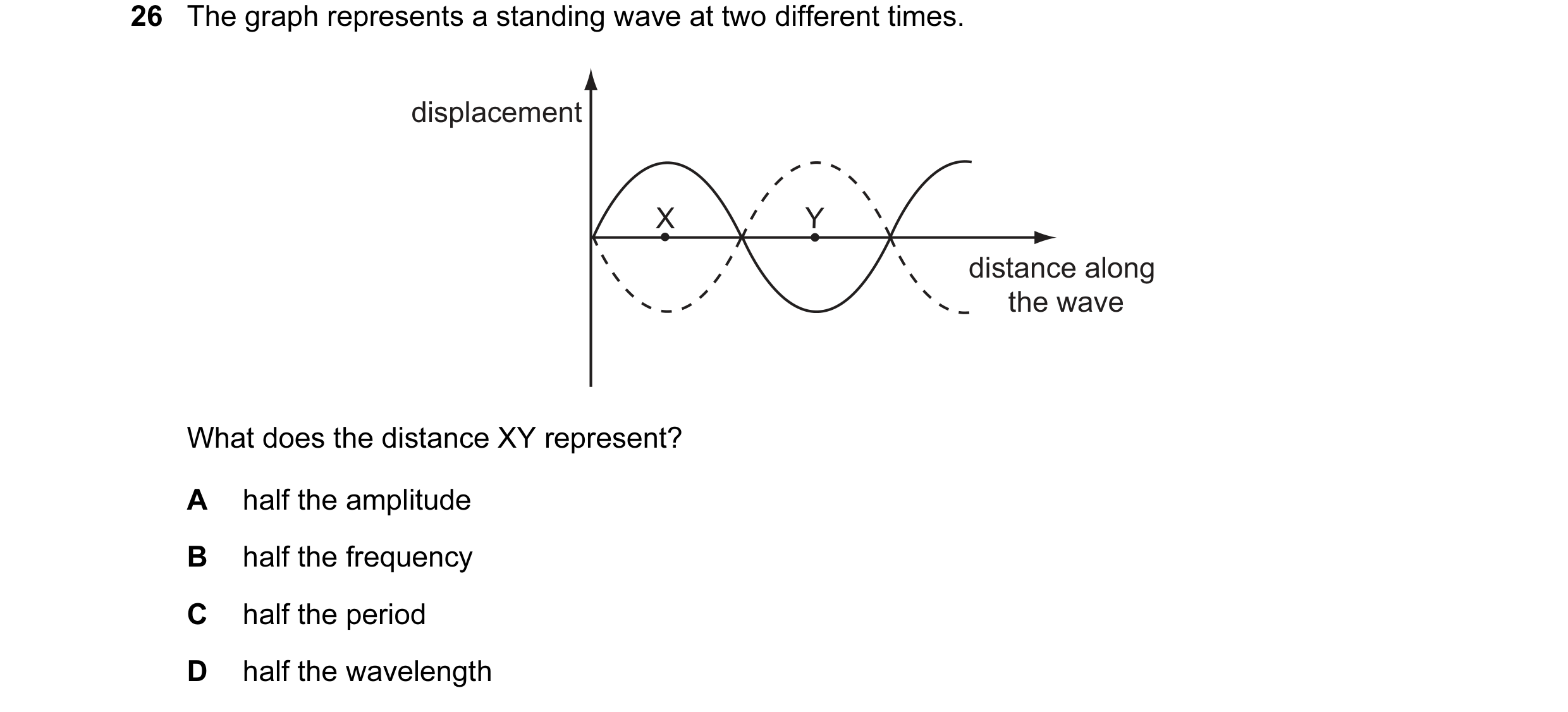
Q3 · The graph represents a standing wave at two different times 9702/11 Oct/Nov 2005
26 The graph represents a standing wave at two different times. displacement X Y distance along the wave What does the distance XY represent? A half the amplitude B half the frequency C half the period D half the wavelength
1 marks
Answer: D
This question in 9702/11 Oct/Nov 2005
Q4 · Where, in a standing wave, do the vibrations of the medium occur? 9702/11 May/June 2006
26 Where, in a standing wave, do the vibrations of the medium occur? A only at the nodes B only at the antinodes C at all points between the nodes D at all points between the antinodes
1 marks
Answer: C
This question in 9702/11 May/June 2006
Q5 · What may be used to produce stationary waves? 9702/11 Oct/Nov 2006
28 What may be used to produce stationary waves? A blowing air over the top of an empty bottle B making a loud sound near a mountain C passing monochromatic light through a double slit D passing water waves through a narrow slit
1 marks
Answer: A
This question in 9702/11 Oct/Nov 2006
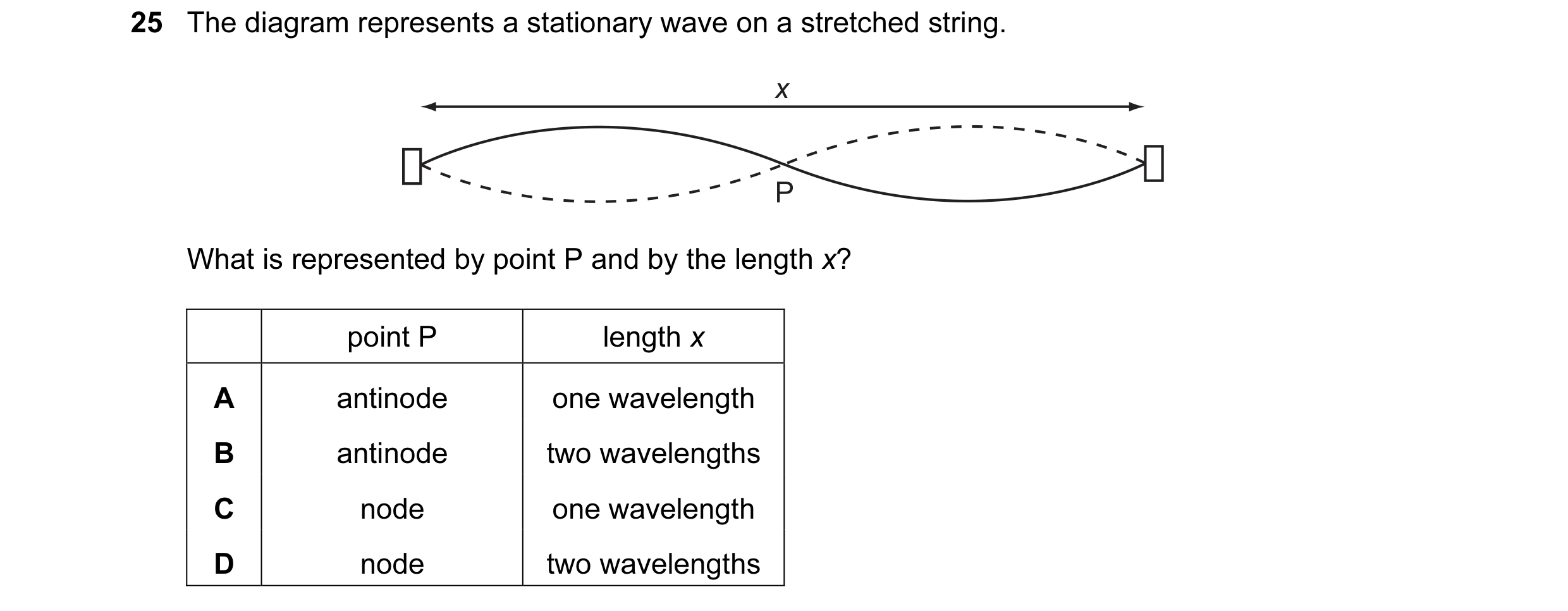
Q6 · The diagram represents a stationary wave on a stretched string 9702/11 May/June 2007
25 The diagram represents a stationary wave on a stretched string. x P What is represented by point P and by the length x? point P length x A antinode one wavelength B antinode two wavelengths C node one wavelength D node two wavelengths
1 marks
Answer: C
This question in 9702/11 May/June 2007
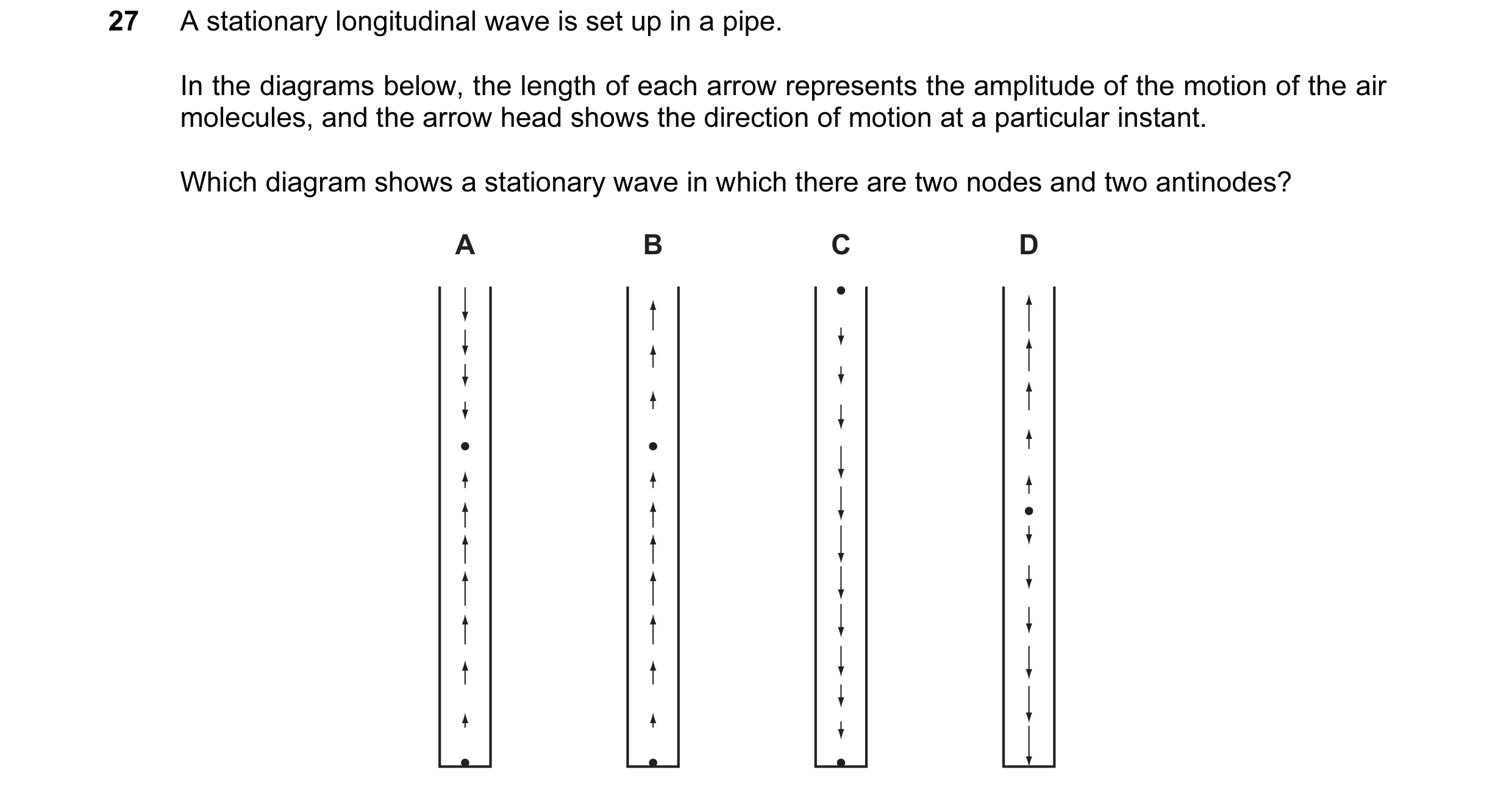
Q7 · A stationary longitudinal wave is set up in a pipe 9702/11 May/June 2007
27 A stationary longitudinal wave is set up in a pipe. In the diagrams below, the length of each arrow represents the amplitude of the motion of the air molecules, and the arrow head shows the direction of motion at a particular instant. Which diagram shows a stationary wave in which there are two nodes and two antinodes? A B C D
1 marks
Answer: A
This question in 9702/11 May/June 2007
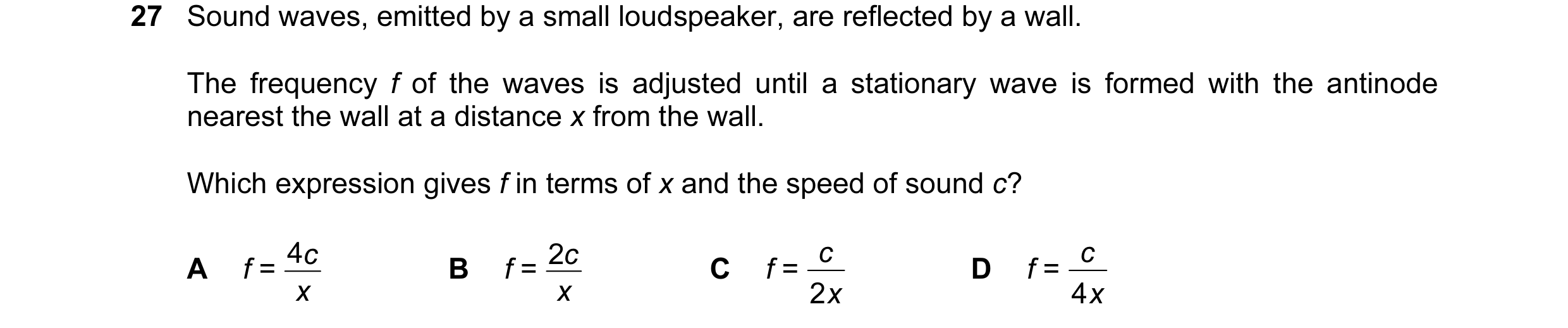
Q8 · Sound waves, emitted by a small loudspeaker, are reflected by a wall 9702/11 May/June 2008
27 Sound waves, emitted by a small loudspeaker, are reflected by a wall. The frequency f of the waves is adjusted until a stationary wave is formed with the antinode nearest the wall at a distance x from the wall. Which expression gives f in terms of x and the speed of sound c? 4 c 2 c c c A f = x B f = x C f = D f = 2 x 4 x
1 marks
Answer: D
This question in 9702/11 May/June 2008
Q9 · T is a microwave transmitter placed at a fixed distance from a flat reflecting surface S 9702/11 Oct/Nov 2008
27 T is a microwave transmitter placed at a fixed distance from a flat reflecting surface S. S T A small microwave receiver is moved from T towards S and receives signals of alternate maxima and minima of intensity. The distance between one maximum and the next is 15 mm. What is the frequency of the microwaves? A 1.0 × 10⁷ Hz B 2.0 × 10⁷ Hz C 1.0 × 10¹⁰ Hz D 2.0 × 10¹⁰ Hz
1 marks
Answer: C
This question in 9702/11 Oct/Nov 2008
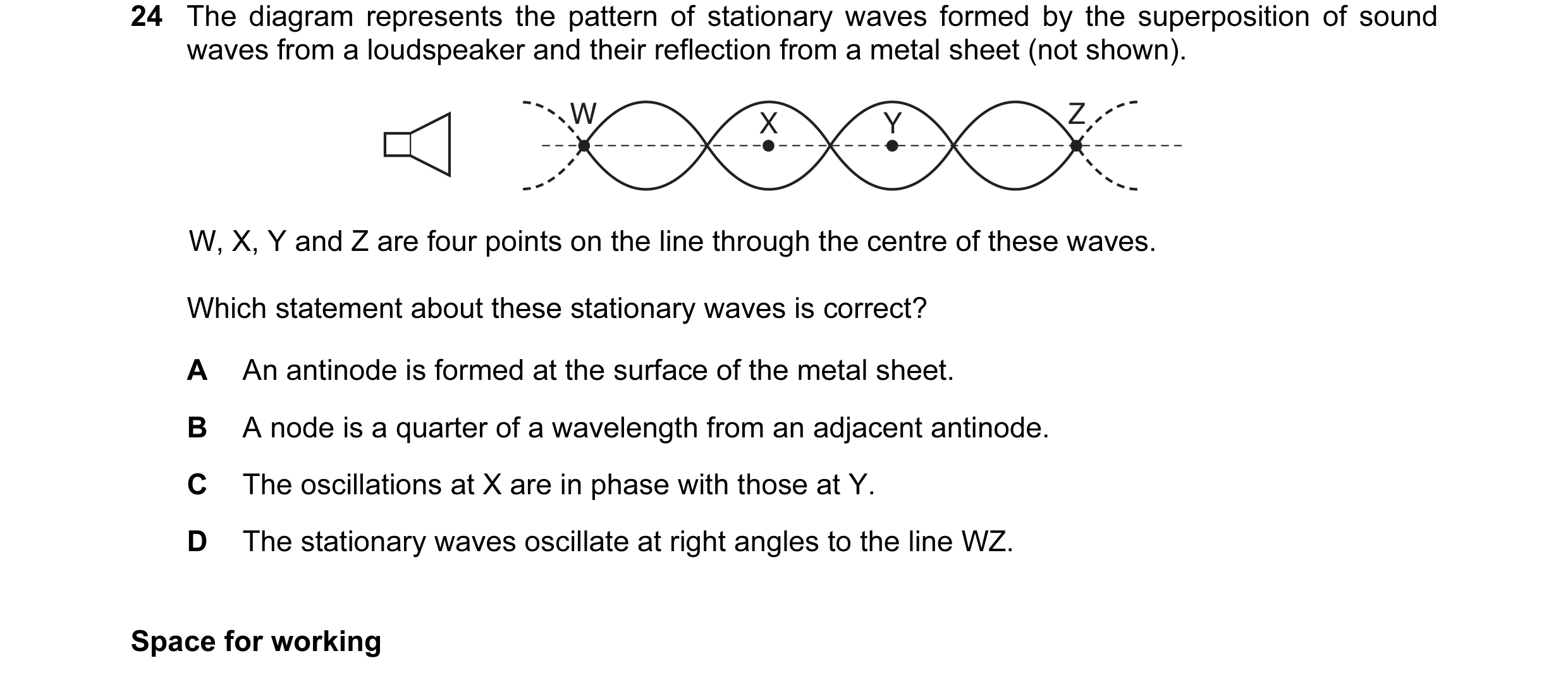
Q10 · The diagram represents the pattern of stationary waves formed by the superposition of… 9702/11 May/June 2009
24 The diagram represents the pattern of stationary waves formed by the superposition of sound waves from a loudspeaker and their reflection from a metal sheet (not shown). W X Y Z W, X, Y and Z are four points on the line through the centre of these waves. Which statement about these stationary waves is correct? A An antinode is formed at the surface of the metal sheet. B A node is a quarter of a wavelength from an adjacent antinode. C The oscillations at X are in phase with those at Y. D The stationary waves oscillate at right angles to the line WZ. Space for working
1 marks
Answer: B
This question in 9702/11 May/June 2009
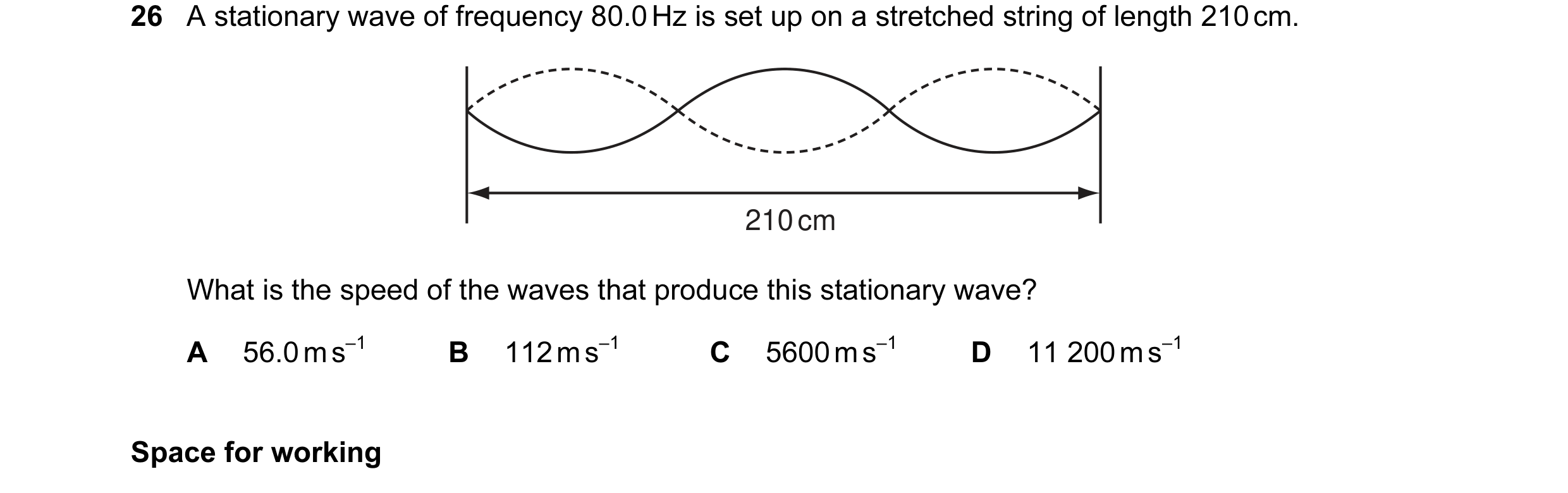
Q11 · A stationary wave of frequency 80.0 Hz is set up on a stretched string of length 210 cm 9702/11 May/June 2009
26 A stationary wave of frequency 80.0 Hz is set up on a stretched string of length 210 cm. 210 cm What is the speed of the waves that produce this stationary wave? A 56.0 m s–1 B 112 m s–1 C 5600 m s–1 D 11 200 m s–1 Space for working
1 marks
Answer: B
This question in 9702/11 May/June 2009
Q12 · The diagram shows a standing wave on a string 9702/11 Oct/Nov 2009
25 The diagram shows a standing wave on a string. The standing wave has three nodes N1, N2 and N3. N1 N2 N3 Which statement is correct? A All points on the string vibrate in phase. B All points on the string vibrate with the same amplitude. C Points equidistant from N2 vibrate with the same frequency and in phase. D Points equidistant from N2 vibrate with the same frequency and the same amplitude.
1 marks
Answer: D
This question in 9702/11 Oct/Nov 2009
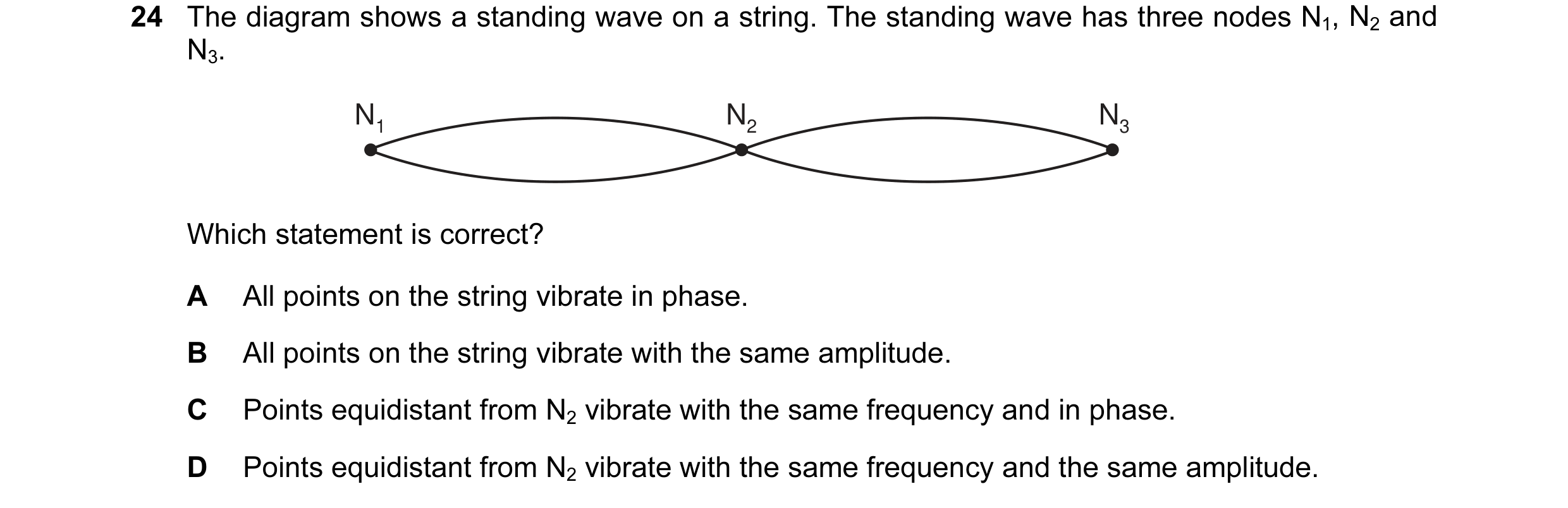
Q13 · The diagram shows a standing wave on a string 9702/12 Oct/Nov 2009
24 The diagram shows a standing wave on a string. The standing wave has three nodes N1, N2 and N3. N1 N2 N3 Which statement is correct? A All points on the string vibrate in phase. B All points on the string vibrate with the same amplitude. C Points equidistant from N2 vibrate with the same frequency and in phase. D Points equidistant from N2 vibrate with the same frequency and the same amplitude.
1 marks
Answer: D
This question in 9702/12 Oct/Nov 2009
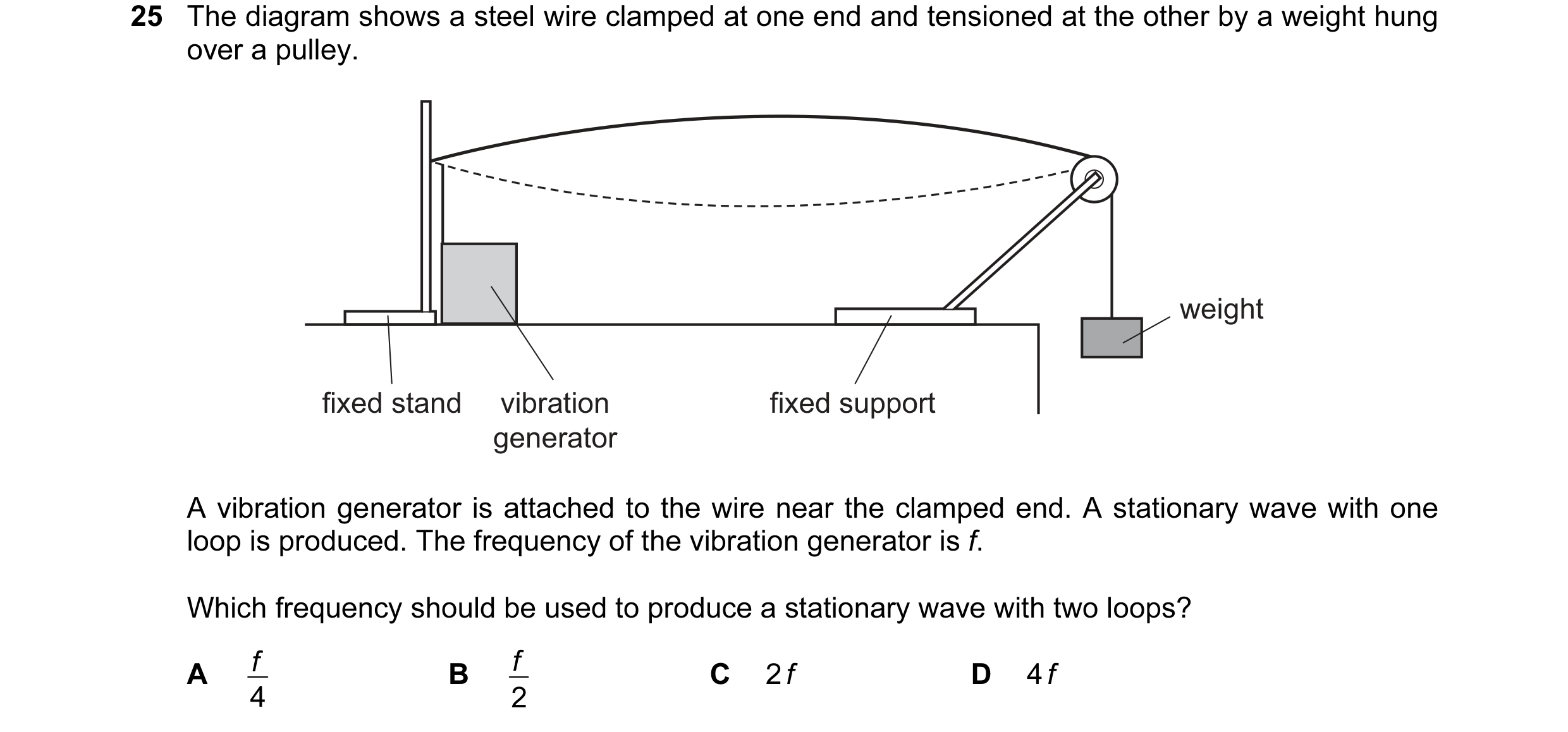
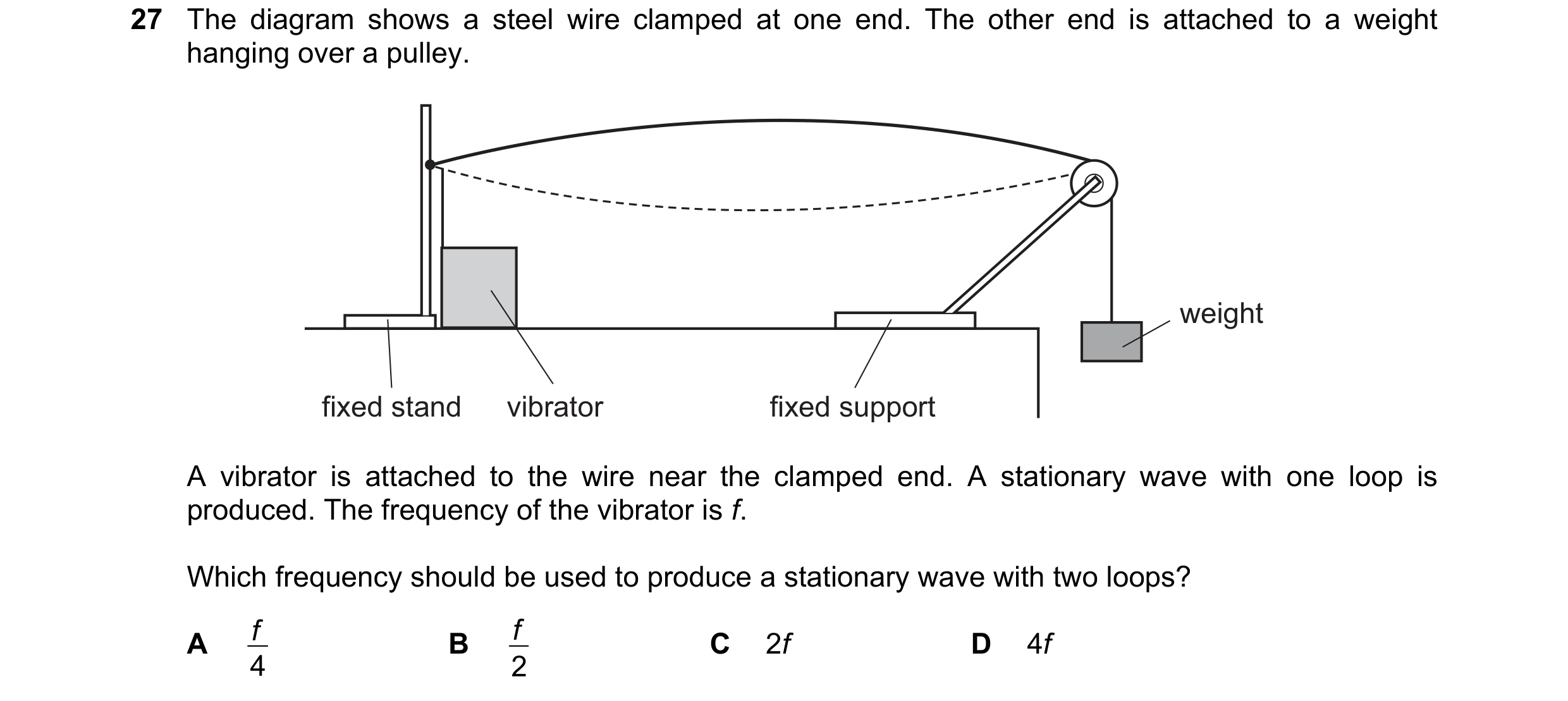
Q14 · The diagram shows a steel wire clamped at one end and tensioned at the other by a weight… 9702/11 May/June 2010
25 The diagram shows a steel wire clamped at one end and tensioned at the other by a weight hung over a pulley. weight fixed stand vibration fixed support generator A vibration generator is attached to the wire near the clamped end. A stationary wave with one loop is produced. The frequency of the vibration generator is f. Which frequency should be used to produce a stationary wave with two loops? f f A B C 2 f D 4 f 4 2
1 marks
Answer: C
This question in 9702/11 May/June 2010
Q15 · The diagram shows a steel wire clamped at one end and tensioned at the other by a weight… 9702/13 May/June 2010
24 The diagram shows a steel wire clamped at one end and tensioned at the other by a weight hung over a pulley. weight fixed stand vibration fixed support generator A vibration generator is attached to the wire near the clamped end. A stationary wave with one loop is produced. The frequency of the vibration generator is f. Which frequency should be used to produce a stationary wave with two loops? f f A B C 2 f D 4 f 4 2 Space for working
1 marks
Answer: C
This question in 9702/13 May/June 2010
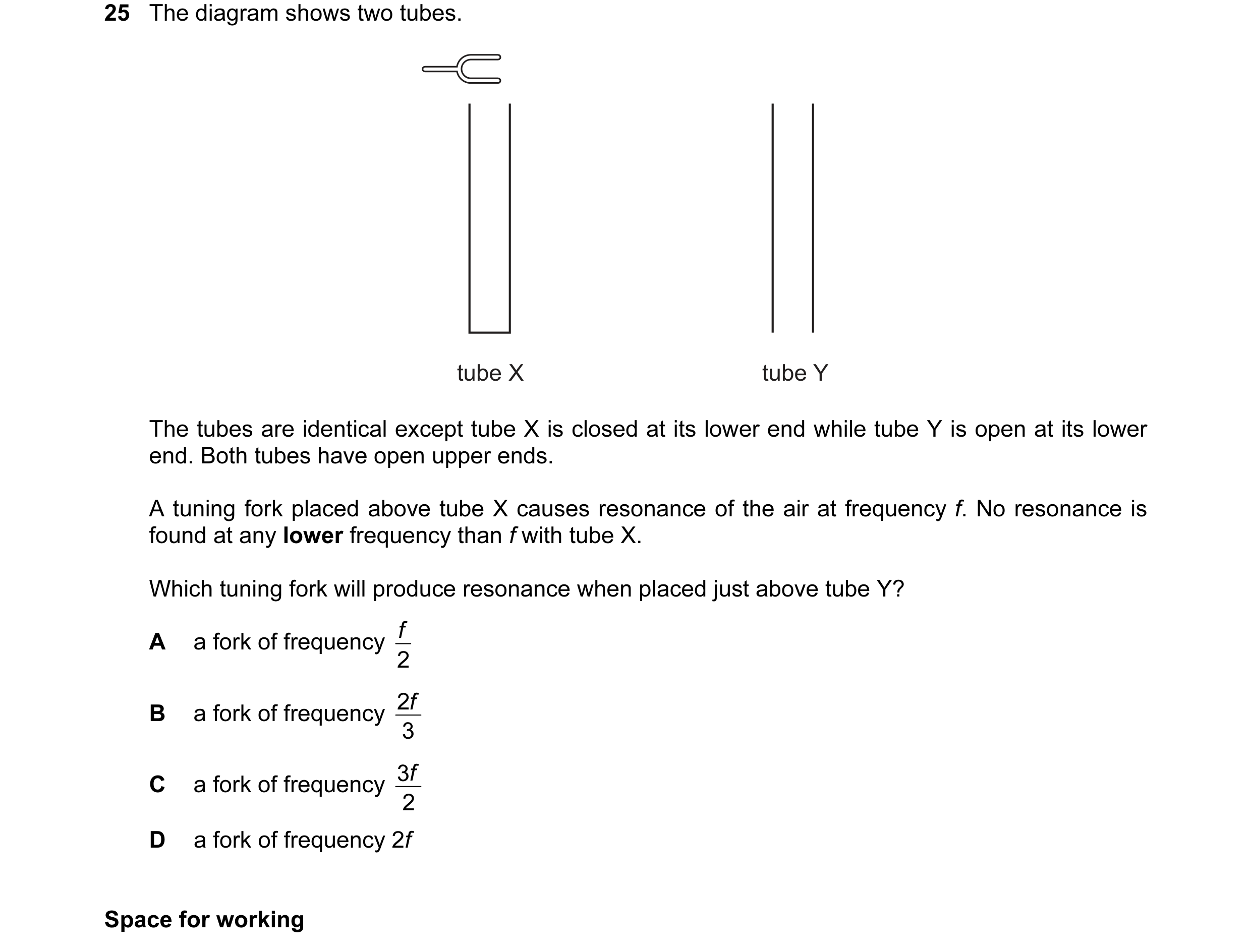
Q16 · The diagram shows two tubes 9702/12 Oct/Nov 2010
25 The diagram shows two tubes. tube X tube Y The tubes are identical except tube X is closed at its lower end while tube Y is open at its lower end. Both tubes have open upper ends. A tuning fork placed above tube X causes resonance of the air at frequency f. No resonance is found at any lower frequency than f with tube X. Which tuning fork will produce resonance when placed just above tube Y? f A a fork of frequency 2 2f B a fork of frequency 3 3f C a fork of frequency 2 D a fork of frequency 2f Space for working
1 marks
Answer: D
This question in 9702/12 Oct/Nov 2010
Q17 · A microwave transmitter emits waves towards a metal plate 9702/12 Oct/Nov 2010
26 A microwave transmitter emits waves towards a metal plate. The waves strike the plate and are reflected back along their original path. incident waves T S R Q P reflected waves metal plate A microwave detector is moved along the line PT. Points P, Q, R, S and T are the positions where minima of intensity are observed. These points are found to be 15 mm apart. What is the frequency of the microwaves? A 5.0 GHz B 6.7 GHz C 10 GHz D 20 GHz
1 marks
Answer: C
This question in 9702/12 Oct/Nov 2010
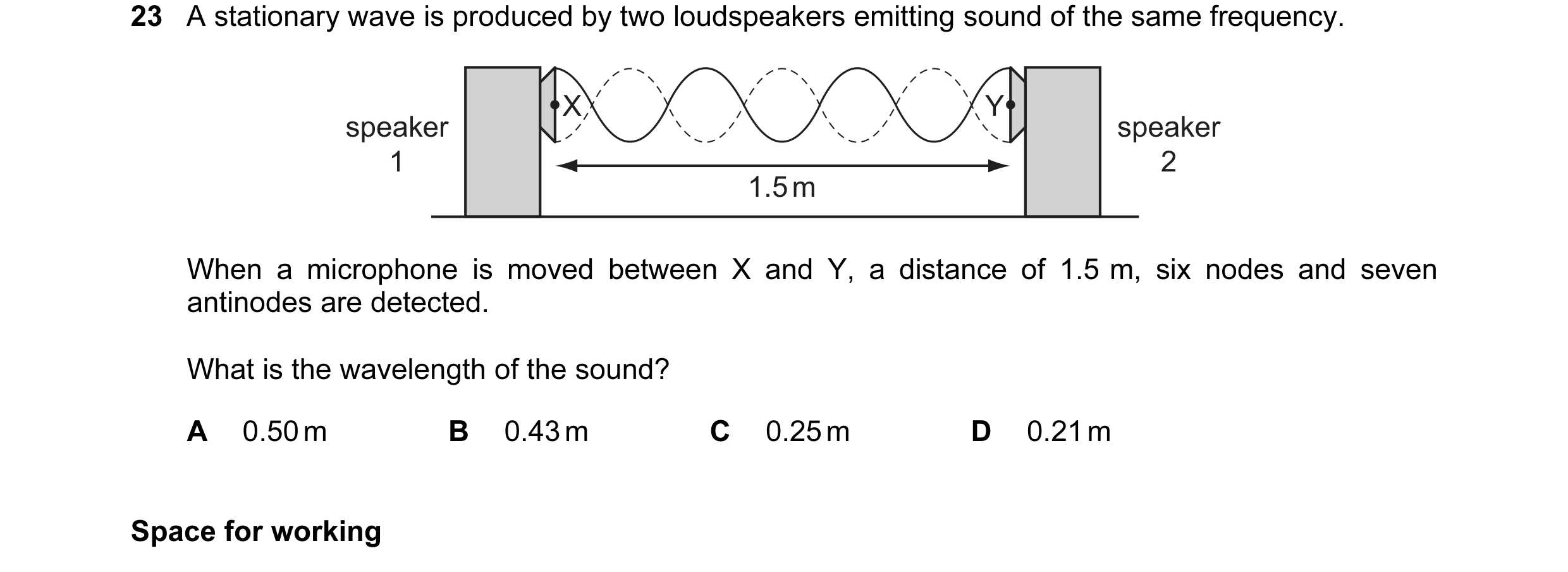
Q18 · A stationary wave is produced by two loudspeakers emitting sound of the same frequency 9702/13 Oct/Nov 2010
23 A stationary wave is produced by two loudspeakers emitting sound of the same frequency. X Y speaker speaker 1 2 1.5 m When a microphone is moved between X and Y, a distance of 1.5 m, six nodes and seven antinodes are detected. What is the wavelength of the sound? A 0.50 m B 0.43 m C 0.25 m D 0.21 m Space for working
1 marks
Answer: A
This question in 9702/13 Oct/Nov 2010
Q19 · The basic principle of note production in a horn is to set up a stationary wave in an air… 9702/11 May/June 2011
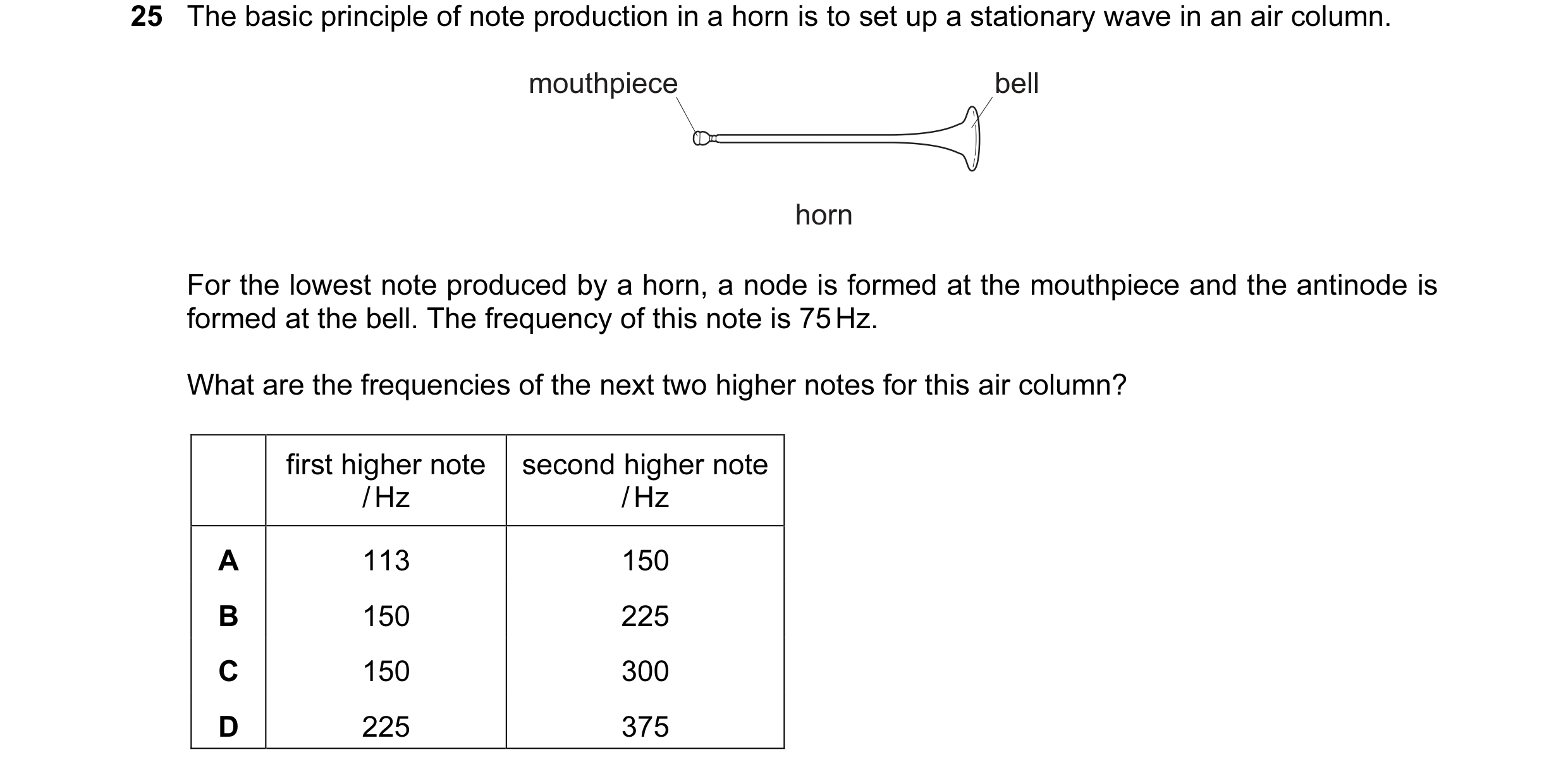
25 The basic principle of note production in a horn is to set up a stationary wave in an air column. mouthpiece bell horn For the lowest note produced by a horn, a node is formed at the mouthpiece and the antinode is formed at the bell. The frequency of this note is 75 Hz. What are the frequencies of the next two higher notes for this air column? first higher note second higher note / Hz / Hz A 113 150 B 150 225 C 150 300 D 225 375
1 marks
Answer: D
This question in 9702/11 May/June 2011
Q20 · The basic principle of note production in a horn is to set up a stationary wave in an air… 9702/13 May/June 2011
27 The basic principle of note production in a horn is to set up a stationary wave in an air column. mouthpiece bell horn For the lowest note produced by a horn, a node is formed at the mouthpiece and the antinode is formed at the bell. The frequency of this note is 75 Hz. What are the frequencies of the next two higher notes for this air column? first higher note second higher note / Hz / Hz A 113 150 B 150 225 C 150 300 D 225 375
1 marks
Answer: D
This question in 9702/13 May/June 2011
Q21 · Travelling waves of wavelength 20 cm are created in the air columns in a closed pipe P… 9702/11 Oct/Nov 2011
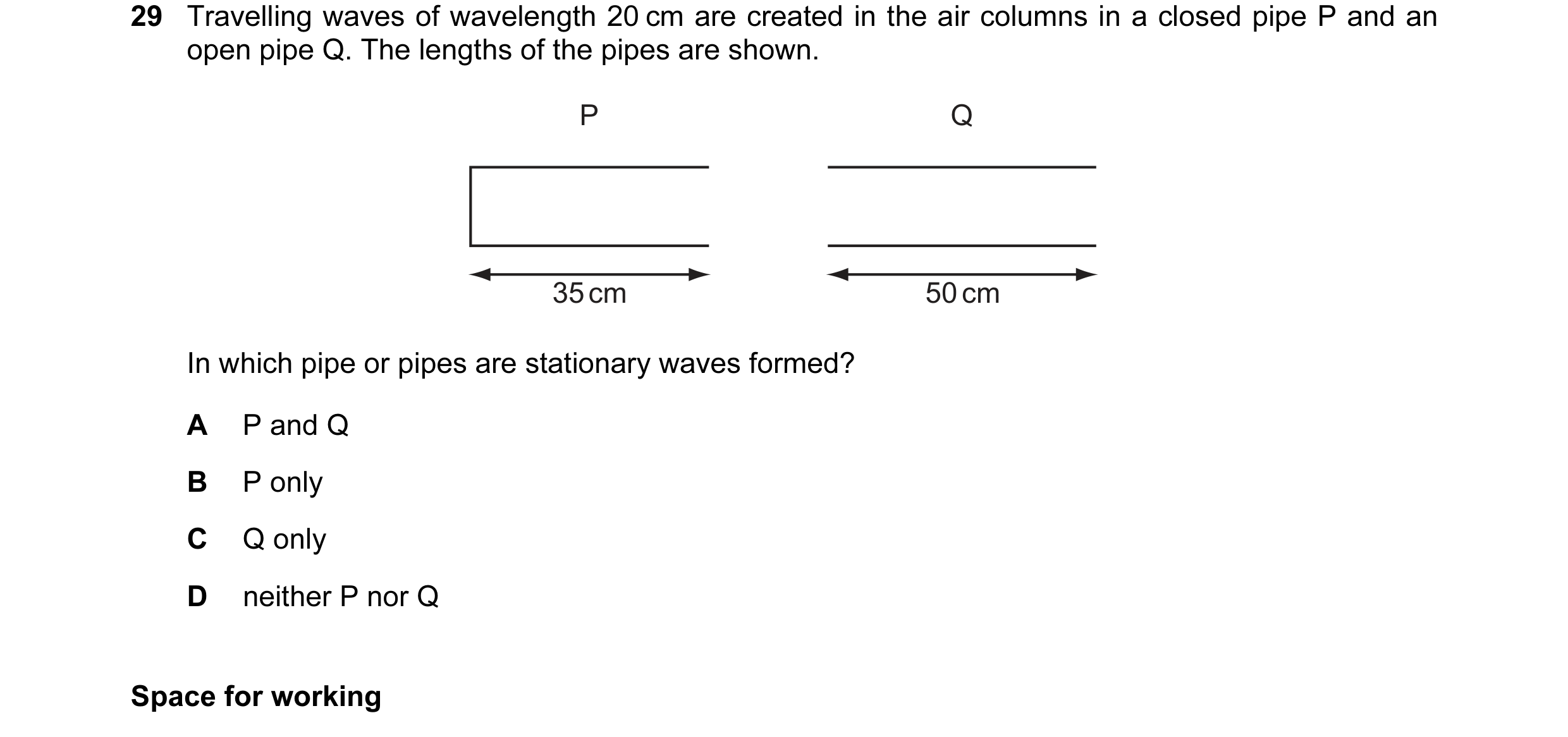
29 Travelling waves of wavelength 20 cm are created in the air columns in a closed pipe P and an open pipe Q. The lengths of the pipes are shown. P Q 35 cm 50 cm In which pipe or pipes are stationary waves formed? A P and Q B P only C Q only D neither P nor Q Space for working
1 marks
Answer: A
This question in 9702/11 Oct/Nov 2011
Q22 · A sound wave is set up in a long tube, closed at one end 9702/12 Oct/Nov 2011
27 A sound wave is set up in a long tube, closed at one end. The length of the tube is adjusted until the sound from the tube is loudest. What is the nature of the sound wave in the tube? A longitudinal and progressive B longitudinal and stationary C transverse and progressive D transverse and stationary
1 marks
Answer: B
This question in 9702/12 Oct/Nov 2011
Q23 · Travelling waves of wavelength 20 cm are created in the air columns in a closed pipe P… 9702/13 Oct/Nov 2011
30 Travelling waves of wavelength 20 cm are created in the air columns in a closed pipe P and an open pipe Q. The lengths of the pipes are shown. P Q 35 cm 50 cm In which pipe or pipes are stationary waves formed? A P and Q B P only C Q only D neither P nor Q
1 marks
Answer: A
This question in 9702/13 Oct/Nov 2011
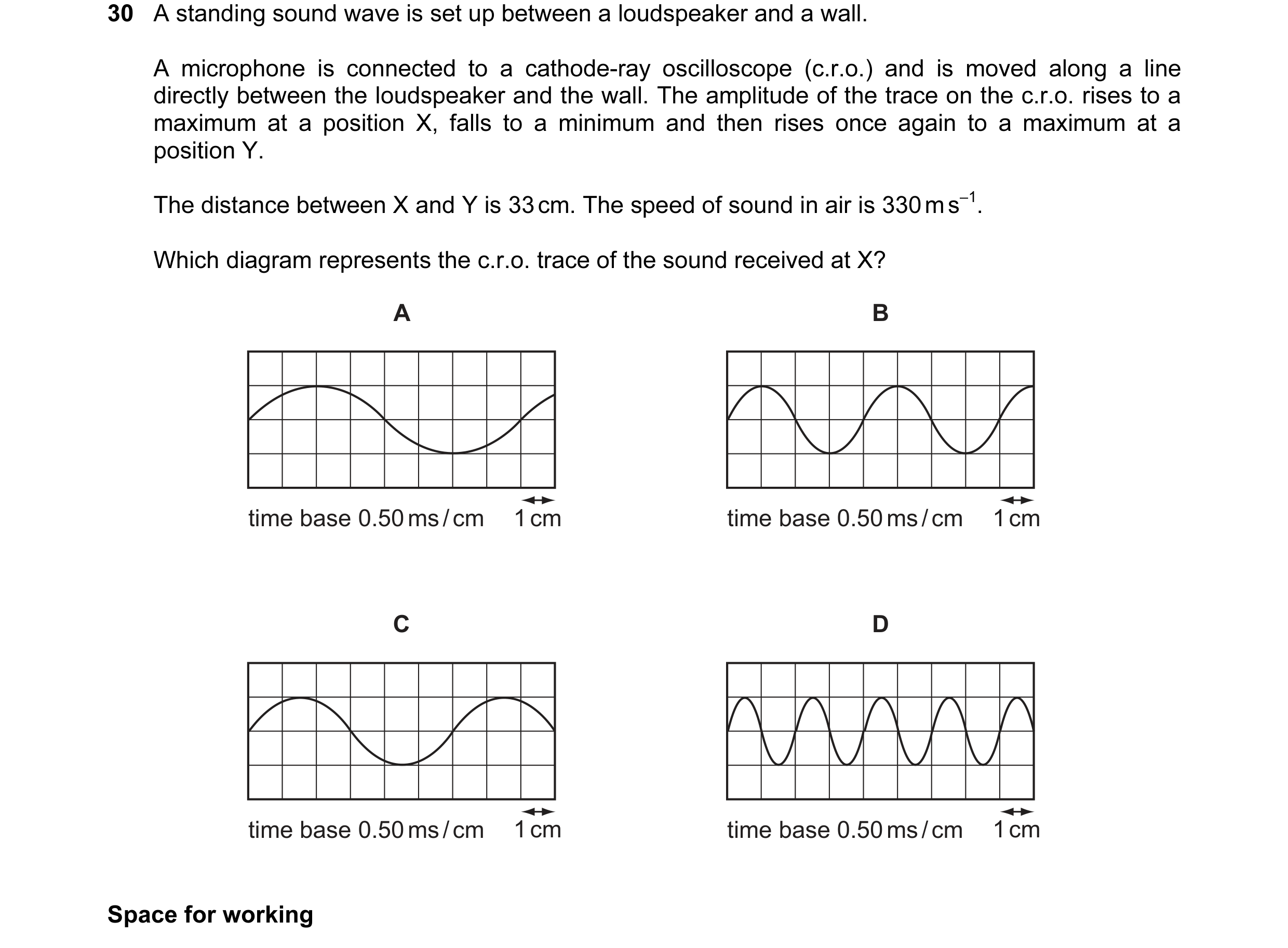
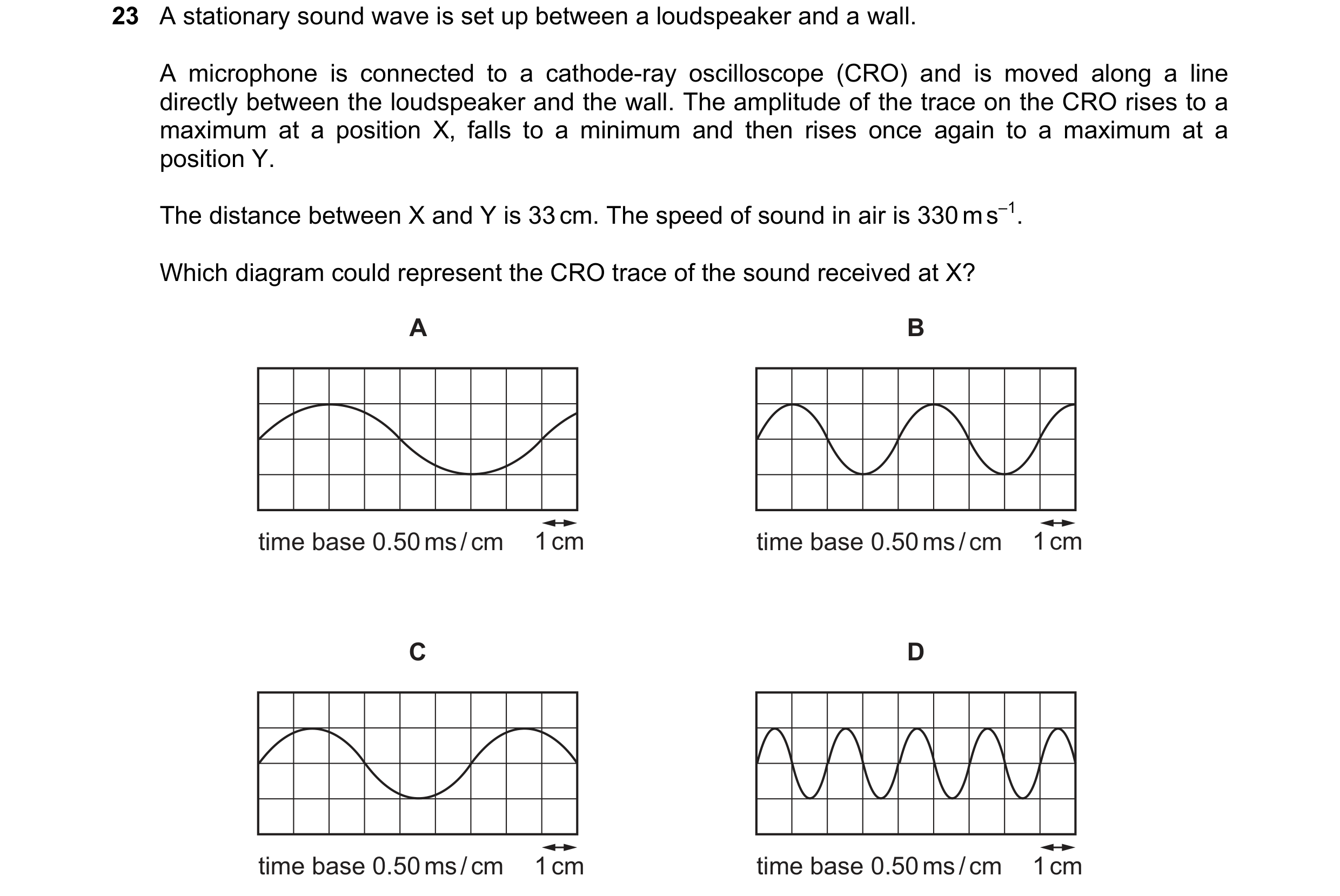
Q24 · A standing sound wave is set up between a loudspeaker and a wall 9702/12 May/June 2012
30 A standing sound wave is set up between a loudspeaker and a wall. A microphone is connected to a cathode-ray oscilloscope (c.r.o.) and is moved along a line directly between the loudspeaker and the wall. The amplitude of the trace on the c.r.o. rises to a maximum at a position X, falls to a minimum and then rises once again to a maximum at a position Y. The distance between X and Y is 33 cm. The speed of sound in air is 330 m s–1. Which diagram represents the c.r.o. trace of the sound received at X? A B time base 0.50 ms / cm 1 cm time base 0.50 ms / cm 1 cm C D time base 0.50 ms / cm 1 cm time base 0.50 ms / cm 1 cm Space for working
1 marks
Answer: B
This question in 9702/12 May/June 2012
Q25 · A musical organ produces notes by blowing air into a set of pipes that are open at one… 9702/11 Oct/Nov 2012
28 A musical organ produces notes by blowing air into a set of pipes that are open at one end and closed at the other. What is the lowest frequency of sound produced by a pipe of length 10 m? (The speed of sound in the pipe is 320 m s–1.) A 4 Hz B 8 Hz C 16 Hz D 32 Hz
1 marks
Answer: B
This question in 9702/11 Oct/Nov 2012
Q26 · A horizontal glass tube, closed at one end, has a layer of dust laid inside it on its… 9702/12 Oct/Nov 2012
29 A horizontal glass tube, closed at one end, has a layer of dust laid inside it on its lower side. Sound is emitted from a loudspeaker that is placed near the open end of the tube. The frequency of the sound is varied and, at one frequency, a stationary wave is formed inside the tube so that the dust forms small heaps. The distance between four heaps of dust is 30 cm. glass tube loudspeaker 30 cm The speed of sound in the tube is 330 m s–1. What is the frequency of the sound emitted by the loudspeaker? A 1650 Hz B 2200 Hz C 3300 Hz D 6600 Hz
1 marks
Answer: A
This question in 9702/12 Oct/Nov 2012
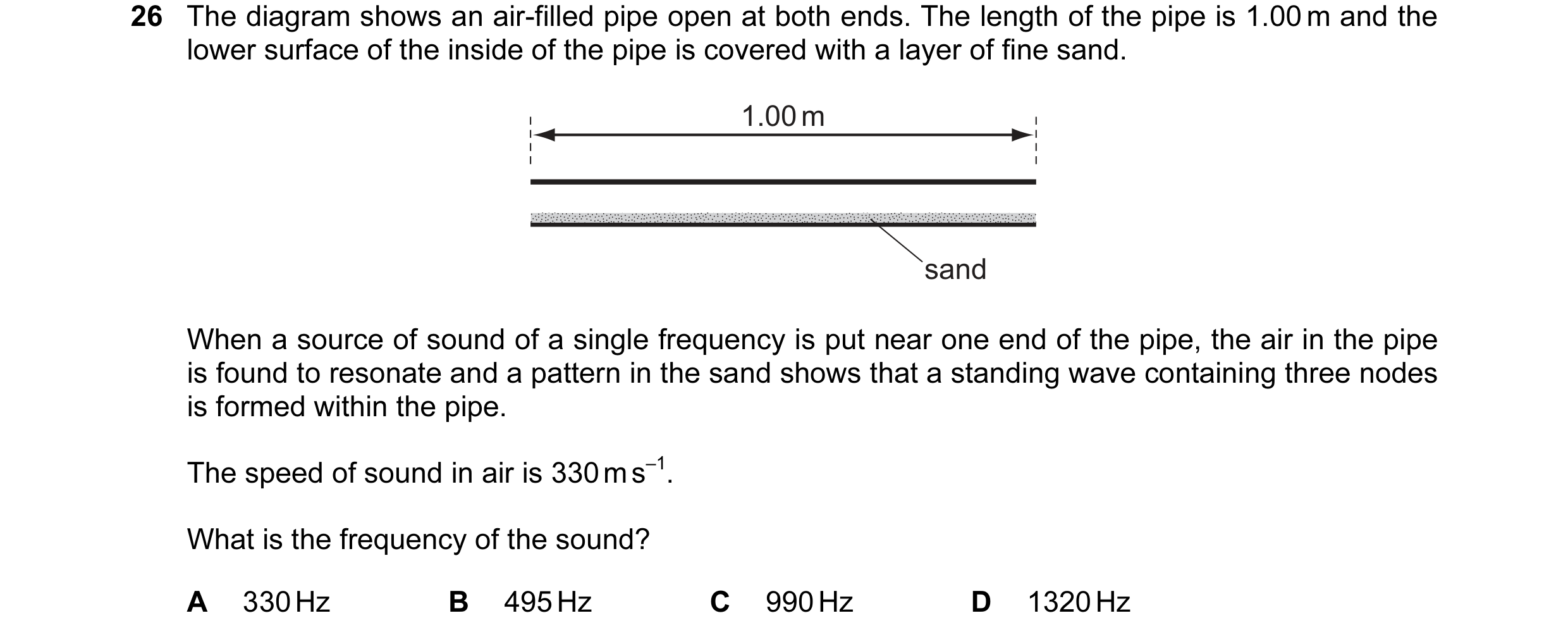
Q27 · The diagram shows an air-filled pipe open at both ends 9702/13 Oct/Nov 2012
26 The diagram shows an air-filled pipe open at both ends. The length of the pipe is 1.00 m and the lower surface of the inside of the pipe is covered with a layer of fine sand. 1.00 m sand When a source of sound of a single frequency is put near one end of the pipe, the air in the pipe is found to resonate and a pattern in the sand shows that a standing wave containing three nodes is formed within the pipe. The speed of sound in air is 330 m s–1. What is the frequency of the sound? A 330 Hz B 495 Hz C 990 Hz D 1320 Hz
1 marks
Answer: B
This question in 9702/13 Oct/Nov 2012
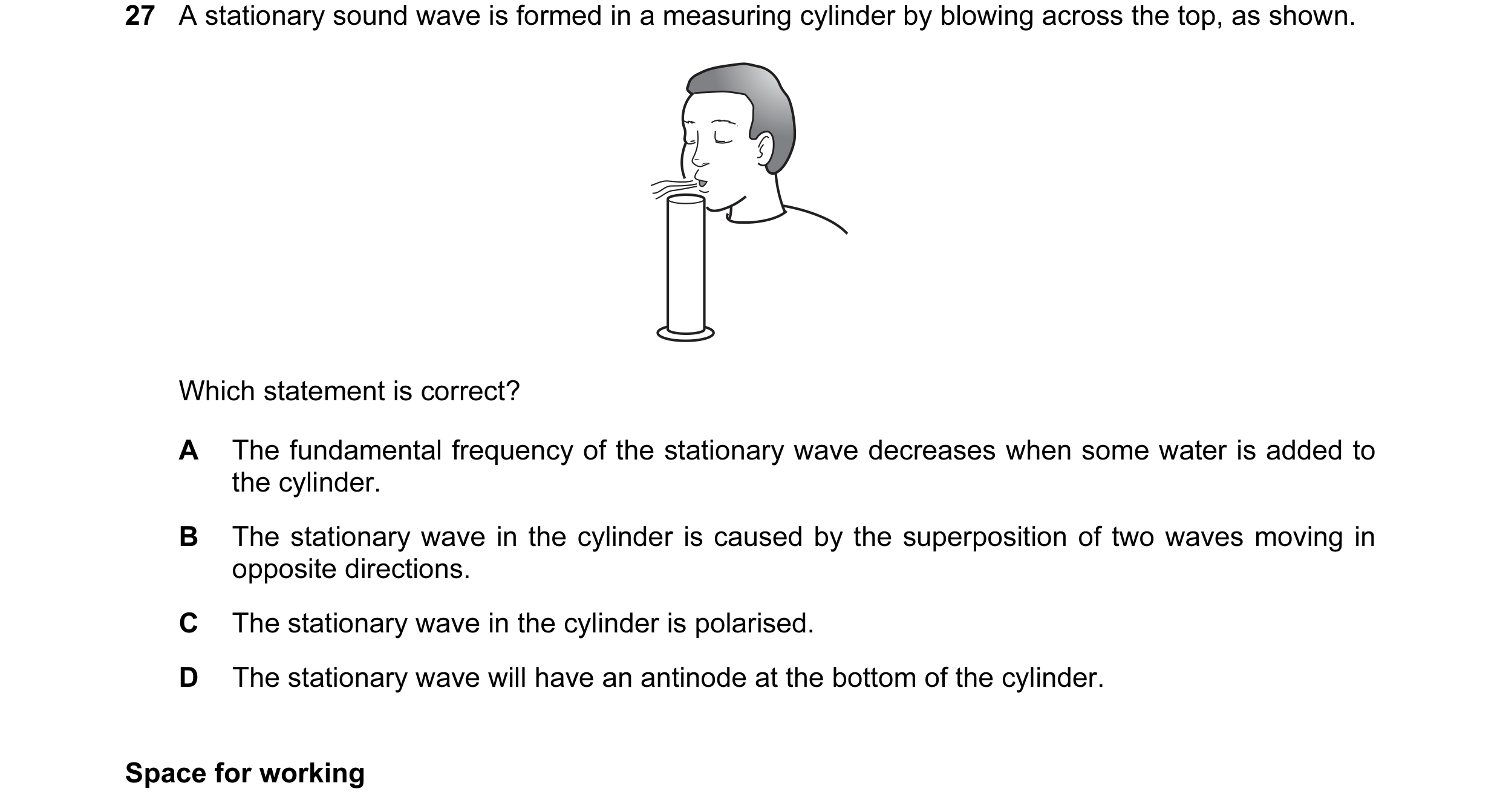
Q28 · A stationary sound wave is formed in a measuring cylinder by blowing across the top, as… 9702/13 Oct/Nov 2012
27 A stationary sound wave is formed in a measuring cylinder by blowing across the top, as shown. Which statement is correct? A The fundamental frequency of the stationary wave decreases when some water is added to the cylinder. B The stationary wave in the cylinder is caused by the superposition of two waves moving in opposite directions. C The stationary wave in the cylinder is polarised. D The stationary wave will have an antinode at the bottom of the cylinder. Space for working
1 marks
Answer: B
This question in 9702/13 Oct/Nov 2012
Q29 · The speed of a transverse wave on a stretched string can be changed by adjusting the… 9702/11 May/June 2013
28 The speed of a transverse wave on a stretched string can be changed by adjusting the tension of the string. A stationary wave pattern is set up on a stretched string using an oscillator set at a frequency of 650 Hz. fixed point oscillator How must the wave be changed to maintain the same stationary wave pattern if the applied frequency is increased to 750 Hz? A Decrease the speed of the wave on the string. B Decrease the wavelength of the wave on the string. C Increase the speed of the wave on the string. D Increase the wavelength of the wave on the string.
1 marks
Answer: C
This question in 9702/11 May/June 2013
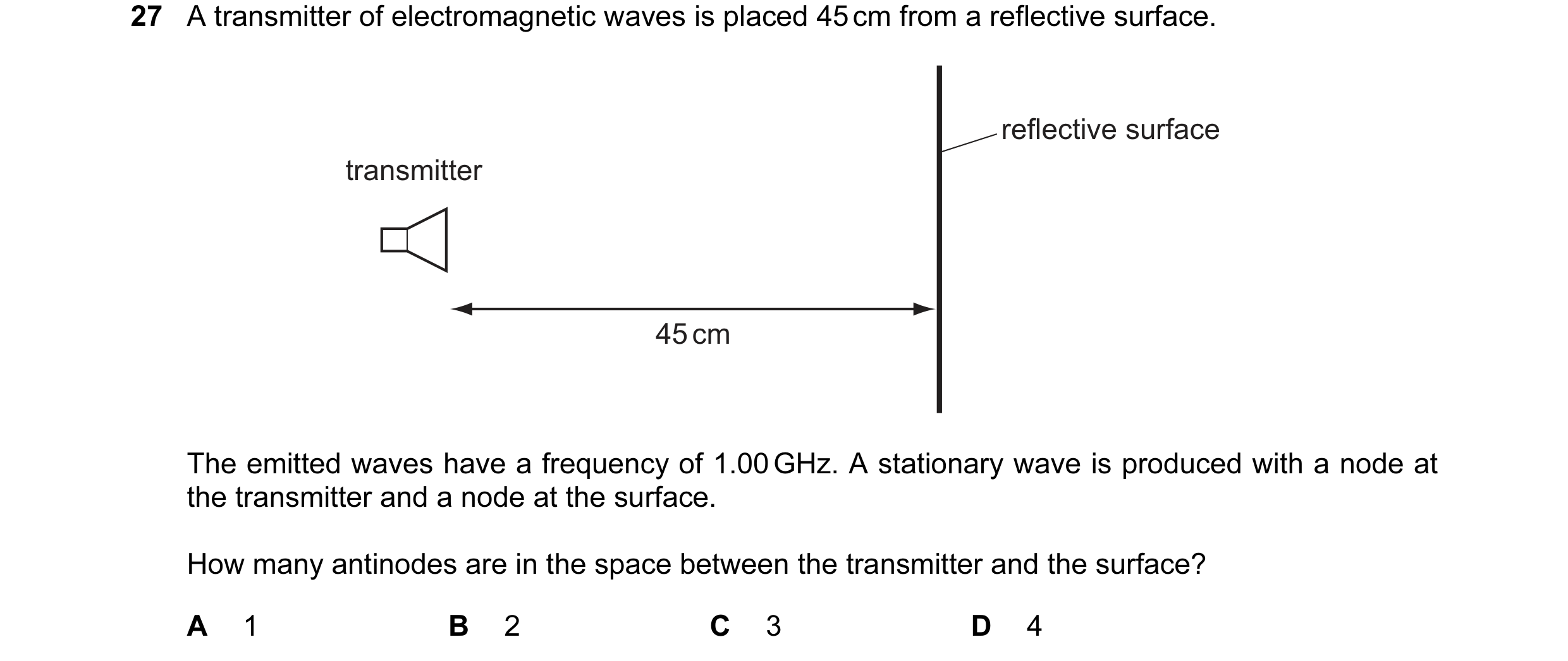
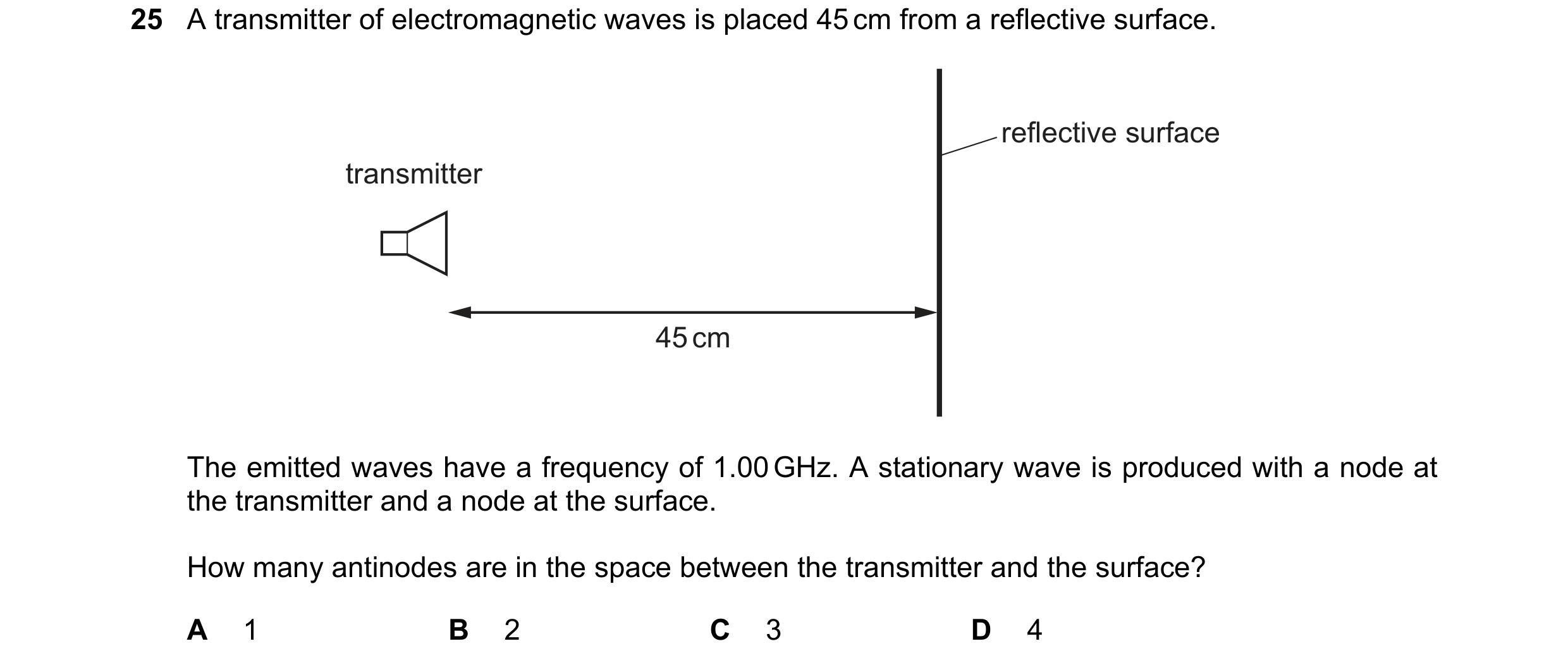
Q30 · A transmitter of electromagnetic waves is placed 45 cm from a reflective surface 9702/12 May/June 2013
27 A transmitter of electromagnetic waves is placed 45 cm from a reflective surface. reflective surface transmitter 45 cm The emitted waves have a frequency of 1.00 GHz. A stationary wave is produced with a node at the transmitter and a node at the surface. How many antinodes are in the space between the transmitter and the surface? A 1 B 2 C 3 D 4
1 marks
Answer: C
This question in 9702/12 May/June 2013
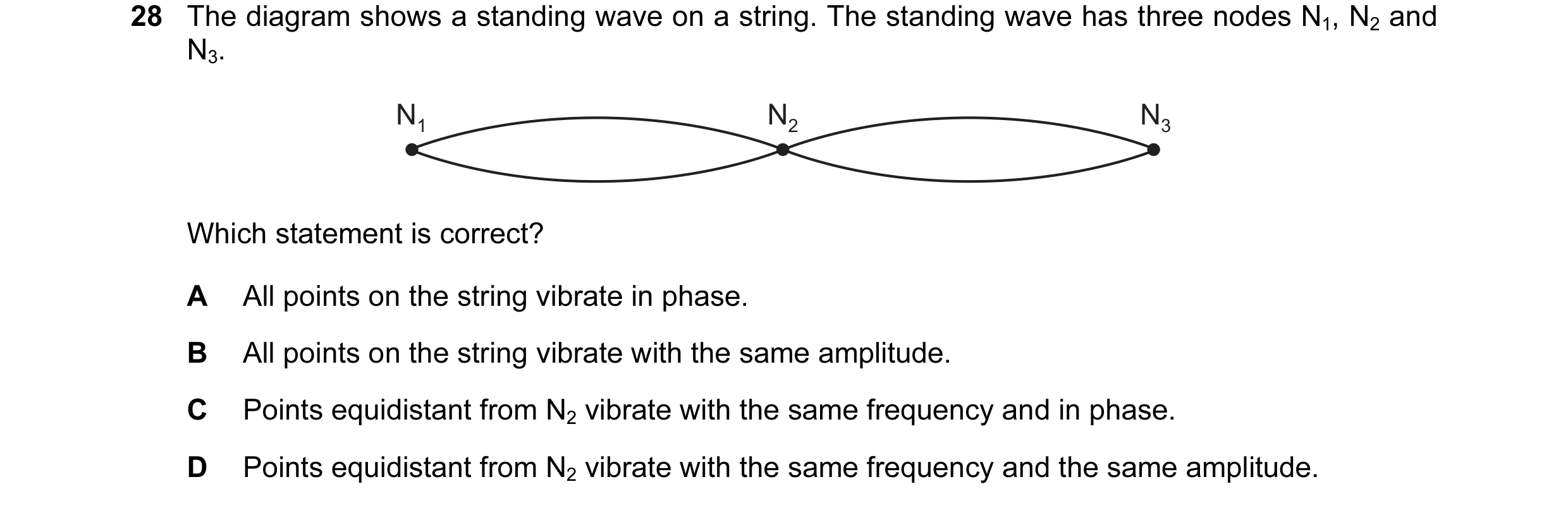
Q31 · The diagram shows a standing wave on a string 9702/13 May/June 2013
28 The diagram shows a standing wave on a string. The standing wave has three nodes N1, N2 and N3. N1 N2 N3 Which statement is correct? A All points on the string vibrate in phase. B All points on the string vibrate with the same amplitude. C Points equidistant from N2 vibrate with the same frequency and in phase. D Points equidistant from N2 vibrate with the same frequency and the same amplitude.
1 marks
Answer: D
This question in 9702/13 May/June 2013
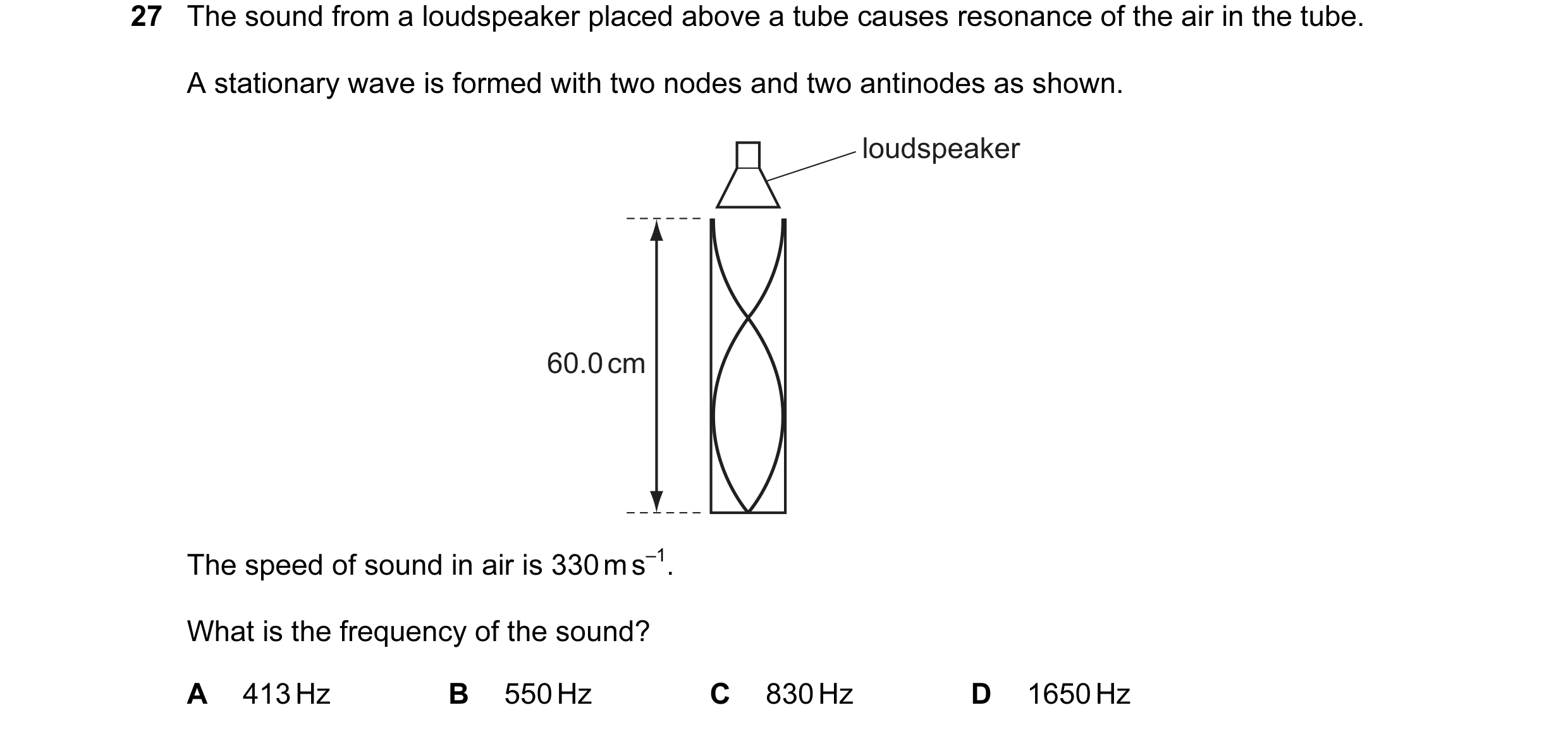
Q32 · The sound from a loudspeaker placed above a tube causes resonance of the air in the tube 9702/11 Oct/Nov 2013
27 The sound from a loudspeaker placed above a tube causes resonance of the air in the tube. A stationary wave is formed with two nodes and two antinodes as shown. loudspeaker 60.0 cm The speed of sound in air is 330 m s–1. What is the frequency of the sound? A 413 Hz B 550 Hz C 830 Hz D 1650 Hz
1 marks
Answer: A
This question in 9702/11 Oct/Nov 2013
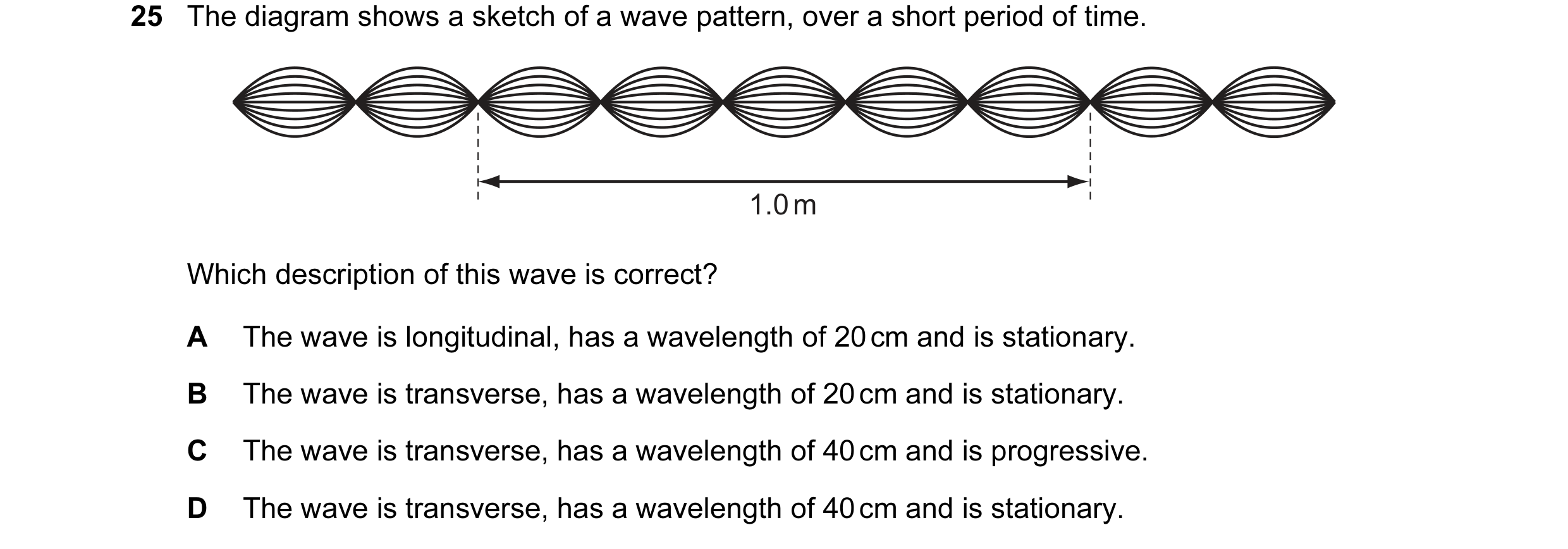
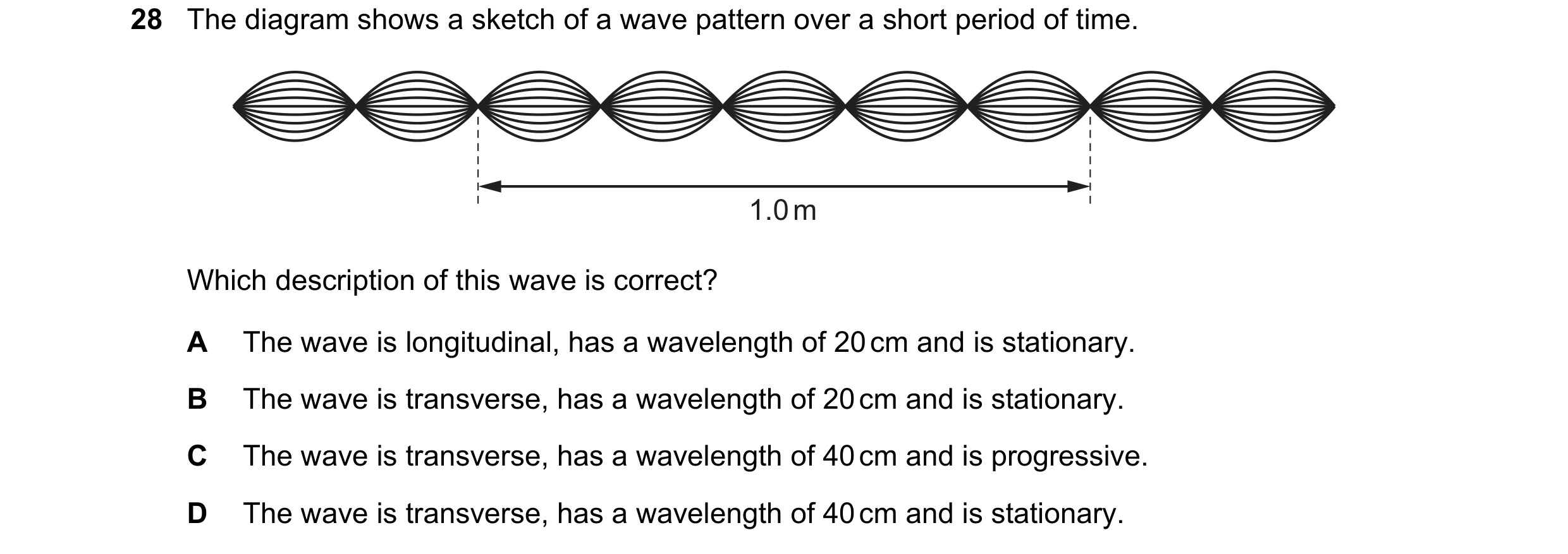
Q33 · The diagram shows a sketch of a wave pattern, over a short period of time 9702/12 Oct/Nov 2013
25 The diagram shows a sketch of a wave pattern, over a short period of time. 1.0 m Which description of this wave is correct? A The wave is longitudinal, has a wavelength of 20 cm and is stationary. B The wave is transverse, has a wavelength of 20 cm and is stationary. C The wave is transverse, has a wavelength of 40 cm and is progressive. D The wave is transverse, has a wavelength of 40 cm and is stationary.
1 marks
Answer: D
This question in 9702/12 Oct/Nov 2013
Q34 · The sound from a loudspeaker placed above a tube causes resonance of the air in the tube 9702/12 Oct/Nov 2013
27 The sound from a loudspeaker placed above a tube causes resonance of the air in the tube. A stationary wave is formed with two nodes and two antinodes as shown. loudspeaker 60.0 cm The speed of sound in air is 330 m s–1. What is the frequency of the sound? A 413 Hz B 550 Hz C 830 Hz D 1650 Hz
1 marks
Answer: A
This question in 9702/12 Oct/Nov 2013
Q35 · A stationary sound wave has a series of nodes 9702/13 Oct/Nov 2013
27 A stationary sound wave has a series of nodes. The distance between the first and the sixth node is 30.0 cm. What is the wavelength of the sound wave? A 5.0 cm B 6.0 cm C 10.0 cm D 12.0 cm
1 marks
Answer: D
This question in 9702/13 Oct/Nov 2013
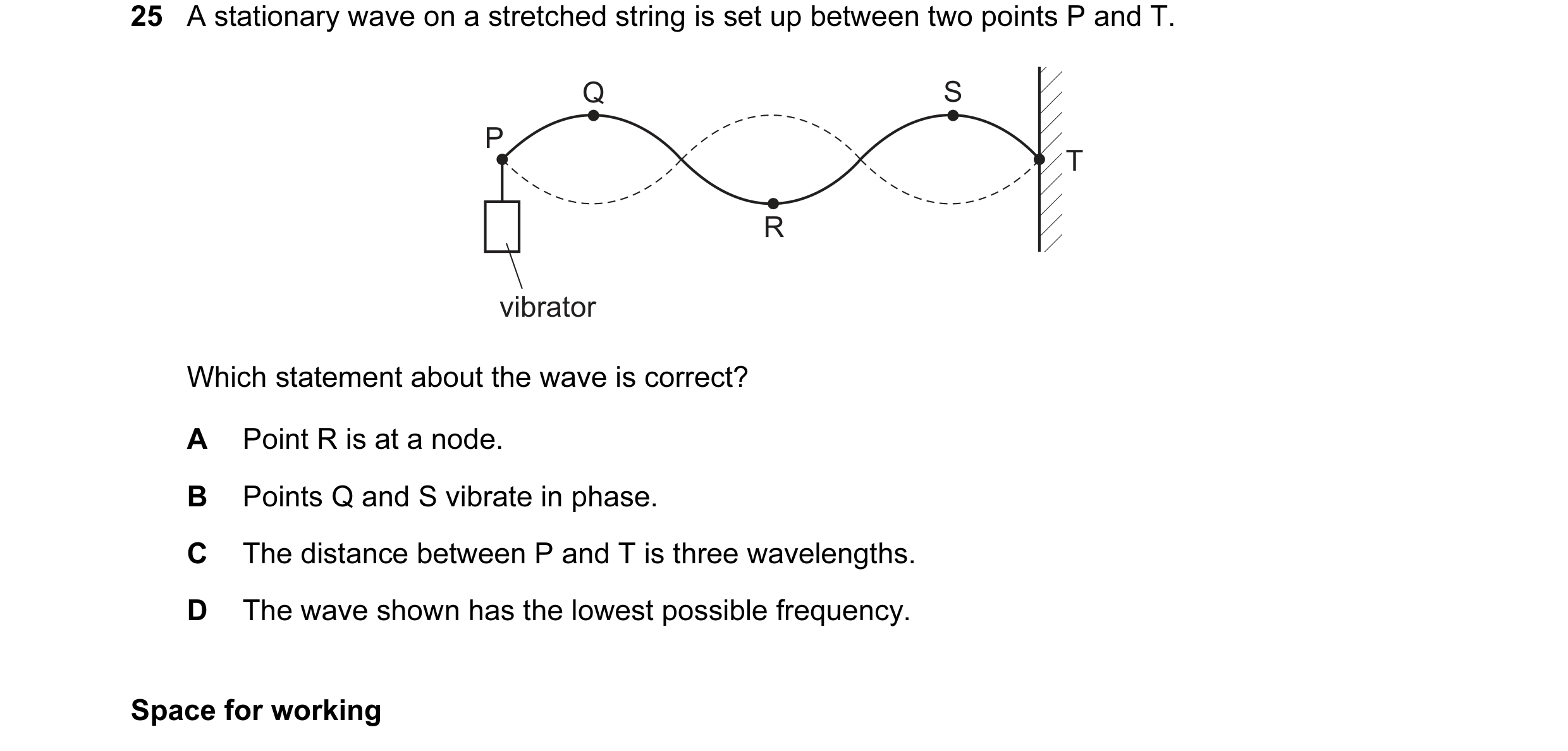
Q36 · A stationary wave on a stretched string is set up between two points P and T 9702/11 May/June 2014
25 A stationary wave on a stretched string is set up between two points P and T. Q S P T R vibrator Which statement about the wave is correct? A Point R is at a node. B Points Q and S vibrate in phase. C The distance between P and T is three wavelengths. D The wave shown has the lowest possible frequency. Space for working
1 marks
Answer: B
This question in 9702/11 May/June 2014
Q37 · The basic principle of note production in a horn is to set up a stationary wave in an air… 9702/11 May/June 2014
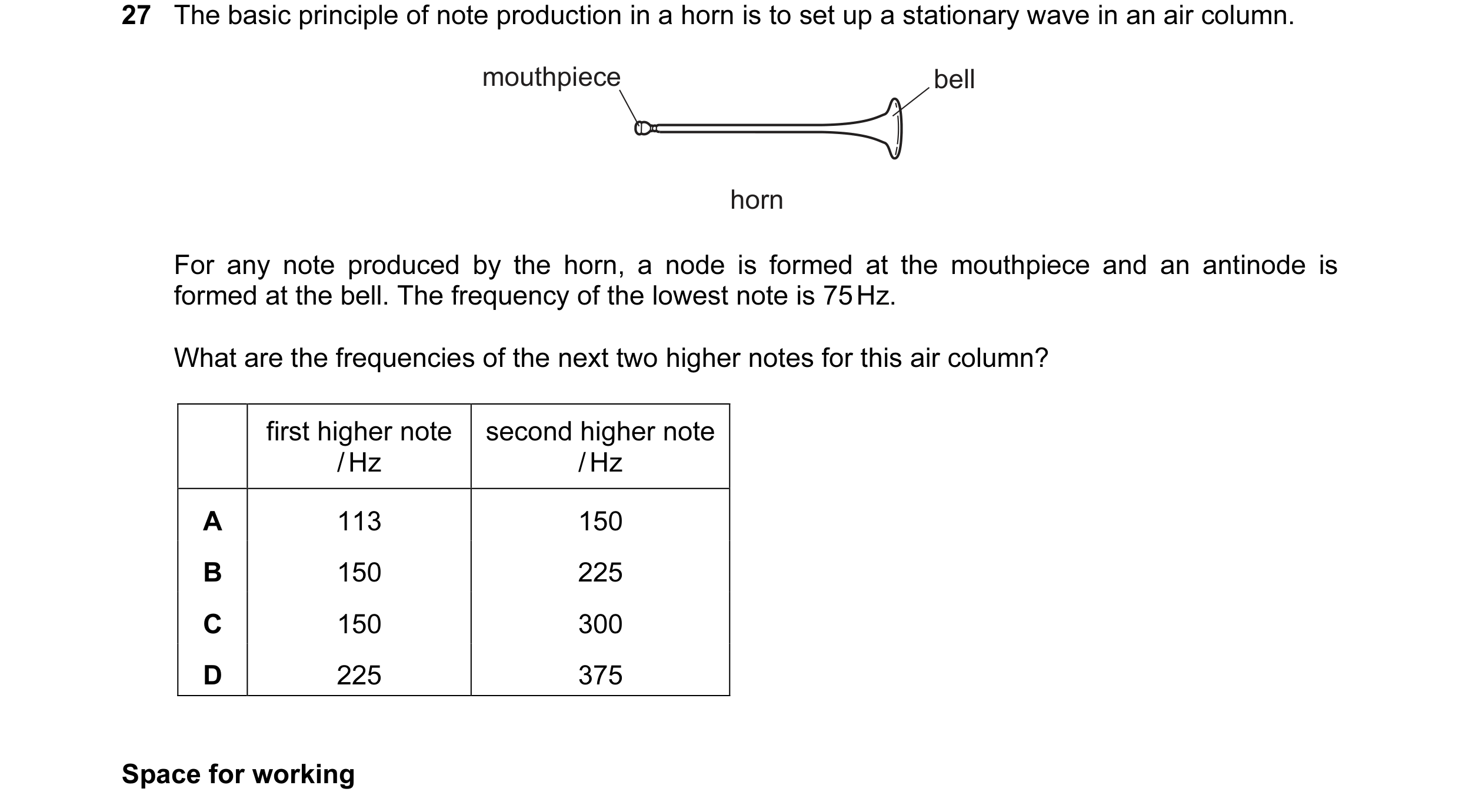
27 The basic principle of note production in a horn is to set up a stationary wave in an air column. mouthpiece bell horn For any note produced by the horn, a node is formed at the mouthpiece and an antinode is formed at the bell. The frequency of the lowest note is 75 Hz. What are the frequencies of the next two higher notes for this air column? first higher note second higher note / Hz / Hz A 113 150 B 150 225 C 150 300 D 225 375 Space for working
1 marks
Answer: D
This question in 9702/11 May/June 2014
Q38 · A stationary wave is set up on a stretched string, as shown 9702/13 May/June 2014
29 A stationary wave is set up on a stretched string, as shown. Q S P R Which statement about the points on the string is correct? A Point Q vibrates with the largest amplitude. B Points P and R vibrate in phase. C Point S is an antinode. D The horizontal distance between R and S is half the wavelength.
1 marks
Answer: B
This question in 9702/13 May/June 2014
Q39 · A stationary sound wave is produced in a tube 9702/11 Oct/Nov 2014
25 A stationary sound wave is produced in a tube. Which statement describes the wave speed? A It is the distance between two adjacent nodes divided by the period of the wave. B It is the speed at which energy is transferred from one antinode to an adjacent antinode. C It is the speed of a particle at an antinode. D It is the speed of one of the progressive waves that are producing the stationary wave. Space for working
1 marks
Answer: D
This question in 9702/11 Oct/Nov 2014
Q40 · A stationary sound wave is produced in a tube 9702/12 Oct/Nov 2014
25 A stationary sound wave is produced in a tube. Which statement describes the wave speed? A It is the distance between two adjacent nodes divided by the period of the wave. B It is the speed at which energy is transferred from one antinode to an adjacent antinode. C It is the speed of a particle at an antinode. D It is the speed of one of the progressive waves that are producing the stationary wave. Space for working
1 marks
Answer: D
This question in 9702/12 Oct/Nov 2014
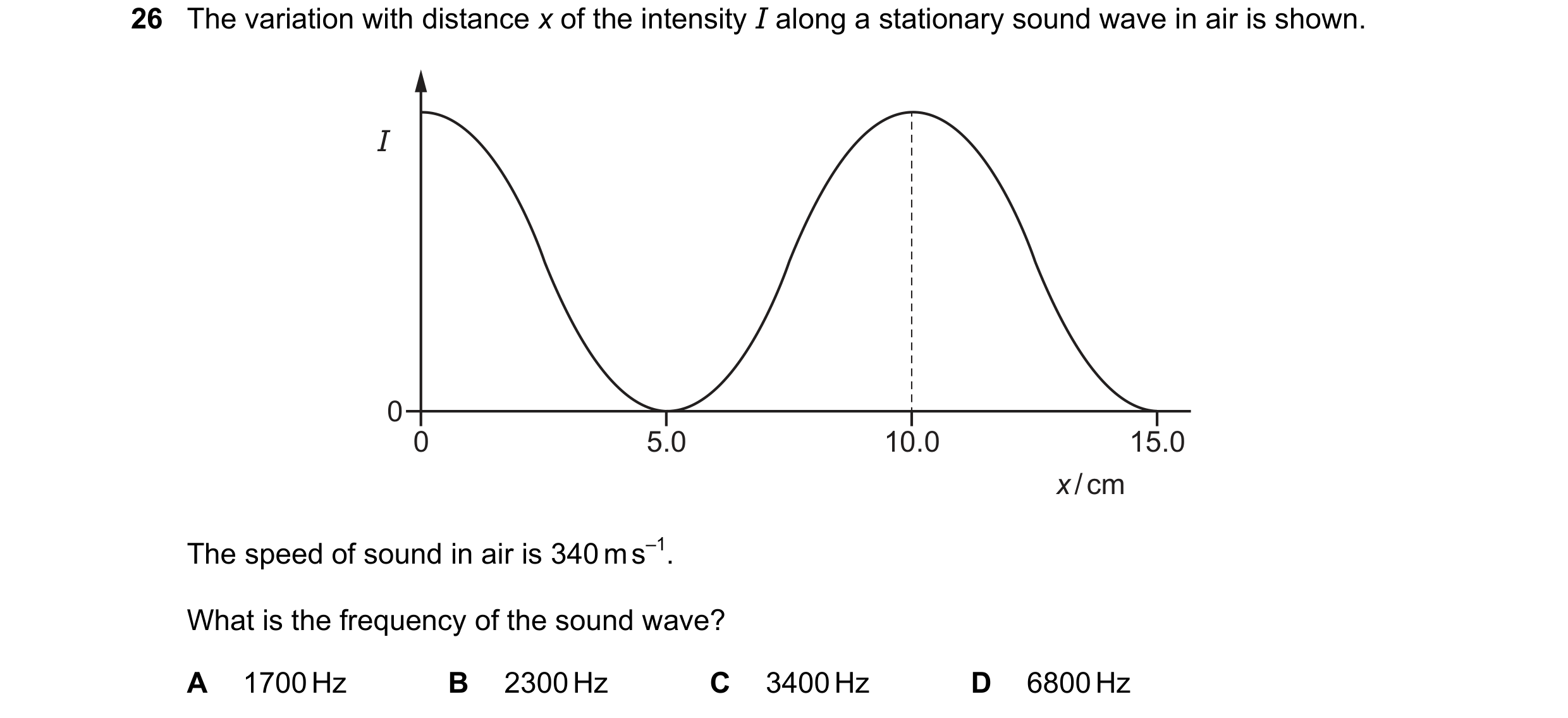
Q41 · The variation with distance x of the intensity I along a stationary sound wave in air is… 9702/13 Oct/Nov 2014
27 The variation with distance x of the intensity I along a stationary sound wave in air is shown by the following graph. I 0 0 5.0 10.0 15.0 x / cm The speed of sound in air is 340 m s–1. What is the frequency of the sound wave? A 1700 Hz B 2270 Hz C 3400 Hz D 6800 Hz
1 marks
Answer: A
This question in 9702/13 Oct/Nov 2014
Q42 · An organ pipe of length l is open at both ends 9702/13 Oct/Nov 2014
29 An organ pipe of length l is open at both ends. Notes are produced by the pipe when stationary waves are set up. The speed of sound in the air column is v. What is the lowest (fundamental) frequency of the note produced by the pipe? A 2 v B v C v D v l l l2 l4
1 marks
Answer: C
This question in 9702/13 Oct/Nov 2014
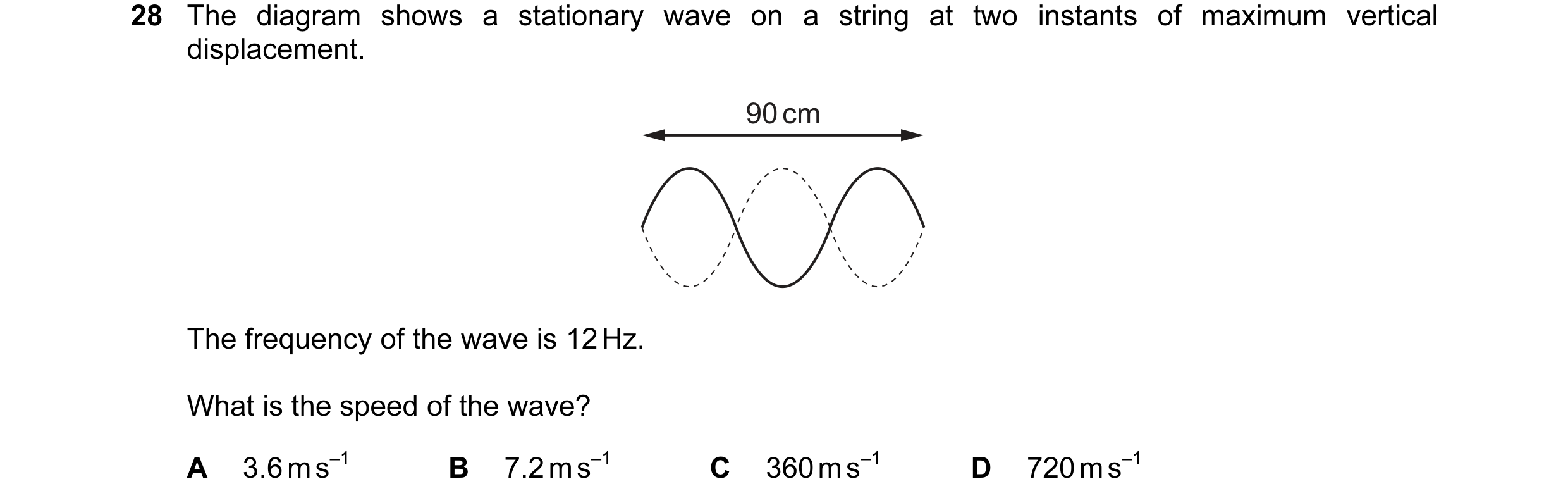
Q43 · The diagram shows a stationary wave on a string at two instants of maximum vertical… 9702/11 May/June 2015
28 The diagram shows a stationary wave on a string at two instants of maximum vertical displacement. 90 cm The frequency of the wave is 12 Hz. What is the speed of the wave? A 3.6 m s–1 B 7.2 m s–1 C 360 m s–1 D 720 m s–1
1 marks
Answer: B
This question in 9702/11 May/June 2015
Q44 · A loudspeaker emitting sound of frequency f is placed at the open end of a pipe of length… 9702/11 May/June 2015
29 A loudspeaker emitting sound of frequency f is placed at the open end of a pipe of length l which is closed at the other end. A standing wave is set up in the pipe. l loudspeaker A series of pipes are then set up with either one or two loudspeakers of frequency f. The pairs of loudspeakers vibrate in phase with each other. Which pipe contains a standing wave? l A l B 2l C 2l D
1 marks
Answer: D
This question in 9702/11 May/June 2015
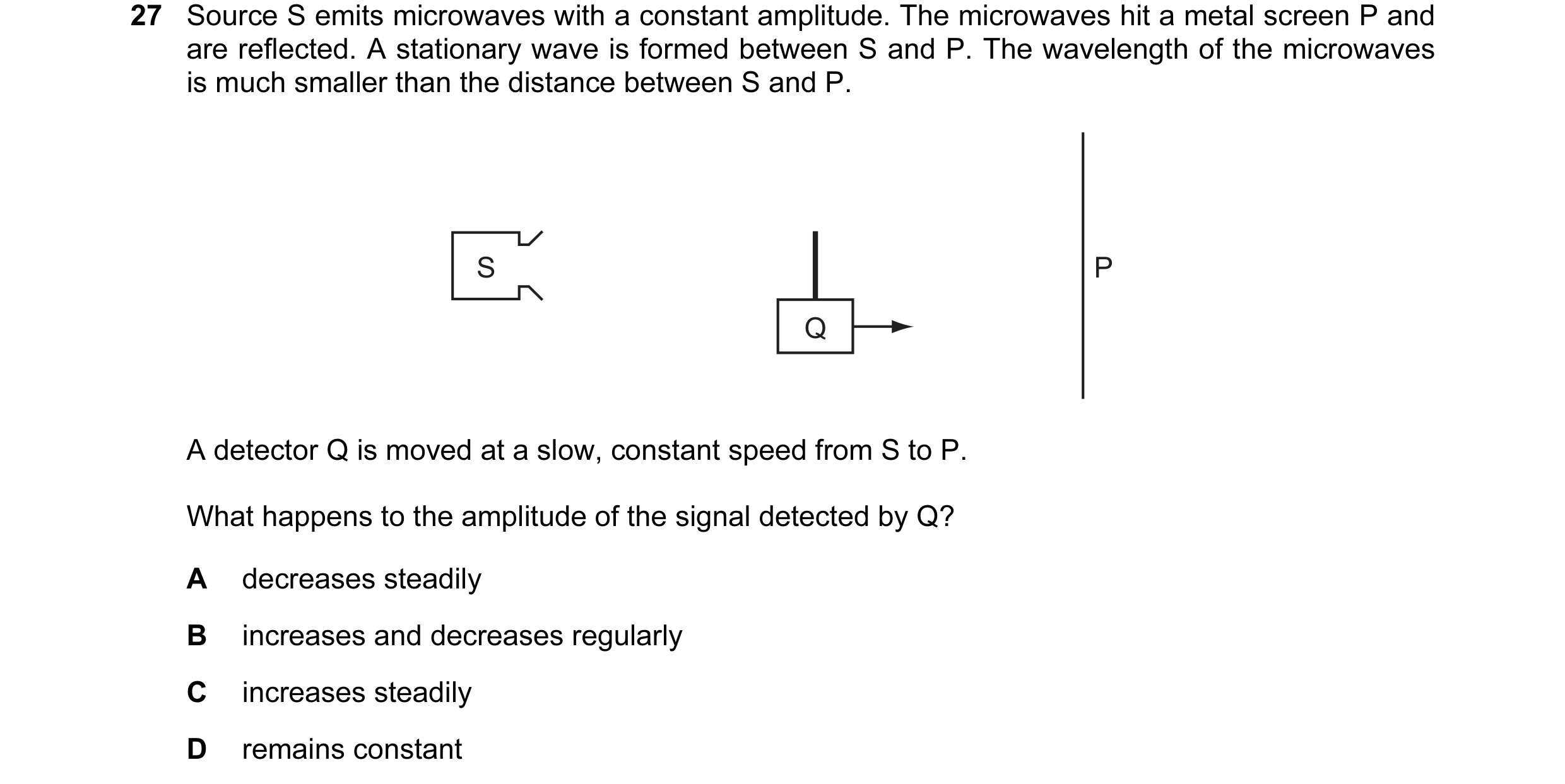
Q45 · Source S emits microwaves with a constant amplitude 9702/12 May/June 2015
27 Source S emits microwaves with a constant amplitude. The microwaves hit a metal screen P and are reflected. A stationary wave is formed between S and P. The wavelength of the microwaves is much smaller than the distance between S and P. S P Q A detector Q is moved at a slow, constant speed from S to P. What happens to the amplitude of the signal detected by Q? A decreases steadily B increases and decreases regularly C increases steadily D remains constant
1 marks
Answer: B
This question in 9702/12 May/June 2015
Q46 · The table contains statements about stationary and progressive waves 9702/13 May/June 2015
27 The table contains statements about stationary and progressive waves. Which row is correct? stationary wave progressive wave A all particles vibrate all particles vibrate with the same amplitude with the same amplitude B energy is transferred energy is transferred along the wave along the wave C particles in adjacent particles vibrate in phase loops vibrate in antiphase with their immediate neighbours D particles one wavelength particles one wavelength apart vibrate in phase apart vibrate in phase
1 marks
Answer: D
This question in 9702/13 May/June 2015
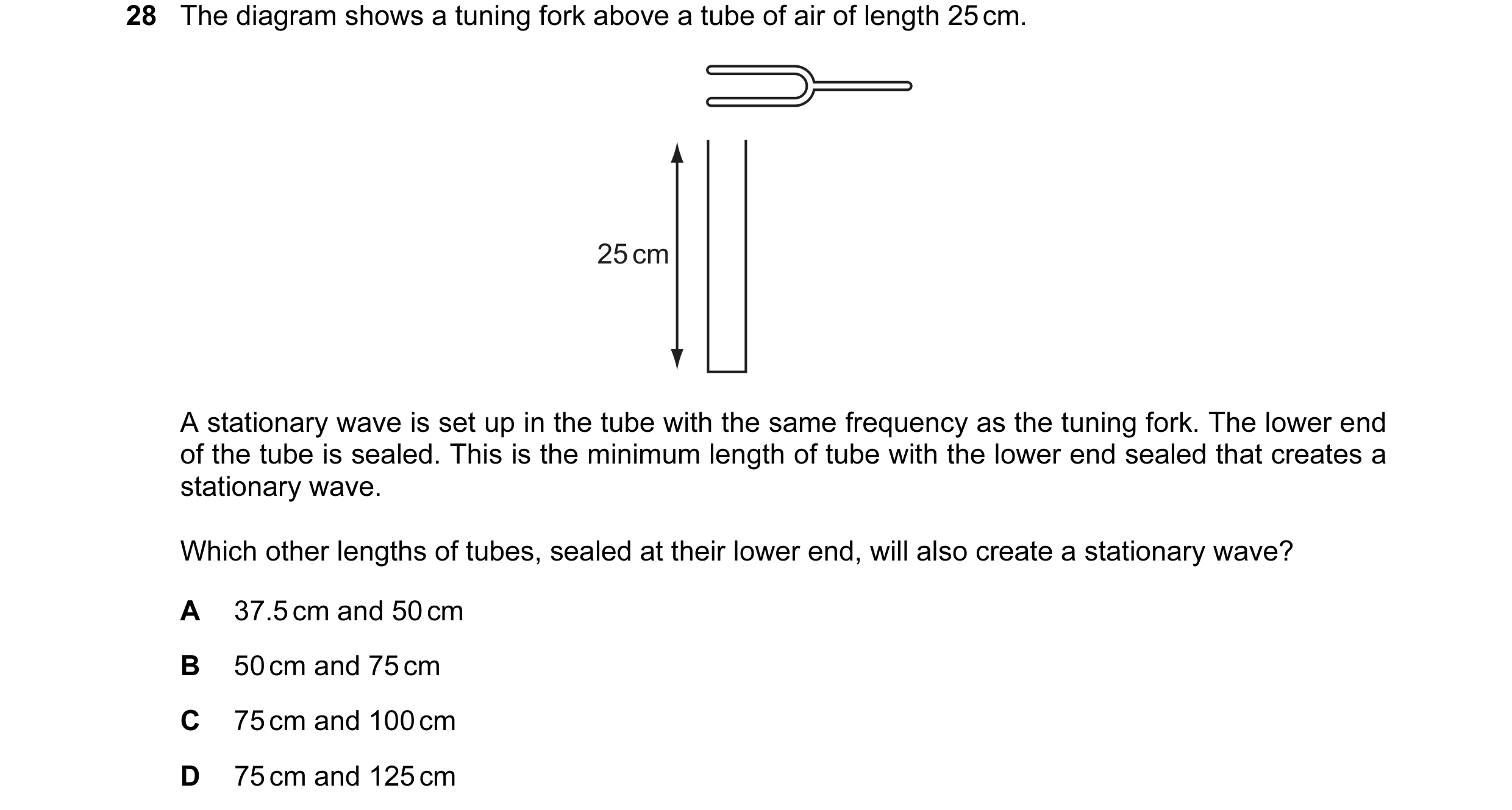
Q47 · The diagram shows a tuning fork above a tube of air of length 25 cm 9702/12 Oct/Nov 2015
28 The diagram shows a tuning fork above a tube of air of length 25 cm. 25 cm A stationary wave is set up in the tube with the same frequency as the tuning fork. The lower end of the tube is sealed. This is the minimum length of tube with the lower end sealed that creates a stationary wave. Which other lengths of tubes, sealed at their lower end, will also create a stationary wave? A 37.5 cm and 50 cm B 50 cm and 75 cm C 75 cm and 100 cm D 75 cm and 125 cm
1 marks
Answer: D
This question in 9702/12 Oct/Nov 2015
Q48 · To produce a stationary wave, two waves must travel in opposite directions through the… 9702/12 Oct/Nov 2015
30 To produce a stationary wave, two waves must travel in opposite directions through the same space. Which statement about the properties of the two waves must also be true? A The waves must have equal frequency, but a different speed and wavelength. B The waves must have equal speed, but a different wavelength and frequency. C The waves must have equal speed, frequency and wavelength. D The waves must have equal wavelength, but a different speed and frequency.
1 marks
Answer: C
This question in 9702/12 Oct/Nov 2015
Q49 · The diagram represents the pattern of stationary waves formed by the superposition of… 9702/12 Feb/March 2016
24 The diagram represents the pattern of stationary waves formed by the superposition of sound waves from a loudspeaker and their reflection from a metal sheet (not shown). W X Y Z W, X, Y and Z are four points on the line through the centre of these waves. Which statement about these stationary waves is correct? A An antinode is formed at the surface of the metal sheet. B A node is a quarter of a wavelength from an adjacent antinode. C The oscillations at X are in phase with those at Y. D The air particles oscillate perpendicular to the line WZ.
1 marks
Answer: B
This question in 9702/12 Feb/March 2016
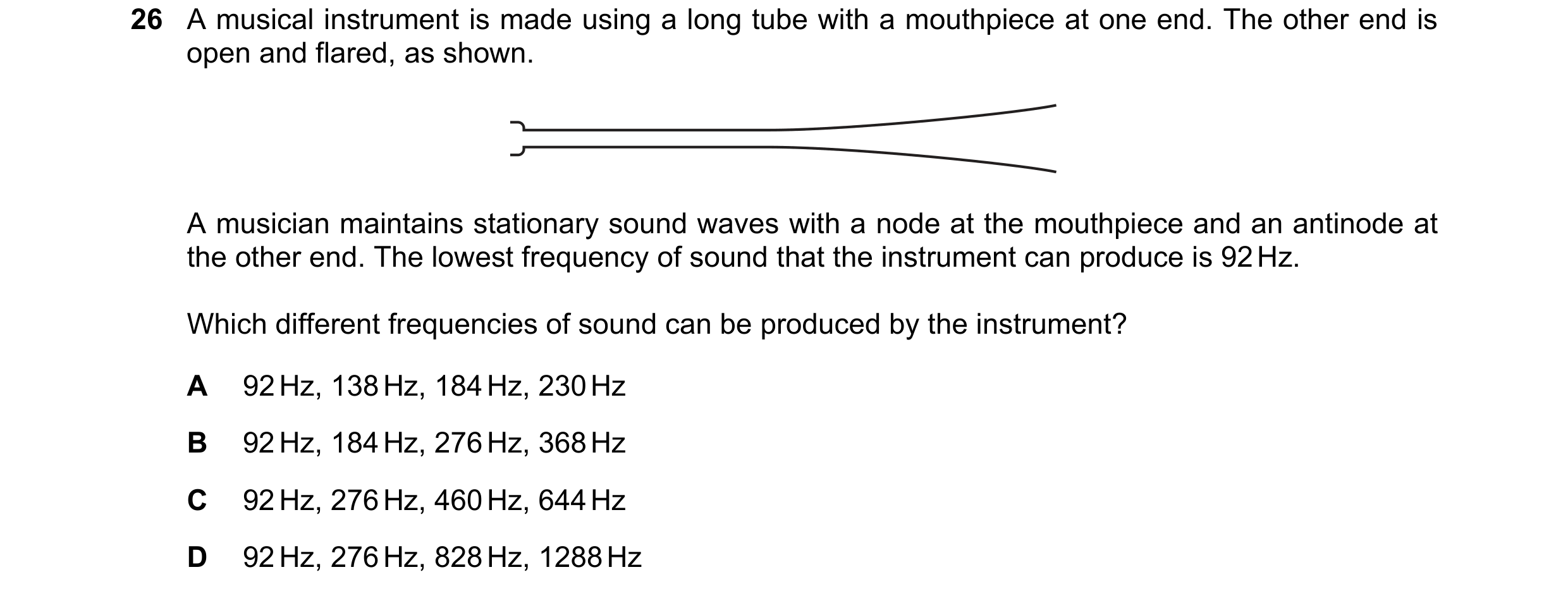
Q50 · A musical instrument called a bugle is a long tube with a mouthpiece at one end 9702/12 Feb/March 2016
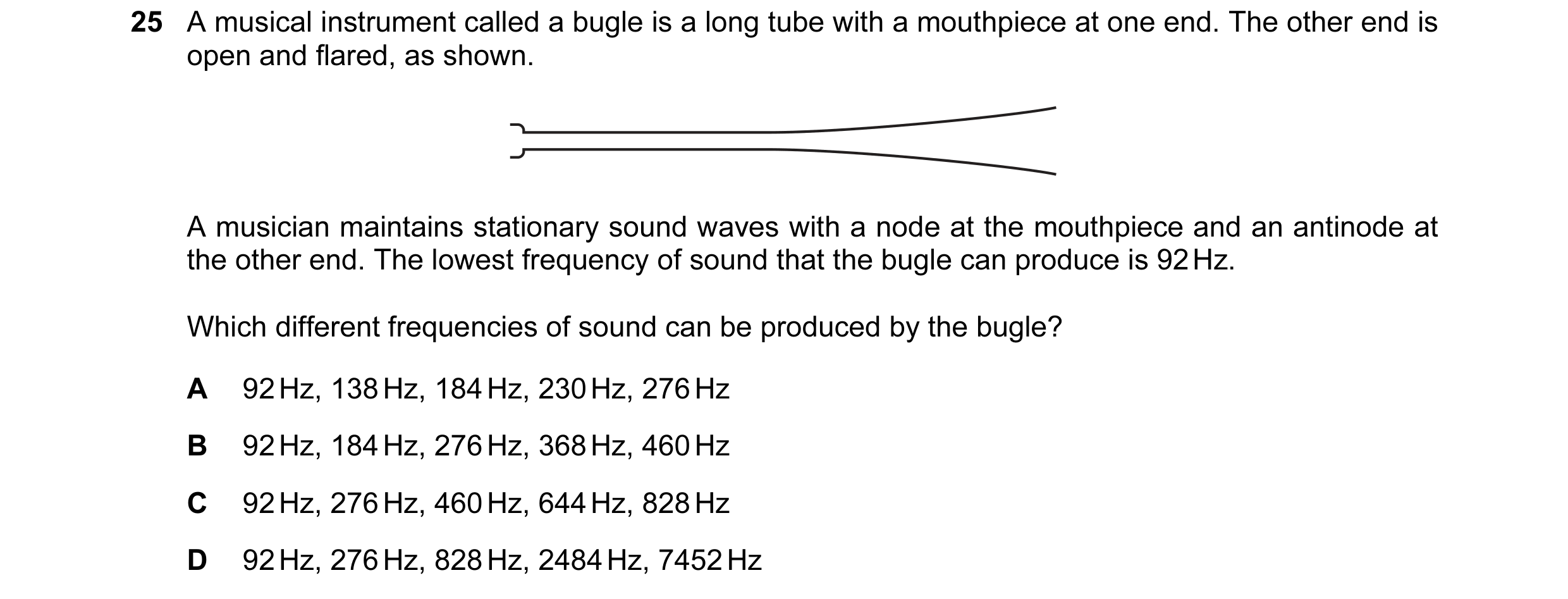
25 A musical instrument called a bugle is a long tube with a mouthpiece at one end. The other end is open and flared, as shown. A musician maintains stationary sound waves with a node at the mouthpiece and an antinode at the other end. The lowest frequency of sound that the bugle can produce is 92 Hz. Which different frequencies of sound can be produced by the bugle? A 92 Hz, 138 Hz, 184 Hz, 230 Hz, 276 Hz B 92 Hz, 184 Hz, 276 Hz, 368 Hz, 460 Hz C 92 Hz, 276 Hz, 460 Hz, 644 Hz, 828 Hz D 92 Hz, 276 Hz, 828 Hz, 2484 Hz, 7452 Hz
1 marks
Answer: C
This question in 9702/12 Feb/March 2016
Q51 · Which statement concerning a stationary wave is correct? 9702/11 May/June 2016
24 Which statement concerning a stationary wave is correct? A All the particles between two successive nodes oscillate in phase. B The amplitude of the stationary wave is equal to the amplitude of one of the waves creating it. C The wavelength of the stationary wave is equal to the separation of two adjacent nodes. D There is no displacement of a particle at an antinode at any time.
1 marks
Answer: A
This question in 9702/11 May/June 2016
Q52 · A stationary wave is set up on a stretched string 9702/12 May/June 2016
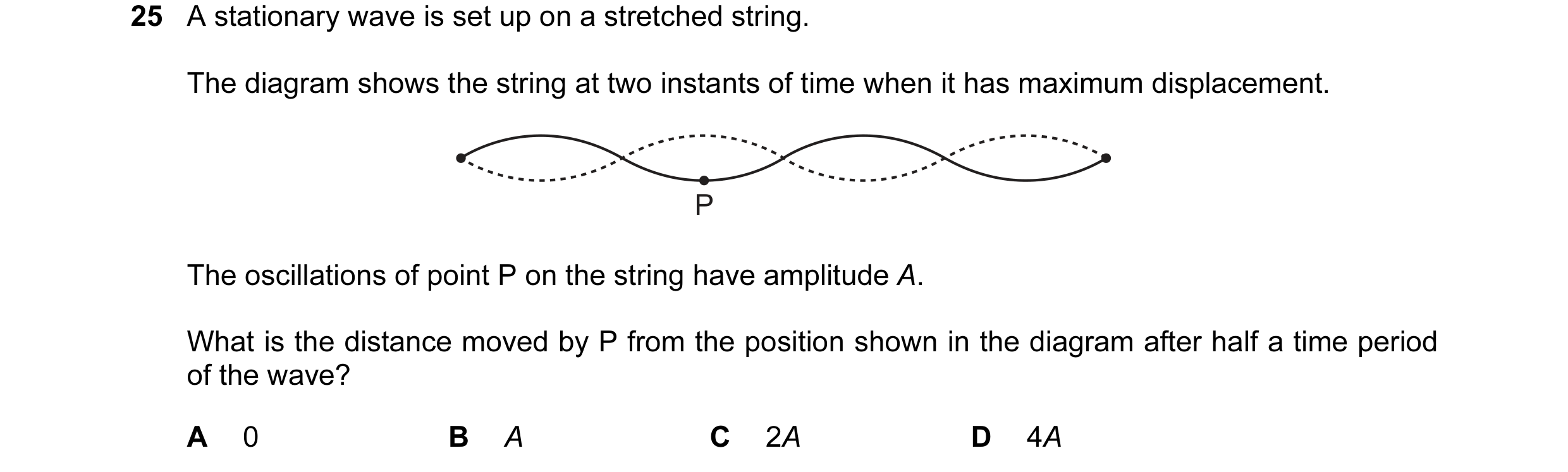
25 A stationary wave is set up on a stretched string. The diagram shows the string at two instants of time when it has maximum displacement. P The oscillations of point P on the string have amplitude A. What is the distance moved by P from the position shown in the diagram after half a time period of the wave? A 0 B A C 2A D 4A
1 marks
Answer: C
This question in 9702/12 May/June 2016
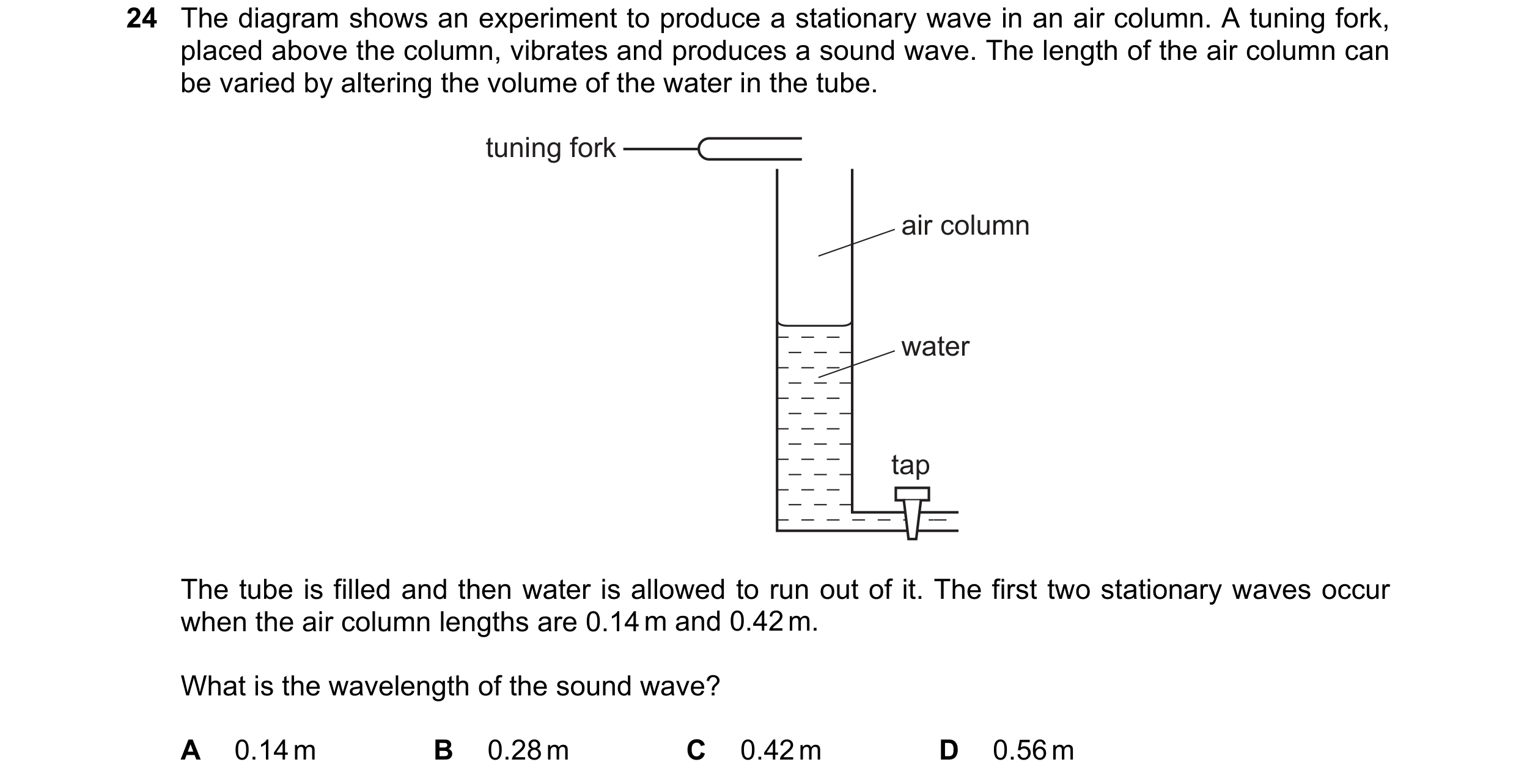
Q53 · The diagram shows an experiment to produce a stationary wave in an air column 9702/11 Oct/Nov 2016
24 The diagram shows an experiment to produce a stationary wave in an air column. A tuning fork, placed above the column, vibrates and produces a sound wave. The length of the air column can be varied by altering the volume of the water in the tube. tuning fork air column water tap The tube is filled and then water is allowed to run out of it. The first two stationary waves occur when the air column lengths are 0.14 m and 0.42 m. What is the wavelength of the sound wave? A 0.14 m B 0.28 m C 0.42 m D 0.56 m
1 marks
Answer: D
This question in 9702/11 Oct/Nov 2016
Q54 · The diagram shows a long rope fixed at one end 9702/11 Oct/Nov 2016
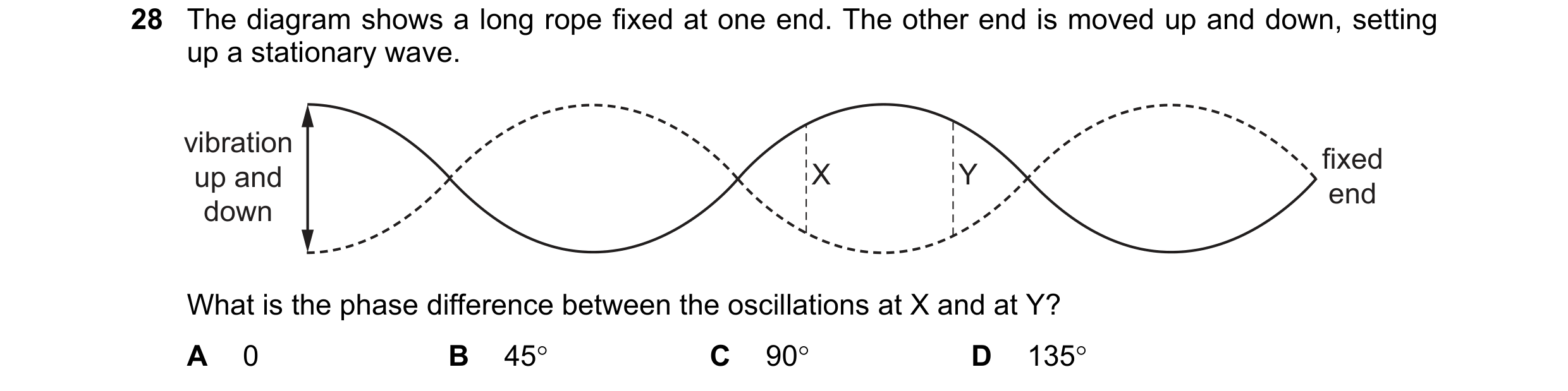
28 The diagram shows a long rope fixed at one end. The other end is moved up and down, setting up a stationary wave. vibration fixed up and X Y end down What is the phase difference between the oscillations at X and at Y? A 0 B 45° C 90° D 135°
1 marks
Answer: A
This question in 9702/11 Oct/Nov 2016
Q55 · The diagram shows an experiment to produce a stationary wave in an air column 9702/13 Oct/Nov 2016
24 The diagram shows an experiment to produce a stationary wave in an air column. A tuning fork, placed above the column, vibrates and produces a sound wave. The length of the air column can be varied by altering the volume of the water in the tube. tuning fork air column water tap The tube is filled and then water is allowed to run out of it. The first two stationary waves occur when the air column lengths are 0.14 m and 0.42 m. What is the wavelength of the sound wave? A 0.14 m B 0.28 m C 0.42 m D 0.56 m
1 marks
Answer: D
This question in 9702/13 Oct/Nov 2016
Q56 · The diagram shows a long rope fixed at one end 9702/13 Oct/Nov 2016
28 The diagram shows a long rope fixed at one end. The other end is moved up and down, setting up a stationary wave. vibration fixed up and X Y end down What is the phase difference between the oscillations at X and at Y? A 0 B 45° C 90° D 135°
1 marks
Answer: A
This question in 9702/13 Oct/Nov 2016
Q57 · A progressive wave is incident normally on a flat reflector 9702/12 Feb/March 2017
27 A progressive wave is incident normally on a flat reflector. The reflected wave overlaps with the incident wave and a stationary wave is formed. displaceme nt of the incident wave At an antinode, what could be the ratio at any instant? displaceme nt of the reflected wave A –1 B 0 C 1 D 2
1 marks
Answer: C
This question in 9702/12 Feb/March 2017
Q58 · The diagram shows a steel wire clamped at one end 9702/11 May/June 2017
27 The diagram shows a steel wire clamped at one end. The other end is attached to a weight hanging over a pulley. weight fixed stand vibrator fixed support A vibrator is attached to the wire near the clamped end. A stationary wave with one loop is produced. The frequency of the vibrator is f. Which frequency should be used to produce a stationary wave with two loops? f f A B C 2f D 4f 4 2
1 marks
Answer: C
This question in 9702/11 May/June 2017
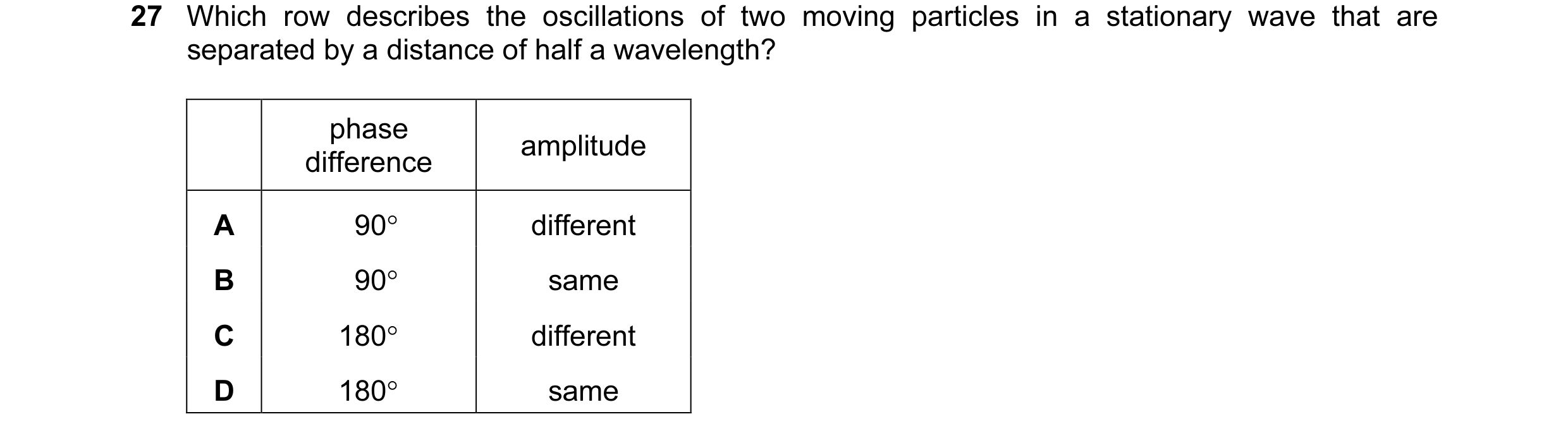
Q59 · Which row describes the oscillations of two moving particles in a stationary wave that… 9702/12 May/June 2017
27 Which row describes the oscillations of two moving particles in a stationary wave that are separated by a distance of half a wavelength? phase amplitude difference A 90° different B 90° same C 180° different D 180° same
1 marks
Answer: D
This question in 9702/12 May/June 2017
Q60 · A pipe of length 100 cm is open at both ends 9702/13 May/June 2017
26 A pipe of length 100 cm is open at both ends. A loudspeaker situated at one end of the pipe can emit sound of different wavelengths. 100 cm loudspeaker pipe At which wavelength can a stationary wave be produced in the pipe? A 50 cm B 75 cm C 150 cm D 300 cm
1 marks
Answer: A
This question in 9702/13 May/June 2017
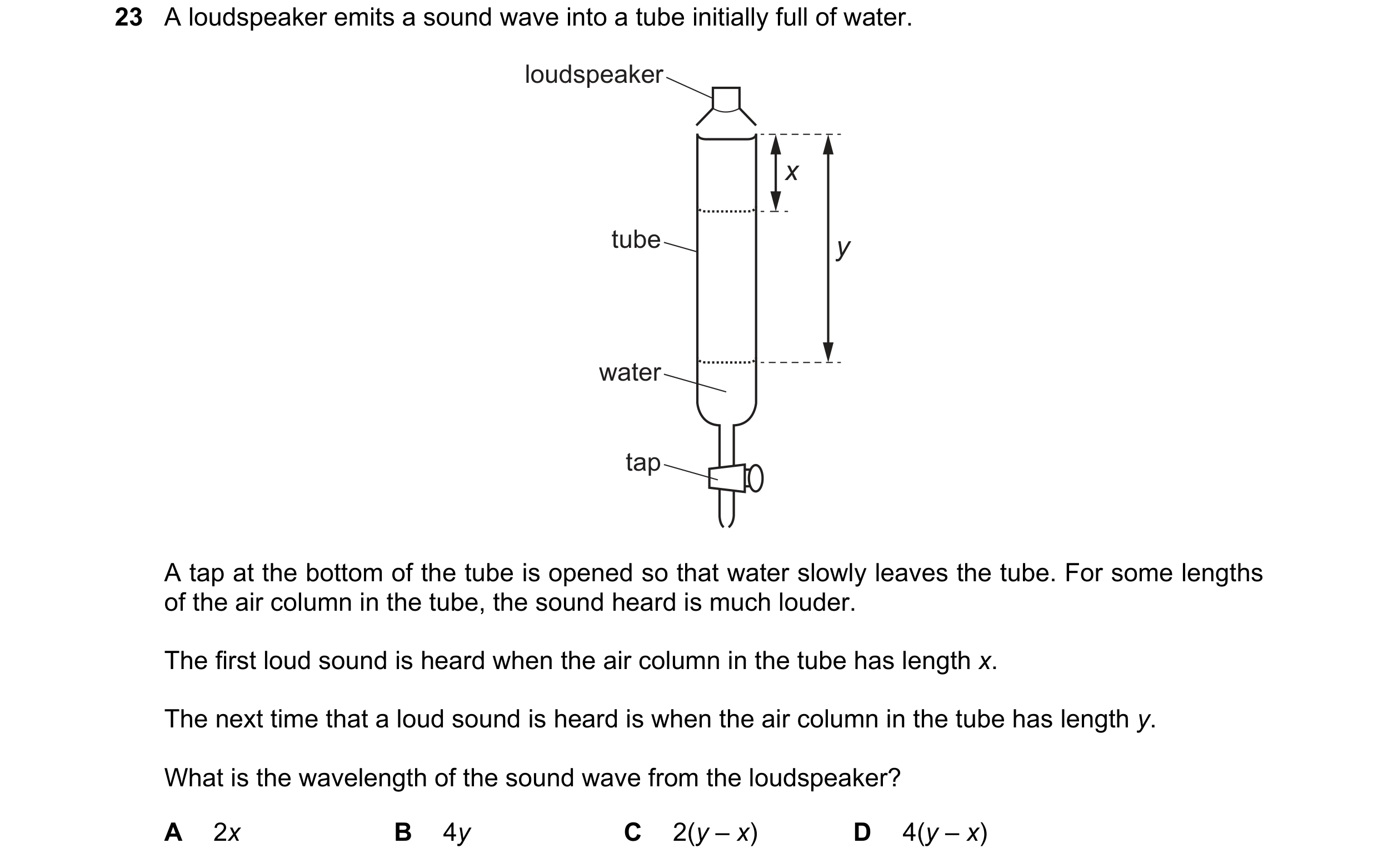
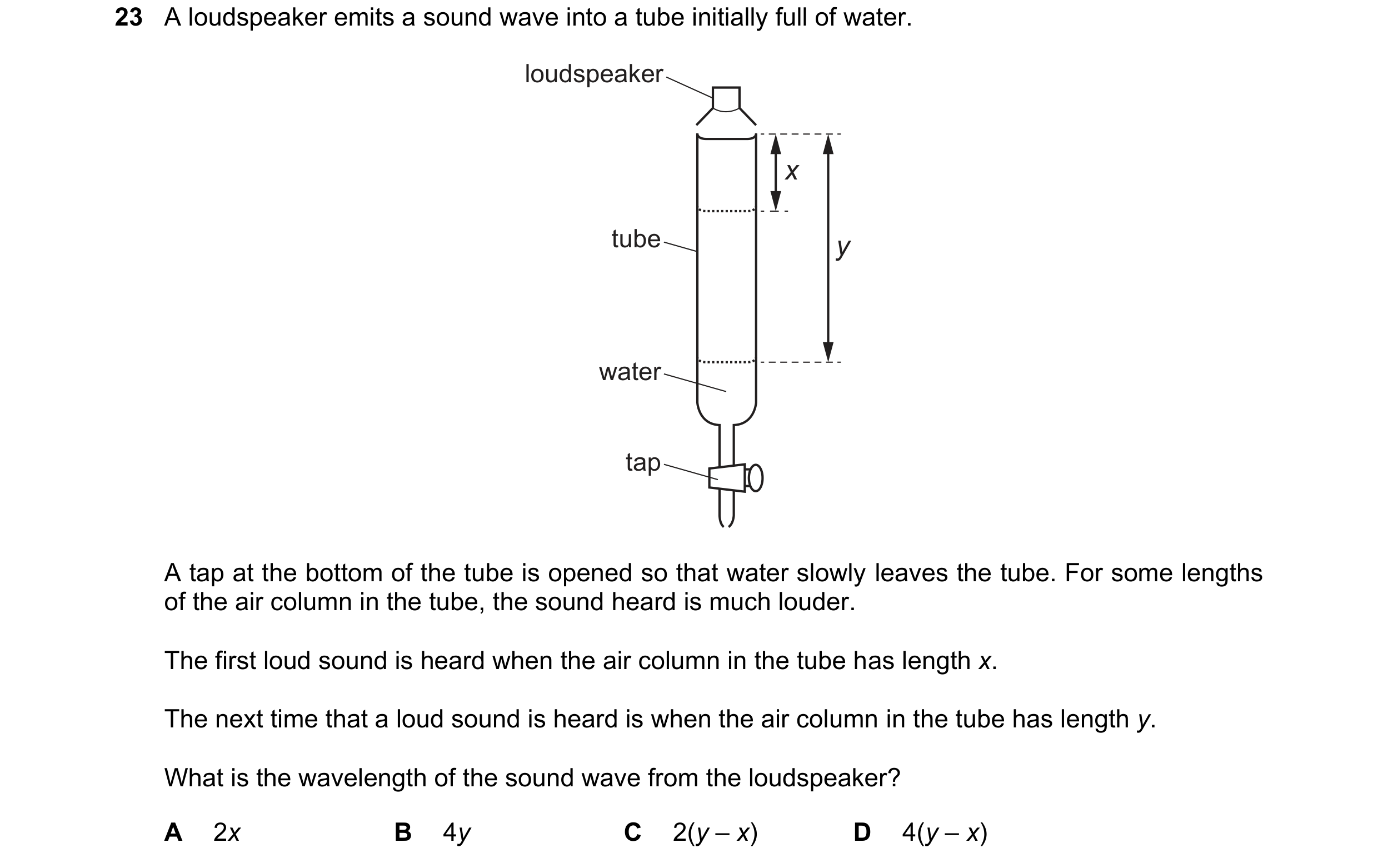
Q61 · A loudspeaker emits a sound wave into a tube initially full of water 9702/11 Oct/Nov 2017
23 A loudspeaker emits a sound wave into a tube initially full of water. loudspeaker x tube y water tap A tap at the bottom of the tube is opened so that water slowly leaves the tube. For some lengths of the air column in the tube, the sound heard is much louder. The first loud sound is heard when the air column in the tube has length x. The next time that a loud sound is heard is when the air column in the tube has length y. What is the wavelength of the sound wave from the loudspeaker? A 2x B 4y C 2(y – x) D 4(y – x)
1 marks
Answer: C
This question in 9702/11 Oct/Nov 2017
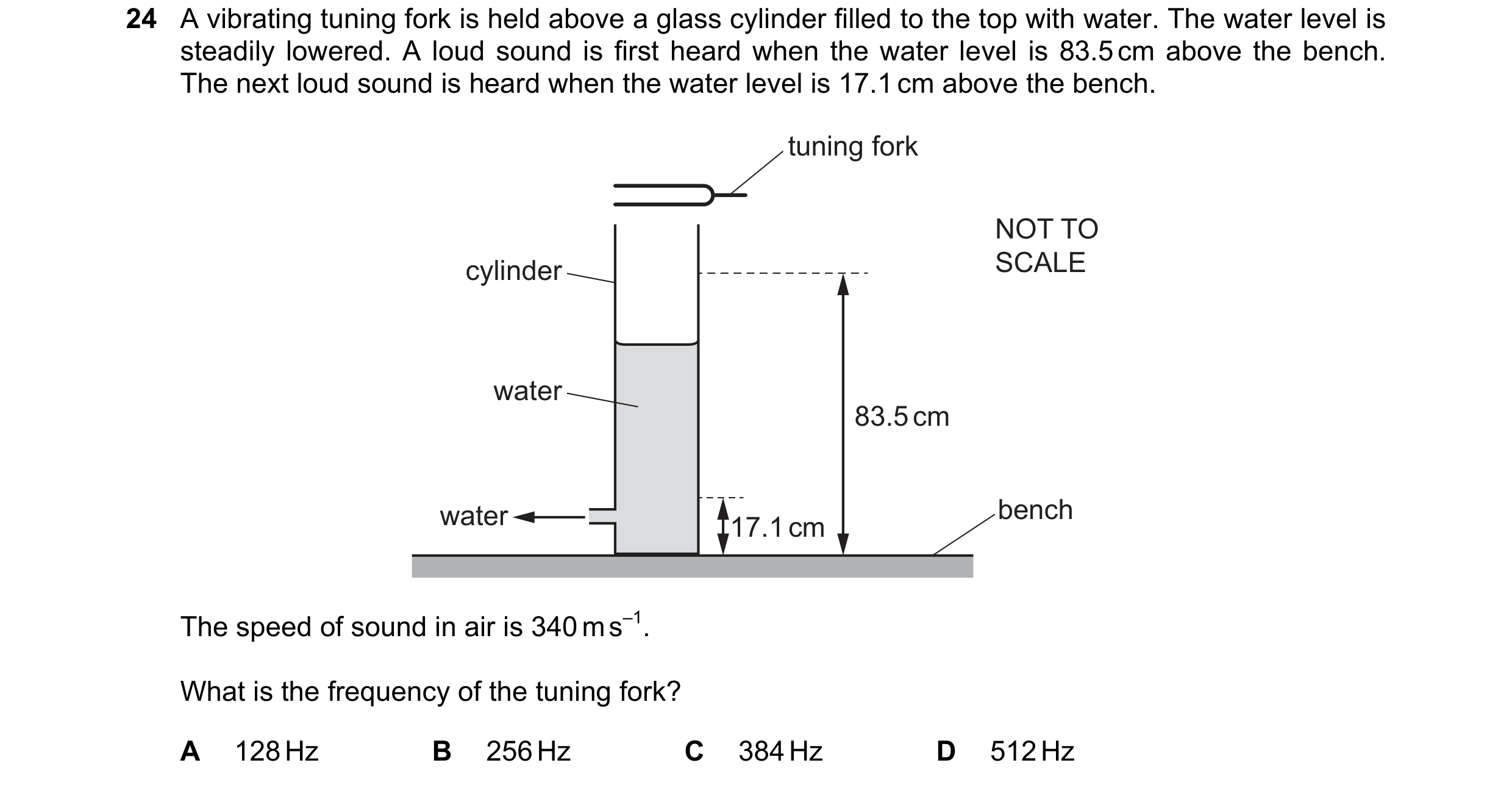
Q62 · A vibrating tuning fork is held above a glass cylinder filled to the top with water 9702/12 Oct/Nov 2017
24 A vibrating tuning fork is held above a glass cylinder filled to the top with water. The water level is steadily lowered. A loud sound is first heard when the water level is 83.5 cm above the bench. The next loud sound is heard when the water level is 17.1 cm above the bench. tuning fork NOT TO cylinder SCALE water 83.5 cm water 17.1 cm The speed of sound in air is 340 m s–1. What is the frequency of the tuning fork? A 128 Hz B 256 Hz C 384 Hz D 512 Hz
1 marks
Answer: B
This question in 9702/12 Oct/Nov 2017
Q63 · A stationary sound wave has a series of nodes 9702/12 Oct/Nov 2017
27 A stationary sound wave has a series of nodes. The distance between the first and the sixth node is 30.0 cm. What is the wavelength of the sound wave? A 5.0 cm B 6.0 cm C 10.0 cm D 12.0 cm
1 marks
Answer: D
This question in 9702/12 Oct/Nov 2017
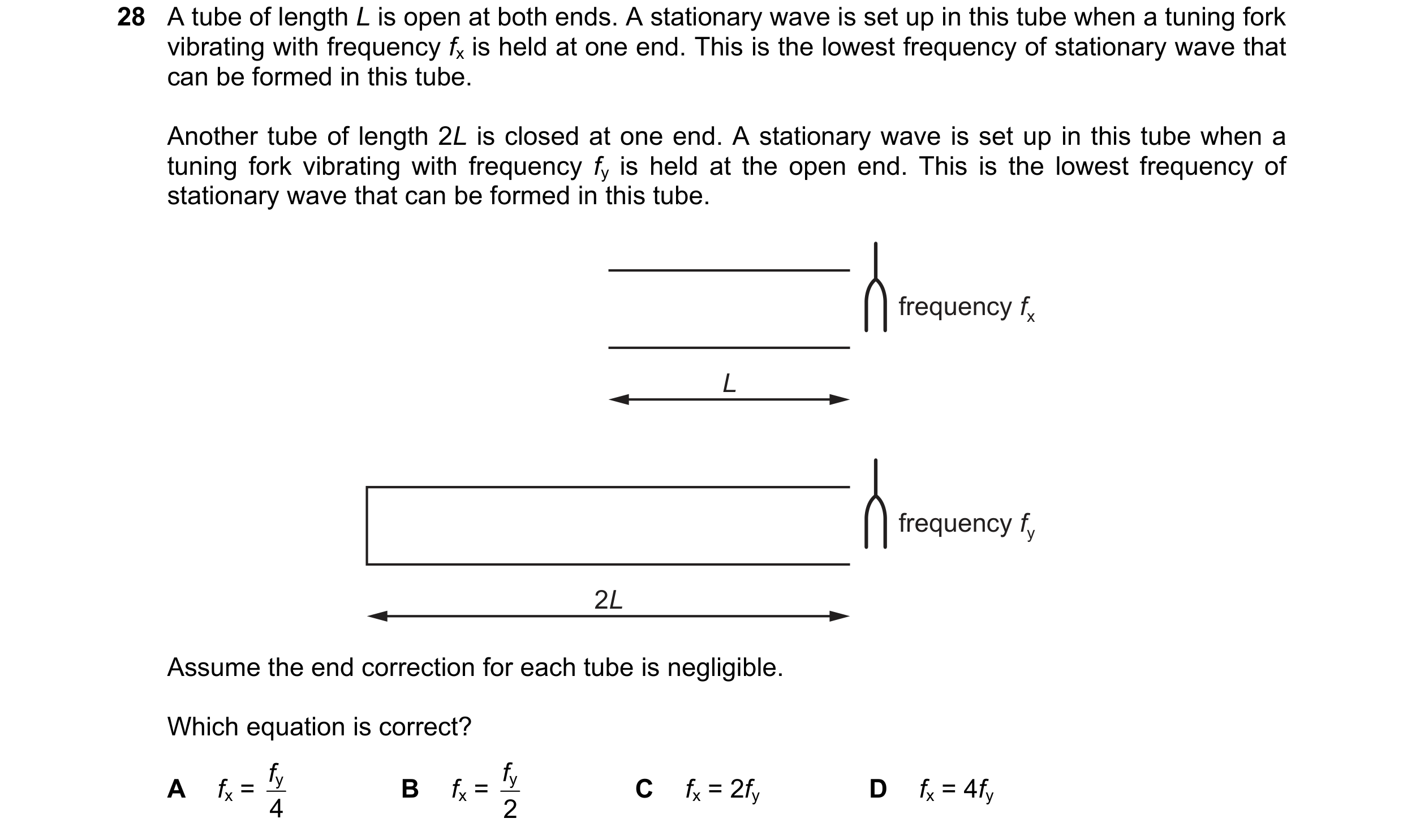
Q64 · A tube of length L is open at both ends 9702/12 Feb/March 2018
28 A tube of length L is open at both ends. A stationary wave is set up in this tube when a tuning fork vibrating with frequency fx is held at one end. This is the lowest frequency of stationary wave that can be formed in this tube. Another tube of length 2L is closed at one end. A stationary wave is set up in this tube when a tuning fork vibrating with frequency fy is held at the open end. This is the lowest frequency of stationary wave that can be formed in this tube. frequency fx L frequency fy 2L Assume the end correction for each tube is negligible. Which equation is correct? yf yf A fx = 4 B fx = 2 C fx = 2fy D fx = 4fy
1 marks
Answer: D
This question in 9702/12 Feb/March 2018
Q65 · A pipe, closed at one end, has a loudspeaker at the open end 9702/11 May/June 2018
27 A pipe, closed at one end, has a loudspeaker at the open end. A stationary sound wave is formed in the air within the pipe with an antinode at the open end of the pipe. 0.85 m loudspeaker pipe The length of the pipe is 0.85 m. The speed of sound in air is 340 m s–1. Which frequency of sound from the loudspeaker would not produce a stationary wave? A 100 Hz B 200 Hz C 300 Hz D 500 Hz
1 marks
Answer: B
This question in 9702/11 May/June 2018
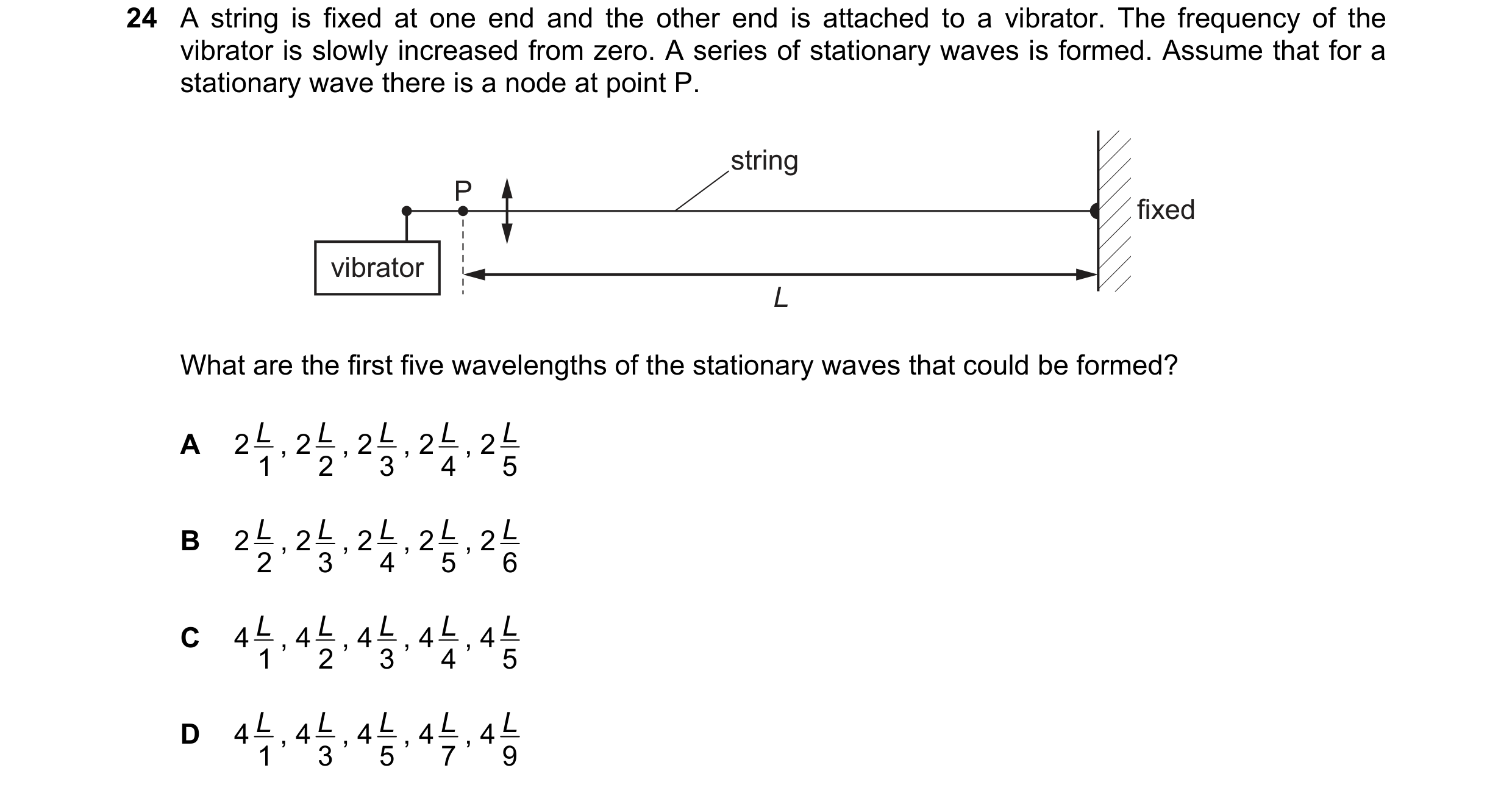
Q66 · A string is fixed at one end and the other end is attached to a vibrator 9702/12 May/June 2018
24 A string is fixed at one end and the other end is attached to a vibrator. The frequency of the vibrator is slowly increased from zero. A series of stationary waves is formed. Assume that for a stationary wave there is a node at point P. string P fixed vibrator L What are the first five wavelengths of the stationary waves that could be formed? A 2 1 L , 2 2 L , 2 3 L , 2 4 L , 2 5 L B 2 2 L , 2 3 L , 2 4 L , 2 5 L , 2 6 L C 4 1 L , 4 2 L , 4 3 L , 4 4 L , 4 5 L D 4 1 L , 4 3 L , 4 5 L , 4 7 L , 4 9 L
1 marks
Answer: A
This question in 9702/12 May/June 2018
Q67 · The diagram shows a stationary wave, at time t = 0, that has been set up on a string… 9702/12 May/June 2018
28 The diagram shows a stationary wave, at time t = 0, that has been set up on a string fixed between points P and S. X Y P Q R S The nodes of the stationary wave occur on the string at P, Q, R and S. Point X is moving down at time t = 0. The points on the string vibrate with time period T and maximum amplitude 2 cm. The displacement s is positive in the upward direction. Which graph best shows the variation with t of the displacement s of point Y on the string? A B 2 2 s / cm s / cm 0 0 0 T t 0 T t 2 2 –2 –2 C D 2 2 s / cm s / cm 0 0 0 T t 0 T t 2 2 –2 –2
1 marks
Answer: A
This question in 9702/12 May/June 2018
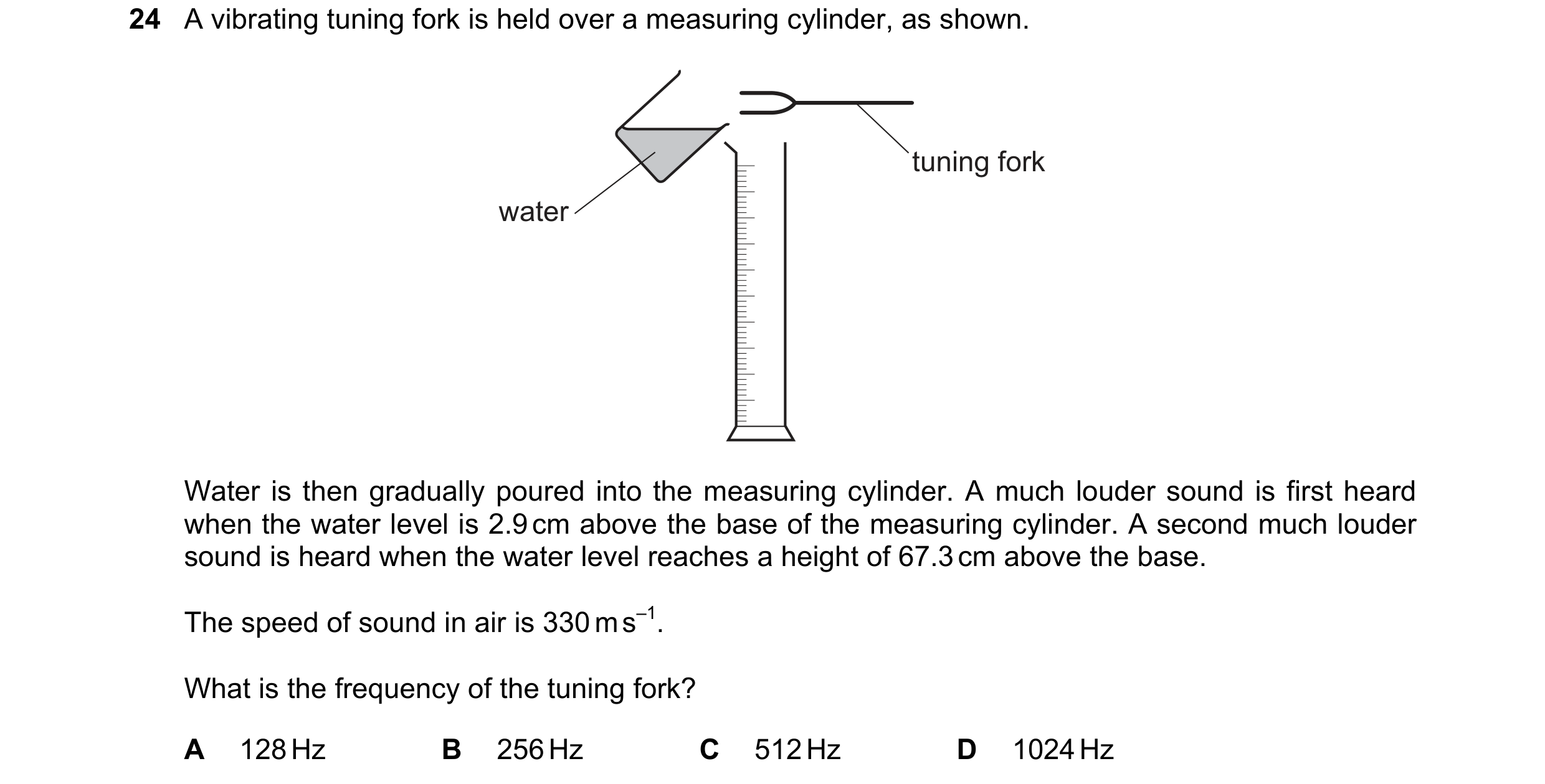
Q68 · A vibrating tuning fork is held over a measuring cylinder, as shown 9702/13 May/June 2018
24 A vibrating tuning fork is held over a measuring cylinder, as shown. tuning fork water Water is then gradually poured into the measuring cylinder. A much louder sound is first heard when the water level is 2.9 cm above the base of the measuring cylinder. A second much louder sound is heard when the water level reaches a height of 67.3 cm above the base. The speed of sound in air is 330 m s–1. What is the frequency of the tuning fork? A 128 Hz B 256 Hz C 512 Hz D 1024 Hz
1 marks
Answer: B
This question in 9702/13 May/June 2018
Q69 · What may be used to produce stationary waves? 9702/11 Oct/Nov 2018
26 What may be used to produce stationary waves? A blowing air over the top of an empty bottle B making a loud sound near a mountain C passing monochromatic light through a double slit D passing water waves through a narrow slit
1 marks
Answer: A
This question in 9702/11 Oct/Nov 2018
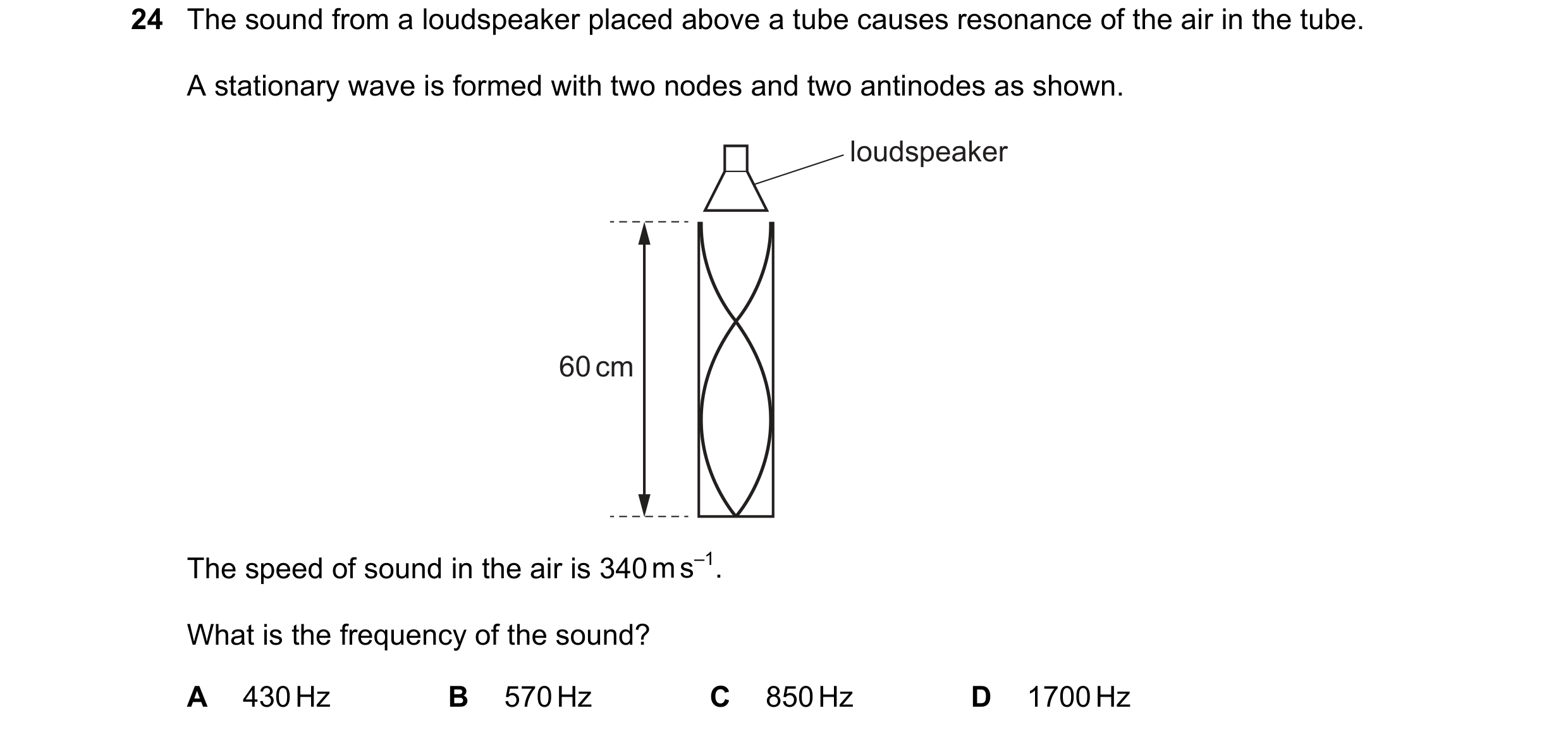
Q70 · The sound from a loudspeaker placed above a tube causes resonance of the air in the tube 9702/12 Oct/Nov 2018
24 The sound from a loudspeaker placed above a tube causes resonance of the air in the tube. A stationary wave is formed with two nodes and two antinodes as shown. loudspeaker 60 cm The speed of sound in the air is 340 m s–1. What is the frequency of the sound? A 430 Hz B 570 Hz C 850 Hz D 1700 Hz
1 marks
Answer: A
This question in 9702/12 Oct/Nov 2018
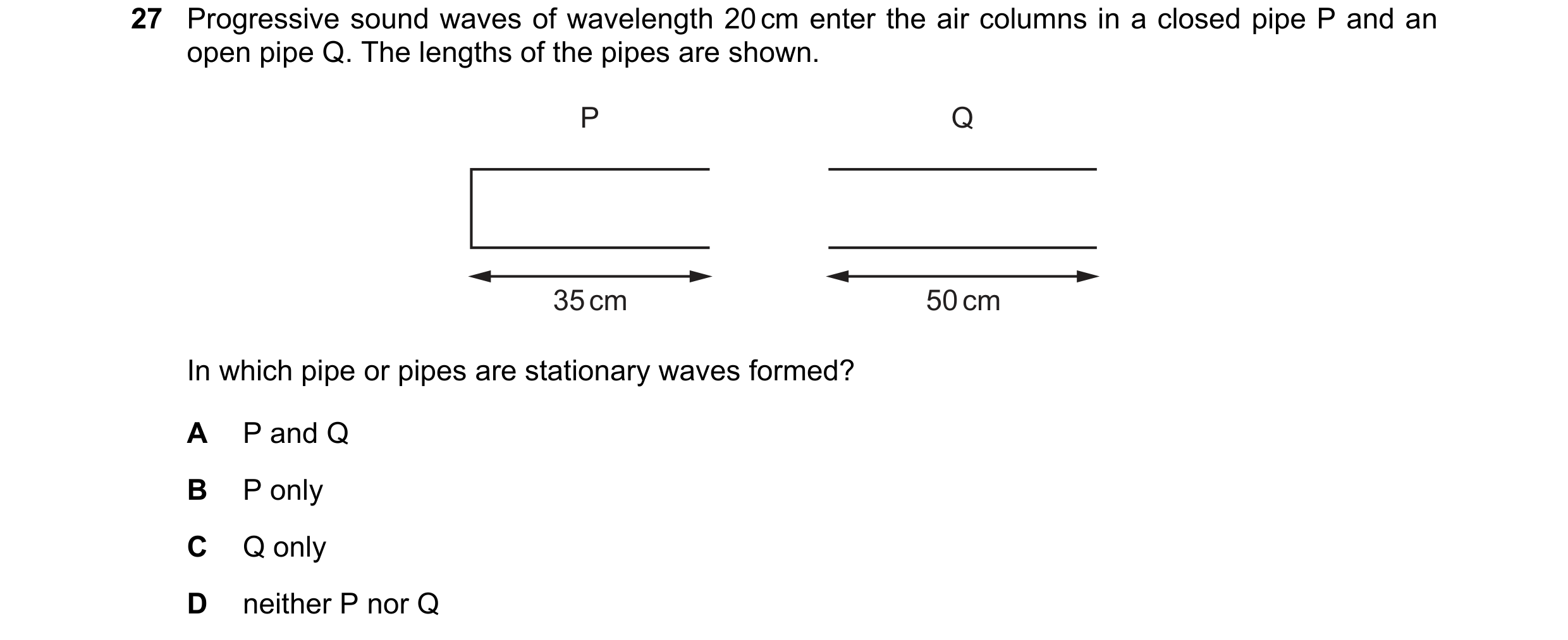
Q71 · Progressive sound waves of wavelength 20 cm enter the air columns in a closed pipe P and… 9702/12 Oct/Nov 2018
27 Progressive sound waves of wavelength 20 cm enter the air columns in a closed pipe P and an open pipe Q. The lengths of the pipes are shown. P Q 35 cm 50 cm In which pipe or pipes are stationary waves formed? A P and Q B P only C Q only D neither P nor Q
1 marks
Answer: A
This question in 9702/12 Oct/Nov 2018
Q72 · The diagram shows a stationary wave on a string 9702/13 Oct/Nov 2018
26 The diagram shows a stationary wave on a string. The stationary wave has three nodes N1, N2 and N3. N1 N2 N3 Which statement is correct? A All points on the string vibrate in phase. B All points on the string vibrate with the same amplitude. C Points equidistant from N2 vibrate with the same frequency and in phase. D Points equidistant from N2 vibrate with the same frequency and the same amplitude.
1 marks
Answer: D
This question in 9702/13 Oct/Nov 2018
Q73 · A straight tube is closed at one end and has a loudspeaker positioned at the open end 9702/12 Feb/March 2019
24 A straight tube is closed at one end and has a loudspeaker positioned at the open end. The frequency of the loudspeaker is initially very low and is increased slowly. A series of loudness maxima are heard. The stationary wave which gives the first maximum has a node at the closed end and an antinode at the open end. The frequency of the loudspeaker is f1 when the first maximum is heard. What is the frequency of the loudspeaker when the fourth maximum is heard? A 7 1 f B 2f1 C 4f1 D 7f1 4
1 marks
Answer: D
This question in 9702/12 Feb/March 2019
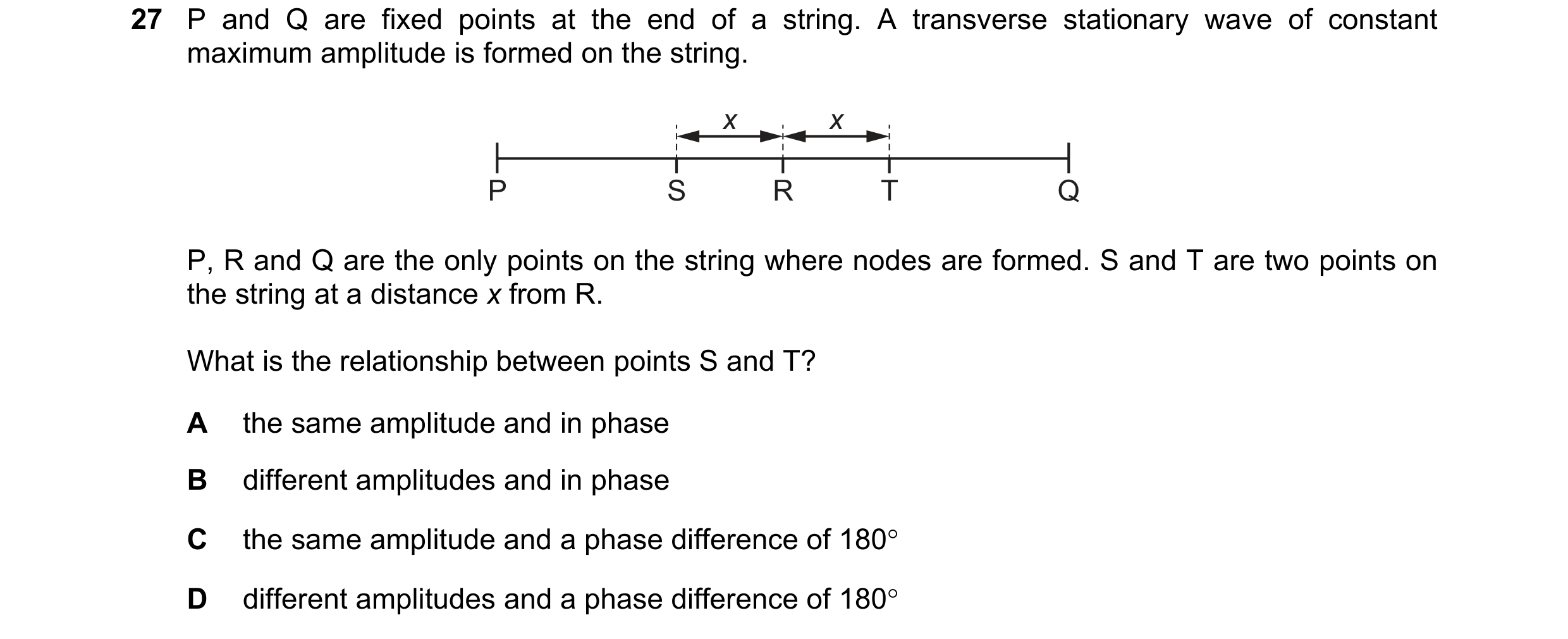
Q74 · P and Q are fixed points at the end of a string 9702/12 Feb/March 2019
27 P and Q are fixed points at the end of a string. A transverse stationary wave of constant maximum amplitude is formed on the string. x x P S R T Q P, R and Q are the only points on the string where nodes are formed. S and T are two points on the string at a distance x from R. What is the relationship between points S and T? A the same amplitude and in phase B different amplitudes and in phase C the same amplitude and a phase difference of 180° D different amplitudes and a phase difference of 180°
1 marks
Answer: C
This question in 9702/12 Feb/March 2019
Q75 · A long tube, filled with water, has a tap fitted at its base, as shown 9702/11 May/June 2019
24 A long tube, filled with water, has a tap fitted at its base, as shown. A tuning fork is sounded above the tube and the water is allowed to run gradually out of the tube. tuning fork tube water tap A louder sound is heard at intervals as the water runs out of the tube. The change in water level between louder sounds is 32 cm. What is the wavelength of the sound in the tube? A 16 cm B 32 cm C 64 cm D 128 cm
1 marks
Answer: C
This question in 9702/11 May/June 2019
Q76 · Two progressive waves of frequency 300 Hz superpose to produce a stationary wave in which… 9702/11 May/June 2019
27 Two progressive waves of frequency 300 Hz superpose to produce a stationary wave in which adjacent nodes are 1.5 m apart. What is the speed of the progressive waves? A 100 m s–1 B 200 m s–1 C 450 m s–1 D 900 m s–1
1 marks
Answer: D
This question in 9702/11 May/June 2019
Q77 · In an experiment to determine the wavelength of sound in air, a stationary wave is set up… 9702/12 May/June 2019
25 In an experiment to determine the wavelength of sound in air, a stationary wave is set up in an air column. The distance between a node and an adjacent antinode is L. What is the wavelength of the sound? A 1 L B L C 2L D 4L 2
1 marks
Answer: D
This question in 9702/12 May/June 2019
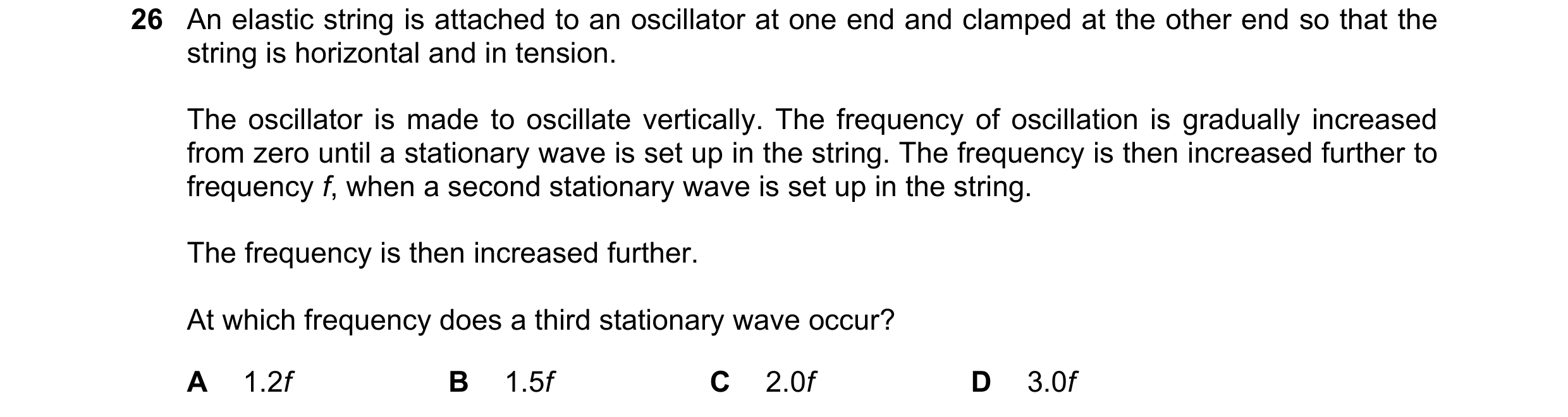
Q78 · An elastic string is attached to an oscillator at one end and clamped at the other end so… 9702/13 May/June 2019
26 An elastic string is attached to an oscillator at one end and clamped at the other end so that the string is horizontal and in tension. The oscillator is made to oscillate vertically. The frequency of oscillation is gradually increased from zero until a stationary wave is set up in the string. The frequency is then increased further to frequency f, when a second stationary wave is set up in the string. The frequency is then increased further. At which frequency does a third stationary wave occur? A 1.2f B 1.5f C 2.0f D 3.0f
1 marks
Answer: B
This question in 9702/13 May/June 2019
Q79 · Source S emits microwaves with a constant amplitude 9702/11 Oct/Nov 2019
23 Source S emits microwaves with a constant amplitude. The microwaves hit a metal screen P and are reflected. A stationary wave is formed between S and P. The wavelength of the microwaves is much smaller than the distance between S and P. S P Q A detector Q is moved at a slow, constant speed from S to P. What happens to the amplitude of the signal detected by Q? A decreases steadily B increases and decreases regularly C increases steadily D remains constant
1 marks
Answer: B
This question in 9702/11 Oct/Nov 2019
Q80 · A transmitter of electromagnetic waves is placed 45 cm from a reflective surface 9702/12 Oct/Nov 2019
25 A transmitter of electromagnetic waves is placed 45 cm from a reflective surface. reflective surface transmitter 45 cm The emitted waves have a frequency of 1.00 GHz. A stationary wave is produced with a node at the transmitter and a node at the surface. How many antinodes are in the space between the transmitter and the surface? A 1 B 2 C 3 D 4
1 marks
Answer: C
This question in 9702/12 Oct/Nov 2019
Q81 · In an experiment to demonstrate a stationary wave, two microwave transmitters, emitting… 9702/13 Oct/Nov 2019
26 In an experiment to demonstrate a stationary wave, two microwave transmitters, emitting waves of wavelength 4 cm, are set facing each other, as shown. transmitter transmitter d detector A detector is moved along a straight line between the transmitters. It detects positions of maximum and minimum signal. The detector is a distance d from the left-hand transmitter. Assume that both transmitters are at antinodes of the stationary wave. Which row gives a value of d for a maximum and for a minimum? value of d for value of d for a maximum / cm a minimum / cm A 46 48 B 47 48 C 48 47 D 49 47
1 marks
Answer: C
This question in 9702/13 Oct/Nov 2019
Q82 · The diagram shows a sketch of a wave pattern over a short period of time 9702/13 Oct/Nov 2019
28 The diagram shows a sketch of a wave pattern over a short period of time. 1.0 m Which description of this wave is correct? A The wave is longitudinal, has a wavelength of 20 cm and is stationary. B The wave is transverse, has a wavelength of 20 cm and is stationary. C The wave is transverse, has a wavelength of 40 cm and is progressive. D The wave is transverse, has a wavelength of 40 cm and is stationary.
1 marks
Answer: D
This question in 9702/13 Oct/Nov 2019
Q83 · A musical instrument is made using a long tube with a mouthpiece at one end 9702/12 Feb/March 2020
26 A musical instrument is made using a long tube with a mouthpiece at one end. The other end is open and flared, as shown. A musician maintains stationary sound waves with a node at the mouthpiece and an antinode at the other end. The lowest frequency of sound that the instrument can produce is 92 Hz. Which different frequencies of sound can be produced by the instrument? A 92 Hz, 138 Hz, 184 Hz, 230 Hz B 92 Hz, 184 Hz, 276 Hz, 368 Hz C 92 Hz, 276 Hz, 460 Hz, 644 Hz D 92 Hz, 276 Hz, 828 Hz, 1288 Hz
1 marks
Answer: C
This question in 9702/12 Feb/March 2020
Q84 · A long glass tube is almost completely immersed in a large tank of water 9702/11 May/June 2020
24 A long glass tube is almost completely immersed in a large tank of water. A tuning fork is struck and held just above the open end of the tube as it is slowly raised. A louder sound is first heard when the height h of the end of the tube above the water is 18.8 cm. A louder sound is next heard when h is 56.4 cm. The speed of sound in air is 330 m s–1. tuning fork glass tube h water What is the frequency of the sound produced by the tuning fork? A 220 Hz B 440 Hz C 660 Hz D 880 Hz
1 marks
Answer: B
This question in 9702/11 May/June 2020
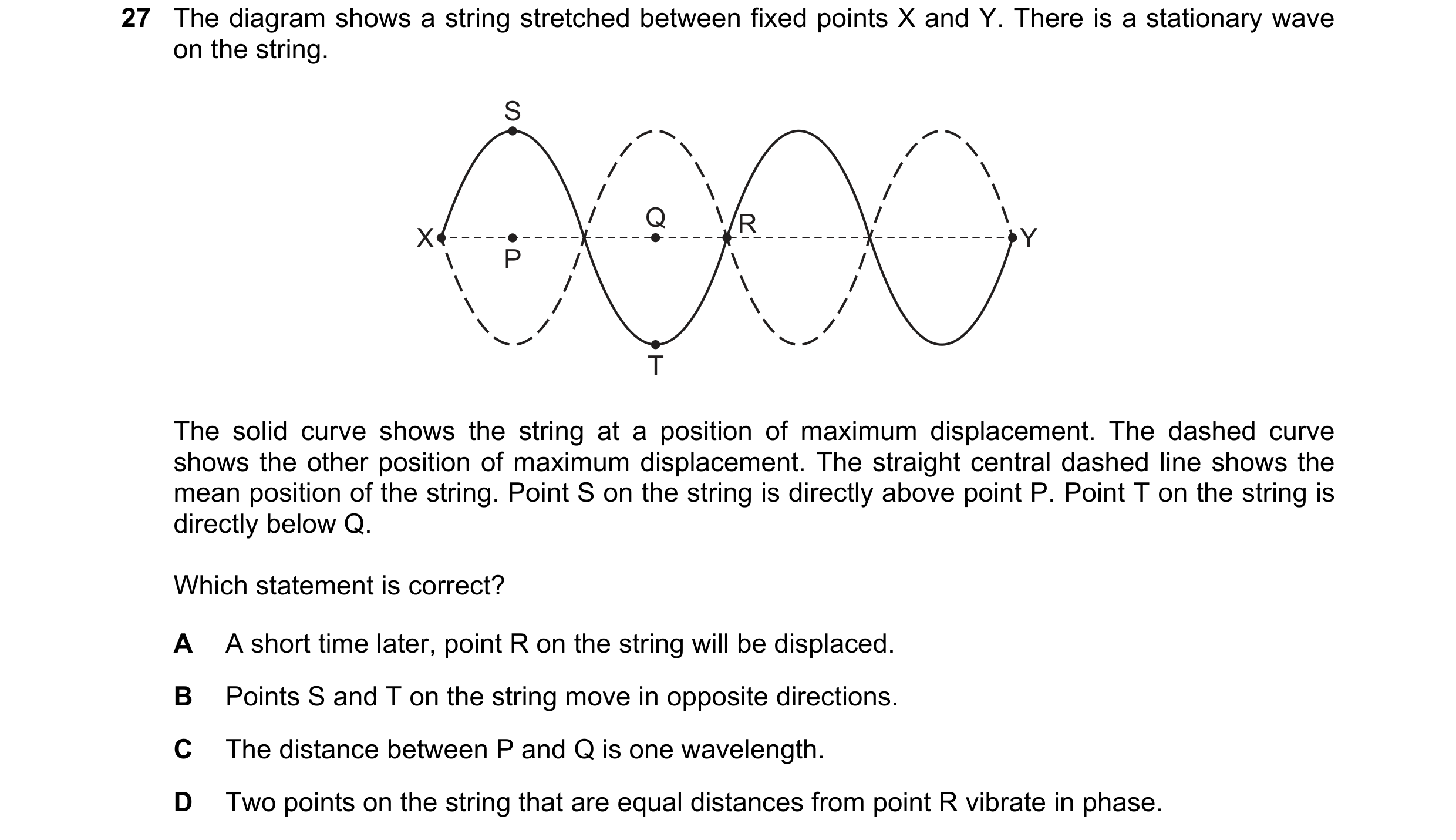
Q85 · The diagram shows a string stretched between fixed points X and Y 9702/11 May/June 2020
27 The diagram shows a string stretched between fixed points X and Y. There is a stationary wave on the string. S Q R X Y P T The solid curve shows the string at a position of maximum displacement. The dashed curve shows the other position of maximum displacement. The straight central dashed line shows the mean position of the string. Point S on the string is directly above point P. Point T on the string is directly below Q. Which statement is correct? A A short time later, point R on the string will be displaced. B Points S and T on the string move in opposite directions. C The distance between P and Q is one wavelength. D Two points on the string that are equal distances from point R vibrate in phase.
1 marks
Answer: B
This question in 9702/11 May/June 2020
Q86 · The diagram shows an experiment to produce a stationary wave in an air column 9702/12 May/June 2020
24 The diagram shows an experiment to produce a stationary wave in an air column. A tuning fork, placed above the column, vibrates and produces a sound wave. The length of the air column can be varied by altering the volume of the water in the tube. tuning fork air column water tap The tube is filled and then water is allowed to run out of it. The first two stationary waves occur when the air column lengths are 0.14 m and 0.42 m. What is the wavelength of the sound wave? A 0.14 m B 0.28 m C 0.42 m D 0.56 m
1 marks
Answer: D
This question in 9702/12 May/June 2020
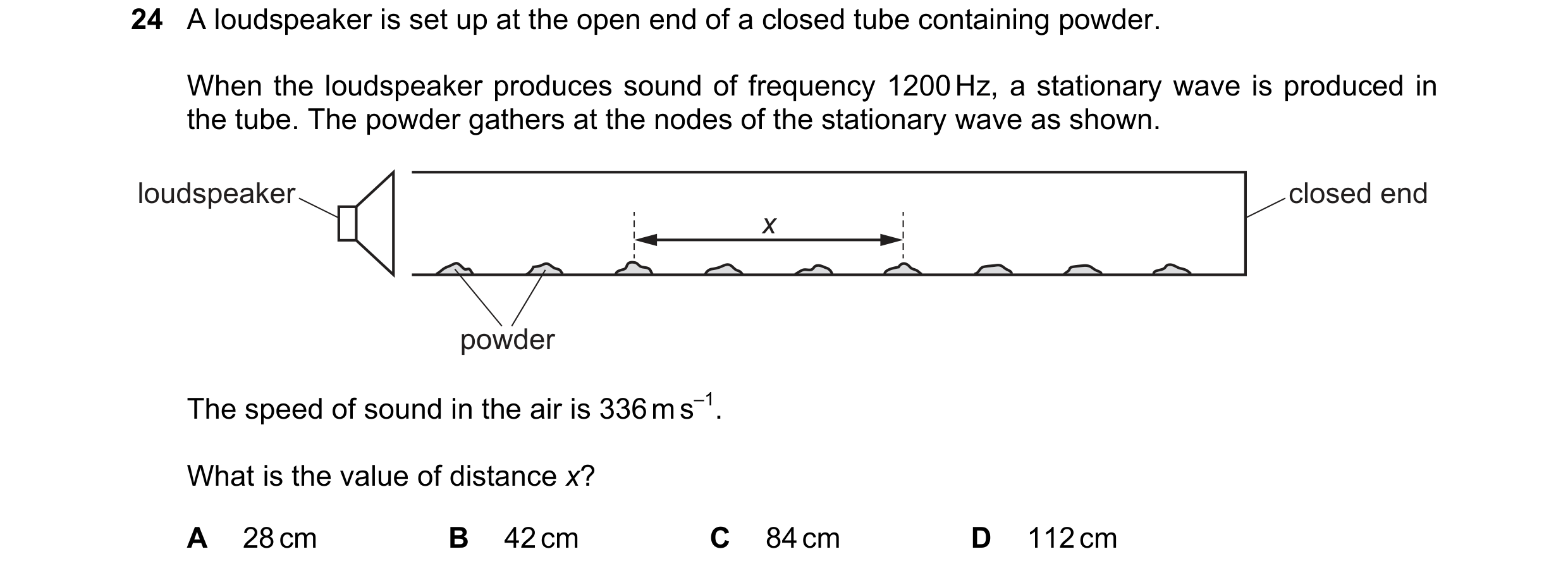
Q87 · A loudspeaker is set up at the open end of a closed tube containing powder 9702/13 May/June 2020
24 A loudspeaker is set up at the open end of a closed tube containing powder. When the loudspeaker produces sound of frequency 1200 Hz, a stationary wave is produced in the tube. The powder gathers at the nodes of the stationary wave as shown. loudspeaker closed end x powder The speed of sound in the air is 336 m s–1. What is the value of distance x? A 28 cm B 42 cm C 84 cm D 112 cm
1 marks
Answer: B
This question in 9702/13 May/June 2020
Q88 · A vertical tube is partially filled with water 9702/13 May/June 2020
27 A vertical tube is partially filled with water. A sound wave moves down the tube and is reflected by the surface of the water. The frequency of the sound wave is gradually increased from zero until a much louder sound is heard. sound tube water Water is then removed from the tube until a second louder sound is heard. Which diagram shows the new pattern of the stationary wave that is formed? A B C D
1 marks
Answer: C
This question in 9702/13 May/June 2020
Q89 · A loudspeaker emits a sound wave into a tube initially full of water 9702/11 Oct/Nov 2020
23 A loudspeaker emits a sound wave into a tube initially full of water. loudspeaker x tube y water tap A tap at the bottom of the tube is opened so that water slowly leaves the tube. For some lengths of the air column in the tube, the sound heard is much louder. The first loud sound is heard when the air column in the tube has length x. The next time that a loud sound is heard is when the air column in the tube has length y. What is the wavelength of the sound wave from the loudspeaker? A 2x B 4y C 2(y – x) D 4(y – x)
1 marks
Answer: C
This question in 9702/11 Oct/Nov 2020
Q90 · Which statement concerning a stationary wave is correct? 9702/11 Oct/Nov 2020
26 Which statement concerning a stationary wave is correct? A All the particles between two adjacent nodes oscillate in phase. B The amplitude of the stationary wave is equal to the amplitude of one of the waves creating it. C The wavelength of the stationary wave is equal to the separation of two adjacent nodes. D There is no displacement of a particle at an antinode at any time.
1 marks
Answer: A
This question in 9702/11 Oct/Nov 2020
Q91 · A vibrating tuning fork is held above a glass cylinder filled to the top with water 9702/12 Oct/Nov 2020
24 A vibrating tuning fork is held above a glass cylinder filled to the top with water. The water level is steadily lowered. A loud sound is first heard when the water level is 83.5 cm above the bench. The next loud sound is heard when the water level is 17.1 cm above the bench. tuning fork NOT TO cylinder SCALE water 83.5 cm water bench 17.1 cm The speed of sound in air is 340 m s–1. What is the frequency of the tuning fork? A 128 Hz B 256 Hz C 384 Hz D 512 Hz
1 marks
Answer: B
This question in 9702/12 Oct/Nov 2020
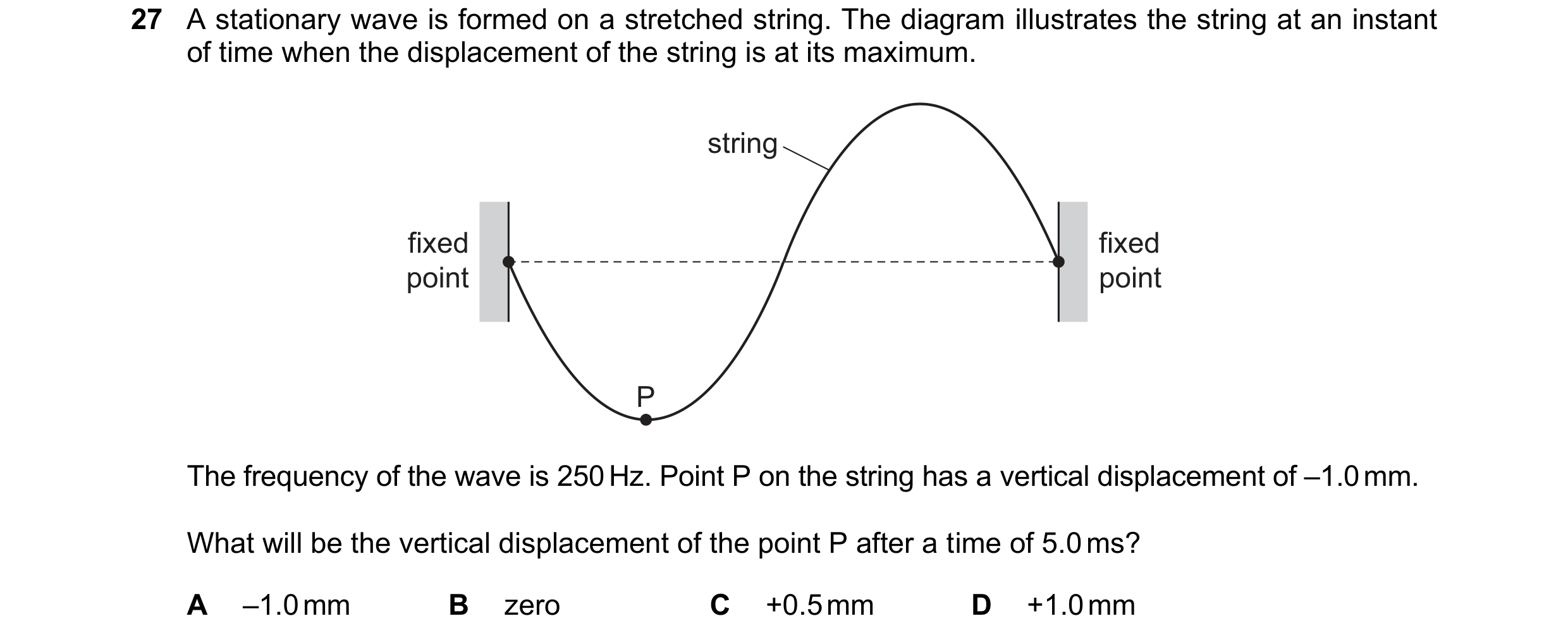
Q92 · A stationary wave is formed on a stretched string 9702/13 Oct/Nov 2020
27 A stationary wave is formed on a stretched string. The diagram illustrates the string at an instant of time when the displacement of the string is at its maximum. string fixed fixed point point P The frequency of the wave is 250 Hz. Point P on the string has a vertical displacement of –1.0 mm. What will be the vertical displacement of the point P after a time of 5.0 ms? A –1.0 mm B zero C +0.5 mm D +1.0 mm
1 marks
Answer: B
This question in 9702/13 Oct/Nov 2020
Q93 · A loudspeaker emitting a sound wave of a single frequency is placed a distance L from a… 9702/12 Feb/March 2021
23 A loudspeaker emitting a sound wave of a single frequency is placed a distance L from a reflecting surface, as shown. L reflector loudspeaker microphone path of microphone A stationary wave is formed with an antinode at the loudspeaker. A microphone is moved from the loudspeaker to the reflector. Before the microphone reaches the reflector, it detects four points where the sound intensity is a minimum. What is the wavelength of the sound wave? 2 L 2 L 4 L 4 L A B C D 9 8 9 8
1 marks
Answer: C
This question in 9702/12 Feb/March 2021
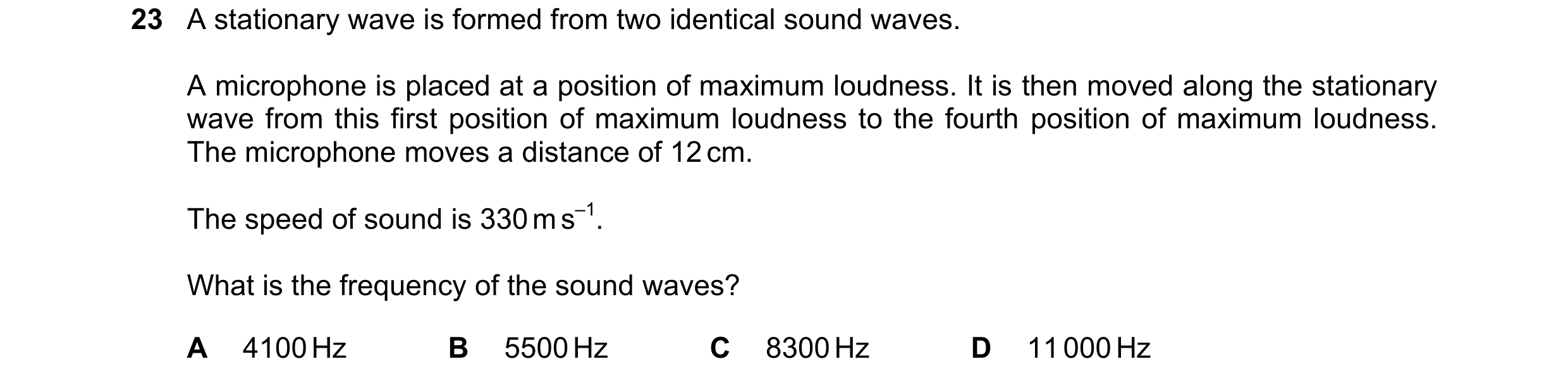
Q94 · A stationary wave is formed from two identical sound waves 9702/11 May/June 2021
23 A stationary wave is formed from two identical sound waves. A microphone is placed at a position of maximum loudness. It is then moved along the stationary wave from this first position of maximum loudness to the fourth position of maximum loudness. The microphone moves a distance of 12 cm. The speed of sound is 330 m s–1. What is the frequency of the sound waves? A 4100 Hz B 5500 Hz C 8300 Hz D 11 000 Hz
1 marks
Answer: A
This question in 9702/11 May/June 2021
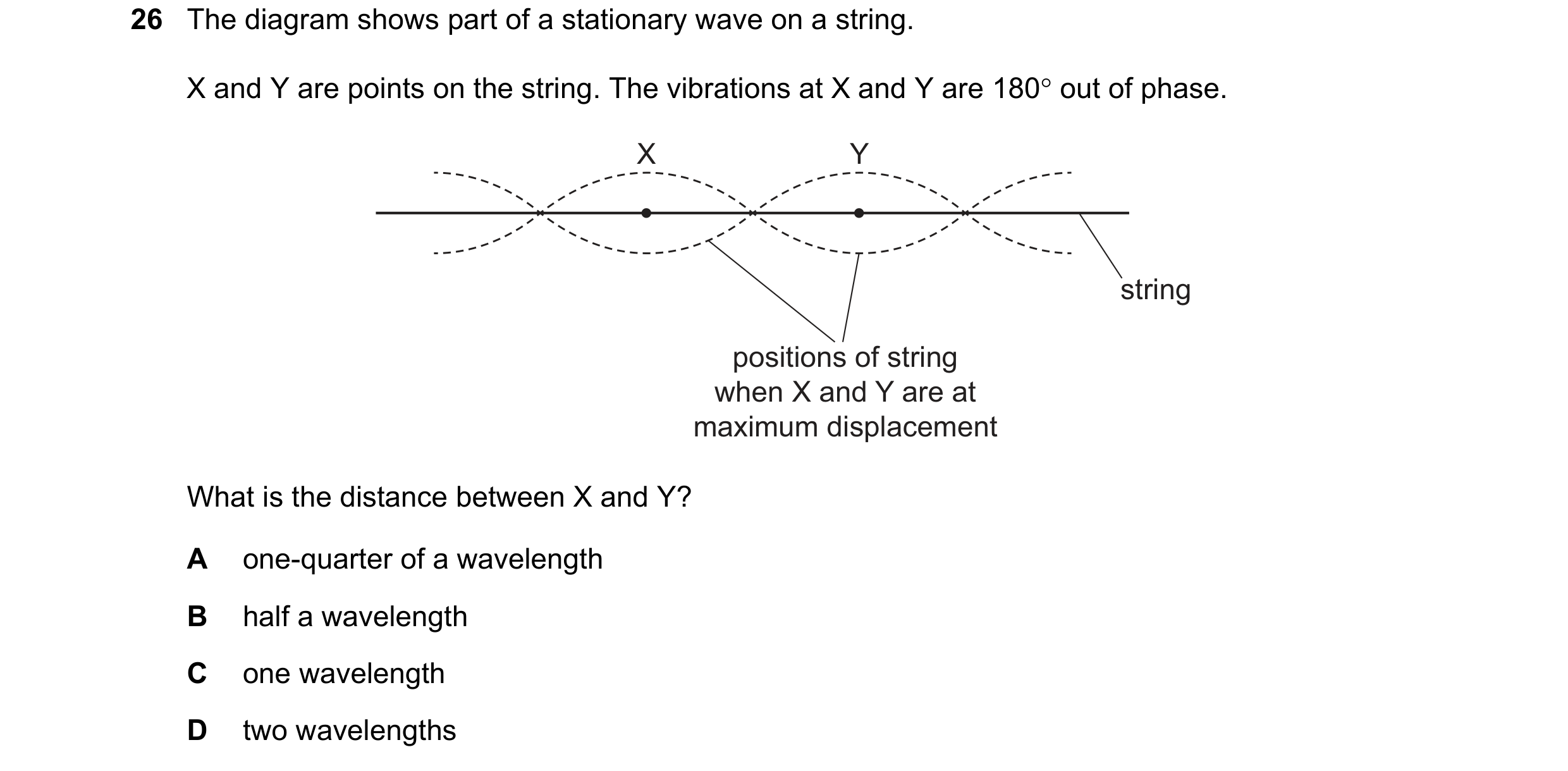
Q95 · The diagram shows part of a stationary wave on a string 9702/11 May/June 2021
26 The diagram shows part of a stationary wave on a string. X and Y are points on the string. The vibrations at X and Y are 180 out of phase. X Y string positions of string when X and Y are at maximum displacement What is the distance between X and Y? A one-quarter of a wavelength B half a wavelength C one wavelength D two wavelengths
1 marks
Answer: B
This question in 9702/11 May/June 2021
Q96 · To produce a stationary wave, two waves must travel in opposite directions through the… 9702/13 May/June 2021
27 To produce a stationary wave, two waves must travel in opposite directions through the same space. Which statement about the properties of the two waves must also be correct? A The waves must have equal frequencies, but different speeds and wavelengths. B The waves must have equal speeds, but different wavelengths and frequencies. C The waves must have equal speeds, frequencies and wavelengths. D The waves must have equal wavelengths, but different speeds and frequencies.
1 marks
Answer: C
This question in 9702/13 May/June 2021
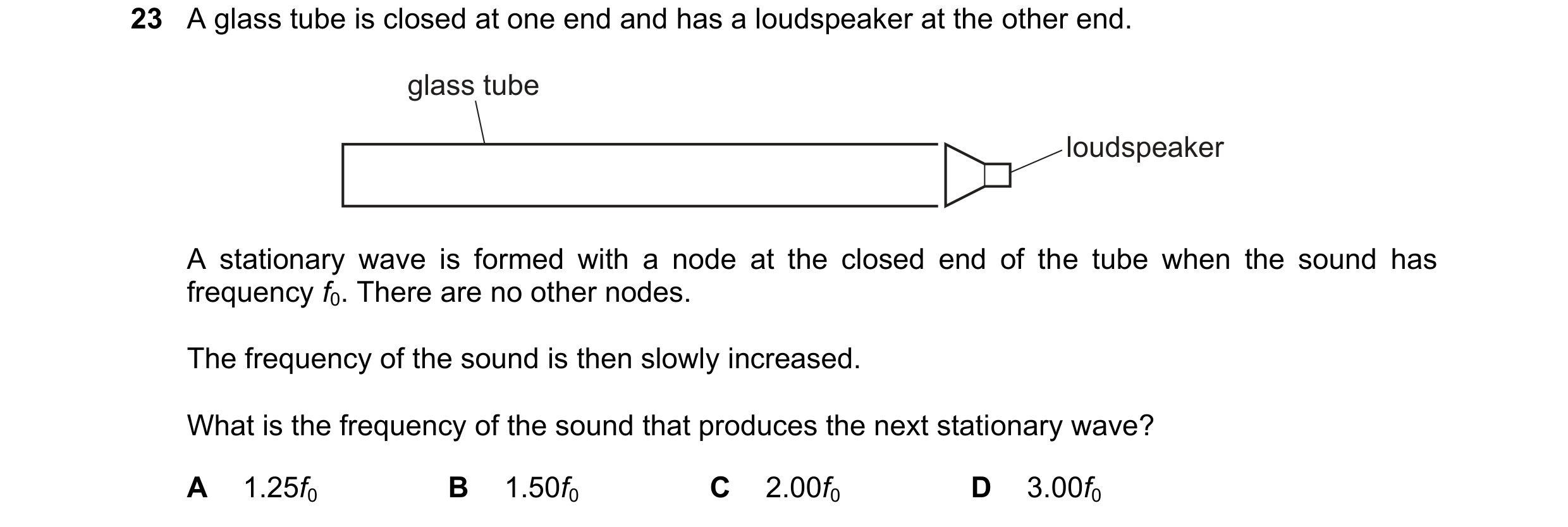
Q97 · A glass tube is closed at one end and has a loudspeaker at the other end 9702/11 Oct/Nov 2021
23 A glass tube is closed at one end and has a loudspeaker at the other end. glass tube loudspeaker A stationary wave is formed with a node at the closed end of the tube when the sound has frequency f0. There are no other nodes. The frequency of the sound is then slowly increased. What is the frequency of the sound that produces the next stationary wave? A 1.25f0 B 1.50f0 C 2.00f0 D 3.00f0
1 marks
Answer: D
This question in 9702/11 Oct/Nov 2021
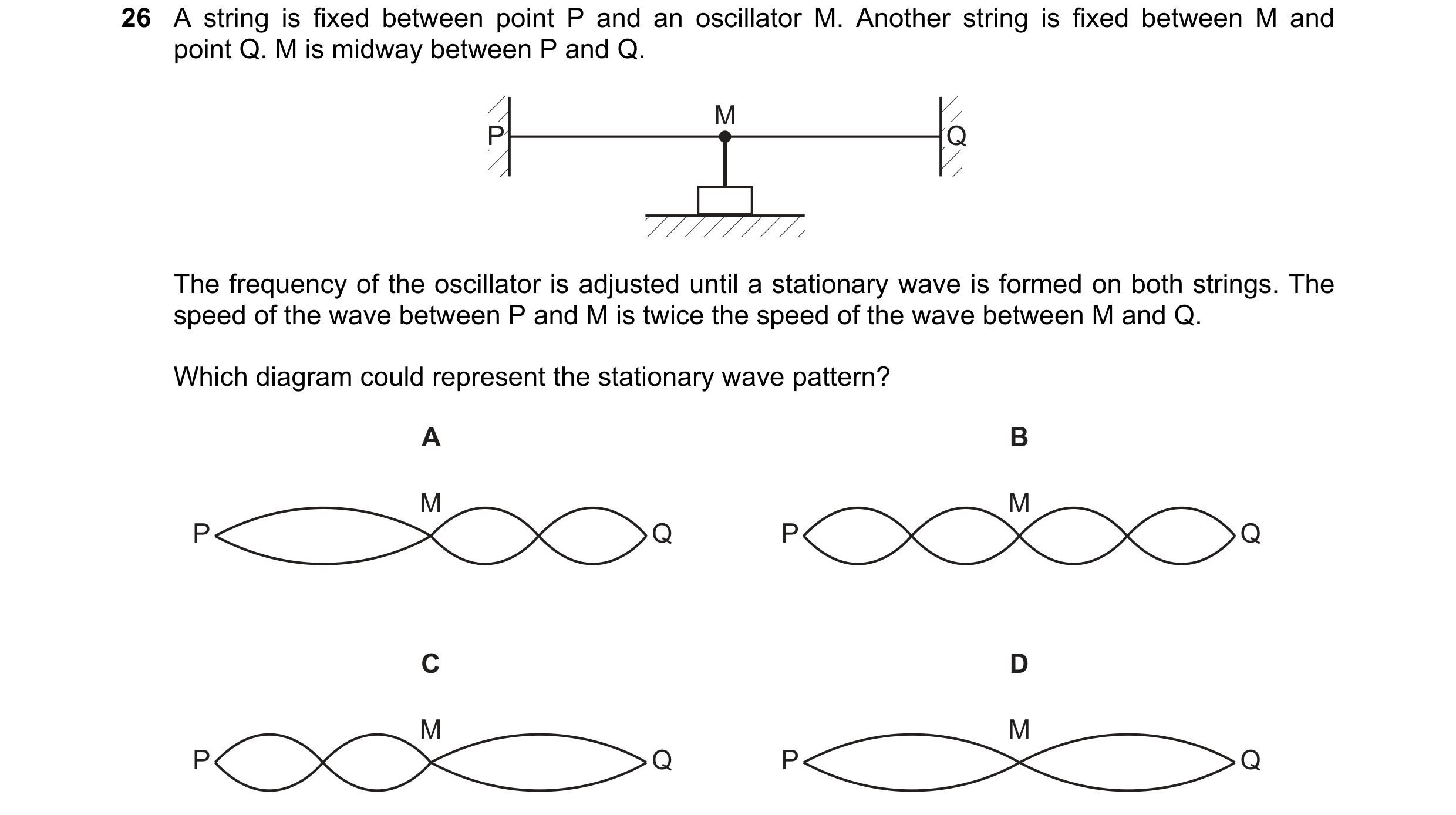
Q98 · A string is fixed between point P and an oscillator M 9702/11 Oct/Nov 2021
26 A string is fixed between point P and an oscillator M. Another string is fixed between M and point Q. M is midway between P and Q. M P Q The frequency of the oscillator is adjusted until a stationary wave is formed on both strings. The speed of the wave between P and M is twice the speed of the wave between M and Q. Which diagram could represent the stationary wave pattern? A B M M P Q P Q C D M M P Q P Q
1 marks
Answer: A
This question in 9702/11 Oct/Nov 2021
Q99 · A stationary sound wave is formed in a pipe that is closed at one end and open at the… 9702/13 Oct/Nov 2021
24 A stationary sound wave is formed in a pipe that is closed at one end and open at the other end. The wave has two antinodes. One of these antinodes is at the open end of the pipe. The length of the pipe is 0.600 m. The speed of sound in the air column in the pipe is 340 m s–1. What is the frequency of the sound wave? A 425 Hz B 850 Hz C 1130 Hz D 2270 Hz
1 marks
Answer: A
This question in 9702/13 Oct/Nov 2021
Q100 · Two progressive waves travel in opposite directions and form a stationary wave 9702/13 Oct/Nov 2021
27 Two progressive waves travel in opposite directions and form a stationary wave. The graph shows the variation with distance x of the displacement of the stationary wave and of one of the two progressive waves at the same instant in time. progressive wave 10 displacement / mm 5 J K L 0 0 5 10 15 20 25 x / cm –5 –10 stationary wave What are the approximate displacements of the other progressive wave at the positions J, K and L? displacement / mm J K L A –5 0 –10 B –5 +5 0 C 0 +5 +10 D +5 –5 0
1 marks
Answer: A
This question in 9702/13 Oct/Nov 2021
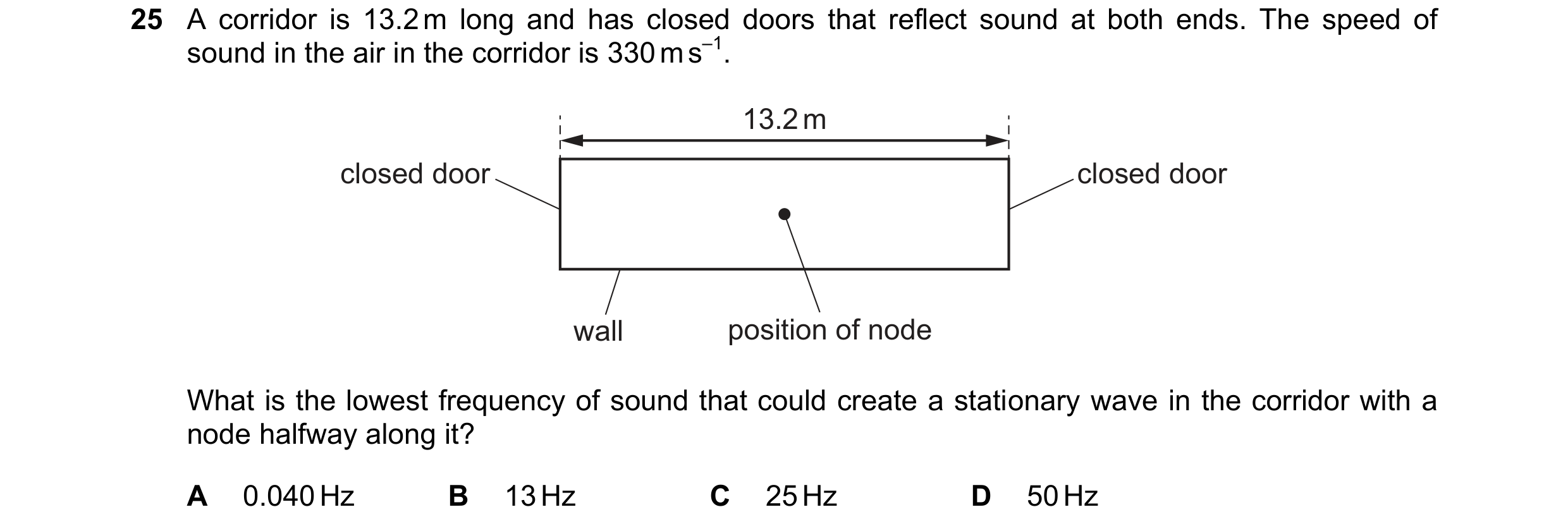
Q101 · A corridor is 13.2 m long and has closed doors that reflect sound at both ends 9702/12 Feb/March 2022
25 A corridor is 13.2 m long and has closed doors that reflect sound at both ends. The speed of sound in the air in the corridor is 330 m s–1. 13.2 m closed door closed door wall position of node What is the lowest frequency of sound that could create a stationary wave in the corridor with a node halfway along it? A 0.040 Hz B 13 Hz C 25 Hz D 50 Hz
1 marks
Answer: C
This question in 9702/12 Feb/March 2022
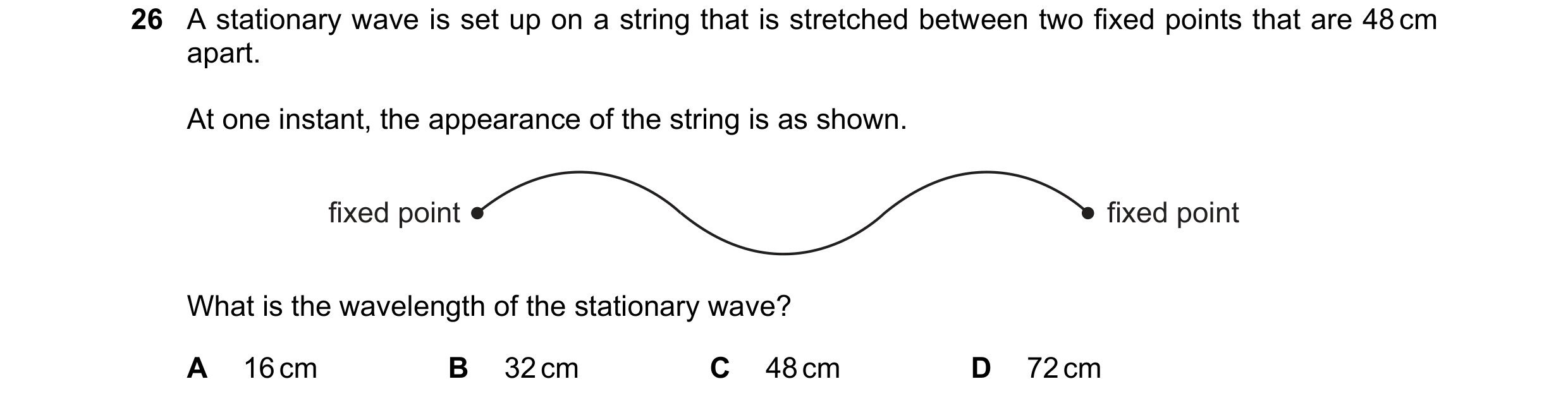
Q102 · A stationary wave is set up on a string that is stretched between two fixed points that… 9702/11 May/June 2022
26 A stationary wave is set up on a string that is stretched between two fixed points that are 48 cm apart. At one instant, the appearance of the string is as shown. fixed point fixed point What is the wavelength of the stationary wave? A 16 cm B 32 cm C 48 cm D 72 cm
1 marks
Answer: B
This question in 9702/11 May/June 2022
Q103 · A pipe, closed at one end, has a loudspeaker at the open end 9702/11 May/June 2022
27 A pipe, closed at one end, has a loudspeaker at the open end. For some frequencies of sound from the loudspeaker, a stationary sound wave is formed in the air within the pipe with an antinode at the open end of the pipe. 0.85 m loudspeaker pipe The length of the pipe is 0.85 m. The speed of sound in air is 340 m s–1. Which frequency of sound from the loudspeaker would not produce a stationary wave? A 100 Hz B 200 Hz C 300 Hz D 500 Hz
1 marks
Answer: B
This question in 9702/11 May/June 2022
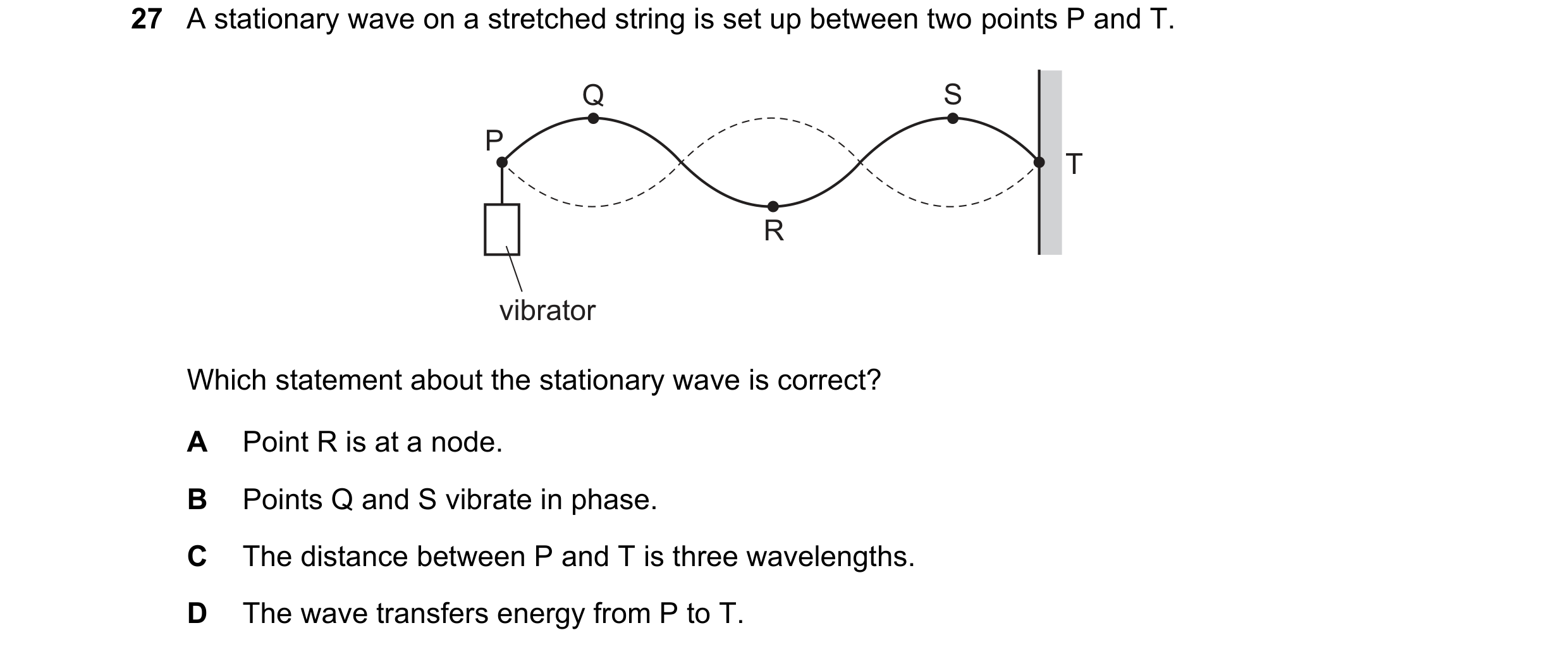
Q104 · A stationary wave on a stretched string is set up between two points P and T 9702/12 May/June 2022
27 A stationary wave on a stretched string is set up between two points P and T. Q S P T R vibrator Which statement about the stationary wave is correct? A Point R is at a node. B Points Q and S vibrate in phase. C The distance between P and T is three wavelengths. D The wave transfers energy from P to T.
1 marks
Answer: B
This question in 9702/12 May/June 2022
Q105 · A stationary sound wave is formed in a tube of length L that is closed at one end 9702/11 Oct/Nov 2022
27 A stationary sound wave is formed in a tube of length L that is closed at one end. The diagram shows the positions of the nodes and antinodes of the stationary wave. node node antinode antinode Which graph shows the variation of the amplitude a of the wave with distance x measured from the closed end of the tube? A B a a 0 x 0 x 0 L 0 L C D a a 0 x 0 x 0 L 0 L
1 marks
Answer: A
This question in 9702/11 Oct/Nov 2022
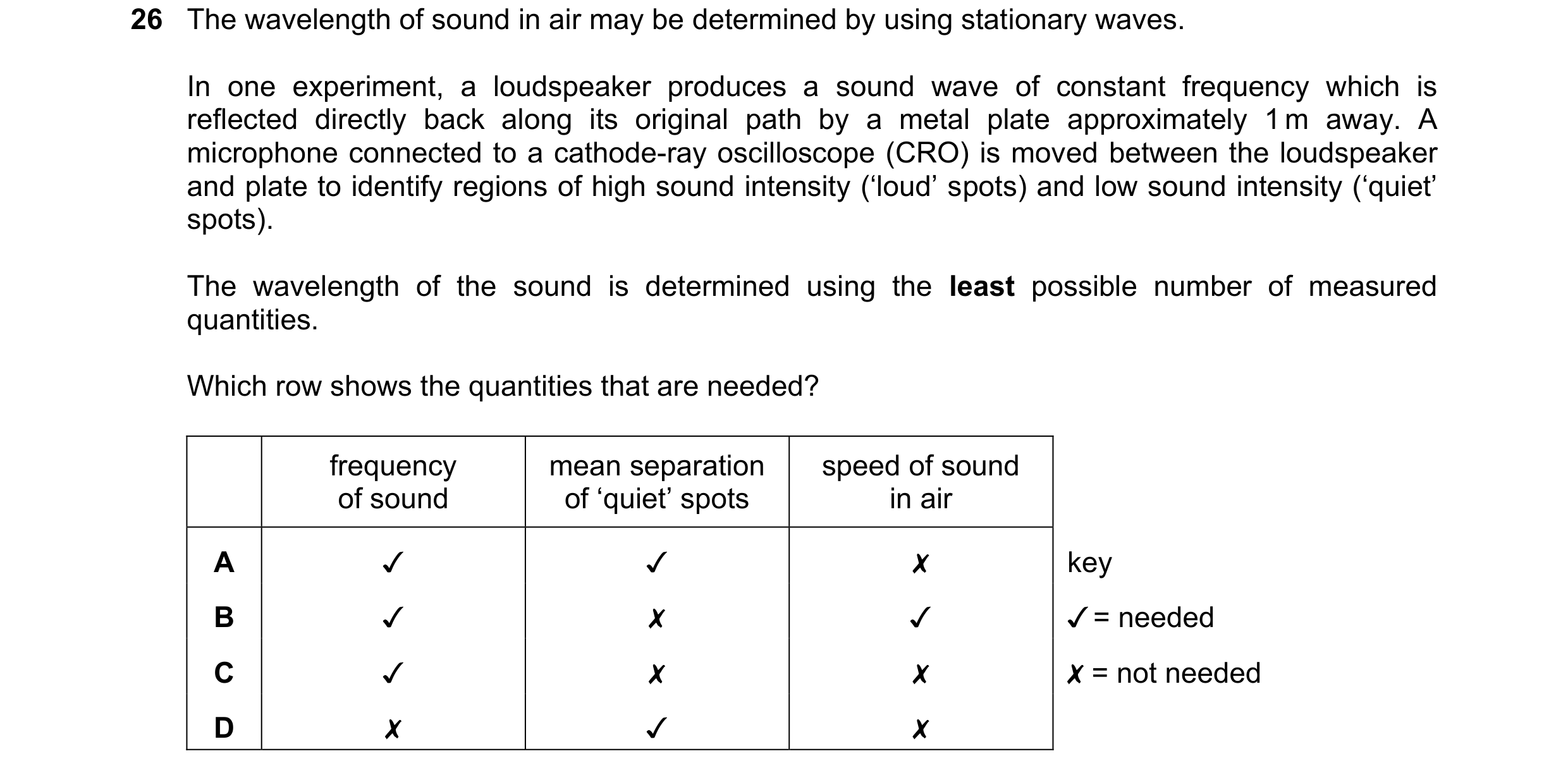
Q106 · The wavelength of sound in air may be determined by using stationary waves 9702/12 Oct/Nov 2022
26 The wavelength of sound in air may be determined by using stationary waves.
In one experiment, a loudspeaker produces a sound wave of constant frequency which is
reflected directly back along its original path by a metal plate approximately 1m away. A
microphone connected to a cathode-ray oscilloscope (CRO) is moved between the loudspeaker
and plate to identify regions of high sound intensity (‘loud’ spots) and low sound intensity (‘quiet’
spots).
The wavelength of the sound is determined using the least possible number of measured
quantities.
Which row shows the quantities that are needed?
frequency mean separation speed of sound
of sound of ‘quiet’ spots in air
A v v x key
B v x v / = needed
Cc v x x X = not needed
D x Jv x
1 marks
Answer: D
This question in 9702/12 Oct/Nov 2022
Q107 · Two progressive waves overlap 9702/13 Oct/Nov 2022
25 Two progressive waves overlap. What is an essential condition for the two waves to form a stationary wave? A The waves are longitudinal. B The waves are polarised. C The waves travel in opposite directions. D The waves travel in the same direction.
1 marks
Answer: C
This question in 9702/13 Oct/Nov 2022
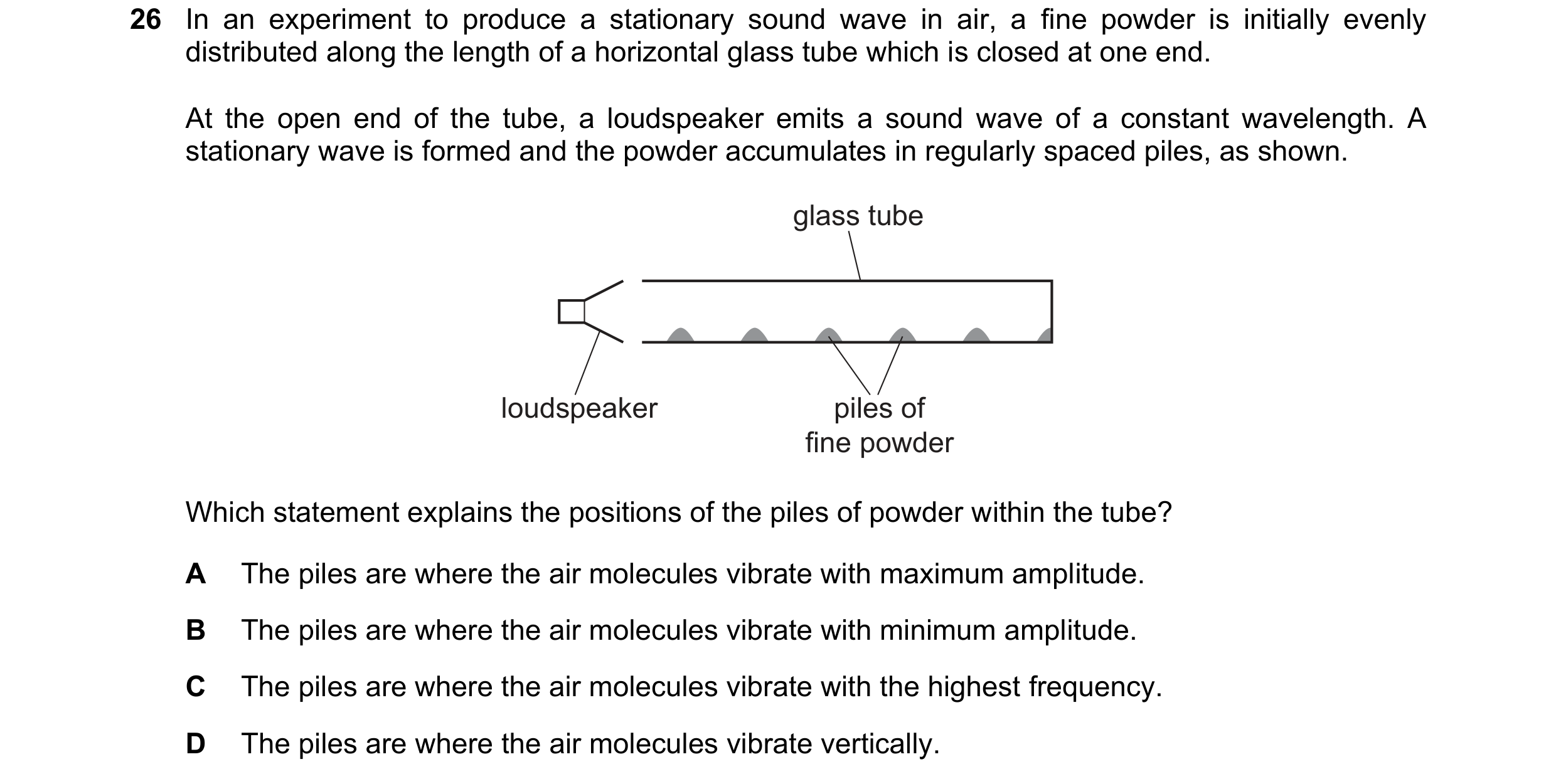
Q108 · In an experiment to produce a stationary sound wave in air, a fine powder is initially… 9702/13 Oct/Nov 2022
26 In an experiment to produce a stationary sound wave in air, a fine powder is initially evenly distributed along the length of a horizontal glass tube which is closed at one end. At the open end of the tube, a loudspeaker emits a sound wave of a constant wavelength. A stationary wave is formed and the powder accumulates in regularly spaced piles, as shown. glass tube loudspeaker piles of fine powder Which statement explains the positions of the piles of powder within the tube? A The piles are where the air molecules vibrate with maximum amplitude. B The piles are where the air molecules vibrate with minimum amplitude. C The piles are where the air molecules vibrate with the highest frequency. D The piles are where the air molecules vibrate vertically.
1 marks
Answer: B
This question in 9702/13 Oct/Nov 2022
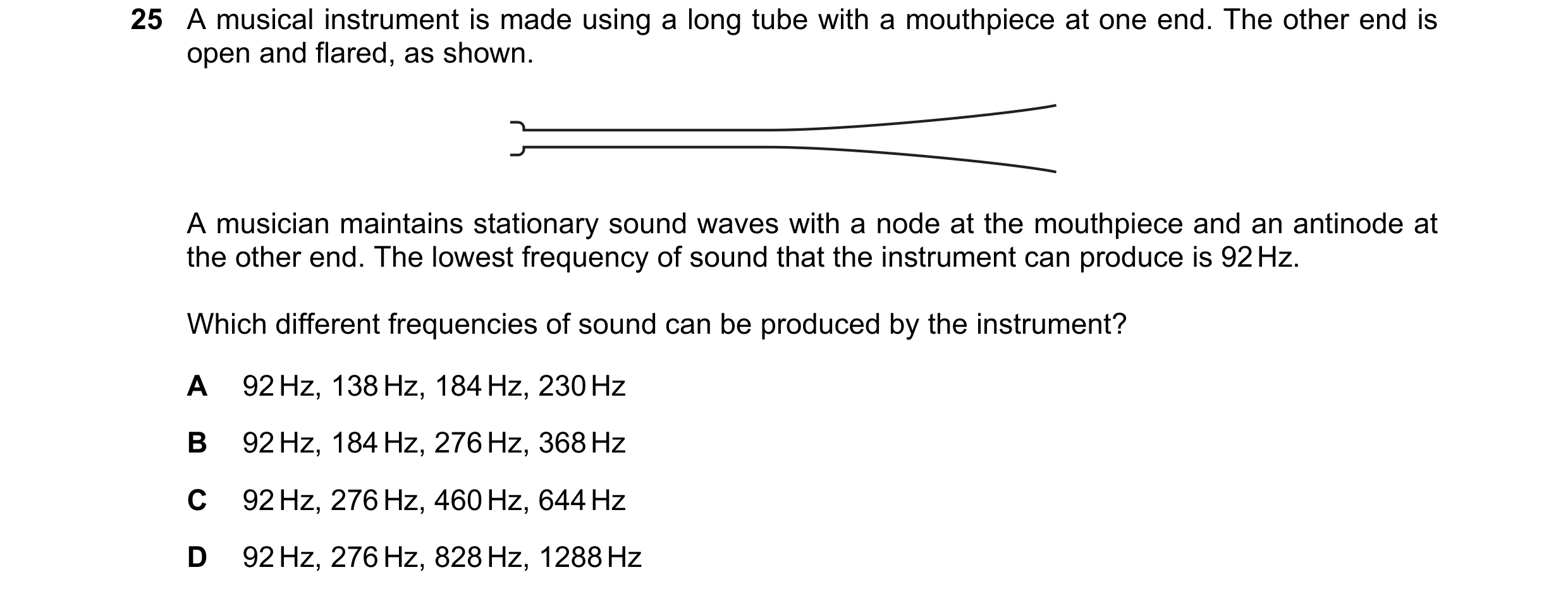
Q109 · A musical instrument is made using a long tube with a mouthpiece at one end 9702/12 Feb/March 2023
25 A musical instrument is made using a long tube with a mouthpiece at one end. The other end is open and flared, as shown. A musician maintains stationary sound waves with a node at the mouthpiece and an antinode at the other end. The lowest frequency of sound that the instrument can produce is 92 Hz. Which different frequencies of sound can be produced by the instrument? A 92 Hz, 138 Hz, 184 Hz, 230 Hz B 92 Hz, 184 Hz, 276 Hz, 368 Hz C 92 Hz, 276 Hz, 460 Hz, 644 Hz D 92 Hz, 276 Hz, 828 Hz, 1288 Hz
1 marks
Answer: C
This question in 9702/12 Feb/March 2023
Q110 · Two waves of equal frequency and amplitude are travelling in opposite directions along a… 9702/12 Feb/March 2023
26 Two waves of equal frequency and amplitude are travelling in opposite directions along a stretched string. When they meet, they form a stationary wave with three nodes and two antinodes. The frequency of both waves is doubled and a new stationary wave is formed. How many antinodes are there in the new stationary wave? A 1 B 2 C 3 D 4
1 marks
Answer: D
This question in 9702/12 Feb/March 2023
Q111 · A string is stretched between a vibration generator and a fixed point 9702/11 May/June 2023
26 A string is stretched between a vibration generator and a fixed point. When the vibration generator is vibrating at a frequency f, a stationary wave with five nodes is created on the stretched string, as shown. There is a node at the end of the string that is attached to the vibration generator. fixed point vibration generator The frequency of vibration of the vibration generator is slowly increased. What is the next frequency that produces a stationary wave on the string? A 1.25f B 1.50f C 1.75f D 2.00f
1 marks
Answer: A
This question in 9702/11 May/June 2023
Q112 · A stationary wave is formed by two progressive waves travelling in opposite directions… 9702/12 May/June 2023
25 A stationary wave is formed by two progressive waves travelling in opposite directions along the same line of travel. Which statement about the two progressive waves is not correct? A They must have a constant phase difference. B They must have the same frequency. C They must have the same wavelength. D They must travel at the same speed.
1 marks
Answer: A
This question in 9702/12 May/June 2023
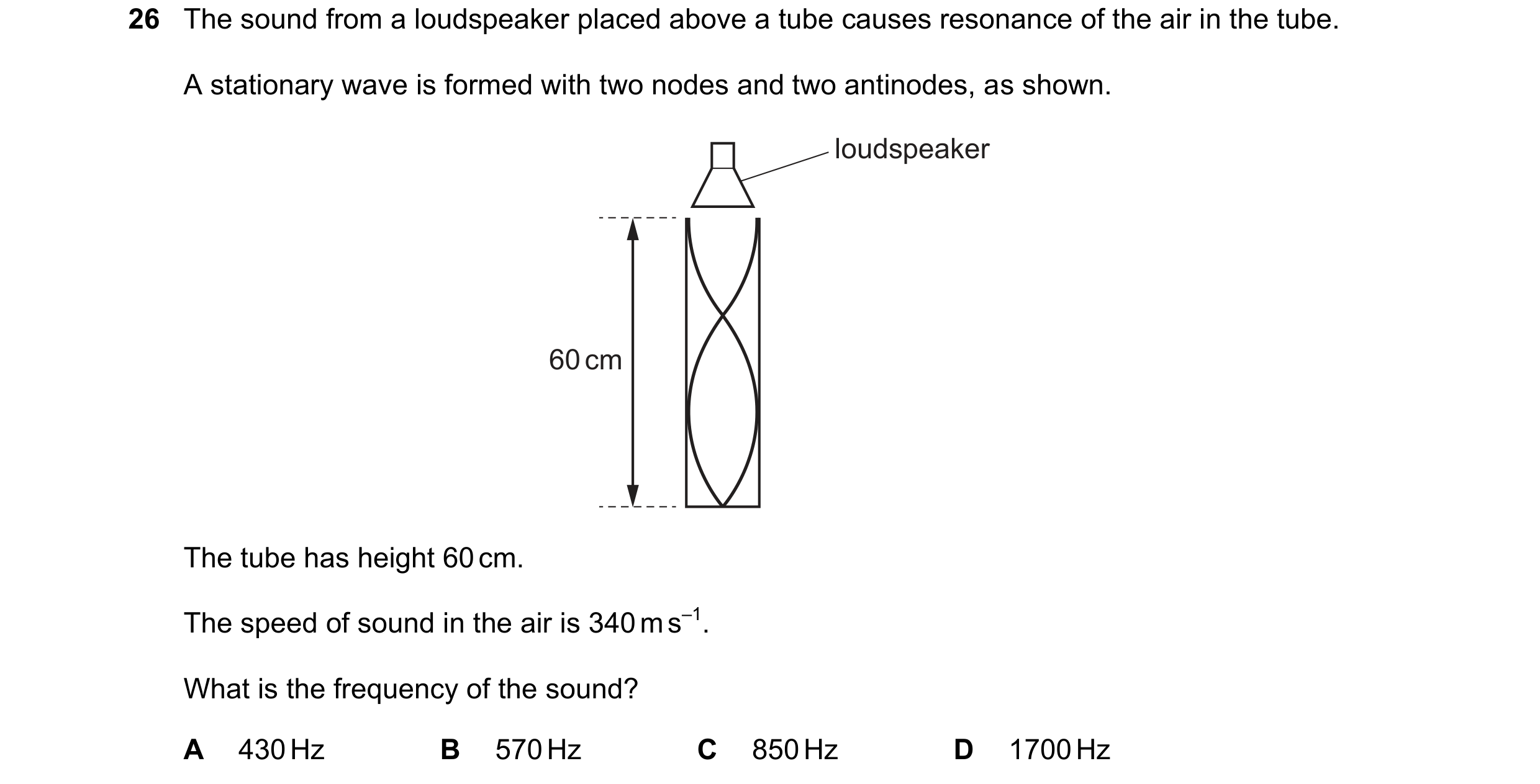
Q113 · The sound from a loudspeaker placed above a tube causes resonance of the air in the tube 9702/12 May/June 2023
26 The sound from a loudspeaker placed above a tube causes resonance of the air in the tube. A stationary wave is formed with two nodes and two antinodes, as shown. loudspeaker 60 cm The tube has height 60 cm. The speed of sound in the air is 340 m s–1. What is the frequency of the sound? A 430 Hz B 570 Hz C 850 Hz D 1700 Hz
1 marks
Answer: A
This question in 9702/12 May/June 2023
Q114 · The diagram shows a string stretched between fixed points X and Y 9702/13 May/June 2023
25 The diagram shows a string stretched between fixed points X and Y. There is a stationary wave on the string. S Q R X Y P T The solid curve shows the string at a position of maximum displacement at time t0. The dashed curve shows the other position of maximum displacement. The straight central dashed line shows the mean position of the string. Point S on the string is directly above point P. Point T on the string is directly below point Q. Which statement is correct? A A short time after t0, point R on the string will be displaced. B A short time after t0, points S and T on the string move in opposite directions. C The distance between P and Q is one wavelength. D Two moving points on the string that are equal distances from point R vibrate in phase.
1 marks
Answer: B
This question in 9702/13 May/June 2023
Q115 · The variation with distance x of the intensity I along a stationary sound wave in air is… 9702/13 May/June 2023
26 The variation with distance x of the intensity I along a stationary sound wave in air is shown. I 0 0 5.0 10.0 15.0 x / cm The speed of sound in air is 340 m s–1. What is the frequency of the sound wave? A 1700 Hz B 2300 Hz C 3400 Hz D 6800 Hz
1 marks
Answer: A
This question in 9702/13 May/June 2023
Q116 · What can explain how stationary waves are formed from progressive waves? 9702/12 Oct/Nov 2023
25 What can explain how stationary waves are formed from progressive waves? A diffraction B polarisation C superposition D the Doppler effect
1 marks
Answer: C
This question in 9702/12 Oct/Nov 2023
Q117 · A pipe has a length of 2.0 m 9702/12 Oct/Nov 2023
26 A pipe has a length of 2.0 m. It is open at one end and closed at the other end. A stationary sound wave is set up within the pipe. There are four nodes (N) and four antinodes (A) within the length of the pipe. N A N A N A N A 2.0 m What is the wavelength of the sound wave? A 0.57 m B 1.1 m C 1.3 m D 1.6 m
1 marks
Answer: B
This question in 9702/12 Oct/Nov 2023
Q118 · Which statement concerning a stationary wave is correct? 9702/13 Oct/Nov 2023
25 Which statement concerning a stationary wave is correct? A All the particles between two adjacent nodes oscillate in phase. B The amplitude of the stationary wave is equal to the amplitude of one of the waves creating it. C The wavelength of the stationary wave is equal to the separation of two adjacent nodes. D There is no displacement of a particle at an antinode at any time.
1 marks
Answer: A
This question in 9702/13 Oct/Nov 2023
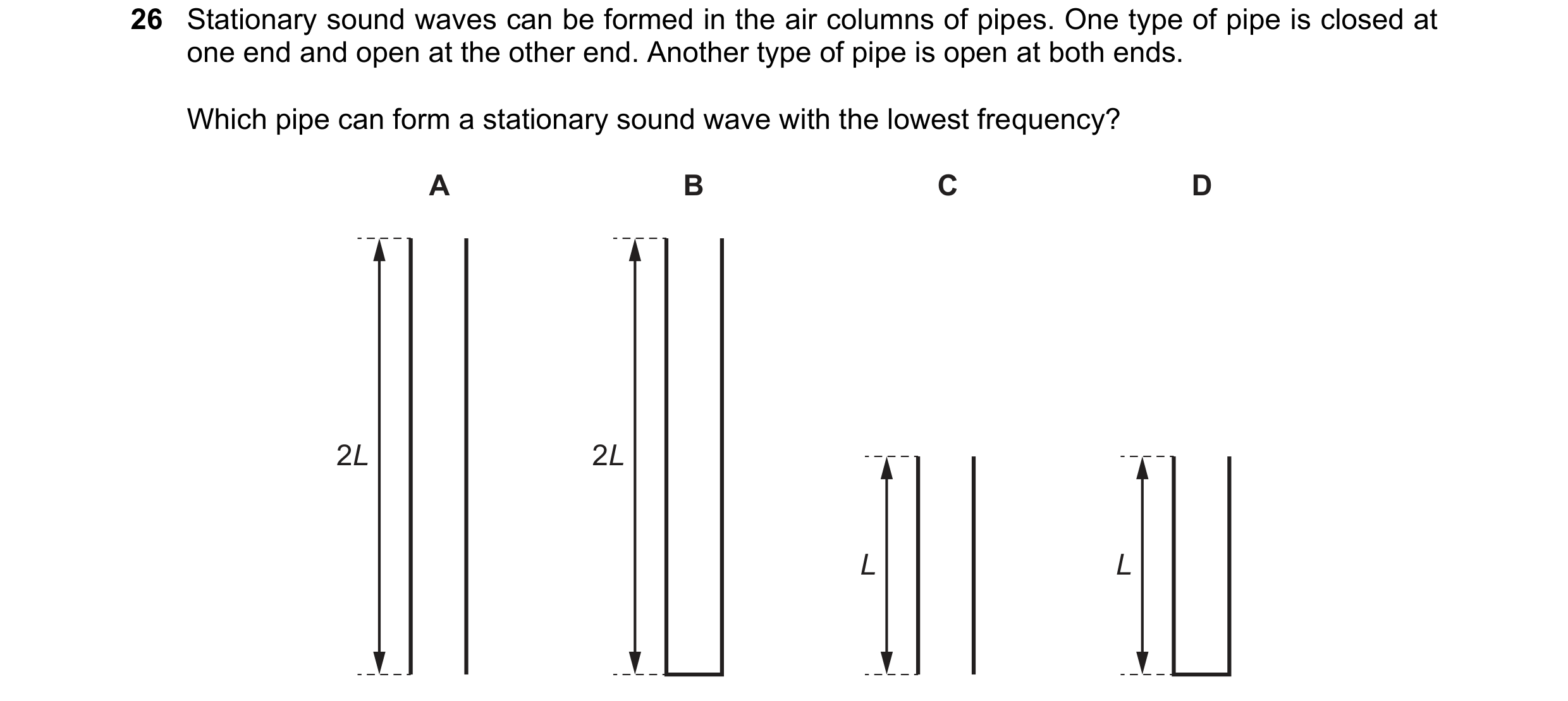
Q119 · Stationary sound waves can be formed in the air columns of pipes 9702/13 Oct/Nov 2023
26 Stationary sound waves can be formed in the air columns of pipes. One type of pipe is closed at one end and open at the other end. Another type of pipe is open at both ends. Which pipe can form a stationary sound wave with the lowest frequency? A B C D 2L 2L L L
1 marks
Answer: B
This question in 9702/13 Oct/Nov 2023
Q120 · Two loudspeakers are connected to the same signal generator 9702/12 Feb/March 2024
29 Two loudspeakers are connected to the same signal generator. The signal generator produces a single frequency. The loudspeakers face each other so that a stationary sound wave is set up in the region between the loudspeakers. loudspeaker microphone to CRO A microphone is connected to a cathode-ray oscilloscope (CRO) and positioned between the two loudspeakers. The microphone is moved along a line joining the two loudspeakers. The signal on the CRO shows 5 maximum amplitudes as the microphone moves. The microphone moves a distance of 2.0 m from the position that gives the first maximum to the position that gives the fifth maximum. What is the wavelength of the sound wave? A 0.40 m B 0.50 m C 0.80 m D 1.0 m
1 marks
Answer: D
This question in 9702/12 Feb/March 2024
Q121 · A stationary sound wave is set up between a loudspeaker and a wall 9702/12 May/June 2024
23 A stationary sound wave is set up between a loudspeaker and a wall. A microphone is connected to a cathode-ray oscilloscope (CRO) and is moved along a line directly between the loudspeaker and the wall. The amplitude of the trace on the CRO rises to a maximum at a position X, falls to a minimum and then rises once again to a maximum at a position Y. The distance between X and Y is 33 cm. The speed of sound in air is 330 m s–1. Which diagram could represent the CRO trace of the sound received at X? A B time base 0.50 ms / cm 1 cm time base 0.50 ms / cm 1 cm C D time base 0.50 ms / cm 1 cm time base 0.50 ms / cm 1 cm
1 marks
Answer: B
This question in 9702/12 May/June 2024
Q122 · A stationary sound wave is formed in the air column inside a tube that is open at both… 9702/12 May/June 2024
27 A stationary sound wave is formed in the air column inside a tube that is open at both ends. The stationary wave has three nodes. How many antinodes does it have? A 1 B 2 C 3 D 4
1 marks
Answer: D
This question in 9702/12 May/June 2024
Q123 · A horizontal glass tube, closed at one end, has a layer of dust laid inside it on its… 9702/12 Oct/Nov 2024
31 A horizontal glass tube, closed at one end, has a layer of dust laid inside it on its lower side. Sound is emitted from a loudspeaker that is placed near the open end of the tube. The frequency of the sound is varied and, at one frequency, a stationary wave is formed inside the tube so that the dust forms small heaps. The distance between four heaps of dust is 30 cm. glass tube loudspeaker 30 cm The speed of sound in the air in the tube is 330 m s–1. What is the frequency of the sound emitted by the loudspeaker? A 1650 Hz B 2200 Hz C 3300 Hz D 6600 Hz
1 marks
Answer: A
This question in 9702/12 Oct/Nov 2024
Q124 · A stationary wave is set up in a stretched string 9702/13 Oct/Nov 2024
28 A stationary wave is set up in a stretched string. Which distance is equal to the wavelength of the wave? A double the distance between adjacent antinodes B half the distance between adjacent nodes C the distance between adjacent antinodes D the distance between a node and an adjacent antinode
1 marks
Answer: A
This question in 9702/13 Oct/Nov 2024
Q125 · A hollow tube is closed at one end and open at the other 9702/11 May/June 2025
31 A hollow tube is closed at one end and open at the other. A stationary sound wave of the lowest possible frequency, 820 Hz, is produced in the tube. The speed of sound in air is 330 m s–1. What is the length of the tube? A 10 cm B 20 cm C 40 cm D 160 cm
1 marks
Answer: A
This question in 9702/11 May/June 2025
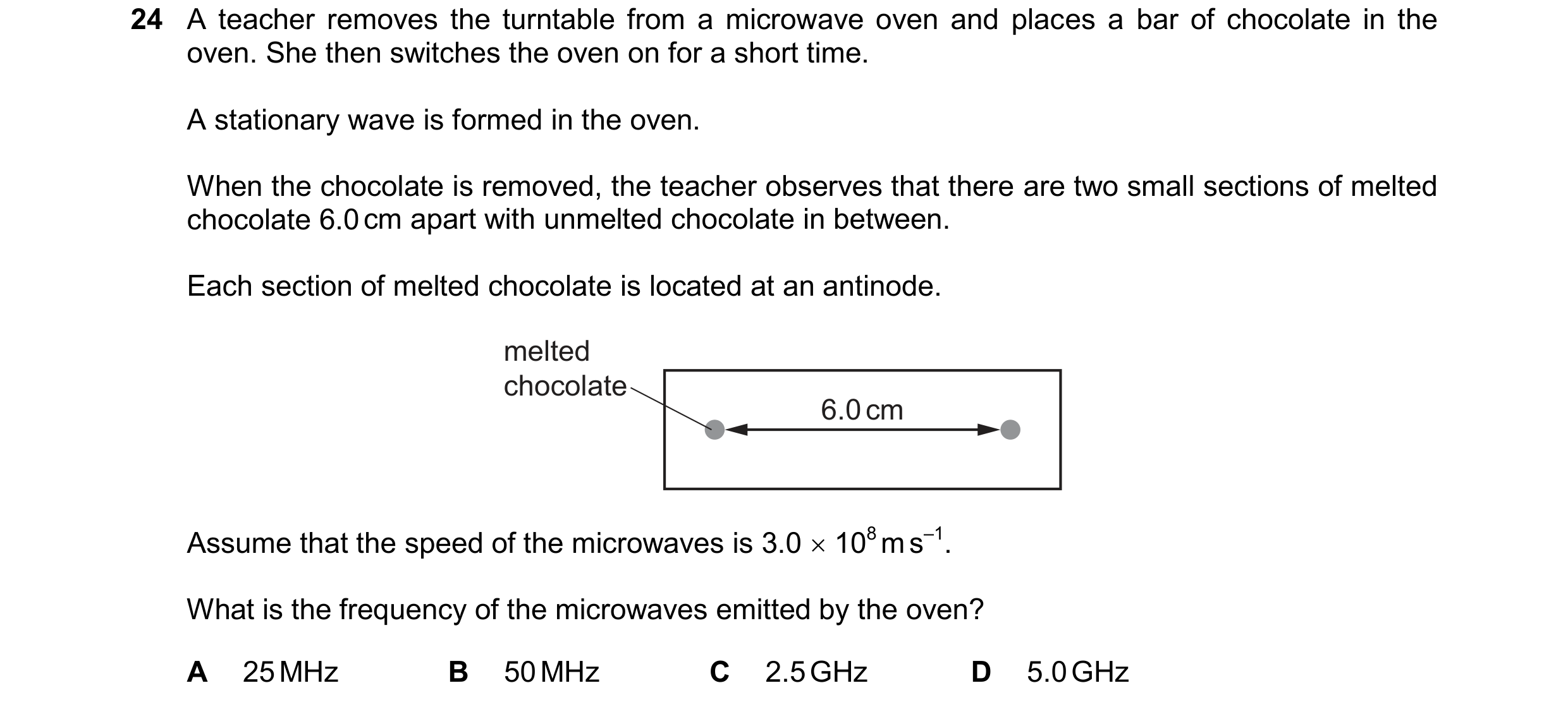
Q126 · A teacher removes the turntable from a microwave oven and places a bar of chocolate in… 9702/12 May/June 2025
24 A teacher removes the turntable from a microwave oven and places a bar of chocolate in the oven. She then switches the oven on for a short time. A stationary wave is formed in the oven. When the chocolate is removed, the teacher observes that there are two small sections of melted chocolate 6.0 cm apart with unmelted chocolate in between. Each section of melted chocolate is located at an antinode. melted chocolate 6.0 cm Assume that the speed of the microwaves is 3.0 108 m s–1. What is the frequency of the microwaves emitted by the oven? A 25 MHz B 50 MHz C 2.5 GHz D 5.0 GHz
1 marks
Answer: C
This question in 9702/12 May/June 2025
Question 127 9702/12 May/June 2025
30 Two waves meet. What is not a necessary condition for the waves to produce a stationary wave? A They must be of the same type. B They must have the same period. C They must have the same wavelength. D They must travel in the same direction.
1 marks
Answer: D
This question in 9702/12 May/June 2025
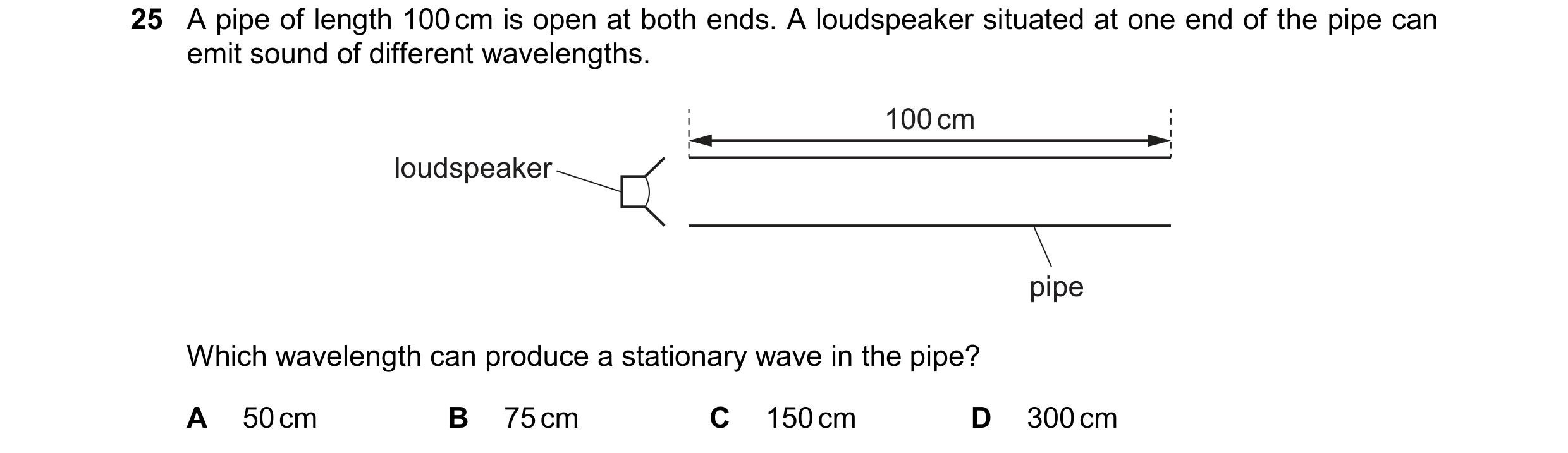
Q128 · A pipe of length 100 cm is open at both ends 9702/14 May/June 2025
25 A pipe of length 100 cm is open at both ends. A loudspeaker situated at one end of the pipe can emit sound of different wavelengths. 100 cm loudspeaker pipe Which wavelength can produce a stationary wave in the pipe? A 50 cm B 75 cm C 150 cm D 300 cm
1 marks
Answer: A
This question in 9702/14 May/June 2025
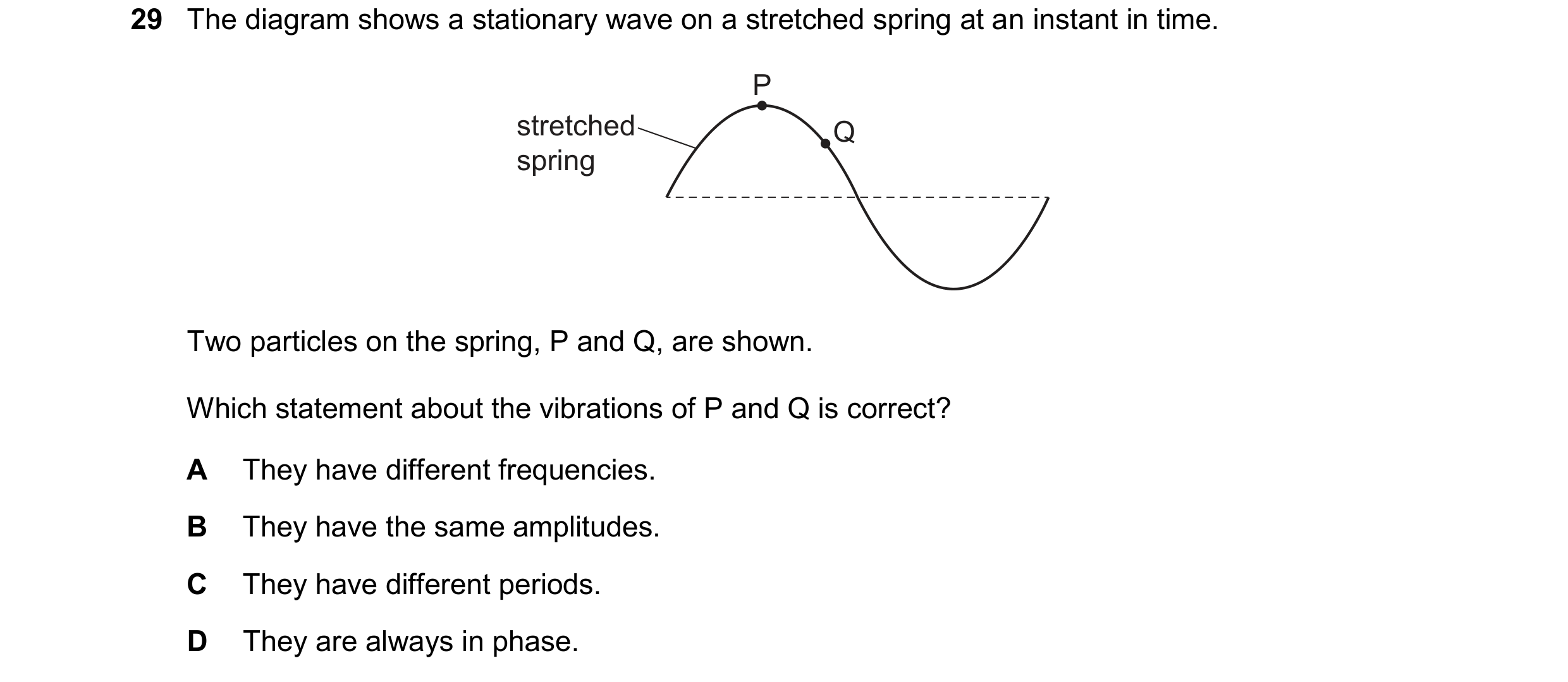
Q129 · The diagram shows a stationary wave on a stretched spring at an instant in time 9702/11 Oct/Nov 2025
29 The diagram shows a stationary wave on a stretched spring at an instant in time. P stretched Q spring Two particles on the spring, P and Q, are shown. Which statement about the vibrations of P and Q is correct? A They have different frequencies. B They have the same amplitudes. C They have different periods. D They are always in phase.
1 marks
Answer: D
This question in 9702/11 Oct/Nov 2025
Q130 · Two progressive sound waves move in opposite directions and superpose to form a… 9702/12 Oct/Nov 2025
30 Two progressive sound waves move in opposite directions and superpose to form a stationary wave. Which statement describes an antinode of this stationary wave? A a position where the phase difference between the two waves is always 0° B a position where the phase difference between the two waves is always 180° C a position where the stationary wave has maximum amplitude D a position where the stationary wave has minimum amplitude
1 marks
Answer: C
This question in 9702/12 Oct/Nov 2025
Q131 · The diagram shows a stationary wave on a stretched spring at an instant in time 9702/13 Oct/Nov 2025
29 The diagram shows a stationary wave on a stretched spring at an instant in time. P stretched Q spring Two particles on the spring, P and Q, are shown. Which statement about the vibrations of P and Q is correct? A They have different frequencies. B They have the same amplitudes. C They have different periods. D They are always in phase.
1 marks
Answer: D
This question in 9702/13 Oct/Nov 2025
Q132 · A wire is fixed at both ends and is vibrated by a source of frequency f 9702/14 Oct/Nov 2025
29 A wire is fixed at both ends and is vibrated by a source of frequency f. A stationary wave is formed on the wire with a total of two antinodes. The frequency of the source is increased to 3f and a new stationary wave is formed. What is the total number of antinodes on the new wave? A 4 B 5 C 6 D 9
1 marks
Answer: C
This question in 9702/14 Oct/Nov 2025
 1 / 45
 2 / 45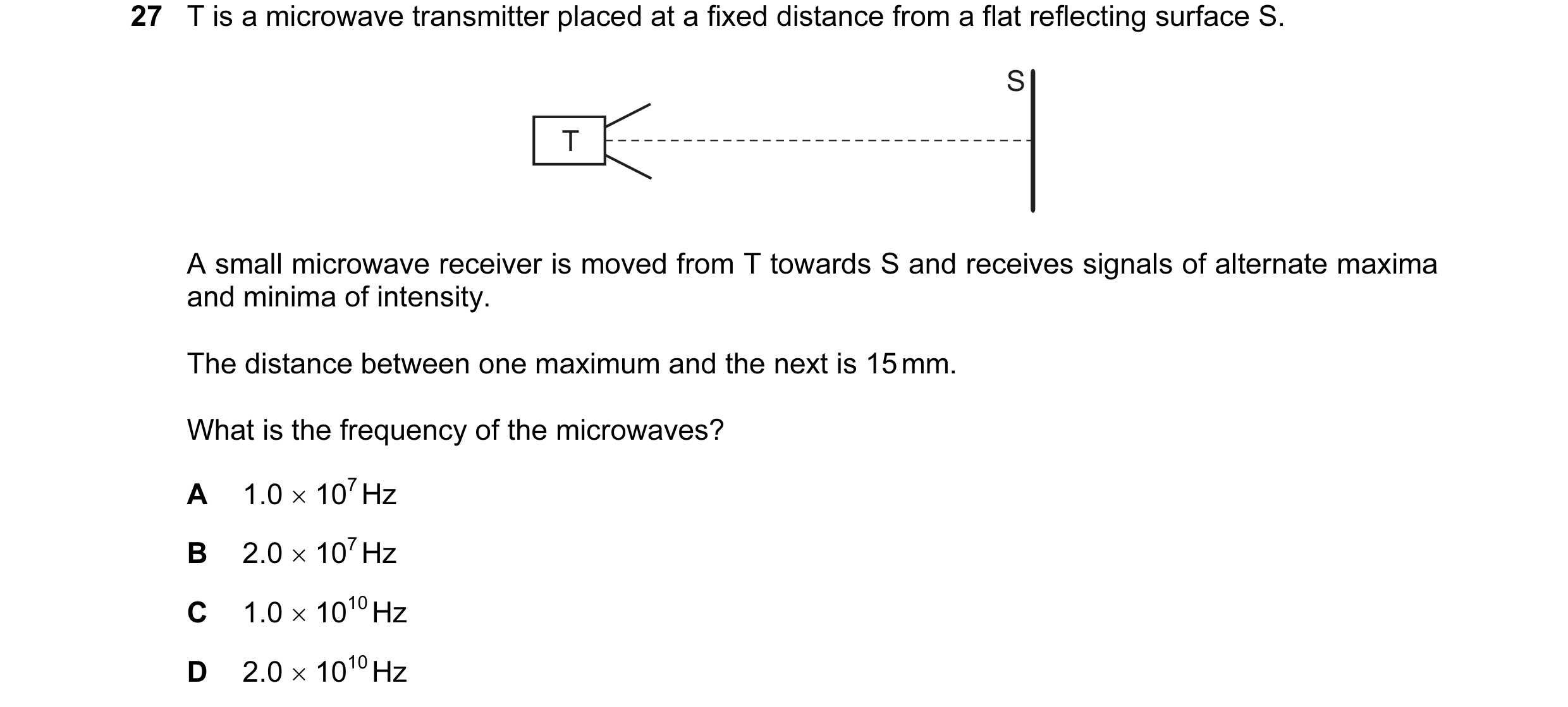
 3 / 45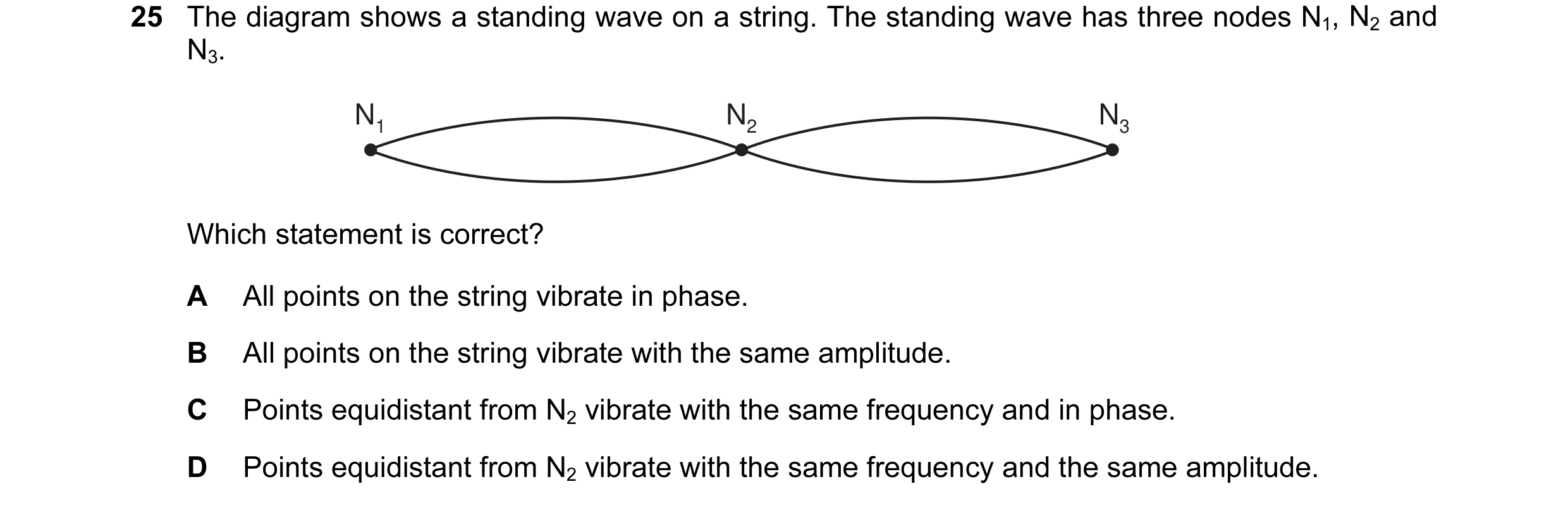
 4 / 45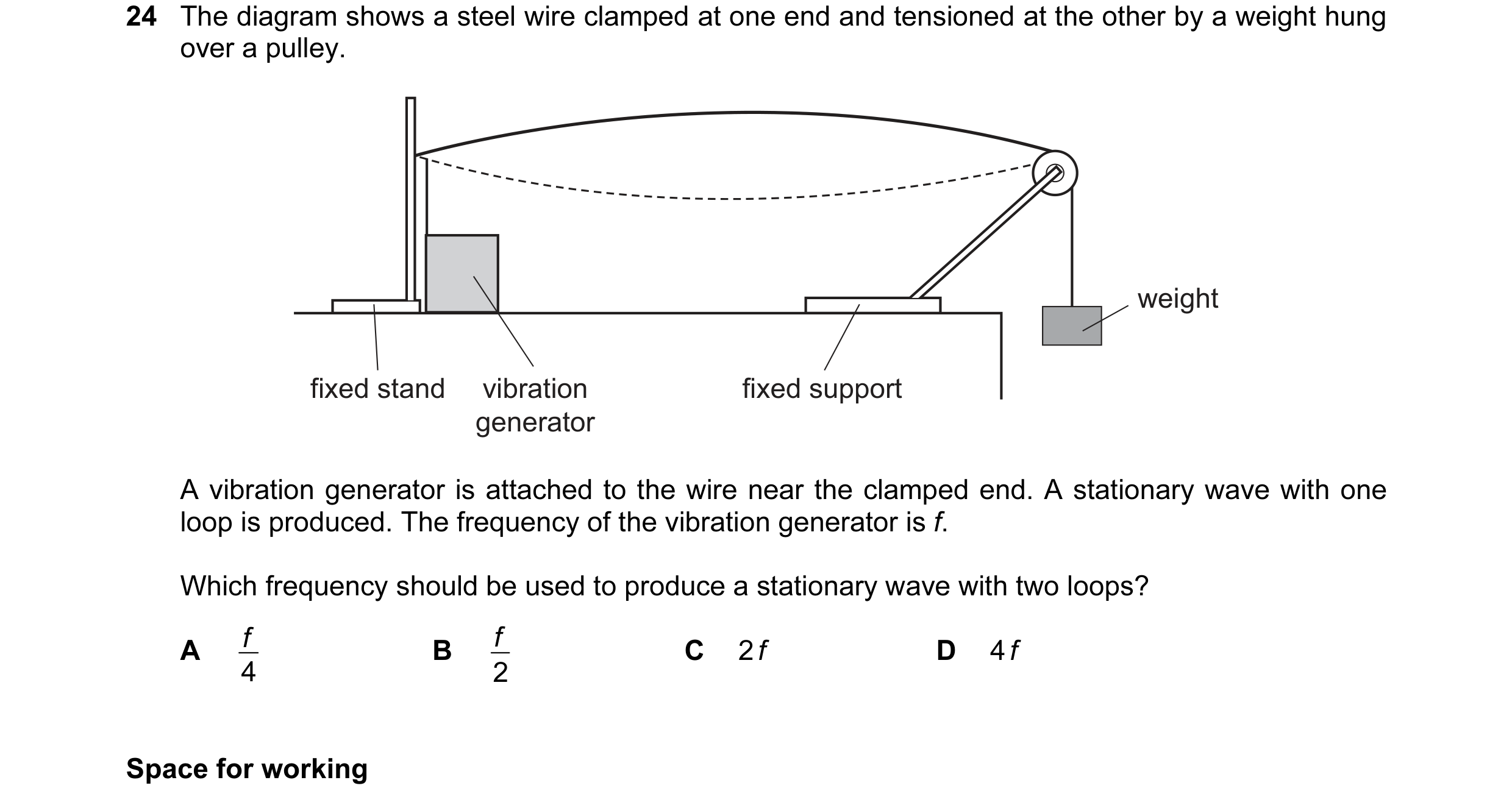
 5 / 45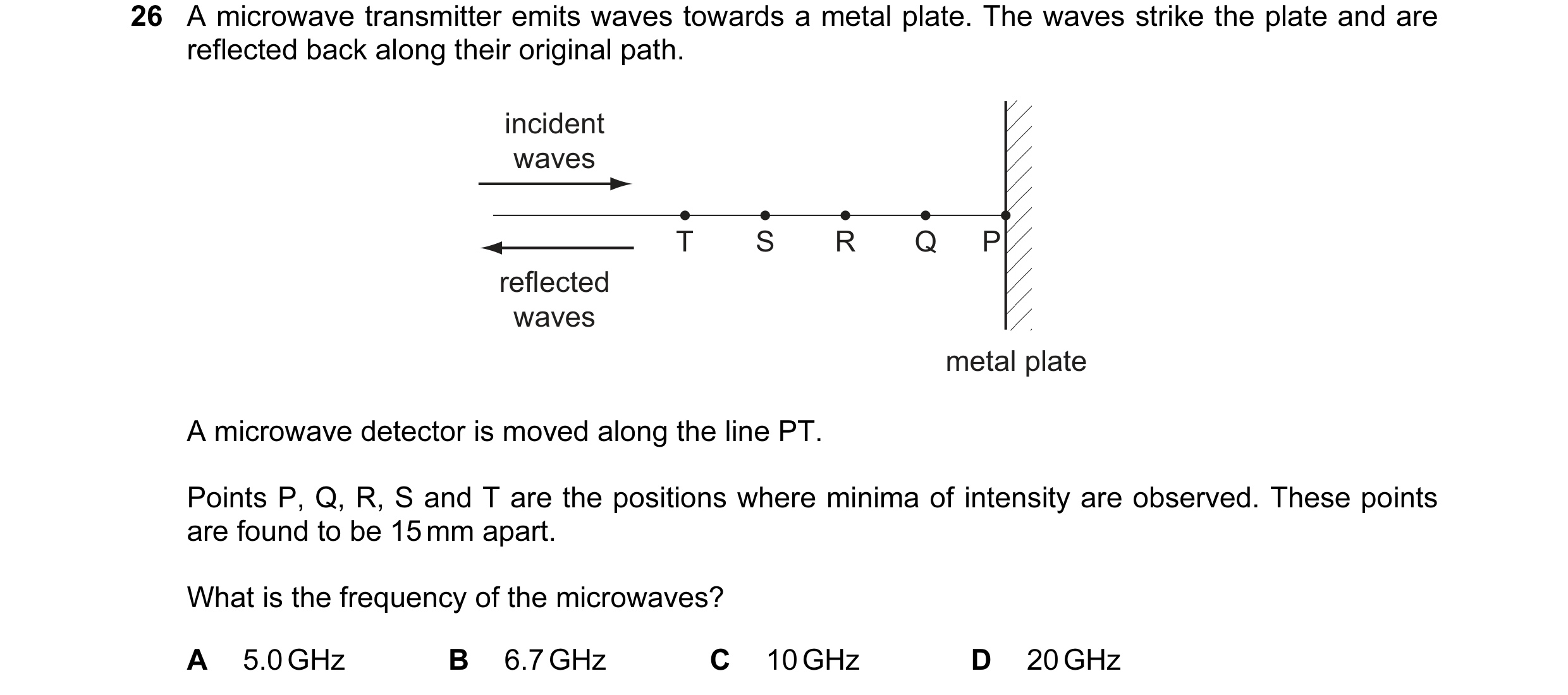
 6 / 45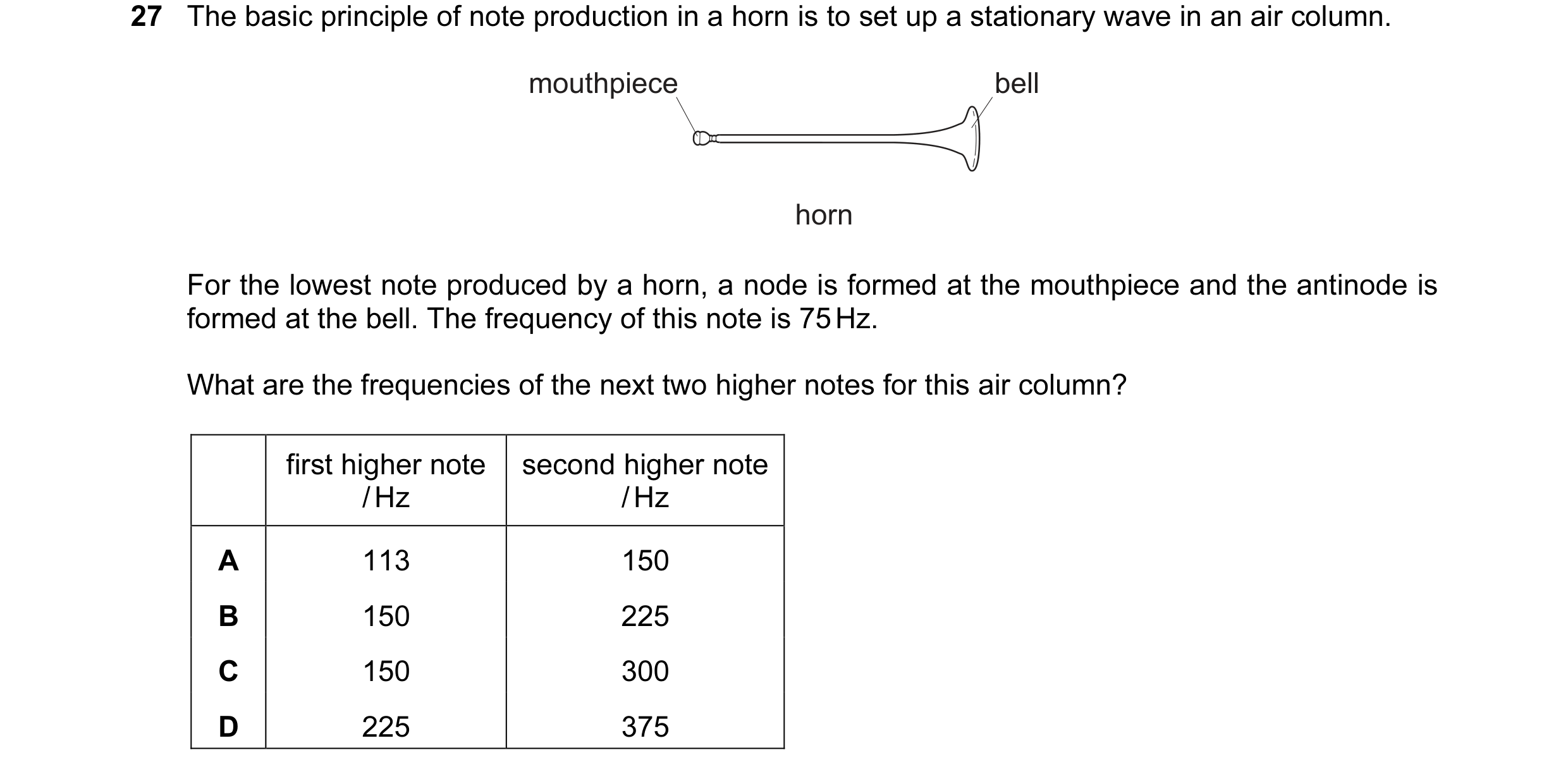
 7 / 45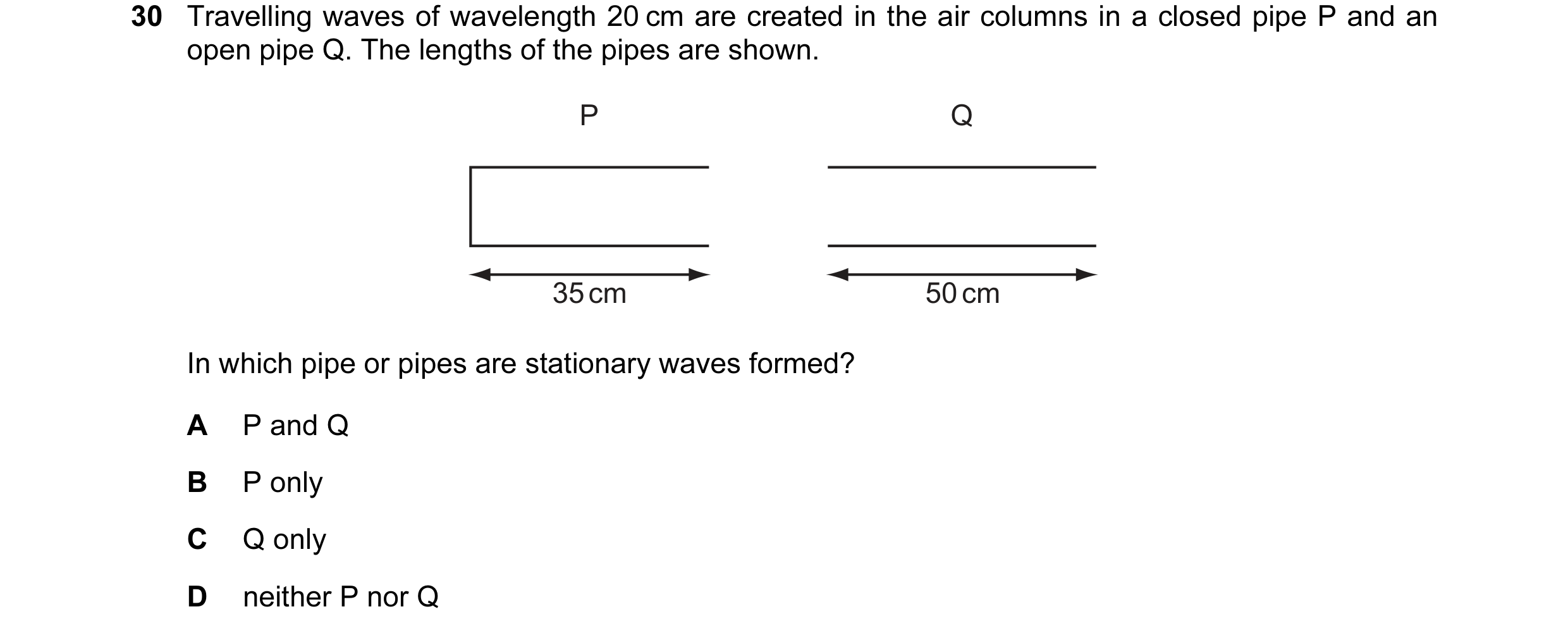
 8 / 45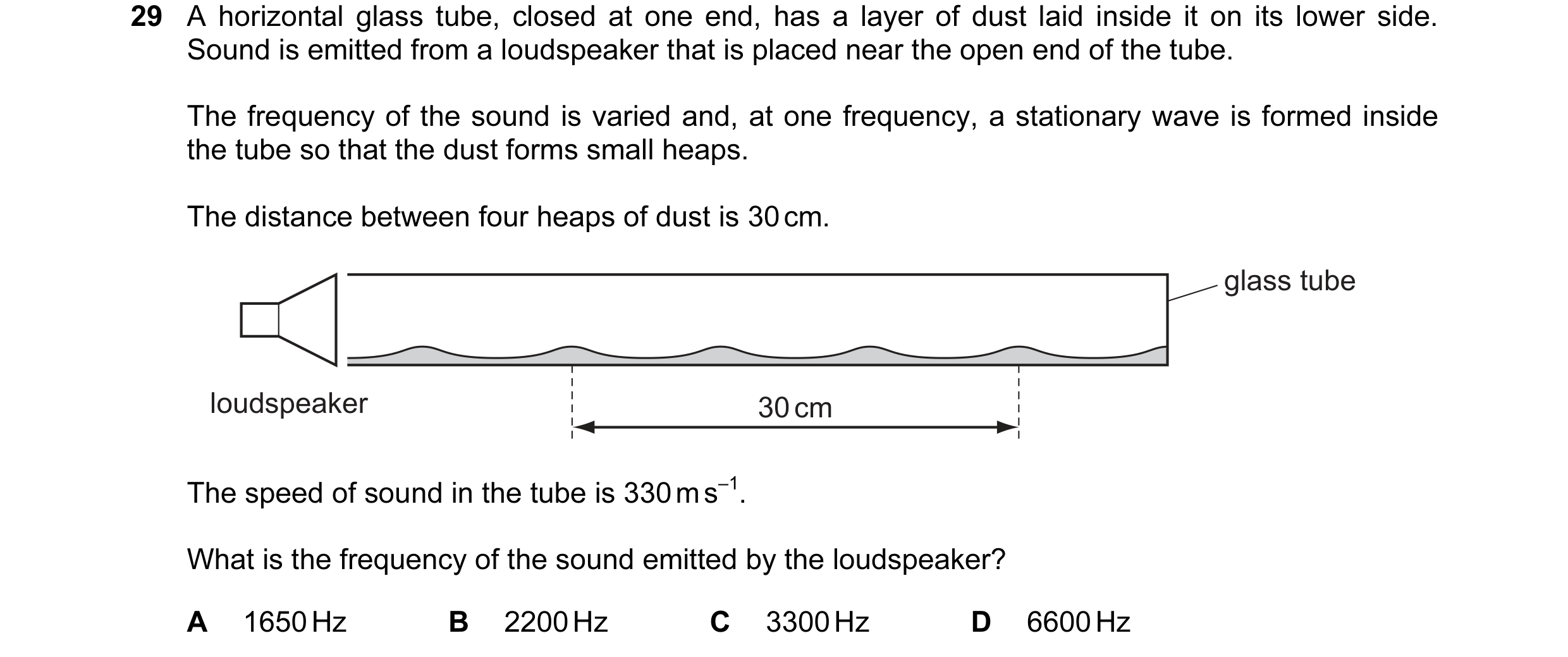
 9 / 45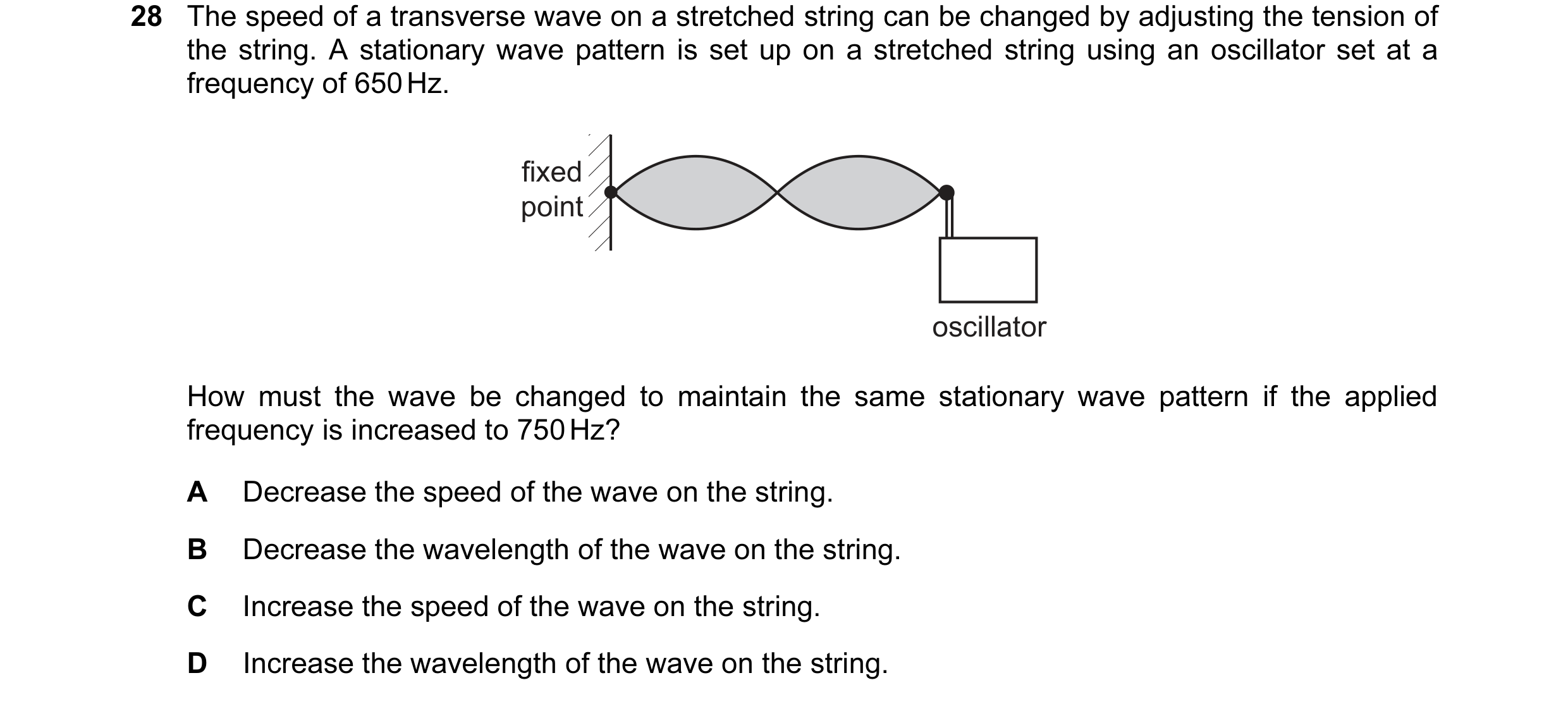
 10 / 45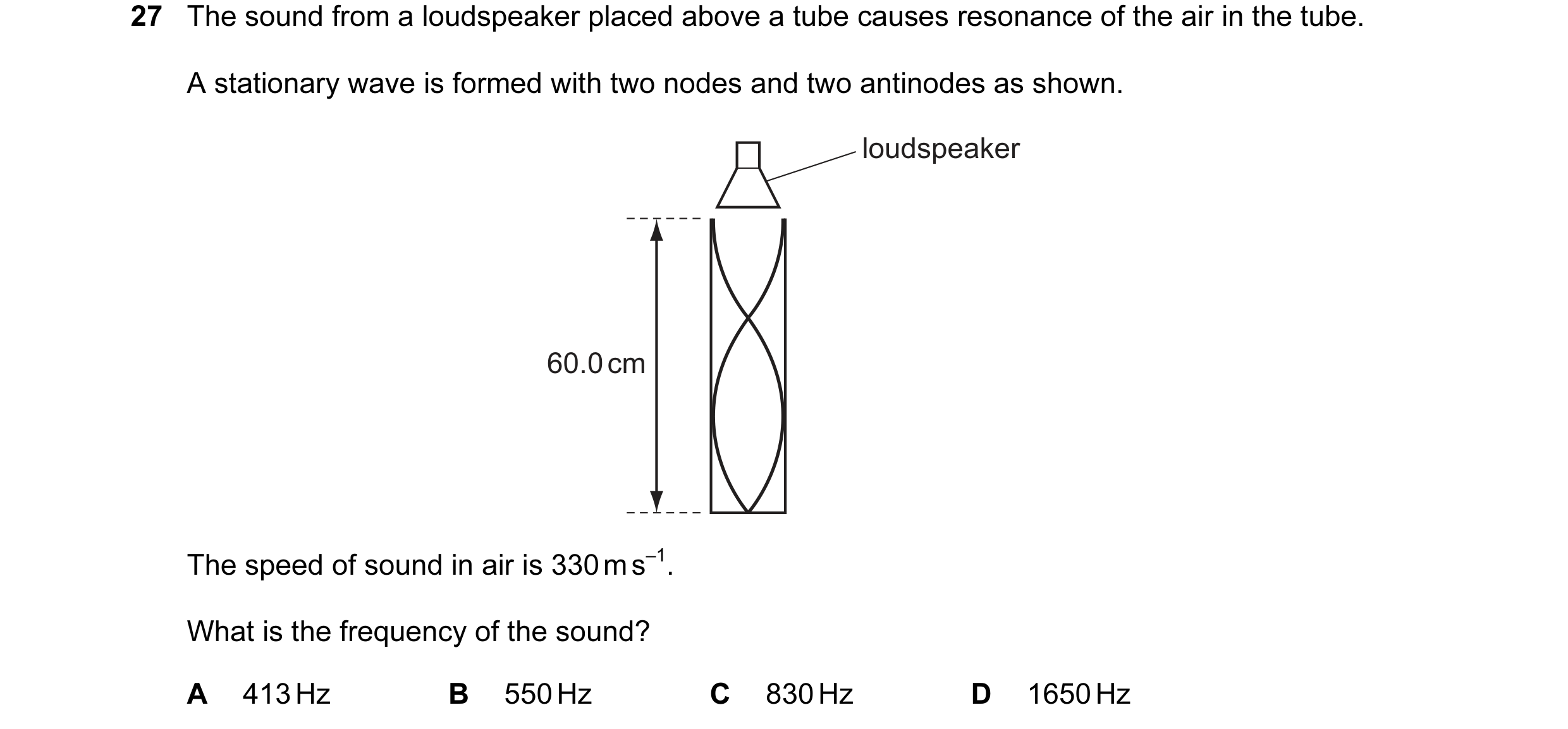
 11 / 45
 12 / 45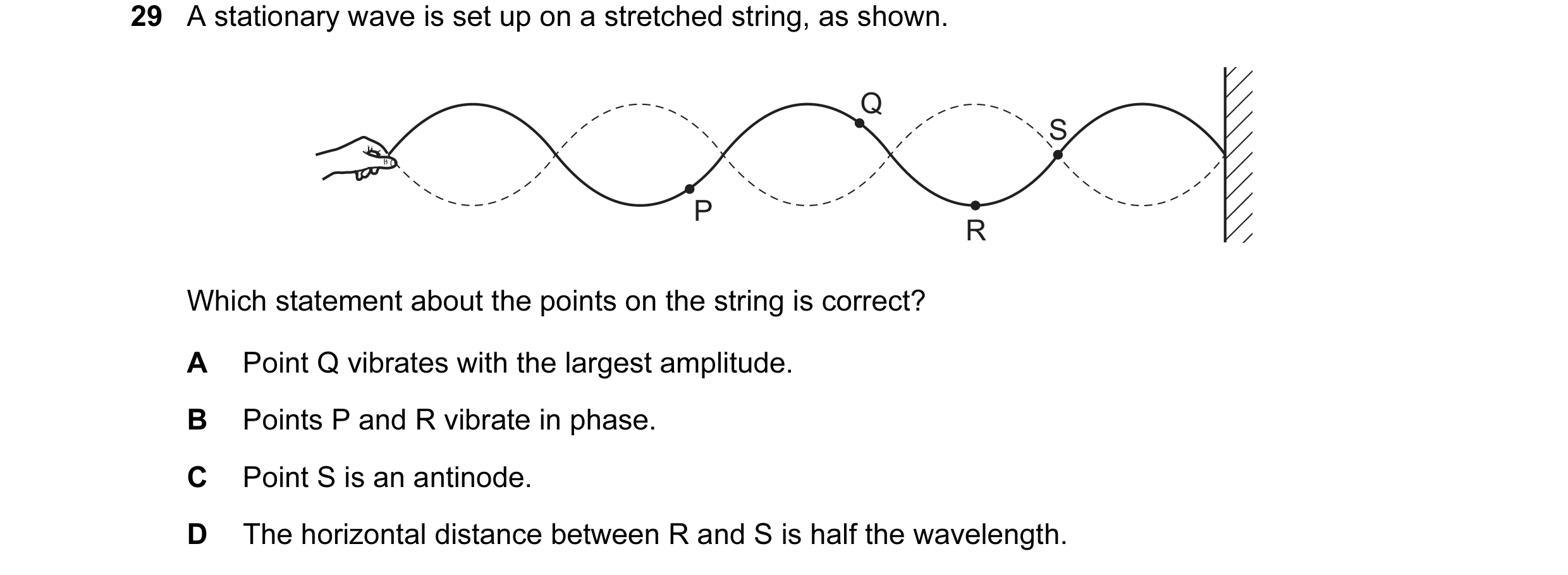
 13 / 45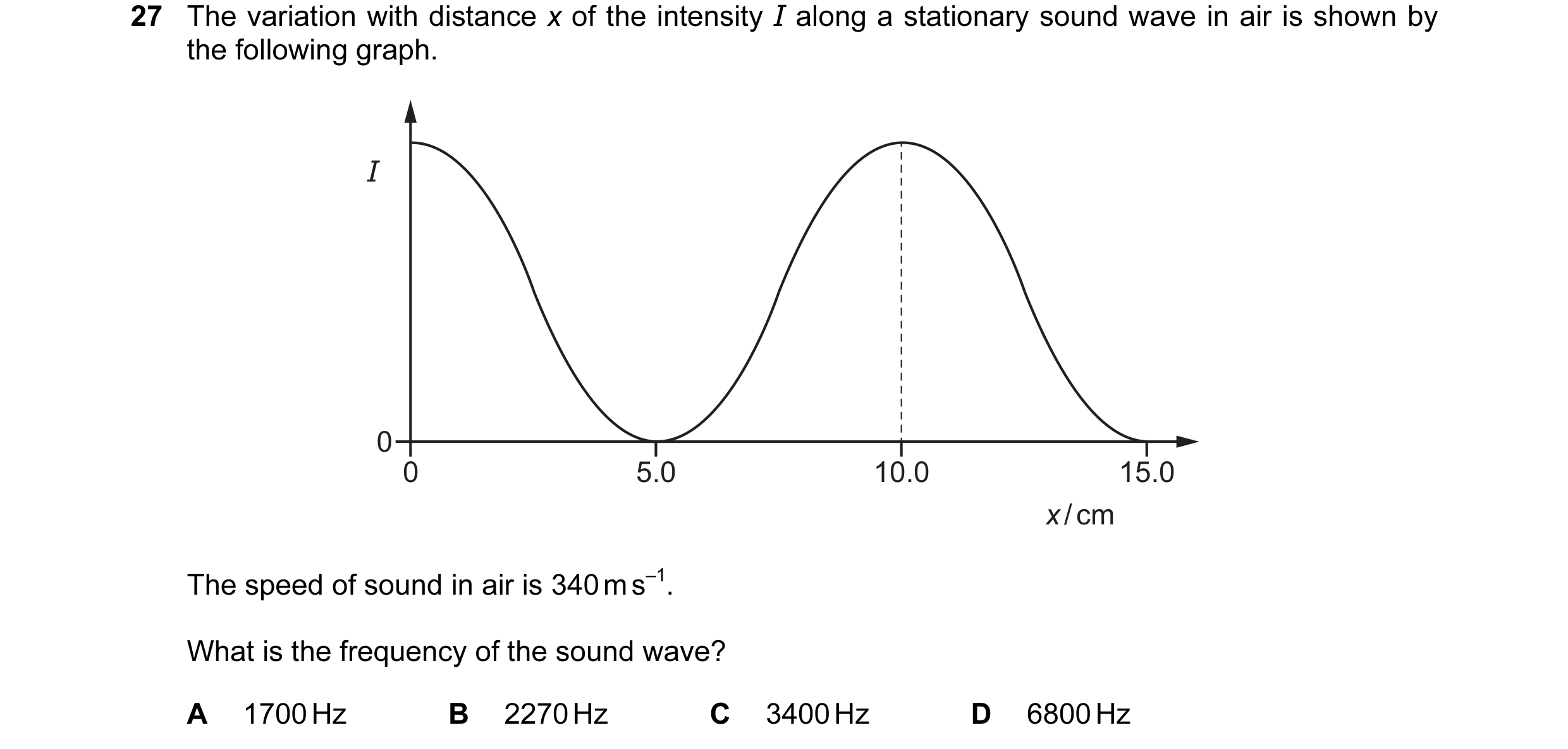

 14 / 45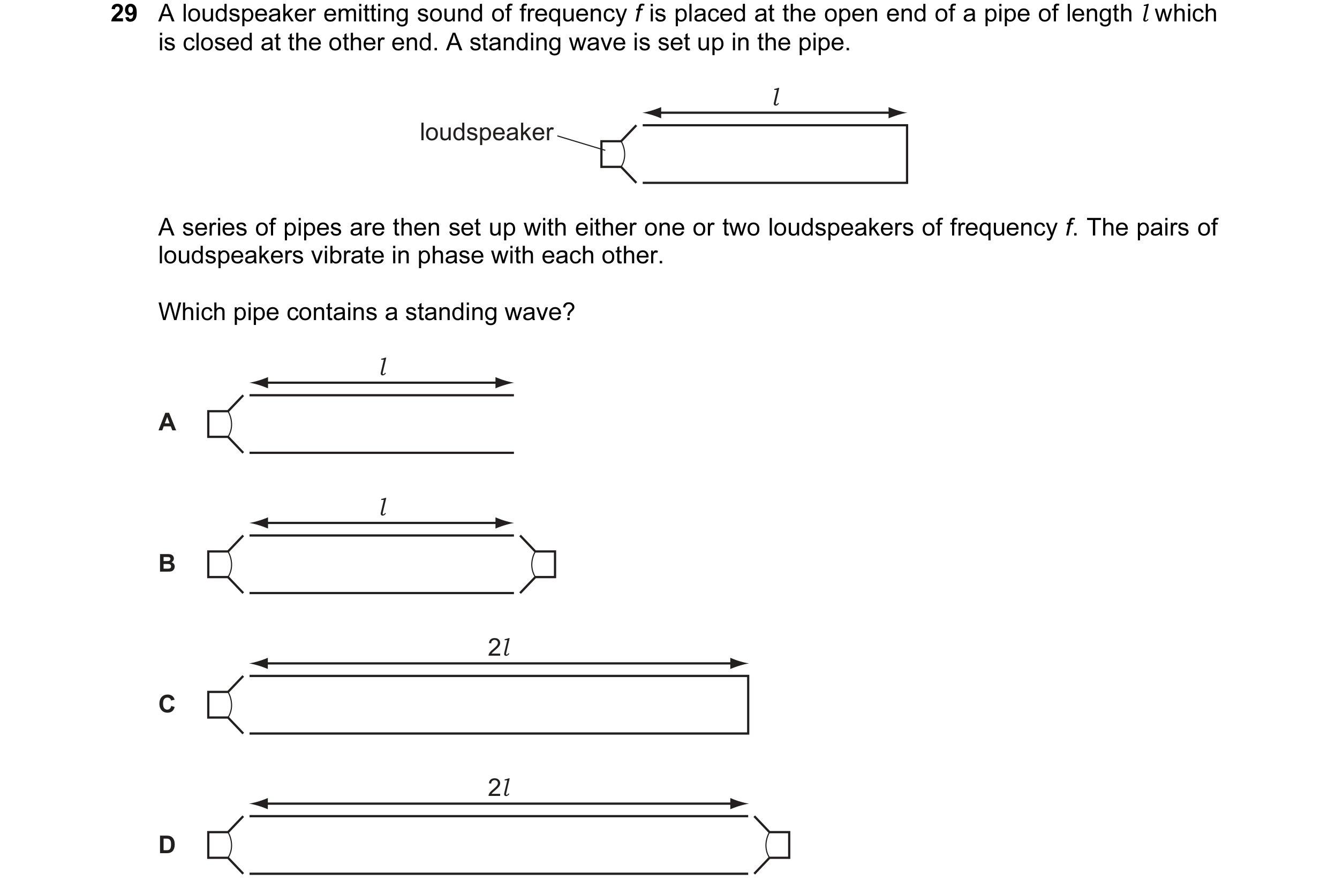
 15 / 45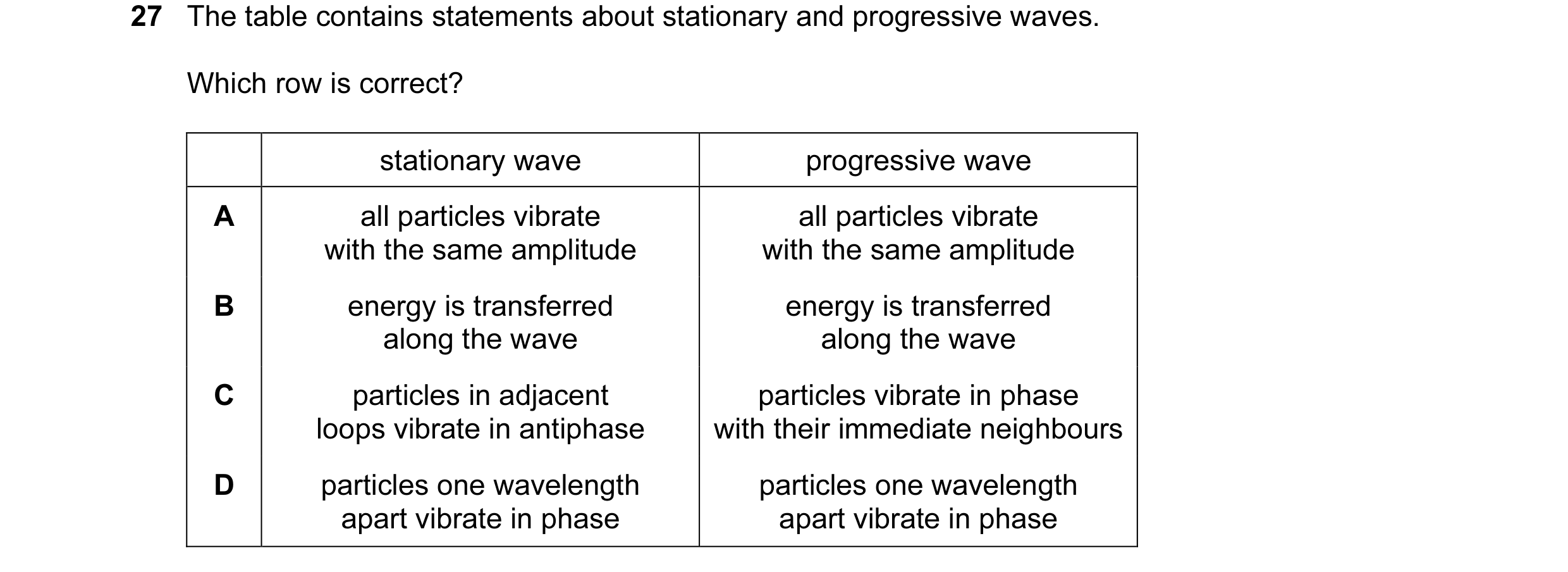
 16 / 45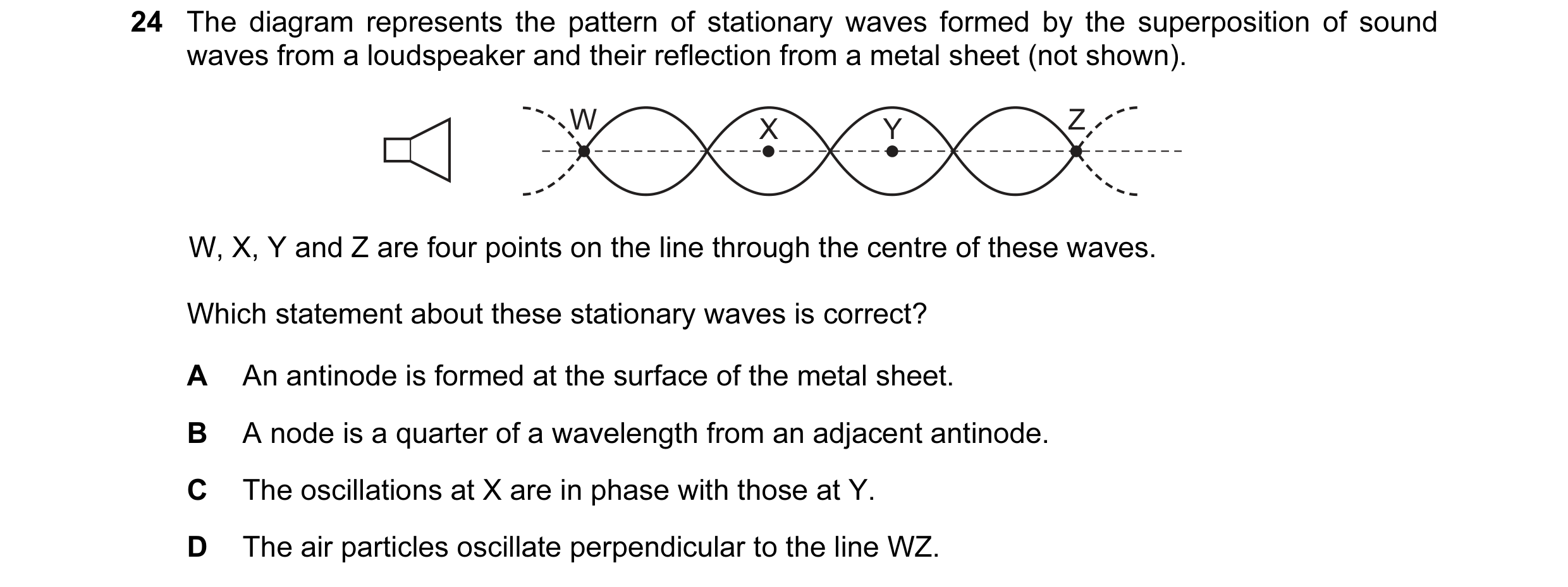

 17 / 45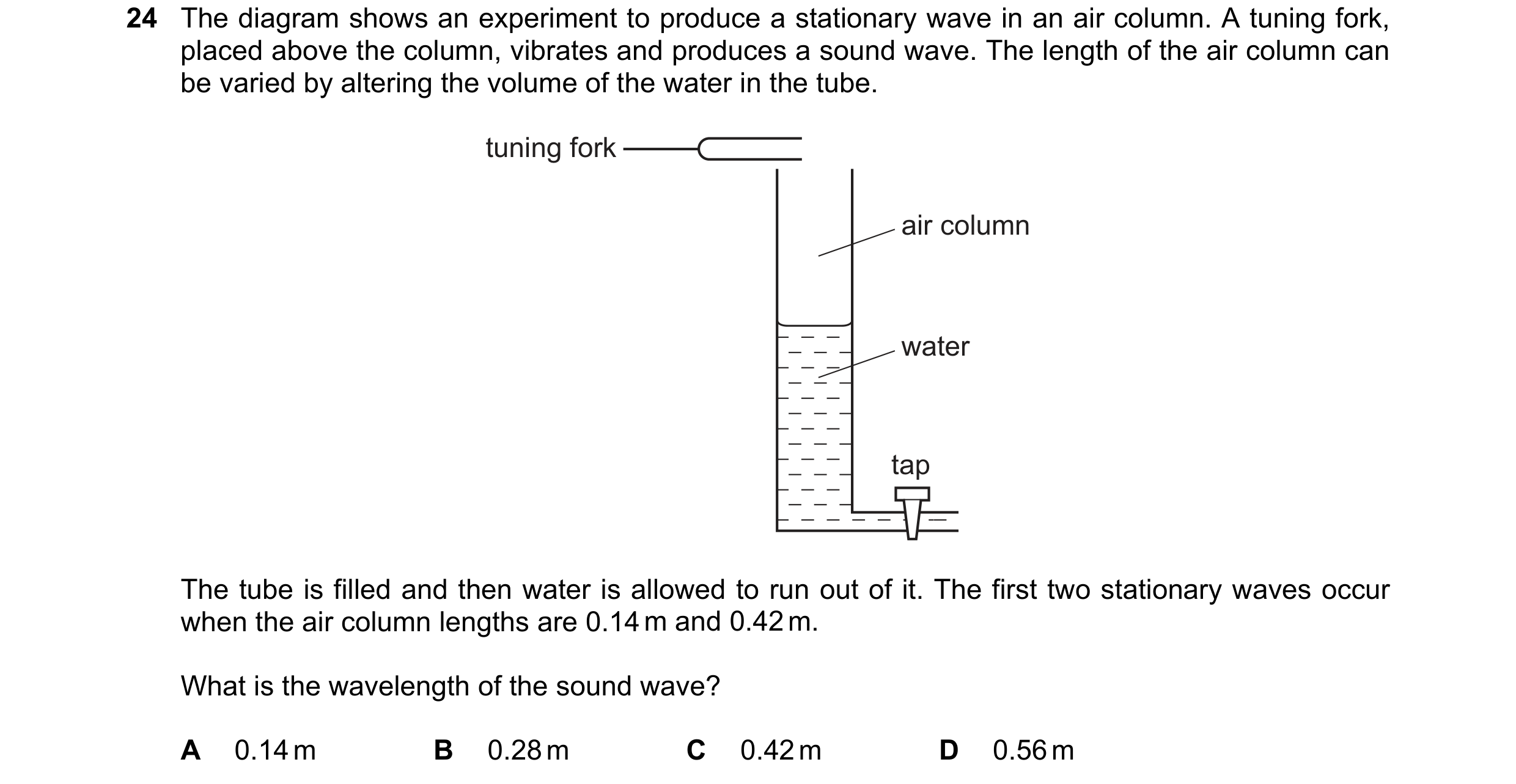
 18 / 45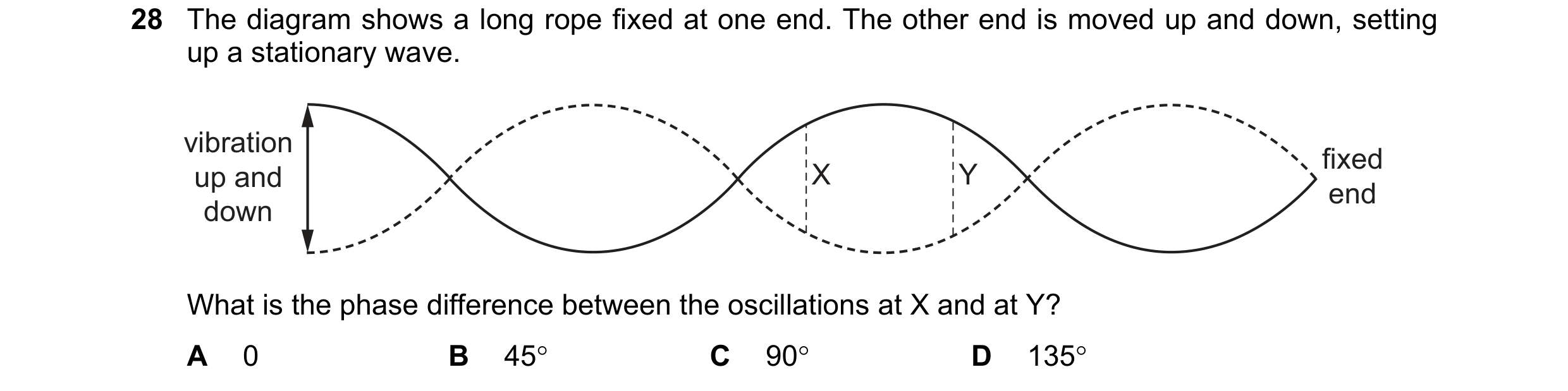

 19 / 45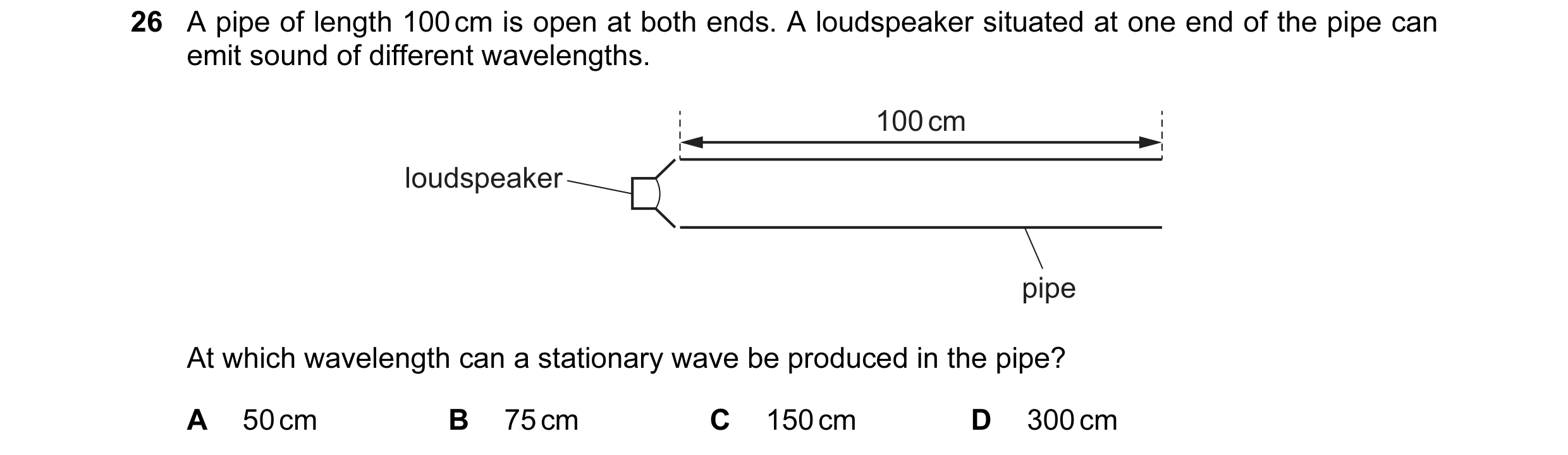
 20 / 45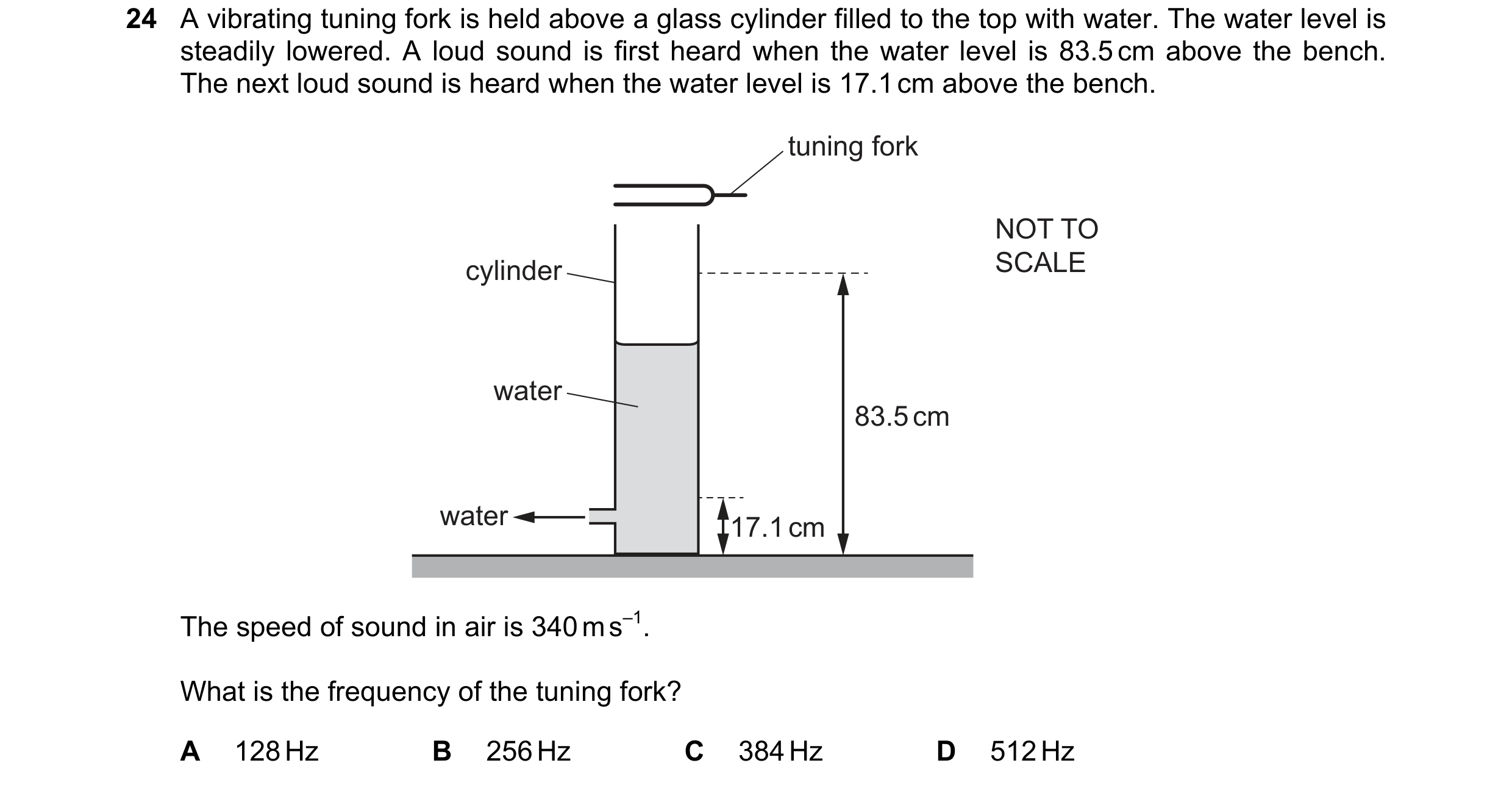

 21 / 45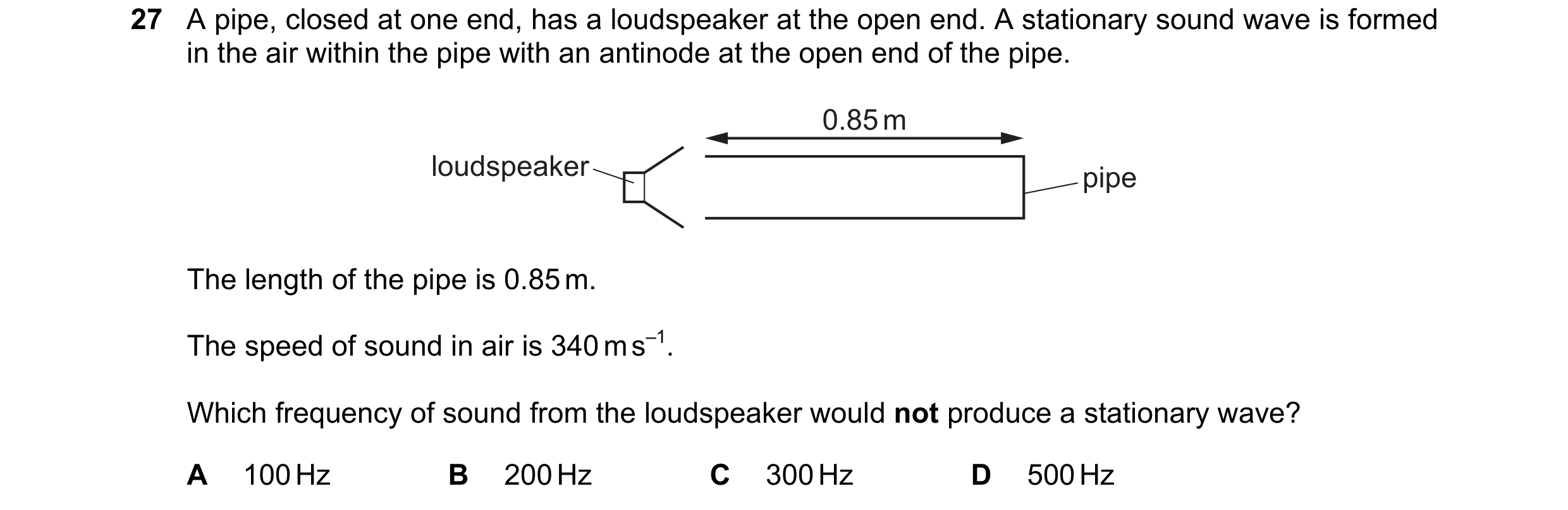
 22 / 45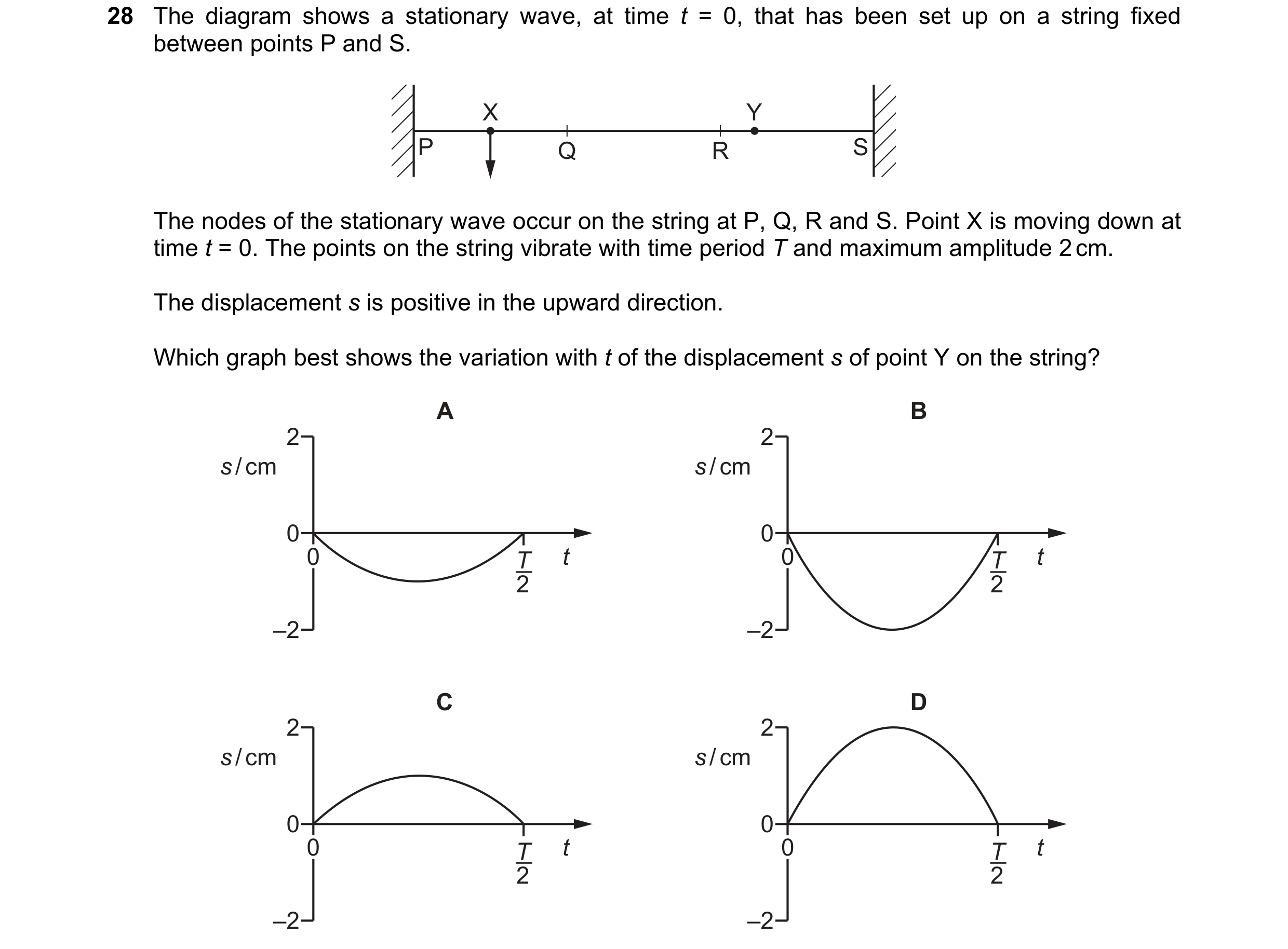
 23 / 45
 24 / 45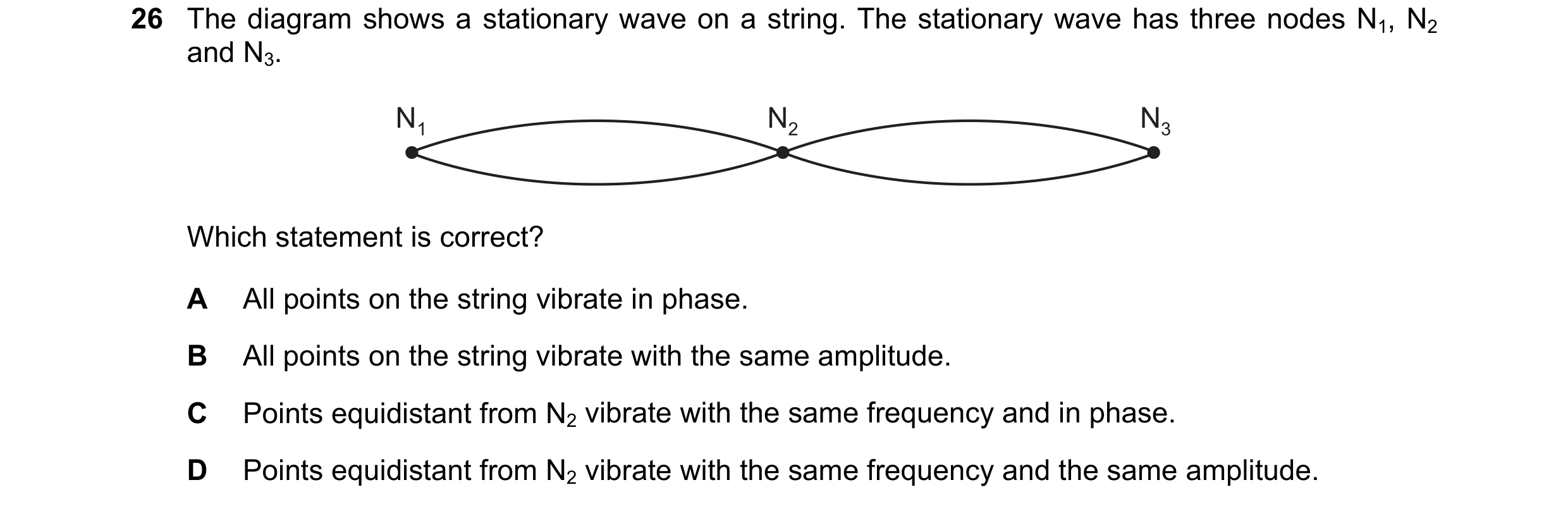
 25 / 45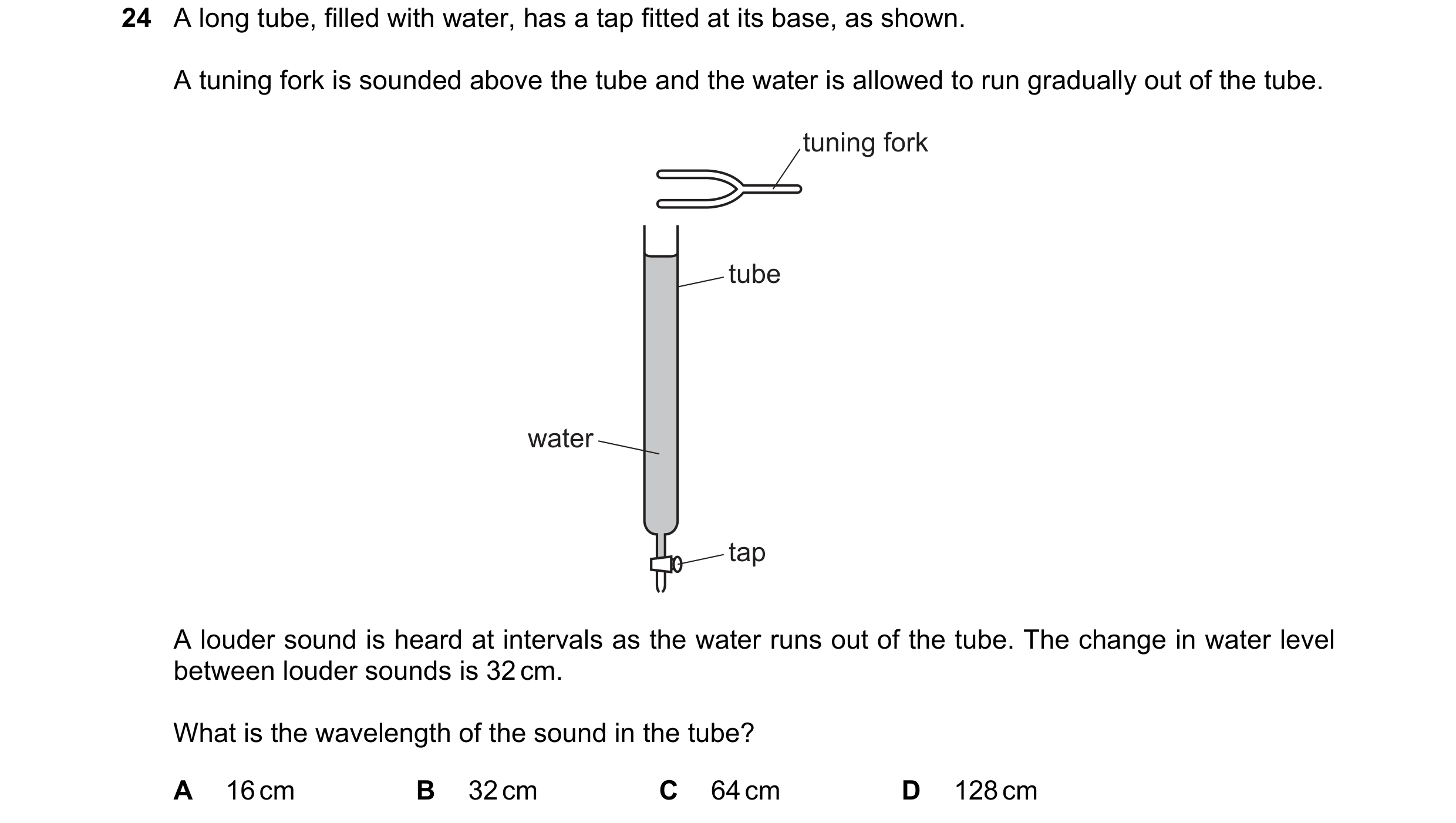


 26 / 45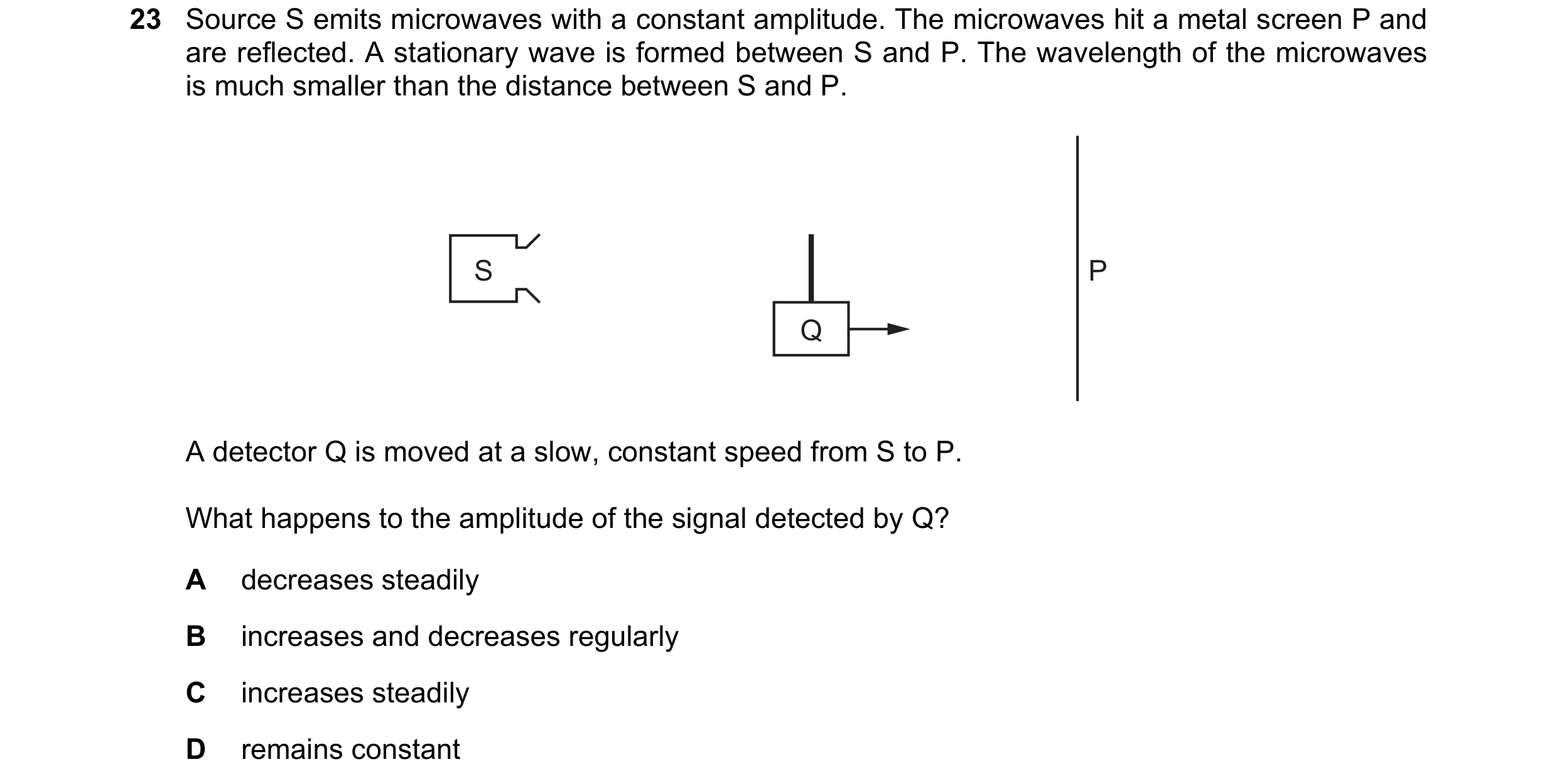
 27 / 45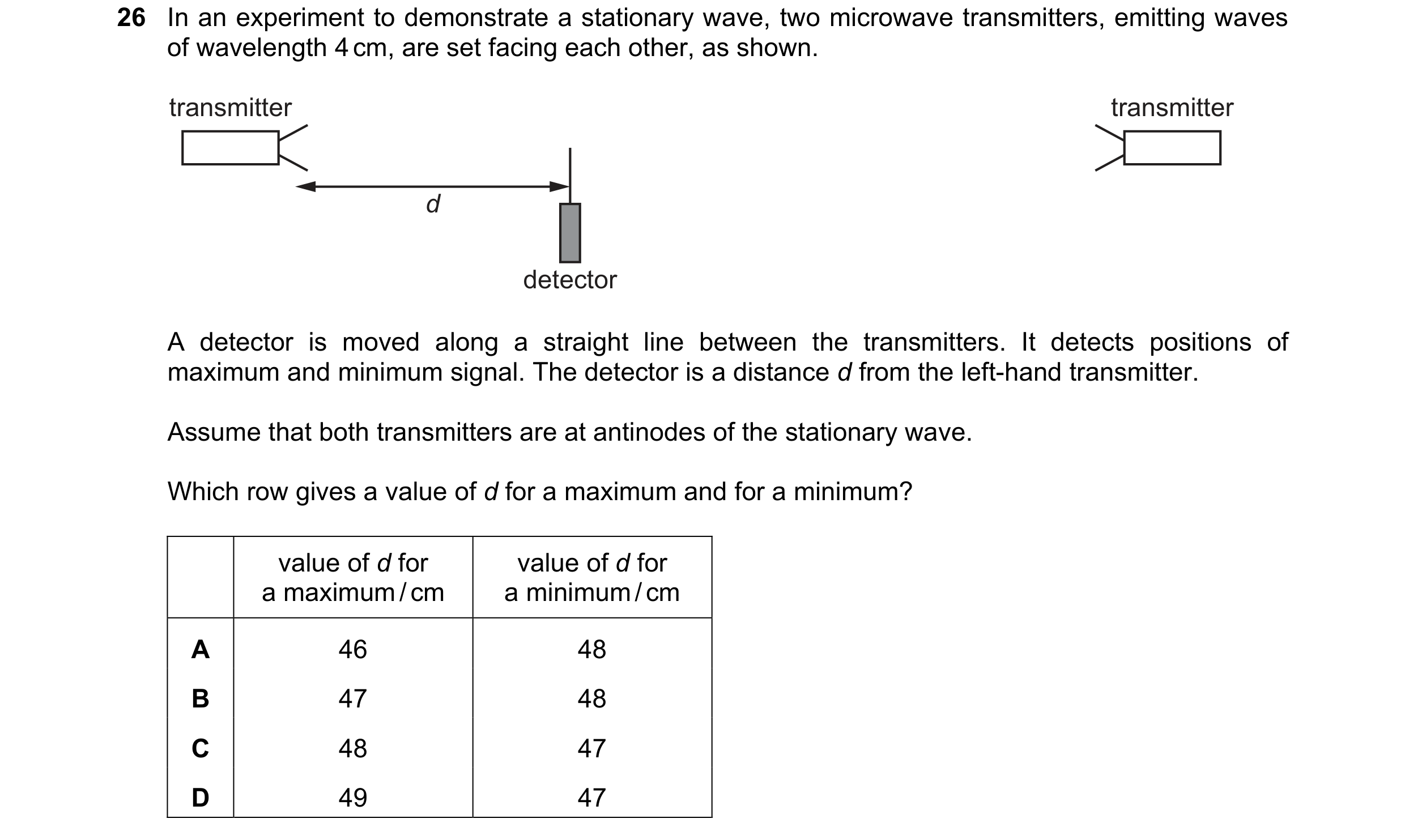
 28 / 45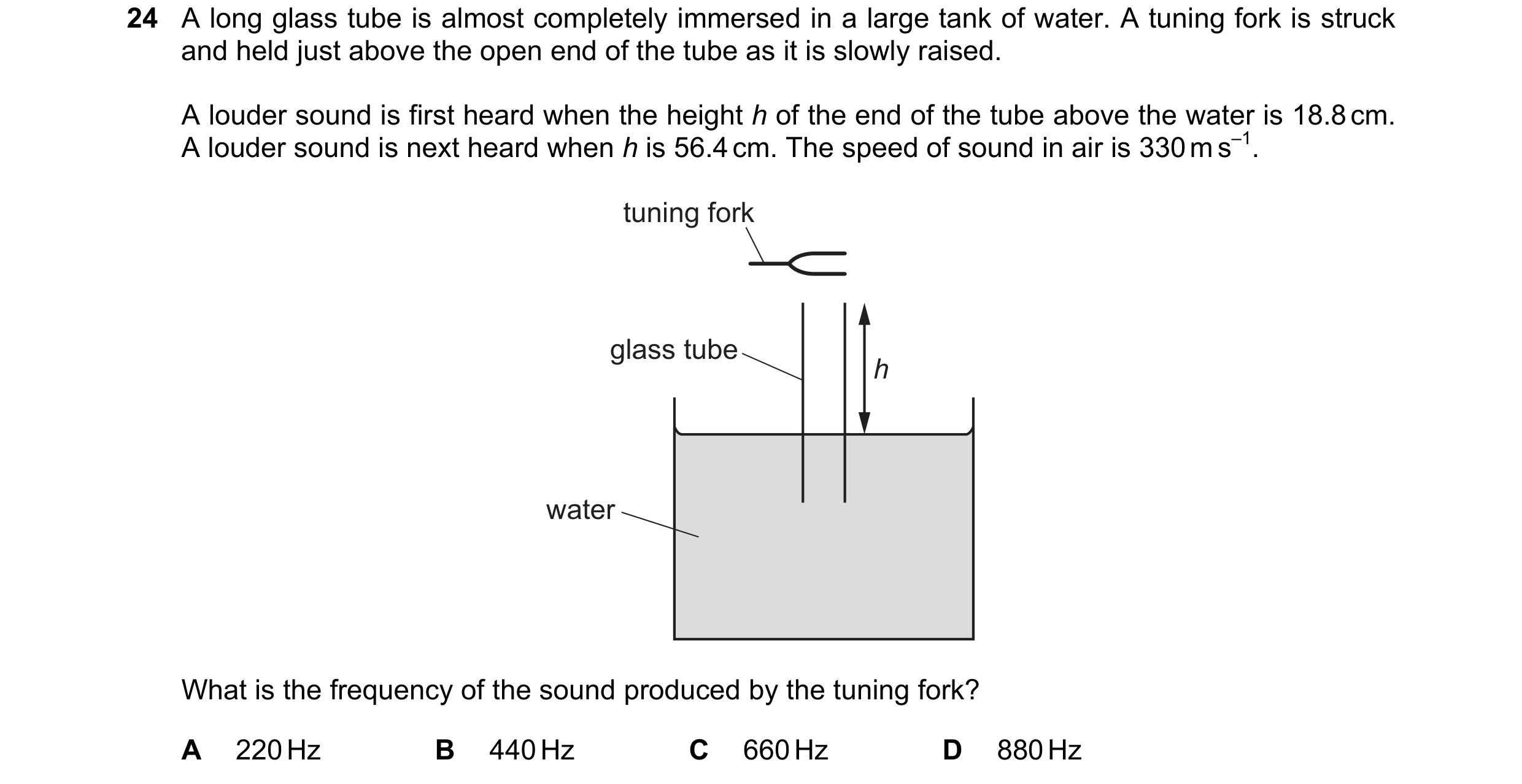
 29 / 45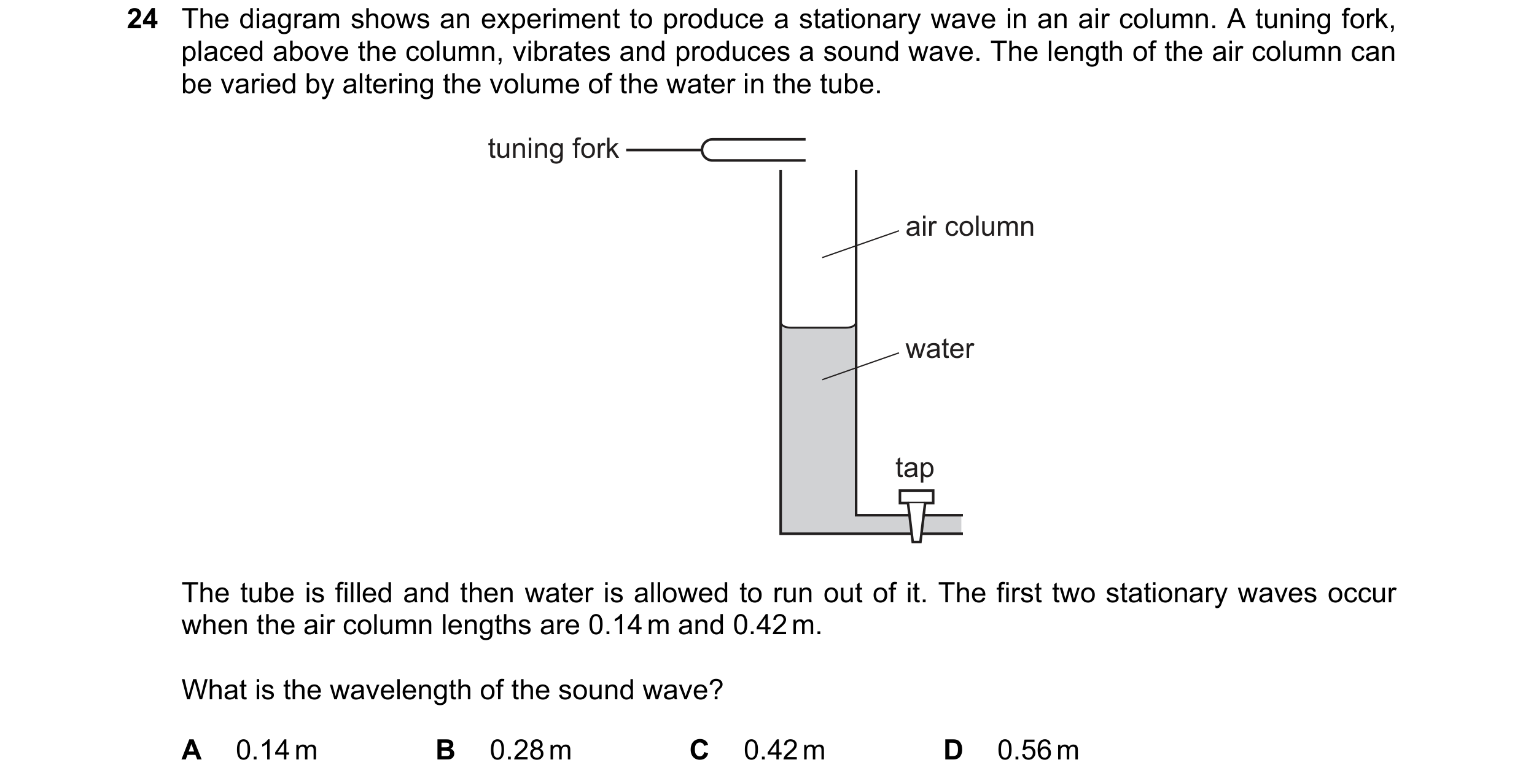
 30 / 45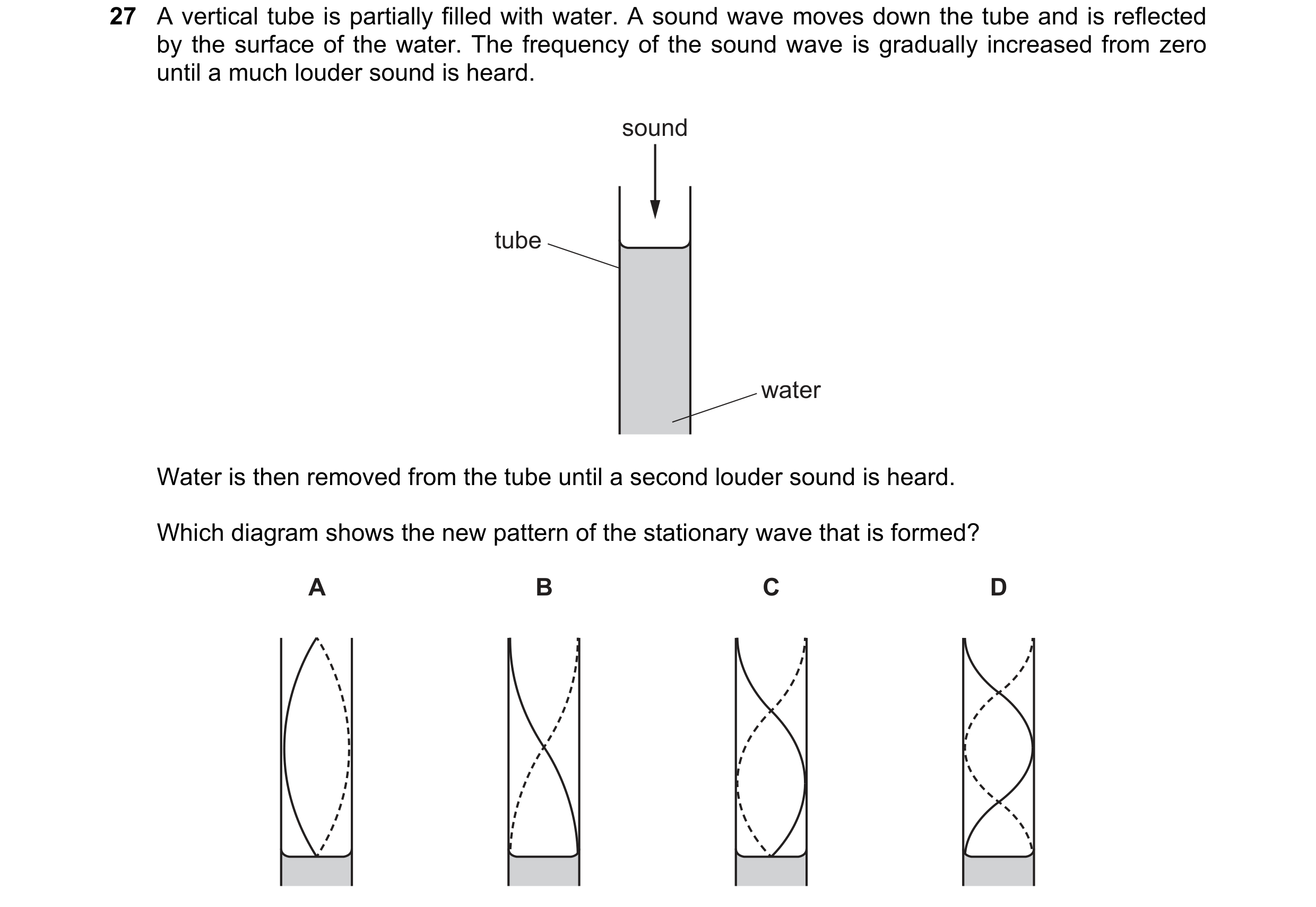
 31 / 45
 32 / 45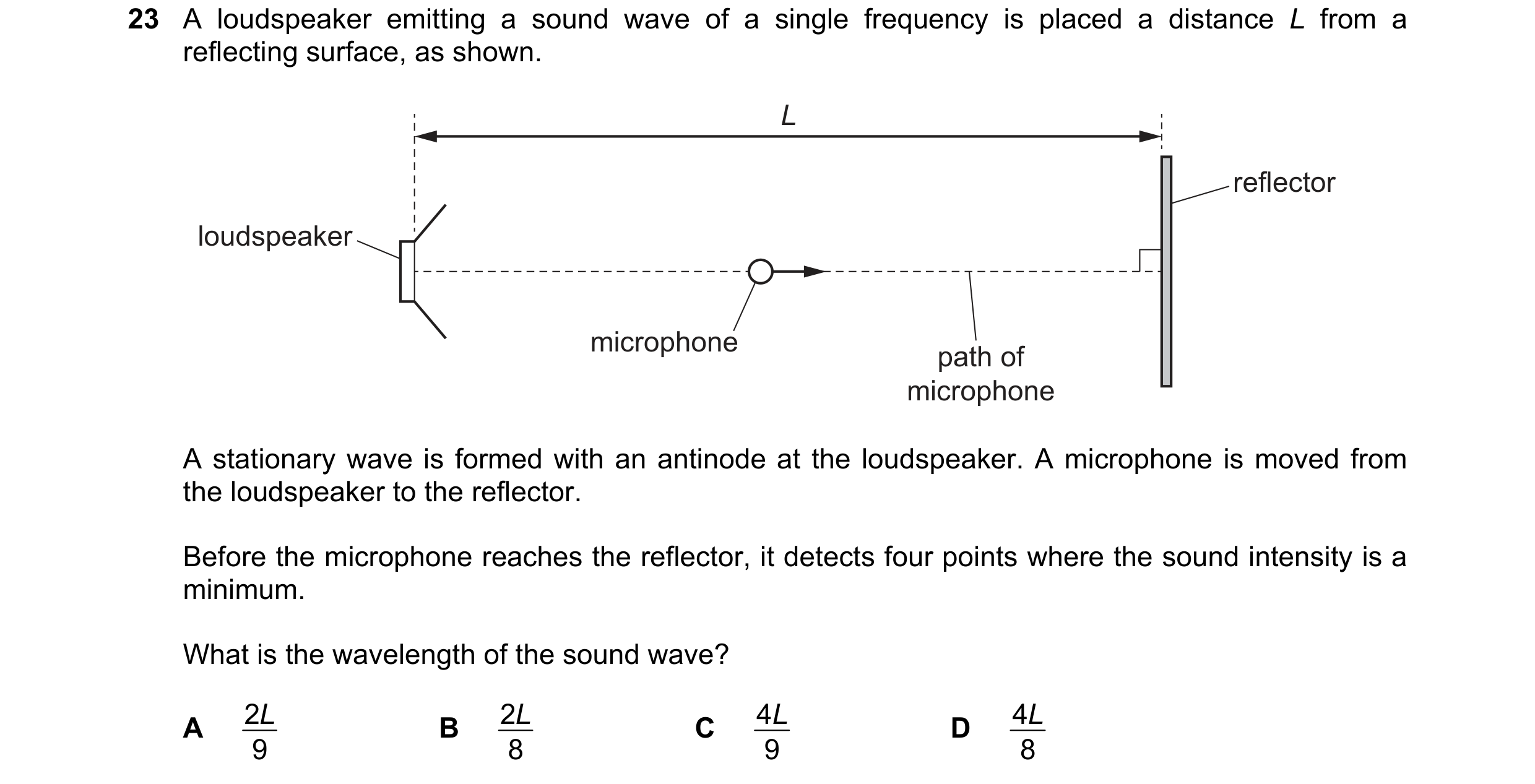
 33 / 45
 34 / 45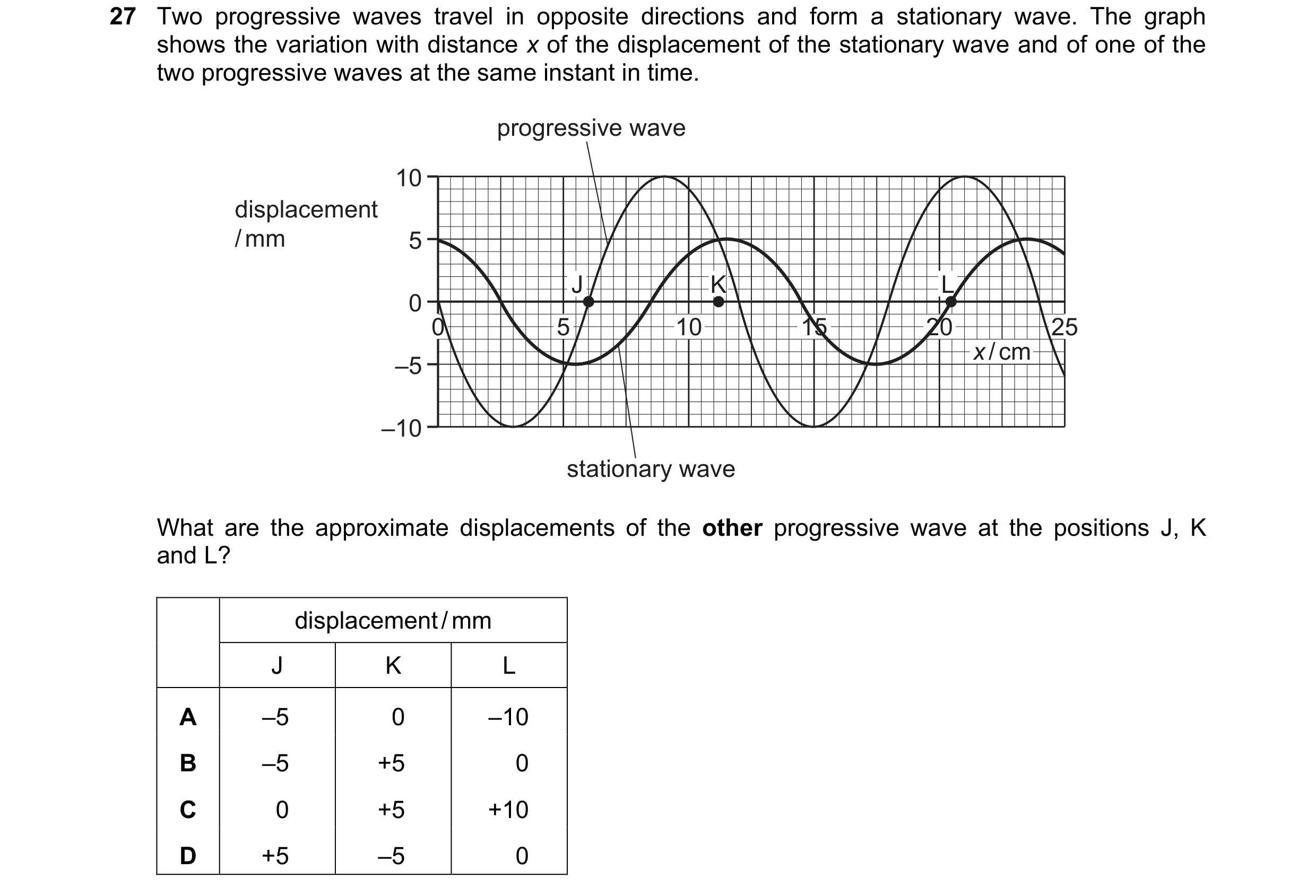
 35 / 45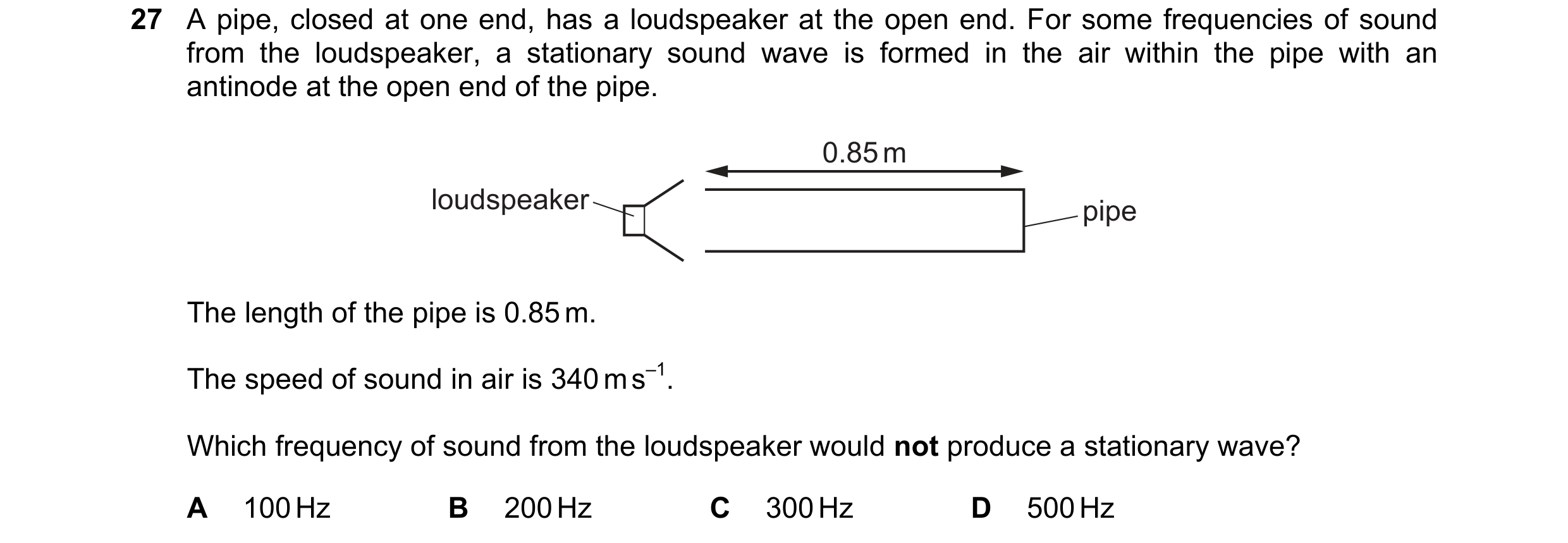
 36 / 45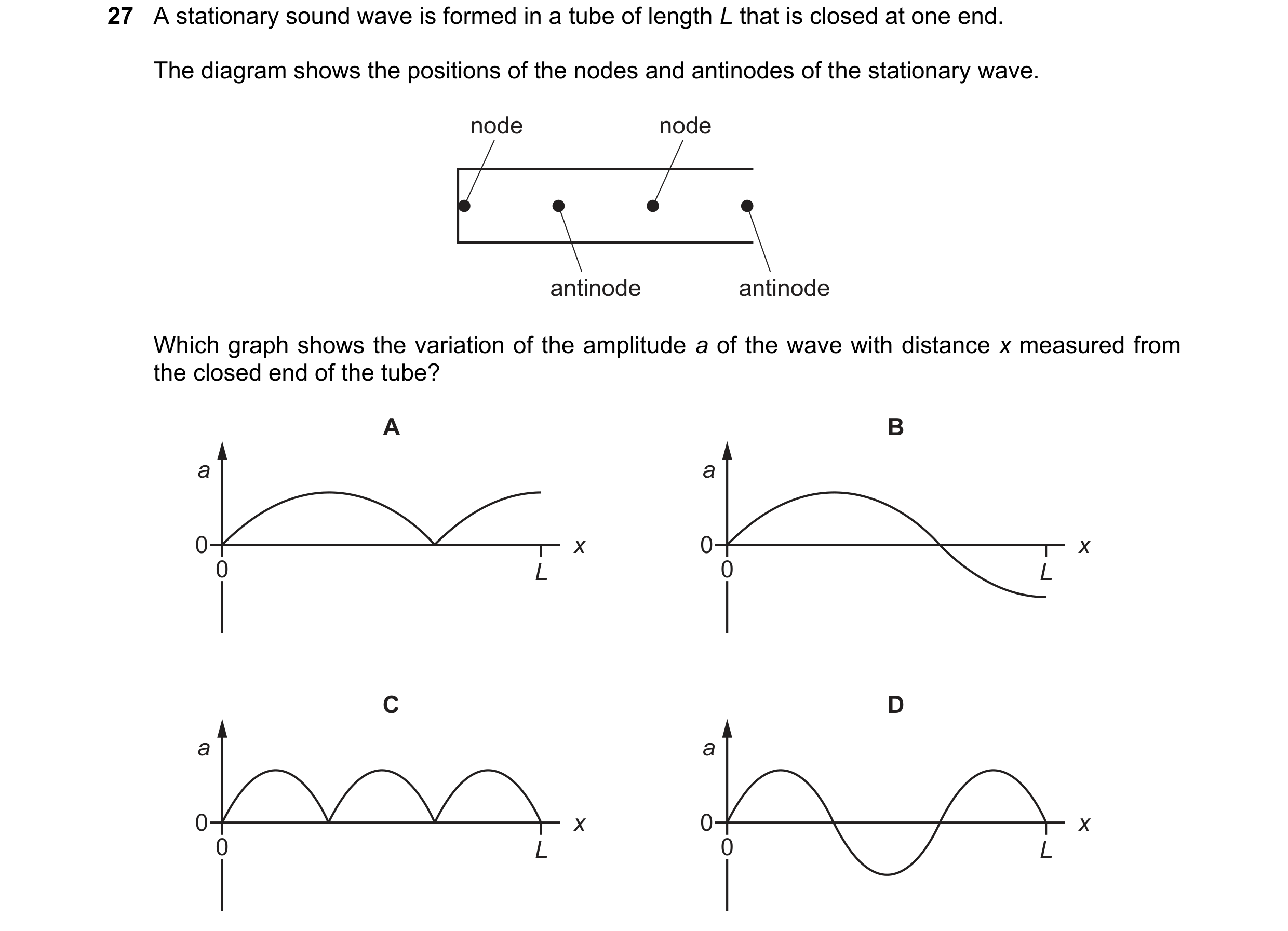
 37 / 45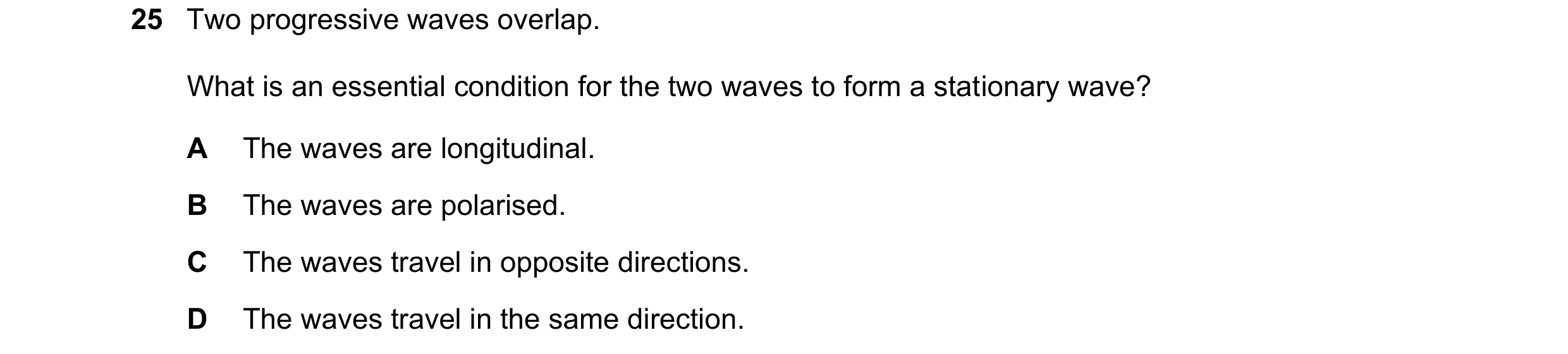
 38 / 45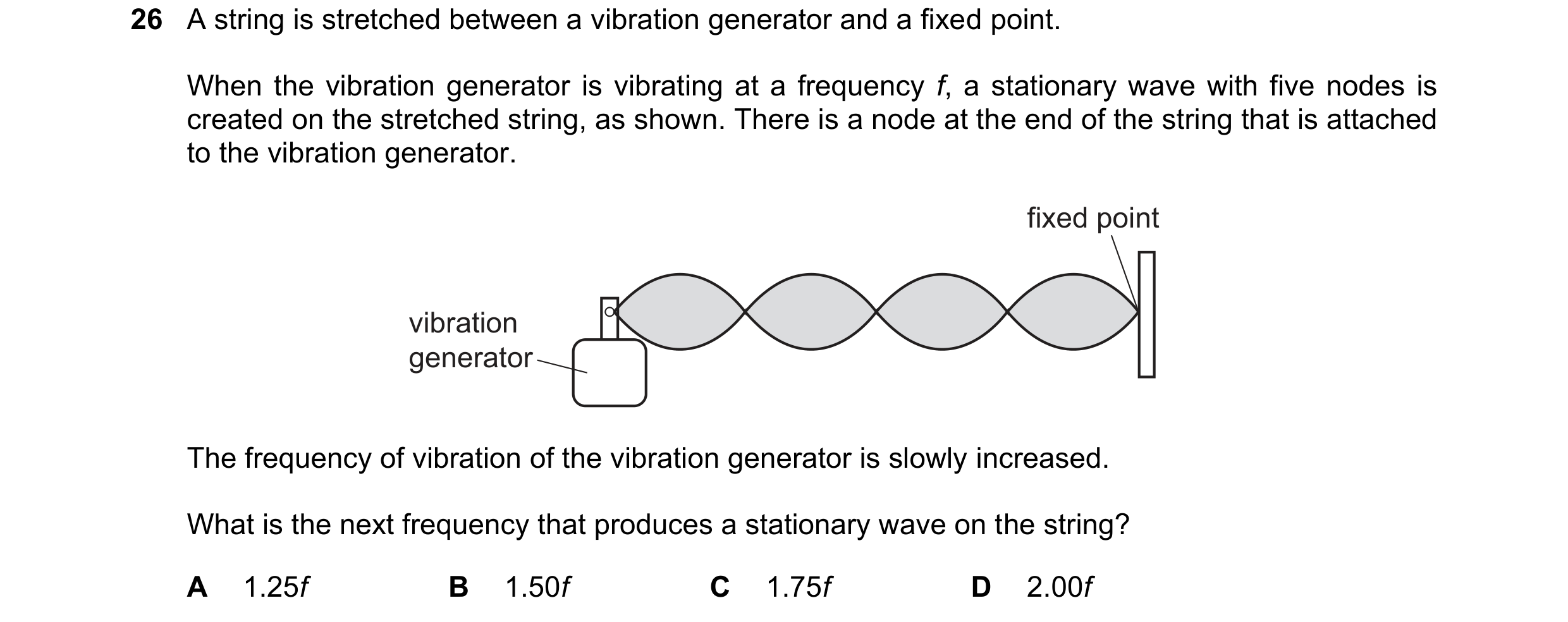
 39 / 45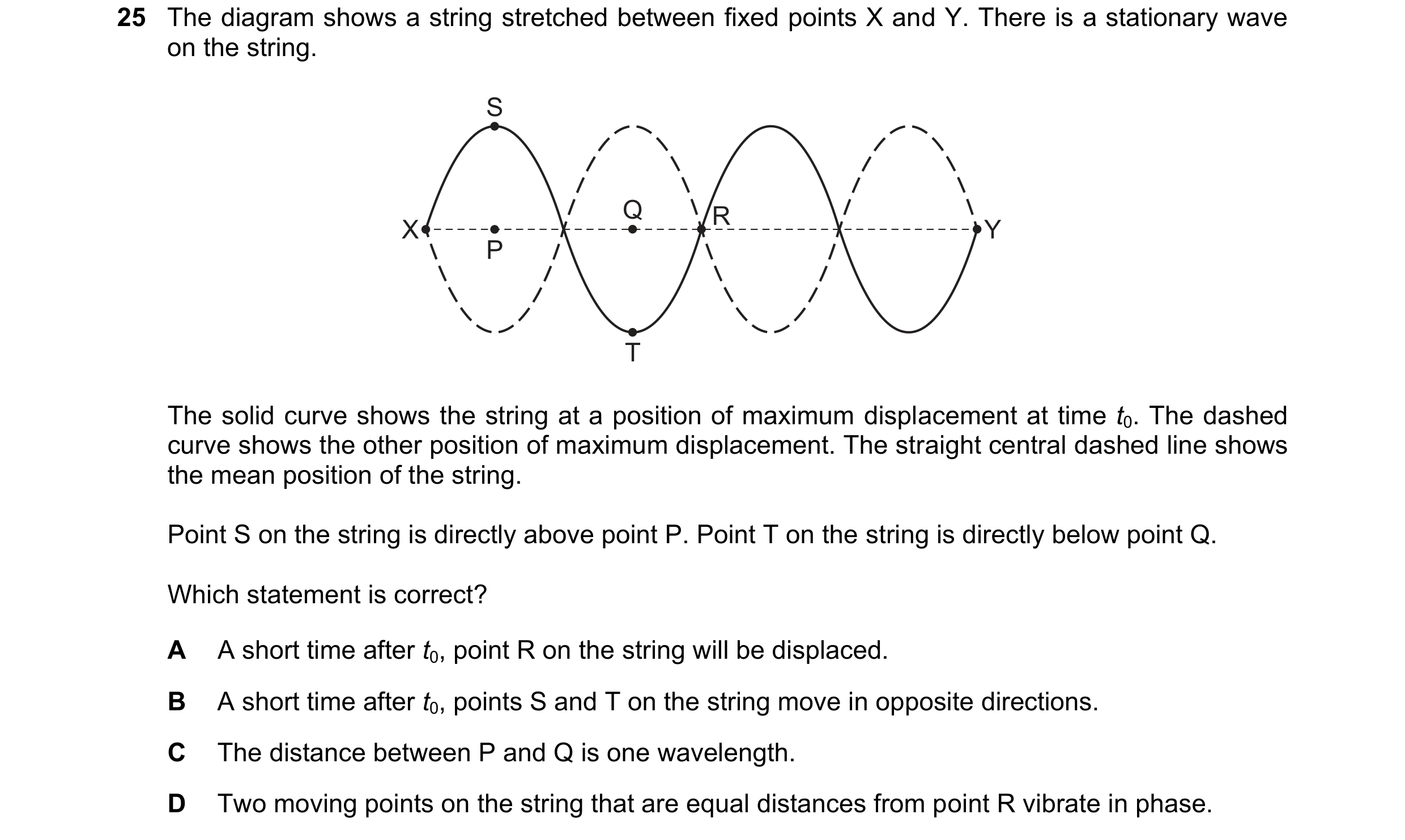
 40 / 45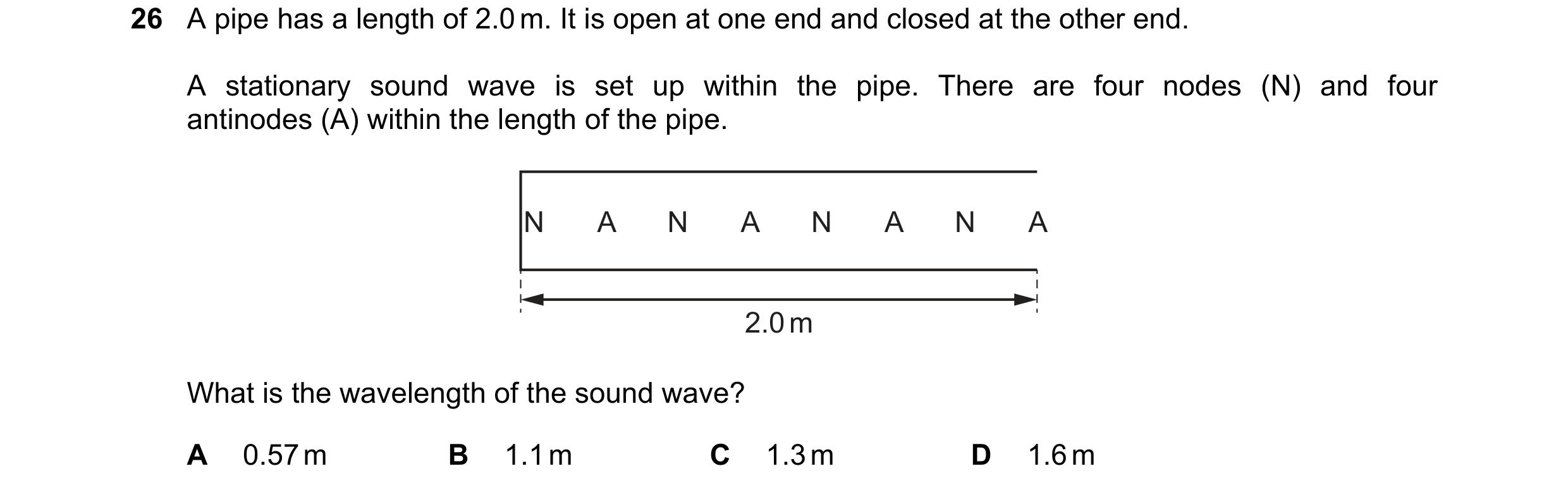

 41 / 45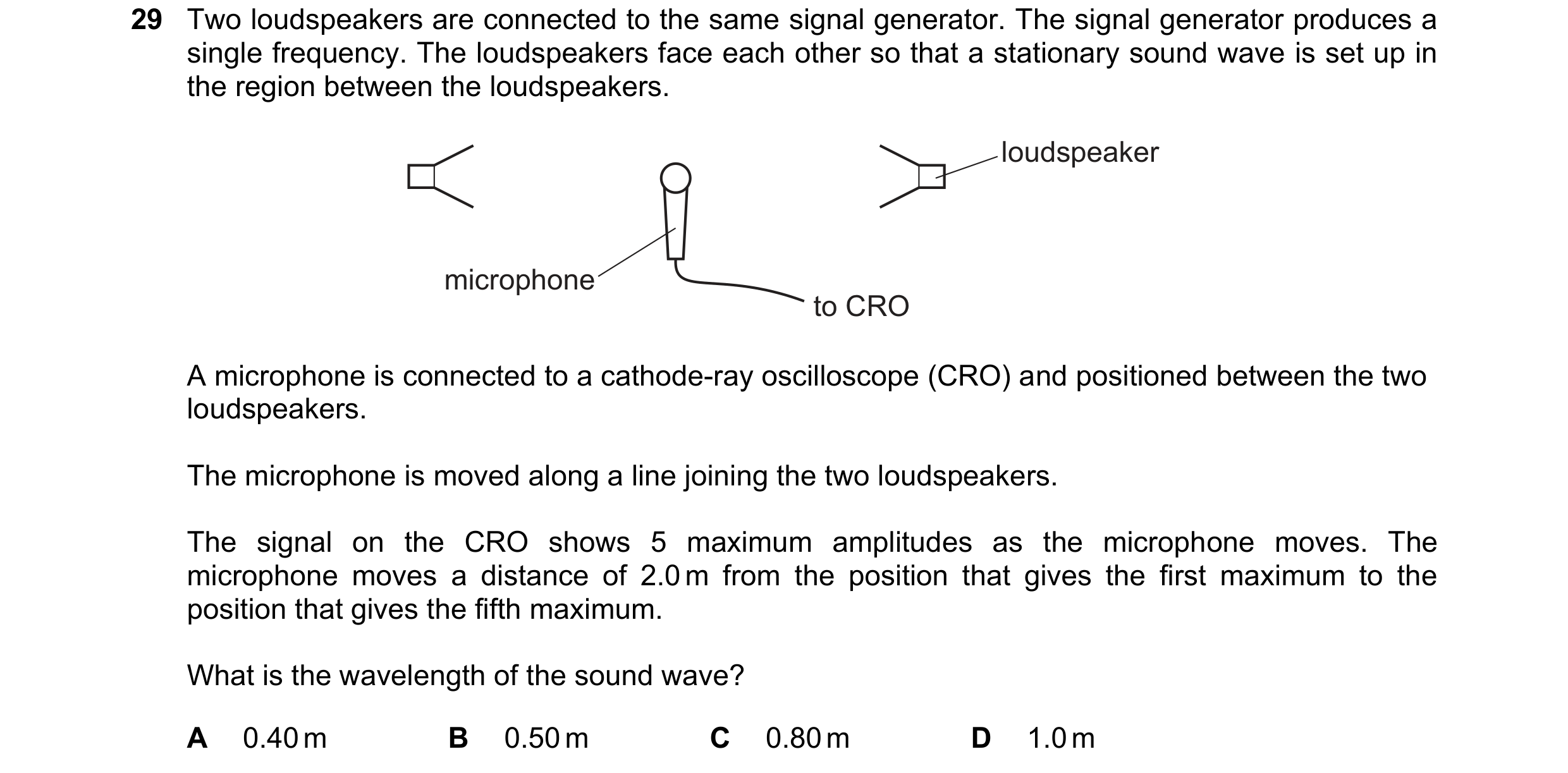
 42 / 45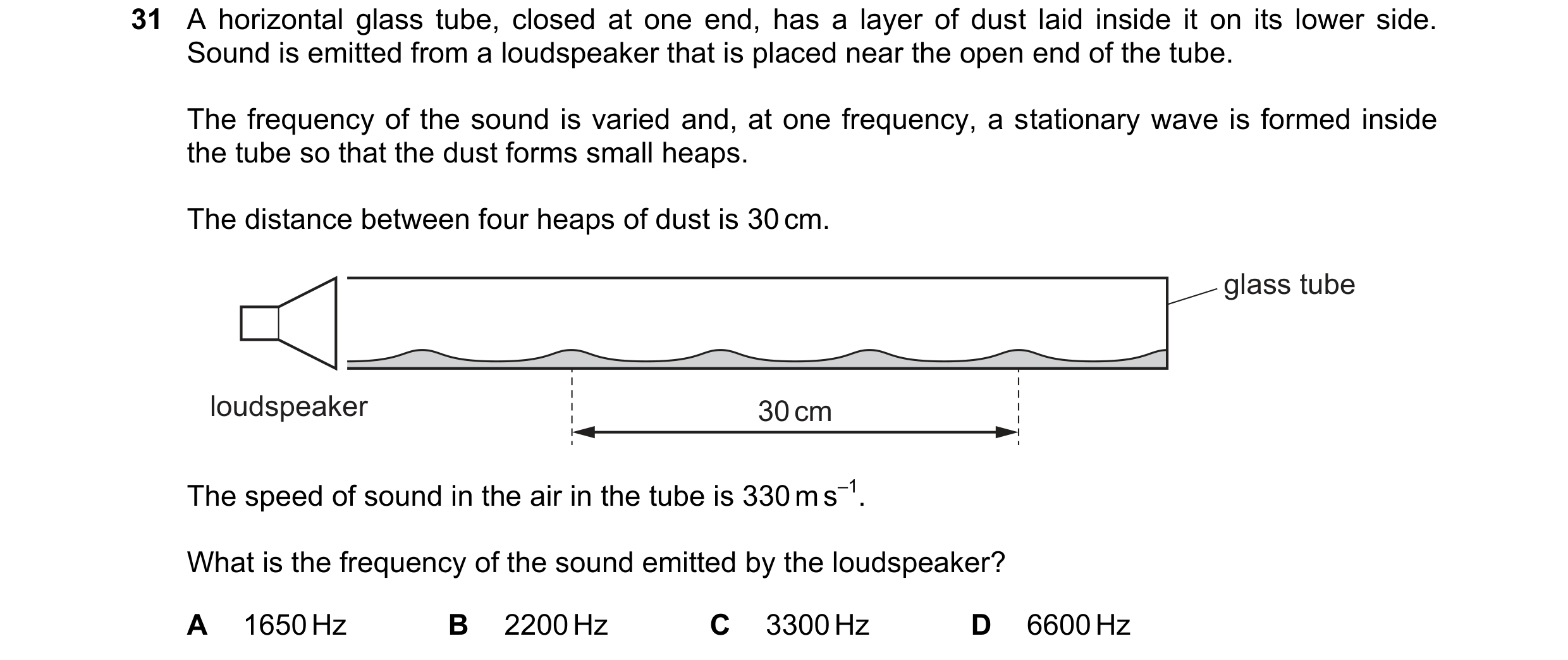
 43 / 45
 44 / 45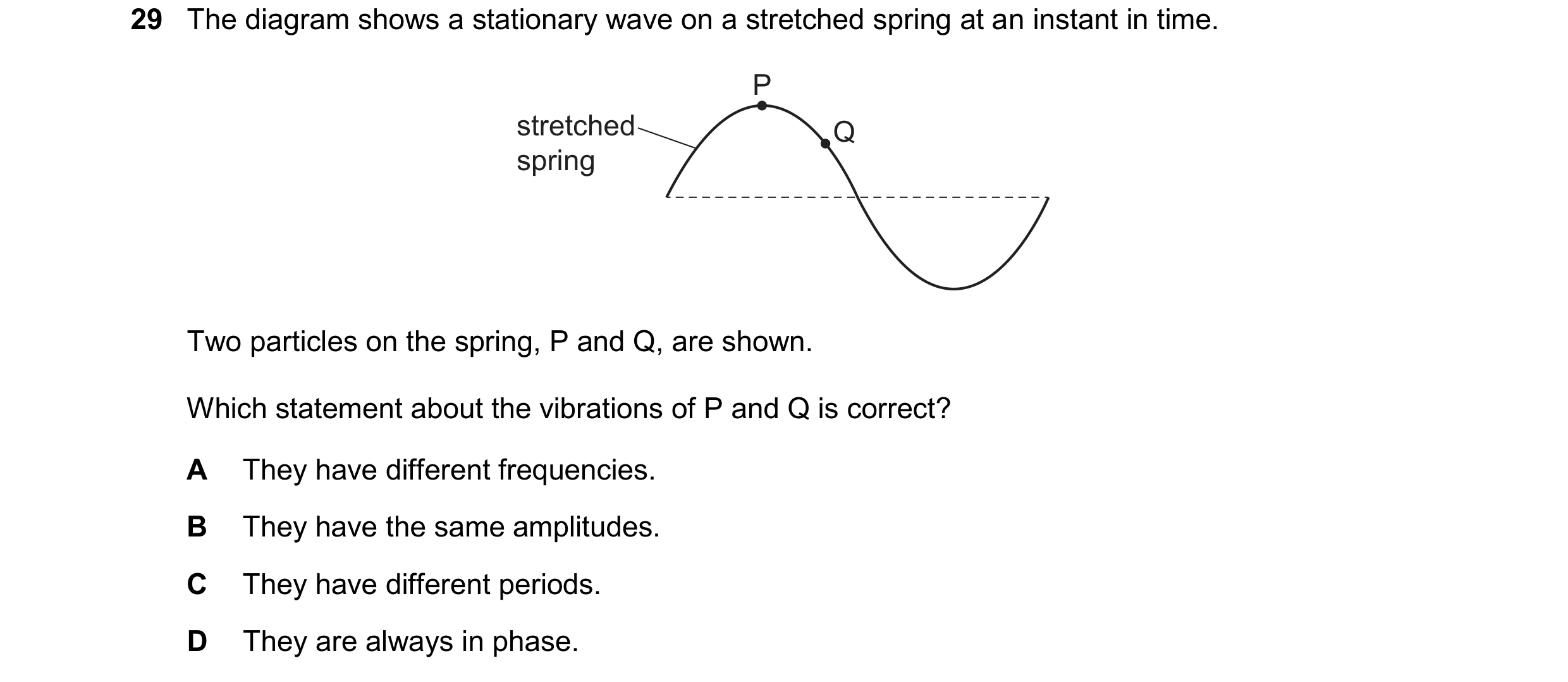
 45 / 45