Questions as text
Q1 · State the difference between a stationary wave and a progressive wave in terms of (i) the… 9702/21 Oct/Nov 2017
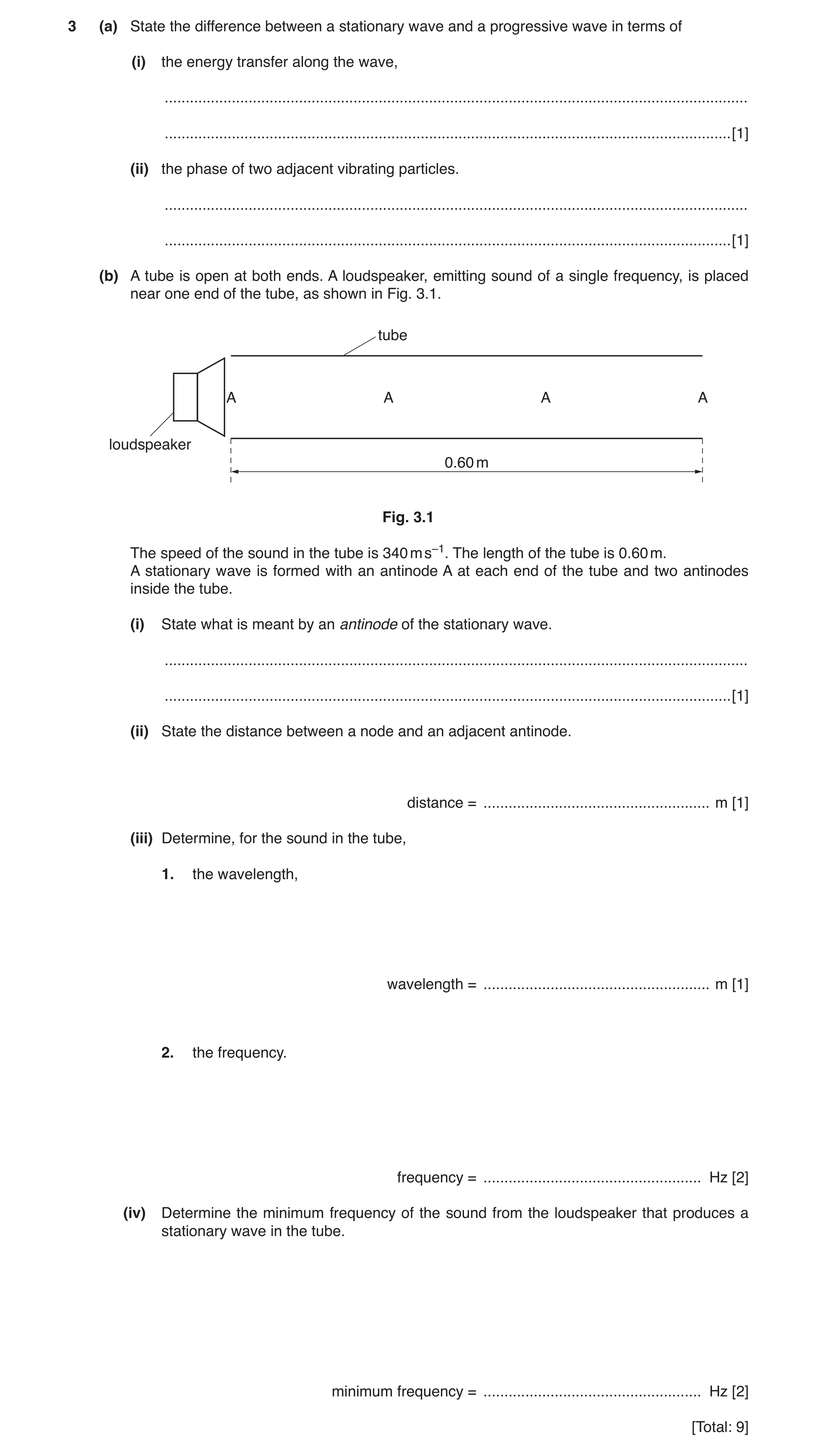
3 (a) State the difference between a stationary wave and a progressive wave in terms of (i) the energy transfer along the wave, … … [1] (ii) the phase of two adjacent vibrating particles. … … [1] (b) A tube is open at both ends. A loudspeaker, emitting sound of a single frequency, is placed near one end of the tube, as shown in Fig. 3.1. tube A A A A loudspeaker 0.60 m Fig. 3.1 The speed of the sound in the tube is 340 m s–1. The length of the tube is 0.60 m. A stationary wave is formed with an antinode A at each end of the tube and two antinodes inside the tube. (i) State what is meant by an antinode of the stationary wave. … … [1] (ii) State the distance between a node and an adjacent antinode. distance = … m [1] (iii) Determine, for the sound in the tube, 1. the wavelength, wavelength = … m [1] 2. the frequency. frequency = … Hz [2] (iv) Determine the minimum frequency of the sound from the loudspeaker that produces a stationary wave in the tube. minimum frequency = … Hz [2] [Total: 9]
9 marks
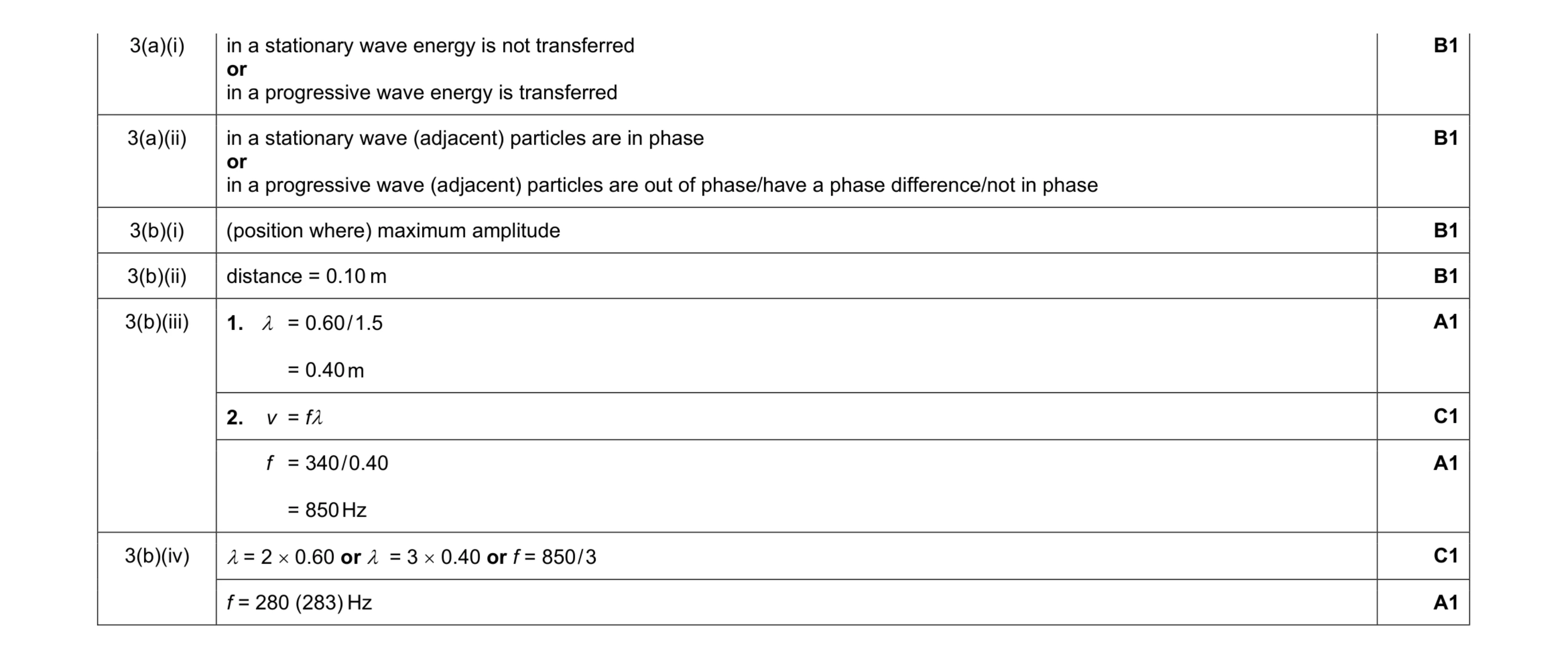
Mark scheme: 3(a)(i) in a stationary wave energy is not transferred or in a progressive wave energy is transferred B1 3(a)(ii) in a stationary wave (adjacent) particles are in phase or in a progressive wave (adjacent) particles are out of phase/have a phase difference/not in phase B1 3(b)(i) (position where) maximum amplitude B1 3(b)(ii) distance = 0.10 m B1 3(b)(iii) 1. λ = 0.60 / 1.5 = 0.40 m A1 2. v = fλ C1 f = 340 / 0.40 = 850 Hz A1 3(b)(iv) λ = 2 × 0.60 or λ = 3 × 0.40 or f = 850 / 3 C1 f = 280 (283) Hz A1
This question in 9702/21 Oct/Nov 2017
Q2 · State the conditions required for the formation of a stationary wave 9702/22 Oct/Nov 2017
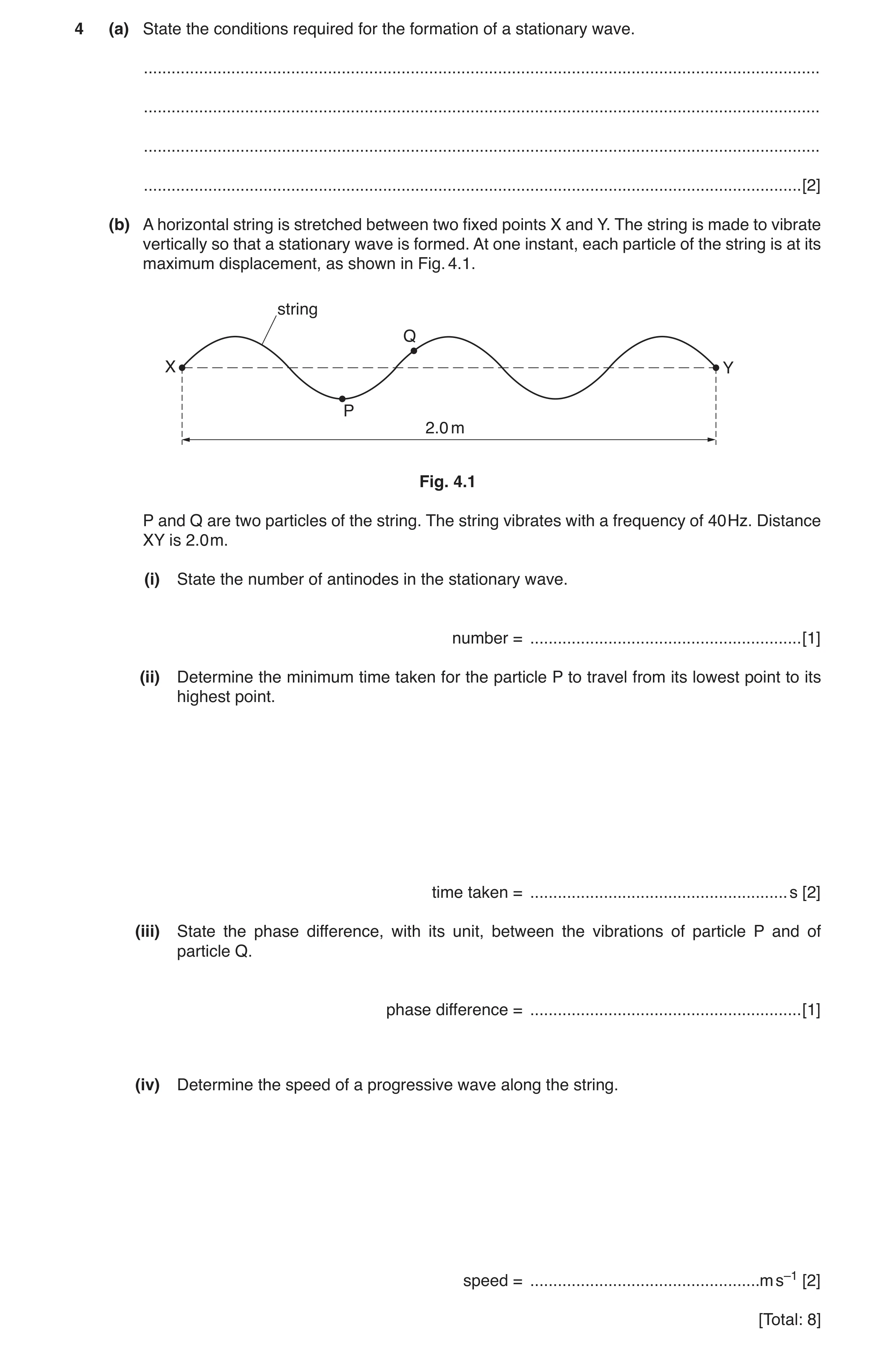
4 (a) State the conditions required for the formation of a stationary wave. … … … … [2] (b) A horizontal string is stretched between two fixed points X and Y. The string is made to vibrate vertically so that a stationary wave is formed. At one instant, each particle of the string is at its maximum displacement, as shown in Fig. 4.1. string Q X Y P 2.0 m Fig. 4.1 P and Q are two particles of the string. The string vibrates with a frequency of 40 Hz. Distance XY is 2.0 m. (i) State the number of antinodes in the stationary wave. number = … [1] (ii) Determine the minimum time taken for the particle P to travel from its lowest point to its highest point. time taken = … s [2] (iii) State the phase difference, with its unit, between the vibrations of particle P and of particle Q. phase difference = … [1] (iv) Determine the speed of a progressive wave along the string. speed = … m s–1 [2] [Total: 8]
8 marks
Mark scheme: 4(a) B1 waves (are same type and) have same frequency/wavelength B1 4(b)(i) 5 A1 4(b)(ii) T = 1 / 40 (= 2.5 × 10⁻²) C1 time taken = 2.5 × 10⁻² / 2 = 1.3 × 10⁻² s (1.25 × 10⁻² s) A1 4(b)(iii) 180° A1 4(b)(iv) v = fλ C1 λ = 2.0 / 2.5 (= 0.80 m) v = 0.80 × 40 = 32 m s–1 A1
This question in 9702/22 Oct/Nov 2017
Q3 · State the conditions required for the formation of a stationary wave 9702/22 Feb/March 2018
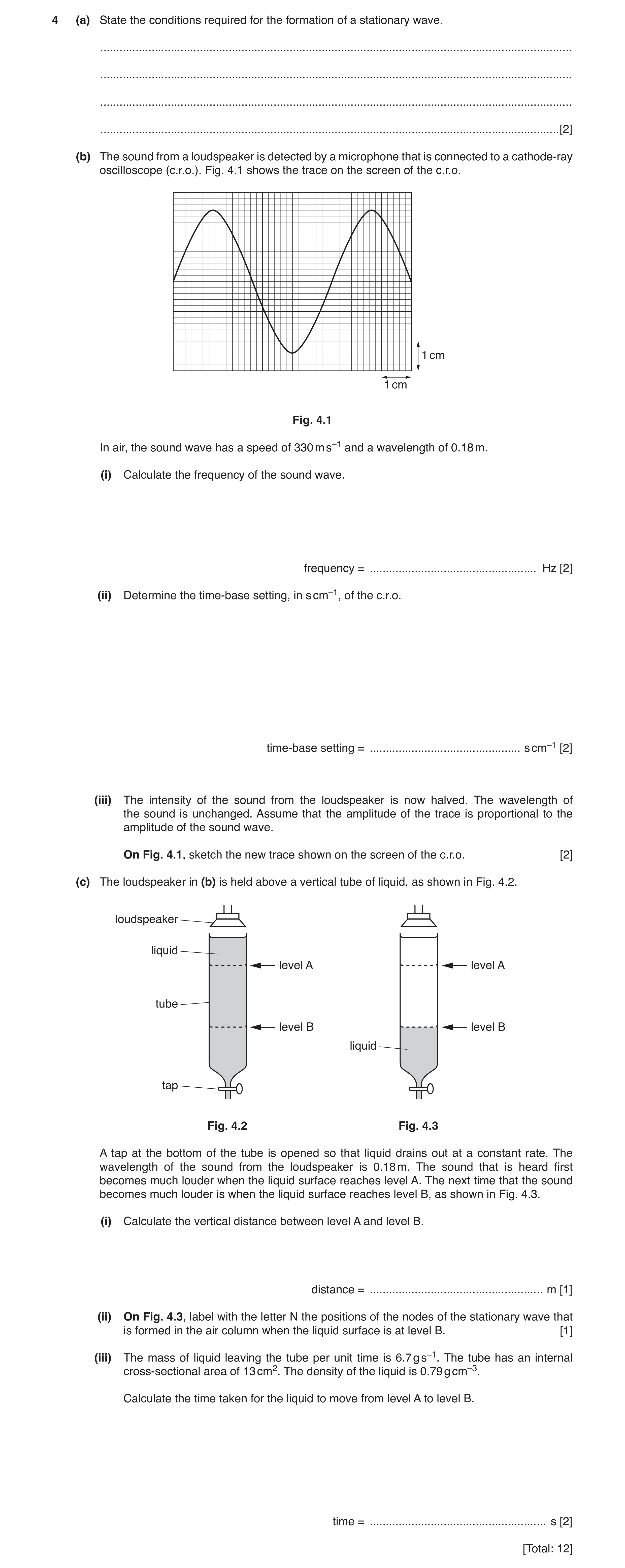
4 (a) State the conditions required for the formation of a stationary wave. … … … … [2] (b) The sound from a loudspeaker is detected by a microphone that is connected to a cathode-ray oscilloscope (c.r.o.). Fig. 4.1 shows the trace on the screen of the c.r.o. 1 cm 1 cm Fig. 4.1 In air, the sound wave has a speed of 330 m s–1 and a wavelength of 0.18 m. (i) Calculate the frequency of the sound wave. frequency = … Hz [2] (ii) Determine the time-base setting, in s cm–1, of the c.r.o. time-base setting = … s cm–1 [2] (iii) The intensity of the sound from the loudspeaker is now halved. The wavelength of the sound is unchanged. Assume that the amplitude of the trace is proportional to the amplitude of the sound wave. On Fig. 4.1, sketch the new trace shown on the screen of the c.r.o. [2] (c) The loudspeaker in (b) is held above a vertical tube of liquid, as shown in Fig. 4.2. loudspeaker liquid level A level A tube level B level B liquid tap Fig. 4.2 Fig. 4.3 A tap at the bottom of the tube is opened so that liquid drains out at a constant rate. The wavelength of the sound from the loudspeaker is 0.18 m. The sound that is heard first becomes much louder when the liquid surface reaches level A. The next time that the sound becomes much louder is when the liquid surface reaches level B, as shown in Fig. 4.3. (i) Calculate the vertical distance between level A and level B. distance = … m [1] (ii) On Fig. 4.3, label with the letter N the positions of the nodes of the stationary wave that is formed in the air column when the liquid surface is at level B. [1] (iii) The mass of liquid leaving the tube per unit time is 6.7 g s–1. The tube has an internal cross-sectional area of 13 cm2. The density of the liquid is 0.79 g cm–3. Calculate the time taken for the liquid to move from level A to level B. time = … s [2] [Total: 12]
12 marks
Mark scheme: 4(a) (two) waves (travelling at same speed) in opposite directions overlap B1 (waves are same type and) have same frequency / wavelength B1 4(b)(i) v = fλ f = 330 / 0.18 C1 = 1800 Hz (1830 Hz) A1 4(b)(ii) T = 1 / 1800 (= 5.5 × 10⁻⁴) time-base setting = (1.5 × 5.5 ×10–4) / 8.0 or 1 / (1800 × 5.3) C1 = 1.0 × 10⁻⁴ s cm–1 A1 4(b)(iii) waveform drawn with same period as original waveform B1 waveform drawn with amplitude of 1.7 cm B1 4(c)(i) distance = λ / 2 = 0.18 / 2 = 0.090 m A1 Question Answer Marks 4(c)(ii) letter N shown at level B and at level A and not anywhere else. B1 4(c)(iii) m = ρAx = 0.79 × 13 × 9.0 (=92.4) or 790 × 13×10–4 × 0.090 (=0.0924) t = 92.4 / 6.7 or 0.0924 / 0.0067 C1 = 14 s A1
This question in 9702/22 Feb/March 2018
Q4 · Define the wavelength of a progressive wave 9702/22 May/June 2018
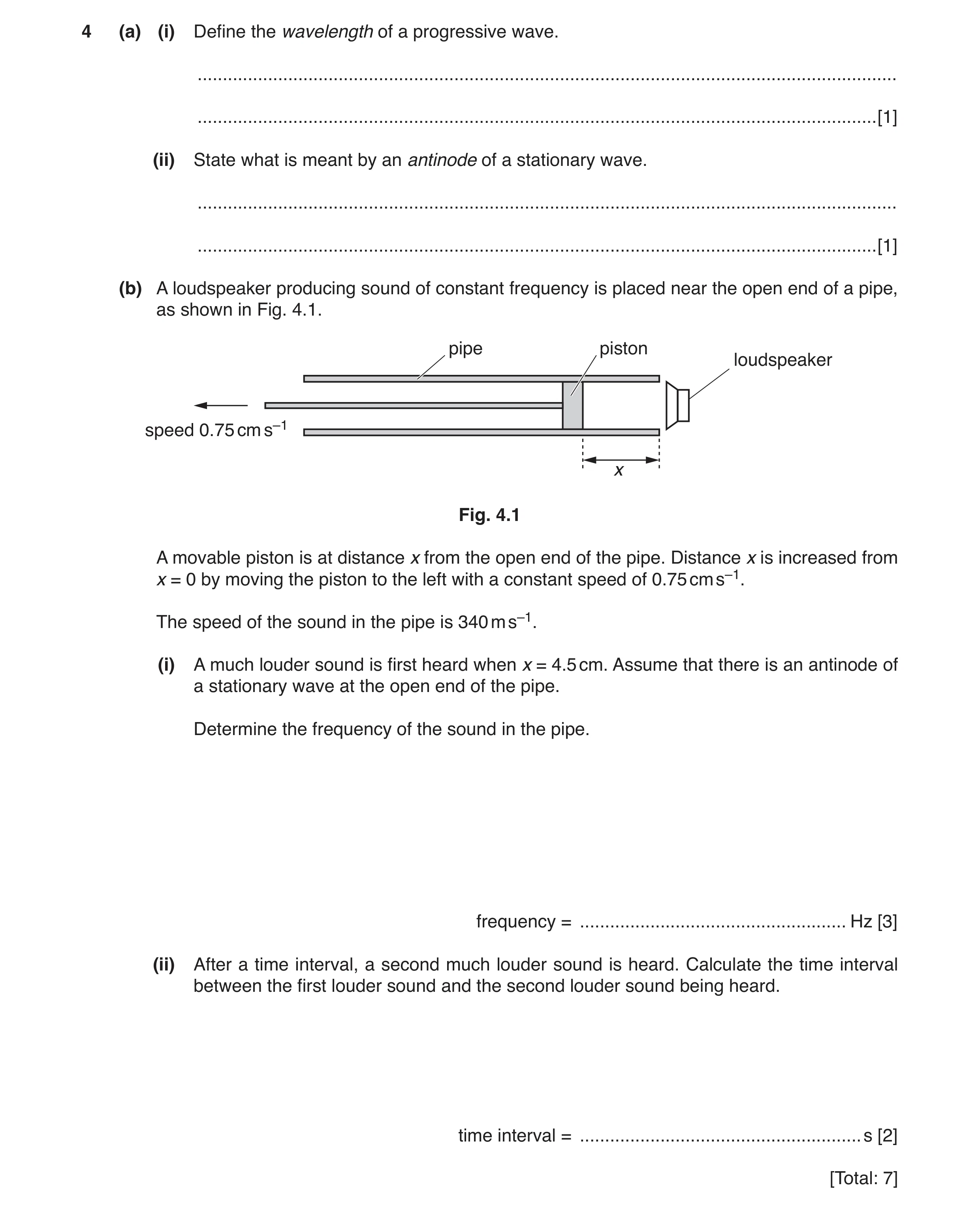
4 (a) (i) Define the wavelength of a progressive wave. … … [1] (ii) State what is meant by an antinode of a stationary wave. … … [1] (b) A loudspeaker producing sound of constant frequency is placed near the open end of a pipe, as shown in Fig. 4.1. pipe piston loudspeaker speed 0.75 cm s–1 x Fig. 4.1 A movable piston is at distance x from the open end of the pipe. Distance x is increased from x = 0 by moving the piston to the left with a constant speed of 0.75 cm s–1. The speed of the sound in the pipe is 340 m s–1. (i) A much louder sound is first heard when x = 4.5 cm. Assume that there is an antinode of a stationary wave at the open end of the pipe. Determine the frequency of the sound in the pipe. frequency = … Hz [3] (ii) After a time interval, a second much louder sound is heard. Calculate the time interval between the first louder sound and the second louder sound being heard. time interval = … s [2] [Total: 7]
7 marks
Mark scheme: 4(a)(i) distance moved by wavefront/energy during one cycle/oscillation/period (of source) or minimum distance between two wavefronts or distance between two adjacent wavefronts B1 4(a)(ii) (position where) maximum amplitude B1 4(b)(i) λ = 4 × 0.045 ( = 0.18 (m) or 18 (cm)) C1 v = fλ C1 f = 340 / 0.18 = 1900 Hz A1 4(b)(ii) distance = λ / 2 ( = 0.09 (m) or 9 (cm)) C1 time = 0.09 / 0.0075 = 12 s A1 or t = 4.5 / 0.75 and t = 13.5 / 0.75 (C1) time = 18 – 6 = 12 s (A1)
This question in 9702/22 May/June 2018
Q5 · Sound waves are longitudinal waves 9702/22 Oct/Nov 2018
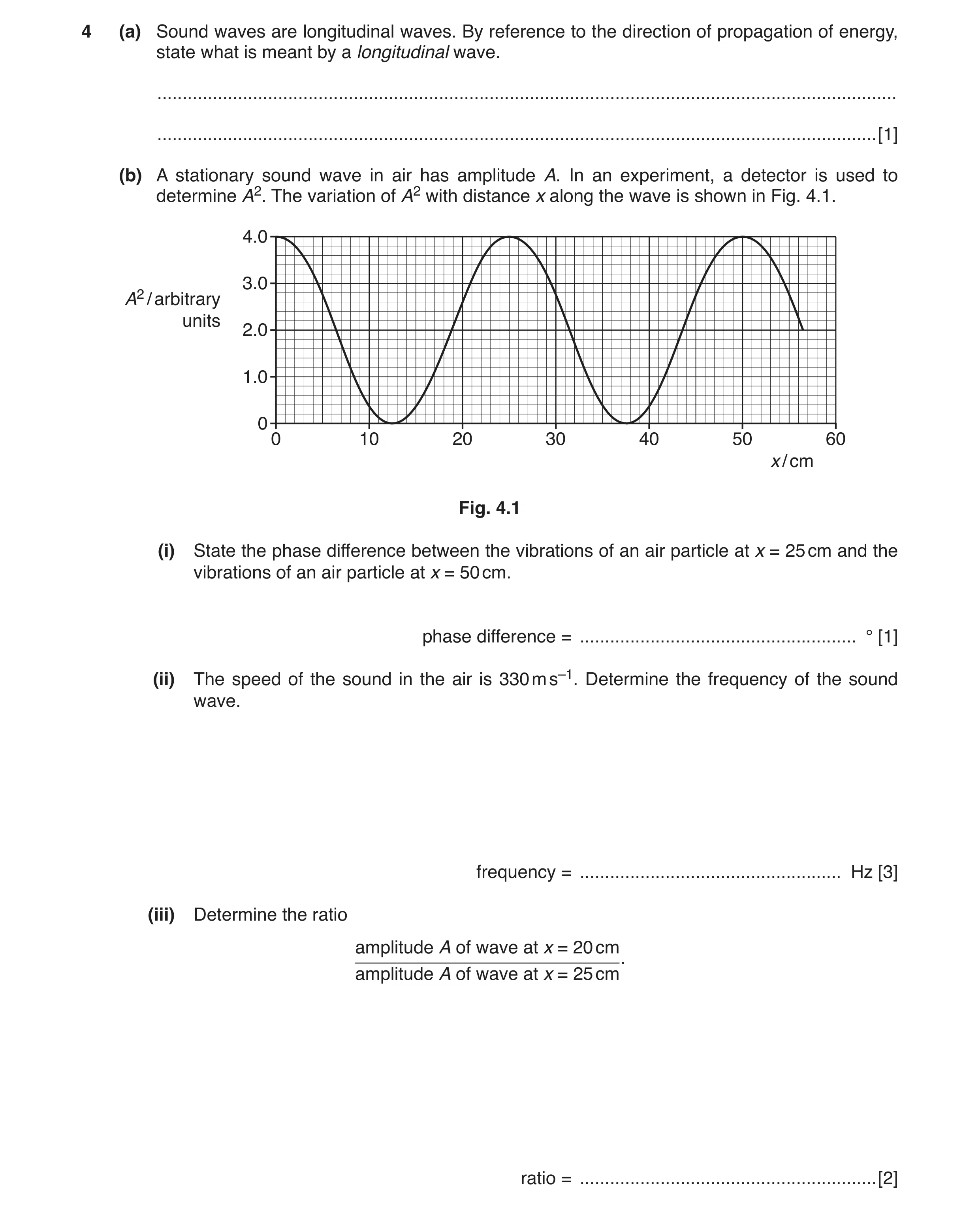
4 (a) Sound waves are longitudinal waves. By reference to the direction of propagation of energy, state what is meant by a longitudinal wave. … … [1] (b) A stationary sound wave in air has amplitude A. In an experiment, a detector is used to determine A2. The variation of A2 with distance x along the wave is shown in Fig. 4.1. 4.0 3.0 A2 / arbitrary units 2.0 1.0 0 0 10 20 30 40 50 60 x / cm Fig. 4.1 (i) State the phase difference between the vibrations of an air particle at x = 25 cm and the vibrations of an air particle at x = 50 cm. phase difference = … ° [1] (ii) The speed of the sound in the air is 330 m s–1. Determine the frequency of the sound wave. frequency = … Hz [3] (iii) Determine the ratio amplitude A of wave at x = 20 cm . amplitude A of wave at x = 25 cm ratio = … [2]
7 marks
Mark scheme: 4(a) vibration(s)/oscillation(s) (of particles) parallel to direction of propagation of energy B1 4(b)(i) phase difference = 180° A1 4(b)(ii) v = fλ C1 λ / 2 = 25 (cm) or 0.25 (m) C1 f = 330 / 0.50 = 660 Hz A1 4(b)(iii) (readings from graph =) 2.6 and 4.0 C1 ratio = (2.6 / 4.0)1/2 = 0.81 A1
This question in 9702/22 Oct/Nov 2018
Question 6 9702/23 Oct/Nov 2018
4 (a) On Fig. 4.1, complete the two graphs to illustrate what is meant by the amplitude A, the wavelength λ and the period T of a progressive wave. Ensure that you label the axes of each graph. 0 0 Fig. 4.1 [3] (b) A horizontal string is stretched between two fixed points X and Y. A vibrator is used to oscillate the string and produce a stationary wave. Fig. 4.2 shows the string at one instant in time. string X Y Fig. 4.2 The speed of a progressive wave along the string is 30 m s–1. The stationary wave has a period of 40 ms. (i) Explain how the stationary wave is formed on the string. … … … … [2] (ii) A particle on the string oscillates with an amplitude of 13 mm. At time t, the particle has zero displacement. Calculate 1. the displacement of the particle at time (t + 100 ms), displacement = … mm 2. the total distance moved by the particle from time t to time (t + 100 ms). distance = … mm [3] (iii) Determine 1. the frequency of the wave, frequency = … Hz [1] 2. the horizontal distance from X to Y. distance = … m [3] [Total: 12]
12 marks
Mark scheme: 4(a) B1 graph with x-axis labelled ‘time’ and period/T correctly shown B1 graph with y-axis labelled ‘displacement’ and amplitude/A correctly shown B1 4(b)(i) wave (moves along string and) reflects at fixed point/Y/X/end/wall/boundary B1 the incident and reflected waves interfere/superpose B1 4(b)(ii) 100 / 40 or 2.5 (cycles/periods/T) C1 1. displacement = 0 B1 2. distance = 130 mm A1 4(b)(iii) 1. f = 1 / 40 × 10–3 = 25 Hz A1 2. v = fλ or λ = vT C1 λ = 30 / 25 or 30 × 40 × 10–3 (= 1.2 m) C1 distance = 1.2 × 1.5 = 1.8 m A1
This question in 9702/23 Oct/Nov 2018
Q7 · A vertical tube of length 0.60 m is open at both ends, as shown in Fig 9702/23 May/June 2019
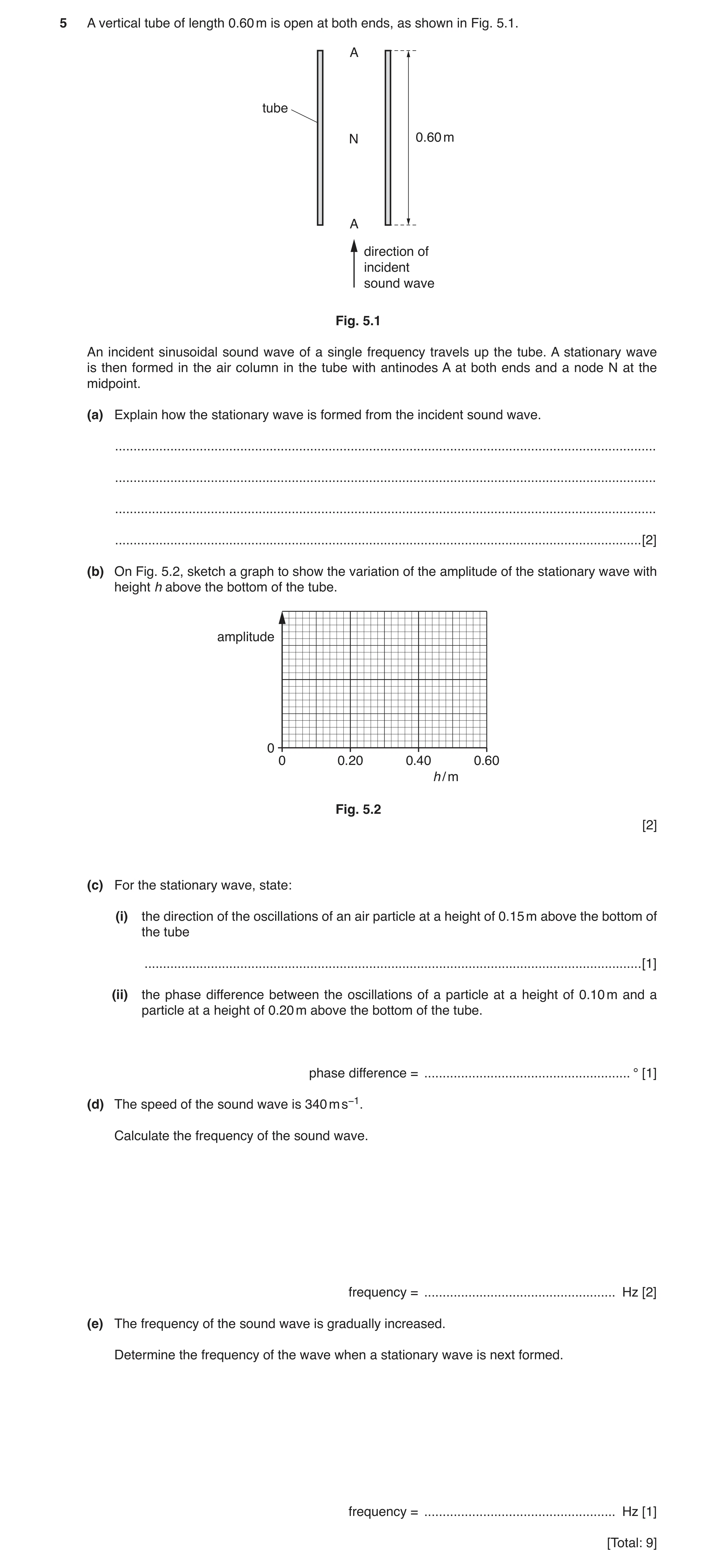
5 A vertical tube of length 0.60 m is open at both ends, as shown in Fig. 5.1. A tube N 0.60 m A direction of incident sound wave Fig. 5.1 An incident sinusoidal sound wave of a single frequency travels up the tube. A stationary wave is then formed in the air column in the tube with antinodes A at both ends and a node N at the midpoint. (a) Explain how the stationary wave is formed from the incident sound wave. … … … … [2] (b) On Fig. 5.2, sketch a graph to show the variation of the amplitude of the stationary wave with height h above the bottom of the tube. amplitude 0 0 0.20 0.40 0.60 h / m Fig. 5.2 [2] (c) For the stationary wave, state: (i) the direction of the oscillations of an air particle at a height of 0.15 m above the bottom of the tube … [1] (ii) the phase difference between the oscillations of a particle at a height of 0.10 m and a particle at a height of 0.20 m above the bottom of the tube. phase difference = … ° [1] (d) The speed of the sound wave is 340 m s−1. Calculate the frequency of the sound wave. frequency = … Hz [2] (e) The frequency of the sound wave is gradually increased. Determine the frequency of the wave when a stationary wave is next formed. frequency = … Hz [1] [Total: 9]
9 marks
Mark scheme: 5(a) (incident) wave reflects at end/top of tube B1 (incident) wave and reflected wave interfere/superpose B1 5(b) line has maximum value of amplitude at h = 0 and h = 0.60 m only B1 line has minimum/zero value of amplitude at h = 0.30 m only B1 5(c)(i) vertical/along length of tube/along axis of tube B1 5(c)(ii) phase difference = 0 A1 5(d) v = fλ C1 v = 340 / (2 × 0.60) = 280 Hz A1 5(e) f = 340 / 0.60 = 570 Hz A1
This question in 9702/23 May/June 2019
Q8 · Describe the conditions required for two waves to be able to form a stationary wave 9702/21 Oct/Nov 2020
6 (a) Describe the conditions required for two waves to be able to form a stationary wave. … … … … [2] (b) A stationary wave on a string has nodes and antinodes. The distance between a node and an adjacent antinode is 6.0 cm. (i) State what is meant by a node. … [1] (ii) Calculate the wavelength of the two waves forming the stationary wave. wavelength = … cm [1] (iii) State the phase difference between the particles at two adjacent antinodes of the stationary wave. phase difference = … ° [1] [Total: 5]
5 marks
Mark scheme: 6(a) the waves (of the same type) move in opposite directions and overlap B1 the waves have the same (speed and) frequency/wavelength B1 6(b)(i) zero amplitude B1 6(b)(ii) distance = 6.0 × 4 = 24 cm A1 6(b)(iii) 180° A1
This question in 9702/21 Oct/Nov 2020
Q9 · State the principle of superposition 9702/22 Feb/March 2021
4 (a) State the principle of superposition. … … … [2] (b) A transmitter produces microwaves that travel in air towards a metal plate, as shown in Fig. 4.1. microwave metal transmitter microwave plate receiver X Fig. 4.1 The microwaves have a wavelength of 0.040 m. A stationary wave is formed between the transmitter and the plate. (i) Explain the function of the metal plate. … … [1] (ii) Calculate the frequency, in GHz, of the microwaves. frequency = … GHz [3] (iii) A microwave receiver is initially placed at position X where it detects an intensity minimum. The receiver is then slowly moved away from X directly towards the plate. 1. Determine the shortest distance from X of the receiver when it detects another intensity minimum. distance = … m 2. Determine the number of intensity maxima that are detected by the receiver as it moves from X to a position that is 9.1 cm away from X. number = … [2] [Total: 8]
8 marks
Mark scheme: 4(a) (two or more) waves meet (at a point) B1 (resultant) displacement is the sum of the individual displacements B1 4(b)(i) it is a (wave) reflector / it reflects (the wave) B1 4(b)(ii) v = fλ or c = fλ C1 f = 3.0 × 10⁸ / 0.040 = 7.5 × 10⁹ (Hz) = 7.5 × 10⁹ / 109 (GHz) C1 = 7.5 GHz A1 4(b)(iii) 1 distance = 0.020 m A1 2 number = 5 A1
This question in 9702/22 Feb/March 2021
Q10 · A tube is initially fully submerged in water 9702/22 Oct/Nov 2021
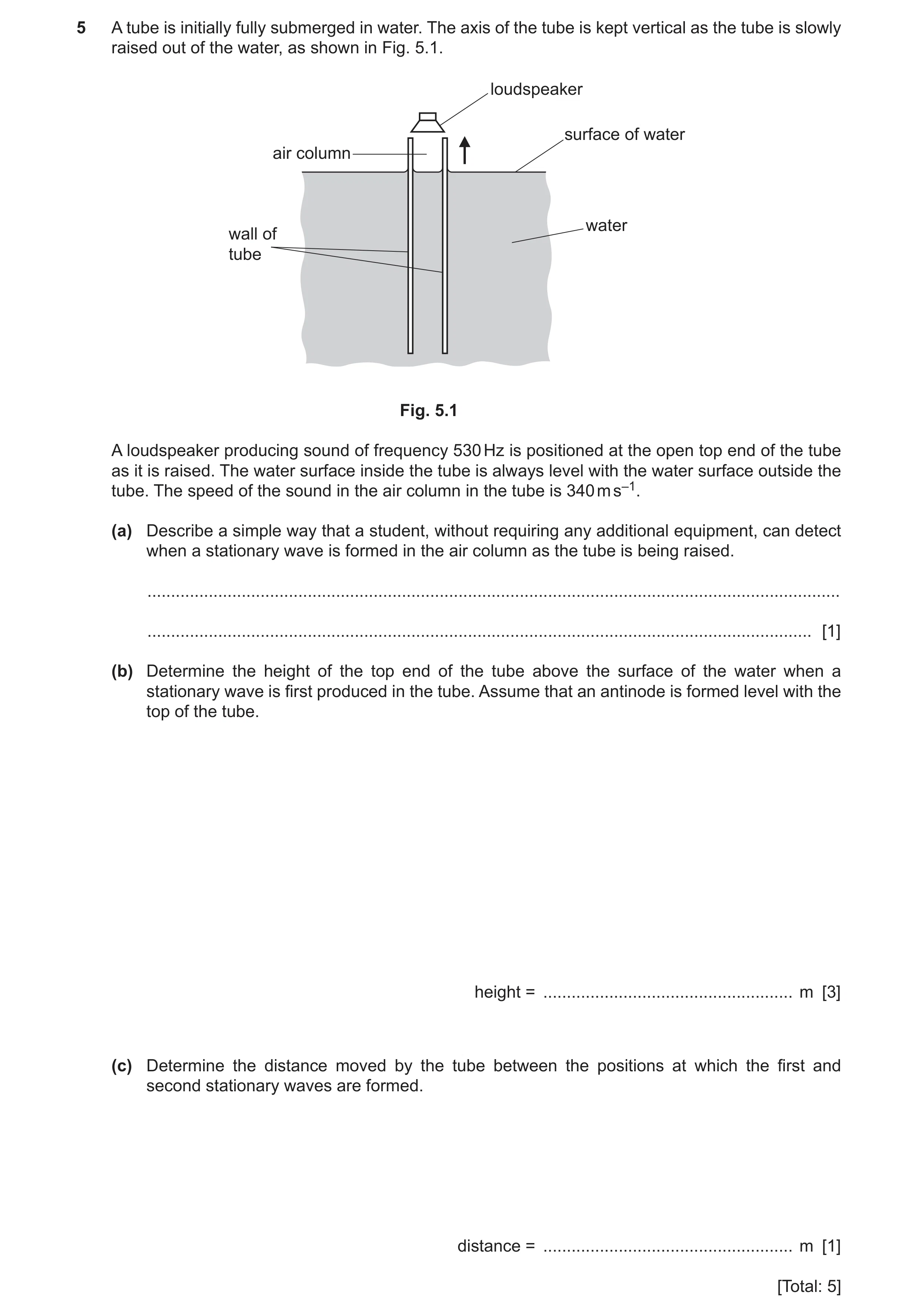
5 A tube is initially fully submerged in water. The axis of the tube is kept vertical as the tube is slowly raised out of the water, as shown in Fig. 5.1. loudspeaker surface of water air column water wall of tube Fig. 5.1 A loudspeaker producing sound of frequency 530 Hz is positioned at the open top end of the tube as it is raised. The water surface inside the tube is always level with the water surface outside the tube. The speed of the sound in the air column in the tube is 340 m s–1. (a) Describe a simple way that a student, without requiring any additional equipment, can detect when a stationary wave is formed in the air column as the tube is being raised. … … [1] (b) Determine the height of the top end of the tube above the surface of the water when a stationary wave is first produced in the tube. Assume that an antinode is formed level with the top of the tube. height = … m [3] (c) Determine the distance moved by the tube between the positions at which the first and second stationary waves are formed. distance = … m [1] [Total: 5]
5 marks
Mark scheme: 5(a) a (much) louder sound can be heard B1 5(b) v = fλ C1 λ = 340 / 530 ( = 0.64 m) C1 height = 0.64 / 4 = 0.16 m A1 5(c) distance = 0.64 / 2 or 0.16 × 2 or (¾ × 0.64 – ¼ × 0.64) = 0.32 m A1
This question in 9702/22 Oct/Nov 2021
Q11 · Polarisation is a phenomenon associated with light waves but not with sound waves 9702/21 Oct/Nov 2022
4 (a) Polarisation is a phenomenon associated with light waves but not with sound waves. (i) State the meaning of polarisation. … … … [1] (ii) State why light waves can be plane polarised but sound waves cannot. … … … [1] (b) Two polarising filters A and B are positioned so that their planes are parallel to each other and perpendicular to a central axis line XY, as shown in Fig. 4.1. filter filter A B direction of rotation I0 X Y unpolarised light vertical horizontal transmission axis transmission axis Fig. 4.1 The transmission axis of filter A is vertical and the transmission axis of filter B is horizontal. Unpolarised light of a single frequency is directed along the line XY from a source positioned at X. The light emerging from filter A is vertically plane polarised and has intensity I0. Filter B is rotated from its starting position about the line XY, as shown in Fig. 4.1. 1 After rotation, the intensity of the light emerging from filter B is I0. 4 Calculate the angle of rotation of filter B from its starting position. angle of rotation = … ° [3] (c) A microwave of intensity I0 and amplitude A0 meets another microwave of the same frequency 1 and of intensity I0 travelling in the opposite direction. Both microwaves are vertically plane 4 polarised and superpose where they meet. (i) Explain, without calculation, why these two waves cannot form a stationary wave with zero amplitude at its nodes. … … … [2] (ii) Determine, in terms of A0, the maximum amplitude of the wave formed. maximum amplitude = … A0 [3] [Total: 10]
10 marks
Mark scheme: 4(a)(i) oscillations are in a single direction, which is perpendicular to the direction of propagation (of the wave) B1 or oscillations are in a single plane, which contains the direction of propagation (of the wave) 4(a)(ii) light waves are transverse and sound waves are longitudinal B1 4(b) I = I0 cos2 C1 cos2 = 1 / 4 so cos = 1 / 2 C1 = 60° or 120° or 240° or 300° angle of rotation = (120° – 90°) or (240° – 90°) or (300° – 90°) A1 = 30° or 150° or 210° or 330° 4(c)(i) the waves have different amplitudes B1 cannot have resultant displacement that is always zero B1 or cannot have (complete) destructive interference (at nodes) or (at nodes resultant) amplitude is the difference of the amplitudes 4(c)(ii) I A2 C1 A2 / A02 = (I0 / 4) / I0 C1 A = 0.5 A0 maximum amplitude = A0 + 0.5 A0 A1 = 1.5 A0
This question in 9702/21 Oct/Nov 2022
Q12 · A progressive longitudinal wave travels through a medium from left to right 9702/23 Oct/Nov 2022
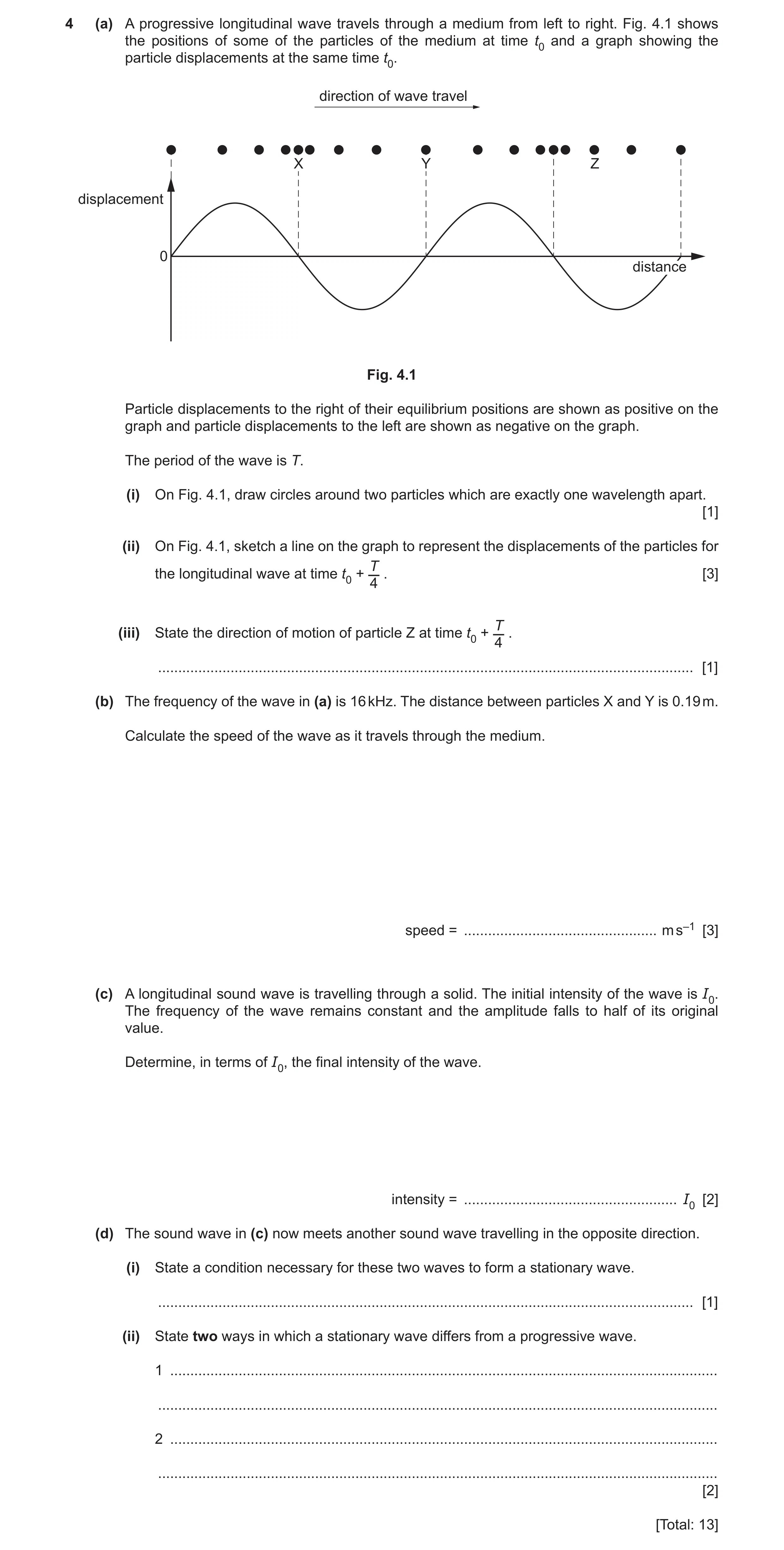
4 (a) A progressive longitudinal wave travels through a medium from left to right. Fig. 4.1 shows the positions of some of the particles of the medium at time t0 and a graph showing the particle displacements at the same time t0. direction of wave travel X Y Z displacement 0 distance Fig. 4.1 Particle displacements to the right of their equilibrium positions are shown as positive on the graph and particle displacements to the left are shown as negative on the graph. The period of the wave is T. (i) On Fig. 4.1, draw circles around two particles which are exactly one wavelength apart. [1] (ii) On Fig. 4.1, sketch a line on the graph to represent the displacements of the particles for T the longitudinal wave at time t0 + . [3] 4 T (iii) State the direction of motion of particle Z at time t0 + . 4 … [1] (b) The frequency of the wave in (a) is 16 kHz. The distance between particles X and Y is 0.19 m. Calculate the speed of the wave as it travels through the medium. speed = … m s–1 [3] (c) A longitudinal sound wave is travelling through a solid. The initial intensity of the wave is I0. The frequency of the wave remains constant and the amplitude falls to half of its original value. Determine, in terms of I0, the final intensity of the wave. intensity = … I0 [2] (d) The sound wave in (c) now meets another sound wave travelling in the opposite direction. (i) State a condition necessary for these two waves to form a stationary wave. … [1] (ii) State two ways in which a stationary wave differs from a progressive wave. 1 … … 2 … … [2] [Total: 13]
13 marks
Mark scheme: 4(a)(i) circles drawn around any two particles with seven (uncircled) particles in between A1 4(a)(ii) curve has an initial negative displacement and initial amplitude same as original curve B1 curve has same amplitude as original curve throughout B1 curve has same wavelength as original curve throughout, with constant (non-zero) phase difference B1 4(a)(iii) (to the) right / rightwards A1 4(b) = 2 0.19 C1 = 0.38 m v = f C1 v = (16 103) 0.38 A1 v = 6100 m s–1 4(c) I A2 C1 I = (1 / 2)2 I0 A1 intensity = 0.25 I0 4(d)(i) same frequency / wavelength / period B1 4(d)(ii) • a stationary wave has nodes/antinodes (and a progressive wave does not) B2 • a stationary wave does not transfer/propagate energy (and a progressive wave does transfer/propagate energy) • different points on a stationary wave have different amplitudes (and all points on a progressive wave have the same/constant amplitude) • stationary wave has adjacent particles that are in phase (and adjacent particles on progressive wave are out of phase) Any two points, 1 mark each. Allow the reverse statement for each marking point.
This question in 9702/23 Oct/Nov 2022
Q13 · A progressive wave travels through a medium 9702/22 May/June 2023
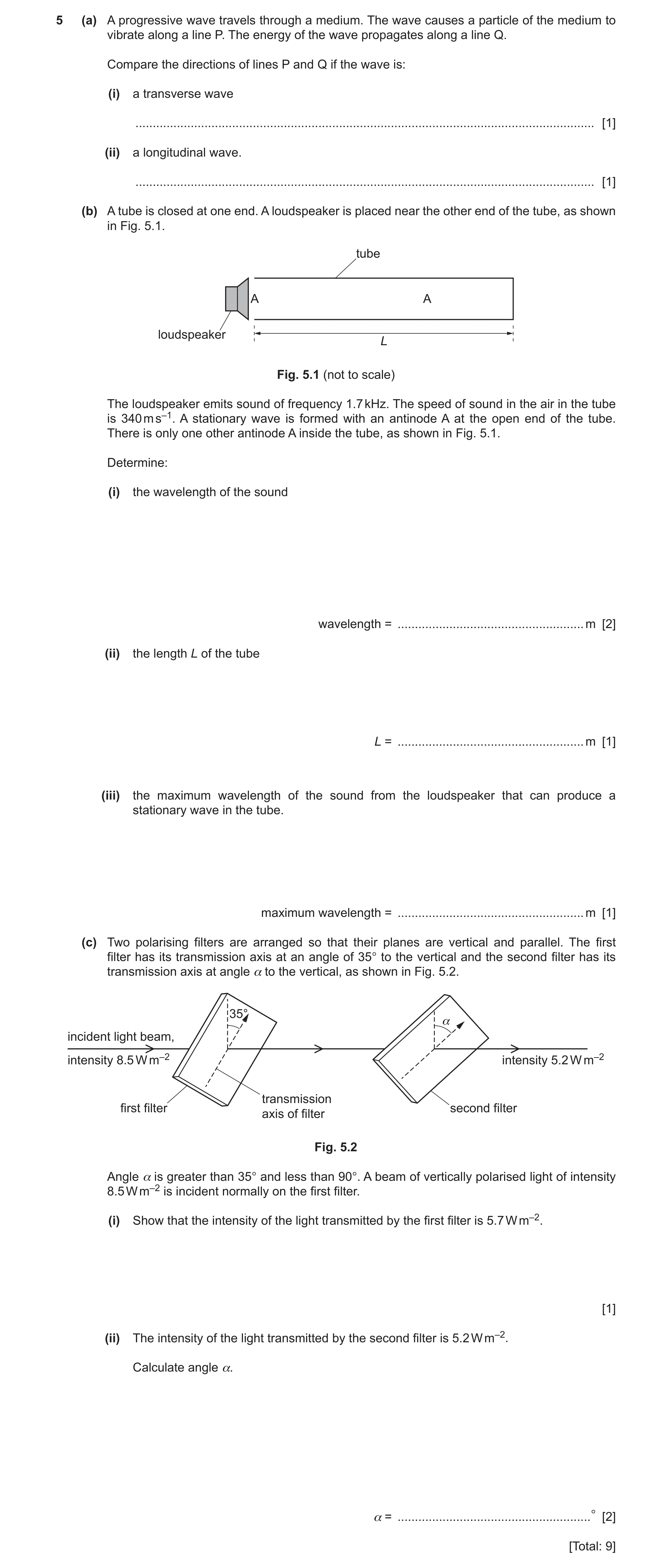
5 (a) A progressive wave travels through a medium. The wave causes a particle of the medium to vibrate along a line P. The energy of the wave propagates along a line Q. Compare the directions of lines P and Q if the wave is: (i) a transverse wave … [1] (ii) a longitudinal wave. … [1] (b) A tube is closed at one end. A loudspeaker is placed near the other end of the tube, as shown in Fig. 5.1. tube A A loudspeaker L Fig. 5.1 (not to scale) The loudspeaker emits sound of frequency 1.7 kHz. The speed of sound in the air in the tube is 340 m s–1. A stationary wave is formed with an antinode A at the open end of the tube. There is only one other antinode A inside the tube, as shown in Fig. 5.1. Determine: (i) the wavelength of the sound wavelength = … m [2] (ii) the length L of the tube L = … m [1] (iii) the maximum wavelength of the sound from the loudspeaker that can produce a stationary wave in the tube. maximum wavelength = … m [1] (c) Two polarising filters are arranged so that their planes are vertical and parallel. The first filter has its transmission axis at an angle of 35° to the vertical and the second filter has its transmission axis at angle α to the vertical, as shown in Fig. 5.2. 35° α incident light beam, intensity 8.5 W m–2 intensity 5.2 W m–2 transmission first filter second filter axis of filter Fig. 5.2 Angle α is greater than 35° and less than 90°. A beam of vertically polarised light of intensity 8.5 W m–2 is incident normally on the first filter. (i) Show that the intensity of the light transmitted by the first filter is 5.7 W m–2. [1] (ii) The intensity of the light transmitted by the second filter is 5.2 W m–2. Calculate angle α. α = … ° [2] [Total: 9]
9 marks
Mark scheme: 5(a)(i) (they are) perpendicular B1 5(a)(ii) (they are) parallel B1 5(b)(i) = v / f C1 = 340 / 1700 = 0.20 m A1 5(b)(ii) L = 3 4 = 3 4 0.20 = 0.15 m A1 5(b)(iii) = 4 0.15 or 0.20 3 = 0.60 m A1 5(c)(i) (I =) 8.5 cos2 35° = 5.7 (W m–2) A1 5(c)(ii) 5.2 = 5.7 cos2 ( = 17°) C1 = 35° + 17° = 52° A1
This question in 9702/22 May/June 2023
Q14 · For a progressive wave, state what is meant by the frequency 9702/23 May/June 2023
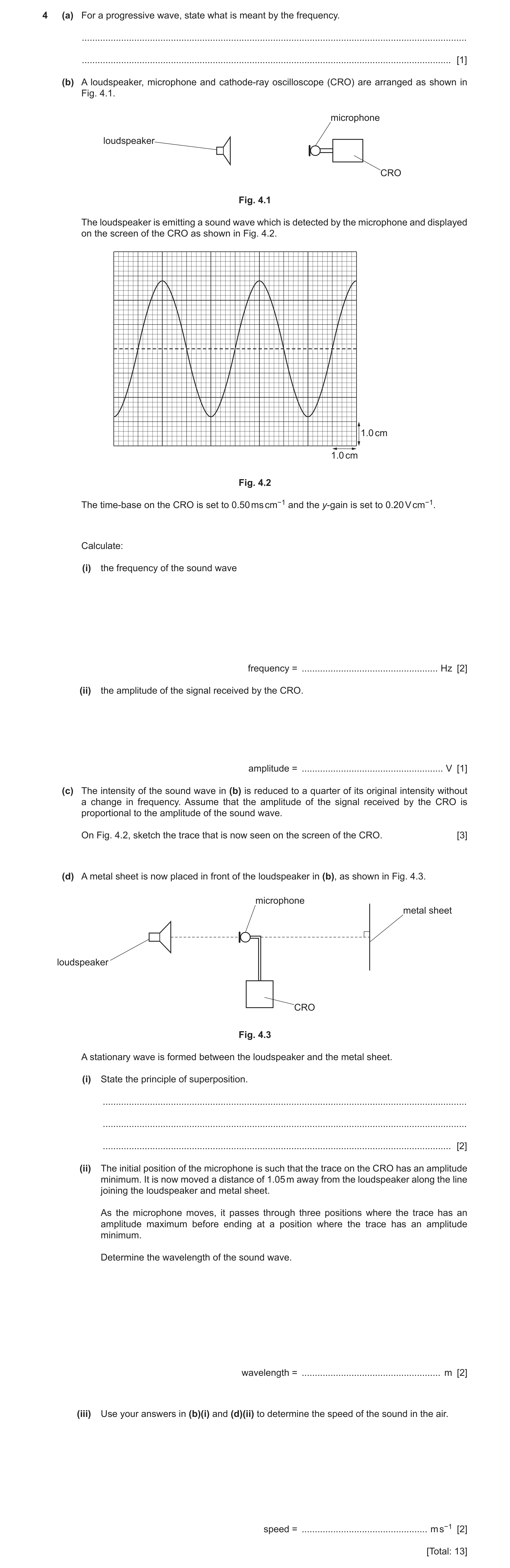
4 (a) For a progressive wave, state what is meant by the frequency. … … [1] (b) A loudspeaker, microphone and cathode-ray oscilloscope (CRO) are arranged as shown in Fig. 4.1. microphone loudspeaker CRO Fig. 4.1 The loudspeaker is emitting a sound wave which is detected by the microphone and displayed on the screen of the CRO as shown in Fig. 4.2. 1.0 cm 1.0 cm Fig. 4.2 The time-base on the CRO is set to 0.50 ms cm−1 and the y-gain is set to 0.20 V cm−1. Calculate: (i) the frequency of the sound wave frequency = … Hz [2] (ii) the amplitude of the signal received by the CRO. amplitude = … V [1] (c) The intensity of the sound wave in (b) is reduced to a quarter of its original intensity without a change in frequency. Assume that the amplitude of the signal received by the CRO is proportional to the amplitude of the sound wave. On Fig. 4.2, sketch the trace that is now seen on the screen of the CRO. [3] (d) A metal sheet is now placed in front of the loudspeaker in (b), as shown in Fig. 4.3. microphone metal sheet loudspeaker CRO Fig. 4.3 A stationary wave is formed between the loudspeaker and the metal sheet. (i) State the principle of superposition. … … … [2] (ii) The initial position of the microphone is such that the trace on the CRO has an amplitude minimum. It is now moved a distance of 1.05 m away from the loudspeaker along the line joining the loudspeaker and metal sheet. As the microphone moves, it passes through three positions where the trace has an amplitude maximum before ending at a position where the trace has an amplitude minimum. Determine the wavelength of the sound wave. wavelength = … m [2] (iii) Use your answers in (b)(i) and (d)(ii) to determine the speed of the sound in the air. speed = … m s−1 [2] [Total: 13]
13 marks
Mark scheme: 4(a) the number of wavefronts/crests/troughs passing a fixed point per unit time or the number of oscillations per unit time (of source / point on wave / particle of medium) B1 4(b)(i) T = 4 0.50 10–3 ( = 2.0 10–3 s) C1 f = 1 / 2.0 10–3 = 500 Hz A1 4(b)(ii) amplitude = 2.8 0.20 = 0.56 V A1 4(c) period same as original trace B1 sinusoidal wave of constant amplitude less than 2.8 cm throughout M1 amplitude 1.4 cm A1 Question Answer Marks 4(d)(i) when (two or more) waves meet (at a point) B1 (resultant) displacement is the sum of the individual displacements B1 4(d)(ii) node-to-node separation is / 2 or microphone moves through 3 node-to-node separations or d = 1.5 C1 = 1.05 / 1.5 = 0.70 m A1 4(d)(iii) v = f C1 = 500 0.70 = 350 m s–1 A1
This question in 9702/23 May/June 2023
Q15 · Coherent visible light of a single frequency is incident normally on a double slit 9702/22 Feb/March 2024
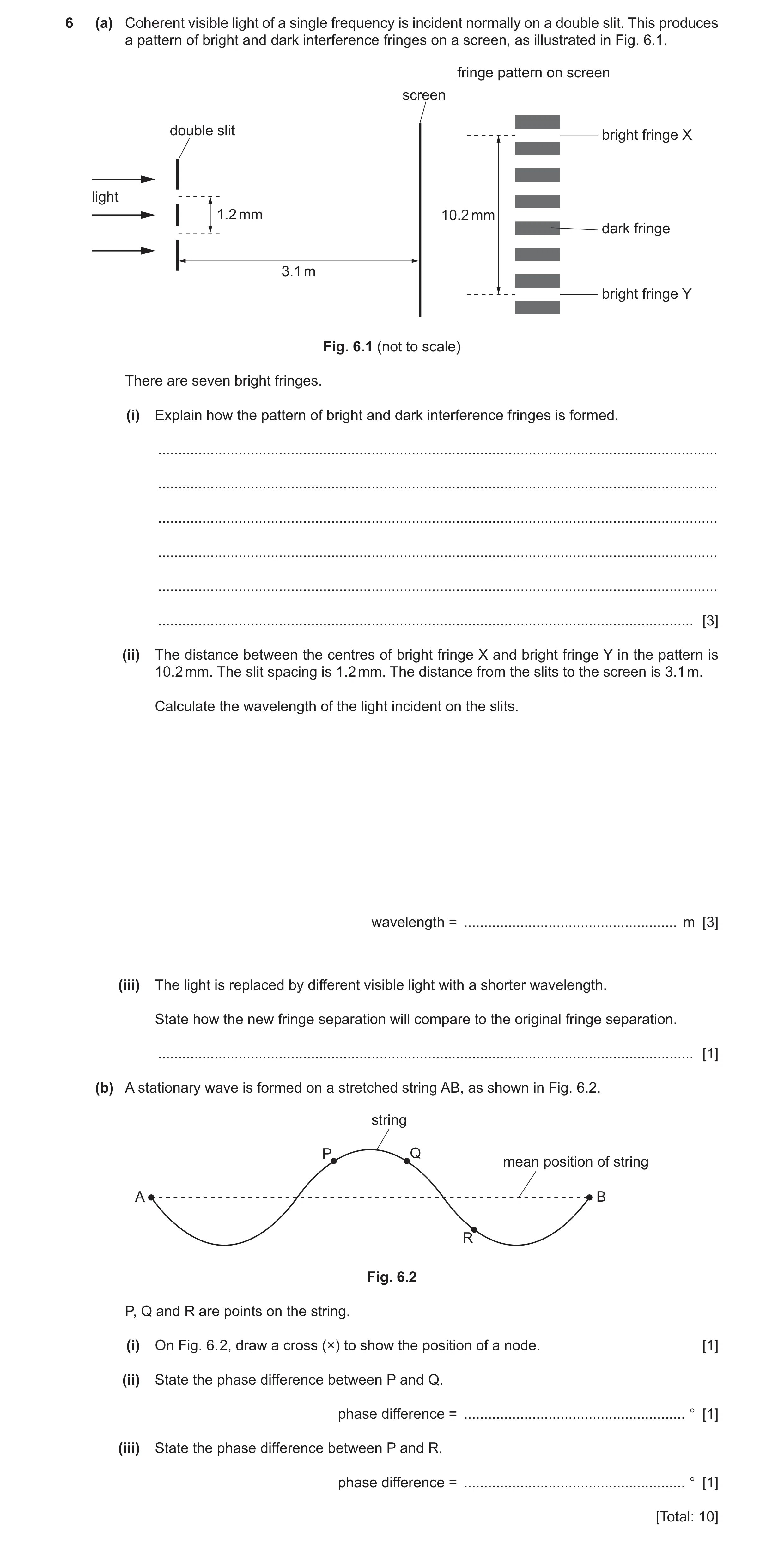
6 (a) Coherent visible light of a single frequency is incident normally on a double slit. This produces a pattern of bright and dark interference fringes on a screen, as illustrated in Fig. 6.1. fringe pattern on screen screen double slit bright fringe X light 1.2 mm 10.2 mm dark fringe 3.1 m bright fringe Y Fig. 6.1 (not to scale) There are seven bright fringes. (i) Explain how the pattern of bright and dark interference fringes is formed. … … … … … … [3] (ii) The distance between the centres of bright fringe X and bright fringe Y in the pattern is 10.2 mm. The slit spacing is 1.2 mm. The distance from the slits to the screen is 3.1 m. Calculate the wavelength of the light incident on the slits. wavelength = … m [3] (iii) The light is replaced by different visible light with a shorter wavelength. State how the new fringe separation will compare to the original fringe separation. … [1] (b) A stationary wave is formed on a stretched string AB, as shown in Fig. 6.2. string P Q mean position of string A B R Fig. 6.2 P, Q and R are points on the string. (i) On Fig. 6. 2, draw a cross (×) to show the position of a node. [1] (ii) State the phase difference between P and Q. phase difference = … ° [1] (iii) State the phase difference between P and R. phase difference = … ° [1] [Total: 10]
10 marks
Mark scheme: 6(a)(i) Any three from: B3 • Light diffracts at the (two) slits. • Light (from each slit) meets / superposes (at the screen). • When the phase difference is 0 (degrees) a bright fringe / (intensity) maximum is formed. • When the phase difference is 180 (degrees) a dark fringe / (intensity) minimum is formed. 6(a)(ii) = ax / D C1 = 1.2 10–3 (10.2 10–3 / 6) / 3.1 C1 = 6.6 10–7 m A1 6(a)(iii) (new fringe separation will be) smaller B1 6(b)(i) A cross at the intersection of the string and the mean position line. B1 6(b)(ii) 0 A1 6(b)(iii) 180˚ A1
This question in 9702/22 Feb/March 2024
Q16 · A stretched string PQ has length 1.2 m 9702/21 May/June 2024
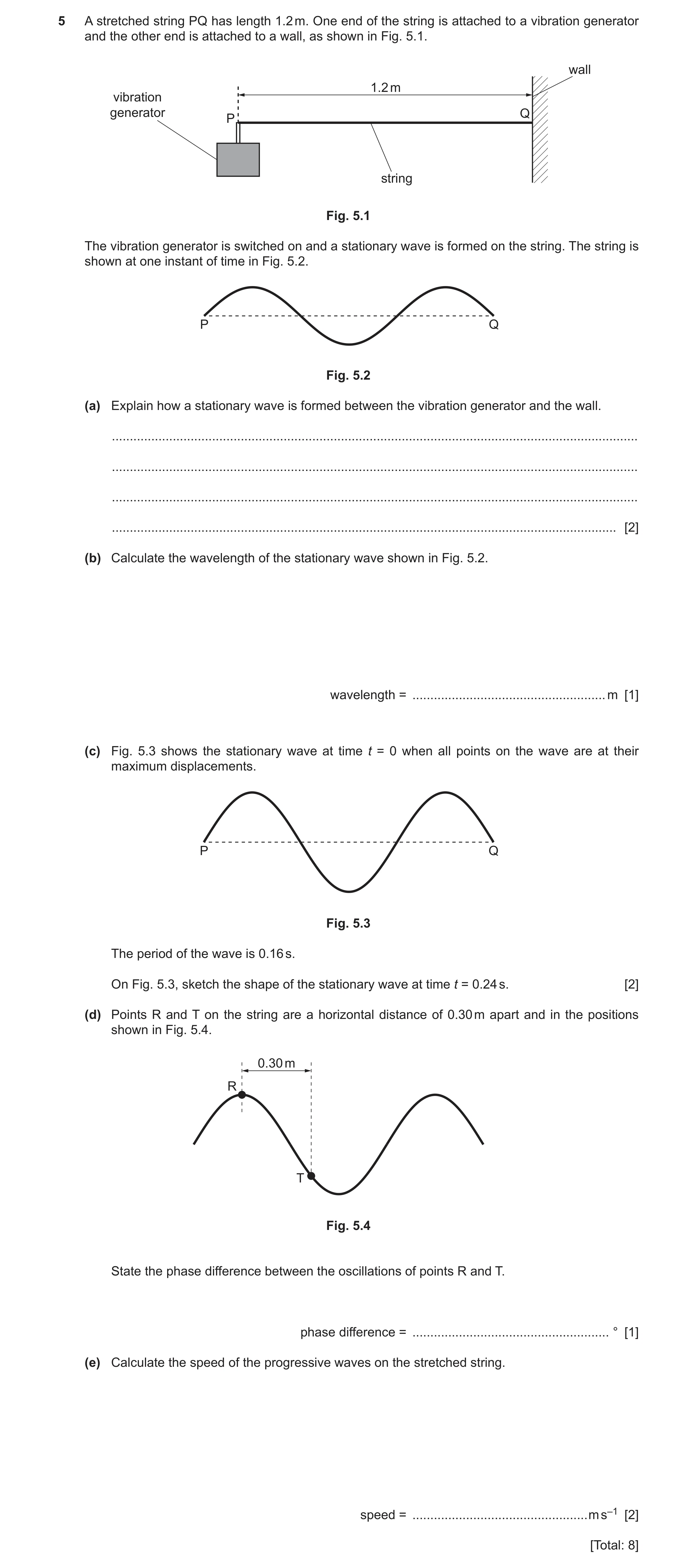
5 A stretched string PQ has length 1.2 m. One end of the string is attached to a vibration generator and the other end is attached to a wall, as shown in Fig. 5.1. wall 1.2 m vibration generator Q P string Fig. 5.1 The vibration generator is switched on and a stationary wave is formed on the string. The string is shown at one instant of time in Fig. 5.2. P Q Fig. 5.2 (a) Explain how a stationary wave is formed between the vibration generator and the wall. … … … … [2] (b) Calculate the wavelength of the stationary wave shown in Fig. 5.2. wavelength = … m [1] (c) Fig. 5.3 shows the stationary wave at time t = 0 when all points on the wave are at their maximum displacements. P Q Fig. 5.3 The period of the wave is 0.16 s. On Fig. 5.3, sketch the shape of the stationary wave at time t = 0.24 s. [2] (d) Points R and T on the string are a horizontal distance of 0.30 m apart and in the positions shown in Fig. 5.4. 0.30 m R T Fig. 5.4 State the phase difference between the oscillations of points R and T. phase difference = … ° [1] (e) Calculate the speed of the progressive waves on the stretched string. speed = … m s–1 [2] [Total: 8]
8 marks
Mark scheme: 5(a) wave(s) (travel along string and) reflect at fixed point / wall / Q / end / vibration generator / P B1 incident and reflected waves superpose B1 5(b) 0.80 m A1 5(c) same wavelength as original throughout and passing through intersection of solid and dashed lines B1 reflected in dashed line and of same amplitude B1 5(d) 180° A1 5(e) v = fand f =1 / T or v = / T C1 v = 6.25 0.80 or 0.80 / 0.16 = 5.0 m s–1 A1
This question in 9702/21 May/June 2024
Q17 · A stationary wave is formed on a string XY that has a length of 0.48 m 9702/23 Oct/Nov 2024
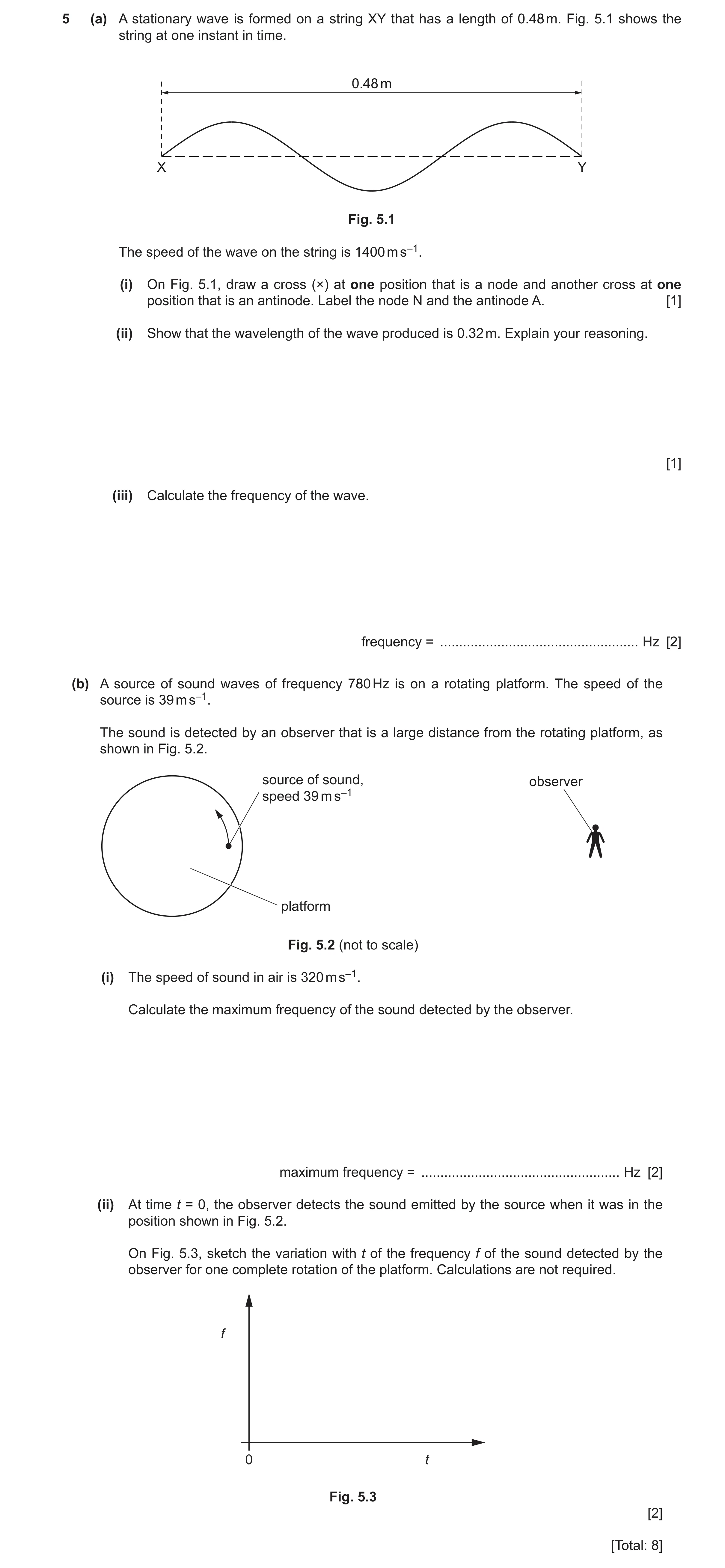
5 (a) A stationary wave is formed on a string XY that has a length of 0.48 m. Fig. 5.1 shows the string at one instant in time. 0.48 m X Y Fig. 5.1 The speed of the wave on the string is 1400 m s–1. (i) On Fig. 5.1, draw a cross (×) at one position that is a node and another cross at one position that is an antinode. Label the node N and the antinode A. [1] (ii) Show that the wavelength of the wave produced is 0.32 m. Explain your reasoning. [1] (iii) Calculate the frequency of the wave. frequency = … Hz [2] (b) A source of sound waves of frequency 780 Hz is on a rotating platform. The speed of the source is 39 m s–1. The sound is detected by an observer that is a large distance from the rotating platform, as shown in Fig. 5.2. source of sound, observer speed 39 m s–1 platform Fig. 5.2 (not to scale) (i) The speed of sound in air is 320 m s–1. Calculate the maximum frequency of the sound detected by the observer. maximum frequency = … Hz [2] (ii) At time t = 0, the observer detects the sound emitted by the source when it was in the position shown in Fig. 5.2. On Fig. 5.3, sketch the variation with t of the frequency f of the sound detected by the observer for one complete rotation of the platform. Calculations are not required. f 0 t Fig. 5.3 [2] [Total: 8]
8 marks
Mark scheme: 5(a)(i) cross labelled N marked at the intersection of the solid and dashed lines or at X or Y B1 and cross labelled A marked at a peak or a trough 5(a)(ii) (XY is 1.5 wavelengths, so) wavelength = 0.48 (2 / 3) = 0.32 m B1 or (wavelength is twice node–node distance so) / 2 = 0.48 / 3 = 0.16 m and wavelength = 0.16 2 = 0.32 m 5(a)(iii) v = f C1 frequency = 1400 / 0.32 A1 = 4400 Hz 5(b)(i) fo = fsv / (v – vs) C1 fo = (780 320) / (320 – 39) maximum frequency = 890 Hz A1 5(b)(ii) line showing f varying both above and below a mean frequency and returning to the original start value of f B1 a single cycle of a smoothly oscillating curve of correct phase (starting at mean position, falling to a trough, then rising to a B1 peak, ending at mean position)
This question in 9702/23 Oct/Nov 2024
Q18 · A device containing a microwave emitter and receiver is placed in front of a large metal… 9702/22 Feb/March 2025
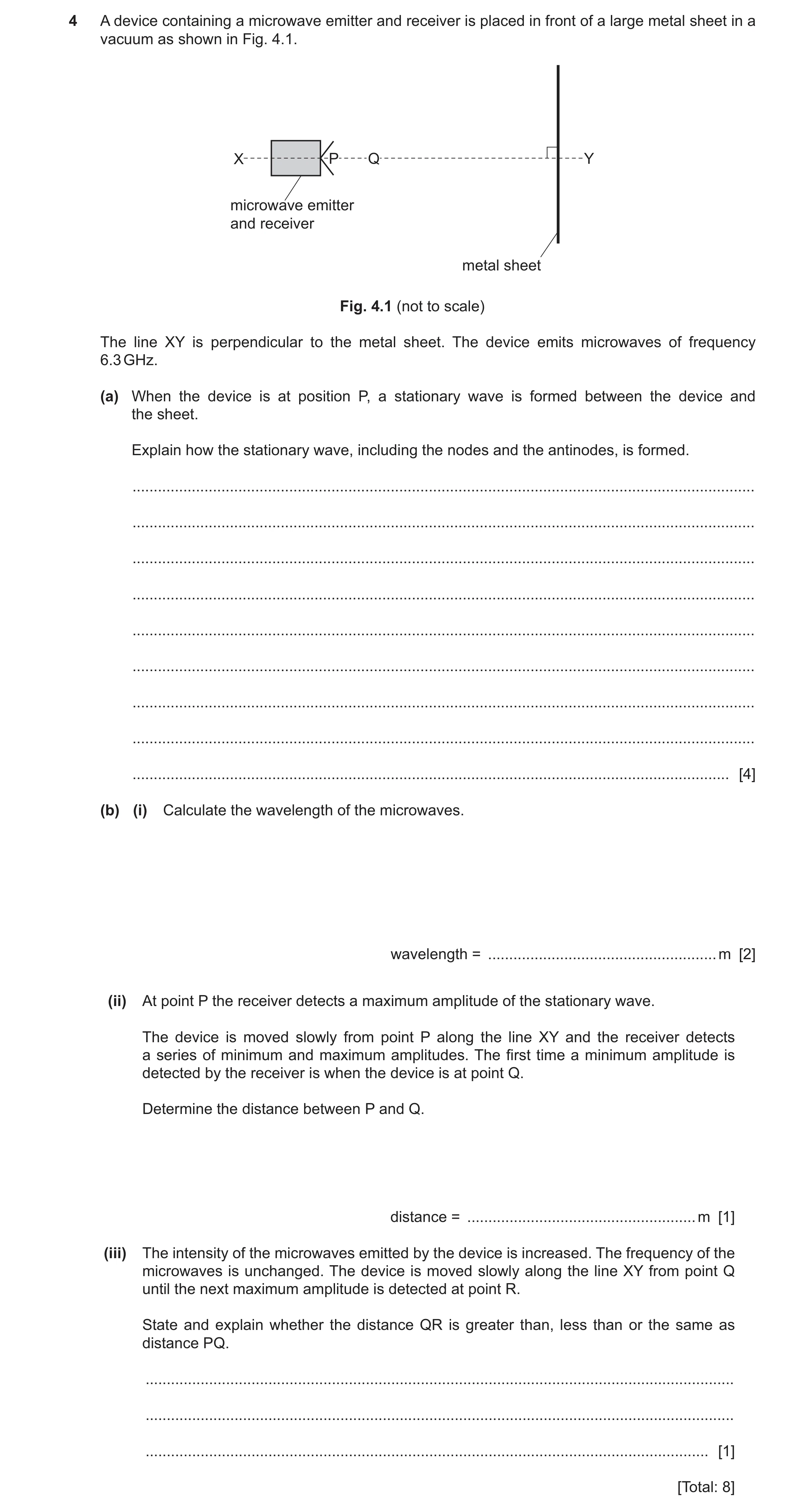
4 A device containing a microwave emitter and receiver is placed in front of a large metal sheet in a vacuum as shown in Fig. 4.1. X P Q Y microwave emitter and receiver metal sheet Fig. 4.1 (not to scale) The line XY is perpendicular to the metal sheet. The device emits microwaves of frequency 6.3 GHz. (a) When the device is at position P, a stationary wave is formed between the device and the sheet. Explain how the stationary wave, including the nodes and the antinodes, is formed. … … … … … … … … … [4] (b) (i) Calculate the wavelength of the microwaves. wavelength = … m [2] (ii) At point P the receiver detects a maximum amplitude of the stationary wave. The device is moved slowly from point P along the line XY and the receiver detects a series of minimum and maximum amplitudes. The first time a minimum amplitude is detected by the receiver is when the device is at point Q. Determine the distance between P and Q. distance = … m [1] (iii) The intensity of the microwaves emitted by the device is increased. The frequency of the microwaves is unchanged. The device is moved slowly along the line XY from point Q until the next maximum amplitude is detected at point R. State and explain whether the distance QR is greater than, less than or the same as distance PQ. … … … [1] [Total: 8]
8 marks
Mark scheme: 4(a) (micro)wave (from the transmitter) reflects (at metal/sheet) B1 The incident and reflected waves superpose B1 (resultant) amplitude is maximum at an antinode B1 (resultant) amplitude is minimum/zero at a node B1 4(b)(i) = c / f C1 = 3 108 / 6.3 109 = 0.048 m A1 4(b)(ii) distance PQ = ¼ A1 = 0.048 / 4 = 0.012 m 4(b)(iii) (Distance QR is the) same (as PQ) and one of: B1 • Distance (between maxima / minima) does not depend on intensity • distance depends only on wavelength • wavelength is unchanged / constant
This question in 9702/22 Feb/March 2025
Q19 · State the principle of superposition 9702/24 Oct/Nov 2025
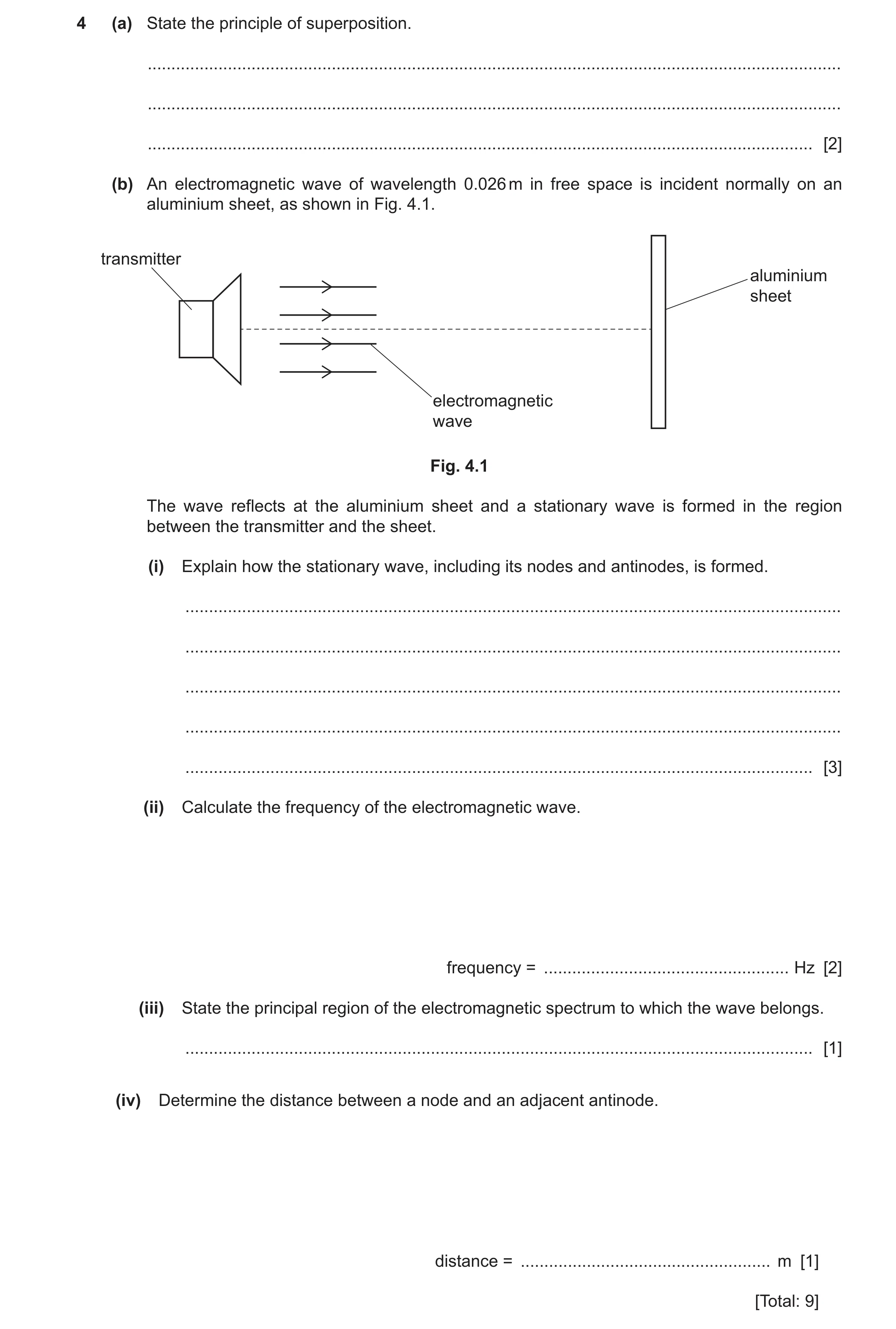
4 (a) State the principle of superposition. … … … [2] (b) An electromagnetic wave of wavelength 0.026 m in free space is incident normally on an aluminium sheet, as shown in Fig. 4.1. transmitter aluminium sheet electromagnetic wave Fig. 4.1 The wave reflects at the aluminium sheet and a stationary wave is formed in the region between the transmitter and the sheet. (i) Explain how the stationary wave, including its nodes and antinodes, is formed. … … … … … [3] (ii) Calculate the frequency of the electromagnetic wave. frequency = … Hz [2] (iii) State the principal region of the electromagnetic spectrum to which the wave belongs. … [1] (iv) Determine the distance between a node and an adjacent antinode. distance = … m [1] [Total: 9]
9 marks
Mark scheme: 4(a) when two (or more) waves meet M1 (resultant) displacement equals the sum of the displacements of the (two separate) waves A1 4(b)(i) the incident and reflected waves superpose B1 (the waves superpose so that the resultant) amplitude is maximum at an antinode B1 (the waves superpose so that the resultant) amplitude is minimum / zero at a node B1 4(b)(ii) c = f C1 f = (3.00 × 10⁸) / 0.026 A1 = 1.2 × 10¹⁰ Hz 4(b)(iii) microwave B1 4(b)(iv) distance = 0.026 / 4 A1 = 6.5 × 10⁻³ m
This question in 9702/24 Oct/Nov 2025
 6 / 29
 7 / 29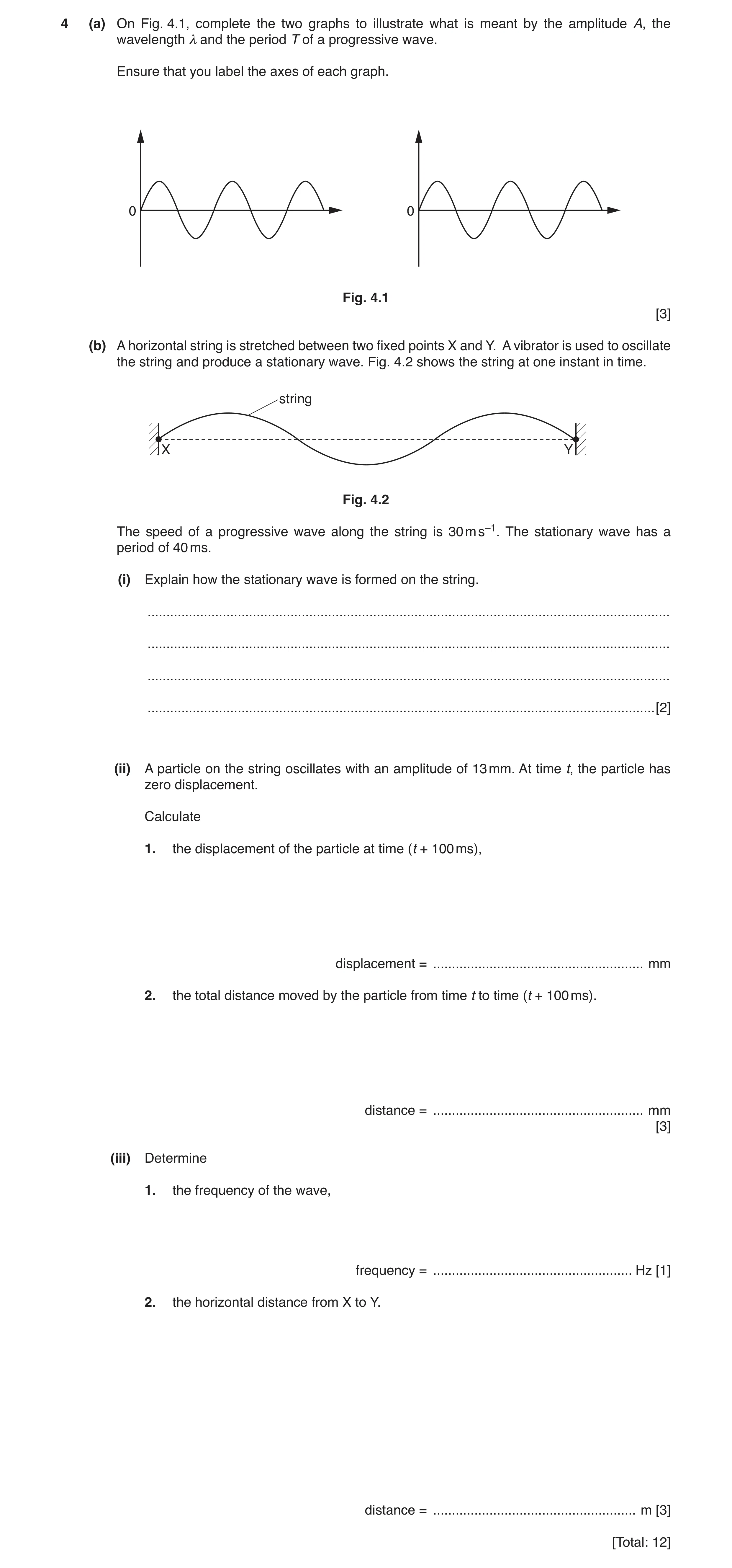
 11 / 29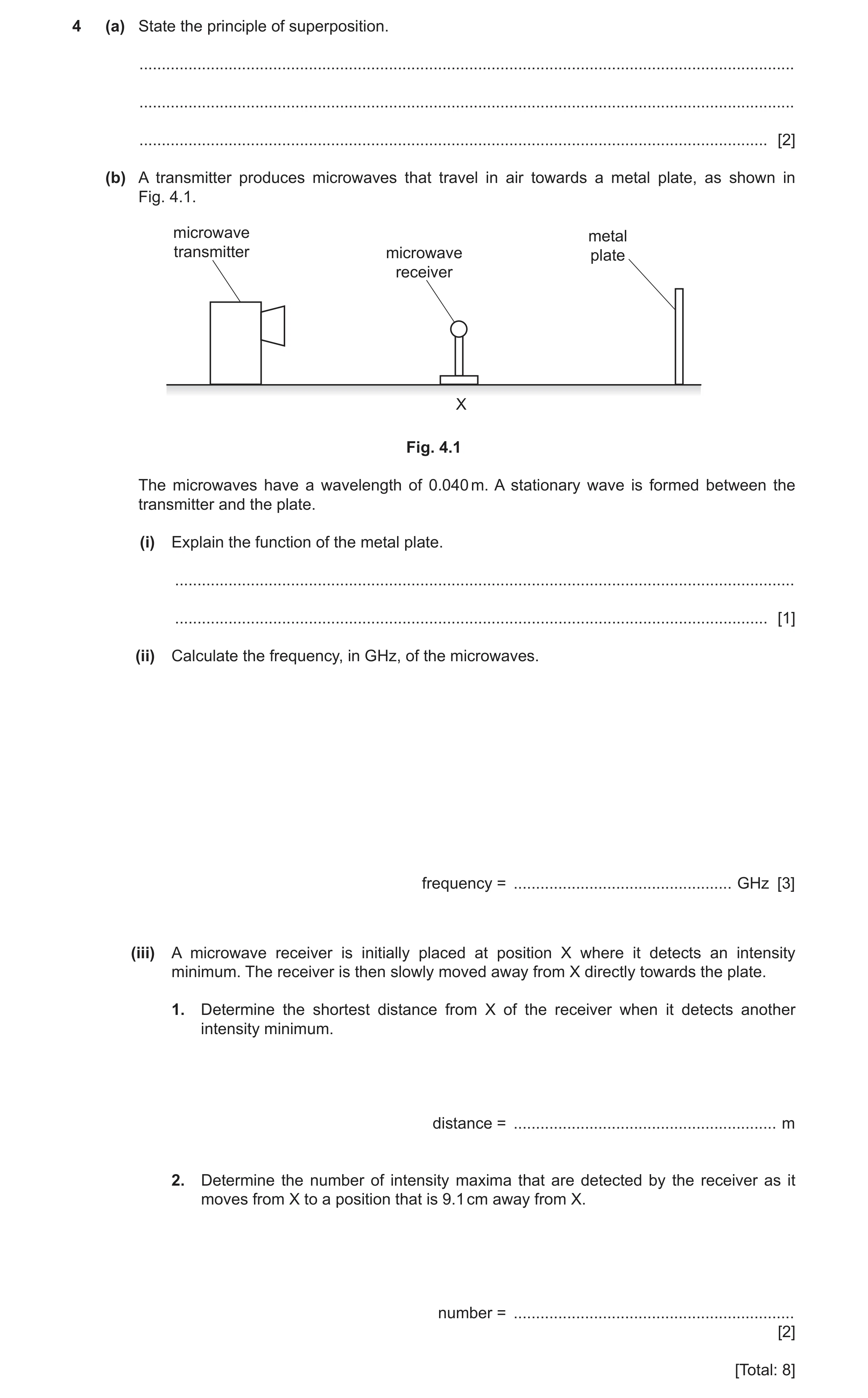
 14 / 29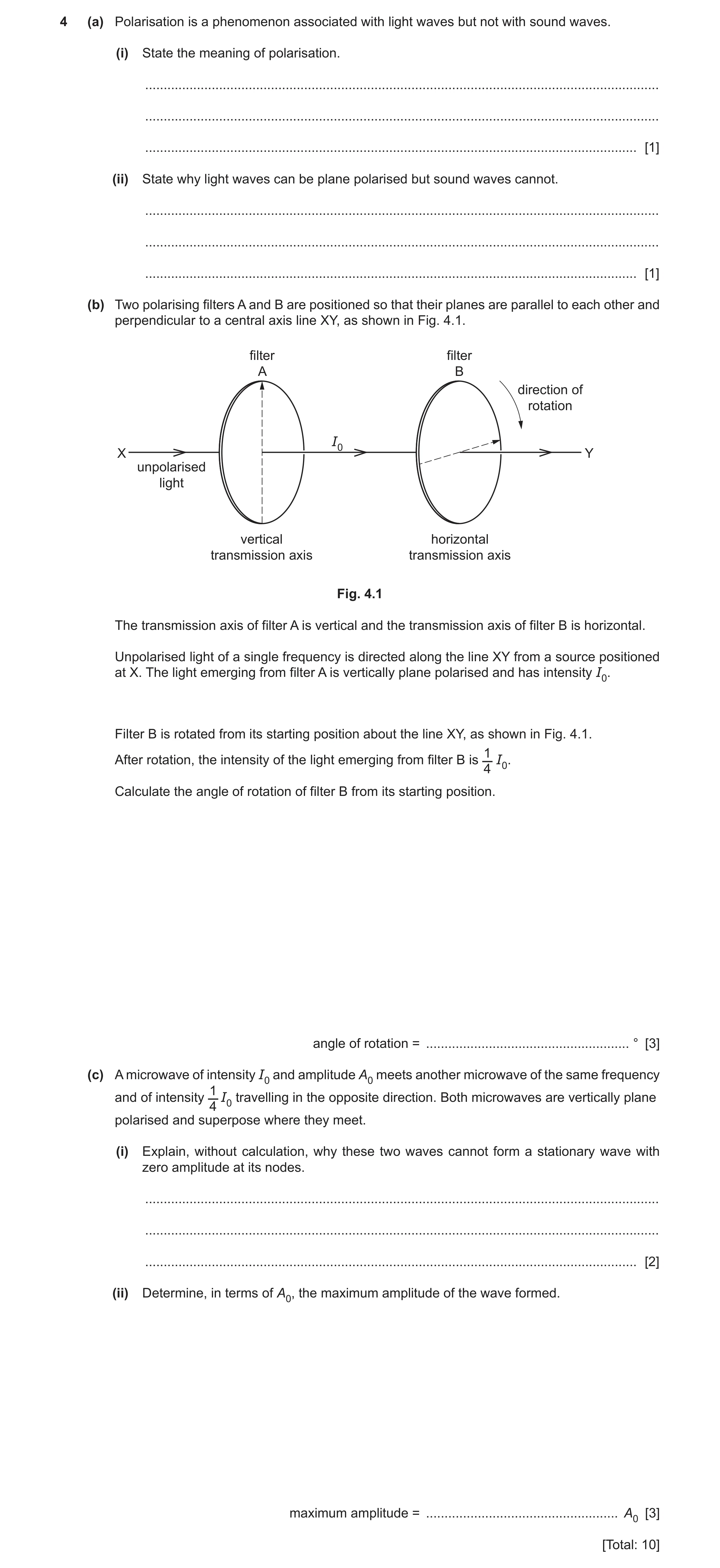
 9
9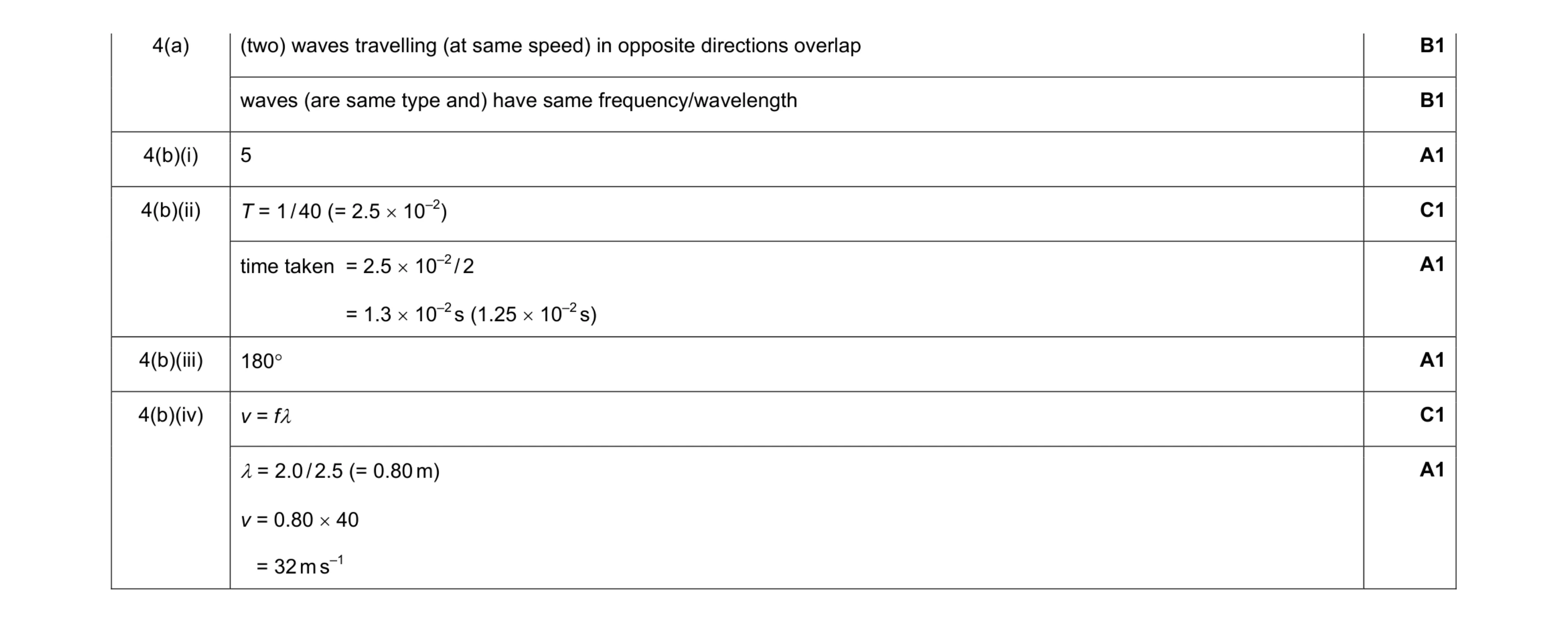 8
8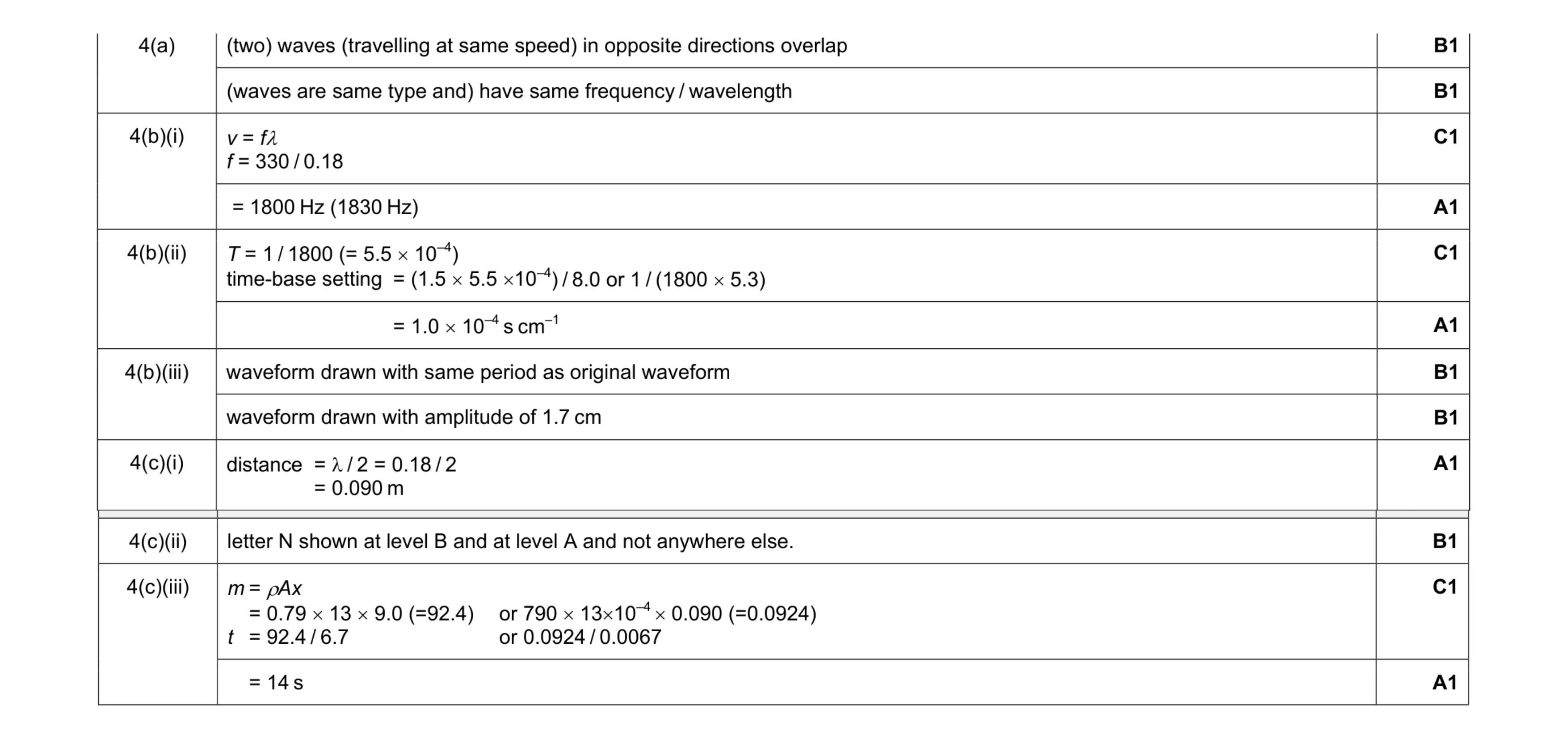 12
12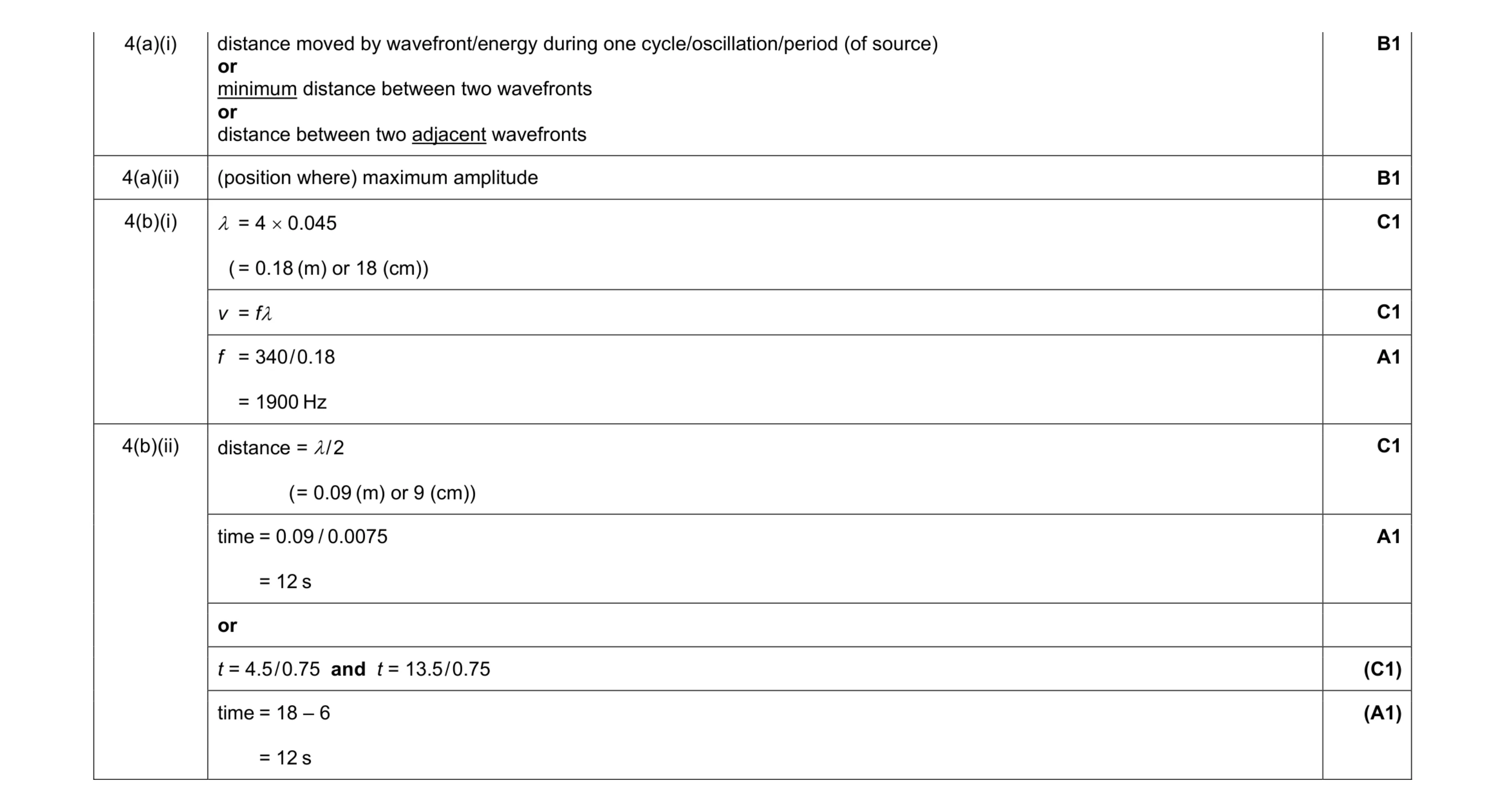 7
7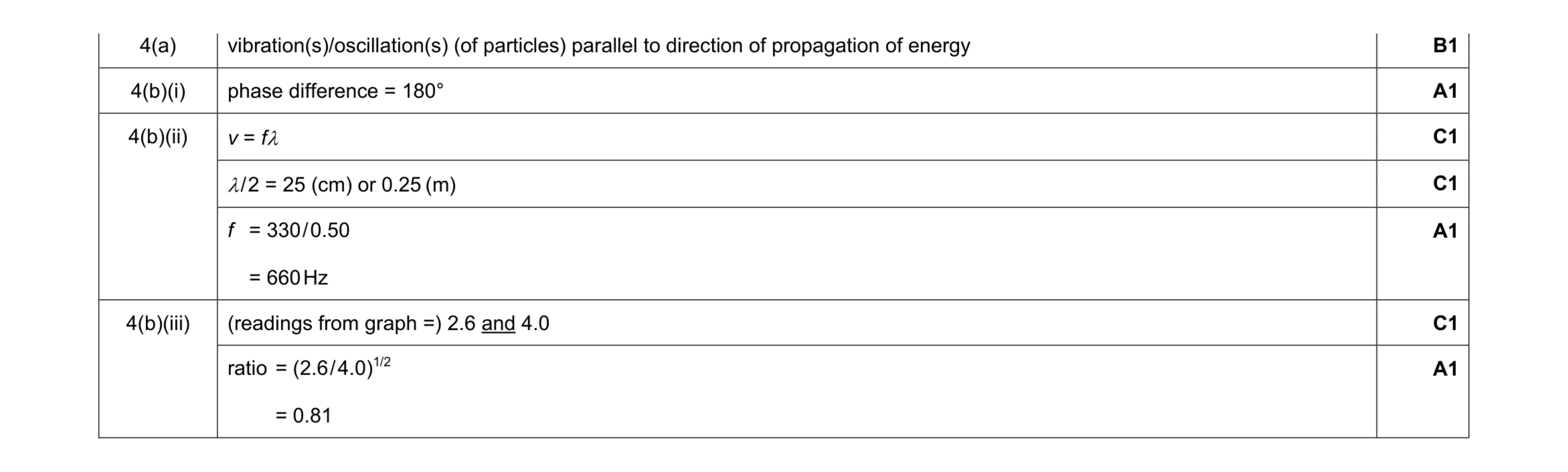 7
7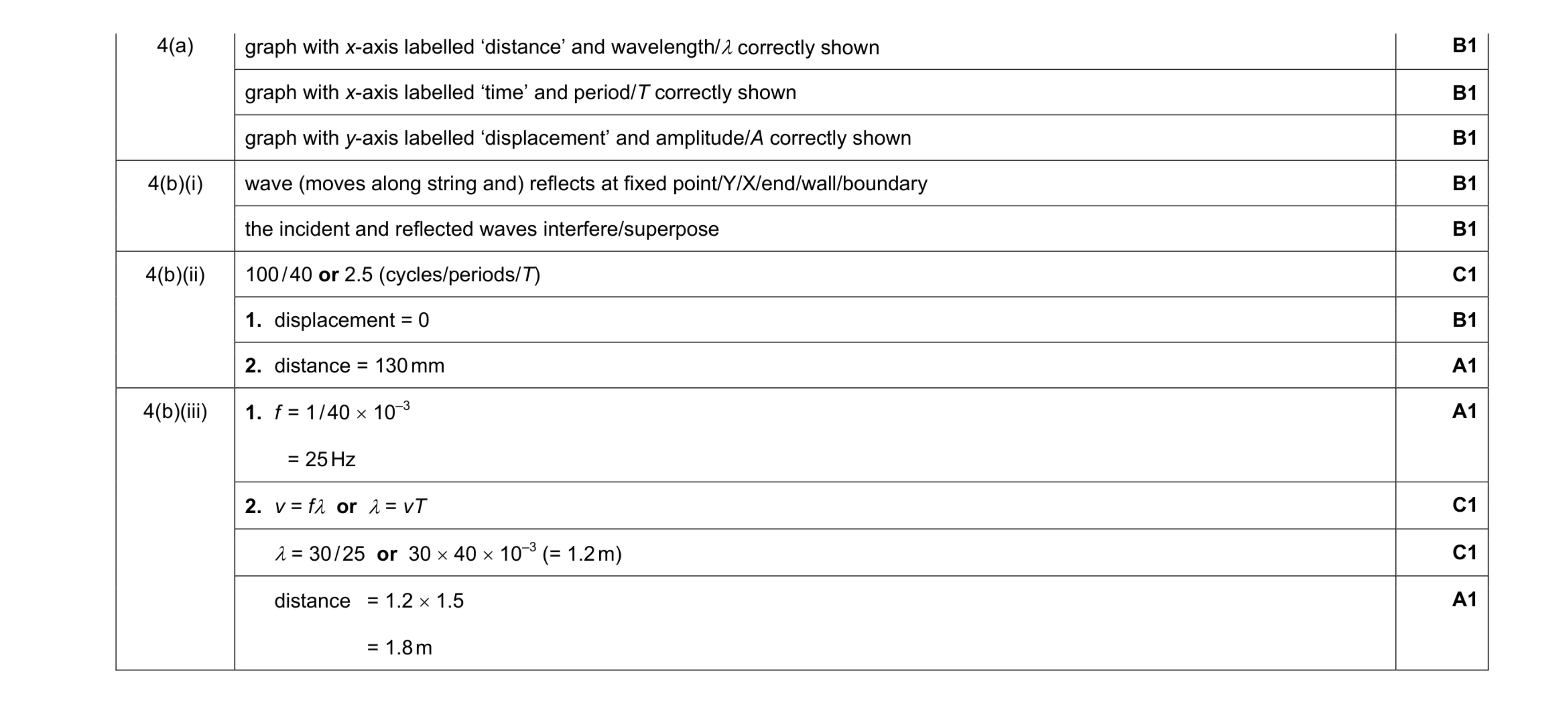 12
12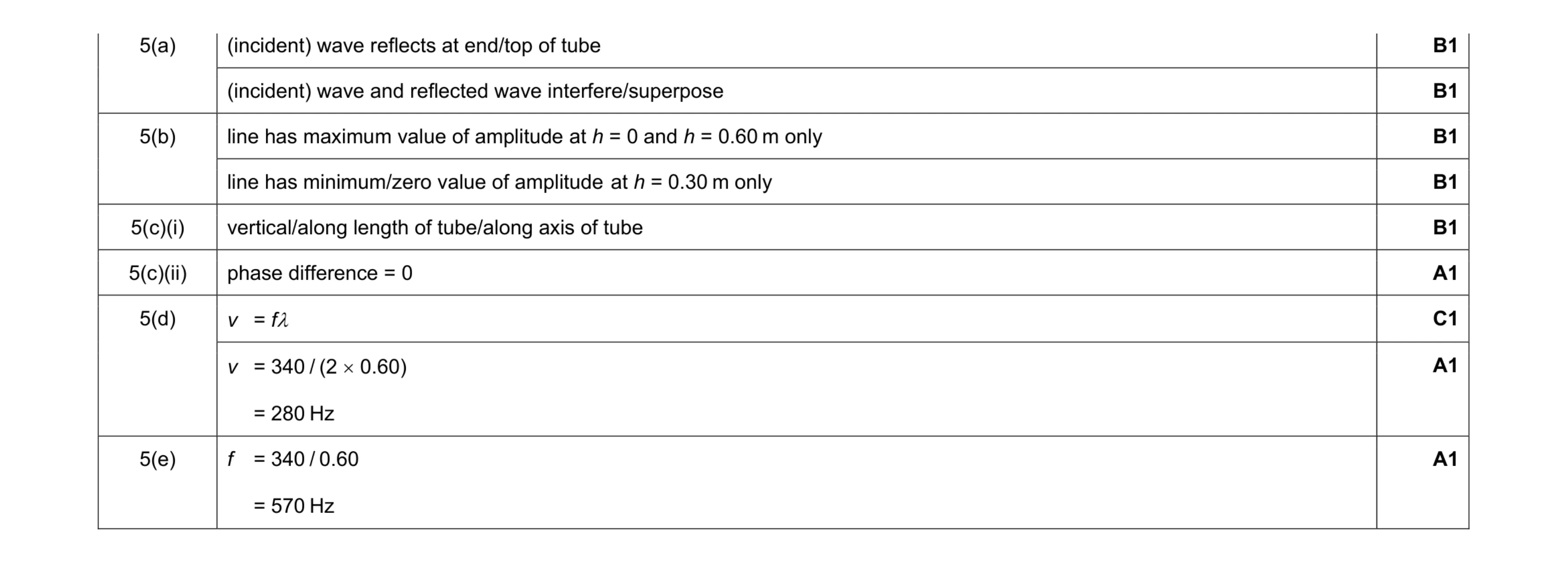 9
9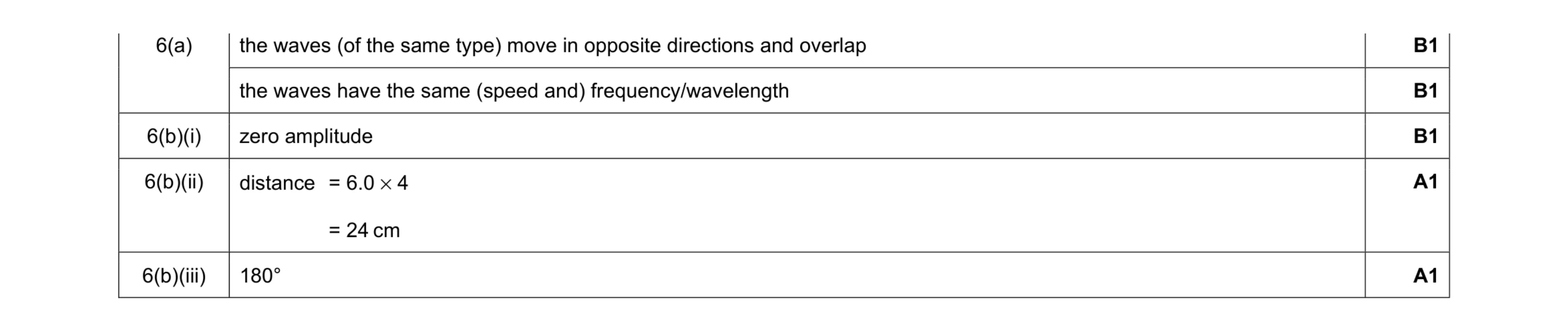 5
5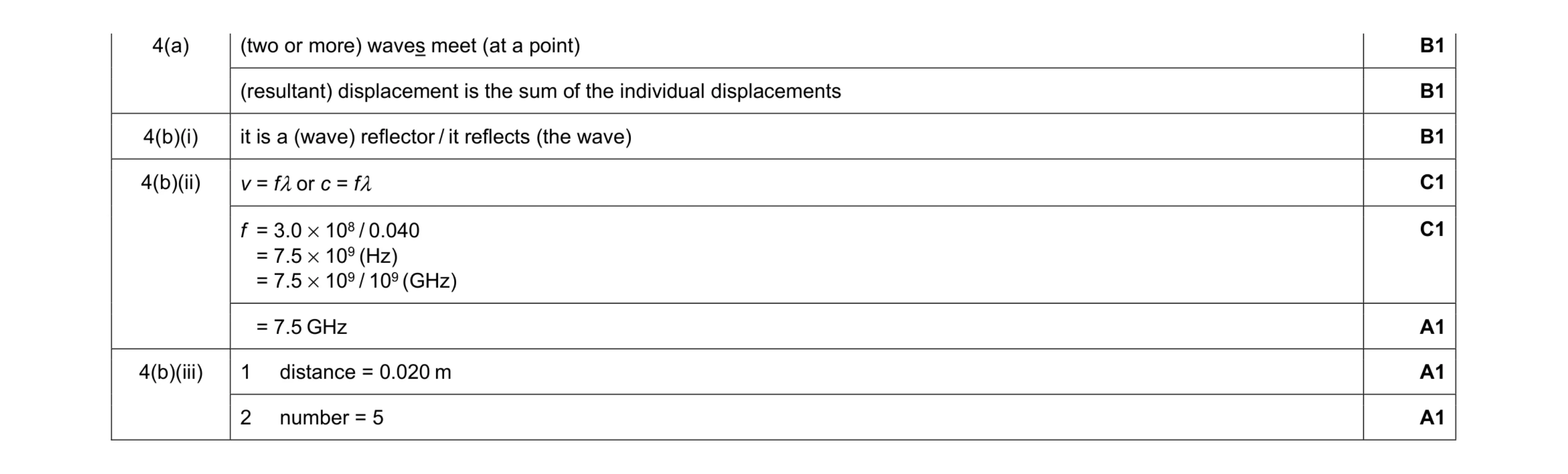 8
8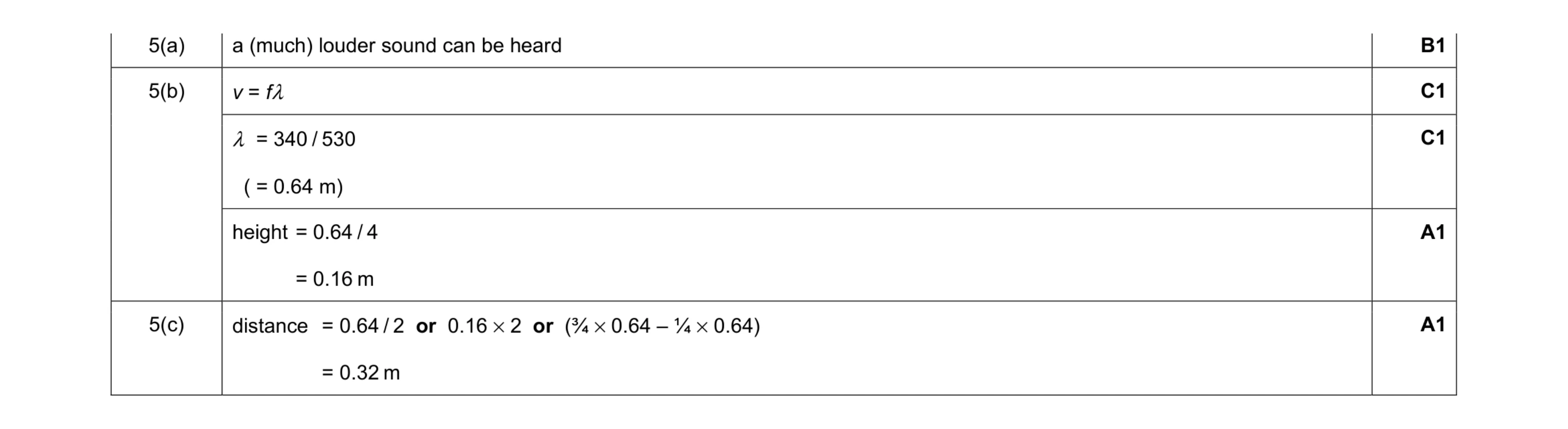 5
5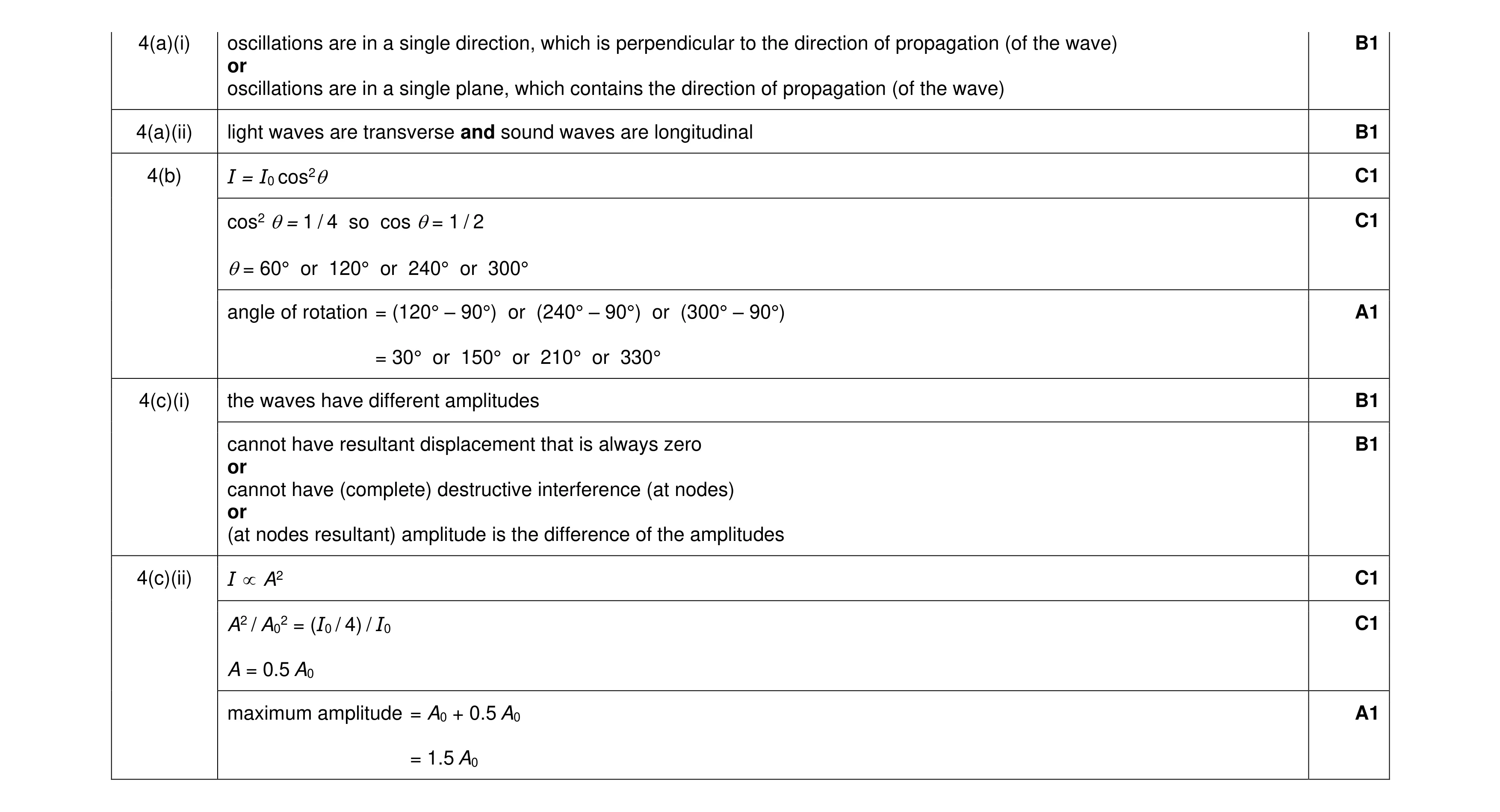 10
10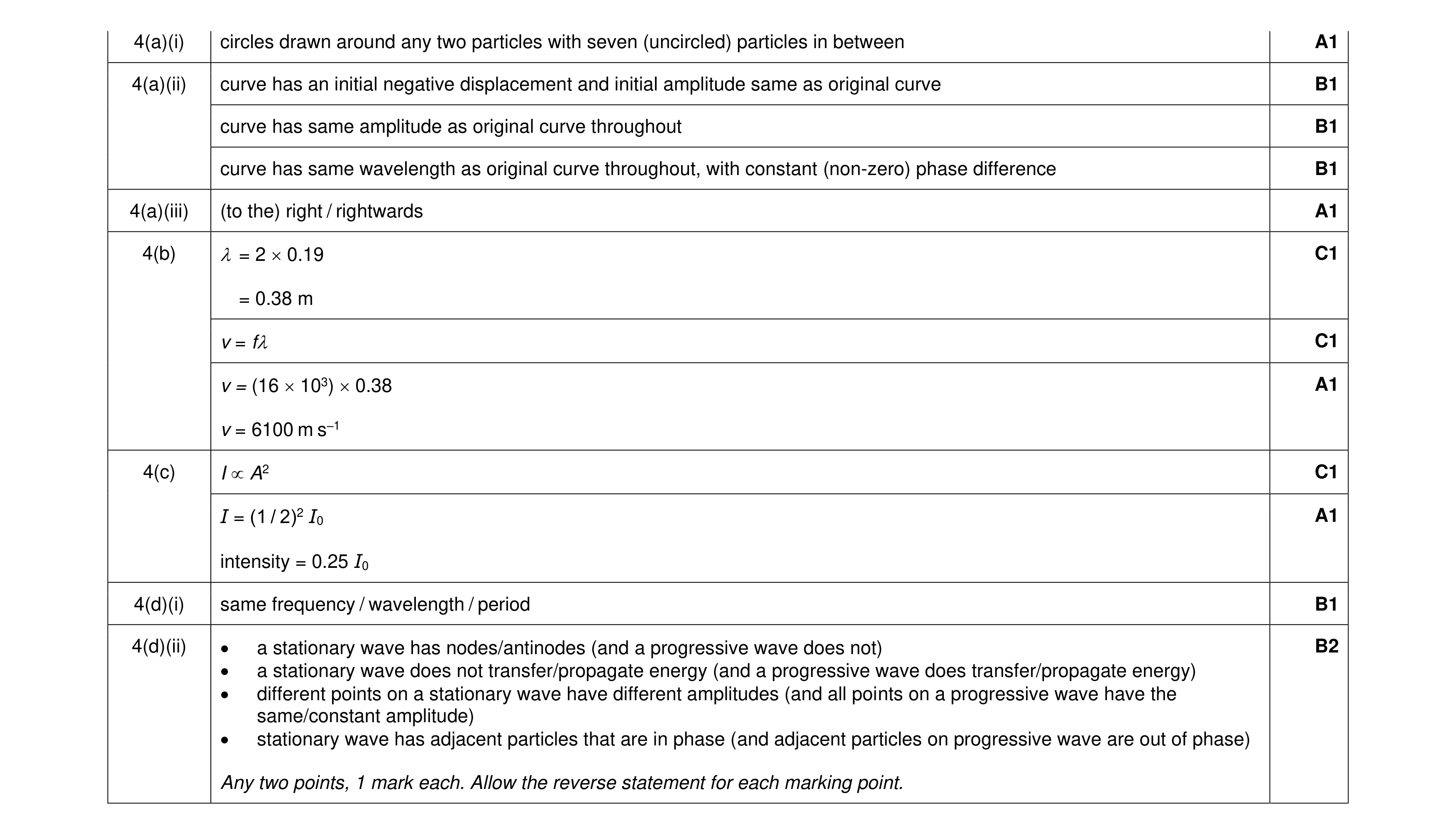 13
13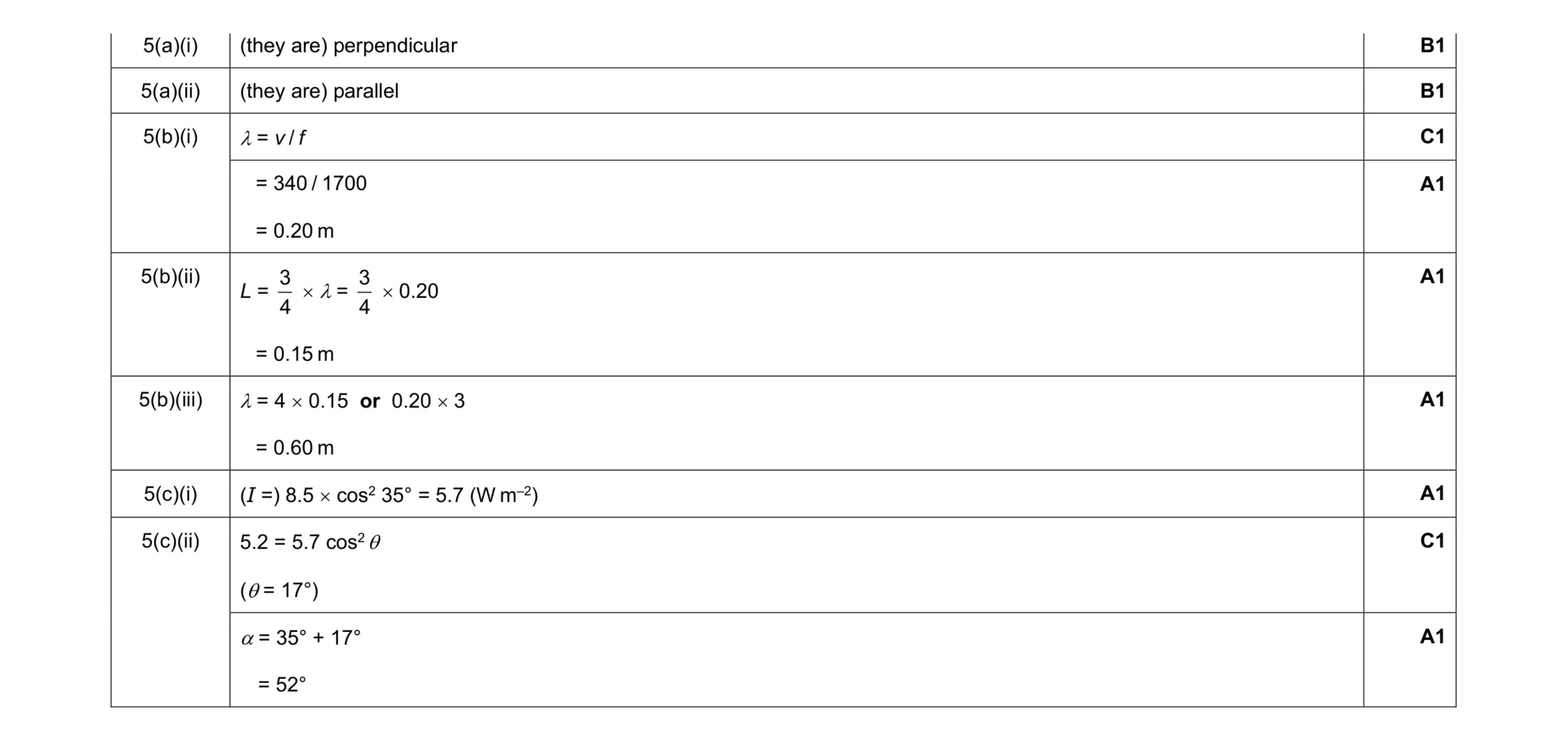 9
9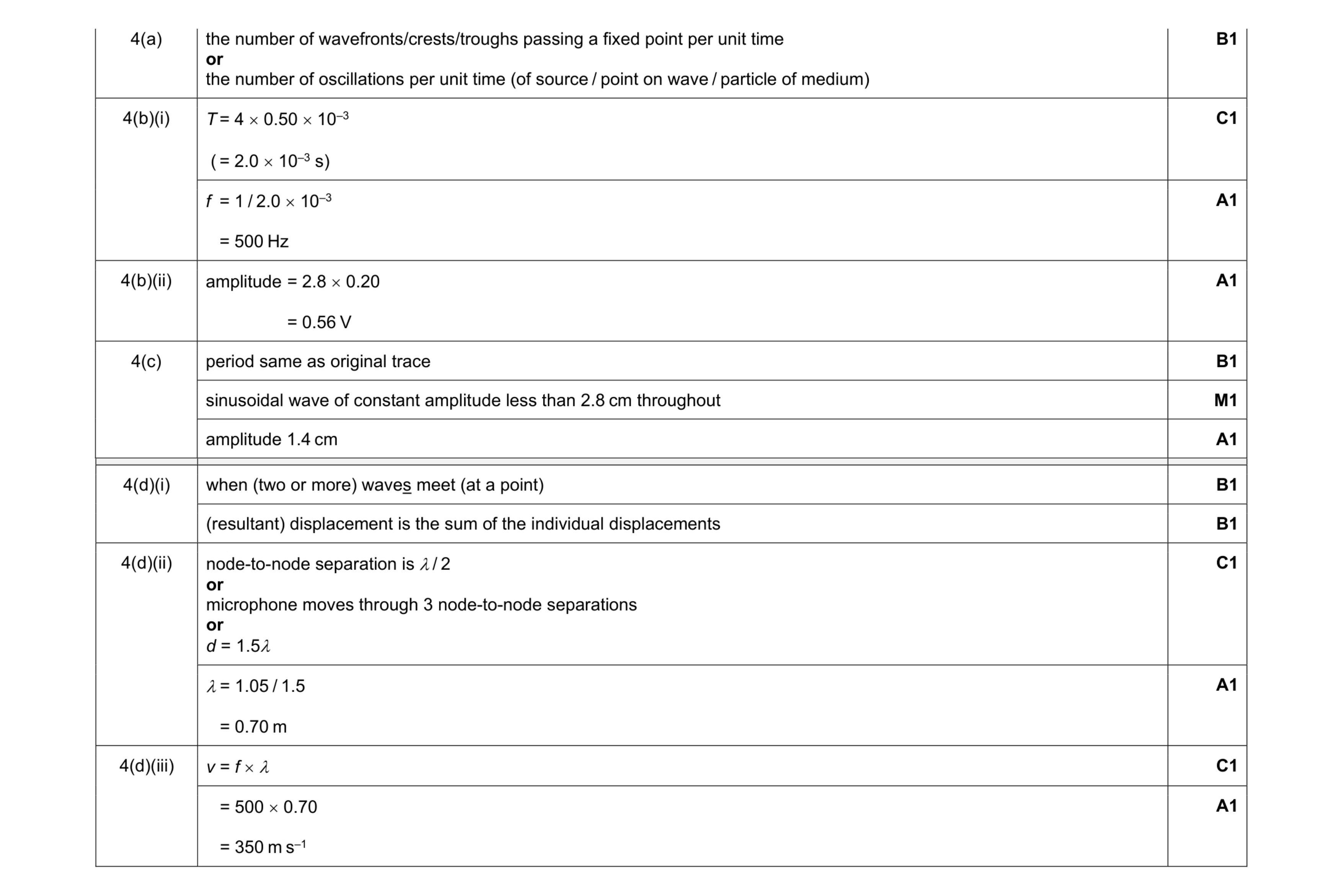 13
13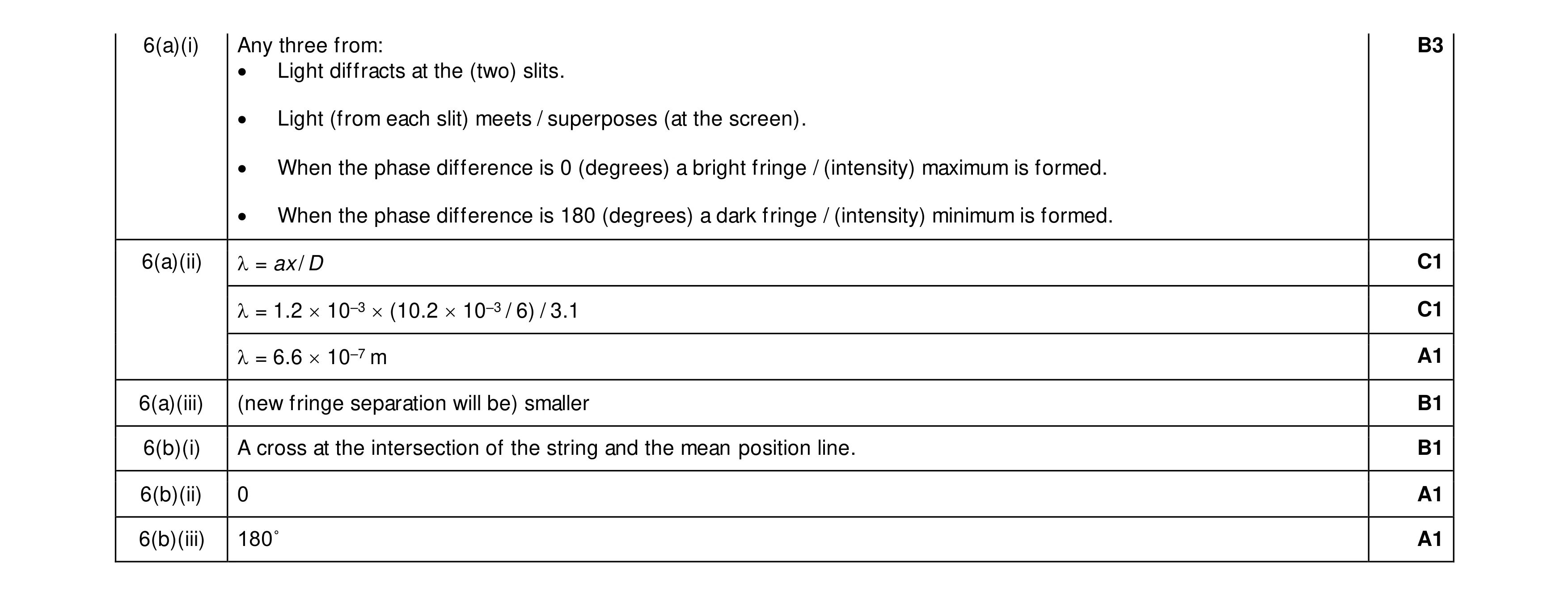 10
10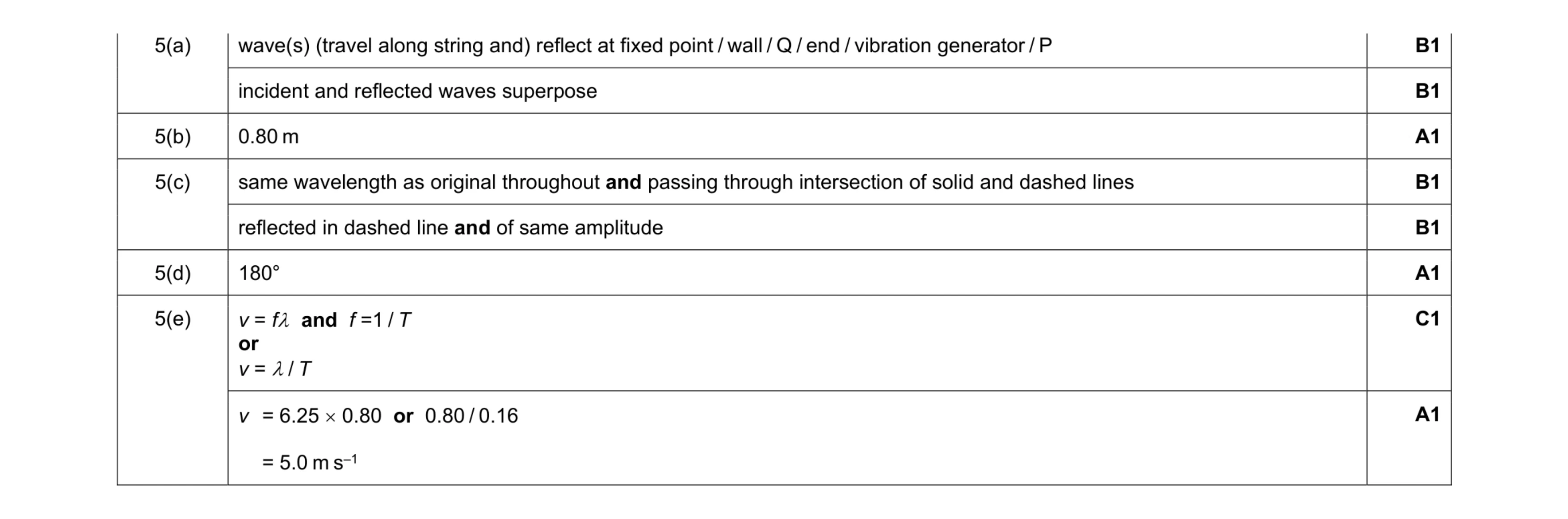 8
8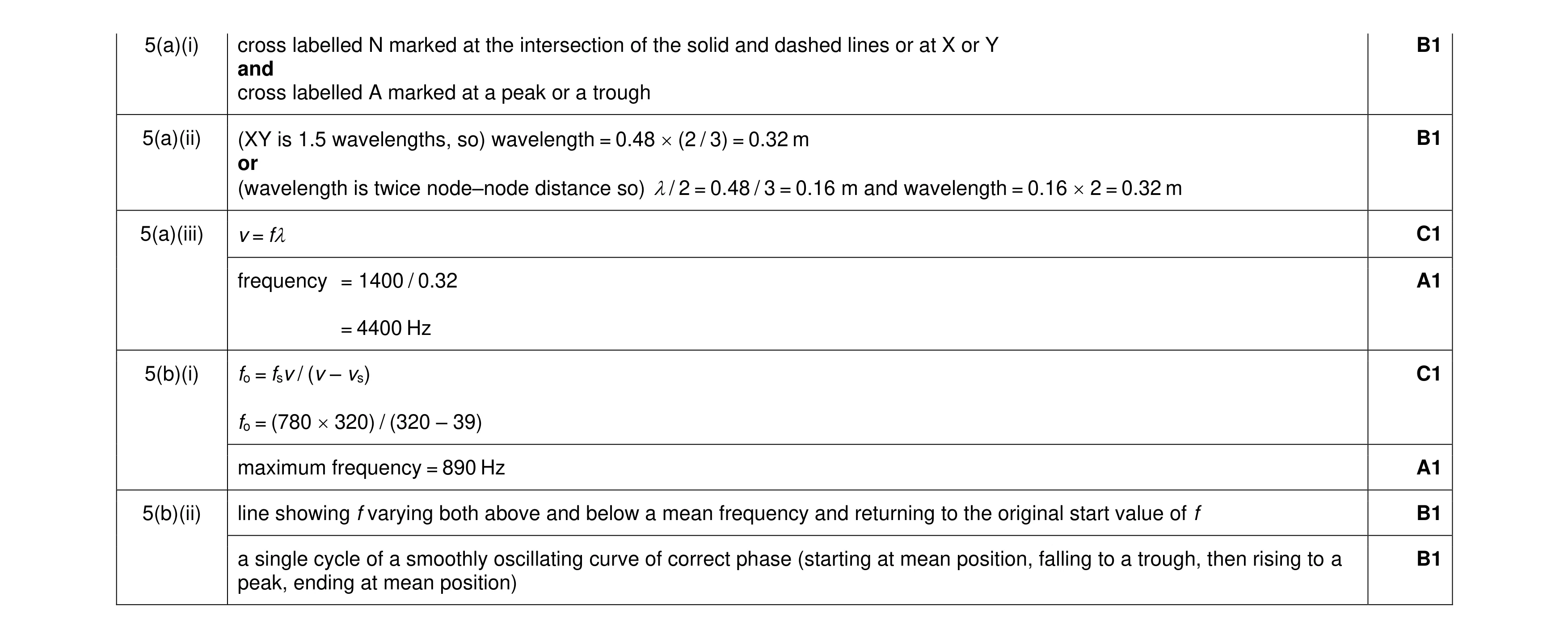 8
8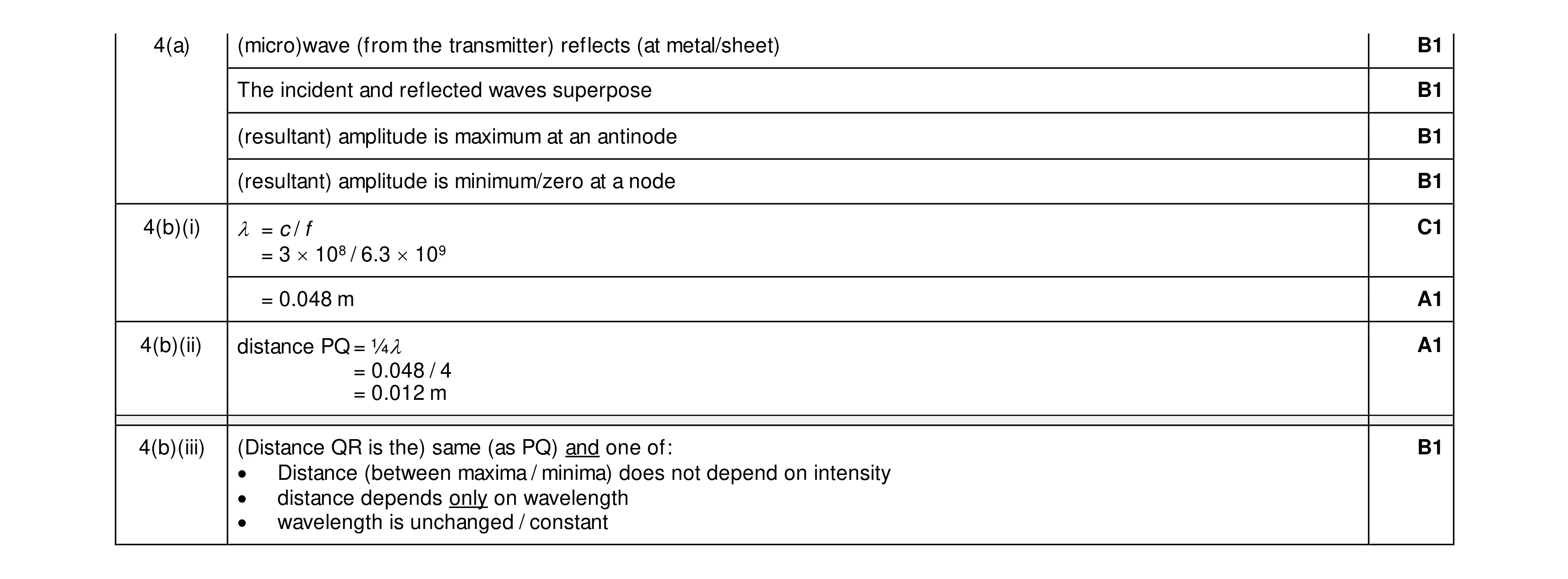 8
8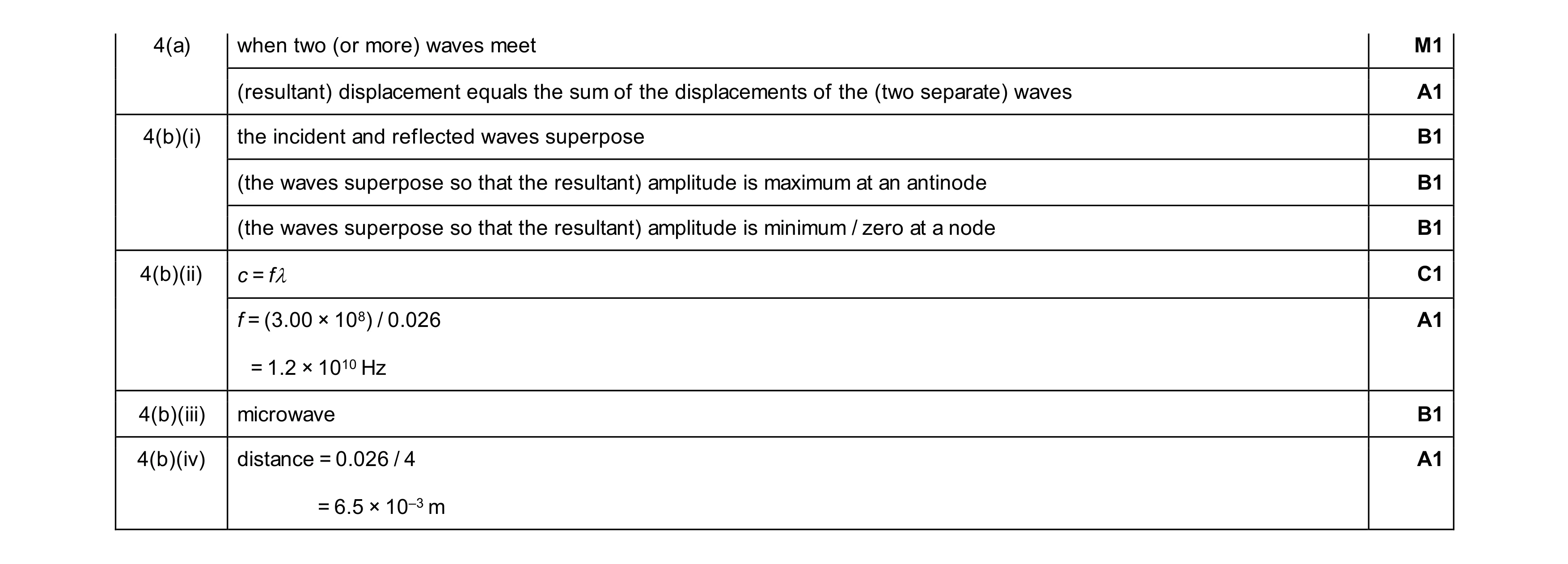 9
9