Cambridge IGCSE Science - Combined 0653 — 2025 May/June Paper 3 · Variant 1
0653/31/M/J/25 · 9 questions · 80 marks · 75 min
The question paper and its mark scheme, free to read here and free to download. This is Cambridge’s own paper, exactly as it was sat.
Question paper20 pages
Mark scheme13 pages
Answers below. Sit the paper first if you are practising.
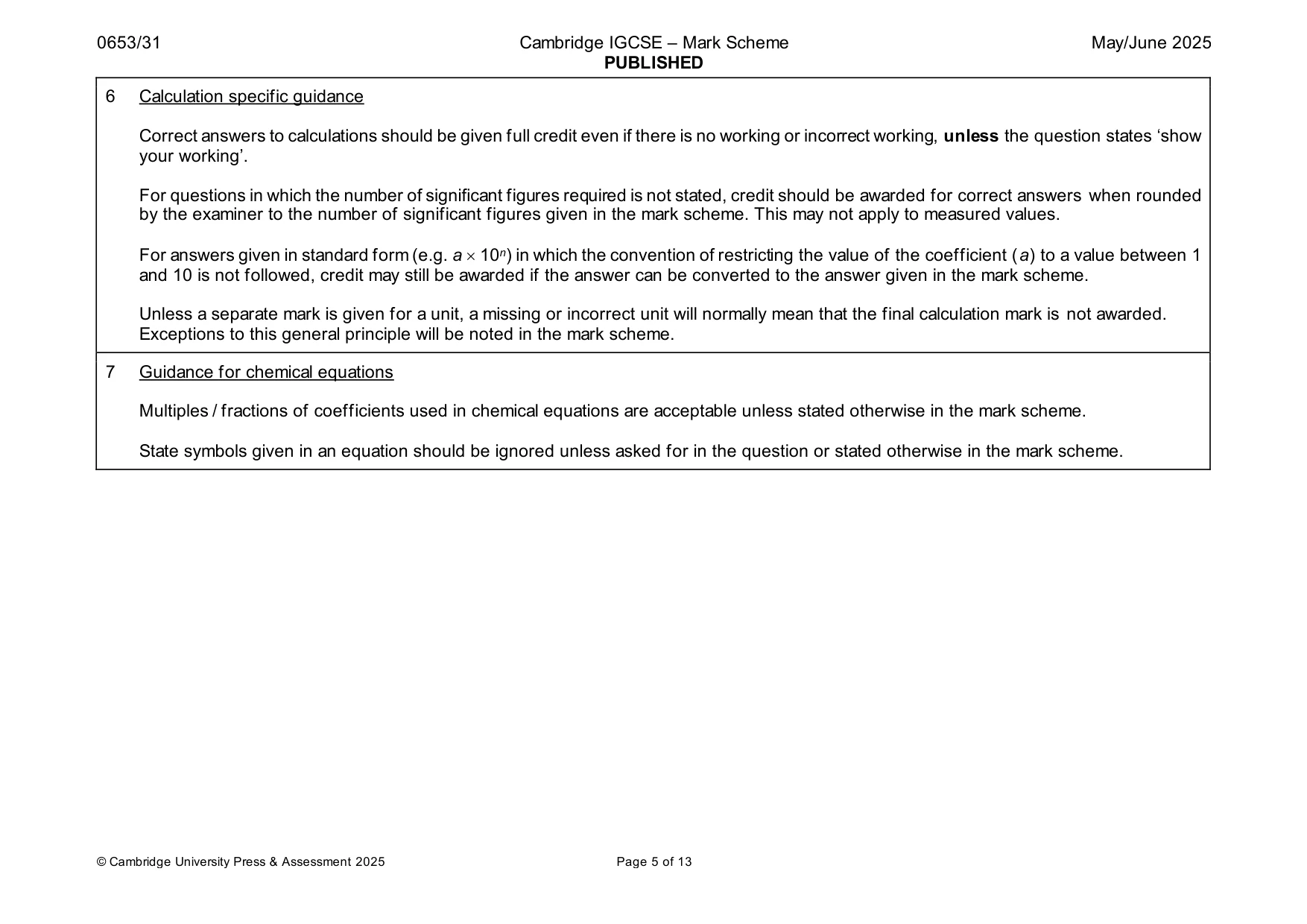
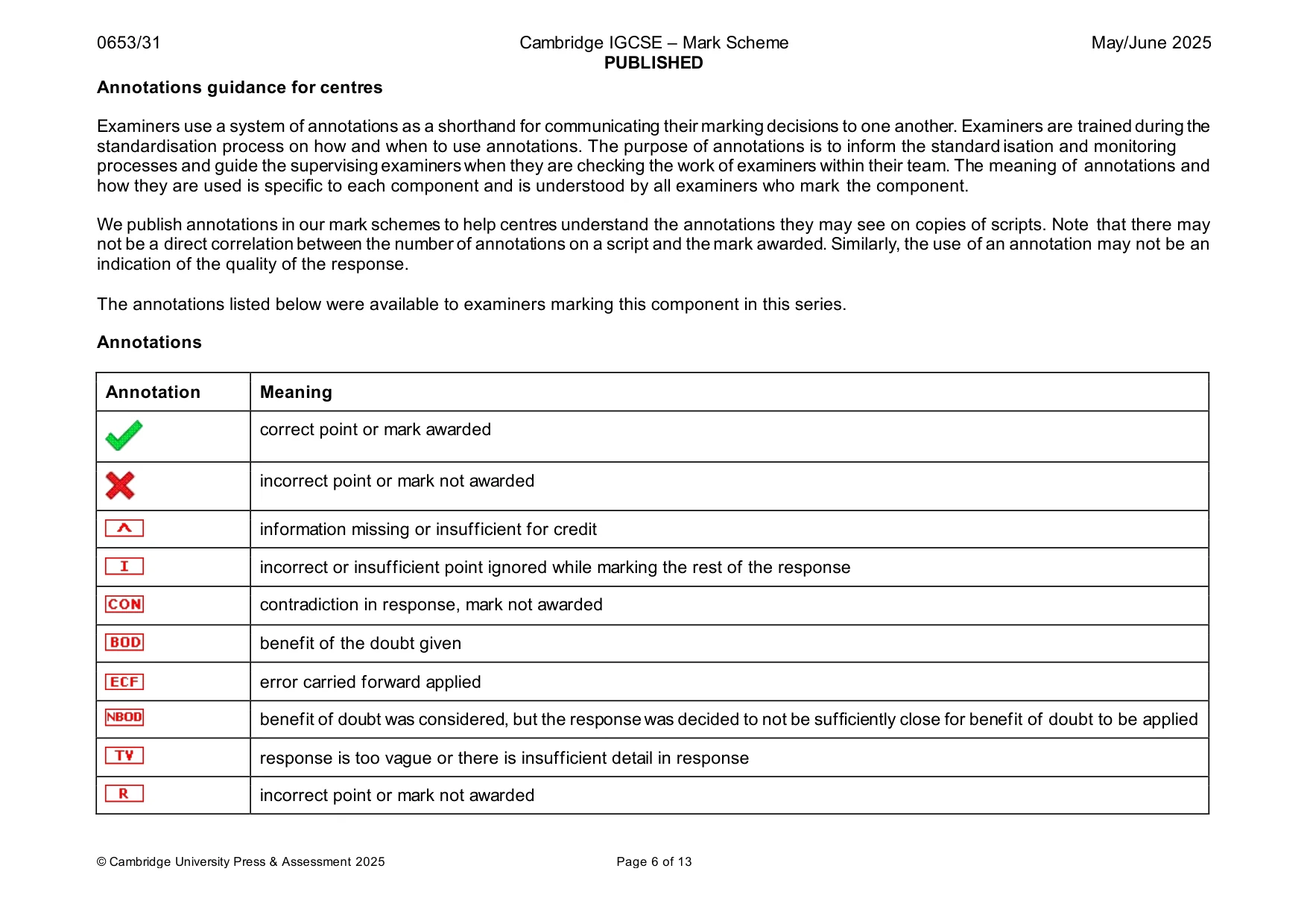
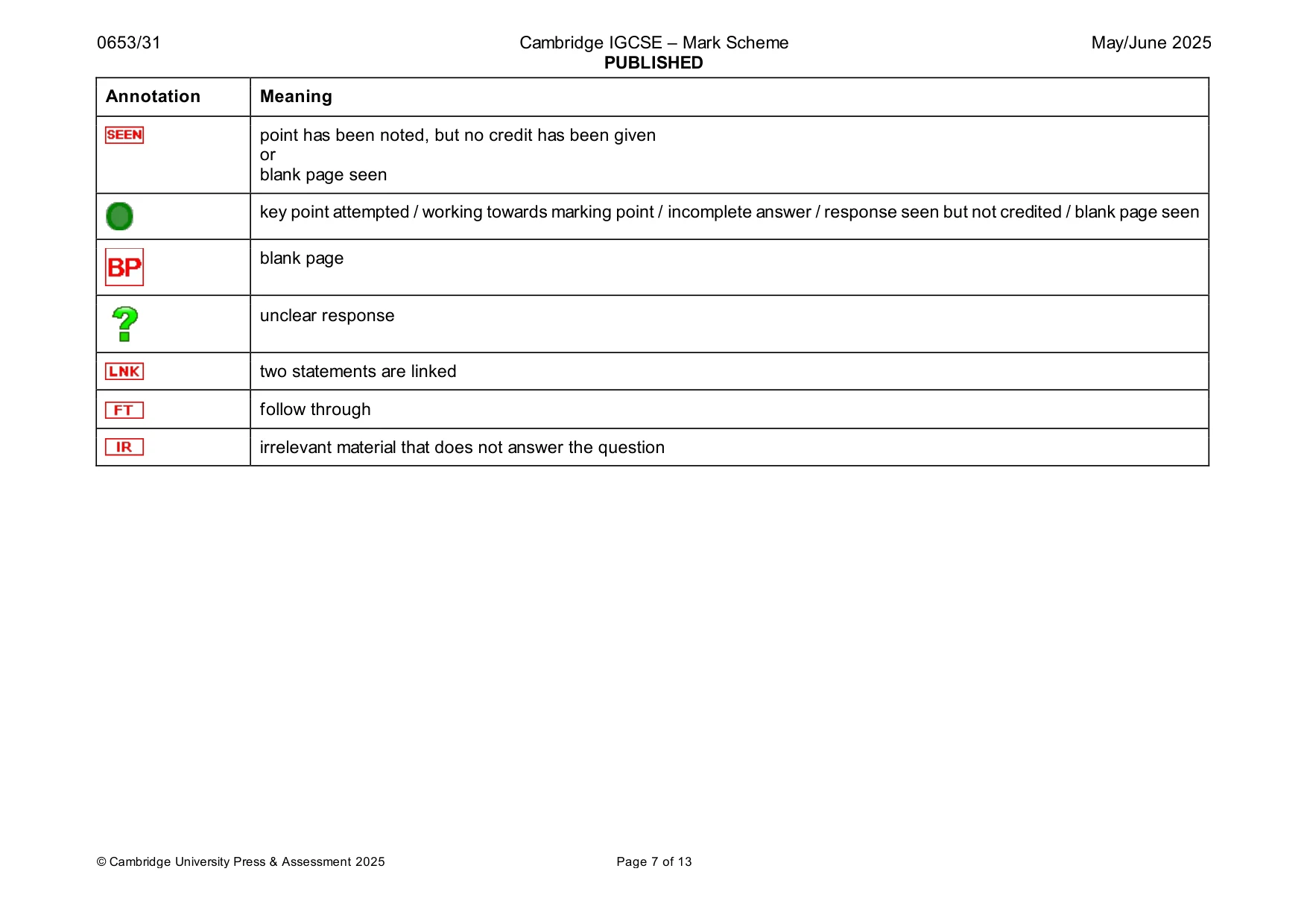
Questions as text
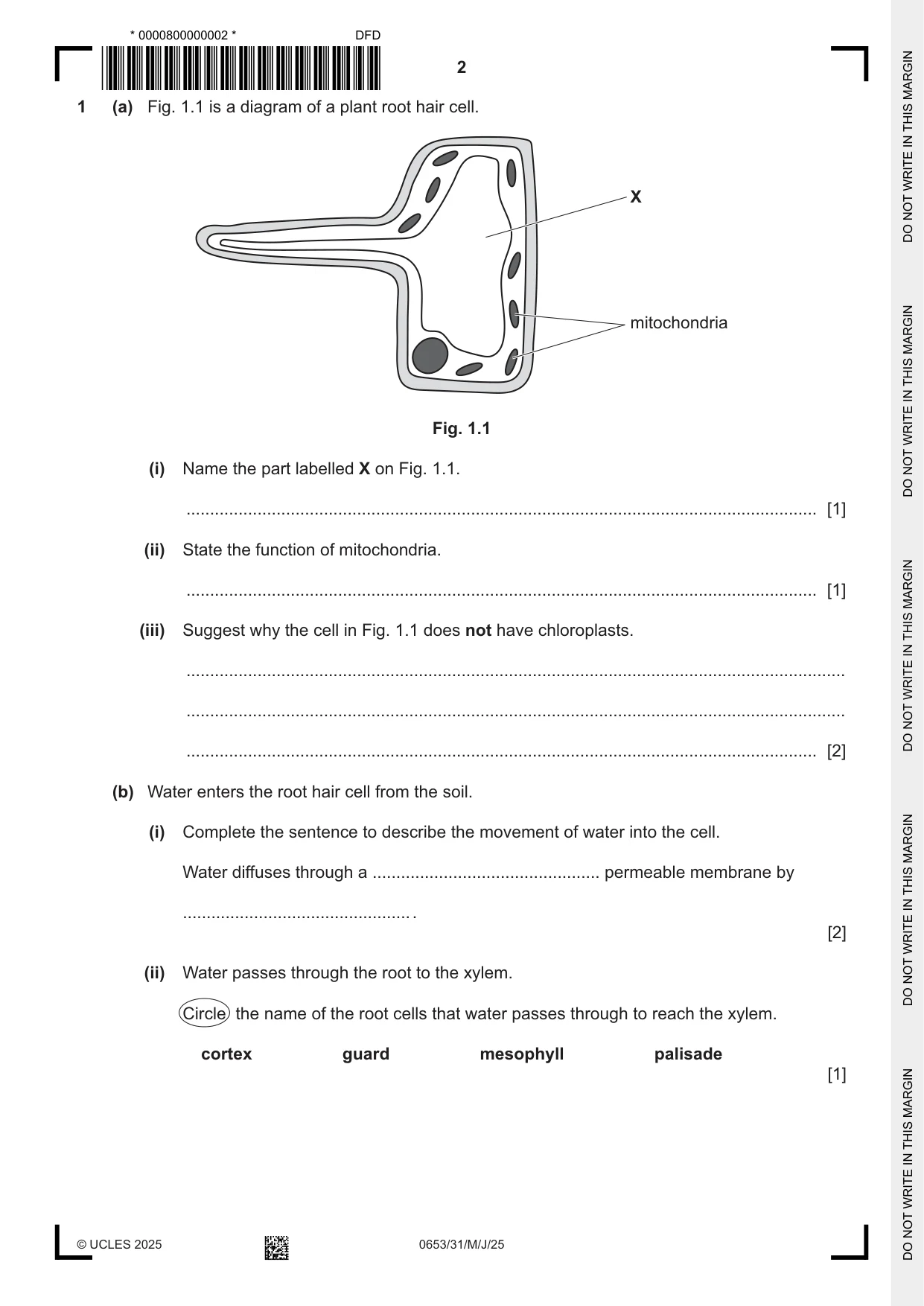
Q1 · A diagram of a plant root hair cell
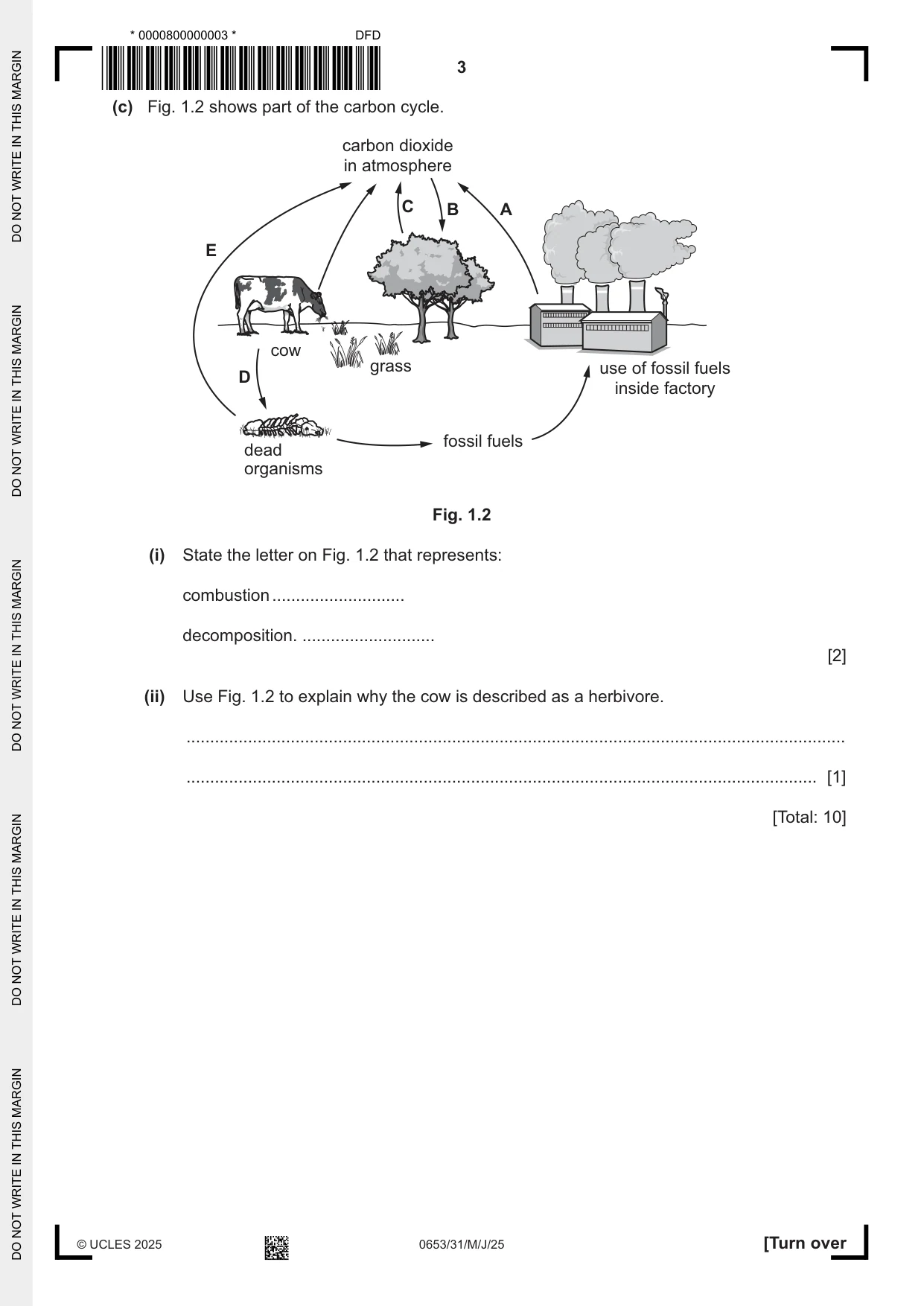
1 (a) Fig. 1.1 is a diagram of a plant root hair cell. X mitochondria Fig. 1.1 (i) Name the part labelled X on Fig. 1.1. ..................................................................................................................................... [1] (ii) State the function of mitochondria. ..................................................................................................................................... [1] (iii) Suggest why the cell in Fig. 1.1 does not have chloroplasts. ........................................................................................................................................... ........................................................................................................................................... ..................................................................................................................................... [2] (b) Water enters the root hair cell from the soil. (i) Complete the sentence to describe the movement of water into the cell. Water diffuses through a ................................................ permeable membrane by ................................................ . [2] (ii) Water passes through the root to the xylem. Circle the name of the root cells that water passes through to reach the xylem. cortex guard mesophyll palisade [1] (c) Fig. 1.2 shows part of the carbon cycle. carbon dioxide in atmosphere C B A E cow grass use of fossil fuels D inside factory fossil fuels dead organisms Fig. 1.2 (i) State the letter on Fig. 1.2 that represents: combustion ............................ decomposition. ............................ [2] (ii) Use Fig. 1.2 to explain why the cow is described as a herbivore. ........................................................................................................................................... ..................................................................................................................................... [1] [Total: 10]
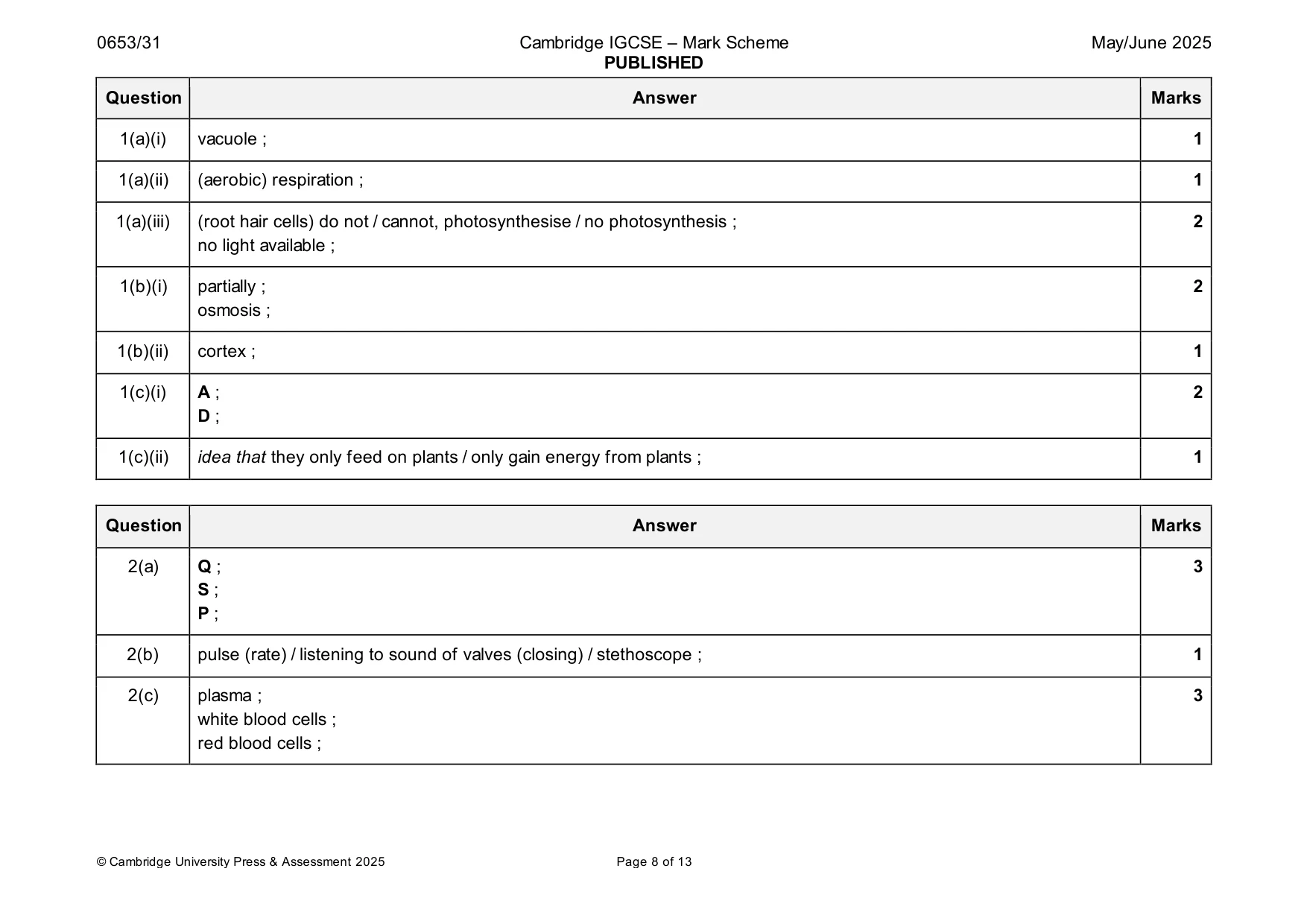
Mark scheme: Question Answer Marks 1(a)(i) vacuole ; 1 1(a)(ii) (aerobic) respiration ; 1 1(a)(iii) (root hair cells) do not / cannot, photosynthesise / no photosynthesis ; 2 no light available ; 1(b)(i) partially ; 2 osmosis ; 1(b)(ii) cortex ; 1 1(c)(i) A ; 2 D ; 1(c)(ii) idea that they only feed on plants / only gain energy from plants ; 1
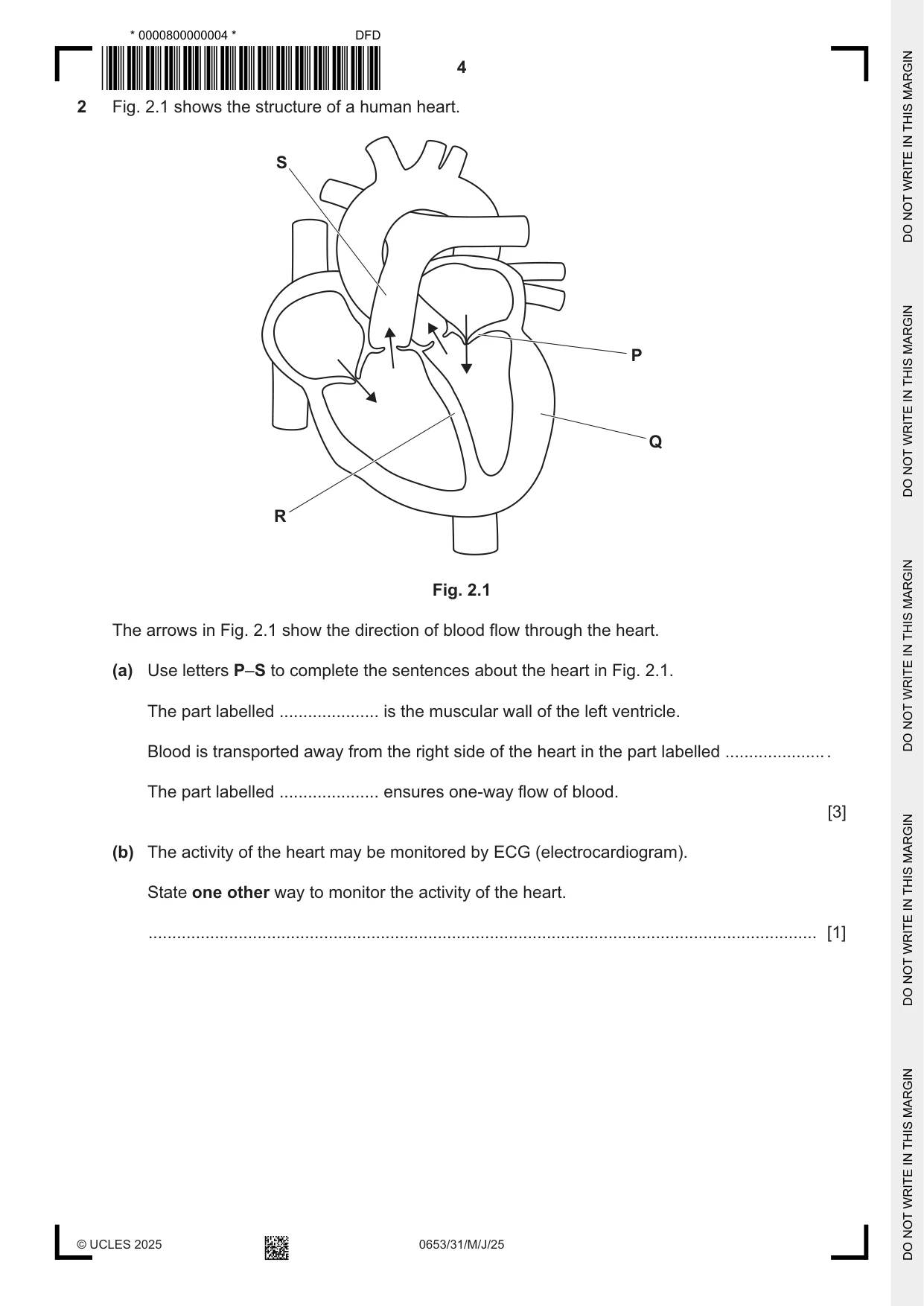
Q2 · The structure of a human heart
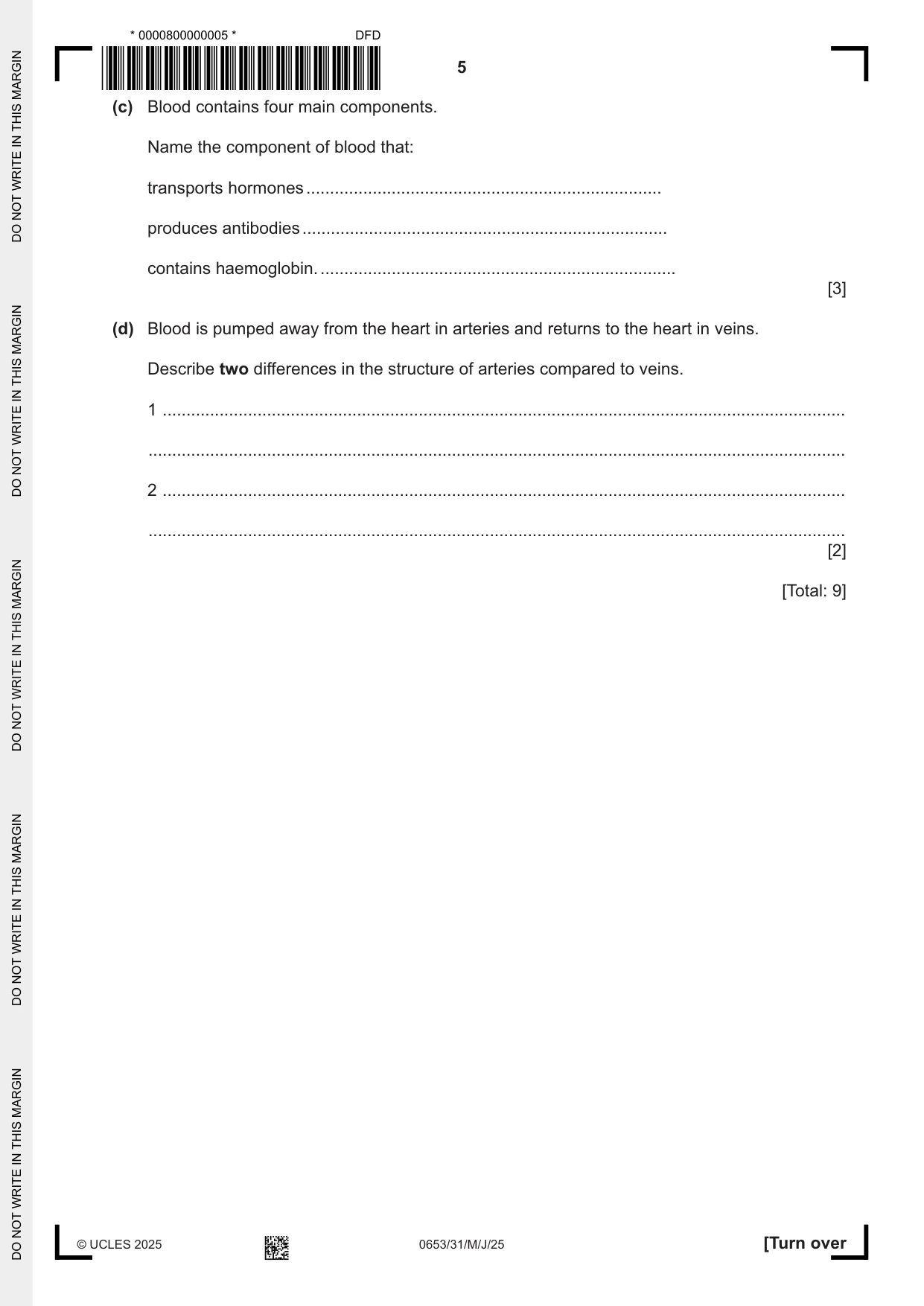
2 Fig. 2.1 shows the structure of a human heart. S P Q R Fig. 2.1 The arrows in Fig. 2.1 show the direction of blood flow through the heart. (a) Use letters P–S to complete the sentences about the heart in Fig. 2.1. The part labelled ..................... is the muscular wall of the left ventricle. Blood is transported away from the right side of the heart in the part labelled ..................... . The part labelled ..................... ensures one‑way flow of blood. [3] (b) The activity of the heart may be monitored by ECG (electrocardiogram). State one other way to monitor the activity of the heart. ............................................................................................................................................. [1] (c) Blood contains four main components. Name the component of blood that: transports hormones ........................................................................... produces antibodies ............................................................................. contains haemoglobin. ........................................................................... [3] (d) Blood is pumped away from the heart in arteries and returns to the heart in veins. Describe two differences in the structure of arteries compared to veins. 1 ................................................................................................................................................ ................................................................................................................................................... 2 ................................................................................................................................................ ................................................................................................................................................... [2] [Total: 9]
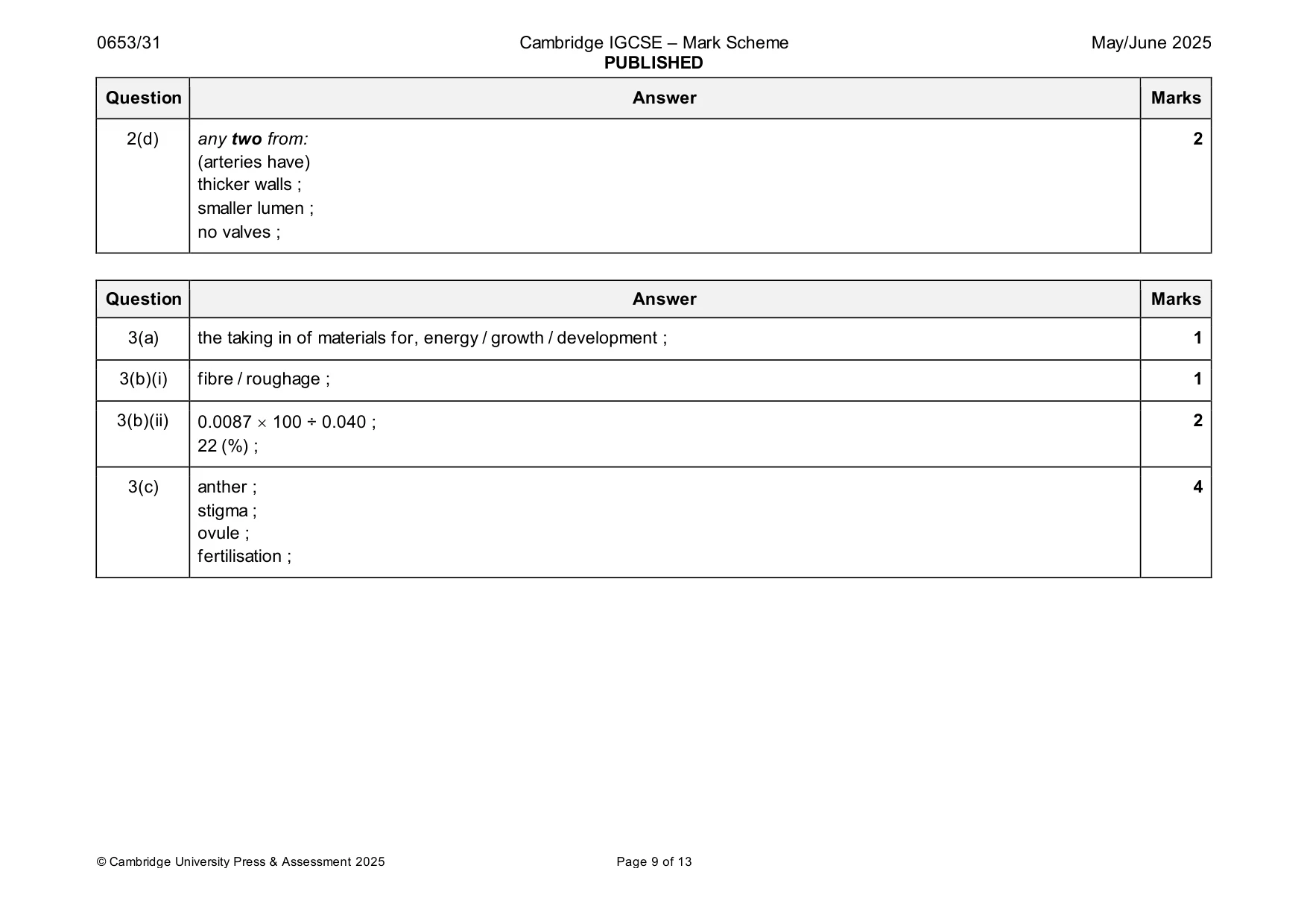
Mark scheme: 2(a) Q ; 3 S ; P ; 2(b) pulse (rate) / listening to sound of valves (closing) / stethoscope ; 1 2(c) plasma ; 3 white blood cells ; red blood cells ; 2(d) any two from: 2 (arteries have) thicker walls ; smaller lumen ; no valves ;
Q3 · Nutrition is one of the characteristics of living organisms
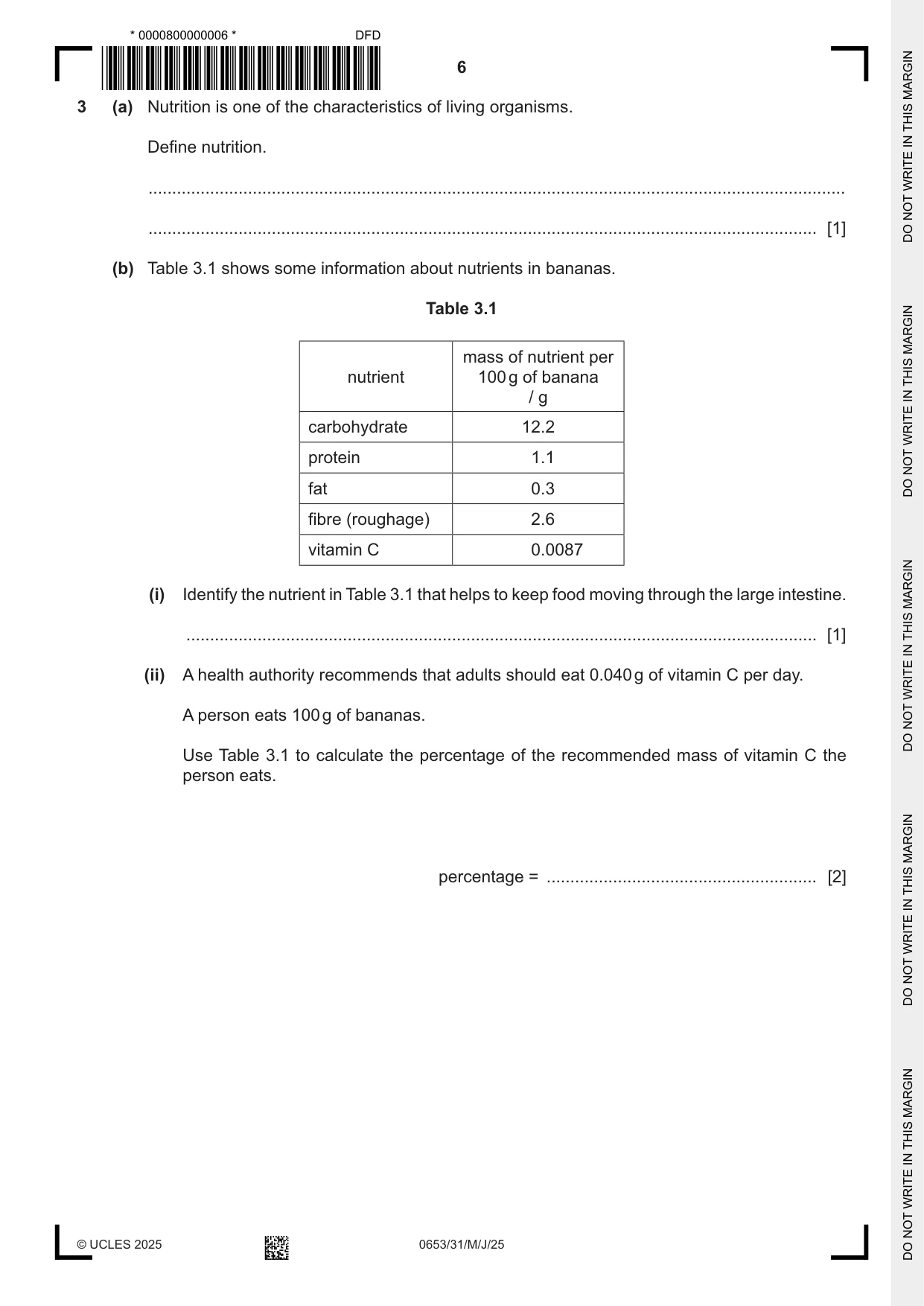
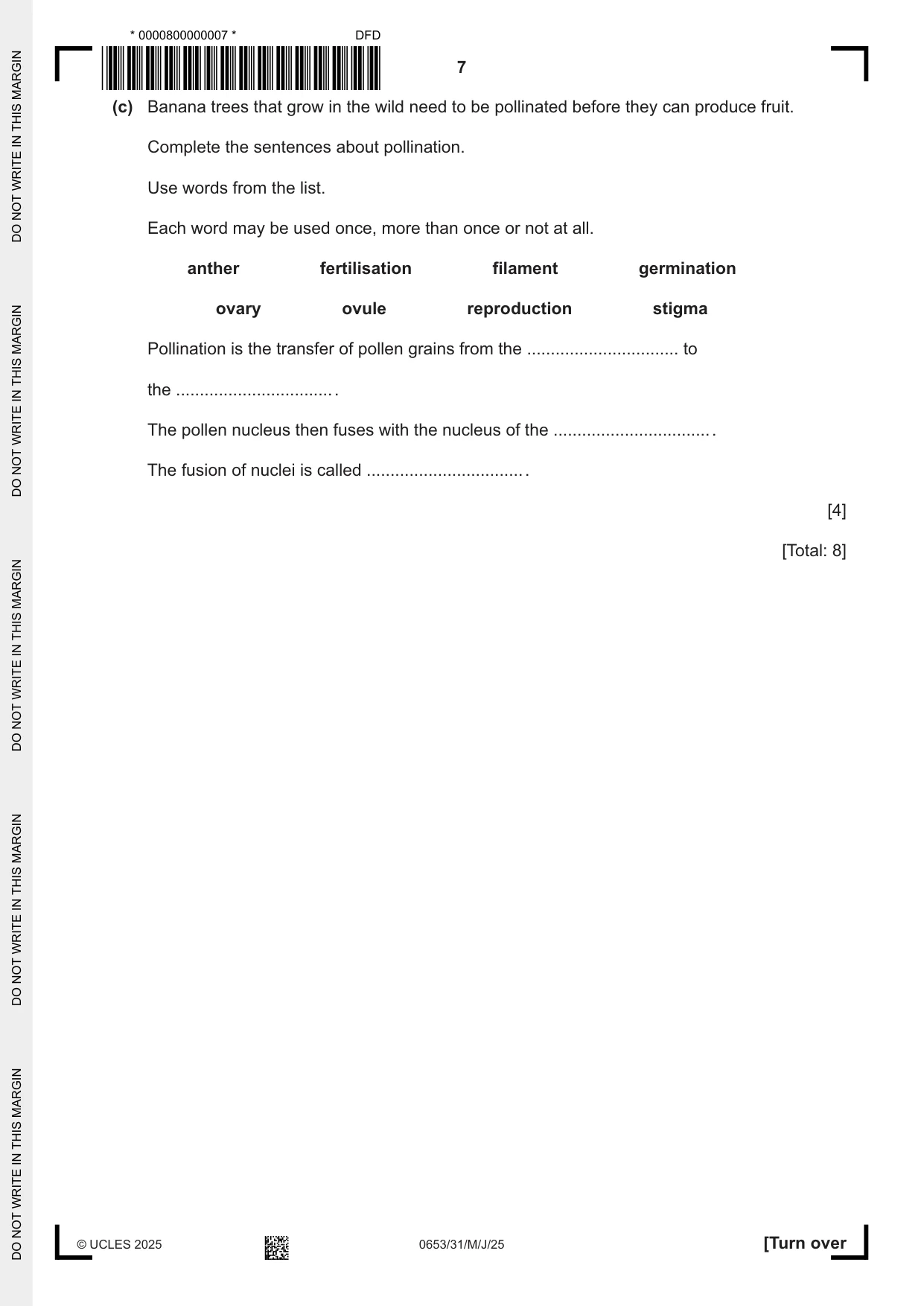
3 (a) Nutrition is one of the characteristics of living organisms. Define nutrition. ................................................................................................................................................... ............................................................................................................................................. [1] (b) Table 3.1 shows some information about nutrients in bananas. Table 3.1 mass of nutrient per nutrient 100 g of banana / g carbohydrate 12.2 protein 1.1 fat 0.3 fibre (roughage) 2.6 vitamin C 0.0087 (i) Identify the nutrient in Table 3.1 that helps to keep food moving through the large intestine. ..................................................................................................................................... [1] (ii) A health authority recommends that adults should eat 0.040 g of vitamin C per day. A person eats 100 g of bananas. Use Table 3.1 to calculate the percentage of the recommended mass of vitamin C the person eats. percentage = ......................................................... [2] (c) Banana trees that grow in the wild need to be pollinated before they can produce fruit. Complete the sentences about pollination. Use words from the list. Each word may be used once, more than once or not at all. anther fertilisation filament germination ovary ovule reproduction stigma Pollination is the transfer of pollen grains from the ................................ to the ................................. . The pollen nucleus then fuses with the nucleus of the ................................. . The fusion of nuclei is called ................................. . [4] [Total: 8]
Mark scheme: 3(a) the taking in of materials for, energy / growth / development ; 1 3(b)(i) fibre / roughage ; 1 3(b)(ii) 0.0087 100 ÷ 0.040 ; 2 22 (%) ; 3(c) anther ; 4 stigma ; ovule ; fertilisation ;
Q4 · Iron is a metal
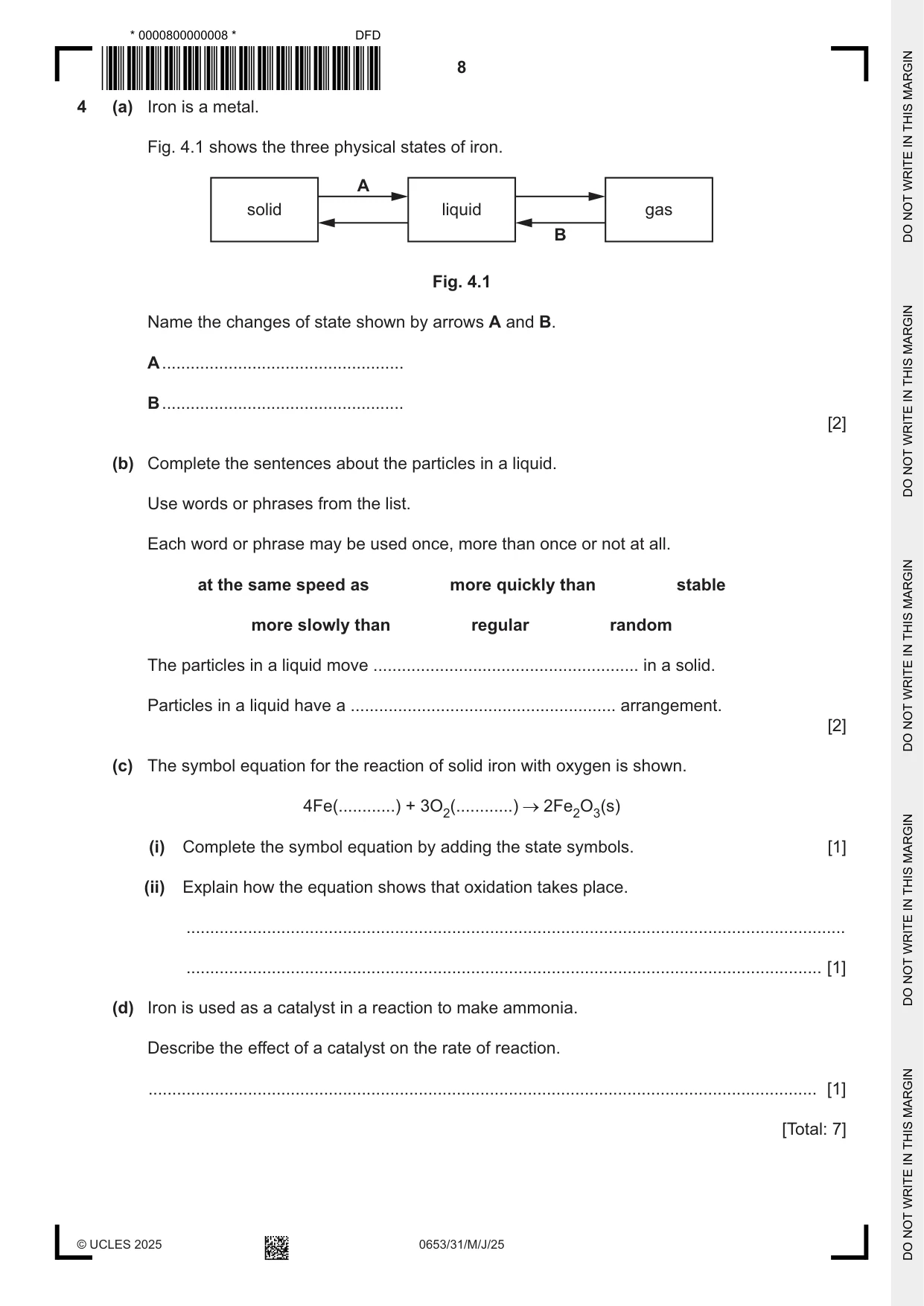
4 (a) Iron is a metal. Fig. 4.1 shows the three physical states of iron. A solid liquid gas B Fig. 4.1 Name the changes of state shown by arrows A and B. A ................................................... B ................................................... [2] (b) Complete the sentences about the particles in a liquid. Use words or phrases from the list. Each word or phrase may be used once, more than once or not at all. at the same speed as more quickly than stable more slowly than regular random The particles in a liquid move ........................................................ in a solid. Particles in a liquid have a ........................................................ arrangement. [2] (c) The symbol equation for the reaction of solid iron with oxygen is shown. 4Fe(............) + 3O2(............) 2Fe2O3(s) (i) Complete the symbol equation by adding the state symbols. [1] (ii) Explain how the equation shows that oxidation takes place. ........................................................................................................................................... ...................................................................................................................................... [1] (d) Iron is used as a catalyst in a reaction to make ammonia. Describe the effect of a catalyst on the rate of reaction. ............................................................................................................................................. [1] [Total: 7]
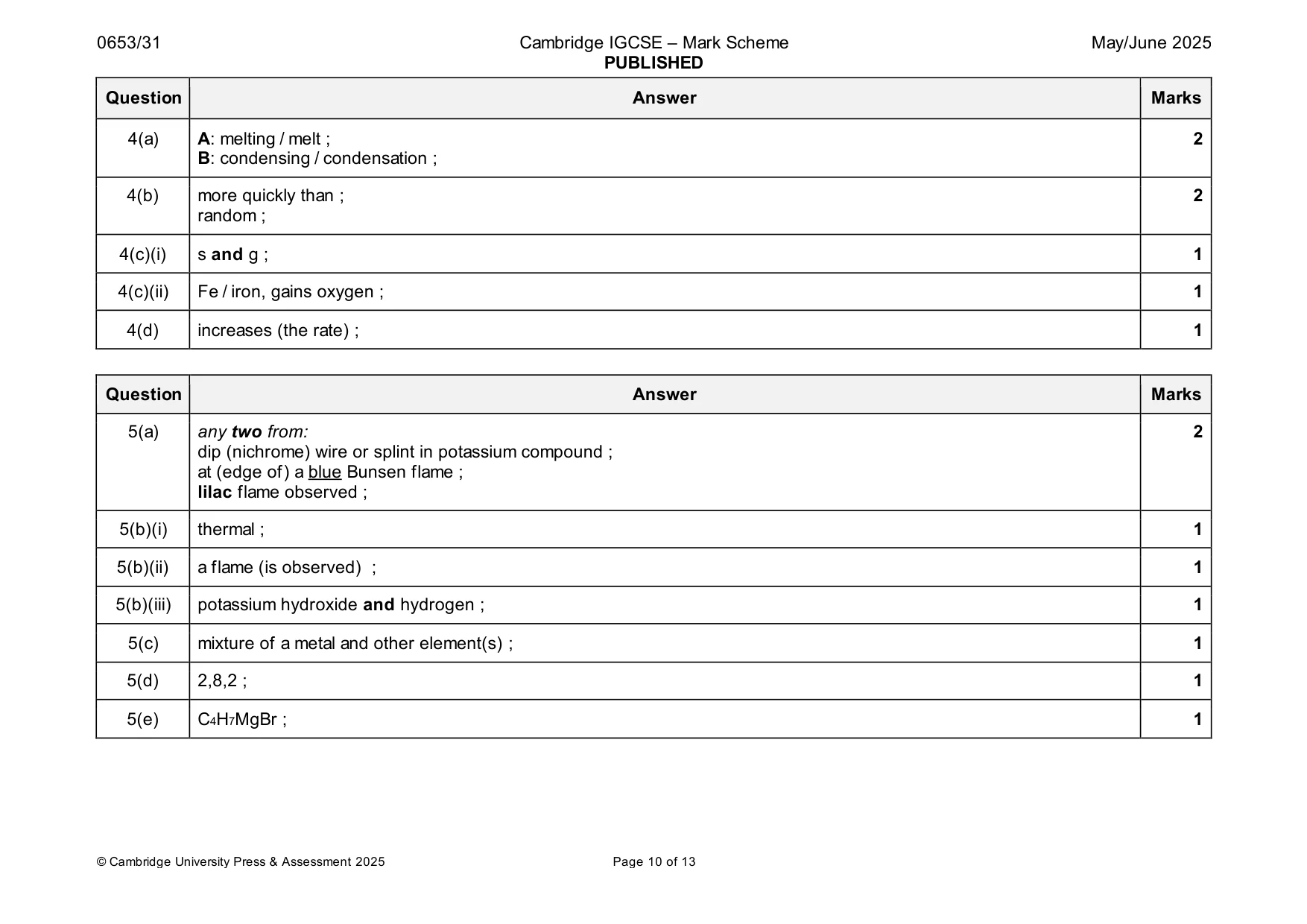
Mark scheme: 4(a) A: melting / melt ; 2 B: condensing / condensation ; 4(b) more quickly than ; 2 random ; 4(c)(i) s and g ; 1 4(c)(ii) Fe / iron, gains oxygen ; 1 4(d) increases (the rate) ; 1
Q5 · Potassium and magnesium are metals
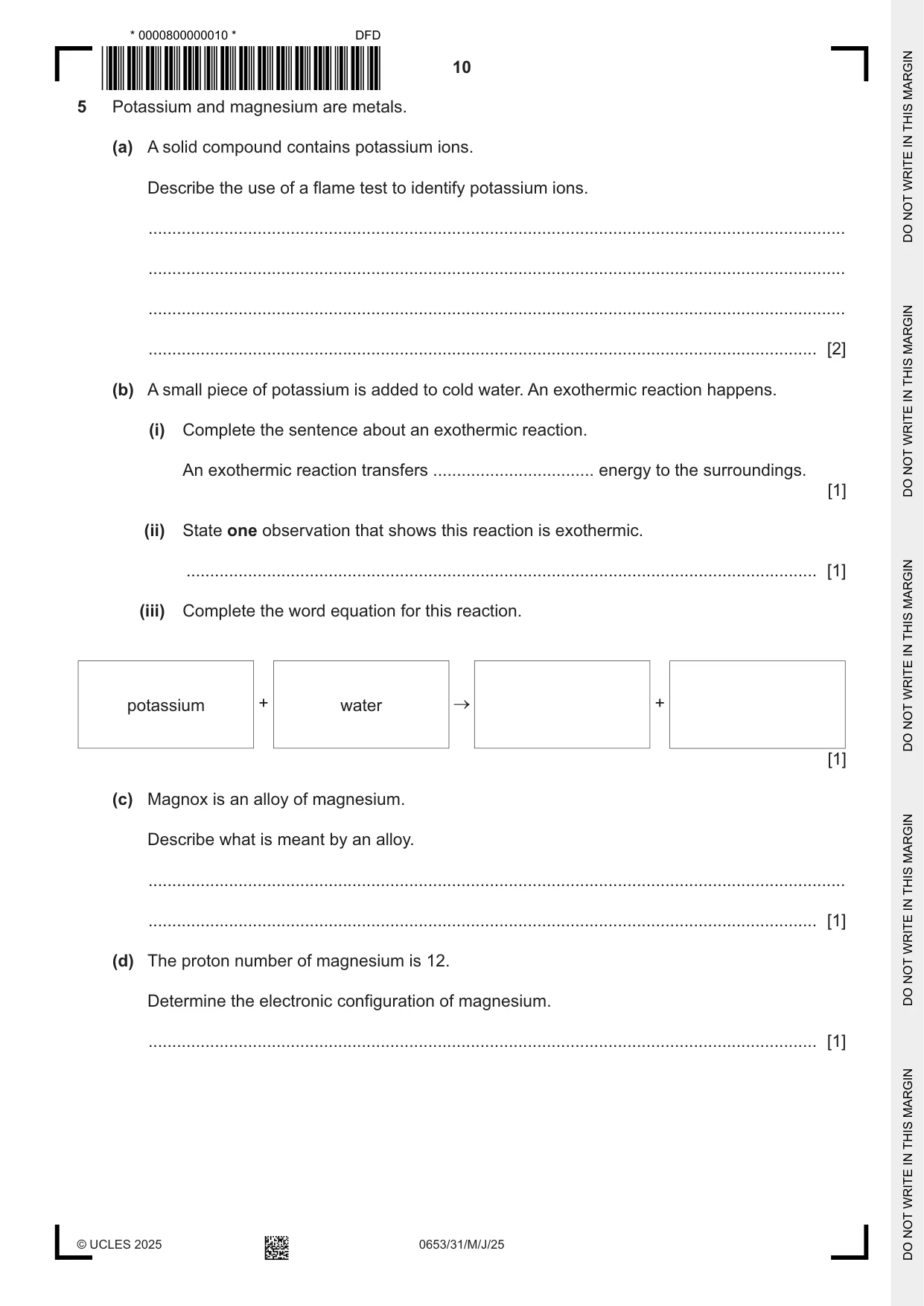
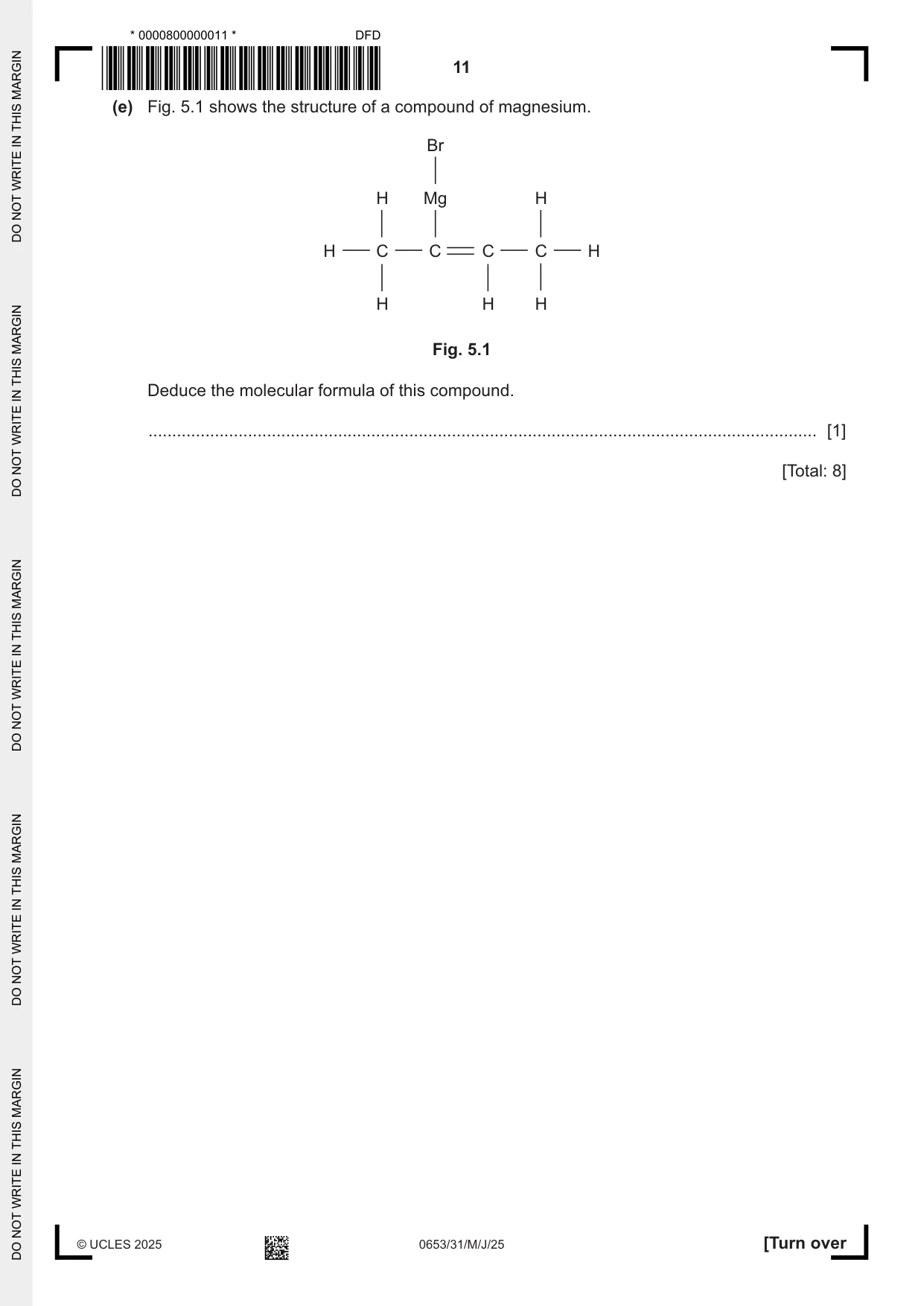
5 Potassium and magnesium are metals. (a) A solid compound contains potassium ions. Describe the use of a flame test to identify potassium ions. ................................................................................................................................................... ................................................................................................................................................... ................................................................................................................................................... ............................................................................................................................................. [2] (b) A small piece of potassium is added to cold water. An exothermic reaction happens. (i) Complete the sentence about an exothermic reaction. An exothermic reaction transfers .................................. energy to the surroundings. [1] (ii) State one observation that shows this reaction is exothermic. ..................................................................................................................................... [1] (iii) Complete the word equation for this reaction. potassium + water + [1] (c) Magnox is an alloy of magnesium. Describe what is meant by an alloy. ................................................................................................................................................... ............................................................................................................................................. [1] (d) The proton number of magnesium is 12. Determine the electronic configuration of magnesium. ............................................................................................................................................. [1] (e) Fig. 5.1 shows the structure of a compound of magnesium. Br H Mg H H C C C C H H H H Fig. 5.1 Deduce the molecular formula of this compound. ............................................................................................................................................. [1] [Total: 8]
Mark scheme: 5(a) any two from: 2 dip (nichrome) wire or splint in potassium compound ; at (edge of) a blue Bunsen flame ; lilac flame observed ; 5(b)(i) thermal ; 1 5(b)(ii) a flame (is observed) ; 1 5(b)(iii) potassium hydroxide and hydrogen ; 1 5(c) mixture of a metal and other element(s) ; 1 5(d) 2,8,2 ; 1 5(e) C4H7MgBr ; 1
Q6 · The formulas of some compounds of carbon are shown
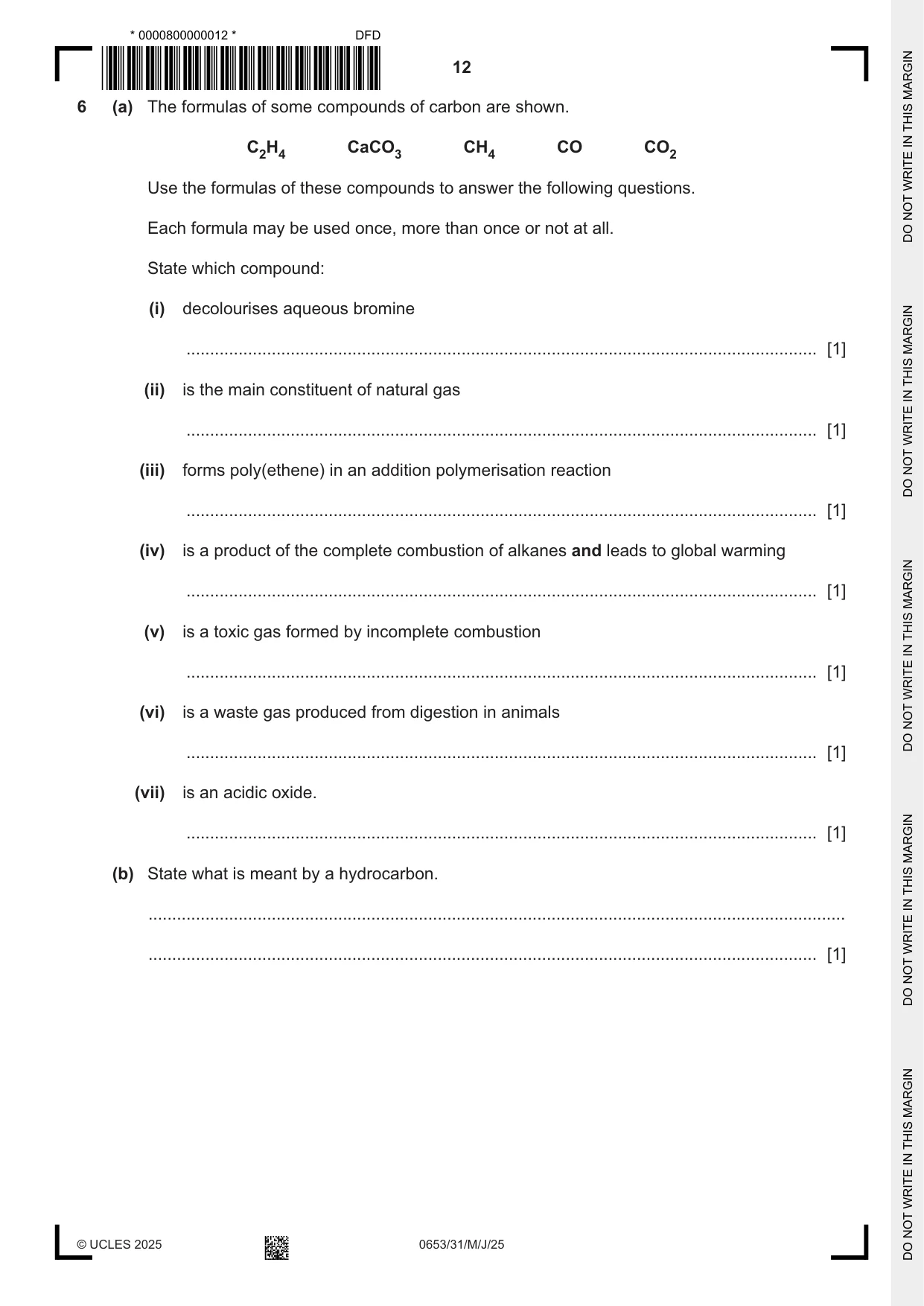
6 (a) The formulas of some compounds of carbon are shown. C2H4 CaCO3 CH4 CO CO2 Use the formulas of these compounds to answer the following questions. Each formula may be used once, more than once or not at all. State which compound: (i) decolourises aqueous bromine ..................................................................................................................................... [1] (ii) is the main constituent of natural gas ..................................................................................................................................... [1] (iii) forms poly(ethene) in an addition polymerisation reaction ..................................................................................................................................... [1] (iv) is a product of the complete combustion of alkanes and leads to global warming ..................................................................................................................................... [1] (v) is a toxic gas formed by incomplete combustion ..................................................................................................................................... [1] (vi) is a waste gas produced from digestion in animals ..................................................................................................................................... [1] (vii) is an acidic oxide. ..................................................................................................................................... [1] (b) State what is meant by a hydrocarbon. ................................................................................................................................................... ............................................................................................................................................. [1] (c) Bitumen and refinery gas are obtained from petroleum. Name one use of: bitumen ..................................................................................................................................... refinery gas. .............................................................................................................................. [2] (d) Coal is a fossil fuel. During the combustion of coal, a compound that contains sulfur is made. Name this compound. ............................................................................................................................................. [1] [Total: 11]
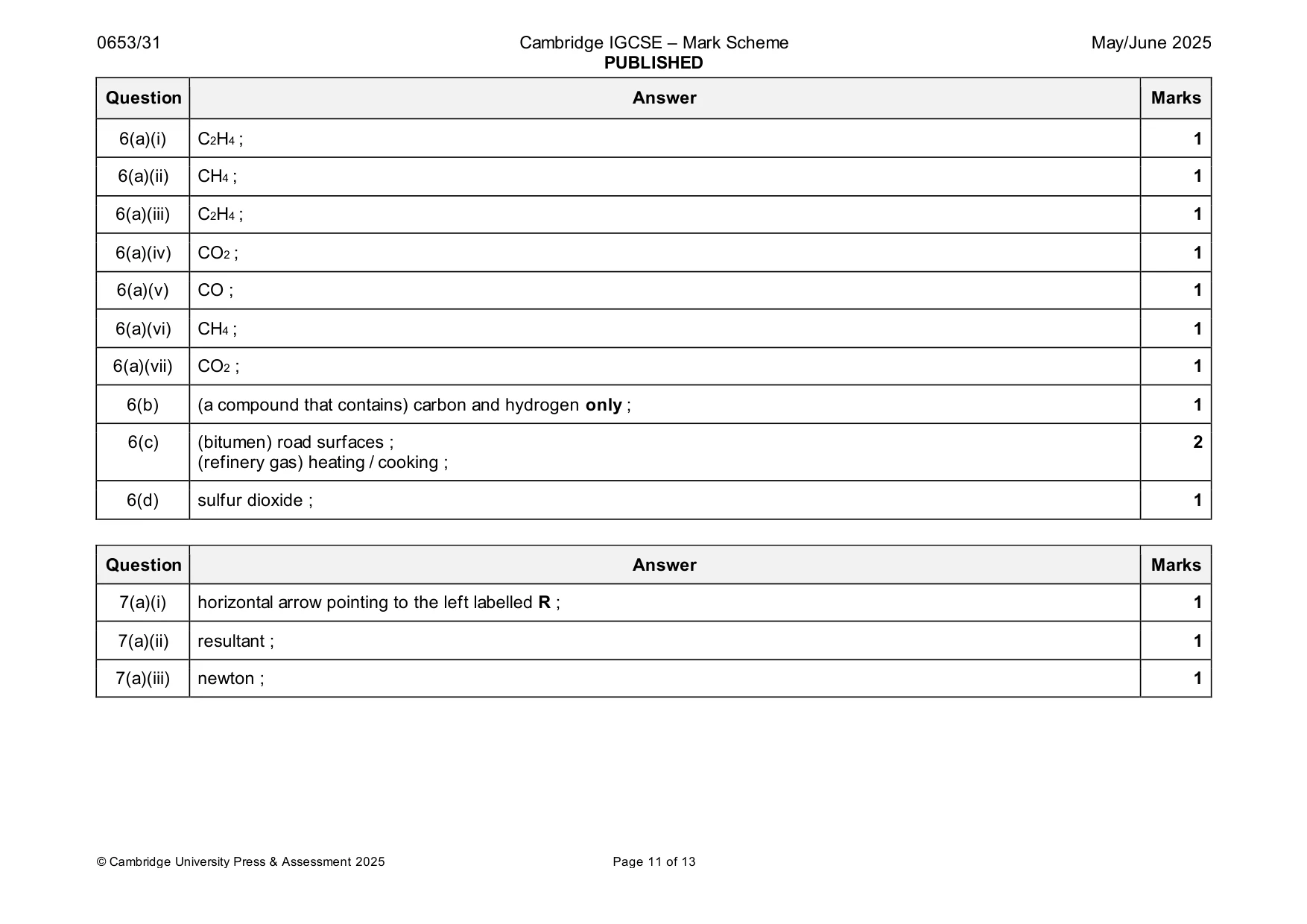
Mark scheme: 6(a)(i) C2H4 ; 1 6(a)(ii) CH4 ; 1 6(a)(iii) C2H4 ; 1 6(a)(iv) CO2 ; 1 6(a)(v) CO ; 1 6(a)(vi) CH4 ; 1 6(a)(vii) CO2 ; 1 6(b) (a compound that contains) carbon and hydrogen only ; 1 6(c) (bitumen) road surfaces ; 2 (refinery gas) heating / cooking ; 6(d) sulfur dioxide ; 1
Question 7
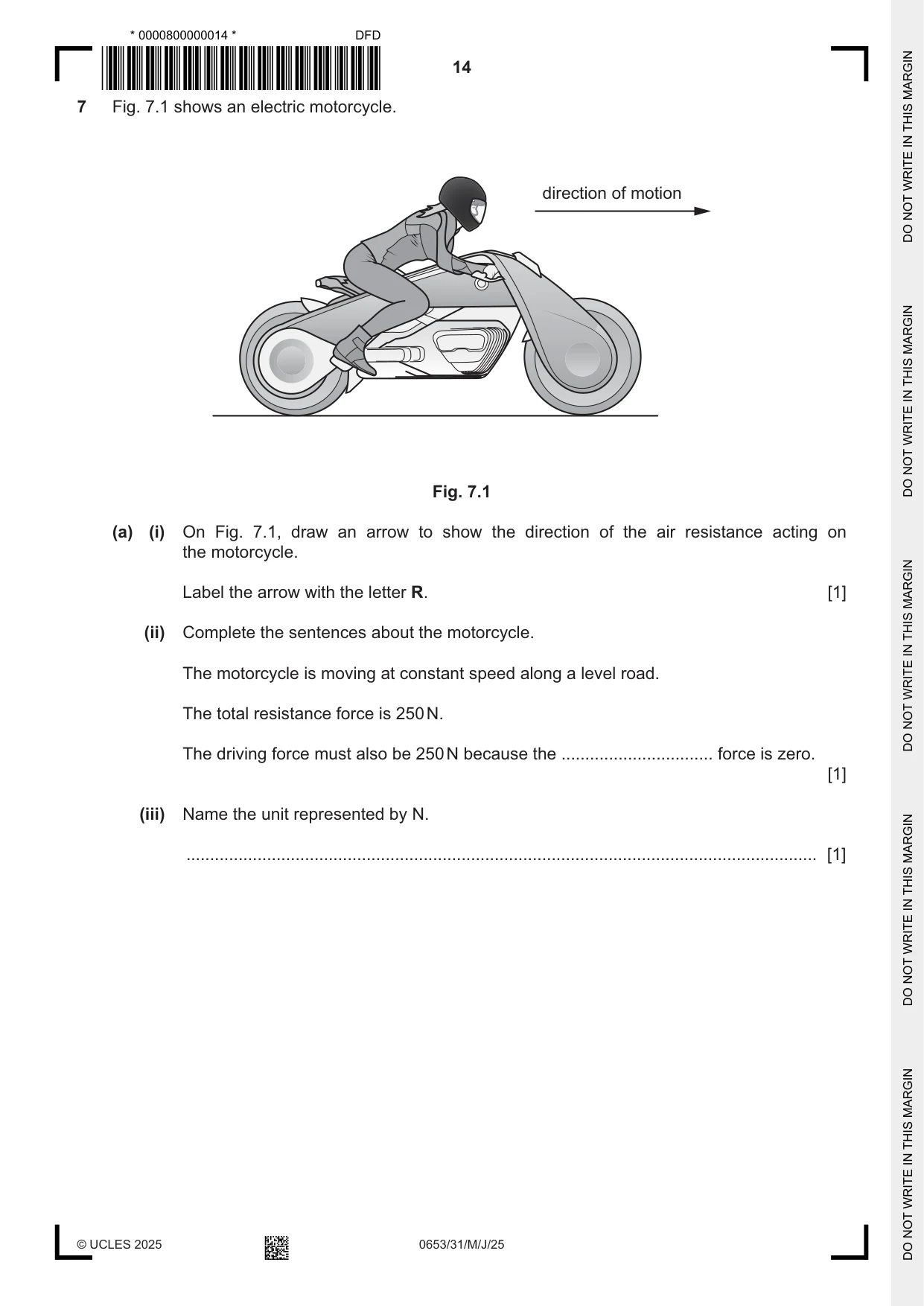
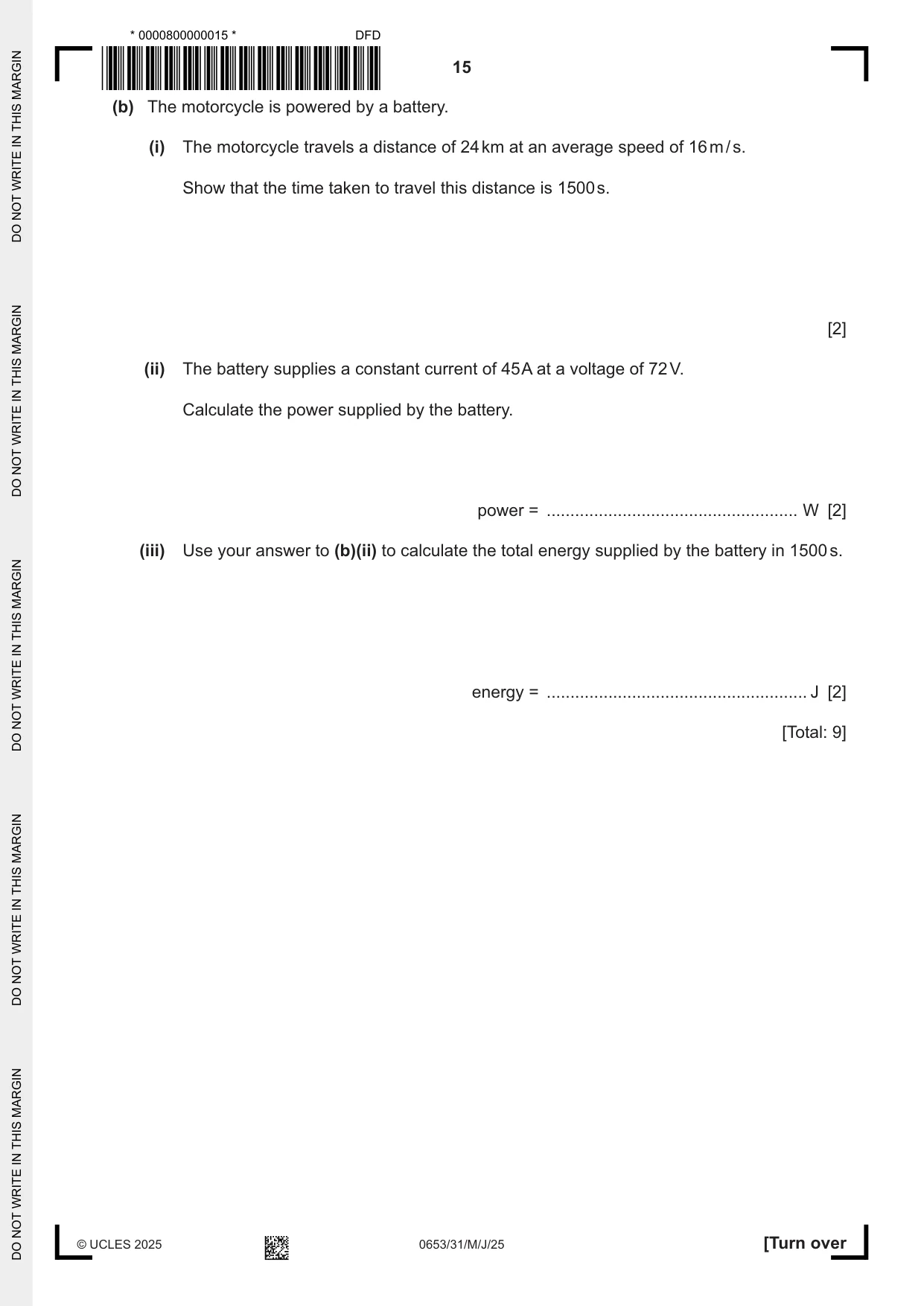
7 Fig. 7.1 shows an electric motorcycle. direction of motion Fig. 7.1 (a) (i) On Fig. 7.1, draw an arrow to show the direction of the air resistance acting on the motorcycle. Label the arrow with the letter R. [1] (ii) Complete the sentences about the motorcycle. The motorcycle is moving at constant speed along a level road. The total resistance force is 250 N. The driving force must also be 250 N because the ................................ force is zero. [1] (iii) Name the unit represented by N. ..................................................................................................................................... [1] (b) The motorcycle is powered by a battery. (i) The motorcycle travels a distance of 24 km at an average speed of 16 m / s. Show that the time taken to travel this distance is 1500 s. [2] (ii) The battery supplies a constant current of 45 A at a voltage of 72 V. Calculate the power supplied by the battery. power = ..................................................... W [2] (iii) Use your answer to (b)(ii) to calculate the total energy supplied by the battery in 1500 s. energy = ....................................................... J [2] [Total: 9]
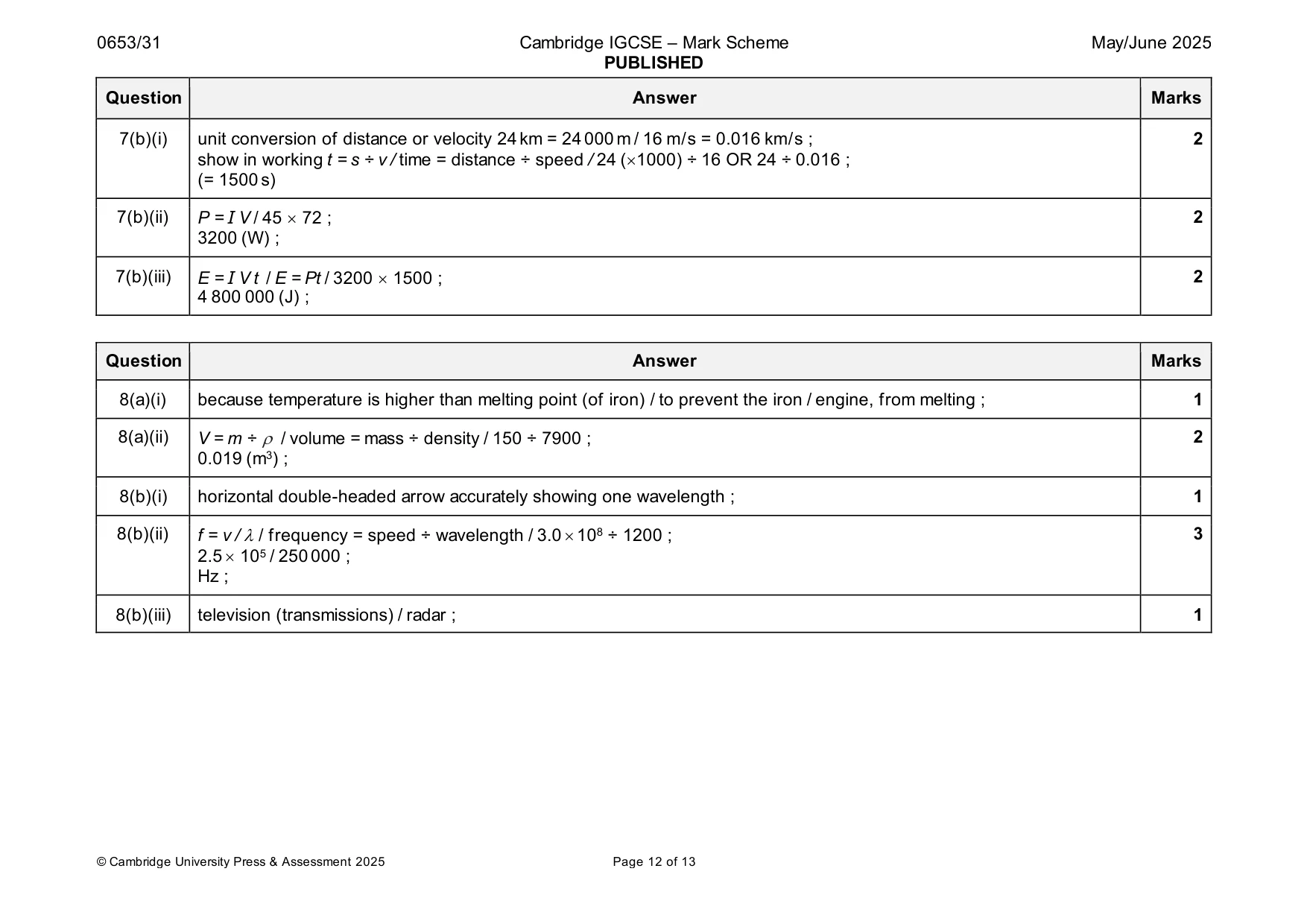
Mark scheme: 7(a)(i) horizontal arrow pointing to the left labelled R ; 1 7(a)(ii) resultant ; 1 7(a)(iii) newton ; 1 7(b)(i) unit conversion of distance or velocity 24 km = 24 000 m / 16 m / s = 0.016 km / s ; 2 show in working t = s ÷ v / time = distance ÷ speed / 24 (1000) ÷ 16 OR 24 ÷ 0.016 ; (= 1500 s) 7(b)(ii) P = I V / 45 72 ; 2 3200 (W) ; 7(b)(iii) E = I V t / E = Pt / 3200 1500 ; 2 4 800 000 (J) ;
Q8 · Some cars are powered by petrol (gasoline) engines made of iron
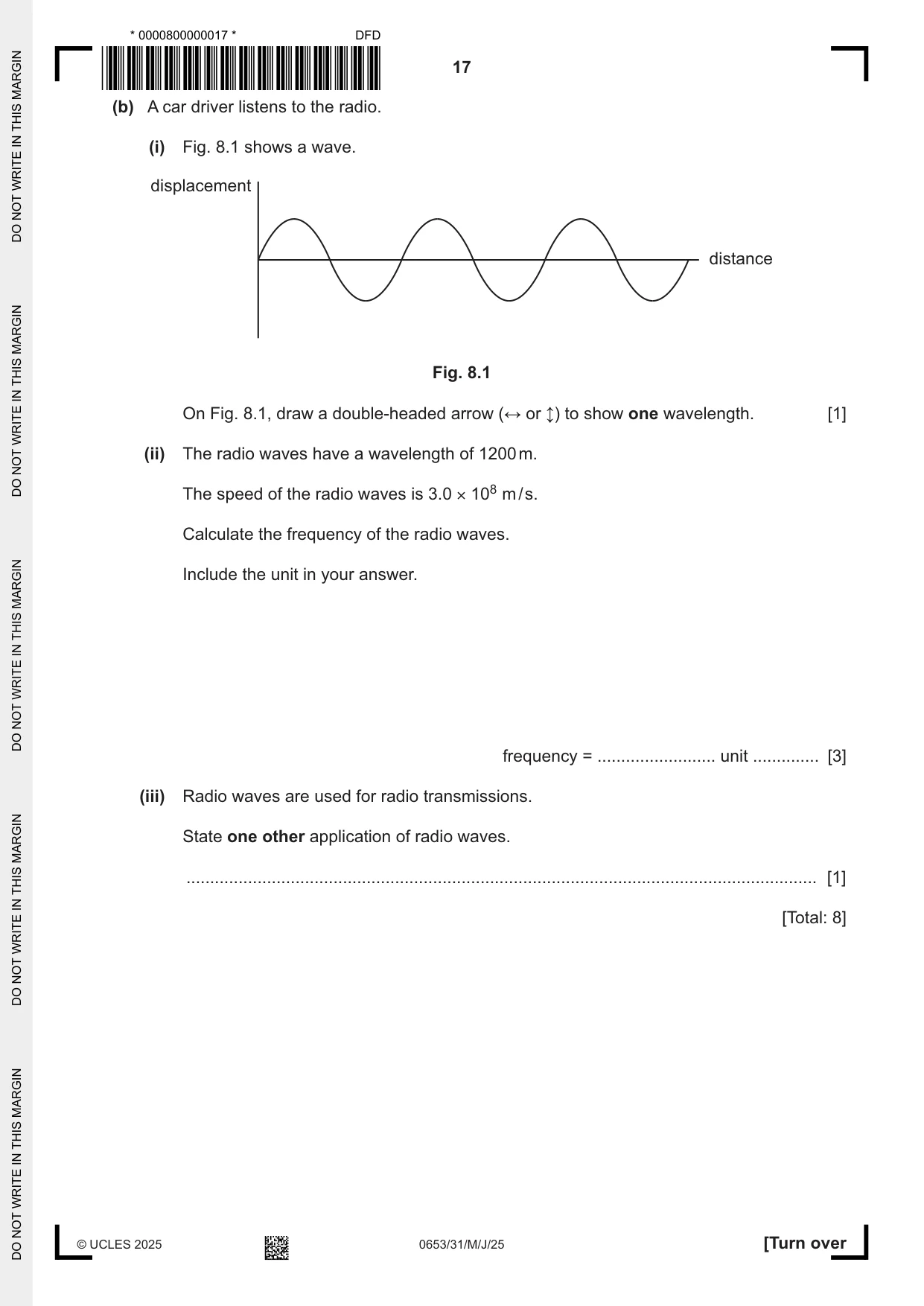
8 Some cars are powered by petrol (gasoline) engines made of iron. (a) Petrol burns inside the engine at a temperature of 1800 °C. (i) Iron melts at a temperature of 1538 °C. Suggest why the car engine must be cooled by a flow of cold water. ........................................................................................................................................... ..................................................................................................................................... [1] (ii) The mass of iron used in the car engine is 150 kg. The density of iron is 7900 kg / m3. Calculate the volume of iron used in the car engine. volume = .............................................. m3 [2] (b) A car driver listens to the radio. (i) Fig. 8.1 shows a wave. displacement distance Fig. 8.1 On Fig. 8.1, draw a double‑headed arrow (↔ or ↕) to show one wavelength. [1] (ii) The radio waves have a wavelength of 1200 m. The speed of the radio waves is 3.0 × 10⁸ m / s. Calculate the frequency of the radio waves. Include the unit in your answer. frequency = ......................... unit .............. [3] (iii) Radio waves are used for radio transmissions. State one other application of radio waves. ..................................................................................................................................... [1] [Total: 8]
Mark scheme: 8(a)(i) because temperature is higher than melting point (of iron) / to prevent the iron / engine, from melting ; 1 8(a)(ii) V = m ÷ / volume = mass ÷ density / 150 ÷ 7900 ; 2 0.019 (m3) ; 8(b)(i) horizontal double-headed arrow accurately showing one wavelength ; 1 8(b)(ii) f = v / / frequency = speed ÷ wavelength / 3.0 108 ÷ 1200 ; 3 2.5 105 / 250 000 ; Hz ; 8(b)(iii) television (transmissions) / radar ; 1
Q9 · A spacecraft is on a journey to the planet Saturn
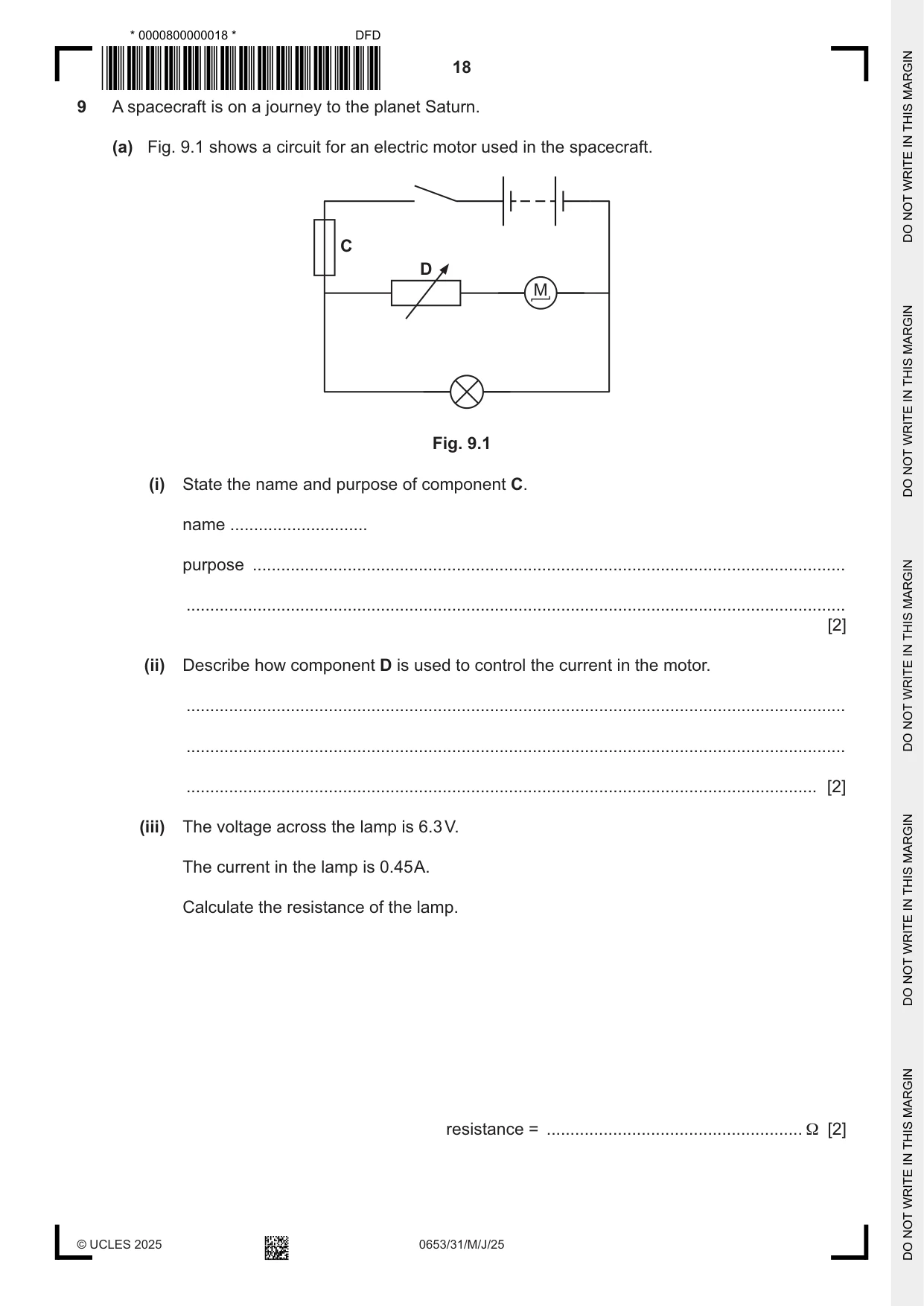
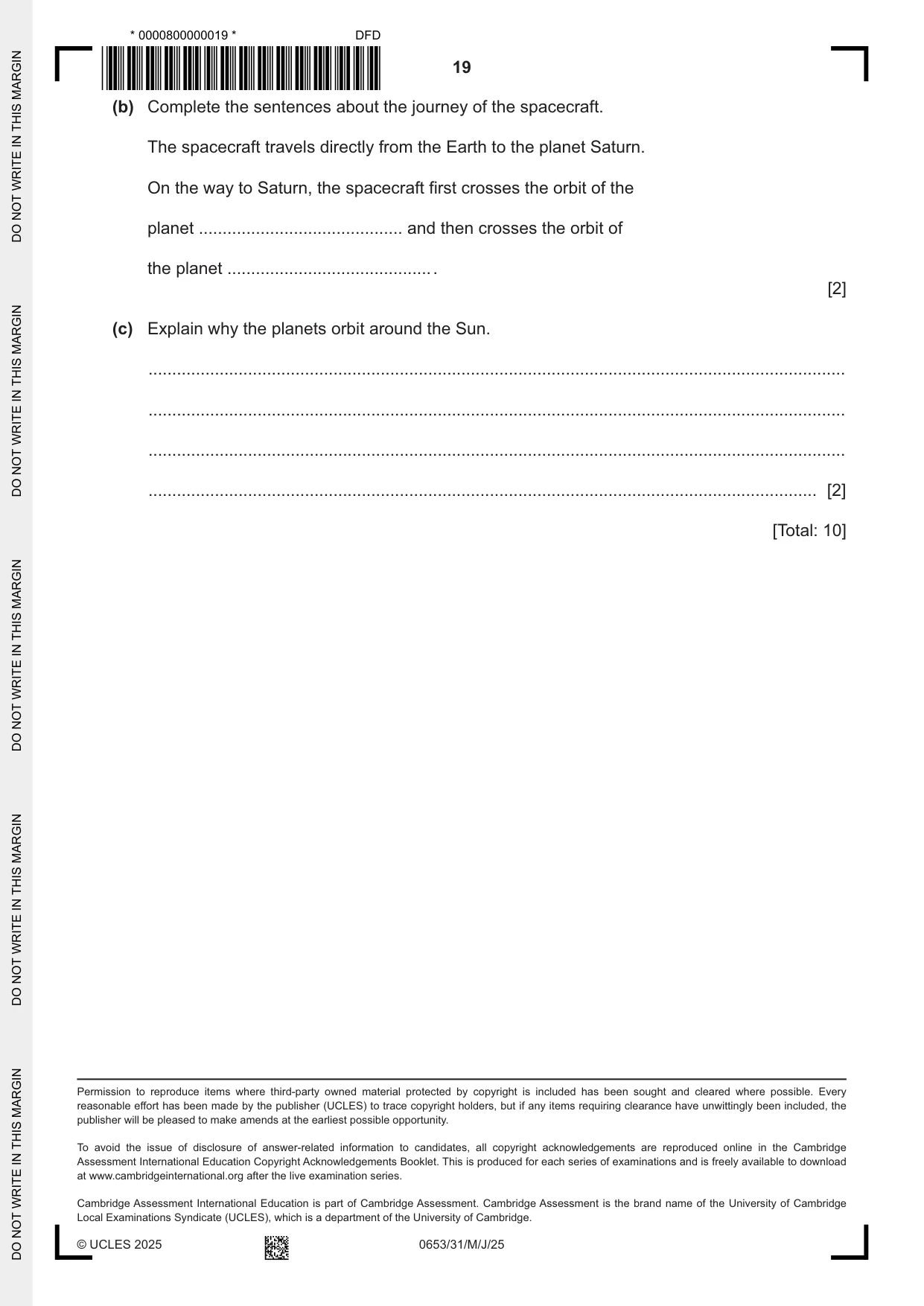
9 A spacecraft is on a journey to the planet Saturn. (a) Fig. 9.1 shows a circuit for an electric motor used in the spacecraft. C D M Fig. 9.1 (i) State the name and purpose of component C. name ............................. purpose ............................................................................................................................. ........................................................................................................................................... [2] (ii) Describe how component D is used to control the current in the motor. ........................................................................................................................................... ........................................................................................................................................... ..................................................................................................................................... [2] (iii) The voltage across the lamp is 6.3 V. The current in the lamp is 0.45 A. Calculate the resistance of the lamp. resistance = ...................................................... Ω [2] (b) Complete the sentences about the journey of the spacecraft. The spacecraft travels directly from the Earth to the planet Saturn. On the way to Saturn, the spacecraft first crosses the orbit of the planet ........................................... and then crosses the orbit of the planet ........................................... . [2] (c) Explain why the planets orbit around the Sun. ................................................................................................................................................... ................................................................................................................................................... ................................................................................................................................................... ............................................................................................................................................. [2] [Total: 10]
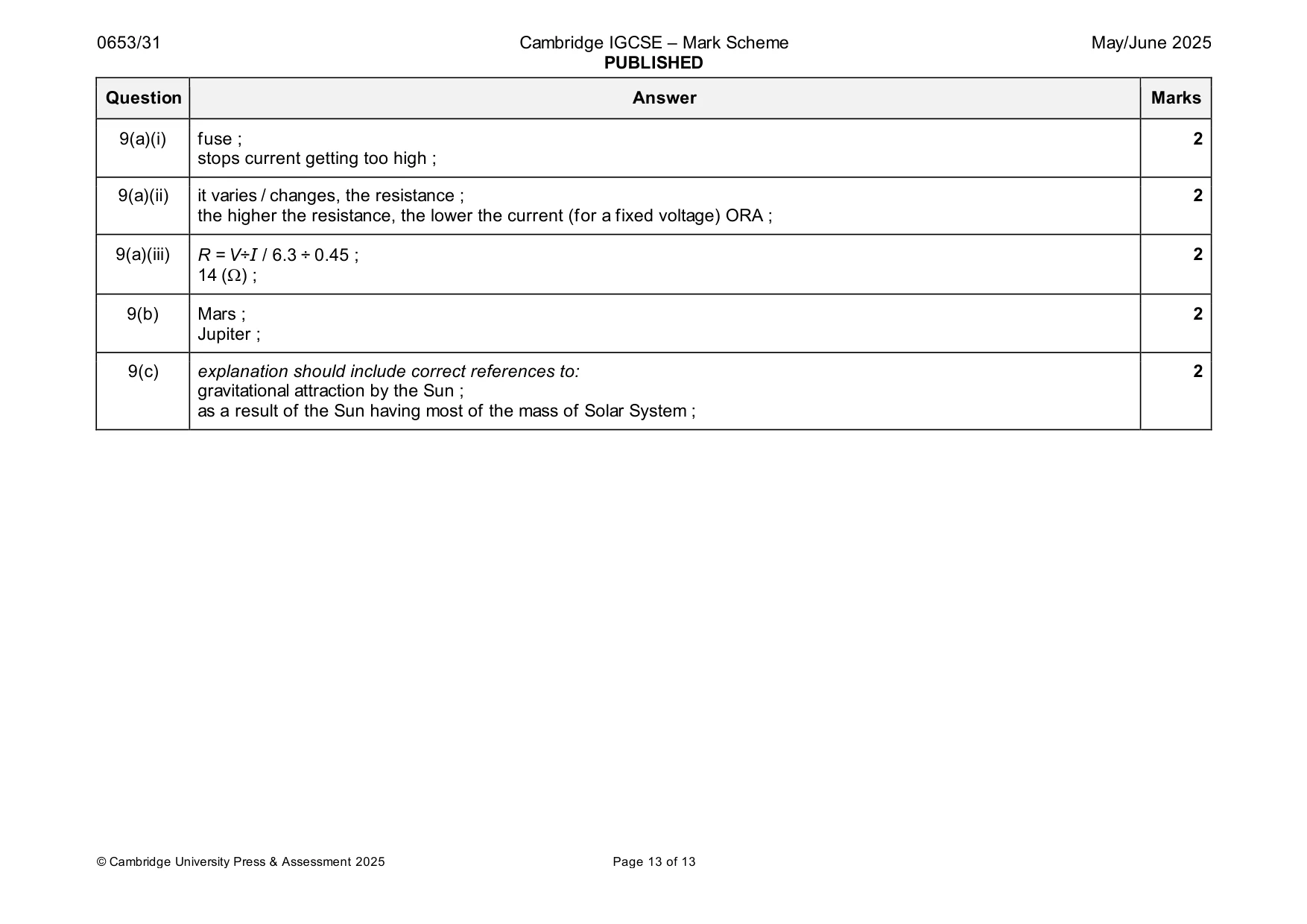
Mark scheme: 9(a)(i) fuse ; 2 stops current getting too high ; 9(a)(ii) it varies / changes, the resistance ; 2 the higher the resistance, the lower the current (for a fixed voltage) ORA ; 9(a)(iii) R = V÷I / 6.3 ÷ 0.45 ; 2 14 () ; 9(b) Mars ; 2 Jupiter ; 9(c) explanation should include correct references to: 2 gravitational attraction by the Sun ; as a result of the Sun having most of the mass of Solar System ;
What was in this paper
The subtopics covered by these 9 questions, and how many questions each got. Open one in a new tab to see every Cambridge question on it.
What you needed in this session
Cambridge’s own grade thresholds for 2025 May/June, Paper 3 · Variant 1. A higher threshold means an easier paper — the bar moves with how the cohort did.