Cambridge IGCSE Science - Combined 0653 — 2022 Oct/Nov Paper 3 · Variant 2
0653/32/O/N/22 · 8 questions · 80 marks · ≈90 min
The question paper and its mark scheme, free to read here and free to download. This is Cambridge’s own paper, exactly as it was sat.
Question paper24 pages

Mark scheme11 pages
Answers below. Sit the paper first if you are practising.
Questions as text
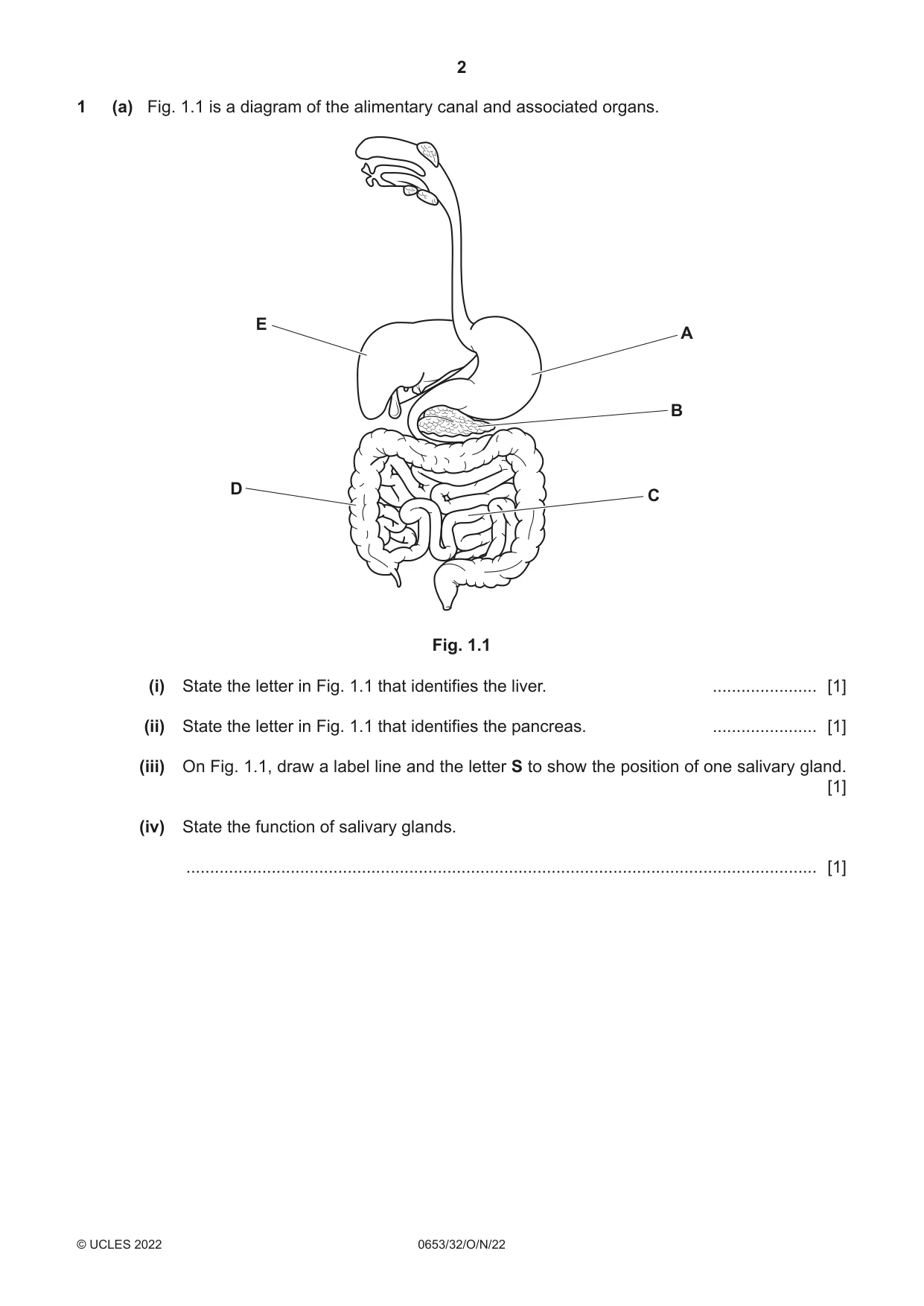
Q1 · A diagram of the alimentary canal and associated organs
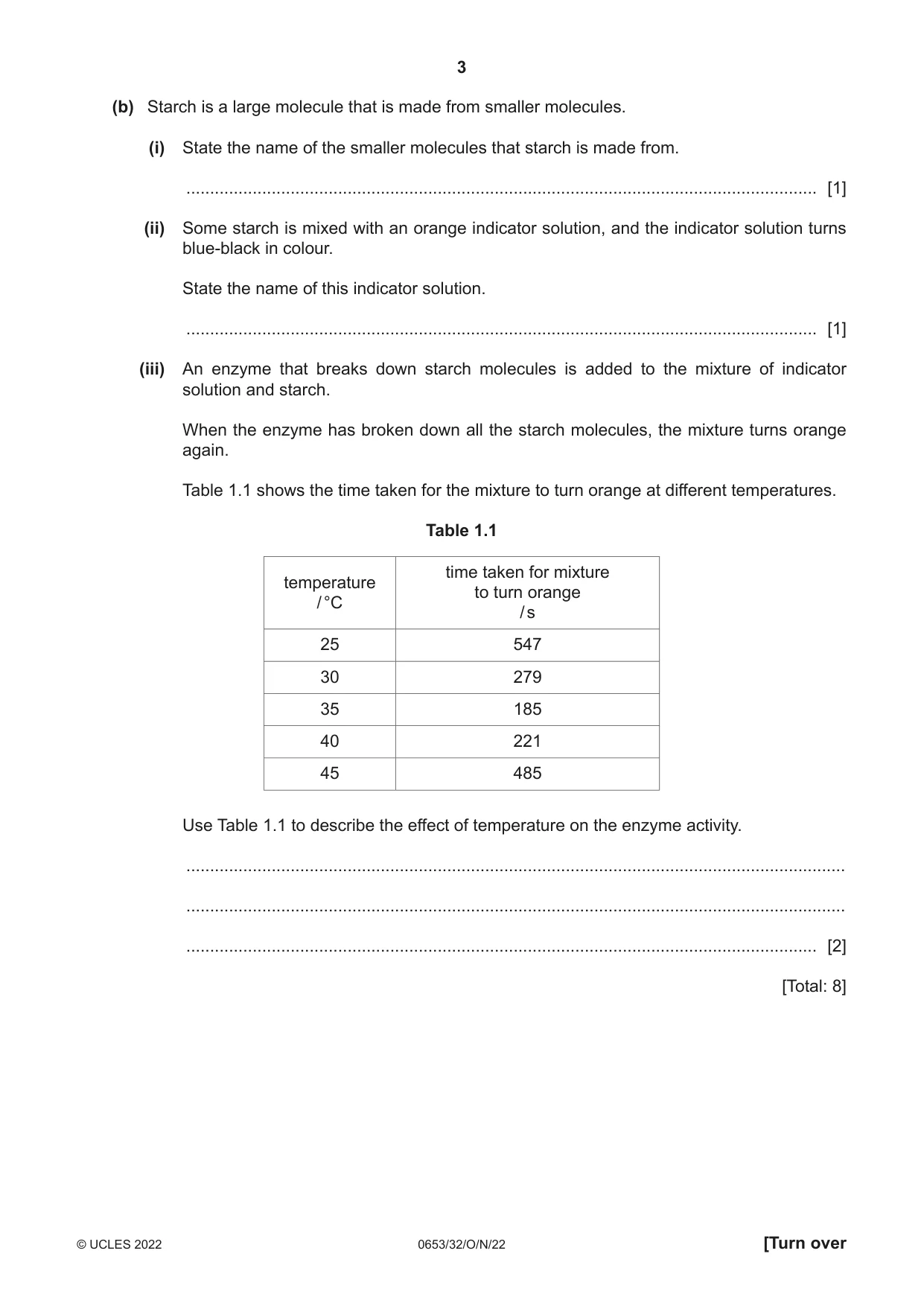
1 (a) Fig. 1.1 is a diagram of the alimentary canal and associated organs. E A B D C Fig. 1.1 (i) State the letter in Fig. 1.1 that identifies the liver. ...................... [1] (ii) State the letter in Fig. 1.1 that identifies the pancreas. ...................... [1] (iii) On Fig. 1.1, draw a label line and the letter S to show the position of one salivary gland. [1] (iv) State the function of salivary glands. ..................................................................................................................................... [1] (b) Starch is a large molecule that is made from smaller molecules. (i) State the name of the smaller molecules that starch is made from. ..................................................................................................................................... [1] (ii) Some starch is mixed with an orange indicator solution, and the indicator solution turns blue‑black in colour. State the name of this indicator solution. ..................................................................................................................................... [1] (iii) An enzyme that breaks down starch molecules is added to the mixture of indicator solution and starch. When the enzyme has broken down all the starch molecules, the mixture turns orange again. Table 1.1 shows the time taken for the mixture to turn orange at different temperatures. Table 1.1 time taken for mixture temperature to turn orange / °C / s 25 547 30 279 35 185 40 221 45 485 Use Table 1.1 to describe the effect of temperature on the enzyme activity. ........................................................................................................................................... ........................................................................................................................................... ..................................................................................................................................... [2] [Total: 8]
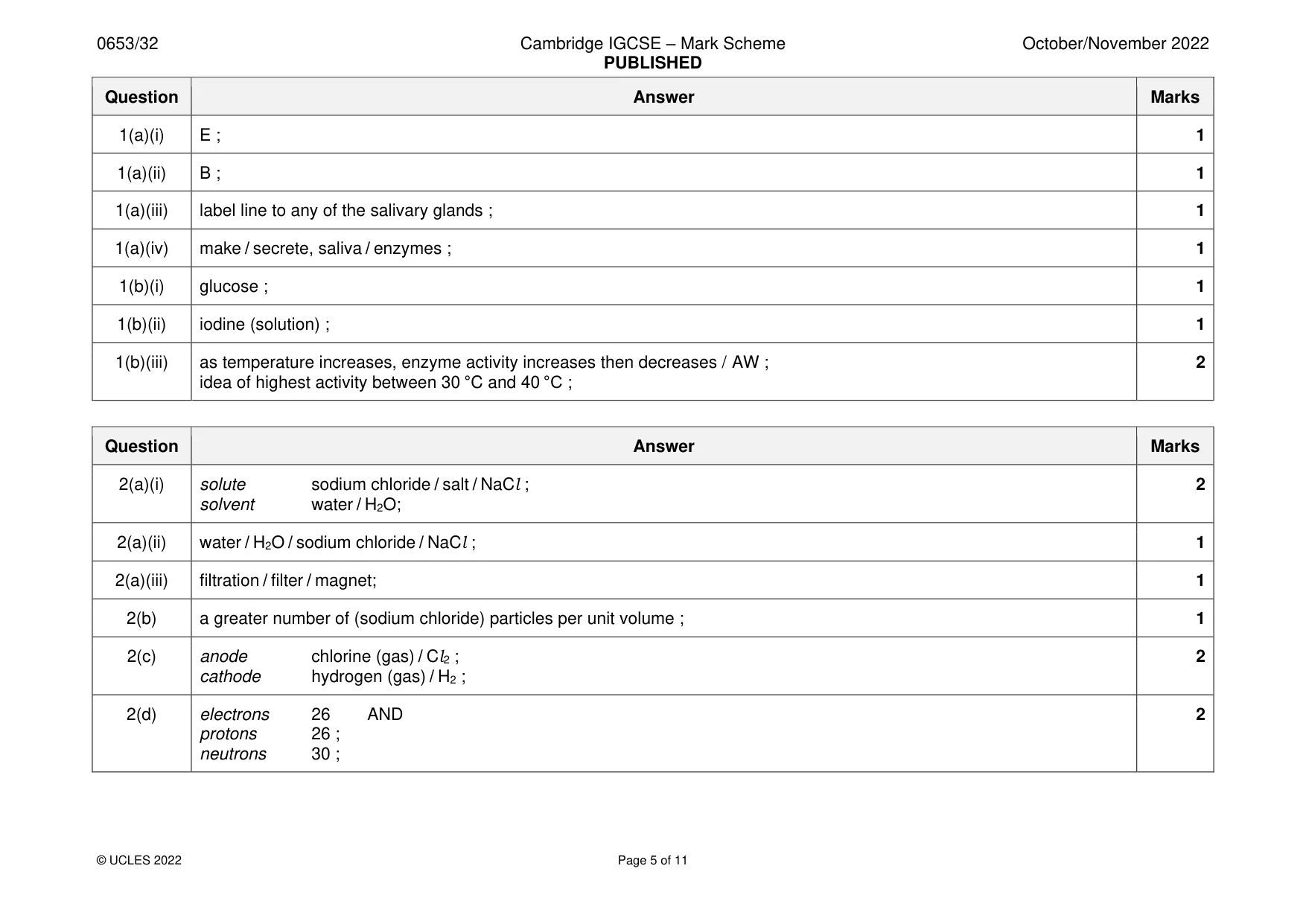
Mark scheme: Question Answer Marks 1(a)(i) E ; 1 1(a)(ii) B ; 1 1(a)(iii) label line to any of the salivary glands ; 1 1(a)(iv) make / secrete, saliva / enzymes ; 1 1(b)(i) glucose ; 1 1(b)(ii) iodine (solution) ; 1 1(b)(iii) as temperature increases, enzyme activity increases then decreases / AW ; 2 idea of highest activity between 30 °C and 40 °C ;
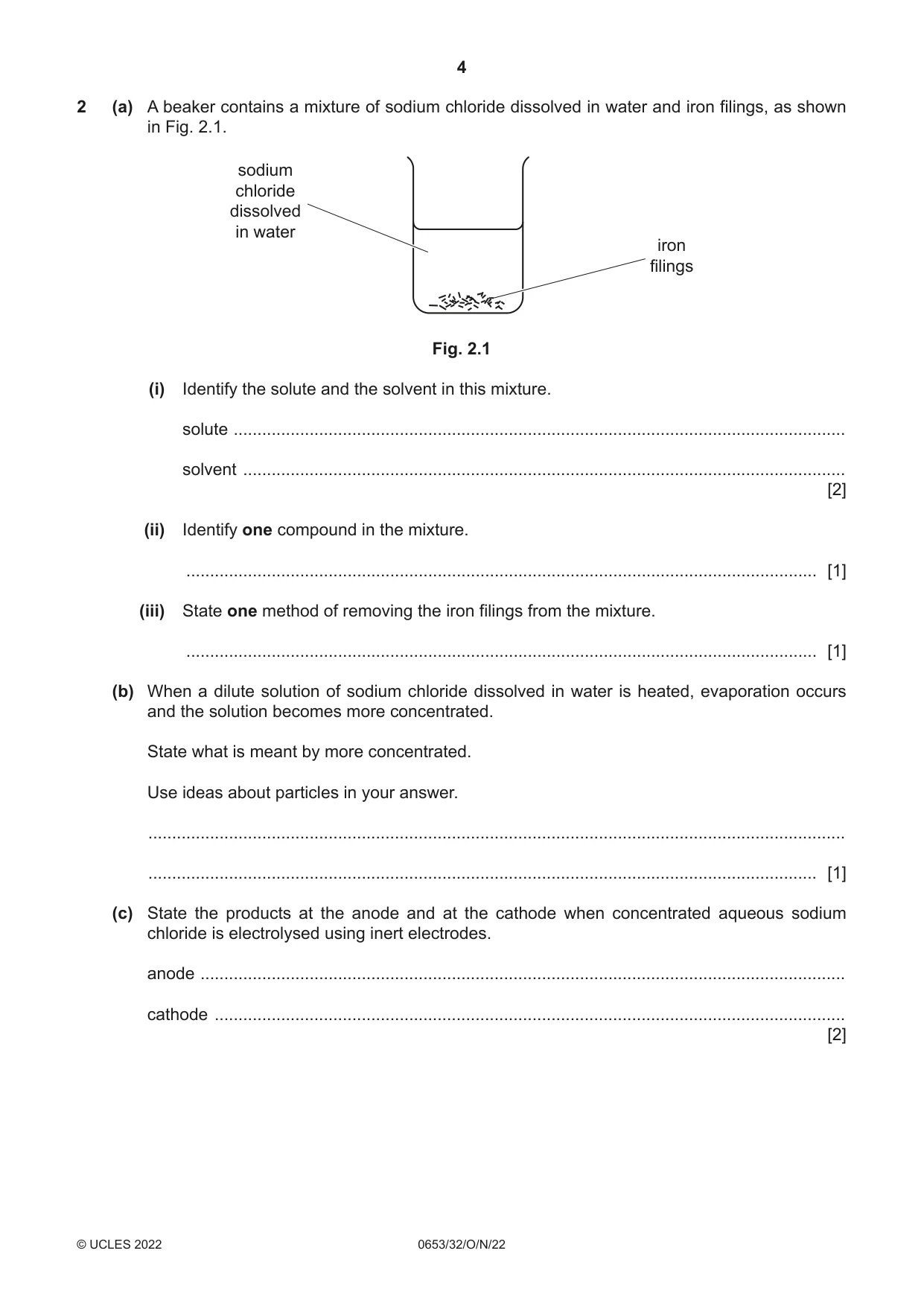
Q2 · A beaker contains a mixture of sodium chloride dissolved in water and iron filings, as…
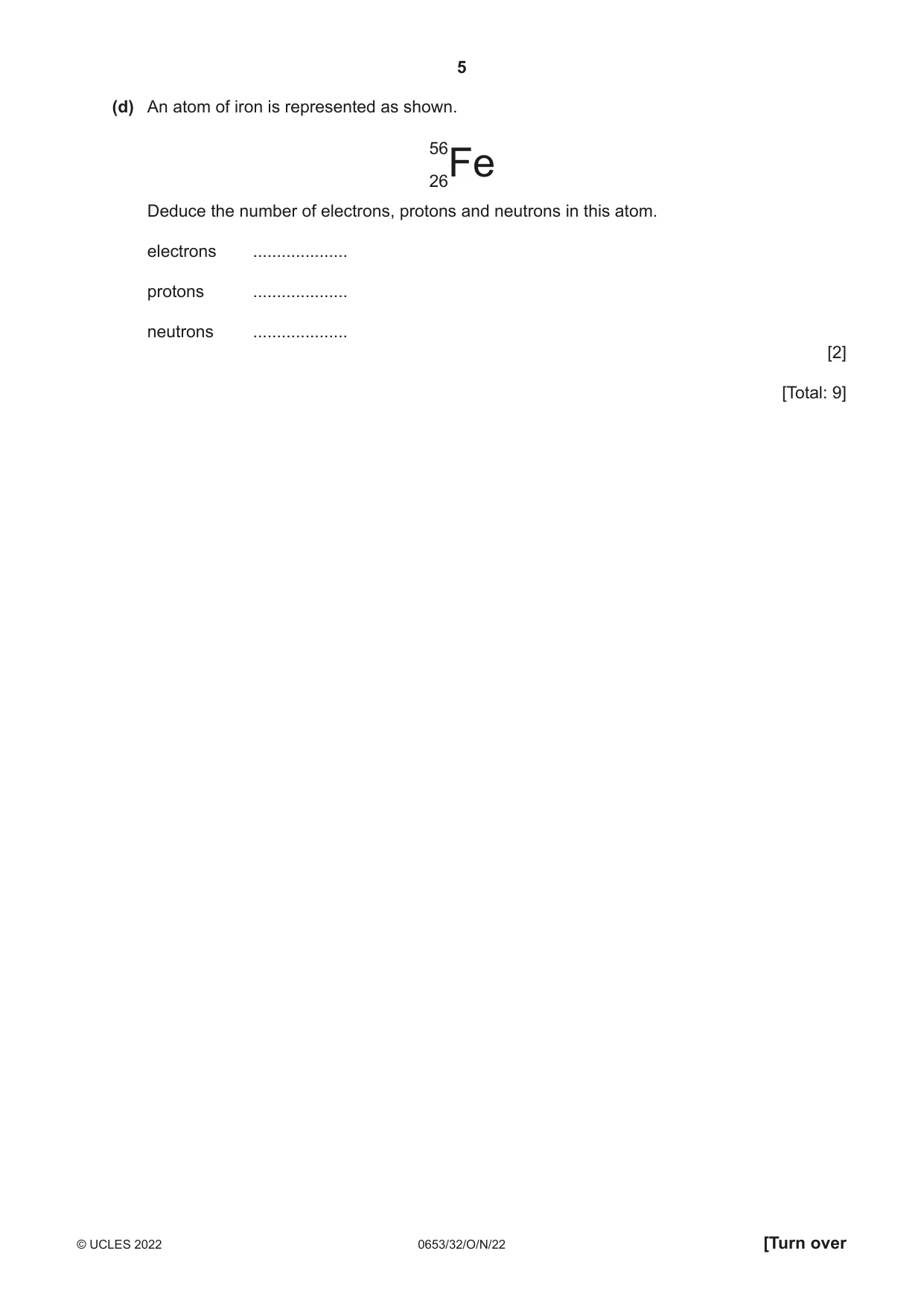
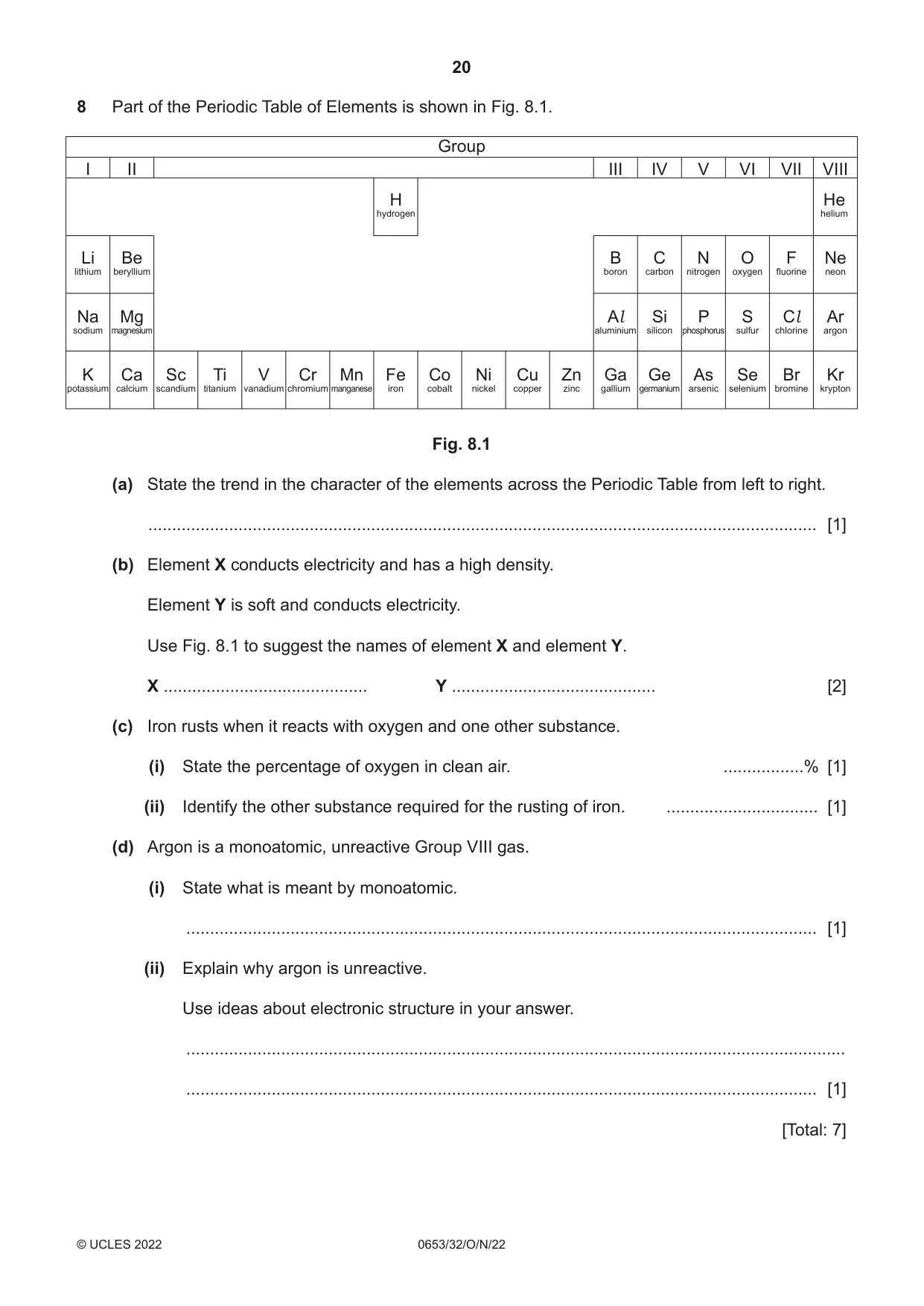
2 (a) A beaker contains a mixture of sodium chloride dissolved in water and iron filings, as shown in Fig. 2.1. sodium chloride dissolved in water iron filings Fig. 2.1 (i) Identify the solute and the solvent in this mixture. solute ................................................................................................................................. solvent ............................................................................................................................... [2] (ii) Identify one compound in the mixture. ..................................................................................................................................... [1] (iii) State one method of removing the iron filings from the mixture. ..................................................................................................................................... [1] (b) When a dilute solution of sodium chloride dissolved in water is heated, evaporation occurs and the solution becomes more concentrated. State what is meant by more concentrated. Use ideas about particles in your answer. ................................................................................................................................................... ............................................................................................................................................. [1] (c) State the products at the anode and at the cathode when concentrated aqueous sodium chloride is electrolysed using inert electrodes. anode ........................................................................................................................................ cathode ..................................................................................................................................... [2] (d) An atom of iron is represented as shown. 5626Fe Deduce the number of electrons, protons and neutrons in this atom. electrons .................... protons .................... neutrons .................... [2] [Total: 9]
Mark scheme: 2(a)(i) solute sodium chloride / salt / NaCl ; 2 solvent water / H2O; 2(a)(ii) water / H2O / sodium chloride / NaCl ; 1 2(a)(iii) filtration / filter / magnet; 1 2(b) a greater number of (sodium chloride) particles per unit volume ; 1 2(c) anode chlorine (gas) / Cl2 ; 2 cathode hydrogen (gas) / H2 ; 2(d) electrons 26 AND 2 protons 26 ; neutrons 30 ;
Q3 · In 1997, the Thrust Supersonic Car set a world land speed record
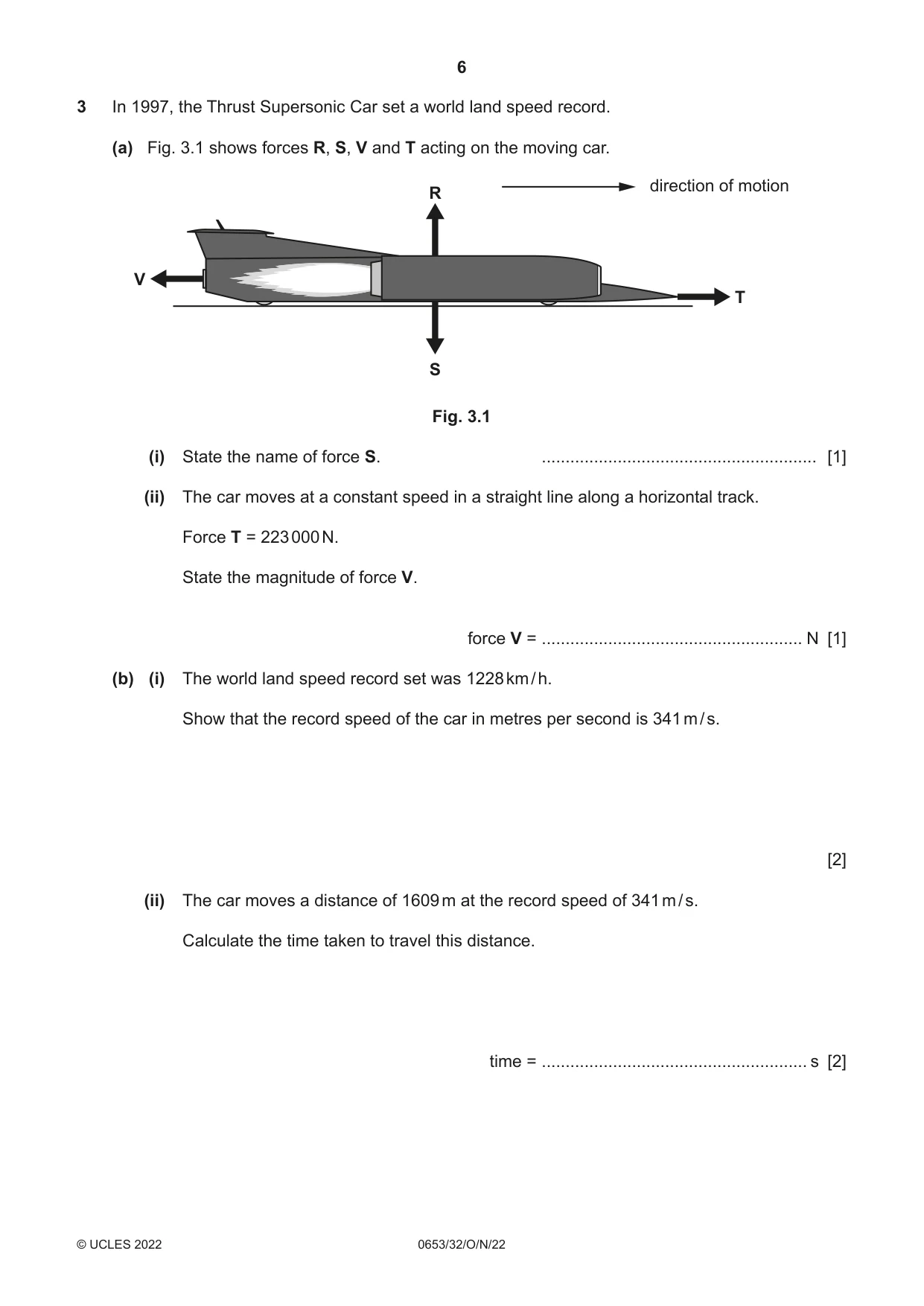
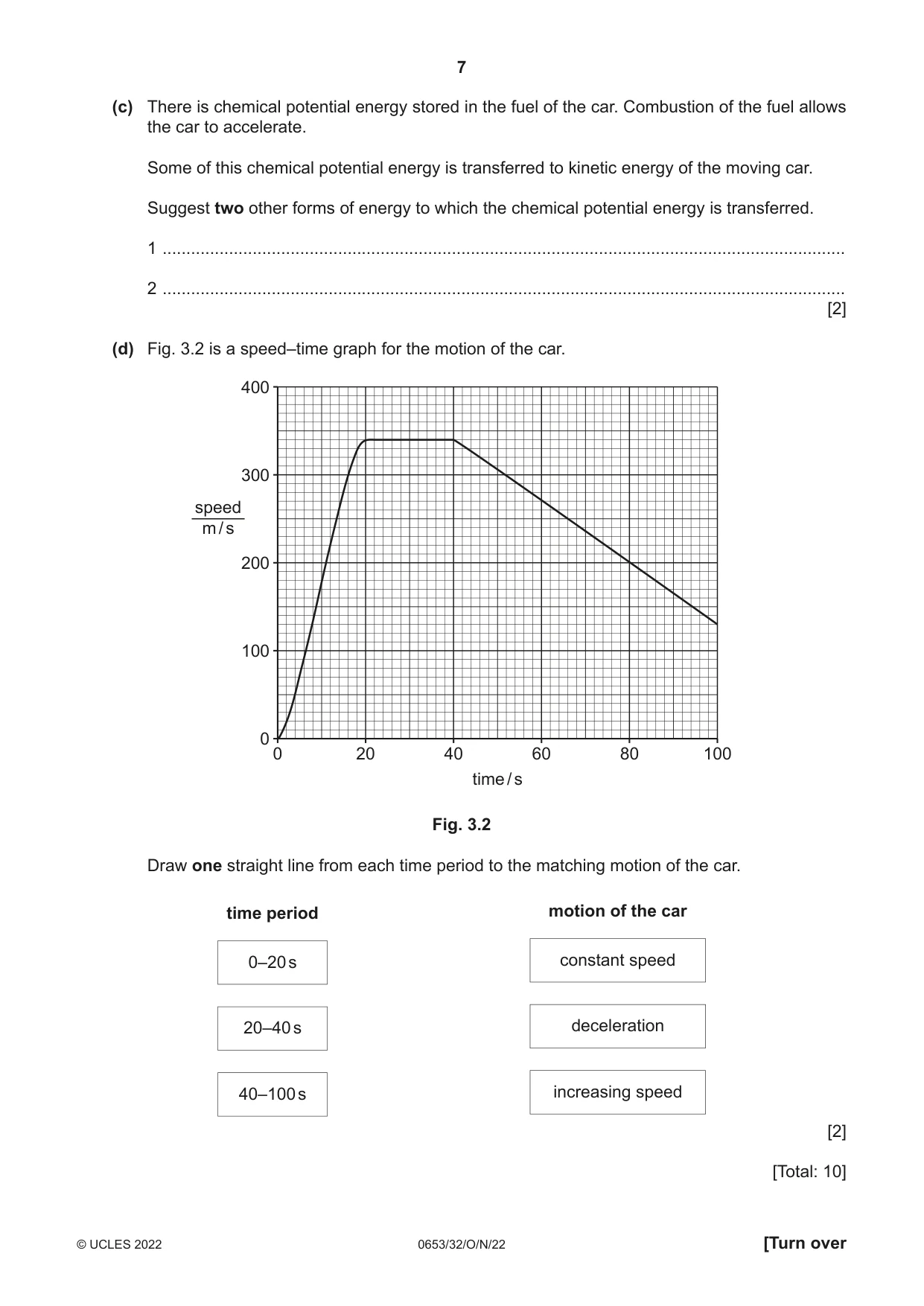
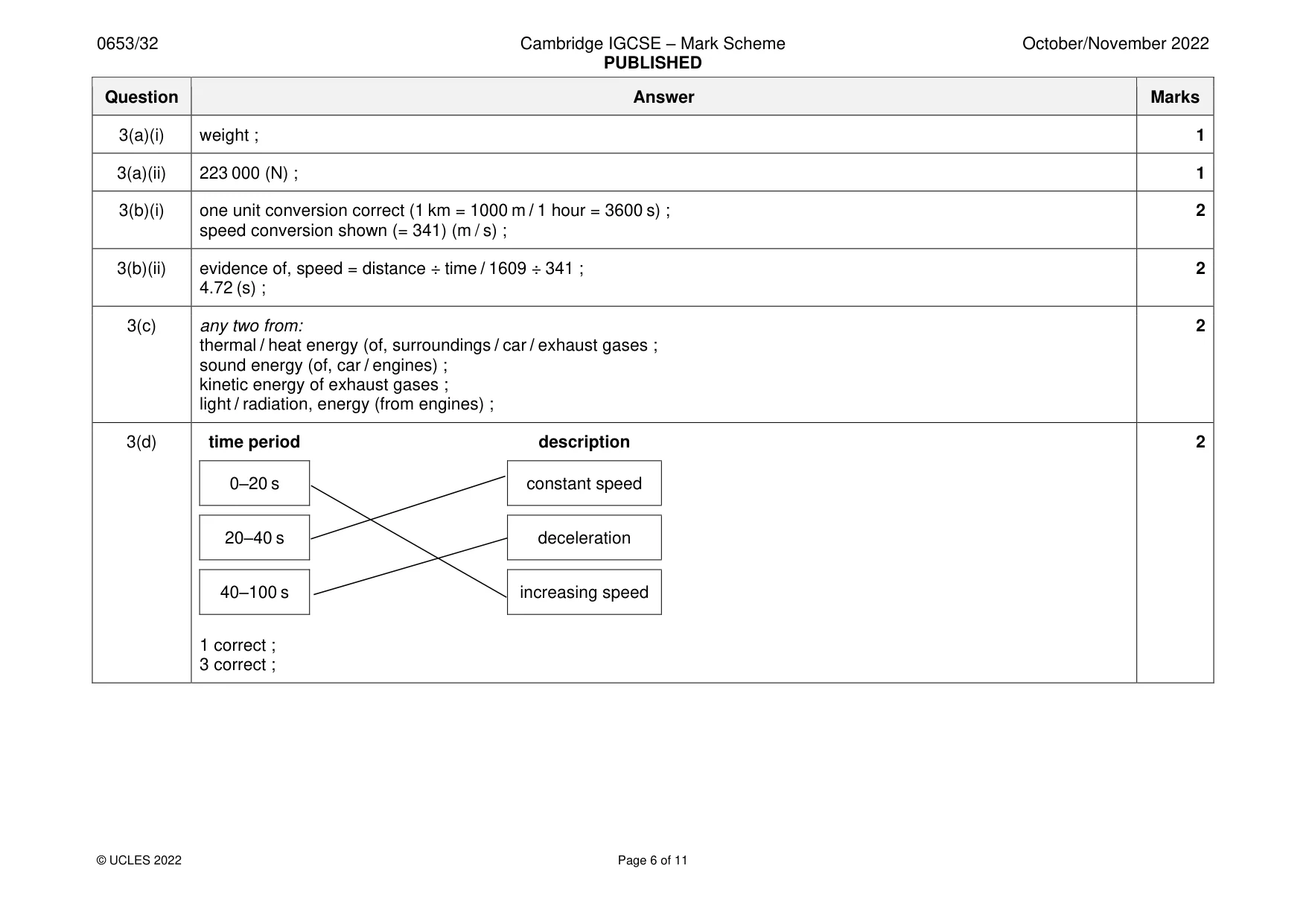
3 In 1997, the Thrust Supersonic Car set a world land speed record. (a) Fig. 3.1 shows forces R, S, V and T acting on the moving car. direction of motion R V T S Fig. 3.1 (i) State the name of force S. .......................................................... [1] (ii) The car moves at a constant speed in a straight line along a horizontal track. Force T = 223 000 N. State the magnitude of force V. force V = ....................................................... N [1] (b) (i) The world land speed record set was 1228 km / h. Show that the record speed of the car in metres per second is 341 m / s. [2] (ii) The car moves a distance of 1609 m at the record speed of 341 m / s. Calculate the time taken to travel this distance. time = ........................................................ s [2] (c) There is chemical potential energy stored in the fuel of the car. Combustion of the fuel allows the car to accelerate. Some of this chemical potential energy is transferred to kinetic energy of the moving car. Suggest two other forms of energy to which the chemical potential energy is transferred. 1 ................................................................................................................................................ 2 ................................................................................................................................................ [2] (d) Fig. 3.2 is a speed–time graph for the motion of the car. 400 300 speed m / s 200 100 0 0 20 40 60 80 100 time / s Fig. 3.2 Draw one straight line from each time period to the matching motion of the car. time period motion of the car 0–20 s constant speed 20–40 s deceleration 40–100 s increasing speed [2] [Total: 10]
Mark scheme: 3(a)(i) weight ; 1 3(a)(ii) 223 000 (N) ; 1 3(b)(i) one unit conversion correct (1 km = 1000 m / 1 hour = 3600 s) ; 2 speed conversion shown (= 341) (m / s) ; 3(b)(ii) evidence of, speed = distance ÷ time / 1609 ÷ 341 ; 2 4.72 (s) ; 3(c) any two from: 2 thermal / heat energy (of, surroundings / car / exhaust gases ; sound energy (of, car / engines) ; kinetic energy of exhaust gases ; light / radiation, energy (from engines) ; 3(d) time period description 2 0–20 s constant speed 20–40 s deceleration 40–100 s increasing speed 1 correct ; 3 correct ;
Q4 · A photograph of an insect‑pollinated flower
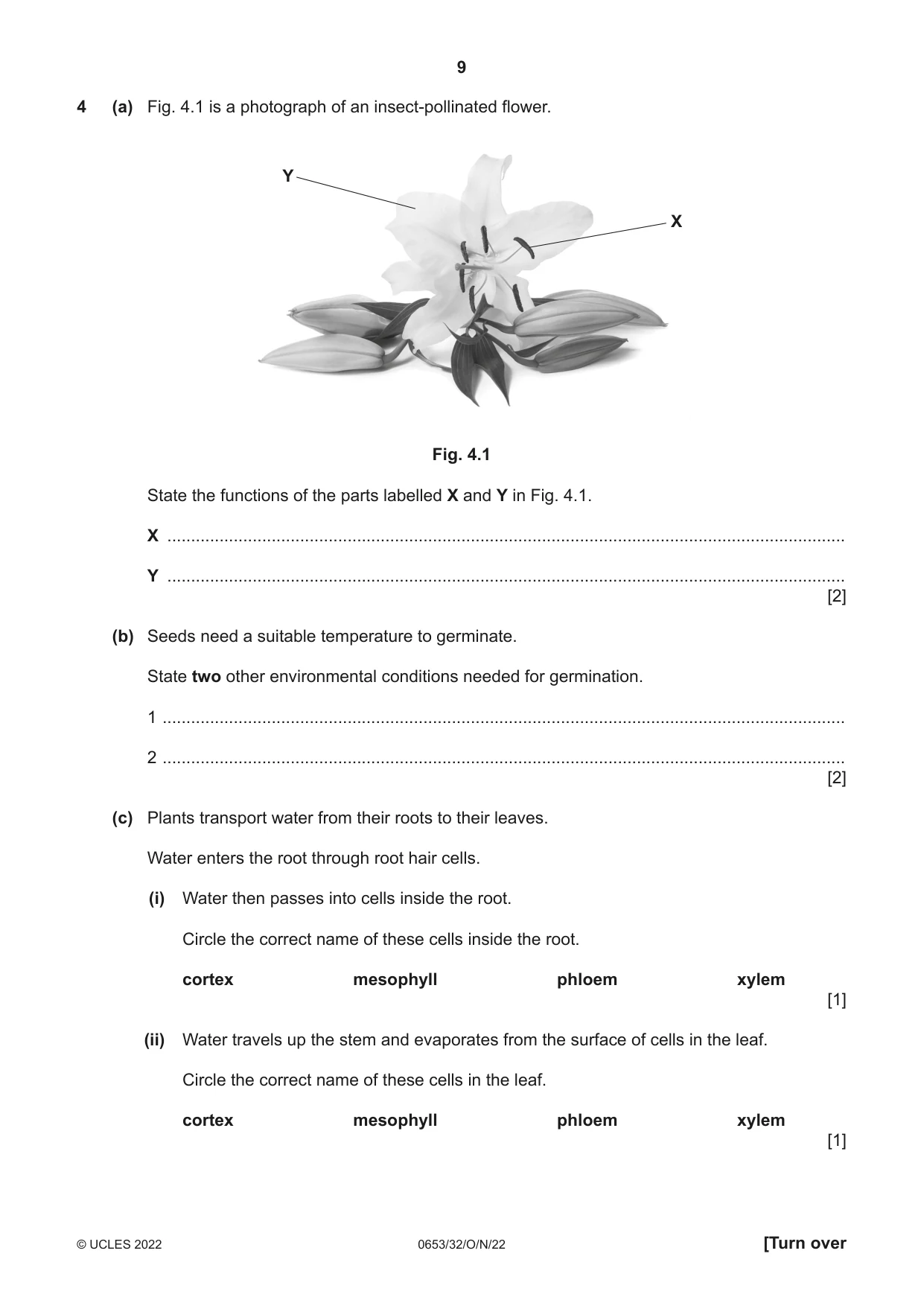
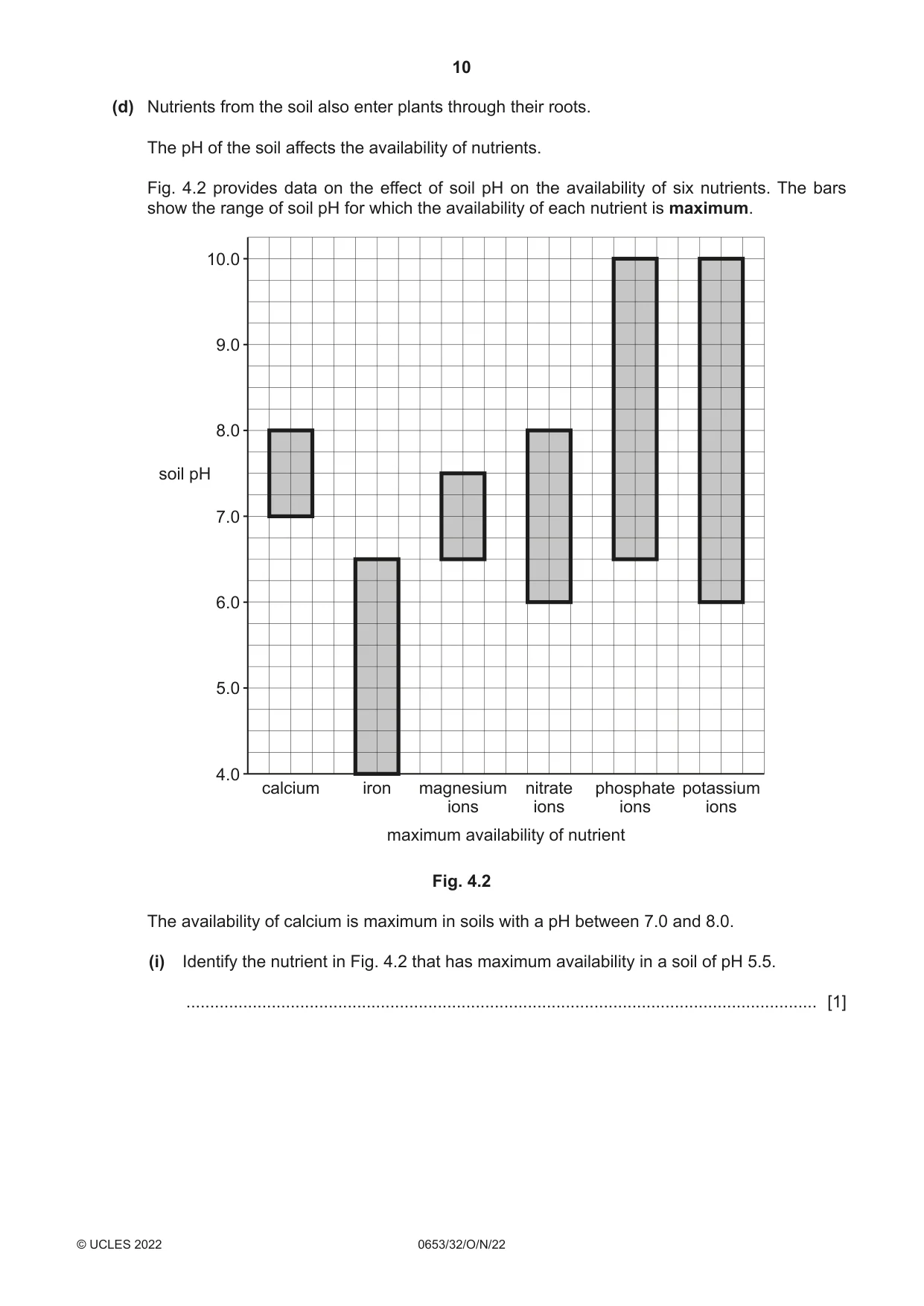
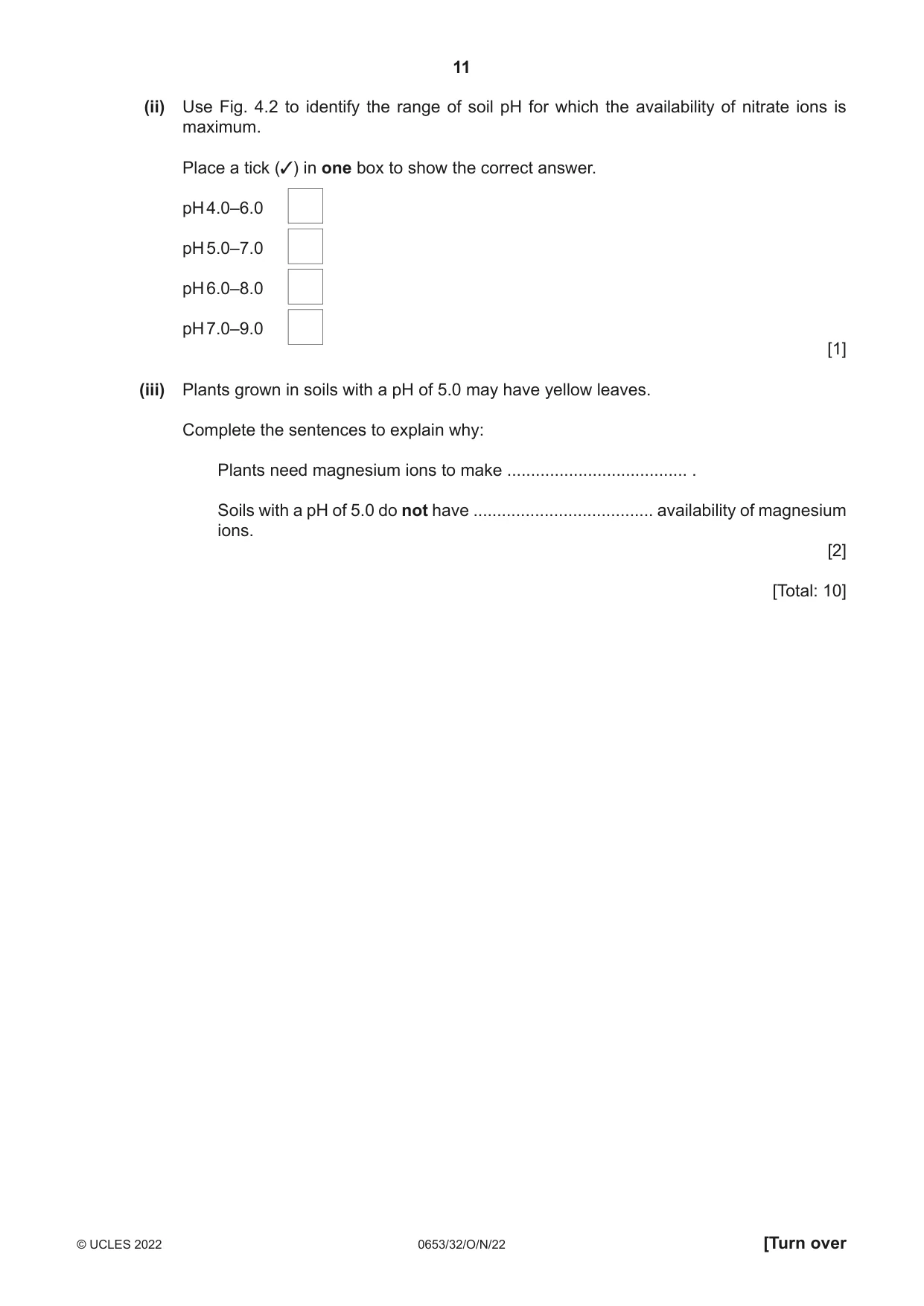
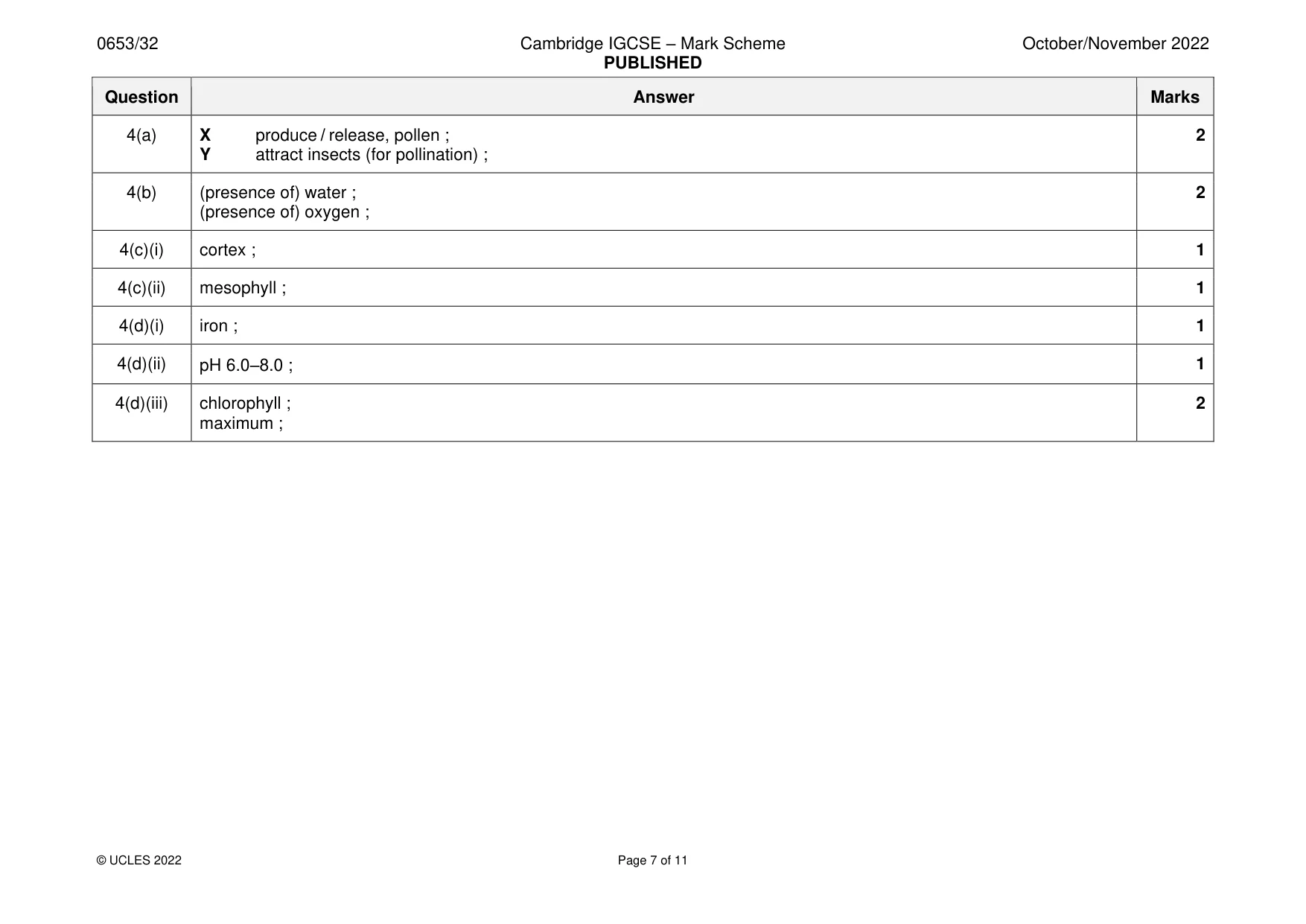
4 (a) Fig. 4.1 is a photograph of an insect‑pollinated flower. Y X Fig. 4.1 State the functions of the parts labelled X and Y in Fig. 4.1. X ............................................................................................................................................... Y ............................................................................................................................................... [2] (b) Seeds need a suitable temperature to germinate. State two other environmental conditions needed for germination. 1 ................................................................................................................................................ 2 ................................................................................................................................................ [2] (c) Plants transport water from their roots to their leaves. Water enters the root through root hair cells. (i) Water then passes into cells inside the root. Circle the correct name of these cells inside the root. cortex mesophyll phloem xylem [1] (ii) Water travels up the stem and evaporates from the surface of cells in the leaf. Circle the correct name of these cells in the leaf. cortex mesophyll phloem xylem [1] (d) Nutrients from the soil also enter plants through their roots. The pH of the soil affects the availability of nutrients. Fig. 4.2 provides data on the effect of soil pH on the availability of six nutrients. The bars show the range of soil pH for which the availability of each nutrient is maximum. 10.0 9.0 8.0 soil pH 7.0 6.0 5.0 4.0 calcium iron magnesium nitrate phosphate potassium ions ions ions ions maximum availability of nutrient Fig. 4.2 The availability of calcium is maximum in soils with a pH between 7.0 and 8.0. (i) Identify the nutrient in Fig. 4.2 that has maximum availability in a soil of pH 5.5. ..................................................................................................................................... [1] (ii) Use Fig. 4.2 to identify the range of soil pH for which the availability of nitrate ions is maximum. Place a tick (✓) in one box to show the correct answer. pH 4.0–6.0 pH 5.0–7.0 pH 6.0–8.0 pH 7.0–9.0 [1] (iii) Plants grown in soils with a pH of 5.0 may have yellow leaves. Complete the sentences to explain why: Plants need magnesium ions to make ...................................... . Soils with a pH of 5.0 do not have ...................................... availability of magnesium ions. [2] [Total: 10]
Mark scheme: 4(a) X produce / release, pollen ; 2 Y attract insects (for pollination) ; 4(b) (presence of) water ; 2 (presence of) oxygen ; 4(c)(i) cortex ; 1 4(c)(ii) mesophyll ; 1 4(d)(i) iron ; 1 4(d)(ii) pH 6.0–8.0 ; 1 4(d)(iii) chlorophyll ; 2 maximum ;
Q5 · A student investigates the reaction of magnesium with dilute hydrochloric acid, as shown…
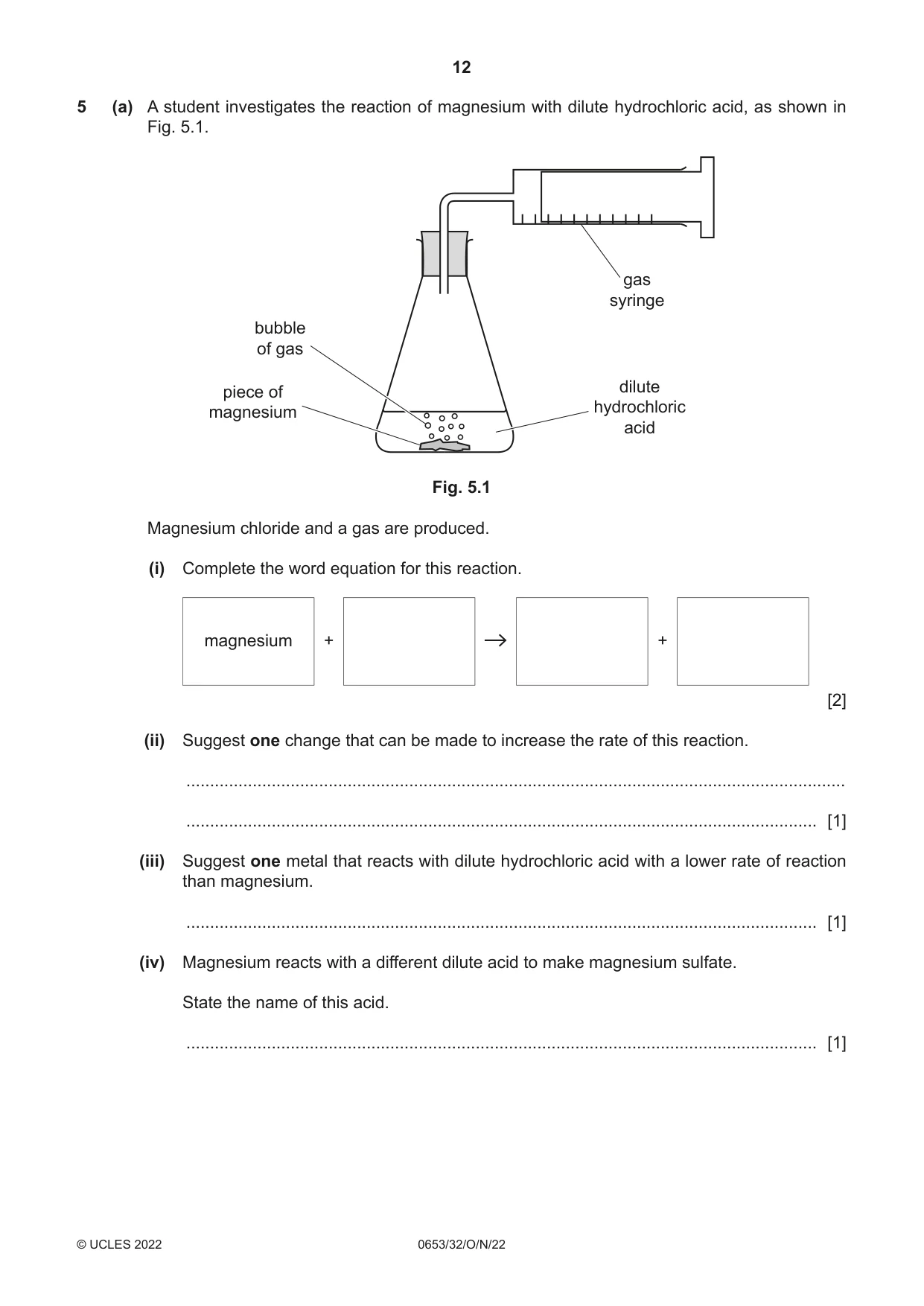
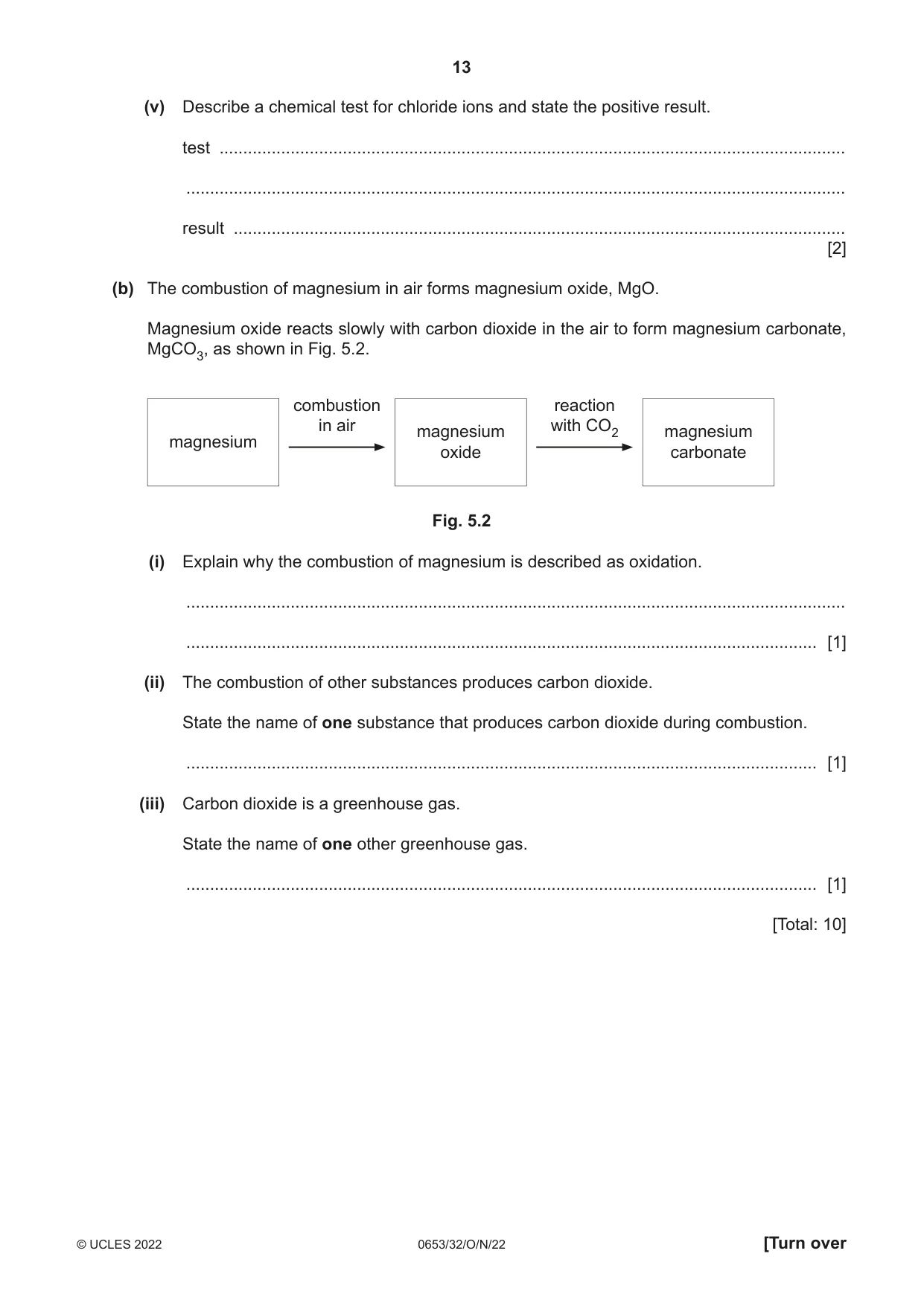
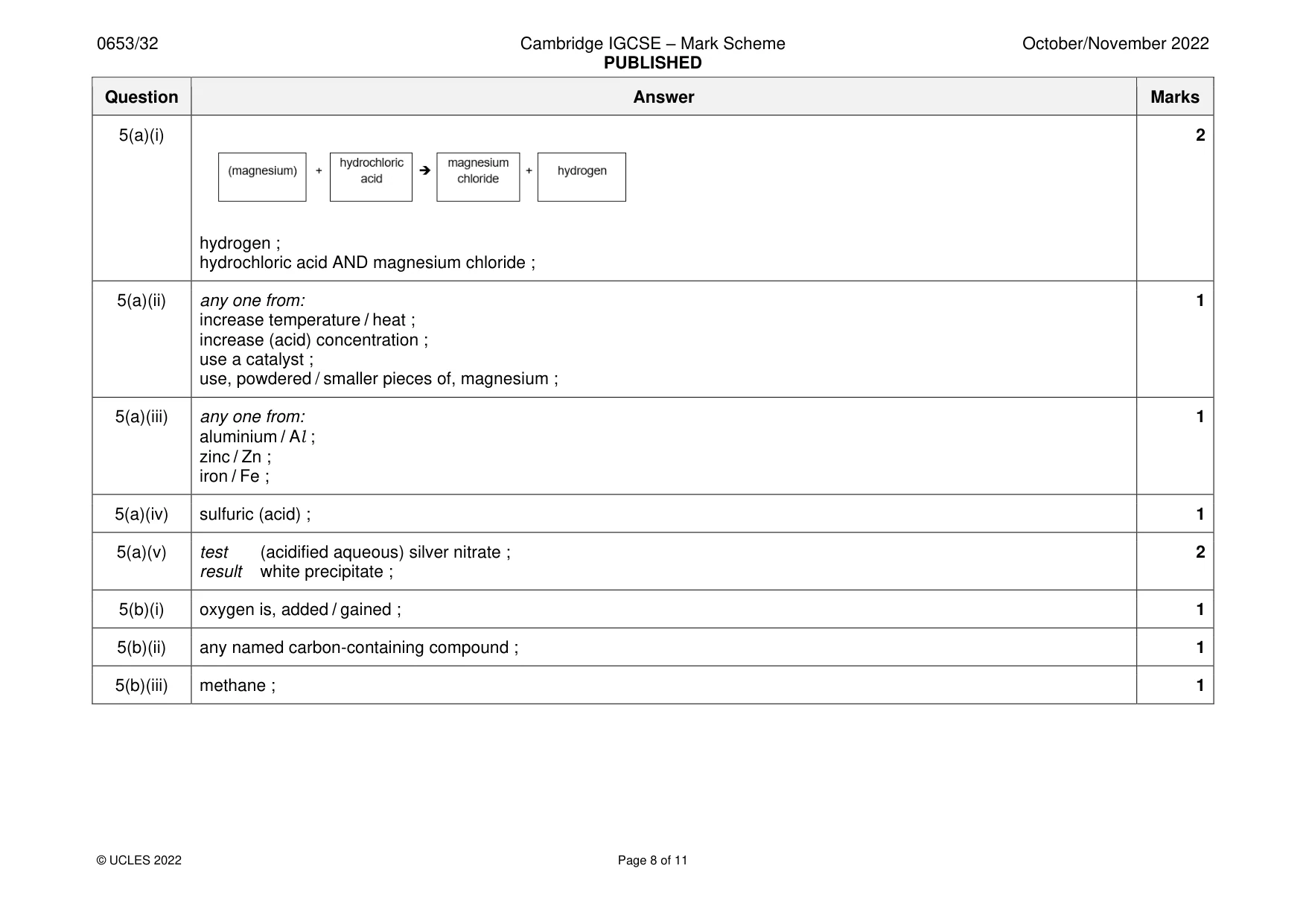
5 (a) A student investigates the reaction of magnesium with dilute hydrochloric acid, as shown in Fig. 5.1. gas syringe bubble of gas dilute piece of hydrochloric magnesium acid Fig. 5.1 Magnesium chloride and a gas are produced. (i) Complete the word equation for this reaction. magnesium + + [2] (ii) Suggest one change that can be made to increase the rate of this reaction. ........................................................................................................................................... ..................................................................................................................................... [1] (iii) Suggest one metal that reacts with dilute hydrochloric acid with a lower rate of reaction than magnesium. ..................................................................................................................................... [1] (iv) Magnesium reacts with a different dilute acid to make magnesium sulfate. State the name of this acid. ..................................................................................................................................... [1] (v) Describe a chemical test for chloride ions and state the positive result. test .................................................................................................................................... ........................................................................................................................................... result ................................................................................................................................. [2] (b) The combustion of magnesium in air forms magnesium oxide, MgO. Magnesium oxide reacts slowly with carbon dioxide in the air to form magnesium carbonate, MgCO3, as shown in Fig. 5.2. combustion reaction in air magnesium with CO2 magnesium magnesium oxide carbonate Fig. 5.2 (i) Explain why the combustion of magnesium is described as oxidation. ........................................................................................................................................... ..................................................................................................................................... [1] (ii) The combustion of other substances produces carbon dioxide. State the name of one substance that produces carbon dioxide during combustion. ..................................................................................................................................... [1] (iii) Carbon dioxide is a greenhouse gas. State the name of one other greenhouse gas. ..................................................................................................................................... [1] [Total: 10]
Mark scheme: 5(a)(i) 2 hydrogen ; hydrochloric acid AND magnesium chloride ; 5(a)(ii) any one from: 1 increase temperature / heat ; increase (acid) concentration ; use a catalyst ; use, powdered / smaller pieces of, magnesium ; 5(a)(iii) any one from: 1 aluminium / Al ; zinc / Zn ; iron / Fe ; 5(a)(iv) sulfuric (acid) ; 1 5(a)(v) test (acidified aqueous) silver nitrate ; 2 result white precipitate ; 5(b)(i) oxygen is, added / gained ; 1 5(b)(ii) any named carbon-containing compound ; 1 5(b)(iii) methane ; 1
Q6 · An electric heater with two heating elements connected in series to a 240 V supply
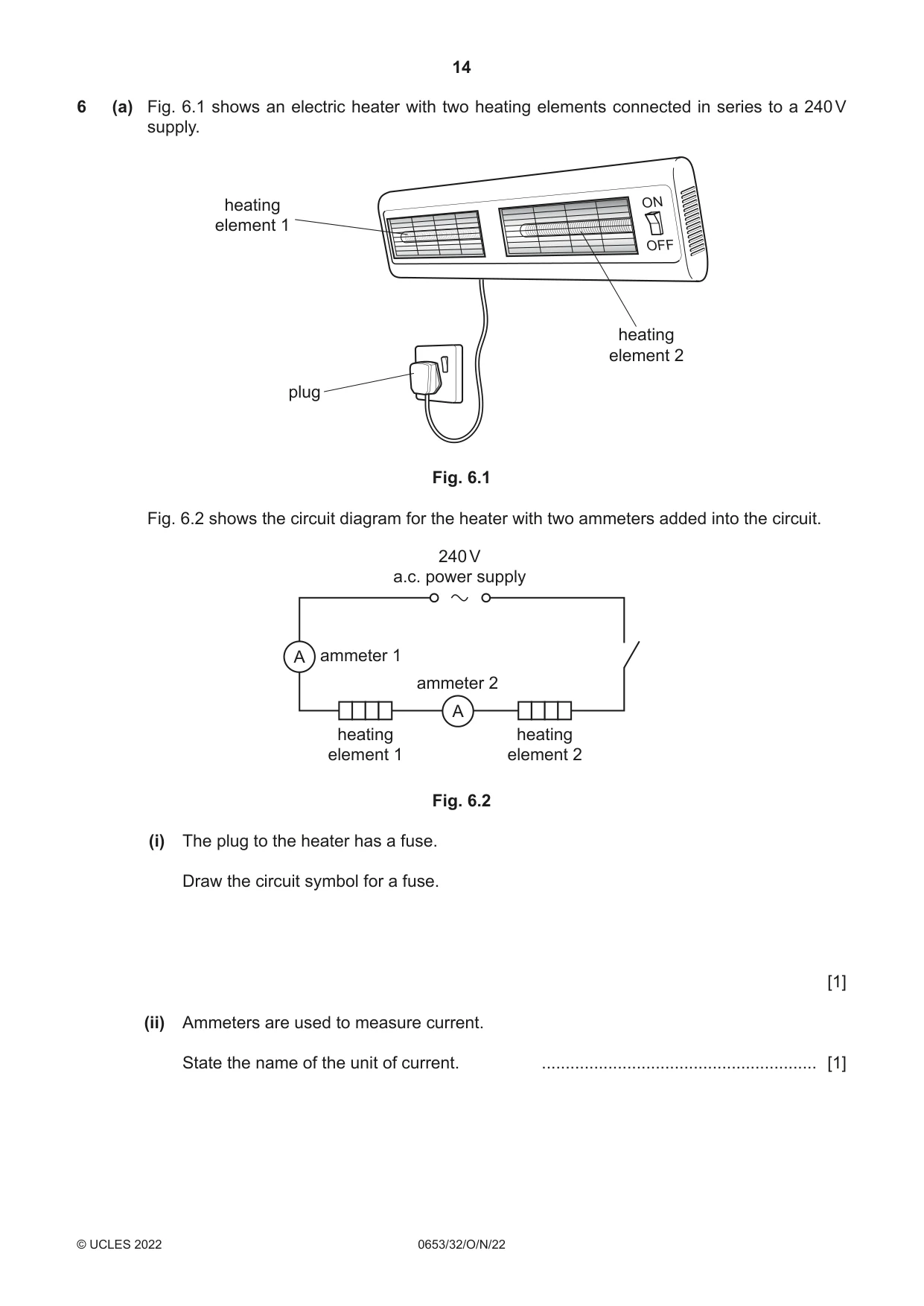
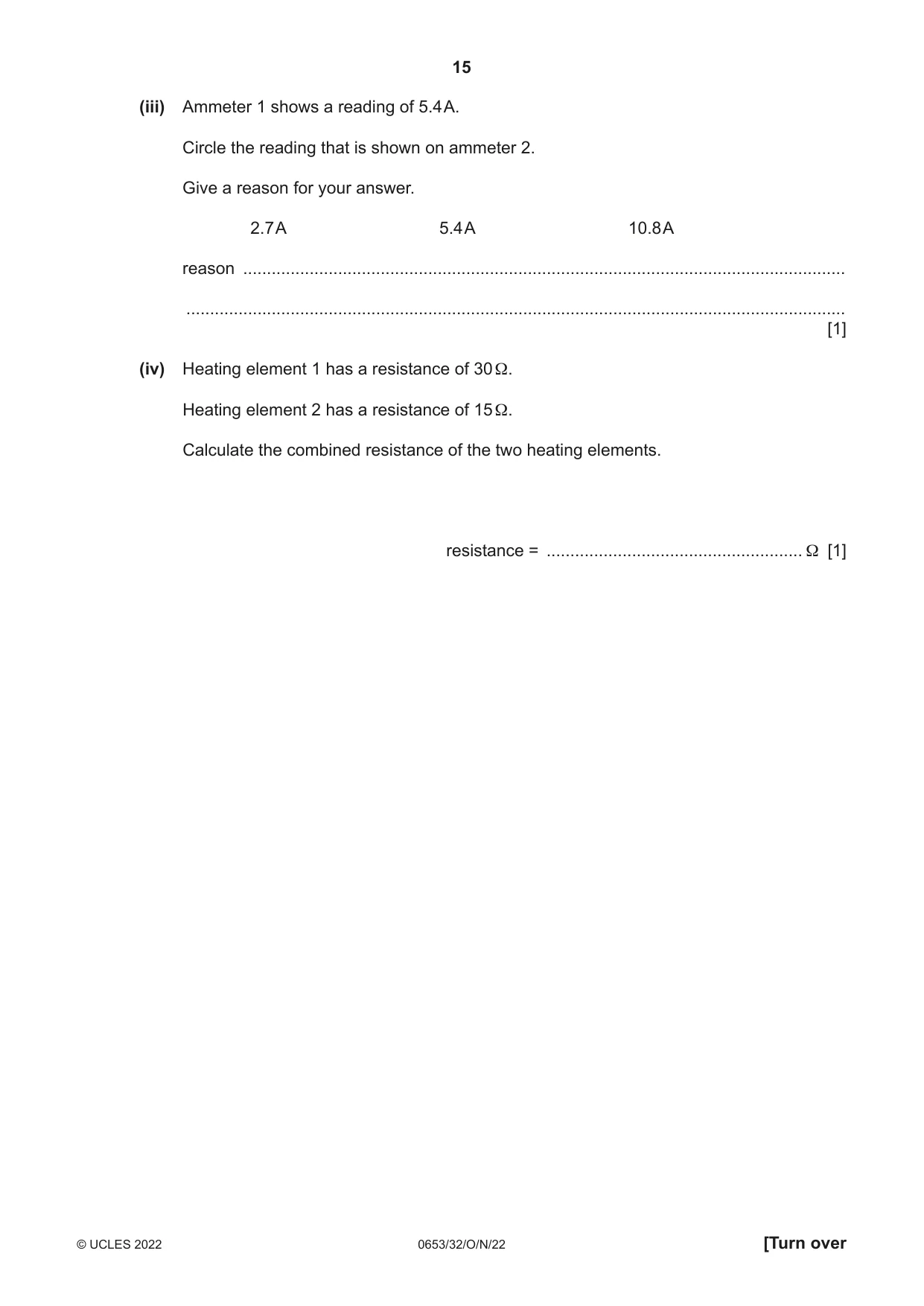
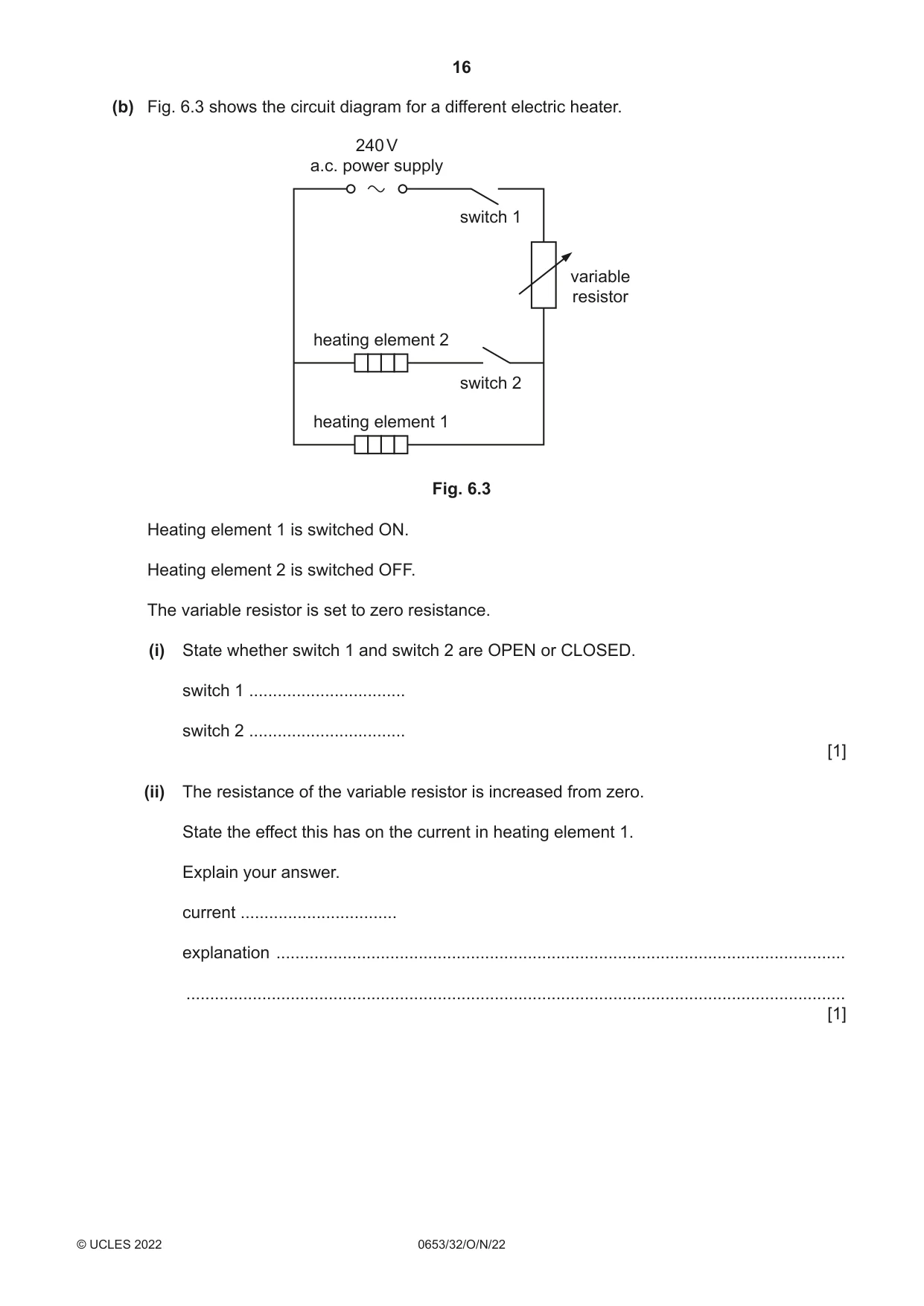
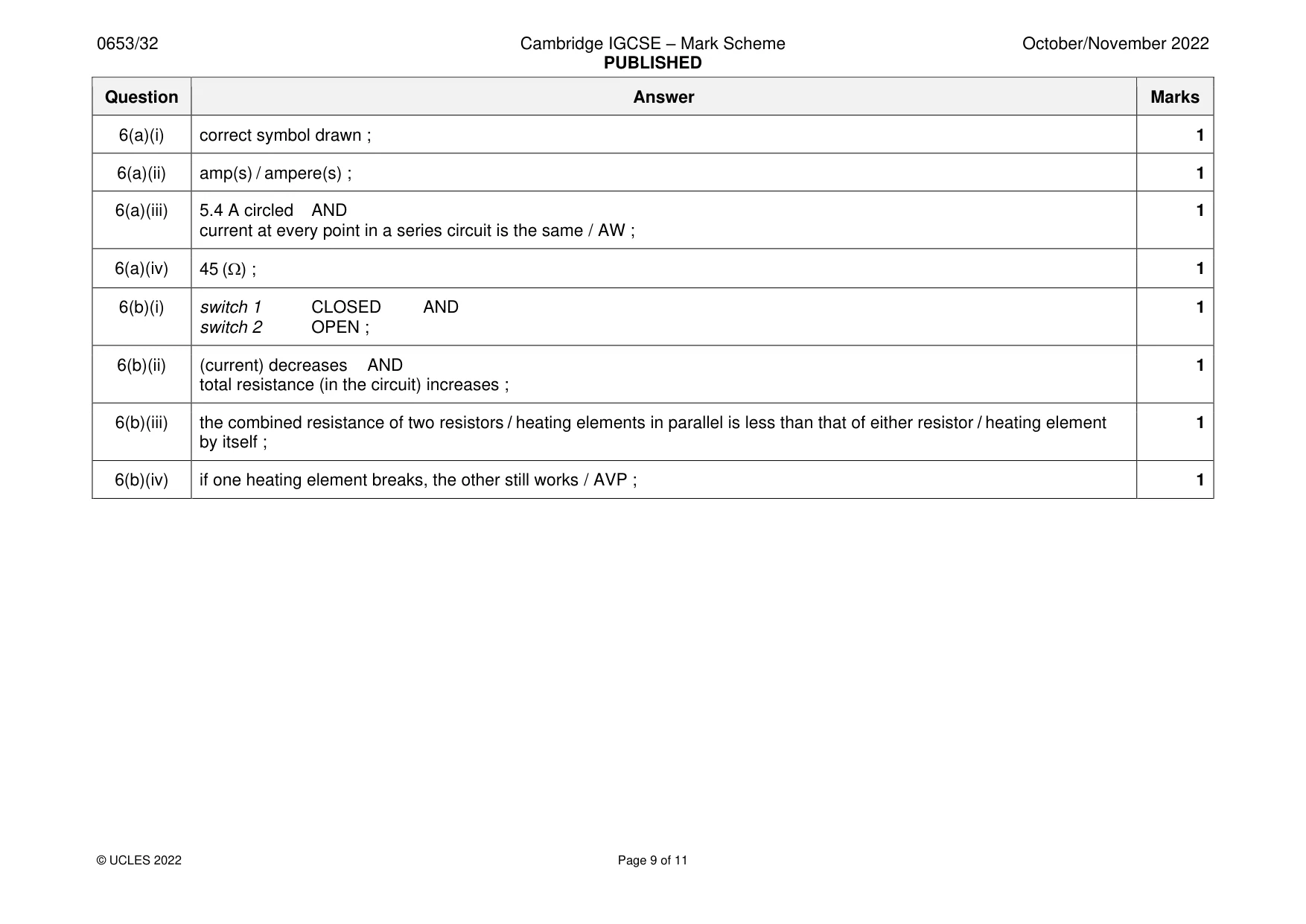
6 (a) Fig. 6.1 shows an electric heater with two heating elements connected in series to a 240 V supply. heating ON element 1 OFF heating element 2 plug Fig. 6.1 Fig. 6.2 shows the circuit diagram for the heater with two ammeters added into the circuit. 240 V a.c. power supply A ammeter 1 ammeter 2 A heating heating element 1 element 2 Fig. 6.2 (i) The plug to the heater has a fuse. Draw the circuit symbol for a fuse. [1] (ii) Ammeters are used to measure current. State the name of the unit of current. .......................................................... [1] (iii) Ammeter 1 shows a reading of 5.4 A. Circle the reading that is shown on ammeter 2. Give a reason for your answer. 2.7 A 5.4 A 10.8 A reason ............................................................................................................................... ........................................................................................................................................... [1] (iv) Heating element 1 has a resistance of 30 Ω. Heating element 2 has a resistance of 15 Ω. Calculate the combined resistance of the two heating elements. resistance = ...................................................... Ω [1] (b) Fig. 6.3 shows the circuit diagram for a different electric heater. 240 V a.c. power supply switch 1 variable resistor heating element 2 switch 2 heating element 1 Fig. 6.3 Heating element 1 is switched ON. Heating element 2 is switched OFF. The variable resistor is set to zero resistance. (i) State whether switch 1 and switch 2 are OPEN or CLOSED. switch 1 ................................. switch 2 ................................. [1] (ii) The resistance of the variable resistor is increased from zero. State the effect this has on the current in heating element 1. Explain your answer. current ................................. explanation ........................................................................................................................ ........................................................................................................................................... [1] (iii) Heating element 2 is now also switched ON. The variable resistor is not changed. Explain why the current from the source increases. ........................................................................................................................................... ..................................................................................................................................... [1] (iv) The two heating elements are connected in parallel with the 240 V supply. Suggest one advantage of connecting the heating elements in parallel in the circuit. ........................................................................................................................................... ..................................................................................................................................... [1] [Total: 8]
Mark scheme: 6(a)(i) correct symbol drawn ; 1 6(a)(ii) amp(s) / ampere(s) ; 1 6(a)(iii) 5.4 A circled AND 1 current at every point in a series circuit is the same / AW ; 6(a)(iv) 45 () ; 1 6(b)(i) switch 1 CLOSED AND 1 switch 2 OPEN ; 6(b)(ii) (current) decreases AND 1 total resistance (in the circuit) increases ; 6(b)(iii) the combined resistance of two resistors / heating elements in parallel is less than that of either resistor / heating element 1 by itself ; 6(b)(iv) if one heating element breaks, the other still works / AVP ; 1
Q7 · The boxes on the left show some of the characteristics of living organisms
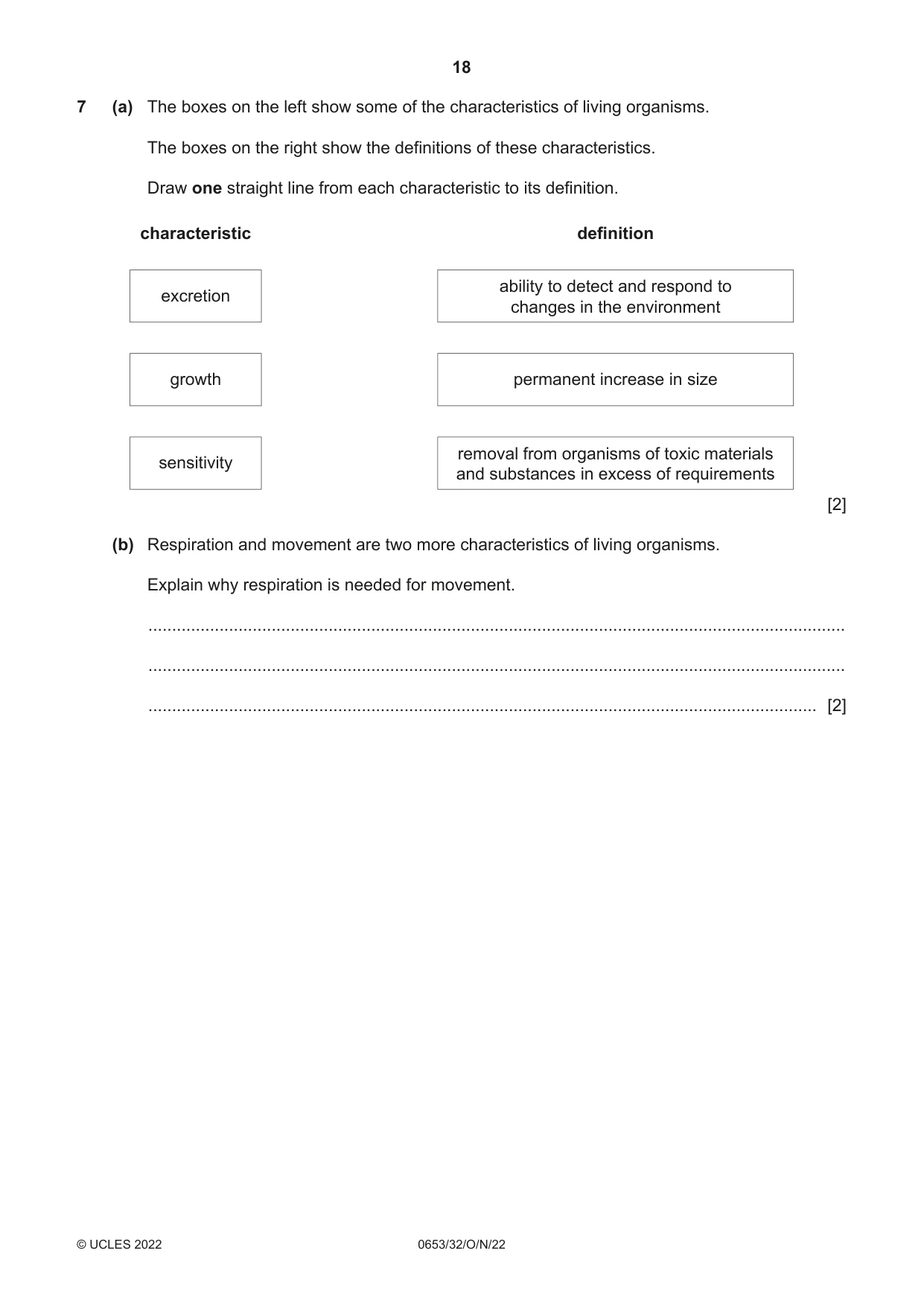
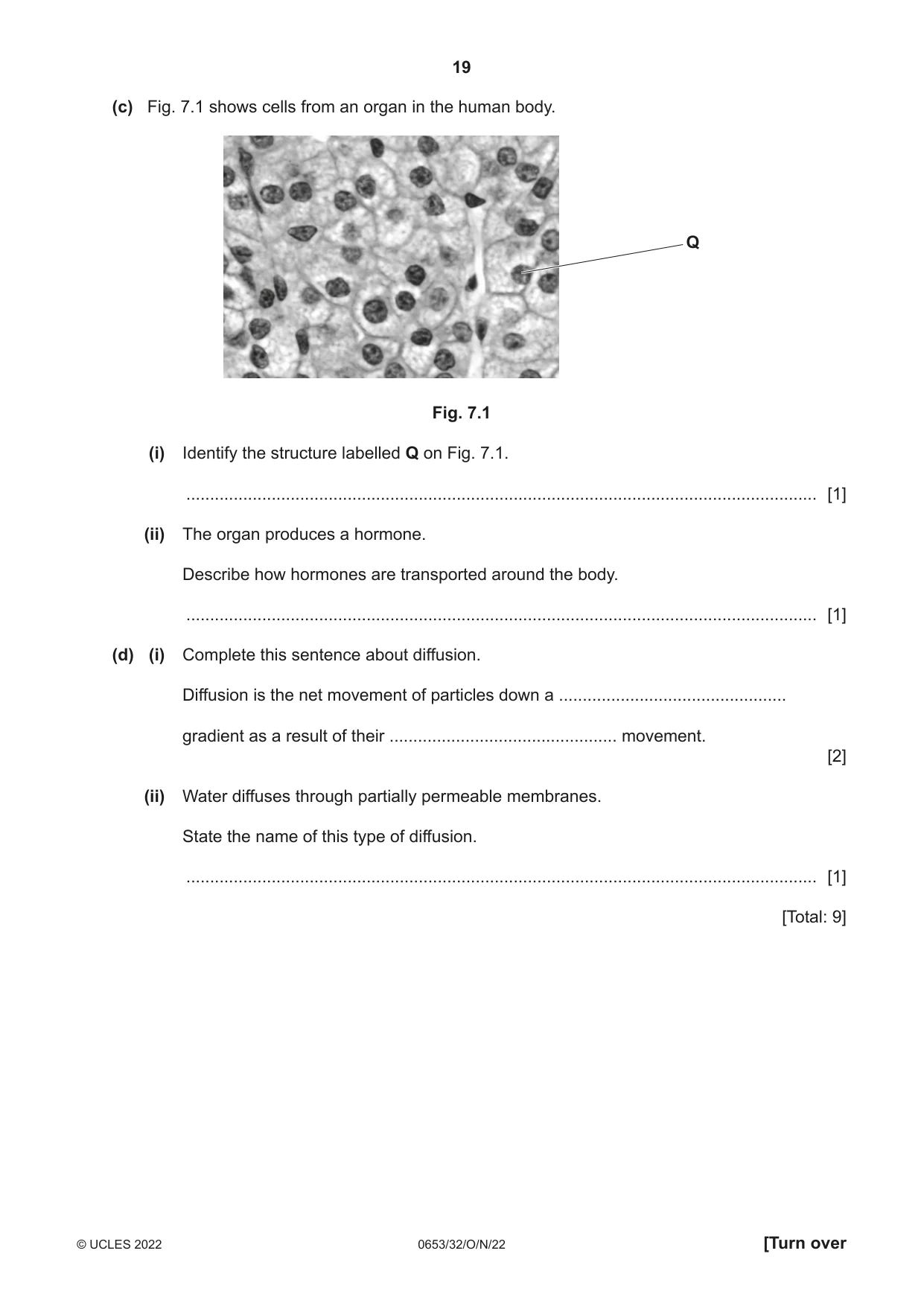
7 (a) The boxes on the left show some of the characteristics of living organisms. The boxes on the right show the definitions of these characteristics. Draw one straight line from each characteristic to its definition. characteristic definition ability to detect and respond to excretion changes in the environment growth permanent increase in size removal from organisms of toxic materials sensitivity and substances in excess of requirements [2] (b) Respiration and movement are two more characteristics of living organisms. Explain why respiration is needed for movement. ................................................................................................................................................... ................................................................................................................................................... ............................................................................................................................................. [2] (c) Fig. 7.1 shows cells from an organ in the human body. Q Fig. 7.1 (i) Identify the structure labelled Q on Fig. 7.1. ..................................................................................................................................... [1] (ii) The organ produces a hormone. Describe how hormones are transported around the body. ..................................................................................................................................... [1] (d) (i) Complete this sentence about diffusion. Diffusion is the net movement of particles down a ................................................ gradient as a result of their ................................................ movement. [2] (ii) Water diffuses through partially permeable membranes. State the name of this type of diffusion. ..................................................................................................................................... [1] [Total: 9]
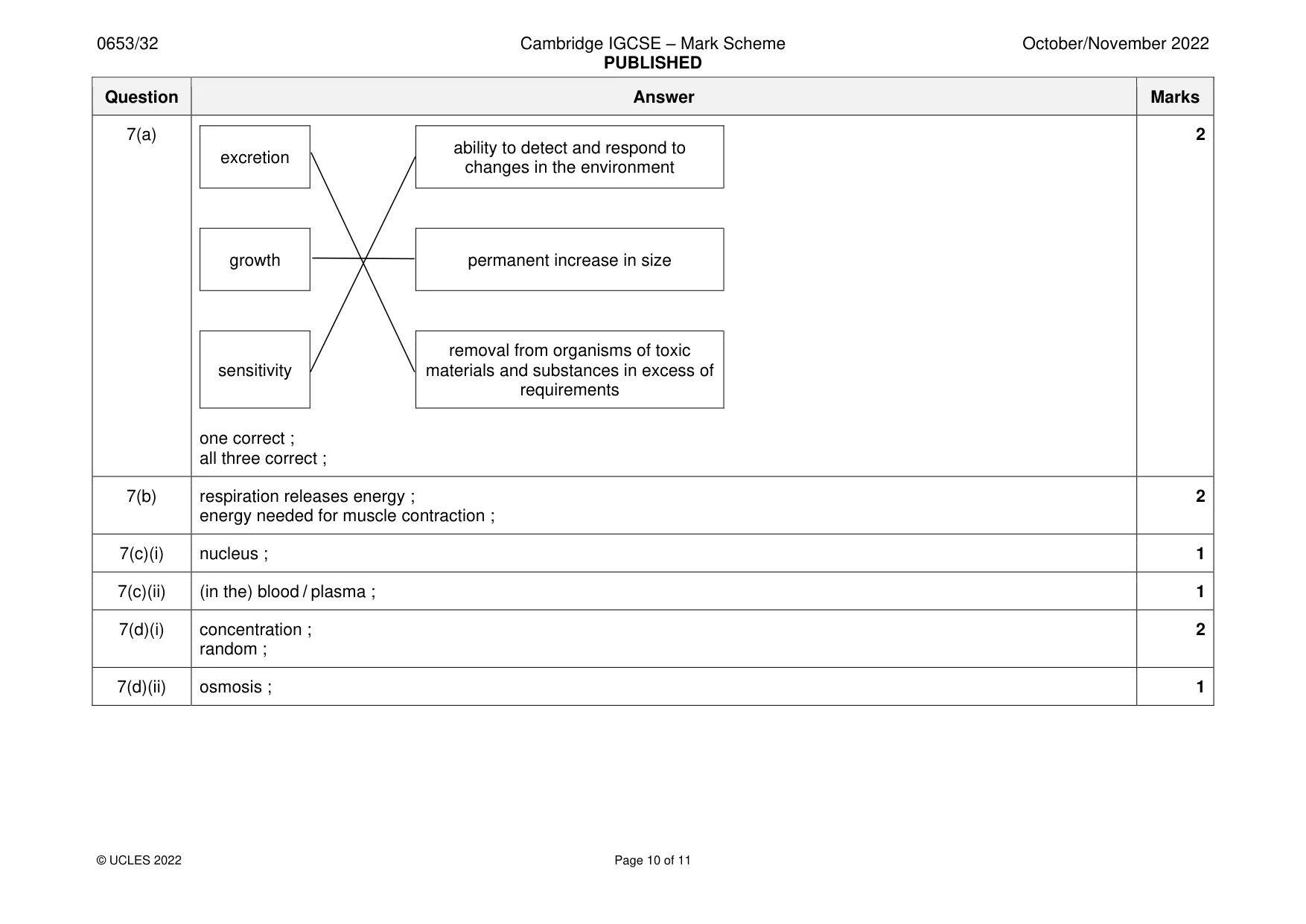
Mark scheme: 7(a) 2 ability to detect and respond to excretion changes in the environment growth permanent increase in size removal from organisms of toxic sensitivity materials and substances in excess of requirements one correct ; all three correct ; 7(b) respiration releases energy ; 2 energy needed for muscle contraction ; 7(c)(i) nucleus ; 1 7(c)(ii) (in the) blood / plasma ; 1 7(d)(i) concentration ; 2 random ; 7(d)(ii) osmosis ; 1
Q9 · A ship at sea
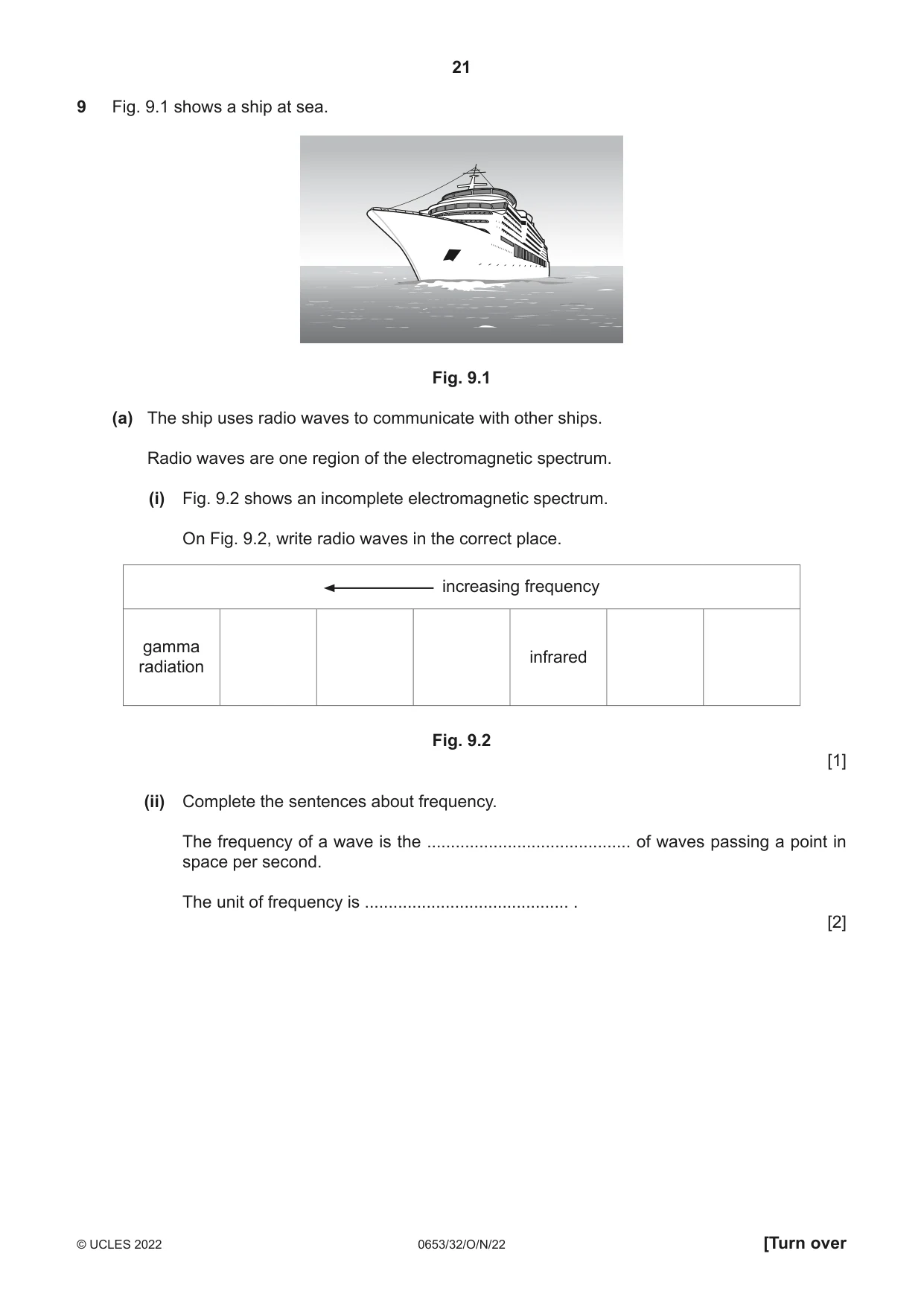
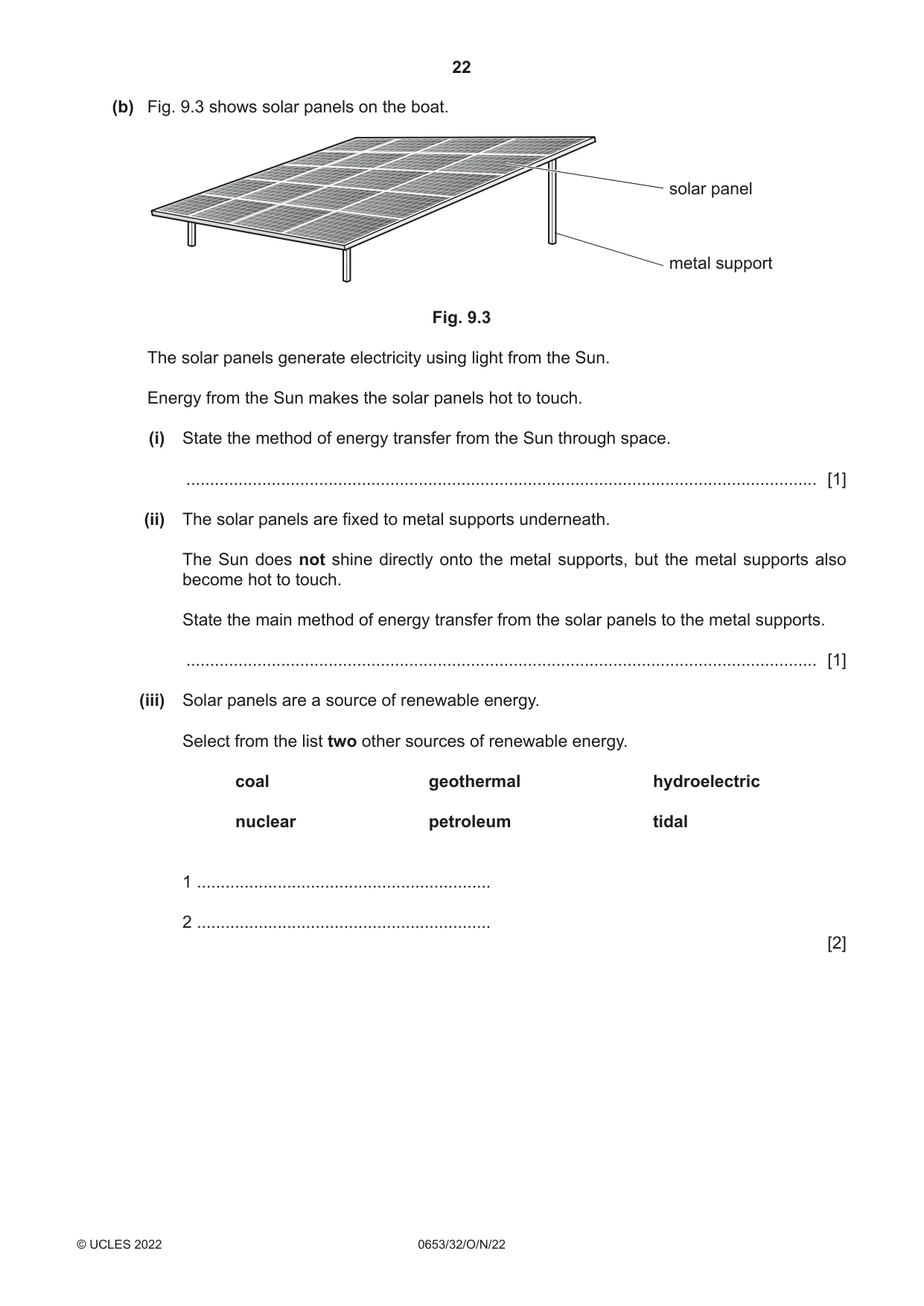
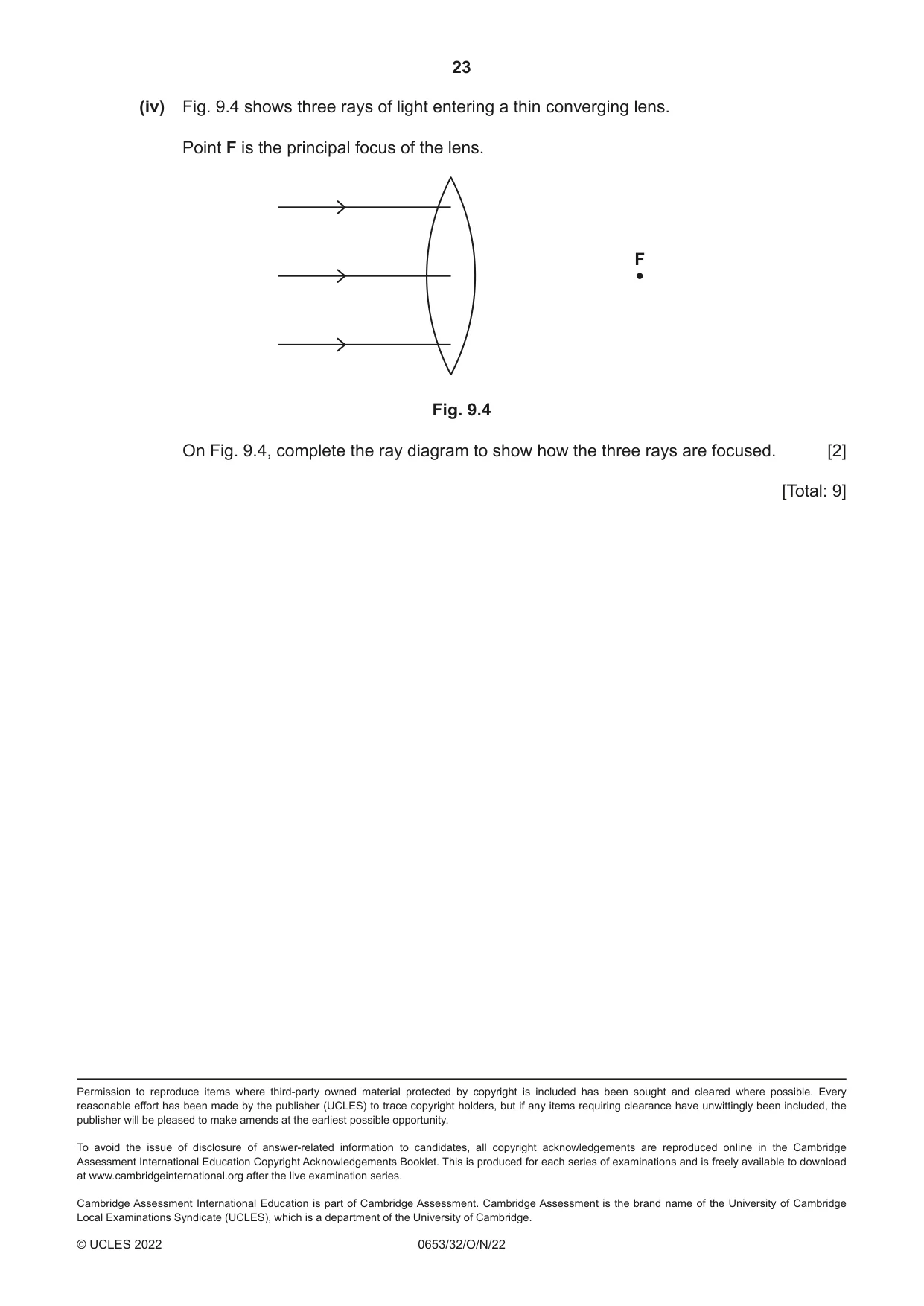
9 Fig. 9.1 shows a ship at sea. Fig. 9.1 (a) The ship uses radio waves to communicate with other ships. Radio waves are one region of the electromagnetic spectrum. (i) Fig. 9.2 shows an incomplete electromagnetic spectrum. On Fig. 9.2, write radio waves in the correct place. increasing frequency gamma infrared radiation Fig. 9.2 [1] (ii) Complete the sentences about frequency. The frequency of a wave is the ........................................... of waves passing a point in space per second. The unit of frequency is ........................................... . [2] (b) Fig. 9.3 shows solar panels on the boat. solar panel metal support Fig. 9.3 The solar panels generate electricity using light from the Sun. Energy from the Sun makes the solar panels hot to touch. (i) State the method of energy transfer from the Sun through space. ..................................................................................................................................... [1] (ii) The solar panels are fixed to metal supports underneath. The Sun does not shine directly onto the metal supports, but the metal supports also become hot to touch. State the main method of energy transfer from the solar panels to the metal supports. ..................................................................................................................................... [1] (iii) Solar panels are a source of renewable energy. Select from the list two other sources of renewable energy. coal geothermal hydroelectric nuclear petroleum tidal 1 .............................................................. 2 .............................................................. [2] (iv) Fig. 9.4 shows three rays of light entering a thin converging lens. Point F is the principal focus of the lens. F Fig. 9.4 On Fig. 9.4, complete the ray diagram to show how the three rays are focused. [2] [Total: 9]
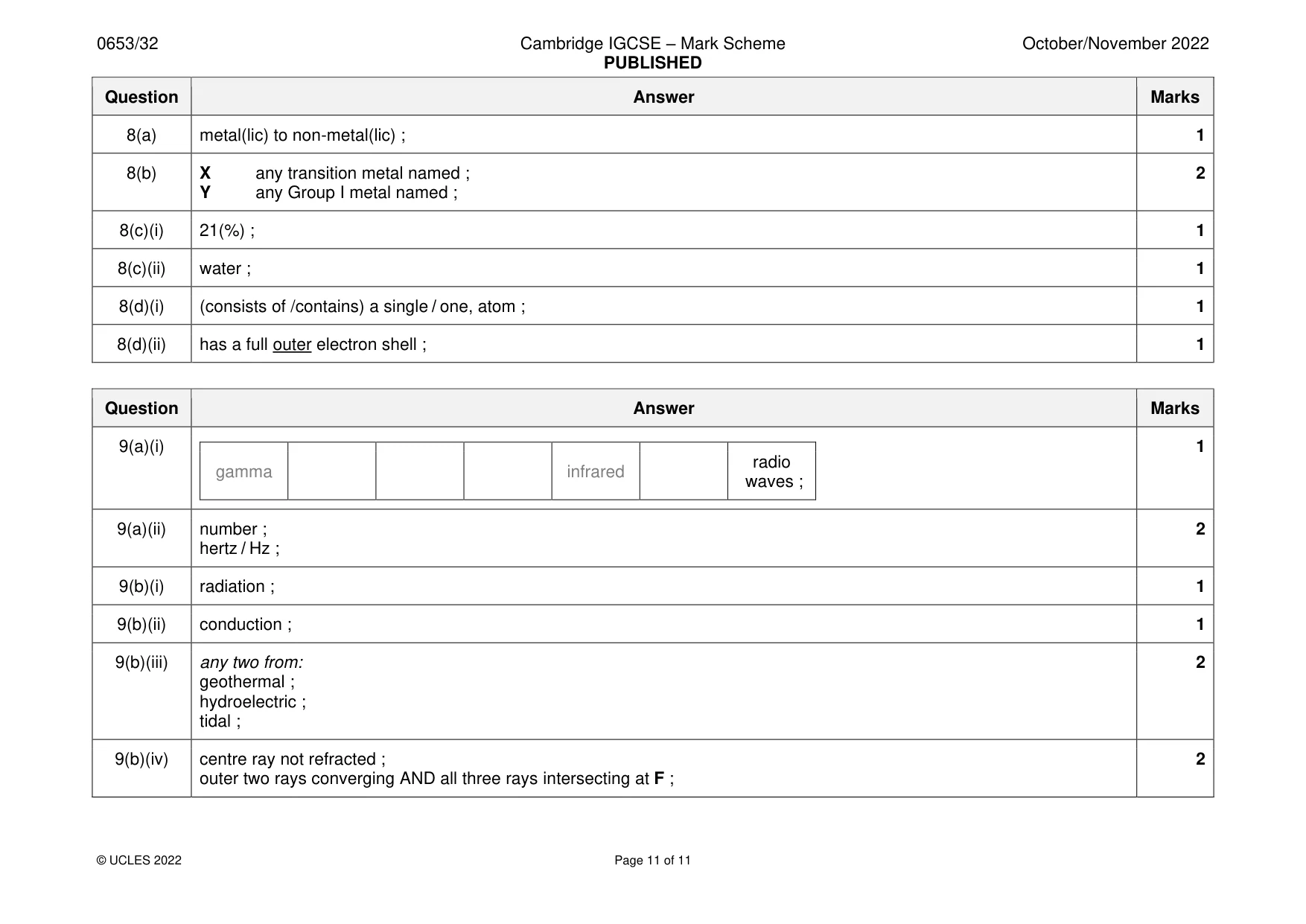
Mark scheme: 9(a)(i) 1 radio gamma infrared waves ; 9(a)(ii) number ; 2 hertz / Hz ; 9(b)(i) radiation ; 1 9(b)(ii) conduction ; 1 9(b)(iii) any two from: 2 geothermal ; hydroelectric ; tidal ; 9(b)(iv) centre ray not refracted ; 2 outer two rays converging AND all three rays intersecting at F ;
What was in this paper
The subtopics covered by these 8 questions, and how many questions each got. Open one in a new tab to see every Cambridge question on it.
What you needed in this session
Cambridge’s own grade thresholds for 2022 Oct/Nov, Paper 3 · Variant 2. A higher threshold means an easier paper — the bar moves with how the cohort did.