Cambridge IGCSE Science - Combined 0653 — 2018 Oct/Nov Paper 3 · Variant 3
0653/33/O/N/18 · 9 questions · 80 marks · ≈90 min
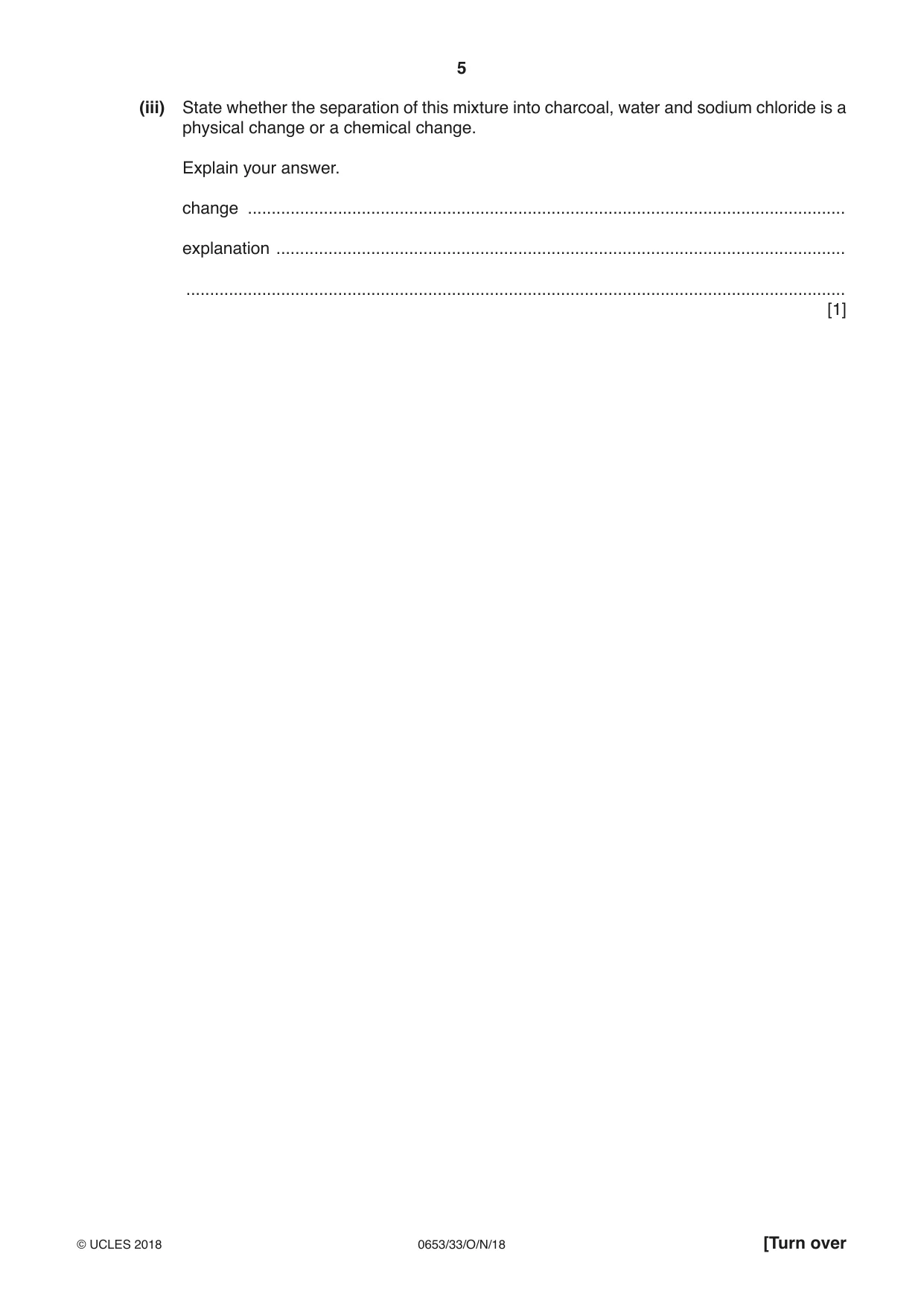
The question paper and its mark scheme, free to read here and free to download. This is Cambridge’s own paper, exactly as it was sat.
Question paper20 pages
Mark scheme10 pages
Answers below. Sit the paper first if you are practising.
Questions as text
Q1 · A flowering plant and some functions carried out by the plant
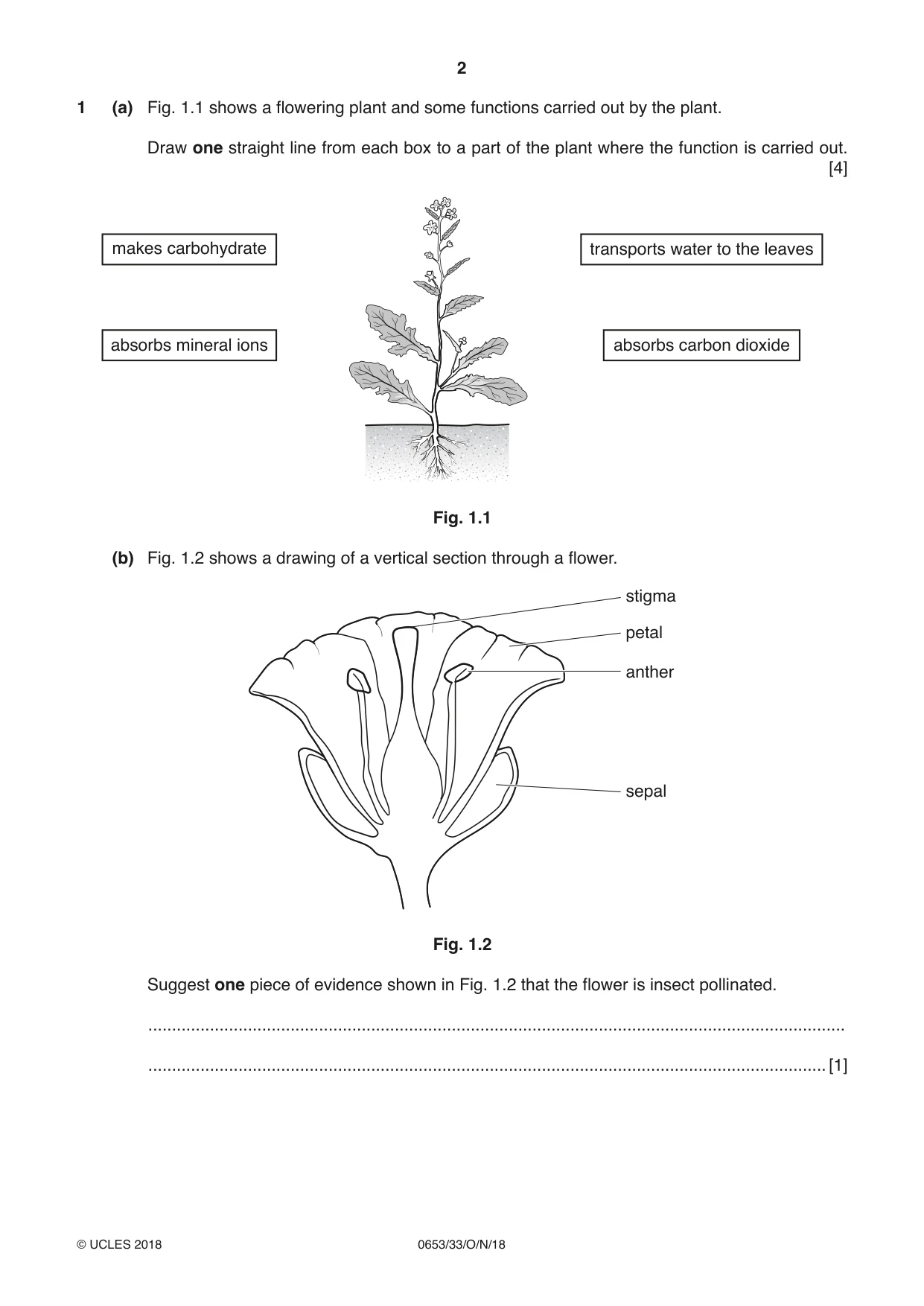
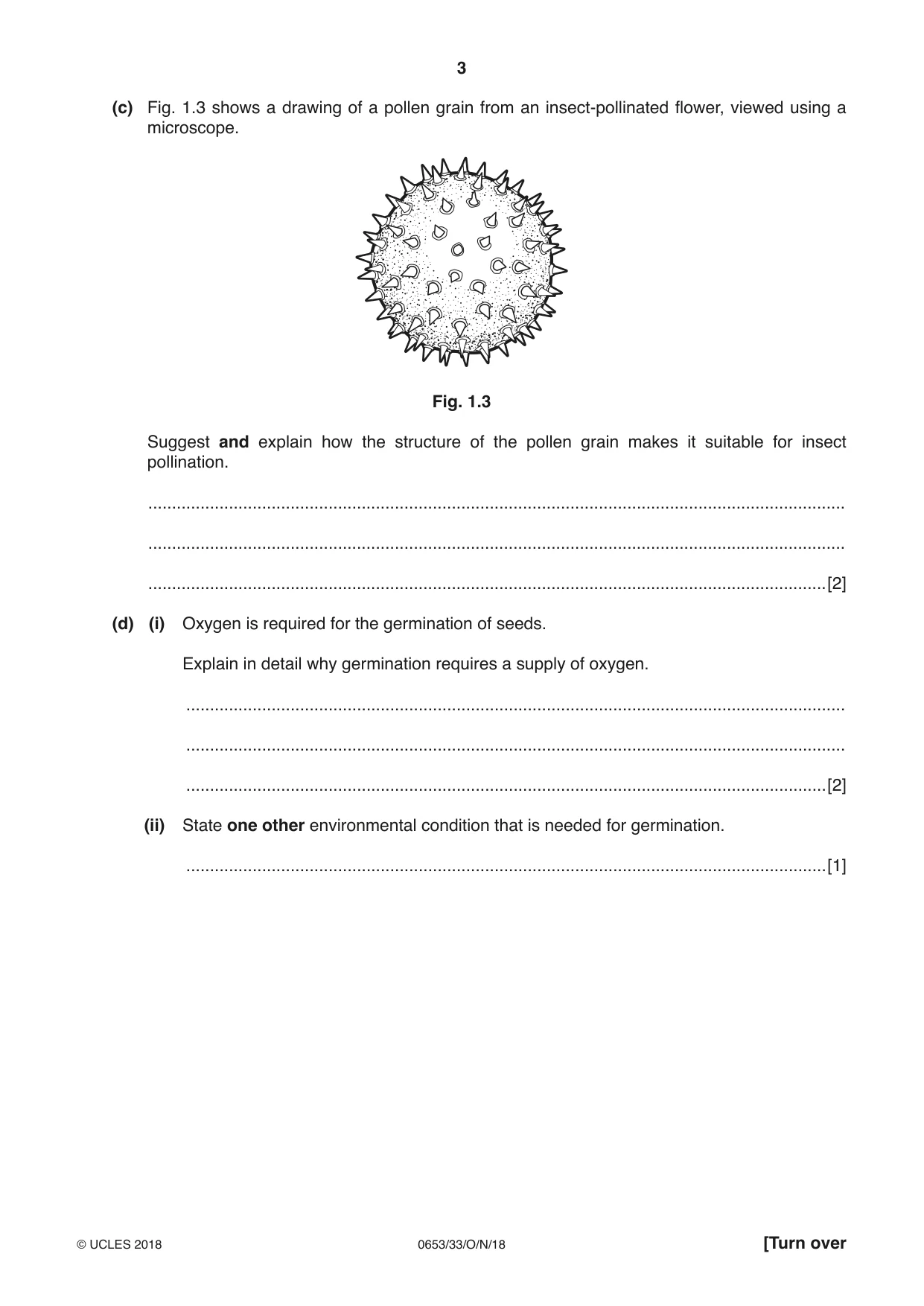
1 (a) Fig. 1.1 shows a flowering plant and some functions carried out by the plant. Draw one straight line from each box to a part of the plant where the function is carried out. [4] makes carbohydrate transports water to the leaves absorbs mineral ions absorbs carbon dioxide Fig. 1.1 (b) Fig. 1.2 shows a drawing of a vertical section through a flower. stigma petal anther sepal Fig. 1.2 Suggest one piece of evidence shown in Fig. 1.2 that the flower is insect pollinated. ................................................................................................................................................... ............................................................................................................................................... [1] (c) Fig. 1.3 shows a drawing of a pollen grain from an insect-pollinated flower, viewed using a microscope. Fig. 1.3 Suggest and explain how the structure of the pollen grain makes it suitable for insect pollination. ................................................................................................................................................... ................................................................................................................................................... ...............................................................................................................................................[2] (d) (i) Oxygen is required for the germination of seeds. Explain in detail why germination requires a supply of oxygen. ........................................................................................................................................... ........................................................................................................................................... .......................................................................................................................................[2] (ii) State one other environmental condition that is needed for germination. .......................................................................................................................................[1]
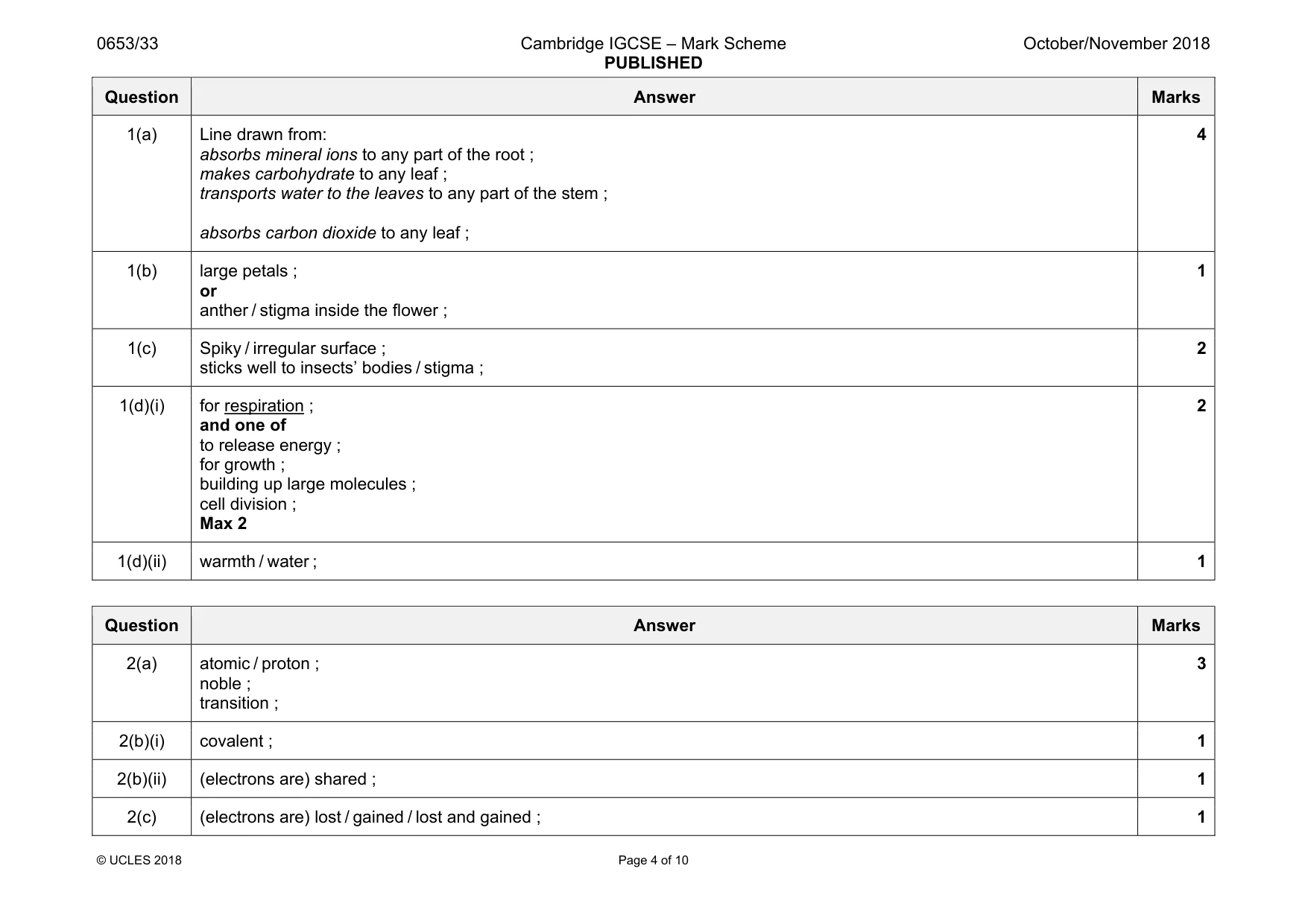
Mark scheme: 1(a) Line drawn from: absorbs mineral ions to any part of the root ; makes carbohydrate to any leaf ; transports water to the leaves to any part of the stem ; absorbs carbon dioxide to any leaf ; 4 1(b) large petals ; or anther / stigma inside the flower ; 1 1(c) Spiky / irregular surface ; sticks well to insects’ bodies / stigma ; 2 1(d)(i) for respiration ; and one of to release energy ; for growth ; building up large molecules ; cell division ; Max 2 2 1(d)(ii) warmth / water ; 1
Q2 · The Periodic Table contains the symbols of all of the elements
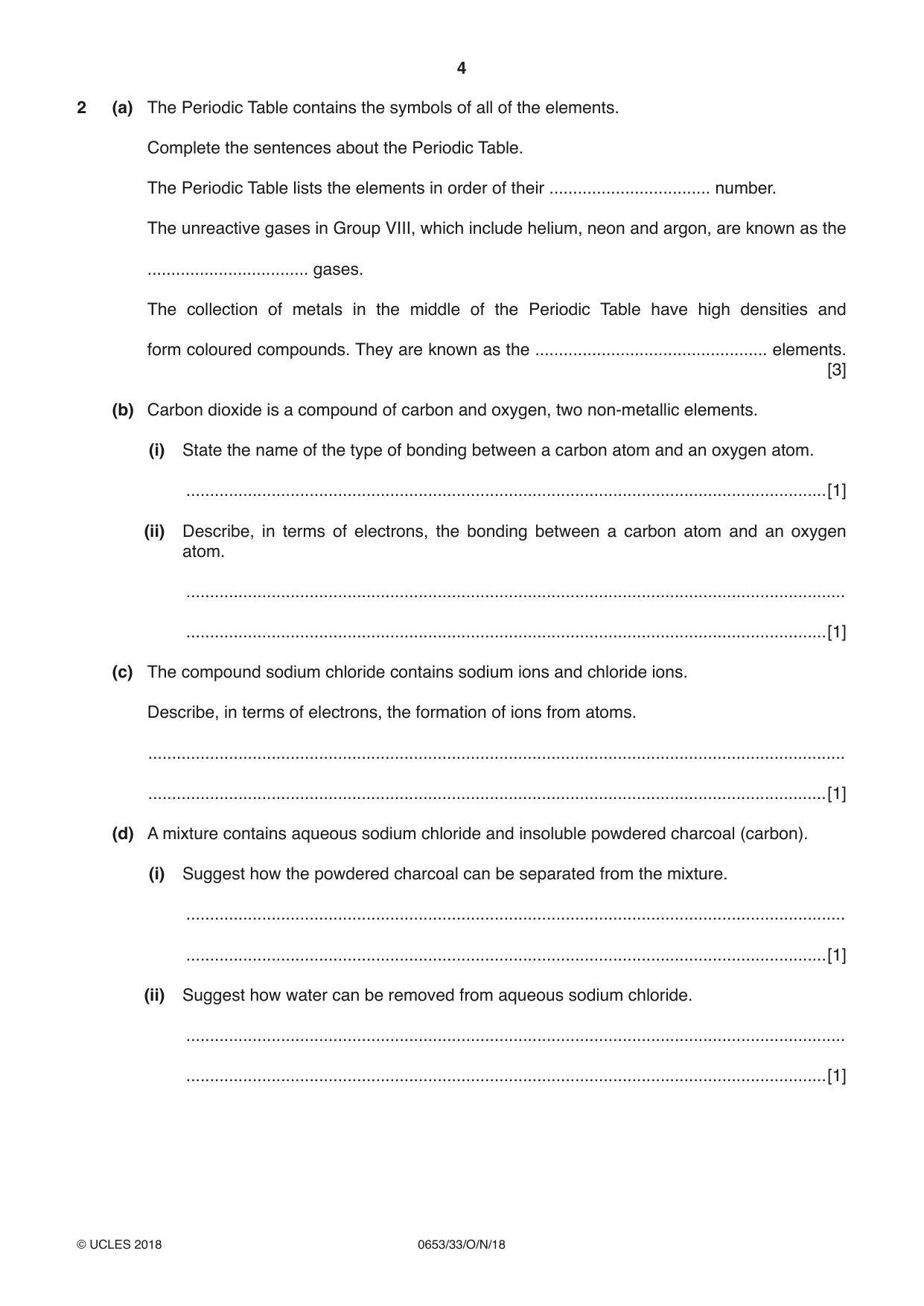
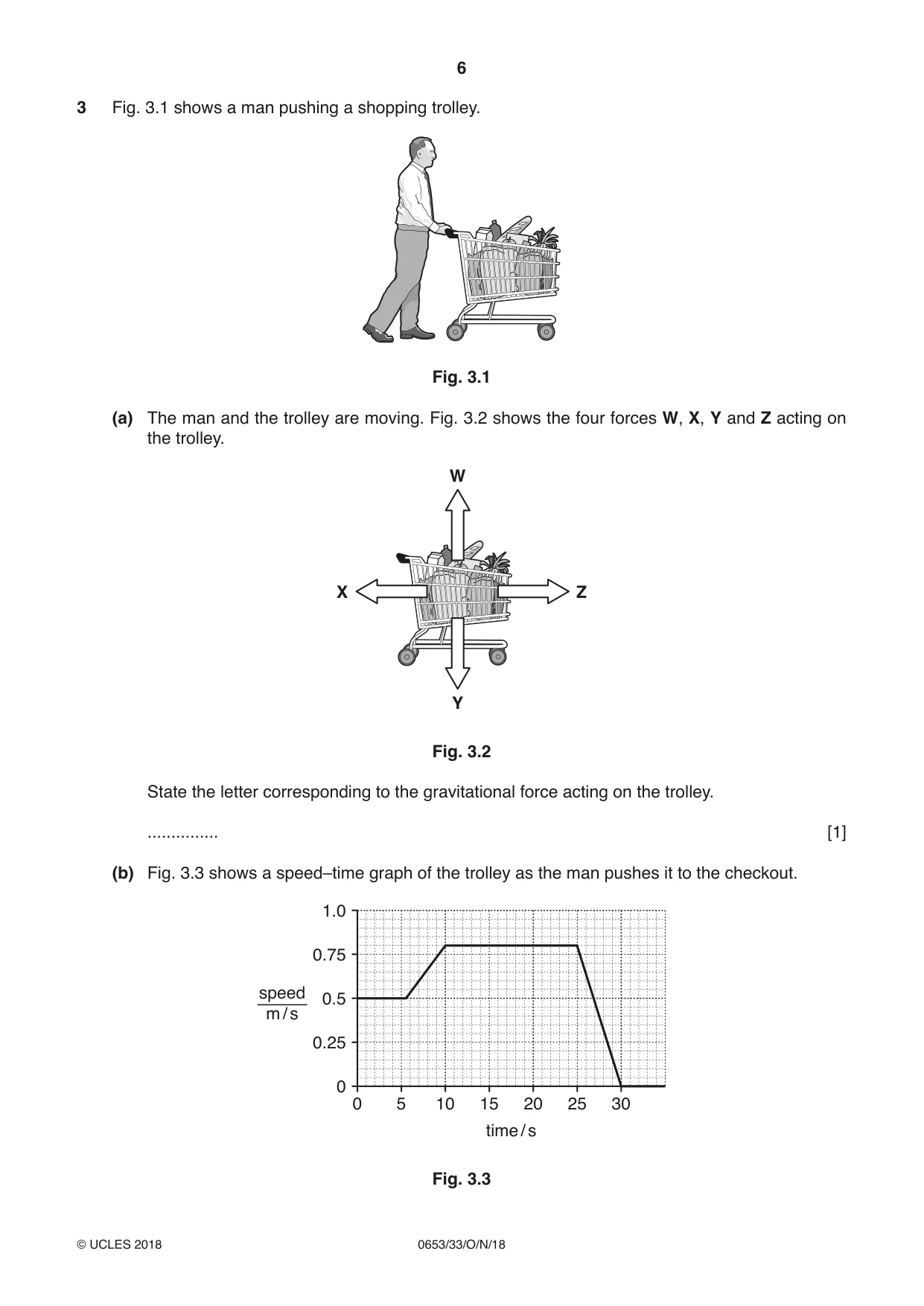
2 (a) The Periodic Table contains the symbols of all of the elements. Complete the sentences about the Periodic Table. The Periodic Table lists the elements in order of their .................................. number. The unreactive gases in Group VIII, which include helium, neon and argon, are known as the .................................. gases. The collection of metals in the middle of the Periodic Table have high densities and form coloured compounds. They are known as the ................................................. elements. [3] (b) Carbon dioxide is a compound of carbon and oxygen, two non-metallic elements. (i) State the name of the type of bonding between a carbon atom and an oxygen atom. .......................................................................................................................................[1] (ii) Describe, in terms of electrons, the bonding between a carbon atom and an oxygen atom. ........................................................................................................................................... .......................................................................................................................................[1] (c) The compound sodium chloride contains sodium ions and chloride ions. Describe, in terms of electrons, the formation of ions from atoms. ................................................................................................................................................... ...............................................................................................................................................[1] (d) A mixture contains aqueous sodium chloride and insoluble powdered charcoal (carbon). (i) Suggest how the powdered charcoal can be separated from the mixture. ........................................................................................................................................... .......................................................................................................................................[1] (ii) Suggest how water can be removed from aqueous sodium chloride. ........................................................................................................................................... .......................................................................................................................................[1] (iii) State whether the separation of this mixture into charcoal, water and sodium chloride is a physical change or a chemical change. Explain your answer. change .............................................................................................................................. explanation ........................................................................................................................ ........................................................................................................................................... [1]
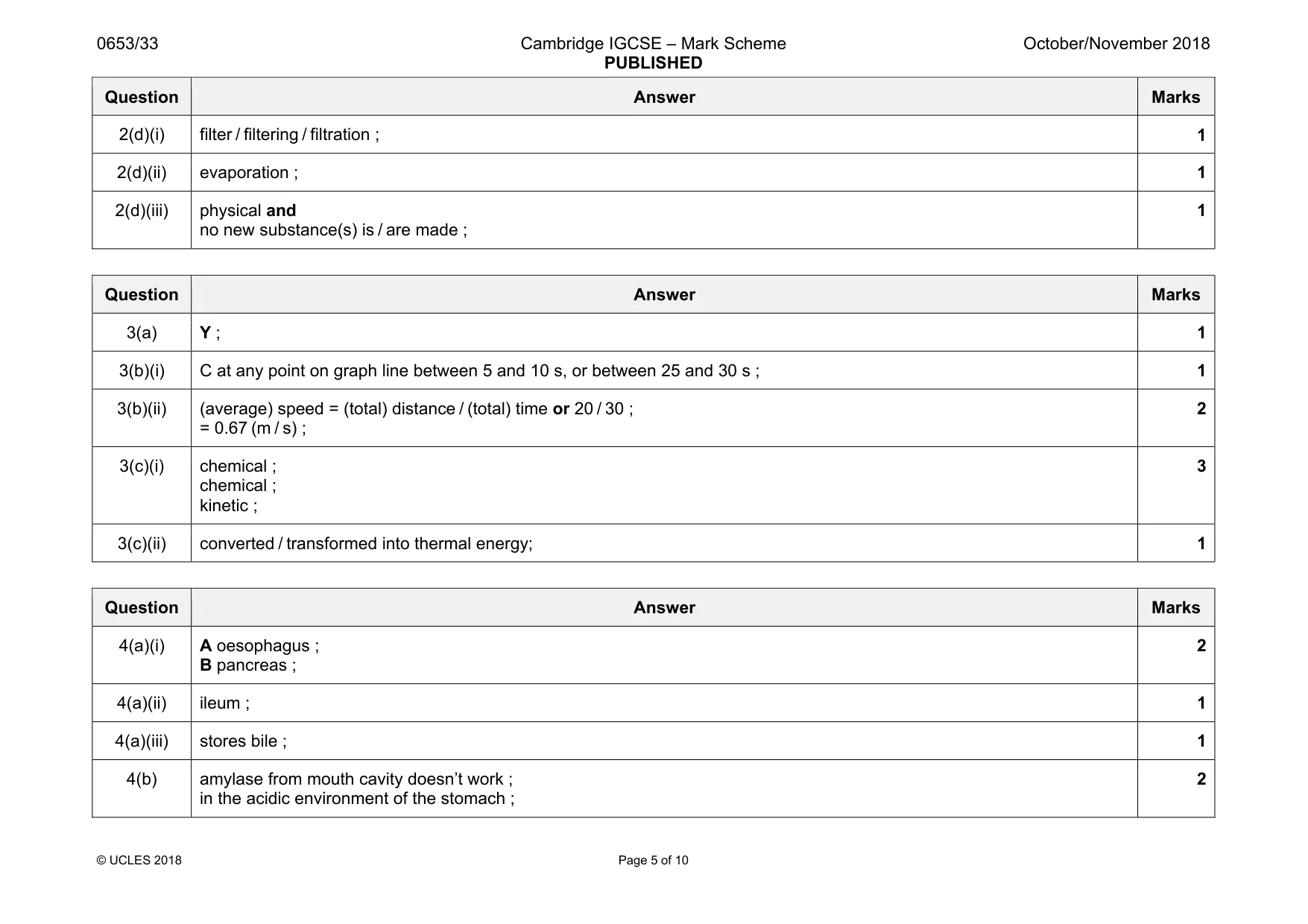
Mark scheme: 2(a) atomic / proton ; noble ; transition ; 3 2(b)(i) covalent ; 1 2(b)(ii) (electrons are) shared ; 1 2(c) (electrons are) lost / gained / lost and gained ; 1 Question Answer Marks 2(d)(i) filter / filtering / filtration ; 1 2(d)(ii) evaporation ; 1 2(d)(iii) physical and no new substance(s) is / are made ; 1
Q3 · A man pushing a shopping trolley
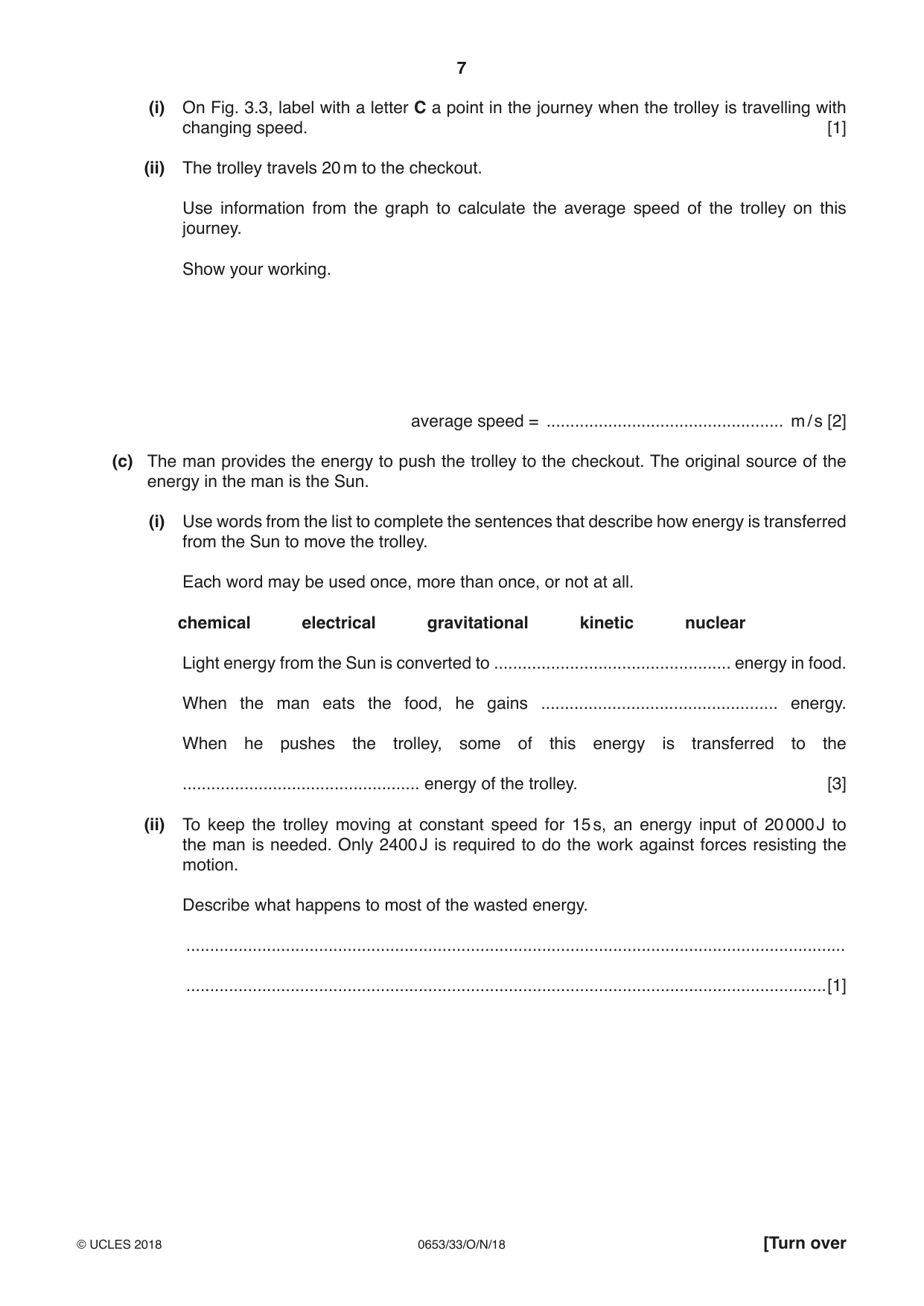
3 Fig. 3.1 shows a man pushing a shopping trolley. Fig. 3.1 (a) The man and the trolley are moving. Fig. 3.2 shows the four forces W, X, Y and Z acting on the trolley. W X Z Y Fig. 3.2 State the letter corresponding to the gravitational force acting on the trolley. ............... [1] (b) Fig. 3.3 shows a speed–time graph of the trolley as the man pushes it to the checkout. 1.0 0.75 speed 0.5 m / s 0.25 0 0 5 10 15 20 25 30 time / s Fig. 3.3 (i) On Fig. 3.3, label with a letter C a point in the journey when the trolley is travelling with changing speed. [1] (ii) The trolley travels 20 m to the checkout. Use information from the graph to calculate the average speed of the trolley on this journey. Show your working. average speed = .................................................. m / s [2] (c) The man provides the energy to push the trolley to the checkout. The original source of the energy in the man is the Sun. (i) Use words from the list to complete the sentences that describe how energy is transferred from the Sun to move the trolley. Each word may be used once, more than once, or not at all. chemical electrical gravitational kinetic nuclear Light energy from the Sun is converted to .................................................. energy in food. When the man eats the food, he gains .................................................. energy. When he pushes the trolley, some of this energy is transferred to the .................................................. energy of the trolley. [3] (ii) To keep the trolley moving at constant speed for 15 s, an energy input of 20 000 J to the man is needed. Only 2400 J is required to do the work against forces resisting the motion. Describe what happens to most of the wasted energy. ........................................................................................................................................... .......................................................................................................................................[1]
Mark scheme: 3(a) Y ; 1 3(b)(i) C at any point on graph line between 5 and 10 s, or between 25 and 30 s ; 1 3(b)(ii) (average) speed = (total) distance / (total) time or 20 / 30 ; = 0.67 (m / s) ; 2 3(c)(i) chemical ; chemical ; kinetic ; 3 3(c)(ii) converted / transformed into thermal energy; 1
Q4 · A diagram of part of the alimentary canal and its associated organs
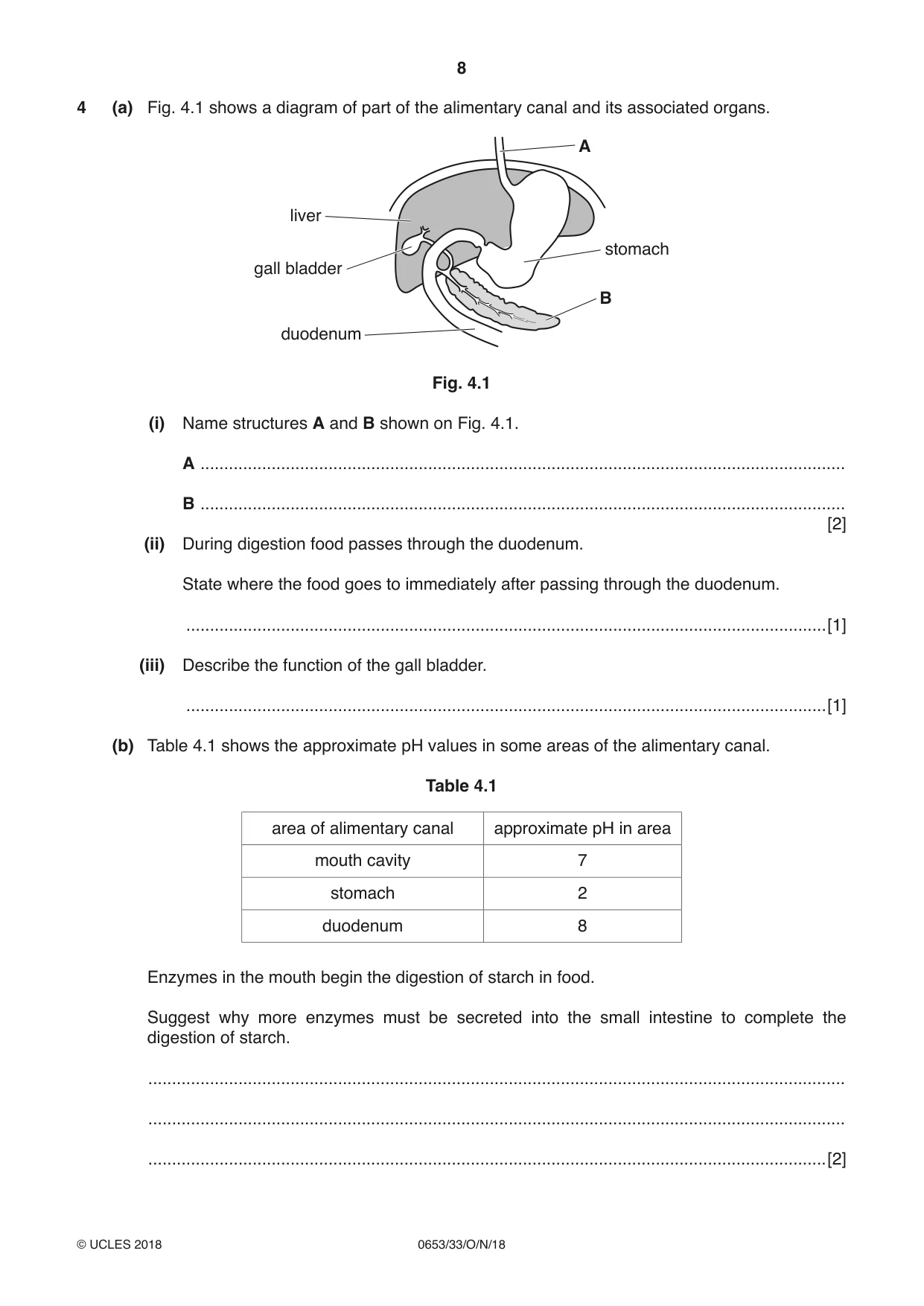
4 (a) Fig. 4.1 shows a diagram of part of the alimentary canal and its associated organs. A liver stomach gall bladder B duodenum Fig. 4.1 (i) Name structures A and B shown on Fig. 4.1. A ........................................................................................................................................ B ........................................................................................................................................ [2] (ii) During digestion food passes through the duodenum. State where the food goes to immediately after passing through the duodenum. .......................................................................................................................................[1] (iii) Describe the function of the gall bladder. .......................................................................................................................................[1] (b) Table 4.1 shows the approximate pH values in some areas of the alimentary canal. Table 4.1 area of alimentary canal approximate pH in area mouth cavity 7 stomach 2 duodenum 8 Enzymes in the mouth begin the digestion of starch in food. Suggest why more enzymes must be secreted into the small intestine to complete the digestion of starch. ................................................................................................................................................... ................................................................................................................................................... ...............................................................................................................................................[2] (c) Glucose is transported to the body cells in the blood plasma. List two other soluble substances which are transported by the plasma. 1. ............................................................................................................................................... 2. ............................................................................................................................................... [2] (d) Describe how oxygen is transported in the blood around the body. ................................................................................................................................................... ................................................................................................................................................... ...............................................................................................................................................[2]
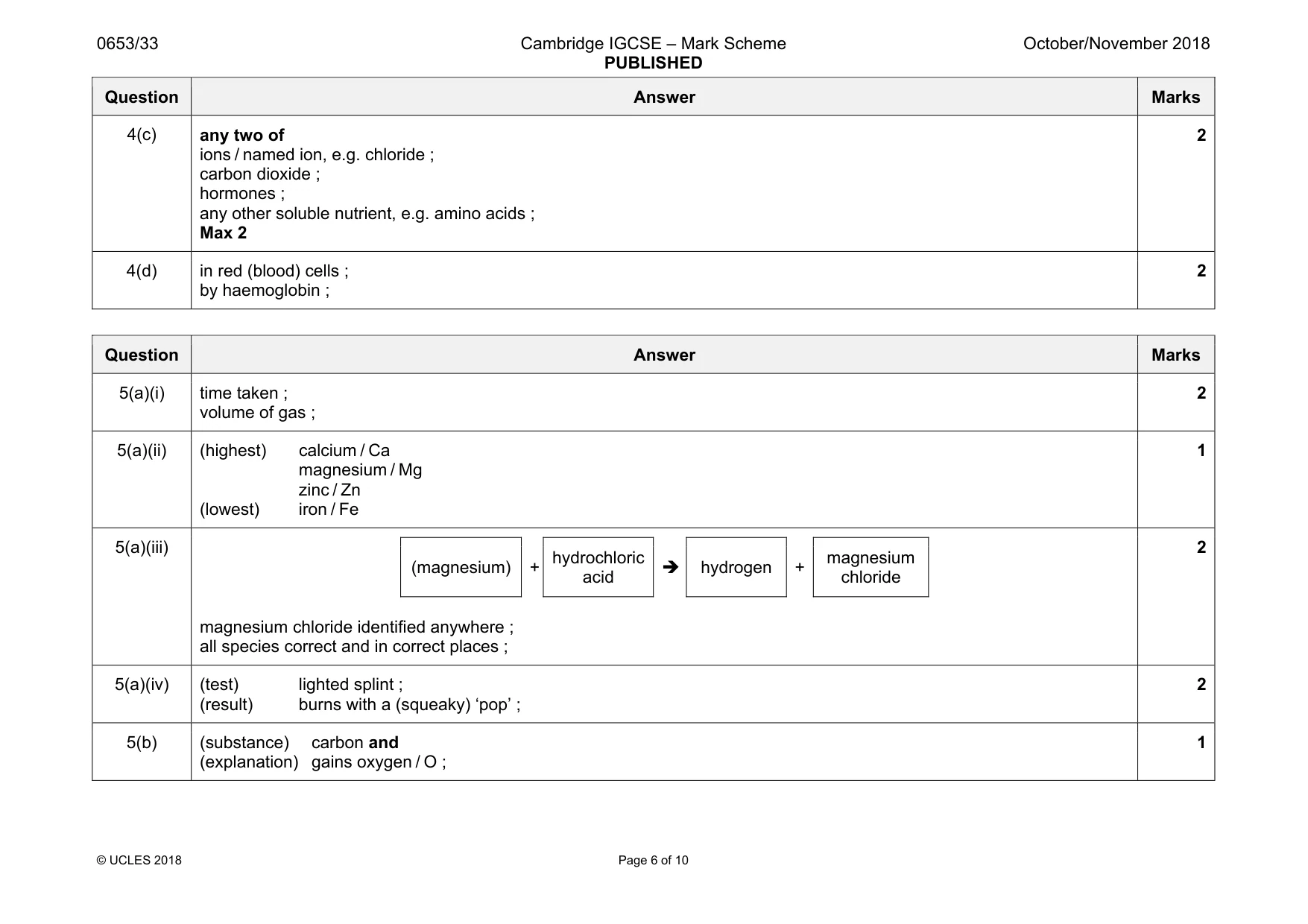
Mark scheme: 4(a)(i) A oesophagus ; B pancreas ; 2 4(a)(ii) ileum ; 1 4(a)(iii) stores bile ; 1 4(b) amylase from mouth cavity doesn’t work ; in the acidic environment of the stomach ; 2 Question Answer Marks 4(c) any two of ions / named ion, e.g. chloride ; carbon dioxide ; hormones ; any other soluble nutrient, e.g. amino acids ; Max 2 2 4(d) in red (blood) cells ; by haemoglobin ; 2
Q5 · A student investigates the rate of reaction of four metals, calcium, iron, magnesium and…
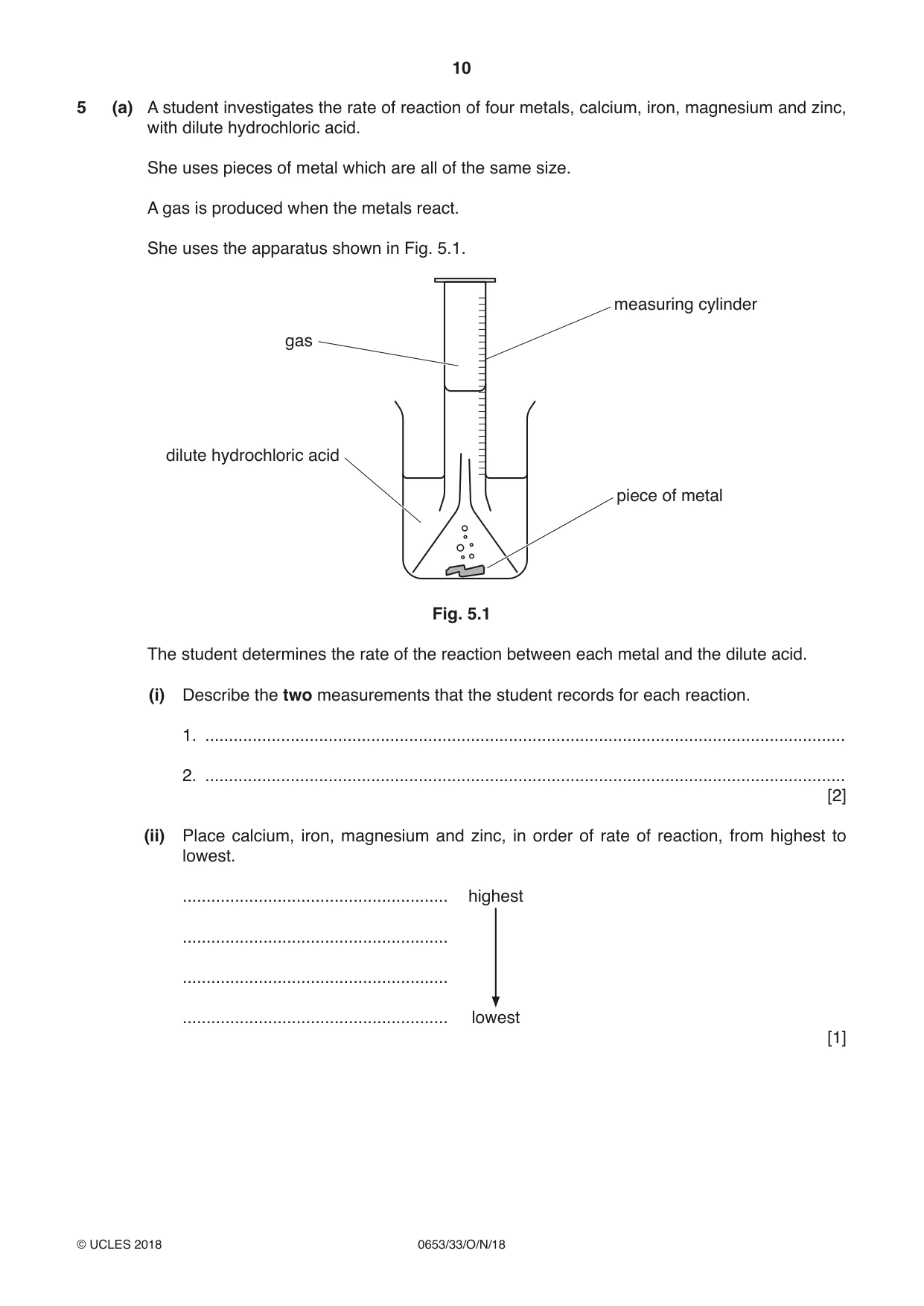
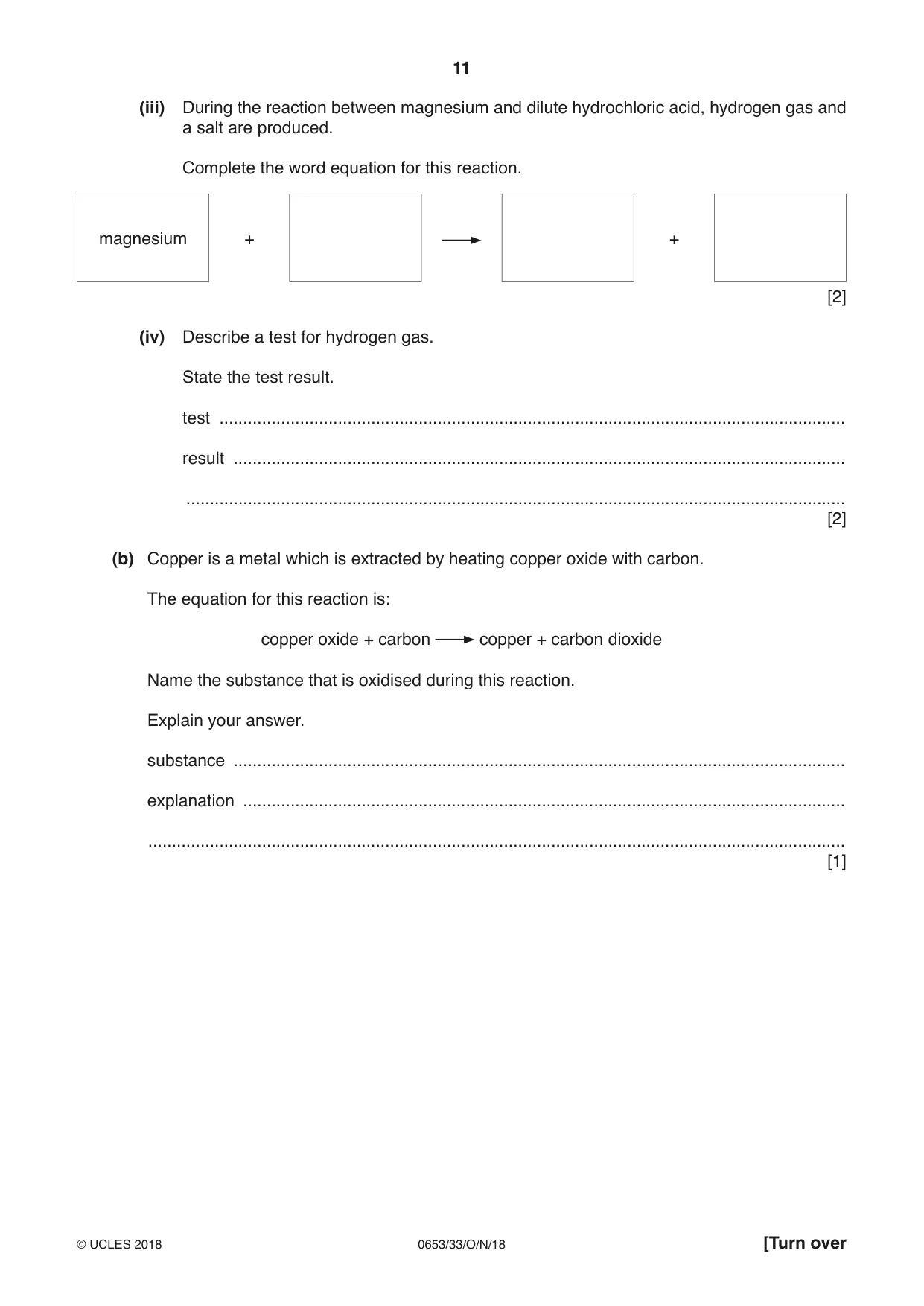
5 (a) A student investigates the rate of reaction of four metals, calcium, iron, magnesium and zinc, with dilute hydrochloric acid. She uses pieces of metal which are all of the same size. A gas is produced when the metals react. She uses the apparatus shown in Fig. 5.1. measuring cylinder gas dilute hydrochloric acid piece of metal Fig. 5.1 The student determines the rate of the reaction between each metal and the dilute acid. (i) Describe the two measurements that the student records for each reaction. 1. ....................................................................................................................................... 2. ....................................................................................................................................... [2] (ii) Place calcium, iron, magnesium and zinc, in order of rate of reaction, from highest to lowest. ........................................................ highest ........................................................ ........................................................ ........................................................ lowest [1] (iii) During the reaction between magnesium and dilute hydrochloric acid, hydrogen gas and a salt are produced. Complete the word equation for this reaction. magnesium + + [2] (iv) Describe a test for hydrogen gas. State the test result. test .................................................................................................................................... result ................................................................................................................................. ........................................................................................................................................... [2] (b) Copper is a metal which is extracted by heating copper oxide with carbon. The equation for this reaction is: copper oxide + carbon copper + carbon dioxide Name the substance that is oxidised during this reaction. Explain your answer. substance ................................................................................................................................. explanation ............................................................................................................................... ................................................................................................................................................... [1]
Mark scheme: 5(a)(i) time taken ; volume of gas ; 2 5(a)(ii) (highest) calcium / Ca magnesium / Mg zinc / Zn (lowest) iron / Fe 1 5(a)(iii) (magnesium) + hydrochloric acid Î hydrogen + magnesium chloride magnesium chloride identified anywhere ; all species correct and in correct places ; 2 5(a)(iv) (test) lighted splint ; (result) burns with a (squeaky) ‘pop’ ; 2 5(b) (substance) carbon and (explanation) gains oxygen / O ; 1
Q6 · State one property that distinguishes a liquid from a gas
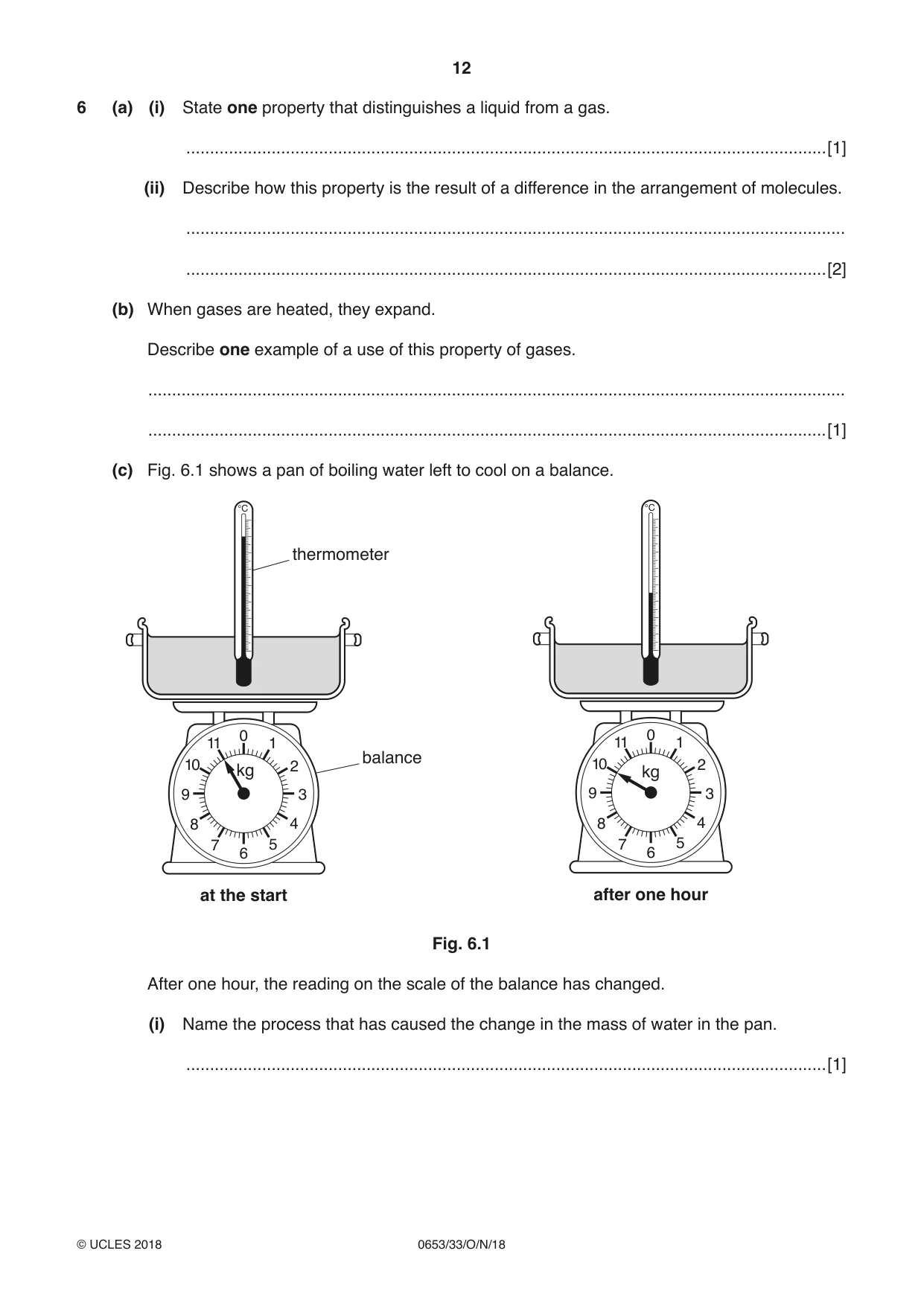
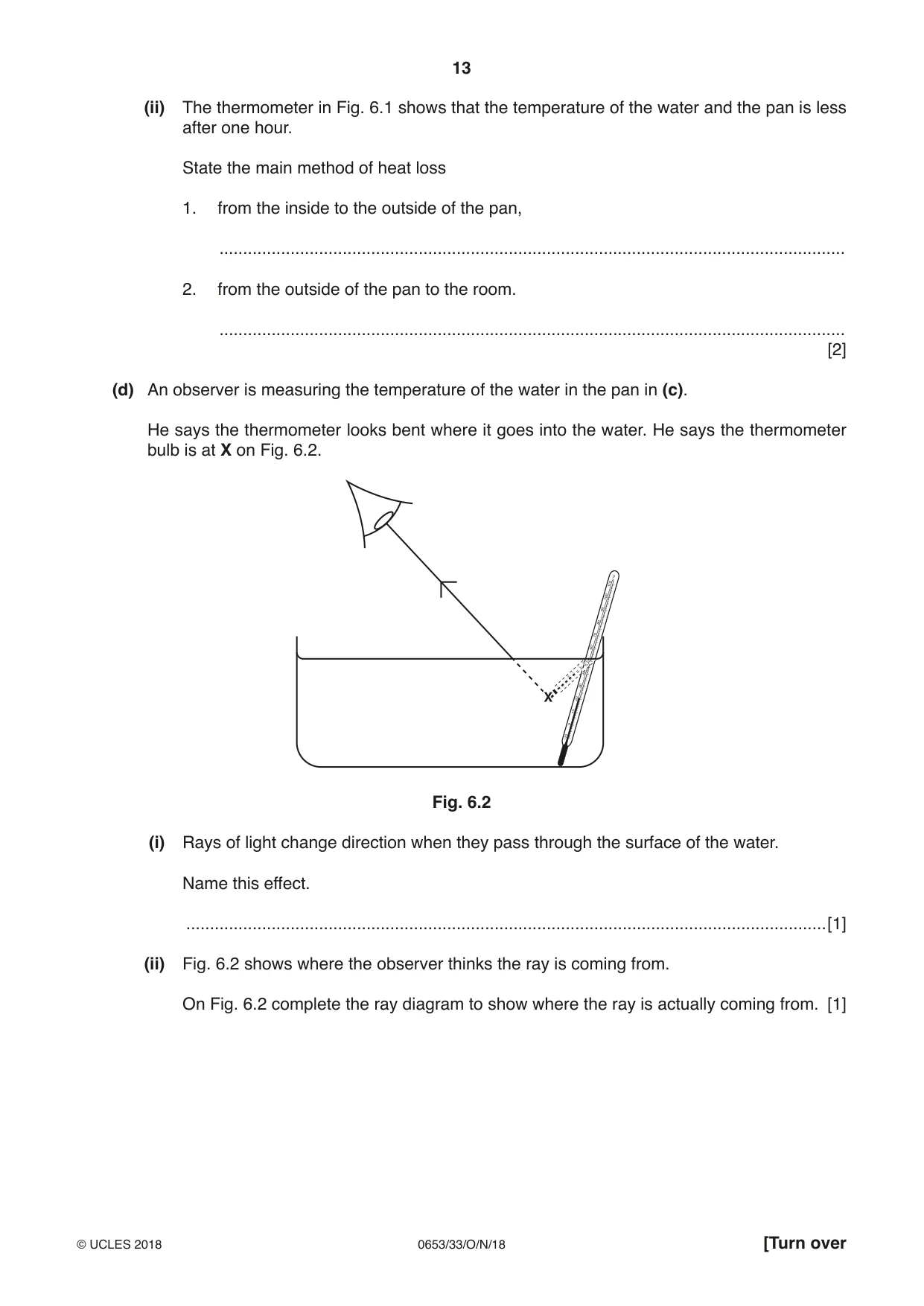
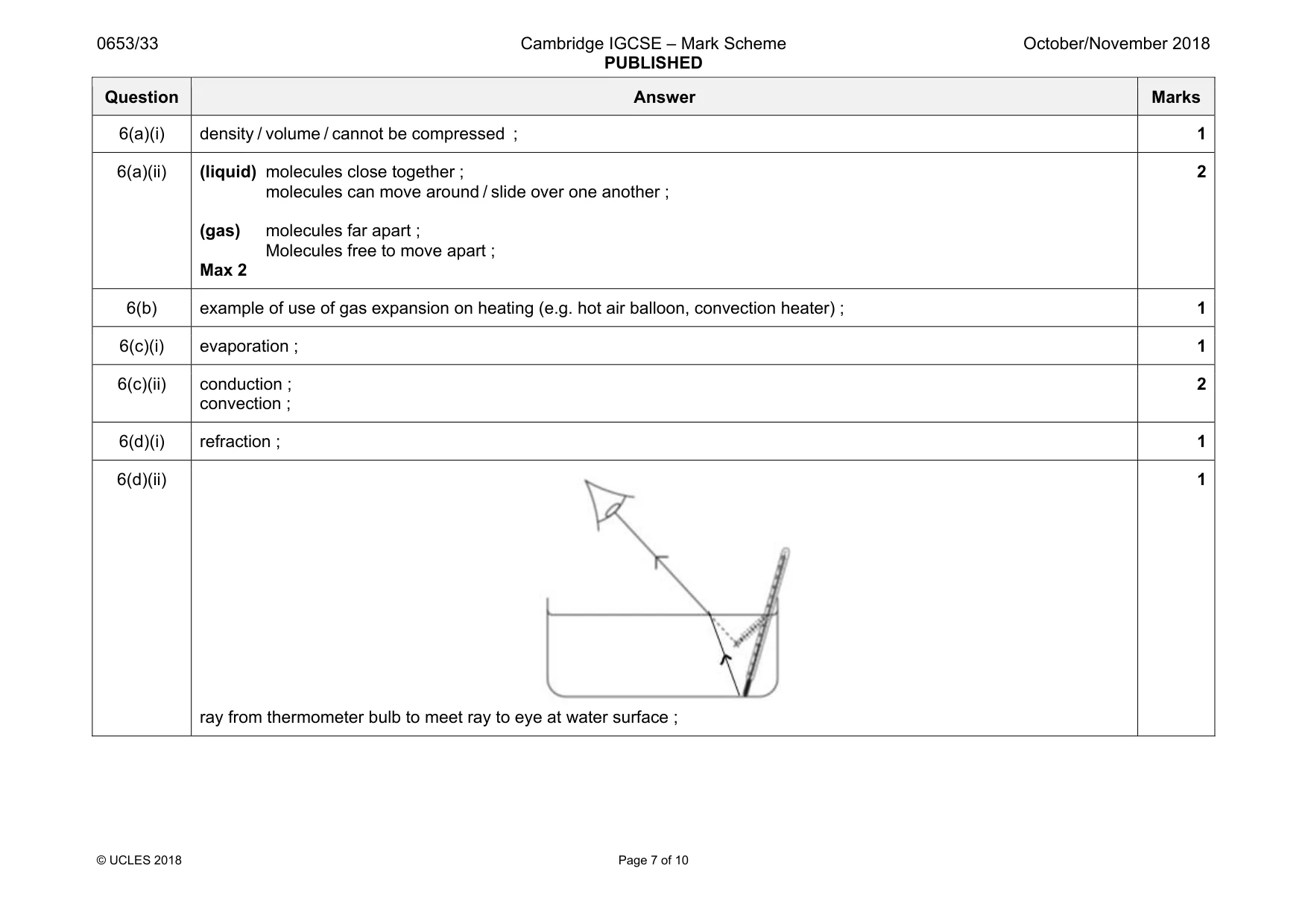
6 (a) (i) State one property that distinguishes a liquid from a gas. .......................................................................................................................................[1] (ii) Describe how this property is the result of a difference in the arrangement of molecules. ........................................................................................................................................... .......................................................................................................................................[2] (b) When gases are heated, they expand. Describe one example of a use of this property of gases. ................................................................................................................................................... ...............................................................................................................................................[1] (c) Fig. 6.1 shows a pan of boiling water left to cool on a balance. °C °C thermometer 0 0 11 1 11 1 balance 10 kg 2 10 kg 2 9 3 9 3 8 4 8 4 7 5 7 5 6 6 at the start after one hour Fig. 6.1 After one hour, the reading on the scale of the balance has changed. (i) Name the process that has caused the change in the mass of water in the pan. .......................................................................................................................................[1] (ii) The thermometer in Fig. 6.1 shows that the temperature of the water and the pan is less after one hour. State the main method of heat loss 1. from the inside to the outside of the pan, .................................................................................................................................... 2. from the outside of the pan to the room. .................................................................................................................................... [2] (d) An observer is measuring the temperature of the water in the pan in (c). He says the thermometer looks bent where it goes into the water. He says the thermometer bulb is at X on Fig. 6.2. °C 110 100 90 80 70 60 30 40505 0 10 20 40 –10 30 20 10 0 –10 Fig. 6.2 (i) Rays of light change direction when they pass through the surface of the water. Name this effect. .......................................................................................................................................[1] (ii) Fig. 6.2 shows where the observer thinks the ray is coming from. On Fig. 6.2 complete the ray diagram to show where the ray is actually coming from. [1]
Mark scheme: 6(a)(i) density / volume / cannot be compressed ; 1 6(a)(ii) (liquid) molecules close together ; molecules can move around / slide over one another ; (gas) molecules far apart ; Molecules free to move apart ; Max 2 2 6(b) example of use of gas expansion on heating (e.g. hot air balloon, convection heater) ; 1 6(c)(i) evaporation ; 1 6(c)(ii) conduction ; convection ; 2 6(d)(i) refraction ; 1 6(d)(ii) ray from thermometer bulb to meet ray to eye at water surface ; 1
Q7 · Rainforest is often cleared for agriculture
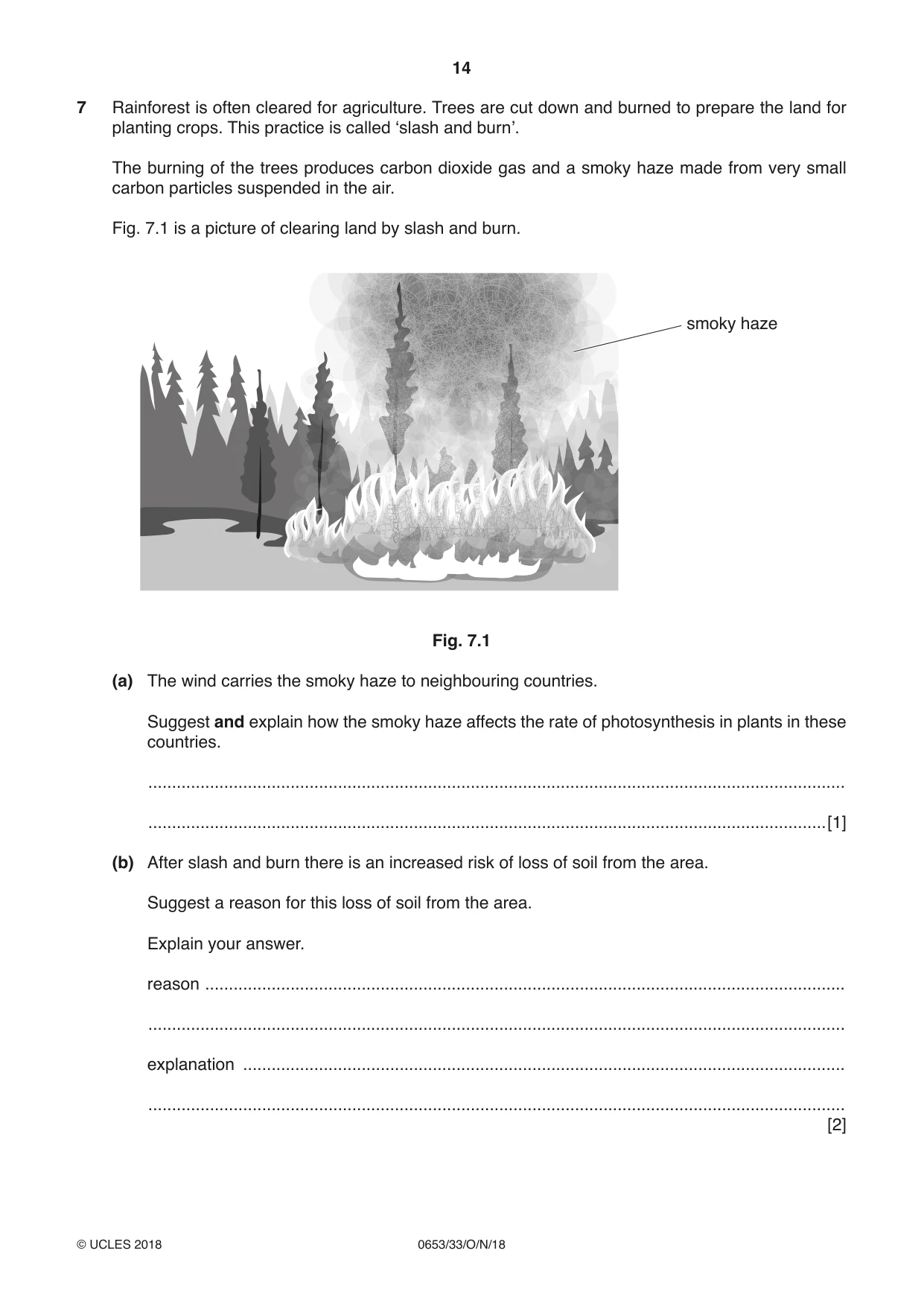
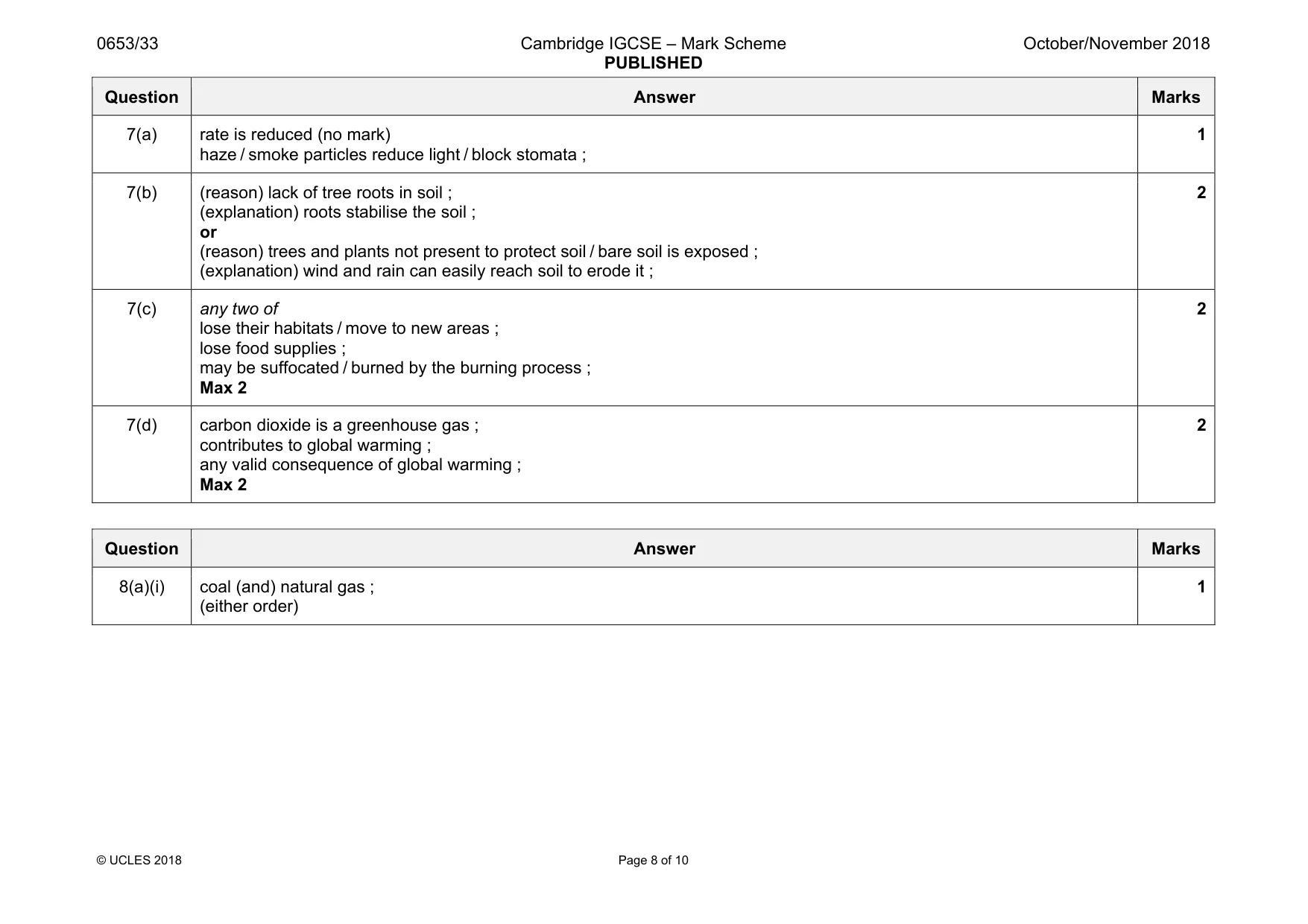
7 Rainforest is often cleared for agriculture. Trees are cut down and burned to prepare the land for planting crops. This practice is called ‘slash and burn’. The burning of the trees produces carbon dioxide gas and a smoky haze made from very small carbon particles suspended in the air. Fig. 7.1 is a picture of clearing land by slash and burn. smoky haze Fig. 7.1 (a) The wind carries the smoky haze to neighbouring countries. Suggest and explain how the smoky haze affects the rate of photosynthesis in plants in these countries. ................................................................................................................................................... ...............................................................................................................................................[1] (b) After slash and burn there is an increased risk of loss of soil from the area. Suggest a reason for this loss of soil from the area. Explain your answer. reason ....................................................................................................................................... ................................................................................................................................................... explanation ............................................................................................................................... ................................................................................................................................................... [2] (c) State two effects of slash and burn on the animals living in the trees. 1. ............................................................................................................................................... 2. ............................................................................................................................................... [2] (d) The practice of slash and burn causes the concentration of carbon dioxide in the atmosphere to increase. Explain why this is undesirable for the environment. ................................................................................................................................................... ................................................................................................................................................... ...............................................................................................................................................[2]
Mark scheme: 7(a) rate is reduced (no mark) haze / smoke particles reduce light / block stomata ; 1 7(b) (reason) lack of tree roots in soil ; (explanation) roots stabilise the soil ; or (reason) trees and plants not present to protect soil / bare soil is exposed ; (explanation) wind and rain can easily reach soil to erode it ; 2 7(c) any two of lose their habitats / move to new areas ; lose food supplies ; may be suffocated / burned by the burning process ; Max 2 2 7(d) carbon dioxide is a greenhouse gas ; contributes to global warming ; any valid consequence of global warming ; Max 2 2
Q8 · Petroleum is separated into useful fractions, as shown in Fig
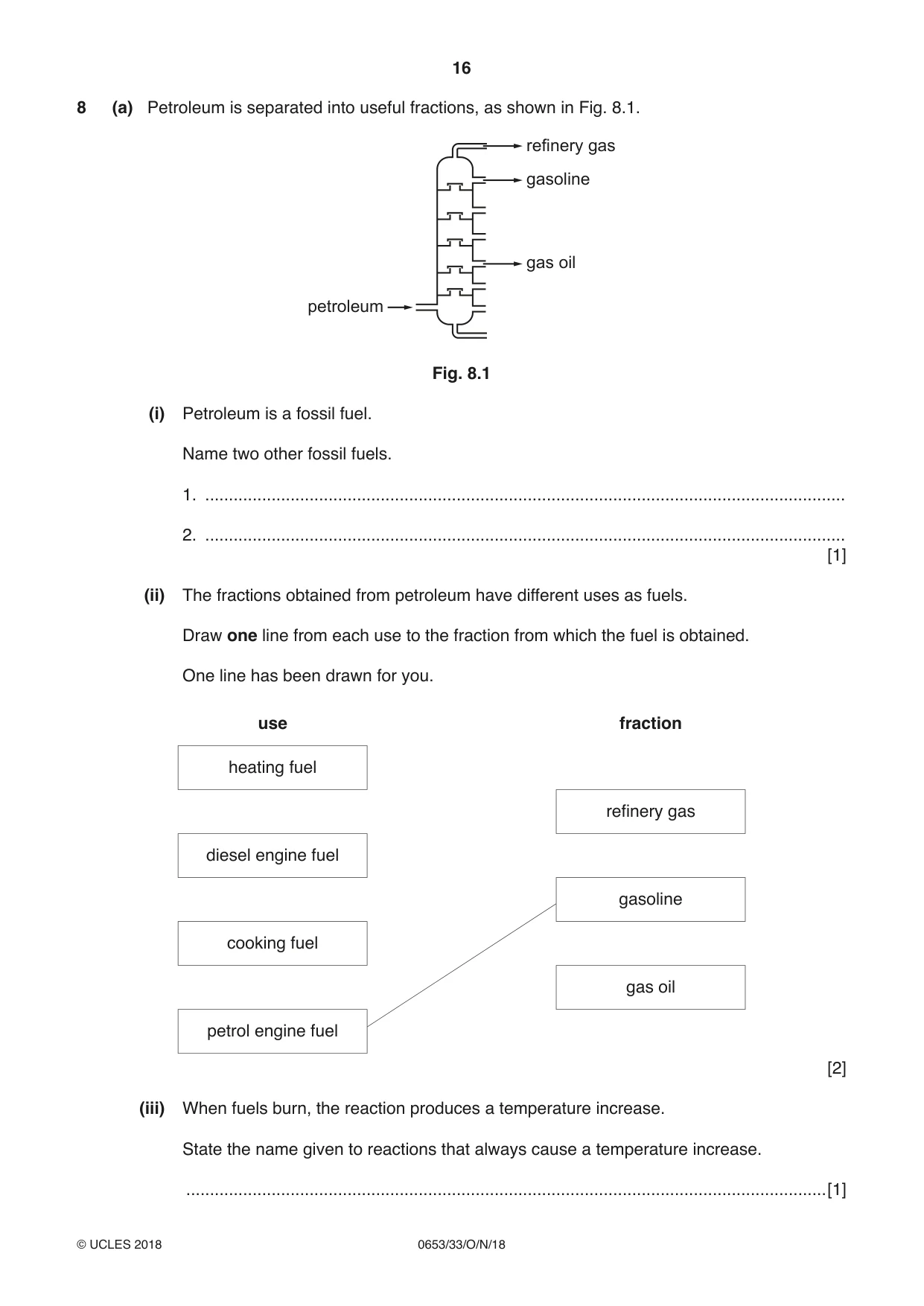
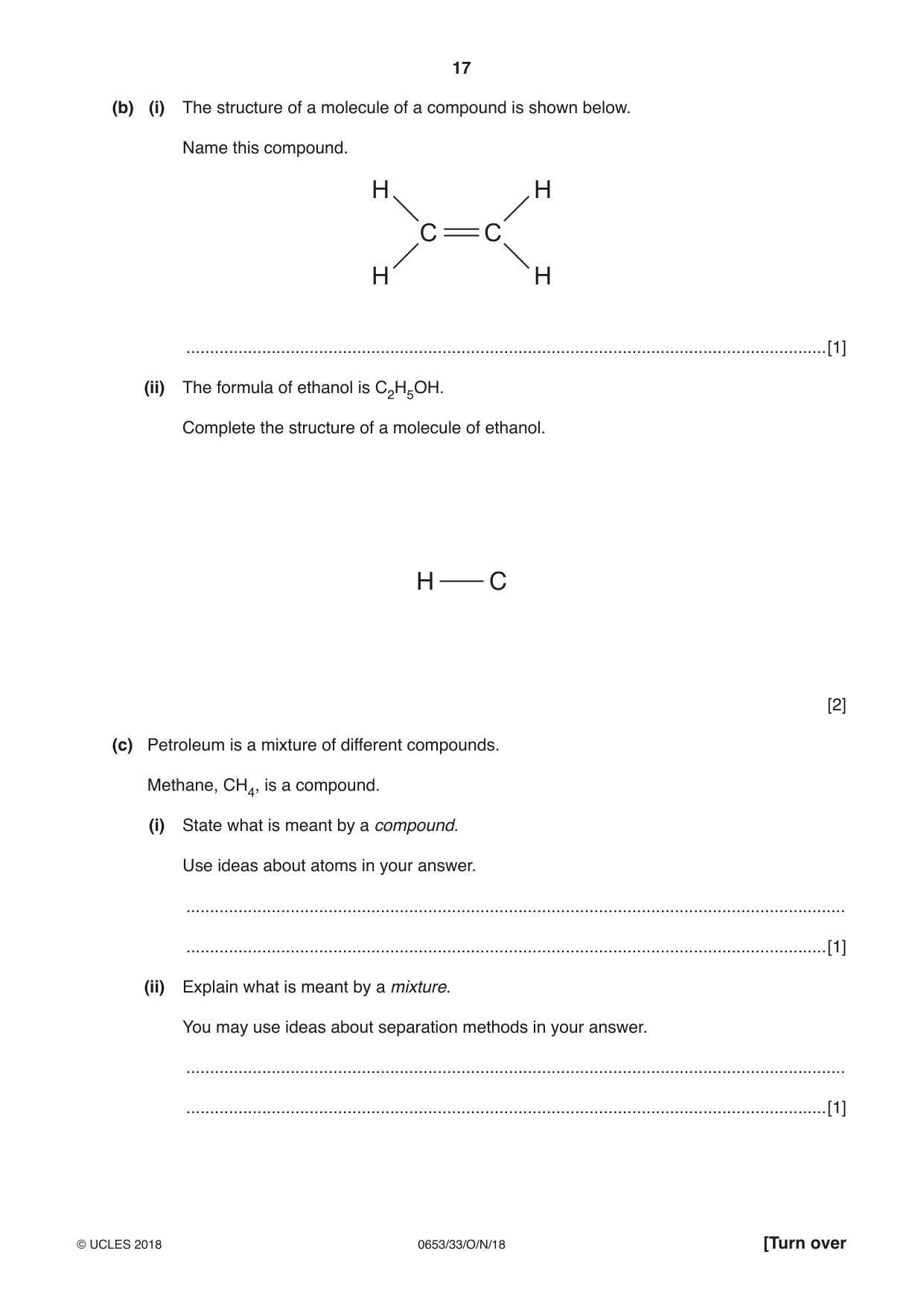
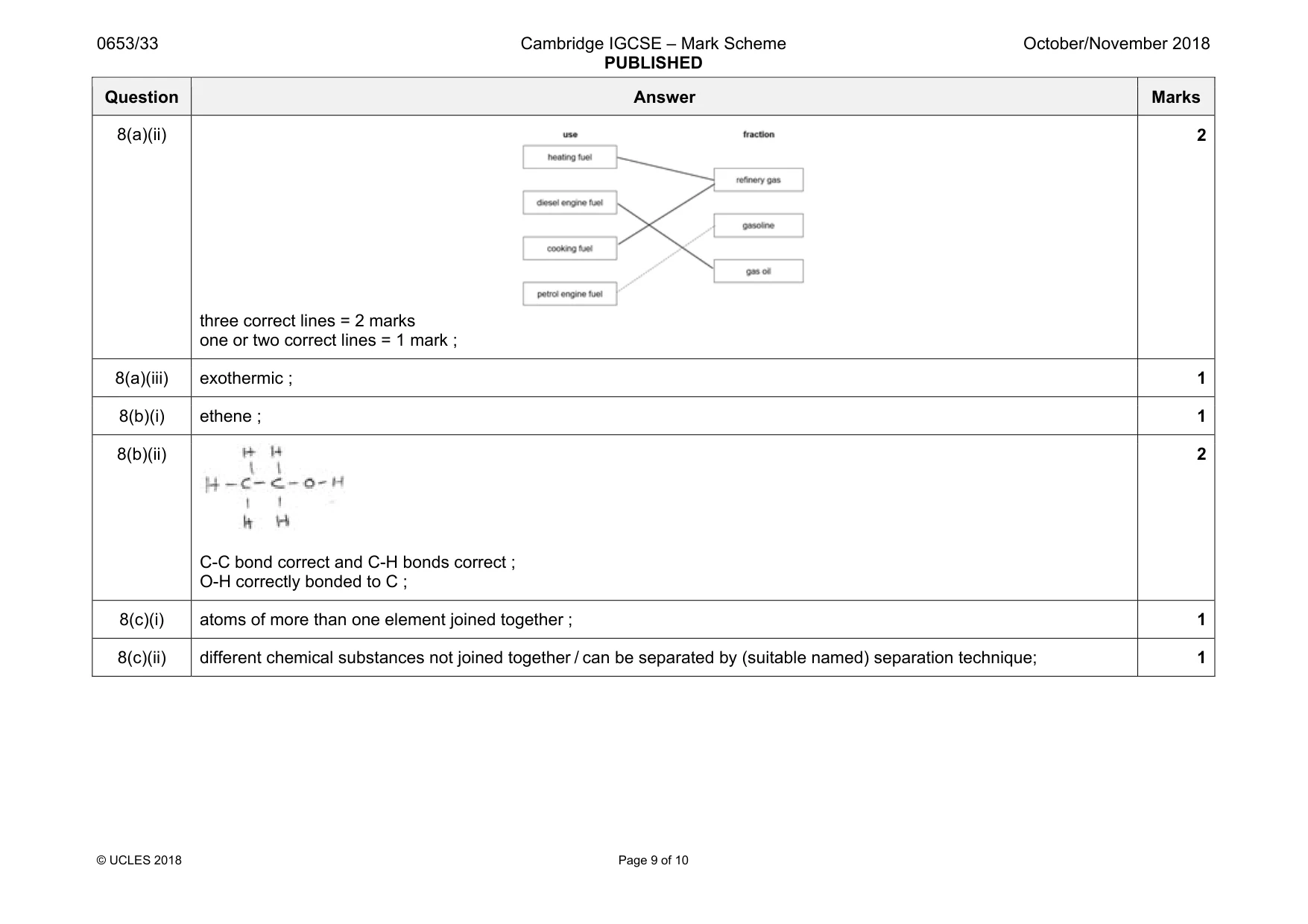
8 (a) Petroleum is separated into useful fractions, as shown in Fig. 8.1. refinery gas gasoline gas oil petroleum Fig. 8.1 (i) Petroleum is a fossil fuel. Name two other fossil fuels. 1. ....................................................................................................................................... 2. ....................................................................................................................................... [1] (ii) The fractions obtained from petroleum have different uses as fuels. Draw one line from each use to the fraction from which the fuel is obtained. One line has been drawn for you. use fraction heating fuel refinery gas diesel engine fuel gasoline cooking fuel gas oil petrol engine fuel [2] (iii) When fuels burn, the reaction produces a temperature increase. State the name given to reactions that always cause a temperature increase. .......................................................................................................................................[1] (b) (i) The structure of a molecule of a compound is shown below. Name this compound. H H C C H H .......................................................................................................................................[1] (ii) The formula of ethanol is C2H5OH. Complete the structure of a molecule of ethanol. H C [2] (c) Petroleum is a mixture of different compounds. Methane, CH4, is a compound. (i) State what is meant by a compound. Use ideas about atoms in your answer. ........................................................................................................................................... .......................................................................................................................................[1] (ii) Explain what is meant by a mixture. You may use ideas about separation methods in your answer. ........................................................................................................................................... .......................................................................................................................................[1]
Mark scheme: 8(a)(i) coal (and) natural gas ; (either order) 1 Question Answer Marks 8(a)(ii) three correct lines = 2 marks one or two correct lines = 1 mark ; 2 8(a)(iii) exothermic ; 1 8(b)(i) ethene ; 1 8(b)(ii) C-C bond correct and C-H bonds correct ; O-H correctly bonded to C ; 2 8(c)(i) atoms of more than one element joined together ; 1 8(c)(ii) different chemical substances not joined together / can be separated by (suitable named) separation technique; 1
Q9 · A display refrigerator for storing cold drinks
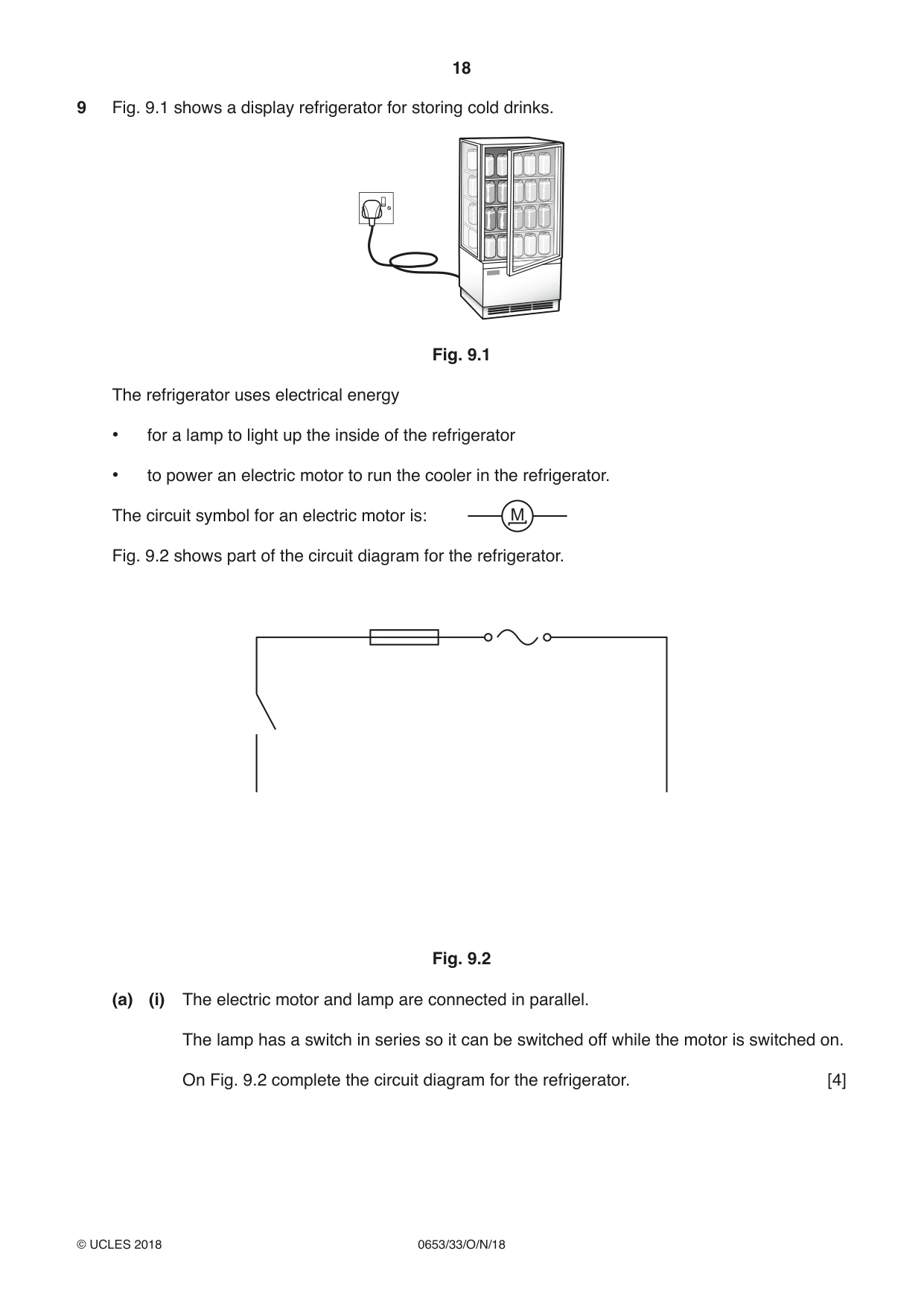
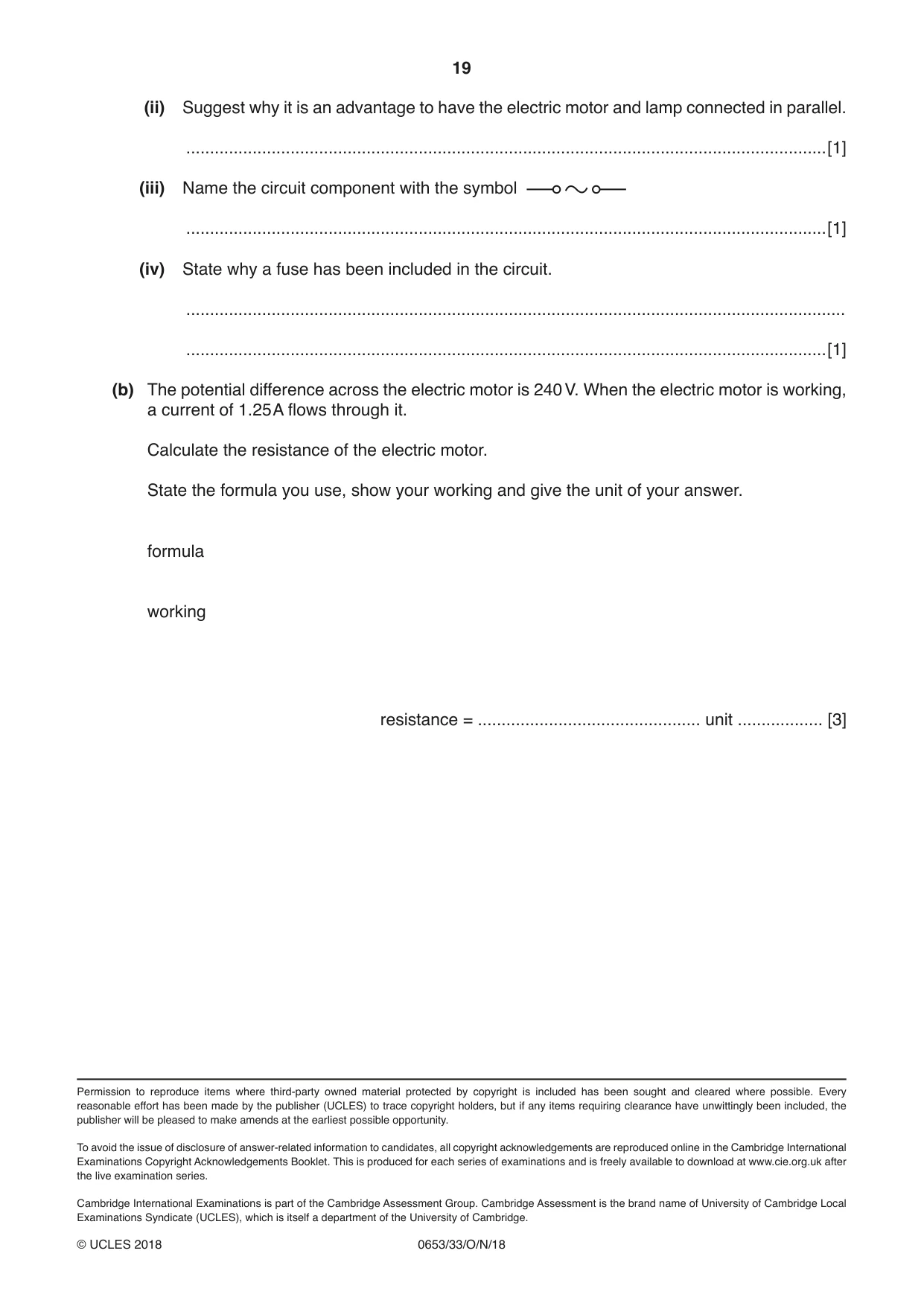
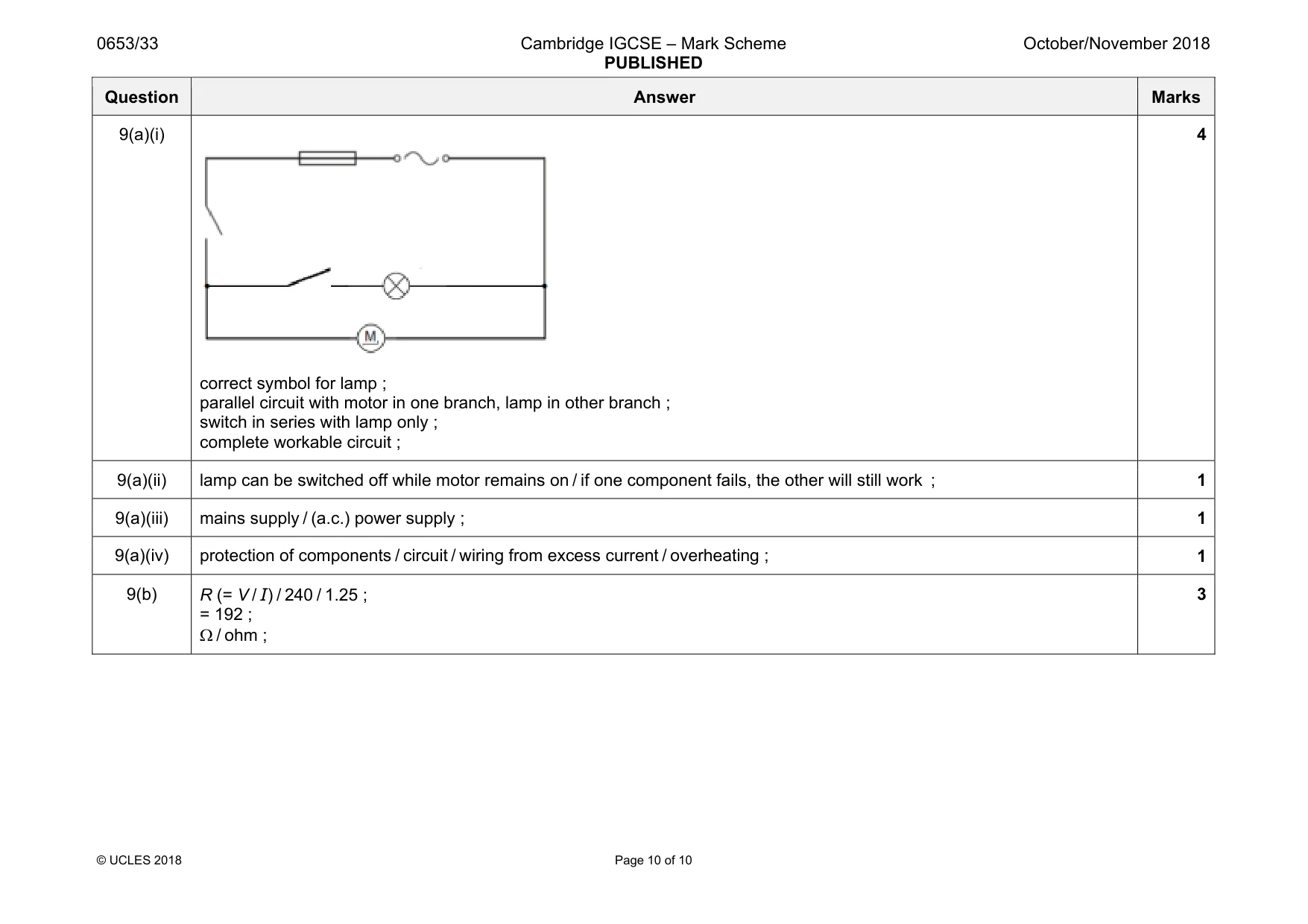
9 Fig. 9.1 shows a display refrigerator for storing cold drinks. Fig. 9.1 The refrigerator uses electrical energy • for a lamp to light up the inside of the refrigerator • to power an electric motor to run the cooler in the refrigerator. The circuit symbol for an electric motor is: M Fig. 9.2 shows part of the circuit diagram for the refrigerator. Fig. 9.2 (a) (i) The electric motor and lamp are connected in parallel. The lamp has a switch in series so it can be switched off while the motor is switched on. On Fig. 9.2 complete the circuit diagram for the refrigerator. [4] (ii) Suggest why it is an advantage to have the electric motor and lamp connected in parallel. .......................................................................................................................................[1] (iii) Name the circuit component with the symbol .......................................................................................................................................[1] (iv) State why a fuse has been included in the circuit. ........................................................................................................................................... .......................................................................................................................................[1] (b) The potential difference across the electric motor is 240 V. When the electric motor is working, a current of 1.25 A flows through it. Calculate the resistance of the electric motor. State the formula you use, show your working and give the unit of your answer. formula working resistance = ............................................... unit .................. [3]
Mark scheme: 9(a)(i) correct symbol for lamp ; parallel circuit with motor in one branch, lamp in other branch ; switch in series with lamp only ; complete workable circuit ; 4 9(a)(ii) lamp can be switched off while motor remains on / if one component fails, the other will still work ; 1 9(a)(iii) mains supply / (a.c.) power supply ; 1 9(a)(iv) protection of components / circuit / wiring from excess current / overheating ; 1 9(b) R (= V / I) / 240 / 1.25 ; = 192 ; Ω / ohm ; 3
What was in this paper
The subtopics covered by these 9 questions, and how many questions each got. Open one in a new tab to see every Cambridge question on it.
What you needed in this session
Cambridge’s own grade thresholds for 2018 Oct/Nov, Paper 3 · Variant 3. A higher threshold means an easier paper — the bar moves with how the cohort did.