Cambridge IGCSE Science - Combined 0653 — 2022 May/June Paper 3 · Variant 1
0653/31/M/J/22 · 9 questions · 80 marks · ≈90 min
The question paper and its mark scheme, free to read here and free to download. This is Cambridge’s own paper, exactly as it was sat.
Question paper20 pages


Mark scheme11 pages
Answers below. Sit the paper first if you are practising.
Questions as text
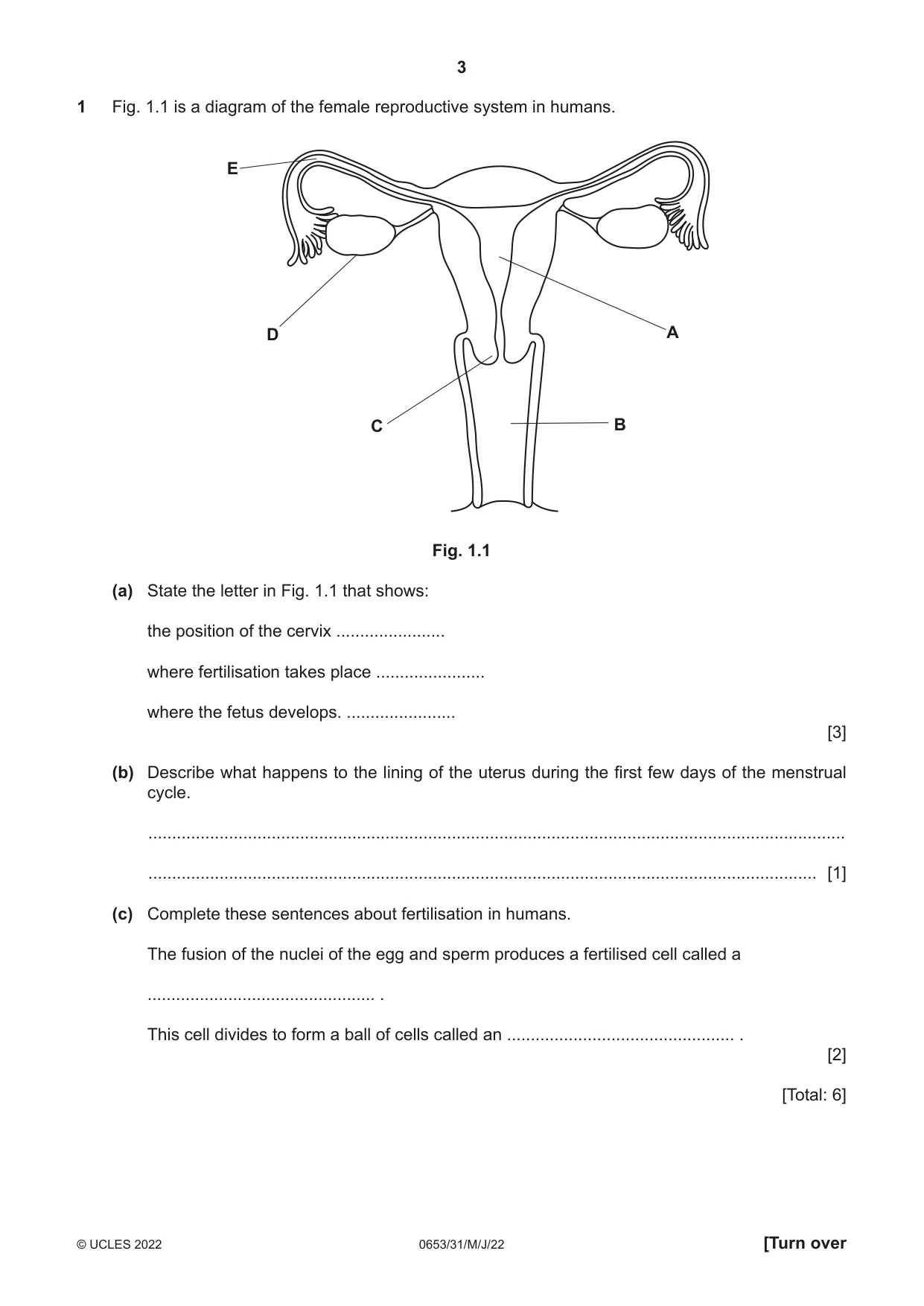
Q1 · A diagram of the female reproductive system in humans
1 Fig. 1.1 is a diagram of the female reproductive system in humans. E D A C B Fig. 1.1 (a) State the letter in Fig. 1.1 that shows: the position of the cervix ....................... where fertilisation takes place ....................... where the fetus develops. ....................... [3] (b) Describe what happens to the lining of the uterus during the first few days of the menstrual cycle. ................................................................................................................................................... ............................................................................................................................................. [1] (c) Complete these sentences about fertilisation in humans. The fusion of the nuclei of the egg and sperm produces a fertilised cell called a ................................................ . This cell divides to form a ball of cells called an ................................................ . [2] [Total: 6]
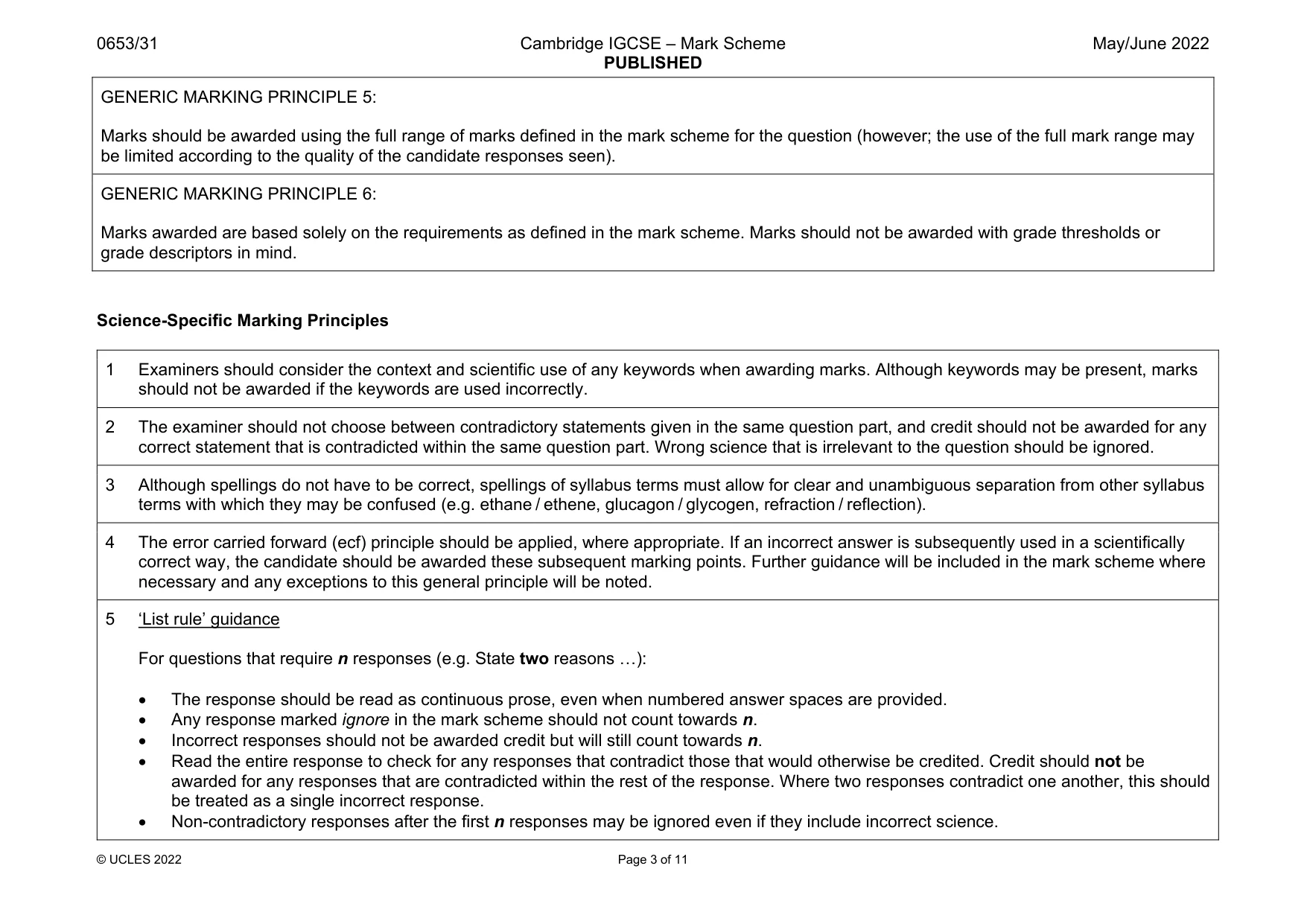
Mark scheme: 1(a) C ; E ; A ; 3 1(b) it is shed / reduced in thickness ; 1 1(c) zygote ; embryo ; 2
Q2 · An aqueous solution of salt MX is made by dissolving solid MX in water
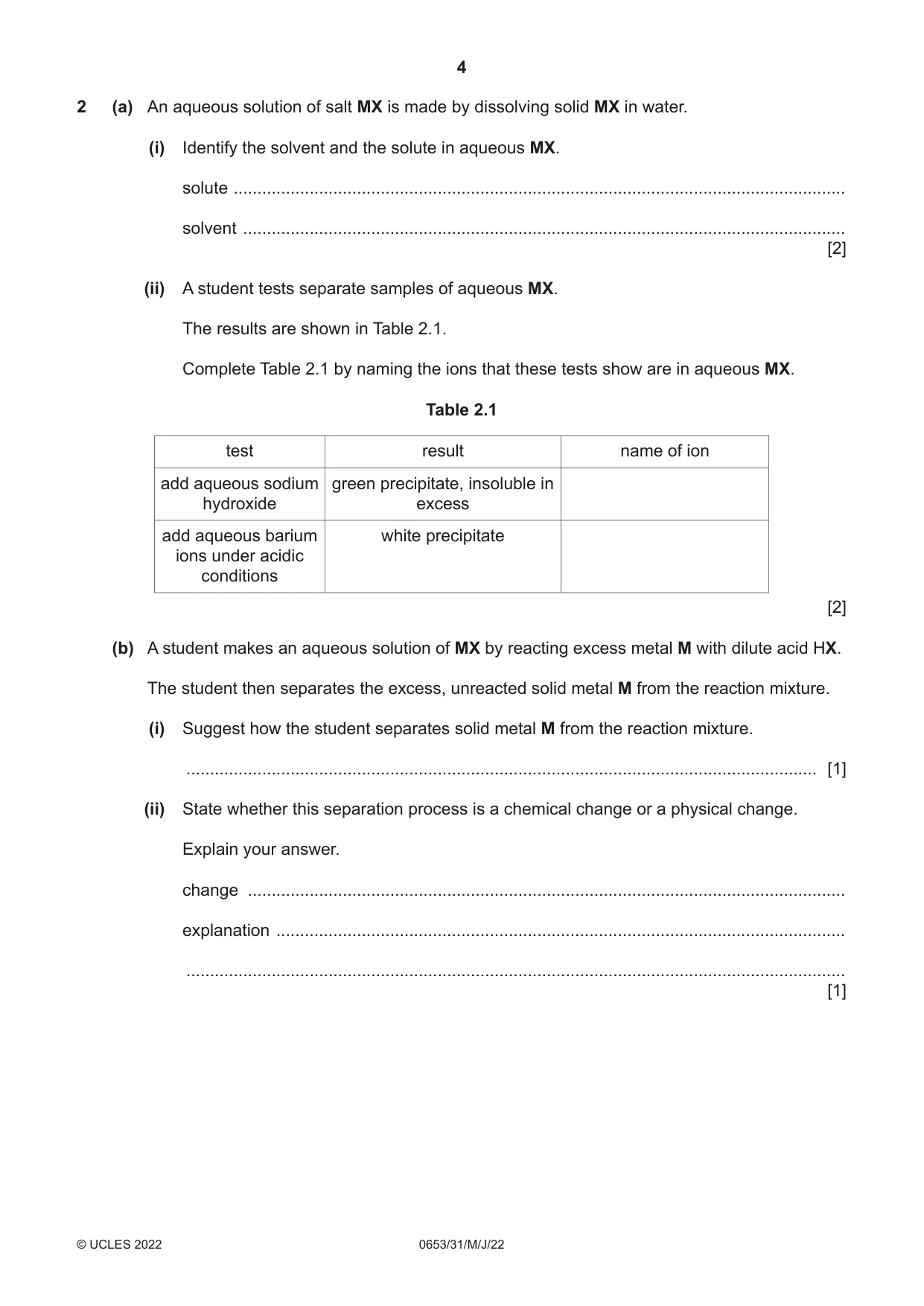
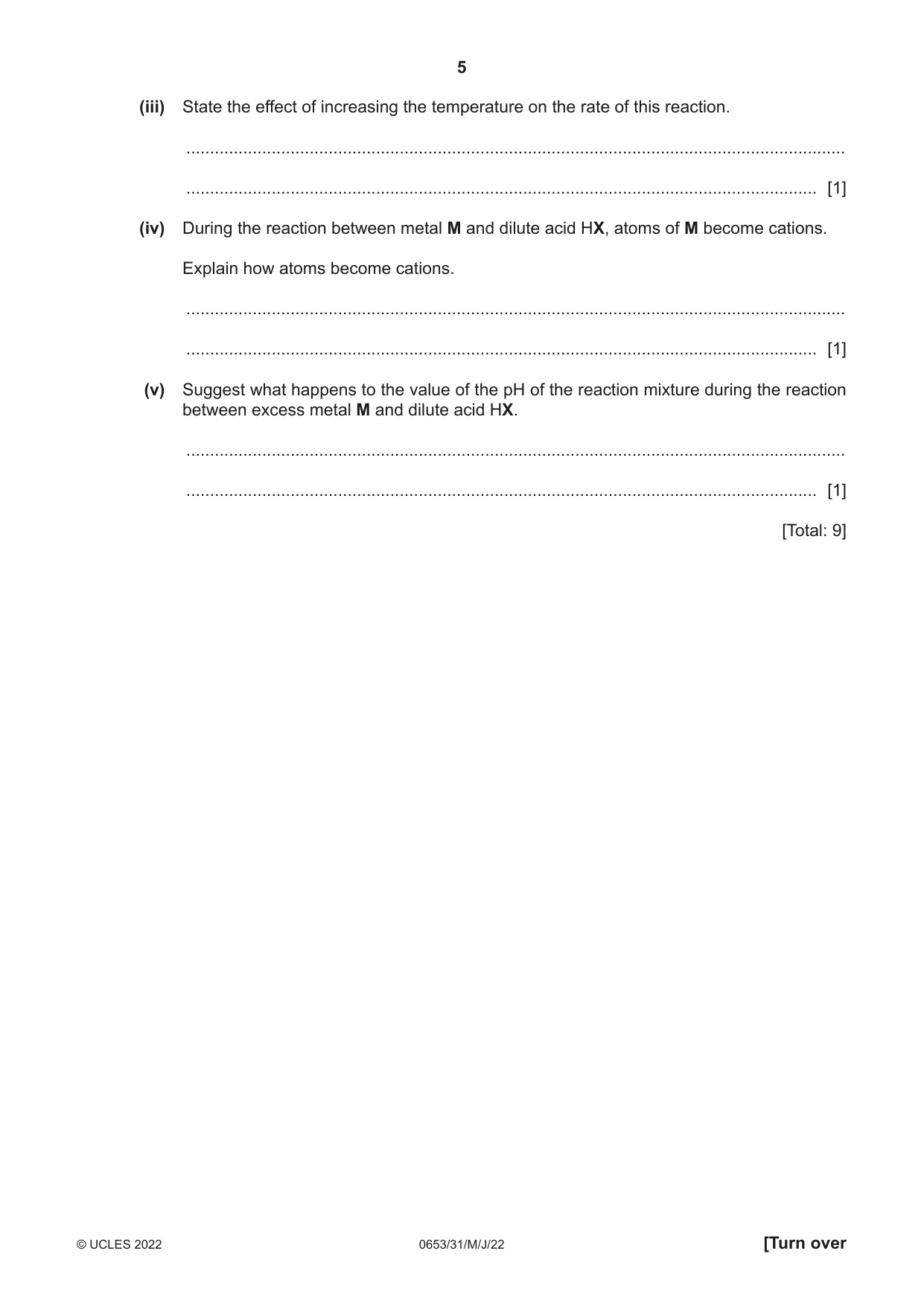
2 (a) An aqueous solution of salt MX is made by dissolving solid MX in water. (i) Identify the solvent and the solute in aqueous MX. solute ................................................................................................................................. solvent ............................................................................................................................... [2] (ii) A student tests separate samples of aqueous MX. The results are shown in Table 2.1. Complete Table 2.1 by naming the ions that these tests show are in aqueous MX. Table 2.1 test result name of ion add aqueous sodium green precipitate, insoluble in hydroxide excess add aqueous barium white precipitate ions under acidic conditions [2] (b) A student makes an aqueous solution of MX by reacting excess metal M with dilute acid HX. The student then separates the excess, unreacted solid metal M from the reaction mixture. (i) Suggest how the student separates solid metal M from the reaction mixture. ..................................................................................................................................... [1] (ii) State whether this separation process is a chemical change or a physical change. Explain your answer. change .............................................................................................................................. explanation ........................................................................................................................ ........................................................................................................................................... [1] (iii) State the effect of increasing the temperature on the rate of this reaction. ........................................................................................................................................... ..................................................................................................................................... [1] (iv) During the reaction between metal M and dilute acid HX, atoms of M become cations. Explain how atoms become cations. ........................................................................................................................................... ..................................................................................................................................... [1] (v) Suggest what happens to the value of the pH of the reaction mixture during the reaction between excess metal M and dilute acid HX. ........................................................................................................................................... ..................................................................................................................................... [1] [Total: 9]
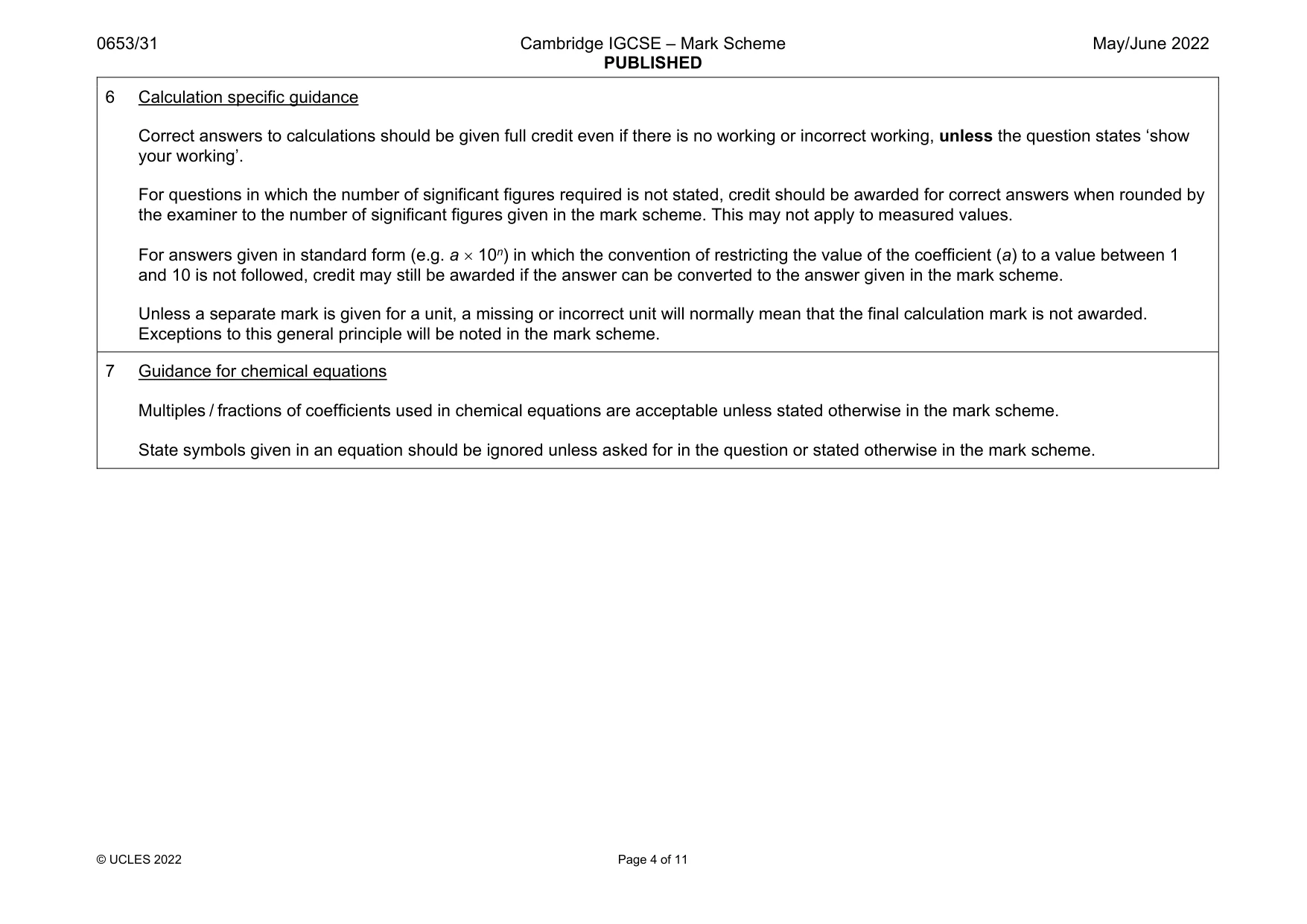
Mark scheme: 2(a)(i) (solute) MX ; (solvent) water / H2O ; 2 2(a)(ii) ;; 2 2(b)(i) filter / filtration ; 1 2(b)(ii) (change) physical AND (explanation) no new substance is made ; 1 2(b)(iii) (rate) increases ; 1 2(b)(iv) (atoms) lose electron(s) ; 1 2(b)(v) pH increases ; 1
Q3 · A man pushing a shopping trolley forwards
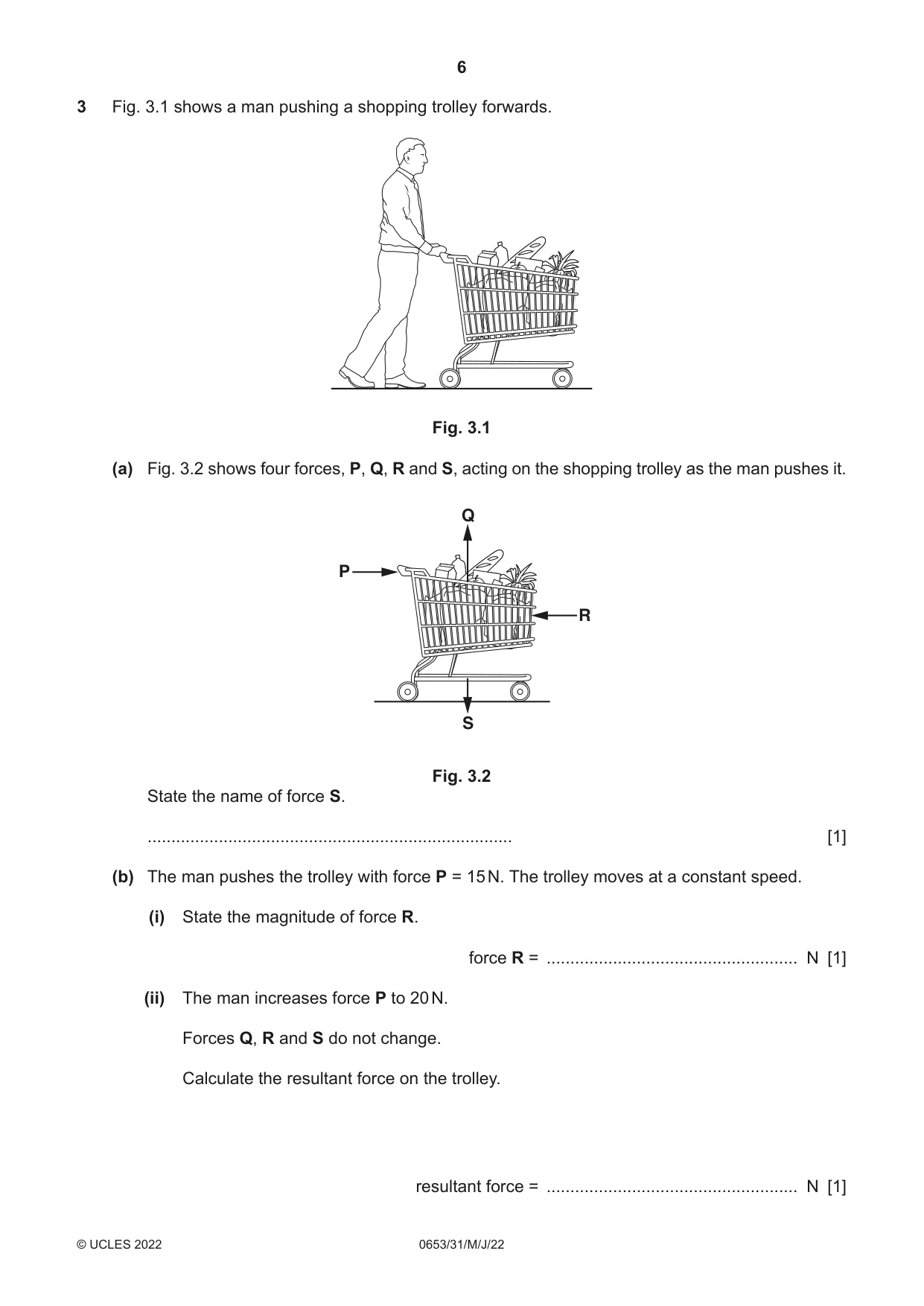
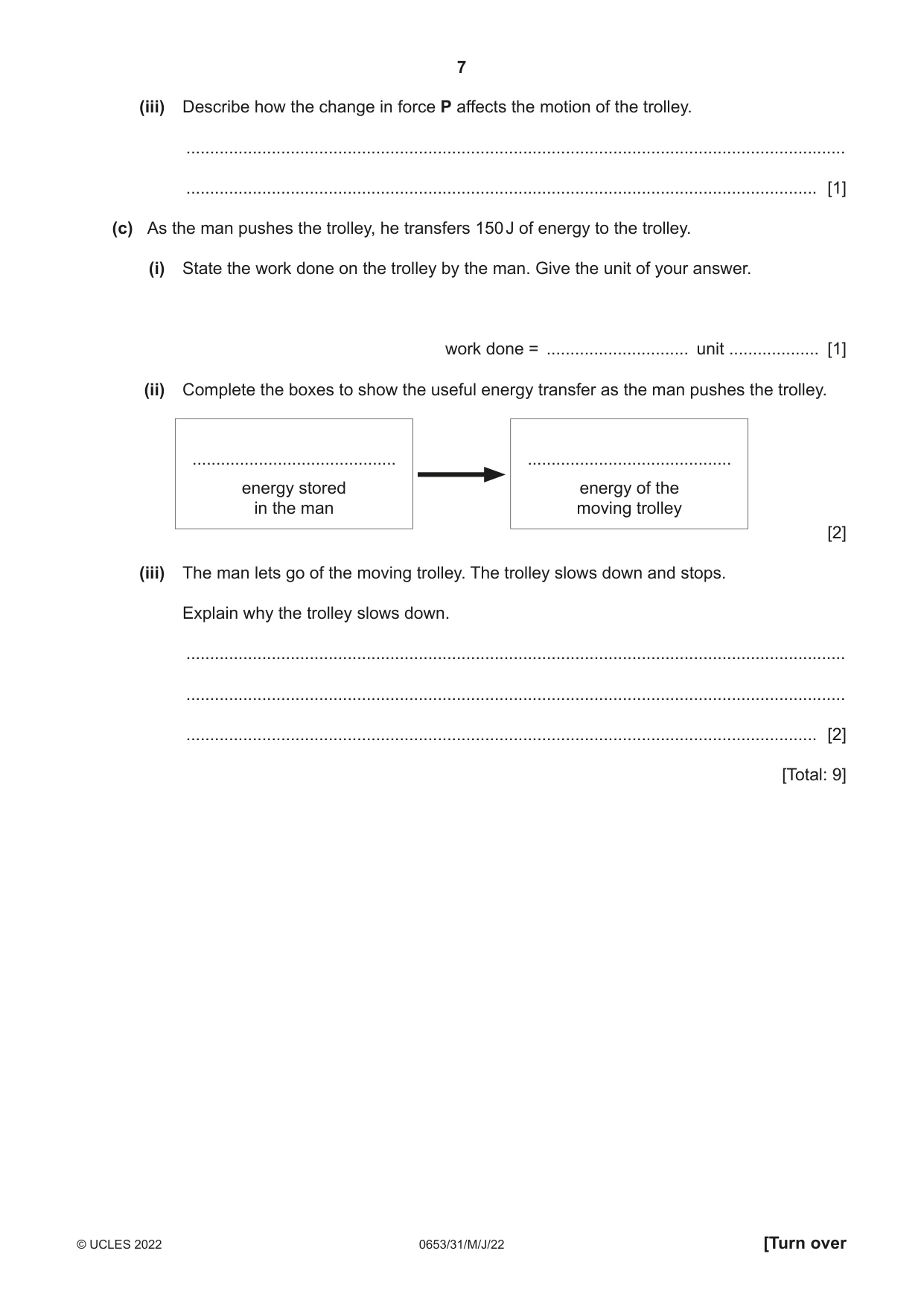
3 Fig. 3.1 shows a man pushing a shopping trolley forwards. Fig. 3.1 (a) Fig. 3.2 shows four forces, P, Q, R and S, acting on the shopping trolley as the man pushes it. Q P R S Fig. 3.2 State the name of force S. ............................................................................. [1] (b) The man pushes the trolley with force P = 15 N. The trolley moves at a constant speed. (i) State the magnitude of force R. force R = ..................................................... N [1] (ii) The man increases force P to 20 N. Forces Q, R and S do not change. Calculate the resultant force on the trolley. resultant force = ..................................................... N [1] (iii) Describe how the change in force P affects the motion of the trolley. ........................................................................................................................................... ..................................................................................................................................... [1] (c) As the man pushes the trolley, he transfers 150 J of energy to the trolley. (i) State the work done on the trolley by the man. Give the unit of your answer. work done = .............................. unit ................... [1] (ii) Complete the boxes to show the useful energy transfer as the man pushes the trolley. ........................................... ........................................... energy stored energy of the in the man moving trolley [2] (iii) The man lets go of the moving trolley. The trolley slows down and stops. Explain why the trolley slows down. ........................................................................................................................................... ........................................................................................................................................... ..................................................................................................................................... [2] [Total: 9]
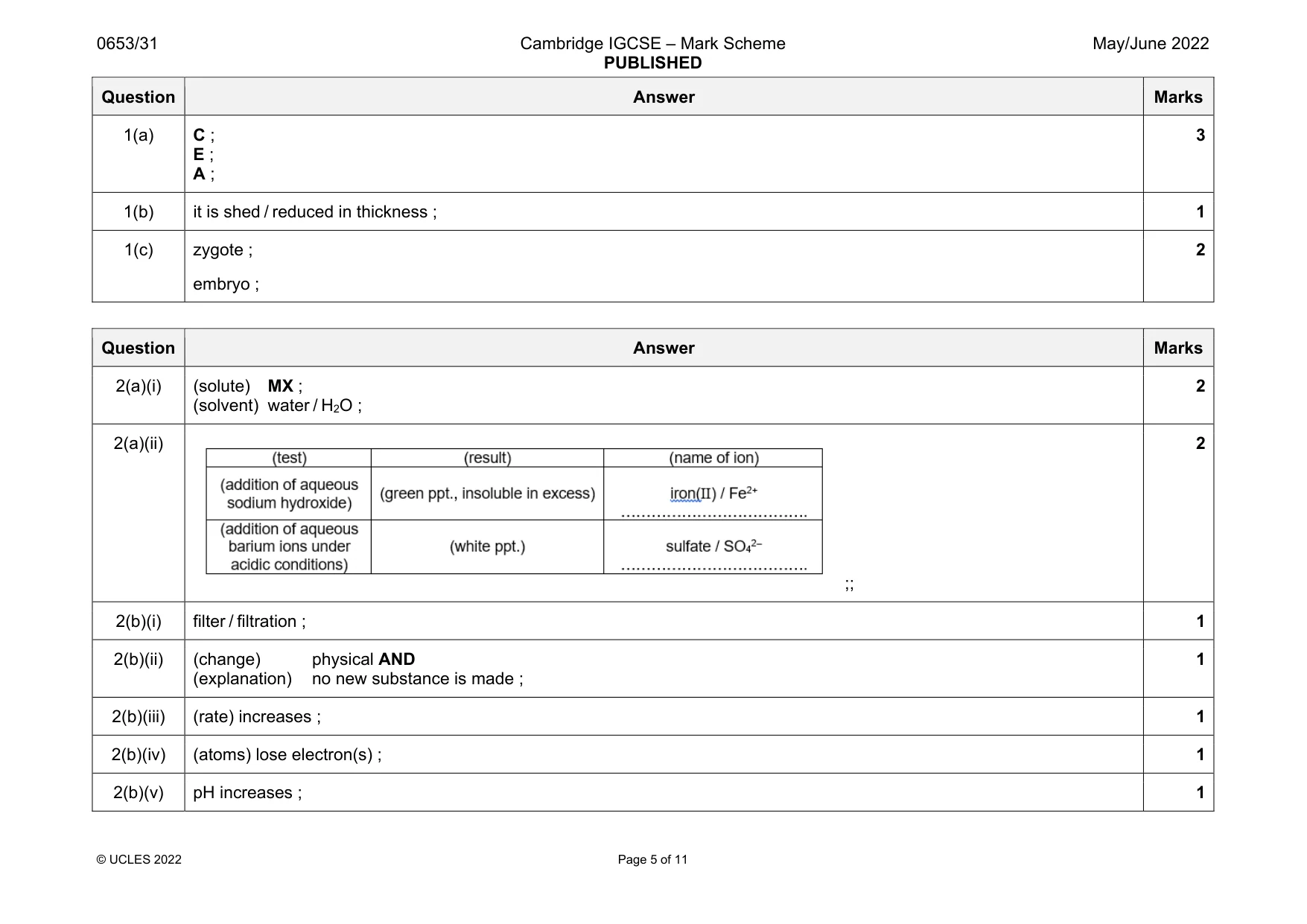
Mark scheme: 3(a) weight ; 1 3(b)(i) 15 (N) ; 1 3(b)(ii) (resultant force = 20 – 15 =) 5 (N) ; 1 3(b)(iii) (trolley) increases speed / accelerates ; 1 3(c)(i) 150 AND J ; 1 3(c)(ii) (from) chemical (potential) ; (to) kinetic ; 2 3(c)(iii) force P now zero ; friction (causes trolley to slow down) ; 2
Q4 · An image of a white blood cell
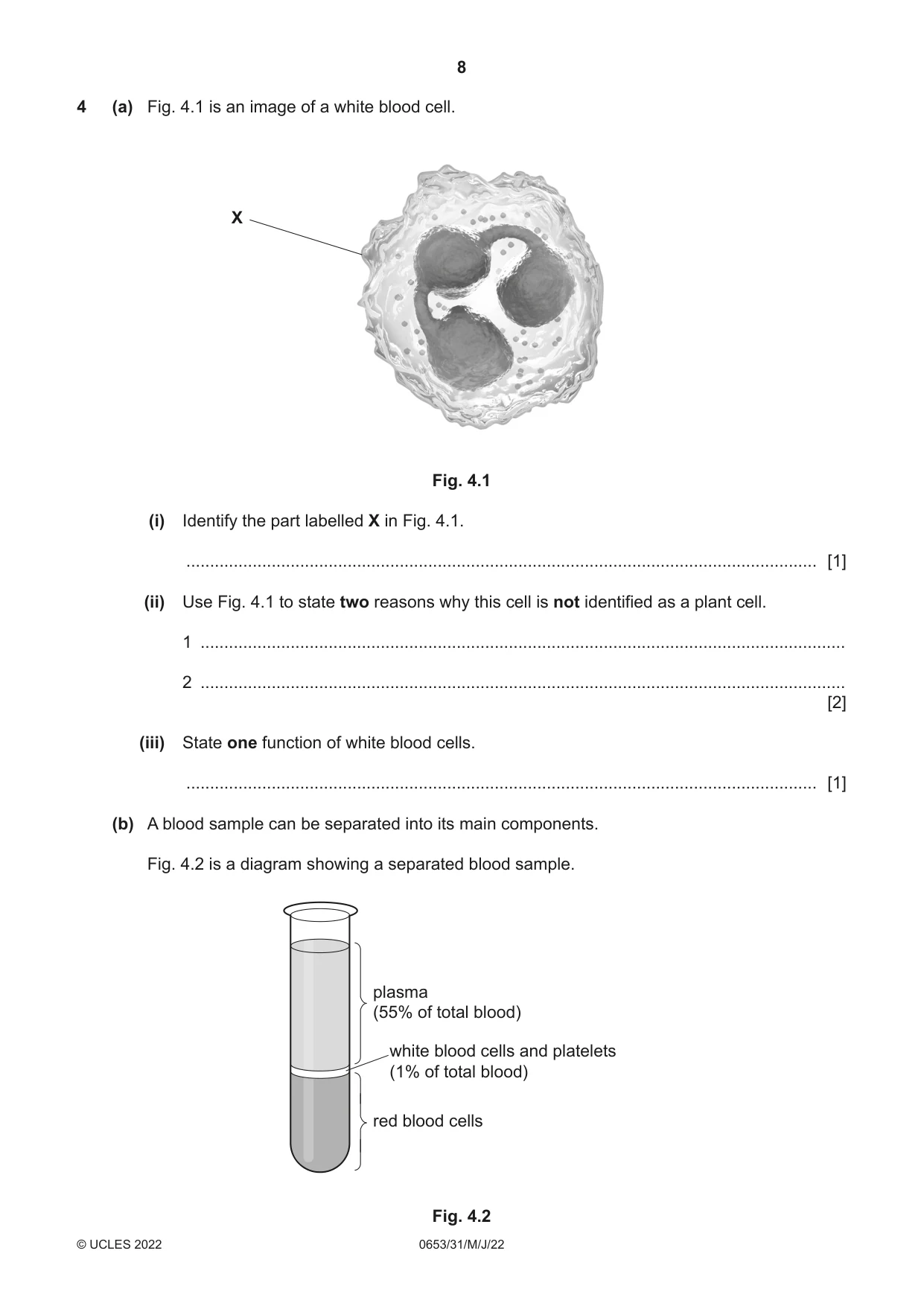
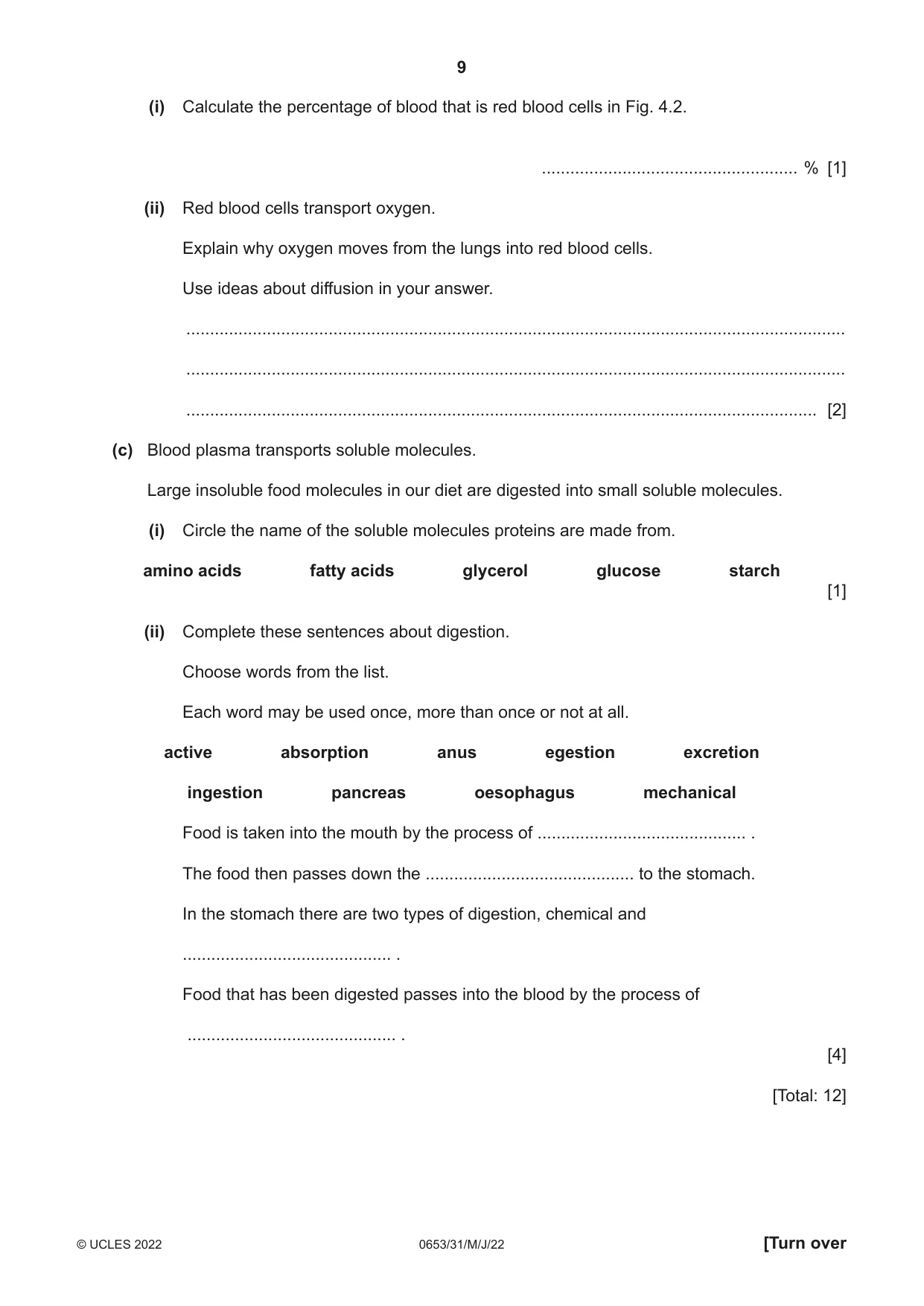
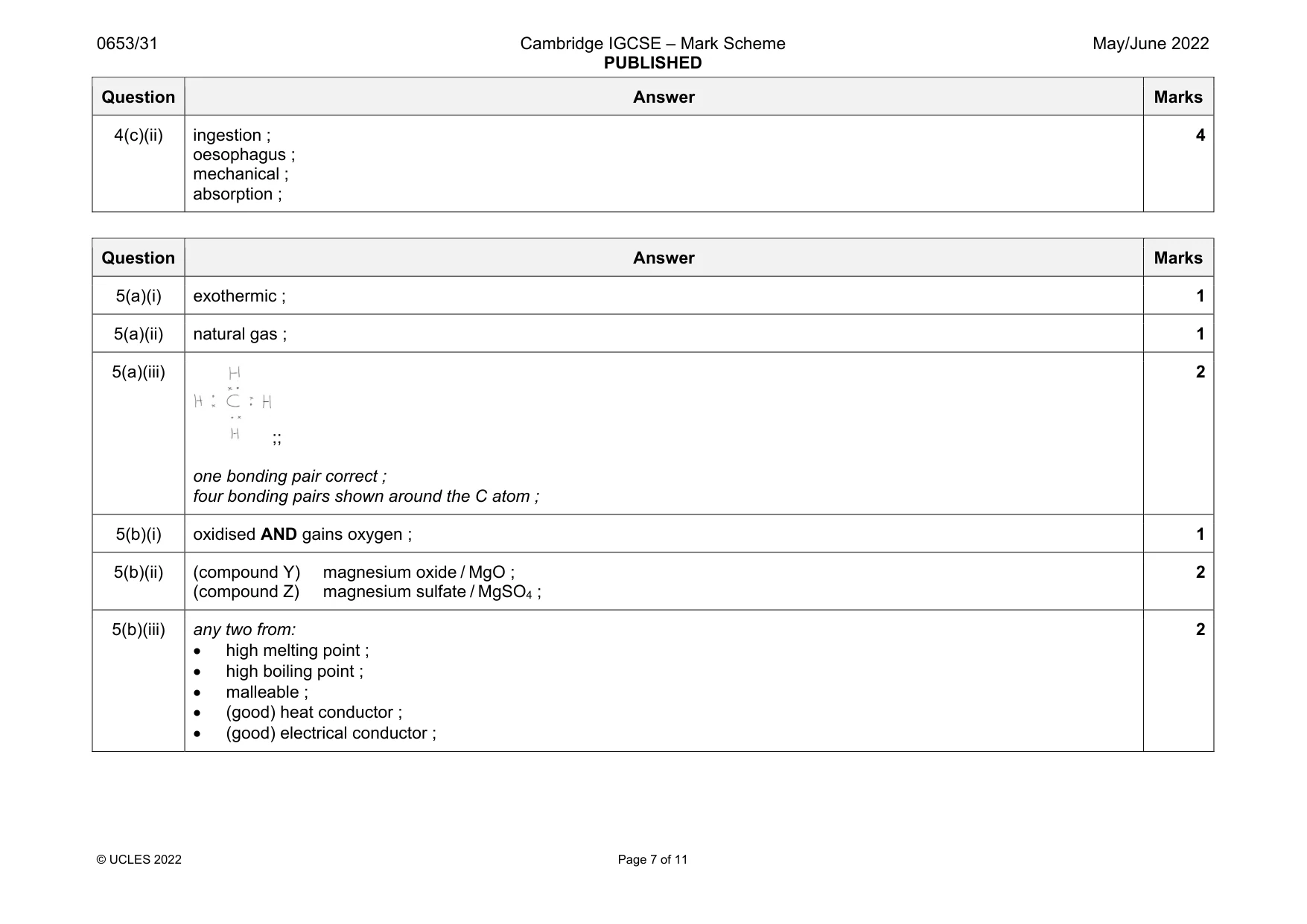
4 (a) Fig. 4.1 is an image of a white blood cell. X Fig. 4.1 (i) Identify the part labelled X in Fig. 4.1. ..................................................................................................................................... [1] (ii) Use Fig. 4.1 to state two reasons why this cell is not identified as a plant cell. 1 ........................................................................................................................................ 2 ........................................................................................................................................ [2] (iii) State one function of white blood cells. ..................................................................................................................................... [1] (b) A blood sample can be separated into its main components. Fig. 4.2 is a diagram showing a separated blood sample. plasma (55% of total blood) white blood cells and platelets (1% of total blood) red blood cells Fig. 4.2 (i) Calculate the percentage of blood that is red blood cells in Fig. 4.2. ...................................................... % [1] (ii) Red blood cells transport oxygen. Explain why oxygen moves from the lungs into red blood cells. Use ideas about diffusion in your answer. ........................................................................................................................................... ........................................................................................................................................... ..................................................................................................................................... [2] (c) Blood plasma transports soluble molecules. Large insoluble food molecules in our diet are digested into small soluble molecules. (i) Circle the name of the soluble molecules proteins are made from. amino acids fatty acids glycerol glucose starch [1] (ii) Complete these sentences about digestion. Choose words from the list. Each word may be used once, more than once or not at all. active absorption anus egestion excretion ingestion pancreas oesophagus mechanical Food is taken into the mouth by the process of ............................................ . The food then passes down the ............................................ to the stomach. In the stomach there are two types of digestion, chemical and ............................................ . Food that has been digested passes into the blood by the process of ............................................ . [4] [Total: 12]
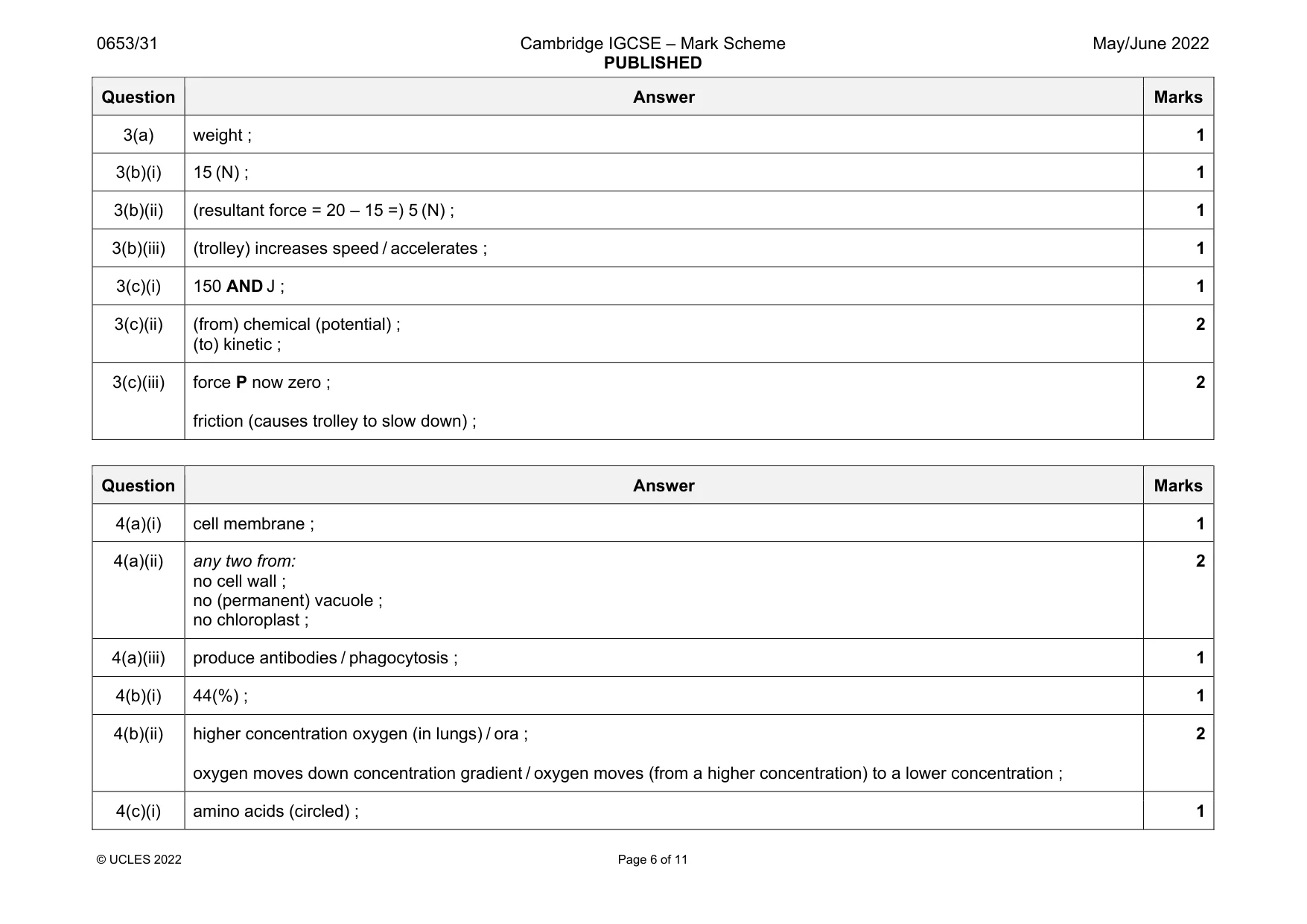
Mark scheme: 4(a)(i) cell membrane ; 1 4(a)(ii) any two from: no cell wall ; no (permanent) vacuole ; no chloroplast ; 2 4(a)(iii) produce antibodies / phagocytosis ; 1 4(b)(i) 44(%) ; 1 4(b)(ii) higher concentration oxygen (in lungs) / ora ; oxygen moves down concentration gradient / oxygen moves (from a higher concentration) to a lower concentration ; 2 4(c)(i) amino acids (circled) ; 1 Question Answer Marks 4(c)(ii) ingestion ; oesophagus ; mechanical ; absorption ; 4
Q5 · Fossil fuels release heat energy during combustion
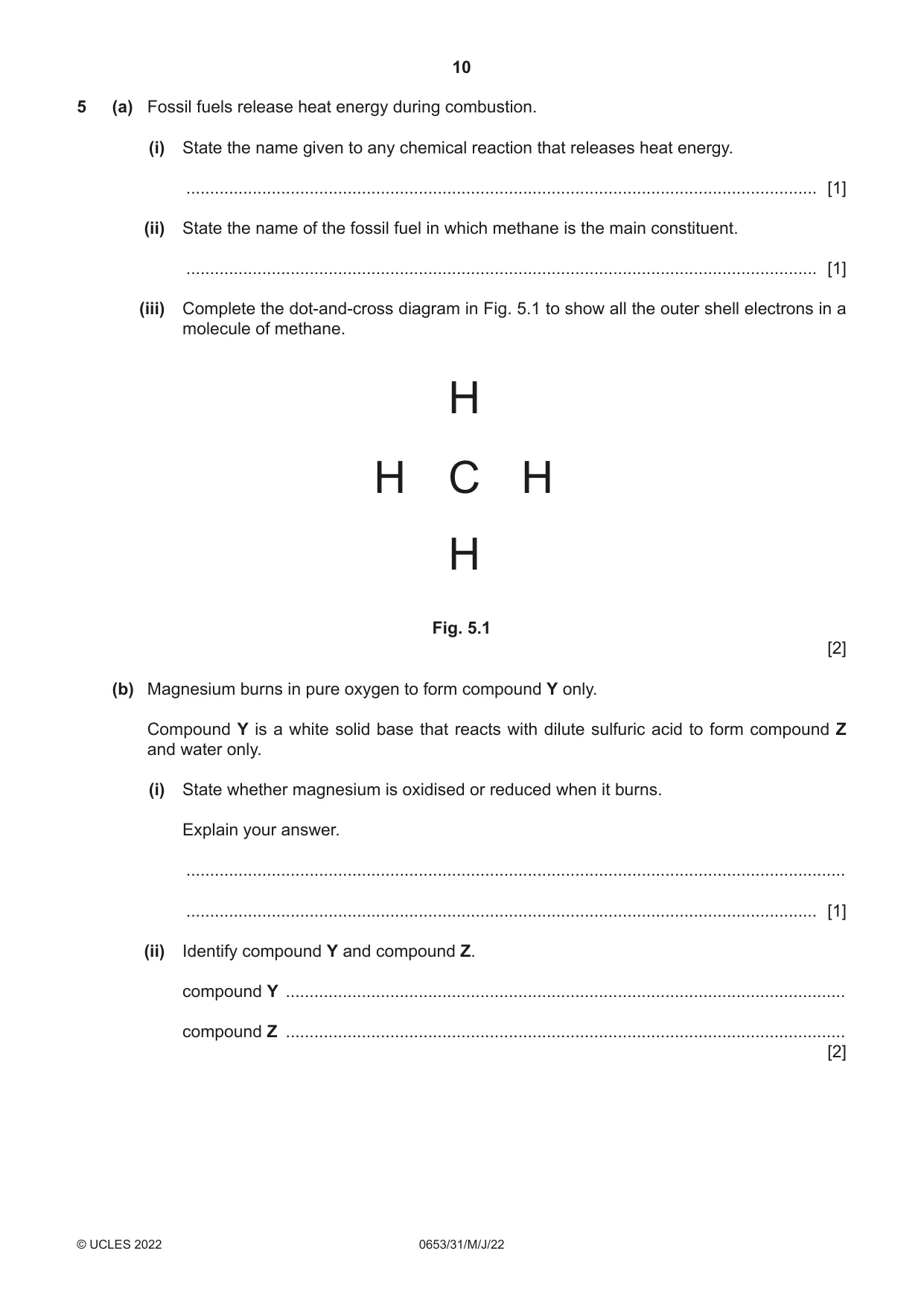
5 (a) Fossil fuels release heat energy during combustion. (i) State the name given to any chemical reaction that releases heat energy. ..................................................................................................................................... [1] (ii) State the name of the fossil fuel in which methane is the main constituent. ..................................................................................................................................... [1] (iii) Complete the dot-and-cross diagram in Fig. 5.1 to show all the outer shell electrons in a molecule of methane. H H C H H Fig. 5.1 [2] (b) Magnesium burns in pure oxygen to form compound Y only. Compound Y is a white solid base that reacts with dilute sulfuric acid to form compound Z and water only. (i) State whether magnesium is oxidised or reduced when it burns. Explain your answer. ........................................................................................................................................... ..................................................................................................................................... [1] (ii) Identify compound Y and compound Z. compound Y ...................................................................................................................... compound Z ...................................................................................................................... [2] (iii) Describe two physical properties of magnesium. 1 ........................................................................................................................................ 2 ........................................................................................................................................ [2] [Total: 9]
Mark scheme: 5(a)(i) exothermic ; 1 5(a)(ii) natural gas ; 1 5(a)(iii) ;; one bonding pair correct ; four bonding pairs shown around the C atom ; 2 5(b)(i) oxidised AND gains oxygen ; 1 5(b)(ii) (compound Y) magnesium oxide / MgO ; (compound Z) magnesium sulfate / MgSO4 ; 2 5(b)(iii) any two from: high melting point ; high boiling point ; malleable ; (good) heat conductor ; (good) electrical conductor ; 2
Q6 · Electromagnetic waves transfer energy through space from the Sun to the Earth
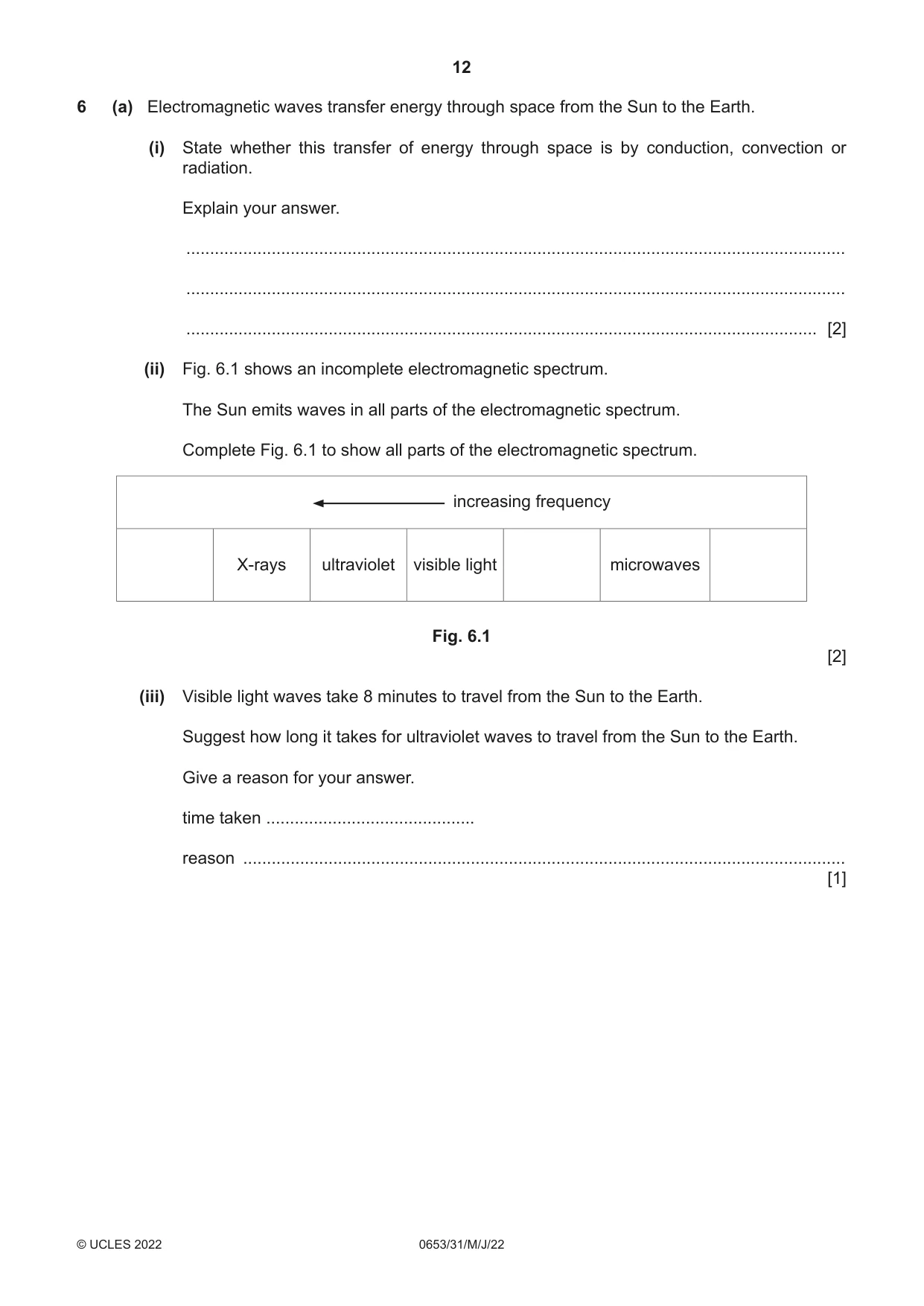
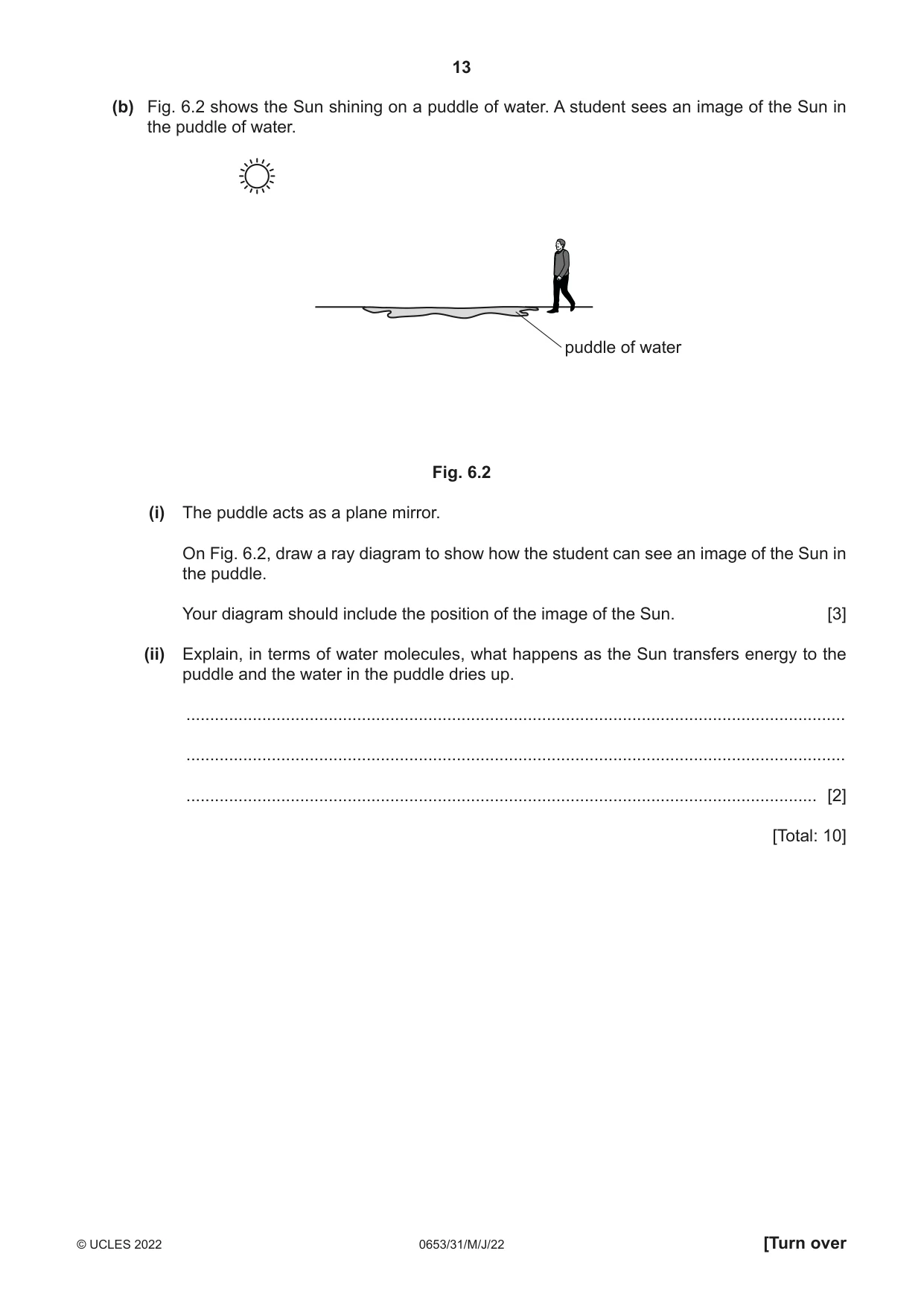
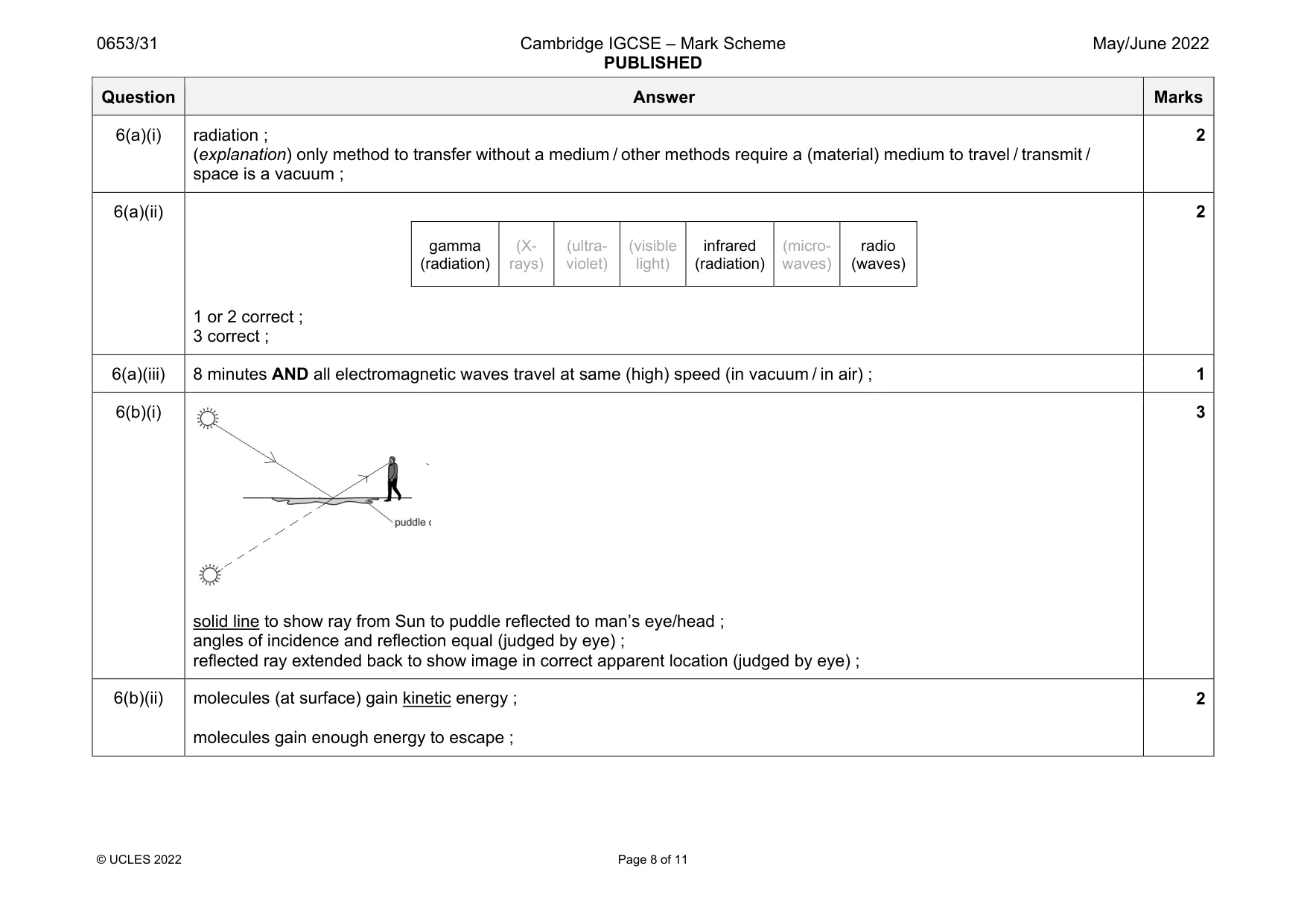
6 (a) Electromagnetic waves transfer energy through space from the Sun to the Earth. (i) State whether this transfer of energy through space is by conduction, convection or radiation. Explain your answer. ........................................................................................................................................... ........................................................................................................................................... ..................................................................................................................................... [2] (ii) Fig. 6.1 shows an incomplete electromagnetic spectrum. The Sun emits waves in all parts of the electromagnetic spectrum. Complete Fig. 6.1 to show all parts of the electromagnetic spectrum. increasing frequency X-rays ultraviolet visible light microwaves Fig. 6.1 [2] (iii) Visible light waves take 8 minutes to travel from the Sun to the Earth. Suggest how long it takes for ultraviolet waves to travel from the Sun to the Earth. Give a reason for your answer. time taken ............................................ reason ............................................................................................................................... [1] (b) Fig. 6.2 shows the Sun shining on a puddle of water. A student sees an image of the Sun in the puddle of water. puddle of water Fig. 6.2 (i) The puddle acts as a plane mirror. On Fig. 6.2, draw a ray diagram to show how the student can see an image of the Sun in the puddle. Your diagram should include the position of the image of the Sun. [3] (ii) Explain, in terms of water molecules, what happens as the Sun transfers energy to the puddle and the water in the puddle dries up. ........................................................................................................................................... ........................................................................................................................................... ..................................................................................................................................... [2] [Total: 10]
Mark scheme: 6(a)(i) radiation ; (explanation) only method to transfer without a medium / other methods require a (material) medium to travel / transmit / space is a vacuum ; 2 6(a)(ii) gamma (radiation) (X- rays) (ultra- violet) (visible light) infrared (radiation) (micro- waves) radio (waves) 1 or 2 correct ; 3 correct ; 2 6(a)(iii) 8 minutes AND all electromagnetic waves travel at same (high) speed (in vacuum / in air) ; 1 6(b)(i) solid line to show ray from Sun to puddle reflected to man’s eye/head ; angles of incidence and reflection equal (judged by eye) ; reflected ray extended back to show image in correct apparent location (judged by eye) ; 3 6(b)(ii) molecules (at surface) gain kinetic energy ; molecules gain enough energy to escape ; 2
Q7 · Part of a food web from the ocean
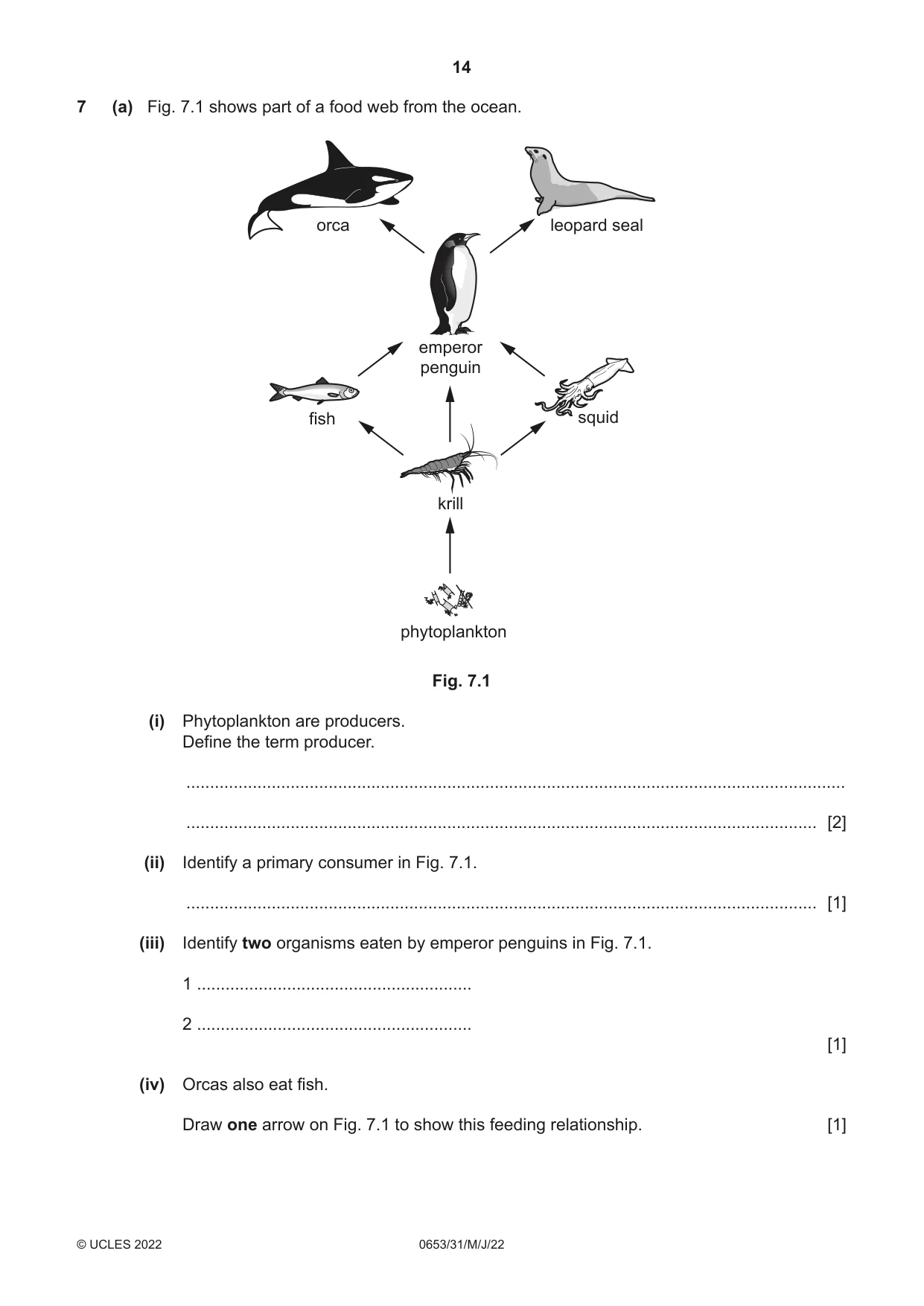
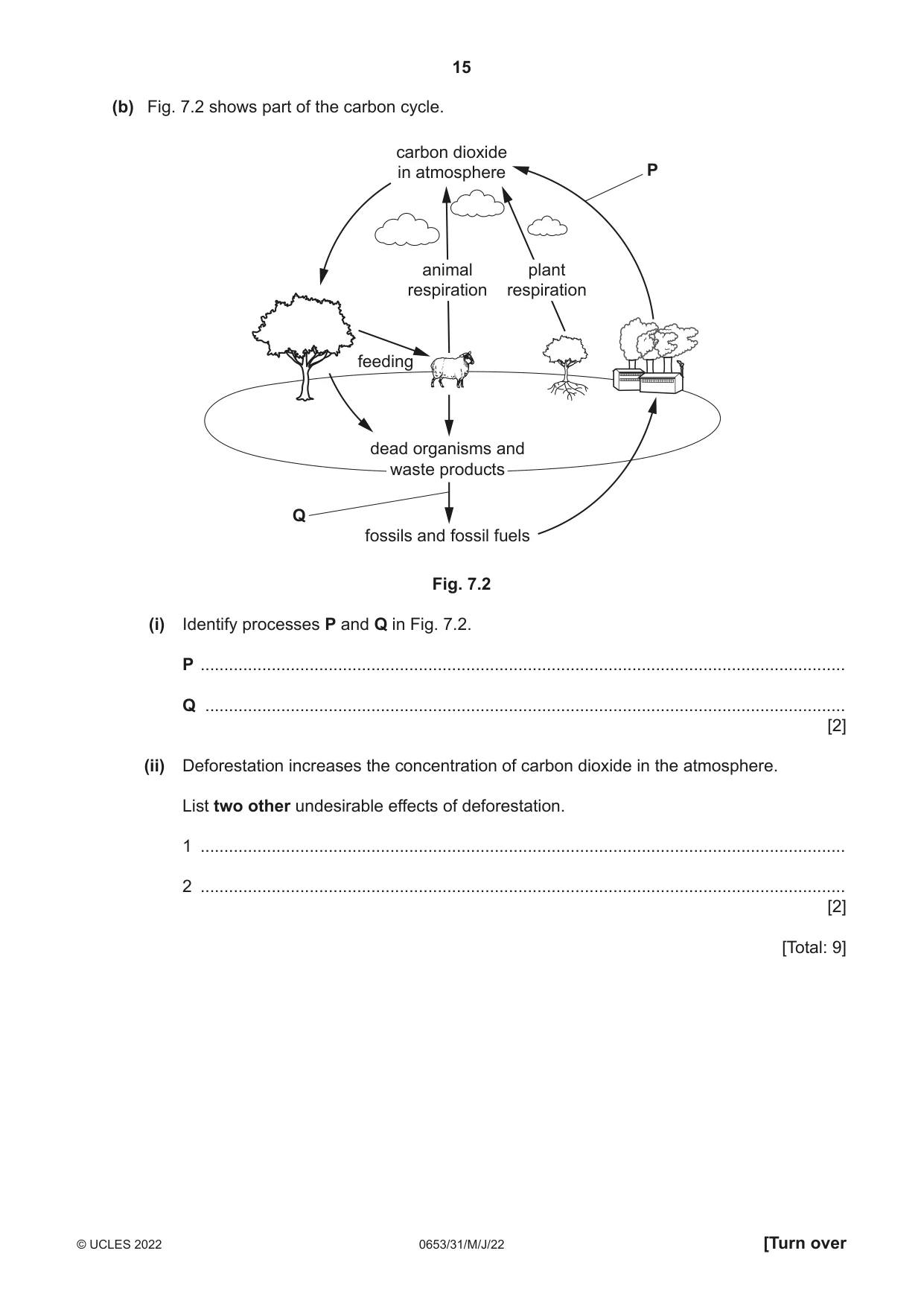
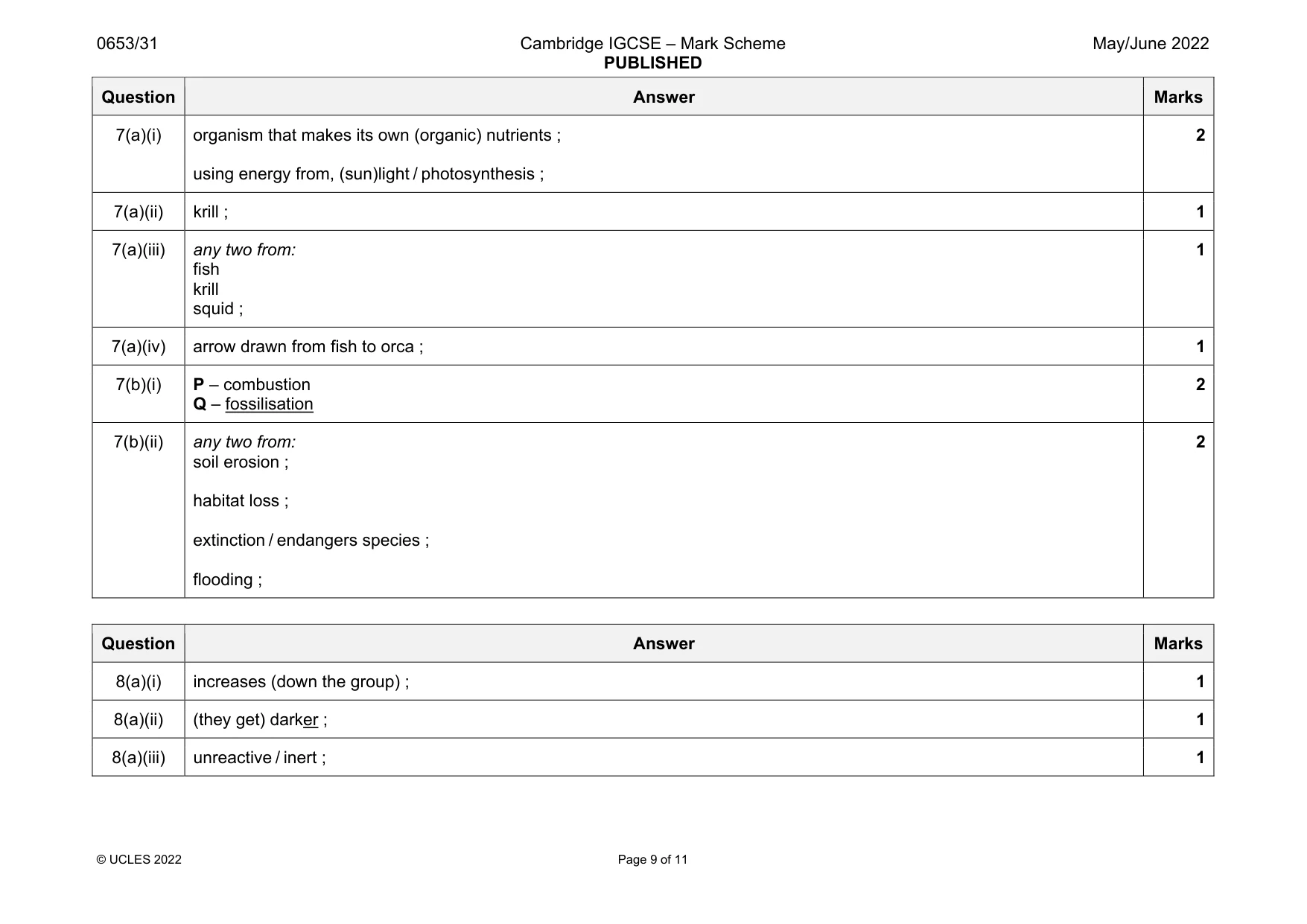
7 (a) Fig. 7.1 shows part of a food web from the ocean. orca leopard seal emperor penguin fish squid krill phytoplankton Fig. 7.1 (i) Phytoplankton are producers. Define the term producer. ........................................................................................................................................... ..................................................................................................................................... [2] (ii) Identify a primary consumer in Fig. 7.1. ..................................................................................................................................... [1] (iii) Identify two organisms eaten by emperor penguins in Fig. 7.1. 1 .......................................................... 2 .......................................................... [1] (iv) Orcas also eat fish. Draw one arrow on Fig. 7.1 to show this feeding relationship. [1] (b) Fig. 7.2 shows part of the carbon cycle. carbon dioxide in atmosphere P animal plant respiration respiration feeding dead organisms and waste products Q fossils and fossil fuels Fig. 7.2 (i) Identify processes P and Q in Fig. 7.2. P ........................................................................................................................................ Q ....................................................................................................................................... [2] (ii) Deforestation increases the concentration of carbon dioxide in the atmosphere. List two other undesirable effects of deforestation. 1 ........................................................................................................................................ 2 ........................................................................................................................................ [2] [Total: 9]
Mark scheme: 7(a)(i) organism that makes its own (organic) nutrients ; using energy from, (sun)light / photosynthesis ; 2 7(a)(ii) krill ; 1 7(a)(iii) any two from: fish krill squid ; 1 7(a)(iv) arrow drawn from fish to orca ; 1 7(b)(i) P – combustion Q – fossilisation 2 7(b)(ii) any two from: soil erosion ; habitat loss ; extinction / endangers species ; flooding ; 2
Q8 · Lithium, sodium and potassium are metals in Group I of the Periodic Table
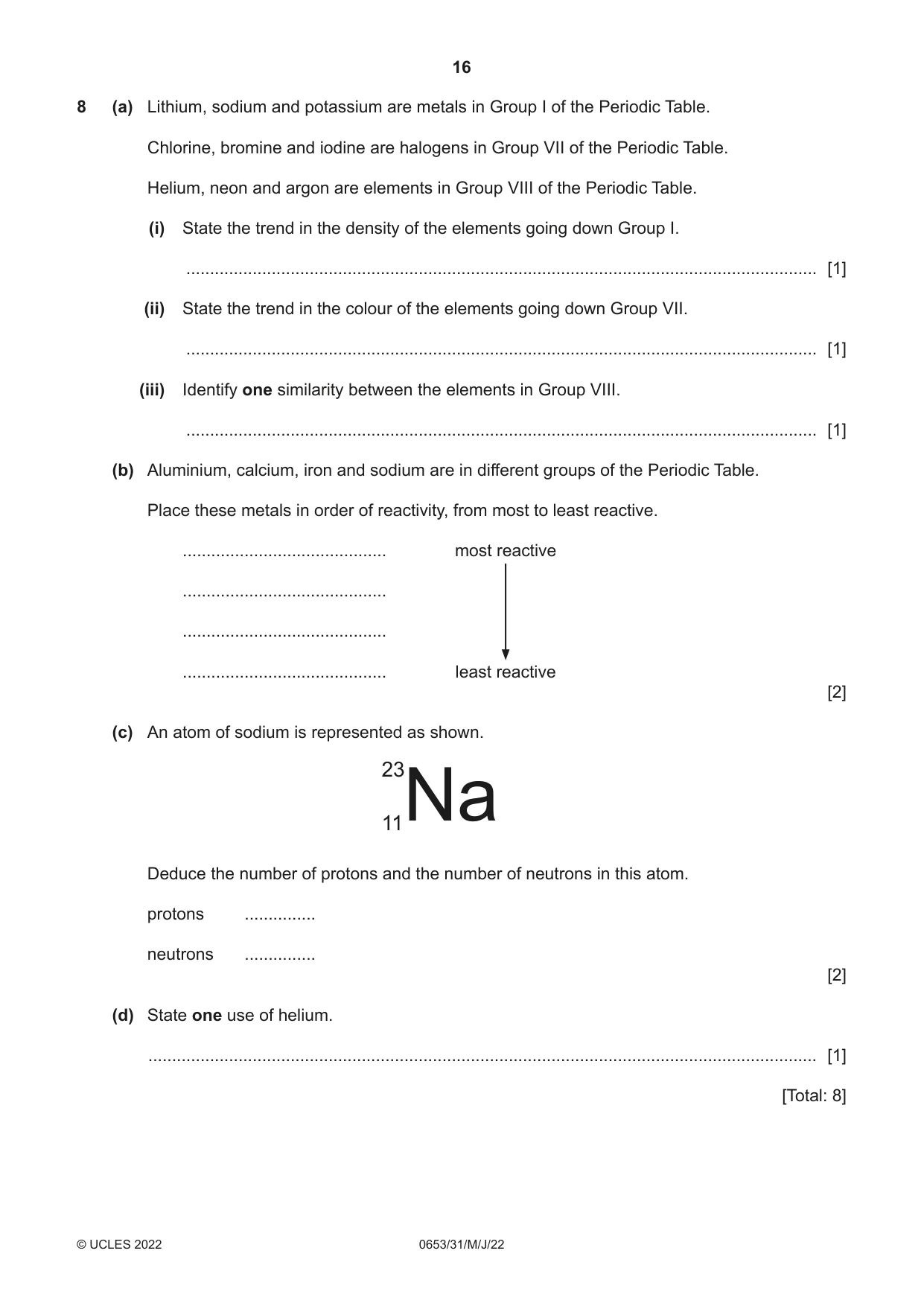
8 (a) Lithium, sodium and potassium are metals in Group I of the Periodic Table. Chlorine, bromine and iodine are halogens in Group VII of the Periodic Table. Helium, neon and argon are elements in Group VIII of the Periodic Table. (i) State the trend in the density of the elements going down Group I. ..................................................................................................................................... [1] (ii) State the trend in the colour of the elements going down Group VII. ..................................................................................................................................... [1] (iii) Identify one similarity between the elements in Group VIII. ..................................................................................................................................... [1] (b) Aluminium, calcium, iron and sodium are in different groups of the Periodic Table. Place these metals in order of reactivity, from most to least reactive. ........................................... most reactive ........................................... ........................................... ........................................... least reactive [2] (c) An atom of sodium is represented as shown. 23 11Na Deduce the number of protons and the number of neutrons in this atom. protons ............... neutrons ............... [2] (d) State one use of helium. ............................................................................................................................................. [1] [Total: 8]
Mark scheme: 8(a)(i) increases (down the group) ; 1 8(a)(ii) (they get) darker ; 1 8(a)(iii) unreactive / inert ; 1 Question Answer Marks 8(b) sodium calcium aluminium iron ;; all correct (2) sodium is most reactive (1) 2 8(c) (protons) 11 ; (neutrons) 12 ; 2 8(d) filling balloons ; 1
Q9 · Complete the following sentences using the terms shown
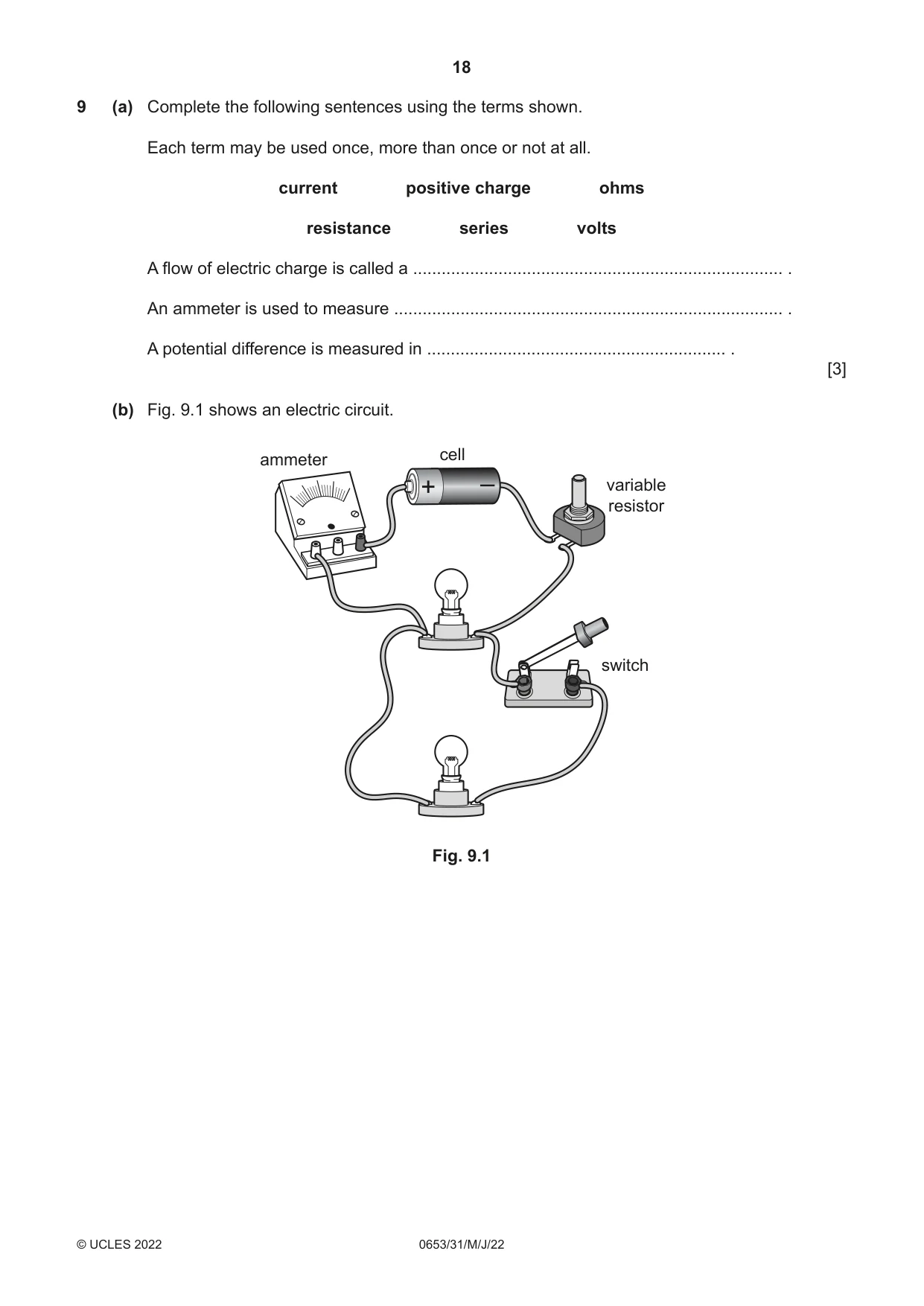
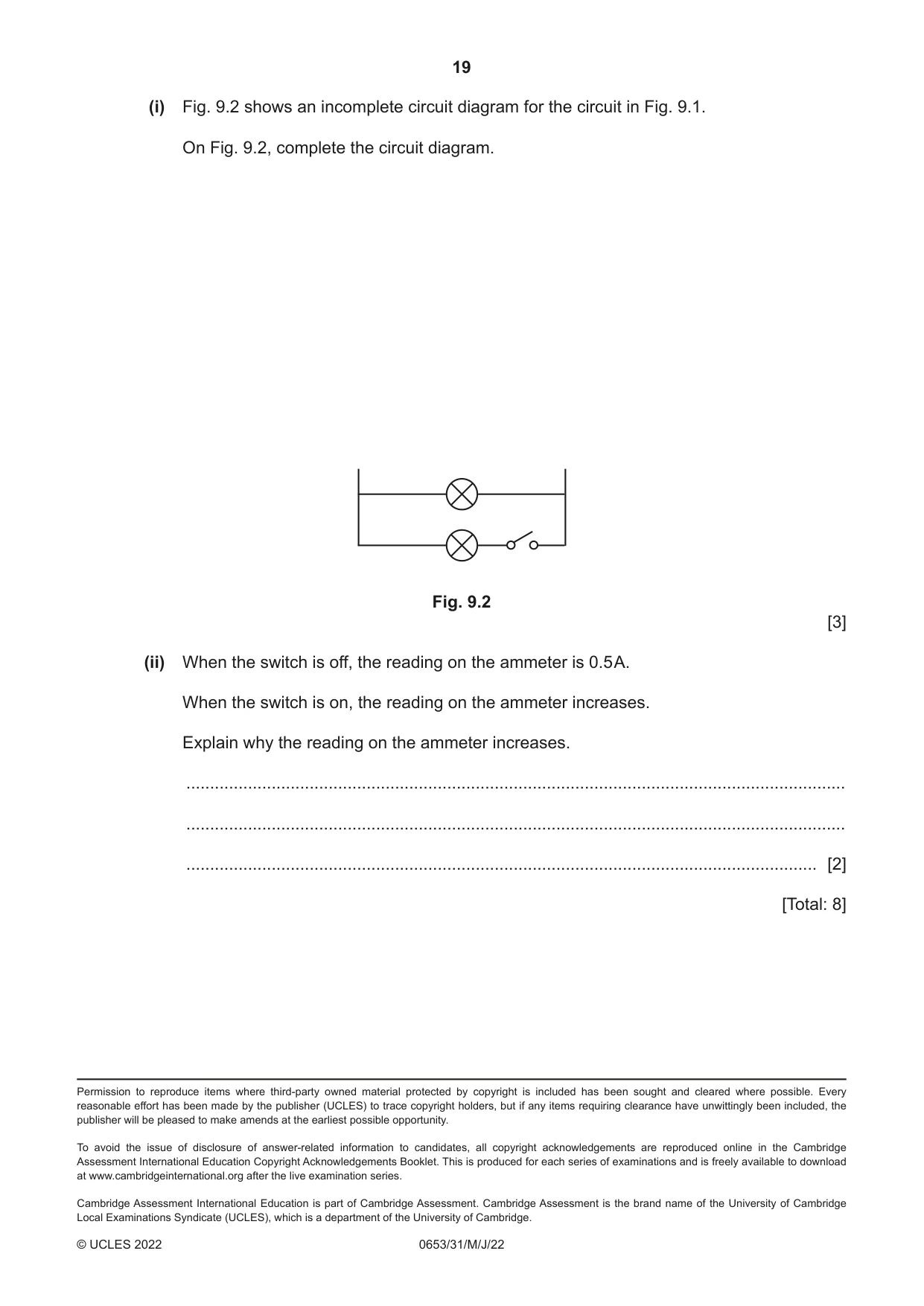
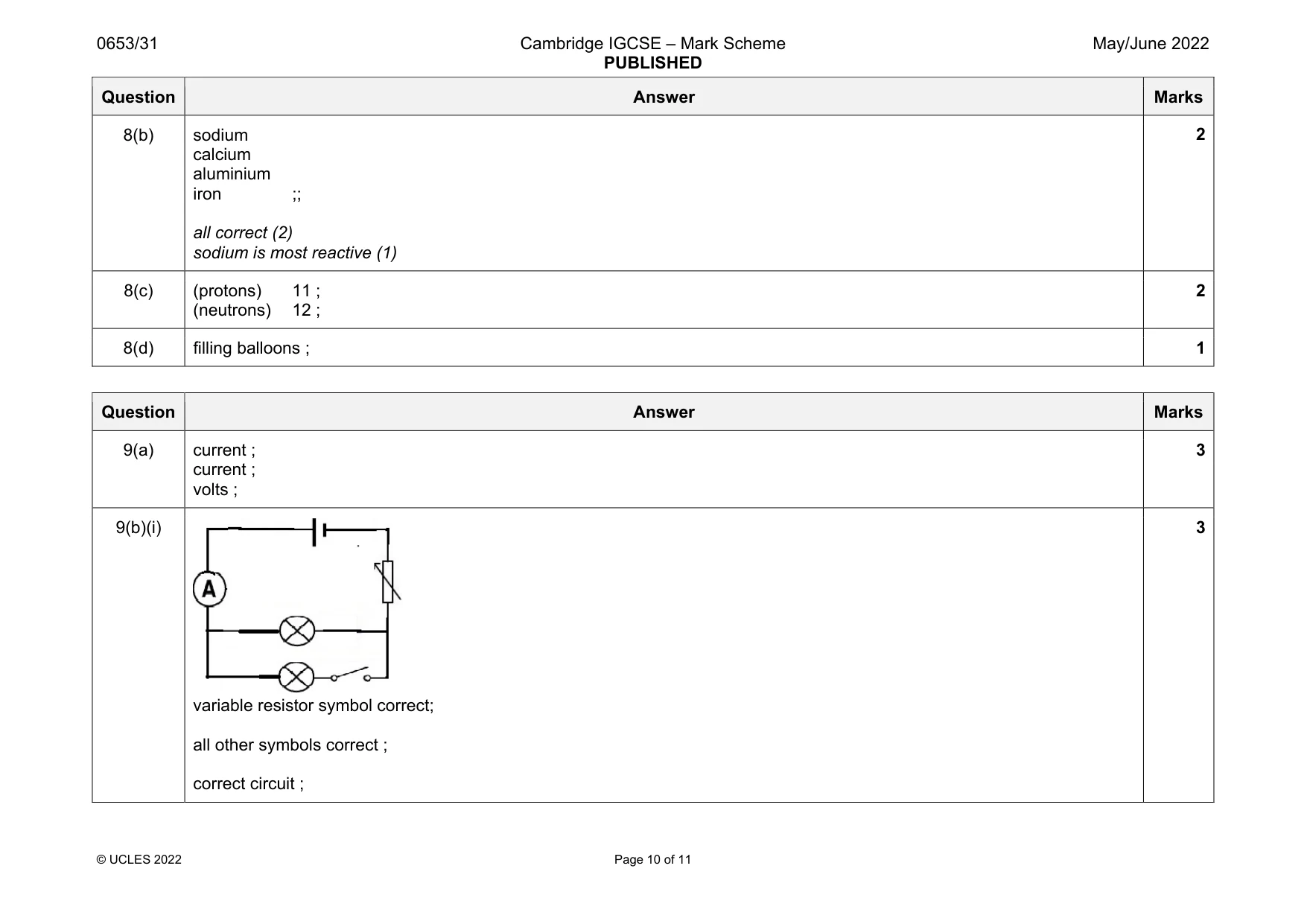
9 (a) Complete the following sentences using the terms shown. Each term may be used once, more than once or not at all. current positive charge ohms resistance series volts A flow of electric charge is called a .............................................................................. . An ammeter is used to measure .................................................................................. . A potential difference is measured in ............................................................... . [3] (b) Fig. 9.1 shows an electric circuit. cell ammeter variable + – resistor switch Fig. 9.1 (i) Fig. 9.2 shows an incomplete circuit diagram for the circuit in Fig. 9.1. On Fig. 9.2, complete the circuit diagram. Fig. 9.2 [3] (ii) When the switch is off, the reading on the ammeter is 0.5 A. When the switch is on, the reading on the ammeter increases. Explain why the reading on the ammeter increases. ........................................................................................................................................... ........................................................................................................................................... ..................................................................................................................................... [2] [Total: 8]
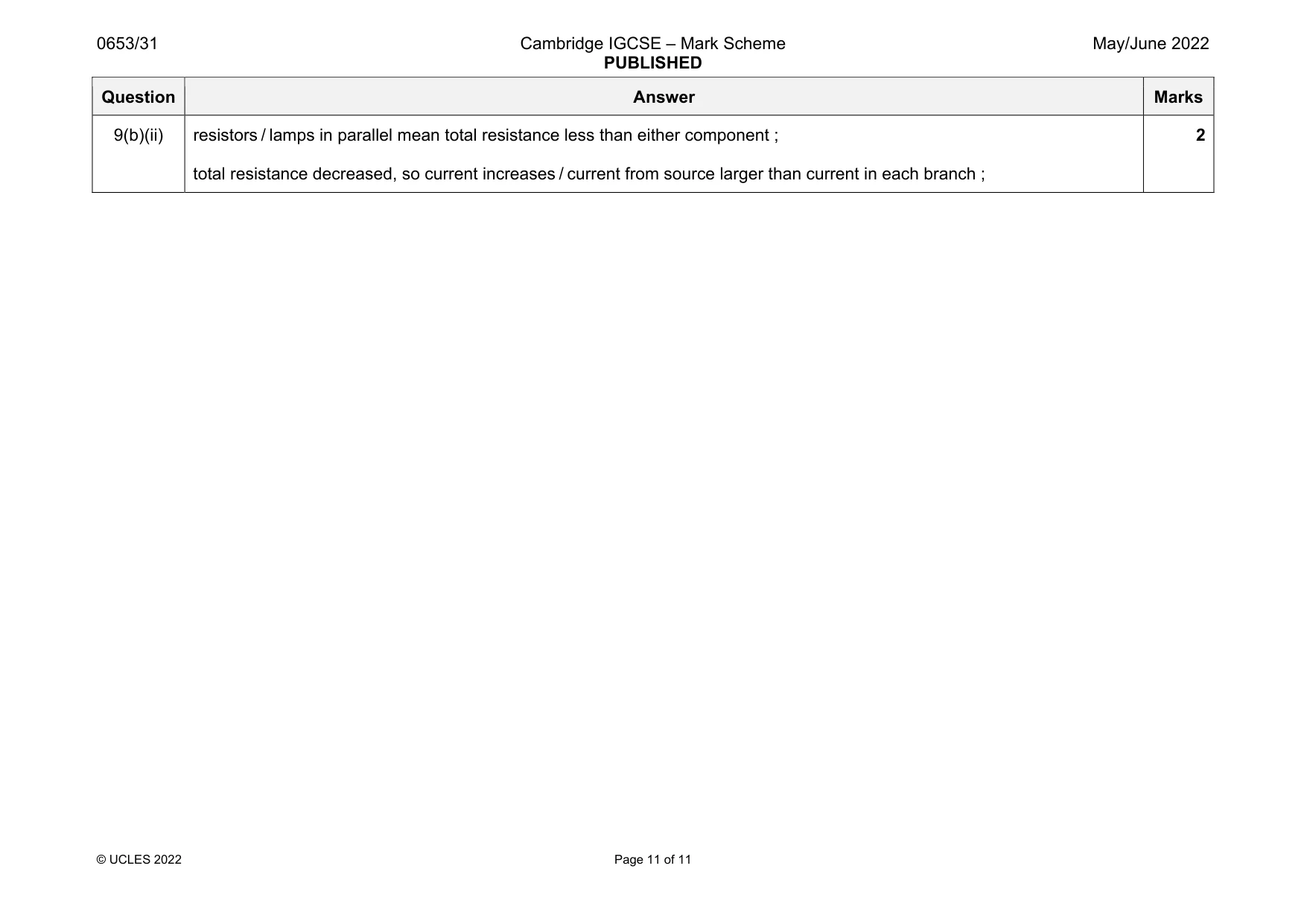
Mark scheme: 9(a) current ; current ; volts ; 3 9(b)(i) variable resistor symbol correct; all other symbols correct ; correct circuit ; 3 Question Answer Marks 9(b)(ii) resistors / lamps in parallel mean total resistance less than either component ; total resistance decreased, so current increases / current from source larger than current in each branch ; 2
What was in this paper
The subtopics covered by these 9 questions, and how many questions each got. Open one in a new tab to see every Cambridge question on it.
What you needed in this session
Cambridge’s own grade thresholds for 2022 May/June, Paper 3 · Variant 1. A higher threshold means an easier paper — the bar moves with how the cohort did.