Cambridge IGCSE Science - Combined 0653 — 2017 Oct/Nov Paper 3 · Variant 2
0653/32/O/N/17 · 9 questions · 80 marks · ≈90 min
The question paper and its mark scheme, free to read here and free to download. This is Cambridge’s own paper, exactly as it was sat.
Question paper20 pages
Mark scheme7 pages
Answers below. Sit the paper first if you are practising.
Questions as text
Q1 · Use the following numbers or words to complete the sentences about the menstrual cycle
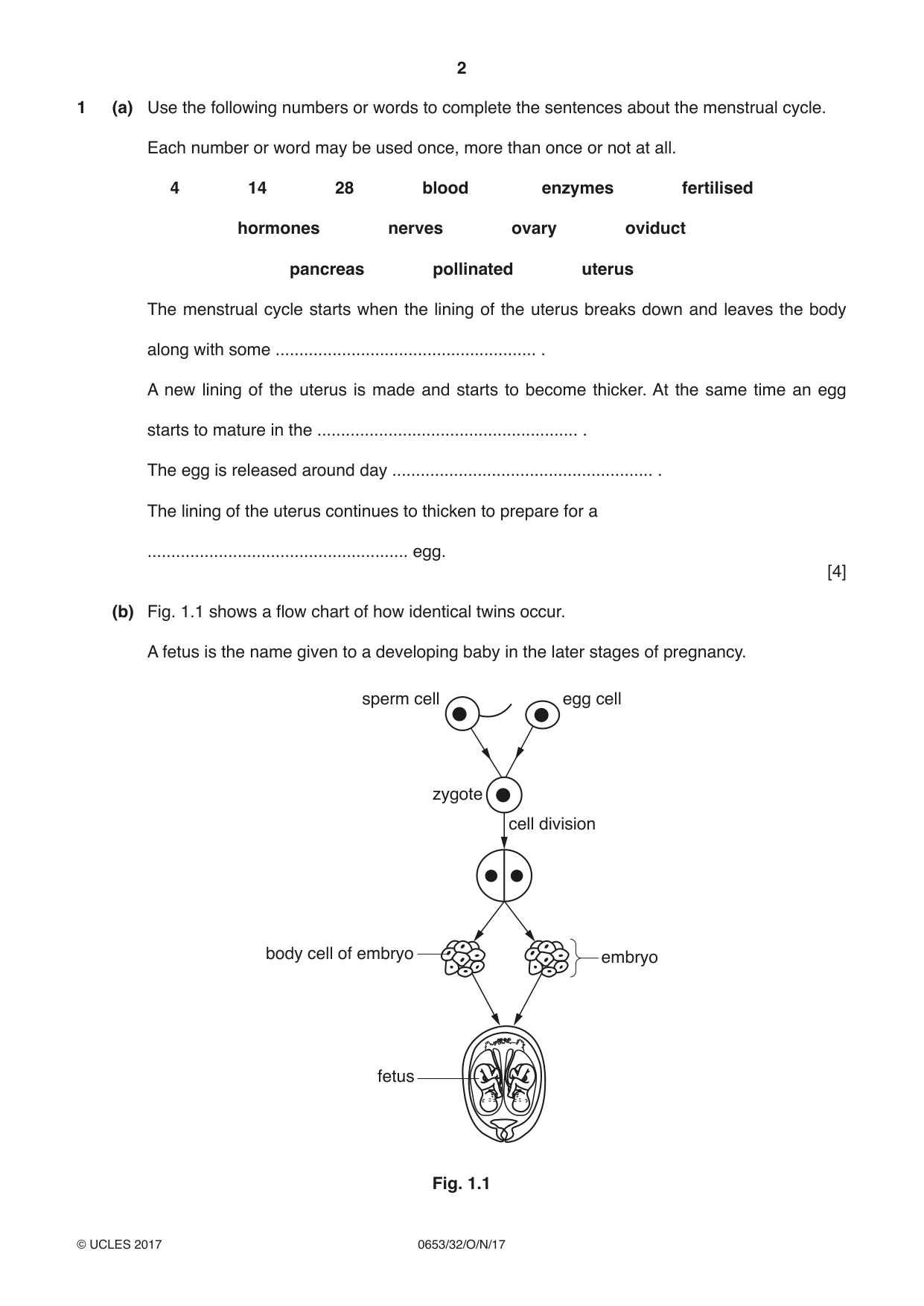
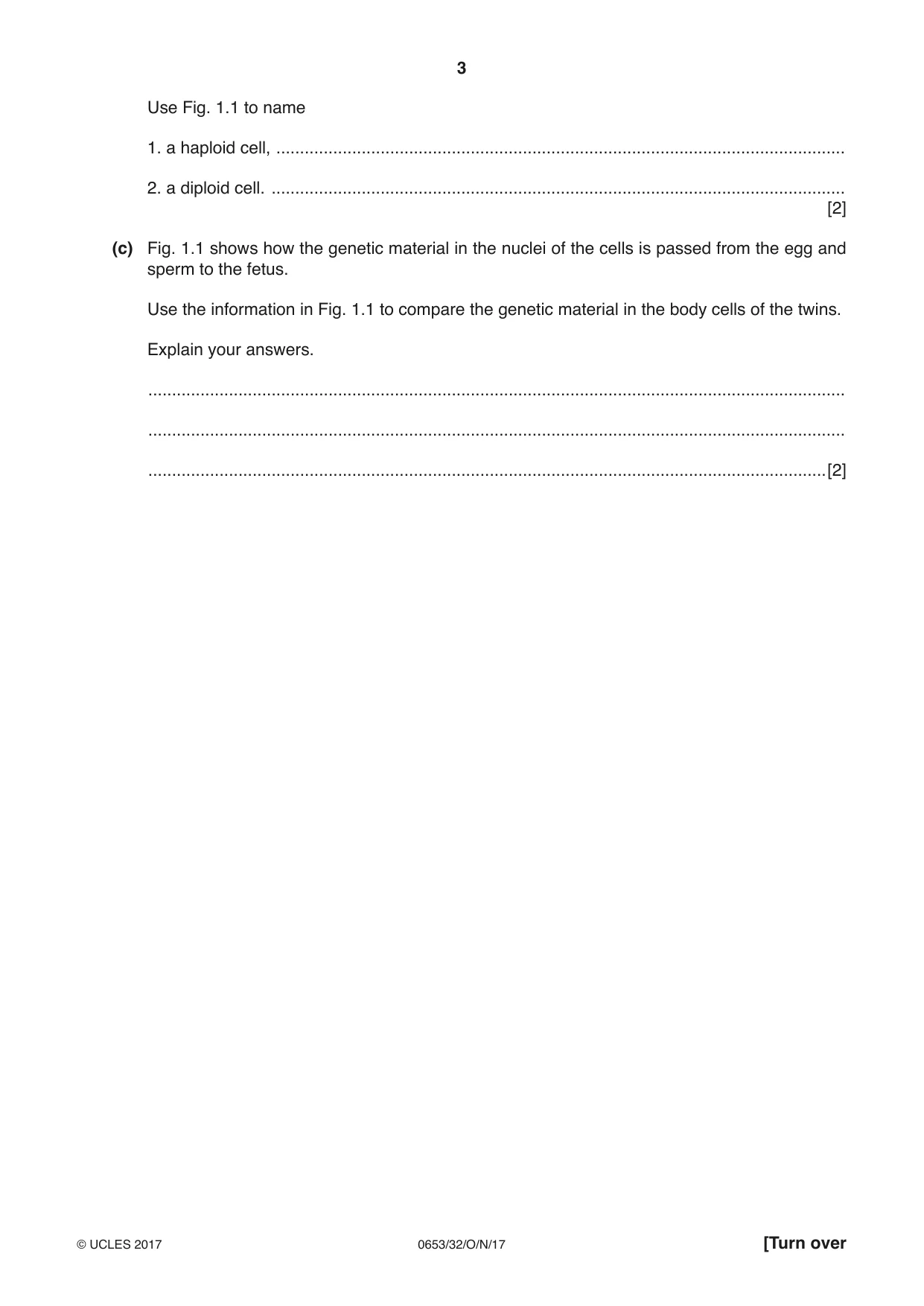
1 (a) Use the following numbers or words to complete the sentences about the menstrual cycle. Each number or word may be used once, more than once or not at all. 4 14 28 blood enzymes fertilised hormones nerves ovary oviduct pancreas pollinated uterus The menstrual cycle starts when the lining of the uterus breaks down and leaves the body along with some ....................................................... . A new lining of the uterus is made and starts to become thicker. At the same time an egg starts to mature in the ....................................................... . The egg is released around day ....................................................... . The lining of the uterus continues to thicken to prepare for a ....................................................... egg. [4] (b) Fig. 1.1 shows a flow chart of how identical twins occur. A fetus is the name given to a developing baby in the later stages of pregnancy. sperm cell egg cell zygote cell division body cell of embryo embryo fetus Fig. 1.1 Use Fig. 1.1 to name 1. a haploid cell, ........................................................................................................................ 2. a diploid cell. ......................................................................................................................... [2] (c) Fig. 1.1 shows how the genetic material in the nuclei of the cells is passed from the egg and sperm to the fetus. Use the information in Fig. 1.1 to compare the genetic material in the body cells of the twins. Explain your answers. ................................................................................................................................................... ................................................................................................................................................... ...............................................................................................................................................[2]
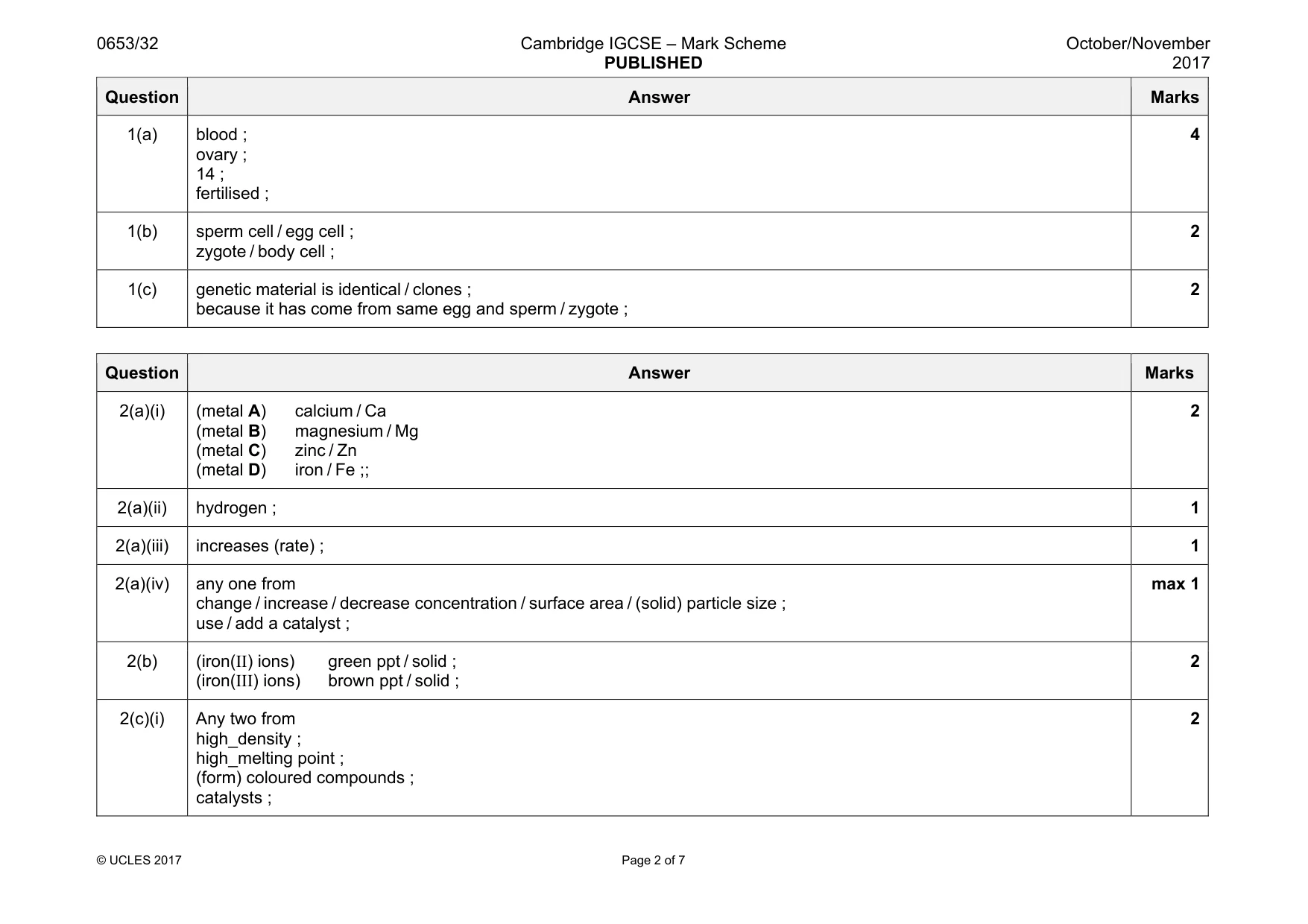
Mark scheme: 1(a) blood ; ovary ; 14 ; fertilised ; 4 1(b) sperm cell / egg cell ; zygote / body cell ; 2 1(c) genetic material is identical / clones ; because it has come from same egg and sperm / zygote ; 2
Q2 · A student places four pieces of metal, at the same time, into separate beakers containing…
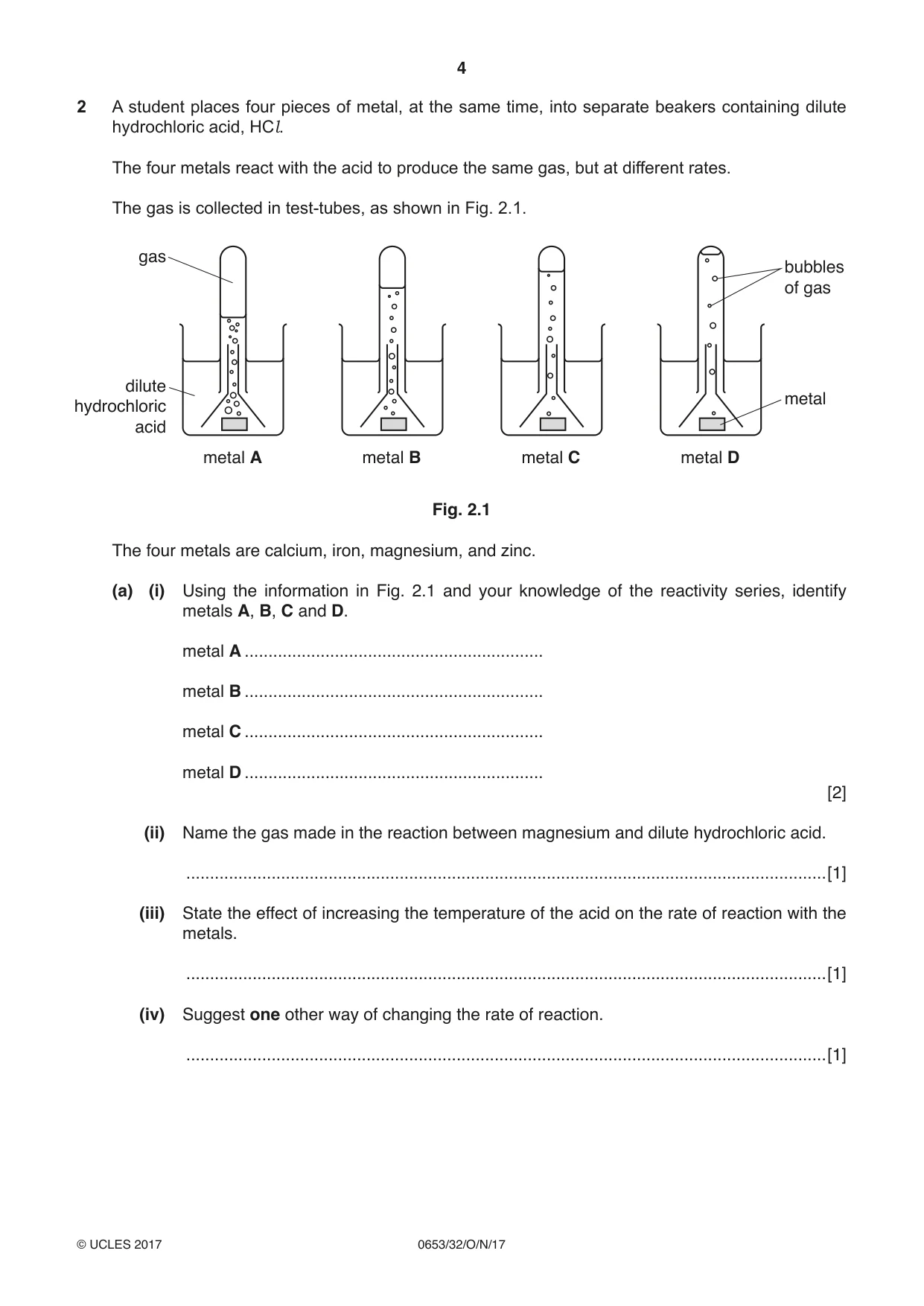
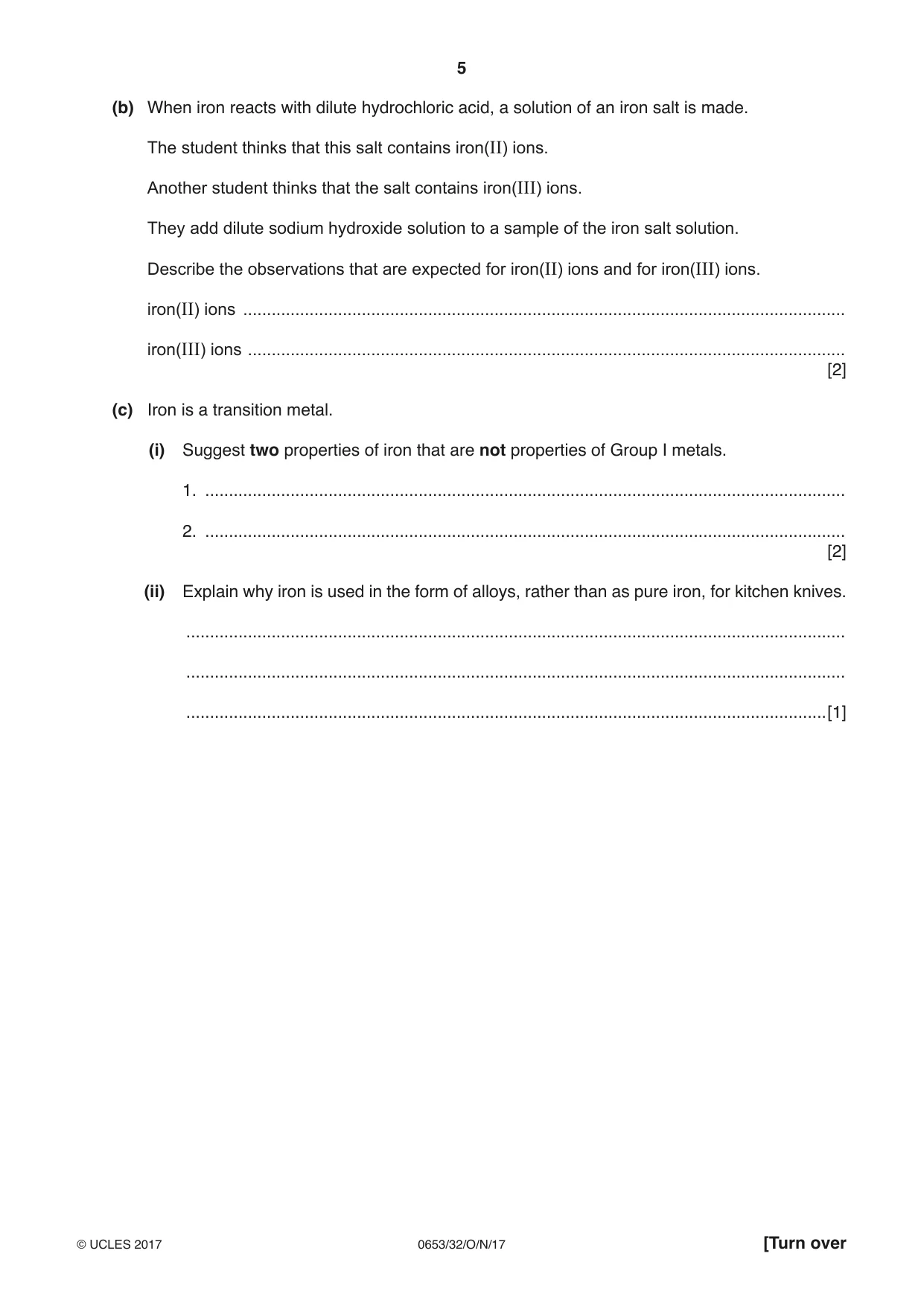
2 A student places four pieces of metal, at the same time, into separate beakers containing dilute hydrochloric acid, HCl. The four metals react with the acid to produce the same gas, but at different rates. The gas is collected in test-tubes, as shown in Fig. 2.1. gas bubbles of gas dilute metalhydrochloric acid metal A metal B metal C metal D Fig. 2.1 The four metals are calcium, iron, magnesium, and zinc. (a) (i) Using the information in Fig. 2.1 and your knowledge of the reactivity series, identify metals A, B, C and D. metal A ............................................................... metal B ............................................................... metal C ............................................................... metal D ............................................................... [2] (ii) Name the gas made in the reaction between magnesium and dilute hydrochloric acid. .......................................................................................................................................[1] (iii) State the effect of increasing the temperature of the acid on the rate of reaction with the metals. .......................................................................................................................................[1] (iv) Suggest one other way of changing the rate of reaction. .......................................................................................................................................[1] (b) When iron reacts with dilute hydrochloric acid, a solution of an iron salt is made. The student thinks that this salt contains iron(II) ions. Another student thinks that the salt contains iron(III) ions. They add dilute sodium hydroxide solution to a sample of the iron salt solution. Describe the observations that are expected for iron(II) ions and for iron(III) ions. iron(II) ions ............................................................................................................................... iron(III) ions .............................................................................................................................. [2] (c) Iron is a transition metal. (i) Suggest two properties of iron that are not properties of Group I metals. 1. ....................................................................................................................................... 2. ....................................................................................................................................... [2] (ii) Explain why iron is used in the form of alloys, rather than as pure iron, for kitchen knives. ........................................................................................................................................... ........................................................................................................................................... .......................................................................................................................................[1]
Mark scheme: 2(a)(i) (metal A) calcium / Ca (metal B) magnesium / Mg (metal C) zinc / Zn (metal D) iron / Fe ;; 2 2(a)(ii) hydrogen ; 1 2(a)(iii) increases (rate) ; 1 2(a)(iv) any one from change / increase / decrease concentration / surface area / (solid) particle size ; use / add a catalyst ; max 1 2(b) (iron(II) ions) green ppt / solid ; (iron(III) ions) brown ppt / solid ; 2 2(c)(i) Any two from high_density ; high_melting point ; (form) coloured compounds ; catalysts ; 2 Question Answer Marks 2(c)(ii) (alloys are) harder / more resistant to wear / more resistant to corrosion ; 1
Q3 · A helicopter hovering above the ground
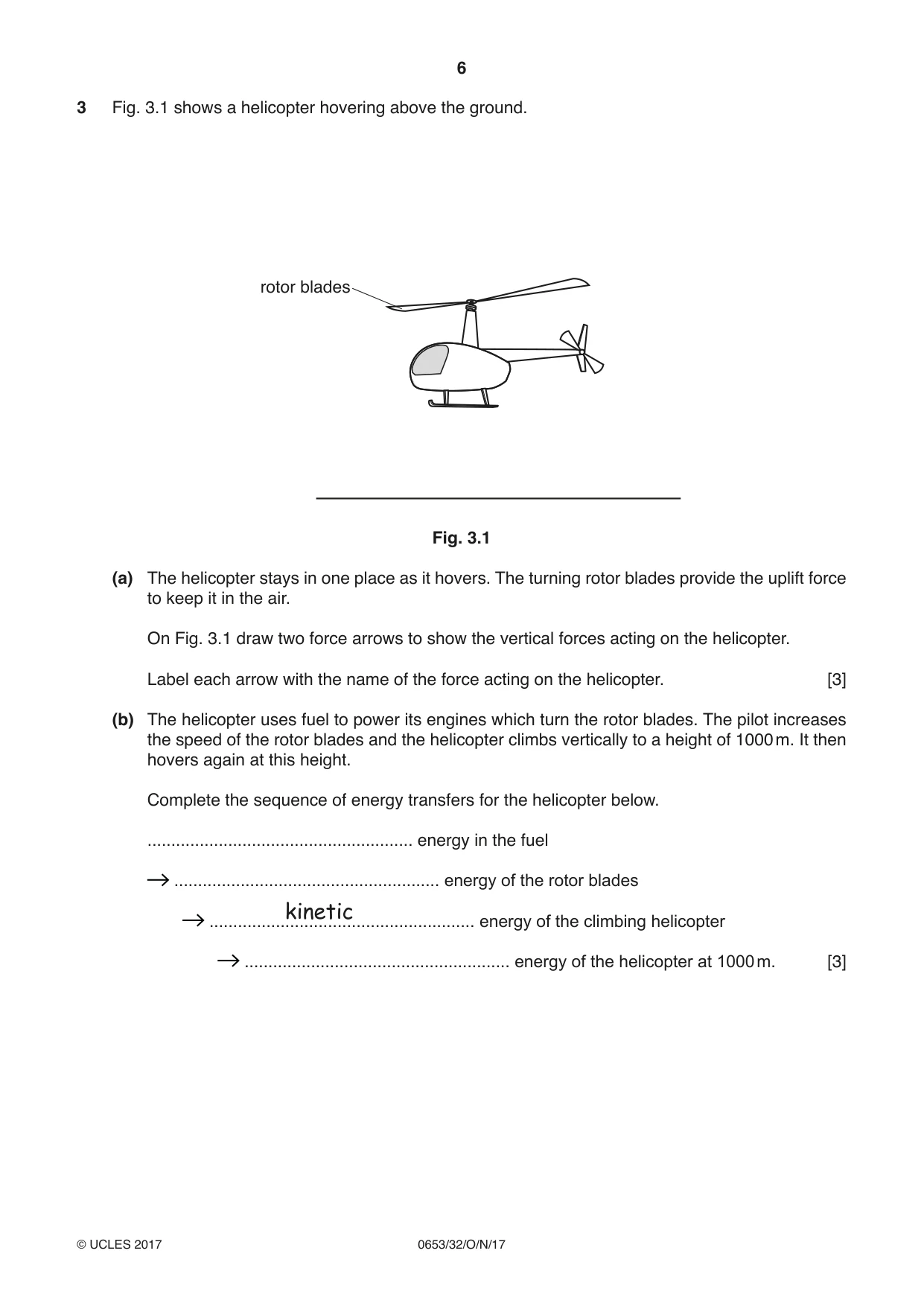
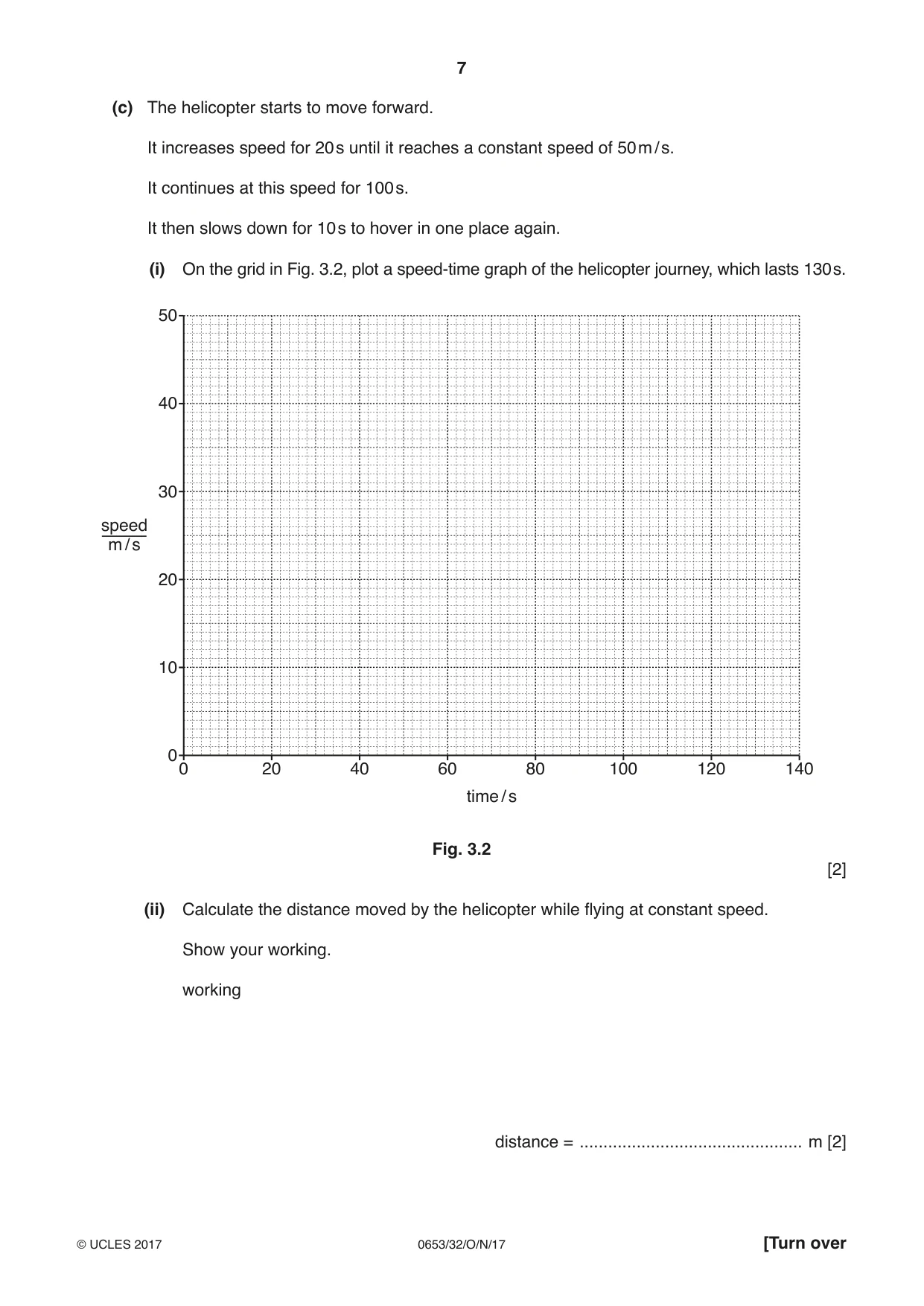
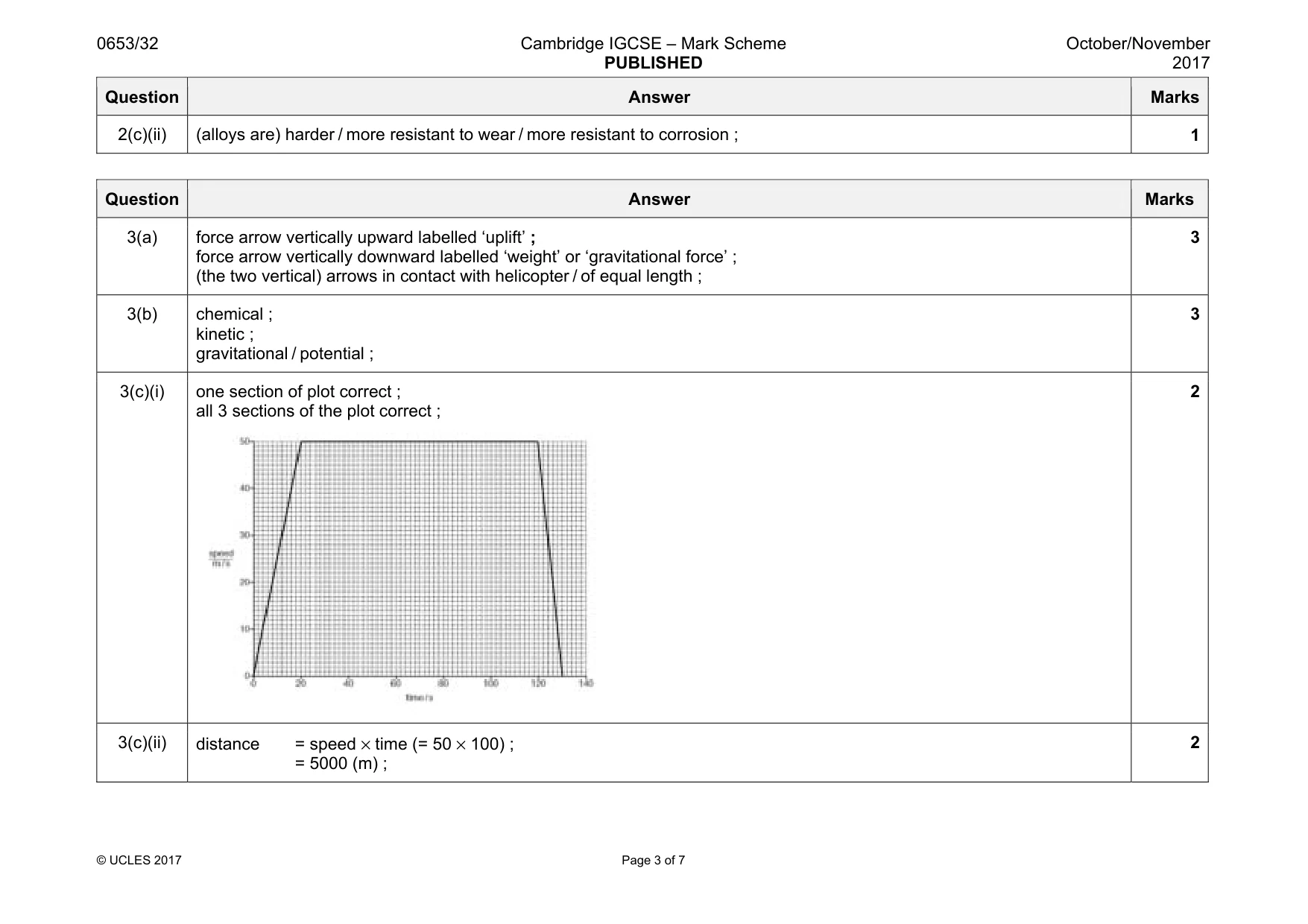
3 Fig. 3.1 shows a helicopter hovering above the ground. rotor blades Fig. 3.1 (a) The helicopter stays in one place as it hovers. The turning rotor blades provide the uplift force to keep it in the air. On Fig. 3.1 draw two force arrows to show the vertical forces acting on the helicopter. Label each arrow with the name of the force acting on the helicopter. [3] (b) The helicopter uses fuel to power its engines which turn the rotor blades. The pilot increases the speed of the rotor blades and the helicopter climbs vertically to a height of 1000 m. It then hovers again at this height. Complete the sequence of energy transfers for the helicopter below. ........................................................ energy in the fuel ........................................................ energy of the rotor blades kinetic ........................................................ energy of the climbing helicopter ........................................................ energy of the helicopter at 1000 m. [3] (c) The helicopter starts to move forward. It increases speed for 20 s until it reaches a constant speed of 50 m / s. It continues at this speed for 100 s. It then slows down for 10 s to hover in one place again. (i) On the grid in Fig. 3.2, plot a speed-time graph of the helicopter journey, which lasts 130 s. 50 40 30 speed m / s 20 10 0 0 20 40 60 80 100 120 140 time / s Fig. 3.2 [2] (ii) Calculate the distance moved by the helicopter while flying at constant speed. Show your working. working distance = ............................................... m [2]
Mark scheme: 3(a) force arrow vertically upward labelled ‘uplift’ ; force arrow vertically downward labelled ‘weight’ or ‘gravitational force’ ; (the two vertical) arrows in contact with helicopter / of equal length ; 3 3(b) chemical ; kinetic ; gravitational / potential ; 3 3(c)(i) one section of plot correct ; all 3 sections of the plot correct ; 2 3(c)(ii) distance = speed × time (= 50 × 100) ; = 5000 (m) ; 2
Q4 · A student does an experiment to investigate the germination of barley seeds
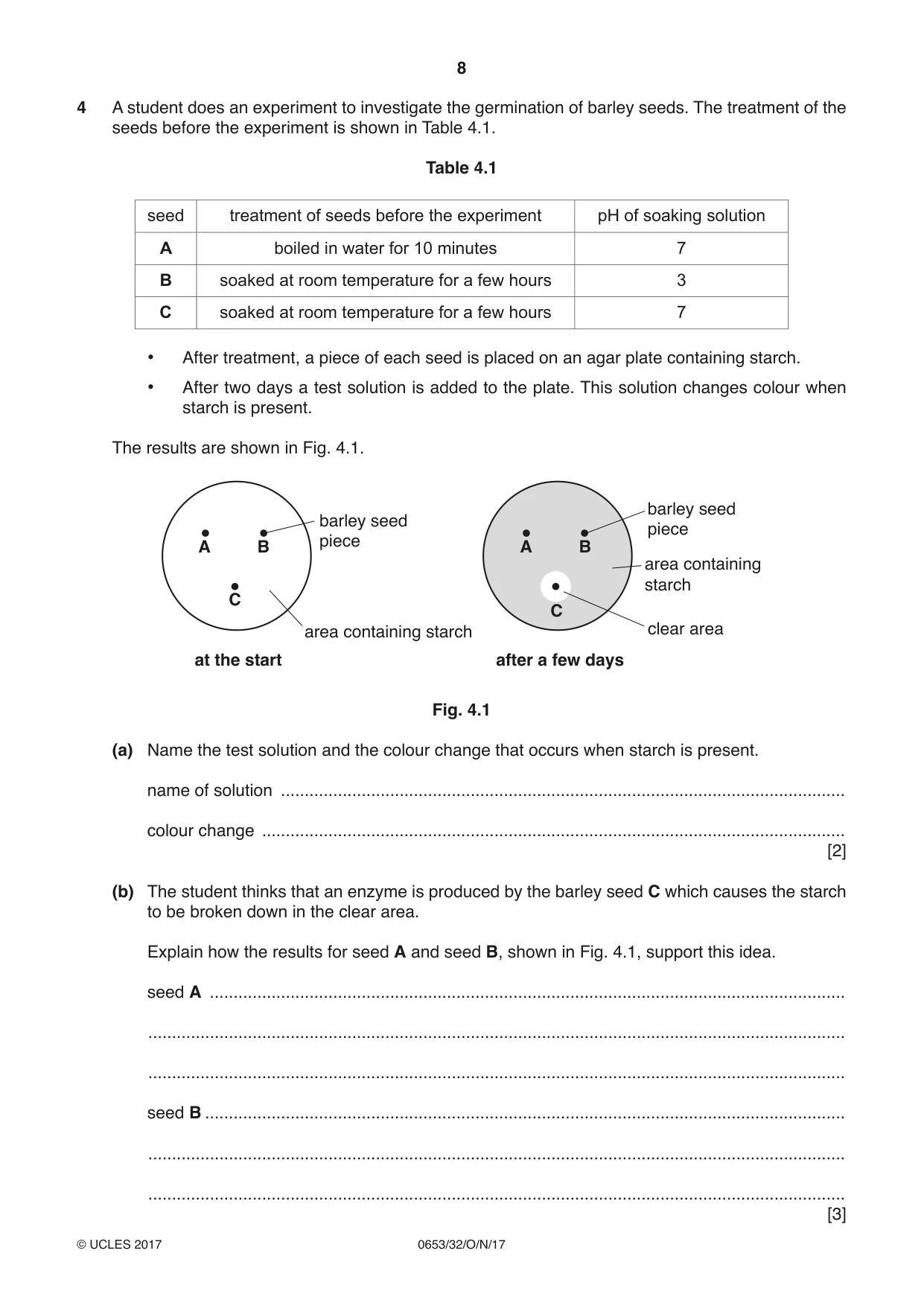
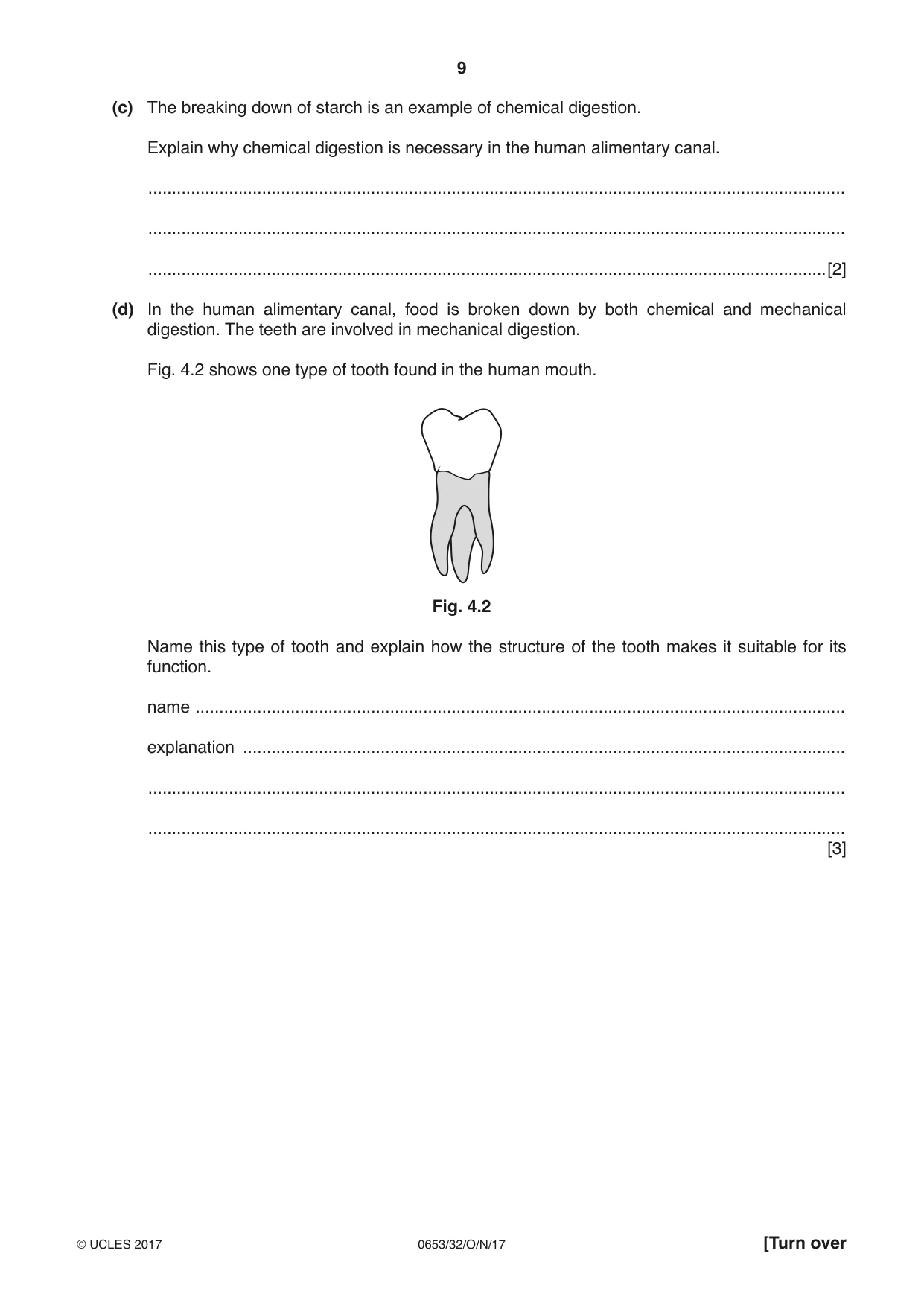
4 A student does an experiment to investigate the germination of barley seeds. The treatment of the seeds before the experiment is shown in Table 4.1. Table 4.1 seed treatment of seeds before the experiment pH of soaking solution A boiled in water for 10 minutes 7 B soaked at room temperature for a few hours 3 C soaked at room temperature for a few hours 7 • After treatment, a piece of each seed is placed on an agar plate containing starch. • After two days a test solution is added to the plate. This solution changes colour when starch is present. The results are shown in Fig. 4.1. barley seed barley seed piece piece A B A B area containing starch C C area containing starch clear area at the start after a few days Fig. 4.1 (a) Name the test solution and the colour change that occurs when starch is present. name of solution ....................................................................................................................... colour change ........................................................................................................................... [2] (b) The student thinks that an enzyme is produced by the barley seed C which causes the starch to be broken down in the clear area. Explain how the results for seed A and seed B, shown in Fig. 4.1, support this idea. seed A ...................................................................................................................................... ................................................................................................................................................... ................................................................................................................................................... seed B ....................................................................................................................................... ................................................................................................................................................... ................................................................................................................................................... [3] (c) The breaking down of starch is an example of chemical digestion. Explain why chemical digestion is necessary in the human alimentary canal. ................................................................................................................................................... ................................................................................................................................................... ...............................................................................................................................................[2] (d) In the human alimentary canal, food is broken down by both chemical and mechanical digestion. The teeth are involved in mechanical digestion. Fig. 4.2 shows one type of tooth found in the human mouth. Fig. 4.2 Name this type of tooth and explain how the structure of the tooth makes it suitable for its function. name ......................................................................................................................................... explanation ............................................................................................................................... ................................................................................................................................................... ................................................................................................................................................... [3]
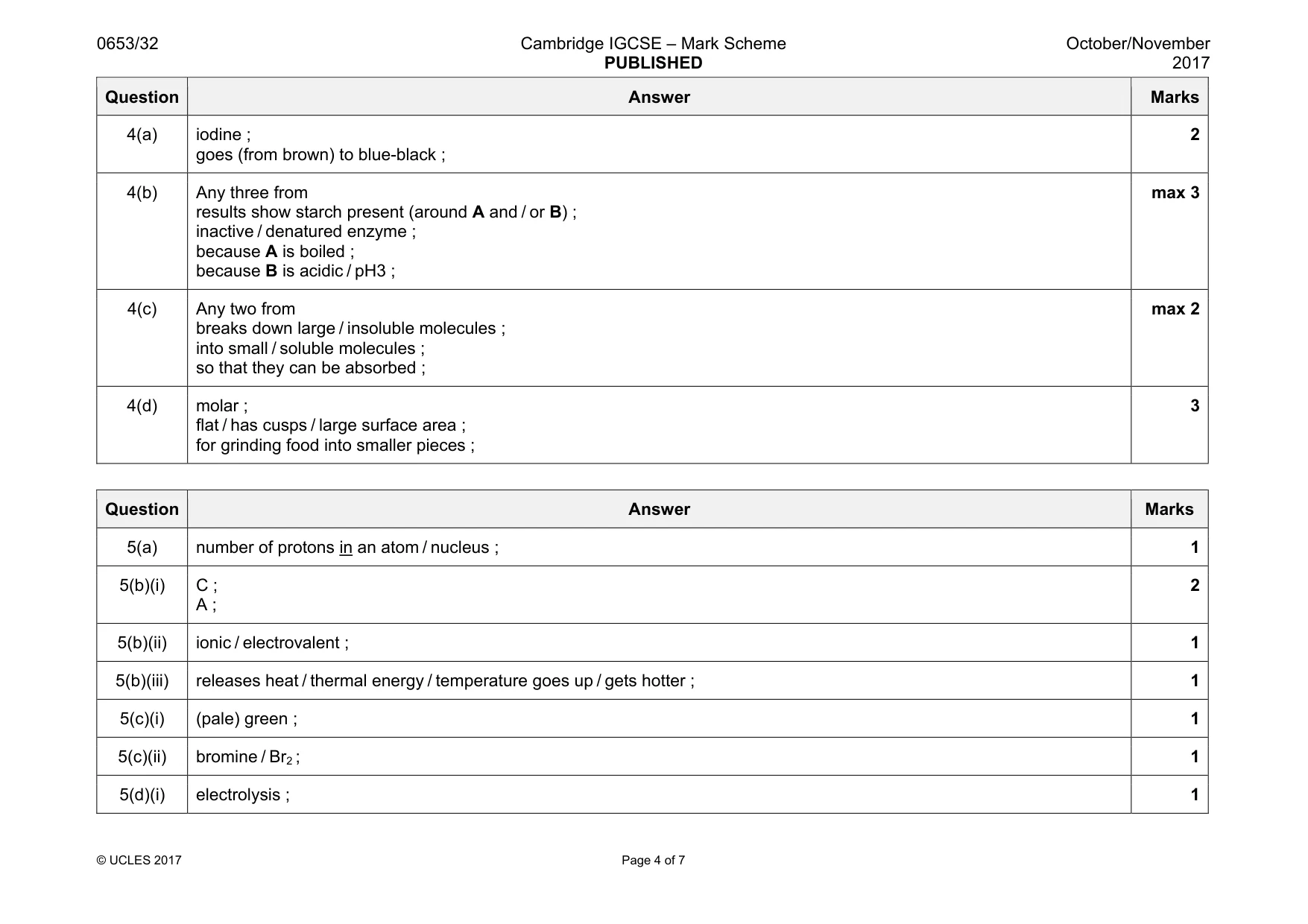
Mark scheme: 4(a) iodine ; goes (from brown) to blue-black ; 2 4(b) Any three from results show starch present (around A and / or B) ; inactive / denatured enzyme ; because A is boiled ; because B is acidic / pH3 ; max 3 4(c) Any two from breaks down large / insoluble molecules ; into small / soluble molecules ; so that they can be absorbed ; max 2 4(d) molar ; flat / has cusps / large surface area ; for grinding food into smaller pieces ; 3
Q5 · The Periodic Table lists all of the elements in atomic number order
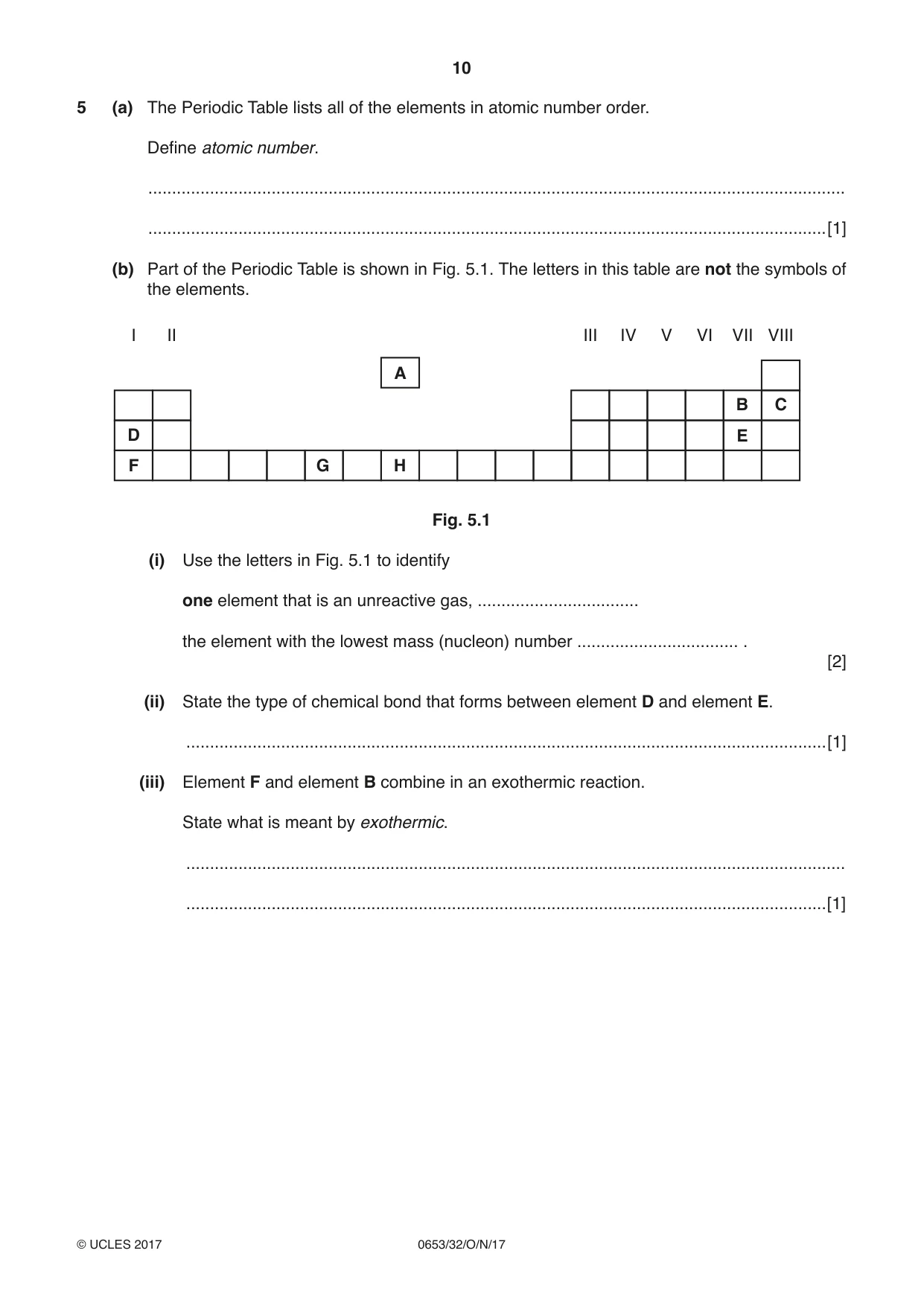
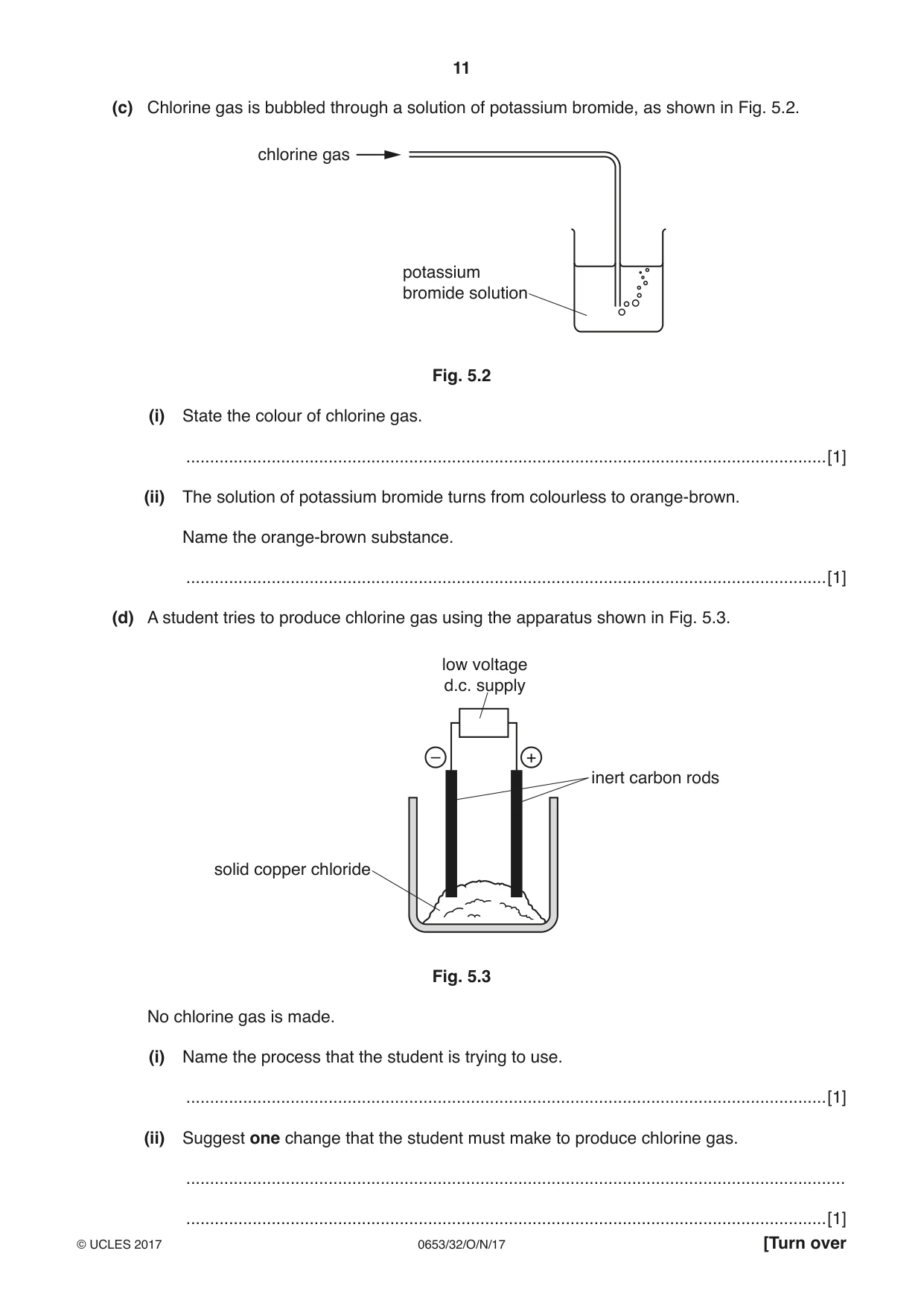
5 (a) The Periodic Table lists all of the elements in atomic number order. Define atomic number. ................................................................................................................................................... ...............................................................................................................................................[1] (b) Part of the Periodic Table is shown in Fig. 5.1. The letters in this table are not the symbols of the elements. I II III IV V VI VII VIII A B C D E F G H Fig. 5.1 (i) Use the letters in Fig. 5.1 to identify one element that is an unreactive gas, .................................. the element with the lowest mass (nucleon) number .................................. . [2] (ii) State the type of chemical bond that forms between element D and element E. .......................................................................................................................................[1] (iii) Element F and element B combine in an exothermic reaction. State what is meant by exothermic. ........................................................................................................................................... .......................................................................................................................................[1] (c) Chlorine gas is bubbled through a solution of potassium bromide, as shown in Fig. 5.2. chlorine gas potassium bromide solution Fig. 5.2 (i) State the colour of chlorine gas. .......................................................................................................................................[1] (ii) The solution of potassium bromide turns from colourless to orange-brown. Name the orange-brown substance. .......................................................................................................................................[1] (d) A student tries to produce chlorine gas using the apparatus shown in Fig. 5.3. low voltage d.c. supply – + inert carbon rods solid copper chloride Fig. 5.3 No chlorine gas is made. (i) Name the process that the student is trying to use. .......................................................................................................................................[1] (ii) Suggest one change that the student must make to produce chlorine gas. ...........................................................................................................................................
Mark scheme: 5(a) number of protons in an atom / nucleus ; 1 5(b)(i) C ; A ; 2 5(b)(ii) ionic / electrovalent ; 1 5(b)(iii) releases heat / thermal energy / temperature goes up / gets hotter ; 1 5(c)(i) (pale) green ; 1 5(c)(ii) bromine / Br2 ; 1 5(d)(i) electrolysis ; 1 Question Answer Marks 5(d)(ii) add water / use (copper chloride) solution ; 1
Q6 · A radiator which uses hot water to provide heating for people sitting in a room watching…
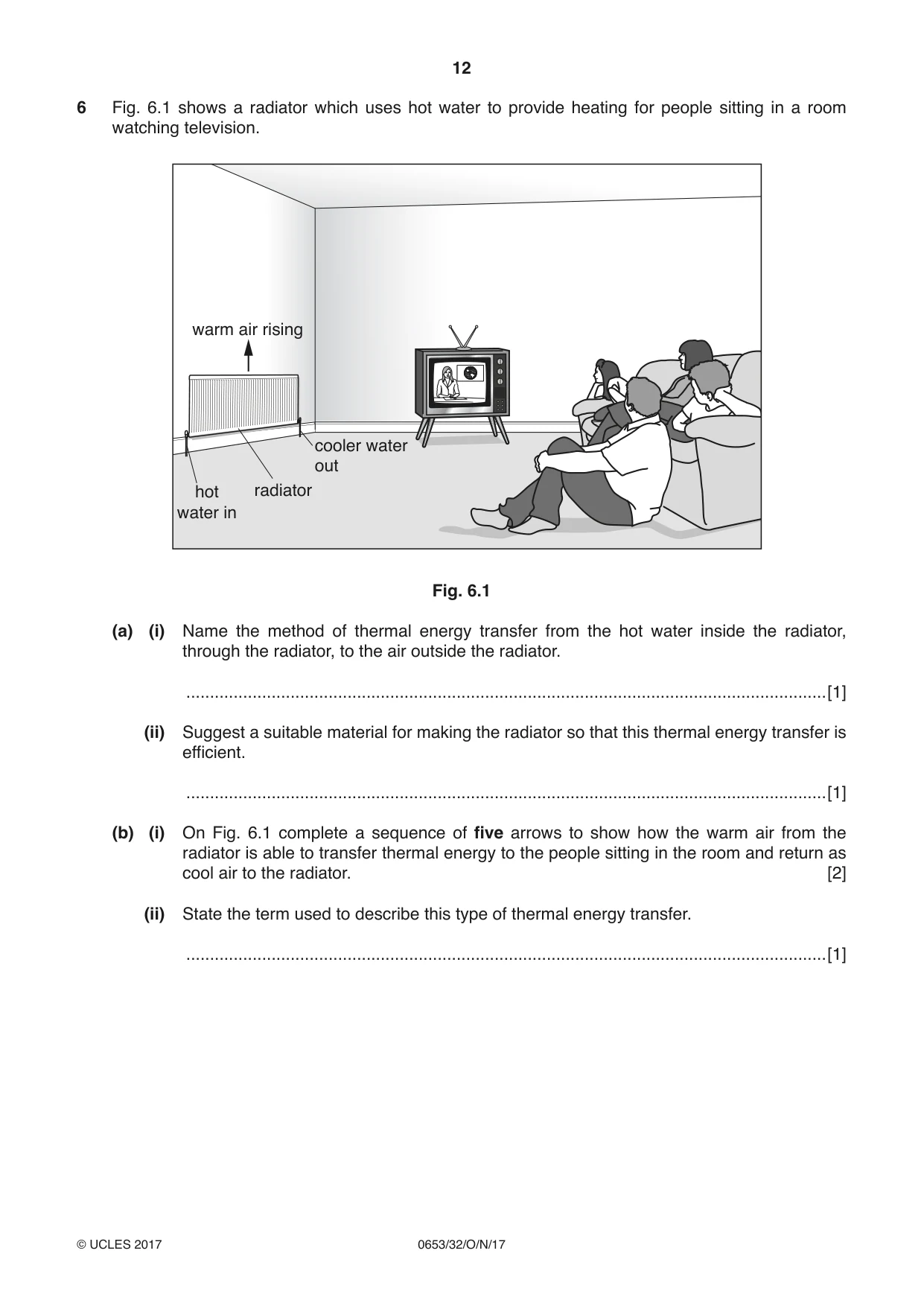
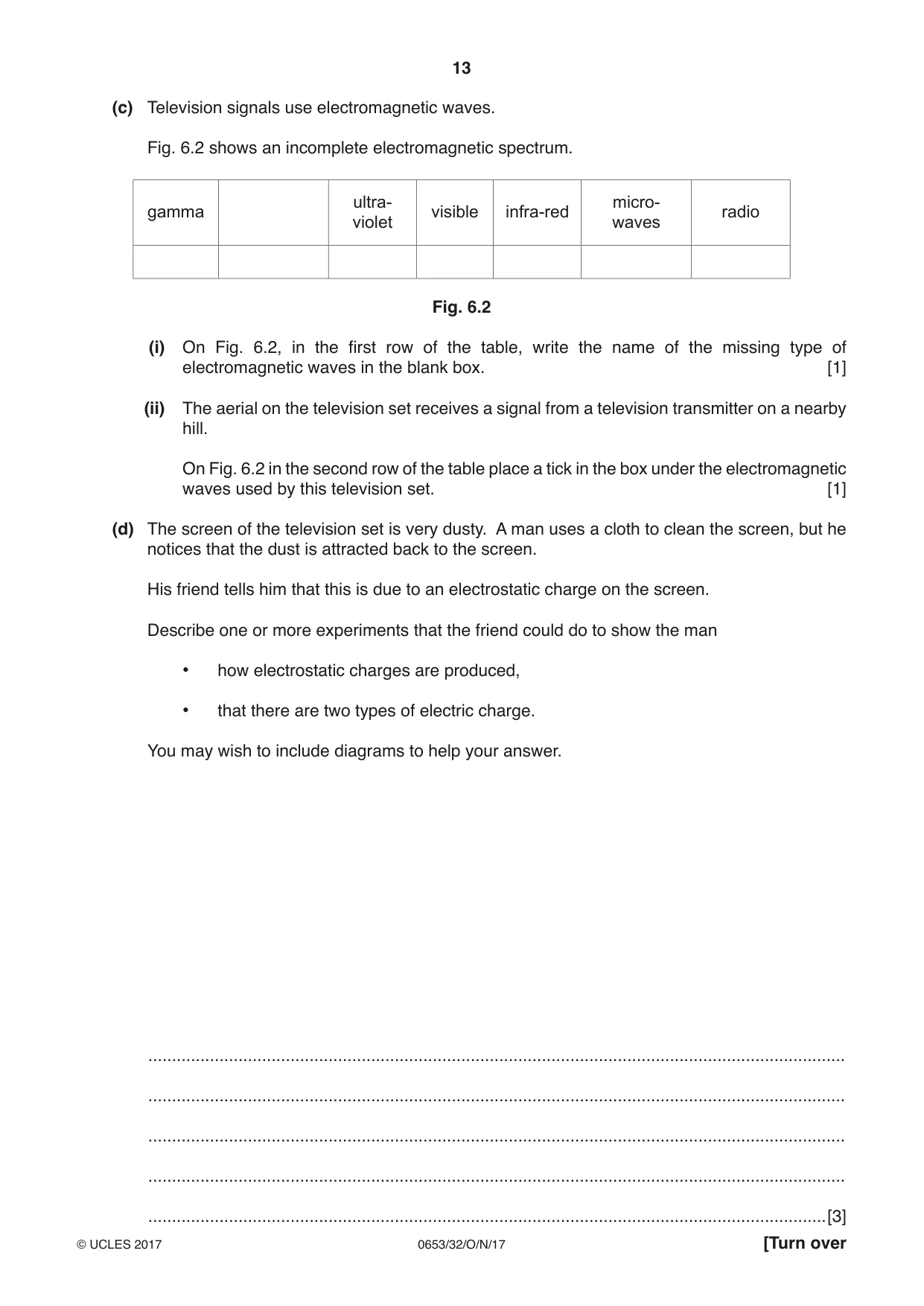
6 Fig. 6.1 shows a radiator which uses hot water to provide heating for people sitting in a room watching television. warm air rising cooler water out hot radiator water in Fig. 6.1 (a) (i) Name the method of thermal energy transfer from the hot water inside the radiator, through the radiator, to the air outside the radiator. .......................................................................................................................................[1] (ii) Suggest a suitable material for making the radiator so that this thermal energy transfer is efficient. .......................................................................................................................................[1] (b) (i) On Fig. 6.1 complete a sequence of five arrows to show how the warm air from the radiator is able to transfer thermal energy to the people sitting in the room and return as cool air to the radiator. [2] (ii) State the term used to describe this type of thermal energy transfer. .......................................................................................................................................[1] (c) Television signals use electromagnetic waves. Fig. 6.2 shows an incomplete electromagnetic spectrum. ultra- micro- gamma visible infra-red radio violet waves Fig. 6.2 (i) On Fig. 6.2, in the first row of the table, write the name of the missing type of electromagnetic waves in the blank box. [1] (ii) The aerial on the television set receives a signal from a television transmitter on a nearby hill. On Fig. 6.2 in the second row of the table place a tick in the box under the electromagnetic waves used by this television set. [1] (d) The screen of the television set is very dusty. A man uses a cloth to clean the screen, but he notices that the dust is attracted back to the screen. His friend tells him that this is due to an electrostatic charge on the screen. Describe one or more experiments that the friend could do to show the man • how electrostatic charges are produced, • that there are two types of electric charge. You may wish to include diagrams to help your answer. ................................................................................................................................................... ................................................................................................................................................... ................................................................................................................................................... ................................................................................................................................................... ...............................................................................................................................................[3]
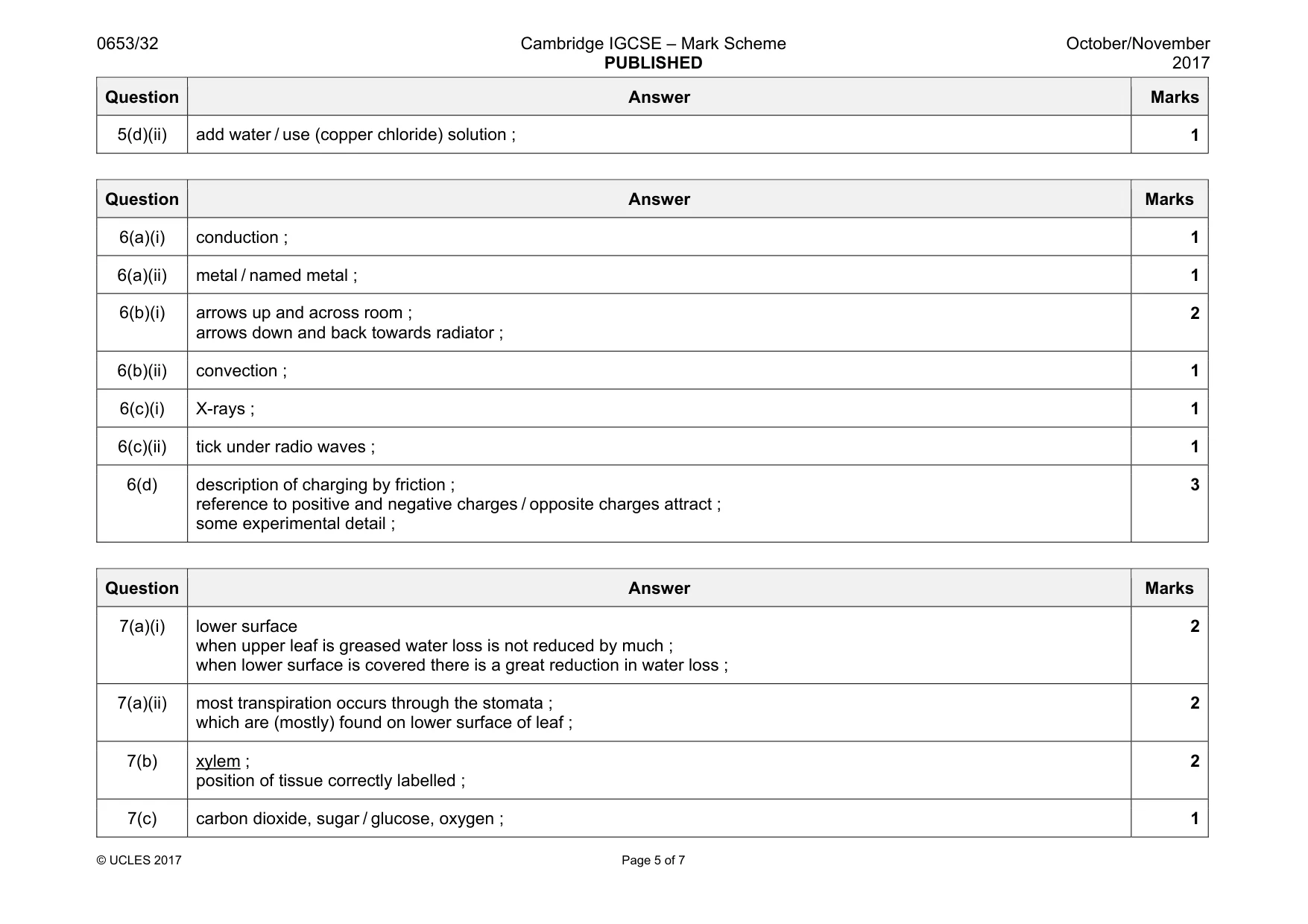
Mark scheme: 6(a)(i) conduction ; 1 6(a)(ii) metal / named metal ; 1 6(b)(i) arrows up and across room ; arrows down and back towards radiator ; 2 6(b)(ii) convection ; 1 6(c)(i) X-rays ; 1 6(c)(ii) tick under radio waves ; 1 6(d) description of charging by friction ; reference to positive and negative charges / opposite charges attract ; some experimental detail ; 3
Q7 · During transpiration water is lost from the leaves of a plant
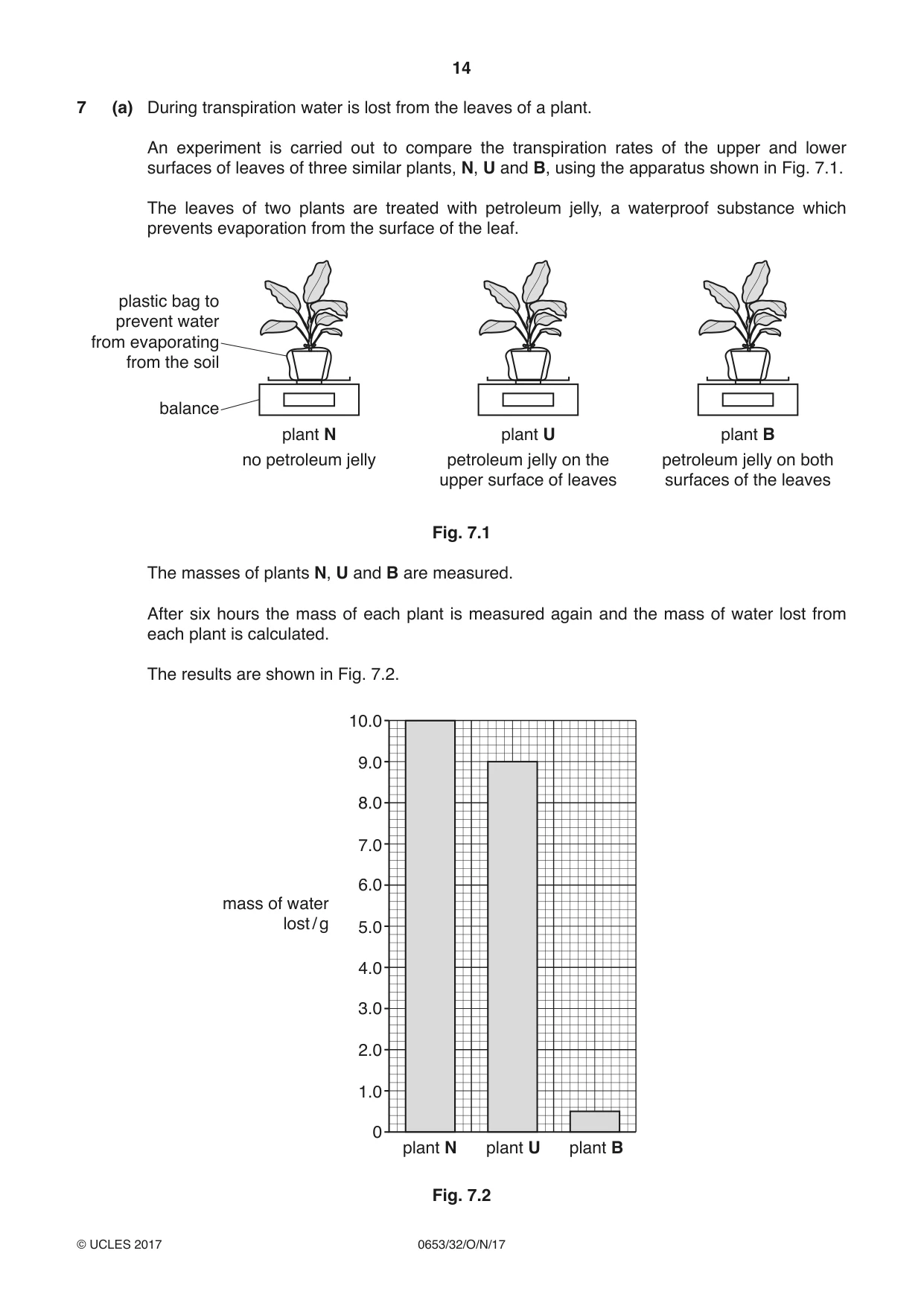
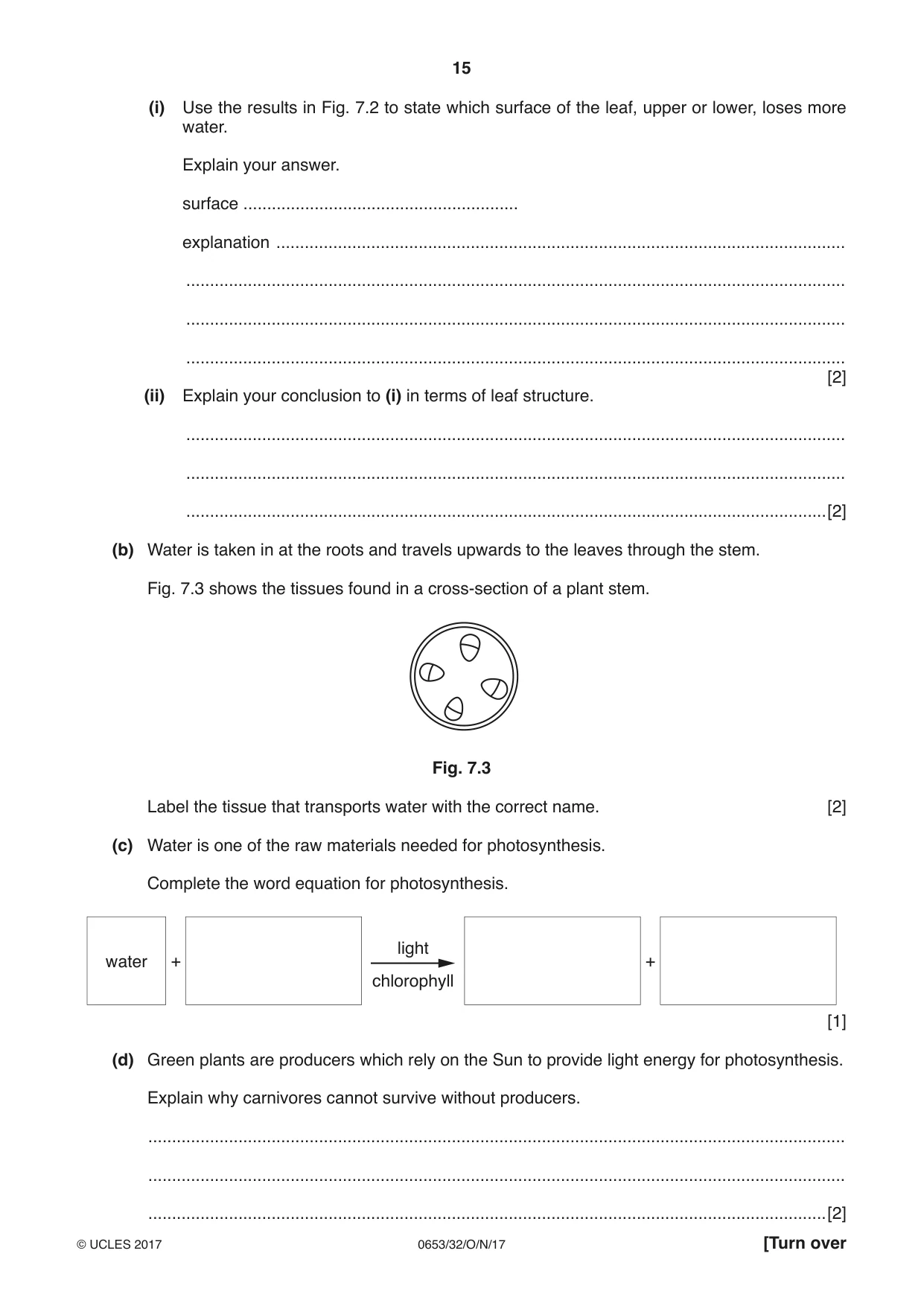
7 (a) During transpiration water is lost from the leaves of a plant. An experiment is carried out to compare the transpiration rates of the upper and lower surfaces of leaves of three similar plants, N, U and B, using the apparatus shown in Fig. 7.1. The leaves of two plants are treated with petroleum jelly, a waterproof substance which prevents evaporation from the surface of the leaf. plastic bag to prevent water from evaporating from the soil balance plant N plant U plant B no petroleum jelly petroleum jelly on the petroleum jelly on both upper surface of leaves surfaces of the leaves Fig. 7.1 The masses of plants N, U and B are measured. After six hours the mass of each plant is measured again and the mass of water lost from each plant is calculated. The results are shown in Fig. 7.2. 10.0 9.0 8.0 7.0 6.0 mass of water lost / g 5.0 4.0 3.0 2.0 1.0 0 plant N plant U plant B Fig. 7.2 (i) Use the results in Fig. 7.2 to state which surface of the leaf, upper or lower, loses more water. Explain your answer. surface .......................................................... explanation ........................................................................................................................ ........................................................................................................................................... ........................................................................................................................................... ........................................................................................................................................... [2] (ii) Explain your conclusion to (i) in terms of leaf structure. ........................................................................................................................................... ........................................................................................................................................... .......................................................................................................................................[2] (b) Water is taken in at the roots and travels upwards to the leaves through the stem. Fig. 7.3 shows the tissues found in a cross-section of a plant stem. Fig. 7.3 Label the tissue that transports water with the correct name. [2] (c) Water is one of the raw materials needed for photosynthesis. Complete the word equation for photosynthesis. lightwater + + chlorophyll [1] (d) Green plants are producers which rely on the Sun to provide light energy for photosynthesis. Explain why carnivores cannot survive without producers. ................................................................................................................................................... ................................................................................................................................................... ...............................................................................................................................................[2]
Mark scheme: 7(a)(i) lower surface when upper leaf is greased water loss is not reduced by much ; when lower surface is covered there is a great reduction in water loss ; 2 7(a)(ii) most transpiration occurs through the stomata ; which are (mostly) found on lower surface of leaf ; 2 7(b) xylem ; position of tissue correctly labelled ; 2 7(c) carbon dioxide, sugar / glucose, oxygen ; 1 Question Answer Marks 7(d) Any two from carnivores cannot produce their own food / cannot photosynthesise ; carnivores get energy by eating herbivores ; herbivores feed on producers ; max 2
Q8 · Copper is extracted when copper oxide is heated with carbon
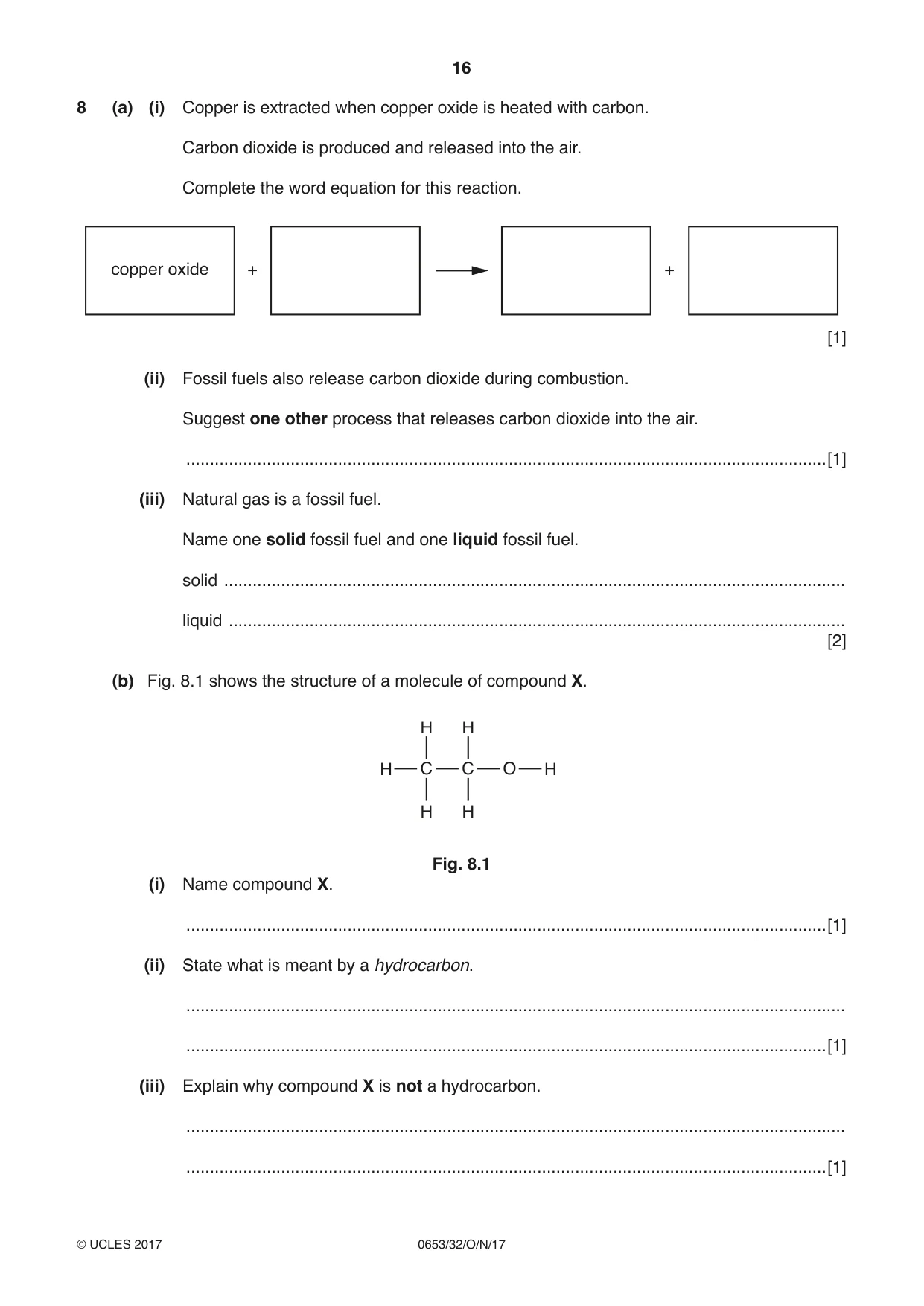
8 (a) (i) Copper is extracted when copper oxide is heated with carbon. Carbon dioxide is produced and released into the air. Complete the word equation for this reaction. copper oxide + + [1] (ii) Fossil fuels also release carbon dioxide during combustion. Suggest one other process that releases carbon dioxide into the air. .......................................................................................................................................[1] (iii) Natural gas is a fossil fuel. Name one solid fossil fuel and one liquid fossil fuel. solid ................................................................................................................................... liquid .................................................................................................................................. [2] (b) Fig. 8.1 shows the structure of a molecule of compound X. H H H C C O H H H Fig. 8.1 (i) Name compound X. .......................................................................................................................................[1] (ii) State what is meant by a hydrocarbon. ........................................................................................................................................... .......................................................................................................................................[1] (iii) Explain why compound X is not a hydrocarbon. ........................................................................................................................................... .......................................................................................................................................[1]
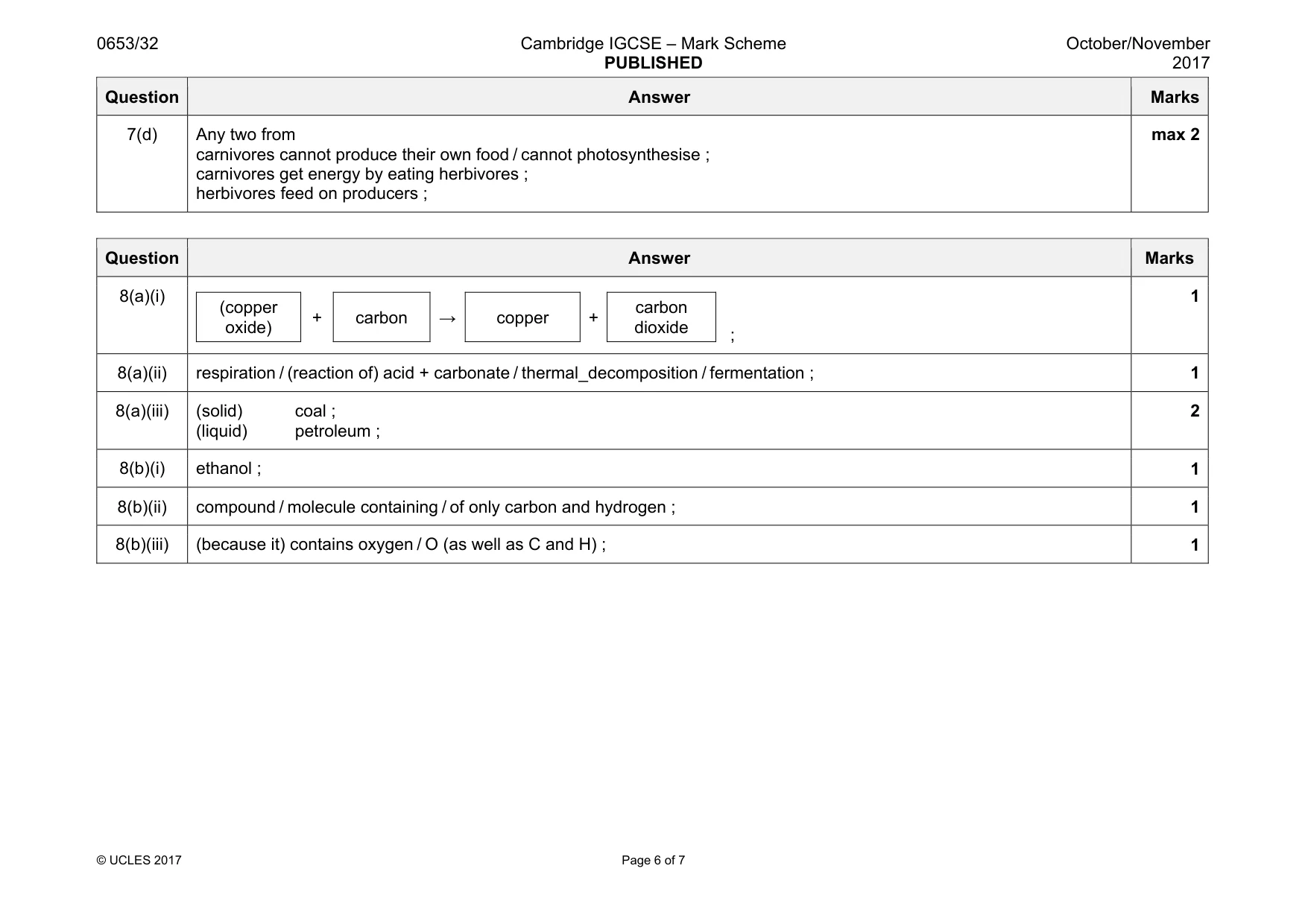
Mark scheme: 8(a)(i) ; (copper oxide) + carbon → copper + carbon dioxide 1 8(a)(ii) respiration / (reaction of) acid + carbonate / thermal_decomposition / fermentation ; 1 8(a)(iii) (solid) coal ; (liquid) petroleum ; 2 8(b)(i) ethanol ; 1 8(b)(ii) compound / molecule containing / of only carbon and hydrogen ; 1 8(b)(iii) (because it) contains oxygen / O (as well as C and H) ; 1
Q9 · In a theatre, spotlights are used to shine a beam of light on one person on the stage
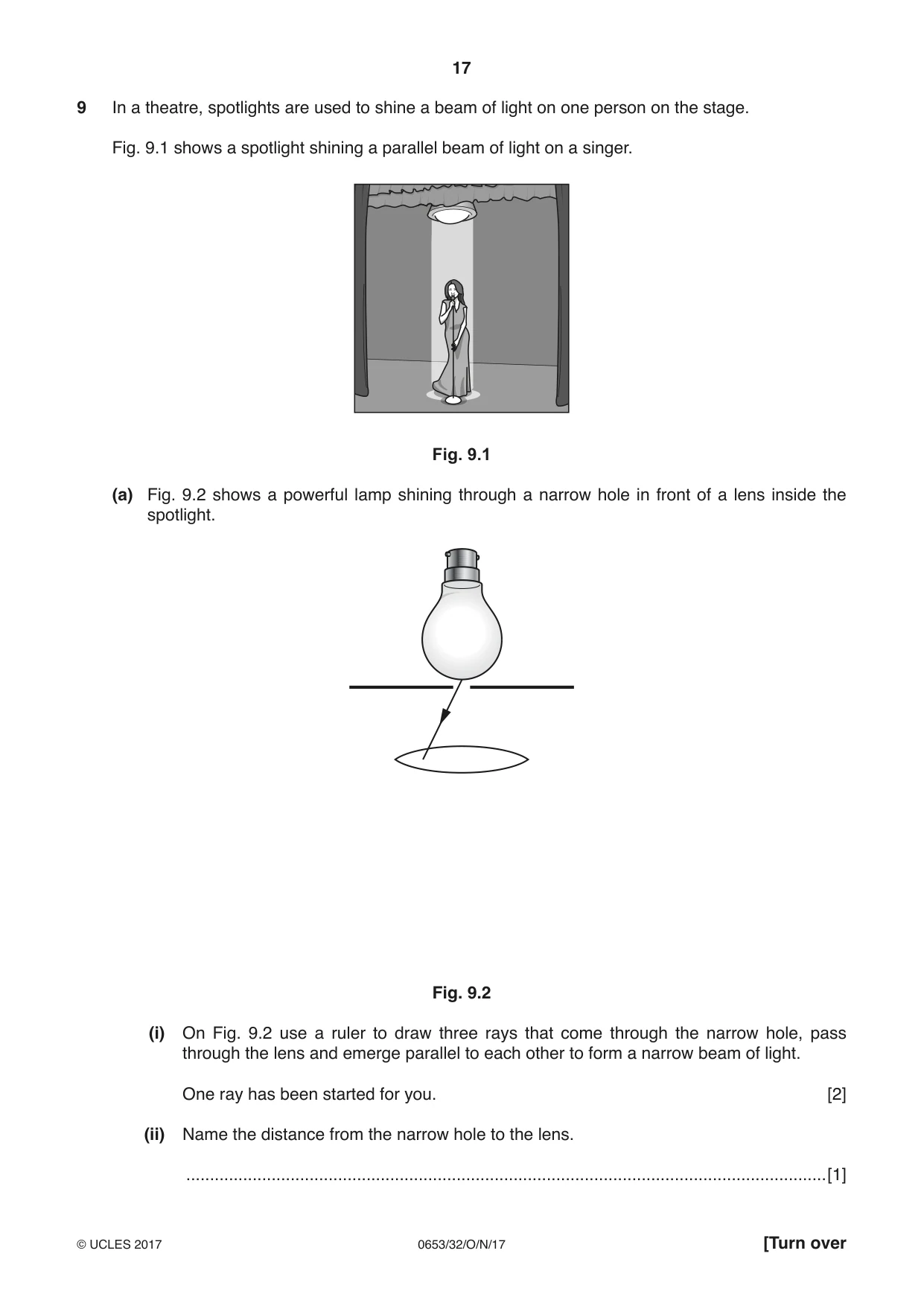
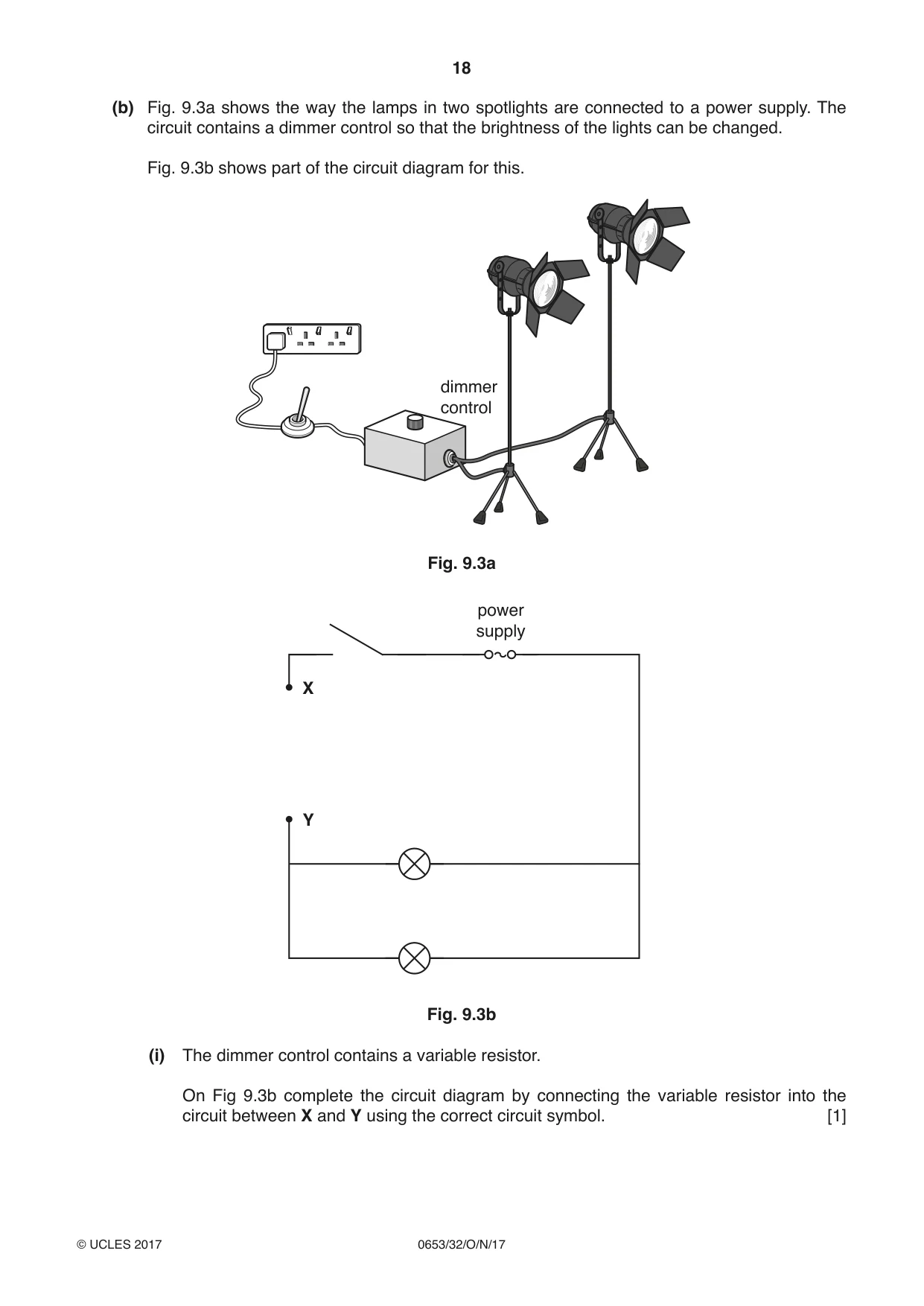
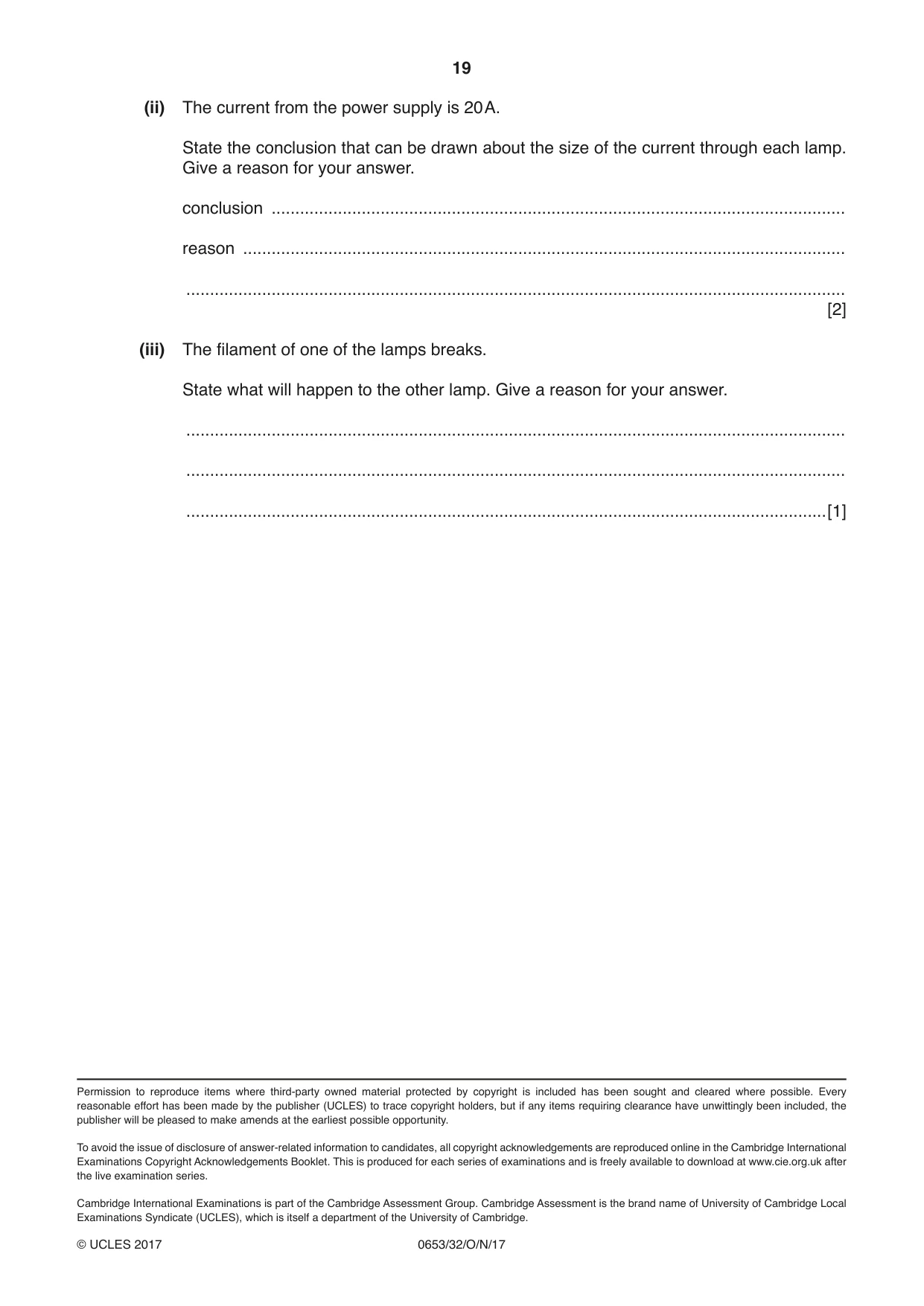
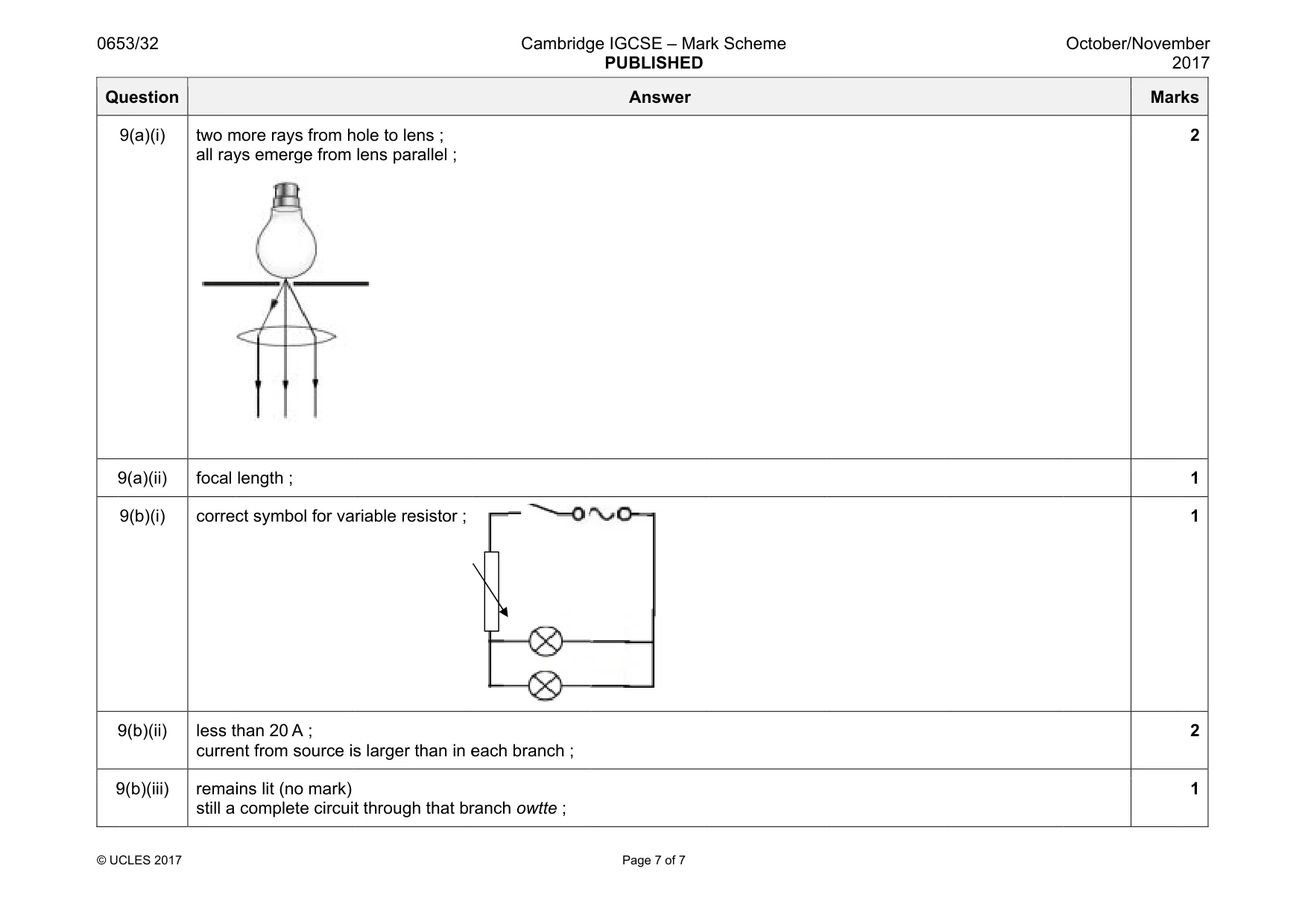
9 In a theatre, spotlights are used to shine a beam of light on one person on the stage. Fig. 9.1 shows a spotlight shining a parallel beam of light on a singer. Fig. 9.1 (a) Fig. 9.2 shows a powerful lamp shining through a narrow hole in front of a lens inside the spotlight. Fig. 9.2 (i) On Fig. 9.2 use a ruler to draw three rays that come through the narrow hole, pass through the lens and emerge parallel to each other to form a narrow beam of light. One ray has been started for you. [2] (ii) Name the distance from the narrow hole to the lens. .......................................................................................................................................[1] (b) Fig. 9.3a shows the way the lamps in two spotlights are connected to a power supply. The circuit contains a dimmer control so that the brightness of the lights can be changed. Fig. 9.3b shows part of the circuit diagram for this. dimmer control Fig. 9.3a power supply X Y Fig. 9.3b (i) The dimmer control contains a variable resistor. On Fig 9.3b complete the circuit diagram by connecting the variable resistor into the circuit between X and Y using the correct circuit symbol. [1] (ii) The current from the power supply is 20 A. State the conclusion that can be drawn about the size of the current through each lamp. Give a reason for your answer. conclusion ......................................................................................................................... reason ............................................................................................................................... ........................................................................................................................................... [2] (iii) The filament of one of the lamps breaks. State what will happen to the other lamp. Give a reason for your answer. ........................................................................................................................................... ........................................................................................................................................... .......................................................................................................................................[1]
Mark scheme: 9 9 9 9(a)(i) two m all ray 9(a)(ii) focal 9(b)(i) correc 9(b)(ii) less t curren 9(b)(iii) remai still a more rays from h ys emerge from length ; ct symbol for va han 20 A ; nt from source is ins lit (no mark) complete circuit hole to lens ; lens parallel ; riable resistor ; s larger than in e t through that br each branch ; ranch owtte ; 2 1 1 2 1
What was in this paper
The subtopics covered by these 9 questions, and how many questions each got. Open one in a new tab to see every Cambridge question on it.
What you needed in this session
Cambridge’s own grade thresholds for 2017 Oct/Nov, Paper 3 · Variant 2. A higher threshold means an easier paper — the bar moves with how the cohort did.