Cambridge IGCSE Science - Combined 0653 — 2017 May/June Paper 3 · Variant 2
0653/32/M/J/17 · 9 questions · 80 marks · ≈90 min
The question paper and its mark scheme, free to read here and free to download. This is Cambridge’s own paper, exactly as it was sat.
Question paper24 pages



Mark scheme10 pages
Answers below. Sit the paper first if you are practising.
Questions as text
Q1 · Use lines to connect the box on the left to different boxes on the right to make correct…
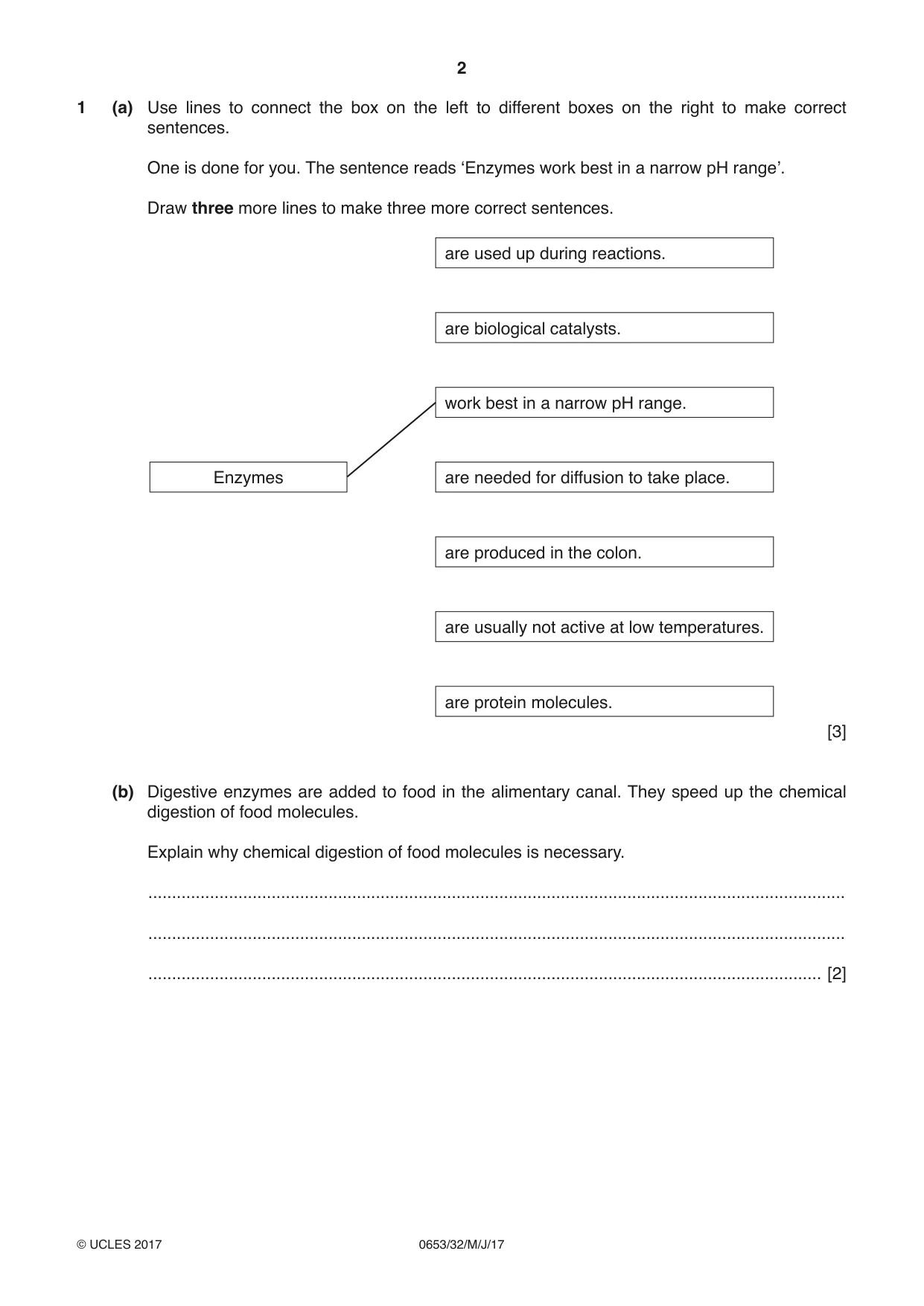
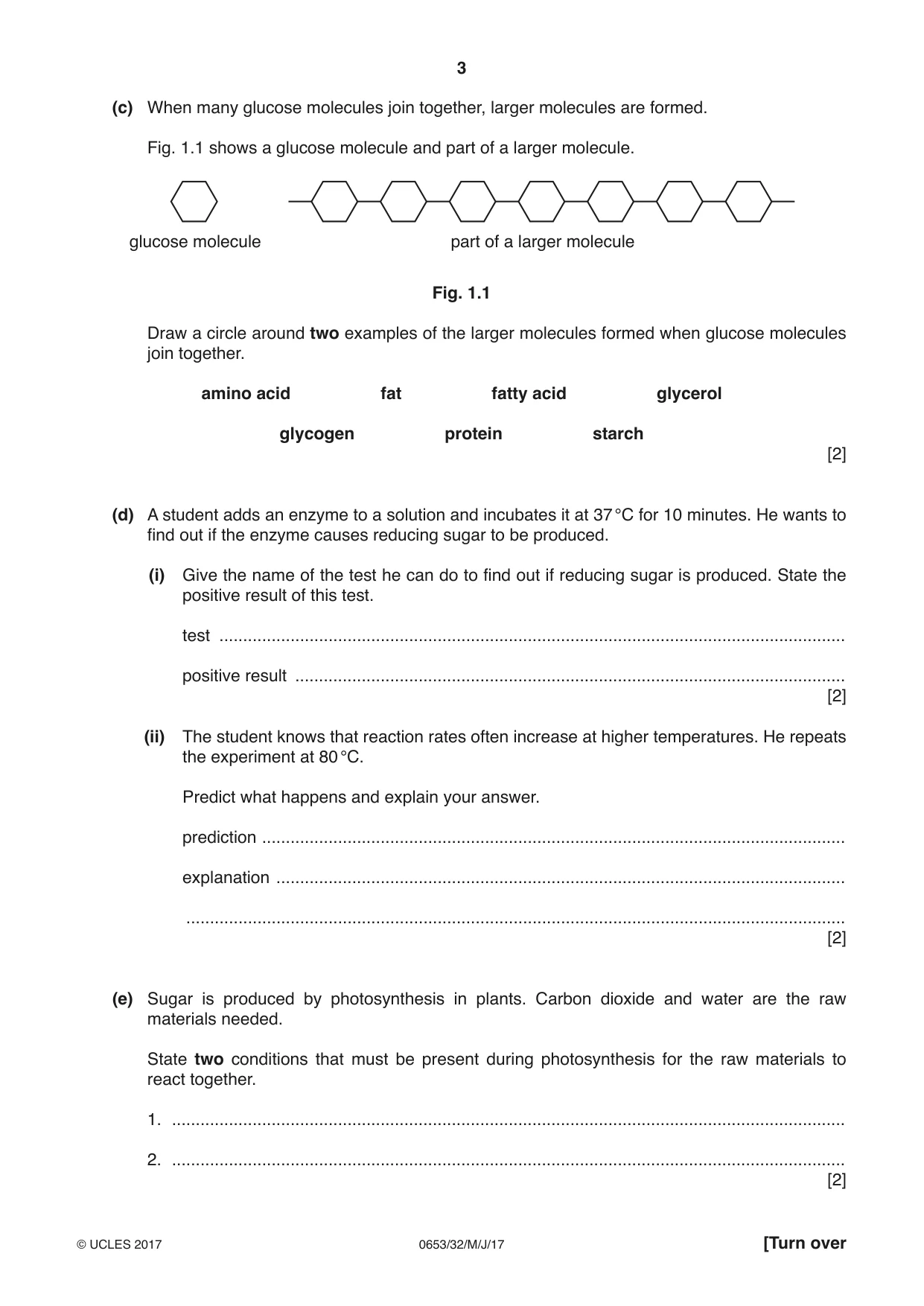
1 (a) Use lines to connect the box on the left to different boxes on the right to make correct sentences. One is done for you. The sentence reads ‘Enzymes work best in a narrow pH range’. Draw three more lines to make three more correct sentences. are used up during reactions. are biological catalysts. work best in a narrow pH range. Enzymes are needed for diffusion to take place. are produced in the colon. are usually not active at low temperatures. are protein molecules. [3] (b) Digestive enzymes are added to food in the alimentary canal. They speed up the chemical digestion of food molecules. Explain why chemical digestion of food molecules is necessary. ................................................................................................................................................... ................................................................................................................................................... .............................................................................................................................................. [2] (c) When many glucose molecules join together, larger molecules are formed. Fig. 1.1 shows a glucose molecule and part of a larger molecule. glucose molecule part of a larger molecule Fig. 1.1 Draw a circle around two examples of the larger molecules formed when glucose molecules join together. amino acid fat fatty acid glycerol glycogen protein starch [2] (d) A student adds an enzyme to a solution and incubates it at 37 °C for 10 minutes. He wants to find out if the enzyme causes reducing sugar to be produced. (i) Give the name of the test he can do to find out if reducing sugar is produced. State the positive result of this test. test .................................................................................................................................... positive result .................................................................................................................... [2] (ii) The student knows that reaction rates often increase at higher temperatures. He repeats the experiment at 80 °C. Predict what happens and explain your answer. prediction ........................................................................................................................... explanation ........................................................................................................................ ........................................................................................................................................... [2] (e) Sugar is produced by photosynthesis in plants. Carbon dioxide and water are the raw materials needed. State two conditions that must be present during photosynthesis for the raw materials to react together. 1. .............................................................................................................................................. 2. .............................................................................................................................................. [2]
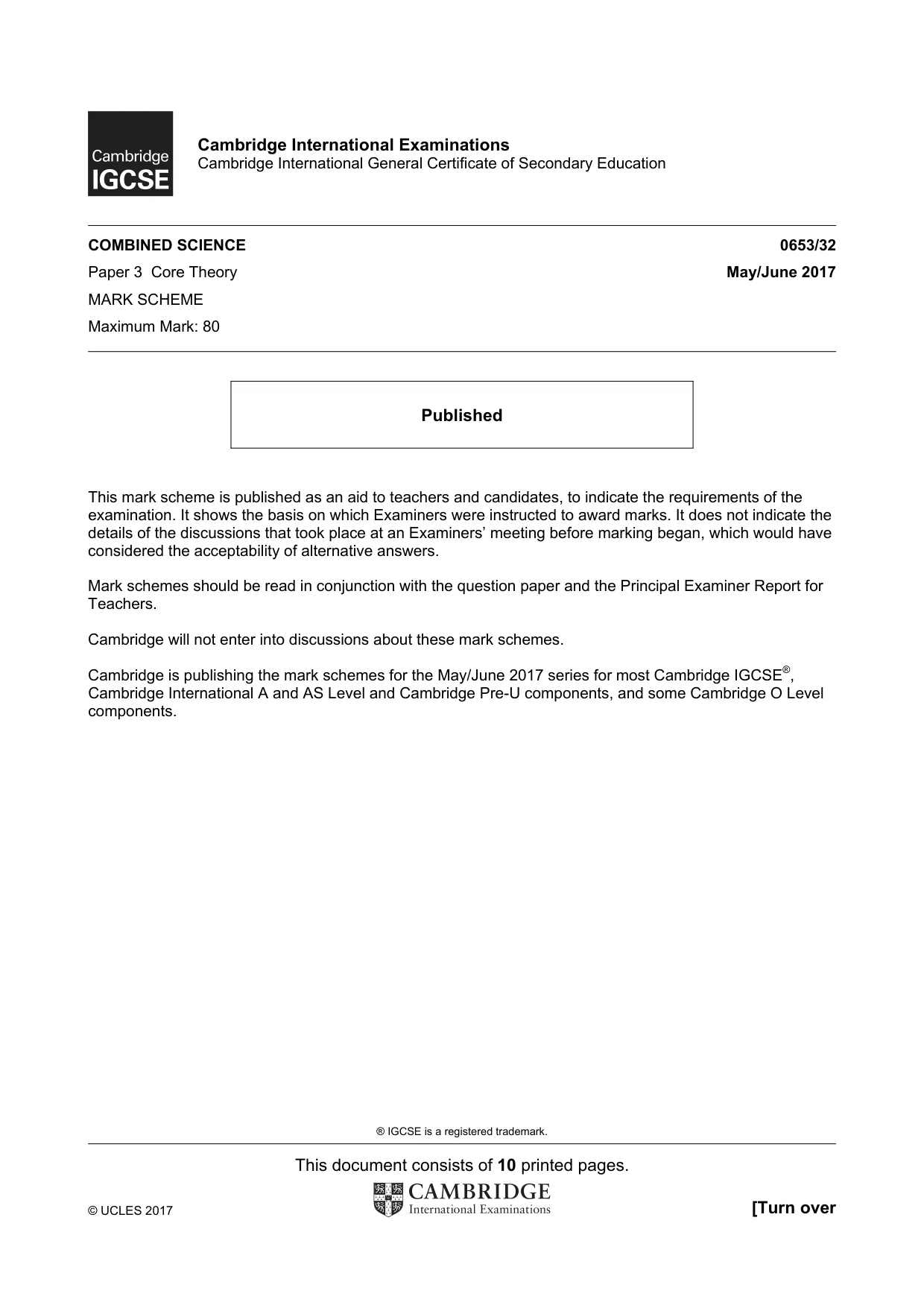
Mark scheme: 1(a) lines drawn from Enzymes to are biological catalysts ; are usually not active at low temperatures ; are protein molecules ; 3 1(b) large / insoluble / food molecules are broken down ; into small / soluble molecules / so they can be absorbed ; 2 1(c) glycogen ; starch ; 2 1(d)(i) Benedict’s (test) ; red colour produced ; 2 1(d)(ii) no reaction ; because enzymes become inactive at high temperatures ; 2 1(e) chlorophyll ; light ; 2
Q2 · A teacher places the first three metals of Group I in the Periodic Table into separate…
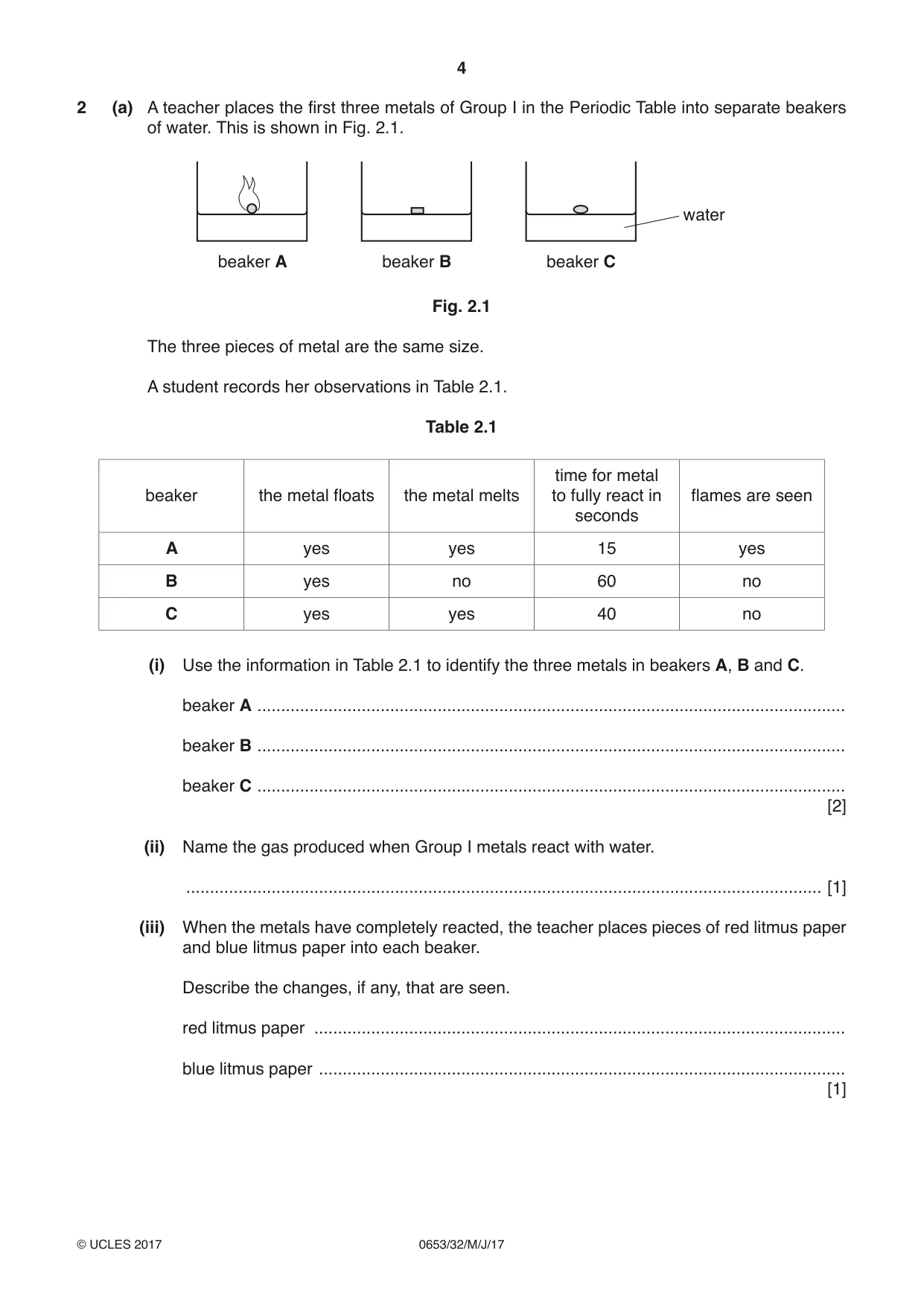
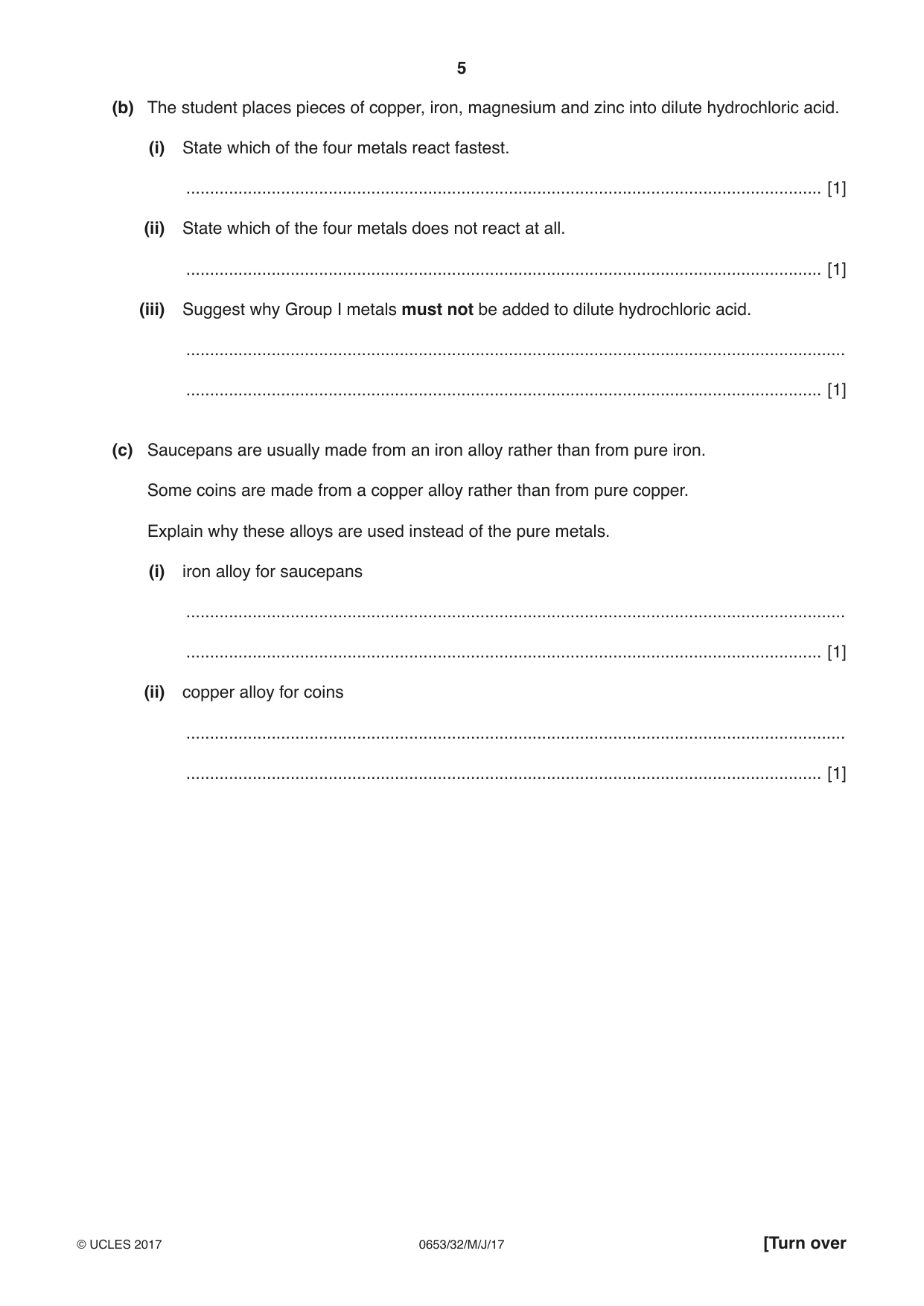
2 (a) A teacher places the first three metals of Group I in the Periodic Table into separate beakers of water. This is shown in Fig. 2.1. water beaker A beaker B beaker C Fig. 2.1 The three pieces of metal are the same size. A student records her observations in Table 2.1. Table 2.1 time for metal beaker the metal floats the metal melts to fully react in flames are seen seconds A yes yes 15 yes B yes no 60 no C yes yes 40 no (i) Use the information in Table 2.1 to identify the three metals in beakers A, B and C. beaker A ............................................................................................................................ beaker B ............................................................................................................................ beaker C ............................................................................................................................ [2] (ii) Name the gas produced when Group I metals react with water. ...................................................................................................................................... [1] (iii) When the metals have completely reacted, the teacher places pieces of red litmus paper and blue litmus paper into each beaker. Describe the changes, if any, that are seen. red litmus paper ................................................................................................................ blue litmus paper ............................................................................................................... [1] (b) The student places pieces of copper, iron, magnesium and zinc into dilute hydrochloric acid. (i) State which of the four metals react fastest. ...................................................................................................................................... [1] (ii) State which of the four metals does not react at all. ...................................................................................................................................... [1] (iii) Suggest why Group I metals must not be added to dilute hydrochloric acid. ........................................................................................................................................... ...................................................................................................................................... [1] (c) Saucepans are usually made from an iron alloy rather than from pure iron. Some coins are made from a copper alloy rather than from pure copper. Explain why these alloys are used instead of the pure metals. (i) iron alloy for saucepans ........................................................................................................................................... ...................................................................................................................................... [1] (ii) copper alloy for coins ........................................................................................................................................... ...................................................................................................................................... [1]
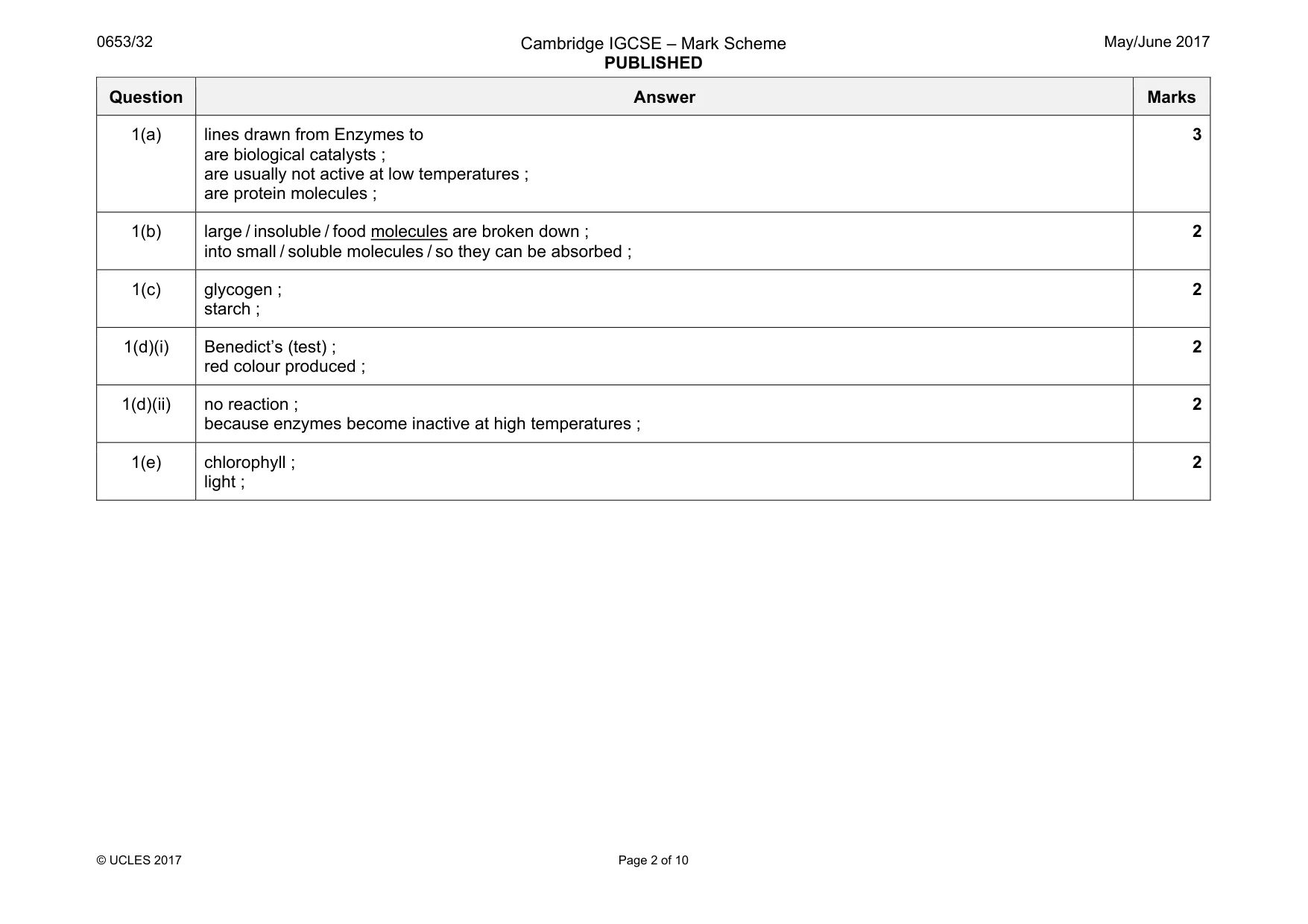
Mark scheme: 2(a)(i) potassium / K lithium / Li sodium / Na ;; 2 2(a)(ii) hydrogen / H2 ; 1 2(a)(iii) turns blue and stays blue / no change ; 1 2(b)(i) magnesium / Mg ; 1 2(b)(ii) copper / Cu ; 1 2(b)(iii) (too) dangerous / (risk of) explosion ; 1 2(c)(i) resists corrosion / does not rust ; 1 2(c)(ii) stronger / does not get damaged ; 1
Q3 · An aircraft flying at a constant height and constant speed above the Earth’s surface
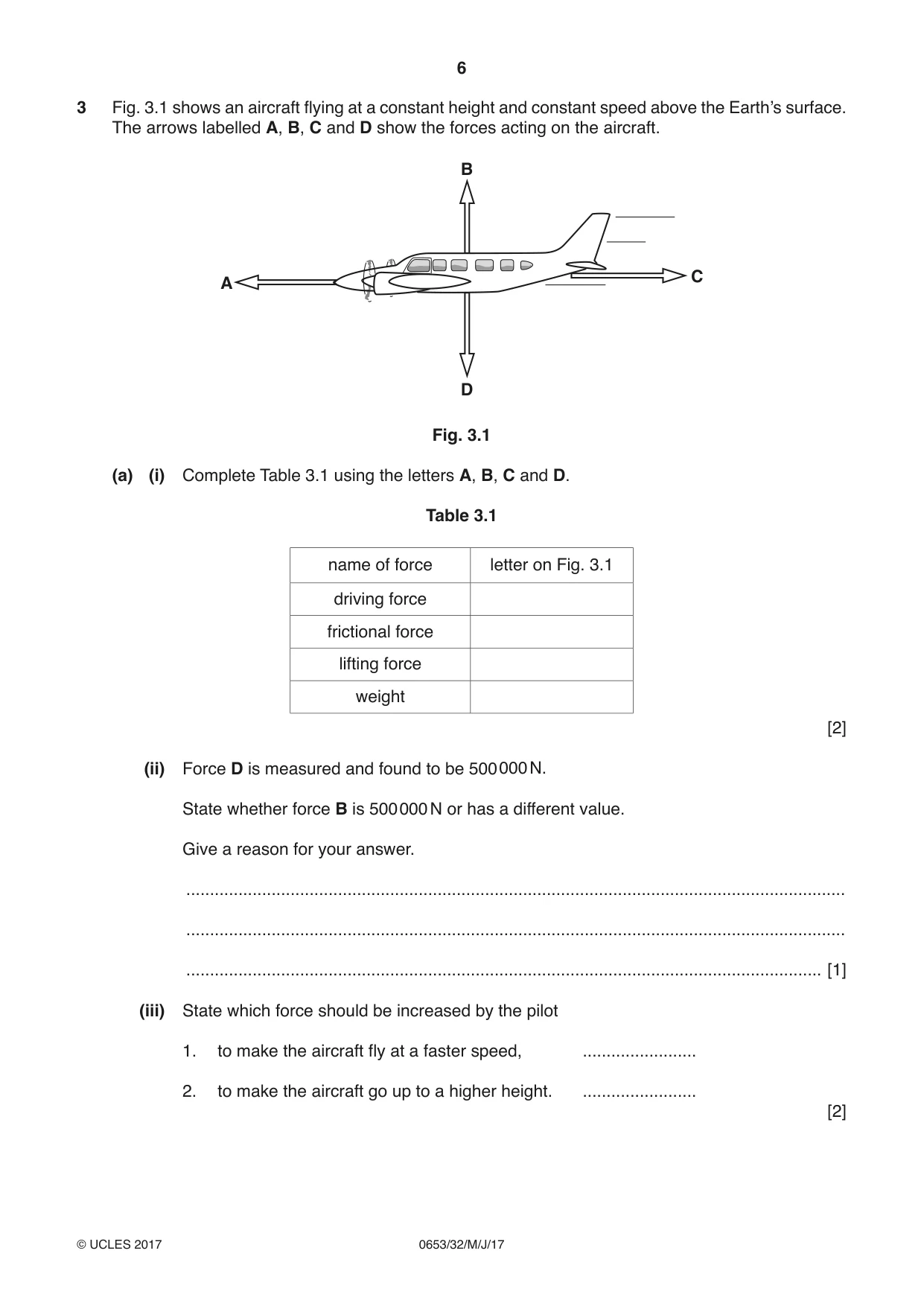
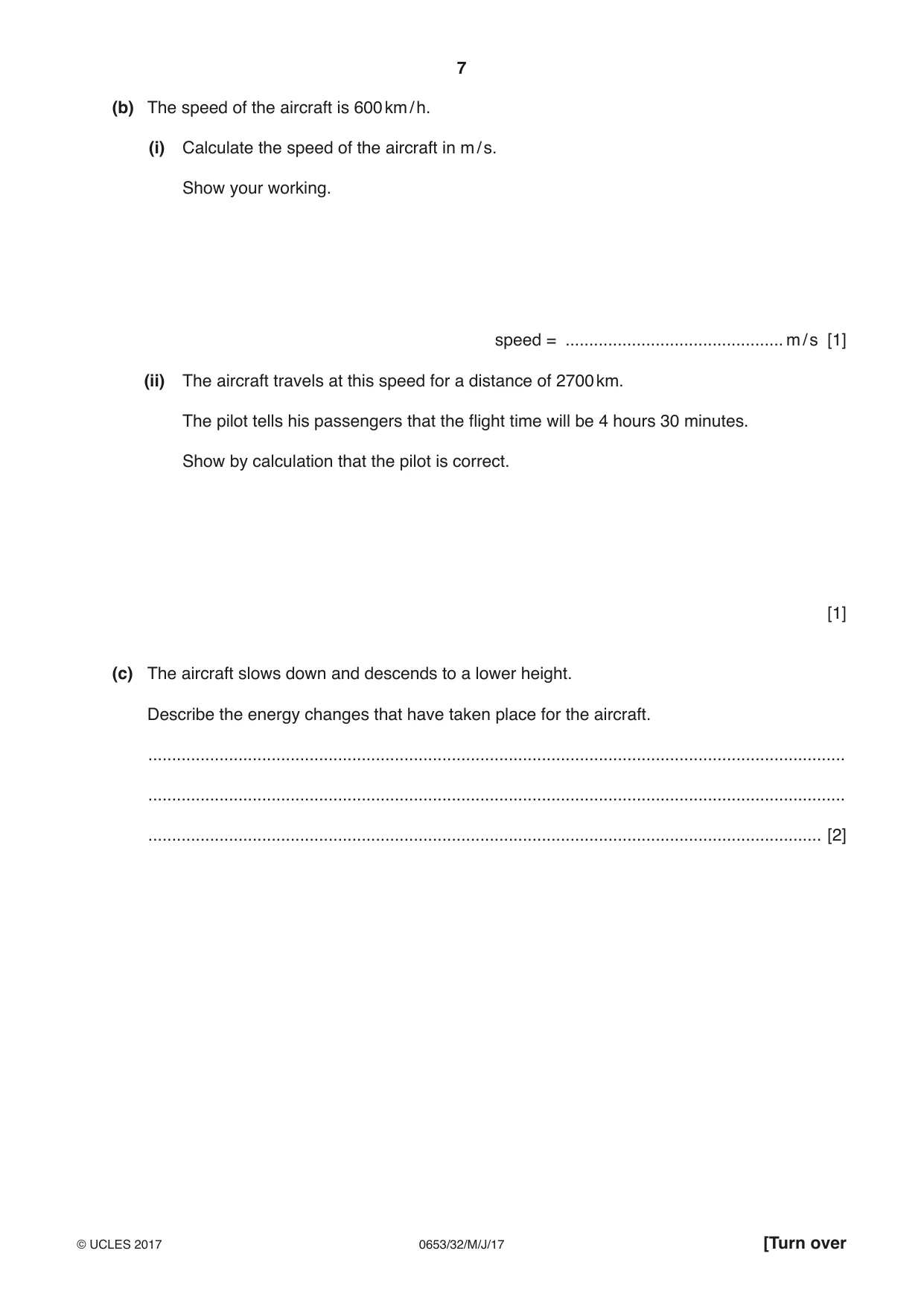
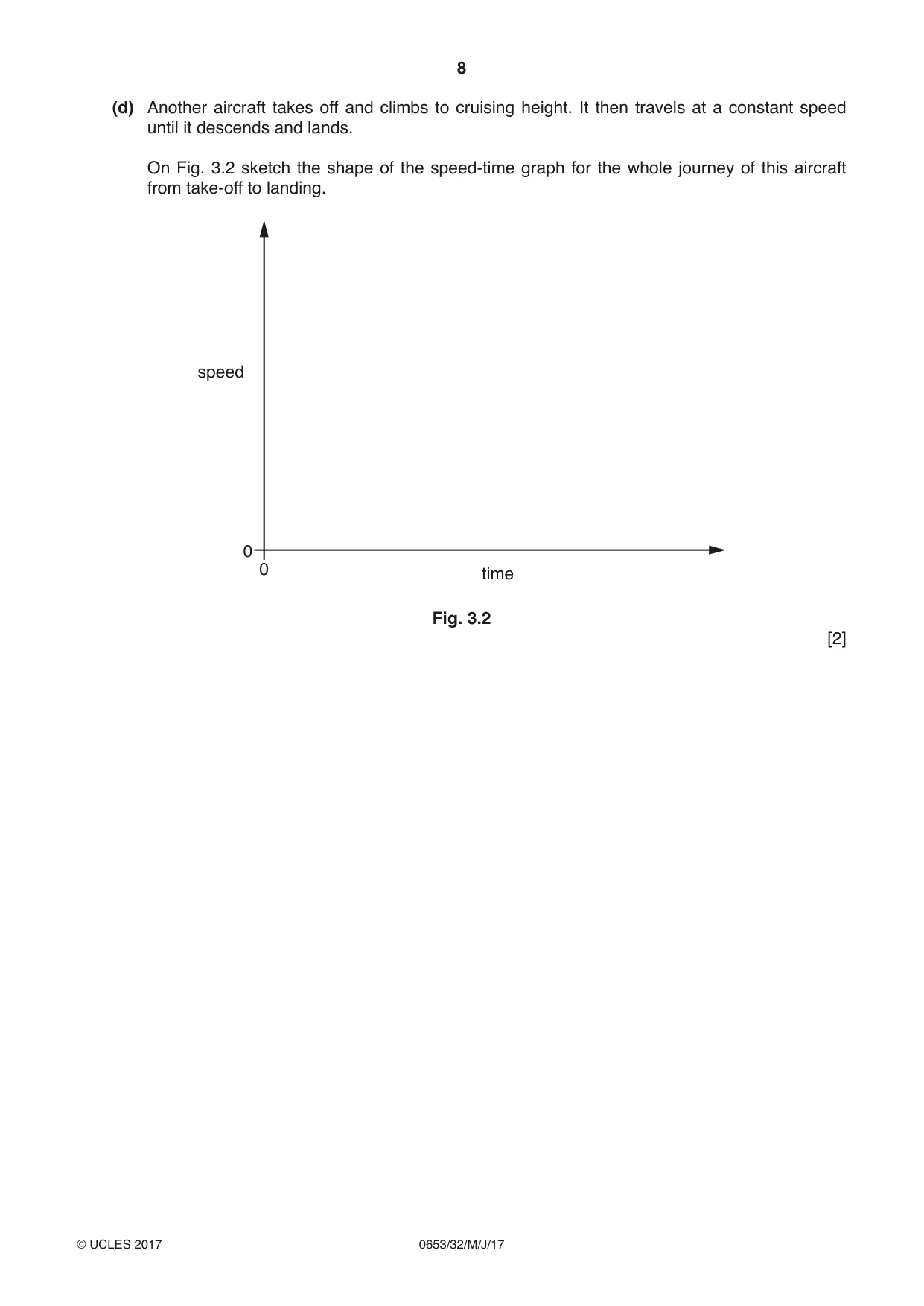
3 Fig. 3.1 shows an aircraft flying at a constant height and constant speed above the Earth’s surface. The arrows labelled A, B, C and D show the forces acting on the aircraft. B C A D Fig. 3.1 (a) (i) Complete Table 3.1 using the letters A, B, C and D. Table 3.1 name of force letter on Fig. 3.1 driving force frictional force lifting force weight [2] (ii) Force D is measured and found to be 500 000 N. State whether force B is 500 000 N or has a different value. Give a reason for your answer. ........................................................................................................................................... ........................................................................................................................................... ...................................................................................................................................... [1] (iii) State which force should be increased by the pilot 1. to make the aircraft fly at a faster speed, ........................ 2. to make the aircraft go up to a higher height. ........................ [2] (b) The speed of the aircraft is 600 km / h. (i) Calculate the speed of the aircraft in m / s. Show your working. speed = .............................................. m / s [1] (ii) The aircraft travels at this speed for a distance of 2700 km. The pilot tells his passengers that the flight time will be 4 hours 30 minutes. Show by calculation that the pilot is correct. [1] (c) The aircraft slows down and descends to a lower height. Describe the energy changes that have taken place for the aircraft. ................................................................................................................................................... ................................................................................................................................................... .............................................................................................................................................. [2] (d) Another aircraft takes off and climbs to cruising height. It then travels at a constant speed until it descends and lands. On Fig. 3.2 sketch the shape of the speed-time graph for the whole journey of this aircraft from take-off to landing. speed 0 0 time Fig. 3.2 [2] Please turn over for Question 4
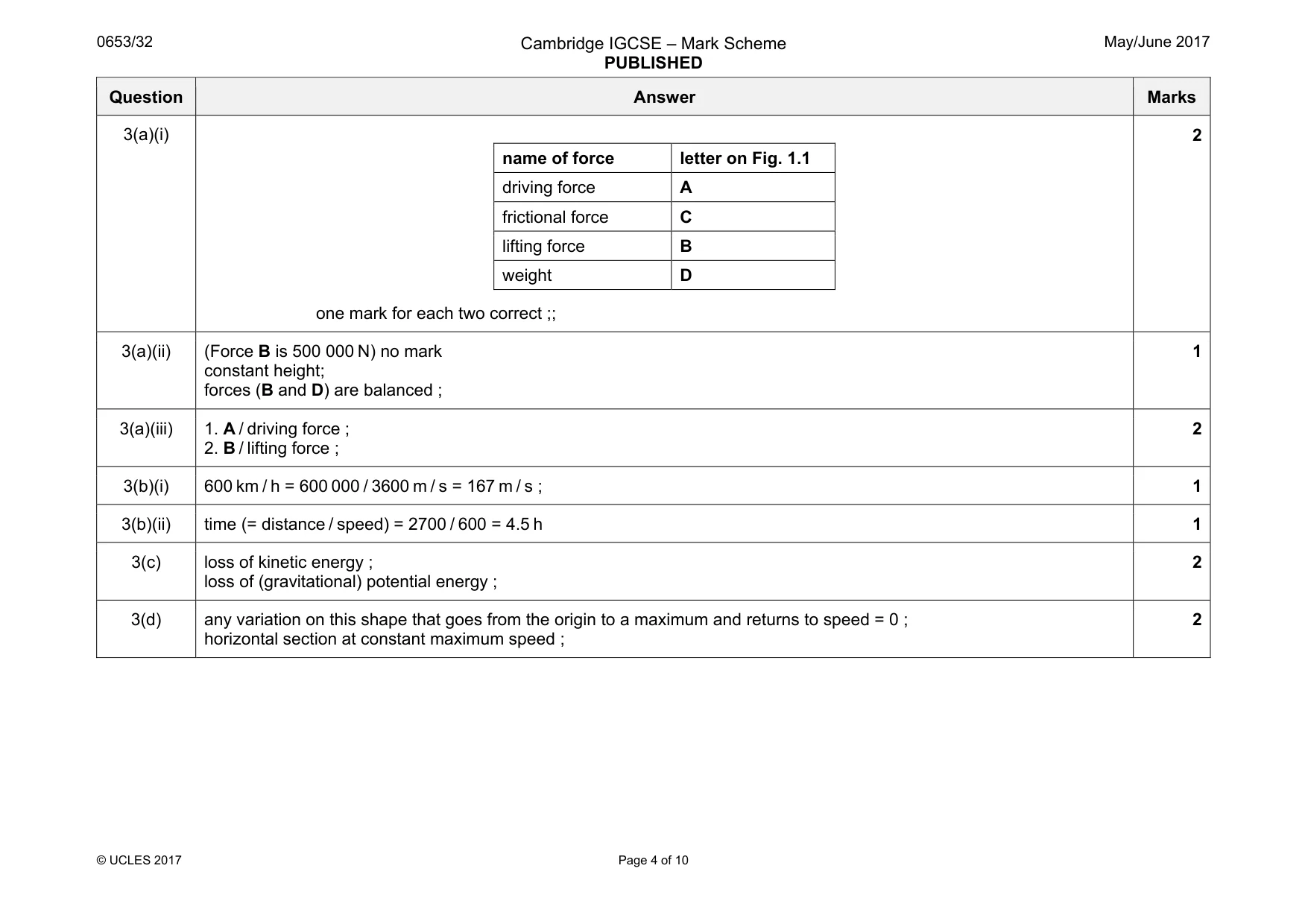
Mark scheme: 3(a)(i) one mark for each two correct ;; name of force letter on Fig. 1.1 driving force A frictional force C lifting force B weight D 2 3(a)(ii) (Force B is 500 000 N) no mark constant height; forces (B and D) are balanced ; 1 3(a)(iii) 1. A / driving force ; 2. B / lifting force ; 2 3(b)(i) 600 km / h = 600 000 / 3600 m / s = 167 m / s ; 1 3(b)(ii) time (= distance / speed) = 2700 / 600 = 4.5 h 1 3(c) loss of kinetic energy ; loss of (gravitational) potential energy ; 2 3(d) any variation on this shape that goes from the origin to a maximum and returns to speed = 0 ; horizontal section at constant maximum speed ; 2
Q4 · A diagram of the internal structure of the heart
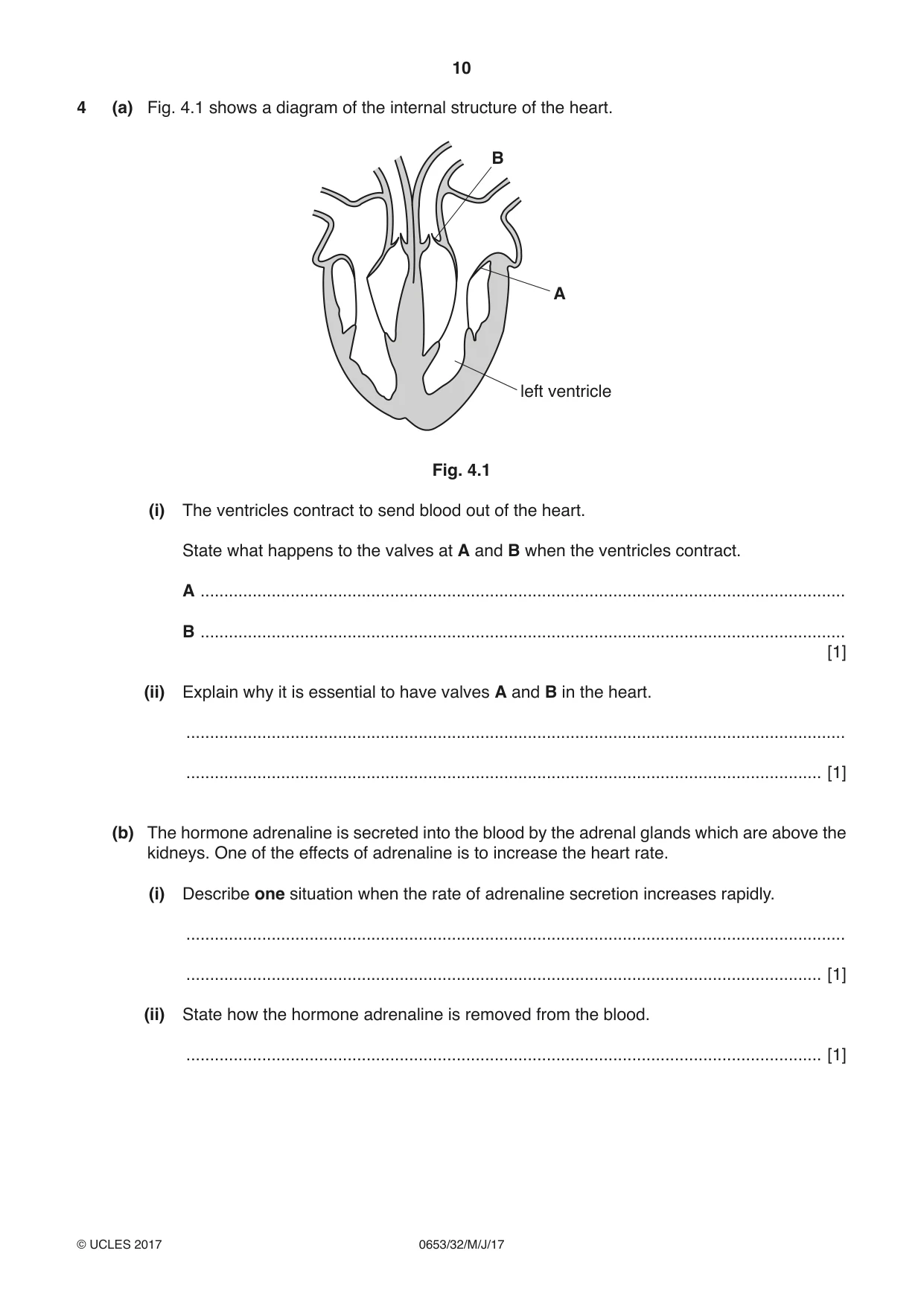
4 (a) Fig. 4.1 shows a diagram of the internal structure of the heart. B A left ventricle Fig. 4.1 (i) The ventricles contract to send blood out of the heart. State what happens to the valves at A and B when the ventricles contract. A ........................................................................................................................................ B ........................................................................................................................................ [1] (ii) Explain why it is essential to have valves A and B in the heart. ........................................................................................................................................... ...................................................................................................................................... [1] (b) The hormone adrenaline is secreted into the blood by the adrenal glands which are above the kidneys. One of the effects of adrenaline is to increase the heart rate. (i) Describe one situation when the rate of adrenaline secretion increases rapidly. ........................................................................................................................................... ...................................................................................................................................... [1] (ii) State how the hormone adrenaline is removed from the blood. ...................................................................................................................................... [1] (c) Describe the functions of the following parts of the blood. red blood cells ................................................................................................................................................... ................................................................................................................................................... ................................................................................................................................................... plasma ................................................................................................................................................... ................................................................................................................................................... ................................................................................................................................................... [2]
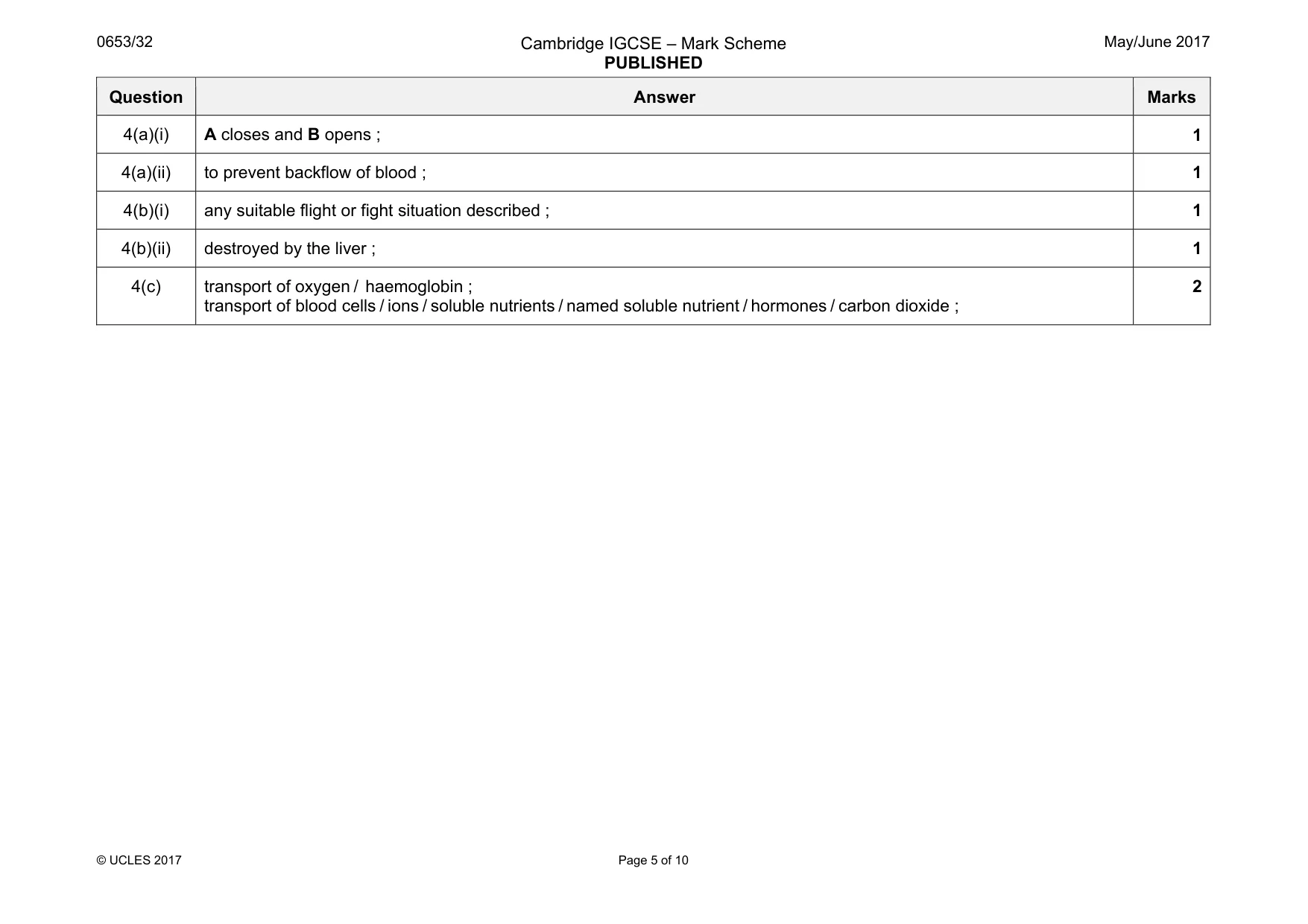
Mark scheme: 4(a)(i) A closes and B opens ; 1 4(a)(ii) to prevent backflow of blood ; 1 4(b)(i) any suitable flight or fight situation described ; 1 4(b)(ii) destroyed by the liver ; 1 4(c) transport of oxygen / haemoglobin ; transport of blood cells / ions / soluble nutrients / named soluble nutrient / hormones / carbon dioxide ; 2
Q5 · Petroleum is a mixture of hydrocarbons
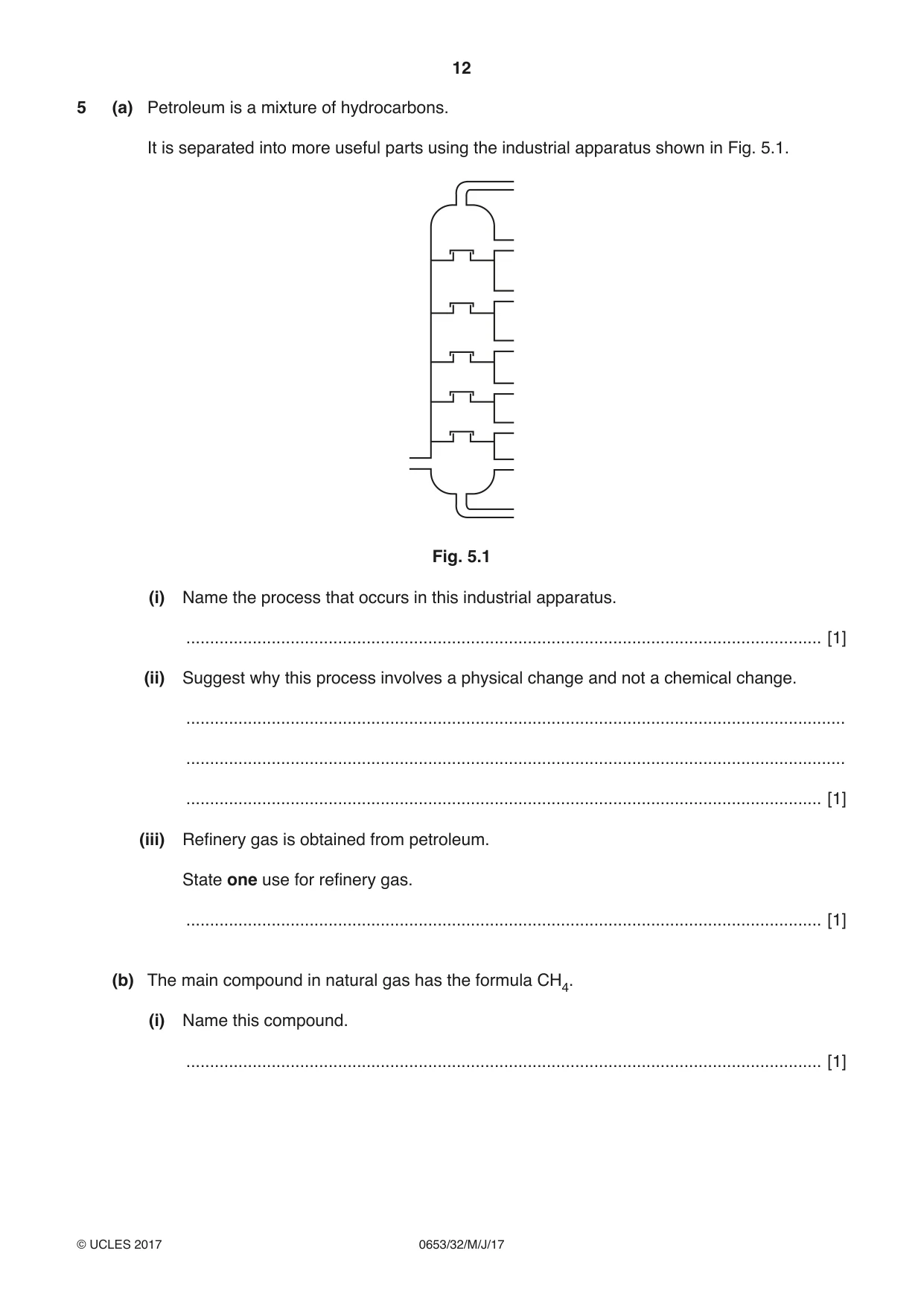
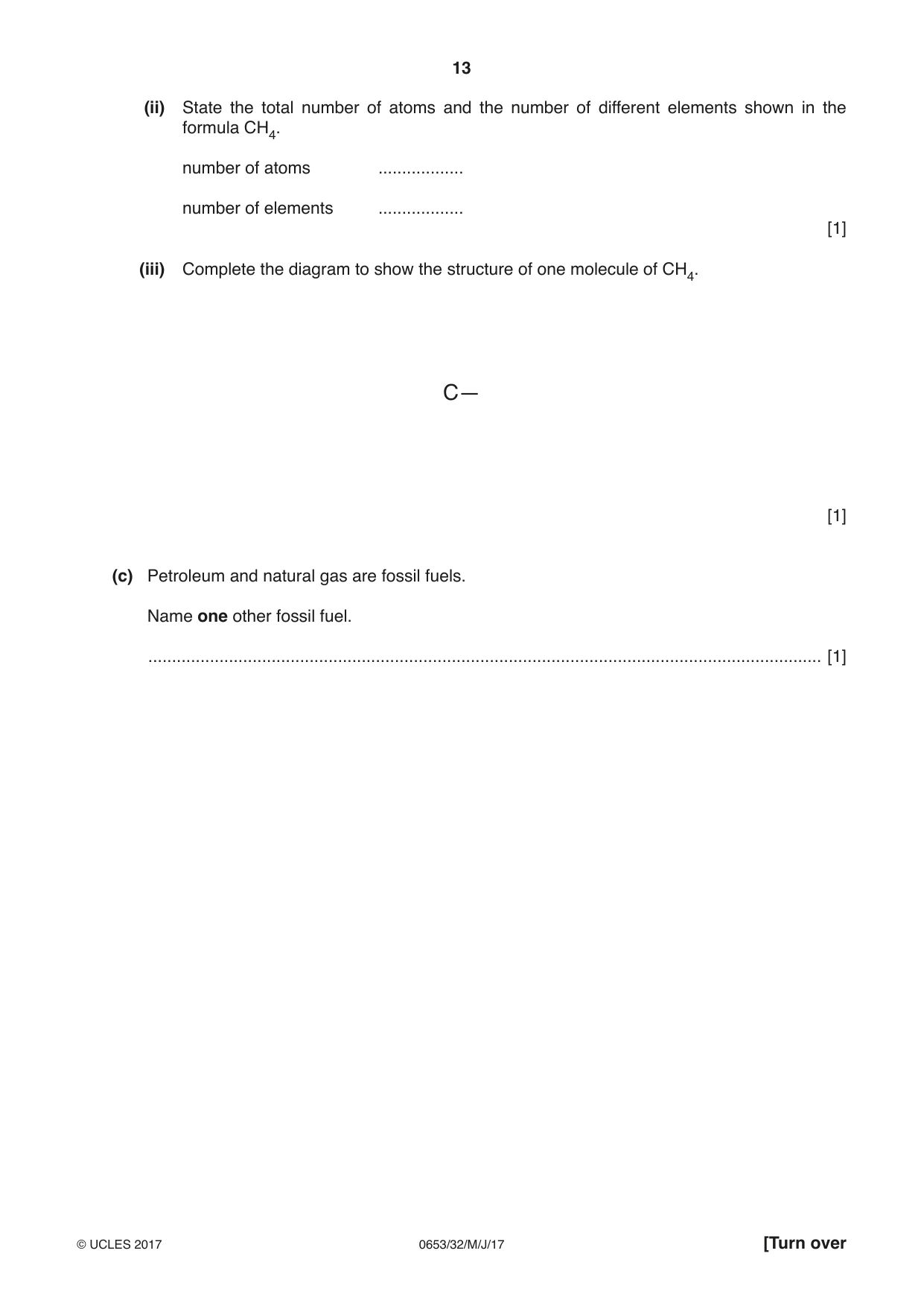
5 (a) Petroleum is a mixture of hydrocarbons. It is separated into more useful parts using the industrial apparatus shown in Fig. 5.1. Fig. 5.1 (i) Name the process that occurs in this industrial apparatus. ...................................................................................................................................... [1] (ii) Suggest why this process involves a physical change and not a chemical change. ........................................................................................................................................... ........................................................................................................................................... ...................................................................................................................................... [1] (iii) Refinery gas is obtained from petroleum. State one use for refinery gas. ...................................................................................................................................... [1] (b) The main compound in natural gas has the formula CH4. (i) Name this compound. ...................................................................................................................................... [1] (ii) State the total number of atoms and the number of different elements shown in the formula CH4. number of atoms .................. number of elements .................. [1] (iii) Complete the diagram to show the structure of one molecule of CH4. C— [1] (c) Petroleum and natural gas are fossil fuels. Name one other fossil fuel. .............................................................................................................................................. [1]
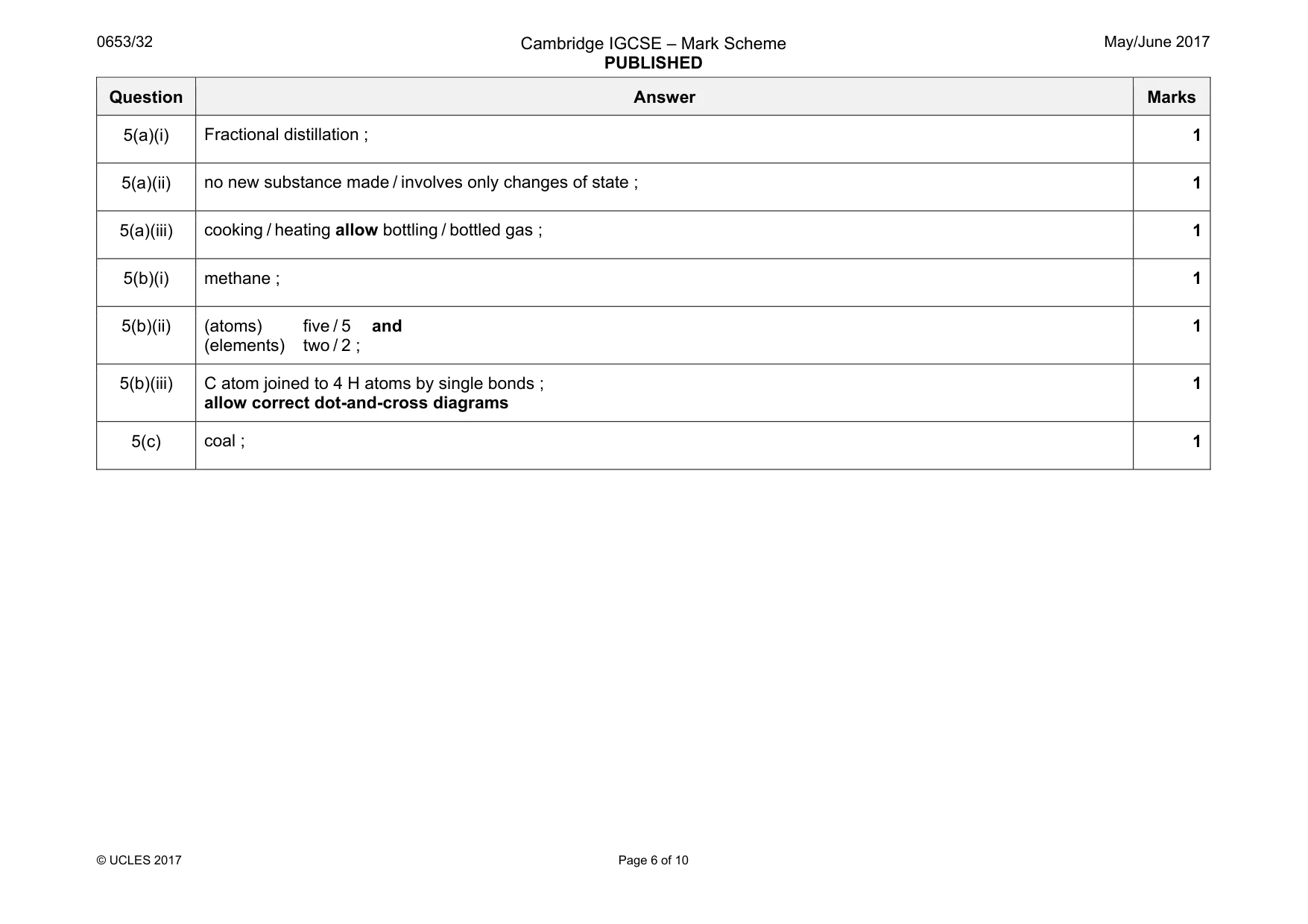
Mark scheme: 5(a)(i) 1 5(a)(ii) no new substance made / involves only changes of state ; 1 5(a)(iii) cooking / heating allow bottling / bottled gas ; 1 5(b)(i) methane ; 1 5(b)(ii) (atoms) five / 5 and (elements) two / 2 ; 1 5(b)(iii) C atom joined to 4 H atoms by single bonds ; allow correct dot-and-cross diagrams 1 5(c) coal ; 1
Q6 · An aircraft is flying at a height of 10 000 m
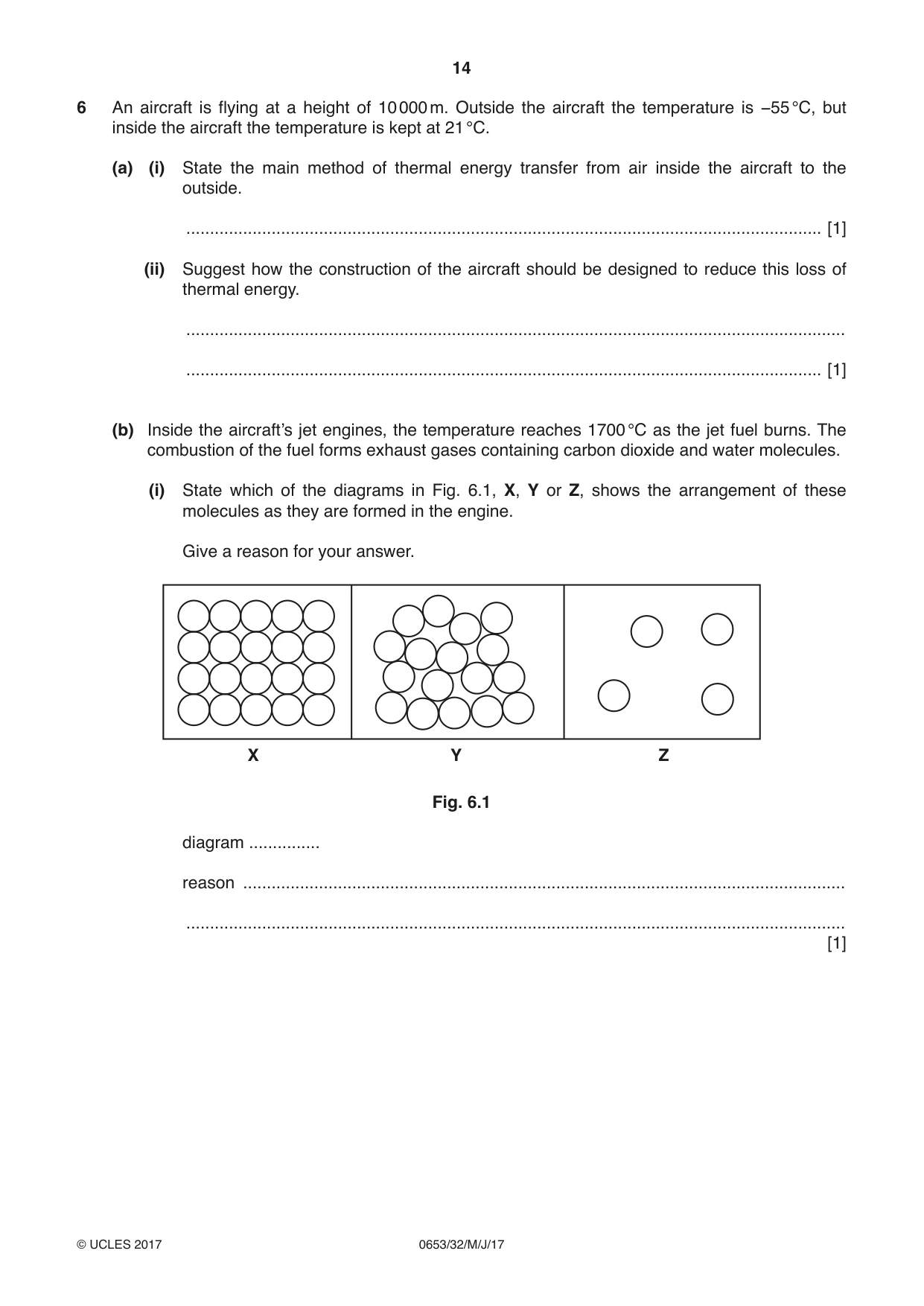
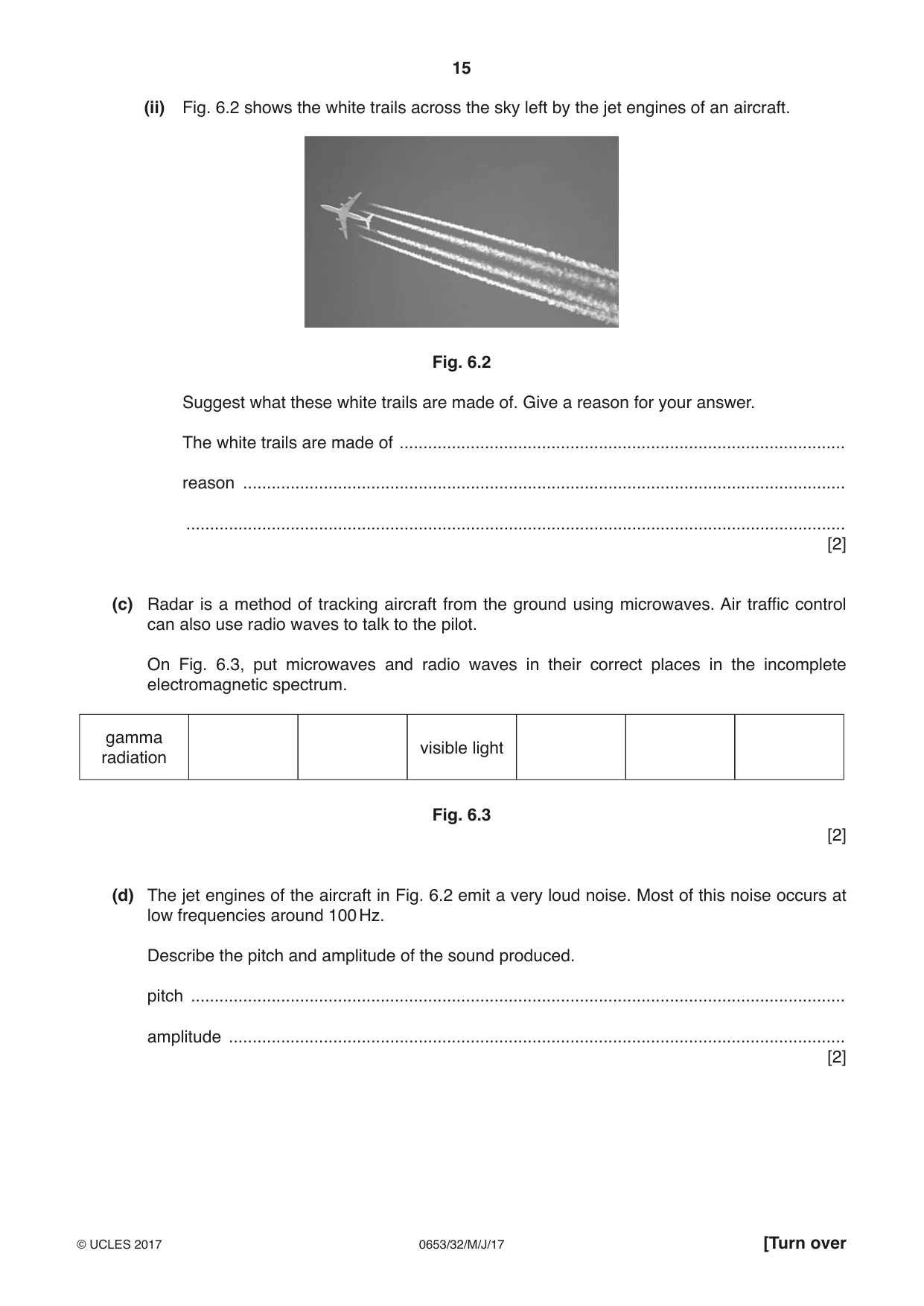
6 An aircraft is flying at a height of 10 000 m. Outside the aircraft the temperature is −55 °C, but inside the aircraft the temperature is kept at 21 °C. (a) (i) State the main method of thermal energy transfer from air inside the aircraft to the outside. ...................................................................................................................................... [1] (ii) Suggest how the construction of the aircraft should be designed to reduce this loss of thermal energy. ........................................................................................................................................... ...................................................................................................................................... [1] (b) Inside the aircraft’s jet engines, the temperature reaches 1700 °C as the jet fuel burns. The combustion of the fuel forms exhaust gases containing carbon dioxide and water molecules. (i) State which of the diagrams in Fig. 6.1, X, Y or Z, shows the arrangement of these molecules as they are formed in the engine. Give a reason for your answer. X Y Z Fig. 6.1 diagram ............... reason ............................................................................................................................... ........................................................................................................................................... [1] (ii) Fig. 6.2 shows the white trails across the sky left by the jet engines of an aircraft. Fig. 6.2 Suggest what these white trails are made of. Give a reason for your answer. The white trails are made of .............................................................................................. reason ............................................................................................................................... ........................................................................................................................................... [2] (c) Radar is a method of tracking aircraft from the ground using microwaves. Air traffic control can also use radio waves to talk to the pilot. On Fig. 6.3, put microwaves and radio waves in their correct places in the incomplete electromagnetic spectrum. gamma visible lightradiation Fig. 6.3 [2] (d) The jet engines of the aircraft in Fig. 6.2 emit a very loud noise. Most of this noise occurs at low frequencies around 100 Hz. Describe the pitch and amplitude of the sound produced. pitch .......................................................................................................................................... amplitude .................................................................................................................................. [2]
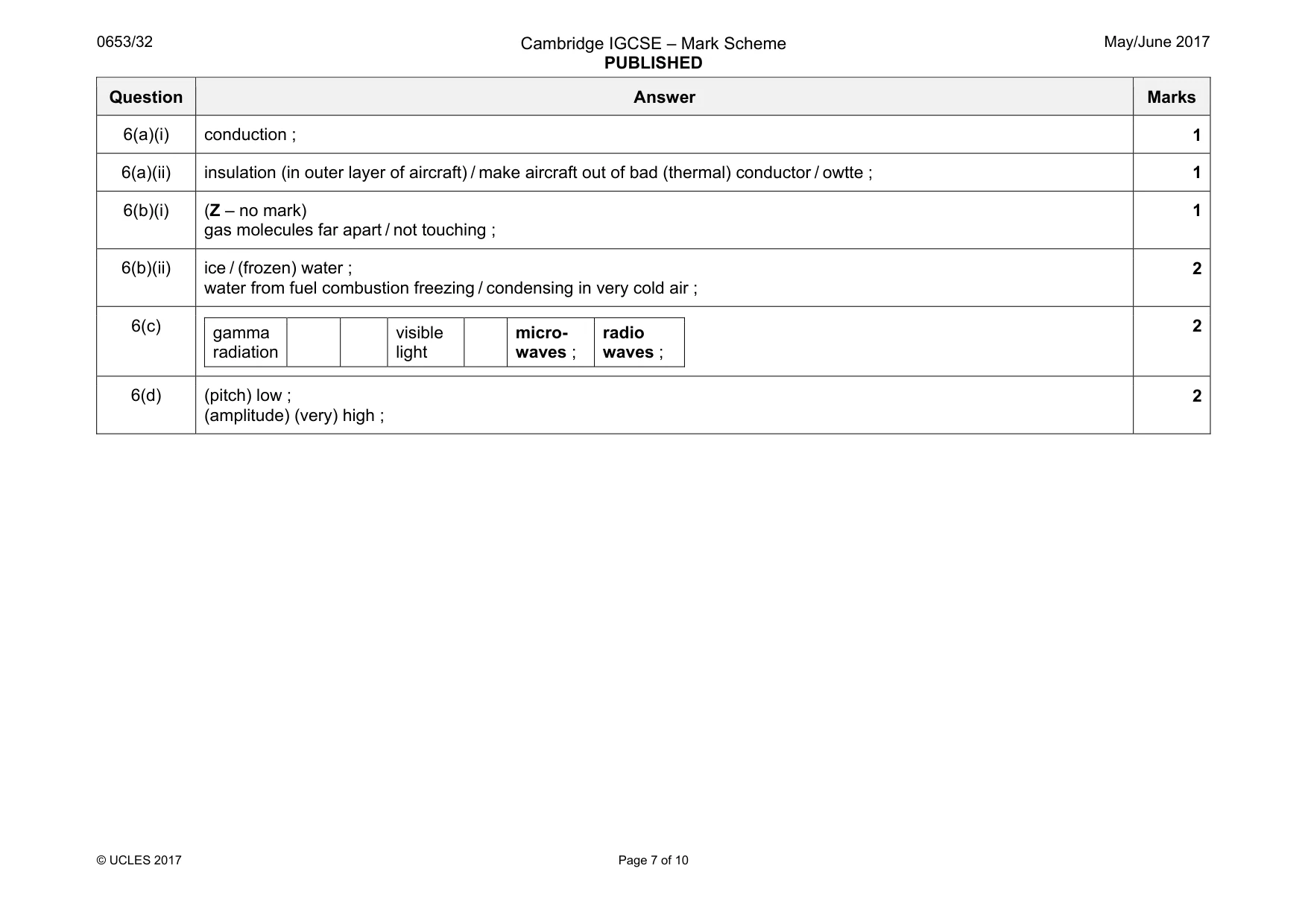
Mark scheme: 6(a)(i) conduction ; 1 6(a)(ii) insulation (in outer layer of aircraft) / make aircraft out of bad (thermal) conductor / owtte ; 1 6(b)(i) (Z – no mark) gas molecules far apart / not touching ; 1 6(b)(ii) ice / (frozen) water ; water from fuel combustion freezing / condensing in very cold air ; 2 6(c) gamma radiation visible light micro- waves ; radio waves ; 2 6(d) (pitch) low ; (amplitude) (very) high ; 2
Q7 · Some of the organisms in a lake
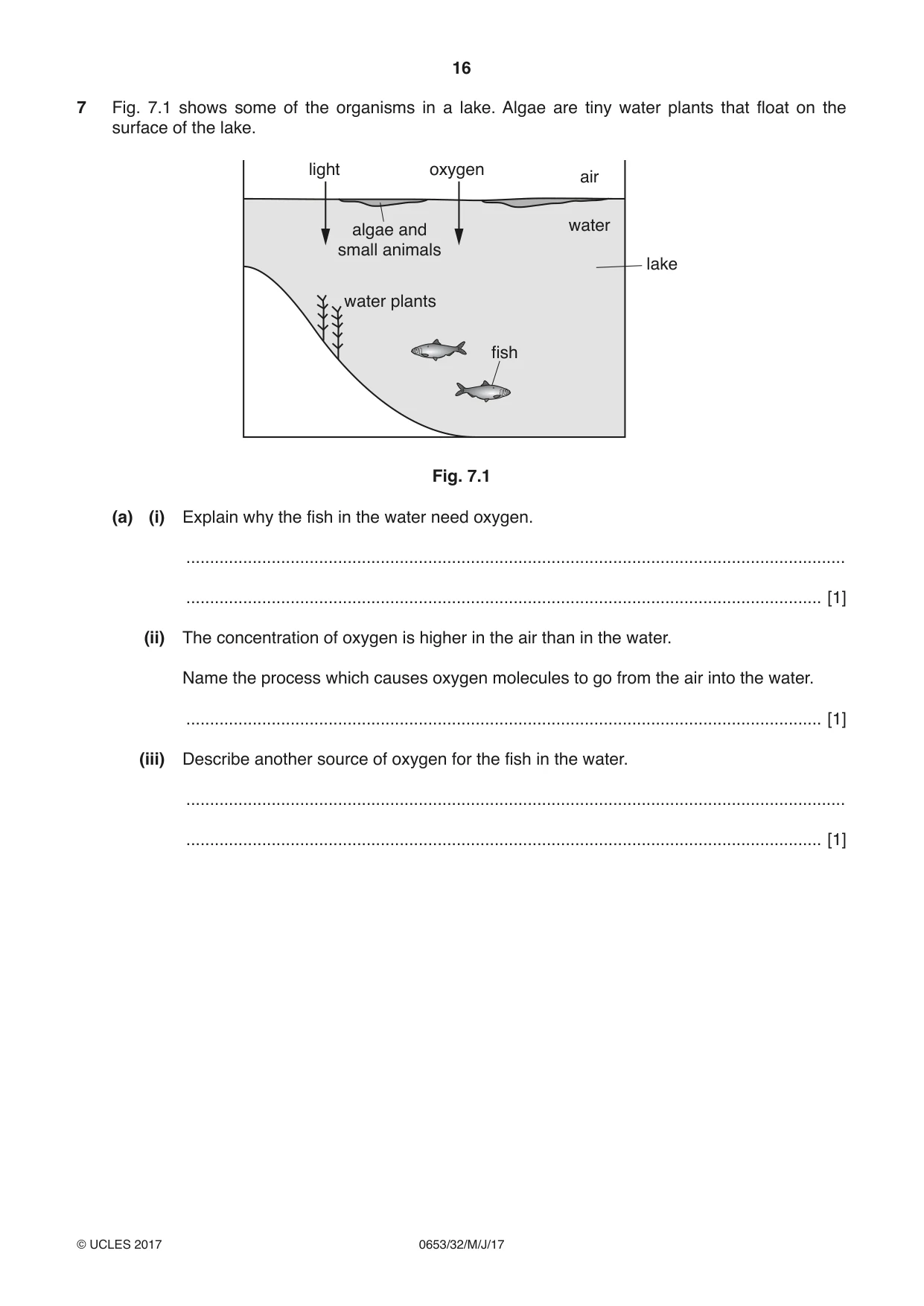
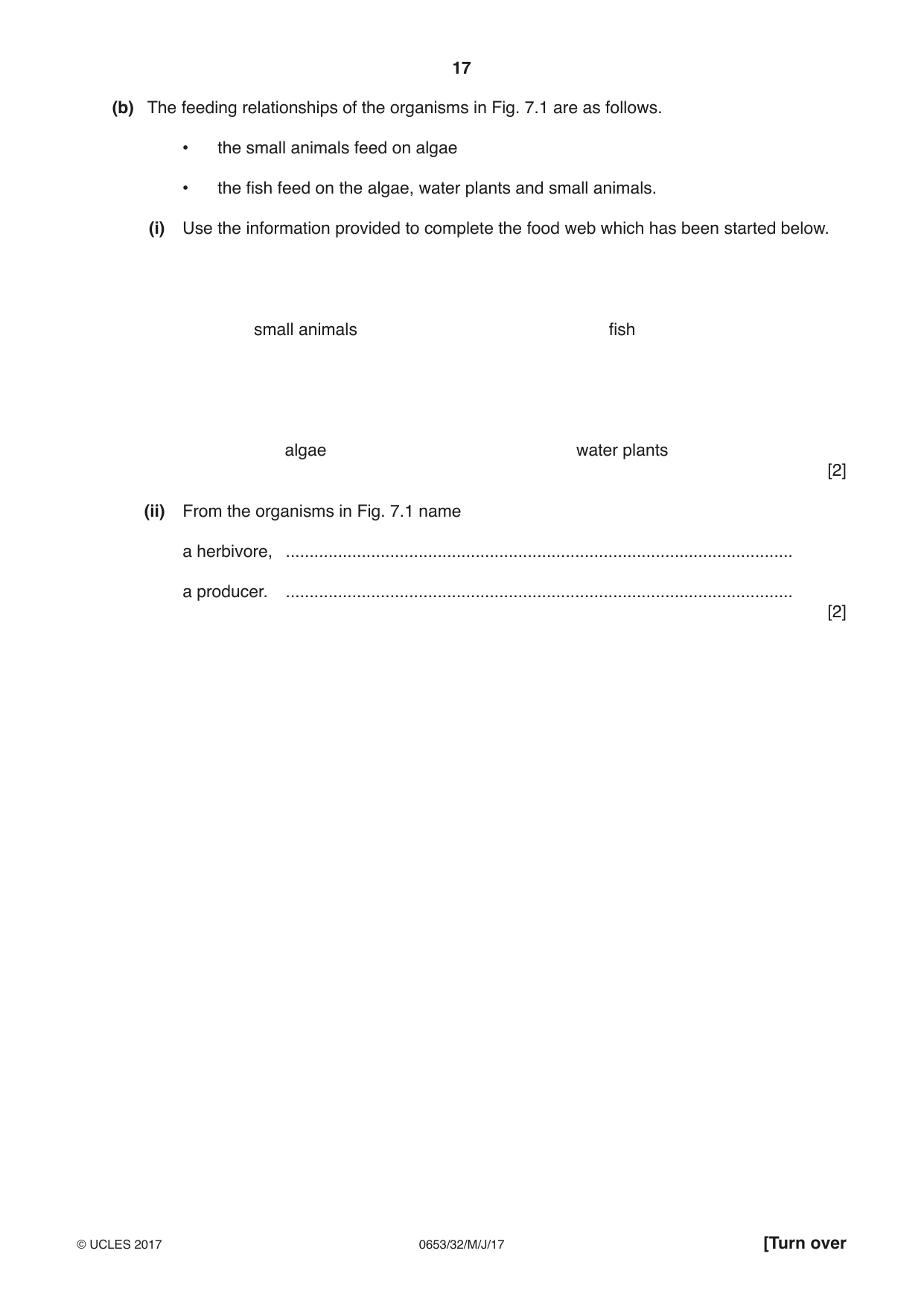
7 Fig. 7.1 shows some of the organisms in a lake. Algae are tiny water plants that float on the surface of the lake. light oxygen air algae and water small animals lake water plants fish Fig. 7.1 (a) (i) Explain why the fish in the water need oxygen. ........................................................................................................................................... ...................................................................................................................................... [1] (ii) The concentration of oxygen is higher in the air than in the water. Name the process which causes oxygen molecules to go from the air into the water. ...................................................................................................................................... [1] (iii) Describe another source of oxygen for the fish in the water. ........................................................................................................................................... ...................................................................................................................................... [1] (b) The feeding relationships of the organisms in Fig. 7.1 are as follows. • the small animals feed on algae • the fish feed on the algae, water plants and small animals. (i) Use the information provided to complete the food web which has been started below. small animals fish algae water plants [2] (ii) From the organisms in Fig. 7.1 name a herbivore, ........................................................................................................... a producer. ........................................................................................................... [2]
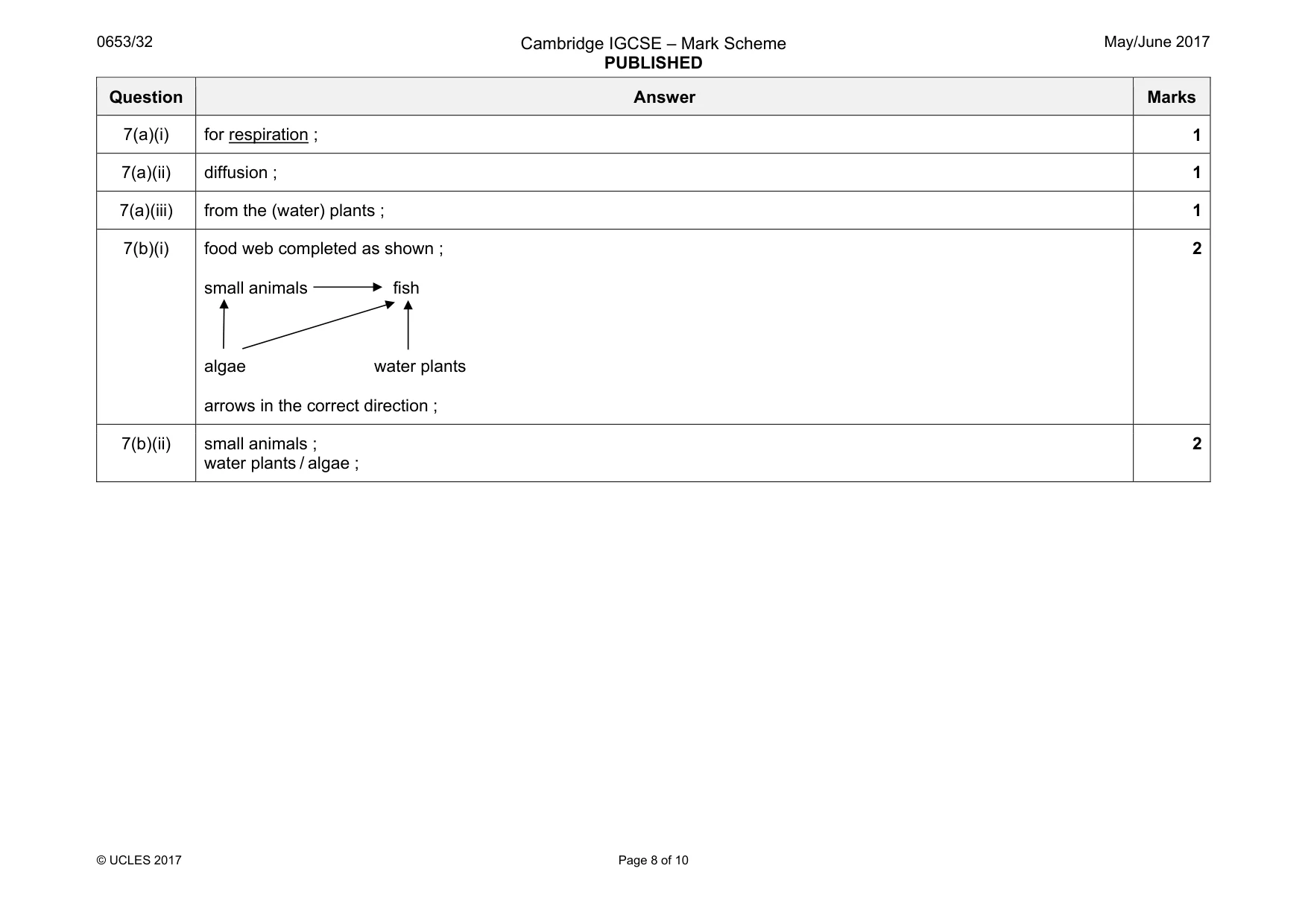
Mark scheme: 7(a)(i) for respiration ; 1 7(a)(ii) diffusion ; 1 7(a)(iii) from the (water) plants ; 1 7(b)(i) food web completed as shown ; small animals fish algae water plants arrows in the correct direction ; 2 7(b)(ii) small animals ; water plants / algae ; 2
Q8 · Water is extracted from a river and then treated to make it suitable for people to use
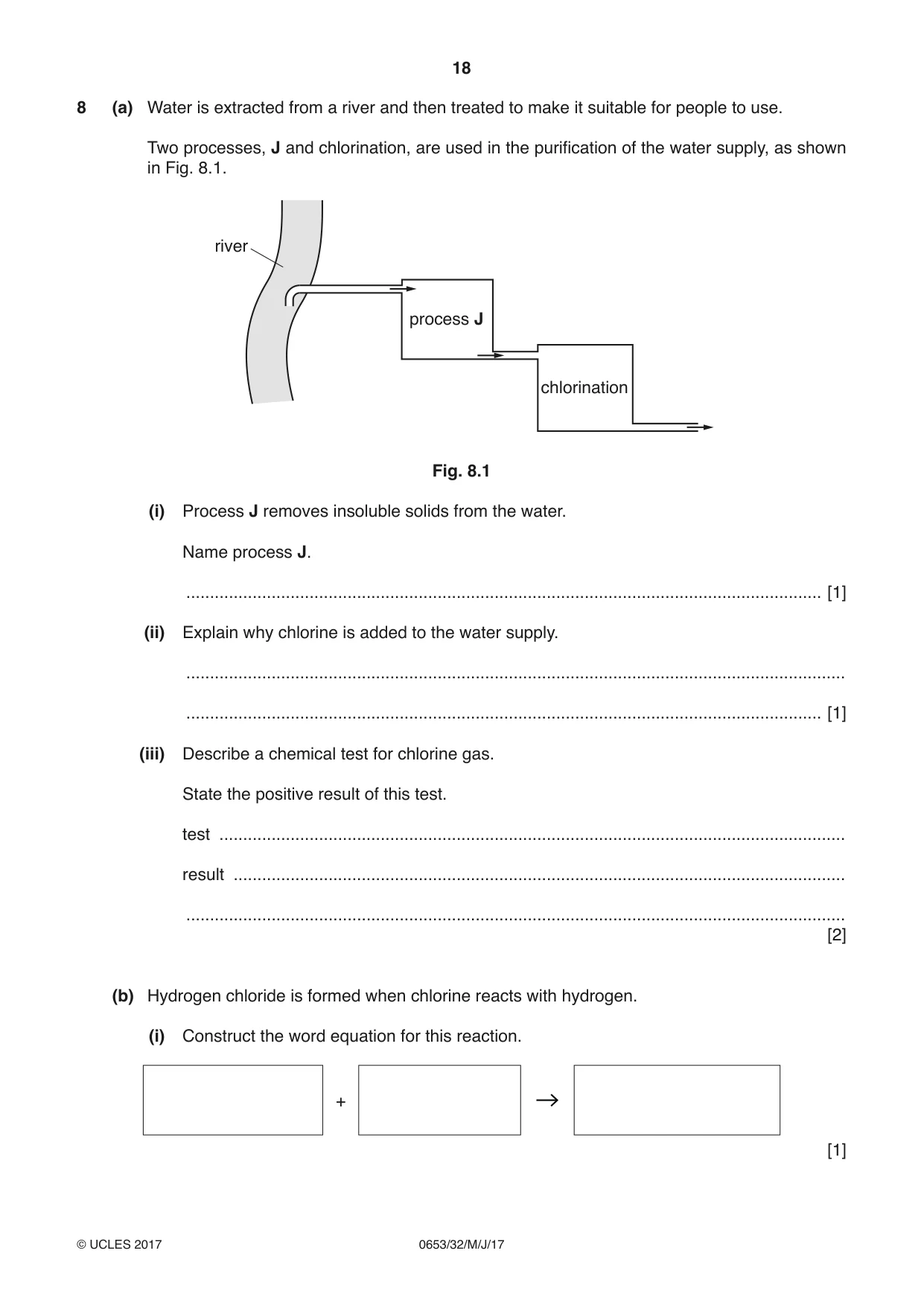
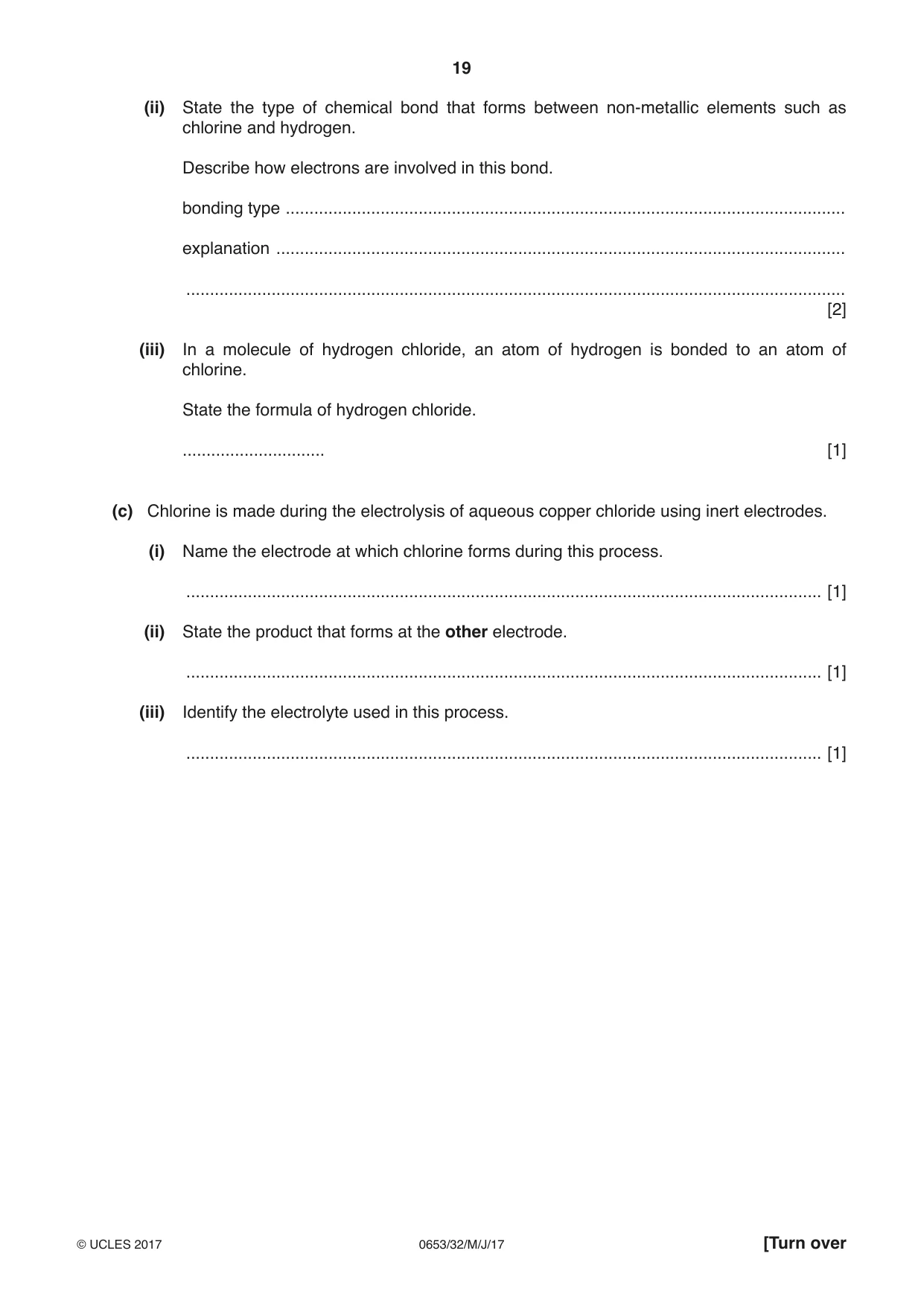
8 (a) Water is extracted from a river and then treated to make it suitable for people to use. Two processes, J and chlorination, are used in the purification of the water supply, as shown in Fig. 8.1. river process J chlorination Fig. 8.1 (i) Process J removes insoluble solids from the water. Name process J. ...................................................................................................................................... [1] (ii) Explain why chlorine is added to the water supply. ........................................................................................................................................... ...................................................................................................................................... [1] (iii) Describe a chemical test for chlorine gas. State the positive result of this test. test .................................................................................................................................... result ................................................................................................................................. ........................................................................................................................................... [2] (b) Hydrogen chloride is formed when chlorine reacts with hydrogen. (i) Construct the word equation for this reaction. + [1] (ii) State the type of chemical bond that forms between non-metallic elements such as chlorine and hydrogen. Describe how electrons are involved in this bond. bonding type ...................................................................................................................... explanation ........................................................................................................................ ........................................................................................................................................... [2] (iii) In a molecule of hydrogen chloride, an atom of hydrogen is bonded to an atom of chlorine. State the formula of hydrogen chloride. .............................. [1] (c) Chlorine is made during the electrolysis of aqueous copper chloride using inert electrodes. (i) Name the electrode at which chlorine forms during this process. ...................................................................................................................................... [1] (ii) State the product that forms at the other electrode. ...................................................................................................................................... [1] (iii) Identify the electrolyte used in this process. ...................................................................................................................................... [1]
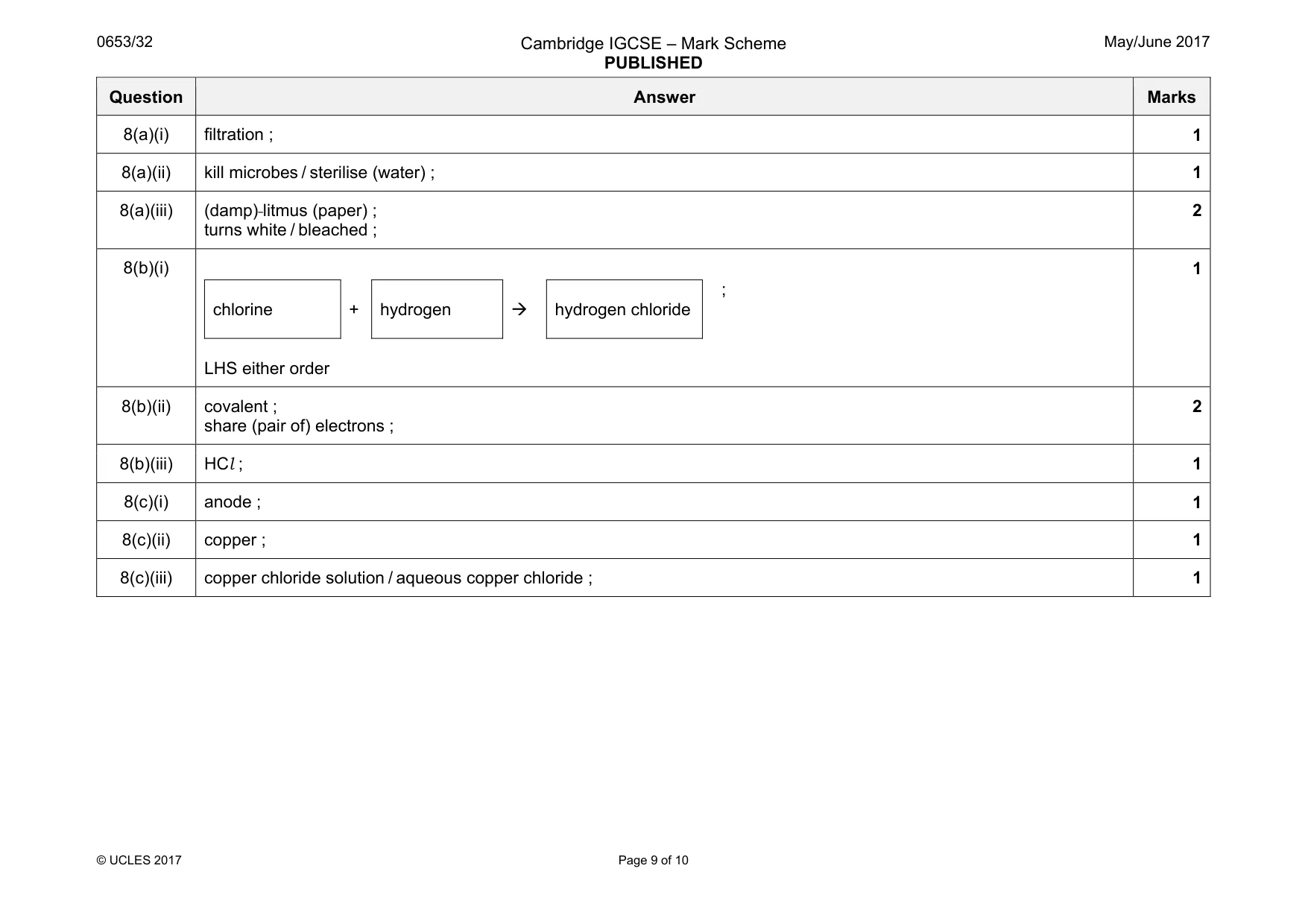
Mark scheme: 8(a)(i) filtration ; 1 8(a)(ii) kill microbes / sterilise (water) ; 1 8(a)(iii) (damp) litmus (paper) ; turns white / bleached ; 2 8(b)(i) ; LHS either order chlorine + hydrogen Æ hydrogen chloride 1 8(b)(ii) covalent ; share (pair of) electrons ; 2 8(b)(iii) HCl ; 1 8(c)(i) anode ; 1 8(c)(ii) copper ; 1 8(c)(iii) copper chloride solution / aqueous copper chloride ; 1
Q9 · A simple circuit set up to investigate the electrical properties of a lamp
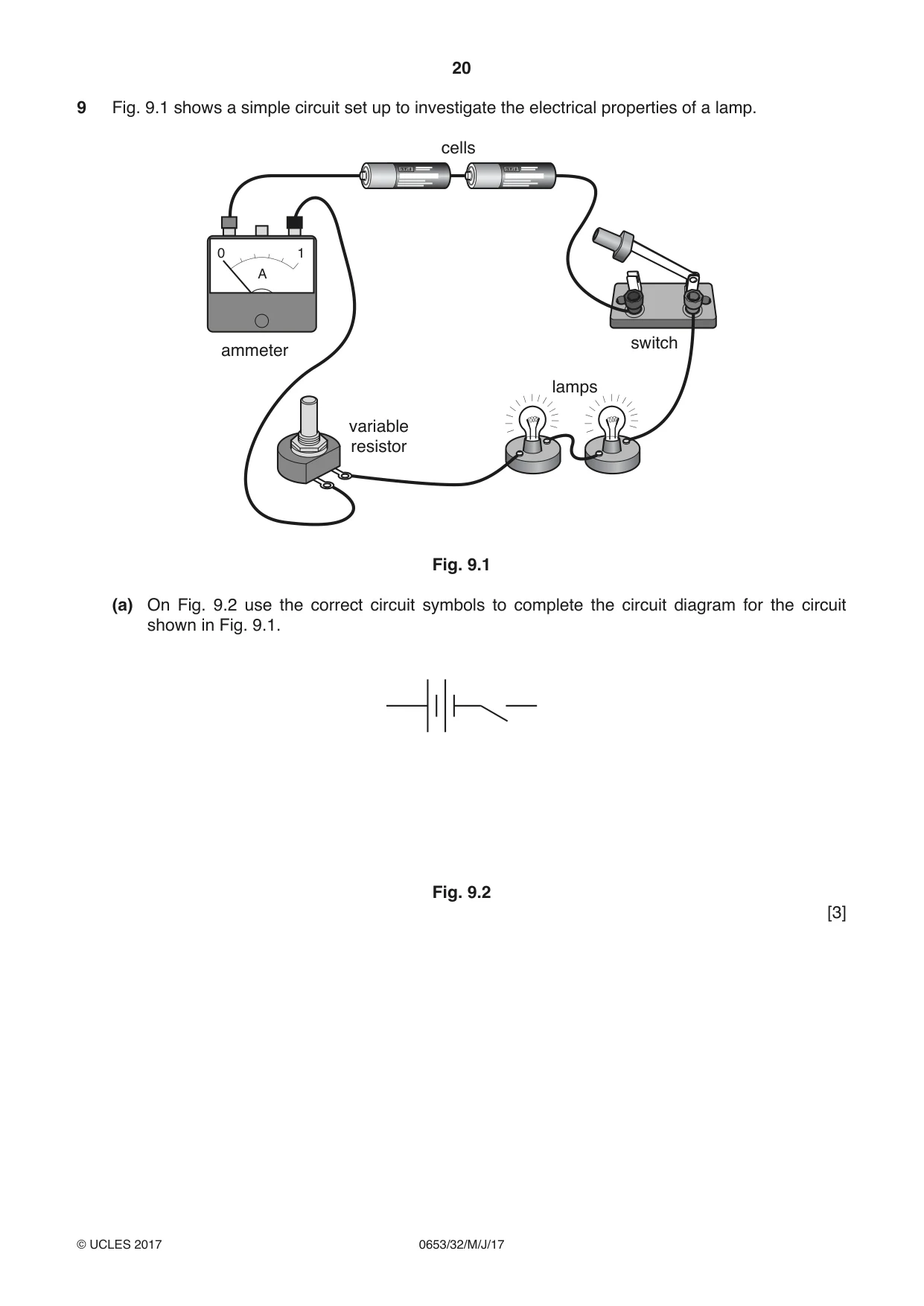
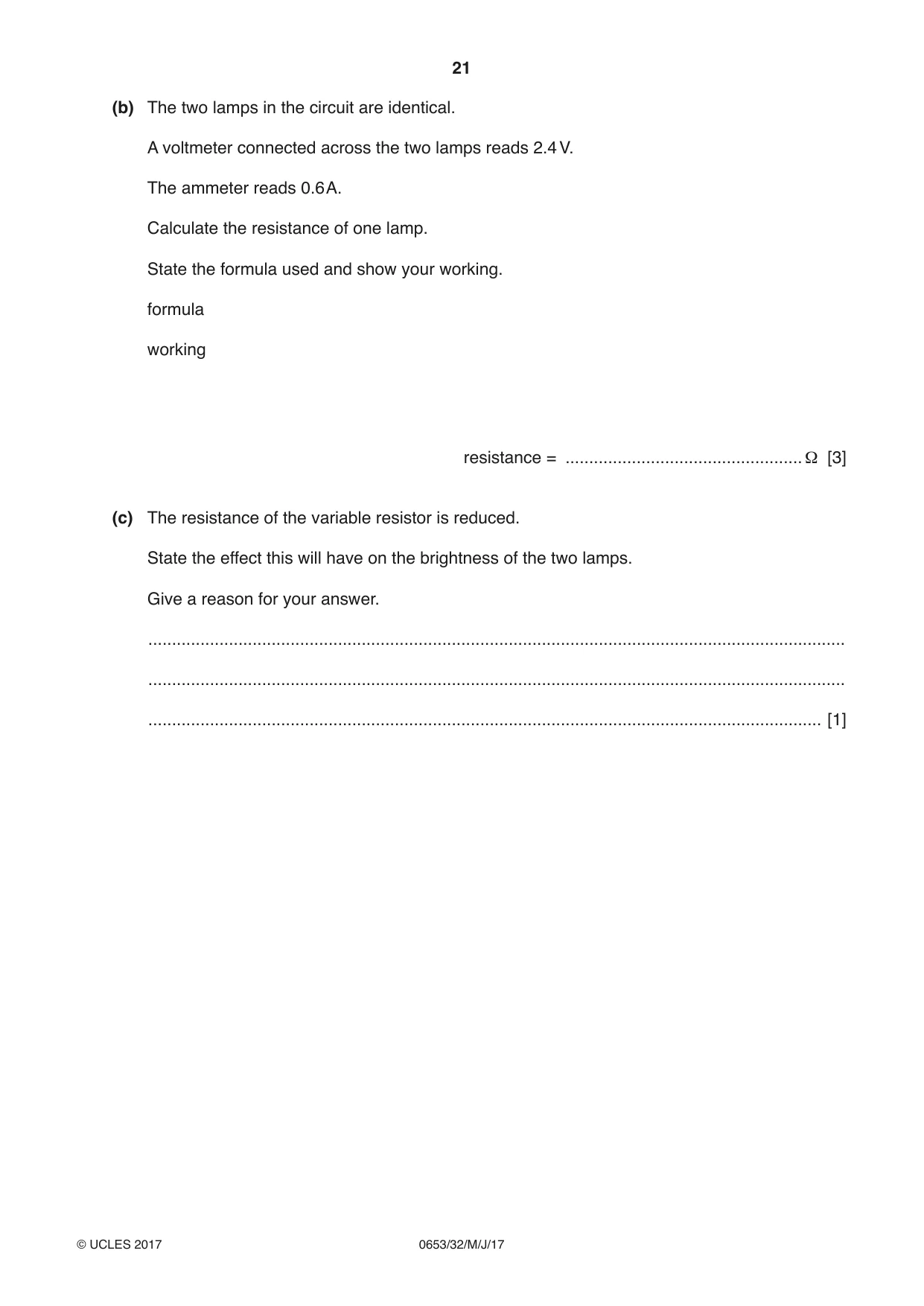
9 Fig. 9.1 shows a simple circuit set up to investigate the electrical properties of a lamp. cells 0 1 A switch ammeter lamps variable resistor Fig. 9.1 (a) On Fig. 9.2 use the correct circuit symbols to complete the circuit diagram for the circuit shown in Fig. 9.1. Fig. 9.2 [3] (b) The two lamps in the circuit are identical. A voltmeter connected across the two lamps reads 2.4 V. The ammeter reads 0.6 A. Calculate the resistance of one lamp. State the formula used and show your working. formula working resistance = .................................................. Ω [3] (c) The resistance of the variable resistor is reduced. State the effect this will have on the brightness of the two lamps. Give a reason for your answer. ................................................................................................................................................... ................................................................................................................................................... .............................................................................................................................................. [1]
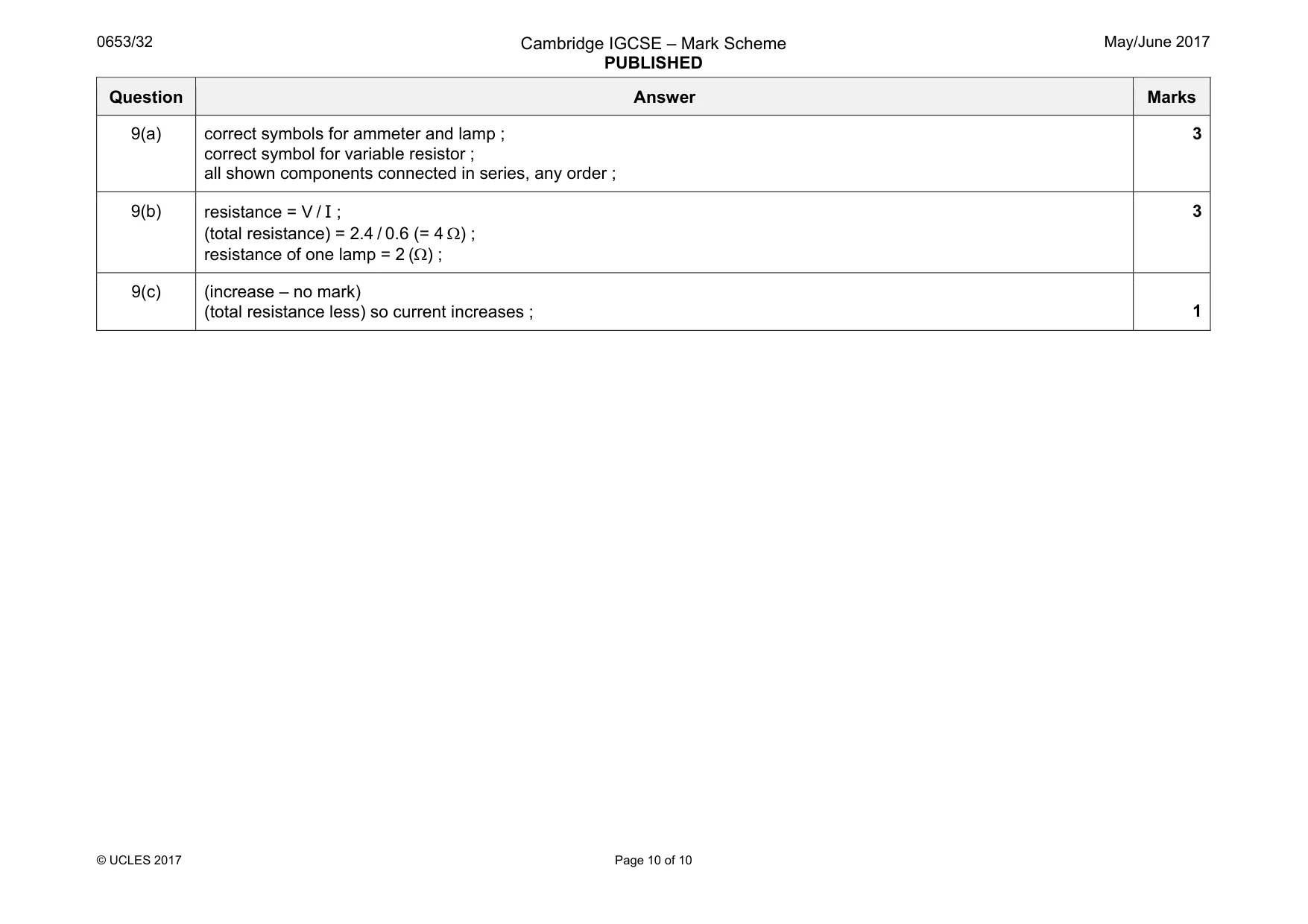
Mark scheme: 9(a) correct symbols for ammeter and lamp ; correct symbol for variable resistor ; all shown components connected in series, any order ; 3 9(b) resistance = V / I ; (total resistance) = 2.4 / 0.6 (= 4 Ω) ; resistance of one lamp = 2 (Ω) ; 3 9(c) (increase – no mark) (total resistance less) so current increases ; 1
What was in this paper
The subtopics covered by these 9 questions, and how many questions each got. Open one in a new tab to see every Cambridge question on it.
What you needed in this session
Cambridge’s own grade thresholds for 2017 May/June, Paper 3 · Variant 2. A higher threshold means an easier paper — the bar moves with how the cohort did.