Cambridge IGCSE Science - Combined 0653 — 2024 May/June Paper 3 · Variant 3
0653/33/M/J/24 · 9 questions · 80 marks · ≈90 min
The question paper and its mark scheme, free to read here and free to download. This is Cambridge’s own paper, exactly as it was sat.
Question paper24 pages
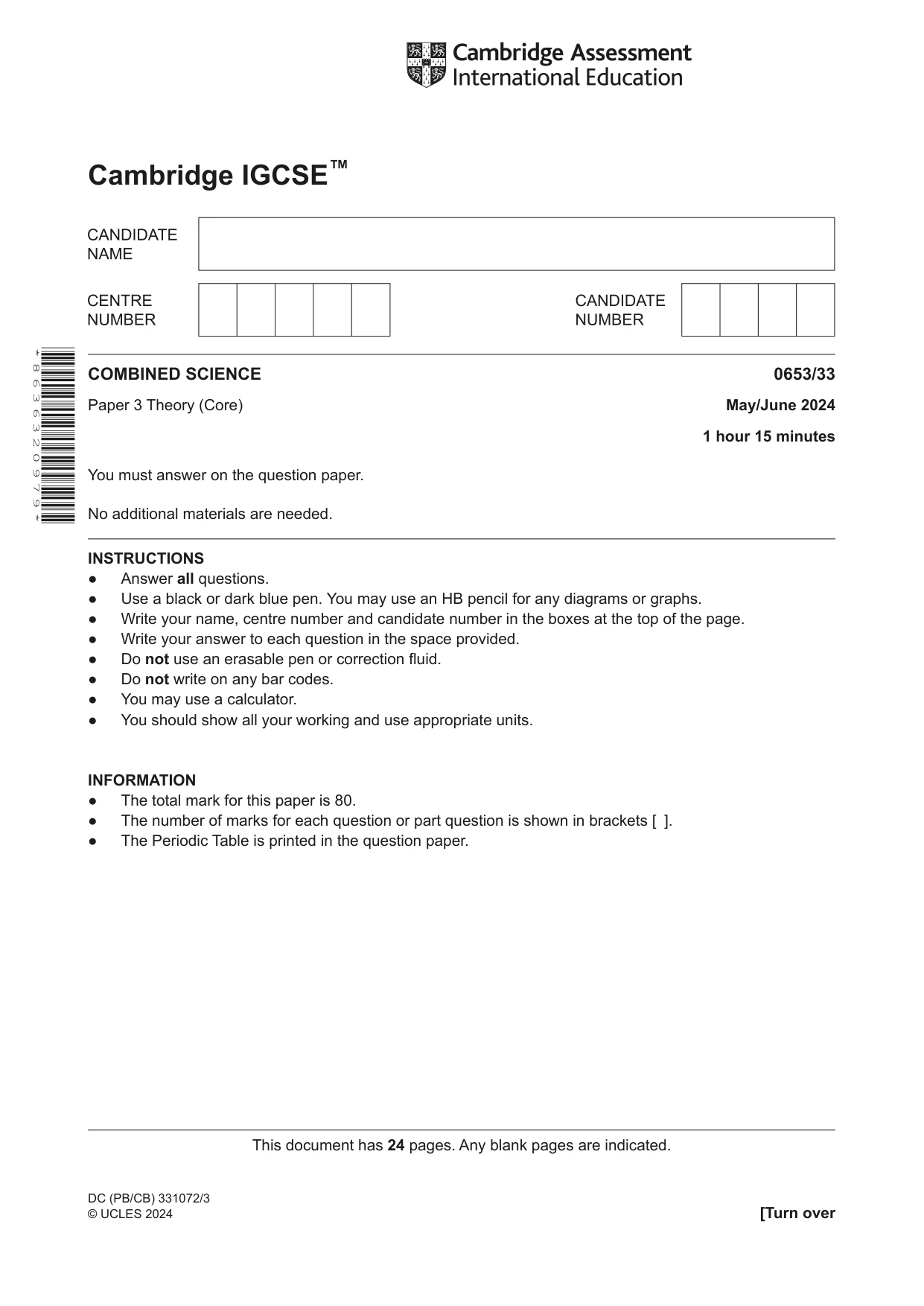


Mark scheme10 pages
Answers below. Sit the paper first if you are practising.
Questions as text
Q1 · A diagram of the human heart
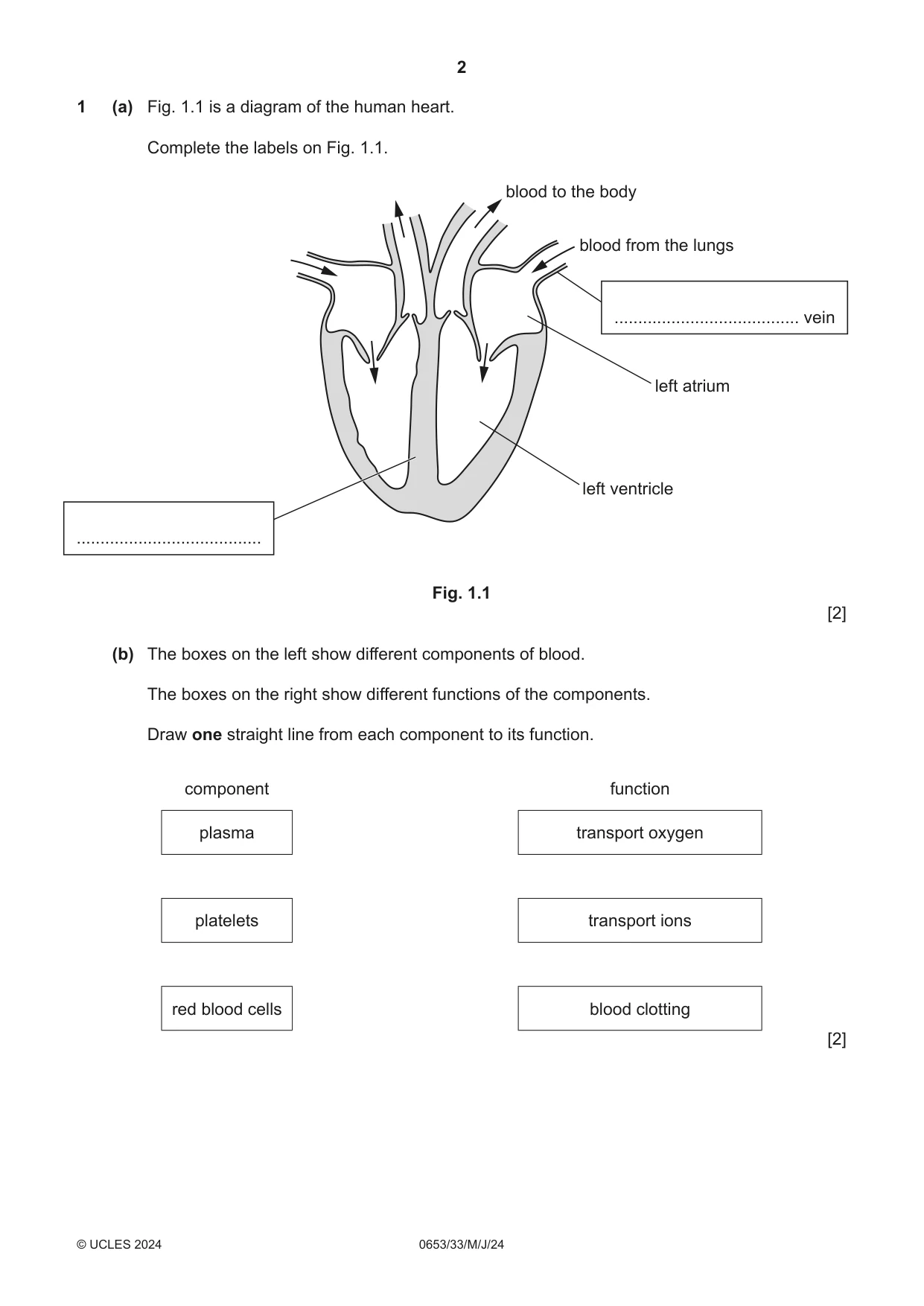
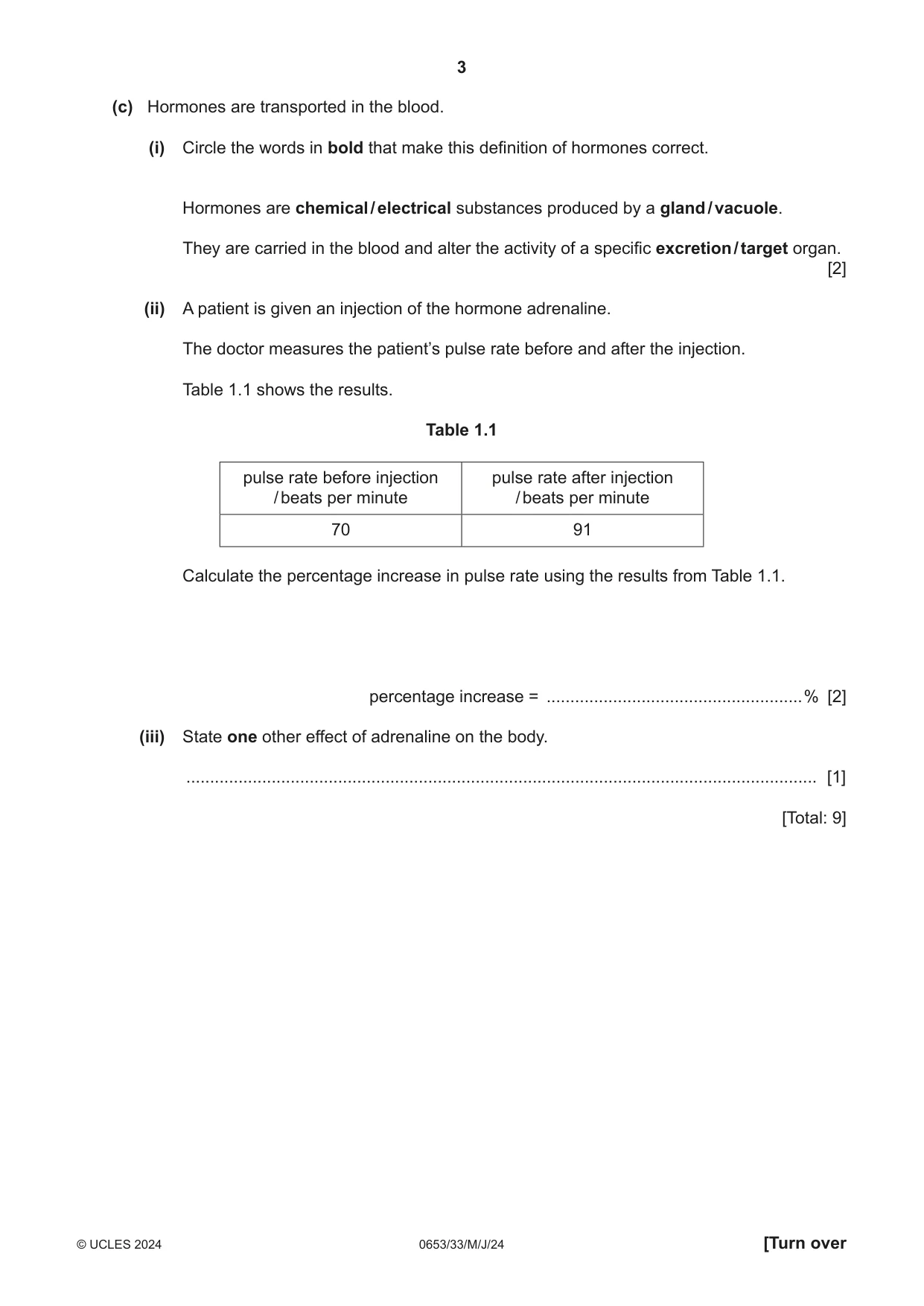
1 (a) Fig. 1.1 is a diagram of the human heart. Complete the labels on Fig. 1.1. blood to the body blood from the lungs ....................................... vein left atrium left ventricle ....................................... Fig. 1.1 [2] (b) The boxes on the left show different components of blood. The boxes on the right show different functions of the components. Draw one straight line from each component to its function. component function plasma transport oxygen platelets transport ions red blood cells blood clotting [2] (c) Hormones are transported in the blood. (i) Circle the words in bold that make this definition of hormones correct. Hormones are chemical / electrical substances produced by a gland / vacuole. They are carried in the blood and alter the activity of a specific excretion / target organ. [2] (ii) A patient is given an injection of the hormone adrenaline. The doctor measures the patient’s pulse rate before and after the injection. Table 1.1 shows the results. Table 1.1 pulse rate before injection pulse rate after injection / beats per minute / beats per minute 70 91 Calculate the percentage increase in pulse rate using the results from Table 1.1. percentage increase = ......................................................% [2] (iii) State one other effect of adrenaline on the body. ..................................................................................................................................... [1] [Total: 9]
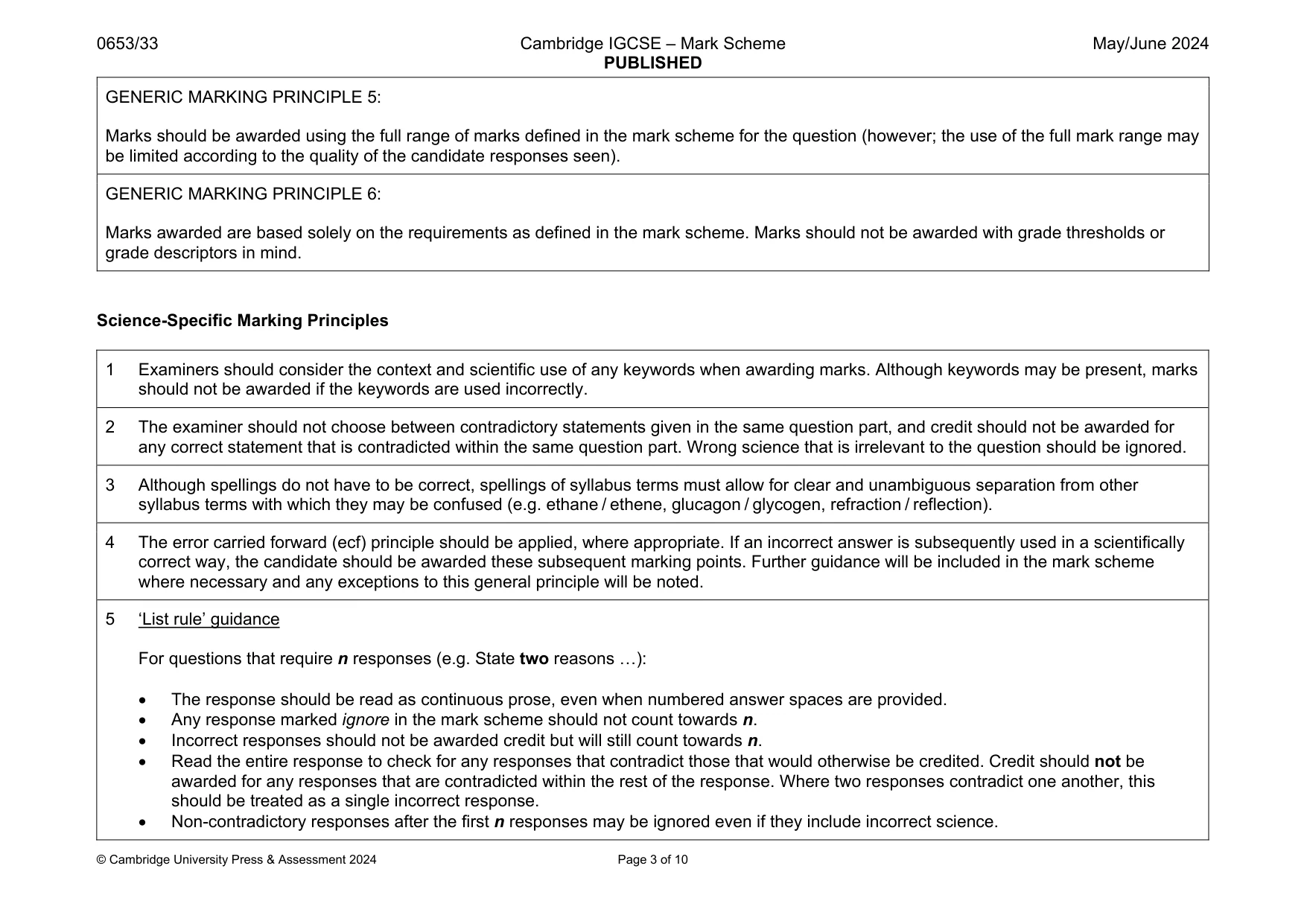
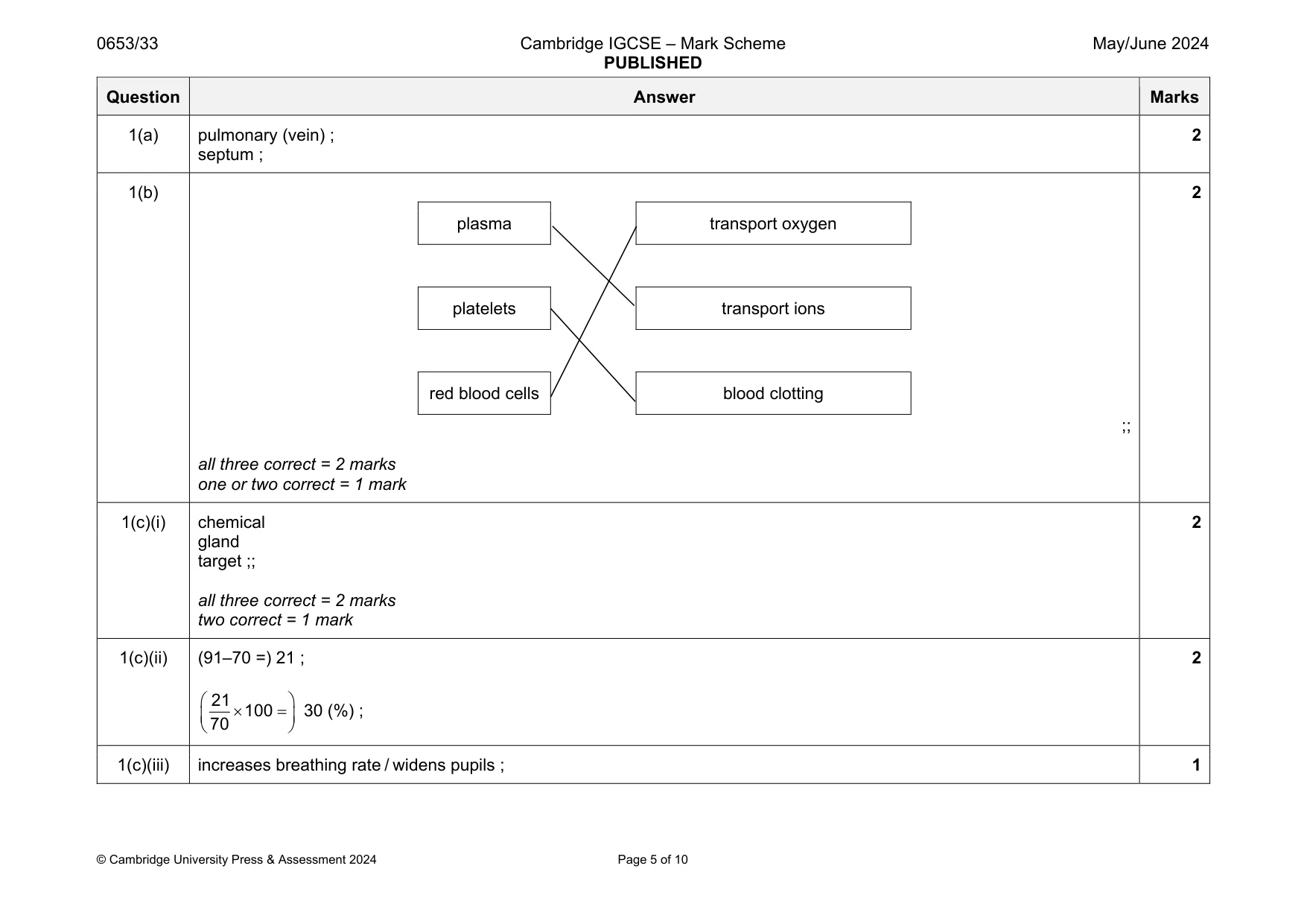
Mark scheme: 1(a) pulmonary (vein) ; septum ; 2 1(b) plasma transport oxygen platelets transport ions red blood cells blood clotting ;; all three correct = 2 marks one or two correct = 1 mark 2 1(c)(i) chemical gland target ;; all three correct = 2 marks two correct = 1 mark 2 1(c)(ii) (91–70 =) 21 ; 21 100 70 30 (%) ; 2 1(c)(iii) increases breathing rate / widens pupils ; 1
Q2 · A student investigates the reactions of iron using iron nails
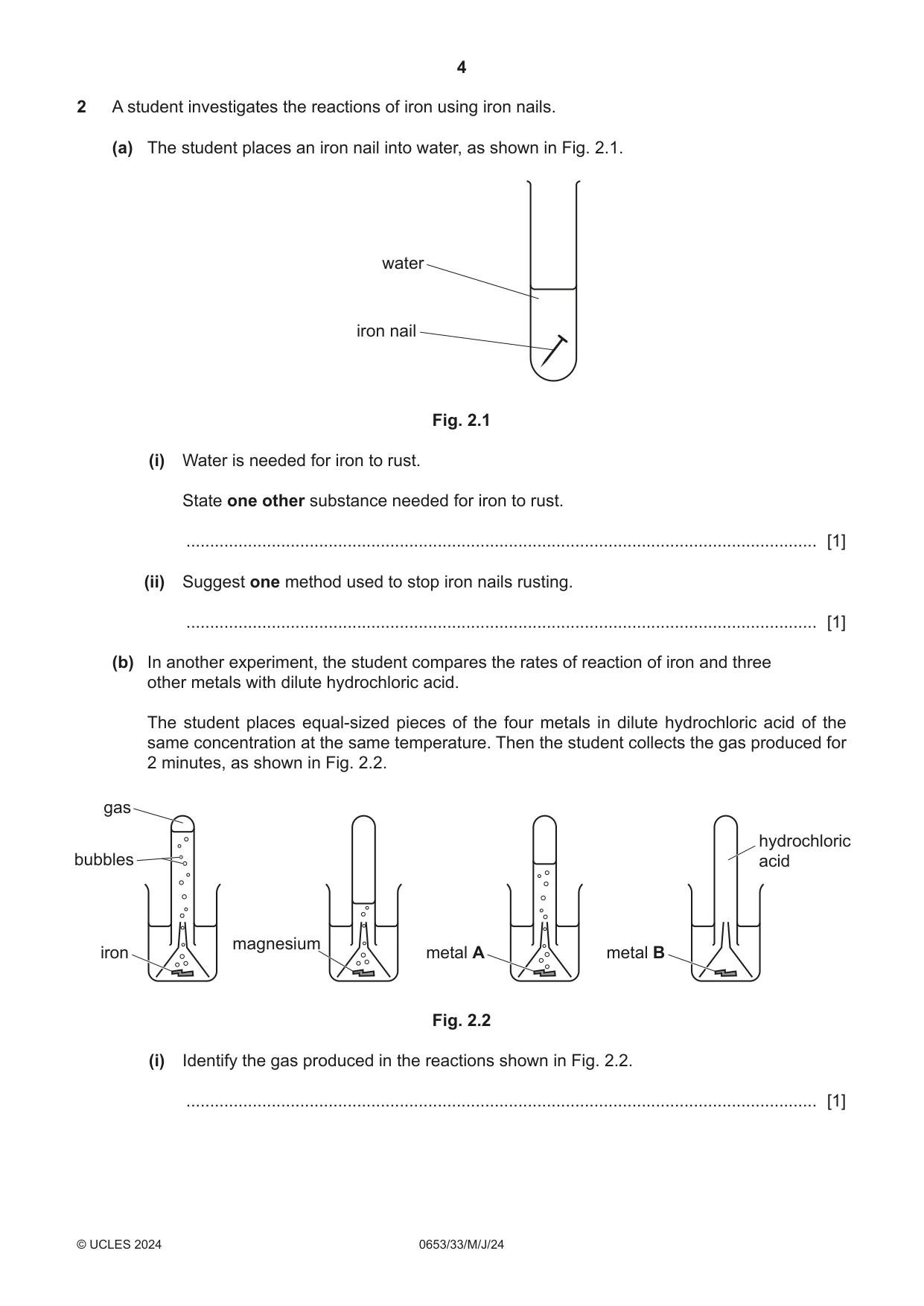
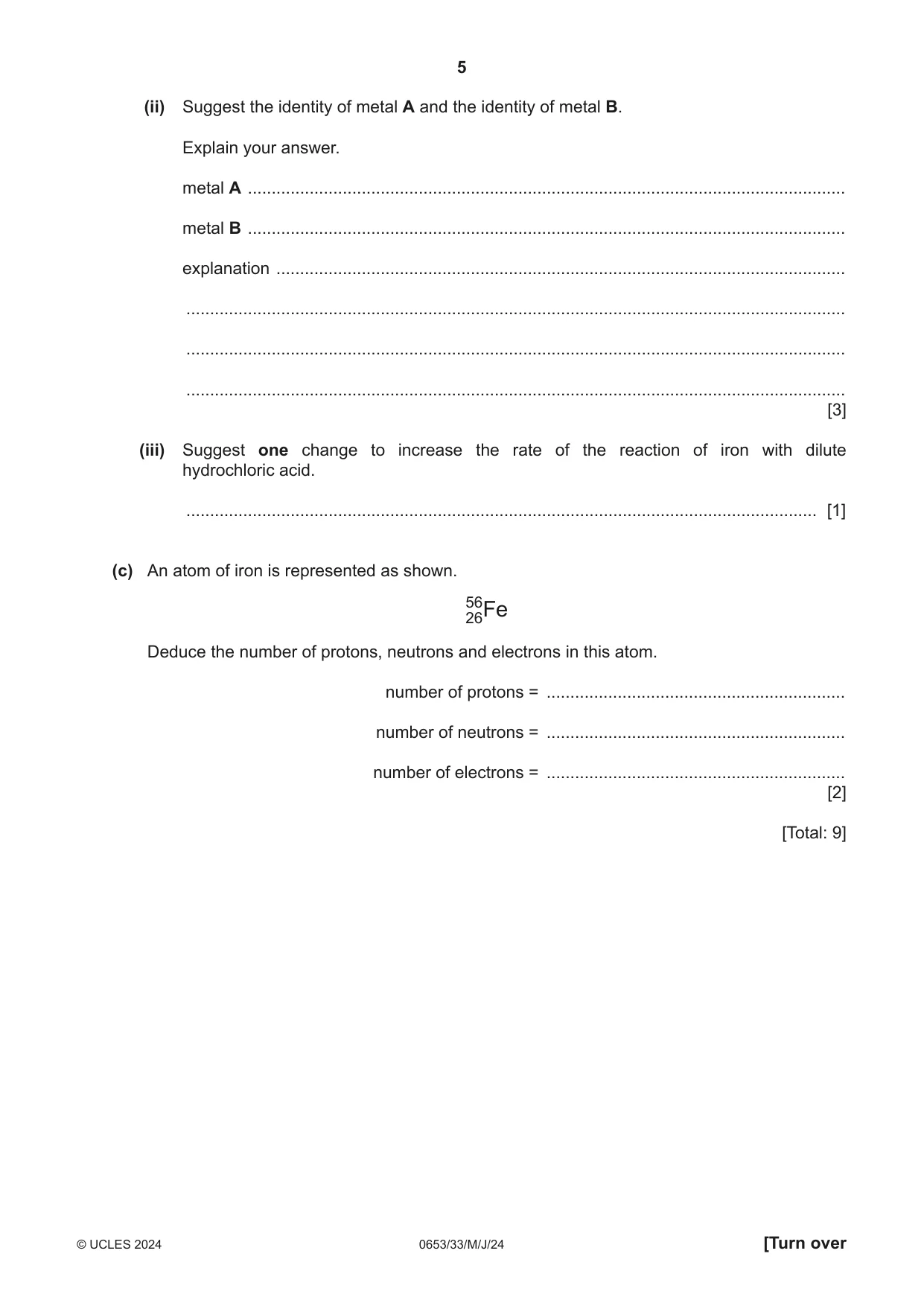
2 A student investigates the reactions of iron using iron nails. (a) The student places an iron nail into water, as shown in Fig. 2.1. water iron nail Fig. 2.1 (i) Water is needed for iron to rust. State one other substance needed for iron to rust. ..................................................................................................................................... [1] (ii) Suggest one method used to stop iron nails rusting. ..................................................................................................................................... [1] (b) In another experiment, the student compares the rates of reaction of iron and three other metals with dilute hydrochloric acid. The student places equal-sized pieces of the four metals in dilute hydrochloric acid of the same concentration at the same temperature. Then the student collects the gas produced for 2 minutes, as shown in Fig. 2.2. gas hydrochloric bubbles acid magnesium iron metal A metal B Fig. 2.2 (i) Identify the gas produced in the reactions shown in Fig. 2.2. ..................................................................................................................................... [1] (ii) Suggest the identity of metal A and the identity of metal B. Explain your answer. metal A .............................................................................................................................. metal B .............................................................................................................................. explanation ........................................................................................................................ ........................................................................................................................................... ........................................................................................................................................... ........................................................................................................................................... [3] (iii) Suggest one change to increase the rate of the reaction of iron with dilute hydrochloric acid. ..................................................................................................................................... [1] (c) An atom of iron is represented as shown. 5626Fe Deduce the number of protons, neutrons and electrons in this atom. number of protons = ............................................................... number of neutrons = ............................................................... number of electrons = ............................................................... [2] [Total: 9]
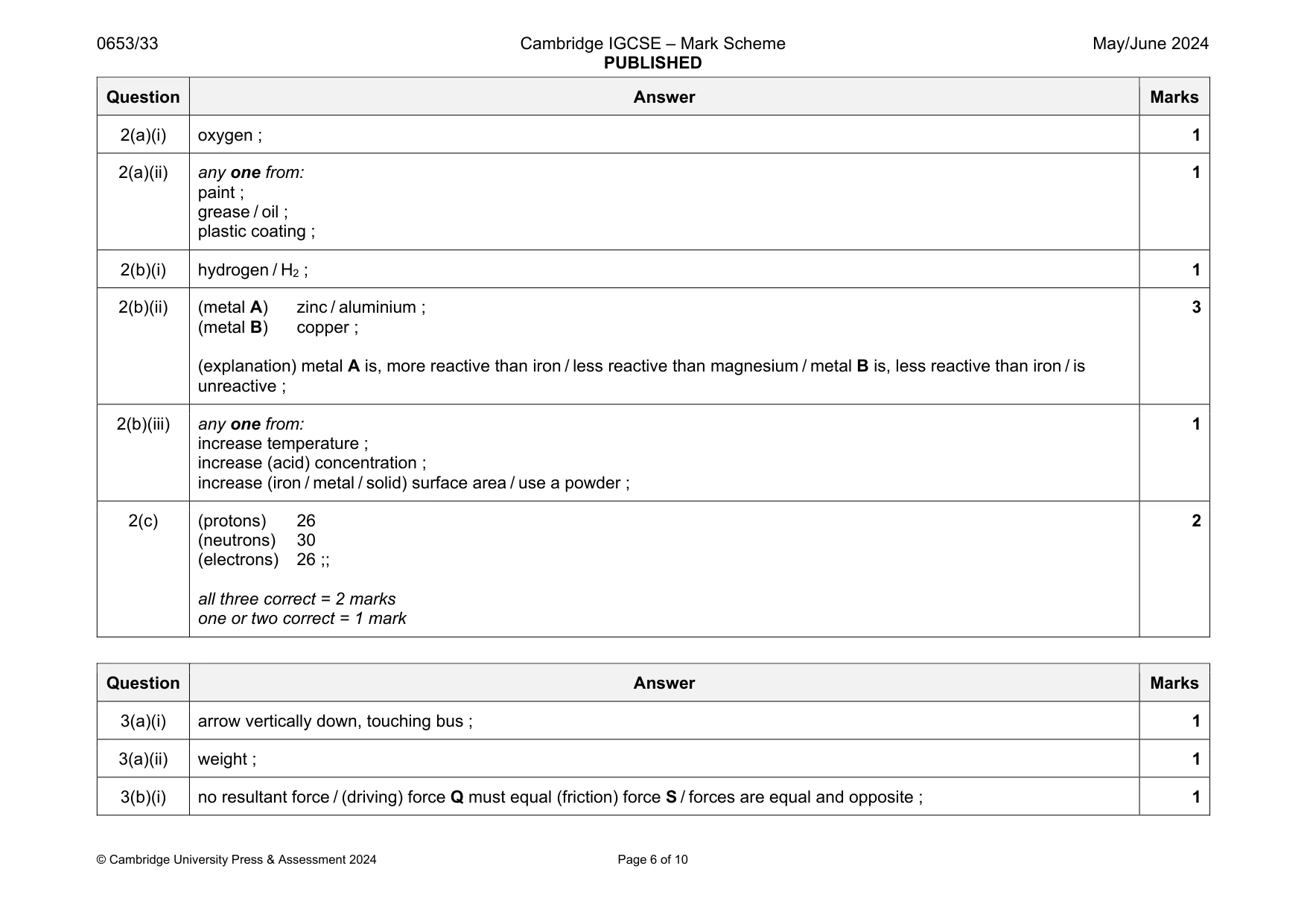
Mark scheme: 2(a)(i) oxygen ; 1 2(a)(ii) any one from: paint ; grease / oil ; plastic coating ; 1 2(b)(i) hydrogen / H2 ; 1 2(b)(ii) (metal A) zinc / aluminium ; (metal B) copper ; (explanation) metal A is, more reactive than iron / less reactive than magnesium / metal B is, less reactive than iron / is unreactive ; 3 2(b)(iii) any one from: increase temperature ; increase (acid) concentration ; increase (iron / metal / solid) surface area / use a powder ; 1 2(c) (protons) 26 (neutrons) 30 (electrons) 26 ;; all three correct = 2 marks one or two correct = 1 mark 2
Q3 · Three forces, Q, R and S, acting on a bus moving along a level road at constant speed
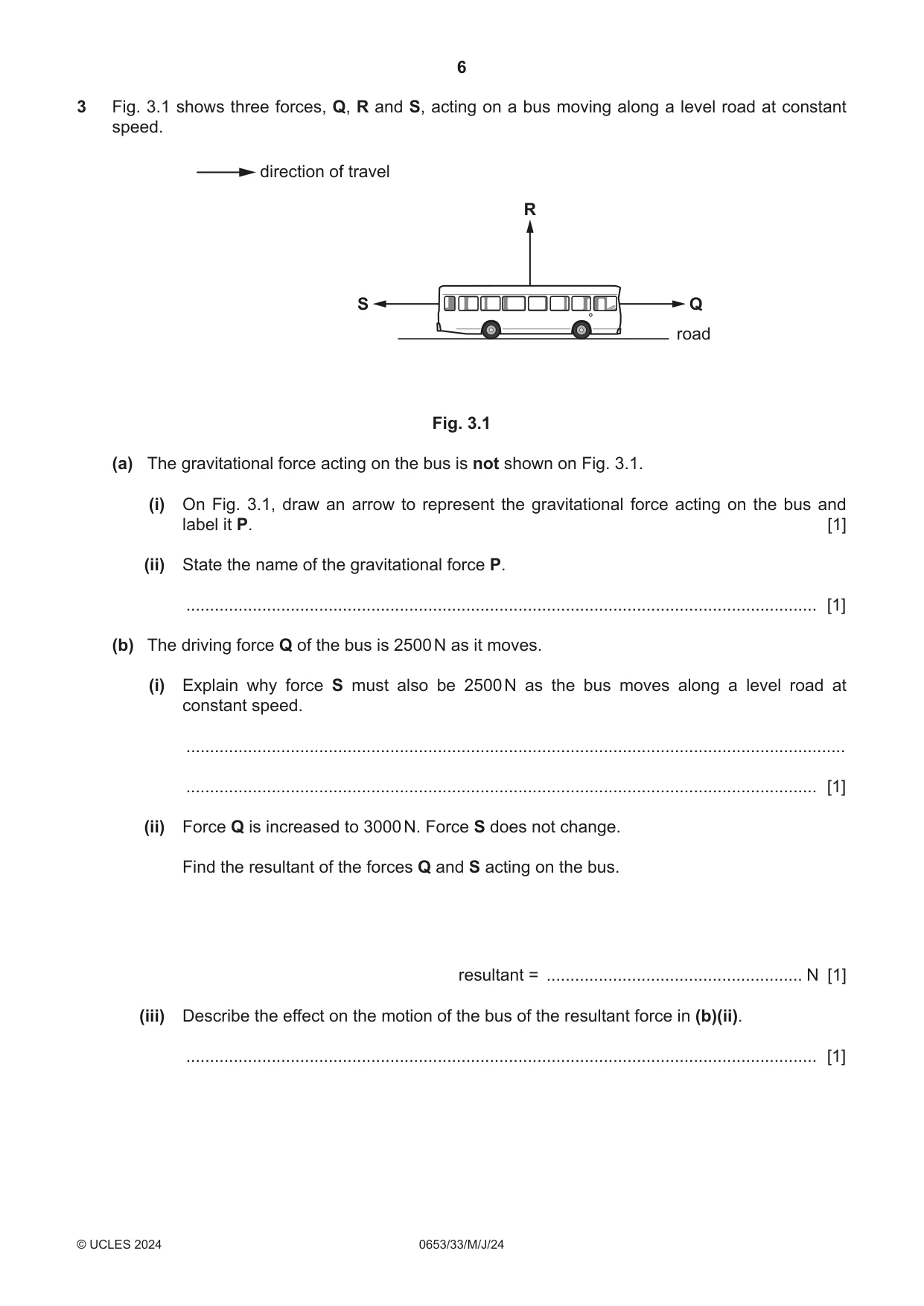
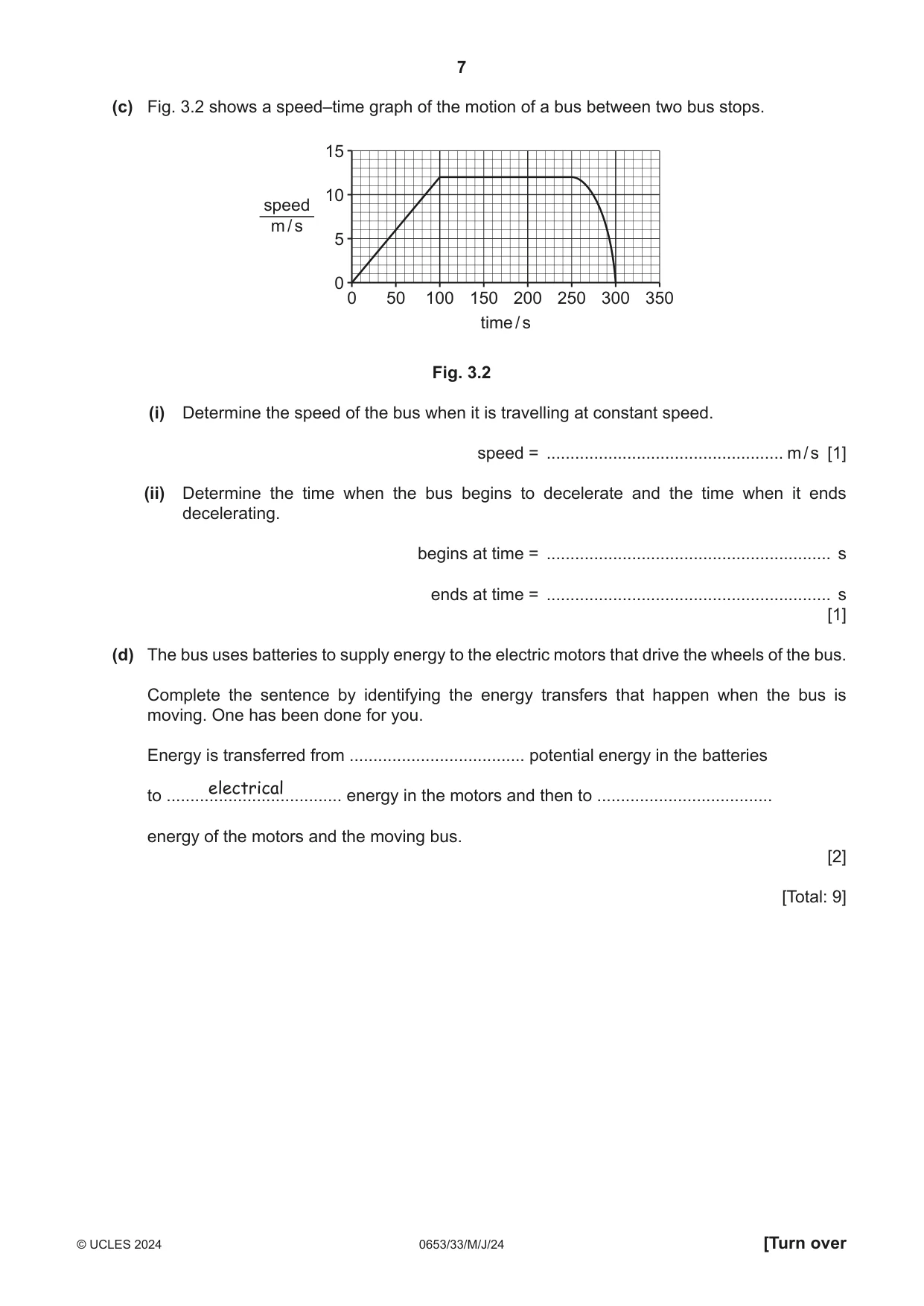
3 Fig. 3.1 shows three forces, Q, R and S, acting on a bus moving along a level road at constant speed. direction of travel R S Q road Fig. 3.1 (a) The gravitational force acting on the bus is not shown on Fig. 3.1. (i) On Fig. 3.1, draw an arrow to represent the gravitational force acting on the bus and label it P. [1] (ii) State the name of the gravitational force P. ..................................................................................................................................... [1] (b) The driving force Q of the bus is 2500 N as it moves. (i) Explain why force S must also be 2500 N as the bus moves along a level road at constant speed. ........................................................................................................................................... ..................................................................................................................................... [1] (ii) Force Q is increased to 3000 N. Force S does not change. Find the resultant of the forces Q and S acting on the bus. resultant = ...................................................... N [1] (iii) Describe the effect on the motion of the bus of the resultant force in (b)(ii). ..................................................................................................................................... [1] (c) Fig. 3.2 shows a speed–time graph of the motion of a bus between two bus stops. 15 10 speed m / s 5 0 0 50 100 150 200 250 300 350 time / s Fig. 3.2 (i) Determine the speed of the bus when it is travelling at constant speed. speed = .................................................. m / s [1] (ii) Determine the time when the bus begins to decelerate and the time when it ends decelerating. begins at time = ............................................................ s ends at time = ............................................................ s [1] (d) The bus uses batteries to supply energy to the electric motors that drive the wheels of the bus. Complete the sentence by identifying the energy transfers that happen when the bus is moving. One has been done for you. Energy is transferred from ..................................... potential energy in the batteries electrical to ..................................... energy in the motors and then to ..................................... energy of the motors and the moving bus. [2] [Total: 9]
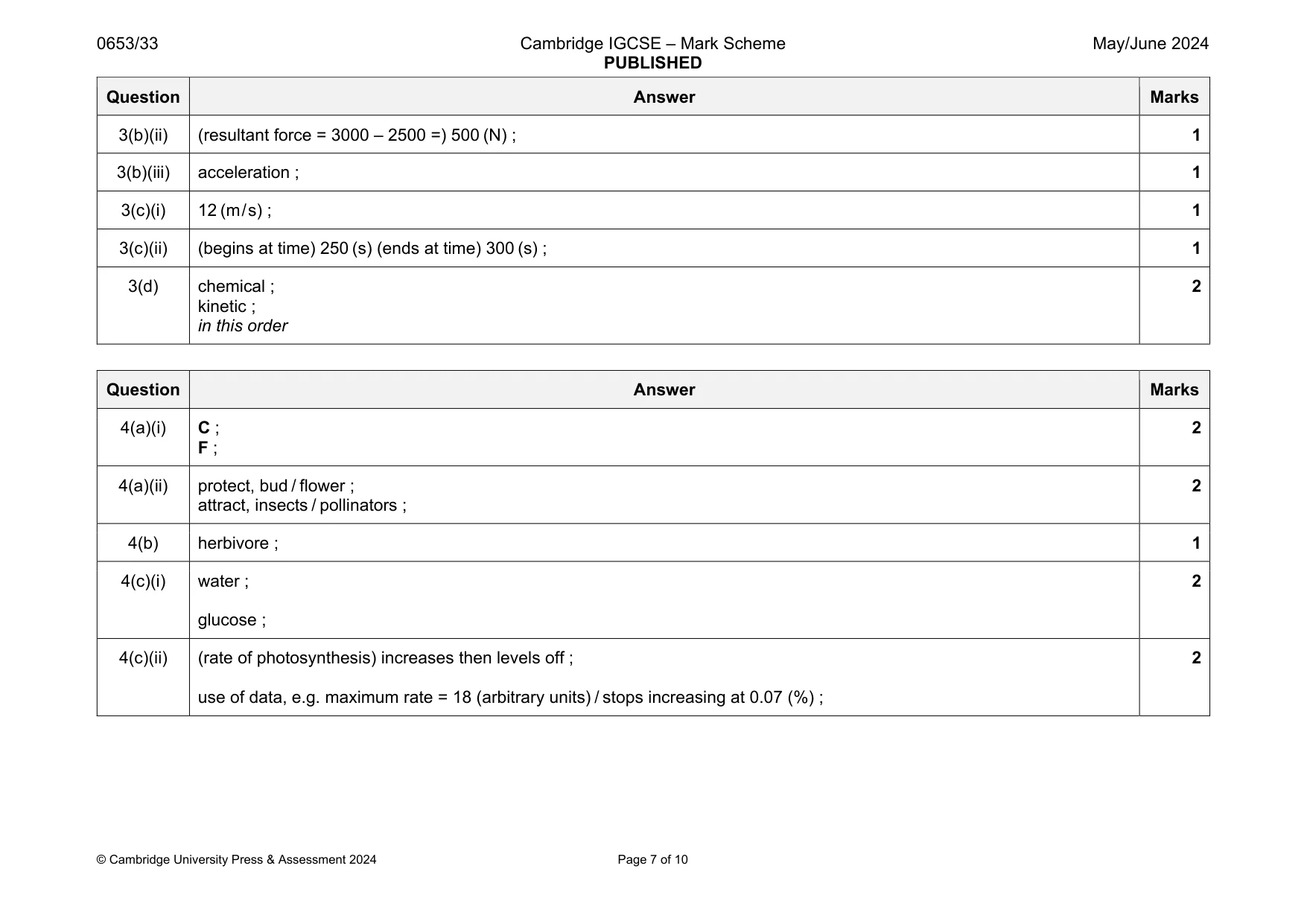
Mark scheme: 3(a)(i) arrow vertically down, touching bus ; 1 3(a)(ii) weight ; 1 3(b)(i) no resultant force / (driving) force Q must equal (friction) force S / forces are equal and opposite ; 1 Question Answer Marks 3(b)(ii) (resultant force = 3000 – 2500 =) 500 (N) ; 1 3(b)(iii) acceleration ; 1 3(c)(i) 12 (m / s) ; 1 3(c)(ii) (begins at time) 250 (s) (ends at time) 300 (s) ; 1 3(d) chemical ; kinetic ; in this order 2
Q4 · Some of the parts of an insect-pollinated flower
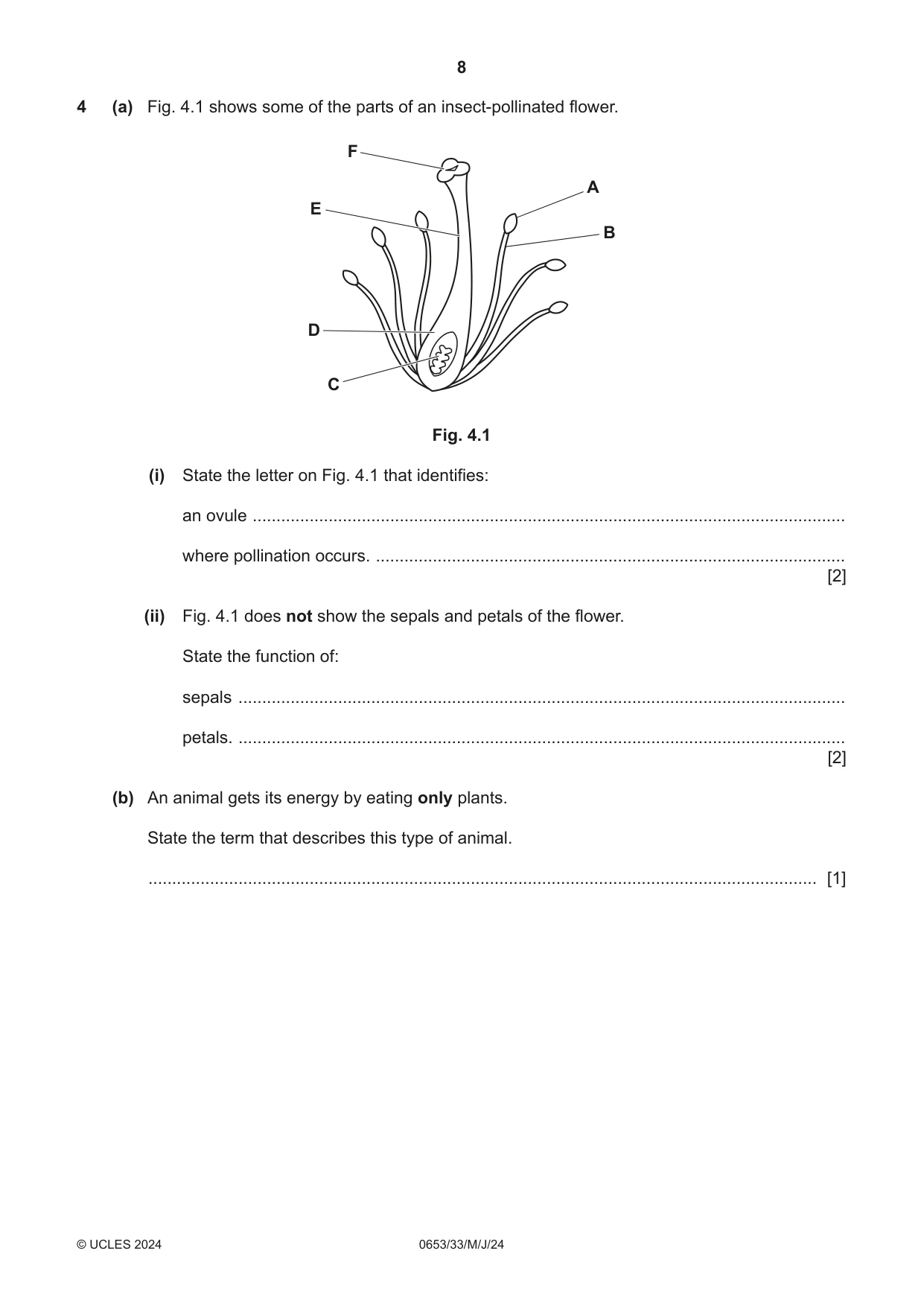
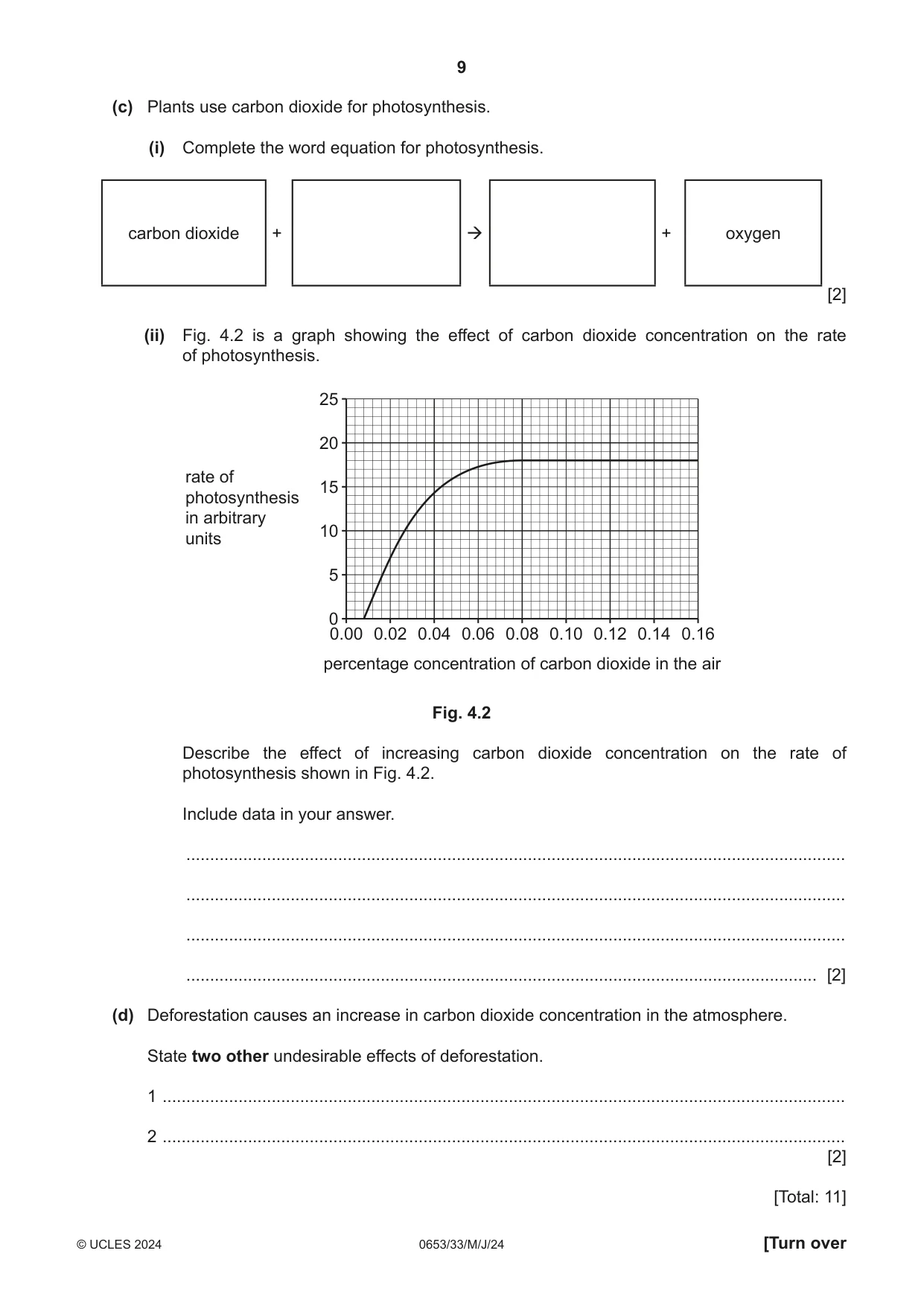
4 (a) Fig. 4.1 shows some of the parts of an insect-pollinated flower. F A E B D C Fig. 4.1 (i) State the letter on Fig. 4.1 that identifies: an ovule ............................................................................................................................. where pollination occurs. ................................................................................................... [2] (ii) Fig. 4.1 does not show the sepals and petals of the flower. State the function of: sepals ................................................................................................................................ petals. ................................................................................................................................ [2] (b) An animal gets its energy by eating only plants. State the term that describes this type of animal. ............................................................................................................................................. [1] (c) Plants use carbon dioxide for photosynthesis. (i) Complete the word equation for photosynthesis. carbon dioxide + + oxygen [2] (ii) Fig. 4.2 is a graph showing the effect of carbon dioxide concentration on the rate of photosynthesis. 25 20 rate of 15 photosynthesis in arbitrary 10 units 5 0 0.00 0.02 0.04 0.06 0.08 0.10 0.12 0.14 0.16 percentage concentration of carbon dioxide in the air Fig. 4.2 Describe the effect of increasing carbon dioxide concentration on the rate of photosynthesis shown in Fig. 4.2. Include data in your answer. ........................................................................................................................................... ........................................................................................................................................... ........................................................................................................................................... ..................................................................................................................................... [2] (d) Deforestation causes an increase in carbon dioxide concentration in the atmosphere. State two other undesirable effects of deforestation. 1 ................................................................................................................................................ 2 ................................................................................................................................................ [2] [Total: 11]
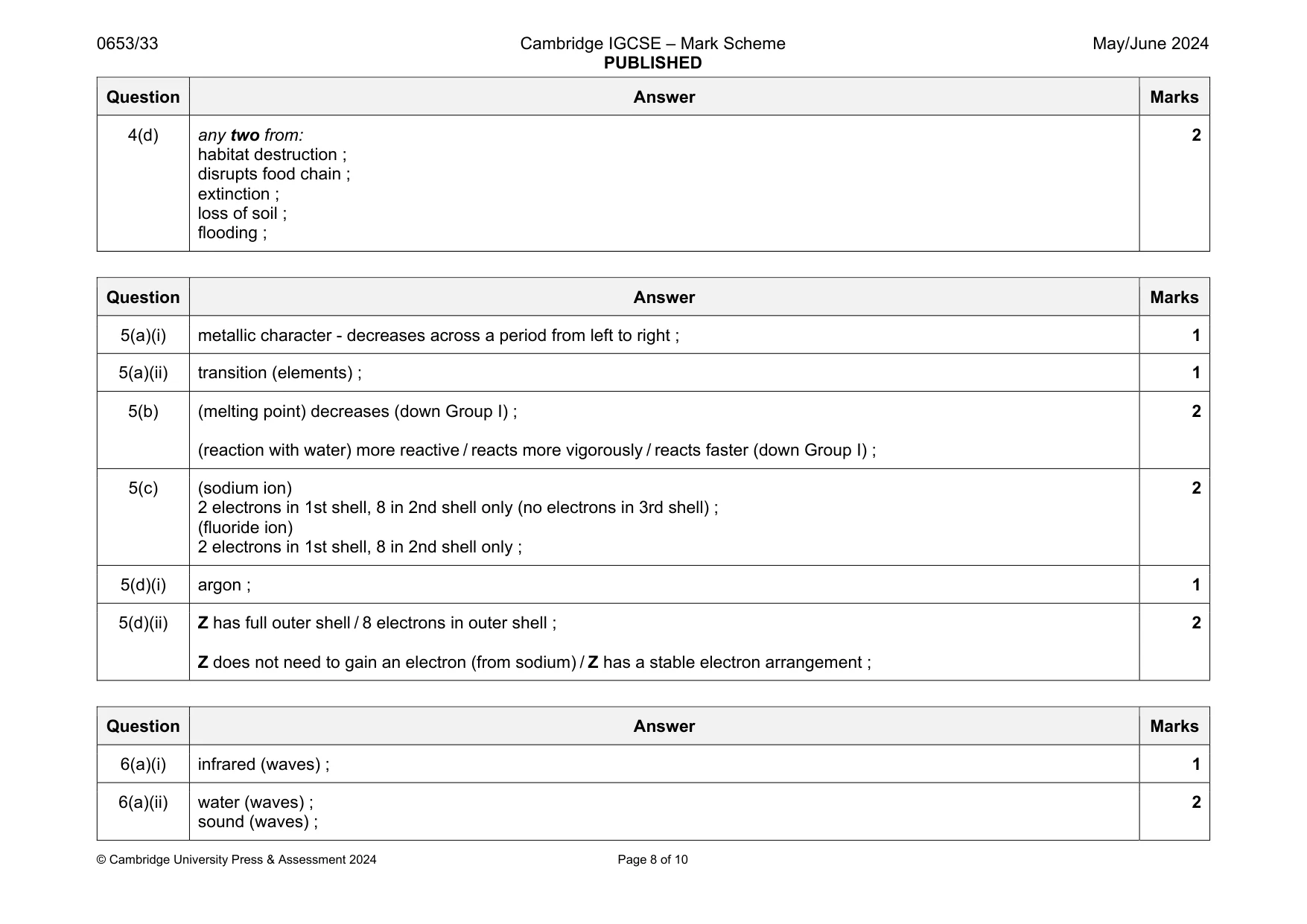
Mark scheme: 4(a)(i) C ; F ; 2 4(a)(ii) protect, bud / flower ; attract, insects / pollinators ; 2 4(b) herbivore ; 1 4(c)(i) water ; glucose ; 2 4(c)(ii) (rate of photosynthesis) increases then levels off ; use of data, e.g. maximum rate = 18 (arbitrary units) / stops increasing at 0.07 (%) ; 2 Question Answer Marks 4(d) any two from: habitat destruction ; disrupts food chain ; extinction ; loss of soil ; flooding ; 2
Q5 · Part of the Periodic Table is shown in Fig
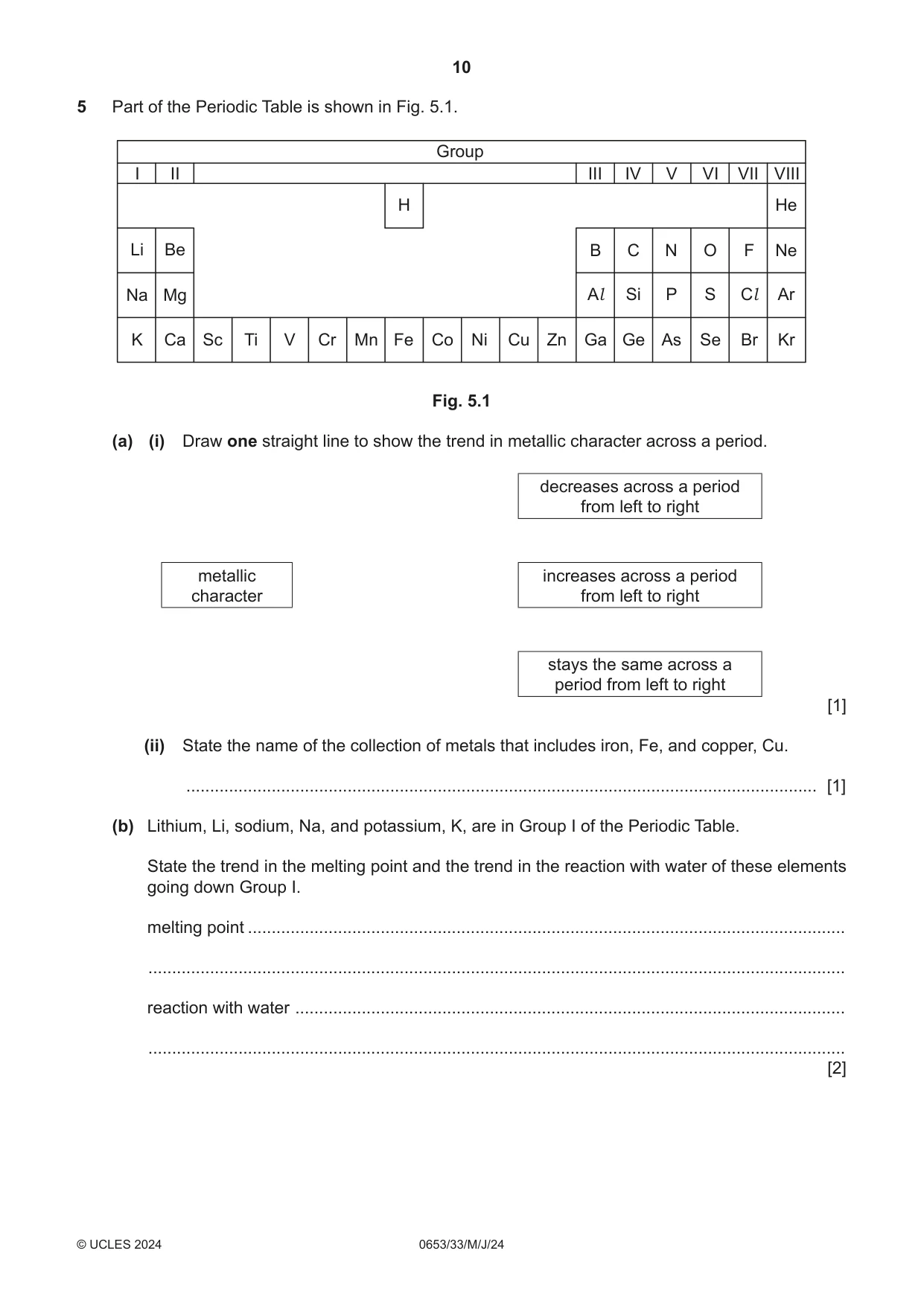
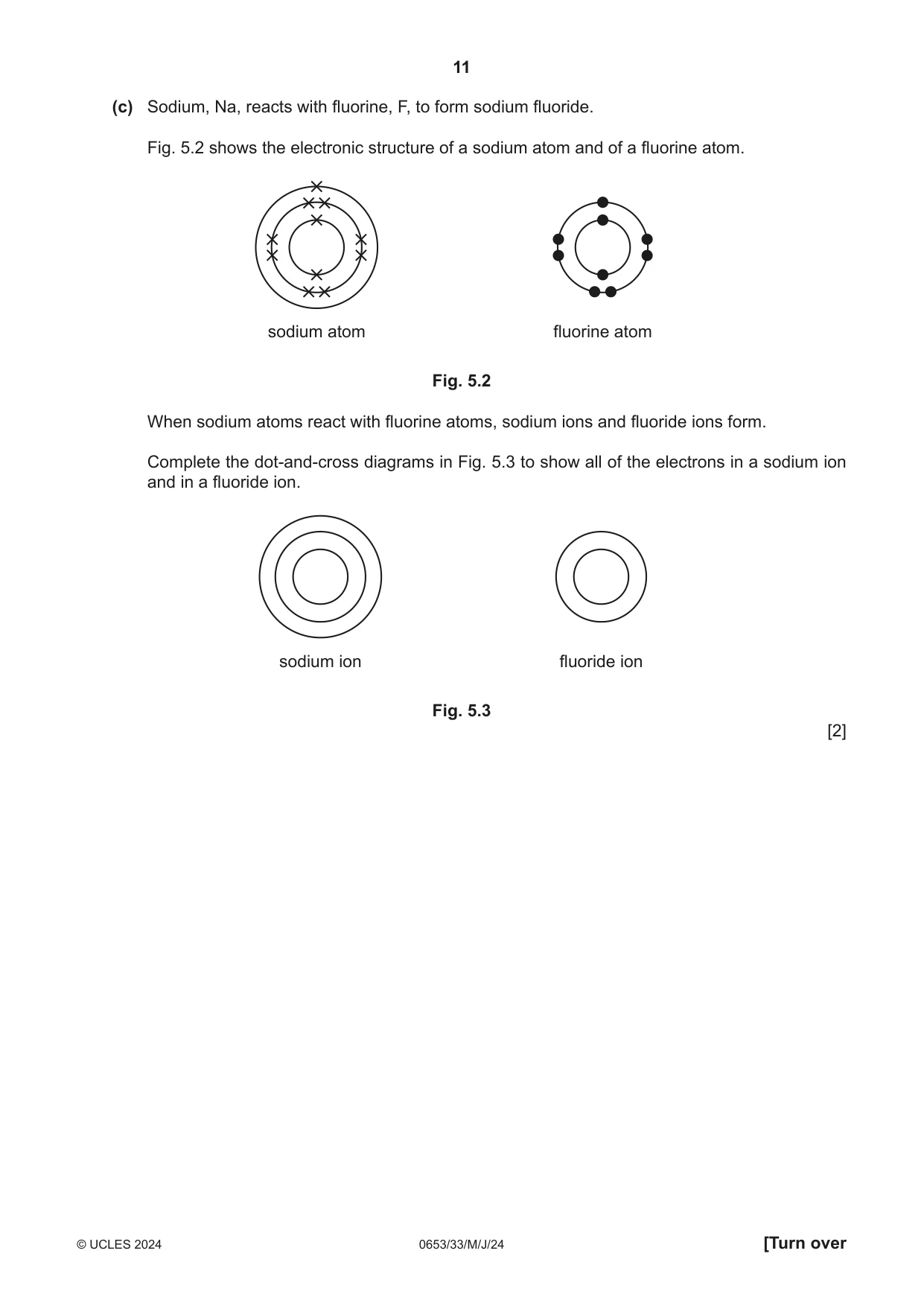
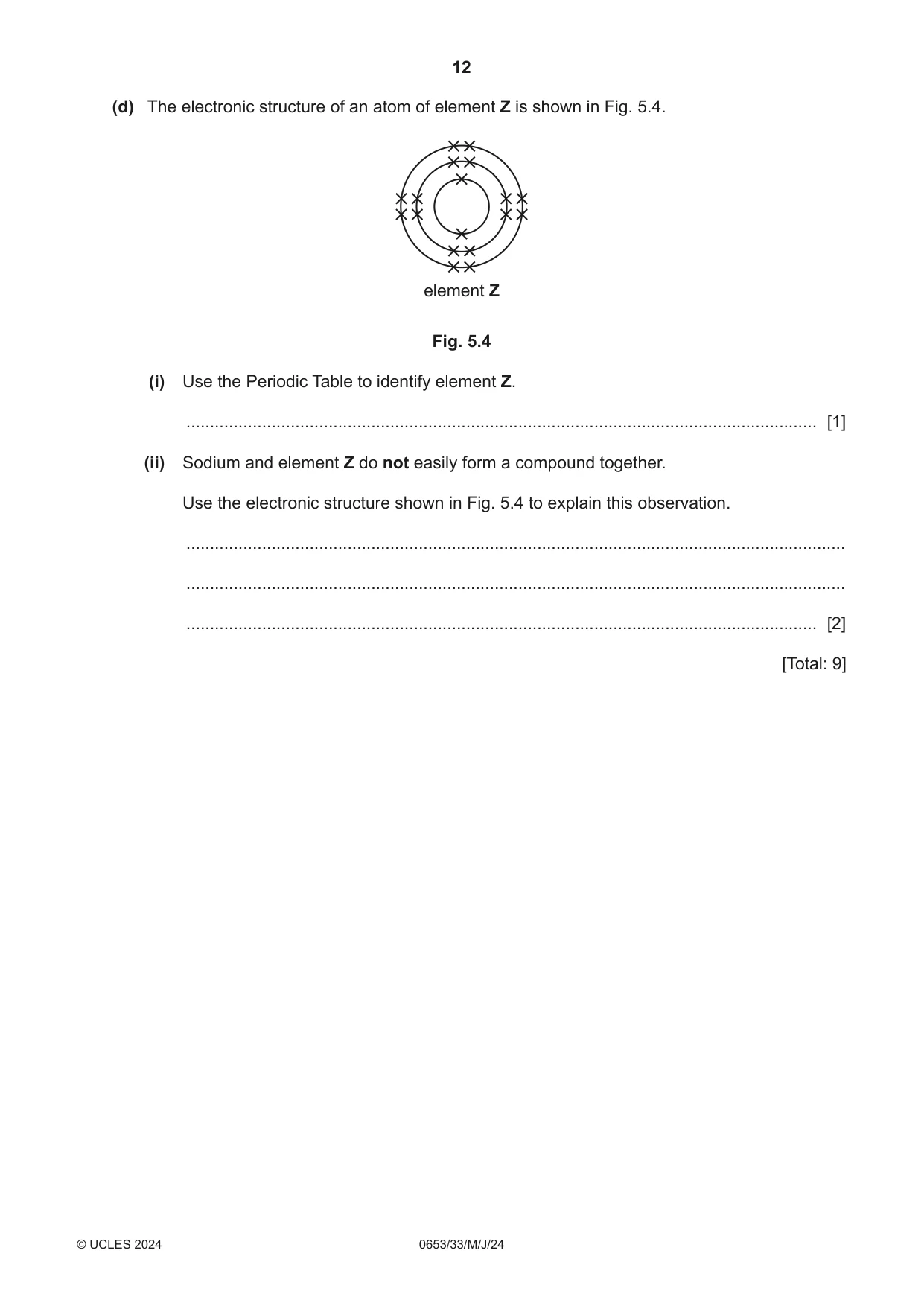
5 Part of the Periodic Table is shown in Fig. 5.1. Group I II III IV V VI VII VIII H He Li Be B C N O F Ne Na Mg Al Si P S Cl Ar K Ca Sc Ti V Cr Mn Fe Co Ni Cu Zn Ga Ge As Se Br Kr Fig. 5.1 (a) (i) Draw one straight line to show the trend in metallic character across a period. decreases across a period from left to right metallic increases across a period character from left to right stays the same across a period from left to right [1] (ii) State the name of the collection of metals that includes iron, Fe, and copper, Cu. ..................................................................................................................................... [1] (b) Lithium, Li, sodium, Na, and potassium, K, are in Group I of the Periodic Table. State the trend in the melting point and the trend in the reaction with water of these elements going down Group I. melting point .............................................................................................................................. ................................................................................................................................................... reaction with water .................................................................................................................... ................................................................................................................................................... [2] (c) Sodium, Na, reacts with fluorine, F, to form sodium fluoride. Fig. 5.2 shows the electronic structure of a sodium atom and of a fluorine atom. sodium atom fluorine atom Fig. 5.2 When sodium atoms react with fluorine atoms, sodium ions and fluoride ions form. Complete the dot-and-cross diagrams in Fig. 5.3 to show all of the electrons in a sodium ion and in a fluoride ion. sodium ion fluoride ion Fig. 5.3 [2] (d) The electronic structure of an atom of element Z is shown in Fig. 5.4. element Z Fig. 5.4 (i) Use the Periodic Table to identify element Z. ..................................................................................................................................... [1] (ii) Sodium and element Z do not easily form a compound together. Use the electronic structure shown in Fig. 5.4 to explain this observation. ........................................................................................................................................... ........................................................................................................................................... ..................................................................................................................................... [2] [Total: 9]
Mark scheme: 5(a)(i) metallic character - decreases across a period from left to right ; 1 5(a)(ii) transition (elements) ; 1 5(b) (melting point) decreases (down Group I) ; (reaction with water) more reactive / reacts more vigorously / reacts faster (down Group I) ; 2 5(c) (sodium ion) 2 electrons in 1st shell, 8 in 2nd shell only (no electrons in 3rd shell) ; (fluoride ion) 2 electrons in 1st shell, 8 in 2nd shell only ; 2 5(d)(i) argon ; 1 5(d)(ii) Z has full outer shell / 8 electrons in outer shell ; Z does not need to gain an electron (from sodium) / Z has a stable electron arrangement ; 2
Q6 · The list shows some types of wave
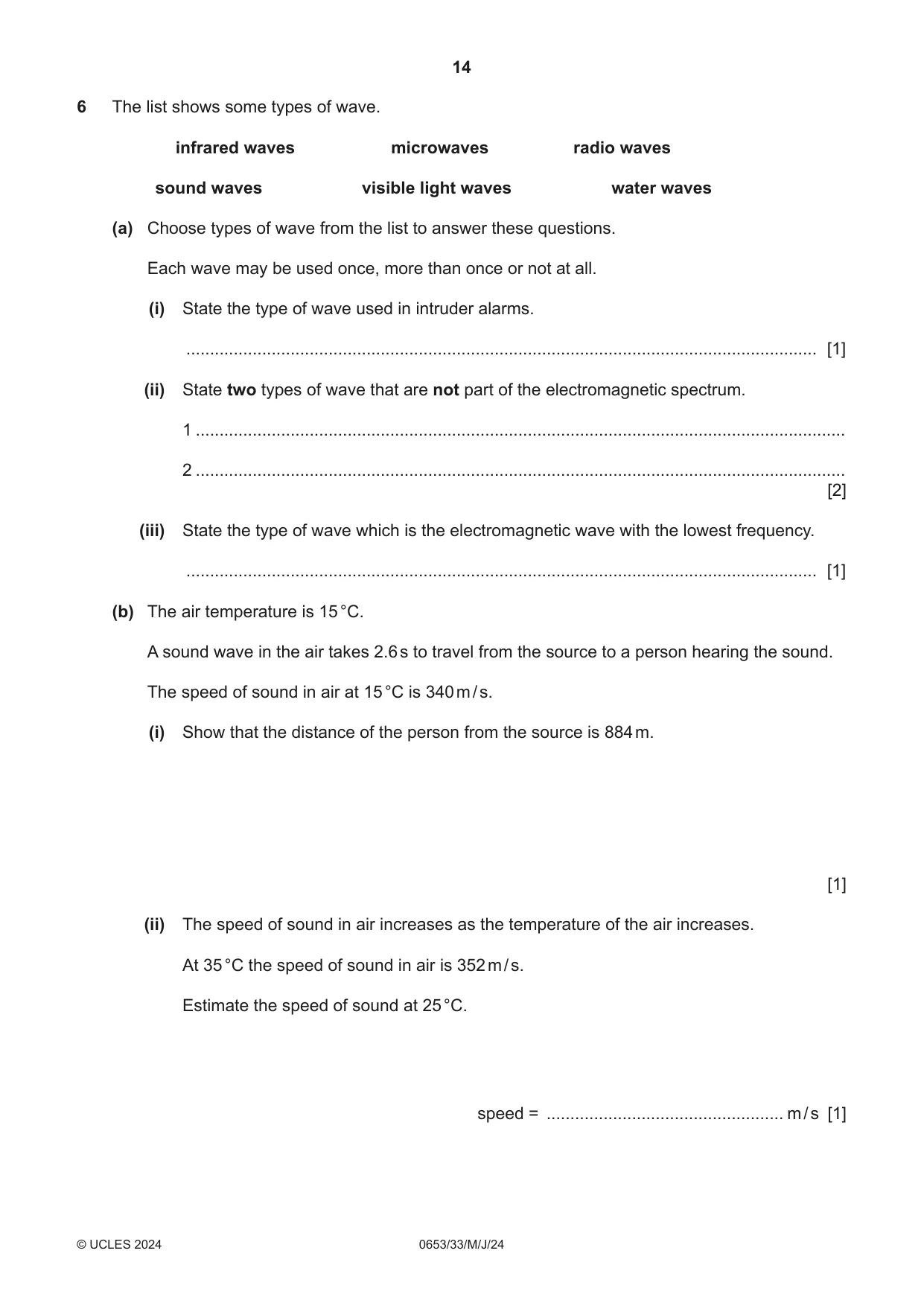
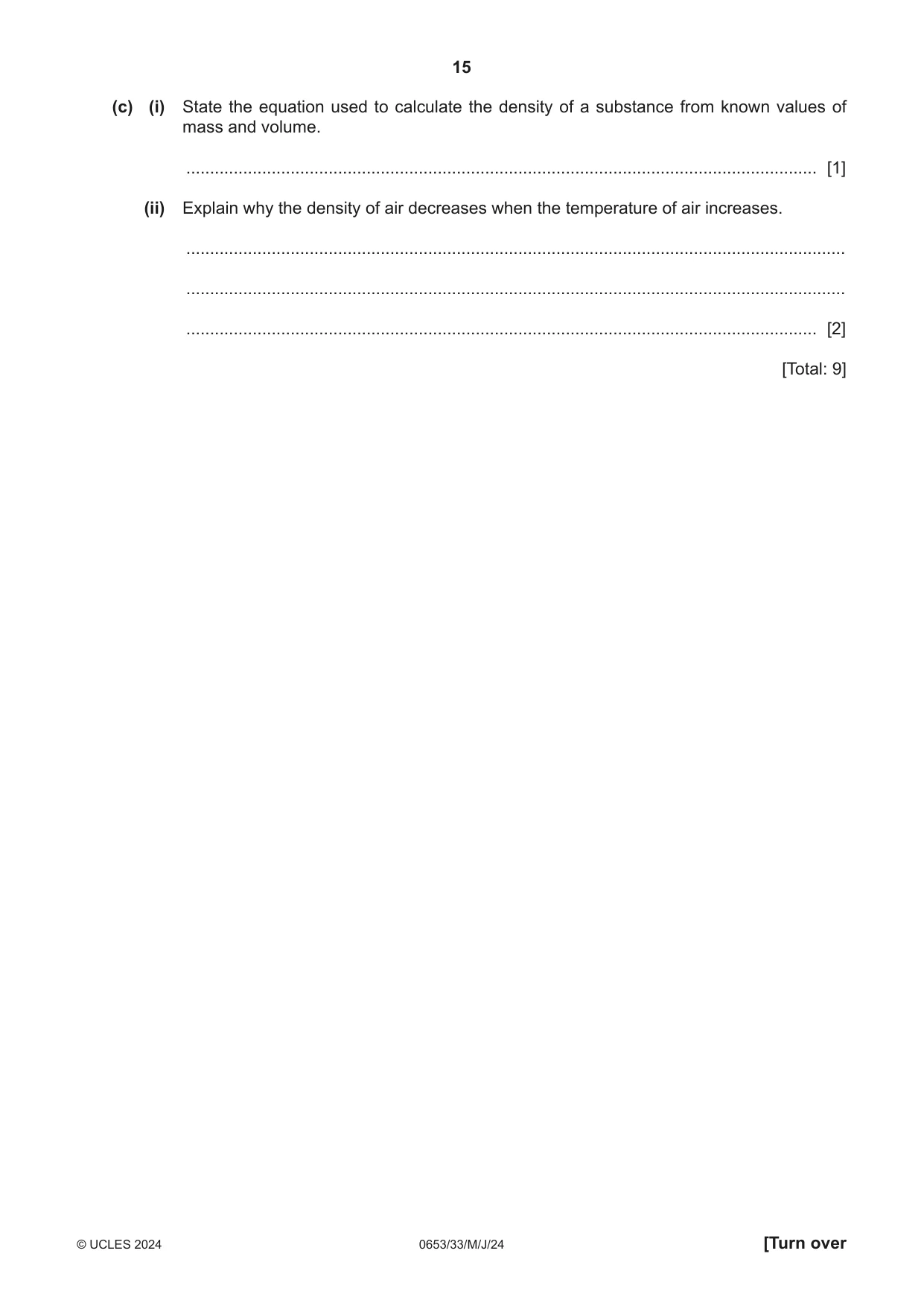
6 The list shows some types of wave. infrared waves microwaves radio waves sound waves visible light waves water waves (a) Choose types of wave from the list to answer these questions. Each wave may be used once, more than once or not at all. (i) State the type of wave used in intruder alarms. ..................................................................................................................................... [1] (ii) State two types of wave that are not part of the electromagnetic spectrum. 1 ......................................................................................................................................... 2 ......................................................................................................................................... [2] (iii) State the type of wave which is the electromagnetic wave with the lowest frequency. ..................................................................................................................................... [1] (b) The air temperature is 15 °C. A sound wave in the air takes 2.6 s to travel from the source to a person hearing the sound. The speed of sound in air at 15 °C is 340 m / s. (i) Show that the distance of the person from the source is 884 m. [1] (ii) The speed of sound in air increases as the temperature of the air increases. At 35 °C the speed of sound in air is 352 m / s. Estimate the speed of sound at 25 °C. speed = .................................................. m / s [1] (c) (i) State the equation used to calculate the density of a substance from known values of mass and volume. ..................................................................................................................................... [1] (ii) Explain why the density of air decreases when the temperature of air increases. ........................................................................................................................................... ........................................................................................................................................... ..................................................................................................................................... [2] [Total: 9]
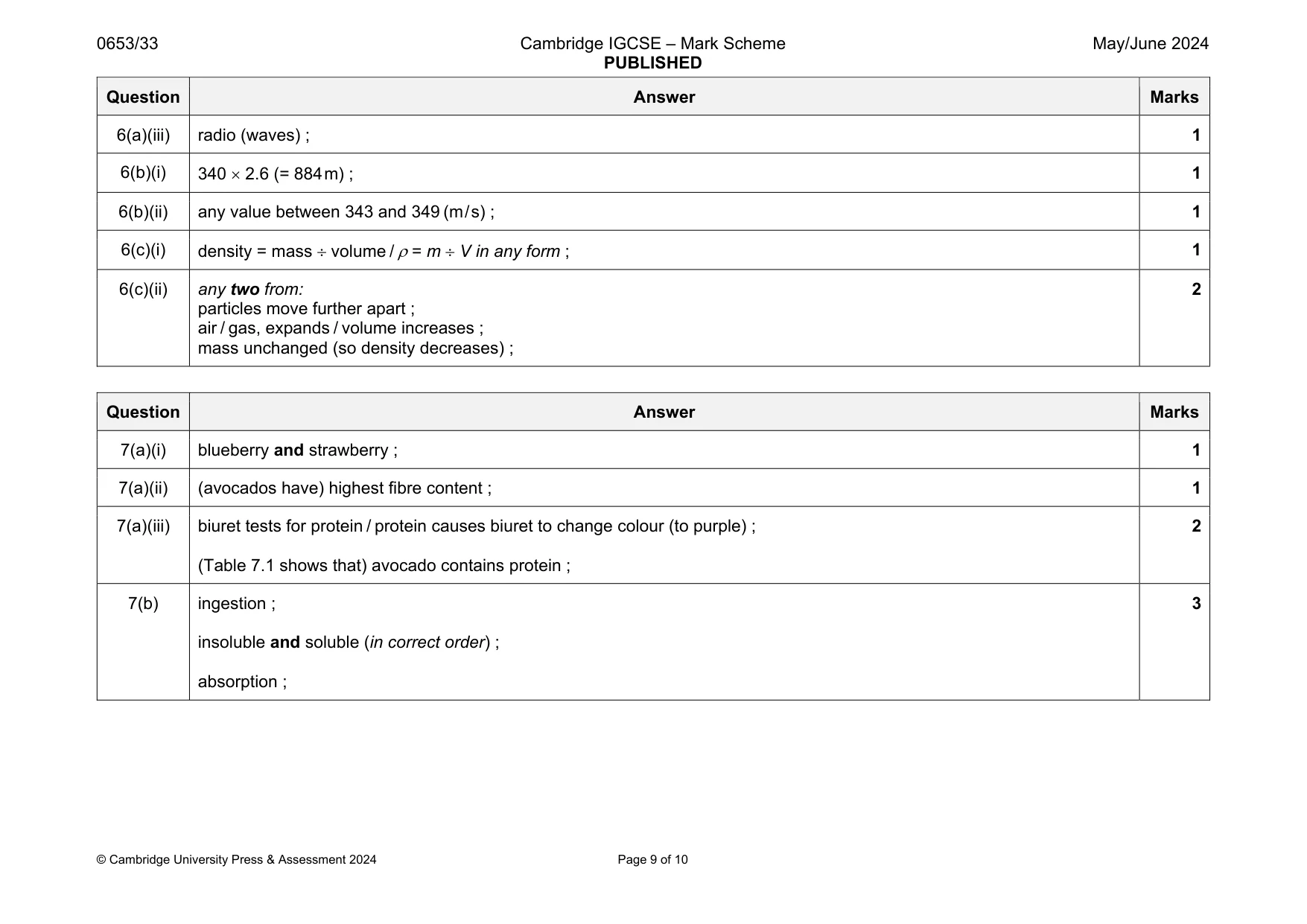
Mark scheme: 6(a)(i) infrared (waves) ; 1 6(a)(ii) water (waves) ; sound (waves) ; 2 Question Answer Marks 6(a)(iii) radio (waves) ; 1 6(b)(i) 340 2.6 (= 884 m) ; 1 6(b)(ii) any value between 343 and 349 (m / s) ; 1 6(c)(i) density = mass volume / = m V in any form ; 1 6(c)(ii) any two from: particles move further apart ; air / gas, expands / volume increases ; mass unchanged (so density decreases) ; 2
Q7 · Information about some fruits
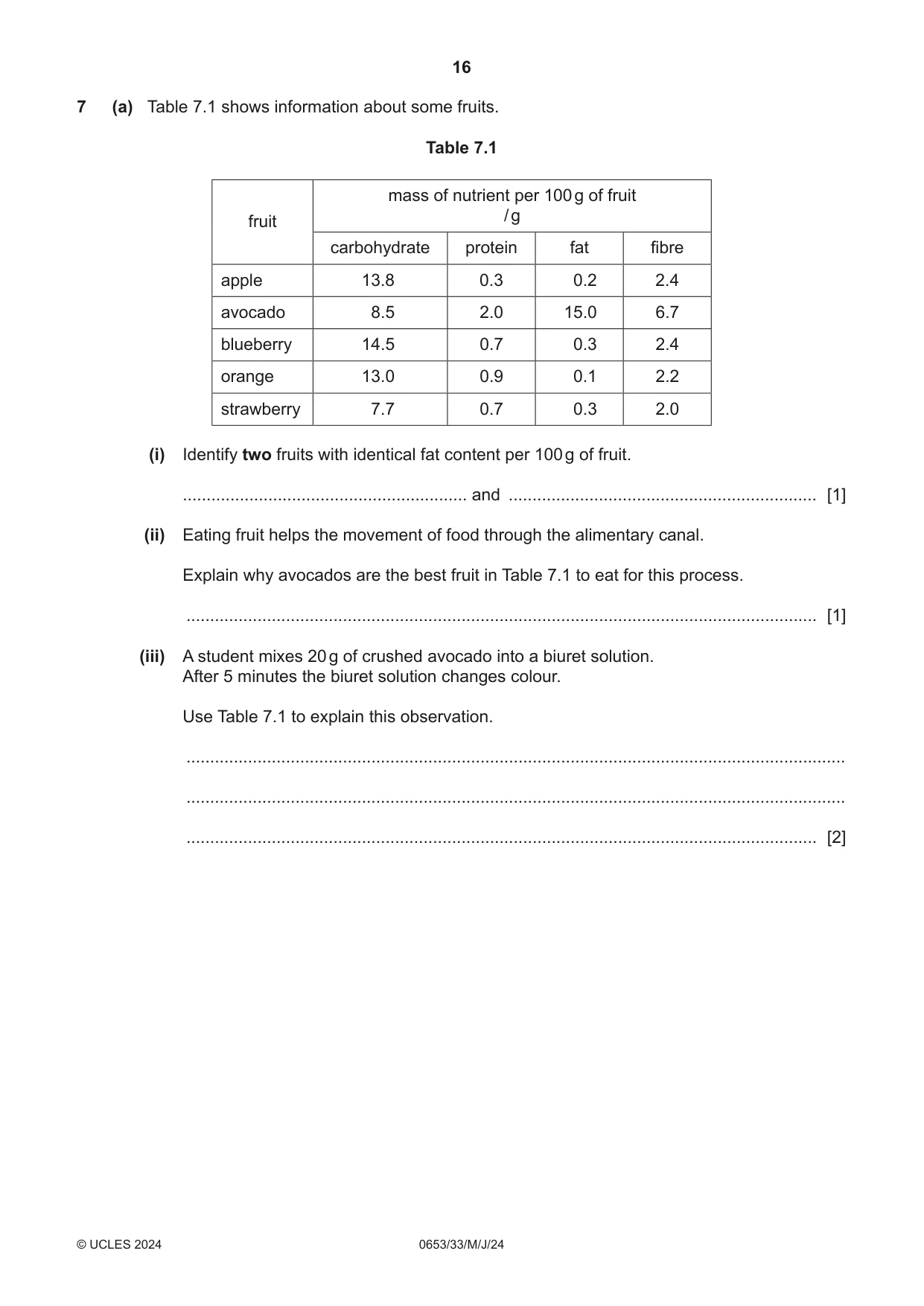
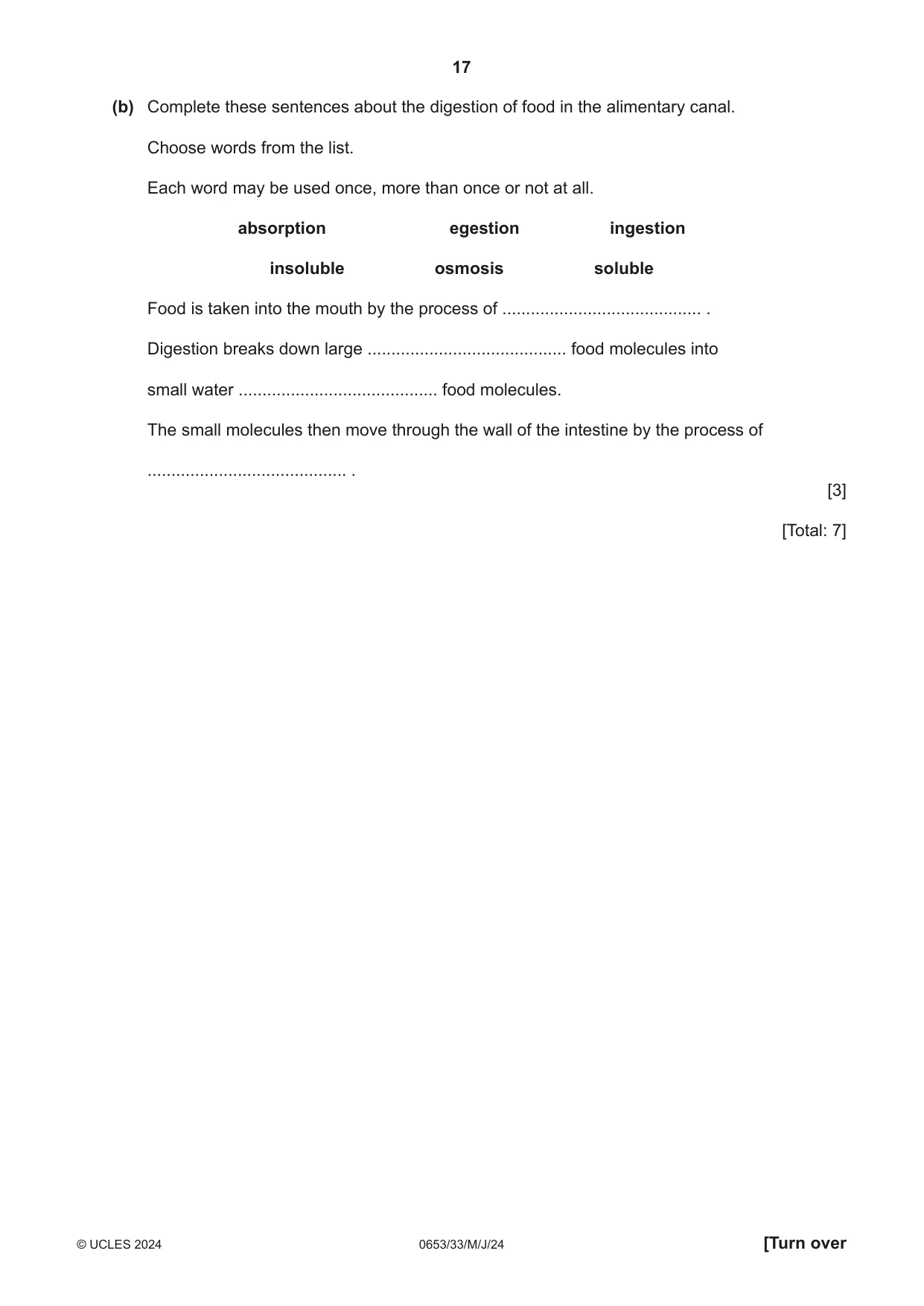
7 (a) Table 7.1 shows information about some fruits. Table 7.1 mass of nutrient per 100 g of fruit / g fruit carbohydrate protein fat fibre apple 13.8 0.3 0.2 2.4 avocado 8.5 2.0 15.0 6.7 blueberry 14.5 0.7 0.3 2.4 orange 13.0 0.9 0.1 2.2 strawberry 7.7 0.7 0.3 2.0 (i) Identify two fruits with identical fat content per 100 g of fruit. ............................................................ and ................................................................. [1] (ii) Eating fruit helps the movement of food through the alimentary canal. Explain why avocados are the best fruit in Table 7.1 to eat for this process. ..................................................................................................................................... [1] (iii) A student mixes 20 g of crushed avocado into a biuret solution. After 5 minutes the biuret solution changes colour. Use Table 7.1 to explain this observation. ........................................................................................................................................... ........................................................................................................................................... ..................................................................................................................................... [2] (b) Complete these sentences about the digestion of food in the alimentary canal. Choose words from the list. Each word may be used once, more than once or not at all. absorption egestion ingestion insoluble osmosis soluble Food is taken into the mouth by the process of .......................................... . Digestion breaks down large .......................................... food molecules into small water .......................................... food molecules. The small molecules then move through the wall of the intestine by the process of .......................................... . [3] [Total: 7]
Mark scheme: 7(a)(i) blueberry and strawberry ; 1 7(a)(ii) (avocados have) highest fibre content ; 1 7(a)(iii) biuret tests for protein / protein causes biuret to change colour (to purple) ; (Table 7.1 shows that) avocado contains protein ; 2 7(b) ingestion ; insoluble and soluble (in correct order) ; absorption ; 3
Q8 · The fossil fuel petroleum is a liquid mixture of hydrocarbons
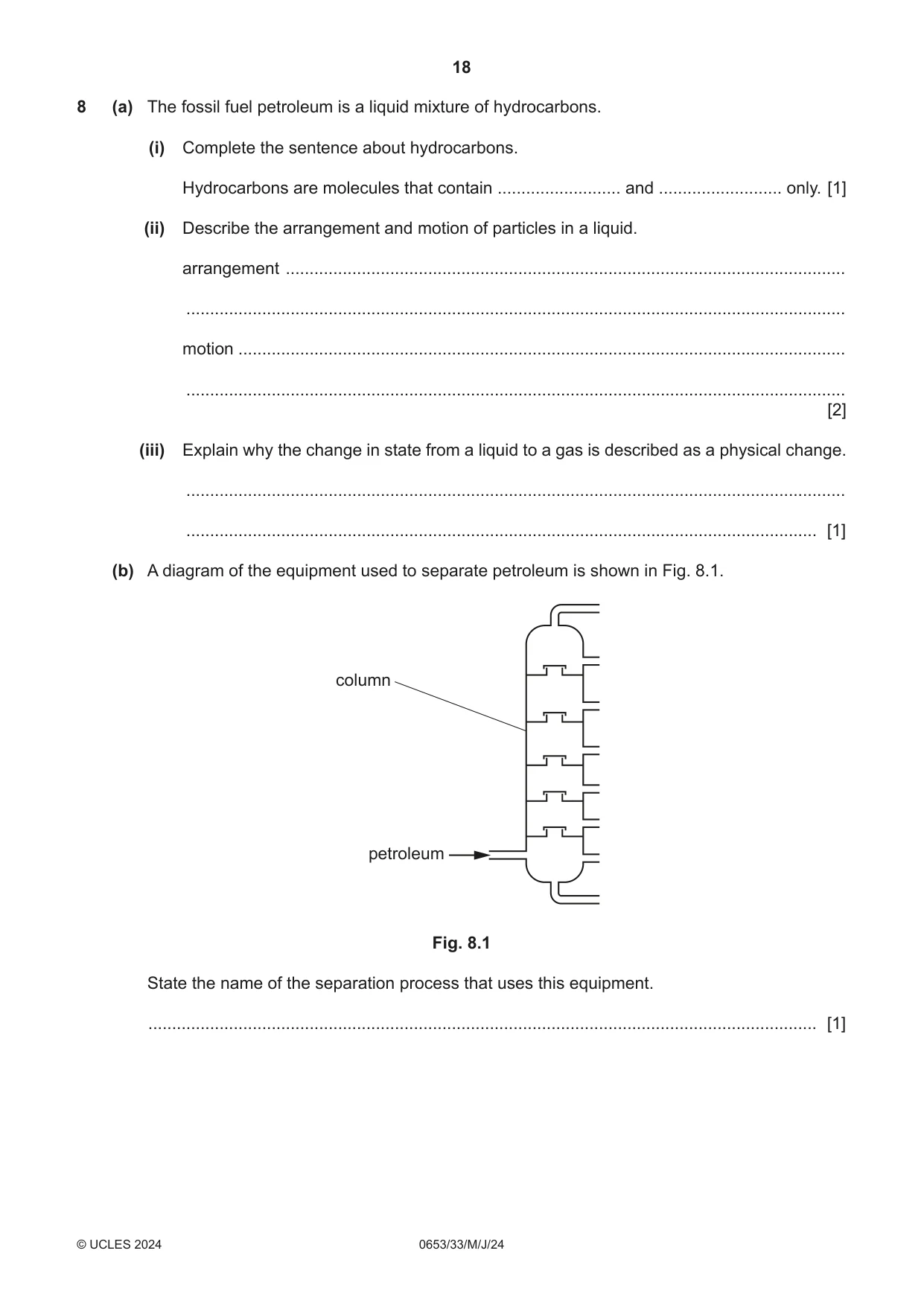
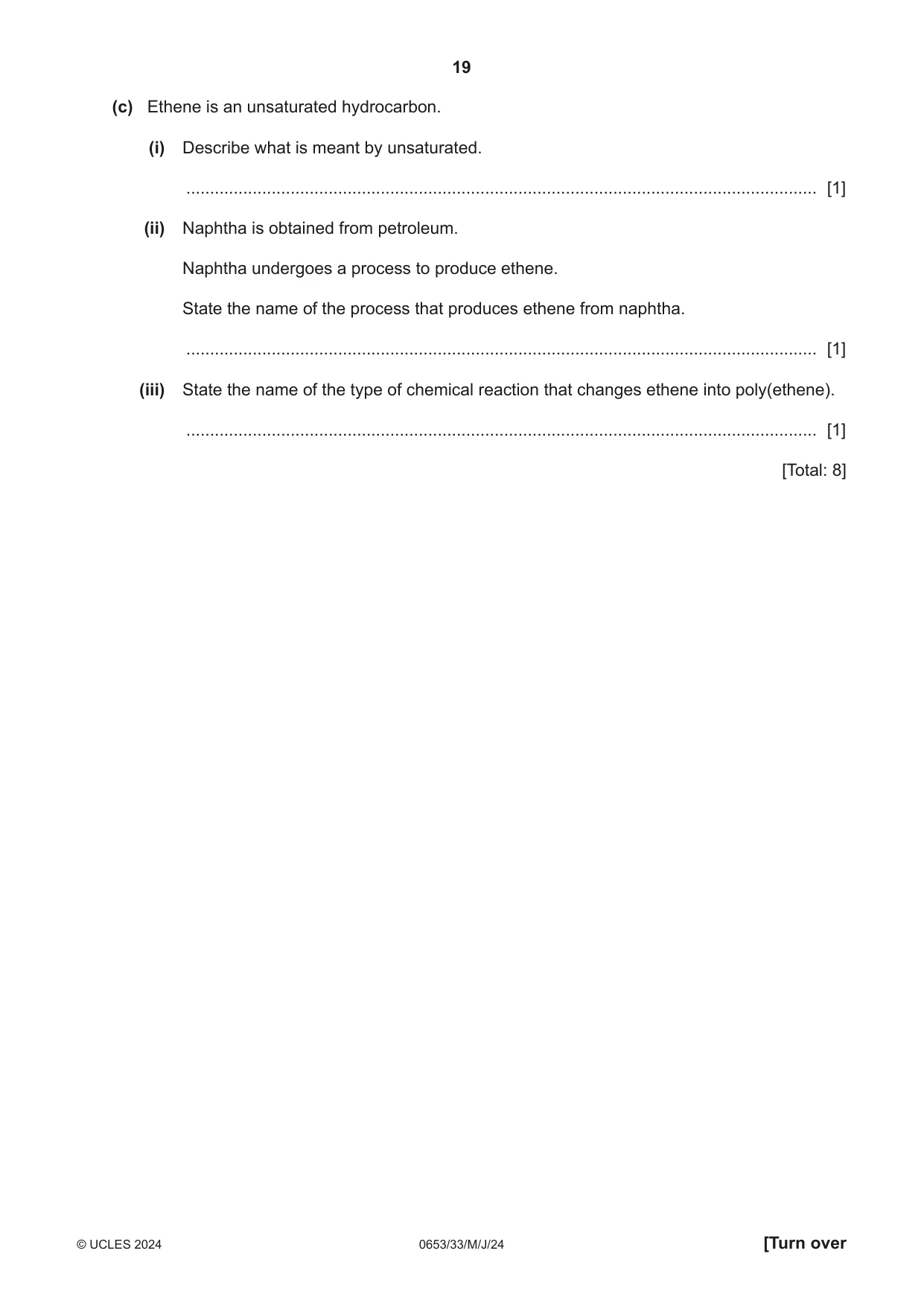
8 (a) The fossil fuel petroleum is a liquid mixture of hydrocarbons. (i) Complete the sentence about hydrocarbons. Hydrocarbons are molecules that contain .......................... and .......................... only. [1] (ii) Describe the arrangement and motion of particles in a liquid. arrangement ...................................................................................................................... ........................................................................................................................................... motion ................................................................................................................................ ........................................................................................................................................... [2] (iii) Explain why the change in state from a liquid to a gas is described as a physical change. ........................................................................................................................................... ..................................................................................................................................... [1] (b) A diagram of the equipment used to separate petroleum is shown in Fig. 8.1. column petroleum Fig. 8.1 State the name of the separation process that uses this equipment. ............................................................................................................................................. [1] (c) Ethene is an unsaturated hydrocarbon. (i) Describe what is meant by unsaturated. ..................................................................................................................................... [1] (ii) Naphtha is obtained from petroleum. Naphtha undergoes a process to produce ethene. State the name of the process that produces ethene from naphtha. ..................................................................................................................................... [1] (iii) State the name of the type of chemical reaction that changes ethene into poly(ethene). ..................................................................................................................................... [1] [Total: 8]
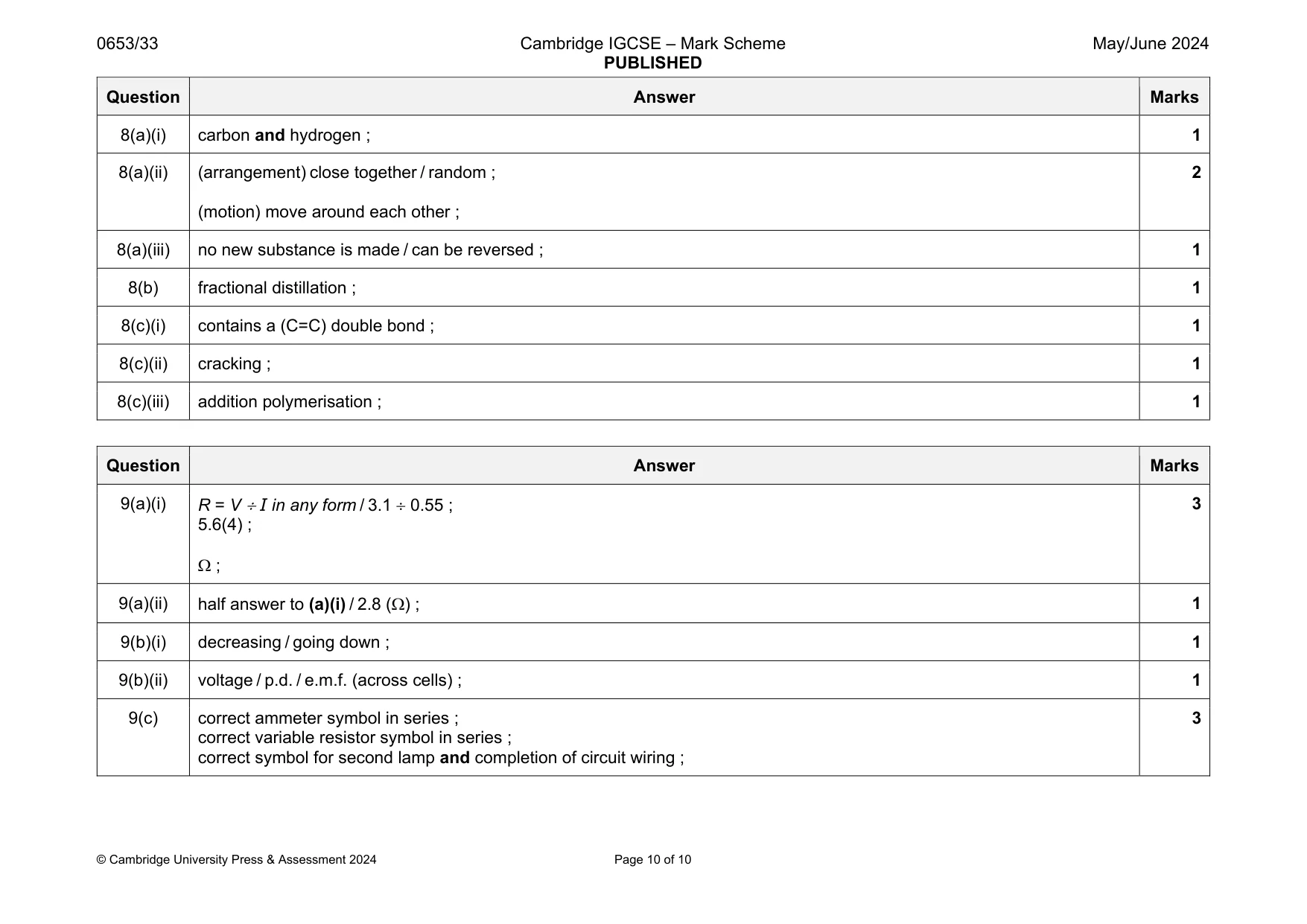
Mark scheme: 8(a)(i) carbon and hydrogen ; 1 8(a)(ii) (arrangement) close together / random ; (motion) move around each other ; 2 8(a)(iii) no new substance is made / can be reversed ; 1 8(b) fractional distillation ; 1 8(c)(i) contains a (C=C) double bond ; 1 8(c)(ii) cracking ; 1 8(c)(iii) addition polymerisation ; 1
Q9 · A circuit containing two identical lamps
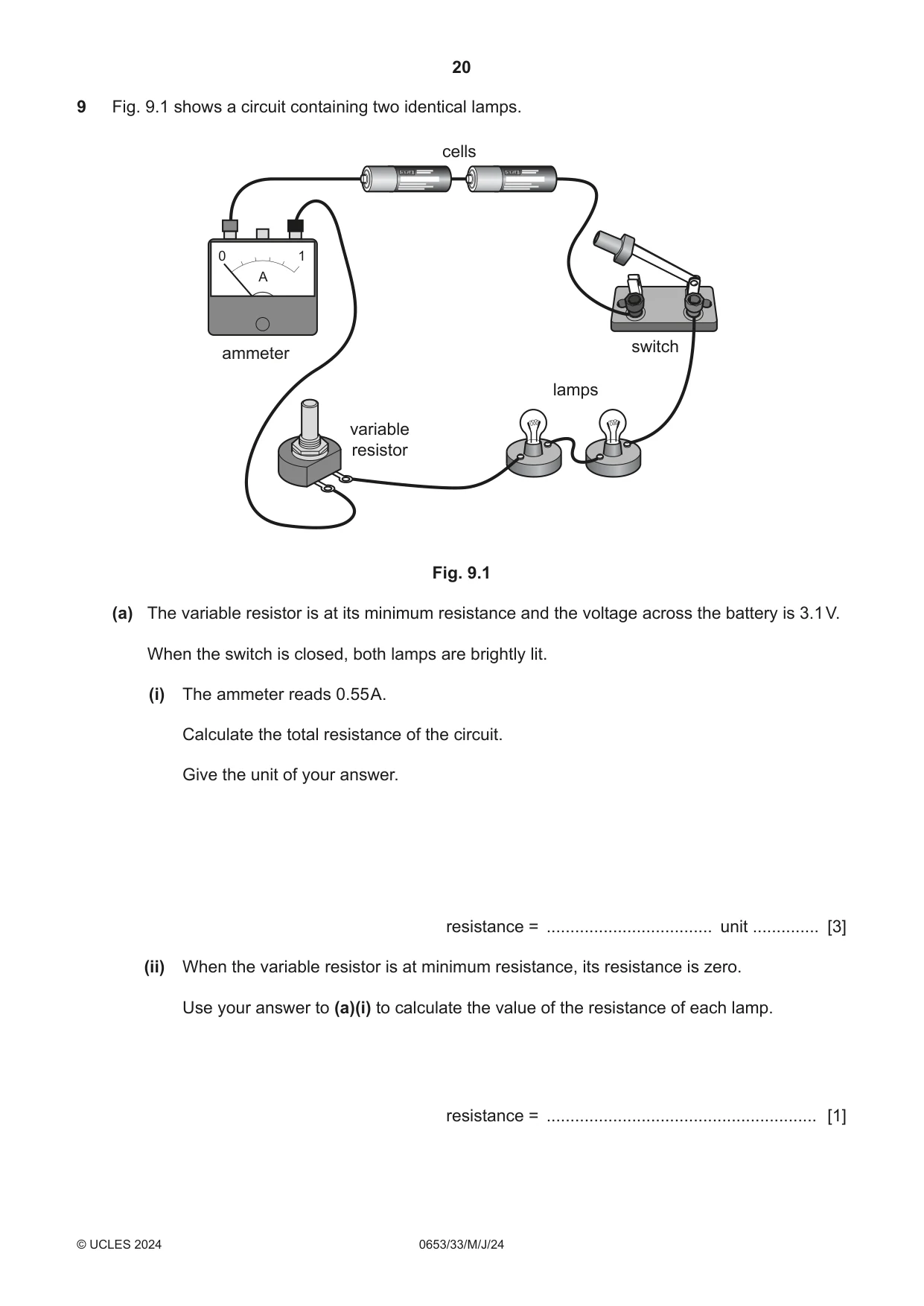
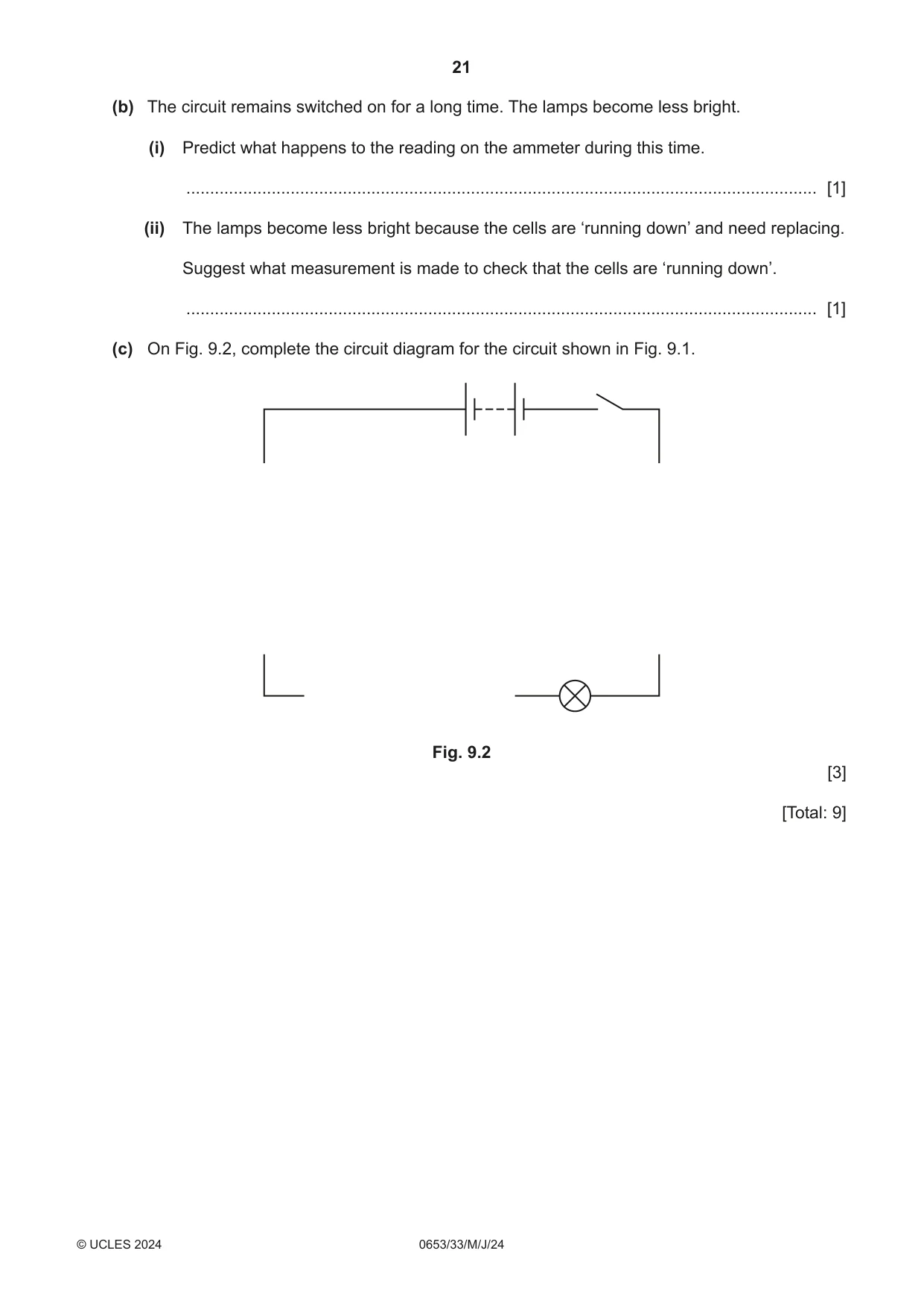
9 Fig. 9.1 shows a circuit containing two identical lamps. cells 0 1 A switch ammeter lamps variable resistor Fig. 9.1 (a) The variable resistor is at its minimum resistance and the voltage across the battery is 3.1 V. When the switch is closed, both lamps are brightly lit. (i) The ammeter reads 0.55 A. Calculate the total resistance of the circuit. Give the unit of your answer. resistance = ................................... unit .............. [3] (ii) When the variable resistor is at minimum resistance, its resistance is zero. Use your answer to (a)(i) to calculate the value of the resistance of each lamp. resistance = ......................................................... [1] (b) The circuit remains switched on for a long time. The lamps become less bright. (i) Predict what happens to the reading on the ammeter during this time. ..................................................................................................................................... [1] (ii) The lamps become less bright because the cells are ‘running down’ and need replacing. Suggest what measurement is made to check that the cells are ‘running down’. ..................................................................................................................................... [1] (c) On Fig. 9.2, complete the circuit diagram for the circuit shown in Fig. 9.1. Fig. 9.2 [3] [Total: 9]
Mark scheme: 9(a)(i) 5.6(4) ; ; 3 9(a)(ii) half answer to (a)(i) / 2.8 () ; 1 9(b)(i) decreasing / going down ; 1 9(b)(ii) voltage / p.d. / e.m.f. (across cells) ; 1 9(c) correct ammeter symbol in series ; correct variable resistor symbol in series ; correct symbol for second lamp and completion of circuit wiring ; 3
What was in this paper
The subtopics covered by these 9 questions, and how many questions each got. Open one in a new tab to see every Cambridge question on it.
What you needed in this session
Cambridge’s own grade thresholds for 2024 May/June, Paper 3 · Variant 3. A higher threshold means an easier paper — the bar moves with how the cohort did.