Cambridge IGCSE Science - Combined 0653 — 2019 Oct/Nov Paper 3 · Variant 1
0653/31/O/N/19 · 9 questions · 80 marks · ≈90 min
The question paper and its mark scheme, free to read here and free to download. This is Cambridge’s own paper, exactly as it was sat.
Question paper24 pages



Mark scheme10 pages
Answers below. Sit the paper first if you are practising.
Questions as text
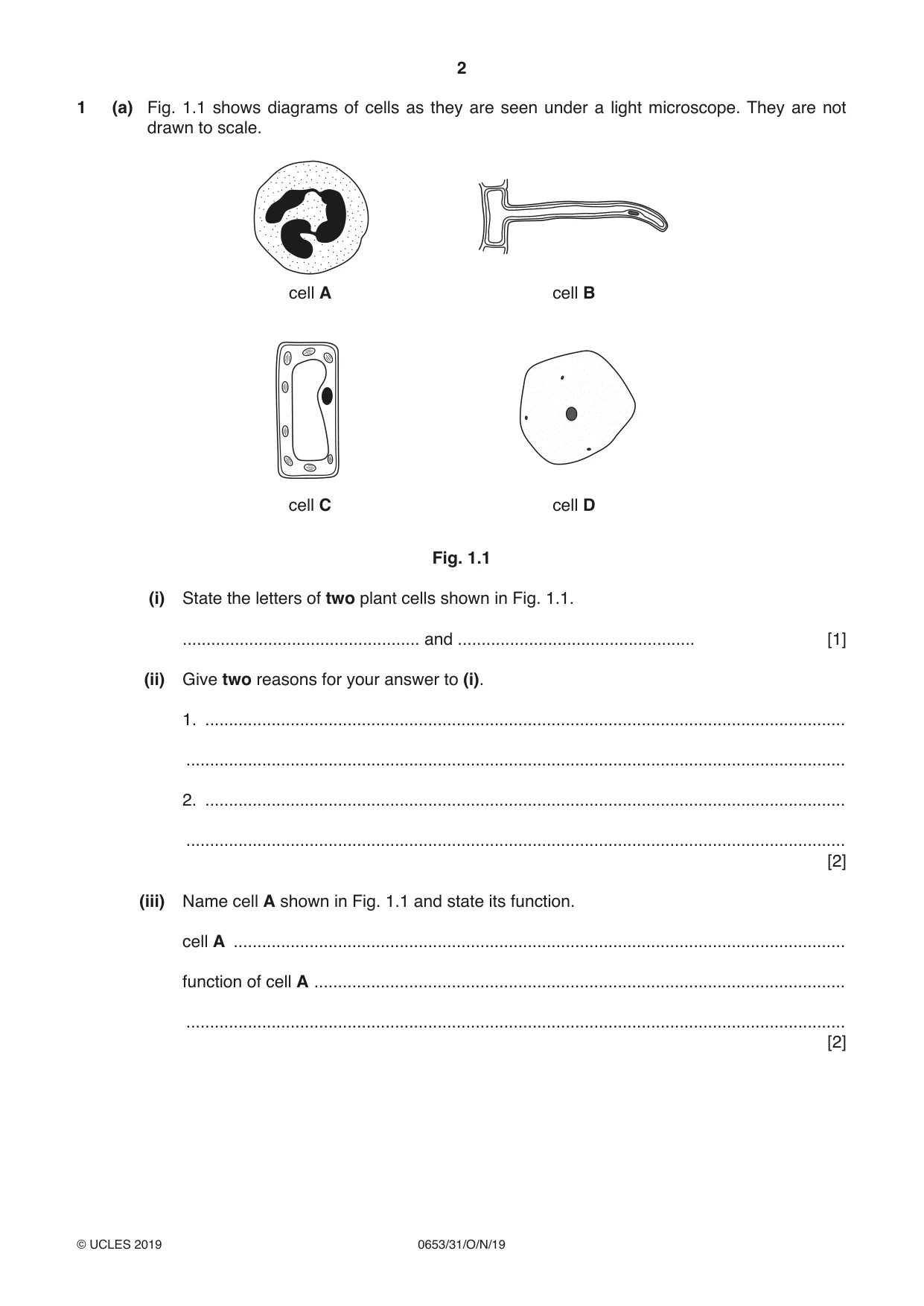
Q1 · Diagrams of cells as they are seen under a light microscope
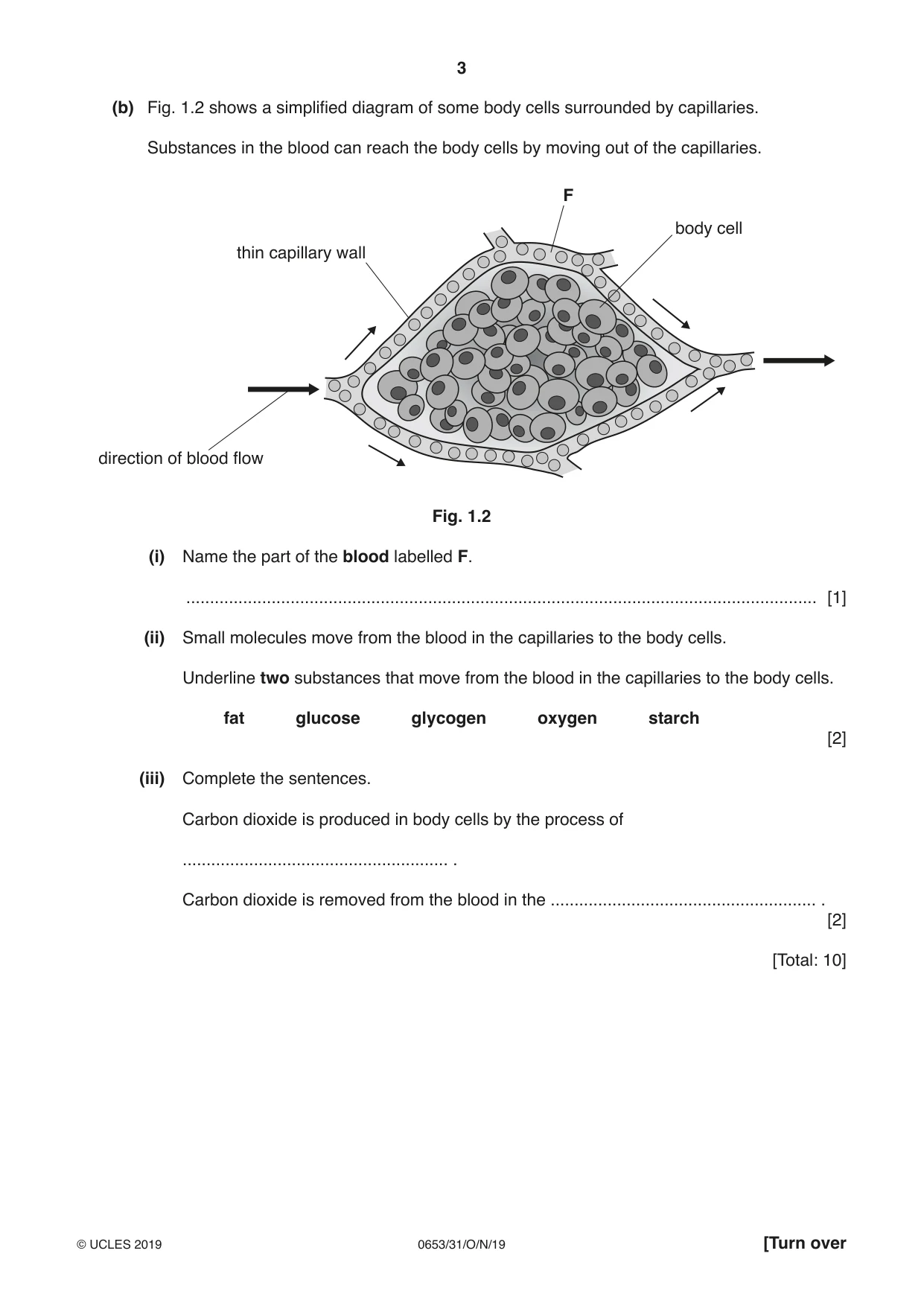
1 (a) Fig. 1.1 shows diagrams of cells as they are seen under a light microscope. They are not drawn to scale. cell A cell B cell C cell D Fig. 1.1 (i) State the letters of two plant cells shown in Fig. 1.1. .................................................. and .................................................. [1] (ii) Give two reasons for your answer to (i). 1. ....................................................................................................................................... ........................................................................................................................................... 2. ....................................................................................................................................... ........................................................................................................................................... [2] (iii) Name cell A shown in Fig. 1.1 and state its function. cell A ................................................................................................................................. function of cell A ................................................................................................................ ........................................................................................................................................... [2] (b) Fig. 1.2 shows a simplified diagram of some body cells surrounded by capillaries. Substances in the blood can reach the body cells by moving out of the capillaries. F body cell thin capillary wall direction of blood flow Fig. 1.2 (i) Name the part of the blood labelled F. ..................................................................................................................................... [1] (ii) Small molecules move from the blood in the capillaries to the body cells. Underline two substances that move from the blood in the capillaries to the body cells. fat glucose glycogen oxygen starch [2] (iii) Complete the sentences. Carbon dioxide is produced in body cells by the process of ........................................................ . Carbon dioxide is removed from the blood in the ........................................................ . [2] [Total: 10]
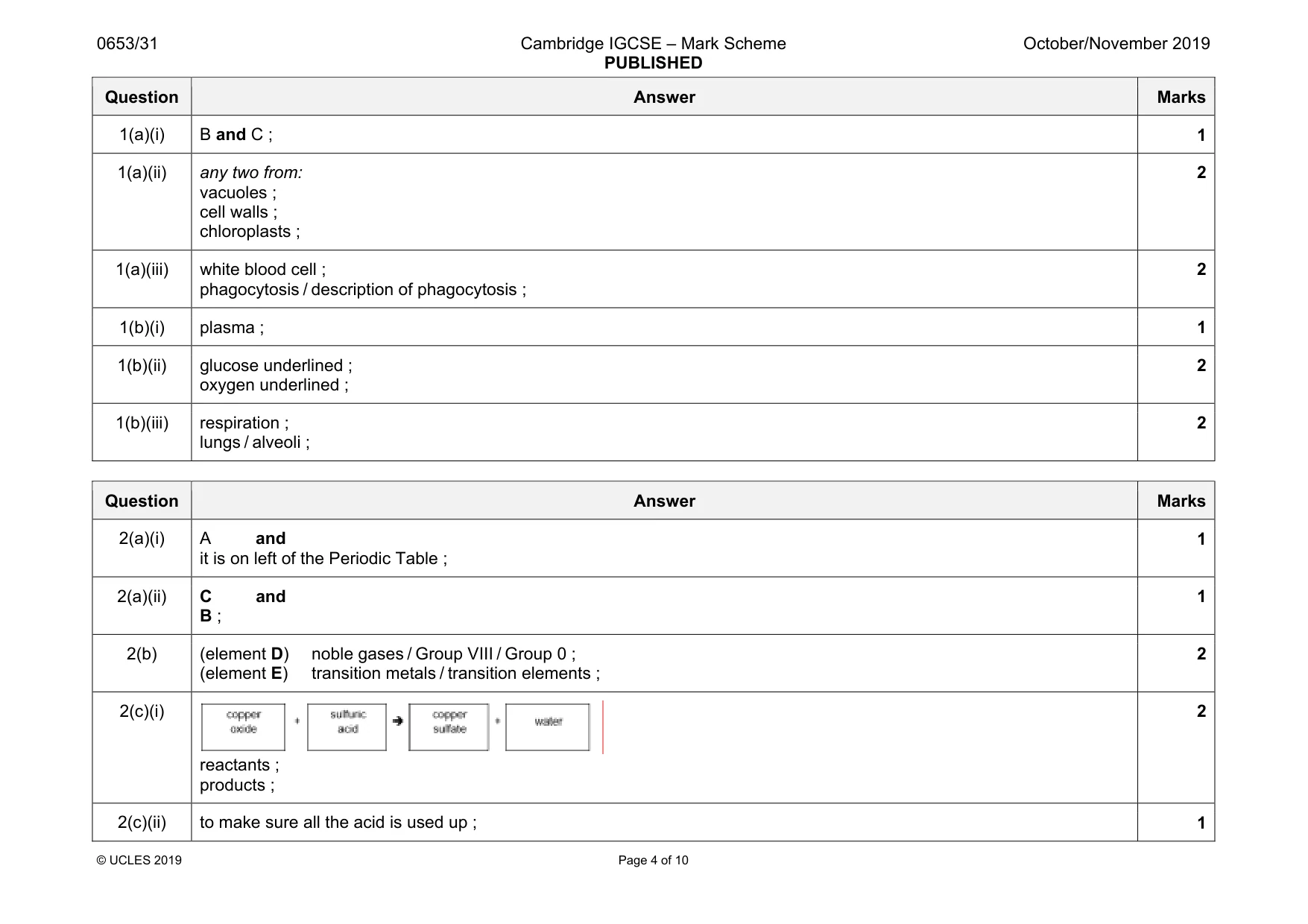
Mark scheme: 1(a)(i) B and C ; 1 1(a)(ii) any two from: vacuoles ; cell walls ; chloroplasts ; 2 1(a)(iii) white blood cell ; phagocytosis / description of phagocytosis ; 2 1(b)(i) plasma ; 1 1(b)(ii) glucose underlined ; oxygen underlined ; 2 1(b)(iii) respiration ; lungs / alveoli ; 2
Q2 · Element A is in Group III in the Periodic Table
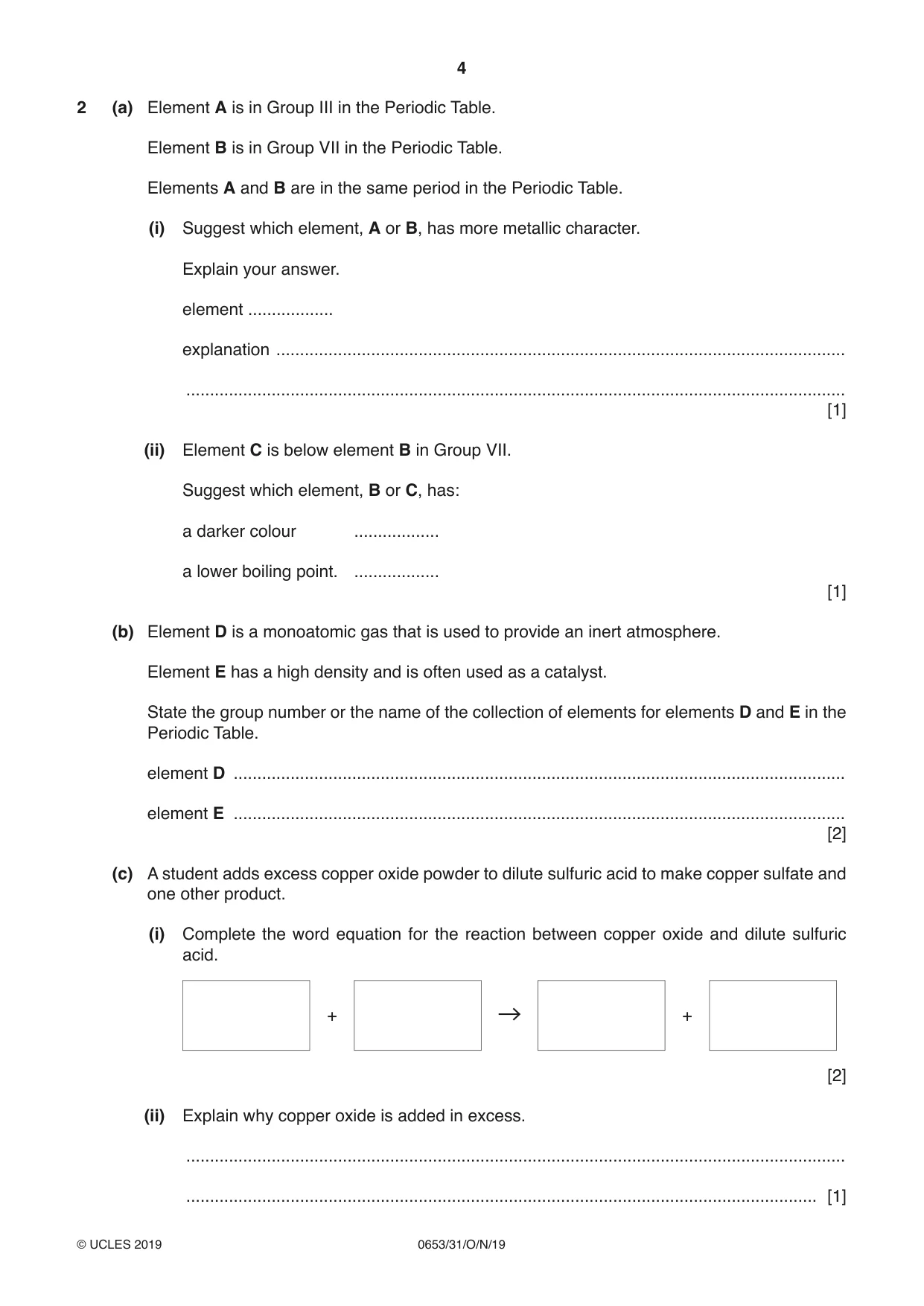
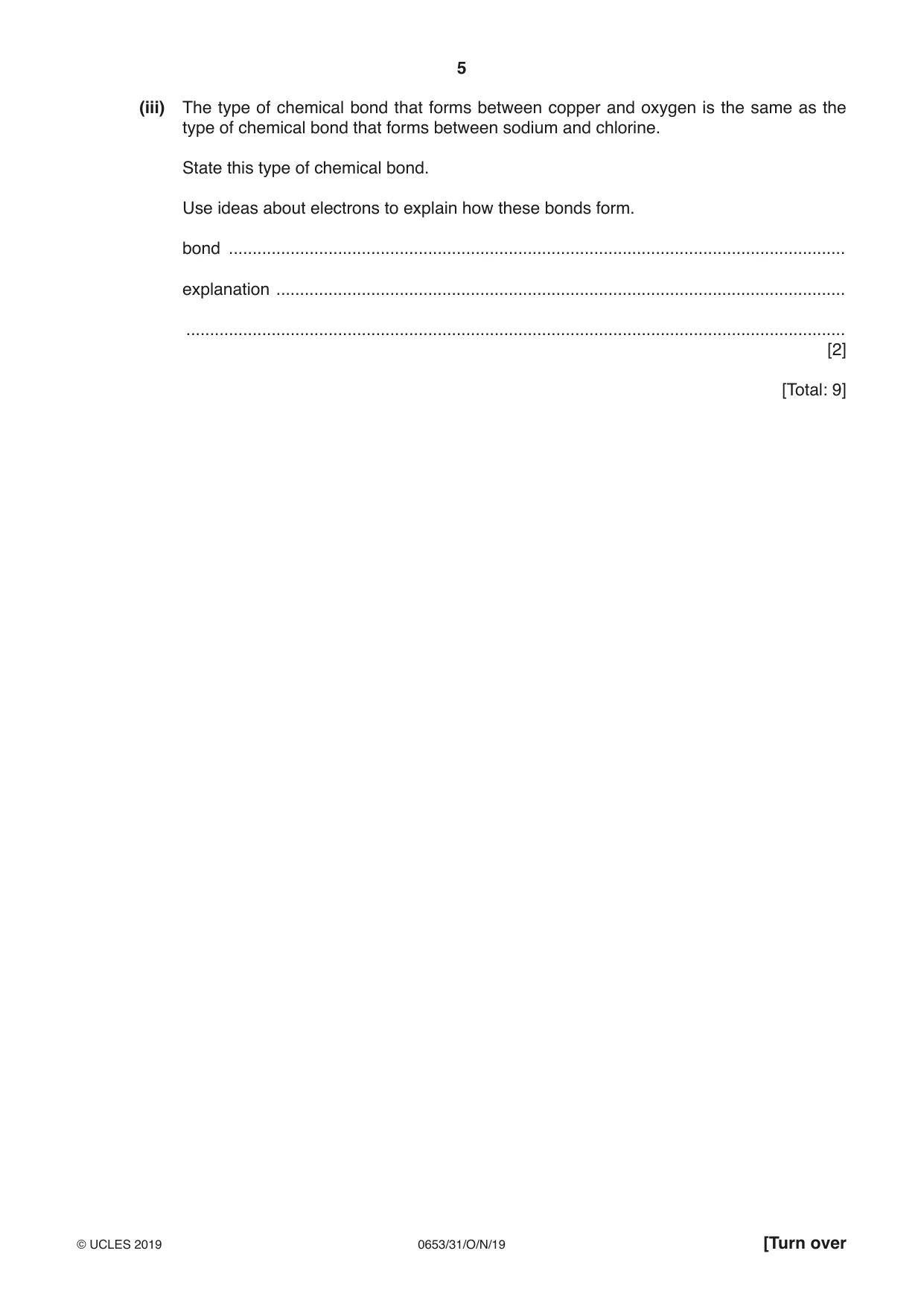
2 (a) Element A is in Group III in the Periodic Table. Element B is in Group VII in the Periodic Table. Elements A and B are in the same period in the Periodic Table. (i) Suggest which element, A or B, has more metallic character. Explain your answer. element .................. explanation ........................................................................................................................ ........................................................................................................................................... [1] (ii) Element C is below element B in Group VII. Suggest which element, B or C, has: a darker colour .................. a lower boiling point. .................. [1] (b) Element D is a monoatomic gas that is used to provide an inert atmosphere. Element E has a high density and is often used as a catalyst. State the group number or the name of the collection of elements for elements D and E in the Periodic Table. element D ................................................................................................................................. element E ................................................................................................................................. [2] (c) A student adds excess copper oxide powder to dilute sulfuric acid to make copper sulfate and one other product. (i) Complete the word equation for the reaction between copper oxide and dilute sulfuric acid. + + [2] (ii) Explain why copper oxide is added in excess. ........................................................................................................................................... ..................................................................................................................................... [1] (iii) The type of chemical bond that forms between copper and oxygen is the same as the type of chemical bond that forms between sodium and chlorine. State this type of chemical bond. Use ideas about electrons to explain how these bonds form. bond .................................................................................................................................. explanation ........................................................................................................................ ........................................................................................................................................... [2] [Total: 9]
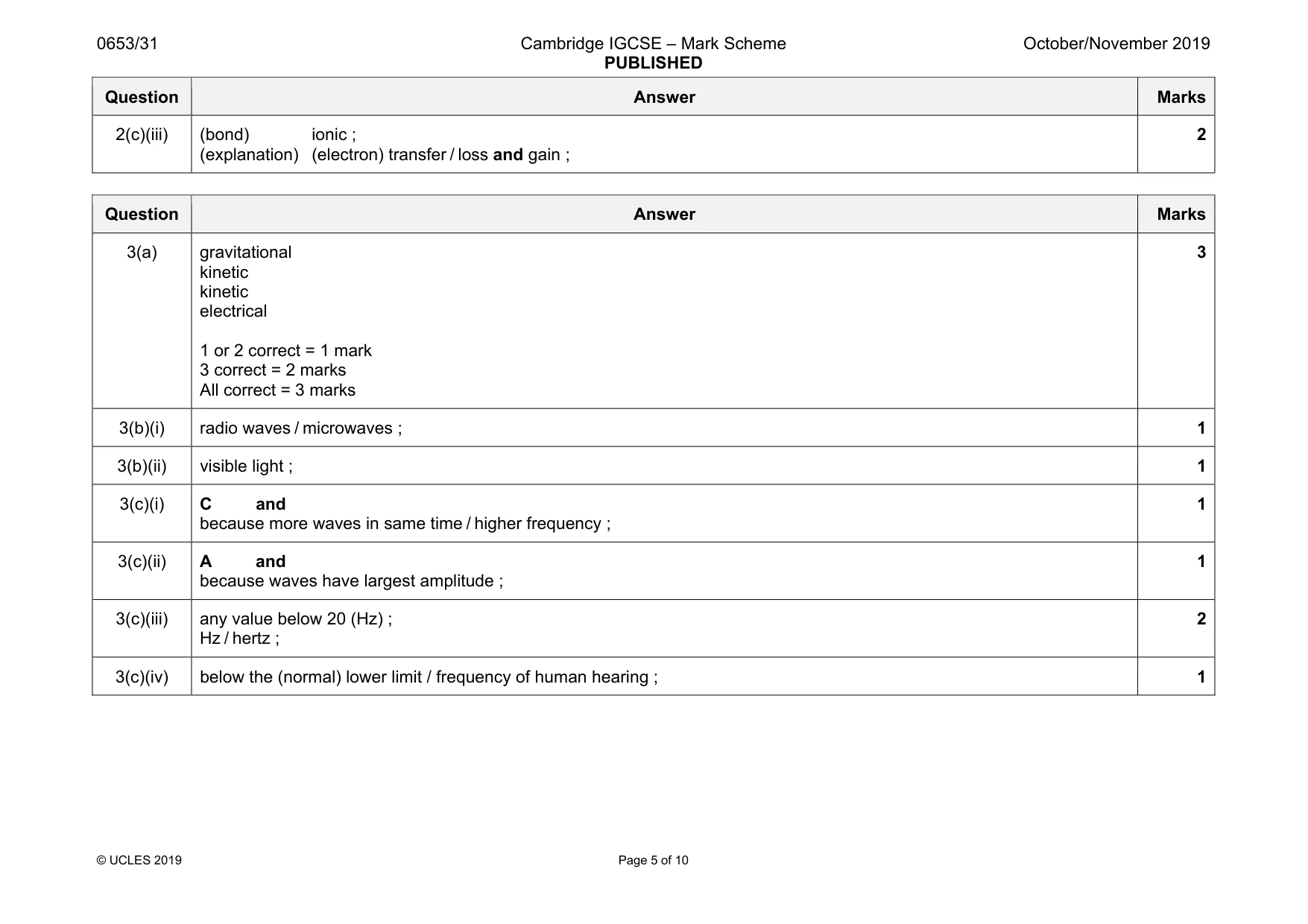
Mark scheme: 2(a)(i) A and it is on left of the Periodic Table ; 1 2(a)(ii) C and B ; 1 2(b) (element D) noble gases / Group VIII / Group 0 ; (element E) transition metals / transition elements ; 2 2(c)(i) reactants ; products ; 2 2(c)(ii) to make sure all the acid is used up ; 1 Question Answer Marks 2(c)(iii) (bond) ionic ; (explanation) (electron) transfer / loss and gain ; 2
Q3 · How a small hydroelectric power station is used to supply electricity
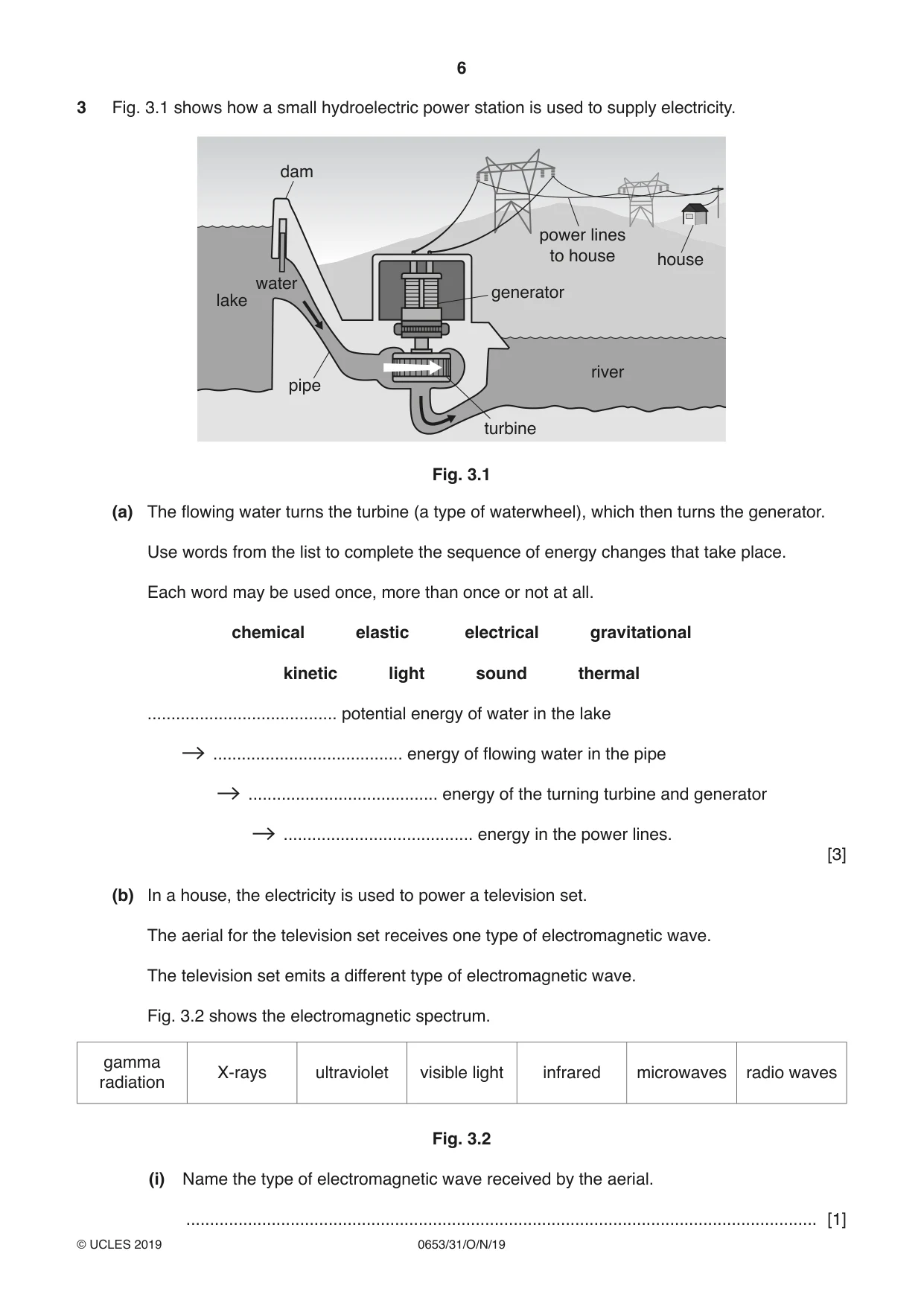
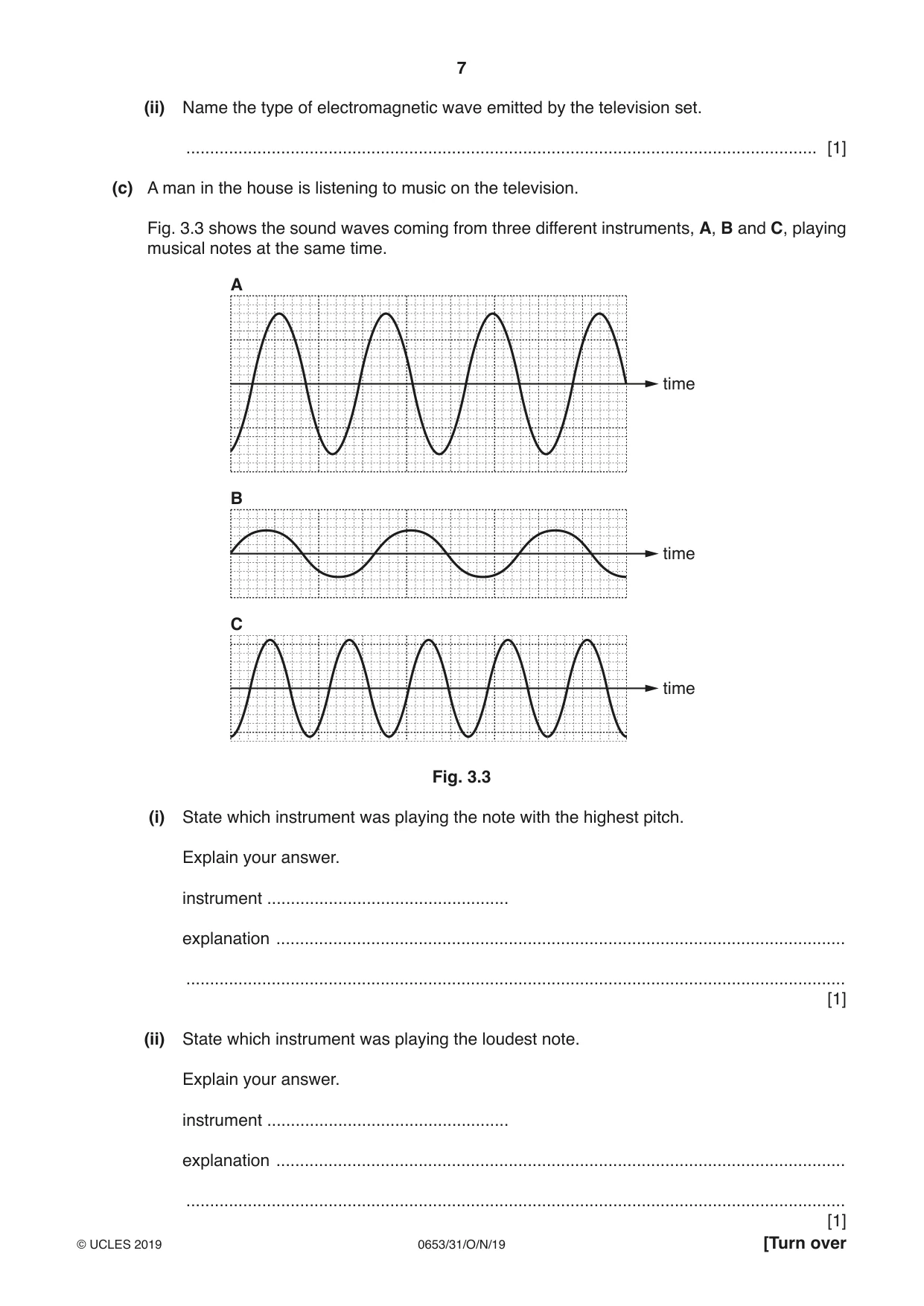
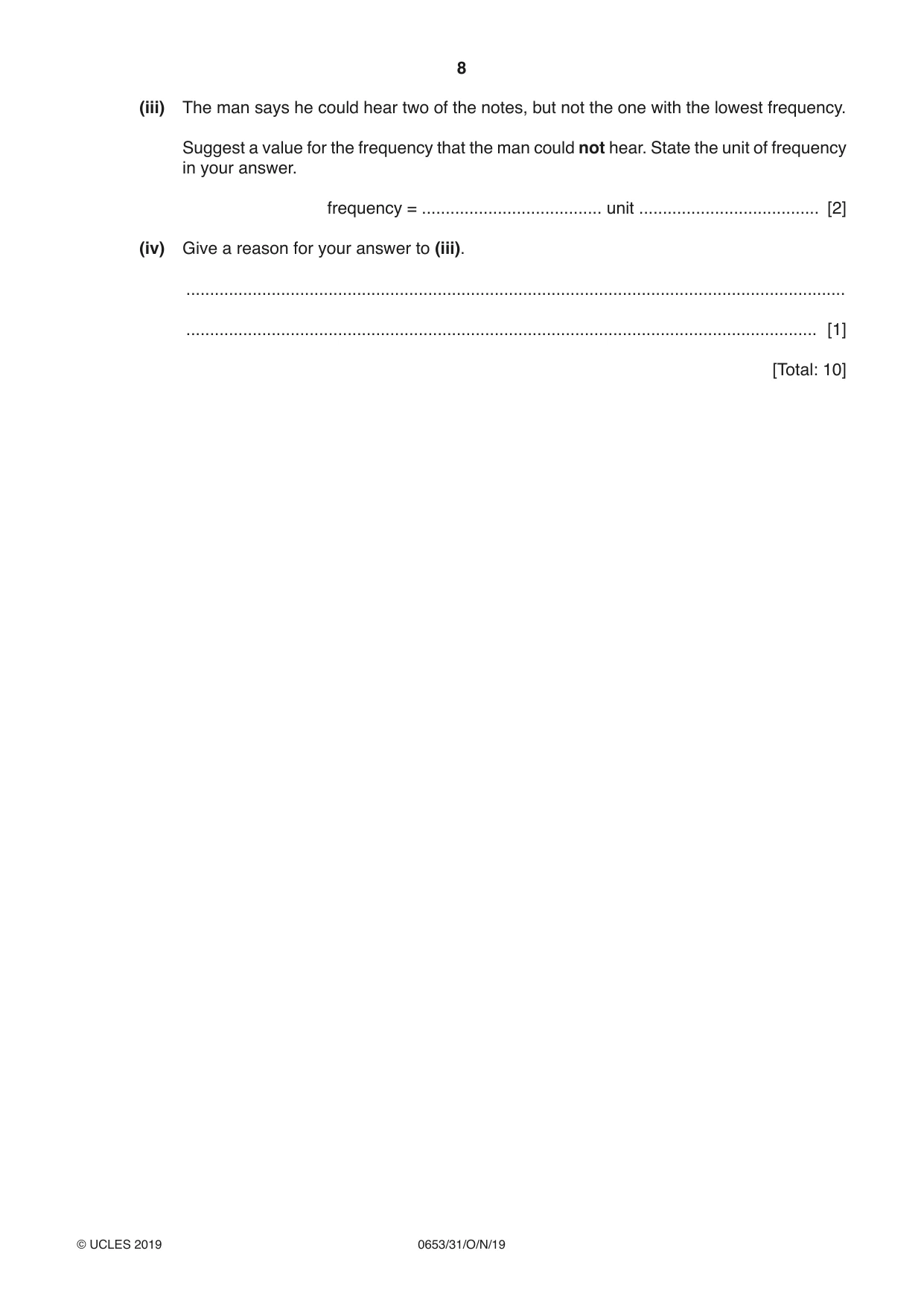
3 Fig. 3.1 shows how a small hydroelectric power station is used to supply electricity. dam power lines to house house water generator lake river pipe turbine Fig. 3.1 (a) The flowing water turns the turbine (a type of waterwheel), which then turns the generator. Use words from the list to complete the sequence of energy changes that take place. Each word may be used once, more than once or not at all. chemical elastic electrical gravitational kinetic light sound thermal ........................................ potential energy of water in the lake ........................................ energy of flowing water in the pipe ........................................ energy of the turning turbine and generator ........................................ energy in the power lines. [3] (b) In a house, the electricity is used to power a television set. The aerial for the television set receives one type of electromagnetic wave. The television set emits a different type of electromagnetic wave. Fig. 3.2 shows the electromagnetic spectrum. gamma X-rays ultraviolet visible light infrared microwaves radio waves radiation Fig. 3.2 (i) Name the type of electromagnetic wave received by the aerial. ..................................................................................................................................... [1] (ii) Name the type of electromagnetic wave emitted by the television set. ..................................................................................................................................... [1] (c) A man in the house is listening to music on the television. Fig. 3.3 shows the sound waves coming from three different instruments, A, B and C, playing musical notes at the same time. A time B time C time Fig. 3.3 (i) State which instrument was playing the note with the highest pitch. Explain your answer. instrument ................................................... explanation ........................................................................................................................ ........................................................................................................................................... [1] (ii) State which instrument was playing the loudest note. Explain your answer. instrument ................................................... explanation ........................................................................................................................ ........................................................................................................................................... (iii) The man says he could hear two of the notes, but not the one with the lowest frequency. Suggest a value for the frequency that the man could not hear. State the unit of frequency in your answer. frequency = ...................................... unit ...................................... [2] (iv) Give a reason for your answer to (iii). ........................................................................................................................................... ..................................................................................................................................... [1] [Total: 10]
Mark scheme: 3(a) gravitational kinetic kinetic electrical 1 or 2 correct = 1 mark 3 correct = 2 marks All correct = 3 marks 3 3(b)(i) radio waves / microwaves ; 1 3(b)(ii) visible light ; 1 3(c)(i) C and because more waves in same time / higher frequency ; 1 3(c)(ii) A and because waves have largest amplitude ; 1 3(c)(iii) any value below 20 (Hz) ; Hz / hertz ; 2 3(c)(iv) below the (normal) lower limit / frequency of human hearing ; 1
Q4 · Plants need water to survive
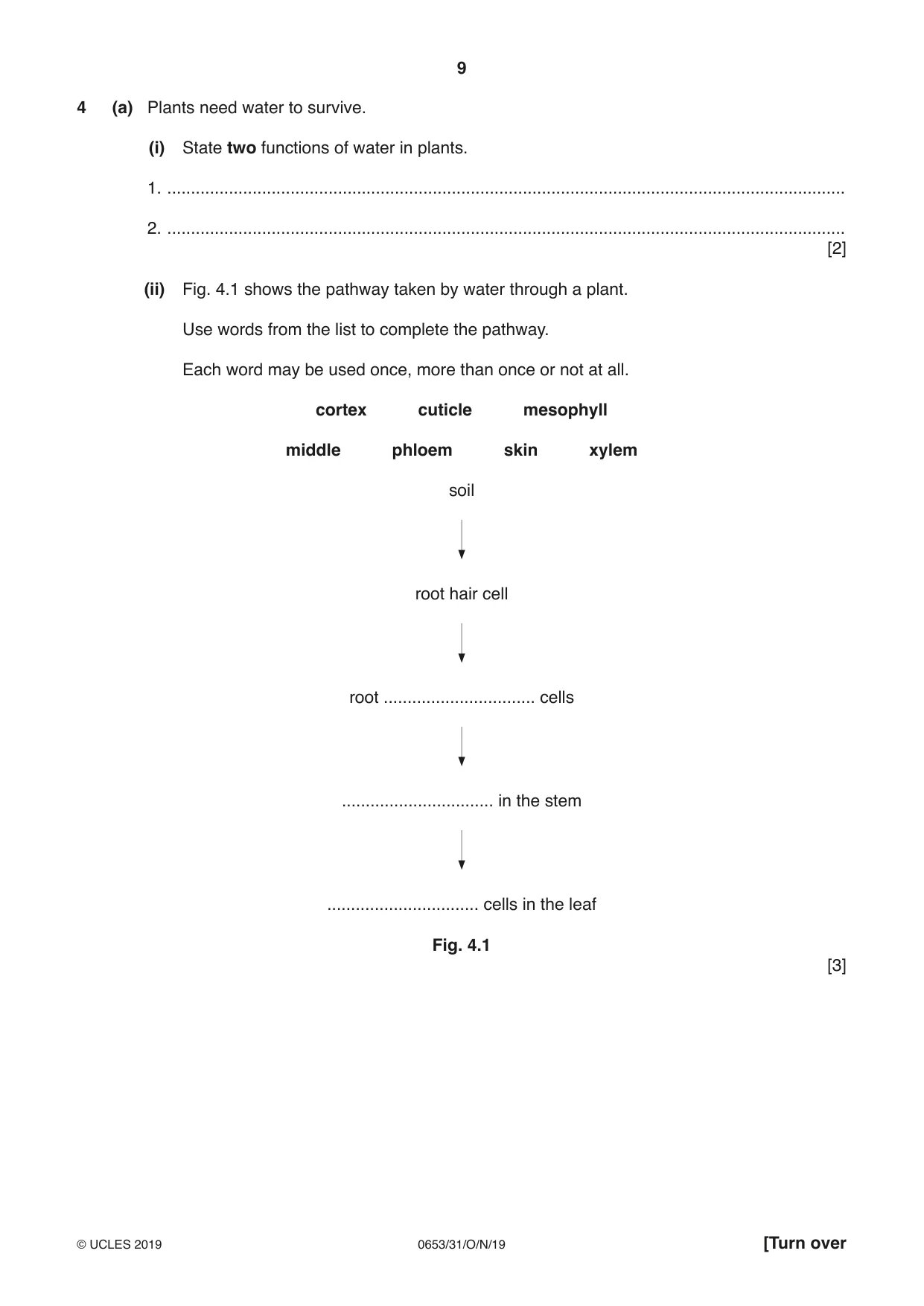
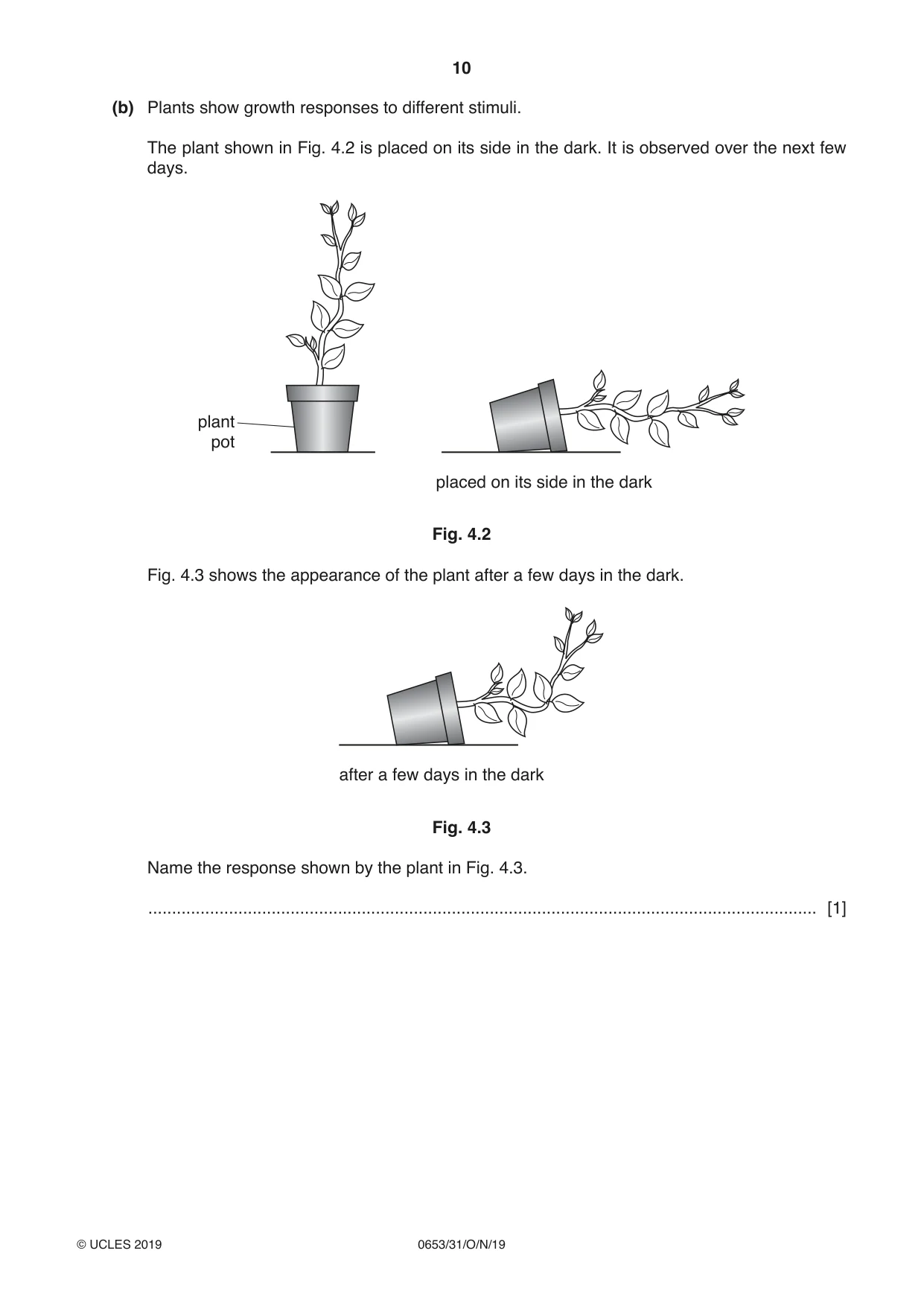
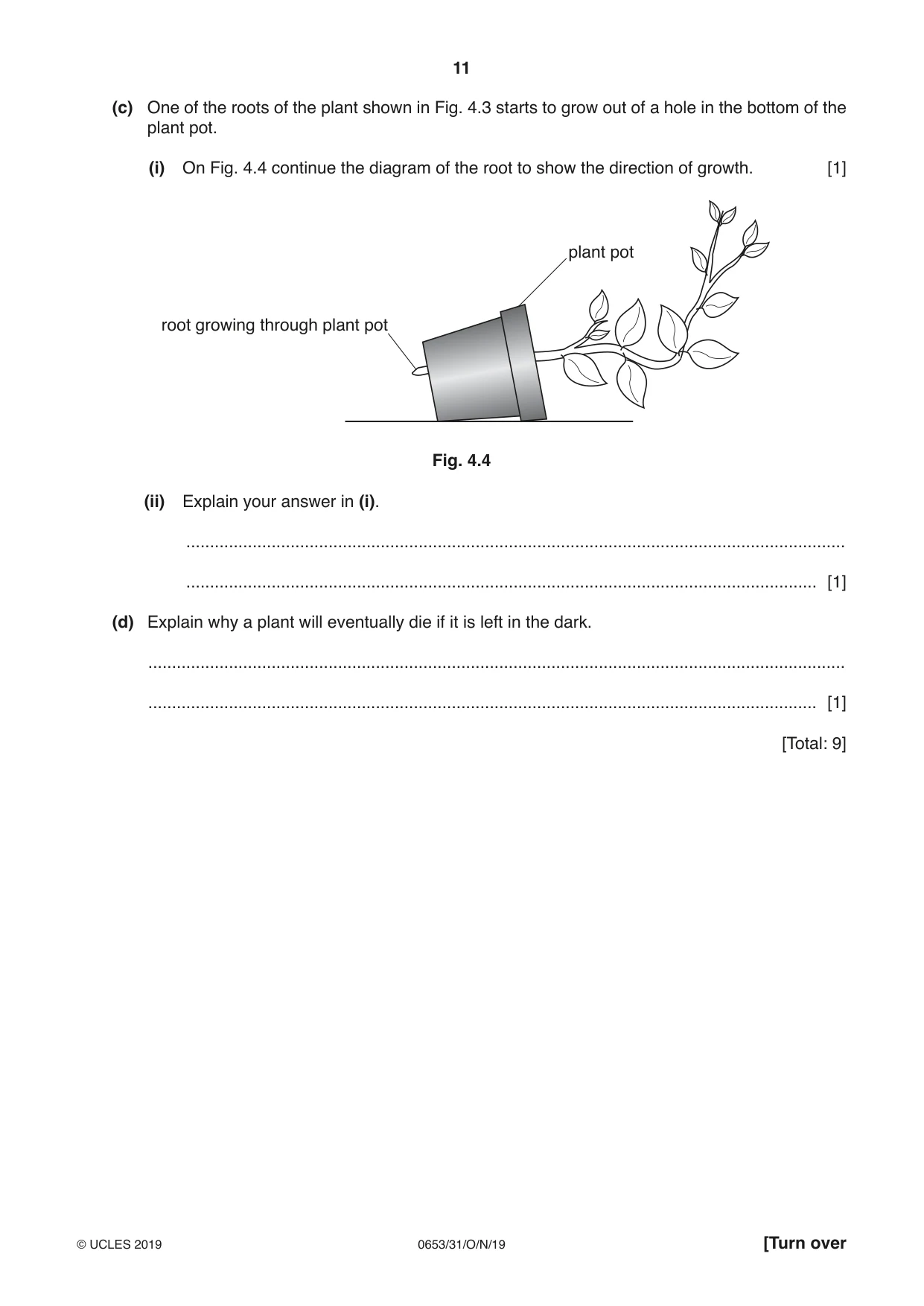
4 (a) Plants need water to survive. (i) State two functions of water in plants. 1. ............................................................................................................................................... 2. ............................................................................................................................................... [2] (ii) Fig. 4.1 shows the pathway taken by water through a plant. Use words from the list to complete the pathway. Each word may be used once, more than once or not at all. cortex cuticle mesophyll middle phloem skin xylem soil root hair cell root ................................ cells ................................ in the stem ................................ cells in the leaf Fig. 4.1 [3] (b) Plants show growth responses to different stimuli. The plant shown in Fig. 4.2 is placed on its side in the dark. It is observed over the next few days. plant pot placed on its side in the dark Fig. 4.2 Fig. 4.3 shows the appearance of the plant after a few days in the dark. after a few days in the dark Fig. 4.3 Name the response shown by the plant in Fig. 4.3. ............................................................................................................................................. [1] (c) One of the roots of the plant shown in Fig. 4.3 starts to grow out of a hole in the bottom of the plant pot. (i) On Fig. 4.4 continue the diagram of the root to show the direction of growth. [1] plant pot root growing through plant pot Fig. 4.4 (ii) Explain your answer in (i). ........................................................................................................................................... ..................................................................................................................................... [1] (d) Explain why a plant will eventually die if it is left in the dark. ................................................................................................................................................... ............................................................................................................................................. [1] [Total: 9]
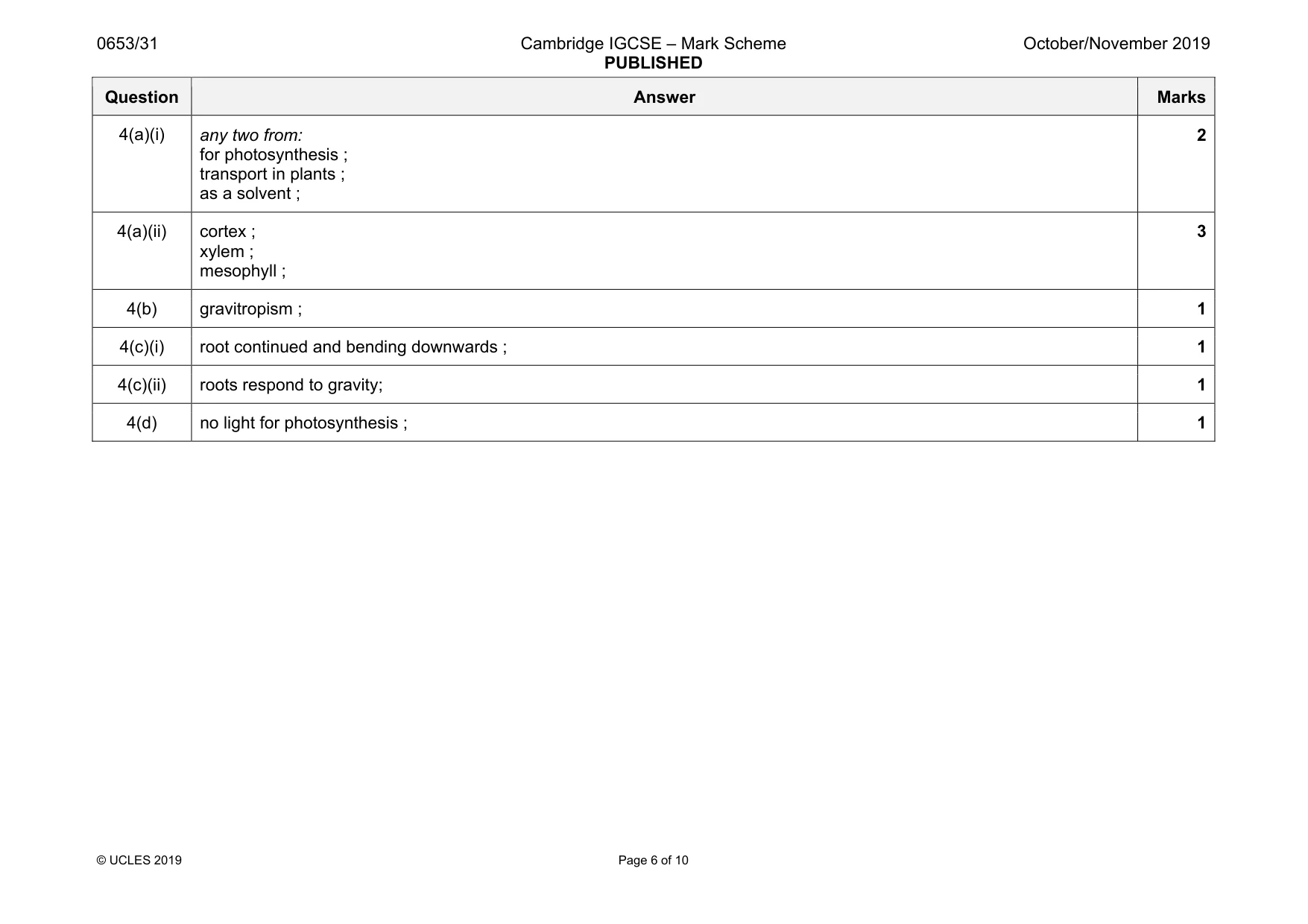
Mark scheme: 4(a)(i) any two from: for photosynthesis ; transport in plants ; as a solvent ; 2 4(a)(ii) cortex ; xylem ; mesophyll ; 3 4(b) gravitropism ; 1 4(c)(i) root continued and bending downwards ; 1 4(c)(ii) roots respond to gravity; 1 4(d) no light for photosynthesis ; 1
Q5 · Some of the apparatus a student uses to investigate the rate of reaction between a piece…
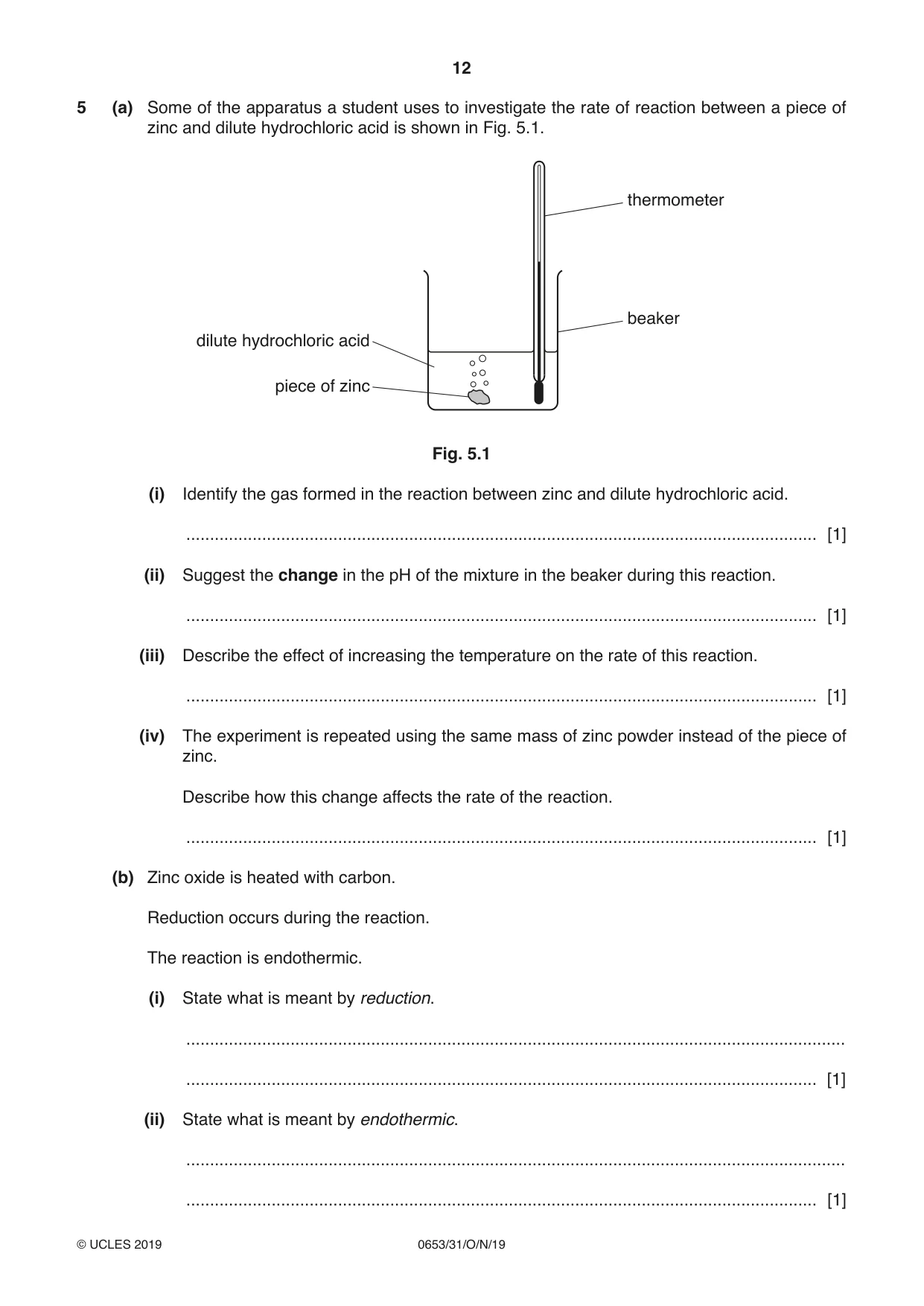
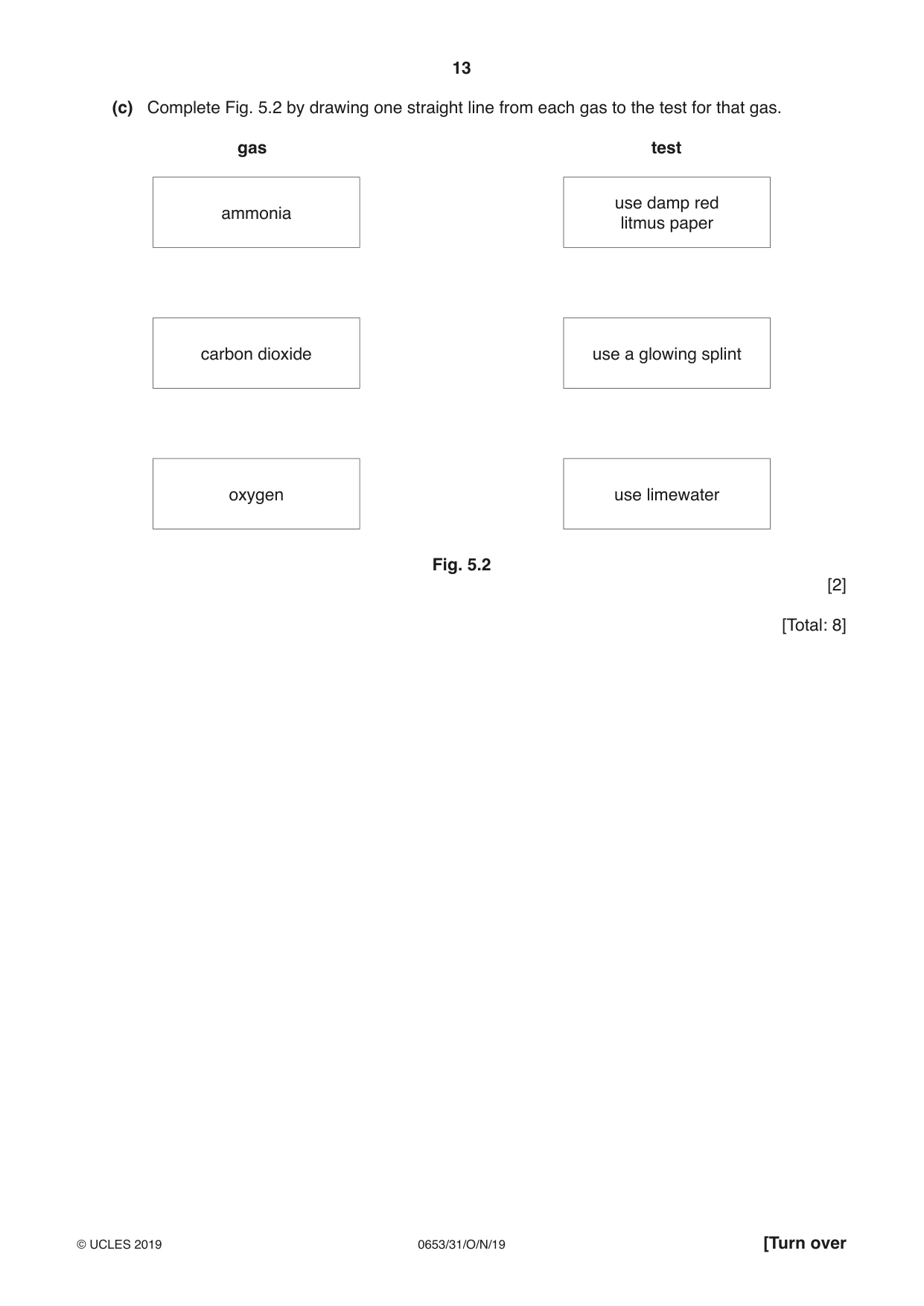
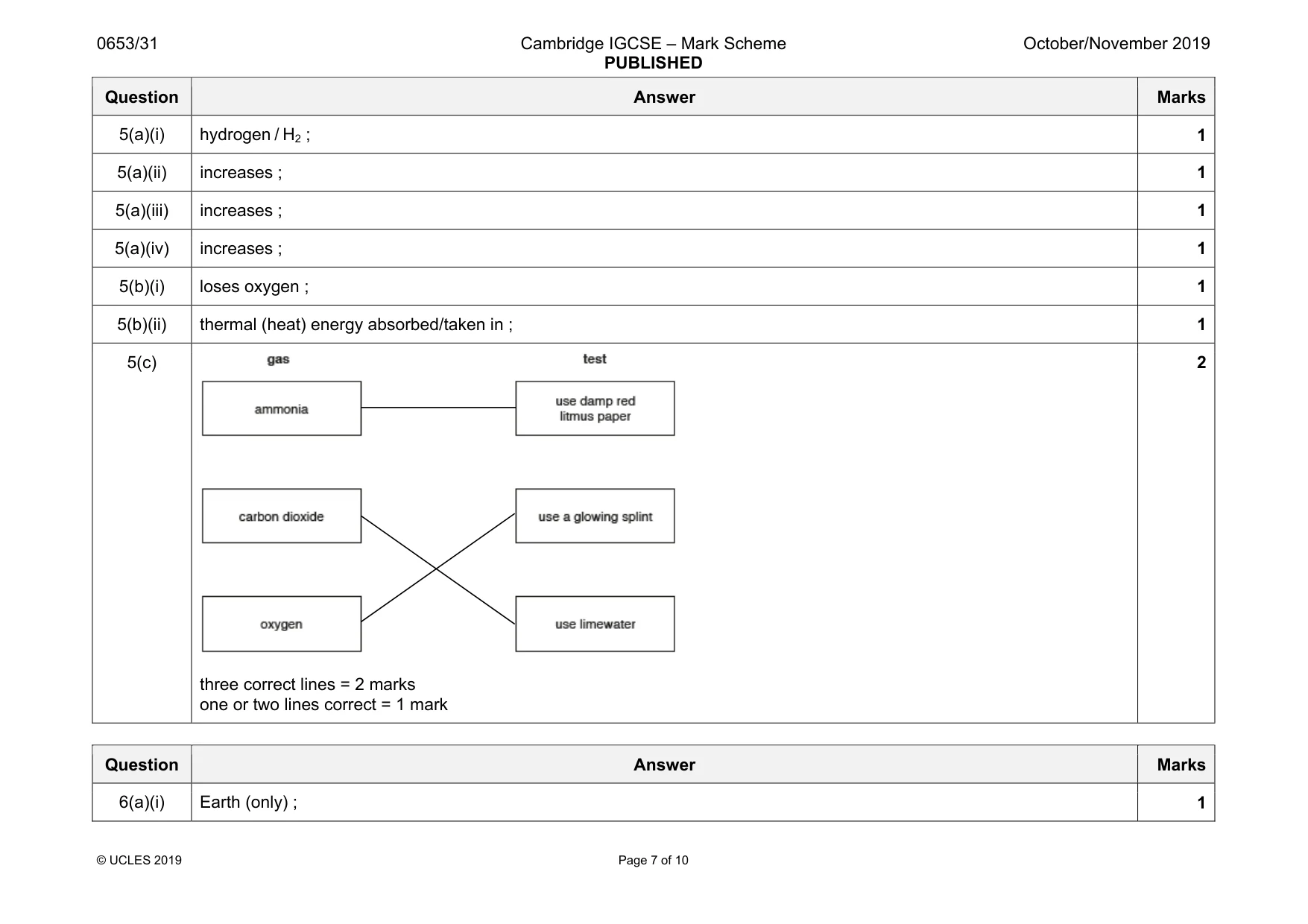
5 (a) Some of the apparatus a student uses to investigate the rate of reaction between a piece of zinc and dilute hydrochloric acid is shown in Fig. 5.1. thermometer beaker dilute hydrochloric acid piece of zinc Fig. 5.1 (i) Identify the gas formed in the reaction between zinc and dilute hydrochloric acid. ..................................................................................................................................... [1] (ii) Suggest the change in the pH of the mixture in the beaker during this reaction. ..................................................................................................................................... [1] (iii) Describe the effect of increasing the temperature on the rate of this reaction. ..................................................................................................................................... [1] (iv) The experiment is repeated using the same mass of zinc powder instead of the piece of zinc. Describe how this change affects the rate of the reaction. ..................................................................................................................................... [1] (b) Zinc oxide is heated with carbon. Reduction occurs during the reaction. The reaction is endothermic. (i) State what is meant by reduction. ........................................................................................................................................... ..................................................................................................................................... [1] (ii) State what is meant by endothermic. ........................................................................................................................................... ..................................................................................................................................... [1] (c) Complete Fig. 5.2 by drawing one straight line from each gas to the test for that gas. gas test use damp red ammonia litmus paper carbon dioxide use a glowing splint oxygen use limewater Fig. 5.2 [2] [Total: 8]
Mark scheme: 5(a)(i) hydrogen / H2 ; 1 5(a)(ii) increases ; 1 5(a)(iii) increases ; 1 5(a)(iv) increases ; 1 5(b)(i) loses oxygen ; 1 5(b)(ii) thermal (heat) energy absorbed/taken in ; 1 5(c) three correct lines = 2 marks one or two lines correct = 1 mark 2
Q6 · Some data about the planets Earth, Mars and Venus
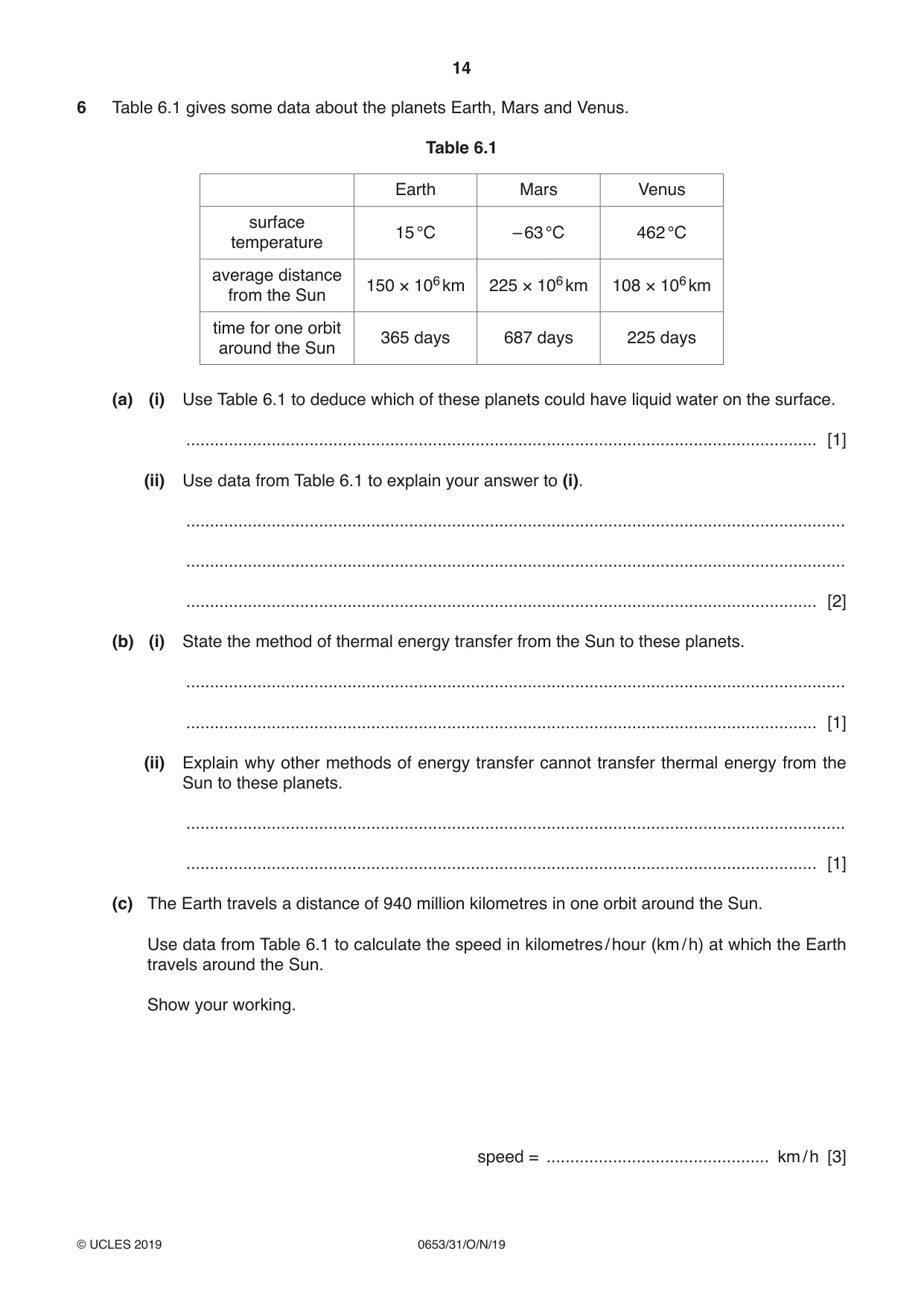
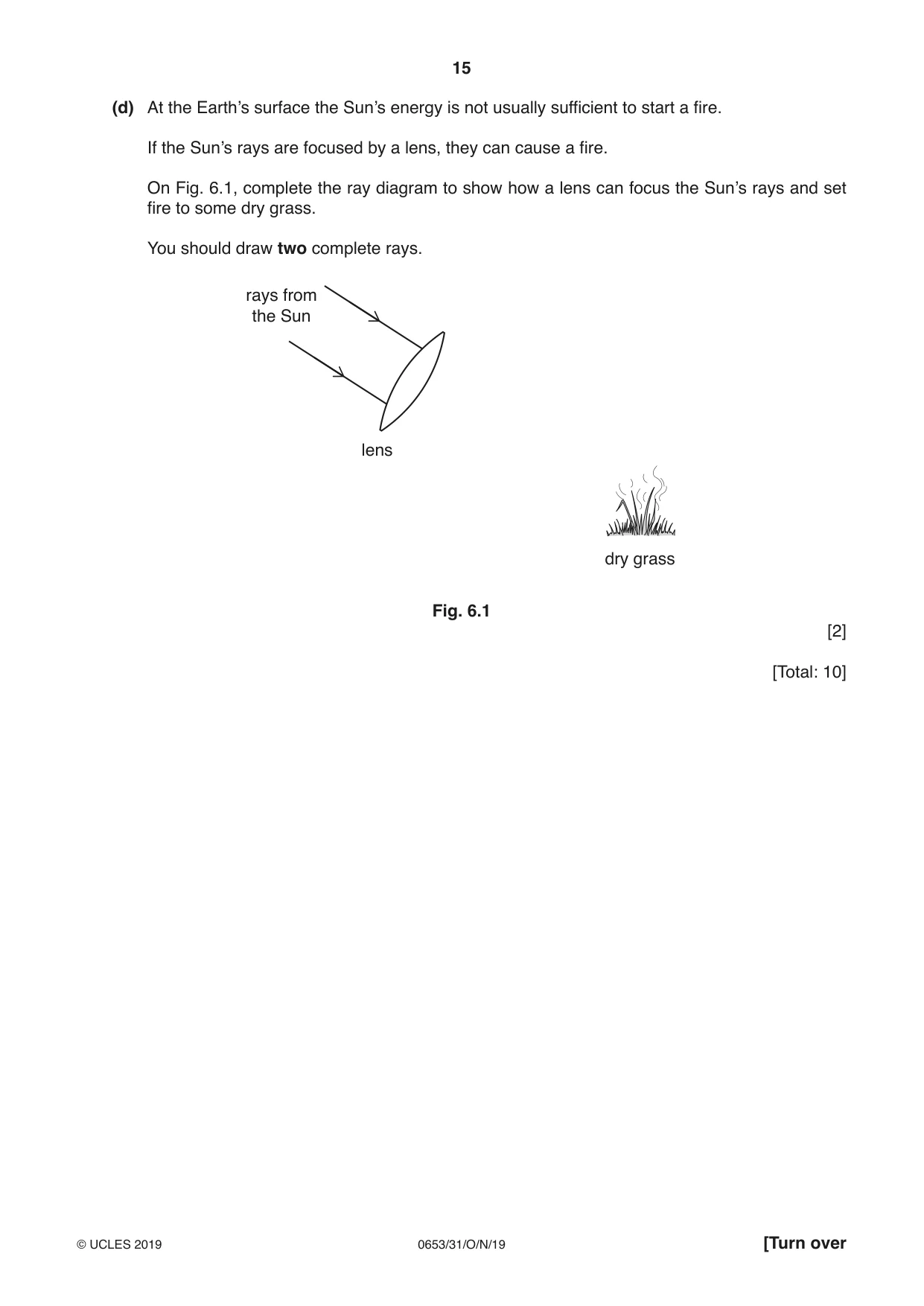
6 Table 6.1 gives some data about the planets Earth, Mars and Venus. Table 6.1 Earth Mars Venus surface 15 °C – 63 °C 462 °C temperature average distance 150 × 106 km 225 × 106 km 108 × 106 km from the Sun time for one orbit 365 days 687 days 225 days around the Sun (a) (i) Use Table 6.1 to deduce which of these planets could have liquid water on the surface. ..................................................................................................................................... [1] (ii) Use data from Table 6.1 to explain your answer to (i). ........................................................................................................................................... ........................................................................................................................................... ..................................................................................................................................... [2] (b) (i) State the method of thermal energy transfer from the Sun to these planets. ........................................................................................................................................... ..................................................................................................................................... [1] (ii) Explain why other methods of energy transfer cannot transfer thermal energy from the Sun to these planets. ........................................................................................................................................... ..................................................................................................................................... [1] (c) The Earth travels a distance of 940 million kilometres in one orbit around the Sun. Use data from Table 6.1 to calculate the speed in kilometres / hour (km / h) at which the Earth travels around the Sun. Show your working. speed = ............................................... km / h [3] (d) At the Earth’s surface the Sun’s energy is not usually sufficient to start a fire. If the Sun’s rays are focused by a lens, they can cause a fire. On Fig. 6.1, complete the ray diagram to show how a lens can focus the Sun’s rays and set fire to some dry grass. You should draw two complete rays. rays from the Sun lens dry grass Fig. 6.1 [2] [Total: 10]
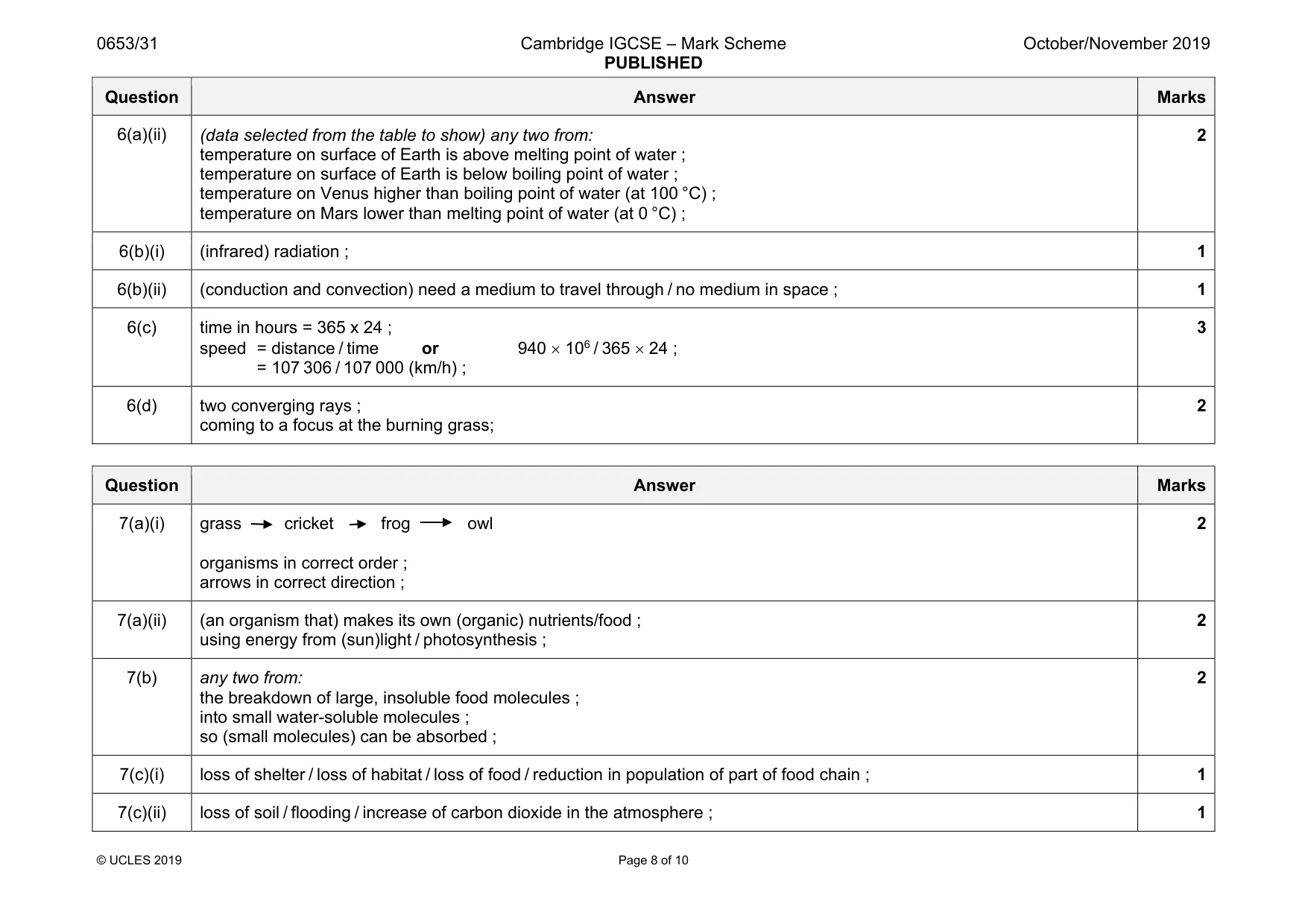
Mark scheme: 6(a)(i) Earth (only) ; 1 Question Answer Marks 6(a)(ii) (data selected from the table to show) any two from: temperature on surface of Earth is above melting point of water ; temperature on surface of Earth is below boiling point of water ; temperature on Venus higher than boiling point of water (at 100 °C) ; temperature on Mars lower than melting point of water (at 0 °C) ; 2 6(b)(i) (infrared) radiation ; 1 6(b)(ii) (conduction and convection) need a medium to travel through / no medium in space ; 1 6(c) time in hours = 365 x 24 ; speed = distance / time or 940 × 106 / 365 × 24 ; = 107 306 / 107 000 (km/h) ; 3 6(d) two converging rays ; coming to a focus at the burning grass; 2
Q7 · Information about the organisms in a food chain
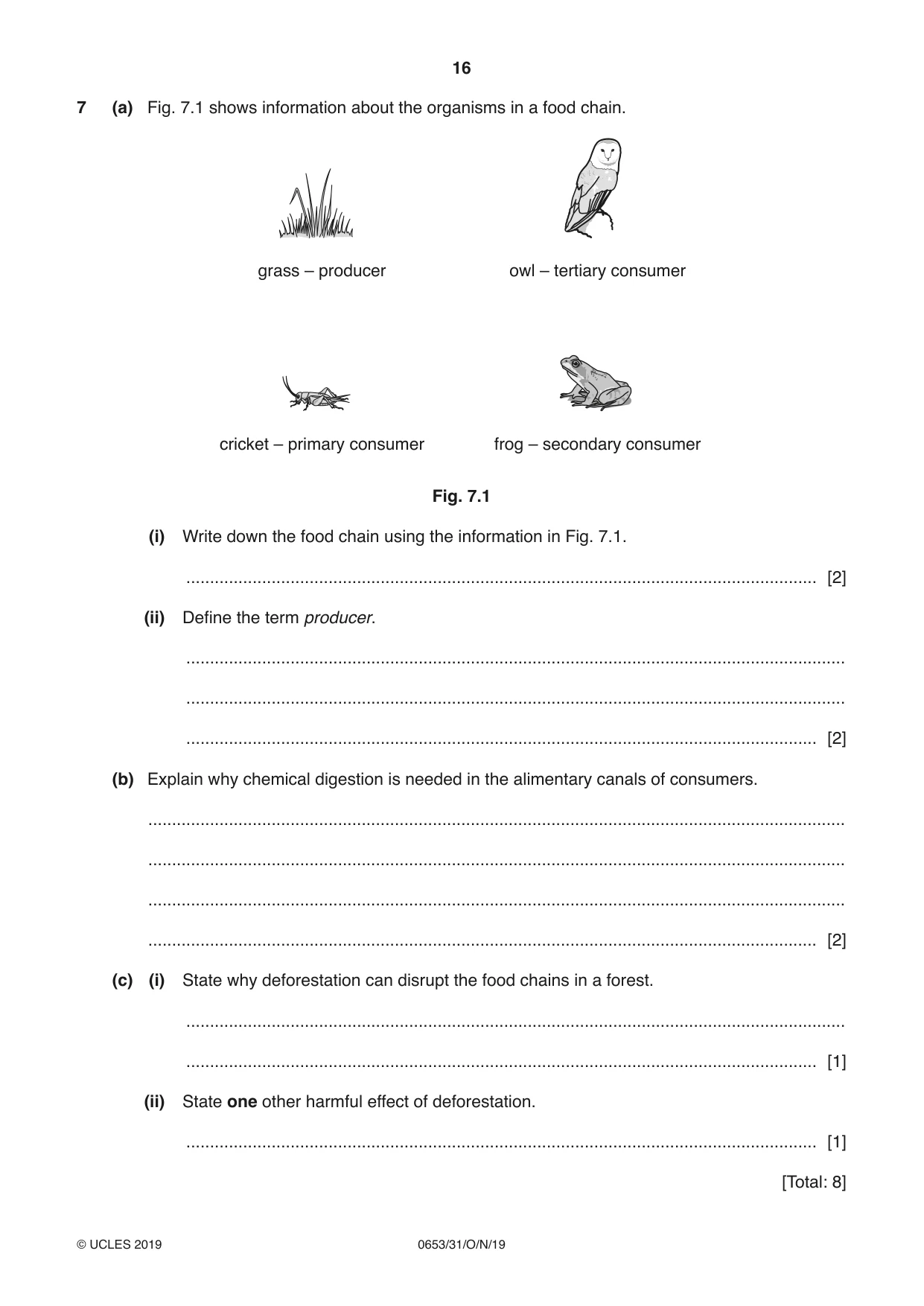
7 (a) Fig. 7.1 shows information about the organisms in a food chain. grass – producer owl – tertiary consumer cricket – primary consumer frog – secondary consumer Fig. 7.1 (i) Write down the food chain using the information in Fig. 7.1. ..................................................................................................................................... [2] (ii) Define the term producer. ........................................................................................................................................... ........................................................................................................................................... ..................................................................................................................................... [2] (b) Explain why chemical digestion is needed in the alimentary canals of consumers. ................................................................................................................................................... ................................................................................................................................................... ................................................................................................................................................... ............................................................................................................................................. [2] (c) (i) State why deforestation can disrupt the food chains in a forest. ........................................................................................................................................... ..................................................................................................................................... [1] (ii) State one other harmful effect of deforestation. ..................................................................................................................................... [1] [Total: 8]
Mark scheme: 7(a)(i) grass cricket frog owl organisms in correct order ; arrows in correct direction ; 2 7(a)(ii) (an organism that) makes its own (organic) nutrients/food ; using energy from (sun)light / photosynthesis ; 2 7(b) any two from: the breakdown of large, insoluble food molecules ; into small water-soluble molecules ; so (small molecules) can be absorbed ; 2 7(c)(i) loss of shelter / loss of habitat / loss of food / reduction in population of part of food chain ; 1 7(c)(ii) loss of soil / flooding / increase of carbon dioxide in the atmosphere ; 1
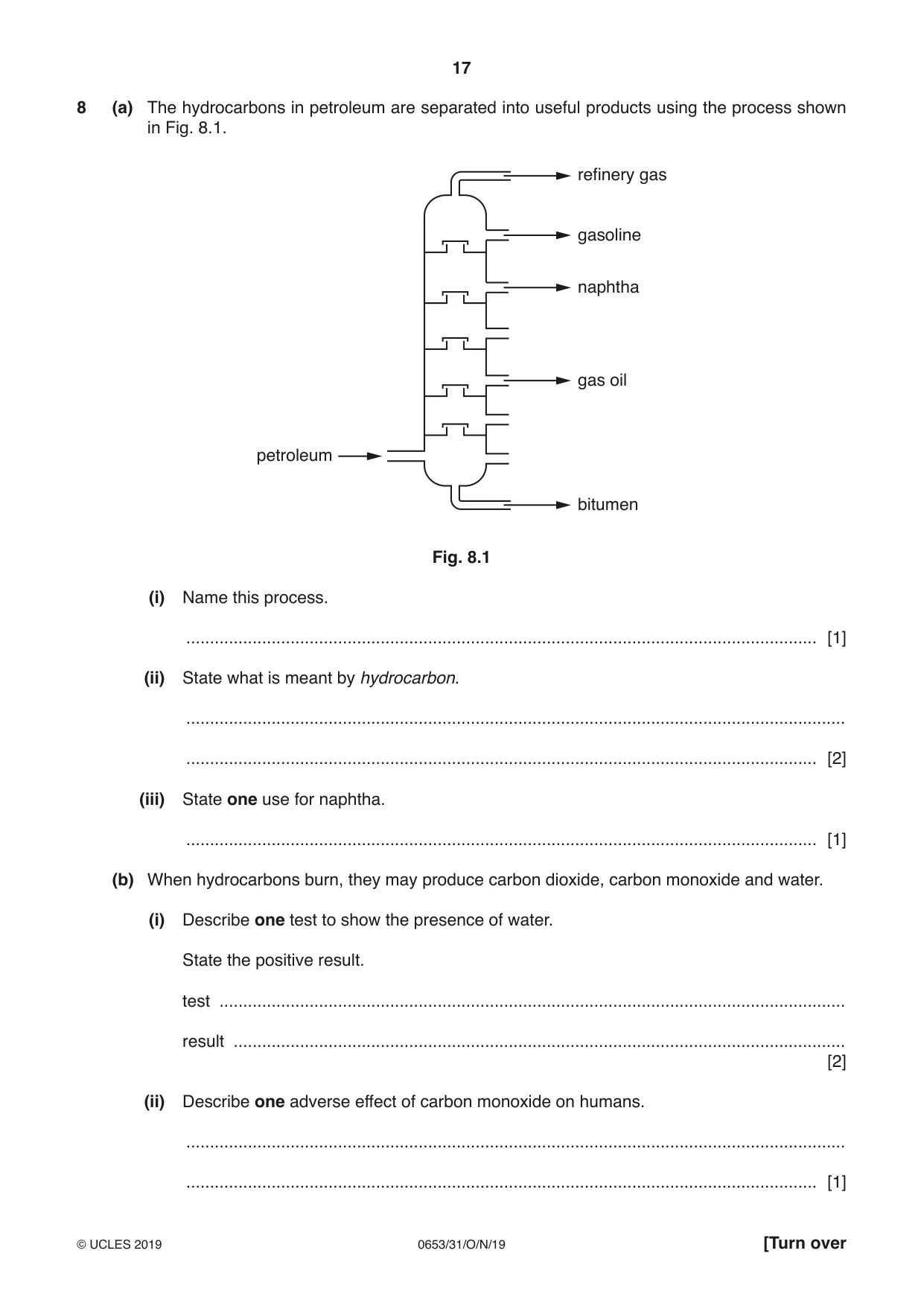
Q8 · The hydrocarbons in petroleum are separated into useful products using the process shown…
8 (a) The hydrocarbons in petroleum are separated into useful products using the process shown in Fig. 8.1. refinery gas gasoline naphtha gas oil petroleum bitumen Fig. 8.1 (i) Name this process. ..................................................................................................................................... [1] (ii) State what is meant by hydrocarbon. ........................................................................................................................................... ..................................................................................................................................... [2] (iii) State one use for naphtha. ..................................................................................................................................... [1] (b) When hydrocarbons burn, they may produce carbon dioxide, carbon monoxide and water. (i) Describe one test to show the presence of water. State the positive result. test .................................................................................................................................... result ................................................................................................................................. [2] (ii) Describe one adverse effect of carbon monoxide on humans. ........................................................................................................................................... ..................................................................................................................................... [1] (iii) Suggest the percentage of carbon dioxide in clean air. percentage = ..................................................... % [1] (iv) Using your knowledge of the amounts of other gases in clean air, explain your answer to (iii). ........................................................................................................................................... ..................................................................................................................................... [1] [Total: 9]
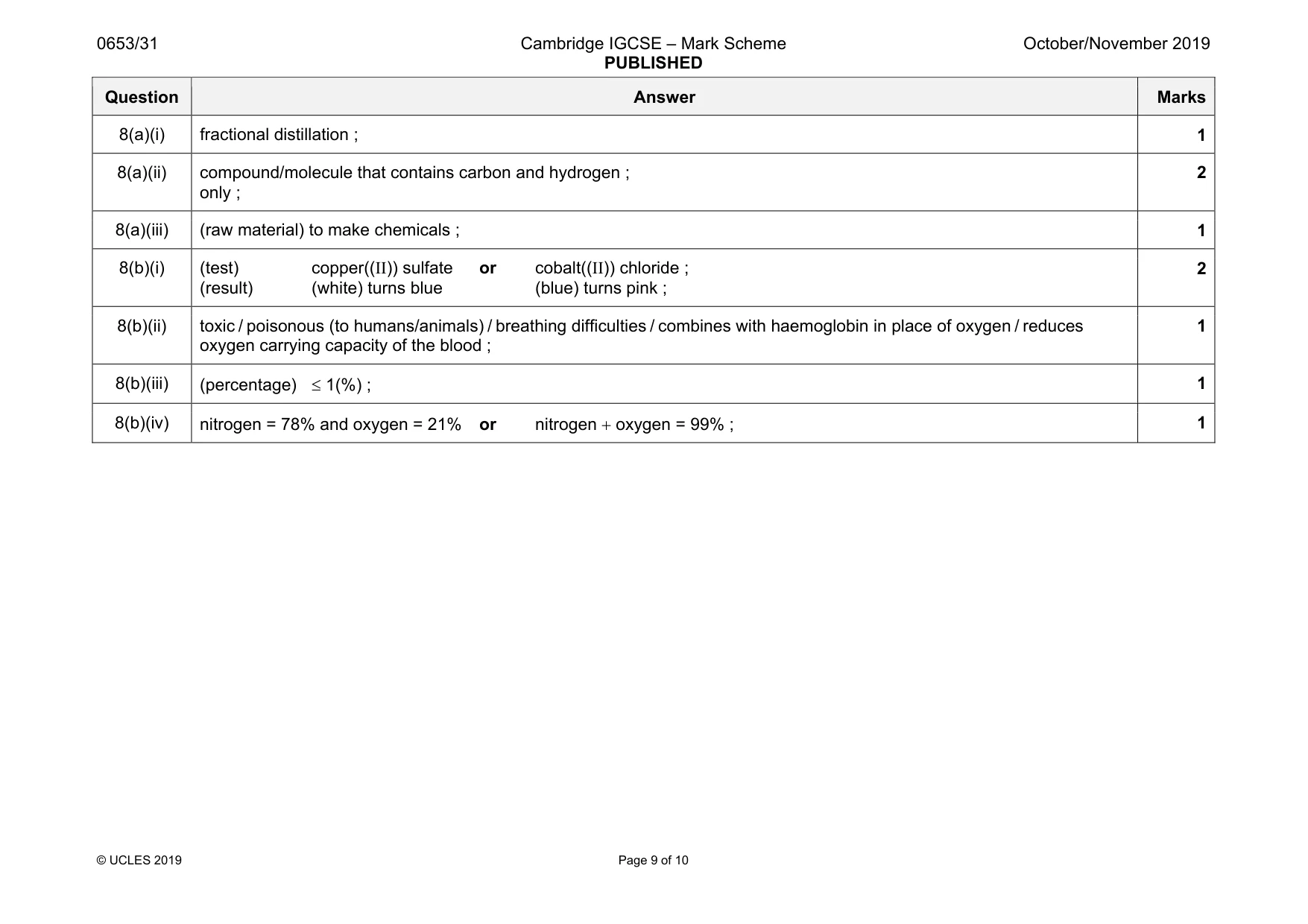
Mark scheme: 8(a)(i) fractional distillation ; 1 8(a)(ii) compound/molecule that contains carbon and hydrogen ; only ; 2 8(a)(iii) (raw material) to make chemicals ; 1 8(b)(i) (test) copper((II)) sulfate or cobalt((II)) chloride ; (result) (white) turns blue (blue) turns pink ; 2 8(b)(ii) toxic / poisonous (to humans/animals) / breathing difficulties / combines with haemoglobin in place of oxygen / reduces oxygen carrying capacity of the blood ; 1 8(b)(iii) (percentage) ≤ 1(%) ; 1 8(b)(iv) nitrogen = 78% and oxygen = 21% or nitrogen + oxygen = 99% ; 1
Question 9
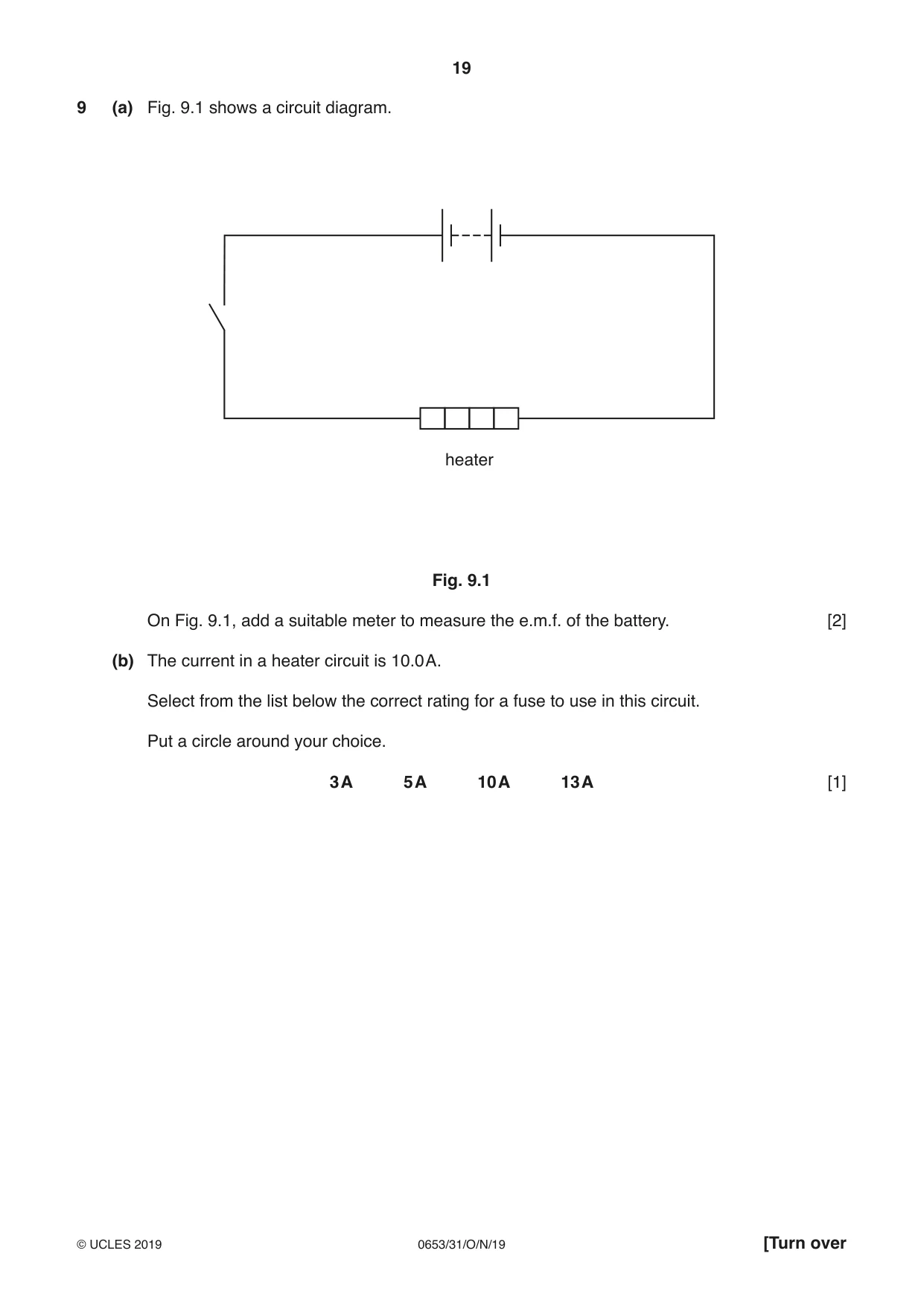
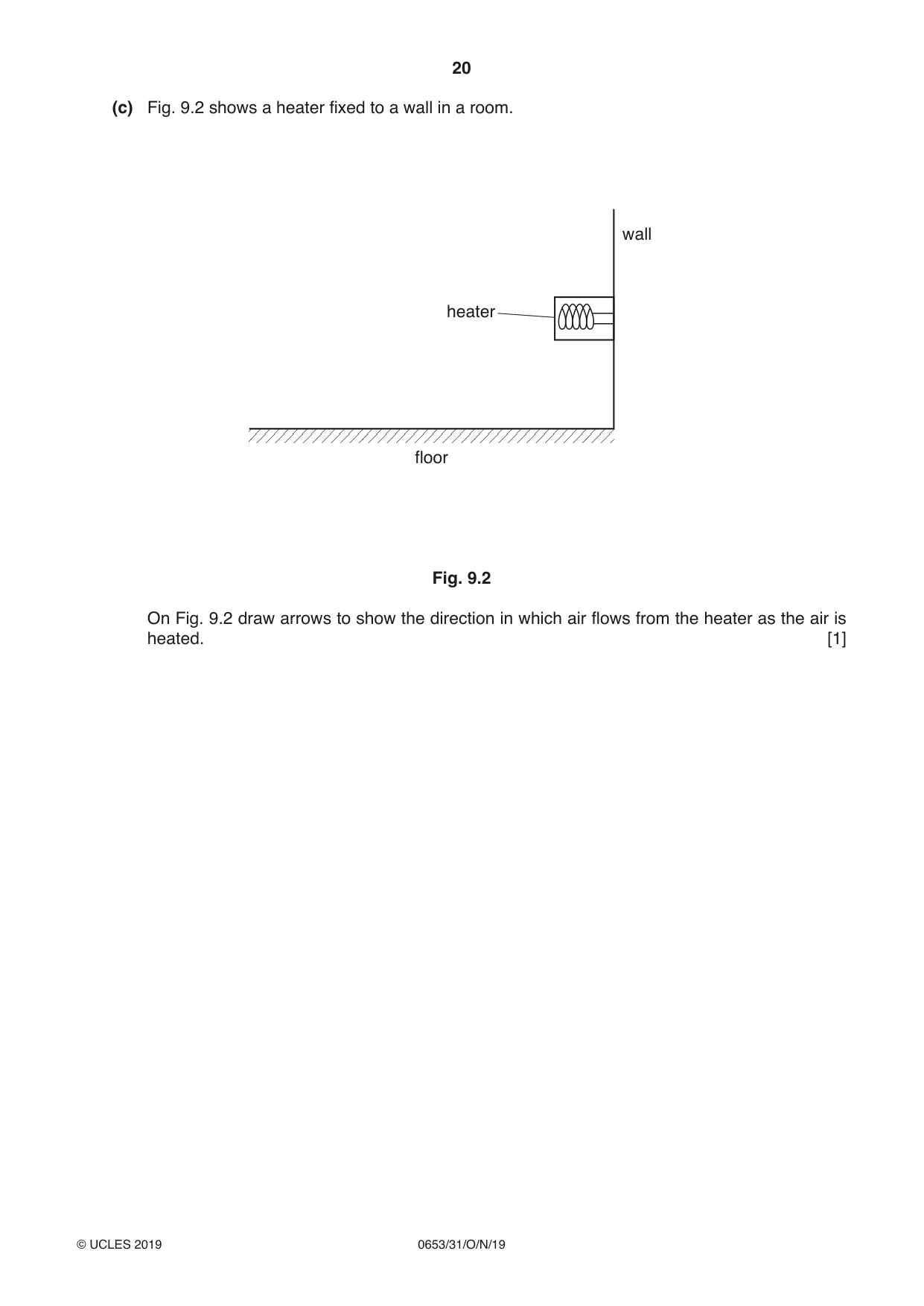
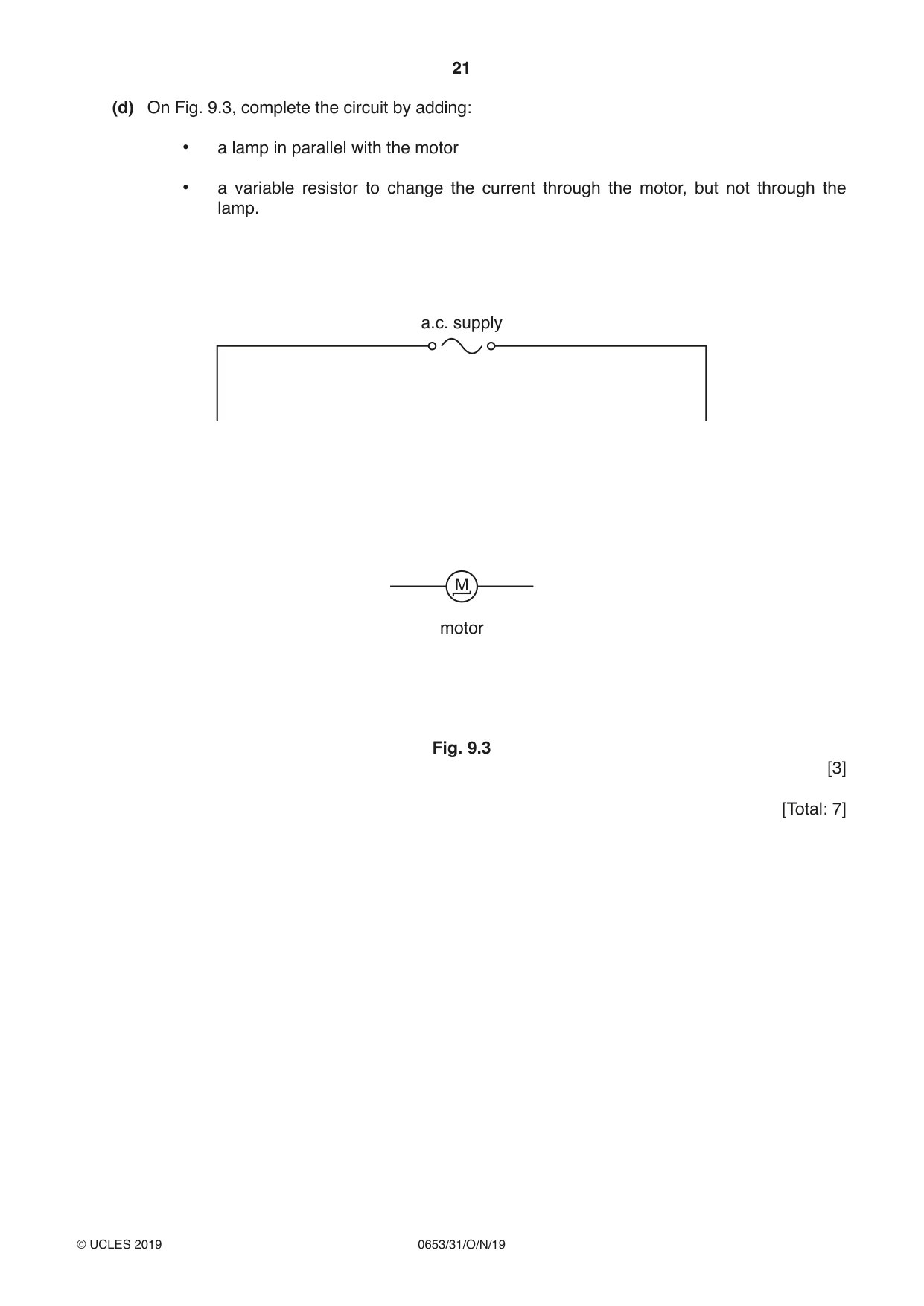
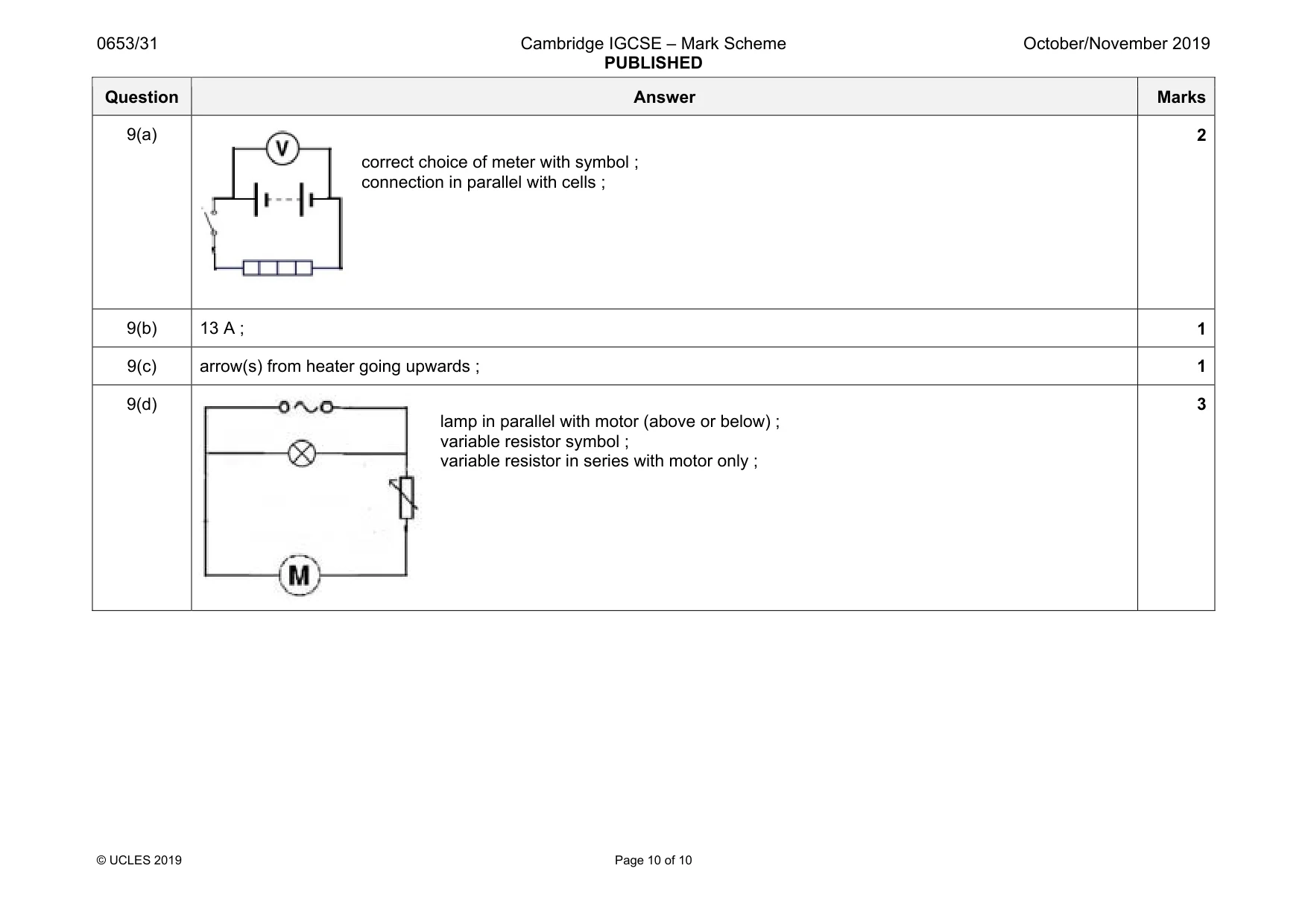
9 (a) Fig. 9.1 shows a circuit diagram. heater Fig. 9.1 On Fig. 9.1, add a suitable meter to measure the e.m.f. of the battery. [2] (b) The current in a heater circuit is 10.0 A. Select from the list below the correct rating for a fuse to use in this circuit. Put a circle around your choice. 3 A 5 A 10 A 13 A [1] (c) Fig. 9.2 shows a heater fixed to a wall in a room. wall heater floor Fig. 9.2 On Fig. 9.2 draw arrows to show the direction in which air flows from the heater as the air is heated. [1] (d) On Fig. 9.3, complete the circuit by adding: • a lamp in parallel with the motor • a variable resistor to change the current through the motor, but not through the lamp. a.c. supply M motor Fig. 9.3 [3] [Total: 7]
Mark scheme: 9(a) 2 9(b) 13 A ; 1 9(c) arrow(s) from heater going upwards ; 1 9(d) 3 correct choice of meter with symbol ; connection in parallel with cells ; lamp in parallel with motor (above or below) ; variable resistor symbol ; variable resistor in series with motor only ;
What was in this paper
The subtopics covered by these 9 questions, and how many questions each got. Open one in a new tab to see every Cambridge question on it.
What you needed in this session
Cambridge’s own grade thresholds for 2019 Oct/Nov, Paper 3 · Variant 1. A higher threshold means an easier paper — the bar moves with how the cohort did.