Cambridge IGCSE Science - Combined 0653 — 2017 May/June Paper 3 · Variant 1
0653/31/M/J/17 · 9 questions · 80 marks · ≈90 min
The question paper and its mark scheme, free to read here and free to download. This is Cambridge’s own paper, exactly as it was sat.
Question paper20 pages
Mark scheme7 pages
Answers below. Sit the paper first if you are practising.
Questions as text
Q1 · Use lines to connect the box on the left to different boxes on the right to make correct…
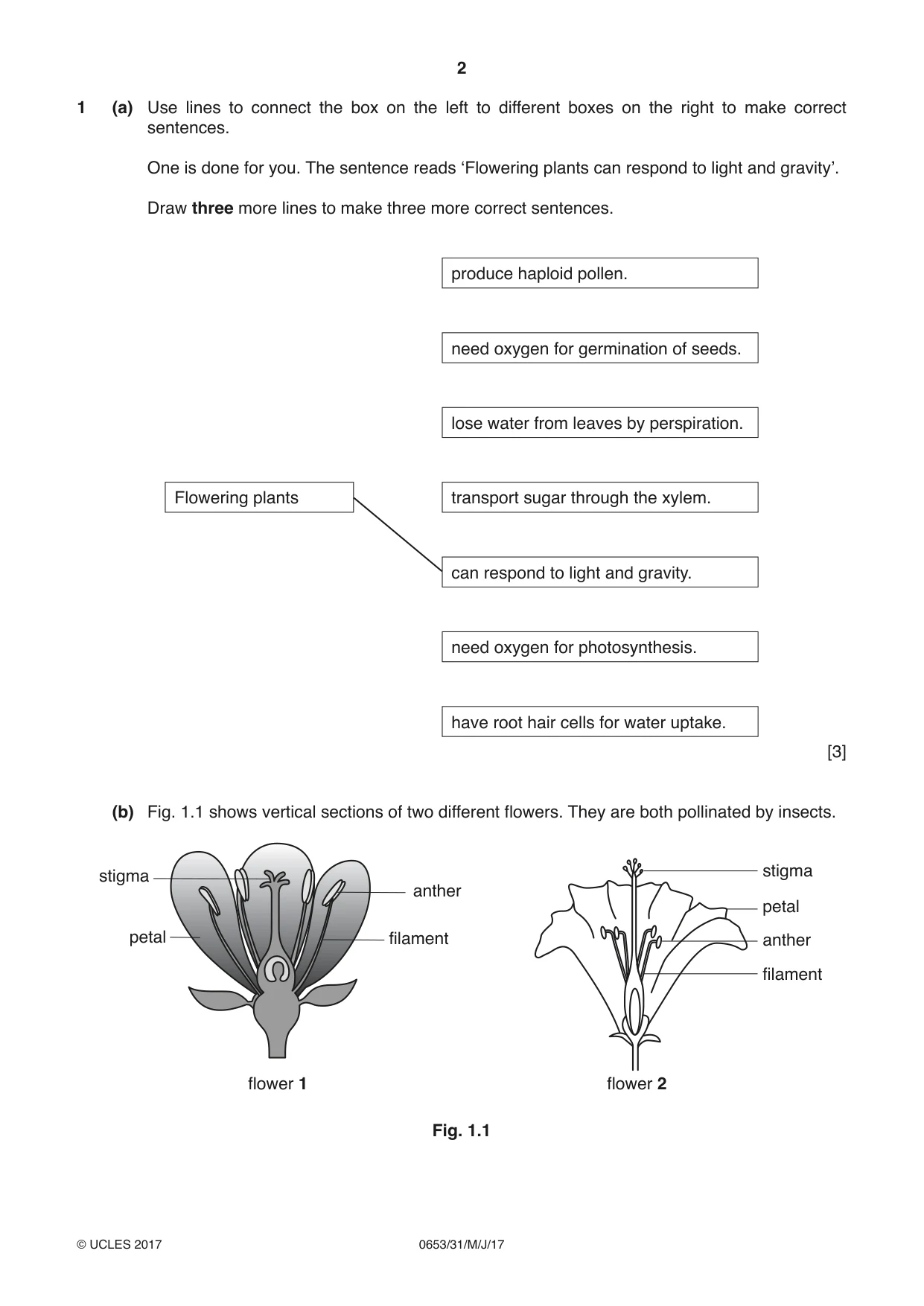
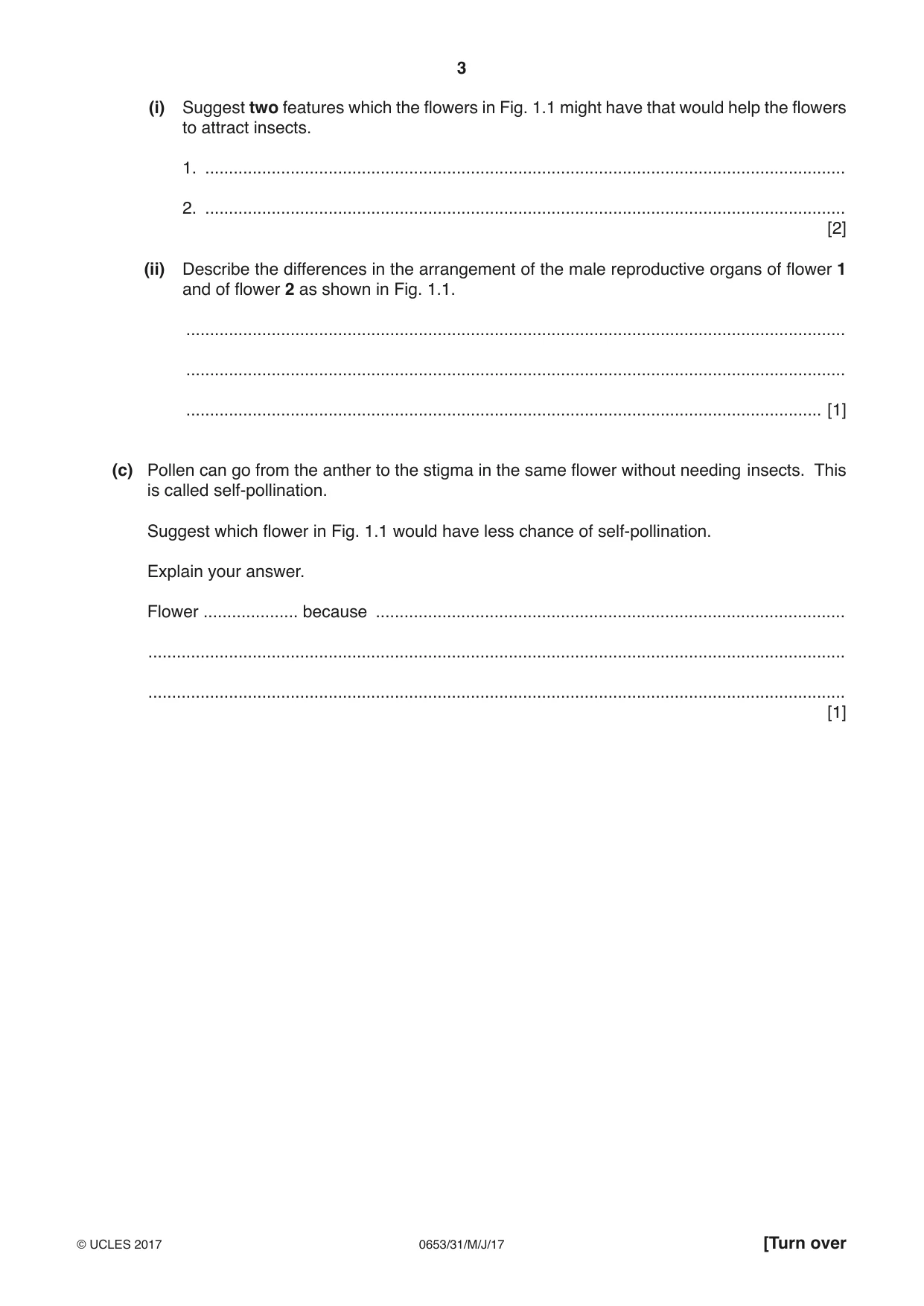
1 (a) Use lines to connect the box on the left to different boxes on the right to make correct sentences. One is done for you. The sentence reads ‘Flowering plants can respond to light and gravity’. Draw three more lines to make three more correct sentences. produce haploid pollen. need oxygen for germination of seeds. lose water from leaves by perspiration. Flowering plants transport sugar through the xylem. can respond to light and gravity. need oxygen for photosynthesis. have root hair cells for water uptake. [3] (b) Fig. 1.1 shows vertical sections of two different flowers. They are both pollinated by insects. stigma stigma anther petal petal filament anther filament flower 1 flower 2 Fig. 1.1 (i) Suggest two features which the flowers in Fig. 1.1 might have that would help the flowers to attract insects. 1. ....................................................................................................................................... 2. ....................................................................................................................................... [2] (ii) Describe the differences in the arrangement of the male reproductive organs of flower 1 and of flower 2 as shown in Fig. 1.1. ........................................................................................................................................... ........................................................................................................................................... ...................................................................................................................................... [1] (c) Pollen can go from the anther to the stigma in the same flower without needing insects. This is called self-pollination. Suggest which flower in Fig. 1.1 would have less chance of self-pollination. Explain your answer. Flower .................... because ................................................................................................... ................................................................................................................................................... ................................................................................................................................................... [1]
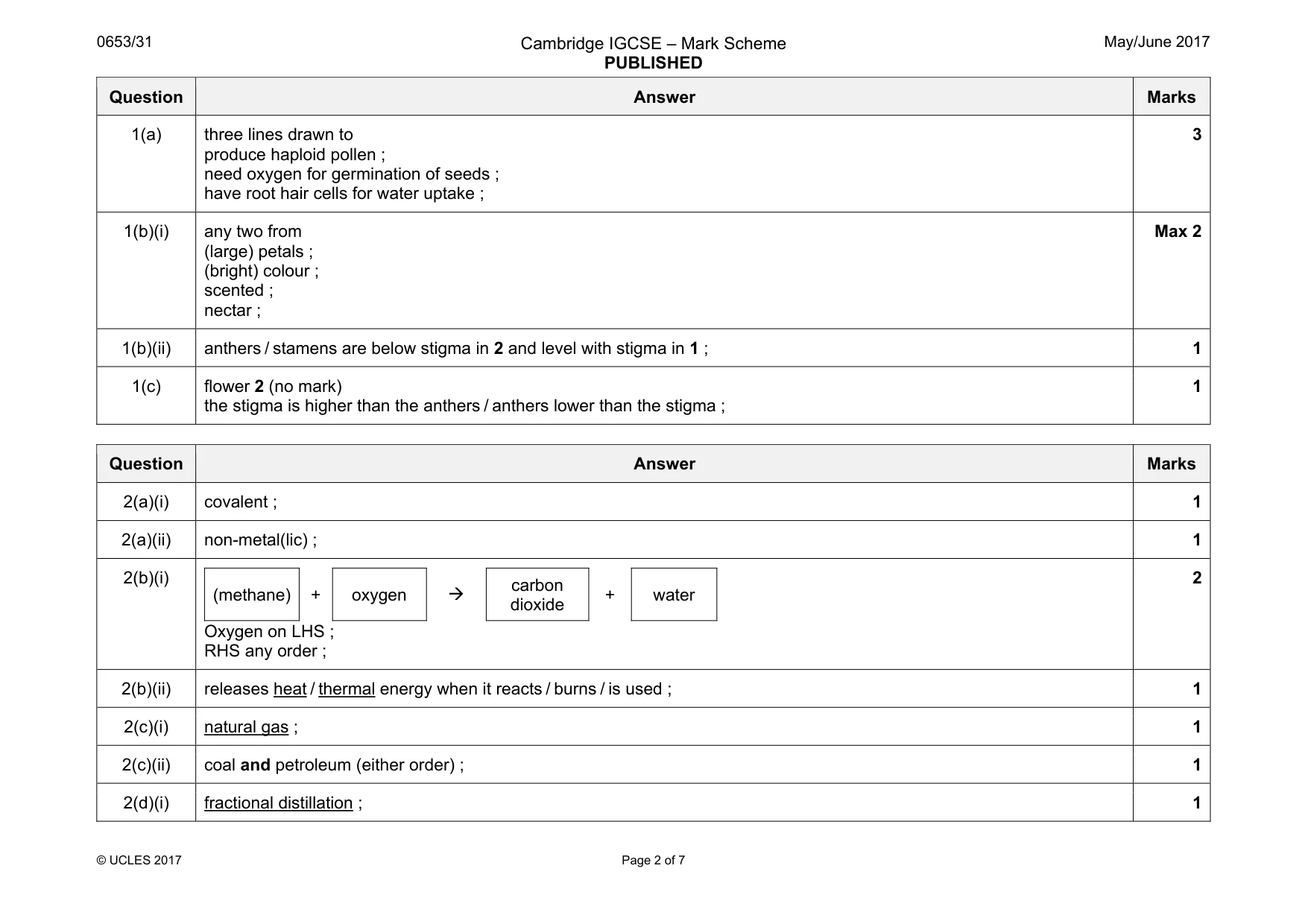
Mark scheme: 1(a) three lines drawn to produce haploid pollen ; need oxygen for germination of seeds ; have root hair cells for water uptake ; 3 1(b)(i) any two from (large) petals ; (bright) colour ; scented ; nectar ; Max 2 1(b)(ii) anthers / stamens are below stigma in 2 and level with stigma in 1 ; 1 1(c) flower 2 (no mark) the stigma is higher than the anthers / anthers lower than the stigma ; 1
Q2 · A molecule of methane contains one carbon atom bonded to four hydrogen atoms
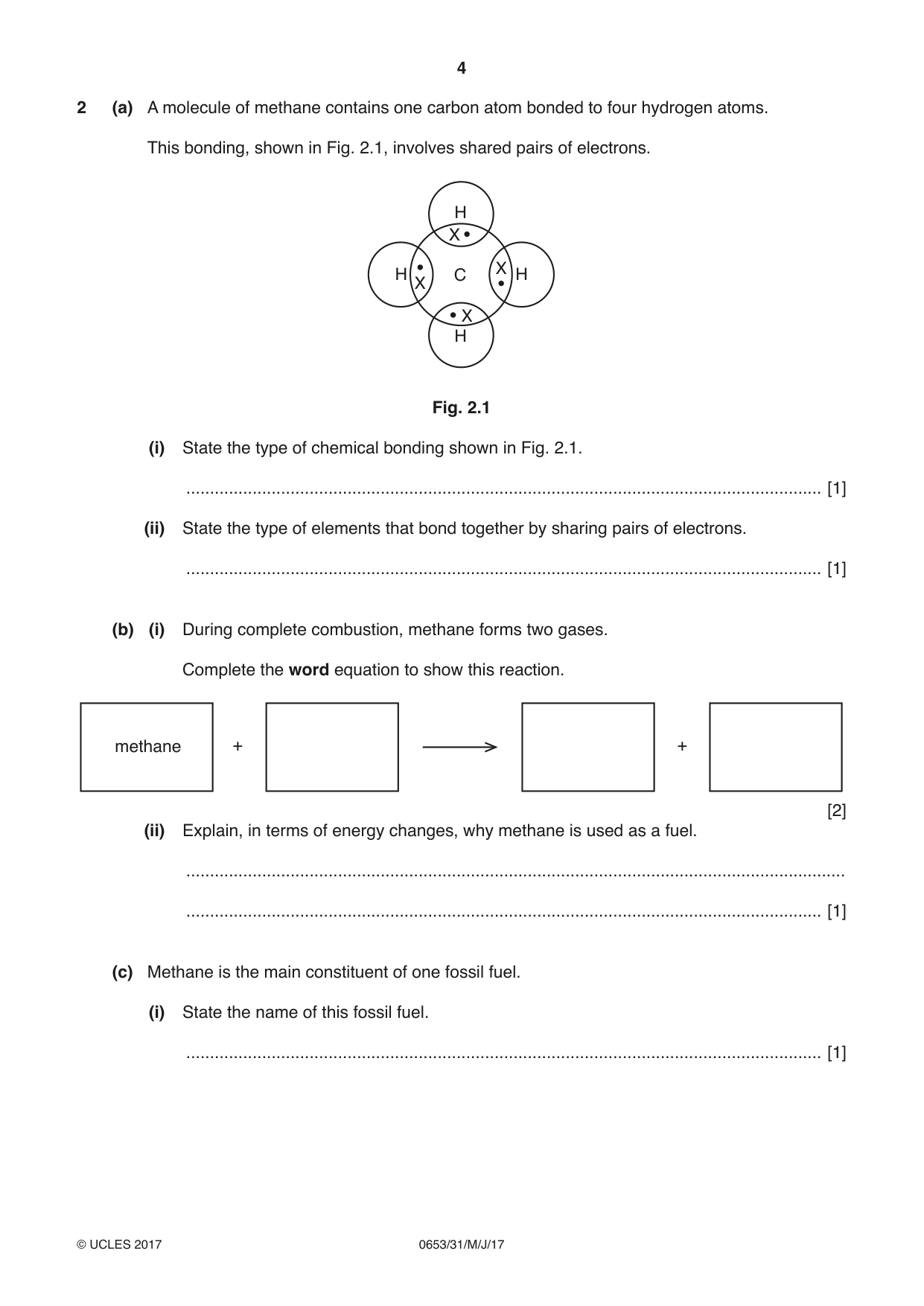
2 (a) A molecule of methane contains one carbon atom bonded to four hydrogen atoms. This bonding, shown in Fig. 2.1, involves shared pairs of electrons. H X X H C H X X H Fig. 2.1 (i) State the type of chemical bonding shown in Fig. 2.1. ...................................................................................................................................... [1] (ii) State the type of elements that bond together by sharing pairs of electrons. ...................................................................................................................................... [1] (b) (i) During complete combustion, methane forms two gases. Complete the word equation to show this reaction. methane + + [2] (ii) Explain, in terms of energy changes, why methane is used as a fuel. ........................................................................................................................................... ...................................................................................................................................... [1] (c) Methane is the main constituent of one fossil fuel. (i) State the name of this fossil fuel. ...................................................................................................................................... [1] (ii) State the names of two other fossil fuels. ............................................................... and ............................................................... [1] (d) Refinery gas, gasoline and diesel oil are separated from a mixture of hydrocarbons by an industrial process. (i) Name this industrial process. ...................................................................................................................................... [1] (ii) State one use for bottled refinery gas. ...................................................................................................................................... [1]
Mark scheme: 2(a)(i) covalent ; 1 2(a)(ii) non-metal(lic) ; 1 2(b)(i) (methane) + oxygen Æ carbon dioxide + water Oxygen on LHS ; RHS any order ; 2 2(b)(ii) releases heat / thermal energy when it reacts / burns / is used ; 1 2(c)(i) natural gas ; 1 2(c)(ii) coal and petroleum (either order) ; 1 2(d)(i) fractional distillation ; 1 Question Answer Marks 2(d)(ii) heating / cooking ; 1
Q3 · A wind surfer on a surf board, driven by the wind, sailing at a constant speed across the…
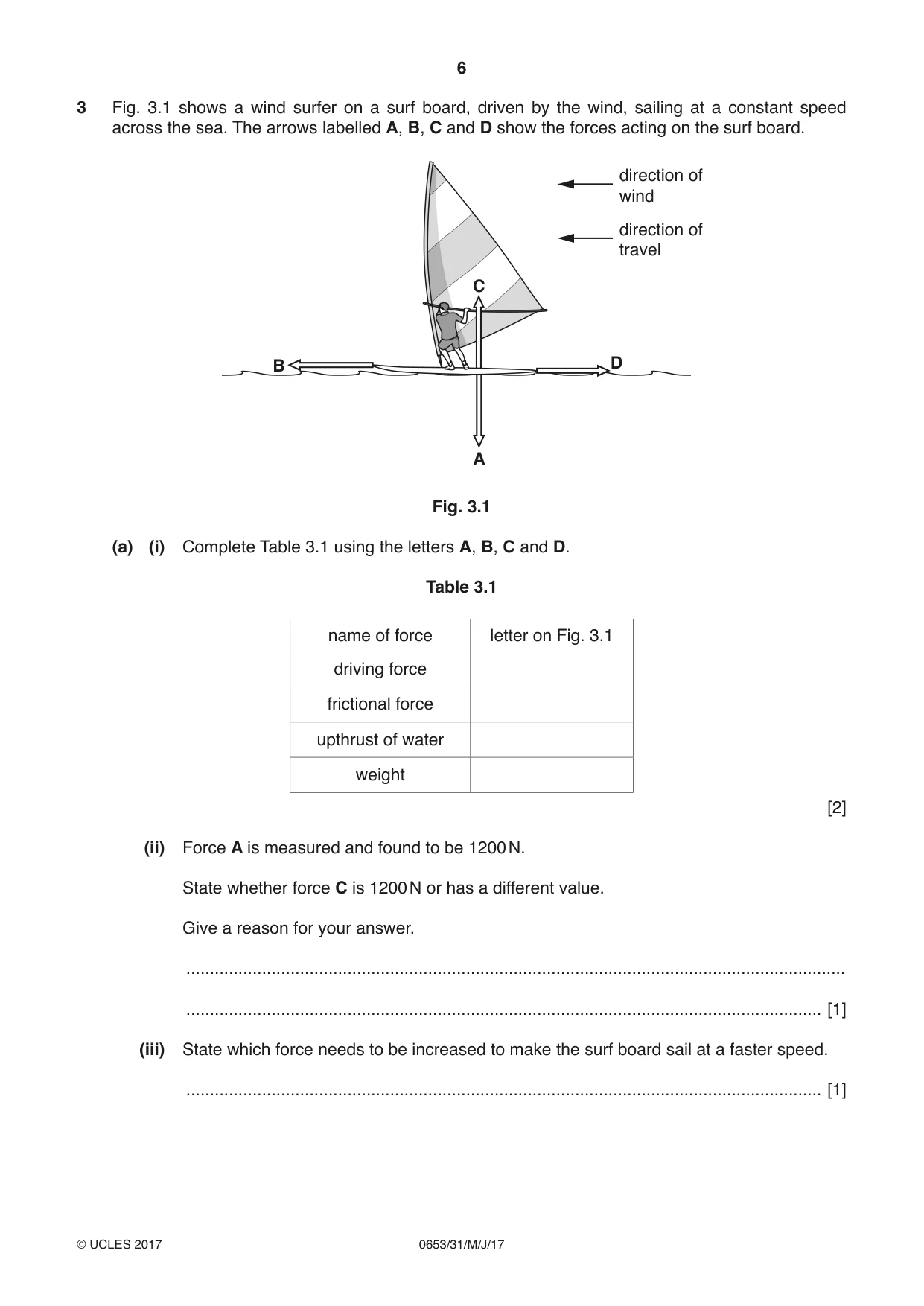
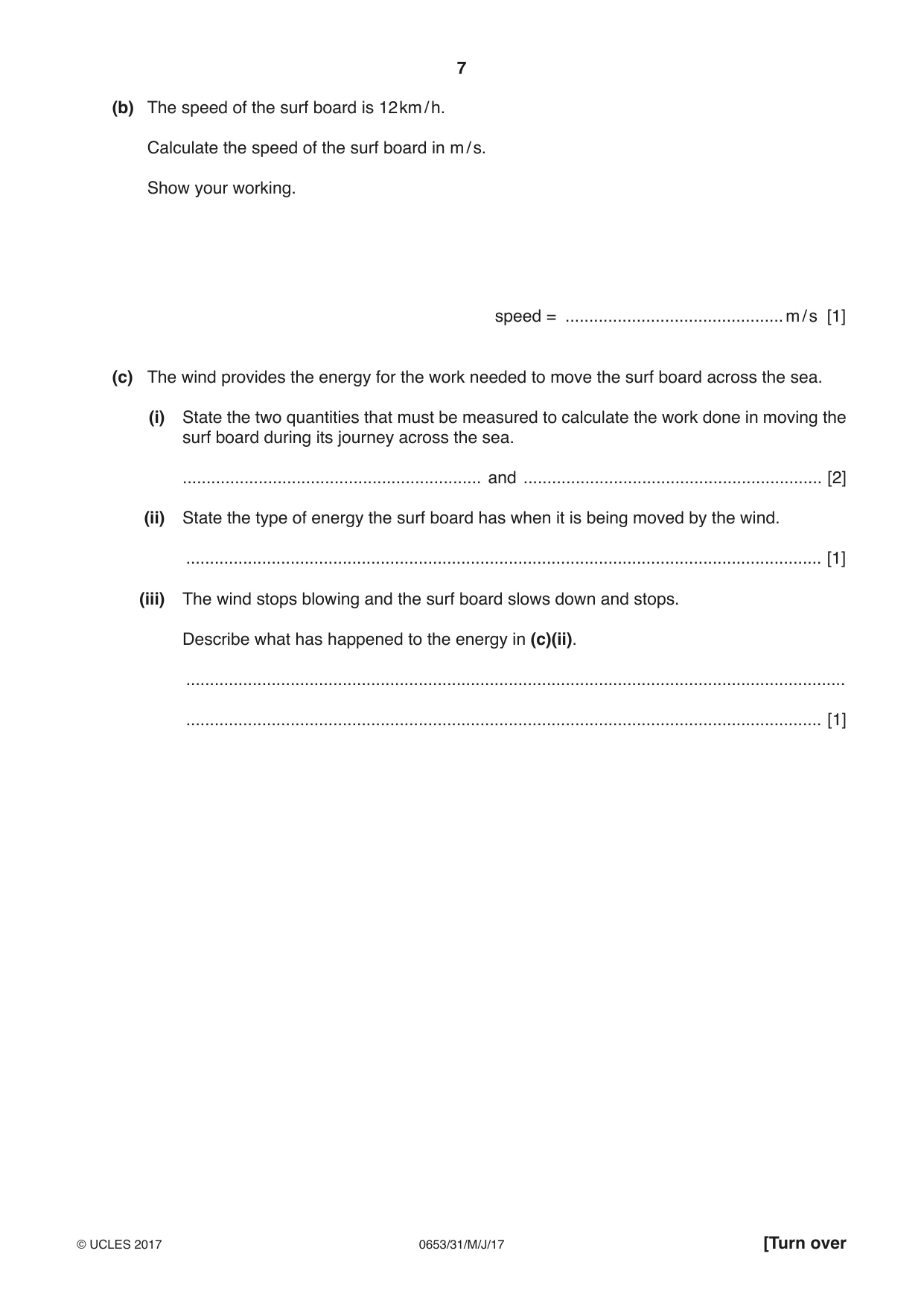
3 Fig. 3.1 shows a wind surfer on a surf board, driven by the wind, sailing at a constant speed across the sea. The arrows labelled A, B, C and D show the forces acting on the surf board. direction of wind direction of travel C B D A Fig. 3.1 (a) (i) Complete Table 3.1 using the letters A, B, C and D. Table 3.1 name of force letter on Fig. 3.1 driving force frictional force upthrust of water weight [2] (ii) Force A is measured and found to be 1200 N. State whether force C is 1200 N or has a different value. Give a reason for your answer. ........................................................................................................................................... ...................................................................................................................................... [1] (iii) State which force needs to be increased to make the surf board sail at a faster speed. ...................................................................................................................................... [1] (b) The speed of the surf board is 12 km / h. Calculate the speed of the surf board in m / s. Show your working. speed = .............................................. m / s [1] (c) The wind provides the energy for the work needed to move the surf board across the sea. (i) State the two quantities that must be measured to calculate the work done in moving the surf board during its journey across the sea. ............................................................... and ............................................................... [2] (ii) State the type of energy the surf board has when it is being moved by the wind. ...................................................................................................................................... [1] (iii) The wind stops blowing and the surf board slows down and stops. Describe what has happened to the energy in (c)(ii). ........................................................................................................................................... ...................................................................................................................................... [1]
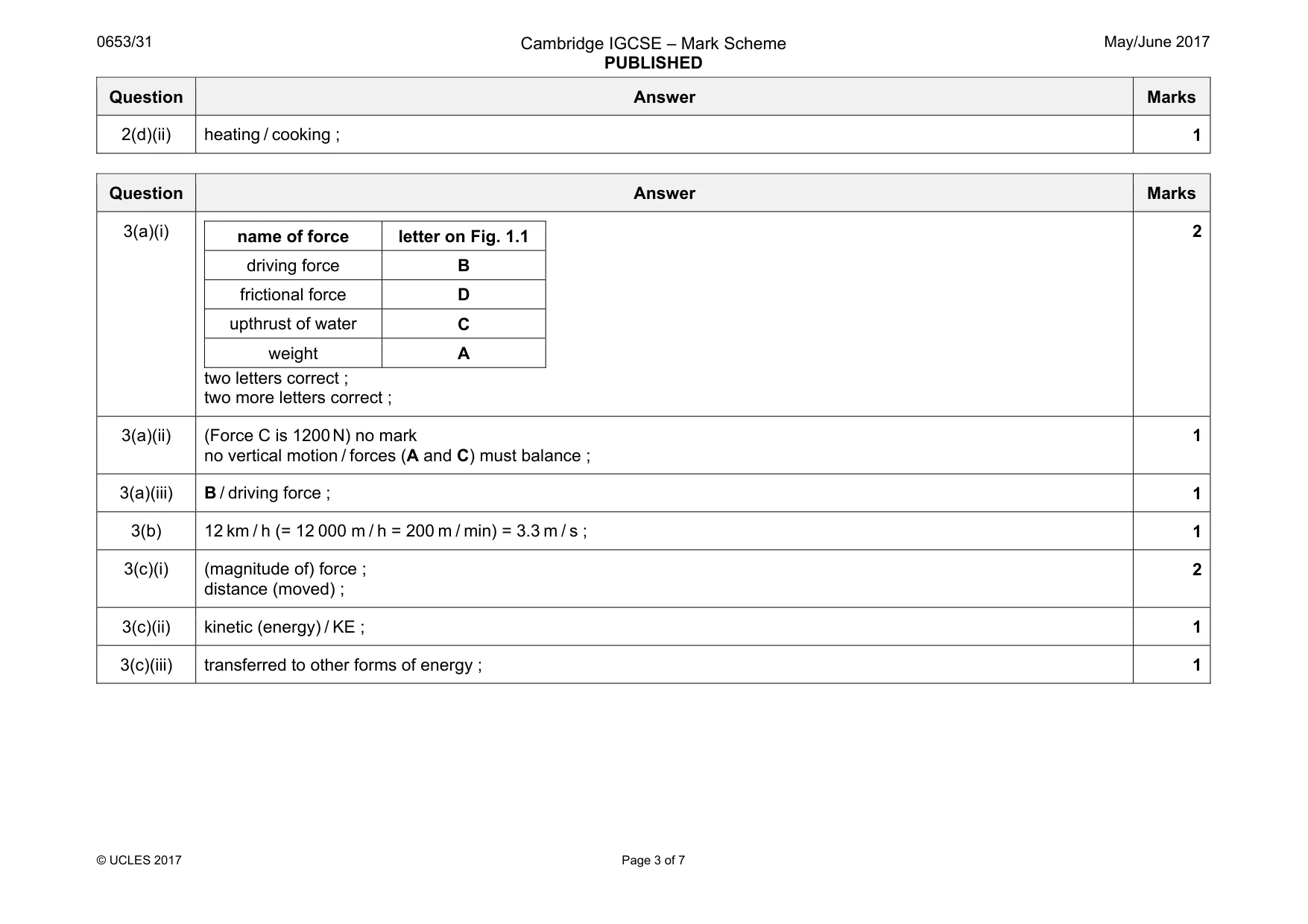
Mark scheme: 3(a)(i) name of force letter on Fig. 1.1 driving force B frictional force D upthrust of water C weight A two letters correct ; two more letters correct ; 2 3(a)(ii) (Force C is 1200 N) no mark no vertical motion / forces (A and C) must balance ; 1 3(a)(iii) B / driving force ; 1 3(b) 12 km / h (= 12 000 m / h = 200 m / min) = 3.3 m / s ; 1 3(c)(i) (magnitude of) force ; distance (moved) ; 2 3(c)(ii) kinetic (energy) / KE ; 1 3(c)(iii) transferred to other forms of energy ; 1
Q4 · Define the terms herbivore…
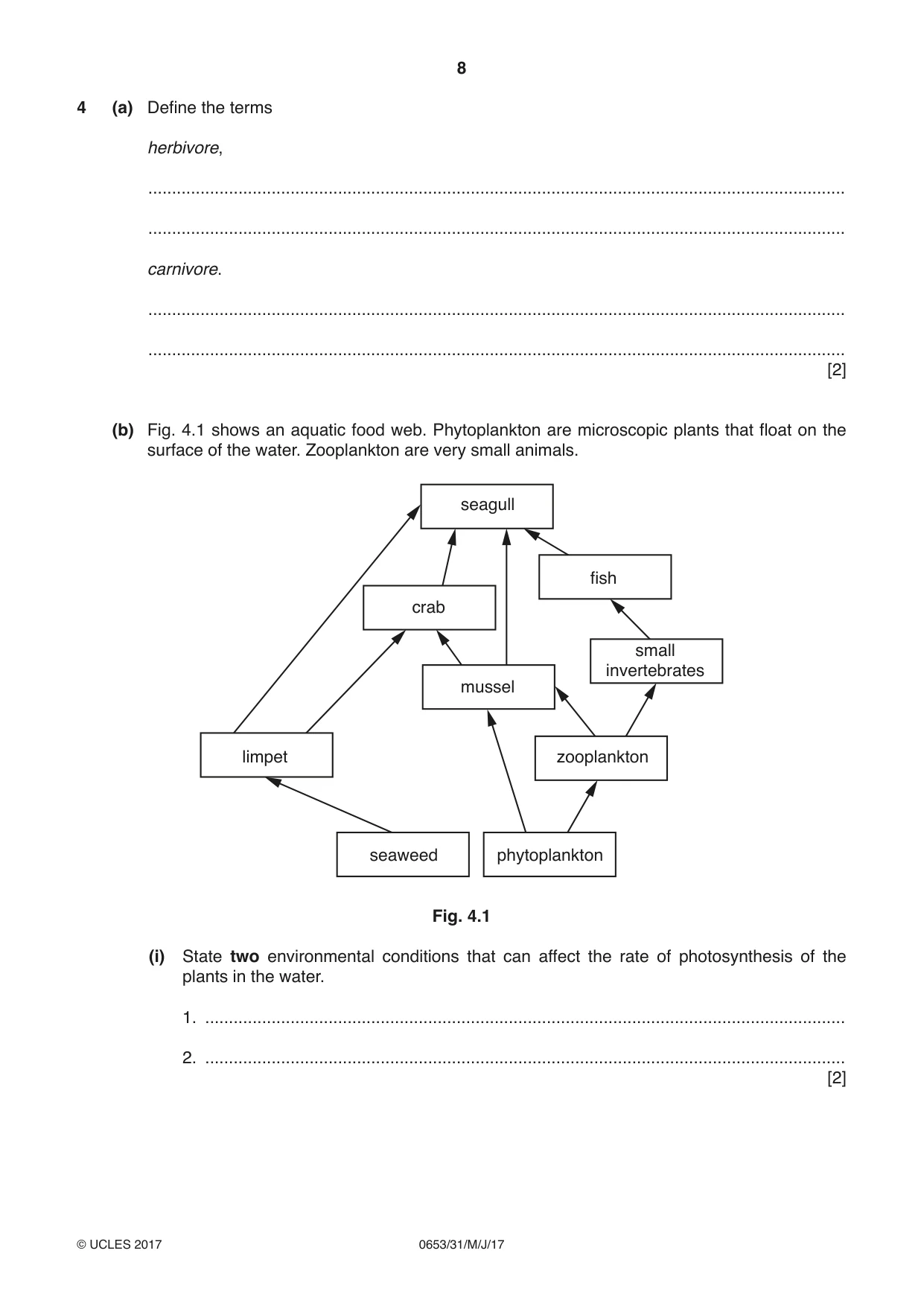
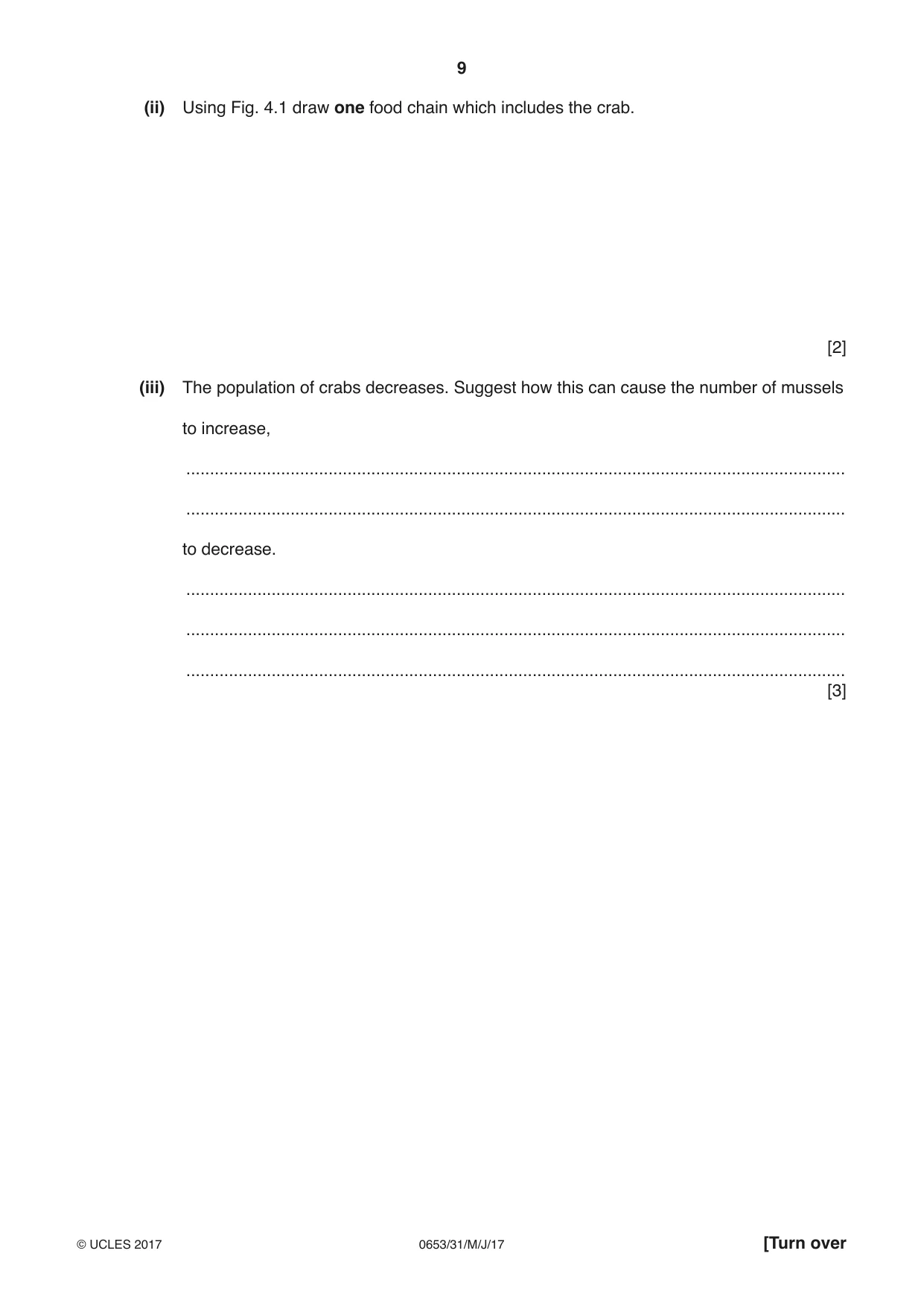
4 (a) Define the terms herbivore, ................................................................................................................................................... ................................................................................................................................................... carnivore. ................................................................................................................................................... ................................................................................................................................................... [2] (b) Fig. 4.1 shows an aquatic food web. Phytoplankton are microscopic plants that float on the surface of the water. Zooplankton are very small animals. seagull fish crab small invertebrates mussel limpet zooplankton seaweed phytoplankton Fig. 4.1 (i) State two environmental conditions that can affect the rate of photosynthesis of the plants in the water. 1. ....................................................................................................................................... 2. ....................................................................................................................................... [2] (ii) Using Fig. 4.1 draw one food chain which includes the crab. [2] (iii) The population of crabs decreases. Suggest how this can cause the number of mussels to increase, ........................................................................................................................................... ........................................................................................................................................... to decrease. ........................................................................................................................................... ........................................................................................................................................... ........................................................................................................................................... [3]
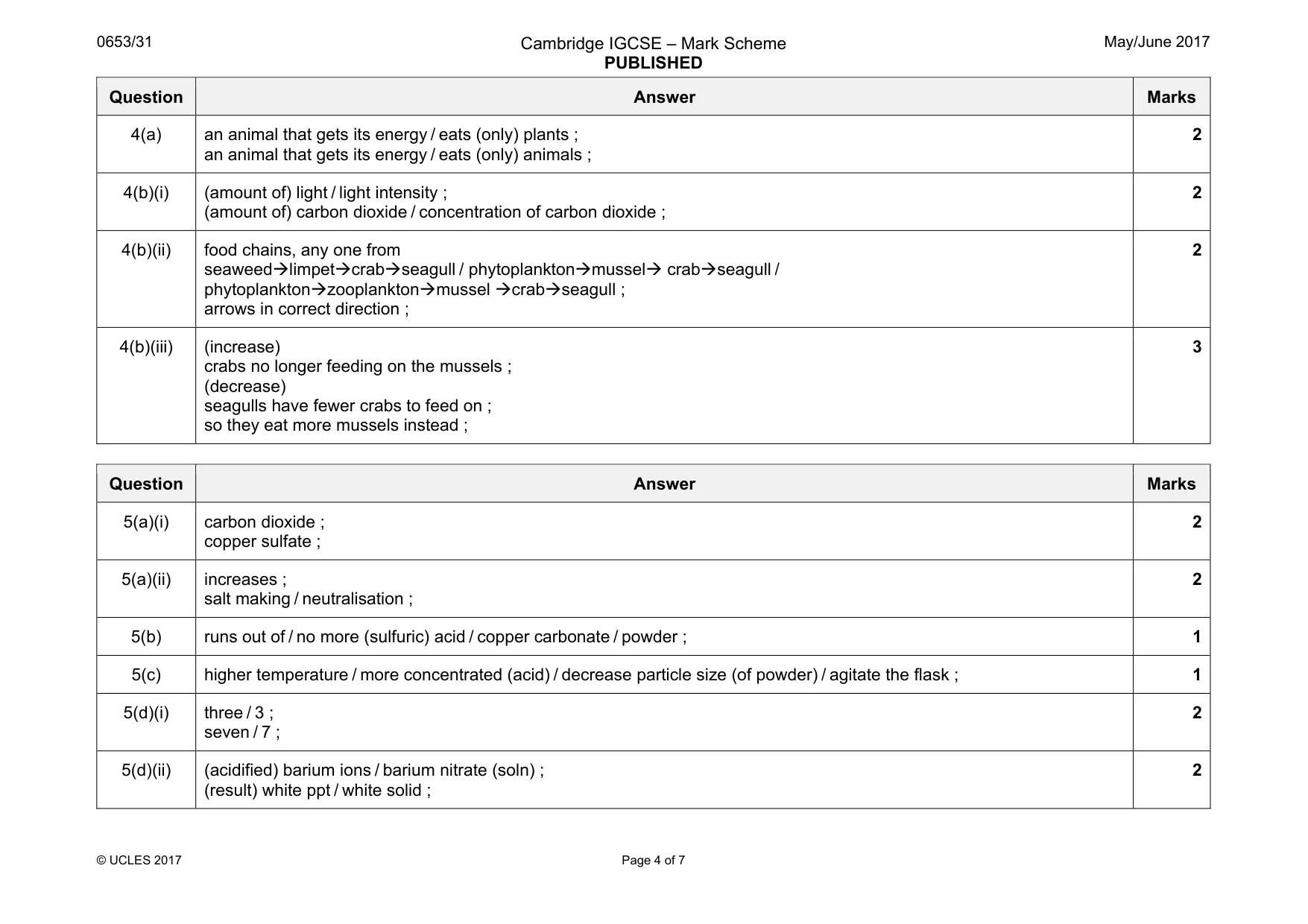
Mark scheme: 4(a) an animal that gets its energy / eats (only) plants ; an animal that gets its energy / eats (only) animals ; 2 4(b)(i) (amount of) light / light intensity ; (amount of) carbon dioxide / concentration of carbon dioxide ; 2 4(b)(ii) food chains, any one from seaweedÆlimpetÆcrabÆseagull / phytoplanktonÆmusselÆ crabÆseagull / phytoplanktonÆzooplanktonÆmussel ÆcrabÆseagull ; arrows in correct direction ; 2 4(b)(iii) (increase) crabs no longer feeding on the mussels ; (decrease) seagulls have fewer crabs to feed on ; so they eat more mussels instead ; 3
Q5 · A student investigates the reaction between dilute sulfuric acid and copper(II) carbonate…
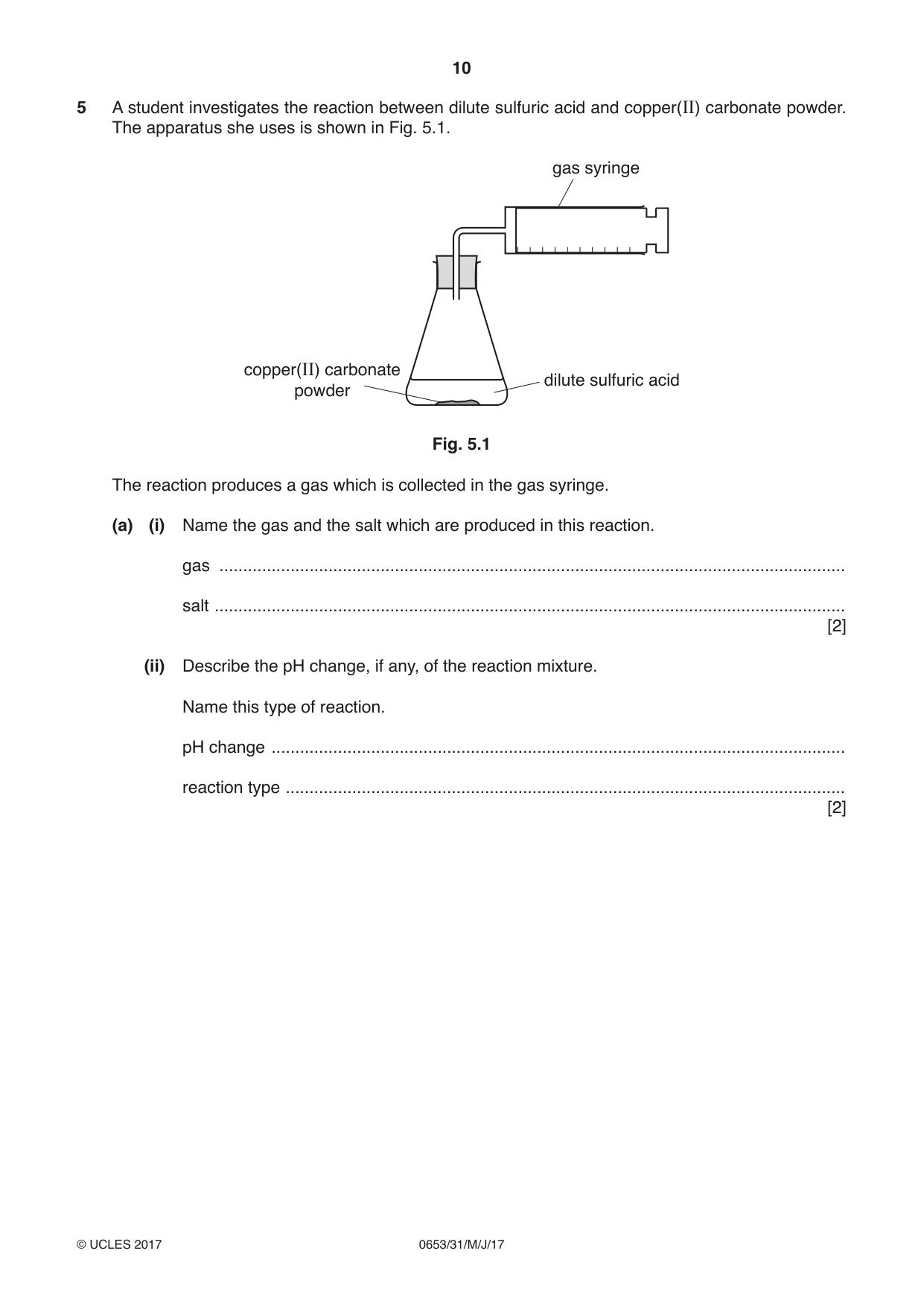
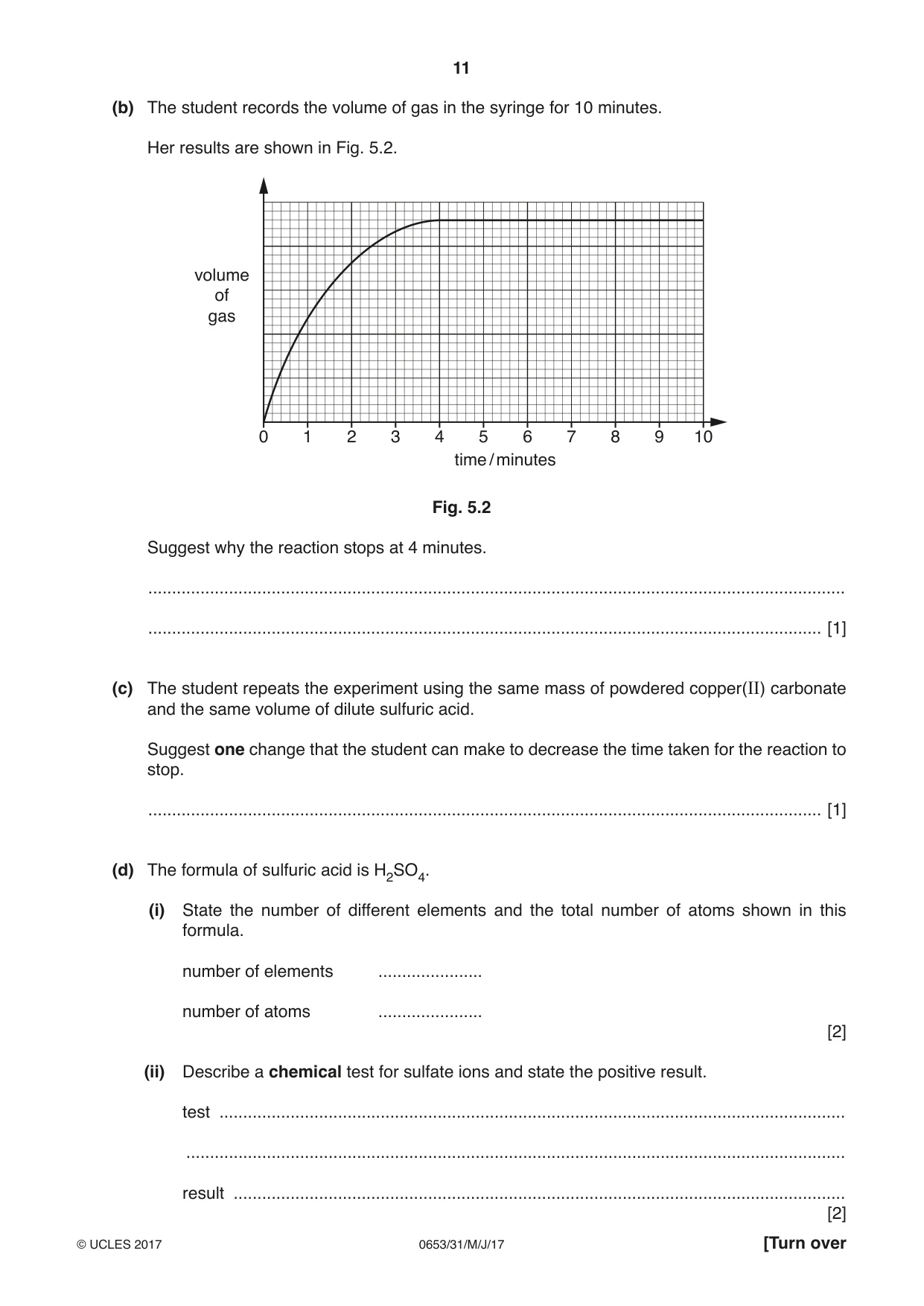
5 A student investigates the reaction between dilute sulfuric acid and copper(II) carbonate powder. The apparatus she uses is shown in Fig. 5.1. gas syringe copper(II) carbonate dilute sulfuric acid powder Fig. 5.1 The reaction produces a gas which is collected in the gas syringe. (a) (i) Name the gas and the salt which are produced in this reaction. gas .................................................................................................................................... salt ..................................................................................................................................... [2] (ii) Describe the pH change, if any, of the reaction mixture. Name this type of reaction. pH change ......................................................................................................................... reaction type ...................................................................................................................... [2] (b) The student records the volume of gas in the syringe for 10 minutes. Her results are shown in Fig. 5.2. volume of gas 0 1 2 3 4 5 6 7 8 9 10 time / minutes Fig. 5.2 Suggest why the reaction stops at 4 minutes. ................................................................................................................................................... .............................................................................................................................................. [1] (c) The student repeats the experiment using the same mass of powdered copper(II) carbonate and the same volume of dilute sulfuric acid. Suggest one change that the student can make to decrease the time taken for the reaction to stop. .............................................................................................................................................. [1] (d) The formula of sulfuric acid is H2SO4. (i) State the number of different elements and the total number of atoms shown in this formula. number of elements ...................... number of atoms ...................... [2] (ii) Describe a chemical test for sulfate ions and state the positive result. test .................................................................................................................................... ........................................................................................................................................... result ................................................................................................................................. [2]
Mark scheme: 5(a)(i) carbon dioxide ; copper sulfate ; 2 5(a)(ii) increases ; salt making / neutralisation ; 2 5(b) runs out of / no more (sulfuric) acid / copper carbonate / powder ; 1 5(c) higher temperature / more concentrated (acid) / decrease particle size (of powder) / agitate the flask ; 1 5(d)(i) three / 3 ; seven / 7 ; 2 5(d)(ii) (acidified) barium ions / barium nitrate (soln) ; (result) white ppt / white solid ; 2
Q6 · A man standing in the sea on a sunny day
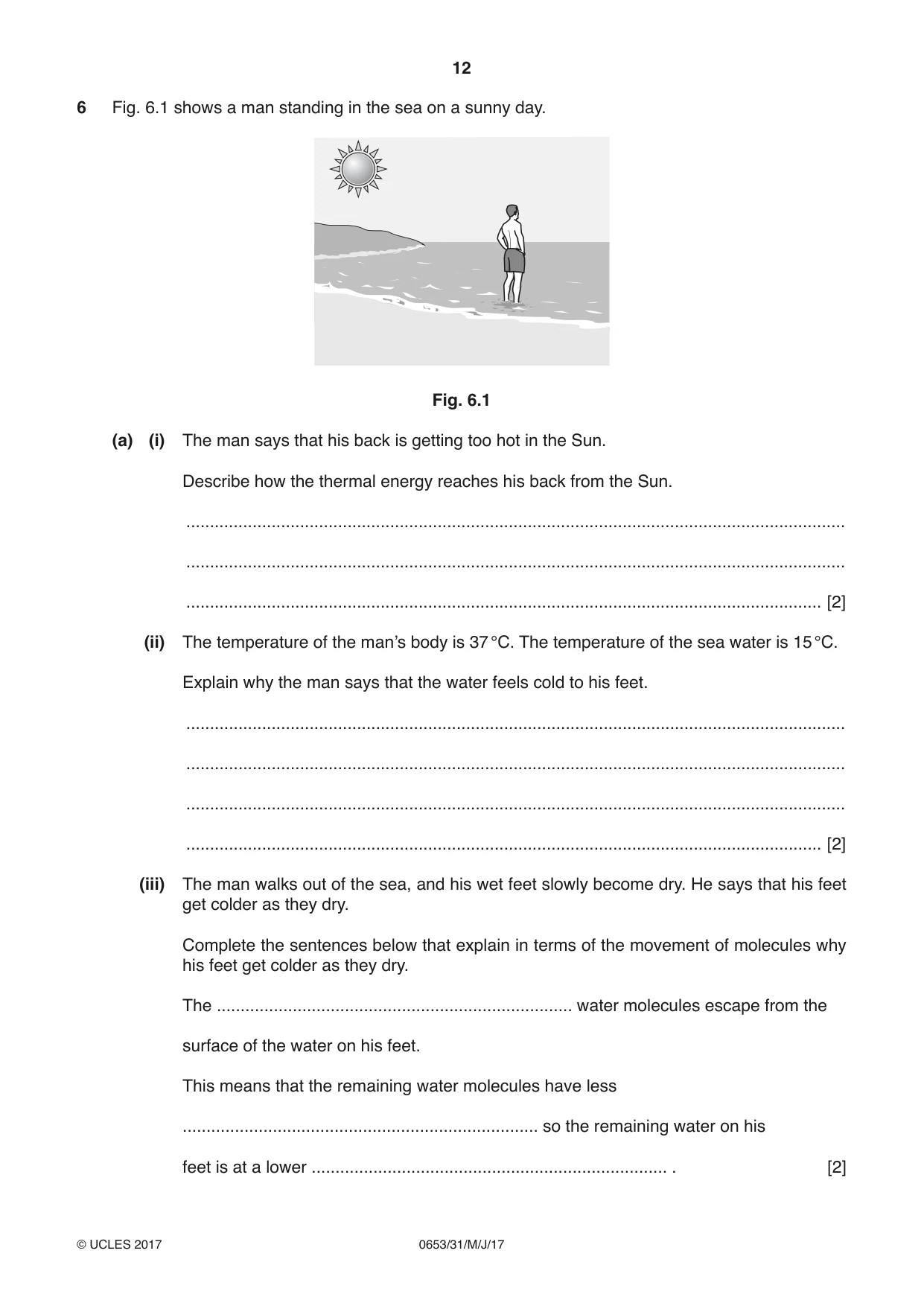
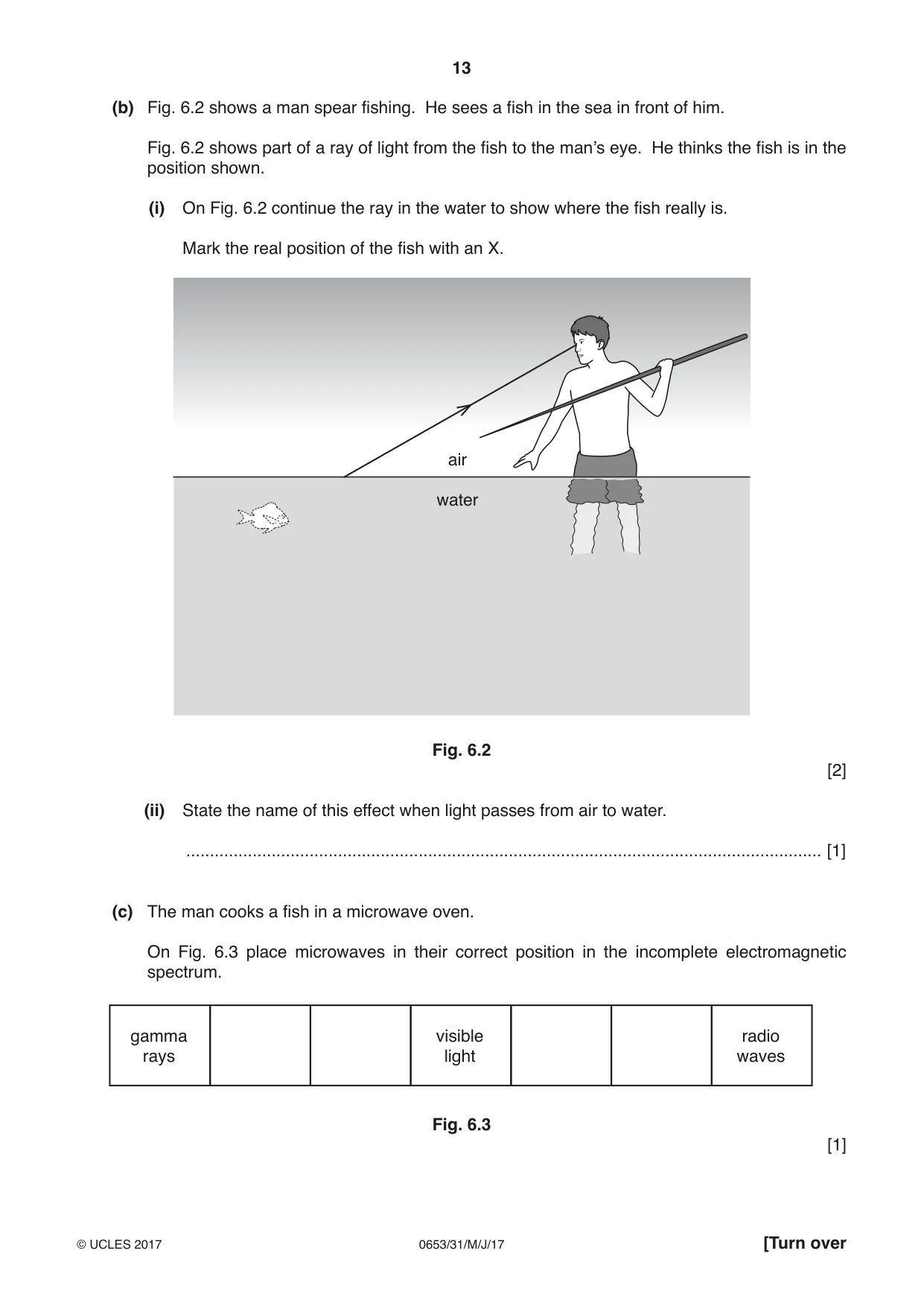
6 Fig. 6.1 shows a man standing in the sea on a sunny day. Fig. 6.1 (a) (i) The man says that his back is getting too hot in the Sun. Describe how the thermal energy reaches his back from the Sun. ........................................................................................................................................... ........................................................................................................................................... ...................................................................................................................................... [2] (ii) The temperature of the man’s body is 37 °C. The temperature of the sea water is 15 °C. Explain why the man says that the water feels cold to his feet. ........................................................................................................................................... ........................................................................................................................................... ........................................................................................................................................... ...................................................................................................................................... [2] (iii) The man walks out of the sea, and his wet feet slowly become dry. He says that his feet get colder as they dry. Complete the sentences below that explain in terms of the movement of molecules why his feet get colder as they dry. The ........................................................................... water molecules escape from the surface of the water on his feet. This means that the remaining water molecules have less ........................................................................... so the remaining water on his feet is at a lower ........................................................................... . [2] (b) Fig. 6.2 shows a man spear fishing. He sees a fish in the sea in front of him. Fig. 6.2 shows part of a ray of light from the fish to the man’s eye. He thinks the fish is in the position shown. (i) On Fig. 6.2 continue the ray in the water to show where the fish really is. Mark the real position of the fish with an X. air water Fig. 6.2 [2] (ii) State the name of this effect when light passes from air to water. ...................................................................................................................................... [1] (c) The man cooks a fish in a microwave oven. On Fig. 6.3 place microwaves in their correct position in the incomplete electromagnetic spectrum. gamma visible radio rays light waves Fig. 6.3 [1]
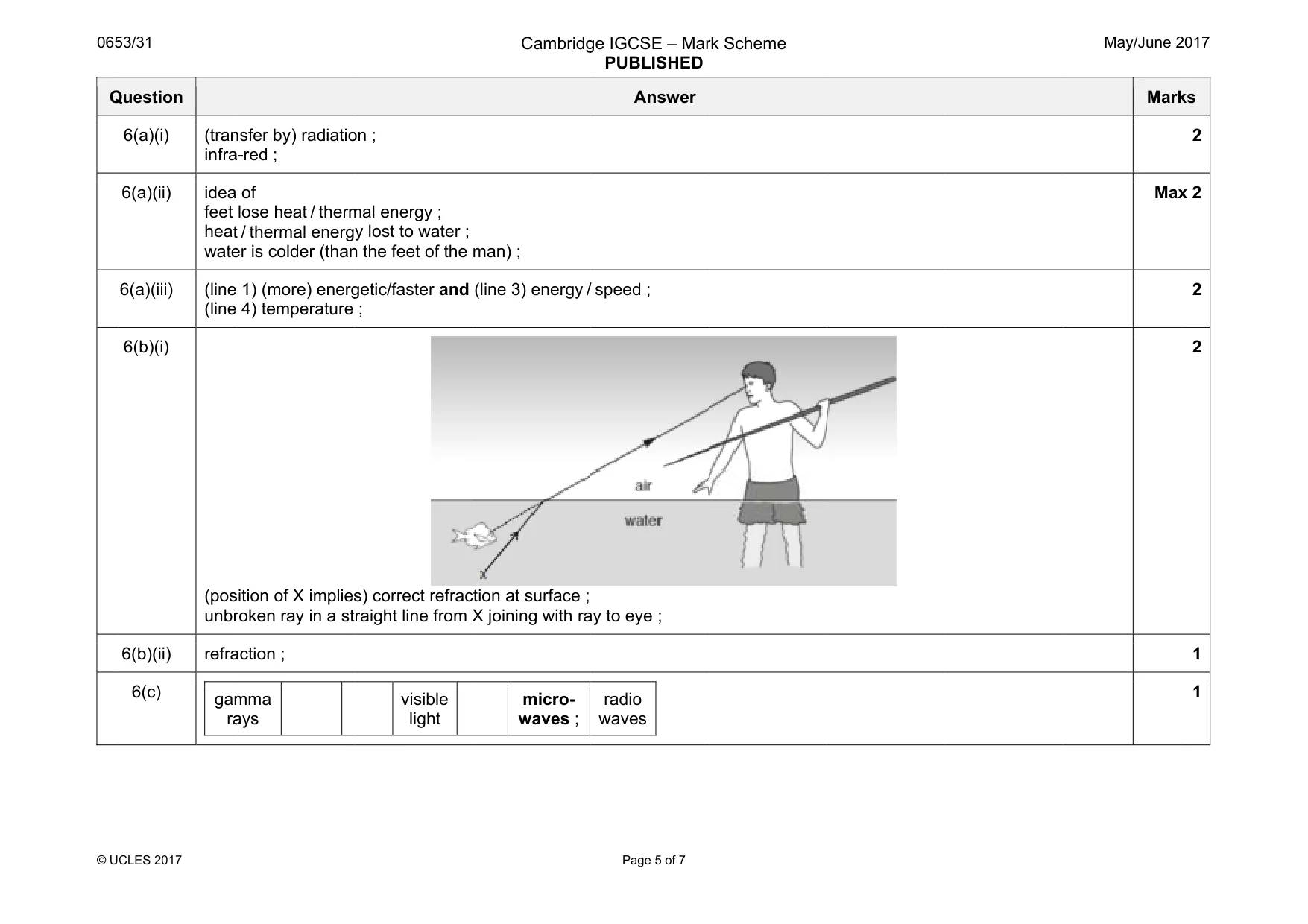
Mark scheme: 6(a)(i) (tran infra 6(a)(ii) idea feet heat wate 6(a)(iii) (line (line 6(b)(i) (pos unbr 6(b)(ii) refra 6(c) gam ra nsfer by) radiatio a-red ; of lose heat / therm t / thermal energ er is colder (than 1) (more) energ 4) temperature sition of X implies roken ray in a st action ; mma ays on ; mal energy ; y lost to water ; n the feet of the getic/faster and ; s) correct refrac raight line from X visible light man) ; (line 3) energy / ction at surface ; X joining with ra micro- waves ; / speed ; ay to eye ; radio waves Max 2 x 2 2 2 1 1
Q7 · The mass of some of the contents of three foods in a 100 gram sample of each food
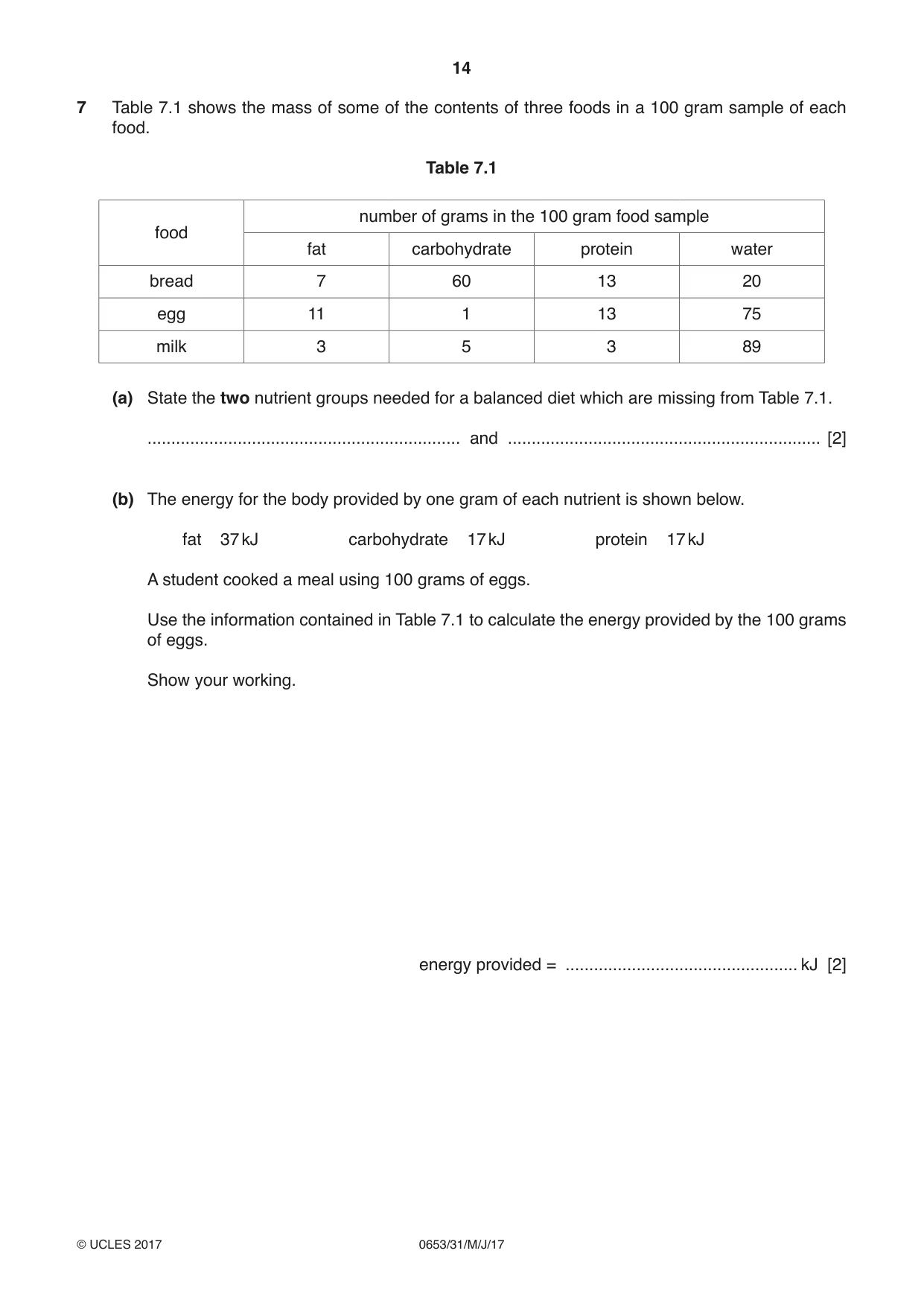
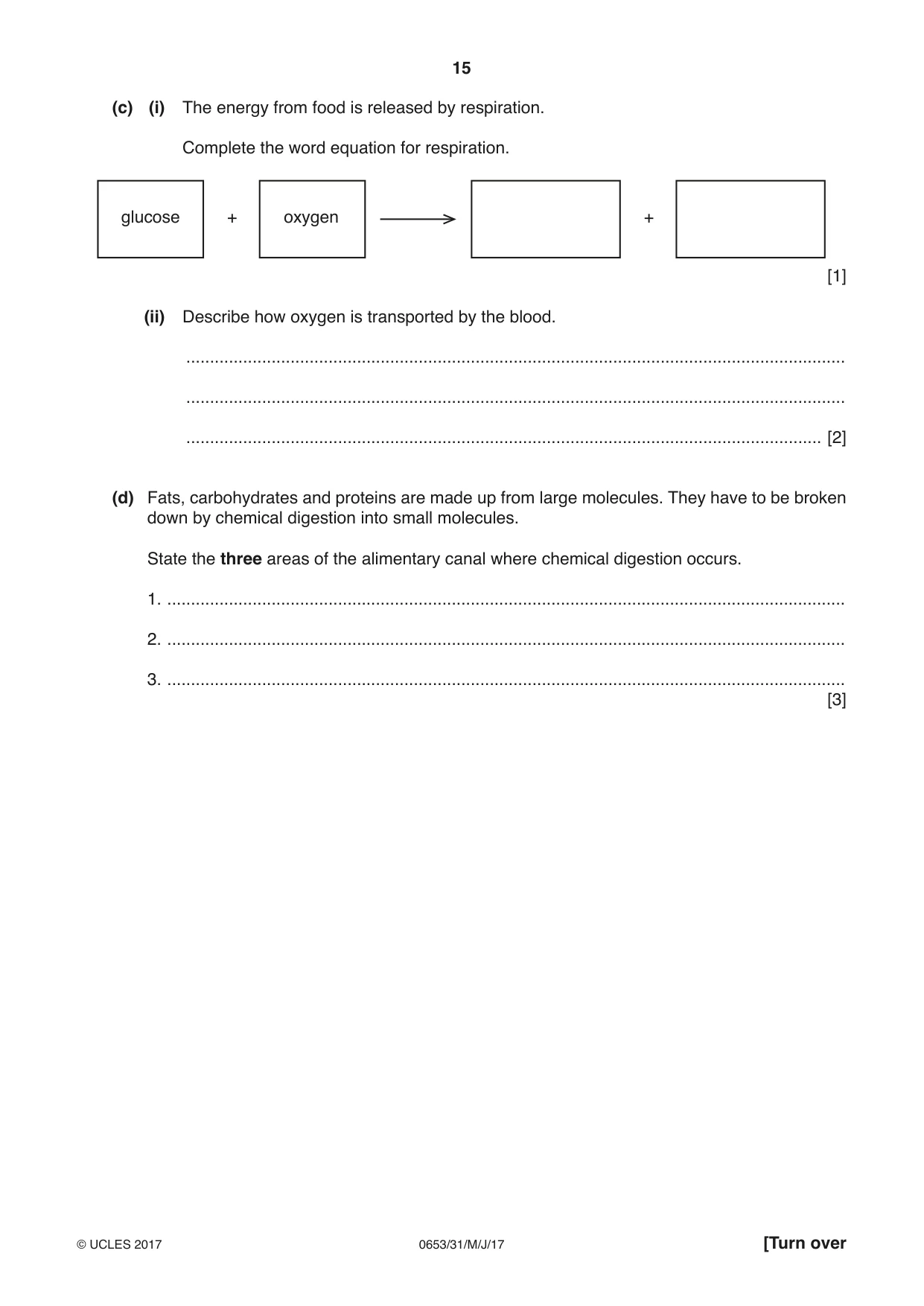
7 Table 7.1 shows the mass of some of the contents of three foods in a 100 gram sample of each food. Table 7.1 number of grams in the 100 gram food sample food fat carbohydrate protein water bread 7 60 13 20 egg 11 1 13 75 milk 3 5 3 89 (a) State the two nutrient groups needed for a balanced diet which are missing from Table 7.1. .................................................................. and .................................................................. [2] (b) The energy for the body provided by one gram of each nutrient is shown below. fat 37 kJ carbohydrate 17 kJ protein 17 kJ A student cooked a meal using 100 grams of eggs. Use the information contained in Table 7.1 to calculate the energy provided by the 100 grams of eggs. Show your working. energy provided = ................................................. kJ [2] (c) (i) The energy from food is released by respiration. Complete the word equation for respiration. glucose + oxygen + [1] (ii) Describe how oxygen is transported by the blood. ........................................................................................................................................... ........................................................................................................................................... ...................................................................................................................................... [2] (d) Fats, carbohydrates and proteins are made up from large molecules. They have to be broken down by chemical digestion into small molecules. State the three areas of the alimentary canal where chemical digestion occurs. 1. ............................................................................................................................................... 2. ............................................................................................................................................... 3. ............................................................................................................................................... [3]
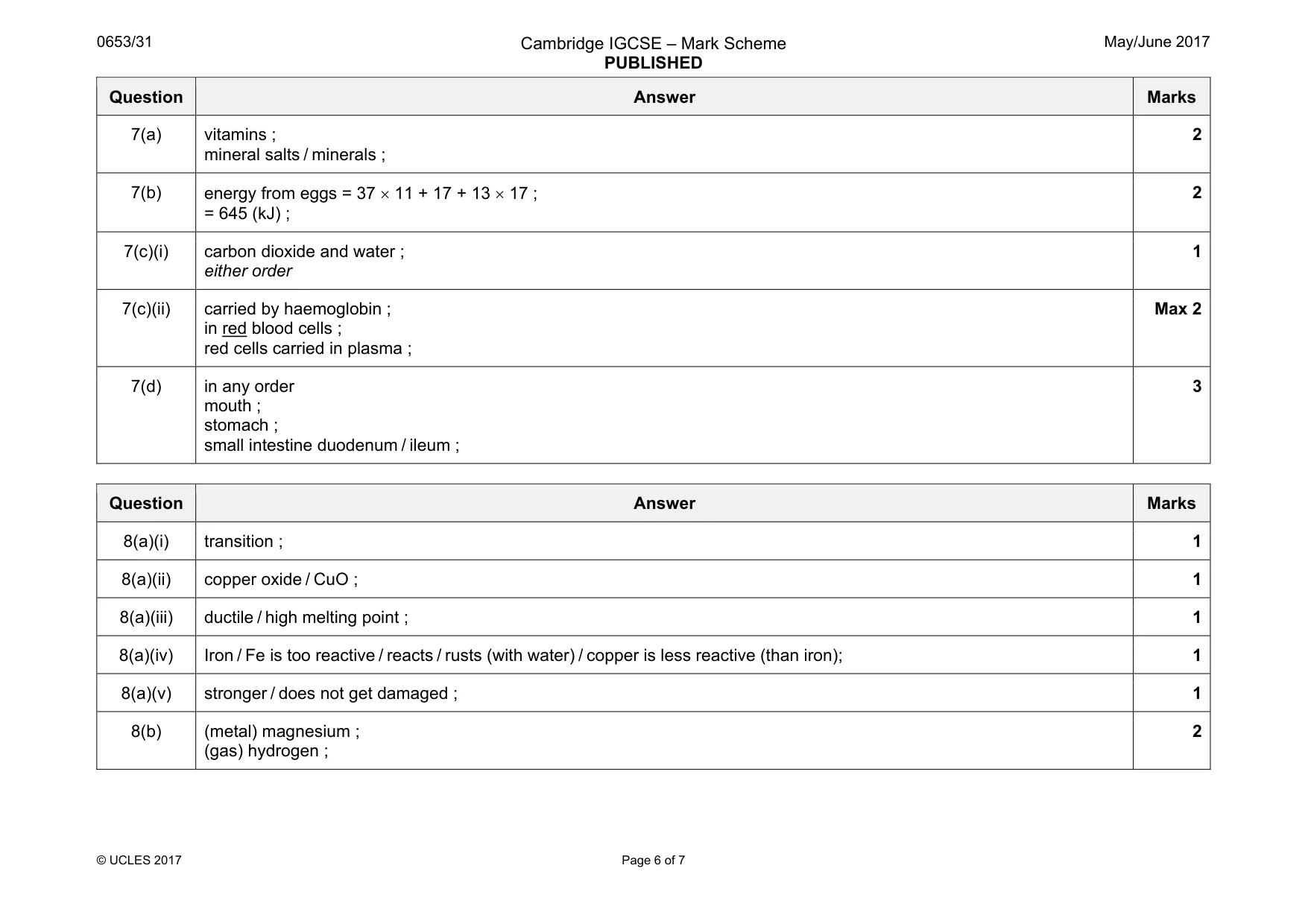
Mark scheme: 7(a) vitamins ; mineral salts / minerals ; 2 7(b) energy from eggs = 37 × 11 + 17 + 13 × 17 ; = 645 (kJ) ; 2 7(c)(i) carbon dioxide and water ; either order 1 7(c)(ii) carried by haemoglobin ; in red blood cells ; red cells carried in plasma ; Max 2 7(d) in any order mouth ; stomach ; small intestine duodenum / ileum ; 3
Q8 · Some uses of copper
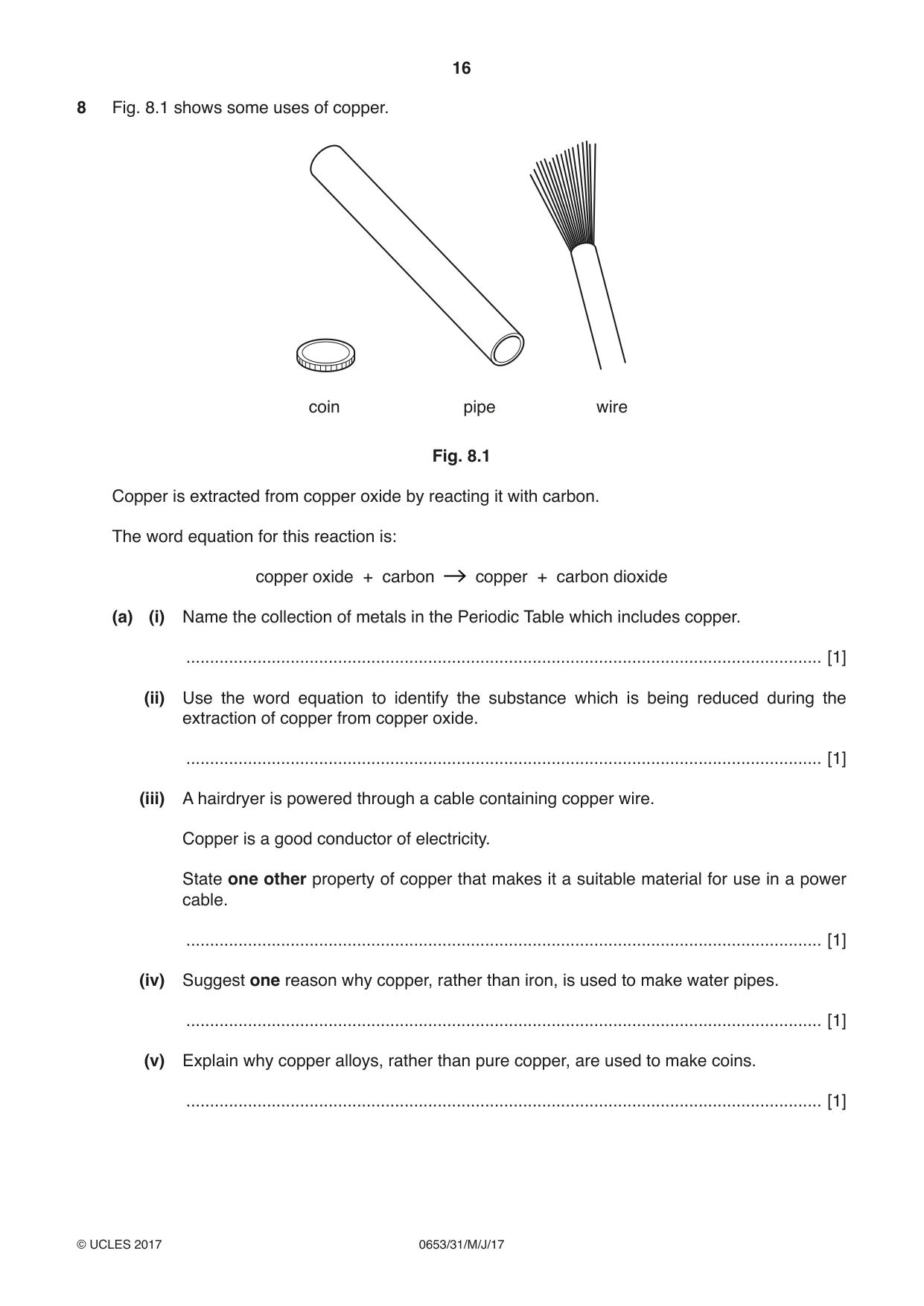
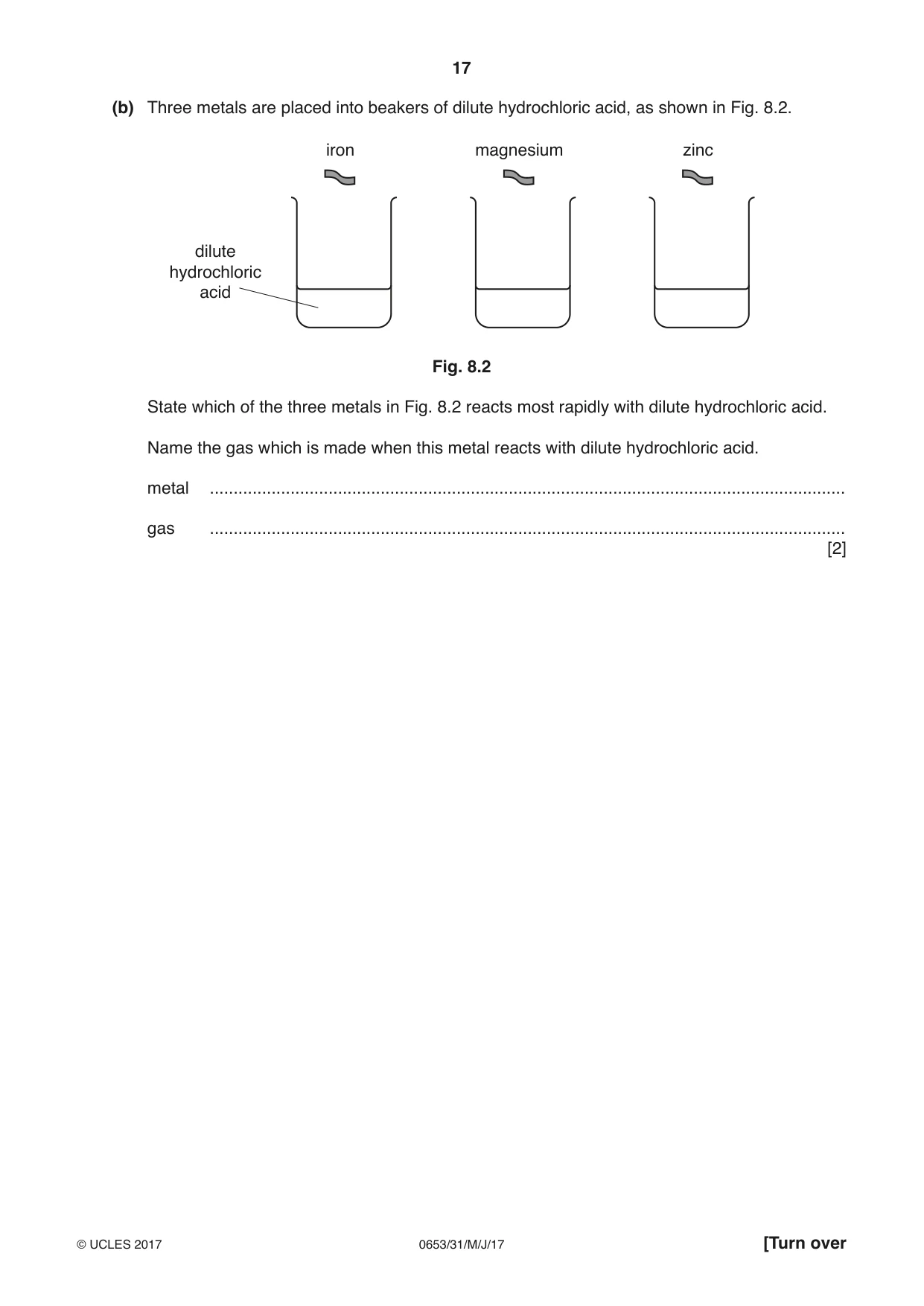
8 Fig. 8.1 shows some uses of copper. coin pipe wire Fig. 8.1 Copper is extracted from copper oxide by reacting it with carbon. The word equation for this reaction is: copper oxide + carbon copper + carbon dioxide (a) (i) Name the collection of metals in the Periodic Table which includes copper. ...................................................................................................................................... [1] (ii) Use the word equation to identify the substance which is being reduced during the extraction of copper from copper oxide. ...................................................................................................................................... [1] (iii) A hairdryer is powered through a cable containing copper wire. Copper is a good conductor of electricity. State one other property of copper that makes it a suitable material for use in a power cable. ...................................................................................................................................... [1] (iv) Suggest one reason why copper, rather than iron, is used to make water pipes. ...................................................................................................................................... [1] (v) Explain why copper alloys, rather than pure copper, are used to make coins. ...................................................................................................................................... [1] (b) Three metals are placed into beakers of dilute hydrochloric acid, as shown in Fig. 8.2. iron magnesium zinc dilute hydrochloric acid Fig. 8.2 State which of the three metals in Fig. 8.2 reacts most rapidly with dilute hydrochloric acid. Name the gas which is made when this metal reacts with dilute hydrochloric acid. metal ...................................................................................................................................... gas ...................................................................................................................................... [2]
Mark scheme: 8(a)(i) transition ; 1 8(a)(ii) copper oxide / CuO ; 1 8(a)(iii) ductile / high melting point ; 1 8(a)(iv) Iron / Fe is too reactive / reacts / rusts (with water) / copper is less reactive (than iron); 1 8(a)(v) stronger / does not get damaged ; 1 8(b) (metal) magnesium ; (gas) hydrogen ; 2
Q9 · A simple test circuit for testing different materials to see how well they conduct…
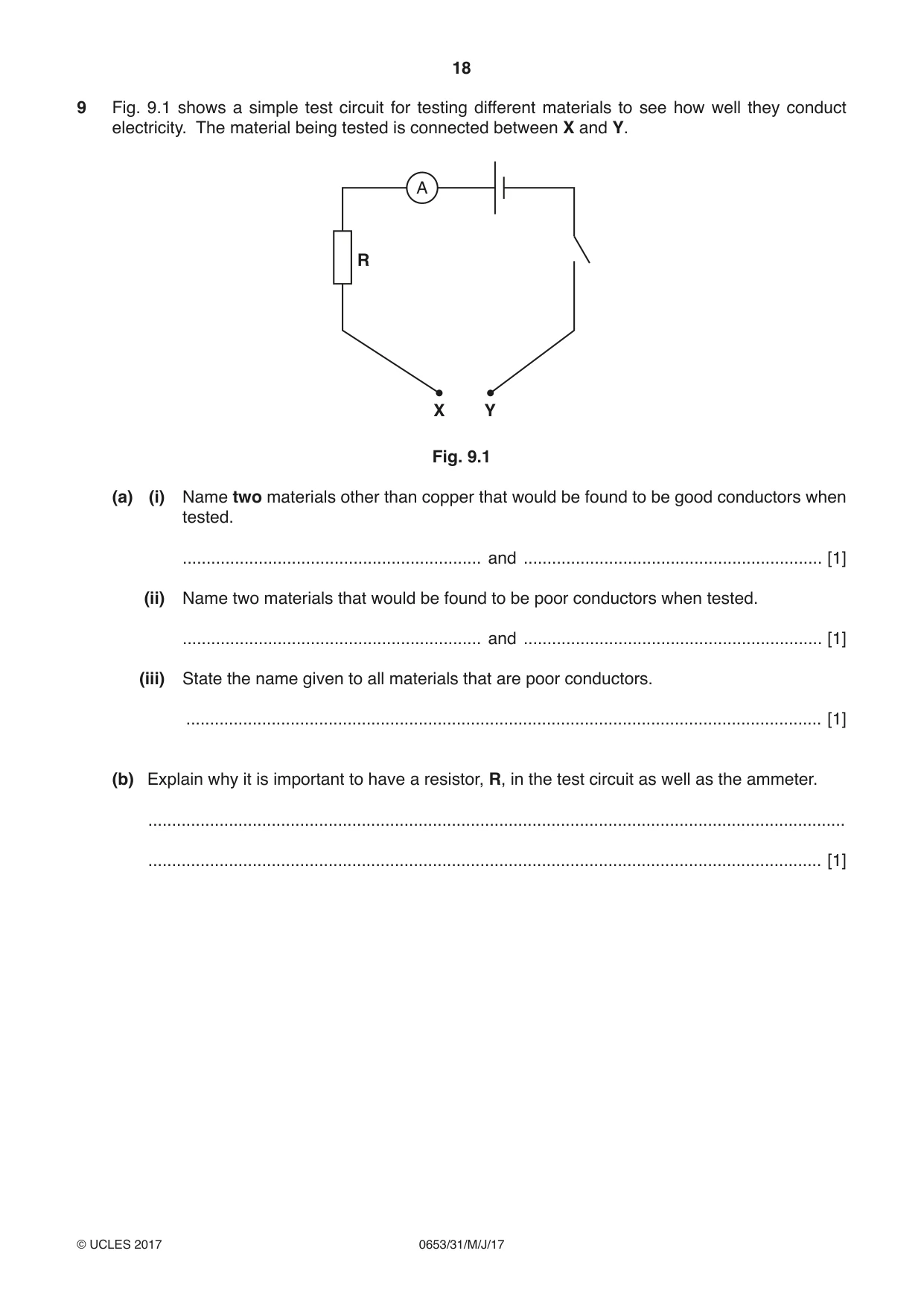
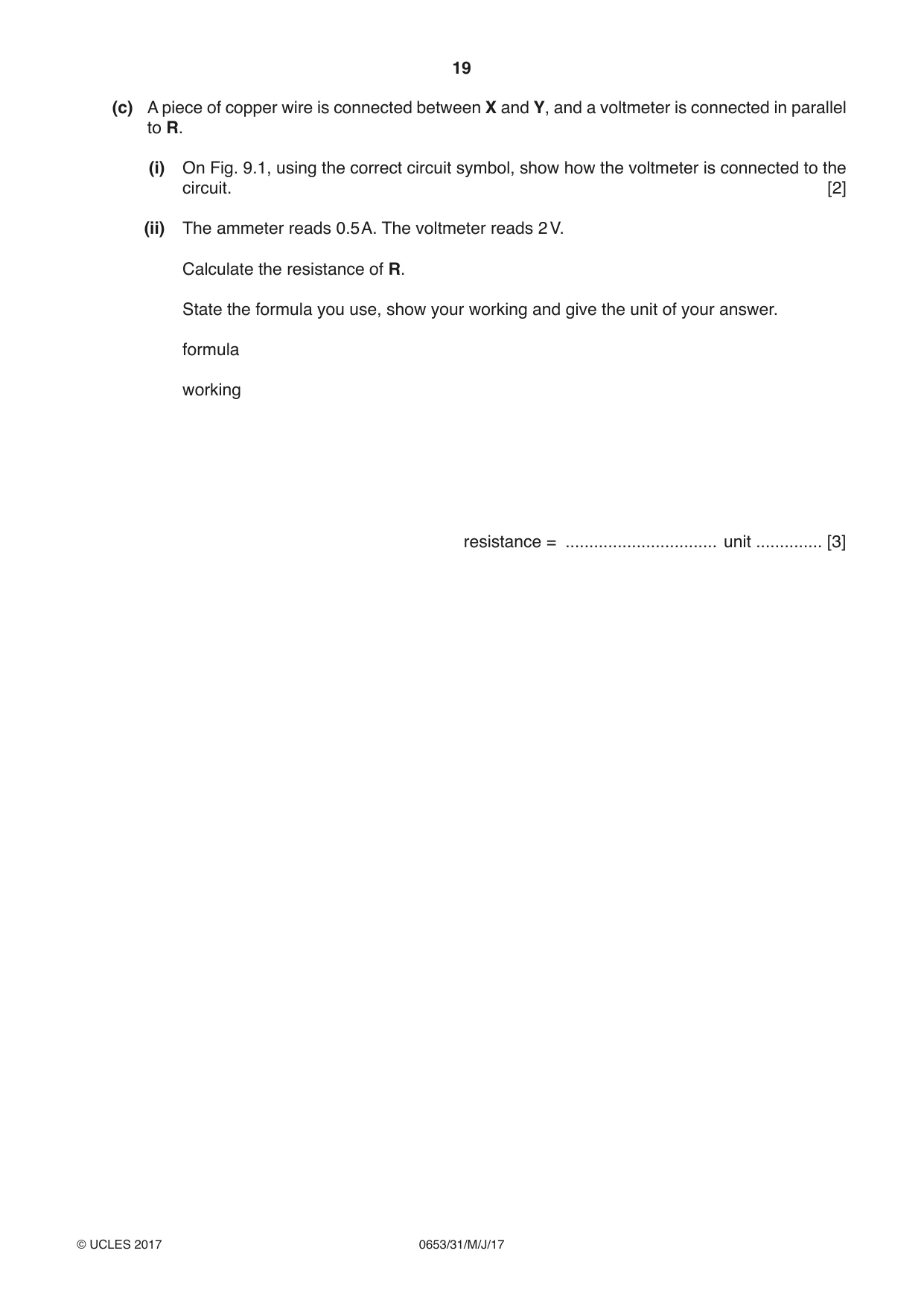
9 Fig. 9.1 shows a simple test circuit for testing different materials to see how well they conduct electricity. The material being tested is connected between X and Y. A R X Y Fig. 9.1 (a) (i) Name two materials other than copper that would be found to be good conductors when tested. ............................................................... and ............................................................... [1] (ii) Name two materials that would be found to be poor conductors when tested. ............................................................... and ............................................................... [1] (iii) State the name given to all materials that are poor conductors. ...................................................................................................................................... [1] (b) Explain why it is important to have a resistor, R, in the test circuit as well as the ammeter. ................................................................................................................................................... .............................................................................................................................................. [1] (c) A piece of copper wire is connected between X and Y, and a voltmeter is connected in parallel to R. (i) On Fig. 9.1, using the correct circuit symbol, show how the voltmeter is connected to the circuit. [2] (ii) The ammeter reads 0.5 A. The voltmeter reads 2 V. Calculate the resistance of R. State the formula you use, show your working and give the unit of your answer. formula working resistance = ................................ unit .............. [3]
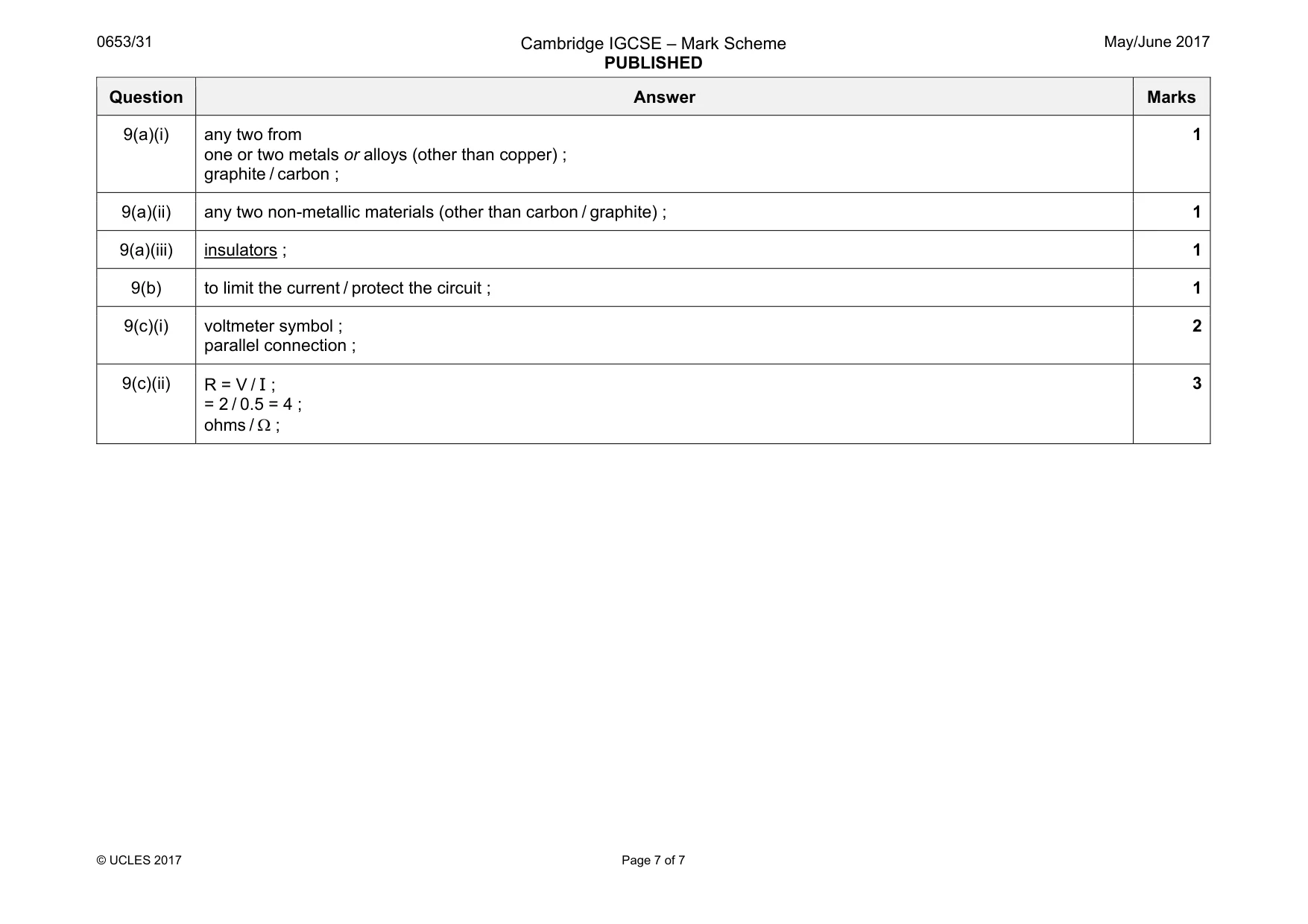
Mark scheme: 9(a)(i) any two from one or two metals or alloys (other than copper) ; graphite / carbon ; 1 9(a)(ii) any two non-metallic materials (other than carbon / graphite) ; 1 9(a)(iii) insulators ; 1 9(b) to limit the current / protect the circuit ; 1 9(c)(i) voltmeter symbol ; parallel connection ; 2 9(c)(ii) R = V / I ; = 2 / 0.5 = 4 ; ohms / Ω ; 3
What was in this paper
The subtopics covered by these 9 questions, and how many questions each got. Open one in a new tab to see every Cambridge question on it.
What you needed in this session
Cambridge’s own grade thresholds for 2017 May/June, Paper 3 · Variant 1. A higher threshold means an easier paper — the bar moves with how the cohort did.