Cambridge IGCSE Science - Combined 0653 — 2022 Oct/Nov Paper 3 · Variant 1
0653/31/O/N/22 · 9 questions · 80 marks · ≈90 min
The question paper and its mark scheme, free to read here and free to download. This is Cambridge’s own paper, exactly as it was sat.
Question paper24 pages



Mark scheme11 pages
Answers below. Sit the paper first if you are practising.
Questions as text
Q1 · Part of the alimentary canal and associated organs
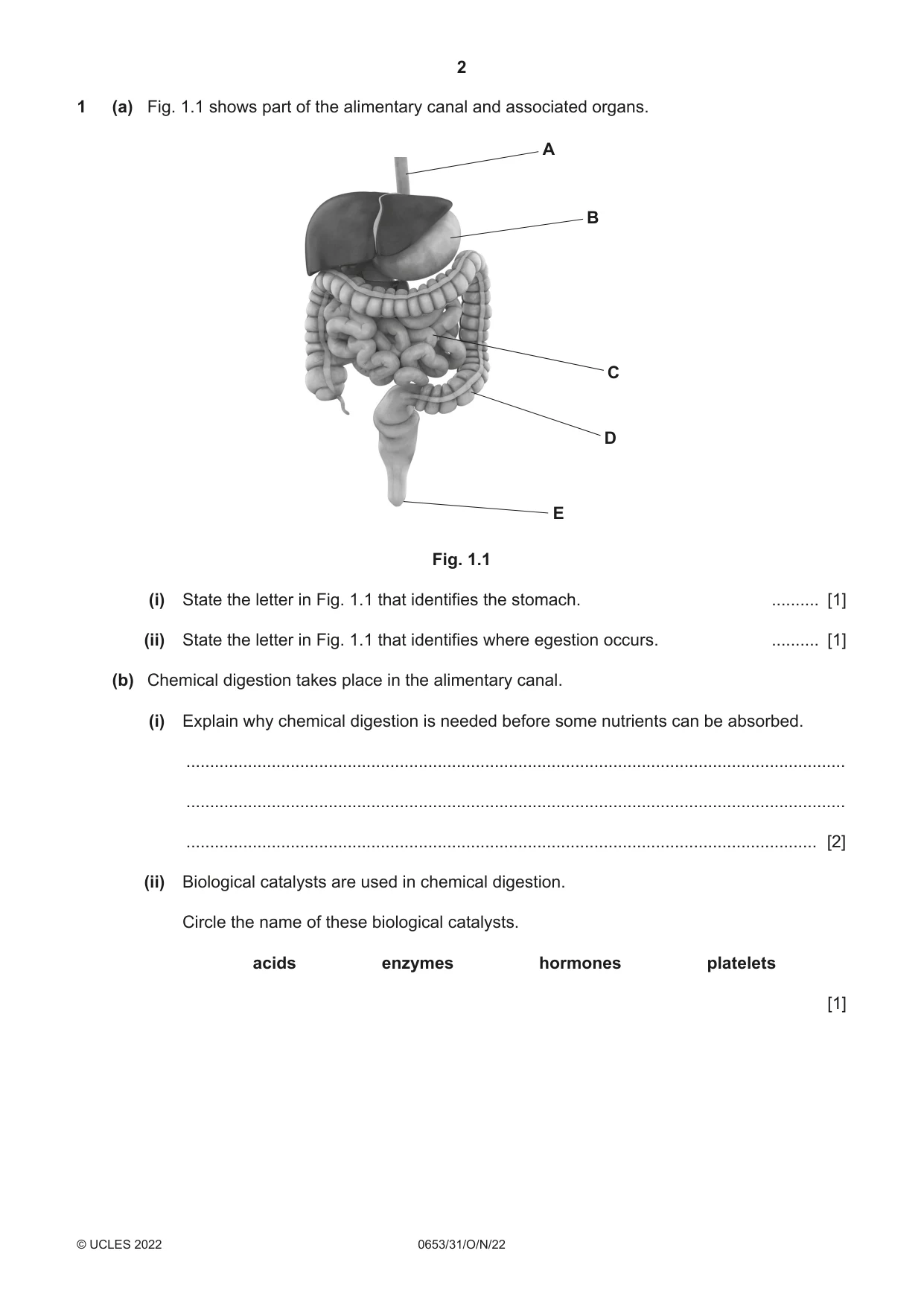
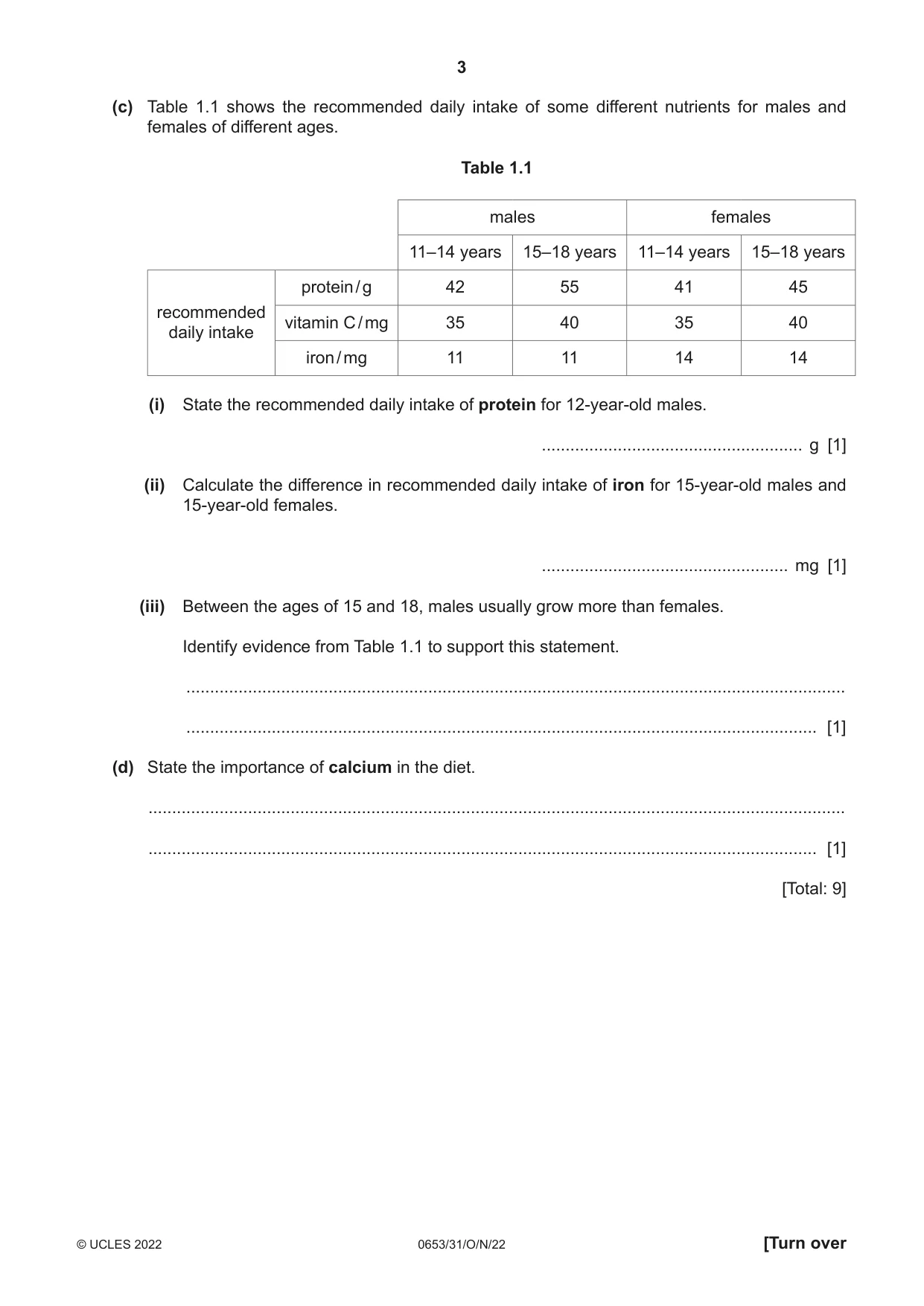
1 (a) Fig. 1.1 shows part of the alimentary canal and associated organs. A B C D E Fig. 1.1 (i) State the letter in Fig. 1.1 that identifies the stomach. .......... [1] (ii) State the letter in Fig. 1.1 that identifies where egestion occurs. .......... [1] (b) Chemical digestion takes place in the alimentary canal. (i) Explain why chemical digestion is needed before some nutrients can be absorbed. ........................................................................................................................................... ........................................................................................................................................... ..................................................................................................................................... [2] (ii) Biological catalysts are used in chemical digestion. Circle the name of these biological catalysts. acids enzymes hormones platelets [1] (c) Table 1.1 shows the recommended daily intake of some different nutrients for males and females of different ages. Table 1.1 males females 11–14 years 15–18 years 11–14 years 15–18 years protein / g 42 55 41 45 recommended vitamin C / mg 35 40 35 40 daily intake iron / mg 11 11 14 14 (i) State the recommended daily intake of protein for 12-year-old males. ....................................................... g [1] (ii) Calculate the difference in recommended daily intake of iron for 15-year-old males and 15-year-old females. .................................................... mg [1] (iii) Between the ages of 15 and 18, males usually grow more than females. Identify evidence from Table 1.1 to support this statement. ........................................................................................................................................... ..................................................................................................................................... [1] (d) State the importance of calcium in the diet. ................................................................................................................................................... ............................................................................................................................................. [1] [Total: 9]
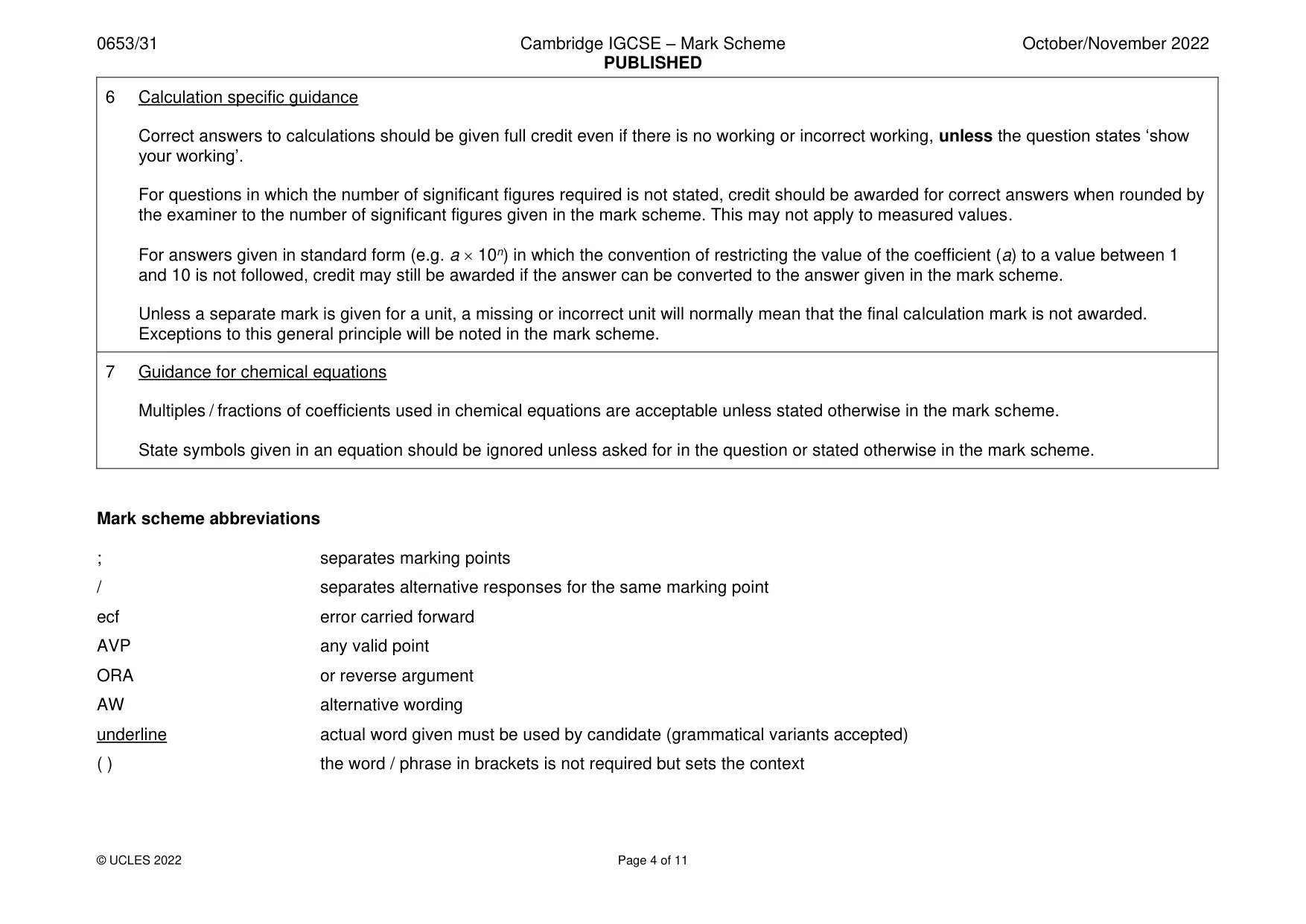
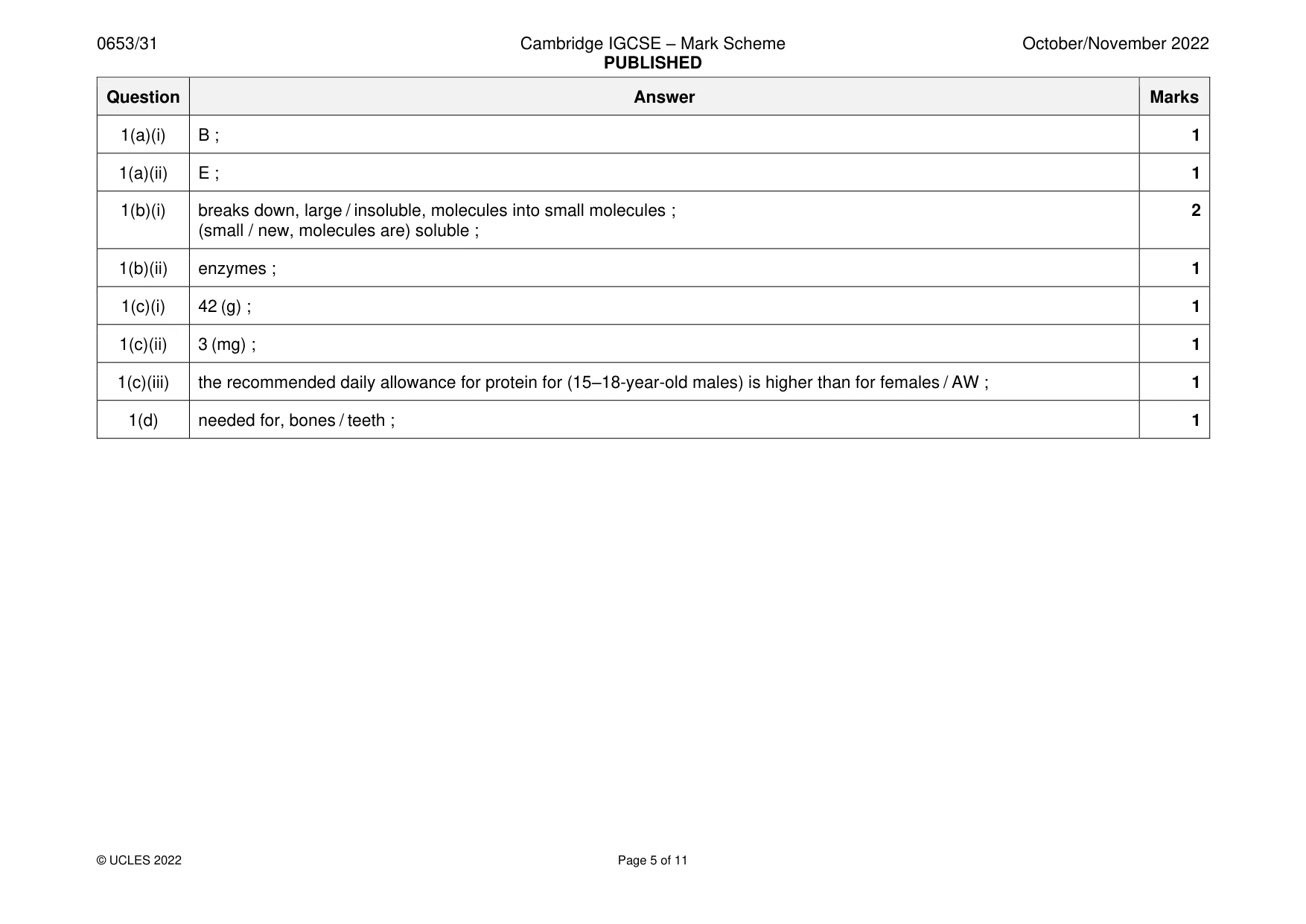
Mark scheme: Question Answer Marks 1(a)(i) B ; 1 1(a)(ii) E ; 1 1(b)(i) breaks down, large / insoluble, molecules into small molecules ; 2 (small / new, molecules are) soluble ; 1(b)(ii) enzymes ; 1 1(c)(i) 42 (g) ; 1 1(c)(ii) 3 (mg) ; 1 1(c)(iii) the recommended daily allowance for protein for (15–18-year-old males) is higher than for females / AW ; 1 1(d) needed for, bones / teeth ; 1
Q2 · Potassium, K, and fluorine, F, are both elements
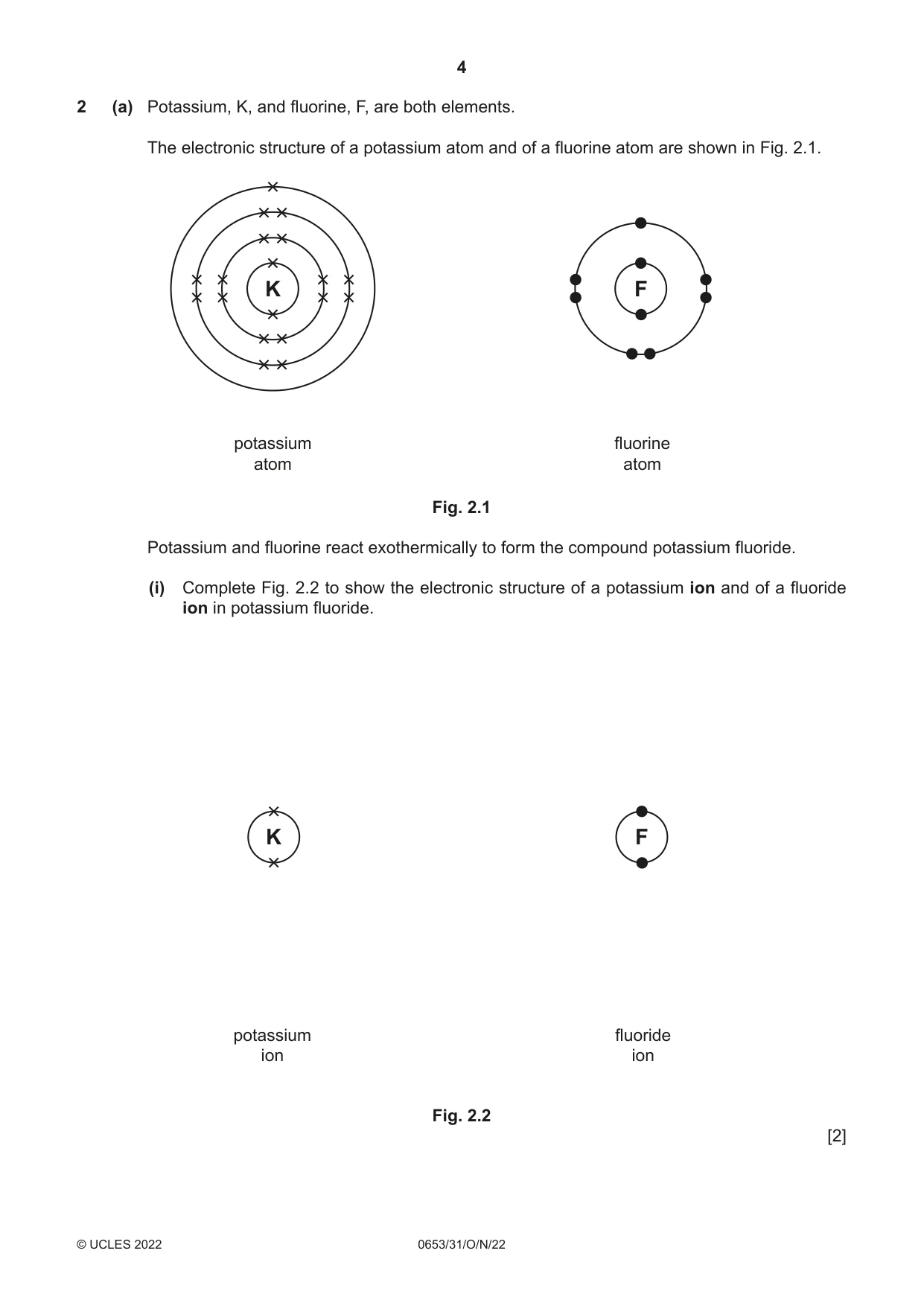
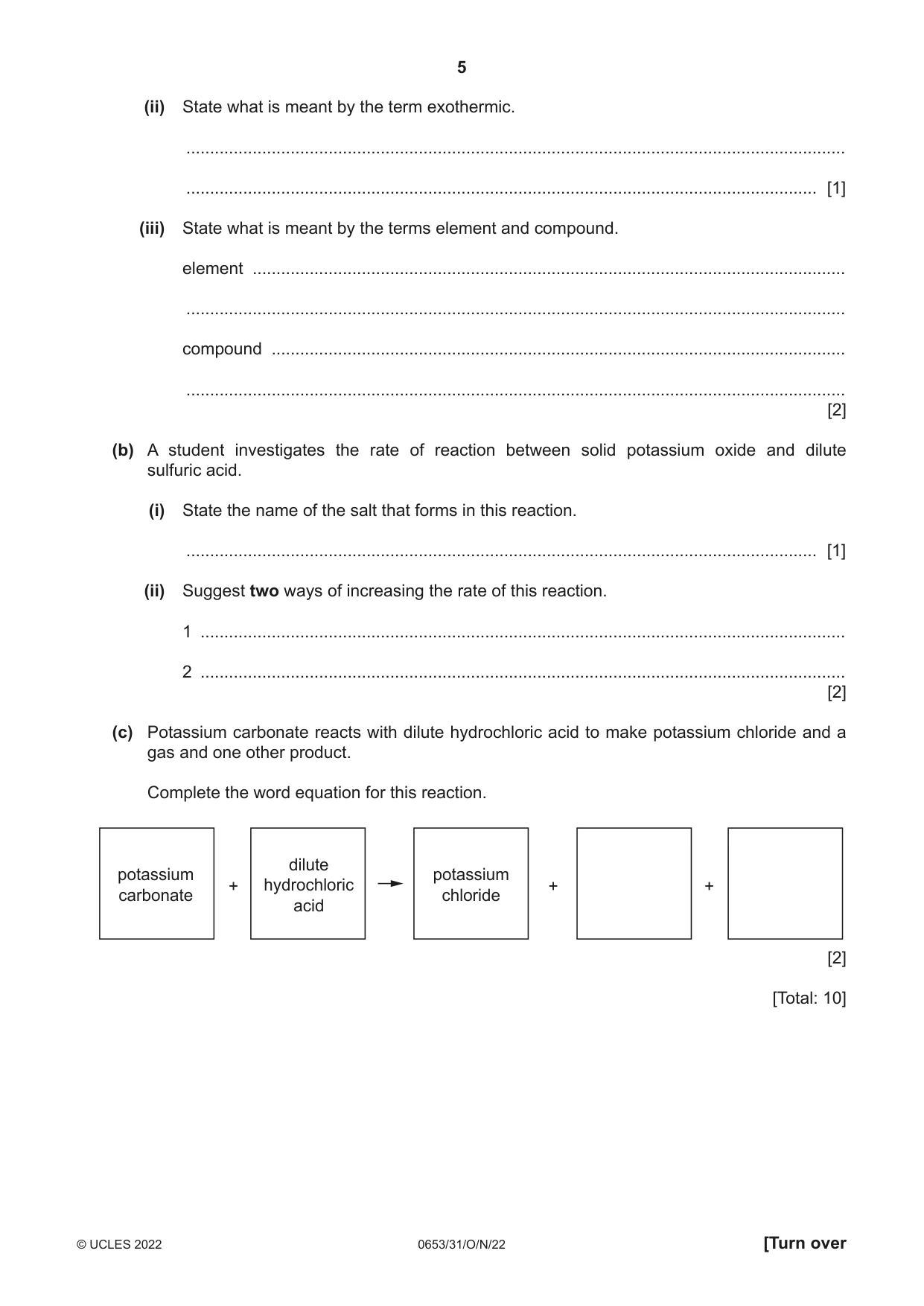
2 (a) Potassium, K, and fluorine, F, are both elements. The electronic structure of a potassium atom and of a fluorine atom are shown in Fig. 2.1. K F potassium fluorine atom atom Fig. 2.1 Potassium and fluorine react exothermically to form the compound potassium fluoride. (i) Complete Fig. 2.2 to show the electronic structure of a potassium ion and of a fluoride ion in potassium fluoride. K F potassium fluoride ion ion Fig. 2.2 [2] (ii) State what is meant by the term exothermic. ........................................................................................................................................... ..................................................................................................................................... [1] (iii) State what is meant by the terms element and compound. element ............................................................................................................................. ........................................................................................................................................... compound ......................................................................................................................... ........................................................................................................................................... [2] (b) A student investigates the rate of reaction between solid potassium oxide and dilute sulfuric acid. (i) State the name of the salt that forms in this reaction. ..................................................................................................................................... [1] (ii) Suggest two ways of increasing the rate of this reaction. 1 ........................................................................................................................................ 2 ........................................................................................................................................ [2] (c) Potassium carbonate reacts with dilute hydrochloric acid to make potassium chloride and a gas and one other product. Complete the word equation for this reaction. dilute potassium potassium + hydrochloric + + carbonate chloride acid [2] [Total: 10]
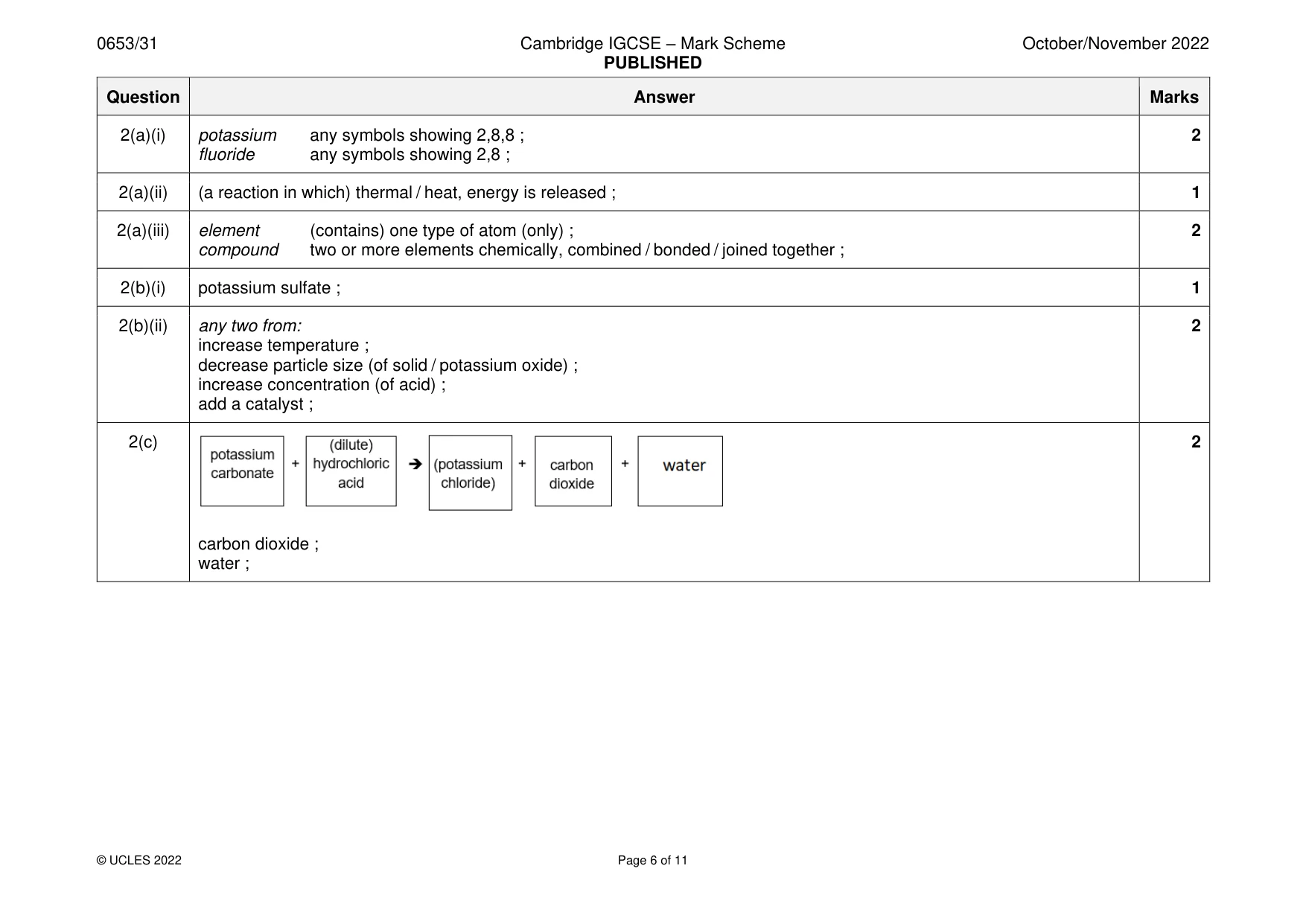
Mark scheme: 2(a)(i) potassium any symbols showing 2,8,8 ; 2 fluoride any symbols showing 2,8 ; 2(a)(ii) (a reaction in which) thermal / heat, energy is released ; 1 2(a)(iii) element (contains) one type of atom (only) ; 2 compound two or more elements chemically, combined / bonded / joined together ; 2(b)(i) potassium sulfate ; 1 2(b)(ii) any two from: 2 increase temperature ; decrease particle size (of solid / potassium oxide) ; increase concentration (of acid) ; add a catalyst ; 2(c) 2 carbon dioxide ; water ;
Q3 · Forces P, Q, R and S acting on an airplane moving forward along a runway
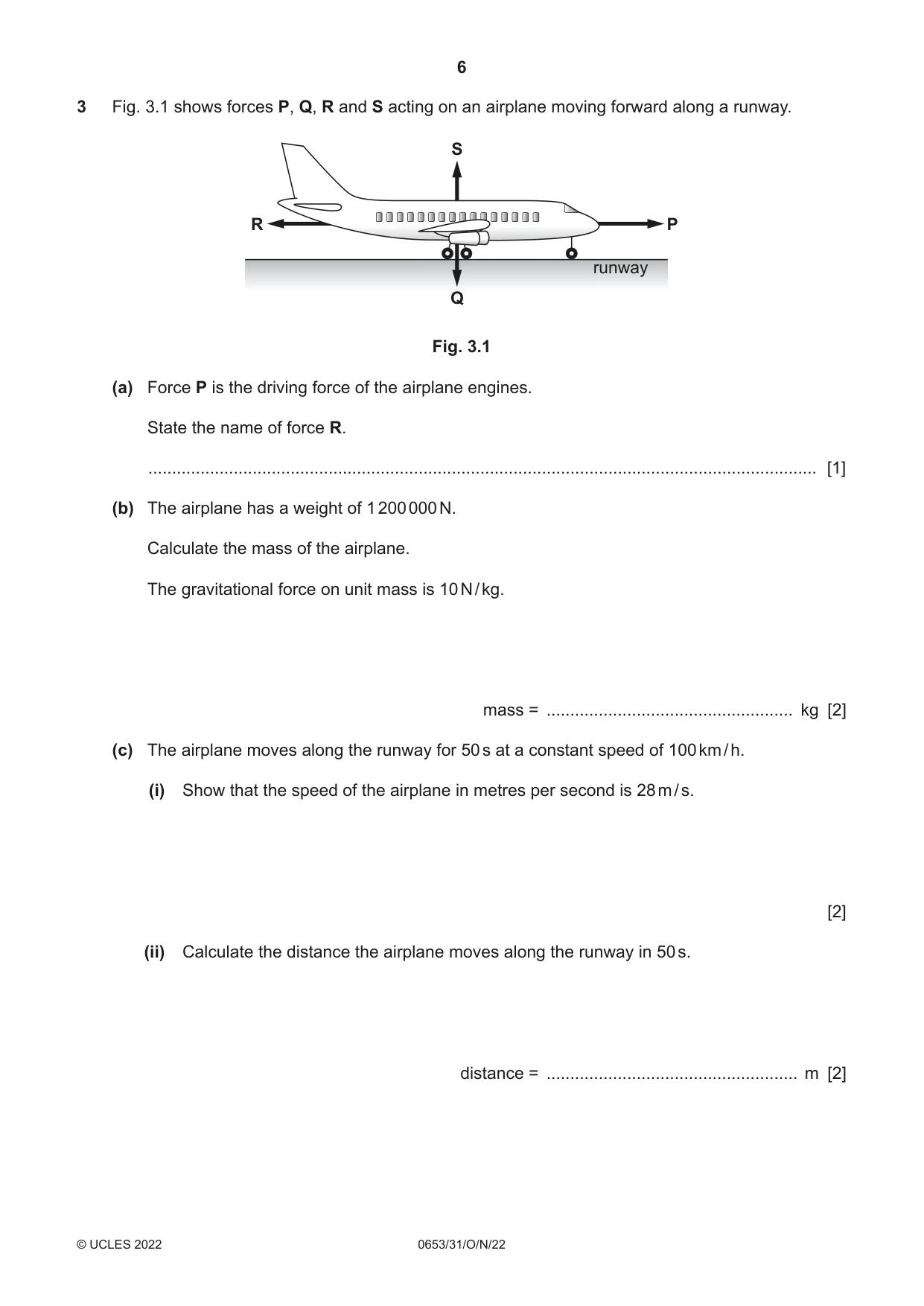
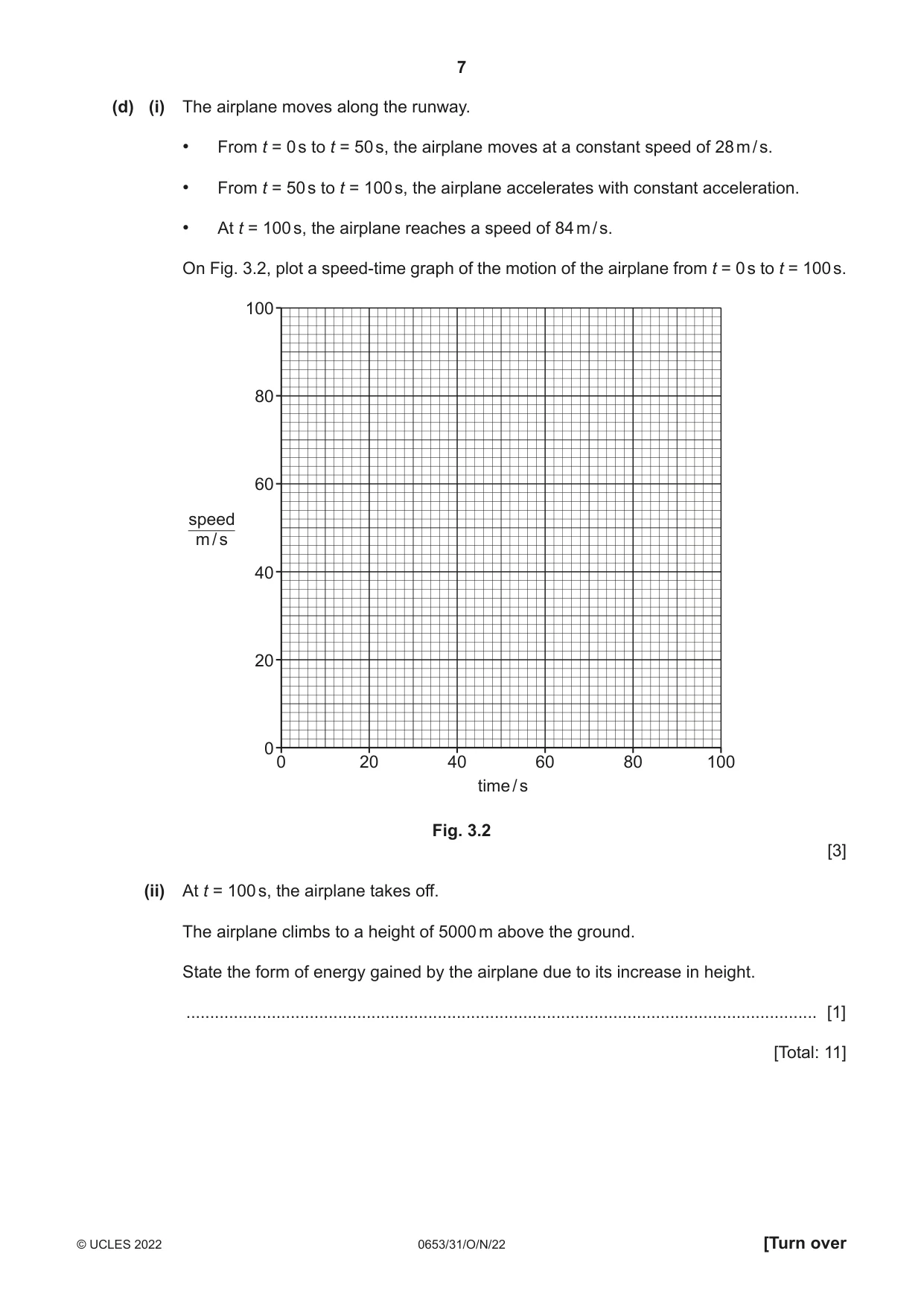
3 Fig. 3.1 shows forces P, Q, R and S acting on an airplane moving forward along a runway. S R P runway Q Fig. 3.1 (a) Force P is the driving force of the airplane engines. State the name of force R. ............................................................................................................................................. [1] (b) The airplane has a weight of 1 200 000 N. Calculate the mass of the airplane. The gravitational force on unit mass is 10 N / kg. mass = .................................................... kg [2] (c) The airplane moves along the runway for 50 s at a constant speed of 100 km / h. (i) Show that the speed of the airplane in metres per second is 28 m / s. [2] (ii) Calculate the distance the airplane moves along the runway in 50 s. distance = ..................................................... m [2] (d) (i) The airplane moves along the runway. • From t = 0 s to t = 50 s, the airplane moves at a constant speed of 28 m / s. • From t = 50 s to t = 100 s, the airplane accelerates with constant acceleration. • At t = 100 s, the airplane reaches a speed of 84 m / s. On Fig. 3.2, plot a speed-time graph of the motion of the airplane from t = 0 s to t = 100 s. 100 80 60 speed m / s 40 20 0 0 20 40 60 80 100 time / s Fig. 3.2 [3] (ii) At t = 100 s, the airplane takes off. The airplane climbs to a height of 5000 m above the ground. State the form of energy gained by the airplane due to its increase in height. ..................................................................................................................................... [1] [Total: 11]
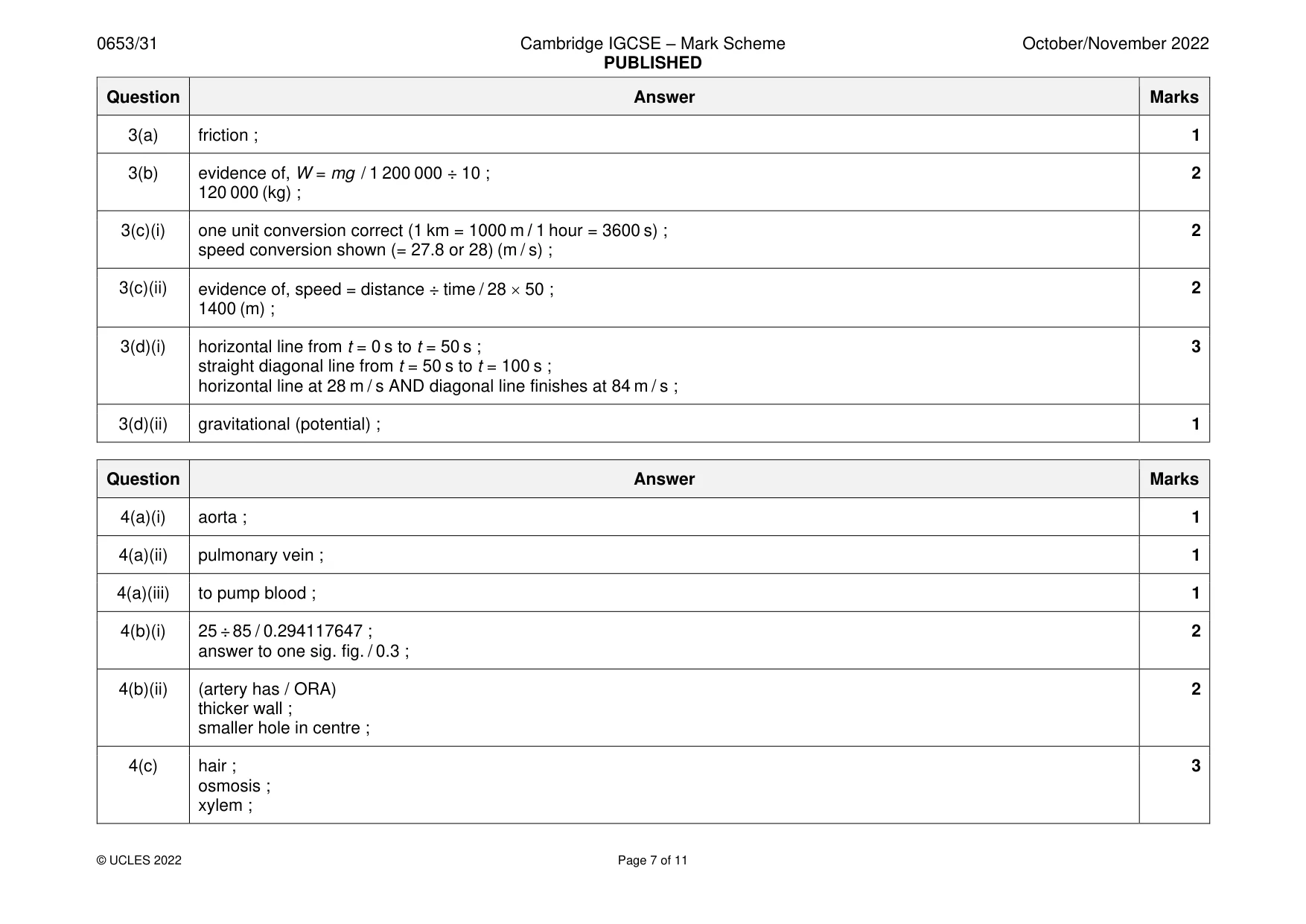
Mark scheme: 3(a) friction ; 1 3(b) evidence of, W = mg / 1 200 000 ÷ 10 ; 2 120 000 (kg) ; 3(c)(i) one unit conversion correct (1 km = 1000 m / 1 hour = 3600 s) ; 2 speed conversion shown (= 27.8 or 28) (m / s) ; 3(c)(ii) evidence of, speed = distance ÷ time / 28 50 ; 2 1400 (m) ; 3(d)(i) horizontal line from t = 0 s to t = 50 s ; 3 straight diagonal line from t = 50 s to t = 100 s ; horizontal line at 28 m / s AND diagonal line finishes at 84 m / s ; 3(d)(ii) gravitational (potential) ; 1
Q4 · A student draws a labelled diagram of a human heart
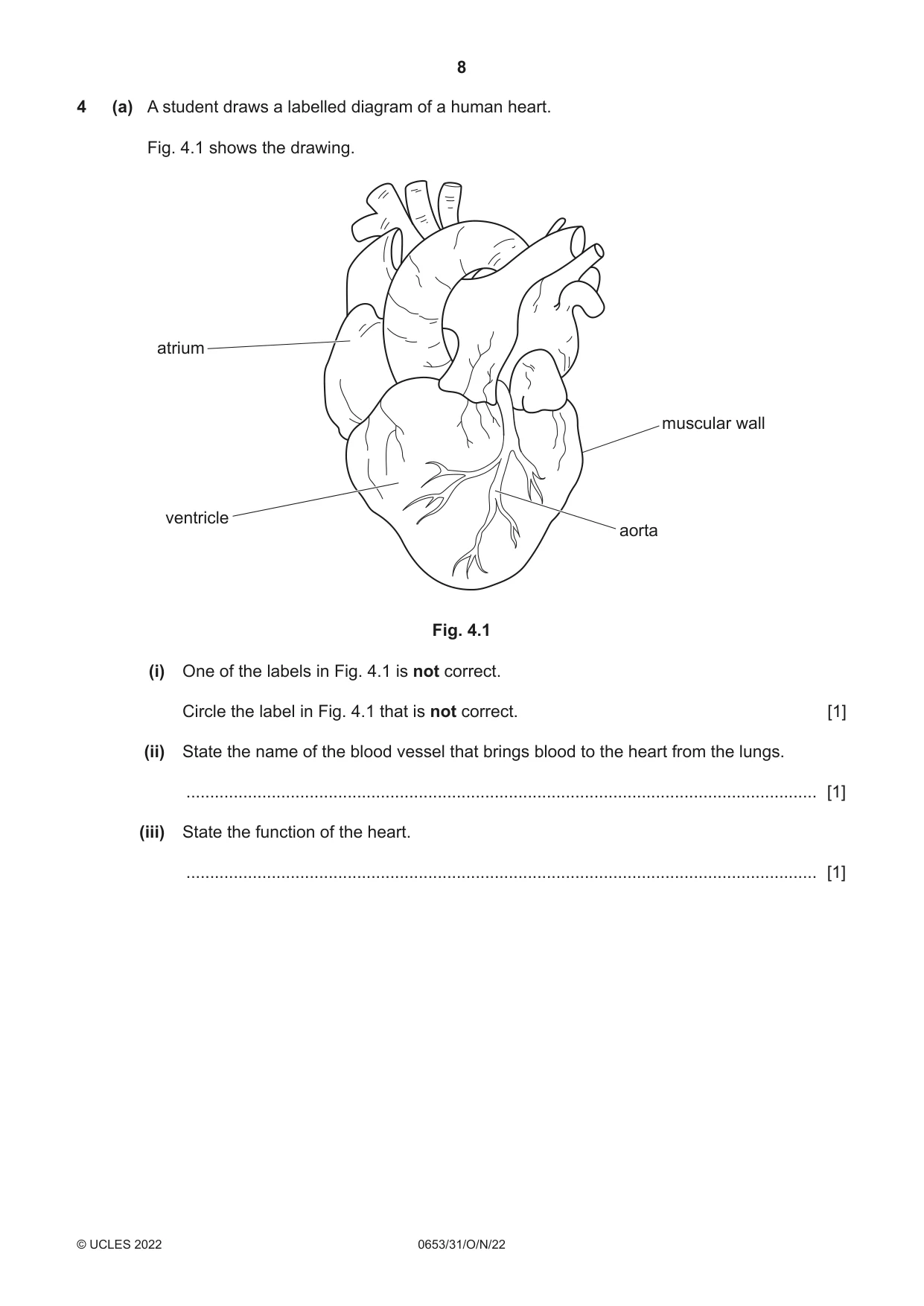
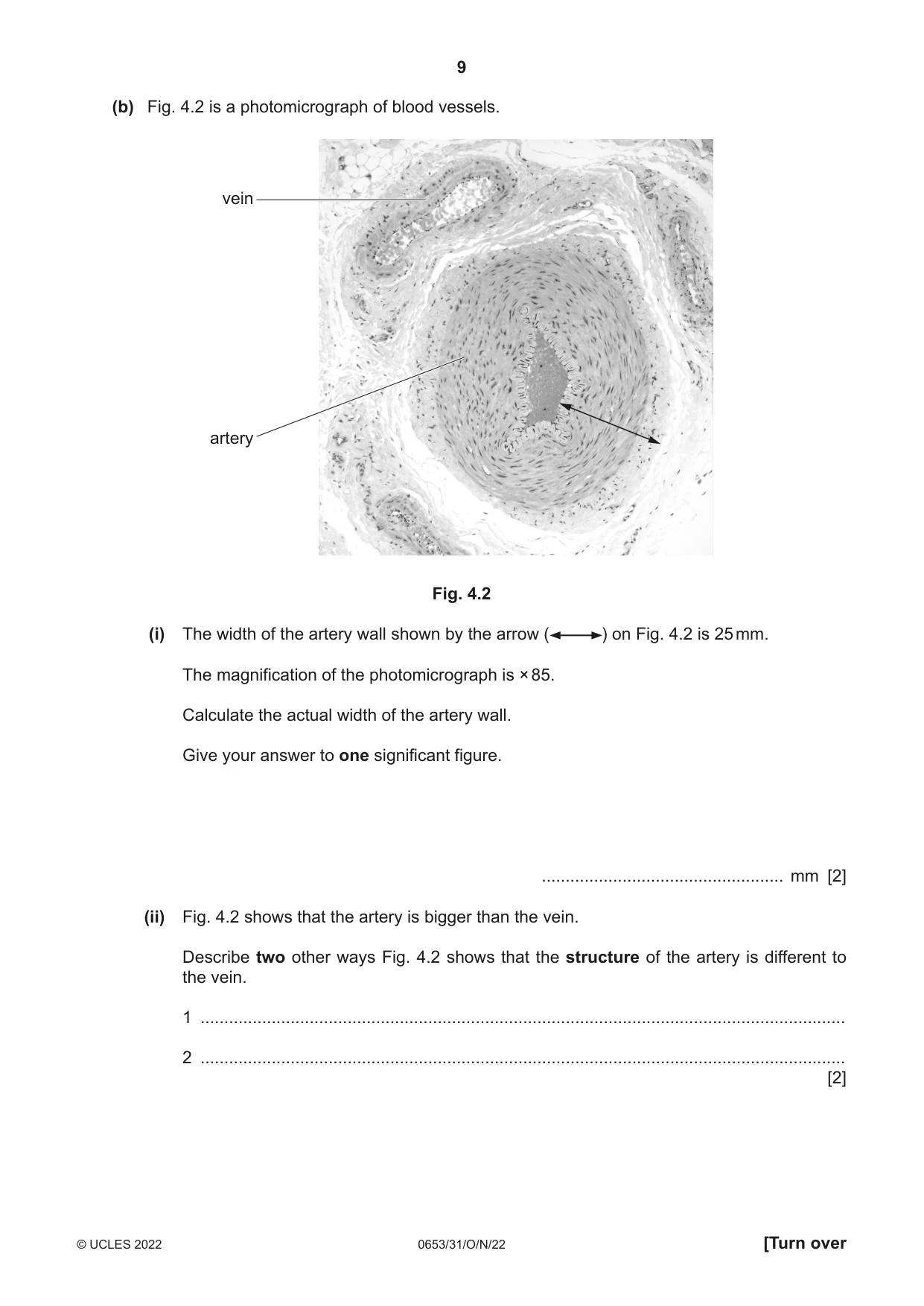
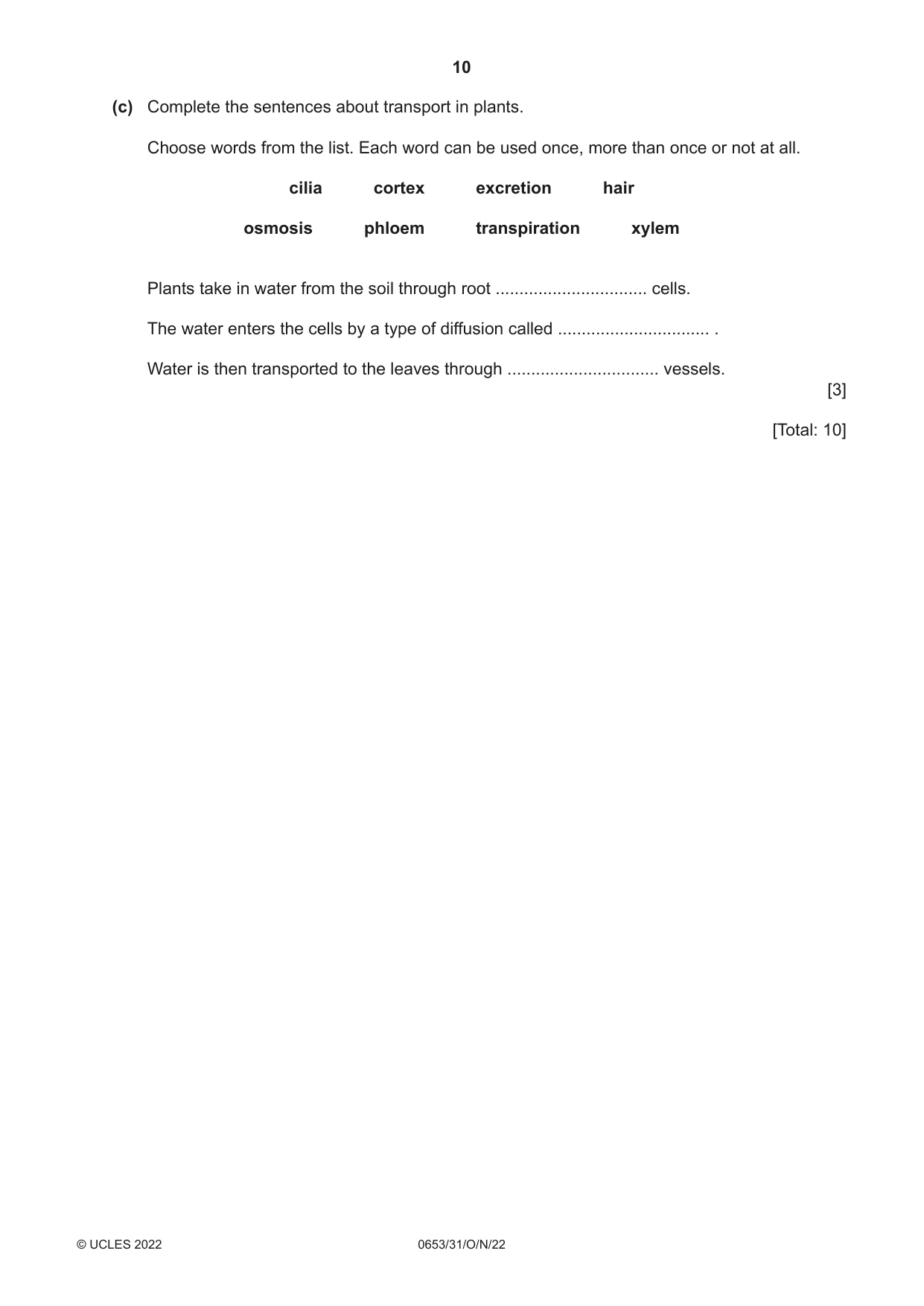
4 (a) A student draws a labelled diagram of a human heart. Fig. 4.1 shows the drawing. atrium muscular wall ventricle aorta Fig. 4.1 (i) One of the labels in Fig. 4.1 is not correct. Circle the label in Fig. 4.1 that is not correct. [1] (ii) State the name of the blood vessel that brings blood to the heart from the lungs. ..................................................................................................................................... [1] (iii) State the function of the heart. ..................................................................................................................................... [1] (b) Fig. 4.2 is a photomicrograph of blood vessels. vein artery Fig. 4.2 (i) The width of the artery wall shown by the arrow ( ) on Fig. 4.2 is 25 mm. The magnification of the photomicrograph is × 85. Calculate the actual width of the artery wall. Give your answer to one significant figure. ................................................... mm [2] (ii) Fig. 4.2 shows that the artery is bigger than the vein. Describe two other ways Fig. 4.2 shows that the structure of the artery is different to the vein. 1 ........................................................................................................................................ 2 ........................................................................................................................................ [2] (c) Complete the sentences about transport in plants. Choose words from the list. Each word can be used once, more than once or not at all. cilia cortex excretion hair osmosis phloem transpiration xylem Plants take in water from the soil through root ................................ cells. The water enters the cells by a type of diffusion called ................................ . Water is then transported to the leaves through ................................ vessels. [3] [Total: 10]
Mark scheme: 4(a)(i) aorta ; 1 4(a)(ii) pulmonary vein ; 1 4(a)(iii) to pump blood ; 1 4(b)(i) 25 ÷ 85 / 0.294117647 ; 2 answer to one sig. fig. / 0.3 ; 4(b)(ii) (artery has / ORA) 2 thicker wall ; smaller hole in centre ; 4(c) hair ; 3 osmosis ; xylem ;
Q5 · Copper and aluminium are metals
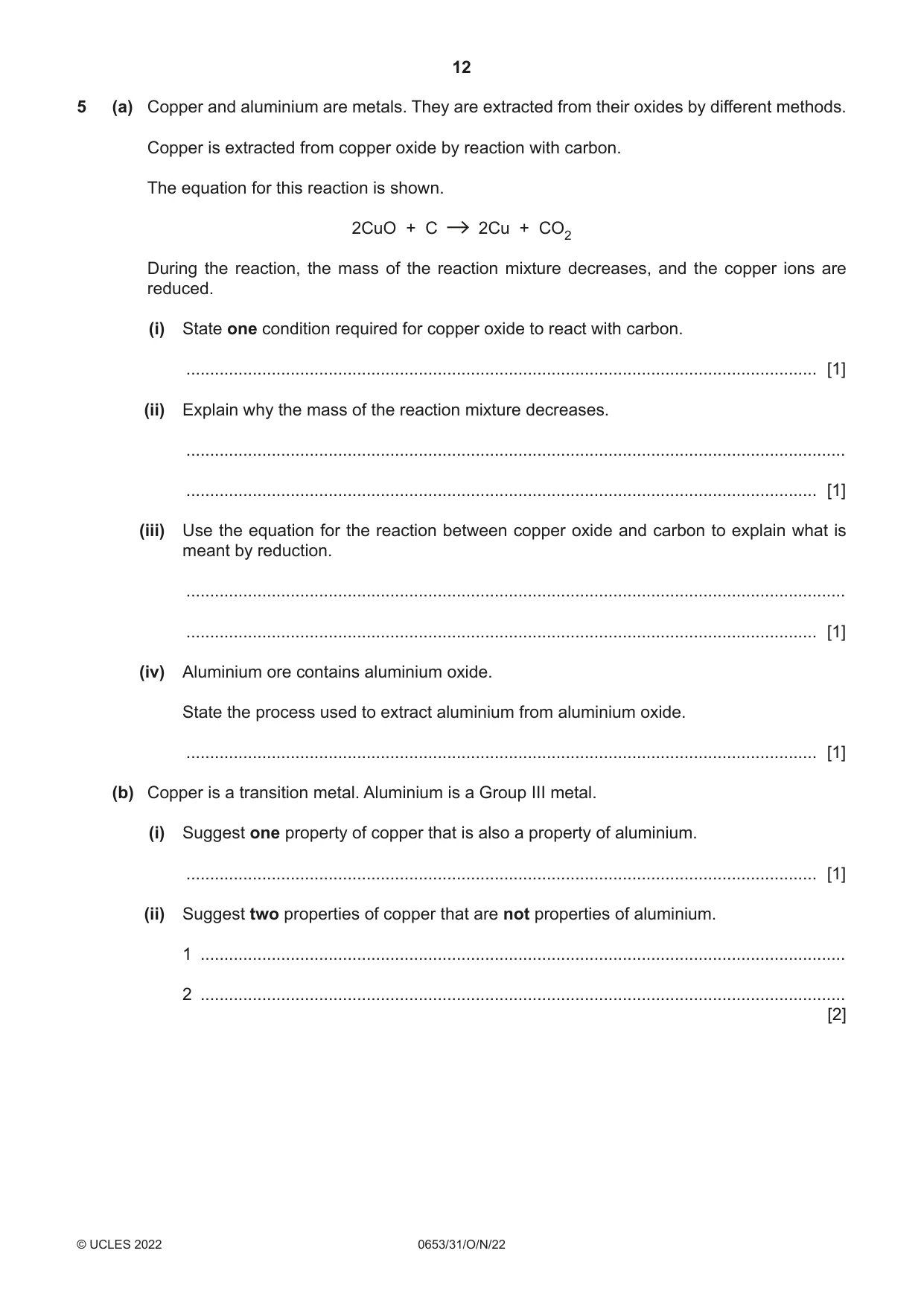
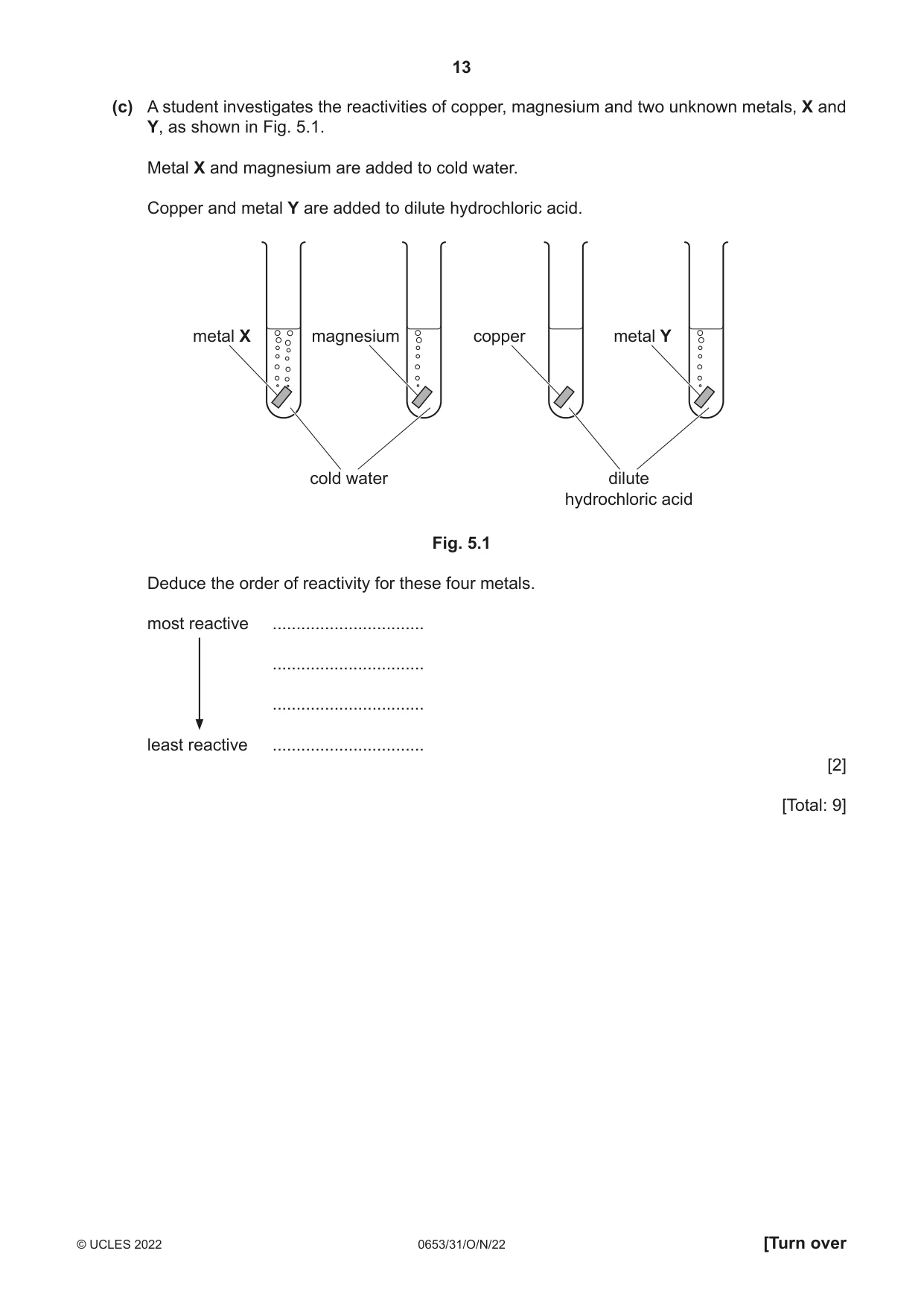
5 (a) Copper and aluminium are metals. They are extracted from their oxides by different methods. Copper is extracted from copper oxide by reaction with carbon. The equation for this reaction is shown. 2CuO + C 2Cu + CO2 During the reaction, the mass of the reaction mixture decreases, and the copper ions are reduced. (i) State one condition required for copper oxide to react with carbon. ..................................................................................................................................... [1] (ii) Explain why the mass of the reaction mixture decreases. ........................................................................................................................................... ..................................................................................................................................... [1] (iii) Use the equation for the reaction between copper oxide and carbon to explain what is meant by reduction. ........................................................................................................................................... ..................................................................................................................................... [1] (iv) Aluminium ore contains aluminium oxide. State the process used to extract aluminium from aluminium oxide. ..................................................................................................................................... [1] (b) Copper is a transition metal. Aluminium is a Group III metal. (i) Suggest one property of copper that is also a property of aluminium. ..................................................................................................................................... [1] (ii) Suggest two properties of copper that are not properties of aluminium. 1 ........................................................................................................................................ 2 ........................................................................................................................................ [2] (c) A student investigates the reactivities of copper, magnesium and two unknown metals, X and Y, as shown in Fig. 5.1. Metal X and magnesium are added to cold water. Copper and metal Y are added to dilute hydrochloric acid. metal X magnesium copper metal Y cold water dilute hydrochloric acid Fig. 5.1 Deduce the order of reactivity for these four metals. most reactive ................................ ................................ ................................ least reactive ................................ [2] [Total: 9]
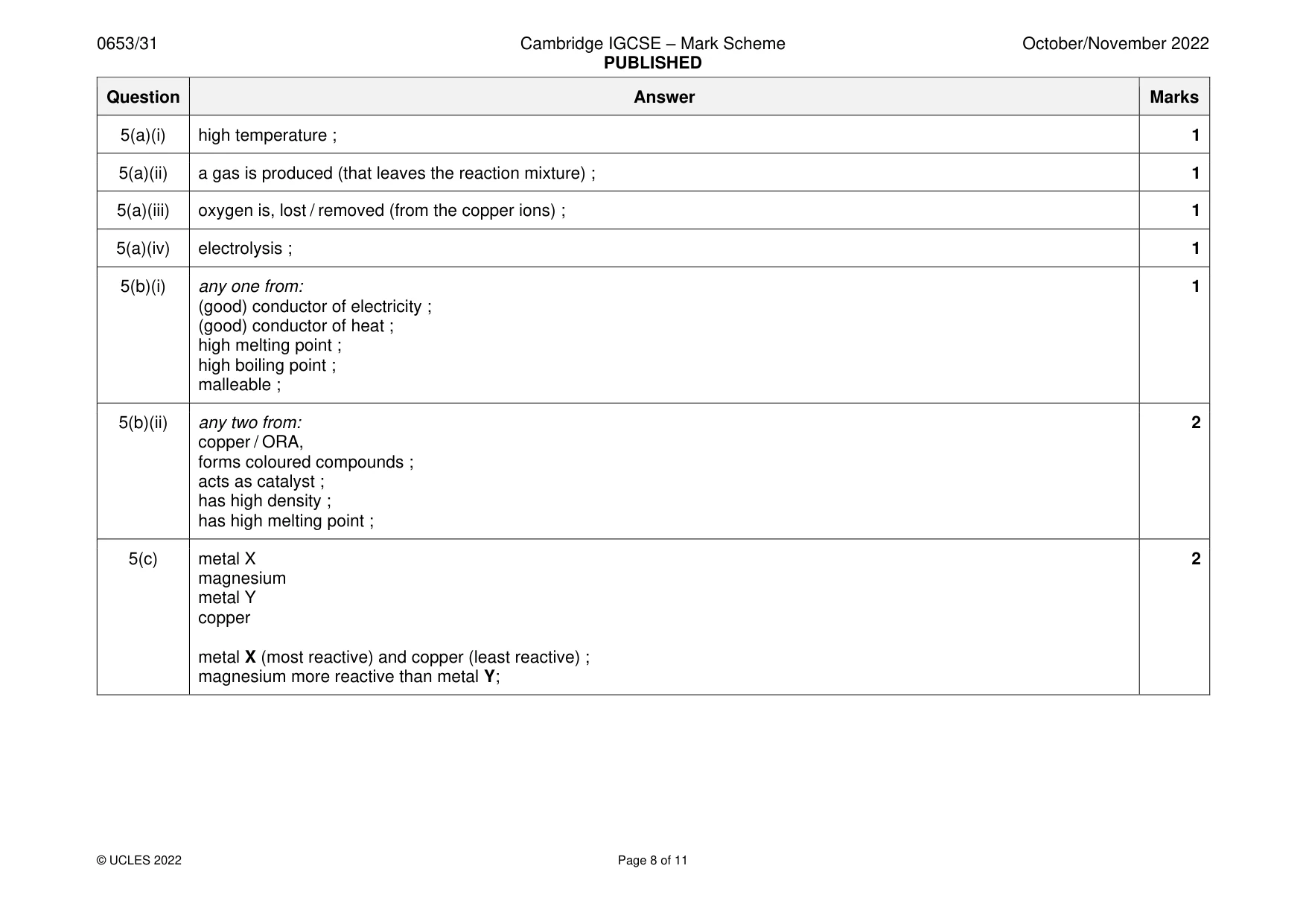
Mark scheme: 5(a)(i) high temperature ; 1 5(a)(ii) a gas is produced (that leaves the reaction mixture) ; 1 5(a)(iii) oxygen is, lost / removed (from the copper ions) ; 1 5(a)(iv) electrolysis ; 1 5(b)(i) any one from: 1 (good) conductor of electricity ; (good) conductor of heat ; high melting point ; high boiling point ; malleable ; 5(b)(ii) any two from: 2 copper / ORA, forms coloured compounds ; acts as catalyst ; has high density ; has high melting point ; 5(c) metal X 2 magnesium metal Y copper metal X (most reactive) and copper (least reactive) ; magnesium more reactive than metal Y;
Question 6
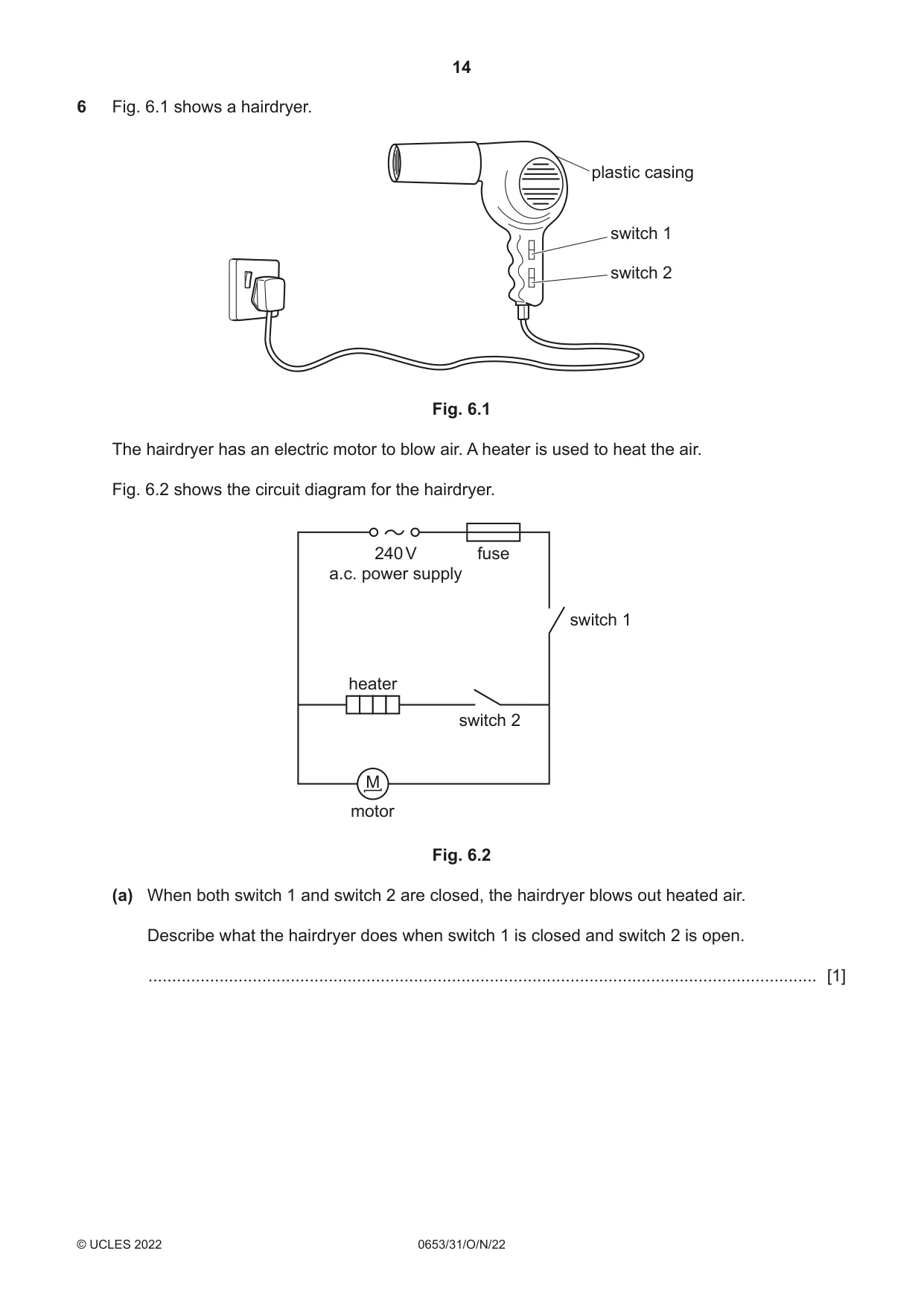
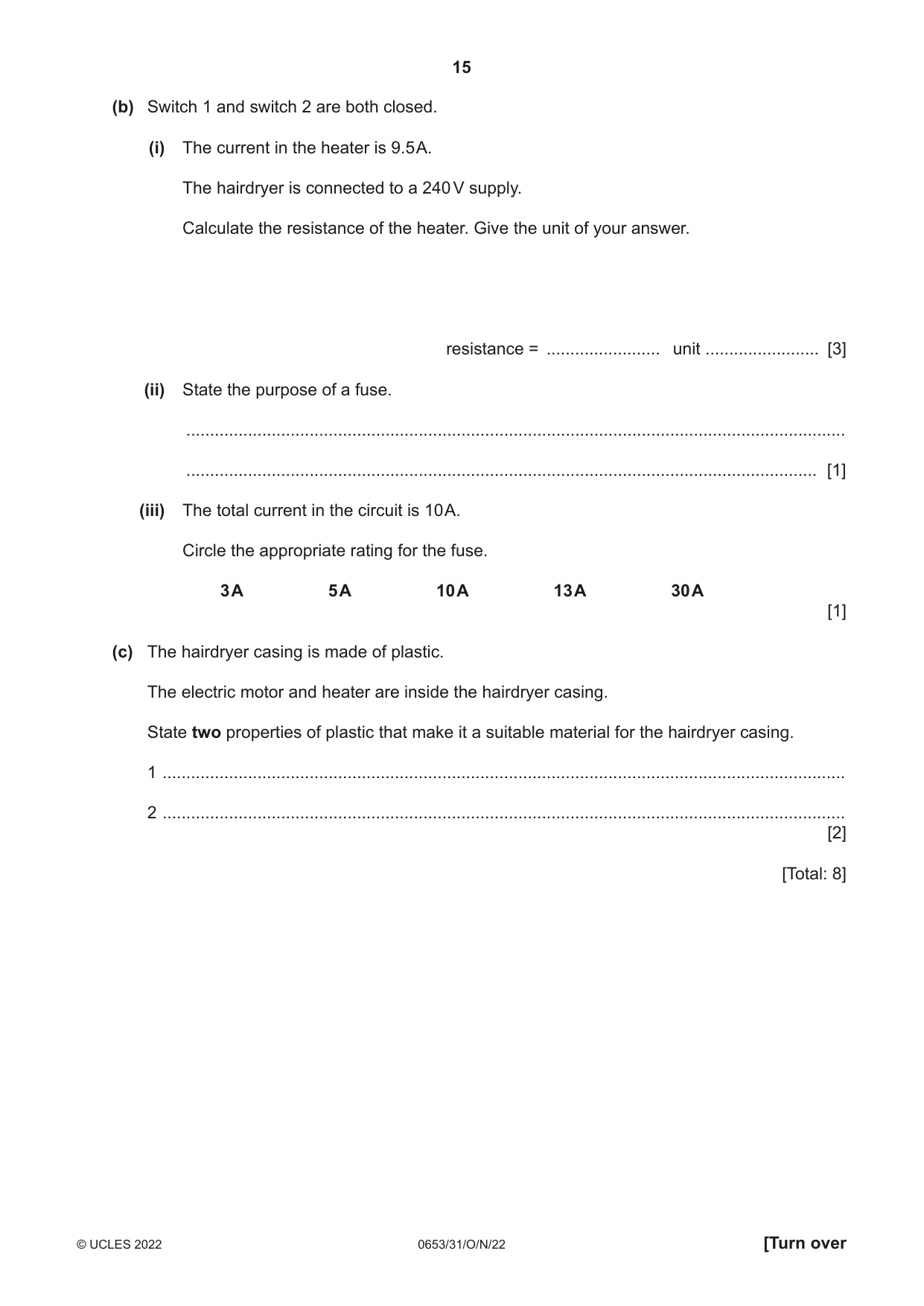
6 Fig. 6.1 shows a hairdryer. plastic casing switch 1 switch 2 Fig. 6.1 The hairdryer has an electric motor to blow air. A heater is used to heat the air. Fig. 6.2 shows the circuit diagram for the hairdryer. 240 V fuse a.c. power supply switch 1 heater switch 2 M motor Fig. 6.2 (a) When both switch 1 and switch 2 are closed, the hairdryer blows out heated air. Describe what the hairdryer does when switch 1 is closed and switch 2 is open. ............................................................................................................................................. [1] (b) Switch 1 and switch 2 are both closed. (i) The current in the heater is 9.5 A. The hairdryer is connected to a 240 V supply. Calculate the resistance of the heater. Give the unit of your answer. resistance = ........................ unit ........................ [3] (ii) State the purpose of a fuse. ........................................................................................................................................... ..................................................................................................................................... [1] (iii) The total current in the circuit is 10 A. Circle the appropriate rating for the fuse. 3 A 5 A 10 A 13 A 30 A [1] (c) The hairdryer casing is made of plastic. The electric motor and heater are inside the hairdryer casing. State two properties of plastic that make it a suitable material for the hairdryer casing. 1 ................................................................................................................................................ 2 ................................................................................................................................................ [2] [Total: 8]
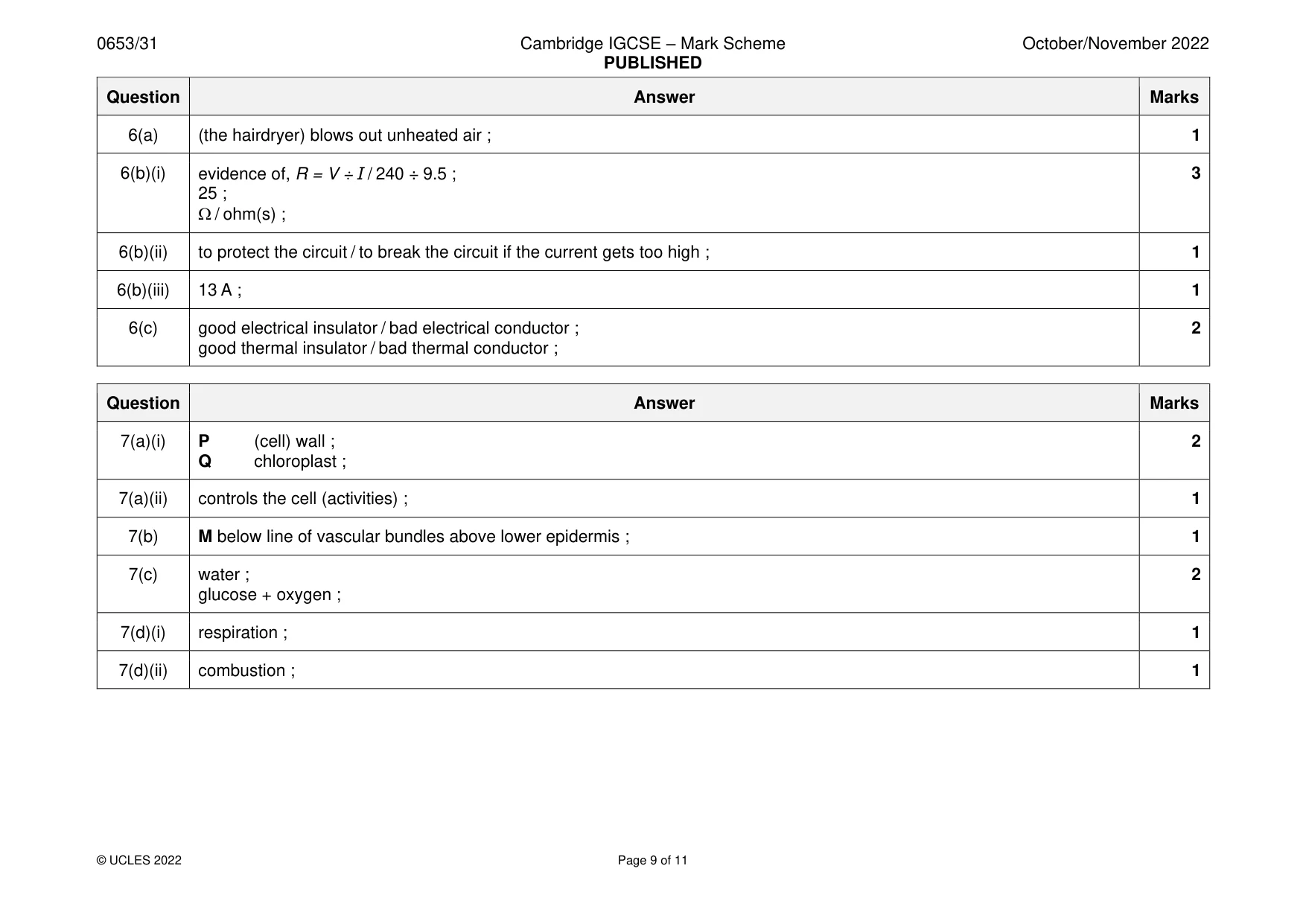
Mark scheme: 6(a) (the hairdryer) blows out unheated air ; 1 6(b)(i) evidence of, R = V ÷ I / 240 ÷ 9.5 ; 3 25 ; / ohm(s) ; 6(b)(ii) to protect the circuit / to break the circuit if the current gets too high ; 1 6(b)(iii) 13 A ; 1 6(c) good electrical insulator / bad electrical conductor ; 2 good thermal insulator / bad thermal conductor ;
Q7 · A cell from the spongy mesophyll of a plant
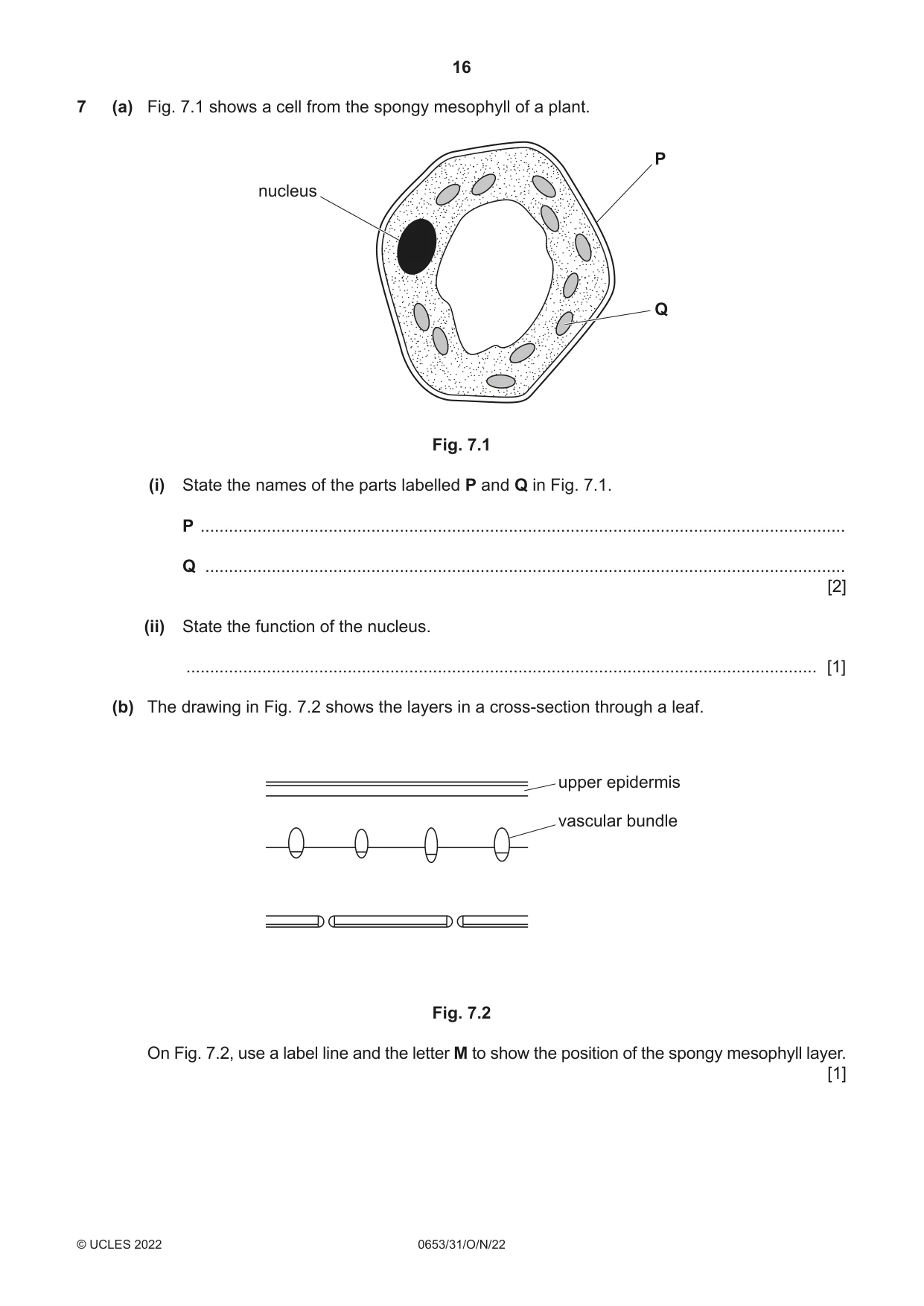
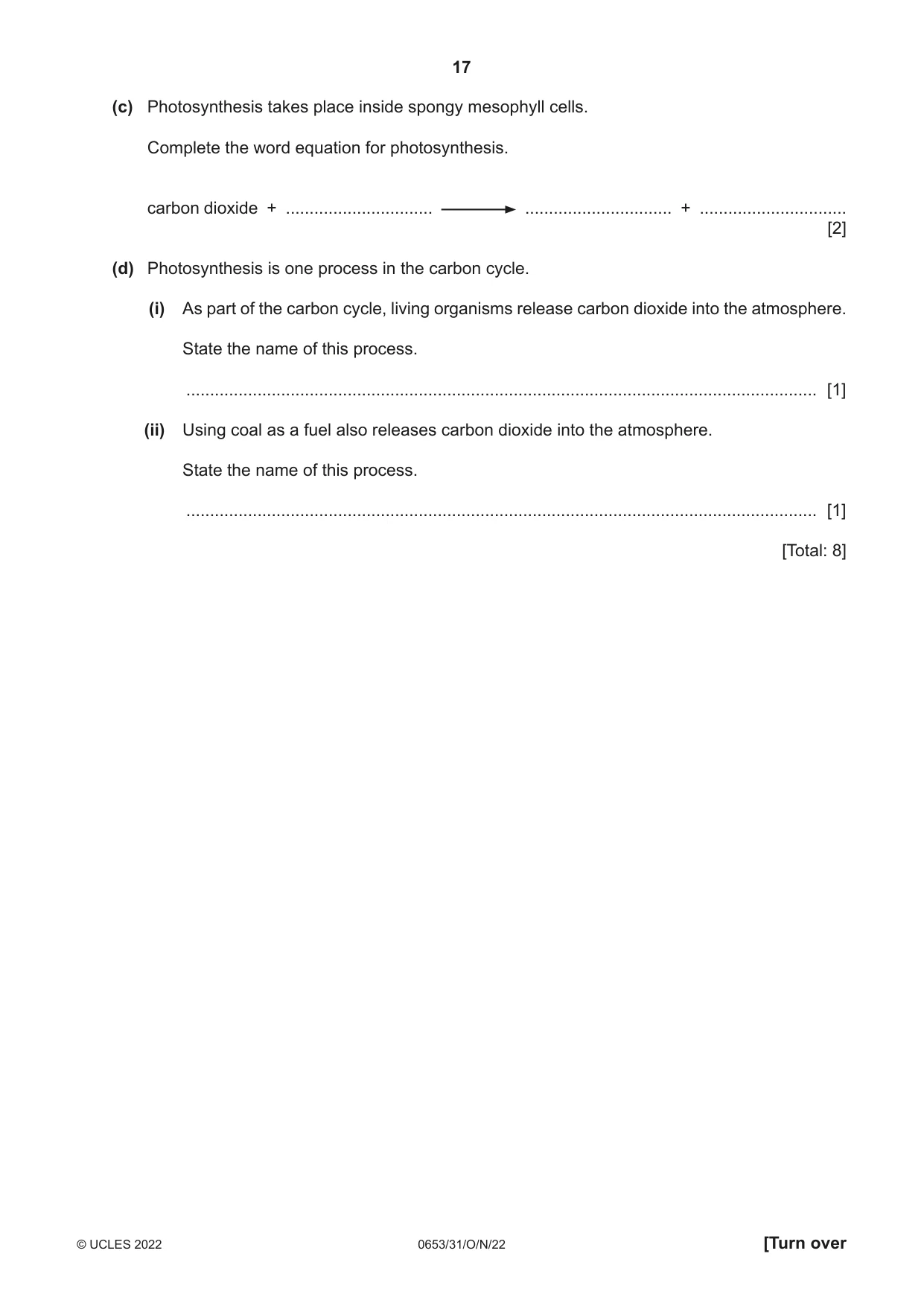
7 (a) Fig. 7.1 shows a cell from the spongy mesophyll of a plant. P nucleus Q Fig. 7.1 (i) State the names of the parts labelled P and Q in Fig. 7.1. P ........................................................................................................................................ Q ....................................................................................................................................... [2] (ii) State the function of the nucleus. ..................................................................................................................................... [1] (b) The drawing in Fig. 7.2 shows the layers in a cross-section through a leaf. upper epidermis vascular bundle Fig. 7.2 On Fig. 7.2, use a label line and the letter M to show the position of the spongy mesophyll layer. [1] (c) Photosynthesis takes place inside spongy mesophyll cells. Complete the word equation for photosynthesis. carbon dioxide + ............................... ............................... + ............................... [2] (d) Photosynthesis is one process in the carbon cycle. (i) As part of the carbon cycle, living organisms release carbon dioxide into the atmosphere. State the name of this process. ..................................................................................................................................... [1] (ii) Using coal as a fuel also releases carbon dioxide into the atmosphere. State the name of this process. ..................................................................................................................................... [1] [Total: 8]
Mark scheme: 7(a)(i) P (cell) wall ; 2 Q chloroplast ; 7(a)(ii) controls the cell (activities) ; 1 7(b) M below line of vascular bundles above lower epidermis ; 1 7(c) water ; 2 glucose + oxygen ; 7(d)(i) respiration ; 1 7(d)(ii) combustion ; 1
Q8 · Describe a chemical test for water and state the positive result
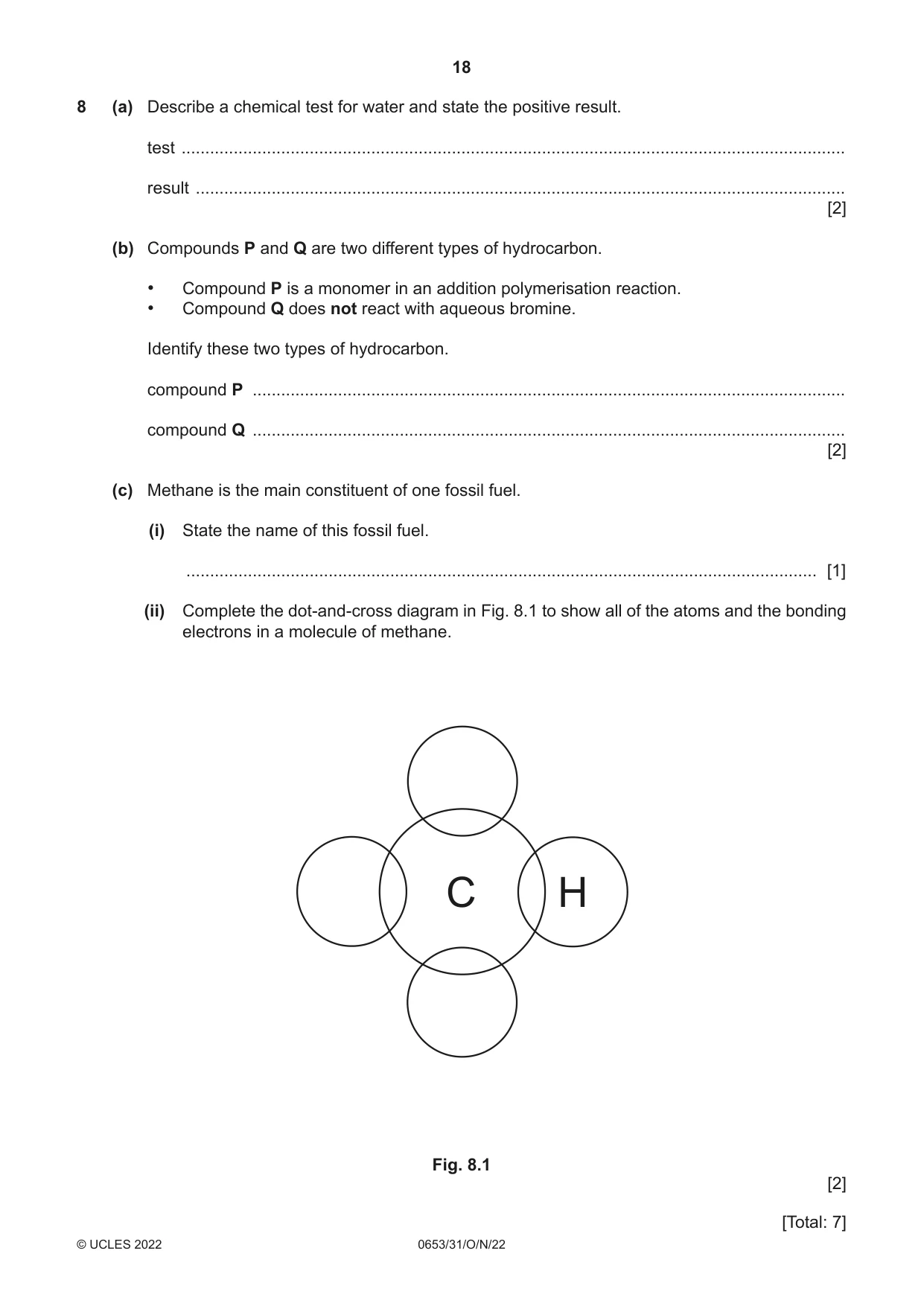
8 (a) Describe a chemical test for water and state the positive result. test ............................................................................................................................................ result ......................................................................................................................................... [2] (b) Compounds P and Q are two different types of hydrocarbon. • Compound P is a monomer in an addition polymerisation reaction. • Compound Q does not react with aqueous bromine. Identify these two types of hydrocarbon. compound P ............................................................................................................................. compound Q ............................................................................................................................. [2] (c) Methane is the main constituent of one fossil fuel. (i) State the name of this fossil fuel. ..................................................................................................................................... [1] (ii) Complete the dot-and-cross diagram in Fig. 8.1 to show all of the atoms and the bonding electrons in a molecule of methane. C H Fig. 8.1 [2] [Total: 7]
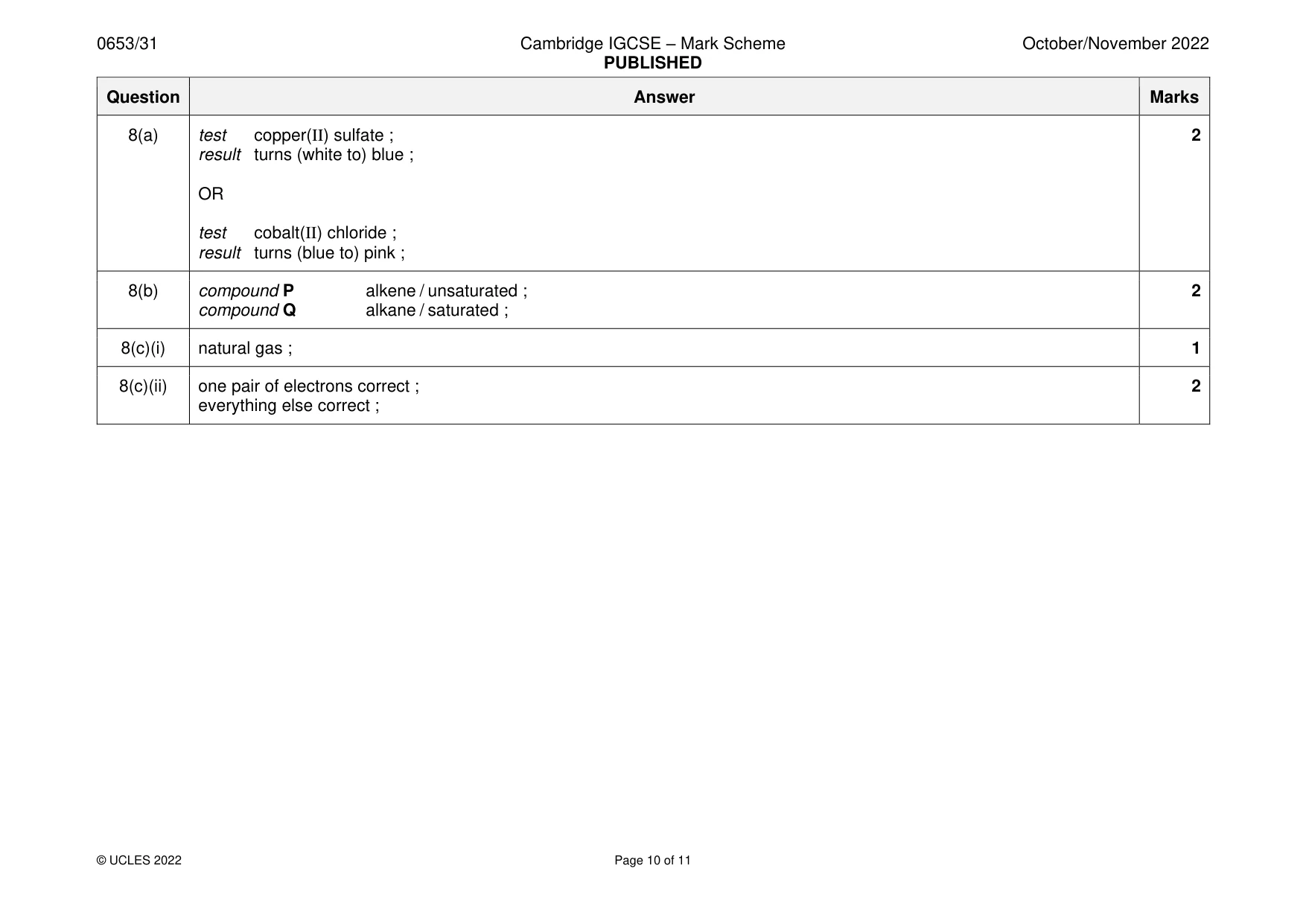
Mark scheme: 8(a) test copper(II) sulfate ; 2 result turns (white to) blue ; OR test cobalt(II) chloride ; result turns (blue to) pink ; 8(b) compound P alkene / unsaturated ; 2 compound Q alkane / saturated ; 8(c)(i) natural gas ; 1 8(c)(ii) one pair of electrons correct ; 2 everything else correct ;
Q9 · Draw one straight line from each word to its description
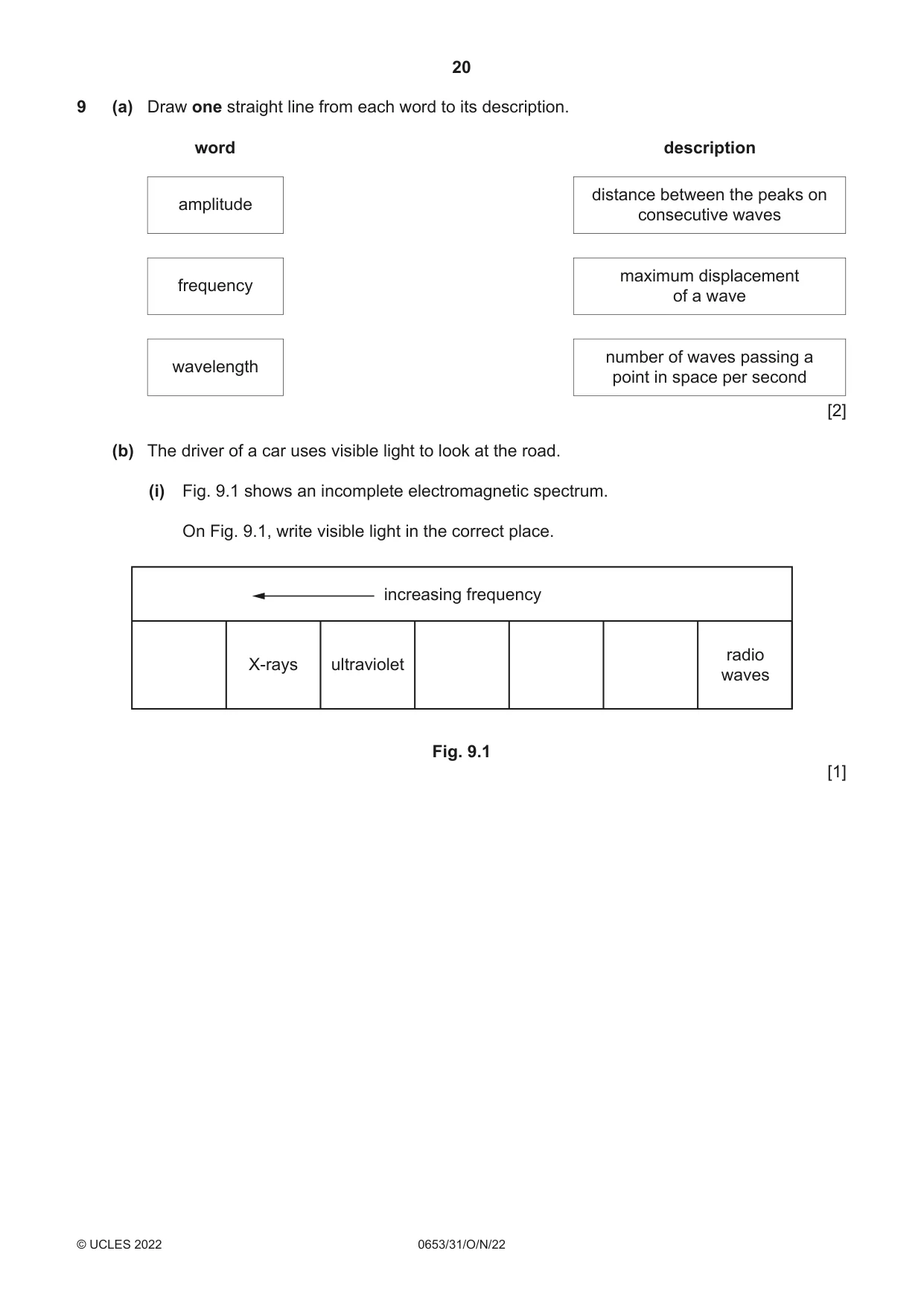
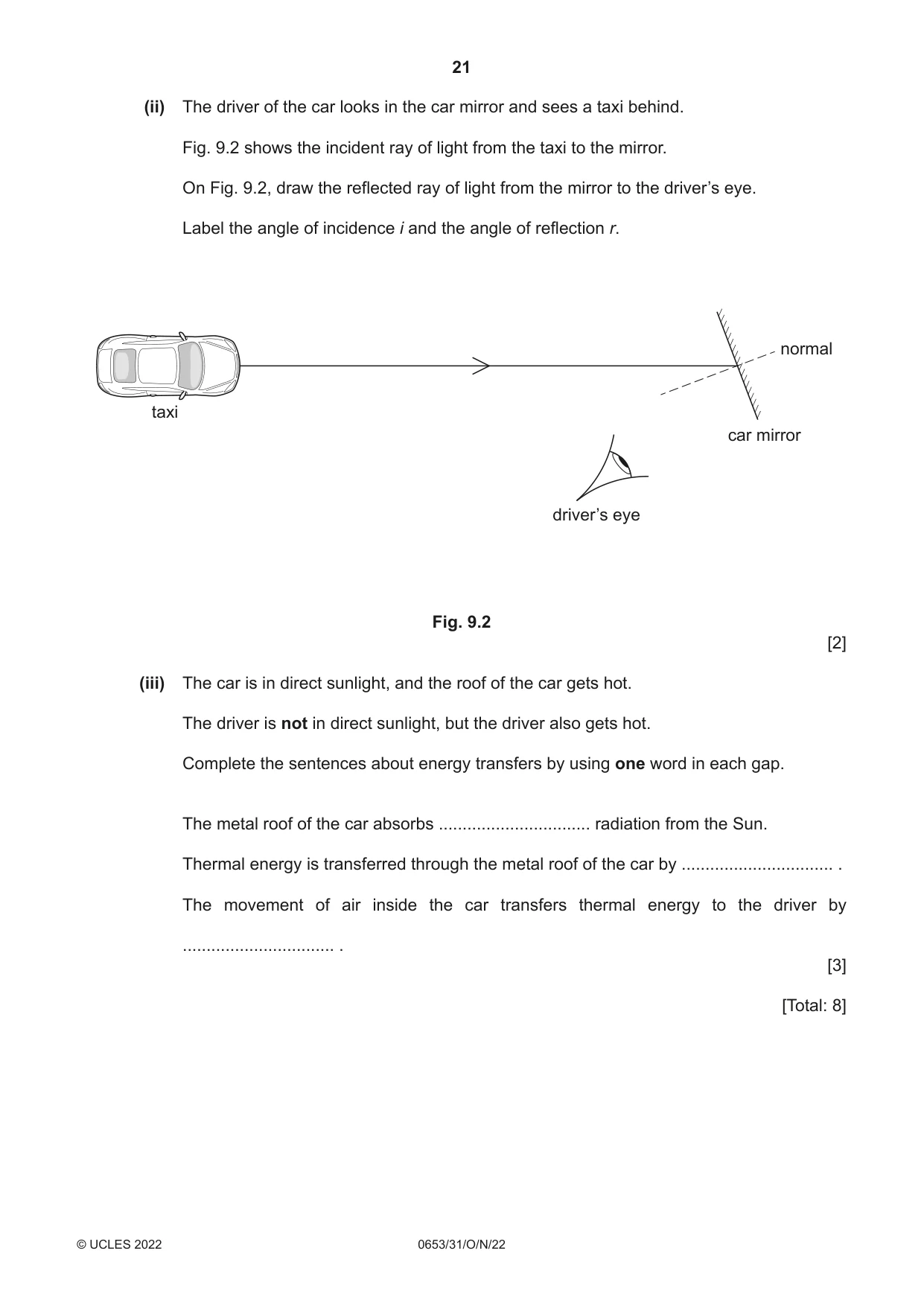
9 (a) Draw one straight line from each word to its description. word description distance between the peaks on amplitude consecutive waves maximum displacement frequency of a wave number of waves passing a wavelength point in space per second [2] (b) The driver of a car uses visible light to look at the road. (i) Fig. 9.1 shows an incomplete electromagnetic spectrum. On Fig. 9.1, write visible light in the correct place. increasing frequency radio X-rays ultraviolet waves Fig. 9.1 [1] (ii) The driver of the car looks in the car mirror and sees a taxi behind. Fig. 9.2 shows the incident ray of light from the taxi to the mirror. On Fig. 9.2, draw the reflected ray of light from the mirror to the driver’s eye. Label the angle of incidence i and the angle of reflection r. normal taxi car mirror driver’s eye Fig. 9.2 [2] (iii) The car is in direct sunlight, and the roof of the car gets hot. The driver is not in direct sunlight, but the driver also gets hot. Complete the sentences about energy transfers by using one word in each gap. The metal roof of the car absorbs ................................ radiation from the Sun. Thermal energy is transferred through the metal roof of the car by ................................ . The movement of air inside the car transfers thermal energy to the driver by ................................ . [3] [Total: 8]
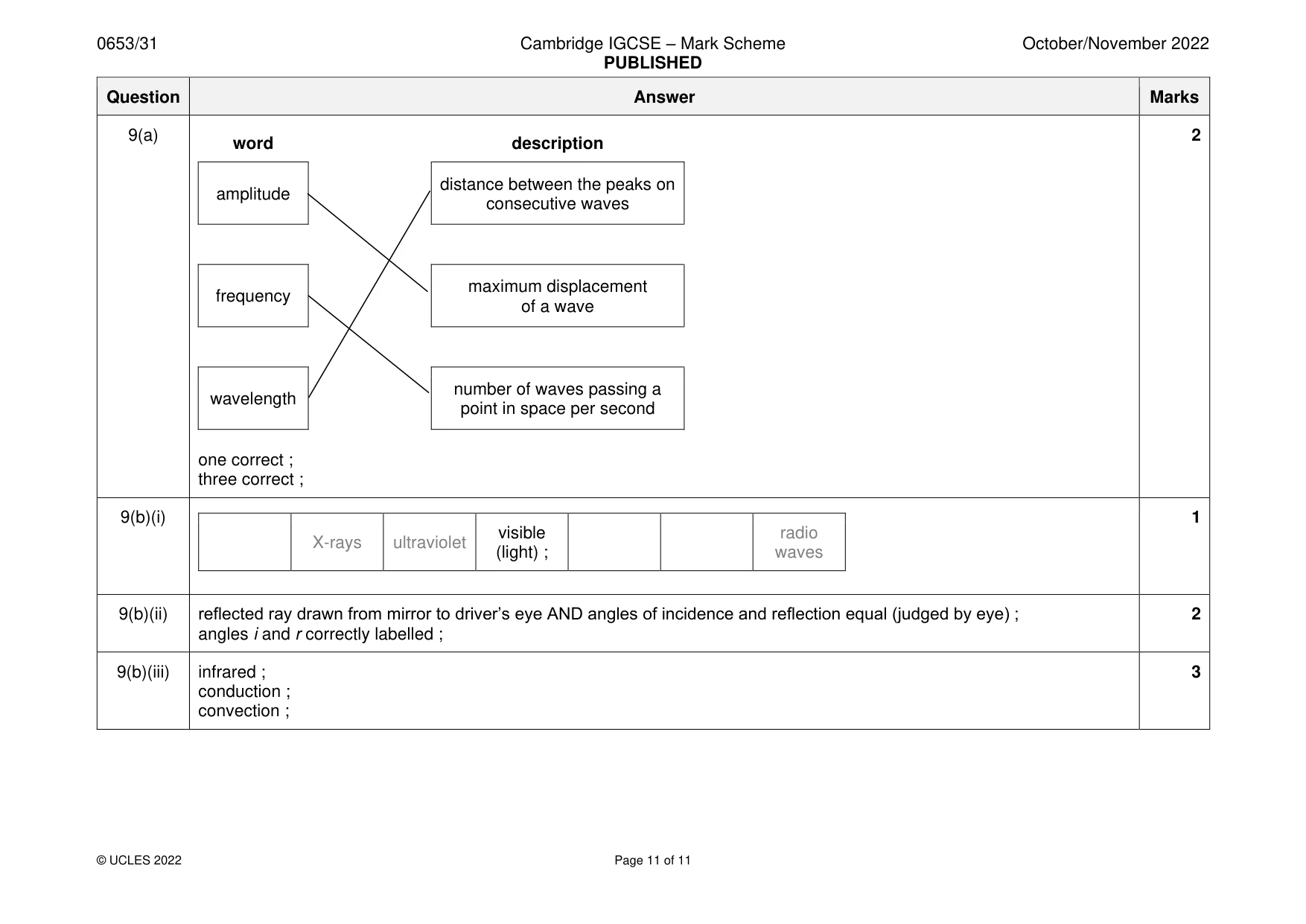
Mark scheme: 9(a) 2 word description distance between the peaks on amplitude consecutive waves maximum displacement frequency of a wave number of waves passing a wavelength point in space per second one correct ; three correct ; 9(b)(i) 1 visible radio X-rays ultraviolet (light) ; waves 9(b)(ii) reflected ray drawn from mirror to driver’s eye AND angles of incidence and reflection equal (judged by eye) ; 2 angles i and r correctly labelled ; 9(b)(iii) infrared ; 3 conduction ; convection ;
What was in this paper
The subtopics covered by these 9 questions, and how many questions each got. Open one in a new tab to see every Cambridge question on it.
What you needed in this session
Cambridge’s own grade thresholds for 2022 Oct/Nov, Paper 3 · Variant 1. A higher threshold means an easier paper — the bar moves with how the cohort did.